/











































































































Text
                    CHEMICAL PRINCIPLES
The Quest for Insight
FOURTH EDITION
PETER ATKINS / LORETTA JONES

CHEMICAL
PRINCIPLES
The Quest for Insight
FOURTH EDITION
PETER ATKINS
Oxford University
LORETTA JONES
University of Northern Colorado
■■ W. H. Freeman and Company / New York

Publisher:
Senior Acquisitions Editor:
Marketing Manager:
Senior Developmental Editor:
Developmental Assistants:
Media/Supplements Editors:
Photo Editor:
Cover/Text Designer:
Senior Project Editor:
Illustration Coordinator:
Illustrations:
Production Coordinator:
Composition:
Printing and Binding:
Craig Bleyer
Jessica Fiorillo
Anthony Paimiotto
Randi Rossignoi,
Susan Timmins
Jeanette Picerno, Amy Thorne
BlANCA MOSCATELLI
Blake Logan
Georgia Lee Hadler
Susan Timmins
Peter Atkins with Network Graphics
Julia DeRosa
Black Dot Group
QW/Versailles
Library of Congress Control Number: 2006936133
ISBN-13: 978-0-7167-7355-9
ISBN-10: 0-7167-7355-4
©2008 by P. W. Atkins and L. L. Jones
All rights reserved.
Printed in the United States of America
First Printing
W. H. Freeman and Company
41 Madison Avenue
New York, NY 10010
Houndmills, Basingstoke RG21 6XS, England
www.whfreeman.com

CONTENTS IN BRIEF
Fundamentals Fl
Introduction and Orientation, Matter and Energy, Elements and Atoms,
Compounds, The Nomenclature of Compounds, Moles and Molar Masses,
Determination of Chemical Formulas, Mixtures and Solutions, Chemical
Equations, Aqueous Solutions and Precipitation, Acids and Bases, Redox
Reactions, Reaction Stoichiometry, Limiting Reactants
1 ATOMS: THE QUANTUM WORLD 1
2 CHEMICAL BONDS 57
MAJOR TECHNIQUE 1: INFRARED SPECTROSCOPY 92
3 MOLECULAR SHAPE AND STRUCTURE 95
MAJOR TECHNIQUE 2: ULTRAVIOLET AND VISIBLE SPECTROSCOPY 136
4 THE PROPERTIES OF GASES 139
5 LIQUIDS AND SOLIDS 177
MAJOR TECHNIQUE 3: X-RAY DIFFRACTION 212
6 THERMODYNAMICS: THE FIRST LAW 215
7 THERMODYNAMICS: THE SECOND AND THIRD LAWS 265
8 PHYSICAL EQUILIBRIA 309
MAJOR TECHNIQUE 4: CHROMATOGRAPHY 354
9 CHEMICAL EQUILIBRIA 357
10 ACIDS AND BASES 395
11 AQUEOUS EQUILIBRIA 445
12 ELECTROCHEMISTRY 483
13 CHEMICAL KINETICS 529
MAJOR TECHNIQUE 5: COMPUTATION 580
14 THE ELEMENTS: THE FIRST FOUR MAIN GROUPS 581
15 THE ELEMENTS: THE LAST FOUR MAIN GROUPS 623
16 THE ELEMENTS: THE d BLOCK 657
17 NUCLEAR CHEMISTRY 699
18 ORGANIC CHEMISTRY I: THE HYDROCARBONS 729
MAJOR TECHNIQUE 6: MASS SPECTROMETRY 752
19 ORGANIC CHEMISTRY II: POLYMERS AND
BIOLOGICAL COMPOUNDS 755
MAJOR TECHNIQUE 7: NUCLEAR MAGNETIC RESONANCE 786

CONTENTS
Preface
xv
FUNDAMENTALS
INTRODUCTION AND ORIENTATION
Chemistry and Society
Chemistry: A Science at Three Levels
How Science Is Done
The Branches of Chemistry
Mastering Chemistry
A MATTER AND ENERGY
A.l Physical Properties
A.2 Force
A.3 Energy
Exercises
B ELEMENTS AND ATOMS
B.l Atoms
B.2 The Nuclear Model
B.3 Isotopes
B.4 The Organization of the Elements
Exercises
C COMPOUNDS
C.l What Are Compounds?
C.2 Molecules and Molecular Compounds
C.3 Ions and Ionic Compounds
Exercises
D THE NOMENCLATURE OF
COMPOUNDS
D.l Names of Cations
D.2 Names of Anions
D.3 Names of Ionic Compounds
TOOLBOX D.l HOW TO NAME IONIC COMPOUNDS
D.4 Names of Inorganic Molecular Compounds F33
TOOLBOX D.2 HOW TO NAME SIMPLE INORGANIC
MOLECULAR COMPOUNDS
D.5 Names of Some Common Organic
Compounds
Exercises
E MOLES AND MOLAR MASSES
E.l The Mole
E.2 Molar Mass
Exercises
F DETERMINATION OF CHEMICAL
FORMULAS
F. 1 Mass Percentage Composition
Ft
Fl
F2
F2
F4
F5
F5
¥6
F10
Fll
F14
F15
F16
FT 6
F18
F19
F22
F23
F23
F24
F25
F29
F30
F30
F30
F32
F32
F34
F35
F37
F38
F38
F40
F44
F46
F46
F.2 Determining Empirical Formulas
F.3 Determining Molecular Formulas
Exercises
G MIXTURES AND SOLUTIONS
G.l Classifying Mixtures
G.2 Separation Techniques
G.3 Molarity
G.4 Dilution
TOOLBOX C.l HOW TO CALCULATE THE VOLUME OF
STOCK SOLUTION REQUIRED FOR A GIVEN
DILUTION
Exercises
H CHEMICAL EQUATIONS
H.l Symbolizing Chemical Reactions
H.2 Balancing Chemical Equations
Exercises
I AQUEOUS SOLUTIONS AND
PRECIPITATION
1.1 Electrolytes
1.2 Precipitation Reactions
1.3 Ionic and Net Ionic Equations
1.4 Putting Precipitation to Work
Exercises
J ACIDS AND BASES
J.l Acids and Bases in Aqueous Solution
J.2 Strong and Weak Acids and Bases
J.3 Neutralization
Exercises
K REDOX REACTIONS
K. 1 Oxidation and Reduction
K.2 Oxidation Numbers: Keeping Track
of Electrons
TOOLBOX K.1 HOW TO ASSIGN OXIDATION NUMBERS
K.3 Oxidizing and Reducing Agents
K.4 Balancing Simple Redox Equations
Exercises
L REACTION STOICHIOMETRY
L.l Mole-to-Mole Predictions
L.2 Mass-to-Mass Predictions
TOOLBOX LI HOW TO CARRY OUT MASS-TO-MASS
CALCULATIONS
L.3 Volumetric Analysis
TOOLBOX L.2 HOW TO INTERPRET A TITRATION
Exercises
F47
F49
F50
F52
F52
F54
FSS
F58
F58
F59
F61
F61
F62
F64
¥66
¥66
¥61
F68
¥69
F70
F72
F72
F74
F75
F76
F77
F77
F79
F80
F81
F82
F83
F85
F85
F86
F86
F88
F89
F91
vi

CONTENTS
vii
M LIMITING REACTANTS
M. 1 Reaction Yield
M.2 The Limits of Reaction
TOOLBOX M.l HOW TO IDENTIFY THE LIMITING
REACTANT
M.3 Combustion Analysis
Exercises
F93
F93
F94
F95
F97
F100
Chapter 1 ATOMS: THE
QUANTUM WORLD
INVESTIGATING ATOMS 1
1.1 The Nuclear Atom 2
1.2 The Characteristics of Electromagnetic
Radiation 4
1.3 Atomic Spectra 6
QUANTUM THEORY 8
1.4 Radiation, Quanta, and Photons 8
1.5 The Wave-Particle Duality of Matter 13
1.6 The Uncertainty Principle 15
1.7 Wavefunctions and Energy Levels 16
THE HYDROGEN ATOM 21
1.8 The Principal Quantum Number 21
1.9 Atomic Orbitals 22
1.10 Electron Spin 29
1.11 The Electronic Structure of Hydrogen 30
How Do We Know (Box 1.1) . . .
That ait Electron Has Spin? 31
MANY-ELECTRON ATOMS 31
1.12 Orbital Energies 32
1.13 The Building-Up Principle 33
TOOLBOX 1.1 HOW TO PREDICT THE GROUND-STATE
ELECTRON CONFIGURATION OF AN ATOM 37
1.14 Electronic Structure and the
Periodic Table 38
The Development ot the Periodic Table
(Box 1.2) 38
THE PERIODICITY OF ATOMIC
PROPERTIES 39
1.15 Atomic Radius 40
1.16 Ionic Radius 41
1.17 Ionization Energy 43
1.18 Electron Affinity 45
1.19 The Inert-Pair Effect 46
1.20 Diagonal Relationships 47
THE IMPACT ON MATERIALS 47
1.21 The Main-Group Elements 47
1.22 The Transition Metals 48
Exercises 50
Chapter 2 CHEMICAL BONDS
IONIC BONDS
2.1 The Ions That Elements Form
2.2 Lewis Symbols
2.3 The Energetics of Ionic Bond Formation
2.4 Interactions Between Ions
COVALENT BONDS
2.5 Lewis Structures
2.6 Lewis Structures for Polyatomic Species
TOOLBOX 2.1 HOW TO WRITE THE LEWIS STRUCTURE
OF A POLYATOMIC SPECIES
2.7 Resonance
2.8 Formal Charge
TOOLBOX 2.2 HOW TO USE FORMAL CHARGE TO
DETERMINE THE MOST LIKELY LEWIS
STRUCTURE
EXCEPTIONS TO THE OCTET RULE
2.9 Radicals and Biradicals
What Has This to Do with (Box 2.1) . . .
Staying Alive? Chemical Self-Preservation
2.10 Expanded Valence Shells
2.11 The Unusual Structures of Some
Group 13/111 Compounds
IONIC VERSUS COVALENT BONDS
2.12 Correcting the Covalent Model:
Electronegativity
2.13 Correcting the Ionic Model: Polarizability
THE STRENGTHS AND LENGTHS OF
COVALENT BONDS
2.14 Bond Strengths
2.15 Variation in Bond Strength
2.16 Bond Lengths
How Do We Know (Box 2.2) . . . the Length
of a Chemical Bond?
Exercises
MAJOR TECHNIQUE 1: INFRARED SPECTROSCOPY
Chapter 3 MOLECULAR
SHAPE AND STRUCTURE
THE VSEPR MODEL
Frontiers of Chemistry (Box 3.1):
Drugs by Design and Discovery
3.1 The Basic VSEPR Model
3.2 Molecules with Lone Pairs on the
Central Atom
57
58
60
60
61
64
65
66
67
69
71
72
73
73
74
74
77
77
77
79
80
80
81
83
84
85
92
95
96
96
99

viii contents
TOOLBOX 3.1 HOW TO USE THE VSEPR MODEL 102
3.3 Polar Molecules 103
VALENCE-BOND THEORY 106
3.4 Sigma and Pi Bonds 107
3.5 Electron Promotion and the Hybridization
of Orbitals 108
3.6 Other Common Types of Hybridization 1L0
3.7 Characteristics of Multiple Bonds 112
MOLECULAR ORBITAL THEORY 115
3.8 The Limitations of Lewis's Theory 115
How Do We Know (Box 3.2) . . .
That Electrons Are Not Paired? 116
3.9 Molecular Orbitals 117
3.10 The Electron Configurations of
Diatomic Molecules 118
How Do We Know (Box 3.3) . . . the
Energies of Molecular Orbitals? 120
TOOLBOX 3.2 HOW TO DETERMINE THE ELECTRON
CONFIGURATION AND BOND ORDER OF A
HOMONUCLEAR DIATOMIC SPECIES 121
3.11 Bonding in Heteronuclear
Diatomic Molecules 122
3.12 Orbitals in Polyatomic Molecules 124
IMPACT ON MATERIALS: ELECTRONIC
CONDUCTION IN SOLIDS 126
3.13 Bonding in the Solid State 126
3.14 Semiconductors 128
Exercises 129
MAJOR TECHNIQUE 2: ULTRAVIOLET AND VISIBLE
SPECTROSCOPY 136
Chapter 4 THE PROPERTIES
OF GASES
THE NATURE OF GASES 140
4.1 Observing Gases 140
4.2 Pressure 140
4.3 Alternative Units of Pressure 143
THE GAS LAWS 144
4.4 The Experimental Observations 145
4.5 Applications of the Ideal Gas Law 148
TOOLBOX 4.1 HOW TO USE THE IDEAL CAS LAW 148
4.6 Gas Density 151
4.7 The Stoichiometry of Reacting Gases 153
4.8 Mixtures of Gases 155
MOLECULAR MOTION 158
4.9 Diffusion and Effusion 158
4.10 The Kinetic Model of Gases 160
4.11 The Maxwell Distribution of Speeds 164
Huw Do We Know (Box 4.1) .. . the
Distribution of Molecular Speeds? 165
THE IMPACT ON MATERIALS:
REAL GASES 165
4.12 Deviations from Ideality 165
4.13 The Liquefaction of Gases 166
4.14 Equations of State of Real Gases 167
Exercises 170
Chapter 5~LIQUIDS AND SOLIDS
INTERMOLECULAR FORCES 177
5.1 The Formation of Condensed Phases 178
5.2 Ion-Dipole Forces 178
5.3 Dipole-Dipole Forces 179
5.4 London Forces 18 I
5.5 Hydrogen Bonding 184
LIQUID STRUCTURE 185
5.6 Order in Liquids 186
5.7 Viscosity and Surface Tension 186
SOLID STRUCTURES 188
5.8 Classification of Solids 188
How Do We Know (Box 5.1) . . . What a
Surface Looks Like? 189
5.9 Molecular Solids 190
5.10 Network Solids 191
Frontiers of Chemistry (Box 5.2): High-
Temperature Superconductors 192
5.11 Metallic Solids 194
5.12 Unit Cells 196
5.13 Ionic Structures 199
THE IMPACT ON MATERIALS 201
5.14 The Properties of Solids 201
5.15 Alloys 202
5.16 Liquid Crystals 203
5.17 Ionic Liquids 205
Exercises 205
MAJOR TECHNIQUE 3: X-RAY DIFFRACTION 212
Chapter 6 THERMODYNAMICS:
THE FIRST LAW
SYSTEMS, STATES, AND ENERGY
6.1 Systems
6.2 Work and Energy
6.3 Expansion Work
215
216
216
217

CONTENTS
ix
6.4 Heat 222
6.5 The Measurement of Heat 222
6.6 The First Law 225
6.7 A Molecular Interlude: The Origin of
Internal Energy 229
ENTHALPY 230
6.8 Heat Transfers at Constant Pressure 231
6.9 Heat Capacities at Constant Volume and
Constant Pressure 232
6.10 A Molecular Interlude: The Origin of
the Heat Capacities of Gases 233
6.11 The Enthalpy of Physical Change 235
6.12 Heating Curves 238
How Do We Know (Box 6.1) .. . the
Shape of a Heating Curve? 239
THE ENTHALPY OF CHEMICAL CHANGE 240
6.13 Reaction Enthalpies 240
6.14 The Relation Between AH and AU 241
6.15 Standard Reaction Enthalpies 242
6.16 Combining Reaction Enthalpies:
Hess's Law 243
TOOLBOX 6.1 HOW TO USE HESS'S LAW 244
6.17 The Heat Output of Reactions 245
What Has This to Do with (Box 6.2) . . .
the Environment? Alternative Fuels 246
6.18 Standard Enthalpies of Formation 248
6.19 The Born-Haber Cycle 252
6.20 Bond Enthalpies 253
6.21 The Variation of Reaction Enthalpy
with Temperature 255
Exercises 257
Chapter 7 THERMODYNAMICS:
THE SECOND AND THIRD LAWS
ENTROPY 265
7.1 Spontaneous Change 265
7.2 Entropy and Disorder 266
7.3 Changes in Entropy 268
7.4 Entropy Changes Accompanying Changes
in Physical State 273
7.5 A Molecular Interpretation of Entropy 275
7.6 The Equivalence of Statistical and
Thermodynamic Entropies 279
7.7 Standard Molar Entropies 280
7.8 Standard Reaction Entropies 283
GLOBAL CHANGES IN ENTROPY 284
7.9 The Surroundings 284
7.10 The Overall Change in Entropy 286
7.11 Equilibrium 290
GIBBS FREE ENERGY 291
7.12 Focusing on the System 291
7.13 Gibbs Free Energy of Reaction 294
7.14 The Gibbs Free Energy and
Nonexpansion Work 297
7.15 The Effect of Temperature 299
7.16 Impact on Biology: Gibbs Free Energy
Changes in Biological Systems 301
Exercises 302
Chapter 8 PHYSICAL EQUILIBRIA
PHASES AND PHASE TRANSITIONS 309
8.1 Vapor Pressure 310
8.2 Volatility and Intermolecular Forces 311
8.3 The Variation of Vapor Pressure
with Temperature 3 11
8.4 Boiling 313
8.5 Freezing and Melting 3 15
8.6 Phase Diagrams 315
8.7 Critical Properties 318
SOLUBILITY 319
8.8 The Limits of Solubility 319
8.9 The Like-Dissolves-Like Rule 320
8.10 Pressure and Gas Solubility:
Henry's Law 322
8.11 Temperature and Solubility 323
8.12 The Enthalpy of Solution 323
8.13 The Gibbs Free Energy of Solution 326
COLLIGATIVE PROPERTIES 327
8.14 Molality 327
TOOLBOX 8.1 HOW TO USE THE MOLALITY 328
8.15 Vapor-Pressure Lowering 330
8.16 Boiling-Point Elevation and
Freezing-Point Depression 332
8.17 Osmosis 334
TOOLBOX 8.2 HOW TO USE COLLIGATIVE PROPERTIES
TO DETERMINE MOLAR MASS 336
BINARY LIQUID MIXTURES 338
8.18 The Vapor Pressure of a Binary
Liquid Mixture 338
8.19 Distillation 340
8.20 Azeotropes 341
IMPACT ON BIOLOGY AND MATERIALS 342
8.21 Colloids 342
8.22 Bio-based and Biomimetic Materials 343

X CONTFNTS
Frontiers of Chemistry (Box 8.1): Drug Delivery 344
Exercises 346
MAJOR TECHNIQUE 4: CHROMATOGRAPHY
354
Chapter 9 CHEMICAL EQUILIBRIA
REACTIONS AT EQUILIBRIUM 358
9.1 The Reversibility of Reactions 359
9.2 Equilibrium and the Law of
Mass Action 359
9.3 The Thermodynamic Origin of
Equilibrium Constants 363
9.4 The Extent of Reaction 368
9.5 The Direction of Reaction 369
EQUILIBRIUM CALCULATIONS 370
9.6 The Equilibrium Constant in Terms of
Molar Concentrations of Gases 371
9.7 Alternative Forms of the
Equilibrium Constant 372
9.8 Using Equilibrium Constants 374
TOOLBOX 9.1 HOW TO SET UP AND USE AN
EQUILIBRIUM TABLE 374
THE RESPONSE OF EQUILIBRIA TO
CHANGES IN CONDITIONS 377
9.9 Adding and Removing Reagents 378
9.10 Compressing a Reaction Mixture 381
9.11 Temperature and Equilibrium 382
9.12 Catalysts and Haber's Achievement 385
9.13 The Impact on Biology: Homeostasis 386
Exercises 387
Chapter 10 ACIDS AND BASES
THE NATURE OF ACIDS AND BASES 395
10.1 Bransted-Lowry Acids and Bases 395
10.2 Lewis Acids and Bases 398
10.3 Acidic, Basic, and Amphoteric Oxides 399
10.4 Proton Exchange Between Water
Molecules 400
10.5 The pH Scale 402
10.6 The pOH of Solutions 405
WEAK ACIDS AND BASES 406
10.7 Acidity and Basicity Constants 406
10.8 The Conjugate Seesaw 409
10.9 Molecular Structure and Acid Strength 411
10.10 The Strengths of Oxoacids and
Carboxylic Acids 412
THE pH OF SOLUTIONS OF WEAK ACIDS
AND BASES 414
10.11 Solutions of Weak Acids 414
TOOLBOX 10.1 HOW TO CALCULATE THE pH OF A
SOLUTION OF A WEAK ACID 416
10.12 Solutions of Weak Bases 418
TOOLBOX 10.2 HOW TO CALCULATE THE pH OF A
SOLUTION OF A WEAK BASE 418
10.13 The pH of Salt Solutions 420
POLYPROTIC ACIDS AND BASES 424
10.14 The pH of a Polyprotic Acid Solution 424
10.15 Solutions of Salts of Polyprotic Acids 425
10.16 The Concentrations of Solute Species 427
TOOLBOX 10.3 HOW TO CALCULATE THE
CONCENTRATIONS OF ALL SPECIES IN A
POLYPROTIC ACID SOLUTION 427
What Has This to Do with (Box 10.1) .. .
the Environment? Acid Rain and the
Gene Pool 430
10.17 Composition and pH 431
AUTOPYROLYSIS AND pH 433
10.18 Very Dilute Solutions of Strong
Acids and Bases 433
10.19 Very Dilute Solutions of Weak Acids 435
Exercises 437
Chapter 11 AQUEOUS EQUILIBRIA
MIXED SOLUTIONS AND BUFFERS 445
11.1 Buffer Action 446
11.2 Designing a Buffer 446
11.3 Buffer Capacity 451
TITRATIONS 452
1 L.4 Strong Acid-Strong Base Titrations 452
What Has This to Do with (Box 11.2) ...
Staying Alive? Physiological Buffers 453
TOOLBOX 11.1 HOW TO CALCULATE THE pH DURING A
STRONG ACID-STRONG BASE TITRATION 454
11.5 Strong Acid-Weak Base and Weak
Acid-Strong Base Titrations 455
TOOLBOX 11.2 HOW TO CALCULATE THE pH DURING A
TITRATION OF A WEAK ACID OR A WEAK BASE 459
11.6 Acid-Base Indicators 4t>l
11.7 Stoichiometry of Polyprotic
Acid Titrations 464
SOLUBILITY EQUILIBRIA 466
11.8 The Solubility Product 466
11.9 The Common-Ion Effect 468
11.10 Predicting Precipitation 470

CONTbNTS XI
11.11 Selective Precipitation
11.12 Dissolving Precipitates
11.13 Complex Ion Formation
11.14 Qualitative Analysis
Exercises
471
473
473
475
477
Chapter 12 ELECTROCHEMISTRY
REPRESENTING REDOX REACTIONS 483
12.1 Half-Reactions 484
12.2 Balancing Redox Equations 484
TOOLBOX 12.1 HOW TO BALANCE COMPLICATED
REDOX EQUATIONS 485
GALVANIC CELLS 490
12.3 The Structure of Galvanic Cells 490
12.4 Cell Potential and Reaction Gibbs
Free Energy 492
12.5 The Notation for Cells 494
TOOLBOX 12.2 HOW TO WRITE A CELL REACTION
FOR A CELL DIAGRAM 497
12.6 Standard Potentials 498
12.7 The Electrochemical Series 502
12.8 Standard Potentials and Equilibrium
Constants 504
TOOLBOX 12.3 HOW TO CALCULATE EQUILIBRIUM
CONSTANTS FROM ELECTROCHEMICAL DATA 505
12.9 The Nernst Equation 506
12.10 Ion-Selective Electrodes 508
ELECTROLYTIC CELLS 509
12.1 1 Electrolysis 510
12.12 The Products of Electrolysis 511
TOOLBOX 12.4 HOW TO PREDICT THE RESULT
OF ELECTROLYSIS 513
THE IMPACT ON MATERIALS 514
12.13 Applications of Electrolysis 514
12.14 Corrosion 515
12.15 Practical Cells 517
Frontiers of Chemistry (Box 12.1): Fuel Cells 519
Exercises 521
Chatter13 CHEMICAL KINETICS
REACTION RATES 529
13.1 Concentration and Reaction Rate 529
How Do We Know (Box 13.1) . . . What
Happens to Atoms During a Reaction? 532
13.2 The Instantaneous Rate of Reaction 532
13.3 Rate Laws and Reaction Order 534
CONCENTRATION AND TIMF 540
13.4 First-Order Integrated Rate Laws 540
13.5 Half-Lives for First-Order Reactions 543
13.6 Second-Order Integrated Rate Laws 545
REACTION MECHANISMS 547
13.7 Elementary Reactions 547
13.8 The Rate Laws of Elementary
Reactions 549
13.9 Chain Reactions 453
13.10 Rates and Equilibrium 554
MODELS OF REACTIONS 555
13.11 The Effect of Temperature 556
13.12 Collision Theory 559
How Do We Know (Box 13.2) . . . What
Happens During a Molecular Collision? 562
13.13 Transition State Theory 563
IMPACT ON MATERIALS AND BIOLOGY:
ACCELERATING REACTIONS 565
13.14 Catalysis 565
What Has This to Do with (Box 13.3) . . .
the Environment? Protecting the
Ozone Layer 568
13.15 Living Catalysts: Enzymes 569
Exercises 571
MAJOR TECHNIQUE 5: COMPUTATION 580
Chapter 14 THE ELEMENTS:
THE FIRST FOUR MAIN GROUPS
PERIODIC TRENDS
14.1 Atomic Properties
14.2 Bonding Trends
HYDROGEN
14.3 The Element
14.4 Compounds of Hydrogen
GROUP 1: THE ALKALI METALS
14.5 The Group 1 Elements
14.6 Chemical Properties of the
Alkali Metals
14.7 Compounds of Lithium, Sodium,
and Potassium
GROUP 2: THE ALKALINE EARTH
METALS
14.8 The Group 2 Elements
14.9 Compounds of Beryllium and
Magnesium
14.10 Compounds of Calcium
582
582
583
585
585
586
587
580
589
590
592
592
594
595

xii CONTENTS
GROUP 13/111: THE BORON FAMILY 597
14.11 The Group 13/111 Elements 598
14.12 Group 13/111 Oxides 600
14.13 Nitrides and Halides 601
14.14 Boranes, Borohydrides, and Borides 602
GROUP 14/IV: THE CARBON FAMILY 603
14.15 The Group 14/IV Elements 605
14.16 The Different Forms of Carbon 605
14.17 Silicon, Germanium, Tin, and Lead 607
Frontiers of Chemistry (Box 14.1):
Nanotuhes, Nature's Smallest Pipes 608
14.18 Oxides of Carbon 609
What Has This to Do with (Box 14.2) . . .
the Environment? The Greenhouse Effect 610
14.19 Oxides of Silicon: The Silicates 612
14.20 Other Important Group 14/IV
Compounds 614
THE IMPACT ON MATERIALS 615
14.21 Glasses 615
14.22 Ceramics 616
Exercises 618
Chapter 15 THE ELEMENTS:
THE LAST FOUR MAIN GROUPS
GROUP 15/V: THE NITROGEN FAMILY 623
15.1 The Group 15/V Elements 624
15.2 Compounds with I lydrogen
and the Halogens 625
15.3 Nitrogen Oxides and Oxoacids 628
15.4 Phosphorus Oxides and Oxoacids 630
GROUP 16/VI: THE OXYGEN FAMILY 632
15.5 The Group 16/VI Elements 632
15.6 Compounds with Hydrogen 635
15.7 Sulfur Oxides and Oxoacids 637
15.8 Sulfur Halides 638
GROUP 17/VII: THE HALOGENS 639
15.9 The Group 17/VII Elements 639
15.10 Compounds of the Halogens 641
GROUP 18/VIII: THE NOBLE GASES 644
15.11 The Group 1 8/VIII Elements 644
15.12 Compounds of the Noble Gases 645
THE IMPACT ON MATERIALS 647
15.13 Luminescent Materials 647
15.14 Nanomaterials 648
Frontiers of Chemistry (Box 15.1):
Self-Assembling Materials 649
Exercises 651
Chapter 16 THE ELEMENTS:
THE d BLOCK
THE J-BLOCK ELEMENTS AND THEIR
COMPOUNDS 657
16.1 Trends in Physical Properties 658
16.2 Trends in Chemical Properties 660
SELECTED ELEMENTS: A SURVEY 662
16.3 Scandium Through Nickel 662
16.4 Groups 11 and 12 665
COORDINATION COMPOUNDS 669
What Has This to Do with (Box 16.1) . .
Staying Alive? Why We Need to
Eat d-Metals 670
16.5 Coordination Complexes 671
TOOLBOX 16.1 HOW TO NAME (/-METAL COMPLEXES
AND COORDINATION COMPOUNDS 673
16.6 The Shapes of Complexes 674
16.7 Isomers 675
How Do We Know (Box 16.2) . . . That a
Complex Is Optically Active? 678
THE ELECTRONIC STRUCTURES
OF COMPLEXES 680
16.8 Crystal Field Theory 68 I
16.9 The Spectrochemical Series 683
16.10 The Colors of Complexes 686
16.11 Magnetic Properties of Complexes 686
16.12 Ligand Field Theory 688
THE IMPACT ON MATERIALS 690
16.13 Steel 690
16.14 Nonferrous Alloys 692
16.15 Magnetic Materials 692
Exercises 694
Chapter 17 NUCLEAR CHEMISTRY
NUCLEAR DECAY 699
17.1 The Evidence for Spontaneous
Nuclear Decay 700
17.2 Nuclear Reactions 701
17.3 The Pattern of Nuclear Stability 704
17.4 Predicting the Type of Nuclear Decay 705
17.5 Nucleosynthesis 707
What Has This to Do with (Box 17.1) .. .
Staying Alive? Nuclear Medicine 708
NUCLEAR RADIATION 709
17.6 The Biological Effects of Radiation 709
17.7 Measuring the Rate of Nuclear Decay 710

CONTFNTS
xiii
How Do We Know (Box 17.2) . . . How
Radioactive a Material Is? 711
17.8 Uses of Radioisotopes 715
NUCLEAR ENERGY 715
17.9 Mass-Energy Conversion 715
17.10 Nuclear Fission 717
17.1 L Nuclear Fusion 721
17.12 The Chemistry of Nuclear Power 722
Exercises 724
Chapter 18 ORGANIC CHEMISTRY
I: THE HYDROCARBONS
ALIPHATIC HYDROCARBONS 729
18.1 Types of Aliphatic Hydrocarbons 730
TOOLBOX 18.1 HOW TO NAME ALIPHATIC
HYDROCARBONS 732
18.2 Isomers
18.3 Properties of Alkanes
18.4 Alkane Substitution Reactions
18.5 Properties of Alkenes
18.6 Electrophilic Addition
AROMATIC COMPOUNDS
18.7 Nomenclature of Arenes
18.8 Electrophilic Substitution
IMPACT ON MATERIALS: FUELS
18.9 Gasoline
18.10 Coal
Exercises
MAJOR TECHNIQUE 6: MASS SPECTROMETRY
Chapter 19 ORGANIC
CHEMISTRY II: POLYMERS AND
BIOLOGICAL COMPOUNDS
COMMON FUNCTIONAL GROUPS
19.1 Haloalkanes
19.2 Alcohols
19.3 Ethers
19.4 Phenols
19.5 Aldehydes and Ketones
19.6 Carboxylic Acids
19.7 Esters
19.8 Amines, Amino Acids, and Amides 761
TOOLBOX 19.1 HOW TO NAME SIMPLE COMPOUNDS
WITH FUNCTIONAL GROUPS 763
THE IMPACT ON MATERIALS 764
19.9 Addition Polymerization 764
19.10 Condensation Polymerization 767
19.11 Copolymers and Composites 769
19.12 Physical Properties of Polymers 771
THE IMPACT ON BIOLOGY 771
Frontiers of Chemistry (Box 19.1):
Conducting Polymers 772
19.13 Proteins 771
19.14 Carbohydrates 775
19.15 Nucleic Acids 777
Exercises 779
MAJOR TECHNIQUE 7: NUCLEAR
MAGNETIC RESONANCE 786
734
737
738
739
740
742
742
743
745
745
746
748
752
D
755
756
756
757
758
758
759
760
Appendix 1 Symbols, Units, and
Mathematical Techniques
1A Symbols
IB Units and Unit Conversions
1C Scientific Notation
1D Exponents and Logarithms
IE Equations and Graphs
IF Calculus
Appendix 2 Experimental Data
2A Thermodynamic Data at 25°C
2B Standard Potentials at 25°C
2C Ground-State Electron
Configurations
2D The Elements
2E The Top 23 Chemicals by Industrial
Production in the United States in 2005
Appendix 3 Nomenclature
3A The Nomenclature of
Polyatomic Ions
3B Common Names of Chemicals
3C Names of Some Common Cations with
Variable Charge Numbers
Glossary
Answers
Self-Tests B
Odd-Numbered Exercises
Illustration Credits
Index
Al
Al
A3
A5
A6
A7
A8
All
All
A18
A20
A22
A32
A33
A33
A34
A34
Bl
CI
CI
C10
D1
El

LETTER FROM THE AUTHORS
Dear Colleagues,
We are pleased to present this new edition of our textbook, Chemical Principles:
The Quest for Insight. It is designed for a rigorous course in introductory chemistry
and to appeal to those of your students who will focus on engineering, the life
sciences and medicine, or environmental sciences, as well as to chemistry majors.
Chemical Principles encourages students to question and to develop insight by
emphasizing the nature of chemistry and how chemical knowledge is obtained and
developed. We have retained the overall structure of the text, which has been so
well received. It begins with a review of the basics in the Fundamentals sections,
which instructors have used in a variety of ways. In the main body of the book an
"atoms-first" organization introduces students to the most basic structure of
matter before building on this knowledge to develop more' complex properties and
interactions.
With this new edition, we have paid particular attention to three areas:
problem solving, the interpretation of mathematical expressions, and encouraging good
practice. The most prominent new feature is "Picture the process," the thumbnail
illustrations that accompany the steps in most worked Examples and some
derivations. These little illustrations serve several purposes. On one hand they will make
the text more accessible to a wider range of students; on the other hand, they will
encourage students taking higher-level courses to stop and think about what they
are doing. They will also help all students make connections between the various
representations of chemistry, such as graphs, equations, and molecular structures.
In the new "What does this equation mean" feature we walk the reader through
the symbols in a mathematical expression, encouraging them to listen to what it is
saying. In the new "Notes on good practice" feature we explain common pitfalls
and encourage students to express themselves precisely. We have acknowledged—
with enthusiasm—the rising interest in nanotechnology and green chemistry and
have responded to the request for a wider range of higher-level exercises.
We have paid particular attention to maintaining the length of the text: what
growth there has been is due entirely to the additional pedagogical features, such
as "Picture the process," that we have introduced to reduce the cognitive load of
the material for the reader. A few of the less central topics and some with
burdensome mathematics have been moved to the book's Web site.
We are gratified by the response to the first three editions of this book. Our
thanks go to all who have provided feedback: we listened carefully to your comments
as we prepared this new edition. We hope that you find it an interesting, dynamic,
and interactive textbook for the modern student and instructor, with innovative
pedagogical features. We look forward very much to hearing from you about it.
Yours sincerely,
Peter Atkins Loretta Jones (_/

PREFACE
HEMICAL PRINCIPLES
This text is designed for a rigorous course in introductory chemistry. Its central
theme is to challenge students to think and question while providing a sound
foundation in the principles of chemistry.
At the same time, students of all levels will
benefit from assistance in learning how to think,
pose questions, and approach problems. To that
end, Chemical Principles is organized in a logical
way that builds understanding and offers students
a wide array of pedagogical supports.
ATOMS-FIRST ORGANIZATION
Chemical Principles presents the concepts of
chemistry in a logical sequence that enhances student
understanding. The atoms-first sequence starts with
the behavior of atoms and molecules and builds up to more complex properties and interactions.
Chapter 1 has been reorganized in this edition to give readers a gentler introduction to atoms and their structure
Atoms and molecules, including discussions of quantum mechanics and molecular orbitals, provide the foundation
for understanding bulk properties and models of gases, liquids, and solids.
Next, an exploration of thermodynamics and equilibrium, based on a conceptual understanding of entropy and
Gibbs free energy. This integrated presentation lays a common foundation for these concepts and provides a basis
for understanding the origin and form of the equilibrium constant and the behavior of equilibrium systems.
Kinetics then shows the dynamic nature of chemistry and the crucial role of insight and model building in
identifying reaction mechanisms.
FIGURE 2 S This sequence of images
illustrates why ionic snlids .ire brittle
(aj The original solid consists of an
rutin ly array of cations anil anions
cEj) A hammer blow can push ions with
like iharges inlo adjacent positions- ihis
proximity of like charges raises strong
repulsive fort es Us depicted by the
double-headed arrrnv-'- ft) As ihe result
of these repulsive forces, ihe solid bredks
apart inlo fragments id) This taltite rotk
f-(insists of several large crystals joined
lugclhcr ii' "Tic blow ui a hammer has
sliaUcrul so-nr of Jlie crystals, leaving
flat, regular surfaces consisting of plane'
<rf ions C( inpare this image vvilh Ihe
result of striking a metallic trvslal
(Fie r, 4(,
I
(d)
|
I
\
>••
>
A
h
I
1
1
1
I
-7
'
l*>
&
'
Irtnti Lu..20<(iLhjprcr6,
From Fq. 8 (if this chapter.
From T AH7A.V,
STRATEGY | he n ittion is ciidiithermit and, because a gas is produced from solid rcat-
taiits, occurs with an increase in entropy. Because i//° > 0 and M° ~> 0, the formatidn
of products friini pure reactants becomes spontaneous ar temperatures for which
i//° •= /iSe. The tern peri tu re at which the tendency for the reaction to occur begins
s to T AH7A.S". We use data from Appendix 2A (ai
dard enthalpies of formation of elements are zero).
(3mol}> AH,°|CO„g> <2mol)>
3(-3*J3.5) 21-824.2) k[
+467.9 kj
|(4n.<.l) a.v (Fe.s) t (imol) X V(CO„g)|
|(2 mol) X VlFf .O;, s) + (3 mol] X S„°(C, s)|
14(27.3) + 3(213 ";" |2(87.4> J- *(5.7j) J-K"1
+558.4 [ K"'
mher that the start-
Fe,0,
o
\
ht.O,( l-c CO.
4.67V x |0-J
sfR.4J7K
,-—-T^f 838 K
Because the rcacnon is endorhermic, the mininiiini temperature ar which reduction
occurs at 1 bar is ahout %5DC.
1
SEit-TtsT 7.2.1A What is the minimum rempenture at which magnetite, I e.04. can
be reduced ro iron by usinc carbon (to produce COi)?
[AitsuvnW K|
• Self-Tests occur in pairs throughout the book. They enable
students to test their understanding of the material covered in
the preceding section or worked Example. An answer to the
first test gives immediate feedback; the answer to the second is
in the back of the book, along with the setup for the calculation.
EMPHASIS ON PROBLEM SOLVING
The text features many levels of in-chapter
problem-solving support, which build students'
confidence in their mastery of the concepts.
Problem-solving support has been greatly
enhanced in this edition.
• Strategy sections in the in-chapter worked
Examples show students how to organize
information and map out a solution.
• NEW! Picture the process addresses the idea
that learning improves when students can picture
their problem-solving steps. Visual interpretations
of the steps in mathematical calculations appear
throughout the text in both worked Examples
and derivations. The pictures show exactly what
each mathematical step is expressing, helping
students to see how the solution is developed.
This new three-column format for solutions is
designed to enrich the problem-solving experience
by helping students to connect the calculation to
chemistry concepts and principles, using
macroscopic, molecular, and graphical
representations.

xvi PREFACE
• •:• HOW TO USE HESS'S LAW
CONCEPTUAL BASIS
Because enthalpy is a state function, the enthalpy change
of a system depends only on its initial and final states.
Therefore, we can carry out a reaction in one step or
visualize it as the sum of several steps; the reaction enthalpy is
the same in each case.
PROCEDURE
To use Hess's law to rind the enthalpy of a given reaction,
wc find a sequence of reactions with known reaction
enthalpies that adds up to the reaction of interest. A
systematic procedure simplifies that process.
Step 1 Select one of the reactants in the overall reaction
and write down a chemical equation in which it also
appears as a reactant.
Step 2 Select one of the products in the overall reaction
and write down a chemical equation in which it also
appears as a product. Add this equation to the equation
written in step 1 and cancel species that appear on both
sides of the equation.
Step 3 Cancel unwanted species in the sum obtained in
step 2 by adding an equation that has the same substance
or substances on the opposite side of the arrow.
Step 4 Once the sequence is complete, combine the
standard reaction enthalpies.
In each step, we may need to reverse the equation or
multiply it by a factor. Recall from Eq. 16 that, if wc want to
reverse a chemical equation, wc have to change the sign of
the reaction enthalpy. If we multiply the stoichiometric
coefficients by a factor, we must multiply the reaction
enthalpy by the same factor.
This procedure is illustrated in Example 6.9.
• Toolboxes summarize major types of
calculations, demonstrating the connections
between concepts and problem solving. Thev
are designed as learning aids and handy
summaries of key material. Each
Toolbox is immediately followed by a related
worked Example.
• NEW! What does this equation tell us?
guides the reader through a qualitative
explanation of a mathematical equation and
itsinterpretation.
• NEW! A note on good practice alerts students to the
proper usage of language and of units in calculations.
4
gravitational field), but it has now been largely displaced b> a unit of similar
magnitude, the torr (Torr). This unit is defined by the exact relation
^60 Torr - 1 atm
(so 1 Torr= 1.01 325 > 10s Pa/760 133.322 Pa). It is normally safe to use the
units mmHg and Torr interchangeably, but in very precise work you should note
that they are not exactly the same.
4 note on good practice: The name of the unit torr, like all names derived from the
names of people, has a lower-case initial letter; likewise, the symbol for the unit has an
uppercase initial letter (Torr).
I
We have deduced that expai
external pressure- Pix is given by
volume SV against J constant
c)»
This expression applies to all systems. A gas is eisiest to visualize, hut the
expression also applies to an expanding liquid or solid. (lowevcr. Lq. I applies onlv when
the external pressure is constant during the expansion.
What does this equation tell us* Th
internal energy decreases when the s
minus si^n in Fq. i tells us that the
tern expands Die httnr P tells us that
• Exercise sets at the end of each chapter present problems at all levels of difficulty, and include
questions that require students to use multimedia resources on the book's Web site. In this edition many
new conceptual and higher-level exercises have been included in each chapter. Problems requiring the
use of calculus are marked with a [Cj.
• NEW! Chemistry Connections
are multipart exercises that
integrate many different concepts
from several chapters. Many of
these exercises incorporate
illustrations of green chemistry.
Chemistry Connections
* 5.105 Ethylammonium nitrate, CHjt. H,NHj.\Uj, was
j the first ionic liquid to he discovered. Its melting point of
12°C was reported in 1914 and it has since heen used as
a nonpolluting solvent for organic reactions and lor facilitating
rhe folding of proteins.
(a) Draw the Lewis structure of each ion in ethylammonium
nitrate and indicate the fonnal charge on each atom {in the
cation, the carbon atoms are attached to the N atom in a chain:
( -i. N).
(b) Assign a hybridisation scheme to each C and N atom.
(c) hrhy lammomum nittate cannot be used as a solvent for
some reactions because it can oxidi/.e some compounds. Which
ion is more likely to be the oxidizing agent, the cation ot anion?
hvplam your answer-
id) Ethylammonium nutate can be ptepared by the reaction of
gaseous ethylamine, C HtCH,NH,, and aqueous nitric iud.
Write the chemical equation for the reaction. What type of
reaction is this?
le) 2.00 I of ethylamine at 0.960 atm and 23.2T was bubbled
into 250.0 mL of 0.240 M HNO,(aq) and 4.10 g of
• NEW! The Fact Sheet at the back of
the book provides students with a single
source for most of the information they
need to solve problems. The fact sheet
includes a list of key equations for each
chapter; the periodic table; and tables of
the elements, SI prefixes, fundamental
constants, and relations between units.
FLEXIBLE COVERAGE
• The Fundamentals sections, which precede Chapter 1, are identified by blue-edged
pages. These 13 minichapters provide a streamlined overview of the basics of
chemistry. The sections can be used in two ways: they provide a useful, succinct
review of basic material to which students can refer for extra help as they progress
through the course, or they can be used in class as a quick survey of material before
starting the main text.
• NEW! A diagnostic test for the Fundamentals sections will allow instructors to
determine how much their students understand and where they need additional
support. Instructors can then make appropriate assignments from the Fundamentals
sections. The test includes 5 to 10 problems for each Fundamentals section. The
diagnostic test was created by Cynthia LaBrake of the University of Texas, Austin,
and can be found on the Instructor's Resource CD-ROM and in the Instructor
section of the Web site.

PREFACE
• Optional mathematical derivations. The How do we
do that? feature sets off derivations of key equations
and encourages students to appreciate the power of
mathematics by showing how it enables them to make progress
and answer questions. All quantitative applications of calculus
in the text are confined to this feature. The end-of-chapter
exercises that make use of calculus are identified with a fcl.
HOW DO WE DO THAT? |
ilc, isothermal cxp.ii
>r an infimtcsimil ih mge it, vol e, d\'-
initched tu th. pressure, I'.ofthc gas 11 cwrv stage nf
/' Pandih, ivnr.ssioiifor.lH become
Tci calculate the work «
cuius, stamnp at Ei]. 3 '
die -P„d\
Kennsc inc. external pri
a reversihle expand.™,
d« -PdY
At each stage of the expansion 'hi pressure iif the £js
ideal gas hw. PV - «K7. mi we cin replay P K „RTI\
From du> PdV ind /' = nRIIY,
The total work dime is the sum (inrcgril) of these lnfinitc-nnil contributions 1s tin
volume changes from its initial \a\im m us final value Tint is. we hue In lntigriti
die from the lnitnl to the final volume with hRT a constant 'because 'he ill ni|Z' «■
lar.J t„ ,t. volutin- hi thi
»RTd.
THE QUEST FOR INSIGHT
Chemical Principles is designed to guide students on the path
to a scientific, engineering, or medical career. The text shows
students how to think like a scientist, by proposing models
based on insight, developing those models with mathematics,
and refining them through experimentation. This approach will help
students understand key concepts and encourage them to think about how
these concepts can be applied to modern research.
di<\ will) ..KTt
Hie Wil sup has made ute ulthr .cmilaril niteurcl
HOW DO WE KNOW ... THE DISTRIBUTION OF MOLECULAR SPEEDS?
The distribution of molecular speeds in a gas tan be
determined experimentally. To du m_>, the gas is heated to the
required temperature in an oven. The molecules then stream
out of the oven through a small hole into an evacuated
region. To ensure that the molecules form a narrow beam,
they may also pass through a series of slits, and the pressure
must be kept very low so that collisions within the beam do
not cause spreading.
The molecular beam passes through a series of rotating
disks Kee diagram). Each disk contains a slit that is offset by a
certain angle from its neighbor, A molecule that passes through
the tirst slit will pass through the slit in the next disk only if the
tune that it takes to pass between the disks is the same as
the time required for the slit in the second disk to move into
Vlnlixiilar
be j in
1 '■ i
V
DidRMin of Ihc rotating disks lhal serve as a velocity selector in a
molecular hr.im .ipp.ir.ihis
The poinls represent a tyf
measuremenl.Thvy arc
(lblciin ihe fraction nf mol
Av, multiply f{v) by ii
the orientation origin
times must continue 1
through subsequent d
tion of the disks alio
having the speed that
mine the distribution
the intensity of the be
for different rotation:
shown in the graph, a
theoretical Vlaxwel
• Major Techniques introduce students to
important experimental methods, connecting the
classroom, the laboratory, and the world.
• "How do we know ?" boxes
introduce students to the experiments
and techniques used to collect the
data underlying some of the
fundamental concepts in the text.
These boxes reinforce the important
role of experimentation in the
process of scientific discovery.
conputmnoN
Computers have had ai
of chemistry, where they ire used tci conn
retort! ind m.inipul.itL data, and explore the structures in J
properties (it J rums Jiiti molecules. Computer intuit linn is
applied to solids is well is t» individual molecules and 15
useful for predicting the behavior of a material, for exirnple.
for indicating which crystal structure nf a compound iseiicr
getically most favorable, arid lor predicting phase changes.
explorinon nf molecular structure. In this context, they ire
used hoih to explore praitit.il problems suth as predicting
the plnrmat.oloRit.il activity tit compounds and 10 achieve 1
deep undtrsiandmg "f the changes that take plice during
In semi-empiric d methods, complicated integrils
in sir equal to parameters that provide the best fit to ixper-
imtntal tlati, such is enthalpies 11Iformation. Scini-tiiipincil
methods art applicable to a wide ringe of molecules with 1
virtually limitless number of atoms, and ire widely popular.
1'he iju.iliti of results is very dependent on using a reisonahle
set of experimental parameters thai havt the same value
icross structure's, and so this kind of cilcnlition has been
vtry successful m organic chemistry, whin ihiri art- tusi a
few different elemints and molecular ge-o
In die
■ fiimhmenr
>Lth„M
attempt is made to clkul.itc- structures from first principles,
using only I he 1 loin if numbers of the itoms present and ihur
general arrangement m space Such an approach is intrmsi-
c illy more rcliahk than a sciiii-impirica] procedure but it is
much more dun Hiding computation illy
A turrenily pnpul.tr alternative 10 the j/j nalm
method is density ftinitiuiul thcnry. in which the energy is
expressed in tei ire of the electron density rather than the wive-
funcritin itself. Thi idvantagc of this ipproach is thit it is less
demanding computational I v, requires less computer nine, and
in some cases—particularly for if-mctal coinplc\cs—gives
belli r agreement with experimental v tines thin other procedure-*.
The raw output of a molecular structure calculation
is a list of tin cticffiiients t>f the itomic orbit lis in c ich
LtAO (hneir combination nf atomic nrhlals) molecular
orbital and the energies of ihi orhitals. The softwirc
commonly talculates dipok moments too. Various gr iphu d np-
riscntitions ire used to simplifi thi intcrprtiation of thi
tocfficienis Thus, a lypical graphical representation of a
inoteciil.ir orhiril uses stylized shapes (spheres for s (irlm.ils,
for instance) to represent the basis sir and ilicn sciles their
ii/e to indicate ihc: value of the coefficient in the LCAO l)it-
fcrent signs of the wavefunctions in Ivpically represented bv
different colors. The ttiial ikiiron density it my point (the
sum of ihc squares of the ntcnpiet] wavef 11 returns evaluated
at that point) is commonly repnscnud by an isodensitv snr-
f^'i, a surface of constant total electron density.
An important aspect of a moliculc- in addition to its
Heomctncal shape and the energies of its orbit lis is the distri-
hutitni of charge tivir its surf ice, bt~cause ihc crtJrpc distribn
lion cm stitmnly iiifiicci ht.w one mok-cuk (such is 1
potential drug) cm in ich to iimthir (ind dock niiti ihc
Kgms with 1 calciiljtioii of ihc ilectrn il piirciin.il 11 1 ich
point on an isoddisity stirtict The tier potiiinil is diter-
mined by subtr leting thi potential due tn thecleclrmi density
at rhn point from the potent, il J lit ti. ihc nucln. Thi result
is in ikttrtistjtu jmniitui ii,i/.i.. (111 "dpot siirfjce") ■■)
which utr positive potentr il is shoun ,n tint color in J net
neg.itive potenti il is shown m mother, with iiitLrm.diiti
gradations of eolor. Thi softwire c 111 ilso d.pici 1 «../r.n/-
Jiiuij/i/c jiir/jn, which rcprisents ihc shape of the imilectil.
bi imigimng 1 sphere represeiiiiiig 1 si,lvt nt imileciik rolling
ii ross rhc surf.ici ind pltittnif; thi loc moils 1 if its Lint, r
I'roeedLin-s in now iviilibk Hut illow for the
presents of sevtril stilvent mtilcctiks irouml ■ solnti mokiuli
This ipproich t ikes into u-coimt the cffe-ci of imilecul ir mter-
acritins with [hi solvcm oil propel N. s Mich is tin nithilpv of
forniJiion mil the shipe idopte-d In 1 noii-rigul ni.iletult.
such is a protein or a region of HNA. 111. se studu s ire inipin
tant for mvestiftating the structures ind re iciions of biologic il
Reined l-xcrcises: fx.mses that use stifru tn to t>
nidk-iular strncture ire iv nl iblt tin [lit- Wth site Itir this
'Ion
r»
iphic al te
II ( IIF
-,.. up.<-J n,c,itv., „ uri, ■ I si., v -Ji(.n,| hi-lv, n the- It.
ithon il,.1r,san1lthi-l.,.ni.,l«n...,v1,.u-<,.ol ulunnni-iirl ■ ' 11H Hi

xviii preface
CUTTING EDGE CHEMISTRY ... FOR ALL YOUR STUDENTS
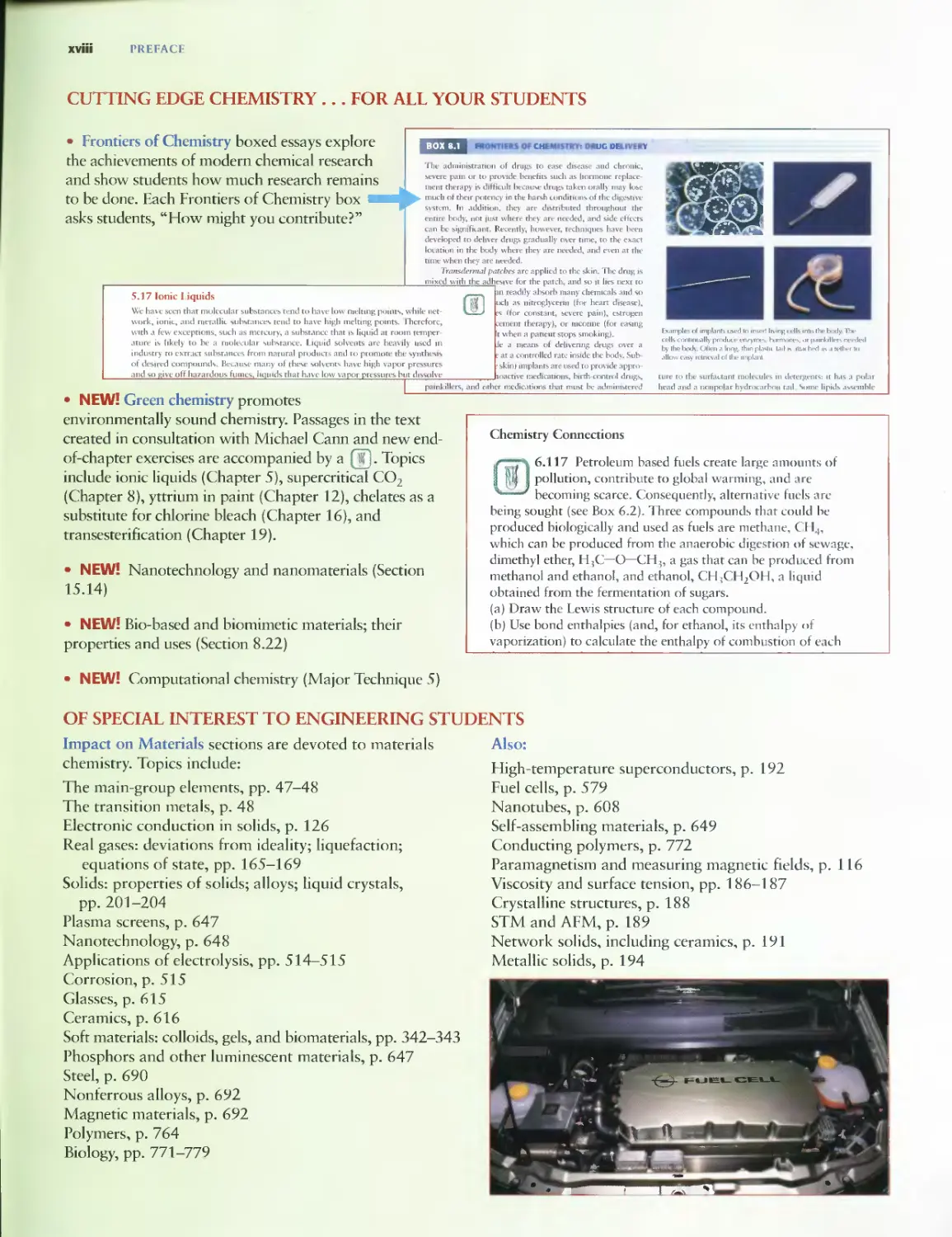
• Frontiers of Chemistry boxed essays explore
the achievements of modern chemical research
and show students how much research remains
to be done. Each Frontiers of Chemistry box
asks students, "How might you contribute?"
CH
UGDE
5.17 Ionic I iquids
We have seen that mulccular substances tend to have low melting points, while
network, ionie, and metallic substances tend to have high melting points, rhcrcfotc,
with a few exceptions, such as inereury, a substance that is liquid at room
temperature is likely to be a molecular substance. Liquid solvents are heavily used in
industry to extract substances from natural products and to promote the synthesis
of desired compounds. Because many of these solvents have high vapor pressures
and so give off hazardous fumes, liquids that have low vapor pressures but dissolve
• NEW! Green chemistry promotes
environmentally sound chemistry. Passages in the text
created in consultation with Michael Cann and new end-
of-chapter exercises are accompanied by a (jf). Topics
include ionic liquids (Chapter 5), supercritical C02
(Chapter 8), yttrium in paint (Chapter 12), chelates as a
substitute for chlorine bleach (Chapter 16), and
transesterification (Chapter 19).
• NEW! Nanotechnology and nanomaterials (Section
15.14)
• NEW! Bio-based and biomimetic materials; their
properties and uses (Section 8.22)
• NEW! Computational chemistry (Major Technique 5)
The administration of drugs to ease disease and chronic,
severe pain or to provide benefits such as hormone
replacement therapy is difficult because drugs taken orally may lose
. much of their potency in the harsh conditions of the digestive
svstcm. In addition, they are distributed throughout the
entire body, not |ust where they are needed, and side effects
can be significant. Recently, however, techniques have been
developed to deliver drugs gradually over time, to the exact
location in the body where thev are needed, and even at the
time when they are needed.
Transdermal patches arc applied to the skin. The drug is
lixed with the adhesive for the patch, and so it lies next to
in readily absorb many chemicals and so
Licit as nitroglycerin (for heart disease),
ifor constant, severe pain), estrogen
cement therapy), or nicotine (for easing
: when a patient stops smoking).
e a means of delivering drugs over a
at a controlled rate inside the badv. Sub-
skin) implants are used to provide appro-
loactive medications, birth-control drugs,
painkillers, and other medications that must be administered
Examples of implanfs used lo insert living i_elk inti> the body "Flip
cells continually produce en/ymes hormories, orp.nrikiilers nefded
by the LxxJv Often a brig, thin ptaslii l.nl is ilt.u hed is i telher m
allow easy rclncval of ihe implanl
ture to the surfactant molecules in detergents: it h.is ;i polar
head and a nonpolar hydrocarbon tail. Some lipids assemble
Chemistry Connections
6.117 Petroleum based fuels create large amounts of
pollution, contribute to global wanning, and are
becoming scarce. Consequently, alternative fuels are
being sought {see Box 6.2). Three compounds that could be
produced biologically and used as fuels are methane, CI I4,
which can be produced from the anaerobic digestion of sewage,
dimethyl ether, H^C—O—CH5, a gas that can be produced from
methanol and ethanol, and ethanol, CH^CH2OH, a liquid
obtained from the fermentation of sugars.
(a) Draw the Lewis structure of each compound.
(b) Use bond enthalpies (and, for ethanol, its enthalpy (if
vaporization) to calculate the enthalpy of combustion of each
OF SPECIAL INTEREST TO ENGINEERING STUDENTS
Impact on Materials sections are devoted to materials
chemistry. Topics include:
The main-group elements, pp. 47-48
The transition metals, p. 48
Electronic conduction in solids, p. 126
Real gases: deviations from ideality; liquefaction;
equations of state, pp. 165-169
Solids: properties of solids; alloys; liquid crystals,
pp.201-204
Plasma screens, p. 647
Nanotechnology, p. 648
Applications of electrolysis, pp. 514-515
Corrosion, p. 515
Glasses, p. 615
Ceramics, p. 616
Soft materials: colloids, gels, and biomaterials, pp. 342-343
Phosphors and other luminescent materials, p. 647
Steel, p. 690
Nonferrous alloys, p. 692
Magnetic materials, p. 692
Polymers, p. 764
Biology, pp. 771-779
Also:
High-temperature superconductors, p. 192
Fuel cells, p. 579
Nanotubes, p. 608
Self-assembling materials, p. 649
Conducting polymers, p. 772
Paramagnetism and measuring magnetic fields, p. 116
Viscosity and surface tension, pp. 186-187
Crystalline structures, p. 188
STM and AFM, p. 189
Network solids, including ceramics, p. 191
Metallic solids, p. 194
- 4
(V) i-«_ie»-«
J,<
\ n

PREFACE xix
OF SPECIAL INTEREST TO BIOLOGY STUDENTS
Impact on Biology sections are devoted to applications of
chemistry to the biological sciences. Topics include:
Gibbs free energy in biological systems, p. 301
Bio-based and biomimetic materials, p. 343
Homeostasis, p. 386
Proteins, p. 771
Carbohydrates, p. 775
Nucleic acids, p. 777
Also:
Chemical self preservation, p. 74
Drugs by design and discovery, p. 96
Drug delivery, p. 344
Physiological buffers,
p. 453
An electron in
image ol
it bursts i
tinvmitr
trust, ope
i drug capsule as
pen.
)Lips
The linage his
digiliillv
olMre
revciliniJ the
ulcs inside.
I>een
(1
Enzymes, p. 569
Self-assembling material,
p. 649
Why we need to eat d-metals, p. 670
Nuclear medicine, p. 708
Biological effects of radiation, p. 709
OF SPECIAL INTEREST TO ENVIRONMENTAL
SCIENCE STUDENTS
Alternative fuels, p. 246
Acid rain and the gene pool, p. 430
The ozone layer, p. 568
The greenhouse effect, p. 610
Nuclear power, p. 722
Fossil fuels, p. 745
Green chemistry passages and exercises
MEDIA INTEGRATION
Selected figures and exercises throughout the book are accompanied by annotated
Media Links that direct students to Web-based resources (see the more detailed
listing under Media-Based Supplements). These integrated links to the book's
companion Web site are designed to make the text more dvnamic and interactive.
Chemical Principles contains integrated links to:
FIGURE 4.6 Aueiihri rrup lowing
North Ameniri !<urin£ H_ ""ne Kill ■"
•WW < The mrvf s are cillou lobars and
are contours of ton mi at isph
pn-Aurc Regions oflinv rirc ire
•ivi r souths t "wsiana re «ll«l
lyckinesand r mm ol „,Rh ,„™iiC
seen mfr Can la) iremlh-il
^nlicvclones All pr ;urei are in
millllwr' The kw-^St preWun .n Ihe m.in
s9B4rtiuar. althi-ccnic
hurricane Behm- mrfkm
pressure al the cenier
'lad f.illcn i'>as '■«*
IOM ,
50
J
«J
wrf
v> ,
10* J
,„
^ <$
W
/%
IT
\*<
T T~ TT~
SyM\
N
jngiaofo ,
P\T?s
<
HIGH
*■ ^—/y
r'r'
Jf
^
\
' J VJ*
°*^i^-A/v
"^o^HSs-^e""
w //
m /J
3,v
,^F-^r:
• Living Graphs.
Selected graphs in the text are
available in interactive form. Students
can manipulate parameters and see
cause-and-effect relationships.
1 I *. Smill .,,l.„,»
i
I
\
I
MM »",
rL *
■Si
I JrgL" VClllllTlt', 9 -T
V,iliimt, V
t ~m
1
—
• Animations.
Selected art in the text is supported by
dynamic media. Students can view
motion, three-dimensional effects, and
atomic and molecular interactions to
learn to visualize as chemists do—at a
molecular level.
E9
: »-
., b,mt
FIGURE 3.B When h
<)UU..Ml^.,,.M<l,1> U
iriir-cii Is-citiii ,),nr rilhe.
. vlip Iht. form a o-Iiond
diijic"-< 'ierp h he hounda
™.-.)flrie -~i trWI Tliprlni
i .lindrit,i-,vmi,ietry around the
i lejr a aril iprtutls nwr hot
i it the ,sli ons in this buok
t
e
I
3
7
i
of the hvd
1
1
i
I
y i
• Lab Videos.
Video clips include many of the
reactions described in the book.
1
1
1
i
5
%
r
"
'
■'
FIGURE 6.8
cxolhermit |h
pmrluc" intl
lrjtksluKelhp
rei.linjiwilh
tin- shn
■v.
■
AA
l,ll,
m\% v
he thermile re ittion is si>
1 ,t mel
s used 1
Hire
ronllltl <
'er ill n
lhi.-niet.il thilil
oweldr.iilri.,.d
limiinum nipt.it
ude F<- O
>lle,i,ri,ns|..rks

• Tools. Tools guide the student in carrying out chemical calculations and
graphing, and help them to explore periodic properties from different points of
view. Flash and a large databank of structures allow students to study structure
and function in three dimensions.
• End-of-Chapter Exercises. Selected
exercises direct students to use
media to solve problems.
* 3.72 Use the plotting function on the Web site for this
^0 hook to plot the amplitude of the bonding and
jl* antibonding orhitals in Eqs. 1 and 2, given the
§ information in Fxercisc ?>P\, on a line passing through
the two nuclei. Ignore the normalization factors, and
take the internuclear distance a.t (a) (7,„ (h) 2d„, {e) 5ti„. Which
of these three bond lengths it most likelv to he close to the
actual bond length?
THE CHEMICAL PRINCIPLES e-BOOK
The Chemical Principles, fourth edition, e-book is a complete online version of
the textbook. The e-book offers students substantial savings and provides a rich
learning experience by taking full advantage of the electronic medium,
integrating all student media resources, and adds features unique to the e-book.
The e-book also offers instructors flexibility and customization options not
previously possible with any printed textbook. Access to the e-book is
included with purchase of the special package of the text (ISBN: 1-4292-0447-8)
through use of an activation code card. Individual e-book copies can be
purchased online at www.whfreeman.com. Key features of the Chemical
Principles e-book include:
• Easy access from any Internet-connected computer via a standard Web browser.
• Quick, intuitive navigation to any section or subsection, as well as any printed-
book page number.
• Integration of all student Web site animations and activities.
• In-text self-quiz questions.
• In-text links to all glossary entries.
• Interactive chapter summaries.
• Text highlighting, down to the level of individual phrases.
• Bookmarking for quick reference to any page.
• Notes, which can be added to any page by students or instructors.
• A full glossary and index.
• Full-text search, including an option to search the glossary and index.
• Automatic saving of all notes, highlighting, and bookmarks.
Additional features for instructors:
• Custom Chapter Selection. Instructors can choose the chapters that correspond
with their syllabus, and students will get a custom version of the e-book with the
selected chapters only.
• Instructor Notes. Instructors can choose to create an annotated version of the e-
book with their notes on any page. When students log in, they will see the
instructor's version.
• Custom Content. Instructor notes can include text, Web links, and even
images, allowing instructors to place any content they choose exactly where they
want it.
• Online Quizzing. The online quizzes from the student Web site are integrated into
the e-book.

NEW! CHEMISTRY PORTAL:
A DIGITAL GATEWAY
ChemPortal is the digital gateway for Chemical Principles, fourth edition. Built
on a proven learning management system, it has three main components:
• Online homework server. The "Assignment Center," allows instructors to assign
and automatically grade homework, quizzes, and guided practice. The homework
system comes populated with three levels of problems (from easy to challenging) for
each chapter. Student progress is tracked in a single, easy-to-use grade book; during
assignments students receive immediate feedback so they can prioritize further
study. Self-guided tutorials based on all 27 Toolboxes from the text provide student-
specific feedback and break down complex problems into their individual steps,
offering guidance at each stage to ensure that students fully understand the
problem-solving process.
• Chemistry resource library. The Resource Center, with links to animations and
video, organizes all study materials in one place.
• Interactive e-book. The e-book transforms reading into experience through
integration of the complete text with animations, simulations, living graphs, practice
tests, graphics, and study resources, such as note-taking, highlighting, bookmarking,
and a full-text search. Instructors can customize their students' texts through
annotations and supplementary links.
For more information about ChemPortal go to www.whfreeman.com/chemportal.
(ISBN: 1-4292-0091-X)
SUPPLEMENTS FOR CHEMICAL PRINCIPLES
MEDIA-BASED SUPPLEMENTS
The Chemical Principles Web site is at www.whfreeman.com/chemicalprinciples4e
The Web-based media support for Chemical Principles offers students a range of
tools for problem solving and chemical exploration, including:
• A calculator adapted for solving equilibrium calculations
• Two- and three-dimensional curve plotters
• "Living Graphs," which allow the user to control the parameters
• Flash for exploring structure and function in 3-D molecular models
• A molecules data bank containing almost all the structures in the book
• An interactive periodic table of the elements
• Animations that allow students to visualize chemical events on a molecular level
• Links that can broaden exposure to up-to-date data and applications
Also available as preformatted PowerPoint slides for the instructor are all the
illustrations from the textbook and the new Diagnostic Test for the Fundamentals
sections. This test will allow instructors to determine what their students
understand and where they need additional support. Instructors can then make
appropriate assignments from the Fundamentals sections. The test includes 5 to
10 problems for each section.
WEB-BASED ASSESSMENT
Online Quizzing, powered by Question Mark and accessed via the Chemical
Principles Web site

An excellent online quizzing bank in which instructors can easily quiz
students using prewritten, multiple-choice questions for each text chapter (not
from the test bank). Students receive instant feedback and can take the quizzes
multiple times. Instructors can go to a protected Web site to view results by quiz,
student, or question, or they can get weekly results by e-mail. Excellent for
practice testing or homework or both.
PRINT SUPPLEMENTS FOR STUDENTS
Student Study Guide and Solutions Manual, John Krenos and Joseph Potenza,
Rutgers University; Laurence Lavelle, UCLA; Yinfa Ma, University of Missouri,
Rolla; and Carl Hoeger, UCSD (ISBN: 1-4292-0099-5)
This combined manual is designed to help students avoid common mistakes
and understand the material better. The solutions manual includes detailed
solutions to all odd-numbered exercises in the text, except for the Chemistry
Connections exercises.
SUPPLEMENTS FOR INSTRUCTORS
Create a customized lab manual to accompany Atkins/Jones, Chemical Principles.
W. H. Freeman and Company is pleased to offer you the ability to create a
unique lab manual for your course in just minutes. Drawing from our diverse
library of experiments, you can pick and choose the labs you want to use, and
even add your own materials. Organize the material as you like, customize the
cover, view your newly created book online in PDF format, and then order it
online with the click of a button. W H. Freeman's state-of-the art custom
publishing system is easy to use and an excellent alternative to traditional lab
manuals. Try it today at http://custompub.whfreeman.com
Instructor's Solutions Manual, Laurence Lavelle, UCLA; Yinfa Ma, University of
Missouri, Rolla; and Carl Hoeger, UCSD (ISBN: 1-4292-0100-2)
This manual contains solutions to the even-numbered exercises.
Instructor's Resource CD (ISBN: 1-4292-0088-X)
To help instructors create their own Web sites and prepare dynamic lectures,
the CD contains:
• All illustrations from the text in .jpg and preformatted PowerPoint® slides
• All animations, lab videos, and living graphs from the Web site
• All solutions to the end-of-chapter exercises, in editable Word files
• Diagnostic test for the Fundamentals sections
Test Bank CD-ROM (Windows and Mac versions on one disc,
ISBN: 1-4292-0089-8; printed version, ISBN: 1-4292-0101-0)
The test bank offers more than 1400 multiple-choice, fill-in-the-blank, and
essay questions. The easy-to-use CD includes Windows and Mac versions in a
format that lets you add, edit, and resequence questions to suit your needs.
Online Course Materials (WebCT, Blackboard)
As a service for adopters we will provide content files in the appropriate online
course format, including the instructor and student resources for this text.
WebAssign Online Homework System (alternative option to ChemPortal)
Developed by instructors at North Carolina State University. WebAssign is filled
with end-of-chapter problems, resources, and course management features.
WebAssign has content experts on the premises to respond to any question withi
24 hours. For more information visit www.webassign.net

FOR THE LABORATORY
Bridging to the Lab, Loretta Jones, University of Northern Colorado,
and Roy Tasker, University of Western Sydney (ISBN: 0-7167-4746-4)
The modules are computer-based laboratory simulations with engaging
activities that emphasize experimental design and visualization of structures and
processes at the molecular level. The modules are designed to help students
connect chemical principles from lecture with their practical applications in the
lab. Every module has a built-in accountability feature that records section
completion for use in setting grades and a workbook for students to record and
interpret their work.
Used either as prelaboratory preparation for related laboratory activities or
to expose students to additional laboratory activities not available in their
program, these modules motivate students to learn by proposing real-life
problems in a virtual environment. Students make decisions on experimental
design, observe reactions, record data, interpret these data, perform calculations,
and draw conclusions from their results. Following a summary of the module,
students test their understanding by applying what they have learned to new
situations or by analyzing the effect of experimental errors.
Working with Chemistry Lab Manual, Donald J. Wink and Sharon Fetzer Gislason,
University of Chicago-Illinois; and Julie Ellefson Kuehn, William Rainey Harper
College (ISBN: 0-7167-9607-4)
With this inquiry-based program, students build skills using important
chemical concepts and techniques so that they are able to design a solution to a
scenario drawn from a professional environment. The scenarios are drawn from
the lives of people who work with chemistry every day, ranging from field
ecologists to chemical engineers and health professionals. Professors: you can
download and class-test sample labs from Working with Chemistry at the Web
site, www.whfreeman.com/chemistry/wwc2
Chemistry in the Laboratory, sixth edition, James M. Postma, California State
University, Chico; and Julian L. Roberts, Jr., and J. Leland Hollenberg, University of
Redlands (ISBN: 0-7167-9606-6)
This clearly written, class-tested manual has long given students essential
hands-on training with key experiments. Exceptionally compatible with
Atkins/Jones, Chemical Principles, the manual is known for its clear instructions
and illustrations. All experiments are available as lab separates.
HGS Molecular Structure Model Set, Maruzen Company, Ltd.
(ISBN: 0-7167-4822-3)
Molecular modeling helps students understand physical and chemical
properties by providing a way to visualize the three-dimensional arrangement of
atoms. This model set uses polyhedra to represent atoms, and plastic connectors
to represent bonds (scaled to correct bond length). Plastic plates representing
orbital lobes are included for indicating lone pairs of electrons, radicals, and
multiple bonds—a feature unique to this set.
Chemistry Laboratory Student Notebook, second edition, paper (ISBN: 0-7167-
3900-3)
The notebook contains 114 pages of graph paper in a convenient 8M X 11,
3-hole-punched format, carbon included. The new edition adds tables and graphs
that make it a handy reference as well.

XXiv PREFACE
ACKNOWLEDGMENTS
We are grateful to the many instructors, colleagues, and students who have
contributed their expertise to this edition. We would like above all to thank those
who carefully evaluated the third edition and commented on drafts of this edition:
Yiyan Bai, Houston Community College System—
Central Campus
Maria Ballester, Nova Southeastern University
Patricia D. Christie, Massachusetts Institute of
Technology
Henderson J. Cleaves, II, University of California,
San Diego
Ivan J. Dmochowski, University of Pennsylvania
Ronald Drucker, City College of San Francisco
Christian Ekberg, Chalmers University of Technology,
Sweden
Bryan Enderle, University of California, Davis
David Erwin, Rose-Hulman Institute of Technology
Justin Fermann, University of Massachusetts
Regina F. Frey, Washington University
P. Shiv Halasyamani, University of Houston
Jameica Hill, Wofford College
Alan Jircitano, Venn State, Trie
Thomas Albrecht-Schmidt, Auburn University
Matthew Asplund, Brigham Young University
Matthew P. Augustine, University of California, Davis
David Baker, Delta College
Alan L. Balch, University of California, Davis
Mario Baur, University of California, Tos Angeles
Robert K. Bohn, University of Connecticut
Paul Braterman, University of North Texas
William R. Brennan, University of Pennsylvania
Ken Brooks, New Mexico State University
Julia R. Burdge, University of Akron
Paul Charlesworth, Michigan Technological University
Patricia D. Christie, Massachusetts Institute of Technology
William Cleaver, University of Vermont
David Dalton, Temple University
J. M. D'Auria, Simon Fraser University
James E. Davis, Harvard University
Walter K. Dean, Lawrence Technological University
Jimmie Doll, Brown University
Gert Latzel, Riemerling, Germany
Nancy E. Lowmaster, Allegheny College
Matthew L. Miller, South Dakota State University
Clifford B. Murphy, Boston University
Maureen Murphy, Huntingdon College
Enrique Peacock-Lopez, Williams College
LeRoy Peterson, Jr., Francis Marion University
Tyler Rencher, Brigham Young University
Michael Samide, Butler University
Gordy Savela, Itasca Community College
Lori Slavin, College of Saint Catherine
Mike Solow, City College of San Francisco
John E. Straub, Boston University
Laura Stultz, Birmingham-Southern College
Peter Summer, Lake Sumter Community College
David W Wright, Vanderhilt University
Mamudu Yakubu, Elizabeth City State University
Meishan Zhao, University of Chicago
Ronald Drucker, City College of San Francisco
Jetty Duffy-Matzner, State University ofNeiv York,
Cortland
Robert Eierman, University of Wisconsin
Kevin L. Evans, Glenville State College
Donald D. Fitts, University of Pennsylvania
Lawrence Fong, City College of San Francisco
Regina F. Frey, Washington University
Dennis Gallo, Augustana College
David Harris, University of California, Santa Barbara
Sheryl Hemkin, Kenyon College
V Michael Henchman, Brandeis University
jgy Geoffrey Herring, University of British Columbia
Timothy Hughbanks, Texas A&M University
Paul Hunter, Michigan State University
Robert C. Kerber, State University of New York,
Stony Brook
Robert Kolodny, Armstrong Atlantic State University
Lynn Vogel Koplitz, Loyola University
We offer a special note of gratitude to the participants of a W.H. Freeman workshop
on teaching general chemistry. Their insights provided much food for thought:
Keiko Jacobsen, Tulane University
Lynn Koplitz, Loyola University'
Cynthia LaBrake, University of Texas, Austin
Paul McCord, University of Texas, Austin
Yinfa Ma, University of Missouri—Rolla
Joseph Potenza, Rutgers University
Sara Sutcliffe, University of Texas, Austin
David Vandenbout, University of Texas, Austin
Deborah Walker, University of Texas, Austin
Zhiping Zheng, University of Arizona
The contributions of the reviewers of the first, second, and third editions remain
embedded in the text, so we also wish to renew our thanks to:

PREFACE
Petra van Koppen, University of California, Santa Bart
Mariusz Kozik, Canisius College
Julie Ellefson Kuehn, William Rainey Harper College
Brian B. Laird, University of Kansas
Alison McCurdy, Harvey Mudd College
Charles W. McLaughlin, University of Nebraska
Patricia O'Hara, Amherst College
Noel Owen, Brigham Young University
Donald Parkhurst, The Walker School
Montgomery Pettitt, University of Houston
Wallace Pringle, Wesley an University
Philip J. Reid, University of Washington
Barbara Sawrey, University of California, San Diego
George Schatz, Northwestern University
Paula Jean Schlax, Bates College
Carl Seliskar, University of Cincinnati
Robert Sharp, University of Michigan, Ann Arbor
Peter Sheridan, Colgate University
Some contributed in substantial ways. Roy Tasker, University of Western
Sydney, contributed to the Web site for this book, designed related animations,
and selected the icons for the animation media links. Michael Cann, University of
Scranton, opened our eyes to the world of green chemistry in a way that has
greatly enriched this book
We would like particularly to thank Cynthia LaBrake, University of Texas at
Austin, for checking and offering very helpful suggestions for improving the
worked Examples. We would also like to thank Nathan Barrows, Arizona State
University, for checking the accuracy of the solutions manual and the answers at
the back of the book. Amelia Lapena and Sanaz Kabehie, UCLA, contributed
many improvements to the solutions manual. The supplements authors, especially
John Krenos, Joseph Potenza, Laurence Lavelle, Yinfa Ma, and Carl Hoeger, have
offered us much useful advice. This book also benefited from suggestions made
by Dennis Kohl, University of Texas at Austin; Randall Shirts, Brigham Young
University; Catherine Murphy, University of South Carolina; Michael Sailor,
University of California at San Diego; Matt Miller and Jay Shore, South Dakota
State University; and Peter Garik, Rosina Georgiadis, Mort Hoffman, and Dan
Dill, Boston University. As before, students have been our most important critics;
they helped us to see the world of learning chemistry through their eyes and made
many important suggestions. The students in Rosina Georgiadis's General
Chemistry class at Boston University wrote chapter reviews that offered us
valuable direction for revising this edition.
We are grateful to the staff members at W. H. Freeman and Company, who
understood our vision and helped to bring it to fruition. In particular, we would
like to acknowledge Jessica Fiorillo, senior chemistry editor, who organized us
and the entire project; Randi Rossignol, our developmental editor, who guided us
toward important improvements in this edition; Georgia Lee Hadler, senior
project editor, who once again took on the awesome task of overseeing the
transformation of our files into paper; Margaret Comaskey, our copyeditor, who
organized and coordinated those files with great care; Bianca Moscatelli, who
found exactly the right new photographs; and Jeanette Picerno and Amy Thorne,
who directed the development and production of the substantial array of print
and media supplements. The authors could not have wished for a better or more
committed team.
Jay Shore, South Dakota State University
Herb Silber, San Jose State University
Lee G. Sobotka, Washington University
Michael Sommer, Harvard University
Nanette A. Stevens, Wake Forest University
Tim Su, City College of San Francisco
Larry Thompson, University of Minnesota, Duluth
Dino Tinti, University of California, Davis
Sidney Toby, Rutgers University
Lindell Ward, Franklin College
Thomas R. Webb, Auburn University
Peter M. Weber, Brown University
David D. Weis, Skidmore College
Ken Whitmire, Rice University
James Whitten, University of Massachusetts, Lowell
Gang Wu, Queen's University
Marc Zimmer, Connecticut College
Martin Zysmilich, Massachusetts Institute of Techno

FUNDAMENTALS
Whi comk to chemistry! You are about to embark on an extraordinary voyage
that will take you to the center of science. Looking in one direction, toward
physics, you will see how the principles of chemistry are based on the behavior of
atoms and molecules. Looking in another direction, toward biology, you will see
how chemists contribute to an understanding of that most awesome property of
matter, life. You will be able to look at an everyday object, see in your mind's eye
its composition in terms of atoms, and understand how that composition
determines its properties.
INTRODUCTION AND ORIENTATION
Chemistry is the science of matter and the changes it can undergo. The world or
chemistry therefore embraces everything material around us—the stones we stand
on, the food we eat, the flesh we are made of, and the silicon we build into
computers. There is nothing material beyond the reach of chemistry, be it living or
dead, vegetable or mineral, on Earth or in a distant star.
Chemistry and Society
We have only to look around us to appreciate the impact of chemistry on
technology and society. In the earliest days of civilization, when the Stone Age gave way to
the Bronze Age and then to the Iron Age, people did not realize that they were
doing chemistry when they changed the material they found as stones—we would
now call them minerals—into metals (Fig. 1). The possession of metals gave them
a new power over their environment, and treacherous nature became less brutal.
Civilization emerged as skills in transforming materials grew: glass, jewels, coins,
ceramics, and, inevitably, weapons became more varied and effective. Art,
agriculture, and warfare became more sophisticated. None of this would have happened
without chemistry.
The development of steel accelerated the profound impact of chemistry on
society. Better steel led to the Industrial Revolution, when muscles gave way to
steam and giant enterprises could be contemplated. With improved transport and
greater output from factories came more extensive trade, and the world became
simultaneously a smaller but busier place. None of this would have happened
without chemistry.
With the twentieth century, and now the twenty-first, came enormous progress
in the development of the chemical industry. Chemistry transformed agriculture.
FIGURE 1 Copper is easily extracted
from its ores and was one of the first
metals worked. The Bronze Age
followed the discovery that adding
some tin to copper made the metal
harder and stronger. These four
bronze swords date from 1250 to
850 bce, the Late Bronze Age, and
are from a collection in the
Naturhistorisches Museum, Vienna,
Austria. From bottom to top, they are
a short sword, an antenna-type
sword, a tongue-shaped sword, and a
Liptau-type sword.

F2 FUNDAMENTALS
f
FIGURE 2 Cold weather triggers
chemical processes that reduce the
amount of the green chlorophyll in
leaves, allowing the colors of various
other pigments to show.
Synthetic fertilizers provided the means of feeding the enormous, growing
population of the world. Chemistry transformed communication and transportation.
Today chemistry provides advanced materials, such as polymers for fabrics, ultra-
pure silicon for computers, and glass for optical fibers. It is producing more
efficient renewable fuels and the tough, light alloys that are needed for modern
aircraft and space travel. Chemistry has transformed medicine, substantially extended
life expectancy, and provided the foundations of genetic engineering. The deep
understanding of life that we are developing through molecular biology is
currently one of the most vibrant areas of science. None of this progress would have
been achieved without chemistry.
However, the price of all these benefits has been high. The rapid growth of
industry and agriculture, for instance, has stressed the Earth and damaged our
inheritance. There is now widespread concern about the preservation of our
extraordinary planet. It will be up to you and your contemporaries to draw on
chemistry—in whatever career you choose—to build on what has already been
achieved. Perhaps you will help to start a new phase of civilization based on new
materials, just as semiconductors transformed society in the twentieth century.
Perhaps you will help to reduce the harshness of the impact of progress on our
environment. To do that, you will need chemistry.
Chemistry: A Science at Three Levels
Chemistry operates on three levels. At one level, chemistry is about matter and
its transformations. At this level, we can actually see the changes, as when a fuel
burns, a leaf changes color in the fall (Fig. 2), or magnesium burns brightly in air
(Fig. 3). This level is the macroscopic level, the level dealing with the properties
of large, visible objects. However, there is an underworld of change, a world that
we cannot see directly. At this deeper microscopic level, chemistry interprets
these phenomena in terms of the rearrangements of atoms (Fig. 4). The third
level is the symbolic level, the expression of chemical phenomena in terms of
chemical symbols and mathematical equations. This level ties the other two
levels together. A chemist thinks at the microscopic level, conducts experiments at
the macroscopic level, and represents both symbolically. We can map these three
aspects of chemistry as a triangle, with the corners labeled macroscopic,
microscopic, and symbolic (Fig. 5). As you read further in this text, you will find that
sometimes the topics and explanations are close to one vertex of the triangle,
sometimes to another. Because it is helpful in understanding chemistry to make
connections among these levels, in the worked examples in this book you will
find drawings of the molecular level as well as graphical interpretations of
equations. As your understanding of chemistry grows so will your ability to travel
easily within the triangle.
A sense of scale is important for understanding how chemistry at the
macroscopic level is related to the behavior of atoms at the microscopic level. Atoms are
extraordinarily small, and there are vast numbers in even very tiny objects. The
diameter of a carbon atom is only about 150 trillionths of a meter, and we would
have to put 10 million atoms side by side to span the length of this dash: -. Even a
small cup of coffee contains more water molecules than there are stars in the
visible universe.
FIGURE 3 When magnesium burns in
air, it gives off a lot of heat and light. The
gray-white powdery product looks like
How Science Is Done
Scientists pursue ideas in an ill-defined but effective way called the scientific
method, which takes many forms. There is no strict rule of procedure that leads
you from a good idea to a Nobel prize or even to a publishable discovery. Some
scientists are meticulously careful, others are highly creative. The best scientists are
probably both careful and creative. Although there are various scientific methods
in use, a typical approach consists of a series of steps (Fig. 6). The first step is often

HOW SCIFNCF IS DONE F3
to collect data by making observations and measurements. These measurements
are usually made on small samples of matter, representative pieces of the material
that we want to study.
Scientists are always on the lookout for patterns. When a pattern is observed
in the data, it can be stated as a scientific law, a succinct summary of a wide range
of observations. For example, water was found to have eight times the mass of
oxygen as it has of hydrogen, regardless of the source of the water or the size of the
sample. One of the earliest laws of chemistry summarized those types of
observations as the "law of constant composition," which states that a compound has the
same composition regardless of the source of the sample.
Not all observations are summarized by laws. There are many properties of
matter (such as superconductivity, the ability of a few cold solids to conduct
electricity without any resistance) that are currently at the forefront of research but are
not described by grand "laws" that embrace hundreds of different compounds. A
major current puzzle, which might be resolved in the future either by finding the
appropriate law or by detailed individual computation, is what determines the
shapes of big protein molecules. Formulating a law is just one way, not the only
way, of summarizing data.
Once they have detected patterns, scientists develop hypotheses, possible
explanations of the laws—or the observations—in terms of more fundamental
concepts. Observation requires careful attention to detail, but the development of
a hypothesis requires insight, imagination, and creativity. In 1807, John Dalton
interpreted experimental results to propose the hypothesis that matter consists of
atoms. Although Dalton could not see individual atoms, he was able to imagine
them and formulate his atomic hypothesis. Dalton's hypothesis was a monumental
insight that helped others understand the world in a new way. The process of
scientific discovery never stops. With luck and application, you may acquire that kind
of insight as you read through this text, and one day you may make your own
extraordinary hypotheses.
After formulating a hypothesis, scientists design further experiments—carefully
controlled tests—to verify it. Designing and conducting good experiments often
requires ingenuity and sometimes good luck. If the results of repeated
experiments—often in other laboratories and sometimes by skeptical coworkers—support
Sample
Experiments
IV
Identify
pattern
Law
Data
Insight
Propose
explanation
Hypothesis £
Model £
Interpret
Verify
Theory £-
w
Hypothesis
supported
Hypothesis
not
supported
Propose
another
explanation
LV
FIGURE 6 A summary of the principal activities that constitute a common version of the scientific
method. At each stage, the crucial activity is experiment and its comparison with the ideas proposed.
Oxygen
Magnesium *^i
oxide | ««^
, -5
>t
Magnesium
CD
2
Magnesium -
FIGURE 4 When a chemical reaction
takes place, atoms exchange partners, as
in Fig. 3 where magnesium and oxygen
atoms form magnesium oxide. As a result,
two forms of matter (left inset)
are changed into another form of matter
(right inset). Atoms are neither created
nor destroyed in chemical reactions.
The postulates of Dalton's atomic
hypothesis are described in Section B.
/\ Symbolic
o^
A. .
Macroscopic
Microscopic
FIGURE 5 This triangle illustrates the
three modes of scientific inquiry used in
chemistry: macroscopic, microscopic
and symbolic. Sometimes we work more
at one corner than at the others, but it is
important to be able to move from one
approach to another inside the triangle.

F4
FUNDAMENTALS
the hypothesis, scientists may go on to formulate a theory, a formal explanation of
a law. Quite often the theory is expressed mathematically. A theory originally
envisioned as a qualitative concept, a concept expressed in words or pictures, is
converted into a quantitative form, the same concept expressed in terms of
mathematics. After a concept has been expressed quantitatively, it can be used to make
numerical predictions and subjected to rigorous experimental confirmation. You
will have plenty of practice with the quantitative aspect of chemistry while working
through this text.
Scientists commonly interpret a theory in terms of a model, a simplified
version of the object of study. Like hypotheses, theories and models must be
subjected to experiment and revised if experimental results do not support them. For
example, our current model of the atom has gone through many formulations
and progressive revisions, starting from Dalton's vision of an atom as an uncut-
table solid sphere to our current much more detailed model, which is described
in Chapter 1. One of the main goals of this text is to show you how to build
models, turn them into a testable form, and then refine them in the light of
additional evidence.
k
^&
FIGURE 7 Scientific research today often
requires sophisticated equipment and
computers. This chemist is using an Auger
electron spectrometer to probe the
surface of a crystal. The data collected
will allow the chemist to determine
which elements are present in the
surface.
The Branches of Chemistry
Chemistry is more than test tubes and beakers. New technologies have
transformed chemistry dramatically in the past 50 years, and new areas of research have
emerged (Fig. 7). Traditionally, the field of chemistry has been organized into three
main branches:
organic chemistry, the study of compounds of carbon;
inorganic chemistry, the study of all the other elements and their compounds;
and
physical chemistry, the study of the principles of chemistry.
New regions of study have developed as information has been acquired in
specialized areas or as a result of the use of particular techniques. It is the nature of a
vigorously developing science that the distinctions between its branches are not
clear-cut, but nevertheless we still speak of
biochemistry, the study of the chemical compounds, reactions, and other
processes in living systems;
analytical chemistry, the study of techniques for identifying substances and
measuring their amounts;
theoretical chemistry, the study of molecular structure and properties in terms
of mathematical models;
computational chemistry, the computation of molecular properties;
chemical engineering, the study and design of industrial chemical processes,
including the fabrication of manufacturing plants and their operation;
medicinal chemistry, the application of chemical principles to the
development of pharmaceuticals; and
biological chemistry, the application of chemical principles to biological
structures and processes.
Various branches of knowledge emerging from chemistry have adopted names that
are rooted in chemistry. They include
molecular biology, the study of the chemical and physical basis of biological
function and diversity, especially in relation to genes and proteins;
materials science, the study of the chemical structure and composition of
materials; and
nanotechnology, the study and manipulation of matter at the atomic level
(nanometer scale).

MASTERING CHEMISTRY
F5
A newly emerging concern of chemistry is sustainable development, the
economical utilization and renewal of resources coupled with hazardous waste reduction
and concern for the environment. This sensitive approach to the environment and
our planetary inheritance is known colloquially as green chemistry. Where we
think it appropriate to draw your attention to this important development, we
display the small icon shown here in the margin.
All sciences, medicine, and many fields of commercial activity draw on
chemistry. You can be confident that whatever career you choose in a scientific or
technical field, it will make use of the concepts discussed in this text. Chemistry is truly
central to science.
Mastering Chemistry
The following lettered sections summarize the basic information that you need
to begin your chemistry course. You might already have a strong background in
chemistry and some of its basic concepts. These introductory pages with a blue
border will provide you with a focused summary of the fundamental principles
of chemistry. You can use them to refresh your memory of concepts or to see
how the principles are formulated in a systematic way. Your instructor will
advise you on how to use these sections to prepare yourself for the chapters in
the text itself.
If you have done little chemistry before, these pages are for you, too. They
contain a brief but systematic summary of the basic concepts and calculations of
chemistry that you should know before studying the chapters in the text. You can
return to them as needed. If you need to review the mathematics required for
chemistry, especially algebra and logarithms, Appendix I has a brief review of the
important procedures.
What can you expect to find in the following pages? We want you to enjoy
your study; and, at the end of your course, we want you to have a sharpened
insight into matter. You will see how models are devised, tested, and refined. You
will see how qualitative ideas are turned into testable theories. You will come to
have insights into matter that allow you to understand how the world of
observation springs from the underworld of atoms.
c:
2
IS)
A MATTER AND ENERGY
Whenever we touch, pour, or weigh something, we are working with matter. The
whole of chemistry is concerned with the properties of matter and particularly
the conversion of one form of matter into another kind. But what is matter?
Matter is in fact difficult to define precisely without drawing on advanced ideas
from elementary particle physics, but a straightforward working definition is
that matter is anything that has mass and takes up space. Thus, gold, water, and
flesji are forms of matter; electromagnetic radiation (which includes light) and
justice are not.
One characteristic of science is that it uses common words from our everyday
language but gives them precise meanings. In everyday language, a "substance" is
just another name for matter. However, in chemistry, a substance is a single, pure
form of matter. Thus, gold and water are distinct substances. Flesh is a mixture of
many different substances, and, in the technical sense used in chemistry, it is not a
"substance." Air is matter; but, being a mixture of several gases, it is not a single
substance.
Substances, and matter in general, come in different forms, called states of
matter. The three most common states of matter are solid, liquid, and gas:
A solid is a rigid form of matter.
A liquid is a fluid form of matter that has a well-defined surface; it takes the
shape of the part of the container it occupies.
A gas is a fluid form of matter that fills any vessel containing it.
A.l Physical Properties
A.2 Force
A.3 Energy

F6 FUNDAMENTALS
!
i" I A ' ' 1
r Y Y t y
A A A A A A A
r Y Y Y ' Y
A A
AAA A A
Y Y Y
A A A A A A
^ Y Y 1
^A k A .A .
Y
(a)
FIGURE A.l A molecular representation
of the three states of matter. In each case,
the spheres represent particles that may
be atoms, molecules, or ions, (a) In a
solid, the particles are packed tightly
together, but continue to oscillate, (b) In a
liquid, the particles are in contact, but
have enough energy to move past one
another, (c) In a gas, the particles are far
apart, move almost completely freely, and
are in ceaseless random motion.
■v?
^w
(b)
The term vapor denotes the gaseous form of a substance that is normally a solid or
liquid. Thus, we speak of ice (the solid form of water), liquid water, and water
vapor (steam).
Figure A.] shows how the states of matter can be distinguished by the
arrangements and motions of their atoms and molecules. In a solid, such as ice
or copper, the atoms are packed together closely, and the solid is rigid because
the atoms cannot move past one another. However, the atoms in a solid are not
motionless: they oscillate around their average locations, and the oscillation
becomes more vigorous as the temperature is raised. The atoms (and molecules)
of a liquid are packed together about as closely as they are in a solid, but they
have enough energy to move past one another. As a result, a liquid, such as water
or molten copper, flows in response to a force, such as gravity. In a gas, such as
air (which is mostly nitrogen and oxygen) and water vapor, the molecules have
achieved almost complete freedom from one another: they fly through space at
close to the speed of sound, colliding when they meet and immediately flying off
in another direction.
A.l Physical Properties
Chemistry is concerned with the properties of matter, its distinguishing
characteristics. A physical property of a substance is a characteristic that we can observe or
measure without changing the identity of the substance. For example, a physical
property of a sample of water is its mass; another is its temperature. Physical
properties include characteristics such as melting point (the temperature at which a
solid turns into a liquid), hardness, color, state of matter (solid, liquid, or gas), and
density. A chemical property refers to the ability of a substance to change into
another substance. For example, a chemical property of the gas hydrogen is that it
reacts with (burns in) oxygen to produce water; a chemical property of the metal
zinc is that it reacts with acids to produce hydrogen gas. The rest of the book is
concerned primarily with chemical properties; here we shall review some
important physical properties.
Each physical quantity is represented by an italic or Greek symbol (thus, m for
mass, not m). The results of a measurement, the "value" of a physical quantity, is
reported as a multiple of a unit, such as reporting a mass as 15 kilograms, which is
understood to be 15 times the unit "1 kilogram." Scientists have reached
international agreement on the units to use when reporting measurements, so their results
can be used with confidence and checked by people anywhere in the world. All
units are denoted by Roman letters, such as m for meter and s for second, that
distinguish them from the physical quantity to which they refer. You will find most of
the symbols used in this textbook together with their units in Appendix 1.
The Systeme Internationa] (SI) is the internationally accepted form and
elaboration of the metric system. It defines seven base units in terms of which all
physical quantities can be expressed. At this stage all we need are:
meter, m The meter, the unit of length
kilogram, kg The kilogram, the unit of mass
second, s The second, the unit of time

All the units are defined in Appendix 1. Each unit may be modified by a
prefix. The full set is given in Appendix 1; some common examples are:
Prefix
centi-
milli-
kilo-
Symbol
Factor
c
m
k
1/100
1/1000
1000
1 cm
1 ms
1 km
Example
1/100 m (1 centimeter)
1/1000 s(l millisecond)
1000 m(l kilometer)
Units may be combined together into derived units to express a property more
complicated than mass, length, or time. For example, volume, V, the amount of
space occupied by a substance, is the product of three lengths; therefore, the
derived unit of volume is (meter)', denoted m . Similarly, density, the mass of a
sample divided by its volume, is expressed in terms of the base unit for mass
divided by the derived unit for volume—namely, kilogram/(meter) , denoted kg/nr
or, equivalently, kg-m . The SI convention is that a power, such as the 3 in cnr,
refers to the unit and its multiple. That is, cm' should be interpreted as (cm)' or
10 m not as c(m3), or 10 m3. Many of the more common derived units have
names and abbreviations of their own.
It is often necessary to convert measurements from one set of units into SI
units. For example, we may need to convert a length measured in inches into
centimeters. To convert these units, we use the relation 1 in. = 2.54 cm, and in general
Units given = units required
Relations between common units can be found in Table 5 of Appendix IB. We use
these relations to construct a conversion factor of the form
Conversion factor
units required
units given
Then we use it as follows:
Information required = information given X conversion factor
When using a conversion factor, we treat the units just like algebraic quantities:
they are multiplied or canceled in the normal way.
EXAMPLE A.l Sample exercise: Converting units
Suppose we want to convert a volume of 1.7 qt into liters. First, we identify the relation
between the two units from Table 5 of Appendix 2B:
I qt = 0.946 352 5 L
Then we set up the conversion factor from the units given (qt) to the units required (L):
Fortn the conversion factor as
(units required)/(units given).
Conversion factor =
0.9463525 L
Iqt
Convert the measurement
into the required units.
Volume (L) = (1.7 qt) x
0.946 352 5 L
lqt
1.6 L

F8
FUNLMMFNTALS
Answers to all B self-tests are in the
back of this book.
r
FIGURE A.2 Mass is an extensive
property, but temperature is intensive.
These two samples of iron(ll) sulfate
solution were taken from the same well-
mixed supply: they have different masses
but the same temperature.
We have rounded the answer to two significant figures, as explained below.
Self-Test A.1A Express the height of a person 6.00 ft tall in centimeters.
[Answer: 183 cm|
Self-Test A.1B Express the mass in ounces of a 250.-g package of breakfast cereal.
It is often necessary to convert a unit that is raised to a power (including
negative powers). In such cases, the conversion factor is raised to the same power. For
example, to convert a density of 11 700 kg-m-3 into grams per centimeter cubed
(g-cm ), we use the two relations
1kg= I03g
as follows:
Density (g-cm"
1 cm = 10"
m
11700 kg-m
11700
11.7 —
cm
103g
x ——^ x
lkg
103 g 10
x ——- x
1 cm
kg
—? I *■ ~
m / 1 kg 1 cm
3 = 11.7 g-cm 3
10"
6m3
3
Note that the units are treated like algebraic quantities and are multiplied and
canceled just like numbers. In the second line we have used the relation
1 cm
10 2n
10
2m^3
1 cm
10'6m3
1 cm3
Self-Test A.2A Express a density of 6.5 g-mm"' in micrograms per nanometer
cubed (jj.g-nm 3).
[Answer: 6.5 X 10 l2 (xg-nm ~'|
Self-Test A.2B Express an acceleration of 9.81 m-s ~ in kilometers per hour
squared.
Properties are also classified according to their dependence on the mass of a
sample. An intensive property is a property that is independent of the mass of the
sample. For example, temperature is an intensive property, because we could take
a sample of any size from a uniform bath of water and measure the same
temperature (Fig. A.2). An extensive property is a property that does depend on the mass
("extent") of the sample. Volume is an extensive property: 2 kg of water occupies
twice the volume of 1 kg of water.
Some intensive properties are ratios of two extensive properties. For example,
the property density, d, mentioned above, is a ratio of the mass, m, of a sample
divided by its volume, V:
Units for physical quantities and
temperature scales are discussed in
Appendix IB.
Density
mass
vol i
, or d
m
(1)
The density of a substance is independent of the size of the sample because
doubling the volume also doubles the mass; so the ratio of mass to volume remains the
same. Density is therefore an intensive property. We distinguish different
substances by their intensive properties. Thus, we might recognize a sample as water
by noting its color, density (1.00 g-cm-3), melting point (0°C), boiling point
(100°C), and the fact that it is a liquid.
EXAMPLE A.2 Sample exercise: Calculating the volume of a sample
What is the volume occupied by 5.0 g of solid silver, given the density listed in
Appendix 2D?

A.l PHYSICAL PROPERTIES F9
SOLUTION We rearrange Eq. 1 into
and then substitute the data. The density of silver is listed in Appendix 2D as
10.50 g-cm 3; so the volume of 5.0 g of solid silver is
From V = mid.
V
5.0 g
10.50 g-cm"
5.0
10.50
cm3 = 0.48 cm3
A note on good practice: It is always a good idea to check that the result of a
calculation is reasonable. Because the density of silver is about 10 times that of water,
the volume 5.0 g of silver should be about 1/10 the volume of 5.0 g of water (5.0 cm3),
or about 0.50 cm3.
Self-Test A.3A The density of selenium is 4.79 g-cm "\ What is the mass of 6.5 cm3
of selenium?
[Answer: 31 g]
Self-Test A.3B The density of helium gas at 0°C and 1.00 atm is 0.176 85 g-L 1.
What is the volume of a balloon containing 10.0 g of helium under the same
conditions?
Notice that in Example A.l we wrote the result of dividing 5.0 by 10.50 as
0.48, not 0.47619. The number of digits reported in the result of a calculation
must reflect the number of digits in the data provided. The number of significant
figures in a numerical value is the number of digits that can be justified by the
data. Thus, the measurement 5.0 g has two significant figures (2 sf) and 10.50
g-cm has four (4 sf). The number of significant figures in the result of a
calculation cannot exceed the number in the data (you can't generate reliability on a
calculator!), so in Example A.2 we limited the result to 2 sf, the lower number of
significant figures in the data. The full rules for counting the number of
significant figures and determining the number of significant figures in the result of a
calculation are given in Appendix 1C, together with the rules for rounding
numerical values.
An ambiguity may arise when dealing with a whole number ending in a zero,
because the number of significant figures in the number may be less than
the number of digits. For example, 400 could have 1, 2, or 3 sf. To avoid this
type of ambiguity, in this book when all the digits in numbers ending in zero are
significant, the number is followed by a decimal point. Thus, the number 400.
has 3 sf.
When scientists measure the properties of a substance, they monitor and
report the accuracy and precision of the data. To make sure of their data,
scientists usually repeat their measurements several times. The precision of a
measurement is reflected in the number of significant figures justified by the
procedure and depends on how close repeated measurements are to one another. The
accuracy of a series of measurements is the closeness of their average value to
the true value. The illustration in Fig. A.3 distinguishes precision from accuracy.
As the illustration suggests, even precise measurements can give inaccurate
values. For instance, if there is an unnoticed speck of dust on the pan of a
chemical balance that we are using to measure the mass of a sample of silver,
then even though we might be justified in reporting our measurements to five
significant figures (such as 5.0450 g), the reported mass of the sample will be
inaccurate.
More often than not, measurements are accompanied by two kinds of error. A
systematic error is an error present in every one of a series of repeated
measurements. An example is the effect of a speck of dust on a pan, which distorts the mass
r
0 78 cm
5.0 g
FIGURE A.3 A representation of
measurements that are (a) precise and
accurate, (b) precise but inaccurate,
(c) imprecise but accurate, and
(d) both imprecise and inaccurate.

F10 FUNDAMENTALS
of each sample in the same direction (the speck makes each sample appear heavier
than it is). A random error is an error that varies at random and can average to
zero over a series of observations. An example is the effect of drafts of air from an
open window moving a balance pan either up or down a little, decreasing or
increasing the mass measurements randomly. Scientists attempt to minimize
random error by making many observations and taking the average of the results.
Systematic errors are much harder to identify. However, they can sometimes be
eliminated by comparing results obtained independently in different laboratories or by
the use of different techniques.
Physical properties are those that do not involve changing the identity of a
substance. Chemical properties are those that involve changing the identity of
a substance. Extensive properties depend on the mass of the sample; intensive
properties do not. The precision of a measurement controls the number of
significant figures that are justified by the procedure; the accuracy of a
measurement is its closeness to the true value.
A.2 Force
A force, F, is an influence that changes the state of motion of an object. For
instance, we exert a force to open a door—to start the door swinging open—and
we exert a force on a ball when we hit it with a bat. According to Newton's second
law of motion, when an object experiences a force, it is accelerated. The
acceleration, a, of the object, the rate of change of its velocity, is proportional to the force
that it experiences:
Acceleration oc force, or a oc F
The constant of proportionality between the force and the acceleration it produces
is the mass, m:
Force = mass X acceleration, or F = ma (2)
This expression, in the form a = F/m, tells us that a stronger force is required to
accelerate a heavy object by a given amount than to accelerate a lighter object by
the same amount.
Velocity, the rate of change of position, has both magnitude and direction; so,
when a force acts, it can change the magnitude alone, the direction alone, or both
simultaneously (Fig. A.4). The magnitude of the velocity of an object—the rate of
change of position regardless of the direction of the motion—i^ called its speed, v.
When we accelerate a car in a straight line, we change its speed, but not its
direction, by applying a force through the rotation of the wheels and their contact with
the road. To stop a car, we apply a force that opposes the motion. However, a force
can also act without changing the speed: if a body is forced to travel in a different
direction at the same speed, it undergoes acceleration because velocity includes
direction as well as magnitude. For example, when a ball bounces on the floor, the
Before After <J /
Force k - Velocity Velocity "^
^> ► J
(a)
(b)
FIGURE A.4 (a) When a force acts along the direction of travel, the speed (the magnitude of the
velocity) changes, but the direction of motion does not (b) The direction of travel can be changed
without affecting the speed if the force is applied in an appropriate direction. Both changes in velocity
correspond to acceleration.

A.l tNFRCY
Fll
force exerted by the floor reverses the ball's direction of travel without affecting its
speed very much.
Acceleration, the rate of change of velocity, is proportional to applied force.
A.3 Energy
Some chemical changes give off a lot of energy (Fig. A.5); others absorb energy. An
understanding of the role of energy is the key to understanding chemical
phenomena and the structures of atoms and molecules. But just what is energy?
The word energy is so common in everyday language that most people have a
general sense of what it means; however, to get a technical answer to this question, we
would have to delve into the theory of relativity, which is far beyond the scope of this
book. In chemistry, we use a practical definition of energy as the capacity to do work,
with work defined as motion against an opposing force. Thus, energy is needed to do
the work of raising a weight or the work of forcing an electric current through a
circuit. The greater the energy of an object, the greater its capacity to do work.
The SI unit for energy is the joule (J). As explained in Appendix IB,
1 J = 1 kg-m2-s~2
Each beat of the human heart uses about 1 J of energy, and to raise this book
(of mass close to 1.5 kg) from the floor to a tabletop about 0.97 rri above the floor
requires about 14 J (Fig. A.6). Because energy changes in chemical reactions tend
to be of the order of thousands of joules for the amounts usually studied, it is more
common in chemistry to use the kilojoule (kj, where 1 kj = 10J J).
A note on good practice: Names of units derived from the names of people are
always lower case (as for joule, named for the scientist J. P. Joule), but their
abbreviations are always uppercase (as in J for joule).
There are three contributions to energy: kinetic energy, potential energy, and
electromagnetic energy. Kinetic energy, £K, is the energy that a body possesses due to
its motion. For a body of mass m traveling at a speed v, the kinetic energy is
17-1.
yltlir
(3)*
A heavy body traveling rapidly has a high kinetic energy. A body at rest (stationary,
v = 0) has zero kinetic energy.
EXAMPLE A.3 Sample exercise: Calculating kinetic energy
How much energy does it take to accelerate a person and a bicycle of total mass
75 kg to 20. mph (8.9 m-s '), starting from rest and ignoring friction and wind
resistance?
SOLUTION To calculate the energy, we substitute the data into Eq. 2:
From £K =^rnv~
EK = { X ^75 kg) X (s.9
m-s
3.0 kj
= 3.0 X 101 kg-m2-s
"~k^ J
You would have to expend more energy to maintain that speed against friction and
wind resistance.
Self-Test A.4A Calculate the kinetic energy of a ball of mass 0.050 kg traveling at
25 m-s"1.
[Answer: 16 J]
'EST A.4B Calculate the kinetic energy of this book (mass 1.5 kg) just before it
I lands on your foot after falling off a table, when it is traveling at 3.0 m-s-1.
The potential energy, Ep, of an object is the energy that it possesses on account
of its position in a field of force. There is no single formula given for the potential
ft &t
«. '
A ' -
/
r..
FIGURE A.5 When bromine is poured on
red phosphorus, a chemical change takes
place in which a lot of energy is released
as heat and light.
The joule is named for James Joule,
the nineteenth-century English
scientist who made many
contributions to the study of heat.
A star next to an equation number
signals that it appears in the list of
Key Equations on the Web site for
this book: www.whfreeman.com/
chemicalprinciples4e.
Potential
4* energy
14J
CHEMISTRY
1.5 kg
CHEMISTRY
0.9~ m
FIGURE A.6 The energy required to raise
the book that vou are now reading from
floor to tabletop is approximately 14 J.
The same energy would be released if the
book fell from tabletop to floor.

F12 FUNDAMENTALS
Potential energy is also commonly
denoted V.
A field is a region where a force acts.
This formula applies only to objects
close to the surface of the Earth.
energy of an object, because the potential energy depends on the nature of the
forces that it experiences. However, two simple cases are important in chemistry:
gravitational potential energy (for a particle in a gravitational field) and Coulomb
potential energy (for a charged particle in an electrostatic field).
A body of mass m at a height b above the surface of the Earth has a
gravitational potential energy
£P = mgh (4)*
relative to its potential energy on the surface itself (Fig. A.7), where g is the
acceleration of free fall (and, commonly, the "acceleration of gravity"). The value of g
depends on where we are on the Earth, but in most typical locations g has close to
its "standard value" of 9.81 m-s~~, and we shall use this value in all calculations.
Equation 4 shows that, the greater the altitude of an object, the greater is its
gravitational potential energy. For instance, when we raise this book from the floor to
the table against the opposing force of gravity, we have done work on the book
and its potential energy is increased.
A note on good practice: You will sometimes see kinetic energy denoted KE and
potential energy denoted PE. Modem practice is to denote all physical quantities by a
single letter (accompanied, if necessary, by subscripts).
EXAMPLE A.4 Sample exercise: Calculating the gravitational potential energy
Someone of mass 65 kg walks up a flight of stairs between two floors of a building that
are separated by 3.0 m. What is the change in potential energy of the person?
SOLUTION The potential energy of the person on the upper floor relative to that on the
lower floor is
From Er = mgh,
(65 kg) X (9.81 m-s~2) X (3.0 m)
1.9 X 10' kg-rrr-s"2 = 1.9 kj
4 1.9 k | IJ
P
U
3.0 i
i
&
Potential energy, mgh
I Mass, m
Potential energy 0
FIGURE A.7 The potential energy of a
mass m in a gravitational field is
proportional to its height h above a point
(the "floor"), which is taken to
correspond to zero potential energy.
This energy has to be provided by a chemical process: the digestion of food.
Self-Test A.5A What is the gravitational potential energy of this book (mass 1.5 kg)
when it is on a table of height 0.82 m relative to its potential energy when it is on the
floor?
[Answer: 12 J |
Self-Test A.5B How much energy has to be expended to raise a can of soda (mass
0.350 kg) to the top of the Sears Tower in Chicago (height 443 m)?
The energy due to attractions and repulsions between electric charges is of
great importance in chemistry, which deals with electrons, atomic nuclei, and ions,
all of which are charged. The Coulomb potential energy of a particle of charge qt
at a distance r from another particle of charge q2 is proportional to the two charges
and inversely proportional to the distance between them:
4TT£0r
(5)*
In this expression, which applies when the two charges are separated by a vacuum,
e0 (epsilon zero) is a fundamental constant called the "vacuum permittivity"; its
value is 8.854 X 10~12 J 1-C2-m 1: the energy is obtained in joules when the
charges are in coulombs (C, the SI unit of charge) and their separation is in meters
(m). The charge on an electron is —e, with e = 1.602 X 10 ' C, the "fundamental
charge." The Coulomb potential energy approaches zero as the distance between
two particles approaches infinity. If the particles have the same charge—if they are
two electrons, for instance—then the numerator q^qj, and therefore £,, itself, is

A.I ENERGY F13
positive, and the potential energy rises (becomes more strongly positive) as the
particles approach each other (r decreases). If the particles have opposite charges—an
electron and an atomic nucleus, for instance—then the numerator, and therefore
£]>, is negative and the potential energy decreases (in this case, becomes more
negative) as the separation of the particles decreases (Fig. A.8).
What we have termed "electromagnetic energy" is the energy of the
electromagnetic field, such as the energy carried through space by radio waves, light
waves, and x-rays. An electromagnetic field is generated by the acceleration of
charged particles and consists of an oscillating electric field and an oscillating
magnetic field (Fig. A.9). The crucial distinction is that an electric field affects charged
particles whether they are still or moving, whereas a magnetic field affects only
moving charged particles.
The total energy, £, of a particle is the sum of its kinetic and potential energies:
Total energy = kinetic energy + potential energy, or £
£K + £P
(6)*
A very important feature of the total energy of an object is that, provided there are
no outside influences, it is constant. We summarize this observation by saying that
energy is conserved. Kinetic energy and potential energy can change into each other,
but their sum for a given object is constant. For instance, a ball thrown up into the
air initially has high kinetic energy and zero potential energy. At the top of its flight,
it has zero kinetic energy and high potential energy. However, as it returns to Earth,
its kinetic energy rises and its potential energy approaches zero again. At each stage,
its total energy is the same as it was initially (Fig. A. 10). When it strikes the Earth, the
ball is no longer isolated, and its energy is dissipated as thermal motion, the chaotic,
random motion of atoms and molecules. If we added up all the kinetic and potential
energies, we would find that the total energy of the Earth had increased by exactly
the same amount as that lost by the ball. No one has ever observed any exception to
the law of conservation of energy, the observation that energy can be neither created
nor destroyed. One region of the universe—an individual atom, for instance—can
lose energy, but another region must gain that energy.
Kinetic energy results from motion, potential energy from position. An
electromagnetic field carries energy through space; work is motion against an
opposing force.
Subatomic particles, such as ^ll
electrons and nuclei, arc introduced f*"—
in Section B. ^*""»
D
m
2
to
Separation, r
FIGURE A.8 The variation ot the
Coulomb potential energy of two
opposite charges (one represented by the
red circle, the other by the green circle)
with their separation. Notice that the
potential energy decreases as the charges
approach each other.
Energy and mass are equivalent and
can be interconverted; Einstein
deduced that E = mc~, where c is the
speed of light.
Electric field
Magnetic field
FIGURE A.9 An electromagnetic field
oscillates in time and space. The magnetic
field is perpendicular to the electric field.
The length ot an arrow at any point
represents the strength of the field at that
point, and its orientation denotes its
direction. Both fields are perpendicular to
the direction of travel of the radiation.
.5*
o
en
FIGURE A.10 Kinetic energy (represented by the
height of the light green bar) and potential
energy (the dark green bar) are interconvertible,
but their sum (the total height of the bar) is a
constant in the absence of external influences,
such as air resistance. A ball thrown up from the
ground loses kinetic energy as it slows, but gains
potential energy. The reverse happens as it falls
back to Earth.

F14 FUNDAMENTALS
SKILLS YOU SHOULD HAVE MASTERED
J f Identify properties as chemical or physical, intensive or
extensive.
G 2 Use the density of a substance in calculations (Example A.l).
U 3 Calculate the kinetic energy of an object (Example A.2).
J 4 Calculate the gravitational potential energy of an object
(Example A.3).
G 5 Distinguish the different forms of energy described in this
section.
EXERCISES
A.l Classify the following properties as chemical or physical:
(a) objects made of silver become tarnished; (b) the red color of
rubies is due to the presence of chromium ions; (c) the boiling
point of ethanol is 78°C.
A.2 A chemist investigates the density, melting point, and
flammability of acetone, a component of fingernail polish
remover. Which of these properties are physical properties and
which are chemical properties?
A.3 Identify all the physical properties and changes in the
following statement: "The camp nurse measured the
temperature of the injured camper and ignited a propane
burner; when the water began to boil some of the water vapor
condensed on the cold window."
A.4 Identify all the chemical properties and changes in the
following statement: "Copper is a red-brown element obtained
from copper sulfide ores by heating them in air, which forms
copper oxide. Heating the copper oxide with carbon produces
impure copper, which is purified by electrolysis."
A.5 In the containers below, the green spheres represent atoms
of one element, the pink spheres the atoms of a second element.
In each case, the pictures show either a physical or chemical
change; identify the type of change.
(a)
J J
(b)
i j
(c)
-1
A.6 Which of the containers in Exercise A.5 shows a substance
that could be a gas?
A.7 State whether the following properties are extensive or
intensive: (a) the temperature at which ice melts; (b) the color of
nickel chloride; (c) the energy produced when gasoline burns;
(d) the cost of gasoline.
A.8 State whether the following properties are extensive or
intensive: (a) the price of platinum; (b) the humidity of the
atmosphere; (c) the air pressure in a tire; (d) the hardness of
concrete.
A.9 Which value is the largest: (a) 2 X 1(T6 km; (b) 2 X
105|xm;(c)2 x 10⁷nm?
A.10 Which value is the largest: (a) 5 X 10⁵ pm; (b) 5 X
1(T2 cm; (c) 2 X lfT4 dm?
A. 11 Express the volume in milliliters of a 1.00-cup sample of
milk given that 2 cups = 1 pint, 2 pints = 1 quart.
A.12 The distance for a marathon is 26 miles and 385 yards.
Convert this distance to kilometers given that 1 mi = 1760 yd.
A.13 When a piece of metal of mass 1 12.32 g is dropped into a
graduated cylinder containing 23.45 mL of water, the water
level rises to 29.27 mL. What is the density of the metal (in
grams per cubic centimeter)?
A.14 A flask weighs 43.50 g when it is empty and 105.50 g
when filled with water. When the same flask is filled with
another liquid, the mass is 96.75 g. What is the density of the
second liquid?
A.15 The density of diamond is 3.51 g-cm J. The international
(but non-SI) unit for weighing diamonds is the "carat" (I carat
= 200 mg exactly). What is the volume of a 0.750-carat
diamond?
A. 16 What volume (in cubic centimeters) of lead (of density
11.3 g-cm ) has the same mass as 375 cm' of a piece of
redwood (of density 0.38 g-cm )?
A.17 Spacecraft are commonly clad with aluminum to provide
shielding from radiation. Adequate shielding requires that the
cladding provide 20. g of aluminum per square centimeter. How
thick does the aluminum cladding need to be to provide
adequate shielding?
A. 18 To how many significant figures should the result of the
following calculation be reported?
604.01 X 321.81 x 0.00180
3.530 X I0"3
A.19 To how many significant figures should the result of the
following calculation be reported?
0.08206 x (273.15 + 1.2)
3.25 x 7.006
A.20 Use the conversion factors in Appendix IB and inside the
back cover to express the following measurements in the

EXERCISFS F15
designated units: (a) 25 L to m3; (b) 25 g-L ' to mg-mL ';
(c) 1.54 mm-s ' to pm-|xs '; (d) 7.01 cm-s~' to km-h l;
(e) $2.20/gallon to peso/liter (assume 1 dollar ~ 10.9 peso).
A.21 Use the conversion factors in Appendix IB and inside the
back cover to express the following measurements in the
designated units: (a) 4.82 nm to pm; (b) 1.83 mL-min ' to
mm3-s '; (c) 1.88 ng to kg; (d) 2.66 g-cm"3 to kg-m"3;
(e) 0.044 g-L ' to mg-cm "3.
A.22 A chemist determined in a set of four experiments that
the density of magnesium metal was 1.68 g-cm , 1.67 g-cm ,
1.69 g-cm \ 1.69 g-cm-3. The accepted value for its density is
1.74 g-cm . What can you conclude about the precision and
accuracy of the chemist's data?
A.23 The density of a metal was measured by two different
methods. In each case, calculate the density. Indicate which
measurement is more precise, (a) The dimensions of a rectangular
block of the metal were measured as 1.10 cm X 0.531 cm X
0.212 cm. Its mass was found to be 0.213 g. (b) The mass of a
cylinder of water filled to the 19.65-mL mark was found to be
39.753 g. When a piece of the metal was immersed in the water,
the level of the water rose to 20.37 ml. and the mass of the
cylinder with the metal was found to be 41.003 g.
A.24 Assume that the entire mass of an atom is concentrated in
its nucleus, a sphere of radius 1.5 X 10 pm. (a) If the mass of
a carbon atom is 2.0 X 10⁻²j g, what is the density of a carbon
nucleus? The volume of a sphere is tttt3, where r is its radius,
(b) What would the radius of the Earth be if its matter were
compressed to the same density as that of a carbon nucleus?
(The Earth's average radius is 6.4 X 10' km, and its average
density is 5.5 g-cm .)
A.25 The maximum ground speed of a chicken is 14 km-h .
Calculate the kinetic energy of a chicken of mass 4.2 kg
crossing a road at its maximum speed.
A.26 Mars orbits the Sun at 25 km-s '. A spaceship
attempting to land on Mars must match its orbital speed. If the
mass of the spaceship is 2.5 X 10 kg, what is its kinetic energy
when its speed has matched that of Mars?
A.27 A vehicle of mass 2.8 t slows from 100. km-h ' to
50. km-h ' as it enters a city. How much energy could have
been recovered instead of being dissipated as heat? To what
height, neglecting friction and other losses, could that energy
have been used to drive the vehicle up a hill?
A.28 What is the minimum energy that a football player must
expend to kick a football of mass 0.51 kg over a goalpost of
height 3.0 m?
A.29 It has been said in jest that the only exercise some people
get is raising a fork to their lips. How much energy do we
expend to raise a loaded fork of mass 40.0 g a height of 0.50 m
30 times in the course of a meal?
A.30 The expression EP = nigh applies only close to the
surface of the Earth. The general expression for the potential
energy of a mass m at a distance R from the center of the
Earth (of mass mE) is EP = —GmEm/R. Write R = Rt + b,
where Rr is the radius of the Earth; and show that, when
h <SC RF, this general expression reduces to the special case,
and find an expression for g. You will need the expansion
(1 + x) ' = 1 - x + ■ ■ ■ .
A.31 The expression for the Coulomb potential energy is very
similar to the expression for the general gravitational potential
energy given in Exercise A.30. Is there an expression resembling
Ep = nigh for the change in potential energy when an electron a
long way from a proton is moved through a small distance h}
Find the expression of the form EP = cgh, with an appropriate
expression for g, using the same procedure as in Exercise A.30.
A.32 The weight of an object is the force that it exerts due to
the gravitational acceleration of a massive body (such as the
Earth) and, for an object of mass m, is equal to mg, where
g is the acceleration of free fall. At the surface of the Earth,
g = 9.8 m-s ~~. Imagine that, on a planet in a distant
galaxy, the acceleration of free fall is 9.8 coburg (where
1 coburg = 2.78 m-s~~). The inhabitants on this planet
discovered an element called yibin, and the weight of a
particular sample of yibin is 5.70 lome (1 lome = 1.3 N). What
would be the weight (in newtons) of this element on Earth?
A.33 Calculate the energy released when an electron is
brought from infinity to a distance of 53 pm from a proton.
(That distance is the most probable distance of an electron
from the nucleus in a hydrogen atom.) The actual energy
released when an electron and a proton form a hydrogen atom
is 13.6 electronvolts (eV; 1 eV = 1.602 X 10 |9 J). Account
for the difference.
B ELEMENTS AND ATOMS
Science is a quest for simplicity. Although the complexity of the world appears
boundless, this complexity springs from an underlying simplicity that science
attempts to discover. Chemistry's contribution to this quest is to show how
everything around us—mountains, trees, people, computers, brains, concrete, oceans—
is in fact made up of a handful of simple entities.
The ancient Greeks had much the same idea. They supposed that there were
four elements—earth, air, fire, and water—that could produce all other substances
when combined in the right proportions. Their concept of an element is similar to
our own; but, on the basis of experiments, we now know that there are actually
more than 100 elements, which—in various combinations—make up all the matter
on earth (Fig. B.l).
B.1 Atoms
B.2 The Nuclear Model
B.3 Isotopes
B.4 The Organization of the
Elements
Appendix 2D lists the names and
chemical symbols of the elements
and gives the origins of their names

FI6 FUNDAMENTALS
FIGURE B.l Samples of common
elements. Clockwise from the red-brown
liquid bromine are the silvery liquid
mercury and the solids iodine, cadmium,
red phosphorus, and copper.
> •*-
The name atom comes from the
Greek word for "not cuttable."
/:*
FIGURE B.2 |ohn Dalton (1 7fafa-l 844),
the English schoolteacher who used
experimental measurements to argue that
matter consists of atoms.
The atoms of an element are not all
exactly the same, because they can
differ slightly in mass. We examine
this point in Section B.3.
^V
FIGURE B.3 Individual atoms can be seen
as bumps on the surface of a solid by the
technique called scanning tunneling
microscopy (STM). This image is of silicon.
B.l Atoms
The Greeks asked what would happen if they continued to cut matter into ever
smaller pieces. Is there a point at which they would have to stop because the pieces
no longer had the same properties as the whole or could they go on cutting
forever? We now know that there is a point at which we have to stop. That is, matter
consists of almost unimaginably tiny particles. The smallest particle of an element
that can exist is called an atom. The story of the development of the modern model
of the atom is an excellent illustration of how scientific models are developed.
The first convincing argument for atoms was made in 1807 by the English
schoolteacher and chemist John Dalton (Fig. B.2). He made many measurements
of the ratios of the masses of elements that combine together to form the
substances we call "compounds" (see Section C) and found that the ratios formed
patterns. For example, he found that, in every sample of water, there was 8 g of
oxygen for every I g of hydrogen and that, in another compound of the two elements
(hydrogen peroxide), there was 16 g of oxygen for every 1 g of hydrogen. These
data led Dalton to develop his atomic hypothesis:
1 All the atoms of a given element are identical.
2 The atoms of different elements have different masses.
3 A compound is a specific combination of atoms of more than one element.
4 In a chemical reaction, atoms are neither created nor destroyed; they exchange
partners to produce new substances.
Today, modern instrumentation provides much more direct evidence of atoms (Fig.
B.3). There is no longer any doubt that atoms exist and that they are the units that
make up the elements. In fact, chemists use the existence of atoms as the definition of
an element: an element is a substance composed of only one kind of atom. By 2006,
111 elements had been discovered or created but in some cases in only very small
amounts. For instance, when element 110 was made, only two atoms were
produced, and even they lasted for only a tiny fraction of a second before disintegrating.
All matter is made up of various combinations of the simple forms of matter
called the chemical elements. An element is a substance that consists of only one
kind of atom.
B.2 The Nuclear Model
We develop the modern model of an atom in Chapter 1. At this stage, all we need to
know is that according to the current nuclear model of the atom, an atom consists of
a small positively charged nucleus, which is responsible for almost all its mass,
surrounded by negatively charged electrons (denoted e~). Compared with the size of the
nucleus (about 10 m in diameter), the space occupied by the electrons is enormous

B.2 THE NUCI FAR MOOH
F17
(about 10 9 m in diameter; a hundred thousand times as great). If the nucleus of an
atom were the size of a fly at the center of a baseball field, then the space occupied by
the surrounding electrons would be about the size of the entire stadium (Fig. B.4).
The positive charge of the nucleus exactly cancels the negative charge of the
surrounding electrons. As a result, an atom is electrically neutral (uncharged).
Because each electron has a single negative charge, for each electron in an atom
there is a particle inside the nucleus having a single positive charge. These
positively charged particles are called protons (denoted p); their properties are given in
Table B.l. A proton is nearly 2000 times as heavy as an electron.
The number of protons in an element's atomic nucleus is called the atomic
number, Z, of that element. For example, hydrogen has Z = 1; and so we know
that the nucleus of a hydrogen atom has one proton; helium has Z = 2, and so its
nucleus contains two protons. Henry Moseley, a young British scientist, was the
first to determine atomic numbers unambiguously, shortly before he was killed in
action in World War I. Moseley knew that when elements are bombarded with
rapidly moving electrons they emit x-rays. He found that the properties of the x-rays
emitted by an element depend on its atomic number; and, by studying the x-rays of
many elements, he was able to determine the values of Z for them. Scientists have
since determined the atomic numbers of all the known elements (see the list of
elements inside the back cover).
Technological advances in electronics early in the twentieth century led to the
invention of the mass spectrometer, a device for determining the mass of an atom
(Fig. B.5). Mass spectrometers are described more fully in Major Technique 6 after
Chapter 18. Mass spectrometry has been used to determine the masses of the atoms
of all the elements. We now know, for example, that the mass of a hydrogen atom is
1.67 X 10 27 kg and that of a carbon atom is 1.99 X 10~26 kg. Even the heaviest
atoms have masses of only about 5 X 10~25 kg. Once we know the mass of an
individual atom, we can determine the number of those atoms in a given mass of element
simply by dividing the mass of the sample by the mass of one atom.
EXAMPLE B.l Sample exercise: Calculating the number of atoms in a sample
How many atoms are there in a sample of carbon of mass 10.0 g?
SOLUTION To calculate the number (N) of atoms in the sample, we divide the mass of the
sample by the mass of one carbon atom, 1.99 X 10 26 kg, which was given in the text:
Tl
■ "ft"*"
I
*
Hi
2
r-
FIGURE B.4 Think of a fly at the center
of this stadium: that is the relative size of
the nucleus of an atom if the atom were
magnified to the size of the stadium.
From N = (mass of sample)/
(mass of one atom),
10.0 g
N
1.00 x 10 2kg
1.99 x 10~26kg
5.03 X 10²³
Sample Electron Ion
gun detector -
High Ton Electromagnet
voltage beam
FIGURE B.5 A mass spectrometer is
used to measure the masses of atoms.
As the strength of the magnetic field is
changed, the path of the accelerated
ions moves from A to C. When the path
is at B, the ion detector sends a signal
to the recorder. The mass of the ion is
proportional to the strength of the
magnetic field needed to move the
beam into position.

F18
FUNDAMENTALS
20 21 22
Mass
FIGURE B.6 The mass spectrum of neon.
The locations of the peaks tell us the
relative masses of the atoms, and the
intensities tell us the relative numbers of
atoms having each mass.
Another, better, name for the mass
number is nucleon number.
The name isotope comes from the
Greek words for "equal place."
A note on good practice: Notice how we have converted the units that were given
(grams, for the mass of this sample) into units that cancel (here, kilograms). It is often
prudent to convert all units to SI base units.
StLF-TEST B.1A The mass of an iron atom is 9.29 x 10~26 kg. How many iron atoms
are present in an iron magnet of mass 25.0 g?
[Answer: 2.69 X 10²³|
Self-Test B.1B A miner panning for gold in an Alaskan creek collects 12.3 g of the
fine pieces of gold known as "gold dust." The mass of one gold atom is 3.27 X 10~25
kg. How many gold atoms has the miner collected?
In the nuclear model of the atom, the positive charge and almost all of the mass
is concentrated in the tiny nucleus, and the surrounding negatively charged
electrons take up most of the space. The atomic number is the number of protons
in the nucleus.
B.3 Isotopes
As happens so often in science, a new and more precise technique of measurement
led to a major discovery. When scientists first used mass spectrometers they
found—much to their surprise—that not all the atoms of a single element have the
same mass. In a sample of perfectly pure neon, for example, most of the atoms
have mass 3.32 X 10~26 kg, which is about 20 times as great as the mass of a
hydrogen atom. Some neon atoms, however, are found to be about 22 times as
heavy as hydrogen. Others are about 21 times as heavy (Fig. B.6). All three types of
atoms have the same atomic number; so they are definitely atoms of neon.
The observation that atoms of a single element can have different masses
helped scientists refine the nuclear model still further. They realized that an atomic
nucleus must contain subatomic particles other than protons and proposed that it
also contains electrically neutral particles called neutrons (denoted n). Because
neutrons have no electric charge, their presence does not affect the nuclear charge
or the number of electrons in the atom. However, they do add substantially to the
mass of the nucleus, so different numbers of neutrons in a nucleus give rise to
atoms of different masses, even though the atoms belong to the same element. As
we can see from Table B.l, neutrons and protons are very similar apart from their
charge; they are jointly known as nucleons.
The total number of protons and neutrons in a nucleus is called the mass
number, A, of the atom. A nucleus of mass number A is about A times as heavy as
a hydrogen atom, which has a nucleus that consists of a single proton. Therefore,
if we know that an atom is a certain number of times as heavy as a hydrogen atom,
then we can infer the mass number of the atom. For example, because mass
spectrometry shows that the three varieties of neon atoms are 20, 21, and 22 times
as heavy as a hydrogen atom, we know that the mass numbers of the three types of
neon atoms are 20, 21, and 22. Because for each of them Z = 10, these neon atoms
must contain 10, 11, and 12 neutrons, respectively (Fig. B.7).
Atoms with the same atomic number (belonging to the same element) but with
different mass numbers are called isotopes of the element. All isotopes of an
element have exactly the same atomic number; hence they have the same number
of protons and electrons. An isotope is named by writing its mass number after the
TABLE
Particle
electron
proton
neutron
B.l
Properties of Subatomic Particles
Symbol Charge*
e
P
n
-]
+ 1
0
Mass, kg
9.109 X 10 "
1.673 X 10 ^
1.675 x 10"27
^Charges are given as multiples of the fundamental charge, which in SI units is 1.602 X 10 C (see
Appendix IB).

B.4 THF ORGANIZATION OF THE EI EMENTS F19
10 n
10 p
Neon-20 (jgNe)
11 n
10 p
Neon-21 (2jNe)
12 n
10 p
Neon-22 (22,Ne)
FIGURE B.7 The nuclei of different
isotopes of the same element have the
same number of protons but different
numbers of neutrons. These three
diagrams show the composition of the
nuclei of the three isotopes of neon. On
this scale, the atom itself would be about
I km in diameter. These diagrams make
no attempt to show hov\ the protons and
neutrons are arranged inside the nucleus.
-n
name of the element, as in neon-20, neon-21, and neon-22. Its symbol is obtained
by writing the mass number as a superscript to the left of the chemical symbol of
the element, as in 20Ne, 21Ne, and 22Ne. You will occasionally see the atomic
number included as a subscript on the lower left, as in the symbol foNe used in Fig.
B.7.
Because isotopes of the same element have the same number of protons and
the same number of electrons, they have essentially the same chemical and physical
properties. However, the mass differences between isotopes of hydrogen are
comparable to the masses themselves, leading to noticeable differences in some
physical properties and slight variations in some of their chemical properties.
Hydrogen has three isotopes (Table B.2). The most common ( H) has no neutrons;
so its nucleus is a lone proton. The other two isotopes are less common but
nevertheless so important in chemistry and nuclear physics that they are given
special names and symbols. One isotope (2H) is called deuterium (D) and the other
(?H) is called tritium (T).
Self-Test B.2A How many protons, neutrons, and electrons are present in (a) an
atom of nitrogen-15; (b) an atom of iron-56?
[Answer: (a) 7, 8, 7; (b) 26, 30, 26J
Sei F-Test B.2B How many protons, neutrons, and electrons are present in (a) an
atom of oxygen-16; (b) an atom of uranium-236?
Isotopes of an element have the same atomic number but different mass
numbers. Their nuclei have the same number of protons but different numbers of
neutrons.
B.4 The Organization of the Elements
There are 111 known elements, and at first sight the prospect of learning their
properties might seem overwhelming. The task is made much easier—and more
interesting—by one of the most important discoveries in the history of chemistry.
Chemists have found that, when the elements are listed in order of their atomic
number and arranged in rows of certain lengths, they form families that show
regular trends in properties. The arrangement of elements that shows their family
2
The story of the discovery of
periodic relationships by Dmitri
Mendeleev can be found in Box 1.2
in Chapter 1.
TABLE B.2
Element
hydrogen
deuterium
tritium
carbon-12
carbon-13
oxygen-16
Some Isotopes of Common Elements
Symbol
'H
2HorD
'H or T
12C
"C
16Q
Atomic number,
Z
1
1
1
6
6
8
Mass number,
A
1
2
3
12
13
16
Abundance,
%
99.985
0.015
—*
98.90
1.10
99.76
''Radioactive, short-lived.

F20 FUNDAMENTALS
FIGURE B.8 The structure of the periodic
table, showing the names of some regions
and groups. The groups are the vertical
columns, numbered 1 through 18. The
periods are the horizontal rows, numbered
1 through 7 (Period 1 is the top row—
hydrogen and helium—and is not
numbered in the figure). The main-group
elements are those in Croups 1, 2, and 13
through 18, together with hydrogen. Some
versions of the table use different notations
for groups, as in Croups III through VIM
shown here. We use both notations for
Croups 13 through 18.
14
o5 £
Group numbers
3 4 5 6 7 8 9 10 II 12
u
>n rn
DD
Transition metals
l I
u
1 VIII 14/IV 1 S/V
IWV1 I7/V1
QJ
DJD
O
-■5-
X
■- ^^
«
:-C =
0
Z
II II II II II II II I
Lanthanoids (lanthanides)
Actinoids (actinides)
j| JI II II II I
3D
In some versions of the periodic
table, you will see a different
notation for groups, with the noble
gases belonging to Group VIII,
VIIIA, or VIIIB. These alternatives
are given in the table printed inside
the front cover.
In some versions of the periodic table,
the lanthanoids begin with cerium
(element 58) and the actinoids begin
with thorium (element 90).
I,
1
FIGURE B.9 The alkali metals react with
water, producing gaseous hydrogen and
heat. Potassium, as shown here, reacts
vigorously, producing so much heat that
the hydrogen produced is ignited.
relationships is called the periodic table (it is printed inside the front cover of this
book and repeated schematically in Fig. B.8).
The vertical columns of the periodic table are called groups. These groups
identify the principal families of elements. The taller columns (Groups 1, 2, and
13/111 through 18/VIII) are called the main groups of the table. The horizontal
rows are called periods and are numbered from the top down. The four
rectangular regions of the periodic table are called blocks and, for reasons related to atomic
structure (Section 1.13), are labeled s, p, d, and f. The members of the d block,
with the exception of the elements in Group 12 (the zinc group) are called
transition metals. As we shall see, these elements are transitional in character
between the vigorously reactive metals in the s block and the less reactive metals
on the left of the p block. The members of the f block, which is shown below the
main table (to save space), are the inner transition metals. The upper row of this
block, beginning with lanthanum (element 57) in Period 6, consists of the
lanthanoids (more commonly and traditionally, the "lanthanides''1), and the lower
row, beginning with actinium (element 89) in Period 7, consists of the actinoids
(more commonly, the "actinides").
Some of the main groups have special names. The elements in Group 1 are
called the alkali metals. All of them are soft, lustrous metals that melt at low
temperatures. They all produce hydrogen when they come in contact with water
(Fig. B.9)—lithium gently, but with increasing violence down the group. The
elements calcium (Ca), strontium (Sr), and barium (Ba) in Group 2 are called the
alkaline earth metals, but the name is often extended to all the members of the
group. The Group 2 metals have many properties in common with the Group 1
metals, but their reactions are less vigorous.
On the far right of the table, in Group 18/VIII, are the elements known as
the noble gases. They are so called because they combine with very few
elements—they are chemically aloof. In fact, until the 1960s, they were called the
"inert gases" because they were thought not to combine with any elements at all.
All the Group 18/Vffl elements are colorless, odorless gases. Next to the noble
gases are the halogens of Group 17/VII. Many of the properties of the halogens
vary in a regular fashion from fluorine (F) through chlorine (CI) and bromine
(Br) to iodine (I). Fluorine, for instance, is a very pale yellow, almost colorless
gas, chlorine a yellow-green gas, bromine a red-brown liquid, and iodine a
purple-black solid (Fig. B.10).

B.4 THE ORGANIZATION OF THE ELEMENTS
F21
At the head of the periodic table, standing alone, is hydrogen. Some tables
place hydrogen in Group 1, others place it in Group 17/VII, and yet others place
it in both groups. We treat it as a very special element and place it in none of
the groups.
The elements are classified as metals, nonmetals, and metalloids:
A metal conducts electricity, has a luster, and is malleable and ductile.
A nonmetal does not conduct electricity and is neither malleable nor ductile.
A metalloid has the appearance and some properties of a metal but behaves
chemically like a nonmetal.
A "malleable" substance (from the Latin word for "hammer") is one that can be
hammered into thin sheets (Fig. B. 11). A "ductile" substance (from the Latin word
for "drawing out") is one that can be drawn out into wires. Copper, for example,
is a metal. It conducts electricity, has a luster when polished, and is malleable. It is
so ductile that it is readily drawn out to form electrical wires. Sulfur, on the other
hand, is a nonmetal. This brittle yellow solid does not conduct electricity, cannot
be hammered into thin sheets, and cannot be drawn out into wires. The
distinctions between metals and metalloids and between metalloids and nonmetals are
not very precise (and not always made), but the metalloids are often taken to be
the seven elements shown in Fig. B.12 on a diagonal band between the metals on
the left and the nonmetals on the right.
The periodic table is a very useful summary of the properties of the elements.
Even if we have never heard of osmium (Os), we can glance at the periodic
table and see that it is a metal because it lies to the left of the metalloids (all the
cf-block elements are metals). Similarly, even though chemists might not have
investigated the reactions of radon (Rn)—it is a dangerously radioactive gas—
we can expect it to resemble the other noble gases, particularly its immediate
neighbor in Group 18/VIII, xenon (Xe), and to form very few compounds. As
you work through this text and encounter a new element, it is a good idea to
refer to the periodic table, identify the neighbors of the element, and try to
predict its properties.
The periodic table is an arrangement of the elements that reflects their family
relationships; members of the same group typically show a smooth trend in
properties.
n
Metal
n
1 2 1 1 Metalloid 13/111 14/IV1WV16/VI 17/VII
2 | | Nonmetal
3
4
5
6
7
3 4 5 6 7 8 9 10 11 12
L
i
f
=
1
0
E
E
1
E
_
z.
E
B
Al
In
r
c
Si
Ge
Sn
P
As
Sb
Bi
E
Se
Te
Po
]
At
8/VII
u
il
-n
c;
rn
2
IS)
FIGURE B.10 The halogens are colored
elements. From left to right, chlorine is a
yellow-green gas, bromine is a red-brown
liquid (its vapor fills the flask), and iodine
is a dark purple-black solid (note the
small crystals).
P
I
i
i%
FIGURE B.11 All metals can be deformed
by hammering. Cold can be hammered
into a sheet so thin that light can pass
through it. Here, it is possible to see the
light of a flame through the sheet of gold.
FIGURE B.12 The location ot the seven
elements commonly regarded as
metalloids: these elements have
characteristics of both metals and
nonmetals. Other elements, notably
beryllium and bismuth, are sometimes
included in the classification. Boron (B),
although not resembling a metal in
appearance, is included because it
resembles silicon (Si) chemically.

F22 FUNDAMENTALS
SKILLS YOU SHOULD HAVE MASTERED
J 1 Describe the structure of an atom.
J 2 Find the number of atoms in a given mass of an element
(Example B. I).
XERCISES
B.l The mass of an atom of beryllium is 1.50 X 10~26 kg.
How many beryllium atoms are present in a beryllium film of
mass 0.210 g used as a window on an x-ray tube?
B.2 (a) Which part of Dalton's atomic hypothesis has been
disproved by experiments? (b) Summarize the evidence
disproving this hypothesis.
B.3 Give the number of protons, neutrons, and electrons in an
atom of (a) boron-11; (b) l0B; (c) phosphorus-31; (d) 238U.
B.4 Give the number of protons, neutrons, and electrons in an
atom of (a) tritium, 'H; (b) 27A1; (c) arsenic-74; (d) 237Np.
B.5 Identify the isotope that has atoms with (a) 117 neutrons,
77 protons, and 77 electrons; (b) 12 neutrons, 10 protons,
and 10 electrons; (c) 28 neutrons, 23 protons, and 23
electrons.
B.6 Identify the isotope that has atoms with (a) 106 neutrons,
76 protons, and 76 electrons; (b) 30 neutrons, 28 protons, and
28 electrons; (c) 21 neutrons, 20 protons, and 20 electrons.
B.7 Complete the following table:
I , Mass
Element Symbol | Protons Neutrons Electrons number
1 3fcCl ' '
1 ! 1
30 '
20
lanthanum: 80
i
20
65
B.8 Complete the following table:
III II Mass
Element j Symbol ' Protons Neutrons ' Electrons ' number
rhenium
208pb
78
3V
28
186
195
B.9 An unstable atomic nucleus gives off nuclear radiation
consisting of particles that have a mass of about 1.7 X 10 kg.
The particles are attracted to a negatively charged plate. The
radiation consists of what type of subatomic particle?
3 3 Find the numbers of neutrons, protons, and electrons in an
isotope (Self-Test B.2).
_l 4 Describe the organization of the periodic table and the
characteristics of elements in different regions of the table.
B.10 (a) What characteristics do atoms of carbon-12,
carbon-13, and carbon-14 have in common? (b) In what ways
are they different? (Consider the numbers and types of
subatomic particles.)
B.l I (a) What characteristics do atoms of argon-40,
potassium-40, and caIcium-40 have in common? (b) In what
ways are they different? (Consider the numbers and types of
subatomic particles.)
B.12 (a) What characteristics do atoms of manganese-55,
iron-56, and nickel-58 have in common? (b) In what ways are
they different? (Consider the numbers and types of subatomic
particles.)
B.13 Determine the fraction of the total mass of a ,sFe atom
that is due to (a) neutrons; (b) protons; (c) electrons, (d) What is
the mass of neutrons in an automobile of mass 1.000 t? Assume
that the total mass of the vehicle is due to ^Fe.
B.14 (a) Determine the total number of protons, neutrons, and
electrons in one carbon tetrafluoride molecule, CF4, assuming that
all atoms are the most common isotopes of that element, (b) What
is the total mass of protons, of neutrons, and of electrons in one
carbon tetrafluoride molecule? Calculate three masses.
B.15 Name each of the following elements: (a) Sc; (b) Sr; (c) S;
(d) Sb. List their group numbers in the periodic table. Identify
each as a metal, a nonmetal, or a metalloid.
B.16 Name each of the following elements: (a) Al; (b) As;
(c) Ag; (d) At. List their group numbers in the periodic table,
and identify each as a metal, a nonmetal, or a metalloid.
B.17 Write the symbol of (a) strontium; (b) xenon; (c) silicon.
Classify each as a metal, a nonmetal, or a metalloid.
B.18 Write the symbol of (a) indium; (b) halfnium; (c) mercury.
Classify each as a metal, a nonmetal, or a metalloid.
B.19 List the names, symbols, and atomic numbers of the
halogens. Identify the normal physical state of each.
B.20 List the names, symbols, and atomic numbers of the alkali
metals. Characterize their reactions with water and describe
their trend in melting points.
B.21 Identify the periodic table block to which each of the
following elements belongs: (a) zirconium; (b) As; (c) Ta;
(d) barium; (e) Si; (f) cobalt.
B.22 State three physical properties that are typical of
(a) metals; (b) nonmetals.

C.l WHAT ARF COMPOUNDS? F23
C COMPOUNDS
The small number of elements that make up our world combine to produce
matter in a seemingly limitless variety of forms. We have only to look at the
vegetation, flesh, landscapes, fabrics, building materials, and other things
around us to appreciate the wonderful variety of the material world. A part of
chemistry is analysis: the discovery of which elements have combined together to
form a substance. Another aspect of chemistry is synthesis: the process of
combining elements to produce compounds or converting one compound into
another. If the elements are the alphabet of chemistry, then the compounds are its
plays, its poems, and its novels.
C.l What Are Compounds?
A compound is an electrically neutral substance that consists of two or more
different elements with their atoms present in a definite ratio. A binary compound
consists of only two elements. For example, water is a binary compound of
hydrogen and oxygen, with two hydrogen atoms for each oxygen atom. Whatever the
source of the water, it has exactly the same composition; indeed, a substance with
a different ratio of atoms would not be water. Hydrogen peroxide (H202), for
instance, has one hydrogen atom for every oxygen atom.
Compounds are classified as either organic or inorganic. Organic compounds
contain the element carbon and usually hydrogen, too. There are millions of
organic compounds, including fuels such as methane and propane, sugars such as
glucose and sucrose, and most medicines. These compounds are called organic
because it was once believed, incorrectly, that they could be formed only by living
organisms. Inorganic compounds are all the other compounds; they include water,
calcium sulfate, ammonia, silica, hydrochloric acid, and many, many more. In
addition, some very simple carbon compounds, particularly carbon dioxide and
the carbonates, which include chalk (calcium carbonate), are treated as inorganic
compounds.
The elements in a compound are not just mixed together. Their atoms are
actually joined, or bonded, to one another in a specific way due to a chemical
change (see Section A). The result is a substance with chemical and physical
properties different from those of the elements that form it. For example, when
sulfur is ignited in air, it combines with oxygen from the air to form the compound
sulfur dioxide. Solid yellow sulfur and odorless oxygen gas produce a colorless,
pungent, and poisonous gas (Fig. C.l).
Chemists have found that atoms can bond together to form molecules or can
be present in compounds as ions:
A molecule is a discrete group of atoms bonded together in a specific
arrangement.
An ion is a positively or negatively charged atom or molecule.
A positively charged ion is called a cation, and a negatively charged ion is called an
anion. For instance, a positively charged sodium atom is a cation and is denoted
Na+; a negatively charged chlorine atom is an anion and is denoted CI . An
example of a "polyatomic" (many-atom) cation is the ammonium ion, NH4+, and an
example of a polyatomic anion is the carbonate ion, C032~; note that the latter has
two negative charges. An ionic compound consists of ions in a ratio that results in
overall electrical neutrality; a molecular compound consists of electrically neutral
molecules.
In general, binary compounds of two nonmetals are molecular, whereas binary
compounds formed by a metal and a nonmetal are ionic. Water (H20) is an
example of a binary molecular compound, and sodium chloride (NaCl) is an example of
a binary ionic compound. As we shall see, these two types of compounds have
C.l What Are Compounds?
C.2 Molecules and Molecular
Compounds
C.3 Ions and Ionic Compounds
c:
is.
2
FIGURE C.l Elemental sulfur burns in air
with a blue flame and produces the
dense gas sulfur dioxide, a compound of
sulfur and oxygen.
Bonding is discussed in more detail
in Chapters 2 and 3.
The name ion comes from the Greek
word for "go," because charged
particles go either toward or away
from a charged electrode.
The prefixes cat- and an- come from
the Greek words for "down" and
"up." Oppositely charged ions travel
in opposite directions in an electric
field.

F24 HJNDAMENTALS
characteristic properties, and knowing the type of compound that we are studying
can be a source of insight into its properties.
Compounds are combinations of elements in which the atoms of the different
elements are present in a characteristic, constant ratio. A compound is classified
as molecular if it consists of molecules and as ionic if it consists of ions.
H-
H
I
-C-
I
H
O-H
1 Methanol, CH,OH
H
I
H-C—H
H
I
-c-
I
H
2 Methylpropane, CH,CH(CH,)CH3
(a)
H-
H CI H
I I I
-c—c—c-
I I I
H H H
(b)
3 2-Chlorobutane, CH3CHC1CH2CH3
C.2 Molecules and Molecular Compounds
The chemical formula of a compound represents its composition in terms of
chemical symbols. Subscripts show the numbers of atoms of each element present in the
smallest unit that is representative of the compound. For molecular compounds, it
is common to give the molecular formula, a chemical formula that shows how
many atoms of each type of element are present in a single molecule of the
compound. For instance, the molecular formula for water is H2Or each molecule
contains one O atom and two H atoms. The molecular formula for estrone, a female
sex hormone, is ClgH2202, showing that a single molecule of estrone consists of 18
C atoms, 22 H atoms, and 2 O atoms. A molecule of a male sex hormone,
testosterone, differs by only a few atoms: its molecular formula is C19H2802. Think of
the consequences of that tiny difference!
Some elements also exist in molecular form. Except for the noble gases, all the
elements that are gases at ordinary temperatures are found as diatomic molecules,
molecules that consist of two atoms. For example, molecules of hydrogen gas
contain two hydrogen atoms bonded together and are represented as H2. The most
common form of oxygen consists of diatomic molecules and is known formally as
dioxygen, 02. Solid sulfur exists as S8 molecules and phosphorus as P4 molecules.
All the halogens exist as diatomic molecules: F2, Cl2, Br2, and I2.
A structural formula indicates how the atoms are linked together, but not
their actual three-dimensional arrangement in space. For instance, the molecular
formula of methanol (wood spirit) is CH40, and its structural formula is shown in
(1): each line represents a chemical bond (the link between two atoms) and
each symbol an atom. Structural formulas contain more information than the
chemical formula, but they are cumbersome. So chemists condense them and write,
for instance, CH3OH to represent the structure of methanol. This "condensed"
structural formula indicates the groupings of the atoms and summarizes the full
structural formula. In most cases, symbols with subscripts represent atoms
connected to the preceding element in the formula. A group of atoms attached to
another atom in the molecule is set off with parentheses. For example, methyl-
propane (2) has a methyl group (—CH3) attached to the central atom in a chain of
three carbon atoms, and the condensed version of its structural formula is written
CH3CH(CH3)CH3 or HC(CH3)3.
The richness of organic chemistry arises in part from the fact that, although
carbon atoms nearly always form four bonds, they can form chains and rings of almost
limitless variety. Another source of its richness is that the carbon atoms can be linked
together by different kinds of chemical bonds. In Chapter 2, we shall see that atoms
can be joined by single bonds, indicated by a single line (C—C); double bonds,
represented by a double line (C=C); and triple bonds, represented by a triple line (C=C).
A carbon atom can form four single bonds, two double bonds, or any combination
that results in four bonds, such as one single and one triple bond.
Organic chemists have found a way to draw complex molecular structures in a
very simple way, by not showing the C and H atoms explicitly. A line structure
represents a chain of carbon atoms by a zigzag line, where each short line indicates a
bond and the end of each line represents a carbon atom. Atoms other than C and
H are shown by their symbols. Double bonds are represented by a double line and
triple bonds by a triple line. Because carbon almost always forms four bonds in
organic compounds, there is no need to show the C—H bonds explicitly. We just
fill in the correct number of hydrogen atoms mentally: compare the line structure
of 2-chlorobutane, CH3CHC1CH2CH3 (3a), with its structural form (3b). Line

C.3 IONS AND IONIC COMPOUNDS F25
structures are particularly useful for complex molecules, such as testosterone (4).
They are used occasionally in the early chapters of this text and are explained in
more detail in Chapter 18. At this stage, you need only know that a line structure
is a display of the "connectivity" of a molecule, a portrayal of which atom is linked
to which and by how many bonds.
The next most important aspect of a molecular compound is its shape. The
pictorial representations of molecules that most accurately show their shapes are
images based on computation or software that represents atoms by spheres of
various sizes. An example is the space-filling model of an ethanol molecule shown
in Fig. C.2a. The atoms are represented by colored spheres (they are not the actual
colors of the atoms) that fit into one another. Another representation of the same
molecule, called a ball-and-stick model, is shown in Fig. C.2b. Each ball represents
the location of an atom, and the sticks represent the bonds. Although this kind of
model does not represent the actual molecular shape as well as a space-filling
model does, it shows bond lengths and angles more clearly. It is also easier to draw
and interpret.
Chemists use several other kinds of images to depict molecular structure. The
tube structure is like a ball-and-stick structure without the balls (Fig. C.2c):
different atoms are depicted by different colors at the ends of the tube that represents the
link between them. Tube structures and line structures (recall 4) are useful for
showing the structures of complicated molecules. More sophisticated than any of
these representations are images that show the distribution of electrons in the
molecule. The cloud in Fig. C.2d, for instance, indicates how the electrons are spread
throughout an ethanol molecule: it is an example of a density isosurface and gives
a very real sense of the shape of the molecule (but it is hard to interpret in terms of
the location of the atoms). Figure C.2e shows the same diagram with the density
isosurface made transparent and a tube structure inside, which helps to clarify the
significance of the isosurface.
Chemists also need to know the distribution of electric charge in a molecule,
because that distribution affects its physical and chemical properties. To do so,
they sometimes use an electrostatic potential surface (an "elpot" surface), in which
the net electric potential is calculated at each point of the density isosurface and
depicted by different colors, as in Fig. C.2f. A blue tint at a point indicates that the
positive potential at that point due to the positively charged nuclei outweighs
the negative potential due to the negatively charged electrons; a red tint indicates
the opposite.
A molecular formula shows the composition of a molecule in terms of the
numbers of atoms of each element present. Different styles of molecular models
are used to emphasize different molecular characteristics.
4 Testosterone, C^Hi^O,
(a) Ethanol, CH,CH,OH
O
IH
C
(b) Ethanol, CH,CH2OH
(c) Ethanol, CH,CH,OH
2
to
(d) Density isosurface of C2HsOH
C.3 Ions and Ionic Compounds
If we want to imagine what ionic compounds look like, we have to visualize a huge
number of cations and anions stacked together in a regular three-dimensional
formation. The ions bond together by the attraction between their opposite
charges. Each crystal of sodium chloride, for example, consists of an orderly array
of a vast number of alternating Na+ and Cl~ ions (Fig. C.3). When you take a
pinch of salt, each crystal that you are picking up consists of more ions than there
are stars in the visible universe.
The nuclear model of the atom readily explains the existence of monatomic
ions (single-atom ions). When an electron is removed from a neutral atom, the
charge of the remaining electrons no longer fully cancels the positive charge of the
nucleus (Fig. C.4). Because an electron has one unit of negative charge, each
electron removed from a neutral atom leaves behind a cation with one additional
unit of positive charge. For example, a sodium cation, Na+, is a sodium atom that
has lost one electron. When a calcium atom loses two electrons, it becomes the
doubly positively charged calcium ion, Ca2+.
(e) Density isosurface of C,HsOH
(f) Elpot surface of C2HsOH
FIGURE C.2 Representations of an
ethanol molecule: (a) space-filling,
(b) ball-and-stick, (c) tube, (d) density
isosurface, (e) transparent density
isosurface, (f) electrostatic potential
(elpot) surface.

F26 FUNDAMENTAI S
ci- '
Naf -~~~~^
FIGURE C.3 An ionic solid consists of
an array of cations and anions stacked
together. This illustration shows the
arrangement of sodium cations (Na+) and
chlorine anions (chloride ions, Cl~) in a
crystal of sodium chloride (common table
salt). The faces of the crystal are where
the stacks of ions come to an end.
10<
Na
Na+
FIGURE C.4 A neutral sodium atom (left)
consists of a nucleus that contains 11
protons and is surrounded by 11
electrons. When 1 electron is lost, the
remaining 10 electrons cancel only 10 of
the proton charges, and the resulting ion
(right) has one overall positive charge.
Each electron gained by an atom increases the negative charge by one unit
(Fig. C.5). So, when a fluorine atom gains an electron, it becomes the singly
negatively charged fluoride ion, F . When an oxygen atom gains two electrons,
it becomes the doubly charged oxide ion, O2" . When a nitrogen atom gains three
electrons, it becomes the triply charged nitride ion, N"'~.
The periodic table can help us decide what type of ion an element forms and
what charge to expect the ion to have. Fuller details will be given in Chapter 2, but
we can begin to see the patterns. One major pattern is that metallic elements—
those toward the left of the periodic table—typically form cations by electron loss.
Nonmetallic elements—those toward the right of the table—typically form anions
by gaining electrons. Thus, the alkali metals form cations, and the halogens form
anions.
Figure C.6 shows another pattern in the charges of monatomic cations. For
elements in Groups 1 and 2, for instance, the charge of the ion is equal to the
group number. Thus, cesium in Group 1 forms Cs+ ions; barium in Group 2 forms
Ba2+ ions. Figure C.6 also shows that atoms of the (i-block elements and some of
the heavier metals of Groups 13/111 and 14/IV can form cations with different
charges. An iron atom, for instance, can lose two electrons to become Fe~+ or three
electrons to become FeJ+. Copper can lose either one electron to form CuA or two
electrons to become Cu2+.
Some of the anions present in compounds are listed in Fig. C.7. We see another
pattern emerging: an element on the right side of the table forms an anion with a
negative charge equal to its distance from the noble-gas group. Oxygen is two
groups away from the noble gases and forms the oxide ion, 0~~; phosphorus,
which is three groups away, forms the phosphide ion, P' . Specifically, if the group
number of the element is N (in the 1 to 18 system), the charge of the anions that it
forms is N — 18.
The pattern of ion formation by main-group elements can be summarized by a
single rule: for atoms toward the left or right of the periodic table, atoms lose or
gain electrons until they have the same number of electrons as the nearest noble-
gas atom. Thus, magnesium loses two electrons and becomes Mg , which has the
same number of electrons as an atom of neon. Selenium gains two electrons and
becomes Se , which has the same number of electrons as krypton.
Metallic elements typically form cations, and nonmetallic elements typically
form anions; the charge of a monatomic ion is related to its group in the
periodic table.
9e~
10 e~
FIGURE C.5 A neutral fluorine atom (left)
consists of a nucleus that contains 9
protons and is surrounded by 9 electrons.
When the atom gains 1 electron, the 9
proton charges cancel all but 1 of the 10
electron charges, and the resulting ion
(right) has one overall negative charge.
Li+
Be2+
Na"1
;k+
Mg2
Ca2+
H+
I.VIII 14/IV
10
Fe2+
Fe3+
11
Cu+
Cu2+
12
Zn2+
Al3+
■
Ga3+
/
1
5
6
7
Rb+
Cs+
Sr2+
Ba2+
Ra2+
I /
nn
uu
Ag+
Au+
Au3+
Cd2+
Hg2*
1
In+
In3+
Tl+
T13+
Sn2+
Sn4+
Pb2+
Pb4+
FIGURE C.6 The typical cations formed by a selection of elements in the periodic table. The transition
metals (Croups 3-11) form a wide variety of cations; we have shown only a few.

C.3 IONS AND IONIC COMPOUNDS
F27
EXAMPLE C.i Sample exercise: Identifying the likely charge of a monatomic ion
What ions are (a) nitrogen and (b) calcium likely to form?
SOLUTION
(a) Nitrogen (N) is in Group 15/V
and a nonmetal.
15 - 18 = -3; therefore, N3
(b) Calcium (Ca) is in Group 2
and a metal.
Ca
2+
15 16 J7t3
2 3 4
11_
. +2 .Ca,
c:
2
to
Self-Test CIA What ions are (a) iodine and (b) aluminum likely to form?
\Ansiver: (a) T; (b) Al3+]
Sei f-Test C.1B What ions are (a) potassium and (b) sulfur likely to form?
Many ions are diatomic, meaning that they consist of two atoms bonded together,
or polyatomic, meaning that they consist of three or more atoms bonded together.
In each case, the ions have an overall positive or negative charge. For example, the
cyanide ion, CN~, is diatomic, and the ammonium ion, NH4+, is polyatomic. The
most common polyatomic anions are the oxoanions, polyatomic anions that
contain oxygen. They include the carbonate, C032~; nitrate NOj-; phosphate, P043_;
and sulfate, S042 , anions. A carbonate ion (5), for example, has three O atoms
bonded to a C atom and has an additional two electrons. Similarly, a phosphate
ion (6) consists of four O atoms bonded to a P atom, with three additional
electrons. In Chapter 2, we shall see why we have drawn some of these structures with
double bonds: for now, we take it as a way of making sure that each atom forms its
correct number of bonds.
The formulas of ionic compounds have a different meaning from those of
molecular compounds. Each crystal of sodium chloride has a different total
number of cations and anions. We cannot simply specify the numbers of ions present as
the formula of this ionic compound, because each crystal would have a different
formula and the subscripts would be enormous numbers. However, the ratio of the
number of cations to the number of anions is the same in all the crystals, and the
chemical formula shows this ratio. In sodium chloride, there is one Na+ ion for
each Cl ion; so its formula is NaCl. Sodium chloride is an example of a binary
ionic compound, a compound formed from the ions of two elements. Another
binary compound, CaCl2, is formed from Ca~+ and Cl~ ions in the ratio 1:2,
which is required for electrical neutrality.
The formulas of compounds containing polyatomic ions follow similar rules.
In sodium carbonate, there are two NaT (sodium) ions per CCK (carbonate)
ion; so its formula is Na^CO^. When a subscript has to be added to a
polyatomic ion, the ion is written within parentheses, as in (NH4)2S04, where
(NH4)2 means that there are two NH4+ (ammonium) ions for each S042_
(sulfate) ion in ammonium sulfate. In each case, the ions combine in such a way that
the positive and negative charges cancel: all compounds are electrically neutral
overall.
We do not usually speak of a "molecule" of an ionic compound. However, it is
useful to be able to refer to a group of ions having the number of atoms given by
H
18/VIII
14/IV 15/V 16/VI17/VII
n
NJ
o2-
._
1
fl
p<-
s2-
Se2~
cr
Br
I
FIGURE C.7 The typical monatomic
anions formed by a selection of elements
in the periodic table. Notice how the
charge on each ion depends on its group
number. Only the nonmetals form
monatomic anions under common
conditions.
n2-
~p-
5 Carbonate ion, CO,' 6 Phosphate ion, P04v

F28 FUNDAMENTALS
Clusters of ions, such as Na CI-,
do exist in the gas phase and in
concentrated aqueous solutions, in
which case they are commonly
termed ion pairs rather than
molecules.
the formula. This group of ions is called a formula unit. For example, the formula
unit of sodium chloride, NaCl, consists of one Na^ ion and one CI ion; and the
formula unit of ammonium sulfate, (NH4)2S04, consists of two NH4+ ions and
one S042~ ion.
We can often decide whether a substance is an ionic compound or a molecular
compound by examining its formula. Binary molecular compounds are typically
formed from two nonmetals (such as hydrogen and oxygen, the elements in water).
Ionic compounds are typically formed from the combination of a metallic element
with nonmetallic elements (such as the combination of potassium with sulfur and
oxygen to form potassium sulfate, K2S04). Ionic compounds typically contain one
metallic element; the principal exceptions are compounds containing the
ammonium ion, such as ammonium nitrate, which are ionic even though all the elements
present are nonmetallic.
EXAMPLE C.2 Sample exercise: Writing the likely formula of a binary ionic
compound
Write the formula of the binary ionic compound formed by magnesium and
phosphorus.
SOLUTION
I
Find the charge on the
cation from the periodic table.
Mg is in Group 2; so it forms ions
with charge +2.
CJ,p< 2 3 ±
D
M
B
Find the charge on the anion
from the periodic table.
P is in Group 15/V and forms ions
with charge L5 — 18 = —3.
15 16 17 til
Q
h=JU=
.P., -3
LJl_jilJI_
Qpba
Combine the ions so that their
charges cancel.
3 Mg~+ ions have a charge of +6.
2 Pj ions have a charge of
The formula is Mg3P2.
Self-Test C.2A Write the formula of the binary ionic compound formed by (a)
calcium and chlorine; (b) aluminum and oxygen.
\Answer: (a) CaCl2; (b) A120,]
Self-Test C.2B Write the formula of the binary ionic compound formed by (a)
lithium and nitrogen; (b) strontium and bromine.
The chemical formula of an ionic compound shows the ratio of the numbers of
atoms of each element present in one formula unit. A formula unit of an ionic
compound is a group of ions with the same number of atoms of each element as
appears in its formula.

C.3 IONS AND IONIC COMPOUNDS F29
SKILLS YOU SHOULD HAVE MASTERED
Zi I Distinguish between molecules, ions, and atoms.
Zi 2 Identify compounds as organic or inorganic and as
molecular or ionic.
LI 3 Use various means of representing molecules.
□ 4 Predict the anion or cation that a main-group element is
likely to form (Example C.l).
J 5 Interpret chemical formulas in reference to the number ot
each type of atom present.
Zl 6 Predict the formulas of binary ionic compounds
(Example C.2).
-n
EXERCISES
C.l Each of the containers pictured below holds either a
mixture, a single compound, or a single element. The blue
spheres represent atoms of one element, the brown spheres the
atoms of a second element. In each case, identify the type of
contents.
C.2 Each of the containers pictured below holds either a
mixture, a single compound, or a single element. The blue
spheres represent atoms of one element, the brown spheres the
atoms of a second element. In each case, identify the type of
contents.
C.3 The compound xanthophyll is a yellow compound found
in bird feathers and flowers. Xanthophyll contains atoms of
carbon, hydrogen, and oxygen in the ratio 20:28:1. Its
molecules each have six oxygen atoms. Write the chemical
formula of xanthophyll.
C.4 Valinomycin is an antibiotic that has been used to treat
tuberculosis. Valinomycin contains atoms of carbon, hydrogen,
nitrogen, and oxygen in the ratio 9:15:1:3. Its molecules each
have 18 oxygen atoms. Write the chemical formula of
valinomycin.
C.5 In the following ball-and-stick molecular structures, black
indicates carbon, red oxygen, light gray hydrogen, blue
nitrogen, and green chlorine. Write the chemical formula of
each structure.
N*
C.6 Write the chemical formula of each ball-and-stick
structure. See Exercise C.5 for the color code.
2
f>
(a)
(b)
■9
C.7 State whether each of the following elements is more likely
to form a cation or an anion, and write the formula for the ion
most likely to be formed: (a) cesium; (b) iodine; (c) selenium;
(d) calcium.
C.8 State whether each of the following elements is more likely
to form a cation or an anion, and write the formula for the ion
most likely to be formed: (a) sulfur; (b) lithium; (c) phosphorus:
(d) oxygen.
C.9 How many protons, neutrons, and electrons are present in
a),uBez+;(b) "O2
l,A SO'
Br"; (d) v,As3 ?
(b)
CIO How many protons, neutrons, and electrons are presenr
in (a) MCu2+; (b) n8La3+; (c) l2C2 ; (d) 59K+?
C.l 1 Write the symbol of the ion that has (a) 9 protons,
10 neutrons, and 10 electrons; (b) 12 protons, 12 neutrons, and
10 electrons; (c) 52 protons, 76 neutrons, and 54 electrons;
(d) 37 protons, 49 neutrons, and 36 electrons.
C.12 Write the symbol of the ion that has (a) 11 protons,
13 neutrons, and 10 electrons; (b) 13 protons, 14 neutrons, and
10 electrons; (c) 34 protons, 45 neutrons, and 36 electrons;
(d) 24 protons, 28 neutrons, and 22 electrons.
C.13 Write the formula of a compound formed by combining
(a) Al and Te; (b) Mg and O; (c) Na and S; (d) Rb and I.
C.14 Write the formula of a compound formed by combining
(a) Li and N; (b) Al and S; (c) Sr and Br; (d) Rb and Te.
C.15 Identify the following substances as elements, molecular
compounds, or ionic compounds: (a) HC1; (b) S*,; (c) CoS;
(d) Ar; (e) CS2; (f) SrBr2.
C.16 A main-group element in Period 4 forms the molecular
compound H2E and the ionic compound Na2E. (a) To which

F30 FUNDAMENTALS
group does the element E belong? (b) Write the name and
symbol of element E.
C.17 A main-group element in Period 3 forms the following ionic
compounds: FBr, and E,03. (a) To which group does the element
E belong? (b) Write the name and symbol of element E.
C.18 (a) Determine the total number of protons, neutrons, and
electrons in one water molecule, H20, assuming that only the
most common isotopes, 'H and 160, are present, (b) What are the
total masses of protons, neutrons, and electrons in this water
molecule? (c) What fraction of your own mass is due to the
neutrons in your body, assuming that you consist primarily of
water made from this type of molecule? Note: The masses of free
protons and neutrons are slightly higher than the masses of these
particles in atoms; so the answer is only an approximation.
C.19 Aluminum oxide, alumina, exists in a variety of crystal
structures, some of which are beautiful and rare. Write the
formula for aluminum oxide, which is a binary compound of
aluminum and oxygen. The mass of a rectangular slab of
aluminum oxide of dimensions 2.5 cm X 3.0 cm X 4.0 cm is
102 g. What is the density of aluminum oxide?
C.20 The following compounds contain polyatomic ions.
(a) Write the formula for the compound formed from sodium
ions and hydrogen phosphite ions (HPO,2~). (b) Write the
formula for ammonium carbonate, which is formed from
ammonium ions (NH4+) and carbonate ions (CO;~ ). (c) The
formula for magnesium sulfate is MgS04; what is the charge
of the cation in CuS04? (d) The formula for potassium
phosphate is K3P04; what is the charge of the cation in
Sn3(P04)2?
D.I Names of Cations
D.2 Names of Anions
D.3 Names of Ionic Compounds
D.4 Names of Inorganic
Molecular Compounds
D.5 Names of Some Common
Organic Compounds
In chemical nomenclature, the
oxidation number is sometimes
called the "Stock number" for the
German chemist Alfred Stock, who
devised this numbering system.
Oxidation numbers are discussed in
more detail in Sections K and 2.9.
D THE NOMENCLATURE OF COMPOUNDS
Many compounds were given informal, common names before their compositions
were known. Common names include water, salt, sugar, ammonia, and quartz. A
systematic name, on the other hand, reveals which elements are present and, in
some cases, the arrangement of atoms. The systemic naming of compounds, which
is called chemical nomenclature, follows the simple rules described in this section.
D.l Names of Cations
The name of a monatomic cation is the same as the name of the element forming it,
with the addition of the word ion, as in "sodium ion" for Na+. When an element
can form more than one kind of cation, such as Cu+ and Cu2+ from copper, we use
the oxidation number, the charge of the cation, written as a Roman numeral in
parentheses following the name of the element. Thus, Cu+ is a copper(I) ion and
Cu2+ is a copper(II) ion. Similarly, Fe2+ is an iron(II) ion and Fe3+ is an iron(III)
ion. As shown in Fig. C.6, most transition metals form more than one kind of ion;
so unless we are given other information we need to include the oxidation number
in the names of their compounds.
Some older systems of nomenclature are still in use. For example, some cations
were once denoted by the endings -ous and -ic for the ions with lower and higher
charges, respectively. To make matters worse, these endings were in some cases
added to the Latin form of the element's name. Thus, iron(II) ions were called
ferrous ions and iron(III) ions were called ferric ions (see Appendix 3C). We do not
use this system in this text, but you will sometimes come across it and should be
aware of it.
The name of a monatomic cation is the name of the element plus the word ion;
for elements that can form more than one type of cation, the oxidation number,
a Roman numeral indicating the charge, is included.
D.2 Names of Anions
Monatomic anions, such as the Cl~ ions in sodium chloride and the 0~~ ions in
quicklime (CaO), are named by adding the suffix -ide and the word ion to the
first part of the name of the element (the "stem" of its name), as shown in Table
D.l; thus, S2~ is a sulfide ion and O2 is an oxide ion. There is usually no need
to specify the charge, because most elements that form monatomic anions form
only one kind of ion. The ions formed by the halogens are collectively called
halide ions and include fluoride (F~), chloride (Cl~), bromide (Br), and iodide
(I~) ions.

D.2 NAMFS OF ANIONS F31
TA B L E D. 1 Common Anions and Their Parent Acids
Anion
fluoride ion, F
chloride ion, CI
bromide ion, Br
iodide ion, I
oxide ion, O"
hydroxide ion, OH
sulfide ion, S
hydrogen sulfide ion,
cyanide ion, CN
acetate ion, CH,CO,
carbonate ion, CO,
hydrogen carbonate
HS
(bicarbonate) ion, HC03~
Parent acid
hydrofluoric acid,"' HF
(hydrogen fluoride)
hydrochloric acid,* HC1
(hydrogen chloride)
hydrobromic acid,* HBr
(hydrogen bromide)
hydroiodic acid,* HI
(hydrogen iodide)
water, H,0
hydrosulfuric acid,* H2S
(hydrogen sulfide)
hydrocyanic acid,* HCN
(hydrogen cyanide)
acetic acid, CH,COOH
carbonic acid, H7CO3
Anion
nitrite ion, NO, ~
nitrate ion, N03~
phosphate ion, P043~
hydrogen phosphate ion, HP04~~
dihydrogen phosphate ion, H2P04
sulfite ion, SO,~~
hydrogen sulfite ion, HSO,~
sulfate ion, S04
hydrogen sulfate ion, HS04
hypochlorite ion, CIO
chlorite ion, CIO, "
chlorate ion, CIO,"
perchlorate ion, C104~
Parent acid
nitrous acid, HNO,
nitric acid, HNO,
phosphoric acid, H,P04
sulfurous acid, H2S03
sulfuric acid, H,S04
hypochlorous acid, HCIO
chlorous acid, HCIO,
chloric acid, HCIO,
perchloric acid, HC104
2
"The name of the aqueous solution of the compound. The name of the compound itself is in parentheses.
Polyatomic ions (see Section C) include the oxoanions, which are ions that
contain oxygen (see Table D.l). If only one oxoanion of an element exists, its name
is formed by adding the suffix -ate to the stem of the name of the element, as in the
carbonate ion, C032 . Some elements can form two types of oxoanions, with
different numbers of oxygen atoms, so we need names that distinguish them.
Nitrogen, for example, forms both N02~ and N03 ~. In such cases, the ion with
the larger number of oxygen atoms is given the suffix -ate, and that with the
smaller number of oxygen atoms is given the suffix -ite. Thus, N03~ is nitrate, and
N02~ is nitrite. The nitrate ion is an important source of nitrogen for plants and is
included in some fertilizers (such as ammonium nitrate, NH4N03).
Some elements—particularly the halogens—form more than two kinds of
oxoanions. The name of the oxoanion with the smallest number of oxygen atoms
is formed by adding the prefix hypo- to the -ite form of the name, as in the
hypochlorite ion, CIO-. The oxoanion with the most oxygen atoms is named with
the prefix per- added to the -ate form of the name. An example is the perchlorate
ion, C104~. The rules for naming polyatomic ions are summarized in Appendix 3A
and common examples are listed in Table D. 1.
Hydrogen is present in some anions. Two examples are HS and HC03~.
The names of these anions begin with "hydrogen." Thus, HS~ is the hydrogen
sulfide ion, and HC03~ is the hydrogen carbonate ion. You might also see the
name of the ion written as a single word, as in hydrogencarbonate ion, which is
the more modern style. In an older system of nomenclature, which is still quite
widely used, an anion containing hydrogen is named with the prefix bi-, as in
bicarbonate ion for HC03~. If two hydrogen atoms are present in an anion, as in
H2P04~, then the ion is named as a dihydrogen anion, in this case as dihydrogen
phosphate.
Self-Test D.l A Write (a) the name of the IO " ion and (b) the formula of the
hydrogen sulfite ion.
[Answer: (a) Hypoiodite ion; (b) HS03~J
Hypo comes from the Greek word
for "under."
Per is the Latin word for "all over,"
suggesting that the element's ability
to combine with oxygen is finally
satisfied.
Self-Test D.1B Write (a) the name of the H2As04
chlorate ion.
ion and (b) the formula of the

F32 FUNDAMENTALS
drat
rate
S"°
■E >-
.1 De
ntah
Q 2
a.
1: o
3 "S
.£?«2 ,
■■ ^ ^^
O '-» N»v^
5 111
9 o.
.fi CL
ID O
_l u
^ TABLE
D.2
€
-
-
\
i
*^^*
___^--^
r."
Prefixes Used for
1^ Naming Compounds
^ Prefix
mono-
di-
tri-
tetra-
penta-
hexa-
hepta-
octa-
nona-
deca-
undeca-
dodeca-
Meaning
1
2
3
4
5
6
7
8
9
10
11
12
The distinction can be important: if
you buy sodium sulfate decahydrate,
Na2SO4-10H,O, instead of its
anhydrous form, Na,S04, you are
buying a lot of water!
FIGURE D.l Blue crystals of copper(ll) sulfate pentahydrate (CuS04 ■ 5H20) lose water above 150T
and form the white anhydrous powder (CuS04) seen in this petri dish. The color is restored when water
is added; and, in fact, anhydrous copper sulfate has such a strong attraction for water thai it is usually
colored a very pale blue from reaction with the water in air.
Names of monatomic anions end in -ide. Oxoanions are anions that contain
oxygen. The suffix -ate indicates a greater number of oxygen atoms than the
suffixe -ite within the same series of oxoanions.
D.3 Names of Ionic Compounds
An ionic compound is named with the cation name first, followed by the name of the
anion; the word ion is omitted in each case. The oxidation number of the cation is
given if more than one charge is possible. However, if the cation comes from an
element that exists in only one charge state (as listed in Fig. C.6), then the oxidation
number is omitted. Typical names include potassium chloride (KC1), a compound
containing K+ and Cl" ions; and ammonium nitrate (NH4NO?), which contains
NH4+ and N03~ ions. The cobalt chloride that contains Co~+ ions (CoCl2) is called
cobalt(II) chloride; CoCl3 contains Co3 + ions and is called cobalt(III) chloride.
Some ionic compounds form crystals that incorporate a definite proportion of
molecules of water as well as the ions of the compound itself. These compounds
are called hydrates. For example, copper(II) sulfate normally exists as blue crystals
of composition CuS04-5H20. The raised dot in this formula separates the waters
of hydration from the rest of the formula and the number before the H20 indicates
how many water molecules are present in each formula unit. Hydrates are named
by first giving the name of the compound, then adding the word hydrate with a
Greek prefix indicating how many molecules of water are found in each formula
unit (Table D.2). For example, the name of CuS04-5H20, the common blue form
of this compound, is copper(II) sulfate pentahydrate. When this compound is
heated, the water of hydration is lost and the blue crystals crumble to a white
powder (Fig. D. 1). The white powder is CuS04 itself. When we wish to emphasize that
the compound has lost its water of hydration, we call it anhydrous. Thus, CuS04
is anhydrous copper(II) sulfate.
TOOLBOX D.l HOW TO NAME IONIC COMPOUNDS
CONCEPTUAL BASIS
The aim of chemical nomenclature is to be simple but
unambiguous. Ionic and molecular compounds use
different procedures; so it is important first to identify the type
of compound. To name an ionic compound, we name the
ions present and then combine the names of the ions.
PROCEDURE
Step 1 Identify the cation and the anion (see Table D.l or
Appendix 3A, if necessary). To determine the oxidation
number of the cation, decide what cation charge is
required to cancel the total negative charge of the anions.
Step 2 Name the cation. If the metal can have more than
one oxidation number (most transition metals and some
metals in Groups 12 through 15/V), give its charge as a
Roman numeral.
Step 3 If the anion is monatomic, change the ending of
the element's name to -ide.
For an oxoanion:
(a) For elements that form two oxoanions, give the ion
with the larger number of oxygen atoms the suffix
-ate and that with the smaller number of oxygen
atoms the suffix -ite.
(b) For elements that form a series of four oxoanions,
add the prefix hypo- to the name of the oxoanion
with the smallest number of oxygen atoms. Add the
prefix per- to the oxoanion with the highest number
of oxygen atoms.
For other polyatomic anions, find the name of the ion in
Table D.l or Appendix 3A. If hydrogen is present, add
"hydrogen" to the name of the anion. If two hydrogen
atoms are present, add "dihydrogen" to the name of the
anion.
Step 4 If water molecules appear in the formula, the
compound is a hydrate. Add the word hydrate with a
Greek prefix corresponding to the number of water
molecules in front of H20.
For examples of how these rules are applied, see
Example D.l.

D.4 NAMES OF INORGANIC MOLECU1 AR COMPOUNDS
F33
EXAMPLE D.l Sample exercise: Naming ionic inorganic compounds
Use the rules in Toolbox D.l to name (a) CrCl3-6H20 and (b) Ba(C104)2.
SOLUTION
Step 1 Identify the cation and anion.
Step 2 Name the cation, giving the charge of the
transition-metal cation as a Roman numeral. Note that
in (a) there are three Cl~ ions; so the charge on
Cr must be +3.
Step 3 Name the anion and combine the names of
the ions with the cation first.
Step 4 If H20 is present, add hydrate with a
Greek prefix.
(a) CrCl3-6H20
Cr3+, CI
chromium(III)
chromium(III) chloride
chromium(III) chloride hexahydrate
(b) Ba(C104)2
Ba2+, C104
barium
rn
Self-Test D.2A Name the compounds (a) NiCl2-2H20; (b) A1F3; (c) Mn(I02)2.
[Answer: (a) Nickel(II) chloride dihydrate; (b) aluminum fluoride;
(c) manganese(II) ioditej
Self-Test D.2B Name the compounds (a) AuCl3; (b) CaS; (c) Mn203.
Ionic compounds are named by starting with the name of the cation (with its
oxidation number if more than one charge is possible), followed by the name of
the anion; hydrates are tramed by adding the word hydrate, preceded by a Greek
prefix indicating the number of water molecules in the formula unit.
D.4 Names of Inorganic Molecular Compounds
Many simple inorganic molecular compounds are named by using the Greek
prefixes in Table D.2 to indicate the number of each type of atom present. Usually, we
do not use a prefix if only one atom of an element is present; for example, N02 is
nitrogen dioxide. An important exception to this rule is carbon monoxide, CO.
When naming common binary molecular compounds—molecular compounds
built from two elements—name the element that occurs further to the right in the
periodic table second, with its ending changed to -ide:
phosphorus trichloride, PC13
sulfur hexafluoride, SF6
dinitrogen oxide, N20
dinitrogen pentoxide, N205
Some exceptions to these rules are the phosphorus oxides and compounds that
are generally known by their common names. The phosphorus oxides are
distinguished by the oxidation number of phosphorus, which is written as though
phosphorus were a metal and the oxygen present as O2-. Thus, P4Og is named
phosphorus(III) oxide as though it were (P3+)4(02_)6, and P4O10 is named phos-
phorus(V) oxide as though it were (P3+)4(02~)in. These compounds, though, are
molecular. Certain binary molecular compounds, such as NH3 and H20, have
widely used common names (Table D.3).
In both the names and the molecular formulas of compounds formed between
hydrogen and nonmetals in Groups 16/VI or 17/VII hydrogen is written first: for
example, the formula for hydrogen chloride is HCl and that for hydrogen sulfide is
H2S. Note that, when these compounds are dissolved in water, many act as acids and
are named as acids. Binary acids are named by adding the prefix hydro- and
changing the ending of the name of the second element to -ic acid, as in hydrochloric acid
for HCl in water and hydrosulfuric acid for H2S in water. An aqueous solution, a
solution in water, is indicated by (aq) after the formula. Thus, HCl, the compound
itself, is hydrogen chloride, and HCl(aq), its aqueous solution, is hydrochloric acid.
An oxoacid is an acidic molecular compound that contains oxygen.
Oxoacids are the parents of the oxoanions in the sense that an oxoanion is formed
barium perchlorate ^, i
IS)
TABLE D.3 Common Names for
Some Simple Molecular
Compounds
Formula*
NH,
N2H4
NH,OH
PH3
NO
N70
C2H4
C2H2
Common name
ammonia
hydrazine
hydroxy lamine
phosphine
nitric oxide
nitrous oxide
ethylene
acetylene
*For historical reasons, the molecular
formulas of hinary hydrogen compounds
of Group 1 S/V elements are written with
the Group 15/V element first.

F34 FUNDAMENTAI S
by removing one or more hydrogen ions from an oxoacid molecule (see Table D. 1).
In general, -ic oxoacids are the parents of -ate oxoanions and -ous oxoacids are the
parents of -ite oxoanions. For example, H2S04, sulfuric acid, is the parent acid of
the sulfate ion, S042~. Similarly, the parent acid of the sulfite ion, SO;,2 , is the
molecular compound H2S03, sulfurous acid.
TOOLBOX D.2 HOW TO NAME SIMPLE INORGANIC MOLECULAR COMPOUNDS
CONCEPTUAL BASIS
The aim of chemical nomenclature is to be simple but
unambiguous. A systematic name specifies the elements
present in the molecule and the numbers of atoms of each
element.
PROCEDURE
Determine the type of compound and then apply the
corresponding rules.
Binary molecular compounds other than acids
The compound is generally not an acid if its formula does
not begin with H.
Step 1 Write the name of the first element, followed
by the name of the second, with its ending changed
to -ide.
Step 2 Add Greek prefixes to indicate the number of
atoms of each element. "Mono-" is usually omitted.
See Example D.2(a) and (b).
Acids
An inorganic acid has a formula that typically begins with
H; oxoacids have formulas that begin with H and end in
O. We distinguish between binary hydrides, such as
HX, which are not named as acids, and their aqueous
solutions, HX(aq), which are.
Step 1 If the compound is a binary acid in solution, add
"hydro. . .ic acid" to the root of the element's name.
See Example D.2(c).
Step 2 If the compound is an oxoacid, derive the name
of the acid from the name of the polyatomic ion that it
produces, as in Toolbox D.1. In general,
-ate ions come from -ic acids
-ite ions come from -ous acids
Retain any prefix, such as hypo- or per-.
See Example D.2(d).
EXAMPLE D.2 Sample exercise: Naming inorganic molecular compounds
Give the systematic names of (a) N204, (b) C102, (c) HI(aq), and (d) HNO,.
SOLUTION
(a) The molecule N204 has two nitrogen
atoms and four oxygen atoms.
Dinitrogen tetroxide
(b) A C102 molecule has one chlorine
atom and two oxygen atoms.
Chlorine dioxide
(c) HI(aq) is a binary acid formed when
hydrogen iodide dissolves in water.
Hydroiodic acid (The molecular
compound HI is hydrogen iodide.

D.5 NAMES OE SOMF COMMON ORGANIC COMPOUNDS
(d) HN02 is an oxoacid, the parent acid
of the nitrite ion, N02~.
Nitrous acid
Self-Test D.3A Name (a) HCN(aq); (b) BC13; (c) IF5.
[Answer: (a) hydrocyanic acid; (b) boron trichloride; (c) iodine pentafluoride|
Self-Test D.3B Name (a) PC13; (b) SO,; (c) HBr(aq).
EXAMPLE D.3 Writing the formula of a binary compound from its name
Write the formulas of (a) cobalt(II) chloride hexahydrate; (b) diboron trisulfide.
STRATEGY
First check to see whether the compounds are ionic or molecular. Many compounds
that contain a metal are ionic. Write the symbol of the metal first, followed by the
symbol of the nonmetal. The charges on the ions are determined as shown in Examples C.l
and C.2. Subscripts are chosen to balance charges. Compounds of two nonmetals are
normally molecular. Write their formulas by listing the symbols of the elements in the
same order as in the name, with subscripts corresponding to the Greek prefixes used.
Metal and nonmetal
Ionic
The II in cobalt(II) indicates a
+2 charge.
CI is in Group 17/VII, so has
the charge 17 - 18 = —1.
2 CI ions are required for
each Co2+ ion.
Hexahydrate, so has 6 water
molecules
Two nonmetals
di = 2; tri = 3.
Co2^
CI
CoCl2
CoCl2-6H20
Molecular
B2S3
SOLUTION (a) Determine if the
compound is ionic or molecular.
Determine the charge on the cation.
Determine the charge on the anion.
Balance charges.
Add waters of hydration.
(b) Determine if the compound is
ionic or molecular.
Convert Greek prefixes into
subscripts.
Sfi.f-Test D.4A Write the formulas for (a) vanadium(V) oxide; (b) calcium carbide;
(c) germanium tetrafluoride; (d) dinitrogen trioxide.
\Answer: (a) V2Oj; (b) Ca2C; (c) GeF4; (d) N2031
Seif-Test D.4B Write the formulas for (a) cesium sulfide tetrahydrate; (b)
manganese(VII) oxide; (c) hydrogen cyanide (a poisonous gas); (d) disulfur dichloride.
Binary molecular compounds are named by using Greek prefixes to indicate the
number of atoms of each element present; the element named second has its
ending changed to -ide.
D.5 Names of Some Common Organic Compounds
There are millions of organic compounds; many consist of highly intricate molecules,
so their names can be very complicated. You could, for example, find yourself asking
for a-D-glucopyranosyl(l—>2)-(3-D-fructofuranose when all you wanted was sucrose
(sugar). However, for most of this text, we will need to know only a few simple
organic compounds, and this section will introduce some of them. Chapters 18 and
19 present a more complete introduction to the nomenclature of organic compounds.
At this stage it is helpful to know that compounds of hydrogen and carbon are
called hydrocarbons. They include methane, CH4 (1); ethane, C2H6 (2); and benzene,
C6H6 (3). Hydrocarbons that have no carbon-carbon multiple bonds are called
alkanes. Thus, methane and ethane are both alkanes. The unbranched alkanes with
J^
1 Methane, CH4
u
2 Ethane, C^H,,
J
3 Benzene, C6H6

TABLE D.4 Alkane Nomenclature
Number of carbon atoms
1
2
3
4
5
6
7
8
9
10
11
12
Formula
CH4
CH3CH3
CH ^Cri^Cri^
CH3(CH2)2CH3
CH,(CH2),CH3
CH3(CH2)4CH3
CH3(CH2),CH,
CH3(CH2)6CH3
CH3(CH2)7CH3
CH3(CH2)8CH3
CH3(CH2)9CH3
CH3(CH2)10CH3
Name of alkane
methane
ethane
propane
butane
pentane
hexane
heptane
octane
nonane
decane
undecane
dodecane
Name of alkyl group
methyl
ethyl
propyl
butyl
pentyl
hexyl
heptyl
octyl
nonyl
decyl
undecyl
dodecyl
Ethanol, CH3CH2OH
Methanol, CH,OH
Carboxyl group, —COOH
Acetic acid, CH3COOH
1
J
Formic acid, HCOOH
Chloromethane, CH,Cl
Trichloromethane, CHC13
up to 12 carbon atoms are listed in Table D.4. Notice that Greek prefixes are used to
name all the alkanes with five or more carbon atoms. Hydrocarbons with double
bonds are called alkenes. Ethene, CH2=CH2, is the simplest example of an alkene. It
used to be (and still widely is) called ethylene. Benzene is a hydrocarbon with double
bonds, and it has such distinct properties that it is regarded as the parent
hydrocarbon of a whole new class of compounds called aromatic compounds. The hexagonal
benzene ring is exceptionally stable and can be found in many important
compounds. Specific groups of atoms derived from hydrocarbons, such as —CH,,
methyl, and —CH2CH3, ethyl, are named by replacing the ending of the parent
hydrocarbon's name by -yl.
The hydrocarbons are the basic framework for all organic compounds. Different
classes of organic compounds have one or more of the hydrogen atoms replaced by
other atoms or groups of atoms. All we need to be aware of at this stage are the three
classes of compounds known as alcohols, carboxylic acids, and haloalkanes:
An alcohol is a type of organic compound that contains an —OH group.
Ethanol, CH3CH2OH (4), the "alcohol" of beer and wine, is an ethane molecule in
which one H atom has been replaced by an —OH group, and CH3OH (5) is the
toxic alcohol called methanol, or wood alcohol.
A carboxylic acid is a compound that contains the carboxyl group,
-COOH (6).
The most common example is acetic acid, CH3COOH (7), the acid that gives
vinegar its sharp taste. Formic acid, HCOOH (8), is the acid of ant venom.
A haloalkane is an alkane in which one or more H atoms have been replaced
by halogen atoms.
Haloalkanes include chloromethane, CH3Cl (9), and trichloromethane, CHCl3
(10). The latter compound has the common name chloroform and was an early
anesthetic. Notice that the names are formed by shortening the name of the
halogen to fluoro-, chloro-, bromo-, or iodo- and adding a Greek prefix indicating the
number of halogen atoms.
Self-Test D.5 A(a) Name CH2BrCl. (b) What type of compound is
CH3CH(OH)CH3?
[Answer: (a) Bromochloromethane; (b) alcohol]
Self-Test D.5B (a) Name CH3CH2CH2CH2CH3. (b) What type of compound is
CH3CH2COOH?
The names of organic compounds are based on the names of the parent
hydrocarbons; alcohols contain —OH groups, carboxylic acids contain —COOH
groups, and haloalkanes contain halogen atoms.

KXHRC:lShS F37
SKILLS YOU SHOULD HAVE MASTERED
U 1 Name ions, binary inorganic compounds, oxoacids,
compounds with common polyatomic ions, and hydrates, and
write their formulas (Toolboxes D.l and D.2, Self-Test D.l, and
Examples D.l, D.2, and D.3).
EXERCISES
D.l Write the formula of (a) manganese(N) chloride;
(b) calcium phosphate; (c) aluminum sulfite; (d) magnesium
nitride.
D.2 Write the formula of (a) strontium hydroxide;
(b) cerium(III) phosphate; (c) cadmium chloride; (d) ferrous
fluoride.
D.3 Name the following ionic compounds. Write both the old
and the modern names wherever appropriate, (a) Ca3(P04)2,
the major inorganic component of bones; (b) SnS2; (c) V20,;
(d) Cu,0.
D.4 The following ionic compounds are commonly found in
laboratories. Write the modern name of (a) NaHC03 (baking
soda); (b) Hg2CI2 (calomel): (c) NaOH (lye); (d) ZnO
(calamine).
D.5 Write the formula of (a) titanium dioxide; (b) silicon
tetrachloride; (c) carbon disulfide; (d) sulfur tetrafluoride;
(e) lithium sulfide; (f) antimony pentafluoride; (g) dinitrogen
pentoxide; (h) iodine heptafluoride.
D.6 Write the formula of (a) dinitrogen tetroxide: (b) hydrogen
sulfide; (c) dichlorine heptoxide; (d) nitrogen triiodide; (e) sulfur
dioxide; (f) hydrogen fluoride; (g) diiodine hexachloride.
D.7 Name each of the following binary molecular compounds:
(a) SFh; (b) N,05; (c) Nl,; (d) XeF4; (e) AsBr3; (f) CIO,.
D.8 The following compounds are often found in chemical
laboratories. Name each compound: (a) Si02 (silica); (b) SiC
(carborundum); (c) N20 (a general anesthetic); (d) P4O10 (a
drying agent for organic solvents); (e) CS2 (a solvent); (f) S02
(a bleaching agent); (g) NH3 (a common reagent).
D.9 The following aqueous solutions are common laboratory
acids. What are their names? (a) HCl(aq); (b) H2S04(aq);
(c) HNO,(aq); (d) CH5COOH(aq); (e) H2S03(aq);
(f) H3P04(aq).
D.10 The following acids are used in chemical laboratories,
although they are less common than those in Exercise D.9.
Write the formula of (a) perchloric acid; (b) hypochlorous acid;
(c) hypoiodous acid; (d) hydrofluoric acid; (e) phosphorous
acid; (f) periodic acid.
D.ll Write the formula for the ionic compound formed from
(a) zinc and fluoride ions; (b) barium and nitrate ions; (c) silver
and iodide ions; (d) lithium and nitride ions; (e) chromium(III)
and sulfide ions.
D.12 Write the formula for the ionic compound formed from
(a) strontium and bromide ions; (b) aluminum and sulfate ions;
(c) lithium and oxide ions; (d) ammonium and sulfide ions;
(e) magnesium and phosphide ions.
J 2 Name simple hydrocarbons and substituted methane
(Section D.5).
J 3 Identify alcohols and carboxylic acids from their formulas
(Self-Test D.5).
D.13 Name each of the following compounds: (a) Na,SO?;
(b) Fe703; (c) FeO; (d) Mg(OH)7; (e) NiSCy6H,0: (ff PCJ,;
(g) Cr(H2P04)3; (h) As203; (i) RuCI2.
D.14 Name each of the following compounds: (a) CrCl;-6H20;
(b) Co(N03)2-6H,0; (c) TlCl; (d) BrCI; (e) MnO,; (f) Hg(NO,)s
(g) Ni(CI04)2; (h) Ca(OCI)2; (i) Nb,Os.
D.15 Each of the following compounds has an incorrect name.
Correct each of the mistakes, (a) CuCO,, copper (I) carbonate;
(b) K2S03, potassium sulfate; (c) LiCI, lithium chlorine.
D.16 Each of the following compounds has an incorrect
formula. Correct each of the mistakes, (a) NaCO), sodium
carbonate; (b) Mg(C10)2, magnesium chlorite; (c) P2Ofc,
phosphorus(HI) oxide.
D.17 Name each of the following organic compounds:
(a) CH3CH2CH2CH2CH2CH2CH,; (b) CH,CH,CH,;
(c) CH3CH,CH2CH2CH3; (d) CH,CH2CH2CH,.
D.l8 Name each of the following organic compounds:
(a) CH4; (b) CH3F; (c) CH,Br; (d) CH,1.
D.19 You come across some old bottles in a storeroom that
are labeled (a) cobaltic oxide monohydrate, (b) cobaltous
hydroxide. Using Appendix 3C as a guide, write their modern
names and chemical formulas.
D.20 The formal rules of chemical nomenclature result in a
certain compound used for electronic components being called
barium titanate(IV), in which the oxidation state of titanium is
+4. See if you can work out its likely chemical formula. When
you have identified the rules for naming oxoanions, suggest a
formal name for H2S04.
D.21 A main-group element E in Period 3 forms the molecular
compound EH4 and the ionic compound Na4E. Identify element
E and write the names of the compounds described.
D.22 A main-group element E in Period 6 forms the ionic
compounds EBr2 and EO. Identify element E and write the
names of the compounds described.
D.23 The names of some compounds of hydrogen are
exceptions to the usual rules of nomenclature. Look up the
following compounds, write their names, and identify them as
ionic or molecular: (a) LiAIH4; (b) NaH.
D.24 The names of some compounds of oxygen are exceptions
to the usual rules of nomenclature. Look up the following
compounds, write their names, and identify them as ionic or
molecular: (a) KO,; (b) Na2Oz; (c) CsO,.
D.25 Name each of the following compounds, using analogous
compounds with phosphorus and sulfur as a guide: (a) H,Se04;
(b) Na3As04; (c) CaTe03; (d) Ba,(As04),; (e) H,Sb04;
(f) Ni2(Se04)3.
2
f i

F38 FUNDAMENTALS
D.26 Name each of the following compounds, using analogous
compounds with phosphorus and sulfur as a guide: (a) AsH3;
(b) H,Se; (c) Cu2Te04; (d) Ca3(As03)2; (e) NaH2Sb04;
(f) BaSeO,.
D.27 What type of organic compound is (a) CH,CH2CH2OH;
(b) CH,CH2CH,CH2COOH; (c) CH,F?
D.28 Name each of the following compounds, using
Appendix 3A: (a) U02C12; (b) NaN3; (c) CaC204; (d) VOS;
(e) K2Cr2G7; (f) LiSCN.
E.l The Mole
E.2 Molar Mass
The name mole comes from the
Latin word for "massive heap."
Coincidentally, the animal of the
same name makes massive heaps of
soil on lawns.
12 g carbon-12
FIGURE E.l The definition of the mole:
if we measure out exactly 12 g of
carbon-12, then we have exactly 1 mol
of carbon-12 atoms. There will be
exactly an Avogadro's number of atoms
in the pile.
E MOLES AND MOLAR MASSES
Because the ratios of atoms of different elements are so important in chemistry, we
need to know how to determine the numbers of the different types of atoms, ions,
or molecules present in a sample. Knowing the types of atoms is fundamental to
qualitative chemistry—understanding the properties of substances, for instance.
Knowing the numbers of atoms is fundamental to quantitative chemistry—the
calculation of the values of these properties.
It is inconvenient to refer to large numbers such as 2.0 X 1025 atoms, just as
wholesalers find it inconvenient to report individual items instead of dozens (12)
or gross (144). To keep track of the enormous numbers of atoms, ions, or
molecules in a sample, we need an efficient way of determining and reporting these
numbers.
E.l The Mole
Chemists report numbers of atoms, ions, and molecules in terms of a unit called a
"mole." A mole is the analog of the wholesaler's "dozen." A "dozen" could be
defined as the number of soda cans in a "twelve pack" carton supplied by a
wholesaler. Even if you could not open the carton to count the number of cans inside,
you could find out how many cans are in a dozen by weighing the carton and
dividing the mass of the carton by the mass of one can. A similar approach is used
to define a mole (abbreviated mol):
1 mole of objects contains the same number of objects as there are atoms in
exactly 12 g of carbon-12.
To tell someone what we mean by L mol, we could give them 12 g of carbon-12
and invite them to count the atoms (Fig. E.l). Because counting atoms directly is
impractical, we use an indirect route based on the mass of one atom. The mass of
a carbon-12 atom has been found by mass spectrometry to be 1.992 65 X 10 23 g.
It follows that the number of atoms in exactly 12 g of carbon-12 is
mass of sample
Number of C atoms = 12 g [exactly] = 23
1.99265 X l(T23g
mass of one C atom
Because the mole tells us the number of atoms in a sample, it follows that 1 mol of
atoms of any element is 6.0221 X 10²³ atoms of the element (Fig. E.2). The same
is true of 1 mol of any objects, including atoms, ions, and molecules:
1 mol of objects means 6.0221 X 10²³ of those objects.
Just as 1 g and 1 m are units for physical properties, so too is the unit 1 mol.
The mole is the unit for the physical property formally called the amount of
substance, n. However, that name has found little favor among chemists, who
colloquially refer to n as "the number of moles." A compromise, which is
gaining acceptance, is to refer to n as the "chemical amount" or simply
"amount" of entities present in a sample. Thus, 1.0000 mol of hydrogen atoms

E.l THF MOIE F39
1 - » '**»
FIGURE E.2 Each sample ronsists of
1 mol of atoms of the element. Clockwise
from the upper right are 32 g of sulfur,
201 g of mercury, 207 g of lead, 64 g of
copper, and 12 g of carbon.
(6.0221 X 10²³ hydrogen atoms), which is written 1.0000 mol H, is the chemical
amount of hydrogen atoms in the sample. Take the advice of your instructor on
whether to use the formal term. Like any SI unit, the mole can be used with
prefixes. For example, 1 mmol = L0~3 mol and 1 jxmol = L0~6 mol. Chemists
encounter such small quantities when dealing with rare or expensive natural
products and pharmaceuticals.
The number of objects per mole, 6.0221 X 10²³ mol-1, is called Avogadro's
constant, NA, in honor of the nineteenth-century Italian scientist Amedeo Avo-
gadro (Fig. E.3), who helped to establish the existence of atoms. Avogadro's
constant is used to convert between the chemical amount (the number of moles) and
the number of atoms, ions, or molecules in that amount:
Number of objects = amount in moles X number of objects per mole
= amount in moles X Avogadro's constant
If we denote the number of objects by N and the amount of substance (in moles) by
n, this relation is written
N = nN,
(D*
A note on good practice: Avogadro's constant is a constant with units, not a pure
number. You will often hear people referring to Avogadro's number: they mean the
pure number 6.0221 X 10²³.
To be unambiguous when using moles, we must be specific about which
entities (that is, which atoms, molecules, formula units, or ions) we mean. For
example, hydrogen occurs naturally as a gas, with each molecule built from two
atoms, which is why it is denoted H2. We write 1 mol H if we mean hydrogen
atoms or 1 mol H2 if we mean hydrogen molecules. Note that 1 mol H2
corresponds to 2 mol H.
"■<**
. ■*-
*t IT
EXAMPLE E.l Converting number of atoms into an amount in moles
Suppose a sample of vitamin C is known to contain 1.29 X 1024 hydrogen atoms (as
well as other kinds of atoms). What is the chemical amount (in moles) of hydrogen
atoms in the sample?
STRATEGY Because the number of atoms in the sample is greater than 6 X 10²³, we
anticipate that more than 1 mol of atoms is present. Rearrange Eq. 1 into n = N/NA
and then substitute the data.
FIGURE E.3 Lorenzo Romano Amedeo
Carlo Avogadro, Count of Quaregna and
Cerreto (1776-1856)

F40 FUNDAMFNTA1S
SOLUTION
From n = N/Nk,
1.29 X 1Q24H
6.U221 X lO^mol"1
2.14 molH
IT ■■
1.29 x I024«:
6.0221 x 10Z3jjiol '
= ■■1
2.14 mol
A note on good practice. A good strategy in chemistry is to estimate, as we did here,
an approximate answer before doing the calculation; major errors can then be
identified quickly.
Self-Test E.1A A sample of a drug extracted from a fruit used by the Achuar
Jivaro people of Peru to treat fungal infections is found to contain 2.58 X 1024
oxygen atoms. What is the chemical amount (in moles) of O atoms in the sample?
[Answer: 4.28 mol OJ
Self-Test E.1B A small cup of coffee contains 3.14 mol H20. What is the number of
H atoms present?
The amounts of atoms, ions, or molecules in a sample are expressed in moles,
and Avogadro's constant, NA, is used to convert between numbers of these
particles and the numbers of moles.
E.2 Molar Mass
How can we determine the amount of substance present if we can't count the
atoms directly? We can find the amount if we know the mass of the sample and the
molar mass, M, the mass per mole of particles:
The molar mass of an element is the mass per mole of its atoms.
The molar mass of a molecular compound is the mass per mole of its molecules.
The molar mass of an ionic compound is the mass per mole of its
formula units.
The units of molar mass in each case are grams per mole (g-mol '). The mass of a
sample is the amount (in moles) multiplied by the mass per mole (the molar mass),
Mass of sample = amount in moles X mass per mole
Therefore, if we denote the total mass of the sample by m, then we can write
m = nM (2)*
It follows that n — mIM. That is, to find the number of moles, n, we divide the
total mass, m, of the sample by the molar mass.
EXAMPLE E.2 Sample exercise: Calculating the amount of atoms in a sample
Calculate (a) the amount (nr, in moles) and (b) the number of F atoms in 22.5 g of
fluorine. The molar mass of fluorine atoms is 19.00 g-mol ', or, more specifically,
19.00 g-(molF)-1.
SOLUTION
(a) From n = m/M,
22.5 g
19.00 g-(molF)
22.5
19.00
molF = 1.18 mol F
|l9.00g|, 1 nol
= ■11.18 mol
A note on good practice: To avoid ambiguity, specify the entities (in this case,
fluorine atoms, F, not F2 molecules) in the units of the calculation.

(b) To calculate the actual number, N, of atoms in the sample, we multiply the amount
(in moles) by Avogadro's constant:
From N = «NA, N = (1.18 mol F) X (6.022 X 10²³ mol
= 7.11 X 10²³F
That is, the sample contains 7.11 X 10 fluorine atoms.
Self-Test E.2A The mass of a copper coin is 3.20 g. Suppose it were pure copper,
(a) How many moles of Cu atoms would the coin contain, given a molar mass of Cu
of 63.55 g-mol '? (b) How many Cu atoms are present?
[Answer: 0.0504 mol Cu; 3.03 X 10²² Cu atoms]
Self-Test E.2B In one day, 5.4 kg of aluminum was collected from a recycling bin.
(a) How many moles of Al atoms did the bin contain, given that the molar mass of Al
is 26.98 g-mol l? (b) How many Al atoms are present?
The molar masses of elements are determined by using mass spectrometry to
measure the masses of the individual isotopes and their abundances. The mass per
mole of atoms is the mass of an individual atom multiplied by Avogadro's constant
(the number of atoms per mole):
M = ™m>mNA (3a)
The greater the mass of an individual atom, the greater the molar mass of the
substance. However, most elements exist in nature as a mixture of isotopes. We saw in
Section B, for instance, that neon exists as three isotopes, each with a different
mass. In chemistry, we almost always deal with natural samples of elements, which
have the natural abundance of isotopes. So, we need the average molar mass, the
molar mass calculated by taking into account the masses of the isotopes and their
relative abundances in typical samples:
M = >»au,m,averaKeNA (3b)
All molar masses quoted in this text refer to these average values. Their values are
given in Appendix 2D. They are also included in the periodic table inside the front
cover and in the alphabetical list of elements inside the back cover.
EXAMPLE E.3 Evaluating an average molar mass
There are two naturally occurring isotopes of chlorine: chlorine-35 and chlorine-37.
The mass of an atom of chlorine-35 is 5.807 X 10~23 g and that of an atom of chlorine-
37 is 6.139 X 10~23 g. In a typical natural sample of chlorine, 75.77% of the sample is
chlorine-35 and 24.23% is chlorine-37. What is the molar mass of a typical sample of
chlorine?
STRATEGY First calculate the average atomic mass of the isotopes by adding together
the individual masses, each multiplied by the fraction that represents its abundance.
Then obtain the molar mass, the mass per mole of atoms, by multiplying the average
atomic mass by Avogadro's constant.
SOLUTION The fraction (f) of chlorine-35 atoms in the sample is 75.77/100 = 0.7577,
and the fraction of chlorine-37 is 24.23/100 = 0.2423.The average mass of an atom of
chlorine in a natural sample is
atom, average atom, average
/chlorine X "»chlorine-J5 + 0.7577 X (5.807 X 1 (T23 g) +
/chlorine-37 X "»chlorine-0 0.2423 X (6.139 X KT23 g)
= 5.887 X 10"23g

F« FUNDAMENTAF S
For the most authoritative and
up-to-date listing of atomic weights,
see the IUPAC link on the Web site
for this text.
It follows from Eq. 3b that the molar mass of a typical sample of chlorine atoms is
From M
atum,avcragc A'
M = (5.887 X KT-" g) X (6.022 X 10" mol ')
= 3.5.4.5 g-mol '
Self-Test E.3A In a typical sample of magnesium, 78.99% is magnesium-24 (with
atomic mass 3.983 X 1(T23 g), 10.00% magnesium-25 (4.149 X \0'u g), and
11.01% magnesium-26 (4.315 X 10~23 g). Calculate the molar mass of a typical
sample of magnesium, given the atomic masses (in parentheses).
{Answer: 24.31 g-mol 'j
Self-Test E.3B Calculate the molar mass of copper, given that a natural sample
typically consists of 69.17% copper-63, which has a molar mass of 62.94 g-mol '.
and 30.83% copper-65, which has a molar mass of 64.93 g-mol '.
To calculate the molar masses of molecular and ionic compounds, we use the
molar masses of the elements present: the molar mass of a compound is the sum of
the molar masses of the elements that make up the molecule or the formula unit.
We need only note how many times each atom or ion appears in the molecular
formula or the formula unit of the ionic compound. For example, the molar mass of
the ionic compound A12(S04)3 is
M
ai,(so4), = 2MM + 3M, + 12MC
2(26.98 g-mor1)
342.14 g-mol-1
+ 3(32.06 g-mol l) + 12(16.00 g-mol ')
Self-Test E.4A Calculate the molar mass of (a) ethanol, C2H5OH; (b) copper(H)
sulfate pentahydrate.
{Answer: (a) 46.07 g-mol '; (b) 249.69 g-mol '|
Self-Test E.4B Calculate the molar mass of (a) phenol, C6H,OH; (b) sodium
carbonate decahydrate.
Two terms used throughout the chemical literature are atomic weight and
molecular weight:
The atomic weight of an element is the numerical value of its molar mass.
The molecular weight of a molecular compound or the formula weight of an
ionic compound is the numerical value of its molar mass.
For instance, the atomic weight of hydrogen (molar mass 1.0079 g-mol ') is
1.0079, the molecular weight of water (molar mass 18.02 g-mol-1) is 18.02, and
the formula weight of sodium chloride (molar mass 58.44 g-mol ') is 58.44. These
three terms are traditional and deeply ingrained in chemical conversations, even
though the numbers are not "weights." The mass of an object is a measure of the
quantity of matter that it contains, whereas the weight of an object is a measure of
the gravitational pull that it experiences. Mass and weight are proportional to each
other, but they are not identical. An astronaut would have the same mass (contain
the same quantity of matter) but different weights on Earth and on Mars.
A final point to keep in mind is that the "atomic weight" of an element allows
us to make a good estimate of the numbers of protons and neutrons in its nuclei,
because each proton and each neutron contribute close to one unit of mass to the
atomic weight. Thus, we know that carbon, atomic weight 12.01, contains a total
of 12 protons and neutrons. The atomic weight, however, is not exactly the mass
number, because the mass of a nucleus is not exactly the sum of the masses of its
protons and neutrons, and atomic weights (that is, molar masses) are averages that
take into account the isotopic composition of typical samples of the element.
Once the molar mass of a compound has been calculated, we can use the same
technique used for elements to determine how many moles of molecules or formula
units are in a sample of a given mass.

E.2 MOI AR MASS F43
Sflf-Test E.5A Calculate the amount of urea molecules, OC(NH2)2, in 2.3 X 10⁵ g
of urea, which is used in facial creams and, on a bigger scale, as an agricultural
fertiluer.
[Answer: 3.8 X 10³ mol]
Self-Test E.5B Calculate the amount of Ca(OH)2 formula units in 1.00 kg of slaked
lime (calcium hydroxide), which is used to adjust the acidity of soils.
Molar mass is important when we need to know the number of atoms in a
sample. It would be impossible to count out 6 X 10²³ atoms of an element, but
it is very easy to measure out a mass equal to the molar mass of the element in
grams. Each of the samples shown in Fig. E.2 was obtained in this way: each
sample contains the same number of atoms of the element (6.022 X 10 ),
but the masses vary because the masses of the atoms are different (Fig. E.4).
The same rule applies to compounds. Hence, if we measure out 58.44 g of
sodium chloride, we obtain a sample that contains 1.000 mol NaCl formula
units (Fig. E.5).
In practice, chemists rarely try to measure out an exact mass. Instead, they
estimate the mass required and spoon out that mass approximately. Then they
measure the mass of the sample precisely and convert it into moles (by using Eq. 2,
n = mIM) to find the precise amount that they have obtained.
EXAMPLE E.4 Sample exercise: Calculating the mass of a sample corresponding
to a given amount in moles
Suppose we are preparing a solution of potassium permanganate, KMn04, and need
about 0.10 mol of the compound (that is, 0.10 mol KMn04). How many grams of the
compound do we need?
(a) Equal masses
c:
D
is.
FIGURE E.4 (a) The two samples have
the same mass but, because the atoms on
the right are lighter than those on the lett,
more of them are required to balance the
sample on the left, (b) The two samples
contain the same number of atoms but,
because the atoms on the right are lighter
than those on the left, the mass of the
sample on the right is the smaller of the
two. Equal amounts (equal numbers of
moles) of atoms do not necessarily have
the same mass.
SOLUTION To find the mass of KMnG4, mKMnU , that corresponds to 0.10 mol
KMn04, we note that, because the molar mass of the compound is 158.04 g-mol-1,
From m = nM,
'»KMn04 = (0.10 mol) X (158.04 g-mol"1) = 16 g
158.04 g
mol
X | 0.10 mol
16 g
FIGURE E.5 Each sample contains 1 mol
of formula units of an ionic compound.
From left to right are 58 g of sodium
chloride (NaCl), 100 g of calcium
carbonate (CaCO,), 278 g of iron(ll)
sulfate heptahydrate (FeS04-7H,0), and
78 g of sodium peroxide (Na^Oj).
rS*
■J-00*'
Mil

F44 FUNOAMFNTAIS
So, we need to measure out about 16 g of KMn04. If, when we weigh the sample, we
find that its actual mass is 14.87 g, the amount of KMn04 that we actually
weighed out, «KMn(v is
From n = m/M,
%MnO,
14.87 g
14.87 g
158.04g-mor]
14.87
158.04
mol = 0.09409 mol
158.04 g
/■ mol
0.0y40y mol
Self-Test E.6A What mass of anhydrous sodium hydrogen sulfate should you weigh
[Answer: About 24 g]
out to obtain about 0.20 mol NaHS04?
Sflf-Test E.6B> What mass of acetic acid should you weigh out to obtain 1.5 mol
CH,COOH?
The molar mass of a compound, the mass per mole of its molecules or formula
units, is used to convert between the mass of a sample and the amount of
molecules or formula units that it contains.
SKILLS YOU SHOULD HAVE MASTERED
d 1 Use Avogadro's constant to convert between amount in
moles and the number of atoms, molecules, or ions in a sample
(Examples E.l and E.2).
ZA 2 Calculate the molar mass of an element, given its isotopic
composition (Example E.3).
d 3 Calculate the molar mass of a compound, given its
chemical formula.
3 4 Convert between mass and amount in moles by using the
molar mass (Example E.4).
EXERCISES
E.l You have become very excited about the possibilities of
nanotechnology, especially the creation of fibers one atom wide.
Suppose you were able to string together 1.00 mole of silver
atoms, which have a radius of 144 pm, by encapsulating them
in carbon nanotubes (see Box 14.1). How long could the fiber
extend?
E.2 If you won 1 mol of dollars in a lottery the day you were
born, and spent 1 billion dollars a second for the rest of your
life, what percentage of the prize money would remain, if any,
when you decide to retire from spending at 90 years of age?
E.3 In your new nanotechnology lab you have the capability to
manipulate individual atoms. The atoms on the left are bromine
atoms (molar mass 80 g-mol L), those on the right are atoms of
calcium (molar mass 40 g-mol x). How many calcium atoms
would have to be added to the pan on the right for the masses
on the two pans to be equal?
E.4 In your new nanotechnology lab you have the capability to
manipulate individual atoms. The atoms on the left are
aluminum atoms (molar mass 27 g-mol-1), those on the right
are atoms of beryllium (molar mass 9 g-mol '). How many
beryllium atoms would have to be added to the pan on the right
for the masses on the two pans to be equal?
E.5 (a) The approximate population of Earth is 6.0 billion
people. How many moles of people inhabit Earth? (b) If all
people were pea pickers, then how long would it take for the
entire population of Earth to pick 1 mol of peas at the rate
of one pea per second, working 24 hours per day, 365 days
per year?
E.6 (a) One thousand tonnes (1000 t, 1 t = 103 kg) of sand
contains about a trillion (1012) grains of sand. How many
tonnes of sand are needed to provide 1 mol of grains of sand?

FXFRCISFS F45
(b) Assuming the volume of a grain of sand is 1 mm and the
land area of the continental United States is 3.6 X 10⁶ mi2, how
deep would the sand pile over the United States be if this area
were evenly covered with 1 mol of grains of sand?
E.7 The nuclear power industry extracts 6Li but not ^Li from
natural samples of lithium. As a result, the molar mass of
commercial samples of lithium is increasing. The current
abundances of the two isotopes are 7.42% and 92.58%,
respectively, and the masses of their atoms are 9.988 X
10~24 g and 1.165 X 10~23 g, respectively, (a) What is the
current molar mass of a natural sample of lithium? (b) What
will the molar mass be when the abundance of 6Li is reduced
to 5.67%?
E.8 Copper metal can be extracted from a copper(II) sulfate
solution by electrolysis (as described in Chapter 12). If 29.50 g
of copper(II) sulfate pentahydrate, CuS04-5H20, is dissolved in
100. mL of water and all the copper is electroplated out, what
mass of copper would be obtained?
E.9 Epsom salts consist of magnesium sulfate heptahydrate.
Write its formula, (a) How many atoms of oxygen are in 5.15 g
of Epsom salts? (b) How many formula units of the compound
are present in 5.15 g? (c) How many moles of water molecules
are in 5.15 g of Epsom salts?
E.10 Calculate the molar mass of sulfur in a sample that
consists of 95.0% 32S (molar mass 31.97 g-mor1), 0.8% 33S
(molar mass 32.97 g-mol"1), and 4.2% 34S (molar mass
33.97 g-mor1).
E.ll The molar mass of boron atoms in a natural sample is
10.81 g-mol-1. The sample is known to consist of 10B (molar
mass 10.013 g-mol ') and L1B (molar mass 11.093 g-mol 1).
What are the percentage abundances of the two isotopes?
E.12 Calculate the molar mass of the noble gas krypton in
a natural sample, which is 0.3% Kr (molar mass
77.92 g-mol '), 2.3% 80Kr (molar mass 79.91 g-mol"1),
11.6% K2Kr (molar mass 81.91 g-mol '), 11.5% 83Kr (molar
mass 82.92 g-mol ■), 56.9% 84Kr (molar mass 83.91 g-mor '),
and 17.4% 86Kr (molar mass 85.91 g-mol ).
E.13 Which sample in each of the following pairs contains the
greater number of moles of atoms? (a) 75 g of indium or 80 g
of tellurium; (b) 15.0 g of P or 15.0 g of S; (c) 7.36 X 1027
atoms of Ru or 7.36 X 1027 atoms of Fe.
E.14 Calculate the mass, in micrograms, of (a) 5.68 X 10ls Hg
atoms; (b) 7.924 X 10~9 mol Hf atoms; (c) 3.49 |xmol Gd
atoms; (d) 6.29 X 1024 Sb atoms.
E.15 What mass of rhodium contains as many atoms as there
are (a) gallium atoms in 36 g of gallium; (b) indium atoms in
36 g of indium?
E.16 Determine the mass of lead that has the same number of
atoms as there are in (a) 10.5 mg of silver; (b) 10.5 mg of zinc.
E.17 Calculate the amount (in moles) and the number of
molecules and formula units (or atoms, if indicated) in
(a) 10.0 g of alumina, A1,0,; (b) 25.92 mg of hydrogen
fluoride, HF; (c) 1.55 mg of hydrogen peroxide, H20,;
(d) 1.25 kg of glucose, C6H|2Ofi; (e) 4.37 g of nitrogen as N
atoms and as N2 molecules.
E.18 Convert each of the following masses into amount (in
moles) and into number of molecules (and atoms, if indicated).
(a) 2.40 kg of H20; (b) 49 kg of benzene (C6H6); (c) 260.0 g of
phosphorus, as P atoms and as P4 molecules; (d) 5.0 g of C02;
(e)5.0gofNO2.
E.19 Calculate the amount (in moles) of (a) Cu2+ ions in
3.00 g of CuBr2; (b) S03 molecules in 7.00 X 10² mg
of S03; (c) F" ions in 25.2 kg of UF6; (d) H,0 in 2.00 g of
Na2CO3-10H2O.
E.20 Calculate the amount (in moles) of (a) CN in 2.00 g of
NaCN; (b) O atoms in 3.00 X 10² ng of H,0; (c) CaS04 in
6.00 kg of CaS04; (d) HzO in 4.00 g of A12(S04),-8H20.
E.21 (a) Determine the number of formula units in 0.750 mol
KN03. (b) What is the mass (in milligrams) of 2.39 X 10²⁰
formula units of Ag2S04? (c) Estimate the number of formula
units in 3.429 g of NaHC02, sodium formate, which is used in
dyeing and printing fabrics.
E.22 (a) How many CaH2 formula units are present in 5.294 g
of CaH2? (b) Determine the mass of 6.25 X 10⁻⁴ formula units
of NaBF4, sodium tetrafluoroborate. (c) Calculate the amount
(in moles) of 9.54 X 10²¹ formula units of Cel3, cerium(III)
iodide, a bright yellow, water-soluble solid.
E.23 (a) Calculate the mass, in grams, of one water molecule.
(b) Determine the number of H,0 molecules in 1.00 kg of H,0.
E.24 Octane, C8H18, is typical of the molecules found in
gasoline, (a) Calculate the mass of one octane molecule,
(b) Determine the number of C8H,8 molecules in 1.00 mL
of C8H18, the mass of which is 0.82 g.
E.25 A chemist measured out 8.61 g of copper(II) chloride
tetrahydrate, CuCl2-4H,0. (a) How many moles of
CuCl2-4H20 were measured out? (b) How many moles of CI
ions are present in the sample? (c) How many water molecules
are present in the sample? (d) What fraction of the total mass of
the sample was due to oxygen?
E.26 Anhydrous copper(II) sulfate is difficult to dry completely.
What mass of copper(II) sulfate would remain after removing
90% of the water from 250. g of CuS04-5H,0?
E.27 Suppose you had bought 10. kg of NaHCO,-10H,O for
$72 by mistake, instead of 10. kg of NaHCO, for $80. (a) How
much water did you buy and how much did you pay per liter of
water? (The mass of 1 L of water is 1 kg.) (b) What would have
been a fair price for the hydrated compound, valuing water at
zero cost?
E.28 A chemist wants to extract the gold from 35.25 g of
gold(III) chloride dihydrate, AuCl,-2H20, by electrolysis of an
aqueous solution (this technique is described in Chapter 12).
What mass of gold could be obtained from the sample?
E.29 The king of Zirconia is naturally fond of the element
zirconium and has established an independent definition of the
mole based on zirconium. The mass of one zirconium-90 atom
is 1.4929 X 10 g. If zirconium were the standard used for
molar mass (instead of carbon-12), 1 mol would be defined as
the amount of substance that contains the same number of
entities as there are atoms in exactly 90 g of zirconium-90. In
that case, what would be (a) the molar mass of carbon-12; (b)
the (average) molar mass of gold?
-n
§
2
IS)

F46 FUNDAMENTALS
E.30 The isotope silicon-28 has been proposed as a new
standard for the molar masses of elements because it can be
prepared to a very high degree of purity. The mass of one
silicon-28 atom is 4.64567 X 1CT23 g. If silicon were the
standard used for molar mass (instead of carbon-12), 1 mol
would be defined as the amount of substance that contains the
same number of entities as there are atoms in exactly 28 g of
silicon-28. In that case, what would be (a) the molar mass of
carbon-12; (b) the (average) molar mass of chlorine?
E.31 The density of sodium borohydride is 1.074 g-cm~3. If
3.93 g of sodium borohydride contains 2.50 X 10 H atoms,
how many moles of H atoms are present in 28.0 cm of sodium
borohydride?
E.32 Chloroform is produced industrially from dichloroethane
(C2H4CI2). Chloroform consists of molecules containing five
atoms each and, at 20°C, has a density of 1.492 g-cirT1. Given
that 0.250 mol of chloroform molecules occupies 20.0 mL,
what mass (in grams) of dichloroethane contains the same
number of atoms as 25.5 g of chloroform?
E.33 Suppose that an element has two isotopes, one of mass mi
and the other of mass m2, and that the former constitutes x%
of the sample. Plot a graph showing how the mean mass of the
atoms varies as x changes from 0% to 100%.
E.34 Now explore a graphical way of expressing the mean
mass when three isotopes of masses mt, m^, and ra. contribute.
Use the fact that the sum of the three distances shown in the
accompanying equilateral triangle diagram satisfies x, + x2 +
x3 = L, where L is the length of a side, to plot the mean mass
of a sample as its composition varies over the whole range of
possibilities, letting xl5 x2, and x3 represent the percentages of
each isotope.
.v2 + x^ = /.
E.35 A mass spectrum of Br2 has three peaks, with the mass
numbers 158, 160, and 162. (a) Use this information to
determine which isotopes of bromine occur in nature, (b) If the
relative heights of the peaks, which depend on abundance, are
33.8, 33.3. and 32.9. respectively, which isotope is more
abundant?
F DETERMINATION OF CHEMICAL FORMULAS
Many new drugs are discovered by studying the properties of compounds found
in plants or other materials that have been used as medicines for centuries
(Fig. F. 1). Once chemists have extracted a biologically active compound from
a natural product, they identify its molecular structure so that it can be
manufactured. This section focuses on the first step in identifying the molecular
structure, the determination of the empirical and molecular formulas of the
compound.
The empirical formula shows the relative numbers of atoms of each element
present in the compound.
For example, the empirical formula of glucose, which is CH20, tells us that
carbon, hydrogen, and oxygen atoms are present in the ratio 1:2:1. The elements
are present in these proportions regardless of the size of the sample. After the
empirical formula has been determined, the next step is to determine the
molecular formula (Section C): a molecular formula tells us the actual numbers
of atoms of each element in a molecule. The molecular formula for glucose,
which is C6H|206, tells us that each glucose molecule consists of 6 carbon
atoms, 12 hydrogen atoms, and 6 oxygen atoms (1, which shows one
common configuration of the glucose molecule). In contrast, the empirical formula
gives only the ratios of the numbers of atoms of each element. Therefore,
different compounds with different molecular formulas can have the same empirical
formula. For example, formaldehyde, CH20 (2, the preservative in formalin
solution), acetic acid, C2H402 (the acid in vinegar), and lactic acid, C3H603
(the acid in sour milk), all have the same empirical formula (CH20) as that of
glucose.
F.l Mass Percentage
Composition
F.2 Determining Empirical
Formulas
F.3 Determining Molecular
Formulas
J
1 a-D-Glucose, C(,H1206
F.l Mass Percentage Composition
To determine the empirical formula of a compound, we begin by measuring the
mass of each element present in a sample. The result is usually reported as the mass
2 Formaldehyde, CH20

F.2 DFTERMINING FMPIRICAI FORMlll As F47
percentage composition—that is, the mass of each element expressed as a
percentage of the total mass:
mass of element in the sample
Mass percentage of element = : : X 1 ()() %
total mass of sample
(1)*
Because the mass percentage composition is independent of the size of the sample—
in the language of Section A, it is an intensive property—every sample of the
substance has that same composition. A principal technique for determining the mass
percentage composition of an unknown organic compound is combustion analysis.
Chemists commonly send samples to a laboratory or agency for combustion
analysis and receive the results as mass percentage composition (see Section M).
Sfi.F-Tfst F.1A For centuries, the Australian Aborigines have used the leaves of the
eucalyptus tree to alleviate sore throats and other pains. The primary active ingredient
has been identified and named eucalyptol. An analysis of a sample of eucalyptol of
total mass 3.16 g gave its composition as 2.46 g of carbon, 0.373 g of hydrogen, and
0.329 g of oxygen. Determine the mass percentages of carbon, hydrogen, and oxygen
in eucalyptol.
{Answer: 77.8% C, 11.8% H, 10.4% O]
Sf.I.f-Tfst F.1B The compound a-pinene, a natural antiseptic found in the resin of the
pinon tree, has been used since ancient times by Zuni healers. A 7.50-g sample of
a-pinene contains 6.61 g of carbon and 0.89 g of hydrogen. What are the mass
percentages of carbon and hydrogen in a-pinene?
If the chemical formula of a compound is already known, its mass percentage
composition can be obtained from the formula.
EXAMPLE F.l Sample exercise: The mass percentage of an element
in a compound
Suppose we are generating hydrogen from water to use as a fuel and need to know how
much hydrogen a given mass of water can provide. What is the mass percentage of
hydrogen in water?
SOLUTION To calculate the mass percentage of hydrogen in water, we simply find the
mass of H atoms in 1 mol H20 molecules, noting that there are 2 mol H in 1 mol H20,
divide that mass by the mass of 1 mol HzO, and multiply by 100%:
ALP HELIX
T'_
V
»-
»'
■
-TT
11*
#
*
ii
'■ i
"v
r
%-J-
III £
Mr
.:•■*
._
"n
c:
5;
O
^
rn
5
2
r-
f
FIGURE F.l The research vessel Alpha
Helix is used by chemists at the
University of Illinois at Urbana-
Champaign to search for marine
organisms that contain compounds of
medicinal value. Compounds found to
have antifungal or antiviral properties are
then subjected to the kinds of analyses
described in this section.
From Mass percentage of H
_ mass of H atoms
mass of H70 molecules
X 100%,
Mass percentage of H
(2mol)X (1.0079 g-moT1)
(1 mol) x (18.02 g-mol"
11.19%
')
x 100%
1.0079 g 1.0079 g
H H
|h,o
18.02g
Self-Test F.2A Calculate the mass percentage of CI in NaCI.
Self-Test F.2B Calculate the mass percentage of Ag in AgN03.
\Answer: 60.66%]
Mass percentage composition is found by calculating the fraction of the total
mass contributed by each element present in a compound and expressing the
fraction as a percentage.
F.2 Determining Empirical Formulas
To convert the mass percentage composition obtained from a combustion analysis
into an empirical formula, we must convert the mass percentages of each type
of atom into the relative numbers of atoms. The simplest procedure is to imagine
that we have a sample of mass 100 g exactly. That way, the mass percentage

F48 FUNDAMENTALS
composition tells us the mass in grams of each element. Then we use the molar
mass of each element to convert these masses into amounts in moles and go on to
find the relative numbers of moles of each type of atom.
EXAMPLE F.2 Sample exercise: Determining the elemental composition from
mass percentage composition
Suppose that an analytical laboratory reported a composition of 40.9% carbon, 4.58%
hydrogen, and 54.5% oxygen for a sample of vitamin C. In what atom ratios are the
elements present in vitamin C?
SOLUTION We consider a sample of exactly 100 g, then convert the masses into
amounts in moles by dividing the mass percentage for each element by the element's
molar mass. The mass of carbon in a sample of vitamin C of mass 100 g is 40.9 g.
Because the molar mass of carbon is 12.01 g-mol"1,
4i
From n = mIM,
40.9 g
12.01 g-(molC)-1
3.41 mol C
12.01 g
/
3.41 mol
Likewise, from the mass percentages of hydrogen and oxygen, we find
«H = 4.54 mol H and n0 = 3.41 mol O
It follows that, in any sample of vitamin C, the atoms are present in the ratio
3.41 C : 4.54 H : 3.41 O
The calculated values are not exact,
because they are derived from
experimental data, which are subject
to experimental error.
Self-Test F.3A Pyrophosphoric acid has the composition 2.27% H, 34.81% P, and
62.93% O. Find the relative amounts of H, P, and O atoms present in pyrophosphoric
acid.
[Answer: 100 g contains 2.25 mol H, 1.12 mol P,
and 3.93 mol O; 2.25 H : 1.12 P : 3.93 OJ
Self-Test F.3B Use the information in Self-Test F.lA to find the relative amounts of
C, H, and O atoms present in eucalyptol.
To find the empirical formula of vitamin C from the data in Example F.l we
must express the ratios of numbers of atoms as the simplest whole numbers. First,
we divide each number by the smallest value (3.41), which gives a ratio of
1.00:1.33:1.00. Molecules contain only whole numbers of atoms, and one of these
numbers is still not a whole number. Hence, we must multiply each number by the
correct factor so that all numbers can be rounded off to whole numbers. Because
1.33 is % (within experimental error), we multiply all three numbers by 3 to obtain
3.00:3.99:3.00, or approximately 3:4:3. Now we know that the empirical formula
of vitamin C is C3H403.
EXAMPLE F.2 Determining the empirical formula from mass percentage
composition
The mass percentage composition of a compound that assists in the coagulation of
blood is 76.71 % C, 7.02% H, and 16.27% N. Determine the empirical formula of the
compound.
STRATEGY Divide each mass percentage by the molar mass of the corresponding
element to obtain the number of moles of that element found in exactly 100 g of the
compound. Divide the number of moles of each element by the smallest number of moles.
If fractional numbers result, then multiply by the factor that gives the smallest whole
numbers of moles.

F.3 DFTERMININC MOLbCUl AR FORMULAS
F49
SOLUTION
The mass of each element, rax, in
exactly 100 g of the compound is
equal to its mass percentage in grams.
Convert each mass to an amount, «x,
in moles by using the molar mass, Mx,
of the element, «x = mx/Mx.
mc = 76.71 g
mH = 7.02 g
mN = 16.27 g
76.71 g
c 12.01 g-(molC)1
= 7.02 g
7" 1.0079 g-(mol Hp1
16.27g
<N
14.01 g-(molN)
6.387 molC
= 6.96 molH
1.161 molN
16.2
T.02 g
H
76 ^l s
1.161 mol
1
C
H
6-96 J8-
mol nlo|
c:
CD
2
Divide each amount by the smallest
amount (1.161 mol).
Carbon:
6.387 mol
Nitrogen:
1.161 mol
6.96 mol
1.161 mol
1.161 mol
5.501
Hydrogen: t~tt: 7 =5.99
1.161 mol
1.000
5.501
H
S 99
A note on good practice: Note that the number of significant figures in the data
controls the number of significant figures in the calculated amounts.
Because 5.501 is approximately n/2, we multiply all the numbers by 2 to get the ratios
11.00:12.0:2.000. The empirical formula is therefore C11Hl2N2.
Sfi f-Test F.4A Use the molar composition of eucalyptol calculated in Self-Test F.3B
to determine its empirical formula.
[Answer: C]0H]8O]
Self-TfsT F.4B The mass percentage composition of the compound thionyl difluoride
is 18.59% O, 37.25% S, and 44.16% F. Calculate its empirical formula.
The empirical formula of a compound is determined from the mass percentage
composition and the molar masses of the elements present.
F.3 Determining Molecular Formulas
We have determined that the empirical formula of vitamin C is C3H403. However,
the empirical formula tells us only that the C, H, and O atoms are present in the
sample in the ratio 3:4:3, not the number of each type of atom in a molecule. The
molecular formula could be C5H40:j, CfcH806, C9H1209, or any other whole-
number multiple of the empirical formula.
To find the molecular formula of a compound, we need one more piece of
information—its molar mass. Then all we have to do is to calculate how many
empirical formula units are needed to account for the molar mass. One of the best
ways of determining the molar mass of an organic compound is by mass
spectrometry. We saw this technique applied to atoms in Section B. It can be applied to
molecules, too; and, although there are important changes of detail, the technique is
essentially the same.

F50 FUNDAMENTAL
EXAMPLE F.3 Sample exercise: Determining the molecular formula from the
empirical formula
Mass spectrometry has been used to show that the molar mass of vitamin C is 176.12
g-mol '. Given its empirical formula of C3H4O3, what is the molecular formula of
vitamin C?
SOLUTION The molar mass of a C:>H403 formula unit is
Molar mass of C3H4O3
= 3 X (12.01 g-mol"1) + 4 X (1.008 g-mol ') + 3 X (16.00 g-mol ')
= 88.06 g-mor1
To find the number of C3H403 formula units needed to account for the observed molar
mass of vitamin C, we divide the molar mass of the compound by the molar mass of the
empirical formula unit:
1
- = 2.000
Molar mass of compound
176.14 g-mol
Molar mass of empirical formula unit 88.0b g-mol
We conclude that the molecular formula of vitamin C is 2 X (C,H40,), or C6H806.
Self-Test F.5A The molar mass of styrene, which is used in the manufacture of the
plastic polystyrene, is 104 g-mol ', and its empirical formula is CH. Deduce its
molecular formula.
[ Answer: C^H^I
Self-Test F.5B The molar mass of oxalic acid, an acid present in rhubarb, is 90.0
g-mol ', and its empirical formula is CH02. What is its molecular formula?
The molecular formula of a compound is found by determining how many
empirical formula units are needed to account for the measured molar mass of
the compound.
SKILLS YOU SHOULD HAVE MASTERED
_l 1 Calculate the mass percentage of an element in a
compound from a formula (Example F. 1).
lJ 2 Calculate the empirical formula of a compound from its
mass percentage composition (Example F.2).
EXERCISES
F.l Citral is a fragrant component of lemon oil that is used in
colognes. It has the molecular structure shown. Calculate the
mass percentage composition of citral (black = C, gray = H,
red = O).
J 3 Determine the molecular formula of a compound from its
empirical formula and its molar mass (Example F.3).
structure shown. Calculate the mass percentage composition of
muscone (black = C, gray = H, red = O).
*
© e
\
I
F.2 The compound mainly responsible for the odor of musk
produced by musk deer is muscone, which has the molecular
• ©

FXFRCISFS F51
F.3 What is the mass percentage composition of 1-carnitine,
C7HHN03, a compound that is taken as a dietary supplement
to reduce muscle fatigue?
F.4 What is the mass percentage composition of aspartame,
C|4H|SN,05, an artificial sweetener sold as NutraSweet?
F.5 A metal M forms an oxide with the formula M20, for which
the mass percentage of the metal is 88.8%. (a) What is the molar
mass of the metal? (b) Write the name of the compound.
F.6 A metal M forms an oxide with the formula M203, for
which the mass percentage of the metal is 69.9%. (a) What is
the identity of the metal? (b) Write the name of the compound.
F.7 Determine the empirical formulas from the following
analyses, (a) The mass percentage composition of cryolite, a
compound used in the production of aluminum, is 32.79% Na,
13.02% Al, and 54.19% F. (b) A compound used to generate
O, gas in the laboratory has mass percentage composition
31.91% K and 28.93% CI, the remainder being oxygen, (c) A
fertilizer is found to have the following mass percentage
composition: 12.2% N, 5.26% H, 26.9% P, and 55.6% O.
F.8 Determine the empirical formula of each of the following
compounds from the data given, (a) Talc (used in talcum
powder) has mass composition 19.2% Mg, 29.6% Si, 42.2%
O, and 9.0% H. (b) Saccharin, a sweetening agent, has mass
composition 45.89% C, 2.75% H, 7.65% N, 26.20% O, and
17.50% S. (c) Salicylic acid, used in the synthesis of aspirin, has
mass composition 60.87% C, 4.38% H, and 34.75% O.
F.9 In an experiment, 4.14 g of phosphorus combined with
chlorine to produce 27.8 g of a white solid compound.
(a) What is the empirical formula of the compound?
(b) Assuming that the empirical and molecular formulas of the
compound are the same, what is its name?
F.10 A chemist found that 4.69 g of sulfur combined with
fluorine to produce 15.81 g of a gas. (a) What is the empirical
formula of the gas? (b) Assuming that the empirical and
molecular formulas of the compound are the same, what is its
name?
F.ll Diazepam, a drug used to treat anxiety, is 67.49% C,
4.60% H, 12.45% CI, 9.84% N, and 5.62% O. What is the
empirical formula of the compound?
F.12 The compound fluoxetine is sold as Prozac when
combined with HC1. Fluoxetine has the composition 66.01%
C, 5.87% H, 18.43% F, 4.53% N, and 5.17% O. What is the
empirical formula of fluoxetine?
F.13 Osmium forms a number of molecular compounds with
carbon monoxide. One light-yellow compound was analyzed to
give the following elemental composition: 15.89% C, 21.18%
O, and 62.93% Os. (a) What is the empirical formula of this
compound? (b) From the mass spectrum of the compound, the
molecule was determined to have a molar mass of 907 g-mol~ .
What is its molecular formula?
F.14 Paclitaxel, which is extracted from the Pacific yew tree
Taxus brevifolia, has antitumor activity for ovarian and breast
cancer. It is sold under the trade name Taxol. On analysis, its
mass percentage composition is 66.11% C, 6.02% H, and
1.64% N, with the balance being oxygen. What is the empirical
formula of paclitaxel?
F.15 Caffeine, a stimulant in coffee and tea, has a molar mass
of 194.19 g-mol~1 and a mass percentage composition of
49.48% C, 5.19% H, 28.85% N, and 16.48% O. What is the
molecular formula of caffeine?
F.16 Cacodyl, which has an intolerable garlicky odor and is
used in the manufacture of cacodylic acid, a cotton herbicide,
has a mass percentage composition of 22.88% C, 5.76% H,
and 71.36% As and a molar mass of 209.96 g-mol '. What is
the molecular formula of cacodyl?
F.17 In determining the composition of an unknown
compound, elemental analyses are often considered to have an
error of ±0.5%. With the use of elemental analyses alone,
would it be possible to determine whether a sample was glucose
(CfiH12OrJ or sucrose (C12H22On)?
F.18 In 1978, scientists extracted a compound with antitumor
and antiviral properties from marine animals in the Caribbean
Sea. A sample of the compound didemnin-A of mass 1.78 mg
was analyzed and found to have the following composition:
1.11 mg C, 0.148 mg H, 0.159 mg N, and 0.363 mg O. The
molar mass of didemnin-A was found to be 942 g-mol '. What
is the molecular formula of didemnin-A?
F.19 The C02 produced by the combustion of hydrocarbons
contributes to global warming. Rank the following fuels
according to increasing mass percentage of carbon: (a) ethene,
C2H4; (b) propanol, C3H^OH; (c) heptane, C-H|6.
F.20 Dolomite is a mixed carbonate of calcium and
magnesium. Calcium and magnesium carbonates both
decompose on heating to produce the metal oxides (MgO and
CaO) and carbon dioxide (C02). If 4.84 g of residue consisting
of MgO and CaO remains when 9.66 g of dolomite is heated
until decomposition is complete, what percentage by mass of
the original sample was MgC03?
F.21 In the following ball-and-stick molecular structures, black
indicates carbon, red oxygen, gray hydrogen, blue nitrogen, and
green chlorine. Write the empirical and molecular formulas of
each structure. Hint: It may be easier to write the molecular
formula first.
(a)
rn
(b)

F52 FUNDAMENTALS
F.22 Write the empirical and molecular formulas of each ball-
and-stick structure. See Exercise F.21 for the color code. Hint: It
may be easier to write the molecular formula first.
(b)
X
\
F.23 A mixture of NaN03 and Na2S04 of mass 5.37 g contains
1.61 g of sodium. What is the percentage by mass of NaNO, in
the mixture?
C MIXTURES AND SOLUTIONS
So far, we have discussed only pure substances. However, most materials are
neither pure elements nor pure compounds, and so they are not "substances" in the
technical sense of the term (Section A); they are mixtures of these simpler
substances, with one substance mingled with another. For example, air, blood, and
seawater are mixtures. A medicine, such as a cough syrup, is often a mixture of
various ingredients that has been formulated to achieve an overall biological effect.
Much the same can be said of a perfume.
Chemists need to be able to specify the composition of mixtures quantitatively.
For example, a chemist may need to monitor a pollutant, administer a dosage, or
transfer a known amount of a solute. In this section we examine the properties and
types of mixtures as well as how to use the "molar concentration" of a dissolved
substance to analyze solutions quantitatively.
G.l Classifying Mixtures
A compound has a fixed composition, whereas the composition of a mixture may
be varied. There are always two H atoms for each O atom in a sample of the
compound water, but sugar and sand, for instance, can be mixed in any proportions.
Because the components of a mixture are merely mingled with one another, they
retain their own chemical properties in the mixture. In contrast, a compound has
chemical properties that differ from those of its component elements. The
formation of a mixture is a physical change, whereas the formation of a compound
requires a chemical change. The differences between mixtures and compounds are
summarized in Table G.l.
Some mixtures have component particles that are so large we can see them
with an optical microscope or even the unaided eye (Fig. G.l). Such a patchwork
G.l Classifying Mixtures
C.2 Separation Techniques
G.3 Molarity
G.4 Dilution
4^ v
'-•V^"»
\-'
• t.
. yJK
to
S
FIGURE C.l This piece of granite is a
heterogeneous mixture of several
substances.
TABLE G.l Differences Between Mixtures and Compounds
Mixture Compound
Components can be separated by using
physical techniques
Composition is variable
Properties are related to those of its
components
Components cannot be separated by using
physical techniques
Composition is fixed
Properties are unlike those of its
components

C.I CI ASMFYINC; M1XTURFS F53
of different substances is called a heterogeneous mixture. Many of the rocks that
form the landscape are heterogeneous mixtures of crystals of different minerals.
Milk, which looks like a pure substance, is in fact a heterogeneous mixture:
through a microscope, we can see the individual globules of butterfat floating in a
liquid that is largely water. Human bodies are heterogeneous mixtures of
thousands of compounds.
In some mixtures, the molecules or ions of the components are so well mixed
that the composition is the same throughout, no matter how small the sample.
Such a mixture is called a homogeneous mixture (Fig. G.2). For example, syrup is
a homogeneous mixture of sugar and water. The molecules of sugar are dispersed
and mixed so thoroughly with the water that we cannot see separate regions or
particles. Even when using a microscope, we cannot distinguish between a pure
substance and a homogeneous mixture.
A homogeneous mixture is also called a solution. Many of the materials
around us are solutions. Root beer is a solution consisting mostly of water, along
with sugar, plant extracts, and various additives. Filtered seawater is a solution
of common table salt (sodium chloride) and many other substances in water.
When we use the everyday term dissolving, we mean the process of producing a
solution. Usually the component of the solution present in the larger amount
(water in these examples) is called the solvent, and any dissolved substance is a
solute (Fig. G.3). However, if we want to emphasize the role of one of the
substances as the one that the others are "dissolved in,'" we may identify that
substance as the solvent. For example, in a heavy syrup, the sugar may be present in
a much greater amount than the water, but water is considered the solvent.
Normally, the solvent determines the physical state of the solution (whether it is a
solid, a liquid, or a gas).
Crystallization takes place when the solute slowly comes out of solution as
crystals, perhaps as the solvent evaporates. For example, salt crystals that form
when water evaporates line the shores of the Great Salt Lake in Utah. In
precipitation, a solute comes out of solution so rapidly that a single crystal does not have
time to form. Instead, the solute forms a finely divided powder called a precipitate.
Precipitation is often almost instantaneous (Fig. G.4).
Beverages and seawater are examples of aqueous solutions, solutions in which
the solvent is water. Aqueous solutions are very common in everyday life and in
chemical laboratories; for that reason, most of the solutions mentioned in this text
are aqueous. Nonaqueous solutions are solutions in which the solvent is not water.
Although they are less common than aqueous solutions, nonaqueous solutions
have important uses. In "dry cleaning," the grease and dirt on fabrics are dissolved
in a nonaqueous liquid solvent such as tetrachloroethene, C2C14. There are also
solid solutions, in which the solvent is a solid. An example is a common form of
brass that can be regarded as a solution of copper in zinc. Although gaseous
(a)
(b)
2
r-
FIGURE G.2 Three examples of
homogeneous mixtures, (a) Air is a
homogeneous mixture of many gases,
including the nitrogen, oxygen, and
argon depicted here, (b) Table salt
dissolved in water consists of sodium ions
and chloride ions among water
molecules, (c) Many alloys are solid
homogeneous mixtures of two or more
metals. The insets show that the mixing is
uniform at the molecular level.
>-
J
*S
i
f
Solute
Solvent
F
I
Solution
Solute
FIGURE G.3 Solutions are homogeneous mixtures in
which one substance, the solvent (here water), is
usually in large excess. A dissolved substance is
called a solute.
FIGURE G.4 Precipitation occurs when
an insoluble substance is formed. Here
lead(ll) iodide, Pbh, which is an insoluble
yellow solid, precipitates when we mix
solutions of lead(ll) nitrate, Pb(NO,h, and
potassium iodide, Kl.

F54 FUNDAMENTALS
The first known distillation
apparatus, assembled in the first
century CE, is attributed to Mary the
Jewess, an alchemist who lived in
the Middle East.
solutions exist, they are normally referred to as gaseous mixtures. The atmosphere
could be regarded as a vast gaseous solution of various substances in nitrogen, its
major component, but it is normally termed a gaseous mixture.
Mixtures display the properties of their constituents; they differ from
compounds, as summarized in Table G.l. Mixtures are classified as
homogeneous or heterogeneous, and solutions are homogeneous mixtures.
G.2 Separation Techniques
Natural products, such as enzymes and vitamins, are almost invariably extracted
from mixtures. To analyze the composition of any sample that we suspect is a
mixture, we first separate its components by physical means and then identify each
individual substance present (Fig. G.5). Common physical separation techniques
include decanting, filtration, chromatography, and distillation.
Decanting makes use of differences in density. One liquid floats on another
liquid or lies above a solid and is poured off. Filtration is used to separate
substances when there is a difference in solubility (the ability to dissolve in a
particular solvent). The sample is stirred with a liquid and then poured through a fine
mesh, the filter. Components of the mixture that dissolve in the liquid pass
through the filter, whereas solid components that do not dissolve are captured
by the filter. The technique can be used to separate sugar from sand because
sugar is soluble in water but sand is not. Filtration is a common first stage in the
treatment of domestic water supplies. A related technique, one of the most
sensitive techniques available for separating a mixture, is chromatography, which
relies on the different abilities of substances to adsorb, or stick, to surfaces (Fig.
G.6). Chromatography is discussed in detail in Major Technique 5, following
Chapter 8.
Distillation makes use of differences in boiling points to separate mixtures.
When a solution is distilled, the components of the mixture boil away at different
temperatures and condense in a cooled tube called a condenser (Fig. G.7).
Distillation can be used to remove water (which boils at 100°C) from table salt (sodium
chloride), which does not even melt until 801°C; the solid salt is left behind when
the water evaporates.
Mixtures are separated by making use of the differences in physical properties of
the components; common techniques based on physical differences include
decanting, filtration, chromatography, and distillation.
Changes
of state
Gas
Liquid
Solid
Matter
Homogeneous
(solutions)
Heterogeneous
Mixtures
Physical
techniques
1
Substances
Compounds
Chemical
techniques
Elements
FIGURE C.5 The hierarchy of materials: matter consists of either mixtures or substances; substances
consist of either compounds or elements. Physical techniques are used to separate mixtures into pure
substances. Chemical techniques are used to separate compounds into elements.

G.3 MOLARITY F55
FIGURE C.6 In paper chromatography, the components of a mixture are separated by washing them
along a paper—the support—with a solvent. A primitive form of the technique is shown here. On the
left is a dry filter paper to which a drop of green food coloring was applied. Solvent was then poured
on to the center of the filter paper. The blue and yellow dyes that were combined to make the green
color begin to separate. The filter paper on the right was allowed to dry after the solvent had spread out
to the edges of the paper, carrying the two dyes to different distances as it spread. The dried support
showing the separated components of a mixture is called a chromatogram.
2
G.3 Molarity
The molar concentration, c, of a solute in a solution, which is widely called the
"molarity" of the solute, is the amount of solute molecules or formula units (in
moles) divided by the volume of the solution (in liters):
The formal name for molarity is the
"amount of substance
concentration."
Molarity
amount of solute
volume of solution
or
n
V
(D:1
The units of molarity are moles per liter (mol-L-1), often denoted M:
1 M = 1 mol-LT1
The symbol m is often read "molar"; it is not an SI unit. Note that 1 mol-L-1 is the
same as 1 mmol-mL-1. Chemists working with very low concentrations of solutes
also report molar concentrations as millimoles per liter (mmol-L-1) and micro-
moles per liter (ixmolT 1).
EXAMPLE c.l Sample exercise: Calculating the molarity of a solute
Suppose we dissolved 10.0 g of cane sugar in enough water to make 200. mL of
solution, which we might do (with less precision) if we were making a glass of lemonade.
Cane sugar is sucrose (C12H22Oll), which has a molar mass of 342 g-mol \ What is
the molarity of sucrose molecules in the solution?
Thermometer
Condenser
FIGURE G.7 The technique of
distillation, which is used to
separate a low-boiling liquid from a
dissolved solid or liquid with a
much higher boiling point. When
the solution is heated, the low-
boiling liquid boils off, condenses
in the water-jacketed tube (the
condenser), and is collected as the
distillate.
Distillate
Volatile solvent
Nonvolatile solute

F56 FUNDAMENTALS
SOLUTION It follows from Eq. 1 that the molarity of the solute in the solution is
n-m! M
From c = ?i/V,
Po-°sT
29.2 mmol
(342g-mor1) X (0.200 L)
0.146 mol-L
|342j|
200 ml
We report this concentration as 0.146 M C12H22011(aq). The (aq) indicates an aqueous
solution. If instead of 10.0 g, we were to dissolve 20.0 g of cane sugar in the same volume
of solution, the sugar would be twice as concentrated: its molarity would be 0.292 M
ci2H22°ii(aq)-
A note on good practice: Note that we refer to the molarity of the solute, not the
molarity of the solution.
Self-Test G.1A What is the molarity of sodium chloride in a solution prepared by
dissolving 12.0 g of sodium chloride in enough water to make 250. mL of solution?
[Answer: 0.821 m NaCl(aq)]
Self-Test G.1B What is the molarity of sodium sulfate in a solution prepared by
dissolving 15.5 g of sodium sulfate in enough water to make 350. mL of solution?
Because molarity is defined in terms of the volume of the solution, not the
volume of solvent used to prepare the solution, the volume must be measured after the
solutes have been added. The usual way to prepare an aqueous solution of a solid
substance of given molarity is to transfer a known mass of the solid into a
volumetric flask, dissolve it in a little water, fill the flask up to the mark with water, and
then mix the solution thoroughly by tipping the flask end over end (Fig. G.8).
To use the molarity of a solution to calculate the amount of solute in a given
volume of solution, we use Eq. 1 rearranged into
ol-L"
x V
(2)
where c is the molarity, V is the volume, and n is the amount. Because we can
convert moles into mass by using the molar mass of the solute, we can also use this
formula to calculate the mass of solute present in a given volume of solution of
known concentration and hence estimate the mass of solute needed to make up
that solution.
EXAMPLE C.2 Sample exercise: Determining the mass of solute required for a
given concentration
Suppose we were asked to prepare 250. mL of a solution that was approximately
0.0380 M CuS04(aq) from solid copper(II) sulfate pentahydrate, CuS04-5H,0. What
mass of the solid do we need?
$
FIGURE C.8 The steps in making up a
solution of known molarity. A known mass
of the solute is dispensed into a volumetric
flask (left). Some water is added to dissolve
it (center). Finally, water is added up to the
mark on the stem of the flask (right). The
bottom of the solution's meniscus (the
curved top surface of the liquid) should be
level with the mark.

G.3 MOl ARlTY F57
SOLUTION First we need to know the amount of CuS04 in 250. mL (0.250 L) of
solution:
From n = cV,
"cuS04 = (0.0380 mol-L-1) X (0.250 L)
4 = 0.0380 X 0.250 mol = 0.00950 mol
Because 1 mol CuS04-5H20 contains 1 mol CuS04, we need to supply
«Cuso4-5H2o = "a,so4 = 0.00950 mol
Then, because the molar mass of copper(II) sulfate pentahydrate is 249.6 g-mol l,
this amount of the pentahydrate corresponds to the following mass, tnLuSQ4.SHi0:
From tn = nM,
«CuS04-5H2o = (0.00950 mol) x (249.6 g-mol
= 2.37g
-i\
250 mL
0.0380 mol
LTJL
9.50 m
mol H
J
9.50 mmol I
1249.6 e |
r^-
2
We conclude that we should measure out about 2.37 g of copper(II) sulfate pentahydrate.
In practice, we might find that we had spooned out 2.403 g, in which case the molarity
would be 0.0385 M CuS04(aq).
Self-Test G.2A Calculate the mass of glucose needed to prepare 150. mL of 0.442 m
C6H1206(aq).
[Answer: 11.9 g]
Self-Test G.2B Calculate the mass of oxalic acid needed to prepare 50.00 mL of
0.125 M C2H204(aq).
The molarity is also used to calculate the volume of solution, V, that contains
a given amount of solute. For this type of calculation, we rearrange Eq. 1 into
L mol
c
mol-1 '
and then substitute the data.
(3)
EXAMPLE G.3 Sample exercise: Calculating the volume of solution that contains
a given amount of solute
Suppose we want to measure out 0.760 mmol CH3COOH, acetic acid, an acid found
in vinegar and often used in the laboratory, and we have available 0.0380 M
CH,COOH(aq). What volume of solution should we use?
SOLUTION To find the volume, V, of solution, we substitute the data into Eq. 3:
From V = n/c,
0.760 X 10~3 mol
0.0380 mol-L"1
0.0200 L
Id.
^
FIGURE G.9 A buret is calibrated so that
the volume of liquid delivered can be
measured.
0.^6 mmol
1/
38
II
= □
20.0 mL
We should therefore transfer 20.0 mL of the acetic acid solution into a flask by using a
buret or a pipet (Fig. G.9). The flask will then contain 0.760 mmol CH3COOH.

F58 FUNDAMENTALS
Self-Test G.3A What volume of 1.25 X LO 3 m C6H12Ofi(aq) contains
1.44 X 10 6 mol of glucose molecules?
\Ansiver: 1.15 mL)
Self-Test G.3B What volume of 0.358 m HCl(aq) contains 2.55 mmol HC1?
Before dilution After dilution
• • •
•:0
• •
:n
FIGURE CIO When a solution is diluted,
the same number of solute molecules
occupy a larger volume. Therefore, the
same volume (as depicted by the square)
will contain fewer molecules than in the
concentrated solution.
The molarity (molar concentration) of a solute in a solution is the amount of
solute in moles divided by the volume of the solution in liters.
G.4 Dilution
A common space-saving practice in chemistry is to store a solution in a
concentrated form called a stock solution and then to dilute it, or reduce its
concentration, to whatever concentration is needed. Chemists use solutions and techniques
such as dilution when they need very precise control over the amounts of the
substances that they are handling, especially very small quantities of substances. For
example, pipetting 25.0 mL of 1.50 X 10~3 M NaOH(aq) corresponds to
transferring only 37.5 fxmol NaOH or 1.50 mg of the compound. A mass this small would
be difficult to weigh out accurately.
To dilute a stock solution to a desired concentration, we first use a pipet to
transfer the appropriate volume of stock solution to a volumetric flask, a flask
calibrated to contain a specified volume. Then we add enough solvent to increase the
volume of the solution to its final value. Toolbox G.l shows how to calculate the
correct initial volume of stock solution.
TOOLBOX G.l HOW TO CALCULATE THE VOLUME OF STOCK SOLUTION REQUIRED FOR A GIVEN DILUTION
CONCEPTUAL BASIS
This procedure is based on a simple idea: although we
may add more solvent to a given volume of solution, we
change only the concentration, not the amount of solute
(Fig. G.10). After dilution, the same amount of solute
simply occupies a larger volume of solution.
PROCEDURE
The procedure has two steps:
Step 1 Calculate the amount of solute, n, in the final,
dilute solution of volume Vfinal. (This is the amount of
solute to be transferred into the volumetric flask.)
n = Cfinal ^final
Step 2 Calculate the volume, Vinitia|, of the initial stock
solution of molarity cinitij| that contains this amount of
solute.
V,
initial
''initial
This procedure is illustrated in Example G.4.
Because the amount of solute, n, is the same in these
two expressions, they can be combined into
V:.
cfina|Vf
initial
final
''initial
and rearranged into an easily remembered form.
initial ^initial
Cfinal Vfinal
(4a)»
(4b)-
In Eq. 4b, the amount of solute in the final solution (the
product on the right) is the same as the amount of solute
in the initial volume of solution (the product on the left),
nlim\ ~ ^initial"
EXAMPLE G.4 Sample Exercise: Calculating the volume of stock solution
to dilute
We need to prepare 250. mL of 1.25 X 10 3 M NaOH(aq) and will use a 0.0380 m
NaOH(aq) stock solution. How much stock solution do we need?
SOLUTION We proceed as in Toolbox G.l
Step 1 From n = cfinalVfinal,
n = (1.25 X 10 ~3 mol-LT1) X (0.250 L)
= (1.25 X 10 3 X 0.250) mol
250 mL
1.25 mmol
mL
0.312
mmol H"

G.4 OH UTION F59
Step 2 From Vinmal = nlcmnA,
V,
initial
(1.25 X 10 3 X 0.250) mol
0.0380 mol-L-1
0.312
inmol
8.22 X 10
1/
38
minol
1L
8.22 ml.
We can conclude that 8.22 mL of the stock solution should be measured into a 250.-mL
volumetric flask (by using a buret) and water should be added up to the mark (Fig. G.l 1).
A note on good practice: Note how, to minimize rounding errors, we carry out the
calculation in a single step. However, to help guide you through the calculation, we
often give intermediate numerical results in the examples.
Self-Test G.4A Calculate the volume of 0.0155 M HCl(aq) that we should use to
prepare 100. mL of 5.23 X 10" l M HCl(aq).
|Answer: 3.37 mLJ
Self-Test G.4B Calculate the volume of 0.152 M C6H,2OJaq) that should be used to
prepare 25.00 mL of 1.59 X 10" s M C6Hl206(aq).
When a solution is diluted to a larger volume, the total number of moles of solute
in the solution does not change, but the concentration of solute is reduced.
n
i
^
Transfer
' ■ \
I
Qq
FIGURE C.ll The steps in dilution. A small sample of the original solution is transferred to a
volumetric flask, and then solvent is added up to the mark.
SKILLS YOU SHOULD HAVE MASTERED
□ 1 Distinguish between heterogeneous and homogeneous
mixtures and describe methods of separation (Sections G.l
and G.2).
□ 2 Calculate the molarity of a solute in a solution, volume of
solution, and mass of solute, given the other two quantities
(Examples G.1-G.3).
J 3 Determine the volume of stock solution needed to
prepare a dilute solution of a given molarity (Toolbox G. I
and Example G.4).
EXERCISES
G.l What physical properties are used for separation of the
components of a mixture by (a) decanting; (b) chromatography;
(c) distillation?
G.2 Water purification, in which impure water is made
drinkable, can be achieved by several methods. On the basis of
the information in this section, suggest a physical process for
converting seawater into pure water.
G.3 Identify the following mixtures as homogeneous or
heterogeneous, and suggest a technique for separating their
components: (a) oil and vinegar; (b) chalk and table salt;
(c) salt water.

F60 FUNDAMENTALS
G.4 Identify the following mixtures as homogeneous or
heterogeneous, and suggest a technique for separating their
components: (a) gasoline and sea water; (b) root beer;
(c) charcoal and sugar.
G.5 A chemist studying the properties of photographic
emulsions needed to prepare 500.0 mL of 0.179 M AgN03(aq).
What mass of silver nitrate must be placed into a 500.0-mL
volumetric flask, dissolved, and diluted to the mark with water?
G.6 (a) A chemist prepares a solution by dissolving 4.690 g of
NaNO, in enough water to make 500.0 mL of solution. What
molar concentration of sodium nitrate should appear on the
label? (b) If the chemist mistakenly uses a 250.0-mL volumetric
flask instead of the 500.0-mL flask in part (a), what molar
concentration of sodium nitrate will the chemist actually
prepare?
G.7 A student prepared a solution of sodium carbonate by
adding 2. J11 g of the solid to a 250.0-mL volumetric flask and
adding water to the mark. Some of this solution was transferred
to a buret. What volume of solution should the student transfer
into a flask to obtain (a) 2.15 mmol Na+; (b) 4.98 mmol
CO,2"; (c) 50.0 mg Na2CO,?
G.8 A student investigating the properties of solutions
containing carbonate ions prepared a solution containing
8.124 g of Na2C03 in a flask of volume 250.0 mL. Some
of the solution was transferred to a buret. What volume
of solution should be dispensed from the buret to provide
(a) 5.124 mmol Na2C03; (b) 8.726 mmol Na+?
G.9 Explain how you would prepare 0.010 M KMn04(aq) by
starting with (a) solid KMn04; (b) 0.050 M KMn04(aq).
G.10 (a) A sample of 1.345 m K2S04(aq) of volume 12.56 mL
is diluted to 250.0 mL. What is the molar concentration of
K2S04 in the diluted solution? (b) A sample of 0.366 m HCl(aq)
of volume 25.00 mL is drawn from a reagent bottle with a
pipet. The sample is transferred to a flask of volume 125.00 mL
and diluted to the mark with water. What is the molar
concentration of the dilute hydrochloric acid solution?
G.ll (a) What volume of 0.778 m Na,C03(aq) should be
diluted to 150.0 mL with water to reduce its concentration to
0.0234 M Na2CO,(aq)? (b) An experiment requires the use of
60.0 mL of 0.50 M NaOH(aq). The stockroom assistant can
only find a reagent bottle of 2.5 M NaOH(aq). How can the
0.50 M NaOH(aq) be prepared?
G.12 A chemist dissolves 0.076 g of CuS04-5H20 in water
and dilutes the solution to the mark in a 500.0-mL volumetric
flask. A 2.00-mL sample of this solution is then transferred to a
second 500.0-mL volumetric flask and diluted, (a) What is the
molarity of CuS04 in the final solution? (b) To prepare the final
500.0-mL solution directly, what mass of CuS04-5H20 would
need to be weighed out?
G.13 (a) Determine the mass of anhydrous copper(II) sulfate
that must be used to prepare 250 mL of 0.20 M CuS04(aq).
(b) Determine the mass of CuS04-5H20 that must be used to
prepare 250 mL of 0.20 m CuS04(aq).
G.14 The ammonia solution that is purchased for a stockroom
has a molarity of 15.0 mol-L-1. (a) Determine the volume of
15.0 M NH3(aq) that must be diluted to 500. mL to prepare
1.25 M NH3(aq). (b) An experiment requires 0.32 m NH3(aq).
The stockroom manager estimates that 12.0 L of the base is
needed. What volume of 15.0 M NH,(aq) must be used for the
preparation?
G.15 A solution is prepared by dissolving 0.500 g of KCl,
0.500 g of K2S, and 0.500 g of K3P04 in 500. mL of water.
What is the concentration in the final solution of (a) potassium
ions; (b) sulfide ions?
G.16 To prepare a very dilute solution, it is advisable to
perform successive dilutions of a single prepared reagent
solution, rather than to weigh out a very small mass or to
measure a very small volume of stock chemical. A solution was
prepared by transferring 0.661 g of K2Cr20^ to a 250.0-mL
volumetric flask and adding water to the mark. A sample of this
solution of volume 1.000 mL was transferred to a 500.0-mL
volumetric flask and diluted to the mark with water. Then
10.0 mL of the diluted solution was transferred to a 250.0-mL
flask and diluted to the mark with water, (a) What is the final
concentration of K2Cr20- in solution? (b) What mass of
K2Crj07 is in this final solution? (The answer to the last
question gives the amount that would have had to have been
weighed out if the solution had been prepared directly.)
G.17 What mass (in grams) of anhydrous solute is needed to
prepare each of the following solutions? (a) 1.00 L of 0.125 M
K2S04(aq); (b) 375 mL of 0.015 M NaF(aq); (c) 500. mL of
0.35 M C12H22On(aq).
G.18 Describe the preparation of each of the following
solutions, starting with the anhydrous solute and water and
using the indicated size of volumetric flask: (a) 75.0 mL of
5.0 M NaOH(aq); (b) 5.0 L of 0.21 M BaCl2(aq); (c) 300. mL
of 0.0340 M AgN03(aq).
G.19 In medicine it is sometimes necessary to prepare solutions
with a specific concentration of a given ion. A lab technician
has made up a 100.0-mL solution containing 0.50 g of NaCl
and 0.30 g of KCl, as well as glucose and other sugars. What is
the concentration of chloride ions in the solution?
G.20 When a 1.150-g sample of iron ore is treated with
50.0 mL of hydrochloric acid the iron dissolves in the acid
to form a solution of FeCl3. The FeCl3 solution is diluted to
100.0 mL and the concentration of Fe3+ ions is determined
by spectrometry to be 0.095 mol-1 _l. What is the mass
percentage of iron in the ore?
G.21 Practioners of the branch of alternative medicine known
as homeopathy claim that very dilute solutions of substances can
have an effect. Is the claim plausible? To explore this question,
suppose that you prepare a solution of a supposedly active
substance, X, with a molarity of 0.10 mol-L '. Then you dilute
10. mL of that solution by doubling the volume, doubling it
again, and so on, for 90 doublings in all. How many molecules
of X will be present in 10. mL of the final solution? Comment
on the possible health benefits of the solution.
G.22 Refer to Exercise G.21. How many successive tenfold
dilutions of the original solution will result in one molecule of
X being left in 10. mL of solution?
G.23 Concentrated hydrochloric acid is 37.50% HC1 by mass
and has a density of 1.205 g-cm~3. What volume (in milliliters)
of concentrated hydrochloric acid must be used to prepare
10.0 L of 0.7436 m HCl(aq)?

H.I SYMBOI IZ1NG CHHMICA1 RFACTIONS F61
G.24 The concentration of toxic chemicals in the environment
is often measured in parts per million (ppm) or even parts per
billion (pph). A solution in which the concentration of the
solute is ■? ppb by mass has 3 g of the solute for every billion
grams (1000 t) of the solution. The World Health Organization
has set the acceptable standard for lead in drinking water at
10 ppb. In 1992 the tap water in one-third of the homes in
Chicago was found to have a lead concentration of about
10 ppb- If you lived in one of these homes and drank
2 L of tap water at home each day, what is the total mass of
lead you would have ingested per year?
m
2
i
H CHEMICAL EQUATIONS
The growth of a child, the production of polymers from petroleum, and the
digestion of food are all the outcome of chemical reactions, processes by which one or
more substances are converted into other substances. This type of process is a
chemical change. The starting materials are called the reactants and the substances
formed are called the products. The chemicals available in a laboratory are called
reagents. In this section, we see how to use the symbolic language of chemistry to
describe chemical reactions.
H.l Symbolizing Chemical Reactions
A chemical reaction is symbolized by an arrow:
Reactants —* products
For example, sodium is a soft, shiny metal that reacts vigorously with water. When
we drop a small lump of sodium metal into a container of water, hydrogen gas
forms rapidly and sodium hydroxide is produced in solution (Fig. H.l). We could
describe this reaction in words:
Sodium + water » sodium hydroxide + hydrogen
We can summarize this statement by using chemical formulas:
Na + H20 —> NaOH + H2
This expression is called a skeletal equation because it shows the bare bones of the
reaction (the identities of the reactants and products) in terms of chemical
formulas. A skeletal equation is a qualitative summary of a chemical reaction.
To summarize reactions quantitatively, we note that atoms are neither created
nor destroyed in a chemical reaction: they simply change their partners. The
principal evidence for this conclusion is that there is no overall change in mass when a
reaction takes place in a sealed container. The observation that the total mass is
constant during a chemical reaction is called the law of conservation of mass.
H.l Symbolizing Chemical
Reactions
H.2 Balancing Chemical
Equations
H,
Na
OH-
2 Na(s) + 2 HzO(l) >
2 NaOH(aq) + H2(g)
FIGURE H.1 When a small piece of
sodium is dropped into water, a vigorous
reaction takes place. Hydrogen gas and
sodium hydroxide are formed, and the
heat released is enough to melt the
sodium into a sphere. The pink color
is due to the presence ot a dye thai
changes color in the presence of sodium
hydroxide. The chemical equation
shows that two sodium atoms give rise
to two sodium ions and that two water
molecules give rise to one hydrogen
molecule (which escapes as a gas)
and two hydroxide ions. There is a
rearrangement of partners, not a creation
or annihilation of atoms. The unreacted
water molecules arc not shown in the
inset on the right.

F62 FUNDAMENTA1 S
The somewhat awkward word
"stoichiometric" is derived from the
Greek words for "element" and
measure.
Because atoms are neither created nor destroyed, chemists regard each elemental
symbol as representing one atom of the element (with the subscripts giving the
number of each type of atom in a formula) and then multiply formulas by factors
to show the same numbers of atoms of each element on both sides of the arrow.
The resulting expression is said to be balanced and is called a chemical equation.
For example, there are two H atoms on the left of the preceding skeletal equation
but three H atoms on the right. So, we rewrite the expression as
2 Na + 2 H70
■ 2 NaOH + H-,
Now there are four H atoms, two Na atoms, and two O atoms on each side, and
the equation conforms to the law of conservation of mass. The number multiplying
an entire chemical formula in a chemical equation (for example, the 2 multiplying
H20) is called the stoichiometric coefficient of the substance. A coefficient of \ (as
for H2) is not written explicitly.
A chemical equation typically also shows the physical state of each reactant
and product by using a state symbol:
(s): solid (1): liquid (g): gas (aq): aqueous solution
For the reaction between solid sodium and water, the complete, balanced chemical
equation is therefore
2 Na(s) + 2 H20(1)
■ 2 NaOH(aq) + H2(g)
When we want to show that a reaction requires a high temperature, we write
the Greek letter A (delta) over the arrow. For example, the conversion of limestone
into quicklime takes place at about 800°C, and we write
CaC03(s) -^ CaO(s) + C02(g)
Sometimes a catalyst, a substance that increases the rate of a reaction but is not
itself consumed in the reaction, is added. For example, vanadium pentoxide, V2Os,
is a catalyst in one step of the industrial process for the production of sulfuric acid.
The presence of a catalyst is indicated by writing the formula of the catalyst above
the reaction arrow:
2S02(g) + 02(g)^2S03(g)
Now we come to an important interpretation of a chemical equation. First, we
note that the equation for the reaction of sodium with water tells us that
• When any 2 atoms of sodium react with 2 molecules of water, they produce
2 formula units of NaOH and one molecule of hydrogen.
We can multiply through by Avogadro's number (Section E) and conclude that
• When 2 moles of Na atoms react with 2 moles of H20 molecules, they
produce 2 moles of NaOH formula units and 1 mole of H2 molecules.
In other words, the stoichiometric coefficients multiplying the chemical formulas
in any balanced chemical equation tell us the relative number of moles of each
substance that reacts or is produced in the reaction.
A balanced chemical equation symbolizes both the qualitative and the
quantitative changes that take place in a chemical reaction. The stoichiometric
coefficients tell us the relative numbers of moles of reactants and products
taking part in the reaction.
H.2 Balancing Chemical Equations
In some cases, the stoichiometric coefficients needed to balance an equation are
easy to determine. For example, let's consider the reaction in which hydrogen and
oxygen gases combine to form water. We start by summarizing the qualitative
information as a skeletal equation:
H9 + 0-,
H20
A

H.2 BALANCING CHEMICAL EQUATIONS F63
We use the international Hazard! road sign A to warn that a skeletal equation is
not balanced. Then we balance hydrogen and oxygen atoms:
2 H2 + 02—- 2 H20
There are four H atoms and two O atoms on each side of the arrow. At this stage,
we insert the state symbols:
2 H2(g) + (J2(g) — 2 H20(1)
Figure H.2 is a molecular-level representation of this reaction.
An equation must never be balanced by changing the subscripts in the chemical
formulas. That change would imply that different substances were taking part in the
reaction. For example, changing H20 to H202 in the skeletal equation and writing
H2 + 02 ■
H202
certainly results in a balanced equation. However, it is a summary of a different
reaction—the formation of hydrogen peroxide (H202) from its elements. Nor
should we write
2H + O
H,0
Although this equation is balanced, it summarizes the reaction between hydrogen
and oxygen atoms, not the molecules that are the actual starting materials.
Although normally the coefficients in a balanced chemical equation are the
smallest possible whole numbers, a chemical equation can be multiplied through
by a factor and still be a valid equation. At times it is convenient to use fractional
coefficients; for example, we could write
H2(g) + ! 02(g) — H20(1)
if we want the equation to correspond to 1 mol H2.
Sometimes we need to construct a balanced chemical equation from the
description of a reaction. For example, methane, CH4, is the principal ingredient of
natural gas (Fig. H.3). It burns in oxygen to form carbon dioxide and water, both
formed initially as gases. To write the balanced equation for the reaction, we first
write the skeletal equation:
CH4 + 02
C02 + H20
A
Then we balance the equation. A good strategy is to balance one element at a time,
starting with one that appears in the fewest formulas, such as carbon and
hydrogen. Then specify the states. Because water is produced as a vapor, we write
CH4(g) + 2 02(g) — C02(g) + 2 H20(g)
ht
<
2H,(g) + 02(g) > -« *■
FIGURE H.2 A representation of the
reaction between hydrogen and oxygen,
with the production of water. No atoms
are created or destroyed; they simply
change partners. For every two hydrogen
molecules that react, one oxygen
molecule is consumed and two water
molecules are formed.
c:
m
2
Products
Reactants
FIGURE H.3 When methane burns, it
forms carbon dioxide and water. The blue
color is due to the presence of C2
molecules in the flame. If the oxygen
supply is inadequate, these carbon
molecules can stick together and form
soot, thereby producing a smoky flame.
Note that one carbon dioxide molecule
and two water molecules are produced
for each methane molecule that is
consumed. The two hydrogen atoms in
each water molecule do not necessarily
come from the same methane molecule:
the illustration depicts the overall
outcome, not the specific outcome of the
reaction of one molecule. The excess
oxygen remains unreacted.

F64 FUNDAMENTA1 S
SOLUTION
EXAMPLE H.I Writing and balancing a chemical equation
Write and balance the chemical equation for the combustion of hexane, CfcH|4, to
gaseous carbon dioxide gas and gaseous water.
STRATEGY First write the skeletal equation. Balance first the element that occurs in the
fewest formulas. Verify that the coefficients are the smallest whole numbers. Specify the
states of each reactant and product.
Write the skeletal equation.
Balance carbon and hydrogen.
Next balance oxygen. In this case,
a fractional stoichiometric coefficient
is needed.
Multiply by 2 to clear the fraction.
Add the physical states.
C6H14 + 02-
• C02 + H20
• 6 C02 + 7 H20
C6H14 + 02
C6H14 +f02 —> 6 C02 + 7 H20
A
A
Si • ■*
£•1 J«v
2 C6H14 + 19 02 —» 12 C02 + 14 H20
2 C6H14(g) + 19 02(g) —»12 C02(g) + 14 H20(g)
Self-Test H.1A When aluminum is melted and heated with solid barium oxide, a
vigorous reaction takes place, and elemental molten barium and solid aluminum
oxide are formed. Write the balanced chemical equation for the reaction.
[Answer: 2 Al(l) + 3 BaO(s) -^ Al20,(s) + 3 Ba(D]
Self-Test H.1B Write the balanced chemical equation for the reaction of solid
magnesium nitride with aqueous sulfuric acid to form aqueous magnesium sulfate and
aqueous ammonium sulfate.
A chemical equation expresses a chemical reaction in terms of chemical
formulas; the stoichiometric coefficients are chosen to show that atoms are
neither created nor destroyed in the reaction.
SKILLS YOU SHOULD HAVE MASTERED
J 1 Explain the role of stoichiometric coefficients
(Section H.l).
U 2 Write, balance, and label a chemical equation on the basis
of information given in sentence form (Example H.l).
EXERCISES
H.l It appears that balancing the chemical equation Cu +
S02 ~* CuO + S would be simple if we could just add another O
to the product side: Cu + SO, —* CuO + S + O. (a) Why is
that balancing procedure not allowed? (b) Balance the equation
correctly.
H.2 Indicate which of the following are conserved in a
chemical reaction: (a) mass; (b) number of atoms; (c) number of
molecules; (d) number of electrons.
H.3 The first box below represents the reactants for a chemical
reaction and the second box the products that form if all the
reactant molecules shown react. Using the key below write a
balanced equation for the reaction. Assume that if two atoms
are touching, they are bonded together. Key: • oxygen;
O hydrogen; ♦ silicon.
oo*ooc*o
oo^ooc*o
oso
•♦• •♦•
oo
oo
oo
oo
oo
oo
oo
oo
H.4 The first box below represents the reactants for a chemical
reaction and the second box the products that form if all the
reactant molecules shown react. Using the key below write a
balanced equation for the reaction using the smallest whole-
number coefficients. Assume that if two atoms are touching,

EXFRClSfcS F65
they are bonded together. Key: • oxygen; O hydrogen; I
nitrogen.
• • •
• •
(3#T)
U&D
CM —
•_••
CM. Mm
cm —
H.5 Balance the following skeletal chemical equations:
(a) NaBH4(s) + H,0(1) -»NaBO,(aq) + H2(g)
(b) LiN3(s) + H,0(1) — LiOH(aq) + HN,(aq)
(c) NaCl(aq) + SO,(g) + H20(1) — Na,S04(aq) + HCl(aq)
(d) Fe2P(s) + S(s) -» P4S10(s) + FeS(s)
H.6 Balance the following skeletal chemical equations:
(a) KC103(s) + C6H„06(s) ^ KCl(s) + CO,(g) + H,0(g)
(b)P2S,(s) + PCMs)-PSCl3(g)
(c) (in ether) LiBH4 + BF3 -> B,H6 + LiBF4
(d) Ca,(P04)2(s) + Si02(s) + C(s) ^ CaSi03(l) +
CO(g) + P4(g)
H.7 Write a balanced chemical equation for each of the
following reactions, (a) Calcium metal reacts with water to
produce hydrogen gas and aqueous calcium hydroxide.
(b) The reaction of solid sodium oxide, Na20, and water
produces aqueous sodium hydroxide, (c) Hot solid magnesium
metal reacts in a nitrogen atmosphere to produce solid
magnesium nitride, Mg,N2. (d) The reaction of ammonia gas
with oxygen gas at high temperatures in the presence of a
copper metal catalyst produces the gases water and nitrogen
dioxide.
H.8 Write a balanced chemical equation for each of the
following reactions, (a) In the first step of recovering copper
metal from ores containing CuFeS2 the ore is heated in air.
During this "roasting" process, molecular oxygen reacts with
the (JuFeS, to produce solid copper(II) sulfide, iron(II) oxide,
and sulfur dioxide gas. (b) The diamondlike abrasive silicon
carbide, SiC, is made by reacting solid silicon dioxide with
elemental carbon at 2000°C to produce solid silicon carbide and
carbon monoxide gas. (c) The reaction of elemental hydrogen
and nitrogen gases is used for the commercial production of
gaseous ammonia in the Haber process, (d) Under acidic
conditions oxygen gas can react with aqueous hydrobromic acid
to form liquid water and liquid bromine.
H.9 In one stage in the commercial production of iron metal
in a blast furnace, the iron(III) oxide, Fe203, reacts with
carbon monoxide to form solid Fe;04 and carbon dioxide
gas. In a second stage, the Fe?04 reacts further with carbon
monoxide to produce solid elemental iron and carbon
dioxide. Write the balanced equation for each stage in the
process.
H.10 An important role of stratospheric ozone, O,, is to
remove damaging ultraviolet radiation from sunlight. One
result is the eventual dissociation of gaseous ozone into
molecular oxygen gas. Write a balanced equation for the
dissociation reaction.
H.ll When nitrogen and oxygen gases react in the cylinder of
an automobile engine, nitric oxide gas, NO, is formed. After it
escapes into the atmosphere with the other exhaust gases, the
nitric oxide reacts with oxygen to produce nitrogen dioxide gas,
one of the precursors of acid rain. Write the two balanced
equations for the reactions leading to the formation of nitrogen
dioxide.
H.12 The reaction of boron trifluoride, BF\(g), with sodium
borohydride, NaBH4(s), leads to the formation of sodium
tetrafluoroborate, NaBF4(s), and diborane gas, B2H(l(g). The
diborane reacts with the oxygen in air, forming boron oxide,
B20,(s), and water. Write the two balanced equations leading
to the formation of boron oxide.
H.13 Hydrofluoric acid is used to etch grooves in glass because
it reacts with the silica, Si02(s), in glass. The products of the
reaction are aqueous silicon tetrafluoride and water. Write a
balanced equation for the reaction.
H.14 The compound Sb405Cl2(s), which has been investigated
because of its interesting electrical properties, can be prepared
by warming a mixture ot antimony(III) oxide and antimony(III)
chloride, both of which are solids. Write a balanced equation
for the reaction.
H.15 Write a balanced equation for the complete combustion
(reaction with oxygen) of liquid heptane, C7H,6, a component
typical of the hydrocarbons in gasoline, to carbon dioxide gas
and water vapor.
H.16 Aspartame, C14H|gN,05, is a solid used as an artificial
sweetener. Write the balanced equation for its combustion to
carbon dioxide gas, liquid water, and nitrogen gas.
H.17 The psychoactive drug sold as methampheramine
("speed"), C10H]<;N, undergoes a series of reactions in the
body; the net result of these reactions is the oxidation of solid
methamphetamine by oxygen gas to produce carbon dioxide
gas, liquid water, and nitrogen gas. Write the balanced equation
for this net reaction.
H.18 Aspirin is the analgesic acetylsalicylic acid, C9HK04.
Write the balanced equation for the combustion of solid
acetylsalicylic acid to carbon dioxide gas and liquid water.
H.19 Sodium thiosulfate, which as the pentahydrate
Na2S203-5H,0 forms the large white crystals used as
"photographer's hypo," can be prepared by bubbling oxygen
through a solution of sodium polysulfide, Na2S5, in alcohol and
adding water. Sulfur dioxide gas is formed as a by-product.
Sodium polysulfide is made by the action of hydrogen sulfide
gas on a solution of sodium sulfide, Na2S, in alcohol, which, in
turn, is made by the reaction of hydrogen sulfide gas, H,S, with
solid sodium hydroxide. Write the three chemical equations
that show how hypo is prepared from hydrogen sulfide and
sodium hydroxide. Use (ale) to indicate the state of species
dissolved in alcohol.
H.20 The first stage in the production of nitric acid by the
Ostwald process is the reaction of ammonia gas with oxygen
gas, producing nitric oxide gas, NO, and liquid water. The
nitric oxide further reacts with oxygen to produce nitrogen
dioxide gas, which, when dissolved in water, produces nitric
acid and nitric oxide. Write the three balanced equations that
lead to the production of nitric acid.
-n
Q
D
rn
2
r-
to

F66 FUNDAMENTAI S
H.21 Phosphorus and oxygen react to form two different
phosphorus oxides. The mass percentage of phosphorus in
one of these oxides is 43.64%; in the other, it is 56.34%.
(a) Write the empirical formula of each phosphorus oxide.
(b) The molar mass of the former oxide is 283.33 g-mol-
and that of the latter is 219.88 g-mol-1. Determine the
molecular formula and name of each oxide, (c) Write a
balanced chemical equation for the formation of each
oxide.
H.22 One step in the refining of titanium metal is the reaction of
FeTiO, with chlorine gas and carbon. Balance the equation for
the reaction: FeTi03(s) + Cl2(g) + C(s) -> TiCl4(l) + FeCl,(s) +
CO(g).
1.1
1.2
1.3
1.4
Electrolytes
Precipitation Reactions
Ionic and Net Ionic
Equations
Putting Precipitation to
Work
J
^
FIGURE 1.1 When a solution of yellow
K2Cr04 is mixed with a colorless solution
of AgNOj a red precipitate of silver
chromate, Ag2Cr04, forms.
The term "electrolyte" is also used
to denote a medium, such as a liquid
solution or a porous solid, that can
conduct electricity by the migration
of ions.
I AQUEOUS SOLUTIONS AND PRECIPITATION
When we mix two solutions the result is often simply a new solution that contains
both solutes. However, in some cases the solutes can react with each other. For
instance, when we mix a colorless aqueous solution of silver nitrate with a clear
yellow aqueous solution of potassium chromate, a red solid forms, indicating that
a chemical reaction has occurred (Fig. 1.1). This section and the next two introduce
three of the main types of chemical reactions: precipitation reactions, acid-base
reactions, and redox reactions, all of which are discussed in more depth in later
chapters. (The fourth type of reaction discussed in this text, Lewis acid-base
reactions, is introduced in Section 10.2.) Because many chemical reactions take place in
solution, particularly in water, in this section we begin by considering the nature of
aqueous solutions.
LI Electrolytes
A soluble substance is one that dissolves to a significant extent in a specified
solvent. When we refer simply to solubility without mentioning the solvent, we mean
"soluble in water." An insoluble substance is one that does not dissolve
significantly in a specified solvent; substances are often regarded as "insoluble" if they do
not dissolve to more than about 0.1 mol-L-1. Unless otherwise specified in this
text, we use the term insoluble to mean "insoluble in water." For instance, calcium
carbonate, CaCO,, which makes up limestone and chalk, dissolves to form a
solution that contains only 0.01 g-L1 (corresponding to 1 X 10~4 mol-I '), and we
regard CaCO^ as insoluble. This insolubility is important for landscapes: chalk
hills and limestone buildings do not wash away in natural rainwater.
A solute may be present as ions or as molecules. We can find out if the solute
is present as ions by noting whether the solution conducts an electric current.
Because a current is a flow of electric charge, only solutions that contain ions
conduct electricity. There is such a tiny concentration of ions in pure water (about
10 v mol-L ') that pure water itself does not conduct electricity significantly.
An electrolyte is a substance that, in solution, is present as ions. Ionic solids
that are soluble in water are electrolytes because the ions become free to move
when the solid dissolves (Fig. 1.2). Some electrolytes, however (such as acids), form
"■3 -S FIGURE 1.2 Sodium chloride consists of
ID ,£
E g sodium ions and chloride ions. When
^j ~ sodium chloride comes in contact with
water (left), the ions are separated by the
*& water molecules, and they spread
Mi * throughout the solvent (right). The
fl solution consists of water, sodium ions,
0 and chloride ions. There are no NaCI
molecules present.
Na+
Na+
Water
U
cr
cr

1.2 PRECIPITATION REACTIONS
F67
ions only when they dissolve. The term electrolyte solution is commonly used to
emphasize that the medium is in fact a solution. A nonelectrolyte is a substance
that does not form ions in solution; it dissolves to give a nonelectrolyte solution.
Aqueous solutions of acetone (1) and glucose (2) are nonelectrolyte solutions. If we
could see the individual molecules in a nonelectrolyte solution, we would see the
intact solute molecules dispersed among the solvent molecules (Fig. 1.3).
A strong electrolyte is a substance that is present almost entirely as ions in
solution. Three types of solutes are strong electrolytes: strong acids and strong
bases, which will be described in more detail in Section J, and soluble ionic
compounds. Hydrogen chloride is a strong electrolyte; so are sodium hydroxide and
the salt sodium chloride. A weak electrolyte is a substance that is incompletely
ionized in solution; in other words, most of the molecules remain intact. Acetic acid is
a weak electrolyte: in aqueous solution at normal concentrations, only a small
fraction of CH3COOH molecules separate into hydrogen ions, H+, and acetate
ions, CH^C02 . One way to distinguish strong and weak electrolytes is to measure
the abilities of their solutions to conduct electricity: for the same molar
concentration of solute, a solution of a strong electrolyte is a better conductor than a
solution of a weak electrolyte (Fig. 1.4).
Self-Test I.1A Identify each of the following substances as an electrolyte or a
nonelectrolyte and predict which will conduct electricity when dissolved in water:
(a) NaOH; (b) Br,.
[Answer: (a) Ionic compound, so a strong electrolyte, conducts electricity;
(b) molecular compound and not an acid, so a nonelectrolyte,
does not conduct electricityl
Sei f-Tfst LIB Identify each of the following substances as an electrolyte or a
nonelectrolyte and predict which will conduct electricity when dissolved in water:
(a) ethanol, CH,CH2OH(aq); (b) Pb(NO,)2(aq).
J-
J
1 Acetone, C;H„0
- J
o
\
J
2 Glucose, ChH|2Oft
Methanol molecule
^ l
The solute in an aqueous strong electrolyte solution is present as ions that can
conduct electricity through the solvent. The solutes in nonelectrolyte solutions
are present as molecules. Only a small fraction of the solute molecules in weak
electrolyte solutions are present as ions.
1.2 Precipitation Reactions
Some ionic compounds are soluble, others are not. Consider what happens when
we pour a solution of sodium chloride (a strong electrolyte) into a solution of silver
nitrate (another strong electrolyte). A solution of sodium chloride contains Na+
cations and Cl anions. Similarly, a solution of silver nitrate, AgN03, contains
Ag+ cations and NO, ~ anions. When we mix these two aqueous solutions, a white
precipitate, a cloudy, finely divided solid deposit, forms immediately. Analysis
shows that the precipitate is silver chloride, AgCl, an insoluble white solid. The
Ll
FIGURE 1.3 In a nonelectrolyte solution,
the solute remains as a molecule and
does not break up into ions. Methanol,
CHjOH, is a nonelectrolyte and is
present as intact molecules when it is
dissolved in water.
•>
(a)
(b)
(c)
FIGURE 1.4 Pure water is a poor
conductor of electricity, as shown by
the very dim glow ot the bulb in the
circuit on the left (a). However, when
ions are present, as in an electrolyte
solution, the solution does conduct.
The ability of the solution to conduct is
low when the solute is a weak
electrolyte (b) but significant when the
solute is a strong electrolyte (c), even
when the solute concentration is the
same in each instance.

F68
FUNDAMENTALS
colorless solution remaining above the precipitate contains dissolved Na cations
and NO}' anions. These ions remain in solution because sodium nitrate, NaNO,,
is soluble in water.
In a precipitation reaction, an insoluble solid product forms when we mix two
electrolyte solutions. When an insoluble substance is formed in water, it
immediately precipitates. In the chemical equation for a precipitation reaction, we use (aq)
to indicate substances that are dissolved in water and (s) to indicate the solid that
has precipitated:
AgN03(aq) + NaCl(aq) —»AgCl(s) + NaN03(aq)
A precipitation reaction takes place when solutions of two strong electrolytes are
mixed and react to form an insoluble solid.
•'}
« */♦
(a)
(b)
FIGURE 1.5 (a) Silver chloride
precipitates immediately when sodium
chloride solution is added to a solution
of silver nitrate, (b) If we imagine the
removal of the spectator ions from the
complete ionic reaction (top), we can
focus on the essential process, the net
ionic reaction (bottom).
1.3 Ionic and Net Ionic Equations
A complete ionic equation for a precipitation reaction shows all the dissolved ions
explicitly. For example, the complete ionic equation for the silver chloride
precipitation reaction shown in Fig. 1.5 is
Ag+(aq) + N03~(aq) + Na+(aq) + Cl"(aq) —>
AgCl(s) + Na+(aq) + N03~(aq)
Because the Na+ and N03~ ions appear as both reactants and products, they play
no direct role in the reaction. They are spectator ions, ions that are present while
the reaction takes place but remain unchanged, like spectators at a sports event.
Because spectator ions remain unchanged, we can simplify the chemical equation
by canceling them on each side of the arrow in the ionic equation:
Ag+(aq) + N©3^f3q] + Na^faq) + Cl"(aq) —>
AgCl(s) + Na±faq) + MO^acfj
Canceling the spectator ions leaves the net ionic equation for the reaction, the
chemical equation that displays the net change taking place in the reaction:
Ag+(aq) + Cl-(aq)^AgCl(s)
The net ionic equation shows that Ag+ ions combine with CI ions to precipitate
as solid silver chloride, AgCl (see Fig. 1.5). A net ionic equation focuses our
attention on the change that results from the chemical reaction.
I EXAMPLE l.l Writing a net ionic equation
When concentrated aqueous solutions of barium nitrate, Ba(NO,)2, and ammonium
iodate, NH4I03, are mixed, insoluble barium iodate, Ba(103)2, forms. The chemical
equation for the precipitation reaction is
Ba(N03)2(aq) + 2 NH4I03(aq) <• Ba(I03)2(s) + 2 NH4N03(aq)
Write the net ionic equation for the reaction.
STRATEGY First, write and balance the complete ionic equation, showing all the
dissolved ions as they actually exist in solution, as separate, charged ions. Insoluble solids
are shown as complete compounds. Next, cancel the spectator ions, the ions that
remain in solution on both sides of the arrow.
SOLUTION The complete ionic equation, with all the dissolved ions written as they
exist in the solutions before and after mixing, is
Ba2+(aq) + l^&f^Sq) +-3rMH^(aq) + 2 I03"(aq) <■
Ba(I03)2(s)+ 239^4-^) + 2-NOrfaq)
We cancel the spectator ions, NH4+ and N03~, to obtain the net ionic equation:
Ba2+(aq) + 2 I03_(aq) —* Ba(I03)2(s)

1.4 PUTTING PRECIPITATION TO WORK F69
Self-Test I.2A Write the net ionic equation for the reaction in Fig. 1.1, in which
aqueous solutions of colorless silver nitrate and yellow potassium chromate react to
give a precipitate of red silver chromate.
[Answer: 2 Ag+(aq) + Cr042"(aq) -> Ag2Cr04(s)J
Self-Test I.2B The mercury(I) ion, Hg22+, consists of two Hg+ ions joined together.
Write the net ionic equation for the reaction in which colorless aqueous solutions of
mercury(I) nitrate, Hg2(N03)2, and potassium phosphate, K3P04, react to give a
white precipitate of mercury(I) phosphate.
A complete ionic equation expresses a reaction in terms of the ions that are
present in solution; a net ionic equation is the chemical equation that remains
after the cancellation of the spectator ions.
1.4 Putting Precipitation to Work
Precipitation reactions have many applications. One is to make compounds. The
strategy is to choose starting solutions that form a precipitate of the desired
insoluble compound when they are mixed. Then we can separate the insoluble
compound from the reaction mixture by filtration. Another application is in
chemical analysis. In qualitative analysis—the determination of the substances
present in a sample—the formation of a precipitate is used to confirm the
identity of certain ions. In quantitative analysis, the aim is to determine the amount
of each substance or element present. In particular, in gravimetric analysis, the
amount of substance present is determined by measurements of mass. In this
application, an insoluble compound is precipitated, the precipitate is filtered off
and weighed, and from its mass the amount of a substance in one of the original
solutions is calculated (Fig. 1.6). Gravimetric analysis can be used in
environmental monitoring to find out how much of a heavy metal ion, such as lead or
mercury, is in a sample of water.
Table 1.1 summarizes the solubility patterns of common ionic compounds in
water. Notice that all nitrates and all common compounds of the Group 1 metals
are soluble; so they make useful starting solutions for precipitation reactions. Any
spectator ions can be used, provided that they remain in solution and do not
otherwise react. For example, Table 1.1 shows that mercury(I) iodide, Hg2I2, is
insoluble. It is formed as a precipitate when solutions containing Hg22+ ions and I ions
are mixed:
Hg22+(aq) + 2 r(aq) ^ Hg2I2(s)
Because the spectator ions are not shown, the net ionic equation will be the same
when any soluble mercury(I) compound is mixed with any soluble iodide.
Section 11.14 describes the use of
precipitates in qualitative analysis in
more detail.
You will find an example of how to
use this technique in Section L.
A
•*S 'W.
TABLE 1.1 Solubility Rules for Inorganic Compounds
Soluble Compounds
Insoluble Compounds
compounds of Group 1 elements
ammonium (NH4+) compounds
chlorides (CI ), bromides (Br~), and
iodides (I-), except those of Ag4", Hg2_+,
andPb2+"'
nitrates (N03 ), acetates (CH3C02~),
chlorates (C103~), and perchlorates (C104
sulfates (S042~), except those of Ca
Sr2+, Ba2+, Pb2+, Hg22+, and Ag+t
.2+
carbonates (C032 ), chromates (Cr04"~),
oxalates (C204 ), and phosphates
(P04 ), except those of the Group 1
elements and NH4^
sulfides (S2~), except those of the Group 1
and 2 elements and NH4+
hydroxides (OH~) and oxides (02~), except
those of the Group 1 elements and Group 2
elements below Period 2*
* PbCI2 is slightly soluble.
* Ag2S04 is slightly soluble.
* Ca(OH)2 and Sr(OH)2 are sparingly (slightly) soluble; Mg(OH)2 is only very slightly soluble.
FIGURE 1.6 A step in a gravimetric
analysis. An ion has come out of solution
as part of a precipitate and is being
filtered. The filter paper, which has a
known mass, will then be dried and
weighed, thereby allowing the mass of
the precipitate to be determined.

F70 FUNOAMFNTALS
EXAMPLE 1.2 Predicting the outcome of a precipitation reaction
Predict the precipitate if any, likely to be formed when aqueous solutions of sodium
phosphate, and lead(II) nitrate are mixed. Write the net ionic equation for the reaction.
STRATEGY Decide which ions are present in the mixed solutions and consider all
possible combinations. Use the solubility rules in Table 1.1 to decide which combination
corresponds to an insoluble compound and write the net ionic equation to match.
SOLUTION The mixed solution will contain Na+, P043", Pb24, and NO, ions. All
nitrates and all compounds of Group 1 metals are soluble, but phosphates of other
elements are generally insoluble. Hence, we can predict that Pb~+ and P04' ~~ ions will form
an insoluble compound and that lead(H) phosphate, Pb,(P04)2, will precipitate:
3 Pb2+(aq) + 2 P043~(aq) —* Pb3(P04)2(s)
The Na4 and NO," ions are spectators, and so they are omitted from the net ionic
equation.
SELF-TtST I.3A Predict the identity of the precipitate that forms, if any, when aqueous
solutions of ammonium sulfide and copper(II) sulfate are mixed, and write the net
ionic equation for the reaction.
[Answer: Copper(II) sulfide; Cu~4(aq) + S~ (aq) —> CuS(s)]
Self-Test I.3B Suggest two solutions that can be mixed to prepare strontium sulfate,
and write the net ionic equation for the reaction.
The solubility rules in Table LI are used to predict the outcomes of precipitation
reactions.
SKILLS YOU SHOULD HAVE MASTERED
J 1 Identify electrolytes or nonelectrolytes on the basis of the
formulas of the solutes (Self-Test 1.1).
J 2 Construct balanced complete ionic and net ionic equations
for reactions involving ions (Example 1.1).
□ 3 Use the solubility rules to select appropriate solutions that,
when mixed, will produce a desired precipitate (Section 1.4).
J 4 Identify any precipitate that may form on mixing two given
solutions (Example 1.2).
EXERCISES
1.1 The beaker on the left pictured below contains 0.50 M
CaCI2(aq)and the beaker on the right contains 0.50 M
Na2S04(aq). Suppose the contents of the two beakers are
mixed. Draw a picture of the resulting products.
1.2 The beaker on the left pictured below contains 0.50 M
Hg2(NO,)2(aq) and the beaker on the right contains 0.50 m
K,P04(aq). Suppose the contents of the two beakers are mixed.
Draw a picture of the resulting products.
1.3 How would you use the solubility rules in Table 1.1 to
separate the following pairs of ions? In each case indicate what
reagent you would add and write the net ionic equation for the
precipitation reaction: (a) lead(II) and copper(II) ions;
(b) ammonium and magnesium ions.
1.4 How would you use the solubility rules in Table 1.1 to
separate the following pairs of ions? In each case indicate what
reagent you would add and write the net ionic equation for the
precipitation reaction: (a) barium and mcrcury(I) ions; (b) silver
and zinc ions.
1.5 Classify each of the following substances as a strong
electrolyte or a nonelectrolyte: (a) CH,OH; (b) BaCI2;
(c) KF.
1.6 Classify each of the following substances as a strong
electrolyte, a weak electrolyte, or a nonelectrolyte: (a) HNO,;
(b) NaOH; (c) CH3COOH.
1.7 Use the information in Table 1.1 to classify each of the
following ionic compounds as soluble or insoluble in water:
(a) potassium phosphate, K3P04; (b) lead(Il) chloride, PbCl,;
(c) cadmium sulfide, CdS; (d) barium sulfate, BaS04.

FXERCISFS F71
1.8 Use the information in Table 1.1 to classify each of the
following ionic compounds as soluble or insoluble in water:
(a) lead(II) acetate, Pb(CH,C02)2; (b) chromium(lll) hydroxide,
Cr(OH),; (c) silver iodide, Agl; (d) copper(II) nitrate,
Cu(NO,)2-
1.9 What are the principal solute species present in an aqueous
solution of (a) Nal; (b) Ag2CO,; (c) (NH4)3P04; (d) FeS04?
1.10 What are the principal solute species present in an
aqueous solution of (a) NiS04; (b) Na2CO,; (c) K2Cr207;
(d) Hg2Cl2?
1.11 (a) When aqueous solutions of iron(III) sulfate and
sodium hydroxide were mixed, a precipitate formed. Write the
formula of the precipitate, (b) Does a precipitate form when
aqueous solutions of silver nitrate, AgNO)5 and potassium
carbonate are mixed? If so, write the formula of the
precipitate, (c) If aqueous solutions of lead(II) nitrate and
sodium acetate are mixed, does a precipitate form? If so, write
the formula of the precipitate.
1.12 (a) Solid ammonium nitrate and solid calcium chloride were
placed in water, and the mixture was stirred. Is the formation of a
precipitate expected? If so, write the formula of the precipitate.
(b) Solid magnesium carbonate and solid sodium nitrate were
mixed, placed in water, and stirred. What is observed? If a
precipitate is present, write its formula, (c) Aqueous solutions of
sodium sulfate and barium chloride are mixed. What is observed?
If a precipitate is present, write its formula.
1.13 When the solution in Beaker 1 is mixed with the solution
in Beaker 2, a precipitate forms. Using the following table,
write the net ionic equation describing the formation of the
precipitate, and then identify the spectator ions.
Beaker 1
Beaker 2
(a) FeCl,(aq)
(b) Pb(NO,)2(aq)
(c) Ca(NO',),(aq)
(d) Na9Cr04(aq)
(e) Hg2(N03),(aq)
Na,S(aq)
Kl(aq)
K,S04(aq)
Pb(NO,)2(aq)
K2S04(aq)
1.14 The contents of Beaker 1 are mixed with those of Beaker
2. If a reaction takes place, write the net ionic equation and
indicate the spectator ions.
Beaker 1 Beaker 2
(a) K,S04(aq)
(b) H,P04(aq)
(c) K,S(aq)
(d) CoS04(aq)
(e) HNO,(aq)
LiNO,(aq)
CaCl2(aq)
NH4NO,(aq)
(NH4)2CO,(aq)
Ca(OH)2(aq)
1.15 Each of the following five procedures results in the
formation of a precipitate. For each reaction, write the chemical
equations describing the formation of the precipitate: the
overall equation, the complete ionic equation, and the net ionic
equation. Identify the spectator ions.
(a) (NH4)2Cr04(aq) is mixed with BaCl2(aq).
(b) CuS04(aq) is mixed with Na2S(aq).
(c) FeCI2(aq) is mixed with (NH4),P04(aq).
(d) Potassium oxalate, K2C204(aq), is mixed with Ca(N03)2(aq).
(c) NiS04(aq) is mixed with Ba(N03)2(aq).
1.16 Each of the following five procedures results in the
formation of a precipitate. For each reaction, write the chemical
equations describing the formation of the precipitate: the
overall equation, the complete ionic equation, and the net ionic
equation. Identify the spectator ions.
(a) AgN03(aq) is mixed with Na2(JO,(aq).
(b) Pb(NO,)2(aq) is mixed with KI(aq).
(c) Ba(OH)2(aq) is mixed with H2S04(aq).
(d) (NH4)2S(aq) is mixed with Cd(NO,)2(aq).
(e) KOH(aq) is mixed with CuCl2(aq).
1.17 Write the balanced, complete ionic, and net ionic
equations corresponding to each of the following reactions:
(a) Ba(CH3C02)2(aq) + Li2CO,(aq) ->
BaC03(s) + LiCH,CO,(aq)
(b) NH4Cl(aq) + Hg2(NO,)2(aq) -4 NH4NO,(aq) + MglCl-.(s)
(c) Cu(N03)2(aq) + Ba(OH)2(aq) ->
Cu(OH),(s) + Ba(NO,),(aq)
1.18 Write the balanced, complete ionic, and net ionic
equations corresponding to each of the following reactions:
(a) Pb(N03)2(aq) + K3P04(aq) -> Pb,(P04)2(s) + KNO,(aq)
(b) K2S(aq) + Bi(N03)3(aq) -> Bi2S,(s) + KN03(aq)
(c) Na2C204(aq) + Mn(CH3CO,),(aq) ->
~MnC204(s) + NaCH,CO,(aq)
1.19 For each of the following reactions, suggest two soluble
ionic compounds that, when mixed together in water, result in
the net ionic equation given:
(a) 2 Ag+(aq) + Cr042-(aq) -» Ag2CrC)4(s)
(b) Ca2+(aq) + CO,2"(aq) -> CaCO,(s), the reaction responsible
for the deposition of chalk hills and sea urchin spines
(c) Cd2+(aq) + S2~(aq) —> CdS(s), a yellow substance used to
color glass
1.20 For each of the following reactions, suggest two soluble
ionic compounds that, when mixed together in water, result in
the net ionic equation given:
(a) 2 Ag+(aq) + C032"(aq) -> Ag2CO,(s)
(b) Mg2+(aq) + 2 OH (aq) -> Mg(OH),(s), the suspension
present in milk of magnesia
(c) 3 Ca2+(aq) + 2 PCV^aq) -> Ca3(P04)2(s), gypsum, a
component of concrete
CD
m
2
to
1.21 Write the net ionic equation for the formation of each of
the following insoluble compounds in aqueous solution:
(a) silver sulfate, Ag,S04; (b) mercury(II) sulfide, HgS, used as
an electrolyte in some primary batteries; (c) calcium phosphate,
Ca3(P04)2, a component of bones and teeth, (d) Select two
soluble ionic compounds that, when mixed in solution, form
each of the insoluble compounds in parts (a), (b), and
(c). Identify the spectator ions.
1.22 Write the net ionic equation for the formation of each of
the following insoluble compounds in aqueous solution:
(a) lead(II) chromate, PbCr04, the yellow pigment that has been
used for centuries in oil paints; (b) aluminum phosphate,
A1P04, used in cements and as an antacid; (c) iron(II)
hydroxide, Fe(OH)2; (d) Select two soluble ionic compounds
that, when mixed in solution, form each of the insoluble
compounds in parts (a), (b), and (c). Identify the spectator ions.
1.23 You are given a solution and asked to analyze it for the
cations Ag+, Ca , and Zn~+. You add hydrochloric acid, and a
white precipitate forms. You filter out the solid and add sulfuric

F72 FUNDAMENTALS
acid to the solution. Nothing appears to happen. Then you add
hydrogen sulfide. A black precipitate forms. Which ions should
you report as present in your solution?
1.24 You are given a solution and asked to analyze it for the
cations Ag+, Ca2+, and Hg2+. You add hydrochloric acid.
Nothing appears to happen. You then add dilute sulfuric acid,
and a white precipitate forms. You filter out the solid and add
hydrogen sulfide to the solution that remains. A black precipitate
forms. Which ions should you report as present in your solution?
1.25 Suppose that 40.0 mL of 0.100 m NaOH(aq) is added to
10.0 mL of 0.200 m Cu(N03)2(aq). (a) Write the chemical
equation for the precipitation reaction, the complete ionic
equation, and the net ionic equation, (b) What is the molarity
of Na+ ions in the final solution?
1.26 Suppose that 2.50 g of solid (NH4),(P04) is added to
50.0 mL of 0.125 M CaCl2(aq). (a) Write the chemical equation
for the precipitation reaction and the net ionic equation.
(b) What is the molarity of each spectator ion after reaction is
complete? Assume a final volume of 70.0 mL.
1.27 Suppose that 3.50 g of solid potassium chromate is added
to 75.0 mL of 0.250 m Mg(NO,)2(aq). (a) What is the initial
molarity of potassium chromate in the solution? (b) What mass
of potassium is present in solution? (c) Write the formula for
the precipitate that forms. Assume a final volume of 75.0 mL.
J.l Acids and Bases in Aqueous
Solution
J.2 Strong and Weak Acids and
Bases
J.3 Neutralization
J ACIDS AND BASES
Early chemists applied the term acid to substances that had a sharp or sour taste.
Vinegar, for instance, contains acetic acid, CH3COOH. Aqueous solutions of
substances that they called bases or alkalis were recognized by their soapy feel.
Fortunately, there are less hazardous ways of recognizing acids and bases. For instance,
acids and bases change the color of certain dyes known as indicators (Fig. J.l).
One of the best-known indicators is litmus, a vegetable dye obtained from a lichen.
Aqueous solutions of acids turn litmus red; aqueous solutions of bases turn it blue.
Later (in Chapter 10), we shall see that the electronic instrument known as a "pH
meter" provides a rapid way of identifying a solution as acidic or basic: a pH
reading lower than 7 denotes an acidic solution and a reading higher than 7 denotes a
basic solution.
J.l Acids and Bases in Aqueous Solution
Chemists debated the concepts of acid and base for many years before precise
definitions emerged. Among the first useful definitions was the one proposed by the
Swedish chemist Svante Arrhenius in about 1884:
An acid is a compound that contains hydrogen and reacts with water to form
hydrogen ions.
A base is a compound that produces hydroxide ions in water.
These compounds are called Arrhenius acids and bases. For instance, HCl is an
Arrhenius acid, because it releases a hydrogen ion, H+ (a proton), when it dissolves
FIGURE J.l The acidities of various
household products can be demonstrated
by adding an indicator (an extract of red
cabbage, in this case) and noting the
resulting color. Red indicates an acidic
solution, blue basic. From left to right, the
household products are (a) lemon juice,
(bl soda water, (c) 7-Up, (d) vinegar,
(e) ammonia, (f) lye, (g) milk of magnesia,
and (h) detergent in water. Note that
ammonia and lye are such strong bases
that they destroy the dye, and a yellow
color is obtained instead of the expected
blue.
(a) (b) (c) (d) (e) (f) (g) (h)
f [ I f II llll

J.1 ACIDS AND BASFS IN AQUEOUS SOLUTION F73
in water; CH4 is not an Arrhenius acid, because it does not release hydrogen ions
in water. Sodium hydroxide is an Arrhenius base, because OH ions go into
solution when it dissolves; ammonia is an Arrhenius base, because it produces OH
ions by reacting with water:
NH3(aq) + H20(1) —» NH4+(aq) + OH "(aq)
(1)
Sodium metal, although it produces OH ions when it reacts with water, is not an
Arrhenius base, because it is an element, not a compound, as the definition
requires.
The problem with the Arrhenius definitions is that they are specific to one
particular solvent, water. When chemists studied nonaqueous solvents, such as
liquid ammonia, they found that a number of substances showed the same
pattern of acid-base behavior, but plainly the Arrhenius definitions could not
be used. A major advance in our understanding of what it means to be an acid
or a base came in 1923, when two chemists working independently, Thomas
Lowry in England and Johannes Bransted in Denmark, came up with the same
idea. Their insight was to realize that the key process responsible for the
properties of acids and bases was the transfer of a proton (a hydrogen ion) from one
substance to another. The Bransted-Lowry definition of acids and bases is as
follows:
An acid is a proton donor.
A base is a proton acceptor.
We call such substances "Bransted acids and bases" or just plain "acids and bases"
because the Bransted-Lowry definition is the one commonly accepted today and
the one used throughout this text.
First consider acids. When a molecule of an acid dissolves in water, it donates
a hydrogen ion, H , to one of the water molecules and forms a hydronium ion,
H^OT (1). For example, when hydrogen chloride, HC1, dissolves in water, it
releases a hydrogen ion to water, and the resulting solution consists of hydronium
ions and chloride ions:
HCl(aq) + H20(1) * H,0+(aq) + CT(aq)
Notice that because HzO accepts the hydrogen ion to form H30+, water is acting
as a Bransted base in this reaction.
Hydrogen chloride, HCl, and nitric acid, HN03, are Bransted acids. The
molecules of both compounds contain hydrogen atoms that they can donate as
protons to other substances. Both compounds form hydronium ions in water.
Methane, CH4, is not a Bronsted acid. Although it contains hydrogen, it does not
release hydrogen ions to other substances. Acetic acid, CH3COOH, releases one
hydrogen ion (from the hydrogen atom of the carboxyl group, —COOH (2)) to
water and any other Bronsted bases present in the solution. Like HCl and
HN03, acetic acid is a monoprotic acid, an acid that can donate only one proton
from each molecule. Sulfuric acid, H2S04, can release both its hydrogen atoms
as ions—the first one much more readily than the second—and so it is an
example of a polyprotic acid, an acid that can donate more than one proton from each
molecule.
The acidic hydrogen atom in a compound is the hydrogen atom that can be
released as a proton. It is often written as the first element in a molecular formula,
as in HCl and HN03. However, for organic acids, such as acetic acid, it is more
informative to write the formulas to show the carboxyl group, —COOH,
explicitly, thereby making it easier to remember that the H atom in this group of atoms
is the acidic one. Thus, we can immediately recognize from their formulas that
HCl, H2C03 (carbonic acid), H2S04 (sulfuric acid), and C6H5COOH (benzoic
acid) are acids but that CH4, NH3 (ammonia), and CH3C02~ (the acetate ion) are
not. The common oxoacids, acids containing oxygen, were introduced in Section
D and are listed in Table D.l.
Acids and bases are described in
more detail in Chapter 10.
n+
1 Hydronium ion, H50+
Tl
2
to
2 Carboxyl group, —COOH

F74
FUNDAMENTALS
The terms ionized and dissociated
are commonly used instead of
"deprotonated."
CH3COOH
t #
CH3C02~
H,0+
FIGURE 1.2 Acetic acid, like all
carboxylic acids, is a weak acid in water.
This classification means that most of it
remains as acetic acid molecules,
CH^COOH; however, a small proportion
of these molecules donate a hydrogen ion
to a water molecule to form hydronium
ions, HjO+, and acetate ions, CH3C02~.
Now consider bases, species that accept protons. First, we can see that
hydroxide ions are bases, because they accept protons from acids to form molecules of
water:
OH (aq) + CH3COOH(aq) -H20(l) + CH,C02>q)
Ammonia is a base because, as we see from Eq. 1, it accepts protons from water
and forms NH4+ ions. Notice that because water donates a hydrogen ion it is
acting as a Bronsted acid.
A note on good practice: Sodium hydroxide is commonly termed a base; however,
from the Bronsted point of view it simply provides the base OH .
Self-Test J.1A Which of the following compounds are Bronsted acids or bases in
water? (a) HN03; (b) C6H6; (c) KOH; (d) C,H5COOH.
[Answer: (a) and (d) are acids; (b) is neither an acid nor a base;
(c) supplies the base OH ]
Self-Test J. IB Which of the following compounds are Bronsted acids or bases in
water? (a) KC1; (b) HCIO; (c) HF; (d) Ca(OH)2.
Acids are molecules or ions that are proton donors. Bases are molecules or ions
that are proton acceptors.
J.2 Strong and Weak Acids and Bases
We saw in Section 1.1 that electrolytes are classified as strong or weak according to
the extent to which they are present as ions in solution. We classify acids and bases
in a similar fashion. In these definitions the term deprotonation means loss of a
proton and protonation means the gain of a proton:
A strong acid is completely deprotonated in solution.
A weak acid is incompletely deprotonated in solution.
A strong base is completely protonatcd in solution.
A weak base is incompletely protonated in solution.
By "completely deprotonated," we mean that each acid molecule or ion has lost
the proton of its acidic hydrogen atom by transferring it as a hydrogen ion to a
solvent molecule. "Completely protonated" means that each base species has
acquired a proton. By "incompletely deprotonated" or "incompletely
protonated," we mean that only a fraction (usually a very tiny fraction) of the acid
molecules or ions have lost acidic hydrogen atoms as protons or only a tiny fraction of
the base species have acquired protons.
Once again, we examine acids first. Hydrogen chloride is a strong acid in
water. A solution of hydrogen chloride and water, which we call hydrochloric acid,
contains hydronium ions, chloride ions, and virtually no HC1 molecules.
HCI(g) + H20(1)—»H30+(aq) + Cl"(aq)
Acetic acid, on the other hand, is a weak acid in water. Only a small fraction of its
molecules undergo deprotonation, according to the equation
CH,COOH(aq) + H20(1)—>H30+(aq) + CH3C02_(aq)
and the solute consists principally of CH3COOH molecules (Fig. J.2). In fact, 0.1 M
CH3COOH(aq) contains only about one CH:>C02 ion for every hundred acetic
acid molecules used to make a solution.
Table J.l lists all the common strong acids in water. They include three
common laboratory reagents—hydrochloric acid, nitric acid, and sulfuric acid (with
respect to the loss of one proton from each H2S04 molecule). Most acids are weak
in water. All carboxylic acids are weak in water.
Now consider strong and weak bases. The common strong bases are oxide ions
and hydroxide ions, which are provided by the alkali metal and alkaline earth metal
oxides and hydroxides, such as calcium oxide (see Table J.l). As we have seen,

TABLE J.l The Strong Acids and Bases in Water
Strong acids Strong bases
hydrobromic acid, HBr(aq) Group 1 hydroxides
hydrochloric acid, HCl(aq) alkaline earth metal hydroxides"*
hydroiodic acid, HI(aq) Group 1 and Group 2 oxides
nitric acid, HNO,
perchloric acid, HClU4
chloric acid, HCIO3
sulfuric acid, H2S04 (to HS04 )
*Ca(OH)2, Sr(OH),, Ba(OH)2.
chemists often refer to these oxides and hydroxides as "strong bases." When an
oxide dissolves in water, the oxide ions, 02~, accept protons to form hydroxide ions:
02~(aq) + 1120(1) » 2 OH"(aq)
Hydroxide ions, such as those provided by sodium hydroxide and calcium
hydroxide, are also strong bases in water:
H20(1) + OH-(aq) » OH_(aq) + H20(1)
Even though a hydroxide ion is a strong base and is protonated in water, it effectively
survives, because the H20 molecule that donates a proton becomes a hydroxide ion!
All other common bases are weak in water. Ammonia is a weak base in water.
In its aqueous solutions, it exists almost entirely as NH3 molecules, with just a
small proportion—usually fewer than one in a hundred molecules at normal
concentrations—of NH4+ cations and OH anions. Other common weak bases are
the amines, the pungent compounds that are derived from ammonia by
replacement of one or more of its hydrogen atoms by an organic group. For example, the
replacement of one hydrogen atom in NH3 by a methyl group, — CH3 (3), results in
methylamine, CH;NH2 (4). The replacement of all three hydrogen atoms in NH3
by methyl groups results in trimethylamine, (CH3)3N (5), a substance found in
decomposing fish and on unwashed dogs.
Strong acids (the acids listed in Table J. I) are completely deprotonated in
solution; weak acids (most other acids) are not. Strong bases (the metal oxides
and hydroxides listed in Table J.l) are completely protonated in solution. Weak
bases (ammonia and its organic derivatives, the amines) are only partially
protonated in solution.
J. 3 Neutralization
The reaction between an acid and a base is called a neutralization reaction, and the
ionic compound produced in the reaction is called a salt. The general form of a
neutralization reaction of a strong acid and a metal hydroxide that provides the
hydroxide ion, a strong base, in water is
Acid + metal hydroxide —* salt + water
The name salt is taken from ordinary table salt, sodium chloride, the ionic product
of the reaction between hydrochloric acid and sodium hydroxide:
HCl(aq) + NaOH(aq) —* NaCl(aq) + H,0(1)
In the neutralization reaction between an acid and a metal hydroxide, the cation
of the salt is provided by the metal hydroxide, such as NaOH, and the anion is
provided by the acid. Another example is the reaction between nitric acid and
barium hydroxide:
2 HN03(aq) + Ba(OH)2(aq) > Ba(NO,)2(aq) + 2 H20(1)
The barium nitrate remains in solution as Ba2+ and N03~ ions.

F76 FUNDAMENTALS
Although hydrogen ions are always
attached to water molecules as
hydronium ions, H,0 , or more
complex species, we write them here
as H for simplicity. The (aq) should
be taken to imply that the hydrogen
ion is actually present as the
hydronium ion.
HCN
\
OH
CN"
HCN(aq) + OH"(aq) >
H20(l) + CN-(aq)
FIGURE J.3 The net ionic equation for
the neutralization of HCN, a weak acid,
by the strong base NaOH, tells us that the
hydroxide ion extracts a hydrogen ion
from an acid molecule.
We saw in Section I that the net chemical change in a precipitation reaction is
clarified by writing its net ionic equation. The same is true of neutralization
reactions. First, we write the complete ionic equation for the neutralization reaction
between nitric acid and barium hydroxide in water:
2 H+(aq) + 2 N03"(aq) + Ba2+(aq) + 2 OH (aq) —»
Ba2+(aq) + 2 NO, (aq) + 2 H,0(l)
The ions common to both sides now cancel, and the net ionic equation of this
reaction is therefore
2 H+(aq) + 2 OH(aq) —» 2 H20(1)
which simplifies to
H+(aq) + OrT(aq) > H20(1)
The net outcome of any neutralization reaction between a strong acid and a strong
base in water is the formation of water from hydrogen ions and hydroxide ions.
When we write the net ionic equation for the neutralization of a weak acid or
a weak base, we use the molecular form of the weak acid or base, because
molecules are the dominant species in solution. For example, we write the net ionic
equation for the reaction of the weak acid HCN with the strong base NaOH in
water (Fig. J.3) as
HCN(aq) + OH "(aq) —» H20(1) + CNT(aq)
Similarly, the net ionic equation for the reaction of the weak base ammonia with
the strong acid HC1 in water is
NH3(aq) + H+(aq) —» NH4+(aq)
Self-Test J.2A What acid and base solutions could you use to prepare rubidium
nitrate? Write the chemical equation for the neutralization.
[Answer: HN03(aq) + RbOH(aq)—»RbN<J3(aq) + H20(1)|
Self-Test J.2B Write the chemical equation for a neutralization reaction in which
calcium phosphate is produced.
In a neutralization reaction in water, an acid reacts with a base to produce a
salt (and water if the base is strong); the net outcome of the reaction between
solutions of a strong acid and a strong base is the formation of water from
hydrogen ions and hydroxide ions.
SKILLS YOU SHOULD HAVE MASTERED
J 1 Describe the chemical properties of acids and bases
(Section J.l).
lJ 2 Classify substances as acids or bases (Self-Test J.1).
G 3 Identify common strong acids and bases (Table J. 1).
d 4 Predict the outcome of neutralization reactions and write
their chemical equations (Self-Test J.2).
EXERCISES
J.l Identify each compound as either a Bronsted acid or a
Brensted base: (a) NH.; (b) HBr; (c) KOH; (d) H7SO,;
(e) Ca(OH)2.
J.2 Classify each compound as either a Bronsted acid or a
Brensted base: (a) H3As04; (b) CH,NH2, a derivative of
ammonia; (c) CH3COOH; (d) LiOH; (ej~HC103.
J.3 Complete the overall equation, and write the complete
ionic equation and the net ionic equation for each of
the following acid-base reactions. If the substance is a
weak acid or base, leave it in its molecular form in the
equations.
(a) HF(aq) + NaOH(aq) -»
(b) (CH,),N(aq) + HN03(aq) ->
(c) LiOH(aq) + HI(aq) ->
J.4 Complete the overall equation, and write the complete ionic
equation and the net ionic equation for each of the following

J.3 NLU 1 KAI IZATION F77
acid-base reactions. If the substance is a weak acid or base,
leave it in its molecular form in the equations.
(a) H,P04(aq) + KOH(aq) ->
(Phosphoric acid, H5P04, is a triprotic acid. Write the equation
for complete reaction with KOH.)
(b) Ba(OH),(aq) + CH,COOH(aq) ->
(c) Mg(OH)2(s) + HCI03(aq) ->
J.5 Select an acid and a base for a neutralization reaction that
results in the formation of (a) potassium bromide; (b) zinc
nitrite; (c) calcium cyanide, Ca(CN)2; (d) potassium phosphate.
Write the balanced equation for each reaction.
J.6 Identify the salt that is produced from the acid-base
neutralization reaction between (a) potassium hydroxide and
acetic acid, CH,COOH; (b) ammonia and hydroiodic acid;
(c) barium hydroxide and sulfuric acid (both H atoms react);
(d) sodium hydroxide and hydrocyanic acid, HCN. Write the
complete ionic equation for each reaction.
J.7 Identify the acid and the base in each of the following
reactions:
(a) CH,NH,(aq) + H,04 (aq) -> CH3NH3+(aq) + H20(1)
(b) C,H,NH2(aq) + HCl(aq) -> C2H,NH,+(aq) + Cr(aq)
(c) 2 HI(aq) + CaO(s) -> Cal2(aq) + H20(1)
J.8 Identify the acid and the base in each of the following
reactions:
(a) CH;COOH(aq) + NH3(aq) -> NlV(aq) + CH3C02"(aq)
(b)(CH,),N(aq) + HCl(aq) -> (CH3),NH+(aq) + Cr(aq)
(c) O2 (aq) + H20(1) -> 2 OH (aq)
J.9 You are asked to identify compound X, which was
extracted from a plant seized by customs inspectors. You run a
number of tests and collect the following data. Compound X is
a white, crystalline solid. An aqueous solution of X turns litmus
red and conducts electricity poorly, even when X is present at
appreciable concentrations. When you add sodium hydroxide
to the solution a reaction takes place. A solution of the
products of the reaction conducts electricity well. An elemental
analysis of X shows that the mass percentage composition of
the compound is 26.68% C and 2.239% H, with the remainder
being oxygen. A mass spectrum of X yields a molar mass of
90.0 g-mok '. (a) Write the empirical formula of X. (b) Write
the molecular formula of X. (c) Write the balanced chemical
equation and the net ionic equation for the reaction of X with
sodium hydroxide. (Assume that X has two acidic hydrogen
atoms.)
J.10 (a) White phosphorus, which has the formula P4, hums in
air to form compound A, in which the mass percentage of
phosphorus is 43.64%, with the remainder oxygen. The mass
spectrum of A yields a molar mass of 283.9 g-inol '. Write the
molecular formula of compound A. (b) Compound A reacts
with water to form compound B, which turns litmus red and
has a mass percentage composition of 3.087% H and 31.60%
P, with the remainder oxygen. The mass spectrum of compound
B yields a molar mass of 97.99 g-mol '. Write the molecular
formula of compound B. (c) Compound B reacts with an
aqueous solution of calcium hydroxide to form compound C, a
white precipitate. Write balanced chemical equations for the
reactions in parts (a), (b), and (c).
J.11 In each of the following salts, either the cation or the
anion is a weak acid or a weak base. Write the chemical
equation for the proton transfer reaction of this cation or anion
with water: (a) NaC6H50; (b) KCIO; (c) C5H5NHC1;
(d)NH4Br.
J.12 C6HSNH3C1 is a chloride salt with an acidic cation, (a) If
50.0 g of C6H5NH3C1 is dissolved in water to make 150.0 mL
of solution, what is the initial molarity of the cation? (b) Write
the chemical equation for the proton transfer reaction of the
cation with water. Identify the acid and the base in this
reaction.
J. 13 Na?As04 is a salt of a weak base that can accept more
than one proton, (a) Write the chemical equations for the
sequential proton transfer reactions of the anion with water.
Identify the acid and the base in each reaction, (b) If 35.0 g of
NavAs04 is dissolved in water to make 250.0 ml. of solution,
how many moles of sodium cations are in the solution?
J. 14 The oxides of nonmetallic elements are called acidic
oxides because they form acidic solutions in water. Write the
balanced chemical equations for the reaction of one mole of
each acidic oxide with one mole of water molecules to form an
oxoacid and name the acid formed: (a) C02; (b) SO..
c:
IT]
2
in
K REDOX REACTIONS
Redox reactions constitute the third of the three major classes of chemical
reactions treated here. The variety of these reactions is remarkable. Many common
reactions, such as combustion, corrosion, photosynthesis, the metabolism of food,
and the extraction of metals from their ores, appear to be completely different.
However, when we consider these changes at the molecular level with a chemist's
eye, we can see that they are all examples of a single type of process.
K.1 Oxidation and Reduction
K.2 Oxidation Numbers:
Keeping Track of Electrons
K.3 Oxidizing and Reducing
Agents
K.4 Balancing Simple Redox
Equations
K.l Oxidation and Reduction
Let's examine some of these redox reactions and look for their common
characteristic. First, consider the reaction between magnesium and oxygen, which
produces magnesium oxide (Fig. K.l); this reaction is used in fireworks to
produce white sparks. It is also used, less agreeably, in tracer ammunition and
incendiary devices. The reaction of magnesium and oxygen is a classic example of an

F78
FUNDAMENTALS
i
BO
Q
E
I
I
3
\
FIGURE K.1 An example of an oxidation
5 reaction: magnesium burning brightly in
* jS air. Magnesium is so easily oxidized that
$ it also burns brightly in water and carbon
0 dioxide; consequently, magnesium fires
are very difficult to extinguish.
(
L
\
^
FIGURE K.2 When chlorine is bubbled
through a solution of bromide ions, it
oxidizes the ions to bromine, which
colors the solution reddish brown.
oxidation reaction, in the original sense of the term, "reaction with oxygen." In
the course of the reaction, the Mg atoms in the solid magnesium lose electrons to
form Mg2+ ions, and the O atoms in the molecular oxygen gain electrons to form
0~ ions:
2 Mg(s) + 02(g) —* 2 Mg2+(s) + 2 02~(s), as 2 MgO(s)
A similar reaction takes place when magnesium reacts with chlorine to produce
magnesium chloride:
Mg(s) + Cl2(g) — Mg2+(s) + 2 Cl-(s), as MgCl2(s)
Because the pattern of reaction is the same, the second reaction is also regarded
as an "oxidation" of magnesium even though no oxygen takes part. In each case,
the common feature is the loss of electrons from magnesium and their transfer
to another reactant. The loss of electrons from one species to another is now
recognized as the essential event in an oxidation, and chemists now define
oxidation as the loss of electrons, regardless of the species to which the electrons
migrate.
We can often recognize loss of electrons by noting the increase in the charge of
a species. This rule also applies to anions, as in the oxidation of bromide ions
(charge — 1) to bromine (charge 0) in a reaction such as the one used commercially
to make bromine (Fig. K.2):
2 NaBr(s) + Cl2(g) —* 2 NaCl(s) + Br2(l)
Here, the bromide ion (as sodium bromide) is oxidized to bromine by the
chlorine gas.
The name reduction originally referred to the extraction of a metal from its
oxide, often by reaction with hydrogen, carbon, or carbon monoxide. One
example is the reduction of iron(III) oxide by carbon monoxide in the
manufacture of steel:
Fe203(s) + 3 CO(g) -^ 2 Fe(l) + 3 C02(g)
In this reaction, an oxide of an element is converted into the free element, the
reverse of oxidation. In the reduction of iron(III) oxide, Fe3+ ions present in Fe203
are converted into uncharged Fe atoms when they gain electrons to neutralize their
positive charges. That turns out to be the pattern common to all reductions: in a
reduction, an atom gains electrons from another species. Whenever the charge on
a species is decreased (as from Fe3+ to Fe), we say that reduction has taken place.
The same rule applies if the charge is negative. For example, when chlorine is
converted into chloride ions in the reaction
2 NaBr(s) + Cl2(g)
2 NaCl(s) + Br2(l)
1 (in Cl ), and we conclude that in this
the charge decreases from 0 (in Cl2) to
reaction chlorine has been reduced.
Self-Test K.1A Identify the species that have been oxidized or reduced in the
reaction 3 Ag+(aq) + Al(s) -» 3 Ag(s) + Al3+(aq).
[Answer: Al(s) is oxidized, Ag^aq) is reduced]
Self-Test K.1B Identify the species that have been oxidized or reduced in the
reaction 2 Cu+(aq) + I2(s) -> 2 Cu2+(aq) + 2 I"(aq).
We have seen that oxidation is electron loss and reduction is electron gain.
Electrons are real particles and cannot just be "lost." Therefore, whenever a
species is oxidized, another species must be reduced. Oxidation or reduction
considered separately is like one hand clapping: one transfer must occur in
conjunction with the other for reaction to take place. For instance, in the reaction between
chlorine and sodium bromide, the bromide ions are oxidized and the chlorine

K.l OXIDATION AND REDUCTION F79
molecules are reduced. Because oxidation is always accompanied by reduction,
chemists speak of redox reactions, oxidation-reduction reactions, rather than
simply oxidation reactions or reduction reactions.
Oxidation is electron loss; reduction is electron gain. Oxidation and reduction
occur together in redox reactions.
K.2 Oxidation Numbers: Keeping Track of Electrons
We recognize redox reactions by noting whether electrons have migrated from one
species to another. The loss or gain of electrons is easy to identify for monatomic
ions, because we can monitor the charges of the species. Thus, when Br~ ions are
converted into bromine atoms (which go on to form Br2 molecules), we know that
each Br* ion must have lost an electron and hence that it has been oxidized. When
02 forms oxide ions, O""-, we know that each oxygen atom must have gained two
electrons and therefore that it has been reduced. The difficulty arises when the
transfer of electrons is accompanied by the transfer of atoms. For example, is
chlorine gas, CI 2, oxidized or reduced when it is converted into hypochlorite ions,
CRT?
Chemists have found a way to keep track of electrons by assigning an
"oxidation number" to each element. The oxidation number is defined so that
Oxidation corresponds to an increase in oxidation number.
Reduction corresponds to a decrease in oxidation number.
A redox reaction, therefore, is any reaction in which there are changes in oxidation
numbers.
The oxidation number of an element in a monatomic ion is the same as its
charge. For example, the oxidation number of magnesium is +2 when it is present
as Mg~+ ions, and the oxidation number of chlorine is —1 when it is present as Cl
ions. The oxidation number of the elemental form of an element is 0; so
magnesium metal has oxidation number 0 and chlorine in the form of Cl2 molecules also
has oxidation number 0. When magnesium combines with chlorine, the oxidation
numbers change as follows:
0 2(0) +2 2(-l)
Mg(s) + Cl2(g) -^ MgCl2(s)
We see that magnesium has been oxidized and chlorine has been reduced.
Similarly, in the reaction between sodium bromide and chlorine,
2( + 1 1) 2(0) 2( + 1 1) 2(0)
2 NaBr(s) + Cl2(g) —» 2 NaCl(s) + Br2(l)
In this reaction, bromine has been oxidized and chlorine has been reduced, but the
sodium ions remain unchanged as Na+.
When an element is part of a compound or a polyatomic ion, we assign its
oxidation number by using the procedure in Toolbox K.l.
A note on good practice: You will hear chemists speaking of both "oxidation
number" and "oxidation state." The two terms are commonly used interchangeably, but to
be precise, an oxidation number is the number assigned according to the rules in
Toolbox K.l. An oxidation state is the actual condition of a species with a specified
oxidation number. Thus, an element has a certain oxidation number and is in the
corresponding oxidation state. For example, Mg is the +2 oxidation state of
magnesium; and, in that state, magnesium has oxidation number +2.
o
rn
2
Co
The concept of oxidation number
was first introduced in Section D.

F80 FUNDAMFNTA1S
TOOLBOX K.l HOW TO ASSIGN OXIDATION NUMBERS
CONCEPTUAL BASIS
To assign an oxidation number, we imagine that each
atom in a molecule, formula unit, or polyatomic ion is
present in ionic form (which it might not be). The
oxidation number is then taken to be the charge on each "ion."
The "anion" is usually oxygen as 0~ or the element
farthest to the right in the periodic table (actually, the most
electronegative element; see Section 2.12). We then assign
to the other atoms charges that balance the charge on the
"anions."
PROCEDURE
To assign an oxidation number to an element, we start
with two simple rules:
1 The oxidation number of an element uncombined
with other elements is 0.
2 The sum of the oxidation numbers of all the atoms in
a species is equal to its total charge.
EXAMPLE K.l Sample exercise: Assigning oxidation numbers
Is the conversion of J>Q2 to S042 oxidation or reduction?
SOLUTION The process is oxidation if the oxidation number of sulfur increases, reduction
if it decreases. We need to assign the oxidation numbers of sulfur in S02 and S04 ~, then
compare them. To assign an oxidation number to sulfur we represent that number by x
and solve for x, by using the rules in Toolbox K.l. The oxidation number of oxygen is —2
in both compounds.
For S02: By rule 2, the sum of oxidation numbers of the atoms in the compound
must be 0:
+4
[Oxidation number of S| x + [2 X (-2)] = 0
+ [2 X (oxidation number of 0)J =0 S 20 zero charge on neutral molecule
-2 -2
Therefore, the oxidation number of sulfur in S02 is x = +4.
For S042 : By rule 2, the sum of oxidation numbers of the atoms in the ion is —2; so
[Oxidation number of S[ x + [4 X (-2)] = -2
+ [4 X (oxidation number of O)| = —2 S 4t) total charge on ion
-2
Therefore, the oxidation number of sulfur in S04 is x = +6. We can conclude that
sulfur is more highly oxidized in the sulfate ion than in sulfur dioxide. Therefore, the
conversion of S02 to S042_ is an oxidation.
I Self-Test K.2A Find the oxidation numbers of sulfur, phosphorus, and chlorine in
(a)H2S;(b)P406;(c)C10-.
[Answer: (a) -2; (b) +3; (c) +1J
The oxidation numbers of elements in most of the
compounds in this text are assigned by using these two rules
along with the following specific values:
• The oxidation number of hydrogen is +1 in
combination with nonmetals and —1 in combination with metals.
• The oxidation number of elements in Groups 1 and 2
is equal to their group number.
• The oxidation number of all the halogens is — 1 unless
the halogen is in combination with oxygen or another
halogen higher in the group. The oxidation number of
fluorine is —1 in all its compounds.
• The oxidation number of oxygen is —2 in most of its
compounds. Exceptions are its compounds with fluorine
(in which case, the previous statement takes precedence)
and its occurrence as peroxides (022~), superoxides
(02~), and ozonides (03~).
This procedure is illustrated in Example K.l.
"I"*
-2
+6

K.2 OXIDATION NUMBERS: KEEPING TRACK OF EEECTRONS F81
Self-Test K.2B Find the oxidation numbers of sulfur, nitrogen, and chlorine in
(a) SO,2 ;(b)N02 ; (c) HC103.
Oxidation increases the oxidation number of an element; reduction decreases
the oxidation number. Oxidation numbers are assigned by using the rules in
Toolbox K.l.
K.3 Oxidizing and Reducing Agents
The species that causes oxidation is called the oxidizing agent (or "oxidant").
When an oxidizing agent acts, it accepts the electrons released by the species being
oxidized. In other words, the oxidizing agent contains an element that undergoes a
decrease in oxidation number (Fig. K.3). That is,
• The oxidizing agent in a redox reaction is the species that is reduced.
For instance, oxygen removes electrons from magnesium. Because oxygen accepts
those electrons, its oxidation number decreases from 0 to —2 (a reduction).
Oxygen is therefore the oxidizing agent in this reaction. Oxidizing agents can be
elements, ions, or compounds.
The species that brings about reduction is called the reducing agent (or "reduc-
tant"). Because the reducing agent supplies electrons to the species being reduced,
the reducing agent loses electrons. That is, the reducing agent contains an element
that undergoes an increase in oxidation number (Fig. K.4). In other words,
• The reducing agent in a redox reaction is the species that is oxidized.
For example, when magnesium metal supplies electrons to oxygen (reducing the
oxygen atoms), the magnesium atoms lose electrons and the oxidation number of
magnesium increases from 0 to +2 (an oxidation). It is the reducing agent in the
reaction of magnesium and oxygen.
To identify the oxidizing and reducing agents in a redox reaction, we compare
the oxidation numbers of the elements before and after the reaction to see which
have changed. The reactant that contains an element that is reduced in the reaction
is the oxidizing agent, and the reactant that contains an element that is oxidized is
the reducing agent. For example, when a piece of zinc metal is placed in a cop-
per(II) solution (Fig. K.5), the reaction is
0 \-2
,2 +
+2 0
2 + 1
Zn(s) + Cu2+(aq) * Zn2+(aq) + Cu(s)
The oxidation number of zinc changes from 0 to +2 (an oxidation), whereas that
of copper decreases from +2 to 0 (a reduction). Therefore, because zinc is
oxidized, zinc metal is the reducing agent in this reaction. Conversely, because copper
is reduced, copper(II) ions are the oxidizing agent.
Zinc strip
/ /
Copper(II) sulfate
solution
| Oxidation number I
Oxidized
species
Oxidizing
agent
FIGURE K.3 The oxidizing agent
(right) is the species containing the
element that undergoes a decrease in
oxidation number. Here we see how
the oxidation number of the species
on the left is driven upward as the
oxidizing agent gains electrons.
c:
2
r-
I Oxidation number I
Reducing
agent
Reduced
species
FIGURE K.4 The reducing agent (left)
is the species containing the element
that undergoes an increase in
oxidation number. Here we see how
the oxidation number of the species
on the right is driven downward as it
gains the electrons lost by the
reducing agent.
t
r
3
ll
Deposited
copper
Copper(II) sulfate
solution
FIGURE K.5 When a strip of zinc is
placed in a solution that contains Cu"^
ions, the blue solution slowly becomes
colorless and copper metal is deposited
on the zinc. The inset shows that, in this
redox reaction, the zinc metal is reducing
the Cu2+ ions to copper metal and the
Cu2+ ions are oxidizing the zinc metal to
Zn2^ ions.
3 <
3 S
I

F82 FUNDAMENTALS
EXAMPLE K.2 Identifying oxidizing agents and reducing agents
Identify the oxidizing agent and the reducing agent in the following reaction:
Cr2072-(aq) + 6 Fe2+(aq) + 14 H+(aq) * 6 Fe5+(aq) + 2 Cr5+(aq) + 7 H20(1)
STRATEGY First, determine the oxidation numbers of the elements taking part in the
reaction. The oxidizing agent is the species that contains an element that is reduced.
Similarly, the reducing agent is the species that contains an element that is oxidized.
SOLUTION The oxidation numbers of H and O have not changed, and so we
concentrate on Cr and Fe.
Determine the oxidation
numbers of chromium.
As a reactant (in Cr207~ ): Let the oxidation
number of Cr be x, then
Ix + [7 X (-2)] = -2, or 2x - 14 = -2
Cr,072 0,0,2- Cr,072
The oxidation number of Cr in Cr2072~is x = +6.
As a product (as Cr3+): the oxidation number is +3.
+6
-?"2
+6
Decide whether Cr is
oxidized or reduced.
Because the oxidation number of Cr decreases from
+ 6 to +3, Cr is reduced and the dichromate ion
is the oxidizing agent.
+6 ^~|-2
^3+
Determine the oxidation
numbers of iron.
In Fe2+ (reactant): the oxidation number is +2.
In Fe3+ (product): the oxidation number is +3.
r
2 ra)
Decide whether Fe is
oxidized or reduced.
Because the oxidation number of Fe increases
from +2 to +3, Fe is oxidized. Therefore, the
Fe~+ ion is the reducing agent.
Self-Test K.3A In the Claus process for the recovery of sulfur from natural gas and
petroleum, hydrogen sulfide reacts with sulfur dioxide to form elemental sulfur and
water: 2 H2S(g) + SO,(g) -» 3 S(s) + 2 H20(1). Identify the oxidizing agent and the
reducing agent.
[Answer: H2S is the reducing agent, SO, is the oxidizing agent|
Self-Test K.3B When sulfuric acid reacts with sodium iodide, sodium iodate and sulfur
dioxide are produced. Identify the oxidizing and reducing agents in this reaction.
Oxidation is brought about by an oxidizing agent, a species that contains an
element that undergoes reduction. Reduction is brought about by a reducing
agent, a species that contains an element that undergoes oxidation.
K.4 Balancing Simple Redox Equations
Because electrons can be neither lost nor created in a chemical reaction, all the
electrons lost by the species being oxidized must be transferred to the species being
reduced. Because electrons are charged, the total charge of the reactants must be the
same as the total charge of the products. Therefore, when balancing the chemical
equation for a redox reaction, we have to balance the charges as well as the atoms.

K.3 OXIDIZING AND KtDUCINC AGENTS F83
(a)
(b)
f
><
FIGURE K.6 (a) A silver nitrate solution
is colorless, (b) Some time after the
insertion of a copper wire, the solution
shows the blue color of the topper(ll)
ion and the formation of crystals of
silver metal on the surface ot the wire.
r 1
^
I
•A as
For example, consider the net ionic equation for the oxidation of copper metal
to copper(II) ions by silver ions (Fig. K.6):
Cu(s) + Ag+(aq) * Cu2+(aq) + Ag(s) A
At first glance, the equation appears to be balanced, because it has the same
number of each kind of atom on each side. However, each copper atom has lost two
electrons, whereas each silver atom has gained only one. To balance the electrons,
we have to balance the charge. Therefore, we need to write
Cu(s) + 2 Ag+(aq) — » Cu2+(aq) + 2 Ag(s)
Self-Tfst K.4A When tin metal is placed in contact with a solution of Fe3+ ions, it
reduces the iron to iron(II) and is itself oxidized to tin(II) ions. Write the net ionic
equation for the reaction.
[Answer: Sn(s) + 2 Fe3+(aq) — Sn2+(aq) + 2 Fe2+(aq)]
Sfi.f-Tfst K.4B In aqueous solution, cerium(IV) ions oxidize iodide ions to solid
diatomic iodine and are themselves reduced to cerium(III) ions. Write the net ionic
equation for the reaction.
Some redox reactions, particularly those involving oxoanions, have complex
chemical equations that require special balancing procedures. We meet examples
and see how to balance them in Chapter 12.
When balancing the chemical equation for a redox reaction involving ions, the
total charge on each side must be balanced.
SKILLS YOU SHOULD HAVE MASTERED
□ 1 Determine the oxidation number of an element (Toolbox
K.l and Example K.l).
"3 2 Identify the oxidizing and reducing agents in a reaction
(Example K.2).
-1 3 Write and balance chemical equations for simple redox
reactions (Self-Test K.4).
EXERCISES
K.l Write a balanced equation for each of the following
skeletal redox reactions:
(a) NO,(g) + 03(g) -> N,05(g) + 0,(g)
(b) Sg(s) + Na(s) -» Na,S(s)
(c) Cr^faq) + Sn4+(aqj~-> Cr'+faq) + Sn2+(aq)
(d) As(s) + Cl,(g) -» AsCl3(l)
K.2 Write a balanced equation for each of the following
skeletal redox equations:
(a) Hg2+(aq) + Fe(s) -> Hg22+(aq) + Fe3+(aq)
(b) Pt4+(aq) + H,(g) -> Pt2+(aq) + H+(aq)
(c) Al(s) + Fe203(s) -» Fe(s) + Al20,(s)
(d) La(s) + Br2(l) -» LaBr,(s)
K.3 Write a balanced equation for each of the following redox
reactions:
(a) Displacement of copper(II) ion from solution by magnesium
metal: Mg(s) + Cu2+(aq) -> Mg2+(aq) + Cu(s)
(b) Formation of iron(III) ion in the following reaction:
Fe2+(aq) + Ce4H (aq) -» Fe3+(aq) + Ce3+(aq)

F84 FUNDAMENTALS
(c) Synthesis of hydrogen chloride from its elements:
H2(g) + Cl2(g) -* HCI(g)
(d) Formation of rust (a simplified equation):
Fe(s) + 02(g) -* Fe20,(s)
K.4 Determine the oxidation number of the italicized element
in each of the following compounds: (a) SOCl2; (b) Se03;
(c) N205; (d) NO,; (e) HBrO,; (f) XeF2.
K.5 Determine the oxidation number of the italicized element
in each of the following compounds: (a) H2CO,; (b) Ge02;
(c) N2H4; (d) P4O10; (e) S2C12; (f) P4.
K.6 Determine the oxidation number of the italicized element
in each of the following ions: (a) A102~; (b) NO,"; (c) i'O,2-;
(d)MCI42 ;(e)BrF3 + .
K.7 Determine the oxidation number of the italicized element
in each of the following ions: (a) Z«(OH)4- ; (b) PdCL/";
(c) U022+; (d) SiF62-; (e) fO .
K.8 Some compounds of hydrogen and oxygen are exceptions to
the common observation that H has oxidation number +1 and O
has oxidation number —2. Assuming that each metal has the
oxidation number of its most common ion, find the oxidation
numbers of H and O in each of the following compounds: (a)
K02; (b) LiAlH4; (c) Na202; (d) NaH; (e) K03.
K.9 For each of the following redox reactions, identify the
substance oxidized and the substance reduced by the change in
oxidation numbers.
(a) CH3OH(aq) + 02(g) -» HCOOH(aq) + H20(1)
(b) 2 MoCl5(s) + 5 Na2S(sj -» 2 MoS2(s) + 10 NaCl(s) + S(s)
(c) 3 Tl+(aq) -> 2 Tl(s) + Tl3+(aq)
K.10 In each of the following reactions, use oxidation
numbers to identify the substance oxidized and the substance
reduced.
(a) Production of iodine from seawater:
Cl2(g) + 2 r(aq) -> l2(aq) + 2 CI (aq)
(b) Reaction to prepare bleach:
Cl2(g) + 2 NaOH(aq) -> NaCl(aq) + NaOCl(aq) + H20(1)
(c) Reaction that destroys ozone in the stratosphere:
NO(g) + 0,(g) -» NQ2(g) + 02(g)
K.11 Which do you expect to be the stronger oxidizing agent?
Explain your reasoning, (a) Cl2 or CI ; (b) N205 or N20.
K.12 Which do you expect to be the stronger oxidizing agent?
Explain your reasoning, (a) KBrO or KBr03; (b) MnC>4~ or
Mn2+.
K.13 Identify the oxidizing agent and the reducing agent in
each of the following reactions:
(a) Zn(s) + 2 HCl(aq) —> ZnCl2(aq) + H2(g), a simple means of
preparing H2 gas in the laboratory
(b) 2 H2S(g) + S02(g) -> 3 S(s) + 2 H20(l), a reaction used to
produce sulfur from hydrogen sulfide, the "sour gas" in natural
gas
(c) B203(s) + 3 Mg(s) -> 2 B(s) + 3 MgO(s), a preparation of
elemental boron
K.14 Identify the oxidizing agent and the reducing agent in
each of the following reactions:
(a) 2 Al(l) + Cr20,(s) -A_ Al,03(s) + 2 Cr(l), an example of a
thermite reaction used to obtain some metals from their ores
(b) 6 Li(s) + N2(g) -> 2 Li3N(s), a reaction that shows the
similarity of lithium and magnesium
(c) 2 Ca,(P04)2(s) + 6 SiO,(s) + 10 C(s) -» P4(g) + 6
CaSiO,(s) + 10 CO(g), a reaction for the preparation of
elemental phosphorus.
K.15 For each of the following reactions, would you choose
an oxidizing agent or a reducing agent to make the
conversion?
(a) CI04-(aq) -> C10,(g)
(b) S042-(aq) -> S02(g)
K.16 For each of the following reactions, would you choose
an oxidizing agent or a reducing agent to make the
conversion?
(a) H3P04(aq) -> P2Q6(s)
(b) CH3OH (methanol) -> CH,0 (methanal)
K.17 The Sabatier process has been used to remove CO, from
artificial atmospheres, such as those in submarines and
spacecraft. An advantage is that it produces methane, CH4,
which can be burned as a fuel, and water, which can be reused.
Balance the equation for the process and identify the type of
reaction: CO,(g) + H2(g) -» CH4(g) + H,0(1).'
K.18 The industrial production of sodium metal and chlorine
gas makes use of the Downs process, in which molten sodium
chloride is electrolyzed (Chapter 12). Write a balanced equation
for the production of the two elements from molten sodium
chloride. Which element is produced by oxidation and which
by reduction?
K.19 Identify the oxidizing agent and the reducing agent for
each of the following reactions:
(a) Production of tungsten metal from its oxide:
WO,(s) + 3 H2(g) -> W(s) + 3 H,0(1)
(b) Generation of hydrogen gas in the laboratory:
Mg(s) + 2 HCl(aq) -» H2(g) + MgCl,(aq)
(c) Production of metallic tin from tin(IV) oxide:
SnO,(s) + 2 C(s) -A-> Sn(l) + 2 CO(g)
(d) A reaction used to propel rockets:
2 N2H4(g) + N204(g) -> 3 N2(g) + 4 H20(g)
K.20 Classify each of the following reactions as precipitation,
acid-base neutralization, or redox. If a precipitation reaction,
write a net ionic equation; if a neutralization reaction, identify
the acid and the base; if a redox reaction, identify the oxidizing
agent and the reducing agent.
(a) Reaction used to measure the concentration of carbon
monoxide in a gas stream:
5 CO(g) + I2Os(s) -» I2(s) + 5 C02(g)
(b) Test for the amount of iodine in a sample:
I2(aq) + 2 S2032~(aq) -> 2 I (aq) + S4Ofi2 (aq)
(c) Test for bromide ions in solution:
AgN03(aq) + Br'(aq) -» AgBr(s) + NO,_(aq)
(d) Heating of uranium tetrafluoride with magnesium, one stage
in the purification of uranium metal:
UF4(g) + 2 Mg(s) -*-, U(s) + 2 MgF2(s)
K.21 Nitrogen in the air of spaceships is gradually lost
through leakage and must be replaced. One method is to store
the nitrogen in the form of hydrazine, N,H4(1), from which
nitrogen is readily obtained by heating. The ammonia also
produced can be processed further to obtain even more
nitrogen: N2H4(1) -> NH3(g) + N2(g). (a) Balance the
equation, (b) Give the oxidation number of nitrogen in each
compound, (c) Identify the oxidizing and reducing agent.

IXKRCISFS F85
(d) Given that 28 g of nitrogen gas occupies 24 L at room
temperature and pressure, what volume of nitrogen gas can be
obtained from 1.0 I of hydrazine? (The density of hydrazine is
1.004 g-cm ' at room temperature.)
K.22 (a) Determine and tabulate the maximum (most
positive) and minimum (most negative) oxidation numbers
of the elements in the first seven main groups. Hint:
Maximum oxidation numbers are often found in the
oxoanion with the most oxygen atoms. For minimum
oxidation numbers, consult Fig. C.6. (b) Describe anv patterns
you see in the data.
K.23 A mixture of 5.00 g of Cr(N03)2 and 6.00 g of CuS04 is
dissolved in sufficient water to make 250.0 mL of solution,
where the cations react. In the reaction, copper metal is formed
and each chromium ion loses one electron, (a) Write the net
ionic equation, (b) What is the number of electrons transferred
in the balanced equation written with the smallest whole-
number coefficients? (c) What are the molar concentrations of
the two anions in the final solution?
K.24 Silver tarnish is Ag,S. (a) When silver metal is tarnished,
is it oxidized or reduced? Answer this question by considering
the oxidation numbers, (b) If a bar of silver is covered with
5.0 g of tarnish, what amount (in moles) of silver atoms was
either oxidized or reduced? (c) What amount (in moles) of
electrons was transferred in part (b)?
K.25 The following redox reactions are important in the
refining of certain elements. Balance the equations and in each
case, write the name of the source compound of the element (in
bold face) and the oxidation state in that compound of the
element that is being extracted:
(a) SiCl4(l) + H2(g) -Si(s) + HCl(g)
(b) Sn02(s) + C(s) L>Sn(l) + CO,
(c) V20,(s) + Ca(l) -A* V(s) + CaO(s)
(d) B20,(s) + Mg(s) - B(s) + MgO(s)
rn
2
IS)
L REACTION STOICHIOMETRY
Sometimes we need to know how much product to expect from a reaction, or how
much reactant we need to make a desired amount of product. The quantitative
aspect of chemical reactions is the part of chemistry called reaction stoichiometry.
The key to reaction stoichiometry is the balanced chemical equation. Recall from
Section H that a stoichiometric coefficient in a chemical equation tells us the
relative amount (number of moles) of a substance that reacts or is produced. Thus, the
stoichiometric coefficients in
N2(g) + 3 H2(g) —- 2 NH,(g)
tell us that, if 1 mol N2 reacts, then 3 mol H2 will be consumed and 2 mol NH, will
be produced. We summarize this information by writing
1 mol N2 — 3 mol H2 t mol N2 — 2 mol NH3
The sign — is read "is chemically equivalent to," and these expressions are called
stoichiometric relations.
L.l Mole-to-Mole Predictions
Stoichiometry has important practical applications, such as predicting how much
product can be formed in a reaction. For example, in the space shuttle fuel cell,
oxygen reacts with hydrogen to produce water, which is used for life support (Fig.
L.l). Let's look at the calculation space shuttle engineers would have to do to find
out how much water is formed when 0.25 mol 02 reacts with hydrogen gas.
First, we write the chemical equation for the reaction:
2 H2(g) + 02(g) -> 2 H20(l)
Then we summarize the information that 1 mol 02 reacts to form 2 mol H20 by
writing the stoichiometric relation between oxygen (the given substance) and
water (the required substance):
1 mol O-,
2 mol H20
Next, we use the stoichiometric relation to set up a conversion factor relating the
given substance to the required substance:
Substance required _ 2 mol H20
Substance given
1 mol 0-.
This ratio, which is commonly called the mole ratio for the reaction, allows us to
relate the amount of 02 molecules consumed to the amount of H20 molecules
L.l Mole-to-Mole Predictions
L.2 Mass-to-Mass Predictions
L.3 Volumetric Analysis
The term chemically equivalent
refers only to relative amounts in a
specific chemical reaction. Different
reactions give rise to different
stoichiometric relations.
"AS
,!|JIII'lil
mi
II "ill I lull ' II
!||fli»Wi|;iliiiii.|i[|'i
i I ,JII.HI:iiiiIiJIII|iiiiliiiiiiJIIIiiiiiiiiii.Iiiiii,
ii.iiii . uiiiiiiiii if \ j > pin :iilli,illllllHli t HI
lUMMUhnwiilMII ltd IiiuIih Il> illH INHU i li fiMHMM
ESL1 <TA^
FIGURE L.1 One of the three
hydrogen-oxygen fuel tells used on the
space shuttle to provide life-support
electricity and drinking water.

F86 FUNDAMENTALS
Stoichiometric coefficients are exact
numbers; so they do not limit the
significant figures of stoichiometric
calculations (see Appendix IC).
Reaction
stoichiometr'
Mole ratio
Moles
of A
Moles
ofB
produced. We use it in the same way that we use a conversion factor when we are
converting units, as illustrated in Section A:
Amount of HzO produced (mol) = (0.25 mol 02)X
2 mol H2Q
I mol 0-.
0.50
H,0
Note that the unit mol and the species (in this case, 02 molecules) cancel. The
general strategy for this type of calculation is summarized in (1).
Self-Test L.1A What amount of NH3 can be produced from 2.0 mol H2 in the
reaction N2(g) + 3 H2(g) -> 2 NH3(g)?
[Answer: 1.3 mol NH,|
Self-Test L.1B What amount of Fe atoms can be extracted from 25 mol Fe,05?
The balanced chemical equation for a reaction is used to set up the mole ratio,
a factor that is used to convert the amount of one substance into the amount of
another.
L.2 Mass-to-Mass Predictions
To find out the mass of a product that can be formed from a known mass of a reac-
tant, we first convert the grams of reactant into moles, use the mole ratio from the
balanced equation, and then convert the moles of product formed into grams.
Essentially, we go through three steps:
Mass (g) of reactant
amount (mol) of reactant '■
amount (mol) of product
mass (g) of product
For example, in Section L.l we saw that 0.50 mol H20 can be produced from 0.25
mol 02. If we want to know the mass of water that can be produced, the additional
step is to use the molar mass of water to convert this amount to grams by using
m = nM:
Mass of H20 produced (g)
0.50 mol H20 X 18.02 g-mol
9.0 g H20
TOOLBOX L.l
HOW TO CARRY OUT MASS-TO-MASS CALCULATIONS
CONCEPTUAL BASIS
A chemical equation tells us the relations between the
amounts (in moles) of each reactant and product. By using
the molar masses as conversion factors, we can express
these relations in terms of masses.
PROCEDURE
The general procedure for mass-to-mass calculations,
summarized in diagram (2), requires that first we write the
Reaction
stoichiometry
Mass
of A
I
Mole ratio
Molar mass
of A
Moles
of A
Moles
ofB
Mass
ofB
\
Molar mass
ofB
balanced chemical equation for the reaction. Then we
perform the following calculations:
Step I Convert the given mass of one substance (A) in
grams into amount in moles by using its molar mass.
A MA
If necessary, first convert the units of mass to grams.
Step 2 Use the mole ratio derived from the
stoichiometric coefficients in the balanced chemical
equation to convert from the amount of one substance
(A) into the amount in moles of the other substance (B).
For ah -> bB or ah + bB —> cC, use
nK
X
frmolB
a mol A
Step 3 Convert from amount in moles of the second
substance to mass (in grams) by using its molar mass
mR = «BMB
This procedure is illustrated in Example L.l.

F88
FUNDAMENTALS
A note on good practice: Note that although, as usual, we have left the numerical
calculation to a single, final step, the same is not true for the units: canceling units docs
not introduce rounding errors and clarifies each step.
\
**■
I —_
. POTASSIUM
• HYDROXIDE
KOH
FIGURE L.2 The apparatus typically used
for a titration: magnetic stirrer; flask
containing the analyte; clamp; buret
containing the titrant—in this case,
potassium hydroxide.
t]
ft
1!
FIGURE L.3 An acid-base titration at the
stoichiometric point. The indicator is
phenolphthalein.
The stoichiometric point is also
called the equivalence point.
Self-Test L.2A Calculate the mass of potassium metal needed to react with 0.450 g
of hydrogen gas to produce solid potassium hydride, KH.
\Answer: 17.5 g|
Self-Test L.2B Carbon dioxide can be removed from power planr exhaust gases
by combining it with an aqueous slurry of calcium silicate: 2 C02(g) + H,Q(l) +
CaSiO^(s) —> Si02(s) + Ca(HC03)2(aq). What mass of CaSiO, (having molar
mass 116.17 g-mol
dioxide?
is needed to react completely with 0.300 kg of carbon
In a mass-to-mass calculation, convert the given mass into amount in moles,
apply the mole-to-mole conversion factor to obtain the amount required, and
finally convert amount in moles into mass.
L.3 Volumetric Analysis
A common laboratory technique for determining the concentration of a solute is
titration (Fig. L.2). Titrations are usually either acid-base titrations, in which
an acid reacts with a base, or redox titrations, in which the reaction is between
a reducing agent and an oxidizing agent. Titrations are widely used to
monitor water purity and blood composition and for quality control in the food
industry.
In a titration, the volume of one solution is known, and we measure the
volume of the other solution required for complete reaction. The solution being
analyzed is called the analyte, and a known volume is transferred into a flask, usually
with a pipet. Then a solution containing a known concentration of reactant is
measured into the flask from a buret until all the analyte has reacted. The solution
in the buret is called the titrant, and the difference between the initial and the final
volume readings of the buret tells us the volume of titrant that has drained into the
flask. The determination of concentration or amount by measuring volume is
called volumetric analysis.
In a typical acid-base titration, the analyte is a solution of a base and the
titrant is a solution of an acid or vice versa. An indicator, a water-soluble dye
(Section J), helps us detect the stoichiometric point, the stage at which the volume of
titrant added is exactly that required by the stoichiometric relation between titrant
and analyte. For example, if we titrate hydrochloric acid containing a few drops of
the indicator phenolphthalein, the solution is initially colorless. After the
stoichiometric point, when excess base is present, the solution in the flask is basic and the
indicator is pink. The indicator color change is sudden, so it is easy to detect the
stoichiometric point (Fig. L.3). Toolbox L.2 shows how to interpret a titration; the
procedure is summarized in diagram (3), where A is the solute in the titrant and B
is the solute in the analyte.
Reaction
I stoichiometry
Volume of
A solution
I
Mole ratio
Molarity
of A solution
Moles
of A
Moles
ofB
Molarity of
B solution
□
Initial volume
of B solution

L.3 VOI UMETR1C ANALYSIS F89
TOOLBOX L.2 HOW TO INTERPRET A TITRATION
CONCEPTUAL BASIS
In a titration one reactant (the titrant) is added gradually in
solution to another (the analyte). The goal is to determine
the molarity of the reactant in the analyte or its mass. We
use the molarity of the titrant to find the amount of reacting
titrant species in the volume of titrant supplied.
PROCEDURE
Step 1 Calculate the amount («t(trant, in moles) of titrant
species added from the volume of titrant (Vtitrant,) and its
molarity (ctltrjnt).
mol titrant (mol titrant)-L L
"titrant ^titrant *• ^titrant
Step 2 (a) Write the chemical equation for the reaction,
(b) infer the mole ratio between the titrant species and
the analyte species and (c) use it to convert the amount of
titrant into amount of analyte (Manage)-
n
analyte
= Ktirrinr X mole ratio
Step 3 Calculate the initial molarity of the analyte
(canalvtc) Dy dividing the amount of analyte species by the
initial volume, Vana) , of the analyte.
(mol analyte)-L
analvte
mol analvrc
alvtt
V.
analvtc
This procedure is illustrated in Example L.2.
If the mass of the analyte is required, instead of step 3, use
the molar mass of the analyte to convert moles into grams.
This procedure is demonstrated in Example L.3.
A note on good practice: Because we need to keep track of
the Substances, we must be sure to indicate the exact species
and concentration units, by writing, for example, 1.0 (mol
HC1)-L ' or 1.0 M HCl(aq).
EXAMPLE L.2 Sample exercise: Determining the molarity of an acid by titration
Suppose that 25.00 mL of a solution of oxalic acid, H2C204 (4), which has two acidic
protons, is titrated with 0.100 M NaOH(aq) and that the stoichiometric point is
reached when 38.0 mL of the solution of base is added. Find the molarity of the oxalic
acid solution.
SOLUTION Because each acid molecule provides two protons, if the concentrations of
acid and base were the same, the titration would require a volume of base equal to twice
the volume of acid. The volume of base added to reach the stoichiometric point is less
than twice the volume of acid; so we can expect that the acid is less concentrated than the
base. Proceed as in Toolbox L.2.
Step 1 Find the
amount of NaOH
added.
"NaoH = (38.0 X 10~3 L) X 0.100 (mol NaOH)-L
= 38.0 X 10-3 X 0.100 mol NaOH
4 Oxalic acid, (COOH),
38.0 ml
3.80
mmol
NaOH
12Vj2^4
Step 2 (a) Write (a) H2C204(aq) + 2 NaOH(aq) > Na2C204(aq) + 2 H20(1)
the chemical (b) 2 mol NaOH ^ 1 mol H2C204
equation, (b) Infer /lmolH,C,0,
the mole ratio. <c) "h2i.2o4 = (38 .0 X 10 3 X 0.100 mol NaOH) X
(c) Calculate the
amount of acid
present.
2 mol NaOH
j X (38.0 X 10 3 X 0.100) mol H2C204
rrm
3.80
mmol
1.90
mmol
Q.
1h,c2o4
NaOH
Step 3 Calculate C|
the molarity of
the acid.
_ \ X (38.0 X 103 X 0.100) mol H2C2Q4
HiCi°4 ~ 25.00 X 10⁻³ L
= 0.0760 (molH2C204)-L 1
That is, the solution is 0.0760 M H2C204(aq). As we predicted, the acid is less
concentrated than the base.
1.90 mmol
= 0 0760 m
25 mL

F90 FUNDAMENTALS
Self-Test L.3A A student used a sample of hydrochloric acid that was known to
contain 0.72 g of hydrogen chloride in 500.0 mL of solution to titrate 25.0 ml of a
solution of calcium hydroxide. The stoichiometric point was reached when 15.1 mL
of acid had been added. What was the molarity of the calcium hydroxide solution?
[Answer: 0.012 M Ca(OH)2(aq)]
Self-Test L.3B Many abandoned mines have exposed nearby communities to the
problem of acid mine drainage. Certain minerals, such as pyrite (FeS2), decompose
when exposed to air, forming solutions of sulfuric acid. The acidic mine water then
drains into lakes and creeks, killing fish and other animals. At a mine in Colorado,
a 16.45-mL sample of mine water was completely neutralized with 25.00 mL of
0.255 M KOH(aq). What is the molar concentration of H2S04 in the water?
EXAMPLE L.3 Determining the purity of a sample by means of a redox titration
The iron content of ores can be determined by titrating a sample with a solution of
potassium permanganate, KMn04. The ore is dissolved in hydrochloric acid, forming
iron(II) ions, which react with Mn04 :
5 Fe2+(aq) + Mn04 (aq) + 8 H+(aq) —*5 Fei+(aq) + Mn2+(aq) + 4 H20(1)
The stoichiometric point is reached when all the Fe2+ has reacted and is detected when
the purple color of the permanganate ion persists. A sample of ore of mass 0.202 g
was dissolved in hydrochloric acid, and the resulting solution needed 16.7 mL of
0.0108 M KMn04(aq) to reach the stoichiometric point, (a) What mass of iron(ll) ions
is present? (b) What is the mass percentage of iron in the ore sample?
STRATEGY (a) To obtain the amount of iron(II) in the analyte, we use the volume and
concentration of the titrant. We follow the first two steps of the procedure in
Toolbox L.2. Then we convert moles of Fe2+ ions into mass by using the molar mass of
Fe2+: because the mass of electrons is so small, we use the molar mass of elemental iron
for the molar mass of iron(II) ions, (b) We divide the mass of iron by the mass of the ore
sample and multiply by 100%.
SOLUTION (a) Find the mass of iron present in the sample. From the chemical
equation, the stoichiometric relation between the iron and the permanganate ions is
5 mol Fe2
mol MnCX,
We can set up the mass calculation as follows:
Find the amount of Mn04
added from n = cV,
'MnO„
, 0.0108 (mol MnG4
(1.67 X L0~2L) X V— A-
\bP m\
Find the amount of Fe2+
present from the mole ratio
for the reaction,
wFe = (1.67 X 10_2L) X
5 mol Fe2 +
0.0108 (molMn04
X
1 mol MnO,
0.180
mmol
D-
Fe2"
gMn04
0.902
mmol
Find the mass of iron from
m = nM,
mte = (1 .67 X 10 ~2L) X
0.0108 (mol MnCV)
L
X15m,°'Fel+_X55.85g-(molFe2-)
1 mol Mn04
0 .0504 g
■1—
0.902
mmol
1
|^5-85 gj
mol
1
50.4 mg —'
The sample contains 0.0504 g of iron.

1.3 VOLUMETRIC ANAIYSIS F91
(b) The mass percentage of iron in the ore is
50.4 mg
mass of Fe
X 100",,
From mass percentage =
(mass of iron)/(mass of sample),
Mass percentage iron = —^ X 100% = 25.0%
F 6 0.202 g
202 mg
mass of sample
Sfef-Test L.4A A sample of clay of mass 20.750 g for use in making ceramics was
analyzed to determine its iron content. The clay was washed with hydrochloric acid,
and the iron converted into iron(II) ions. The resulting solution was titrated with
cerium(IV) sulfate solution:
Fe2+(aq) + Ce4+(aq) — Fe3+(aq) + Ce3+(aq)
In the titration, 13.45 mL of 1.340 M Ce(S04)2(aq) was needed to reach the
stoichiometric point. What is the mass percentage of iron in the clay?
[Answer: 9.70%]
Sei F-Test L.4B The amount of arsenic(III) oxide in a mineral can be determined by
dissolving the mineral in acid and titrating it with potassium permanganate:
24 H+(aq) + 5 As406(s) + 8 MnCV(aq) + 18 H20(1) —*
8 Mn2+(aq) + 20 H3AsC>4(aq)
A sample of industrial waste was analyzed for the presence of arsenic(III) oxide
by titration with 0.0100 M KMn04. It took 28.15 mL of the titrant to reach the
stoichiometric point. How many grams of arsenic(III) oxide did the sample
contain?
The stoichiometric relation between analyte and titrant species, together with
the molarity of the titrant, is used in titrations to determine the molarity of the
analyte.
25.0%
Tl
m
2
IS)
SKILLS YOU SHOULD HAVE MASTERED
□ 1 Carry out stoichiometric calculations for any two
species taking part in a chemical reaction (Toolbox L.l and
Example L.l).
□ 2 Calculate the molar concentration (molarity) of a solute
from titration data (Toolbox L.2 and Example L.2).
J 3 Calculate the mass of a solute from titration data
(Toolbox L.2 and Example L.3).
EXERCISES
L.l Sodium thiosulfate, photographer's hypo, reacts with
unexposed silver bromide in film emulsion:
2 Na7S,0,(aq) + AgBr(s) —»
NaBr(aq) + Na3[Ag(S203)2J(aq)
(a) How many moles of Na2S70, are needed to react with
1.0 mg of AgBr? (b) Calculate the mass of silver bromide that
will produce 0.033 mol Na3|Ag(S203)2|.
L.2 Impure phosphoric acid for use in the manufacture of
fertilizers is produced by the reaction of sulfuric acid on
phosphate rock, of which a principal component is
Ca,(P04)2. The reaction is Ca3(P04)2(s) + 3 H2S04(aq) ->
3 CaS04(s) + 2 H,P04(aq). (a) How many moles of H3P04
can be produced from the reaction of 120. kg of H2S04?
(b) Determine the mass of calcium sulfate that is produced as a
by-product of the reaction of 300. mol Ca^(P04)2.
L.3 The solid fuel in the booster stage of the space shuttle is a
mixture of ammonium perchlorate and aluminum powder. On
ignition, the reaction that takes place is 6 NH4CI04(s) +
10 Al(s) -> 5 Al,03(s) + 3 N,(g) + 6 HCI(g) + 9 H,0(g).
(a) What mass of aluminum should be mixed with 1.325 kg of
NH4C104 for this reaction? (b) Determine the mass of A1,0,
(alumina, a finely divided white powder that is produced as
billows of white smoke) formed in the reaction of 3.500 X
10 kg of aluminum.
L.4 The compound diborane, B2H(l, was at one time considered
for use as a rocket fuel. Its combustion reaction is
B2H6(g) + 3 02(1) — 2 HBO,(g) + 2 H,0(l)
The fact that HB02, a reactive compound, was produced
rather than the relatively inert B20, was a factor in the
discontinuation of the investigation of diborane as a fuel.

F92 FUNDAMENTALS
(a) What mass of liquid oxygen (I.OX) would be needed to
burn 257 g of B2H6? (b) Determine the mass of HB02 produced
from the combustion of 106 g of B2Hfi.
L.5 The camel stores the fat tristearin, C57H,10O6, in its hump.
As well as being a source of energy, the fat is also a source of
water because, when it is used, the reaction 2 Cq7H||0O6(s) +
163 0,(g) -> 114 CO,(g) + 110 H,0(1) takes piace. (a) What
mass of water is available from 1.00 pound (454 g) of this fat?
(b) What mass of oxygen is needed to oxidize this amount of
tristearin?
L.6 Potassium superoxide, K02, is utilized in a closed-system
breathing apparatus to remove carbon dioxide and water from
exhaled air. The removal of water generates oxygen for
breathing by the reaction 4 KO,(s) + 2 H,0(1) -> 3 02(g) +
4 KOH(s). The potassium hydroxide removes carbon dioxide
from the apparatus by the reaction KOH(s) + C02(g) ->
KHC03(s). (a) What mass of potassium superoxide generates
115 g of 02? (b) What mass of C02 can be removed from the
apparatus by 75.0 g of K02?
L.7 When a hydrocarbon burns, water is produced as well as
carbon dioxide. The density of gasoline is 0.79 g-ml _1. Assume
gasoline to be represented by octane, CHH!8, for which the
combustion reaction is 2 C^H^fl) + 25 02(g) —» 16 C02(g) +
18 H,0(1). Calculate the mass of water produced from the
combustion of 1.0 gallon (3.8 I.) of gasoline.
L.8 The density of oak is 0.72 g-cm~3. Assuming oak to have
the empirical formula CHzO, calculate the mass of water
produced when a log of dimensions 12 cm X 14 cm X 25 cm is
completely burned to CO,(g) and H20(1).
L.9 A sample of sodium hydroxide of volume 15.00 mL was
titrated to the stoichiometric point with 17.40 mL of 0.234 M
HCl(aq). (a) What is the initial molarity of NaOH in the
solution? (b) Calculate the mass of NaOH in the solution.
L.10 A sample of oxalic acid, H2C204 (with two acidic
protons), of volume 25.17 mL was titrated to the stoichiometric
point with 25.67 mL of 0.327 M NaOH(aq). (a) What is the
molarity of the oxalic acid? (b) Determine the mass of oxalic
acid in the solution.
L.ll A sample of barium hydroxide of mass 9.670 g was
dissolved and diluted to the mark in a 250.0-mL volumetric
flask. It was found that 11.56 mL of this solution was needed to
reach the stoichiometric point in a titration of 25.0 mL of a nitric
acid solution, (a) Calculate the molarity of the HN03 solution,
(b) What mass of HN03 is in the initial sample?
L.12 Suppose that 10.0 mL of 3.0 W KOH(aq) is transferred to a
250.0-mL volumetric flask and diluted to the mark. It was found
that 38.5 mL of this diluted solution was needed to reach the
stoichiometric point in a titration of 10.0 mL of a phosphoric
acid solution according to the reaction 3 KOH(aq) + H?P04(aq)
-^ K3P04(aq) + 3 H20(1). (a) Calculate the molarity of H,P04 in
the solution, (b) What mass of H,P04 is in the initial sample?
L.13 In a titration, 3.25 g of an acid, HX, requires 68.8 mL of
0.750 M NaOH(aq) for complete reaction. What is the molar
mass of the acid?
L.14 Suppose that 14.56 mL of 0.115 M NaOH(aq) was
required to titrate 0.2037 g of an unknown acid, HX. What is
the molar mass of the acid?
L.15 Excess Nal was added to 50.0 mL of aqueous C"uNO?
solution, and 15.75 g of Cul precipitate was formed. What was
the molar concentration of CuNO, in the original solution?
L.16 An excess of AgN03 reacts with 25.0 mL of 5.0 M
K2Cr04(aq) to form a precipitate. What is the precipitate, and
what mass of precipitate is formed?
L.17 A solution of hydrochloric acid was prepared by measuring
10.00 mL of the concentrated acid into a 1.000-L volumetric
flask and adding water up to the mark. Another solution was
prepared by adding 0.832 g of anhydrous sodium carbonate to a
100.0-mL volumetric flask and adding water up to the mark.
Then, 25.00 mL of the carbonate solution was pipetted into a
flask and titrated with the diluted acid. The stoichiometric point
was reached after 31.25 ml. of acid had been added, (a) Write a
balanced equation for the reaction of HCl(aq) with Na2C03(aq).
(b) What is the molarity of the original hydrochloric acid?
L.18 A tablet of vitamin C was analyzed to determine whether
it did in fact contain, as the manufacturer claimed, 1.0 g of the
vitamin. One tablet was dissolved in water to form 100.00 mL
of solution, and 10.0-mL of that solution was titrated with
iodine (as potassium triiodide). It required 10.1 mL of
0.0521 M I3~(aq) to reach the stoichiometric point in the
titration. Given that 1 mol I3 reacts with 1 mol vitamin C
in the reaction, is the manufacturer's claim correct? The
molar mass of vitamin C is 176 g-mol-1.
L.19 Iodine is a common oxidizing agent, often used as the
triiodide ion, I3 . Suppose that in the presence of HCl(aq),
25.00 mL of 0.120 M aqueous triiodide solution reacts
completely with 30.00 mL of a solution containing 19.0 g-L '
of an ionic compound containing tin and chlorine. The
products are iodide ions and another compound of tin and
chlorine. The reactant compound is 62.6% tin by mass. Write a
balanced equation for the reaction.
L.20 A forensic laboratory is analyzing a mixture of the two
solids calcium chloride dihydrate, CaCl2-2H,0, and potassium
chloride, KC1. The mixture is heated to drive off the water of
hydration: CaCl2-2H20(s) -A_ CaCl2(s) + 2 H,0(g). A sample
of the mixture weighed 2.543 g before heating. After heating,
the resulting mixture of anhydrous CaCl, and KC1 weighed
2.312 g. Calculate the mass percentage of each compound in
the original sample.
L.21 Thiosulfate ions (S20^^) "disproportionate" in acidic
solution to give solid sulfur (S) and hydrogen sulfite ion (HSO?~):
2 S2032~(aq) + 2 H,0+(aq) »
2 HS03 (aq) + 2 H,0(1) + 2 S(s)
(a) A disproportionation reaction is a type of oxidation-
reduction reaction. Which species is oxidized and which is
reduced? (b) If 10.1 mL of 55.0% HSO," by mass is obtained
in the reaction, what mass of S2032~ was present initially,
assuming the reaction went to completion? The density of the
HS03~ solution is 1.45 g-cm-3.
L.22 Suppose that 25.0 mL of 0.50 M K,Cr04(aq) reacts with
15.0 mL of AgN03(aq) completely. What mass of NaCl is needed
to react completely with 35.0 mL of the same AgNO, solution?
L.23 The compound XC12(NH3)2 can be formed by reacting
XC14 with NH3. Suppose that 3.571 g of XC14 reacts with excess
NH3 to give 3.180 g of XC12(NH3)2. What is the element X?

M. I REACTION YIELD F93
L.24 The reduction of iron(III) oxide to iron metal in a blast
furnace is another source of atmospheric carbon dioxide. The
reduction takes place in these two steps:
2 C(s) + 02(g) —■ 2 CO(g)
Fe,0,(s) + 3 CO(g) — 2 Fe(l) + 3 C02(g)
Assume that all the CO generated in the first step reacts in the
second, (a) How many C atoms are needed to react with 600.
Fe20:. formula units? (b) What is the maximum volume of
carbon dioxide (taken to have a density of 1.25 g-L ') that can
be generated in the production of 1.0 t of iron (1 t = 10' kg)?
(c) Assuming a 67.9% yield, whar volume of carbon dioxide is
released to the atmosphere in the production of 1.0 t of iron?
(d) How many kilograms of 02 are required for the production
of 5.00 kg of He?
L.25 Barium bromide, BaBrv, can be converted into BaCl2 by
treatment with chlorine. It is found that 3.25 g of BaBrv reacts
completely with an excess of chlorine to yield 2.27 g of BaCl2.
Determine the value of x and write the balanced chemical
equation for the production ot BaCl2 from BaBrx.
L.26 Sulfur is an undesirable impurity in coal and petroleum
fuels. The mass percentage of sulfur in a fuel can be
determined by burning the fuel in oxygen and dissolving the
SO, produced in water to form aqueous sulfuric acid. In one
experiment, 8.54 g of a fuel was burned, and the resulting
sulfuric acid was titrated with 17.54 mL of 0.100 m NaOH(aq).
(a) Determine the amount (in moles) of H2S04 that was
produced, (b) What is the mass percentage of sulfur in the fuel?
L.27 Sodium bromide, NaBr, which is used to produce AgBr
for use in photographic film, can itself be prepared as follows.
Fe + Br2 ► FeBr,
FeBr2 + Br, > Fe,Brs
FejBr8 + Na2C03 —NaBr + C02 + Fe,04
How much iron, in kilograms, is needed to produce 2.50 t of
NaBr? Note that these equations must first be balanced!
L.28 Silver nitrate is an expensive laboratory reagent that is
often used for quantitative analysis of chloride ion. A student
preparing to conduct a particular analysis needs 100.0 ml. of
0.0750 M AgNO,(aq), but finds only about 60 mL of 0.0500 M
AgNO,(aq). Instead of making up a fresh solution of the exact
concentration desired (0.0750 vi), the student decides to pipet
50.0 mL of the existing solution into a 100.0-mL flask, then
add enough pure solid AgNO? to make up the difference and
enough water to bring the volume of the resulting solution to
exactly 100.0 mL. What mass of solid AgNO; must be added
in the second step?
L.29 (a) How would you prepare 1.00 L of 0.50 M HNO,(aq)
from "concentrated" (16 ,M) HNO,(aq)? (b) How many
milliliters of 0.20 M NaOH(aq) could be neutralized by 100. mL
of the diluted solution?
L.30 You have been given a sample of an unknown diprotic
acid: (a) Analysis of the acid shows that a 10.0-g sample
contains 0.224 g of hydrogen, 2.67 g of carbon and the rest
oxygen. Determine the empirical formula of the acid,
(b) A 0.0900-g sample of your unknown acid is dissolved
in 30.0 mL of water and titrated to the endpoint with
50.0 mL of 0.040 M NaOH(aq). Determine the molecular
formula of the acid, (c) Write a balanced chemical
equation for the neutralization of the unknown acid with
NaOH(aq).
L.31 A 1.50-g sample of metallic tin was placed in a 26.45-g
crucible and heated until all the tin had reacted with the
oxygen in air to form an oxide. The crucible and product
together were found to weigh 28.35 g. (a) What is the
empirical formula of the oxide? (b) Write the name of the
oxide.
-n
2
IS)
M LIMITING REACTANTS
Stoichiometric calculations of the amount of product formed in a reaction are
based on an ideal view of the world. They suppose, for instance, that all the reac-
tants react exactly as described in the chemical equation. In practice, that might
not be so. Some of the starting materials may be consumed in a competing
reaction, a reaction taking place at the same time as the one in which we are interested
and using some of the same reactants. Another possibility is that the reaction might
not be complete at the time we make our measurements. A third possibility—of
major importance in chemistry and covered in several chapters of this text—is that
many reactions do not go to completion. They appear to stop once a certain
proportion of the reactants has been consumed.
M.l Reaction Yield
The theoretical yield of a reaction is the maximum quantity (amount, mass, or
volume) of product that can be obtained from a given quantity of reactant. The
quantities of products calculated from a given mass of reactant in Section L were all
theoretical yields. The percentage yield is the fraction of the theoretical yield actually
produced, expressed as a percentage:
Percentage yield =
actual yield
theoretical yield
X 100%
(1)»
M.l Reaction Yield
M.2 The Limits of Reaction
M.3 Combustion Analysis

F94 FUNDAMENTALS
EXAMPLE M.l Calculating the percentage yield of a product
Combustion of the octane in a poorly tuned engine can produce toxic carbon
monoxide along with the usual carbon dioxide and water. In a test of an automobile engine
1.00 L of octane (702 g) is burned, but only 1.84 kg of carbon dioxide is produced.
What is the percentage yield of carbon dioxide?
STRATEGY Begin by writing the chemical equation for the complete oxidation of octane
to carbon dioxide and water. Then calculate the theoretical yield (in grams) of CO, by
using the procedure in Toolbox L.l. To avoid rounding errors, do all the numerical
work at the end of the calculation. To obtain the percentage yield, divide the actual
mass produced by the theoretical mass of product and multiply by 100%.
SOLUTION The molar mass of C8H]8 is 114.2 g-mol _1 and the molar mass of C02 is
44.01 g-mol '.
Write the chemical equation.
2 C8Hlg(l) + 25 Oz(g) — 16 C02(g) + 18 H20(1)
702 g
Calculate the theoretical yield of
CO, for the combustion of 702 g
of octane.
m,
702 g
114.2g-(molC8H18)
16 mol C02
2 mol C8H18
X 44.01 g-(molC02
2.16 X 103
X
6.15 mol C H
JC
[Siik mi.i r,HJ7"
9.2 mol
O,
2-16 kg|
Calculate the percentage yield
of carbon dioxide from the fact
that only 1.84 kg was produced.
Percentage yield of CO, = - ' , g X 100% = 85.2%
2.16 kg
.84 k"^
2.16 kg I
x 100%
85.2"
The theoretical yield corresponds to about 8 kg of C02 per gallon of fuel. The average
car emits about 0.4 kg of CO, per mile of travel.
Self-Test M.l A When 24.0 g of potassium nitrate was heated with lead, 13.8 g of
potassium nitrite was formed in the reaction Pb(s) + KNO,(s)
Calculate the percentage yield of potassium nitrite.
PbO(s) + KNO,(s).
[Answer: 68.3%|
I
1 Self-Test M.1B Reduction of 15 kg of iron(III) oxide in a blast furnace produced
8.8 kg of iron. What is the percentage yield of iron?
The theoretical yield of a product is the maximum quantity that can be expected
on the basis of the stoicbiometry of a chemical equation. The percentage yield is
the percentage of the theoretical yield actually achieved.
M.2 The Limits of Reaction
The limiting reactant in a reaction is the reactant that governs the maximum yield
of product. A limiting reactant is like a part in short supply in a motorcycle factory.
Suppose there are eight wheels and seven motorcycle frames. Because each frame
requires two wheels, there are enough wheels for only four motorcycles, so the
wheels play the role of the limiting reactant. When all the wheels have been used,
three frames remain unused, because they were present in excess.
In some cases, we must determine by calculation which is the limiting reactant.
For example, from the equation
N2(g) + 3H2(g)-2NH3(g)

M.2 THE I IMITS OF REACTION F95
we see that, in the synthesis of ammonia, 1 mol N2 — 3 mol H2. To decide which
reactant is the limiting one, we compare the number of moles of each reactant
supplied with the stoichiometric coefficients. For example, suppose we had available
1 mol N2 but only 2 mol H2. Because this amount of hydrogen is less than is
required by the stoichiometric relation, hydrogen would be the limiting reactant.
Once we have identified the limiting reactant, we can calculate the amount of
product that can be formed. We can also calculate the amount of excess reactant
that remains at the end of the reaction.
TOOLBOX M.l HOW TO IDENTIFY THE LIMITING REACTANT
CONCEPTUAL BASIS
The limiting reactant is the reactant that will be
completely used up. All other reactants are in excess.
Because the limiting reactant is the one that limits the
amounts of products that can be formed, the theoretical
yield is calculated from the amount of the limiting
reactant.
PROCEDURE
There are two ways of determining which reactant is the
limiting one.
Method 1:
In this approach, we use the mole ratio from the chemical
equation to determine whether there is enough of one
reactant to react with another.
Step 1 Calculate the amount of each reactant in moles,
converting any masses into amounts by using the molar
mass.
Step 2 Choose one of the reactants and use the
stoichiometric relation to calculate the theoretical
amount of the second reactant needed for complete
reaction with the first.
Step 3 If the actual amount of the second reactant is
greater than the amount needed (the value calculated in
step 2), then the second reactant is present in excess; in
this case, the first reactant is the limiting reactant. If the
actual amount of the second reactant is less than that
calculated, then all of it will react; so it is the limiting
reactant and the first reactant is in excess.
This method is used in Example M.2.
Method 2:
Calculate the theoretical molar yield of one of the products
for each reactant separately, by using the procedure in
Toolbox L.l. This method is a good one to use when there are
more than two reactants. The reactant that would produce
the smallest amount of product is the limiting reactant.
Step 1 Convert the mass of each reactant into moles, if
necessary, by using the molar masses of the substances.
Step 2 Select one of the products. For each reactant,
calculate how many moles of the product it can form.
Step 3 The reactant that can produce the least amount of
product is the limiting reactant.
This method is used in Example M.3.
EXAMPLE M.2 Sample exercise: Identifying the limiting reactant
Calcium carbide, CaC2, reacts with water to form calcium hydroxide and the flammable
gas ethyne (acetylene). This reaction was once used for lamps on bicycles, because the
reactants are easily transported, (a) Which is the limiting reactant when 1.00 X 10" g of
water reacts with 1.00 X 10² g of calcium carbide? (b) What mass of ethyne can be
produced? (c) What mass of excess reactant remains after reaction is complete? Assume that
the calcium carbide is pure and that all the ethyne produced is collected. The chemical
equation is
CaC2(s) + 2 H20(1) — • Ca(OH)2(aq) + C2H2(g)
SOLUTION We follow the procedure in Method 1 of Toolbox M.l. (a) The molar mass
of calcium carbide is 64.10 g-mol ' and that of water is 18.02 g-mol '.
100-g
Step 1 Determine the amount of each reactant. «caC
64.10 g-(molCaC2)-1
mol CaC2 = 1 .56 mol CaC2
100 g
64.10
"i
100. g
H'° 18.02 g-(mol H20)_1
100.
.64.10 g|/ 1 mol
.18.02 g|/ 1 mol
18.02
ol H,0 = 5.55 mol H,0
5.55 mo! |

F96 FUNDAMENTALS
Step 2 Write the stoichiometric relation.
Calculate the amount of H20 that is
needed to react with 1.56 mol CaC2-
1 mol CaC2 — 2 mol H20
'H,0
100. , ,. ,. \ /2molH20
mol CaC2 X ' —-
64.10
1 mol CaQ
3.12 mol H,0
r
■
1
~~11.56 mol
J
1 |H20
D
■■■l| 3.12 m
>1
100 i
Step 3 Determine which reactant is
the limiting reactant.
Because 3.12 mol H20 is required and 5.55 mol
H20 is supplied, all the calcium carbide can react;
so the calcium carbide is the limiting reactant and
water is present in excess.
Requires:
3.12 mol
Supplied:
5.55 mol
(b) Because CaC2 is the limiting reactant and 1 mol CaC2 — 1 mol C2H2, the mass of
ethyne (of molar mass 26.04 g-mol x) that can be produced is
'C,H,
100-g
64.10 g-(CaC2 mol) 1J \lmolCaC2
40.6 g
X| lm°1C;2^)x(26.04 g-(mol C2H2)-')
(c) The reactant in excess is water. Because 5.55 mol H20 was supplied and 3.12 mol
H20 has been consumed, the amount of H20 remaining is 5.55 — 3.12 mol = 2.43 mol.
Therefore, the mass of the excess reactant remaining at the end of the reaction is
Mass of H20 remaining = (2.43 mol) X (18.02 g-mol :) = 43.8 g
Self-Test M.2A (a) Identify the limiting reactant in the reaction 6 Na(l) + Al20,(s) ->
2 Al(l) + 3 NazO(s) when 5.52 g of sodium is heated with 5.10 g of Al20,. (b^'hat
mass of aluminum can be produced? (c) What mass of excess reactant remains at the
end of the reaction?
[Answer: (a) Sodium; (b) 2.16 g Al; (c) 1.02 g Al20,|
Self-Test M.2B (a) What is the limiting reactant for the preparation of urea from
ammonia in the reaction 2 NH3(g) + C02(g) -> OC(NH2)2(s) + H,0(1) when 14.5 kg
of ammonia is available to react with 22.1 kg of carbon dioxide? (b) What mass of urea
can be produced? (c) What mass of excess reactant remains at the end of the reaction?
©
EXAMPLE M.3 Calculating percentage yield from a limiting reactant
Freons. types of chlorofluorocarbons, at one time were used extensively in spray
cans and as coolants in refrigerators and air conditioners. Unfortunately, they
contribute to global warming and attack the Earth's protective ozone layer. One of the
most promising substitutes is C2H2F4, which is called HFC-134a in industry. The
reaction
C2HF3(1) + HF(g) — C2H2F4(1)
can be used to make HFC-134a. Unfortunately, byproducts can form, reducing the
yield. In a certain reaction, 100.0 g of C2HF^ is mixed with 30.12 g of HF. The mass of
C2H2F4 produced was 95.2 g. What was the percentage yield of the reaction?
STRATEGY First, the limiting reactant must be identified (Toolbox M.l). This limiting
reactant determines the theoretical yield of the reaction, and so we use it to calculate
the theoretical amount of product by Method 2 in Toolbox L.l. The percentage yield
is the ratio of the mass produced to the theoretical mass times 100. Molar masses are
calculated using the information in the periodic table inside the front cover of this
book.

M.3 COMBUSTION ANALYSIS
F97
SOLUTION
Calculate the molar masses.
C2HF3: 82.03 g-mol ]
HF: 20.01 g-mol 1
C2H2F4: 102.04 g-mol"
S
e •
is.
Step 1 Find the amount of the
reactants from n = mIM.
100.0 g
CiHI' 82.03 g-(molC2HF,
30.12 g
T= 1.219 mol C2HF3
20.01 g-(molHF)
r= 1.505 molHF
■lOO.Og
82.03 g / 1 mol
= B| 1.219 mol
1-30.12 g
|20.01 g|/ 1 mol
11.505 mol
2
IS)
Step 2 Write the mole ratios
for the reaction.
Step 3 Identify as limiting
reactant the reactant that can
produce less product.
1 mol C7HF3 — 1 mol C2H2F4
1 mo! HF ^ 1 mol C2H2F4
C2HF, can produce only 1.219 mol C2H2F4
Therefore, it is the limiting reactant.
1.219 mol
■I —
a
1.219 mol [■[
1.505 mol |B||
'^rnolrn^ '
Calculate the mass of C2H2F4
corresponding to this amount,
from m = nM:
m = 1.219 mol X 102.4 g-mol ' = 124.4 i
1.219 mol
II
1 mol
TIT
124.4 g
Calculate the percentage yield
from Fq. 1.
Percentage yield of C2H,F4
_ 95.2 g
124.4g
= 76.5%
X 100%
[95TJ1
'124.4 g1
x 100%
76.5"
Self-Test M.3A In the synthesis of ammonia, what is the percentage yield of
ammonia when 100. kg of hydrogen reacts with 800. kg of nitrogen to produce
400. kg of ammonia?
\Answer: 71.0%1
Self-Test M.3B Suppose that 28 g of NO, and 18 g of water are allowed to react to
produce nitric acid and nitrogen monoxide. If 22 g of nitric acid is produced in the
reaction, what is the percentage yield?
The limiting reactant in a reaction is the reactant supplied in an amount smaller
than that required by the stoichiometric relation between the reactants.
M.3 Combustion Analysis
In Section F, we saw that one technique used in modern chemical laboratories to
determine the empirical formulas of organic compounds is combustion analysis.
We are now in a position to understand the basis of the technique, because it
makes use of the concept of limiting reactant.

F98 FUNDAMENTALS
FIGURE M.l The apparatus used for a
combustion analysis. An oxygen-helium
mixture is passed over the ceramic
crucible containing the sample, which is
oxidized. The masses of nitrogen, carbon
dioxide, and water produced are
obtained by separating the product
gases and measuring their thermal
conductivities. The WO, catalyst ensures
that any CO produced is oxidized to
C02; the Cu removes the excess oxygen.
He + O,
Ceramic crucible -
W02 catalyst
/
Sample
r?m .
Cu catalyst
(removes excess 02)
N2 CO, H20
1
V
1
•W
I Detector
Gas
ch rom atograph
The sample is ignited and allowed to burn in a tube while a plentiful supply of
oxygen passes through (Fig. M.l). The use of excess oxygen ensures that the
sample is the limiting reactant. All the hydrogen in the compound is converted into
water and all the carbon is converted into carbon dioxide. In the modern version
of the technique, the product gases are separated chromatographically and their
relative amounts determined by measuring the thermal conductivity (the ability to
conduct heat) of the gas streaming from the apparatus.
Let's see how to analyze the data, which are the initial mass of the compound
and the masses of the water and carbon dioxide produced in the combustion of the
compound. In the presence of excess oxygen, each carbon atom in the compound
ends up in one molecule of carbon dioxide. Therefore, we can write
1 mol C in sample — 1 mol C02 as product
or, more briefly, 1 mol C — 1 mol C02. Hence, by measuring the mass of carbon
dioxide produced and converting that mass into amount of C atoms, we can find
the number of moles of C atoms in the original sample.
Similarly, in the presence of excess oxygen, each hydrogen atom in a compound
contributes to a water molecule when the compound burns. We can infer that
2 mol H in sample — 1 mol H20 as product
or, more briefly, 2 mol H — 1 mol H20. Therefore, if we measure the mass of
water produced when the compound burns in plenty of oxygen, we can find the
amount of H atoms (in moles) in the sample.
Many organic compounds also contain oxygen. Provided the compound
contains only carbon, hydrogen, and oxygen, we can calculate the mass of oxygen
originally present by subtracting the masses of carbon and hydrogen in the sample
from the original mass of the sample. That mass of oxygen can be converted
into amount of O atoms (in moles) by using the molar mass of oxygen atoms
(16.00 g-mol 1). We can then calculate the empirical formula.
EXAMPLE M.4 Determining an empirical formula by combustion analysis
A combustion analysis was carried out on 1.621 g of a newly synthesized compound,
which was known to contain only C, H, and O. The masses of water and carbon
dioxide produced were 1.902 g and 3.095 g, respectively. What is the empirical formula of
the compound?
STRATEGY We need to use the stoichiometric relations given earlier to find the amounts
of carbon and hydrogen atoms in the sample and then convert those amounts into
masses. The mass of oxygen in the sample is obtained by subtraction of the total mass
of carbon and hydrogen from the mass of the original sample. It is then converted into
the number of moles of O atoms. Finally, the relative numbers of atoms are expressed
as an empirical formula.

M.3 COMBUSTION ANA1YSIS F99
SOLUTION The molar mass of carbon dioxide is 44.01 g-mol _1, that of hydrogen atoms
is 1.008 g-mol ', that of carbon is 12.01 g-mol-1, and that of water is 18.02 g-mol \
Write the mole ratio for the production 1 mol C — 1 mol C02
of C02.
Convert mass of C02 produced
into amount of C in the
sample.
Calculate the mass of carbon,
mc, in the sample from
m = nM.
3.095g
44.01 g-(molC02)_1
3.095
X
1 mol C
44.01
3.095
44.01
ioIC
1 mol C02
0.07032 molC)
molC X (12.01g-(molC
- i>
= 0.8446 g
P^D
|44.0I i
70.32
mmol
ft"
—
irroi^i
mol
j
n
70.32
mmol
[84.46 mg]
2
Write the mole ratio for the
production of H,0.
Convert mass of H20 produced
into amount of H, «H, in the
sample.
Calculate the mass of H, raH, in
the sample.
1 mol H,0 - 2 mol H
n
1.902 g
2molH
H ~ l 18.02 g-(molH2Or1jX \\ mol H20
1.902 X 2
18.02
1.902 X 2
18.02
= 0.2128g
mol H
0.2111 molH)
molH X (1.008g-(molH)
-1>
[1.902;
|18.02s|
105.5
mmol
PtDh
Qh;o
11.008 g
I mol
212.8 m
s
211.1
mmol
Find the total mass of C and H.
Calculate the mass of oxygen,
;h0, in the sample from the
difference between sample mass
and the masses of C and H.
0.8446 g + 0.2128 g = 1.0574 g
mQ = 1.621 g - 1.0574 g = 0.564 g
Convert mass of oxygen into
amount of O atoms, na.
0.564 g
16.00 g-(molO)
0.0352 mol O
lU.Db'I gj
E-
i
116.00 r|
1 mol
i
35.2. mmol
Write the ratios of the amount
of each element in the sample.
This ratio is the same as the
relative numbers of atoms.
Divide by the smallest number,
0.0352.
C:H:0 = 0.070 32 : 0.2111 : 0.0352
C:H:0 = 2.00:6.00: 1.00
□
« :k
E ■
We conclude that the empirical formula of the new compound is C2H60.

F100 FUNDAMENTALS
Self-Test M.3A When 0.528 g of sucrose (a compound of carbon, hydrogen, and
oxygen) is burned, 0.306 g of water and 0.815 g of carbon dioxide are formed.
Deduce the empirical formula of sucrose.
\Answer: C|2H,,0| (
Self-Test M.3B When 0.236 g of aspirin is burned in oxygen, 0.519 g of carbon
dioxide and 0.0945 g of water are formed. Deduce the empirical formula of aspirin.
In a combustion analysis, the amounts ofC, H, and (J atoms in a sample of a
compound, and thus its empirical formula, are determined from the masses of
carbon dioxide and water produced when the compound burns in excess oxygen.
SKILLS YOU SHOULD HAVE MASTERED
'J 1 Calculate the theoretical and percentage yields of the
products of a reaction, given the mass of starting material
(Example M.l).
J 2 Identify the limiting reactant of a reaction and use the
limiting reactant to calculate the yield of a product and the
EXERCISES
M.l When limestone, which is principally CaCO,, is heated,
carbon dioxide and quicklime, CaO, are produced by the
reaction CaC03(s) -A-> CaO(s) + COz(g). If 17.5 g of CO, is
produced from the thermal decomposition of 42.73 g of
CaCO,, what is the percentage yield of the reaction?
M.2 Phosphorus trichloride, PC15, is produced from the
reaction of white phosphorus, P4, and chlorine: P4(s) +
6 Cl,(g) — 4 PCl3(g). A sample of PC13 of mass 300.5 g was
collected from the reaction of 77.25 g of P4 with excess
chlorine. What is the percentage yield of the reaction?
M.3 Polychlorinated biphenyls (PCBs) were once widely used
industrial chemicals but were found to pose a risk to health
and the environment. PCBs contain only carbon, hydrogen,
and chlorine. Aroclor 1254 is a PCB with molar mass
360.88 g-mol '. Combustion of 1.52 g of Aroclor 1254
produced 2.224 g of CO,, and combustion of 2.53 g produced
0.2530 g of H20. How many chlorine atoms does an
Aroclor 1254 molecule contain?
M.4 Slaked lime, Ca(OH)2, is formed from quicklime, CaO, by
the addition of water: CaO(s) + H20(1) -* Ca(OH),(s). What
mass of slaked lime can be produced from a mixture of 30.0 g
of CaO and 10.0gofH2O?
M.5 A reaction vessel contains 5.77 g of white phosphorus and
5.77 g of oxygen. The first reaction to take place is the
formation of phosphorus(III) oxide, P406: P4(s) + 3 0,(g) —»
P406(s). If enough oxygen is present, the oxygen can react
further with this oxide to produce phosphorus(V) oxide, P4O]0:
P406(s) + 2 02(g) -» P4Ou,(s). (a) What is the limiting reactant
for the formation of P4O10? (b) What mass of P4O10 is
produced? (c) How many grams of the excess reactant remain
in the reaction vessel?
M.6 A mixture of 10.325 g of iron(II) oxide and 5.734 g
of aluminum metal is placed in a crucible and heated in a
high-temperature oven, where a reduction of the oxide takes
place: 3 FeO(s) + 2 Al(l) -> 3 Fe(l) + Al,03(s). (a) What is the
amount of excess reactant remaining after reaction is complete
(Toolbox M.l and Examples M.2 and M.3).
□ 3 Determine the empirical formula of an organic compound
containing carbon, hydrogen, and oxygen by combustion
analysis (Example M.4).
limiting reactant? (b) Determine the maximum amount of iron
(in moles of Fe) that can be produced, (c) Calculate the mass of
excess reactant remaining in the crucible.
M.7 Copper (II) nitrate reacts with sodium hydroxide to
produce a precipitate of light blue copper(II) hydroxide.
(a) Write the net ionic equation for the reaction.
(b) Calculate the maximum mass of copper (11) hydroxide
that can be formed if 2.00 g of sodium hydroxide is added to
80.0 mL of 0.500 m Cu(NO,),(aq).
M.8 In the reaction of hydrogen gas (H2) and oxygen gas (O,)
to form water vapor, which is the limiting reactant in each
situation? What is the maximum quantity of water vapor that
can be produced in each case? Report your answer using the
units in parentheses, (a) 1.0 g of hydrogen gas and 0.25 mol
0,(g) (in moles of H,0); (b) 100 H, molecules and 40 02
molecules (in H,0 molecules).
M.9 The stimulant in coffee and tea is caffeine, a substance
of molar mass 194 g-mol '. When 0.376 g of caffeine was
burned, 0.682 g of carbon dioxide, 0.174 g of water, and
0.1 10 g of nitrogen were formed. Determine the empirical and
molecular formulas of caffeine, and write the equation for its
combustion.
M.10 Nicotine, the stimulant in tobacco, causes a very
complex set of physiological effects in the body. It is known to
have a molar mass of 162 g-mol '. When a sample of mass
0.385 g was burned, 1.072 g of carbon dioxide, 0.307 g of
water, and 0.068 g of nitrogen were produced. What are the
empirical and molecular formulas of nicotine? Write the
equation for its combustion.
M.11 A compound found in the nucleus of a human cell was
found to be composed of carbon, hydrogen, and nitrogen. A
combustion analysis of 1.35 g of the compound produced 2.20 g
of CO, and 0.901 g of H,0. When a separate 0.500-g sample of
the compound was analyzed for nitrogen 0.130 g of N, was
produced. What is the empirical formula of the compound?

FXFKUSFS F101
M.12 A compound produced as a by-product in an industrial
synthesis of polymers was found to contain carbon, hydrogen,
and iodine. A combustion analysis of 1.70 g of the compound
produced 1.32 g of CO, and 0.631 g of H,0. The mass
percentage of iodine in the compound was determined by-
converting the iodine in a 0.850-g sample of the compound into
2.31 g of lead(II) iodide. What is the empirical formula of the
compound? Could the compound also contain oxygen? Explain
your answer.
M.13 When aqueous solutions of calcium nitrate and
phosphoric acid are mixed, a white solid precipitates, (a) What
is the formula of the solid? (b) How many grams of the solid
can be formed from 206 g of calcium nitrate and 150. g of
phosphoric acid?
M.14 Small amounts of chlorine gas can be generated in the
laboratory from the reaction of manganese (IV) oxide with
hydrochloric acid: 4 HCl(aq) + Mn02(s) -> 2 H20(1) +
MnCI2(s) + Cl2(g). (a) What mass of Cl2 can be produced from
42.7 g of Mn02 with an excess of HCl(aq)? (b) What volume of
chlorine gas (of density 3.17 g-L ~l) will be produced from the
reaction of 300. ml. of 0.100 M HCl(aq) with an excess of
MnCs? (c) Suppose only 150. ml. of chlorine was produced in
the reaction in part (b). What is the percentage yield of the
reaction?
M.15 In addition to determining elemental composition of pure
unknown compounds, combustion analysis can be used
to determine the purity of known compounds. A sample of
2-naphthol, Cu)H7OH, which is used to prepare antioxidants
to incorporate into synthetic rubber, was found to be
contaminated with a small amount of LiBr. The combustion
analysis of this sample gave the following results: 77.48% C and
5.20% H. Assuming that the only species present are 2-naphthol
and I.iBr, calculate the percentage purity by mass of the sample.
M.16 An organic compound with the formula C14H20O2N was
recrystallized from 1,1,2,2-tetrachloroethane, C2H2C14. A
combustion analysis of the compound gave the following data:
68.50% C, 8.18% H by mass. Because the data were
considerably different from that expected for pure C]4H20O2N,
the sample was examined and found to contain a significant
amount of 1,1,2,2-tetrachloroethane. Assuming that only these
two compounds are present, what is the percentage purity by
mass of the C)4H20O2N?
M.17 Tu-jin-pi is a root bark used in traditional Chinese
medicines for the treatment of "athlete's foot." One of the
active ingredients in tu-jin-pi is pseudolaric acid A, which is
known to contain carbon, hydrogen, and oxygen. A chemist
wanting to determine the molecular formula of pseudolaric
acid A burned 1.000 g of the compound in an elemental
analyzer. The products of the combustion were 2.492 g of
CO, and 0.6495 g of H20. (a) Determine the empirical
formula of the compound, (b) The molar mass was found to
be 388.46 g-mol '. What is the molecular formula of
pseudolaric acid A?
M.18 A folk medicine used in the Anhui province of China to
treat acute dysentery is cha-tiao-qi, a preparation ol the leaves
of Acer ginnala. Reaction of one of the active ingredients in
cha-tiao-qi with water yields gallic acid, a powerful
antidysenteric agent. Gallic acid is known to contain carbon,
hydrogen, and oxygen. A chemist wanting to determine the
molecular formula of gallic acid burned 1.000 g of the
compound in an elemental analyzer. The products of the
combustion were 1.81 1 g of CO, and 0.3172 g of H,0.
(a) Determine the empirical formula of the compound, (b)
The molar mass was found to be 170.12 g-moP1.
What is the molecular formula of gallic acid?
M.19 An industrial by-product consists of C, H, O, and CI.
When 0.100 g of the compound was analyzed by combustion
analysis, 0.0682 g of CO, and 0.0140 g of H,0 were produced.
The mass percentage of CI in the compound was found to be
55.0%. What are the empirical and molecular formulas of the
compound?
M.20 A mixture of 4.94 g of 85.0% pure phosphine, PH3, and
0.110 kg of CuS04-5H,0 (of molar mass 249.68 g-mol ') is
placed in a reaction vessel, (a) Balance the chemical equation
for the reaction that takes place, given the skeletal form
CuS04-5H20(s) + PH,(g) -> Cu,P,(s) + H,S04(aq) + H,0(1).
(b) Name each reactant and product, (c) Determine the limiting
reactant. (d) Calculate the mass (in grains) of Cu5P2 (of molar
mass 252.56 g-mol ) produced, given that the percentage yield
of the reaction is 6.31 %.
M.21 The acid HA (where A stands for an unknown group of
atoms) has molar mass 231 g-mol '. HA reacts with the base
XOH (molar mass 125 g-mol ') to produce H,0 and the salt
XA. In one experiment, 2.45 g of HA react with 1.50 g of XOH
to form 2.91 g of XA. What is the percentage yield of the
reaction?
M.22 The acid H2A' (where A' stands for an unknown group
of atoms) has molar mass 168 g-moP '. H,A' reacts with the
base XOH (molar mass 125 g-mol ') to produce H20 and the
salt X2A'. In one experiment, 1.20 g of H2A' react with 1.00 g
of XOH to form 0.985 g of X2A'. What is the percentage yield
of the reaction?

ATOMS: THE
QUANTUM WORLD
What Are the Key Ideas? Matter is composed of atoms. The structures of atoms
can be understood in terms of the theory of matter known as quantum mechanics,
in which the properties of particles and waves merge together.
Why Do We Need to Know This Material? Atoms are the fundamental building
blocks of matter. They are the currency of chemistry in the sense that almost all the
explanations of chemical phenomena are expressed in terms of atoms. This
chapter explores the periodic variation of atomic properties and shows how quantum
mechanics is used to account for the structures and therefore the properties
of atoms.
What Do We Need to Know Already? We need to be familiar with the nuclear
model of the atom and the general layout of the periodic table (Fundamentals
Section B). We also need the concepts of kinetic and potential energy (Section A).
We need insight to think like a chemist. Chemical insight means that,
when we look at an everyday object or a sample of a chemical, we can
imagine the atoms that make it up. Not only that, we need to be able to
plunge, in our mind's eye, deep into the center of matter and imagine the internal
structure of atoms. To visualize this structure and how it relates to the chemical
properties of elements, we need to understand the electronic structure of an atom,
the description of how its electrons are arranged around the nucleus.
As soon as we start this journey into the atom, we encounter an extraordinary
feature of our world. When scientists began to understand the composition of
atoms in the early twentieth century (Section B), they expected to be able to use
classical mechanics, the laws of motion proposed by Newton in the seventeenth
century, to describe their structure. After all, classical mechanics had been
tremendously successful for describing the motion of visible objects such as balls and
planets. However, it soon became clear that classical mechanics fails when applied
to electrons in atoms. New laws, which came to be known as quantum mechanics,
had to be developed.
This chapter builds an understanding of atomic structure in four steps. First,
we review the experiments that led to our current nuclear model of the atom and
see how spectroscopy reveals information about the arrangement of electrons
around the nucleus. Then we describe the experiments that led to the replacement
of classical mechanics by quantum mechanics, introduce some of its central
features, and illustrate them by considering a very simple system. Next, we apply
those ideas to the simplest atom of all, the hydrogen atom. Finally, we extend these
concepts to the atoms of all the elements of the periodic table and see the origin of
the periodicity of the elements.
INVESTIGATING ATOMS
Dalton pictured atoms as featureless spheres, like billiard balls. Today, we know
that atoms have an internal structure: they are built from even smaller subatomic
particles. In this book, we deal with the three major subatomic particles: the
electron, the proton, and the neutron. By investigating the internal structure of atoms,
we can come to see how one element differs from another and see how their
properties are related to the structures of their atoms.
Chapter i
INVESTIGATING ATOMS
1.1 The Nuclear Atom
1.2 The Characteristics of
Electromagnetic Radiation
1.3 Atomic Spectra
QUANTUM THEORY
1.4 Radiation, Quanta, and
Photons
1.5 The Wave-Particle Duality
of Matter
1.6 The Uncertainty Principle
1.7 Wavefunctions and Energy
Levels
THE HYDROGEN ATOM
1.8 The Principal Quantum
Number
1.9 Atomic Orbitals
1.10 Electron Spin
1.11 The Electronic Structure of
Hydrogen
MANY-ELECTRON ATOMS
L.12 Orbital Energies
1.13 The Building-Up Principle
1.14 Electronic Structure and
the Periodic Table
THE PERIODICITY OF ATOMIC PROPERTIES
1.15 Atomic Radius
L.16 Ionic Radius
L17 Ionization Energy
1.18 Electron Affinity
1.19 The Inert-Pair Effect
1.20 Diagonal Relationships
THE IMPACT ON MATERIALS
1.21 The Main-Group Elements
1.22 The Transition Metals

1 CHAPTFR 1 ATOMS: THE QUANTUM WOR1 D
^
V
V 1 • *
s.
\
FIGURE 1.1 Joseph John Thomson (1856-1949), with the apparatus that he used to discover the
electron.
Klectron
beam
Electron
source
Screen
FIGURE 1.2 The apparatus used by
Thomson to investigate the properties of
electrons. An electric field is set up
between the two plates and a magnetic
field is applied perpendicular to the
electric field.
Recall that C stands for coulomb, the
SI unit of electric charge (Section A).
J
1.1 The Nuclear Atom
The earliest experimental evidence for the internal structure of atoms was the
discovery in 1897 of the first subatomic particle, the electron. The British physicist
J. J. Thomson (Fig. 1.1) was investigating "cathode rays," the rays that are emitted
when a high potential difference (a high voltage) is applied between two electrodes
(metal contacts) in an evacuated glass tube (Fig. 1.2). Thomson showed that
cathode rays are streams of negatively charged particles. They came from inside the
atoms that made up the negatively charged electrode, which is called the cathode.
Thomson found that the charged particles, which came to be called electrons, were
the same regardless of the metal he used for the cathode. He concluded that they
are part of the makeup of all atoms.
Thomson was able to measure the value of elm,., the ratio of the magnitude of
the electron's charge e to its mass me. Later workers, most notably the American
physicist Robert Millikan, carried out experiments that enabled them to determine
the value of the charge itself. Millikan designed an ingenious apparatus in which
he could observe tiny electrically charged oil droplets (Fig. 1.3). From the strength
of the electric field required to overcome the pull of gravity on the droplets, he
determined the values of the charges on the particles. Because each oil droplet
contained more than one additional electron, he took the charge on one electron to be
the smallest increment of charge between droplets. The modern value is —e, with
e = 1.602 X 10 19 C. This value, —e, is considered to be "one unit" of negative
charge, and e itself, which is called the fundamental charge, is taken to be "one
unit" of positive charge. The mass of the electron was calculated by combining this
charge with the value of elme measured by Thomson; its modern value is 9.109 X
10 31 kg.
Although electrons have a negative charge, atoms overall have zero charge.
Therefore, by the beginning of the twentieth century scientists knew that each
atom must contain enough positive charge to cancel the negative charge. But where
was the positive charge? Because electrons can be removed easily from atoms but
FIGURE 1.3 A schematic diagram of Millikan's oil-drop experiment. Oil is sprayed as a fine mist into a
chamber containing a charged gas, and the location of an oil droplet is monitored by using a
microscope. Charged particles (ions) are generated in the gas by exposing it to x-rays. The fall of the
charged droplet is balanced by the electric field.

1.1 THt NUCIKAR ATOM 3
the positive charge cannot, Thomson suggested a model of an atom as a blob of a
positively charged, jellylike material, with the electrons suspended in it like raisins
in pudding. However, this model was overthrown in 1908 by another
experimental observation. Ernest Rutherford (Fig. 1.4) knew that some elements, including
radon, emit streams of positively charged particles, which he called a particles
(alpha particles). He asked two of his students, Hans Geiger and Ernest Marsden,
to shoot a particles toward a piece of platinum foil only a few atoms thick (Fig.
1.5). If atoms were indeed like blobs of positively charged jelly, then all the a
particles would easily pass through the diffuse positive charge of the foil, with only
occasional slight deflections in their paths.
Geiger and Marsden's observations astonished everyone. Although almost all
the a particles did pass through and were deflected only very slightly, about 1 in
20 000 was deflected through more than 90°, and a few a particles bounced
straight back in the direction from which they had come. "It was almost as
incredible," said Rutherford, "as if you had fired a 15-inch shell at a piece of tissue paper
and it had come back and hit you."
The results of the Geiger-Marsden experiment suggested the nuclear model of
the atom, in which there is a dense pointlike center of positive charge, the nucleus,
surrounded by a large volume of mostly empty space in which the electrons are
located. Rutherford reasoned that when a positively charged a particle scored a
direct hit on one of the minute but heavy platinum nuclei, the a particle was
strongly repelled by the positive charge of the nucleus and deflected through a
large angle, like a tennis ball bouncing off a stationary cannonball (Fig. 1.6). Later
work showed that the nucleus of an atom contains particles called protons, each of
which has a charge of +e ("one unit of positive charge"), that are responsible for
the positive charge, and neutrons, which are uncharged particles. The number of
protons in the nucleus is different for each element and is called the atomic
number, Z, of the element (Section B). The total charge on an atomic nucleus of atomic
number Z is +Ze and, for the atoms to be electrically neutral, there must be Z
electrons around it.
In the nuclear model of the atom, all the positive charge and almost all the mass
is concentrated in the tiny nucleus, and the negatively charged electrons
surround the nucleus. The atomic number is the number of protons in the
nucleus.
Fluorescent
screen
Scintillations
a particles
FIGURE 1.5 Part of the experimental arrangement used by Geiger and Marsden. The a particles came
from a sample of the radioactive gas radon. They were directed through a hole into a cylindrical
chamber with a zinc sulfide coating on the inside. The a particles struck the platinum foil mounted
inside the cylinder, and their deflections were measured by observing flashes of light (scintillations)
where they struck the screen. About 1 in 20 000 a particles was deflected through very large angles;
most went through the thin foil with almost no deflection.
y
FIGURE 1.4 Ernest Rutherford
(1871-1937), who was responsible for
many discoveries about the structure of
the atom and its nucleus.
Nucleus
of platinum
atom
Platinum atoms
FIGURE 1.6 Rutherford's model of the
atom explains why most a particles pass
almost straight through the platinum foil,
whereas a very few—those scoring a
direct hit on the nucleus—undergo verv
large deflections. Most of the atom is
nearly empty space thinly populated by
the atom's electrons. The nuclei are much
smaller relative to their atoms than shown
here.

4 CHAPTER 1 ATOMS: THF QUANTUM WORLD
As we saw in Section A, we can
think of a field as a region of
influence, like the gravitational field
of the Earth.
A radio signal takes about
15 milliseconds to cross the
continental USA. Values of the
fundamental constants are listed
inside the back cover of the book.
A more precise value for the speed
of light is 2.998 X 10s m-s '.
. Wavelength X
K ^1
FIGURE 1.7 The electric field ol
electromagnetic radiation oscillates in
space and time. This diagram represents a
"snapshot" of an electromagnetic wave at
a given instant. The length of an arrow at
any point represents the strength of the
force that the field exerts on a charged
particle at that point. The distance
between the peaks is the wavelength of
the radiation, and the height of the wave
above the center line is the amplitude.
1.2 The Characteristics of Electromagnetic Radiation
The question that scientists struggled with for years is how those Z electrons are
arranged around the nucleus. To investigate the internal structures of objects as
small as atoms, scientists observe them indirectly through the properties of the
light the atoms emit when stimulated by heat or an electric discharge. The
analysis of the light emitted or absorbed by substances is a hugely important branch of
chemistry called spectroscopy. We shall see how atomic
spectroscopy—spectroscopy applied to atoms—allowed scientists to propose a model of the
electronic structure of atoms and to test their model against experiment. To do so,
we need to understand the nature of light, which is a form of electromagnetic
radiation.
Electromagnetic radiation consists of oscillating (time-varying) electric and
magnetic fields that travel through empty space at 3.00 X 10s m-s ', or at just
over 670 million miles per hour. This speed is denoted c and called the "speed of
light." Visible light is a form of electromagnetic radiation, as are radio waves,
microwaves, and x-rays. All these forms of radiation transfer energ) from one
region of space to another. The warmth we feel from the Sun is a tiny proportion
of the total energy it emits, and it is carried to us through space as electromagnetic
radiation.
One reason why electromagnetic radiation is a good tool for the study of
atoms is that an electric field pushes on charged particles such as electrons. As a
light ray passes an electron, its electric field pushes the electron first in one
direction and then in the opposite direction, over and over again. That is, the field
oscillates in both direction and strength (Fig. 1.7). The number of cycles (complete
reversals of direction away from and back to the initial strength and direction) per
second is called the frequency, v (the Greek letter nu), of the radiation. The unit of
frequency, 1 hertz (1 Hz), is defined as 1 cycle per second:
1 Hz= 1 s x
Electromagnetic radiation of frequency 1 Hz pushes a charge in one direction, then
the opposite direction, and returns to the original direction once per second.
The frequency of electromagnetic radiation that we see as visible light is close to
1015 Hz, and so its electric field changes direction at about a thousand trillion
(1015) times a second as it travels past a given point.
An instantaneous snapshot of a wave of electromagnetic radiation spread
through space would look like Fig. 1.7. The wave is characterized by its
amplitude and wavelength. The amplitude is the height of the wave above the center
line. The square of the amplitude determines the intensity, or brightness, of the
radiation. The wavelength, X (the Greek letter lambda), is the peak-to-peak
distance. The wavelengths of visible light are close to 500 nm. Although 500 nm
is only half of one-thousandth of a millimeter (so you might just be able to
imagine it), it is much longer than the diameters of atoms, which are typically close to
0.2 nm.
Different wavelengths of electromagnetic radiation correspond to different
regions of the spectrum (see Table 1.1). Our eyes detect electromagnetic radiation
with wavelengths in the range from 700 nm (red light) to 400 nm (violet light).
Radiation in this range is called visible light, and the frequency of visible light
determines its color. White light, which includes sunlight, is a mixture of all
wavelengths of visible light as well as radiation that we cannot see.
Now imagine the wave in Fig. 1.7 zooming along at its actual speed, the speed
of light, c. If the wavelength of the light is very short, very many complete
oscillations pass a given point in a second (Fig. 1.8a). If the wavelength is long, fewer
complete oscillations pass the point in a second (Fig. 1.8b). A short wavelength
therefore corresponds to high-frequency radiation and a long wavelength
corresponds to low-frequency radiation. The precise relation is
Wavelength X frequency = speed of light, or Kv — c
(IP

1.2 THF CHARACTERISTICS OF ELECTROMAGNETIC RADIATION 5
TABLE 1.1 Color,
Radiation type
x-rays and -y-rays
ultraviolet
visible light
violet
blue
green
yellow
orange
red
infrared
Frequency, and Wavelength
microwaves and radio waves
Frequency
(1014 Hz)
>103
8.6
7.1
6.4
5.7
5.2
4.8
4.3
3.0
<10 ?
of Electromagnetic Radiation
Wavelength
(nm, 2 sf)*
<3
350
420
470
530
580
620
700
1000
>3 x 10⁶
Energy per
photon (10-19 J)
>103
5.7
4.7
4.2
3.8
3.4
3.2
2.8
2.0
sKT*
::"The abbreviation sf denotes the number of significant figures in the data. The frequencies,
wavelengths, and energies are typical values; they should not be regarded as precise.
EXAMPLE l.l Sample Exercise: Calculating the wavelength of light
What is the wavelength of blue light of frequency 6.4 X 10H Hz?
SOLUTION
From kv = c written as X = c/t»,
2.998 X lC^nys1
6.4 xl0l4s '
Hz
2.998 x 10⁸
6.4 X 10¹⁴
m
4.7 X 1CT7
i470
m
or about 470 nm. Blue light, which has a relatively high frequency, has a shorter
wavelength than red light, which has a wavelength near 700 nm.
(a) Short wavelength, high frequency (b) Long wavelength, low frequency
FIGURE 1.8 la) Short-wavclcngth
radiation: the vertical arrow shows how
the electric field changes markedly at five
successive instants, (b) For the same five
instants, the electric field of the long-
wavelength radiation changes much less.
The horizontal arrows in the uppermost
images show that in each case the wave
has traveled the same distance. Short-
wavelength radiation has a high
frequency, whereas long-wavelength
radiation has a low frequency.

6 CHAPTER 1 \TOMS: THE QUANTUM WORLD
Radio
Microwave
Infrared
Visible
Ultraviolet
X-ray
y-ray
Cosmic rays
10 cm
1 mm
1 um
I
\
100 nm
1 pm
0.1 pm"
Red
Orange
Yellow
Green
Blue
Violet
X, n
700
620
580
530
470
420
FIGURE 1.9 The electromagnetic
spectrum and the names of its regions. The
region we call "visible light" occupies a
very narrow range of wavelengths. The
regions are not drawn to scale.
Modern theories suggest that our
concept of space breaks down on a
scale of 10 m, so that may
constitute a lower bound to
electromagnetic radiation wavelength.
The components of different
frequency or wavelength are called
lines because, in the early
spectroscopic experiments, the
radiation from the sample was
passed through a slit and then
through a prism; the image of the slit
was then focused on a photographic
plate, where it appeared as a line.
A note on good practice: It is a good idea to test your understanding with the self-
tests that follow each worked example. Answers to the B self-tests can be found at the
back of this book.
Self-Test 1.1A Calculate the wavelengths of the light from traffic signals as they
change. Assume that the lights emit the following frequencies: green, 5.75 X 10¹⁴ Hz;
yellow, 5.15 X 10¹⁴ Hz; red, 4.27 X 10¹⁴ Hz.
{Answer: Green, 521 nm; yellow, 582 nm; red, 702 nm]
Self-Test LIB What is the wavelength of the signal from a radio station
transmitting at 98.4 MHz?
As far as we know, there is neither an upper limit nor a lower limit to the
wavelength of electromagnetic radiation (Fig. 1.9). Ultraviolet radiation is
radiation at higher frequency than violet light; its wavelength is less than about 400 nm.
This damaging component of radiation from the Sun is responsible for sunburn
and tanning, but it is largely prevented from reaching the surface of the Earth by
the ozone layer. Infrared radiation, the radiation we experience as heat, has a lower
frequency and longer wavelength than red light; its wavelength is greater than
about 800 nm. Microwaves, which are used in radar and microwave ovens, have
wavelengths in the millimeter-to-centimeter range.
The color of light depends on its frequency and wavelength; long-wavelength
radiation has a lower frequency than short-wavelength radiation.
1.3 Atomic Spectra
Now that we know the properties of electromagnetic radiation, we can see how it
provides information about atomic structure. In this section we focus on the
hydrogen atom, as it contains only a single electron. When an electric current is
passed through a low-pressure sample of hydrogen gas, the sample emits light. The
electric current, which is like a storm of electrons, breaks up the H2 molecules and
excites the free hydrogen atoms to higher energies. These excited atoms quickly
discard their excess energy by giving off electromagnetic radiation; then they
combine to form H2 molecules again.
When white light is passed through a prism, a continuous spectrum of light
results (Fig. 1.10a). However, when the light emitted by excited hydrogen atoms is
passed through a prism, the radiation is found to consist of a number of
components, or spectral lines (Fig. 1.10b). The brightest line (at 656 nm) is red, and the
excited atoms in the gas glow with this red light. Excited hydrogen atoms also emit
ultraviolet and infrared radiation, which are invisible to the eye but can be detected
electronically and photographically.
(a)
Infrared
radiation
Ultraviolet
radiation
(b)
Balmer
series
rr> t-iO (N
>0 oorr; ^
Wavelength (nm)
Lyman series
o r^
FIGURE 1.10 (a) The visible spectrum,
(b) The complete spectrum of atomic
hydrogen. The spectral lines have been
assigned to various groups called series,
two of which are shown with their
names.
Infrared Visible
Ultraviolet

The first person to identify a pattern in the lines of the visible region of
the spectrum was Joseph Balmer, a Swiss schoolteacher. In 1885, he noticed
that the frequencies of all the lines then known could be generated by the
expression
_L 1
Y2
v K ^2 2 n = 3'4' ■
As experimental techniques advanced, more lines were discovered, and the
Swedish spectroscopist Johann Rydberg noticed that all of them could be predicted
from the expression
v = "RS^ 2f wi = 1»2, ..., «2 = «! + 1, «, + 2, ... (2)
l«l «2J
Here ^is an empirical (experimentally determined) constant now known as
the Rydberg constant; its value is 3.29 X 10¹⁵ Hz. The Balmer series is the set of
lines with nx = 2 (and n2 = 3, 4, . . .). The Lyman series, a set of lines in the
ultraviolet region of the spectrum, has ny = 1 (and n2 = 2, 3, . . .).
EXAMPLE 1.2 Identifying a line in the hydrogen spectrum
Calculate the wavelength of the radiation emitted by a hydrogen atom for nA = 2 and
n2 = 3. Identify the spectral line in Fig. 1.10b.
STRATEGY The frequency is given by Eq. 2. Convert frequency into wavelength by using
Eq. 1. The wavelength should match one of the lines in the Balmer series in Fig. 1.10b.
SOLUTION
From Eq. 2 with nx
and n2 = 3,
From \v = c,
= 2
c c 36c
Jv ~ v ~ (5^/36) ~ 5^
, , 36 X (2.998 x 10s nvs~1) 36 x 2.998 x 108 nvs
Now substitute the data. X — ~
5 x (3.29 x 10ns'') 5 x 3.29 x 10n s"
= 6.57 X 10~7m
This wavelength, 657 nm, corresponds to the red line in the Balmer series of lines in the
spectrum.
Sf.i.f-Tfst t.2A Repeat the calculation for ny = 2 and n2 = 4 and identify the spectral
line in Fig. 1.10b.
[Answer: 486 nm; blue line]
Self-Test 1.2B Repeat the calculation for n{ = 2 and n2 = 5 to and identify the
spectral line in Fig. 1.10b.
If we pass white light through a vapor composed of the atoms of an element,
we see its absorption spectrum, a series of dark lines on an otherwise continuous
spectrum (Fig 1.11). The absorption lines have the same frequencies as the lines in
the emission spectrum and suggest that an atom can absorb radiation only of those
same frequencies. Absorption spectra are used by astronomers to identify elements
in the outer layers of stars.
We can begin to understand these perplexing features if we suppose that an
electron can exist with only certain energies when it is part of a hydrogen atom,
and that a spectral line arises from a transition between two of the allowed

8 CHAPTER 1 ATOMS: THE QUANTUM WORLD
Ultraviolet
X-rays
y-rays
I |' I I' I I | I I I I
,,,,,,,
550
Infrared
and radio
spectrum
600
Wavelength. X (nm)
FIGURE 1.11 When white light shines through an atomic vapor, radiation is absorbed at frequencies that
correspond to excitation energies of the atoms. Here is a small section of the spectrum of ihe Sun. in
which atoms in its outer layers absorb the radiation from the incandescence below. Many of the lines
have been ascribed to hydrogen, showing that hydrogen is present in the cooler outer layers of the Sun.
200
1000 K
2 4 6 8
Wavelength (jim)
10
FIGURE 1.12 The intensity of radiation
emitted by a heated black body as a
function of wavelength. As the temperature
increases, the total energy emitted (the
area under the curve) increases sharply,
and the maximum intensity of emission
moves to shorter wavelengths. (To obtain
the energy in a volume Vand at
wavelengths \ and X + AX, multiply the
energy density by V and A\.)
energies, the difference in energy being discarded as the energy of
electromagnetic radiation. If that is the case, then Rydberg's formula begins to suggest
that the permitted energies are proportional to %ln , for then the difference
in energy of the two states involved in the transition would be given by an
expression that resembled the right-hand side of Rydberg's formula. But why
should the frequency of the emitted radiation be proportional to that energy
difference? Furthermore, why does the Rydberg constant have the value that is
observed?
The observation of discrete spectral lines suggests that an electron in an atom
can have only certain energies.
QUANTUM THEORY
As more experimental information was collected toward the end of the nineteenth
century, scientists became increasingly perplexed. They gathered information
about electromagnetic radiation that could not be explained by classical
mechanics, and the lines in the spectrum of hydrogen remained deeply puzzling. Then,
from 1900 on, a series of imaginative suggestions were made, and by 1927 the
puzzles had been resolved, only to be replaced by new and even more intriguing
puzzles. In this part of the chapter we describe these other puzzles and their
resolution in terms of quantum mechanics. We shall then see some of the peculiar,
revolutionary results from quantum mechanics that will help us to understand atomic
structure, beginning with the hydrogen atom.
1.4 Radiation, Quanta, and Photons
Important clues to the nature of electromagnetic radiation came from observations
of objects as they are heated. At high temperatures an object begins to glow—the
phenomenon of incandescence. As the object is heated to higher temperatures it
glows more brightly and the color of light it gives off changes from red through
orange and yellow toward white. Those are qualitative observations. To
understand what the color changes mean, scientists had to study the effect quantitatively.
They had to measure the intensity of radiation at each wavelength and repeat the
measurements at a variety of different temperatures. These experiments caused one
of the greatest revolutions that has ever occurred in science. Figure 1.12 shows
some of the experimental results. The "hot object" is known as a black body (even
though it might be glowing white hot!). The name signifies that the object does not
favor one wavelength over another in the sense of absorbing a particular
wavelength preferentially or emitting one preferentially. The curves in Fig. 1.12 show
the intensity of black-body radiation, the radiation emitted at different
wavelengths by a heated black body, for a series of temperatures. Notice that as the
temperature rises the maximum intensity of the radiation emitted occurs at shorter and
shorter wavelengths.
Two crucial pieces of experimental information about black-body radiation
were discovered in the late nineteenth century. In 1879, Josef Stefan investigated
the increasing brightness of a black body as it is heated and discovered that the
total intensity of radiation emitted over all wavelengths increases as the fourth

1.4 RADIATION, QUANTA. AND PHOTONS 9
61-
c 2
200 400 600 800
Temperature (K)
1000
FIGURE 1.13 The total intensity of radiation emitted by a heated black
body increases as the fourth power of the temperature, so a body at
1000 K emits more than 120 times as much energy as is emitted by the
same body at 300 K.
0.005 0.01
1/Temperature, 1/T(K~')
FIGURE 1.14 As the temperature is raised (1 IT decreases), the wavelength
of maximum emission shifts to smaller values.
power of the temperature (Fig. 1.13). This quantitative relation is now called the
Stefan-Boltzmann law and is usually written
Total intensity = constant X T4 (3a)
where T signifies an absolute temperature, one reported on the Kelvin scale
(Appendix IB). The experimental value of the constant is 5.67 X LCT8 W-m_2-K~4, where
W denotes watts (1 W = I J-s-1). A few years later, in 1893, Wilhelm Wien
examined the shift in color of black-body radiation as the temperature increases and
discovered that the wavelength corresponding to the maximum in the intensity, \max, is
inversely proportional to the temperature, \max =* \IT (that is, as T increases the
wavelength decreases), and therefore that \max X T is a constant (Fig. 1.14). This
quantitative result is now called Wien's law and is normally written
T\max = constant (3b)
The empirical (experimental) value of the constant in this expression is 2.9 K-mm.
EXAMPLE 1.3 Sample exercise: Determining the temperature of the surface
of a star
The maximum intensity of solar radiation occurs at 490. nm. What is the temperature
of the surface of the Sun?
SOLUTION We can use Wien's law in the form T = constant/Xn
surface temperature of stars treated as hot black bodies:
2.9 mm
to determine the
From T = constant/X„
T
2.9 X 10~3 m-K
4.90 X 10~7m
490 nm
2.9 X 10~3
—— —^ K = 5.9 X 10³ K
4.90 X 10~7
The name Stefan-Boltzmann law
recognizes Ludwig Boltzmann's
theoretical contribution.
6000 K
490 nm
That is, the surface temperature of the Sun is about 6000 K.

10 CHAPTER 1 ATOMS: THE QUANTUM WORLD
The word quantum comes from the
Latin for amount—literally, "How
much?".
Ultraviolet
radiation source
Electrons
Metal
FIGURE 1.15 When a metal is
illuminated with ultraviolet radiation,
electrons are ejected, provided the
frequency is above a threshold frequency
that is characteristic of the metal.
Self-Test 1.3A In 1965, electromagnetic radiation with a maximum at 1.05 mm (in
the microwave region) was discovered to pervade the universe. What is the
temperature of "empty" space?
[Answer: 2.76 K]
Self-Test 1.3B A red giant is a late stage in the evolution of a star. The average
wavelength maximum at 700. nm shows that a red giant cools as it dies. What is the
surface temperature of a red giant?
For nineteenth-century scientists, the obvious way to account for the laws of
black-body radiation was to use classical physics to derive its characteristics.
However, much to their dismay, they found that the characteristics they deduced did not
match their observations. Worst of all was the ultraviolet catastrophe: classical
physics predicted that any hot body should emit intense ultraviolet radiation and
even x-rays and 7-rays! According to classical physics, a hot object would
devastate the countryside with high-frequency radiation. Even a human body at 37CC
would glow in the dark. There would, in fact, be no darkness.
The suggestion that resolved the problem came in 1900 from the German
physicist Max Planck. He proposed that the exchange of energy between matter
and radiation occurs in quanta, or packets, of energy. Planck focused his attention
on the hot, rapidly oscillating electrons and atoms of the black body. His central
idea was that a charged particle oscillating at a frequency v can exchange energy
with its surroundings by generating or absorbing electromagnetic radiation only in
discrete packets of energy
bv
(4)s
The constant h, now called Planck's constant, has the value 6.626 X 10 "~ J-s. If
the oscillating atom releases an energy E into the surroundings, then radiation of
frequency v = E/h will be detected.
Planck's hypothesis implies that radiation of frequency v can be generated only
if an oscillator of that frequency has acquired the minimum energy required to
start oscillating. At low temperatures, there is not enough energy available to
stimulate oscillations at very high frequencies, and so the object cannot generate high-
frequency, ultraviolet radiation. As a result, the intensity curves in Fig. 1.12 die
away at high frequencies (short wavelengths) and the ultraviolet catastrophe is
avoided. In contrast, in classical physics it was assumed that an oscillator could
oscillate with any energy and therefore, even at low temperatures, high-frequency
oscillators could contribute to the emitted radiation. Planck's hypothesis is
quantitatively successful, too, because not only was he able to use his proposal to derive
the Stefan-Boltzmann and Wien laws but he was also able to calculate the
variation of intensity with wavelength and to obtain a curve that matched the
experimental curve almost exactly.
To achieve this successful theory, Planck had discarded classical physics, which
puts no restriction on how small an amount of energy may be transferred from one
object to another. He had proposed instead that energy is transferred in discrete
packets. To justify such a dramatic revolution, more evidence was needed. That
evidence came from the photoelectric effect, the ejection of electrons from a metal
when its surface is exposed to ultraviolet radiation (Fig. 1.15). The experimental
observations were as follows:
1 No electrons are ejected unless the radiation has a frequency above a certain
threshold value characteristic of the metal.
2 Electrons are ejected immediately, however low the intensity of the radiation.
3 The kinetic energy of the ejected electrons increases linearly with the frequency
of the incident radiation.
A note on good practice: We say that a property y varies linearly with x if the relation
between y and x can be written y = b + mx, where h and m are constants. When
y = mx (that is, when b = 0), we say that y is proportional to x. See Appendix 1 H.

1.4 RADIATION, QUANTA, AND PHOTONS 11
Albert Einstein found an explanation of these observations and, in the
process, profoundly changed our conception of the electromagnetic field. He
proposed that electromagnetic radiation consists of particles, which were later
called photons. Each photon can be regarded as a packet of energy, and the
energy of a single photon is related to the frequency of the radiation by Eq. 4
(£ = hv). For example, ultraviolet photons are more energetic than photons of
visible light, which has lower frequencies. According to this photon model of
electromagnetic radiation, we can visualize a beam of red light as a stream of
photons of one particular energy, yellow light as a stream of photons of higher
energy, and green light as a stream of photons of higher energy still. It is
important to note that the intensity of radiation is an indication of the number of
photons present, whereas E = hv is a measure of the energy of each individual
photon.
EXAMPLE 1.4 Sample exercise: Calculating the energy of a photon
What is the energy of a single photon of blue light of frequency 6.4 X 10¹⁴ Hz?
SOLUTION
From £ = hv,
14
£ = (6.626X l(Tj4 J-S)x (6.4 X 10¹⁴ Hz) = 4.2 X l(Tiy J
To derive this value, we have used 1 Hz = 1 s 1, so J-s X Hz = J-s X s 1 = J.
Self-Test 1.4A What is the energy of a photon of yellow light of frequency
5.2 X 10l4Hz?
[Answer: 3 AX 10 19 JJ
Self-Test 1.4B What is the energy of a photon of orange light of frequency
4.8 X lOl4Hz?
The characteristics of the photoelectric effect are easy to explain if we visualize
electromagnetic radiation as consisting of a stream of photons. If the incident
radiation has frequency v, it consists of photons of energy hv. These particles collide
with the electrons in the metal. The energy required to remove an electron from the
surface of a metal is called the work function of the metal and denoted <J>
(uppercase phi). If the energy of a photon is less than the energy required to remove an
electron from the metal, then an electron will not be ejected, regardless of the
intensity of the radiation (the rate at which the photons arrive). However, if the
energy of the photon, hv, is greater than <J>, then an electron is ejected with a
kinetic energy, £K = [m^v , equal to the difference between the energy of the
incoming photon and the work function: EK = hv — <J> (Fig. 1.16). It follows that
,m..v
hv
<t>
kinetic energy
of ejected
electron
energy
supplied
hy photon
energy required
to eject photon
(5)
What does this equation tell us? Because the kinetic energy of the ejected electrons
varies linearly with frequency, a plot of the kinetic energy against the frequency of
the radiation should look like the graph in Fig. 1.17, a straight line of slope h, the
same for all metals, and have an extrapolated intercept with the vertical axis at <J>,
different for each metal. The intercept with the horizontal axis (corresponding to
zero kinetic energy of the ejected electron) is at <t>/h in each case.
We can now interpret the experimental observations of the photoelectric effect
in light of Einstein's theory:
1 An electron can be driven out of the metal only if it receives from the photon
during the collision at least a certain minimum energy equal to the work
function, lt>. Therefore, the frequency of the radiation must have a certain minimum
value if electrons are to be ejected. This minimum frequency depends on the
work function and hence on the identity of the metal (as shown in Fig. 1.17).
Be careful to distinguish the symbol
for speed, v (for velocity), from the
symbol for frequency, v (the Greek
letter nu).
Kinetic
energy of
electron. \mf,v
Knergv needed
to remove
electron, O
FIGURE 1.16 In the photoelectric effect,
a photon with energy hv strikes the
surface of a metal and its energy is
absorbed by an electron. If the energy of
the photon is greater than the work
function, U>, of the metal, the electron
absorbs enough energy to break away
from the metal. The kinetic energy of the
ejected electron is the difference between
the energy of the photon and the work
function: \ mev2 = hv — <lh

12 CHAPTFR 1 ATOMS: THE QUANTUM WORLD
FIGURE 1.17 When photons strike a
metal, no electrons are ejected unless the
incident radiation has a frequency above
a value characteristic of the metal. The
kinetic energy of the ejected electrons
varies linearly with the frequency of the
incident radiation. The inset shows the
relation of the slope and the two
intercepts to the parameters in Eq. 5.
Frequency of incident radiation, V
Provided a photon has enough energy, a collision results in the immediate
ejection of an electron.
The kinetic energy of the electron ejected from the metal increases linearly
with the frequency of the incident radiation according to Eq. 5.
EXAMPLE 1.5 Interpreting a light ray in terms of photons
A discharge lamp rated with a power of25W(lW= 1 J ■ s_1) emits yellow light of
wavelength 580 nm. How many photons of yellow light does the lamp generate in 1.0 s?
STRATEGY We expect a large number of photons because the energy of a single photon
is very small. The number of photons generated in a given time interval is the total
energy emitted in that interval, the power (P) of the lamp in watts multiplied by the
time it is on (E = P X t), divided by the energy of a single photon. We calculate the
energy of a photon from its wavelength by combining Eq. 1, which converts the given
wavelength into a frequency, with Eq. 4, which converts frequency into energy. Because
c is given in meters per second, convert the wavelength from nanometers to meters.
SOLUTION
From £photon = hv and
Kv = c in the form v = c/\.
From N = £totai/Ephoton,
From £total = Pt,
N
^photon
E
hc_
X
total
KE
total
N =
(hc/K)
KPt
be
Now substitute the data.
N
(5.80 X lQ-ym) X (25J-S ') X (1.0 s)
(6.626 X 10"34Js) X (3.00 X 10s m-s"1)
5.80 X 10~7X 25 X 1.0
6.626 X 10"34 X 3.00 X 108
7.3 X 10'
This result means that, when you turn on the lamp, it generates about 1020 photons of
yellow light each second. As predicted, this number is very large.
A note on good practice: Notice how, in the solution, we went as far as possible
algebraically, and introduced numbers only at the end of the calculation. That procedure
reduces the possibility of numerical error and produces an equation that can be used
for different data.

1.5 THE WAVE-PARTICLF DUALITY OF MATTER 13
FIGURE 1.18 When an atom undergoes a transition from a state of higher energy to one of lower energy,
it loses energy that is carried away as a photon. The greater the energy loss (A compared with B), the
higher the frequency (and the shorter the wavelength) of the radiation emitted.
Self-Test 1.5 A Another discharge lamp produces 5.0 J of energy per second in the
blue region of the spectrum. How many photons of blue (470 nm) light would the
lamp generate if it were left on for 8.5 s?
[Answer: 1.0 X 10²⁰]
Self-Test 1.5B In 1.0 s, a lamp that produces 25 J of energy per second in a certain
region of the spectrum emits 5.5 X 10¹⁹ photons of light in that region. What is the
wavelength of the emitted light?
The existence of photons and the relation between their energy and frequency
helps to answer one of the questions posed by the spectrum of atomic hydrogen. At
the end of Section 1.3 we started to form the view that a spectral line arises from a
transition between two energy levels. Now we can see that if the energy difference
is carried away as a photon, then the frequency of an individual line in a spectrum
is related to the energy difference between two energy levels involved in the
transition (Fig. 1.18):
hv
upper
^ lower
(6)*
This relation is called the Bohr frequency condition. If the energies on the right of
this expression are each proportional to b^/n2, then we have accounted for Ryd-
berg's formula. We still have to explain why the energies have this form, but we
have made progress.
Studies of black-body radiation led to Planck's hypothesis of the quantization of
electromagnetic radiation. The photoelectric effect provides evidence of the
particulate nature of electromagnetic radiation.
1.5 The Wave-Particle Duality of Matter
The photoelectric effect strongly supports the view that electromagnetic radiation
consists of photons that behave like particles. However, there is plenty of evidence to
show that electromagnetic radiation behaves like waves! The most compelling
evidence is the observation of diffraction, the pattern of high and low intensities
generated by an object in the path of a ray of light (Fig. 1.19). A diffraction pattern results
when the peaks and troughs of waves traveling along one path interfere with the
peaks and troughs of waves traveling along another path. If the peaks coincide, the
amplitude of the wave (its height) is enhanced; we call this enhancement constructive
interference (Fig. 1.20a). If the peaks of one wave coincide with the troughs of
Constructive
interference
Diffraction
pattern
FIGURE 1.19 In this illustration, the
peaks of the waves of electromagnetic
radiation are represented by orange lines.
When radiation coming from the left (the
vertical lines) passes through a pair of
closely spaced slits, tin ular waves are
generated at each slit. These waves
interfere with each other. Where they
interfere constructively (as indicated by
the positions ot the dotted lines), a bright
line is seen on the screen behind the slits;
where the interference is destructive, the
screen is dark.
FIGURE 1.20 (a) Constructive
interference. The two component waves
(left) are "in phase" in the sense that their
peaks and troughs coincide. The resultant
(right) has an amplitude that is the sum of
the amplitudes of the components. The
wavelength of the radiation is not
changed by interference, only the
amplitude is changed, (b) Destructive
interference. The two component waves
are "out of phase" in the sense that the
troughs of one coincide with the peaks of
the other. The resultant has a much lower
amplitude than either component.

14 CHAFTFR 1 ATOMS: THE QUANTUM WORLD
another wave, the amplitude of the wave is diminished by destructive interference
(Fig. 1.20b). This effect is the basis of a number of useful techniques for studying
matter. For example, x-ray diffraction is one of the most important tools for studying
the structures of molecules (see Major Technique 4, following Chapter 5).
You can appreciate why scientists were puzzled! The results of some
experiments (the photoelectric effect) compelled them to the view that electromagnetic
radiation is particlelike. The results of other experiments (diffraction) compelled
them equally firmly to the view that electromagnetic radiation is wavelike. Thus
we are brought to the heart of modern physics. Experiments oblige us to accept the
wave-particle duality of electromagnetic radiation, in which the concepts of waves
and particles blend together. In the wave model, the intensity of the radiation is
proportional to the square of the amplitude of the wave. In the particle model,
intensity is proportional to the number of photons present at each instant.
If electromagnetic radiation, which for a long time had been regarded as
wavelike, has a dual character, could it be that matter, which since Dalton's day had
been regarded as consisting of particles, also has wavelike properties? In 1925, the
French scientist Louis de Broglie proposed that all particles should be regarded as
having wavelike properties. He went on to suggest that the wavelength associated
with the "matter wave" is inversely proportional to the particle's mass, m, and
speed, v, and that
h
K =
mv
(7a)
The product of mass and speed is called the linear momentum, p, of a particle, and
so this expression is more simply written as the de Broglie relation:
h
P
(7b)*
FIGURE 1.21 Davisson and Germer
showed that electrons produce a
diffraction pattern when reflected from a
crystal G. P.Thomson, working in
Aberdeen, Scotland, showed that they
also produce a diffraction pattern when
they pass through a very thin gold foil.
The latter is shown here. G. P. Thomson
was the son of J. J. Thomson, who
identified the electron (Section B). Both
received Nobel prizes: |. |. for showing
that the electron is a particle and G. P. for
showing that it is a wave.
EXAMPLE 1.6 Sample exercise: Calculating the wavelength of a particle
In order to appreciate why the wavelike properties of particles had not been noticed,
calculate the wavelength of a particle of mass L g traveling at 1 m-s '.
SOLUTION
From X = h/tnv.
6.626 X 10_34J-s
6.626 X 10~34 kg-m2-s 2-s
1 X 10~3 kg-m-s"1
(1 X 10~3kg) X (lm-s-1)
= 7 X 10~31 m
This wavelength is undetectably small; the same is true for any macroscopic (visible)
object traveling at normal speeds.
A note on good practice: Notice how, in the calculations, we kept all the units,
writing them separately, and then canceling and multiplying them like ordinary numbers.
We did not simply "guess" that the wavelength would turn out in meters. This
procedure helps you to detect errors and ensures that your answer has the correct
units.
Self-Test 1.6A Calculate the wavelength of an electron traveling at 1/1000 the speed
of light (see the inside back cover of this book for the mass of an electron).
[Answer: 2.43 nm]
Self-Test 1.6B Calculate the wavelength of a rifle bullet of mass 5.0 g traveling at
twice the speed of sound (the speed of sound is 331 m-s-1).
The wavelike character of electrons was confirmed by showing that they could
be diffracted. The experiment was first performed in 1925 by two American
scientists, Clinton Davisson and Lester Germer, who directed a beam of fast electrons at
a single crystal of nickel. The regular array of atoms in the crystal, with centers
separated by 250 pm, acts as a grid that diffracts waves; and a diffraction pattern
was observed (Fig. 1.21). Since then, some molecules have been shown to undergo

1.6 THE UNCERTAINTY PRINCIPLF 15
diffraction, and there is no doubt that particles have a wavelike character. Indeed,
electron diffraction is now an important technique for determining the structures
of molecules and exploring the structures of solid surfaces.
Electrons (and matter in general) have both wavelike and particlelike properties.
1.6 The Uncertainty Principle
The discovery of wave-particle duality not only changes our understanding of
electromagnetic radiation and matter, but also sweeps away the foundations of
classical physics. In classical mechanics, a particle has a definite trajectory, or
path on which location and linear momentum are specified at each instant.
However, we cannot specify the precise location of a particle if it behaves like a wave:
think of a wave in a guitar string, which is spread out all along the string, not
localized at a precise point. A particle with a precise linear momentum has a
precise wavelength; but, because it is meaningless to speak of the location of a wave,
it follows that we cannot specify the location of a particle that has a precise linear
momentum. If we keep a hydrogen atom in mind, duality means that however we
describe its internal structure, it will not be in terms of an electron orbiting the
nucleus in a definite trajectory.
The difficulty will not go away. Wave-particle duality denies the possibility
of specifying the location if the linear momentum is known, and so we cannot
specify the trajectory of particles. If we know that a particle is here at one
instant, we can say nothing about where it will be an instant later! The
impossibility of knowing the precise position if the linear momentum is known precisely
is an aspect of the complementarity of location and momentum—if one property
is known the other cannot be known simultaneously. The Heisenberg
uncertainty principle, which was formulated by the German scientist Werner
Heisenberg in 1927, expresses this complementarity quantitatively. It states that, if the
location of a particle is known to within an uncertainty Ax, then the linear
momentum, p, parallel to the x-axis can be known simultaneously only to within
an uncertainty Ap, where
ApAx > xfi
(8)»
The symbol h, which is read "h bar," means h/2ir, a useful combination that is
found widely in quantum mechanics.
What does this equation tell us? The product of the uncertainties in two
simultaneous measurements cannot be less than a certain constant value.
Therefore, if the uncertainty in position is very small (Ax very small), then the
uncertainty in linear momentum must be large, and vice versa (Fig. 1.22).
The uncertainty principle has negligible practical consequences for
macroscopic objects, but it is of profound importance for subatomic particles such as
the electrons in atoms and for a scientific understanding of the nature of the
world.
(a)
EXAMPLE 1.7 Using the uncertainty principle
Estimate the minimum uncertainty in (a) the position of a marble of mass 1.0 g given
that its speed is known to within ±1.0 mm ■ s L and (b) the speed of an electron
confined to within the diameter of a typical atom (200. pm).
STRATEGY We expect the uncertainty in the position of an object as heavy as a marble
to be very small but the uncertainty in the speed of an electron, which has a very small
mass and is confined to a small region, to be very large, (a) The uncertainty Ap is equal
to mAv, where A^ is the uncertainty in the speed; we use Eq. 8 to estimate the
minimum uncertainty in position, Ax, along the direction of the travel of the marble from
ApAx = Lft (the minimum value of the product of uncertainties), (b) We assume Ax to
be the diameter of the atom and use Eq. 8 to estimate Ap; by using the mass of the
electron inside the back cover, we find Av from Ap = mAv .
(b)
FIGURE 1.22 A representation of the
uncertainty principle, (a) The location ot
the particle is ill defined, and so the
momentum of the particle (represented
by the arrow) can be specified reasonably
precisely, (b) The location of the particle
is well defined, and so the momentum
cannot be specified very precisely.

16 CHAPTER 1 ATOMS: THE QUANTUM WORLD
SOLUTION (a) First we convert mass and speed into SI base units. The mass, ra, is
1.0 X 10~3 kg, and the uncertainty in the speed, A^, is 2 X (1.0 X 10 ~3 m-s~'). The
minimum uncertainty in position, Ax, is then:
From ApAx
Ap = mAv,
)h and
From Ax = h/2mAv,
mAvAx
Ax
or Ax
1m Av
1.05457 X 10 34J-s
2 X (1.0 X 10"Jkg) X (2.0 X 1(rJnvs"J)
1.0 g
1.05457 X 10 M
2.0 mm-;
J-s
2 X 1 .0 X 10"3 X 2.0 X 10 3 kg-m-s-'
.1
2.6X10 ^kfm^
kg-m-s
2.6 X 10"2y m
As predicted, this uncertainty is very small.
A note on good practice: Notice that to manipulate the units we have expressed
derived units (J in this case) in terms of base units. Notice too that we are using the
more precise values of the fundamental constants given inside the back cover (rather
than the less precise values quoted in the text) to ensure reliable results.
(b) The mass of the electron is given inside the back cover; the diameter ot the atom is
200. X 10 l2 m, or 2.00 X 10~ 10 m. The uncertainty in the speed, A^, is equal to Aplm:
Ap = ti/2Ax
Ap ^ h
From ApAx = jh ar|d
Ap = mAv,
From A^ = htlmAx,
Av =
Av =
ItnAx
1.05457 x 10 34J-s
2 X (9.10939 X 10"31 kg) X (2.00 X 10 10 m)
200.
pm
1.05457 X 10"
J-s
2 X 9.10939 X 10"31 X 2.00 X 10 10 kg-m
. _c kg-m2-s
X 10s —
kg-m
2.89 X 10⁵m-s
As predicted, the uncertainty in the speed of the electron is very large, nearly ±150
'». ':'"*■
S: tCKO
y
Self-Test 1.7A A proton is accelerated in a cyclotron to a very high speed that is
known to within 3.0 X 10² km-s-1. What is the minimum uncertainty in its position?
[Answer: 0.10 prrf|
Self-Test 1.7B The police are monitoring an automobile of mass 2.0 t (1 t = 10' kg)
speeding along a highway. They are certain of the location of the vehicle only to
within 1 m. What is the minimum uncertainty in the speed of the vehicle?
The location and momentum of a particle are complementary; that is, both the
location and the momentum cannot be known simultaneously with arbitrary
precision. The quantitative relation between the precision of each measurement
is described by the Heisenberg uncertainty principle.
FIGURE 1.23 Erwin Schroclinger
(1887-1961).
1.7 Wavefunctions and Energy Levels
If they were to account for the spectrum of atomic hydrogen and then atoms of the
other elements, scientists of the early twentieth century had to revise the nineteenth-
century description of matter to take into account wave-particle duality. One of the
first people to formulate a successful theory (in 1927) was the Austrian scientist
Erwin Schrodinger (Fig. 1.23), who introduced a central concept of quantum theory.

1.7 WAVEFUNCTIONS AND ENERGY I EVEI S 17
We shall illustrate the concept with an example (a particle trapped in a box), which
though simple, reveals a number of important consequences of his approach. At the
end of this section we shall be ready to move on to the hydrogen atom and see how
the concepts apply to it and answer the remaining questions about its spectrum.
Because particles have wavelike properties, we cannot expect them to behave
like pointlike objects moving along precise trajectories. Schrodinger's approach
was to replace the precise trajectory of a particle by a wavefunction, \\i (the Greek
letter psi), a mathematical function with values that vary with position. Some
wavefunctions are very simple: shortly we shall meet one that is simply sin x; when
we get to the hydrogen atom, we shall meet one that is like e~x.
The German physicist Max Born suggested how the wavefunction should be
interpreted physically. The Born interpretation of the wavefunction is that the
probability of finding the particle in a region is proportional to the value of i|»2
(Fig. 1.24). To be precise, i|r is a probability density, the probability that the
particle will be found in a small region divided by the volume of the region.
"Probability density" is the analog of "mass density" (ordinary "density"), the mass of a
region divided by the volume of the region. To calculate the mass of a region, we
multiply its mass density by the volume of the region. Likewise, to calculate the
probability that a particle is in a region, we multiply the probability density by the
volume of the region. For instance, if i|»2 = 0.1 pm~3 at a point, then the
probability of finding the particle in a region of volume 2 pm3 located at that point would
be (0.1 pm ~3) X (2 pm5) = 0.2, or 1 chance in 5. Wherever ij)2 is large, the particle
has a high probability density; wherever As1 is small, the particle has only a low
probability density.
A note on good practice: Distinguish between probability and probability density:
the former is unitless and lies between 0 (certainly not there) and 1 (certainly there), but
the latter has the dimensions of 1/volume. To go from probability density to
probability, multiply it by the volume of interest.
Because the square of any number is positive, we don't have to worry about i|»
having a negative sign in some regions of space (as a function such as sin x has):
probability density is never negative. Wherever i|», and hence i|r, is zero, the
particle has zero probability density. A location where i]) passes through zero (not just
reaching zero) is called a node of the wavefunction; so we can say that a particle
has zero probability density wherever the wavefunction has nodes.
To calculate the wavefunction for any particle we use Schrodinger's great
contribution, the Schrodinger equation. Although we shall not use the equation directly
(we shall need to know only the form of some of its solutions, not how those
solutions are found), it is appropriate at least to see what it looks like. For a particle of
mass m moving in a region where the potential energy is V(x) the equation is
h2 d2i),
2m dx2
+ V(x)ty = EiJ)
(9a)
The term d2i])/dx2 can be thought of as a measure of how sharply the wavefunction
is curved. The left-hand side of the Schrodinger equation is commonly written Hi|),
where H is called the hamiltonian for the system; then the equation takes the
deceptively simple form
i-fy = Ei|i
(9b)
The Schrodinger equation is used to calculate both the wavefunction i|» and the
corresponding energy E. To understand what is involved, we shall consider one of
the simplest systems, a single particle of mass m confined in a one-dimensional box
between two rigid walls a distance L apart, a so-called particle in a box (Fig. 1.25).
The equation can be solved quite easily for this system (as we show below) and the
shapes of the wavefunctions, some of which are shown in the illustration, make
sense when we view the particle as a wave. Only certain wavelengths can exist in
the box, just as a stretched string can support only certain wavelengths. Think of a
Node
FIGURE 1.24 The Born interpretation of
the wavefunction. The probability density
(the blue linei is given by the square of
the wavefunction and depicted by the
density of shading in the band beneath.
Note that the probability density is zero
at a node. A node is a point where the
wavefunction (the orange line) passes
through zero, not merely approaches
zero.
Note the "passes through"; merely
becoming zero is not enough to be
considered a node.
The symbol V is commonly used to
denote potential energy, rather than
Er, in this context.
The Schrodinger equation is a
"differential equation," an equation
that relates the "derivatives" of a
function (in this case, a second
derivative of i|», A'^/Ax1) to the value
of the function at each point.
Derivatives are reviewed in
Appendix IF.

18 CHAPTER 1 ATOMS: THE QUANTUM WORLD
I
D.
n
FIGURE 1.25 The arrangement known as
"a particle in a box," in which a particle
of mass m is confined between two
impenetrable walls a distance L apart. The
first six wavefunctions and their energies
are shown. The numbers on the left are
values of the quatrum number n. Note
that there is a zero-point energy because
n cannot be zero.
guitar string: because it is tied down at each end, it can support only shapes like the
ones shown in Fig. 1.25. The shapes of the wavefunctions for the particle in the
box are identical with the displacements of a stretched string when it vibrates.
Their mathematical form is that of a standing wave:
*„(*>=(£) -(y)
n = 1, 2,
(10)
The integer n labels the wavefunctions and is called a "quantum number." In
general, a quantum number is an integer (or, in some cases, Section 1.10, a
half-integer) that labels a wavefunction, specifies a state, and can be used to calculate the
value of a property of the system. For example, we can use n to find an expression
for the energy corresponding to each wavefunction.
HOW DO WE DO THAT (LEVEL 1)? I
The kinetic energy of a particle of mass m is related to its speed, v, by EK = jwif2. We
can relate this energy to the wavelength of the particle by noting that the linear
momentum is p = mv and then using the de Broglie relation (Eq. 7):
! 2 t (mv)1 p2 ' (h/K)2 h2
EK = iJ71V = j = =■ = T
K 2 2 m 2m 2m 2m\2
We assume that the potential energy of the particle is zero everywhere inside the box,
and so the total energy, £, is given by the expression for EK alone.
At this point, we recognize that (like a guitar string) only whole-number multiples
of half-wavelengths can fit into the box (see Fig. 1.25; the waves have one bulge, two
bulges, three bulges, and so forth, with each "bulge" a half-wavelength). That is, for a
box of length L,
j\, X, f X, . . . = n X |\, with n = 1, 2, . . .
Therefore, the allowed wavelengths are
2L/n, with n = 1, 2, . . .
When this expression for X is inserted into the expression for the energy, we obtain
h2 h2 n2b2
" ~ 2m\2 ~ 2m(2L/n)2 ~ 8mL2
HOW DO WE DO THAT (LEVEL 2)? I
The more sophisticated—and more general—way of finding the energy levels of a
particle in a box is to use calculus to solve the Schrodinger equation. First, we note that the
potential energy of the particle is zero everywhere inside the box; so V(x) = 0, and the
equation that we have to solve is
h2 d2i|)
2m Ax2
This equation has the solutions
<\>(x) = A sin kx + B cos kx
with A, B, and k constants. To verify that this is a solution, we substitute it into the
differential equation and use d(sin kx)ldx = k cos kx and d(cos kx)/dx = — k sin kx:
d2i|t_
dx2 _ dx2V
= — k2Asmkx — k2Bcoskx = —k2(As\nkx + Bcoskx)
= -k2ty
This expression has the same form as the Schrodinger equation, and is exactly the same
if k2 = 2mElh2. It follows that
_ _ k2fl2 _ k2(h/2TT)2 _ k2b2
d2 d
y(Asinkx + Bcoskx) = — {kAcoskx ~ kBs'mkx)
ax
2m
2m
8ii2m

1.7 WAVEFUNCTIONS AND FNFRGY LFVELS 19
Our next task is to find the constants A, B, and k that appear in \\>(x) and E. One
criterion for the acceptability of a wavefunction is that, like a guitar string, it varies
smoothly. Like a guitar string, a wavefunction cannot drop from a non-zero value just
inside the container to zero in the walls: to be continuous, \\i must be zero at the walls.
Therefore, for a box of length L, Mx) must be zero at the edges of the box, at x = 0
and x = L. We call these constraints "boundary conditions." If we set x = 0 and use
sin 0 = 0 and cos 0 = L in \\>(x) = A sin kx + B cos kx, we find i|»(0) = B. However,
i|i(0) = 0; so B = 0 and the wavefunction is
t]i(x) = A sin kx
This expression already resembles that in Eq. 10. To find the value of k, we use the
second boundary condition, that i|»(L) = 0; that is,
ML) = A sin kL = 0
Setting A = 0 is unacceptable, because then Mx) would be zero everywhere, which would
mean that the particle would be nowhere. Therefore, to guarantee that i|)(L) = 0, we use
the relation sin ktt = 0 with n = 1, 2,. .., and set kL = ktt,. We now have
/ WJTX \
i|;(x) = Asinl — J n= 1,2, ...
and, by substituting k = rm/L into the expression for E, arrive at
k2h2 _ (mr/Lfh1 _ n2h2
8tt2w 8TT2ra 8raL2
exactly as we found in level 1. We see that the quantization of energy stems directly
from the imposition of boundary conditions on the wavefunction.
To find the one remaining constant, A, we use the fact that the probability of
finding the particle in a region of length dx at x is i|»(x)2dx, and therefore the total
probability of finding the particle between x = 0 and x = L is the sum (integral) of these
probabilities. Because that total probability must be equal to 1 (the particle must be
somewhere in the box), By convention, sin2 x means (sin x)~.
\%(x)2dx = A2l\m2(-™\
)d*=l
The integral evaluates to LI2; so A2LI2 = 1. Therefore, A = (2/L)m and the final form
of the wavefunction is that given in Eq. 10.
We have established that the allowed energies of a particle of mass mina one-
dimensional box of length L are
„ n2b2
8mL2
k = 1,2,... (11)
What does this equation tell us? Because the mass, m, of the particle appears in
the denominator, for a given length of box, the energy levels lie at lower values
for heavy particles than for light particles. Because the length of the box appears
in the denominator (as L2), as the walls become more confining (L smaller), the
energy levels are squeezed upward.
A further striking implication of Eq. 11 is that because n can take only integral
values, the energy of the particle is quantized, meaning that it is restricted to a
series of discrete values, called energy levels. According to classical mechanics, an
object can have any total energy—high, low, and anything in between. For
example, a particle in a box could bounce from wall to wall with any speed and hence
any kinetic energy. According to quantum mechanics, however, because only
certain wavelengths fit into the box and each wavelength corresponds to a different
energy, energy is quantized. The difference between the classical and quantum
descriptions of energy is like the difference between the bulk and molecular
descriptions of water: when we pour water from a bucket, the water seems to be a
continuous fluid that can be transferred in any amount, no matter how small;
however, the smallest amount of water that we can transfer is one H20 molecule, one
"quantum" of water. As we saw in the derivation of Eq. 11, energy quantization

20 CHAPTER I ATOMS: THE QUANTUM WORLD
Energy
wm
6
\
5
1
4
\
3
2
1
\ 7
\
6
5
4
3
2
1
FIGURE 1.26 As the length of the box
increases (compare boxes on left and
right), the energy levels fall and move
closer together.
stems from the boundary conditions on the wavefunction, the constraints that the
wavefunction must satisfy at different points of space (such as fitting into a
container correctly).
We can use Eq. 11 to calculate the energy separation between two neighboring
levels with quantum numbers n and n + 1:
2/„2
^H+l
(n + \)2h
%ml'
2h2
8mL2
{In + 1)
h2
8mL2
(12)
We see that, as L (the length of the box) or m (the mass of the particle) increases,
the separation between neighboring energy levels decreases (Fig. 1.26). That is why
no one noticed that energy is quantized until they investigated very small systems
such as an electron in a hydrogen atom: the separation between levels is so small
for ordinary particles in ordinary-sized vessels that it is completely undetectable.
We can, in fact, ignore the quantization of the motion of the atoms of a gas in a
typical flask.
EXAMPLE 1.8 Calculating the energies of a particle in a box
Very simple expressions can often be used to estimate the order of magnitude of a
property without doing a detailed calculation. For example, treat a hydrogen atom as a one-
dimensional box of length 150. pm (the approximate diameter of the atom) containing
an electron and predict the wavelength of the radiation emitted when the electron falls
to the lowest energy level from the next higher energy level.
STRATEGY The lowest energy level has n = 1, and so we can use Eq. 12 with n = 1 and
m = me, the mass of the electron. The energy difference is carried away as a photon of
radiation; so we set the energy difference equal to hv and express v in terms of the
corresponding wavelength by using Eq. 1 (X = civ).
SOLUTION The mass of the electron is found inside the back cover.
From Eq. 12 with n = 1, In + 1 = 3,
From E2 — Ex = hv,
From X = civ
£i =
3h2
SwX2
ih2 3h
hv = -- -w, so v =
8meL
c
2> '
8w,L2
8m„cL2
{3hl%meLL)
3h
-i hv
Now substitute the data.
L= 150 pm
8 X (9.10939 X 10"31 kg) X (2.998 X 10⁸ m-s^1) X (1.50 X 10 10 m)2
3 X (6.626 X 10-^J-s
l.m2
X 9.10939 X 10~jl X 2.998 X 108 X (1.50 X 10 10)z kg-m-s' ^m
kg-m -s~ -s
3 X 6.626 X 10~34
2.47 X 10~8 m
A note on good practice: Note once again how the complicated collection of units is
treated: arriving at the correct units for the answer is a sign that you have set up the
equation correctly. As usual, it is good practice to go as far as possible symbolically and
then to insert numerical values at the last possible stage.
This wavelength corresponds to 24.7 nm. The experimental value for an electron in a
hydrogen atom is 122 nm. Although there is a big discrepancy, an atom does not have
the hard boundaries that confine a particle in a box, and is three dimensional. The fact
that the predicted wavelength has nearly the same order of magnitude as the actual
value suggests that a quantum theory of the atom, based on a more realistic three-
dimensional model, should give good agreement.

1.8 THEPRINCIPAI QUANTUM NUMBFK 21
Self-Test 1.8A Use the same model for helium but suppose that the box is 100. pm
long, because the atom is smaller. Estimate the wavelength of the same transition.
[Answer: 11.0 nm]
Sf.i f-Tfst 1.8B Use the same model for hydrogen and estimate the wavelength for the
transition from the n = 3 energy level to the n = 2 level.
Another surprising implication of Eq. 11 is that a particle in a container cannot
have zero energy. Because the lowest value of n is 1 (corresponding to a wave of one-
half wavelength fitting into the box), the lowest energy is £, = h2/8mL2. This lowest
possible energy is called the zero-point energy. The existence of a zero-point energy
means that, according to quantum mechanics, a particle can never be perfectly still
when it is confined between two walls: it must always possess an energy—in this
case, a kinetic energy—of at least b2/8mL2. This result is consistent with the
uncertainty principle. When a particle is confined between two walls, the uncertainty in its
position cannot be larger than the distance between the two walls. Because the
position is not completely uncertain, the linear momentum must be uncertain, too, and
so we cannot say that the particle is completely still. The particle must therefore have
some kinetic energy. The zero-point energy is a purely quantum mechanical
phenomenon and is very small for macroscopic systems. For example, a billiard ball on a
pool table has a completely negligible zero-point energy of about 1CP6 J.
Finally, the shapes of the wavefunctions of a particle in a box also reveal some
interesting information. Let's look at the two lowest energy wavefunctions,
corresponding to n = 1 and n — 2. Figure 1.27 shows, by the density of shading, the
likelihood of finding a particle: we see that when a particle is described by the
wavefunction i[i| (and has energy h2/8mL2), then it is most likely to be found in
the center of the box. Conversely, if the particle is described by the wavefunction
i|>2 (and has energy h2/2mL2), then it is most likely to be found in regions between
the center and the walls and is unlikely to be found in the middle of the box.
Remember that the wavefunction itself does not have any direct physical
significance: we have to take the square of i[i before we can interpret it in terms of the
probability of finding a particle somewhere.
The probability density for a particle at a location is proportional to the square
of the wavefunction at that point; the wavefunction is found by solving the
Schrodinger equation for the particle. When the equation is solved subject to the
appropriate boundary conditions, it is found that the particle can possess only
certain discrete energies.
THE HYDROGEN ATOM
We are now ready to build a quantum mechanical model of a hydrogen atom. Our
task is to combine our knowledge that an electron has wavelike properties and is
described by a wavefunction with the nuclear model of the atom, and explain the
ladder of energy levels suggested by spectroscopy.
1.8 The Principal Quantum Number
An electron in an atom is like a particle in a box, in the sense that it is confined
within the atom by the pull of the nucleus. We can therefore expect the electron's
wavefunctions to obey certain boundary conditions, like the constraints we
encountered when fitting a wave between the walls of a container. As we saw for a
particle in a box, these constraints result in the quantization of energy and the
existence of discrete energy levels. Even at this early stage, we can expect the electron
to be confined to certain energies, just as spectroscopy requires.
To find the wavefunctions and energy levels of an electron in a hydrogen atom,
we must solve the appropriate Schrodinger equation. To set up this equation,
which resembles the equation in Eq. 9 but allows for motion in three dimensions,
we use the expression for the potential energy of an electron of charge — e at a
Location, x/L
Location, x/L
FIGURE 1.27 The two lowest energy
wavefunctions [i\i, orangei for a particle in
a box and the corresponding probability
densities (i|)2, blue). The probability
densities are also shown by the density of
shading of the bands beneath each
wavefunction.

22 CHAPTFR 1 ATOMS: THE QUANTUM WORLD
In this context, V is commonly used
rather than EP to represent potential
energy.
0
-h%.
wvl/w
Lyman
FIGURE 1.28 The permitted energy
levels of a hydrogen atom as calculated
from Eq. 14. The levels are labeled with
the quantum number n, which ranges
from 1 (for the lowest state) to infinity (for
the separated proton and electron).
The ionization energy is discussed
further in Section 1.17.
distance r from a nucleus of charge +e. As we saw in Section A, this "Coulomb'
potential energy is
V(r) =
i-e)(+e)
47T£0r
e2
47T£0r
(13)
Solving the Schrodinger equation for a particle with this potential energy is
difficult, but Schrodinger himself achieved it in 1927. He found that the allowed
energy levels for an electron in a hydrogen atom are
e4
E„=--^ ^=777TT «=1,2,... (14a)
n1
w?0
These energy levels have exactly the form suggested spectroscopically, but now we
also have an expression for i^in terms of more fundamental constants. When the
fundamental constants are inserted into the expression for !^, the value obtained is
3.29 X 10¹⁵ Hz, the same as the experimental value of the Rydberg constant. This
agreement is a triumph for Schrodinger's theory and for quantum mechanics; it is
easy to understand the thrill that Schrodinger must have felt when he arrived at
this result. A very similar expression applies to other one-electron ions, such as
He+ and even C5+, with atomic number Z:
Z2K
1 2
(14b)a
What does this equation tell us? All the energies are negative, meaning that the
electron has a lower energy in the atom than when it is far from the nucleus.
Because Z appears in the numerator, we see that the greater the value of the
nuclear charge the more tightly the electron is bound to a nucleus. That n appears
in the denominator shows that as n increases, the energy becomes less negative.
The dependence of the energy on Z2 rather than on Z itself arises from two factors:
first, a nucleus of atomic number Z and charge Ze gives rise to a field that is Z
times stronger than that of a single proton; second, the electron is drawn in by the
higher charge and is Z times closer to the nucleus than it is in hydrogen.
Figure 1.28 shows the energy levels calculated from Eq. 14a. We see that
they come closer together as n increases. Each level is labeled by the integer n,
which is called the principal quantum number, from n = 1 for the first (lowest,
most negative) level, n = 2 for the second, continuing to infinity. The lowest
energy possible for an electron in a hydrogen atom, —hs^, is obtained when n =
1. This lowest energy state is called the ground state of the atom. A hydrogen
atom is normally found in its ground state, with its electron in the level with n =
1. The energy of the bound electron climbs up the ladder of levels as n increases.
It reaches the top of the ladder, corresponding to £ = 0 and freedom, when n
reaches infinity. At that point, the electron has left the atom. This process is
called ionization. The difference in energy between the ground state and the
ionized state is the energy required to remove an electron from the neutral atom in
its ground state.
The energy levels of a hydrogen atom are defined by the principal quantum
number, n = 1,2, ..., and form a converging series, as shown in Fig. 1.28.
1.9 Atomic Orbitals
We have found the energies and now need to find the corresponding wavefunc-
tions. Once we know the wavefunctions we shall have gone beyond the
information provided directly by spectroscopy and know not only the allowed energies of
the electron in a hydrogen atom but also how the electron is distributed around the
nucleus.
The wavefunctions of electrons in atoms are called atomic orbitals. The name
was chosen to suggest something less definite than an "orbit" of an electron

1.9 ATOMIC ORBITALS 23
around a nucleus and to take into account the wave nature of the electron. The
mathematical expressions for atomic orbitals—which are obtained as solutions of
the Schrodinger equation—are more complicated than the sine functions for the
particle in a box, but their essential features are straightforward. Moreover, we
must never lose sight of their interpretation, that the square of a wavefunction
tells us the probability of an electron being at each point. To visualize this
probability density, imagine a cloud centered on the nucleus. The density of the cloud at
each point represents the probability of finding an electron there. Denser regions
of the cloud therefore represent locations where the electron is more likely to be
found.
To interpret the information in each atomic orbital, we need a way to identify
the location of each point around a nucleus. It is most convenient to describe these
locations in terms of spherical polar coordinates, in which each point is labeled
with three coordinates:
• r, the distance from the center of the atom;
• 6 (theta), the angle from the positive z-axis (the "north pole"), which can be
thought of as playing the role of the geographical "latitude"; and
• 4> (phi), the angle about the z-axis, the geographical "longitude."
These coordinates are shown in Fig. 1.29. Each wavefunction, which in
general varies from point to point, can be written as a function of the coordinates,
iJ>(r,B,cJ>). It turns out, however, that all the wavefunctions can be written as the
product of a function that depends only on r and another function that depends
only on the angles 6 and 4>. That is,
Geographical latitudes are measured
from the equator, not the north pole.
iMr,e,<|>) = R(r)Y(G,<|>)
(15)"
The function R(r) is called the radial wavefunction; it tells us how the
wavefunction varies as we move away from the nucleus in any direction. The function
Y(6,4>) is called the angular wavefunction; it tells us how the wavefunction varies
as the angles 0 and 4> change. For example, the wavefunction corresponding to the
ground state of the hydrogen atom (n = 1) is
MrA$)
R(r)
2e-f/a"
YM)
2tt'/2
-r/a.,
(™g)'*
4tt£(/i2
tn^e2
The quantity a0 is called the Bohr radius; when the values of the fundamental
constants are inserted, we find aQ = 52.9 pm.
What does this equation tell us? For this wavefunction, the angular wavefunction
Y is a constant, L/2tt1/2', independent of the angles, which means that the
wavefunction is the same in all directions. The radial wavefunction R(r) decays
exponentially toward zero as r increases, which means that the electron density is
highest close to the nucleus (e° =1). The Bohr radius tells us how sharply the
wavefunction falls away with distance: when r = a0, 4i has fallen to 1/e (37%) of
its value at the nucleus.
FIGURE 1.29 The spherical polar
coordinates: r is the radius, which gives
the distance from the center, f) is the
colatitude, which gives the angle from the
z-axis, and c|>, the "longitude," is the
azimuth, which gives the angle from the
x-axis.
In an early model of the hydrogen
atom proposed by Niels Bohr, the
electron traveled in a circular orbit
of radius a0 around the nucleus. The
uncertainty principle rules out this
model.
All the higher energy levels have more than one wavefunction for each energy
level. One of the wavefunctions for the next higher energy level, with n = 2 and
E2 = -\h%., is
RW
YM)
iMr,H,cp)
1 1
iVl a{'2
re
-r/la0
4tt
1/2
sin 6 cos c[>
i / i Y/2
-„ ^—if «rr/2fl° sin G cos 4>

24 CHAPTER 1 ATOMS: THE QUANTUM WORLD
TABLE 1.2 Hydrogenlike Wavefunctions* (Atomic Orbitais), \\i = RY
(a) Radial wavcfunctions, R„i(r)
n I
1 0
2 0
1
3 0
1
2
R«/W
2f-Y/2 e-&/*°
1 /ZV'V Zr) -Zr/2a„
2V2U0/ V so/
2V6Va0y u0y
1 /zV*/ 2Zr 22V\ z,,^
9\/3 W V «o 9ao /
VfTf2-ZrV^
81V30VV W
(b) Angular
/
0
1
2
wavefunctions, Ytm (6,4>)
"m/'t
0
x
y
z
xy
yz
zx
x2-
z2
-y1
Y,„„(e,<|>)
w)
( 3 V2 ■
— sin f) cos d>
\4ir/
/ 3 V 2
— sin 0 sin d>
\4ir/
(£j2cOSe
/ 15 y/2
1 j sin2 fi sin 2d)
/15 V/2
1 — cos 6 sin 0 sin &>
\4ir/
/15V2
cos 0 sin 0 cos 4>
\4ir/
/ 15 \l/2
sin2 0 cos 2d>
\16ir/
/ 1 s VI2
(—) (3 cos2 0-1)
"Note: In each case, an = 4Tre02/m1,e2, or close to 52.9 pm; for hydrogen itself, Z = 1.
+In all cases except nt; = 0, the orbitals are sums and differences of orbitals with specific values of m;.
What does this equation tell us? This wavefunction also falls exponentially
toward zero as r increases. Notice, though, that there is a factor r that multiplies
the exponential function, so i|< is zero at the nucleus (at r = 0) as well as far away
from it. We discuss the angular dependence shortly.
The expressions for a number of other atomic orbitals are shown in Table 1.2a
(for R) and Table 1.2b (for Y). To understand these tables, we need to know that
each wavefunction is labeled by three quantum numbers: n is related to the size
and energy of the orbital, / is related to its shape, and m^ is related to its orientation
in space.
When the Schrodinger equation is solved in detail, it turns out that three
quantum numbers are needed to label each wavefunction (because the atom is three-
dimensional), and that, for a hydrogen atom, wavefunctions with the same value
of n all have the same energy. We have already encountered n, the principal
quantum number, which specifies the energy of the orbital in a one-electron atom
(through Eq. 14). In a one-electron atom, all atomic orbitals with the same value of
the principal quantum number n have the same energy and are said to belong to
the same shell of the atom. The name "shell" reflects the fact that as n increases,
the region of greatest probability density is like a nearly hollow shell of increasing
radius. The higher the number of the shell, the further away from the nucleus are
the electrons in that shell.
The second quantum number needed to specify an orbital is /, the orbital
angular momentum quantum number. This quantum number can take the values
/ = 0, 1, 2,. . ., n - 1
There are n different values of / for a given value of n. For instance, when
n = 3,1 can have any of the three values 0, 1, and 2. The orbitals of a shell with

1.9 ATOMIC- OKBITAI S 25
principal quantum number n therefore fall into n subshells, groups of orbitals
that have the same value of /. There is only one subshell in the n = 1 level (/ = 0),
two in the n = 2 level (/ = 0 and 1), three in the n = 3 level (/ = 0, 1, and 2), and
so on. All orbitals with 1 = 0 are called s-orbitals, those with / = 1 are called
p-orbitals, those with 1 = 2 are called d-orbitals, and those with / = 3 are called
/-orbitals:
Value of/ 0 12 3
Orbital type s p d f
Although higher values of / (corresponding to g-, h-, . . . orbitals) are possible,
the lower values of / (0, 1, 2, and 3) are the only ones that chemists need in
practice.
Just as the value of n can be used to calculate the energy of an electron, the
value of / can be used to calculate another physical property. As its name suggests,
/ tells us the orbital angular momentum of the electron, a measure of the rate at
which the electron circulates round the nucleus:
Orbital angular momentum = {/(/ + l)}1/2ft (16)*
An electron in an s-orbital (an "s-electron"), for which 1 = 0, has zero orbital
angular momentum. That means that we should imagine it not as circulating
around the nucleus but simply as distributed evenly around it. An electron in a
p-orbital (/ = 1) has nonzero orbital angular momentum (of magnitude 2 h);
so it can be thought of as circulating around the nucleus. An electron in a J-orbital
(/ = 2) has a higher orbital angular momentum (61/2ft), one in an /-orbital (/ = 3)
has an even higher angular momentum (I21/2ft), and so on.
An important feature of the hydrogen atom is that all the orbitals of a given
shell have the same energy, regardless of the value of their orbital angular
momentum (we see from Eq.14 that / does not appear in the expression for the energy).
We say that the orbitals of a shell in a hydrogen atom are degenerate, which means
that they all have the same energy. This degeneracy is true only of the hydrogen
atom and one-electron ions (such as He+ and C5+).
The third quantum number required to specify an orbital is mh the magnetic
quantum number, which distinguishes the individual orbitals within a subshell.
This quantum number can take the values
/,/-!,
-/
There are 2/ + 1 different values of ni/ for a given value of / and therefore 2/ + 1
orbitals in a subshell of quantum number /. For example, when / = \,mt = +1, 0, — 1;
so there are three p-orbitals in a given shell. Alternatively, we can say that a subshell
with / = 1 consists of three orbitals.
A note on good practice: Always write the + sign explicitly for positive values of mt.
The magnetic quantum number tells us the orientation of the orbital motion of
the electron. Specifically, it tells us that the orbital angular momentum around an
arbitrary axis is equal to mfii, the rest of the orbital motion (to make up the full
amount of {/(/ + l)}U2h) being around other axes. For instance, if mi= + 1, then
the orbital angular momentum of the electron around the arbitrary axis is +h,
whereas, if nif = — 1, then the orbital angular momentum of the electron around
the same arbitrary axis is —h. The difference in sign simply means that the
direction of motion is opposite, the electron in one state circulating clockwise and an
electron in the other state circulating counterclockwise. If mi = 0, then the electron
is not circulating around the selected axis.
The hierarchy of shells, subshells, and orbitals is summarized in Fig. 1.30
and Table 1.3. Each possible combination of the three quantum numbers
specifies an individual orbital. For example, an electron in the ground state of a
hydrogen atom has the specification n = I, / = 0, «?; = 0. Because 1=0, the
ground-state wavefunction is an example of an s-orbital and is denoted Is. Each
The names come from the fact that
spectroscopic lines were once
classified as sharp, principal, diffuse,
and /iindamcntal.

26 CHAl'TFR I ATOMS: THF QUANTUM WORI D
FIGURE 1.30 A summary of the
arrangement of shells, subshells, and
orbitals in an atom and the
corresponding quantum numbers. Note
that the quantum number m, is an
alternative label for the individual
orbitals: in chemistry, it is more common
to use x, y, and z instead, as shown in
Figs. 1.36 through 1.38.
Shell
H=3
Subshell Orbital
1=2 d — +2+10-1 -2 M
1 = 1
1 = 0
+1 0 -1 ip
0 3s
«=2
1 = 1
1 = 0
+1
0 2s
1 Ip
n = \
1 = 0
-E
Is
Probability
density
/
Electron
cloud
FIGURE 1.31 The three-dimensional
electron cloud corresponding to an
electron in a l>-orbital of hydrogen. The
density of shading represents the
probability of finding the electron at any
point. The superimposed graph shows
how the probability varies with the
distance of the point from the nucleus
along any radius.
shell has one s-orbital, and the s-orbital in the shell with quantum number n is
called an ns-orbital.
All s-orbitals are independent of the angles 6 and 4>, so we say that they are
spherically symmetrical (Fig. 1.31). The probability density of an electron at the
point (r,G,<J>) when it is in a ls-orbital is found from the wavefunction for the
ground state of the hydrogen atom. When we square the wavefunction (which was
given earlier, but can also be constructed as RY from the entries for R and V in
Tables 1.2a and 1.2b) we find that
i|/(r,6,cb) =
2r/a„
trah
(17)
In this case, the probability density is independent of angle, and for simplicity is
commonly written simply i[(2(r). In principle, the cloud representing the probability
density never thins to exactly zero, no matter how large the value of r. So we could
think of an atom as being bigger than the Earth! However, there is virtually no
chance of finding an electron farther from the nucleus than about 250 pm, and so
atoms are in fact very small. As we can see from the high density of the cloud at the
nucleus, an electron in an s-orbital has a nonzero probability of being found right
at the nucleus: because / = 0, there is no orbital angular momentum to fling the
electron away from the nucleus.
EXAMPLE 1.9 Sample exercise: Calculating the probability of finding an electron
at a certain location
Suppose the electron is in a Is orbital of a hydrogen atom. What is the probability of
finding the electron in a small region a distance a0 from the nucleus relative to the
probability of finding it in the same small region located right at the nucleus?
TABLE 1.3
Name
principal
Quantum Numbers for Electrons
Symbol
n
orbital angular /
momentum*
magnetic
spin magnetic
rrti
»'s
Values
1 2
l, Z_, . . .
0. 1, ...,«- 1
U-i,...,-/
-1 +1
2> +2
in Atoms
Specifies
shell
subshell:
/ = 0, 1, 2, 3, 4, . . .
s, P, d,f, g, . . .
orbitals of subshell
spin state
Indicates
size
shape
orientation
spin direction
*Also called the azimuthal quantum number.

1.9 ATOMIC ORBITA1 S 27
SOLUTION The probability density is independent of angle when 1 = 0. We calculate
the following ratio of the squares of the wavefunction at the two points
Probability density at r = a0
Probability density at r = 0
From ijf2(r,e,4)) = (l/™()3)e 2r/a0,
^2K)
^2(0)
i|;2(fl0)
i|;2(0)
e-1
(l/Tr^)e~2fl»/fl»
l
= e~2 = 0.14
y ~*i ,"i,
V \ :r
["*
r ao
That is, the probability of finding the electron in a small region at a distance a0 from
the nucleus is only 14% of that of finding the electron in a region of the same volume
located at the nucleus.
Self-Test 1.9A Calculate the same ratio but for the more distant point at r = 2a0,
twice as far from the nucleus.
[Answer: 0.018]
Sfif-Tfst 1.9B Calculate the same ratio but for a point at 5a0 from the nucleus.
The radial distribution function, P, is closely related to the wavefunction
i|/ = RY and is given by
r2R2(r)
P(r)
R/2tt1/2, so R2
(18a)
4tti|;2, and this expression is then the
(18b)*
For s-orbitals, i|; = RY
same as
P{r) = 4Trr2i|;2(r)
and this expression is the form that you will normally see used; however, it
applies only to s-orbitals, whereas Eq. 18a applies to any kind of orbital. The
radial distribution function has a very special significance: it tells us the
probability that the electron will be found at a particular distance from the nucleus,
regardless of the direction. Specifically, the probability that the electron will
be found anywhere in a thin shell of radius r and thickness hr is given by P(r)hr
(Fig. 1.32).
A note on good practice: Be careful to distinguish the radial distribution function
from the wavefunction and its square, the probability density:
• The wavefunction itself tells us, through i|;2(r,6,4>)8 V, the probability of finding the
electron in the small volume 8 V at a particular location specified by r, 6, and 4>.
• The radial distribution function tells us, through P{r)hr, the probability of finding
the electron in the range of radii fir, at a particular value of the radius, summed over all
values of 6 and <)>.
The radial distribution function for the population of the Earth, for instance,
is zero up to about 6400 km from the center of the Earth, rises sharply, and then
falls back to almost zero (the "almost" takes into account the small number of
people who are on mountains or flying in airplanes).
Note that for all orbitals, not just s-orbitals, P is zero at the nucleus, simply
because the region in which we are looking for the electron has shrunk to zero size.
(The probability density for an s-orbital is nonzero at the nucleus, but here we are
multiplying it by a volume, 4iTr28r, that becomes zero at the nucleus, at r = 0.) As
r increases, the value of 4ttt increases (the shell is getting bigger), but, for a ls-
orbital, the square of the wavefunction, v|;2, falls toward zero as r increases; as a
result, the product of 4-nr2 and i|;2 starts off at zero, goes through a maximum, and
then declines to zero. The value of P is a maximum at a0, the Bohr radius.
Therefore, the Bohr radius corresponds to the radius at which an electron in a ls-orbital
is most likely to be found.
0.6,-
k
■*
3
-a
10 20
Radius, rlan
FIGURE 1.32 The radial distribution
function tells us the probability density
for finding an electron at a given radius
summed over all directions. The graph
shows the radial distribution function for
the 1s-, 2s-, and 3s-orbitals in hydrogen.
Note how the most probable radius
icorresponding to the greatest maximum)
increases as n increases.

28 C HAPTER I ATOMS: THE QUANTUM WORI D
\
3s
•3
FIGURE 1.33 The three s-orbitals of
lowest energy. The simplest way of
drawing an atomic orbital is as a
boundary surface, a surface within which
there is a high probability (typically 90%)
of finding the electron. We shall use blue
to denote s-orbitals, but that color is only
an aid to their identification. The shading
within the boundary surfaces is an
approximate indication of the electron
density at each point.
Instead of drawing the s-orbital as a cloud, chemists usually draw its
boundary surface, a smooth surface that encloses most of the cloud. However, although
the boundary surface is easier to draw, it does not give the best picture of
an atom; an atom has fuzzy edges and is not as smooth as the boundary surface
might suggest. Despite this limitation, the boundary surface is useful, because an
electron is likely to be found only inside the boundary surface of the orbital.
An s-orbital has a spherical boundary surface (Fig. 1.33), because the electron
cloud is spherical. s-Orbitals with higher energies have spherical boundary
surfaces of greater diameter. They also have a more complicated radial
variation, with nodes at locations that can be found by examining the wavefunctions
(Fig. 1.34).
The boundary surface of a p-orbital has two lobes (Fig. 1.35). These lobes are
marked + and — to signify that the wavefunction has different signs in the two
regions. For instance, the 2p-orbital discussed earlier is proportional to sin 6 cos 4>,
and as 4> increases from 0 to 2tt as we travel around the "equator" of the atom,
cos <)> changes from +1 through 0 (at 4> = it/2) to —1 (at it) and then through zero
and back to +1 again. Thus, in one hemisphere the wavefunction is positive and in
the other it is negative, as depicted on the boundary surface in Fig. 1.35. The two
lobes of a p-orbital are separated by a planar region called a nodal plane, which cuts
through the nucleus and on which <J> = 0. A p-electron, an electron in a p-orbital,
will never be found on the nodal plane. Nor will it be found at the nucleus on
account of the factor r in the wavefunction. This difference from s-orbitals stems
from the fact that an electron in a p-orbital has nonzero orbital angular momentum
that flings it away from the nucleus.
There are three p-orbitals in each subshell, corresponding to the quantum
numbers mt = +1, 0, —1. However, chemists commonly refer to the orbitals
according to the axes along which the lobes lie; hence, we refer to pY, pv, and p:
orbitals (Fig. 1.36).
A subshell with 1 = 2 consists of five J-orbitals. Each d-orbital has four lobes,
except for the orbital designated d^, which has a more complicated shape (Fig.
1.37). A subshell with 1=3 consists of seven f-orbitals with even more compli
cated shapes (Fig. L.38).
The total number of orbitals in a shell with principal quantum number n
is n1. To confirm this rule, we need to recall that / has n integer values from 0 to
2.0 r
O.f
0.6
■g 0.4
0.2
-0.2
2s
J_
_L
5 10
Radius, rla0
15
5 10
Radius, r/tfo
FIGURE 1.34 The radial wavefunctions of the first three s-orbitals of a hydrogen atom. Note that the
number of radial nodes increases (as n — 1), as does the average distance of the electron from the
nucleus (compare with Fig. 1.32). Because the probability density is given by i]r, all s-orbitals
correspond to a nonzero probability density at the nucleus.

1.10 ElhfTRON sriN
29
0.15
0.U5
S 10
Radius, rla^
FIGURE 1.35 The boundary surface and the radial
variation of a 2p-orbital along the (vertical) z-axis.
All p-orbitals have boundary surfaces with similar
shapes, including one nodal plane. Note that the orbital
has opposite signs (as depicted by the depth of color) on
each side of the nodal plane.
n — 1 and that the number of orbitals in a subshell for a given value of / is 2/ +
1. For instance, for n = 4, there are four subshells with / = 0, 1, 2, and 3,
consisting of one s-orbital, three p-orbitals, five J-orbitals, and seven ^-orbitals,
respectively. There are therefore 1 + 3 + 5 + 7 = 16, or 4 , orbitals in the shell
with n = 4 (Fig. 1.39).
The location of an electron in an atom is described by a ivavefunction known
as an atomic orbital; atomic orbitals are designated by the quantum
numbers n, I, and mt and fall into shells and subshells as summarized in
Fig. 1.30.
1.10 Electron Spin
Schrodinger's calculation of the energies of the hydrogen orbitals was a milestone
in the development of modern atomic theory. Yet the observed spectral lines did
not have exactly the frequencies he predicted. In 1925, two Dutch-American
physicists, Samuel Goudsmit and George Uhlenbeck, proposed an explanation for the
tiny deviations that had been observed. They suggested that an electron behaves in
some respects like a spinning sphere, something like a planet rotating on its axis.
This property is called spin.
According to quantum mechanics, an electron has two spin states, represented
by the arrows T (up) and l(down) or the Greek letters a (alpha) and P (beta) We
can think of an electron as being able to spin counterclockwise at a certain rate
/
a
1
i
I
FIGURE 1.36 There are three p-orbitals
of a given energy, and they lie along three
perpendicular axes. We shall use yellow
to indicate p-orbitals: dark yellow for the
positive lobe and light yellow for the
negative lobe.
There is no direct relation between
the values of mt and the x, y, z
designation of the orbitals: the
orbitals labeled with the axes are
combinations of the orbitals labeled
with the quantum number Wj.
d.
d„
FIGURE 1.37 The boundary surface of a d-orbital is more complicated than that of an s- or a p-orbital.
There are, in fact, five d-orbitals of a given energy; four of them have four lobes, one is slightly
different. In each case, an electron that occupies a d-orbital will not be found at the nucleus. We
shall use orange to indicate d-orbitals: dark orange for the positive lobes, and light orange for the
negative lobes.
r
n
i

30
CHAPTER 1 ATOMS: THE QUANTUM WORLD
5?3 - 3zr2
\
Sxz — xr
2 2
zx - zy
xvz
/
y3 - 3yx2
Syz
2__yr2
ixy1
FIGURE 1.38 The seven f-orbitals of a shell (with n = 3) have a very complex appearance. Their
detailed form will not be used again in this text. However, their existence is important for
understanding the periodic table, the presence of the lanthanoids and actinoids, and the properties of
the later d-block elements. A darker color denotes a positive lobe, a lighter color a negative lobe.
¥
4d
4p
4s
+3
+2
+1
0
-1
| +2 | +1 | 0 Pl"| -2
+1
0
0
-1
-2
-3
U
FIGURE 1.39 There are 16 orbitals in the
shell with n = 4, each of which can hold
two electrons (see Section 1.13). for a
total of 32 electrons.
/N
FIGURE 1.40 The two spin states of an
electron can be represented as clockwise
or counterclockwise rotation around an
axis passing through the electron. The
two states are identified by the quantum
number ms and depicted by the arrows
shown on the right.
(the T state) or clockwise at exactly the same rate (the -l state). These two spin
states are distinguished by a fourth quantum number, the spin magnetic quantum
number, ms. This quantum number can have only two values: +j indicates an T
electron and — j indicates a X electron (Fig. 1.40). Box 1.1 describes an experiment
that confirmed these properties of electron spin.
An electron has the property of spin; the spin is described by the quantum
number ms, which may have one of two values.
1.11 The Electronic Structure of Hydrogen
Let's review what we now know about the hydrogen atom by imagining first its
ground state and then what happens to its electron as the atom acquires energy.
Initially, the electron is in the lowest energy level, the ground state of the atom,
with n = I. The only orbital with this energy is the Is-orbital; we say that the
electron occupies a ls-orbital or that it is a "ls-electron." The electron in the ground
state of a hydrogen atom is described by the following values of the four quantum
numbers:
1 /=0
m,
0
-lAi
-Vi
The electron can have either spin state.
When the atom acquires enough energy (by absorbing a photon of radiation,
for instance) for its electron to reach the shell with n = 2, it can occupy any
of the four orbitals in that shell. There are one 2s- and three 2/7-orbitals in
this shell; in hydrogen, they all have the same energy. When an electron is
described by one of these wavefunctions, we say that it "occupies a 2s-orbitar'
or one of the 2p-orbitals or that it is "a 2s- or 2p-electron." The average distance
of an electron from the nucleus when it occupies any of the orbitals in the shell
with 72 = 2 is greater than when n = 1, and so we can think of the atom as
swelling up as it is excited energetically. When the atom acquires even more
energy, the electron moves into the shell with n = 3; the atom is now even
larger. In this shell, the electron can occupy any of nine orbitals (one 3s-, three
3p-, and five 3d-orbitals). More energy moves the electron still farther from

1.11 THE EI ECTRON1C STRUCTURE OI HYDROGEN 31
BOX 1.1 HOW DO WE KNOW ... THAT AN ELECTRON HAS SPIN?
Electron spin was first detected experimentally by two
German scientists, Otto Stern and Walter Gerlach, in 1920.
Because a moving electric charge generates a magnetic field,
they predicted that a spinning electron should behave like a
tiny bar magnet.
In their experiment (see the illustration), Stern and
Gerlach removed all the air from a container and set up a highly
nonuniform magnetic field across it. They then shot a narrow
stream of silver atoms through the container toward a
detector. As explained in Section 1.13, a silver atom has one
unpaired electron, with its remaining 46 electrons paired.
The atom therefore behaves like a single unpaired electron
riding on a heavy platform, the rest of the atom.
Collection plate
Atom beam
\ I
\ I
Magnet
A schematic representation of the apparatus used by Stern and Gerlach.
In the experiment, a stream of atoms splits into two as it passes between
the poles of a magnet. The atoms in one stream have an odd T electron,
and those in the other an odd 1 electron.
If a spinning electron behaved like a spinning ball, the
axis of spin could point in any direction. The electron would
behave like a bar magnet that could have any orientation
relative to the applied magnetic field. In that case, a broad band
of silver atoms should appear at the detector, because the
field would push the silver atoms by different amounts
according to the orientation of the spin. Indeed, that is
exactly what Stern and Gerlach observed when they first
carried out the experiment.
However, the first results were misleading. The
experiment is difficult because the atoms collide with one another
in the beam. An atom moving in one direction might easily be
knocked by its neighbors into a different direction. When
Stern and Gerlach repeated their experiment, they used a
much less dense beam of atoms, thereby reducing the number
of collisions between the atoms. They now saw only two
narrow bands. One band consisted of atoms flying through the
magnetic field with one orientation of their spin; the other
band consisted of the atoms with opposite spin. The two
narrow bands confirmed not only that an electron has spin but
also that it can have only two orientations.
Electron spin is the basis of the experimental technique
called electron paramagnetic resonance (EPR), which is used
to study the structures and motions of molecules and ions
that have unpaired electrons. This technique is based on
detecting the energy needed to flip an electron between its
two spin orientations. Like Stern and Gerlach's experiment, it
works only with ions or molecules that have an unpaired
electron.
the nucleus to the n = 4 shell, where sixteen orbitals are available (one 4s-, three
4p-, five 4d-, and seven 4/-orbitals). Eventually, enough energy is absorbed so
that the electron can escape the pull of the nucleus and leaves the atom.
The state of an electron in a hydrogen atom is defined by the four quantum
numbers n, I, mt, and ms; as the value of n increases, the size of the atom
increases.
Self-Test 1.10A The three quantum numbers for an electron in a hydrogen atom in a
certain state are n = 4, / = 2, and mt = —1. In what type of orbital is the electron
located?
[Answer: Ad\
Self-Test 1.1 OB The three quantum numbers for an electron in a hydrogen atom in a
certain state are n = 3,1 = 1, and ml = —1. In what type of orbital is the electron
located?
MANY-ELECTRON ATOMS
The next step in our journey takes us from hydrogen and its single electron to the
atoms of all the other elements in the periodic table. A neutral atom other than a
hydrogen atom has more than one electron and is known as a many-electron atom.
In the next three sections, we build on what we have learned about the
hydrogen atom to see how the presence of more than one electron affects the energies of
A many-electron atom is also called
a polyelectron atom.

32 CHAPTER I ATOMS: THE QUANTUM WORLD
atomic orbitals. The resulting electronic structures are the key to the periodic
properties of the elements and the abilities of atoms to form chemical bonds. This
material therefore underlies almost every aspect of chemistry.
1.12 Orbital Energies
The electrons in a many-electron atom occupy orbitals like those of hydrogen.
However, the energies of these orbitals are not the same as those for a hydrogen
atom. The nucleus of a many-electron atom is more highly charged than the
hydrogen nucleus, and the greater charge attracts electrons more strongly and hence
lowers their energy. However, the electrons also repel one another; this repulsion
opposes the nuclear attraction and raises the energies of the orbitals. In a helium
atom, for instance, with two electrons, the charge of the nucleus is +2e and the
total potential energy is given by three terms:
Along with code breakers, weather
forecasters, and molecular biologists,
chemists are now among the heaviest
users of computers, which they use
to calculate the detailed electronic
structures of atoms and molecules
(see Major Technique 5, following
Chapter 13).
Attraction of Attraction Repulsion
electron 1 to elecron 2 to between the
the nucleus the nucleus two electrons
V
le1
le1
+
4TT80r, 4TT8f)r2 4TT8ur12
(19)
where r{ is the distance of electron 1 from the nucleus, r2 is the distance of electron
2 from the nucleus, and r12 is the distance between the two electrons. The two
terms with negative signs (indicating that the energy falls as rx or r2 decreases)
represent the attractions between the nucleus and the two electrons. The term with a
positive sign (indicating an increase in energy as ri2 decreases) represents the
repulsion between the two electrons. The Schrodinger equation based on this potential
energy is impossibly difficult to solve exactly, but highly accurate numerical
solutions can be obtained by using computers.
The number of electrons in an atom affects the properties of the atom. The
hydrogen atom, with one electron, has no electron-electron repulsions; therefore,
all the orbitals of a given shell in the hydrogen atom are degenerate. For instance,
the 2s-orbital and all three 2/7-orbitals have the same energy. In many-electron
atoms, however, the results of spectroscopic experiments and calculations show
_. _ 2P
c
UJ
FIGURE 1.41 The relative
energies of the shells, subshells,
and orbitals in a many-electron
atom. Each of the boxes can
hold at most two electrons.
Note the change in the order
of energies of the 3d- and
4s-orbitals after Z = 20.
45
3s
Is
3p
3d

1.13 THE BUILDING-UP PRINCIP1 E 33
that electron-electron repulsions cause the energy of a 2p-orbital to be higher than
that of a 2s-orbital. Similarly, in the n = 3 shell, the three 3p-orbitals lie higher
than the 3s-orbital, and the five 3J-orbitals lie higher still (Fig. 1.41). How can we
explain these energy differences?
As well as being attracted to the nucleus, each electron in a many-electron
atom is repelled by the other electrons present. As a result, it is less tightly bound
to the nucleus than it would be if those other electrons were absent. We say that
each electron is shielded from the full attraction of the nucleus by the other
electrons in the atom. The shielding effectively reduces the pull of the nucleus on an
electron. The effective nuclear charge, ZcKe, experienced by the electron is always
less than the actual nuclear charge, Ze, because the electron-electron repulsions
work against the pull of the nucleus. A very approximate form of the energy of an
electron in a many-electron atom is a version of Eq. 14b in which the true atomic
number is replaced by the effective atomic number:
Zeff
b%
(20)
n
Note that the other electrons do not "block" the influence of the nucleus; they
simply provide additional repulsive coulombic interactions that partly counteract the
pull of the nucleus. For example, the pull of the nucleus on an electron in the
helium atom is less than its charge of +2e would exert but greater than the net
charge of +e that we would expect if each electron balanced one positive charge
exactly.
An s-electron of any shell can be found very close to the nucleus (remember that
i];2 for an s-orbital is nonzero at the nucleus), and so we say that it can penetrate
through the inner shells. A p-electron penetrates much less because its orbital
angular momentum prevents it from approaching close to the nucleus (Fig. 1.42). We
have seen that its wavefunction vanishes at the nucleus, and so there is zero
probability density for finding a p-electron there. Because a p-electron penetrates less than
an s-electron through the inner shells of the atom, it is more effectively shielded from
the nucleus and hence experiences a smaller effective nuclear charge than an
s-electron does. In other words, an s-electron is bound more tightly than a p-electron and
has a slightly lower (more negative) energy. A J-electron is bound less tightly than a
p-electron of the same shell because its orbital angular momentum is higher and it is
therefore even less able to approach the nucleus closely. That is, J-electrons are
higher in energy than p-electrons of the same shell, which are in turn higher in energy
than s-electrons of that shell.
The effects of penetration and shielding can be large. A 4s-electron generally
has a much lower energy than that of a 4p- or 4d-electron; it may even have lower
energy than that of a 3J-electron of the same atom (see Fig. 1.41). The precise
ordering of orbitals depends on the number of electrons in the atom, as we shall
see in the next section.
In a many-electron atom, because of the effects of penetration and shielding, the
order of energies of orbitals in a given shell is s < p < d < f.
0.6
0.5
0.4
0.3
° 0.2
<3
0.1
0.2
0.]
Is
is
ip
10 20
Radius, r/a0
FIGURE 1.42 The radial distribution
functions for s-, p-, and d-orbitals in the
first three shells of a hydrogen atom. Note
that the probability maxima for orbitals of
the same shell are close to each other;
however, note that an electron in an
ns-orbital has a higher probability of
being found close to the nucleus than
does an electron in an np-orbital or an
nd-orbital.
1.13 The Building-Up Principle
The electronic structure of an atom determines its chemical properties, and so we
need to be able to describe that structure. To do so, we write the electron
configuration of the atom—a list of all its occupied orbitals, with the numbers of electrons
that each one contains. In the ground state of a many-electron atom, the electrons
occupy atomic orbitals in such a way that the total energy of the atom is a
minimum. At first sight, we might expect an atom to have its lowest energy when all its
electrons are in the lowest energy orbital (the ls-orbital), but except for hydrogen
and helium, which have no more than two electrons, that can never happen.
In 1925, the Austrian scientist Wolfgang Pauli discovered a general and very

34 CHAPTFR 1 ATOMS: THh QUANTUM WORI D
^*
V
^
(b)
FIGURE 1.43 (a) Two electrons are said to
be paired if they have opposite spins (one
clockwise, the other counterclockwise), (b)
Two electrons are classified as having
parallel spins if their spins are in the same
direction; in this case, both T.
Is
Is
1 H Is1
w-
2 He Is2
The outermost electrons are used in
the formation of chemical bonds
(Chapter 2), and the theory of bond
formation is called valence theory;
hence the name of these electrons.
2s
3 Li ls22s', [He^s1
2s
m
-In!
4 Be 1s22s2, |He|2s2
2p
t
5 B ls22s22p', [Hel2s22p'
fundamental rule about electrons and orbitals that is now known as the Pauli
exclusion principle:
No more than two electrons may occupy any given orbital. When two electrons
do occupy one orbital, their spins must be paired.
The spins of two electrons are said to be paired if one is T and the other -l
(Fig. 1.43). Paired spins are denoted Tl, and electrons with paired spins have spin
magnetic quantum numbers of opposite sign. Because an atomic orbital is
designated by three quantum numbers (n, I, and ra;) and the two spin states are specified
by a fourth quantum number, ms, another way of expressing the Pauli exclusion
principle for atoms is
No two electrons in an atom can have the same set of four quantum numbers.
The exclusion principle implies that each atomic orbital can hold no more than
two electrons.
The hydrogen atom in its ground state has one electron in the ls-orbital. To
show this structure, we place a single arrow in the ls-orbital in a "box diagram,"
which shows each orbital as a box that can be occupied by no more than two
electrons (see diagram 1, which is a fragment of Fig. 1.41). We then report its
configuration as Is1 ("one s one"). In the ground state of a helium (He) atom (Z = 2),
both electrons are in a ls-orbital, which is reported as Is2 ("one s two"). As we see
in (2), the two electrons are paired. At this point, the ls-orbital and the shell with
n = 1 are fully occupied. We say that the helium atom has a closed shell, a shell
containing the maximum number of electrons allowed by the exclusion principle.
A note on good practice: When a single electron occupies an orbital we write Is', for
instance, not simply Is.
Lithium (Z = 3) has three electrons. Two electrons occupy the ls-orbital and
complete the n = 1 shell. The third electron must occupy the next available orbital
up the ladder of energy levels, the 2s-orbital (see Fig. 1.41). The ground state of a
lithium (Li) atom is therefore Is 2s1 (3). We can think of this atom as consisting of
a core made up of the inner heliumlike closed shell, the Is2 core, which we denote
[Hel, surrounded by an outer shell containing a higher-energy electron. Therefore,
the electron configuration of lithium is [He^s1. Electrons in the outermost shell
are called valence electrons. In general, only valence electrons can be lost in
chemical reactions, because core electrons (those in lower-energy orbitals) are too
tightly bound. Thus, lithium loses only one electron when it forms compounds; it
forms Li+ ions, rather than Li or Li3+ ions.
The element with Z = 4 is beryllium (Be), with four electrons. The first three
electrons form the configuration ls22s1, like lithium. The fourth electron pairs
with the 2s-electron, giving the configuration ls22s2, or more simply [He|2s2 (4). A
beryllium atom therefore has a heliumlike core surrounded by a valence shell of
two paired electrons. Like lithium—and for the same reason—a Be atom can lose
only its valence electrons in chemical reactions. Thus, it loses both 2s-electrons to
form a Be ion.
Boron (Z = 5) has five electrons. Two enter the ls-orbital and complete the
n = 1 shell. Two enter the 2s-orbital. The fifth electron occupies an orbital of the
next available subshell, which Fig. 1.41 shows is a 2p-orbital. This arrangement of
electrons is reported as the configuration ls22s22p1 or [He]2s22p' (5), showing
that boron has three valence electrons.
We need to make another decision at carbon (Z = 6): does the sixth electron join
the one already in the 2p-orbital or does it enter a different 2p-orbital? (Remember,
there are three p-orbitals in the subshell, all of the same energy.) To answer this
question, we note that electrons are farther from each other and repel each other less
when they occupy different p-orbitals than when they occupy the same orbital. So

1.13 THF BUII DING-UP PRINCIPLE 35
the sixth electron goes into an empty 2p-orbital, and the ground state of carbon is
ls22s22pYl2pvl (6). We write out the individual orbitals like this only when we need
to emphasize that electrons occupy different orbitals within a subshell. In most cases,
we can write the shorter form, [He]2s22p2. Note that in the orbital diagram we have
drawn the two 2p-electrons with parallel spins (TT), indicating that they have the
same spin magnetic quantum numbers. For reasons based in quantum mechanics,
electrons with parallel spins tend to avoid each other. Therefore, this arrangement
has slightly lower energy than that of a paired arrangement. However, it is allowed
only when the electrons occupy different orbitals.
The procedure that we have been using is called the building-up principle. It
can be summarized by two rules. To predict the ground-state configuration of a
neutral atom of an element with atomic number Z with its Z electrons:
1 Add Z electrons, one after the other, to the orbitals in the order shown in Fig.
1.44 but with no more than two electrons in any one orbital.
2 If more than one orbital in a subshell is available, add electrons with parallel
spins to different orbitals of that subshell rather than pairing two electrons in
one of the orbitals.
The first rule takes into account the Pauli exclusion principle. The second rule is
called Hund's rule, for the German spectroscopist Friedrich Hund, who first
proposed it. This procedure gives the configuration of the atom that corresponds
to the lowest total energy, which maximizes the attraction of the electrons to the
nucleus and minimizes their repulsion by one another. An atom with electrons
in energy states higher than predicted by the building-up principle is said to be
in an excited state. For example, the electron configuration [He]2s 2p represents
an excited state of a carbon atom. An excited state is unstable and emits a photon
as the electron returns to an orbital that restores the atom to a lower energy.
In general, we can think of an atom of any element as having a noble-gas core
surrounded by a number of electrons in the valence shell, the outermost occupied
shell. The valence shell is the occupied shell with the largest value of n.
The underlying organization of the periodic table described in Section B now
begins to unfold. All the atoms of the main-group elements in a given period have a
valence shell with the same principal quantum number, which is equal to the period
number. For example, the valence shell of elements in Period 2 (from lithium to neon)
is the shell with n = 2. Thus all the atoms in a given period have the same type of
core and valence electrons with the same principal quantum number. For example,
the atoms of Period 2 elements all have a heliumlike ls^ core, and those of Period 3
elements have a neonlike ls22s22p6 core, denoted [Ne]. All the atoms of a given
group (in the main groups, particularly) have analogous valence electron
configurations that differ only in the value of n. For instance, all the members of Group I have
2p
t t
6 C ls22s22p2, |He|2s22p2
The building-up principle is also
commonlv called the Aufbau
principle, from the German word
for "building up."
s block
/block
d block
IHe]
[Ne|
|Ar|
[Kr]
|Xe|
[Rn]
]C
0-
0
D
2
D
07
D@'
:r
Start Is
&
p block
-m|
A
3E
a
D
J
D
D
J
DUDDDDD
J
u
D
U
7J
3
3p
6p
0
D
D
3
D
□
H
J
J
1
D
D
3
3
3
3
D
D
3
3
3
3
D
□
3
3
D
D
□
14
in^mm
FIGURE 1.44 The order in which atomic
orbitals are occupied according to the
building-up principle. When we add an
electron, we move one place to the right
until all the electrons (Z electrons for an
element of atomic number Z) have been
accommodated. At the end of a row.
move to the beginning of the next row
down. The names of the blocks of the
periodic table indicate the last subshell
being occupied according to the
building-up principle.The numbers of
electrons that each type of orbital can
accommodate are shown by the numbers
across the bottom of the table. The colors
of the blocks match the colors that we are
using for the corresponding orbitals.

36 CHAPTER 1 ATOMS: THE QUANTUM WORLD
2p
2s r
til
-n
it it it
7 N ls22s22p\ [He|2s22p?
2p
lfrl|T It
Is
tit
8 O ls22s22p4, [Hel2522p4
2p
titit -
-Si
9 F ls22s22p\ [He^s'-lp*
2p -fnlnlnr-
10 Ne ls22s22p6, [Hel2522p6
the valence configuration ns1; and all the members of Group 14/IV have the valence
configuration ns2np . These similar electron configurations give the elements in a
group similar chemical properties, as illustrated in Section B.
With these points in mind, let's continue building up the electron
configurations across Period 2. Nitrogen has Z = 7 and one more electron than carbon,
giving [He]2s22p3. Each p-electron occupies a different orbital, and the three have
parallel spins (7). Oxygen has Z = 8 and one more electron than nitrogen;
therefore, its configuration is [He]2s22p4 (8) and two of its 2p-electrons are paired.
Similarly, fluorine, with Z = 9 and one more electron than oxygen, has the
configuration [He]2s22p5 (9), with only one unpaired electron. Neon, with Z = 10, has
one more electron than fluorine. This electron completes the 2/7-subshell, giving
[He]2s22p6 (10). According to Figs. 1.41 and 1.44, the next electron enters the
3s-orbital, the lowest-energy orbital of the next shell. The configuration of sodium
is therefore [HeJ2s22p63s1, or more briefly, |Nel3s', where [Ne] denotes the
neonlike core.
Self-Test 1.11 A Predict the ground-state configuration of a magnesium atom.
[Answer: 1 s22s22//3s2, or |Ne|3s2J
Self-Test 1.1 IB Predict the ground-state configuration of an aluminum atom.
The s- and p-orbitals of the shell with n = 3 are full by the time we get to
argon, [Ne]3s"3/r, which is a colorless, odorless, unreactive gas resembling neon.
Argon completes the third period. From Fig. 1.41, we see that the energy of the 4s-
orbital is slightly lower than that of the 3d-orbitals. As a result, instead of electrons
entering the 3d-orbitals, the fourth period now begins by filling the 4s-orbitals (see
Fig. 1.41). Hence, the next two electron configurations are [Ar]4s' for potassium
and [Ar]4s2 for calcium, where [Ar] denotes the argonlike core, ls22s22//'3s23p6.
At this point, however, the 3d-orbitals begin to be occupied, and there is a change
in the rhythm of the periodic table.
According to the pattern of increasing energy of the orbitals (see Fig. 1.41),
the next 10 electrons (for scandium, with Z = 21, through zinc, with Z = 30)
enter the 3J-orbitals. The ground-state electron configuration of scandium, for
example, is [Ar\3dl4s2, and that of its neighbor titanium is [Ar]3J24s2. Note
that, beginning at scandium, we write the 4s-electrons after the 3d-electrons:
once they contain electrons, the 3d-orbitals lie lower in energy than the 4s-
orbital (recall Fig. 1.41; the same relation holds true for nd- and (n + l)s-
orbitals in subsequent periods). Successive electrons are added to the d-orbitals
as Z increases. However, there are two exceptions: the experimental electron
configuration of chromium is fAr]3J54s* instead of [Ar]3J44s2, and that of
copper is [Ar]3d104s1 instead of [Ar]3d94s1. This apparent discrepancy occurs
because the half-complete subshell configuration J5 and the complete subshell
configuration dw turn out to have a lower energy than simple theory suggests.
As a result, a lower total energy may be achieved if an electron enters a id-
orbital instead of the expected 4s-orbital, if that arrangement completes a lialf-
subshell or a full subshell. Other exceptions to the building-up principle can be
found in the complete listing of electron configurations in Appendix 2C and in
the periodic table inside the front cover.
As we can anticipate from the structure of the periodic table (see Fig. 1.44),
electrons occupy 4p-orbitals once the 3J-orbitals are full. The configuration of
germanium, [Ar]3d104s24p2, for example, is obtained by adding two electrons to the
4p-orbitals outside the completed 3J-subshell. Arsenic has one more electron and
the configuration [Ar]3J104s24p3. The fourth period of the table contains 18
elements, because the 4s- and 4p-orbitals together can accommodate a total of 8
electrons and the 3J-orbitals can accommodate 10. Period 4 is the first long period of
the periodic table.
Next in line for occupation at the beginning of Period 5 is the 5s-orbital,
followed by the 4J-orbitals. As in Period 4, the energy of the 4J-orbitals falls below
that of the 5s-orbital after 2 electrons have been accommodated in the 5s-orbital.

1.13 THE BUII DING-UP l'RINC IN F 37
A similar effect is seen in Period 6, but now another set of inner orbitals, the
4f-orbitals, begins to be occupied. Cerium, for example, has the configuration
[Xe|4f'5J'6s2. Electrons then continue to occupy the seven 4f-orbitals, which are
complete after 14 electrons have been added, at ytterbium, [Xe]4f146s2. Next, the
5d-orbitals are occupied. The 6p-orbitals are occupied only after the 6s-, 4/-, and
5d-orbitals are filled at mercury; thallium, for example, has the configuration
\X.e]4f45dU)6s26pi. You may notice in Appendix 2C that there are several
apparent disruptions in the order in which the 4f orbitals are filled. The apparent
exceptions result because the 4/rand 5d orbitals are very close in energy. Toolbox 1.1
outlines a procedure for writing the electron configuration of a heavy element.
TOOLBOX 1.1 HOWTO PREDICT THE GROUND-STATE ELECTRON CONFIGURATION OF AN ATOM
CONCEPTUAL BASIS
Electrons occupy orbitals in such a way as to minimize the
total energy of an atom by maximizing attractions and
minimizing repulsions in accord with the Pauli exclusion
principle and Hund's rule.
PROCEDURE
We use the following rules of the building-up principle to
assign a ground-state configuration to a neutral atom of
an element with atomic number Z:
1 Add Z electrons, one after the other, to the orbitals
in the order shown in Figs. 1.41 and 1.44 but with
no more than two electrons in any one orbital (the
Pauli exclusion principle).
2 If more than one orbital in a subshell is available,
add electrons to different orbitals of the subshell
before doubly occupying any of them (Hund's rule).
3 Write the labels of the orbitals in order of increasing
energy, with a superscript that gives the number of
electrons in that orbital. The configuration of a filled
shell is represented by the symbol of the noble gas
having that configuration, as in [HeJ for Is2.
4 When drawing a box diagram, show the electrons
in different orbitals of the same subshell with
parallel spins; electrons sharing an orbital have paired
spins.
This procedure gives the ground-state electron
configuration of an atom. Anv other arrangement corresponds to
an excited state of the atom. Note that we can use the
structure of the periodic table to predict the electron
configurations of most elements once we realize which
orbitals are being filled in each block of the periodic rable
(see Fig. 1.44).
A useful shortcut for atoms of elements with large
numbers of electrons is to write the electron configuration
from the group number, which gives the number of
valence electrons in the ground state of the atom, and the
period number, which gives the value of the principal
quantum number of the valence shell. The core consists of
the preceding noble-gas configuration together with any
completed d- and ^-subshells.
Example 1.10 shows how these rules (specifically the
shortcut) are applied.
EXAMPLE l.io Sample exercise: Predicting the ground-state electron
configuration of a heavy atom
Predict the ground-state electron configuration of (a) a vanadium atom and (b) a lead
atom.
SOLUTION We follow the procedure in Toolbox 1.1. (a) Vanadium is in Period 4, and
so it has an argon core. Add two electrons to the 4s-orbital, and the last three electrons
to three separate 3d-orbitals. The electron configuration is [Ar]3d34s2. (b) Lead
belongs to Group 14/IV and Period 6. It therefore has four electrons in its valence shell,
two in a 6s-orbital and two in different 6p-orbitals. The atom has complete 5d- and 4f-
subshells, and the preceding noble gas is xenon. The electron configuration of lead is
therefore [Xe]4/145<i106s26/72.
Self-Test 1.12A Write the ground-state configuration of a bismuth atom.
[Answer: [Xe]4f145d106s26p3]
Self-Test 1.12B Write the ground-state configuration of an arsenic atom.
We account for the ground-state electron configuration of an atom by using the
building-up principle in conjunction with Fig. 1.41, the Pauli exclusion
principle, and Hund's rule.

38 CHAPTER 1 ATOMS: THE QUANTUM WORLD
1.14 Electronic Structure and the Periodic Table
The periodic table (Section B) was formulated long before the structures of atoms
were known, by noting trends in experimental data (Box 1.2). However, to
understand the organization of the periodic table, we need to consider the electron
configurations of the elements. The table is divided into s, p, d, and f blocks, named
for the last subshell that is occupied according to the building-up principle (as
shown in Fig. 1.44). Two elements are exceptions. Because it has two ls-electrons,
we would place helium in the s block, but it is shown in the p block because of its
properties. It is a gas with properties matching those of the noble gases in Group
18/VIII, rather than the reactive metals in Group 2. Its place in Group 18/VIII is
justified because it has a filled valence shell, like all the other Group 18/VIII
BOX 1.2
THE DEVELOPMENT OF THE PERIODIC TABLE
The periodic table is one of the most notable achievements in
chemistry because it helps to organize what would otherwise
be a bewildering array of properties of the elements.
However, the fact that its structure corresponds to the electronic
structure of atoms was unknown to its discoverers. The
periodic table was developed solely from a consideration of
physical and chemical properties of the elements.
"■?*'
ll7/J!
Dmitri Ivanovich Mendeleev
(1834-1907).
In 1860, the Congress of Karlsruhe brought together
many prominent chemists in an attempt to resolve issues such
as the existence of atoms and the correct atomic masses. One
of the new ideas presented was Avogadro's principle—that the
numbers of molecules in samples of different gases of equal
volume, pressure, and temperature are the same (see Section
4.4). This principle allowed the relative atomic masses of the
gases to be determined. Two scientists attending the congress
were the German Lothar Meyer and the Russian Dmitri
Mendeleev, both of whom left with copies of Avogadro's
paper. In 1869, Meyer and Mendeleev discovered
independently that the elements fell into families with similar properties
when they were arranged in order of increasing atomic mass.
Mendeleev called this observation the periodic law.
Mendeleev's chemical insight led him to leave gaps for
elements that would be needed to complete the pattern but
were unknown at the time. When they were discovered later,
he turned out (in most cases) to be strikingly correct. For
example, his pattern required an element that he named "eka-
silicon" below silicon and between gallium and arsenic. He
predicted that the element would have a relative atomic mass
of 72 (taking the mass of hydrogen as I) and properties
similar to those of silicon. This prediction spurred the German
chemist Clemens Winkler in 1886 to search for eka-silicon,
which he eventually discovered and named germanium. It has
a relative atomic mass of 72.59 and properties similar to those
of silicon, as shown in the accompanying table.
One problem with Mendeleev's table was that some
elements seemed to be out of place. For example, when argon
was isolated, it did not seem to have the correct mass for its
location. Its relative atomic mass of 40 is the same as that of
calcium, but argon is an inert gas and calcium a reactive
metal. Such anomalies led scientists to question the use of
relative atomic mass as the basis for organizing the elements.
When Henry Moseley examined x-ray spectra of the
elements in the early twentieth century, he realized that he could
infer the atomic number itself. It was soon discovered that
elements fall into the uniformly repeating pattern of the
periodic table if they are organized according to atomic number,
rather than atomic mass.
Related Exercises: 1.108 and 1.111.
Mendeleev's Predictions for Eka-Silicon (Germanium)
Property Eka-silicon, E
Germanium, Ge
molar mass
density
melting point
appearance
oxide
chloride
72 g-mol-1
5.5 g-cm-3
high
dark gray
E02; white solid; amphoteric; density 4.7 g-cm-3
EC14; boils below 100CC; density 1.9 g-cm ~3
72.59 g-mol 1
5.32 g-cm"3
937°C
gray-white
Ge02; white solid; amphoteric; density 4.23 g-cm-3
GeCl4; boils at 84°C; density 1.84 g-cm"3

1.14 FI.ECTRONIC STRUCTURE AND THF PERIODIC TABLE 39
elements. Hydrogen occupies a unique position in the periodic table. It has one
s-electron, and so it belongs in Group 1; but it is also one electron short of a noble-
gas configuration, and so it can act like a member of Group 17/VII. Because
hydrogen has such a unique character, we do not ascribe it to any group; however, you
will often see it placed in Group I or Group 17/VII, and sometimes in both.
The s and p blocks form the main groups of the periodic table. The similar
valence-shell electron configurations for the elements in the same main group are
the reason for the similar properties of these elements. The group number tells us
how many valence-shell electrons are present. In the s block, the group number (1
or 2) is the same as the number of valence electrons. This relation is also true for
all main groups when the Roman numerals (I—VIII) are used to label the groups.
However, when the group labels 1-18 are used, in the p block we subtract 10 from
the group number to find the number of valence electrons. For example, fluorine in
Group 17/VII has seven valence electrons.
Each new period corresponds to the occupation of a shell with a higher principal
quantum number. This correspondence explains the different lengths of the periods.
Period I consists of only two elements, H and He, in which the single ls-orbital of
the n = 1 shell is being filled with its two electrons. Period 2 consists of the eight
elements Li through Ne, in which the one 2s- and three 2/?-orbitals are being filled with
eight more electrons. In Period 3 (Na through Ar), the 3s- and 3p-orbitals are being
occupied by eight additional electrons. In Period 4, nor only are the eight electrons of
the 4s- and 4p-orbitals being added, but so are the ten electrons of the 3<i-orbitals.
Hence there are eighteen elements in Period 4. Period 5 elements add another 18
electrons as the 5s-, Ad-, and 5/>-orbitals are filled. In Period 6, a total of 32 electrons are
added, because 14 electrons are also being added to the seven 4/-orbitals. The /-block
elements have very similar chemical properties, because their electron configurations
differ only in the population of inner /-orbitals, and electrons in these orbitals do not
participate much in bond formation.
The blocks of the periodic table are named for the last orbital to be occupied
according to the building-up principle. The periods are numbered according to
the principal quantum number of the valence shell.
THE PERIODICITY OF ATOMIC PROPERTIES
The periodic table can be used to predict a wide range of properties, many of
which are crucial for understanding chemistry. The variation of effective nuclear
charge through the periodic table plays an important role in the explanation of
periodic trends. Figure 1.45 shows the variation for the first three periods. The
effective charge increases from left to right across a period and falls back sharply
on going to the next period.
FIGURE 1.45 The variation ol the
effective nuclear charge for the outermost
valence electron with atomic number.
Notice that the effective nuclear charge
increases from left to right across a period
but drops when the outer electrons
occupy a new shell. (The effective
nuclear charge is actually Zctl-e, but Zcll
itself is commonly referred to as the
charge.)
N
8 4
B 3
I I I I I I I I
7 8 9 11
Atomic number, Z
13 15

40 CHAPTER 1 ATOMS: THE QUANTUM WORI D
The atomic properties of the
elements are listed in Appendix 2D.
Ir
11 Atomic radius
Johannes van der Waals was a Dutch
scientist who studied the interactions
between molecules; see Chapter 4.
1.15 Atomic Radius
Electron clouds do not have sharp boundaries, and so we cannot measure the exact
radius of an atom. However, when atoms pack together in solids and bond
together to form molecules, their centers are found at definite distances from one
another. The atomic radius of an element is defined as half the distance between
the centers of neighboring atoms (i 1). If the element is a metal, its atomic radius is
taken to be half the distance between the centers of neighboring atoms in a solid
sample. For instance, because the distance between neighboring nuclei in solid
copper is 256 pm, the atomic radius of copper is 128 pm. If the element is a nonmetal
or a metalloid, we use half the distance between the nuclei of atoms joined by a
chemical bond; this radius is also called the covalent radius of the element. For
instance, the distance between the nuclei in a Cl2 molecule is 198 pm, and so the
covalent radius of chlorine is 99 pm. If the element is a noble gas, we use the van
der Waals radius, which is half the distance between the centers of neighboring
atoms in a sample of the solidified gas. The atomic radii of the noble gases listed in
Appendix 2D are all van der Waals radii. Because the atoms in a sample of a noble
gas are not chemically bonded together, van der Waals radii are generally much
larger than covalent radii and are best not included in the discussion of trends.
Figure 1.46 shows some atomic radii, and Fig. 1.47 shows the variation in
atomic radius with atomic number. Note the periodic, sawtooth pattern in the
latter plot. Atomic radius generally decreases from left to right across a period and
increases down a group.
Group
13/111 14/IV 15/V L6/VI 17/VII 18/VIII
FIGURE 1.46 The atomic radii (in
picometers) of the main-group elements.
The radii decrease from left to right in a
period and increase down a group. The
colors used here and in subsequent charts
represent the general magnitude of the
property, as indicated by the scale on
the right. Atomic radii, including those of
the d-block elements, are listed in
Appendix 2D.
-a
■° 4
e*
5
6
K
Rb
248
Cs
265
197
Sr
215
Ba
217
FIGURE 1.47 The periodic variation in
the atomic radii of the elements. The
variation across a period can be
explained in terms of the effect of
increasing effective nuclear charge; that
down a group by the occupation of shells
with increasing principal quantum
number.
300
^ „
1.200
Atomic radius (
o
K *h
P
Na ,
-
Li '
n 1 1 n >i
[L_ ^Br
I CI T:Trr ^ [TT
1 ~L , rn
f li
Cs
i
1
n Po
jht TTTT i f[ *
Atomic number -

1.16 IONIC RADIUS
41
The increase down a group, such as that from Li to Cs, makes sense: with each
new period, the outermost electrons occupy shells with increasing principal
quantum number and therefore lie farther from the nucleus. The decrease across a
period, such as that from Li to Ne, is surprising at first, because the number of
electrons is increasing along with the number of protons. The explanation is that
the new electrons are in the same shell of the atom and about as close to the
nucleus as other electrons in the same shell. ] [owever, because they are spread out,
the electrons do not shield one another well from the nuclear charge; so the
effective nuclear charge increases across the period. The increasing effective nuclear
charge draws the electrons in, and, as a result, the atom is more compact and we
see a diagonal trend for atomic radii to increase from the upper right of the
periodic table to the lower left.
Atomic radii generally decrease from left to right across a period as the effective
atomic number increases, and they increase doivn a group as successive shells
are occupied.
1.16 Ionic Radius
The ionic radius of an element is its share of the distance between neighboring ions
in an ionic solid (12). The distance between the centers of a neighboring cation and
anion is the sum of the two ionic radii. In practice, we take the radius of the oxide
ion to be 140. pm and calculate the radii of other ions on the basis of that value.
For example, because the distance between the centers of neighboring Mg2+ and
O2- ions in magnesium oxide is 212 pm, the radius of the Mg ion is reported as
212 pm — 140 pm = 72 pm.
Figure 1.48 illustrates the trends in ionic radii, and Fig. 1.49 shows the relative
sizes of some ions and their parent atoms. All cations are smaller than their parent
.imon cation
k >
12 Ionic radius
Group
2 13/111 14/IV 15/V 16/V1 17/VII 18/VT1I
oi r
rK+ <gfe>
"tW
B3+ r
23
ty Si
54
f C
• S"
#
Pb Bi
Rn
Ionic
radius
(pm)
201-250
151-200
101-150
51-100
1-50
FIGURE 1.48 The ionic radii (in
picometers) of the ions of the main-group
elements. Note that cations are typically
smaller than anions—in some cases, very
much smaller.
100 pm
I 1
100 pm
Li+
Li
^ Be2+
~ Be
O2"
§ •
o
^FNa " ^Mg "S
cr
ci
FIGURE 1.49 The relative sizes of some
cations and anions compared with their
parent atoms. Note that cations (pink) are
smaller than their parent atoms (gray),
whereas anions (green) are larger.

42 CHAPTER 1 ATOMS: THE QUANTUM WORLD
atoms, because the atom loses one or more electrons to form the cation and
exposes its core, which is generally much smaller than the parent atom. For
example, the atomic radius of Li, with the configuration ls22s', is 152 pm, but the ionic
radius of Li+, the bare heliumlike Is2 core of the parent atom, is only 76 pm. This
size difference is comparable to that between a cherry and its pit. Atoms in the
same main group tend to form ions with the same charge. Like atomic radii, the
radii of these ions increase down each group because electrons are occupying shells
with higher principal quantum numbers.
Figure 1.49 shows that anions are larger than their parent atoms. The reason
can be traced to the increased number of electrons in the valence shell of the anion
and the repulsive effects exerted by electrons on one another. The variation in the
radii of anions shows the same diagonal trend as that for atoms and cations, with
the smallest at the upper right of the periodic table, close to fluorine.
Atoms and ions with the same number of electrons are called isoelectronic. For
example, Na+, F , and Mg2+ are isoelectronic. All three ions have the same
electron configuration, [He]2s 2pb, but their radii differ because they have different
nuclear charges (see Fig. 1.48). The Mg2+ ion has the largest nuclear charge; so it
has the strongest attraction for the electrons and therefore the smallest radius. The
F ion has the lowest nuclear charge of the three isoelectronic ions and, as a result,
it has the largest radius.
EXAMPLE l.ll Sample exercise: Deciding the relative sizes of ions
Arrange each of the following pairs of ions in order of increasing ionic radius: (a) Mg~+
andCa24;(b)02 and F .
SOLUTION The smaller member of a pair of isoelectronic ions in the same period will
be an ion of an element that lies farther to the right in a period, because that ion has the
greater effective nuclear charge. If the two ions are in the same group, the smaller ion
will be the one that lies higher in the group, because its outermost electrons are closer
to the nucleus. Check your answer against the values in Appendix 2C.
(a) Because Mg lies above Ca in Group 2, Mg~+ will have the smaller ionic radius.
2 3 4
Mg
'Ca
- 72 pm
100 pm
(b) Because F lies to the right of O in Period 2, F will have the smaller ionic radius.
15 16
r^p-
Cpn O
k
r"" k
17
F
d
C^
1 3 pm
/
_JL
Appendix 2C shows that the actual values are (a) 72 pm for Mg2+ and 100 pm for
Ca2J; (b) 133 pm for F and 140 pm for O2 .
Self-Test 1.13A Arrange each of the following pairs of ions in order of increasing
ionic radius: (a) Mg2+ and Al3+; (b) O2- and S2".
[Answer: (a) r(Al3+) < r(Mg2+); (b) r(02") < r(S2~)]
Self-Test 1.13B Arrange each of the following pairs of ions in order of increasing
ionic radius: (a) Ca2+ and Kh; (b) S2~ and CI .
Ionic radii generally increase down a group and decrease from left to right across
a period. Cations are smaller than their parent atoms and anions are larger.

1.17 IONIZATION ENERGY
43
1.17 Ionization Energy
We shall see in Chapter 2 that the formation of a bond in an ionic compound
depends on the removal of one or more electrons from one atom and their transfer
to another atom. The energy needed to remove electrons from atoms is therefore of
central importance for understanding their chemical properties. The ionization
energy, /, is the energy needed to remove an electron from an atom in the gas
phase:
X(g) — X u(g) 4- e"(g) / = £(X+) - E(X) (21)*
The ionization energy is normally expressed in electronvolts (eV) for a single atom
or in kilojoules per mole of atoms (kj-mol 1). The first ionization energy, 7j, is the
energy needed to remove an electron from a neutral atom in the gas phase. For
example, for copper,
Cu(g) —* Cu+(g) + e~(g) energy required = Zj (7.73 eV, 746 kj-mol-1)
The second ionization energy, I2, of an element is the energy needed to remove an
electron from a singly charged gas-phase cation. For copper,
Iz (20.29 eV, 1958 kj-mol"1)
CuH
■Cu2+(g)+e (g) energy required
Because ionization energy is a measure of how difficult it is to remove an electron,
elements with low ionization energies can be expected to form cations readily and
to conduct electricity in their solid forms. Elements with high ionization energies
are unlikely to form cations and are unlikely to conduct electricity.
Figure 1.50 shows that first ionization energies generally decrease down a
group. The decrease means that it takes less energy to remove an electron from a
cesium atom, for instance, than from a sodium atom. Figure 1.51 shows the
variation of first ionization energy with atomic number, and we see a periodic sawtooth
pattern like that shown by atomic radii. With few exceptions, the first ionization
energy rises from left to right across a period. Then it falls back to a lower value at
the start of the next period. The lowest values occur at the bottom left of the
periodic table (near cesium) and the highest at the upper right (near helium).
Ionization energies typically decrease down a group because, in successive
periods, the outermost electron occupies a shell that is farther from the nucleus and
is therefore less tightly bound. However, as we go from left to right across a given
period, the effective nuclear charge increases. As a result, the outermost electron is
gripped more tightly and the ionization energies generally increase. The small
departures from these trends can usually be traced to repulsions between electrons,
particularly electrons occupying the same orbital.
-a
o
Peri
2
3
4
5
6
1
Li
519
Na
494
K
418
Rb
402
Cs
376
2
Be
901
731
Ca
590
Sr
548
Ba
502
Group
13/111
B
799
Al
577
Ga
577
In
556
Tl
590
H
1310
14/IV
1
Si
786
Ge
784
Sn
707
Pb
716
15/V
■>
' M
P
• 11
As
947
Sb
834
Bi
703
16/VI
•
1
S
001
Se
941
Te
870
Po
812
17/VII
.;»
•
•
' i
I
1008
At
1037
18/VIII
He
*
i:i
i
i
i
Rn
036
Ionization
energy
(kj-mol"1)
2001-2500
1501-2000
1001-1500
501-1000
1-500
FIGURE 1.50 The first ionization
energies of the main-group elements, in
kilojoules per mole. In general, low
values are found at the lower left of the
table and high values are found at the
upper right.

44
CHAPTER 1 ATOMS: THE QUANTUM WORI D
FIGURE 1.51 The periodic variation of
the first ionization energies of the
elements.
He
r /
a. r
H
>- f n
c r
o
N n
3
C r
Ne
Ar
Kr
r Xe
jJ
r [f Rn
n !
J Ffffllf T Lanthanides ACt"^nTl
Atomic number -
14 800
25 000
t
■ First
| Second
□ Third
I I Fourth
7300
$660
I "I
176M242°|
519 222 Z9,
4560
494
3070
H8
Be B
Na
FIGURE 1.52 The successive ionization
energies of a selection of main-group
elements. Note the great increase in
energy required to remove an electron
from an inner shell. In each case, the
blue rectangle denotes ionization from
the valence shell.
Figure 1.52 shows that the second ionization energy of an element is always
higher than its first ionization energy. It takes more energy to remove an electron
from a positively charged ion than from a neutral atom. For the Group I elements,
the second ionization energy is considerably larger than the first; but, in Group 2,
the two ionization energies have similar values. This difference makes sense,
because the Group 1 elements have an ws1 valence-shell electron configuration.
Although the removal of the first electron requires only a small energy, the second
electron must come from the noble-gas core. The core electrons have lower
principal quantum numbers and are much closer to the nucleus. They are strongly
attracted to it and a lot of energy is needed to remove them.
Self-Test 1.14A Account for the slight decrease in first ionization energy between
beryllium and boron.
[Answer: Boron loses an electron from a higher-energy
subshell than beryllium does.]
Self-Test 1.14B Account for the large decrease in third ionization energy between
beryllium and boron.
The low ionization energies of elements at the lower left of the periodic table
account for their metallic character. A block of metal consists of a collection of
cations of the element surrounded by a sea of valence electrons that the atoms have
lost (Fig. 1.53). Only elements with low ionization energies—the members of the s
block, the d block, the f block, and the lower left of the p block—can form
metallic solids, because only they can lose electrons easily.
The elements at the upper right of the periodic table have high ionization
energies; so they do not readily lose electrons and are therefore not metals. Note that
our knowledge of electronic structure has helped us to understand a major feature
of the periodic table—in this case, why the metals are found toward the lower left
and the nonmetals are found toward the upper right.
The first ionization energy is highest for elements close to helium and is lowest
for elements close to cesium. Second ionization energies are higher than first
ionization energies (of the same element) and very much higher if the electron is
to be removed from a closed shell. Metals are found toward the lower left of the
periodic table because these elements have low ionization energies and can
readily lose their electrons.

1.18 ELECTRON AFFINITY 45
1.18 Electron Affinity
To predict some chemical properties, we need to know how the energy changes when
an electron attaches to an atom. The electron affinity, £ea, of an element is the energy
released when an electron is added to a gas-phase atom. A high electron affinity
means that a lot of energy is released when an electron attaches to an atom. A
negative electron affinity means that energy must be supplied to push an electron onto an
atom. This convention matches the everyday meaning of the term "affinity." More
formally, the electron affinity of an element X is defined as
X(g) + e (g) — X-(g) £ea(X) = £(X) - E(X-) (22)*
where £(X) is the energy of a gas-phase X atom and E(X~) is the energy of the gas-
phase anion. For instance, the electron affinity of chlorine is the energy released in
the process
Cl(g) + e"(g) —> Cr(g) energy released = £ea (3.62 eV, 349 kj-mol"1)
Because the electron has a lower energy when it occupies one of the atom's
orbitals, the difference £(C1) — E(Cl~) is positive and the electron affinity of
chlorine is positive. Like ionization energies, electron affinities are reported either in
electronvolts for a single atom or in joules per mole of atoms.
Figure 1.54 shows the variation in electron affinity in the main groups of the
periodic table. It is much less periodic than the variation in radius and ionization
energy. However, one broad trend is clearly visible: with the exception of the noble
gases, electron affinities are highest toward the right side of the periodic table,
particularly the upper right, close to oxygen, sulfur, and the halogens. In these atoms,
the incoming electron occupies a p-orbital close to a nucleus with a high effective
charge and can experience its attraction quite strongly. The noble gases have
negative electron affinities because any electron added to them must occupy an orbital
outside a closed shell and far from the nucleus: this process requires energy, and so
the electron affinity is negative.
Once an electron has entered the single vacancy in the valence shell of a Group
17/VII atom, the shell is complete and any additional electron would have to begin a
new shell. In that shell, it not only would be farther from the nucleus but would also
feel the repulsion of the negative charge already present. As a result, the second
electron affinity of fluorine is strongly negative, meaning that a lot of energy has to be
In some books, you will see electron
affinity defined with an opposite-
sign convention. Those values are
actually the electron-gain enthalpies
(Chapter 6).
*
Block of metal
• m *
Electron sea
• * * ,
Cation
FIGURE 1.53 A block of metal consists
of an array of cations (the spheres)
surrounded by a sea of electrons. The
charge of the electron sea cancels the
charges of the cations. The electrons of
the sea are mobile and can move past the
cations quite easily and hence conduct
an electric current.
18/VIII
Group ^ He
2 13/111 14/IV 15/V 16/VI 17/VII
O
.1
-o
C-
N
!.,
14
II
•I
<0
Ne
i
■
1
1
1
1
[
1
r I.
1 1
Electron
affinity
(kj-mol-1)
>300
200-300
100-200
0-100
<0
FIGURE 1.54 The variation in electron affinity in kilojoules per mole of the main-group elements.
Where two values are given, the first refers to the formation of a singly charged anion and the second
is the additional energy needed to produce a doubly charged anion. The negative signs of the second
values indicate that energy is required to add an electron to a singly charged anion. The variation is
less systematic than that for ionization energy, but high values tend to be found close to fluorine (but
not for the noble gases).

46 CHAPTER 1 ATOMS: THE QUANTUM WORLD
(a) Carbon
(b) Nitrogen
1\
\
\
ItIV
\*\+\%
r
FIGURE 1.55 The energy changes taking
place when an electron is added to a
carbon atom and a nitrogen atom, (a) A
carbon atom can accommodate an
additional electron in an empty p-orbital.
(b) When an electron is added to a
nitrogen atom it must pair with an
electron in a p-orbital. The incoming
electron experiences so much repulsion
from those already present in the nitrogen
atom that the electron affinity of nitrogen
is less than that of carbon and is in fact
negative.
expended to form F2 from F~. Ionic compounds of the halogens are therefore built
from singly charged ions such as F~ and never from doubly charged ions such as F .
A Group 16/V1 atom, such as O or S, has two vacancies in its valence-shell
p-orbitals and can accommodate two additional electrons. The first electron affinity
is positive because energy is released when an electron attaches to O or S. However,
attachment of the second electron requires energy because of the repulsion by the
negative charge already present in O or S~. Unlike that of a halogen, however, the
valence shell of the anion has room to accommodate the additional electron.
Therefore, we expect that less energy will be needed to make O2- from O than to make
F2~ from F~, where no such vacancy exists (compare diagrams 8 and 9). In fact,
141 kj-mol-1 is released when the first electron adds to the neutral atom to form O ,
but 844 kj-mol 1 must be supplied to add a second electron to form 0~~; so the total
energy required to make O2- from O is 703 kj-mol '. As we shall see in Chapter 2,
this energy can be achieved in chemical reactions, and 02~ ions are typical of metal
oxides. However, no doubly charged anions are stable unless they are surrounded by
cations or solvent molecules, as will be shown in Section 2.3.
EXAMPLE 1.12 Sample exercise: Predicting trends in electron affinity
The electron affinity of carbon is greater than that of nitrogen; indeed, the latter is
negative. Suggest a reason for this observation.
SOLUTION We expect more energy to be released when an electron enters the N atom,
because an N atom is smaller than a C atom and its nucleus is more highly charged: the
effective nuclear charges for the outermost electrons of the neutral atoms are 3.8 for N
and 3.1 for C. However, the opposite is observed, and so we must also consider the
effective nuclear charges experienced by the valence electrons in the anions (Fig. 1.55).
When C forms from C, the additional electron occupies an empty 2p-orbital (see 6).
The incoming electron is well separated from the other p-electrons, and so it very
approximately experiences the same effective nuclear charge. When N forms from N,
the additional electron must occupy a 2p-orbital that is already half full (see 7). The
effective nuclear charge for this ion is therefore much less than that in the neutral atom;
so energy is actually required when N~ is formed, and the electron affinity of nitrogen
is lower than that of carbon.
Self-Test 1.15A Account for the large decrease in electron affinity between lithium
and beryllium.
{Answer: The additional electron enters a 2s-orbital in Li but a 2p-orbital in
Be, and a 2s-electron is more tightly bound than a 2/?-electron. |
Self-Test 1.15B Account for the large decrease in electron affinity between fluorine
and neon.
Elements with the highest electron affinities are those in Groups 16/VI and
17/VII.
FIGURE 1.56 When tin(ll) oxide is
heated in air, it becomes incandescent as
it reacts to form tin(IV) oxide. Even
without being heated, it smolders and
can ignite.
1.19 The Inert-Pair Effect
Although both aluminum and indium are in Group 13/111, aluminum forms A1J+
ions, whereas indium forms both In3+ and In+ ions. The tendency to form ions two
units lower in charge than expected from the group number is called the inert-pair
effect. Another example of the inert-pair effect is found in Group 14/IV: tin forms
tin(IV) oxide when heated in air, but the heavier lead atom loses only its two
p-electrons and forms lead(II) oxide. Tin(II) oxide can be prepared, but it is readily
oxidized to tin(IV) oxide (Fig. 1.56). Lead exhibits the inert-pair effect more
strongly than tin.
The inert-pair effect is due in part to the relative energies of the valence p- and
s-electrons. In the later periods of the periodic table, valence s-electrons are very
low in energy because of their good penetration and the low shielding ability of the
J-electrons. The valence s-electrons may therefore remain attached to the atom
during ion formation. The inert-pair effect is most pronounced among the heaviest
members of a group, where the difference in energy between s- and p-electrons is

1.21 THF MAIN-GROUP ELEMLNTS 47
greatest (Fig. 1.57). Even so, the pair of s-electrons can be removed from the atom
under sufficiently vigorous conditions. An inert pair would be better called a " lazy-
pair" of electrons.
The inert-pair effect is the tendency to form ions two units lower in charge than
expected from the group number; it is most pronounced for heavy elements in
the p block.
1.20 Diagonal Relationships
A diagonal relationship is a similarity in properties between diagonal neighbors in
the main groups of the periodic table (Fig. 1.58). A part of the reason for this
similarity can be seen in Figs. 1.46 and 1.50 by concentrating on the colors that show
the general trends in atomic radius and ionization energy. The colored bands of
similar values lie in diagonal stripes across the table. Because these characteristics
affect the chemical properties of an element, it is not surprising to find that the
elements within a diagonal band show similar chemical properties (Fig. 1.59).
Diagonal relationships are helpful for making predictions about the properties of
elements and their compounds.
The diagonal band of metalloids dividing the metals from the nonmetals is one
example of a diagonal relationship (Section B). So is the chemical similarity of
lithium and magnesium and of beryllium and aluminum. For example, both lithium
and magnesium react directly with nitrogen to form nitrides. Like aluminum,
beryllium reacts with both acids and bases. We shall see many examples of this diagonal
similarity when we look at the main-group elements in detail in Chapters 14 and 15.
Diagonally related pairs of elements often show similar chemical properties.
THE IMPACT ON MATERIALS
We are now at the point where we can begin to use the periodic table as chemists
and materials scientists do—to predict the properties of elements and see how they
can be used to create the materials around us and to design new materials for
tomorrow's technologies.
1.21 The Main-Group Elements
The usefulness of the main-group elements in materials is related to their properties,
which can be predicted from periodic trends. For example, an s-block element has a
low ionization energy, which means that its outermost electrons can easily be lost. An
s-block element is therefore likely to be a reactive metal with all the characteristics
that the name "metal" implies (Table 1.4, Fig. 1.60). Because ionization energies are
TABLE 1.4 Characteristics of Metals and Nonmetals
Metals
Nonmetals
Physical properties
good conductors of electricity
malleable
ductile
lustrous
typically:
solid
high melting point
good conductors of heat
Chemical properties
react with acids
form basic oxides (which react with acids)
form cations
form ionic halides
poor conductors of electricity
not malleable
not ductile
not lustrous
typically:
solid, liquid, or gas
low melting point
poor conductors of heat
do not react with acids
form acidic oxides (which react with bases)
form anions
form covalent halides
pATirsr
ZjiJ Ga|
In+
In3
Tl+
I Tl3+
Si
Ge
Sn2+
Sn4+
Pb2+
Pb4+
P
As
S
Se
[JSb3+
Sb5+
[ Bi3+
Bi^
+
"V
u
1—1
1
'—
1—I
1—'
FIGURE 1.57 The typical ions formed by
the heavy elements in Groups 13/III
through 15/V show the influence of the
inert pair—the tendency to form
compounds in which the oxidation
numbers differ by 2.
D
1 2 H/1II 14/IV H/VI6/VI 17/VII
Li
1
Be:
Mg
c ,
B
Al
Si
|
['
**
D
FIGURE 1.58 The pairs of elements
represented by similarly colored boxes
show a strong diagonal relationship to
each other.
»■ '"OS'
V"',
FIGURE 1.59 Boron (top) and silicon
(bottom) have a diagonal relationship.
Both are brittle solids with high melting
points. They also show a number of
chemical similarities.

48 CHAPTER 1 ATOMS: THE QUANTUM WORLD
i!
y
\ FIGURE 1.60 All the alkali metals are
t "3 soft, reactive, silvery metals. Sodium is
*i§ kept under mineral oil to protect it from
3 air, and a freshly cut surface soon
becomes covered with the oxide.
lowest at the bottom of each group and the elements there lose their valence electrons
most easily, the heavy elements cesium and barium react most vigorously of all
s-block elements. They have to be kept stored out of contact with air and water. The
low melting points of the alkali metals have made them useful as coolants in nuclear
reactors that operate above the boiling point of water; they have few other direct uses
as elements but their compounds are enormously important.
Elements on the left of the p block, especially the heavier elements, have
ionization energies that are low enough for these elements to have some of the
metallic properties of the members of the s block. However, the ionization energies of
the p-block metals are quite high, and they are less reactive than those in the s
block. The elements aluminum, tin, and lead, which are important construction
materials, all lie in this region of the periodic table (Fig. 1.61).
Elements at the right of the p block have characteristically high electron
affinities: they tend to gain electrons to complete closed shells. Except for the metalloids
tellurium and polonium, the members of Groups 16/VI and 17ATI are nonmetals
(Fig. 1.62). They typically form molecular compounds with one another. They react
with metals to form the anions in ionic compounds, and hence many of the minerals
that surround us, such as limestone and granite, contain anions formed from non-
metals, such as S2~, CO?2_, and S042~. Much of the metals industry is concerned
with the problem of extracting metals from their combinations with nonmetals.
All elements in the s block are reactive metals that form basic oxides. The
p-block elements tend to gain electrons to complete closed shells; they range
from metals through metalloids to nonmetals.
Variable valence is discussed further
in Section 2.1.
1.22 The Transition Metals
All J-block elements are metals (Fig. 1.63). Their properties are transitional between
the s- and the p-block elements, which (with the exception of the members of Group
12) accounts for their alternative name, the transition metals. Because transition
metals in the same period differ mainly in the number of J-electrons, and these electrons
are in inner shells, their properties are very similar.
When a J-metal atom loses electrons to form a cation, it first loses its outer
s-electrons. However, most transition metals form ions with different oxidation
states, because the J-electrons have similar energies and a variable number can be
lost when they form compounds. Iron, for instance, forms Fe2+ and Fe1+; copper
forms Cu+ and Cu2+. Although copper is like potassium in having a single outermost
s-electron, potassium forms only K+. The reason for this difference can be
understood by comparing their second ionization energies, which are 1958 kJ-moP for
copper and 3051 kj-mol ' for potassium. To form Cu2+, an electron is removed
FIGURE 1.61 The Croup 14/IV elements. From left to right: carbon
(as graphite), silicon, germanium, tin, and lead.
FIGURE 1.62 The Croup 16/VI elements. From left to right:
oxygen, sulfur, selenium, and tellurium. Note the trend from
nonmetal to metalloid.

SKILLS YOU SHOULD HAVE MASTERED 49
FIGURE 1.63 The elements in the first row of the d block. Top row
(left to right): scandium, titanium, vanadium, chromium, and
manganese. Bottom row: iron, cobalt, nickel, copper, and zinc.
FIGURE 1.64 A sample of a high-temperature superconductor first
produced in 1987, cooled by liquid nitrogen. Here, a small
magnet is levitated by the superconductor It the assembly were
turned over, the magnet would hang at about the same distance
below the superconductor.
from the d-subshell of |Arl,3d10; but, to form K2+, the electron would have to be
removed from potassium's argonlike core.
The availability of J-orbitals and the similarity of the atomic radii of the d-block
metals have a significant impact on many areas of our lives. The availability of
J-orbitals is in large measure responsible for the action of transition metals and their
compounds as catalysts (substances that accelerate reactions but are not themselves
consumed) throughout the chemical industry. Thus, iron is used in the manufacture
of ammonia, nickel in the conversion of vegetable oils into shortening, platinum in
the manufacture of nitric acid, vanadium(V) oxide in the manufacture of sulfuric
acid, and titanium compounds in the manufacture of polyethylene. The ability to
form ions with different charges is important for facilitating the very subtle changes
that take place in organisms. For instance, iron is present as iron(II) in hemoglobin,
the oxygen-transport protein in mammalian blood; copper is present in the proteins
responsible for electron transport; and manganese is present in the proteins
responsible for photosynthesis. The similarity of their atomic radii is largely responsible for
the ability of transition metals to form the mixtures known as alloys, especially the
wide variety of steels that make modern construction and engineering possible.
Difficulties in separating and isolating the lanthanoids delayed their
widespread use in technology. However, today they are studied intensely, because
superconducting materials often contain lanthanoids (Fig. 1.64). All the actinoids are
radioactive. None of the elements following plutonium occurs naturally on Earth
in any significant amount. Because they can be made only in nuclear reactors or
particle accelerators, they are available only in small quantities.
All d-block elements are metals with properties between those of s-block and
p-block metals. Many d-block elements form cations in more than one oxidation
state.
SKILLS YOU SHOULD HAVE MASTERED
□ 1 Describe the experiments that led to the formulation of the
nuclear model of the atom (Section 1.1).
□ 2 Calculate the wavelength or frequency of light from the
relation Kv = c (Example I.I).
□ 3 Use Wien's law to estimate a temperature (Example 1.3).
LI 4 Use the relation E = hv to calculate the energy, frequency,
or number of photons emitted from a light source (Examples
1.4 and L.5).
□ 5 Estimate the wavelength of a particle (Example 1.6).
LI 6 Estimate the uncertainty in the location or speed of a
particle (Example 1.7).
LI 7 Calculate the energies and describe the wavefunctions of a
particle in a box (Example 1.8).
L) 8 Explain the origin of the lines in the spectrum of an
element and correlate them with specific energy transitions
(Example 1.2).
J 9 Assess the relative probability of finding an electron at a
given distance from the nucleus of an atom (Example 1.9).

50 CHAPTER 1 ATOMS: THE QUANTUM WORLD
^1 10 Name and explain the relation of each of the four
quantum numbers to the properties and relative energies of
atomic orbitals (Sections 1.8—1.1 I).
□ 11 Describe the factors affecting the energy of an electron in
a many-electron atom (Section 1.12).
EXERCISES
Exercises labeled \C\ require calculus.
Observing Atoms
1.1 At the time that J. J. Thomson conducted his experiments
on cathode rays, the nature of the electron was in doubt. Some
considered it to be a form of radiation, like light; others
believed the electron rn be a particle. Some of the observations
made on cathode rays were used to advance one view or the
other. Explain how each of the following properties of
cathode rays supports either the wave or the particle model
of the electron, (a) They pass through metal foils, (b) They
travel at speeds slower than that of light, (c) If an object is
placed in their path, they cast a shadow, (d) Their path is
deflected when they are passed between electrically charged
plates.
1.2 J. J. Thomson originally referred to the rays produced in
his apparatus (Fig. B.5) as "canal rays." The canal ray is
deflected within the region between the poles of a magnet and
strikes the phosphor screen. The ratio q/m (where q is the
charge and m the mass) of the particles making up the canal
rays is found to be 2.410 X 10⁷ C-kg-1. The cathode and
anode of the apparatus are made of lithium, and the tube
contains helium. Use the information inside the back cover to
identify the particles (and their charge) that make up the canal
rays. Explain your reasoning.
1.3 Arrange the following types of photons of electromagnetic
radiation in order of increasing energy: -y-rays, visible light,
ultraviolet radiation, microwaves, x-rays.
1.4 Arrange the following types of photons of electromagnetic
radiation in order of increasing frequency: visible light, radio
waves, ultraviolet radiation, infrared radiation.
1.5 A university student recently had a busy day. Each of the
student's activities on that day (reading, having a dental x-ray,
making popcorn in a microwave oven, and getting a suntan)
involved radiation from a different part of the electromagnetic
spectrum. Complete the following table and match each type of
radiation to the appropriate event:
Frequency Wavelength Energy of photon Event
8.7 X 10¹⁴ Hz
3.3 x 10 ^J
300 MHz
2.5 nm
1.6 A university professor used a variety of types of
electromagnetic radiation when going to a restaurant for lunch
(watching a green traffic light change, listening to the car radio,
being struck by a cosmic ray while entering the restaurant, and
taking food from a serving table heated with an infrared lamp).
U 12 Write the ground-state electron configuration for an
element (Toolbox 1.1 and Example 1.10).
Ll 13 Account for periodic trends in atomic radii, ionization
energies, and electron affinities (Examples l.ll and 1.12).
Complete the following table and match each type of radiation
to the appropriate event:
Frequency Wavelength Energy of photon Event
50 cm
540 nm
2.1 X 10
l9J
3 X 10²¹ Hz
Quantum Theory
1.7 The temperature of molten iron can be estimated by using
Wien's law. If the melting point of iron is 1540°C, what will be
the wavelength (in nanometers) corresponding to maximum
intensity when a piece of iron melts?
1.8 An astronomer discovers a new red star and finds that the
maximum intensity is at X = 685 nm. What is the temperature
of the surface of the star?
1.9 Sodium vapor lamps, used for public lighting, emit yellow
light of wavelength 589 nm. How much energy is emitted by
(a) an excited sodium atom when it generates a photon;
(b) 5.00 mg of sodium atoms emitting light at this wavelength;
(c) 1.00 mol of sodium atoms emitting light at this wavelength?
1.10 When an electron beam strikes a block of copper, x-rays
with a frequency of 1.2 X 10lv Hz are emitted. How much
energy is emitted at this wavelength by (a) an excited copper
atom when it generates an x-ray photon; (b) 2.00 mol of
excited copper atoms; (c) 2.00 g of copper atoms?
1.11 The "y-ray photons emitted by the nuclear decay of a
technetium-99 atom used in radiopharmaceuticals have an
energy of 140.511 keV. Calculate the wavelength of these
-y-rays.
1.12 A mixture of argon and mercury vapor used in blue
advertising signs emits light of wavelength 470 nm. Calculate
the energy change resulting from the emission of 1.00 mol of
photons at this wavelength.
1.13 Consider the following statements about electromagnetic
radiation and decide whether they are true or false. If they are
false, correct them, (a) The total intensity of radiation emitted
from a black body at absolute temperature T is directly
proportional to the temperature, (b) As the temperature of a
black body increases, the wavelength at which the maximum
intensity is found decreases, (c) Photons of radio-frequency
radiation are higher in energy than photons of ultraviolet
radiation.
1.14 Consider the following statements about electromagnetic
radiation and decide whether they are true or false. If they are
false, correct them, (a) Photons of ultraviolet radiation have less

EXERCISES 51
energy than photons of infrared radiation, (b) The kinetic
energy of an electron ejected from a metal surface when the
metal is irradiated with ultraviolet radiation is independent of
the frequency of the radiation, (c) The energy of a photon is
inversely proportional to the wavelength of the radiation.
1.15 The velocity of an electron that is emitted from a metallic
surface by a photon is 3.6 X 10³ knvs-1. (a) What is the
wavelength of the ejected electron? (b) No electrons are emitted
from the surface of the metal until the frequency of the
radiation reaches 2.50 X 10lh Hz. How much energy is
required to remove the electron from the metal surface?
(c) What is the wavelength of the radiation that caused
photoejection of the electron? (d) What kind of electromagnetic
radiation was used?
1.16 The work function for chromium metal is 4.37 eV. What
wavelength of radiation must be used to eject electrons with a
velocity of 1.5 X 10³ km-s '?
1.17 A baseball must weigh between 5.00 and 5.25 ounces
(1 ounce = 28.3 g). What is the wavelength of a 5.15-ounce
baseball thrown at 92 mph?
1.18 A certain automobile of mass 1645 kg travels on a
German autobahn at 162 km-h_1. What is the wavelength of
the automobile?
1.19 What is the velocity of a neutron of wavelength 100. pm?
1.20 The average speed of a helium atom at 25°C is 1.23 X
10J nvs . What is the average wavelength of a helium atom at
this temperature?
1.21 The energy levels of a particle of mass m in a
two-dimensional square box of side L are given by
Are any of the levels degenerate? If so,
find the values of the quantum numbers nx and n2 for
which these degeneracies arise for the first three cases.
1.22 Refer to Exercise 1.21. If one side of the box is twice that
of the other, the energy levels are given by (w^/L,2 + n11/L21) X
k'/Stn. Are degeneracies allowed? If so, which are the
degenerate states of the lowest level that shows degeneracy?
1.23 The energy levels of a particle of mass m confined to a
cubix box of side L are
Jrjn^+ n\ + n2z\
8»A L2 J
(a) Write expressions for the energies of the three lowest levels.
Which of these levels are degenerate? For those levels that are
degenerate, give the quantum numbers corresponding to each
degenerate level.
1.24 Buckminsterfullerene is form of carbon having nearly
spherical molecules that are composed of 60 carbon atoms (see
Section 14.16). The interior of a C6() molecule is about 0.7 nm
in diameter and is being considered as a container for various
atoms and molecules. Suppose that buckminsterfullerene were
used to transport molecular hydrogen. It can be approximated
as a cube with a side of 0.7 nm. Approximating the hydrogen
molecule as a point mass, how much energy does a hydrogen
molecule inside a C^q molecule need to be excited from the
lowest energy level to (a) the second energy level; (b) the third
energy level? (See Exercise 1.23.)
jt 1.25 (a) Use the Living Graphs on the Web site for this
■tU book to plot the particle-in-a-box wavefunction for
flS n = 2 and L = 1 m. (b) How many nodes does the
j wavefunction have? Where do these nodes occur?
(c) Repeat parts (a) and (b) for n = 3. (d) What general
conclusion can you draw about the relation between n and the
number of nodes present in a wavefunction? (e) Convert the
n = 2 plot to a probability density distribution: at what values of
x is it most likely to find the particle? (f) Repeat part
(e) for n = 3.
1.26 Verify the conclusion in part (d) of Exerci>e 1.25 by
plotting the wavefunction for n = 4 and determining the
number of nodes.
1.28 The Humphreys series is set of spectral lines in the emission
spectrum of atomic hydrogen that ends in the fifth excited state.
If an atom emits a photon of radiation of wavelength 5910 nm,
to which spectral line in the Humphreys series does that photon
correspond (i.e., the lowest-energy spectral line, the second-
lowest-energy spectral line, the third-lowest-energy spectral line,
etc.)? Justify your answer with a calculation.
Atomic Spectra
1.29 (a) Use the Rydberg formula for atomic hydrogen to
calculate the wavelength for the transition from n = 4 to ;/ = 2.
(b) What is the name given to the spectroscopic series to which
this transition belongs? (c) Use Table 1.1 to determine the
region of the spectrum in which the transition takes place. If the
change takes place in the visible region of the spectrum, what
color will be emitted?
1.30 (a) Use the Rydberg formula for atomic hydrogen to
calculate the wavelength for the transition from n = 5 to n = 1.
(b) What is the name given to the spectroscopic series to which
this transition belongs? (c) Use Table 1.1 to determine the
region of the spectrum in which the transition takes place. If the
change takes place in the visible region of the spectrum, what
color will be emitted?
1.31 The energy levels of hydrogenlike one-electron ions of
atomic number Z differ from those of hydrogen by a factor of
Z~. Predict the wavelength of the 2s —► Is transition in He+
1.32 Some lasers work by exciting atoms of one element and
letting these excited atoms collide with atoms of another
element and transfer their excitation energy to those atoms. The
transfer is most efficient when the separation of energy levels
matches in the two species. Given the information in Exercise
1.31, are there any transitions of He+ (including transitions
from its excited states) that could be excited by collision with
an excited hydrogen atom with the configuration 2s ?
1.33 (a) Using the particle-m-the-box model for the hydrogen
atom and treating the atom as an electron in a one-dimensional
box of length 150. pm, predict the wavelength of radiation
[C] 1.27 The wavefunction for a particle in a one-dimensional box
is given in Eq. 9. (a) Confirm that the probability of finding the
particle in the left half of the box is ^ regardless of the value of
n. (b) Does the probability of finding the particle in the left-
hand one-third of the box depend on n? If so, find the
probability. Hint: The indefinite integral of sin~ ax is
pc — (l/4a) sm(2ax) + constant.

52 CHAPTER 1 ATOMS: THE QUANTUM WORLD
emitted when the electron falls from the level with n = 3 to that
with n = 2. (b) Repeat the calculation for the transition from
n = 4 to n = 2.
1.34 (a) What is the highest energy photon that can be
absorbed by a ground-state hydrogen atom without causing
ionization? (b) What is the wavelength of this radiation? (c) To
what region of the electromagnetic spectrum does this photon
belong?
1.35 In the spectrum of atomic hydrogen, several lines are
generally classified together as belonging to a series (for
example, Balmer series, Lyman series, Paschen series), as shown
in Fig. 1.28. What is common to the lines within a series that
makes grouping them together logical?
1.36 In the spectrum of atomic hydrogen, a violet line is
observed at 434 nm. Determine the beginning and ending
energy levels of the electron during the emission of energy that
leads to this spectral line.
Models of Atoms
1.37 (a) Sketch the shape of the boundary surfaces
corresponding to Is-, 2p-, and 3d-orbitals. (b) What is meant
by a node? (c) How many radial nodes and angular nodal
surfaces does each orbital have? (d) Predict the number of nodal
planes expected for a 4/-orbital.
1.38 Locate the positions of the radial nodes of (a) a 3s-orbital;
(b) a 4^-orbital.
1.39 Describe the orientation of the lobes of the px-, pv-, and
p?-orbitals with respect to the reference Cartesian axes.
% 1.40 Describe the difference in orientation of the <!.„-
^ xy
I -J and the dxz_ 2-orbitals with respect to the reference
JiS Cartesian axes. You may wish to refer to the animation
i of the atomic orbitals found on the Web site for this text.
1.41 Evaluate the probability of finding an electron in a small
region of a hydrogen ls-orbital at a distance 0.55fl0 from the
nucleus relative to finding it in the same small region located at
the nucleus.
1.42 Evaluate the probability of finding an electron in a small
region of a hydrogen ls-orbital at a distance 0.65a0 from the
nucleus relative to finding it in the same small region located at
the nucleus.
1.43 Show that the electron distribution is spherically
symmetrical for an atom in which an electron occupies each of
the three p-orbitals of a given shell.
1.44 Show that, if the radial distribution function is defined as
P = r2R~, then the expression for P for an s-orbital is
P = 4-nr2<\i2.
1.45 What is the probability of finding an electron anywhere in
[c|a sphere of radius (a) a0 or (b) 2a„ in the ground state of a
hydrogen atom?
1.46 At what distance from the nucleus is the electron
[Cjmost likely to be found if it occupies (a) a 3<i-orbital or
(b) a 4s-orbital in a hydrogen atom?
1.47 How many orbitals are in subshells with 1 equal to (a) 0;
(b)2;(c) l;(d)3?
number n = 5? (b) Identify the subshells in the form 5s, etc.
(c) How many orbitals are there in the shell with n = 5?
1.49 (a) How many values of the quantum number / are
possible when n = 7? (b) How many values of mt are allowed
for an electron in a 6d-subshell? (c) How many values of mt are
allowed for an electron in a 3p-subshell? (d) How many
subshells are there in the shell with n = 4?
1.50 (a) How many values of the quantum number / are
possible when n = 6? (b) How many values of mt are allowed
for an electron in a 5/-subshell? (c) How many values of m: are
allowed for an electron in a 2s-subshell? (d) How many
subshells are there in the shell with n = 3?
1.51 What are the principal and orbital angular momentum
quantum numbers for each of the following orbitals: (a) bp;
(b) 3d; (c) 2p; (d) 5f?
1.52 What are the principal and orbital angular momentum
quantum numbers for each of the following orbitals: (a) 2s;
(b) bp, (c) 4d; (d) 5p?
1.53 For each orbital listed in Exercise 1.51, give the possible
values for the magnetic quantum number.
1.54 For each orbital listed in Exercise 1.52, give the possible
values for the magnetic quantum number.
1.55 How many electrons total can occupy (a) the 4p-orbitals?
(b) the 3^-orbitals? (c) the ls-orbital? (d) the 4/-orbitals?
1.56 How many electrons can occupy a subshell with / = (a) 0;
(b) 1; (c) 2; (d) 3?
1.57 Write the subshell notation (3d, for instance) and the
number of orbitals having the following quantum numbers:
(a) n = 5, / = 2; (b) n = 1, / = 0; (c) n = 6, / = 3; (d) n = 2,
/= 1.
1.58 Write the subshell notation (3d, for instance) and the
number of electrons that can have the following quantum
numbers if all the orbitals of that subshell are filled: (a) n = 3,
/ = 2; (b) n = 5,1 = 0; (c) n = 7, / = 1; (d) n = 4, / = 3.
1.59 How many electrons can have the following quantum
numbers in an atom: (a) n = 2, / = 1; (b) n = 4,1 = 2,
mt = —2; (c) n = 2; (d) n = 3, / = 2, mt = +1 ?
1.60 How many electrons can have the following quantum
numbers in an atom: (a) n = 3, / = 1; (b) n = 5, / = 3,
mt = -1; (c) n = 2, / = 1, m, = 0; (d) n = 7?
1.61 Which of the following subshells cannot exist in an atom:
(a) 2d; (b) 4d; (c) 4g; (d) 6f?
1.62 Which of the following subshells cannot exist in an atom:
(a) 3d; (b) 3f: (c) Sg; (d) 6;?
The Structures of Many-Electron Atoms
1.63 (a) Write an expression for the total coulombic potential
energy for a lithium atom, (b) What does each individual term
represent?
1.64 (a) Write an expression for the total coulombic potential
energy for a beryllium atom, (b) If Z denotes the number of
electrons present in an atom, write a general expression to
represent the total number of terms that will be present in the
total coulombic potential energy equation.
1.48 (a) How many subshells are there for principal quantum
1.65 Which of the following statements are true for many-

FXERCISES 53
electron atoms? If false, explain why. (a) The effective nuclear
charge Zeff is independent of the number of electrons present in
an atom, (b) Electrons in an s-orbital are more effective than
those in other orbitals at shielding other electrons from the
nuclear charge because an electron in an s-orbital can penetrate
to the nucleus of the atom, (c) Electrons having 1=2 are better
at shielding than electrons having / = 1. (d) Zcft for an electron
in a p-orbital is lower than for an electron in an s-orbital in the
same shell.
1.66 For the electrons on a carbon atom in the ground state,
decide which of the following statements are true. If false, explain
why. (a) Zeff for an electron in a ls-orbital is the same as Zcff for
an electron in a 2s-orbital. (b) Zrft for an electron in a 2s-orbital
is the same as Zcft for an electron in a 2p-orbital. (c) An electron
in the 2s-orbital has the same energy as an electron in the 2p-
orbital. (d) The electrons in the 2p-orbitals have spin quantum
numbers ms of opposite sign, (e) The electrons in the 2s-orbital
have the same value for the quantum number ms.
1.67 Determine whether each of the following electron
configurations represents the ground state or an excited state of
the atom given.
a) C 11 U U
U 2s 2p
c) Be0[T]F
(b) N U U TIT
Is 2s Ip
(d) O \\ U U T T
lp
1s 2s 2p
1.68 Each of the following valence-shell configurations is
possible for a neutral atom for a certain element. What is the
element and which configuration represents the ground state?
(a)
(c)
11 T
4s 4p
|t ||t
i
T T
(b)
U
4s
(d)
U
u
4p
T
T
4p
4s 4p
1.69 Of the following sets of four quantum numbers
\n, I, mt, ms), identify the ones that are forbidden for an
electron in an atom and explain why they are invalid:
(a) {4. 2, -1, +4); (b) (5, 0, -1, +\\; (c) (4, 4, -1, +{}.
1.70 Of the following sets of four quantum numbers {«, /, ni/,
ws), identify the ones that are forbidden for an electron in an
atom and explain whv they are invalid: (a) {2, 2. —1, +2);
(b) {6, 0, 0, +j-j; (c) {5, 4, +5, +£}.
1.71 What is the ground-state electron configuration expected
for each of the following elements: (a) silver; (b) beryllium;
(c) antimony; (d) gallium; (e) tungsten; (f) iodine?
1.72 What is the ground-state electron configuration expected
for each of the following elements: (a) sulfur; (b) cesium;
(c) polonium; (d) palladium; (e) rhenium; (f) vanadium?
1.73 Which elements are predicted to have the following
ground-state electron configurations: (a) [Kr]4Jl05s25p4;
(b) |Ar]3d34s2; (c) [Hel2s22p2; (d) [Rnl7s26J2?
1.74 Which elements are predicted to have the following
ground-state electron configurations: (a) \Ar\3d 4s24p1;
(b) [Ne]3s'; (c) [Kr]5s2; (d) [Xe]4/"76s2?
1.75 For each of the following ground-state atoms, predict
the type of orbital (Is, Ip, 3d, 4f, etc.) from which an electron
will be removed to form the +1 ion: (a) Ge; (b) Mn; (c) Ba;
(d) Au.
1.76 For each of the following ground-state atoms, predict the
type of orbital (Is, 2p, 3d, 4f, etc.) from which an electron will
be removed to form the +1 ion: (a) Zn; (b) CI; (c) Al; (d) Cu.
1.77 Predict the number of valence electrons present in each of
the following atoms (include the outermost J-electrons: (a) N;
(b) Ag; (c) Nb; (d) W.
1.78 Predict the number of valence electrons present in each of
the following atoms (include the outermost tZ-electrons): (a) Bi;
(b) Ba; (c) Mn; (d) Zn.
1.79 How many unpaired electrons are predicted for the
ground-state configuration of each of the following atoms:
(a) Bi; (b) Si; (c) Ta; (d) Ni?
1.80 How many unpaired electrons are predicted for the
ground-state configuration of each of the following atoms:
(a) Pb; (b) Ir; (c) Y; (d) Cd?
1.81 The elements Ga, Ge, As, Se, and Br lie in the same period
in the periodic table. Write the electron configuration expected
for the ground-state atoms of these elements and predict how
many unpaired electrons, if any, each atom has.
1.82 The elements N, P, As, Sb, and Bi belong to the same
group in the periodic table. Write the electron configuration
expected for the ground-state atoms of these elements and
predict how many unpaired electrons, if any, each atom has.
1.83 Give the notation for the valence-shell configuration
(including the outermost J-electrons) of (a) the alkali metals;
(b) Group 15/V elements; (c) Group 5 transition metals;
(d) "coinage" metals (Cu, Ag, Au).
1.84 Give the notation for the valence-shell configuration
(including the outermost J-electrons) of (a) the halogens; (b) the
chalcogens (the Group 16/VI elements); (c) the transition metals
in Group 5; (d) the Group 14/IV elements.
The Periodicity of Atomic Properties
1.85 On the basis of your knowledge of periodicity, place each
of the following sets of elements in order of decreasing
ionization energy. Explain your choices, (a) Selenium, oxygen,
tellurium; (b) gold, tantalum, osmium; (c) lead, barium, cesium.
1.86 (a) Generally, the first ionization energies for elements in
the same period increase on going to higher atomic number.
Why? (b) Examine the data for the p-block elements given in
Fig. 1.50. Note any exceptions to the rule given in part (a).
How are these exceptions explained?
1.87 Look up in Appendix 2D the values for the atomic radii
for the first row of transition metals. Explain the trends that are
observed on going from left to right along the period.
1.88 Account for the fact that the ionization energy of
potassium is less than that of sodium despite the latter having
the smaller effective nuclear charge.
1.89 Identify which of the following elements experience the
inert-pair effect and write the formulas for the ions that they
form: (a) Sb; (b) As; (c) Tl; (d) Ba.

54 CHAPTER 1 ATOMS: THE QUANTUM WORLD
1.90 Arrange the elements in each of the following sets in order
of decreasing atomic radius: (a) sulfur, chlorine, silicon;
(b) cobalt, titanium, chromium; (c) zinc, mercury, cadmium;
(d) antimony, bismuth, phosphorus.
1.91 Place the following ions in order of increasing ionic
radius: S2~, CI , P3
1.92 Which ion of each of the following pairs has the larger
radius: (a) Ca2+, Ba2+; (b) As'", Se2~; (c) Sn24, Sn4+?
1.93 Which element of each of the following pairs has the
higher electron affinity: (a) oxygen or fluorine; (b) nitrogen or
carbon; (c) chlorine or bromine; (d) lithium or sodium?
1.94 Which element of each of the following pairs has the
higher electron affinity: (a) aluminum or indium; (b) bismuth or
antimony; (c) silicon or lead?
1.95 (a) What is a diagonal relationship? (b) How does it
arise? (c) Give two examples to illustrate the concept.
1.96 Use Appendix 2D to find the values for the atomic radii
of germanium and antimony as well as the ionic radii for Ge~+
and Sb3+. What do these values suggest about the chemical
properties of these two ions?
1.97 Which of the following pairs of elements exhibit a
diagonal relationship: (a) Li and Mg; (b) Ca and Al; (c) F
andS?
1.98 Which of the following pairs of elements do not exhibit a
diagonal relationship: (a) Be and Al; (b) As and Sn; (c) Ga
and Sn?
The Impact on Materials
1.99 Why are s-block metals more reactive than p-block metals?
1.100 Which of the following elements are transition metals:
(a) radium; (b) radon; (c) hafnium; (d) niobium?
1.101 Identify the following elements as metals, nonmetals, or
metalloids: (a) lead; (b) sulfur; (c) zinc; (d) silicon; (e) antimony;
(f) cadmium.
1.102 Identify the following elements as metals, nonmetals, or
metalloids: (a) aluminum; (b) carbon; (c) germanium;
(d) arsenic; (e) selenium; (f) tellurium.
Integrated Exercises
1.103 Infrared spectroscopy is an important tool for studying
vibrations of molecules. Just as an atom can absorb a photon of
suitable energy to move an electron from one electronic state to
another, a molecule can absorb a photon of electromagnetic
radiation in the infrared region to move from one vibrational
energy level to another. In infrared spectroscopy, it is common to
express energy in terms of vie, with the units cm " (read as
reciprocal centimeters), (a) If an absorption occurs in the infrared
spectrum at 3600 cm-1, what is the frequency of radiation that
corresponds to that absorption? (b) What is the energy, in joules
(J), of that absorption? (c) How much energy would be absorbed
by 1.00 mol of molecules absorbing at 3600 crrT' ?
1.104 Diffraction of electromagnetic radiation by atoms and
molecules occurs when the wavelength of the electromagnetic
radiation is similar to the size of the particle that causes the
diffraction—in this case, atoms or molecules, (a) Using 2.0 X
10" pm as the diameter of an atom, decide what type(s) of
electromagnetic radiation would give rise to diffraction when
passed through a sample of atoms or molecules. Beams of
electrons and neutrons can also be used in diffraction
experiments because of their high speeds and the de Broglie
relation. Calculate the speed of (b) an electron and (c) a neutron
that would be necessary to generate wavelengths comparable to
the diameter of an atom.
1.105 The ground-state electron configurations tor Cr and Cu
are not those predicted by the building-up principle. Give their
actual electron configurations and explain what causes them to
deviate from the expected configuration.
1.106 Ionization energies usually increase on going from left to
right across the periodic table. The ionization energy for
oxygen, however, is lower than that of either nitrogen or
fluorine. Explain this anomaly.
j, 1.107 Thallium is the heaviest member of Group 13/111.
•^ Aluminum is also a member of that group, and its
9i& chemical properties are dominated by the +3 oxidation
M state. Thallium, however, is found most usually in the
+ 1 oxidation state. Examine this difference by plotting
the first, second, and third ionization energies for the Group
13/111 elements against atomic number (see Appendix 2D or the
periodic-table data found on the Web site for this text). Explain
the trends you observe.
1.108 The German physicist Lothar Meyer observed a
periodicity in the physical properties of the elements at about
the same time as Mendeleev was working on their chemical
properties. Some of Meyer's observations can be reproduced by
examining the molar volume for the solid element as a function
of atomic number. Calculate the molar volumes for the elements
in Periods 2 and 3 from the densities of the elements found in
Appendix 2D and the following solid densities (g-cm~'):
nitrogen, 0.88; fluorine, 1.11; neon, 1.21. Plot your results as a
function of atomic number and describe any variations that you
observe.
1.109 In the spectroscopic technique known as photoelectron
spectroscopy (PES), ultraviolet radiation is directed at an atom
or a molecule. Electrons are ejected from the valence shell, and
their kinetic energies are measured. Because the energy ot the
incoming ultraviolet photon is known and the kinetic energy of
the outgoing electron is measured, the ionization energy, J, can
be deduced from the fact that the total energy is conserved.
(a) Show that the speed v of the ejected electron and the
frequency v of the incomng radiation are related by
E = hv = I + \nijj1
(b) Use this relation to calculate the ionization energy of a
rubidium atom, given that radiation of wavelength 58.4 nm
produces electrons with a speed of 2450 km-s ; recall that
I J = 1 kg-m2-s-2.
1.1 10 In the heavier transition-metal elements, especially the
lanthanoids and actinoids, there are numerous exceptions to the
regular order of orbital occupation predicted by the building-up
principle. Suggest why more exceptions would be noted for
these elements.
1.111 Modern periodic tables sometimes differ in which
elements are placed immediately to the right of barium and
radium. In some cases, the elements are lanthanum and

I XHU ISI-'S 55
actinium, whereas others place lutetium and lawrencium there.
Why? Justify each selection.
[C] 1.112 Wavefunctions corresponding to states of different
energy of a particle in a box are mutually "orthogonal" in the
sense that, if the two wavefunctions are multiplied together and
then integrated over the length of the box, then the outcome is
zero, (a) Confirm that the wavefunctions for n = 1 and n = 2
are orthogonal, (b) Demonstrate, without doing a calculation,
that all wavefunctions with even n are orthogonal to all
wavefunctions with odd n. Hint: Think about the area under
the product of any two such functions.
S. 1.113 (a) Fvaluate the probability (relative to that of
* 3 the same small region located at the nucleus) of finding
*Jsg an electron in a small region of a hydrogen 2s-orbital at
0 distances from zero to 3a0 in increments of 0.10a0.
(b) With the help of a computer graphing or a
spreadsheet program, such as the Function Plotter found on
the Web site for this text, plot the data calculated in part (a),
(c) Where does the radial node appear?
1.114 The uncertainty principle is negligible for macroscopic
objects. Electronic devices, however, are being manufactured on
a smaller and smaller scale, and the properties of nanoparticles,
particles with sizes that range from a few to several hundred
nanometers, may be different from those of larger particles as a
result of quantum mechanical phenomena, (a) Calculate the
minimum uncertainty in the speed of an electron confined in a
nanoparticle of diameter 200. nm and compare that uncertainty
with the uncertainty in speed of an electron confined to a wire
of length 1.00 mm. (b) Calculate the minimum uncertainty in
the speed of a Li+ ion confined in a nanoparticle that has a
diameter of 200. nm and is composed of a lithium compound
through which the lithium ions can move at elevated
temperatures (ionic conductor), (c) Which could be measured
more accurately in a nanoparticle, the speed of an electron or
the speed of a Li+ ion?
[C~[l.ll5 Wavefunctions are "normalized" to 1. This term means
that the total probability of finding an electron in the system is
1. Verify this statement for a particle-in-the-box wavefunction
(Eq. 10).
|C|1.116 The intensity of a transition between the states n and n'
of a particle in a box is proportional to the square of the
integral /, where
!,<„■ = 4<„x4vd*
(a) Can there be a transition between states with quantum
numbers 3 and I? (b) Consider the transition between states
with quantum numbers 2 and 1. Does the intensity decrease or
increase as the box lengthens?
1.117 Millikan measured the charge of the electron in
electrostatic units, esu. The data that he collected included the
following series of charges found on oil drops: 9.60 X 10
esu, 1.92 X 10~9 esu, 2.40 X 10~9 esu, 2.88 X 10"9 esu, and
4.80 X 10 esu. (a) From this series find the likely charge on
the electron in electrostatic units, (b) Predict the number of
electrons on an oil drop with the charge 6.72 X 10 esu.
1.118 Atomic orbitals may be combined to form molecular
orbitals. In such orbitals, there is a nonzero probability of
finding an electron on any of the atoms that contribute to that
molecular orbital. Consider an electron that is confined in a
molecular orbital that extends over two adjacent carbon atoms.
The electron can move freely between the two atoms. The C-C
distance is 139 pm. (a) Using the one-dimensional particle-in-
the-box model, calculate the energy required to promote an
electron from the n = 1 to the n = 2 level, assuming that the
length of the box is determined by the distance between two
carbon atoms, (b) To what wavelength of radiation does this
correspond? (c) Repeat the calculation for a linear chain of
1000 carbon atoms, (d) What can you conclude about the
energy separation between energy levels as the size of the atom
chain increases?
1.119 The energy required to break a C-C bond in a molecule
is 348 kj-mol-1. Will visible light be able to break this bond? If
yes, what is the color of that light? If not, what type of
electromagnetic radiation will be suitable?
1.120 Apparent anomalies in the filling of electron orbitals in
atoms occur in chromium and copper. In these elements an
electron expected to fill an s-orbital fills the J-orbitals instead,
(a) Explain wh)' these anomalies occurs, (b) Similar anomalies
are known to occur in seven other elements. Using Appendix
2C, identify those elements and indicate for which ones the
explanation used to rationalize the chromium and copper
electron configurations is valid, (c) Explain why there are no
elements in which electrons fill (n + l)s-orbitals instead of n[>-
orbitals.
1.121 The electron in a hydrogen atom is excited to a 4d
orbital. Calculate the energy of the photon released if the
electron were then to move to each of the following orbitals:
(a) Is; (b) 2p; (c) 2s; (d) 4s. (e) If the outermost electron in a
potassium atom were excited to a 4d orbital and then fell to
the same orbitals, describe qualitatively how the emission
spectrum would differ from that of hydrogen (do not do any
calculations). Explain your answer.
1.122 The following properties are observed for an unknown
element. Identify the element from its properties, (a) The
neutral atom has two unpaired electrons, (b) One of the valence
electrons in the ground state atom has mt = + I. (c) The most
common oxidation state is +4. (d) If an electron in a hydrogen
atom were excited to the same principal quantum level, n, as
the valence electrons in an atom of this element, and fell to the
n — \ quantum level, the photon emitted would have an energy
of 4.9 X 10"20J.
1.123 The electron affinity of thulium has been measured by
laser photodetachment electron spectroscopy. In this technique
a gaseous beam of the anions of an element is bombarded with
photons from a laser. The photons eject electrons from some of
the anions and the energies of the ejected electrons are detected.
The photons had a wavelength of 1064 nm and the ejected
electrons had an energy of 0.137 eV. Although the analysis is
somewhat more complicated, we can obtain a rough estimate of
the electron affinity as the difference in energy between the
photons and the energy of the ejected electrons. What is the
electron affinity of thulium in kj-mol ' ?
1.124 Francium is thought to be the most reactive of the alkali
metals. Because it is radioactive and available in only very
small amounts it is difficult to study. However, we can predict

56 CHAPTFR 1 ATOMS: THE QUANTUM WORLD
its properties based on its location in Group 1 of the periodic
table. Estimate the following properties of francium: (a) atomic
radius; (b) ionic radius of the +1 cation; (c) ionization
energy.
1.125 This plot shows the radial distribution function of the 3s
and 3p orbitals of a hydrogen atom. Identify each curve and
explain how you made your decision.
= 1
Radius ■
1.126 Below are pictured two reactions: one between atoms of
magnesium and atoms of oxygen and one between atoms of
sodium and atoms of chlorine. Identify each element and the
ions formed.
(a)
D
Chemistry Connections
® 1.127 Green chemistry methods, which use nontoxic
chemicals, are replacing elemental chlorine for the
bleaching of paper pulp. Chlorine causes problems
because it is a strong oxidizing agent that reacts with organic
compounds to form toxic byproducts such as furan
and dioxins.
(a) Write the electron configuration of a chlorine atom in its
ground state. How many unpaired electrons are present in the
atom? Write the electron configuration you expect a chloride
ion to have. The electron configuration of the chloride ion is
identical to that of a neutral atom of what other element?
(b) When a chlorine atom is excited by heat or light, one of its
valence electrons may be promoted to a higher energy level.
Predict the most likely electron configuration for the lowest
possible excited state for an excited chlorine atom.
(c) Estimate the wavelength (in nm) of the energy that needs to
be absorbed for the electron to reach the excited state in part (b).
To make this estimate, use Eq. 20 and take the effective nuclear
charge from Fig. 1.45.
(d) What is the value of the energy required in part (c) in
kilojoules per mole and electron volts?
(e) The proportion of 37C1 in a typical sample is 75.77%, with
the remainder being CI. What would the molar mass of a
sample of chlorine atoms be if the proportion of ,7CI were
reduced to half its current value? The mass of an atom of ,5Cl is
5.807 X 10~23 g and that of an atom of 37C1 is 6.139 X 10 23 g.
(f) What are the oxidation numbers of chlorine in the bleaching
agents CIO, and NaCIO?
(g) What are the oxidation numbers of chlorine in the
oxidizing agents KC103 and NaC104?
(h) Write the names of the compounds in parts (f) and (g).
(b)

CHEMICAL BONDS
What Are the Key Ideas? Bond formation is accompanied by a lowering of
energy. That lowering of energy is due to the attractions between oppositely
charged ions or between nuclei and shared electron pairs. The electron
configurations of individual atoms control how the atoms combine with one another.
Why Do We Need to Know This Material? The existence of compounds is central
to the science of chemistry; and by seeing how bonds form between atoms, we
come to see how chemists design new materials. Research into artificial blood, new
pharmaceuticals, agricultural chemicals, and the polymers used in materials such
as compact discs, cellular phones, and synthetic fibers is based on an
understanding of how atoms link together.
What Do We Need to Know Already? This chapter assumes that we know about
atomic structure and electron configurations (Chapter 1), the basic features of
energy, and the nature of the Coulomb interaction between charges (Section A). It
is also helpful to be familiar with the nomenclature of compounds (Section D) and
oxidation numbers (Section K).
A chemical bond is the link between atoms. When a chemical bond forms
between two atoms the resulting arrangement of the two nuclei and their
electrons has a lower energy than the total energy of the separate atoms. If
the lowest energy can be achieved by the complete transfer of one or more
electrons from the atoms of one element to those of another, then ions form and the
compound is held together by the electrostatic attraction between them. This
attraction is called an ionic bond. Sodium and chlorine atoms, for example, bond
together as ions because solid sodium chloride, which consists of Na+ and Cl~
ions, has a lower energy than a collection of widely separated sodium and chlorine
atoms. If the lowest energy can be achieved by sharing electrons, then the atoms
link through a covalent bond and discrete molecules are formed. Hydrogen and
nitrogen atoms bond together as molecules of ammonia, NH^, for example,
because a gas consisting of NH3 molecules has a lower energy than a gas consisting
of the same number of widely separated nitrogen and hydrogen atoms. A third
type of bond is the metallic bond, in which large numbers of cations are held
together by a sea of electrons. For example, a piece of copper consists of a stack of
copper ions held together by a sea of electrons, each of which comes from one of
the atoms in the sample (recall Fig. 1.53). We consider the metallic bond in more
detail in Section 3.13 and Chapter 5.
The changes in energy responsible for the formation of bonds occur when the
valence electrons of atoms, the electrons in the outermost shells, move to new
locations. Therefore, bond formation depends on the electronic structures of atoms
discussed in Chapter 1.
Chapter J
IONIC BONDS
2.1 The Ions That Elements
Form
2.2 Lewis Symbols
2.3 The Energetics of Ionic
Bond Formation
2.4 Interactions Between Ions
COVALENT BONDS
2.5 Lewis Structures
2.6 Lewis Structures for
Polyatomic Species
2.7 Resonance
2.8 Formal Charge
EXCEPTIONS TO THE OCTET RULE
2.9 Radicals and Biradicals
2.10 Expanded Valence Shells
2.11 The Unusual Structures of
Some Group 13/111 Compounds
IONIC VERSUS COVALENT BONDS
2.12 Correcting the Covalent
Model: Electronegativity
2.13 Correcting the Ionic
Model: Polarizability
THE STRENGTHS AND LENGTHS OF
COVALENT BONDS
2.14 Bond Strengths
2.15 Variation in Bond Strength
2.16 Bond Lengths
IONIC BONDS
The ionic model, the description of bonding in terms of ions, is particularly
appropriate for describing binary compounds formed from a metallic element, especially
an 5-block metal, and a nonmetallic element. An ionic solid is an assembly of
cations and anions stacked together in a regular array. In sodium chloride, sodium
ions alternate with chloride ions, and large numbers of oppositely charged ions are
lined up in all three dimensions (Fig. 2.1). Ionic solids are examples of crystalline
57

58 CHAPTER 2 CHEMICAL BONDS
O
-Na+
CI
\
«U
FIGURE 2.1 This tiny fragment of sodium
chloride is an example of an ionic solid.
The sodium ions are represented by pale
red spheres and the chloride ions by
green spheres. An ionic solid consists of
an array of enormous numbers of cations
and anions stacked together to give the
lowest energy arrangement. The pattern
shown here is repeated throughout the
crystal.
Formulas of some common cations
are shown in Fig. C.6.
He
Ne
Ar
Kr
Xe
Rn
I
Li
.Na
K
Rb
.Cs
Fr
z
Be
Mg
Ca
Sr
Ba
Ra
Al
Ga
In
TI
s
Sn
Pb
FIGURE 1.1 When a main-group metal
atom forms a cation, it loses its valence s-
and p-electrons and acquires the electron
configuration of the preceding noble-gas
atom. The heavier atoms in Groups 1 i/lll
and 14/IV retain their complete subshells
of d-electrons.
solids, or solids that consist of atoms, molecules, or ions stacked together in a
regular pattern. We explore these patterns in Chapter 5; here we concentrate on the
changes in the valence electrons that accompany the formation of ions and the
energetics of the formation of ionic solids.
2.1 The Ions That Elements Form
When an atom of a metallic element in the s block forms a cation, it loses electrons
down to its noble-gas core (Fig. 2.2). In general, that core has an ns~nph outer
electron configuration, which is called an octet of electrons. For example, sodium
([Ne]3s!) forms Na+, which has the same electron configuration as neon, |Ne].
The Na+ ions cannot lose more electrons in a chemical reaction, because the
ionization energies of core electrons are too high. Hydrogen loses an electron to form
a bare proton. Lithium (fHe^s1) and beryllium ([He]2s2) lose their s-electrons,
leaving a heliumlike duplet, a pair of electrons with the configuration ls~, when
they become Li+ and Be +. Some typical electron configurations of atoms and the
ions they form are shown in Table 2.1.
Likewise, when the atoms of metals on the left of the p block in Periods 2
and 3 lose their valence electrons, they form ions with the electron configuration
of the preceding noble gas. Aluminum, [Ne]3s~3p , for instance, forms AF + with
the same configuration as neon, [Ne] ([HeJ2s 2p6). However, when the metallic
elements in Period 4 and later periods lose their s- and p-electrons, they leave a
noble-gas core surrounded by an additional, complete subshell of J-electrons.
For instance, gallium forms the ion Ga3+ with the configuration [Ar]3dl(). The d-
electrons of the p-block atoms are gripped tightly by the nucleus and, in most
cases, cannot be lost.
In the d block, the energies of the [n — l)e?-orbitals lie below those of the ns-
orbitals. Therefore, the «s-electrons are lost first, followed by a variable number of
(n — 1 )e?-electrons. For example, to obtain the configuration of the Fe3+ ion, we
start from the configuration of the Fe atom, which is [Ar]3J (l4s2, and remove three
electrons from it. The first two electrons removed are 4s-electrons. The third
electron comes from the 3e?-subshell, giving [Ar|3e?'.
Many metallic elements in the p and d blocks, have atoms that can lose a
variable number of electrons. As we saw in Section 1.19, the inert-pair effect implies that
the elements listed in Fig. 1.57 can lose either their valence p-electrons alone or all
their valence p- and s-electrons. These elements and the cf-block metals can form
different compounds, such as tin(II) oxide, SnO, and tin(IV) oxide, SnO,, for tin. The
ability of an element to form ions with different charges is called variable valence.
| EXAMPLE 2.1 Writing the electron configurations of cations
. Write the electron configurations of (a) In"1 and (b) In3+.
J STRATEGY Determine the configuration of the neutral atom by referring to its position
in the periodic table. Remove electrons from the valence-shell p-orbitals first, then
TABLE 2.1 Some Typical Electron Configurations of Atoms and the Ions They Form
Atom Configuration Ion Configuration
Li
Be
Na
Mg
Al
N
O
F
S
CI
[He^s1
[He]2s2
[Ne]3s1
[Ne]3s2
[Ne]3s23p1
[He]2s22p3
[He]2s22p4
[He]2s22p5
[Ne]3s23p4
[Ne|3s23p5
Lia
Be2+
Na4
Mg2+
Al3+
N3"
O2"
F"
S2"
cr
[He] (Is2)
|He]
(Ne] (]He]2s22p6)
[Ne]
[Ne]
]NeJ ([Hel2s22p6)
[Ne]
[Ne]
[Ar] ([Nel3s23ph)
[Ar]

2.1 THE IONS rHATFLFMFNTS FORM 59
from the s-orbitals, and finally, if necessary, from the cf-orbitals in the next-lower shell,
until the number of electrons removed equals the charge on the ion.
SOLUTION
Determine the configuration
of the neutral atom.
(a) Remove the outermost
electron.
(b) Remove the next two
electrons.
Indium is in Group 13/111, Period 5. Tts
ground-state configuration is therefore
[KrJ4</105s25p'.
In L [Kr]4«il05s
lni4 [Kr]4d
10
ip
5s
4d_
-'/'
5s
4d_
■r'l>
Ss_
4d_
-t|
ti
1*
tt tt tt
- !
ti
u
U tt tt
~\ 1
-n-
tt n ti
—
n tt
1-
tt ti
ti ti
Self-Test 2.1 A Write the electron configurations of (a) the copper(I) ion and (b) the
copper(II) ion.
[Answer: (a) \Ar\3dw; (b) [Ar]3</9]
Sf.I.f-Tfst 2.IB Write the electron configurations of (a) the manganese(II) ion and (b)
the lead(IV) ion.
Nonmetals rarely lose electrons in chemical reactions because their ionization
energies are too high. However, a nonmetal atom can acquire enough electrons
to complete its valence shell and form an anion with an octet corresponding to
the configuration of the next noble gas (Is2 in the case of the hydride ion, H ),
Fig. 2.3. It does not gain more electrons, because any additional electrons would
have to be accommodated in a higher-energy shell. To form a monatomic anion,
we add enough electrons to complete the valence shell. For example,
nitrogen has five valence electrons (1); so three more electrons are needed to reach
a noble-gas configuration, that of neon. Therefore, the ion will be N3_ (2).
Notice that in each case the ion has the electron configuration of the next
noble gas.
Self-Test 2.2A Predict the chemical formula and electron configuration of the
phosphide ion.
[Answer: P*~, lNe|3s23p6|
Self-Test 2.2B Predict the chemical formula and electron configuration of the iodide
ion.
2p
—t
n-
t
t
lp
nun
2s
1 N[Hel2s22p'
2 N3- [He]2s22p6
Formulas of some common anions
are shown in Fig. C.7.
H
14/1V 1OT I6/V1 I7/V1I
He
c
N
o
F
Ne
Si
P
S
CI
Ar
Ge
s
u
n
.....
As
.
Sb
Bi
Se
.
Te
Po
Br
I
At
Kr
Xe
Rn
FIGURE 2.3 When nonmetal atoms
acquire electrons and form anions, they do
so until they have reached the electron
configuration of the next noble gas.

60 CHAPTER 2 CHFMICAL BONDS
To predict the electron configuration of a monatomic cation, remove outermost
electrons in the order np, ns, and (n — l)d; for a monatomic anion, add
electrons until the next noble-gas configuration has been reached. The transfer
of electrons results in the formation of an octet (or duplet) of electrons in the
valence shell on each of the atoms: metals achieve an octet (or duplet) by
electron loss and nonmetals achieve it by electron gain.
2.2 Lewis Symbols
As will become apparent as this chapter progresses, many of our basic ideas on
the chemical bond were proposed by G. N. Lewis, one of the greatest of all
chemists, in the early years of the twentieth century. Lewis devised a simple way
to keep track of valence electrons when atoms form ionic bonds. He represented
each valence electron as a dot and arranged the dots around the symbol of the
element. A single dot represents an electron alone in an orbital; a pair of dots
represents two paired electrons sharing an orbital. Examples of the Lewis
symbols of atoms are
H- He: :N- -O- :C1- K- Mg:
The Lewis symbol for nitrogen, for example, represents the valence electron
configuration Is^p^T-p^lp^ (see 1), with two electrons paired in a 2s-orbital and
three unpaired electrons in different 2p-orbitals. The Lewis symbol is a visual
summary of the valence-shell electron configuration of an atom and allows us to see
what happens to the electrons when an ion forms.
To work out the formula of an ionic compound by using Lewis symbols, we
first represent the cation by removing the dots from the symbol for the metal atom.
Then we represent the anion by transferring those dots to the Lewis symbol for the
nonmetal atom to complete its valence shell. We might need to adjust the numbers
of atoms of each kind so that all the dots removed from the metal atom symbols
are accommodated by the nonmetal atom symbols. Finally, we write the charge of
each ion as a superscript in the normal way, using brackets to indicate that the
charge is the overall charge of the ion. A simple example is the formula of calcium
chloride. The calcium atom loses its two valence electrons when it forms the Ca2+
ion. Because each chlorine atom has one vacancy, two are required to
accommodate the two electrons lost:
:C1- + Ca: + :C1 ► [: CI :J Ca2+ [:C1:J
The ratio of two chloride ions for each calcium ion results in the formula CaCl?-
However, note that this is an empirical formula (Section E). There are no CaCl2
molecules. Crystals of CaCl2 contain many of these ions in three-dimensional
arrays.
formulas of compounds consisting of the monatomic ions of main-group
elements can be predicted by assuming that cations have lost all their valence
electrons and anions have gained electrons in their valence shells until each ion
has an octet of electrons, or a duplet in the case ofH, Li, and Be.
2.3 The Energetics of Ionic Bond Formation
To understand why a crystal of sodium chloride, an ionic compound, has a lower
energy than widely separated sodium and chlorine atoms, we picture the formation
of the solid as taking place in three steps: sodium atoms release electrons, these
electrons attach to chlorine atoms, and then the resulting cations and anions clump
together as a crystal. Chemists often analyze complex processes by breaking them
down into simpler steps such as these, and often consider hypothetical steps (steps
that do not actually occur).
Sodium is in Group 1 of the periodic table and can be expected to form a +1
ion. However, the valence electron is tightly held by the effective nuclear charge—

2.4 1NTTKACTIONS BI-TWI-FN IONS 61
it does not just fall off. In fact, the ionization energy of sodium is 494 kj-mol '
(see Fig. 1.50), and so we must supply that much energy to form the cations:
Na(g) >Na+(g) + e (g) energy required = 494 kj-mol '
The electron affinity of chlorine atoms is +349 kj-mol 1 (see Fig. L.54), and so we
know that 349 kj-mol ' of energy is released when electrons attach to chlorine
atoms to form anions:
CI(g) + e~(g) —* CI (g) energy released = 349 kj-mol-1
At this stage, the net change in energy (energy required — energy released) is
494 — 349 kj-mol-1 = +145 kj-mol-1, an increase in energy. A gas of widely
separated Na "" and CI ions has a higher energy than a gas of neutral Na and CI
atoms.
Now consider what happens when gaseous Na+ and CI ions come together
to form a crystalline solid. Their mutual attraction releases a lot of energy, and
experimentally it is found that
Na+(g) + Cl"(g) —► NaCl(s) energy released = 787 kj-mol1
Therefore, the net change in energy for the overall process
Na(g) + Cl(g) — NaCl(s)
is 145 — 787 kj-mol ' = —642 kj-mol 1 (Fig. 2.4), a huge decrease in energy. We
conclude that a solid composed of Na+ and CI ions has a lower energy than does
a collection of widely separated Na and CI atoms.
We can now begin to understand the formation of ionic bonds and learn
when to expect them. There is a net lowering of energy below that of the
individual atoms, provided the net attraction between ions is greater than the energy
needed to make them. The major contribution to the energy requirement is
normally the ionization energy of the element that forms the cation. Although some
of this energy may be recovered from the electron affinity of the nonmetal when
the anion is formed, in some cases energy is also needed to make the anion. For
instance, we saw in Section 1.18 that the formation of an O2- ion from an O
atom requires 703 kj-mol and adds to the energy that must be recovered from
the interactions between ions. Typically, only metallic elements have ionization
energies that are low enough for the formation of cations to be energetically
feasible.
The energy required for the formation of ionic bonds is supplied largely by the
attraction between oppositely charged ions.
A positive electron affinity signifies a
release of energy when an electron
attaches to a gas-phase atom or ion
(Section 1.18).
Na+
CI
Na
<*->
c
w
o
B
j?
r^
NaCl
2.4 Interactions Between Ions
We have seen that a key contribution to the formation of ionic bonds is the
strength of the interaction between ions in a solid: it must be strong enough to
overcome the energy investment needed to make the ions. However, a very
important point to note is that an ionic solid is not held together by bonds between
specific pairs of ions: all the cations interact to a greater or lesser extent with all the
anions, all the cations repel each other, and all the anions repel each other. An ionic
bond is a "global" characteristic of the entire crystal, a net lowering of energy of
the entire crystal. We need to assess this interaction quantitatively and see what
determines the lattice energy of the solid, the difference in energy between the ions
packed together in a solid and the ions widely separated as a gas. A high lattice
energy indicates that the ions interact strongly with one another to give a tightly
bonded solid.
The strong attraction between oppositely charged ions accounts for the
typical properties of ionic solids, such as their high melting points and their brittle-
ness. A high temperature is required before the ions are able to move past one
FIGURE 2.4 Considerable energv is
needed to produce cations and anions
from neutral atoms: the ionization energy
of the metal atoms is only partly
recovered from the electron affinity of the
nonmetal atoms. The overall lowering of
energy that drags the ionic solid into
existence arises from the strong attraction
between cations and anions that occurs
in the solid. In Chapter 6, we see how to
take into account the chemical reaction
between Na(s) and Ch(g): this illustration
is for the relative energies of Na(g) and
CKg).

62 CHAPTER 2 CHEMICAL BONDS
FIGURE 2.5 This sequence of images
illustrates why ionic solids are brittle.
(a) The original solid consists of an
orderly array of cations and anions.
(b) A hammer blow can push ions with
like charges into adjacent positions; this
proximity of like charges raises strong
repulsive forces (as depicted by the
double-headed arrows), (c) As the result
of these repulsive forces, the solid breaks
apart into fragments. (d)This calcite rock
consists of several large crystals joined
together, (e) The blow of a hammer has
shattered some of the crystals, leaving
flat, regular surfaces consisting of planes
of ions. Compare this image with the
result of striking a metallic crystal
(Fig. 5.46).
^
(a)
(b)
(c)
(d)
another to form a liquid. Ionic solids are brittle because of the same strong
attractions and repulsions. We cannot just push a block of ions past another
block; instead, when we strike an ionic solid, ions with like charges come into
contact and repel one another. The resulting repulsions cause it to shatter into
fragments (Fig. 2.5).
Our starting point for understanding the interaction between ions in a solid is
the expression for the Coulomb potential energy of the interaction of two
individual ions (Section A):
£p
(zAe) X (z2e) _ ZxZ2e2
P.12
(D*
4TTE0r12 4TTE0r12
In this expression, e is the fundamental charge (the absolute value of the charge of
an electron), z, and z2 are tne charge numbers of the two ions, rl2 is the distance
between the centers of the ions, and £0 is the vacuum permittivity (see inside the
back cover for the value of this fundamental constant).
A note on good practice: A charge number, z, is positive for cations and negative for
anions and the charge of an ion is ze. However, chemists almost always refer to z itself
as the charge, and speak of a charge of +1, — 1, and so on.
Each ion in a solid experiences attractions from all the other oppositely
charged ions and repulsions from all the other like-charged ions. The total
potential energy is the sum of all these contributions. Each cation is surrounded
by anions, and there is a large negative (energy-lowering) contribution from the
attraction of the opposite charges. Beyond those nearest neighbors, there are
cations that contribute a positive (repulsive, energy-raising) term to the total
potential energy of the central cation. There is also a negative contribution from
the anions beyond those cations, a positive contribution from the cations beyond
them, and so on, to the edge of the solid. These repulsions and attractions
become progressively weaker as the distance from the central ion increases, but
because the nearest neighbors of an ion give rise to a strong attraction, the net
outcome of all these contributions is a lowering of energy. Our task is to assess
how far the energy is lowered by using the Coulomb potential energy expression
in Eq. 1.

2.4 INTERACTIONS BFTWFFN IONS 63
HOW DO WE DO THAT?
1
To calculate the potential energy of an ionic solid we start with a simple model: a
single line of uniformly spaced alternating cations and anions, with d (the distance
between their centers) the sum of the ionic radii (Fig. 2.6). If the charge numbers
of the ions have the same absolute value ( + 1 and — 1, or +2 and —2, for instance),
then Z\ = +z, Zj = —z, and Z\Z2 = — z1. The potential energy of the central ion is
calculated by summing all the Coulomb potential energy terms, with negative terms
representing attractions to oppositely charged ions and positive terms
representing repulsions from like-charged ions. For the interaction arising from ions
extending in a line to the right of the central ion, the total potential energy of the central
ion is
Ep =
1
4lT£n
X
z2e2
4-ne^d
2 2 2 2
z er zrer
i i
- - H
2 3
zV
3d
Ad
1
4
4ttE(,J
X In 2
In the last step, we have used the relation 1— 2 + 3 — 4 + ••• = ln2. Finally, we
multiply Ev by 2 to obtain the total energy arising from interactions on each side of the ion
and then by Avogadro's constant, NA, to obtain an expression for the potential energy
per mole of ions. The outcome is
-21n2 X
z2N,
4iT£()<i
with d = rcatlon + ranion, the distance between the centers of neighboring ions.
+-2 -Z
FIGURE 2.6 The arrangement used to
calculate the potential energy of an ion in
a line of alternating cations (red spheres)
and anions (green spheres). We
concentrate on one ion, the "central" ion
denoted by the vertical dotted line.
We have found that the potential energy of an ion at the center of a line of
alternating cations and anions has the form
EP = -A X
z2NAe>
4lTE0J
(2)
per mole of ions, with A = 2 In 2 (or 1.386) for this model system.
What does this equation tell us? Because the potential energy is negative,
there is a net attraction of the central ion to all the other ions, which means
that the attraction between opposite charges overcomes the repulsion
between like charges. The potential energy is strongly negative when the
ions are highly charged (large values of z) and the separation between them
is small (small values of d), which is the case when the ions themselves are
small.
The calculation that led to Eq. 2 can be extended to more realistic three-
dimensional arrays of ions with different charges, and the result has the same form
but with different values of A and | Z\Z2 I (that is, the absolute value of ZiZ2, its
value without the negative sign) in place of z2. The factor A is a numerical
coefficient called the Madelung constant; its value depends on how the ions are arranged
about one another (Table 2.2). In all cases, the energy lowering that occurs when
an ionic solid forms is greatest for small, highly charged ions. For example, there is
a strong interaction between the Mg + and the O ~ ions in magnesium oxide,
MgO, because the ions have high charges and small radii. This strong interaction is
one reason why magnesium oxide survives at such high temperatures that it can be
used for furnace linings. It is an example of a "refractory" material, a substance
that can withstand high temperatures.
TABLE 2.2 Madelung Constants
Structural type* A
cesium chloride
fluorite
rock salt
rutile
* For information
see Chaptei 5.
about
these
1.763
2.519
1.748
2.408
structures,
EXAMPLE 2.2 Sample exercise: Estimating the relative lattice energies of solids
The ionic solids NaCl and KC1 form the same type of crystal structure. In which solid
are the ions bound together more strongly by coulombic interactions?

64 CHAPTER 2 CHEMICAI BONDS
SOLUTION
Compare the radii of the ions (Fig. 1.48), for
they determine the size of the separation d.
The radius of Na+ is 102 pm and that of KH
is 138 pm; the radius of CI ~ is 1 81 pm.
Na+
K+
Cl-
Lattice parameter, d
FIGURE 2.7 The potential energy of an
ionic solid, taking into account the
coulombic interaction of the ions and the
exponential increase in their repulsion
when they are in contact. The minimum
potential energy is given by the Born-
Meyer equation, Eq. 3.
The ions in NaCl should be bound together more strongly than those in KCl because
the Na+ ion has a smaller radius than the K+ ion and d is smaller in NaCl than in KCl.
Self-Test 2.3A The ionic solids CaO and KCl crystallize to form structures of the
same type. In which compound are the interactions between the ions stronger?
[Answer: CaO, higher charges and smaller radii |
Self-Tfst 2.3B The ionic solids KBr and KCl crystallize to form structures of the
same type. In which compound are the interactions between ions stronger?
The potential energy in Eq. 2 becomes more and more negative as the
separation d decreases. However, a collection of ions does not collapse to a point because
repulsive effects between neighbors become important as soon as they come into
contact, and the energy quickly rises again. To take the repulsion effects between
close neighbors in an ionic solid into account it is commonly supposed that the
repulsive contribution to the potential energy rises exponentially with decreasing
separation and therefore has the form
,-dld*
V
tx e
with d* a constant (it is commonly taken to be 34.5 pm). The total potential
energy is the sum of Ep and £P* and passes through a minimum as the ion
separation decreases and then rises sharply again (Fig. 2.7). The energy at the minimum
is given by the Born-Meyer equation (which we do not derive here):
Ep
P,min
4lT£0C?
1
d^
d
(3)*
3 Shared electron pair
Wliat does this equation tell us? As before, the negative sign of this potential
energy tells us that the ions have a lower potential energy when they are present
as a solid rather than widely separated as a gas. The greatest stabilization is
expected when the ions are highly charged (so | ztz2 I is large) and small (so d is
small, but not smaller than d*).
We can now see why nature has adopted an ionic solid, calcium phosphate, for our
skeletons: the doubly charged small Ca ions and the triply charged P04~ ~ ions
attract one another very strongly and clump together tightly to form a rigid,
insoluble solid (Fig. 2.8)
Ionic solids typically have high melting points and are brittle. The coulombic
interaction between ions in a solid is large when the ions are small and highly
charged.
COVALENT BONDS
Because nonmetals do not form monatomic cations, the nature of bonds between
atoms of nonmetals puzzled scientists until 1916, when Lewis published his
explanation. With brilliant insight, and before anyone knew about quantum mechanics
or orbitals, Lewis proposed that a covalent bond is a pair of electrons shared
between two atoms (3). The rest of this chapter and the next develop Lewis's vision
of the covalent bond. In this chapter, we consider the types, numbers, and
properties of bonds that can be formed by sharing pairs of electrons. In Chapter 3, we
revisit Lewis's concept and see how to understand it in terms of orbitals.

2.5 LEWIS STRUCTURES
65
A
* Ca2+ *
' ^
~J >\.i
>
(
FIGURE 2.8 A micrograph ot
bone, which owes its rigidity to
calcium phosphate. The overlay
shows part of the crystal
structure of calcium phosphate.
Phosphate ions are polyatomic
ions; however, as shown in the
inset, they are nearly spherical
and fit into crystal structures in
much the same way as
monatomic ions of charge —3.
2.5 Lewis Structures
When ionic bonds form, the atoms of one element lose electrons and the atoms of
the second element gain them until both types of atoms have reached a noble-gas
configuration. The same idea can be extended to covalent bonds. However, when a
covalent bond forms, atoms share electrons until they reach a noble-gas
configuration. Lewis called this principle the octet rule:
In covalent bond formation, atoms go as far as possible toward completing their
octets by sharing electron pairs.
For example, nitrogen (;N-) has five valence electrons and needs three more
electrons to complete its octet. Chlorine (:Q-) has seven valence electrons and
needs one more electron to complete its octet. Argon OArO already has a complete
octet and has no tendency to share any more electrons. Hydrogen (H-) needs one
more electron to reach its helium-like duplet. Because hydrogen completes its
duplet by sharing one pair of electrons, we say that it has a valence of 1 in all
its compounds. In general, the valence of an element is the number of bonds that
its atoms can form.
We can extend the Lewis symbols introduced in Section 2.2 to describe
covalent bonding by using a line (—) to represent a shared pair of electrons. For
example, the hydrogen molecule formed when two H- atoms share an electron pair
(H:H) is represented by the symbol H—H. A fluorine atom has seven valence
electrons and needs one more to complete its octet. It can achieve an octet by
accepting a share in an electron supplied by another atom, such as another fluorine atom:
:F- + -F:
or
:F —F:
The circles drawn around each F atom show how each one gets an octet by sharing
one electron pair. The valence of fluorine is therefore 1, the same as that of hydrogen.
As well as a bonding pair of electrons, a fluorine molecule also possesses lone
pairs of electrons; that is, pairs of valence electrons that do not take part in
bonding. The lone pairs on one F atom repel the lone pairs on the other F atom, and this
repulsion is almost enough to overcome the favorable attractions of the bonding
pair that holds the atoms together. This repulsion is one of the reasons why
fluorine gas is so reactive: the atoms are bound together as F2 molecules only very
weakly. Among the common diatomic molecules, only H2 has no lone pairs.
The Lewis structure of a molecule shows atoms by their chemical symbols,
covalent bonds by lines, and lone pairs by pairs of dots. For example, the Lewis
structure of HF is H —F:. We shall see that Lewis structures are a great help in
It is sometimes necessary to write a
Lewis structure at the end of a
sentence or clause: he careful to
distinguish electron dots from
periods and colons!

66 CHAPTER 2 CHEMICAL BONDS
understanding the properties of molecules, including their shapes and the reactions
that they can undergo.
Seif-Test 2.4A Write the Lewis structure for the "interhalogen" compound chlorine
monofluoride, C1F, and state how many lone pairs each atom possesses in the
compound.
\Answer: -C\— F:; three on each atom]
Seif-Tfst 2.4B Write the Lewis structure for the compound HBr and state how many
lone pairs each atom in the compound possesses.
Nonmetal atoms share electrons until each has completed its octet (or duplet); a
Lewis structure shows the arrangement of electrons as lines (bonding pairs) and
dots (lone pairs).
2.6 Lewis Structures for Polyatomic Species
Each atom in a polyatomic molecule completes its octet (or duplet for hydrogen)
by sharing pairs of electrons with its immediate neighbors. Each shared pair counts
as one covalent bond and is represented by a line between the two atoms. A Lewis
structure does not portray the shape of a polyatomic molecule; it simply displays
which atoms are bonded together and which atoms have lone pairs.
Let's construct the Lewis structure for the simplest organic molecule, the
hydrocarbon methane, CH4. First, we count the valence electrons available from
all the atoms in the molecule. For methane, the Lewis symbols of the atoms are
:C
H-
H-
H-
H-
H
H : C : H
H
H
I
H—C —H
I
H
4 Methane, CH4
In Section 2.12, when we have met
the concept of electronegativity, we
shall see that another way to express
this rule is to say that the central
atom is usually the element with
lowest electronegativity.
and so there are eight valence electrons. The next step is to arrange the dots
representing the electrons so that the C atom has an octet and each H atom has a duplet.
We draw the arrangement shown on the left in (4); the Lewis structure of methane
is then drawn as shown on the right in (4). Because the carbon atom is linked by
four bonds to other atoms, we say that carbon is tetravalent: it has a valence of 4.
We emphasize once again that a Lewis structure does not show the shape of the
molecule, just the pattern of bonds, its "connectivity." In Chapter 3, we shall see
that the three-dimensional arrangement of bonds in a methane molecule is in fact
tetrahedral.
The general procedure for constructing the Lewis structure of any molecule or
ion is set out in Toolbox 2.1 at the end of this section, but the following
information is essential for applying those rules.
A single shared pair of electrons is called a single bond. Two electron pairs
shared between two atoms constitute a double bond, and three shared electron
pairs constitute a triple bond. A double bond, such as C::0, is written C=0 in a
Lewis structure. Similarly, a triple bond, such as C:::C, is written C=C. Double
and triple bonds are collectively called multiple bonds. The bond order is the
number of bonds that link a specific pair of atoms. The bond order in H2 is 1; in
the group C=0, it is 2; and, for C=C in a molecule such as ethyne, C2H2, the
bond order is 3.
To write a Lewis structure, we need to know which atoms are linked together
in a molecule. A "terminal" atom is bonded to only one other atom; an H atom in
methane is an example. Except in the strange compounds called the boranes
(Section J4.14), an H atom is always a terminal atom. A "central" atom is bonded to
at least two other atoms. Two examples are the O atom in a water molecule,
HOH, and the C atom in methane. The arrangement of atoms in a molecule and
the identity of the central atom are often known in advance (for instance, it is easy
to remember the arrangements of atoms in CH4, NH?, and H20). If there is doubt,
a good rule of thumb for molecules other than compounds of hydrogen is to
choose as the central atom the element with the lowest ionization energy. This
arrangement often results in the lowest energy because an atom in the central

2.6 LEWIS STRUCTURES FOR I'OIYATOMIC SPECIES 67
:0 H
. I .
:0 S O:
" I I
:Q: H
5
H
I
H N H
H
:C>:
■O
"O-
H
H N H
I
H
position shares more of its electrons than does a terminal atom. Atoms with higher
ionization energies are more reluctant to share and are more likely to hold on to
their electrons as lone pairs.
Another rule of thumb for predicting the structure of a molecule is to arrange
the atoms symmetrically around the central atom. For instance, S02 is OSO, not
SOO. One common exception to this rule is dinitrogen monoxide, N20 (nitrous
oxide), which has atoms in the asymmetrical arrangement NNO. Another clue for
writing the correct arrangement of atoms is that, in simple chemical formulas, the
central atom is often written first, followed by the atoms attached to it. For
example, in the compound with the chemical formula OF2, the arrangement of the
atoms is actually FOF, not OFF; and, in SF6, the S atom is surrounded by six F
atoms. Acids are exceptions to this rule, because the H atoms are written first, as
in H2S, which has the arrangement HSH. If the compound is an oxoacid, then the
acidic hydrogen atoms are attached to oxygen atoms, which in turn are attached to
the central atom. For example, the arrangement of atoms in sulfuric acid, H2S04,
is (HO)2S02 (5), and that in hypochlorous acid, HCIO, is HOC1.
Finally, the same general procedure is used to determine the Lewis structures
of polyatomic ions, except that we add or subtract electrons to account for the
charge on the ion. We count the electrons available for bonds and lone pairs,
arrange the atoms in the appropriate order, and then construct the Lewis structure.
As for neutral molecules, it is essential to know the general arrangement of atoms
in the ion. For oxoanions, it is usually the case that (except for H) the atom
written first in the chemical formula is the central atom. In C032~, for instance, the C
atom is surrounded by three O atoms. Each atom provides the number of dots
(electrons) equal to the number of electrons in its valence shell, but we have to
adjust the total number of dots to represent the overall charge. For a cation, we
subtract one dot for each positive charge. For an anion, we add one dot for each
negative charge. The cation and the anion must be treated separately: they are
individual ions and are not linked by shared pairs. The Lewis structure of ammonium
carbonate, (NH4)2C05, for instance, is written as three bracketed ions (6).
TOOLBOX 2.1 HOW TO WRITE THE LEWIS STRUCTURE OF A POLYATOMIC SPECIES
CONCEPTUAL BASIS
We look for ways of using all the valence electrons to
complete the octets (or duplets).
PROCEDURE
Step 1 Count the number of valence electrons on each
atom; for ions, adjust the number of electrons to account
for the charge. Divide the total number of valence
electrons in the molecule by 2 to obtain the number of
electron pairs.
Step 2 Write down the most likely arrangements of
atoms by using common patterns and the clues indicated
in the text.
Step 3 Place one electron pair between each pair of
bonded atoms.
Step 4 Complete the octet (or duplet, in the case of H) of
each atom by placing any remaining electron pairs
around the atoms. If there are not enough electron pairs,
form multiple bonds.
Step 5 Represent each bonded electron pair by a line.
To check on the validity of a Lewis structure, verify that
each atom has an octet or a duplet. As we shall see in
Section 2.10, a common exception to this rule arises when
the central atom is an atom of an element in Period 3 or
higher. Such an atom can accommodate more than eight
electrons in its valence shell. Consequently, the most
stable Lewis structure may be one in which the central atom
has more than eight electrons.
This procedure is illustrated in Examples 2.3 and 2.4.

68
CHAPTER 2 CHEMICAl BONDS
' EXAMPLE 2.3 Sample exercise: Writing the Lewis structure of a molecule or an ion
Write the 1 ewis structures of (a) water, H,0; (b) methanal, H2CO; and (c) the chlorite
ion, C102 . Use the rules in Toolbox 2.1; note that we must add one electron for the
negative charge of C102 .
SOLUTION
Step 1 Count the valence electrons and
adjust the number for charges on ions.
Count the electron pairs.
(a) H20
1 + 1+6
(b) H2CO
1 + 1+4
+ 6 = 12
(c) C102
7+6+6+1
10
20
Step 2 Arrange the atoms.
Step 3 Connect the atoms with bonding
electron pairs.
Count electron pairs not yet located.
Step 4 Complete the octets.
Step 5 Represent the bonds
and add any charges.
H O H
H : O : H
::(2)
H : O : H
H-O-H
H
C O
H
H
C : O
H
:::(3)
H
C ::6
H
H
1
c=6
i
i
H
O CI O
0:C1:0
:(8)
:0:C1:0:
:0 —CI- O:
T
Self-Test 2.5A Write a 1 ewis structure for the cyanatc ion, CNO (the C atom is in
the center).
[Answer: N = C = 0 .
Self-Test 2.5B Write a Lewis structure for NH,.
EXAMPLE 2.4 Sample exercise: writing Lewis structures for molecules with more
than one "central" atom
Write the Lewis structure for acetic acid, CH,COOH, the carhoxylic acid in vinegar
formed when the ethanol in wine is oxidized. In the —COOH group, both O atoms are
attached to the same C atom, and one of them is bonded to the final H atom. The two
C atoms are bonded to each other.
SOLUTION The formula for acetic acid suggests that it consists of two groups, with the
central C atoms joined together: a CH3— group and a —COOH group. We can
anticipate that the CH3— group, by analogy with methane, will consist of a C atom joined to
three H atoms by single bonds.
CH,COOH
Step 1 Count the valence electrons. 4 + (3Xl)+4 + 6 + 6+ 1 =24
Count the electron pairs. 12
Step 2 Arrange atoms (linked atoms are
indicated by the rectangles).
H
H
C
O
C
H O H

2.7 RFSONANCE 69
Step 3 Connect the atoms with bonding
electron pairs.
Count electron pairs not yet located.
Step 4 Complete the octets.
H O
H : C C
H O H
: : (5 pairs)
H :0:
H : C : C
H :Q : H
Step 5 Represent the bonds.
H :0:
I II
H-C-C
I I
H :0—H
Self-Tkst 2.6A Write a Lewis structure for the urea molecule, (NH2)2CO.
[Answer: See (7).
Ski f-Tfst 2.6B Write a Lewis structure for hydrazine, H2NNH2.
The Lewis structure of a polyatomic species is obtained by using all the valence
electrons to complete the octets (or duplets) of the atoms present by forming
single or multiple bonds and leaving some electrons as lone pairs.
:o:
.. II ..
H—N—C—N—H
I I
II II
7 Urea, (NH,),CO
2.7 Resonance
Some molecules are not represented adequately by a single Lewis structure. For
example, consider the nitrate ion, N05~, which, as potassium nitrate, is used in
fireworks and fertilizers. The three Lewis structures shown in (8) differ only in the
position of the double bond. All are valid structures and have exactly the same
energy. If one of the pictured structures were correct, we would expect the nitrate
ion to have two long single bonds and one short double bond because a double
bond between two atoms is shorter than a single bond between the same types of
atoms. However, the experimental evidence is that the bond lengths in a nitrate ion
are all the same. At 124 pm, they are longer than a typical N=0 double bond
(120 pm) but shorter than a typical N—O single bond (140 pm). The bond order in
the nitrate ion lies between 1 (a single bond) and 2 (a double bond).
Because all three bonds are identical, a better model of the nitrate ion is a blend
of all three Lewis structures with each bond intermediate in properties between a
single and a double bond. This blending of structures, which is called resonance, is
depicted in (9) by double-headed arrows. The blended structure is a resonance
hybrid of the contributing Lewis structures. A molecule does not flicker between
different structures: a resonance hybrid is a blend of structures, just as a mule is a blend
of a horse and a donkey, not a creature that flickers between the two.
Electrons that are shown in different positions in a set of resonance structures
are said to be delocalized. Derealization means that a shared electron pair is
distributed over several pairs of atoms and cannot be identified with just one pair
of atoms.
Bond length, the distance between
the centers of bonded atoms, is
discussed in more detail in Section
2.16.
:0: 1 :0: 1 :0: 1
.. II .. .. I .. ..I ..
:0-N —O: 0=N —O: :0-N=0
:o: T
.. II ..
:0 —N —O:
:o: T
.. I ..
0 = N — O:
:6: T
.. I ..
:0 —N=Q
9 Nitrate ion, NO,

70 CHAPTER 2 CHEMICAI BONDS
FIGURE 2.9 When bromine dissolved in
a solvent (the brown liquid) is mixed with
an alkene (the colorless liquid), the
bromine atoms add to the alkene
molecule at the double bond, resulting in
colorless products.
The C7crman chemist Fricdrich
Kekulc first proposed (in 1865) that
benzene has a cyclic structure with
alternating single and double bonds.
Y -b) v -ttl
I // ■ I / ■
H—C—C -H—C—C
I ^ -. I W -.
H -P.- H -P
10 Acetate ion, CH .CO,
II
H
I
4>C'-
H
C
I
II
H C H
I
H
11 Kekule structure
12 Kekulc structure, stick form
CI
CI
I
,CI
r
CI
EXAMPLE 2.5 Writing a resonance structure
Stratospheric ozone, O,, protects life on Farth from harmful ultraviolet radiation from
the Sun. Suggest two Lewis structures that contribute to the resonance structure for the
O, molecule. Experimental data show that the two bond lengths are the same.
STRATEGY Write a Lewis structure for the molecule by using the method outlined in
Toolbox 2.1. Decide whether there is another equivalent structure that results from the
interchange of a single bond and a double or triple bond. Write the actual structure as
a resonance hybrid of these Lewis structures.
SOLUTION
Count the valence electrons.
Draw a Lewis structure for the molecule.
Draw a second Lewis structure by
rearranging the bonds and lone pairs.
Draw the resonance hybrid.
Oxygen is a member of Group 16A'I;
so each atom has six valence electrons:
6 + 6 + 6=18 electrons.
:0-0 = 0
0 = 0-0:
:0-0 = 0 < > 0 = 0 —O:
H Dichlorobeii7ene, C(1H4CI2
Self-Test 2.7A Write Lewis structures contributing to the resonance hybrid for the
acetate ion, CH,CO, . The structure of CH.COOH is described in Kxample 2.4; the
acetate ion has a similar structure, except that it has lost the final H atom while
keeping both electrons from the O -H bond.
\Answer: See (10).|
Self-Test 2.7B Write Lewis structures contributing to the resonance hybrid for the
nitrite ion, N02
Benzene, C6H(l, is another molecule best described as a resonance hybrid. It
consists of a planar hexagonal ring of six carbon atoms, each one having a
hydrogen atom attached to it. One Lewis structure that contributes to the resonance
hybrid is shown in (11); it is called a Kekulc structure. The structure is normally
written as a line structure (see Section C), a simple hexagon with alternating single
and double lines (12).
The difficulty with a single Kekule structure is that it does not fit all the
experimental evidence:
• Reactivity Benzene does not undergo reactions typical of compounds with
double bonds.
For example, when a solution of red-brown bromine is mixed with an alkene such
as 1-hexene, CH2=CHCH2CH2CH2CH3, the color due to bromine is lost as the
Br2 molecules attack the double bond to produce CH2Bi—CHBrCH2CH2CH2CH?
(Fig. 2.9). However, benzene does not react with bromine.
• Bond lengths All the carbon-carbon bonds in benzene are the same length.
A Kekule structure suggests that benzene should have two different bond lengths:
three longer single bonds (154 pm) and three shorter double bonds (134 pm).
Instead, all the bonds are found experimentally to have the same intermediate
length (139 pm).
• Structural evidence Only one dichlorobenzene in which the two chlorine
atoms are attached to adjacent carbon atoms exists.
If the Kekule structure were correct, there would be two distinct dichlorobenzenes
in which the chlorine atoms are attached to adjacent carbon atoms (13), one in
which the carbon atoms are joined by a single bond and one with a double bond.
In fact, only one such compound is known.
We can use the concept of resonance to explain these characteristics of the
benzene molecule. There are two Kekule structures with exactly the same energy:
they differ only in the positions of the double bonds. As a result of resonance

2.8 hOKMAl CHARGt
71
between these two structures (14), the electrons shared in the C=C double
bonds are delocalized over the whole molecule, thereby giving each bond a
length intermediate between that of a single and that of a double bond.
Resonance makes all six C—C bonds identical; this equivalence is implied by
representing the double bonds in the resonance hybrid with a circle (15). We can see
from (16) why there can be only one dichlorobenzene with CI atoms on adjacent
C atoms.
An important consequence of resonance is that it stabilizes a molecule by
lowering its total energy. This stabilization makes benzene less reactive than expected
for a molecule with three carbon—carbon double bonds. Resonance results in the
greatest lowering of energy when the contributing structures have equal energies,
as for the two Kekule structures of benzene. However, in general, a molecule is a
blend of all reasonable Lewis structures, including those with different energies. In
these cases, the lowest energy structures contribute most strongly to the overall
structure.
Resonance occurs only between structures with the same arrangement of
atoms. For example, although we might be able to write two hypothetical
structures for the dinitrogen oxide (nitrous oxide) molecule, NNO and NON, there is
no resonance between them, because the atoms lie in different locations.
Resonance is a blending of structures with the same arrangement of atoms but
different arrangements of electrons. It spreads multiple bond character over a
molecule and results in a lower energy.
Other arrangements may be drawn,
but they differ from the one shown
only by a rotation of the molecule.
Resonance stabilization is a
quantum mechanical effect: it is
discussed further in Section 3.12.
14 Benzene resonance structure
15 Benzene, C6H6
2.8 Formal Charge
Different Lewis structures do not in general make the same contribution to a
resonance structure. It is possible to decide which structures are likely to make the
major contribution by comparing the number of valence electrons distributed
around each atom in a structure with the number of valence electrons on each of
the free atoms. The smaller these differences for a structure, the greater is its
contribution to a resonance hybrid.
The formal charge on an atom in a given Lewis structure is the charge it would
have if the bonding were perfectly covalent in the sense that the atom had exactly
a half-share in the bonding electrons. That is, the formal charge takes into account
the number of electrons that an atom can be regarded as "owning" in a molecule.
It "owns" all its lone pairs and half of each shared bonding pair. The difference
between this number and the number of valence electrons in the free atom is the
formal charge:
Formal charge = V - (L + jB) (4)*
where V is the number of valence electrons in the free atom, L is the number of
electrons present on the bonded atom as lone pairs, and B is the number of
bonding electrons on the atom. If the atom has more electrons in the molecule than
when it is a free, neutral atom, then the atom has a negative formal charge, like a
monatomic anion. If the assignment of electrons leaves the atom with fewer
electrons than when it is free, then the atom has a positive formal charge, as if it were
a monatomic cation.
Formal charge can be used to predict the most favorable arrangement of
atoms in a molecule and the most likely Lewis structure for that arrangement:
a Lewis structure in which the formal charges of the individual atoms are
closest to zero typically represents the lowest energy arrangement of the atoms
and electrons. A low formal charge indicates that an atom has undergone the
least redistribution of electrons relative to the free atom. Such a structure has
the lowest energy of all possible structures. For example, the formal charge rule
suggests that the structure OCO is more likely for carbon dioxide than COO, as
shown in (17). Similarly, it also suggests that the structure NNO is more likely
than NON for dinitrogen monoxide, as shown in (18).
16 1,2-Dichlorobenzene, C<,H4Cf,
o n
o=c=
II 0 +2
:0 0 = 0:
17
-1 +1 0
N = N = Q
-1 +2 -1
N = Q = N

72 CHAPTER 2 CHEMICAI BONDS
TOOLBOX 2.2 HOW TO USE FORMAL CHARGE TO DETERMINE THE MOST LIKELY LEWIS STRUCTURE
CONCEPTUAL BASIS
To assign a formal charge, we establish the "ownership"
of the valence electrons of an atom in a molecule and
compare that ownership with the free atom. An atom
owns one electron of each bonding pair attached to it and
owns its lone pairs completely. The most plausible Lewis
structure will be the one in which the formal charges of
the atoms are closest to zero.
PROCEDURE
Step 1 Decide on the number of valence electrons (V)
possessed by each free atom by noting the number of its
group in the periodic table.
Step 2 Draw the Lewis structures.
Step 3 For each bonded atom, count each electron in its
lone pairs (L), plus one electron from each of its bonding
pairs (8).
Step 4 For each bonded atom, subtract the total number
of electrons it "owns" from V.
Each equivalent atom (the same element, the same
number of bonds and lone pairs) has the same formal charge.
A check on the calculated formal charges is that their sum
is equal to the overall charge of the molecule or ion. For
an electrically neutral molecule, the sum of the formal
charges is zero. Compare the formal charges of each
possible structure. The structure with the lowest formal
charges represents the least disturbance of the electronic
structures of the atoms and is the most plausible (lowest
energy) structure.
This procedure is illustrated in Example 2.6.
o:CI-
II ..
-C —Cl:o
o
19 Phosgene, COCl2
EXAMPLE 2.6 Sample exercise: Selecting the most likely atom arrangement
One test for the presence of iron(III) ions in solution is to add a solution of potassium
thiocyanate, KSCN, and obtain the blood-red color of a compound of iron and the thio-
cyanate ion. Write three Lewis structures with different atomic arrangements for the
thiocyanate ion and select the most likely structure by identifying the structure with
formal charges closest to zero. For simplicity, consider only structures with double bonds
between neighboring atoms.
SOLUTION We proceed as set out in Toolbox 2.2.
NCS" CNS"
Step 1 Count the valence
electrons V and, for ions,
adjust for the charge.
Step 2 Draw Lewis
structures.
CSN"
C: 4, N: 5, S: 6
Charge: 1
Total: 16
electrons
N=C = S
6 4 6
N=C=S
-10 0
N=C=S
C: 4, N: 5, S: 6
Charge: 1
Total: 16
electrons
C = N = S
6 4 6
C = N=S
-2 1-1 0
C=N=S
C: 4, N: 5, S: 6
Charge: 1
Total: 16
electrons
C=S = N
6 4 6
C=S=N
-2 +2 1
C=S=N
Step 3 Assign electron
ownership, L + iB.
Step 4 Find formal
charge, V - (L + \B).
The individual formal charges are closest to zero in the first column; the atom
arrangement NCS is therefore the most likely one. The same conclusion would be reached if
we considered Lewis structures based on the bonding pattern N=C—S.
Sei.F-Test 2.8A Suggest a likely structure for the poisonous gas phosgene, COC1?.
Write its Lewis structure and formal charges.
[Answer: See (19).|
I Self-Test 2.8B Suggest a likely structure for the oxygen difluoride molecule. Write
its Lewis structure and formal charges.
Although formal charge and oxidation number both give us information about the
number of electrons around an atom in a compound, they are determined by
different methods and often have different values. The formal charge exaggerates the

2.9 RADICALS AND BIRADICALS
73
covalent character of the bonds by assuming that the electrons are shared equally.
Conversely, oxidation number (Sections D and K) is an exaggeration of the ionic
character of bonds. It represents the atoms as ions, and all the electrons in a bond
are assigned to the more electronegative atom. Thus, although the formal charge of
C in structure 17 for C02 is 0, its oxidation number is +4 because all the bonding
electrons are assigned to the oxygen atoms to give a structure that could be
represented O" CO" . Formal charges depend on the particular Lewis structure we
write; oxidation numbers do not.
The formal charge gives an indication of the extent to which atoms have gained or
lost electrons in the process of covalent bond formation; atom arrangements and
Lewis structures with lowest formal charges are likely to have the lowest energy.
EXCEPTIONS TO THE OCTET RULE
The octet rule accounts for the valences of many of the elements and the structures
of many compounds. Carbon, nitrogen, oxygen, and fluorine obey the octet rule
rigorously, provided there are enough electrons to go around. However, some
compounds have an odd number of electrons. In addition, an atom of phosphorus,
sulfur, chlorine, or another nonmetal in Period 3 and subsequent periods can
accommodate more than eight electrons in its valence shell. The following two
sections show how to recognize exceptions to the octet rule.
2.9 Radicals and Biradicals
Some species have an odd number of valence electrons, and so at least one of their
atoms cannot have an octet. Species having electrons with unpaired spins are called
radicals. They are generally highly reactive. One example is the methyl radical,
CH., which is so reactive that it cannot be stored. It occurs in the flames of
burning hydrocarbon fuels. The single unpaired electron is indicated by the dot on the
C atom in -CH?.
Radicals are of crucial importance for the chemical reactions that take place in
the upper atmosphere, where they contribute to the formation and decomposition
of ozone. Radicals also play a role in our daily lives, sometimes a destructive one.
They are responsible for the rancidity of foods and the degradation of plastics in
sunlight. Damage from radicals can be delayed by an additive called an
antioxidant, which reacts rapidly with radicals before the radicals have a chance to do
their damage. Human aging is believed to be partly due to the action of radicals,
and antioxidants such as vitamins C and E may delay the process (see Box 2.1).
The nitric oxide molecule, NO, has an unpaired electron and plays an important
role as a neurotransmitter. Because it is a radical, NO is very reactive and can be
eliminated within a few seconds. Because it is small, the NO molecule can move
easily throughout the body. These properties allow NO to play several roles,
including controlling the supply of blood to various organs.
A biradical is a molecule with two unpaired electrons. The unpaired electrons
are usually on different atoms, as depicted in (20). In that biradical, one unpaired
electron is on one carbon atom of the chain and the second is on another carbon
atom several bonds away. In some cases, though, both electrons are on the same
atom. One of the most important examples is the oxygen atom itself. Its electron
configuration is [He]2s22px22pyl2pzl and its Lewis symbol is 0\ The O atom has
two unpaired electrons, and so it can be regarded as a special type of biradical.
Self-Test 2.9A Write a Lewis structure for the hydrogenperoxyl radical, HOO-,
which plays an important role in atmospheric chemistry and which, in the body, has
been implicated in the degeneration of neurons.
[Answer: See (21).]
The older, still widely used term for
radicals is free radicals.
The role of radicals in the depletion
of stratospheric ozone is developed
further in Box 13.3.
H H H H H
I I I I I
■c—c—c—c—c-
I I I I I
H H H H H
20 A biradical
H
I ..
:0 —O-
21 Hydrogenperoxyl, HO,-
Self-Test 2.9B Write a Lewis structure for NO,
A radical is a species with an unpaired electron; a biradical has two unpaired
electrons on either the same or different atoms.

74 CHAPTER 2 CHEMICAL BONDS
BOX 2.
WHAT HAS THIS TO DO WITH ... STAYING ALIVE?
Chemical Self-Preservation
In nearly every pharmacy, supermarket, and health food
store, you can find bottles of antioxidants and antioxidant-
rich natural products, such as fish oils, Gingko biloba leaves,
and wheat grass. These dietary supplements are intended to
help the body control its population of radicals and, as a
result, slow aging and degenerative diseases such as heart
failure and cancer.
Radicals occur naturally in the body, partly as a
byproduct of metabolism. They serve many useful functions but
can cause trouble if they are not eliminated when they are no
longer needed. They often contain oxygen atoms and oxidize
the lipid (fat) molecules that make up cell membranes and
other vital tissues. This oxidation changes the structures of the
lipid molecules and hence affects the function of the
membranes. Cell membranes damaged in this way may not be able
to protect cells against disease, and heart and nerve cells may
lose their function. Recent evidence suggests that radical
damage to living cells is the main factor in the aging process. When
the nucleic acids such as DNA and RNA are attacked by
radicals, they cannot replicate properly. These alterations result in
defective cells with diminished function and a lessened ability
to protect themselves against diseases such as cancer.
A
The body maintains an antioxidant network consisting
of vitamins A, C, and E, antioxidant enzymes, and a group
of related compounds called coenzyme Q, for which the
general formula is shown below. The n represents the
number of times that a particular group is repeated; it can
be 6, 8, or 10. Antioxidants are molecules that are easily
oxidized, so they react readily with radicals before the
radicals can react with other compounds in the body. Many
common foods, such as green leafy vegetables, orange
juice, and chocolate, contain antioxidants, as do coffee and
tea.
hCH,CH = C(CH,)CH, units (n = 6, «, 10)
Leaves of the Gingko biloba tree, which originated in China. Extracts of
these leaves are thought to have antioxidant properties. Some also
believe that the extracts improve thinking ability by increasing oxygen
flow to the brain.
H,CO
Molecular structure of coenzyme Q, an antioxidant used by the bodv to
control the level of radicals.
Harmful environmental conditions, such as ultraviolet
radiation, ozone in the air we breathe, poor nutrition, and
tobacco smoke can cause oxidative stress, a condition in
which the concentration of radicals has become so high that
the body's natural antioxidant network cannot cope.
Premature aging of skin that has been overexposed to sunlight and
lung cancer in smokers are two possible results. Herbal
medicines containing certain phytochemicals, chemicals derived
from plant sources and fish oils, are being investigated as
antioxidants that can supplement the diet to protect against
damage from free radicals. These same chemicals are also
being studied for their ability to prolong life beyond the
currently expected lifespan.
Related Exercises: 2.59, 2.6U, 2.93, and 2.103.
For Further Reading: D. Harman, "The aging process," Proceedings
of the National Academy of Sciences, 78 (2004), 7124. C. Goldberg,
"The quest for immortality: Science at the frontiers of aging,"
Science News, 162 (August 31, 2002), 143.
2.10 Expanded Valence Shells
The octet rule tells us that eight electrons fill the outer shell of an atom to give a
noble-gas ns~ns valence-shell configuration. However, when the central atom in a
molecule has empty J-orbitals, it may be able to accommodate 10, 12, or even
more electrons. The electrons in such an expanded valence shell may be present as
lone pairs or may be used by the central atom to form additional bonds.
A note on good practice: Although "expanded valence shell" is the logically precise
term, most chemists still use the term expanded octet.
Because the additional electrons must be accommodated in valence orbitals,
only nonmetal atoms in Period 3 or later periods can expand their valence shells.

2.11) EXPANDED VA1 ENCE SHEL1 S 75
Atoms of these elements have empty J-orbitals in the valence shell. Another
factor—possibly the main factor—in determining whether more atoms than allowed
by the octet rule can bond to a central atom is the size of that atom. A P atom is big
enough for as many as six CI atoms to fit comfortably around it, and PC15 is a
common laboratory chemical. An N atom, though, is too small, and NC15 is
unknown. A compound that contains an atom with more atoms attached to it than
is permitted by the octet rule is called a hypcrvalent compound. This name leaves
open the question of whether the additional bonds are due to valence-shell
expansion or simply to the size of the central atom.
Elements that can expand their valence shells commonly show variable cova-
lence, the ability to form different numbers of covalent bonds. Elements that
have variable covalence can form one number of bonds in some compounds
and a different number in others. Phosphorus is an example. It reacts directly
with a limited supply of chlorine to form the toxic, colorless liquid phosphorus
trichloride:
P4(s) + 6Cl2(g)^4PCl3(l)
The Lewis structure of the PC1? molecule is shown in (22), and we see that it obeys
the octet rule. However, when phosphorus trichloride reacts with more chlorine
(Fig. 2.10), phosphorus pentachloride, a pale yellow crystalline solid, is produced:
PCi.,(l) + ci2(g)^PCMs)
Phosphorus pentachloride is an ionic solid consisting of PC14+ cations and PC16~
anions; but, at 160°C, it vaporizes to a gas of PCl5 molecules. The Lewis structures
of the polyatomic ions and the molecule are shown in (23) and (24). In the anion,
the P atom has expanded its valence shell to 12 electrons, by making use of two of
its 3J-orbitals. In PCI5, the P atom has expanded its valence shell to 10 electrons by
using one 3J-orbital. Phosphorus pentachloride is therefore an example of a hyper-
valent compound in both its solid and its gaseous forms.
EXAMPLE 2.7 Writing a Lewis structure with an expanded valence shell
The fluoride SF4 forms when a mixture of fluorine and nitrogen gases is passed over a
film of sulfur at 275°C in the absence of oxygen and moisture. Write the Lewis
structure of sulfur tetrafluoride and give the number of electrons in the expanded valence
shell.
STRATEGY Because sulfur is in Period 3 and has empty 3<i-orbitals available, it can
expand its valence shell to accept additional electrons. After assigning all the valence
electrons to bonds and lone pairs to give each atom an octet, assign any remaining
electrons to the sulfur atom.
FIGURE 2.10 Phosphorus trichloride is a
colorless liquid. When it reacts with
chlorine (the pale yellow-green gas in the
flask), it forms the very pale yellow solid
phosphorus pentachloride (at the bottom
of the flask).
:d:
.. I ..
:CI-P-Cl:
22 Phosphorus trichloride, PCI,
:CI:
.. I ..
:C1 —P —Cl:
.. ! ..
:Cl:
• ■ :ci: ■■
:«si/.:!:
p
:ci'l\Yl:
•• :ci: •■
(a) PCI/ (b) PCI,,
23 Phosphorus pentachloride, PCI,(s)
■- :ci: ■■
:CI Cl:
24 Phosphorus pentachloride, PCIS
SOLUTION
Count the number of valence electrons.
6 from sulfur (-S-
7 from each fluorine atom (:F-)
(I
C]
15
d
a
lb 17 CD
%\
DM
Find the number of electron pairs.
There are 6 + (4 X 7) = 34 electrons, or 17
electron pairs.
Construct the Lewis structure.
Give each F atom 3 lone pairs and 1 bonding
pair shared with the central S atom; place the
2 extra electrons as a lone pair on the S atom.
:F — S — F:
•■ / \ ■•
F:
In this structure sulfur has 10 electrons in its expanded valence shell.

CHAPTER 2 CHEMICAL BONDS
:(-"■
:f:
I. ..
-Xe'-F."
■■I ••
:F:
25 Xenon tetrafluoride, XeF4
O:
1
S-O:
i
i
O:
:o:
1
o=s—o
1
:0:
26a
26b
:o:
.. I ..
o=s=o
.. ! ..
:0:
26c
:0:
1
O-P-O:
1
:o:
:0:
1
6=p—6
■
i
:o:
27
-1:0:
-i 1
6-P-O:
-i:o:
i:o: '
i
o=p—o
o 1 "i
i:o:
Self-Test 2.10A Write the Lewis structure for xenon tetrafluoride, XcF4, and give
the number of electrons in the expanded valence shell.
[Answer: See (25); 12 electrons!
Self-Test 2.10B Write the Lewis structure for the I, ion and give the number of
I electrons in the expanded valence shell.
When different resonance structures are possible, some giving the central atom
in a compound an octet and some an expanded valence shell, the dominant
resonance structure is likely to be the one with the lowest formal charges. However,
there are many exceptions and the selection of the best structure often depends on
a careful analysis of experimental data.
EXAMPLE 2.8 Selecting the dominant resonance structure for a molecule
Lhe sulfate ion, S042~, is present in a number of important minerals, including gypsum
(CaS04-2H20), which is used in cement, and Lpsom salts (MgS04-7H20), which is used
as a purgative. Determine the dominant resonance structure of a sulfate ion from the
■ three shown in (26) by calculating the formal charges on the atoms in each structure.
STRATEGY Follow the procedure in. Toolbox 2.2. We need do only one calculation for
equivalent atoms, such as the oxygen atoms in the first diagram, because they all have
the same arrangement of electrons and hence the same formal charge.
SOLUTION We draw up the following table, in accord with Toolbox 2.2.
26a 26b
26c
Step 1 Count the valence
electrons (V).
Step 2 Draw the Lewis structure.
O: 6 S: 6
Total: 24 electrons, which provide 12 pairs of
electrons
Step 3 Assign electron ownership,
a + jB).
Step 4 Find the formal charge,
:6: ^
.. I ..
■ OS-O:
.. ! ..
:0:
:0:? I
.. l4 ..
:0 —S —O:
.. j ..
:0:
•• ~~I2
:Q:-i '
V-[L + ±B).
-i
:6-
S-O:
i:Q:
:6: ^
.. I ..
0=S-0:
" I "
:0:
A I, ..
0 = S-0:
.. ! ..
:0:
:6= H1
0 I
0 = S-0:
.. ! ..
i:Q:
:0
.. I ..
o=s=o
.. ! ..
:Q:
n2
.. n2
6
6-
■ O:
U -
s=o
■o-
0
6-
:0: '
lo ••
n2
i:Q:
28
The individual formal charges are closest to zero in structure (26c); so that structure is
likely to make the biggest contribution to the resonance hybrid, even though the
valence shell on the S atom has expanded to hold 12 electrons.
Self-Test 2.11A Calculate the formal charges for the two Lewis structures of the
phosphate ion shown in (27). Which structure is dominant?
[Answer: See (28); the second structure.|
Seif-Test 2.1 IB Calculate the formal charges for the three oxygen atoms in one of
the Lewis structures of the ozone resonance structure (Example 2.5).
Octet expansion (expansion of the valence shell to more than eight electrons)
can occur in elements of Period 3 and later periods. These elements can exhibit
variable covalence and be hypervalent. Formal charge helps to identify the
dominant resonance structure.

2.12 CORRECTING THE COVALFNT MODEL: ELECTRONEGATIVITY 77
2.11 The Unusual Structures of Some Group 13/111 Compounds
An unusual feature of the Lewis structure of the colorless gas boron trifluoride,
BF, (29), is that the boron atom has an incomplete octet: its valence shell consists
of only six electrons. We might expect the boron atom to complete its octet by
sharing more electrons with fluorine, as depicted in (30), but fluorine has such a
high ionization energy that it is unlikely to exist with a positive formal charge.
Experimental evidence, such as the short B—F bond lengths, suggests that the true
structure of BF5 is a resonance hybrid of both types of Lewis structures, with the
singly bonded structure making the major contribution.
The boron atom in BF; can complete its octet if an additional atom or ion
with a lone pair of electrons forms a bond by providing both electrons. A bond
in which both electrons come from one of the atoms is called a coordinate cova-
lent bond. For example, the tetrafluoroborate anion, BF4~ (31), forms when
boron trifluoride is passed over a metal fluoride. In this anion, the formation of
a coordinate covalent bond with a fluoride ion gives the B atom an octet.
Another example of a coordinate covalent bond is that formed when boron
trifluoride reacts with ammonia:
BF,(g) + NH,(g) — NH3BF3(s)
The Lewis structure of the product, a white molecular solid, is shown in (32). In this
reaction, the lone pair on the nitrogen atom of ammonia, H3N:, can be regarded as
completing boron's octet in BF, by forming a coordinate covalent bond.
Boron trichloride, a colorless, reactive gas of BC1? molecules, behaves
chemically like BF,. However, the trichloride of aluminum, which is in the same group as
boron, forms dimers, linked pairs of molecules. Aluminum chloride is a volatile
white solid that vaporizes at 180CC to a gas of Al2Cl6 molecules. These molecules
survive in the gas up to about 200°C and only then fall apart into A1C13 molecules.
The Al2CI6 molecule exists because a CI atom in one A1C15 molecule uses one of its
lone pairs to form a coordinate covalent bond to the Al atom in a neighboring
AICI, molecule (33). This arrangement can occur in aluminum chloride but not
boron trichloride because the atomic radius of Al is bigger than that of B.
Compounds of boron and aluminum may have unusual Lewis structures in which
boron and aluminum have incomplete octets or halogen atoms act as bridges.
IONIC VERSUS COVALENT BONDS
Ionic and covalent bonding are two extreme models of the chemical bond. Most
actual bonds lie somewhere between purely ionic and purely covalent. When we
describe bonds between nonmetals, covalent bonding is a good model. When a
metal and nonmetal are present in a simple compound, ionic bonding is a good
model. However, the bonds in many compounds seem to have properties between
the two extreme models of bonding. Can we describe these bonds more accurately
by improving the two basic models?
2.12 Correcting the Covalent Model: Electronegativity
All bonds can be viewed as resonance hybrids of purely covalent and purely ionic
structures. For example, the structure of a Cl2 molecule can be described as
:CI-C1:«—:C1: CI:"* «—:Cr:Cl:
In this case, the ionic structures make only a small contribution to the resonance
hybrid, and we regard the bond as almost purely covalent. Moreover, the two ionic
structures have the same energy and make equal contributions to the hybrid; so the
average charge on each atom is zero. However, in a molecule composed of
different elements, such as HC1, the resonance
H —CI: — H:~ Cl:+ — H+:C1:~
:f:
.. I ..
:F — B — F:
29 Boron trifluoride, BF;
:f:
.. II ..
:F— B— F:
30 Boron trifluoride, BF,
:f:
.. I ..
:F —B—F:
.. ! ..
:F:
31 Tetrafluoroborate, BF4
H :F:
I I ..
H —N —B—F:
I I ■"
H :F:
32 NH.BF;
:C1 Tl" CI:
Al' Al
:('V .Cl. 'CI:
33 Aluminum chloride, ALClh

78 CHAPTER 2 CHEMICA1 BONDS
8+
34 Dipole moment
The debye is named for the Dutch
chemist Peter Debye, who carried
out important studies of dipole
moments.
The SI unit of dipole moment is
1 C-m (1 coulomb meter). It is the
dipole moment of a charge of 1 C
separated from a charge of 1 C by
a distance of 1 m; 1 D = 3.336 X
10 ,0Cm.
Dissociation energies, a measure of
the strengths of bonds, arc discussed
in Section 2.15.
FIGURE 2.11 The electronegativity of an
element is its electron-pulling power
when it is part of a compound, (a) An
atom with a high electronegativity (B) has
a strong pulling power on the electrons
(as represented by the larger arrow) that it
shares with its neighbor, A. (b) The
outcome of the tug-of-war is that the
more electronegative atom has a greater
share in the electron pair of the covalent
bond. Electron density is symbolized by
the green cloud in each image.
has unequal contributions from the two ionic structures. The lower-energy ionic
structure is H -C\'- . Because the chlorine atom has a greater attraction for
electrons than does the hydrogen atom, the structure with a negative charge on the CI
atom makes a bigger contribution than H: CI: . As a result, there is a small net
negative charge on the CI atom and a small net positive charge on the H atom.
Here we see the limitations of using formal charge alone to determine the
distribution of electrons in a structure. The formal charge on each atom in HO is zero.
The charges on the atoms in HC1 are called partial charges. We shov\ the
partial charges on the atoms by writing 8+l I—Cl8~. A bond in which ionic
contributions to the resonance result in partial charges is called a polar covalent bond. All
bonds between atoms of different elements are polar to some extent. The bonds in
homonuclear (same element) diatomic molecules and ions are nonpolar.
The two atoms in a polar covalent bond form an electric dipole, a partial
positive charge next to an equal but opposite partial negative charge. A dipole is
represented by an arrow that points toward the negative partial charge (34). The size
of an electric dipole—which is a measure of the magnitude of the partial charges—
is reported as the electric dipole moment, u, (the Greek letter mu), in units called
debye (D). The debye is defined so that a single negative charge (an electron)
separated by 100. pm from a single positive charge (a proton) has a dipole moment of
4.80 D. The dipole moment associated with a CI—H bond is about 1.1 D. We can
think of this dipole as arising from a partial charge of about 23% of an electron's
charge on the CI atom and an equivalent positive charge on the H atom.
A covalent bond is polar if one atom has a greater attraction for electrons than
the other atom, because then the electron pair is more likely to be found closer to
the former atom. In 1932, the American chemist Linus Pauling proposed a
quantitative measure of electron distribution in bonds. The electron-pulling power of an
atom when it is part of a molecule is called its electronegativity. Electronegativities
are denoted x (the Greek letter chi, pronounced "kye"). The atom of the element
with the higher electronegativity has a stronger pulling power on electrons and
tends to pull them away from the atom of the element with lower electronegativity
(Fig. 2.11). Pauling based his scale on the dissociation energies, D, of the A—A,
B—B, and A—B bonds, measured in electronvolts. He defined the difference in
electronegativity of the two elements A and B as
I Xa " Xb I = 0.102{D(A-B) - }[D(A-A) + D(B-B)j) (5)
A simpler way of setting up a scale of electronegativities was devised by
another American chemist, Robert Mulliken. In his approach, the electronegativity
is the average of the ionization energy and electron affinity of the element (both
expressed in electronvolts):
i(i + £a)
(6)
An atom gives up an electron reluctantly if the ionization energy is high. If the
electron affinity is high, attaching electrons to an atom is energetically favorable.
Elements with both these properties are reluctant to lose their electrons and tend to
gain them; hence, they are classified as highly electronegative. Conversely, if the
ionization energy and the electron affinity are both low, then it takes very little
energy for the element to give up its electrons and it has little tendency to gain
more; hence, the electronegativity is low.
Relative pulling power of atom
A
B
A
•
Atom B has
greater share
B
(a)
(b)

2.13 CORRECTING THE IONIC MODF1 : l'OI ARIZAH11 ITY 79
Li
1.0
Na
0.93
K
0.82
Pb
0.P2
Cs
0.79
1
Be
1..
Mg
1.
O
1.
Sr
0.9
Bi
0.8
2
Tl
2.1
rb
2.3
Bi
2.0
At
•
I
Al
1.6
Ga
1-
1
In
«
*
C
•
Si
1.9
Ge
Sn
N
I
P
.
•
*
'
.
I
I
' i
1
»
|
He
Ne
Xe
Rn
13/111 14/IV 15/V 16/VI 17/VII18/VIII
Electronegativity
4.0-
3.0-3.9
2.0-2.9
1.0-1.9
0-0.99
FIGURE 2.12 Variation in the
electronegativity of the main-group
elements (with the exception ot the noble
gases). Electronegativity tends to be high
toward the upper-right corner of the
periodic table and low on the lower left.
Elements with low elei tronegativities
(such as the .s-hltx k metals) are often
called electropositive. These Pauling
values are used throughout the text.
zzr
Figure 2.12 shows the variation in electronegativity for the main-group
elements of the periodic table. Because ionization energies and electron affinities are
highest at the top right of the periodic table (close to fluorine), it is not surprising
to find that nitrogen, oxygen, bromine, chlorine, and fluorine are the elements
with the highest electronegativities.
When the two atoms in a bond have only a small electronegativity difference,
the partial charges are very small. As the difference in electronegativities increases,
so do the partial charges. If the electronegativities are very different, then one atom
can acquire the lion's share of the electron pair, and the corresponding ionic
structure makes a large contribution to the resonance. Because it has largely robbed the
other atom of its share of the electrons, the highly electronegative element
resembles an anion and the other atom resembles a cation. We say that such a bond has
considerable ionic character. If the difference in electronegativity is large, as in
NaCI or KF, the ionic contribution dominates the covalent distribution, and it is
better to regard the bond as ionic.
There is no hard-and-fast dividing line between ionic and covalent bonding.
However, a good rule of thumb is that an electronegativity difference of about 2
means that there is so much ionic character present that the bond is best regarded
as ionic (Fig. 2.13). For electronegativity differences smaller than about 1.5, a
covalent description of the bond is probably reasonably reliable. For example, the
electronegativities of carbon and oxygen are 2.6 and 3.4, an electronegativity
difference of 0.8, and C- O bonds are best regarded as polar covalent. However, the
electronegativity of calcium is 1.3, and Ca—O bonds, with an electronegativity
difference of 2.1, are considered ionic.
Sele-Test 2.12A In which of the following compounds do the bonds have greater
ionic character: (a) P40H) or (b) PCI:.?
|Answer: (a)l
Sei.E-Tfst 2.12B In which of the following compounds do the bonds have greater
ionic character: (a) C02 or (b) N02?
Electronegativity is a measure of the pulling power of an atom on the electrons
in a bond. A polar covalent bond is a bond between two atoms with partial
electric charges arising from their difference in electronegativity. The presence of
partial charges gives rise to an electric dipole moment.
2.13 Correcting the Ionic Model: Polarizability
All ionic bonds have some covalent character. To see how covalent character can
arise, consider a monatomic anion (such as Cl~) next to a cation (such as Na+). As
the cation's positive charge pulls on the anion's electrons, the spherical electron
100
1
KC1
o /
KBr /
KIO
liBr /
Lilo7
CSHC'i
/>Hllr
Jf\\\ 1
QfLiC'l
/csCI
HI
'!_-"
^ o
KF
o
CsF
1 1
50
25
0
0 12 3 4
Klectronegativity difference, Ay_
FIGURE 2.13 The dependence of the
percentage ionic character of the bond
on the difference in electronegativity, A\,
between two bonded atoms for a number
of halides.

80 CHAPTER 2 CHEMICAL BONDS
Polarizing
cation
\
Distorted Polarizable
electron anion
cloud
FIGURE 2.14 When a small, highly-
charged cation is close to a large anion,
the electron cloud of the anion is
distorted in the process we call
polarization. The green sphere represents
the shape of anion in the absence of a
cation. The gray shadow shows how the
shape of the sphere is distorted by the
positive charge of the cation.
Cations are not significantly
polarizable because their electrons
are held so tightly.
FIGURE 2.15 The variation of the energy
of a diatomic molecule with internuclear
separation for weak and strong bonds.
The dissociation energy is a measure ot
the depth of the well. (In practice, we
have to take into account the small zero-
point energy of the vibrating molecule,
and so the dissociation energy is slightly
less than the depth of the well.)
cloud of the anion becomes distorted in the direction of the cation. We can think of
this distortion as the tendency of an electron pair to move into the region between
the two nuclei and to form a covalent bond (Fig. 2.14). Ionic bonds acquire more
covalent character as the distortion of the electron cloud on the anion increases.
Atoms and ions that readily undergo a large distortion are said to be highly
polarizable. An anion can be expected to be highly polarizable if it is large, such as
an iodide ion, 1 . In such a large, highly polarizable ion, the ion's nucleus exerts
only weak control over its outermost electrons because they are so far away. As a
result, the electron cloud of the large anion is easily distorted.
Atoms and ions that can cause large distortions are said to have a high
polarizing power. A cation can be expected to have a strong polarizing power if it is
small and highly charged, such as an Al3+ cation. A small radius means that the
center of charge of a highly charged cation can get very close to the anion, where it
can exert a strong pull on the anion's electrons. Compounds composed of a small,
highly charged cation and a large, polarizable anion tend to have bonds with
considerable covalent character.
The polarizabilities of anions and the polarizing powers of cations follow the
same diagonal relationships in the periodic table introduced in Section 1.20 and
illustrated in Fig. 1.58. Cations become smaller, more highly charged, and hence
more strongly polarizing, from left to right across a period. Thus, Be~+ is more
strongly polarizing than Li+, and Mg2+ is more strongly polarizing than Na+. On
the other hand, cations become larger and hence less strongly polarizing down a
group. Thus, Na+ is less strongly polarizing than Li+, and Mg~+ is less strongly
polarizing than Be . Now we can see that, because polarizing power increases
from Li+ to Be2+ but decreases from Be2+ to Mg2+, it follows that the polarizing
power of the diagonal neighbors Li+ and Mg2+ should be similar. We can expect
such similarities in the properties of other diagonally related neighbors.
Self-Test 2.13A In which of the compounds NaBr and MgBr2 do the bonds have
greater covalent character?
{Answer: MgBr2|
Self-Test 2.13B In which of the compounds CaS and CaO do the bonds have greater
covalent character?
Compounds composed of highly polarizing cations and highly polarizable
anions have a significant covalent character in their bonding.
THE STRENGTHS AND LENGTHS OF COVALENT BONDS
The characteristics of a covalent bond between two atoms are due mainly to the
properties of the atoms themselves and vary only a little with the identities of the
other atoms present in a molecule. Consequently, we can predict some characteristics
of a bond with reasonable certainty once we know the identities of the two bonded
atoms. For instance, the length of the bond and its strength are approximately the
same regardless of the molecule in which it is found. Thus, to understand the
properties of a large molecule, such as how DNA replicates in our cells and transmits
genetic information, we can study the character of C=0 and N- H bonds in much
simpler compounds, such as formaldehyde, H2C=0, and ammonia, NH..
2.14 Bond Strengths
The strength of a chemical bond is measured by its dissociation energy, D, the
energy required to separate the bonded atoms. On a plot of the potential energy of
a diatomic molecule as a function of the internuclear distance, the dissociation
energy is the distance between the bottom of the energy well and the energy of the
separated atoms (Fig. 2.15). The bond breaking is homolytic, which means that
each atom retains one of the electrons from the bond. An example is
H-Cl(g)
■H(g) + -Cite)

2.15 VARIATION IN BOND STRENGTH 81
A high dissociation energy indicates a deep potential energy well and therefore a
strong bond that requires a lot of energy to break. The strongest known bond
between two nonmetal atoms is the triple bond in carbon monoxide, for which
the dissociation energy is 1062 kj-mol_1. One of the weakest bonds is that
between the iodine atoms in molecular iodine, for which the dissociation energy is
only 139 kj-mol '.
The strength of a bond between two atoms is measured by its dissociation
energy: the greater the dissociation energy, the stronger the bond.
2.15 Variation in Bond Strength
Tables 2.3 and 2.4 list a selection of typical dissociation energies. The values given in
Table 2.4 are average dissociation energies for a number of different molecules. For
instance, the strength quoted for a C—O single bond is the average strength of such
bonds in a selection of organic molecules, such as methanol (CH3—OH), ethanol
(CH3CH2—OH), and dimethyl ether (CH3—O—CHS). The values should therefore
be regarded as typical rather than as accurate values for a particular molecule.
TABLE 2.3 Bond Dissociation
Energies of Diatomic Molecules
(kJ mol ')
Molecule
Bond dissociation
energy
H2
N2
o,
CO
F,
CI,
Br2
h
HF
HC1
HBr
HI
424
932
484
1062
146
230
181
139
SAi
419
354
28v
TABLE 2.4 Average Bond Dissociation Energies (kJ-mol ')
Bond
C--H
c-c
C=C
O-C*
C=C
c-o
c=o
C-N
C-F
c-ci
C-Br
Average bond dissociation energy
412
348
612
518
837
360
743
305
484
338
276
Bond
C-I
N-H
N-N
N=N
N-O
N=0
N-F
N-Cl
O-H
O O
Average bond dissociation energy
238
388
163
409
210
630
195
381
463
157
*In benzene.
The trends in bond strengths shown in Table 2.3 are explained in part by the
Lewis structures for the molecules. Consider, for example, the diatomic molecules of
nitrogen, oxygen, and fluorine (Fig. 2.16). Note the decline in bond strength as the
bond order decreases—from 3 in N2 to 1 in F2. The triple bond in nitrogen is the
origin of the inertness mentioned at the beginning of the chapter. A multiple bond is
always stronger than a single bond between the same two atoms because more
electrons bind the multiply bonded atoms. A triple bond between two atoms is always
stronger than a double bond between the same two atoms, and a double bond is
always stronger than a single bond between the same two atoms. However, a double
bond between two carbon atoms is not twice as strong as a single bond, and a triple
bond is a lot less than three times as strong. For example, we see that the average
dissociation energy of a C=C double bond is 612 kj-mol \ whereas it takes 696
kj-mol ' to break two C—C single bonds; similarly, the average dissociation energy
of a C=C triple bond is 837 kj-mol \ but it takes 1044 kj-mol ' to break three
C—C single bonds (Fig. 2.17). The origin of these differences is in part the repulsions
between the electron pairs in a multiple bond, so each pair is not quite as effective at
bonding as a pair of electrons in a single bond. Another contributing factor is that, as
will be described in Section 3.4, the electrons in double and triple bonds are not as
concentrated between the two atoms as they are in a single bond.
FIGURE 2.17 The strengths (in kilojoules per mole) of single and multiple bonds between two carbon
atoms. Note that, for bonds between carbon atoms, a double bond is less than twice as strong as a single
bond and a triple bond is less than three times as strong as a single bond, as shown by the fourth column.
Wc shall not distinguish betvveen the
average dissociation energy and the
average dissociation enthalpy, a
concept to be introduced in Section
6.20. The two quantities differ by
only a few kilojoules per mole.
\
1
15/V
N2
932
n
-W"
16/VI
«2
484
17/VII
1
F2
146
'■*...
^^□C^
FIGURE 2.16 The bond dissociation
energies, in kilojoules per mole of
nitrogen, oxygen, and fluorine molecules.
Note how the bonds weaken in the
change from a triple bond in Nj to a
single bond in F,
CSC
837
C = C
612
C-C
348
C-C
c-c
C-C
1044
696
548

82 CHAPTFR 2 CHEMICAL BONDS
17/VII
14/IV L5/V 16/V1 17/VII
16/VI
HF
543
HCl
419
18/VIII
1S/VIII
.'
HBr
354
t ■
■
HI
287
f
.
FIGURE 2.18 The bond dissociation
energies of the hydrogen halide
molecules in kilojoules per mole of
molecules. Note how the bonds weaken
as the halogen atom becomes larger.
N A
H.N (' I
N^N
° o
\ _
HO OH
35
FIGURE 2.19 The dissociation
energies for bonds between
hydrogen and the p-block elements.
The bond strengths decrease down
each group as the atoms increase in
size.
The values in Table 2.4 show how resonance affects the strengths of bonds.
For example, the strength of a carbon-carbon bond in benzene is intermediate
between that of a single and that of a double bond. Resonance spreads multiple
bond character over the bonds between atoms: as a result, what were single bonds
are strengthened and what were double bonds are weakened. The net effect overall
is a stabilization of the molecule.
The presence of lone pairs may influence the strengths of bonds. Lone pairs
repel each other; and, if they are on neighboring atoms, that repulsion can
weaken the bond. This repulsion between lone pairs helps to explain why the
bond in F2 is weaker than the bond in H2, because the latter molecule has no
lone pairs.
Trends in bond strengths correlate with trends in atomic radii. If the nuclei
of the bonded atoms cannot get very close to the electron pair lying between
them, the two atoms will be only weakly bonded together. For example, the
bond strengths of the hydrogen halides decrease from HF to HI, as shown in
Fig. 2.18. The strength of the bond between hydrogen and a Group 14/IV
element also decreases down the group (Fig. 2.19). This weakening of the bond
correlates with a decrease in the stability of the hydrides down the group.
Methane, CH4, can be kept indefinitely in air at room temperature. Silane, SiH4,
bursts into flame on contact with air. Stannane, SnH4, decomposes into tin and
hydrogen. Plumbane, PbH4, has never been prepared, except perhaps in trace
amounts.
The relative strengths of bonds are important for understanding the way that
energy is used in bodies to power our brains and muscles. For instance, adenosine
triphosphate, ATP (35), is found in ever)' living cell. The triphosphate part of this
molecule is a chain of three phosphate groups. One of the phosphate groups is
removed in a reaction with water. The P O bond in ATP requires only 276
kj-mol_1 to break and the new P—O bond formed in H2P04 releases 350
kj-mol ' when it forms. As a result, the conversion of ATP to adenosine
diphosphate, ADP, in the reaction
O O O
II II II
wO-P-O-P-O-P-O
I I I
cr cr o
o o
II II
+ H,0 —> "O-P-O-P-O
I I
cr cr
H2P04 (jq)

2.16 BOND IKNGTHS
83
(where the wiggly line indicates the rest of the molecule) can release energy that is
used to power energy-demanding processes in cells.
Closely related to the strength of a bond is its stiffness (its resistance to
stretching and compressing), with strong bonds typically being stiffer than weak
bonds. The stiffness of bonds is studied by infrared (IR) spectroscopy, as
described in Major Technique 1, which follows this chapter, and is used to
identify compounds.
The bond strength increases as the multiplicity of a bond increases,
decreases as the number of lone pairs on neighboring atoms increases,
and decreases as the atomic radii increase. Bonds are strengthened by
resonance.
2.16 Bond Lengths
A bond length is the distance between the centers of two atoms joined by a cova-
lent bond. It corresponds to the internuclear distance at the potential energy
minimum for the two atoms (see Fig. 2.15). Bond lengths affect the overall size
and shape of a molecule. The transmission of hereditary information in DNA,
for instance, depends on bond lengths because the two strands of the double
helix must fit together like pieces of a jigsaw puzzle (Section 19.15). Bond
lengths are also crucial to the action of enzymes because only a molecule of the
right size and shape will fit into the active site of the enzyme molecule (Section
13.15). As we see from Table 2.5, the lengths of bonds between Period 2
elements typically lie in the range from 100 pm to 150 pm. Bond lengths are
determined experimentally by using either spectroscopy or x-ray diffraction
(Box 2.2).
Bonds between heavy atoms tend to be longer than those between light atoms
because heavier atoms have larger radii than lighter ones (Fig. 2.20). Multiple
bonds are shorter than single bonds between the same two elements because the
additional bonding electrons attract the nuclei more strongly and pull the atoms
closer together: compare the lengths of the various carbon-carbon bonds in Table
2.5. We can also see the averaging effect of resonance: the length of the
carbon-carbon bond in benzene is intermediate between the lengths of the single
and double bonds of a Kekule structure (but closer to that of a double bond). For
bonds between atoms of the same two elements, the stronger the bond, the shorter
it is. Thus, a C=C triple bond is both stronger and shorter than a C=C double
bond. Similarly, a C=0 double bond is both stronger and shorter than a C—O
single bond.
17/VII
■
,
F-F
142
\
Cl-CI "~
I 99
^ J
FIGURE 2.20 Bond lengths (in
picometers) of the diatomic halogen
molecules. Notice how the bond lengths
increase down the group as the atomic
radii become larger.
TABLE 2.5 Average and Actual Bond Lengths
Bond
C-H
C -C
c=c
c-o
o=c
c-o
c=o
O-H
N-H
N-O
N=0
Average bond length (pm)
109
154
134
139
120
143
112
96
101
140
120
Molecule
H,
N,
o2
F,
CI,
Br,
h
Bond length (pm)
74
110
121
142
199
228
268
*ln benzene.

84 CHAPTER 2 CHEMICAL BONDS
BOX 2.2 HOW DO WE KNOW ... THE LENGTH OF A CHEMICAL BOND?
Because a chemical bond is only about 10 10 m long, special
techniques have to be used to measure its length. There are
two principal techniques: one for solids and the other for
gases. The technique used for solids, x-ray diffraction, is
described in Major Technique 3, following Chapter 5.
Microwave spectroscopy, discussed here, is used to determine
bond lengths in gas-phase molecules. This branch of
spectroscopy makes use of the ability of rotating molecules to
absorb microwave radiation, which has a wavelength close
to 1 cm.
According to classical physics, a solid body such as a ball
can rotate with any energy. According to quantum
mechanics, however, rotational energy is quantized, and a body can
rotate only with certain energies—that is, only at certain
speeds. Let's see what that means for a diatomic molecule
AB, with atomic masses mA and ;wB and bond length R. The
molecule can rotate only with the following energies:
„_ b2J(J+l)
8ttVR
J = 0,1,2,.
where jul = ;»AmB/(wA + mB), h is Planck's constant, and/ is
a quantum number. These energy levels are shown in the
illustration (right) for two kinds of molecules, one with
heavy atoms and a long bond (such as IC1) and the other with
light atoms and a short bond (such as HF). We see that the
energy levels are much closer together for the heavier
molecule than for the lighter molecule. The minimum energy
needed to excite a molecule into rotation from rest
(corresponding toj = 0 and F = 0) is
h2
4tt2.jlR
Perhaps surprisingly, less energy is needed to excite a large
heavy molecule than a small light molecule.
Because the energy needed to change the rotational state
of a molecule depends on the masses of its atoms and the
bond length we can calculate the bond length if we can
measure the minimum energy needed to excite the molecule into
rotation. Photons corresponding to microwave radiation can
supply the energy needed to excite the molecule to higher
rotational energies. Therefore, to determine a bond length,
we pass a beam of microwave radiation through a gaseous
sample, vary its frequency, and determine the frequency, v
(nu), that results in a strong absorption. The energy of the
photons corresponding to this frequency is hv, and this value
can be set equal to the expression for the energy difference
given above. We then solve the resulting expression for the
value of R, the bond length.
The technique as we have described it works only for
polar molecules, because only they can interact with
microwave radiation. However, variations of these
spectroscopic methods can be used to investigate nonpolar
molecules, too. A major limitation of the technique is that only
the spectra of simple molecules can be interpreted. For
complex molecules, we use solid samples and x-ray diffraction
techniques.
Energy
/
/
/
/
/
(a) (b)
The rotational energy levels of (a) a heavy diatomic molecule and fb) a
light diatomic molecule. Note that the energy levels are closer together
for the heavy diatomic molecule. Microwaves are absorbed when
transitions take place between neighboring energy levels.
''A
-*
Bond length
36 Covalent radi
Each atom makes a characteristic contribution, called its covalent radius,
to the length of a bond (Fig. 2.21). A bond length is approximately the sum
of the covalent radii of the two atoms (36). The O—H bond length in
ethanol, for example, is the sum of the covalent radii of H and O, 37 + 74 pm =
111 pm. We also see from Fig. 2.21 that the covalent radius of an atom
taking part in a multiple bond is smaller than that for a single bond of the same
atom.
Covalent radii typically decrease from left to right across a period. The reason
is the same as for atomic radii (Section 1.15): the increasing effective nuclear

FXFRCISFS 85
B
Al
Ga
In
82
118
126
144
C
Si
Ge
Sn
77
- 67
=. 60
111
122
141
^75
—. 60
=. 55
N
120
P
119
As
138
i
Sb
"V4
-n 60
O
102
S
117
Se
135
Te
F
CI
Br
I
72
98
114
134
13/111 14/IV 15/V 16/VI 17/VII
Group
charge draws in the electrons and makes the atom more compact. Like atomic
radii, covalent radii increase down a group because, in successive periods, the
valence electrons occupy shells that are more distant from the nucleus and are
better shielded by the inner core of electrons.
The covalent radius of an atom is the contribution it makes to the length of a
covalent bond; covalent radii are added together to estimate the lengths of bonds
in molecules.
FIGURE 2.21 Covalent radii ol hydrogen
and thep-block elements (in picometers).
Where more than one value is given, the
values refer to single, double, and triple
bonds. Covalent radii tend to become
smaller toward fluorine. A bond length is
approximately the sum of the covalent
radii of the two participating atoms.
SKILLS YOU SHOULD HAVE MASTERED
LI 1 Write the electron configuration for an ion (Example 2.1
and Self-Test 2.2).
□ 2 Compare the relative lattice energies of two ionic
compounds (Example 2.2).
U 3 Draw the Lewis structures of molecules and ions (Toolbox
2.1 and Examples 2.3, 2.4, and 2.7).
J 4 Write the resonance structures for a molecule
(Example 2.5).
•J 5 Use formal charge calculations to evaluate alternative
Lewis structures (Toolbox 2.2 and Examples 2.6 and 2.8).
J 6 Predict which of two bonds has greater ionic or covalent
character (Self-Tests 2.12 and 2.13).
J 7 Predict and explain periodic trends in the polarizability of
anions and the polarizing power of cations (Section 2.13).
J 8 Predict and explain relative bond strengths and lengths
(Sections 2.14-2.16).
EXERCISES
Ionic Bonds
2.1 Use data in Appendix 2D to predict which of the following
pairs of ions would have rhe greatest coulombic attraction in a
solid compound: (a) K h, O2 ; (b) Ga,+, O2 ; (c) Ca2H, O2-.
2.2 Use data from Appendix 2D to predict which of the
following pairs of ions would have the greatest coulombic
attraction in a solid compound: (a) Mg~4, S2~; (b) Mg~+, Se" ;
(c)Mg2+,02-.
2.3 Explain why the lattice energy of lithium chloride
(861 kj-mol ') is greater than that of rubidium chloride
(695 kj-mol '), given that they have similar arrangements of
ions in the crystal lattice. See Appendix 2D.
2.4 Explain why the lattice energy of silver bromide
(903 kj-mol ') is greater than that of silver iodide
(887 kj-mol '), given that they have similar arrangements ot
ions in the crystal lattice. See Appendix 2D.

86 CHAPTER 2 CHEMICAL BONDS
Electron Configurations of Ions
2.5 Give the number of valence electrons for each of the
following elements: (a) Sb; (b) Si; (c) Mn; (d) B.
2.6 Give the number of valence electrons for each of the
following elements: (a) I; (b) Ni; (c) Re; (d) Sr.
2.7 Give the ground-state electron configuration expected for
each of the following ions: (a) S2 ; (b) As34; (c) Ru34; (d) Ge2+
2.8 Give the ground-state electron configuration expected for
each of the following ions: (a) I ; (b) Ni2+; (c) Re4"1"; (d) Sr2+.
2.9 Give the ground-state electron configuration expected for
each of the following ions: (a) Cu4; (b) Bi3+; (c) Ga3+: (d) Tl3+.
2.10 Give the ground-state electron configuration expected for
each of the following ions: (a) Al34; (b) Tc4+; (c) Ra2+; (d) I .
2.11 The following species have the same number of electrons:
Cd, InT, and Sn~4. (a) Write the electron configurations for
each species. Are they the same or different? Explain, (b) How
many unpaired electrons, if any, are present in each species?
(c) What neutral atom, if any, has the same electron
configuration as that of In34?
2.12 The following species have the same number of electrons:
Ca, Ti2H, and V3+. (a) Write the electron configurations for
each ion. Are they the same or different? Explain, (b) How
many unpaired electrons, if any, are present in each species?
(c) What neutral atom, if any, has the same electron
configuration as that of Ti3+?
2.13 Which M"+ ions (where M is a metal) are predicted to
have the following ground-state electron configurations:
(a) [Ar|3<f; (b) [Ar\3d6; (c) \Kv]4d4; (d) lKr]4<f'?
2.14 Which E'+ (where E is an element) ions are predicted to
have the following ground-state electron configurations:
(a) [Xe]4/rl45^; (b) |XeJ4/rl45J5; (c) |KrH</105s25/72;
(d) [Ar]3dl04s2?
2.15 Which M34 ions (where M is a metal) are predicted to
have the following ground-state electron configurations:
(a) [Ar|3<f; (b) [Ar]3d5; (c) [Kr|4rf5; (d) [Kr]4J??
2.16 Which M2"1 ions (where M is a metal) are predicted to
have the following ground-state electron configurations:
(a) [Ar|3d~; (b) [Krl4<:/7; (c) [Kr]4d'°5s2; (d) [Xe\4f45dw?
2.17 For each of the following ground-state atoms, predict the
type of orbital (1s, 2p, 3d, 4f, etc.) from which an electron will
need to be removed to form the +1 ions: (a) Zn; (b) CI; (c) Al;
(d) Cu.
2.18 For each of the following ground-state ions, predict the
type of orbital (Is, 2p, 3d, 4f, etc.) from which an electron will
need to be removed to form the ions of one greater positive
charge: (a) Ti34; (b) In H; (c) Te2 ; (d) Ag".
2.19 Write the most likely charge for the ions formed by each
of the following elements: (a) Br; (b) Te; (c) Cs; (d) Ga; (e) Cd.
2.20 Write the most likely charge for the ions formed by each
of the following elements: (a) Sr; (b) Pb; (c) Sc; (d) I; (e) O.
2.21 Predict the number of valence electrons present for
each of the following ions: (a) Mn4T; (b) Rh3+; (c) Co34;
(d) P3\
2.22 Predict the number of valence electrons present for each
of the following ions: (a) In4; (b) Tc~+; (c) Ta24; (d) Re"1.
2.23 Give the ground-state electron configuration and number
of unpaired electrons expected for each of the following ions:
(a) Sb34; (b) Sn44; (c) W2+; (d) Br ; (e) Ni2+.
2.24 Give the ground-state electron configuration and number
of unpaired electrons expected for each of the following ions:
(a) GaJ; (b) Cu24; (c) Pb24; (d) Se2"
2.25 Eor each of the following ground-state ions, predict the
type of orbital (1s, 2p, 3d, 4f, etc.) that the electrons of highest
energy will occupy: (a) Ca~4; (b) In""; (c) Te~ ; (d) Ag4
2.26 For each of the following ground-state ions, predict the
type of orbital (Is, 2/7, 3d, 4f, etc.) that the electrons of highest
energy will occupy: (a) Fe2+; (b) Bi3+; (c) Si44; (d) Br .
2.27 Chlorine can exist in both positive and negative oxidation
states. What is the maximum (a) positive and (b) negative
oxidation number that chlorine can have? (c) Write the electron
configuration for each of these states, (d) Explain how you
arrived at these values.
2.28 Sulfur can exist in both positive and negative oxidation
states. What is the maximum (a) positive and (b) negative
oxidation number that sulfur can have? (c) Write the electron
configuration for each of these states, (d) Explain how you
arrived at these values.
2.29 On the basis of the expected charges on the monatomic
ions, give the chemical formula of each of the following
compounds: (a) magnesium arsenide; (b) indium(III) sulfide;
(c) aluminum hydride; (d) hydrogen telluride; (e) bismuth(III)
fluoride.
2.30 On the basis of the expected charges on the monatomic
ions, give the chemical formula of each of the following
compounds: (a) manganese(II) telluride; (b) barium arsenide;
(c) silicon nitride; (d) lithium bismuthide; (e) zirconium(IV)
chloride.
2.31 On the basis of the expected charges of the monatomic
ions, give the chemical formula of each of the following
compounds: (a) bismuth(III) oxide; (b) lead(IV) oxide;
(c) thallium(III) oxide.
2.32 On the basis of the expected charges of the monatomic
ions, give the chemical formula of each of the following
compounds: (a) iron(II) sulfide; (b) cobalt(III) chloride;
(c) magnesium phosphide.
Covalent Bonds
2.33 Write the Lewis structure of (a) CC14; (b) COCl2;
(c) ONF; (d) NF3.
2.34 Write the Lewis structure of (a) SCI,; (b) AsH,; (c) GeCl4;
(d) SnCl2.
2.35 Write the Lewis structure of (a) tetrahydridoborate ion,
BH4 ; (b) hypobromite ion, BrO" ; (c) amide ion, NH2~
2.36 Write the Lewis structure of (a) nitronium ion, ONO *"
(b) chlorite ion, C102~; (c) peroxide ion, 02~~; (d) formate ion,
HCO-T.

FXF.RCISFS 87
2.37 Write the complete Lewis structure for each of the
following compounds: (a) formaldehyde, HCHO, which as its
aqueous solution "formalin" is used to preserve biological
specimens; (b) methanol, CH3OH, the toxic compound also
called wood alcohol; (c) glycine. H2C(NH2)COOH, the
simplest of the amino acids, the building blocks of proteins.
2.38 Write the Lewis structure of each of the following organic
compounds: (a) ethanol, CH3CH2OH, which is also called ethyl
alcohol or grain alcohol; (b) methylamine, CH3NH2, a putrid-
smelling substance formed when flesh decays; (c) formic acid,
HCOOH, a component of the venom injected by ants.
2.39 The following Lewis structure was drawn for a Period 3
element. Identify the element.
:o:
.. II ..
:CI—E — Cl:
" I "
:ci:
2.40 The following Lewis structure was drawn for a Period 3
element. Identify the element.
:o:
.. II ..
XI—E = 0
"' I '"
:ci:
2.41 Write the complete Lewis structure for each of the
following compounds: (a) ammonium chloride; (b) potassium
phosphide; (c) sodium hypochlorite.
2.42 Write the complete Lewis structure for each of the
following compounds: (a) zinc cyanide; (b) potassium
tetrafluoroborate; (c) barium peroxide (the peroxide ion is 02~_).
2.43 Anthracene has the formula CI4H10. It is similar to
benzene but has 3 six-membered rings that share common C—C
bonds, as shown below. Complete the structure by drawing in
multiple bonds to satisfy the octet rule at each carbon atom.
Resonance structures are possible. Draw as manv as vou can
find.
H
A~
i
1
H
H
1
1
H
H
1
1
H
2.44 Write the Lewis structures that contribute to the
resonance hybrid of the guanadinium ion, C(NH2)3+.
2.45 Draw the Lewis structures that contribute to the
resonance hybrid of nitryl chloride, C1NO, (N is the central
atom).
2.46 Do H C=N and H—N^C form a pair of resonance
structures? Explain your answer.
2.47 Draw the Lewis structure and determine the formal charge
on each atom in (a) NO+; (b) N2; (c) CO; (d) C22~; (e) CN .
2.48 Using only Lewis structures that obey the octet rule, draw
the Lewis structures and determine the formal charge on each
atom in (a) CH3f; (b) (XT; (c) BF4\
2.49 Determine the formal charge on each atom in the
following molecules. Identify the structure of lower energy in
each pair.
0=Cl-o:
"• II
:0: H
(b) 0=C=S
(c) H -C=N
Cl- o:
I I
:o: H
:o -C=s:
H-C=N
2.50 Determine the formal charge on each atom in the
following ions. Identify the structure of lowest energy in each
case.
(a) N=C=N'
:o: ^
.. I ..
(b) :0-As-o:
... , ..
:o:
:n=C- N:1
:o: "T
.. II ..
:0-As o:
.. ! ..
:o:
:0
.. II ..
(c) p=i=o
i
:0:
~l
• T
:o:
.. I ..
p-l—p
:o:
:c>: ~1-
.. II ..
O As O
:o:
:o
:o i o:
:0:
2.51 Two contributions to the resonance structure are shown
below for each species. Determine the formal charge on each
atom and then, if possible, identify the Lewis structure of lower
energy for each species.
tTl
(a) :0 —S —o:
" II "
:o:
:o: H~1
hI
|
:o —s —o:
.. ! ..
:p:
:o: fH
(b) :o —S —o: :0 —S —o:
.. N .. .. ( ..
:o: :p:
2.52 Two Lewis structures are shown below for each species.
Determine the formal charge on each atom and then, if
appropriate, identify the Lewis structure of lower energy for
each species.
(a) :p — S = p
:o:
.. II ..
(b) o = s = o
p=s=p
:o:
.. 1 ..
:o —s —o
2.53 Select from each of the following pairs of I ewis structures
the one that is likely to make the dominant contribution to a
resonance hybrid. Explain your selection.
:f Xe-F:
:F-Xe-F
(b) p=C=p :o-C^O:
2.54 Select from each of the following pairs of Lewis structures
the one that is likely to make the dominant contribution to a
resonance hybrid. Explain your selection.

88 CHAPTER 2 CHFMICAL BONDS
(a) N N O :n—N 6:
.. —|! .. —11-
:o: ' :o: '
.. ' .. ..I ..
(b) o p o: o p o
:o: :o:
Exceptions to the Octet Rule
2.55 Write the Lewis structure, including typical contributions
to the resonance structure (where appropriate, allow for the
possibility of octet expansion, including double bonds in
different positions), for (a) sulfite ion; (b) hydrogen sulfite ion;
(c) perchlorate ion; (d) nitrite ion.
2.56 Write the Lewis structure, including typical contributions
to the resonance structure (where appropriate, allow for the
possibility of octet expansion), for (a) dihydrogen phosphate
ion; (b) chlorite ion; (c) chlorate ion; (d) nitrate ion.
2.57 Which of the following species are radicals? (a) N09~;
(b) CH3; (c) OH; (d) CH20.
2.58 Which of the following species are radicals? (a) CIO,;
(b) C120; (c) BF4 ; (d) BrO.
2.59 Write the Lewis structure of each of the following reactive
species, all of which are found to contribute to the destruction
of the ozone layer, and indicate which are radicals: (a) chlorine
monoxide, CIO; (b) dichloroperoxide, CI—O—O—Cl;
(c) chlorine nitrate, ClONO, (the central O atom is attached to
the Cl atom and to the N atom of the N02 group).
2.60 Write the Lewis structure of each of the following species
and indicate which are radicals: (a) the superoxide ion, Oz~;
(b) the methoxy group, CH,0; (c) Xe04; (d) HXe04 .
2.61 Determine the numbers of electron pairs (both bonding
and lone pairs) on the iodine atom in (a) ICl2 r; (b) IC14 ;
(c) IC1,; (d) IC15.
2.62 Determine the numbers of electron pairs (both bonding
and lone pairs) on the phosphorus atom in (a) PCI,; (b) PC15;
(C) POT; (d) PC16
2.63 Write the Lewis structure for each of the following
molecules or ions and give the number of electrons about the
central atom: (a) SF6; (b) XeF2; (c) AsF6 ; (d) TeCl4.
2.64 Write the Lewis structure for each of the following
molecules or ions and give the number of electrons about the
central atom: (a) SiF62~; (b) IF,; (c) GIF,; (d) BrF2+.
2.65 Write the Lewis structure and state the number of lone
pairs on xenon, the central atom of each of the following
compounds: (a) XeOF2; (b) XeF4; (c) XeOF4.
2.66 Write the Lewis structure and state the number of lone
pairs on the central atom of each of the following compounds:
(a) GIF,; (b) AsF,; (c) SF4.
Ionic Versus Covalent Bonds
2.67 List the halogens in order of increasing electronegativity.
2.68 Just as some elements are electronegative, others can be
electropositive, a term meaning that the element will readily
give up electrons. Elements that are least electronegative are the
most electropositive. What trend exists among the alkali metals
and the alkaline earth metals with respect to their
electropositive character?
2.69 Place the following elements in order of increasing
electronegativity: antimony, tin, selenium, indium.
2.70 Place the following elements in order of increasing
electronegativity: oxygen, carbon, nitrogen, fluorine, silicon,
phosphorus, sulfur.
2.71 For each pair, determine which compound has bonds with
greater ionic character: (a) HCI or HI; (b) CH4 or CF4; (c) CO,
or CS2.
2.72 For each pair, determine which compound has bonds with
greater ionic character: (a) PH, or NH,; (b) SO, or N02;
(c)SF6orIF5.
2.73 Arrange the cations Rb% Be~+, and Sr2_t in order of
increasing polarizing power. Give an explanation of your
arrangement.
2.74 Arrange the cations KT, Mg~+, Al'T, and Cs"1 in order ot
increasing polarizing power. Give an explanation of your
arrangement.
2.75 Arrange the anions Cl , Br , N3 , and O2 in order of
increasing polarizability and give reasons for your decisions.
2.76 Arrange the anions N1", P,_, I" , and At in order of
increasing polarizability and give reasons for your decisions.
The Strengths and Lengths of Covalent Bonds
2.77 Place the following molecules or ions in order of
decreasing bond length: (a) the CO bond in CO, CO,, CO,"";
(b) the SO bond in SO,, SO,, SO,2; (c) the CN bond in HCN,
CH2NH, CH,NH2. Explain your reasoning.
2.78 Place the following molecules or ions in order of
decreasing bond order: (a) NO bond in NO, NO,, NO, ;
(b) CC bond in C2H2, C2H4, C2H6; (c) CO bond In CH,OH,
CH20, CH3OCH,. Explain your reasoning.
2.79 Use the information in Fig. 2.21 to estimate the bond
length of (a) the NN bond in hydrazine, H,NNH,; (b) the CO
bond in C02; (c) the CO and CN bonds in urea, OC(NH2)2;
(d) the NN bond in nitrogen hydride, HNNH.
2.80 Use the information in Fig. 2.21 to estimate the
indicated bond length of (a) the CO bond in formaldehyde,
H2CO; (b) the CO bond in dimethyl ether, CH,OCH,; (c) the
CO bond in methanol, CH,OH; (d) the CS bond in
methanethiol, CH3SH.
2.81 Use the covalent radii in Fig. 2.21 to calculate the bond
lengths in the following molecules. Account for the trends in
your calculated values, (a) CF4; (b) SiF4; (c) SnF4.
2.82 Which do you predict to have the strongest CN bond:
(a) NHCH2, (b) NH2CH„ or (c) HCN? Explain.
Integrated Exercises
2.83 In 1999, Karl Christe synthesized and characterized a
salt that contained the N5+ cation, in which the five N atoms
are connected in a long chain. This cation is the first all-
nitrogen species to be isolated in more than 100 years. Draw
the most important Lewis structure for this ion, including all
equivalent resonance structures. Calculate the formal charges
on all atoms.

LXFRCJISFs 89
2.84 Write three Lewis structures that follow the octet rule
(including the most important structure) for the isocyanate ion,
CNO . State which of the three Lewis structures is the most
important and explain why it is probably the most important.
2.85 Write the L ewis structure, including resonance structures
where appropriate, for (a) the oxalate ion, C,04~ (there is a
( —C bond with two oxygen atoms attached to each carbon
atom); (b) BrO4; (c) the acetylide ion, C2~ . Assign formal
charges to each atom.
2.86 Draw resonance structures for the trimethylenemethane
anion QCH,), in which a central carbon atom is attached to
three CH, groups (CH, groups are referred to as methylene).
2.87 Show how resonance can occur in the following organic
ions: (a) acetate ion, CH,CO, ; (b) enolate ion, CH2COCH; ,
which has one resonance structure with a C=C double bond
and an —O group on the central carbon atom; (c) allyl cation,
CH,CHCH, + ; (d) amidate ion, CH3CONH (the O and the N
atoms are both bonded to the second C atom).
2.88 White phosphorus is composed of tetrahedral molecules
of P4 in which each P atom is connected to three other P atoms.
Draw the Lewis structure for this molecule. Does it obey the
octet rule?
2.89 Nitrogen, oxygen, phosphorus, and sulfur exist as N,, O,,
tetrahedral P4, and cyclic SK molecules. Explain this fact in
terms of the abilities of the atoms to form different types of
bonds with one another.
2.90 Draw the most important Lewis structure for each of the
following ring molecules (which have been drawn without
showing the locations of the double bonds). Show all lone pairs
and nonzero formal charges. If there are equivalent resonance
forms, draw them.
NH. CH,
°H N ... ,C
Vh
NH
HO N
(
( II,
( AH,
IK
HC
Hi
H(
NH
CH
(
OH
Ui (b) (w (d)
2.91 An important principle in chemistry is the isolobal
analogy. This very simple principle states that chemical
fragments with similar valence orbital structures can replace
one another in molecules. For example, "C —H and 'Si-H are
isolobal fragments, each having three electrons with which to
form bonds in addition to the bond to H. An isolobal series of
molecules would be HCCH, HCSiH, HSiSiH. Similarly, a lone
pair of electrons can be used to replace a bond so that ■ N: is
isolobal with "C H with the lone pair taking the
place of the C -H bond. The isolobal set here is HCCH, HCN,
NN. (a) Draw the I ewis structures for the molecules HCCH,
HCSiH, HSiSiH, HCN, and NN. (b) Using the isolobal
principle, draw Lewis structures for molecules based on the
structure of benzene, C^Hj,, in which one or more CH groups
are replaced with N atoms.
2.92 The cyclopentadienide ion, C^H, , is a common organic
anion that forms very stable complexes with metal cations. The
anion is derived by removing a proton from cyclopentadiene,
CSH(1, with strong base. The molecule has a five-membered ring
of carbon atoms, with four carbon atoms attached to only one
proton and one carbon atom bonded to two. Draw the Lewis
structure of cyclopentadiene. Are resonance forms possible for
this molecule? The ion CSHS consists of a planar five-membered
ring of carbon atoms, with one hydrogen atom attached to each
carbon atom. Draw the Lewis structure for CSHS . How many
resonance structures can you draw for this anion?
2.93 Hydrogen peroxide is a powerful oxidizing agent that can
damage lung tissue. However, your body is capable of handling
small doses of strong oxidizers, because the surface of your
lungs is covered with epithelial lining fluid. This thin layer of
fluid has several antioxidants dissolved in it, including vitamin
C (ascorbic acid, C6HsOb). Antioxidants react with oxidizing
agents like hydrogen peroxide to form nontoxic products, as
shown in the reaction below.
Q,H806 + H202 — QH6Ofi + 2 11,0
(a) Verify, using oxidation numbers, whether, in this reaction,
H202 is being reduced or oxidized. Is ascorbic acid being
oxidized or reduced? (b) Calculate the formal charges of the
atoms in H20, and H,0. Which are more useful for determining
whether the compound has been oxidized or reduced, oxidation
numbers or formal charges? Justify your answer.
St 2.94 (a) Confirm that lattice energies are inversely
3 proportional to the distance between the ions in MX
■9 (M = alkali metal, X = halide ion) by plotting the lattice
jf energies of KF, KC1, and KI against the internuclear
distances dM x. The lattice energies of KF, KC1, and KI are
826, 717, and 645 kj-mol-', respectively. Use the ionic radii
found in Appendix 2D to calculate dM x. How good is the
correlation? You should use a standard graphing program to
make the plot that will generate an equation for the line and
calculate a correlation coefficient for the fit (see the Web site for
this book), (b) Estimate the lattice energy of KBr from your
graph, (c) Find an experimental value for the lattice energy of
KBr in the chemical literature and compare that value with the
value that you calculated in Part (b). How well do they agree?
•% 2.95 (a) Explore whether the lattice energies of the alkali
, O metal iodides are inversely proportional to the distances
•% between the ions in Ml (M = alkali metal) by plotting
the lattice energies given below against the internuclear
distances <^vi_|.
Alkali metal iodide Lattice energy (kj-mol )
Lil
Nal
KI
Rbl
Csl
759
700
645
632
601
Use the ionic radii found in Appendix 2D to calculate <YM x.
How good is the correlation? Is a better fit obtained by plotting
the lattice energies against (1 — d*/d)/d, as suggested by the
Born-Meyer equation? You should use a standard graphing
program to make the plot that will generate an equation for the
line and calculate a correlation coefficient for the fit (see the
Web site for this book), (b) From the ionic radii given in
Appendix 2D and the plot given in part (a), estimate the lattice
energy for silver iodide, (c) Compare your results from part
(b) with the experimentally determined value of 886 k|-mol '.
If they do not agree, provide an explanation for the deviation.
2.96 The framework for the tropylium cation, C7H7% is a
seven-membered ring of carbon atoms with a hydrogen atom

90 CHAPTER 2 CHEMICAL BONDS
H
\
, /-•
(.
1
( ■
V-
/
~c
\
(.
/
-c
\
attached to each carbon atom. Complete the structural drawing
by adding the multiple bonds as appropriate. Resonance
structures are possible. Draw as many as you can find.
Determine the C—C bond order.
IH
H
2.97 Quinone, C6H402, is an organic molecule with the
structure shown below; it can be reduced to the anion
CflH4022~. (a) Draw the Lewis structure of the reduced
product, (b) On the basis of formal charges derived from the
Lewis structure, predict which atoms in the molecule are most
negatively charged, (c) If two protons are added to the reduced
product, where are they most likely to bond?
O
H f ,H
X X
H
X'
II
o
x.
2.98 In air, the NO radical can react with 02. What is the most
likely product of the reaction? Answer this question by drawing
Lewis structures of the reactants and products.
2.99 The atomic numbers (Z), electronic configurations, and
numbers of unpaired electrons for five ions are listed in the
following table. Assume that all unpaired electrons have parallel
spins. Indicate the element symbol, charge, and energy state (that
is, ground state or excited state) for each of the five cases.
z
26
52
16
39
30
Configuration
[Ar]3d6
[Kr)4Jl05s2
5p56s'
[Ne|3s23ph
[Kr]4d<
[Arl4s23d8
No. of
unpaired
electrons
4
2
0
1
2
Element
Charge
Energy
state
2.100 The atomic numbers (Z), electronic configurations, and
numbers of unpaired electrons for five ions are listed in the
following table. Assume that all unpaired electrons have parallel
spins. Indicate the element symbol, charge, and energy state (that
is ground state, excited state, etc.) for each of the five cases.
z
38
45
43
8
21
Configuration
|Kr|5p'
[Kr\4d"
[Kr]4J55s'
[Ne|
[Ar]3J'4s'
No. of
unpaired
electrons
1
6
0
2
Element
Charge
Energy
state
2.101 Draw the most important Lewis structure for each of the
following molecules. Show all lone pairs and formal charges.
Draw all equivalent resonance forms, (a) HONCO; (b) H2CSO;
(c) H2CNN; (d) ONCN.
2.102 Determine the formal charges for the atoms in (a) CN~;
(b) CNO ; (c) N3 .
2.103 A common biologically active radical is the pentadienyl
radical, RCHCHCHCHCHR', where the carbons form a long
chain, with R and R', which can be a number of different
organic groups, at each end. Draw three resonance structures
for this compound that maintain carbon's valence of four.
2.104 Sketch the qualitative molecular potential energy curves
for the N—N bond on one graph for N,H4, N2, and N,
2.105 Thallium and oxygen form two compounds with the
following characteristics:
Compound I
Compound II
Mass percentage Tl
Melting point
89.49%
717°C
96.23%
300°C
(a) Determine the chemical formulas oi the two compounds.
(b) Determine the oxidation number of thallium in each
compound, (c) Assume that the compounds arc ionic and write
the electron configuration for each thallium ion. (d) Use the
melting points to decide which compound has more covalent
character in its bonds. Is your finding consistent with what you
would predict from the polarizing abilities of the two cations?
2.106 How close are the Mulliken and Pauling electronegativity
scales? (a) Use Eq. 6 to calculate the Mulliken electronegativities
of C, N, O, and F. Use the values in k]-mol ' from Figs. 1.50 and
1.54 and divide each value by 230 kj-mol ' for this comparison.
(b) Plot both sets of electronegativities as a function of atomic
number on the same graph, (c) Which scale is more periodic
(depends more consistently on position in the periodic table)?
2.107 The perchlorate ion, C104 , is described by resonance
structures, (a) Draw the Lewis structures that contribute to the
resonance hybrid and identify the most plausible Lewis
structures by using formal charge arguments, (b) The average
length of a single CI—O bond is 172 pm and that of a double
C1=0 bond can be estimated at 140 pm. The CI—O bond
length in the perchlorate ion is found experimentally to be
144 pm for all four bonds. Identify the most plausible Lewis
structures of the perchlorate ion from these experimental data.
(c) What is the oxidation number of chlorine in the perchlorate
ion? Identify the most plausible Lewis structure by using the
oxidation number, assuming that lone pairs belong to the atom
to which they are attached but that all electrons shared in a
bond belong to the atom of the more negative element, (d) Are
these three approaches consistent? Explain why or why not.
2.108 Predict which bond will absorb light of shorter
wavelength and explain why: C—H or C—CI. Refer to Major
Technique 1, which follows these exercises.
2.109 Infrared spectra show absorption due to C H bond
stretching at 3.38 p,m for a methyl (—CH,) group and at
3.1 p,m for an alkyne (—C=C—H) group. Which C—H bond is
stiffer (has the larger force constant k), assuming that the
vibrating atoms have the same effective mass? Refer to
Major Technique 1, which follows these exercises.

EXERCISES 91
2.110 Vibrational spectra are often so complicated that
assignment of a particular absorption to a given bond is
difficult. One way to confirm that an assignment is correct is to
carry out selective isotopic substitution. For example, we can
replace a hydrogen atom with a deuterium atom. If an iron-
hydride (Fe—H) stretch occurs at 1950 cm , at what energy
will this stretch occur, approximately, for a compound that has
deuterium in place of the hydrogen? Refer to Major Technique
1, which follows these exercises.
2.111 Certain gases, called greenhouse gases, contribute to
global warming by absorbing infrared radiation. Only
molecules with dipole moments or nonpolar molecules that
undergo distortions that create momentary dipoles (such as
CO,, see Figure 2 in Major Technique 1, which follows these
exercises) can absorb infrared radiation. Which of the following
gases, all of which occur naturally in air, can function as
greenhouse gases? (a) CO; (b) Oy, (b) O,; (d) SO,; (e) N70:
(f) Ar.
2.112 One of the following compounds does not exist. Use
Lewis structures to identify that compound, (a) C,H2; (b) C2H4;
(c) C2H6; (d) C2HS.
2.113 Interhalogen compounds are compounds of two
different halogens that have, with few exceptions, the general
formula XX'„. Examples include BrCl, OF, and IFS. Use I ewis
structures to explain why n is always an odd number.
2.114 In the solid state, sulfur is sometimes found in rings of
six atoms, (a) Draw a valid Lewis structure for Sfc. (b) Is
resonance possible in S6? If so, draw one of the resonance
structures.
2.115 Structural isomers are molecules that have the same
formula but in which the atoms are connected in a different
order. Two isomers of disulfur difluoride, S2F2, are known. In
each the two S atoms are bonded to each other. In one isomer
each of the S atoms is bonded to an F atom. In the other
isomer, both F atoms are attached to one of the S atoms, (a) In
each isomer the S—S bond length is approximately 190 pm.
Are the S—S bonds in these isomers single bonds or do they
have some double bond character? (b) Draw two resonance
structures for each isomer, (c) Determine for each isomer
which structure is favored by formal charge considerations.
Are your conclusions consistent with the S—S bond lengths in
the compounds?
2.116 Ionic compounds typically have higher boiling points
and lower vapor pressures than covalent compounds. Predict
which compound in the following pairs has the lower vapor
pressure at room temperature: (a) Cl,0 or Na20; (b) InCl, or
SbCl,; (c) LiH or HC1; (d) MgCl, or PCI,.
Chemistry Connections
2.117 The nitrogen oxides are common pollutants generated
by internal combustion engines and power plants. They not
only contribute to the respiratory distress caused by smog, but
if they reach the stratosphere can also threaten the ozone layer
that protects Earth from harmful radiation.
(a) The bond energy in NO is 632 kj-mol ' and that of each
N—O bond in NO, is 469 kj-mol '. Using Lewis structures and
the average bond energies in Table 2.4, explain the difference in
bond energies between the two molecules and the fact that the
bond energies of the two bonds in NO, are the same.
(b) The bond length in NO is 1 15 pm. Use Fig. 2.21 to predict
the length of a single bond and a double bond between nitrogen
and oxygen. Use Table 2.5 to estimate the length of a triple
bond between nitrogen and oxygen. Predict the bond order in
NO from its bond length and explain any difference from the
calculated values.
(c) When the NO in smog reacts with NO, a bond forms
between the two N atoms. Draw the Lewis structure of each
reactant and the product and indicate the formal charge on
each atom.
(d) The NO, in smog also reacts with NO, to form a product
with an O atom between the two N atoms. Draw the Lewis
structure of the most likely product and indicate the formal
charge on each atom.
(e) Write the balanced chemical equation for the reaction of the
product from part (d) with water to produce an acid. The acid
produced acts as a secondary pollutant in the environment.
Name the acid.
(f) If 4.05 g of the product from part (d) reacts with water as in
part (e) to produce 1.00 L of acidic solution, what will be the
concentration of the acid?
(g) Determine the oxidation number of nitrogen in NO, NO,,
and the products in parts (c) and (d). Which of these compounds
would you expect to be the most potent oxidizing agent?

MAJOR TECHNIQUE 1 INFRARED SPECTROSCOPY
When we feel the warmth of the Sun on our faces, we are
responding to infrared radiation that has traveled nearly
1.50 million kilometers through space. That radiation
stimulates the molecules in our skin to vibrate, and specially adapted
nerve cells detect the vibration and interpret it as "warmth."
The same type of radiation is used to identify molecules in
samples and to determine the stiffness of bonds in molecules.
The Technique
Infrared radiation is electromagnetic radiation lying at longer
wavelengths (lower frequencies) than red light; a typical
wavelength is about 1000 nm. A wavelength of 1000 nm
corresponds to a frequency of about 3 X 10l4 Hz, which is
comparable to the frequency at which molecules vibrate.
Therefore, molecules can absorb infrared radiation and
become vibrationally excited.
Any bond between two atoms vibrates as the atoms move
closer to each other and away again. This type of motion is
called a "stretching" mode. Polyatomic molecules can also
undergo "bending" vibrations in which bond angles
periodically increase and decrease. The frequency at which a molecule
vibrates depends on the masses of its atoms and the stiffness of
its bonds: a molecule made up of light atoms joined by stiff
bonds has a higher vibrational frequency than one made up of
heavy atoms joined by loose bonds. The former molecule will
therefore absorb higher frequency radiation than the latter.
Bending motions of molecules tend to be less stiff than
stretching motions; so bending vibrations typically absorb at lower
frequencies than do stretching vibrations.
The stiffness of a bond is measured by its force constant,
k. This constant is the same as that in Hooke's law for the
restoring force of a spring: Hooke observed that the restoring
force is proportional to the displacement of the spring from
its resting position, and wrote
Force = — k X displacement
A stiff bond (like a stiff spring) experiences a strong restoring
force, even for quite small displacements, and so in this case
k is large. A loose bond (like a weak spring) experiences only
a weak restoring force, even for quite large displacements, so
its associated k is small. In general, the force constant is
larger for stretching displacements of molecules than for
bending motions. The stiffness of a bond should not be
confused with its strength, which is the energy required to break
the bond. Typically, though, the stiffness of a bond increases
with the strength of the bond (Fig. 1).
The vibrational frequency, v (nu), of a bond between two
atoms A and B of masses »iA and mB is given by the expression
1
2ttV |x
V
m, + m
B
The quantity jul (mu) is called the effective mass of the
molecular vibration (some people call it the "reduced mass").
As we anticipated, the frequency is higher for stiff bonds (large
k) and low atomic masses (low jul). We see that, by measuring
Strong bond
Stiff bond
FIGURE 1 The strength of a bond is a measure of the depth of the well
in the potential energy curve; the stiffness—which governs the
vibrational frequency—is determined by the steepness with which the
potential energy rises as the bond is stretched or compressed.
the vibrational frequency of a molecule, which involves
measuring the frequency (or wavelength) at which it absorbs
infrared radiation, we can measure the stiffness of its bond.
In practice, the vibrational absorption spectrum of a
molecule is measured by using an infrared spectrometer. The
source of infrared radiation is a hot filament, and the
wavelength is selected by diffracting the radiation from a grating.
Constructive interference"f results in intense radiation being
obtained in a given direction for a given angle of the grating;
and, as that angle is changed, radiation of varying
wavelength is passed through the sample. The beam is divided,
one beam passing through the sample and the other beam
passing through a blank; the intensities of the two beams are
then compared at the detector and the reduction in intensity
is monitored. The result is a spectrum in which dips occur at
the wavelengths of radiation absorbed by the sample.
Normal Modes and Polyatomic Molecules
A nonlinear molecule consisting of N atoms can vibrate in
3N — 6 different ways, and a linear molecule can vibrate in
3N — 5 different ways. The number of ways in which a
molecule can vibrate increases rapidly with the number of atoms:
a water molecule, with N = 3, can vibrate in 3 ways, but a
benzene molecule, with N = 12, can vibrate in 30 different
ways. Some of the vibrations of benzene correspond to
expansion and contraction of the ring, others to its
elongation, and still others to flexing and bending. Each way in
which a molecule can vibrate is called a normal mode, and so
we say that benzene has 30 normal modes of vibration. Each
normal mode has a frequency that depends in a complicated
way on the masses of the atoms that move during the
vibration and the force constants associated with the motions
involved (Fig. 2).
92

V2
(a) H20
Vj Symmetrical stretch
Vt Antisymmetrical stretch
Bend
Bend
(b) C02
FIGURE 2 ia) The three normal vibrational modes of H^O. Two of these
modes are principally stretching motions of the bonds, but mode v2 is
primarily bending, (b) The four normal vibrational modes of C02. The
first two are symmetrical and antisymmetrical stretching motions, and
the last two are perpendicular bending motions.
Except in simple cases, it is very difficult to predict the
infrared absorption spectrum of a polyatomic molecule,
because each of the modes has its characteristic absorption
frequency rather than just the single frequency of a diatomic
molecule. However, certain groups, such as a benzene ring or a car-
bonyl group, have characteristic frequencies, and their presence
can often be detected in a spectrum. Thus, an infrared
spectrum can be used to identify the species present in a sample by
looking for the characteristic absorption bands associated with
various groups. An example and its analysis is shown in Fig. 3.
A further aid to identification comes from the fact that a
molecule commonly has complex series of absorptions
spanning a range of wavelengths. This fingerprint region of the
spectrum may be too difficult to analyze in detail, but its
presence enables us to recognize the substance by comparing
the spectrum to an atlas of spectra.
Related Exercises 2.108-2. 111.
''Interference is discussed more fully in Major Technique .? following
Chapter 5.
1-
out-of-planc
N -H
Increasing frequency, v
Increasing wavelength, X
FIGURE 3 The infrared spectrum of an amino acid, with the groups contributing to some ol
the peaks identified. Notice that the spectrum displays the intensity of absorption.
93

MOLECULAR SHAPE
AND STRUCTURE
What Are the Key Ideas? The central ideas of this chapter are, first, that
electrostatic repulsions between electron pairs determine molecular shapes and, second,
that chemical bonds can be discussed in terms of two quantum mechanical theories
that describe the distribution of electrons in molecules.
Why Do We Need to Know This Material? The shapes of molecules determine
their odors, their tastes, and their actions as drugs. Molecular shape governs the
reactions that take place throughout our bodies and are necessary for life. It also affects
the properties of the materials around us, including their physical states and their
solubilities. Perception, thinking, and learning depend on the shapes of molecules and
how they change. Modern theories of the electronic structures of molecules can be
extended to describe metals and semiconductors, and so the information in this
chapter is also at the root of the development of new technologies.
What Do We Need to Know Already? This chapter uses atomic orbitals and
electron configurations (Chapter 1). It also extends the concept of Lewis structures
introduced in Chapter 2. The discussion of polar molecules develops the material
on polar bonds described in Section 2.12.
The bright colors of flowers and the varied hues of autumn leaves have
always been a cause for delight, but it was not until the twentieth century
that chemists understood how these colors arise from the presence of
organic compounds with common structural features. They discovered how small
differences in the structures of the molecules of these compounds can enhance
photosynthesis, produce important vitamins, and attract pollinating bees. They now
know how the shapes of molecules and the orbitals occupied by their electrons
explain the properties of these compounds and even the processes taking place in
our eyes that allow us to see them.
The impact of modern theories of bonding, however, goes far beyond
understanding the colors around us. Increasing knowledge of the electronic structures of
the atoms and molecules in polymers and semiconductors has led to the
development of new technologies. The pharmaceutical industry is increasingly turning to
computer-aided design—in which molecular shape and the distribution of
electrons play a crucial role—to discover new, more potent drugs (Box 3.1).
In this chapter we meet three increasingly sophisticated models of molecular
shape. The first considers molecular shape to be a consequence merely of the
electrostatic (coulombic) interaction between pairs of electrons. The other two models
are theories that describe the distribution of electrons and molecular shape in
terms of the occupation of orbitals.
Chapter
3
THE VSEPR MODEL
3.1 The Basic VSEPR Model
3.2 Molecules with Lone Pairs
on the Central Atom
3.3 Polar Molecules
VALENCE-BOND THEORY
3.4 Sigma and Pi Bonds
3.5 Electron Promotion and the
Hybridization of Orbitals
3.6 Other Common Types of
Hybridization
3.7 Characteristics of Multiple
Bonds
MOLECULAR ORBITAL THEORY
3.8 The Limitations of Lewis's
Theory
3.9 Molecular Orbitals
3.10 The Electron
Configurations of Diatomic
Molecules
3.11 Bonding in Heteronuclear
Diatomic Molecules
3.12 Orbitals in Polyatomic
Molecules
IMPACT ON MATERIALS: ELECTRONIC
CONDUCTION IN SOLIDS
3.13 Bonding in the Solid State
3.14 Semiconductors
THE VSEPR MODEL
In this section, we construct a model of molecular shape empirically, which means
that we base it on rules suggested by experimental observations rather than on
more fundamental principles. We proceed in three steps. First, we set up the basic
uodel for simple molecules without lone pairs on the central atom. Then, we
dude the effects of lone pairs. Finally, we explore some of the consequences of
'ecular shape.
95

96 CHAPTER 3 MOLECULAR SHAPE AND STRUCTURE
BOX 3.1
FRONTIERS OF CHEMISTRY: DRUGS BY DESIGN AND DISCOVERY
The search for new drugs relies not only on the skills of
synthetic organic chemists but also on biologists, ethnobotanists,
and medical researchers. Because there are so many millions of
compounds, it would take too long to start with the elements,
combine them in different ways, and then test them. Instead,
chemists usually start either by drug discovery, the
identification and possibly the modification of promising medicines that
already exist, or by rational drug design, the identification of
characteristics of a target enzyme, virus, bacterium, or parasite
and the design of new compounds to react with it.
In drug discovery, a chemist usually begins by
investigating compounds that have already shown medicinal value. A
fruitful path is to find a natural product, an organic compound
found in nature, that has been shown to have healing
characteristics. Nature is the best of all synthetic chemists, with
billions of chemicals that fulfill as many different needs. The
challenge is to find compounds that have curative powers. These
substances are found in different ways: random or "blind"
collection of samples that are then tested, or collection of specific
samples identified by native healers as medically effective.
Observation of the properties of plants and animals can
help to guide a random search. For example, if certain types
of fruits remain fresh while others rot, we might expect the
former to contain antifungal agents. An example of this type
of collection is the gathering of tunicates and sponges in the
Caribbean. The chemists harvest the samples by diving from
research vessels (see Fig. F.l). The samples are tested for
antiviral and antitumor activity in a chemical laboratory on
the ship. The antiviral drug didemnin-C and the anticancer
drug bryostatin 1 were discovered in marine organisms.
The guided route requires fewer samples for testing
because the chemist works with a native healer, the ancient
lore guiding the modern chemistry. Often an ethnobotanist, a
specialist in plants used for native healing, joins the team.
This approach saves time for the scientists and can provide
an economic benefit for the healers and their nations as well.
Drugs that have been discovered in this way include a variety
of anticancer and antimalarial drugs, blood-clotting agents,
antibiotics, and medicines for the heart and digestive system.
Once the empirical and molecular formulas of the active
compounds are determined, then their structural formulas
are sought. At that point, synthetic work can begin. The
chemist can identify compounds in the material that have
medicinal value and find a way to synthesize them, or
prepare them in the laboratory, so that they can be made
available in large quantities.
[n rational drug design, the chemist begins with the tumor
or organism that the drug is intended to eradicate. Virtually all
processes in living cells depend on specific enzymes, types of
proteins with very large molecules having specific shapes.
Usually there is an active site on the enzyme into which only
specific molecules can fit and react. If the enzymes that control the
growth of parasites or bacteria can be identified and their
shapes known, compounds that fit into the active sites and
block the reactions can be designed. The chemist taking this
route begins by identifying key enzymes in the bacterium or
parasite. Then the molecular structure of the enzyme is
determined. A computer program is used to design molecules with
structures that fit into the active site. The new compounds are
synthesized, and their effects and side effects tested.
^'
V
•^
# 'V
^
iT
A field biologist examines a plant in a South American rainforest. The plant
produces chemicals that will be investigated for their medicinal value.
H How Might You Contribute?
Despite all the medicines in a modern pharmacy, there is still a
great need for specific chemotherapeutic agents with few side
effects. We are beginning to see the investigation of a wide
array of natural products and the rational drug design of new
therapeutic agents. The selection of good candidates for drug
development from these large numbers of compounds and
synthetic routes to duplicate them need to be optimized.
Related Exercises: 3.77 and 3.96
For Further Reading: D. Hart, "Designer drugs," Science Spectra, no.
8, 1997, p. 52. A. M. Rouhi, "Seeking drugs in natural products,"
Chemical and Engineering News, April 7, 1997, p. 14. |. Staunton
and K. Weissman, "Medicines from nature," The Neu> Chemistry,
edited by N. Hall (Cambridge: Cambridge University Press, 2000), pp.
199-213. R. R Szuromi, V. Vinson, and E. Marshall, "Rethinking
drug discovery," Science, vol. 303, p. 1795. March 19, 2004.
3.1 The Basic VSEPR Model
We begin by looking at molecules that consist of one central atom to which all t'
other atoms are attached. Many of these molecules have the shapes of the geor
rical figures shown in Fig. 3.1; thus, CH4 (1) is tetrahedral, SF6 (2) is octahe
and PC15 (3) is trigonal bipyramidal. In a number of these cases the bond ai

3.1 THE BASIC VSFPR MODE1 97
180"
_j&Z
Linear
JK
JkC
Angular Trigonal planar Trigonal
pyramidal
^^^^"
T-shaped
. 109.5"
Tetrahedral
Y
Seesaw
'^ 90"
Square planar
90"
120"
Trigonal
bipyramidal
^^To"
Square pyramidal
4
90"
I
Octahedral
FIGURE 3.1 The names of the shapes of simple molecules and their bond angles. Lone pairs of
electrons are not shown because they are not included when identifying molecular shapes.
the angles between the bonds (the straight lines that join the atom centers), are
fixed by the symmetry of the molecule; these bond angles are indicated in Fig. 3.1.
Thus, the HCH angle in CH4 is 109.5° (the "tetrahedral angle"), the FSF angles in
SF6 are 90° and 180°, and the C1PC1 angles in PCI, are 90°, 120°, and 180°. The
bond angles of molecules that are not fixed by symmetry must be determined
experimentally. The HOH bond angle in the angular H20 molecule, for instance,
has been found to be 104.5° and the HNH angle in the trigonal pyramidal NH?
molecule is measured as 107°. The principal technique for determining bond
angles in small molecules is spectroscopy, especially rotational and vibrational
spectroscopy; x-ray diffraction is used for larger molecules.
The Lewis structures encountered in Chapter 2 are two-dimensional
representations of the links between atoms—their connectivity—and except in the simplest
cases do not depict the arrangement of atoms in space. The valence-shell electron-
pair repulsion model (VSEPR model) extends Lewis's theory of bonding to account
for molecular shapes by adding rules that account for bond angles. The model
starts from the idea that because electrons repel one another, the shapes of simple
molecules correspond to arrangements in which pairs of bonding electrons lie as
far apart as possible. Specifically:
Rule 1 Regions of high electron concentration (bonds and lone pairs on the
central atom) repel one another and, to minimize their repulsions, these
regions move as far apart as possible while maintaining the same distance
from the central atom (Fig. 3.2).
I I 109.5"
Pentagonal
bipyramidal
C
J
1 Methane, CH4
2 Sulfur hexafluoridc, SFh
ri
Linear
Trigonal planar
Tetrahedral
3 Phosphorus pentachloride, PCl^
The VSEPR model was first
explored by the British chemists
Nevil Sidgwick and Herbert Powell
and has been developed by the
Canadian chemist Ronald Gillespie.
Trigonal
bipyramidal
90°
Octahedral
Pentagonal
bipyramidal
FIGURE 3.2 The positions that two to seven regions of high electron
concentration (atoms and lone pairs) take around a central atom. The
regions are denoted by the straight lines sticking out ol the central atom.
Use this diagram to identify the electron arrangement of a molet ule. and
then use Fig. 3.1 to identify the shape of the molecule trom the locations
of its atoms.

98 CHAPTER 1 MOI ECULAR SHAPE AND STRUCTURE
Be CI
4 Beryllium chloride, BcCh
■■¥■■
■ f B F:
5 Boron trifluonde, BF5
6 Boron trifloride, BF,
:C1:
:C1-^.^C1:
7 Phosphorus pentachloride, PC15
:F:
:F | F:
:F:
8 Sulfur hexafluoride, SF6
All six terminal atoms are equivalent
in a regular octahedral molecule.
9 Carbon dioxide, C02
:0:H2
.. II ..
:0 —C —O:
10 Carbonate ion, CO,2
« ni-
11 Carbonate ion, CO,2-
Once we have identified the arrangement of the "most distant" locations of these
regions, which is called the electron arrangement of the molecule, we note where
the atoms lie and identify the shape of the molecule by giving it the name of the
corresponding shape in Fig. 3.1. In naming the molecular shape, we consider only
the positions of atoms, not any lone pairs that may be present on the central atom,
even though they affect the shape.
A molecule with only two atoms attached to the central atom is BeCl2. The
Lewis structure is :Q—Be — C\'-, and there are no lone pairs on the central atom.
To be as far apart as possible, the two bonding pairs lie on opposite sides of the Be
atom, and so the electron arrangement is linear. Because a Cl atom is attached by
each bonding pair, the VSEPR model predicts a linear shape for the BeCU
molecule, with a bond angle of 180° (4). That shape is confirmed by experiment.
A boron trifluoride molecule, BF3, has the Lewis structure shown in (5). There
are three bonding pairs attached to the central atom and no lone pairs. To be as far
apart as possible, the three bonding pairs must lie at the corners of an equilateral
triangle. The electron arrangement is trigonal planar. Because an F atom is
attached to each bonding pair, the BF? molecule is trigonal planar (6), and all three
FBF angles are 120°, as confirmed experimentally.
Methane, CH4, has four bonding pairs on the central atom. To be as far apart
as possible, the four pairs must take up a tetrahedral arrangement around the C
atom. Because the electron arrangement is tetrahedral and an H atom is attached
to each bonding pair, we expect the molecule to be tetrahedral (see 1), with bond
angles of 109.5°. That is the shape found experimentally.
In a phosphorus pentachloride molecule, PCI<; (7), there are five bonding pairs
and no lone pairs on the central atom. According to the VSEPR model, the five
pairs and the atoms that they carry are farthest apart in a trigonal bipyramidal
arrangement (see Fig. 3.2). In this arrangement, three atoms lie at the corners of an
equilateral triangle and the other two atoms lie above and below the plane of the
triangle (see 3). This structure has three different bond angles: the bond angles in
the equatorial plane are 120°; the angle between the axial and the equatorial atoms
is 90°; the one axial CIPC1 bond angle is 180°. This structure is also confirmed
experimentally.
A sulfur hexafluoride molecule, SF6, has six atoms attached to the central S
atom and no lone pairs on that atom (8). According to the VSEPR model, the
electron arrangement is octahedral, with four pairs at the corners of a square on the
equator and the remaining two pairs above and below the plane of the square (see
Fig. 3.2). An F atom is attached to each electron pair, and so the molecule is
predicted to be octahedral. All its bond angles are either 90° or 180°, and all the F
atoms are equivalent.
The second rule of the VSEPR model concerns the treatment of multiple
bonds:
Rule 2 There is no distinction between single and multiple bonds: a multiple
bond is treated as a single region of high electron concentration.
That is, the two electron pairs in a double bond stay together and repel other
bonds or lone pairs as a unit. The three electron pairs in a triple bond also stay
together and act like a single region of high electron concentration. For instance,
a carbon dioxide molecule, 0 = C = 0, has a linear structure similar to that of
BeCl2, even though both bonds are double bonds (9). One of the Lewis structures
of a carbonate ion, C03 , is shown in (10). The two pairs of electrons in the
double bond are treated as a unit, and the resulting shape (11) is trigonal planar.
Because each bond, whether single or multiple, acts as a single unit, to count the
number of regions of high electron concentration we simply count the number of
atoms attached to the central atom and add the number of lone pairs.
When there is more than one central atom, we consider the bonding about
each atom independently. For example, to predict the shape of an ethene (ethylene)

?.l THE BASIC VSEPR MODH 99
molecule, CH2=CH2, we consider each carbon atom separately. From the Lewis
structure (12) we note that each carbon atom has three atoms attached but no lone
pairs. The arrangement around each carbon atom is therefore trigonal planar. We
predict that the HCH and HCC angles will both be 120° (13); this prediction is
confirmed experimentally.
H H
I I
C = C
I I
H H
12 Ethenc, C_,H4
EXAMPLE 3.1 Predicting the shape of a molecule with no lone pairs on the
central atom
Suggest a shape for the ethyne (acetylene) molecule, HG^CH.
STRATEGY Write down the Lewis structure and identify the electron arrangement
around each "central" atom (each C atom, in this case). Treat each multiple bond
as a single unit. Then identify the overall shape of the molecule (refer to Fig. 3.2 if
necessary).
SOLUTION
J
120
120
J
13 Ethene, C2H4
Write the Lewis structure
of the molecule.
Identify the electron
arrangement around each
"central" atom.
H-C=C-H
Linear: Each C atom is attached to two other
atoms (one H atom and one C atom), and
there are no lone pairs.
Identify the arrangement
of atoms around each
C atom.
Linear, and the molecule is linear overall.
Seif-Tfst 3.1A Predict the shape of an arsenic pentafluoride molecule, AsF,;.
[Answer: Trigonal bipyramidal]
Self-Test 3.IB Predict the shape of a formaldehyde molecule, CH20.
Because we treat single bonds and multiple bonds as equivalent in the VSEPR
model, it does not matter which of the Lewis structures contributing to a resonance
structure we consider. For example, although we can write several different Lewis
structures for a nitrate ion, all of them have three regions of electron concentration
around the central N atom—all of them have three atoms attached to the central
atom—and in each case we expect a trigonal planar structure (14). That the three
N—O bonds are all equivalent is confirmed experimentally by the fact that all three
have the same length and the three bond angles are identical. It is also confirmed
by calculation: an electrostatic potential diagram (Section C) shows the symmetry
of the calculated electron distribution (15). The equivalence of the three bonds is
what we would expect in a resonance structure.
According to the VSEPR model, regions of high electron concentration take up
positions that maximize their separations; electron pairs in a multiple bond are
treated as a single unit. The shape of the molecule is then identified from the
relative locations of its atoms.
"I-
14 Nitrate ion, NO,
Recall that red regions indicate
negative potential (an accumulation
of electrons) and blue regions
indicate positive potential (a
deficiency of electrons).
8-
5+
3.2 Molecules with Lone Pairs on the Central Atom
To help us predict the shapes of molecules, we use the generic "VSEPR formula"
AX;;Em to identify the different combinations of atoms and lone pairs attached to
15 Nitrate ion

100 CHAPTER 1 MOLECULAR SHAPE AND STRUCTURE
:6: H2-
.. I
:0 —S —O:
16 Sulfite ion, SO,2
~]2-
17 Sulfite ion, SO,2"
:6 —N = 6
18 Nitrogen dioxide, NO,
19 Nitrogen dioxide, NO,
the central atom. We let A represent a central atom, X an attached atom, and E a
lone pair. For example, the BF, molecule, with three attached fluorine atoms and
no lone pairs on B, is an example of an AX, species. The sulfite ion, SO?"~ (16),
which has one lone pair, is an example of an AX^E species. Molecules with the
same VSEPR formula have essentially the same electron arrangement and the same
shape; so by recognizing the formula we can immediately predict the shape (but
not necessarily the precise numerical values of bond angles that are not governed
by symmetry).
If there are no lone pairs on the central atom (an AX„ molecule), each region
of high electron concentration corresponds to an atom, and so the molecular shape
is the same as the electron arrangement. However, if lone pairs are present, the
molecular shape differs from the electron arrangement because only the positions
of the atoms are considered when naming the shape. For example, the four regions
of high electron concentration in SO,2" are farthest apart if they adopt a tetrahe-
dral arrangement (see Fig. 3.2). However, the shape of the ion is described by the
locations of the atoms, not the lone pair. Because only three of the tetrahedral
locations are occupied by atoms, the shape of an S032~ ion is trigonal pyramidal (17).
The rule to remember is
Rule 3 All regions of high electron density, lone pairs and bonds, are included
in a description of the electronic arrangement, but only the positions of
atoms are considered when reporting the shape of a molecule.
A single unpaired electron on the central atom also is a region of high electron
density and is treated like a lone pair when determining molecular shape. For example,
radicals such as N02 have a single nonbonding electron, a "lone half-pair." Thus,
N02 (18) has a trigonal planar electron arrangement (including the unpaired
electron on N), but its shape is angular (19).
SOLUTION
Draw the Lewis structure.
Count the bonds and lone
pairs on the central atom.
EXAMPLE 3.2 Predicting the shape of a molecule with lone pairs
Predict the electron arrangement and the shape of a nitrogen trifluoride molecule, NFV
STRATEGY For the electron arrangement, draw the Lewis structure and then use the
VSEPR model to decide how the bonding pairs and lone pairs are arranged around the
central (nitrogen) atom (consult Fig. 3.2 if necessary). Identify the molecular shape
from the layout of atoms, as in Fig. 3.1.
:F—N—F:
.. ! ..
:f:
The central N atom has one electron
pair and three bonds, corresponding
to four regions of high electron
density.
:©:
Assign the electron arrangement.
Tetrahedral
K

1.2 MOLECULES WITH I ONE PAIRS ON THE CEI\ ERA1 <\TOM 101
Identify the shape considering
only atoms.
The three atoms bonded to N form
a trigonal pyramid.
Note that only when using the type of representation on the right do we show the lone
pair explicitly. Spectroscopic measurements confirm the prediction of a trigonal
pyramidal shape for NP,.
Self-Test 3.2A Predict (a) the electron arrangement and (b) the shape of an Ib\
molecule.
[Answer: (a) Octahedral; (b) square pyramidal]
Self-Test 3.2B Predict (a) the electron arrangement and (b) the shape of an S02
molecule.
So far we have regarded lone pairs as equivalent to atoms, but is that really the
case? We have predicted, for instance, that the electron arrangement of an S03
ion is tetrahedral, and so we might expect OSO angles of 109.5°. However,
experimental findings have shown that, although the sulfite ion is indeed trigonal
pyramidal, its bond angle is only 106° (20). Such experimental evidence tells us
that the VSEPR model as we have described it is incomplete and needs to be
refined.
The final rule of the VSEPR model takes note of the different effects of lone
pairs and atoms. Because bond angles in molecules with lone pairs are typically
smaller than expected, lone pairs are treated in the VSEPR model as having a
more strongly repelling effect than do electrons in bonds. That is, the lone pairs
push the atoms bonded to the central atom closer together. One possible
rationalization for this effect is that the electron cloud of a lone pair can spread over a
larger volume than a bonding pair, because a bonding pair (or several bonding
pairs in a multiple bond) is pinned down by two atoms, not one (Fig. 3.3). In
summary, the VSEPR model provides reasonably reliable predictions if we adopt
the following rule:
Rule 4 The strengths of repulsions are in the order lone pair-lone pair > lone
pair-atom > atom-atom
Therefore, the lowest energy is achieved when lone pairs are as far from each
other as possible. The energy is also lowest if the atoms bonded to the central
atom are far from lone pairs, even though that might bring the atoms closer to
other atoms.
Our improved model helps to account for the bond angle of the AX^E sulfite
ion. The atoms and the lone pair adopt a tetrahedral arrangement around the S
atom. However, the lone pair exerts a strong repulsion on the atoms, forcing them
to move together slightly, reducing the OSO angle from the 109.5° of the regular
tetrahedron to 106°. Note that, although the VSEPR model can predict the
direction of the distortion, it cannot predict its extent. We can predict that, in any AX3E
species, the XAX angle will be less than 109.5°, but we cannot predict its actual
value; we must measure it experimentally or calculate it by solving the Schrodinger
equation numerically on a computer.
Sei f-Tfst 3.3A (a) Give the VSEPR formula of an NH3 molecule. Predict (b) its
electron arrangement and (c) its shape.
[Answer: (a) AX.E; (b) tetrahedral; (c) trigonal
pyramidal (21, LP is lone pair), HNH angle less than 109.5°]
106'
20 Sulfite ion, SO,2
Lone pair
Atom
Bonding pairs
FIGURE 3.3 A possible explanation of
why lone pairs have a greater repelling
effect than that of bonding electrons. A
lone pair is less restrained than bonding
pairs and so takes up more space; the
bonding pairs (with their atoms) move
away from the lone pair in an attempt to
lower the repulsion that they experience,
thus compressing the bond angle slightly.
LP
107
21 Ammonia, NH,

102 CHAPTER 3 MOI ECULAR SHAPE AND STRUCTURE
|\
|\
(a)
(b)
FIGURE 3.4 (a) A lone pair in an axial
position is close to three equatorial atoms,
(bi In an equatorial position, a lone pair is
close to only two atoms, a more favorable
arrangement.
FIGURE 3.5 Two lone pairs in an AX,E2
molecule adopt equatorial positions and
move away from each other slightly. As a
result, the molecule is approximately
T-shaped.
\
FIGURE 3.6 The square planar
arrangement of atoms taken up in AX4E,
molecules: the two lone pairs are farthest
apart when they are on opposite sides ol
the central atom.
22 Ozone, 0;
~|-
23 Nitrite ion, NO,"
24 Sulfur dioxide, S02
Self-Test 3.3B (a) Give the VSEPR formula of a C102 ion. Predict (b) its electron
arrangement and (c) its shape.
Rule 4 allows us to predict the position in which a lone pair will be found. For
example, the electron arrangement in an AX4E molecule or ion, such as IF4+, is
trigonal bipyramidal, but there are two different possible locations for the lone
pair. An axial lone pair lies on the axis of the molecule, where it repels three
electron pairs strongly; an equatorial lone pair lies on the molecule's equator, on the
plane perpendicular to the molecular axis, where it repels only two electron pairs
strongly (Fig. 3.4). Therefore, the lowest energy is achieved when a lone pair is
equatorial, producing a seesaw-shaped molecule. An AX3E2 molecule, such as
C1F;, also has a trigonal bipyramidal arrangement of electron pairs, but two of the
pairs are lone pairs. These two pairs are farthest apart if they occupy two of the
three equatorial positions but move away from each other slightly. The result is a
T-shaped molecule (Fig. 3.5). Now consider an AX4E, molecule, which has an
octahedral arrangement of electron pairs, two of which are lone pairs. The two
lone pairs are farthest apart when they lie opposite each other, and so the molecule
is square planar (Fig. 3.6).
Molecules with the same VSEPR formula all have the same general
shape, although their bond angles generally differ slightly. For example, O, is
an AX2E species (:0 — 0 = 0); it has a trigonal planar electron arrangement and
an angular molecular shape (22). The nitrite ion, N02 , has the same general
formula (:0 — N = 0 ) and the same shape (23); so too does sulfur dioxide, S02
(:6 —S = 6,24).
TOOLBOX 3.1 HOW TO USE THE VSEPR MODEL
CONCEPTUAL BASIS
Regions of high electron concentration—bonds to atoms
and lone pairs attached to a central atom in a molecule—
arrange themselves in such a way as to minimize mutual
repulsions.
PROCEDURE
The general procedure for predicting the shape of a
molecule is as follows:
Step 1 Decide how many atoms and lone pairs are
present on the central atom by writing a Lewis structure
for the molecule.
Step 2 Identify the electron arrangement, treating a
multiple bond as equivalent to a single bond (see Fig.
3.2).
Step 3 Locate the atoms and identify the molecular
shape (according to Fig. 3.1).
Step 4 Allow the molecule to distort so that lone pairs
are as far from one another and from bonding pairs as
possible. The repulsions are in the order
Lone pair-lone pair > lone pair-atom > atom-atom
Example 3.3 shows how this procedure is used.

EXAMPLE 3.3 Sample exercise: Predicting a molecular shape
Predict the shape of a sulfur tetrafluoride molecule, SF4.
SOLUTION
Step 1 Draw the Lewis structure.
Because we are focusing on the central
atom, there is no need to show the lone
pairs on the F atoms.
Step 2 Assign the electron arrangement
around the central atom.
There are 5 regions of high electron
density (4 atoms and 1 lone pair); so
trigonal hipyramidal.
Step 3 Identify the molecular shape.
AX4E. To minimize electron pair
repulsions, the lone pair occupies an
equatorial location. SF4 has a seesaw
shape.
Step 4 Allow for distortions.
The atoms move slightly away from the
lone pair.
This shape (resembling a slightly bent seesaw) is the one found experimentally.
Sfi f-Tfst 3.4A Predict the shape of an I, ion.
\Answer: Linear[
Self-Test 3.4B Predict the shape of a xenon tetrafluoride molecule, XeF4.
In a molecule that has lone pairs or a single nonbonding electron on the central
atom, the valence electrons contribute to the electron arrangement about the
central atom but only bonded atoms are considered in the identification of the
shape. Lone pairs distort the shape of a molecule so as to reduce lone
pair-bonding pair repulsions.
3.3 Polar Molecules
In Section 2.12, we saw that a polar covalent bond in which electrons are not evenly
distributed has a nonzero dipole moment. A polar molecule is a molecule with a
nonzero dipole moment. All diatomic molecules are polar if their bonds are polar. An
HC1 molecule, with its polar covalent bond (8+H—Gfi~), is a polar molecule. Its
dipole moment of 1.1 D is typical of polar diatomic molecules (Table 3.1). All
diatomic molecules that are composed of atoms of different elements are at least
slightly polar. A nonpolar molecule is a molecule that has no electric dipole moment.
All homonuclear diatomic molecules, diatomic molecules containing atoms of only
one element, such as O,, N2, and Cl2, are nonpolar, because their bonds are nonpolar.
A polyatomic molecule may be nonpolar even if its bonds are polar. For
example, the two fi+C—O8- dipole moments in carbon dioxide, a linear molecule, point
in opposite directions, and so they cancel each other (25) and C02 is a nonpolar

CHAPTFR 3 MOLECULAR SHAPE AND STRUCTURE
TABLE 3.1 Dipole Moments of Selected Molecules
Molecule
Dipole moment (D)
Molecule
Dipole moment (D)
HF
HC1
IIBr
HI
CO
C1F
NaCl-
c.scr
H,0
NH,
1.91
1.08
0.80
0.42
0.12
0.88
9.00
10.42
1.85
1.47
PH,
AsH;
ShH,
o3
co2
BF3
CH4
c/i-CHCI=CHCl
fraH5-CHCl=CHCl
0.58
0.20
0.12
0.53
0
0
0
1.90
0
*For pairs of ions in the gas phase, not the bulk ionic solid.
H >
26 Carbon dioxide, C02
27 Water, H20
c«-Dichloroethene, CH2CH2C12
molecule. Even though there are positive and negative regions of charge within the
molecule, the center of positive charge and the center of negative charge coincide, so
the molecule itself is nonpolar. The electrostatic potential diagram (26) illustrates this
conclusion. As noted in Section C, the colors show how electron density is
distributed in the molecule. Partially positive regions are blue and partially negative regions
red. In contrast, the two 8+H—Os~ dipole moments in H20 lie at 104.5° to each
other and do not cancel, and so H20 is a polar molecule (27). This polarity is part of
the reason why water is such a good solvent for ionic compounds.
As we have seen by comparing C02 and H20, the shape of a polyatomic
molecule affects whether or not it is polar. The same is true of more complicated
molecules. For instance, the atoms and bonds are the same in c/s-dichloroethene (28) and
fraws-dichloroethene (29); but, in the latter, the C—CI bonds point in opposite
directions and the dipoles (which point along the C—CI bonds) cancel. Thus, whereas c/s-
dichloroethene is polar, /raws-dichloroethene is nonpolar. Because dipole moments
are directional, we can treat each bond dipole moment as a vector. The molecule as a
whole will be nonpolar if the vector sum of the dipole moments of the bonds is zero.
If the four atoms attached to the central atom in a tetrahedral molecule are the
same, as in tetrachloromethane (carbon tetrachloride), CCI4 (30), the dipole
moments cancel and the molecule is nonpolar. However, if one or more of the atoms
are replaced by different atoms, as in trichloromethane (chloroform), CHCh„ or by
lone pairs, as in NH3, then the dipole moments associated with the bonds are not all
the same, so they do not cancel. Thus, the CHC1, molecule is polar (31).
Figure 3.7 summarizes the shapes of simple molecules that result in them being
polar or nonpolar.
EXAMPLE 3.4 Predicting the polar character of a molecule
Predict whether (a) a boron trifluoride molecule, BF3, and (b) an ozone molecule, O,,
are polar.
STRATEGY In each case, we must decide on the shape of the molecule by using the VSHPR
model and then decide whether the symmetry of the molecule results in the cancellation
of the dipole moments associated with the bonds. If necessary, refer to Fig. 3.7.
fra/7s-Dichloroethene, CH,CH2C1,
30 Tetrachloromethane, CC14
31 Trichloromethane, CHCl,

?.3 I'Ol AR MOl FCUI KS 105
VSEPR
type
Nonpolar
Polar
VSEPR
type
Nonpolar
Polar
AX,
AX,E
AX2E,
AX2E4
AX,
AX,K
AX3E,
CO,
N20
so2, o3
H,0
\0
I," XeF,
BrlF"
"i 1
none
known
none
known
BF3
I
1 ;> cocu
NH,
V
GIF,
AX„
AX4E
AXC
AX5E
AX;
( i
I CH4
XeF,
AX4E, ^
/
/
pcu
V
~ SF'
c:h,c;i
A*
V
' SF
<r
pc:i4f
1
IFC
o
J
FIGURE 3.7 The arrangements of atoms that give rise to polar and
nonpolar molecules. In these VSEPR formulas, A stands for a central
atom, X for an attached atom, and E for a lone pair. Identical atoms are
the same color; attached atoms colored differently belong to different
elements. The green lobes represent lone pairs of electrons.

106 CHAPTER I MOl ECULAR SHAPE AND STRUCTURE
SOLUTION
BF,
O,
Draw the Lewis structure.
:F:
.. I ..
:F—B -F:
:0 —0 = 0
Assign the electron arrangement.
X
Identify the VSEPR formula.
AX,
AX,L
Name the molecular shape.
•
X
Trigonal planar
Angular
Identify the polarity.
•
%-r^
S
,\,
Nonpolar: The symmetry
allows all three B—F
dipoles to c ancel.
Polar: The dipoles do nor
cancel.
This example shows that a homonuclear polyatomic molecule (O,) can be polar: shape
is more important than differences in atoms and CK is polar despite all three atoms
being oxygen. In this case, the central O atom has a different electron density
associated with it than the outer two O atoms: it is bonded to two O atoms whereas the outer
atoms are bonded onlv to one O atom.
Self-Test 3.SA Predict whether (a) SF4, (b) SF6 is polar or nonpolar.
\Answer: (a) Polar; (b) nonpolar]
Self-Test 3.5B Predict whether (a) PC15, (b) IF5 is polar or nonpolar.
A diatomic molecule is polar if its bond is polar. A polyatomic molecule is polar
if it has polar bonds arranged in space in such a way that the dipole moments
associated with the bonds do not cancel.
VALENCE-BOND THEORY
The Lewis model of the chemical bond assumes that each bonding electron pair is
located between the two bonded atoms—it is a localized electron model. However,
we know from the wave-particle duality of the electron (Sections 1.5-1.7) that the
location of an electron in an atom cannot be described in terms of a precise
position, but only in terms of the probability of finding it somewhere in a region of

} 4 S1CMA AND PI BONDS 107
space defined by its orbital. The same principles apply to electrons in molecules,
except that the electrons are distributed over a larger region.
The first description of covalent bonding to be devised in terms of atomic
orbitals, by Walter Heitler, Fritz London, John Slater, and Linus Pauling in the late
1920s, is called valence-bond theory (VB theory). This theory is a quantum
mechanical description of the distribution of electrons in bonds that goes beyond
Lewis's theory and the VSEPR model by providing a way of calculating the
numerical values of bond angles and bond lengths. We shall not go into the actual
calculations, which are very complicated, but shall concentrate instead on some of the
qualitative concepts. These bonding concepts are used throughout chemistry, so it
is important to know how to apply them.
3.4 Sigma and Pi Bonds
We begin with H,, the simplest molecule of all, and start by thinking about the two
hydrogen atoms from which it is formed. Each hydrogen atom in its ground state has
one electron in a ls-orbital. In valence-bond theory, we suppose that, as two H atoms
come together, their ls-electrons pair (denoted 1M, as in the discussion of atomic
structure in Section 1.10), and the atomic orbitals merge together (Fig. 3.8).
The resulting sausage-shaped distribution of electrons, with an accumulation of
electron density between the nuclei, is called a "cr-bond" (a sigma bond). More formally,
a tr-bond is cylindrically symmetrical (the same in all directions around the long axis
of the bond), with no nodal planes containing the internuclear axis. A hydrogen
molecule is held together by a o"-bond. The merging of the two atomic orbitals is called
the overlap of orbitals. A general point to keep in mind throughout this section is
that, the greater the extent of orbital overlap, the stronger the bond.
Much the same kind of tr-bond formation ("rr-bonding") occurs in the hydrogen
halides. For example, before the H and F atoms combine to form hydrogen fluoride,
the unpaired electron on the fluorine atom occupies a 2p,-orbital, and the unpaired
electron on the hydrogen atom occupies a ls-orbital. These two electrons are the
ones that pair to form a bond (32). They pair as the orbitals that they occupy overlap
and merge into a cloud that spreads over both atoms (Fig. 3.9). When viewed from
the side, the resulting bond has a more complicated shape than that of the u-bond in
H,; however, the bond looks much the same—it has cyclindrical symmetry and no
nodal planes containing the internuclear axis—when viewed along the internuclear
(z) axis; hence it too is a o"-bond. All single covalent bonds are o"-bonds.
Atomic
orbitals
u-bond
FIGURE 3.8 When electrons with
opposite spins (depicted js T and i) in
two hydrogen 1.s-orbitals pair and thes-
orbitals overlap, they torm a <r-bond,
which is depicted here by the boundary
surface of the electron cloud. The cloud
has cylindrical svmmetry around the
internuclear axis and spreads over both
nuclei. In the illustrations in this book,
cr-bonds are usually colored blue
The Greek letter sigma, a, is the
equivalent of our letter s. It reminds
us that, looking along the
internuclear axis, the electron distribution
resembles that of an s-orbital.
Is
IP;
rl
f2p r
F2s
tint
His
i\ —
N2p
T T T-I I I
N2p
m
N2s
32 Hydrogen fluoride, Hb
33 Nitrogen, N2
We encounter a different type of bond in a nitrogen molecule, N2. There is a
single electron in each of the three 2p-orbitals on each atom (33). However, when
we try to pair them and form three bonds, only one of the three orbitals on each
atom can overlap end to end to form a cr-bond (Fig. 3.10). Two of the 2p-orbitals
on each atom [2px and 2p ) are perpendicular to the internuclear axis, and each
one contains an unpaired electron (Fig. 3.11, top). When the electrons in one of
these p-orbitals on each N atom pair, the orbitals can overlap only in a side-by-side
arrangement. This overlap results in a "Tr-bond," a bond in which the two
electrons lie in two lobes, one on each side of the internuclear axis (Fig. 3.11, bottom).
More formally, a ir-bond has a single nodal plane containing the internuclear axis.
Although a Tr-bond has electron density on each side of the internuclear axis, it is
only one bond, with the electron cloud in the form of two lobes, just as a p-orbital
is one orbital with two lobes. In a molecule with two tr-bonds, such as N2, the
rr-bond
FIGURE 3.9 A a-bond can also be formed
when electrons in 1a- and 2p,-orbitals pair
(where z is the direction along the
internuclear axis). The two electrons in the
bond are spread over the entire region of
space enclosed by the boundary surface-
By convention, the bond direction
defines the z-axis.
The Greek letter pi, tt, is the
equivalent of our letter p. When we
imagine looking along the
internuclear axis, a Tr-bond resembles
a pair of electrons in a p-orbital.

108 CHAPTFR 3 MOLtCUl AR SHAPE AND STRUCTURE
lPx
/\
FIGURE 3.10 A cr-bond is
formed by the pairing ol
electron spins in two 2p7-
orbitals on neighboring atoms
At this stage, we are ignoring
the interactions of any 2pr
(and 2p„-) orbitals that also
contain unpaired electrons,
because they cannot form <t-
bonds. The electron pair may
be found anywhere within the
boundary surface shown in the
bottom diagram. Notice that
the nodal plane of each p7-
orbital survives in the tr-bond.
2/\
2px
n.
H
-bond
FIGURE 3.11 A Tr-bond is
formed when electrons in two
2p-orbitals pair and overlap
side by side. The middle
diagram shows the extent of
the overlap, and the bottom
diagram shows the
corresponding boundary
surface. Even though the bond
has a complicated shape, with
two lobes, it is occupied by
one pair of electrons and
counts as one bond. In this
text, iT-bonds are usually
colored yellow.
Tr-bond
There are a few exceptions to the
rule about double bonds: in a very
few instances both bonds of a
double bond arc tt bonds.
C2p
T T
C2s
fffi—
34 Carbon, lHel2s22^'2pv'
Carbon monoxide, CO, is the only
common exception to the
tetravalencc of carbon.
C2p
T T T
C2s
E
35 Carbon, |He12s^p^p^p.
N2p
T T T
N2s
M-
36 Nitrogen, [He]2sz2pvl2pv'2p.
electron densities in the two TT-bonds merge, and the two atoms appear to be
surrounded by a cylinder of electron density (Fig. 3.12).
We can generalize from these examples to the description of a multiply bonded
species according to valence-bond theory:
A single bond is a cr-bond.
A double bond is a cr-bond plus one ir-bond.
A triple bond is a cr-bond plus two ir-bonds.
| Sei f-Test 3.6A How many cr-bonds and how manv TT-bonds are there in (a) C02 and
(b) CO?
\Answer: (a) Two cr, two tt; (b) one a, two tt]
Self-Test 3.6B How many cr-bonds and how many Tr-bonds are there in (a) NH,
and (b) HCN?
In valence-bond theory, we assume that bonds form when unpaired electrons in
valence-shell atomic orbitals pair; the atomic orbitals overlap end to end to form
cr-bonds or side by side to form ir-bonds.
3.5 Electron Promotion and the Hybridization of Orbitals
When we try to apply VB theory to methane we run into difficulties. A carbon atom
has the configuration [He]2s22/?v12p 1 with four valence electrons (34). However, two
valence electrons are already paired and only the two half-filled 2/?-orbitals appear to
be available for bonding. It looks as though a carbon atom should have a valence of
2 and form two perpendicular bonds, but in fact it almost always has a valence of 4
(it is commonly "tetravalent") and in CH4 has a tetrahedral arrangement of bonds.
To overcome this difficulty we note that a carbon atom would have four
unpaired electrons available for bonding if an electron is promoted—that is, has
been relocated to a higher-energy orbital. When we promote a 2s-electron into an
empty 2p-orbital, we get the configuration [Hel2sl2pY'2pv12p;l (35). Without
promotion, a carbon atom can form only two bonds; after promotion, it can form
four bonds. Although it takes energy to promote an electron, the overall energy of
the CH4 molecule is lower than if carbon formed only two C—H bonds.
The characteristic tetravalence of carbon is due to the small promotion energy
of a carbon atom. The promotion energy is small because a 2s-electron is
transferred from an orbital that it shares with another electron to an empty 2p-orbital.
Although the promoted electron enters an orbital of higher energy, it experiences
less repulsion from other electrons than before it was promoted. As a result, only a
small energy is needed to promote the electron. Nitrogen, carbon's neighbor,
cannot use promotion to increase the number of bonds that it can form, because it has
no empty p-orbitals (36). The same is true of oxygen and fluorine. Promotion of an

1.5 EI ECTRON PROMOTION AND THE HYBRIDIZATION OF ORB1TALS 109
FIGURE 3.12 The bonding pattern in a nitrogen molecule, N^. (a) The two atoms are held together by
one cr-bond (blue) and two perpendicular Tr-bonds (yellow), (b) When the three bonds are put together,
the two Tr-bonds merge to form a long doughnut-shaped cloud surrounding the cr-bond cloud; so the
overall structure resembles a cylindrical hot dog
•n(2/7 x,lp J
tt(2/v2/\)
electron is possible if the overall change, taking account of all contributions to the
energy and especially the greater number of bonds that can thereby be formed, is
toward lower energy. Boron, [Hel2s22p', like carbon, is an element in which
promotion can lead to the formation of more bonds (three in its case), and boron does
typically form three bonds.
At this stage, it looks as though electron promotion should result in two
different types of bonds in methane, one bond from the overlap of a hydrogen
ls-orbital and a carbon 2s-orbital, and three more bonds from the overlap of
hydrogen ls-orbitals with each of the three carbon 2p-orbitals. The overlap with
the 2p-orbitals should result in three cr-bonds at 90° to one another. However, this
arrangement is inconsistent with the known tetrahedral structure of methane with
four equivalent bonds.
To improve our model we note that 5- and p-orbitals are waves of electron
density centered on the nucleus of an atom. We imagine that the four orbitals
interfere with one another and produce new patterns where they intersect, like waves in
water. Where the wavefunctions are all positive or all negative, the amplitudes are
increased by this interference; where the wavefunctions have opposite signs, the
overall amplitude is reduced and might even be canceled completely. As a result,
the interference between the atomic orbitals results in new patterns. These new
patterns are called hybrid orbitals. Each of the four hybrid orbitals, designated hn,
is formed from a linear combinations of the four atomic orbitals:
S + Px + Py + Pz
b4
s - Px
s + Px
Py + Pz
h* = s ~ Px + Py ~ Pz h4 = s + Px ~ Py ~ Pz
For instance, in bx the s- and p-orbitals all have their usual signs and their
amplitudes add together where they are all positive. In h2, however, the signs of px and
pv are reversed, and so the resulting interference pattern is different.
The four hybrid orbitals that we have constructed differ only in their
orientation, with one pointing toward each corner of a tetrahedron (Fig. 3.13); in all other
respects, they are identical. These four hybrid orbitals are called sp hybrids
because they are formed from one s-orbital and three p-orbitals. In an orbital-
energy diagram, we represent the hybridization as the formation of four orbitals of
equal energy intermediate between the energies of the s- and p-orbitals from which
they are constructed (37). The hybrids are colored green to remind us that they are
a blend of (blue) s-orbitals and (yellow) p-orbitals. An sp3 hybrid orbital has two
lobes, but one lobe extends farther than those of the contributing p-orbitals and
the other lobe is shortened. The fact that hybrid orbitals have their amplitudes
concentrated on one side of the nucleus allows them to overlap more effectively with
other orbitals, and as a result the bonds that they form are stronger than in the
absence of hybridization.
We are now ready to account for the bonding in methane. In the promoted,
hybridized atom each of the electrons in the four sp3 hybrid orbitals can pair
with an electron in a hydrogen ls-orbital. Their overlapping orbitals form four
cr-bonds that point toward the corners of a tetrahedron (Fig. 3.14). The valence-
bond description is now consistent with experimental data on molecular
geometry.
When there is more than one "central" atom in a molecule, we concentrate on
each atom in turn and match the hybridization of each atom to the shape at that
atom predicted by VSEPR. For example, in ethane, C2H6 (38), the two carbon
atoms are both "central" atoms. According to the VSEPR model, the four electron
pairs around each carbon atom take up a tetrahedral arrangement. This
arrangement suggests spJ hybridization of the carbon atoms, as shown in Fig. 3.14. Each
(J) a{2p.,2p.)
(b)
FIGURE 3.13 These contours indicate
the amplitude of the sp1 hybrid orbital
wavefunction in a plane that bisects it
and passes through the nucleus. Each sp*
hvbrid orbital points toward the corner of
a tetrahedron.
Clspi
T IT IT 1T>
37 sp* hybridized carbon
H H
H-
C C-
H
H H
38 Ethane, CH,CH,

110 CHAPTER 3 MOLECULAR SHAPE AND STRUCTURE
J
I
M
FIGURE 3.14 Each C H bond in
methane is formed by the pairing of
an electron in a hydrogen H-orbital and
an electron in one of the four sp' hybrid
orbitals of carbon. Therefore, valence-
bond theory predicts four equivalent
<T-bonds in a tetrahedral arrangement,
which is consistent with experimental
results.
o-(Csp\Hls)
o-(Cs/r\Csp3)
I
\
**3
FIGURE 3.15 The valence-bond
description of bonding in an ethane
molecule, C\H6. The boundary surfaces
of only two of the bonds are shown. Each
pair of neighboring atoms is linked by a
tr-bond formed by the pairing of electrons
in either Hls-orbitals or C2sp' hybrid
orbitals. All the bond angles are close to
109.5 (the tetrahedral angle).
C atom has one unpaired electron in each of its four sp* hybrid orbitals and can
therefore form four cr-bonds that point toward the corners of a regular
tetrahedron. The C—C bond is formed by spin-pairing of the electrons in one sp* hybrid
orbital of each C atom. We label this bond ir(C2sp\C2sp*) to show its
composition: C2s/?' denotes an sp' hybrid orbital composed of Is- and 2p-orbitals on a
carbon atom, and the parentheses show which orbitals on each atom overlap (Fig.
3.15). Each C—H bond is formed by spin-pairing of an electron in one of the
remaining spJ hybrid orbitals with an electron in a Is-orbital of an H atom
(denoted His). These bonds are denoted cr(C2sp,1,Hls).
We can extend these ideas to molecules, such as ammonia, that have a lone
pair of electrons on the central atom. According to the VSEPR model, the four
electron pairs in NH, take up a tetrahedral electron arrangement, so we describe
the nitrogen atom in terms of four spJ hybrid orbitals. Because nitrogen has five
valence electrons, one of these hybrid orbitals is already doubly occupied (39). The
ls-electrons of the three hydrogen atoms pair with the three unpaired electrons in
the remaining sp* hybrid orbitals. This pairing and overlap result in the formation
of three N—H cr-bonds. Whenever an atom in a molecule has a tetrahedral electron
arrangement, we say that it is sp' hybridized.
^-inrmrti HQih
His
39 Ammonia, NH,
The promotion of electrons will occur if, overall, it leads to a loivering of energy
by permitting the formation of more bonds. Hybrid orbitals are constructed on
an atom to reproduce the electron arrangement characteristic of the
experimentally determined shape of a molecule.
3.6 Other Common Types of Hybridization
We use different hybridization schemes to describe other arrangements of electron
pairs (Fig. 3.16). For example, to explain a trigonal planar electron arrangement,
like that in BF? and each carbon atom in ethene, we mix one s-orbital with two
p-orbitals and so produce three sp2 hybrid orbitals:
h, = s + 21/2/7„
(|»x
(bV2Py
(l)ll2Py
These identical orbitals all lie in the same plane and point toward the corners of an
equilateral triangle.
A linear arrangement of electron pairs requires two hybrid orbitals, and so we
mix an s-orbital with a p-orbital to obtain two sp-hybrid orbitals:
/?] = S + p
h2 = s-p
These two s/?-hybrid orbitals point away from each other at 180°, and result in
bonds that form a straight line. This is the arrangement we see in C02.
Self-Test 3.7A Suggest a structure in terms of hybrid orbitals for BF,.
[Answer: Three cr-bonds formed from F2pc-orbitals
and B2s/r hybrids in a trigonal planar arrangement]
Self-Test 3.7B Suggest a structure in terms of hybrid orbitals for each carbon atom
in ethyne, C2H2.
Some of the elements in Period 3 and later periods can accommodate five or
more electron pairs, as in PC1S. We can devise a hybridization scheme to describe

3.6 OTHER COMMON TYPES OE HYBRIDIZATION
111
FIGURE 3.16 Three common hybridization schemes
shown as outlines of the amplitude of the wavefunction
and in terms of the orientations of the hybrid orbitals. (a)
An s-orbital and a p-orbital hybridize into two sp hybrid
orbitals that point in opposite directions, forming a linear
molecular shape, (b) An s-orbital and two p-orbitals can
blend together to give three sp' hybrid orbitals that point
to the corners of an equilateral triangle, (c) An s-orbital
and three p-orbitals can blend together to give four sp'
hybrid orbitals that point to the corners of a tetrahedron.
sp
(b)
sp-
&
\
"i
K
z
■<
these types of bonds by using the <i-orbitals of the central atom. To account for a
trigonal bipyramidal arrangement of five electron pairs, we use one <i-orbital as
well as all the valence s- and p-orbitals of the atom. The resulting five orbitals are
called sp^d hybrid orbitals (Fig. 3.17).
We need six orbitals to accommodate six electron pairs around an atom
in an octahedral arrangement, as in SF6 and XeF4, and so we need to use two
d-orbitals in addition to the valence s- and p-orbitals to form six sp3d2 hybrid
orbitals (Fig. 3.18). These identical orbitals point toward the six corners of a
regular octahedron.
Table 3.2 summarizes the relation between electron arrangement and
hybridization type. No matter how many atomic orbitals we mix together, the
number of hybrid orbitals is always the same as the number of atomic orbitals with
which we started:
N atomic orbitals always produce N hybrid orbitals.
So far, we have not considered whether terminal atoms, such as the CI atoms
in PC15, are hybridized. Because they are bonded to only one other atom, we
cannot use bond angles to predict a hybridization scheme. However, spectroscopic
data and calculation suggest that both s- and p-orbitals of terminal atoms take part
in bond formation, and so it is reasonable to suppose that their orbitals are
hybridized. The simplest model is to suppose that the three lone pairs and the
bonding pair are arranged tetrahedrally and therefore that the chlorine atoms
bond to the phosphorus atom by using spJ hybrid orbitals.
r *
a
H
Sff
FIGURE 3.17 One of the five sp\l hybrid
orbitals, and their five directions, that
account for a trigonal bipyramidal
arrangement of electron pairs. The sp'd
hybridization scheme can be applied
only when d-orbitals are available on the
central atom.
/
V
TABLE 3.2
Electron
arrangement
linear
Hybridization and Molecular Shape
trigonal planar
terrahedral
trigonal bipyramidal
octahedral
Number of
atomic orbitals
2
3
4
5
6
*
Hybridization of
the central atom
sp
sp2
sp]
spJd
sp^d1
Number of hybrid
orbitals
2
3
4
5
6
"Other combinations of s-, p-. and d-orbitals can give rise to the same or different shapes, but the
combinations in the table are the most common.
FIGURE 3.18 One of the six sp'd2 hybrid
orbitals, and their six directions, that may
be formed when c/-orbitals are available
and we need to account for an octahedral
arrangement of electron pairs.
I

112 CHAPTER } MOLECULAR SHAPE AND STRUCTURE
EXAMPLE 3.5 Sample exercise: Assigning a hybridization scheme
What is the hybridization of sulfur in PF5?
SOLUTION
:F:
Draw the Lewis structure. : F —-— p —-— ^:
../ V.
:F F:
Determine the electron arrangement Trigonal bipyramidal \
about the central atom.
Identify the molecular shape. Trigonal bipyramidal
Select the same number of atomic
orbitals as there are hybrid orbitals.
Construct the hybrid orbitals, starting spJd
with the s-orbital, and proceeding
to the p- and J-orbitals.
SELF-TEST 3.8A Describe (a) the electron arrangement, (b) the molecular shape, and
(c) the hybridization of the central chlorine atom in chlorine trifluoride.
[Answer: (a) Trigonal bipyramidal; (b) T-shaped; (c) sp'd\
Self-Test 3.8B Describe (a) the electron arrangement, (b) the molecular shape, and
(c) the hybridization of the central atom in BrF4 .
A hybridization scheme is adopted to match the electron arrangement of the
molecule. Valence-shell expansion requires the use of d-orbitals.
3.7 Characteristics of Multiple Bonds
Atoms of the Period 2 elements C, N, and O readily form double bonds with one
another, with themselves, and (especially for oxygen) with atoms of elements in
later periods. However, double bonds are rarely found between atoms of elements
in Period 3 and later periods, because the atoms are so large and bond lengths
consequently so great that it is difficult for their p-orbitals to take part in effective
side-by-side overlap.
To describe carbon-carbon double bonds, we use the pattern provided by
ethene, CH2=CH2. We know from experimental data that all six atoms in ethene

3.7 CHARACTERISTICS OF MULT1PI fc BONDS
113
lie in the same plane, with HCH and CCH bond angles of 120°. This angle
suggests a trigonal planar electron arrangement and sp2 hybridization for each
C atom (40). Each of the three hybrid orbitals on the C atom has one
electron available for bonding; the fourth valence electron of each C atom occupies
the unhybridized 2p-orbital, which is perpendicular to the plane formed by
the hybrids. The two carbon atoms form a a-bond by overlap of an sp2
hybrid orbital on each atom. The H atoms form cr-bonds with the remaining
lobes of the sp2 hybrids. The electrons in the two unhybridized 2p-orbitals
form a Tr-bond through side-by-side overlap. Figure 3.19 shows that the
electron density in the Tr-bond lies above and below the axis of the C—C cr-bond.
In benzene, the C atoms and their attached H atoms all lie in the same plane,
with the C atoms forming a hexagonal ring. To describe the bonding in the
Kekule structures of benzene (Section 2.8) in terms of VB theory, we need hybrid
orbitals that match the 120° bond angles of the hexagonal ring. Therefore, we
take each carbon atom to be sp2 hybridized, as in ethene (Fig. 3.20). There is
one electron in each of the three hybrid orbitals and one electron in an
unhybridized 2p-orbital perpendicular to the plane of the hybrids. Spin-pairing and
overlap of the sp2 hybrid orbitals on neighboring carbon atoms results in six
cr-bonds between them, and spin pairing and overlap between the remaining
sp2 hybrid and hydrogen Is-electrons results in six carbon-hydrogen bonds.
Finally, spin pairing and side-by-side overlap of the 2p-orbital on each C atom
results in a Tr-bond between each carbon atom and one of its neighbors
(Fig. 3.21). The resulting pattern of Tr-bonds matches either of the two Kekule
structures, and the overall structure is a resonance hybrid of the two. This
resonance ensures that the electrons in the Tr-bonds are spread around the entire ring
(Fig. 3.22).
The presence of a carbon-carbon double bond strongly influences the shape of
a molecule because it prevents one part of a molecule from rotating relative to
another part. The double bond of ethene, for example, holds the entire molecule
flat. Figure 3.19 shows that the two 2p-orbitals overlap best if the two CH2 groups
lie in the same plane. In order for the molecule to rotate about the double bond,
the Tr-bond would need to break and reform.
Double bonds and their influence on molecular shape are vitally important
for living organisms. For instance, they enable you to read these words. Vision
depends on the shape of the molecule retinal in the retina of the eye. c/s-Retinal
is held rigid by its double bonds (41). When light enters the eye, it excites an
electron out of the Tr-bond marked by the arrow. The double bond is now
weaker, and the molecule is free to rotate about the remaining tr-bond. When
the excited electron falls back, the molecule has rotated about the double
FIGURE 3.19 A view of the bonding
pattern in ethene (ethvlene), showing the
framework of cr-bonds and the single tt-
bond formed by side-to-side overlap of
unhybridized C2p-orbitals. The double
bond is resistant to twisting because
twisting would reduce the overlap
between the two C2p-orbitals and
weaken the Tr-bond.
C2p
n^t,2
Cspz
-T
-T
T
T -
40 sp1 hybridized carbon
41 c/s-Retinal
c(Csp2,Csp2)*
o(Csp2,Hls)
c(Csp2,Csp2)
\
FIGURE 3.20 The framework of rr-bonds
in benzene: each carbon atom is sp2
hybridized, and the array of hybrid
orbitals matches the bond angles (of
120°) in the hexagonal molecule. The
bonds around only one carbon atom are
labeled; all the others are the same.
FIGURE 3.21 Unhybridized carbon 2p-
orbitals can form a Tr-bond with either of
their immediate neighbors. Two
arrangements are possible, each one
corresponding to a different Kekule
structure. One Kekule structure and the
corresponding -rr-bonds are shown here.
FIGURE 3.22 As a result of resonance
between two structures like the one
shown in Fig. i.21 (corresponding to
resonance of the two Kekule structures),
the Tr-electrons form a double doughnut-
shaped cloud above and below the plane
of the ring.

114 CHAPTER 3 MOLECULAR SHAPE AND STRUCTURE
■n(^2px,C2pJ
■n(C2py,C2py)
FIGURE 3.23 The pattern of bonding in ethyne (acetylene). The carbon atoms are sp hybridized, and
the two remaining p-orbitals on each C atom form two -rr-bonds (a) The resulting pattern is very similar
to that for N2 (Fig. 3.12), but C—H groups replace the two N atoms.(b) Although the two -rr orbitals are
built from p-orbitals, the overall electron density turns out to have cylindrical symmetry.
a(Csp,Csp)
(a)
(b)
Y^Vv*r^
42 £raws-Retinal
C2p a jf,
I
(Z2sp q. j^
I I
43 sp hybridized carbon
bond and is now trapped in its trans shape (42). This change in shape triggers a
signal along the optic nerve and is interpreted by the brain as the sensation of
vision.
Now consider the alkynes, hydrocarbons with carbon-carbon triple bonds.
The Lewis structure of the linear molecule ethyne (acetylene) is H—O^C—H. To
describe the bonding in a linear molecule, we need a hybridization scheme that
produces two equivalent orbitals at 180° from each other: this is sp hybridization.
Each C atom has one electron in each of its two sp hybrid orbitals and one electron
in each of its two perpendicular unhybridized 2p-orbitals (43). The electrons in the
sp hybrid orbitals on the two carbon atoms pair and form a carbon -carbon cr-
bond. The electrons in the remaining sp hybrid orbitals pair with hydrogen Is-elec-
trons to form two carbon—hydrogen cr-bonds. The electrons in the two
perpendicular sets of 2p-orbitals pair with a side-by-side overlap, forming two Tr-bonds at
90° to each other. As in the N2 molecule, the electron density in the rr-bonds forms
a cylinder about the C—C bond axis. The resulting bonding pattern is shown in
Fig. 3.23.
A carbon-carbon double bond is stronger than one carbon-carbon single
bond but weaker than the sum of two single bonds (Section 2.15). A carbon-
carbon triple bond is weaker than the sum of three carbon-carbon single bonds.
Recall that a single C—C bond is a cr-bond, but the additional bonds in a multiple
bond are Tr-bonds. One reason for the difference in strength is that the side-by-side
overlap of p-orbitals that results in a Tr-bond is not as great as the end-to-end
overlap that results in a cr-bond.
EXAMPLE 3.6 Accounting for the structure of a molecule with multiple bonds
Account for the structure of a formic acid molecule, HCOOH, in terms of hybrid
orbitals, bond angles, and a- and -rr-bonds. The C atom is attached to an H atom, a
terminal O atom, and an —OH group.
STRATEGY Use the VSEPR model to identify the shape of the molecule and then assign
the hybridization consistent with that shape. All single bonds are cr-bonds and multiple
I bonds are composed of a cr-bond and one or more Tr-bonds. Because the C atom is
attached to three atoms, we anticipate that its hybridization scheme is sp~ and that one
unhybridized p-orbital remains. Finally, we form u- and rr-bonds by allowing the
orbitals to overlap.
SOLUTION
Draw the Lewis structure.
:0:
II
H-C
I
:0-H
Use the VSEPR model to identify
the electron arrangements around
the central C and O atoms.
The C atom is bonded to 3 atoms and has no lone
pairs; therefore, it has a trigonal planar arrangement.
The O atom in the —OH group has two single bonds
and two lone pairs; thus, it has a tetrahedral
electron arrangement.
f
O

3.8 THE LIMITATIONS OF I FWIS'S THEORY 115
Identify the hybridization and
bond angles
C atom: trigonal planar, so 120° bond angle; sp1
hybridized.
O atom of the —OH group: tetrahedral, so bond
angles close to 109.5°; sp3 hybridized.
120°
,109 5°
Form the bonds.
A TT-bond forms by the overlap of the p-orbital on
the C atom with the p-orbital on the terminal
O atom.
His "/*
<x<4Nr
Osp1
Osp*
,H1s
Self-Test 3.9A Describe the structure of the carbon suboxide molecule, C302, in terms
of hybrid orbitals, bond angles, and a- and Tr-bonds. The atoms lie in the order OCCCO.
[Answer: Linear; bond angles all 180°; each C atom is sp hybridized and
forms one o"-bond and one TT-bond to each adjacent C or O atom.J
Self-Test 3.9B Describe the structure of the propene molecule, CH3—CH=CH2, in
terms of hybrid orbitals, bond angles, and a- and Tr-bonds.
Multiple bonds are formed when an atom forms a o--bond by using an sp or sp
hybrid orbital and one or more Tr-bonds by using unhybridized p-orbitals. The
side-by-side overlap that forms a TT-bond makes a molecule resistant to twisting,
results in bonds weaker than tr-bonds, and prevents atoms with large radii from
forming multiple bonds.
MOLECULAR ORBITAL THEORY
Lewis's theory of the chemical bond was brilliant, but it was little more than
guesswork inspired by insight. Lewis had no way of knowing why an electron pair
was so important for the formation of covalent bonds. Valence-bond theory
explained the importance of the electron pair in terms of spin-pairing but it could
not explain the properties of some molecules. Molecular orbital theory, which is
also based on quantum mechanics and was introduced in the late 1920s by Mul-
liken and Hund, has proved to be the most successful theory of the chemical bond:
it overcomes all the deficiencies of Lewis's theory and is easier to use in
calculations than valence-bond theory.
3.8 The Limitations of Lewis's Theory-
According to Lewis's approach and valence-bond theory, we should describe the
bonding in 02 as having all the electrons paired. However, oxygen is a
paramagnetic gas (Fig. 3.24 and Box 3.2), and paramagnetism is a property of unpaired
electrons. The paramagnetism of 02 therefore contradicts both the Lewis structure
and the valence-bond description of the molecule.
Lewis's theory also fails to account for the compound diborane, B2H6, a
colorless gas that bursts into flame on contact with air. The problem is that diborane has
only 12 valence electrons (three from each B atom, one from each H atom); but, for
a Lewis structure, it needs at least seven bonds, and therefore 14 electrons, to bind
the eight atoms together! Diborane is an example of an electron-deficient compound,
a compound with too few valence electrons to be assigned a valid Lewis structure.
Valence-bond theory can account for the structures of electron-deficient compounds
in terms of resonance, but the explanation is not straightforward.
FIGURE 3.24 The paramagnetic
properties of oxygen are evident when
liquid oxygen is poured between the
poles of a magnet. The liquid sticks to the
magnet instead of flowing past it.

116 CHAPTER? MOLECUI AR SHAPE AND STRUCTURE
BOX 3.2 HOW DO WE KNOW ... THAT ELECTRONS ARE NOT PAIRED?
Most common materials are diamagnetic, which means that
a sample of the material tends to move out of a magnetic
field. The effect is quite small, but it can be detected by
hanging a long, thin sample from the pan of a balance and
letting it lie between the poles of an electromagnet. This
arrangement, which was once the primary technique used
to measure the magnetic properties of samples, is called a
Gouy balance. When the electromagnet is turned on, a
diamagnetic sample tends to move upward, out of the field, so
it appears to weigh less than in the absence of the field. The
diamagnetism arises from the effect of the magnetic field on
the electrons in the molecule: the field forces the electrons
to circulate through the nuclear framework. Because
electrons are charged particles, this circulation corresponds to
an electric current circulating within the molecule. That
current gives rise to its own magnetic field, which opposes
the applied field. The sample tends to move out of the field
so as to minimize this opposing field.
Compounds with unpaired electrons are paramagnetic.
They tend to move into a magnetic field and can be identified
because they seem to weigh more in a Gouy balance when a
magnetic field is applied than when it is absent.
Paramagnetism arises from the electron spins, which behave like tiny bar
magnets that tend to line up with the applied field. The more
A Gouy balance is used to
observe the magnetic
character of a sample by
detecting the extent to which
it is drawn into
(paramagnetic substances) or
driven out of (diamagnetic
substances) a magnetic field.
that can line up in this way, the greater the lowering of
energy and the stronger the tendency of the sample to move
into the applied field. Oxygen is a paramagnetic substance
because it has two unpaired electrons: this property is used to
detect the concentration of oxygen in incubators. All radicals
are paramagnetic. Many compounds of the d-block elements
are paramagnetic because they have various numbers of
unpaired J-electrons.
The modern approach to measuring magnetic properties
is to use a superconducting quantum interference device (a
SQUID), which is highly sensitive to small magnetic fields
and can make very precise measurements on small samples.
(a)
JOOOOO
JOOOOOO
noooooo
(b)
(a) In a magnetic field, the spins of electrons in both paramagnetic and
ferromagnetic substances are aligned (ferromagnetism is described in
Chapter 16). (b) The spins of electrons in a paramagnetic substance
return to a random orientation after an applied magnetic field is
removed. However, the spins of electrons in a ferromagnetic substance
remain aligned after a magnetic field is removed.
The development of molecular orbital theory (MO theory) in the late 1920s
overcame these difficulties. It explains why the electron pair is so important for bond
formation and predicts that oxygen is paramagnetic. It accommodates
electron-deficient compounds such as the boranes just as naturally as it deals with methane and
water. Furthermore, molecular orbital theory can be extended to account for the
structures and properties of metals and semiconductors. It can also be used to
account for the electronic spectra of molecules, which arise when an electron makes
a transition from an occupied molecular orbital to a vacant molecular orbital.
The VB and MO theories are both procedures for constructing
approximations to the wavefunctions of electrons, but they construct these approximations in
different ways. The language of valence-bond theory, in which the focus is on
bonds between pairs of atoms, pervades the whole of organic chemistry, where
chemists speak of n- and TT-bonds between particular pairs of atoms,
hybridization, and resonance. However, molecular orbital theory, in which the focus is on
electrons that spread throughout the nuclear framework and bind the entire
collection of atoms together, has been developed far more extensively than valence-bond

3.9 MOLECULAR ORBITAl S
117
theory and is the procedure almost universally used in calculations of molecular
structures, like those described in Major Technique 5 following Chapter 13.
Unlike Lewis's theory, molecular orbital theory can account for the existence of
electron-deficient compounds and the paramagnetism of oxygen.
3.9 Molecular Orbitals
In molecular orbital theory, electrons occupy orbitals called molecular orbitals that
spread throughout the entire molecule. In other words, whereas in the Lewis and
valence-bond models of molecular structure the electrons are localized on atoms or
between pairs of atoms, in molecular orbital theory all valence electrons are delo-
calized over the whole molecule, not confined to individual bonds.
In this section we start, as in valence-bond theory, with a simple molecule, H2,
and in the following sections extend the same principles to more complex
molecules and solids. In every case, molecular orbitals are built by adding together—the
technical term is superimposing—atomic orbitals belonging to the valence shells of
the atoms in the molecule. For example, a molecular orbital for H2 is
«!» = «I»Als + «I»Bls (1)*
where il»A]s is a ls-orbital centered on one atom (A) and i[»Bls is a ls-orbital
centered on the other atom (B). The molecular orbital i[» is called a linear combination
of atomic orbitals (LCAO). Any molecular orbital formed from a linear
combination of atomic orbitals on different atoms is called an LCAO-MO. Note that at this
stage there are no electrons in the molecular orbital: a molecular orbital is just a
combination—in this case, a sum—of wavefunctions. Like atomic orbitals, the
molecular orbital in Eq. 1 is a well-defined mathematical function that can be
evaluated at each point in space and pictured in three dimensions.
The LCAO-MO in Eq. 1 turns out to have a lower energy than either of the
atomic orbitals used in its construction. The two atomic orbitals are like waves
centered on different nuclei. Between the nuclei, the waves interfere constructively with
each other in the sense that the total amplitude of the wavefunction is increased
where they overlap (Fig. 3.25). The increased amplitude in the internuclear region
means that there is an enhanced probability density between the nuclei. Any electron
that occupies that molecular orbital, therefore, is attracted to both nuclei and so has
a lower energy than when it is confined to an atomic orbital on one atom. Moreover,
because the electron now occupies a greater volume than when it is confined to a
single atom, it also has a lower kinetic energy, just like a particle confined to a bigger
box (Section 1.7). A combination of atomic orbitals that results in an overall
lowering of energy, like that in Eq. 1, is called a bonding orbital.
An important feature of MO theory is that
When N atomic orbitals overlap, they form N molecular orbitals.
In molecular hydrogen, where we are building LCAO-MOs from two atomic
orbitals, we expect two molecular orbitals. In the second molecular orbital, the two
atomic orbitals interfere destructively where they overlap. This orbital has the form
«!» = ^au " ^bis (2)*
The negative sign indicates that the amplitude of i[»Bls subtracts from the amplitude
of i[»Als where they overlap (Fig. 3.26), and there is a nodal surface where the
atomic orbitals cancel completely. In a hydrogen molecule, the nodal surface is a
plane that lies halfway between the two nuclei. If an electron occupies this orbital,
it is largely excluded from the internuclear region and consequently has a higher
energy than when it occupies one of the atomic orbitals alone. A combination of
atomic orbitals that results in an overall raising of energy, like that in Eq. 2, is
called an antibonding orbital.
A note on good practice: What the negative sign in Eq. 2 really represents is that we
reverse the sign of \\iBU everywhere (so a peak becomes a trough and vice versa), then
superimpose the resulting wavefunction on 4*ais-
FIGURE 3.25 When two Is-orbitals
overlap in the same region of space in
such a way that their wavefunctions have
the same signs in that region, their
wavefunctions (red lines) interfere
constructively and give rise to a region of
enhanced amplitude between the two
nuclei (blue line).
Node
FIGURE 3.26 When two Is-orbitals
overlap in the same region of space in
such a way that their wavefunctions have
opposite signs, the wavefunctions (red
and orange lines) interfere destructively
and give rise to a region of diminished
amplitude and a node between the two
nuclei (blue line).

118 CHAPTER 3 MOI.FCULAR SHAPE AND STRUCTURE
Atom
Molecule
Atom
FIGURE 3.27 A molecular orbital
energy-level diagram for the bonding and
antibonding molecular orbitals that can
be built from two s-orbitals. Different
signs of the s-orbitals (reflecting how they
are combined together to form the
molecular orbital) are depicted by the
different shades of blue.
His
FIGURE 3.28 The two electrons in an H2
molecule occupy the lower-energy
(bonding) molecular orbital and result in
a stable molecule.
The relative energies of the original atomic orbitals and the bonding and anti-
bonding molecular orbitals are shown in a molecular orbital energy-level diagram
like that in Fig. 3.27. The increased energy of an antibonding orbital is about equal
to or a little greater than the lowering of the energy of the corresponding bonding
orbital.
Molecular orbitals are formed by combining atomic orbitals: when atomic
orbitals interfere constructively, they give rise to bonding orbitals; when they
interfere destructively, they give rise to antibonding orbitals. N atomic orbitals
combine to give N molecular orbitals.
3.10 The Electron Configurations of Diatomic Molecules
In the molecular orbital description of homonuclear diatomic molecules, we first
build all possible molecular orbitals from the available valence-shell atomic orbitals.
Then we accommodate the valence electrons in molecular orbitals by using the same
procedure we used in the building-up principle for atoms (Section 1.13). That is,
1 Electrons are accommodated in the lowest-energy molecular orbital, then
in orbitals of increasingly higher energy.
2 According to the Pauli exclusion principle, each molecular orbital can
accommodate up to two electrons. If two electrons are present in one orbital,
they must be paired.
3 If more than one molecular orbital of the same energy is available, the
electrons enter them singly and adopt parallel spins (Hund's rule).
We shall illustrate these rules first with H2 and then with other diatomic molecules.
The same principles apply to polyatomic molecules, but their molecular orbitals
are more complicated and their energies are harder to predict. Mathematical
software for calculating the molecular orbitals and their energies is now widely
available, and we shall show some of the results that it provides.
In H2, two ls-orbitals (one on each atom) merge to form two molecular
orbitals. We denote the bonding orbital rrls and the antibonding orbital crls*. The
Is in the notation shows the atomic orbitals from which the molecular orbitals are
formed. The cr indicates that we have built a "cr-orbital," a sausage-shaped orbital.
More formally, a cr-orbital is a molecular orbital that has cylindrical symmetry and
no nodal plane that contains the internuclear axis. Two electrons, one from each H
atom, are available. Both occupy the bonding orbital (the lower-energy orbital)
and result in the configuration als2 (Fig. 3.28). Because only the bonding orbital is
occupied, the energy of the molecule is lower than that of the separate atoms, and
hydrogen exists as H2 molecules. Two electrons in a cr-orbital form a cr-bond, like
the cr-bond in VB theory. However, even a single electron may be able to hold two
atoms together with about half the strength of an electron pair, and so—in contrast
to Lewis's theory and VB theory—an electron pair is not required for a bond. A
pair is just the maximum number of electrons allowed by the Pauli exclusion
principle to occupy any one molecular orbital. Even a single electron can act to bond
atoms together.
Now we extend these ideas to other homonuclear diatomic molecules of
Period 2 elements. The first step is to build up the molecular orbital energy-level
diagram from the valence-shell atomic orbitals provided by the atoms. Because
Period 2 atoms have 2s- and 2p-orbitals in their valence shells, we form
molecular orbitals from the overlap of these atomic orbitals. There are a total of eight
atomic orbitals (one 2s- and three 2p-orbitals on each atom); so we can expect
to build eight molecular orbitals. The two 2s-orbitals overlap to form two
cr-orbitals, one bonding (the cr2,.-orbital) and the other antibonding (the cr2s*-
orbital); these orbitals resemble the crls- and cr1s*-orbitals in H2. The six
2p-orbitals (three on each neighboring atom) form the remaining six molecular
orbitals. They can overlap in two distinct ways. The two 2p-orbitals that are

3.10 THF ELECTRON CONFIGURATIONS OF DIATOMIC MOLECUl ES 119
directed toward each other along the internuclear axis form a bonding cr-orbital
(ct2J ar|d an antibonding cr^-orbital (cr2p*) where they overlap (Fig. 3.29). The
two 2p-orbitals on each atom that are perpendicular to the internuclear axis
overlap side by side to form bonding and antibonding "iT-orbitals" (Fig. 3.30). A
■n-orbital is a molecular orbital with one nodal plane that contains the
internuclear axis. There are two perpendicular 2p-orbitals on each atom, and so four
molecular orbitals—two bonding TT2p-orbitals and two antibonding tt^*-
orbitals—are formed by their overlap.
Detailed calculation shows that there are some small differences in the order of
energy levels from molecule to molecule (Box 3.3). Figure 3.31 shows the order for
the Period 2 elements with the exception of 02 and F2, which lie in the order
shown in Fig. 3.32. The order of energy levels is easy to explain for these two
molecules. First, because each atom has many electrons that contribute to shielding,
the 2s-orbitals lie well below the 2/?-orbitals and we can think of building
cr-orbitals from the two sets of atomic orbitals separately. However, because
the atoms of elements earlier in the period have fewer electrons, their 2s- and 2p-
orbitals have more similar energies than in O and F. As a result, it is no longer
possible to think of a cr-orbital as being formed from either the 2s-orbitals or the 2pz-
orbitals separately, and all four of these orbitals must be used to build the four
CT-orbitals. It is then hard to predict without detailed calculation where these four
orbitals will lie, and it turns out that they in fact lie where we show them in
Fig. 3.31.
Once we know what molecular orbitals are available, we can construct the
ground-state electron configurations of the molecules by using the building-up
principle. For example, consider N2. Because nitrogen belongs to Group 15/V, each
atom supplies five valence electrons. A total of ten electrons must therefore be
assigned to the eight molecular orbitals shown in Fig. 3.31. Two fill the cr2s-orbital.
The next two fill the CT2s*-orbital. Next in line for occupation are the two ir2p-
orbitals, which can hold a total of four electrons. The last two electrons then enter
the CT2?;-orbital. The ground configuration is therefore
N2: o-2/o-2/2-rr2p4o-2f,2
<V
FIGURE 3.29 Two p-orbitals can overlap
to give bonding (lower) and antibonding
(upper) tr-orbitals. Note that the
antibonding combination has a node
between the two nuclei. Both tr-orbitals
have nodes passing through the nuclei,
but no nodes along the axis ot the bond.
Energy
FIGURE 3.31 A typical molecular orbital
energy-level diagram for the homonuclear
diatomic molecules U, through N2. Each
box represents one molecular orbital and
can accommodate up to two electrons.
FIGURE 3.32 The molecular orbital
energy-level diagram for the
homonuclear diatomic molecules on the
right-hand side of Period 2, specifically
FIGURE 3.30 Two p-orbitals can overlap
side by side to give bonding (belowi and
antibonding (above) ir-orbitals. Note that
the latter has a nodal plane between the
two nuclei. Both orbitals have a nodal
plane through the two nuclei and look
like p-orbitals when viewed along the
internuclear axis.

120 CHAPTFR 1 MOLECULAR SHAPE AND STRUCTURE
BOX 3.3^ HOW DO WE KNOW ... THE ENERGIES OF MOLECULAR ORBITALS?
The energies of orbitals are calculated today by solving the
Schrodinger equation with computer software. The
commercial software available is now so sophisticated that this
approach can be as easy as typing in the name of the
molecule or drawing it on screen. But these values are theoretical.
How do we determine orbital energies experimentally?
One of the most direct methods is photoelectron
spectroscopy (PES), an adaptation of the photoelectric effect
(Section 1.2). A photoelectron spectrometer (see illustration
below) contains a source of high-frequency,
short-wavelength radiation. Ultraviolet radiation is used most often for
molecules, but x-rays are used to explore orbitals buried
deeply inside solids. Photons in both frequency ranges have
so much energy that they can eject electrons from the
molecular orbitals they occupy.
Let's suppose that the frequency of the radiation is v (nu),
so each photon has an energy' bv. An electron occupying a
molecular orbital lies at an energy £ori,jta| below the zero of
energy (corresponding to an electron far removed from the
molecule). A photon that collides with the electron can eject it
from the molecule if the photon can supply at least that much
energy. The remaining energy of the photon, hv — £orHtai, then
appears as the kinetic energy, £K, of the ejected electron:
hv ~ ^orbital = EK
We know v, the frequency of the radiation being used to
bombard the molecules; so, if we could measure the kinetic
energy of the ejected electron, £K, we could solve this
expression to find the orbital energy, £orbitai-
Magnification
Electrostatic
analyzer
Detector Diagram of a photoelectron
spectrometer.
17 15 13 11
Ionization energy (electronvolts)
The photoelectron spectrum of nitrogen (N2) has several peaks, a
pattern indicating that electrons can be found in several energy levels
in the molecule. Each main group of lines corresponds to the energy of
a molecular orbital. The additional "fine structure" on some of the
groups of lines is due to the excitation of molecular vibration when an
electron is expelled.
The kinetic energy of an ejected electron depends on its
speed, v, because £K = jtn^'1 (Section A). A photoelectron
spectrometer acts like a mass spectrometer in that it measures
v for electrons just as a mass spectrometer can measure v for
ions, as we saw in Section B. In this method, the electrons
pass through a region of electric or magnetic field, which
deflects their path. As the strength of the field is changed, the
paths of the electrons change, too, until they fall on a
detector and generate a signal. From the strength of the field
required to obtain a signal, we can work out the speed of
electrons ejected from a given orbital. From the speed, we
can calculate the kinetic energy of the electrons and so obtain
the energy of the orbital from which they came.
The photoelectron spectrum of nitrogen is shown in the
second illustration. There are several peaks, corresponding to
electrons being ejected from orbitals of different energy. A
detailed analysis shows that the spectrum is a good portrayal
of the qualitative structure (as depicted in 44).
°i,
nn
■iU>
44 Nitrogen, N2
This configuration is shown as (44), where the boxes represent molecular orbitals.
At first sight, the molecular orbital description of N2 looks quite different from
the Lewis description (:N=N:). However, it is, in fact, very closely related. We can
see their similarity by defining the bond order (b) in molecular orbital theory as the
net number of bonds, allowing for the cancellation of bonds by antibonds:
Bond order = 2 x (number of electrons in bonding orbitals —
number of electrons in antibonding orbitals)
X (N-N*)
(3)*

3.10 THE ELECTRON CONFIGURATIONS OF DIATOMIC MOLECU1 ES 1Z1
Here N is the number of electrons in bonding molecular orbitals and N* is the
number of electrons in antibonding molecular orbitals. This definition of bond order is
the generalization of the one given in Section 2.6, where we simply counted shared
pairs. In N,, there are eight electrons in bonding orbitals and two in antibonding
orbitals, and so the bond order is 2(8 — 2) = 3. Because its bond order is 3, N2
effectively has three bonds between the N atoms, just as the Lewis structure suggests.
TOOLBOX 3.2
HOW TO DETERMINE THE ELECTRON CONFIGURATION AND BOND
ORDER OF A HOMONUCLEAR DIATOMIC SPECIES
CONCEPTUAL BASIS
When N valence atomic orbitals overlap, they form N
molecular orbitals. The ground-state electron
configuration of a molecule is deduced by using the building-up
principle to accommodate all the valence electrons in the
available molecular orbitals. The bond order is the net
number of bonds that hold the molecule together.
PROCEDURE
Step 1 Identify all the atomic orbitals in the valence
shells, ignoring how many electrons they contain.
Atoms of Period 1 elements (H and He) have one valence
atomic orbital each, and atoms of Period 2 and Period 3
elements (Li through Ne, Na through Ar) have four (one s
and three p).
Step 2 Use matching valence-shell atomic orbitals to
build bonding and antibonding molecular orbitals and
draw the resulting molecular orbital energy-level diagram
(Figs. 3.31 and 3.32).
Step 3 Note the total number of electrons present in the
valence shells of the two atoms. If the species is an ion,
adjust the number of electrons to account for the charge.
Step.4 Accommodate the electrons in the molecular
orbitals according to the building-up principle.
Step 5 To determine the bond order, subtract the number
of electrons in antibonding orbitals from the number in
bonding orbitals and divide the result by 2 (Eq. 3).
This procedure is illustrated in Example 3.7.
EXAMPLE 3.7 Sample exercise: Deducing the ground-state electron configuration
of a diatomic molecule
Deduce the ground-state electron configuration of the fluorine molecule and calculate
its bond order.
SOLUTION The Lewis structure of F2 is :_F— F:, and so we anticipate that its bond
order is I. To calculate the bond order formally, we proceed as in Toolbox 3.2.
Step 1 Identify the valence
atomic orbitals.
Each atom contributes a 2s-orbital and three
2p-orbitals, for a total of 8 orbitals.
-cm -lxd-
2s
Q
-n
Step 2 Construct the molecular
orbital energy-level diagram.
See Fig. 3.32.
2s
<z>
Is
Step 3 Count the valence
electrons.
2 X 7= 14
2p „ 2p
HMLTr -LTT
2s
-ffl-

1Z2 CHAPTER 3 MOl ECUI.AR SHAPE AND STRUCTURE
Step 4 Construct the electron
configuration.
Fill the orbitals in order of increasing
energy: CT2s2CT2st2<T2p2T72p4Tr2p-'4.
Step 5 Determine the bond
\ X [(2 + 2 + 4) -
order from b = 2
- (2 + 4)J
(N - N*).
We conclude that F2 is a singly bonded molecule, in agreement with the Lewis
structure. Notice that the first ten electrons repeat the N2 configuration (apart from
the change in order of the <slp- and Tr2p-orbitals).
^2p'
17jp
-\un
tin
T2l>
CT2s
CT2s
-m
■Tiv-
45 Oxygen, 02
Self-Tfst 3.10A Deduce the electron configuration and bond order of the ion C22 .
| Answer: cr2s2cr2,.*2Tr2j!)4cr2/,2, b = 3|
Self-Test 3.10B Suggest a configuration for the 02+ ion and state its bond order.
We find the ground-state electron configuration of 02 by adding its twelve
valence electrons (six from each atom) to the molecular orbitals shown in
Fig. 3.32. The first ten electrons repeat the F2 configuration, as in Example 3.7.
According to the building-up principle, the last two electrons occupy the two
separate TT2p*-orbitals and do so with parallel spins. The configuration is therefore
°2= CT2>2/2tf2p2^2p4''V1'IVi'1
as shown in (45). This conclusion is a minor triumph for molecular orbital theory:
because the last two spins are not paired, their magnetic fields do not cancel, and
the molecule is predicted to be paramagnetic, exactly as observed. The bond order
of 02 is
b = j x [(2 + 2 + 4) - (2 + 1 + 1)] = 2
The double bond in this molecule is actually a cr-bond plus two "half ir-bonds,"
each "half bond" consisting of a pair of bonding electrons and one antibonding
electron.
The ground-state electron configurations of diatomic molecules are deduced by
forming molecular orbitals from all the valence-shell atomic orbitals of the two
atoms and adding the valence electrons to the molecular orbitals in order of
increasing energy, in accord with the building-up principle.
3.11 Bonding in Heteronuclear Diatomic Molecules
The bond in a heteronuclear diatomic molecule, a diatomic molecule built from
atoms of two different elements, is polar, with the electrons shared unequally by
the two atoms. We therefore rewrite Eq. I as
ty - CAiJjA + CBiJ;B
(4)*
where the coefficients cA and cB are not equal. Because we always take the squares of
wavefunctions when interpreting them in terms of probabilities, if cA2 is large, then
the molecular orbital looks more like the atomic orbital of A and the electron density
is greater near A; if cB2 is large, it looks more like the atomic orbital of B and the
electron density is greater near B. In general, the atom with the atomic orbitals of lower
energy dominate the molecular orbitals and the electron density is greater closer to
that atom. The relative values of cA and cB determine the type of bond:
• In a nonpolar covalent bond, cA = cB and the electron pair is shared equally
between the two atoms.

3.11 BONDING IN HETERONUCLEAR DIATOMIC MOLECULES 1Z3
Energy
Energy
FIGURE 3.33 A typical <t
molecular orbital energy-
level diagram for a
heteronuclear diatomic
molecule AB; the relative
contributions of the atomic
orbitals to the molecular
orbitals are represented by
the relative sizes of the
spheres and the horizontal
position of the boxes. In
this case, A is the more
electronegative of the two
elements.
2rj
lo-
o
FIGURE 3.34 A schematic
diagram of the molecular
orbitals of HF. The orbitals
are labeled by using a
standard convention. The
two 1-jT-orbitals are
nonbonding; the three cr-
orbitals are progressively
more antibonding (In,
bonding; Jcr, antibonding).
• In an ionic bond, the coefficient belonging to one ion is nearly zero because
the other ion captures almost all the electron density.
• In a polar covalent bond, the atomic orbital belonging to the more
electronegative atom has the lower energy, and so it makes the larger contribution
to the lowest energy molecular orbital (Fig. 3.33). Conversely, the contribution to
the highest-energy (most antibonding) orbital is greater for the higher-energy
atomic orbital, which belongs to the less electronegative atom.
To find the ground-state electron configurations of heteronuclear diatomic
molecules, we use the same approach that we used for homonuclear diatomic
molecules; but first we must modify the energy-level diagrams. For example, consider
the HF molecule. The cr-bond in this molecule consists of an electron pair in a
cr-orbital built from the F2p,-orbital and the Hls-orbital. Because the
electronegativity of fluorine is 4.0 and that of hydrogen is 2.2, we can expect the bonding
cr-orbital to be mainly F2p. and the antibonding cr*-orbital to be mainly His in
character. These expectations are confirmed by calculation (Fig. 3.34). Because the
two electrons in the bonding orbital are more likely to be found in the F2p?-orbital
than in the Hls-orbital, there is a partial negative charge on the F atom and a
partial positive charge on the H atom.
The molecular orbital energy-level diagrams of heteronuclear diatomic
molecules are much harder to predict qualitatitvely and we have to calculate each one
explicitly because the atomic orbitals contribute differently to each one. Figure
3.35 shows the calculated scheme typically found for CO and NO. We can use this
diagram to state the electron configuration by using the same procedure as for
homonuclear diatomic molecules.
EXAMPLE 3.8 Sample exercise: Writing the configuration of a heteronuclear
diatomic molecule or ion
Write the configuration of the ground state of the carbon monoxide molecule.
SOLUTION There are 4 + 6 = 10 valence electrons to accommodate in the orbitals
shown in Fig. 3.35. The resulting configuration is shown in the illustration, and is
CO: lor22o-*2liT43cr2
Self-Test 3.11 A Write the configuration of the ground state of the nitric oxide
(nitrogen monoxide) molecule.
[Answer: 1ct22ct*21t743o-22tt*1|
Sei f-Test 3.1 IB Write the configuration of the ground state of the cyanide ion, CN~,
assuming that its molecular orbital energy-level diagram is the same as that for CO.
FIGURE 3.35 The molecular orbital
schemes typical of those calculated for a
diatomic oxide molecule, EO (where E =
C for CO and E = N for NO). Note that
the cr-orbitals are formed from mixtures of
s- and p^-orbitals on both atoms;
accordingly, we label them simply la,
2cr, etc. in order of increasing energy.

1Z4 CHAPTER ? MOLECULAR SHAPE AND STRUCTURE
Lnergy
2b-,
iai
\ I
Ifci
\
^4i
\b2
\a.
FIGURE 3.36 A schematic diagram of
the molecular orbitals of HKO. The
orbitals are labeled according to the
conventional notation for angular
triatomic molecules. The orbitals become
progressively more antibonding (la,,
bonding; 2b-,, antibonding). The orbital
labeled 1£), is nonbonding, because it is
composed of an orbital (02pv) that does
not overlap either hydrogen atom.
Energy
2a,
2*i
U,
la,
#%#
*
FIGURE 3.37 The molecular orbital
energy-level diagram for methane and the
occupation of the orbitals by the eight
valence electrons of the atoms.
Bonding in beteronuclear diatomic molecules involves an unequal sharing of the
bonding electrons. The more electronegative element contributes more strongly
to the bonding orbitals. whereas the less electronegative element contributes
more strongly to the antibonding orbitals.
3.12 Orbitals in Polyatomic Molecules
The molecular orbital theory of polyatomic molecules follows the same principles as
those outlined for diatomic molecules, but the molecular orbitals spread over all the
atoms in the molecule. An electron pair in a bonding orbital helps to bind together
the whole molecule, not just an individual pair of atoms. The energies of molecular
orbitals in polyatomic molecules can be studied experimentally by using ultraviolet
and visible spectroscopy (see Major Technique 2, following this chapter).
The description of bonding in polyatomic molecules can be quite complex.
However, we can illustrate qualitatively how to use molecular orbital theory to
describe bonding in one of the simplest but most important polyatomic molecules,
water. A water molecule has six atomic orbitals (one 02s, three 02p, and two
His). These six orbitals are used to build six molecular orbitals in which the
degree of net bonding character is related to the number of internuclear nodes (Fig.
3.36). The molecular orbital with no nodes between neighboring atoms is fully
bonding and, when occupied, contributes to holding all the atoms together; the
one with a node between all neighboring pairs of atoms is fully antibonding and, if
occupied, contributes to pushing all the atoms apart. There are eight electrons to
accommodate: six are provided by the O atom and one comes from each ] I atom.
Two electrons in the lowest energy, most bonding orbital pull all three atoms
together. Two electrons in the orbital composed purely of the 02pv-orbital (where
x lies perpendicular to the molecular plane) are localized completely on the oxygen
atom and do not contribute directly to the bonding. An orbital such as this one
that, when occupied, contributes to neither bonding nor antibonding is classified
as a nonbonding orbital. In some cases, a nonbonding orbital is a single atomic
orbital; in others, it may consist of a linear combination of atomic orbitals on
atoms that are not neighbors and so overlap to a negligible extent.
When we apply molecular orbital theory to methane we see that valence bond
theory misses an interesting point. Valence bond theory predicts that all eight
bonding electrons in methane are in identical sp3-orbitals and should therefore
have the same energy. However, although all four bonds are identical, one of the
electron pairs is actually slightly lower in energy than the others. This finding is
easily explained by molecular orbital theory. In methane eight molecular orbitals
are constructed from the four carbon valence orbitals and the four ls-orbitals from
the four hydrogen atoms. These molecular orbitals have the energies shown in Fig.
3.37: we see that one bonding orbital lies lower in energy than the other three.
Therefore, two of the electrons have a lower energy than the others. However, the
overall electron density is the same in each bonding region because the molecular
orbitals are delocalized and the electron density is spread out uniformly over all
C—H regions.
A note on good practice: The concepts of promotion, hybridization, and resonance
belong to valence bond theory, not molecular orbital theory. Instead, molecular orbitals
are built from all the available atomic orbitals by noting whether or not they have the
right shape to overlap with one another.
Another important polyatomic molecule is benzene, C6H6, the parent of the
aromatic compounds. In the molecular orbital description of benzene, all thirty
C2s-, C2p-, and Hls-orbitals contribute to molecular orbitals spreading over all
twelve atoms (six C plus six H). The orbitals in the plane of the ring (the C2s-,
C2px-, and C2p -orbitals on each carbon atom and all six Hls-orbitals) form
delocalized CT-orbitals that bind the C atoms together and link the H atoms to the C
atoms. The six C2pj.-orbitals, which are perpendicular to the ring, contribute to six
delocalized ir-orbitals that spread all the way around the ring. However, chemists

^.\2 ORBITALS IN POLYATOMIC MOLECU1 fcS 125
FIGURE 3.38 The six Tr-orbitals of benzene; locations of nodes are shown on the left. Note that the
orbitals range from fully bonding (no internuclear nodes) to fully antibonding (six internuclear nodes). The
zero of energy corresponds to the total energy of the separated atoms. The three orbitals with negative
energies have net bonding character.
(other than those carrying out detailed calculations, who use a pure MO scheme)
commonly mix MO and VB descriptions when discussing organic molecules.
Because the language of hybridization and orbital overlap is well suited to the
description of rr-bonds, chemists typically express the tr-framework of molecules in
VB terms. Thus, they think of the tr-framework of benzene as formed by the
overlap of sp2 hybridized orbitals on neighboring atoms. Then, because derealization
is such an important feature of the ir-bonding component of conjugated double
bonds, which alternate as in —C=C—C=C—C=C—, they treat such ir-bonds in
terms of MO theory. We shall do the same.
First, the VB part of the description of benzene. Each C atom is sp hybridized,
with one electron in each hybrid orbital. Each C atom has a p.-orbital
perpendicular to the plane defined by the hybrid orbitals, and it contains one electron. Two
sp hybrid orbitals on each C atom overlap and form cr-bonds with similar orbitals
on the two neighboring C atoms, forming the 120° internal angle of the benzene
hexagon. The third, outward-pointing sp hybrid orbital on each C atom forms a
CT-bond with a hydrogen atom. The resulting <j-framework is the same as that
illustrated in Fig. 3.20.
Now for the MO part of the description. From the six C2p2-orbitals, we form
six delocalized ir-orbitals: their shapes are shown in Fig. 3.38 and their energies
are shown in Fig. 3.39. The character of the orbitals changes from net bonding to
net antibonding as the number of internuclear nodes increases from none (fully
bonding) to six (fully antibonding).
Each carbon atom provides one electron for the Tr-orbitals. Two electrons
occupy the lowest energy, most bonding orbital; and the remaining four electrons
occupy the next higher energy orbitals (two orbitals of the same energy). Figure
3.39 shows one of the reasons for benzene's great stability: the ir-electrons occupy
only orbitals with a net bonding effect; none of the destabilizing antibonding
orbitals are occupied.
The derealization of electrons accounts for the existence of electron-deficient
molecules. Because the bonding influence of an electron pair is spread over all the
atoms in the molecule, there is no need to provide one pair of electrons for each pair
of atoms. A smaller number of pairs of electrons spread throughout the molecule
may be able to bind all the atoms together, particularly if the nuclei are not highly
charged and so do not repel one another strongly. This is the case in diborane, B2H6
(Section 14.14), where six electron pairs can hold the eight nuclei together.
Another mystery solved by molecular orbital theory is the existence of hyper-
valent compounds, compounds in which a central atom forms more bonds than
allowed by the octet rule (recall Section 2.10). In valence bond theory,
hybridization schemes are required to make sense of these compounds. For example, the
expanded valence shell of Period 3 elements in compounds like SF6 is explained as
sp^d2 hybridization. However, the c?-orbitals of sulfur lie at relatively high energies
and may not be accessible for bonding. In molecular orbital theory a bonding
scheme can he devised for SF6 that does not involve J-orbitals. The four valence
orbitals provided by the sulfur atom and the six orbitals of the fluorine atoms that
point toward the sulfur atom, for a total of 10 atomic orbitals, result in 10
molecular orbitals with the energies shown in Fig. 3.40. The 12 electrons occupy the
lowest six orbitals, which are either bonding or nonbonding, and so bind all the
atoms together without needing to use J-orbitals. Because four bonding orbitals
are occupied, the average bond order of each of the six S—F links is 3.
Finally, we return to the opening remarks of the chapter and see how
molecular orbital theory explains the colors of vegetation. The presence of highly
delocalized electrons in the large molecules found in the petals of flowers and in fruit and
Energy
4-rr
3tt
2tt
1-TT
U— i"
FIGURE 3.39 The molecular orbital
energy-level diagram for the Tr-orbitals of
benzene. In the ground state of the
molecule, only the net bonding orbitals
are occupied.

126 CHAPTER 3 MOLECULAR SHAPE AND STRUCTURE
#
Non-
bonding
FIGURE 3.40 The molecular orbital
energy-level diagram for SF6 and the
occupation of the orbitals by the 12
valence electrons of the atoms. Note that
no antibonding orbitals are occupied and
that there is a net bonding interaction
even though no rJ-orbitals are involved.
vegetables is largely responsible for their colors. Because many carbon atoms
contribute p-orbitals to the tt system of these molecules, there are many molecular
orbitals. An electron in a tt system of such a molecule is like a particle in a large
one-dimensional box. Because the "box" is very large, the energy levels are very
close together. In these large molecules, the highest occupied molecular orbital
(HOMO) is very close in energy to the lowest unoccupied molecular orbital
(LUMO). As a result, it takes very little energy to excite an electron from a HOMO
to a LUMO (Fig. 3.41). Photons of visible light have enough energy to excite the
electrons across this energy gap, and the absorption of these photons results in the
colors that we perceive. The coloring agent of carrots and the precursor of vitamin
A, (3-carotene (46), has a highly delocalized tt system, as does lycopene (47), the
red compound that gives tomatoes their color.
Energy
W
3
U
U
O
C
3
LUMO
b
Excitation
HOMO
FIGURE 3.41 In large molecules, there
are many closely spaced energy levels
and the HOMO-LUMO gap is quite
small. Such molecules are often colored
because photons of visible light can be
absorbed when electrons are excited
from the HOMO to the LUMO.
According to molecular orbital theory, the derealization of electrons in a
polyatomic molecule spreads the bonding effects of electrons over the entire
molecule.
IMPACT ON MATERIALS: ELECTRONIC
CONDUCTION IN SOLIDS
Molecular orbital theory explains the electrical properties of solids by treating
them as one huge molecule and supposing that their valence electrons occupy
"molecular orbitals" that spread throughout the solid.
3.13 Bonding in the Solid State
Metals and semiconductors are electronic conductors in which an electric current
is carried by delocalized electrons. A metallic conductor is an electronic conductor
in which the electrical conductivity decreases as the temperature is raised. A
semiconductor is an electronic conductor in which the electrical conductivity increases
as the temperature is raised. In most cases, a metallic conductor has a much higher
electrical conductivity than a semiconductor, but it is the temperature dependence
of the conductivity that distinguishes the two types of conductors. An insulator
does not conduct electricity. A superconductor is a solid that has zero resistance to
an electric current. Some metals become superconductors at very low
temperatures, at about 20 K or less, and some compounds also show superconductivity
(see Box 5.2). High-temperature superconductors have enormous technological
potential because they offer the prospect of more efficient power transmission and
the generation of high magnetic fields for use in transport systems (Fig. 3.42).

?.13 BONDING IN THF SOI ID STATI- 127
FIGURE 3.42
Superconductors have the
ability to levitate vehicles
with embedded magnets.
This picture shows an
experimental zero-friction
train in Japan, built to use
helium-cooled metal
superconductors.
Most antibonding
llll
Energy
Electrical conduction in metals can be explained in terms of molecular orbitals
that spread throughout the solid. We have already seen that, when N atomic
orbitals merge together in a molecule, they form N molecular orbitals. The same is
true of a metal; but, for a metal, N is enormous (about 10 for 10 g of copper, for
example). Instead of the few molecular orbitals with widely spaced energies typical
of small molecules, the huge number of molecular orbitals in a metal are so close
together in energy that they form a nearly continuous band (Fig. 3.43).
Consider a metal such as sodium. Each atom contributes one valence orbital (the
3s-orbital in this case) and one valence electron. If there are N atoms in the sample,
then the N 3s-orbitals merge to form a band of N molecular orbitals, of which half
are net bonding and half are net antibonding. We say "net" bonding or antibonding
because, in general and as in benzene, a molecular orbital is bonding between some
neighbors and antibonding between others, depending on where its internuclear
nodes lie; only the molecular orbital of lowest energy, with no internuclear nodes, is
bonding between all neighboring atoms. The N electrons contributed by the N atoms
occupy the orbitals according to the building-up principle. Because two electrons can
occupy each orbital, the N electrons occupy the lower ^N bonding orbitals.
An empty or incompletely filled band of molecular orbitals is called a
conduction band. Because neighboring orbitals lie so close together in energy, it takes very
little additional energy to excite the electrons from the topmost filled molecular
orbitals to the empty orbitals of the conduction band. Electrons in the conduction
band can move freely through the solid, and so they can carry an electric current.
The resistance of the metal increases with temperature because, when it is heated,
the atoms vibrate more vigorously. The passing electrons collide with the vibrating
atoms and do not pass through the solid so easily.
In an insulator, the valence electrons fill all the available molecular orbitals to
give a full band called a valence band. There is a substantial band gap, a range of
energies for which there are no orbitals, before the next band, the empty orbitals
that form the conduction band, begins (Fig. 3.44). The electrons in the valence
band can be excited into the conduction band only by a very large injection of
energy. Because the valence band is full and because the conduction band is
separated from it by a large energy gap, the electrons are not mobile and the solid does
not conduct electricity.
Bonding in solids may be described in terms of bands of molecular orbitals. In
metals, the conduction bands are incompletely filled orbitals that allow
electrons to flow. In insulators, the valence bands are full and the large band
gap prevents the promotion of electrons to empty orbitals.
FIGURE 3.44 In a typical insulating solid, a full valence band is separated by a substantial energy gap
from the empty conduction band. Note the break in the vertical scale.
Most bonding
FIGURE 3.43 A line of atoms gives rise
to an almost continuous band of
molecular orbital energies. At the lower
edge of the band, the molecular orbitals
are fully bonding; at the upper edge, the
molecular orbitals are fully antibonding.
The enlargement shows that, although the
band of allowed energies appears to be
continuous, it is in fact composed ot
discrete, closelv spaced levels.
Energy
Conduction band
1
Band gap
Valence band

128 CHAPTER 1 MOLECULAR SHAPE AND STRUCTURE
Energy
Conduction band
Band gap
Additional
electrons
V
Valence band
FIGURE 3.45 In an n-type
semiconductor, the additional electrons
supplied by the electron-rich dopant
atoms enter the conduction band
(forming the pink band at the bottom of
the conduction band), where they can act
as carriers for the current.
Energy
Conduction band
A
Band gap
Holes
Valence band
FIGURE 3.46 In a p-type semiconductor,
the electron-poor dopant atoms
effectively remove electrons from the
valence band, and the "holes" that result
(blue band at the top of the valence band)
enable the remaining electrons to
become mobile and conduct electricity
through the valence band.
3.14 Semiconductors
In a semiconductor, an empty conduction band lies close in energy to a full
valence band. As a result, as the solid is warmed, electrons can be excited from
the valence band into the conduction band, where they can travel throughout the
solid. Hence, the resistance of a semiconductor decreases as its temperature
is raised.
The ability of a semiconductor to carry an electric current can also be
enhanced by adding electrons to the conduction band or by removing some from
the valence band. This modification is carried out chemically by doping the solid,
or spreading small amounts of impurities throughout it. In one example, a minute
amount of a Group 15/V element such as arsenic is added to very pure silicon. The
arsenic increases the number of electrons in the solid: each Si atom (Group 14/IV)
has four valence electrons, whereas each As atom (Group 15/V) has five. The
additional electrons enter the upper, normally empty conduction band of silicon and
allow the solid to conduct (Fig. 3.45). This type of material is called an n-type
semiconductor because it contains excess negatively charged electrons. When
silicon (Group 14/IV) is doped with indium (Group 13/111) instead of arsenic, the solid
has fewer valence electrons than does pure silicon; so the valence band is no longer
completely full (Fig. 3.46). We say that the valence band now contains "holes."
Because the valence band is no longer full, it has been turned into a conduction
band, and an electric current can flow. This type of semiconductor is called a
p-type semiconductor, because the absence of negatively charged electrons is
equivalent to the presence of positively charged holes. The doped solids are overall
electrically neutral, because the nuclei of the doping atoms have a charge that matches
the number of their electrons.
Solid-state electronic devices such as diodes, transistors, and integrated circuits
contain p-n junctions in which a p-type semiconductor is in contact with an n-type
semiconductor (Fig. 3.47). The structure of a p-n junction allows an electric
current to flow in only one direction. When the electrode attached to the p-type
semiconductor has a negative charge, the holes in the p-type semiconductor are
attracted to it, the electrons in the n-type semiconductor are attracted to the other
(positive) electrode, and current does not flow. When the polarity is reversed, with
the negative electrode attached to the n-type semiconductor, electrons flow from
the n-type semiconductor through the p-type semiconductor toward the positive
electrode.
Self-Test 3.12A Which type of semiconductor is germanium doped with arsenic?
[Answer: n-typej
Self-Test 3.12B Which type of semiconductor is antimonv doped with tin?
In semiconductors, empty levels are close in energy to filled levels.
Electron Hole
i:
I'
I
+
(a)
(b)
FIGURE 3.47 The structure of a p-n junction allows an
electric current to flow in only one direction, (a) Reverse
bias: the negative electrode is attached to the p-type
semiconductor and current does not flow, (b) Forward
bias: the electrodes are reversed to allow charge carriers
to be regenerated.

EXERCISES 129
SKILLS YOU SHOULD HAVE MASTERED
LI 1 Explain the basis of the VSEPR model of bonding in terms
of repulsions between electrons (Section 3.1).
□ 2 Use the VSEPR model to predict the electron arrangement
and shape of a molecule or polyatomic ion from its formula
(Toolbox 3.1 and Examples 3.1, 3.2, and 3.3).
□ 3 Predict the polar character of a molecule (Example 3.4).
□ 4 Account for the structure of a molecule in terms of hybrid
orbitals and rr- and ir-bonds (Examples 3.5 and 5.6).
LI 5 Construct and interpret a molecular orbital energy-level
diagram for a homonuclear diatomic species (Sections 3.9
and 3.10).
3 6 Deduce the ground-state electron configurations of Period
2 diatomic molecules (Toolbox 3.2 and Example 3.7).
U 7 Use molecular orbital theory to describe bonding in
polyatomic molecules such as the benzene molecule (Section
3.12).
d 8 Use molecular orbital theory to account for the differences
between metals, insulators, and semiconductors (Sections 3.13
and 3.14).
EXERCISES
Exercises labeled [C] require calculus.
The Shapes of Molecules and Ions
3.1 Below are ball-and-stick models of two molecules. In each
case, indicate whether or not there must be, may be, or cannot
be one or more lone pairs of electrons on the central atom:
120°
/
180°
(a)
(b)
3.2 Below are ball-and-stick models of two molecules. In each
case, indicate whether or not there must be, may be, or cannot
be one or more lone pairs of electrons on the central atom:
120°
180°
(a)
(b)
3.3 (a) What is the shape of the thionyl chloride molecule,
SOCl2? Sulfur is the central atom, (b) How many different
OSC1 bond angles are there in this molecule? (c) What values
are expected for the OSC1 and C1SC1 bond angles?
3.4 (a) What is the shape of the CIO, ion? (b) What values
are expected for the OCIO bond angles?
3.5 (a) What is the shape of the C102+ ion? (b) What is the
OCIO bond angle?
3.6 (a) What is the shape of the XeF5+ ion? (b) How many
different FXeF bond angles are there in this molecule? (c) What
values are expected for the FXeF bond angles?
3.7 (a) What is the shape of an IC12 molecule (iodine is the
central atom)? (b) What value is expected for the C1IC1 angle?
3.8 (a) What is the shape of an SbFs~~ ion? (b) How many
different FSbF bond angles are there in this molecule? (c) What
values are expected for the FSbF angles?
3.9 Using Lewis structures and VSEPR, give the VSEPR
formula for each of the following species and predict its shape:
(a) sulfur tetrachloride; (b) iodine trichloride; (c) IF4 ;
(d) xenon trioxide.
3.10 Using Lewis structures and VSEPR, give the VSEPR
formula for each of the following species and predict its shape:
(a) PF4" ; (b) IC14+; (c) phosphorus pentafluoride; (d) xenon
tetrafluoride.
3.11 Give the VSEPR formula, molecular shape, and bond
angles for each of the following species: (a) I, ; (b) SbCl^;
(c) I04 ; (d) NO, .
3.12 Give the VSEPR formula, molecular shape, and bond
angles for each of the following species: (a) I,+; (b) PCL,;
(c) Se032"; (d) GeH4.
3.13 Write the Lewis structure and the VSEPR formula, list the
shape, and predict the approximate bond angles for (a) CF;C1;
(b)TeCl4;(c)COF2;(d)CH,-.
3.14 Write the Lewis structure and the VSEPR formula, list the
shape, and predict the approximate bond angles for (a) PCljF,;
(b) SnF4; (c) SnF62"; (d) IF5; (e) Xe04.
3.15 The compound 2,4-pentanedione (also known as
acetylacetone and abbreviated to acac) is acidic and can be
deprotonated. The anion forms complexes with metals that are
used in gasoline additives, lubricants, insecticides, and
fungicides, (a) Estimate the bond angles marked with arcs and
lowercase letters in 2,4-pentanedione and in the acac ion.
(b) What are the differences, if any?
O O
a JLb II
i,C C CH,
Acetvlacetone
O O ~1
H,C C CH3
H
Acetvlacetonate ion

130 CHAPTER 1 MOLECULAR SHAPE AND STRUCTURE
3.16 Estimate the bond angles marked with arcs and lowercase
letters in peroxyacetylnitrate, an eye irritant in smog:
O O
3.17 Predict the bond angles at the central atom of the
following molecules and ions: (a) ozone, O,; (b) azide ion, N?~;
(c) cyanate ion, CNO ; (d) hydronium ion, H30+.
3.18 Predict the bond angles at the central atom of the
following molecules and ions: (a) OF2; (b) C102~; (c) N02 ;
(d) SeCl,.
3.19 Write its Lewis structure and predict whether each of the
following molecules is polar or nonpolar: (a) CH2C12; (b) CC14;
(c) CS2; (d) SF4.
3.20 Write its Lewis structure and predict whether each of the
following molecules is polar or nonpolar: (a) BF3; (b) PC13;
(c) Si02; (d) H,S.
3.21 Predict whether each of the following molecules is likely
to be polar or nonpolar: (a) C<;H5N (pyridine, a molecule like
benzene except that one —CH— group is replaced by a nitrogen
atom); (b) C2H6 (ethane); (c) CHC1, (trichloromethane, also
known as chloroform, a common organic solvent and once used
as an anesthetic).
3.22 Predict whether each of the following molecules is likely
to be polar or nonpolar: (a) CCl4 (tetrachloromethane);
(b) CH,CHOHCH, (2-propanol, rubbing alcohol);
(c) CH3COCH, (2-propanone, acetone, a common organic
solvent used in nail polish remover).
3.23 There are three different dichlorobenzenes, C6H4C12,
which differ in the relative positions of the chlorine atoms on
the benzene ring, (a) Which of the three forms are polar?
(b) Which has the largest dipole moment?
3.24 There are three different difluoroethenes, C2H2F2, which
differ in the locations of the fluorine atoms, (a) Which of the
forms are polar? (b) Which has the largest dipole moment?
F H
\ /
C = C
/ \
F H
F H
\ /
C=C
/ \
H F
F F
\ /
C=C
/ \
H H
3.25 Acrylonitrile, CH,CHCN, is used in the synthesis of
acrylic fibers (polyacrylonitriles), such as Orion. Write the
Lewis structure of acrylonitrile and describe the hybrid orbitals
on each carbon atom. What are the approximate values of the
bond angles?
3.26 Xenon forms Xe03, Xe04, and Xe064 , all of which are
powerful oxidizing agents. Give their Lewis structures, their
bond angles, and the hybridization of the xenon atom. Which
would be expected to have the longest Xe—O distances?
3.27 Predict the shapes and estimate the bond angles of (a) the
thiosulfate ion, S2032"; (b) (CH,)2Be; (c) BH, ; (d) SnCl,.
3.28 Lor each of the following molecules or ions, write the
Lewis structure, list the number of lone pairs on the central
atom, identify the shape, and estimate the bond angles: (a) PBr^;
(b) XeOF2; (c) SF5+; (d) IF,; (e) BrO,
3.29 Write the Lewis structure and give the approximate bond
angles of (a) C2H4; (b) C1CN; (c) OPC1,; (d) N,H4.
3.30 Write the Lewis structure and predict the shape of
(a) TeF4; (b) NH2"; (c) N02T; (d) NH4r; (e) SnH4;
(f) OCS.
3.31 Write the Lewis structure and predict the shape of
(a) OSbCl3; (b) S02C12; (c) I02F, . The atom in boldface type
is the central atom.
3.32 Write the Lewis structure and predict the shape of
(a) OCCl2; (b) OSbCl2~. The atom in boldface type is the
central atom.
Valence-Bond Theory
3.33 State the relative orientations of the following hybrid
orbitals: (a) sp3; (b) sp; (c) sp3d2; (d) sp2.
3.34 The orientation of bonds on a central atom of a molecule
that has no lone pairs can be any of those listed below. What is
the hybridization of the orbitals used by each central atom for
its bonding pairs: (a) tetrahedral; (b) trigonal bipyramidal;
(c) octahedral; (d) linear?
3.35 State the hybridization of the atom in boldface type in
each of the following molecules: (a) SF4; (b) BC1,; (c) NH,;
(d) (CH3)2Be.
3.36 State the hybridization of the atom in boldface type in
each of the following molecules: (a) SF6; (b) 0,C1 O—CIO;;
(c) H2N-CH2-COOH (glycine); (d) OC(NH2)2 (urea).
3.37 Identify the hybrid orbitals used by the atom in boldface
type in each of the following species: (a) BF3; (b) AsF,; (c) BrF,;
(d) SeF3+.
3.38 Identify the hybrid orbitals used by the atom in
boldface type in each of the following molecules: (a) CH,CCCH,;
(b) CH3NNCH3; (c) (CH,),CC(CH3)2; (d) (CH3),NN(CH3)2.
3.39 Identify the hybrid orbitals used by the phosphorus atom
in each of the following species: (a) PC14+; (b) PC16 ; (c) PC1S;
(d) PC13.
3.40 Identify the hybrid orbitals used by the atom in boldface
type in each of the following molecules: (a) H2CCCH2; (b)
H3CCH3; (c) CH3NNN; (d) CH3COOH.
3.41 White phosphorus, P4, is so reactive that it bursts into
flame in air. The four atoms in P4 form a tetrahedron in which
each P atom is connected to three other P atoms, (a) Assign a
hybridization scheme to the P4 molecule, (b) Is the P4 molecule
polar or nonpolar?

EXFRC1SFS 131
3.42 In the vapor phase, phosphorus can exist as P2 molecules,
which are highly reactive, whereas N, is relatively inert. Use
valence-bond theory to explain this difference.
3.43 Noting that the bond angle of an sp' hybridized atom is
109.5° and that of an sp' hybridized atom is 120°, do you
expect the bond angle between two hybrid orbitals to increase
or decrease as the s-character of the hybrids is increased?
3.44 Both NH,~ and NH24 are angular species, but the bond
angle in NH,~ is less than that in NH2+. (a) What is the reason
for this difference in bond angles? (b) Take the x-axis as lying
perpendicular to the plane of the molecule. Does the N2px
orbital participate in the hybridization for either species? Briefly
explain your answer.
|C| 3.45 Given that the atomic orbitals used to form hybrids are
normalized to I and mutually orthogonal, (a) show that the
two tetrahedral hybrids ht = s + px + p + p. and h3 = s — px
+ pv — pz are orthogonal, (b) Construct the remaining two
tetrahedral hybrids that are orthogonal to these two hybrids.
Hint: Two wavefunctions are orthogonal if i^i^t = 0, where
f ,
... dT means "integrate over all space."
[C| 3.46 The hybrid orbital bx = s + px + p + p, referred to
in Exercise 3.45 is not normalized. Find the normalization
factor N, given that all the atomic orbitals are normalized
to I.
3.47 The composition of hybrids can be discussed
quantitatively. The outcome is that, if two equivalent hybrids
composed of an s-orbital and two p-orbitals make an angle B to
each other, then the hybrids can be regarded as spk, with \ =
-cos 0/cos2 (^6). What is the hybridization of the two O—H
bonds in H20?
3.48 Given the information in Exercise 3.47, plot a graph
showing how the hybridization depends on the angle between
two hybrids formed from an s-orbital and two p-orbitals, and
confirm that it ranges from 90° when no s-orbital is included in
the mixture to 120° when the hybridization is sp~.
Molecular Orbital Theory
3.49 Draw a molecular orbital energy-level diagram and
determine the bond order expected for each of the following
diatomic species: (a) Li2; (b) Li2+; (c) Li2~. State whether each
molecule or ion will be paramagnetic or diamagnetic. If it is
paramagnetic, give the number of unpaired electrons.
3.50 Draw a molecular orbital energy-level diagram and
determine the bond order expected for the following diatomic
species: (a) B2; (b) B2~; (c) B2+. State whether each molecule or
ion will be paramagnetic or diamagnetic. If it is paramagnetic,
give the number of unpaired electrons.
3.51 (a) On the basis of the configuration of the neutral
molecule F2, write the molecular orbital configuration of the
valence molecular orbitals for (1) F2~; (2) F2+; (3) F22_. (b) For
each species, give the expected bond order, (c) Which are
paramagnetic, if any? (d) Is the highest-energy orbital that
contains an electron a or tt in character?
3.52 (a) On the basis of the configuration for the neutral
molecule N2, write the molecular orbital configuration of the
valence molecular orbitals for (1) N2T; (2) N22+; (3) N22 .
(b) For each species, give the expected bond order, (c) Which
are paramagnetic, if any? (d) Is the highest-energy orbital that
contains an electron ct or tt in character?
3.53 (a) Draw the molecular orbital energy-level diagram for
N2 and label the energy levels according to the type of orbitals
from which they are made, whether they are a- or Tr-orbitals
and whether they are bonding or antibonding. (b) The orbital
structure of the heteronuclear diatomic ion NO *" is similar to
that of N2. How will the fact that the electronegativity of N
differs from that of O affect the molecular orbital energy-level
diagram of NO+ compared with that of N,? Use this
information to draw the energy-level diagram for NO . (c) In
the molecular orbitals, will the electrons have a higher
probability of being at N or at O? Why?
3.54 (a) How does molecular orbital theory make it possible to
explain both ionic and covalent bonding? (b) The degree of
ionic character in bonding was related to electroncgativit) in
Chapter 2. How does electronegativity affect the molecular
orbital diagram so that bonds become ionic?
3.55 Write the valence-shell electron configurations and bond
orders of (a) B2; (b) Be,; (c) F2.
3.56 Write the valence-shell electron configurations and bond
orders of (a) NO; (b) N2+; (c) C22+.
3.57 Give the valence-shell electron configurations and bond
orders for CO and CO+. Use that information to predict which
species has the greater bond enthalpy.
3.58 Give the valence-shell electron configurations and bond
orders for CN and CN~. Use that information to predict which
species has the greater bond enthalpy.
3.59 Which of the following species are paramagnetic: (a) B2;
(b) B2~; (c) B2+? If the species is paramagnetic, how many
unpaired electrons does it possess?
3.60 Which of the following species are paramagnetic: (a) N, ;
(b) F2+; (c) 022+? If the species is paramagnetic, how many
unpaired electrons does it possess?
3.61 Determine the bond orders and use them to predict which
species of each of the following pairs has the stronger bond:
(a) F2 or F2 ; (b) B2 or B2+
3.62 Determine the bond orders and use them to predict which
species of each of the following pairs has the stronger bond:
(a) Cf or C2; (b) 02 or 02T.
3.63 Based on their valence-shell electron configurations which
of the following species would you expect to have the lowest
ionization energy? (a) C2+; (b) C2; (c) C2~.
3.64 Based on their valence-shell electron configurations which
of the following species would you expect to have the greatest
electron affinity? (a) Be2; (b) F2; (c) B2+, (d) C/.
3.65 How does the change in conductivity of a semiconductor
differ from that of a metal as temperature is increased?

132 CHAPTER 3 MOLECULAR SHAPE AND STRUCTURE
3.66 Normally, in conducting materials, we think of current as
being carried by electrons as they move through a solid. In
semiconductors, it is also common to talk about the current
being carried by the "holes" in the valence band, (a) Explain
how holes move through a solid material, (b) If, in a p-type
semiconductor device, electric current is moving from left to
right, in which direction will the holes be moving?
3.67 Germanium is a semiconductor. If small amounts of the
elements In, P, Sb, and Ga are present as impurities, which of
them will make germanium into (a) a p-type semiconductor;
(b) an n-type semiconductor?
3.68 Gallium arsenide is a semiconducting material. If we
wish to modify the sample by replacing a small amount of the
arsenic with an element to produce an n-type semiconductor,
which element would we choose: selenium, phosphorus, or
silicon? Why?
\C\ 3.69 It is usually convenient to deal with wavefunctions that
are "normalized," which means that the integral i|j2dT = 1.
The bonding orbital in Eq. 1 is not normalized. A wavefunction
\\i can be normalized by writing it as N<\i and finding the factor
N which ensures that the integral over (Ni]j)2 is equal to 1. Find
the factor N that normalizes the bonding orbital in Eq. 1, given
that the individual atomic orbitals are each normalized. Express
your answer in terms of the "overlap integral"
S = i]jAlsi]jBlsdT. (The notation is the same as in Exercise 3.45.)
\C\ 3.70 The antibonding orbital in Eq. 2 is not normalized (see
Exercise 3.69). Find the factor that normalizes it to I, given
that the individual atomic orbitals are each normalized. Express
your answer in terms of the overlap integral S = 4'AisvtJBlic'T-
(The notation is the same as in Exercise 3.45.) Confirm that the
bonding and antibonding orbitals are mutually orthogonal—
that is, that the integral over the product of the two
wavefunctions is zero.
3.71 The two atomic orbitals that contribute to the
antibonding orbital in Eq. 2 are each proportional to t~rl"°,
where r is the distance of the point from its parent nucleus.
Confirm that there is a nodal plane lying halfway between the
two nuclei.
5. 3.72 Use the plotting function on the Web site for this
*3 book to plot the amplitude of the bonding and
*\l% antibonding orbitals in Eqs. 1 and 2, given the
0 information in Exercise 3.71, on a line passing through
the two nuclei. Ignore the normalization factors, and
take the internuclear distance as (a) a0, (b) 2a(), (c) 5a0. Which
of these three bond lengths is most likely to be close to the
actual bond length?
Integrated Exercises
3.73 For each of the following species, write the Lewis
structure, predict the shape and hybridization about each
central atom, give the bond angles, and state whether it is polar
or nonpolar: (a) GaCl4~; (b) TeF4; (c) SbCl4^; (d) SiCl4.
3.74 For each of the following species, write the Lewis
structure, predict the shape and hybridization about each
central atom, give the bond angles, and state whether it is polar
or nonpolar: (a) SnCl,"; (b) TeO,; (c) NO, ; (d) IC1,.
3.75 Polar molecules attract other polar molecules through
dipole-dipole intermolecular forces. Polar solutes tend to have
higher solubilities in polar solvents than in nonpolar solvents.
Which of the following pairs of compounds would be expected
to have the higher solubility in hexafluorobenzene, CftFft:
(a) SiF4 or PF3; (b) SF6 or SF4; (c) IF5 or AsF5?
3.76 The halogens form compounds among themselves. These
compounds, called the interhalogens, have the formulas XX',
XX'3, and XX'5, where X is the heavier halogen atom.
(a) Predict their structures and bond angles, (b) Which of them
are polar? (c) Why is the lighter halogen atom not the central
atom of such molecules?
3.77 An organic compound distilled from wood was found to
have a molar mass of 32.04 g-mol ' and the following
composition by mass: 37.5% C, 12.6% H, and 49.9% O.
(a) Write the Lewis structure of the compound and determine
the bond angles about the carbon and oxygen atoms, (b) Give
the hybridization of the carbon and oxygen atoms, (c) Predict
whether the molecule is polar or not.
3.78 Draw Lewis structures for each of the following species
and predict the hybridization at each carbon atom:
(a) H2CCH+; (b) H2CCH3+; (c) H3CCH, .
3.79 (a) Draw the bonding and antibonding orbitals that
correspond to the o--bond in H2. (b) Repeat this procedure for
HE (c) How do these orbitals differ?
3.80 (a) Consider a hypothetical species "HeH." What charge
(magnitude and sign), if any, should be present on this
combination of atoms to produce the most stable molecule or
ion possible? (b) What is the maximum bond order that such a
molecule or ion could have? (c) If the charge on this species
were increased or decreased by one, what would be the effect
on the bonding in the molecule?
3.81 (a) Order the following molecules according to increasing
C—F bond length: CF+, CF, CF . (b) Which of these molecules
will be diamagnetic, if any? Explain your reasoning.
3.82 Describe as completely as you can the structure and
bonding in carbamate ion, CO(NH2)2~. The C—O bond lengths are
both 128 pm, and the C—N bond length is 136 pm.
3.83 Borazine, B3N,Hft, a compound that has been called
"inorganic benzene" because of its similar hexagonal structure
(but with alternating B and N atoms in place of C atoms), is the
basis of a large class of boron-nitrogen compounds. Write its
Lewis structure and predict the composition of the hvbrid
orbitals used by each B and N atom.
3.84 Given that carbon has a valence of four in nearly all its
compounds and can form chains and rings of C atoms, (a) draw
any two of the three possible structures for C,H4; (b) determine
all bond angles in each structure; (c) determine the
hybridization of each carbon atom in the two structures;
(d) ascertain whether the two structures are resonance
structures and explain your reasoning.

FXFRC1SFS 133
3.85 (a) Draw a Lewis structure for each of the following
species: CH,+; CH4; CH, ; CH2; CH22+; CH22 . (b) Identify
each as a radical or not. (c) Rank them in order of increasing
HCH bond angles. Explain your choices.
3.86 Consider the molecules H2CCH2, H2CCCH2, and
H,CCCCH2. (a) Draw Lewis structures for these molecules,
(b) What is the hybridization at each C atom? (c) What type of
bond connects the carbon atoms (single, double, etc.)? (d) What
are the HCH, CCH, and CCC angles in these molecules? (e) Do
all the hydrogen atoms lie in the same plane? (f) A generalized
formula for molecules of this type is H2C(C)rCH2, where x is 0,
1, 2, etc. What can be said, if anything, about the relative
orientation of the H atoms at the ends of the chain as a
function of x?
3.87 Acetylene (ethyne), C2H2, can be polymerized, (a) Draw
the Lewis structure for acetylene and draw a Lewis structure for
the polymer that results when acetylene is polymerized. The
polymer has formula (CH),„ where n is large, (b) Consider the
polymers polyacetylene and polyethylene. The latter has the
formula (CH2)„ and is an insulating material (plastic wrap is
made of polyethylene), whereas polyacetylene is a darkly
colored material that can conduct electricity when properly
treated. On the basis of your answer to part (a), suggest an
explanation for the difference in the two polymers.
3.88 Dye molecules are of commercial importance because they
are very intensely colored. Most dye molecules possess many
multiple bonds and are often aromatic. Why is this important
to the properties of the dye molecule?
3.89 Treat the -u system of a dye molecule composed of a
conjugated carbon chain of N carbon atoms as a box of length
NR, where R is the average C—C bond length. Given that each C
atom contributes one electron and that each state of the box can
accommodate two electrons, derive an expression for the
wavelength of the light absorbed by the lowest-energy transition.
Should you increase or decrease the number of carbon atoms in
the chain to shift the wavelength to longer values? Refer to Major
Technique 2, which follows these exercises.
3.90 Show that a molecule with configuration -u has a
cylindrically symmetrical electron distribution. Hint: Take the
ir-orbitals to be equal to xfand yf, where fis a function that is
independent of x and y.
3.91 In addition to forming <r and it types of bonds similar to
p-orbitals, d-orbitals may overlap to form 8-bonds. (a) Draw
overlap diagrams showing three different ways in which
d-orbitals can combine to form bonds, (b) Place the three types
of d-d bonds—a, it, and 8—in order of strongest to weakest.
3.92 An 5-orbital and a p-orbital on different atoms may
overlap to form molecular orbitals. One of these interactions
forms a bonding a-orbital and the other is nonbonding. Draw
diagrams to represent the two types of orbital overlap that give
rise to cr-bonding and nonbonding orbitals.
3.93 (a) Describe the changes in bonding that would occur in
benzene if two electrons were removed from the HOMO
(highest occupied molecular orbital). This removal would
correspond to an oxidation of benzene to C6Hfc2+. (b) Describe
the changes in bonding that would occur if two electrons were
added to the LUMO (lowest unoccupied molecular orbital).
This addition would correspond to a reduction of benzene by
two electrons to give CfiH6 . Do you expect these ions to be
diamagnetic or paramagnetic?
3.94 (a) Confirm, by using trigonometry, that the dipoles of the
three bonds in a trigonal pyrimidal AB, molecule do not cancel,
resulting in a polar molecule, (b) Show that the dipoles of the
four bonds in a tetrahedral AB4 molecule cancel and the
molecule is nonpolar.
3.95 Benzyne, C6H4, is a highly reactive molecule that is
detected only at low temperatures. It is related to benzene in
that it has a six-membered ring of carbon atoms; but, instead of
three double bonds, the structure is normally drawn with two
double bonds and a triple bond, (a) Draw a Lewis structure of
the benzyne molecule. Indicate on the structure the
hybridization at each carbon atom, (b) On the basis of your
understanding of bonding, explain why this molecule might be
highly reactive.
3.96 The Lewis structure of caffeine, C8Hu)N402, a common
stimulant, is shown below, (a) Give the hybridization of each
atom other than hydrogen and predict the bond angles about
that atom, (b) On the basis of your answers in part (a), estimate
the bond angles around each carbon and nitrogen atom.
(c) Search the chemical literature for the structure of caffeine,
and compare the observed structural parameters with your
predictions.
I II C-H
C C^ ''
I
CH,
3.97 Cyclopropane, C;H6, is a hydrocarbon composed of a
three-membered ring of carbon atoms, (a) Determine the
hybridization of the carbon atoms, (b) Predict the CCC and
HCH bond angles at each carbon atom on the basis of your
answer to part (a), (c) What must the "real" CCC bond angles
in cyclopropane be? (d) What is the defining characteristic of a
cr-bond compared with a 7T-bond, for example? (e) How do the
C—C cr-bonds in cyclopropane extend the definition of
conventional cr-bonds? (f) Draw a picture depicting the
molecular orbitals to illustrate your answer.
3.98 The diameter of a C60 molecule (Section 14.16) is
approximately 700 pm. (a) Could more than one lanthanum
atom occupy the center of a C60 molecule? (b) Because it is
possible for C60 to undergo reduction (six step-by-step
reductions to give C606 have been reported), it is also possible
for a lanthanum ion, La , to exist inside the C6n molecule.
Could two LaJ+ ions be placed inside a C60 molecule?
3.99 In which of the following molecules could there be an
w-to-TT* transition? Explain your choices, (a) Formic acid,
HCOOH; (b) ethyne, C2H2; (c) methanol, CH,OH;
(d) hydrogen cyanide, HCN. Refer to Major Technique 2,
which follows these exercises.

134 CHAPTER 3 MOLECULAR SHAPE AND STRUCTURE
3.100 Aqueous solutions of compounds containing the Cu2+
ion are blue as a result of the presence of the Cu(H20)6~+
complex. Does this complex absorb in the visible region?
Suggest an explanation. Refer to Major Technique 2, which
follows these exercises.
3.101 Consider the bonding in CH2=CHCHO. (a) Draw the
most important Lewis structure. Include all nonzero formal
charges, (b) Identify the composition of the bonds and the
hybridization of each lone pair—for example, by writing
rj(Hls,C2s/r).
3.102 Light-emitting diodes (LEDs) contain p-n junctions. The
circuit in an LED is arranged so that electrons from the power
source flow into the conduction band of the n-type side. As
electrons continue to flow, they are pushed to the conduction
band of the p-type side, which can hold more electrons. These
electrons enter the conduction band of the p-type side, because
they already occupy the higher-energy band in the n-type side.
However, once the electrons are in the higher-energy band of
the p-type side, they fall into the lower-energy band unless it is
full. As these electrons make transitions to the lower-energy
band, energy is released in the form of light, (a) Explain, in
terms of the movement of electrons, why an LED cannot be
made from the junction of pure silicon and silicon doped with
phosphorus, (b) If the direction of the circuit in the LED is
reversed, so that the electrons flow from the power source into
the p-type side of the p-n junction directly, where would the
electrons go once they enter the p-n junction? (That is, indicate
which bands would receive the electrons and whether the
electrons would then migrate to other bands.) (c) Would you
expect the LED to emit light when it is placed in the reverse
circuit described in part (b)? Explain your answer.
3.103 The reaction between SbF? and CsF produces, among
other products, the anion [Sb2F7]~. This anion has no F— F
bonds and no Sb—Sh bonds, (a) Propose a Lewis structure for
the ion. (b) Assign a hybridization scheme to the Sb atoms.
3.104 The following molecules are bases that are part of the
nucleic acids involved in the genetic code. Identify (a) the
hybridization of each C and N atom, (b) the number of a- and
TT-bonds, and (c) the number of lone pairs of electrons in the
molecule.
NH,
H'
N'
I
~n-
-N
.N
C-H
-N
H
O
II
N C- *
I II C-H
C C /
H
3.105 Just as A1C1, forms dimers (Section 2.11), in the
[Bi2Cl4]~ ion two of the CI atoms form "bridges" between the
two Bi atoms. Propose a structure for the [Bi2Cl4]~~ ion.
3.106 Germanium forms a series of anions called "germides."
In the germide ion Ge4H~ the four Ge atoms form a tetrahedron
in which each atom is bonded to the other three and each atom
has a lone pair of electrons. What is the value of n, the charge
on this anion? Explain your reasoning.
3.107 One form of the polyatomic ion I, has an unusual V-
shaped structure: one I atom lies at the point of the V, with a
linear chain of two I atoms extending on each side. The bond
angles are 88° at the central atom and 180° at the two atoms in
the side chains. Draw a Lewis structure for I, that explains its
shape and indicate the hybridization you would assign to each
nonterminal atom.
3.108 Molecules and ions, like atoms, can be isoelectronic.
That is, they can have the same number of electrons. For
example, CH4 and NH4+ are isoelectronic. Therefore, they
have the same molecular shape. Identify a molecule or ion
that is isoelectronic with each of the following species and
verify that each pair has the same shape: (a) CO,~~; (b) 0?;
(c) OH .
3.109 Is the A12C16 molecule, described in Section 2.11, polar
or nonpolar? Justify your conclusion.
3.110 The molecular structure of benzene, C6H6, is planar. Is
the molecular structure of cyclohexane, C6H,2, planar as well?
(a) Draw a Lewis structure for cyclohexane. (b) Indicate the
bond angles about each carbon atom, (c) What is your
conclusion about the shape of the cyclohexane molecule?
3.111 Complexes of d- and /"-block metals can be described in
terms of hybridization schemes, each associated with a
particular shape. Bearing in mind that the number of atomic
orbitals hybridized must be the same as the number of hybrid
orbitals produced, match the hybrid orbitals sp1d, sp *d3, and
sp df to the following shapes: (a) pentagonal bipyramidal;
(b) cubic; (c) square planar.
Chemistry Connections
3.112 Hydrogen peroxide, H20,, is a nontoxic
bleaching agent being used as a replacement for
chlorine in industry and home laundries. The bleaching
process is an oxidation and when hydrogen peroxide acts as a
bleaching agent, the only waste it generates is H20.
(a) Draw the Lewis structure of hydrogen peroxide and
determine the formal charge on each atom. What is the oxidation
number of oxygen in hydrogen peroxide? Which is more useful in
predicting the ability of H20-> to act as an oxidizing agent, formal
charge or oxidation number? Explain your reasoning.
(b) Predict the bond angles about each O atom in H202. Are all
the atoms in the same plane? Is the molecule polar or nonpolar?
Explain your reasoning.
(c) Write the valence electron configuration of (1) O,; (2) 02~;
(3) Oz+; (4) 022~. For each species, give the expected bond
order and indicate which, if any, are paramagnetic.
(d) The following bond lengths have been reported: (1) O,,
121 pm; (2) 02 , 134 pm; (3) 02+, 112 pm; (4) O,2-, 149 pm.
Suggest a reason for the differences based on the configurations
in part (c).
(e) One reaction in which H202 acts as an oxidizing agent is
Fe2+(aq) + H,02(aq) + H+(aq) - Fe3+(aq) + H,0(1). Balance
the equation and determine what mass of iron(II) can be
oxidized to iron(III) by 54.1 mL of 0.200 M H202(aq). Hint:
Make sure you balance charge as well as mass.

EXERCISES 135
(f) Hydrogen peroxide can also act as a reducing agent, as in
Fe3+(aq) + H,02(aq) + OH"(aq) -* Fe2+(aq) + HzO(l) +
02(g). Balance the equation and determine what mass of
iron(III) can be reduced to iron(II) by 35.6 ml, of 0.200 M
H202(aq). Hint: Make sure you balance charge as well as mass.
(g) Hydrogen peroxide must be kept in brown bottles because
in the presence of light it can disproportionate, which means
that it oxidizes and reduces itself in the reaction 2 H202(aq) -»
2 H20(1) + Oz(g). How many electrons are transferred in the
reaction represented by this equation?
(h) Although peroxides do not generate hazardous waste, they
can cause problems in the atmosphere. If it makes its way to the
stratosphere, a hydrogen peroxide molecule can break into two
OH radicals, which threaten the ozone layer that protects Earth
from harmful radiation. Use data in Table 2.4 to calculate the
minimum frequency of light needed to break the HO—OH bond.

MAJOR TECHNIQUE 2 ULTRAVIOLET AND VISIBLE SPECTROSCOPY
\n
All the colors of vegetation around us arise from the
selective absorption and reflection of visible light. If our
eyes were sensitive to ultraviolet radiation—the
electromagnetic radiation at shorter wavelengths (higher frequencies)
than violet light—we would see an even richer tapestry of
color, because substances also absorb and reflect selectively
in the ultraviolet region. Honeybees do have this ability, and
they can "see" radiation in the ultraviolet as well as in the
visible range. The selective absorption and transmittance of
visible light and ultraviolet radiation are the basis of a
spectroscopic technique for identifying compounds and for
determining their concentrations in samples.
The Technique
When electromagnetic radiation falls on a molecule, the
electrons in the molecule can be excited to a higher energy state.
Radiation of the frequency v (nu) can raise the energy of the
molecule by an amount AE, where
A£ = hv
(1)
This is the Bohr frequency condition, which was encountered
in Section 1.4; b is Planck's constant. For typical ultraviolet
wavelengths (of 300 nm and less, corresponding to a
frequency of about 101:s Hz), each photon brings enough energy
to excite the electrons in a molecule into a different
distribution. Provided that an empty orbital exists at the right energy,
the incoming radiation can excite an electron into it and
hence be absorbed. Therefore, the study of visible and
ultraviolet absorption gives us information about the electronic
energy levels of molecules.
Visible and ultraviolet absorption spectra are measured in
an absorption spectrometer. The source gives out intense
visible light or ultraviolet radiation. The wavelengths can be
selected with a glass prism for visible light and with a quartz
prism or a diffraction grating for ultraviolet radiation (which
is absorbed by glass). A typical absorption spectrum, that of
100
J3
400
500 600
Wavelength (nm)
700
FIGURE 1 The optical absorption spectrum of chlorophyll as a plot of
percentage absorption against wavelength. Chlorophyll a is shown in
red, chlorophyll b in blue.
FIGURE 2 In a ir-to-ir* transition, an electron in a bonding ir-orbital is
excited into an empty antibonding tt*-orbital.
chlorophyll, is shown in Fig. 1. Note that chlorophyll
absorbs red and blue light, leaving the green light present in
white light to be reflected. That is why most vegetation looks
green. The spectrum can help us to assess the absorption
quantitatively and to make a precise analysis of the energy-
capturing power of the molecule.
Chromophores
The presence of certain absorption bands in visible and
ultraviolet spectra can often be traced to the presence of
characteristic groups of atoms in the molecules. These groups of
atoms are called chromophores, from the Greek words for
"color bringer."
An important chromophore is a carbon-carbon double
bond. In terms of the language of molecular orbital theory,
the electronic transition that takes place when energy is
absorbed is the excitation of an electron from a bonding
TT-orbital to the corresponding antibonding orbital, it"*.
This transition is therefore known as a iT-to-Tr"f (pi to pi
star) transition (Fig. 2); it occurs at about 160 nm, which is
in the ultraviolet region. The transition can be brought into
the visible region by decreasing the separation between
bonding and antibonding orbitals. These orbitals lie close
in energy when the molecule has a chain of alternating
single and double bonds. Such "conjugated" double bonding
occurs in the compound carotene (see structure 46 in
Chapter 3), which is partly responsible for the color of carrots,
mangoes, and persimmons. Related compounds account for
the colors of shrimp and flamingoes. This transition is also
responsible for the primary act of vision, as explained in
Section 3.7.
Another important chromophore is the carbonyl group,
>C=0, which absorbs at about 280 nm. The transition
responsible for the absorption is the excitation of a lone-pair
136

electron on the oxygen atom (a "nonbonding" electron,
denoted n) into the empty antibonding n^-orbital of the
C—O double bond (Fig- 3). This transition is therefore called
an n-to-n"' (n to pi star) transition.
A J-metal ion may also be responsible for color, as is
apparent from the varied colors of many <i-metal complexes
(see Chapter 16). Two types of transitions may be involved.
In one, which is called a d-to-d transition, an electron is
excited from a J-orbital of one energy to a J-orbital of higher
■•
*
n
FIGURE 3 In an n-to-ir* transition of a carbonyl group, an electron in a
nonbonding orbital (one localized wholly on the oxygen atom) is
excited into an antibonding Tr*-orbital spread over both atoms.
800 400
620 Red Violet 430
Orange Blue
580 Green 490
560
FIGURE 4 The perceived color of a complex in white light is the
complementary color of the light that it absorbs. In this color wheel,
complementary colors are opposite each other. The numbers are
approximate wavelengths in nanometers.
energy. Because the energy differences between rf-orbitals are
quite small, visible light brings enough energy to cause this
excitation, and so colors are absorbed from white light and
the sample takes on colors complementary to those absorbed
(Fig. 4). In a second type of transition involving rf-orbitals,
called a charge-transfer transition, electrons migrate from the
atoms attached to the central metal atom into the latter's
J-orbitals or vice versa. This transfer of charge can result in
very intense absorption; it is responsible, for instance, for the
deep purple of permanganate ions, Mn04~.
Related Exercises: 3.89, 3.99, and 3.100
137

THE PROPERTIES
OF GASES
What Are the Key Ideas? We can predict the physical properties of any gas by
using the set of equations known as "the gas laws." These equations can be
explained in terms of a model of a gas in which the molecules are in ceaseless random
motion and so widely separated that they do not interact with one another.
Why Do We Need to Know This Material? In the first three chapters, we
investigated the nature of atoms, molecules, and ions. Bulk matter is composed of
immense numbers of these particles and its properties emerge from the behavior of
the constituent particles. Gases are the simplest state of matter, and so the
connections between the properties of individual molecules and those of bulk matter are
relatively easy to identify. In later chapters, these concepts will be used to study
thermodynamics, equilibrium, and the rates of chemical reactions.
What Do We Need to Know Already? We need to be familiar with SI units
(Appendix IB) and the concepts of force and energy (Section A). This chapter also
develops the techniques of reaction stoichiometry (Sections L and M) by extending
them to gases.
The most important gas on the planet is the atmosphere, a thin layer of gas
held by gravity to the surface of the Earth. Half the mass of the atmosphere
lies below an altitude of 5.5 km. If we were to look from a point where the
Earth appears to be the size of a basketball, the atmosphere would appear to be
only 1 mm thick (Fig. 4.1). Yet this delicate layer is vital to life: it shields us from
harmful radiation and supplies substances needed for life, such as oxygen, nitrogen,
carbon dioxide, and water.
Eleven elements are gases under normal conditions (Fig. 4.2). So are many
compounds with low molar masses, such as carbon dioxide, hydrogen chloride,
and organic compounds such as the methane, CH4, of natural gas and the
t
Chapter
4
THE NATURE OF CASES
4.1 Observing Gases
4.2 Pressure
4.3 Alternative Units of
Pressure
THE CAS LAWS
4.4 The Experimental
Observations
4.5 Applications of the Ideal
Gas Law
4.6 Gas Density
4.7 The Stoichiometry of
Reacting Gases
4.8 Mixtures of Gases
MOLECULAR MOTION
4.9 Diffusion and Effusion
4.10 The Kinetic Model of
Gases
4.11 The Maxwell Distribution
of Speeds
THE IMPACT ON MATERIALS: REAL CASES
4.12 Deviations from Ideality
4.13 The Liquefaction of Gases
4.14 Equations of State of
Real Gases
FIGURE 4.1 The delicate film of the Earth's atmosphere as seen from space.
139

140 CHAPTER 4 THE PROPERTIES OF GASES
H
He
O
"^
CI
w
Ne
Ar
Kr
Xe
Rn
FIGURE 4.2 The 11 elements that are
gases under normal conditions. Note how
they lie toward the upper right of the
periodic table.
propane, C3HX, of camping fuel. All substances that are gases at ordinary
temperatures are molecular, except the six noble gases, which are monatomic
(consist of single atoms).
In this chapter, we follow a typical scientific path. First, we collect
experimental observations on the properties of gases and summarize these observations
mathematically. We then formulate a simple qualitative molecular model of a gas
suggested by these observations and go on to express it quantitatively. Finally, we
use more detailed experimental observations to refine the model so that it accounts
for the properties of real gases.
THE NATURE OF GASES
A remarkable characteristic of gases is that many of their physical properties are
very similar, particularly at low pressures, regardless of the identity of the gas.
Therefore, instead of having to describe the properties of each gas individually, we
can describe them all simultaneously.
4.1 Observing Gases
Gases are examples of bulk matter, forms of matter consisting of large numbers of
molecules, and the properties of a gas sample emerge from the collective behavior of
vast numbers of its individual particles. For example, when we push on a bicycle
pump, we see that air is compressible—that is, it can be confined into a smaller
volume. The observation that gases are more compressible than solids and liquids
suggests that there is a lot of space between the molecules of gases. We also know
from everyday experience—by releasing air from an inflated balloon, for instance—
that a gas expands rapidly to fill the space available to it. This observation suggests
that the molecules are always moving rapidly and hence can respond quickly to
changes in the volume available to them. Because the pressure in a balloon is the
same in all directions, we can infer that the motion of the molecules is chaotic, not
favoring any single direction. Our first primitive picture of a gas could therefore be
as a collection of widely spaced molecules in ceaseless rapid chaotic motion. We
shall use more quantitative observations to refine this simple model as we proceed
through the chapter.
The fact that gases are readily compressible and immediately fill the space
available to them suggests that molecules of gases are widely separated and in
ceaseless chaotic motion.
FIGURE 4.3 The pressure of a gas arises
from the collisions that its molecules
make with the walls of the container. The
storm of collisions, shown in the inset,
exerts an almost steady force on the
walls.
4.2 Pressure
If you have ever pumped up a bicycle tire or squeezed an inflated balloon, you have
experienced an opposing force arising from the confined air. The pressure, P, of a
gas is the force, F, exerted by the gas, divided by the area, A, on which the force is
exerted:
force F
Pressure = or, more simply, P = — (1)
area A
The SI unit of pressure, is the pascal, Pa:
1 Pa = 1 kg-m 1-s 2
In terms of the model that we are developing, the pressure that a gas exerts on
the walls of its container results from the collisions of its molecules with the
container's surface (Fig. 4.3). The more vigorous the storm of molecules on a
surface, the stronger the force and hence the higher the pressure. Any object on the
surface of the Earth stands in an invisible storm of molecules that beat on it
incessantly and exert a force all over its surface. Even on an apparently calm day,
we are in the midst of a molecular storm.

4.2 PRESSURE 141
The pressure exerted by the atmosphere can be measured by various means,
most commonly by using a pressure gauge. When we measure the pressure of
air in a tire with a pressure gauge, we are actually measuring the "gauge
pressure," the difference between the pressure inside the tire and the atmospheric
pressure. A flat tire registers a gauge pressure of zero, because the pressure inside
the tire is the same as the pressure of the atmosphere. A pressure gauge attached
to a piece of scientific apparatus, however, measures the actual pressure in the
apparatus.
The pressure of the atmosphere can be measured with a barometer, an
instrument invented in the seventeenth century by Evangelista Torricelli, a
student of Galileo. Torricelli (whose name coincidentally means "little tower" in
Italian) formed a little tower of liquid mercury. He sealed a long glass tube at one
end, filled it with mercury, and inverted it into a beaker (Fig. 4.4). The column of
mercury fell until the pressure that it exerted at its base matched the pressure
exerted by the atmosphere. To interpret measurements with a barometer, we
need to find how the height of the column of mercury depends on the
atmospheric pressure.
-i
!A
.Pressure
' of mercury
column
Pressure of
atmosphere
^
HOW DO WE DO
THAT?!
We want to find the relation between the height, h, of the column of mercury in a
barometer and the atmospheric pressure, P. Suppose the cross-sectional area of the
column is A. The volume of mercury in the column is the height of the cylinder times
this area, V = hA. The mass, m, of this volume of mercury is the product of mercury's
density, d, and the volume; so m = dV = dhA. The mercury is pulled down by the force
of gravity; and the total force that its mass exerts at its base is the product of the mass
and the acceleration of free fall (the acceleration due to gravity), g: F = mg. Therefore,
the pressure at the base of the column, the force divided by the area, is
FIGURE 4.4 A barometer is used to
measure the pressure of the atmosphere.
The pressure ot the atmosphere is
balanced by the pressure exerted bv the
column of mercury. The height of the
column is proportional to the atmospheric
pressure. Therefore, by measuring the
height of the column, we can monitor the
pressure of the atmosphere.
From P = F/A and F ■
mg,
F _ mg dhAg
A
A
= dbg
Area, A
Mass,
m = dhA
Force,
F = mg
This equation shows that the pressure, P, exerted by a column of mercury is
proportional to the height of the column. Mercury inside a tube sealed at one end and inverted
in a pool of mercury will fall until the pressure exerted by the mercury balances the
atmospheric pressure. Therefore, the height of the column can be used as a measure of
atmospheric pressure.
We have shown that the pressure of a gas can be related to the height of a
column of liquid and its density by
dbg
(2)
The pressure is obtained in pascals when the density, height, and value of g are
expressed in SI units.
EXAMPLE 4.1 Sample exercise: Calculating atmospheric pressure from the height
of a column of mercury
Suppose the height of the column of mercury in a barometer is 760. mm (written 760.
mmHg, and read "760 millimeters of mercury") at 15°C. What is the atmospheric
pressure in pascals? At 15CC the density of mercury is 13.595 g-cm~3 (corresponding
to 13 595 kg-trT3) and the standard acceleration of free fall at the surface of the Earth
is 9.806 65 m-s~2.

142 CHAPTER 4 THE PROPERTIES OF GASES
SOLUTION
From P = dbg
P = (13 595 kg-m 3) X (0.760 m) X (9.806 65 m-s~2)
= 1.01 X 10⁵ kg-m-1-*"2 = 1.01 X 10s Pa
"'f.O cm
1101 kPa
J 1
This pressure can also be reported as 101 kPa, where 1 kPa = 101 Pa. The acceleration
of free fall varies over the surface of the Earth and depends on the altitude; in all
calculations in this text, we assume that g has the "standard'" value used here.
Self-Test 4.1A What is the atmospheric pressure when the height of the mercury
column in a barometer is 756 mm?
[Answer: 100. kPa]
Self-Test 4.1B The density of water at 20°C is 0.998 g-cm"3. What height would the
column of liquid be in a water barometer when the atmospheric pressure corresponds
to 760. mm of mercury?
Although a pressure gauge is more commonly used to measure the pressure
inside a laboratory vessel, a manometer is sometimes used (Fig. 4.5). It consists
of a U-shaped tube connected to the experimental system. The other end of the
tube may be either open to the atmosphere or sealed. For an open-tube
manometer (like that shown in Fig. 4.5a), the pressure in the system is equal to that of
the atmosphere when the levels of the liquid in each arm of the U-tube are the
same. If the level of mercury on the system side of an open manometer is above
that of the atmosphere side, the pressure in the system is lower than the
atmospheric pressure. In a closed-tube manometer (like that shown in Fig. 4.5b), one
side is connected to a closed flask (the system) and the other side is vacuum.
The difference in heights of the two columns is proportional to the pressure in
the system.
EXAMPLE 4.2 Sample exercise: Calculating the pressure inside an apparatus by
using a manometer
The height of the mercury in the system-side column of an open-tube mercury
manometer was 10. mm above that of the open side when the atmospheric pressure
corresponded to 756 mm of mercury and the temperature was 15°C. What is the
pressure inside the apparatus in millimeters of mercury and in pascals?
FIGURE 4.5 (a) An open-tube
manometer. The pressure inside the
apparatus to which the narrow horizontal
tube is connected pushes against the
external pressure. In this instance, the
pressure inside the system is lower than
the atmospheric pressure by an amount
proportional to the difference in heights
of the liquid in the two arms, (b) A
closed-tube manometer. The pressure in
the adjoining apparatus is proportional to
the difference in heights of the liquid in
the two arms. The space inside the closed
end is a vacuum.
Atmosphere
Apparatus
Low
pressure
inside
apparatus
(a)
(b)
Apparatus
High
pressure
inside
apparatus

4.? ALTERNATIVE UNITS OF PRESSURE 143
SOLUTION The mercury level will be lower on the side with the higher pressure,
so we expect that the pressure will be lower inside the system.
Find the pressure in the system. 756 mm - 10. mm = 746 mm of mercury
10 mm
From P = dhg, P = (13 595 kg-m 3) X (0.746 m) X (9.806 65 m-s~2)
= 9.95 X 10⁴kg-m_1-s"2 = 9.95 X 10⁴Pa
" 99.5 kPa
The pressure in the apparatus is 746 mmHg (99.5 kPa).
Sflf-Test 4.2A What is the pressure in a system when the mercury level in the
system-side column in an open-tube mercury manometer is 25 mm lower than the
mercury level in the atmosphere-side column and the atmospheric pressure
corresponds to 760. mmHg at 15°C?
[Answer: 785 mmHg, 105 kPa]
Self-Test 4.2B What is the pressure in millimeters of mercury inside a system when a
closed mercury manometer shows a height difference of 10. cm at 15°C?
The pressure of a gas, the force that it exerts divided by the area subjected to the
force, arises from the impacts of its molecules.
4.3 Alternative Units of Pressure
Although the SI unit of pressure is the pascal (Pa), there are several other units in
common use. Normal atmospheric pressure is close to 100 kPa, and it is useful to
have an abbreviation, the bar, for exactly 100 kPa: The name bar is derived from the
1 bar = 105Pa
Greek word for "heavy."
The standard pressure for reporting data is now defined as I bar exactly. However,
it had long been conventional to report data in terms of a pressure corresponding
to 760 millimeters of mercury (written 760 mmHg), corresponding to just over
101 kPa. This convention inspired the use of the unit the atmosphere (arm), which
is now defined by the exact relation
latin = 1.013 25 X 10s Pa
Note that 1 atm is slightly greater than 1 bar.
The unit millimeter of mercury (mmHg) is defined in terms of the pressure
exerted by a column of mercury under certain conditions (15°C and in a standard
gravitational field), but it has now been largely displaced by a unit of similar
magnitude, the torr (Torr). This unit is defined by the exact relation
760 Torr = 1 atm
(so 1 Torr= 1.01 325 X 105 Pa/760 = 133.322 Pa). It is normally safe to use the
units mmHg and Torr interchangeably, but in very precise work you should note
that they are not exactly the same.
A note on good practice: The name of the unit torr, like all names derived from the
names of people, has a lower-case initial letter; likewise, the symbol for the unit has an
uppercase initial letter (Torr).

144 CHAPTER 4 THE PROPERTIES OF GASES
FIGURE 4.6 A weather map showing
North America during Hurricane Rita in
2005. The curves are called isobars and
are contours of constant atmospheric
pressure. Regions of low pressure (seen
over southern Louisiana) are called
cvclones and regions of high pressure
(seen over Canada) are called
anticyclones. All pressures are in
millibars. The lowest pressure on the map
is 984 mbar, at the center of the
hurricane. Before making landfall, the
pressure al the center of the hurricane
had fallen to as low as 897 mbar.
TABLE 4.1 Pressure Units*
SI unit: pascal (Pa)
1 Pa = 1 kg-m_l-s~
N-m"
Conventional units
1 bar = 10' Pa = 100 kPa
1 atm = 1.013 25 X 10s Pa
= 101.325 kPa
1 atm = 760 Torr
1 Torr (1 mmHg) = 133.322 Pa
1 atm = 14.7 lb-inch"2 (psi)
''Figures in bold are exact. See inside
back cover for more relations. N,
newton. Note that 1 mmHg is the same
as 1 Torr to within 1 part in 10'.
Pressure units are summarized in Table 4.1. It is important to be familiar with
them and to be able to make conversions between them. In Example 4.2, for
instance, the pressure in pascals could have been obtained by using a conversion
factor derived from Table 4.1:
746 mmHg X
133.322 Pa
1 mmHg
9.95 X 10⁴Paor99.5kPa
The actual pressure exerted by the atmosphere varies with altitude and
weather. The pressure of the atmosphere at the cruising height of a commercial
jetliner (10 km) is only about 200 Torr (about 0.3 atm), and so airplane cabins
must be pressurized. A very low pressure atmospheric region, such as an area of
low pressure on the weather chart in Fig. 4.6, typically has a pressure of about
0.98 atm at sea level. A typical region of high pressure is about 1.03 atm.
1 Self-Test 4.3A The U.S. National Hurricane Center reported that the pressure in the
eye of hurricane Katrina (2005) fell as low as 902 mbar. What is that pressure in
atmospheres?
[Answer: 0.890 arm]
Self-Test 4.3B The atmospheric pressure in Denver, Colorado, on a certain day was
630. Torr. Express this pressure in pascals.
The principal units for reporting pressure are torr, atmosphere, and (the SI unit)
pascal. Pressure units can be interconverted by using the information in Table 4.1.
Volume, V
(a)
(b)
THE GAS LAWS
Summaries of the properties of gases, particularly the variation of pressure with
volume and temperature, are known as the "gas laws." The first reliable
measurements of the properties of gases were made by the Anglo-Irish scientist Robert Boyle
in 1662 when he examined the effect of pressure on volume. A century and a half
later, a new pastime, hot-air ballooning, motivated two French scientists, Jacques
Charles and Joseph-Louis Gay-Lussac, to formulate additional gas laws. Charles and
FIGURE 4.7 (a) In Boyle's experiment, a gas was trapped by mercury inside the closed end of a
J-shaped tube. (b)The volume of the trapped gas decreased as the pressure on it was increased by
adding more mercury to the open end of the tube.

4.4 THE EXPERIMENTAL OBSERVATIONS
145
FIGURE 4.8 Boyle's law summarizes the effect of pressure on the volume of a fixed amount of gas at
constant temperature. As the pressure of a gas sample is increased, the volume of the gas decreases.
Gay-Lussac measured how the temperature of a gas affects its pressure, volume, and
density. The Italian scientist Amedeo Avogadro made a further contribution that
established the relation between the volume and the amount of molecules in the
sample and thereby helped to establish belief in the reality of atoms.
4.4 The Experimental Observations
Boyle took a long tube of glass curved into a J-shape, with the short end sealed
(Fig. 4.7). He then poured mercury into the tube, trapping air in the short end
of the J. The more mercury he added, the more the air was compressed. He
concluded that, at constant temperature the volume of a fixed amount of gas (the
air in this case) decreases as the pressure on it increases. Figure 4.8 shows a graph
of the dependence. The curve shown there is called an isotherm, which is a general
term for a constant-temperature plot. Scientists often look for ways of plotting
experimental data in a manner that gives straight lines, because such graphs are
easier to identify, analyze, and interpret. Boyle's data give a straight line when we
plot the pressure against 1/volume (Fig. 4.9). This result implies
Boyle's law: For a fixed amount of gas at constant temperature, volume is
inversely proportional to pressure.
Boyle's law is written
1
Volume oc
or, more simply, V
pressure
or equivalently
PV = constant (at constant n and T)
It is used in the form
P,V9 = P.V
constant
2V2
I M
(3a)
(3b)
when the pressure and volume of a given amount of gas is changed isothermally
from F| and V| to P2 and V2. An isothermal change is one that takes place at
constant temperature.
Sh E-Test 4.4A A sample of neon of volume 10.0 L at 300. Torr is allowed to expand
isothermally into an evacuated tube with a volume of 20.0 L. What is the final
pressure of the neon in the tube?
{Answer: 150. Torr]
Sei f-Tfst 4.4B In a petroleum refinery a 750.-L container containing ethylene gas at
1.00 bar was compressed isothermally to 5.00 bar. What was the final volume of the
container?
Charles and Gay-Lussac carried out a number of experiments with the hope of
improving the performance of their balloons. They found that, provided the
pressure is kept constant, the volume of a gas increases as its temperature is raised.
In this case, a straight-line graph is obtained when the volume is plotted against the
temperature (Fig. 4.10). This result implies
Charles's law: For a fixed amount of gas under constant pressure, the volume
varies linearly with the temperature.
Charles's law has a very important implication. When the straight lines
obtained by plotting volume against temperature for different gases and at various
FIGURE 4.10 When the temperature of a gas is increased and its volume is free to change at constant
pressure (as depicted by the constant weight acting on the piston), the volume increases. A graph of
volume against temperature is a straight line.
Small volume,
high pressure
Large volume,
low pressure
ft
Volume, V
Large volume,
low pressure
1/Volume, l/V
FIGURE 4.9 When the pressure is
plotted against 1/volume, a straight line is
obtained. Boyle's law breaks down at
high pressures, and a straight line is not
obtained in these regions (not shown).
Gay-Lussac's name is sometimes
associated with the law, but
"Charles's law" is now more
common.
£
1r
High temperature, ^ y °flt
large volume
/
/
11
/
I
o
raph:
Figure
*»
o
Low temperature, £">
small volume St
a
Temperature, T
S

146 CHAPTER 4 THE PROPERTIES OF GASES
The Kelvin scale of absolute
temperatures is described in
Appendix IB: the temperature in
kelvins (K) is obtained by adding
273.15 to the temperature in degrees
Celsius (°C).
Avogadro's principle rather than
law, because it is based not on
observation alone but also on a
model of matter—namely that
matter consists of molecules. Even
though there is no longer any doubt
that matter consists of atoms and
molecules, it remains a principle
rather than a law.
pressure are extrapolated (that is, extended beyond the range of the data), it is
found that they all reach zero volume at —273.15°C (Fig. 4.11). This point cannot
be reached in practice, because no real gas has zero volume and all real gases
condense to a liquid before such low temperatures are reached. Because a volume
cannot be negative, —273.15°C must be the lowest possible temperature. It is the
value corresponding to zero on the Kelvin scale. It follows that, if we use the
absolute temperature, T, then we can write Charles's law as
Volume « absolute temperature or, more simply, V = constant X T (4a)
A similar expression summarizes the linear variation in pressure of a sample of gas
when it is heated in a container of fixed volume. The pressure is found
experimentally to extrapolate to zero pressure at —273.15°C (Fig. 4.12). Therefore, an
alternative version of Charles's law is
Pressure <* absolute temperature or, more simply, P = constant X T (4b)
It follows that doubling the absolute temperature doubles the pressure of a gas,
provided the amount and volume are constant.
A note on good practice: Note that the volume (or the pressure) doubles when the
temperature is doubled on the absolute (Kelvin) scale, not when it is doubled on the
Celsius scale. An increase from 20°C to 40°C corresponds to an increase from 293 K to
313 K, an increase of only 7%.
Self-Test 4.5A A rigid oxygen tank stored outside a building has a pressure of 20.00
atm at 6:00 am, when the temperature is 10.CC. What will be the pressure in the tank
at 6:00 pm, when the temperature is 30.CC?
[Answer: 21.4 atm]
Self-Test 4.5B A sample of hydrogen gas at 760. mmHg and 20.°C is heated to
300.°C in a container of constant volume. What is the final pressure of the sample?
A further contribution was made by the Italian scientist Amedeo Avogadro:
Avogadro's principle: Under the same conditions of temperature and
pressure, a given number of gas molecules occupy the same volume regardless
of their chemical identity.
Avogadro's principle is commonly expressed in the terms of the molar volume, Vm,
the volume occupied per mole of molecules:
V =
V
(5a)
FIGURE 4.11 The extrapolation of data
like those in Fig. 4.10 for a number of
gases suggests that the volume of all
gases should become 0 at T = 0
(—273°C). Extrapolated data are shown in
gray. In practice, all gases condense to
liquids before that temperature is
reached.
-273°C 0°C
Temperature, T

4.4 THE EXPERIMENTAL OBSFRVATIONS 147
for then we can write
V = nVm (5b)
The molar volume of gases are all close to 22 L-mol : at 0°C and 1 atm (Fig. 4.13).
Self-Test 4.6A A helium weather balloon was filled at —20.°C and a certain
pressure to a volume of 2.5 X 10⁴ L with 1.2 X 10³ mol He. What is the molar
volume ot helium under those conditions?
[Answer: 21 L-mol '|
Self-Test 4.6B A large natural gas storage tank contains 200. mol CH4(g) at 1.20
atm. An additional 100. mol CH4(g) is pumped into the tank at constant temperature.
What is the final pressure in the tank?
Each of the properties we have summarized is consistent with our molecular
model of a gas as widely spaced molecules in ceaseless motion. Boyle's law is
consistent with this model because compression increases the number of molecules in
a given region of the sample and hence increases the number of collisions that the
molecules make with the walls. As a result, the pressure they exert increases (Fig.
4.14). The effect of temperature on the pressure of a gas in a constant-volume
container suggests a new feature: as the temperature of a gas is raised, the average
speed of the molecules increases. As a result of this increase in average speed, each
molecule strikes the walls more often and with greater force. Therefore, the gas
exerts a greater pressure as the temperature is increased at constant volume. We can
use this same model of a gas to explain the effect of temperature on the volume when
the pressure is held constant. To counteract the increase in pressure as the
temperature is raised, the space available to the gas must increase so that fewer molecules are
available to strike the walls in a given time interval. Finally, Avogadro's principle is
consistent with the model because, in order to keep the pressure constant as more
molecules are added to a container, the size of the container must increase.
The three properties of a gas expressed by Eqs. 3, 4, and 5 can all be combined
into a single expression relating pressure (F), volume (V), temperature (T), and
amount (n) of a gas:
PV = constant X nT
When the constant of proportionality for the laws is written as R, this expression
becomes the ideal gas law:
PV = nRT
(6)»
The constant R is called the gas constant and has the same value for all gases;
because R is independent of the identity of the gas, we say that it is a "universal
constant." The value of the gas constant can be found by measuring P, V, n, and T
and substituting their values into R = PV/nT. When we use SI units (pressure in
pascals, volume in meters cubed, temperature in kelvins, and amount in moles),
Ideal gas
Argon
Carbon dioxide
22.41
22.09
22.26
Nitrogen
Oxygen
Hydrogen
i
22.40
22.40
22.43
FIGURE 4.13 The molar volumes (in liters per mole) of various gases at 0°C and 1 atm The values are
all very similar and close to the molar volume of an ideal gas under these conditions, 22.41 L-mol '
(Section 4.5).
Temperature, T
FIGURE 4.12 The pressure of a fixed
amount of gas in a vessel of constant
volume is proportional to the absolute
temperature. Notice the increase in the
pressure on the cylinder (represented by
the increasing mass of the weight on the
piston) as the temperature increases. The
pressure extrapolates to 0 at T = 0.
FIGURE 4.14 (s) The pressure of a gas
arises from the impact of its molecules on
the walls of the container, (b) When the
volume of the sample is decreased, there
are more molecules in a given volume
and so there are more collisions with the
same area of the wall in a given time
interval. Because the impact on the walls
is now greater, so is the pressure.
1

148 CHAPTER 4 THE PROPERTIES OF GASES
TABLE 4.2 The Gas Constant, R
8.205 74 x 10 ~2 L-atm-K"
8.314 47 x l(T2Lbar-K
8.314 4^L-kPa-K '-mol '
8.314 47 J-K '-mol '
62.364 L-Torr-K '-mol '
'•mol '
•mor1
R is obtained in joules per kelvin per mole: R = 8.314 J-K~'-mol '. Table 4.2 lists
the values of R in a variety of different units which are useful if volume or pressure
is reported in other than SI units. For instance, it is sometimes convenient to use R
in liter-atmospheres per kelvin per mole: R = 8.206 X 10 "2 L-atm-K '-mol '.
A note on good practice: To avoid overwhelming you with data we usually quote the
values of fundamental constants to three decimal places. In actual calculations you
should use the more precise values given in tables, including those inside the back cover.
The ideal gas law is an example of an equation of state, an expression showing
how the pressure of a substance—in this case, a gas—is related to its temperature,
volume, and amount of substance. A hypothetical gas that obeys the ideal gas law
under all conditions is called an ideal gas. All real gases are found to obey Eq. 6
with increasing accuracy as the pressure is reduced toward zero (which we write
P —* 0). Therefore, the ideal gas law is an example of a limiting law, a law that is
strictly valid only in some limit—in this case, as P -» 0. Although the ideal gas law
is a limiting law, it is in fact reasonably reliable at normal pressures, and so we can
use it to describe the behavior of most gases under normal conditions.
The ideal gas law, PV = nRT, is an equation of state that summarizes the
relations describing the response of an ideal gas to changes in pressure, volume,
temperature, and amount of molecules; it is an example of a limiting law.
4.5 Applications of the Ideal Gas Law
We have seen how to use the individual laws to make predictions when only one
variable is changed, such as heating a fixed amount of gas at constant volume. The ideal
gas law enables us to make predictions when two or more variables are changed.
To do such calculations, we note that, if the initial conditions of a gas are n{,
Pl5 Vl5 and Tj, then from Eq. 6 we can write P\V^ = n{RTy, or PyV\ln{TA = R.
After the change, the conditions become n2, P2, V2, and T2; and, because the ideal
gas law still applies, we know that P2V2ln2T2 = R. Because R is a constant, we can
equate Pj V,/n1T1 and P2V2/n2T2 and hence obtain
n\T\
Mi
n2T2
(7)»
This expression is called the combined gas law. However, it is a direct consequence
of the ideal gas law and is not a new law.
TOOLBOX 4.1
HOW OUS H ID L
CONCEPTUAL BASIS
The ideal gas law, Eq. 6 (PV = nRT), summarizes the
observation that the pressure is inversely proportional to
the volume and directly proportional to the amount of gas
and the absolute temperature. It can be used for real gases
at low pressures.
PROCEDURE
To calculate the pressure, volume, or temperature of a
given sample
Step 1 Express the temperatures in kelvins and the
amount in moles.
Step 2 To use Eq. 6, rearrange the equation PV = nRT
to give the desired quantity on the left and all other
quantities on the right (such as P = nRTIV).
Step 3 Substitute the data, if necessary converting from
mass of gas to the amount in moles. Select the value of R
from Table 4.2 that matches the units of pressure and
volume you need to use. Alternatively, convert the
pressure units to match the value of R you prefer to use.
The procedure is illustrated in Example 4.3.
To calculate the response of a gas to a change in
conditions
The initial and final conditions for a gas undergoing a
change are related by Eq. 7 (P, V^/n]T] = P2V2ln2T1). To
use this relation:
Step 1 Rearrange the relation so that the quantity
required is on the left and all other quantities are on the
right. Cancel any quantities that are unchanged and, if
necessary, express the temperatures in kelvins.
Step 2 Substitute the data and check to see whether the
answer agrees with your predictions.
The procedure is illustrated in Examples 4.4 and 4.5.

4.5 APPLICATIONS OF THE IDEAI GAS I AW
149
EXAMPLE 4.3 Sample exercise: Calculating the pressure of a given sample
A television picture tube is a form of cathode-ray tube (Section 1.1) in which the
beam of electrons is directed toward a screen that emits light where they strike it.
Have you ever wondered what the pressure is inside the tube? Estimate the pressure
(in atmospheres), given that the volume of the tube is 5.0 L, its temperature is 23°C,
and it contains 0.010 mg of nitrogen gas.
SOLUTION Convert mass into amount of N2 and convert the temperature into kelvins;
then proceed as in Toolbox 4.1.
Step 1 Convert mass to amount
(n = mIM) and temperature from
degrees Celsius to kelvins by adding
273.15.
1.0 X 10 sg 1.0 X 10
28.02 g-mol"1 ~ 28.02
(23 + 273.15) K = 296 K
u
11
3
era
ti
E
H
400
WO
200
100
0
"I
-^
=
—
-^
—
-=
=
_^
-23"t
Step 2 From PV = nRT,
P = -
iRT
Step 3 Substitute the data,
using R in L-atm-K '-mol
/1.0X IP'5
" = I —tttt. ; mol
28.02
8.206 X 10"2 L-atm-K" '-mol ') X (296 K)
5.0 L
1.7 X 10~6atm
1.76 natm
A very low pressure is required to minimize the collisions between the electrons in the
beam and the gas molecules; otherwise, deflections of the electrons resulting from
collisions would give a blurred, dim picture.
Self-Test 4.7A Calculate the pressure (in kilopascals) exerted by 1.0 g of carbon
dioxide in a flask of volume 1.0 L at 300.°C.
[Answer: 1.1 X 10²kPa]
Self-Test 4.7B An idling, badly tuned automobile engine can release as much as 1.00
mol CO per minute into the atmosphere. At 27CC, what volume of CO, adjusted to
1.00 atm, is emitted per minute?
EXAMPLE 4.4 Sample exercise: Using the combined gas law when one variable
is changed
Assume that, when you press in the piston of a bicycle pump, the volume inside the
pump is decreased from about 100. cm3 to 20. cm3 before the air flows into the tire.
Suppose that the compression is isothermal; estimate the final pressure of the
compressed air in the pump, given an initial pressure of 1.00 atm.
SOLUTION We expect the final pressure, P2, to be higher than the initial pressure, P{,
because the volume occupied by the air has been decreased. Follow the second
procedure in Toolbox 4.1. Only the pressure and volume change, so all other variables
cancel, resulting in Boyle's law.
P2V2/n2T2
Step 1 Rearrange P^JriyTy
to find P,; set nx = n2 and T, =T2 and
cancel them.
1 ~ »,T,
<i2T2
= P, x
P V = constant
I
Volume

150 CHAPTER 4 THE PROPERTIES OF GASES
Step 2 Substitute the data:
■ iNX) cm1
'1.00 arm
100 cm3
=r- X (1.00 atm) = 5.0 atm
20 cnr
20 cm
5.00 atm
The final pressure is higher, as expected.
Self-Test 4.8A A sample of argon gas of volume 10.0 mL at 200. Torr is allowed to
expand isothermally into an evacuated tube with a volume ot 0.200 I.. What is the
final pressure of the neon in the tube?
[Answer: 10.0 Torr]
Self-Test 4.8B A sample of dry air in the cylinder of a test engine at 80. cm3 and
1.00 atm is compressed isothermally to 3.20 atm by pushing a piston into the
cylinder. What is the final volume of the sample?
EXAMPLE 4.5 Sample exercise: Using the combined gas law when two variables
are changed
In an investigation of the properties of the coolant gas used in an air-conditioning system,
a sample of volume 500. mL at 28.0°C was found to exert a pressure of 92.0 kPa. What
pressure will the sample exert when it is compressed to 300. mL and cooled to — 5.0°C?
SOLUTION Compression increases the pressure but cooling lowers the pressure, and so
it is not easy to predict the outcome without doing a calculation. Follow the procedure
set out in Toolbox 4.1.
Step 1 Convert the temperatures
into kelvins.
T: = (273.15 + 28.0) K = 301.2 K
T2 = (273.15 - 5.0) K = 268.2 K
— 400-
a 3oo-
2 200
I 100
= 28.0°C
= ^-s.irc
o-
Step 2 Rearrange Pi Vl/nlTl
= P1V2ln1T2 to find P2 and
set n
P, X
v,
T,
Step 3 Substitute the data:
(92.0 kPa) X
500. mL 268.2 K
300. mL 301.2 K
137 kPa
T>
92.0 kPa
137 kPa
u
The net outcome is an increase in pressure, so, in this instance, compression has a
greater effect than cooling.
Self-Test 4.9A A parcel of air (the technical term in meteorology for a small region
of the atmosphere) of volume 1.00 X 10³ L at 20.°C and 1.00 atm rises up the side of
a mountain range. At the summit, where the pressure is 0.750 atm, the parcel of air
has cooled to —10.°C. What is the volume of the parcel at that point?
\Answer: 1.20 X 10³ L|

4.h CAS DENSITY 151
Self-Test 4.9B A weather balloon is filled with helium gas at 20.°C and 1.00 atm.
The volume of the balloon is 250. L. When the balloon rises to a layer of air where
the temperature is — 30.°C, it has expanded to 800. L. What is the pressure of the
atmosphere at that point?
The ideal gas law can also be used to predict the molar volume of an ideal gas
under any conditions of temperature and pressure. To do so, we combine Eq. 5a
and Eq. 6 by writing
V
Vm = ~H =
n
nRT/P
RT
(8)
At standard ambient temperature and pressure (SATP), which means exactly 25°C
(298.15 K) and exactly 1 bar, the conditions commonly used to report data in
chemistry, the molar volume of an ideal gas is 24.79 L-mol-1, which is about the
volume of a cube I ft on a side (Fig. 4.15). The expression standard temperature
and pressure (STP) means 0CC and 1 atm (both exactly), the conditions formerly
used to report data and still widely used in some calculations. At STP, the molar
volume of an ideal gas is 22.41 L-mol"1. Note the slightly smaller value: the
temperature is lower and the pressure is slightly higher, and so the same amount of
gas molecules occupies a smaller volume than at SATP.
Table 4.3 gives values of the molar volume of an ideal gas under a variety of
common conditions. To obtain the volume of a known amount of gas at a specified
temperature and pressure, we simply multiply the molar volume at that
temperature and pressure by the amount in moles. Alternatively, we can use the ideal gas
law to calculate the volume.
Self-Test 4.10A Calculate the volume occupied by 1.0 kg of hydrogen at 25°C and
1.0 atm.
[Answer: 1.2 X 10⁴L]
Self-Test 4.10B Calculate the volume occupied by 2.0 g of helium at 25°C and
1.0 atm.
The combined gas law describes how a gas responds to changes in conditions.
Standard ambient temperature and pressure (SATP) are 25°C (298.15 K)
and I bar; standard temperature and pressure (STP) are 0°C (273.15 K)
and I atm.
4.6 Gas Density
As we saw in Section G, the molar concentration of any substance is the amount of
molecules («, in moles) divided by the volume that they occupy (V). It follows from
the ideal gas law that, for a gas behaving ideally (so we can write n = PV/RT),
Molar concentration
n
V
PV
RTV
P
RT
(9)
This expression shows that, for a given pressure and temperature, the molar
concentration should be the same for every gas. That is, two gas samples of equal
volume at the same temperature and pressure should contain the same amount of
\
FIGURE 4.15 The blue cube is the
volume (25 L) occupied bv 1 mol ot ideal
gas molecules at 25°C and 1 bar.
TABLE 4.3 Molar Volume of an Ideal Gas
Temperature Pressure
Molar volume (L-mol *)
OK
0°C
0°C
25°C
25°C
0
1 atm
lbar
1 atm
1 bar
0
22.4141
22.7111
24.4655
24.7897

152 CHAPTFR 4 THE PROPERTIES OF GASES
gas molecules, regardless of the identities of the gases (this, of course, is just
Avogadro's principle). However, if their molar masses are different, the gas samples
will have different masses.
The density, d, of a gas, like that of any substance, is the mass of the sample
divided by its volume, d = mlV. Because the densities of gases are so low, they are
usually expressed in grams per liter (g-L _1). The density of air, for instance, is
about 1.6 g-L-1 at SATP. Because the mass of the sample is equal to the amount in
moles times the molar mass, m = nM, and n = PV/RT, it follows that
m _nM _ (PV/RT)M _ MP
V
RT
(10)*
We see that, for a given pressure and temperature, the greater the molar mass of
the gas, the greater its density. Equation 10 also shows that, at constant
temperature, the density of a gas increases with pressure. When a gas is compressed, its
density increases because the same number of molecules are confined in a smaller
volume. Similarly, heating a gas that is free to expand at constant pressure
increases the volume occupied by the gas and therefore reduces its density. The
effect of temperature on density is the principle behind hot-air balloons: the hot air
inside the envelope of the balloon has a lower density than that of the surrounding
cool air. Equation 10 is also the basis for using density measurements to determine
the molar mass of a gas or vapor.
EXAMPLE 4.6 Sample exercise: Calculating the molar mass of a gas from its
density
The volatile organic compound geraniol, a component of oil of roses, is used in
perfumery. The density of the vapor at 260.°C and 103 Torr is 0.480 g-L '. What is the
molar mass of geraniol?
SOLUTION
List the information given
and convert the
temperature into kelvins.
d = 0.480 g-L"1, P = 103 Torr, and
T = (273.15 + 260.) K = 533 K
H
500-1 260T
400-jj
300-1
100-
0-
Rearrange d = MP/RT
into M = dRT/P, select a
value of R with
appropriate units, and
substitute the data.
M
(0.480 g-L J) X (62.364 L-Torr-K 1-mol 1) X (533 K)
155 g-mol
103 Torr
H,C
CH,
154.1 g-mor1
OH
The value calculated from the formula of geraniol (shown in the illustration above) is
154.1 g-mol"1.
Self-Test 4.11A The oil produced from eucalyptus leaves contains the volatile
organic compound eucalyptol. At 190.°C and 60.0 Torr, a sample of eucalyptol vapor
had a density of 0.320 g-L '. Calculate the molar mass of eucalyptol.
[Answer: 154 g-mol ']
Self-Test 4.11B The Codex Ebers, an Egyptian medical papyrus, describes the use of
garlic as an antiseptic. Chemists today have verified that the oxide of diallyl disulfide

4.7 THE STOICHIOMETRY OF RFACTING GASF.S 153
TABLE 4.4 Composition of Dry Air at Sea Level
Constituent
Molar mass* (g-mol
Composition (%)
Volume
Mass
nitrogen, N2
oxygen, 02
argon, Ar
carbon dioxide, CO,
28.02
32.00
39.95
44.01
78.09
20.95
0.93
0.03
75.52
23.14
1.29
0.05
The average molar mass of molecules in the air, allowing for their different abundances, is
28.97 g-mol '. The percentage of water vapor in ordinary air varies with the humidity.
(the volatile compound responsible for garlic odor) is a powerful antibacterial agent.
At 177°C and 200. Torr, a sample of diallyl disulfide vapor has a density of
1.04 g-L^1. What is the molar mass of diallyl disulfide?
The density of the atmosphere varies greatly from place to place, as does its
composition and temperature. The average composition of dry air (air from which water
vapor has been removed) is shown in Table 4.4. One reason for the nonuniformity of
air is the effect of solar radiation, which causes different chemical reactions at
different altitudes. The density of air also varies with altitude. For example, the air outside
an airplane cruising at 10 km is only 25% as dense as air at sea level.
The molar concentrations and densities of gases increase as they are compressed
but decrease as they are heated. The density of a gas depends on its molar mass.
4.7 The Stoichiometry of Reacting Gases
At this point, we have considered only samples of pure gases. However, some gases
react with each other and we can use the ideal gas law to calculate the volume of gas
consumed or produced in a reaction. For example, we might need to know the
volume of carbon dioxide produced when a fuel burns or the volume of oxygen
needed to react with a given mass of hemoglobin in the red cells of our blood. To
answer this kind of question, we have to combine the mole-to-mole calculations of
the type described in Sections L and M with the conversion of moles of gas molecules
into the volume that they occupy. The diagram in (1) extends the stoichiometry
strategy introduced in Section L to include the volume of a gas.
if- *
Molar mass
of A
Mass
of A
Molar
volume
Moles
of A
Stoichiometry
1
Moles
ofB
Volume
ofB
EXAMPLE 4.7 Calculating the mass of reagent needed to react with a specified
volume of gas
The carbon dioxide generated by the personnel in the artificial atmosphere of submarines
and spacecraft must be removed from the air and the oxygen recovered. Submarine
design teams have investigated the use of potassium superoxide, K02, as an air purifier
because this compound reacts with carbon dioxide and releases oxygen (Fig. 4.16):
4 K02(s) + 2 C02(g) —» 2 K2C03(s) + 3 02(g)
Calculate the mass of K02 needed to react with 50. L of carbon dioxide at 25CC and
1.0 atm.
FIGURE 4.16 When carbon dioxide is
passed over potassium superoxide (the
yellow solid), it reacts to form colorless
potassium carbonate (the white solid
coating the walls of the tube) and oxygen
gas. The reaction is used to remove
carbon dioxide from the air in a closed-
system breathing environment.

154 CHAPTER 4 THE PROPFRTiES OF GASES
SOLUTION
Find the molar volume
under the stated
conditions from a table or
calculation.
STRATEGY We convert from the given volume of gas into moles of molecules (by using
the molar volume), then into moles of reactant molecules or formula units (by using a
mole ratio), and then into the mass of reactant (by using its molar mass). If the molar
volume at the stated conditions is not available, then use the ideal gas law to calculate
the amount of gas molecules.
Table 4.3 gives Vm = 24.47 L-mol 1.
25°C
Pressure, P
Find the stoichiometric
relation between C02 and
K02 from the chemical
equation.
Find the molar mass of
K02 (Section E).
2 mol C02 o 4 mol K02, or
1 mol C02 o 2 mol K02
39.10 + 2(16.00) g-mol ' = 71.10 g-mol
Convert from volume of
C02 to mass of K02.
MassofK02 = (50 L) X
1 mol C02
X
24 .47 L
2 mol KQ2\ / 71.1 g
1 molCoJ X VI molK02
2.9 X 10²g
Volume
of CO,
Amount
of CO,
Of Amount 1
[ofKQ2 J
Mole
ratio
jmJ~
Mass
KO,
ll
FIGURE 4.17 An explosion caused by
the ignition of coal dust. A shock wave is
created by the tremendous expansion of
volume as large numbers of gas
molecules form.
Self-Test 4.12A Calculate the volume of carbon dioxide, adjusted to 25°C and
1.0 atm, that plants need to make 1.00 g of glucose, C6H1206, by photosynthesis in
the reaction 6 C02(g) + 6 H20(1)
C6H12Ob(s)+6 02(g).
[Answer: 0.82 L]
Self-Test 4.12B The reaction of H2 and 02 gases to produce liquid H20 is used in
fuel cells on the space shuttles to provide electricity. What mass of water is produced
in the reaction of 100.0 L of oxygen stored at 25°C and 1.00 atm?
There may be more than a thousandfold increase in volume when liquids or
solids react to form a gas. The molar volumes of gases are close to 25 L-mol '
under normal conditions (room temperature and pressure), whereas liquids and
solids occupy only about a few tens of milliliters per mole. The molar volume of
liquid water, for instance, is only 18 mL-mol T. In other words, 1 mol of gas
molecules at 25°C and 1 atm occupies as much as 1000 times the volume of 1 mol
of molecules in a typical liquid or solid.
The increase in volume as gaseous products are formed in a chemical reaction
is even larger if several gas molecules are produced from each reactant molecule,
such as the formation of CO and CO, from a solid fuel (Fig. 4.17). Lead azide,
Pb(N3)2, which is used as a detonator for explosives, suddenly releases a large
volume of nitrogen gas when it is struck:
Pb(N3)2(s) — Pb(s) + 3 N2(g)
An explosion of the same kind, but using sodium azide, NaN,, is used in air bags in
automobiles (Fig. 4.18). The explosive release of nitrogen is detonated electrically
when the vehicle decelerates abruptly in a collision.
The molar volume (at the specified temperature and pressure) is used to convert
the amount of a reactant or product in a chemical reaction into a volume of gas.

4.8 M1XTURFS OH C.ASFS 155
*< '
\
V
/
FIGURE 4.18 The rapid decomposition of
sodium azide, NaN3, results in the formation of
a large volume of nitrogen gas. The reaction is
triggered electrically in this air bag.
4.8 Mixtures of Gases
Many of the gases we meet in chemistry—and in everyday life—are mixtures.
The atmosphere, for instance, is a mixture of nitrogen, oxygen, argon, carbon
dioxide, and many other gases. The air we inhale is one mixture; the air we
exhale is another mixture. Many gaseous anesthetics are carefully controlled
mixtures. An important industrial chemical reaction is the synthesis of ammonia,
in which a mixture of nitrogen and hydrogen is fed into a reaction vessel. We
need to extend the model of a gas that we have been developing to include
mixtures of gases.
To extend our model, we should note that, at low pressures at least, all gases
respond in the same way to changes in pressure, volume, and temperature.
Therefore, for calculations of the type that we are doing in this chapter, it does not
matter whether all the molecules in a sample are the same. A mixture of gases that do
not react with one another behaves like a single pure gas. For instance, we can treat
air as a single gas when we want to use the ideal gas law to predict its properties.
John Dalton was the first to see how to calculate the pressure of a mixture of
gases. His reasoning was something like this. Imagine that we introduce a certain
amount of oxygen into a container and end up with a pressure of 0.60 atm. Then
we evacuate the container to empty it of all gas. Now we introduce into the
container enough nitrogen gas to give a pressure of 0.40 atm at the same temperature.
Dalton wondered what the total pressure would be if these same amounts of the
two gases were present in the container simultaneously. From some fairly crude
measurements, he concluded that the total pressure resulting from the pressure of
both gases in the same container would be 1.00 atm, the sum of the individual
pressures.
Dalton summarized his observations in terms of the partial pressure of each
gas, the pressure that the gas would exert if it occupied the container alone. In our
example, the partial pressures of oxygen and nitrogen in the mixture are 0.60 atm
and 0.40 atm, respectively, because those are the pressures that the gases exert
when each one is in the container alone. Dalton then described the behavior of
gaseous mixtures by his law of partial pressures:
The total pressure of a mixture of gases is the sum of the partial pressures of
its components.
If we denote the partial pressures of the gases A, B, ... as PA, PB,. . . and the total
pressure of the mixture as P, then we can write Dalton's law as follows:
P A + ^B + •
(11)-
The law is illustrated in Fig. 4.19. It is exactly true only for gases that behave ideally,
but it is a good approximation for nearly all gases under normal conditions.
Dalton's law is consistent with our picture of a gas and adds a little more
information. The total pressure of a gas arises, as we have seen, from the battering
This is the same Dalton whose
contribution to atomic theory we
met in Section B.
= 1.0 atm
FIGURE 4.19 A representation of the
experiment that Dalton performed on a
gas mixture. According to Dalton's law,
the total pressure, P, of a mixture of gases
is the sum of the partial pressures PA and
PB of gases A and B. Each partial pressure
is the pressure that one of the gases
would exert if it were the sole gas in the
container (at the same temperature).

156 CHAPTER 4 THE PROPERTIES OF GASES
r^
\
N-
XH|.M = 0.1
y.
*RED = °-5
xRED = 0.9
FIGURE 4.20 A mole fraction, x, tells us
the fraction of molecules of a particular
kind in a mixture of two or more kinds of
molecules. In this illustration, the mole
fraction of A molecules, which are
colored red, is given below each mixture;
the B molecules are colored yellow. The
mixture can be solid or liquid as well as
gaseous.
of the molecules on the walls of the container. That battering is due to all the
molecules in a mixture. The molecules of gas A exert a pressure, the molecules of
gas B do, too, and the total pressure is the sum of these individual pressures. The
additional piece of information that we can use to expand our model is that, for
the total pressure to be the sum of the individual contributions, the A molecules
must be blind to the presence of the B molecules. That is, there are no
interactions—neither attractions nor repulsions—between the two kinds of molecules.
Later, we shall see that the absence of any interactions at all is a characteristic
feature of an ideal gas.
We use partial pressures to describe the composition of a humid gas. For
example, the total pressure of the damp air in our lungs is
P = P + P
dry air z water vapor
In a closed container, to which a lung is a good first approximation, water vaporizes
until its partial pressure has reached a certain value, called its vapor pressure. The
vapor pressure of water at normal body temperature is 47 Torr. The partial pressure
of the air itself in our lungs is therefore
P = P — P
dry air water vapor
P - 47 Torr
On a typical day, the total pressure at sea level is 760. Torr; so at sea level the
pressure in our lungs due to all the gas except the water vapor is 760. — 47 Torr
= 713 Torr.
Self-Test 4.13A As a sample of oxygen was collected over water at 24°C and
745 Torr, it became saturated with water vapor. At this temperature, the vapor
pressure of water is 24.38 Torr. What is the partial pressure of the oxygen?
[Answer: 721 Torr]
Self-Test 4.13B Students collecting hydrogen and oxygen gases by electrolysis of
water failed to separate the two gases. If the total pressure of the dry mixture is
720. Torr, what is the partial pressure of each gas?
The easiest way to express the relation between the total pressure of a
mixture and the partial pressures of its components is to introduce the mole
fraction, x, of each component A, B, . . ., the number of moles of molecules of
the gas expressed as a fraction of the total number of moles of molecules in the
sample. If the amounts of gas molecules present are nA, mb, and so forth, the
mole fraction of A is
(12)*
1A + nK +
and likewise for the mole fractions of the other components. This expression is
used to calculate the mole fraction of each component of the mixture. In a binary
(two-component) mixture of gases A and B,
XA + xh — I
(13)
When xA = 1, the mixture is pure A; when xh = 1, the mixture is pure B. When xA
= xB = 0.50, half the molecules are A and half are B (Fig. 4.20).
Our task is to find the relation between the partial pressure of a gas and its
mole fraction.
HOW DO WE DO THAT? |
To find the relation between the partial pressure of a gas in a mixture and its mole
fraction, we first express the partial pressure, PA, of a gas A in terms of the amount of A
molecules present, nA, the volume, V, occupied by the mixture, and the temperature, T:
wART
Pa =
V

Next, we express the total pressure in terms of n, the total number of moles of molecules
present:
nRT RT
/' = " — = («A + «B+ -)—
We can rearrange this relation to
RT _ P
V nk + «B + •••
and then substitute this expression for RT/V in the first equation of this derivation (PA
= nART/V) to obtain
The relation that we have derived for the partial pressure of a gas A is
PA = xAP (14)*
where P is the total pressure and xA is the mole fraction of A in the mixture. In
more advanced applications, Eq. 14 is regarded as the definition of the partial
pressure of a gas, either ideal or real.
EXAMPLE 4.8 Calculating partial pressures
Air is a source of reactants for many chemical processes. To determine how much air is
needed for these reactions, it is useful to know the partial pressures of the components.
A certain sample of dry air of total mass 1.00 g consists almost entirely of 0.76 g of
nitrogen and 0.24 g of oxygen. Calculate the partial pressures of these gases when the
total pressure is 0.87 atm.
STRATEGY To use Eq. 14, we need the total pressure (given) and the mole fraction of
each component. The first step is to calculate the amount (in moles) of each gas present
and the total amount (in moles). Then calculate the mole fractions from Eq. 12. To
obtain the partial pressures of the gases, multiply the total pressure by the mole
fractions of the gases in the mixture (Eq. 14).
SOLUTION
Use their molar masses to «N = ' —[ = ' mol ( = 0.27 mol)
find the amounts (in 2 28.02g-mol 28.02
moles) of each gas 0.24 e 0.24
nresent «n = TTTT^T r^i = ~^r^: mol ( = 0.0075 mol)
PrK,enr- °2 32.00 g-mor1 32.00
Find the total amount of nNi + n0i = 0.76/28.02 + 0.24/32.00 mol (= 0.035 mo
gas molecules from
"Total = nA + «B
, , , 0.76/28.02
= "A^Total- 0.24/32.00
-- -1 0.22
°2 0.76/28.02 + 0.24/32.00

158 CHAPTER 4 THE PROPERTIES OF GASES
Multiply each mole
fraction by the total
pressure: Px = xxP.
PNi = 0.78 X (0.87 atm) = 0.68 atm
F0 = 0.22 X (0.87 atm) = 0.19 atm
f;
Jn
F-r-
-0.68
rr,
-0.19
I
T
/
^ V
x y
FIGURE 4.21 In diffusion, the molecules
of one substance spread into the region
occupied by molecules of another in a
series of random steps, undergoing
collisions as they move.
*r^
"*» *A»*7&*
\
FIGURE 4.22 In effusion, the molecules
of one substance escape through a small
hole in a barrier into a vacuum or a
region of low pressure.
To check this answer, we calculate the total pressure, 0.68 + 0.19 atm
in the data.
0.87 atm, as
Self-Test 4.14A A baby with a severe bronchial infection is in respiratory distress.
The anesthetist administers heliox, a mixture of helium and oxygen with 92.3% by
mass 02. What is the partial pressure of oxygen being administered to the baby if
atmospheric pressure is 730 Torr?
\Answer: 4.4 X 10~ Torr]
Self-Test 4.14B Divers exploring a shipwreck and wishing to avoid the narcosis
associated with breathing nitrogen under high pressure switch to a neon-oxygen gas
mixture containing 141.2 g of oxygen and 335.0 g of neon. The pressure in the gas
tanks is 50.0 atm. What is the partial pressure of oxygen in the tanks?
The partial pressure of a gas is the pressure that it would exert if it were alone in
the container; the total pressure of a mixture of gases is the sum of the partial
pressures of the components; the partial pressure of a gas is related to the total
pressure by the mole fraction: PA = xAP.
MOLECULAR MOTION
The empirical results summarized by the gas laws suggest a model of an ideal gas
in which widely spaced (most of the time), noninteracting molecules undergo
ceaseless motion, with average speeds that increase with temperature. In the next
three sections, we refine our model in two steps. First, we use experimental
measurements of the rate at which gases spread from one region to another to discover
the average speeds of molecules. Then we use these average speeds to express our
model of an ideal gas quantitatively, check that it is in agreement with the gas laws,
and use it to derive detailed information about the proportion of molecules having
any specified speed.
4.9 Diffusion and Effusion
Two kinds of processes, diffusion and effusion, provide data that show how the
average speeds of gas molecules are related to molar mass and temperature.
Diffusion is the gradual dispersal of one substance through another substance, such as
krypton dispersing through a neon atmosphere (Fig. 4.21). Diffusion explains the
spread of perfumes and pheromones, the latter being chemical signals exchanged
by animals, through air. It also helps to keep the composition of the atmosphere
approximately constant, because abnormally high concentrations of one gas
diffuse away and disperse. Effusion is the escape of a gas through a small hole into a
vacuum (Fig. 4.22). Effusion occurs whenever a gas is separated from a vacuum by
a porous barrier—a barrier that contains microscopic holes—or a single pinhole. A
gas escapes through a pinhole because there are more "collisions" with the hole on
the high-pressure side than on the low-pressure side, and so more molecules pass
from the high-pressure region into the low-pressure region than pass in the
opposite direction. Effusion is easier to treat than diffusion, so we concentrate on it; but
similar remarks apply to diffusion too.
The nineteenth-century Scottish chemist Thomas Graham carried out a series
of experiments on the rates of effusion of gases. He found that, at constant tern-

perature, the rate of effusion of a gas is inversely proportional to the square root of
its malar mass:
1 1
Rate of effusion oc—, = or Rate of effusion oc—y= (15a)
Vmolar mass VM
This observation is now known as Graham's law of effusion. The rate of effusion
is proportional to the average speed of the molecules in the gas because the average
speed of the molecules determines the rate at which they approach the hole.
Therefore, we can conclude that
1
Average speed oc —7= (15b)
VM
This relation is an important clue about the motion of molecules in a gas, and we
shall use it shortly, but first we look at some practical applications ot Graham's law.
If we were to write Graham's law for two gases A and B with molar masses MA
and MB, and divide one equation by the other, we would obtain,
Rate of effusion of A molecules
Rate of effusion of B molecules
Because the times it takes for the same amount of two substances to effuse through
a small hole are inversely proportional to the rates at which they effuse, an
equivalent statement is
Time for A to effuse
Time for B to effuse
This relation can be used to estimate the molar mass of a substance by comparing
the time required for a given amount of the unknown substance to effuse with that
required for the same amount of a substance with a known molar mass.
Self-Test 4.15A It takes 30. mL of argon 40. s to effuse through a porous barrier.
The same volume of vapor ot a volatile compound extracted from Caribbean sponges
takes 120. s to effuse through the same barrier under the same conditions. What is the
molar mass of this compound?
[Answer: 3.6 X 10² g-mol 'l
Self-Test 4.15B It takes a certain amount of helium atoms 10. s to effuse through a
porous barrier. How long does it take the same amount of methane, CH4, molecules
to effuse through the same barrier under the same conditions?
We have seen that effusion reveals that the average speed of molecules in a gas
is inversely proportional to the square root of their molar mass. In effusion
experiments at different temperatures, we find that the rate of effusion increases as the
temperature is raised. Specifically, for a given gas, the rate of effusion increases as
the square root of the temperature:
Rate of effusion at T2
Rate of effusion at Tx
Because the rate of effusion is proportional to the average speed of the molecules,
we can infer that the average speed of molecules in a gas is proportional to the
square root of the temperature:
Average speed oc Vf (17b)
This very important relation begins to reveal the significance of one of the most
elusive concepts in science: the nature of temperature. We see that, when
referring to a gas, the temperature is an indication of the average speed of the
molecules, and the higher the temperature, the higher the average speed of the
molecules.
(16a)-
(16b)
(17a)

160 CHAPTER 4 THF PROPERTIES OF GASES
FIGURE 4.23 In the kinetic model of
gases, the molecules are regarded as
infinitesimal points that travel in straight
lines until they undergo instantaneous
collisions.
In this context, "molecules" includes
all types of particles, whether atoms,
ions, or molecules.
FIGURE 4.24 In the kinetic model of
gases, the pressure arises from the force
exerted on the walls of the container
when the impacting molecules are
deflected. We need to know the force of
each impact and the number of impacts
in a given time interval.
We can combine the two relations that we have found. Because the
average speed of molecules in a gas is proportional to the square root of the
temperature and inversely proportional to the square root of the molar mass, we can
write
Average speed oc
(18)
That is, the higher the temperature and the lower the molar mass, the higher is the
average speed of molecules in a gas.
The average speed of molecules in a gas is directly proportional to the square
root of the temperature and inversely proportional to the square root of the
molar mass.
4.10 The Kinetic Model of Gases
We now have enough information to turn our qualitative ideas about a gas into a
quantitative model that can be used to make numerical predictions. The kinetic
model ("kinetic molecular theory," KMT) of a gas is based on four assumptions
(Fig. 4.23):
1 A gas consists of a collection of molecules in continuous random motion.
2 Gas molecules are infinitesimally small points.
3 The molecules move in straight lines until they collide.
4 The molecules do not influence one another except during collisions.
The fourth assumption means that we are proposing, as part of the model, that
there are no attractive forces between ideal gas molecules and no repulsive forces
between them except during collisions.
In the kinetic model of gases, we picture the molecules as widely separated
for most of the time and in ceaseless random motion. They zoom from place to
place, always in straight lines, changing direction only when they collide with a
wall of the container or another molecule. The collisions change the speed and
direction of the molecules, just like balls in a three-dimensional cosmic game of
pool.
In Section 4.4, we used a molecular model of a gas to explain qualitatively why
the pressure of a gas rises as the temperature is increased: as a gas is heated, its
molecules move faster and strike the walls of their container more often. The
kinetic model of a gas allows us to derive the quantitative relation between
pressure and the speeds of the molecules.
HOW DO WE DO THAT? |
The following calculation of the pressure of a gas based on the kinetic model may seem
complicated at first, but it breaks down into many small steps.
We begin with the gas sample illustrated in Fig. 4.24 and initially suppose that all
the molecules are traveling at the same speed; we remove that constraint later. The
molecules strike the wall on the right. If we know how often these impacts occur and what
force they exert on the wall, we can calculate the pressure that results.
To calculate the force exerted by a single molecule, we use Newton's second law
of motion: force is equal to the rate of change of momentum of a particle (Section A).
Momentum is the product of mass and velocity; so, if a molecule of mass m is
traveling with a velocity vx parallel to the side of the box that we are calling x, then its
linear momentum before it strikes the wall on the right is mvx. Immediately after the
collision, the momentum of the molecule is —mvx because the velocity has changed
from vv to —vr.

4 10 THE KINETIC MODEL OH GASES 161
The change in momentum
of one molecule:
2mvr
Before, mi'
After,
I
Next, we calculate the number of molecules that can strike the wall in a time interval A?.
All the molecules within a distance vxAt of the wall and traveling toward it will
strike the wall during the interval At.
-vr&t-
Area, A
If the wall has area A, all the particles in a volume AvxAt will reach the wall if
they are traveling toward it.
Suppose that the total number of particles in the container is N and that the volume of
the container is V. Because a gas fills its container, we know that the molecules are
spread evenly throughout the container. Therefore,
vrAt
The number of molecules
in the volume AvxAt is
that fraction of the total
volume V, multiplied by
the total number of
molecules:
Number of molecules = —^— X N
_ NAvxAt
V
Half the molecules in the box are moving toward the wall on the right and half are
moving away from that wall. Therefore,
The average number of collisions with
the wall during the interval At is half
the number in the volume AvrAt:
Number of collisions
NAvxAt
2V~
Yes
No-.

162 CHAPTER 4 THE PROPERTIES OF GASES
We have calculated the momentum of one molecule and the number of collisions
during the interval At. Now we bring the parts of the calculation together. The total
momentum change in that interval is the change 2mux that an individual molecule
undergoes multiplied by the total number of collisions:
NAvxAt NmAv^At
Total momentum change = —- — X 2mvx = —
At this point, we calculate the rate of change of momentum by dividing this total
momentum change by the time interval during which it occurs (At) and use Newton's
second law that the force is equal to the rate of change of momentum:
From Rate of change of
momentum = (total
momentum change)/A/,
Rate
NmAvlAt NmAv2.
VAt
V
At
From Newton's second lav
Force = rate of change of momentum =
NmAvl
From Pressure = force/area,
Pressure =
NmAv2. _ Nnwl
VA ~ V
;*1
#>v.
M
The importance of the root mean
square speed stems from the fact
that v~mi is proportional to the
average kinetic energy of the
molecules, (£K) = itniv1) = 2.mv2t
Not all the molecules in the sample are traveling at the same speed. To obtain the
detected pressure, P, we need to use the average value of v2 in place of v~ for each
individual molecule. Averages are commonly denoted by angular brackets; so we
write
r _ N'"(vl)
V
where (v~) is the average value of v2 for all the molecules in the sample.
At this stage, we relate (v2) to the root mean square speed, vrms = (v2)112, the square
root of the average of the squares of the molecular speeds (this quantity is explained in
more detail in the text following this derivation). First, we note that the speed, v, of a
single molecule is related to the velocity parallel to the x, y, and z directions:
From the Pythagorean theorem,
v1 = v2 + ij + v2

4.10 THE KINETIC MODEL OF GASES 163
Therefore, the mean square speed is given by
However, because the particles are moving randomly, the average of vx is the same as
the average of v1 and the average of v2, the analogous quantities in the y and z
directions. Because (v2), (v2), and (v1) are all equal, we know that (v2) = 3(v2); therefore,
(v2) = \v2ms. It follows that
_ Nmv*m
3V
The total number of molecules, N, is the product of the amount, n, and Avogadro's
constant, NA; so the last equation becomes
nN.mv2 nMv2
3V 3V
where m is the mass of one molecule and M = mNA is the molar mass of the molecules.
We have deduced that the pressure of a gas and the volume are related by
PV=\nMv^ (19)
where n is the amount (in moles) of gas molecules, M is their molar mass, and f rms
is the root mean square speed of the molecules. As remarked in the preceding
derivation, the root mean square speed, vrms, is the square root of the average value of
the squares of the molecular speeds. If there are N molecules in the sample and the
speeds of these molecules at some instant are vx, v2, ■ ■ ., vN, then the root mean
square speed is
,„.=(^+N" + 1f2 <20,
We can now do something remarkable: we can use the ideal gas law to
calculate the root mean square speed of the molecules of a gas. We know that PV = nRT
for an ideal gas; therefore, we can set the right-hand side of Eq. 19 equal to nRT
and rearrange the resulting expression (tTiMv„m = nRT) into
This important result is used to find the root mean square speeds of the gas-phase
molecules at any temperature (Fig. 4.25). We can rewrite this equation to
emphasize that, for a gas, the temperature is a measure of mean molecular speed. From
3RT/M, it follows that
3R
(21b)
That is, the temperature is proportional to the mean square speed of the molecules.
EXAMPLE 4.9 Sample exercise: Calculating the root mean square speed of gas
molecules
What is the root mean square speed of nitrogen molecules in air at 20.°C?
SOLUTION The temperature is 293 K and the molar mass of N2 is 28.02 g-mol-1
(corresponding to 2.802 X 10⁻² kg-mol-1).
From vtms = (3RT/M)
1/2
vrmc =
3 X (8.3145 J-K'^mol"1) X (293K)V/2
kg-mol-1 /
2.802 X 10
= 511 m-s-1
1930
640
410
480
515 1
o -a
« c
u^s
c
<D
>,
X
O
<D
bo
c
1—
•ti
'A
<U
^
60
n
-a
>,
X
FIGURE 4.2S The mot mean square
speeds of five gases at 25°C, in meters
per second. The gases are some of the
components of air; hydrogen is included
to show that the root mean square speed
of light molecules is much greater than
that of heavy molecules.
'rms
n
511 m-s-1.
293 K"
0 Temperature, T

164 CHAPTER 4 THE PROPERTIES OF GASES
c
o
+J
3
ja
ist
■D
xwe
1
k
s
«
£
3
M
E
0.020
, ^
w
T' 0.015
e
~s
c 0.010
cti
rt
^J-,
0.005
/ 1
—
/
/
I
1
- 1 I
J 1
11
1/
jfc-*^\
j \l00g-morl
/ \
/ \
/ \
/ /"TO" smo''
f / \ \
/ \ \
/ )(^~\ *•
/ s\ \
/ / \ \
/ \ \
/ \
/lOgniol"1 \
f \.
1 1 1 1 ^1
0 100 200 300 400 500 600
Speed (m-s ')
FIGURE 4.26 The range of molecular
speeds for three gases, as given by the
Maxwell distribution. All the curves
correspond to the same temperature (300
K). The greater the molar mass, the lower
the average speed and the narrower the
spread of speeds. To obtain the fraction of
molecules with speeds in the range from
v to v + &v, multiply fly) by Av.
0.020
100 K
1
M
100 200 300 400 500 600
Speed (m-b-1)
J FIGURE 4.27 The Maxwell distribution
5fe again, but now the curves correspond to
*V3 the speeds of a single substance lof molar
A mass 50 g-mol~1) at different
1 temperatures. The higher the temperature,
the higher the average speed and the
broader the spread of speeds.
%
This result means that nitrogen molecules are zooming about your head at about I 140
miles per hour.
A note on good practice: We use SI units throughout: R is in its fundamental SI form
and the molar mass is in SI base units to be consistent with the choice for R. The
cancellation of the units has made use of the relation 1 J = 1 kg-irr-s .
Self-Test 4.16A Estimate the root mean square speed of water molecules in rhe
vapor above boiling water at I00.CC.
\Answer: 719 m-s ']
Sei F-Test 4.16B Estimate the root mean square speed of CH4 molecules at 25°C.
The kinetic model of gases is consistent with the ideal gas law and provides an
expression for the root mean square speed of the molecules: vnlls = (3RT/M)m.
The molar kinetic energy of a gas is proportional to the temperature.
4.11 The Maxwell Distribution of Speeds
Useful as it is, Eq. 21a gives only the root mean square speed of gas molecules. Like
cars in traffic, individual molecules have speeds that var) over a wide range.
Moreover, like a car in a head-on collision, a molecule might be brought almost to
a standstill when it collides with another. In the next instant (but now unlike a
colliding car), it might be struck by another molecule and move off at the speed of
sound. An individual molecule undergoes several billion changes of speed and
direction each second.
The formula for calculating the fraction of gas molecules having a given speed,
v, at any instant was first derived from the kinetic model by the Scottish scientist
James Clerk Maxwell. He derived the expression
/ M W2
i-n -
AN = Nf(v)Av
with f(v) = 4i
lf2e-AW2Kf
(22)
\2ttRTJ
where AN is the number of molecules with speeds in the narrow range between v
and v + Af, N is the total number of molecules in the sample, M is the molar mass,
and R is the gas constant. This expression for f(v) is the Maxwell distribution of
speeds (Box 4.1).
What does this equation tell us? The exponential factor (which falls rapidly
toward zero as v increases) means that very few molecules have very high speeds.
The factor v2 that multiplies the exponential factor goes to zero as v goes to zero,
so it means that very few molecules have very low speeds. The factor
4tt(M/2'7t\RT)3/2 simply ensures that the total probability of a molecule having a
speed between zero and infinity is 1.
Figure 4.26 shows a plot of the Maxwell distribution against speed for several
different gases. We see that heavy molecules (of molar mass 100 g-mol ', for
instance) travel with speeds close to their average values. Light molecules (of
20 g-mol \ for instance) not only have a higher average speed but also a wider
range of speeds. Some molecules of gases with low molar masses have such high
speeds that they can escape from the gravitational pull of small planets and go off
into space. As a consequence, hydrogen molecules and helium atoms, which are
both very light, are rare in the Earth's atmosphere, although they are abundant on
massive planets such as Jupiter.
A plot of the Maxwell distribution for the same gas at several different
temperatures shows that the average speed increases as the temperature is raised (Fig
4.27). We knew that already (Section 4.9); but the curves also show that the spread
of speeds widens as the temperature increases. At low temperatures, most
molecules of a gas have speeds close to the average speed. At high temperatures, a high
proportion have speeds widely different from their average speed. Because the
kinetic energy of a molecule in a gas is proportional to the square of its speed, the
distribution of molecular kinetic energies follows the same trends.

4.12 DEVIATIONS FROM IDEA! ITY 165
BOX 4.1 HOW DO WE KNOW ... THE DISTRIBUTION OF MOLECULAR SPEEDS?
The distribution of molecular speeds in a gas can be
determined experimentally. To do so, the gas is heated to the
required temperature in an oven. The molecules then stream
out of the oven through a small hole into an evacuated
region. To ensure that the molecules form a narrow beam,
they may also pass through a series of slits, and the pressure
must be kept very low so that collisions within the beam do
not cause spreading.
The molecular beam passes through a series of rotating
disks (see diagram). Each disk contains a slit that is offset by a
certain angle from its neighbor. A molecule that passes through
the first slit will pass through the slit in the next disk only if the
time that it takes to pass between the disks is the same as
the time required for the slit in the second disk to move into
Detector
-<- '
Slit -«"«r
\ -"" , \
/ -/ ,k
Molecular
beam
Diagram of the rotating disks that serve as a velocity selector in a
molecular beam apparatus.
The molecules of all gases have a wide range of speeds. As the temperature
increases, the root mean square speed and the range of speeds both increase.
The range of speeds is described by the Maxwell distribution, Eq. 22.
THE IMPACT ON MATERIALS: REAL GASES
In industry and in many research laboratories, gases must be used under high
pressures, when the ideal gas law is not followed closely. Recall that the ideal gas law
is a limiting law, valid only as P —* 0. All actual gases, which are called real gases,
have properties that differ from those predicted by the ideal gas law. These
differences are significant at high pressures and low temperatures. We first explore the
experimental evidence for those differences and then relate the behavior of real
gases to the properties of their molecules and so come to the final, refined version
of our model of gases.
4.12 Deviations from Ideality
Two types of observations show that our model of a gas must be refined. The
qualitative observation is that gases can be condensed to liquids when cooled or
compressed. This property strongly suggests that, contrary to the assumptions of the
kinetic model, gas molecules do attract one another because otherwise they would
not cohere (stick together). In addition, liquids are very difficult to compress. This
100 K
0.020
0.015
0.010 -
0.005 -
0 100 200 300 400 500 600
Speed (m-s"1)
The points represent a typical result of a molecular speed distribution
measurement. They are superimposed on the theoretical curve. To
obtain the fraction of molecules with speeds in the range from v to v +
Av, multiply f{v) by Av.
the orientation originally occupied by the first disk. The two
times must continue to match if the same molecule is to pass
through subsequent disks. Therefore, a particular rate of
rotation of the disks allows the passage of only those molecules
having the speed that carries them through the slits. To
determine the distribution of molecular speeds, we would measure
the intensity of the beam of molecules arriving at the detector
for different rotational rates of the disks. A typical result is
shown in the graph, and we see that it is a good match to the
theoretical Maxwell expression (see Figs. 4.26 and 4.27).

166 CHAPTER 4 THE PROPERTIES OF CASES
I
M
i
%
M
FIGURE 4.28 A plot of the compression
factor, Z, as a function of pressure for a
variety of gases. An ideal gas has Z = 1 for
all pressures. For a few real gases with
very weak intermolecular attractions, such
as H2, Z is always greater than 1. For most
gases, at low pressures the attractive forces
are dominant and Z <" 1 (see inset). At
high pressures, repulsive forces become
dominant and Z 1 for all gases.
FIGURE 4.29 Variation in the potential
energy of a molecule as it approaches
another molecule. The potential energy
rises sharply once the two molecules
come into direct contact.
observation strongly suggests that powerful repulsive forces must prevent
molecules from being squashed together into a tiny volume. The presence of attractive
and repulsive forces implies that once again the kinetic model must be refined.
We can assess the effect of intermolecular forces quantitatively by comparing
the behavior of real gases with that expected of an ideal gas. One of the best ways
of exhibiting these deviations is to measure the compression factor, Z, the ratio of
the actual molar volume of the gas to the molar volume of an ideal gas under the
same conditions:
Z =
v„
v;
ideal
(23)
The compression factor of an ideal gas is 1, and so deviations from Z = I are a
sign of nonideality. Figure 4.28 shows the experimental variation of Z for a
number of gases. We see that all gases deviate from Z = 1 as the pressure is raised. Our
model of gases must account for these deviations.
All deviations from ideal behavior can be explained by the presence of
intermolecular forces, or attractions and repulsions between molecules. Sections 5.1 through
5.5 describe the origin of intermolecular forces. Here, we need only know that all
molecules attract one another when they are a few molecular diameters apart but
(provided they do not react) repel one another as soon as their electron clouds come
into contact. Figure 4.29 shows how the potential energy of a molecule varies with
its distance from a second molecule. At moderate separations, its potential energy is
lower than when it is infinitely far away: attractions always lower the potential
energy of an object. As the molecules come into contact, the potential energy starts to
rise, because repulsions always increase the potential energy of an object.
The presence of attractive intermolecular forces accounts for the condensation
of gases to liquids when they are compressed or cooled. Compression reduces the
average separation of the molecules, and neighboring molecules can be captured
by one another's attraction, provided that they are traveling slowly enough (that is,
the sample is cool enough). The low compressibility of liquids and solids is
consistent, as we have seen, with the presence of strong repulsive forces when molecules
are pushed together. Another way to describe the repulsive forces between
molecules is to say that molecules have definite volumes. When you touch a solid
object, you feel its size and shape because your fingers cannot penetrate into it. The
resistance to compression offered by the solid is due to the repulsive forces exerted
by its atoms on the atoms in your fingers.
The presence of intermolecular forces also accounts for the variation in the
compression factor. Thus, for gases under conditions of pressure and temperature
such that Z > 1, the repulsions are more important than the attractions. Their
molar volumes are greater than expected for an ideal gas because repulsions tend
to drive the molecules apart. For example, a hydrogen molecule has so few
electrons that the its molecules are only very weakly attracted to one another. For
gases under conditions of pressure and temperature such that Z < 1, the
attractions are more important than the repulsions, and the molar volume is smaller than
for an ideal gas because attractions tend to draw molecules together. To improve
our model of a gas, we need to add to it that the molecules of a real gas exert
attractive and repulsive forces on one another.
Real gases consist of atoms or molecules with intermolecular attractions and
repulsions. Attractions have a longer range than repulsions. The compression
factor is a measure of the strength and type of intermolecular forces. When
Z > 1, intermolecular repulsions are dominant; when Z < 1, attractions are
dominant.
4.13 The Liquefaction of Gases
As described in Section 4.12, at low temperatures, molecules of a real gas move
so slowly that intermolecular attractions may result in one molecule being
captured by others and sticking to them instead of moving freely. When the tempera-

4.14 EQUATIONS OF STATF OF RFAI GASKS 167
Chlorine
condensing
V^m
Ml*-'*-
Chlorine
gas inlet
Slows
Liquid chlorine
FIGURE 4.30 Chlorine can be condensed to a liquid at
atmospheric pressure by cooling it to -35°C or lower.
The upper flask contains a "cold finger," a smaller tube
filled with dry ice in acetone at -78°C.
FIGURE 4.31 Cooling bv the
loule-Thomson effect can be visualized
as a slowing of the molecules as they
climb away from each other against the
force of attraction between them.
ture falls below the boiling point of the substance, the gas condenses to a liquid
(Fig. 4.30).
Gases can also be liquefied by making use of the relation between temperature
and molecular speed. Because lower average speed corresponds to lower
temperature, slowing the molecules is equivalent to cooling the gas. The molecules of a real
gas can be slowed by making use of the attractions between them and allowing the
gas to expand: the molecules have to climb away from one another's attractive
forces when a gas expands, rather like a ball rising up above the surface of the
Earth against the pull of gravity (Fig. 4.31). Therefore, allowing the gas to occupy
a larger volume, and hence increasing the average separation of the molecules,
results in the molecules having a lower average speed. In other words, provided
attractive effects are dominant, a real gas cools as it expands. This observation is
called the Joule-Thomson effect in honor of the scientists who first studied it,
James Joule and William Thomson (later to become Lord Kelvin), the inventor of
the absolute temperature scale.
The Joule-Thomson effect is used in some commercial refrigerators to
liquefy gases. The gas to be liquefied is compressed and then allowed to expand
through a small hole, called the throttle. The gas cools as it expands, and the
cooled gas circulates past the incoming compressed gas (Fig. 4.32). This contact
cools the incoming gas before it expands and cools still further. As the gas is
continually recompressed and recirculated, its temperature progressively falls until
finally it condenses to a liquid. If the gas is a mixture, such as air, then the liquid
that it forms can later be distilled to separate its components. This technique is
used for harvesting nitrogen, oxygen, neon, argon, krypton, and xenon from the
atmosphere.
Many gases can be liquefied by making use of the Joule-Thomson effect, cooling
brought about by expansion.
4.14 Equations of State of Real Gases
How do we describe the behavior of real gases that do not obey the ideal gas law?
A common procedure in chemistry is to suppose that the term on the right-hand
side of an equation (such as nRT in PV = nRT of the ideal gas law) is just the
leading (and predominant) term of a more complicated expression. Thus, to extend the
ideal gas law to real gases, one procedure is to write
PV = nRT\ 1 +
_B_
+
c
v„
+
Exceptions are helium and
hydrogen, which have very weak
attractive interactions and relatively
strong repulsive interactions; at
room temperature, they get warmer
as they expand.
Heat
exchanger
■
(24)
Compressor
Throttle
Liquefied gas
FIGURE 4.32 A Linde refrigerator for
liquefying gases. The compressed gas gives
up heat to the surroundings in the heat
exchanger (left) and passes through the
coil (right). The gas is cooled still further by
the loule-Thomson effect as it emerges
through the throttle. This gas cools the
incoming gas and is recirculated through
the system. Eventually, the temperature of
the incoming gas is so low that it
condenses to a liquid.

168 CHAPTER 4 THE PROPERTIES Oh GASES
TABLE 4.5 Van der Waals Parameters
Gas a (L2atmmol 2) b (10 2 L-mol ')
ammonia 4.225 3.707
argon 1.363 3.219
benzene 18.24 11.54
carbon dioxide 3.640 4.267
chlorine 6.579 5.622
ethane 5.562 6.380
hydrogen 0.2476 2.661
hydrogen sulfide 4.490 4.287
oxygen 1.378 3.183
water 5.536 3.049
This expression is called the virial equation. The coefficients B, C, . . . are called
The name virial comes from the the second virial coefficient, third virial coefficient, and so on. The virial coeffi-
Latin word meaning "force." cients, which depend on the temperature, are found by fitting experimental data to
the virial equation.
Although the virial equation can be used to make accurate predictions about
the properties of a real gas, provided that the virial coefficients are known for the
temperature of interest, it is not a source of much insight without a lot of advanced
analysis. An equation that is less accurate but easier to interpret was proposed by
the Dutch scientist Johannes van der Waals. The van der Waals equation is
nz\
P + a—^HV - nb) = nRT (25)
The temperature-independent van der Waals parameters a and b are unique for
each gas and are determined experimentally (Table 4.5). Parameter a represents the
role of attractions; so it is relatively large for molecules that attract each other
strongly and for large molecules with many electrons. Parameter b represents the
role of repulsions; it can be thought of as representing the volume of an individual
molecule (more precisely, the volume per mole of molecules), because it is the
repulsive forces between molecules that prevent one molecule from occupying the
space already occupied by another molecule.
The roles of the parameters become clearer when we rearrange the van der
Waals equation into
nRT -2
(26)*
V - nb V2
and then write the compression factor (Eq. 23) as
Actual Use
molar tq. 26
volume for P
z= V2 = PV I V an 1 an
RT/P nRT V -nb RTV 1 - (nb/V) RTV [ '
Ideal
molar
volume
What does this equation tell us? For an ideal gas, a and b are both zero, and
Z = 1. We see that Z > 1 when the attractive contribution (a) is small and the
repulsive contribution (b) is appreciable. Conversely, Z < 1 when the repulsive
contribution is weak (b is small) and the attractive interaction is strong (a is
large).
The values of a and b for a gas are found experimentally by fitting this expression
for Z to curves like those in Fig. 4.28. Once the parameters have been determined,
they can be used in the van der Waals equation to predict the pressure of the gas
under the conditions of interest.

4.14 EQUATIONS OF STATt OF REAL GASFS 169
EXAMPLE 4.10 Sample exercise: Estimating the pressure of a real gas
Investigators are studying the physical properties of a gas to be used as a refrigerant in
an air-conditioning unit. A table of van der Waals parameters shows that for this gas
a = 16.2 L2-atm-mol-2 and b = 8.4 X 10" 2 L-mol '. Estimate the pressure of the gas
when 1.50 mol occupies 5.00 L at 0°C.
SOLUTION To find the pressure of the gas, we substitute the data into Eq. 26 after
converting the temperature into the Kelvin scale. We use R in units that match those given
(atmospheres and liters).
From P = nRTI(V - nb)
- an^V1,
[1.50 mol) X (0.08206 L-atm-K 1-mol ') X (273 K)
5.00 L - (1.50 mol) X (8.4 X 10"2 L-mol-1)
(1.50 mol)2
(16.2L2-atm-mor2) X
(5 .00 L)2
1.50 X (0.08206 arm) X 273
5.00 - 1.50 X 8.4 X 10~2
(16.2 atm) X
(1.50);
(5.00)2
= 5.44 atm
An ideal gas under the same circumstances has a pressure of 6.72 atm.
Self-Test 4.17A A 10.0T. tank containing 25 mol 02 is stored in a diving supply
shop at 25°C. Use the data in Table 4.5 and the van der Waals equation to estimate
the pressure in the tank.
[Answer: 58 atm|
Self-Test 4.17B The properties of carbon dioxide gas are well known in the bottled
beverage industry. In an industrial process, a tank of volume 100. L at 20.°C contains
20. mol C02- Use the data in Table 4.5 and the van der Waals equation to estimate
the pressure in the tank.
We have arrived at our final model. By drawing on a wide range of
experimental information, we now visualize a gas as a large number of molecules in
ceaseless, random motion. The average speed—and the spread of speeds—of the
molecules increases with temperature and decreases with molar mass. Because the
average separation of the molecules is so great, intermolecular forces have only a
weak effect on the properties of a gas, and the molecules travel in straight lines
until they collide with other molecules or with the walls of the container. However,
the intermolecular forces are not completely negligible, and repulsions increase the
molar volume (at a given temperature and pressure), whereas attractions decrease
the molar volume. Which effect dominates in a real gas depends on the relative
strengths of the two kinds of interactions.
The virial equation is a general equation for describing real gases. The van der
Waals equation is an approximate equation of state for a real gas; the parameter
a represents the role of attractive forces and the parameter b represents the role
of repulsive forces.
"0246
V(L)
SKILLS YOU SHOULD HAVE MASTERED
LI 1 Calculate the pressure at the foot of a column of liquid
(Example 4.1).
LI 2 Interpret a manometer reading (Self-Test 4.2).
LI 3 Use the gas laws to calculate P, V, T, or n for given
conditions or after a change in conditions (Toolbox 4.1 and
Examples 4.2-4.5).
_l 4 Determine molar mass from gas density and vice versa
(Example 4.6).
□ 5 Calculate the mass or volume of reactant needed to react
with a specified volume of gas (Example 4.7).
lJ 6 Calculate the partial pressures of gases in a mixture and the
total pressure of the mixture (Example 4.8).

170 CHAPTbK 4 THE PROPERTIES OF GASES
LI 7 Use Ciraham's law to account for relative rates of effusion
(Self-Test 4.15).
LI 8 Describe the effect of temperature on average speed
(Section 4.9).
LI 9 List and explain the assumptions of the kinetic model of
gases (Section 4.10).
(J 10 Calculate the root mean square speed of molecules in a
sample of gas (Example 4.9).
J 11 Describe the effect of molar mass and temperature on the
Maxwell distribution of molecular speeds (Section 4.11).
_l 12 Explain how real gases differ from ideal gases (Sections
4.12-4.14).
G 13 Use the van der Waals equation to estimate the pressure of
a gas (Example 4.10).
EXERCISES
The Nature of Gases
4.1 The pressure needed to make synthetic diamonds from
graphite is 8 X I04 arm. Express this pressure in (a) Pa;
(b) kbar; (c) Torr; (d) lb-inch 2.
4.2 An argon gas cylinder measures a pressure of 37.2 lb-inch 2.
Convert this pressure into (a) kPa; (b) Torr; (c) bar; (d) atm.
4.3 A student attaches a glass bulb containing neon gas to an
open-tube manometer (refer to Fig. 4.5) and calculates the
pressure of the gas to be 0.890 atm. (a) If the atmospheric
pressure is 762 Torr, what height difference between the two
sides of the mercury in the manometer did the student find?
(b) Which side is higher, the side of the manometer attached to
the bulb or the side open to the atmosphere? (c) If the student
had mistakenly switched the numbers for the sides of the
manometer when recording the data in the laboratory notebook,
what would have been the reported pressure in the gas bulb?
4.4 A reaction is performed in a vessel attached to a closed-
tube manometer. Before the reaction, the levels of mercury in
the two sides of the manometer were at the same height. As the
reaction proceeds, a gas is produced. At the end of the reaction,
the height of the mercury column on the vacuum side of the
manometer has risen 30.74 cm and the height on the side of the
manometer connected to the flask has fallen by the same
amount. What is the pressure in the apparatus at the end of the
reaction expressed in (a) Torr; (b) atm; (c) Pa; (d) bar?
4.5 Suppose you were marooned on a tropical island and had
to use seawater (density 1.10 g-cm ) to make a primitive
barometer. What height would the water reach in your
barometer when a mercury barometer would reach 73.5 cm?
The density of mercury is 13.6 g-cm .
4.6 An unknown liquid is used to fill a closed-tube manometer.
The atmosphere is found to produce a height difference of
6.14 m in this manometer at the same time that a mercury
manometer gives a displacement of 758.7 mm. What is the
density of the unknown liquid?
4.7 Assume that the width of your body (across your shoulders)
is 20. inches and the depth of your body (chest to back) is
10. inches. If atmospheric pressure is 14.7 lb-inch , what mass of
air does your body support when you are in an upright position?
4.8 Low-pressure gauges in research laboratories are
occasionally calibrated in inches of water (inH20). Given that
the density of mercury at 15°C is 13.5 g-cm and the density
of water at that temperature is 1.0 g-cm \ what is the pressure
(in Torr) inside a gas cylinder that reads 1.5 inH20 at 15cC?
The Gas Laws
4.9 When Robert Boyle conducted his experiments, he
measured pressure in inches of mercury (inHg). On a day when
the atmospheric pressure was 29.85 inHg, he trapped some air
in the tip of a J-tube (1) and measured the difference in height
of the mercury in the two arms of the tube (/;). When b =
12.0 inches, the height of the gas in the tip of the tube was 32.0 in.
Boyle then added additional mercury and the level rose in both
arms of the tube so that h = 30.0 inches (2). (a) What was the
height of the air space (in inches) in the tip of the tube in (2)?
(b) What was the pressure of the gas in the tube in (1) and in
(2) in inHg?
— ^ ( \
32.0 in.
_1
h = 12.0 i
7~\
T
/; = 30.0 in.
A
4.10 Boyle continued to add mercury to the apparatus in
Exercise 4.9 until the height of the trapped air had been
reduced to 6.85 inches. Assuming that atmospheric pressure
had not changed, what was the pressure of the trapped air at
that point (in inHg)?
■S- 4.11 (a) Using the Living Graphs on the Web site for
*t^3 this book, prepare and print a single plot of the pressure
*S against temperature for 1.00 mol of gas molecules,
g showing the curves at volumes ranging from 0.01 L to
0.05 L in increments of 0.01 L for T = 0 to 400 K. (b)
What is the expression for the slope of each of these lines? (c)
What is each intercept? Give your answers to two decimal
places.
f. 4.12 (a) Using the Living Graphs on the Web site for
V3 this book, prepare and print a single plot of the volume
™ia against temperature graph for 1.00 mol of gas
0 molecules, showing the curves at pressures ranging from
11 000 atm to 15 000 atm in increments of
1000 atm for T = 0 to 400 K. (b) What is the expression for
the slope of each of these lines? (c) What is each intercept?
Give your answers to two decimal places.

FXFRCISES 171
4.13 Determine the final pressure when (a) 7.50 mL of krypton
at 2.00 X 10'1 kPa is transferred to a vessel of volume 1.0 L;
(b) 54.2 cm' of O, at 643 Torr is compressed to 7.8 cm.
Assume constant temperature.
4.14 (a) Suppose that 4.00 I of methane at a pressure of
800. Torr is transferred to a vessel of volume 2.40 L. What is
the final pressure of methane if the change occurs at constant
temperature? (b) A fluorinated organic gas in a cylinder is
compressed from an initial volume of 936 mL at 158 Pa to
468 mL at the same temperature. What is the final pressure?
4.15 A 250.-mL aerosol can at 25°C and 1.10 atm was thrown
into an incinerator. When the temperature in the can reached
625°C, it exploded. What was the pressure in the can just
before it exploded, assuming it reached the maximum pressure
possible at that temperature?
4.16 A helium balloon has a volume of 22.5 L when the
pressure is 0.951 atm and the temperature is 18°C. The balloon
is cooled at a constant pressure until the temperature is — 15°C.
What is the volume of the balloon at this stage?
4.17 An outdoor storage vessel for hydrogen gas with a volume
of 300. m' is at 1.5 atm and 10.°C at 2:00 am. By 2:00 pm, the
temperature has risen to 30.°C What is the new pressure of the
hydrogen in the vessel?
4.18 A chemist prepares a sample of hydrogen bromide and
finds that it occupies 250. mL at 65°C and 500. Torr. What
volume would it occupy at 0°C at the same pressure?
4.19 A chemist prepares 0.100 mol Ne gas at a certain pressure
and temperature in an expandable container. Another 0.010 mol
Ne is then added to the same container. How must the volume be
changed to keep the pressure and temperature the same?
4.20 A chemist prepares a sample of helium gas at a certain
pressure, temperature, and volume and then removes half the
gas molecules. How must the temperature be changed to keep
the pressure and volume the same?
4.21 A sample of methane gas, CH4, was slowly heated at a
constant pressure of 0.90 bar. The volume of the gas was
measured at a series of different temperatures and a plot of
volume vs. temperature was constructed. The slope of the line
was 2.88 X 10~4 L-K-1. What was the mass of the sample of
methane?
4.22 A sample of butane gas, C4H|(), was slowly heated at a
constant pressure of 0.80 bar. The volume of the gas was
measured at a series of different temperatures and a plot of
volume vs. temperature was constructed. The slope of the line
was 0.0208 L-K '. What was the mass of the sample of butane?
4.23 You are told that 35.5 mL of xenon exerts a pressure of
0.255 atm at —45°C. (a) What volume does the sample occupy
at 1.00 atm and 298 K? (b) What pressure would it exert if it
were transferred to a flask of volume 12.0 mL at 20.°C?
(c) Calculate the temperature needed for the xenon to exert a
pressure of 5.00 X 10_ Torr in the flask.
4.24 A lungful of air (355 cm3) is exhaled into a machine that
measures lung capacity. If the air is exhaled from the lungs at a
pressure of 1.08 atm at 37°C but the machine is at ambient
conditions of 0.958 atm and 23°C, what is the volume of air
measured by the machine?
4.25 (a) A 350.0-mL flask contains 0.1500 mol Ar at 24°C.
What is the pressure of the gas in kilopascals? (b) You are told
that 23.9 mg of bromine trifluoride exerts a pressure of
10.0 Torr at 100.°C. What is the volume of the container in
milliliters? (c) A 100.0-mL flask contains sulfur dioxide at
0.77 atm and 30.°C. What mass of gas is present? (d) A storage
tank of volume 6.00 X 10 nT contains methane at 129 kPa
and 14°C. How many moles of CH4 are present? (e) A 1.0-p.L
ampoule of helium has a pressure of 2.00 kPa at — 1 15°C. How
many He atoms are present?
4.26 (a) A 125-mL flask contains argon at 1.30 atm and 77°C.
What amount of Ar is present (in moles)? (b) A 120.-ml flask
contains 2.7 |xg of 02 at 17°C. What is the pressure (in Torr)?
(c) A 20.0-L flask at 215 K and 20. Torr contains nitrogen.
What mass of nitrogen is present (in grams)? (d) A 16.7-g
sample of krypton exerts a pressure of 1.00 X 10~ mTorr at
44CC. What is the volume of the container (in liters)? (e) A
2.6-uX ampoule of xenon has a pressure of 2.00 Torr at
15"C How many Xe atoms arc present?
4.27 What is the molar volume of an ideal gas at 1.00 atm and
(a) 500.°C; (b) at the boiling point of liquid nitrogen
(-196°C)?
4.28 What is the resultant pressure if 1.00 mol of ideal gas
molecules at 273 K and 1.00 atm in a closed container of
constant volume is heated to (a) 373 K; (b) 500. K?
4.29 Originally at -20.°C and 759 Torr, a 1.00-L sample of air
is heated to 235°C. Next, the pressure is increased to 765 Torr.
Then it is heated to 1250.CC, and finally the pressure is
decreased to 252 Torr. What is the final volume of the air?
4.30 A domestic water-carbonating kit uses steel cylinders of
carbon dioxide, each with a volume of 250. mL. Each weighs
1.04 kg when full and 0.74 kg when empty. What is the
pressure of gas (in bar) in a full cylinder at 20.°C?
4.31 The effect of high pressure on organisms, including
humans, is studied to gain information about deep-sea diving
and anesthesia. A sample of air occupied 1.00 L at 25°C and
1.00 atm. What pressure (in atm) is needed to compress it to
239 cm3 at this temperature?
4.32 To what temperature must a sample of helium gas be
cooled from 127.0°C to reduce its volume from 4.60 L to
0.115 L at constant pressure?
4.33 The "air" in the space suit of astronauts is actually pure
oxygen supplied at a pressure of 0.30 bar. The two tanks on a
space suit each have a volume of 3980. cm and have an initial
pressure of 5860. kPa. Assuming a tank temperature of 16°C,
what mass of oxygen is contained in the two tanks?
4.34 A balloon vendor has a 20.0 L helium tank under
150 atm pressure at 25°C. How many balloons of 2.50 L each
can be filled at 1.0 atm by the helium in this tank?
4.35 Nitrogen monoxide, NO, has been found to act as a
neurotransmitter. To prepare to study its effect, a sample was
collected in a container of volume 250.0 mL. At 19.5°C, its
pressure in this container is found to be 24.5 kPa. What
amount (in moles) of NO has been collected?
4.36 Hot-air balloons gain their lift from the reduction in the
density of air that occurs when the air in the envelope is heated

172 CHAPTFR4 THE PROPERTIES OF GASES
To what temperature should you heat a sample of air, initially
at 340. K, to increase its volume by 14%?
4.37 At sea level, where the pressure was 104 kPa and the
temperature 21.1 °C, a certain mass of air occupied 2.0 m3. To
what volume will the air mass expand when it has risen to an
altitude where the pressure and temperature are (a) 52 kPa,
-5.0°C; (b) 880. Pa, 52.0°C?
4.38 A meteorological balloon had a radius of 1.0 m when
released at sea level at 20.°C It expanded to a radius of 3.0 m
when it had risen to its maximum altitude, where the
temperature was — 20.°C What was the pressure inside the
balloon at that altitude?
Gas Density
4.39 Order the following gases according to increasing density:
CO; CO,; H2S. The temperature and pressure are the same for
all three samples.
4.40 Order the following gases according to increasing mass
density: N,; NH,; NO,. The temperature and pressure are the
same for all three samples.
4.41 A 2.00-nig sample of argon is confined to a 0.0500-1 vial
at 20.CC; 2.00 mg of krypton is confined to a different
0.0500-L vial. What must the temperature of the krypton be if
it is to have the same pressure as the argon?
4.42 What mass of ammonia will exert the same pressure as
12 mg of hydrogen sulfide, H,S, in the same container under
the same conditions?
4.43 What is the density (in g-L ') of chloroform, CHCI,, vapor
at (a) 2.00 X 10² Torr and 298 K; (b) 100.°C and 1.00 atm?
4.44 What is the density (in g-L ') of hydrogen sulfide, H2S, at
(a) 1.00 atm and 298 K; (b) 45.0°C and 0.876 atm?
4.45 A gaseous fluonnated methane compound has a density
of 8.0 g-L ' at 2.81 atm and 300. K. (a) What is the molar
mass of the compound? (b) What is the formula of the
compound if it is composed solely of C, H, and F? (c) What is
the density of the gas at 1.00 atm and 298 K?
4.46 The density of a gaseous compound of phosphorus is
0.943 g-L"1 at 420. K when its pressure is 727 Torr. (a) What is
the molar mass of the compound? (b) If the compound remains
gaseous, what would be its density at 1.00 atm and 298 K?
4.47 A compound used in the manufacture of saran is 24.7%
C, 2.1 % H, and 73.2% CI by mass. The storage of 3.557 g of
the gaseous compound in a 755-mL vessel at 0°C results in a
pressure of 1.10 atm. What is the molecular formula of the
compound?
4.48 The analysis of a hydrocarbon revealed that it was 85.7%
C and 14.3% H by mass. When 1.77 g of the gas was stored in
a 1.500-1. flask at 17°C, it exerted a pressure of 508 Torr. What
is the molecular formula of the hydrocarbon?
4.49 The density of a gaseous compound was found to be
0.943 g-L ' at 298 K and 53.1 kPa. What is the molar mass of
the compound?
4.50 A 115-mg sample of eugenol, the compound responsible
for the odor of cloves, was placed in an evacuated flask with a
volume of 500.0 mL at 280.0°C. The pressure that eugenol
exerted in the flask under those conditions was found to be
48.3 Torr. In a combustion experiment, 18.8 mg of eugenol
burned to give 50.0 mg of carbon dioxide and 12.4 mg of
water. What is the molecular formula of eugenol?
The Stoichiometry of Reacting Gases
4.51 The Haber process for the synthesis ol ammonia is one
of the most significant industrial processes for the well-being
of humanity. It is used extensively in the production of
fertilizers as well as polymers and other products, (a) What
volume of hydrogen at 15.00 atm and 350.°C must be
supplied to produce 1.0 tonne (1 t = 101 kg) of NH,? (b)
What volume of hydrogen is needed in part (a) if it is supplied
at 376 atm and 250.°C?
4.52 Nitroglycerin is a shock-sensitive liquid that detonates by
the reaction
4 C3H5(N03)3(1) -»
6 N2(g) + 10 H,0(g) + 12 C02(g) + 02(g)
Calculate the total volume of product gases at 215 kPa and
275°C from the detonation of 1.00 lb (454 g) of nitroglycerin.
4.53 Which starting condition would produce the larger volume
of carbon dioxide by combustion of CH4(g) with an excess of
oxygen gas to produce carbon dioxide and water: (a) 2.00 L of
CH4(g); (b) 2.00 g of CH4(g)? Justify your answer. The system is
maintained at a temperature of 75°C and 1.00 atm.
4.54 Which starting condition would produce the larger
volume of carbon dioxide by combustion of C,H4(g) with an
excess of oxygen gas to produce carbon dioxide and water:
(a) 1.00 L of C2H4(g); (b) 1.20 g of C,H4(g)? Justify your
answer. The system is maintained at a temperature of 45°C and
2.00 atm.
4.55 Through a series of enzymatic steps, carbon dioxide and
water undergo photosynthesis to produce glucose and oxygen
according to the equation
6 C02(g) + 6 H20(1) - C6Hl206(s) + 6 02(g)
Given that the partial pressure of carbon dioxide in the
troposphere is 0.26 Torr and that the temperature is 25°C,
calculate the volume of air needed to produce 10.0 g of glucose.
4.56 The naturally occurring compound urea, CO(NH,)2, was
first synthesized by Friedrich Wohler in Germany in 1828 by
heating ammonium cyanate. This synthesis was a significant
event because it was the first time that an organic compound
had been produced from an inorganic substance. Urea may also
be made by the reaction of carbon dioxide and ammonia:
C02(g) + 2 NH3(g) - CO(NH2)2(s) + H20(g)
What volumes of C02 and NH, at 200. atm and 450.°C are
needed to produce 2.50 kg of urea, assuming the reaction goes
to completion?
4.57 A 15.0-mL sample of ammonia gas at 1.00 X 10" Torr and
30.°C is mixed with 25.0 mL of hydrogen chloride gas at 1.50 X
102 Torr and 25CC, and the following reaction takes place:
NH3(g) + HCl(g)-NH4Cl(s)

FXFRCISFS 173
(a) Calculate the mass of NH4CI that forms, (b) Identify the gas
in excess and determine the pressure of the excess gas at 27°C
after the reaction is complete (in the combined volume of the
original two flasks).
4.58 A sample of ethene gas, C,H4, of volume 1.00 L at
1.00 arm and 298 K is burned in 4.00 L of oxygen gas to form
carbon dioxide gas and liquid water at the same pressure and
temperature. Ignore the volume of water, and determine the
final volume of the reaction mixture at 1.00 arm and 298 K if
the reaction goes to completion.
Mixtures of Gases
4.59 A sample of hydrogen chloride gas, HO, is being
collected by bubbling it through liquid benzene into a
graduated cylinder. Assume that the molecules pictured as
spheres show a representative sample of the mixture of HC1 and
benzene vapor (• represents an HCl molecule and O a benzene
molecule), (a) Use the figure to determine the mole fractions of
HCl and benzene vapor in the gas inside the container, (b) What
are the partial pressures of HCl and benzene in the container
when the total pressure inside the container is 0.80 atm?
4.60 A piece of lithium metal was added to a flask of water on
a day when the atmospheric pressure was 757.5 Torr. The
lithium reacted completely with the water to produce 250,0 ml.
of hydrogen gas, collected over the water at 23°C, at which
temperature the vapor pressure of water is 21.07 Torr. (a) What
is the partial pressure of hydrogen in the collection flask?
(b) What mass of lithium metal reacted?
4.61 A vessel of volume 22.4 L contains 2.0 mol H2(g) and
1.0 mol N,(g) at 273.15 K. Calculate (a) their partial pressures
and (b) the total pressure.
4.62 An apparatus consists of a 4.0-L flask containing nitrogen
gas at 25°C and 803 kPa, joined by a valve to a 10.0-L flask
containing argon gas at 25°C and 47.2 kPa. The valve is
opened and the gases mix. (a) What is the partial pressure of
each gas after mixing? (h) What is the total pressure of the gas
mixture?
4.63 A 1.00-L flask contains nitrogen gas at a temperature of
15°C and a pressure of 0.50 bar. 0.10 mol 0,(g) is added to the
flask and allowed to mix. Then a stopcock is opened to allow
0.20 mol of molecules to escape. What is the partial pressure of
oxygen in the final mixture?
4.64 A gas mixture being used to simulate the atmosphere of
another planet consists of 320. mg of methane, 175 mg of
argon, and 225 mg of nitrogen. The partial pressure of nitrogen
at 300. K is 15.2 kPa. Calculate (a) the total pressure of the
mixture and (b) the volume.
4.65 In the course of the electrolysis of water, hydrogen gas
was collected at one electrode over water at 20.°C when the
external pressure was 756.7 Torr. The vapor pressure of water
at 20.°C is 17.54 Torr. The volume of the gas was measured to
be 0.220 L. (a) What is the partial pressure of hydrogen?
(b) The other product of the electrolysis of water is oxygen gas.
Write a balanced equation for the electrolysis of water into H2
and 02. (c) What mass of oxygen was also produced in the
reaction?
4.66 Dinitrogen oxide, N,0, gas was generated from the
thermal decomposition of ammonium nitrate and collected over
water. The wet gas occupied 126 mL at 2I°C when the
atmospheric pressure was 755 Torr. What volume would the
same amount of dry dinitrogen oxide have occupied if collected
at 755 Torr and 21°C? The vapor pressure of water is
18.65 Torr at 21 °C.
Molecular Motion
4.67 Do all the molecules of a gas strike the walls of their
container with the same force? Justifv your answer on the basis
of the kinetic model of gases.
4.68 How does the frequency of collisions of the molecules of a
gas with the walls of the container change as the volume of the
gas is decreased at constant temperature? Justify your answer
on the basis of the kinetic model of gases.
4.69 What is the molecular formula of a compound of
empirical formula CH that diffuses 1.24 times more slowly than
krypton at the same temperature and pressure?
4.70 What is the molar mass of a compound that takes 2.7
times as long to effuse through a porous plug as it did for the
same amount of XeF2 at the same temperature and pressure?
4.71 A sample of argon gas effuses through a porous plug in
147 s. Calculate the time required for the same number of
moles of (a) CO,, (b) C2H4, (c) H2, and (d) SO, to effuse under
the same conditions of pressure and temperature.
4.72 Two identical flasks are each filled with a gas at 0°C. One
flask contains 1 mol C02 and the other 1 mol Ne. In which
flask do the particles have more collisions per second with the
walls of the container?
4.73 A hydrocarbon of empirical formula C,H, takes 349 s to
effuse through a porous plug; under the same conditions of
temperature and pressure, it took 210. s for the same number of
molecules of argon to effuse. What is the molar mass and
molecular formula of the hydrocarbon?
4.74 The composition of a compound used to make polyvinyl
chloride (PVC) is 38.4% C, 4.82% H, and 56.8% CI by mass.
It took 7.73 min for a given volume of the compound to effuse
through a porous plug, but it took only 6.18 min for the same
amount of Ar to diffuse at the same temperature and pressure.
What is the molecular formula of the compound?
4.75 Calculate the molar kinetic energy (in joules) of Kr(g) at
(a) 55.85°C and (b) 54.85°C. (c) The molar energy difference
between the answers to parts (a) and (b) is the energy per mole
that it takes to raise the temperature of Kr(g) by 1.00°C. The
quantity is known as the molar heat capacity. What is its value?
4.76 Calculate the molar kinetic energy (in joules) of a sample of
Ne(g) at (a) 25.00°C and (b) 26.00°C. (c) The energy difference
between the answers to parts (a) and (b) is the energy per mole
that it takes to raise the temperature of Ne(g) by 1°C. The
quantity is known as the molar heat capacity. What is its value?

174 CHAPTER 4 THE PROPERTIES OF GASES
4.77 Calculate the root mean square speeds of (a) methane,
(b) ethane, and (c) propane molecules, all at —20.°C.
4.78 Calculate the root mean square speed of (a) fluorine gas,
(b) chlorine gas, and (c) bromine gas molecules, all at 350.°C.
4.79 The root mean square speed of gaseous methane
molecules, CH4, at a certain temperature was found to be
550. nvs '. What is the root mean square speed of krypton
atoms at the same temperature?
4.80 In an experiment on gases, you are studying a 1.00-L
sample of hydrogen gas at 20°C and 2.40 atm. You heat the gas
until the root mean square speed of the molecules of the sample
has been doubled. What will be the final pressure of the gas?
4.81 A bottle contains 1.0 mol He(g) and a second bottle
contains 1.0 mol Ar(g) at the same temperature. At that
temperature, the root mean square speed of He is 1477 nvs
and that of Ar is 467 nvs . What is the ratio of the number of
He atoms in the first bottle to the number of Ar atoms in the
second bottle having these speeds? Assume that both gases
behave ideally.
\C\ 4.82 The number of molecules in a gas sample that have the
most probable speed (fmp) at a temperature T is one-half the
number of the same type of molecules that have the most
probable speed at 300. K. What is the temperature?
4.83 Consider the Maxwell distribution of speeds found in Fig.
4.27. (a) From the graph, find the location that represents the
most probable speed of the molecules at each temperature,
(b) What happens to the percentage of molecules having the
most probable speed as the temperature increases?
4.84 (a) Use the Living Graphs on the Web site for
this book to create and print a plot of the Maxwell
distribution of molecular speeds for atoms of the
noble gases He, Ne, Ar, Xe, and Kr from s = 0 to
2000 m-s '. (b) Describe the trends observed in the
graph in part (a), (c) Again using the Living Graphs, create
graphs for He and for Kr at 100 K and at 300 K. (d) Describe
the trends observed in part (c).
Real Gases
4.85 The pressure of a sample of hydrogen fluoride is lower
than expected and, as the temperature is increased, rises more
quickly than the ideal gas law predicts. Suggest an explanation.
4.86 Under what conditions would you expect a real gas to be
(a) more compressible than an ideal gas; (b) less compressible
than an ideal gas?
4.87 Using the ideal gas equation, calculate the pressure at
298 K exerted by 1.00 mol CC>2(g) when confined in a volume
of (a) 15.0 L; (b) 0.500 L; (c) 50.0 mL. Repeat these
calculations, with the use of the van der Waals equation. What
do these calculations indicate about how the reliability of the
ideal gas law depends on the pressure?
4.88 Using the ideal gas equation, calculate the pressure at
298 K exerted by 1.00 mol H2(g) when confined in a volume of
(a) 30.0 L; (b) 1.00 L; (c) 50.0 mL. Repeat these calculations,
with the use of the van der Waals equation. What do these
calculations indicate about how the reliability of the ideal gas
law depends on the pressure?
4.89 The following table lists the van der Waals it parameters
for C02, CHiCN, Ne, and CH4. Use your knowledge of the
factors governing the magnitudes of a to assign each of these
four gases to its a value.
a (atnvL2-mol )
Substance
17.58
3.392
2.253
0.2107
4.90 Calculate the pressure exerted by 1.00 mol C2H6(g)
behaving as (a) an ideal gas; (b) a van der Waals gas when it is
confined under the following conditions: (1) at 273.15 K in
22.414 L; (2) at 1.00 X 10' K in 0.100 L.
'3
4.91 Plot pressure against volume for 1 mol of (a) an
ideal gas, (b) ammonia, and (c) oxygen gas, for the
range V = 0.05 L to 1.0 L at 298 K. Use the van tier
Waals equation to calculate the pressures of the two real
gases. Use a spreadsheet or the graphical plotter on the
Web site for this book. Compare the plots and explain the
origin of any differences you find.
4.92 Plot pressure against volume for 1 mol of (a) an
ideal gas, (b) carbon dioxide, (c) ammonia, and (d)
benzene for the range V = 0.1 L to 1.0 1. at 298 K. Use
the van der Waals equation to determine the pressures of
the real gases. Use a spreadsheet or the graphical plotter
on the Web site for this book. Compare the shapes of the curves
and explain the differences.
Integrated Exercises
4.93 The drawing below shows a tiny section of a flask
containing two gases. The orange spheres represent atoms of
neon and the blue spheres represent atoms of argon, (a) If the
partial pressure of neon in this mixture is 420. Torr, what is the
partial pressure of argon? (b) What is the total pressure?
4.94 The following four flasks were prepared with the same
volume and temperature. Flask I contains He atoms, Flask II
contains Cl2 molecules, Flask III contains Ar atoms, and Flask
IV contains NH3 molecules. Which flask has (a) the largest
number of atoms? (b) The highest pressure? (c) The greatest
density? (d) The highest root mean square speed? (e) The
highest molar kinetic energy?
I
o o J
II
fa
III
«J
IV
A ^ o
4.95 Photochemical smog is formed, in part, by the action of
light on nitrogen dioxide. The wavelength of the radiation
absorbed by N02 in this reaction is 197 nm.
NO, +fcv^NO + 0

FXhRClShS 175
(a) Draw the Lewis structure for N02 and sketch its tt
molecular orbitals. (b) When 1.07 mj of energy is absorbed by
2.5 L of air at 20.°C and 0.85 atm, all the N02 molecules in
this sample are dissociated by the reaction just shown. Assume
that each photon absorbed results in the dissociation (into NO
and O) of one NO, molecule. What is the proportion, in parts
per million, of N02 molecules in this sample? Assume that the
sample is behaving ideally.
4.96 The reaction of solid dimethylhydrazine, (CH3)2N2H2,
and liquefied dinitrogen tetroxide, N204, has been investigated
as a rocket fuel; the reaction produces gaseous carbon dioxide
(CO,), nitrogen (N,), and water vapor (H20), which are ejected
as exhaust gases. In a controlled experiment, solid
dimethylhydrazine reacted with excess nitrogen tetroxide and
the gases were collected in a closed vessel until a pressure of
2.50 atm and a temperature of 400.0 K were reached. What are
the partial pressures of C02, N2, and H,0?
4.97 Suppose that 200. mL of hydrogen chloride at 690. Torr
and 20.°C is dissolved in 100. mL of water. The solution was
titrated to the stoichiometric point with 15.7 mL of a sodium
hydroxide solution. What is the molar concentration of the
NaOH in solution?
4.98 Suppose that 2.00 L of propane gas, C,Hg, at 1.00 atm
and 298 K is mixed with 5.00 L of oxygen gas at the same
pressure and temperature and burned to form carbon dioxide
gas and liquid water. Ignore the volume of water formed, and
determine the final volume of the reaction mixture (including
products and excess reactant) at 1.00 atm and 298 K if reaction
goes to completion.
4.99 A flask of volume 5.00 L is evacuated and 43.78 g of
solid dinitrogen tetroxide, N,04, is introduced at — 196°C. The
sample is then warmed to 25°C, during which time the N204
vaporizes and some of it dissociates to form brown NO, gas.
The pressure slowly increases until it stabilizes at 2.96 atm.
(a) Write a balanced equation for the reaction, (b) If the gas in
the flask at 25CC were all N,04, what would the pressure be?
(c) If all the gas in the flask converted into NO,, what would
the pressure be? (d) What are the mole fractions of N204 and
N02 once the pressure stabilizes at 2.96 atm?
4.100 When 0.40 g of impure zinc reacted with an excess of
hydrochloric acid, 127 mL of hydrogen was collected over
water at 10.°C. The external pressure was 737.7 Torr. (a) What
volume would the dry hydrogen occupy at 1.00 atm and
298 K? (b) What amount (in moles) of H, was collected?
(c) What is the percentage purity of the zinc, assuming that all
the zinc present reacted completely with HC1 and that the
impurities did not react with HCl to produce hydrogen? The
vapor pressure of water at 10.°C is 9.21 Torr.
4.101 Suppose that 0.473 g of an unknown gas that occupies
200. mL at 1.81 atm and 25°C was analyzed and found to
contain 0.414 g of nitrogen and 0.0591 g of hydrogen.
(a) What is the molecular formula of the compound? (b) Draw
the Lewis structure of the molecule, (c) If ammonia effuses
through a small opening in a glass apparatus at the rate of 3.5
X 10~4 mol in 15.0 min at 200.CC, how much of the compound
will effuse through the same opening in 25.0 min at 200.°C?
4.102 When 2.36 g of phosphorus was burned in chlorine, the
product was 10.5 g of a phosphorus chloride. Its vapor took
1.77 rimes as long to effuse as the same amount of CO, under
the same conditions of temperature and pressure. What is the
molar mass and molecular formula of the phosphorus chloride?
4.103 Determine the ratio of the number of molecules in a gas
having a speed ten times as great as the root mean square speed
to the number having a speed equal to the root mean square
speed. Is this ratio independent of temperature? Why?
4.104 Air bags in automobiles contain crystals of sodium
azide, NaN3, which during a collision decomposes rapidly to
give nitrogen gas and sodium metal. The nitrogen gas liberated
by this process instantly inflates the air bag. Assume that the
nitrogen gas liberated behaves as an ideal gas and that any solid
produced has a negligible volume (which may be ignored).
(a) Calculate the mass (in grams) of sodium azide required to
generate enough nitrogen gas to fill a 5'7.0-L air bag at
1.37 atm and 25.0°C. (b) What is the root mean square speed
of the N2 gas molecules generated?
4.105 The spreading of smells through still air is due to the
diffusion of the gas molecules. In a room that is 5 m long, a vial
of ethyl octanoate is opened at the north end of the room, and
simultaneously a second vial containing p-anisaldehyde is opened
at the south end of the room (5 m away). Ethyl octanoate
(C10H20O2) has a fruity smell, and p-anisaldehydc (CHHsO,) has
a minty smell. How far (in meters) from the north end of the
room must a person stand to smell first a minty smell?
4.106 You are told that 2.55 g of a gaseous hydrocarbon
occupies a vessel of volume 3.00 L at 0.950 atm and 82.0CC.
Draw the Lewis structure of this hydrocarbon.
4.107 A finely powdered solid sample of an osmium oxide
(which melts at 40.°C and boils at 130.°C) with a mass of
1.509 g is placed into a cylinder with a movable piston that can
expand against the atmospheric pressure of 745 Torr. Assume
that the amount of residual air initially present in the cvlinder is
negligible. When the sample is heated to 200.CC, it is
completely vaporized and the volume of the cylinder expands
by 235 mL. What is the molar mass of the oxide? Assuming
that the oxide is OsOv, find the value of x.
4.108 How does the root mean square speed of gas molecules
vary with temperature? Illustrate this relationship by plotting
the root mean square speed of N2 as a function of temperature
from T = 100 K to T = 300 K.
4.109 A group of chemistry students have injected 46.2 g of a
gas into an evacuated, constant-volume container at 27°C and
atmospheric pressure. Now the students want to heat the gas at
constant pressure by allowing some of the gas to escape during
the heating. What mass of gas must be released if the
temperature is raised to 327CC?
4.110 The root mean square speed vrnn ol gas molecules was
derived in Section 4.10. Using the Maxwell distribution of
speeds, we can also calculate the mean speed and most probable
(mp) speed of a collection of molecules. The equations used to
calculate these two quantities are i/mean = (8RT/irM)ul and
v = (2RT/M)1'2, respectively. These values have a fixed
relation to one another, (a) Place these three quantities in order
of increasing magnitude, (b) Show that the relative magnitudes
are independent of the molar mass of the gas. (c) Using the
smallest speed as the reference point, determine the ratio of the
larger values to the smallest.
4.111 (a) The van der Waals parameters for helium are a =
3.412 X 10⁻² L2-atm-mor2 and b = 2.370 X 10~2 L-mor1.

176 CHAPTER 4 THE PROPERTIES OF GASES
Calculate the apparent volume (in pm ) and radius (in pm) of a
helium atom as determined from the van der Waals parameters,
(b) Estimate the volume of a helium atom on the basis of its
atomic radius, (c) How do these quantities compare? Should
they be same? Discuss.
4.1 12 Show that the van der Waals parameter b is related to
the molecular volume vnnt] by b = 4NAvnm]. Hint. Treat the
molecules as spheres of radius r, so that vnmi = 3irr. The closest
that the centers of two molecules can approach is 2r.
4.113 A 1.00-L sample of chlorine gas at 1.00 atm and 298 K
reacts completely with 1.00 I. of nitrogen gas and 2.00 L of
oxygen gas at the same temperature and pressure. There is a
single gaseous product, which fills a 2.00-L flask at 1.00 atm
and 298 K. Use this information to determine the following
characteristics of the product: (a) its empirical formula; (b) its
molecular formula; (c) the most favorable Lewis structure based
on formal charge arguments (the central atom is an N atom);
(d) the molecular shape.
4.114 A sample of gaseous arsine, AsH3, in a 500.0-mL flask
at 300. Torr and 223 K, is heated to 473 K, at which
temperature arsine decomposes to solid arsenic and hydrogen
gas. The flask is then cooled to 273 K, at which temperature the
pressure in the flask is 508 Torr. Has all the arsine
decomposed? Calculate the percentage of arsine molecules that
have decomposed.
4.115 The van der Waals equation can be arranged into the
following cubic equation:
, (RT+bP\ , (tra\ n*ab
v+"( -r r+Ur--> =0
(a) Using this equation, calculate the volume occupied by
0.505 mol NH,(g) at 25°C and 95.0 atm. The van der Waals
parameters for NH5 are a = 4.225 L~-atm-mol and
b = 3.707 L-mol '. (b) Do the attractive or the repulsive forces
dominate at this temperature and pressure?
Chemistry Connections
4.116 Iron pyrite, FeS,, is the form in which much of the sulfur
exists in coal. In the combustion of coal, oxygen reacts with
iron pyrite to produce iron(III) oxide and sulfur dioxide, which
is a major source of air pollution and a substantial contributor
to acid rain.
(a) Write a balanced equation for the burning of FeS2 in air to
produce iron(III) oxide and sulfur dioxide.
(b) Calculate the mass of Fe20; that is produced from the
reaction of 75.0 L of oxygen at 2.33 atm and I50.°C with an
excess of iron pyrite.
(c) If the sulfur dioxide that is generated in part (b) is dissolved
to form 5.00 L of aqueous solution, what is the molar
concentration of H,SO, in the resulting solution?
(d) What mass of SC)2 is produced in the burning of 1.00 tonne
(1 t = 103 kg) of high-sulfur coal, if the coal is 5% pyrite by
mass?
(e) What is the volume of the S02 gas generated in part (d) at
1.00 atm and 25°C?
(f) One way to remove S02 from exhaust gases is to remove it
in the reaction CaO(s) + SO,(g) —* CaSO,(s). In a test of this
reaction, a mixture of sulfur dioxide and nitrogen gases is
prepared at 25°C in a vessel of volume 500. mL at 1.09 atm.
The mixture is passed over warm calcium oxide powder, which
removes the sulfur dioxide, and is then transferred to a vessel of
volume 150. mL, where the pressure is 1.09 atm at 50.°C.
(a) What was the partial pressure of the SO, in the initial mixture?
(b) What mass of SO, was present in the initial mixture?
(g) The van der Waals parameters for SO, are a = 6.865
I 2-atm-mol ' and b = 0.0568 L-mol" '. For SO,(g) confined in
a 1.00-L vessel at 27°C, calculate the pressure of the gas by
using the ideal gas law and the van der Waals equation for
0.100 mol to 0.500 mol S02 at 0.100-mol increments.
(h) Calculate the percentage deviation of the ideal value from
the value calculated from the van der Waals equation at each
point in part (g).
(i) Under the conditions in part (g), which term has the larger
effect on the pressure of SO,, the intermolecular attractions or
the repulsions?
(j) If we consider to be ideal those gases for which the observed
pressure differs by no more than 5% from the ideal value, at
what pressure does S02 become a "real" gas?

LIQUIDS AND SOLIDS
What Are the Key Ideas? The condensed phases of matter result from attractive
intermolecular forces. When atoms, ions, and molecules do not have enough
energy to escape from their neighbors they form solids with their atoms in
characteristic arrangements. They form liquids when they have enough energy to move
past their neighbors but not enough to escape from them entirely.
Why Do We Need to Know This Material? This chapter shows how atomic and
molecular properties are related to the structure and properties of bulk solids and
liquids, continuing the process begun in Chapter 4 for gases. Because scientists
design new materials by considering how the properties and interactions of
individual particles give rise to bulk properties, formulating the materials of tomorrow
will require an understanding of these relationships.
What Do We Need to Know Already? This chapter uses the concepts of potential
energy (Section A), coulombic interactions (Section 2.4), polar molecules and
dipoles (Section 3.3), and intermolecular forces in gases (Section 4.12).
Molecules attract one another. From that simple fact spring fundamentally
important consequences. Rivers, lakes, and oceans exist because water
molecules attract one another and form a liquid. Without that liquid,
there would be no life. Without forces between molecules, our flesh would drip off
our bones and the oceans would be gas. Less dramatically, the forces between
molecules govern the physical properties of bulk matter and help to account for the
differences in the substances around us. They explain why carbon dioxide is a gas
that we exhale, why wood is a solid that we can stand on, and why ice floats on
water. At very close range, molecules also repel one another. When pressed
together, molecules resist further compression.
In Chapter 4 we considered gases, in which intermolecular forces play only a
minor role. Here, we deal with liquids and solids, in which the forces that hold
molecules together are of crucial importance for determining the physical
properties of bulk samples. Individual water molecules, for instance, are not wet, but bulk
water is wet because water molecules are attracted to other substances and spread
over their surfaces. Individual water molecules neither freeze nor boil, but bulk
water does, because in the process of freezing molecules stick together and form a
rigid array and in boiling they separate from one another and form a gas.
We have to refine our atomic and molecular model of matter to see how bulk
properties can be interpreted in terms of the properties of individual molecules,
such as their size, shape, and polarity. We begin by exploring intermolecular forces,
the forces between molecules, as distinct from the forces responsible for the
formation of chemical bonds between atoms. Then we consider how intermolecular
forces determine the physical properties of liquids and the structures and physical
properties of solids.
\
t
Chapter
5
INTERMOLECULAR FORCES
5.1 The Formation of
Condensed Phases
5.2
5.3
5.4
5.5
Ion-Dipole Forces
Dipole-Dipole Forces
London Forces
Hydrogen Bonding
LIQUID STRUCTURE
5.6
5.7
Tension
Order in Liquids
Viscosity and Surface
SOLID STRUCTURES
5.8
5.9
5.10
5.11
5.12
5.13
Classification of Solids
Molecular Solids
Network Solids
Metallic Solids
Unit Cells
Ionic Structures
THE IMPACT ON MATERIALS
5.14 The Properties of Solids
5.15 Alloys
5.16 Liquid Crystals
5.17 Ionic Liquids
INTERMOLECULAR FORCES
The simplest state of matter is a gas. We can understand many of the bulk
properties of a gas—its pressure, for instance—in terms of the kinetic model introduced in
Chapter 4, in which the molecules do not interact with one another except during
collisions. We have also seen that this model can be improved and used to explain
the properties of real gases, by taking into account the fact that molecules do in
fact attract and repel one another. But what is the origin of these attractive and
177

178 CHAPTERS I IQUIDS AND SOLIDS
I
1
>
1
Separation, r
FIGURE 5.1 The distance dependence of
the potential energy of the interaction
between ions (red, lowest line), ions and
dipoles (brown), stationary dipoles
(green), and rotating dipoles (blue,
uppermost line).
8-8-
8+
8+
TABLE 5.1 Interionic and Intertnolecular Interactions*
Type of interaction Typical energy (kj-mol ')
Interacting species
ion-ion
ion-dipole
dipole-dipole
dipole-induced-dipole
London (dispersion)^
hydrogen bonding
250
15
2
0.3
2
2
20
ions only
ions and polar molecules
stationary polar molecules
rotating polar molecules
at least one molecule must be polar
all types of molecules
molecules containing N, O, F; the
link is a shared H atom
=fThe total interaction experienced by a species is the sum of all the interactions in which it can
participate.
tAlso known as the induced-dipole-induced-dipole interaction.
repulsive forces? How does their strength relate to the properties of bulk matter?
These are some of the questions addressed in the next five sections.
5.1 The Formation of Condensed Phases
Intertnolecular forces are responsible for the existence of several different "phases"
of matter. A phase is a form of matter that is uniform throughout in both chemical
composition and physical state. The phases of matter include the three common
physical states, solid, liquid, and gas (or vapor), introduced in Section A. Many
substances have more than one solid phase, with different arrangements of their
atoms or molecules. For instance, carbon has several solid phases; one is the hard,
brilliantly transparent diamond we value and treasure and another is the soft,
slippery, black graphite we use in common pencil lead. A condensed phase means
simply a solid or liquid phase. The temperature at which a gas condenses to a liquid or
a solid depends on the strength of the attractive forces between its molecules.
All interionic and almost all intermolecular interactions can be traced to the
coulombic interaction between two charges (Section 2.4), and throughout the
discussion of intermolecular interactions we shall build on Fq. 5 from Section A,
the expression for the potential energy £P of two charges qx and q2 separated by a
distance r:
EP =
<il<i2
47re0f
(1)»
Figure 5.1 depicts the distance dependence of this potential energy and that of
other interactions described in the following four sections. These interactions are
summarized in Table 5.1; notice that the energies of these interactions are much
lower than the energies typical of ionic bonds.
Condensed phases form when attractive forces between particles pull them
together.
5.2 Ton-Dipole Forces
An ion in water has a number of water molecules attached to it. The attachment of
water molecules to solute particles, particularly but not only ions, is called
hydration. Hydration of ions is due to the polar character of the H20 molecule (1). The
partial negative charge on the O atom is attracted to the cation, and the partial
positive charges of the H atoms are repelled by it. Therefore, the water molecules
can be expected to cluster around the cation, with a lone pair of electrons on each
O atom pointing inward and the H atoms pointing outward (Fig. 5.2a). We expect
the reverse arrangement around an anion: the H atoms have partial positive
charges, and so they are attracted to the anion's negative charge (Fig. 5.2b).
Because hydration arises from the interaction between the ion and the partial

5.3 DIPOLF-DIPOLE FORCES
179
charges on the polar water molecule, it is an example of an ion-dipolc interaction.
Neutron diffraction studies of aqueous solutions of LiCl and NaCl show that in
dilute solutions individual H atoms are attracted to the anions in a linear hydrogen
bond-like arrangement and the partial negative charge on the O atoms is attracted
to the cations.
The potential energy of the interaction between the full charge of an ion and
the two partial charges of a polar molecule is
E,, oc
|z|m-
„2
(2)
Here z is the charge number of the ion and (jl is the electric dipole moment of the
polar molecule. The negative sign means that the potential energy of the ion is
lowered by its interaction with the polar solvent. The dependence on \lr2 means that
the interaction between an ion and a dipole depends more strongly on distance
than does the interaction between two ions, which is proportional to \lr (see Eq. 1
and Fig. 5.1); therefore, it acts over a shorter range. Consequently, polar molecules
need to be very close to an ion—almost in contact—before the interaction is
significant. F.ven when the molecule and ion are very close, the ion-dipole forces are still
smaller than the attraction between two ions, because the dipole moment of a
polar molecule represents only partial charges. In addition, an ion attracted to the
partial charge at one end of a polar molecule is repelled by the charge at the other
end and the two effects partly cancel. At large distances, the two partial charges
arc at almost the same distance from the ion, and the cancellation is nearly
complete: that is why the potential energy of interaction between a point charge and a
dipole falls off more quickly with distance (as \lr~) than the interaction of two
point charges does (as \lr).
When salts crystallize from an aqueous solution, the ions may retain some of
the hydrating water molecules and form solid hydrates such as Na2CO?-10H2O
and CuS04-5H20. Both the size of the ion and its charge control the extent of
hydration. The strength of the ion-dipole interaction is greater the smaller the
value of r in Eq. 2 (that is, the closer the dipole can come to the center of the ion).
Because of their stronger ion-dipole interactions, small cations attract the polar
H20 molecules more strongly than large cations do. As a result, small cations are
more extensively hydrated than large cations. In fact, lithium and sodium
commonly form hydrated salts, whereas the heavier Group 1 elements that have bigger
cations—potassium, rubidium, and cesium—do not. Solid ammonium salts are
usually anhydrous, or water free, for a similar reason: an NH4+ ion has about the
same radius (143 pm) as an Rb+ ion (149 pm).
For ions of similar size we should expect hydration to be more important the
higher the charge. We can see the effect of charge on the extent of hydration by
comparing barium and potassium cations, which have similar radii (136 pm for
Ba2+ and 138 pm for K+). In the solid state potassium salts are not hydrated to
any appreciable extent, but barium salts are often hydrated. For example,
barium chloride is found as BaCl?-2H20, but potassium chloride is anhydrous.
The difference can be traced to the barium ion's higher charge. Lanthanum,
barium's neighbor, is both smaller (122 pm) and more highly charged (La3+);
so we can expect it to have strong ion-dipole interactions and its compounds
to be extensively hydrated. In fact, its salts include La(N03)3-6H20 and
La2(S04),-9H20.
Ion-dipole interactions are strong for small, highly charged ions; one
consequence is that small, highly charged cations are often hydrated in
compounds.
(a)
(h)
FIGURE 5.2 In water, ions are hydrated.
(a) A cation is surrounded by water
molecules, oriented with their partially
negatively charged oxygen atoms facing
the ion. (b) An anion is surrounded by
water molecules that direct their partially
positively charged hydrogen atoms
toward the ion.
5.3 Dipole-Dipole Forces
What would we see if we could observe a polar molecule surrounded by other polar
molecules in a solid? An example of a polar molecule is chloromethane, CH3C1,

180 CHAPTER 5 LIQUIDS AND SOLIDS
8- g_ 8-
6+ S-t
8+
6+ _&-
8
&
FIGURE 5.3 Polar molecules attract each
other by the interaction between the
partial charges of their electric dipoles
(represented by the arrows). Both the
relative orientations shown (end to end or
side by side) result in a lower energy.
It takes about 1 ps for a small
molecule to make a complete
revolution in the gas phase.
,Wl
FIGURE 5.4 A polar molecule rotating
near another polar molecule spends more
time in the low-energy orientations
(shown shaded) that maximize
attractions, and so the net interaction is
attractive, but not as strong as it would be
if the molecules were not rotating.
with the partial negative charge on the CI atom and the partial positive charge
spread over the H atoms (2). The arrangement of molecules has a low energy if the
partial negative charge of a CI atom on one molecule is closer to the partial positive
charge on the H atoms on a neighboring molecule than it is to the partial negative
charge. So we would expect to see the surrounding molecules lined up with opposite
partial charges on neighboring molecules as close together as possible (Fig. 5.3).
The interaction between dipoles is called the dipolc-dipole interaction, and the
resulting potential energy is
E„ oc
M-1^2
(3)
Here, p, and p,2 are tne dipole moments of the interacting molecules (for a solid
composed of identical molecules, |Xj = (x2). The greater the polarity of the
molecules, the stronger are the interactions. Equation 3 also shows that doubling the
distance between the molecules reduces the strength of their interaction by a
factor of 23 = 8. The strong dependence on distance means that the potential energy
falls off eight times as fast as the energies of ion-ion interactions and twice as
fast as ion-dipole interactions (see Fig. 5.1). The reason for this more rapid
falling off is that the opposite partial charges on each molecule seem to cancel
and merge as the distance between the molecules increases, whereas in the
interaction between a point charge and a dipole, only the partial charges on the
dipole seem to merge.
Now imagine that we can observe the same chloromethane molecule in a
gas. The molecule and its neighbors are all rotating rapidly (Fig. 5.4). For
perfectly free rotation, the attractions between opposite partial charges and the
repulsions between like partial charges cancel and there is no net interaction.
However, in reality the rotating neighbors linger slightly in energetically
favorable orientations (their oppositely charged ends adjacent), and so the attractive
interactions between opposite partial charges slightly outweigh the repulsive
interactions between like partial charges. As a result, there is a weak net
attraction between rotating polar molecules in the gas phase. It turns out that the
potential energy varies as the sixth power of the distance between the molecules
(see Fig. 5.1):
M-iW
(4)
4 o-Dichlorobenzene
Doubling the separation of polar molecules reduces the strength of the interaction
by a factor of 26 = 64, and so dipole-dipole interactions between rotating
molecules have a significant effect only when the molecules are very close. We can now
start to understand why the kinetic model accounts for the properties of gases so
well: gas molecules rotate and are far apart for most of the time, so any intermole-
cular interactions between them are very weak. Equation 4 also describes
attractions between rotating molecules in a liquid. However, in the liquid phase,
molecules are closer than in the gas phase and therefore the dipole-dipole
interactions are much stronger.
EXAMPLE 5.1 Predicting relative boiling points on the basis of dipole-dipole
interactions
Which would you expect to have the higher boiling point, p-dichlorobenzene (3) or
o-dichlorobenzene (4)?
STRATEGY When two compounds have different dipole moments but are otherwise
very similar, we expect the molecules with the larger electric dipole moment to interact
more strongly. Therefore, assign the higher boiling point to the more strongly polar
compound. To decide whether a molecule is polar, determine whether the dipole
moments of the bonds cancel each other, as explained in Section 3.3.
i

SOLUTION
5.4 I ONDON FORCES 181
The two C—CI bonds in p-dichlorobenzene lie directly across the ring and their
dipole moments cancel, thereby producing a nonpolar molecule.
• ••
An o-dichlorobenzene molecule is polar because the two C—CI bond dipoles do
not cancel. We therefore predict that o-dichlorobenzene will have a higher boiling
point than that of p-dichlorobenzene.
• _ •
The experimental values are found to be 180°C for o-dichlorobenzene and 174CC for
p-dich I orobenzene.
Self-Test 5.1A Which will have the higher boiling point, c/s-dichlomethene (5) or
fraws-dichloroethene (6)?
[Answer: ds-Dichloroethene]
Self-Test 5.IB Which will have the higher boiling point, 1,1-dichloroethene (7) or
frvms-dichloroethene?
Polar molecules take part in dipole-dipole interactions, the attraction between
the partial charges of their molecules. Dipole-dipole interactions are weaker
than forces between ions and fall off rapidly with distance, especially in the
liquid and gas phases, where the molecules rotate.
5.4 London Forces
Attractive interactions are found even between nonpolar molecules. Evidence for
these interactions includes the fact that the noble gases—which, because they are
monatomic, are necessarily nonpolar—can be liquefied, and many nonpolar
compounds, such as the hydrocarbons that make up gasoline, are liquids.
At first thought, there seems to be no means by which two nonpolar
molecules could attract each other. To find the explanation, we must refine our model
of the electron distribution in a molecule. First, recall that all the representations
of electron distributions and charge distributions in the computer graphics
that we have seen (for example, structures 1 and 2) are average values. In a non-
polar molecule or a single atom, the electrons appear to be symmetrically
distributed. In fact, at any instant, the electron clouds of atoms and molecules
are not uniform. If we could take a snapshot of a molecule at a given instant,
the electron distribution would look like a swirling fog. Electrons may pile up
somewhere in a molecule, leaving a nucleus elsewhere partly exposed. As a
result, one region of the molecule will have a fleeting partial negative charge
and another region will have a fleeting partial positive charge; in the next
moment—about 10 lf> s later—the charges may be reversed or in other
locations. Even a nonpolar molecule may have an instantaneous, fleeting dipole
moment (Fig. 5.5).
An instantaneous dipole moment on one molecule distorts the electron cloud
on a neighboring molecule and gives rise to a dipole moment on that molecule: the
two instantaneous dipoles attract each other. An instant later, the swirling electron
cloud of the first molecule will give rise to a dipole moment in a different direction,
5
6
7
H^a
II
H^%.
a's-Dichloroethcne
Vc/a
II
CI H
fraMs-Dichloroethene
a^u
II
H H
1, 1-Dichlmocthene
8+
8+ 8-
FICURE 5.5 The rapid fluctuations in the
electron distribution in two neighboring
molecules result in two instantaneous
electric dipole moments that attract each
other. The fluctuations flicker into
different positions, but each new
arrangement in one molecule induces an
arrangement in the other that results in
mutual attraction.

182 CHAPTER 5 LIQUIDS AND SOLIDS
FIGURE 5.6 These hydrocarbons show
how London forces increase in strength
with molar mass. Pentane is a mobile
liquid (left); pentadecane, C1rJH,,, a
viscous liquid (middle); and octadecane,
C]()Hj8, a waxy solid (right). To some
extent, the effect of increasing
intermolecular forces is increased by the
ability of long-chain molecules to tangle
with one another.
but that new dipole moment induces a dipole moment in the second molecule,
and still the two molecules attract each other. That is, although there is a constant
flickering of the dipole moment of one molecule from one orientation to another,
the induced dipole moment of the second molecule follows it faithfully, and there
is a net attraction between the two molecules. This attractive interaction is called
the London interaction. It acts between all molecules and is the only interaction
between nonpolar molecules.
The strength of the London interaction depends on the polarizability, a
(alpha), of the molecules, the ease with which their electron clouds can be
distorted. Highly polarizable molecules are those in which the nuclear charges have
little control over the surrounding electrons, perhaps because the atoms are large
and the distance between electrons and the nuclei is great or because the valence
electrons are well shielded by the inner electrons. There can then be big
fluctuations in electron density, and hence highly polarizable molecules can have large
instantaneous dipole moments and strong London interactions. Detailed
calculations show that the potential energy of the London interaction varies as the inverse
sixth power of the separation of two molecules:
£p oc
a\a2
(5)
Like the potential energy of dipole-dipole interactions between rotating polar
molecules, the potential energy of the London interaction decreases very rapidly with
distance (as l/r6; see Fig. 5.1). The strength of the interaction increases with the
polarizability of ~fhe interacting molecules. Because a large molecule with many
electrons is typically more polarizable than a small molecule with only a few
electrons, a large molecule is likely to have stronger London interactions than a
smaller one (Fig. 5.6).
We can now see why the halogens range from gases (F2 and Cl2), through a
liquid (Br2), to a solid (I2) at room temperature: the molecules have an increasing
number of electrons, so their polarizabilities and hence their London interactions
increase going down the group. The increase in strength of London forces is
striking when heavier atoms are substituted for hydrogen atoms. Methane boils at
— 161°C, but tetrachloromethane (carbon tetrachloride, CC14) has many more
electrons and is a liquid that boils at 77°C. Tetrabromomethane, CBr4, has even
more electrons: it is a solid at room temperature (Table 5.2).
TABLE 5.2
Substance
Noble gases
He
Ne
Ar
Kr
Xe
Halogens
F,
CI,
Br,
I,
Melting and Boiling Points of Substances
Hydrogen halides
HF
HC1
HBr
HI
Melting point (°C)
-270 (3.5 K)*
-249
-189
-157
-112
-220
-101
-7
114
-93
-114
-89
-51
Boiling point (°C)
-269 (4.2 K)
-246
-186
-153
-108
-188
-34
59
184
20
-85
-67
-35
Substance
Melting point (°C)
Small inorganic species
H2
N2
o2
H,0
h2s
NH,
co2
so2
Organic compounds
CH4
CF4
CC14
QH6
CH3OH
glucose
sucrose
-259
-210
- 218
0
-86
-78
—
-76
-182
-150
-23
6
-94
142
184d
Boiling point (°C)
-2S3
-196
-183
100
-60
-33
-78s
-10
-162
-129
77
80
65
d
Abbreviations: s, solid sublimes; d, solid decomposes.
Under pressure.

S.4 LONDON FORCES 183
The effectiveness of London forces also depends on the shapes of molecules.
Both pentane (8) and 2,2-dimethylpropane (9), for instance, have the molecular
formula C^H^, and so they each have the same number of electrons. However,
they have different boiling points (36° and 10°C, respectively). Molecules of
pentane are relatively long and rod shaped. The instantaneous partial charges on
adjacent rod-shaped molecules can be in contact at several points, leading to strong
interactions. In contrast, the instantaneous partial charges on more spherical
molecules such as 2,2-dimethylpropane cannot get so close to one another, because
only a small region of each molecule can be in contact (Fig. 5.7). As a result of the
strong dependence on distance (I/r6 in Eq. 5), the London interactions between
rod-shaped molecules are more effective than those between spherical molecules
with the same number of electrons.
Closely related to the London interaction is the dipole-induced-dipole
interaction, in which a polar molecule interacts with a nonpolar molecule (for example,
when oxygen dissolves in water). Like the London interaction, the dipole-induced-
dipole interaction arises from the ability of one molecule to induce a dipole moment
in the other. However, in this case, the molecule that induces the dipole moment has
a permanent dipole moment. The potential energy of the interaction is
M-i
(6)
o
J)
8 Pent.me, CSHI2
O'
^
9 2,2-Dimethylpropane
Once again, the potential energy is inversely proportional to the sixth power of the
separation. Notice that the potential energies of the dipole-dipole interaction of
rotating polar molecules in the gas phase, the London interaction, and the
dipole-induced-dipole interaction all have the form
£p oc
„6
vr
with C depending on the molecules and the type of interaction. Intermolecular
interactions that depend on the inverse sixth power of the separation are known
collectively as van der Waals interactions, after Johannes van der Waals, the Dutch
scientist who studied them extensively.
EXAMPLE 5.2 Accounting for a trend in boiling points
Explain the trend in the boiling points of the hydrogen halides: HC1,
-67°C; HI, -35°C.
-85°C; HBr,
STRATEGY Stronger intermolecular forces result in higher boiling points. The dipole
moments, and therefore the strength of the dipole-dipole interactions, increase with the
polarity of the H—X bond and therefore with the difference in electronegativity
between the hydrogen and the halogen atoms. The strength of London forces increases
with the number of electrons. Use the data to decide which is the dominant effect.
SOLUTION The data in Fig. 2.12 show that electronegativity differences decrease from
HC1 to HI, and so the dipole moments decrease as well. Therefore, dipole-dipole forces
decrease, too, a trend suggesting that the boiling points should decrease from HCl to
HI. This prediction conflicts with the data; so we examine the London forces. The
number of electrons in a molecule increases from HC1 to HI, and so the strength of the
London interaction increases, too. Therefore, the boiling points should increase from
HCl to HI, in accord with the data. This analysis suggests that London forces dominate
dipole-dipole interactions for these molecules.
Self-Test 5.2A Account for the trend in boiling points of the noble gases, which
increase from helium to xenon.
[Answer: The strength of the London interaction increases
as the number of electrons increases.]
Self-Tfst 5.2B Suggest a reason why trifluoromethane, CHF3, has a higher boiling
point than tetrafluoromethane, CF4.
S+ S-
6+
(b)
FIGURE 5.7 (a) The instantaneous dipole
moments in two neighboring rod-shaped
molecules tend to be close together and
interact strongly over a relatively broad
region of the molecule, (b) Those on
neighboring spherical molecules tend to
be farther apart and interact weakly over
only a small region of the molecule.

184 CHAPTERS LIQUIDS AND SOLIDS
FIGURE 5.8 The boiling points of most
of the molecular hydrides of the p-block
elements show a smooth increase with
molar mass in each group. However,
three compounds—ammonia, water, and
hydrogen fluoride are strikingly out of
line.
200 r
u
100
Z -100
-200
mo H2G
The London interaction arises from the attraction between instantaneous
electric dipoles on neighboring molecules and acts between all types of
molecules; its strength increases with the number of electrons and occurs in
addition to any dipole-dipole interactions. Polar molecules also attract
nonpolar molecules by weak dipole-induced-dipole interactions.
-O-H-O:
10 Hydrogen bond
5.5 Hydrogen Bonding
The London interaction is "universal" in the sense that it applies to all molecules
regardless of their chemical identity. Similarly, the dipole-dipole interaction
depends only on the polarity of the molecule, regardless of its chemical identity.
However, there is another very strong interaction between molecules that is
specific to molecules with certain types of atoms.
We might suspect the existence of a special interaction when we plot the
boiling points of the common binary hydrogen compounds of the elements in Groups
14/IV to 17/VII (Fig. 5.8). The trend in Group 14/IV is what we expect for similar
compounds that differ in their number of electrons—the boiling points increase
down the group because the strength of the London interaction increases.
However, ammonia, water, and hydrogen fluoride all show anomalous behavior. Their
exceptionally high boiling points suggest that there are unusually strong attractive
forces between their molecules.
The strong interaction responsible for the high boiling points of these
substances and certain others is the hydrogen bond, an intermolecular attraction in
which a hydrogen atom bonded to a small, strongly electronegative atom,
specifically N, O, or F, is attracted to a lone pair of electrons on another N, O, or F
atom (10). To understand how it forms, let's imagine what happens when one
water molecule comes close to another. Each O—H bond is polar. The
electronegative O atom exerts a strong pull on the electrons in the bond, and the
proton of the H atom is almost completely unshielded. Because it is so small, the
hydrogen atom, with its partial positive charge, can get very close to one of
the lone pairs of electrons on the O atom of another water molecule. The lone
pair and the partial positive charge attract each other strongly and form a
hydrogen bond. Hydrogen bonding is strongest when the hydrogen atom is on a
straight line between the two oxygen atoms. A hydrogen bond is denoted by a
dotted line, so the hydrogen bond between two O atoms is denoted O—11---0.
The O—H bond length is 101 pm and the H---0 distance is somewhat longer; in
ice it is 175 pm.
Self-Test 5.3A Which of the following intermolecular links can be made by hydrogen
bonds: (a) CH3NH2 to CH3NH2; (b) CH3OCH3 to CH,OCl i3; (c) HBr to HBr?
[Answer: Only in (a) is H bonded directly to N, O, or F.|

5.5 HYDROGEN BONDING 185
Self-Test 5.3B Which of the following molecules can take part in hydrogen bonding
with other molecules of the same compound: (a) CH^OH; (b) PH?; (c) HCIO (which
has the structure CI—O H)?
When it can form, a hydrogen bond is so strong—about 10% of a typical
covalent bond strength—that it dominates all the other types of intermolecular
interactions. Hydrogen bonding is strong enough to survive even in the vapor of
some substances. Liquid hydrogen fluoride, for instance, contains zigzag chains of
HF molecules (11), and the vapor contains short fragments of the chains and (HF)6
rings. The vapor of acetic acid, CH^COOH, contains dimcrs, pairs of molecules,
linked by two hydrogen bonds (12).
Hydrogen bonds play a vital role in maintaining the shapes of biological
molecules. The shape of a protein molecule is governed largely by hydrogen
bonds; once the bonds are broken, the delicately organized protein molecule
loses its function. When we cook an egg, the clear albumen becomes milky
white, because the heat breaks the hydrogen bonds in its protein molecules,
which collapse into a random jumble. Trees are held upright by hydrogen bonds
(Fig. 5.9). Cellulose molecules (which have many —OH groups) can form many
hydrogen bonds with one another, and the strength of wood is due in large part
to the strength of the hydrogen bonds between neighboring ribbonlike cellulose
molecules. Hydrogen bonding also binds the two chains of a DNA molecule
together, and so hydrogen bonding is a key to understanding reproduction (see
Section 19.15). The hydrogen bonds are strong enough to keep the two chains of
a DNA molecule together but so much weaker than typical covalent bonds
that they readily give way in cell division without affecting the covalent bonds
in DNA.
Hydrogen bonding, which occurs when hydrogen atoms are bonded to
oxygen, nitrogen, or fluorine atoms, is the strongest type of intermolecular
interaction.
''•ViK/f^-Uifi*;^
i,, -v -is?3-*
S&7
^v.
'f
FIGURE 5.9 Vegetation, even huge trees
such as these, is held upright by the
powerful intermolecular hydrogen bonds
that exist between the ribbonlike
cellulose molecules that form much of its
bulk. Without hydrogen bonding, these
trees would collapse.
LIQUID STRUCTURE
The molecules in a liquid are in contact with their neighbors, but they can move
past and tumble over one another (Fig. 5.10). When we imagine a liquid, we can
think of a jostling crowd of molecules, each one constantly changing places with its
neighbors. A liquid at rest is like a crowd of people milling about in a stadium; a
flowing liquid is like a crowd of people leaving a stadium.
1 I Hydrogen Fluoride, (HF)„
>
12 Acetic acid dimer
FIGURE 5.10 The structure of a liquid.
Although the molecules (represented by
the spheres in this series of diagrams)
remain in contact with their neighbors,
they can move away from one another
and have enough energy to push through
to a new neighborhood. Consequently,
the entire substance is fluid. One sphere
is slightly darker so that you can follow
its motion. Its path is shown in the insets.

186 CHAPTFR S" I IQUIDS AND SOI IDS
1.S5
1.06
o.yi
0.R9
0.60
0.52 _
Q
0.22
^ w h~ S> « O
FIGURE 5.11 The viscosities of several
liquids. Liquids composed of molecules
that cannot form hydrogen bonds are
generally less viscous than those that can
form hydrogen bonds. Mercury is an
exception: its atoms stick together by a
kind of metallic bonding, and its viscosity
is very high. The centipoise (cP) is the
unit commonly used to report viscosity
(1 cP= 10 ' kg-m-s ').
5.6 Order in Liquids
The liquid phase of matter is the most difficult to visualize. We have seen that a
gas-phase molecule moves with almost complete freedom. The intermolecular
forces from other molecules are minimal, and movement is highly disordered. In
the solid phase, a molecule is locked in place by intermolecular forces and can only
oscillate around an average location. The liquid phase lies between the extremes of
the gas and solid phases. The molecules are mobile, but they cannot escape from
one another completely.
A crystalline solid has long-range order. In other words, its atoms or
molecules lie in an orderly arrangement that is repeated over long distances. When
the crystal melts, that long-range order is lost. In the liquid, the kinetic energy of
the molecules can partly overcome the intermolecular forces, and so the
molecules are able to move past one another. However, the molecules still experience
strong attractions to one another. In water, for instance, only about 10% of the
hydrogen bonds are broken on melting. The rest are continually broken and
reformed with different water molecules. At any given moment, the immediate
vicinity of a molecule in the liquid is like that in the solid, but the ordering
does not extend very far past the nearest neighbors. This local ordering is called
short-range order. In water, each molecule is surrounded by an approximately
tetrahedral arrangement of other molecules as a result of hydrogen bonds. These
interactions are strong enough to affect the local structure of molecules up to the
boiling point.
In the liquid phase, molecules have short-range order but not long-range
order.
FIGURE 5.12 The long threadlike
molecules of heavy hydrocarbon oils tend
to get tangled together like a plate of
cooked spaghetti. As a result, the
molecules do not move past one another
very readily and the liquid is very viscous.
5.7 Viscosity and Surface Tension
The viscosity of a liquid is its resistance to flow: the higher the viscosity of the
liquid, the more sluggish the flow. A liquid with a high viscosity, such as molasses at
room temperature or molten glass, is said to be "viscous." The viscosity of a
liquid is an indication of the strength of the forces between its molecules: strong
intermolecular forces hold molecules together and do not let them move past one
another easily. The strong hydrogen bonds in water give it a viscosity greater than
that of benzene: benzene molecules can easily slip past one another in the liquid
but, for water molecules to move, hydrogen bonds have to be wrenched apart.
Phosphoric acid, H,P04, and glycerol, HOCH2CH(OH)CH2OH, are very viscous
at room temperature because of the numerous hydrogen bonds that their
molecules can form. Figure 5.11 compares the relative viscosities of several liquids.
The molecules of hydrocarbon oils and greases are nonpolar and so participate
only in London forces. However, they have long chains that tangle together like
cooked spaghetti (Fig. 5.12), and the molecules move past one another only with
difficulty.
Viscosity usually decreases as the temperature rises. Molecules have more
energy at high temperatures and can wriggle past their neighbors more readily. The
viscosity of water at 100°C, for instance, is only one-sixth of its value at 0CC, and
so the same amount of water flows through a tube six times as fast at the higher
temperature. In some cases, though, a change in molecular structure takes place in
the course of heating, and the viscosity increases. For example, just above 113°C,
sulfur is a mobile, straw-colored liquid composed of SK rings that can move past
one another readily. The viscosity of the liquid increases when it is heated further
because the SK rings break open into chains that become tangled. The viscosity falls
again at still higher temperatures, and the color changes to deep red-brown: now
the S8 chains are breaking up into smaller, more mobile, highly colored S2 and S?
molecules.
Another property of a liquid that arises from intermolecular forces is surface
tension. The surface of a liquid is smooth because intermolecular forces tend to

S.7 VISCOSITY AND SURFACE TENSION 187
FIGURE 5.13 Surface tension arises from the attractive forces
acting on the molecules at the surface. The inset shows that a
molecule within the liquid experiences attractive forces from all
directions, but a molecule at the surface experiences a net inward
force.
pull the molecules together and inward (Fig. 5.13); the surface tension is the net
inward pull. Once again, we can expect liquids composed of molecules with
strong intermolecular forces to have high surface tensions, because the inward
pull at the surface will be strong. Indeed, the surface tension of water is about
three times as high as that of most other common liquids, because of its strong
hydrogen bonds (Table 5.3). The surface tension of mercury is higher still—more
than six times that of water. Its high surface tension suggests, that the bonds
between mercury atoms in the liquid are very strong.
Surface tension accounts for a number of everyday phenomena. For example, a
droplet of liquid suspended in air or on a waxy surface is spherical because the
surface tension pulls the molecules into the most compact shape, a sphere (Fig. 5.14).
The attractive forces between water molecules are greater than those between water
and wax, which is largely hydrocarbon. Surface tension decreases as the
temperature rises and the interactions between molecules are overcome by the increased
molecular motion.
Water has strong interactions with paper, wood, and cloth because it can form
hydrogen bonds with the molecules in their surfaces. As a result, water maximizes
its contact with these materials by spreading over them; in other words, water wets
them. We now see that water is wet because of the hydrogen bonds that its
molecules can form.
Capillary action, the rise of liquids up narrow tubes, occurs when there are
favorable attractions between the molecules of the liquid and the tube's inner
surface. These attractions are forces of adhesion, forces that bind a substance to a
surface, as distinct from the forces of cohesion, the forces that bind the molecules of a
substance together to form a bulk material. An indication of the relative strengths
of adhesion and cohesion is the formation of a meniscus, the curved surface of a
liquid, in a narrow tube (Fig. 5.15). The meniscus of water in a glass capillary is
curved upward at the edges (forming a concave shape) because the adhesive forces
between water molecules and the oxygen atoms and —OH groups that are present
on a typical glass surface are comparable in strength to the cohesive forces between
water molecules. The water therefore tends to spread over the greatest possible
area of glass. In contrast, the meniscus of mercury curves downward in glass
(forming a convex shape). This shape is a sign that the cohesive forces between
mercury atoms are stronger than the forces between mercury atoms and the glass,
and so the liquid tends to reduce its contact with the glass.
The greater the viscosity of a liquid, the more slowly it flows. Viscosity usually
decreases with increasing temperature. Surface tension arises from the
imbalance of intermolecular forces at the surface of a liquid. Capillary action
arises from the imbalance of adhesive and cohesive forces.
FIGURE 5.15 When the adhesive forces between a liquid and glass are stronger than the cohesive
forces within the liquid, the liquid curves up to maximize contact with the glass, forming the meniscus
shown here for water in glass (left). When the cohesive forces are stronger than the adhesive forces (as
they are for mercury in glass), the edges of the surface curve downward to minimize contact with the
giass (right).
TABLE
5.3 Surf ace Tensions of
Liquids at 25°C
Liquid
benzene
carbon
tetrachl
ethanol
hexane
mercury
methano
water
oride
Surface tension.
-y (mN-m )
28.88
27.0
22.8
18.4
472
22.6
72.75
58.0 at 100°C
FIGURE 5.14 The nearly spherical
shapes of these beads of water on a waxy
surface arise from the effect of surface
tension.

188 CHAPTER * LIQUIDS AND SOLIDS
4T
"V
FIGURE 5.16 Crystalline solids have
well-defined fates and an orderly internal
structure. Each face of the crystal is
formed by the top plane of an orderly
stack of atoms, molecules, or ions.
SOLID STRUCTURES
When the temperature is so low that the molecules of a substance do not have
enough energy to escape even partially from their neighbors, the substance
solidifies. The nature of the solid depends on the types of forces that hold the atoms,
ions, or molecules together. An understanding of solids in terms of the properties
of their atoms will help us to understand why, for instance, metals can be
pounded into different shapes but salt crystals shatter, and why diamonds are so
hard.
5.8 Classification of Solids
A crystalline solid is a solid in which the atoms, ions, or molecules lie in an orderly
array (Fig. 5.16). A crystalline solid has long-range order. An amorphous solid is
one in which the atoms, ions, or molecules lie in a random jumble, as in butter,
rubber, and glass (Fig. 5.17). An amorphous solid has a structure like that of a
frozen instant in the life of a liquid, with only short-range order. Crystalline solids
typically have flat, well-defined planar surfaces called crystal faces, which lie at
definite angles to one another. These faces are formed by orderly layers of atoms
(Box 5.1). Amorphous solids do not have well-defined faces unless they have been
molded or cut.
The arrangement of atoms, ions, and molecules within a crystal is determined
by x-ray diffraction (Major Technique 3, which follows this chapter), one of the
most useful techniques for determining the structures of solids.
We classify crystalline solids according to the bonds that hold their atoms,
ions, or molecules in place:
Molecular solids are assemblies of discrete molecules held in place by
intermolecular forces.
Network solids consist of atoms covalently bonded to their neighbors
throughout the extent of the solid.
Metallic solids, also called simply metals, consist of cations held together by a
sea of electrons.
Ionic solids are built from the mutual attractions of cations and anions.
o
FIGURE 5.17 (Left) Quartz is a crystalline form of silica, Si02, with the atoms in an orderly network
represented here in two dimensions. (Right) When molten silica solidifies in an amorphous
arrangement, it becomes glass. Now the atoms form a disorderly network.

5.8 CLASSIFICATION OF SOLIDS 189
BOX 5.1 HOW DO WE KNOW ... WHAT A SURFACE LOOKS LIKE?
Even the most powerful optical microscopes cannot reveal
the individual atoms of a solid surface. However, the new
field of nanotechnology, the development and study of
devices only nanometers in size, requires the ability to resolve
surfaces on an atomic scale. A new technique that allows
individual atoms to be visualized, scanning tunneling
microscopy (STM), is an important tool for nanotechnology.
The technique produces images like those on this page. The
first image shows individual nickel atoms lined up in rank
upon rank to form a clean surface. The other image shows a
tiny sodium iodide crystal lying on a copper surface.
Tip
Electron
current
Sample
The tip of a scanning tunneling microbe ope above a surface. Because
the tip is too close to the surface for other molecules to interfere, STM
devices can be used in a gaseous atmosphere or even in liquids.
The surface of a single crystal of nickel, showing the regularity of its
cubic close-packed structure.
An experimenter attempted to create a two-dimensional sodium
iodide crystal on a copper surface, but the ions spontaneously
rearranged themselves into a tiny three-dimensional crystal.
The key idea behind STM is that, because electrons have
wavelike properties (Section 1.5), they can penetrate into and
through regions where classical mechanics would forbid
them to be. This penetration is called tunneling. The effect is
used in STM (hence the "tunneling" in the name) by bringing
a fine tip up to a surface and monitoring the current that
flows through the gap between the tip and the surface. The
magnitude of the current, like the tunneling itself, is very
sensitive to the separation of the tip and the surface, and even
atomic-scale variations affect it.
To obtain an STM image, a fine tip is moved back and
forth across the surface in a series of closely spaced lines
(hence the "scanning" in the name). The tip ends in a single
atom (see the illustration). As the tip moves across the
surface at a constant height, the tunneling ebbs and flows, and
the current varies correspondingly through the circuit. The
image is a portrayal of the current measured on each scan.
In a modification, the current is maintained at a constant
level by varying and monitoring the height of the tip above
the surface. That height is controlled by using a piezoelectric
substance to support the tip, a substance that changes
dimensions according to the electrical potential difference applied
to it. By measuring the potential difference that must be
applied to the piezoelectric support to maintain a constant
current through the tip, the height of the tip can be inferred
and plotted on a computer screen.
Yet another modification is atomic force microscopy
(AFM), in which a fine tip attached to a tiny flexible beam is
scanned across the surface. The atom at the end of the tip
experiences a force that pulls it toward or pushes it away
from the atoms on the surface. The deflection of the beam,
which shows the shape of the surface, can be monitored by
using light from a laser.
The images in this box are computer-generated
representations, not true photographs. However, they have opened
our eyes to the appearance of surfaces in the most
extraordinary ways.

190 CHAPTFR 5 LIQUIDS AND SOLIDS
TABLE 5.4 Typical Characteristics of Solids
Cla
Examples
Characteristics
metallic s- and <i-block elements
ionic NaCl, KNO,, CuS04-5H20
network B, C, black E, BN, Si02
molecular BeCl2, Ss, P4,12, ice,
glucose, naphthalene
malleable, ductile, lustrous, electrically and
thermally conducting
hard, rigid, brittle; high melting and
boiling points; those soluble in water
give conducting solutions
hard, rigid, brittle; very high melting
points; insoluble in water
relatively low melting and boiling points;
brittle if pure
Table 5.4 lists examples of each type of solid and their typical characteristics.
In this part of the chapter, we begin with molecular solids and distinguish them
from network solids. Then we examine metallic solids, which, if consisting of a
single element, are built from identical atoms stacked together in orderly arrays. The
structures of ionic solids are based on the same kinds of arrays but are complicated
by the need to take into account the presence of ions of opposite charges and
different sizes.
Crystalline solids have a regular internal arrangement of atoms or ions; amorphous
solids do not. Solids are classified as molecular, network, metallic, or ionic.
5.9 Molecular Solids
Molecular solids consist of molecules held together by intermolecular forces and
their physical properties depend on the strengths of those forces. Amorphous
molecular solids may be as soft as paraffin wax, which is a mixture of long-chain
hydrocarbons. These molecules lie together in a disorderly way, and the forces between
them are so weak that they can be pushed past one another very easily. Many other
molecular solids have crystalline structures and strong intermolecular forces that
make them brittle and hard. For example, sucrose molecules, C^H^^On, are held
together by hydrogen bonds between their numerous —Ol I groups. Hydrogen
bonding between sucrose molecules is so strong that, by the time the melting point has
been reached (at 184CC), the molecules themselves have started to decompose. The
mixture of partly decomposed products, called caramel, is used to add flavor and
color to food. Some molecular solids are very tough. For example, "ultrahigh-density
polyethylene" consists of long hydrocarbon chains that lie densely together like
close-packed cylinders: the resulting material is so smooth yet tough that it is used to
make bullet-proof vests and joint replacements for the human body.
Because molecules have such widely varying shapes, they stack together in a
wide variety of different ways. In ice, for example, each O atom is surrounded by
four H atoms in a tetrahedral arrangement. Two of these H atoms are linked cova-
lently to the O atom through o"-bonds. The other two belong to neighboring H20
molecules and are linked to the O atom by hydrogen bonds. As a result, the
structure of ice is an open network of H20 molecules held in place by hydrogen bonds
(Fig. .5.18). Some of the hydrogen bonds break when ice melts; and, as the orderly
CD
C 00
o ~.
| *
.= 3
< VE
> J
-^
FIGURE 5.18 Ice is made up ol
water molecules that are held
together by hydrogen bonds in an
open structure. Each O atom is
surrounded tetraheclrally by four
hydrogen atoms, two of which are
tr-bonded to it and two of which
are hydrogen-bonded to it. To
show the structure more clearly,
only the hydrogen atoms in the
front layer are shown.

5.10 N1TWOKK SOI IDS 191
£
FIGURE 5.19 As a result of its open structure, ice is
less dense than liquid water and floats in it (left). Solid
henzene is denser than liquid benzene and
"bpnzenebergs" sink in liquid benzene (right).
arrangement collapses, the molecules pack less uniformly but more densely
(Fig. 5.19). The openness of the network in ice compared with that in the liquid
explains why it has a lower density than liquid water (0.92 g-cm~3 and 1.00
g-cm , respectively, at 0°C). Solid benzene and solid tetrachloromethane, in
contrast, have higher densities than their liquids (Fig. 5.20). Their molecules are held
in place by London forces, which are much less directional than hydrogen bonds,
and so they can pack together more closely in the solid than in the liquid.
Molecular solids are relatively soft and typically melt at relatively low
temperatures.
5.10 Network Solids
Whereas molecular solids consist of molecules held together by relatively weak
intermolecular forces, the atoms in network solids are joined to their neighbors by
strong covalent bonds that form a framework extending throughout the crystal. In
order to break apart a crystal of a network solid, covalent bonds, which are much
stronger than intermolecular forces, must be broken. Therefore, network solids are
very hard, rigid materials with high melting and boiling points.
Diamond and graphite are elemental network solids. These two forms of
carbon are allotropes, meaning forms of an element that differ in the way in which the
atoms are linked. Each C atom in diamond is covalently bonded to four neighbors
through sp hybrid tr-bonds (Fig. 5.21). The tetrahedral framework extends
throughout the solid like the steel framework of a large building. This structure
accounts for the great hardness of the solid. Diamond is so hard that it is used as a
protective coating for drill bits and as a long-lasting abrasive. Because diamond is
also one of the best conductors of heat, thin films of diamond are used as a base for
some integrated circuits so that they do not overheat. The vigorous vibration of an
atom in a hot part of the crystal is rapidly transmitted to distant, cooler parts
through the covalent bonds, rather like the effect of slamming a door in a steel-
framed building.
Graphite, the most important component of the "lead" of pencils, is a black,
lustrous, electrically conducting solid that vaporizes at 3700°C. It consists of flat
sheets of sp~ hybridized carbon atoms bonded covalently into hexagons like
chicken wire (Fig. 5.22). There are also weak bonds between the sheets. In the
commercially available forms of graphite, there are many impurity atoms trapped
between the sheets; these atoms weaken the already weak intersheet bonds and let
a
Tetrachloromethane
Water
_L_L
-20 0 +4
Temperature (°C)
FIGURE 5.20 Variation in the densities
of water and tetrachloromethane with
temperature. Note that ice is less dense
than liquid water at its freezing point and
that water has its maximum density at
4°C.
FIGURE 5.21 The structure of
diamond. Lach sphere
represents the location of the
center of a carbon atom. Each
atom is at the center of a
tetrahedron formed by the sp1
hybrid covalent bonds to each
of its four neighbors.
<&
f
3
If!

192 CHAPTER 5 LIQUIDS AND SOLIDS
3L
Layer A
m
01
1!
f^^ ^"^^ ^**^**
FIGURE 5.22 Graphite consists
of layers of hexagonal rings of sp2
hybridized carbon atoms. The
slipperiness of graphite results
from the ease with which the
layers can slide over one another
when there are impurity atoms
Iving between the planes.
Layer A
BOX 5.2
FRONTIERS OF CHEMISTRY: HIGH-TEMPERATURE SUPERCONDUCTORS*
Three of the biggest problems facing scientists and engineers in
the future will be to provide energy-efficient transportation,
improve the capacity and quality of communication systems,
and reduce the loss of scarce power resources during
transmission. Currently, less than 40% of the energy generated in an
electrical power plant actually reaches our homes, most of it
being lost during transmission. Scientists and engineers believe
that all three of these problems can be resolved with the
development of appropriate high-temperature superconductors.
The structure of a "123 superconductor," a ceramic that has the variable
formula YBa2Cu306 5^7 0. The numbers 1, 2, and 3 refer to the implied or
specified subscripts on the first three elements in the formula.
Research chemists found that they could modify the
conducting properties of solids by doping them, a process
commonly used to control the properties of semiconductors (see
Section 3.14). In 1986, a record-high Ts of 35 K was
observed, surprisingly not for a metal, but for a ceramic
material, a lanthanum-copper oxide doped with barium. Then
early in 1987, a new record Ts of 93 K was set with a
yttrium-barium-copper oxide and a series of related
compounds. In 1988, two more oxide series of
bismuth-strontium-calcium-copper and thallium-barium-calcium-copper
exhibited transition temperatures of 1 10 K and 125 K,
respectively. By 2006, the highest transition temperature attained
was 130 K. These temperatures can be reached by cooling the
materials with liquid nitrogen, at only 0.2% of the cost of
liquid helium.
Superconductivity is the loss of all electrical resistance
when a substance is cooled below a certain characteristic
transition temperature (Ts). It is thought that the low temperatures
are required to reduce the effect of the vibrations of the atoms
in their crystalline lattice. Superconductivity was first observed
in 1911 in mercury, for which Ts = 4 K. Over the years, many
other metallic superconductors were identified, some having
transition temperatures as high as 23 K. However,
low-temperature superconductors need to be cooled with liquid helium,
which is very expensive. To use superconducting devices on a
large scale, higher transition temperatures would be required.
..^
Twenty-five kilograms of this experimental superconducting wire can
carry as much current as 1800 kg of the bulky cable shown behind
the wire.

5.10 NETWORK SOI IDS
193
the sheets of atoms slide over one another. So, in contrast to the hardness of
diamonds, graphite is soft and, when impure, slippery. When we write with a pencil,
the mark left on the paper consists of rubbed-off layers of graphite. Electrons can
move within the sheets of graphite but much less readily from one sheet to another.
Hence, graphite conducts electricity better parallel to the sheets rather than
perpendicular to them.
Ceramic materials are typically noncrystalline inorganic oxides prepared by
heat-treatment of a powder and have a network structure. They include many
silicate minerals, such as quartz (silicon dioxide, which has the empirical formula
Si02), and high-temperature superconductors (Box 5.2). Ceramic materials have
great strength and stability, because covalent bonds must be broken to cause any
deformation in the crystal. As a result, ceramic materials under physical stress tend
to shatter rather than bend. Section 14.22 contains further information on the
properties of ceramic materials.
Network solids are typically hard and rigid; they have high melting and boiling
points. Ceramic materials are commonly network solids.
Almost all high-temperature superconductors (HTSCs)
are hard, brittle ceramic oxides that have sheets of copper
and oxygen atoms sandwiched between layers of either
cations or a combination of cations and oxide ions, and alt
are derived from their respective parent insulators by doping.
Because of their layered structure, their electrical and
magnetic properties are strongly anisotropic (Section 5.16). The
electric current flows easily along the planes of the
copper-oxygen sheets, but only weakly perpendicular to
them. Thus, the materials must be positioned with the
copper-oxygen planes in a favorable orientation. A major
challenge to the use of superconductors for transmitting electrical
power is the difficulty in making electrical wires from a
brittle ceramic material. One solution has been to deposit the
superconducting material on the surface of wire or tape made
of a metal such as silver. The metal is usually prepared with a
textured surface that helps to align the crystal grains in the
desired direction.
A better option for the transmission of electricity being
considered for use in transformers may be the metallic
superconductor magnesium diboride, MgB2, which superconducts
below 39 K by pairing electrons over a relatively large
distance of 5 nm. Magnesium diboride is so inexpensive to
make that, even with the cost of cooling, it is less expensive
than either copper wire or nonmetallic HTSC materials. It
o
Mg
The unit cell of MgB2 has six
boron atoms in the center of a
hexagonal array of magnesium
atoms. The superconductivity
appears to stem from the high-
energy vibrational modes of the
planes of boron atoms that
extend throughout the crystal.
requires only inexpensive iron for cladding and can be used
to make long, flexible wires. The material is not truly a high-
temperature superconductor but, unlike other metallic
superconductors, its operating temperature can be reached by the
use of a refrigeration unit, and so liquid helium is not
required.
H HOW MIGHT YOU CONTRIBUTE?
Because superconductors can create a mirror image of a
magnetic field within themselves, they trap magnetic fields
and can even levitate objects (see Fig. 1.64). This property
has led to research on exciting possibilities such as
levitating railroad trains over magnetic tracks (sec Fig. 3.42).
However, many technical problems remain to be solved
before the promise of high-temperature superconductivity
can be realized. Superconducting materials need to be
formed into very long, flexible cables that can carry high
current without excessive heat loss and that can retain their
superconducting properties for a long period of time
without chemical or physical degradation. After the discovery of
the transistor in 1947, almost 40 years passed before the
introduction of the multimegabyte memory chip that is
critical to today's computers. If history serves as a guide, the
wonderland of high-temperature superconductor
applications is destined to become reality in the foreseeable future,
and many opportunities to participate in bringing that
reality about will be available.
Related Exercises: 5.47, 5.48, and 5.83
*This box contains conrriburions from C.W. Chu. Texas Center for
Superconductivity, University of Houston.

194 CHAPTER 5 LIQUIDS <VND SOLIDS
f . ^ •••* •
£
FIGURE 5.23 The close-packed stacks of
apples, oranges, and other produce in a
grocery display illustrate how atoms stack
together in metals to form crystals with
flat faces.
Layer A
X
Y
Layer 15
FIGURE 5.24 A close-packed structure
can be built up in stages. The first layer
(A) is laid down with minimum waste of
space, and the second layer (B) lies in the
dips—the depressions—between the
spheres of the first layer. Each sphere is
touching six other spheres in its layer, as
well as three in the layer below and three
in the layer above.
T—l 1
> *
5.11 Metallic Solids
The cations in a metal are bound together by their interaction with the sea formed
by the electrons that they have lost (recall Fig. 1.53). For instance, metallic sodium
consists of Na+ ions held together by electrons that spread throughout the solid,
with one electron for each cation. Because the interaction between the ions and the
electrons is the same in any direction, the arrangement of the cations can be
modeled as hard spheres stacked together. It turns out that we can explain the
structures and properties of many metals if we suppose that the spheres representing the
cations adopt a close-packed structure, in which the spheres stack together with
the least waste of space, like oranges in a display (Fig. 5.23).
To see how to stack identical spheres together to give a close-packed structure,
look at Fig. 5.24. In the first layer (A) each sphere lies at the center of a hexagon of
other spheres. The spheres of the second (upper) layer (B) lie in the dips of the first
layer. The third layer of spheres will lie in the dips of the second layer, with the
pattern repeating over and over again.
The third layer of spheres may be added in either of two ways. In the first
arrangement, the spheres lie in the dips that are directly above the spheres of the first
layer (Fig. 5.25). The third layer then duplicates layer A, the next layer duplicates B,
and so on. This procedure results in an ABABAB. . . pattern of layers called a
hexagonal closc-packcd structure (hcp). The hexagonal pattern in the arrangement of
atoms can be seen in Fig. 5.26. Magnesium and zinc are examples of metals that
crystallize in this way. As can be seen from Fig. 5.26, each sphere has three nearest
neighbors in the plane below, six in its own plane, and three in the plane above, giving
twelve in all. This arrangement is reported by saying that the coordination number,
the number of nearest neighbors of each atom, in the solid is 12. It is impossible to
pack identical spheres together with a coordination number greater than 12.
In the second arrangement, the spheres of the third layer lie in the dips of the
second layer that do not lie directly over the atoms of the first layer (Fig. 5.27). If
we call this third layer C, the resulting structure has an ABCABC. . .pattern of
layers to give a cubic close-packed structure (ccp. Fig. 5.28), because the atoms form
cubes when viewed at an angle to the layers. A ccp structure can be thought of as
many of these tiny cubes repeating over and over again in all directions. The
coordination number is also 12: each sphere has three nearest neighbors in the layer
below, six in its own layer, and three in the layer above. Aluminum, copper, silver,
and gold are examples of metals that crystallize in this way.
Even in a close-packed structure, hard spheres do not fill all the space in a
crystal. The gaps—the interstices—between the atoms are called "holes." To
determine just how much space is occupied, we need to calculate the fraction of the
total volume occupied by the spheres.
HOW DO WE DO THAT?
1
To calculate the fraction of occupied space in a close-packed structure, we consider a
ccp structure. We can use the radius of the atoms to find the volume of the cube and
how much of that volume is taken up by atoms. First, we look at how the cube is built
from the atoms. In Fig. 5.29, we see that the corners of the cubes are at the centers of
eight atoms. Only 1/8 of each corner atom projects into the cube, so the corner atoms
collectively contribute 8x1/8=1 atom to the cube. There is half an atom on each of
the six faces, so the atoms on each face contribute 6 X 1/2 = 3 atoms, giving four
Layers: ABA
FIGURE 5.25 When the spheres in the
third layer lie directly above the spheres
of the first layer, an ABABAB. . . structure
is formed.
FIGURE 5.26 A fragment of the structure formed
as described in Fig. 5.25 shows the hexagonal
symmetry of the arrangement—and the origin of
its name, "hexagonal close-packed."

5.11 MF.TAI I IC SOI IDS
195
I
Layers: C B A
FIGURE 5.27 In an alternative to the
scheme shown in Fig. 5.25, the
spheres of the third layer can lie in the
dips in the second layer that are
directly above the dips in the first
layer, to give an ABCABC.
arrangement of layers.
FIGURE 5.28 A fragment ot the structure
constructed as described in Fig. 5.27. This
fragment shows the origin of the names
"cubic close-packed" or "face-centered
cubic" for this arrangement. The layers A,
B, and C can be seen along the diagonals
of the faces of the cube and are indicated
by the different colors of the atoms.
atoms in all within the cube. The length of the diagonal of the face of the cube shown
in Fig. 5.29 is 4r, where r is the atomic radius. Each of the two corner atoms
contributes r and the atom at the center of the face contributes 1r. From the Pythagorean
theorem, we know that the length of the side of the face, a, is related to the diagonal by
a1 + a1 = (4r)2, or 2a2 = 16r2, and so a = 8l/2r. The volume of the cube is therefore
a3 = 8,/2r\ The volume of each atom is ynr3; so the total volume of the atoms inside
the cube is 4 X -prr* = -j'nr3. The ratio of this occupied volume to the total volume of
the cube is therefore
Total volume of spheres _ (16/3)ttt3
Total volume of cube
16tt
j3,v
3 X
33/2
0.74
We have shown that 74% of the crystal's space is occupied by atoms and 26%
is considered to be empty. Because the hep structure has the same coordination
number of 12, we know that it is packed as densely and must have the same
fraction of occupied space.
The holes in the close-packed structure of a metal can be filled with smaller
atoms to form alloys (alloys are described in more detail in Section 5.15). If a dip
between three atoms is directly covered by another atom, we obtain a tetrahedral
hole, because it is formed by four atoms at the corners of a regular tetrahedron
(Fig. 5.30a). There are two tetrahedral holes per atom in a close-packed lattice.
When a dip in a layer coincides with a dip in the next layer, we obtain an
octahedral hole, because it is formed by six atoms at the corners of a regular octahedron
(Fig. 5.30b). There is one octahedral hole for each atom in the lattice. Note that,
because holes are formed by two adjacent layers and because neighboring close-
packed layers have identical arrangements in hep and ccp, the numbers of holes are
the same for both close-packed structures.
Which close-packed structure—if either—is adopted by a metal depends on
which has the lower energy, and that in turn depends on details of its electronic
(a) Tetrahedral hole
-^r-
The Pythagorean theorem states that
the square of the hypotenuse of a
right-angled triangle is equal to the
sums of the squares of the other two
sides. That is, if the hypotenuse is c
and the other two sides are a and b,
then a1 + b1 = c2.
>
4r
s
FIGURE 5.29 The relation of the
dimensions of a face-centered cubic unit
cell to the radius, r, of the spheres. The
spheres are in contact along a face
diagonal.
(b) Octahedral hole
FIGURE 5.30 The locations of (a)
tetrahedral and (b) octahedral holes Note
that both types of holes are defined by
two neighboring close-packed layers, so
they are present with equal abundance in
both hep and ccp structures.

196 CHAPTER 5 LIQUIDS AND SOLIDS
FIGURE 5.31 The entire crystal structure
is constructed from a single type of unit
cell by stacking the cells together without
any gaps.
FIGURE 5.32 The body-centered cubic
(bcc) structure. This structure is not packed
as closely as the others that we have
illustrated. It is less common among metals
than the close-packed structures. Some
ionic structures are based on this model.
FIGURE 5.33 A primitive cubic unit cell
has an atom at each corner. It is rarely
found in metals.
structure. In fact, some elements achieve a lower energy by adopting a different
arrangement altogether, as we see in the next section.
Many metals have close-packed structures, with the atoms stacked in either a
hexagonal or a cubic arrangement; close-packed atoms have a coordination
number of 12. Close-packed structures have one octahedral and two tetrahedral
holes per atom.
5.12 Unit Cells
We do not have to draw the complete crystal lattice every time we want to convey
the structure of a solid. Instead, we can focus our attention on a small region of the
crystal that is representative of the entire crystal. The small group illustrated in Fig.
5.28 is an example of a unit cell, the smallest unit that, when stacked together
repeatedly without any gaps and without rotations, can reproduce the entire
crystal (Fig. 5.31). A cubic close-packed unit cell like that illustrated in Fig. 5.31 has an
atom at the center of each face of the unit cell; for this reason, it is also called a
face-centered cubic structure (fee). In a body-centered cubic structure (bcc), a
single atom lies at the center of a cube formed by eight other atoms (Fig. 5.32). This
structure is not close packed, and metals that have a body-centered cubic structure
can often be forced under pressure into a close-packed form. Iron, sodium, and
potassium are examples of metals that crystallize with bcc structures. A primitive
cubic structure has an atom at each corner of a cube. The atoms touch along the
edges (Fig. 5.33). This structure is known for only one element, polonium: cova-
lent forces are so strong in this metalloid that they overcome the tendency toward
close packing characteristic of metallic bonding. Unit cells are drawn by
representing each atom by a dot that marks the location of the atom's center (Fig. 5.34).
13
FIGURE 5.34 The unit cells of the
(a) ccp (fee) and (b) bcc structures
in which the locations of the
centers of the spheres are marked
by dots.
All crystal structures can be expressed in terms of only 14 basic patterns of
unit cell called Bravais lattices (Fig. 5.35). We can begin to understand why the
number of types of unit cells is limited to such a small number by recognizing that
regular pentagonal shapes are absent from the Bravais lattices: regular pentagons
cannot cover space without gaps (Fig. 5.36). Similarly, regular heptagonal (seven-
sided) and higher polygonal shapes cannot be stacked together to cover all space;
hence they do not occur among the Bravais lattices.
The number of atoms in a unit cell is counted by noting how they are shared
between neighboring cells. For example, an atom at the center of a cell belongs
entirely to that cell, but one on a face is shared between two cells and counts as one-
half an atom. As noted earlier, for an fee structure, the eight corner atoms contribute
8 X 1/8 = 1 atom to the cell. The six atoms at the centers of faces contribute 6x1/2
= 3 atoms (Fig. 5.37). The total number of atoms in an fee unit cell is therefore 1 +
3=4, and the mass of the unit cell is four times the mass of one atom. For a bcc unit
cell (like that in Fig. 5.34b), we count 1 for the atom at the center and 1/8 for each of
the eight atoms at the vertices, giving 1 + (8 X 1/8) = 2 overall.
Sllf-Test 5.4A How many atoms are there in a primitive cubic cell (see Fig. 5.33)?
[Answer: I |
Self-Test 5.4B How many atoms are there in the structure made up of unit cells like
the one shown in (13), which has an atom at each corner, two on opposite faces, and
two inside the cell on a diagonal?

S.I2 UNITCFI1S 197
a ;
Cubic P Cubic I
a
a '
Cubic F
FIGURE 5.35 The 14 Bravais lattices. P
denotes primitive; I, body-centered; F,
face-centered; C, with a lattice point on
two opposite faces; and R, rhombohedral
(a rhomb is an oblique equilateral
parallelogram).
Tetragonal P
Tetragonal I
Orthorhombic P Orthorhombic C Orthorhombic 1 Orthorhombic F
a
y v b
y
Triclinic
L_
)-p
Monoclinic P
Monoclinic C
a W a
a , a
Hexagonal
Trigonal R
FIGURE 5.36 A plane surface cannot be
covered by regular pentagons without
leaving gaps. The same is true ot regular
heptagons.
The best way to determine the type of unit cell adopted by a metal is x-ray
diffraction, which gives a characteristic diffraction pattern for each type of unit cell
(see Major Technique 3 following his chapter). However, a simpler procedure that
can be used to distinguish between close-packed and other structures is to measure
the density of the metal; we then calculate the densities of the candidate unit cells
and decide which structure accounts for the observed density. Density is an
intensive property, which means that it does not depend on the size of the sample
(Section A). Therefore, it is the same for a unit cell and a bulk sample. Hexagonal and
cubic close packing cannot be distinguished in this way, because they have the
same coordination numbers and therefore the same densities (for a given element).
EXAMPLE 5.3 Deducing the structure of a metal from its density
The density of copper is 8.93 g-cm ~3 and its atomic radius is 128 pm. Is the metal (a)
close-packed or (b) body-centered cubic?
STRATEGY We calculate the density of the metal by assuming first that its structure is
ccp (fee) and then that it is bcc. The structure with the density closer to the
experimental value is more likely to be the actual structure. The mass of a unit cell is the sum of
the masses of the atoms that it contains. The mass of each atom is equal to the molar
mass of the element divided by Avogadro's constant. The volume of a cubic unit cell is
the cube of the length of one of its sides. That length is obtained from the radius of the
metal atom, the Pythagorean theorem, and the geometry of the cell.
FIGURE 5.37 The calculation of the net
number of atoms in a face-centered cubic
cell.

198 CHAPTER 5 LIQUIDS AND SOI IDS
(a) Primitive cubic
(b) Body-centered cubic
(c) Face-centered cubic (ccp)
FIGURE 5.38 The geometries of three cubic unit cells, showing the relation of the dimensions of each cell to the radius, r, of
a sphere representing an atom or ion. The side of a cell is a, the diagonal of the body of a cell h, and the diagonal of a face f.
SOLUTION (a) We established in Section 5.11 that the length, a, of the side of an fee
unit cell composed of spheres of radius r is a = 81/2r. The volume of the unit cell is a3
(Fig. 5.38c). Because there are four atoms in the cell, the mass,;», of one unit cell is
four times the mass of one atom (M/NA). The density, d, is therefore
From d = m/a3, m = 4M/NA,
and a = 81/2r,
4M/NA
(81/2r)3
AM
3.3/2
Nhr3
T "A.
J- V
A radius of 128 pm corresponds to 1.28 X 10~8 cm, and the molar mass of copper
(from the periodic table on the inside front cover) is 63.55 g-mol '. The predicted
density is therefore
4 X (63.55 g-mol :)
From d = 4M/(83/2NAr3),
d = -
83/2 X (6.022 X 1023 moF1) X (1.28 X 10
s cm)3
= 8.90 g-cm
(b) To calculate the density of a bec unit cell, we let the length of the diagonal of a face
of the cell be f and the length of the diagonal through the body of the cell be b. Then,
from Fig. 5.38b and the Pythagorean theorem, a2 + f~ = b1 = (4r)2. The Pythagorean
theorem also tells us that f = 2a2, and so
a1 + f2 = a1 + la1 = 3a2
It follows that 3<32 = (4r)2 and therefore that a = 4r/3m. Each unit cell contains one
sphere at each of the eight corners and one sphere at the center: 8 X 1/8 +1=2
spheres; so the total mass of a body-centered cubic unit cell is 2M/NA. Therefore,
From d = m/a3, m = 2M/NA,
and a = 4r/3m,
d =
2M/NA
(4r/312)3
33/2M
327V3
T
4,-/3 "2
Vl
When we insert numerical values, we obtain
From d = 33/2M/(32NAr3), d
33/2 X (63.55 g-mol' *)
32 X (6.022 X 1023 mor1) X (1.28 X 10~8 cm)3
The value is farther from 8.93 g-cm~3, the experimental value, than that for a close-
packed structure, 8.90 g-cm-3, and so we conclude that copper has a close-packed
structure.
8.17 g-cm
-3
-3
Self-Test 5.5A The atomic radius of silver is 144 pm and its density is 10.5 g-cm
Is the structure close-packed or body-centered cubic?
[Answer: Close-packed cubic]
Self-Test 5.5B The atomic radius of iron is 124 pm and its density is 7.87 g-cm-3. Is
this density consistent with a close-packed or a body-centered cubic structure?

>. 13 IONIC STRUCTURIS 199
All crystal structures are derived from the 14 Bravais lattices. The atoms in a
unit cell are counted by determining what fraction of each atom resides within
the cell. The type of unit cell adopted by a metal can be determined by
measuring its density.
5.13 Ionic Structures
As we have seen, we can model elemental metals by spheres of the same radius.
However, to model ionic solids, we need to pack together spheres of different radii
and opposite charges. Sodium chloride, for instance, is modeled by stacking together
positively charged spheres of radius 102 pm, representing the Na+ ions, and
negatively charged spheres of radius 181 pm, representing the CI ions. Because the
crystal is electrically neutral overall, each unit cell must reflect the stoichiometry of the
compound and itself be electrically neutral.
A helpful starting point is one of the close-packed structures we have already
considered. Because anions are usually larger than the accompanying cations, we
think of the anions as forming a slightly expanded version of a close-packed
structure with the smaller cations occupying some of the enlarged holes in the expanded
lattice. A slightly enlarged tetrahedral hole is still relatively small and can
accommodate only small cations. Octahedral holes are larger and can accommodate
somewhat bigger cations.
The rock-salt structure is a common ionic structure that takes its name from the
mineral form of sodium chloride. In it, the CI ions lie at the corners and in the
centers of the faces of a cube, forming a face-centered cube (Fig. 5.39). This arrangement
is like an expanded ccp arrangement: the expansion keeps the anions out of contact
with one another, thereby reducing their repulsion, and opens up holes that are big
enough to accommodate the Na+ ions. These ions fit into the octahedral holes
between the CI ions. There is one octahedral hole for each anion in the close-packed
array, and so all the octahedral holes are occupied. If we look carefully at the
structure, we can see that each cation is surrounded by six anions and each anion is
surrounded by six cations. The pattern repeats over and over, with each ion surrounded
by six other ions of the opposite charge (Fig. 5.40). A crystal of sodium chloride is a
three-dimensional array of a vast number of these little cubes.
In an ionic solid, the "coordination number" means the number of ions of
opposite charge immediately surrounding a specific ion. In the rock-salt structure,
the coordination numbers of the cations and the anions are both 6, and the
structure overall is described as having (6,6)-coordination. In this notation, the first
number is the cation coordination number and the second is that of the anion. The
rock-salt structure is found for a number of other minerals having ions of the same
charge number, including KBr, Rbl, MgO, CaO, and AgCI. It is common whenever
the cations and anions have very different radii, in which case the smaller cations
can fit into the octahedral holes in a face-centered cubic array of anions. The
radius ratio, p (rho), which is defined as
r
*»
3
e
3
(a)
FIGURE 5.39 The arrangement of ions in
the rock-salt structure, (a) The unit cell,
showing the packing of the individual
ions, and (b) a representation of the same
structure by dots that identify the centers
of the ions.
Radius ratio
radius of smaller ion
radius of larger ion
or
smaller
(8)::
is a guide to the type of structure to expect. Although there are many exceptions, a
rock-salt structure can be expected when the radius ratio is in the range from 0.4
to 0.7.
■
FIGURE 5.40 Billions of unit cells stack
together to recreate the smooth faces of the
crystal of sodium chloride seen in this
micrograph. The first inset shows some of
the stacked unit cells. The second inset
identifies the individual ions. The third
inset (lower right) illustrates the
coordination of an anion to its six cation
neighbors.

200 CHAPTER S 1 IQUIDS AND SOLIDS
(a)
(h)
FIGURE 5.41 The cesium chloride
structure: (a) the unit cell and (b) the
location of the centers of the ions.
When the radii of the cations and anions are similar and p > 0.7, more anions
can fit around each cation. Now the ions may adopt the cesium chloride structure
typified by cesium chloride, CsCl (Fig. 5.41). The radius of a Cs+ ion is 167 pm
and that of a Cl~ ion is 181 pm, giving a radius ratio of 0.923; so the two ions are
almost the same size. In this structure, the anions form an expanded primitive
cubic array, with a Cl ion at the eight corners of each cubic unit cell. There is a
large "cubic" hole at the center of the cell, and the Cs^ ion fits into it. Equivalently,
each CI ion can be regarded as being at the center of a cubic unit cell with eight
Cs+ ions at its corners, and so overall the crystal can be thought of as built from
two interpenetrating primitive cubic lattices (Fig. 5.42). The coordination number
of each type of ion is 8, and overall the structure has (8,8)-ct>urdination. The
cesium chloride structure is much less common than the rock-salt structure, but it
is also found for CsBr, Csl, TlCl, and TIBr.
When the radius ratio of an ionic compound is less than about 0.4,
corresponding to cations that are significantly smaller than the anion, the small
tetrahedral holes may be occupied. An example is the zinc-blende structure
(which is also called the sphalerite structure), named after a form of the mineral
ZnS (Fig. 5.43). This structure is based on an expanded cubic close-packed
lattice of the big S2~ anions, with the small Zn2+ cations occupying half
the tetrahedral holes. Each Zn2+ ion is surrounded by four S~~ ions, and each
S~~ ion is surrounded by four Zn ions; so the zinc-blende structure has (4,4)-
coordination.
EXAMPLE 5.4 Sample exercise: predicting a structure from the radius ratio rule
Predict the likely structure of solid sodium chloride.
SOLUTION We base the answer on the radius-ratio rule:
From p = rsmaMc/rL,
argLT'
N.l+
radius of Na+
102 pm
P= TTi —=0.564
181 pm
radius of Cl
102 pn

GILS 1 pm
i!
$
n
FIGURE 5.42 The repetition of the
cesium chloride unit cell recreates the
entire crystal. This view is from one side
of the crystal and shows several unit cells
stacked together.
The ratio is consistent with its rock-salt structure.
Self-Test 5.6A Predict the likely structure of solid ammonium chloride. Assume that
the ammonium ion can be approximated as a sphere with a radius of 151 pm.
[Answer: cesium chloride structure]
Self-Test 5.6B Predict the likely structure of solid calcium sulfide.
When we discuss the structures of ionic solids, we usually treat ions as spheres
of the appropriate radius and stack them together in the arrangement that has the
lowest total energy. However, the simple sphere-packing arrangement may break
down if the bonding is not purely ionic. In cases where the bonding has a
significant degree of covalent character, the ions will lie in specific positions around one
another. An example is nickel arsenide, NiAs. In this solid, the small Ni3+ cations
polarize the big As3~ anions, and the bonds have some covalent character. The ions
pack together in an arrangement that is quite different from that of a purely ionic,
sphere-packing model (Fig. 5.44).
Self-Test 5.7A (a) How many Ag^ ions are present in the AgCl unit cell? (b) What is
the coordination type of AgCl?
[Answer: (a) 4; (b) (6,6)-coordination|
Self-Test 5.7B (a) How many Cr ions are there in one unit cell of CsCl? (b) What is
the coordination type of CsCl?

5.14 THE PROPFRTIFS OF SOLIDS 201
Ions stack together in the regular crystalline structure corresponding to lowest
energy. The structure adopted depends on the radius ratio of cation and anion.
Covalent character in an ionic bond imposes a directional character on the
bonding.
THE IMPACT ON MATERIALS
The properties of materials are consequences of their structures at the molecular
level. Solids are the mainstays of technology, and it is hardly surprising that so
much effort has gone into the development and understanding of their properties.
We dealt with their electrical properties in Sections 3.13 and 3.14. Here we explore
some of their other physical properties as well as the properties of the much softer
materials known as liquid crystals.
5.14 The Properties of Solids
Solids are dense forms of matter because their atoms, ions, and molecules are
packed closely together. Metals are often denser than other kinds of solids because
their atoms are packed more closely together. Ionic solids have higher melting
points than molecular solids because interionic forces are much stronger than inter-
molecular forces. Network solids (such as diamond) have very high melting points
because they do not melt until the covalent bonds between their atoms have been
overcome. The metallic bond is relativel) strong. As a result, most metals have high
melting points and serve as tough, strong materials for construction.
All metals conduct electricity on account of the mobility of the electrons that
bind the atoms together. Ionic, molecular, and network solids are typically
electrical insulators or semiconductors (see Sections 3.13 and 3.14), but there are notable
exceptions, such as high-temperature superconductors, which are ionic or ceramic
solids (see Box 5.1), and there is currently considerable interest in the electrical
conductivity of some organic polymers (see Box 19.1).
The characteristic luster of metals is due to the mobility of their electrons
(Section 3.13). An incident light wave is an oscillating electromagnetic field. When it
strikes the surface, the electric field of the radiation pushes the mobile electrons
backward and forward. These oscillating electrons radiate light, and we see it as a
luster—essentially a re-emission of the incident light (Fig. 5.45). The electrons
oscillate in step with the incident light, and so they generate light of the same
frequency. In other words, red light reflected from a metallic surface is red, and blue
light is reflected as blue. That is why an image in a mirror—a thin metallic coating
on glass—is a faithful portrayal of the reflected object.
The mobility of its electrons explains a metal's malleability, the ability to be
hammered into shape, and its ductility, the ability to be drawn into wires. Because
Zn2+ -J—~7
FIGURE 5.43 The zinc-blende
(sphalerite) structure. The tour zinc ions
(pink) form a tetrahedron within a face-
centered cubic unit cell composed of
sulfide ions (vellow).The zinc iuns
occupy half the tetrahedral holes
between the sulfide ions, and the parts ot
the unit cell occupied by zinc ions are
shaded blue. The detail shows how each
zinc ion is surrounded by four sulfide
ions; each sulfide ion is similarly
surrounded by four zinc ions.
Ni
FIGURE 5.44 The structure ot nickel
arsenide, NiAs. Atypical structures such
as this one are often found when the
covalent character of the bonding is
important and the ions have to take up
specific positions relative to one another
to maximize their bonding.
Incident
waves
Reflected
waves
TJ^r^r^j
Oscillating
electrons
(a)
* A ' ^^ ** "*"* *"*
'» '
*_'
(b)
I »' m ' I ' ' '
-u
i
FIGURE 5.45 (a) When light of a particular color shines on the surface
of a metal, the electrons at the surface oscillate in step. This oscillating
motion gives rise to an electromagnetic wave that we perceive as the
reflection of the source, (b) Each of these solar mirrors at Sandia National
Laboratories in California is positioned at the best angle to reflect
sunlight into a collector that uses the incident energy to generate
electricity.

202 CHAPTFR S LIQUIDS AND SOLIDS
• »
9 • # *
Mobile
electron sea
w
FIGURE 5.46 (a) When a metal's cations
are displaced by a blow from a hammer,
the mobile electrons can immediately
respond and follow the cations to their
new positions, and consequently the
tg'a metal is malleable, (b) This piece of lead
T> nas been flattened by a hammer, whereas
0 crystals of the orange-colored ionic
compound lead(ll) oxide have shattered.
I
\
,>" "^'
Cations
(a)
(b)
Alloys are discussed further in
Sections 16.13 and 16.14.
the cations are surrounded by an electron sea, there is very little directional
character in the bonding. As a result, a cation can be pushed past its neighbors without
much effort. A blow from a hammer can drive large numbers of cations past their
neighbors. The electron sea immediately adjusts, so that the atoms move relatively
easily into their new positions (Fig. 5.46). Metals are more malleable than other
solids: when groups of atoms are moved from one location to another, the electron
sea follows them. Ionic solids are commonly brittle: the interaction between ions is
lost when a group of them is moved by a hammer blow (Section 2.4).
The differing malleabilities of metals can be traced to their crystal structures.
The crystal structure of a metal typically has slip planes, which are planes of atoms
that under stress may slip or slide relative to one another. The slip planes of a ccp
structure are the close-packed planes, and careful inspection of a unit cell shows
that there are eight sets of slip planes in different directions. As a result, metals
with cubic close-packed structures, such as copper, are malleable: they can be
easily bent, flattened, or pounded into shape. In contrast, a hexagonal close-packed
structure has only one set of slip planes, and metals with hexagonal close packing,
such as zinc or cadmium, tend to be relatively brittle.
The mobility of the valence electrons in a metal accounts for its electrical
conductivity, luster, malleability, and ductility.
5.15 Alloys
Alloys are metallic materials prepared by mixing two or more molten metals. They
are used for many purposes, such as construction, and are central to the
transportation and electronics industries. Some common alloys are listed in Table 5.5.
In homogeneous alloys, atoms of the different elements are distributed uniformly.
Examples include brass, bronze, and the coinage alloys. Heterogeneous alloys,
such as tin-lead solder and the mercury amalgam sometimes used to fill teeth,
consist of a mixture of crystalline phases with different compositions.
The structures of alloys are more complicated than those of pure metals
because they are built from atoms of two or more elements with different atomic
radii. The packing problem is like that of a storekeeper trying to stack oranges and
grapefruit in the same pile.
Because the metallic radii of the J-block elements are all similar, they can form
an extensive range of alloys with one another with little distortion of the original
crystal structure. An example is the copper-zinc alloy used for some "copper"
coins. Because zinc atoms are nearly the same size as copper atoms and have simi-

S.I6 LIQUID CRYSTA1 S 203
TABLE 5.5 Compositions of Typical Alloys
Alloy Mass percentage composition
brass up to 40% zinc in copper
bronze a metal other than zinc or nickel in copper (casting bronze: 10% Sn and
5% Pb)
cupronickel nickel in copper (coinage cupronickel: 25% Ni)
pewter 6% antimony and 1.5% copper in tin
solder tin and lead
stainless steel* more than 12% chromium in iron
*For more detailed information on steels, see Tables 16.2 and 16.6.
lar electronic properties (they belong to neighboring groups), they can take the
place of some of the copper atoms in the crystal. An alloy in which atoms of one
metal are substituted for atoms of another metal is called a substitutional alloy
(Fig. 5.47). Elements that can form substitutional alloys have atoms with atomic
radii that differ by no more than about 15%. Because there are slight differences in
size and electronic structure, the less abundant atoms in a substitutional alloy
distort the shape of the lattice of the more abundant atoms of the host metal and
hinder the flow of electrons. Because the lattice is distorted, it is harder for one plane
of atoms to slip past another. Therefore, although a substitutional alloy has lower
electrical and thermal conductivity than the pure element, it is harder and stronger.
Steel is an alloy of about 2% or less carbon in iron. Carbon atoms are much
smaller than iron atoms, and so they cannot substitute for iron in the crystal
lattice. Indeed, they are so small that they can fit into the interstices (the holes) in the
iron lattice. The resulting material is called an interstitial alloy (Fig. 5.48). For two
elements to form an interstitial alloy, the atomic radius of the solute element must
be less than about 60% of the atomic radius of the host metal. The interstitial
atoms interfere with electrical conductivity and with the movement of the atoms
forming the lattice. This restricted motion makes the alloy harder and stronger
than the pure host metal would be.
Some alloys are softer than the component metals. The presence of big
bismuth atoms helps to soften a metal and lower its melting point, much as melons
would destabilize a stack of oranges because they just do not fit together well. A
low-melting-point alloy of lead, tin, and bismuth is employed to control water
sprinklers used in certain fire-extinguishing systems. The heat of the fire melts the
alloy, which activates the sprinklers before the fire can spread.
Alloys of metals tend to be stronger and have lower electrical conductivity than
pure metals. In substitutional alloys, atoms of the solute metal take the place of
some atoms of a metal of similar atomic radius. In interstitial alloys, atoms of
the solute element fit into the interstices in a lattice formed by atoms of a metal
with a larger atomic radius.
5.16 Liquid Crystals
One type of material that has transformed electronic displays is neither a solid nor a
liquid, but something intermediate between the two. Liquid crystals are substances
that flow like viscous liquids, but their molecules lie in a moderately orderly array,
like those in a crystal. They are examples of a mesophase, an intermediate state of
matter with the fluidity of a liquid and some of the molecular order of a solid. Liquid
crystalline materials are finding many applications in the electronics industry because
they are responsive to changes in temperature and electric fields.
A typical liquid-crystal molecule, such as p-azoxyanisole, is long and rodlike
(14). Their rodlike shape enables the molecules to stack together like dry,
uncooked spaghetti: they lie parallel to one another but are free to slide past one
another along their long axes. Liquid crystals are anisotropic because of this
ordering. Anisotropic materials have properties that depend on the direction of
measurement. The viscosity of liquid crystals is least in the direction parallel to the long
FIGURE 5.47 In a substitutional alloy,
the positions of some of the atoms of one
metal are taken by atoms of another
metal. The two elements must have
similar atomic radii.
Although carbon is not a metal, it is
usual to regard steel as an alloy: all
commercial steels contain other
metals as well as iron and carbon.
£
a |
FIGURE 5.48 In an interstitial alloy, the
atoms of one metal lie in the gaps
between the atoms of another metal. The
two elements need to have markedly
different atomic radii.
S^T0>
14 p-Azoxyanisole

204
CHAPTER 5 LIQUIDS AND SOLIDS
Q
r~\
FIGURE 5.49 A representation of the
nematic phase of a liquid crystal. The
long molecules lie parallel to one
another but are staggered along their
long axes.
y \_> v_y w w w w w v_v w v
~\ r~^\/^\ r^ r^ r^ r~\ f^\ r~\ r~\ f
y w wuvv w vy w v.
\ /-S /"-\ /^N /^~N /""N /~\ f^~\ S~\ S~\ f
FIGURE 5.50 The smectic phase of a
liquid crystal. Not only do the
molecules lie parallel to one another,
they also line up next to one another
to form sheets.
FIGURE 5.51 The cholesteric phase
of a liquid crystal. In this phase,
sheets of parallel molecules are
rotated relative to their neighbors and
form a helical structure.
Nematic comes from the Greek
word for "thread"; smectic comes
from the Greek word for "soapy";
cholesteric is related to the word
dmlesterol, which comes from the
Greek words for "bile solid."
M^yvvyy
Na+
Na+
15 Sodium lauryl sulfate
axis of the molecules: it is easier for the long rod-shaped molecules to slip past one
another along their axes than to move sideways. Isotropic materials have
properties that do not depend on the direction of measurement. Ordinary liquids, like
water, are isotropic: their viscosities are the same in every direction.
The three classes of liquid crystals differ in the arrangement of their molecules.
In the nematic phase, the molecules lie together, all in the same direction but
staggered, like cars on a busy multilane highway (Fig. 5.49). In the smectic phase, the
molecules line up like soldiers on parade and form layers (Fig. 5.50). Cell
membranes are composed mainly of smectic liquid crystals. In the cholesteric phase, the
molecules form ordered layers, but neighboring layers have molecules at different
angles and so the liquid crystal has a helical arrangement of molecules (Fig. 5.51).
Liquid crystals are also classified by their manner of preparation. Thermotropic
liquid crystals are made by melting the solid phase. The highly viscous liquid-crystal
phase exists over a short temperature range between the solid and the liquid states.
Thermotropic liquid crystals become isotropic liquids when they are heated above a
characteristic temperature, because then the molecules have enough energy to
overcome the attractions that restrict their movement. p-Azoxyanisole is a thermotropic
liquid crystal. Thermotropic liquid crystals are used in applications such as watches,
computer screens, and thermometers. Lyotropic liquid crystals are layered
structures that result from the action of a solvent on a solid or liquid. Examples are cell
membranes and aqueous solutions of detergents and lipids (fats). These molecules,
like the detergent sodium lauryl sulfate, have long, nonpolar hydrocarbon chains
attached to polar heads (15). When the lipids that form cell membranes are mixed
with water, they spontaneously form sheets in which the molecules are aligned in
rows, forming a double layer, with their polar heads facing outward on each side of
the sheet. These sheets form the protective membranes of the cells that make up
living tissues (see Fig. 8.44).
Electronic displays make use of the changes in orientation of liquid-crystal
molecules caused by an electric field. In an LCD (liquid-crystal display) television
or computer monitor, layers of a liquid crystal in a nematic phase lie between the
surfaces of two glass or plastic plates. The long axis of the molecules in each layer
is parallel to the plates but is oriented in such a way that polarized light (see
Section 16.7) is transmitted. However, where a potential difference is applied, the
molecules rotate until they are oriented with the electric field and become opaque
to the polarized light, hence forming a dark spot on the screen. Cholesteric liquid
crystals are also of interest because the helical structure unwinds slightly as the
temperature is changed. Because the twist of the helical structure affects the optical
properties of the liquid crystal, such as its color, these properties change with
temperature. The effect is utilized in liquid-crystal thermometers.

i.r7 IONIC LIQUIDS 205
Liquid crystals have a degree of order characteristic of solid crystals, but they
can flow like viscous liquids. They are mesophases, intermediate between solids
and liquids; their properties can be modified by electric fields and changes in
temperature.
5.17 Ionic Liquids
We have seen that molecular substances tend to have low melting points, while
network, ionic, and metallic substances tend to have high melting points. Therefore,
with a few exceptions, such as mercury, a substance that is liquid at room
temperature is likely to be a molecular substance. Liquid solvents are heavily used in
industry to extract substances from natural products and to promote the synthesis
of desired compounds. Because many of these solvents have high vapor pressures
and so give off hazardous fumes, liquids that have low vapor pressures but dissolve
organic compounds have been sought.
A new class of solvents called ionic liquids has been developed to meet this
need. A typical ionic liquid has a relatively small anion, such as BF4 , and a
relatively large, organic cation, such as l-butyl-3-methylimidazolium (16). Because the
cation has a large nonpolar region and is often asymmetrical, the compound does
not crystallize easily and so is liquid at room temperature. However, the attractions
between the ions reduces the vapor pressure to about the same as that of an ionic
solid, thereby reducing air pollution. Because different cations and anions can be
used, solvents can be designed for specific uses. For example, one formulation can
dissolve the rubber in old tires so that it can be recycled. Other solvents can be
used to extract radioactive waste from groundwater.
Ionic liquids are compounds in which one of the ions is a large, organic ion that
prevents the liquid from crystallizing at ordinary temperatures. The low vapor
pressures of ionic liquids make them desirable solvents that reduce pollution.
ch, \^y ^c:h2ch,ch,ch,
16 1-Butyl-Vmethylimid.i7olium ion
SKILLS YOU SHOULD HAVE MASTERED
□ I Predict the relative strengths of ion-dipole interactions
(Section 5.2).
□ 2 Explain how London forces arise and how they vary with
the polarizability of an atom and the size and shape of a
molecule (Section 5.4).
□ 3 Predict the relative order of the boiling points of two
substances from the strengths of their intermolecular forces
(Examples 5.1 and 5.2).
□ 4 Identify molecules that can take part in hydrogen bonding
(Self-Test 5.3).
□ 5 Describe the structure of a liquid and explain how viscosity
and surface tension vary with temperature and the strength of
intermolecular forces (Sections 5.6 and 5.7).
□ 6 Distinguish metallic solids, ionic solids, network solids, and
molecular solids by their structures and by their properties
(Sections 5.8-5.11 and 5.14).
□ 7 Determine the fraction of occupied space in a given crystal
lattice (Section 5.11).
<_) 8 Give the coordination number of an atom or ion in a given
crystal lattice (Section 5.1 1).
J 9 Find the number of atoms or ions in a given unit cell
(Self-Test 5.4).
□ 10 Deduce the crystal structure of a metal from its density
(Example 5.3).
U 11 Describe the structure of an ionic solid (Section 5.1 3).
U 12 Predict the structure of an ionic solid from the relative
radii of the ions (Example 5.4).
U 13 Identify the different types of liquid crystals (Section 5.16).
EXERCISES
Exercises labeled \Cj require calculus.
Intermolecular Forces
5.1 Identify the kinds of intermolecular forces that might arise
between molecules of each of the following substances:
(a) HN03; (b) N2H4; (c) NO; (d) CF4.
5.2 Identify the kinds of intermolecular forces that might arise
between molecules of each of the following substances:
(a) CH,NH2; (b) PCI,; (c) PCI5; (d) H,Se.
5.3 For which of the following molecules will dipole-dipole
interactions be important: (a) CH4; (b) CH,C1; (c) CH,C1,;
(d) CHC13; (e) CC14?

206 CHAPTERS I [QUIDS AND SOI IDS
5.4 For which of the following molecules will dipole-dipole
interactions be important: (a) O,; (b) 03; (c) C02; (d) S02?
5.5 Place the following types of molecular and ion interactions
in order of increasing magnitude: (a) ion-dipole; (b) induced-
dipole-induced-dipole; (c) dipole-dipole in the gas phase;
(d) ion-ion; (e) dipole-dipole in the solid phase.
5.6 Explain why ionic solids such as NaCl have high melting
points yet dissolve readily in water, whereas network solids
such as diamond have very high melting points and do not
dissolve in solvents.
5.7 Which of the following molecules are likely to form
hydrogen bonds: (a) H,S; (b) CH4; (c) H2S03; (d) PH3?
5.8 Which of the following molecules are likely to form
hydrogen bonds: (a) CH3OCH3; (b) CH,COOH;
(c) CH3CH2OH; (d) CH3CHO?
5.9 Identify the arrangement (I, II, or III; all molecules are
CH,C12) that should possess the strongest intermolecular
attractions, and justify your selection.
I
III
5.10 Identify the arrangement (I, II, or III; all molecules are
NH3) that should possess the strongest intermolecular
attractions, and justify your selection.
Ill
j
^
5.11 Suggest, giving reasons, which substance in each of the
following pairs is likely to have the higher normal melting point
(Lewis structures may help your arguments): (a) HC1 or NaCl;
(b) C2H,OC2H5 (diethyl ether) or C4H9OH (butanol); (c) CHI3
or CHF3; (d) C2H4 or CH3OH.
5.12 Suggest, giving reasons, which substance in each of the
following pairs is likely to have the higher normal boiling point:
(a) H2S or H20; (b) NH3 or PH3; (c) KBr or CH3Br; (d) CH4 or
SiH4.
5.13 Using the VSEPR model, predict the shapes of each of the
following molecules and identify the member of each pair with
the higher boiling point: (a) PBr3 or PF3; (b) S02 or C02;
(c) BF3 or BC13.
5.14 Using the VSEPR model, predict the shapes of each of the
following molecules and identify the member of each pair with
the higher boiling point: (a) BF3 or C1F3; (b) SF4 or CF4; (c) cis-
CHC1=CHC1 or rra«s-CHCl=CHCl. (See structures 5 and 6.)
5.15 Calculate the ratio of the potential energies for the
interaction of a water molecule with an Al'1"1 ion and with a Be"+
ion. Take the center of the dipole to be located at rj(m + 100. pm.
Which ion will attract a water molecule more strongly?
5.16 Calculate the ratio of the potential energies for the
interaction of a water molecule with a Ca~+ ion and with an
In,+ ion. Take the center of the dipole to be located at rmn +
100. pm. Which ion will attract a water molecule more
strongly?
5.17 Account for the following observations in terms of the type
and strength of intermolecular forces, (a) The melting point of
solid xenon is — 112°C and that of solid argon is — 189°C.
(b) The vapor pressure of diethyl ether (C2H,;OC2H5) is greater
than that of water, (c) The boiling point of pentane,
CH3(CH2)3CH3, is 36.1°C, whereas that of 2,2-dimethylpropane
(also known as neopentane), C(CH,)4, is 9.5CC.
5.18 Two students are assigned two pure compounds to
investigate. They observe that compound A boils at 37°C and
compound B at 126°C. However, they run out of time to make
any additional measurements, so make the following guesses
about the two compounds. In each case indicate whether the
guess can be justified by the data, is in error, or could be either
true or false. Justify your answers, (a) Compound B has the
higher molar mass, (b) Compound A is the more viscous.
(c) Compound B has stronger intermolecular forces.
(d) Compound B has the higher surface tension.
|C| 5.19 We have been using "intermolecular interaction" and
"intermolecular force" almost interchangeably. However, it is
important to distinguish the force from the potential energy of
interaction. In classical mechanics, the magnitude of the force,
F, is related to the distance dependence of the potential energy,
£P, by F = —dEpldr. How does the intermolecular force depend
on separation for a typical intermolecular interaction that varies
as 1/V6?
5.20 Would you expect the energy of interaction of two
rotating polar molecules, as given by Eq. 4, to depend on the
temperature? If so, should the interaction increase or decrease
as the temperature is raised?
Liquid Structure
5.21 Predict which liquid in each of the following pairs has the
greater surface tension: (a) c/s-dichloroethene or trans-
dichloroethene (see structures 5 and 6); (b) benzene at 20°C or
benzene at 60°C.
5.22 Predict which substance in each of the following pairs has
the greater viscosity in its liquid form at 0°C: (a) ethanol,
CH3CH2OH, or dimethyl ether, CH3OCH3; (b) butane, C4H10,
or propanone, CH3COCH3.
5.23 Rank the following molecules in order of increasing
viscosity at 50°C: C6H5SH, C6H5OH, C6H6.
5.24 Rank the following liquids in order of increasing viscosity
at 25°C: C6H6, CH3CH2OH, CH2OHCHOHCH2OH,
CH2OHCH2OH, and H20. Explain your ordering.
5.25 The following boiling points correspond to the substances
listed. Match the boiling points to the substances by considering
the relative strengths of their intermolecular forces, b.p. (°C):
-162, -88.5, 28, 36, 64.5, 78.3, 82.5,140, 205, 290;
substance: CH4, CH3CHOHCH3, C6H5CH2OH (has a benzene

KXFRC1SFS 207
ring), CH,CH„ C,HgOH (cyclic), (CH3)2CHCH2CH„
CH,OH, HOCH2CHOHCH,OH, CH,(CH2),CH„
CH,CH,OH. Hint: The boiling point of (CH,),CHCH2CH3 is
28°C and that of CH,OH is 64.5°C.
5.26 The following surface tensions (in iriN-m ', at 20°C)
correspond to the liquids listed. Match the surface tension to
the substance. Surface tension: 18.43, 22.75, 27.80, 28.85,
72.75; Compound: H20, CH,(CH2)4CH„ C6Hb, CH,CH2OH,
CH3COOH
5.27 Consider Fig. 5.8. (a) Explain the large differences in the
boiling points of H20 and those of the remainder of the series
(H2S—H2Te). (b) Explain the steady increase in the boiling
points in the series CH4 SnH4.
5.28 The surface of glass contains many —OH groups that are
bonded to the silicon atoms of SiO,, which is the major
component of glass. If the glass is treated with Si(CH3)3Cl
(chlorotrimethylsilane), a reaction takes place to eliminate HC1
and attach the Si atom to the oxygen atom:
(surface of glass)-OH + Si(CH3)3Cl *
(surface of glass)—OSi(CH3)3 + HC1
How will this rearrangement affect the interaction of liquids
with the glass surface?
5.29 The height, h, of a column of liquid in a capillary tube
can be estimated by using h = ly/gdr, where y is the surface
tension, d is the density of the liquid, g is the acceleration of
free fall, and r is the radius of the tube. Which will rise higher
in a tube that is 0.15 mm in diameter at 25°C, water or
ethanol? The density of water is 0.997 g-cm-3 and that of
ethanol is 0.79 g-cm"3. See Table 5.3.
5.30 The expression for the capillary rise in Exercise 5.29
assumes that the tube is vertical. How will the expression be
modified when the tube is held at an angle 6 (theta) to the
vertical?
Classification of Solids
5.31 Glucose, benzophenone (C6H5COC6H5), and methane
are examples of compounds that form molecular solids. The
structures of glucose and benzophenone are given here.
(a) What types of forces hold these molecules in a molecular
solid? (b) Place the solids in order of increasing melting
point.
H HO O
OH I
Benzophenone
Glucose
5.32 Chloromethane (CH3C1), methane, and acetic acid
(CH3COOH) form molecular solids, (a) What types of forces
hold these molecules in a molecular solid? (b) Place the solids in
order of increasing melting point.
5.33 Classify each of the following solids as ionic, network,
metallic, or molecular: (a) quartz, Si02; (b) limestone, CaC03;
(c) dry ice, C02; (d) sucrose, C12H22On; (e) polyethylene, a
polymer with molecules consisting of chains of thousands of
repeating —CH2CH2— units.
5.34 Classify each of the following solids as ionic, network,
metallic, or molecular: (a) iron pyrite (fool's gold), FeS2;
(b) octane (a component of gasoline), CHH|f>; (c) cubic boron
nitride (a compound with a structure similar to that of
diamond, but with alternating boron and nitrogen atoms), BN;
(d) calcium sulfate (gypsum), CaS04; (e) the chromium plate on
a motorcycle.
Solid Metallic Structures
5.35 Iron crystallizes in a bcc structure. The atomic radius of
iron is 124 pm. Determine (a) the number of atoms per unit
cell; (b) the coordination number of the lattice; (c) the length of
the side of the unit cell.
5.36 The metal polonium (which was named by Marie Curie
after her homeland, Poland) crystallizes in a primitive cubic
structure, with an atom at each corner of a cubic unit cell. The
atomic radius of polonium is 167 pm. Sketch the unit cell and
determine (a) the number of atoms per unit cell; (b) the
coordination number of an atom of polonium; (c) the length of
the side of the unit cell.
5.37 Calculate the density of each of the following metals from
the data given: (a) aluminum, fee structure, atomic radius
143 pm; (b) potassium, bcc structure, atomic radius 227 pm.
5.38 Calculate the density of each of the following metals from
the data given: (a) nickel, fee structure, atomic radius 125 pm;
(b) rubidium, bcc structure, atomic radius 250 pm.
5.39 Calculate the atomic radius of each of the following
elements from the data given: (a) platinum, fee structure,
density 21.450 g-cm 3; (b) tantalum, bcc structure, density
16.654 g-cm"3.
5.40 Calculate the atomic radius of each of the following
elements from the data given: (a) silver, fee structure, density
10.500 g-cm"'; (b) chromium, bcc structure, density
7.190 g-cm"3.
5.41 One form of silicon has density of 2.33 g-cm ' and
crystallizes in a cubic lattice with a unit cell edge of 543 pm.
(a) What is the mass of each unit cell? (b) How many silicon
atoms does one unit cell contain?
5.42 Krypton crystallizes with a face-centered cubic unit cell of
edge 559 pm. (a) What is the density of solid krypton? (b) What
is the atomic radius of krypton? (c) What is the volume of one
krypton atom? (d) What percentage of the unit cell is empty
space if each atom is treated as a hard sphere?
5.43 What percentage of space is occupied by close-packed
cylinders of length / and radius r?
5.44 Calculate the radius of the cavity formed by three
circular disks of radius r that lie in a close-packed planar
arrangement. Check your answer experimentally by using
three compact disks and measuring the radius of the cavity
that they form.
Nonmetallic Solids
5.45 Calculate the number of cations, anions, and formula
units per unit cell in each of the following solids: (a) the cesium
chloride unit cell shown in Fig. 5.41; (b) the rutile (Ti02) unit

208 CHAPTER1; 1 IQUIDS AND SOLIDS
cell shown here, (c) What are the coordination numbers of the
ions in rutile?
O Ti
• O
5.46 Calculate the number of cations, anions, and formula
units per unit cell in each of the following solids: (a) the rock-
salt unit cell shown in Fig. 5.39; (b) the fluorite (CaF2) unit cell
shown here, (c) What are the coordination numbers of the ions
in fluorite?
Ca (at opposite
corners of
small cubes)
F (at centers of
small cubes)
5.47 A unit cell of one of the new high-temperature
superconductors is shown here. What is its formula?
»Y
»Ba
O Cu
»o
5.48 A unit cell of the mineral perovskite, which has a
structure similar to that of some of the ceramic
superconductors, is shown here. What is its formula?
» Ti
O Ca
e o
5.49 Use radius ratios to predict the coordination number of
the cation in (a) RbF; (b) MgO; (c) NaBr. (See Fig. 1.48.)
5.50 Use radius ratios to predict the coordination number of
the cation in (a) KBr; (b) LiBr; (c) BaO. (See Fig. 1.48.)
5.51 Estimate the density of each of the following solids from
the atomic radii of the ions given in Fig. 1.48: (a) calcium oxide
(rock-salt structure, Fig. 5.39); (b) cesium bromide (cesium
chloride structure, Fig. 5.41).
5.52 Calculate the density of each of the following solids:
(a) sodium iodide (rock-salt structure, Fig. 5.39), distance
between centers of Na f and I ions is 322 pm; (b) cesium
iodide (cesium chloride structure, Fig. 5.41), distance between
the centers of the Cs f and I ions is 356 pm.
5.53 Graphite forms extended two-dimensional layers (see Fig.
5.22). (a) Draw the smallest possible rectangular unit cell for a
layer of graphite, (b) How many carbon atoms are in your unit
cell? (c) What is the coordination number of carbon in a single
layer of graphite?
5.54 The ammonium ion can be represented by a sphere of
radius 151 pm. Use radius ratios to predict the type of lattice
structure found in (a) NH4F; (b) NH4I.
5.55 If the edge length of a fee unit cell of Rbl is 732.6 pm,
how long would the edge of a cubic single crystal of Rbl be that
contains 1.00 mol Rbl?
5.56 The edge length of the fee unit cell of NaCl is 562.8 pm.
(a) How many unit cells are present in a single crystal of NaCl
(table salt) that is a cube with edges 1.00 mm in length?
(b) What amount (in moles) of NaCl is present in this crystal?
The Impact on Materials
5.57 When iron surfaces are exposed to ammonia at high
temperatures, "nitriding"—the incorporation of nitrogen into the
iron lattice—occurs. The atomic radius of iron is 124 pm. (a) Is
the alloy interstitial or substitutional? Justify your answer.
(b) How do you expect nitriding to change the properties of iron?
5.58 Silicon can be doped with small amounts of phosphorus
to create a semiconductor used in transistors, (a) Is the alloy
interstitial or substitutional? Justify your answer, (b) How do
you expect the properties of the doped material to differ from
those of pure silicon?
5.59 Calculate the relative number of atoms of each element
contained in each of the following alloys: (a) coinage cupronickel,
which is 25% Ni by mass in copper; (b) a type of pewter that is
about 7% antimony and 3% copper by mass in tin.
5.60 Calculate the relative number of atoms of each element
contained in each of the following alloys: (a) Wood's metal,
which is a low-melting-point alloy used to trigger automatic
sprinkler systems and is 12.5% tin, 12.5% cadmium, and 24%
lead by mass in bismuth; (b) a steel that is 1.75% by mass
carbon in iron.
5.61 Why do long hydrocarbon molecules that do not have
multiple bonds, such as decane, CH!(CH2)sCHi, not form
liquid crystals?
5.62 Consider the structure of p-azoxyanisole (14). (a) Using the
VSEPR model, draw a picture that represents the shape of the
molecule and predict the CNN bond angles, (b) What features of
the bonding of this molecule give rise to its rodlike nature?
(c) Use your conclusions in part (b) to design another simple
organic molecule that is composed only of C, H, N, and O and
might be likely to form rodlike, liquid crystalline materials.
5.63 When long surfactant molecules having a polar
headgroup and a nonpolar "tail" are placed into water, micelles
are formed in which the nonpolar tails aggregate, with the polar
headgroups pointing out toward the solvent. Inverse micelles
are similar but have the nonpolar regions pointing outward.
How can inverse micelles be produced?
5.64 The molecule p-azoxyanisole (14) has a liquid crystalline
range of approximately 117° to 137°C. How might this
molecule be modified to lower its melting point and make it
more suitable for lower-temperature applications (near room
temperature, for example)?

INTFGRATF1) FXERCISF.s 209
5.65 Two solutes were used to study diffusion in liquids,
methylbenzene, which is a small molecule that can be
approximated as a sphere, and a liquid crystal that is long and
rodlike. The two solutes were found to move and rotate in all
directions to the same extent in benzene. In a liquid crystal
solvent the methylbenzene again moved and rotated to the same
extent in all directions, but the liquid crystal solute moved
much more rapidly along the long axis of the molecule than it
INTEGRATED EXERCISES
5.67 Draw the Lewis structure of (a) NI? and (b) BI,, name the
molecular shape, and indicate whether each can participate in
dipole-dipole interactions.
5.68 Draw the Lewis structure of (a) CF4, (b) SF4, name the
molecular shape, and indicate whether each can participate in
dipole-dipole interactions.
5.69 (a) Calculate the surface areas of the isomers 2,2-
dimethylpropane and pentane. Assume that 2,2-dimethylpropane
is spherical with a radius of 254 pm and that pentane can be
approximated by a rectangular prism with dimensions 295 pm X
692 pm X 766 pm. (b) Which has the larger surface area? (c)
Which do you expect to have the higher boiling point?
» 5.70 Using the Molecules Database on the Web site for
£ this book, examine the structure of tristearin, formed by
VPg the condensation of three molecules of stearic acid,
J? Cl7H,5COOH, with glycerol, C,Hs(OH)3. (a) Draw the
Lewis structure of tristearin. (b) What types of forces are
responsible for the molecule adopting the shape shown? (c) Do
you expect this molecule to be soluble or insoluble in water?
For comparison, glycerol is very soluble, but stearic acid is only
slightly soluble in water.
^ 5.71 Using the Molecules Database on the Web site for
£ this book, determine the chemical formula and draw the
l»\j I ewis structure of (a) anthracene; (b) phosgene;
*£ (c) glutamic acid. For each molecule, list the types of
intermolecular forces expected to be significant.
5.72 (a) Calculate the ratio of potential energies for an ion-ion
interaction for L\^ and for K with the same anion, (b) Repeat
the ratio calculation, but for an ion-dipole interaction between
Li' and K and a water molecule, (c) What do these numbers
indicate about the relative importance of the hydration of salts
of lithium compared with those of potassium?
5.73 All noble gases except helium crystallize with ccp
structures at very low temperatures. Find an equation
relating the atomic radius to the density of a ccp solid of given
molar mass and apply it to deduce the atomic radius of each
of the following noble gases, given the density of each (in
g-cm "3): Ne, 1.20; Ar, 1.40; Kr, 2.16; Xe, 2.83; Rn, 4.4
(estimated).
5.74 All the alkali metals crystallize with bcc structures.
(a) Find a general equation relating the metallic radius to the
density of a bcc solid of an element in terms of its molar mass
and use it to deduce the atomic radius of each of the following
elements, given the density of each (in g-cm ): Li, 0.53; Na,
0.97; K, 0.86; Rb, 1.53; Cs, 1.87. (b) Find a factor for
converting the density of a bcc element into the density that it
would have if it crystallized in a ccp structure, (c) Calculate
did in a "sideways" mode, perpendicular to the long axis. It
also was found to rotate more rapidly around the long axis
than perpendicular to it. Explain this behavior.
5.66 The molecular structures of many common liquid crystals
are long and rodlike. In addition, they contain polar groups.
Explain how both characteristics of liquid crystals contribute to
their anisotropic nature.
what the densities of the alkali metals would be if they were
ccp. (d) Which, if any, would float on water?
5.75 Metals with bcc structures, such as tungsten, are not close
packed. Therefore, their densities would be greater if they were
to change to a ccp structure (under pressure, for instance).
What would the density of tungsten be if its structure were ccp
rather than bcc? Its actual density is 19.3 g-cm 3.
5.76 An oxide of niobium has a unit cell in which there are
oxide ions at the middle of each edge and niobium ions at the
center of each face. What is the empirical formula of this
oxide?
5.77 A number of metal oxides are known to form
nonstoichiometric compounds, in which the ratios of atoms
that make up the compound cannot be expressed in small
whole numbers. In the crystal structure of a nonstoichiometric
compound, some of the lattice points where one would have
expected to find atoms are vacant. Transition metals most
easily form nonstoichiometric compounds because of the
number of oxidation states that they can have. For example, a
titanium oxide with formula TiO, )fi is known, (a) Calculate
the average oxidation state of titanium in this compound.
(b) If the compound has both Ti~+ and Ti1+ ions present,
what fraction of the titanium ions will be in each oxidation
state?
5.78 Uranium dioxide, U02, can be further oxidized to give a
nonstoichiometric compound UOl4.v, where 0 < x < 0.25. See
Exercise 5.77 for a description of nonstoichiometric
compounds, (a) What is the average oxidation state of uranium
in a compound with composition UO, t->? (b) If we assume that
the uranium exists in either the +4 or the +5 oxidation state,
what is the fraction of uranium ions in each?
5.79 Are the following statements true or false? (a) II there is
an atom present at the corner of a unit cell, there must be the
same type of atom at all the corners of the unit cell, (b) A unit
cell must be defined so that there are atoms at the corners.
(c) If one face of a unit cell has an atom in its center, then the
face opposite that face must also have an atom at its center.
(d) If one face of a unit cell has an atom in its center, all the
faces of the unit cell must also have atoms at their centers.
5.80 Are the following statements true or false? (a) Because
cesium chloride has chloride ions at the corners of the unit cell
and a cesium ion at the center of the unit cell, it is classified as
having a body-centered unit cell, (b) The density of the unit cell
must be the same as the density of the bulk material, (c) When
x-rays are passed through a single crystal of a compound, the
x-ray beam will be diffracted because it interacts with the
electrons in the atoms of the crystal, (d) All the angles of a unit
cell must be equal to 90°.

210 CHAPTERS LIQUIDS AND SOI IDS
5.81 For each of the two-dimensional arrays shown here, draw
a unit cell that, when repeated, generates the entire two-
dimensional lattice.
(a) * * -*- *
*• * * *
* * * *
* * * *
(b) -*■ * * *
* * * *
* * * *
* * * *
5.82 For each of the two-dimensional arrays shown here, draw
a unit cell that, when repeated, generates the entire two-
dimensional lattice.
(a) ^^ ^^ ^^ df*.
x" x" T1 x1 x1 X1 *?*?
da at da da da da da da
IT XT XT XX
TT *? X1 X* f x1 x1
(b) * 4 4
4 $ ^ | * | *
4 4 4
4| 4 | 4 | 4
4 4 4
5.83 Buckminsterfullerene is an allotrope of carbon in which
the carbon atoms form spheres of 60 atoms each (see Section
14.16). In the pure compound the spheres pack in a cubic close-
packed array, (a) The length of a side of the face-centered cubic
cell formed by buckminsterfullerene is 142 pm. Use this
information to calculate the radius of the buckminsterfullerene
molecule treated as a hard sphere, (b) The compound K3C60 is a
superconductor at low temperatures. In this compound the K+
ions lie in holes in the C6n face-centered cubic lattice.
Considering the radius of the K+ ion and assuming that the
radius of C60 is the same as for the Cfi0 molecule, predict in
what type of holes the K ions lie (tetrahedral, octahedral, or
both) and indicate what percentage of those holes are filled.
5.84 A reflection from a cubic crystal was observed at a
glancing angle of 12.1° when x-rays of wavelength 152 pm
were used, (a) What is the separation of layers causing this
reflection? (b) At what glancing angle would you detect the
reflection arising from planes at twice the layer separation?
Refer to Major Technique 3 on x-ray diffraction, which follows
this set of exercises.
5.85 Glass is composed mainly of silica, SiO,, with various
oxides added to change the properties. The property differences
are substantial, and different amounts of added oxide
compounds produce glasses with very different applications
derived from these properties. Often the added material is B,03
and the products are called borosilicate glasses. From standard
reference sources, determine how the properties of glass change
as the amount of B,03 is increased.
5.86 In an aqueous solution, solute molecules or ions require a
certain amount of time to migrate through the solution. The
rate of this migration sets an upper limit on how fast reactions
can take place, because no reaction can take place faster than
the ions can be supplied. This limit is known as the diffusion-
controlled rate. It has been found that the diffusion rate for
hydrogen ions is about three times as fast as that for other ions
in aqueous solution. Explain why this is so.
5.87 Iron corrodes in the presence of oxygen to form rust,
which for simplicity can be taken to be iron(III) oxide. If a
cubic block of iron of side 1.5 cm reacts with 15.5 L of oxygen
at 1.00 atm and 25°C, what is the maximum mass of iron(III)
oxide that can be produced? Iron metal has a bcc structure, and
the atomic radius of iron is 124 pm. The reaction takes place at
298 Kand 1.00 atm.
5.88 Real gases and vapors have intermolecular interactions.
Recall that one equation of state for a real gas is the van der
Waals equation, which is expressed in terms of two parameters,
a and b. (a) For each of the following pairs of gases, decide
which substance has the larger van der Waals a parameter:
(i) He and Ne; (ii) Ne and 02; (iii) CO, and H,; (iv) H,CO and
CH4; (v) C6He and CH3(CH2)I0CH3. (b) For each of the
following pairs of gases, decide which substance has the larger
van der Waals b parameter: (i) F2 and Br,; (ii) Ne and F2;
(iii) CH4 and CH,CH2CH3; (iv) N2 and Kr; (v) CO, and SO,.
5.89 A commonly occurring mineral has a cubic unit cell in
which the metal cations, M, occupy the corners and face
centers. Inside the unit cell, anions, A, occupy all the tetrahedral
holes created by the cations. What is the empirical formula of
the MmAi7 compound?
5.90 Tetrahedral and octahedral interstitial holes are formed
by the vacancies left when anions pack in a ccp array, (a) Which
hole can accommodate the larger ions? (b) What is the size ratio
of the largest metal cation that can occupy an octahedral hole
to the largest that can occupy a tetrahedral hole while
maintaining the close-packed nature of the anion lattice? (c) If
half the tetrahedral holes are occupied, what will be the
empirical formula of the compound MTAV, where M represents
the cations and A the anions?
5.91 The density of cesium chloride is 3.988 g-cm '. Calculate
the percentage of empty space in a cesium chloride lattice with
the ions treated as hard spheres.
5.92 Use information from Exercise 5.46 to calculate the
percentage of empty space in a calcium fluoride lattice with the
ions treated as hard spheres. The density of CaF, is 3.180 g-cm-3.
5.93 (a) If a pure element crystallizes with a primitive cubic
lattice, what percentage of the unit cell is empty space? (b) How
does this percentage compare with that of empty space in an fee
unit cell?
5.94 Many ionic compounds are considered to pack in such as
way that the anions form a close-packed lattice in which the
metal cations fill holes or interstitial sites left between the
anions. These lattices, however, may not necessarily be as
tightly packed as the label "close-packed" implies. The radius
of an F ion is approximately 133 pm. The edge distances of
the cubic unit cells of LiF, NaF, KE, RbF, and CsF, all of which

INTEC7RATH) FXFRCI.sFs 211
pack in the rock-salt structure, are 568 pm, 652 pm, 754 pm,
796 pm, and 850 pm, respectively. Which of these lattices, if
any, can be thought to be based on close-packed arrays of F
ions? Justify your conclusions.
5.95 Due to its strong hydrogen bonds, in the vapor state
hydrogen fluoride is found as short chains and rings. Draw the
Lewis structure of an (HF)3 chain and indicate the approximate
bond angles.
5.96 Consider a metallic element that crystallizes in a cubic
close-packed lattice. The edge length of the unit cell is 408 pm.
If close-packed layers are deposited on a flat surface to a depth
(of metal) of 0.125 mm, how many close-packed layers are
present?
5.97 "Graphite bisulfates" are formed by heating graphite with
a mixture of sulfuric and nitric acids. In the reaction, the
graphite planes are partially oxidized. There is approximately
one positive charge for every 24 carbon atoms, and the HS04~
anions are distributed between the planes, (a) What effect is this
oxidation likely to have on the electrical conductivity? (b) What
effect would you expect it to have on the x-ray diffraction
pattern observed for this material? Refer to Major Technique 3
on x-ray diffraction, which follows this set of exercises.
5.98 Using the density of calcium fluoride (CaF2, found in
nature as the mineral fluorite), which is known to be
3.180 g-cm ', and the information given in Exercise 5.46,
calculate (a) the edge length of the unit cell and (b) the Ca—F
separation in fluorite. (c) Compare this value to that expected
from the ionic radii tabulated in Fig. 1.48.
5.99 The following diagram shows two lattice planes from
which two parallel x-rays are diffracted. If the two incoming x-
rays are in phase, show that the Bragg equation 2d sin 6 = n\ is
true when n is an integer. Refer to Major Technique 3 on x-ray
diffraction, which follows this set of exercises.
Lattice layer 1
Lattice layer 2
5.100 X-rays generated from a copper target have a
wavelength of 154 pm. If an x-ray beam of this type is passed
through a single crystal of NaBr, a diffracted beam is observed
when the incident x-ray beam is at an angle of 7.42° to the
surface of the crystal. What is the minimum spacing between
the planes in the crystal that give rise to this diffracted beam?
Refer to Major Technique 3 on x-ray diffraction, which follows
this set of exercises.
5.101 The unit-cell edge length of lithium fluoride is 401.8 pm.
What is the smallest angle at which the x-ray beam generated
from a molybdenum source (A. = 71.07 pm) must strike the
planes making up the faces of the unit cell for the beam to be
diffracted from those planes? Refer to Major Technique 3 on
x-ray diffraction, which follows this set of exercises.
5.102 Could electrons be used for diffraction studies of
molecules? The energy of an electron accelerated through a
potential difference V (in volts) is eV. What potential
difference is needed to accelerate electrons from rest so that
they have a wavelength of 100 pm? Hint: Use the de Broglie
relation and the fact that acceleration of an electron to an
energy eV gives it a kinetic energy of 2mci'~. Refer to Major
Technique 3 on x-ray diffraction, which follows this set of
exercises.
5.103 Could neutrons be used for diffraction studies of
molecules? The average kinetic energy of neutrons in a beam at
a temperature T is ^kT, where k is Boltzmann's constant. What
temperature is needed to achieve a wavelength of 100. pm for a
neutron? Refer to Major Technique 3 on x-ray diffraction,
which follows this set of exercises.
5.104 Calculate the Coulomb potential energy at a point a
distance r from a dipole composed of charges q and —q
separated by a distance / in the arrangement shown in the
diagram. Use the fact that / < r to expand the expression l/( I +
x) into 1 - x + ■■■ and identify the magnitude of the dipole
moment as jul = ql. Show that the potential energy is
proportional to l/r~ (as in Eq. 2).
1
•
Chemistry Connections
5.105 Ethylammonium nitrate, CH,CH2NH;NO;, was
the first ionic liquid to be discovered. Its melting point of
12°C was reported in 1914 and it has since been used as
a nonpolluting solvent for organic reactions and for facilitating
the folding of proteins.
(a) Draw the Lewis structure of each ion in ethylammonium
nitrate and indicate the formal charge on each atom (in the
cation, the carbon atoms are attached to the N atom in a chain:
C-C-N).
(b) Assign a hybridization scheme to each C and N atom.
(c) Ethylammonium nitrate cannot be used as a solvent for
some reactions because it can oxidize some compounds. Which
ion is more likely to be the oxidizing agent, the cation or anion?
Explain your answer.
(d) Ethylammonium nitrate can be prepared by the reaction of
gaseous ethylamine, CH^CFLNH,, and aqueous nitric acid.
Write the chemical equation for the reaction. What type of
reaction is this?
(e) 2.00 L of ethylamine at 0.960 atm and 23.2°C was bubbled
into 250.0 mL of 0.240 M HNO,(aq) and 4.10 g of
ethylammonium nitrate was produced. What were the
theoretical and percentage yields of the salt?
(f) Suggest ways in which the forces that hole! ethylammonium
nitrate ions together in the solid state differ from those that
hold together salts such as sodium chloride or sodium bromide.
(g) Low-melting salts in which the cation is inorganic and the
anion organic have been prepared. Explain the trend in melting
point seen in the following series: sodium acetate (NaCH,C02),
324°C; sodium propanoate (NaCH,CH2C02), 285°C; sodium
butanoate (NaCH,CH,CH,CO,), 76°C; and" sodium
pentanoate (NaCH3CH2CH2CH2C02), 64°C

MAJOR TECHNIQUE 3 -RAY DIFFRACTION
l"
n
A great deal of our knowledge about the interior of solids
has come from x-ray diffraction. This important
technique is used to determine the arrangement of atoms in solid
compounds and to measure bond lengths and angles. Almost
all recent advances in molecular biology have stemmed from
the application of this technique to determine the structures
of molecules such as proteins and nucleic acids.
The Technique
When two or more waves pass through the same region of
space, the phenomenon of interference is observed as an
increase or a decrease in the total amplitude of the wave
(recall Fig. 1.20). Constructive interference, an increase in
the total amplitude of the wave, occurs when the peaks of
one wave coincide with the peaks of another wave. If the
waves are electromagnetic radiation, the increased amplitude
corresponds to an increased intensity of the radiation.
Destructive interference, a decrease in the total amplitude of
the waves, occurs when the peaks of one wave coincide with
the troughs of the other wave: it results in a reduction in
intensity.
The phenomenon of diffraction is interference between
waves that arises when there is an object in their path. One
of the earliest demonstrations of interference was the
Young's slit experiment, in which light passes through two
slits and gives rise to a pattern on a screen (see Fig. 1.19). If
we were presented with the pattern and were told the
wavelength of the light and the distance of the detection screen
from the screen containing the slits, it would be possible to
work out the spacing of the two slits. An x-ray diffraction
experiment is a more elaborate version of the Young's slit
experiment. The regular layers of atoms in a crystal act as a
three-dimensional collection of slits and give rise to a
diffraction pattern that varies as the crystal is rotated and the
"slits" are brought into a new arrangement. The task for
the x-ray crystallographer is to use the diffraction pattern
to determine the spacing and arrangement of the "slits"
that gave rise to it. This enormously complex task is
universally carried out on computers.
Why x-rays? Diffraction occurs when the wavelength of
the radiation is comparable to characteristic spacings within
the object causing the diffraction. Therefore, to obtain
diffraction patterns from layers of atoms, we need to use
radiation with a wavelength comparable to the spacing of the
layers. The separation between layers of atoms in a crystal is
about 100 pm, and so electromagnetic radiation of that
wavelength, which corresponds to the x-ray region, must be
used.
Experimental Techniques
X-rays are generated by accelerating electrons to very high
speeds and then letting them plunge into a metal target. This
technique generates two types of x-radiation. One type
comes from the bombarding electrons themselves. Because
accelerating and decelerating charges emit electromagnetic
radiation, the electrons generate radiation as they are
brought to a standstill in the metal. The radiation covers a
wide range of frequencies, including that of x-rays. However,
for current versions of x-ray diffraction, we need a well-
defined wavelength. Such radiation is generated by a second
mechanism. The fast electrons hit electrons occupying
orbitals in the inner shells of atoms and drive them out of the
atom. That collision leaves a gap in the atom, which is filled
when an electron in another shell falls into the vacancy. The
difference in energy is given out as a photon. Because the
energy difference between shells is so great, the photon has a
very high energy, corresponding to the x-ray region. When
copper is used as the target, for example, the x-radiation has
a wavelength of 154 pm.
[n the powder diffraction technique, a monochromatic
(single-frequency) beam of x-rays is directed at a powdered
sample spread on a support, and the diffraction intensity is
measured as the detector is moved to different angles (Fig. 1).
The pattern obtained is characteristic of the material in the
sample, and it can be identified by comparison with a
database of patterns. In effect, powder x-ray diffraction takes a
fingerprint of the sample. It can also be used to identify the
size and shape of the unit cell by measuring the spacing of the
lines in the diffraction pattern. The central equation for
analyzing the results of a powder diffraction experiment is the
Bragg equation
2d sin 6 = \
which relates the angles 6 (theta), at which constructive
interference occurs, to the spacing, d, of layers of atoms in the
sample for x-rays of wavelength X (lambda). The illustration
in Exercise 5.99 shows how the parameters \ and d relate to
the crystal dimensions.
Intensity 1
,
1
Angle
Incident ,
^x-ray beam // D^^L
^^^^S^^DifTracted rays
Sample
FIGURE 1 In the powder diffraction technique, a sample is spread on a
flat plate and exposed to a beam of monochromatic (single-frequency)
x-rays. The diffraction pattern (inset) is recorded by moving the detector
to different angles.
212

EXAMPLE MT 3.1 Sample exercise: Determining the
spacing between layers of atoms
in a crystal
In an x-ray diffraction experiment on a single crystal of
sodium chloride, with the use of radiation from a copper
source (X = 154 pm), constructive interference was observed
at 0 = 11.2°. What is the spacing of the layers responsible for
the diffraction?
SOLUTION
Rearrange the Bragg equation
to give d in terms of 6.
Substitute the data.
2 sine
154 pm
d = o • 11^ = 396 Pm
2sinl 1.2
Self-Test MT3.1A Constructive interference at 7.23° was
observed from a crystal when x-radiation from a
molybdenum source (X = 71.0 pm) was used. What is the
spacing of the layers of atoms responsible for the
diffraction?
[Answer: 282 pm|
Self-Test MT3.1B Constructive interference at 12.1° was
observed from a cubic crystal when x-radiation of
wavelength 152 pm was used. What is the spacing of the
layers of atoms responsible for the diffraction?
The x-ray diffraction pattern from a liquid resembles
that from a powdered sample, but the lines are diffuse rather
than sharp. This pattern indicates that the molecules of a
liquid have a degree of short-range order but that the distances
between molecules vary; this variation produces the diffuse
lines.
The single-crystal diffraction technique is much more
elaborate and gives much richer information. The first task is
to grow a perfect single crystal of the sample. Whereas that
task is usually straightforward for simple inorganic solids, it
is often one of the most difficult parts of the investigation for
the huge molecules characteristic of biologically important
compounds such as proteins. Only a tiny crystal is needed,
about 0.1 mm on a side, but the task of growing one can be
very challenging. Once the crystal has been grown, it is
placed at the center of a four-circle diffmctometer (Fig. 2), a
device for rotating the crystal and the detector so that the
entire diffraction pattern can be recorded under the control
of a computer.
The raw data consist of the intensities of the x-rays at all
the settings of the angles in the diffractometer. The
computational task is to analyze these measurements and convert
them into the locations of the atoms. The process of
conversion is called Fourier synthesis and requires lengthy
calculations carried out on a computer that is an integral part of the
diffractometer. The end product is a detailed description of
the location of all the atoms in the molecule, the bond
lengths, and the bond angles. The most spectacular
achievement of this kind was the elucidation of the functioning of
the genetic messenger, DNA, where x-rays were a source of
insight into the workings of life itself. Even at this stage in
your studies, you can begin to see the spark that ignited
Watson and Crick's vision of the structure of DNA. Figure 3
shows the characteristic X pattern obtained by Rosalind
Franklin. The two crossed arms of the X told Watson and
Crick that the molecule must be a helix, and from the slopes
of the arms and the diffraction spots along them they were
able to deduce its pitch (the distance between turns) and
radius. The two arcs at the top and bottom of the
photograph represent diffraction through a big angle and therefore
a narrow spacing: this they could interpret in terms of the
spacing of the nucleotide bases along the helix, with 10 bases
per turn of helix.
Related Exercises: 5.84, 5.97, and 5.99-5.103.
Circle 1
Circle 2
Detector
FIGURE 2 A four-circle diffractometer is used to obtain highly detailed
information about x-ray diffraction patterns from single crystals. The
diffraction pattern is monitored as the orientations around each of the four
axes are changed.
FIGURE 3 The x-ray diffraction pattern that led to the elucidation of the
structure of DNA.
213

THERMODYNAMICS:
THE FIRST LAW
What Are the Key Ideas? Heat and work are equivalent ways of transferring
energy between a system and its surroundings. The total energy of an isolated
system is constant. The enthalpy change for a process is equal to the heat released at
constant pressure.
Why Do We Need to Know This Material? The laws of thermodynamics govern
chemistry and life. They explain why reactions take place and let us predict how
much heat reactions release and how much work they can do. Thermodynamics
plays a role in every part of our lives. For example, the energy released as heat can
be used to compare fuels, and the energy resources of food lets us assess its
nutritional value. The material in this chapter provides a foundation for the following
chapters, in particular Chapter 7, which deals with the driving force of chemical
reactions.
What Do We Need to Know Already? This chapter assumes that we are familiar
with the concept of energy (Section A), stoichiometry (Sections L and M), and the
ideal gas law (Chapter 4). Some of the explanations refer to intermolecular forces
(Sections 4.12 and 5.1-5.5). Ionic bonding (Sections 2.3-2.4) and bond strengths
(Sections 2.14-2.15) are developed further in this chapter.
Energy is the basis of civilization. Every dav we use energy in its various forms
to maintain lile, to stay sufficiently cool or warm, to move about, and to
think. All these processes involve the release, absorption, transfer, or
conversion of energy.
The study of the transformations of energy from one form into another is called
thermodynamics. The first law of thermodynamics, which is introduced in this
chapter, is concerned with keeping track of energy changes. It allows us to calculate, for
instance, how much heat a reaction can produce. The second law of
thermodynamics, which is the subject of Chapter 7, explains why some chemical reactions take
place but others do not. Both laws are summaries of experience with bulk matter and
are independent of any model that we might have of its microscopic structure—you
can do thermodynamics even if you don't believe in the existence of atoms! However,
we can use the models of atoms and molecules we have been developing to elucidate
these laws and enrich our understanding of them. The link between the properties of
atoms and those of bulk matter is statistical thermodynamics, the interpretation
of the laws of thermodynamics in terms of the average behavior of the large numbers
of atoms and molecules that make up a typical sample.
This chapter introduces the first law of thermodynamics and its applications in
three main parts. The first part introduces the basic concepts of thermodynamics
and the experimental basis of the first law. The second part introduces enthalpy as
a measure of the energy transferred as heat during physical changes at constant
pressure. The third part shows how the concept of enthalpy is applied to a variety
of chemical changes, an important aspect of bioenergetics, the use of energy in
biological systems.
SYSTEMS, STATES, AND ENERGY
Two of the fundamental concepts of thermodynamics are heat and work. People
once thought that heat was a separate substance, a fluid called caloric, which
flowed from a hot substance to a cooler one. The French engineer Sadi Carnot
t
Chapter
6
SYSTEMS. STATES, AND ENERGY
6.1
6.2
6.3
6.4
6.5
6.6
6.7
Systems
Work and Energy
Expansion Work
Heat
The Measurement of Heat
The First Law
A Molecular Interlude: The
Origin of Internal Energy
ENTHALPY
6.8 Heat Transfers at Constant
Pressure
6.9 Heat Capacities at
Constant Volume and Constant
Pressure
6.10 A Molecular Interlude: The
Origin of the Heat Capacities of
Gases
6.11 The Enthalpy of Physical
Change
6.12 Heating Curves
THE ENTHALPY OF CHEMICAL CHANGE
6.13 Reaction Enthalpies
6.14 The Relation Between AH
and AU
6.15 Standard Reaction
Enthalpies
6.16 Combining Reaction
Enthalpies: Hess's Law
6.17 The Heat Output of
Reactions
6.18 Standard Enthalpies of
Formation
6.19 The Born-Haber Cycle
6.20 Bond Enthalpies
6.21 The Variation of Reaction
Enthalpy with Temperature
215

216 CHAPTER 6 THERMODYNAMICS: THE FIRST LAW
«c2fe
FIGURE 6.1 Nicolas Leonard Sadi
Carnot (1796-1832).
FIGURE 6.2 lames Prescott ]oule
(1818-1889).
Surroundings
System
Energy
FIGURE 6.3 The system is the sample or
reaction mixture in which we are
interested. Outside the system are the
surroundings. The system plus its
surroundings is sometimes called the
universe.
Open
KJ
Closed
Isolated
FIGURE 6.4 We can classify any system
according to its interactions with its
surroundings. An open system can
exchange matter and energy with its
surroundings. A closed system can
exchange energy but not matter. An
isolated system can exchange neither
matter nor energy.
(Fig. 6.1), who helped to lay the foundations of thermodynamics, helieved that
work resulted from the flow of caloric, just as the flow of water turns a water
wheel. Some of Carnot's conclusions survive, but we now know that there is no
such substance as caloric. About 25 years after Carnot proposed his ideas in the
early nineteenth century, the English physicist James Joule showed that both heat
and work are forms of energy (Fig. 6.2).
6.1 Systems
In thermodynamics we study how energy is transformed from one form into
another and transferred from one place to another. For instance, electricity may be
generated in a power station but used a great distance away; food may be digested
in your stomach but the energy released may be used in your head. To keep track
of changes in energy, we divide the world into two parts. The region in which we
are interested, such as a flask of gas, a beaker of acid, a reaction mixture, or a
muscle fiber, is called a system (Fig. 6.3). Everything else, such as the water bath in
which a reaction mixture may be immersed, is called the surroundings. The
surroundings are where we make observations on the energy transferred into or
out of the system. The system and the surroundings jointly make up the universe,
but often the only part of the actual universe affected by a process consists of the
sample, a flask, and a water bath.
A system can be open, closed, or isolated (Fig. 6.4). An open system can
exchange both matter and energy with the surroundings. Examples of open
systems are automobile engines and the human body. A closed system has a fixed
amount of matter, but it can exchange energy with the surroundings. An example
of a closed system is a cold pack used for treating athletic injuries. An isolated
system has no contact with its surroundings. We can think of an isolated system as
sealed inside rigid, thermally insulating walls. A good approximation to an
isolated system is a hot liquid inside a sealed vacuum flask.
In thermodynamics, the universe consists of a system and its surroundings.
An open system can exchange both matter and energy with the surroundings;
a closed system can exchange only energy; an isolated system can exchange
nothing.
6.2 Work and Energy
The most fundamental property in thermodynamics—in the sense that it provides
a basis for defining the principal concepts—is work, or motion against an
opposing force (Section A). Work is done when a weight is raised against the pull of

6.1 EXPANSION WORK
217
gravity. The chemical reaction in a battery does work when it pushes an electric
current through a circuit. Gas in a cylinder—perhaps the hot gas mixture in the
cylinder of an automobile engine—does work when it expands and pushes back a
piston. We can identify whether a process can do work by noting whether, in
principle at least, it can be harnessed to raise a weight. The expansion of a gas, for
example, can be used to raise a weight because the piston can be connected to the
weight. An electric current produced by a battery can be used to raise a weight if it
is used to power an electric motor.
The work required to move an object a certain distance against an opposing
force is calculated by multiplying the opposing force by the distance moved
against it:
Work
(1)
opposing force X distance moved
As pointed out and illustrated in Section A, the unit in which work, and therefore
energy, is reported is the joule, J, with
1 j = 1 kg-m2-s 2
In thermodynamics, the capacity of a system to do work—its total store
of energy—is called its internal energy, U. We cannot measure the absolute value
of the internal energy of a system, because that value includes the energies of
all the atoms, their electrons, and the components of their nuclei. The best we
can do is to measure changes in internal energy. For instance, if a system does
15 J of work (and no other changes take place), then it has used up some of its
store of energy, and we say that its internal energy has fallen by 15 J and write
At/ = —15 J. Throughout thermodynamics, the symbol AX means a difference in
a property X:
AX = X
final
x,
initial
A negative value of AX, as in At/
decreased.
(2)
-15 J, signifies that the value of X has
A note on good practice. Except in the special cases we shall specify, always show the
sign of At/ (and other AX) explicitly, even if it is positive. Thus, if the internal energy
increases by 15 J during a change, we write At/ = +15 J, not simply At/ = 15 J.
When we do work on a system (and, once again, there are no other changes
taking place), the internal energy of the system is increased. Compressing a gas
inside a thermally insulated container increases its internal energy, because the hot
compressed gas can do more work than the uncompressed cooler gas. Winding a
spring transfers energy to the spring: when the spring is fully wound, it can do
work as it unwinds. Passing an electric current through a system, as we do when
we charge a battery, is another way to do work on a system.
We use the symbol w to denote the energy transferred to a system by doing
work and, provided that no other type of transfer of energy is taking place, write
At/ = w. When energy is transferred to a system as work, the internal energy of the
system increases and w is positive. When energy leaves the system as work, the
internal energy of the system decreases and w is negative.
Work is the transfer of energy to a system by a process that is equivalent to
raising or lowering a weight. The internal energy of a system may be changed by
doing work: in the absence of other changes, At/ = w.
The joule is consistent with Eq. 1,
because force is measured in
newtons (1 N = 1 kgm-s "), so the
units of force X distance are
kg-m-s X m — kg-rrr-s 2, or J.
6.3 Expansion Work
A system can do two kinds of work. The first type is expansion work, the work
needed to change the volume of a system. A gas expanding in a cylinder fitted with
a piston pushes out against the atmosphere and thus does expansion work. The
second type of work is nonexpansion work, work that does not involve a change in
volume. A chemical reaction can do nonexpansion work by causing an electrical

218 CHAPTFR 6 THERMODYNAMICS: THt FIRST I AW
TA B L E 6.1 Varieties of Work
External
pressure, PK
Change in
volume,
AV
Type of work
Comment
Unitsf
*For work in joules (J). Note that 1 N-m = 1 J and 1 V-C = 1 J.
-PCXAV Pex is the external pressure Pa
A VT is the change in volume m
fM f is the tension N
A/ is the change in length m
mg&b m is the mass kg
g is the acceleration of free fall nvs "
Ah is the change in height m
<l>Ag (J) is the electrical potential V
&q is the change in charge t;
y&A -y is the surface tension N-m
AA is the change in area rrr
expansion
extension
raising a weight
electrical
surface expansion
FIGURE 6.5 A system does work when it
expands against an external pressure, (a)
A gas in a cylinder with a piston held in
place, (b) The piston is released and
(provided the pressure of the gas is
greater than the external pressure, Pex) the
gas expands and pushes out against Pcx.
The work done is proportional to Pcx and
the change in volume, AV, that the
system undergoes.
current to flow, and our bodies do nonexpansion work when we move about.
Table 6.1 lists some of the kinds of work that a system can do.
First, we consider the expansion work done by a system consisting of a gas in
a cylinder. The external pressure acting on the outer face of the piston provides the
force opposing expansion. We shall suppose that the external pressure is constant,
as when the piston is pressed on by the atmosphere (Fig. 6.5). We need to find how
the work done when the system expands through a volume AV is related to the
external pressure Pcx.
HOW DO WE DO THAT? 1
We can relate pressure to the work of expansion against a constant pressure by using
the fact that pressure is the force divided by the area to which it is applied: P = VIA
(Section 4.2). Therefore, the force opposing expansion is the product of the pressure
acting on the outside of the piston, Pex, and the area of the piston, A (V — PCXA). The
work needed to drive the piston out through a distance d is therefore
From work = force X distance,
t = l'A
Work = P^A X d
tAfft
U
From volume = area X height,
However, the product of area and distance moved is equal to the change in volume of
the sample:
. Area, A
AXj = AV
r^i'
. Volume
-AJ

63 EXPANSION WORK
219
Therefore, the work done by the expanding gas is PexAV. At this point, we match the
signs to our convention. When a system expands, it loses energy as work; so, when A V
is positive (an expansion), w is negative. Therefore,
From the sign convention,
w = -P„AV
Internal
tffft]/ energy
We have deduced that expansion through a volume AV against a constant
external pressure Pex is given by
= -P„VAV
(3)s
This expression applies to all systems. A gas is easiest to visualize, but the
expression also applies to an expanding liquid or solid. However, Eq. 3 applies only when
the external pressure is constant during the expansion.
What does this equation tell us? The minus sign in Eq. 3 tells us that the
internal energy decreases when the system expands. The factor Pex tells us that
more work has to be done when the external pressure (which is responsible for
the opposing force) is high. The factor A V tells us that, for a given external
pressure, more work has to be done to expand through a large volume than a
smaller volume.
If the external pressure is zero (a vacuum), it follows from Eq. 3 that w = 0:
that is, a system does no expansion work when it expands into a vacuum, because
there is no opposing force. You do no work by pushing if there is nothing to push
against. Expansion against zero pressure is called free expansion.
In SI units, the external pressure is expressed in pascals (1 Pa = 1 kg-m '-s ,
Section 4.2) and the change in volume is expressed in cubic meters (m3). The
product of 1 Pa and 1 m' is
1 Pa-m3 = 1 kg-m
'■s 2X 1 m3
1 kg-m2-s~2
= 1J
Therefore, if we work in pascals and cubic meters, the work is obtained in joules.
However, we might have expressed the pressure in atmospheres and the volume in
liters. In this case, we may need to convert the answer (in liter-atmospheres) into
joules. The conversion factor is obtained by noting that 1 L = 10 "" m and 1 arm
= 101 325 Pa exactly; therefore
1 L-atm = 10~3 m3 X 101 325 Pa = 101.325 Pa-m3 = 101.325 J (exactly)
EXAMPLE 6.1 Sample exercise: Calculating the work done when a gas expands
Suppose a gas expands by 500. mL (0.500 L) against a pressure of 1.20 arm. How
much work is done in the expansion?
SOLUTION We use Eq. 3 to calculate the work, and then convert liter-atmospheres into
joules.
From w = -PexAV,
Convert into joules by using
1 L-atm = 101.325 J.
w = -(1.20 atm) X (0.500 L) = -0.600 L-atm
% /101.325J\
w = -(0.600 L-atm X —— =
\ 1 L-atm J
60.8 J
1.20 atm

220 CHAPTER 6 THERMODYNAMICS: THE FIRST LAW
Pressure
of confined
/ gas
External
pressure
Volume, V
FIGURE 6.6 When a gas expands
reversibly, the external pressure is
matched to the pressure of the gas at
every stage of the expansion. This
arrangement (when the steps
corresponding to the increase in volume
are infinitesimal) achieves maximum
work (the area under the curve).
The negative sign in w = —60.8 J means that the internal energy decreases by 60.8 J
when the gas expands and the system does 60.8 kj of work on its surroundings (and
there are no other changes).
Self-Test 6.1A Water expands when it freezes. How much work does 100. g of
water do when it freezes at 0°C and bursts a water pipe that exerts an opposing
pressure of 1070 atm? The densities of water and ice at 0°C are 1.00 g-cm ' and 0.92
g-cm 3, respectively.
[Answer: w = —0.9 kj]
Self-Test 6.1B The gases in the four cylinders of an automobile engine expand from
0.22 L to 2.2 L during one ignition cycle. Assuming that the gear train maintains a
steady pressure of 9.60 atm on the gases, how much work can the engine do in one
cycle?
To calculate the work done by a gas that expands against a changing external
pressure, we need to specify the pressure at each stage of the expansion. In
particular, we consider the very important case of "reversible" expansion of an ideal
gas. In everyday language, a reversible process is one that can take place in either
direction. This common usage is refined in science: in thermodynamics, a
reversible process is one that can be reversed by an infinitely small change in a
variable (an "infinitesimal" change). For example, if the external pressure exactly
matches the pressure of the gas in the system, then the piston moves in neither
direction. If the external pressure is increased infinitesimally, the piston moves in.
If, instead, the external pressure is reduced infinitesimally, the piston moves out.
Expansion against an external pressure that differs by a finite (measurable)
amount from the pressure of the system is an irreversible process in the sense that
an infinitesimal change in the external pressure does not reverse the direction of
travel of the piston. For instance, if the pressure of the system is 2.0 atm at some
stage of the expansion and the external pressure is 1.0 atm, then a tiny change in
the latter does not convert expansion into compression. Reversible processes are
of the greatest importance in thermodynamics, and we shall encounter them
many times.
The simplest kind of reversible change to consider is reversible, isothermal
(constant temperature) expansion of an ideal gas. We can maintain the same
temperature by ensuring that the system is in thermal contact with a constant-
temperature water bath at all stages of the expansion. In an isothermal
expansion, the pressure of the gas falls as it expands (by Boyle's law); so, to achieve
reversible expansion, the external pressure must be reduced in step with the
change in volume so that at every stage the external pressure is the same as the
pressure of the gas (Fig. 6.6). To calculate the work, we have to take into
account the gradual reduction in external pressure and therefore the changing
opposing force.
HOW DO WE DO THAT?
To calculate the work of reversible, isothermal expansion of a gas, we have to use
calculus, starting at Eq. 3 written for an infinitesimal change in volume, d V:
dw = -PexdV
Because the external pressure is matched to the pressure, P, of the gas at every stage of
a reversible expansion, we write Pex = P and the expression for dw becomes
dw = -PdV
At each stage of the expansion, the pressure of the gas is related to its volume by the
ideal gas law, PV = nRT, so we can replace P bv nRT/V:
nRTdV
From dw
PdV and P = nRT/V,
dw =
V
The total work done is the sum (integral) of these infinitesimal contributions as the
volume changes from its initial value to its final value. That is, we have to integrate

6.} EXPANSION WOKK 221
Aw from the initial to the final volume with nRT a constant (because the change is
isothermal):
From w = fdw, with nRT a constant.
-nRT\ —
Jv V
-nRT\n^^-
* initial
Volume (V)
The final step has made use of the standard integral
fdx ,
— = Inx + constant
J x
We have found that the work of reversible, isothermal expansion of an ideal
gas from the volume Vlnitia| to the volume Vfi]la| is
w ■
-wRTln-
' final
V;r
(4)*
irial
where n is the amount of gas molecules (in moles) in the container and T is the
temperature. One way to visualize Eq. 4 is to realize that, apart from the sign, the
work done by the system as it expands is equal to the area beneath the ideal gas
isotherm lying between the initial and the final volumes (Fig. 6.7).
What does this equation tell us? For a given initial and final volume, more work
is done when the temperature is high than when it is low. For a given volume and
amount of molecules, a high temperature corresponds to a high gas pressure, and
so the expansion takes place against a stronger opposing force and therefore must
do more work. More work is also done if the final volume is very much greater
than the initial volume.
EXAMPLE 6.2 Sample exercise: Calculating the work of isothermal expansion
A piston confines 0.100 mol Ar(g) in a volume of 1.00 L at 25°C. Two experiments are
performed. In one, the piston is allowed to expand through 1.00 L against a constant
pressure of 1.00 atm. In the second, it is allowed to expand reversibly and isothermally
to the same final volume. Which process does more work?
SOLUTION For expansion against constant external pressure we use Eq. 3 and for
reversible, isothermal expansion we use Eq. 4:
From w = —PexAV, and then
converting to joules,
From w = —nRT In (Vfina|/Vrj
initial/'
w= -(1.00 atm) X (1.00 L)
101.325 J
= -l.OOL-atm x 'L = -101 J
I L-atm
u>= - (0.100 mol) X (8.3145 J-k_1-mol~
'2.00 L^
X (298 K) X In
1.00 L
= - 172 J
We see that the reversible process does more work.
Sfef-Test 6.2A A cylinder of volume 2.00 L contains 1.00 mol He(g) at 30°C. Which
process does more work on the system, compressing the gas isothermally to 1.00 I.
with a constant external pressure of 5.00 atm or compressing it reversibly and
isothermally to the same final volume?
[Answer: Reversible compression!
Self-Test 6.2B A cylinder of volume 2.00 L contains 1.00 mol He(g) at 30°C. Which
process does more work on the surroundings, allowing the gas to expand isothermally
to 4.00 L against a constant external pressure of 1.00 atm or allowing it to expand
reversibly and isothermally to the same final volume?
work done
bv system
Volun
V
FIGURE 6.7 The work done by a system is
equal to the area below the curve of the
graph of external pressure as a function of
volume. The work rlone on a system is
equal to the negative of that area.
a.
<u
3
<D
Ml
ll.OOl 2.00 L
;\ Kxpcriment
; \Kxperiment
2
1
atm Volume (V)

222
CHAPTER 6 THERMODYNAMICS: THE FIRST LAW
oo
e
w
FIGURE 6.8 The thermite reaction is so
exothermic that it melts the metal that it
produces and is used to weld railroad
tracks together. Here, aluminum metal is
reacting with iron(lll) oxide, Fe203,
causing a shower of molten iron sparks.
This exact relation defines the
calorie in terms of the joule; the
joule is the fundamental unit.
The work done by any system on its surroundings during expansion against a
constant pressure is calculated from Eq. 3; for a reversible, isothermal expansion
of an ideal gas, the work is calculated from Eq. 4. A reversible process is a
process that can be reversed by an infinitesimal change in a variable.
6.4 Heat
The internal energy of a system, its capacity to do work, can also be changed
by transferring energy to or from the surroundings as heat. Heat is a familiar
term, but in thermodynamics it has a special meaning. In thermodynamics,
heat is the energy transferred as a result of a temperature difference. Energy
flows as heat from a high-temperature region to a low-temperature region.
Therefore, provided that the walls of the system are not thermally insulating, if
the system is cooler than its surroundings, energy flows into the system from the
surroundings.
In the introduction to this chapter we remarked that heat is not a substance.
What, then, does it mean for energy to flow as heat? Molecules in a high
temperature region move more vigorously than molecules in a lower temperature region.
When the two regions are brought into contact, the energetic molecules in the
higher temperature region strike the molecules in the lower temperature region,
stimulating them into more vigorous motion. As a result, the internal energy of the
cooler system increases as that of the hotter system decreases.
We write the energy transferred to a system as heat as q. Therefore, when the
internal energy of the system is changed by transferring energy as heat (and no other
processes take place), A17 = q. If energy enters a system as heat, the internal energy
of the system increases and q is positive; if energy leaves the system as heat, the
internal energy of the system decreases and q is negative. Thus, if 10 J enters the
system as heat, we write q = +10 J and (provided no work is done on or by the system)
A17 = +10. J. Likewise, if 10 J leaves the system as heat, we write q = — 10 J and
A [7 = —10 J. As these examples show, energy transferred as heat is measured in
joules, J. However, a unit still widely used in biochemistry and related fields is the
calorie, cal. Originally, 1 cal was the energy needed to raise the temperature of 1 g of
water by 1°C. The modern definition is
leal = 4.184 J (exactly)
o
■o
c
UJ
en
ImO*
a
FIGURE 6.9 The endothermic reaction
between ammonium thiocyanate,
NH4SCN, and barium hydroxide
octahydrate, Ba(OH)2-8H20, absorbs a
lot of heat and can cause water vapor in
the air to freeze on the outside of the
beaker.
The nutritional calorie, Cal, is actually 1 kilocalorie (kcal), and so it is important
to note which unit is being used when assessing the energy content of food.
A process that releases heat into the surroundings is called an exothermic
process. Most common chemical reactions—and all combustions, such as those
that power transport and heating—are exothermic (Fig. 6.8). Less familiar are
chemical reactions that absorb heat from the surroundings. A process that absorbs
heat is called an endothermic process (Fig. 6.9). A number of common physical
processes are endothermic. For instance, vaporization is endothermic, because heat
must be supplied to drive molecules of a liquid apart from one another. The
dissolution of ammonium nitrate in water is endothermic; in fact, this process is used in
instant cold packs for sports injuries.
Heat is the transfer of energy as a result of a temperature difference. When
energy is transferred only by means of heat, A (J = q.
6.5 The Measurement of Heat
To measure the energy transferred to a system (or surroundings) as heat we use a
thermometer to measure the change in temperature the heating normally causes.
To interpret the measurement, we need to know how much energy corresponds to
a given change in temperature. This correspondence is expressed in terms of the

6.S THr Ml ASUKLMINT Ol HtAl 223
system's heat capacity, C, the ratio of the heat supplied to the rise in temperature
produced:
C
AT
(5a)
A large heat capacity means that a given supply of heat produces only a small rise
in temperature. Once we know the heat capacity, we can measure the change in
temperature, AT, of the system and calculate how much heat has been supplied by
using this equation in the form
q = CAT (5b)
Heat capacity is an extensive property: the larger the sample, the more heat is
required to raise its temperature by a given amount and so the greater is its heat
capacity (Fig. 6.10). It is therefore common to report either the specific heat
capacity (often called just "specific heat"), Cs, which is the heat capacity divided
by the mass of the sample (Cs = C/m), or the molar heat capacity, Cm, the heat
capacity divided by the amount (in moles) of the sample (Cm = C/n). For example,
the specific heat capacity of liquid water at room temperature is 4.18 J-(°C)_1-g ',
or 4.18 J-K_1-g ', and its molar heat capacity is 75 J-K '-mol1.
We can calculate the heat capacity of a substance from its mass and its specific
heat capacity by using the relation C = m X Cs. If we know the mass of a
substance, its specific heat capacity, and the temperature rise it undergoes during
an experiment, then the heat supplied to the sample is
q = CAT = mCsAT
(6a)
A similar expressions is used if we are told the molar heat capacity of a substance
and its amount: we use the relation C = n X C1T, and write
nC„AT
(6b)
These expressions may be rearranged to calculate the specific or molar heat
capacity from the measured temperature rise caused by a known quantity of heat. The
specific heat capacity of a dilute solution is normally taken to be the same as that
of the pure solvent (which is commonly water). Table 6.2 lists the specific and
molar heat capacities of some common substances.
Heat
B3
E
H
Heat
E
H
FIGURE 6.10 The heat capacity of an
object determines the change in its
temperature brought about by the
quantity of energy transferred as heat: an
object with a large heat capacity requires
a lot of heat to bring about a given rise in
temperature. Heal capacity is an
extensive property; so a large object
(bottom) has a larger heat capacity than a
small object (top) made of the same
material. Heat capacities also, in general,
depend on temperature.
TABLE 6.2 Specific and Molar Heat Capacities of Common Materials*
Material
Specific heat capacity
(J-(°c)- '-g ')
Molar heat capacity
(J-K 'mol ')
air
benzene
brass
copper
ethanol
glass (Pyrex)
granite
marble
polyethylene
stainless steel
water: solid
liquid
vapor
1.01
1.05
0.37
0.38
2.42
0.78
0.80
0.84
2.3
0.51
2.03
4.184
2.01
136
33
111
37
75
34
"More values are available in Appendices 2A and 2D; values assume constant pressure. Specific heat
capacities commonly use Celsius degrees in their units, whereas molar heat capacities commonly use
Uelvins. All values except that for ice are for 25CC.

224 CHAPTER 6 THERMODYNAMICS: THE FIRST LAW
SOLUTION
(a) From q = mQAT,
EXAMPLE 6.3 Calculating the heat needed to bring about a rise in temperature
Calculate the heat necessary to increase the temperature of (a) 100. g of water, (b) 2.00
mol H20(1) by 20.CC from room temperature.
STRATEGY The heat required is given by Eq. 6. In each case, AT = +20. K.
20. kT
q = (100. g) X (4.18 JK~ l-g-') x (20. K) = +8.4 kj
8.4 kjL
V
(b) From q = «CmAT,
q = (2.00 mol) x (75 J-K-1-mol ') x (20. K) = +3.0 kj
»-4
3.0 kj
Thermometer
Stirrer
Foamed
polystyrene
cups
Reaction
mixture
FIGURE 6.11 The energy released or
absorbed as heat by a reaction at
constant pressure can be measured in this
simple calorimeter. The outer polystyrene
cup acts as an extra layer of insulation to
ensure that no heat enters or leaves the
inner cup. The quantity of energy
released or absorbed as heat is
proportional to the change in temperature
of the calorimeter.
Because 100. g of water is greater than 2.00 mol H20(1), which corresponds to 36.02 g,
more heat is needed in (a) than in (b). Note that we are assuming that the heat capacity
of the beaker itself is zero.
Sf.I.F-Tfst 6.3A Potassium perchlorate, KC104, is used as an oxidizer in fireworks.
Calculate the heat required to raise the temperature of 10.0 g of KC104 from 25CC to
an ignition temperature of 900.CC. The specific heat capacity of KC104 is 0.8 11 1
J-K 'g '•
b4«s«'e/-:7.10kj|
Seif-Test 6.3B Calculate the heat necessary to increase the temperature of 3.00 mol
CH?CH2OH(l), ethanol, by 15.0°C from room temperature (see Table 6.2).
Transfers of energy as heat are measured with a calorimeter, a device in which
heat transfer is monitored by recording the change in temperature that it produces,
and then using q = Cca[AT, where Cta| is the heat capacity of the calorimeter
(which is sometimes called the "calorimeter constant"). A calorimeter can be as
simple as a container immersed in a water bath equipped with a thermometer
(Fig. 6.11). A more sophisticated version is a bomb calorimeter (Fig. 6.12). The
reaction takes place inside the sturdy sealed metal vessel (the bomb), which is
immersed in water, and the rise in temperature of the entire assembly is monitored.
Its heat capacity is measured by supplying a known quantity of heat and noting the
resulting rise in temperature. This process is called "calibrating" the calorimeter.
EXAMPLE 6.4 Determining the internal energy change accompanying a reaction
A constant-volume calorimeter was calibrated by carrying out a reaction known to
release 1.78 kj of heat in 0.100 L of solution in the calorimeter, resulting in a
temperature rise of 3.65°C. Next, 50. mL of 0.20 M HCl(aq) and 50. mL of 0.20 M NaOH(aq)
were mixed in the same calorimeter and the temperature rose by 1.26°C. What is the
change in the internal energy of the neutralization reaction?
STRATEGY
There are two steps in the calculation. First, calibrate the calorimeter by calculating its
heat capacity from the information on the first reaction, Cca| = qc^/AT. Second, use
that value of Cca[ to find the energy change of the neutralization reaction. For the
second step, use the same equation rearranged to gcal = Cca|AT, but with AT now the
change in temperature observed during the reaction. Note that the calorimeter contains
the same volume of liquid in both cases. Because dilute aqueous solutions have
approximately the same heat capacities as pure water, assume that the heat capacity is the

6.6 THE FIRM 1 AW 225
same as in the calibration. Finally, relate the heat transferred to the change in internal
energy by using A (J = q.
SOLUTION
Calibration: From Ccal = q^/AT,
C,
cal
1.78kJ_ 1.78 .^^
3.65°C 3.65
kJ-(°C)
Application: From qcai = CcajAT,
<?cal
1.78
3^65
kJ-(°C)_1 X (1.26 °C) = 0.614 kj
Because the temperature rises, the process is exothermic, energy leaves the system as
heat and AU = -0.6L4kJ.
Sei F-Test 6.4A A small piece of calcium carbonate was placed in the same
calorimeter, and 0.100 L of dilute hydrochloric acid was poured over it. The
temperature of the calorimeter rose by 3.57CC. What is the value of AU?
[Answer: -1.74 kj]
Self-Tfst 6.4B A calorimeter was calibrated by mixing two aqueous solutions
together, each of volume 0.100 L. The heat output of the reaction that took place was
known to be 4.16 kj, and the temperature of the calorimeter rose by 3.24°C.
Calculate the heat capacity of this calorimeter when it contains 0.200 L ot water.
The heat capacity of an object is the ratio of the heat supplied to the temperature
rise produced. Heat transfers are measured by using a calibrated calorimeter.
6.6 The First Law
So far, we have considered the transfer of energy as work or heat separately.
However, in many processes, the internal energy changes as a result of both work and
heat. For example, when a spark ignites the mixture of gasoline vapor and air in the
engine of a moving automobile, the vapor burns and expands, transferring energy to
its surroundings as both work and heat. In general, the change in the internal energy
of a closed system is the net result of both kinds of transfers; so we write
MJ = q + w (7)*
This expression summarizes the experimental fact that both heat and work are
means of transferring energy and thereby changing the internal energy of a system.
The fundamental molecular difference between work and heat is that when energy
is transferred as work the system moves molecules in the surroundings in a definite
direction (think of the atoms of a rising weight all moving upward
simultaneously), but during the transfer of energy as heat, the molecules of the surroundings
are moved in random directions (think of the atoms of a hot object jostling the
atoms of the surroundings into more vigorous random motion, Fig. 6.13).
Sfi f-Test 6.5 A An automobile engine does 520. kj of work and loses 220. kj of
energy as heat. What is the change in the internal energy of the engine? Treat the
engine, fuel, and exhaust gases as a closed system.
\Answer: -740. kJJ
Sei f-Test 6.5B A system was heated by using 300. J of heat, yet it was found that its
internal energy decreased by 150. J (so AU = —150. J). Calculate tv. Was work done
on the system or did the system do work?
Thermometer
Firing leads
Oxygen
Stirrer inlet
r jip
Sample-
Bomb
J
Oxygen
under
pressure
CIP
Water
FIGURE 6.12 A bomb calorimeter is used
to measure heat transfers at constant
volume. The sample in the central rigid
container called the bomb is ignited
electrically with a fuse wire. Once
combustion has begun, energy released
as heat spreads through the walls of the
bomb into the water. The heat released is
proportional to the temperature change of
the entire assembly.

226 CHAPTER 6 THERMODYNAMICS: THE FIRST LAW
Qn
I
> ^(
«
i
X
■7L
*-fC
(
FIGURE 6.13 On an atomic scale, the
transfer of energy as heat can be pictured
as a process in which the vigorous
thermal motion of atoms in the system
jostle the less vigorously moving atoms of
the surroundings and transfer some of
their energy to them. The double-headed
arrows represent the motion of the atoms;
the large orange arrows represent the
direction of heat transfer.
The first law is closely related to the
conservation of energy (Section A)
but goes beyond it: the concept of
heat does not apply to the single
particles treated in classical
mechanics.
(a)
n
(b)
It is an experimental fact—a fact supported by thousands of experiments—that
we cannot use a system to do work, leave it isolated for a while, and then return to it
to find its internal energy restored to its original value and ready to provide the same
amount of work again. Despite the great amount of effort that has been spent trying
to build a "perpetual motion machine," a device that would be an exception to this
rule by producing work without using fuel, no one has ever succeeded in building
one. In other words, Eq. 7 is a complete statement of how changes in internal energy
may be achieved in a closed system: the only way to change the internal energy in a
closed system is to transfer energy into it as heat or as work. If the system is isolated,
then even that ability is eliminated, and the internal energy cannot change at all. This
conclusion is known as the first law of thermodynamics, which states:
The internal energy of an isolated system is constant.
According to the first law, if an isolated system has a certain internal energy at
one instant and we inspect it again later, then we shall find that it still has exactly
the same internal energy, no matter how much time has passed. In addition, if we
were to prepare a second system consisting of exactly the same amount of
substance in exactly the same state as the first, and inspect that system, we would find
that the second system has the same internal energy as the first system. We
summarize these statements by saying that the internal energy is a state function, a
property that depends only on the current state of the system and is independent of
how that state was prepared. The pressure, volume, temperature, and density of a
system are also state functions.
The importance of state functions in thermodynamics is that, because a state
function depends only on the current state of the system, then if the system is
changed from one state to another, the change in a state function is independent of
how that change was brought about. A state function is like altitude on a
mountain (Fig. 6.14). We may take any number of different paths between two huts on
the mountain, but the change in altitude between the two huts is the same
regardless of the path. Similarly, if we took 100 g of water at 25°C and raised its
temperature to 60°C, its internal energy would change by a certain amount. However, if
we took the same mass of water at 25°C and heated it to boiling, vaporized it,
condensed the vapor, and then allowed the water to cool to 60°C, the net change in the
internal energy of the water would be exactly the same as if we had heated it to
60CC in one step.
The work done by a system is not a state function: it depends on how the
change is brought about. For example, we could let a gas at 25CC expand at
constant temperature (by keeping it in touch with a water bath) through 100 cm' by
two different paths. In the first experiment, the gas might push on a piston and do
a certain amount of work against an external force. In the second experiment, the
gas might push a piston into a vacuum; it then does no work, because there is no
external opposing force (Fig. 6.15). The change in the state of the gas is the same
in each case, but the work done by the system is different: in the first case, w is
nonzero; in the second case, w = 0. Indeed, even everyday language suggests that
work is not a state function, because we never speak of a system as possessing a
certain amount of "work."
Similarly, heat is not a state function. The energy transferred as heat during a
change in the state of a system depends on how the change is brought about. For
example, suppose we want to raise the temperature of 100 g of water from 25CC to
30°C. One way to raise the temperature would be to supply energy as heat by
FIGURE 6.14 (a) The altitude of a location on a mountain is like a thermodynamic state function: no
matter what route is taken between points A and B, the net change in altitude is the same, (b) Internal
energy is a state function: if a system changes from state A to state B (as depicted diagrammatically
here), the net change in internal energy is the same whatever the route—the sequence of chemical or
physical changes—between the two states.

6.6 THF FIRST I AW 227
EXAMPLE 6.5 Calculating the work, heat, and change in internal energy for the
expansion of an ideal gas
Suppose that 1.00 mol of ideal gas molecules at 292 K and 3.00 atm expands from
8.00 L to 20.00 I. and a final pressure of 1.20 atm by two different paths, (a) Path A is
an isothermal, reversible expansion, (b) Path B has two parts. In step 1, the gas is
cooled at constant volume until its pressure has fallen to 1.20 atm. In step 2. it is heated
and allowed to expand against a constant pressure of 1.20 atm until its volume is
20.00 L and T = 292 K. Determine for each path the work done, the heat transferred,
and the change in internal energy (w, q, and AU).
STRATEGY It is a good idea to begin by sketching a plot of each process (Fig. 6.16).
(a) For an isothermal, reversible expansion, we use Fq. 4 to calculate w. We expect iv
to be negative, because energy is lost as work is done, (b) In step 1, the volume does not
change, and so no work is done (w = 0). Step 2 is a constant-pressure process, so we
use Fq. 3 to calculate w. Because internal energy is a state function and because the
initial and final states are the same in both paths, AU for path B is the same as for path A.
W-
using an electric heater. The heat required can be calculated from the specific heat Heat
capacity of water: q = (4.18 J-°C '-g ') X (100 g) X (5°C) = +2 kj. Another way
to raise the temperature would be to stir the water vigorously with paddles until
2 kj of work has been supplied. In the latter case, all the energy required is
transferred as work; none is supplied as heat. So, in the first case, q = +2 kj; and, in the
second case, q = 0. However, the final state of the system is the same in each case.
Because heat is not a state function, we should not speak of a system as possessing
a certain amount of "heat."
Because internal energy is a state function, we can choose any convenient path
between the given initial and final states of a system and calculate AU for that path.
The result will have the same value of AU as the actual path between the same two
states, even if the actual path is so complicated that AU cannot be calculated directly. (a)
In some cases we can use our molecular insight to give the change in internal energy
for a process without doing a calculation. For instance, when an ideal gas expands
isothermally, its molecules continue to move at the same average speed, so their total
kinetic energy remains the same. Because there are no forces between the molecules,
their total potential energy also remains the same even though their average
separation has increased. Because neither the total kinetic energy nor the total potential
energy changes, the internal energy of the gas is unchanged too. That is, AU = 0 for
the isothermal expansion (or compression) of an ideal gas. It follows that when an
ideal gas changes by any path between two states, then provided the initial and final
states have the same temperature we know at once that AU = 0.
Exrcrnal
pressure, Pc,
Work done
L„>
V
No heat input
V Vacuum
No work done
I
(b)
FIGURE 6.15 Two different paths
between the same initial and final states
of an ideal gas. (a) The gas does work as it
expands isothermally against an applied,
matching pressure. Because energy flows
in as heat to restore the energy lost as
work, the temperature remains constant,
(b) The gas does no work as it expands
isothermally into a vacuum. Because
internal energy is a state function, the
change in internal energy is the same for
both processes: M.' = 0 for the
isothermal expansion ot an ideal gas on
any path. However, the exchange of heat
and work is different in each case.
3.00 atm
c±?
Lire,
CD
1.20 atm
Path A
w = -area = -2.22 kj
<7 = -u' = +2.22kJ
3.00 atm
1.20 atm
Volume, V
(a) 8.00 L. 20.00 I
Path B
iv = —area = — 1.46 kj
q = -w = + \A6 kj
(b)
Volume, V
8.00 1. 20.00 I.
FIGURE 6.16 (a) On the reversible path,
the work done in Example 6.5 is relatively
large (iv = -2.22 kj); because the change
in internal energy is zero, heal flows in to
maintain constant temperature and
constant internal energy. Therefore, q =
+ 2.22 k|. (b) On the irreversible path, the
work done is also equal to the negative of
the area beneath the curve and, for this
path, is relatively small (u = 1.46 k|).
The net heat input, allowing for outflow
of heal in the cooling step and influx ot
heat in the expansion, is q = +1.46 k).
X
I!
fi
II
er
IB

228 CHAPTER 6 THFRMODYNAMICS: THE FIRST LAW
As remarked in the text, At/ = 0 for an isothermal expansion of an ideal gas. In each
case, we find q for the overall path from At/ = q + w with At/ = 0. Use 1 L-atm =
101.325 J to convert liter-atmospheres into joules.
SOLUTION
(a) From w
-«KTln(Vfinal/Vinitlal), w
-(l.OOmol) X (8.3145 J-K-'-mol-1) X (292 K)
^20.00'
X In
!.00
-2.22 X 10³J = -2.22 kj
18.00 L
A-3.00 atm
2.22 kj
20.00 1
Volume (V)
From At/ = q + w = 0,
-w = +2.22 kj
(b) Step 1 Cool at constant volume, iv = 0
so no work is done.
&U-
«t
2.22 kj
2.22 kj
-3.00 atm
U .20 atm
Volume (V)
Step 2 From w = — PexAV,
Convert liter-atmospheres to joules.
-(1.20 atm) X (20.00 - 8.00) L
14.4 L-atm
-(14.4 L-atm, xfM^LJ
V 1 L-atm
-1.46 X 10³J = -1.46kJ
1.46 kj
8.00 1 20.00 I
Volume (V)
Calculate total work for path B.
w = 0 + (-1.46) kj = -1.46 kj
-1.46 kj
Volume (V)
From AL7 = q + w = 0,
-w= +1.46 kj
1.46 kj
1.46 kj
In summary.
1
At/
For the reversible path:
For the irreversible path:
+2.22 kj
+ 1.46 kj
-2.22 kj
-1.46kJ

6.7 A MOLECULAR INTERLUDE: THE ORIGIN OF INTERNA] FNFRGY 229
Self-Test 6.6A Suppose that 2.00 mol C02 at 2.00 atm and 300. K is compressed
isothermally and reversibly to half its original volume before being used to produce
soda water. Calculate w, q, and AC/ by treating the C02 as an ideal gas.
\Anstver: w = +3.46 kj, q = -3.46 kj, AU = 0|
Self-Test 6.6B Suppose that 1.00 kj of energy is transferred as heat to oxygen in a
cylinder fitted with a piston; the external pressure is 2.00 atm. The oxygen expands
from 1.00 L to 3.00 L against this constant pressure. Calculate w and AL7 for the
entire process by treating the 02 as an ideal gas.
The first law of thermodynamics states that the internal energy of an isolated
system is constant. A state function depends only on the current state of a
system. The change in a state function between two states is independent of the
path between them. Internal energy is a state function; work and heat are not.
6.7 A Molecular Interlude: The Origin of Internal Energy
Internal energy is energy stored in a system as kinetic energy and potential
energy. We saw in Section A that kinetic energy is energy due to motion and that
the faster a molecule travels, the greater its kinetic energy. When we heat a gas,
the average speed of the molecules increases. When we do work on a gas in an
insulated container, the molecules are also stimulated to move faster. The
increase in the average speed of the gas molecules corresponds to an increase in
the total kinetic energy of the molecules and therefore to an increase in the
internal energy of the gas. We have already seen (in Section 4.10) that the average
speed of gas molecules is an indication of temperature, and so this increase in
internal energy also corresponds to an increase in temperature. It is always the
case that a system at high temperature has a greater internal energy than the
same system at a lower temperature.
Molecules in a gas can move in a variety of different ways, and each mode of
motion can act as a store of energy (Fig. 6.17). The kinetic energy of an atom or
molecule as it moves through space is called its translational kinetic energy.
Molecules (in contrast to atoms) can also store energy as rotational kinetic energy, the
kinetic energy arising from their rotational motion. A third store of kinetic energy
for molecules is in the oscillation of their atoms relative to one another: this con- ^
tribution is called vibrational kinetic energy; however, most molecules are not
vibrationally excited at room temperature, and so we ignore that mode for now.
The contribution of translational and rotational motion to the internal energy
can be estimated from the temperature.
HOW DO WE DO THAT?!
First, we need to know that a "quadratic contribution" to the energy is an expression that
depends on the square of a velocity or a displacement, as in jwji/2 for translational kinetic
energy. The equipartition theorem (which we shall not derive here) then states that the
average value of each quadratic contribution to the energy of a molecule in a sample at a
temperature T is equal to jkT. The name "equipartition" simply means that the available
energy is shared (partitioned) equally over all the available modes. In this expression, k is
Boltzmann's constant, a fundamental constant with the value 1.381 X 10 23 J-K '.
Boltzmann's constant is related to the gas constant by R = NAk, where NA is Avogadro's
constant. The equipartition theorem is a result from classical mechanics; so we can use it
for translational and rotational motion of molecules at room temperature and above,
where quantization is unimportant; because large numbers of quantum states are
occupied, only averages are observed. We cannot use it reliably for vibrational motion,
except at very high temperatures, because at low temperatures only the lowest vibrational
FIGURE 6.17 The translational and rotational modes of atoms and molecules and the corresponding
average energies of each mode at a temperature T. (a) An atom or molecule can undergo translational
motion in three dimensions, (b) A linear molecule can also rotate about two axes perpendicular to the
line of atoms, (c) A nonlinear molecule can rotate about three perpendicular axes.
*/
\kT .
\kT
rkT
\kT
(b)
*T
\T^v

230 CHAPTFR 6 THERMODYNAMICS: THE FIRST LAW
quantum state is occupied and the effects of quantization are very important. The
following remarks therefore apply only to translational and rotational motion.
A molecule can move through space along any of three dimensions, so it has three
translational modes of motion, each one giving a quadratic contribution to the energy.
It follows from the equipartition theorem that the average translational kinetic energy
of a molecule in a sample at a temperature T is 3 X jkT = jkT. The contribution to the
molar internal energy (the energy per mole of molecules, Um) is therefore NA times this
value, or
l/m(translation) = ^NAkT = \ RT
Because RT = 2.48 kj-mol-1 at 25°C. the translational motion of gas molecules
contributes j x 2.48 kj-mol-1 = 3.72 kj-mol ' to the internal energy of the sample at
25°C. Apart from the energy arising from the internal structures of the atoms
themselves, this is the only motional contribution to the internal energy of a monatomic gas,
such as argon or any other noble gas.
A linear molecule, such as any diatomic molecule, carbon dioxide, and ethyne
(acetylene, HC=CH), can rotate about two axes perpendicular to the line of atoms,
and so it has two rotational modes of motion. Its average rotational energy is therefore
2 X jkT = kT, and the contribution to the molar internal energy is NA times this value:
L7m(rotation, linear) = RT
or about 2.48 kj-mol-1 at 25°C. The total motional contribution to the internal energy
of a gas of linear molecules is the sum of the translational and rotational contributions,
or jRT, which corresponds to 6.20 kj-mol ] at 25°C.
A nonlinear molecule, such as water, methane, or benzene, can rotate about any of
three perpendicular axes, and so it has three rotational modes of motion. The average
rotational energy of such a molecule is therefore 3 X jkT = jkT. The contribution of
rotation to the molar internal energy of a gas of nonlinear molecules is therefore
Um(rotation, nonlinear) = jRT
At 25°C, the contribution of rotation to the energy is 3.72 kj-mol ' (the same as for
the translational motion), and the total motional contribution for nonlinear molecules
is therefore 3RT, or about 7.44 kj-mol_1 at 25°C.
We have shown that the contribution to the molar internal energy of a
monatomic ideal gas (such as argon) that arises from molecular motion is jRT. We
can conclude that if the gas is heated through AT, then the change in its molar
internal energy, AL/m, is AL7m = jR\T. For instance, if the gas is heated from 20.°C to
100.°C (so AT = +80. K), then its molar internal energy increases by 1.0 kj-mol '.
Internal energy is stored as molecular kinetic and potential energy. The
equipartition theorem can be used to estimate the translational and rotational
contributions to the internal energy of an ideal gas.
ENTHALPY
In a constant-volume system in which neither expansion work nor nonexpansion
work is done, we can set w = 0 in Eq. 7 (A (J = w + q) and obtain
At constant volume: A (J = q (8)*
That is, in such a system, the change in the internal energy of the system is equal to
the energy supplied to it as heat. In chemistry, though, we are more concerned with
heat transfers at constant pressure. Many chemical reactions take place in
containers open to the atmosphere and therefore take place at a constant pressure of about
1 atm. Such systems are free to expand or contract. If a gas is evolved, the
expanding gas needs to drive back the surrounding atmosphere to make room for itself.
Work is done, even though there is no actual piston. For example, if in some
process we supply 100 J of heat to a system (q — +100 J) and the system does 20 J
of work (w = —20 J) as it expands at constant pressure, the internal energy of the
system rises by only 80 J. Clearly, in this case, the rise in internal energy is not

6.8 HEAT TRANSFERS AT CONSTANT PRESSURE 231
equal to the heat supplied to a system. Is there another state function that will
allow us to keep track of energy changes at constant pressure?
6.8 Heat Transfers at Constant Pressure
The state function that allows us to keep track of energy changes at constant
pressure is called the enthalpy, H:
H=U+ PV
or
where 17, P, and V are the internal energy, pressure, and volume of the system.
We can see that enthalpy is a state function by noting that U (from the first law),
P, and V are all state functions, and so H = U + PV must be a state function,
too. What we now need to show is that it follows from this definition that a
change in the enthalpy of a system is equal to the heat released or absorbed at
constant pressure.
HOW DO WE DO THAT?~|
Consider a process at constant pressure for which the change in internal energy is AU
and the change in volume is A V. It then follows from the definition of enthalpy in Eq. 9
that the change in enthalpy is
At constant pressure: AH = AU + PAV (10)
Now we use AU = q + w, where q is the energy supplied to the system as heat and w
is the energy supplied as work. Therefore,
AH = q + w + PAV
Next, suppose that the system can do no work other than expansion work. In that case,
we can use Eq. 3 (u> = —PCXAV) to write
AH = q- PexAV + PAV
Finally, because the system is open to the atmosphere, the pressure of the system is
the same as the external pressure; so Pex = P, and the last two terms cancel to leave
AH = q.
We have shown that for a system that can do work only by expansion,
At constant pressure: AH = q (11)*
The implication of this equation is that, because chemical reactions typically
take place at constant pressure in vessels open to the atmosphere, the heat that
they release or require can be equated to the change in enthalpy of the system. It
follows that if we study a reaction in a calorimeter that is open to the
atmosphere (such as that depicted in Fig. 6.11), then the measurement of its
temperature rise gives us the enthalpy change that accompanies the reaction. For
instance, if a reaction releases 1.25 kj of heat in this kind of calorimeter, then we
can write AH = q = —1.25 kj.
When we transfer energy to a constant-pressure system as heat, the enthalpy of
the system increases by that amount. When energy leaves a constant-pressure
system as heat, the enthalpy of the system decreases by that amount. For example, the
formation of zinc iodide from its elements is an exothermic reaction that (at
constant pressure) releases 208 kj of heat to the surroundings for each mole of Znl2
formed:
Zn(s) + I2(s)—>ZnI2(s)
We can therefore report that AH = —208 kj because the enthalpy of the reaction
mixture decreases by 208 kj in this reaction (Fig. 6.18). An endothermic process
absorbs heat, and so when ammonium nitrate dissolves in water the enthalpy of
the system increases (Fig. 6.19). Note that AH < 0 for exothermic reactions,
whereas AH > 0 for endothermic reactions.
Enthalpy
208 kj
Enthalpy
Energy
as heat
208 kj
FIGURE 6.18 The enthalpy of a system is
like a measure of the height of water in a
reservoir. When a reaction releases 208 kj
of heal at constant pressure, the
"reservoir" falls by 208 k| and
AH = -208 kl.
Energy
as heat
[7~ io° y
100 kj §
Fnthalpy
Enthalpy
FIGURE 6.19 If an endothermic reaction
absorbs 100 k| of heat at constant
pressure, the height of the enthalpy
"reservoir" rises by 100 k| and
AH= +100 kj.

232 CHAPTFR b FHFRMODYNAMICS: THE FIRST LAW
With rare exceptions, solids and
liquids expand when heated, but to
a much smaller extent than gases.
Self-Test 6.7A In an exothermic reaction at constant pressure, 50. kj of energy left
the system as heat and 20. kj of energy left the system as expansion work. What are
the values of (a) AH and (b) At/ for this process?
[Answer: (a) -50. kj; (b) -70. k]|
Self-Test 6.7B In an endothermic reaction at constant pressure, 30. kj of energy
entered the system as heat. The products took up less volume than the reactants, and
40. kj of energy entered the system as work as the outside atmosphere pressed down
on it. What are the values of (a) AH and (b) AU for this process?
The change in enthalpy of a system is equal to the heat supplied to the system at
constant pressure. For an endothermic process, AH > 0; for an exothermic
process, AH < 0.
6.9 Heat Capacities at Constant Volume and Constant Pressure
As explained in Section 6.5, the heat capacity of a substance is the constant of
proportionality between the heat supplied to a substance and the temperature rise that
results (q = CAT). However, the rise in temperature and therefore the heat
capacity depend on the conditions under which the heating takes place because, at
constant pressure, some of the heat isused to do expansion work rather than to raise
the temperature of the system. We need to refine our definition of heat capacity.
Because heat transferred at constant volume can be identified with the change
in internal energy, AU, we can combine Eq. 8 with C = qIAT and define the heat
capacity at constant volume, Cv, as
AU
C„
AT
(12a)
Similarly, because heat transferred at constant pressure can be identified with the
change in enthalpy, AH, we can define the heat capacity at constant pressure, C,., as
AH
The corresponding molar heat capacities are these quantities divided by the amount
of substance and are denoted CVm and Crm.
The constant-volume and constant-pressure heat capacities of a solid
substance are similar; the same is true of a liquid but not of a gas. We can use the
definition of enthalpy and the ideal gas law to find a simple quantitative relation
between CP and Cv for an ideal gas.
HOW DO WE DO THAT?~|
For an ideal gas, the PV in the definition of enthalpy, H = U + P V, can be replaced by
nRT, and so
H = U 4- nRT
When a sample of an ideal gas is heated, the enthalpy, internal energy, and temperature
all change, and it follows that
AH = AU + nRAT
The heat capacity at constant pressure can therefore be expressed as
AH AU + nRAT AU
Cp AT
A7
AT
+ nR = Cv + nR
To obtain the relation between the two molar heat capacities, wc divide this expression
by n.
We have shown that the two molar heat capacities of an ideal gas are related by
CP,m = CVira + R (13)*
As an example, the molar constant-volume heat capacity of argon is 12.8
J-K-1-mol , and so the corresponding constant-pressure value is 12.8 + 8.3

6.10 A MOLECULAR 1NTERI UDE: THE ORIGIN OF THE HEAT CAPACITIES OF GASES 233
J-K_1-mol ' = 21.1 J-K 1-mol_l, a difference of 65%. The heat capacity at
constant pressure is greater than that at constant volume because at constant
pressure not all the heat supplied is used to raise the temperature: some returns
to the surroundings as expansion work and C = q/AT is larger (because AT
is smaller) than at constant volume (when all the energy remains inside the
system).
The molar heat capacity of an ideal gas at constant pressure is greater than that
at constant volume; the two quantities are related by Eq. 13.
6.10 A Molecular Interlude: The Origin of the Heat Capacities
of Gases
We can see how the values of heat capacities depend on molecular properties
by using the relations in Section 6.7. We start with a simple system, a monatomic
ideal gas such as argon. We saw in Section 6.7 that the molar internal energy of
a monatomic ideal gas at a temperature T is |RT and that the change in molar
internal energy when the temperature is changed by AT is Al7m = ^RAT. It
follows from Eq. 12a that the molar heat capacity at constant volume is
AUm |RAT ,
For monatomic gases, CVm = -— = = jR
or about 12.5 J-K '-mol- \ in agreement with the value found experimentally.
Note that the molar heat capacity of a monatomic ideal gas is independent of
temperature and pressure. From Eq. 13 (CPrn = CVm + R), the molar heat capacity of
an ideal gas at constant pressure is jR + R = jR-
The molar heat capacities of gases composed of molecules (as distinct from
atoms) are higher than those of monatomic gases because the molecules can store
energy as rotational kinetic energy as well as translational kinetic energy. We saw
in Section 6.7 that the rotational motion of linear molecules contributes another
RT to the molar internal energy:
For linear molecules, C
V,n
AI7m _ jRAT + RT
)R
AT AT
For nonlinear molecules, the rotational contribution is jRT, for a total
contribution of 3RT. Therefore, we have the following expressions:
Atoms
Linear molecules
Nonlinear molecules
Q\ir
lR
3R
4R
(In each case, CP has been calculated from CPm = CVm + R.) Note that the
molar heat capacity increases with molecular complexity. The molar heat capacity
of nonlinear molecules is higher than that of linear molecules because nonlinear
molecules can rotate about three rather than only two axes (recall Fig. 6.17).
The graph in Fig. 6.20 shows how CVm for iodine vapor, I2(g), varies with
temperature. At very low temperatures CVm = jR, hut soon rises to jR as molecular
rotation takes place. At still higher temperatures, molecular vibrations start to
absorb energy and the heat capacity rises toward jR. At 298 K, the experimental
value is equivalent to 3.4R.
EXAMPLE 6.6 Calculating the energy changes when heating an ideal gas
Calculate the final temperature and the change in internal energy when 500. J of energy
is transferred as heat to 0.900 mol 02(g) at 298 K and 1.00 atm at (a) constant volume;
(b) constant pressure. Treat the gas as ideal.
STRATEGY We expect the temperature to rise more as a result of heating at constant
volume than at constant pressure because at constant pressure some of the energy is
used to expand the system. Oxygen is a linear molecule and its heat capacities can be
3R
u
2R
c
2?
Vibration
Rotation
Translation
of 2 I atoms
Translation
0.1 K
Temperature >
FIGURE 6.20 Variation in the molar heat
capacity of iodine vapor at constant
volume. The translational motion of the
gaseous molecules contributes to the heat
capacity even at very low temperatures.
As the temperature rises past 0.05 K,
rotation makes a significant contribution,
but vibrations of the molecule contribute
only at high temperatures (above about
310 K; for most other molecules the
temperature must be much higher). When
the molecules dissociate, the heat
capacity becomes very large during
dissociation, but then settles down to a
value characteristic of 2 mol 1 atoms
undergoing only translational motion.

234 CHAPTER 6 THERMODYNAMICS: THE FIRST LAW
SOLUTION
estimated from the equipartition theorem; then we can use q = CAT, with C = nCm, to
find the final temperature. The internal energy change at constant volume is equal to
the heat supplied. At constant pressure, find the internal energy change by regarding
the process as taking place in two steps: heating to the final temperature at constant
volume, followed by isothermal expansion.
From Cv
jR and
C,
P,m
CV,m + R
lR,
Q/.m = jR = 20.79 J-K^-mol-1
cp,m = jR = 29.10 J-K"1-mol-1
(a) From AT = q/nC^
AT
500. J
(0.900 mol) X (20.79J-K_1-mor1)
+ 26.7 K
26.7 KI
500 J
Find the final temperature.
T = 298 + 26.7 K = 325 K, or 52°C
From A1/ = q,
AU = +500. J
AU = +500 J
500 j
(b) To find AU for heating at constant pressure, find the final temperature, then break
down the overall process into two steps:
From AT = qlnCP
AT
500. J
(0.900 mol) X (29.10 J-K-1-mor
+ 19.1 K
iH
500
111
119.1 K
Find the final temperature.
T = 298 + 19.1 K = 317 K, or 44°C.
Heat: Transfer enough energy at
constant volume to raise the
temperature to its final value
(317 K), and use AU = q.
AL7= q
= (0.900 mol) X (20.79 J-K-'-mol"1) X (19.1 K)
= +357 J
317 K
119.1 K
AU = +357J
v1^35"7

6.11 THE ENTHALPY OF PHYSICA1 CHANGE 235
Expand: Allow the sample to
expand isothermally to its
final volume.
Because U is independent of volume
for an ideal gas, A(istep2 = 0
-3I7
1
K
/
A(J=0
Now add the two changes in
internal energy.
AU = +357J
3I^K
ALf = +357J
ALf = 0
Volume (V)
The overall change is smaller than for the constant-volume case, as predicted.
Self-Tfst 6.8A Calculate the final temperature and the change in internal energy
when 500. J of energy is transferred as heat to 0.900 mol Ne(g) at 298 K and
1.00 atm (a) at constant volume; (b) at constant pressure. Treat the gas as ideal.
\Answer: (a) 343 K, 500. J; (b) 325 K, 300. J]
Se[ f-Test 6.8B Calculate the final temperature and the change in internal energy
when 1.20 kj of energy is transferred as heat to 1.00 mol H2(g) at 298 K and
1.00 atm (a) at constant volume; (b) at constant pressure. Treat the gas as ideal.
Rotation requires energy and leads to higher heat capacities for complex
molecules; the equipartition theorem can be used to estimate the molar heat
capacities of gas-phase molecules.
6.11 The Enthalpy of Physical Change
A phase change in which the molecules become further separated, such as
vaporization, requires energy to break intermolecular attractions and is therefore
endothermic. Phase changes that increase molecular contact, such as freezing, are
exothermic because energy is given off when attractions form between molecules.
When a phase transition takes place at constant pressure, as is most common, the
heat transfer due to the phase change is the change in enthalpy of the substance.
The difference in molar enthalpy between the vapor and the liquid states of a
substance is called the enthalpy of vaporization, AHvap:
AH = Hm(vapor) - Hm(liquid)
(14)
The enthalpy of vaporization of most substances changes little with temperature.
For water at its boiling point, 100°C, AHvap = 40.7 kj-mol '; but, at 25°C,
AH = 44.0 kj-mol-1. The latter value means that to vaporize 1.00 mol
H20(1), corresponding to 18.02 g of water, at 25°C and constant pressure, we
have to supply 44.0 kj of energy as heat. The enthalpy of vaporization of a
substance is usually determined by measuring the heat required to vaporize a known
mass of the substance.
Self-Test 6.9A A sample of benzene, C6H6, was heated to 80°C, its normal boiling
point. The heating was continued until 15.4 kj had been supplied; as a result, 39.1 g
of boiling benzene was vaporized. What is the enthalpy of vaporization of benzene at
its boiling point?
-£ [Answer: 30.8 kj-mol'l
Sfi f-Test 6.9B The same heater was used to heat a sample of ethanol, C2H5OH, of
mass 23 g to its boiling point. It was found that 22 k| was required to vaporize all the
ethanol. What is the enthalpy of vaporization of ethanol at its boiling point?
Why don't we write the signs
explicitly? See the next paragraph.

236 CHAPTER 6 THERMODYNAMICS: THE FIRST LAW
TABLE 6.3
Substance
acetone
ammonia
argon
benzene
ethanol
helium
mercury
methane
methanol
water
Standard Enthalpies pf Physical Change*
Formula
CH,COCH,
NH,
Ar
QH6
C,HsOH
He
Hg
CH4
CH;OH
H20
Freezing
point (K)
177.8
195.4
83.8.
278.6
158.7
3.5
234.3
90.7
175.2
273.2
AHf,°
(kjmgl ')
$.72
5.65
1.2
10.59
4.60
0.021
2.292
0.94
3.16
6.01
Boiling
point (K)
329.4
239.7
87.3
353.2
351.5
4.22
629.7
111.7
337.8
373.2
AHvap°
(kj-mol ')
29.1
23.4
6.5
30.8
43.5
0.084
59.3
8.2
35.3
40.7
(44.0 at 25°C)
* Values correspond to the temperature of the phase change. The superscript ° signifies that the change
takes place at 1 bar and that the substance is pure (that is, the values are for standard states; see
Section 6.15).
o
o.
FIGURE 6.21 The potential energy of
molecules decreases as Ihey approach
one another and experience
intermolecular attractions, then rises
again as the molecules are pressed
closely together. The average
intermolecular distance in a liquid is
, given by the position of the energy
minimum. To vaporize a liquid,
molecules must be raised from the
bottom of tha well to the energy of the
horizontal part ofthe curve on the right.
Table 6.3 lists the enthalpies of vaporization of various substances. All
enthalpies of vaporization are positive, and so it is conventional to report them
without their sign. Notice that compounds with strong intermolecular forces,
such as hydrogen bonds, tend to have the highest enthalpies of vaporization.
That correlation is easy to explain, because the enthalpy of vaporization is a
measure of the energy needed to separate molecules from their attractions in the
liquid state into a free state in the vapor. In plots of the potential energy arising
from intermolecular interactions, like that shown in Fig. 6.21, the enthalpy of
the substance in the liquid state, where molecular interactions are strong, is
related to the depth of the bottom of the well in the curve. The enthalpy of the
vapor state, where the interactions are almost insignificant, corresponds to the
horizontal part of the curve to the right. A substance with a high molar enthalpy
of vaporization has a deep intermolecular potential well, indicating strong
intermolecular attractions.
The molar enthalpy change that accompanies melting (fusion) is called the
enthalpy of fusion, AHfus, of the substance:
AHhls = Hnl(liquid) - Hm(solid)
(15)
Melting is, with only one known exception (helium), endothermic, and so all
enthalpies of fusion (with the exception of that special case) are positive and are
reported without their sign (see Table 6.3). The enthalpy of fusion of water at
0°C is 6.0 kj-mol ': to melt 1.0 mol H20(s) (18 g of ice) at 0°C, we have to
supply 6.0 kj of heat. Vaporizing the same amount of water takes much more energy
(more than 40 kj) because, when water is vaporized to a gas, its molecules must
be separated completely. In melting, the molecules stay close together, and so the
forces of attraction and repulsion are nearly as strong as those experienced in the
solid (Fig. 6.22).
The enthalpy of freezing is the change in molar enthalpy when a liquid solidifies.
Because enthalpy is a state property, the enthalpy of a sample of water must be the
same after being frozen and then melted as it was before it was frozen. Therefore, the
enthalpy of freezing of a substance is the negative of its enthalpy of fusion. For water
at 0°C, the enthalpy of freezing is —6.0 kj-mol ', because 6.0 kj of heat is released
when 1 mol HzO(l) freezes. In general, to obtain the enthalpy change for the reverse
of any process, we just take the negative of the enthalpy change for the original
process:
AH,
reverse process
-AH,
forward process
(16)"

6.11 THE ENTHA1 PY OF PHYSICAl CHANGE
237
FIGURE 6.22 Melting (fusion) is an endothermic process. Molecules in a solid sample vibrate about
ordered positions (left) but, as molecules acquire more energy, they begin to be able to struggle past
their neighbors (center). Finally, the solid changes completely into a liquid with disordered, mobile
molecules (right).
3 "^6
?.*
n
This relation is illustrated in Fig. 6.23.
Sublimation is the direct conversion of a solid into its vapor. Frost disappears
on a cold, dry morning as the ice sublimes directly into water vapor. Solid carbon
dioxide also sublimes, which is why it is called dry ice. Each winter on Mars, solid
carbon dioxide is deposited as polar frost, which sublimes when the feeble summer
arrives (Fig. 6.24). The enthalpy of sublimation, AHsuk, is the molar enthalpy
change when a solid sublimes:
AHsub = Wm(vapor) - HJsolid)
(17)
Because enthalpy is a state function, the enthalpy of sublimation of a substance is
the same whether the transition takes place in one step, directly from solid to gas,
or in two steps, first from solid to liquid and then from liquid to gas. The enthalpy
of sublimation of a substance must therefore be equal to the sum of the enthalpies
of fusion and vaporization, provided that they are measured at the same
temperature (Fig. 6.25):
AH(
sub
AHfus + AH,
vap
(18)*
Self-Test 6.10A The enthalpy of fusion of sodium metal is 2.6 kj-mol ' at 25°C,
and the enthalpy of sublimation of solid sodium at that temperature is 101 kj-mol 1.
What is the enthalpy of vaporization of sodium at 25°C?
[Answer: 98 kJ-moP1]
Final state
AH
t
-a
a
0
Uh
Initia
-AH
>
Pi
state
FIGURE 6.23 The enthalpy change for a
reverse process has the same value but
the opposite sign of the enthalpy change
for the forward process at the same
temperature.
. ^§r*i u
v *■' t > /
•
J*
FIGURE 6.24 The polar ice caps on Mars
extend and recede with the seasons. They are
mostly solid carbon dioxide and form by
direct conversion of the gas into a solid. They
disappear by sublimation. Although some
water ice is also present in the polar caps, the
temperature on Mars never becomes high
enough to melt it. On Mars, ice is just another
rock.
/
>.
u.
rt
V
c
o
rt
N
^
D,
rt
a
c
U5
3
Uh
Vapor
AHvap
Liquid
^fus
Solid
c
0
4->
B
1
^^H
■
A"sub
FIGURE 6.25 Because enthalpy is a state
property, the enthalpy of sublimation can
be expressed as the sum of the enthalpies
of fusion and vaporization measured at
the same temperature.

238 CHAPTFR 6 THERMODYNAMICS: THE FIRST I AW
Self-Test 6.10B The enthalpy of vaporization of methanol is 38 kj-mol ' at 25°C,
and the enthalpy of fusion is 3 kj-mol ' at the same temperature. What is the
enthalpy of sublimation of methanol at that temperature?
The enthalpy change for a reverse reaction is the negative of the enthalpy change
for the forward reaction. Enthalpy changes can be added to obtain the value for
an overall process.
6.12 Heating Curves
The enthalpies of fusion and vaporization affect the appearance of the heating
curve of a substance. A heating curve is the graph showing the variation in the
temperature of a sample as it is heated at a constant rate at constant pressure and
therefore at a constant rate of increase in enthalpy (Box 6.1).
Consider what happens when we heat a sample of very cold ice. As we see in
Fig. 6.26, at first its temperature rises steadily. Although the molecules are still
locked in a solid mass, they are oscillating more and more vigorously around their
mean positions. However, once the temperature has reached the melting point, the
molecules have enough energy to move past one another. At this temperature, all
the added energy is used to overcome the attractive forces between molecules.
Thus, although heating continues, the temperature remains constant at the melting
point until all the ice has melted. Only then does the temperature rise again, and
the rise continues right up to the boiling point. At the boiling point, the
temperature rise again comes to a halt. Now the water molecules have enough energy to
escape into the vapor state, and all the heat supplied is used to form the vapor.
After the sample has evaporated and heating continues, the temperature of the
vapor rises again.
The steeper the slope of a heating curve, the lower the heat capacity. In the
heating curve for water, for instance, the heating curves of the solid and vapor
phases have steeper slopes than the liquid; therefore, we know that the liquid
has a greater heat capacity than either the solid or the gas phase does. The high
heat capacity of liquid water is due largely to the extensive hydrogen-bonding
network that survives in the liquid. The molecules are linked to one another
by loose intermolecular hydrogen bonds and the vibrations of these "bonds"
can take up energy more readily than can the stiff chemical bonds between
atoms.
FIGURE 6.26 The heating curve of water.
The temperature of the solid rises as heat
is supplied. At the melting point, the
temperature remains constant, because
all the heat is used to melt the sample.
When enough heat has been supplied to
melt all the solid, the temperature begins
to rise again. The heating curve is not as
steep as for the solid because the heat
capacity of the liquid is higher than that
of the solid. A similar pause occurs at the
boiling point.
100
U
H
6.01 kj-mol"1
< X ><
^.ykj-mol"1
Boiling
point
7.5kJ-mol'
Melting
point
Solid
melting
Solid Liquid
Liquid vaporizing
Vapor
Heat supplied

6.12 HEATING CURVES 239
HOW DO WE KNOW... THE SHAPE OF A HEATING CURVE?
The heating curve of a substance, like that in Fig. 6.26, shows
how its temperature changes as heat is supplied at a constant
rate, usually at constant pressure. How are these curves
produced? Simple laboratory heaters can be used to obtain a
crude estimate of a heating curve. However, for accuracy, one
of two related techniques is normally used.
In differential thermal analysis (DTA), equal masses of a
sample and a reference material that will not undergo any
phase changes, such as A120, (which melts at a very high
temperature), are inserted into two separate sample wells in a large
steel block that acts as a heat sink (see the following
illustration). Because the steel block is so large, it is possible to heat
the sample and reference at the same slow and accurately
monitored rate. Thermocouples are placed in each well and in the
block itself. Then the block is gradually heated and the
temperatures of the sample and the reference are compared. An
electrical signal is generated if the temperature of the sample
suddenly stops rising while that of the reference continues to rise.
Such an event signals an endothermic process in the sample,
such as a phase change. The output of a DTA analysis is a
thermogram, which shows the temperatures of phase changes as
heat absorption peaks at the transition temperatures.
Thermocouples
Furnace
Reference
In differential thermal analysis, a sample and reference material are
placed in the same large metal heat sink. Changes in the heat capacity
of the sample are measured by changes in temperature between the
sample and the reference materials as they are heated at the same
rate.
In differential scanning calorimetry (DSC), higher
precision can be obtained and heat capacities can be measured.
The apparatus is similar to that for a DTA analysis, with the
primary difference being that the sample and reference are in
separate heat sinks that are heated by individual heaters (see
the following illustration). The temperatures of the two
samples are kept the same by differential heating. Even slight
temperature differences between the reference and the sample
will trigger a switch that sends more or less power to the
sample to maintain the constant temperature. If the heat
capacity of the sample is higher than the heat capacity of the
reference, energy must be supplied at a greater rate to the
sample cell. If a phase transition occurs in the sample, a great
deal of energy must be supplied to the sample until the phase
transition is complete and the temperature begins to rise
again.
Thermocouples
Sample \i Reference
p—i
Heater
Heater
In a differential scanning calorimeter, a sample and reference material
are heated in separate, but identical, metal heat sinks. The temperatures
of the sample and reference material are kept the same by varying the
power supplied to the two heaters. The output is the difference in power
as a function of heat added.
The output of a differential scanning calorimeter is a
measure of the power (the rate of energy supply) supplied to
the sample cell. The thermogram in the third illustration
shows a peak that signals a phase change. The thermogram
does not look much like a heating curve, but it contains all
the necessary information and is easily transformed into the
familiar shape.
I
Area = AH
Temperature
A thermogram from a differential scanning calorimeter. The peak
indicates a phase change in the sample, and the difference in base line
before and after the phase transition is due to the difference in heat
capacities of the two phases.

240 CHAPTER 6 THERMODYNAMICS: THE FIRST LAW
The temperature of a sample is constant at its melting and boiling points, even
though heat is being supplied. The slope of a heating curve is steeper for a phase
with a low heat capacity than for one with a high heat capacity.
THE ENTHALPY OF CHEMICAL CHANGE
We have seen that enthalpy changes accompany physical changes, such as
vaporization. The same principles apply to the energy and enthalpy changes that
accompany chemical changes. Enthalpies of chemical change are important in many
areas of chemistry, such as the selection of materials that make good fuels, the
design of chemical plants, and the study of biochemical processes.
6.13 Reaction Enthalpies
Every chemical reaction is accompanied by the transfer of energy as heat. For
example, complete reaction with oxygen is called combustion and the combustion
of methane, the major component of natural gas, is the following reaction:
CH4(g) + 2 02(g) — C02(g) + 2 H20(1)
Calorimetry shows that burning 1.00 mol CH4(g) produces 890. kj of heat at
Note that, although burning takes 298 K and 1 bar- To rePort this value' we write
place at much higher temperatures CH4(g) + 2 Oz(g) » CO?(g) + 2 H20(1) AH = -890. kl (A)
than 298 K, the value of AH is
determined by the difference in This entire expression is a thermochemical equation, a chemical equation
enthalpies of the products and together with the reaction enthalpy, the corresponding enthalpy change. The
reactants, both measured at 298 K. stoichiometric coefficients indicate the number of moles that react to give the
reported change in enthalpy. Therefore, in this case, the enthalpy change is
that resulting from the complete reaction of 1 mol CH4(g) and 2 mol 02(g).
The enthalpy change in a thermochemical equation refers to the amounts given
in the chemical equation exactly as written. If the same reaction is written with
the coefficients all multiplied by 2, then the change in enthalpy will be twice
as great:
2 CH4(g) + 4 02(g) —> 2 C02(g) + 4 H20(1) AH = -1780 kj
This result makes sense because the equation now represents the burning of twice
as much methane.
We saw in Section 6.11 that the first law of thermodynamics implies that,
because enthalpy is a state function, the enthalpy change for the reverse of a
process is the negative of the enthalpy change of the forward process. The same
relation applies to forward and reverse chemical reactions. For the reverse of
reaction A, for instance, we can write
C02(g) + 2 H20(1) -^ CH4(g) + 2 02(g) AH = +890. kj
Once we know the reaction enthalpy, we can calculate the enthalpy change for
any amount, mass, or volume of reactant consumed or product formed. As shown
in the following example, we carry out a stoichiometry calculation like those
described in Section L but with heat treated as a reactant or a product.
example 6.7 Determining a reaction enthalpy from experimental data
When 0.113 g of benzene, C6H6, burns in excess oxygen in a calibrated constant-
pressure calorimeter with a heat capacity of 551 J-(°C)~', the temperature of the
calorimeter rises by 8.60°C. Write the thermochemical equation for
2 C„H6(1) + 15 02(g) — 12 C02(g) + 6 H20(1)
STRATEGY The heat released by the reaction at constant pressure is calculated from
the temperature change multiplied by the heat capacity of the calorimeter. Use the
molar mass of one species to convert the heat released into the reaction enthalpy
corresponding to the thermochemical equation as written. If the temperature rises, the

6.14 THE RELATION BETWEEN AH <\ND At/
reaction must be exothermic and AH negative; if
endothermic and AH positive. From Appendix 2A,
78.12 g-mol '.
SOLUTION
Find the heat transferred to the calorimeter gca|
from qC3l = Cca,AT,
Calculate the amount of C6H6 that reacts n =
from n = mIM.
Because the stoichiometric coefficient of AH
C6H6 in the chemical equation is 2,
calculate AH for 2 mol CfcHfc from
AH = q X (2 mol)/«. Because the reaction
is exothermic, AH is negative.
We can write the thermochemical equation as
2 C6H6(1) + 15 0,(g) —» 12 C02(g) + 6 H20(1) AH = -6.55 MJ
Self-Test 6.11A When 0.231 g of phosphorus reacts with chlorine to form phosphorus
trichloride, PC1?, in a constant-pressure calorimeter of heat capacity 216 J-(°C)_', the
temperature of the calorimeter rises by 11.06°C. Write the thermochemical equation for
the reaction.
[Answer: 2 P(s) + 3 Cl2(g) — 2 PC13(1), AH = -641 kj|
Self-Tfst 6.11B When 0.338 g of pentane, C5H12, burns in an excess of oxygen to
form carbon dioxide and liquid water in the same calorimeter as that used in Self-Test
6.1 1A, the temperature rises by 76.7CC. Write the thermochemical equation for the
reaction.
A thermochemical equation is a statement of a chemical equation and the
corresponding reaction enthalpy, the enthalpy change for the stoichiometric
amounts of substances in the chemical equation.
6.14 The Relation Between AH and MJ
We have seen that a constant-pressure calorimeter and a constant-volume bomb
calorimeter measure changes in different state functions: at constant volume, the
heat transfer is interpreted as At/; at constant pressure, it is interpreted as AH.
However, it is sometimes necessary to convert the measured value of A(J into
AH. For example, it is easy to measure the heat released by the combustion ot
glucose in a bomb calorimeter, but to use that information in assessing energy
changes in metabolism, which take place at constant pressure, we need the
enthalpy of reaction.
For reactions in which no gas is generated or consumed, little expansion work
is done as the reaction proceeds and the difference between AH and At/ is
negligible; so we can set AH = At/. However, if a gas is formed in the reaction, so much
expansion work is done to make room for the gaseous products that the difference
can be significant. We can use the ideal gas law to relate the values of AH and At/
for gases that behave ideally.
it falls, the reaction must be
the molar mass of benzene is
[551 J-CCr1] X (8.60°C)
8.60 X 551 J (4.74 kj)
8.60°CT ^ i
m
14.74 kj
0.113 g
0.113
78.12 g-mol-1 78.12
mol
(2 mol) X (8.60 X 551) J
(0.113/78.12) mol
= - 6.55 x 10⁶ J = -6.55 x 10³ kj
L
•k
ii.
AH =
-6.55

242 CHAPTER 6 THERMODYNAMICS: THF FIRST LAW
HOW DO WE DO THAT? |
To calculate the relation between AH and AL7, we suppose that the amount of ideal gas
reactant molecules is ninitizi. Because for an ideal gas rV = nRT, the initial enthalpy is
"initial ^initial ' v initial
^initial + "initial^
After the reaction is complete, the amount of ideal gas product molecules is Hnnj|. The
enthalpy is then
Wfi,la| = Ufinai + PVfina|
The difference is
t/fin.i + nf,„,,RT
J final
finalr
AH = H
final
^initial = At/ + (Mfina] - «initia|)KT
We have deduced that
AH = A (7 + A«gasRT
(19)*
where An,
gas
7final — Animal 's tne change in the amount of gas molecules in the
reaction (positive for net gas formation, negative for net gas consumption). Notice
that AH is less negative (more positive) than AU for reactions that generate gases:
less energy can be obtained as heat at constant pressure than at constant volume
because the system must use some energy to expand to make room for the reaction
products. For reactions with no change in the amount of gas, the two quantities
are about the same.
EXAMPLE 6.8 Sample exercise: Relating the enthalpy change and internal energy
change for a chemical reaction
A constant-volume calorimeter showed that the heat generated by the combustion
of 1.000 mol glucose molecules in the reaction C6HpO(l(s) + 6 02(g) —* 6 CO,(g) + 6
H20(g) is 2559 kj at 298 K, and so AU = -2559 kj. What is the change in enthalpy
for the same reaction?
SOLUTION
From An,
gas
'final
'initial?
An,
gas
12 — 6 mol = +6 mol
* «,
,. f
-*.■:: *
FIGURE 6.27 In this preparation of rocket
fuel for the space shuttle, powdered
aluminum is mixed with an oxidizing
agent in a liquid polymer base that
hardens inside the booster rocket shell.
From AH = AU + A;zgnsRT, AH = -2559 kj + [(6 mol) X (8.3145 J-K '-mol ')
X (298 K)l
= -2559 kj + 14.9 kj = -2544 kj
A note on good practice. Verify that units are consistent when adding numbers. Here
we have recognized that 10 J = 1 kj.
Self-Test 6.12A The thermochemical equation for the combustion of cyclohexane,
l2(l) -I- 9 Oz(g) -> 6 C02(g) + 6 H20(1), AH = -3920 kj at 298 K. What
CfcH12, is C6H
is the change in internal energy for the combustion of 1.00 mol C6H12(1) at 298 K?
|Answer: -3.91 X 10³ kj|
Self-Test 6.12B The reaction 4 Al(s) + 3 02(g) -» 2 Al205(s) was investigated as part
of a study on using aluminum powder as a rocket fuel (Fig. 6.27). It was found that
1.00 mol Al produced 3378 kj of heat in this reaction under constant-pressure
conditions at 1000.CC. What is the change in internal energy for the combustion of
1.00 mol Al at I000.°C?
The reaction enthalpy is less negative (more positive) than the reaction internal
energy for reactions that generate gases; for reactions with no change in the
amount of gas, the two quantities are almost the same.
6.15 Standard Reaction Enthalpies
Because the heat released or absorbed by a reaction depends on the physical states
of the reactants and products, we need to specify the state of each substance. For

6.16 COMBINING REACTION ENTHAI PIES: HESS'S I AW 243
C02(g) + 2 H20(g)
C02(g) + 2 H20(1)
AH =
AH =
-802 kj
-890. kj
(B)
(C)
FIGURE 6.28 The enthalpy changes for the reactions in which 1 mol CH4(g) burns to give carbon
dioxide and water in either the gaseous (left) or the liquid (right) state. The difference in enthalpy is
equal to 88 kj, the enthalpy of vaporization of 2 mol H20(l).
example, when describing the combustion of methane, we can write two different
thermochemical equations for two different sets of products:
CH4(g) + 2 02(g) -
CH4(g) + 2 02(g) -
In the first reaction, the water is produced as a vapor; in the second, it is produced
as a liquid. The heat generated is different in each case. We have already seen that
the enthalpy of water vapor is 44 kj-mol * higher than that of liquid water at
25°C (see Table 6.3). As a result, an additional 88 kj (for 2 mol H20) remains
stored in the system if water vapor is formed (Fig. 6.28). If the 2 mol H20(g)
subsequently condenses, an additional 88 kj is given off as heat.
An enthalpy of reaction also depends on the conditions (such as the pressure).
All the tables in this book list data for reactions in which each reactant and
product is in its standard state, its pure form at exactly 1 bar. The standard state of
liquid water is pure water at 1 bar. The standard state of ice is pure ice at 1 bar.
A solute in a liquid solution is in its standard state when its concentration is
1 mol-L"1. The standard value of a property X (that is, the value of X for the
standard state of the substance) is denoted X°.
The standard reaction enthalpy, AH°, is the reaction enthalpy when reactants
in their standard states change into products in their standard states. For example,
for reaction C, the value AH" = —890. kj signifies that the heat output is 890. kj
when 1 mol CH4(g) as pure methane gas at 1 bar is allowed to react with pure
oxygen gas at 1 bar, giving pure carbon dioxide gas and pure liquid water, both at 1
bar (Fig. 6.29). Reaction enthalpies do not change very much with pressure over
the small ranges normally encountered, so the standard value gives a good
indication of the change in enthalpy for pressures near 1 bar.
Most thermochemical data are reported for 25°C (more precisely, for 298.15 K).
Temperature is not part of the definition of standard states: we can have a standard
state at any temperature; 298.15 K is simply the most common temperature used in
tables of data. All reaction enthalpies used in this text are for 298.15 K unless
another temperature is indicated.
Standard reaction enthalpies refer to reactions in which the reactants and
products are in their standard state, the pure form at 1 bar; they are usually
reported for a temperature of 298.15 K.
6.16 Combining Reaction Enthalpies: Hess's Law
Enthalpy is a state function; therefore, the value of AH is independent of the path
between given initial and final states. We saw an application of this approach in
CH4(g) + 2 0,(g)
-802 kj
-890 kj
CO,(g) +
J_H,0(g)
-88 kj
CO,(g) + 2 H20(1)
You may see some tables reporting
data at 1 atm, the former standard.
The small change in standard
pressure makes a negligible
difference to most numerical values,
and so it is normally safe to use data
compiled for 1 atm.
Reactants
Products
2 mol
°2te> 1 mol CH4(g)
1 bar j bar
2 mol H20(1)
FIGURE 6.29 The standard reaction
enthalpy is the difference in enthalpy
between the pure products and the pure
reactants, each at I bar and the specified
temperature (which is commonly but not
necessarily 298 K). The scheme here is for
the combustion of methane gas to carbon
dioxide gas and liquid water.

244 CHAP rut 6 THERMODYNAMICS: THE FIRST LAW
/
>*
4-J
w
V
Overall enrhalpv change
Reactants
Alternative
path
l_ '
M
*•
Prod
nets
FIGURE 6.30 If an overall reaction can
be broken down into a series of steps,
then the corresponding overall reaction
enthalpy is the sum of the reaction
enthalpies of those steps. None of the
steps need be a reaction that can actually
be carried out in the laboratory.
Section 6.11, when we calculated the enthalpy change for an overall physical
process as the sum of the enthalpy changes for a series of two individual steps. The
same rule applied to chemical reactions is known as Hess's law: the overall
reaction enthalpy is the sum of the reaction enthalpies of the steps into which the
reaction can be divided. Hess's law applies even if the intermediate reactions or the
overall reaction cannot actually be carried out. Provided that the equation for each
step balances and the individual equations add up to the equation for the reaction
of interest, a reaction enthalpy can be calculated from any convenient sequence of
reactions (Fig. 6.30).
As an example of Hess's law, let's consider the oxidation of carbon as graphite,
denoted C(gr), to carbon dioxide:
C(gr) + 02(g) — C02(g)
This reaction can be thought of as the outcome of two steps. One step is the
oxidation of carbon to carbon monoxide:
C(gr)+l02(g)—»CO(g) AH°=-110.5kJ
The second step is the oxidation of carbon monoxide to carbon dioxide:
CO(g) + { 02(g) — C02(g) AH° = -283.0 kj
This two-step process is an example of a reaction sequence, a series of reactions in
which the products of one reaction take part as reactants in another reaction. The
equation for the overall reaction, the net outcome of the sequence, is the sum of the
equations for the intermediate steps:
C(gr)+i02(g)-
C0(g)+l02(g)-
• CO(g)
- C02(g)
AH° = -110.5 kj
AH° = -283.0 kj
C(gr) + 02(g) — C02(g)
AH° = -393.5 kj
(a)
(h)
(a + b)
The same procedure is used to predict the enthalpies of reactions that wc cannot
measure directly in the laboratory. The procedure is described in Toolbox 6.1.
TOOLBOX 6.1
HOW TO USE HESS'S LAW
CONCEPTUAL BASIS
Because enthalpy is a state function, the enthalpy change
of a system depends only on its initial and final states.
Therefore, we can carry out a reaction in one step or
visualize it as the sum of several steps; the reaction enthalpy is
the same in each case.
PROCEDURE
To use Hess's law to find the enthalpy of a given reaction,
we find a sequence of reactions with known reaction
enthalpies that adds up to the reaction of interest. A
systematic procedure simplifies that process.
Step 1 Select one of the reactants in the overall reaction
and write down a chemical equation in which it also
appears as a reactant.
Step 2 Select one of the products in the overall reaction
and write down a chemical equation in which it also
appears as a product. Add this equation to the equation
written in step 1 and cancel species that appear on both
sides of the equation.
Step 3 Cancel unwanted species in the sum obtained in
step 2 by adding an equation that has the same substance
or substances on the opposite side of the arrow.
Step 4 Once the sequence is complete, combine the
standard reaction enthalpies.
In each step, we may need to reverse the equation or
multiply it by a factor. Recall from Eq. 16 that, if we want to
reverse a chemical equation, we have to change the sign of
the reaction enthalpy. If we multiply the stoichiometric
coefficients by a factor, we must multiply the reaction
enthalpy by the same factor.
This procedure is illustrated in Example 6.9.
EXAMPLE 6.9 Sample exercise: Using Hess's law
Consider the synthesis of propane, C3HH, a gas used as camping fuel:
3C(gr) + 4H2(g)^C3H8(g)

6.1" THE HFAI OL EPUT OE REACTIONS 245
It is difficult to measure the enthalpy change of this reaction. However, standard
enthalpies of combustion reactions are easy to measure. Calculate the standard
enthalpy of this reaction from the following experimental data:
(a) C,H„(g) + 5 02(g) —> 3 C02(g) + 4 H20(1) AH° = -2220. kj
(b) C(gr) + 02(g) — C02(g) AH° = -394 kj
(c) H2(g) + J- 02(g) — H20(1) AH° = -286 kj
SOLUTION
Step 1 To treat carbon as a reactant, 3 C(gr) + 3 0,(g) * 3 CQ2(g) AH° = 3 X (-394 kj)
select (b) and multiply it through by 3. = — 1 I 82 kj
Step 2 Reverse equation (a), changing 3 C02(g) + 4 H20(1) » C3HK(g) + 5 0,(g) AH° = +2220. kj
the sign of its reaction enthalpy.
Add the two preceding equations and 3 C(gr) + 3 02(g) + 3 C02(g) + 4 H20(1) AH° = (- 1 182) + (2200) k|
their enthalpies. —> C?H8(g) + 5 02(g) + 3 CO,(g) = +1038 kj
Simplify the equation. 3 C(gr) + 4 H20(l) > C,H8(g) + 2 02(g) AH° = + 1038 kj
Step 3 To cancel the unwanted H,0 4 H2(g) + 2 02(g) » 4 H20(1) AH" = 4 X (-286 kj)
and O,, multiply equation (c) by 4. = — 1144 kj
Step 4 Add the equations in steps 2 3 C(gr) + 4 H2(g) + 4 H,0(1) + 2 0,(g) AH° = 1038 + (- I 144) kj
and 3. -^ C,Hs(g) +"l 02(g) + 4~H20(1) = -106 kj
Simplify the equation. 3 C(gr) + 4 H2(g) <■ C,Hs(g) AH° = - 106 k.)
Seie-Tesi 6.13A Gasoline, which contains octane, may burn to carbon monoxide if
the air supply is restricted. Determine the standard reaction enthalpy for the
incomplete combustion of liquid octane in air to carbon monoxide gas and liquid
water from the standard reaction enthalpies for the combustions of octane and carbon
monoxide:
2 CKH,X(1) + 25 (),(g) —* 16 C02(g) + 18 H20(1) AH° = -10 942 kj
2 CO(g) + C)2(g) —> 2 C02(g) AH° = -566.0 kj
[Answer: 2 C8HI8(1) + 17 02(g) -> 16 CO(g) + 18 H,()(l),
AH°=-6414k||
Sfi i-Test 6.13B Methanol is a clean-burning liquid fuel proposed as a replacement
for gasoline. Suppose it could be produced by the controlled reaction of the oxygen in
air with methane. Find the standard reaction enthalpy for the formation of 1 mol
CH?OH(l) from methane and oxygen, given the following information:
CH4(g) + H,0(g) —» CO(g) + 3 H2(g) AH° = +206.10 kj
2 H2(g) + CO(g) —► CH,OH(l) AH° = -128.33 kj
2 H2(g) + Q2(g) —»2 H20(g) AH° = -483.64 kj
Tbermocbetnical equations for the individual steps of a reaction sequence may
be combined to give the tbermochemical equation for the overall reaction.
6.17 The Heat Output of Reactions
We could not live without combustion reactions: the oxidation of glucose
powers our bodies, and the burning of fossil fuels (coal, petroleum, and
natural gas) powers our homes and vehicles. Because fossil fuels reserves are
limited, alternatives are being sought (Box 6.2), but even these new fuels will be
burned. Consequently, the study of combustion is critically important for our
survival.
The standard enthalpy of combustion, AHC°, is the change in enthalpy per
mole of a substance that is burned in a combustion reaction under standard
conditions. The products of the combustion of an organic compound are carbon dioxide

246 CHAPTER 6 THERMODYNAMICS: THE FIRST LAW
BOX 6.2
WHAT HAS THIS TO DO WITH ... THE ENVIRONMENT?
Alternative Fuels
Our complex modern life style was made possible by the
discovery and refining of fossil fuels, fuels that are the
result of the decay of organic matter laid down millions of
years ago. The natural gas that heats our homes, the
gasoline that powers our automobiles, and the coal that
provides much of our electrical power are fossil fuels. Vast
reserves of petroleum, the source of liquid hydrocarbon
fuels such as gasoline and coal, exist in many areas of the
world. However, although large, these reserves are limited,
and we are using them up at a much faster rate than they
can be replaced.
Alternative and sustainable power generation methods,
such as hydroelectric power, wind power, solar power, and
alternative fuels are being sought to reduce the demand for
fossil fuels. Three of the most promising alternative fuels are
hydrogen, ethanol, and methane. Hydrogen is extracted from
ocean water by electrolysis. Ethanol is obtained by
fermenting biomass, the name given to plant materials that can be
burned or reacted to produce fuels. Methane is generated by
bacterial digestion of wastes such as sewage and agricultural
wastes. In each case, the fuel is renewable. That means the
source of the fuel is replenished every year by the Sun. The
use of hydrogen as a fuel is discussed in Section 14.5. Here,
we look at ethanol and methane.
Ethanol, CH,CH2OH, is produced from the biological
fermentation of the starches in grains, mainly corn. It
currently makes up about 10% by volume of gasoline in the
United States, thereby reducing pollution as well as the use
of petroleum. The oxygen atom in the ethanol molecule
reduces emissions of carbon monoxide and hydrocarbons
by helping to ensure complete combustion. One bushel of
corn (about 30 L) can produce nearly 10 L of ethanol. A
problem with ethanol as a fuel is that the sugars and
starches fermented to produce it are expensive. However,
the cellulose in straw and cornstalks left behind as stubble
when grains are harvested is now attracting attention.
Cellulose is the structural material in plants. It is made up of
simple sugars, just as starches are, but the bacteria that
ferment starches cannot digest cellulose. Research is now
being conducted on enzymes that break down cellulose into
sugars that can be digested. This process would greatly
increase the biomass available for fuel production, because
»
,1
i ^y
The cellulose-based waste biomass in this reactor is being digested by
special enzymes that break it down into ethanol. These enzymes are
being intensively studied to improve the efficiency of conversion.
TABLE 6.4 Standard Enthalpies of Combustion at 25°C (kl mol ')*
Substance
Formula
\H,°
benzene
carbon
ethanol
ethyne
(acetylene)
glucose
hydrogen
methane
octane
propane
urea
QH6{1)
C(s, graphite)
C2H,OH(l)
C2H2(g)
C6H12Og(s)
H2(g)
CH4(g)
C8H18(1)
CjHj(g)
CO(NH2)2(s)
-3268
-394
-1368
-1300.
-2808
-286
-890.
-547l
-2220.
-632
*In a combustion, carbon is converted into carbon dioxide, hydrogen into liquid water, and nitrogen
into nitrogen gas. More values are given in Appendix 2A.

6.17 THF HEAT OUTPUT OF REACTIONS 247
» .. . i.
-Mb. ~r~
c
These tanks at a water treatment facility are used to generate a mixture
of methane and carbon dioxide by anaerobic digestion of sewage. The
methane produced provides much of the power needed to run the
facility.
straw, wood, grasses, and in fact, nearly any plant
materials, could be used for fuel.
Methane, CH4, is found in underground reserves as the
primary component of natural gas, but it is also obtained
from biological materials. The "digestion" of the biomateri-
als by bacteria is anaerobic, which means that it takes place
in the absence of oxygen. Currently, many sewage treatment
plants have anaerobic digesters that produce the methane
used to operate the plants. To generate methane by anaerobic
digestion on a large-scale basis, additional materials, such as
sugars from the enzymatic breakdown of biomass, would
need to be used. Methane would be less useful than ethanol
as a transportation fuel, because it is a gas and so has a low
enthalpy density, the enthalpy of combustion per liter.
However, it can be used wherever natural gas is used.
Methane and ethanol do produce carbon dioxide when
burned and thus contribute to the greenhouse effect and
global warming (Box 14.2). However, they generate less
carbon dioxide per gram than gasoline and can be renewed
every year, as long as the Sun shines and produces green
plants.
Related Exercise: 6.121.
For Further Reading: Biofuels for Sustainable Transportation,
www.ott.doe.gov/biofuels (U.S. Department of Energy, 2002).
Energy Information Administration, Alternative Fuels Information at
a Glance, www.eia.doe.gov/cneaf/alternate/page/fuelalternatc.html
(U.S. Department of Energy, 2000). Alternative Fuel Vehicles (AFVs)
and High-Efficiency Vehicles, www.cncrgy.ca.gijv/afvs/index.html
(California Energy Commission, 2000). R. H. Truly, "Ethanol for
transportarion," Issues in Science and Technology, vol. 18, no. i.
Spring 2002, pp. 17-18. Alternative Fuels Data Center, http://www.
afdc.doe.gov (U.S. Department of Energy, 2002).
gas and liquid water; any nitrogen present is released as N2, unless other products
are specified.
Standard enthalpies of combustion are listed in Table 6.4 and Appendix 2A.
We have seen in Toolbox 6.1 how to use enthalpies of combustion to obtain the
standard enthalpies of reactions. Here we consider another practical application—
the choice of a fuel. For example, suppose we want to know the heat output from
the combustion of 150. g of methane. The thermochemical equation allows us to
write the following relation
1 mol CH4 ^ 8^0. kj
and to use it as a conversion factor in the usual way (1).
Molar
E
Mass
of A
V"
Moles
of A
Reaction
enthalpy
A
Heat
EXAMPLE 6.10 Calculating the heat output of a fuel
How much butane should a backpacker carry? Calculate the mass of butane that you
would need to burn to obtain 350. kj of heat, which is just enough energy to heat 1 L

248 CHAPTER f, THERMODYNAMICS: THE FIRST LAW
of water from 17°C to boiling at sea level (if we ignore all heat losses). The thermo-
chemical equation is
2 C4H10(g) + 13 02(g) —> 8 C02(g) 4- 10 HzO(l) AH° = -5756 kj
STRATEGY The first step is to convert heat output required into moles of fuel molecules
by using the thermochemical equation. Then use the molar mass of the fuel to convert
from moles of fuel molecules into grams.
SOLUTION Find the relation
of the enthalpy change to
amount of fuel molecules
from the thermochemical
equation.
5756 kj ^ 2 mol C4H
'41110
il
V
2 mol CiH i
Convert heat output into
moles of fuel molecules.
Use the molar mass of
butane, 58.12 g-mol ,
to find the mass of product.
Hc4H|„=(350.kJ)X»2molC^"»
5756 kj
,4h10 = (350. kj) X (2^6Cff'°) X (58.12 g-mok *>
7.07gC4H10
3 SO kl
~1
/
7.07 g
5756 kj/
[■
,1
|58.12g|
Self-Test 6.14A The thermochemical equation for the combustion of propane is
C3H8(g) + 5 02(g) — 3 C02(g) + 4 H20(1) AH° = -2220. kj
What mass of propane must be burned to supply 350. kj as heat? Would it be easier
to pack propane rather than butane?
\Answer: 6.95 g. Yes, propane would be very slightly lighter to carry.
Self-Test 6.14B Ethanol trapped in a gel is another common camping fuel. What
mass of ethanol must be burned to supply 350. kj as heat? The thermochemical
equation for the combustion of ethanol is
C2H,OH(l) + 3 02(g) —» 2 C02(g) + 3 H20(1) AH° = -1368 k]
The beat absorbed or given off by a reaction can be treated like a reactant or
product in a stoichiometric calculation.
Phosphorus is an exception: white
phosphorus is used because it is
much easier to obtain pure than the
other, more stable allotropes.
6.18 Standard Enthalpies of Formation
There are millions of possible reactions, and it is impractical to list every one with
its standard reaction enthalpy. However, chemists have devised an ingenious
alternative. First, they report the "standard enthalpies of formation" of substances.
Then they combine these quantities to obtain the standard enthalpy of reaction
needed. Let's look at these two stages in turn.
The standard enthalpy of formation, AHf°, of a substance is the standard
reaction enthalpy per mole of formula units for the formation of a substance from its
elements in their most stable form, as in the reaction
2 C(gr) + 3 H2(g) + \ 02(g) — C2H5OH(l) AH° = -277.69 kj
where gr denotes graphite, the most stable form of carbon at normal temperatures.
The chemical equation that corresponds to the standard enthalpy of formation of
a substance has the substance as the sole product with a stoichiometric coefficient
of 1 (implying the formation of 1 mol of the substance). Sometimes, as here,
fractional coefficients are required for the reactants. Because standard enthalpies of
formation are expressed in kilojoules per mole of the substance of interest, we

6.18 STANDARD ENTHALPIES OF FORMATION 249
TABLE 6.5 Standard Enthalpies of Formation at 25°C (klmol ')
i\*
Substance
Inorganic compounds
ammonia
carbon dioxide
carbon monoxide
dinitrogen tetroxide
hydrogen chloride
hydrogen fluoride
nitrogen dioxide
nitric oxide
sodium chloride
water
Formula
NH,(g)
CO,(g)
CO(g)
N204(g)
HCl(g)
HH(g)
NO,(g)
NO(g)
NaCl(s)
H,0(1)
H20(g)
Af/,"
-46.11
-393.51
-110.53
+ 9.16
-92.31
-271.1
+33.18
+ 90.25
-411.15
-285.83
-241.82
Substance
Formula
Organic compounds
benzene
ethanol
ethyne
(acetylene)
glucose
methane
C6H6(1)
C2H5OH(l)
C2H2(g)
C6H1206(s)
CH4(g)
AHf°
+49.0
-277.69
+226.73
-1268
-74.81
"A much longer lisr is given in Appendix 2A.
report that AHf°(C2H,OH, 1) = -277.69 kj-mol-1. Note also how the substance
and its state are used to label the enthalpy change so that we know which species
and which form of that species (liquid, in this case) we are talking about.
A note on good practice: You should always be alert to the difference between a
quantity per mole of molecules and the same quantity for or of a mole of molecules.
Standard enthalpies of formation are expressed per mole of molecules, as in —277.69
kj-mol '; the standard enthalpy of forming 1 mol C2H5OH(l) is —277.69 kj. The
point might seem picky, but it will help you to keep units straight.
It follows from the definition just given that the standard enthalpy of
formation of an element in its most stable form is zero. For instance, the standard
enthalpy of formation of C(gr) is zero because C(gr) —» C(gr) is a "null reaction"
(that is, nothing changes). We write, for instance, AH(°(C, gr) = 0. However, the
enthalpy of formation of an element in a form other than its most stable one is
nonzero. For example, the conversion of carbon from graphite (its most stable
form) into diamond is endothermic:
C(gr) —- C(diamond) AH° = +1.9 kj
The standard enthalpy of formation of diamond is therefore reported as AHt°(C,
diamond) = + 1.9 kj-mol '. Values for a selection of other substances are listed in
Table 6.5 and Appendix 2A.
Now let's see how to combine standard enthalpies of formation to calculate a
standard reaction enthalpy. To do so, we imagine carrying out the reaction in two
steps: we reverse the formation of the reactants from the elements, then combine
the elements to form the products. The first step is usually to calculate the reaction
enthalpy for the formation of all the products from their elements. For this step,
we use the enthalpies of formation of the products. Then, we calculate the reaction
enthalpy for the formation of all the reactants from their elements. The difference
between these two totals is the standard enthalpy of the reaction (Fig. 6.31):
AH° = 2»AHf°(Producrs) - 2"AHf°(reacmnrs)
(20)*
In this expression, the n are the amounts of each substance in the chemical
equation and the symbol X (sigma) means a sum. The first sum is the total standard
enthalpy of formation of the products. The second sum is the similar total for the
reactants.
FIGURE 6.31 The reaction enthalpy can be constructed from enthalpies of formation by imagining
forming the reactants and products from their elements. Then the reaction enthalpy is the difference
between the enthalpies of products and reactants.
/
>.
li,
ra
J3
4—
C
w
V
1
^
c/5
ormation of reactant
p-
■ Knth
■ of
ilpy
B reaction
V
_
ormarion of product
U-
tcact.mts
Products
Element1!

250
CHAPTFR b THERMODYNAMICS: THE FIRST LAW
EXAMPLE 6.11 Using standard enthalpies of formation to calculate a standard
enthalpy of reaction
Amino acids are the building blocks of proteins, which have long chainlike molecules.
They are oxidized in the body to urea, carbon dioxide, and liquid water, h this reaction
a source of heat for the body? Use the information in Appendix 2A to predict the
standard enthalpy of reaction for the oxidation of the simplest amino acid, glycine
(NH2CH2COOH), a solid, to solid urea (H2NCONH2), carbon dioxide gas, and liquid
water:
2 NH2CH2COOH(s) + 3 02(g)
H2NCONH2(s) + 3 C02(g) + 3 H20(l)
SOLUTION
STRATEGY We expect a strongly negative value because all combustions are exothermic
and this oxidation is like an incomplete combustion. First, add up the individual
standard enthalpies of formation of the products, multiplying each value by the
appropriate number of moles from the balanced equation. Remember that the standard
enthalpy of formation of an element in its most stable form is zero. Then, calculate the
total standard enthalpy of formation of the reactants in the same way and use Eq. 20 to
calculate the standard reaction enthalpy.
Calculate the total enthalpy of
formation of the products.
2"AHf°(products) = (1 mol)AHf°(H2NCONH2, s)
+ (3 mol)AHf°(CC)2, g)
+ (3 mol)AHf°(H20,1)
= (1 mol)(-333.51 kj-mol 1)
+ (3 mol)(-393.51 kj-mol 1)
+ (3 mol)(-285.83 kj-mol"')
= -333.51 + (-1180.53) + (-857.49) kj
= -2371.53 kj
Fl em ents
-2371.53 kj-mol
Products
Calculate the total enthalpy of 2wHf°(reactants) = <2 mol)AHf°(NH2CH2COOH, s)
formation of the reactants. + (3 mol)AHf°(02, g)
= (2 mol)(-532.9 kj-mol *) + (3 mol)(0)
= -1065.8 kj
Elements
-1065.8 kj-mol"1
Reactants
From AW
- 5>AHf°
= XwA/^products)
'reactants)
\H°
-2371.53 -
1305.7 kj
-1065.8) kj
Elements
Reactants
-1305.7 kj-mol
Products
The thermochemical equation is therefore
2 NH2CH2COOH(s) + 3 02(g) —*
H2NCONH2(s) + 3 C02(g) + 3 H20(1) AH°= -1305.7 kj
Because reactions in the body take place in aqueous solution, this value is not the same
as the enthalpy change for the reaction in the body. However, the two values are fairly
close. Therefore, the oxidation of glycine, which we have found to be exothermic, is a
potential source of energy in the body.
A note on good practice: Enthalpies of formation are expressed in kilojoules per mole
and enthalpies of reaction in kilojoules for the reaction as written. Note how the
stoichiometric coefficients are interpreted as numbers of moles, and that an unwritten
coefficient of 1 for urea is included as 1 mol in the calculation.

6.18 STANDARD ENTHAI PIES OF FORMATION 251
Self-Test 6.15A Calculate the standard enthalpy of combustion of glucose from the
standard enthalpies of formation in Table 6.5 and Appendix 2A.
\Answer: -2808 kj-mol 11
Self-Test 6.15B You have an inspiration: maybe diamonds would make a great fuel!
Calculate the standard enthalpy of combustion of diamonds from the information in
Appendix 2A.
Standard enthalpies of formation are commonly determined from combustion
data by using Eq. 20. The procedure is the same, but the standard reaction enthalpy
is known and the unknown value is one of the standard enthalpies of formation.
EXAMPLE 6.12 Using the enthalpy of combustion to calculate an enthalpy
of formation
Use the information in Table 6.5 and the enthalpy of combustion of propane gas to
calculate the enthalpy of formation of propane, a gas commonly used for camping
stoves and outdoor barbecues.
STRATEGY Use Eq. 20 and the procedure set out in Example 6.11, but solve for the
standard enthalpy of formation of propane.
SOLUTION
Write the thermochemical
equation for the combustion
of 1 mol C^H8.
C,H8(g) + 5 02(g) —* 3 C02(g) + 4 H20(1) AH° = -2220. kj
Reactants
-2220. kj-mol-
Products
Find the total enthalpy of
formation of the products.
2/zAHf°(products) = (3 mol)AHf°(C02, g) + (4 mol)AHf°(H20, l)
= (3 mol)(-393.51 kj-mol "1)
+ (4 mol)(-285.83 kj-mol :)
= -1180.53 - L143.32kj
= -2323.85 kj
Elements
-2323.85 kj-mol-
Products
Find the total enthalpy of
formation of the reactants.
2«AHf°(reactants)
(1 mol)AHf°(C3H8, g) + (5 mol)AHf°(02, g)
(1 mol)AHf°(C,H8, g)
Elements
I AH,'
Reactants
From AHr° =
2>AHf° (products)
— X«AHf° (reactants)
Solve for AHf°(C,H8, g).
-2220. kj = -2323.85 kj - (1 mol)AHf°(C3H8, g)
AH(°(C,H8, g) = -2323.85 -(-2220.) kj-mol"1
= -104 kj-mol 1
Elements
104k|-mo|-'
Reactants
2220. kj-mor1
2323.85 kj-mol"
Products
Self-Test 6.16A Calculate the standard enthalpy of formation of ethyne, the fuel
used in oxyacetylene welding torches, from the information in Tables 6.4 and 6.5.
[Answer: +227 kj-mol l\
Sflf-Test 6.16B Calculate the standard enthalpy of formation of urea, CO(NH2)2, a
by-product of the metabolism of proteins, from the information in Tables 6.4 and 6.5.

252 CHAPTER ft THERMODYNAMICS: THE FIRST LAW
Solid
compound
FIGURE 6.32 In a Born-Haber cycle, we
select a sequence of steps that starts and
ends at the same point (the elements, for
instance). The lattice enthalpy is the
enthalpy change accompanying the
reverse of the step in which the solid is
formed from a gas of ions. The sum of
enthalpy changes around the complete
cycle is 0 because enthalpy is a state
function.
Standard enthalpies of formation can be combined to obtain the standard
enthalpy of any reaction.
6.19 The Born-Haber Cycle
We saw in Section 2.4 that the energy changes accompanying the formation of a
solid could be estimated on the basis of a model—the ionic model—in which the
principal contribution to the lattice energy was the Coulomb interaction between
ions. However, a model can give only an estimate: we need a way to measure the
energy change. If the measured and calculated energies are similar, we can
conclude that the ionic model is reliable for the particular substance. If the two
energies are markedly different, then we know that the ionic model must be improved
or even discarded.
For a given solid, the difference in molar enthalpy between the solid and a gas
of widely separated ions is called the lattice enthalpy of the solid, AH::
AHL = Hm(ions, g) - HJsoM) (21)
The lattice enthalpy can be identified with the heat required to vaporize the solid
at constant pressure. The greater the lattice enthalpy, the greater is the heat
required. Heat equal to the lattice enthalpy is released when the solid forms from
gaseous ions. In Section 2.4 we calculated the lattice energy and discussed how it
depended on the attractions between the ions. The lattice enthalpy differs from
the lattice energy by only a few kilojoules per mole and can be interpreted in a
similar way.
The lattice enthalpy of a solid cannot be measured directly. However, we can
obtain it indirectly by combining other measurements in an application of Hess's
law. This approach takes advantage of the first law of thermodynamics and, in
particular, the fact that enthalpy is a state function. The procedure uses a
Born-Haber cycle, a closed path of steps, one of which is the formation of a
solid lattice from the gaseous ions. The enthalpy change for this step is the
negative of the lattice enthalpy. Table 6.6 lists some lattice enthalpies found in this
way.
In a Born-Haber cycle, we imagine that we break apart the bulk elements
into atoms, ionize the atoms, combine the gaseous ions to form the ionic solid,
then form the elements again from the ionic solid (Fig. 6.32). Only the lattice
enthalpy, the enthalpy of the step in which the ionic solid is formed from the
gaseous ions, is unknown. The sum of the enthalpy changes for a complete
Born-Haber cycle is zero, because the enthalpy of the system must be the same at
the start and finish.
TABLE
Halides
LiF
NaF
KF
AgF
BeCl2
Oxides
MgO
Sulfides
MgS
6.6 Lattice
L046
929
826
971
3017
3850.
3406
Enthalpies
LiCl
NaCl
KC1
AgCl
MgCl2
MgF2
CaO
CaS
at 25°C (kJ
861
787
717
916
2524
2961
3461
3119
mol ')
LiBr
NaBr
KBr
AgBr
CaCl2
CaBr2
SrO
SrS
818
751
689
903
2260.
1984
3283
2974
Lil
Nal
KI
Agl
SrCI2
BaO
BaS
759
700.
645
887
2153
31 L4
2832

b.20 BOND ENTHALPIES 253
EXAMPLE 6.13 Using a Born-Haber cycle to calculate a lattice enthalpy
Devise and use a Born-Haber cycle to calculate the lattice enthalpy of potassium
chloride.
STRATEGY A Born-Haber cycle combines the enthalpy changes that take place when
we begin with the pure elements, atomize them to form gaseous atoms, ionize
the atoms to form gaseous ions, allow the ions to form an ionic solid, and then convert
the solid back into the pure elements. The only unknown enthalpy change is that of the
step in which the ionic solid forms from gaseous ions (—AHL). Because the sum of
the enthalpy changes for the complete cycle is zero, we can solve for the lattice
enthalpy, AHL.
SOLUTION The Born-Haber cycle for KC1 is shown in Fig. 6.33.
Find AHf(K, atoms) in Appendix 2A.
Find AHf(Cl, atoms) in Appendix 2A.
Find the ionization energy of K in Fig. 1.50 or Appendix 2D,
Write the electron gain enthalpy of CI as the negative of the
electron affinity (Fig. 1.54 or Appendix 2D).
Use Appendix 2A to write the negative of the standard
enthalpy of formation of KC1, —AHf(KCl).
Set up the cycle, with a sum of zero.
Solve for AHL.
Therefore, the lattice enthalpy of potassium chloride is 717 kj-mol 1.
Sftf-Test 6.17A Calculate the lattice enthalpy of calcium chloride, CaCl2, by using
the data in Appendices 2A and 2D.
[Answer: 2259 kj-mol ']
Self-Test 6.17B Calculate the lattice enthalpy of magnesium bromide, MgBr2, by
using the data in Appendices 2A and 2D.
The strength of interaction between ions in a solid is measured by the lattice
enthalpy, which can be determined by using a Born-Haber cycle.
6.20 Bond Enthalpies
In a chemical reaction, old bonds are broken and new ones formed. We can
estimate reaction enthalpies if we know the enthalpy changes that accompany the
breaking and making of bonds. The strength of a chemical bond is measured by
the bond enthalpy, AHR, the difference between the standard molar enthalpies of a
molecule, X-Y (for instance, H,C—OH), and its fragments X and Y (such as CH3
and OH) in the gas phase:
AHB(X-Y) = |Hm°(X, g) + Hm°(Y, g)} - Hm°(XY, g) (22)
Whereas a lattice enthalpy is equal to the heat required (at constant pressure) to
break up an ionic substance, a bond enthalpy is the heat required to break a
specific type of bond at constant pressure. For example, the bond enthalpy of H2 is
derived from the thermochemical equation
H2(g) — 2 H(g) AH° = +436 kj
We write AHB(H—H) = 436 kj-mol ' to report this value and conclude that
436 kj of heat is needed to dissociate 1 mol H2(g) into atoms.
+ 89 kj-mor1
+ 122kJ-mol f
+ 418 kj-mol l
-349kJ-mol 1
-(-437kJ-mol *)
{89 + 122 + 418 - 349 - (-437)} kj-mol ' - AH, = 0
AH, = (89 + 122 + 418 - 349 + 437) k|-mol '
= +717 kj-mol"1
+418
K+(g) +e-(g) + U(g)
-349
K+(B)+Cl-(g)
K(g) + C1(g)
+J22-*»* K(g)+U:l,(g)
+89 K(s) + i Cl,(g)
+437
- if/.(KCI)
KCl(s
FIGURE 6.33 The Born Haber cycle
used to determine the lattice enthalpy of
potassium chloride (see Example 6.13).
The enthalpy changes are in kilojoules
per mole.

254 CHAPTER 6 THERMODYNAMICS: THE FIRST I AW
TABLE 6.7 Bond Enthalpies of
Diatomic Molecules (kl-mol ')
Molecule
AHR
H,
N,
O,
CO
F,
a2
Br,
I,"
HF
HC1
HBr
HI
436
944
496
1074
158
242
193
151
565
431
366
299
A bond dissociation energy (Section
2.14) is strictly the energy required
to break the bond at T = 0; a bond
enthalpy is the change in enthalpy at
the temperature of dissociation
(typically 298 K). The two quantities
differ by a few kilojoules per mole.
All bond enthalpies are positive because heat must be supplied to break
a bond. In other words, bond breaking is always endothermic and bond
formation is always exothermic. Table 6.7 lists bond enthalpies of some diatomic
molecules.
In a polyatomic molecule, all the atoms in the molecule exert a pull—
through their electronegativities (recall Section 2.12)—on all the electrons in the
molecule (Fig. 6.34). As a result, the bond strength between a given pair of atoms
varies to a small extent from one compound to another. For example, the O—H
bond enthalpy in water, HO—H (492 kj-mol-1), is somewhat different from that
of the same bond in CH^O—H (437 kj-mol '). However, these variations in
bond enthalpy are not very great, and so the mean bond enthalpy, which we also
denote AHB, is a guide to the strength of a bond in any molecule containing the
bond (Table 6.8). A bond enthalpy refers to the dissociation of a species in the
gas phase; to find the enthalpy change accompanying the dissociation of a liquid
or solid sample, we must add the enthalpy of vaporization or sublimation of the
sample:
X2(l) — 2 X(g) AH° = AHvap°(X2,1) + AHB°(X-X)
Reaction enthalpies can be estimated by using mean bond enthalpies to
determine the total energy required to break the reactant bonds and form the product
bonds. In practice, only the bonds that change are treated. Because bond enthalpies
refer to gaseous substances, to use the tabulated values, all substances must be
gases or converted into the gas phase.
EXAMPLE 6.14 Using mean bond enthalpies to estimate the enthalpy
of a reaction
Estimate the enthalpy change of the reaction between gaseous iodoethane and water
vapor:
CH,CH2I(g) + H20(g) CH3CH2OH(g) + HI(g)
STRATEGY Decide which bonds are broken and which bonds are formed. Use the
mean bond enthalpies in Table 6.8 to estimate the change in enthalpy when the
reactant bonds break and the change in enthalpy when the new product bonds form. For
diatomic molecules, use the information in Table 6.7 for the specific molecule.
Finally, add the enthalpy change required to break the reactant bonds (a positive
value) to the enthalpy change that occurs when the product bonds form (a negative
value).
Electronegative
atom
FIGURE 6.34 An electrostatic potential
diagram of ethanol, C2H,OH. An
electronegative atom (here, the O atom)
can pull electrons toward itself from more
distant parts of the molecule, as shown
by the red tint over the O atom. Hence it
can influence the strengths of bonds even
between atoms to which it is not directly
attached.
TABLE 6.8 Mean Bond Enthalpies (kJ mol ')
Bond
Mean bond enthalpy
C-H
c-c
C=C
C-C*
C=C
CO
c=o
C-N
C-F
c-ci
C-Br
*In benzene
412
348
612
518
837
360
743
305
484
338
276
Bond
C- I
N-H
N-N
N=N
N-O
N=0
N-F
N-Cl
O-H
O-O
Mean bond enthalpy
238
388
163
409
210.
630.
195
381
463
157

6 21 THE VARIATION OF REACTION fcNTHAI n WITH TEMPERATURE 255
SOLUTION
Reactants: break a C- I bond in CHiCH2I
(average value 238 kj-mol-1) and an O—H bond
in H20 (average value 463 kj-mol-1).
AH° = 238 + 463 kj = +701 kj
238
.1
463
Products: Form a C—O bond (average value 360
kj-mol "') and an H—I bond (299 kj-mol1).
The enthalpy change when the product bonds
form must be negative.
AH" = 360 + 299 kj = +659 kj
AH° = -659 kj
360
299
The overall enthalpy change is the sum of the
bond enthalpy changes.
AH" = 701 + (-659) kj = +42 kj
4hi
2iS
-so
299
Therefore, the reaction is endothermic, primarily because a relatively large energy is
needed to break an O _H bond.
Sele-Tfst 6.18 A Estimate the standard enthalpy of the reaction CCl,CHCl2(g) +
2 HF(g) -> CCl3CHF2(g) + 2 HCl(g).
[Answer: —24 kj-mol ']
Self-Test 6.18B Estimate the standard enthalpy of the reaction in which 1.00 mol of
gaseous CH4 reacts with gaseous F2 to form gaseous CH2F2 and HF.
A note on good practice. The use of mean bond enthalpies is hazardous because
actual bond enthalpies often differ considerably from mean values. The modern
procedure for estimating a reaction enthalpy is to use commercial software to calculate the
enthalpies of formation of the reactants and products and then to take the difference,
as in Section 6.18.
A mean bond enthalpy is the average molar enthalpy change accompanying the
dissociation of a given type of bond.
6.21 The Variation of Reaction Enthalpy with Temperature
Suppose we know the reaction enthalpy for one temperature but require it for
another temperature. For instance, the temperature of the human body is about
37°C, but the data in Appendix 2A are for 25°C. Does an increase of I2°C make
much difference to the reaction enthalpy of a metabolic process?
The enthalpies of both reactants and products increase with temperature.
If the total enthalpy of the reactants increases more than that of the products
when the temperature is raised, then the reaction enthalpy of an exothermic
reaction becomes more negative (Fig. 6.35). On the other hand, if the enthalpy of the
products increases more than that of the reactants, then the reaction enthalpy
Temperature, T
FIGURE 6.35 If the heat capacity ot the
reactants is larger than that of the
products, the enthalpy of the reactants
will increase more sharply with
increasing temperature. If the reaction is
exothermic, the reaction enthalpy will
become more negative, as shown here. If
the reaction is endothermic, the reaction
enthalpy will become less positive and
may even become negative.

256 CHAPTER 6 THERMODYNAMICS: THE FIRST LAW
N2 + 3 H2
+49.12
+29.K0
298 K 723 K
(25°C) (450-Q
Temperature
FIGURE 6.36 A depiction of the individual contributions to the change in standard reaction enthalpy
for the reaction treated in Example 6.15.
will become less negative. The increase in enthalpy of a substance when the
temperature is raised depends on its heat capacity at constant pressure (Eq. 12b), and
it is easy to deduce Kirchhoff's law (see Exercise 6.91) that
AH°(T2) = \H°(TJ + (T2 - T])ACP (23)*
To use this expression, we need to know AQ>, the difference between the constant-
pressure heat capacities of the products and reactants:
AQ> = 2«CP m(products) — 2wQ>>m(reactants) (24)
These values can be found in Appendix 2A. Because the difference between
AH°(T2) and AH°(Tj) depends on the difference in the heat capacities of the
reactants and products—a difference that is normally small—in most cases, the
reaction enthalpy depends only weakly on the temperature and, for small ranges of
temperature, can be treated as a constant.
SOLUTION
Calculate the
difference in heat
capacities.
ACP
EXAMPLE 6.15 Sample exercise: Predicting the reaction enthalpy at a different
temperature
The standard enthalpy of reaction of N2(g) + 3 H2(g) —> 2 NH,(g) is -92.22 kj-mol '
at 298 K. The industrial synthesis takes place at 450.°C. What is the standard reaction
enthalpy at the latter temperature?
(2 mol)CPm(NH„ g) - {(1 mol)CPm(N2, g)
+ (3 mol)CP,m(H2, g)}
(2mol)(35.06J-K 1-mol ') - {(1 mol)(29.12 J-K '-mol
+ (3mol)(28.82J-K ^mol"1)}
-45.46 J-K '
Evaluate T-, — T,
T,
T, = (450 + 273 K) - 298 K = 425 K
Calculate the enthalpy
change at the final
temperature from
AH°(T2) = AH°(T,)
+ (T2-T,)ACr
AH°(450 K) = -92.22 kj + (425 K) X (-45.46 J-K"
= -92.22 kj - 1.932 X 10⁴J
= -92.22 kj - 19.32 kj
= -111.54 kj
Enthlapy
'
-111.54
-92.22
/
: 25°C 450°(
V -/
Temperature
The individual contributions of the changes in enthalpy of the reactants and products
are depicted in Fig. 6.36.
Self-Test 6.19A The reaction enthalpy of 4 Al(s) + 3 02(g) -> 2 Al20,(s) is
-3351 kj at 298 K. Estimate its value at 1000.°C.
[Answer: -3378 kJJ
Self-Test 6.19B The standard enthalpy of formation of ammonium nitrate is
-365.56 kj-mol 1 at 298 K. Estimate its value at 250.°C.
The temperature variation of the standard reaction enthalpy is given by
Kirchhoff's law, Eq. 23, in terms of the difference in molar heat capacities at
constant pressure between the products and the reactants.

SKILLS YOU SHOULD HAVE MASTERED
FXFRCISES 257
Q 1 Calculate the work done by a gas due to expansion
(Examples 6.1 and 6.2).
□ 2 Use the heat capacity of a substance to calculate the heat
required to raise its temperature by a given amount
(Example 6.3).
□ 3 Calculate energy changes from calonmetry data and write a
thermochemical equation (Examples 6.4 and 6.7).
□ 4 State, and explain the implications of, the first law of
thermodynamics (Sections 6.6 — 6.7).
□ 5 Calculate the change in internal energy due to heat and
work (Self-Test 6.5).
□ 6 Calculate the work, heat, and change in internal energy
when an ideal gas undergoes an isothermal expansion
(Example 6.5).
□ 7 Calculate the change in internal energy when an ideal gas is
heated (Example 6.6).
Z\ 8 Determine the enthalpy of vaporization (Self-Test 6.9).
3 9 Interpret the hearing curve of a substance (Section 6.12).
EXERCISES
Systems
6.1 Identify the following systems as open, closed, or isolated:
(a) coffee in a very high quality thermos bottle; (b) coolant in a
refrigerator coil; (c) a bomb calorimeter in which benzene is
burned; (d) gasoline burning in an automobile engine;
(e) mercury in a thermometer; (f) a living plant.
6.2 (a) Describe three ways in which you could increase the
internal energy of an open system, (b) Which of these methods
could you use to increase the internal energy of a closed system?
(c) Which, if any, of these methods could you use to increase
the internal energy of an isolated system?
The First Law
6.3 Air in a bicycle pump is compressed by pushing in the
handle. If the inner diameter of the pump is 3.0 cm and the
pump is depressed 20. cm with a pressure of 2.00 atm, (a) how
much work is done in the compression? (b) Is the work positive
or negative with respect to the air in the pump?
6.4 The four cylinders of a new type of combustion engine
each have a displacement of 2.50 L. (The volume of the cylinder
expands 2.50 L each time the fuel is ignited.) (a) If the pistons
in the four cylinders are each displaced with a pressure of 1.40
kbar and each cylinder is ignited once per second, how much
work can the engine do in 1.00 minutes? (b) Is the work
positive or negative with respect to the engine and its contents?
6.5 A gas sample is heated in a cylinder by supplying 524 kj of
heat. At the same time, a piston compresses the gas, doing
340 kj of work. What is the change in internal energy of the gas
during this process?
6.6 A gas sample in a piston assembly expands, doing 536 kj
of work on its surroundings at the same time that 214 kj of
heat is added to the gas. (a) What is the change in internal
energy of the gas during this process? (b) Will the pressure of
the gas be higher or lower when these changes are completed?
G 10 Distinguish between the internal energy and the enthalpy
of a process and describe how each is measured (Sections 6.8
and 6.14).
J 11 Determine the enthalpy change of a reaction, given the
change in internal energy, and vice versa (Example 6.8).
J 12 Calculate an overall reaction enthalpy from the enthalpies
of the reactions in a reaction sequence by using Hess's law
(Toolbox 6.1 and Example 6.9).
J 13 Calculate the heat output of a fuel (Example 6.10).
□ 14 Use standard enthalpies of formation to calculate the
standard enthalpy of a reaction, and vice versa (Examples 6.11
and 6.12).
J 15 Calculate a lattice enthalpy by using the Born-Haber cycle
(Example 6.13).
J 16 Use average bond enthalpies to estimate the standard
enthalpy of a reaction, (Example 6.14).
IJ 17 Predict the reaction enthalpy at a temperature different
from that of the data (Example 6.15).
6.7 The internal energy of a system increased by 982 J when it
absorbed 492 J of heat, (a) Was work done by or on the
system? (b) How much work was done?
6.8 (a) Calculate the work for a system that releases 346 kj of
heat in a process for which the decrease in internal energy is
125 kj. (b) Is work done on or by the system during this
process?
6.9 A gas in a cylinder was placed in a heater and gained
5500 kj of heat. If the cylinder increased in volume from
345 mL to 1846 mL against an atmospheric pressure of
750. Torr during this process, what is the change in internal
energy of the gas in the cylinder?
6.10 A 100.-W electric heater (1 W = 1 J-s ') operates for
10.0 min to heat the gas in a cylinder. At the same time, the gas
expands from 2.00 L to 10.00 L against a constant atmospheric
pressure of 0.975 atm. What is the change in internal energy of
the gas?
6.11 In a combustion cyclinder, the total internal energy
change produced from the burning of a fuel is —2573 kj.
The cooling system that surrounds the cylinder absorbs 947 kj
as heat. How much work can be done by the fuel in the
cylinder?
6.12 A laboratory animal exercised on a treadmill that was
connected to a weight with a mass of 250 g through a pulley. The
work done by the animal raised the weight through 1.32 m. At
the same time the animal gave off 8.0 J of energy as heat.
Disregarding any other losses and treating the animal as a closed
system, what was the change in internal energy of the animal?
6.13 In an adiabatic process, no energy is transferred as heat.
Indicate whether each of the following statements about an
adiabatic process in a closed system is always true, always false,
or true in certain conditions (specify the conditions):
(a) AU = 0; (b) q = 0; (c) q < 0; (d) MJ = q; (e) AU = w.

258 CHAPTER 6 THERMODYNAMICS: THE FIRST LAW
6.14 Indicate whether each of the following statements about a
process in a closed system with a constant volume is always
true, always false, or true in certain conditions (specify the
conditions): (a) AfJ = 0; (b) w = 0; (c) w < 0; (d) \U = q; (e)
MJ= w.
6.15 Each of the pictures below shows a molecular view of a
system undergoing a change at constant temperature. In each
case, indicate whether heat is absorbed or given off by the
system, whether expansion work is done on or by the system,
and predict the signs of q and w for the process.
Solid @ Liquid
6.16 Each of the pictures below shows a molecular view of a
system undergoing a change. In each case, indicate whether heat
is absorbed or given off by the system, whether expansion work
is done on or by the system, and predict the signs of q and iv
for the process.
(a)
6.17 (a) Calculate the heat that must be supplied to a 500.0-g
copper kettle containing 750.0 g of water to raise its
temperature from 23.0CC to the boiling point of water,
100.0°C. (b) What percentage of the heat is used to raise the
temperature of the water?
6.18 (a) Calculate the heat that must be supplied to a 500.0-g
stainless steel vessel containing 450.0 g of water to raise its
temperature from 25.0CC to the boiling point of water,
100.0°C. (b) What percentage of the heat is used to raise the
temperature of the water? (c) Compare these answers with
those of Exercise 6.17.
6.19 A piece of copper of mass 20.0 g at 100.0°C is placed in a
vessel of negligible heat capacity but containing 50.7 g of water
at 22.0°C. Calculate the final temperature of the water. Assume
that there is no energy lost to the surroundings.
6.20 A piece of metal of mass 20.0 g at 100.0°C is placed in a
calorimeter containing 50.7 g of water at 22.0°C. The final
temperature of the mixture is 25.7°C. What is the specific heat
capacity of the metal? Assume that there is no energy lost to the
surroundings.
6.21 A calorimeter was calibrated with an electric heater, which
supplied 22.5 kj of energy to the calorimeter and increased the
temperature of the calorimeter and its water bath from 22.45CC
to 23.97°C. What is the heat capacity of the calorimeter?
6.22 The enthalpy of combustion of benzoic acid,
C6H5COOH, which is often used to calibrate calorimeters, is
—3227 kj-mol '. When 1.453 g of benzoic acid was burned in
a calorimeter, the temperature increased by 2.265°C. What is
the heat capacity of the calorimeter?
6.23 Calculate the work for each of the following processes
beginning with a gas sample in a piston assembly with
T = 305 K, P = 1.79 atm, and V = 4.29 L: (a) irreversible
expansion against a constant external pressure of 1.00 atm to a
final volume of 6.52 L; (b) isothermal, reversible expansion to
a final volume of 6.52 L.
6.24 A sample of gas in a cylinder of volume 3.42 L at 298 K
and 2.57 atm expands to 7.39 L by two different pathways.
Path A is an isothermal, reversible expansion. Path B has two
steps. In the first step, the gas is cooled at constant volume to
1.19 atm. In the second step, the gas is heated and allowed to
expand against a constant external pressure of 1.19 atm until
the final volume is 7.39 L. Calculate the work for each path.
Enthalpy
6.25 Which molecular substance do you expect to have the
higher molar heat capacity, NO or N02? Why?
6.26 Explain why the heat capacities of methane and ethane
differ from the values expected for an ideal monatomic gas and
from each other. The values are 35.309 J-K '-mol ' for CH4
and 52.63 J-K '-mol ' for C2He.
6.27 Calculate the heat released by 5.025 g of Kr(g) at 0.400
atm as it cools from 97.6°C to 25.0°C at (a) constant pressure
and (b) constant volume. Assume that krypton behaves as an
ideal gas.
6.28 Calculate the heat that must be supplied to 10.35 g of
Ne(g) at 0.150 atm to raise its temperature from 25.0°C to
50.0°C at (a) constant pressure and (b) constant volume.
Assume that neon behaves as an ideal gas.
6.29 Predict the contribution to the heat capacity CVm made
by molecular motions for each of the following atoms and
molecules: (a) HCN; (b) C2H6; (c) Ar; (d) HBr.
6.30 Predict the contribution to the heat capacity CVjT1 made
by molecular motions for each of the following molecules:
(a) NO; (b) NH3; (c) HCIO; (d) SO,.
6.31 In a microwave oven, radiation is absorbed by water in
the food and the food is heated. How many photons of
wavelength 4.50 mm are required to heat 350. g of water from
25.0°C to 100.0CC, assuming all the energy is used to raise the
temperature?
6.32 Samples consisting of 1 mol N, and 1 mol CH4 are in
identical but separate containers, with initial temperatures of
500. K. Both gases gain 1200. J of heat at constant volume. Do
the gases have the same final temperature? If not, which gas has
the higher final temperature? Justify your reasoning.

EXERCISES 259
6.33 The high-temperature contribution of vibrational modes
to the molar heat capacity of a solid at constant volume is R for
each mode of vibrational motion. Hence, for an atomic solid,
the molar heat capacity at constant volume is approximately
3R. (a) The specific heat capacity of a certain atomic solid is
0.392 JK '-g '. The chloride of this element (XC12) is 52.7%
chlorine by mass. Identify the element, (b) This element
crystallizes in a face-centered cubic unit cell and its atomic
radius is 128 pm. What is the density of this atomic solid?
6.34 Estimate the molar heat capacity (at constant volume) of
sulfur dioxide gas. In addition to translational and rotational
motion, there is vibrational motion. Each vibrational degree of
freedom contributes R to the molar heat capacity. The
temperature needed for the vibrational modes to be accessible
can be approximated by 6 = hv^k, where k is Boltzmann's
constant. The vibrational modes have frequencies 3.5 X
10l3Hz,4.1 X 1013Hz,and 1.6 X 10nHz. (a) What is the
high-temperature limit of the molar heat capacity at constant
volume? (b) What is the molar heat capacity at constant volume
at 1000. K? (c) What is the molar heat capacity at constant
volume at room temperature?
6.35 (a) At its boiling point, the vaporization of 0.579 mol
CH4(1) requires 4.76 kj of heat. What is the enthalpy of
vaporization of methane? (b) An electric heater was immersed
in a flask of boiling ethanul, C2H<;OH, and 22.45 g of ethanol
was vaporized when 21.2 kj of energy was supplied. What is
the enthalpy of vaporization of ethanol?
6.36 (a) When 25.23 g of methanol, CH,OH, froze, 4.01 kj
of heat was released. What is the enthalpy of fusion of
methanol? (b) A sample of benzene was vaporized at 25°C.
When 37.5 kj ol heat was supplied, 95 g of the liquid
benzene vaporized. What is the enthalpy of vaporization of
benzene at 25°C?
6.37 How much heat is needed to convert 80.0 g of ice at
0.0°C into liquid water at 20.0°C (see Tables 6.2 and 6.3)?
6.38 If we start with 325 g of water at 30.°C, how much heat
must we add to convert all the liquid into vapor at 100.°C (see
Tables 6.2 and 6.3)?
6.39 A 50.0-g ice cube at 0.0°C is added to a glass containing
400.0 g of water at 45.0°C. What is the final temperature of the
system (see Tables 6.2 and 63)} Assume that no heat is lost to
the surroundings.
6.40 When 25.0 g of a metal at 90.0°C is added to 50.0 g of
water at 25.0CC, the temperature of the water rises to 29.8CC.
What is the specific heat capacity of the metal (see Table 6.2)?
6.41 In 1750 Joseph Black performed an experiment that
eventually led to the discovery of enthalpies of fusion.
He placed two 150.-g samples of water at 0.00CC (one ice
and one liquid) in a room kept at a constant temperature of
5.00°C. He then observed how long it took for each sample
to warm to its final temperature. The liquid sample reached
5.00°C after 30.0 min. However, the ice took 10.5 h to
reach 5.00°C. He concluded that the difference in time that
the two samples required to reach the same final temperature
represented the difference in heat required to raise the
temperatures of the samples. Use Black's data to calculate the
enthalpy of fusion of ice in kJ-mol~ . Use the known heat
capacity of liquid water.
6.42 The early notion that heat was a fluid called caloric was
disproved in 1798 by Benjamin Thompson (later, Count
Rumford). While minister of war in Bavaria and boring cannon,
he observed that heat could be produced continuously and
endlessly from a given mass of iron, and so it could not be a
fluid. In one of his experiments, he used a team of two horses to
turn a lathe that bored a hole in a 51-kg piece of cannon iron.
The iron was immersed in a wooden box containing 18.77 lb.
of water. The assembly was initially at 60.°F and 1.00 arm.
After the horses had worked for 2.5 h, the water began to boil.
Assuming that all the work done by the horses was converted to
heat in the iron and water, use the information in Table 6.2 to
determine the work done by the horses per minute.
6.43 The following data were collected for a new compound
used in cosmetics: AHfus = 10.0 kj-mol" ', AH = 20.0
kj-mol '; heat capacities: 30 J-mol ' for the solid; 60 J-mol '
for the liquid; 30 J-mol ' for the gas. Which heating curve
below best matches the data for this compound?
(b)
Heat supplied
Heat supplied
Heat supplied
Heat supplied
6.44 Use the following information to construct a heating
curve for bromine from — 7.2°C to 70.0°C The molar heat
capacity of liquid bromine is 75.69 J-K '-mol ' and that of
bromine vapor is 36.02 J-K_l-mol-1. The enthalpy of
vaporization of liquid bromine is 30.91 kj-mol . Bromine
melts at -7.2°C and boils at 58.78°C.
Reaction Enthalpies
6.45 Carbon disulfide can be prepared from coke (an impure
form of carbon) and elemental sulfur:
4 C(s) + S8(s) —> 4 CS2(1) AH° = +358.8 kj
(a) How much heat is absorbed in the reaction of 1.25 mol S8?
(b) Calculate the heat absorbed in the reaction of 197 g of
carbon with an excess of sulfur, (c) If the heat absorbed in the
reaction was 415 kj, how much CS, was produced?
6.46 The oxidation of nitrogen in the hot exhaust of jet engines
and automobiles occurs by the reaction
N2(g) + 02(g) — 2 NO(g) AH° = + 180.6 kj
(a) How much heat is absorbed in the formation of 1.55 mol
NO? (b) How much heat is absorbed in the oxidation of 5.45 L

260 CHAPTER 6 THERMODYNAMICS: THE FIRST LAW
of nitrogen measured at 1.00 arm and 273 K? (c) When the
oxidation of N, to NO was completed in a bomb calorimeter,
the heat absorbed was measured as 492 J. What mass of
nitrogen gas was oxidized?
6.47 The combustion of octane is expressed by the
thermochemical equation
C8H18(1) + f 02(g) — 8 C02(g) + 9 H20(1)
AH° = -5471 kj
(a) Estimate the mass of octane that would need to be burned to
produce enough heat to raise the temperature of the air in a 12 ft
X 12 ft X 8.0 ft room from 40.°F to 78°F on a mild winter's day.
Use the normal composition of air to determine its density and
assume a pressure of 1.00 atm. (b) How much heat will be
evolved from the combustion of 1.0 gal of gasoline (assumed to
be exclusively octane)? The density of octane is 0.70 g-mL _1.
6.48 Suppose that coal of density 1.5 g-cm is carbon (it is, in
fact, much more complicated, but this is a reasonable first
approximation). The combustion of carbon is described by the
equation
C(s) + 02(g) — C02(g) AH" = -394 kj
(a) Calculate the heat produced when a lump of coal of size
7.0 cm X 6.0 cm X 5.0 cm is burned, (b) Estimate the mass of
water that can be heated from 25°C to 100.°C by burning this
piece of coal.
6.49 A student rides a bicycle to class every day, a 10,-mile
round trip that takes 30. minutes in each direction. The student
burns 1250 kf-h ' cycling. The same round trip in an automobile
would require 0.40 gallons of gasoline. Assume that the student
goes to class 150 days per year and that the enthalpy of
combustion of gasoline can be approximated by that of octane,
which has a density of 0.702 g-cm"' (3.785 I. = 1.000 gal).
What is the yearly energy requirement of this journey by
(a) bicycle and (b) automobile?
6.50 Calculate the heat evolved from a reaction mixture of
13.4 L of sulfur dioxide at 1.00 atm and 273 K and 15.0 g of
oxygen in the reaction
2 S02(g) + Oz(g) — 2 SO,(g) \H° = - 198 kj
6.51 For a certain reaction at constant pressure, AH = —15 kj,
and 22 k| of expansion work is done on the system. What is
A17 for this process?
6.52 For a certain reaction at constant pressure, AL7 = —65 kj,
and 48 kj of expansion work is done by the system. What is
AH for this process?
6.53 Hydrochloric acid oxidizes zinc metal in a reaction that
produces hydrogen gas and chloride ions. A piece of zinc metal of
mass 8.5 g is dropped into an apparatus containing 800.0 mL of
0.500 M HCl(aq). If the initial temperature of the hydrochloric
acid solution is 25°C, what is the final temperature of this
solution? Assume that the density and molar heat capacity of the
hydrochloric acid solution are the same as those of water and
that all the heat is used to raise the temperature of the solution.
6.54 "Synthesis gas" is a mixture of carbon monoxide,
hydrogen, methane, and some noncombustible gases. A certain
synthesis gas is 40.0% by volume carbon monoxide, 25.0%
hydrogen gas, 10.0% noncombustible gases, and the rest
methane. What volume of this gas must be burned to raise the
temperature of 5.5 L of water by 5°C? Assume the gas is at 1.0
atm and 298 K.
6.55 The enthalpy ol formation of trinitrotoluene (TNT) is
— 67 kj-mol ', and the density of TNT is 1.65 g-cm3. In
principle, it could be used as a rocket fuel, with the gases
resulting from its decomposition streaming out of the rocket to
give the required thrust. In practice, of course, it would be
extremely dangerous as a fuel because it is sensitive to shock.
Explore its potential as a rocket fuel by calculating its enthalpy
density (enthalpy released per liter) for the reaction
4 C7H,N,06(s) + 21 0,(g) —»
28 C02(g) + 10 H20(g) + 6 N,(g)
6.56 A natural gas mixture is burned in a furnace at a power-
generating station at a rate of 13.0 mol per minute, (a) If the
fuel consists of 9.3 mol CH4, 3.1 mol C,H6, 0.40 mol C^H;.,
and 0.20 mol C4H10, what mass of C02(g) is produced per
minute? (b) How much heat is released per minute?
6.57 The reaction of 1.40 g of carbon monoxide with excess
water vapor to produce carbon dioxide and hydrogen gases in a
bomb calorimeter causes the temperature of the calorimeter
assembly to rise from 22.113°C to 22.799CC. The calorimeter
assembly is known to have a total heat capacity of 3.00
kJ-(°C) . (a) Write a balanced equation for the reaction.
(b) Calculate the internal energy change, AU, for the
combustion of 1.00 mol CO(g).
6.58 Heat is generated in the formation of slaked lime from
the reaction CaO(s) + H20(1) -> Ca(OH)2(s), for which
AH° = -65.17 kj. If all this heat could be transferred to 250.
g of water, what would be the resulting temperature change of
the water?
Hess's Law
6.59 The standard enthalpies of combustion of graphite and
diamond are -393.51 kj-mol ' and -395.41 k|-mol ',
respectively. Calculate the enthalpy of the graphite —» diamond
transition.
6.60 Elemental sulfur exists in several forms, with rhombic
sulfur the most stable under normal conditions and monoclinic
sulfur slightly less stable. The standard enthalpies of
combustion of the two forms (to sulfur dioxide) are —296.83
k]-mol ' and —297.16 kj-mol , respectively. Calculate the
enthalpy of the rhombic —» monoclinic transition.
6.61 Two successive stages in the industrial manufacture of
sulfuric acid are the combustion of sulfur and the oxidation of
sulfur dioxide to sulfur trioxide. From the standard reaction
enthalpies
S(s) + 02(g) — S02(g) AH° = -296.83 kj
2 S(s) + 3 02(g) — 2 S03(g) AH° = -791.44 kj
calculate the reaction enthalpy for the oxidation of sulfur
dioxide to sulfur trioxide in the reaction
2 S02(g) + 02(g) — 2S03(g)

EXERCISES 261
6.62 In the manufacture of nitric acid by the oxidation of
ammonia, the first product is nitric oxide, which is then
oxidized to nitrogen dioxide. From the standard reaction
enthalpies
N2(g) + 02(g) — 2 NO(g) AH° = +180.5 kj
N2(g) + 2 02(g) — 2 N02(g) AH° = +66.4 kj
calculate the standard reaction enthalpy for the oxidation of
nitric oxide to nitrogen dioxide:
2NO(g) + 02(g)^2N02(g)
6.63 Determine the reaction enthalpy for the hydrogenation of
ethyne to ethane, C,H2(g) + 2 H2(g) —> C,H6(g), from the
following data: AH~°(C,H„ g) = -1300. kj-mol"1,
AHt.°(C,H6, g) = -1560. kj-mol ', AHC°(H2, g) =
-286k|-mol '.
6.64 Determine the enthalpy for the partial combustion of
methane to carbon monoxide, 2 CH4(g) + 3 02(g) —> 2 CO(g)
+ 4 H,0(1), from AHC°(CH4, g) = -890. kj-mol 1 and
AHc°(CO, g) = -283.0 kj-mol '.
6.65 Use the data provided in Appendix 2A to calculate the
standard reaction enthalpy for the reaction of pure nitric acid
with hydrazine:
4 HNO,(l) + 5 N2H4(I) —» 7 N2(g) + 12 H20(1)
6.66 Use the data provided in Appendix 2A to calculate the
standard reaction enthalpy for the reaction of calcite with
hydrochloric acid:
CaC03(s) + 2 HCl(aq) —»
CaCl2(aq) + H20(1) + C02(g)
6.67 Calculate the reaction enthalpy for the synthesis of
hydrogen chloride gas, H2(g) + Cl2(g) —> 2 HCl(g), from the
following data:
NH,(g) 4- HCl(g) —» NH4Cl(s) AH° = -176.0 kj
N2(g) + 3 H2(g) — 2 NH,(g) AH° = -92.22 kj
N2(g) + 4 H2(g) + Cl2(g) — 2 NH4Cl(s)
AH° = -628.86 kj
6.68 Calculate the reaction enthalpy for the formation of
anhydrous aluminum chloride, 2 Al(s) + 3 Cl2(g) —> 2 AlCI,(s),
from the following data:
2 Al(s) + 6 HCl(aq) —»2 AlCl3(aq) + 3 H2(g)
AH° = -1049 kj
HCl(g) —» HCl(aq) AH° = -74.8 kj
H2(g) + Cl2(g) — 2 HCl(g) AH° = -185 kj
AlCl3(s) —»AlCl3(aq) AH° = -323 kj
6.69 Consider the following numbered processes:
l.A->2B
2. B -> C + D
3. E -> 2 D
Which of the following calculations will give AH for the process
A -> 2 C + E?
(a) AH, + AH2 + AH3
(b) AH, + AH, - AH3
(c) AH, + 2AH2 - AH,
(d) AH, + 2AH2 + AH,
6.70 Consider the following numbered processes:
1.2A + 5B->4C + 2D
2.2E + 7B->4C + 6D
3. 2F + B->2D
Which of the following calculations will give AH for the process
A + 2 F -> E?
(a) AH, - AH2 + AH3
(b) lAH, - |AH2 + AH3
(c) }AH, + |AH2 - AH,
(d) AH, + AH2 + AH,
6.71 Calculate the reaction enthalpy for the synthesis of
hydrogen bromide gas, H2(g) + Br2(l) —> 2 1 IBr(g), from the
following data:
NH,(g) + HBr(g) » NH4Br(s) AH° = -188.32 k]
N2(g) + 3 H2(g) — 2 Nl [,(g) AH° = -92.22 kj
N2(g) + 4 H2(g) + Br2(l) -^ 2 NH4Br(s)
AH° = -541.66 kj
6.72 Calculate the reaction enthalpy for the formation of
anhydrous aluminum bromide, 2 Al(s) + 3 Br2(l) —»
2 AlBr,(s), from the following data:
2 Al(s) + 6 HBr(aq) > 2 AlBr,(aq) + 3 H2(g)
AH° = -1061 kj
HBr(g) —> HBr(aq) AH° = -81.15 k)
H2(g) + Br2(l) —> 2 HBr(g) AH° = -72.80 kj
AlBr,(s) —»AlBr,(aq) AH° = -368 kj
Standard Enthalpies of Formation
6.73 Calculate the standard enthalpy of formation of
dinitrogen pentoxide from the following data
2 NO(g) + 02(g) — 2 NOz(g) AH° = - 114.1 kj
4 N02(g) + 02(g) —* 2 N2Os(g) AH° = - 110.2 kj
and from the standard enthalpy of formation of nitric oxide,
NO (see Appendix 2A).
6.74 An important reaction that takes place in the atmosphere
is N02(g) —> NO(g) + O(g), which is brought about by
sunlight. How much energy must be supplied by the Sun to
cause it? Calculate the standard enthalpy of the reaction from
the following information
02(g)-2 0(g) AH° = +498.4 kj
NO(g) + 0,(g) ^N02(g) + 02(g)
AH° = -200. kj

262 CHAPTER 6 THERMODYNAMICS: THE FIRST LAW
and from additional information in Appendix 2A.
6.75 Calculate the standard enthalpy of formation of PCl5(s)
from the standard enthalpy of formation of PC1:.(1) (see
Appendix 2A) and PCI3(1) + Cl2(g) -> PCIs(s), AH° = -124 kj.
6.76 Using standard enthalpies of formation from Appendix
2A, calculate the standard reaction enthalpy for each of the
following reactions:
(a) the final stage in the production of nitric acid:
3 N02(g) + H20(1) —* 2 HN03(aq) + NO(g)
(b) the industrial synthesis of boron trifluoride:
B203(s) + 3 CaF2(s) —* 2 BF,(g) + 3 CaO(s)
(c) the formation of a sulfide by the action of hydrogen sulfide
on an aqueous solution of a base:
H2S(aq) + 2 KOH(aq) » K2S(aq) + 2 H20(1)
6.77 Use the information in Tables 6.3, 6.7, and 6.8 to estimate
the enthalpy of formation of each of the following compounds in
the liquid state. The standard enthalpy of sublimation of carbon
is + 717 kJ-moF '. (a) H,0; (b) methanol, CH,OH; (c) benzene,
C6H6 (without resonance); (d) benzene, C6H6 (with resonance).
6.78 Use the information in Tables 6.3, 6.7, and 6.8 to
estimate the enthalpy of formation of each of the following
compounds in the liquid state. The standard enthalpy of
sublimation of carbon is +717 kj-mol '. (a) NH3; (b) ethanol,
CH5CH2OH; (c) acetone, CH,COCH,.
The Born-Haber Cycle
6.79 Use Fig. 1.54, Appendix 2A, Appendix 2D, and the
following data to calculate the lattice enthalpy of Na20:
AHf°(Na20) = - 409 kj-mol '; AHf°(0, g) = +249 kj-mol '.
6.80 Use Fig. 1.54, Appendix 2A, Appendix 2D, and the
following data to calculate the lattice enthalpy of A1C1,:
AH,°(AI,g) = +326kJ-mol '.
6.81 Complete the following table (all values are in kilojoules
per mole).
Ionization Electron
Compound AHf° energy AHf° affinity AHt AHf°
MX M(g) M X(g) X MX MX(s)
(a)NaCI 108 494 122 +349 787 ?
(b)KBr 89 418 97 +325 ? -394
(c) RbF ? 402 79 +328 774 -558
6.82 By assuming that the lattice enthalpy of NaCl, is the same
as that of MgCl2, use enthalpy arguments based on data in
Appendix 2A, Appendix 2D, and Fig. 1.54 to explain why
NaCl, is an unlikely compound.
Bond Enthalpies
6.83 Use the bond enthalpies in Tables 6.7 and 6.8 to estimate
the reaction enthalpy for
(a) 3 C2H,(g) -» C6H6(g)
(b) CH4(g) + 4 Cl2(g) -» CCl4(g) + 4 HCI(g)
(c) CH4(g) + CCU(g) -> CHCl3(g) + CH,Cl(g)
6.84 Use the bond enthalpies in Tables 6.7 and 6.8 to estimate
the reaction enthalpy for
(a) HCl(g) + F2(g) -> HF(g) + ClF(g), given that AH„(0- F)
= -256 kj-mol 1
(b) C2H4(g) + HCI(g) -» CH,CH2Cl(g)
(c) C2H4(g) + H2(g) -4 CH,CH,(g)
6.85 Use the bond enthalpies in Tables 6.7 and 6.8 to estimate
the reaction enthalpy for
(a) N2(g) + 3 F2(g) -» 2 NF3(g)
(b) CH3CH=CH2(g) + H20(g) -» CH3CH(OH)CH,(g)
(c) CH4(g) + Cl2(g) -4 CH,Cl(g) + HCl(g)
6.86 The bond enthalpy in NO is 632 kj-mol ' and that of
each N—O bond in N02 is 469 kj-mol '. Using Lewis
structures and the mean bond enthalpies given in Table 6.8,
explain (a) the difference in bond enthalpies between the two
molecules; (b) the fact that the bond enthalpies of the two
bonds in N02 are the same.
6.87 Benzene is more stable and less reactive than would be
predicted from its Kekule structures. Use the mean bond
enthalpies in Table 6.8 to calculate the lowering in molar
energy when resonance is allowed between the Kekule
structures of benzene.
6.88 Investigate whether the replacement of a carbon-carbon
double bond by single bonds is energetically favored by using
Tables 6.7 and 6.8 to calculate the reaction enthalpy for the
conversion of ethene, C9H4, to ethane, C,Hh. The reaction is
H2C=CH2(g) + H2(g) 4 CH,-CH,(g). "
The Variation of Reaction Enthalpy with Temperature
6.89 (a) From the data in Appendix 2A, calculate the enthalpj
of vaporization of benzene (C6H6) at 298.2 K. The standard
enthalpy of formation of gaseous benzene is +82.93 kj-mol
(b) Given that, for liquid benzene, CPm = 136.1 J-mol '-K '
and that, for gaseous benzene, CPm = 81.67 J-mol -K ',
calculate the enthalpy of vaporization of benzene at its boiling
point (353.2 K). (c) Compare the value obtained in part (b)
with that found in Table 6.3. What is the source of difference
between these numbers?
6.90 (a) From the data in Appendix 2A, calculate the enthalpy
required to vaporize 1 mol CFU,OH(l) at 298.2 K. (b) Given
that the molar heat capacity, C/Jm, of liquid methanol is
81.6 J-K -mol ' and that of gaseous methanol is
43.89 J-K_1-mol ', calculate the enthalpy of vaporization of
methanol at its boiling point (64.7°C). (c) Compare the value
obtained in part (b) with that found in Table 6.3. What is the
source of difference between these values?
6.91 Derive Kirchhoff's law for a reaction of the form A + 2 B
—> 3 C + D by considering the change in molar enthalpy of each
substance when the temperature is increased from T, to T2.
6.92 Use the estimates of molar constant-volume heat
capacities given in the text (as multiples of R) to estimate the
change in reaction enthalpy of N2(g) + 3 H,(g) —> 2 NH,(g)
when the temperature is increased from 300. K to 500. K.
Ignore the vibrational contributions to heat capacity. Is the
reaction more or less exothermic at the higher temperature?

FXFRCISfcS 263
Integrated Exercises
6.93 How much heat is required to convert a 42.30-g block of
ice at - 5.042°C into water vapor at 150.35°C?
6.94 A 155.7-g piece of stainless steel was heated to 475°C and
quickly added to 25.34 g of ice at —24°C in a well-insulated
flask that was immediately sealed, (a) If there is no loss of
energy to the surroundings, what will be the final temperature
of this system? (b) What phases of water will be present and in
what quantities when the system reaches its final temperature?
6.95 The heat capacity of liquid iodine is 80.7 J-K -mol ', and
the enthalpy of vaporization of iodine is 41.96 kj-mol-1 at its
boiling point (184.3°C). Using these facts and information in
Appendix 2A, calculate the enthalpy of fusion of iodine at 25°C.
6.96 A typical bathtub can hold 100. gallons of water.
(a) Calculate the mass of natural gas that would need to be
burned to heat the water for a tub of this size from 65CF to
108°F. Assume thai the natural gas is pure methane, CH4.
(b) What volume of natural gas does this correspond to at 25°C
and 1.00 atm? See Table 6.4.
•$, 6.97 (a) Using the Living Graphs, plot the work done by
5 a gas as it expands isothermally and reversibly to 10.
ty| times its original volume at 100. K, 200. K, and 300. K.
g (b) Is more or less work done for this expansion as the
temperature is raised? (c) Compare the work done by a
gas at any given temperature as it expands reversibly and
isothermally from 1.00 L to 5.00 L with that done when it
expands reversibly and isothermally from 5.00 L to 9.00 L.
6.98 (a) Calculate the work associated with the isothermal,
reversible expansion of 1.000 mol of an ideal gas from 7.00 L
to 15.50 L at 25.0°C. (b) Calculate the work associated with
the irreversible adiabatic expansion of the sample of gas
described in part (a) against a constant atmospheric pressure of
760. Torn (c) How will the temperature of the gas in part (b)
compare with that in part (a) after the expansion?
6.99 Strong sunshine bombards the Earth with about 1 kj-m 2
in 1 s. Calculate the maximum mass of pure ethanol that can be
vaporized in 10. min from a beaker left in strong sunshine,
assuming the surface area of the ethanol to be 50. cm'. Assume
that all the heat is used for vaporization, not to increase the
temperature.
6.100 Use reactions (a), (b), and (c) to determine the enthalpy
change of the following reaction:
CH4(g) + 1 02(g) — CO(g) + 2 H20(g)
(a) CH4(g) + 2 02(g) -» CO,(g) + 2 H20(g) AH° = -802 kj
(b) CH4(g) + C02(g) -» 2 CO(g) + 2 H2(g) AH" = +247 kj
(c) CH4(g) + H20(g) -» CO(g) + 3 H2(g) AH° = +206 kj
6.101 Aniline, C6H5NH2(1), is a derivative of benzene in which
a hydrogen atom has been replaced by an NH2 group, (a) Write
the balanced equation for the combustion of aniline, (b) What
is the mass of each product when 0.1754 g of aniline is burned
in excess oxygen? (c) If the bomb calorimeter in which this
reaction was carried out had a volume of 355 mL, what
minimum pressure of oxygen at 23°C must have been used to
ensure complete combustion? Assume that the volume of the
aniline is negligible.
6.102 The standard enthalpy of formation of solid ammonium
acetate is —616.14 kj-mol-1. Calculate its standard enthalpy of
combustion.
6.103 (a) Is the production of water gas (a cheap, low-grade
industrial fuel) exothermic or endothermic? The reaction is
C(s) + H20(g) — CO(g) + H2(g).
(b) Calculate the enthalpy change for the production of 200. L
of hydrogen at 500. Torr and 65°C by this reaction.
6.104 The ABC cereal company is developing a new type of
breakfast cereal to compete with a rival product that they call
Brand X. You are asked to compare the energy content of the
two cereals to see if the new ABC product is lower in calories:
so you burn 1.00-g samples of the cereals in oxygen in a
calorimeter with a heat capacity of 600. J-(°C) '. When the
Brand X cereal sample burned, the temperature rose from
300.2 K to 309.0 K. When the ABC cereal sample burned, the
temperature rose from 299.0 K to 307.5 K. (a) What is the heat
output of each sample? (b) One serving of each cereal is 30.0 g.
How would you label the packages of the two cereals to
indicate the fuel value per 30.0-g serving in joules? in
nutritional Calories (kilocalories)?
6.105 An experimental automobile burns hydrogen for fuel. At
the beginning of a test drive, the rigid 30.0-1. tank was filled
with hydrogen at 16.0 atm and 298 K. At the end of the drive,
the temperature of the tank was still 298 K, but its pressure was
4.0 atm. (a) How many moles of H, were burned during the
drive? (b) How much heat, in kilojoules, was given off by the
combustion of that amount of hydrogen?
6.106 In hot, dry climates an inexpensive alternative to air
conditioning is the swamp cooler. In this device water
continuously wets porous pads through which fans blow the
hot air. The air is cooled as the water evaporates. Use the
information in Tables 6.2 and 6.3 to determine how much
water must be evaporated to cool the air in a room of
dimensions 4.0 m X 5.0 m X 3.0 m by 20.°C. Assume that the
enthalpy of vaporization of water is the same as it is at 25°C.
6.107 (a) Calculate the work that must be done against the
atmosphere for the expansion of the gaseous products in the
combustion of 1.00 mol C6H6(1) at 25°C and 1.00 bar.
(b) Using data in Appendix 2A, calculate the standard enthalpy
of the reaction, (c) Calculate the change in internal energy,
A(J°, of the system.
6.108 A system undergoes a two-step process. In step 1, it
absorbs 50. J of heat at constant volume. In step 2, it
releases 5 J of heat at 1.00 atm as it is returned to its original
internal energy. Find the change in the volume of the system
during the second step and identify it as an expansion or
compression.
6.109 Consider the hydrogenation of benzene to cyclohexane,
which takes place by the step-by-step addition of two H atoms
per step:
(1) C6H6(1) + H2(g) -» C6H„(1) AH° = ?
(2) QH„(1) + H2(g) -» C6H10(1) AH" = ?
(3) QH10(1) + H2(g) -> C6H12(1) AH° = ?

264 CHAPTFR 6 THERMODYNAMICS: THE FIRST LAW
(a) Draw Lewis structures for the products of the
hydrogenation of benzene. If resonance is possible, show only
one resonance structure, (b) Use bond enthalpies to estimate the
enthalpy changes of each step and the total hydrogenation.
Ignore the derealization of electrons in this calculation and the
fact that the compounds are liquids, (c) Use data from
Appendix 2A to calculate the enthalpy of the complete
hydrogenation of benzene to cyclohexane. (d) Compare the
value obtained in part (c) with that obtained in part (b).
Explain any difference.
6.110 Draw the Lewis structure for the hypothetical molecule
N6, consisting of a six-membered ring of nitrogen atoms. Using
bond enthalpies, calculate the enthalpy of reaction for the
decomposition of N6 to N2(g). Do you expect N6 to be a stable
molecule?
6.111 Robert Curl, Richard Smalley, and Harold Kroto were
awarded the Nobel prize in chemistry in 1996 for the
discovery of the soccer-ball-shaped molecule C60. This
fundamental molecule was the first of a new series of
molecular allotropes of carbon. The enthalpy of combustion
of C60 is — 25 937 kj-mol , and its enthalpy of sublimation is
+233 kj-mol '. There are 90 bonds in C60, of which 60 are
single bonds and 30 are double bonds. Like benzene, C60 has
a set of multiple bonds for which resonance structures may be
drawn, (a) Determine the enthalpy of formation of C60 from
its enthalpy of combustion, (b) Calculate the expected
enthalpy of formation of C60 from bond enthalpies, assuming
the honds to be isolated double and single bonds, (c) Is C60
more or less stable than predicted on the basis of the isolated-
bond model? (d) Quantify the answer to part (c) by dividing
the difference between the enthalpy of formation calculated
from the combustion data and that obtained from the bond
enthalpy calculation by 60 to obtain a per carbon value,
(e) How does the number in part (d) compare with the per
carbon resonance stabilization energy of benzene (the total
resonance stabilization energy of benzene is approximately
150 kj-mol ')? (f) Why might these values differ? The
enthalpy of atomization of C(gr) is +717 kj-mol '.
6.112 Normally, when sulfur is oxidized, the product is S02, but
S03 may also be formed. When 0.6192 g of sulfur was burned,
by using ultrapure oxygen in a bomb calorimeter with a heat
capacity of 5.270 kJ-(0C)_1, the temperature rose 1.140CC.
Assuming that all the sulfur was consumed in the reaction, what
was the ratio of sulfur dioxide to sulfur trioxide produced?
6.113 Speculate as to whether the combustion of 1,3,5-
trinitrobenzene, C6H?(N02)?, or the combustion of 1,3,5-
triaminobenzene, C(,H5(NH2)3, would be more exothermic.
Support your answer with appropriate calculations.
6.114 Rank the following compounds in order of increasing
enthalpy of vaporization: CH4, H20, N2, NaCl, C6H6, and H2.
Do not look up the enthalpy of vaporization. Explain your
ordering.
6.115 A technician carries out the reaction 2 SO,(g) + 02(g)
—> 2 S03(g) at 25cC and 1.00 atm in a constant-pressure
cylinder fitted with a piston. Initially, 0.030 mol SO, and
0.030 mol 02 are present in the cylinder. The technician then
adds a catalyst to initiate the reaction, (a) Calculate the
volume of the cylinder containing the reactant gases before
reaction begins, (b) What is the limiting reactant? (c)
Assuming that the reaction goes to completion and that the
temperature and pressure of the reaction remain constant,
what is the final volume of the cylinder (include any excess
reactant)? (d) How much work takes place, and is it done by
the system or on the system? (e) How much enthalpy is
exchanged, and does it leave or enter the system? (f) From
your answers to parts (d) and (e), calculate the change in
internal energy for the reaction.
6.116 In Section 6.3 we saw how to calculate the work of
reversible, isothermal expansion of a perfect gas. Now suppose
that the reversible expansion is nor isothermal and that the
temperature decreases during expansion, (a) Derive an expression
for the work when T = Ti]litia| — c( V — Vjnitia|), with c a positive
constant, (b) Is the work in this case greater or smaller than that
of isothermal expansion? Explain your observation.
Chemistry Connections
6.117 Petroleum based fuels create large amounts of
pollution, contribute to global warming, and are
becoming scarce. Consequently, alternative fuels are
being sought (see Box 6.2). Three compounds that could be
produced biologically and used as fuels are methane, CH4,
which can be produced from the anaerobic digestion of sewage,
dimethyl ether, H;C—O—CH-, a gas that can be produced from
methanol and ethanol, and ethanol, CH;CH,OH, a liquid
obtained from the fermentation of sugars.
(a) Draw the Lewis structure of each compound.
(b) Use bond enthalpies (and, for ethanol, its enthalpy of
vaporization) to calculate the enthalpy of combustion of each
fuel, assuming that they burn to produce gaseous C02 and
gaseous H20. Explain any differences.
(c) Use the values for the enthalpies of combustion of organic
compounds found in Appendix 2A to compare methane and
ethanol with octane, a primary constituent of gasoline, as
fuels by calculating the heat produced per gram of each fuel.
On the basis of this information, which would you choose as
a fuel?
(d) What volume of methane gas at 10.00 atm and 298 K would
you need to burn at constant pressure to produce the same
amount of heat as 10.00 L of octane (the density of octane is
0.70 g-mL1)?
(e) A problem with fuels containing carbon is that they produce
carbon dioxide when they burn, and so a consideration
governing the selection of a fuel could be the heat per mole of
C02 produced. Calculate this quantity for methanol, ethanol,
and octane. Which process produces more carbon dioxide in
the environment for each kilojoule generated?

THERMODYNAMICS:
THE SECOND AND
THIRD LAWS
\
i
What Are the Key Ideas? The direction of natural change corresponds to the
increasing disorder of energy and matter. Disorder is measured by the
thermodynamic quantity called entropy. A related quantity—the Gibbs free energy—provides
a link between thermodynamics and the description of chemical equilibrium.
Why Do We Need to Know This Material? The second law of thermodynamics is
the key to understanding why one chemical reaction has a natural tendency to occur
bur another one does not. We apply the second law by using the very important
concepts of entropy and Gibbs free energy. The third law of thermodynamics is the
basis of the numerical values of these two quantities. The second and third laws
jointly provide a way to predict the effects of changes in temperature and pressure on
physical and chemical processes. They also lay the thermodynamic foundations for
discussing chemical equilibrium, which the following chapters explore in detail.
What Do We Need to Know Already? The discussion draws on concepts related
to the first law of thermodynamics, particularly enthalpy (Section 6.8) and work
(Sections 6.2 and 6.3).
Some things happen naturally; some things don't. Decay is natural; construction
requires work. Water flows downhill naturally; we have to pump it uphill. A
spark is enough to initiate a forest fire; the ceaseless input of energy from the
Sun is required to rebuild the forest from carbon dioxide and water. Anyone who
thinks about the world may wonder what determines the natural direction of change.
What drives events forward? What drives a reaction toward products, and, on a
larger scale, what drives the great and intricate network of reactions in biological
systems forward in the extraordinary phenomenon we call life? As this chapter unfolds,
we shall see that we can use a single quantity, "entropy," to provide an elegant and
quantitative answer to all these questions: an increase in entropy accounts both for
physical change and for the more intricate changes that accompany chemical
reactions. We shall also see that, although entropy is a thermodynamic concept in the
sense that it is a property of bulk samples of matter, it has a very straightforward
molecular interpretation.
ENTROPY
The first law of thermodynamics tells us that, if a reaction takes place, then the
total energy of the universe (the reaction system and its surroundings) remains
unchanged. But the first law does not address the questions that lie behind the "if."
Why do some reactions have a tendency to occur, whereas others do not? Why
does anything happen at all? To answer these deeply important questions about the
world around us, we need to take a further step into thermodynamics and learn
more about energy beyond the fact that it is conserved.
7.1 Spontaneous Change
A spontaneous change is a change that has a tendency to occur without needing to
be driven by an external influence. A simple example is the cooling of a block of
hot metal to the temperature of its surroundings (Fig. 7.1). The reverse change, a
Chapter
7
ENTROPY
7.1 Spontaneous Change
7.2 Entropy and Disorder
7.3 Changes in Fntropy
7.4 Entropy Changes
Accompanying Changes in Physical
State
7.5 A Molecular Interpretation
of Entropy
7.6 The Equivalence of
Statistical and Thermodynamic
Entropies
7.7 Standard Molar Entropies
7.8 Standard Reaction
Entropies
GLOBAL CHANCES IN ENTROPY
7.9 The Surroundings
7.10 The Overall Change in
Entropy
7.11 Equilibrium
CIBBS FREE ENERGY
7.12 Focusing on the System
7.13 Gibbs Free Energy of
Reaction
7.14 The Gibbs Free Energy and
Nonexpansion Work
7.15 The Effect of Temperature
7.16 Impact on Biology: Gibbs
Eree Energy Changes in Biological
Systems
265

266 CHAPTFR 7 THKRMODYNAMICS: THE SECOND AND THIRD LAWS
FIGURE 7.1 A hot block of metal (top) spontaneously cools to the temperature of its surroundings
(bottom). The reverse process, in which a block at the same temperature as its surroundings
spontaneously becomes hotter, does not occur.
>
Spontaneous Not spontaneous
If
L
I.
Spontaneous Not spontaneous
♦ I
a
v
block of metal spontaneously growing hotter than its surroundings, has never been
observed. The expansion of a gas into a vacuum is spontaneous (Fig. 7.2): a gas
has no tendency to contract spontaneously into one part of a container.
A spontaneous change need not be fast and in some cases must be initiated.
Molasses has a spontaneous tendency to flow out of an overturned can; but, at low
temperatures, that flow may be very slow. Hydrogen and oxygen have a tendency
to react to form water—the reaction is spontaneous in the thermodynamic sense—
but a mixture of the two gases can be kept safely for centuries, provided it is not
ignited with a spark. Diamonds have a natural tendency to turn into graphite, but
diamonds last unchanged for countless years—on the human scale, diamonds are,
in practice, forever. A spontaneous process has a natural tendency to occur; it does
not necessarily take place rapidly. Throughout this chapter, and whenever we
consider the thermodynamics of change, we must remember that we are exploring
only the tendency of a process to occur. Whether that tendency is actually realized
in practice depends on its rate: rates are outside the reach of thermodynamics and
are considered in Chapter 13.
Changes can be made to happen in their "unnatural" direction. For example,
we can force an electric current through a block of metal to heat it to a
temperature higher than that of its surroundings. We can drive a gas into a smaller volume
by pushing in a piston. In every case, though, to bring about a nonspontaneous
change in a system, we have to contrive a way of forcing it to happen by applying
an influence from outside the system. In short, a nonspontaneous change can be
brought about only by doing work.
A process is spontaneous if it has a tendency to occur without being driven by
an external influence; spontaneous changes need not be fast.
7.2 Entropy and Disorder
In science, we look for patterns to discover nature's laws. What is the pattern
common to all spontaneous changes? To find a pattern, it is often best to start with
very simple examples, because then the pattern is likely to be more obvious. So,
let's think about two simple spontaneous changes—the cooling of a hot metal and
the expansion of a gas—at a molecular level and search for their common feature.
A hot block of metal cools as the energy of its vigorously vibrating atoms
spreads into the surroundings. The vigorously moving atoms of the metal collide
with the slower atoms and molecules of the surroundings, transferring some of their
energy in the collisions. The reverse change is very improbable, because it would
require that energy migrate from the surroundings and concentrate in a small block
of metal. Such a process would require that collisions of the less vigorously moving
atoms of the surroundings with the more vigorously moving atoms of the metal
would cause the latter to move even more vigorously. The randomly moving
molecules of a gas spread out all over their container; it is very unlikely that their random
motion will bring them all simultaneously back into one corner. The pattern starting
to emerge is that energy and matter tend to disperse in a disorderly fashion. As this
chapter unfolds, we shall see how to use the idea of increasing disorder to account
for any spontaneous change. As we shall see, in thermodynamics the meaning of
"disorder" encompasses a concept richer than merely "untidy."
FIGURE 7.2 A gas spontaneously fills its container. A glass cylinder containing the brown gas nitrogen
dioxide (upper piece of glassware in the top illustration) is attached to an evacuated flask. When the
stopcock between them is opened, the gas spontaneously fills both upper and lower vessels (bottom
illustration). The reverse process, in which the gas now in both vessels collects spontaneously back in
the upper vessel, does not occur.

7.2 ENTROPY AND DISORDER
267
In the language of thermodynamics, this simple idea is expressed as the entropy,
S, a measure of disorder. Low entropy means little disorder; high entropy means
great disorder. It follows that we can express the pattern that we have identified as
follows:
The entropy of an isolated system increases in the course of any spontaneous
change.
Thus, the cooling of hot metal is accompanied by an increase in entropy as energy
spreads into the surroundings. The "isolated system" in this case is taken to be the
block and its immediate surroundings. Likewise, the expansion of a gas is
accompanied by an increase in entropy as the molecules spread through the container.
The pattern we have identified is one version of the second law of
thermodynamics. The natural progression of a system and its surroundings (which
together make up "the universe") is from order to disorder, from lower to higher
entropy. For practical measurements, a small isolated region, such as a thermally
insulated, sealed flask or a calorimeter, is considered to represent the universe.
We need a quantitative definition of entropy to measure and make precise
predictions about disorder. Provided that the temperature is constant, it turns out that a
change in the entropy of a system can be calculated from the following expression:
AS =
T
(1)-
where q is the energy transferred as heat and T is the (absolute) temperature at which
the transfer takes place. The subscript "rev" on q signifies that the energy must be
transferred reversibly in the sense described in Section 6.3. For a reversible transfer of
energy as heat, the temperatures of the surroundings and the system must be onl>
infinitesimally different. With heat measured in joules and temperature in kelvins, the
change in entropy (and entropy itself) is measured in joules per kelvin (J-K-1).
What does this equation tell us? If a lot of energy is transferred as heat (large
qm), a lot of disorder is stirred up in the system and we expect a correspondingly
big increase in entropy. For a given transfer of energy, we expect a greater change
in disorder when the temperature is low than when it is high. The arriving energy
stirs up the molecules of a cool system, which have little thermal motion, more
noticeably than those of a hot system, in which the molecules are already moving
vigorously. (Think of how sneezing in a quiet library will attract attention, but
sneezing in a noisy street may pass unnoticed.)
EXAMPLE 7.1 Sample exercise: Calculating the change in entropy when a system
is heated
A large flask of water is placed on a heater and 100. J of energy is transferred reversibly
to the water at 25°C. What is the change in entropy of the water?
SOLUTION
From AS = qreJT,
AS
100. J
(273.15 + 25) K
Convert to kelvins
1.00 X 10² J
298 k
+ 0.336 J-K'
In short, things get worse.
We generalize the definition in the
next section to changes in which the
temperature is not constant.
25°C
Note that the entropy of the water increases as a result of the flow of heat into it. We
refer to a "large flask of water" to ensure that the temperature remains virtually
constant as the heat is transferred: Eq. 1 applies only at constant temperature.
A note on good practice: Note the + sign on the answer: always show the sign
explicitly for the change in a quantity, even if it is positive.

268 CHAPTER 7 THERMODYNAMICS: THE SECOND AND THIRD LAWS
We do the actual calculation in
Example 7.12.
Self-Test 7.1A Calculate the change in entropy of a large block of ice when 50. J of
energy is removed reversibly from it as heat at 0CC in a freezer.
[Answer: -0.18 J-K ']
Self-Test 7.1B Calculate the change in entropy of a large vat of molten copper when
50. J of energy is removed reversibly from it as heat at 1100.°C.
A very important characteristic of entropy that is not immediately obvious from
Eq. 1 but can be proved by using thermodynamics is that entropy is a state function.
This property is consistent with entropy being a measure of disorder, because the
disorder of a system depends only on its current state and is independent of how that
state was achieved.
Because entropy is a state function, the change in entropy of a system is
independent of the path between its initial and final states. This independence means
that, if we want to calculate the entropy difference between a pair of states joined
by an irreversible path, we can look for a reversible path between the same two
states and then use Eq. 1 for that path. For example, suppose an ideal gas
undergoes free (irreversible) expansion at constant temperature. To calculate the change
in entropy, we allow the gas to undergo reversible, isothermal expansion between
the same initial and final volumes, calculate the heat absorbed in this process, and
use it in Eq.l. Because entropy is a state function, the change in entropy calculated
for this reversible path is also the change in entropy for the free expansion between
the same two states.
Entropy is a measure of disorder; according to the second law of
thermodynamics, the entropy of an isolated system increases in any spontaneous
process. Entropy is a state function.
7.3 Changes in Entropy
We can expect disorder to increase when a system is heated because the supply of
energy increases the thermal motion of the molecules. Heating increases the
thermal disorder, the disorder arising from the thermal motion of the molecules.
We can also expect the entropy to increase when a given amount of matter spreads
into a greater volume or is mixed with another substance. These processes disperse
the molecules of the substance over a greater volume and increase the positional
disorder, the disorder related to the locations of the molecules.
Equation 1 allows us to express these changes quantitatively. First, let's
calculate the entropy change that results when a system is heated.
These special cases include any
isothermal process, such as
isothermal expansion of a gas, and
transfers of energy at freezing or
boiling points (see Section 7.4).
HOW DO WE DO THAT?
To derive an expression for the change in entropy when a system is heated, we first note
that Eq. 1 applies only when the temperature remains constant as heat is supplied to a
system. Except in special cases, that can be true only for infinitesimal transfers of heat;
so we have to break down the calculation into an infinite number of infinitesimal steps,
with each step taking place at a constant but slightly different temperature, and then
add together the infinitesimal entropy changes for all the steps. To do this is we use
calculus. For an infinitesimal reversible transfer dqtfrv at the temperature T, the increase in
entropy is also infinitesimal; and, instead of Eq. 1, we write
dS
«4r<
T
The energy supplied as heat is related to the resulting increase in temperature, dT, by
the heat capacity, C, of the system:
Aqv
CAT
(This is the infinitesimal form of Eq. 5a of Chapter 6, which also applies to reversible
changes.) If the change in temperature is carried out at constant volume, we use the
constant-volume heat capacity, Cv. If the change is carried out at constant pressure, we

7A CHANCFS IN ENTROPY
269
use the constant-pressure heat capacity, Cr. By combining the preceding two equations,
we get
CdT
T
Now suppose that the temperature of a sample is increased from Tj to T2. The
overall change in entropy is the sum (integral) of all these infinitesimal changes:
CdT
T
dS
AS =
Provided the heat capacity is independent of temperature in the temperature range of
interest, C can be taken outside the integral and we obtain
AS = C
dT
Cln-
T,
JT, ■ ' 1
To evaluate the integral, we have used the standard integral
r dx
lnx + constant
Because an integral can he identified with an area, the expression for AS can be
identified with the area under the graph of C/T plotted against T enclosed by vertical lines at
T, and T, (see the following Example).
We have shown that, provided the heat capacity can be treated as constant in the
temperature range of interest, the entropy change that occurs when a system is
heated from Tj to T2 is given by
AS= Cln^
T,
(2)*
where C is the heat capacity of the system (Cv if the volume is constant, CP if the
pressure is constant).
What does this equation tell us? If T2 is higher than T,, then T2/T, > 1, the
logarithm of this ratio is positive, and therefore AS is positive too, corresponding
to the expected increase in entropy as the temperature is raised. The greater the
heat capacity of the substance, the greater the increase in entropy for a given
change in temperature.
Figure 7.3 shows how the entropy of a substance changes as it is heated through a
temperature range in which it has a constant heat capacity.
T,/T,
FIGURE 7.3 The change in entropy as a
sample is heated tor a system with a
constant heat capacity (C) in the range of
interest. Here we have plotted A5/C. The
entropy increases logarithmically with
temperature.
EXAMPLE 7.2 Calculating the entropy change due to an increase in temperature
A sample of nitrogen gas of volume 20.0 L at 5.00 kPa is heated from 20.°C to 400.°C at
constant volume. What is the change in the entropy of the nitrogen? The molar heat
capacity of nitrogen at constant volume, CVm, is 20.81 J-K '-mol . Assume ideal behavior.
STRATEGY We expect a positive entropy change because the thermal disorder in a system
increases as the temperature is raised. We use Eq. 2, with the heat capacity at constant
volume, Cv = nCVm. Find the amount (in moles) of gas molecules by using the ideal gas
law, PV = nRT, and the initial conditions; remember to express temperature in kelvins.
Because the data are liters and kilopascals, use R expressed in those units. As always,
avoid rounding errors by delaying the numerical calculation to the last possible stage.
SOLUTION
Convert temperatures into kelvins.
T, = 20. + 273.15 K
T,
293 K
400. + 273.15 K = 673 K
^00-B
g 600-f
gj 500-J
3 400-fj
S 300
E 200-■
H 100-1
0-"
■400°C
■- 20°C

270 CHAPTER 7 THERMODYNAMICS: THE SECOND AND THIRD LAWS
Find the amount of N2
from PV = nRT in the
form n = PV/RT.
(5.00 kPa) X (20.0 L)
(8.3145 L-kPa-K
5.00 X 20.0
•mor1) X (293 K)
8.3145 X 293
mol
5.00 kP;
20.0 1
293 K
(« = PV/RT ]
0.0409 mol
Calculate the change in
entropy from AS =
C ln(T2/Tj) with C = nCVm.
AS
5.00 X 20.0
8.3145 X 293
X (20.81 J-K ^mol ') x In
= -f 0.710 J-K"1
673K
293 K
CIT
\
X
0.710 J-K-
/-
293 K T 673 K
The change is positive (an increase), as expected. Note that, as remarked
earlier, the change in entropy is equal to the area beneath the graph of CIT plotted
against T.
Self-Test 7.2A The temperature of 1.00 mol He(g) is increased from 25°C to 300.°C
at constant volume. What is the change in the entropy of the helium? Assume ideal
behavior and use CVm = jR-
[Attsiver:+8A5}-K 'l
Self-Test 7.2B The temperature of 5.5 g of stainless steel is increased from 20.°C to
100.°C. What is the change in the entropy of the stainless steel? The specific heat
capacity of stainless steel is 0.51 J-(°C) I-g~'-
Some changes are accompanied by a change in volume. Because a larger
volume provides a greater range of locations for the molecules, we can expect the
positional disorder of a gas and therefore its entropy to increase as the volume it
occupies is increased. Once again, we can use Eq. 1 to turn this intuitive idea into
a quantitative expression of the entropy change for the isothermal expansion of an
ideal gas.
We choose an isothermal expansion
because both temperature and
volume affect the entropy of a
substance; at this stage, we do not
want to have to consider changes in
both temperature and volume.
HOW DO WE DO THAT? £
To derive an expression for the dependence of the entropy of an ideal gas on its volume,
we note that, when the expansion is isothermal, implying that T is constant, we can
use Eq. I directly. We then use the first law in the form AL7 = q + w to relate q for
a reversible, isothermal expansion to the change in volume of the gas. We know that
AL7 = 0 for the isothermal expansion of an ideal gas (Section 6.7); so we can conclude
that q + w = 0 and therefore that q = —w. Physically, that equality means that the
energy the system loses by doing expansion work is replaced by an influx of energy as
heat, so the internal energy remains the same. The same relation applies if the change is
carried out reversibly, and so we can write qrev = — wrev. Therefore, to calculate qwv, we
calculate the work done when an ideal gas expands reversibly and isothermally and
then change the sign. For that calculation, we can use the following expression, which
we derived in Section 6.3:
V2
wvev = -nRT\n—
vi
We can substitute this value in the expression for entropy and obtain
AS
Hve\
T
(-^rev)
wRTln-1
Yi
T
"Rlnv:

7.3 CHANGFS IN ENTROPY 271
We have shown that the change in entropy of an ideal gas when it expands
isothermally from a volume V] to a volume V2 is
AS
?Rln^
(3a)
where n is the amount of gas molecules (in moles) and R is the gas constant
(in joules per kelvin per mole). When the final volume is greater than the initial
volume (V2 > V,), the change in entropy is positive, corresponding to an increase
in entropy, as expected (Fig. 7.4).
Notice that here we see an important aspect of thermodynamics: although we
have calculated the change in entropy for a reversible path, Eq. 3 is also the change
in entropy of the gas when it expands irreversibly between the same two states, in
this case from Vj to V2 at any constant temperature. As we saw in Section 7.2, this
conclusion follows from the fact that entropy is a state function, and therefore
independent of the path. You should not jump to the conclusion, though, that
there is no difference between reversible and irreversible processes: at this point we
are considering only the change in entropy of the system and have not yet
discussed what is going on in the surroundings. We consider that in Section 7.9.
EXAMPLE 7.3 Sample exercise: Calculating the change in entropy when an ideal
gas expands isothermally
What is the change in entropy of the gas when 1.00 mol N2(g) expands isothermally
from 22.0 L to 44.0 L?
SOLUTION
From AS = «Rln(V2/V,),
AS = (1.00 mol)
X (8.3145 Jk '-mol"1) X In
+ 5.76 J-k"
44.0 L
22.0L
10
20
30
V,/V,
FIGURE 7.4 The change in entropy as a
sample of perfect gas expands at constant
temperature. Here we have plotted AS/nR.
The entropy increases logarithmically with
volume.
r
m
1 mol
r
5.76 J-K
As expected, the entropy increases as the space available to the gas expands.
A note on good practice: Note that the entropy change for 1 mol of a substance
is reported differently from the entropy change per mole: the units of the former
are joules per kelvin (J-K '), those of the latter are joules per kelvin per mole
(J-K '-mol ').
Self-Test 7.3A Calculate the change in molar entropy of an ideal gas when it is
compressed isothermally to one-third its initial volume.
[Answer: -9.13 J-K '-mol 'l
Self-Test 7.3B Calculate the change in molar entropy of carbon dioxide that is
allowed to expand isothermally to 10. times its initial volume (treat carbon dioxide as
an ideal gas).
The entropy change accompanying the isothermal compression or expansion
of an ideal gas can be expressed in terms of its initial and final pressures. To do so,
we use the ideal gas law—specifically, Boyle's law—to express the ratio of volumes
in Eq. 3 in terms of the ratio of the initial and final pressures. Because pressure is
inversely proportional to volume (Boyle's law), we know that at constant
temperature V2/Vl = P\IPx where P^ is the initial pressure and P2 is the final pressure.
Therefore,
AS = «Rln -1
(3b)

272 CHAPTER 7 THERMODYNAMICS: THE SECOND AND THIRD LAWS
SOLUTION
From AS = nR ln(P,/P2),
EXAMPLE 7.4 Sample exercise: Calculating the change in entropy with pressure
Calculate the change in entropy when the pressure of 0.321 mol 02(g) is increased
from 0.300 atm to 12.00 atm at constant temperature.
AS = (0.321 mol)
X (8.3145 J-K^-mol1) X In
= -9.85 J-K-1
0.300 atm
12.00 atm
0.J atm
0 321;
mol
9.85
l-K '
SOLUTION
Step 1 From Eq. 3a,
AS = «Rln(V2/V1),
The entropy decreases, as expected for a sample that has been compressed into a
smaller volume at constant temperature.
Self-Test 7.4A Calculate the change in entropy when the pressure of 1.50 mol Ne(g)
is decreased isothermally from 20.00 bar to 5.00 bar. Assume ideal behavior.
{Answer: +17.3 JK ']
Sflf-Test 7.4B Calculate the change in entropy when the pressure of 70.9 g of chlorine
gas is increased isothermally from 3.00 kPa to 24.00 kPa. Assume ideal behavior.
To calculate a change in entropy for a process we find a reversible path
between the initial and final states. It is immaterial whether the actual process is
irreversible or reversible. Because entropy is a state function, the change for that
path will be the same as that for the irreversible path.
EXAMPLE 7.5 Calculating the change in entropy when both temperature and
volume change
In an experiment, 1.00 mol Ar(g) was compressed suddenly (and irreversibly) from 5.00
L to 1.00 L by driving in a piston (like a big bicycle pump), and in the process its
temperature increased from 20.0°C to 25.2°C. What is the change in entropy of the gas?
STRATEGY Because the entropy is a state function, we can calculate the change in
entropy by choosing a reversible path that results in the same final state. In this case,
consider the following:
Step 1 Reversible isothermal compression at the initial temperature from the initial
volume to the final volume (and use Eq. 3a).
Step 2 An increase in temperature of the gas at constant final volume to the final
temperature (and use Cv in Eq. 2 with C the heat capacity at constant volume).
AS = (1.00 mol)
X (8.3145 J-K-'-mol"1) X Inj^y
= -13.4 J-K '
1.0 L, 25.2°C
1.0L, 20.0°C
5.0 L,
-<~> 20.0°C
Volume
Step 2 From AS
with C = nCv ,
C ln(T2/T,
AS = (1.00 mol)
X (12.47 J-K^-mol-1) X In
+ 0.22 J-K"1
298.4 K
293.2 K
1.0 L, 25.2CC
5.0 L,
-^ 20.0°C
1.0L, 20.0°C
Volume

7.4 ENTROPY CHANCES ACCOMPANYING CHANGES IN PHYSICAI STATE 273
Add the entropy changes
for the two steps,
AS = AS (Step 1) + AS (Step 2).
AS = -13.4 + 0.22 J-k1 = -13.2 JK
Note that the change in entropy due to the five-fold compression is much greater than
that due to the small rise in temperature.
Seif-Test 7.5 A Calculate the change in entropy when the volume of 2.00 mol Ar(g)
is increased from 5.00 L to 10.00 L while the temperature increases from 100. K to
300. K. Assume ideal behavior.
[Answer: +38.9 J-K"1]
Sei f-Test 7.5B Calculate the change in entropy when the pressure of 23.5 g of
oxygen gas is increased from 2.00 kPa to 8.00 kPa while the temperature increases
from 240 K to 360 K. Assume ideal behavior.
The entropy of a system increases when its temperature increases and when its
volume increases.
Temperature
i
' 4 |-K >
Volume
7.4 Entropy Changes Accompanying Changes in Physical State
We can expect the entropy to increase when a solid melts and its molecules
become more disordered. Similarly, we can expect an even greater increase in
entropy when a liquid vaporizes, because its molecules then occupy a much
greater volume and their motion is highly chaotic. In this section, we develop
expressions for the change in entropy at the transition temperature for the
prevailing pressure. For instance, if the pressure is 1 atm, then these
expressions are applicable only at the normal melting point, Tf (the f stands for fusion),
the temperature at which a solid melts when the pressure is 1 atm, or the
normal boiling point. Tb, the temperature at which a liquid boils when the
pressure is 1 atm.
To use Eq. 1 to calculate the entropy change for a substance undergoing a
transition from one phase to another at its transition temperature, we need to note
three facts:
1 At the transition temperature (such as the boiling point for vaporization), the
temperature of the substance remains constant as heat is supplied.
All the energy supplied is used to drive the phase transition, such as the conversion
of liquid into vapor, rather than to raise the temperature. The T in the
denominator of Eq. 1 is therefore a constant and may be set equal to the transition
temperature (in kelvins).
2 At the temperature of a phase transition, the transfer of heat is reversible.
Provided the external pressure is fixed (at 1 atm, for instance), raising the
temperature of the surroundings an infinitesimal amount results in complete vaporization
and lowering the temperature causes complete condensation.
3 Because the transition takes place at constant pressure (for instance, 1 atm),
the heat supplied is equal to the change in enthalpy of the substance
(Section 6.8).
In most cases, the boiling temperature
at 1 bar is negligibly different from
the normal boiling point (the boiling
temperature at 1 atm).

274 CHAPTER 7 THERMODYNAMICS: THE SECOND AND THIRD LAWS
It follows that we can replace grev in the expression for the entropy change by AH
for the phase change.
The entropy of vaporization, ASvap, is the change in entropy per mole of
molecules when a substance changes from a liquid into a vapor. The heat required per
mole to vaporize the liquid at constant pressure is equal to the enthalpy of
vaporization (AH , Section 6.11). It then follows from Eq. 1, by setting qrcv = AH ,
that the entropy of vaporization at the normal boiling point is
At the boiling temperature: ASV.
AH.
yap
■ap
(4)*
When the liquid and the vapor are in their standard states (both pure, both at 1
bar) and the boiling temperature is for 1 bar, we refer to the standard entropy of
vaporization and write it AS °. Because all standard entropies of vaporization are
positive, they are normally reported without their positive sign.
EXAMPLE 7.6 Sample exercise: Calculating the standard entropy of vaporization
What is the standard entropy of vaporization of acetone at its normal boiling point of
56.2°C?
SOLUTION The boiling point corresponds to 329.4 K, and we note from Table 6.3 that
the standard enthalpy of vaporization of acetone at its boiling point is 29.1 kj-mol 1.
Therefore,
FromASvap° = AHvjp°/Tb,
29.1 kj-mol
AS,
vap
2.91 X 10⁴J-mol
l329t4 K
(273.15 + 56.2JK
88.3J-R-1-mol
329.4 k,
29.1 kl-mol
Self-Test 7.6A Calculate the standard entropy of vaporization of argon at its boiling
point (see Table 6.3).
[Answer: 74 J-K '-mol '|
Self-Test 7.6B Calculate the standard entropy of vaporization of water at its boiling
point (see Table 6.3).
Table 7.1 lists the standard entropies of vaporization of a number of
liquids. These and other data show a striking pattern: many values are close to
85 J-K_1-mol . This observation is called Trouton's rule. The explanation of
Trouton's rule is that approximately the same increase in positional disorder
occurs when any liquid is converted into vapor, and so we can expect the
TABLE 7.1 Standard Entropy of Vaporization at the Normal Boiling Point*
Liquid
Boiling point (K)
ASvap°(JK 'mol
acetone
ammonia
argon
benzene
ethanol
helium
mercury
methane
methanol
water
329.4
239.7
87.3
353.2
351.5
4.22
629.7
111.7
337.8
373.2
88.3
97.6
74
87.2
124
20.
94.2
73
105
109
*The normal boiling point is the boiling temperature at 1 atm

7.5 A MOI FCULAR INTERPRETATION OF FN r ROn 275
FIGURE 7.5 A representation of the arrangement of molecules in (a) a liquid and (b) a solid. When the
liquid freezes, the molecules lie in an ordered array; consequently there is a decrease in the disorder of
the system (a drop in entropy). The entropy rises again when the solid melts.
change in entropy to be much the same in each case. Because all gases behave
similarly, substantial departures from Trouton's rule normally indicate that the
molecules have a more orderly arrangement in the liquid than is typical of
most liquids, and so there is a greater increase in disorder when such liquids
vaporize. The molecules in a liquid are relatively highly ordered if there are
extensive intermolecular interactions. Liquids such as water that can take part in
extensive hydrogen bonding typically have entropies of vaporization greater
than 85 J-K'-mol \
Self-Test 7.7A Use Trouton's rule to estimate the standard enthalpy of vaporization of
liquid bromine, which boils at 59CC.
[Answer: 28 kj-mol1 (experimentally, 29.45 kj-mol 1)]
Self-Tfst 7.7B Use Trouton's rule to estimate the standard enthalpy of vaporization
of diethyl ether, C4HU)0, which boils at 34.5°C.
A smaller increase in entropy occurs when solids melt than when liquids
vaporize, because a liquid is only slightly more disordered than a solid (Fig. 7.5).
By applying the same argument used for vaporization to the standard entropy of
fusion of a substance at its melting (or freezing) point, we obtain
At the freezing temperature: ASfus° =
AH
(a)
fus
(5)*
Here, AfitlK° is the standard enthalpy of fusion and Tf is the melting point. All
entropies of fusion are positive, and so they are normally reported without their
positive sign.
Self-Tfst 7.8A Calculate the standard entropy of fusion of mercury at its freezing
point (see Table 6.3).
\Answer: 9.782 J-K" l-mol ']
Sf.i f-Test 7.8B Calculate the standard entropy of fusion of benzene at its melting
point (see Table 6.3).
Because entropy changes may depend on temperature, to find the entropy of
transition at a temperature other than the normal transition temperature, we have to
break the calculation down into three steps (1). For example, if we want to know the
entropy of vaporization of water at 25°C and 1 bar, we imagine that we heat the
liquid to its normal boiling point, 100.°C, allow it to vaporize, and then cool the vapor
back to 25°C. First, we use Eq. 2 to calculate the entropy change accompanying the
heating of water from 25°C to 100.°C (the heat capacity of water is approximately
constant over that range). Then, we use Eq. 4 to calculate the entropy of
vaporization at 100.°C. Next, we calculate the entropy change accompanying the cooling of
water vapor from 100.°C back to 25°C (a negative value). Finally, we add the three
contributions together to get the quantity that we require:
ASvap(25°C) = AS(heating liquid from 25°C to 100.°C)
+ ASvap(100.°C) + AS(cooling vapor from 100.°C to 25°C)
We can break the overall calculation down in this way because entropy is a state
function. For an example of this type of calculation, see Exercise 7.39.
The entropy of a substance increases when it melts and when it vaporizes.
7.5 A Molecular Interpretation of Entropy
So far, we have calculated only changes in the entropy of a substance. 1 lowever,
entropy is a measure of disorder, and it is possible to imagine a perfectly orderly
Tb
E
Eq.4
'
(J
<N~
cr
; >
^varcn
1 >
n

276 CHAPTER 7 THFRMODYNAMICS: THE SECOND AND THIRD [ AWS
S K U>£ \\
\ *
-•**
V
lj^S»
ivinvir.
L$OU"ZM\N\
imn iix»6
FIGURE 7.6 Ludwig Boltzmann
(1844-1906). His formula for entropy
(using an earlier notation for natural
logarithms) became his epitaph.
state of matter with neither positional nor, at T = 0, thermal disorder. Such
a state represents a natural zero of entropy, a state of perfect order; therefore,
we should be able to set up an absolute scale of entropy just as we can set up
an absolute scale of temperature. This idea is summarized by the third law of
thermodynamics:
The entropies of all perfect crystals approach zero as the absolute temperature
approaches zero.
That is, 5 —* 0 as T -» 0. The "perfect crystal" part of this statement of the third law
refers to a substance in which all the atoms are in a perfectly orderly array, and so
there is no positional disorder. The T—•• 0 part of the statement implies the absence
of thermal motion—thermal disorder vanishes as the temperature approaches zero.
As the temperature of a substance is raised from zero, more orientations become
available to the molecules and their thermal disorder increases. Thus we can expect
the entropy of any substance to be greater than zero above T = 0.
In 1877, the Austrian physicist Ludwig Boltzmann proposed a molecular
definition of entropy that enables us to calculate the absolute entropy at any temperature
(Fig. 7.6). His formula provided a way of calculating the entropy when
measurements could not be made and deepened our insight into the meaning of entropy at
the molecular level. The Boltzmann formula for the entropy is
S = k In W (6)*
We met Boltzmann's constant, k = 1.381 X 10 23J-R-', in Section 6.7 in
connection with the equipartition theorem and saw that it is related to the gas constant by
R = £NA. The quantity W is the number of ways that the atoms or molecules in
the sample can be arranged and yet still give rise to the same total energy. Each
arrangement of the molecules in a sample is a different state called a microstate; so
W is equal to the number of different microstates that correspond to the same
energy. A microstate lasts only for an instant; so, when we measure the bulk
properties of a system, we are measuring an average taken over the many microstates
that the system has occupied during the measurement. The entropy calculated
from the Boltzmann formula is called the statistical entropy.
To understand Eq. 6, imagine that we have a large number of replicas ot the
system that we are investigating, with each replica having the same total energy.
This collection is called an ensemble. Although the energy of each replica is
the same, the molecules may be distributed differently over the available energ)
levels. We can imagine that all the replicas are placed in a box, and we select
them blindly, one by one. If there is only one way of achieving the energy (for
instance, all the molecules are in exactly the same energy level), then W = 1. In
this case every replica that we select will have exactly the same distribution of
molecules and will be in exactly the same microstate. Such a system has zero
entropy (In 1=0) and zero disorder because each time we make a selection we
find the system in that single microstate. However, if there is more than one way
of arranging the molecules in the sample to achieve the same energy, then not
every replica that we draw will be the same. For instance, if a certain energy can
be achieved with 1000 different microstates (W = 1000), then there is only 1
chance in 1000 of drawing a specific one of those microstates. Because the
disorder of the system is higher for this state than for that with W = 1, the entropy for
this state is greater than zero.
EXAMPLE 7.7 Sample exercise: Calculating the entropy of a system
Calculate the entropy of a tiny solid made up of four diatomic molecules of a
compound such as carbon monoxide, CO, at T = 0 when (a) the four molecules have
formed a perfectly ordered crystal in which all molecules are aligned with their C atoms
on the left (top-left image in Fig. 7.7) and (b) the four molecules lie in random
orientations (but parallel, any of the images in Fig. 7.7).

7.5 A MOLECULAR INTERPRETATION OK FNTROI'Y
277
-
7r
J
<*"-. *$
"*
"". ", 1 .
rr
.--*--^ ■■ -x
\ ■ r,
1
-'" ■
~.s
FIGURE 7.7 A tiny sample of solid
carbon monoxide consisting of foui
molecules. Each box represents a
different arrangement of the four
molecules. When there is only one way
of arranging the four molecules so that
they all point in one direction (as in the
top left image), the entropy of the solid is
zero. When all sixteen ways of arranging
four CO molecules are accessible, the
entropy of the solid is greater than zero.
SOLUTION (a) Because T = 0, all motion has ceased. We expect the sample to have
zero entropy, because there is no disorder in either location or energy. This value is
confirmed by the Boltzmann formula: because there is only one way of arranging the
molecules in the perfect crystal, W = 1.
From S = k In W and W = 1
S = k In 1 = 0
In this case, every member of the ensemble is identical, and we can be sure that any
selection results in the same microstate. (b) Because each of the four molecules can take
two orientations, the total number of ways of arranging them is
W = 2x2x2x2 = 24
or 16 different possible arrangements corresponding to the same total energy. Now there
is only 1 chance in 16 of selecting a given microstate from the ensemble, and so we can be
less sure about the actual state of the system. The entropy of this tiny solid is therefore
From S = k In W and W = 24,
S = k\n24 = (1.3807 x 1(T23J-K ') X In 16
= 3.8281 X 10"23J-K 1
As expected, the entropy of the disordered solid is higher than that of the perfectl)
ordered solid.
Self-Test 7.9A Calculate the entropy of a sample of a solid in which the molecules
can take any one of three orientations with the same energy. Suppose there are 30
molecules in the sample.
[Answer: 4.5 X 10~22J-K l\
Self-Test 7.9B Calculate the entropy of a sample of a solid in which it is supposed
that a substituted benzene molecule, C6H,;F, can take any one of six orientations with
the same energy. Suppose there is 1.0 mol of molecules in the sample.

278 CHAPTFR 7 THERMODYNAMICS: THE SECOND AND THIRD LAWS
FIGURE 7.8 The four possible
orientations of a tetrahedral FCl(J3
molecule in a solid.
For a more realistic sample size than that in Example 7.7, one that contains
1.00 mol CO, corresponding to 6.02 X 10²³ CO molecules, each of which could be
oriented in either of two ways, there are 2602x10 (an astronomically large
number) different microstates, and a chance of only 1 in 2(,02x l0" of drawing a given
microstate in a blind selection. We can expect the entropy of the solid to be high
and calculate that
FromS = £rnw; W = 26-02x1°2
6.02X10²'
S = k In 2
= (1.3807 X 10 23JK
= 5.76 J-K '
') x (6.02 x 10²') x In 2
When the entropy of 1.00 mol CO is actually measured at temperatures close
to T = 0, the value found is 4.6 J-K-1. This value—which is called the residual
entropy of the sample, the entropy of a sample at T = 0 arising from positional
disorder surviving at that temperature—is close enough to 5.76 J-K-' to suggest
that in the crystal the molecules are indeed arranged nearly randomly. The reason
for this randomness is that the electric dipole moment of a CO molecule is very
small, and so there is little energy advantage in the molecules lying head-to-tail,
head-to-head, or tail-to-tail; thus the molecules lie in either direction. For solid
HCl, the same experimental measurements give S ~ 0 close to T = 0. This value
indicates that the bigger dipole moments of the HCl molecules pull them into an
orderly arrangement; so they lie strictly head-to-tail and there is no positional
disorder at T = 0.
EXAMPLE 7.8 Using the Boltzmann formula to interpret a residual entropy
The entropy of 1.00 mol FC103(s) at T = 0 is 10.1 J-K-1. Suggest an interpretation.
STRATEGY The existence of residual entropy at T = 0 suggests that the molecules are
disordered. From the shape of the molecule (which can be obtained by using VSEPR
theory), we need to determine how many orientations, W, it is likely to be able to adopt
in a crystal; then we can use the Boltzmann formula to see whether that number of
orientations leads to the observed value of S.
SOLUTION An FC10?(s) molecule is tetrahedral, and so we can expect it to be able to
take up any of four orientations in a crystal (Fig. 7.8). The total number of ways of
arranging the molecules in a crystal containing N molecules is therefore
ff=(4x4x4x---x4)
The entropy is
From S = k In W, W = 4N
and N = 6.02 X 10²\
N factors
S = k\n4
6.02 xio2
(1.3807 X 10 2JJ-K J) X (6.02 X LO23) X In 4
11.5 J-K-1
This value is reasonably close to the experimental value of 10.1 J-K ', which suggests
that, at T = 0, the molecules lie nearly randomly in any of four possible orientations.
Self-Test 7.10A Explain the observation that the entropy of 1 mol N20(s) at T = 0
is 6 J-K-1.
[Answer: In the crystal, the orientations NNO and ONN are equally likely.J
Self-Test 7.10B Suggest a reason why the entropy of ice is nonzero at T = 0; think
about how the structure of ice is affected by the hydrogen bonds.
The Boltzmann formula relates the entropy of a substance to the number of
arrangements of molecules that result in the same energy: when many energy
levels are accessible, this number and the corresponding entropy are large.

7.6 THE EQUIVALENCE OE STATISTICAL AND THERMODYNAMC ENTROPIES 279
7.6 The Equivalence of Statistical and Thermodynamic Entropies
The expressions in Eq. 1 and Eq. 6 are two different definitions of entropy. The
first was established by considerations of the behavior of bulk matter and the
second by statistical analysis of molecular behavior. To verify that the two
definitions are essentially the same we need to show that the entropy changes
predicted by Eq. 6 are the same as those deduced from Eq. 1. To do so, we will show
that the Boltzmann formula predicts the correct form of the volume dependence
of the entropy of an ideal gas (Eq. 3a). More detailed calculations show that the
two definitions are consistent with each other in every respect. In the process of
developing these ideas, we shall also deepen our understanding of what we mean
by "disorder."
An ideal gas consists of a large number of molecules that occupy the energy
levels characteristic of a particle in a box. For simplicity, we consider a one-dimensional
box (Fig. 7.9a), but the same considerations apply to a real three-dimensional
container of any shape. At T = 0, only the lowest energy level is occupied; so W = 1 and
the entropy is zero. There is no "disorder," because we know which state each
molecule occupies.
At any temperature above T = 0, the molecules occupy large numbers of
different energy levels, as shown in Fig. 7.9. Because the molecules can now be found in a
larger number of microstates, W is greater than 1. Therefore, the entropy (which is
proportional to In W) is greater than zero. Now the disorder has increased;
consequently we are less confident about precisely which state a given molecule occupies.
For instance, although at T = 0 we can be confident that molecules A and B both
occupy the lowest energy level, at a higher temperature we don't know whether it is
molecule A that occupies a higher level, with B still in the ground state, or vice versa.
When the length of the box is increased at constant temperature (with T > 0),
more energy levels become accessible to the molecules because the levels now lie
closer together (Fig. 7.9b). The disorder has increased and we are less sure about
which energy level any given molecule occupies. Therefore, the value of W
increases as the box is lengthened and, by the Boltzmann formula, the entropy-
increases, too. The same argument applies to a three-dimensional box: as the
volume of the box increases, the number of accessible states increases, too.
We can also use the Boltzmann formula to interpret the increase in entropy of
a substance as its temperature is raised (Eq. 2 and Table 7.2). We use the same par-
ticle-in-a-box model of a gas, but this reasoning also applies to liquids and solids,
even though their energy levels are much more complicated. At low temperatures,
the molecules of a gas can occupy only a few of the energy levels; so Wis small and
the entropy is low. As the temperature is raised, the molecules have access to larger
numbers of energy levels (Fig. 7.10); so W rises and the entropy increases, too.
We can show that the definition of entropy in Eq. 6 is quantitatively equivalent
to that in Eq. 1, even though the equations look totally different.
(a)
(b)
FIGURE 7.9 The energy levels of a
particle in a box (a) become closer
together as the width of the box is
increased, (b) As a result, the number of
levels accessible to the particles in the box
increases, and the entropy of the system
increases accordingly. The range of
thermally accessible levels is shown by the
tinted band. The change from part (a) to
part (b) is a model of the isothermal
expansion of an ideal gas. The total energy
of the particles is the same in each case.
TABLE 7.2 Standard Molar
Entropy of Water at Various
Temperatures
Phase
Temperature
CO
-V
(JK '-mol ')
solid
liquid
vapor
-273
0
0
20
50
100
100
200
OK)
3.4
43.2
65.2
69.6
75.3
86.8
196.9
204.1
HOW DO WE DO THAT? |
We can show that the thermodynamic and statistical entropies are equivalent by
examining the isothermal expansion of an ideal gas. We have seen that the thermodynamic
entropy of an ideal gas increases when it expands isothermally (Eq. 3). If we suppose
that the number of microstates available to a single molecule is proportional to the
volume available to it, we can write W = constant X V. For N molecules, the number of
microstates is proportional to the Nth power of the volume:
W = (constant X V) X (constant X V)...N timcs = (constant X V)N
FIGURE 7.10 More energy levels become accessible in a box of fixed width as the temperature is raised.
The change from part (a) to part (b) is a model of the effect of heating an ideal gas at constant volume. The
thermally accessible levels are shown by the tinted band. The average energy of the molecules also
increases as the temperature is raised: that is, both internal energy and entropy increase with temperature.
> Energy
Low
T
•
High
T
•
•••••••
(a)
(t»

280 CHAPTFR 7 THERMODYNAMICS: THE SECOND AND THIRD I AWS
Therefore, the change in the statistical entropy when a sample expands isothermally
from volume Vi to a volume V2 is
From S = k In W, AS = k In (constant X V2)N - k In (constant X V, )N
Use In xf = a In x. AS = Nk In (constant X V2) - Nk In (constant X V,)
Use In x - In y = In (x/y) AS = Nk In constant X V2 = m lnI2
and cancel the constants. constant X V, V,
This expression is identical to Eq. 3 because N = nNA (where NA is Avogadro's
constant) and NAk = R, the gas constant; therefore, Nk = nNAk = nR and AS = Nk
ln(V1/V2). In this case at least, the two definitions give identical results. The logarithm
of the volume in Eq. 3 can now be seen to stem from the logarithm of W in the
Boltzmann formula.
We have shown that the statistical and thermodynamic entropies lead to the
same conclusions. We can expect their more general properties to be the same, too:
1 Both are state functions.
Because the number of microstates available to the system depends only on its
current state, not on its past history, W depends only on the current state of the
system, and therefore the statistical entropy does, too.
2 Both are extensive properties.
Doubling the number of molecules increases the number of microstates from W
to W2, and so the entropy changes from k ln W to k In W2, or 2k ln W.
Therefore, the statistical entropy, like the thermodynamic entropy, is an extensive
property.
3 Both increase in a spontaneous change.
In any irreversible change, the overall disorder of the system and its
surroundings increases, which means that the number of microstates increases. If W
increases, then so does ln W, and the statistical entropy increases, too.
4 Both increase with temperature.
When the temperature of the system increases, more microstates become
accessible, and so the statistical entropy increases.
The equations used to calculate changes in the statistical entropy and the
thermodynamic entropy lead to the same result.
7.7 Standard Molar Entropies
To calculate the entropy of a substance, we use Boltzmann's formula, but the
calculations are sometimes very difficult and require a lot of manipulation of
Eq. 6. To measure the entropy of a substance, we use the thermodynamic
definition, Eq. 1, in combination with the third law of thermodynamics.
Because the third law tells us that S(0) = 0 and Eq. 2 can be used to calculate the
change in entropy as a substance is heated to the temperature of interest, we can
write
S(T) = S{0) + ASfheating from 0 to T) = AS(heating from 0 to T)
The change in entropy on heating is calculated from the heat capacity and the
temperature, as we did in Example 7.2. However, because we cannot assume that the
heat capacity is constant all the way down to T = 0, we have to use a more general
expression.

7.7 STANDARD MOl AR FNTROPIFS 281
U
>
_L
Temperature
Temperature
(a)
(b)
(c)
FIGURE 7.11 The experimental determination of entropy, (a) The heat capacity 'at constant pressure in
this instance) of the substance is determined from close to absolute zero up to the temperature of
interest, (b) The area under the plot of Cr/T against T is determined up to the temperature of interest,
(c) This area is the entropy of the substance at that temperature.
Tempera rure
HOW DO WE DO THAT? |
To take into account the possibility that the heat capacity changes with temperature,
we go back to the expression
AS(heating from Tl to T2)
r
CdT
We set T| = 0 and T2 = T, the temperature of interest, in the limits of the integral.
Heating commonly takes place at constant pressure, and so we replace C by CP:
Jr C 11
o
Therefore, by invoking the third law and setting S(0) = 0, we have
S(T)
-r
CpdT
T
An integral of a function—in this case, the integral of CPIT—is the area under the
graph of the function. Therefore, to measure the entropy of a substance, we need to
measure the heat capacity (typically the constant-pressure heat capacity) at all
temperatures from T = 0 to the temperature of interest. Then the entropy of the
substance is obtained by plotting CP/T against T and measuring the area under the curve
(Fig. 7.11).
Note that we have drawn CP approaching zero as T —> 0. This feature is a general
phenomenon, and explained by quantum mechanics. At low temperatures, the
energy available is so small that there is not enough to stimulate transitions to higher
energy states, so the sample cannot take up energy, and its "capacity for heat" is
zero.
We have seen that
S(T) = area under graph of Cr/T against T from 0 to the
temperature of interest
(7)
If a phase transition takes place between T = 0 and the temperature of interest,
then we also have to include the corresponding entropy of transition by using Eq. 5
and possibly Eq. 4 (Fig. 7.12). For instance, if we want to know the entropy of
T
..iquid
|
Temperature, T >
FIGURE 7.12 The entropy of a solid
increases as its temperature is raised. The
entropy increases sharply when the solid
melts to form the more disordered liquid
and then gradually increases again up to
the boiling point. A second, larger jump in
entropy occurs when the liquid vaporizes.

282 CHAPTFR 7 THERMODYNAMICS: THE StCOND AND THIRD LAWS
TABLE 7.3 Standard Molar Entropies at 25°C (J K ' mol ')*
Gases
ammonia, NH^
carbon dioxide,
CO,
hydrogen, H2
nitrogen, N2
oxygen, 02
S °
192.4
213.7
130.7
191.6
205.1
Liquids
benzene, C6H6
ethanol,
C,H,OH
water, H20
S °
173.3
160.7
69.9
Solids
calcium oxide, CaO
calcium carbonate,
CaCO,+
diamond, C
graphite, C
lead, Pb
S °
39.8
92.9
2.4
5.7
64.8
'Additional values are given in Appendix 2A.
tCalcite.
(a)
(h)
FIGURE 7.13 The energy levels of a
particle in a box are more widely spaced
for (a) light molecules than for (b) heavy
molecules. As a result, the number of
thermally accessible levels, as shown by
the tinted band, is greater for heavy
molecules than for light molei ules at the
same temperature, and the entropy of the
substance with heavy molecules is
correspondingly greater.
White tin
(Irav tin
•J*.
FIGURE 7.14 Cray tin and white tin are
two solid forms of tin. The denser white
metallic form is the more stable phase
above 13°C, and the powdery gray form
is more stable below that temperature.
liquid water at 25°C, we measure the heat capacity of ice from T = 0 (or as close
to it as we can get) to T = 273.15 K, determine the entropy of fusion at that
temperature from the enthalpy of fusion, and then measure the heat capacity of liquid
water from T = 273.15 K to T = 298.15 K. Table 7.3 gives selected values of the
standard molar entropy, Sm°, the molar entropy of the pure substance at I bar. All
the values in Table 7.3 refer to 298.15 K, the conventional temperature for
reporting thermodynamic data.
We can use the molecular interpretation of entropy to understand why some
substances have high molar entropies and others have low molar entropies. For
example, compare the molar entropy of diamond, 2.4 J-K '-mol ', with the
much higher value for lead, 64.8 J-K-'-mol-'. The low entropy of diamond is
what we should expect for a solid that has rigid bonds: at room temperature, its
atoms are not able to jiggle around as much as the atoms of lead. Lead atoms arc-
also much heavier than carbon atoms, and heavier atoms have more vibrational
energy levels available than do lighter ones (because their allowed energies are
closer together).
The difference in molar entropy between two gases (compare H2 and N2
in Table 7.3, for instance) can be understood in terms of the particle-in-a-
box model and the fact that the greater the mass of the molecules, the closer
together are the energy levels (Fig. 7.13). We also see that large, complex
species have higher molar entropies than smaller, simpler ones (compare CaCO^
with CaO or C2H,;OH with H20). Liquids have higher molar entropies than
solids because the greater freedom of movement of the molecules in a liquid
results in a less ordered state of matter. The molar entropies of gases, in
which molecules occupy much larger volumes and undergo almost completely
disordered motion, are substantially higher than those of the corresponding
liquids.
Self-Test 7.11A Which substance in each of the following pairs has the higher molar
entropy: (a) 1 mol C02(g) at 25°C and 1 bar or I mol CC)2(g) at 25cC and 3 bar;
(b) 1 mol He(g) at 25°C or 1 mol He(g) at 100°C in the same volume; (c) Br,(l) or
Br2(g) at the same temperature? Explain your conclusions.
[Answer: (a) C02(g) at 1 bar, because disorder increases with volume;
(b) He(g) at 100°C, because disorder increases with temperature;
(c) Br2(g), because the vapor state has greater disorder than the liquid state.)
Self-Test 7.1 IB Use the information in Table 7.3 or Appendix 2A to determine
which allotrope is the more ordered form and predict the sign of AS for each
transition: (a) white tin (Fig. 7.14) changes into gray tin at 25CC; (b) diamond changes
into graphite at 25°C.
Standard molar entropies increase as the complexity of a substance increases.
The standard molar entropies of gases are higher than those of comparable
solids and liquids at the same temperature.

7.8 STANDARD REACTION FNTROPIES 283
7.8 Standard Reaction Entropies
Entropy is an important concept in chemistry because we can use it to predict the
natural direction of a reaction. However, not only does the entropy of the reaction
system change as reactants form products, but so too does the entropy of the
surroundings as the heat produced or absorbed by the reaction enters or leaves them.
Both the entropy change of the system and that of the surroundings affect the
direction of a reaction, because both contribute to the entropy of the universe. We
explore the contribution of the system in this section and the contribution of the
surroundings in the next section.
In some cases, we can predict the sign of the entropy change of the system
without doing any calculation. Because the molar entropy of a gas is so much
greater than that of solids and liquids, a change in the amount of gas molecules
normally dominates any other entropy change in a reaction. A net increase in the
amount of gas usually results in a positive change in entropy. Conversely, a net
consumption of gas usually results in a negative change. Reactions that produce
a large number of small molecules and the dissolving of a substance typically
have positive entropies. However, entropy changes are much more finely
balanced for reactions in which there is no net change in the amount of gas or in
which gases do not take part, and for these reactions we have to use numerical
data to predict the sign of a reaction entropy. We also need tables of numerical
data (such as Table 7.3 and Appendix 2A) to predict the precise numerical value
of any reaction entropy.
Self-Test 7.12A Without doing any calculations, estimate the sign of the entropy
change for the reaction N2(g) + 3 H2(g) -» 2 NH,(g) and explain your answer.
[Answer: negative, because there is a net decrease in
the number of moles of gas molecules|
Self-Test 7.12B Without doing any calculations, estimate the sign of the entropy
change for the reaction 2 CaCO,(s) -» CaO(s) + C02(g) and explain your answer.
To calculate the change in entropy that accompanies a reaction, we need to
know the molar entropies of all the substances taking part; then we calculate the
difference between the entropies of the products and those of the reactants. More
specifically, the standard reaction entropy, AS°, is the difference between the
standard molar entropies of the products and those of the reactants, taking into
account their stoichiometric coefficients:
AS° = 2>V(Products) " 2wSm°(reactants) (8>*
The first term on the right is the total standard entropy of the products, and the
second term is that of the reactants; n denotes the amount of each substance in the
chemical equation.
EXAMPLE 7.9 Calculating the standard reaction entropy
Calculate the standard reaction entropy of N2(g) + 3 H2(g) -» 2 NH3(g) at 25°C.
STRATEGY We expect a decrease in entropy because there is a net reduction in the
amount of gas molecules. To find the numerical value, we use the chemical equation to
write an expression for AS°, as shown in Eq. 8, and then substitute values from Table
7.3 or Appendix 2A.
SOLUTION From the chemical equation, we can write
Product Reactants
AS° = (2 moOVtNH^ - '{(1 mol)Sm°(N2,g) + (3 mol)Sm°(H2,gJT
= 2(192.4 J-K"1) - {(191.6 J-K-1) + 3(130.7 J-K-1))
= -198.9 J-K-1

284 CHAPTER 7 1 HERMODYNAMICS: THE SECOND AND THIRD LAWS
Because the value of AS" is negative, the product is less disordered than the reactants—
in part because it occupies a smaller volume—just as we expected.
A note on good practice: Avoid the error of setting the standard entropies of elements
equal to zero, as you would for AH,-": the entropies to use are the absolute values tor
the given temperature and are zero only at T = 0.
Self-Test 7.13A Use data from Appendix 2A to calculate the standard entropy of the
reaction N204(g) — 2 NU2(g) at 25°C.
\Answer:+ 175.83 J-K '|
Self-Test 7.13B Use data from Appendix 2A to calculate the standard entropy of the
reaction C2H4(g) +■ H2(g) - C2H6(g) at 25°C.
The standard reaction entropy is the difference between the standard molar
entropy of the products and that of the reactants weighted by the amounts of
each species taking part in the reaction. It is positive (an increase in entropy) if
there is a net production of gas in a reaction; it is negative (a decrease) if there is
a net consumption of gas.
System of
interest
System, A.S
Surroundings, ASsl
Total, Aitot
Isolated system
FIGURE 7.15 The global isolated system
that models events taking place in the
world consists of a smaller system together
with its immediate surroundings. The only
events that can take place spontaneously
in the global isolated system are those
corresponding to an increase in the total
entropy of both the smaller system and its
immediate surroundings.
GLOBAL CHANGES IN ENTROPY
Some processes seem to defy the second law. For example, water spontaneously
freezes to ice at low temperatures, and cold packs for athletic injuries
spontaneously become ice cold, even on warm days, when the ammonium nitrate inside
the pack dissolves in the water that it contains. Life itself appears to go against
the second law. Every cell of a living being is organized to an extraordinary
extent. Thousands of different compounds, each one having a specific function
to perform, move in the intricately organized dance we call life. How can the
molecules in our bodies form such highly organized, complex structures from
slime, mud, or gas? Our existence seems at first sight to be a contradiction of the
second law.
The dilemma is resolved when we realize that the second law refers to an
isolated system. To interpret the second law correctly, we must consider any system
to be part of a larger isolated system that includes the surroundings of the system
of interest. The process is spontaneous only if the total change in entropy, the
sum of the changes in the system and the surroundings, is positive. Our task,
therefore, is first to see how to calculate the change in entropy of the
surroundings and then to combine that change with the change in entropy of the system.
Once we know the total entropy change, we shall be able to predict whether a
reaction is spontaneous, whether its reverse is spontaneous, or whether the
system is at equilibrium.
7.9 The Surroundings
The system ot interest and its surroundings constitute the "isolated system" to
which the second law refers (Fig. 7.15). Only if the total entropy change,
Total entropy
change
Fntropy change
of system
AS
+
Entropy change
of surroundings
AS
(9)*
is positive will the process be spontaneous. As is customary, properties of the
system are written without subscripts; so here AS is the entropy change of the system
and ASsurr that of the surroundings. It is critically important to understand that a
process in which AS decreases may be spontaneous, provided that the entropy
increases so much in the surroundings that AStot increases.
An example of the role of the surroundings in determining the spontaneous
direction of a process is the freezing of water. We can see from Table 7.2 that, at
0°C, the molar entropy of liquid water is 22.0 J-K ^mol ] higher than that of ice

FIGURE 7.16 (a) When a given quantity of heat flows into hot surroundings, it produces very little
additional chaos and the increase in entropy is small, (b) When the surroundings are cool, however,
the same quantity of heat can make a considerable difference to the disorder, and the change in
entropy of the surroundings is correspondingly large.
at the same temperature. It follows that, when water freezes at 0°C, its entropy
decreases by 22.0 J-K '-mol . Entropy changes do not vary much with
temperature; so, just below 0CC, we can expect almost the same decrease. Yet we know
from everyday experience that the freezing of water is spontaneous below 0°C.
Clearly, the surroundings must be playing a deciding role: if their entropy increases
by more than 22.0 J-K-1-mol l when water freezes, then the total entropy change
will be positive.
We can use Eq. 1 to calculate the entropy change of the surroundings,
provided that we assume that the surroundings are so large that their temperature
and pressure remain constant. If the enthalpy change of the system is AH, then,
for heat transfers at constant pressure, qhlnr = — AH. We can now use Eq. 1 to
write
AH
ASsurr = — —r at constant temperature and pressure (10)*
This important formula, which can be derived more formally from the laws of
thermodynamics, applies when any change takes place at constant pressure and
temperature. Notice that, for a given enthalpy change of the system (that is, a
given output of heat), the entropy of the surroundings increases more if
their temperature is low than if it is high (Fig. 7.16). The explanation is the
"sneeze in the street" analogy mentioned in Section 7.2. Because AH is
independent of path, Eq. 10 is applicable whether the process occurs reversibly or
irreversibly.
EXAMPLE 7.10 Sample exercise: Calculating the change in entropy of the
surroundings
Calculate the change in entropy of the surroundings when water freezes at —10.°C; use
AHfus(H20) = 6.0 kj-mol ' at -10.°C.
SOLUTION We can expect the entropy of the surroundings to increase when water
freezes because the heat released stirs up the thermal motion of the atoms in the
surroundings (Fig. 7.17). To calculate the change in entropy of the surroundings when
water freezes we write AHfreeze = — AHfus = —6.0 kJ-mol~1 and T = ( — 10. + 273) K
= 263 K. Then
(-6.0 X 10³J-mol ')
From ASwr = -AH/T, ASS, - J - '
' surr 263 K
+23J-K'-mol ]
Note that the increase in entropy of the surroundings is indeed greater than the
decrease in entropy of the system, —22.0 J-K ', the value at 0°C (the value at —10.°C
is similar), so the overall change is positive and the freezing of water is spontaneous at
-10.°C.
Self-Test 7.14A Calculate the entropy change of the surroundings when 1.00 mol
H20(1) vaporizes at 90°C and I bar. Take the enthalpy of vaporization of water as
40.7kJ-mol '.
{Answer: -112 J-K"1]
Self-Test 7.14B Calculate the entropy change of the surroundings when 2.00 mol
NH,(g) is formed from the elements in their most stable forms at 298 K.

286 CHAPTER 7 THERMODYNAMICS: THE SECOND AND THIRD LAWS
FIGURE 7.17 (a) In an exothermic
process, heat escapes into the
surroundings and increases their entropy,
(b) In an endothermic process, the
entropy of the surroundings decreases.
The red arrows represent the transfer of
heat between system and surroundings,
and the green arrows indicate the entropy
change of the surroundings.
Entropy
of surroundings
Hear
leaves
system
(a)
t^MB /
(b)
The entropy change of the surroundings due to a process taking place at
constant pressure and temperature is equal to — AH/T, where AH is the change in
enthalpy of the system.
7.10 The Overall Change in Entropy
As we have already emphasized, to use the entropy to judge the direction of
spontaneous change, we must consider the change in the entropy of the system plus the
entropy change in the surroundings:
If AStot is positive (an increase), the process is spontaneous.
If AStot is negative (a decrease), the reverse process is spontaneous.
If AStot = 0, the process has no tendency to proceed in either direction.
In an exothermic reaction, such as the synthesis of ammonia or a
combustion reaction, the heat released by the reaction increases the disorder of the
surroundings. In some cases, the entropy of the system may decrease, as when a
gaseous reactant is converted into a solid or liquid. However, provided that AH
is large and negative, the release of energy as heat into the surroundings
increases their entropy so much that it dominates the overall change in entropy
and the reaction is spontaneous (Fig. 7.18).
FIGURE 7.18 In an exothermic reaction,
(a) the overall entropy change is certainly
positive when the entropy of the system
increases. (b)The overall entropy change
may also be positive when the entropy of
the system decreases. The reaction is
spontaneous in both cases.
Total
entropy
Kntropy
of the
system
Entropy
of the
surroundings
I
vJ"^
(a)
(b)

7.10 THE OVERAL1 CHANGE IN ENTROPY 287
EXAMPLE 7.11 Sample exercise: Calculating the total change in entropy
accompanying a reaction
Assess whether the combustion of magnesium is spontaneous at 25CC under standard
conditions, given
2 Mg(s) + 02(g) * 2 MgO(s) AS° = -217 J-K 1 AH" = -1202 kj
SOLUTION
Determine the change in entropy of
the system (given in this case).
AS" = -217 J-K
-217.1-K-
Determine the change in entropy of the
surroundings from ASsurrc = —AH°/T.
AS,
1.202 X L06 J)
298 K
+4.03 X 10'j-K '
1202 kj
\ U / 4.03 kJ-K"1
Determine the total change in entropy
from AS ° = AS° + AS.
AS,,
-217J-K '
+3.81 X 10
+ (4.03 X 10³J-K
5 J-K '
Because ASt()t° is positive, the reaction is spontaneous under standard conditions even
though the entropy of the system decreases.
Self-Test 7.15A Is the formation of hydrogen fluoride from its elements in their
most stable forms spontaneous under standard conditions at 25CC? For the reaction
H,(g) + F2(g) - 2 HF(g), AH" = -542.2 kj and A5° = +14.1 J-K '.
[Answer: ASsurr = +1819 J-K l; therefore, AStot = +1833 J-K"1; spontaneous!
Self-Test 7.15B Is the formation of benzene from its elements in their most stable
forms spontaneous at 25°C? For the reaction 6 C(s) + 3 H2(g) -> C6H„(1), AH" =
+49.0 kj and AS° = -253.18 J-K '.
Spontaneous endothermic reactions were a puzzle for nineteenth-century
chemists, who believed that reactions ran only in the direction of decreasing energy
of the system. It seemed to them that, in endothermic reactions, reactants were rising
spontaneously to higher energies, like a weight suddenly leaping up from the floor
onto a table. However, the criterion for spontaneity is an increase in the total entropy
of the system and its surroundings, not a decrease in the energy of a system. In an
endothermic reaction, the entropy of the surroundings certainly decreases as heat
flows from them into the system. Nevertheless, there can still be an overall increase
in entropy if the disorder of the system increases enough. Every endothermic reaction
must be accompanied by increased disorder of the system if it is to be spontaneous
(Fig. 7.19): endothermic reactions are driven by the dominating increase in disorder
of the system.
By considering the total entropy change, we can draw some far-reaching
conclusions about processes going on in the universe. For instance, we saw in Section 6.3
that maximum work is achieved if expansion takes place reversibly, by matching the
Entropy
of the
svstem
Heat
Fntropy
of the
surroundings
*tJ
FIGURE 7.19 An endothermic reaction is
spontaneous only if the entropy of the
system increases enough to overcome the
decrease in entropy of the surroundings.

288 CHAPTER 7 THERMODYNAMICS: THE SECOND AND THIRD LAWS
external pressure to the pressure of the system at every stage. That relation is always
true: a process produces maximum work if it takes place reversibly. That is, wm, is
more negative (more energy leaves the system as work) than K'jrrcv. However, because
the internal energy is a state function, AU is the same for any path between the same
two states. Therefore, because AU = q + w, it follows that qKV, the heat absorbed
along the reversible path, must be greater than girrev, the heat absorbed along any
other path, because only then can the sums of q and w be the same for the two paths.
If now we replace qm in Eq. 1 by the smaller quantity girrL.v, we get AS > qimJT. In
general, we can write the Clausius inequality:
AS
_£
T
(11a)*
with the equality valid for a reversible process. For a fully isolated system like that
in Fig. 7.15, q = 0 for any process taking place inside the system. It follows from
Eq. 11 a that
AS > 0 for any process in an isolated system (1 lb)
That is, we have shown that the entropy cannot decrease in an isolated system.
This is another statement of the second law of thermodynamics. It tells us, in
effect, that, as a result of all the processes going on around us, the entropy of the
universe is steadily increasing.
Now consider an isolated system consisting of both the system that interests us
and its surroundings (again like that in Fig. 7.15). For any spontaneous change in
this isolated system, we know from Eq. lib that ASrol. > 0. If we calculate for a
particular hypothetical process that AStot < 0, we can conclude that the reverse of
that process is spontaneous.
A final point is that reversible and irreversible paths between two given states of
the system leave the surroundings in different states. Because entropy is a state
function, the value of AS, the change in entropy of the system, is the same for both paths.
However, AStot is different for the two paths because the entropy of the surroundings
changes by different amounts in each case. For example, the isothermal expansion of
an ideal gas always results in the change in the entropy of the system given by Eq. 3.
However, the change in entropy of the surroundings is different for reversible and
irreversible paths because the surroundings are left in different states in each case
(Fig. 7.20). Table 7.4 lists the characteristics of reversible and irreversible processes.
EXAMPLE 7.12 Calculating the total entropy change for the expansion of an
ideal gas
Calculate AS, ASsurr, and AStot for (a) the isothermal, reversible expansion and (b) the
isothermal, free expansion of 1.00 mol of ideal gas molecules from 8.00 L to 20.00 1, at
292 K. Explain any differences between the two paths.
(a) Reversible process
ASf„t > 0
(b) Irreversible process
FIGURE 7.20 (a) When a process takes place reversibly—that is, when the system is at equilibrium with
its surroundings—the change in entropy of the surroundings is the negative of the change in entropy of
the system and the overall change is zero, (b) For an irreversible change between the same two states
of the system, the final state of the surroundings is different from the final state in part (a), and the change
in the system is not canceled by the entropy change of the surroundings. Overall, there is an increase in
entropy.

7.10 THE OVERALL CHANCE IN ENTROPY 289
TABLE 7.4 Criteria for Spontaneity
AS
AS..
AS,.
Character
>0
<0
>0
<0
>0
<0
<0
>0
>0
<0
spontaneous
not spontaneous; reverse change is spontaneous
spontaneous if AS is greater than - ASsurr
spontaneous if ASsurr is greater than —AS
STRATEGY Because entropy is a state function, the change in entropy of the system
is the same regardless of the path between the two states, so we can use Eq. 3 to
calculate AS for both part (a) and part (b). For the entropy of the surroundings, we need to
find the heat transferred to the surroundings. In each case, we can combine the fact that
A (J = 0 for an isothermal expansion of an ideal gas with AU = w + q and conclude
that q = —w. We then use Eq. 4 in Chapter 6 to calculate the work done in an
isothermal, reversible expansion of an ideal gas and Eq. 9 in this chapter to find the total
entropy. The changes that we calculate are summarized in Fig. 7.21.
SOLUTION (a) For the reversible path.
From AS = nR In (V2/V,),
AS= (t.OOmol)
X (8.3145 J-K ^mol M X In
+ 7.6 J-K
20.00 L
8.00 L
>
1 mol "7.6IJ-K
lg—j czd
The change in the entropy of the gas is positive, as expected. Because AU — 0, q = —w.
Therefore, because the heat that flows into the surroundings is equal to the heat that
flows out of the system,
From <7surr
and w = -
= -q,q= -w,
nRT In (V2/V,),
-nRTXn-^
From ASsurr = qsuJT,
AS,
jRln^
-AS= -7.6 J-K
-l
>
-7.6 J-K"
From AS,,
as + as;,
AStot=7.6J-K-1-7.6J-K
-l _

290 CHAPTER 7 THERMODYNAMICS: THE SECOND AND THIRD LAWS
AS =
AL
+7.6
0
I-K'
ASsurr
-7.6 j
K '
Ai'rot =
0.0 J-K
(a) Nonspontaneous process
+7.6 J-I<-
(b) Spontaneous process
FIGURE 7.21 The changes in entropy
and internal energy when an ideal gas
undergoes (a) reversible and (b)
irreversible changes between the same
two states, as described in Example 7.12.
High temperature
low temperature
Thermally conducting wall
Thermal
equilibrium
FIGURE 7.22 Energy flows as heat from
a high-temperature region (dark red) to a
low-temperature region (light red) through
a thermally conducting wall. A system is in
thermal equilibrium with its surroundings
when the temperatures on both sides of
the wall are the same (center). However,
because the systems are in contact,
energy continues to flow as heat, but at
the same rate in each direction.
Because ASsllrr = —AS, AStor = 0. This value is in accord with the statement that the
process is reversible, (b) For the irreversible process, AS is the same, at +7.6 J-K '. No
work is done in free expansion (Section 6.3), and so w = 0. Because &U = 0, it follows
that q = 0. Therefore, no heat is transferred into the surroundings, and their entropy is
unchanged: ASslirr = 0. The total change in entropy is therefore ASt()t = +7.6 J-K '.
The positive value is consistent with an irreversible expansion.
Self-Test 7.16A Determine AS, ASsllrr, and AStot for (a) the reversible, isothermal
expansion and (b) the isothermal free expansion of 1.00 mol of ideal gas molecules
, from 10.00 atm and 0.200 L to 1.00 atm and 2.00 L at 298 K.
[Answer: (a) AS = +19.1 J-K '; ASsurr = -19.1 |-K "'; ASmt = 0;
(b) AS = +19.1 J-K '; ASsurr = 0; AStl>t = +19.1 J-K ']
.Sllrr, and AStot for the reversible, isothermal
Self-Test 7.16B Determine AS, ASsur„ lvl ,
compression of 2.00 mol of ideal gas molecules from 1.00 atm and 4.00 L to
20.00 atm and 0.200 L at 298 K.
A process is spontaneous if it is accompanied by an increase in the total entropy
of the system and the surroundings.
7.11 Equilibrium
Although this section provides only a brief introduction to equilibrium, the
principles presented here arc critically important, because the tendency of reactions to
proceed toward equilibrium is the basis of much of chemistry. The material in this
section lays the foundation for the next five chapters, including phase changes, the
reactions of acids and bases, and redox reactions.
A system at equilibrium has no tendency to change in either direction (forward
or reverse). Such a system remains in its current state until it is disturbed by
changing the conditions, such as raising the temperature, decreasing the volume, or
adding more reactants. The equilibrium state important in chemistry is a dynamic
equilibrium, in which forward and reverse processes still continue but at matching
rates. For example, when a block of metal is at the same temperature as its
surroundings, it is in thermal equilibrium with its surroundings, and energy has no net
tendency to flow into or out of the block as heat. Energy continues to flow in both
directions, but there is no net flow (Fig. 7.22). When a gas confined to a cylinder
by a piston has the same pressure as that of the surroundings, the system is in
mechanical equilibrium with the surroundings and the gas has no tendency to
expand or contract. The pressure inside is causing the piston to move outward, but
the pressure outside is causing the piston to move inward to the same extent, and
there is no net change.
When a solid, such as ice, is in contact with its liquid form, such as water, at
certain conditions of temperature and pressure (at 0°C and 1 atm for water), the
two states of matter are in dynamic equilibrium with each other, and there is no
tendency for one form of matter to change into the other form. When solid and
liquid water are at equilibrium, water molecules continually leave solid ice to form
liquid water, and water molecules continually leave the liquid phase to form ice.
However, there is no net change, because these processes occur at the same rate
and so balance each other.
When a chemical reaction mixture reaches a certain composition, the reaction
seems to come to a halt. A mixture of substances at chemical equilibrium has no
tendency either to produce more products or to revert to reactants. At equilibrium,
reactants are still forming products, but products are decaying at a matching rate
into reactants and there is no net change of composition.
The common characteristic of any kind of dynamic equilibrium is the
continuation of processes at the microscopic level but no net tendency for the system to
change in either the forward or the reverse direction. That is, neither the forward
nor the reverse process is spontaneous. Expressed thermodynamically,
ASf,
0
(12)s

7.12 HOCUSING ON THE SYS FEM 291
The total entropy varies with the composition of a reaction mixture and by
looking for the composition at which AStot = 0, we can predict the equilibrium
composition of the reaction. At this composition, the reaction has no tendency either to
form more products or to decompose into reactants.
Self-Test 7.17A Confirm that liquid water and water vapor are in equilibrium when
the temperature is 100.CC and the pressure is 1 atm. Data are available in Tables 6.3
and 7.2.
[Answer: AStot = 0 at 100.°C)
Self-Test 7.17B Confirm that liquid benzene and benzene vapor are in equilibrium
at the normal boiling point of benzene. 80.1°C, and 1 atm pressure. The enthalpy of
vaporization of benzene at its boiling point is 30.8 kj-mol ' and its entropy of
vaporization is 87.2 J-K '-mol '.
The general criterion for equilibrium in thermodynamics is ASfof = 0.
GIBBS FREE ENERGY
One of the problems with using the second law to judge whether a reaction
is spontaneous is that to get the total entropy change we must calculate three
quantities: the entropy change of the system, the entropy change of the
surroundings, and the sum of the two changes. We could avoid some of this work
if a single property combined the entropy calculations for the system and the
surroundings. We could then carry out the calculation in one step by using a
single table of data. This simplification is achieved by introducing a new state
function, the "Gibbs free energy." Not only does the Gibbs free energy allow us
to assess whether a reaction is spontaneous, it also tells us how much nonexpan-
sion work we can get from the system—a central consideration in the study of
foods and fuels—and how a change in temperature can change the spontaneity
of a reaction. In Chapter 9, we shall also see how the Gibbs free energy
controls the composition of a reaction mixture at equilibrium and how that
composition depends on the conditions. The Gibbs free energy is probably the single
most widely used and useful quantity in the application of thermodynamics to
chemistry.
7.12 Focusing on the System
The total entropy change, AStol:, is the sum of the changes in the system, AS, and its
surroundings, ASsl]rr, with AStot = AS 4- ASsllrr. For a process at constant
temperature and pressure, the change in the entropy of the surroundings is given by Eq. 10,
ASsurr = -AH/T. Therefore,
AS
AS + ASsurr
- AH'T
AS
AH
T
at constant temperature and pressure (13)
This equation shows how to calculate the total entropy change from information
about the system alone. The limitation is that the equation is valid only at constant
temperature and pressure.
To take the next step, we introduce the Gibbs free energy, G, which is
defined as
G = H-TS
(14)*
This quantity, which is commonly known as the free energy and more formally as
the Gibbs energy, is defined solely in terms of state functions, and so G is a state
function. Throughout chemistry, we use only changes in Gibbs free energy, not its
absolute values; and, for a process occurring at constant temperature, the change
in Gibbs free energy is
The Gibbs free energy is named for
Josiah Willard Gibbs (Fig. 7.23), the
nineteenth-century American
physicist who was responsible for
turning thermodynamics from an
abstract theory into a subject of
great usefulness.
*9t^
AG = AH - TAS
at constant temperature
(15)'
FIGURE 7.23 Josiah Willard Gibbs
(1839-1903)

292 CHAPTFR 7 THERMODYNAMICS: THE SECOND AND THIRD LAWS
u
>.
6!)
<D
C
0>
<D
V>
_n
_n
U
\
\
\
\
\
\
\
\
i
i
Spontaneous
^
3
ih
-C
3
CT
PJ
^
Process
FIGURE 7.24 At constant temperature
and pressure, the direction of
spontaneous change is toward lower
Gibbs free energy. The equilibrium state
of a system corresponds to the lowest
point on the curve.
By comparing this expression rearranged into
AG _ AH
T ~ T
AS
with Eq. 13 where there is the additional constraint of constant pressure, we see
that AGIT = - ASf„t and therefore that
AG
-TASr,
at constant temperature and pressure
(16)
The minus sign in this equation means that, provided the temperature and pressure
are constant, an increase in total entropy corresponds to a decrease in Gibbs free
energy. Therefore, at constant temperature and pressure, the direction of
spontaneous change is the direction of decreasing Gibbs free energy (Fig. 7.24). The great
importance of the introduction of Gibbs free energy is that, provided that the
temperature and pressure are constant, we can predict the spontaneity of a process
solely in terms of the thermodynamic properties of the system. Note that we have
restricted attention to processes at constant temperature and pressure, but by
doing so we can express spontaneity under common laboratory conditions in
terms of the system alone.
Equation 15 summarizes the factors that determine the direction of
spontaneous change at constant temperature and pressure: for a spontaneous change, we
look for values of AH, AS, and T that result in a negative value of AG (Table 7.5).
One condition that may result in a negative AG is a large negative AH, such as that
for a combustion reaction. As we have seen, a large negative AH corresponds to a
large increase in the entropy of the surroundings. However, a negative AG can
occur even if AH is positive (an endothermic reaction), provided that TA.S is large
and positive. In this case, as we saw in Section 7.10, the driving force of the
reaction is the increase in entropy of the system.
Self-Test 7.18A Can a nonspontaneous process with a negative AS become
spontaneous if the temperature is increased?
[Answer: No]
Self-Test 7.18B Can a nonspontaneous process with a positive AS become
spontaneous if the temperature is increased?
We have seen that the criterion for equilibrium is ASt()t = 0. It follows from
Eq. 16 that, for a process at constant temperature and pressure, the condition for
equilibrium is
AG = 0 at constant temperature and pressure
(17)
If we find that AG = 0 for a process, then we know at once that the system is at
equilibrium. For example, when ice and water are in equilibrium with each other at a
particular temperature and pressure, the Gibbs free energy of 1 mol H20(1) must be
the same as the Gibbs free energy of 1 mol H20(s). In other words, the molar Gibbs
free energy, the Gibbs free energy per mole, of water in each phase is the same.
EXAMPLE 7.13 Sample exercise: Deciding whether a process is spontaneous
Calculate the change in molar Gibbs free energy, AGm, for the process H20(s) —»■
H20(1) at 1 atm and (a) 10.°C; (b) 0.°C. Decide for each temperature whether melting
is spontaneous or not. Treat AHfu!> and ASfus as independent of temperature.
TABLE 7.5 Factors That Favor Spontaneity
Enthalpy change Entropy change
Spontaneous?
exothermic (AH < 0)
exothermic (AH < 0)
endothermic (AH > 0)
endothermic (AH > 0)
increase (AS > 0)
decrease (AS < 0)
increase (AS > 0)
decrease (AS < 0)
yes, AG < 0
yes, if |TAS| < |ah|,AG<0
yes, if TAS > df/, AG < 0
no, AG > 0

7.i2 ForusiNc; on rHr system 293
SOLUTION The enthalpy of fusion is 6.01 kj-mol 1 and the entropy of fusion is 22.0
J-K '-mol '. These values are almost independent of temperature over the temperature
range considered.
(a) At 10.°C
From AG„, = AH„
1 -"mi
AGm = 6.01 kj-mol ' - (283 K) X (22.0 J-K '-mol 1)
AHm (273.15 + 10.) K AS„
= 6.01 kj-mor1 - 6.23 X lO^-mol"1
= 6.01 kj-mol _1 - 6.23 kj-mol 1
to'j
= +0.22 kj-mol l
6.01 kj-mol-
-0.22
kj-mok1
-6.23 kj-mok
A note on good practice: Be sure to convert joules to kilojoules before subtracting
TAS from AH.
(b) At 0.°C
6.01 kj-mol
From AG„
AH„
TAS„
AGm = 6.01 kj-mol ' - (273 K) X ( 22.0 J-K '-mol"1.)
= 6.01 kj-mol 1 - 6.01 kj-mol i = 0
-6.01 kj-mok
Because the difference in molar Gibbs free energy is negative at 10.°C, melting is
spontaneous at that temperature, but at 0.CG, ice and water are in equilibrium.
Self-Test 7.19A Calculate the change in molar Gibbs free energy for the process
H,0(1) — H20(g) at at 1 aim and (a) 95°C; (b) 105°C. The enthalpy of vaporization
is 40.7 kj-mol ', and the entropy of vaporization is 109.1 J-K '-mo) '. In each case,
indicate whether vaporization would be spontaneous or not.
[Answer: (a) +0.6 kj-mol ', not spontaneous; (b) —0.5 kj-mol ', spontaneous]
Self-Test 7.19B Calculate the change in molar Gibbs free energy for the process
Hg(l) -^ Hg(g) at 1 atm and (a) 35().°C; (b) 370.°C. The enthalpy of vaporization is
59.3 k|-mol ', and the entropy of vaporization is 94.2 J-K -mol . In each case,
indicate whether or not vaporization would be spontaneous.
The Gibbs free energy of a substance decreases as the temperature is raised at
constant pressure. This conclusion follows from the definition G = H — TS and
the fact that the entropy of a pure substance is invariably positive; as T increases,
TS increases, too, and a larger quantity is subtracted from H. Another important
conclusion is that, because the molar entropy of the gas phase of a substance is
greater than that of its liquid phase, the Gibbs free energy decreases more sharply
with temperature for the gas phase of a substance than for the liquid phase.
Similarly, the Gibbs free energy of the liquid phase of a substance decreases more
sharply than that of its solid phase (Fig. 7.25).
We can now see the thermodynamic origin of melting, vaporization, and their
opposites. At low temperatures, the molar Gibbs free energy of the solid phase lies
lowest; so there is a spontaneous tendency for a liquid to freeze and thereby reduce
its Gibbs free energy. Above a certain temperature, the molar Gibbs free energy of
the liquid has fallen below that of the solid, and the substance has a spontaneous
tendency to melt. At an even higher temperature, the molar Gibbs free energy of
the gas phase has fallen to below the liquid line, and the substance has a
spontaneous tendency to vaporize. The temperature of each phase change corresponds to
the point of intersection of the lines for the two phases, as can be seen in Fig. 7.25.
o
o
Vapor
Solid
Solid
stable
Liquid
stable
Vapor
stable
Temperature, T >
FIGURE 7.25 The variation of the (molar)
Cibbs free energy with temperature for
three phases of a substance at a given
pressure. The most stable phase is the
phase with lowest molar Cibbs free
energy. We see that, as the temperature is
raised, the solid, liquid, and vapor phases
in succession become the most stable.

294 CHAPTER 7 THERMODYNAMICS: THE SECOND AND THIRD LAWS
E
r1
energy, (
CD
l-i—
bbs
O
Molar
» Vapor
Liquid \
Solid
Solid
stable
Vapor
stable
Temperature, T >
FIGURE 7.26 For some substances and
at certain pressures, the molar Gibbs free
energy of the liquid phase might never lie
lower than those of the other two phases.
For such substances, the liquid is never
the stable phase and, at constant
pressure, the solid sublimes when the
temperature is raised to the point of
intersection of the solid and vapor lines.
The relative positions of the three lines shown in Fig. 7.25 are different for
each substance. One possibility—which depends on the strength of intermolecular
interactions in the condensed phases—is for the liquid line to lie in the position
shown in Fig. 7.26. In this case, the liquid line is never the lowest line, at any
temperature. As soon as the temperature has been raised above the point
corresponding to the intersection of the solid and gas lines, the direct transition of the solid
to the vapor becomes spontaneous. This plot is the type that we would expect for
carbon dioxide, which sublimes at room temperature.
The change in Gibbs free energy for a process is a measure of the change in the
total entropy of a system and its surroundings at constant temperature and
pressure. Spontaneous processes at constant temperature and pressure are
accompanied by a decrease in Gibbs free energy.
7.13 Gibbs Free Energy of Reaction
The decrease in Gibbs free energy as a signpost of spontaneous change and
AG = 0 as a criterion of equilibrium are applicable to any kind of process,
provided that it is occurring at constant temperature and pressure. Because chemical
reactions are our principal interest in chemistry, we now concentrate on them and
look for a way to calculate AG for a reaction.
The thermodynamic function used as the criterion of spontaneity for a
chemical reaction is the Gibbs free energy of reaction, AG (which is commonly referred
to as the "reaction free energy"). This quantity is defined as the difference in molar
Gibbs free energies, Gm, of the products and the reactants:
AG = ^ wGm(products) — ^«Gm(reactants)
(18)
Standard states are defined in
Section 6.15.
The n are the amounts of each substance in the chemical equation. For example,
for the formation of ammonia, N2(g) + 3 H2(g) -» 2 NH3(g):
AG = {(2 mol) x Gm(NH,)| - {(1 mol) X Gm(N2) + (3 mol) X Gm(l I2)}
The molar Gibbs free energy of a substance in a mixture depends on what
molecules it has as neighbors, so the molar Gibbs free energies of NH3, N2, and H2
change as the reaction proceeds. For example, at an early stage of the reaction, an
NH; molecule has mostly N2 and H2 molecules around it, but at a later stage of the
reaction, most of its neighbors may be NH3 molecules. Because the individual
Gibbs free energies change as the reaction proceeds, the Gibbs free energy of
reaction also changes. If AG < 0 at a certain composition of the reaction mixture, then
the reaction is spontaneous. If AG > 0 at a certain composition, then the reverse
reaction (the decomposition of ammonia in our example), is spontaneous.
The standard Gibbs free energy of reaction, AGC, is defined like the Gibbs free
energy of reaction but in terms of the standard molar Gibbs energies of the
reactants and products:
AG° = ^ »Gm°(products) - ^«Gm°(reactants)
(19)
As remarked previously, in some
texts you will see 1 atm used in
the definition of standard states.
The modern definition is 1 bar. The
change in standard pressure has little
effect on the tabulated values.
That is, the standard Gibbs free energy of reaction is the difference in Gibbs free
energy between the products in their standard states and the pure reactants in their
standard states (at the specified temperature). Because the standard state of a
substance is its pure form at 1 bar, the standard Gibbs free energy of reaction is the
difference in Gibbs free energy between the pure products and the pure reactants: it is
a fixed quantity for a given reaction and does not vary as the reaction proceeds.
We shall unfold the enormous importance of this quantity shortly. The point to
grasp is that AG° is fixed for a given reaction and temperature, but AG varies—
and might even change sign—as the reaction proceeds.
Equations 18 and 19 are not very useful in practice, because, as remarked earlier,
we can know only changes in the Gibbs free energies of substances. However, we can

7.13 GIBBS FREE ENERGY OF REACTION 295
TABLE 7.6 Examples of the
Most Stable Forms of Elements
Most stable
form at 25 °C
Element and 1 bar
H„ O,, Cl„ Xe
Br„ Hg
C
Na, Fe, I,
gas
liquid
graphite
solid
TABLE 7.7 Standard Gibbs Free Energies of Formation at 25°C (kJ mol ')
i\*
Gases
ammonia, NH3
carbon dioxide,
CO,
nitrogen dioxide,
N02
water, H20
AGf°
-16.45
-394.4
+51.3
-228.6
Liquids
benzene, CftH6
ethanol,
C2H5OH
water, H20
AGf°
+ 124.3
- 174.8
-237.1
Solids
calcium
carbonate.
CaCO,1
silver chloride,
AgCI
AGf°
1128.8
- 109.8
* Additional values are given in Appendix 2A.
1 Calcite.
use the same technique that we used to find the standard reaction enthalpy in Section
6.18, where we assigned each compound a standard enthalpy of formation, AH°.
We can also tabulate Gibbs free energies of formation of substances and then use
them to calculate AG°. The standard Gibbs free energy of formation, AGf° (the
"standard free energy of formation"), of a substance is the standard Gibbs free
energy of reaction per mole for the formation of a compound from its elements in
their most stable form. The most stable form of an element is the state with the
lowest Gibbs free energy (Table 7.6). For example, the standard Gibbs free energy of
formation of hydrogen iodide gas at 25°C is AGf°(HI, g) = +1.70 kj-mol A. It is the
standard Gibbs free energy of reaction for 2 H2(g) + 212(s) — HI(g). The standard
Gibbs free energies of formation of elements in their most stable forms are defined as
exactly zero, and so AGf°(I2, s) = 0, but AGf°(I2, g) is not zero.
Standard Gibbs free energies of formation can be determined in various ways.
One straightforward way is to combine standard enthalpy and entropy data from
tables such as Tables 6.5 and 7.3. A list of values for several common substances is
given in Table 7.7, and a more extensive one appears in Appendix 2A.
EXAMPLE 7.14 Calculating a standard Gibbs free energy of formation from
enthalpy and entropy data
Calculate the standard Gibbs free energy of formation of HI(g) at 25°C from its
standard molar entropy and standard enthalpy of formation.
STRATEGY We write the chemical equation for the formation of HI(g) and calculate the
standard Gibbs free energy of reaction from AG° = AH° — T&S". It is best to write the
equation with a stoichiometric coefficient of 1 for the compound of interest, because
then AG° = AGf°. The standard enthalpy of formation is found in Appendix 2A. The
standard reaction entropy is found as shown in Example 7.9, by using the data from
Table 7.3 or Appendix 2A.
SOLUTION The chemical equation is \ H2(g) + 2 I2(s) -> HI(g).
From data in Appendix 2A, AH° = (1 mol) X AHf°(HI, g) = +26.48 kJ
26.48 l<
7 mol I2
From Eq. 8 of this chapter, AS° = Sm°(HJ, g) - {|V(H2, g) + jSw°(l2, s)}
= {(1 mol) X (206.6 J-k^-mol _1)}
- {(2mol)X (130.7) + (2mol) X (116.1)} J-K_1-mol_1
= +83.2 J-K"1 = + 0.0832 kJ-K-1
83.2 J-K
7 mol I2

296 CHAPTER 7 THERMODYNAMICS: THE SECOND AND THIRD LAWS
26.48 UJ
From AG° = AH° - T\S°, AG" = (1 mol) X ( + 26.48 kj-mol ') - (298 K)
X (0.0832 kJ-K ')
= +1.69 kj
-24.79 kj
The standard Gibbs free energy of formation of HI is therefore +1.69 kj-mol , in
good agreement with the value of +1.70 kj-mol quoted in the text. Note that,
because this value is positive, the formation of pure HI from the elements at 1 bar is not
spontaneous.
Self-Test 7.20A Calculate the standard Gibbs free energy of formation of NH,(g) at
25CC from the enthalpy of formation and the molar entropies of the species taking
part in its formation.
[Answer: — 16.5 kj-mol 'l
Self-Test 7.20B Calculate the standard Gibbs free energy of formation of C,H6(g),
cyclopropane, at 2.5CC.
The standard Gibbs free energy of formation at a given temperature is an
indication of a compound's stability relative to its elements under standard
conditions. The data in Appendix 2A are for 298.15 K. the conventional
temperature for reporting thermodynamic data. If AGt° < 0 at a certain
temperature, the pure compound has a lower Gibbs free energy than that of its pure
elements and the elements are poised to change spontaneously into the
compound at that temperature (Fig. 7.27). We say that the compound is "more
stable" under standard conditions than the elements. If AGf° > 0, the Gibbs free
energy of the compound is higher than that of its elements and the compound
is poised to change spontaneously into the pure elements. In this case, we say
that the pure elements are "more stable" than the pure compound. For example,
the standard Gibbs free energy of formation of benzene is +124 kj-mol-1
at 25°C, and benzene is unstable with respect to its elements under standard
conditions at 25°C.
A thermodynamically stable compound is a compound with a negative
standard Gibbs free energy of formation (water is an example). A
thermodynamically unstable compound is a compound with a positive standard Gibbs free
energy of formation (benzene is an example). Such a compound is poised to
decompose spontaneously into its elements. 1 lowever, that tendency may not be
realized in practice, because the decomposition may be very slow. Benzene can,
in fact, be kept indefinitely v/ithout decomposing at all. Substances that are
thermodynamically unstable but survive for long periods are called nonlabile or
even inert. For example, benzene is thermodynamically unstable but nonlabile.
Substances that do decompose or react rapidly are called labile. Most radicals
are labile. It is important to keep in mind the distinction between stability and
lability:
Stable and unstable are terms that refer to the thermodynamic tendency of a
substance to decompose into its elements.
Labile, nonlabile, and inert are terms that refer to the rate at which a
thermodynamic tendency to react is realized.
Self-Test 7.21A Is glucose stable relative to its elements at 25CC and under standard
conditions?
[Answer: Yes; for glucose, AGf° = — 91 f). kj-mol ', a negative value.|
Self-Test 7.21B Is methylamine, CH3NH2, stable relative to its elements at 25°C
and under standard conditions?
V>.
o
£
i-H
c
Elements
L
-23~7
H20
1
-16
NH,
-110
AgCl
C6H6
+ 124
N02
+51
HI
+2
FIGURE 7.27 The standard Gibbs free
energy of formation of a compound is
defined as the standard reaction Gibbs
free energy per mole of formula units of
the compound when the compound is
formed from its elements. It represents a
"thermodynamic altitude" with respect to
the elements at "sea level." The numerical
values are in kilojoules per mole.
The rates of reactions are discussed
in Chapter 13.

7.14 THE GIBBS FREE ENERGY AND NONEXPANSION WORK 297
Just as we can combine standard enthalpies of formation to obtain standard
reaction enthalpies, we can also combine standard Gibbs free energies of
formation to obtain standard Gibbs free energies of reaction:
AG° = 2wAGf°(Products> ~ 2wAGf°(reaaants> (2°)*
where, as usual, the n are the amounts of each substance in the chemical equation.
EXAMPLE 7.15 Sample exercise: Calculating the standard Gibbs free energy of
reaction
Calculate the standard Gibbs free energy of the reaction
4 NH,(g) + 5 02(g) - 4 NO(g) + 6 H2U(g)
at 25°C.
SOLUTION
From Appendix 2A AG° = ((4 mol) X AGf°(NO, g) + (6 mol) X AGf°(H20, g)}
and Eq. 20, - {(4 mol) X AGf°(NH3, g) + (5 mol) X AGf°(02, g)}
= {4(86.55) + 6(-228.57)} - (4(-16.45) + 0} kj
= -959.42 kj
We can conclude that the oxidation of ammonia is spontaneous at 25°C under
standard conditions.
A note on good practice: There are limits to this conclusion. By "under standard
conditions" we mean that there is a spontaneous tendency for pure reactants, each at 1 bar,
to change completely into pure products, also each at 1 bar (at the stated temperature).
Self-Test 7.22A Calculate the standard Gibbs free energy of the reaction 2 CO(g) +
()2(g) -» 2 CC)2(g) from standard Gibbs free energies of formation at 25°C.
[Answer: AG° = -514.38 k.|]
Sflf-Test 7.22B Calculate the standard Gibbs free energy of the reaction 6 COz(g) +
6 H2Q(1) —> CftH)206(s, glucose) + 6 Oz(g) from standard Gibbs free energies of
formation at 25°C.
The standard Gibbs free energy of formation of a substance is the standard
Gibbs free energy of reaction per mole of compound when it is formed from its
elements in their most stable forms. The sign of AG/ tells us whether a
compound is stable or unstable with respect to its elements. Standard Gibbs free
energies of formation are used to calculate standard Gibbs free energies of
reaction by using Eq. 20.
7.14 The Gibbs Free Energy and Nonexpansion Work
We are now ready to see why the Gibbs free energy is called the free energy: we
shall see that the change in Gibbs free energy that accompanies a process allows us
to predict the maximum nonexpansion work that the process can do at constant
temperature and pressure. That is, the Gibbs free energy is a measure of the energy
free to do nonexpansion work. As explained in Section 6.3, nonexpansion work,
w^, is any kind of work other than that due to expansion against an opposing
pressure; so it includes electrical work and mechanical work (like stretching a spring or
carrying a weight up a slope). The fact that nonexpansion work includes electrical
work—the work of pushing electrons through an electrical circuit—is the basis of
the chemical generation of electrical power: we pursue that connection in Chapter
12. Nonexpansion work also includes the work of muscular activity, the work of
linking amino acids together to form protein molecules, and the work of sending
(h) no
v-<86.55r-'
Flements
-228.57
O,
NH, U
-16.4S
11,0
The subscript e in tvc stands for
"extra."

298 CHAPTFR 7 THERMODYNAMICS: THE SECOND AND THIRD r AWS
nerve signals through neurons; so a knowledge of changes in Gibbs free energy is
central to an understanding of bioenergetics. the deployment and utilization of
energy in living cells.
The challenge that we now face is to justify these remarks and to derive a
quantitative relation between the Gibbs free energy and the maximum
nonexpansion work that a system can do.
HOW DO WE DO THAT? 1
To find the relation between the Gibbs free energy and the maximum nonexpansion
work, we start with Eq. 15 for an infinitesimal change (denoted d) in G at constant
temperature:
dG = dH — TdS at constant temperature
We then use Eq. 9 of Chapter 6 (H = U + PV) to express the infinitesimal change in
enthalpy at constant pressure in terms of the change in internal energy
dH = dU + Pd V at constant pressure
Then we substitute this expression into the first:
dG = dU + PdV — TdS at constant temperature and pressure
Now we use Eq. 7 from Chapter 6 for an infinitesimal change in internal energy
{dU = die + dq) and obtain
dG = div + dq + PdV — TdS at constant temperature and pressure
We are interested in the maximum work that a process can do, which means that the
process has to occur reversibly (recall Section 6.3). For a reversible change,
dG = dwrev + dgrcv + PdV — TdS at constant temperature and pressure
Now we use the infinitesimal version of Eq. 1 (dS = dqreJT) to replace dqrcv by TdS
and cancel the two TdS terms:
dG = dw[ev + TdS + PdV - TdS
= dii'rev + PdV at constant temperature and pressure
At this point, we recognize that the system may do both expansion work and
nonexpansion work:
Uft rt.v ^^rev, e rev, expansion
Reversible expansion work (achieved by matching the external to the internal pressure)
is given by the infinitesimal version of Eq. 3 of Chapter 6 (if expansion = ~~ PKKAV, which
becomes dwm )n = — PexdV) and setting the external pressure equal to the pressure
of the gas in the system at each stage of the expansion:
rev, expansion
It follows that
dwrn = dwreve - PdV
When we substitute this expression into the last line of the expression for dG, the PdV
terms cancel and we are left with
dG = dwrcy c at constant temperature and pressure
Because di£'rev t is the maximum nonexpansion work that the system can do (because it
is achieved reversibly), we obtain
dG = dwc max at constant temperature and pressure
When we consider a measurable change in the Gibbs free energy, the equation
we have derived becomes
AG = wenwx at constant temperature and pressure (21)*
This important relation tells us that, if we know the change in Gibbs free energy of
a process taking place at constant temperature and pressure, then we immediately
know how much nonexpansion work it can do. For instance, for the oxidation of
glucose,
C6H1206(s) + 6 02(g) -^ 6 C02(g) + 6 H20(1)

7.1 S THt EhhFCT Oh n MI'hUATURF 299
the standard Gibbs free energy of reaction is —2879 kj. Therefore, at 1 bar the
maximum nonexpansion work obtainable from 1.000 mol CfiH12Oh(s), corresponding to
180.0 g of glucose, is 2879 kj. Because about 17 kj of work must be done to build
1 mol of peptide links (a link between amino acids) in a protein, the oxidation of
180. g of glucose can be used to build about (2879 kj)/(17 kj) = 170 moles of such
links. In other words, the oxidation of one glucose molecule is needed to build about
170 peptide links. In practice, biosynthesis occurs indirectly, there are energy losses,
and only about 10 such links can be built. A typical protein has several hundred
peptide links, and so several glucose molecules must be sacrificed to build one
protein molecule.
The change in Gibbs free energy for a process is equal to the maximum
nonexpansion work that the system can do at constant temperature and
pressure.
7AS The Effect of Temperature
The enthalpies of reactants and products are both affected by a temperature
rise and the difference between their values hardly changes. The same is true of
the entropies. As a result, the values of AH° and AS° do not change much with
temperature. However, AG° does depend on temperature (remember the T in
AG° = AH° — TAS°) and might change sign as the temperature is changed. There
are four cases to consider:
1 For an exothermic reaction (AH° < 0) with a negative reaction entropy (AS° < 0),
— TAS° contributes a positive term to AG°. For such a reaction, AG° is negative
(and the pure reactants are poised to form products spontaneously) at low
temperatures because AH" dominates — TAS°, but it may become positive (and the
reverse reaction, the decomposition of pure products, spontaneous) at higher
temperatures when —TAS° dominates AH° (Fig. 7.28a).
In this case, the increase in entropy of the surroundings drives the reaction
forward, but it is opposed by the decrease in entropy of the system.
2 For an endothermic reaction (AH° > 0) with a positive reaction entropy
{AS° > 0 ), the reverse is true (Fig. 7.28b). In this case, AG° is positive at low
temperatures but may become negative when the temperature is raised to the
point that TAS° becomes larger than AH°. The formation of products from
pure reactants becomes spontaneous when the temperature is high enough.
Here, the increase in entropy of the system is opposed by the decrease in entropy
of the surroundings, the effect of which is reduced by raising the temperature.
Temperature, T—> Temperature, T —> Temperature, T —> Temperature, T—>
(a) AH°<0 &S°<0 (b) AH° > 0 AS° > 0 (c) AH° > 0 AS° < 0 (d) AH° < 0 AS° > 0
FIGURE 7.28 The effect of an increase in temperature on the spontaneity of a reaction under standard
conditions. In each case, "spontaneous" is taken to mean AC° < 0 and "nonspontaneous" is taken to
mean AC° > 0. (a) An exothermic reaction with negative reaction entropy becomes spontaneous
below the temperature marked by the dotted line, (b) An endothermic reaction with a positive reaction
entropy becomes spontaneous above the temperature marked by the dotted line, (c) An endothermic
reaction with negative reaction entropy is not spontaneous at any temperature, (d) An exothermic
reaction with positive reaction entropy is spontaneous at all temperatures.

300 CHAPTER 7 THERMODYNAMICS: THE SECOND AND THIRD LAWS
3 For an endothermic reaction (AH° > 0) with a negative reaction entropy
{AS° < 0), AG° > 0 at all temperatures and the reaction is not spontaneous at
any temperature (Fig. 7.28c).
In this case, the entropies of the system and the surroundings both decrease
whatever the temperature.
4 For an exothermic reaction (AH° < 0) with a positive reaction entropy (AS" > 0),
AG° < 0 and the formation of products from pure reactants is spontaneous at all
temperatures (Fig. 7.28d).
In this case, the entropies of the system and the surroundings both increase
whatever the temperature.
EXAMPLE 7.16 Calculating the temperature at which an endothermic reaction
becomes spontaneous
Estimate the temperature at which it is thermodynamically possible for carbon to
reduce iron(III) oxide to iron under standard conditions by the endothermic reaction
2 Fe203(s) + 3 C(s) —* 4 Fe(s) + 3 C02(g)
STRATEGY The reaction is endothermic and, because a gas is produced from solid
reactants, occurs with an increase in entropy. Because AH° > 0 and AS° > 0, the formation
of products from pure reactants becomes spontaneous at temperatures for which
AH" ^ TAS°. The temperature at which the tendency for the reaction to occur begins
solves to T = AH°/AS°. We use data from Appendix 2A (and remember that the
standard enthalpies of formation of elements are zero).
SOLUTION
From Eq. 20 of Chapter 6,
AH" = (3 mol) X AHf°(C02, g) - (2 mol) X AHf°(Fe20„ s)
= 3(-393.5) -2(-824.2)kJ
= +467.9 kj
©
FeC
lements
-393.5 l_l
CO,
F
o n
-824.2
e20,
From Eq. 8 ot this chapter,
AS° = {(4 mol) X Sm°(Fe, s) + (3 mol) X Sm°(CC>2, g)}
- {(2 mol) X Sm°(Fe20„ s) + (3 mol) X Sm°(C, s)}
= (4(27.3) + 3(213.7)} - (2(87.4) + 3(5.7)} J-K ]
= +5.58.4 J-K1
©
213.7
87.4
Fc,0, C Fe CO,
From T = AH7AS",
467.9 kj
^ 4.679 X 10⁵ J „ T
Temperature (T)
Because the reaction is endothermic, the minimum temperature at which reduction
occurs at 1 bar is about 565°C.
Self-Test 7.23A What is the minimum temperature at which magnetite, Fe,04, can
be reduced to iron by using carbon (to produce C02)?
\Answer: 943 K|

7.16 IMPACT ON BIOI OCY: GIBBS FREE ENERGY CHANGES IN BIOl OGICA1 SYSTEMS
301
Sele-Test 7.23B Estimate the temperature at which magnesium carbonate can be
expected to decompose to magnesium oxide and carbon dioxide.
The Gibbs free energy increases with temperature for reactions with a negative
AS" and decreases with temperature for reactions with a positive \S°.
7.16 Impact on Biology: Gibbs Free Energy Changes in
Biological Systems
Many biological reactions, such as the construction of a protein from amino acids
or the construction of a DNA molecule, are not spontaneous and therefore must be
driven by an external source of energy. That energy comes from sunlight and the
chemicals in food that have stored solar energy. When food is metabolized, the
resulting exothermic reaction generates a lot of entropy, and if the reaction is
coupled to a biochemical reaction that is nonspontaneous, the overall change in
entropy may be positive, and the overall process spontaneous. In other words,
a reaction that produces a lot of entropy can drive a nonspontaneous reaction
forward. In terms of Gibbs free energy, one biochemical process may be driven
uphill in Gibbs free energy by another reaction that rolls downhill, Staying alive is
very much like the effect of a heavy weight tied to another weight by a string that
passes over a pulley (Fig. 7.29). The lighter weight could never fly up into the air
on its own. However, when it is connected to a heavier weight falling downward
on the other side of a pulley, the light weight can soar upward.
The hydrolysis of adenosine triphosphate, ATP (2), to adenosine diphosphate,
ADP (3), is the reaction used most frequently by biological organisms to couple
with and drive nonspontaneous reactions. This hydrolysis is the key metabolic
reaction by which Gibbs free energy is stored and used in living systems. The value
of AG° for the hydrolysis of 1 mol ATP is about - 30 kj. To restore ADP back to
ATP, which is accompanied by a Gibbs free energy change of +30 kj, an ADP
molecule and a phosphate group must be linked by coupling them to another reaction
for which the Gibbs free energy of reaction is more negative than —30 kj. That is
one reason why we have to eat. When we eat food containing glucose, we consume
a fuel. Like all fuels, it has a spontaneous tendency to form combustion products.
If we were simply to burn glucose in an open container, it would do no work other
than pushing back the atmosphere, and it would give off a lot of heat. However, in
our bodies, the "combustion" is a highly controlled and sophisticated version of
burning. In such a controlled reaction, the nonexpansion work that the process can
do approaches 2.500 kj per mole of glucose molecules, which is enough to
"recharge" about 80 mol ADP molecules.
When living organisms die, they no longer ingest the second-hand sunlight
stored in molecules of carbohydrate, protein, and fat. Then the natural direction of
change becomes dominant, and the intricate molecules that support life start to
decompose. Living organisms are engaged in a constant battle to generate enough
f
o
Apparently
spontaneous
Spontaneous
FIGURE 7.29 A natural process can be
represented as a falling weight (left). A
weight rising spontaneously would be
regarded as highly unusual until we
recognize that it is actually pait of a
natural process overall (right). I he natural
fall of the heavier weight causes the
"unnatural" rise of the smaller weight.
*%*
n
2 Adenosine triphosphate, ATP
s;
^j
m
3 Adenosine diphosphate, ADP

302 CHAPTER 7 THERMODYNAMICS: THE SECOND AND THIRD LAWS
entropy in their surroundings to go on building and maintaining their intricate
interiors. As soon as they stop the battle, they stop generating that external
entropy, and their bodies decay.
Reactions that are nonspontaneous can be made to take place by coupling them
with spontaneous reactions. This coupling is used extensively in biological
systems.
SKILLS YOU SHOULD HAVE MASTERED
□ 1 Calculate the entropy change for reversible hear transfer
(Example 7.1).
^1 2 Calculate the entropy change when the temperature of a
substance is changed (Example 7.2).
□ 3 Determine the entropy change for the isothermal
expansion or compression of an ideal gas (Examples 7.3, 7.4,
and 7.5).
!_l 4 Calculate the standard entropy of a phase change (Example
7.6).
□ 5 Use the Boltzmann formula to calculate and interpret the
entropy of a substance (Examples 7.7 and 7.8).
□ 6 Predict which of two systems has the greater entropy, given
their compositions and conditions (Self-Test 7.11).
□ 7 Calculate the standard reaction entropy from standard
molar entropies (Example 7.9).
J 8 Estimate the change in entropy of the surroundings due to
heat transfer at constant pressure and temperature (Example
7.10).
'J 9 Calculate the total change in entropy for a process
(Examples 7.11 and 7.12).
□ 10 Use the change in Gibbs free energy to determine the
spontaneity of a process at a given temperature (Example 7.13).
U 1 1 Calculate a standard Gibbs free energy of formation from
enthalpy and entropy data (Example 7.14).
J 12 Calculate the standard Gibbs free energy of reaction from
standard Gibbs free energies of formation (Example 7.15).
'J 13 Estimate the maximum nonexpansion work that can be
done by a process (Section 7.14).
□ 14 Predict the minimum temperature at which an
endothermic reaction can occur spontaneously (Example 7.16).
EXERCISES
Exercises labeled \C\ require calculus
Entropy
7.1 A human body generates heat at the rate of about 100. W
(1 W = 1 J-s '). (a) At what rate does your body heat generate
entropy in your surroundings, taken to be at 20.°C? (b) How
much entropy do you generate each day? (c) Would the entropy
generated be greater or less if you were in a room kept at
30.CC? Explain your answer.
7.2 An electric heater is rated at 1.8 kW (1 W = 1 J-s J).
(a) At what rate does it generate entropy in a room maintained
at 25°C? (b) How much entropy does it generate in the course
of a day? (c) Would the entropy generated be greater or less if
the room were maintained at 27°C? Explain your answer.
7.3 (a) Calculate the change in entropy of a block of copper at
25°C that absorbs 65 J of energy from a heater, (b) If the block
of copper is at 100.°C and it absorbs 65 J of energy from the
heater, what is its entropy change? (c) Explain any difference in
entropy change.
7.4 (a) Calculate the change in entropy of 1.0 L of water at
0.°C when it absorbs 470 J of energy from a heater, (b) If the
1.0 L of water is at 99°C, what is its entropy change?
(c) Explain any difference in entropy change.
7.5 Assuming that the heat capacity of an ideal gas is
independent of temperature, calculate the entropy change
associated with raising the temperature of 1.00 mol of ideal gas
atoms reversibly from 37.6°C to 157.9°C at (a) constant
pressure and (b) constant volume.
7.6 Assuming that the heat capacity of an ideal gas is
independent of temperature, calculate the entropy change
associated with lowering the temperature of 2.92 mol of ideal
gas atoms from 107.35CC to —52.39°C at (a) constant pressure
and (b) constant volume.
7.7 Calculate the entropy change associated with the
isothermal expansion of 5.25 mol of ideal gas atoms from
24.252 L to 34.058 L.
7.8 Calculate the entropy change associated with the
isothermal compression of 6.32 mol of ideal gas atoms from
6.72 atm to 13.44 atm.
7.9 Show that, if two copper blocks with different
temperatures are placed in contact, then the direction of
spontaneous change is toward the equalization of
temperatures. Do so by considering the transfer ot 1 J of
energy as heat from one to the other and assessing the sign of
the entropy change. Assume that the temperatures of the
blocks remain constant.
7.10 Suppose that 100. J of energy is taken from a hot source
at 300.°C, passes through a turbine that converts some of the
energy into work, and then releases the rest of the energy as
heat into a cold sink at 20.°C. What is the maximum amount of

FXFRClsFs 303
work that can be produced by this engine if overall it is to
operate spontaneously? What is the efficiency of the engine,
with work done divided by heat supplied expressed as a
percentage? How could the efficiency be increased?
7.11 Use data in Table 6.3 or Appendix 2A to calculate the
entropy change for (a) the freezing of 1.00 mol H20(1) at
0.00°C; (b) the vaporization of 50.0 g of ethanol, C2H5OH, at
351.5 K.
7.12 Use data in Table 6.3 or Table 7.2 to calculate the entropy
change for (a) the vaporization of 1.00 mol H20(1) at I00.°C
and 1 atm; (b) the freezing of 3.33 g of ethanol, C2HsOH, at
158.7 K.
7.13 (a) Using data provided in Appendix 2A, estimate the
boiling point of ethanal, CH^CHC^I). (b) From standard
reference sources, find the actual boiling point of ethanal.
(c) How do these values compare? (d) What gives rise to the
differences?
7.14 Using data provided in Appendix 2A, estimate the boiling
point of Br2(l). (b) From standard reference sources, find the
actual boiling point of bromine, (c) How do these values
compare?
7.15 (a) Using Trouton's rule, estimate the boiling point of
dimethyl ether, CH,OCH3, given that AHvap° = 21.51
kj-mol '. (b) Using standard reference sources available in your
library, find the actual boiling point of dimethyl ether and
compare this value with the value obtained by using Trouton's
rule.
7.16 (a) Using Trouton's rule, estimate the boiling point of
methylamine, CH,NH2, given that AHvap° = 25.60 kj-mol '.
(b) Using standard reference sources available in your library,
find the actual boiling point of methylamine and compare this
value with the value obtained by using Trouton's rule.
7.17 The standard entropy of vaporization of benzene is
approximately 85 J-K '-mol-1 at its boiling point, (a) Estimate
the standard enthalpy of vaporization of benzene at its normal
boiling point of 80.°C. (b) What is the standard entropy change
of the surroundings when 10. g of benzene, CfiHft, vaporizes at
its normal boiling point?
7.18 The standard entropy of vaporization of acetone is
approximately 85 J-K~'-mol 'at its boiling point, (a) Estimate
the standard enthalpy of vaporization of acetone at its normal
boiling point of 56.2°C. (b) What is the entropy change of the
surroundings when 10. g of acetone, CH3COCH3, condenses at
its normal boiling point?
7.19 Which would you expect to have a higher molar entropy
at T = 0, single crystals of BF3 or of COF2? Why?
7.20 On the basis of the structures of each of the following
molecules, predict which ones would be most likely to have a
residual entropy in their crystal forms at T = 0: (a) CO,;
(b) NO; (c) N20; (d) Cl2.
7.21 If S02F, adopts a disordered arrangement in its crystal
form, what would its residual molar entropy be?
7.22 What would you expect the residual molar entropy of
PH2F to be if it were to adopt a disordered arrangement in its
crystal form?
7.23 Which substance in each of the following pairs has the
higher molar entropv at 298 K: (a) HBr(g) or HF(g); (b) NH,(g)
or Ne(g); (c) I,(s) or 1,(1); (d) 1.0 mol Ar(g) at 1.00 atm or
1.0 mol Ar(g)"at 2.00 atm?
7.24 Which substance in each of the following pairs has the
higher molar entropy? (Assume the temperature to be 298 K
unless otherwise specified.) (a) CH4(g) or C,H(l(g); (b) KCl(aq)
or KCl(s); (c) Ne(g) or Kr(g); (d) 02(g) at 273 K and 1.00 atm
or 02(g) at 450. K and 1.00 atm.
7.25 List the following substances in order of increasing molar
entropy at 298 K: H,0(1), H,0(g), H,0(s), C(s, diamond).
Explain your reasoning.
7.26 List the following substances in order of increasing molar
entropy at 298 K: CO,(g), Ar(g), H20(1), Ne(g). Explain your
reasoning.
7.27 Which substance in each of the following pairs would you
expect to have the higher standard molar entropy at 298 K?
Explain your reasoning, (a) Iodine vapor or bromine vapor;
(b) the two liquids cyclopentane and 1-pentene (sec structures);
o —
Cyclopentane, C,-HM, l-Pentene, CsH,„
(c) ethene (ethylene) or an equivalent mass of polyethylene, a
substance formed by the polymerization of ethylene.
7.28 Predict which of the hydrocarbons below has the greater
standard molar entropy at 25°C. Explain your reasoning.
□ o
(a) Cyclobutane, C4H» (b) Cyclohcvanc, C„H,2
7.29 Predict which of the organic compounds (a) dimethyl ether,
(CH3)20, or (b) diethyl ether (CH3CH,),0, has the greater
standard molar entropy at 25°C. Explain your reasoning.
7.30 Explain why the standard molar entropy of liquid
benzene is less than that of liquid cyclohexane.
7.31 Without performing any calculations, predict whether
there is an increase or a decrease in entropy for each of the
following processes: (a) Cl2(g) + H,0(1) -» HCl(aq) +
HClO(aq); (b) Cu3(P04),(s) - 3 Cu"2+(aq) + 2 PO.,' (aq);
(c) S02(g) + Br2(g) + 2 H20(1) - H2S04(aq) + 2 HBr(aq).
7.32 Without performing any calculations, state whether the
entropy of the system increases or decreases in each of the
following processes: (a) the dissolution of table salt:
NaCl(s) ->NaCl(aq); (b) the photosynthesis of glucose:
6 C02(g) + 6 H20(1) - C6Hl206(s) + 6 0,(g); (c) the
evaporation of water from damp clothes. Explain your
reasoning.
7.33 Container A is filled with 1.0 mol of the atoms of an ideal
monatomic gas. Container B has 1.0 mol of atoms bound
together as diatomic molecules that are not vibrationally active.
Container C has 1.0 mol of atoms bound together as diatomic

304 CHAPTER 7 THFRMODYNAMICS: THE SECOND AND THIRD LAWS
molecules that are vibrationally active. The containers all start
at Tj and the temperature is increased to Tt. Rank the
containers in order of increasing change in entropy. Explain
your reasoning.
7.34 A closed vessel of volume 2.5 L contains a mixture of
neon and fluorine. The total pressure is 3.32 atm at 0.0°C.
When the mixture is heated to 15CC, the entropy of the mixture
increases by 0.345 J-K '. What amount (in moles) of each
substance (Ne and F2) is present in the mixture?
7.35 Use data in Table 7.3 or Appendix 2A to calculate the
standard reaction entropy for each of the following
reactions at 25°C. For each reaction, interpret the sign and
magnitude of the reaction entropy, (a) The formation of
1.00 mol H20(1) from the elements in their most stable
state at 298 K. (b) The oxidation of 1.00 mol CO(g) to
carbon dioxide, (c) The decomposition of 1.00 mol calcite,
CaCO,(s), to carbon dioxide gas and solid calcium
oxide, (d) The decomposition of potassium chlorate:
4 KC103(s) -» 3 KC104(s) + KCl(s).
7.36 Use data in Table 7.3 or Appendix 2A to calculate the
standard entropy change for each of the following reactions at
25°C. For each reaction, interpret the sign and magnitude of
the reaction entropy, (a) The synthesis of carbon disulfide from
natural gas (methane): CH4(g) + 4 S(s, rhombic) -» CS2(1) +
2 H2S(g). (b) The production of acetylene from calcium carbide
and water: CaC2(s) +- 2 H,0(1) -> C2H2(g) + Ca(OH)2(s).
(c) The oxidation of ammonia, which is the first step in the
commercial production of nitric acid: 4 NH3(g) + 5 02(g) —»
4 NO(g) + 6 H,0(1). (d) The industrial synthesis of urea, a
common fertilizer: C02(g) + 2 NH3(g) -»CO(NH2)2(s)
+ H20(1).
[C] 7.37 The temperature dependence of the heat capacity of a
substance is commonly written in the form CP m = a + bT
+ c/T2, with a, b, and c constants. Obtain an expression
for the entropy change when the substance is heated from
Tj to T,. Evaluate this change for graphite, for which
a = 16.86 J-k"'-mol ', b = 4.77 mJ-K_2-mol ', and
c = -8.54X 10⁵ J-K-mol ' heated from 298 K to 400. K.
What is the percentage error in assuming that the heat capacity
is constant with its mean value in this range?
[C] 7.38 At low temperatures, heat capacities are proportional
to T . Show that, near 7=0, the entropy of a substance is
equal to one-third of its heat capacity at the same
temperature.
7.39 Calculate the standard entropy of vaporization of
water at 85°C, given that its standard entropy of vaporization
at 100.°C is 109.0 J-K '-mol" ' and the molar heat
capacities at constant pressure of liquid water and water
vapor are 75.3 J-K '-mol ' and 33.6 J-K '-mol ',
respectively, in this range.
7.40 Three liquid samples with known masses are heated
to their boiling points with the use of a 500.-W heater.
Once their boiling points are reached, heating continues for
4.0 min and some of each sample is vaporized. After 4.0 min,
the samples are cooled and the masses of the remaining
liquids are determined. The process is performed at
constant pressure. Using the following data, (a) calculate
AS and iH for each sample. Assume that all the heat
from the heater goes into the sample, (b) What do the
C2H5OH
C4H]0
CH3OH
78.3
0.0
64.5
values of AS indicate about the relative degree of order in
the liquids?
Boiling Initial Final
Liquid temperature (°C) mass (g) mass (g)
400.15 271.15
398.05 74.95
395.15 294.25
Global Changes in Entropy
7.41 Suppose that 50.0 g of H,0(1) at 20.0°C is mixed with
65.0 g of H20(1) at 50.0°C at constant atmospheric pressure in
a thermally insulated vessel. Calculate AS and ASt()t for the
process.
7.42 Suppose that 150.0 g of cthanol at 22.0°C is mixed with
200.0 g of ethanol at 56.0CC at constant atmospheric pressure
in a thermally insulated vessel. Calculate AS and ASt()t for the
process.
7.43 Use the information in Table 6.3 to calculate the changes
in entropy of the surroundings and of the system for (a) the
vaporization of 1.00 mol CH4(1) at its normal boiling point;
(b) the melting of 1.00 mol C2H5OH(s) at its normal melting
point; (c) the freezing of 1.00 mol C2HsOH(l) at its normal
freezing point.
7.44 Use the information in Table 6.3 to calculate the changes in
entropy of the surroundings and of the system for (a) the melting
of 1.00 mol NH,(s) at its normal melting point; (b) the freezing
of 1.00 mol CH3OH(l) at its normal freezing point; (c) the
vaporization of 1.00 mol H20(1) at its normal boiling point.
7.45 Initially a sample of ideal gas at 323 k occupies 1.67 L at
4.95 atm. The gas is allowed to expand to 7.33 L by two
pathways: (a) isothermal, reversible expansion; (b) isothermal,
irreversible free expansion. Calculate ASt()t, AS, and ASslirr for
each pathway.
7.46 Initially a sample of ideal gas at 412 K. occupies 12.62 L
at 0.6789 atm. The gas is allowed to expand to 19.44 L by two
pathways: (a) isothermal, reversible expansion and
(b) isothermal, irreversible free expansion. Calculate ASt(lt, AS,
and ASSU1T for each pathway.
7.47 The following pictures show a molecular visualization of
a system undergoing a spontaneous change. Account for the
spontaneity of the process in terms of the entropy changes in
the system and the surroundings.
V
I
Liquid ||
7.48 The following pictures show a molecular visualization of
a system undergoing a spontaneous change. Determine from the

EXERCISES 305
picture whether entropy increases or decreases during the
process. Account for the spontaneity of the process in terms of
the entropy changes in the system and the surroundings.
Gibbs Free Energy
7.49 Why are so many exothermic reactions spontaneous?
7.50 Explain how an endothermic reaction can be spontaneous.
7.51 Calculate the standard enthalpy, entropy, and Gibbs
free energy at 298 K for each of the following reactions
by using data in Appendix 2A. For each case, confirm that
the value obtained from the Gibbs free energies of formation
is the same as that obtained by using the relation
AG" = AH° - TAS".
(a) the oxidation of magnetite to hematite:
2 Fe,04(s) + \ 0,(g) - 3 Fe,0,(s)
(b) the dissolution of CaF2 in water: CaF2(s) -* CaF2(aq)
(c) the dimerization of N02: 2 N02(g) -» N204(g)
7.52 Calculate the standard enthalpy, entropy, and Gibbs
free energy for each of the following reactions at 298 K
by using data in Appendix 2A. For each case, confirm
that the value obtained from the Gibbs free energies of
formation is the same as that obtained by using the relation
AG° = AH" - TAS°.
(a) the hydration of copper sulfate:
CuS04(s) + 5 H,0(1) - CuS04-5H20(s)
(b) the reaction of H,S04(1), an effective dehydrating
agent, with water to form aqueous sulfuric acid:
H2S04(l)^H2S04(aq)
(c) the reaction of calcium oxide with water to form calcium
hydroxide: CaO(s) + H20(1) — Ca(OH)2(s)
(d) Which of the reagents in parts (a)-(c) would you expect to
be the most effective at removing water from a substance?
7.53 Write a balanced chemical equation for the formation
reaction of (a) NH,(g); (b) H2U(g); (c) CO(g); (d) NQ2(g). For
each reaction, determine iff", AS", and AG° from data in
Appendix 2A.
7.54 Write a balanced chemical equation for the formation
reaction of (a) HCl(g); (b) C6H6(1); (c) CuSCy5H20(s); (d)
CaCOj(s, calcite). For each reaction, determine AH°, AS", and
AG° from data in Appendix 2A.
7.55 Use the standard Gibbs free energies of formation in
Appendix 2A to calculate AGC for each of the following
reactions at 25°C. Comment on the spontaneity of each
reaction under standard conditions at 25°C.
(a)2S02(g) + 02(g)-2SO,(g)
(b) CaC03(s, calcite) -» CaO(s) + C02(g)
(c) 2 C8HI8(1) + 25 0,(g) - 16 C02(g) + 18 H20(1)
7.56 Use the standard Gibbs free energies of formation in
Appendix 2A to calculate AG" for each of the following
reactions at 25°C. Comment on the spontaneity of each
reaction under standard conditions at 25CC.
(a)NH4Cl(s)-NH3(g)4HCl(g)
(b) H2(g) + D,0(1) - D,(g) + H,0(1)
(c) N,(g) + N02(g) - NO(g) + N,0(g)
(d) 2 CH,OH(g) + 3 02(g) - 2 CO,(g) + 4 H,0(l)
7.57 Determine which of the following compounds are stable
with respect to decomposition into their elements under
standard conditions at 25°C (see Appendix 2A): (a) PCls(g);
(b) HCN(g); (c) NO(g); (d) S02(g).
7.58 Determine which of the following compounds are stable
with respect to decomposition into their elements under
standard conditions at 25CC (see Appendix 2A): (a) CuO(s);
(b) C6H12(1), cyclohexane; (c) PCl,(g); (d) N,H4(1).
7.59 Which of the following compounds become less stable
with respect to the elements as the temperature is raised:
(a) PCls(g); (b) HCN(g); (c) NO(g); (d) SO,(g)?
7.60 Which of the following compounds become less stable with
respect to their elements as the temperature is raised: (a) CuO(s);
(b) C6HI2(1), cyclohexane; (c) PCl,(g); (d) N2H4(1)?
7.61 Calculate the standard reaction entropy, enthalpy, and
Gibbs free energy for each of the following reactions from data
found in Appendix 2A:
(a) the decomposition of hvdrogen peroxide:
2H202(l)-2H20(l) + 0,(g)
(b) the preparation of hydrofluoric acid from fluorine and
water: 2 F2(g) +- 2 H20(1) — 4 HF(aq) + 0,(g)
7.62 Calculate the standard reaction entropy, enthalpy, and
Gibbs free energy for each of the following reactions from data
in Appendix 2A:
(a) the production of "synthesis gas," a low-grade industrial
fuel: CH4(g) + H20(g) - CO(g) + 3 H,(g)
(b) the thermal decomposition of ammonium nitrate:
NH4N03(s) - N20(g) + 2 H20(g)
7.63 Assume that AH° and AS" are independent of temperature
and use data in Appendix 2A to calculate AG" for each of the
following reactions at 80.CC. Over what temperature range will
each reaction be spontaneous under standard conditions?
(a) B20,(s) + 6 HF(g) - 2 BF,(g) + 3 H,0(1)
(b) CaC2(s) + 2 HC1 (aq) - CaCl, (aq) + C2H2(g)
(c) C(s, graphite) —► C(s, diamond)
7.64 Assume that AH" and AS" are independent of temperature
and use data in Appendix 2A to calculate AGC for each of the
following reactions at 250.°C. Over what temperature range
will each reaction be spontaneous under standard conditions?
(a) HCN(g) + 2 H,(g) - CH3NH,(g)
(b) 2 Cu+(aq) - Cu(s) + Cu2+(aq]
(c) CaCl2(s) + 2 HF(g) - CaF2(s) + 2 HCl(g)
7.65 A scientist proposed the following two reactions to
produce ethanol, a liquid fuel:
C2H4(g) + H20(g) —» CH,CH2OH(l) (A)
C2H6(g) + H20(g) » CH,CH2OH(l) + H2(g) (B)
Reaction B is preferred if spontaneous, because C2H6(g) is a
cheaper starting material than C,H4(g). Assume standard-state

306 CHAPTER 7 THERMODYNAMICS: THE SECOND AND THIRD LAWS
conditions and determine if either reaction is
thermodynamically spontaneous.
7.66 A rocket fuel would be useless if its oxidation were not
spontaneous. Although rockets operate under conditions that are
far from standard, an initial estimation of the potential of a rocket
fuel might assess whether its oxidation at the high temperatures
reached in a rocket is spontaneous. A chemist exploring potential
fuels for use in space considered using vaporized aluminum
chloride in a reaction for which the skeletal equation is
AlCl3(g) + 02(g) » Al203(s) + ClO(g)
Balance this equation. Then use the following data (which are for
2000 K) to decide whether the fuel is worth further investigation:
AGf°(AlCl,, g) = -467 kj-mol ', AGf°(Al20„ s) =
-1034 kj-mol ', AGf°(C10, g) = +75 kj-mol"1.
Impact on Biology
7.67 Coupled reactions are used in organisms to drive
important biochemical processes. Individual chemical reactions
may be added together to form a net reaction, and the overall
reaction Gibbs free energy is the sum of the individual Gibbs
free energies of reaction. For example, ATP is the primary
molecule that stores and releases energy to drive vital
nonspontaneous chemical reactions in our bodies. However,
the generation of ATP from ADP is nonspontaneous and must
itself be coupled to a spontaneous reaction. This process is
called oxidative phosphorylation and the reactions are:
(1) ADP' (aq) + HP042 (aq) + H+(aq) »
ATP4~(aq) + H,0(l) AG = +30.5 kj
(2) NADH(aq) »
NAD+(aq) + H + (aq) + 2 e AG = -1.58.3 kj
(3)J02(g) + 2H'"(aq) + 2 e~ » H2U(1) AG = 61.9 kj
(The reaction Gibbs free energies are for pH = 7 but otherwise
standard conditions.) What amount (in moles) of ATP could be
formed if all the Gibbs free energy released in the oxidation of
3.00 mol NADH were used to generate ATP?
7.68 For the hydrolysis of acetyl phosphate under the
conditions prevailing in the body, AG = —41 kj-mol '. If the
phosphorylation of acetic acid (the reverse of the hydrolysis of
acetyl phosphate) was driven by coupling to the hydrolysis of
ATP at pH = 7, what is the minimum amount of ATP
molecules (in moles) that would have to be hydrolyzed to form
1.0 mol acetyl phosphate molecules by the phosphorylation of
acetic acid? (See Exercise 7.67 for more details.)
Integrated Exercises
7.69 (a) Which substance would you expect to have the highest
molar entropy in the liquid phase, benzene, methanol
(CH,OH), or 1-propanol (CH,CH2CH,OH)? (b) Would your
answer be different if these substances were in the gas phase?
7.70 (a) Before checking the numbers, which substance would
you expect to have the higher standard molar entropy,
CH3COOH(l) or CH,COOH(aq)? Having made this
prediction, examine the values in Appendix 2A and explain
your findings.
7.71 Under what conditions, if any, does the sign of each of the
following quantities provide a criterion for assessing the
spontaneity of a reaction? (a) AG°; (b) Aff; (c) AS"; (d) AStot.
7.72 The normal boiling point of methanol is lower than
predicted by Trouton's rule. Provide a molecular interpretation
for this observation.
7.73 Assuming statistical disorder, would you expect a crystal
of octahedral «'s-MX,Y4 to have the same, higher, or lower
residual entropy than the corresponding trans isomer? Explain
your conclusion.
si <|
«'s-MX2Y4 tans-MX;Y,
7.74 There are three different substituted benzene compounds
with the formula C6H4F2. Assume that the benzene rings pack
similarly into their crystal lattices. If the positions of the H and
F atoms are statistically disordered in the solid state, which
isomer will have the least residual molar entropy?
7.75 Suppose that you create two tiny systems consisting of
three atoms each, and each atom can accept energy in quanta of
the same magnitude, (a) How many distinguishable
arrangements are there of two quanta of energy distributed
among the three atoms in one of these systems? (b) You now
bring the two tiny systems together. How many distinguishable
arrangements are there if the two quanta of energy are
distributed among the six atoms? (c) In what direction will the
energy quanta flow starting from the initial arrangement?
7.76 (a) Which phase of water has the greater standard molar
entropy at 0°C, liquid or solid? (b) Which phase of water has
the greater molar volume at 0°C, liquid or solid? (c) Are your
answers to (a) and (b) consistent? Explain your answer.
7.77 Consider the enthalpies of fusion and the melting points
of the following elements: Pb, 5.10 kj-mol ', 327°C; Hg,
2.29 kj-mol ', -39°C; Na, 2.64 kj-mol ', 9S°C. Given these
data, determine whether a relation similar to Trouton's rule can
be obtained for the entropy of fusion of the metallic elements.
7.78 Determine whether titanium dioxide can be reduced by
carbon at 1000. K in each of the following reactions:
(a) TiO,(s) + 2 C(s) »Ti(s) + 2 CO(g)
(b) Ti02(s) + C(s) >Ti(s) + CO,(g)
given that, at 1000. K, AGf°(CO, g) = -200. kj-mol ',
AGf°(C02, g) = -396 kj-mol '; and AGf°(Ti02, s) =
-762 kj-mol"1.
7.79 Which is the thermodynamically more stable iron oxide in
air, Fe304(s) or Fe203(s)? Justify your selection.
7.80 (a) Calculate AH" and AS° at 25°C for the reaction
C2Hz(g) + 2 H2(g) ~* Q>H6(g)- (b) Calculate the standard Gibbs
free energy of reaction from the equation AC = AH° — TAS°.
(c) Interpret the calculated values for AHC and AS".
(d) Assuming that AH" and AS° are unaffected by temperature
changes, determine the temperature at which AGC = 0.
(e) What is the significance of this temperature?
7.81 (a) Would you expect pure FeS(s) to convert into Fe(s)
and FeS2(s) if heated? (b) Would you expect pure FeS2(s) to
convert into FeS(s) and S(s) if heated?
7.82 (a) Calculate the work that must be done at 298.15 K and
1.00 bar against the atmosphere for the production of CO,(g)

EXERCISES 307
and H,0(g) in the combustion of 8.50 mol C6H6(1). Using data in
Appendix 2A, calculate the standard enthalpy of the reaction, (c)
Calculate the change in internal energy, A17°, of the system.
7.83 Hydrogen burns in an atmosphere of bromine gas to give
hydrogen bromide gas. (a) What is the standard Gibbs free
energy of the reaction at 298 K? (b) If 120. mL of H2 gas at
STP combines with a stoichiometric amount of bromine and the
resulting hydrogen bromide dissolves to form 150. mL of an
aqueous solution, what is the molar concentration of the
resulting hydrobromic acid?
7.84 A group of chemists are studying the neutralization
reaction 2 HCl(aq) + Ba(OH),(aq) - BaCl,(aq) + 2 H20(1).
They mix 300.0 mL of 1.500 m HCl(aq) and 200.0 mL~of
1.400 M Ba(OH)2(aq) in a flask immersed in a water bath kept
at 25°C. (a) Use the data in Appendix 2A to determine the
entropy change in the system, (b) What is the entropy change in
the surroundings?
7.85 Potassium nitrate dissolves readily in water, and its
enthalpy of solution is +34.9 kJ-mol~\ (a) Does the enthalpy
of solution favor the dissolving process? (b) Is the entropy
change of the system likely to be positive or negative when the
salt dissolves? (c) Is the entropy change of the system primarily
a result of changes in positional disorder or thermal disorder?
(d) Is the entropy change of the surroundings primarily a result
of changes in positional disorder or thermal disorder? (e) What
is the driving force for the dissolution of KN03?
7.86 Explain why each of the following statements is false,
(a) Reactions with negative Gibbs free energies of reaction
occur spontaneously and rapidly, (b) Every sample of a pure
element, regardless of its physical state, is assigned zero Gibbs
free energy of formation, (c) An exothermic reaction producing
more moles of gas molecules than are consumed has a positive
standard reaction Gibbs free energy.
7.87 A common antiseptic used in first aid for cuts and scrapes
is a 3% aqueous solution of hydrogen peroxide. The oxygen
that bubbles out of the hydrogen peroxide as it is decomposed
by enzymes in blood into oxygen and water helps to clean the
wound. Two possible industrial routes for the synthesis of
hydrogen peroxide are: (i) H,(g) + 0,(g) cataly*' > H202(1),
which uses either a metal such as palladium or the organic
compound quinone as catalyst, and (ii) 2 H20(1) + 0,(g) -»
2 H202(1). (a) Which method releases more energy per mole of
02? (b) Which method has the more negative standard Gibbs
free energy? (c) Once hydrogen peroxide has been used at
home, can it be regenerated easily from oxygen and water?
7.88 According to current theories of biological evolution,
complex amino and nucleic acids were produced from
randomly occurring reactions of compounds thought to be
present in the Earth's early atmosphere. These simple molecules
then assembled into more and more complex molecules, such as
DNA and RNA. Is this process consistent with the second law
of thermodynamics? Explain your answer.
7.89 Some entries for Sm° in Appendix 2A are negative. What
is common about these entries and why would the entropy be
negative?
7.90 Acetic acid, CH,COOH(l), could be produced from
(a) the reaction of methanol with carbon monoxide; (b) the
oxidation of ethanol; (c) the reaction of carbon dioxide with
methane. Write balanced chemical equations for each process.
Carry out a thermodynamic analysis of the three possibilities and
decide which you would expect to be the easiest to accomplish.
7.91 The enthalpy change accompanying the combustion of
0.50 g of H2(g) was determined to be -70.9 kj at 25°C. The
standard Gibbs free energy of formation of H20(1) is
— 237.25 kj-mol-1. What is the reaction entropy for the
combustion of this sample at 25CC?
7.92 (a) Write a balanced equation for the production of
1.00 mol NH.(g) from nitrogen and hydrogen, (b) Calculate the
standard enthalpy and entropy changes of this reaction at 298 K.
(c) Calculate the standard free-energy change of this reaction
at 150. K, 298 K, and 350. K, assuming that AH" and AS° are
independent of temperature, (d) The synthesis of ammonia at
room temperature is slow. Is raising the temperature to speed
up the reaction a good idea? Explain your conclusion.
7.93 Using values in Appendix 2A, calculate the standard
Gibbs free energy for the vaporization of water at 25.0°C,
100.0°C, and 150.0°C. (b) What should the value at I00.0°C
be? (c) Why is there a discrepancy?
7.94 Propose the argument that, for any liquid at atmospheric
pressure (that is, a liquid that boils above room temperature
when the external pressure is 1 atm), the numerical value of
AH in joules per mole is greater than the numerical value of
AS in joules per kelvin per mole. (Explain and justify each
step and any assumptions.)
7.95 It is helpful in understanding graphs of thermodynamic
functions to interpret them in terms of molecular behavior.
Consider the plot of the temperature dependence of the
standard molar Gibbs free energy of the three phases of a
substance in Fig. 7.25. (a) Explain in terms of molecular
behavior why the Gibbs free energy of each phase decreases
with temperature, (b) Explain in terms of molecular behavior
why the Gibbs free energy of the vapor phase decreases more
rapidly with temperature than that ot the solid or liquid phase.
7.96 Because state functions depend only on the state of the
system, when a system undergoes a series of processes that
bring it back to the original state, a thermodynamic cycle has
been carried out and all the state functions have returned to
their original value. However, functions that depend on the
path may have changed, (a) Verify that there is no difference in
the state function S, for a process in which 1.00 mol of ideal gas
molecules in a 3.00 L cylinder at 302 K undergoes the following
three steps: (i) cooling at constant volume until T = 75.6 K;
(ii) heating at constant pressure until T = 302 K. (iii)
compressing at constant temperature until V = 3.00 L.
Calculate At/ and AS for this entire cycle, (b) What are the
values of q and w for the entire cycle? (c) What are AS\uri. and
AStou| for the cycle? If any values are nonzero, explain how this
can be so, despite entropy being a state function, (d) Is the
process spontaneous, nonspontaneous, or at equilibrium?
7.97 A technique used to overcome the unfavorable
thermodynamics of one reaction is to "couple" that reaction
with another process that is thermodynamically favored. For
instance, the dehydrogenation of cyclohexane to form benzene
and hydrogen gas is not spontaneous. Show that, if another
molecule such as ethene is present to act as a hydrogen acceptor
(that is, the ethene reacts with the hydrogen produced to form
ethane), then the process can be made spontaneous.

308 CHAPTER 7 THERMODYNAMICS: THE SECOND AND THIRD LAWS
7.98 Adenosine triphosphate (ATP) is an extremely important
molecule in biological systems. Consult standard reference
sources in your library to describe how this molecule is used in
energy transfer to facilitate nonspontaneous processes necessar)
for life.
7.99 Three isomeric alkcnes have the formula C4Hjj (see the
following table), (a) Draw Lewis structures of these compounds,
(b) Calculate AG°, AH", and AS° for the three reactions that
interconvert each pair of compounds, (c) Which isomer is the
most stable? (d) Rank the isomers in order of decreasing Sm°.
Compound AHf°(kJ-mol J) AGf° (kjmol ')
2-methylpropene -16.90 +58.07
ris-2-butene - 6.99 +65.86
trans-2-butene -11.17 +62.97
7.100 When a space shuttle re-enters the atmosphere, its
temperature rises and it can heat the surrounding air to
1260°C At that temperature some endothermic reactions take
place that at lower temperatures are not spontaneous under
standard conditions (pure substances, each at I bar). Estimate
the temperatures at which the following stratospheric reactions
become spontaneous under standard conditions. Which ones
could occur during re-entry of the space shuttle? (a) The
formation of nitrogen monoxide from nitrogen and oxygen;
(b) the formation of ozone from molecular oxygen. A word of
learning: Because at this stage we have to assume that AH" and
AS° are constant over the temperature range and that the
conditions are standard (but see Section 7.15), this calculation
gives only a very approximate estimate of the temperature at
which such reactions are significant in practice.
Chemistry Connections
7.101 Vehicle air bags protect passengers by allowing a
chemical reaction to occur that generates gas rapidly. Such a
reaction must be both spontaneous and explosively fast. A
common reaction is the decomposition of sodium azide, NaN3,
to nitrogen gas and sodium metal.
(a) Write a balanced chemical equation for this reaction using
the smallest whole-number coefficients, (b) Predict the sign of
the entropy change for this reaction without doing a
calculation. Explain your reasoning.
(c) Determine the oxidation number of nitrogen in the azide ion
and in nitrogen gas. Is nitrogen oxidized or reduced in the
reaction?
(d) Use tli€ data in Appendix 2A and the fact that, for sodium
azide, Sm° = 96.9 JK 1-mol ', to calculate AS° at 298 K for
the decomposition of sodium azide.
(e) Use your result from part (d) and the fact that, for sodium
azide, AKf° = +21.7 kj-mol ', to calculate AG" at 298 K for
the decomposition of sodium azide.
(f) Is the reaction spontaneous under standard conditions at
298 K?
(g) Can the reaction become nonspontaneous (under standard
conditions) if the temperature is changed? If so, must the
temperature be raised or lowered?

PHYSICAL EQUILIBRIA
What Are the Key Ideas? Equilibrium between two phases is reached when
the rates of conversion between the two phases are the same in each direction. The
rates are equal when the molar Gibbs free energy of the substance is the same
in each phase and therefore there is no tendency to change in either direction. The
same concepts apply to the dissolving of a solute. The presence of a solute alters
the entropy of a solvent and consequently affects its thermodynamic properties.
Why Do We Need to Know This Material? In earlier chapters, we investigated the
nature of the solid, liquid, and gaseous states of matter; in this chapter, we extend
the discussion to transformations between these states. The discussion introduces
the concept of equilibrium between different phases of a substance, a concept that
will prove to be of the greatest importance for chemical and biochemical
transformations. We also take a deeper look at solutions in this chapter. We shall see how
the presence of solutes is used by the body to control the flow of nutrients into and
out of living cells and how the properties of solutions are used by oil companies to
separate the components of petroleum.
What Do We Need to Know Already? This chapter develops the concepts of
physical equilibria introduced in the context of thermodynamics (Chapters 6 and
7) and assumes a knowledge of intermolecular forces (Sections 5.1-5.5). The
compositions of some of the solutions discussed are expressed in terms of mole fraction
(Section 4.8).
Nearly all the gases, liquids, and solids we encounter in our daily life are
mixtures or solutions. In Section 4.8 we considered gaseous mixtures. In
this chapter we investigate liquid solutions and how the solutes in them
affect their physical properties. The largest solutions on Earth are the oceans,
which account for 1.4 X 10 kg of the Earth's surface water. That mass amounts
to nearly 2 X I0IK t (1 t = 103 kg) of water for each inhabitant, more than enough
to supply all the drinking water needed for a thirsty world. However, drinking sea-
water itself would be fatal, because of the high concentrations of dissolved salts, in
particular Na+ and CI ions (Table 8.1). The transformation of seawater into
potable water is a major challenge around the world. The material in this chapter
suggests how this purification can be achieved.
Another solution of great importance to our lives is the plasma that carries the
erythrocytes (red blood cells) through our bodies. These cells can cease to function
if the concentrations of solutes in the plasma drift from their optimal values. This
chapter explains why such changes occur and guides us through building a model
that accounts for the behavior of solutions. We begin by examining phase changes
in pure substances, then we see how the presence of a solute affects the properties
of the substance.
PHASES AND PHASE TRANSITIONS
As we saw in Section 5.1, a single substance can exist in different phases, or
physical forms. The phases of a substance include its solid, liquid, and gaseous forms
and its different solid forms, such as the diamond and graphite phases of carbon.
In one case—helium—two liquid phases are known to exist. The conversion of a
substance from one phase into another, such as the melting of ice, the vaporization
of water, and the conversion of graphite into diamond, is called a phase transition
(recall Section 6.11).
The unifying concept of this chapter is equilibrium. For a given pressure, a
substance undergoes a phase transition at a specific temperature, such as the
t
Chapter
8
PHASES AND PHASE TRANSITIONS
8.1 Vapor Pressure
8.2 Volatility and
Intermolecular Forces
8.3 The Variation of Vapor
Pressure with Temperature
8.4 Boiling
8.5 Freezing and Melting
8.6 Phase Diagrams
8.7 Critical Properties
SOLUBILITY
8.8 The Limits of Solubility
8.9 The Like-Dissolves-Like
Rule
8.10 Pressure and Gas Solubility:
Henry's Law
8.11 Temperature and Solubility
8.12 The Enthalpy of Solution
8.13 The Gibbs Free Energy of
Solution
COLLICATIVE PROPERTIES
8.14 Molality
8.15 Vapor-Pressure Lowering
8.16 Boiling-Point Elevation and
Freezing-Point Depression
8.17 Osmosis
BINARY LIQUID MIXTURES
8.18 The Vapor Pressure of a
Binary Liquid Mixture
8.19 Distillation
8.20 Azeotropes
IMPACT ON BIOLOGY AND MATERIALS
8.21 Colloids
8.22 Bio-based Materials and
Biomimetic Materials
309

310 CHAPTFR 8 PHYSICAL EQUILIBRIA
TABLE
8.1 Princ
in Seawater
Element
CI
Na
Mg
S
Ca
K
Br
C
Principal
form
Cl
Na"
Mg2+
so42~
Ca24
k+
Br
HCO, ,
H,CO„
CO,
pal
Ions Found
Concentration
(B-L ')
19.0
10.5
1.35
0.89
0.40
0.38
0.065
0.028
Vacuum
Water
vapor
Vapor
pressure
FIGURE 8.1 The apparatus is a mercury
barometer. The closeup on the left shows
the vacuum above the mercury column. In
the right-hand closeup, we see the effect
of the addition of a small amount of water.
At equilibrium, some of the water has
evaporated and the vapor pressure exerted
by the water on the mercury has lowered
the height of the mercury column. The
vapor pressure is the same however much
water is present in the column.
TABLE 8.2
25°C
Substance
benzene
ethanol
mercury
methanol
water*
Vapo
r Pressures at
Vapor pressure
(Torr)
94.6
58.9
0.0017
122.7
23.8
* For values at other temperatures, see
Table 8.3.
change from solid to liquid at the melting temperature. At this characteristic
temperature, the two phases involved in the transformation are in equilibrium. For
example, the solid and liquid phases of a substance are in equilibrium at its melting
point. To treat these transitions quantitatively, we make use of the fact that at
equilibrium there is no difference in Gibbs free energy between the two phases: that is,
AG = 0, where AG is the change in Gibbs free energy when a given amount of one
phase changes into the second phase. This chapter explores the consequences of
this thermodynamic condition for physical equilibria. In Chapter 9, we shall see
how these same ideas can be applied to chemical equilibria.
8.1 Vapor Pressure
A simple experiment can be used to show that, in a closed vessel, the liquid and
vapor phases of a substance reach equilibrium with each other. First, we set up a
mercury barometer. As we saw in Section 4.2, the mercury inside the tube falls to
a height proportional to the external atmospheric pressure, leaving it about 76
cm high at sea level on Earth. The space above the mercury is almost a vacuum
(the trace of mercury vapor present is so small that we can ignore it). Now
suppose we inject a tiny drop of water into the space above the mercury. All the
water added immediately evaporates and fills the space with vapor. The
molecules in this vapor push the surface of the mercury down a few millimeters. The
pressure exerted by the vapor—as measured by the change in the height of
mercury—depends on the amount of water added. However, suppose we add so
much water that a little liquid water remains on the surface of the mercury. The
pressure of the vapor now remains constant, no matter how much liquid water is
present (Fig. 8.1). We conclude that, at a fixed temperature, as long as some
liquid is present, the vapor exerts a characteristic pressure regardless of the
amount of liquid water present. For example, at 20°C, the mercury falls 18 mm,
and so the pressure exerted by the water vapor is 18 Torr. The pressure of the
water vapor is the same whether there is 0.1 mL or 1 mL of liquid water present.
This characteristic pressure is the "vapor pressure" of the liquid at the
temperature of the experiment (Table 8.2).
Liquids with high vapor pressures at ordinary temperatures are said to be
volatile. Methanol (vapor pressure 98 Torr at 20°C) is highly volatile; mercury (1.4
mTorr) is not. Solids also exert a vapor pressure, but their vapor pressures are
usually much lower than those of liquids because the molecules arc gripped more
tightly in a solid than they are in a liquid. Nevertheless, solids vaporize in the
process called "sublimation" (Section 6.11), which we can observe in the presence
of some pungent solids—such as menthol and mothballs.
To build a molecular model of the equilibrium between a liquid and its vapor we
first suppose that the liquid is introduced into an evacuated closed container. Vapor
forms as molecules leave the surface of the liquid. Most evaporation takes place from
the surface of the liquid because the molecules there are least strongly bound to their
neighbors and can escape more easily than those in the bulk. However, as the
number of molecules in the vapor increases, more of them become available to strike the
surface of the liquid, stick to it, and become part of the liquid again. Eventually, the
number of molecules returning to the liquid each second matches the number
escaping (Fig. 8.2). The vapor is now condensing as fast as the liquid is vaporizing, and so
the equilibrium is dynamic in the sense introduced in Section 7.11:
Rate of evaporation = rate of condensation
The dynamic equilibrium between liquid water and its vapor is denoted
H20(1) ^^ H20(g)
Whenever we see the symbol ^, it means that the species on both sides of the
symbol are in dynamic equilibrium with each other. Although "products" (water
molecules in the gas phase) are being formed from "reactants" (water molecules in the
liquid phase), the products are changing back into reactants at a matching rate.
With this picture in mind, we can now define the vapor pressure of a liquid (or a

8.3 THE VARIATION OF VAPOR PRtSSURh WITH TFMPEKATURF
311
solid) as the pressure exerted by its vapor when the vapor and the liquid (or the
solid) are in dynamic equilibrium with each other.
The vapor pressure of a given phase of a substance is the pressure exerted by its
vapor when the vapor is in dynamic equilibrium with the condensed phase.
S
8.2 Volatility and Intermolecular Forces
We can expect high vapor pressure when the molecules of a liquid are held together
by weak intermolecular forces in the liquid and low vapor pressure when the
intermolecular forces are strong. We therefore expect compounds capable of forming
hydrogen bonds (which are stronger than other types of intermolecular
interaction) to be less volatile than others of similar molar mass. We can see the effect of
hydrogen bonding clearly when we compare dimethyl ether (1) and ethanol (2),
both of which have the molecular formula C2H60. Because the two compounds
have the same numbers of electrons, we can expect them to have similar London
interactions and therefore similar vapor pressures. However, an ethanol molecule
has an —OH group and can form a hydrogen bond to another ethanol molecule.
Ether molecules cannot form hydrogen bonds to one another because all their
hydrogen atoms are attached to carbon atoms and the C—H bond is not very polar.
As a result of this difference, ethanol is a liquid at room temperature, whereas
dimethyl ether is a gas.
Self-Test 8.1A Which do you expect to have the higher vapor pressure at room
temperature, tetrabromomethane, CBr4, or tetrachloromethane, CC14? Give your
reasons.
[Answer: CC14; weaker London forces]
Self-Tfst 8.IB Which do you expect to have the higher vapor pressure at 25°C,
CH3CHO or CH,CH2CH,?
The vapor pressure of a liquid at a given temperature is expected to be low and
its enthalpy of vaporization high if the forces acting between its molecules are
strong.
8.3 The Variation of Vapor Pressure with Temperature
The vapor pressure of a liquid depends on how readily the molecules in the liquid
can escape from the forces that hold them together. More energy to overcome these
attractions is available at higher temperatures than at low, and so we can expect
the vapor pressure of a liquid to rise with increasing temperature. Table 8.3 shows
the temperature dependence of the vapor pressure of water and Fig. 8.3 shows
how the vapor pressures of several liquids rise as the temperature increases. We can
use the thermodynamic relations introduced in Chapter 7 to find an expression for
the temperature dependence of vapor pressure and trace it to the role of
intermolecular forces.
HOW DO WE DO THAT? 7|
To find how vapor pressure changes with temperature we make use of the fact that,
when a liquid and its vapor are in equilibrium, there is no difference in the molar Gibbs
free energies of the two phases:
The Gibbs free energy of a liquid is almost independent of pressure, and so we can
replace Gm(l) by its standard value (its value at 1 bar), Gm°(l). The Gibbs free energy of
an ideal gas does vary with pressure, and thermodynamics can be used to show that,
for an ideal gas,
Gm(g,P) = Gm0(g)+RTInP
where P is the numerical value of the pressure in bars and Gm° is the standard molar
Gibbs free energy of the gas (its value at 1 bar). This pressure dependence is illustrated
in Fig. 8.4. It follows that when the pressure P is the vapor pressure of the liquid,
*r
V
FIGURE 8.2 When a liquid and its vapor
are in dynamic equilibrium inside a
closed container, the rate of condensation
is equal to the rate of evaporation.
J
I Dimethyl ether
,) O
)
2 Ethanol
TABLE 8.3
Water
Temperature
0
10
20
21
22
23
24
25
30
37*
40
60
80
100
Vapor
(°C)
Pressure of
Vapor pressure
(Torr)
4.58
9.21
17.54
18.65
19.83
21.07
22.38
23.76
31.83
47.08
55.34
149.44
355.26
760.00
*Body temperature.

312 CHAPTER 8 PHYSICAL EQUILIBRIA
FIGURE 8.3 The vapor pressures of
liquids increase sharply with temperature,
as shown here for diethyl ether (red),
ethanol (blue), benzene (green), and
water (orange). The normal boiling point
is the temperature at which the vapor
pressure is 1 atm (101.325 kPa). Notice
that the curve for ethanol, which has a
higher enthalpy of vaporization than
benzene, rises more steeply than that of
benzene, as predicted by the
Clausius-Clapeyron equation. The
diagram on the right shows the vapor
pressure of water close to its normal
boiling point in more detail.
110
-150 -100 -50 0 50
Temperature (°C)
100
160
110
60
10
101.325 kPa
80 90 100 110
Temperature (°C)
120
U
b
0
Pressure, P
FIGURE 8.4 The variation of the molar
Gibbs free energy of an ideal gas with
pressure. The Gibbs free energy has its
standard value when the pressure of the
gas is 1 bar. The value of the Gibbs free
energy approaches minus infinity as the
pressure falls to zero.
AGvap = |Gm°(g) + RT In P} - Gm°(l) = {Gm°(g) - Gm°(l)) + RT In P
= AGvap° + RTlnP
AG c is the standard Gibbs free energy of vaporization, the change in molar Gibbs free
energy when a liquid at 1 bar changes into a vapor at 1 bar. At equilibrium, AGva = 0,
and so
0
AGvap° + RTlnP
It follows that
AG
lnP =
vap
RT
TAS„
At this point we can use AGvap _. .vap —vap
standard enthalpy and entropy of vaporization, respectively, and obtain
a*v
where AHvap° and ASvap°
: the
lnP =
AH..
TAS„
AHvap°
AS,,
+
RT RT R
Neither the enthalpy nor the entropy of vaporization varies much with temperature; so,
for a given substance, AS ° and AH c can both be treated as approximately
constant. It follows that the vapor pressures P1 and P2 at any two temperatures T, and T2
are related by writing this equation for two temperatures and subtracting one from the
other. In the process, the entropy terms cancel:
_
- lnPj =
/ AWvap° ASvap°
" V RT2 R
R Ui T2)
AH,
RT,
+
ASvapc
R
We have deduced the Clausius-Clapeyron equation for the vapor pressure of
a liquid at two different temperatures:
^
AHvap°
R
J \_
(1)
What does this equation tell us? When T2 > Tj, the term in parentheses is
positive, and because the enthalpy of vaporization is positive, ln(P2/P]) is positive
too and we can conclude that P2 is greater than P{. In other words, the equation
tells us that the vapor pressure increases with increasing temperature. Because
AH c occurs in the numerator, the increase is greatest for substances with high
enthalpies of vaporization (strong intermolecular interactions).

8.4 liOII ING 313
EXAMPLE 8.1 Estimating the vapor pressure of a liquid from its value at a
different temperature
Tetrachloromethane, CC14, which is now known to be carcinogenic, was once used as
a dry-cleaning solvent. The enthalpy of vaporization of CC14 is 33.05 kj-mol 1 and its
vapor pressure at 57.8°C is 405 Torr. What is the vapor pressure of tetrachloromethane
at 25.0°C?
STRATEGY We expect the vapor pressure of CC14 to be lower at 25.0°C than at 57.8°C.
Substitute the temperatures and the enthalpy of vaporization into the Clausius-Clapeyron
equation to find the ratio of vapor pressures. Then substitute the known vapor pressure to
find the desired one. To use the equation, convert the enthalpy of vaporization into joules
per mole and express all temperatures in kelvins.
SOLUTION
Express AH ° in joules per mole. 33.05 kj-mol 1 corresponds to 3.305 X 10⁴ J-mol" '
Convert temperatures to kelvins.
T2 = 25.0 + 273.15 K = 298.2 K
Tj = 57.8 + 273.15 K = 331.0 K
_400 —
* I
jj 300-§|
| 200-1
I 100-1
H 1
0^
. 57.8°C
25°C
From In (P2/P,) =
(AH^'/RMl/T,
1/T2),
In
P2 3.305 X 10⁴ J-mol-1
8.3145 J-K-'-mol"1 \331.0K 298.2 K
I
(This expression evaluates to —1.33.)
3.305 X 10⁴
8.3145
I
1
331.0 298.2
Solve for P2 by taking the
exponential (ev) of both sides
and using P, = 405 Torr.
(405 Torr) X
107 Torr
K x IP4/ ' 1_|
314S 1331.0 29SJ
331 K
Temperature (T)
A note on good practice: Exponential functions are very sensitive to rounding errors,
so it is important to carry out the numerical calculation in one step. A common error is
to forget to express the enthalpy of vaporization in joules (not kilojoules) per mole, but
keeping track of units will help you to avoid that mistake.
Self-Test 8.2A The vapor pressure of water at 25°C is 23.76 Torr and its standard
enthalpy of vaporization at that temperature is 44.0 kj-mol-1. Estimate the vapor
pressure of water at 35 °C.
[Answer: 42 TorrJ
Seif-Test 8.2B The vapor pressure of benzene at 25°C is 94.6 Torr and its
standard enthalpy of vaporization is 30.8 kj-mol '. Estimate the vapor pressure of
benzene at 35°C.
The vapor pressure of a liquid increases as the temperature increases. The
Clausius—Clapeyron equation gives the quantitative dependence of the vapor
pressure of a liquid on temperature.
8.4 Boiling
Now consider what happens when we heat a liquid in a container that is open to
the atmosphere—water heated in a kettle is an example. When the temperature is
raised to the point at which the vapor pressure is equal to the atmospheric pressure
(for instance, when water is heated to 100°C and the external pressure is 1 atm),
vaporization occurs throughout the liquid, not just from its surface. At this

314 CHAPTER 8 PHYSICAL EQUII IBRIA
temperature, any vapor formed can drive back the atmosphere and make room for
itself. Thus, bubbles of vapor form in the liquid and rise to the surface. This rapid
vaporization taking place throughout the bulk liquid is called boiling. The normal
boiling point, Tb, of a liquid is the temperature at which a liquid boils when the
atmospheric pressure is 1 atm. In other words, the normal boiling point is the
temperature at which the vapor pressure of the liquid is 1 atm. To find the normal
boiling points of the compounds in Fig. 8.3, we draw a horizontal line at P = 1 atm
(101.325 kPa) and note the temperatures at which it intercepts the curves.
Boiling occurs at a temperature higher than the normal boiling point when
the pressure is greater than 1 atm, as it is in a pressure cooker. In this case, a
higher temperature is needed to raise the vapor pressure of the liquid to the
higher pressure. Boiling occurs at a lower temperature when the pressure is less
than 1 atm, because now the vapor pressure matches the external pressure at a
lower temperature. At the summit of Mt. Everest—where the pressure is about
240 Torr—water boils at only 70CC.
The lower the vapor pressure, the higher the boiling point. Therefore, a high
normal boiling point is a sign of strong intermolecular forces.
EXAMPLE 8.2 Estimating the boiling point of a liquid
The vapor pressure of ethanol at 34.9°C is 13.3 kPa. Use the data in Table 6.3 to
estimate the normal boiling point of ethanol.
STRATEGY Use the Clausius-Clapeyron equation to find the temperature at which the
vapor pressure has risen to 1 atm (101.325 kPa).
SOLUTION
From Table 6.3,
Convert the given
temperature to kelvins.
AHvap° = 43.5 kj-mol ' (= 4.35 X 10⁴ J-mol-1)
T2 = 34.9 + 273.15 K = 308.0 K
Record the values of the
pressure at the two
temperatures.
P2 = 13.3 kPa
P, = 101.325 kPa
Rearrange the
Cla usius-Clapeyron
equation to 1/T] = 1/T2
+ (R/AHvap°) In (P2/P,) and
substitute the data.
T,
1
8.3145 T-K 1-mol \ 13.3 kPa
308.0 K
1_
308.0 K
1
350. K
^T<
+
4.35 X 10⁴ J-mor1 ""101.325 kPa
8.3145 , 13.3
■ln-
4.35X10⁴K 101.325
V^apor pressi
101 kPa /
13.3 kPa -^350
= .-^08 K
K
Temperature (T)
Take the reciprocal of the
result to obtain Tj.
T, = 350.K
The calculated boiling point corresponds to 77°C; the experimental value is 78°C. The
small error probably comes from assuming that the enthalpy of vaporization is a
constant over the temperature range of the question and assuming that the vapor behaves
like an ideal gas.
Self-Test 8.3A The vapor pressure of acetone, C3H60, at 7.7°C is 13.3 kPa, and its
enthalpy of vaporization is 29.1 kj-mol '. Estimate the normal boiling point of
acetone.
[Answer: 62.3°C (actual: 56.2°C)1
Self-Test 8.3B The vapor pressure of methanol, CH3OH, at 49.9°C is 400. Torr, and
its enthalpy of vaporization is 35.3 kJ-mol~'. Estimate the normal boiling point of
methanol.

8.6 PHASF DIAGRAMS 315
FIGURE 8.5 The structure of ice; notice how the hydrogen bonds hold the water molecules apart from
one another in a hexagonal array. The two gray spheres between the oxygen atoms indicate the two
possible locations of the hydrogen atom in that region of the structure. Only one of the positions is
occupied.
Boiling occurs when the vapor pressure of a liquid is equal to the atmospheric
pressure. Strong intermolecular forces usually lead to high normal boiling
points.
8.5 Freezing and Melting
A liquid solidifies (freezes) when its molecules have such low energies that they are
unable to wriggle past their neighbors. In the solid, the molecules vibrate about
their average positions but rarely move from place to place. The freezing
temperature, the temperature at which the solid and liquid phases are in dynamic
equilibrium, varies slightly as the pressure is changed, and the normal freezing point, Tf,
of a liquid is the temperature at which it freezes at 1 atm. In practice, a liquid
sometimes does not freeze until the temperature is a few degrees below its freezing
point. A liquid that survives below its freezing point is said to be supercooled. The
normal melting point of a solid is the temperature at which it melts at 1 atm. The
melting temperature of a solid is the same as the freezing temperature of the liquid.
For most substances, the density of the solid phase of a substance is greater
than that of the liquid phase, because the molecules pack together more closely in
the solid phase. Applied pressure helps to hold the molecules together, and so a
high temperature must be reached before the molecules of a solid at high pressure
can break apart. As a result, most solids melt at higher temperatures when
subjected to pressure. However, except at very high pressures, the effect of pressure is
usually quite small. Iron at I atm, for example, melts at 1800 K, but it melts at
only a few degrees higher when the pressure is a thousand times as great. At the
center of the Earth, however, the pressure is high enough for iron to be solid
despite the high temperatures there, so the Earth's inner core is believed to be solid.
Water is highly unusual in that at 0CC the density of the liquid is greater than
that of ice. We already know this fact from a common observation: ice floats on
water. Therefore, at the melting point, the molar volume of liquid water is less than
that of ice. This anomalous behavior is due to the hydrogen bonds in ice, which
result in a very open structure (Fig. 8.5; also see Section 5.9). When ice melts,
many of the hydrogen bonds collapse, thereby allowing the water molecules to
pack together more closely. As a result, high pressure encourages the formation of
the denser liquid and the melting point of ice decreases as the pressure is increased.
The melting points of most liquids increase with pressure. 'Water's hydrogen
bonds make it anomalous: its melting point decreases with pressure.
8.6 Phase Diagrams
A phase diagram is a map that shows which phase is the most stable at different
pressures and temperatures. The phase diagram for water is shown in Fig. 8.6, and
that for carbon dioxide is shown in Fig. 8.7. These graphs are examples of phase
diagrams for a single substance (water or carbon dioxide) and hence are known as
one-component phase diagrams. Any point in the region marked "solid" (or,
specifically, "ice" for water) corresponds to conditions for which the solid phase of
the substance is the most stable; similarly, the regions marked "liquid" and
"vapor" (or "gas") indicate the conditions under which liquid and vapor,
respectively, are the most stable phase. We can see from the phase diagram for carbon
dioxide, for instance, that a sample of carbon dioxide at 10°C and 2 atm will be a
gas but, if the pressure is increased at constant temperature to 10 atm, then carbon
FIGURE 8.7 The phase diagram for carbon dioxide (not to scale). The liquid can exist only at pressures
above 5.1 atm. Note the slope of the boundary between the solid and liquid phases; it shows that the
freezing point rises as pressure is applied.
-"f-v^K.
0 100
Temperature (°C)
FIGURE 8.6 The phase diagram for water
(not to scale). The solid blue lines define
the boundaries of the regions of pressure
and temperature at which each phase is the
most stable. Note that the freezing point
decreases slightlv with increasing pressure.
The triple point is the point at which three
phase boundaries meet. The letters A and B
are referred to in Example 8.3.
73
Liquid f
Vapor
-56
Temperature (°C)

316 CHAPTFR 8 PHYSICAI EQUILIBRIA
w2
1 -
io-
10"4 -
io~6 _
_
Rhombic
-
1 1
Monoclinic
96°C.
^ ,
•
1S1JC
Liquid
120°C
Vapor
1 1
50
100 150
Temperature (°C)
200
FIGURE 8.8 The phase diagram for
sulfur. Notice that there are two solid
phases and three triple points. The
pressure scale, which is logarithmic,
covers a very wide range of values.
dioxide will condense to a liquid. Sulfur has two solid phases (Fig. 8.8), rhombic
and monoclinic, corresponding to the two ways in which its crown-like Ss
molecules can stack together. Many substances have several solid phases: even water
forms at least ten kinds of ice, depending on how the H,0 molecules fit together,
but only one of them is stable at ordinary pressures (Fig. 8.9). Ice-VIIl, for
instance, is stable only above 20 000 atm and 100°C.
The lines separating the regions in a phase diagram are called phase
boundaries. At any point on a boundary between two regions, the two neighboring
phases coexist in dynamic equilibrium. If one of the phases is a vapor, the pressure
corresponding to this equilibrium is just the vapor pressure of the substance.
Therefore, the liquid-vapor phase boundary shows how the vapor pressure of the
liquid varies with temperature. For example, the point at 80.°C and 0.47 atm in
the phase diagram for water lies on the phase boundary between liquid and vapor
(Fig. 8.10), and so we know that the vapor pressure of water at 80.°C is 0.47 atm.
Similarly, the solid-vapor phase boundary shows how the vapor pressure of the
solid varies with temperature (see Fig. 8.6).
The solid-liquid boundary, the almost vertical line in Figs. 8.6 and 8.10, shows
the pressures and temperatures at which solid and liquid water coexist in
equilibrium. In other words, it shows how the melting temperature of ice (or the freezing
temperature of water) varies with pressure. The steepness of the lines indicates that
even large changes in pressure result in only small variations in melting
temperature. The slope of the solid-liquid boundary reveals the relative densities of solid
and liquid. A negative slope, such as that in the phase diagram for water (Fig. 8.6),
implies that the liquid is more dense. Notice that as we increase the pressure of ice,
it will eventually be converted to liquid. If the slope is positive, as for carbon
dioxide (Fig. 8.7), then the solid is the denser phase.
Self-Test 8.4A From the phase diagram for carbon dioxide (Fig. 8.7), predict which
is more dense, the solid or the liquid phase. Explain your conclusion.
[Atiswer: The solid, because it is the stable phase at higher pressures.]
Self-Tf.ST 8.4B From the phase diagram for sulfur (Fig. 8.8), predict which phase is
more dense, liquid sulfur or monoclinic sulfur. Explain your conclusion.
101
FIGURE 8.9 The phase diagram for water
drawn with a logarithmic scale for
pressure, in order to show the different
solid phases of water in the high-pressure
region.
10'
«2 io6-
(>--
io3-
1-
X
VIII
V-J
II
I
X
A
v
/
y
1
VII
-V
II
-"3-J
Liquid
Vapor
200
400
Temperature (K)
600
800

8.6 PHASE DIAGRAMS 317
A triple point is a point where three phase boundaries meet on a phase
diagram. For water, the triple point for the solid, liquid, and vapor phases lies at 4.6
Torr and 0.01°C (see Fig. 8.6). At this triple point, all three phases (ice, liquid, and
vapor) coexist in mutual dynamic equilibrium: solid is in equilibrium with liquid,
liquid with vapor, and vapor with solid. The location of a triple point of a
substance is a fixed property of that substance and cannot be changed by changing the
conditions. The triple point of water is used to define the size of the kelvin: by
definition, there are exactly 273.16 kelvins between absolute zero and the triple
point of water. Because the normal freezing point of water is found to lie 0.01 K
below the triple point, 0°C corresponds to 273.15 K.
In Fig. 8.8, we see that sulfur can exist in any of four phases: two solid
phases (rhombic and monoclinic sulfur), one liquid phase, and one vapor phase.
There are three triple points in the diagram, where various combinations of these
phases, such as monoclinic solid, liquid, and vapor or monoclinic solid, rhombic
solid, and liquid, coexist. However, four phases in mutual equilibrium (such
as the vapor, liquid, and rhombic and monoclinic solid forms of sulfur, all
in mutual equilibrium) in a one-component system has never been observed,
and thermodynamics can be used to prove that such a "quadruple point" cannot
exist.
A phase diagram can be used to explain the changes that take place when the
pressure or temperature of a substance is changed. Imagine that we have a
sample of water in a cylinder fitted with a piston, that the temperature is constant at
50°C, and that the weights on the piston exert a pressure of 1.0 atm (Fig. 8.11).
The piston presses on the surface of the liquid, as in Fig. 8.11a. Now we
gradually reduce the pressure by removing some of the weights (Fig. 8.1 lb). At first,
nothing seems to happen. The high pressure is keeping all the water molecules in
the liquid state, and the volume of a liquid changes very little with pressure.
However, when so many weights have been removed that the pressure has fallen
to 0.12 atm (93 Torr, the vapor pressure of water at that temperature), vapor
begins to appear (Fig. 8.11c). We are now at the vapor-liquid boundary on the
phase diagram. The pressure remains constant so long as the liquid and vapor
phases are both present at equilibrium. We are free to pull the piston up by an
arbitrary extent (Fig. 8.1 Id), but enough water will evaporate to maintain the
pressure at 0.12 atm. When we pull the piston out far enough, the liquid phase
disappears (Fig. 8.lie); we are now free to modify the pressure at will without
changing the temperature (Fig. 8.1 If).
0.47
0.20
0.073
0.023
0.0060
Solid
Solid-liquid
boundary
Vapor
pressure
of liquid
/
Liquid
Vapor
0 20 40 60 80100
Temperature (°C)
FIGURE 8.10 The liquid-vapor boundary
curve is a plot of the vapor pressure of
the liquid (in this case, water) as a
function of temperature. The liquid and
its vapor are in equilibrium at each point
on the curve. At each point on the
solid liquid boundary curve (for which
the slope is slightly exaggerated), the
solid and liquid are in equilibrium.
0J
0J
Oh
s
S
■
,'■
i
V
>
-^
Temperature
Liquid
(a)
\
(b)
(d)
(e)
(0
Vapor
FIGURE 8.11 The changes undergone bv
a liquid as its pressure is decreased at
constant temperature. The large dot on the
vertical line in the phase diagram traces
the path taken by the system, which is
described in the text. The blue region in
the container is the liquid and the light
green region above it is the vapor.

318 CHAPTFR 8 PHYSICAL EQUILIBRIA
EXAMPLE 8.3 Interpreting a phase diagram
Use the phase diagram in Fig. 8.6 to describe the physical states and phase changes of
water as the pressure on it is increased from 5 Torr to 800 Torr at 70°C.
STRATEGY First, locate the initial and final conditions on the phase diagram. The
region in which each of these points lie shows the stable phase of the sample under
those conditions. If a point lies on one of the curves, then both phases are present in
mutual equilibrium.
SOLUTION Although the phase diagram in Fig. 8.6 is not to scale, we can find the
approximate locations of the points. Point A is at 5 Torr and 70°C; so it lies in the vapor
region. Increasing the pressure takes the vapor to the liquid-vapor phase boundary, at
which point liquid begins to form. At this pressure, liquid and vapor are in equilibrium
and the pressure remains constant until all the vapor has condensed. The pressure is
increased further to 800 Torr, which takes it to point B, in the liquid region.
Self-Test 8.5A The phase diagram for carbon dioxide is shown in Fig. 8.7. Describe
the physical states and phase changes of carbon dioxide as it is heated at 2 atm from
-155°Cto25°C.
[Answer: Solid C02 is heated until it begins to sublime at the
solid-vapor boundary. The temperature remains constant until
all the C02 has vaporized. The vapor is then heated to 25°C.|
Self-Test 8.5B Describe what happens when liquid carbon dioxide in a container at
60 atm and 25°C is released into a room at 1 atm and the same temperature.
200
100
[Liquid
Ice
Critical
point
(15 atm,
200 C)
A ' Vapor
; (24 Torn,
25°C) ■
_L
_L
_L
0 100 200 300
Temperature (°C)
FIGURE 8.12 A quantitative version of
the phase diagram for water close to the
critical point. Pressures are in
atmospheres, except for point A.
A phase diagram summarizes the regions of pressure and temperature at which
each phase of a substance is most stable. The phase boundaries show the
conditions under which two phases can coexist in dynamic equilibrium with
each other. Three phases coexist in mutual equilibrium at a triple point.
8.7 Critical Properties
A feature of the phase diagram in Fig. 8.12 is that the liquid-vapor boundary
comes to an end at point C. To see what happens at that point, suppose that a
vessel like the one shown in Fig. 8.13 contains liquid water and water vapor at
25°C and 24 Torr (the vapor pressure of water at 25°C). The two phases are in
equilibrium, and the system lies at point A on the liquid-vapor curve in Fig.
8.12. Now let's raise the temperature, which moves the system from left to right
along the phase boundary. At 100.°C, the vapor pressure is 760. Torr; and, at
200.°C, it has reached 11.7 kTorr (15.4 atm, point B). The liquid and vapor are
still in dynamic equilibrium, but now the vapor is very dense because it is at such
a high pressure.
When the temperature has been increased to 374°C (point C), the vapor
pressure has reached 218 atm—the container must be very strong! The density of the
vapor is now so great that it is equal to that of the remaining liquid. At this stage,
the surface separating the liquid from its vapor vanishes and a single uniform
FIGURE 8.13 When the temperature of a
liquid in a sealed, constant-volume
container (left) is raised, the density of the
liquid decreases and the density of the
vapor increases (center). At the critical
temperature, Tt, the density of the vapor
becomes the same as the density of the
liquid; at and above that temperature, a
single uniform phase fills the container
(right).
f!
,v;.

8.8 THE I IMITS OF SOLUBI1 ITY 319
phase fills the container. Because a substance that fills any container that it
occupies is by definition a gas, we have to conclude that this single uniform phase is a
gas, despite its high density. Moreover, provided the temperature is at or above
374CC, it is found that even if the pressure is increased by compressing the sample,
no surface appears. That is, 374°C is the critical temperature, Tc, of water, the
temperature at and above which there is no transition from vapor to liquid. Similar
considerations apply to other substances (Table 8.4); for instance, the critical
temperature of carbon dioxide is 31°C, and at and above that temperature C02 gas
does not undergo a transition to liquid whatever the pressure. The pressure
corresponding to the end of the liquid—vapor phase boundary is called the critical
pressure, Pc, of the substance. The critical pressure of water is 218 atm; that of carbon
dioxide is 73 atm. The critical temperature and critical pressure jointly define the
critical point of the substance.
A gas can be liquefied by applying pressure only if it is below its critical
temperature (Fig. 8.14). For example, carbon dioxide can be liquefied by applying
pressure only if its temperature is lower than 31°C. According to Table 8.4, the
critical temperature of oxygen is —118°C, and so we know that it cannot exist as a
liquid at room temperature whatever the pressure.
The dense fluid that exists above the critical temperature and pressure of a
substance is called a supercritical fluid. It may be so dense that, although it is
formally a gas, it is as dense as a liquid phase and can act as a solvent for liquids and
solids. Supercritical carbon dioxide, for instance, can dissolve organic compounds.
It is used to remove caffeine from coffee beans, to separate drugs from biological
fluids for later analysis, and to extract perfumes from flowers and phytochemicals
from herbs. The use of supercritical carbon dioxide avoids contamination with
potentially harmful solvents and allows rapid extraction on account of the high
mobility of the molecules through the fluid. Supercritical hydrocarbons are used to
dissolve coal and separate it from ash, and they have been proposed for extracting
oil from oil-rich tar sands.
TABLE 8.4 Critical Temperatures
and Pressures of Selected
Substances
Substance
He
Ne
Ar
Kr
Xe
H,
o,
H,0
n;
NH,
CO,
CH4
C6H6
Critical
temperature
(°C)
-268 (5.2 K)
-229
-123
-64
17
-240
-118
374
-147
132
31
-83
289
Critical
pressure
(atm)
2.3
27
48
S4
58
13
50
218
34
Ml
73
46
49
—*
51
Sflf-Test 8.6A Identify trends in the data in Table 8.4 that indicate the relationship
of the strength of London forces to the critical temperature.
[Answer: Noble gases have higher critical temperatures as their atomic number
increases; so critical temperature increases with the strength of London forces.)
Self-Tfst 8.6B Identify trends in the data in Table 8.4 that indicate the effect of
hydrogen bonding on the critical temperature.
The vapor of a substance can be condensed to a liquid by the application of
pressure only if it is below its critical temperature.
SOLUBILITY
The presence of a solute affects the physical properties of the solvent. For
instance, when salt is spread on icy sidewalks, a mixture is created with a lower
freezing point than that of pure water and the ice melts. In this part of the
chapter we explore the molecular nature of these effects and see how to treat them
quantitatively.
8.8 The Limits of Solubility
Let's imagine that we could see at the molecular level what happens when we add
a crystal of glucose to some water. The water molecules next to the surface of the
crystal form hydrogen bonds to the glucose molecules. As a result, the surface
glucose molecules are pulled into solution by water molecules but are held back by
other glucose molecules. When the interactions with water molecules are
comparable to the interactions with the other glucose molecules, the glucose molecules can
drift off into the solvent, surrounded by water molecules. A similar process takes
place when an ionic solid dissolves. The polar water molecules hydrate the ions
P,
Solid
Liquid
f
"■ 1
0 ■
t\
&--.J
3 y
^^^r Vapor
>,
que
—.—1
not
Does
Temperature
FIGURE 8.14 When pressure is applied
to a vapor below its critical temperature,
the vapor may be liquefied. However, if
the temperature is above the critical
temperature (the vertical dotted line), an
increase in pressure does not take the
vapor into the liquid region. At high
pressures above its critical temperature,
the substance becomes a supercritical
fluid.

320 CHAPTER 8 PHYSICAL EQUILIBRIA
Ionic solid
Solvent
i_
FIGURE 8.16 When a little glucose is
stirred into 100 mL of water, all the
glucose dissolves (left). However, when a
large amount is added, some undissolved
glucose remains and the solution is
saturated with glucose (right).
•140 L
-140
HEX*
l Ik
„g FIGURE 8.15 The events that take place
fa a at the interface of a solid ionic solute and
'* a solvent (water). When the ions at the
surface of the solid become hydrated,
they move off into the solution.
(surround them in a closely held "shell," Section 5.2) and pry them away from the
predominately attractive forces within the crystal lattice (Fig. 8.15). Stirring and
shaking speed the process because they bring more free water molecules to the
surface of the solid and sweep the hydrated ions away.
If we add only a small amount—20 g, for instance—of glucose to 100 mL of
water at room temperature, it all dissolves. However, if we add 200 g, some
glucose remains undissolved (Fig. 8.16). A solution is said to be saturated when
the solvent has dissolved all the solute that it can and some undissolved solute
remains. The concentration of solid solute in a saturated solution has reached its
greatest value and no more can dissolve. The molar solubility, s, of a substance
is its molar concentration in a saturated solution. In other words, the molar
solubility of a substance represents the limit of its ability to dissolve in a given
quantity of solvent.
In a saturated solution, any solid solute present still continues to dissolve, but
the rate at which it dissolves exactly matches the rate at which the solute returns to
the solid (Fig. 8.17). In a saturated solution, the dissolved and undissolved solute
are in dynamic equilibrium with each other.
The molar solubility of a substance is its molar concentration in a saturated
solution. A saturated solution is one in which the dissolved and undissolved
solute are in dynamic equilibrium with each other.
8.9 The Like-Dissolves-Like Rule
Understanding the interplay of forces that takes place when a solute dissolves
can help us answer some practical questions. Suppose, for instance, we need to
remove some wax that has spilled from a candle onto a tablecloth. How can we
select a good solvent for wax? A good guide is the rule that like dissolves like. A
polar liquid, such as water, is generally the best solvent for ionic and polar
compounds. Conversely, nonpolar liquids, including hexane and tetrachloroethene,
C12C=CC12, used for dry cleaning, are often better solvents for nonpolar
compounds such as wax, which are held together by London forces.
II
II
Solute
Solution
-<»■
^V ^$
FIGURE 8.17 The solute in a saturated solution is in dynamic equilibrium with the undissolved solute
If we could follow the solute particles (yellow spheres), we would sometimes find them in solution and
sometimes back within the solid. Red, green, and blue lines represent the paths of individual solute
particles. The solvent molecules are not shown.

8.9 THE LIKh-DlSSOLVES-LIKE RULE 321
FIGURE 8.18 A representation of the changes in molecular interactions and energy associated with the
formation of a dilute solution. Step 1 is the separation of solute molecules from one another. In step 2,
some of the solvent molecules move apart and leave cavities in the solvent. In step 3, the solute
molecules occupy the cavities in the solvent, a process that releases energy. The overall energy change for
the process is the sum of the energy changes, shown by the dark red arrow. In the actual dissolving
process, these steps do not occur independently.
We can explain the "like-dissolves-like" rule by examining the attractions
between solute and solvent molecules. When a solute dissolves in a liquid solvent,
the solute-solute attractions must be replaced by solute-solvent attractions, and
dissolving can be expected to occur if the new interactions are similar to the
original interactions (Fig. 8.18). For example, when the main cohesive forces in a solute
are hydrogen bonds, the solute is more likely to dissolve in a hydrogen-bonded
solvent than in other solvents. The molecules can slip into solution only if they can
replace their solute-solute hydrogen bonds with solute-solvent hydrogen bonds.
Glucose, for example, has hydrogen-bond-forming —OH groups and dissolves
readily in water but not in hexane.
If the principal cohesive forces between solute molecules are London forces,
then the best solvent is likely to be one that can mimic those forces. For example, a
good solvent for nonpolar substances is the nonpolar liquid carbon disulfide, CS2.
It is a far better solvent than water for sulfur because solid sulfur is a molecular
solid of S8 molecules held together by London forces (Fig. 8.19). The sulfur
molecules cannot penetrate into the strongly hydrogen-bonded structure of water,
because they cannot replace those bonds with interactions of similar strength.
The cleaning action of soaps and detergents relies on the like-dissolves-like
rule. Soaps are the sodium salts of long-chain carboxylic acids, including sodium
stearate (3).
Enthalpy
Formation
of cavities
^F" Separation of
I solute
'1 -n
Cavities
occupied
by solute
I
Solution
3 Sodium stearate,
NaCH,(CH2)16C02
The anions of these acids have a polar carboxylate (—C02~) group, called the head
group, at one end of a nonpolar hydrocarbon chain. The head group is hydrophilic,
or water attracting, whereas the nonpolar hydrocarbon tails are hydrophobic, or
water repelling. Because the hydrophilic head group of the anion has a tendency to
dissolve in water and the hydrophobic hydrocarbon tails have a tendency to dissolve
in grease, soap is very effective at removing grease. The hydrocarbon tails sink into a
blob of grease up to the head groups and the hydrophilic head groups remain on the
surface of the blob. The casing of soap molecules, which is called a micelle, is soluble
in water and so carries away the grease (Fig. 8.20).
Soaps are made by heating sodium hydroxide with a fat such as coconut oil,
olive oil, or beef fat, which contain esters formed between glycerol and fatty acids
(see Section 19.7). The sodium hydroxide attacks the esters and forms the soluble
soap. In the case of beef fat, stearic acid forms the soap sodium stearate, seen in
(3). Soaps, however, form a scum in hard water. The scum is an impure precipitate
of calcium stearate.
Modern commercial detergents are mixtures. Their most important component
is a surfactant, or surface-active agent, which takes the place of the soap. Surfactant
molecules are organic compounds with a structure and action similar to those of
soap. A difference is that they typically contain sulfur atoms in their polar groups (4).
A general guide to the suitability of a solvent is the rule that like dissolves like.
Soaps and detergents contain surfactant molecules that have both hydrophobic
and hydrophilic regions.
Hard water is discussed in Section
8.12.
4 A typical surfactant ion
r>s
FIGURE 8.19 Sulfur, which is a solid with nonpolar molecules, does not dissolve in water (left), but it
does dissolve in carbon disulfide (right), with which the S8 molecules have favorable London interactions.

322 CHAPTER 8 PHYSICAL EQUILIBRIA
FIGURE 8.20 On the left, the
hydrocarbon tails of a soap or
surfactant molecule begin to dissolve
in grease. (Schematic representations of
the molecules, with the grease
depicted as a yellow blob and the
polar heads of the surfactant molecules
shown in red, are shown below the
space-filling models.)The water-
attracting head groups remain on the
surface where they can interact
favorably with water (right). As more
surfactant molecules dissolve in the
grease, the whole blob, called a
micelle, dissolves in water and is
washed away.
s
■*is**£li -^v*
"5
-1.5x 1(T3
-1.0 xlO"3
-0.5 x W~y
r
Oxygen^
f Nitrogen ^
S^ Helium
1
0 0.5 1
Partial pressure (atm)
FIGURE 8.21 The variation of the molar
solubilities of oxygen, nitrogen, and
helium gases with partial pressure. Note
that the solubility of each gas doubles
when its partial pressure is doubled.
SOLUTION
8.10 Pressure and Gas Solubility: Henry's Law
Almost all aquatic organisms rely on the presence of dissolved oxygen for
respiration. Although oxygen is nonpolar, it is very slightly soluble in water and the
extent to which it dissolves depends on its pressure. We have already seen (in
Section 4.2) that the pressure of a gas arises from the impacts of its molecules. When
a gas is introduced into the same container as a liquid, the gas molecules can
burrow into the liquid like meteorites plunging into the ocean. Because the number of
impacts increases as the pressure of a gas increases, we should expect the solubility
of the gas—its molar concentration when the dissolved gas is in dynamic
equilibrium with the free gas—to increase as its pressure increases. If the gas above the
liquid is a mixture (like air), then the solubility of each component depends on that
component's partial pressure (Fig. 8.21).
The straight lines in Fig. 8.21 show that the solubility of a gas is directly
proportional to its partial pressure, P. This observation was first made in 1801 by
the English chemist William Henry and is now known as Henry's law. The law is
normally written
kHP
(2)*
The constant &H, which is called Henry's constant, depends on the gas, the solvent,
and the temperature (Table 8.5).
J EXAMPLE 8.4 Sample exercise: Estimating the solubility of a gas in a liquid
Verify that the concentration of oxygen in lake water is normally adequate to sustain
aquatic life, which requires a concentration of at least 0.13 mmol-L-1. The partial
pressure of oxygen is 0.21 atm at sea level.
From s = kHP,
s = (1.3 X 10"3 mol-L ^atm ') X (0.21 atm)
= 2.7 X 10" 4 mol-L-1
Pressure, atm
This molar concentration is 0.27 mmol-L 1, more than adequate to sustain life.
Self-Test 8.7A At the elevation, 2900 m, of Bear Lake in Rocky Mountain National
Park, the partial pressure of oxygen is 0.14 atm. What is the molar solubility of
oxygen in Bear Lake at 20.°C?
|Answer: 0.18 mmol-L ']
Self-Test 8.7B Use the information in Table 8.5 to calculate the amount (in moles) of
C02 that will dissolve in enough water to form 900. mL of solution at 20.°C when the
partial pressure of C02 is 1.00 atm.

8.12 THF ENTHA1 PY OF SOI UTION 323
TABLE 8.5 Henry's Constants for Gases in Water at 20°C
Gas
air
argon
carbon dioxide
helium
*H
(mol-L '-arm ')
7.9 x 10~4
1.5 X 1(T3
2.3 X 10~2
3.7 X 1(T4
Gas
hydrogen
neon
nitrogen
oxygen
*H
(mol-L -atm )
8.5 X 10"4
5.0 X 1(T4
7.0 X 10~4
1.3 x 10"'
The solubility of a gas is proportional to its partial pressure, because an increase
in pressure corresponds to an increase in the rate at which gas molecules strike
the surface of the solvent.
8.11 Temperature and Solubility
Most substances dissolve more quickly at higher temperatures than at low ones.
However, that does not necessarily mean that they are more soluble—that is, reach a
higher concentration of solute—at higher temperatures. In a number of cases, the
solubility turns out to be lower at higher temperatures. We must always distinguish the
effect of temperature on the rate of a process from its effect on the final outcome.
Near room temperature most gases become less soluble in water as the
temperature is raised. The lower solubility of gases in warm water is responsible for the
tiny bubbles that appear when cool water from the faucet is left to stand in a warm
room. The bubbles consist of air that dissolved when the water was cooler; it comes
out of solution as the temperature rises. Tn contrast, most ionic and molecular solids
are more soluble in warm water than in cold (Fig. 8.22). We make use of this
characteristic in the laboratory to dissolve a substance and to grow crystals by
letting a saturated solution cool slowly. However, a few solids containing ions that are
extensively hydrated in water, such as lithium carbonate, are less soluble at high
temperatures than at low. A small number of compounds show a mixed behavior.
For example, the solubility of sodium sulfate decahydrate increases up to 32CC but
then decreases as the temperature is raised further.
Most gases are more soluble in warm water than in cold water; solids show a
more varied behavior.
8.12 The Enthalpy of Solution
The change in molar enthalpy when a substance dissolves is called the enthalpy of
solution, AHso|. The change can be measured calorimetrically from the heat
released or absorbed when the substance dissolves at constant pressure. However,
1000
■z: KUO
600
' 400
200
50
40
30
20
10
, —
r~~—-—___Na2S04
/ _—-—
■' / Nal.l
/Na,SO4-10H2O
Li,C03
1 1 I" Jl 1
0 20 40 60 80 100
Temperature (CC)
0 20 40 60 80 100
Temperature (°C)
FIGURE 8.22 The variation with
temperature of the solubilities of six
substances in water.

324 CHAPTER 8 PHYSICAL EQUILIBRIA
TABLE 8.6 Limiting Enthalpies of Solution, AHsol, at 25°C, in Kilojoules per Mole*
Anion
Cation
lithium
sodium
potassium
ammonium
silver
magnesium
calcium
aluminum
fluoride
+4.9
+ 1.9
-17.7
-1.2
-22.5
-12.6
+ 11.5
-27
chloride
-37.0
+3.9
+ 17.2
+ 14.8
+65.5
-160.0
-81.3
-329
bromide
-48.8
-0.6
+ 19.9
+ 16.0
+ 84.4
-185.6
-103.1
-368
iodide
-63.3
-7.5
+20.3
+ 13.7
+ 112.2
-213.2
-119.7
-385
hydroxide
-23.6
-44.5
-57.1
—
—
+2.3
-16.7
—
carbonate
-18.2
-26.7
-30.9
—
+41.8
-25.3
-13.1
—
sulfate
-2.7
+20.4
+34.9
+25.7
+22.6
-90.9
-19.2
—
nitrate
-29.8
-2.4
+23.8
+6.6
+ 17.8
-91.2
18.0
-350
"The value for silver iodide, for example, is the entry found where the row labeled "silver" intersects
the column labeled "iodide."
£
(a)
o o
Gas ot ions
O '-J
o
AH,
hvd
AHL
Solid
AH
sol
c
i-1
(b)
c >
Gas of ions
AH,
AH,
Solid
3CX ■» .
^
FIGURE 8.23 The enthalpy of solution,
AHso!, is the sum of the enthalpy change
required to separate the molecules or
ions of the solute, the lattice enthalpy,
AHL (step 1 in Fig. 8.18), and the
enthalpy change accompanying their
hydration, AH^ (steps 2 and 3 in Fig.
8.18). The outcome is finely balanced:
(a) in some cases, it is exothermic; (b) in
others, it is endothermic. For gaseous
solutes, the lattice enthalpy is zero
because the molecules are already widely
separated.
because solute molecules interact with one another as well as with the solvent, to
isolate the solute-solvent interactions we focus on the limiting enthalpy of
solution, the enthalpy change accompanying the formation of such dilute solutions
that the solute-solute interactions are negligible (Table 8.6). The data show that
some solids, such as lithium chloride, dissolve exothermically, with a release of
heat. Others, such as ammonium nitrate, dissolve endothermically.
To gain insight into the values in Table 8.6, we can think of dissolving as a
hypothetical two-step process (Fig. 8.23). In the first step, we imagine the ions
separating from the solid to form a gas of ions. The change in molar enthalpy
accompanying this highly endothermic step is the lattice enthalpy, AHi, of the solid,
which was introduced in Section 6.19 (see Table 6.6 for values). The lattice
enthalpy of sodium chloride (787 kj-mol-1), for instance, is the molar enthalpv
change for the process
NaCl(s)^Na+(g) + Cl-(g)
We saw in Section 6.19 that compounds formed from small, highly charged ions
S^t^n"*" (such as Mg2+ and O ) cohere strongly and that a lot of energy is needed to break
up the lattice. Such compounds have high lattice enthalpies. Compounds formed
from large ions with low charges, such as potassium iodide, typically have weak
attractive forces and correspondingly low lattice enthalpies.
In the second hypothetical step, we imagine the gaseous ions plunging into
water and forming the final solution. The molar enthalpy of this step is called the
enthalpy of hydration, AHhvd, of the compound (Table 8.7). Enthalpies of
hydration are negative and comparable in value to the lattice enthalpies of the
compounds. For sodium chloride, for instance, the enthalpy of hydration, the molar
enthalpy change for the process
Na+(g) + Cl-(g)^Na+(aq) + Cr(aq),
is —784 kj-mol 1. That is enough energy for 1 g of NaCl (as a gas of Na+ and CI ~
ions) to raise the temperature of 100 mL of water by nearly 50°C. Hydration is
always exothermic for ionic compounds because of the formation of ion-dipole
attractions between the water molecules and the ions. It is also exothermic for
molecules that can form hydrogen bonds with water, such as sucrose, glucose, acetone,
and ethanol.
Now we bring the two steps of the dissolving process together and calculate
the enthalpy for the overall change:
o >
hvd
Solution
AH
AH,
sol
AHL + AHhvd
When we include the data, the limiting enthalpy of solution of sodium chloride, the
enthalpy change for the process
NaCl(s) —> Na+(aq) + Cl_(aq)

8.12 THh ENTHA1 PY OF SOLUTION 325
TABLE 8.7 Enthalpies of Hydration, AHhyd, at 25°C, of Some Halides, in Kilojoules
per Mole*
Anion
Cation
H+
Li4
Na+
K+
Ag+
Ca2+
F
-1613
-1041
-927
-844
-993
—
CI
-1470
-898
-784
-701
-850
-2337
Br
-1439
-867
-753
-670
-819
—
I
-1426
854
-740
-657
-806
—
~'The entry where the row labeled Na+ intersects the column labeled Cl~, for instance, is the enthalpy
change, —784 kj-mol ', for the process Na+(g) + CI (g) —> Na^(aq) + Cl~(aq); the values here apply
only when the resulting solution is very dilute.
IS
AH.
sol - 787 kj-mol 1 - 784 kj-mol1 = +3 kj-mol
lattice enthalpy of enthalpy of
enthalpy hydration solution
Because the enthalpy of solution is positive, there is a net inflow of energy as heat
when the solid dissolves (recall Fig. 8.23b). Sodium chloride therefore dissolves
endothermically, but only to the extent of 3 kj-mol-1. As this example shows, the
overall change in enthalpy depends on a very delicate balance between the lattice
enthalpy and the enthalpy of hydration.
High charge and small ionic radius both contribute to a high enthalpy of
hydration. However, the same properties also contribute to high lattice enthalpy. It
is therefore very difficult to make reliable predictions about solubilities on the
basis of ion charge and radius. The best we can do is to use these properties to
rationalize what is observed. With that limitation in mind, we can begin to
understand the behavior of some everyday substances and the properties of some
minerals. For example, nitrates have big, singly charged anions and hence low lattice
enthalpies. Their hydration enthalpies, though, are quite large because water can
form hydrogen bonds with the nitrate anions. As a result, they are rarely found in
mineral deposits because they are soluble in groundwater, the water that trickles
through the ground and washes away soluble substances. Carbonate ions are
about the same size as nitrate ions, but they are doubly charged. As a result,
carbonates commonly have higher lattice enthalpies than do nitrates, and it is much
harder to break the ions out of solids such as limestone (calcium carbonate).
Hydrogen carbonate ions (bicarbonate ions, HC03 ) have a single charge and
their salts are more soluble than carbonates.
The difference in solubility between carbonates and hydrogen carbonates
is responsible for the behavior of "hard water," which is water that contains
dissolved calcium and magnesium salts. Hard water originates as rainwater,
which dissolves carbon dioxide from the air and forms a very dilute solution of
carbonic acid.
C02(g) + H20(1) — H2C03(aq)
As the water runs over and through the ground, the carbonic acid reacts with the
calcium carbonate of limestone or chalk and forms the more soluble hydrogen
carbonate:
CaC03(s) + H2CO,(aq) —> Ca2+(aq) + 2 HC03"(aq)
These two reactions are reversed when water containing Ca(HC03)2 is heated in a
kettle or furnace:
Although wc write the reaction as
leading to the formation of H2CO„
the reaction is an equilibrium that
favors rcactants. As a result, a high
proportion of the dissolved carbon
dioxide remains unreacted.
Ca2+(aq) + 2 HC03"(aq) —» CaC03(s) + H20(1) + C02(g)

326 CHAPTER 8 PHYSICAI EQUILIBRIA
Remember that AG is a measure of
the overall change in entropy: at
constant temperature and pressure,
AS is the change in entropy of the
system and — AH/Tis the change in
entropy of the surroundings
(Section 7.9).
The carbon dioxide is driven off and the calcium carbonate is deposited as the
hard, insoluble deposit known as scale.
Enthalpies of solution in dilute solutions can be expressed as the sum of the
lattice enthalpy and the enthalpy of hydration of the compound.
8.13 The Gibbs Free Energy of Solution
A negative enthalpy of solution tells us that energy is released as heat when a
substance dissolves. However, to judge whether dissolving is spontaneous at constant
temperature and pressure, we need to consider the change in Gibbs free energy,
AG = AH — TAS. In other words, we have to consider changes in the entropy of
the system, not just the change in enthalpy.
The disorder of a system typically increases when a solid dissolves (Fig. 8.24).
Therefore, in most cases, we can expect the entropy of the system to increase when
a solution forms. Because TAS is positive, this increase in disorder makes a
negative contribution to AG. If AH is negative, we can be confident that AG is negative
overall. Therefore, we can expect most substances with negative enthalpies of
solution to be soluble.
In some cases, the entropy of the system is lowered when the solution forms
because the solvent molecules form cagelike structures around the solute
molecules. As a result, AS is negative and the term —TAS makes a positive contribution
to AG. Even if AH is negative, AG might be positive. In other words, even if energy
is released to the surroundings, the increase in the entropy of the surroundings may
not be enough to overcome the decrease in entropy of the solution. In such a case
AG is positive and the substance does not dissolve. For this reason, some
hydrocarbons, such as heptane, are insoluble in water even though they have weakly
negative enthalpies of solution.
If AH is positive, AG can be negative only if TAS is positive and larger than AH.
That is, the solubilities of substances that dissolve endothermically depend on the
balance of the entropy change of the system and that of the surroundings. A
substance with a strongly positive enthalpy of solution is likely to be insoluble,
because the entropy of the surroundings may decrease so much as energy leaves them
and enters the solution that dissolving corresponds to an overall decrease in disorder.
Taking into account the Gibbs free energy of the dissolving process helps us to
explain the temperature dependence of solubility. Dissolving becomes spontaneous
as the temperature increases only when AS is positive. For most ionic substances,
dissolving does indeed result in an increase in the entropy of the system and these
substances are more soluble at higher temperatures (see Fig. 8.22). However, for
substances that are extensively hydrated and for gases, which enter a condensed
state with much less freedom of movement when they dissolve in a liquid, the
entropy of solution is negative and solubility decreases as the temperature rises.
>
Natural
~r
1
FIGURE 8.24 The dissolution
of a solid is usually
accompanied by an increase
in disorder. However, to
decide whether the dissolution
is spontaneous, the
accompanying changes in the
surroundings must be
considered, too. The insets
show the solute particles
alone.
'A
Lk.
Unnatural

8.14 MOLAI ITY 327
Because AG for the dissolving of a solute depends on the concentration of the
solute, even if AG is negative at low concentrations, it may become positive at high
concentrations (Fig. 8.25). A solute dissolves spontaneously only until AG = 0. At
that point, dissolved and undissolved solute are in equilibrium—the solution is
saturated.
Dissolving depends on the balance between the change in entropy of the solution
and the change in entropy of the surroundings.
COLLIGATIVE PROPERTIES
Some properties of a solution are essential to life. For example, osmosis, the
tendency of a solvent to flow through a membrane into a solution, promotes the flow
of nutrients through biological cell walls. When chemists started to study the
physical properties of solutions quantitatively, they discovered that some properties,
including osmosis, depend only on the relative amounts of solute and solvent and
are independent of the chemical identity of the solute. Properties that depend on
the relative numbers of solute and solvent molecules and not on the chemical
identity of the solute are called coUigative properties. Four coUigative properties of
major importance are the lowering of the vapor pressure of the solvent, the raising
of its boiling point, the lowering of its freezing point, and osmosis. All four
properties involve an equilibrium between two phases of a solvent or (for osmosis)
between two solutions with different concentrations.
8.14 Molality
Two measures of concentration that are useful for the study of coUigative
properties, because they indicate the relative numbers of solute and solvent molecules, are
mole fraction and molality. We first met the mole fraction, x, in Section 4.8, where
we saw that it is the ratio of the number of moles of a species to the total number
of moles of all the species present in a mixture. The molality of a solute is the
amount of solute species (in moles) in a solution divided by the mass of the solvent
(in kilograms):
Molality of solute
amount of solute (mol)
mass of solvent (kg)
(3)*
Like mole fraction but unlike molarity, the molality is independent of temperature.
The units of molality are moles of solute per kilogram of solvent (mol-kg-1); these
units are often denoted m (for example, a I in NiS04(aq) solution) and read
"molal." Note the emphasis on solvent in the definition. To prepare aim
NiS04(aq) solution, we dissolve 1 mol NiS04 in I kg of water (Fig. 8.26).
A note on good practice: Note that when we refer to the molality (or molarity) of a
solute we include the formula of the solute.
EXAMPLE 8.5 Sample exercise: Calculating the molality of a solute
What is the molality of NaCl in a solution prepared by dissolving 10.5 g of sodium
chloride in 250. g of water?
SOLUTION Convert the mass of sodium chloride into amount of NaCl in moles,
express the mass of water in kilograms, and then divide the amount of solute by the
mass of solvent.
T
(5
Precipitates
Dissolves
Concentration of solute
FIGURE 8.25 At low concentrations of
solute, dissolving is accompanied by a
decrease in Cibbs free energy of the
system; so it is spontaneous. At high
concentrations, dissolving is
accompanied by an increase in Cibbs
free energy; so the reverse process,
precipitation, is spontaneous. The
concentration of a saturated solution
corresponds to the state of lowest Cibbs
free energy at the temperature of the
experiment.
The word coUigative means
"depending on the collection."
FIGURE 8.26 The steps taken to prepare
a solution of a given molality. First (left),
the required masses of solute and solvent
are measured out. Then (right), the solute
is dissolved in the solvent. Compare this
procedure with that for preparing a
solution of given molarity (see Fig. C.8).
From molality
'solute
;mol)/;»M)lvem(kg).
Molality of NaCl
(10.5g)/(58.44g-mol1)
0.250 kg
0.719mol-kg_1
0.179... mo
0.250 k
0.~19 mol
kg

328 CHAPTHR 8 PHYSICAL EQUII IBRIA
We report this molality as 0.719 m NaCl(aq).
Self-Test 8.8A Calculate the molality of ZnCl2 in a solution prepared by dissolving
4.11 g of ZnCl2 in 150. g of water.
[Answer: 0.201 mol-kg '|
Self-Test 8.8B Calculate the molality of KCIO, in a solution prepared by dissolving
7.36 g of KC103 in 200. g of water.
TOOLBOX 8.1
HOW TO USE THE MOLALITY
CONCEPTUAL BASIS
The molality is the concentration of solute in moles per
kilogram of solvent. Its value is independent of the
temperature and is directly proportional to the numbers of
solute and solvent molecules in the solution. To convert
molarity to molality, we note that the former is defined in
terms of the volume of the solution, so we convert that
overall volume to the mass of solvent present.
PROCEDURE
1 Calculating the mass of solute in a given mass of
solvent from the molality
Step 1 Calculate the amount of solute molecules, «so|ute,
present in a given mass of solvent, >nkuivent, by rearranging
the equation defining molality (Eq. 3) into
"solute = molality X mil>lvem
Step 2 Use the molar mass of the solute, Msolute, to find
the mass of the solute from its amount:
'"solute "solute' solute
2 Calculating the molality from a mole fraction
Step 1 Consider a solution comprised of a total of 1 mol
of molecules. If the mole fraction of the solute is xsojutc,
the amount of solute molecules in a total of 1 mol of
molecules is
"solute = Xsolute fnol
Step 2 If there is only one solute, the mole fraction of
solvent molecules is 1 — xso|ute. The amount of solvent
molecules in a total of 1 mol of molecules is then "solvent =
(1 — xsn|utc) mol. Convert this amount into mass in grams
by using the molar mass of the solvent, Mso|vent:
'"solvent — "solvent'"solvent — l\* ~ "'"solute/ m0*i''^'solvent
and then convert grams into kilograms.
Step 3 Calculate the molality of the solute by dividing
the amount of solute molecules (step 1) by the mass of
solvent (step 2).
Example 8.6 shows how to carry out this conversion.
3 Calculating the mole fraction from the molality
Step 1 Consider a solution containing exactly 1 kg of
solvent. Convert that mass of solvent into an amount of
solvent molecules, «so|vem, by using the molar mass,
M.
solvent'
of the solvent:
ikg
103g
solvent
M
solvent
M
solvent
We already know the amount of solute molecules, wso|utc,
in the solution:
"solute = molality X (1 kg)
Step 2 Calculate the mole fractions from the amounts of
solvent and solute molecules:
'solute
-^solute 1
"solute "solvent
4 Calculating the molality, given the molarity
The conversion is more involved because the molality is
defined in terms of the mass of solvent but the molarity is
defined in terms of the volume of solution. To carry out
the conversion we need to know the density of the
solution.
Step 1 Calculate the total mass of exactly 1 L (101 mL)
of solution by using the density, d, of the solution (not
the solvent):
'"solution = dx(103mL)
Step 2 The molarity gives the amount of solute in 1 L of
solution. Use the molar mass of the solute to convert that
amount into the mass of solute present in I L of solution:
"solute = cV = molarity X (1 L)
"Solute = "soluteMsolute = molarity X (1 L)X Msdutc
Step 3 Subtract the mass of solute (step 2) from the total
mass (step 1) to find the mass of solvent in 1 L of
solution,
solvent
= m
solution solute
and convert the mass of solvent into kilograms.
Step 4 The molality is the amount of solute (given by the
molarity) divided by the mass of the solvent in kilograms
(step 3).
See Example 8.7.
EXAMPLE 8.6 Sample exercise: Calculating a molality from a mole fraction
What is the molality of benzene, C6H6, dissolved in toluene, C6HSCH,, in a solution for
which the mole fraction of benzene is 0.150?

8.14MOLA1ITY 329
SOLUTION From procedure 2 in Toolbox 8.1:
Step 1 Find the amount of
solute molecules in a total
of exactly 1 mol of solution
molecules.
"benzene = °-150 X 1 mo1 = °-150 mo1
Step 2 Find the mass of solvent
(in kg) present.
Mass of toluene (kg)
= (1 - 0.150) mol X (92.13 g-mol1)
= 0.850 x 92.13 x 10~3kg (=0.0783 kg)
1kg
103g
t
Step 3 From molality = Kcoiute/»i/soivent, Molality of C6H6 =
0.150mol
0.850 x 92.13 x 10~3kg
= 1.92mol-kg-1
Solute
Solvent
Self-Tfst 8.9A Calculate the molality of toluene dissolved in benzene, given that the
mole fraction of toluene is 0.150. The molar mass of benzene is 78.11 g-mol-1.
[Answer: 2.26 mol-kg ']
Sei f-Test 8.9B Calculate the molality of methanol in aqueous solution, given that
the mole fraction of methanol is 0.250.
EXAMPLE 8.7 Sample exercise: Converting molarity into molality
Find the molality of sucrose, C12H2201|, in 1.06 M C12H220] t(aq), which is known to
have density 1.14 g-mL-1.
SOLUTION From procedure 4 in Toolbox 8.1:
Step 1 Find the mass of exactly '"solution = 0-14 g'ml l) x 0°3 mL) = 1-14 X 103 j
1 L (103 mL) of solution from
m = d x (103 mL).
□
t
Step 2 Find the mass of solute
in exactly 1 I of solution.
(1.06 mol-L"1) X (1 L) X(342.3 g-mol :)
1.06 x 342.3 g
363 g
llx
Step 3 Find the mass of water
present in exactly I L of
solution from m„
solution
water
"* sol ute
1.14 X 10³ - 363 g = 7.8 X 10² g, or 0.78 kg

330 CHAPTER 8 PHYSICAL EQUILIBRIA
Step 4 From molality
^solute'"'solvent'
Molality of C12H220,
1.06 mol
0.78 kg
1.4 mol-kg
i
0
IBH
Mole fraction of solvent, xA
FIGURE 8.27 Raoult's law predicts that
the vapor pressure of a solvent in a
solution should be proportional to the
mole fraction of the solvent molecules.
The horizontal axis shows the mole
fraction of the red molecules of substance
A in the pure solute, three different
solutions, and pure solvent, pictured
below the graph. The vapor pressure of
pure A is marked as Ppure-
Self-Test 8.10A Battery acid is 4.27 vi H2S04(aq) and has a density of 1.25 g-cm 3.
What is the molality of H2S04 in the solution?
[Answer: 5.14 m H2SC)4(aq)J
Self-Test 8.10B The density of 1.83 m NaCl(aq) is 1.07 g-cm"'. What is the
molality of NaCl in the solution?
The molality of a solute in a solution is the amount (in moles) of solute divided
by the mass (in kilograms) of solvent used to prepare the solution.
8.15 Vapor-Pressure Lowering
The French scientist Francois-Marie Raoult, who spent much of his life measuring
vapor pressures, discovered that the vapor pressure of a solvent is proportional to
its mole fraction in a solution. This statement, which is called Raoult's law, is
normally written
P = x P
•^solvent pure
(4)s
where P is the vapor pressure of the solvent in the solution, xs<)|vclll is the mole
fraction of the solvent, and Fpure is the vapor pressure of the pure solvent (Fig.
8.27). According to this equation, at any given temperature, the vapor pressure of
the solvent at that temperature is directly proportional to the mole fraction of
solvent molecules in the solution. For instance, if 9 in 10 of the molecules present
in a solution are solvent molecules, then the vapor pressure of the solvent is nine-
tenths that of the pure solvent.
EXAMPLE 8.8 Using Raoult's law
Calculate the vapor pressure of water at 20.CC in a solution prepared by dissolving
10.00 g of the nonelectrolyte sucrose, C12H220],, in 100.0 g of water.
STRATEGY Expect a lower vapor pressure when the solute is present. Calculate the
mole fraction of the solvent (water) in the solution and then apply Raoult's law. To use
Raoult's law, we need the vapor pressure of the pure solvent (Table 8.2 or 8.3).
SOLUTION
Find the amount of each species from
the molar masses of solute and solvent.
Amount of C12H22On
Amount of H20
lO.OOg _ 10.00
~ 342.3g-mor1 ~ 342.3
LOO.Og _ 100.0
mol
18.02 g-mor1 18.02
mol
From xc,
ilvent
olvent1
/K
ilute
+ n.
solvent/
100.0/18.02 mol
(10.00/342.3 + 100.0/18.02) mol
= 0.995
II
m
-i

8.15 VAPOR-PRFSSURF I OWERING 331
From P = xmhentPpme and tne vapor
pressure of pure solvent (Table 8.3),
100.0/18.02
10.00/342.3 +
17.45 Torr
100.0/18.02
X (17.54 Torr)
17.45 Torr
17.54 Torr ^ '
:m
Seif-Test 8.11A Calculate the vapor pressure of water at 90.°C for a solution
prepared by dissolving 5.00 g of glucose (C6H1206) in 100. g of water. The vapor
pressure of pure water at 90.°C is 524 Torr.
[Answer: 521 Torr]
Sflf-Test 8.1 IB Calculate the vapor pressure of ethanol in kilopascals (kPa) at 19°C
for a solution prepared by dissolving 2.00 g of cinnamaldehyde, C9HxO, in 50.0 g of
ethanol, C2H5OH. The vapor pressure of pure ethanol at that temperature is 5.3 kPa.
A hypothetical solution that obeys Raoult's law exactly at all concentrations is
called an ideal solution. In an ideal solution, the interactions between solute and
solvent molecules are the same as the interactions between solvent molecules in the
pure state and between solute molecules in the pure state. Consequently, the solute
molecules mingle freely with the solvent molecules. That is, in an ideal solution, the
enthalpy of solution is zero. Solutes that form nearly ideal solutions are often similar
in composition and structure to the solvent molecules. For instance, methylbenzene
(toluene), C6HSCH^, forms nearly ideal solutions with benzene, C6H6. Real solutions
do not obey Raoult's law at all concentrations; but the lower the solute
concentration, the more closely they resemble ideal solutions. Raoult's law is another example
of a limiting law (Section 4.4), which in this case becomes increasingly valid as the
concentration of the solute approaches zero. A solution that does not obey Raoult's
law at a particular solute concentration is called a nonideal solution. Real solutions
are approximately ideal at solute concentrations below about 0.1 M for nonelec-
trolyte solutions and 0.01 M for electrolyte solutions. The greater departure from
ideality in electrolyte solutions arises from the interactions between ions, which
occur over a long distance and hence have a pronounced effect. Unless stated
otherwise, we shall assume that all the solutions that we meet are ideal.
The lowering of the vapor pressure of a solvent due to the presence of a solute
has a thermodynamic basis. We saw in Section 8.2 that at equilibrium, and in the
absence of any solute, the molar Gibbs free energy of the vapor is equal to that of
the pure liquid solvent. In an ideal solution, a solute increases the disorder and
therefore the entropy of the liquid phase: we can no longer be sure that a molecule
picked at random from the solution will be a solvent molecule. Because the entropy
of the liquid phase is raised by a solute but the enthalpy is left unchanged, overall
there is a decrease in the molar Gibbs free energy of the solvent. At equilibrium,
the molar Gibbs free energy of the vapor must equal that of the solvent. Because
the Gibbs free energy of the solvent has been lowered, for the two phases to remain
in equilibrium it follows that the Gibbs free energy of the vapor must be lower, too.
Because the Gibbs free energy of a gas depends on its pressure (recall Fig. 8.4), it
follows that the vapor pressure also must be lower. In other words, the vapor
pressure of the solvent is lower in the presence of the solute (Fig. 8.28).
The vapor pressure of a solvent is reduced by the presence of a nonvolatile
solute: in an ideal solution, the vapor pressure of the solvent is proportional to
the mole fraction of solvent.
FIGURE 8.28 The vapor pressure of a solvent is lowered by a nonvolatile solute. The barometer tube
on the left has a small volume of pure water floating on the mercury. That on the right has a small
volume of 10 m NaCI(aq) and a lower vapor pressure. Note that the column on the righl is depressed
less by the vapor in the space above the mercury than the one on the left, showing that the vapor
pressure is lower when solute is present.
Electrolyte solutions, which have
ionic solutes, and nonclcctrolyte
solutions, which have molecular
solutes, were introduced in Section I.
Remember that G = H — TS; so if S
increases, then C decreases.
*-*
*-i

332 CHAPTFR 8 PHYSICAL EQUILIBRIA
FIGURE 8.29 (a) The molar Gibbs free
energy of a liquid and its vapor both
decrease with increasing temperature, but
that of the vapor decreases more sharply.
The vapor is the stable phase al
temperatures higher than the point of
intersection of the two lines (the boiling
point). (b> When a nonvolatile solute is
present, the molar Gibbs free energy of
the solvent is lowered (an entropy effect),
but that of the vapor is left unchanged.
The point of intersection of the lines
moves to a slightly higher temperature.
O
O
Vapor
Pure liquid
O
(a)
Temperature, T -
O
o
(b)
Vapor
Pure liquid
Solvent
Boiling-point,
elevation
o
Temperature, T -
FIGURE 8.30 (a) The molar Gibbs free
energy of a solid and its liquid phase
both decrease with increasing
temperature, but that of the liquid
decreases slightly more steeply. The
liquid is the stable phase at temperatures
higher than the point of intersection of
the two lines, (b) When a solute is
present, the molar Gibbs free energy of
the solvent is lowered (an entropy effect),
but that of the solid is left unchanged. The
point of intersection of the lines moves to
a lower temperature.
8.16 Boiling-Point Elevation and Freezing-Point Depression
Because the presence of a nonvolatile solute lowers the vapor pressure of the
solvent, the boiling point of the solvent rises. This increase is called boiling-point
elevation. The elevation of the boiling point has the same origin as vapor-pressure
lowering and is also due to the effect of the solute on the entropy of the solvent.
Figure 8.29a shows how the molar Gibbs free energies of the liquid and
vapor phases of a pure solvent vary with temperature. Above the boiling point,
the molar Gibbs free energy of the vapor phase is lower than that of the liquid;
therefore, the vapor is the more stable phase. We have already seen that the
presence of a solute in the liquid phase of the solvent increases the entropy of the
solute and therefore lowers its Gibbs free energy. As shown in Fig. 8.29b, the
lines representing the molar Gibbs free energies of the liquid solution and the
vapor intersect at a higher temperature than they do for the pure solvent, and so
the boiling point is higher in the presence of the solute. The increase is usually
quite small and is of little practical importance in science. A 0.1 m aqueous
sucrose solution, for instance, boils at 100.05°C.
Of broader practical significance is freezing-point depression, the lowering of
the freezing point of the solvent caused by a solute. For example, seawater freezes
about 1°C lower than fresh water. People living in regions with cold winters make
use of the depression of the freezing point when they spread salt on walkways and
roads to lower the freezing point of water. In the laboratory, chemists make use of
the effect to judge the purity of a solid compound: if impurities are present, the
compound's melting point is lower than the accepted value.
Figure 8.30a shows how the molar Gibbs free energies of the liquid and solid
phases of a pure solvent vary with temperature. The solid is the more stable phase
E
o
J3
o .
o^-
toD:
C :
N
<U ■
OJ :
J^
E
o
<u
c
Pi
o .
Cl:
sjt
.£ "
N
QJ
CD
p-
re Liquid
o
Solvent
Freezing-point
depression
(a)
Temperature, T
(b)
Temperature, T

8.16 BOILING-POINT EI EVATION AND FRFEZING-POINT DFPRFSSION
TABLE 8.8 Boiling-Point and Freezing-Point Constants
Solvent
acetone
benzene
camphor
carbon
tetrachloride
cyclohexane
naphthalene
phenol
water
Freezing
point (°C)
-95.35
5.5
179.8
-23
6.5
80.5
43
0
*f
(Kkgmol !)
2.40
5.12
39.7
29.8
20.1
6.94
7.27
1.86
Boiling
point (°C)
56.2
80.1
204
76.5
80.7
217.7
182
100.0
kh
(Kkgmol 1)
1.71
2.53
5.61
4.95
2.79
5.80
3.04
0.51
below the freezing point, where the molar Gibbs free energy of the solid is lower
than that of the liquid. The presence of a solute in the liquid phase of the solvent
raises the entropy of the solvent and hence lowers its Gibbs free energy (Fig.
8.30b). However, because the solute is insoluble in the solid solvent, the Gibbs free
energy of the solid phase of the solvent is unchanged. The lines representing the
molar Gibbs free energies of the liquid and solid phases of the solvent intersect at a
lower temperature than they do for the pure solvent, and so the freezing point is
lower in the presence of the solute.
It is found empirically and can be justified thermodynamically that the
freezing-point depression for an ideal solution is proportional to the molality of the
solute. For a nonelectrolyte solution.
Freezing-point depression = kf X molality (5a)
The constant kf is called the freezing-point constant of the solvent; it is different for
each solvent and must be determined experimentally (Table 8.8). The effect is quite
small: for instance, for a 0.1 m C12H22On(aq) (sucrose) solution,
Freezing-point depression = (1.86 K-kg-mol-1) X (0.1 mol-kg 1) = 0.2 K
Hence the water in the solution freezes at — 0.2°C. A similar expression (boiling-
point elevation = kh X molality) is used to relate the elevation of boiling point to
the molality of the solute.
Sflf-Tfst 8.12A Use the data in Table 8.8 to determine at what temperature a 0.20
mol-kg ' solution of the analgesic codeine, C18H21NO,, in benzene will freeze.
[Answer: 4.5CC]
Self-Test 8.12B Use the data in Table 8.8 to determine at what temperature a 0.050 \
mol-kg-1 solution of the insecticide malathion, C10Hl9O6PS2, in camphor will freeze.
In an electrolyte solution, each formula unit contributes two or more ions.
Sodium chloride, for instance, dissolves to give Na+ and Cl ions, and both kinds
of ions contribute to the depression of the freezing point. The cations and anions
contribute nearly independently in very dilute solutions, and so the total solute
molality is twice the molality of NaCl formula units. In place of Eq. 5a we write
Freezing-point depression = ikf X molality (5b):>
Here, /', the van 't Hoff i factor, is determined experimentally. In a very dilute
solution (less than about 10~~ mol-L ), when all ions are independent, / = 2 for MX
salts such as NaCl, / = 3 for MX2 salts such as CaCl2, and so on. For dilute non-
electrolyte solutions, /' = I. The i factor is so unreliable, however, that it is best to
confine quantitative calculations of freezing-point depression to nonelectrolyte
solutions. Even these solutions must be dilute enough to be approximately ideal.
The / factor can be used to help determine the extent to which a substance is
dissociated into ions in solution. For example, in dilute solution, HC1 has an / factor
of 1 in toluene and 2 in water. These values suggest that HC1 retains its molecular
form in toluene but is fully deprotonated in water. The strength of a weak acid in

334 CHAPTER 8 PHYSICAL EQUILIBRIA
water can be estimated in this way. In an aqueous solution of a weak acid that is 5%
deprotonated (5% of the acid molecules have given up their protons), each deproto-
nated molecule produces two ions and / = 0.95 + (0.05 X 2) = 1.05.
Cryoscopy is the determination of the molar mass of a solute by measuring the
depression of freezing point that it causes when dissolved in a solvent. Camphor has
been used as the solvent for organic compounds because it has a large freezing-point
constant; consequently, solutes depress its freezing point significantly. However, this
procedure is rarely used in modern laboratories because techniques such as mass
spectrometry give far more reliable results (see Major Technique 6, following
Chapter 18). The procedure is described in Toolbox 8.2 at the end of Section 8.17.
The presence of a solute lowers the freezing point of a solvent; if the solute is
nonvolatile, the boiling point is also raised. The freezing-point depression can
be used to calculate the molar mass of the solute. If the solute is an electrolyte,
the extent of its dissociation, protonation, or deprotonation must also be taken
into account.
The name osmosis comes from the
Greek word for "push."
The pressure exerted by a vertical
column of liquid is proportional to
its height: see Eq. 2 in Section 4.2.
8.17 Osmosis
Osmosis is the flow of solvent through a membrane into a more concentrated
solution. The phenomenon can be demonstrated in the laboratory when a solution and
the pure solvent are separated by a semipermeable membrane, a membrane that
permits only certain types of molecules or ions to pass through (Fig. 8.31).
Cellulose acetate, for instance, allows water molecules to pass through it, but not solute
molecules or ions with their bulky coating of hydrating water molecules. Initially,
the heights of the solution and the pure solvent shown in the illustration are the
same. However, the level of the solution inside the tube begins to rise as pure
solvent passes through the membrane into the solution. At equilibrium, the pressure
exerted by the higher level of the column of solution is sufficiently great that the
rate of flow of molecules through the membrane is the same in each direction, and
so the net flow is zero. The pressure needed to stop the flow of solvent is called the
osmotic pressure, FI (the Greek uppercase letter pi). The greater the osmotic
pressure, the greater the height of the solution needed to reduce the net flow to zero.
Life depends on osmosis. Biological cell walls act as semipermeable
membranes that allow water, small molecules, and hydrated ions to pass (Fig. 8.32).
However, they block the passage of the enzymes and proteins that have been
synthesized within the cell. The higher concentration of solutes within a cell compared
to the solution outside the cell gives rise to an osmotic pressure, and water passes
into the more concentrated solution in the interior of the cell, carrying small
nutrient molecules with it. This influx of water also keeps the cell turgid (swollen).
When the water supply is cut off, the turgidity is lost and the cell becomes
dehydrated. In a plant, this dehydration results in wilting. Salted meat is preserved from
bacterial attack by osmosis. In this case, the concentrated salt solution
dehydrates—and kills—the bacteria by causing water to flow out of them.
FIGURE 8.31 An experiment to illustrate
osmosis. Initially, the tube contained a
sucrose solution and the beaker contained
pure water: the initial heights of the two
liquids were the same. At the stage shown
here, water has passed into the solution
through the membrane by osmosis, and
the level of solution in the tube has risen
above that of the pure water. The large
inset shows the molecules in the pure
solvent (below the membrane) tending to
join those in the solution (above the
membrane) because the presence of solute
molecules there has led to increased
disorder. The small inset shows just the
solute molecules; the yellow arrow shows
the direction of flow of solvent molecules.
Solute
,1*
Semipermeable
membrane
Solvent
\

8.17 OSMOSIS 335
► T
\^ ,
FIGURE 8.32 (a) Red blood cells need to
be in a solution of the correct solute
concentration if they are to function
properly, (b) When the solution is very
dilute, too much water passes into them
and they burst, (c) When the solution is
too concentrated, water flows out of them
and they shrivel up.
(a)
(b)
(0
Because osmosis is a thermodynamic property, we can expect it to be related to
the effect of the solute on the enthalpy and entropy of the solution: solvent flows
until the molar Gibbs free energy of the solvent is the same on each side of the
membrane We have already seen several times that a solute lowers the molar Gibbs
free energy of the solution below that of the pure solvent, and solvent therefore has
a tendency to pass into the solution (Fig. 8.33).
The same van 't Hoff responsible for the / factor showed that the osmotic
pressure of a solution is related to the molarity, c, of the solute in the solution:
II = iRTc
(6)*
where i is the / factor (Section 8.16), R is the gas constant, and T is the
temperature. This expression is now known as the van 't Hoff equation. Notice that the
osmotic pressure depends only on temperature and the total molar concentration
of solute. It is independent of the identities of both the solute and the solvent.
However, because the densities of solvents differ, the height of the column of
solvent depends on its identity (Fig. 8.34).
The van 't Ho'ff equation is used to determine the molar mass of a solute from
osmotic pressure measurements. This technique, which is called osmometry, involves
the determination of the osmotic pressure of a solution prepared by making up a
known volume of solution of a known mass of solute with an unknown molar mass.
Osmometry is very sensitive, even at low concentrations, and is commonly used to
determine very large molar masses, such as those of polymers.
Self-Tfst 8.13A What is the osmotic pressure of 0.0100 M KCl(aq) at 298 K?
(Assume i = 2.)
[Answer: 0.49 atm]
Sei f-Test 8.13B What is the osmotic pressure of a 0.120 M sucrose solution at 298 K?
Pure a t s" Solution
solvent 7 «i =
r£
s
Gm
Pure
olvent
Wm
Solvent in
solution
^™^
_
FIGURE 8.33 On the left of the semipermeable membrane is
the pure solvent with its characteristic molar enthalpy, entropy,
and Gibbs free energy. On the right is the solution. The molar
Gibbs free energy of the solvent is lower in the solution (an
entropy effect), and so there is a spontaneous tendency for the
solvent to flow into the solution.
Height, h
■ Density d
Pressure = gdh
FIGURE 8.34 The pressure at the base of
a column of fluid is equal to the product
of the acceleration of free fall, g, the
density, d, of the liquid, and the height, h,
of the column.

336 CHAPTERS PHYSICA1 EQUILIBRIA
TOOLBOX 8.2 HOWTO USE COLLIGATIVE PROPERTIES TO DETERMINE MOLAR MASS
CONCEPTUAL BASIS
The lowering of freezing point and the generation of
osmotic pressure both depend on the total concentration of
solute particles. Therefore, by using the colligative property
to determine the amount of solute present, and knowing its
mass, we can infer its molar mass.
PROCEDURE
1 Cryoscopy
Step 1 Convert the observed freezing-point depression
into solute molality by writing Eq. 5b in the form
freezing-point depression
Molality
ik(
Take the freezing-point constant from Table 8.8.
Step 2 Calculate the amount of solute, nso]uK (in moles),
in the sample by multiplying the molality by the mass of
solvent, wzso|vcnt (in kilograms):
"solute = molality X >«so|vent
Step 3 Determine the molar mass of the solute by
dividing the given mass of solute, wiso|utc (in grams) by the
amount in moles (step 2).
M
solute
^solute
solute
This procedure is illustrated in Example 8.9.
2 Osmometry
Step 1 Convert the observed osmotic pressure into solute
molarity (not molality) by writing Eq. 6 in the form
n
C ~ iRT
In some cases, it may be necessary to calculate the
osmotic pressure from the height, b, of the solution (in an
apparatus like that in Fig. 8.31) by using 11 = gdh,
whereof is the density of the solution and g is the acceleration of
free fall (see inside back cover).
Step 2 Use this molarity to calculate the amount of
solute, rcsoiutc (in moles), in the stated volume, V (in
liters), of solution:
"solute = CV
Step 3 Determine the molar mass of the solute by
dividing the given mass of solute, wso|llte (in grams), by its
amount (step 2), as in the procedure for cryoscopy.
This procedure is illustrated in Example 8.10.
EXAMPLE 8.9 Sample exercise: Determining molar mass cryoscopically
The addition of 0.24 g of sulfur to 100. g of the solvent carbon tetrachloride lowers the
solvent's freezing point by 0.28CC. What is the molar mass and molecular formula of sulfur?
SOLUTION
Use the procedure for cryoscopy in Toolbox 8.2. Sulfur is a nonelectrolyte, so i
Step 1 Assume that i = 1. Then find the
molality of solute.
Molality of solute
0.28 K
29.8 K-kg-mol 1
0.28
29.8
mol-kg '
I
Step 2 Calculate the amount of solute
present.
nK = (0.100 kg) X
_ 0.100 X 0.28
29.8
0.28
29.8
mol-kg
-l
Step 3 Determine the molar mass of the
solute.
M.
0.24 g
(0.100 X 0.28/29.8) mol
2.6 X 10² g-mor1
0.24 g
i
10.0094 mol

8.17 OSMOSIS 337
Use the molar mass of atomic sulfur to
find the value of x in the molecular
formula S„.
2.6 X 10² g-mol ]
x = —^ ^-r-j— = 8-l
32.1 g-mol1
\
Elemental sulfur is therefore composed of Sg molecules.
Sf.LF-Tfst 8.14A When 250. mg of eugenol, the compound responsible for the odor
of oil of cloves, was added to 100. g of camphor, it lowered the freezing point of
camphor by 0.62°C. Calculate the molar mass of eugenol.
[Answer: 1.6 X 10² g-mol : (actual: 164.2 g-mol ')]
Self-Test 8.14B When 200. mg of linalool, a fragrant compound found in cinnamon
oil from Sri Lanka, was added to 100. g of camphor, it lowered the freezing point of
camphor by 0.51°C. What is the molar mass of linalool?
EXAMPLE 8.10 Sample exercise: Using osmometry to determine molar mass
The osmotic pressure due to 2.20 g of polyethylene (PE) dissolved in enough benzene to
produce 100.0 mL of solution was 1.10 X 10~2 atm at 25°C. Calculate the average
molar mass of the polymer, which is a nonelectrolyte.
SOLUTION Polymers commonly have very high molar masses (of the order of
kilograms per mole). Use the procedure for osmometry in Toolbox 8.2. Because
polyethylene is a nonelectrolyte, / = 1. Use R in the units that match the data: in this case, liters
and atmospheres.
1.10 X 10~2atm
Step 1 From c = WiRT,
(0.0821 L-atm-K^-mor1)
1.10 X 10~2
X (298K)
0.0821 X 298
mol-L
□
□
Step 2 Find the amount
of solute molecules in
the solution from n =
cV.
(0.100 L) X
1.10 X 10~
,0.0821 X 298
0.100 x 1.10 x 10~2
mol-L
0.0821 X 298
mol (= 4.50 X 10^ mol)
□ >
n
Step 3 Find the molar
mass from Mso|ute =
olute1
/«.
>lutc*
Molar mass of PE
2.20 g
0.100 X 1.10 X 10~2
0.0821 X 298
4.89 X 10⁴ g-mol '
mol
2.20i
145 [imol
We report this molar mass as 48.9 kg-mol '.
Self-Test 8.15A The osmotic pressure of 3.0 g of polystyrene dissolved in enough
benzene to produce 150. mL of solution was 1.21 kPa at 25°C. Calculate the average
molar mass of the sample of polystyrene.
[Answer: 41 kg-mol_1J
Sf.I F-Test 8.15B The osmotic pressure of 1.50 g of polymethyl methacrylate
dissolved in enough methylbenzene to produce 175 mL of solution was 2.11 kPa at
20CC. Calculate the average molar mass of the sample of polymethyl methacrylate.

338 CHAPTER 8 PHYSICAL EQUILIBRIA
' A, pure
>
p = i\ + pk
Pu
Mole fraction of A, xA
FIGURE 8.35 The vapor pressures of the
two components of an ideal binary
mixture obey Raoult's law. The total vapor
pressure is the sum of the two partial
vapor pressures (Dalton's law). The insets
below the graph represent the mole
fraction of A.
In reverse osmosis, a pressure greater than the osmotic pressure is applied to the
solution side of the semipermeable membrane. This application of pressure increases
the rate at which solvent molecules leave the solution and thus reverses the flow of
solvent, forcing it to flow from the solution to pure solvent. Reverse osmosis is used
to remove salts from seawater to produce fresh water for drinking and irrigation.
The water is almost literally squeezed out of the salt solution through the membrane.
The technological challenge is to fabricate new membranes that are strong enough to
withstand high pressures and do not easily become clogged. Commercial plants use
cellulose acetate membranes at pressures as high as 70 atm.
Osmosis is the flow of solvent through a semipermeable membrane into a
solution; the osmotic pressure is proportional to the molar concentration of the
solute. Osmometry is used to determine the molar masses of compounds with
large molecules, such as polymers; reverse osmosis is used in water purification.
BINARY LIQUID MIXTURES
The following three sections of this chapter examine how the vapor pressure varies
with composition when both components of a mixture are volatile and how that
information can be used to separate them by distillation. Distillation, which we first
encountered in Section G, is used to separate the many compounds that make up
petroleum and to purify alternative fuels such as ethanol and methanol.
8.18 The Vapor Pressure of a Binary Liquid Mixture
Consider an ideal binary mixture of the volatile liquids A and B. We could think of
A as benzene, C6H6, and B as toluene (methylbenzene, C^H^CH^), for example,
because these two compounds have similar molecular structures and so form
nearly ideal solutions. Because the mixture can be treated as ideal, each component
has a vapor pressure given by Raoult's law:
' A — xA,liquid* A,pure * B — ■*B,liquid' R,pure
In these equations, ^liquid is the mole fraction of A in the liquid mixture and P.^pure is
the vapor pressure of pure A; similarly, xR ^ id is the mole fraction of B in the liquid
and Pp,purc is the vapor pressure of pure B. According to Dalton's law (Section 4.8),
the total pressure of the vapor, P, is the sum of these two partial pressures (Fig. 8.35):
P ~~ ^A + ^B ~~ xA,liquid^A,pure + xB,liquid^B:
pure
SOLUTION First, we use Raoult's law:
From Ph — xAjiquidPAiPure,
From PR
p
BJitjuid B,pure»
EXAMPLE 8.U Sample exercise: Predicting the vapor pressure of a mixture of
two liquids
What is the vapor pressure of each component at 25CC and the total vapor pressure of
a mixture in which one-third of the molecules are benzene (so X\
ben/ene,liquid
-"'toll
3)? The vapor pressures of benzene and toluene at 25°C are
^ and
-vtoluene,Iiquicl 51- ""■ -"f^^^
94.6 and 29.1 Torr, respectively.
Pl,mzene = 1(94.6 Torr) = 31.5 Torr
P^ne = 1(29-1 Torr) = 19.4 Torr
i=1 94.6
■*" " Mole fraction •
of
From Dalton's law, P
Pa + Pb,
total
31.5 + 19.4 Torr = 50.9 Torr
> " Mole fraction '
of

8.18 THE VAPOR PRESSURE OF A BINARY LIQUID MIXTURE 339
Self-Test 8.16A What is the total vapor pressure at 25°C of a mixture of 3.00 mol
C6H6(1) and 2.00 mol CH3C6H5(1)?
{Answer: 68.4 Torr]
Self-Test 8.16B What is the total vapor pressure at 25CC of a mixture of equal
masses of benzene and toluene?
The vapor of the mixture is richer than the liquid in the more volatile component
(the component with the greater vapor pressure). Benzene, for instance, is more
volatile than toluene, and so we can expect that the vapor in equilibrium with the
liquid mixture will be richer in benzene than the liquid is. If we could express the
composition of the vapor in terms of the composition of the liquid, we could confirm that
the vapor is richer than the liquid in the more volatile component.
HOW DO WE DO THAT? ~|
To express the composition of the vapor in equilibrium with the liquid phase of a
binary liquid mixture, we first note that the definition of partial pressure (PA
for component A) and Dalton's law (P = PA + PB) allow us to express the composi
tion of the vapor of a mixture of liquids A and B in terms of the partial pressures of
the components:
xAP
P
Pa + ^b
and likewise for JCBiVapor. We can express the vapor pressure of the components and the
total vapor pressure in terms of the composition of the liquid (by using Raoult's law):
*A,'
^A.liquid* A,pun
vapor
■^AJiquid' A,pure ^BJiquid* B,pure
This expression relates the composition of the vapor (in terms of the mole fraction of A
in the vapor) in a binary mixture to the composition of the liquid (in terms of the mole
fraction of A in the liquid, remembering that xB = 1 — xA). It is plotted for benzene and
toluene in Fig. 8.36, and we see that xben/ene^3p)l. > XbenzeneJiquidj )ust as we anticipated.
li-
o
ex
>
C
0.5
0.619
_L
0 0.5 1
Mole fraction
in liquid, *h<,n7«,nejiquid
FIGURE 8.36 The composition of the
vapor in equilibrium with a mixture of
two volatile liquids (here, benzene and
toluene) and its variation with the
composition of the liquid. Note that the
vapor is richer in benzene than the liquid
mixture for each composition of the
mixture. For instance, when the mole
fraction of benzene is 0.133 in the liquid,
in the vapor it is 0.619.
EXAMPLE 8.12 Sample exercise: Predicting the composition of the vapor in
equilibrium with a binary liquid mixture
Find the mole fraction of benzene at 25CC in the vapor of a solution of benzene in
toluene in which one-third of the molecules in the liquid are benzene. See Example 8.11
for data.
SOLUTION
From x
B
lA>
toluene,! iquid
1 - 0.333 = 0.667
SB
From xK vapor =
■^A. liquid' A, pure'^A. liquid' A. pure
+ *B, liquid™B, pure)'
0.333 X 94.6 Torr
'eiizeiie, vapor
0.333 X 94.6 Torr + 0.667 X 29.1 Torr
0.619
-^
/!
/
=: ■ :■-.
MV-
■:.■ : ■ :
as
^ "^ba^iMiL'.liquid *
Note that the mole fraction of benzene in the vapor is nearly twice that in the liquid, as
shown in Fig. 8.36.

340 CHAPTER 8 PHYSICA1 EQUILIBRIA
E
CD
H
10.6
80.1
n
\ V Mole fraction
\ ^V in vapor,
\ ^^ benzene.vapor
Boiling '
point
-
Tie line^
1 >
\
\
0.5
Mole fraction
in liquid, x^
n/cne,vapor
FIGURE 8.37 A temperature-composition diagram for benzene and toluene. The lower, blue curve
shows the boiling point of the mixture as a function of composition. The upper, orange curve shows
the composition of the vapor in equilibrium with the liquid at each boiling point. Thus, point B shows
the vapor composition for a mixture that boils at point A.
Self-Test 8.17A (a) Determine the vapor pressure at 25°C of a solution of toluene in
benzene in which the mole fraction of benzene is 0.900. (b) Calculate the mole
fractions of benzene and toluene in the vapor.
[Answer: (a) 88.0 Torr; (b) 0.967 and 0.0331
Sfi F-Test 8.17B (a) Determine the vapor pressure at 25CC of a solution of benzene in
toluene in which the mole fraction of benzene is 0.500. (b) Calculate the mole
fractions of benzene and toluene in the vapor.
The vapor of an ideal mixture of two volatile liquids is richer than the liquid in
the more volatile component. The contribution of each component to the total
vapor pressure and its mole fraction in the vapor can be calculated by
combining Raoult's law and Dalton's law.
110.6
u
D.
P
H
80.1
Mole fr
action
y ,. in vapor
\ ^v^-—-Boiling point
\"
, .
C
,B
\
\
1
iD
1
\
t •
^nJ><
Mol
0.5
; fraction, x,.
benzene
FIGURE 8.38 Some of the steps that
represent fractional distillation of a
mixture of two volatile liquids (benzene
and toluene). The original mixture boils at
A and its vapor has composition B. After
condensation of the vapor, the resulting
liquid boils at C and the vapor has
composition D, and so on.
8.19 Distillation
The normal boiling point of a binary liquid mixture is the temperature at which the
total vapor pressure is equal to 1 atm. If we were to heat a sample of pure benzene at
a constant pressure of 1 atm, it would boil at 80.1°C. Similarly, pure toluene boils at
110.6°C. Because, at a given temperature, the vapor pressure of a mixture of benzene
and toluene is intermediate between that of toluene and benzene, the boiling point of
the mixture will be intermediate between that of the two pure liquids. In Fig. 8.37,
which is called a temperature-composition diagram, the lower curve shows how the
normal boiling point of the mixture varies with the composition.
The upper curve in Fig. 8.37 shows the composition of the vapor in
equilibrium with the liquid mixture at the boiling point. To find the composition of the
vapor, we simply look along the tie line, the horizontal line at the boiling point,
and see where it cuts through the upper curve. So, if we heat a liquid mixture with
the composition given by the vertical line through A in Fig. 8.37 (Xbcwnic, liquid =
0.45) at a constant pressure of 1 atm, the mixture boils at the temperature
corresponding to point A. At this temperature, the composition of the vapor in
equilibrium with the liquid is given by point B {xy.
.iL-n/unc, vapor
0.73).
When a mixture of benzene and toluene molecules with Xix.n/L.llc, = 0.20 begins
to boil (point A in Fig. 8.38), the initial composition of the vapor formed is given
by point B (xhcnzmc = 0.45). If we were to cool the vapor until it condenses, the
first drop of condensed vapor, the distillate, would be richer in benzene than the
original mixture and the liquid remaining in the pot would be richer in toluene.
The separation is not very good: the vapor is still rich in toluene. However, if we
take that drop of distillate and reheat it, the condensed liquid will boil at the
temperature represented by point C, and the vapor above the boiling solution will
have the composition D (^benzene = 0.73), as indicated by the tie line. Note that the
distillate from this second stage of distillation is even richer in benzene than the
distillate from the first stage. If we continued these steps of boiling, condensation,
and boiling again, we would eventually obtain a very tiny amount of nearly pure
benzene.
The process called fractional distillation uses a method of continuous
redistillation to separate mixtures of liquids with similar boiling points, such as benzene and
toluene: the mixture is heated and the rising vapor passes up through a tall column
packed with material having a high surface area, such as glass beads (Fig. 8.39). The
vapor begins to condense on the beads near the bottom of the column. However, as
heating continues, the vapor condenses and vaporizes over and over as it rises; the
liquid drips back into the boiling mixture. The vapor becomes richer in the component
with the lower boiling point as it continues to rise through the column and passes out
into the condenser. Therefore, the final distillate is nearly pure benzene, the more
volatile of the components, whereas the liquid in the pot is nearly pure toluene.

H.20 AZKOTROPES 341
FIGURE 8.39 A schematic illustration of the process of fractional distillation. The temperature in the
fractionating column decreases with height The condensations and reboilings illustrated in Fig. 8.38
occur at increasing heights in the column. The less volatile component returns to the flask beneath the
fractionating column, and the more volatile component escapes from the top, to be condensed and
collected.
If the original sample consists of several volatile liquids, the component liquids
appear in the distillate in succession in a series of fractions, or samples of the
distillate that boil in specific temperature ranges. Giant fractionating columns are
used in industry to separate complex mixtures such as crude petroleum. We use the
volatile fractions as natural gas (boiling below 0°C), gasoline (boiling in the range
from 30°C to 200°C), and kerosene (from 180°C to 325°C). The less volatile
fractions are used as diesel fuel (above 275°C). The residue that remains behind after
distillation is asphalt, which is used for surfacing highways.
Volatile liquids can be separated by fractional distillation. Liquid and vapor are in
equilibrium at each point in the fractionating column, but their compositions vary
with height. As a result, the lowest-boiling-point component can be removed from
the top of the column before the next-higher-boiling-point component distills.
Low-boiling-point
component
h
/
j ^
u
High-boiling-point
component
8.20 Azeotropes
Most liquid mixtures are not ideal, and so their vapor pressures do not follow
Raoult's law (Fig. 8.40). The direction of a deviation from Raoult's law can be
correlated with the enthalpy of mixing, AHmjx, the enthalpy difference between the
mixture and the pure components. The enthalpy of mixing of ethanol and benzene
is positive—the mixing process is endothermic—and this mixture has a vapor
pressure higher than that predicted by Raoult's law (a positive deviation). The enthalpy
of mixing of acetone and chloroform is negative—the mixing process is
exothermic—and this mixture has a vapor pressure lower than that predicted by the law (a
negative deviation).
Deviations from Raoult's law can make it impossible to separate liquids by
distillation. The temperature-composition diagrams for mixtures of ethanol and
benzene and of acetone and chloroform show why. A positive deviation from Raoult's
law means that the attractive forces between solute and solvent are lower than those
between the molecules of the pure components. As a result, the boiling point of the
mixture is lower than that predicted by Raoult's law. For some pairs of components,
the boiling point of the mixture is in fact lower than the boiling point of either
constituent (Fig. 8.41). A mixture for which the lowest boiling temperature is below
The enthalpy ol mixing is the same
as the enthalpy of solution, AHM1|,
but AHmix is used more commonly
for the mixing of two liquids.
a,
>
Ethanol Benzene
Composition
Acetone Chloroform
Composition
(a)
lb)
FIGURE 8.40 A graphical illustration of the variation in the vapor pressures of (a) a
mixture of ethanol and benzene and (b> a mixture of acetone and chloroform. Note that
the mixture in part (ai shows a vapor-pressure maximum and therefore displays a positive
deviation from Raoult's law. The one in part (b) shows a minimum and hence displays a
negative deviation from Raoult's law.
E
£
Benzene
Composition
FIGURE 8.41 The temperature
composition diagram of a minimum-boiling
azeotrope (such as ethanol and benzene). When this
mixture is fractionally distilled, the (more volatile)
azeotropic mixture is obtained as the initial distillate.

342 CHAPTER 8 PHYSICAL EQUILIBRIA
Chloroform Acetone
Composition
FIGURE 8.42 The temperature-
composition diagram showing a
maximum-boiling azeotrope (such as acetone
and chloroform). When this mixture is
fractionally distilled, the (less volatile)
azeotropic mixture is left in the flask.
that of both pure components is called a minimum-boiling azeotrope, and the
components cannot be separated by distillation: in a fractional distillation, a mixture
with the azeotropic composition boils over first, not the more volatile pure liquid.
The opposite behavior is found for a mixture of acetone in chloroform (Fig.
8.42). This maximum-boiling azeotrope boils at a higher temperature than either
constituent and is the last fraction to be collected, not the less volatile of the pure
liquids. The reduction in vapor pressure results from the fact that, although neither
molecule can form hydrogen bonds in the pure state, the partially positive
hydrogen atom in the highly polar chloroform molecule can form a hydrogen bond to
the partially negative oxygen atom in the acetone molecule.
Solutions in which intermolecular forces are stronger in the solution than in the
pure components have negative deviations from Raoulfs law; some form
maximum-boiling azeotropes. Solutions in which intermolecular forces are
weaker in the solution than in the pure components have positive deviations
from Raoult's law; some form minimum-boiling azeotropes.
THE IMPACT ON BIOLOGY AND MATERIALS
The complexity and versatility of materials made by nature are the envy of
scientists. We are only beginning to be able to create materials that have the strong yet
porous structure of bone or the strength and flexibility of spider silk (Section
19.13). However, some materials are not strong: they are soft and flexible. These
materials, some of which are described in the following two sections, are also
important to industry and medicine and some are vital to life.
FIGURE 8.43 Laser beams are invisible.
However, they can be traced when they
pass through smoky or misty
environments because the light scatters
from the particles suspended in the air.
8.21 Colloids
A colloid is a dispersion of large particles (from 1 nm to 1 (xm in diameter) in a
solvent. Colloidal particles are much larger than most molecules but are too small to
be seen with an optical microscope. As a result, colloids have properties between
those of a solution and those of a heterogeneous mixture. The small particles give
the colloid a homogeneous appearance but are large enough to scatter light. The
light scattering explains why milk is white, not transparent, and why searchlight
and laser beams are more visible in fog, smoke, and clouds than in clear, dry air
(Fig. 8.43). Many foods are colloids, as are clay particles, smoke, and the fluids in
living cells. Some self-assembling materials are colloids that form orderly
structures spontaneously (see Box 15.1).
Colloids are classified according to the phases of their components (Table 8.9).
A colloid that is a suspension of solids in a liquid is called a sol, and a suspension
of one liquid in another is called an emulsion. For example, muddy water is a sol
in which tiny flakes of clay are dispersed in water; mayonnaise is an emulsion in
which small droplets of water are suspended in vegetable oil. Foam is a suspension
of a gas in a liquid or solid. Foam rubber, Styrofoam, soapsuds, and aerogels (insu-
TABLE 8.9 The Classification of Colloids*
Dispersed phase Dispersion medium Technical name
Examples
solid
liquid
solid
liquid
gas
solid
liquid
gas
gas
gas
liquid
liquid
liquid
solid
solid
solid
aerosol
aerosol
sol or gel
emulsion
foam
solid dispersion
solid emulsion
ice cream
solid foam
smoke
hairspray, mist, fog
printing ink, paint
milk, mayonnaise
fire-extinguisher foam
ruby glass (Au in glass);
some alloys
bituminous road paving;
insulating foam
''Based on R. J. Hunter, Foundations of Colloid Science, Vol. 1 (Oxford: Oxford University Press,
1987).

8.22 BIO-BASED AND BIOMIMFT1C MATEKIA1 S
343
lating ceramic foams that have densities nearly as low as that of air) are foams.
Zeolites (Section 13.14) are a type of solid foam in which the openings in the solid
are comparable in size to molecules.
A solid emulsion is a suspension of a liquid or solid phase in a solid. For
example, opals are solid emulsions formed when partly hydrated silica fills the
interstices between close-packed microspheres of silica aggregates. Gelatin desserts are
a type of solid emulsion called a gel, which is soft but holds its shape. Photographic
emulsions are gels that also contain solid colloidal particles of light-sensitive
materials such as silver bromide. Many liquid crystalline arrays can be considered
colloids. Cell membranes form a two-dimensional colloidal structure (Fig. 8.44).
Aqueous colloids can be classified as hydrophilic or hydrophobic, depending
on the strength of the molecular interactions between the suspended substance and
water. Suspensions of fat in water (such as milk) and water in fat (such as
mayonnaise and hand lotions) are hydrophobic colloids, because fat molecules have little
attraction for water molecules. Gels and puddings are examples of hydrophilic
colloids. The macromolecules of the proteins in gelatin and the starch in pudding have
many hydrophilic groups that attract water. The giant protein molecules in gelatin
uncoil in hot water, and their numerous polar groups form hydrogen bonds with
the water. When the mixture cools, the protein chains link together again, but now
they have entwined to form a three-dimensional web that encloses many water
molecules, as well as molecules of sugar, dye, and flavoring agents. The result is a
gel: an open network of protein chains that holds the water in a flexible solid
structure.
Clusters of metal atoms can form colloidal suspensions. Colloidal clusters of
copper, silver, and gold in glass are responsible for some of the vivid colors of
stained glass in medieval cathedrals. Even aqueous suspensions of metal clusters
are known (Fig. 8.45).
Many precipitates, such as Fe(OH)3, form initially as colloidal suspensions. The
tiny particles are kept from settling out by Brownian motion, the motion of small
particles resulting from constant bombardment by solvent molecules. The sol is further
stabilized by the adsorption of ions on the surfaces of the particles. The ions attract a
layer of water molecules that prevents the particles from adhering to one another.
Colloids are suspensions of particles too small to be seen with a microscope but
large enough to scatter light.
W««
WMtomfr
FIGURE 8.44 A cross section of a
liposome, a tiny sac enclosed bv a bila
membrane formed from surfactant-like
phospholipid molecules.
a,
3
H
8.22 Bio-based and Biomimetic Materials
Bio-based materials are materials that are taken from or made from natural
materials in living things. Examples include packing pellets made from corn and
soybeans, polylactic acid (a polymer used to make plastic packaging), and various
kinds of pharmaceuticals.
One example of a bio-based pharmaceutical that forms a colloid in water is
hyaluronic acid (5), which is found in the body, where it is a major component of the
fluid that lubricates joints and plays an important role in the repair of tissues,
especially in the skin. The molecules of hyaluronic acid contain many —OH groups
with which it can form hydrogen bonds to water. As a result, as it moves through
the body large numbers of water molecules move with it. This property makes it
useful in regions of the body that require lubrication, such as joints, and in the
healing of wounds and connective tissue (Fig. 8.46). Hyaluronic acid is widely used
in sports medicine to heal joint injuries by reducing inflammation. Because
hyaluronic acid is easily metabolized in the stomach, it must be injected into the
region where it is needed.
Biomimetic materials are materials that are modeled after naturally occurring
materials. Gels or flexible polymers (Chapter 19) modeled after natural
membranes and tissues are biomimetic materials with remarkable properties. Some can
be made to crawl on their own like tiny nanometer worms, others pulsate to an
internally generated rhythm, and still others respond in seemingly lifelike ways to
stimuli.
FIGURE 8.45 The stability of colloids is
illustrated by this violet liquid, which is a
colloid of metallic gold that has survived
since it was prepared by Michael Faraday
in 1857

344 CHAPTER 8 PHYSICAL EQUILIBRIA
FIGURE 8.46 Hyaluronic acid has the
consistency of a soft gel. It absorbs water
easily and bonds with the proteins in the
skin, making it useful in the repair of
wounds and joint injuries.
•*v . • v. ■
* i-»
s1
\ *v^
«***£*
BOX 8.1
RONTIERS OF CHEMISTRY: DRUG DELIVERY
The administration of drugs to ease disease and chronic,
severe pain or to provide benefits such as hormone
replacement therapy is difficult because drugs taken orally may lose
much of their potency in the harsh conditions of the digestive
system. In addition, they are distributed throughout the
entire body, not just where they are needed, and side effects
can be significant. Recently, however, techniques have been
developed to deliver drugs gradually over time, to the exact
location in the body where they are needed, and even at the
time when they are needed.
Transdermal patches are applied to the skin. The drug is
mixed with the adhesive for the patch, and so it lies next to
the skin. The skin can readily absorb many chemicals and so
can absorb drugs such as nitroglycerin (for heart disease),
morphine derivatives (for constant, severe pain), estrogen
(for hormone replacement therapy), or nicotine (for easing
symptoms that result when a patient stops smoking).
Implants provide a means of delivering drugs over a
longer period of time at a controlled rate inside the body.
Subcutaneous (under the skin) implants are used to provide
appropriate doses of psychoactive medications, birth-control drugs,
painkillers, and other medications that must be administered
frequently. The implants last for as long as a month and can be
easily replaced or renewed. When the location of the drug
release is critical, implants can be placed deeper into the body.
For example, implants can be introduced into the brain or
spinal column to provide effective relief from pain or to protect
neurons from degeneration. The implant is contained inside a
cylinder of porous foam through which the drug is released.
Some implants contain living animal cells that have been
engineered to produce natural hormones or painkillers that
are released to the body as they are produced. In other types of
implants, membranes allow a gradual release of the drug.
Controlled-release drug delivery systems mimic nature.
Molecules called lipids are found in fats and also form the
membranes of living cells. A lipid molecule is similar in struc-
Examples of implants used to insert living cells into the body. The
cells continually produce enzymes, hormones, or painkillers needed
by the body. Often a long, thin plastic tail is attached as a tether to
allow easy retrieval of the implant.
ture to the surfactant molecules in detergents: it has a polar
head and a nonpolar hydrocarbon tail. Some lipids assemble
themselves spontaneously into liquid crystal structures in
water (Section 8.22); in these structures, sheets consisting of
rows of molecules are lined up next to one another. The
sheets can be coaxed into forming liposomes (see Fig. 8.44).
Liposomes are similar to micelles but are formed from a
double layer of molecules, with polar heads forming each
surface, like the membrane of a living cell. When a drug is
present in the aqueous solution in which liposomes are being
formed, some of the drug is encapsulated inside each
liposome, which becomes a tiny container for the drug. The
liposomes can then be injected into the body, where they stick
only to certain types of cells—cancer cells, for instance.
Compared with oral or intravenous medicine, a smaller dosage is
required and side effects are greatly reduced.

8.22 BIO-BASED AND BIOMIMETIC MATFRIALS 345
Controlled-release drug delivery systems can be made from liquid crystals
(Section 5.16). Surfactant compounds called phospholipids are found in fats and
form the membranes of living cells. These molecules are liquid crystals similar to
detergent molecules (Section 8.9). The membranes of living cells are double
layers of phospholipid molecules that line up with their hydrocarbon tails
pointing into the membrane and their polar head groups forming the membrane
surface. This structure separates the contents of the cell from the intercellular fluid.
It is possible to coax phospholipids to form artificial membranes that close up to
form tiny bags, called liposomes, which are much smaller than living cells (see
Fig. 8.44). If the liposomes are formed in a solution containing a drug, some
drug molecules become encapsulated. This behavior has led to the study of
liposomes as a way of delivering drugs into different organs and regions of the body
(Box 8.1).
Biotnitnetic materials are modeled after naturally occurring biological
materials.
^ i.
This implant containing live hamster
' -'. cells was inserted into the spinal column
* % of a patient for 17 weeks. After removal,
+ the cells were still alive and secreting the
Y " hormone required to keep the patient
»-» * healthy.
Nanotechnology has led to very efficient versions of
liposomes. Tiny hollow spheres only nanometers in diameter hold
even tinier capsules of medicine. The spheres are made of silica
covered with gold nanoparticles and when they are coated
with antibodies they attach to tumor cells. The spheres are
sensitive to light of specific wavelengths and when the light is
applied, either heat up and destroy the tumor, or burst,
releasing the drugs within the capsules directly into the tumor.
*.*»•'
An electron microscope
image of a drug capsule as
it bursts open, revealing the
tiny microcapsules inside.
The image has been
digitally colored.
Smart gels (see Box 15.1) are being investigated for drug
delivery in situations in which the drug dosage must be
modified according to conditions in the body. For example, the
amount of insulin that a nondiabetic person needs is delivered
by the body according to the level of blood sugar. However, a
diabetic person must take insulin at specified times of the day
and the same amount each time. If the blood sugar is already
low, a hypoglycemic reaction, and possibly coma, can result.
An insulin delivery system that would be responsive to blood
sugar levels and provide the correct dosage when it is needed is
now being investigated. The system makes use of a smart gel in
which molecules of insulin have been trapped. The gel
incorporates into its structure molecules of phenylboronic acid, to
which glucose (blood sugar) molecules are attracted. If
the blood sugar is high, more and more glucose molecules
stick to the gel and cause it to swell. When the level of glucose
rises above a certain concentration, the gel swells so much that
it becomes porous, releasing insulin into the blood.
H HOW MIGHT YOU CONTRIBUTE?
Both basic and applied research are needed for effective drug
delivery systems. Basic research on the self-assembly of
molecules may allow more innovative solutions in the future.
Applied research may have more immediate benefits. For
example, the optimal drug delivery system must be designed
for each specific drug. Coatings for implants or nanospheres
that are nontoxic and are similar in nature to body tissues
need to be developed. Both the length of time during which a
drug delivery system can remain active inside the body and
the stability of the system need to be increased.
Related Exercise: 8.117
For Further Reading: C M. Henry, "Special delivery," Chemical
and Engineering News (September 18, 2000), pp. 49-64. M. J.
Lysaght and P. Aebischer, "Encapsulated cells as therapy," Scientific
American (April 1999), pp. 76-82. S. Morrissey, "Nanotech meets
medicine," Chemical and Engineering News (May 16,2005), p. 30.

346 CHAPTFR 8 PHYSICAL EQUILIBRIA
SKILLS YOU SHOULD HAVE MASTERED
□ 1 Use the Clausius-Clapeyron equation to estimate the
vapor pressure or boiling point of a liquid (Examples 8.1
and 8.2).
□ 2 Interpret a one-component phase diagram (Example 8.3).
□ 3 Predict relative solubilities from molecular polarity
(Section 8.9).
□ 4 Use Henry's law to calculate the solubility of a gas
(Example 8.4).
□ 5 Interpret enthalpies of solution in terms of lattice enthalpies
and enthalpies of hydration (Section 8.12).
□ 6 Calculate the molality of a solute (Example 8.5).
^1 7 Convert between molality and mole fraction or molarity
(Toolbox 8.1 and Examples 8.6 and 8.7).
EXERCISES
Phases and Phase Transitions
8.1 Suppose you were to collect 1.0 L of air by passing it
slowly through water at 20.°C and into a container. Estimate
the mass of water vapor in the collected air, assuming that the
air is saturated with it.
8.2 A bottle of mercury at 25CC was left unstoppered in a
chemical supply room measuring 3.0 m by 3.0 m by 2.5 m.
What mass of mercury vapor would be present if the air became
saturated with it? The vapor pressure of mercury at 25CC is
0.227 Pa.
8.3 Use the vapor-pressure curve in Fig. 8.3 to estimate the
boiling point of water when the atmospheric pressure is
(a) 60. kPa; (b) 160. kPa.
8.4 Use the vapor-pressure curve in Fig. 8.3 to estimate the
boiling point of ethanol when the atmospheric pressure is
(a) 60. kPa; (b) 85 kPa.
8.5 Arsine, AsH,, is a highly toxic compound used in the
electronics industry for the production of semiconductors. Its
vapor pressure is 35 Torr at —1 ll.95cC and 253 Torr at
— 83.6°C. Using these data, calculate (a) the standard enthalpy
of vaporization; (b) the standard entropy of vaporization;
(c) the standard Gibbs free energy of vaporization; (d) the
normal boiling point of arsine.
8.6 The vapor pressure of chlorine dioxide, Cl02, is 155 Torr
at -22.75°C and 485 Torr at 0.00°C. Calculate (a) the
standard enthalpy of vaporization; (b) the standard entropy of
vaporization; (c) the standard Gibbs free energy of
vaporization; (d) the normal boiling point of C102.
8.7 The normal boiling point of iodomethane, CH;I, is
42.43°C, and its vapor pressure at 0.00°C is 140. Torr.
Calculate (a) the standard enthalpy of vaporization of
iodomethane; (b) the standard entropy of vaporization of
iodomethane; (c) the vapor pressure of iodomethane at
25.0°C.
8.8 The normal boiling point of trimethylphosphine, P(CH,),,
is 38.4°C, and its vapor pressure at —45.21°C is 13 Torr.
J 8 Calculate the vapor pressure of a solvent in a solution by
using Raoult's law (Example 8.8).
J 9 Determine molar mass cryoscopically (Toolbox 8.2 and
Example 8.9). •
J 10 Use osmometry to find the molar mass of a solute
(Toolbox 8.2 and Example 8.10).
i_l 11 Calculate the vapor pressure and vapor composition for a
solution of two liquids (Examples 8.11 and 8.12).
rJ 12 Interpret a two-component phase diagram and discuss
fractional distillation (Sections 8.18, 8.19, and 8.20).
[J 13 Identify colloids and explain their properties
(Section 8.21).
□ 14 Describe the structure of cell membranes (Section 8.22).
Calculate (a) the standard enthalpy of vaporization of
trimethylphosphine; (b) the standard entropy of vaporization of
trimethylphosphine; (c) the vapor pressure of
trimethylphosphine at 15.0°C.
8.9 Use data from Table 6.3 to calculate the vapor pressure of
methanol at 25.0°C.
8.10 Use data from Table 6.3 to calculate the vapor pressure of
ammonia at 235 K.
8.11 Use Fig. 8.6 to predict the state of a sample of water
under the following conditions: (a) 1 atm, 200.°C; (b) 100. arm,
50.0.°C; (c) 3 Torr, 10.0°C.
8.12 Use Fig. 8.7 to predict the state of a sample of C02 under
the following conditions: (a) 6 atm, -80.°C; (b) 1 atm, -56°C;
(c) 80. atm, 25°C; (c) 5.1 atm, -56°C.
8.13 The phase diagram for helium is shown here, (a) What is
the maximum temperature at which superfluid helium-II can
exist? (b) What is the minimum pressure at which solid helium
can exist? (c) What is the normal boiling point of helium-I?
(d) Can solid helium sublime?
Temperature (K)
8.14 The phase diagram for carbon, shown here, indicates the
extreme conditions that are needed to form diamonds from
graphite, (a) At 2000 K, what is the minimum pressure
needed before graphite changes into diamond? (b) What is
the minimum temperature at which liquid carbon can exist

KXhRCISFS 347
at pressures below 10 000 atm? (c) At what pressure does
graphite melt at 3000 K? (d) Are diamonds stable under
normal conditions? If not, why is it that people can wear them
without having to compress and heat them?
Liquid
10 000 atm
0 1000 2000 3000 4000 5000
Temperature (K)
8.15 Use the phase diagram for helium in Exercise 8.13 (a) to
describe the phases in equilibrium at each of helium's two triple
points; (b) to decide which liquid phase is more dense, helium-1
or helium-II.
8.16 Use the phase diagram for carbon in Exercise 8.14 (a) to
describe the phase transitions that carbon would undergo if
compressed at a constant temperature of 2000 K from 100 atm
to 1 X 10⁶ atm; (b) to rank the diamond, graphite, and liquid
phases of carbon in order of increasing density.
8.17 Use the phase diagram for carbon dioxide (Fig. 8.7) to
predict what would happen to a sample of carbon dioxide gas
at — 50°C and 1 atm if its pressure were suddenly increased to
73 atm at constant temperature. What would be the final
physical state of the carbon dioxide?
8.18 A new substance developed in a laboratory has the
following properties: normal melting point, 83.7CC; normal
boiling point, 177°C; triple point, 200. Torr and 38.6°C.
(a) Sketch the approximate phase diagram and label the solid,
liquid, and gaseous phases and the solid-liquid, liquid-gas, and
solid-gas phase boundaries, (b) Sketch an approximate heating
curve for a sample at constant pressure, beginning at 500. Torr
and 25°C and ending at 200.°C.
Solubility
8.19 Which would be the better solvent, water or benzene, for
each of the following substances: (a) KC1; (b) CCl4;
(c) CH,COOH?
8.20 Which would be the better solvent, water or
tetrachloromethane, for each of the following substances:
(a) CH4; (b) Br2; (c) HF?
8.21 The following groups are found in some organic
molecules. Which are hydrophilic and which are hydrophobic:
(a) -NH2; (b) -CH3: (c) -Br: (d) -COOH?
8.22 The following groups are found in some organic
molecules. Which are hydrophilic and which are hydrophobic:
(a) -OH; (b) -CH,CH3; (c) -CONH,; (d) -CI?
8.23 State the molar solubility in water of (a) Q2 at 50. kPa;
(b) C02 at 500. Torr; (c) CO, at 0.10 atm. The temperature in
each case is 20.CC, and the pressures are partial pressures of the
gases. Use the information in Table 8.5.
8.24 Calculate the aqueous solubility (in milligrams per liter)
of (a) air at 1.0 atm; (b) He at 1.0 atm; (c) He at 25 kPa. The
temperature is 20.CC in each case, and the pressures are partial
pressures of the gases. Use information in Table 8.5.
8.25 The minimum mass concentration of oxygen required for
fish life is 4 mg-L '. (a) Assume the density of lake water to be
1.00 g-mL-1, and express this concentration in parts per
million (mg-kg _1; see Table 8.5). (b) What is the minimum
partial pressure of 02 that would supply the minimum mass
concentration of oxygen in water to support fish life at 20.°C?
(c) What is the minimum atmospheric pressure that would give
this partial pressure, assuming that oxygen exerts about 21 % of
the atmospheric pressure?
8.26 The volume of blood in the body of a certain deep-sea
diver is about 6.00 L. Blood cells make up about 55% of the
blood volume, and the remaining 45% is the aqueous solution
called plasma. What is the maximum volume of nitrogen
measured at 1.00 atm and 37°C that could dissolve in the
diver's blood plasma at a depth of 93 m, where the pressure is
10.0 atm? (This is the volume that could come out of solution
suddenly, causing the painful and dangerous condition called
the bends, if the diver were to ascend too quickly.) Assume that
Henry's constant for nitrogen at 37°C (body temperature) is 5.8
X 10"4mol-L '-atm '.
8.27 The carbon dioxide gas dissolved in a sample of water in
a partly filled, sealed container has reached equilibrium with its
partial pressure in the air above the solution. Explain what
happens to the solubility of the C02 if (a) the partial pressure of
the C02 gas is doubled by the addition of more CO,; (b) the
total pressure of the gas above the liquid is doubled by the
addition of nitrogen.
8.28 Explain what happens to the solubility of the CO, in
Exercise 8.27 if (a) the partial pressure of CO,(g) is increased
by compressing the gas to a third of its original volume; (b) the
temperature is raised.
8.29 A soft drink is made by dissolving CO, gas at 3.60 atm in
a flavored solution and sealing the solution in aluminum cans at
20.°C. What amount of CO, is contained in a 420-mL can of
the soft drink? At 20.°C the Henry's law constant for CO, is
2.3 X 10"2mol-L '-atm '.
8.30 A soft drink is made by dissolving CO, gas at 3.00 atm in
a flavored solution and sealing the solution in aluminum cans at
20.CC. What amount (in moles) of CO, is contained in a
240.-mL can of the soft drink? At 20.°C the Henry's law
constant for C02 is 2.3 X 10~2 mol-L '-arm '.
8.31 Lithium sulfate dissolves exothermically in water, (a) Is
the enthalpy of solution for Li,S04 positive or negative?
(b) Write the chemical equation for the dissolving process.
(c) Which is larger for lithium sulfate, the lattice enthalpy or the
enthalpy of hydration?
8.32 The enthalpy of solution of ammonium nitrate in water is
positive, (a) Does NH4NO; dissolve endothermically or
exothermically? (b) Write the chemical equation for the
dissolving process, (c) Which is larger for NH4NO,, the lattice
enthalpy or the enthalpy of hydration?
8.33 Calculate the heat evolved or absorbed when 10.0 g of
(a) NaCl; (b) Nal; (c) A1C1,; (d) NH4NO, is dissolved in 100. g
of water. Assume that the enthalpies of solution in Table 8.6 are

348 CHAl'TFR 8 PHYSICAL EQUILIBRIA
applicable and that the specific heat capacity of the solution is
4.18 JK '-g-'.
8.34 Determine the temperature change when 10.0 g of (a)
KC1; (b) MgBr2; (c) KNO,; (d) NaOH is dissolved in 100. g of
water. Assume that the specific heat capacity of the solution is
4.18J-K '-g~' and that the enthalpies of solution in Table 8.6
are applicable.
Colligative Properties
8.35 Calculate (a) the molality of sodium chloride in a solution
prepared by dissolving 25.0 g of NaCl in 500.0 g of water;
(b) the mass (in grams) of NaOH that must be mixed with
345 g of water to prepare 0.18 m NaOH(aq); (c) the molality of
urea, CO(NH2)2, in a solution prepared by dissolving 0.978 g
of urea in 285 ml. of water.
8.36 Calculate (a) the molality of KOH in a solution
prepared from 13.72 g of KOH and 75.0 g of water; (b) the
mass (in grams) of ethylene glycol, HOC2H4OH, that should
be added to 1.5 kg of water to prepare 0.44 m
HOC2H4OH(aq); (c) the molality of an aqueous 3.89% by
mass HC1 solution.
8.37 A 5.00% by mass K,P04 aqueous solution has a density
of 1.043 g-cm '. Determine (a) the molality; (b) the molarity of
potassium phosphate in the solution.
8.38 Calculate the concentrations of each of the following
solutions: (a) the molality of 13.63 g of sucrose, C|2H22Om,
dissolved in 612 mL of water; (b) the molality of CsCl in a
10.00% by mass aqueous solution; (c) the molality of acetone
in an aqueous solution with a mole fraction for acetone of
0.197.
8.39 Calculate the concentrations of each of the following
solutions: (a) the molality of chloride ions in an aqueous
solution of magnesium chloride in which xMrci, is 0.0120;
(b) the molality of 6.75 g of sodium hydroxide dissolved in
325 g of water; (c) the molality of 15.00 M HCl(aq) with a
density of 1.0745 g-cm '.
8.40 Calculate the concentrations of each of the following
solutions: (a) the molality of chloride ions in an aqueous
solution of iron(lll) chloride for which xVeCl is 0.0205; (b) the
molality of hydroxide ions in a solution prepared from 9.25 g
of barium hydroxide dissolved in 183 g of water.; (c) the
molality of 12.00 M NH,(aq) with a density of
0.9519 g-cm '.
8.41 (a) Calculate the mass of CaCl2-6H20 needed to prepare
0.125 m CaCl2(aq) by using 500. g of water, (b) What mass of
NiS04-6H20 must be dissolved in 500. g of water to produce
0.22 m NiS04(aq)?
8.42 A 10.0% by mass H2S04(aq) solution has a density of
1.07 g-cm '. (a) How many milliliters of solution contain
8.37 g of H2S04? (b) What is the molality of H,S04 in
solution? (c) What mass (in grams) of H2S04 is in 250. mL of
solution?
8.43 Two beakers, one containing 0.010 m NaCl (aq) and the
other containing pure water, are placed inside a bell jar and
sealed. The beakers are left until the water vapor has come to
equilibrium with any liquid in the container. The levels of the
liquid in each beaker at the beginning of the experiment are the
same, as pictured below. Draw the levels of the liquid in each
beaker after equilibrium has been reached. Explain your
reasoning.
0.010 mNaCl(aq) Water
8.44 Two beakers, one containing 0.010 m NaCl(aq) and the
other containing 0.010 m AlCl^(aq), are placed inside a bell jar
and sealed. The beakers are left until the water vapor has come
to equilibrium with any liquid in the container. The levels of the
liquid in each beaker at the beginning of the experiment are the
same, as pictured below. Draw the levels of the liquid in each
beaker after equilibrium has been reached. Explain your
reasoning.
0.010 m NaCI(aq) 0.010 m AICl,(aq)
8.45 Calculate the vapor pressure of the solvent in each of the
following solutions. Use Table 8.3 to find the vapor pressure of
water in (a) an aqueous solution at 100.°C in which the mole
fraction of sucrose is 0.100; (b) an aqueous solution at 10().°C
in which the molality of sucrose is 0.100 mol-kg '.
8.46 What is the vapor pressure of the solvent in each of the
following solutions: (a) the mole fraction of glucose is 0.050 in
an aqueous solution at 80.°C; (b) an aqueous solution at 25°C
is 0.10 m urea, CO(NH2)2, a nonelectrolyte? Use the data in
Table 8.3 for the vapor pressure of water at various
temperatures.
8.47 Benzene has a vapor pressure of 94.6 Torr at 25°C. A
nonvolatile compound was added to 0.300 mol benzene at
25°C and the vapor pressure of the benzene in the solution
decreased to 75.0 Torr. What amount (in moles) of solute
molecules was added to the benzene?
8.48 Benzene has a vapor pressure of 1U0.0 Torr at 26°C. A
nonvolatile compound was added to 0.300 mol benzene at
26°C and the vapor pressure of the benzene in the solution
decreased to 60.0 Torr. What amount (in moles) of solute
molecules were added to the benzene?
8.49 When 8.05 g of an unknown compound X was dissolved
in 100. g of benzene, the vapor pressure of the benzene
decreased from 100.0 Torr to 94.8 Torr at 26°C. What is (a) the
mole fraction and (b) the molar mass of X?
8.50 The normal boiling point of ethanol is 78.4°C. When
9.15 g of a soluble nonelectrolyte was dissolved in 100. g of

EXFRCISFS 349
ethanol, the vapor pressure of the solution at that temperature
was 7.40 X 10²Torr. (a) What are the mole fractions of ethanol
and solute? (b) What is the molar mass of the solute?
8.51 (a) What is the normal boiling point of an aqueous
solution that has a vapor pressure of 751 Torr at 100.CC?
(b) Determine the normal boiling point of a benzene solution
that has a vapor pressure of 740. Torr at 80.1°C, the normal
boiling point of pure benzene.
8.52 (a) What is the normal boiling point of an aqueous
solution that has a freezing point of — 1.04°C? (b) The freezing
point of a benzene solution is 2.0°C. The normal freezing point
of benzene is 5.5°C. What is the expected normal boiling point
of the solution? The normal boiling point of benzene is 80.1°C.
8.53 A 1.14-g sample of a molecular substance dissolved in
100. g of camphor freezes at 176.9°C. What is the molar mass
of the substance?
8.54 When 1.32 g of a nonpolar solute was dissolved in 50.0 g
of phenol, the latter's freezing point was lowered by 1.454°C.
Calculate the molar mass of the solute.
8.55 A 1.00% by mass NaCI(aq) solution has a freezing point
of —0.593CC. (a) Estimate the van 't Hoff /" factor from the
data, (b) Determine the total molality of all solute species.
(c) Calculate the percentage dissociation of NaCl in this
solution. (The molality calculated from the freezing-point
depression is the sum of the molalities of the undissociated ion
pairs, the Na+ ions, and the CI ions.)
8.56 A 1.00% by mass MgS04(aq) solution has a freezing
point of —0.192°C (a) Estimate the van 't Hoff i factor from
the data, (b) Determine the total molality of all solute species,
(c) Calculate the percentage dissociation of MgS04 in this
solution.
8.57 Two unknown molecular compounds were being
studied. A solution containing 5.00 g of compound A in
100. g of water froze at a lower temperature than a solution
containing 5.00 g of compound B in 100. g of water. Which
compound has the greater molar mass? Explain how you
decided your answer.
8.58 Two unknown compounds were being studied.
Compound C is molecular and compound D is known to ionize
completely in dilute aqueous solutions. A solution containing
0.30 g of compound C in 100. g of water froze at the same
temperature as a solution containing 0.30 g of compound D in
100. g of water. Which compound has the greater molar mass?
Explain how you decided your answer.
8.59 Determine the freezing point of a 0.10 mol-kg '
aqueous solution of a weak electrolyte that is 7.5%
dissociated into two ions.
8.60 A 0.124 m CCl3COOH(aq) solution has a freezing point
of —0.423°C. What is the percentage deprotonation of the
acid?
8.61 What is the osmotic pressure at 20.°C of (a) 0.010 M
CuH^Onteq); (b) 1.0 M HCl(aq); (c) 0.010 M CaCl2(aq)?
Assume complete dissociation of the CaCl2.
8.62 Which of the following solutions has the highest osmotic
pressure at 50.°C: (a) 0.10 M KCl(aq); (b) 0.60 M
CO(NH2)2(aq); (c) 0.30 M K,S04(aq)? Justify your answer by
calculating the osmotic pressure of each solution.
8.63 A 0.40-g sample of a polypeptide dissolved in 1.0 I of an
aqueous solution at 27CC has an osmotic pressure of 3.74 Torr.
What is the molar mass of the polypeptide?
8.64 When 0.10 g of insulin is dissolved in 0.200 L of water,
the osmotic pressure is 2.30 Torr at 20.°C. What is the molar
mass of insulin?
8.65 A 0.20-g sample of a polymer, dissolved in 0.100 L of
toluene, has an osmotic pressure of 63 Torr at 20.°C What is
the molar mass of the polymer?
8.66 A solution prepared by adding 0.50 g of a polymer to
0.200 L of toluene (methylbenzene, a common solvent) showed
an osmotic pressure of 0.582 Torr at 20.°C. What is the molar
mass of the polymer?
8.67 Calculate the osmotic pressure at 20.°C of each of the
following solutions; assume complete dissociation for any ionic
solutes: (a) 0.050 M C12H22On(aq); (b) 0.0010 M NaCl(aq);
(c) a saturated aqueous solution of AgCN of solubility 23
|xg/100. g of water.
8.68 Calculate the osmotic pressure at 20°C of each of the
following solutions; assume complete dissociation of ionic
compounds: (a) 3.0 X 10~3 M C6Hl20(l(aq); (b) 2.0 X 10" ' M
CaCl2(aq); (c) 0.010 M K2S04(aq).
8.69 Catalase, a liver enzyme, dissolves in water. A 10.0-mL
solution containing 0.166 g of catalase exhibits an osmotic
pressure of 1.2 Torr at 20.°C. What is the molar mass of
catalase?
8.70 Intravenous medications are often administered in 5.0%
glucose, C6H]206(aq), by mass. What is the osmotic pressure of
such solutions at 37CC (body temperature)? Assume that the
density of the solution is I.Og-mL '.
Binary Liquid Mixtures
8.71 Benzene, C6H,„ and toluene, C^H^CH,, form an ideal
solution. The vapor pressure of benzene is 94.6 Torr and that of
toluene is 29.1 Torr at 25°C. Calculate the vapor pressure of
each of the following solutions and the mole fraction of each
substance in the vapor phase above those solutions at 25°C:
(a) 1.50 mol C6H6 mixed with 0.50 mol C611SCH,; (b) 15.0 g
of benzene mixed with 64.3 g of toluene.
8.72 Hexane, C6H|4, and cyclohexane, C(lH|2, form an ideal
solution. The vapor pressure of hexane is 151 Torr and that of
cyclohexane is 98 Torr at 25.0CC. Calculate the vapor pressure
of each of the following solutions and the mole fraction of each
substance in the vapor phase above those solutions at 25CC:
(a) 0.25 mol C6HI4 mixed with 0.65 mol CflHl2; (b) 10.0 g of
hexane mixed with 10.0 g of cyclohexane.
8.73 1,1-Dichloroethane, CH,CHCl2, has a vapor pressure of
228 Torr at 25°C; at the same temperature, 1,1-
dichlorotetrafluoroethane, CF,CCI2F, has a vapor pressure of
79 Torr. What mass of 1,1-dichloroethane must be mixed
with 100.0 g of 1,1-dichlorotctrafluoroethane to give a
solution with vapor pressure 157 Torr at 25°C? Assume ideal
behavior.

350 CHAPTER 8 PHYSICAL EQUILIBRIA
8.74 Butanone, CH,CH2COCH?, has a vapor pressure of 100.
Torr at 25°C; at the same temperature, propanone, CH,COCH3,
has a vapor pressure of 222 Torr. What mass of propanone must
be mixed with 350.0 g of butanone to give a solution with a
vapor pressure of 135 Torr? Assume ideal behavior.
8.75 Which of the following mixtures would you expect to
show a positive deviation, negative deviation, or no deviation
(that is, form an ideal solution) from Raoult's law? Explain
your conclusion, (a) methanol, CH3OH, and ethanol,
CH3CH,OH; (b) HF and H20; (c) hexane, C6H14, and H20.
8.76 Which of the following mixtures would you expect to
show a positive deviation, negative deviation, or no deviation
(that is, form an ideal solution) from Raoult's law? Explain
your conclusion, (a) HBr and H20; (b) formic acid, HCOOH,
and benzene; (c) cyclopentane, C5H10, and cyclohexane,
C6HI2-
Impact on Biology and Materials
8.77 Distinguish between a foam and a sol. Give at least one
example of each.
8.78 Distinguish between an emulsion and a gel. Give at least
one example of each.
8.79 Some colloidal solutions, such as that in Fig. 8.45, appear
at first glance to be solutions. What quick, simple procedure
can you use to distinguish colloids from solutions?
8.80 Puddings contain large starch molecules that cause the
mixture to thicken by a mechanism similar to that by which
gelatin thickens. Which is the best description ol how
puddings thicken? Explain your choice, (a) The starch
molecules in pudding are insoluble in water and precipitate
when mixed with water, (b) The strands of the starch
molecules connect to each other by forming covalent bonds
with each other, (c) The starch molecules form hydrogen
bonds with water and encapsulate the water in a network,
(d) The water molecules hydrate the starch molecules in
pudding and the heat of hydration causes the starch molecules
to decompose.
Integrated Exercises
8.81 Are the water molecules oriented in the same way or
differently around the positive and negative ions when sodium
chloride dissolves? Explain your conclusion.
8.82 Cellulose is a primary structural material in plants. Its
molecules consist of long chains of thousands of carbon atoms,
most of which have —OH groups attached. Give one reason
why, although cellulose can form numerous hydrogen bonds to
water, it is insoluble in water.
8.83 Complete the following statements about the effect of
intermolecular forces on the physical properties of a
substance, (a) The higher the boiling point of a liquid, the
(stronger, weaker) are its intermolecular forces, (b) Substances
with strong intermolecular forces have (high, low) vapor
pressures, (c) Substances with strong intermolecular forces
typically have (high, low) surface tensions, (d) The higher the
vapor pressure of a liquid, the (stronger, weaker) are its
intermolecular forces, (e) Because nitrogen, N2, has (strong,
weak) intermolecular forces, it has a (high, low) critical
temperature, (f) Substances with high vapor pressures have
correspondingly (high, low) boiling points, (g) Because water
has a high boiling point, it must have (strong, weak)
intermolecular forces and a correspondingly (high, low)
enthalpy of vaporization.
8.84 Hydrogen peroxide, H,02, is a syrupy liquid with a vapor
pressure lower than that of water and a boiling point of 152CC.
Account for the differences between these properties and those
of water.
8.85 Explain the effect that an increase in temperature has on
each of the following properties: (a) viscosity; (b) surface
tension; (c) vapor pressure; (d) evaporation rate.
8.86 Explain how the vapor pressure of a liquid is affected by
each of the following changes in conditions: (a) an increase in
temperature; (b) an increase in surface area of the liquid; (c) an
increase in volume above the liquid; (d) the addition of air to
the volume above the liquid.
8.87 You have two beakers: one is filled with
tetrachloromethane and the other with water. You also have
two compounds, butane (CH,CH2CH2CH3) and calcium
chloride, (a) In which liquid will butane dissolve? Sketch the
local environment of the solute in the solution, (b) In which
solvent will calcium chloride dissolve? Sketch the local
environment of the solute in the solution.
8.88 Use the phase diagram for compound X below to answer
these questions: (a) Is X a solid, liquid, or gas at normal room
temperatures? (b) What is the normal melting point ot X?
(c) What is the vapor pressure of liquid X at —50°C? (d) What
is the vapor pressure of solid X at — 100°C?
-200 -150 -100 -50 0 50 100
Temperature (°C)
8.89 Relative humidity at a particular temperature is defined as
„ , . , ... partial pressure of water ^„,
Relative humidity = X 100%
vapor pressure of water
The vapor pressure of water at various temperatures is given
in Table 8.3. (a) What is the relative humidity at 30.°C when
the partial pressure of water is 25.0 Torr? (b) Explain what
would be observed if the temperature of the air were to fall to
25°C.
8.90 Suppose that 10.0 g of an organic compound used as a
component of mothballs is dissolved in 80.0 g of benzene. The
freezing point of the solution is 1.20°C. (a) What is an
approximate molar mass of the organic compound? (b) An
elemental analysis of that substance indicated that the empirical
formula is C3H2C1. What is its molecular formula? (c) Using the
atomic molar masses from the periodic table, calculate a more
accurate molar mass of the compound.

EXERCISES 351
8.91 When a molar mass is determined from freezing-point
depression, it is possible to make each of the following errors
(among others). In each case, predict whether the error would
cause the reported molar mass to be greater or less than the
actual molar mass, (a) There was dust on the balance,
causing the mass of solute to appear greater than it actually
was. (b) The water was measured by volume, assuming a
density of 1.00 g-cm , but the water was warmer and less
dense than assumed, (c) The thermometer was not
calibrated accurately, and so the temperature of the freezing
point was actually 0.5°C higher than recorded, (d) The
solution was not stirred sufficiently, and so not all the solute
dissolved.
8.92 An elemental analysis of epinephrine resulted in the
following composition: 59.0% carbon, 26.2% oxygen, 7.15%
hydrogen, and 7.65% nitrogen by mass. When 0.64 g of
epinephrine was dissolved in 36.0 g of benzene, the freezing
point decreased by 0.50°C. (a) Determine the empirical formula
of epinephrine, (b) What is the molar mass of epinephrine?
(c) Deduce the molecular formula of epinephrine.
8.93 Interpret the following verse from the Coleridge's Rime of
the Ancient Mariner:
Water, water, every where,
And all the boards did shrink,
Water, water every where.
Nor any drop to drink.
8.94 The vapor pressure of ethanol at 25CC is 58.9 Torr. A
sample of ethanol vapor at 25CC and 58.9 Torr partial pressure
is in equilibrium with a very small amount of liquid ethanol in a
10.0-L container also containing dry air, at a total pressure of
750.0 Torr. The volume of the container is then reduced at
constant temperature to 5.0 I,, (a) What is the partial pressure
of ethanol in the smaller volume? Explain your reasoning.
(b) What is the total pressure of the mixture?
8.95 The height of a column of liquid that can be supported by a
given pressure is inversely proportional to its density. An aqueous
solution of 0.010 g of a protein in 10. mL of water at 20.°C
shows a rise of 5.22 cm in the apparatus shown in Fig. 8.31.
Assume the density of the solution to be 0.998 g-cm and the
density of mercury to be 13.6 g-cm"3. (a) What is the molar mass
of the protein? (b) What is the freezing point of the solution?
(c) Which colligative property is best for measuring the molar
mass of these large molecules? Give reasons for your answer.
8.96 A 0.020 vi C6Hl206(aq) solution (glucose) is separated
from a 0.050 M CO(NH2)2(aq) solution (urea) by a
semipermeable membrane at 25°C. For both compounds /' = 1.
(a) Which solution has the higher osmotic pressure? (b) Which
solution becomes more dilute with the passage of H20
molecules through the membrane? (c) To which solution should
an external pressure be applied to maintain an equilibrium flow
of HtO molecules across the membrane? (d) What external
pressure (in atm) should be applied in part (c)?
8.97 Organic chemists once used freezing-point and
boiling-point measurements to determine the molar masses of
compounds that they had synthesized. When 0.30 g of a
nonvolatile solute is dissolved in 30.0 g of CC14, the boiling
point of the solution is 77.19°C. What is the molar mass of the
compound?
8.98 A sample consisting of 155 mg of a purified protein is
dissolved in 10.0 mL of ethanol. This solution is placed in a
device for measuring osmotic pressure and rises to a final height
of 32.5 cm above the level of pure ethanol. The experiment is
performed at 1.00 atm and 298 K. The density of ethanol at
298 K is 0.79 g-cm "3. What is the molar mass of the protein?
Assume that the density of the solution is the same as that of
pure ethanol. See Exercise 8.95.
8.99 (a) From data in Appendix 2A, derive a numerical form of
the Clausius-Clapeyron equation for methanol, (b) Using this
equation, plot the appropriate quantities that should give a
straight-line relation between vapor pressure and temperature.
(c) Estimate the vapor pressure of methanol at 0.0°C.
(d) Estimate the normal boiling point of methanol.
8.100 (a) From data in Appendix 2A and Table 6.3, derive a
numerical form of the Clausius-Clapeyron equation for
benzene, (b) Using this equation, plot the appropriate quantities
that should give a straight-line relation between vapor pressure
and temperature, (c) Estimate the boiling point of benzene
when the external pressure is 0.655 atm. (d) Calculate Sn° for
gaseous benzene.
8.101 Colligative properties can be sources of insight into not
only the properties of solutions, but also the properties of the
solute. For example, acetic acid, CH.COOH, behaves
differently in two different solvents, (a) The freezing point of a
5.00% by mass aqueous acetic acid solution is — l.72°C. What
is the molar mass of the solute? Explain any discrepancy
between the experimental and the expected molar mass, (b) The
freezing-point depression associated with a 5.00% by mass
solution of acetic acid in benzene is 2.32°C. What is the
experimental molar mass of the solute in benzene? What can
you conclude about the nature of acetic acid in benzene?
8.102 It is standard practice in chemical laboratories to distill
high-boiling-point substances under reduced pressure.
Trichloroacetic acid has a standard enthalpy of vaporization of
57.814 kj-mol ' and a standard entropy of vaporization of
124 J-K^-mol '. Use this information to determine the
pressure that one would need to achieve to distill trichloroacetic
acid at 80.°C.
8.103 The vapor pressure of phosphoryl chloride difluoride
(OPC1F,) has been measured as a function of temperature:
Temperature (K) Vapor pressure (Torr)
190. 3.2
228 68
250. 240.
273 672
(a) Plot In P against T ~1 (this project may be done with the aid
of a computer or a graphing calculator that can calculate a
least-squares fit to the data), (b) From the plot (or a linear
equation derived from it) in part (a), determine the standard
enthalpy of vaporization of OPClF2; (c) the standard entropy of
vaporization of OPClF2; and (d) the normal boiling point of
OPClF2. (e) If the pressure of a sample of OPClE2 is reduced to
15 Torr, at what temperature will the sample boil?
8.104 From literature sources, find the critical pressures and
temperatures of methane, methylamine (CH,NH2), ammonia,
and tetrafluoromethane. Discuss the suitability of using each

352 CHAPTFR 8 PHYSICAL EQUILIBRIA
of these solvents for a supercritical extraction at room
temperature in an autoclave that can withstand pressures of
100. atm.
8.105 From literature sources, find the critical temperatures for
the gaseous hydrocarbons methane, ethane, propane, and
butane. Explain the trends observed.
8.106 Consider an apparatus in which A and B are two
1.00-L flasks joined by a stopcock C. The volume of the
stopcock is negligible. Initially, A and B are evacuated, the
stopcock C is closed, and 1.50 g of diethyl ether, C2HsOC2H5,
is introduced into flask A. The vapor pressure of diethyl ether
is 57 Torr at -45°C, 185 Torr at 0.°C, 534 Torr at 25°C, and
negligible below — 86°C. (a) If the stopcock is left closed and
the flask is brought to equilibrium at —45°C, what will be the
pressure of diethyl ether in flask A? (b) If the temperature is
raised to 25°C, what will be the pressure of diethyl ether in
the flask? (c) If the temperature of the assembly is returned
to —45CC and the stopcock C is opened, what will be the
pressure of diethyl ether in the apparatus? (d) If flask A is
maintained at —45°C and flask B is cooled with liquid
nitrogen (boiling point, — 196°C) with the stopcock open,
what changes will take place in the apparatus? Assume
ideal behavior.
8.107 The apparatus in Exercise 8.106 is again evacuated.
Then 35.0 g of chloroform, CHCI3, is placed in flask A and
35.0 g of acetone, CH,COCH3, is placed in flask B. The system
is allowed to come to equilibrium at 25CC with the stopcock
closed. The vapor pressures of chloroform and acetone at 25°C
are 195 Torr and 222 Torr, respectively, (a) What is the pressure
in each flask at equilibrium? (b) The stopcock is now opened.
What will be the final composition of the gas and liquid phases
in each flask once the system reaches equilibrium, assuming
ideal behavior? (c) Acetone and chloroform solutions show
negative deviations from Raoult's law. How will this behavior
affect the answers given in part (b)?
8.108 Pentane is a liquid with a vapor pressure of 512 Torr at
25°C; at the same temperature, the vapor pressure of hexane is
only 151 Torr. What composition must the liquid phase have if
the gas-phase composition is to have equal partial pressures of
pentane and hexane?
Sfc 8.109 Using the Clausius-Clapeyron Equation Living
It « Graph on the Web site for this book, plot on the same
"'if set of axes the lines for AHvap = 15, 20., 25, and
9 30. kj-mol '. Is the vapor pressure of a liquid more
sensitive to changes in temperature if AH is small or large?
Explain your conclusion.
8.110 A pair of amino acids is separated in a column in which
the stationary phase is saturated with water and the carrier
solvent is methanol, CH,OH. The more polar the acid, the
more strongly it is adsorbed by the stationary phase. The
amino acids that were separated in this column are (a)
HOOCCHNH2CH,COOH and (b) HOOCCHNH2CH(CH,)2.
Which amino acid would you expect to be eluted first? Explain
your reasoning. Refer to Major Technique 4 on
chromatography, which follows these exercises.
8.111 Compounds A and B were extracted from a sample of
Martian soil. A mixture of 0.52 mg of A and 2.30 mg of B in
1.00 mL of solution was separated by gas chromatography.
The areas of the two peaks were 5.44 cm- for A and 8.72 cm"
for B. A second solution contained an extract with an
unknown amount of A. To determine the concentration of A
in the solution, 2.00 mg of B was added to 2.0 ml. of the
solution, which was then introduced into a gas
chromatograph. Peak areas of 3.52 cm- for A and 7.58 cm-
for B were measured. What is the concentration of A in the
second solution? Refer to Major Technique 4, which follows
these exercises.
8.112 Pure liquid naphthalene freezes at 80.2CC at 1 atm.
When 1.00 mol of any nonelectrolyte solute is dissolved in
1.00 kg of naphthalene, the new freezing point of the solution
(at 1 atm) is 73.2°C. When 14.8 g of sulfur is dissolved in 575 g
of naphthalene, the new freezing point of the solution is
79.5°C. What are the molar mass and the molecular formula of
the sulfur species in solution?
8.113 Human blood has an osmotic pressure relative to water
of approximately 7.7 atm at body temperature (37°C). In a
hospital, intravenous glucose (C6Hl206) solutions are often
given. If a technician must mix 500. mL of a glucose solution
for a patient, what mass of glucose should be used?
8.114 Which of the following liquids is expected to have the
highest vapor pressure at 0°C: octane, CH,(CH2)6CH,;
pentane, CH3(CH2)3CH,; or neopentane, 2,2-dimethylpropane,
C(CH3)4? Justify your answer.
8.115 What volume of 0.010 M NaOH(aq) is required to react
completely with 30. g of an aqueous acetic acid solution in
which the mole fraction of acetic acid is 0.15?
8.116 The combustion analysis of L-carnitine, an organic
compound thought to build muscle strength, yielded 52.16% C,
9.38% H, 8.69% N, and 29.78% O. The osmotic pressure of a
100.00-mL solution of 0.322 g of L-carnitine was found to be
0.501 atm at 32°C. Assuming that L-carnitine does not ionize in
methanol, determine (a) the molar mass of I -carnitine;
(b) the molecular formula of 1 -carnitine.
8.117 Pentanol, an organic compound with the formula
CH}CH2CH2CH2CH2OH, has molecules with a nonpolar
hydrocarbon chain of medium length attached to a polar —OH
group. It is insoluble in water. However, if surfactant is added,
the molecules of the three compounds form a layered structure
that suspends the pentanol in the water. Propose a structure for
the layered structure, describing the arrangement of the water,
pentanol, and detergent molecules.
8.1 18 Hydrogen bonding typically occurs between a highly
electronegative atom and a hydrogen atom attached to another
electronegative atom, (a) Draw the Lewis structures for CHCl,
and (CH:.)2CO and orient the structures to show the hydrogen
bonding between the pair: (b) Which hydrogen atom is
considered to have a low electron density and therefore to be a
center of positive partial charge, and why?
Chemistry Connections
8.119 Sports drinks provide water to the body in the form of
an isotonic solution (one having the same total molar
concentration of solutes as human blood). These drinks contain
electrolytes such as NaCl and KC1 as well as sugar and

FXEKCIStS 353
flavoring. One of the main flavoring agents in sport drinks is
citric acid, shown below.
CH2 CH2
HOOC ^C ^COOH
/\
HO COOH
Citric acid
(a) Indicate the hybridization of each C atom.
(b) Can citric acid take part in hydrogen bonding?
(c) Predict from a consideration of intermolecular forces
whether citric acid is a gas, liquid, or solid at 25°C and whether
it is soluble in water.
(d) Normal saline solution is an isotonic solution containing
0.9% NaCl by mass. Assuming complete dissociation of the
NaCl, what is the total molar concentration of all solutes in an
isotonic solution? Assume a density of 1.00 g-cm "" for the
solution.
(e) If you decide to make up 500.0 mL of a sports drink with 1.0
g of NaCl and glucose, what mass of glucose do you need to add
to the NaCl and water to make the solution isotonic (sec part d)?
(f) A paramedic treating injuries in a remote area has 300.0 ml.
of a 1.00% by mass solution of boric acid, B(OH);, that needs
to be made isotonic (assume /' = I in this solution and that the
density is 1.00 g-cm-3). What mass of NaCl should be added?
Assume that the NaCl is completely dissociated in the solution
and that the volume of the solution does not change on
addition of the NaCl. Take into account the 0.007%
deprotonation of boric acid.

MAJOR TECHNIQUE 4 CHROMATOGRAPHY
Because the scent of a flower may be due to hundreds ot
different compounds, it is difficult for perfume
manufacturers to duplicate floral scents. Establishing the identities
and relative amounts of the components of a fragrance was
actually impossible until the development of
chromatography. Related techniques are used in forensic laboratories to
match samples of fluids, by food manufacturers to test
product quality, and to search for evidence of life on other
planets. All these techniques depend on subtle differences in
intermolecular forces to separate compounds.
Solvent Extraction
If an aqueous solution of a compound is shaken with another
liquid that is immiscible (mutually insoluble) with water,
some of the compound may dissolve in the other solvent. For
example, molecular iodine, I2, is very slightly soluble in water
but is highly soluble in tetrachloromethane, CC14, which is
immiscible with water. When tetrachloromethane is added to
water containing iodine, most of the iodine dissolves in the
CC14. The solute is said to partition itself between the two
solvents. Solvent extraction is used to obtain plant flavors
and aromas from aqueous slurries of the plant that have been
crushed in a blender.
In some cases, the solids themselves are subjected to
extraction by a solvent. For example, in one process used
to decaffeinate coffee, the coffee beans are mixed with
activated charcoal and a high-pressure stream of
"supercritical carbon dioxide" (carbon dioxide at high pressure
and above its critical temperature) is passed over them at
approximately 90°C. A supercritical solvent is a highly
mobile fluid with a very low viscosity. The carbon dioxide
removes the soluble caffeine preferentially without
extracting the flavoring agents and evaporates without leaving a
harmful residue.
Liquid Chromatography
In the early part of the twentieth century, the Russian
botanist M. S. Tsvet found a way to separate the many
pigments in flowers and leaves. He ground up the plant
materials and dissolved the pigments, then poured the solution over
the top of a vertical tube of ground chalk. The different
pigments trickled through the chalk at different rates, producing
colored bands in the tube, inspiring the name
chromatography ("color writing"). The separation occurred because the
different pigments were absorbed to different extents by the
chalk.
Chromatography is one of the most powerful and widely
used means for separating mixtures, because it is often
inexpensive and it can be used to provide quantitative as well as
qualitative information. The simplest method is paper
chromatography. A drop of solution is placed near the bottom
edge of the stationary phase, an absorbant support, such as a
strip of paper. The mobile phase, a fluid solvent, is added
below the spot and the solvent is absorbed on the support. As
the mobile phase rises up the stationary phase by capillary
FICURE 1 Two stages in a
paper chromatography separa-
g tion of a mixture of two
components, (a) Before separation;
^^ff (b) after separation. The relative
^^ b values of the distances a and h
^f «*^|fl' are usec'to identify the
^^" '"'^ aj/^- components.
(a) (b)
action, the materials in the spot are carried upward at a rate
that depends on how strongly they are adsorbed on (adhere
to) the stationary phase (Fig. 1). The more strongly the solute
is adsorbed on the stationary phase, the longer it will take to
travel up the support.
The same concepts apply to column chromatography,
where the stationary phase is normally small particles of
silica, Si02, or alumina, Al2Ov These substances are not very
reactive and have specially prepared surfaces to increase
their adsorption ability. The column is saturated with
solvent, and a small volume of solution containing the solutes
is poured onto the top. As soon as it has soaked in, more
solvent is added. The solutes travel slowly down the
column and are elnted (removed as fractions) at the bottom
(Fig. 2). If the mobile phase is less polar than the stationary
phase, the less polar solutes will be eluted first and the more
polar ones last.
To improve the separation of the solutes in a mixture,
high-performance liquid chromatography (HPIC) was
developed. In this technique, the mobile phase is forced
under pressure through a long, narrow column, yielding an
excellent separation in a relatively short time. HPLC has
become the primary means of monitoring the use of
therapeutic drugs and of detecting drug abuse; it is also used to
separate the compounds contributing to the fragrance of
flowers.
Self-Test M4.1A A pair of amino acids is separated in a
column in which the stationary phase is saturated with
water and the mobile phase is methanol, CH,OH. The more
polar the acid, the more strongly it is adsorbed by the
FICURE 2 A column chromatography
experiment. The mixture is placed on top of the
column (left). As the solvent passes through
the support, the mixture is washed down the
column and separates into bands.
354

stationary phase. The amino acids that were separated in
this column are (a) HOOCCH(NH,)CH2OH and (b)
HOOCCH(NH,)CH,. Which amino acid will be retained in
the column the longest?
\Answer: Compound (a) has more polar groups,
because it has an —OH group, and so will
be retained longer on the column. |
Self-Test M4.1B Inorganic cations can be separated by
liquid chromatography according to their ability to form
complexes with chloride ions. For the separation, the
stationary phase is saturated with water and the mobile
phase is a solution of HO in acetone. The relative
solubilities of the following chlorides in concentrated
hydrochloric acid are CuCl2 > CoCl2 > NiCl2. What is the
order of elution of these compounds?
Detector
Carrier
J^gas
Oven
Tj-^
Packed
column
Sample
injection
FIGURE 4 A schematic representation of the arrangement in a gas
chromatograph. The coiled column, which is packed with the stationary
phase, may be as long as 100 m.
Gas Chromatography
Volatile compounds can be separated in a gas
chromatograph, in which the mobile phase is usually a relatively
unreactive carrier gas such as helium, nitrogen, or
hydrogen. The principles are the same as those for liquid
chromatography, but the output is more often a chro-
matogram, rather than a series of eluted samples (Fig. 3).
The chromatogram shows when each solute was eluted, and
the peak areas tell how much of each component is present.
The identity of the solute producing each peak can be
determined by comparing its location against a database of
known compounds.
In gas-liquid partition chromatography (GLPC), the
stationary phase is a liquid that coats the particles in the
tube or the walls of the tube. Often the tube itself is very
narrow and long, perhaps 100 m, and has to be coiled (Fig.
4). Solutes are separated, as in liquid chromatography, by
their relative solubility in the gas and liquid phases. In
Aldrin
Dieldrin
Elution time
FIGURE 3 A gas chromatogram of a mixture of pesticides from
farmland. The relative heights of the peaks indicate the relative abundances
of the compounds.
gas—solid adsorption chromatography, solid particles coat
the inside of the narrow tube. The solute vapors are
separated by their relative attraction for the solid particles.
In both cases, it is relative polarity that determines the
distances between peaks.
As the vapor leaves the tube, the compounds in the
sample are detected by a device such as a thermal conductivity
detector. This instrument continuously measures the thermal
conductivity (the ability to conduct heat) of the carrier gas,
which changes when a solute is present. The detection
techniques are very sensitive, allowing tiny amounts of solutes to
be detected. Many environmental monitoring and forensic
applications have been developed.
Gas Chromatography-Mass Spectrometry
Some detectors can give additional information about the
elutes (the eluted solutes). One example is the gas
chromatograph—mass spectrometer (GC-MS), which produces a
mass spectrum of each compound as well as its mass and
location in the chromatogram.* This powerful means of
detection can be used when standard samples are not
available to help determine the identities of the solutes. A beam
of ions bombards each compound as it emerges from the
chromatograph. The compound breaks up into ions of
different masses, providing a spread of narrow peaks instead
of one peak for each compound. The relative amount of
each fragment is determined and used to help identify the
compound.
The GC-MS instrument can be very compact and used in
mobile equipment. A GC-MS device was used on the Viking
Lander on the first Mars mission to search for organic
compounds that would have provided evidence of life (none was
detected).
Related Exercises 8.110 and 8.111
* Mass spectrometry is the subject of Major Technique 6, following
Chapter 18.
355

CHEMICAL
EQUILIBRIA
What Are the Key Ideas? Instead of going to completion, reactions proceed until
the composition of a reaction mixture corresponds to minimum Gibbs free energy.
This composition is described by an equilibrium constant that is characteristic of
the reaction and depends on the temperature.
Why Do We Need to Know This Material? The dynamic equilibrium toward which
every chemical reaction tends is such an important aspect of the study of chemistry
that four chapters of this book deal with it. We need to know the composition of a
reaction mixture at equilibrium because it tells us how much product we can expect.
To control the yield of a reaction, we need to understand the thermodynamic basis of
equilibrium and how the position of equilibrium is affected by conditions such as
temperature and pressure. The response of equilibria to changes in conditions has
considerable economic and biological significance: the regulation of chemical
equilibrium affects the yields of products in industrial processes, and living cells struggle to
avoid sinking into equilibrium.
What Do We Need to Know Already? The concepts of chemical equilibrium are
related to those of physical equilibrium (Sections 8.1-8.3). Because chemical
equilibrium depends on the thermodynamics of chemical reactions, we need to know
about the Gibbs free energy of reaction (Section 7.13) and standard enthalpies of
formation (Section 6.18). Chemical equilibrium calculations require a thorough
knowledge of molar concentration (Section G), reaction stoichiometry (Section L),
and the gas laws (Chapter 4).
Early in the twentieth century, the looming prospect of World War I created
a desperate need for nitrogen compounds because nitrates normally used
for agriculture were being made into explosives. Almost all the nitrates
used for fertilizers and explosives were quarried from deposits in Chile, and the
limited supply could not keep up with the demand. Moreover, shipping channels
were vulnerable to attack, which threatened to cut off the supply altogether.
Although nitrogen is abundant in air, the methods used at the time to convert
nitrogen into compounds were too costly to employ on a large scale. Any nation
that could develop an economical process to fix atmospheric nitrogen—that is,
to combine it with other elements—would have all the nitrogen compounds it
needed.
Scientists on both sides of the conflict were urgently seeking ways to fix
nitrogen. Finally, through determination, application, and—as so often happens in
research—a bit of luck, the German chemist Fritz Haber in collaboration with the
chemical engineer Carl Bosch found an economical way to harvest the nitrogen of
the air and to provide an abundant source of compounds for both agriculture and
armaments.
One difficulty Haber faced is that the reactions used to produce compounds
from nitrogen do not go to completion, but appear to stop after only some of the
reactants have been used up. At this point the mixture of reactants and products
has reached chemical equilibrium, the stage in a chemical reaction when there is
no further tendency for the composition of the reaction mixture—the
concentrations or partial pressures of the reactants and products—to change. To achieve
the greatest conversion of nitrogen into its compounds, Haber had to understand
how a reaction approaches and eventually reaches equilibrium and then use that
Chapter
9
REACTIONS AT EQUILIBRIUM
9.1 The Rcversibilitv of
Reactions
9.2 Equilibrium and the Law of
Mass Action
9.3 The Thermodynamic
Origin of Equilibrium Constants
9.4 The Extent of Reaction
9.5 The Direction of Reaction
EQUILIBRIUM CALCULATIONS
9.6 The Equilibrium Constant
in Terms of Molar Concentrations
of Gases
9.7 Alternative Forms of the
Equilibrium Constant
9.8 Using Equilibrium
Constants
THE RESPONSE OF EQUILIBRIA TO
CHANCES IN CONDITIONS
9.9 Adding and Removing
Reagents
9.10 Compressing a Reaction
Mixture
9.11 Temperature and
Equilibrium
9.12 Catalysts and Haber's
Achievement
9.13 The Impact on Biology:
Homeostasis
357

358 CHAl'ThR V CHEMICAL EQUII 1BRIA
= 1
_ tti o
■ "D «
» c «g
£ g.a
"- i o
oil
•g E"=
1 5 £ E
3» ^— of
■S E S-'K
ft « cr >.
•*
tag
FIGURE 9.1 (a) Methane burns in air
with a steady flame but, because matter is
being added and removed, the reaction is
not at equilibrium, (b) This sample of
glucose in air is unchanging in
composition, but it is not yet in
equilibrium with its combustion
products; the reaction proceeds far too
slowly at room temperature, (c) Nitrogen
dioxide (a brown gas) and dinitrogen
tetroxide (a colorless volatile solid) are in
equilibrium in this vessel. We can tell
that they are by changing the temperature
slightly and seeing the composition
adjust to a new value.
(a)
(h)
ic)
And, we might add, to change the
course of history.
knowledge—as we shall see in Section 9.12—to improve the yield by changing the
conditions of the reaction.
Like physical equilibria, all chemical equilibria are dynamic equilibria, with
the forward and reverse reactions occurring at the same rate. In Chapter 8, we
considered several physical processes, including vaporizing and dissolving, that reach
dynamic equilibrium. This chapter shows how to apply the same ideas to chemical
changes. It also shows how to use thermodynamics to describe equilibria
quantitatively, which puts enormous power into our hands—the power to control the
direction of a reaction and the yield of products.
REACTIONS AT EQUILIBRIUM
To say that chemical equilibrium is dynamic means that when a reaction has
reached equilibrium, the forward and reverse reactions continue to take place, but
with reactants being formed as fast as they are consumed. As a result, the
composition of the reaction mixture remains constant. We can use these characteristics to
decide if the three systems in Fig. 9.1 are at equilibrium. All three systems appear
to be unchanging. However, when methane, CH4, burns with a steady flame to
form carbon dioxide gas and water (Fig. 9.1a), the combustion reaction is not at
equilibrium because the composition is not constant (reactants continue to be
added and the products dissipate instead of reacting). The sample of glucose does
not change (Fig. 9.1b), even if we leave it for a very long time. However, the
glucose is not at equilibrium with the products of its combustion (carbon dioxide and
water); it survives only because the rate of its combustion is immeasurably slow at
room temperature. The gas-phase reaction (Fig. 9.1c), however, is at equilibrium
because, as well as the composition being constant, additional experiments show
that NOz is ceaselessly forming N204 and that N204 is decomposing into N02 at
the same rate.
The criteria that identify a dynamic chemical equilibrium are:
1 The forward reaction and its reverse are both taking place.
2 They are doing so at equal rates (so there is no net change).
As we shall see later in the chapter, dynamic equilibria respond to changes in
temperature and pressure, and the addition of even a small amount of additional
reagent can result in a change in overall composition. A reaction that is simply not
taking place (such as a mixture of hydrogen and oxygen at room temperature and
pressure) does not respond to small changes in the conditions.
Now we begin to develop these ideas. First, we establish that reactions can
take place in their reverse direction as soon as some products have accumulated.
Then we see how to relate the equilibrium composition to the thermodynamic
properties of the system.

9.2 EQUH IBRIUM AND THE 1 AW OF MASS ACTION 359
FIGURE 9.2 (a) In the synthesis of
ammonia, the concentrations of N, and
H2 decrease with time and that of NH,
increases until they finally settle into
values corresponding to a mixture in
which all three are present and there is
no further net change, (bi If the
experiment is repeated with pure
ammonia, it decomposes, and the
composition settles down into a mixture
of ammonia, nitrogen, and hydrogen.
(The two graphs correspond to
experiments at two different
temperatures, and so they correspond to
different equilibrium compositions.)
(a)
Time >
(b)
Time >
9.1 The Reversibility of Reactions
Some reactions, such as the explosive reaction of hydrogen and oxygen, appear to
proceed to completion, but others seem to stop at an early stage. For example,
consider the reaction that took place when Haber heated nitrogen and hydrogen
under pressure in the presence of a small amount of the metal osmium:
N2(g) + 3H2(g)—2NH,(g)
(A)
The reaction does produce ammonia rapidly at first, but eventually the reaction
seems to stop (Fig. 9.2). As the graph shows, no matter how long we wait, no more
product forms. The reaction has reached equilibrium.
Like phase changes, chemical reactions tend toward a dynamic equilibrium in
which, although there is no net change, the forward and reverse reactions are still
taking place, but at matching rates. What actually happens when the formation of
ammonia appears to stop is that the rate of the reverse reaction,
2 NH,(g) — N2(g) + 3 H2(g)
(B)
increases as more ammonia is formed. At equilibrium, the ammonia is
decomposing as fast as it is being formed. Just as we did for phase transitions, we express this
state of dynamic equilibrium by replacing the arrow in the equation with
equilibrium "harpoons":
N2(g) + 3H2(g)^2NH,(g)
(C)
All chemical equilibria are dynamic equilibria. Although there is no further net
change at equilibrium, the forward and reverse reactions are still taking place.
Chemical reactions reach a state of dynamic equilibrium in which the rates of
forward and reverse reactions are equal and there is no net change in
composition.
9.2 Equilibrium and the Law of Mass Action
In 1864, before Haber began his work, the Norwegians Cato Guldberg (a
mathematician) and Peter Waage (a chemist) had discovered the mathematical relation
that summarizes the composition of a reaction mixture at equilibrium. As an
example of their approach, look at the data in Table 9.1 for the reaction between
SO, and O,:
The metal acts as a catalyst for this
reaction, a substance that helps to
make a reaction go faster (Section
9.12). Osmium is too expensive to
be used commercially: in the
industrial process, iron is used
instead.
2S02(g) + 02(g) —2S03(g)
(D)

CHAPTER 9 CHFM1CAI EQUILIBRIA
TABLE 9.1 Equilibrium Data and the Equilibrium Constant for the Reaction
2 S02(g) + 02(g) ^ 2 S03(g) at 1000. K
J\o, (bar)
P0, (bar)
' so
, (bar)
K*
0.660
0.0380
O.UO
0.950
1.44
''Average K:
0.0413
0.390
0.220
0.110
0.880
1.98
0.0840
0.00360
0.00750
0.180
0.410
0.0415
0.0409
0.0423
0.0408
0.0409
In the experiments reported in Table 9.1, five mixtures with different initial
compositions of the three gases were prepared and allowed to reach equilibrium at
1000. K. The compositions of the equilibrium mixtures and the total pressure P
were then determined. At first, there seemed to be no pattern in the data.
However, Guldberg and Waage noticed an extraordinary relation: the value of the
quantity
(Pso/P°)2
(PsojpnHPojn
was nearly the same for every experiment, regardless of the initial compositions.
Here, P. is the equilibrium partial pressure of gas J and P° = 1 bar, the standard
pressure. Note that K is unitlcss, because the units of F\ arc canceled by the units of
P° in each term. From now on, though, to keep the notation simple, we shall write
simply
K
(PsofPot
with the P, understood to be the numerical value of the pressure in bars.
Within experimental error, Guldberg and Waage obtained the same value of K
whatever the initial composition of the reaction mixture. This remarkable result
shows that K is characteristic of the composition of the reaction mixture at
equilibrium at a given temperature. It is known as the equilibrium constant for the
reaction. The law of mass action summarizes this result: it states that, at
equilibrium, the composition of the reaction mixture can be expressed in terms of an
equilibrium constant where, for any reaction between gases that can be treated as
ideal,
K
J partial pressures of products 1
(la)
t partial pressures of reactants J equilibrium
with each partial pressure raised to a power equal to the stoichiometric
coefficient in the balanced chemical equation for the reaction. We shall not in
general write "equilibrium" on expressions for K. Thus, if we are interested in
the reaction
a A(g) + b B(g) ^ c C(g) + d D(g)
and if all the gases are treated as ideal, we write
K
(PA)a(Pz)h
(E)
(lb)*
with the numerical values of the partial pressures being those at equilibrium (in bar).
EXAMPLE 9.1 Sample exercise: Writing the expression for an equilibrium
constant
Write the equilibrium constant for the ammonia synthesis reaction, reaction C.

9.2 EQUILIBRIUM AND THF I AW OF MASS ACTION 361
SOLUTION We write the equilibrium constant with the partial pressure of the product,
NHj, in the numerator, raised to a power equal to its coefficient in the balanced equation.
We do the same for the reactants, but place their partial pressures in the denominator:
From K = (Pc)c(PD)d/(PA)a(PR)h, K
(Pnh,)2
N2(PH2)
As already explained, each P, in this expression should be interpreted as P,/P°.
Self-Test 9.1 A Write the expression for the equilibrium constant for the reaction
4 NH3(g) + 5 02(g) ^ 4 NO(g) + 6 H20(g).
[Answer: K = (Pno)Vh2o)7(pnh3)4(po2)5]
Self-Tesi 9.1B Write the expression for the equilibrium constant for 2 H2S(g) +
1 02(g) ^ 2 S02(g) + 2 H20(g).
We use a different measure of concentration when writing expressions for the
equilibrium constants of reactions that involve species other than gases. Thus, for
a species J that forms an ideal solution in a liquid solvent, the partial pressure in
the expression for K is replaced by the molarity fj] relative to the standard
molarity c" = 1 mol-L-1. Although K should be written in terms of the dimensionless
ratio lJJ/c°, it is common practice to write K in terms of [J] alone and to interpret
each [JJ as the molarity with the units struck out. It has been found empirically,
and is justified by thermodynamics, that pure liquids or solids should not appear in
K. So, even though CaC03(s) and CaO(s) occur in the equilibrium
CaC03(s) ^= CaO(s) + C02(g) (F)
neither appears in the equilibrium constant, which is K = PqqJP° (or, more simply,
K = Pco2)-
We can summarize these empirical rules by introducing the concept of the
activity, <2j, of a substance J:
Substance Activity Simplified form
Ideal gas
Solute in a dilute solution
Pure solid or liquid
a) = PJ/P°
«, = [Jl/c"
flj=l
a\
a\
= PJ
= [J]
Note that all activities are pure numbers and thus are unitless. When using the
simplified form, the activity is the numerical value of the pressure in bar or the
numerical value of the molarity in moles per liter.
At this stage, activities are simply quantities introduced to facilitate writing the
expression for K. In advanced work activities are used to take into account
deviations from ideal behavior and to accommodate real gases and real solutions, where
intermolecular interactions are important. In those cases the activity of a substance
may differ from the calculated pressure or concentration. However, for the low-
pressure gases and dilute solutions that concern us here, we can ignore the
interactions between molecules and regard activities as providing a simple, uniform way
of writing general expressions for equilibrium constants and other quantities that
we shall meet shortly. We have to remember, though, that our expressions are
approximations.
The use of activities allows us to write a general expression for the equilibrium
constant for any reaction:
f activities of products 1
K = < r—. , > (2a)
I activities of reactants J ^.librium
□#-L
K=-
□ I

362 CHAPTER 9 CHEMICAL EQUILIBRIA
More specifically, for a generalized version of reaction E, with phases not specified:
aA + bB^cC + dD K = ^^\h (2b)»
Because activities are unitless, so too is K.
A note on good practice: In some cases you will see an equilibrium constant denoted
KP to remind you that it is expressed in terms of partial pressures. However, the
subscript P is unnecessary.
Chemical equilibria with reactants and products that are all in the same phase
are called homogeneous equilibria. Equilibria C, D, and E are homogeneous.
Equilibria in systems having more than one phase are called heterogeneous equilibria.
Equilibrium F is heterogeneous; so too is the equilibrium between water vapor and
liquid water in a closed system:
H20(1) — H20(g) (G)
In this reaction, there is a gas phase and a liquid phase. Likewise, the equilibrium
between a solid and its saturated solution is heterogeneous:
Ca(OH)2(s) ^ Ca2+(aq) + 2 OFT(aq) (H)
The equilibrium constants for heterogeneous reactions are also given by the
general expression in Eq. 2: all we have to remember is that the activity of a pure solid
or liquid is 1. For instance, for the calcium hydroxide equilibrium (reaction H),
K = "^ '""" } = [Ca2+][OET]
^Ca(OH)
aCa2-MaOH~J _ rr- 2+nr/-iu-n2
1 for a pure solid
because the calcium hydroxide is a pure solid. Remember that each [J| represents
the molar concentration of J with the units struck out. Similarly, in the equilibrium
between solid nickel, gaseous carbon monoxide, and gaseous nickel carbonyl used
in the purification of nickel,
Ni(s) + 4 CO(g) — Ni(CO)4(g) K = ' '«
PNi(CO)4
^Ni(^Co) (Pco)
1
The pure solid nickel must be present for the equilibrium to exist, but it does not
appear in the expression for the equilibrium constant.
Some reactions in solution involve the solvent as a reactant or product. When
the solution is very dilute, the change in solvent concentration due to the reaction
is insignificant. In such cases, the solvent is treated as a pure substance and ignored
when writing K. In other words,
for a nearly pure solvent: tfsoivenr = 1
A final point to bear in mind is that, when a reaction involves fully dissociated
ionic compounds in solution, then the equilibrium constant should be written for
the net ionic equation, by using the activity for each type of ion.
Self-Test 9.2A Write the equilibrium constant for the reaction of silver nitrate with
sodium hydroxide: 2 AgNO,(aq) + 2 NaOH(aq) ^ Ag20(s) + 2 NaN03(aq) +
H20(1). Remember to use the net ionic equation.
[Answer: K = l/[Ag+]2[OH |2]
Self-Test 9.2B Write the equilibrium constant K for P4(s) + 5 02(g) ^ P4Oh)(s).
Each reaction has its own characteristic equilibrium constant, with a value
that can be changed only by varying the temperature (Table 9.2). The
extraordinary empirical result, which we justify in the next section, is that, regardless of the
initial composition of a reaction mixture, the composition tends to adjust until the

9.3 THF THERMODYNAMIC ORIGIN OF EQUILIBRIUM CONSTANTS 363
TABLE 9.2 Equilibrium Constants for Various Reactions
Reaction T (K)* K
k;
H2(g) + Cl,(g)^2HCl(g)
H2(g) + Br2(g) ^ 2 HBr(g)
H2(g) + I2(g) ^=* 2 HI(g)
2 BrCl(g) ^ Br2(g) + Cl2(g)
2 HD(g) ^ H,(g) + D2(g)
F2(g) ^ 2 F(g)
Cl,(g) ^ 2 Cl(g)
Br2(g) ^ 2 Br(g)
I2(g) ^ 2 1(g)
N2(g) + 3 H,(g) ^ 2 NH,(g)
2 SO,(g) + 0,(g) ^ 2 SO,(g)
N204(g) = 2 NO,(g)
300
500
1000
300
500
1000
298
500
700
300
500
1000
100
500
1000
500
1000
1200
1000
1200
1000
1200
800
1000
1200
298
400
500
298
500
700
298
400
500
4.0 X 1031
4.0 X 10IS
5.1 x 10⁸
1.9 x 10¹⁷
1.3 X 10¹⁰
3.8 x 10⁴
794
160
54
377
32
5
0.52
0.28
0.26
3.0 x 10 n
1.0 X 10~2
0.27
1.0 X 10~5
1.7 x m-3
3.4 x 10~5
1.7 x 10~3
2.1 x 10"3
0.26
6.8
6.8 X 10s
41
3.6 X 10"2
4.0 X 1024
2.5 X 10¹⁰
3.0 x 10⁴
0.15
47.9
1.7 x 10³
4.0 X 10"
4.0 X 10™
5.1 X 10⁸
1.9 X 10¹⁷
1.3 X 10'"
3.8 x 10⁴
794
160
54
377
32
5
0.52
0.28
0.26
7.3 X 10"13
1.2 x 10 4
2.7 X 10~3
1.2 X 10 7
1.7 X 10~5
4.1 X 10"7
1.7 X 10~5
3.1 X 10~5
3.1 x 10 3
6.8 X 10~2
4.2 X 10⁸
4.5 x 10⁴
62
9.9 X 1025
1.0 X 10¹²
1.7 X 10⁶
6.1 X 10 3
1.44
41
'Three significant figures
'KL is the equilibrium constant in terms of molar concentrations of gases (Section 9.6).
activities give rise to the characteristic value of K for the reaction and temperature
(Fig. 9.3).
The equilibrium composition of a reaction mixture is described by the
equilibrium constant, which is equal to the activities of the products (raised to
powers equal to their stoichiometric coefficients in the balanced chemical
equation for the reaction) divided by the activities of the reactants (raised to
powers equal to their stoichiometric coefficients).
9.3 The Thermodynamic Origin of Equilibrium Constants
Guldberg and Waage's description of equilibrium was entirely empirical. Now,
though, chemists know that the law of mass action is a consequence of
thermodynamics and that the apparently mysterious form of K arises from thermodynamic
considerations. We begin our exploration of the thermodynamic basis for
equilibrium by analyzing how changes in Gibbs free energy determine the tendency of a
reaction to go in the forward or the reverse directions. We then explore how the
Reactants
Equilibrium
Products
FIGURE 9.3 Whether we start with pure
reactants or with pure products, a
reaction mixture will always tend toward
a mixture of reactants and products that
has a composition in accord with the
equilibrium constant for the reaction at
the temperature of the experiment.

364 CHAPTER 9 CHEMICAI EQUILIBRIA
Progress of reaction
FIGURE 9.4 The variation ot Gibbs free
energy of a reaction mixture with
composition. A reaction mixture has a
spontaneous tendency to change in the
direction of decreasing Gibbs free energy
Note that AC is the slope of the line at
each composition, whereas AC is the
difference between the standard Gibbs
free energies of the pure reactants and
the pure products.
Gibbs free energy of reaction depends on the composition of the reaction mixture
and how it changes as the reaction approaches equilibrium.
Every chemical reaction has a tendency to proceed spontaneously toward
equilibrium. When a reaction mixture has not yet produced enough products to reach
equilibrium, the spontaneous direction of change is toward more products. In such
a case, AG < 0 for the forward reaction at constant temperature and pressure. If,
on the other hand, we start with a reaction mixture that has excess products, the
reverse reaction is spontaneous and in such a case AG > 0 for the forward reaction
(so that AG < 0 for the reverse reaction). For the reaction at equilibrium, with all
reactants and products present at their equilibrium concentrations, there is no
tendency for spontaneous change in either the forward or the reverse direction and
AG = 0. Clearly, AG changes as the proportions of reactants and products change;
the composition of the reaction mixture at equilibrium is the composition at which
AG is zero (Fig. 9.4). As we can see from the graph, at any point during the
reaction the sign of AG is indicated by the slope of the curve, which shows how G
varies with composition at that point: to the left of the equilibrium composition,
the slope is negative and so the forward reaction is spontaneous; to the right of
equilibrium, the slope is positive and so the reverse reaction is spontaneous; at
equilibrium, at the minimum of the curve, the slope is zero.
The value of AG at a particular stage of the reaction is the difference in the
molar Gibbs free energies of the products and the reactants at the partial pressures
or concentrations that they have at that stage, weighted by the stoichiometric
coefficients interpreted as amounts in moles:
AG = 2«Gm(products) — 2«Gm(reactants) Units: kilojoules (3a)
(This is Eq. 18 of Chapter 7.) We shall sometimes find it useful to interpret the n
that appear in Eq. 3a as pure numbers (rather than amounts in moles), so that if n
= 2 mol, in this convention we would use n = 2. To signal that we are using this
"molar" convention ("molar" because the units of AG then become kilojoules per
mole), we attach a subscript r to AG (r for reaction) and write
AGr = 2 «Gm( products) — 2"Gm(reactants) (3b)
Units: kilojoules per mole
We shall explain later in this section (in the "How Do We Do That?" box) exactly
when and why it is necessary to use this "molar" convention.
The molar Gibbs free energies of the reactants and products change during the
course of the reaction, so AG changes too. It is very important to distinguish this
Gibbs free energy of reaction, AG, from the standard Gibbs free energy of reaction,
AGC, which does not change during the course of a reaction:
AG is the difference in molar Gibbs free energies of the products and the
reactants at a specified stage of the reaction.
AGC is the difference in molar Gibbs free energies of the products and the
reactants in their standard states and can be calculated from
AG° = 5>AGf°(products) - 2«ACf° (reactants) (3c)
(This is Eq. 20 of Chapter 7.) We could write this expression in the molar
convention too, as AGr°, in which case the n would be interpreted as pure numbers.
A note on good practice: Recall that the standard state of a pure substance is its pure
form at a pressure of 1 bar (Section 6.15). For a solute, the standard state is for a
concentration of 1 mol-L~ . Pure solids and liquids may always be regarded as being in
their standard states provided the pressure is close to 1 bar.
To find how AG changes with composition, we need to know how the molar
Gibbs free energy of each substance varies with its partial pressure, if it is a gas, or
with its concentration, if it is a solute. We have already seen (in Section 8.3) that
the molar Gibbs free energy of an ideal gas J is related to its partial pressure, P|, by
Gm(j) = Gm°(J) + JRTln(PJ/P°) (4a)

9.3 THE THERMODYNAMIC ORIGIN OE EQUI1 IBR1UM CONSTANTS 365
Note that, because In 1 =0, Gm(J) has its standard value, Gm°(J), when Fj = 1 bar.
Thermodynamic arguments (which we do not reproduce here) show that a similar
expression applies to solutes and pure substances. In each case, we can write the
molar Gibbs free energy of a substance J as
Gm(J) = Gm°(J) + RTlnfl| (4b)*
with the activity defined as in Section 9.2. For a gas that behaves ideally, Eq. 4b is
the same as Eq. 4a. For a solute in an ideal solution, Eq. 4b becomes
Gm(J) = Gm°(J) + RTln([J]/r°) (4c)
Note that Gm(J) has its standard value, Gm°(J), when | J| = 1 mol-L 1. For a pure
solid or liquid,
Gm(J) = Gm°(J) (4d)
That is, for a pure solid or liquid, the molar Gibbs free energy always has its
standard value (provided the pressure is 1 bar).
We are now ready to find the value of AG at any stage of a reaction from the
composition of the reaction mixture at that point.
HOW DO WE DO THAT? 1
To keep the units straight, we need to use the "molar" convention for this calculation
and to use the stoichiometric coefficients in reaction E as pure numbers. To find an
expression for AGr, we substitute Eq. 4 for each substance into Eq. 3a. For example,
for the general reaction E,
AGr = (cGm(C) + dGJD)}- \aGJA) + bGJB))
= |c[Gm°(C) + RTlnaJ + d\Gm°(D) + RTlnan]}
- {a[Gm°{A) + RTln aA] + fc[Gm°(B) + RTIn aB]}
= {cGm"(C) + dGm°(D)) - [aGm°(A) + fcGm°(B)}
+ RT\(c In tft + d In an) — (a In aA + b In aB)}
Notice that the combination of the first four terms in the final equation is the standard
Gibbs free energy of reaction, AGr° (Eq. 19 of Chapter 7):
AGt° = {cGm°(C) + cfGm°(D)} - {aGm°(A) + fcGm°(B))
Therefore,
AGr = AGr° + RT{(c In ac + d In aD) - (a In aA + b In aR)}
We can also tidy up the four logarithmic terms:
From 5 In x = In xs, (c In ac + d In <2D) — (a In aA + b In <jb)
= (In acc + In aDJ) - (In aA" + In aEb)
From In x + In y = In xy, (In acc + In aD ) — (In aA + In aB )
= In accaDd — In aAaaBh
From In x — In y = In (x/y), In accaDd - In aA"ahb = In (accal)dlaAa^))
Overall, therefore,
(ac)cK)rf
(aA)a(aB)b
(c In a( + d In aD) — {a In aA + b In aB) = In
Now we can bring our work together and write:
A note on good practice: Notice that by using the "molar" convention, the units
match: RT is a molar energy (kilojoules per mole), and so too are the two Gibbs free
energy terms.

366 CHAPTER 9 CHEMICAL EQUILIBRIA
The expression that we have just derived may be written
AGr = AGr° + £TlnCj
with the reaction quotient Q defined as
^ . (ac)c(aD)d
(aA)a(aB)h
(5)s
(6)
Equation 5 shows how the Gibbs free energy of reaction varies with the activities
(the partial pressures of gases or molarities of solutes) of the reactants and
products. The expression for Q has the same form as the expression for K, but the
activities refer to any stage ot the reaction.
SOLUTION
From Q = {asof/(asof(aGl)
= (Psc),)2/(PSo,)2(Po,),
EXAMPLE 9.2 Calculating the Gibbs free energy of reaction from the
reaction quotient
The standard Gibbs free energy of reaction for 2 S02(g) + 02(g) -» 2 SO;(g) is
AGr° = —141.74 kj-mol 1 at 25.00°C. What is the Gibbs free energy of reaction when
the partial pressure of each gas is 100. bar? What is the spontaneous direction of the
reaction under these conditions?
STRATEGY Calculate the reaction quotient and substitute it and the standard Gibbs
free energy of reaction into Eq. 5. If AGr < 0, the forward reaction is spontaneous at
the given composition. If AGr > 0, the reverse reaction is spontaneous at the given
composition. If AGr = 0, there is no tendency to react in either direction; the reaction
is at equilibrium. At 298.15 K, RT = 2.479 kj-mol l.
Q
(100.
(100.)2 x (100.)
1.00 x 10"
0.0100
From AGr = ACr° + RT In Q,
AGr = -14l.74kJ-mol '
+ (2.479 kj-mol
= -153.16 kj-mol 1
In (1.00 x 10
AG°
Q
Because the Gibbs free energy of reaction is negative, the formation of products is
spontaneous (as indicated by the green region in the diagram) at this composition and
temperature.
Self-Test 9.3A The standard Gibbs free energy of reaction for H2(g) + I,(g) -^
2 HI(g) is AG," = -21.1 kj-mor1 at 500. K (when RT = 4.16 kJ:mol ').~What is
the value of AGr at 500. K when the partial pressures of the gases are PHl = 1.5 bar,
0.88 bar, and P,
HI
reaction?
0.065 bar? What is the spontaneous direction of the
[Answer: —45 kj-mol '; toward products]
Self-Test 9.3B The standard Gibbs free energy of reaction for N,04(g) -» 2 NO,(g)
is AGr° = +4.73 kj-mol ' at 298 K. What is the value of AGr when the partial
pressures of the gases are PN7o = 0.80 bar and PNO = 2.10 bar? What is the
spontaneous direction of the reaction?
Now we come to the most important point in this chapter. At equilibrium, the
activities (the partial pressures or molarities) of all the substances taking part in the
reaction have their equilibrium values. At this point the expression for Q (in which
the activities have their equilibrium values) has become the equilibrium constant,
K, of the reaction. That is,
At equilibrium, Q = K
(7)

9.3 THE THERMODYNAMIC ORIGIN OF EQUII IBRIUM CONSTANTS 367
Thermodynamics has explained the puzzling form of K: it is a direct consequence of
Eq. 4b, which shows how the Gibbs free energy of a substance depends on its activity.
We can now take another important step. We know that at equilibrium
AGr = 0 and have just seen that at equilibrium Q = K. It follows from Eq. 5 that,
at equilibrium,
0 = AGr° + RT In K
and therefore that
AGr°
-RTlnK
(8)*
This fundamentally important equation links thermodynamic quantities—which
are widely available from tables of thermodynamic data—and the composition of
a system at equilibrium.
A note on good practice: Always write Eq. 8 with the standard state sign. Note too
that, for the units to match on both sides, we have to use the "molar" convention for
the standard Gibbs free energy.
EXAMPLE 9.3 Sample exercise: Predicting the value of K from the standard
Gibbs free energy of reaction
At 25.00°C, the standard Gibbs free energy of reaction for jH2(g) + jE,(s) -* HI(g) is
+ 1.70 kj-mol ' (see Appendix 2A); calculate the equilibrium constant for this
reaction.
SOLUTION
From AGr° = — RT In K in the form
In K = —AGr7RT, first converting
the units of AGrc to joules per mole,
1.70kjmol '
InK =
1.70 X 10³J-mol
(8.3145 J-KT'-mor
1.70 X 10³
8.3145 X 298.15 ~
]) X (298.15 K)
-0.685
Take the inverse logarithm (e1"* = x)
K = 0.50
\ +l.7kJ-mol-
0.5
■-i>
AC,°/RT
A note on good practice: Exponential functions (inverse logarithms, ex) are very
sensitive to the value of x, so carry out all the arithmetic in one step to avoid rounding
errors.
Self-Tfst 9.4A Use the thermodynamic data in Appendix 2A to calculate K from
AGr° for N204(g) ^ 2 N02(g) at 298 K.
[Answer: K = 0.15]
Self-Test 9.4B Use the thermodynamic data in Appendix 2A to calculate K from
AGr° for 2 NO(g) + 02(g) ^ 2 N02(g) at 298 K.
We can now begin to acquire some insight into why some reactions have large
equilibrium constants and others have small ones. It follows from AGr° = AHr° —
TAS° and AGr° = -RT In K that
lnK =
AG,"
ah; as,°
RT RT R
When we take inverse logarithms of both sides and use ex+y = exey, we obtain
K = e-AHr7RT + ASr7R = e-AHr7RTeAS,7R /m

368 CHAPTER 9 CHEMICA1 EQUILIBRIA
Reactants
Products
K = 10~
K = l
K=103
FIGURE 9.5 The size of the equilibrium
constant indicates whether the reactants
or the products are favored. In this
diagram, the reactants are represented by
blue cubes and the products by yellow
cubes. Note that reactants are favored
when K is small (top), products are
favored when K is large (bottom), and
reactants and products are in equal
abundance when K — 1.
Because equilibrium constants must
be raised to a power when a
chemical equation is multiplied by a
factor, and therefore change in
magnitude, these rules are only
general guidelines.
We see that K can be expected to be small if Afir° is positive. An endothermic
reaction is therefore likely to have K < 1 and is unlikely to form much product. Only
if ASr° is large and positive can we expect K> 1 for an endothermic reaction.
Conversely, if a reaction is strongly exothermic, then AHr° is large and negative. Now
we can expect K > 1 and the products to be favored. In other words, we can expect
strongly exothermic reactions to go to completion.
The reaction quotient, Q, has the same form as K, the equilibrium constant,
except that Q uses the activities evaluated at an arbitrary stage of the reaction.
The equilibrium constant is related to the standard Gibbs free energy of reaction
by AGr° = -RT In K.
9.4 The Extent of Reaction
When AGr° for a reaction is strongly negative, equilibrium is reached only after a
reaction has gone nearly to completion and the equilibrium reaction mixture
consists mainly of products. Because the concentrations or partial pressures of
products appear in the numerator of K and those of reactants in the denominator,
the numerator will be large and the denominator small. Therefore, the value of K
is large when the equilibrium mixture consists mostly of products. In contrast,
when AGr° for a reaction is strongly positive, equilibrium is reached after very
little reaction has taken place, the numerator is small and the denominator large;
therefore, K is small.
For instance, consider the reaction
H2(g) + Cl2(g) —2HCl(g)
K =
(Pi
HCIf
'h^ci,
Experiment shows that K = 4.0 X 10¹⁸ at 500. K. Such a large value for K tells us
that the system does not reach equilibrium until most of the reactants have been
converted into HC1. In fact, this reaction essentially goes to completion. Now
consider the equilibrium
N2(g) + 02(g)^2NO(g)
K
(Pno)2
Experiment gives K = 3.4 X 10~21 at 800. K. The very small value of K tells us
that the reactants N2 and O, are the dominant species in the system at equilibrium.
We can summarize these remarks as follows for chemical equations written
with the smallest whole-number stoichiometric coefficients (Fig. 9.5):
• Large values of K (larger than about 103): the equilibrium favors the products.
• Intermediate values of K (approximately in the range 10~3 to 103): neither
reactants nor products are strongly favored at equilibrium.
• Small values of K (smaller than about L0~3): the equilibrium favors the
reactants.
The following example shows how to use the equilibrium constant to calculate an
equilibrium concentration.
EXAMPLE 9.4 Calculating an equilibrium composition
Suppose that, in an equilibrium mixture of HO, Cl2, and H2, the partial pressure of H2
is 4.2 mPa and that of Cl2 is 8.3 mPa. What is the partial pressure of HC1 at 500. K,
given K = 4.0 X 10¹⁸ for H2(g) + Cl2(g) ^ 2 HCl(g)?
STRATEGY At equilibrium, the partial pressures of the reactants and products (in bar,
I bar = 10~ Pa) satisfy the expression for K. Therefore, rearrange the expression to give
the one unknown concentration, and substitute the data.

9.5 THE DIRECTION OF REACTION 369
SOLUTION First convert the units of partial pressures to bars using 1 bar = 1CP Pa:
PH7 = 4.2 X 10 s bar, Pa = 8.3 X 10 8 bar. Write the expression for the
equilibrium constant from the chemical equation given.
From K = (Phci^h/ci, ^ - '" n v m^
in the form
hci - ((4.0 x 101
= 1.2 x 102
x (4.2 x 10~s) x (8.3 X 10-*)}
— 8\il/2
J'hci = <^h2pci2)
1/2
This result means that, at equilibrium, the partial pressure of product in the system.
120 bar, is overwhelming relative to the tiny partial pressures of the reactants.
Sflf-Test 9.5A Suppose that the equilibrium partial pressures of H2 and CI, are
both 1.0 jxPa. What is the equilibrium partial pressure of HCI at 500. K, given
K = 4.0x 10¹⁸?
{Answer: PHC1 = 20 mbar]
Sei f-Test 9.5B Suppose that the equilibrium partial pressures of N2 and 02 in the
reaction N2(g) + 02(g) ^ 2 NO(g) at 800. K are both 52 kPa. What is the partial
pressure (in pascals) of NO at equilibrium if K = 3.4 X 10 21 at 800. K?
IfK is large, products are favored at equilibrium; ifK is small, reactants are
favored.
9.5 The Direction of Reaction
Example 9.4 deals with a system at equilibrium, but suppose the reaction mixture
has arbitrary concentrations. How can we tell whether it will have a tendency to
form more products or to decompose into reactants? To answer this question, we
first need the equilibrium constant. We may have to determine it experimentally or
calculate it from standard Gibbs free energy data. Then we calculate the reaction
quotient, Q, from the actual composition of the reaction mixture, as described in
Section 9.3. To predict whether a particular mixture of reactants and products will
tend to produce more products or more reactants, we compare Q with K:
• If Q < K, AG is negative; the concentrations or partial pressures of the
products are too low relative to those of the reactants for equilibrium. Hence, the
reaction has a tendency to proceed toward products.
• Tf Q = K, AG is zero; the mixture has its equilibrium composition and has no
tendency to change in either direction.
• If Q > K, AG is positive, the reverse reaction is spontaneous and the products
tend to decompose into the reactants.
This pattern is summarized in Fig. 9.6.
The same pattern is seen when we plot the Gibbs free energy of a reaction
mixture against its changing composition, as we did in Fig. 9.4. Reaction tends to
proceed toward the composition at the lowest point of the curve, because that is the
direction of decreasing Gibbs free energy. The composition at the lowest point of
the curve—the point of minimum Gibbs free energy—corresponds to equilibrium.
For a system at equilibrium, any change—either the forward or the reverse
reaction—would lead to a reaction mixture with a greater Gibbs free energy, and so
neither change is spontaneous. When the minimum value of the Gibbs free energy
lies very close to pure products, the equilibrium composition strongly favors
products and "goes to completion" (Fig. 9.7a). When the Gibbs free energy minimum
lies very close to the pure reactants, the equilibrium composition strongly favors
the reactants and the reaction "does not go" (Fig. 9.7b).
A note on good practice: Whether or not a reaction is spontaneous depends on the
composition, so it is better to say that K > 1 for a reaction rather than that it is
spontaneous. However, for reactions with very large equilibrium constants, it is very
unlikely that the mixture of reagents prepared in the laboratory will correspond to Q >
K, and it is common to refer to such reactions as "spontaneous."
:.:l —
II
Products
rend to
decompose
into reactants
Reactants
tend to form
products
I
K
Reaction at
equilibrium
Q
FIGURE 9.6 The relative sizes nt the
reaction quotient Q and the equilibrium
constant K indicate the direction in
which a reaction mixture lends to
change. The arrows show that, when Q
< K, reactants form products (lefri and
when Q> K, products form reactants
(right). There is no tendency to change
once the reaction quotient has become
equal to the equilibrium constant.

370 CHAPTER 9 CHFMICAL EQUILIBRIA
FIGURE 9.7 (a) A reaction that has the
potential to go to completion (K> 1) is
one in which the minimum of the free-
energy curve (the position of equilibrium)
lies close to pure products, (b) A reaction
that has little tendency to form products
(K < 11 is one in which the minimum of
the free-energy curve lies close to pure
reactants.
(a)
Progress of reaction
(b)
Progress of reaction
EXAMPLE 9.5 Predicting the direction of reaction
A mixture of hydrogen, iodine, and hydrogen iodide, each at 55 kPa, was introduced into
a container heated to 783 K. At this temperature, K = 46 for H2(g) + I2(g) ^ 2 HI(g).
Predict whether HI has a tendency to form or to decompose into H2(g) and I2(g).
STRATEGY We need to calculate Q and compare it with K. If Q > K, the products need
to decompose into reactants until their concentrations match K. The opposite is true if
Q < K: in that case, more products need to form.
SOLUTION Substitute the data, noting that 55 kPa is equivalent to 0.55 bar, in the
reaction quotient.
From Q = (PHI)2/PHfh,
Q =
(0.55)2
0.55 X 0.55
= L.O
P^.
bJi
QJ
n
o
QJ
0J
<s>
_o
o
o -
\ :
i
Q = 1 K = 46
Reaction —►
Because Q < K, we conclude that the reaction will tend ro form more product and
consume reactants.
SFl F-TEST 9.6A A mixture of H2, N2, and NH3 with partial pressures 22 kPa, 44 kPa,
and 18 kPa, respectively, was prepared and heated to 500. K, at which temperature
K = 3.6 X 10 2 for reaction C. Decide whether ammonia tends to form or decompose.
[Answer Q = 6.9; tends to decomposel
Self-Test 9.6B For the reaction N204(g) ^ 2 NO,(g) at 298 K, K = 0.15. A mixture of
N204 and N02 with initial partial pressures of 2.4 and 1.2 bar, respectively, was
prepared at 298 K. Which compound will tend to increase its partial pressure?
A reaction has a tendency to form products ifQ<K and to form reactants if
Q>K.
EQUILIBRIUM CALCULATIONS
We have seen that the value of an equilibrium constant tells us whether we can
expect a high or low concentration of product at equilibrium. The constant also
allows us to predict the spontaneous direction of reaction in a reaction mixture of
any composition. In the following three sections, we see how to express the
equilibrium constant in terms of molar concentrations of gases as well as partial
pressures and how to predict the equilibrium composition of a reaction mixture, given
the value of the equilibrium constant for the reaction. Such information is critical
to the success of many industrial processes and is fundamental to the discussion of
acids and bases in the following chapters.

9.6 THE EQU1 IBR1UM CONSTANT IN TERMS OF MOI AR CONCENTRATIONS OF GASES 371
9.6 The Equilibrium Constant in Terms of Molar Concentrations
of Gases
The equilibrium constant in Eq. 2 is defined in terms of activities, and the activities
are interpreted in terms of the partial pressures or concentrations. Gases always
appear in K as the numerical values of their partial pressures and solutes always
appear as the numerical values of their molarities. Often, however, we want to discuss
gas-phase equilibria in terms of molar concentrations (the amount of gas molecules in
moles divided by the volume of the container, Q] = «j/V), not partial pressures. To do
so, we introduce the equilibrium constant Kc, which for reaction E is defined as
K<=W\V (10)
with each molar concentration raised to a power equal to the stoichiometric
coefficient of the species in the chemical equation. As usual, we have replaced UVC° by
[J] itself, which represents the numerical value of the molar concentration of the
gas J. For example, for the ammonia synthesis equilibrium, reaction C,
rNH,f
We are free to choose either K or Kc to report the equilibrium constant of a
reaction. However, it is important to remember that calculations of an equilibrium
constant from thermodynamic tables of data (standard Gibbs free energies of
formation, for instance) and Eq. 8 give K, not Kc. In some cases, we need to know Kc.
after we have calculated K from thermodynamic data, and so we need to be able to
convert between these two constants.
HOW DO WE DO THAT? |
The overall strategy for finding the relation between K and Kc is to replace the partial
pressures that appear in K by the molar concentrations and thereby generate Kc. For
this calculation, we write activities as PJP° and [J]/c° and track the units by keeping P°
and c° in our expressions.
Our starting point is Eq. lb in its complete form:
= (pjp°Y(rjp°Y< (P°r h(PcriPDr' = +b. ^(PcViPp)'1
(PA/nc'(pK/nh (p°v ci(p^a(pK)h (PA)a(pR)h
The molar concentration of a gas J is [J] = m./V. We assume ideal gas behavior and
write the ideal gas law P| V = n.RT as
77, RT Hi
P,= 1 ~= RT ' = RT'I
1 V V
When this expression is substituted for each gas in the expression for K, we obtain
(Pi np,y (rt'Qy(rt[dY = vd la+b)[c}[pY
(PA)"(PB)'' (KT|AJ)''(KTB])'' ' [A]"LB]fc
At this point we recognize that Kc, Eq. 10, in its complete form can be written as follows:
_ ([c]/c°)f([pyc°)J = (c°y+hlcY>d? _ ,, jcKpf
' (\A)/c°n\V>]/c°)U (cT'WB]* (C) [A]"[Bf
and therefore
[cfpY = _ j^
[A^iB]6 {c°f+h '"
When we substitute this expression into the equation for the ratio of partial pressures
we obtain
IP VIP V1 K
V 1.7 V D7 _ , jiTw ti/ -,.;-, h) c _ I ^OT)~r\c + d-{.a + b)T/
(Wb)'' " Vr'-|f+*"(^ '"

372 CHAPTER 9 CHEMICAI EQUILIBRIA
We conclude that
/r°RTV+',_('3 + '')
A useful way of remembering the general form of the expression that we have
derived is to write it as
where An is the change in the number of gas molecules between reactants and
products in the chemical equation, calculated as Aw = «pro<jllcts — ^rejcrams (so
An = 2 — (1 + 3) — —2 for reaction C). [f no gases take part in the reaction or
if An = 0, then K = Kc. The same relation holds between Q and Qt., the reaction
quotient in terms of concentrations. Equation 12a is commonly written more
succinctly as
K=(RT)""KC (12b)
but the full version clarifies the units and should be used in calculations. Some
values of Kc are listed in Table 9.2.
EXAMPLE 9.6 Converting between K and Kc
At 400.°C, the equilibrium constant K for 2 S02(g) + 02(g) ^ 2 S03(g) is 3.1 X 10⁴.
What is the value of Kc at this temperature?
STRATEGY Because P° = 1 bar and c° = 1 mol-L ', it is sensible to use R expressed in
bars and liters, R = 8.3145 X 10 2 L-bar-K '-mol l, and to note that
P° 1 bar
= = 12 03 K
Rc° (8.3145 X 1CT2 L-bar-KT'-mor1) X (1 mol-L-1)
Then, Eq. 12a can be written as
, 12.03 K
Kr
To use this equation, identify the value of An for the reaction, convert the temperature
to the Kelvin scale, and rearrange it to solve for
RESOLUTION From the chemical equation An = 2 - (2 + 1) = -1 and T = 400. +
273.15 K = 673 K.
From K = (T/12.03 Kf"Kc / 673 K \
in the form Kc = (T/12.03 K)^"K, Kc = (12.o3KJ X (3A X 104) = 1.7 X 10⁶
Self-Test 9.7A The equilibrium constant for the ammonia synthesis (reaction C) is
K = 41 at 127°C. What is the value of Kc at that temperature?
{Answer: An = -2; so Kt. = 4.5 X 10⁴]
Self-Test 9.7B At I27°C, the equilibrium constant for N2C)4(g) ^ 2 N02(g) is
K = 47.9. What is the value of Kc at that temperature?
For thermodynamic calculations, gas-phase equilibria are expressed in terms
ofK but, for practical calculations, they may be expressed in terms of molar
concentrations by using Eq. 12.
9.7 Alternative Forms of the Equilibrium Constant
The powers to which the activities are raised in the expression for an equilibrium
constant must match the stoichiometric coefficients in the chemical equation, which
is normally written with the smallest whole numbers for coefficients. Therefore, if
we change the stoichiometric coefficients in a chemical equation (for instance, by

9.7 ALTERNATIVE FORMS OF THF FQUIL1BRIUM CONSTANT 373
multiplying through by a factor), then we must make sure that the equilibrium
constant corresponds to that change. For example, at 700 K,
[HI]2
H2(g) + I2(g) —2Hl(g) Kcl
54
Kcl = r J^rl 12 = (54)2 = 2"9 X 10³
[H2][I2]
If we rewrite the chemical equation by multiplying through by 2, the equilibrium
constant becomes
2 H2(g) + 2 I2(g) — 4 HI(g) „cz
LH2J U2J
In general, if we multiply a chemical equation by a factor n, we raise K (and Kc) to
the nth power.
Now suppose we reverse the original equation for the reaction:
2 HI(g) — H2(g) + l2(g)
This equation still describes the same equilibrium; but we write the equilibrium
constant for this equation as
Ki =
[H2][I2] _ 1 _ 1
K,
54
= 0.019
[HI]2 ,V1
In general, the equilibrium constant for an equilibrium written in one direction is the
reciprocal of the equilibrium constant for the equilibrium written in the opposite
direction.
A note on good practice: As these examples have shown, it is important to specify the
chemical equation to which the equilibrium constant applies.
If a chemical equation can be expressed as the sum of two or more chemical
equations, the equilibrium constant for the overall reaction is the product of the
equilibrium constants for the component reactions. For example, consider the
three gas-phase reactions
2P(g) + 3Cl2(g)^2PCl,(g) K,
PCl3(g) + Cl2(g)^PCi5(g) K2
2P(g) + 5Cl2(g)^2PCl,(g) K,
(P,
PCI,
(Pp)2(Pc.2)3
PCI,
ppa3^a2
(Prci,)2
(Pr)2(Pa2)5
The third reaction is the following sum of the first two reactions (notice that we
multiplied the second one by a factor of 2):
2P(g) + 3Cl2(g)^2PClH(g)
2PCl3(g) + 2Cl2(g)^2PCl5(g)
2P(g) + 5Cl2(g)^2PCl5(g)
and the equilibrium constant, K3, of the overall reaction can be written
K
K,2
K,
(Ppci,)
(JW)
X
(Pvof
KAK2
M (fp)2(^ci2)5 (PP)2(Paf (PpafiPaf
Notice that, because we multiplied the second reaction by two to obtain the sum,
its equilibrium constant has been raised to the second power.
Self-Test 9.8A At 500. K, K for H2(g) + D2(g) ^ 2 HD(g) is 3.6. What is the value
of K for 2 HD(g) ^ H2(g) + D2(g)?
[Answer: 0.28]
Self-Test 9.8B At 500. K, Kc for F2(g) = 2 F(g) is 7.3 x 10 l3. What is the value of
Kffor£F2{g)^F(g)?
Table 9.3 summarizes the relations between equilibrium constants.
TABLE 9.3 Relations Between
Equilibrium Constants
Chemical equation
Equilibrium
constant
a A + b B ^=±
cC + dD
cC + dD^^
a A + b B
na A + nb B ^^
nc C + nd D
K2 = UK,
For a reaction that can be expressed
as the sum of other reactions, the
equilibrium constant is the product
of the equilibrium constants of the
component reactions

374 CHAPTER 9 CHEMICAI EQUILIBRIA
9.8 Using Equilibrium Constants
The equilibrium constant of a reaction contains information about the equilibrium
composition at the given temperature. However, in many cases, we know only the
initial composition of the reaction mixture and are given apparently incomplete
information about the equilibrium composition. In fact, the missing information can
usually be inferred by using the reaction stoichiometry. The easiest way to proceed
is to draw up an equilibrium table, a table showing the initial composition, the
changes needed to reach equilibrium in terms of some unknown quantity x, and the
final equilibrium composition. The procedure is summarized in Toolbox 9.1 and
illustrated in the examples that follow.
TOOLBOX 9.1 HOW TO SETUP AND USE AN EQUILIBRIUM TABLE
CONCEPTUAL BASIS
The composition of a reaction mixture tends to adjust
until the molar concentrations or partial pressures of
gases ensure that Qc = Kc and Q = K. A change in the
abundance of any one component is linked to changes in
the others by the reaction stoichiometry.
PROCEDURE
Step 1 Write the balanced chemical equation for the
equilibrium and the corresponding expression for the
equilibrium constant. Then set up an equilibrium table as
shown here, with columns labeled by the species taking
part in the reaction. In the first row, show the initial
composition (molar concentration or partial pressure) of
each species
Species 1 Species 2 Species 3
Initial
composition
Change in
composition
Final
composition
The first line in the table shows how the reaction system
was prepared before reaction began. As always, strike out
the units from molar concentrations (in moles per liter) and
partial pressures (in bars). Omit pure solids and liquids.
Step 2 In the second row, write the changes in the
composition that are needed for the reaction to reach
equilibrium.
When we do not know the changes, write one of them as
x or a multiple of x and then use the stoichiometry of the
balanced equation to express the other changes in terms of
that x.
Step 3 In the third row, write the equilibrium compositions
by adding the change in composition (from step 2) to the
initial value for each substance (from step 1).
Although a change in composition may be positive (an
increase) or negative (a decrease), the value of each
concentration or partial pressure itself must be positive.
Step 4 Use the equilibrium constant to determine the
value of x, the unknown change in molar concentration
or partial, pressure.
A note on good practice: A good habit to adopt is to check
the answer by substituting the equilibrium composition into
the expression for K.
An approximation technique can greatly simplify
calculations when the change in composition (x) is less than
about 5% of the initial value. To use it, assume that x is
negligible when added to or subtracted from a number.
Thus, we can replace all expressions like A + x or A - 2x,
by A. When x occurs on its own (not added to or
subtracted from another number), it is left unchanged. So, an
expression such as (0.1 - 2x)2x simplifies to (0.1 )2x,
provided that 2x « 0.1 (specifically, if x < 0.005). At the
end of the calculation, it is important to verify that the
calculated value of x is indeed smaller than 5% of the
initial values. If it is not, then we must solve the equation
without making an approximation.
The approximation procedure is illustrated in
Example 9.7.
In some cases, the full equation for x is a quadratic
equation of the form
ax2 + bx + c = 0
When the approximation procedure is invalid, we use the
exact solutions of this equation, which are
-b ± {b2 - Aac)1'2
X = 2a
We have to decide which of the two solutions given by this
expression is valid (the one with the + sign or the one
with the — sign in front of the square root) by seeing
which solution is chemically possible.
See Example 9.8 for an illustration of this procedure.
For some reactions, the equation for x in terms of K may
be a higher-order polynomial. If an approximation is not
valid, one approach to solving the equation is to use a
graphing calculator or mathematical software to find the
roots of the equation.

9.8 USING EQUIIIBRIUM CONSTANTS 375
EXAMPLE 9.7 Sample exercise: Calculating the equilibrium composition by
approximation
Under certain conditions, nitrogen and oxygen react to form dinitrogen oxide, N20.
Suppose that a mixture of 0.482 mol N, and 0.933 mol 02 is transferred to a reaction
vessel of volume 10.0 L and allowed to form N20 at 800. K; at this temperature K = 3.2
X 10 28 for the reaction 2 N2(g) + 0,(g) ^ 2 N20(g). Use the procedure in Toolbox 9.1
to calculate the partial pressures of the gases in the equilibrium mixture.
SOLUTION The equilibrium constant for the reaction is K = (FN 0)2/(PN )2P0 .
The initial partial pressures are
From P] = KjRT/V,
Pn,=
(0.482 mol) X (8.3145 X 10~2 L-bar-K~1-mol_l) X (800. K)
10.0L
= 3.21 bar
(0.933 mol) X (8.3145 X 10⁻² L-bar-K '-mol1) X (800. K)
10.0 L
6.21 bar
N7O
The stoichiometry of the reaction implies that, if the partial pressure of C)2 decreases by
x, then the partial pressure of N2 decreases by 2x and that of N20 increases by 2.x.
Because there is no N20 present initially, the equilibrium table, with all partial
pressures in bar, is
Step 1 Initial partial pressure
Step 2 Changes in partial pressure
Step 3 Equilibrium partial pressure
Step 4 From K
(Pn2o)2/'pn2)2(%)
N2
3.21
—2.x
3.21 - 2x
TS —
o2
6.21
—x
6.21 - x
(2x)2
N20
0
+2x
2x
(3.21 - 2x)L x (6.21 - x)
When rearranged, this equation is a cubic equation (an equation in x~), which can be
solved with a graphing calculator or mathematical software. However, because K is
very small, we suppose that x will turn out to be so small that we can use the
approximation procedure:
0.482 mol
3.21 bar
Volume, V
ft..
t-
n
CD
tin
I 0.9 W mol
\/
V 6.21 bar
^^
Volume. V
Replace 3.21 - 2.v K «
by 3.21 and 6.21 - x
by 6.21.
Rearrange into an
equation for x.
(2x)
(3.21)2 x (6.21)
(3.21)2 x (6.21) x
"}
1/2
Substitute the value of K. x =
(3.2i)2 x (6.2i) x (3.2 x nr28)\l/2
4 J
7.2 X 10~14

376 CHAPTER 9 CHEMICAL EQUII IBRIA
The value of x is very small compared with 3.21 (far smaller than 5% of it), and so the
approximation is valid. We conclude that, at equilibrium,
From PN = 3.21 — 2x bar,
From P() = 6.21 — x bar,
From PN,0 = 2x bar.
PN_, = 3.21 bar
P02 = 6.21 bar
Pn2o= 1.4X10" "bar
o2
N2
V^
( N20 )
6.21 bar
3.21 bar
When substituted into the full expression for the equilibrium constant, these values
give K = 3.1 X 10 28, in good agreement with the experimental value.
Self-Test 9.9A The initial partial pressures of nitrogen and hydrogen in a rigid,
sealed vessel are 0.010 and 0.020 bar, respectively. The mixture is heated to a
temperature at which K = 0.11 for N2(g) + 3 H2(g) ^ 2 NH3(g). What are the
equilibrium partial pressures of each substance in the reaction mixture?
[Answer: N2: 0.010 bar; H2: 0.020 bar; NH,: 9.4 X 10 s barl
Self-Test 9.9B Hydrogen chloride gas is added to a reaction vessel containing solid
iodine until its partial pressure reaches 0.012 bar. At the temperature of the
experiment, K = 3.5 X 10"32 for 2 HCl(g) + I2(s) ^ 2 HI(g) + Cl,(g). Assume that
some I2 remains at equilibrium. What are the equilibrium partial pressures of each
gaseous substance in the reaction mixture?
EXAMPLE 9.8 Sample exercise: Calculating the equilibrium composition by
using a quadratic equation
Suppose that we place 3.12 g of PCl<; in a reaction vessel of volume 500. ml, and allow
the sample to reach equilibrium with its decomposition products phosphorus
trichloride and chlorine at 250.°C, when K = 78.3 for the reaction PCl,(g) ^ PCl,(g) +
Cl2(g). All three substances are gases at 250°C. Use the general procedure set out in
Toolbox 9.1 to find the composition of the equilibrium mixture in moles per liter.
SOLUTION The equilibrium constant for the reaction is K = fpch^ci/fpcic-
First, we calculate the initial partial pressure of PC15 (the initial partial pressures of
PCI, and Cl2 are zero):
From «| = ra,/M|, the amount kpci, ~
of PC15 added is:
3.12g
3.12
208.24 g-mol"1 208.24
mol
From Pj = tijRT/V, the
initial partial pressure
of PC15 is therefore
p = i^-
pc'5 V208.24
mol
X
(8.3145 X 10~2 Lbar-K" '-moF1) X (523 K)
1.30 bar
0.500 L
15.0 mmol,
523 K
1.30 bar
Volume, V
We use PpCj = 1.30 in the expression for K and let the change in its partial pressure
be —x. We construct the following table, with all partial pressures in bars.
PC15
PCF
cu
Step 1 Initial partial pressure
Step 2 Change in partial pressure
Step 3 Equilibrium partial pressure
1.30
—x
.30 - x
0
+x
X
0
+x
x

9.8 USING EQUILIBRIUM CONSTANTS 377
From K = PpafaJPm?
Rearrange the equation:
Substitute the value of K:
K =
X X X
1.30 - x 1.30 - x
x2 + Kx - 1.30K = 0
x1 + 78.3x - 102 = 0
Solve for x by using
the quadratic formula x =
[-b ± (b2 - Aac)m\l2a.
-78.3 ± {(78.3)2 - 4 X (1) X (-102)}
= -79.6 or 1.28
1/2
K
79.6 1.28
0
Because the partial pressures must be positive and because x is the partial pressure of
PCh„ we select 1.28 as the solution. It follows that, at equilibrium.
From P
pci5
1.30 - x bar, Pva = 1.30 - 1.28 bar = 0.02 bar
From Ppcb = * bar,
From Pc-| = x bar,
/JPCi3 = 1.28 bar
Pa = 1.28 bar
PCI,
Cl,\
PC15
\
1.28 War
\
1.28 bar
Figure 9.8 illustrates how the reaction approaches equilibrium.
Self-Test 9.10A Bromine monochloride, BrCl, decomposes into bromine and
chlorine and reaches the equilibrium 2 BrCl(g) ^ Br2(g) + Cl2(g), for which K = 32 at
500. K. If initially pure BrCl is present at a concentration of 3.30 mbar, what is its
partial pressure in the mixture at equilibrium?
[Answer: 0.3 mbar]
Self-Test 9.10B Chlorine and fluorine react at 2500. K to produce C1F and reach
the equilibrium Cl2(g) + F2(g) ^ 2 ClF(g) with K — 20. If a gaseous mixture with
Pa = 0.200 bar, PFz = 0.100 bar, and Pcw = 0.100 bar is allowed to come to
equilibrium at 2500. K, what is the partial pressure of C1F in the equilibrium mixture?
To calculate the equilibrium composition of a reaction mixture, set up an
equilibrium table in terms of changes in the concentrations of reactants and
products, express the equilibrium constant in terms of those changes, and solve
the resulting equation.
THE RESPONSE OF EQUILIBRIA TO CHANGES
IN CONDITIONS
Because chemical equilibria are dynamic, they respond to changes in the conditions
under which a reaction is taking place. When we disturb an equilibrium by adding
or removing a reactant, the value of AG is changed and the composition shifts until
AC = 0 again. The composition also might change in response to a change in
pressure or temperature. In the following sections, we shall see how Haber used this
responsiveness to control the equilibrium between ammonia, nitrogen, and
hydrogen to increase the production of ammonia.
We can predict how the composition of a reaction mixture at equilibrium
tends to change when the conditions are changed by following the general
principle identified by the French chemist Henri Le Chatelier (Fig. 9.9):
Le Chatelier's principle: When a stress is applied to a system in dynamic
equilibrium, the equilibrium tends to adjust to minimize the effect of the stress.
1.30
Time — >
FIGURE 9.8 The approach of the
composition of the reaction mixture to
equilibrium when PCIS decomposes in a
closed container. Note that the curves for
Cl2 and PCI, are superimposed, as they
increase by the same amount.

378 CHAPTER 9 CHEMICAL EQUILIBRIA
0
FIGURE 9.9 Henri Le Chatelier
(1850-1936).
k
Reactants
added
<*#
Products
form
"^
E&B
$>
(a) K = I y < K
Products
added
K = 1
Reactants
form
1
I
01
4
Q> K
FIGURE 9.11 a) When a reactant (blue)
is added to a reaction mixture at
equilibrium, Q< K and products have a
tendency to form, (b) When a product
(yellow) is added instead, Q > K and
reactants tend to be formed. For this
reaction, we have used K = 1 for the
equilibrium blue ^ yellow.
FIGURE 9.10 These graphs show the changes in
composition that can be expected when additional
hydrogen and then ammonia are added to an
equilibrium mixture of nitrogen, hydrogen, and
ammonia. Note that the addition of hydrogen results in
the formation of ammonia, whereas the addition of
ammonia results in the decomposition of some of the
added ammonia as reactants are formed. In each case,
the mixture settles into a composition in accord with the
equilibrium constant of the reaction.
Nitrogen
Time
This empirical principle is no more than a rule of thumb. It provides neither an
explanation nor a quantitative prediction. However, we shall see that it is
consistent with thermodynamics; and, as we develop it, we shall see the powerful
quantitative conclusions that can be drawn from thermodynamics.
9.9 Adding and Removing Reagents
We start by considering changes in the composition of a system. Let's suppose that
the ammonia synthesis reaction (reaction C) has reached equilibrium. Now suppose
that we pump in more hydrogen gas. According to Le Chatelier's principle, the
increase in the concentration of hydrogen molecules will tend to be minimized by the
reaction of hydrogen with nitrogen. As a result, additional ammonia will be formed.
If, instead of hydrogen, we were to add some ammonia, then the reaction would tend
instead to form reactants at the expense of the added ammonia (Fig. 9.10).
We can explain these responses thermodynamically by considering the relative
sizes of Q and K (Fig. 9.1 1). When reactants are added, the reaction quotient
Q falls below K, because the reactant concentrations in the denominator of
Q increase. As we have seen, when Q < K, the reaction mixture responds by
forming products until Q is restored to K. Likewise, when products are added, Q rises
above K, because products appear in the numerator. Then, because Q > K, the
reaction mixture responds by forming reactants at the expense of products until
Q = K again. It is important to understand that K is a constant that is not altered
by changing concentrations. Only the value of Q changes, and always in a way
that brings its value closer to that of K.
EXAMPLE 9.9 Sample exercise: Predicting the effect of adding or removing
reactants and products
Consider the equilibrium
4 NH3(g) + 3 02(g) — 2 N2(g) + 6 H20(g)
Predict the effect on each equilibrium concentration of (a) the addition of N2; (b) the
removal of NH,; (c) the removal of H20.
SOLUTION (a) The addition of N2 (a product) to the equilibrium mixture causes the
reaction to shift toward reactant formation, which increases the concentrations of NH,
and 02 while decreasing the concentration of H20. The concentration of N2 remains
slightly higher than its original equilibrium value but lower than its concentration
immediately after the additional N2 was supplied, (b) When NH, is removed from the
system at equilibrium, the reaction shifts to form more reactants. Therefore, the
concentration of 02 will increase and the concentrations of N2 and H2Q will decrease. The
concentration of NH3 will be somewhat lower than its original equilibrium value but

9.9 ADDING AND REMOV1NC REAGFNTS 379
not as low as it was immediately after the removal of NH3. (c) The removal of H20
causes the equilibrium to shift in favor of products, which increases the concentration
of N2 while decreasing the concentrations of NH? and 02. The concentration of H20
is somewhat lower than its original value.
Self-Test 9.11A Consider the equilibrium S03(g) + NO(g) ^ S02(g) + N02(g).
Predict the effect on the equilibrium of (a) the addition of NO; (b) the addition of
N02; (c) the removal of SO,.
[Answer: The equilibrium tends to shift toward (a) products;
(b) reactants; (c) products.|
Self-Test 9.11B Consider the equilibrium CO(g) + 2 H2(g) ^ CH3OH(g). Predict
the effect on the equilibrium of (a) the addition of H2; (b) the removal of CH^OH;
(c) the removal of CO.
Le Chatelier's principle suggests a good way of ensuring that a reaction goes
on generating a substance: simply remove products as they are formed. In its
continuing hunt for equilibrium, the reaction generates more product. Industrial
processes rarely reach equilibrium, for just this reason. In the commercial
synthesis of ammonia, for instance, ammonia can be continuously removed by
circulating the equilibrium mixture through a refrigeration unit in which only
the ammonia condenses. The hydrogen and nitrogen go on to react to form more
product.
EXAMPLE 9.10 Calculating the equilibrium composition after addition of
a reagent
Suppose that the equilibrium mixture for the reaction PCl5(g) ^ PCl5(g) + Cl2(g)
considered in Example 9.8 is perturbed by adding 0.0100 mol Cl2(g) to the container (of
volume 500. mL); then the system is once again allowed to reach equilibrium. Use this
information and data from Example 9.8 to calculate the new composition of the
equilibrium mixture.
STRATEGY The general procedure is like that set out in Toolbox 9.1. Write the
expression for the equilibrium constant, and then set up an equilibrium table. In this case, use
as the initial partial pressures those found immediately after addition of the reagent,
but before the reaction has responded. Because a product has been added, we expect
the reaction to respond by producing more reactants. Obtain the initial equilibrium
concentrations and the value of K from Example 9.8.
SOLUTION From Example 9.8 the initial equilibrium partial pressures of the
components are Prc,5 = 0.02 bar, PPC,3 = 1.28 bar, and Pc,2 = 1.28 bar. The 0.0100 mol
Cl2(g) added to the container corresponds to an additional partial pressure of
chlorine of
From P, = «jRT/V, PC|2
(0.0100 mol) X (8.3145 X 10~2 L-bar-K^mol" !) X (523 K
0.500 L
= 0 .870 bar
10.0 mmol,
523 K
..CLST) bar
Volume, V
The total partial pressure of chlorine immediately after the addition of the chlorine gas
is therefore 1.28 + 0.870 bar = 2.15 bar. We draw up the following table, with all
partial pressures in bar, noting a decrease for partial pressures of the products and an
increase for the partial pressure of the reactant.
PCI,
PCK
Cl7
Step 1 Initial partial pressure
Step 2 Change in partial pressure
Step 3 Equilibrium partial pressure
0.02
+x
0.02 + x
1.28
—x
1.28 - x
2.15
—x
2.15 - x

380 CHAPTER 9 CHEMICAL EQUILIBRIA
From K = Vl/u2^i>c.l,,
Rearrange the equation
with K = 78.3:
Now we use the equilibrium constant to find x:
(1.28 - x) X (2.15 - x)
K =
0.02 + x
2.75 - 3.43x + x
0.02 + x
78.3 =
2.75 - 3.43* + x2
0.02 + x
78.3(0.02 + x) = 2.75 - 3.43x + x2
1.57 + 78.3x = 2.75 - 3.43x + x2
Hence, x2 - 81.7x + L.I 8 = 0
Solve by using the quadratic
formula.
x = 81.7 and 0.0144
0.01448 SI
7
It follows that, at equilibrium,
From P|)(j = 0.01 + x bar,
From Ppa = 1.28 — x bar,
From Pa = 2.15 — x bar.
A note on good practice: Rounding to the correct number of significant figures
should be carried out only at the end of a calculation to minimize rounding errors at
intermediate stages of the calculation. Accordingly, although 78.3 X 0.02, where 0.02
is a measured quantity with I sf, should be rounded to 2, we have retained it as 1.57.
Because 1.28 — x is a partial pressure, we select 0.0144, rounded to 0.01, as the
acceptable solution.
P,,Ci5 = 0.02 + 0.01 bar = 0.03 bar
PPCh = 1.28 - 0.01 bar = 1.27 bar
Pa2 = 2.15 - 0.01 bar = 2.14 bar
PCI,
Cl,
PCI,
1.27 bar
2.14 bar
Z.J>
2
1.5
I
0.5
n
2.15
—
1.28
I °-n2^^_
Cl,
PCl^
PCI,
2.14
1.27
0.03
Time
Notice that, as anticipated, the partial pressure of reactant has increased and the partial
pressures of the products have decreased from their initial values (Fig. 9.12).
Self-Test 9.12A Suppose that the equilibrium mixture in Example 9.7 is perturbed
by adding 3.00 mol N2(g) and then the system is once again allowed to reach
equilibrium. Use this information and data from Example 9.7 to calculate the new
composition of the equilibrium mixture.
[Answer: 23.2 bar N,; 6.21 bar 02; 1.0 X 10" l2 bar N20|
Self-Test 9.12B Nitrogen, hydrogen, and ammonia gases have reached equilibrium
in a container of volume 1.00 L at 298 K. Equilibrium partial pressures are 0.080 atm
N2, 0.050 atm H2, and 2.60 atm NH3. For N2(g) + 3 H2(g) ^ 2 NH3(g),
K = 6.8 X 10⁵. Calculate the new equilibrium partial pressures if half the NHj is
removed from the container and equilibrium is reestablished.
When the equilibrium composition is perturbed by adding or removing a
reactant or product, reaction tends to occur in the direction that restores the
value ofQ to that ofK.
FIGURE 9.12 The response of the equilibrium mixture illustrated in Fig. 9.8 to the addition of chlorine.
The curves for Cl2 and PCI, are superimposed until the additional C\2 has been added.

9.10 COMPRESSING A REACTION MIXTURE 381
E3
Compression
>
Expansion
■"^
FIGURE 9.13 Le Chatelier's principle
predicts that, when a reaction at
equilibrium is compressed, the number of
molecules in the gas phase will tend to
decrease. This diagram illustrates the
effect of compression and expansion on
the dissociation equilibrium ot a diatomic
molecule. Note the increase in the
relative concentration of diatomic
molecules as the system is compressed
and the decrease when the system
expands.
9.10 Compressing a Reaction Mixture
A gas-phase equilibrium may respond to compression—a reduction in volume—of
the reaction vessel. According to Le Chatelier's principle, the composition will tend
to change in a way that minimizes the resulting increase in pressure. For instance,
in the dissociation of gaseous I2 to form I atoms, I2(g) ^ 2 1(g), 1 mol of gaseous
reactant molecules produces 2 mol of gaseous product molecules. The forward
reaction increases the number of particles in the container and hence the total
pressure of the system and the reverse reaction decreases it. It follows that, when the
mixture is compressed, the equilibrium composition will tend to shift in favor of
the reactant, I2, because that response minimizes the increase in pressure (Fig.
9.13). Expansion of the system would result in the opposite response, a tendency
for I2 to dissociate to free atoms. In the formation of ammonia, 2 mol of gas
molecules are produced from 4 mol of gas molecules. Therefore, Haber realized that, to
increase the yield of ammonia, he needed to carry out the synthesis with highly
compressed gases. The actual industrial process uses pressures of 250 atm and
more (Fig. 9.14).
EXAMPLE 9.11 Sample Exercise: Predicting the effect of compression on an
equilibrium
Predict the effect of compression on the equilibrium composition of the reaction
mixtures in which the equilibria (a) 2 N02(g) ^ N204(g) and (b) H2(g) + l2(g) ^= 2 HI(g)
have been established.
- 'i i
.!■*
m
Iliill1
^ "+ .%
FIGURE 9.14 One of the high-pressure
vessels used for the catalytic synthesis of
ammonia. The vessel must be able to
withstand internal pressures of greater
than 250 atm.

382 CHAPTER 9 CHEMICAL EQUILIBRIA
SOLUTION Reaction will take place in the direction that reduces the increase in
pressure, (a) In the forward reaction, two N02 molecules combine to form one N204
molecule. Hence, compression favors the formation of N204. (b) Because neither direction
corresponds to a reduction of gas-phase molecules, compressing the mixture should
have no effect on the composition of the equilibrium mixture. (In practice, there will be
a small effect due to the nonideality of the gases.)
Self-Test 9.13A Predict the effect of compression on the equilibrium composition of
the reaction CH4(g) + H20(g) ^ CO(g) + 3 H2(g).
\Answer: Reactants favored]
Self-Test 9.13B Predict the effect of compression on the equilibrium composition of
the reaction C02(g) + H20(1) ^ H,C03(aq).
We can justify the effect of compression on an equilibrium mixture
mathematically by showing that compressing a system will change Q, and the reaction tends
to adjust in the direction that restores the value of Q to that of K.
HOW DO WE DO THAT?
1
Suppose we want to discover the effect of compression on the equilibrium in Example
9.1 la. We write the equilibrium constant in its complete form as
Pn o lp°
2 N02(g) — N204(g) K = N2°; 2
Next, we express K in terms of the volume of the system:
wNORT/VP° «NO P°V
From P. = n,RT/V, K = , 2 4 ' „ 7 = 2 \ ~
' J (kn0,RT/VP0)2 (»NOj) 2K'
Because P°/RT is a constant, for this expression to remain constant when the volume
(V) of the system is reduced, the ratio «n,o/(wno,)2 must increase. That is, the
amount of NO, must decrease and the amount of N204 must increase. Therefore, as
we have seen before, as the volume of the system is decreased, the equilibrium shifts to
a smaller total number of gas molecules.
Suppose that we were to increase the total pressure inside a reaction vessel
by pumping in argon or some other inert gas at constant volume. The reacting
gases continue to occupy the same volume, and so their individual molar
concentrations and partial pressures remain unchanged despite the presence of an
inert gas. In this case, therefore, provided that the gases can be regarded as ideal,
the equilibrium composition is unaffected despite the fact that the total pressure
has increased.
Compression of a reaction mixture at equilibrium tends to drive the reaction in
the direction that reduces the number of gas-phase molecules; increasing the
pressure by introducing an inert gas has no effect on the equilibrium
composition.
9.11 Temperature and Equilibrium
We can see from Table 9.2 that the equilibrium constant depends on the
temperature. For an exothermic reaction, the formation of products is found
experimentally to be favored by lowering the temperature. Conversely, for an endothermic
reaction, the products are favored by an increase in temperature.
Le Chatelier's principle is consistent with these observations. We can
imagine the heat generated in an exothermic reaction as helping to offset lowering the
temperature. Similarly, we can imagine the heat absorbed in an endothermic
reaction as helping to offset an increase in temperature. In other words, raising
the temperature of a reaction mixture at equilibrium will shift the reaction in the

9.11 TEMPERATURE AND EQUILIBRIUM 383
endothermic direction. An example is the decomposition of carbonates. A
reaction such as
CaCO,(s) — CaO(s) + C02(g)
is strongly endothermic in the forward direction, and an appreciable partial
pressure of carbon dioxide is present at equilibrium only if the temperature is high.
For instance, at 800°C, the partial pressure is 0.22 atm at equilibrium. If the
heating takes place in an open container, this partial pressure is never reached,
because equilibrium is never reached. The gas drifts away, and the calcium
carbonate decomposes completely, leaving a solid residue of CaO. However, if the
surroundings are already so rich in carbon dioxide that its partial pressure
exceeds 0.22 atm, then virtually no decomposition occurs: for every C02
molecule that is formed, one is converted back into carbonate. This dynamic process
is probably what happens on the hot surface of Venus (Fig. 9.15), where the
partial pressure of carbon dioxide is about 87 atm. This high pressure has led to
speculation that the planet's surface is rich in carbonates, despite its high
temperature (about 500°C).
FIGURE 9.15 A radar imago of the
surface of Venus. Although the rocks are
very hot, the partial pressure of carbon
dioxide in the atmosphere is so great that
carbonates may be abundant.
EXAMPLE 9.12 Predicting the effect of temperature on an equilibrium
One stage in the manufacture of sulfuric acid is the formation of sulfur trioxide by the
reaction of S02 with 02 in the presence of a vanadium(V) oxide catalyst. Predict how
the equilibrium composition for the sulfur trioxide synthesis will tend to change when
the temperature is raised.
STRATEGY Raising the temperature of an equilibrium mixture will tend to shift its
composition in the endothermic direction of the reaction. A positive reaction enthalpy
indicates that the reaction is endothermic in the forward direction. A negative reaction
enthalpy indicates that the reaction is endothermic in the reverse direction. To find
the standard reaction enthalpy, use the standard enthalpies of formation given in
Appendix 2A.
SOLUTION The chemical equation is
2S02(g) + 02(g)^2S03(g)
The standard reaction enthalpy of the forward reaction is
\H° = (2 mol) X AHf°(SO„ g) - (2 mol) x AHf°(S02, g)
= 2(-395.72 kj) - 2(-296.83 kj) = -197.78 kj
Because the formation of S05 is exothermic, the reverse reaction is endothermic.
Hence, raising the temperature of the equilibrium mixture favors the decomposition of
SO, to S02 and 02; as a consequence, the pressures of S02 and 02 will increase and
that of SO, will decrease.
Self-Test 9.14A Predict the effect of raising the temperature on the equilibrium
composition of the reaction N204(g) ^ 2 N02(g). See Appendix 2A for data.
[Answer: The pressure of N02 will increase.]
Self-Tfst 9.14B Predict the effect of lowering the temperature on the equilibrium
composition of the 2 CO(g) + 02(g) ^ 2 C02(g). See Appendix 2A for data.
The effect of temperature on the equilibrium composition arises from the
dependence of the equilibrium constant on the temperature. The relation between
the equilibrium constant and the standard Gibbs free energy of reaction in Eq. 8
applies to any temperature. Therefore, we ought to be able to use it to relate the
equilibrium constant at one temperature to its value at another temperature.
HOW DO WE DO THAT?
To find the quantitative relation between the equilibrium constants for the same
reaction at two temperatures T, and T2, we note that Eq. 8 allows us to write the relation

384 CHAPTFR 9 CHEMICAL EQUILIBRIA
This equation is sometimes called
the van 't Hoff isochore, to
distinguish it from van 't Hoff's
osmotic pressure equation (Section
8.17). An isochore is the plot of an
equation for a constant-volume
process.
between standard Gibbs free energies of reaction and the equilibrium constants k, and
K2 at the two temperatures:
AG
■;!
RT, In K, AGr,° = -RT2 In K,
These two expressions rearrange to
InK,
RT,
InK,
AGr,2°
RT,
Subtraction of the second from the first gives
1/AG,/ _ AGr,2°"
InK, - InK,
R{ T,
■Gr,2°)
T2 J
At this point, we introduce the definition of AGr° in terms of AHr° and AS,.C
AGr/ =
which gives
&Gri° - AHrlc - T,ASrl° AGr2° - AH^2° - T2AS,.2°
l/AHr|1°-T,ASr/ AH^-TiAS,,,-
nK, — lnX, = s !—— !
1 2 R I T,
l(AHr/ AHr/
l?\ T, T2
T,
AS ," + AS,
4
It is usually reasonable to assume that AHr° and ASr° are both approximately
independent of temperature over the range of temperatures of interest. When we make that
approximation, the reaction entropies cancel, and we are left with
w.-.n.r,--^--^}
A note on good practice: Notice that we have used the "molar" convention for the
thermodynamic functions, as this convention is required by Eq. 8.
The expression that we have just derived is a quantitative version of I.e Chate-
lier's principle for the effect of temperature. It is normally rearranged (by multiplying
through by —1 and then using In a — In b = In (alb)) into the van 't Hoff equation:
In**
ah; f 1 i_l
r It, tJ
(13)*
In this expression, Kl is the equilibrium constant when the temperature is T, and
K2 is the equilibrium constant when the temperature is T2.
What does this equation tell us? Suppose that the reaction is endothermic, then
AHrc is positive. If T2 > T,, then 1/T2 < 1/Tj and the term in braces is also
positive. Therefore, In (K2/Kj) is positive, which implies that K1/Kl > 1 and
therefore that K2 > Kv In other words, an increase in temperature favors the
formation of product if the reaction is endothermic. We predict the opposite
effect for an exothermic reaction because AHr° is then negative. Therefore, the
van 't Hoff equation accounts for Le Chatelier's principle for the effect of
temperature on an equilibrium.
One word of warning: when using the van 't Hoff equation for reactions
involving gases, the equilibrium constants must be K, not Kr. If we want a new
value for Kc for a gas-phase reaction, we convert from Kc into K at the initial
temperature (by using Eq. 12), use the van 't Hoff equation to calculate the value of K
at the new temperature, and then convert that K into the new Kc by using Eq. 12 at
the new temperature.
EXAMPLE 9.13 Predicting the value of an equilibrium constant at a different
temperature
The equilibrium constant K for the synthesis of ammonia (reaction C) is 6.8 X 10" at
298 K. Predict its value at 400. K.
STRATEGY The synthesis of ammonia is exothermic, and so we expect the equilibrium
constant to be smaller at the higher temperature. To use the van 't Hoff equation, we need

9.12 CATALYSTS AND HABERS ACHIEVEMENT 385
the standard reaction enthalpy, which can be calculated from the standard enthalpies of
formation in Appendix 2A. Equation 13 requires us to use the "molar" convention.
SOLUTION The standard reaction enthalpy for the forward reaction in C is
AHr° = 2AHf°(NH3, g) = 2(-46.11 kj-mol"1)
= -92.22 kj-mol ' or -92.22 X 10³ J-mol"1
Therefore,
From ln(K2/K,) = (AH^/RUil/T^ - (1/T2)},
-92.22 kj-mol ]
ln^
K
-9.222 X 10⁴J-mol
—i
! 8.3145 J-K^-mol
= -9.49
1.298 K 4U0. Kj
Take antilogarithms (ex).
K2 = Kie'9A" = (6.8 X 10^) X e-9-49 = 51
The answer is close to the experimental value of 41 in Table 9.2. It is not exactly the
same because AHr" may change slightly over the temperature range in question.
Self-Test 9.15A The equilibrium constant K for 2 SO,(g) ^ 2 SU2(g) + 02(g) is
2.5 X 10" 25 at 298 K. Predict its value at 500. K.
[Answer: 2.5 X 10 "]
Self-Test 9.15B The equilibrium constant K for PClj(g) ^ PCl3(g) + Cl2(g) is 78.3 at
523 K. Predict its value at 800. K.
Raising the temperature of an exothermic reaction favors the formation of
reactants; raising the temperature of an endothermic reaction favors the
formation of products.
E ^
3 -
- — V)
3 C
CT C
W U
,6.8 x 10s
«
\ ^
\ o
\ o
v. ■*
51
Temperature, T
9.12 Catalysts and Haber's Achievement
A catalyst is a substance that increases the rate of a chemical reaction without being
consumed itself. We shall see a lot more of catalysts later, when we consider reaction
rates in Chapter 13. However, it is important to be aware at this stage that a catalyst
has no effect on the equilibrium composition of a reaction mixture. A catalyst can
speed up the rate at which a reaction reaches equilibrium, but it does not affect the
composition at equilibrium. It acts by providing a faster route to the same destination.
A catalyst speeds up both the forward and the reverse reactions by the same
amount. Therefore, the dynamic equilibrium is unaffected. The thermodynamic
justification of this observation is based on the fact that the equilibrium constant
depends only on the temperature and the value of AGr°. A standard Gibbs free
energy of reaction depends only on the identities of the reactants and products and
is independent of the rate of the reaction or the presence of any substances that do
not appear in the overall chemical equation for the reaction.
We have seen how Haber's understanding of chemical equilibrium enabled him to
increase the yield of ammonia (Fig. 9.16). He realized that he had to compress the
gases and remove the ammonia as it was formed. As we have seen, compression shifts
the equilibrium composition in favor of ammonia, which increases the yield of
product. Removing the ammonia also encourages more to be formed. In addition, Haber
realized that he ought to run the reaction at as low a temperature as possible: low
temperature favors the formation of product because the reaction is exothermic.
However, nitrogen and hydrogen combine too slowly at low temperatures, and so Haber
solved this problem by developing an appropriate catalyst (he used osmium and later
t
FIGURE 9.16 Fritz Haber (1868-1934).

386 CHAPTER 9 CHEMICAL EQUILIBRIA
Ammonium
Mixed sulfate
Ammonium
hydrogen
phosphate
Urea \
14
8 3
19
27
Ammonium
nitrate
Fertilizer
Direct
application
FIGURE 9.17 The Haber process is still
used to produce almost all the ammonia
manufactured in the world. This pie chart
shows how the ammonia is used. The
figures are percentages. Note that 80%—
as shown by the green band—is used as
fertilizer, either directly or after
conversion into another compound.
_ 0.5
0 50 100 150
Oxygen partial pressure, P/Tnrr
FIGURE 9.18 The variation of the extent
of saturation of myoglobin (Mb) and
hemoglobin (Hb> with the partial pressure
of oxygen. The different shapes of the
curves account for the different biological
functions of the two proteins.
uranium). The process was brought to an industrial scale by the chemical engineer
Carl Bosch, who identified a cheaper catalyst (iron) and overcame the enormous
problems of working at high pressure, when even hydrogen is corrosive. Their process
is still in use throughout the world. In the United States alone, it accounts for almost
the entire annual production of more than 1.6 X 101() kg of ammonia (Fig. 9.17).
A catalyst does not affect the equilibrium composition of a reaction mixture.
9.13 The Impact on Biology: Homeostasis
Because a living being is not a closed system, true equilibrium in living systems can
be reached only for very fast reactions such as those between acids and bases. In
general, however, our bodies maintain certain relatively constant characteristics
such as temperature and levels of certain chemicals in the blood. A beneficial
environment in the body is maintained through the process of homeostasis, the
maintenance of constant internal conditions. Homeostasis is not a true equilibrium,
because there are usually slight variations above and below the desired point.
However, it responds to changes in conditions in the same way as a system in
chemical equilibrium and so is governed by Le Chatelier's principle.
An important homeostatic biological process that involves chemical equilibria
is the transport of oxygen. Most of the oxygen in the blood is carried by
hemoglobin (Hb). When blood flows through lung tissues, about 98% of the hemoglobin
molecules pick up oxygen molecules and a small amount of additional oxygen
simply dissolves in the blood plasma (the solution in which blood cells are suspended).
However, when blood enters the small blood vessels called capillaries in muscle
tissue far from the lungs, the hemoglobin molecules are surrounded by tissues that
are depleted in oxygen. The equilibrium
Hb(aq) + 02(aq) =± Hb02(aq)
is disturbed by the lower concentration of oxygen in the blood. Some of the
hemoglobin molecules release their oxygen molecules to re-establish the equilibrium
compositions. When a person is exercising heavily, muscles use an additional
mechanism to encourage the hemoglobin molecules to release oxygen in the muscle
tissue. Hydrogen ions from acids can cause the oxygen molecules in hemoglobin to
be released; so, when lactic acid is produced by working muscle tissue, additional
oxygen molecules are released from the hemoglobin.
Figure 9.18 shows how the 02 uptake by hemoglobin and myoglobin (Mb),
the oxygen storage protein, varies with partial pressure of oxygen. The shape of
the Hb saturation curve means that Hb can load 02 more fully in the lungs than
Mb and unload it more completely than Mb in different regions of the organism.
In the lungs, where P0 < 105 Torr, 98% of the molecules have taken up 02,
resulting in almost complete saturation. In resting muscular tissue, the
concentration of 02 corresponds to a partial pressure of about 40 Torr, at which value 75%
of the Hb molecules are saturated with oxygen. This figure implies that sufficient
oxygen is still available should a sudden surge of activity take place. If the local
partial pressure falls to 20 Torr, the fraction of Hb molecules saturated falls to
about 10%. Note that the steepest part of the curve falls in the range of typical
tissue oxygen partial pressure. Myoglobin, on the other hand, begins to release 02
only when P0i has fallen below about 20 Torr, and so it acts as a reserve to be
drawn on only when the Hb oxygen has been used up.
Overloading the body's coping mechanisms can lead to failure to maintain
homeostasis. The result can be sudden and even fatal illness. Mountain climbers
encounter low oxygen conditions at high altitudes and, if they climb vigorously, their
lungs may not be able to provide sufficient oxygen to maintain homeostasis. For this
reason, mountain climbers spend some time in high-altitude base camps before
climbing, so that their bodies can adjust by producing more hemoglobin molecules.
Homeostasis, a mechanism similar to chemical equilibrium, allows living
organisms to control biological processes at a constant level.

SKILLS YOU SHOULD HAVE MASTERED
EXlrRClSFS 387
□ 1 Distinguish homogeneous and heterogeneous equilibria and
write equilibrium constants for both types of reaction from a
balanced equation (Example 9.1 and Self-Tests 9.2 and 9.5).
3 2 Determine the Gibbs free energy of reaction from the
reaction quotient (Example 9.2).
3 3 Calculate an equilibrium constant from a standard Gibbs
free energy (Example 9.3).
□ 4 Calculate an equilibrium concentration (Example 9.4).
□ 5 Predict the direction of a reaction, given K and the
concentrations of reactants and products (Example 9.5).
□ 6 Convert between K and Kc (Example 9.6).
EXERCISES
9.1 State whether the following statements are true or false. If
false, explain why.
(a) A reaction stops when equilibrium is reached.
(b) An equilibrium reaction is not affected by increasing the
concentrations of products.
(c) If one starts with a higher pressure of reactant, the
equilibrium constant will be larger.
(d) If one starts with higher concentrations of reactants,
the equilibrium concentrations of the products will be
larger.
9.2 Determine whether the following statements are true or
false. If false, explain why.
(a) In an equilibrium reaction, the reverse reaction will begin as
soon as any products are formed.
(b) If we make a reaction go faster, we can increase the amount
of product at equilibrium.
(c) The Gibbs free energy of reaction at equilibrium is zero.
(d) The standard Gibbs free energy of reaction at equilibrium
is zero.
9.3 Depict the progress of the reaction graphically (as in
Fig. 9.2) for the decomposition of PC15 to give PC13 and Cl2,
using the values given in Example 9.8.
9.4 Depict the progress of the reaction graphically (as in
Fig. 9.2) for the reaction PCI5(g) ^ PCI,(g) + Cl2(g), using the
conditions described in Example 9.10, starting from the point
where additional Cl9 is added and continuing until equilibrium
is restored.
9.5 The following flasks show the dissociation of a diatomic
molecule, X,, over time, (a) Which flask represents the point
in time at which the reaction has reached equilibrium?
(b) What percentage of the X2 molecules have decomposed
at equilibrium? (c) Assuming that the initial pressure of
X, was 0.10 bar, calculate the value of K for the
decomposition.
'J 7 Calculate the effect on K of reversing a reaction or
multiplying the chemical equation by a factor (Section 9.7).
U 8 Use an equilibrium table to carry out equilibrium
calculations (Toolbox 9.1 and Examples 9.7, 9.8, and 9.10).
-J 9 Use Le Chatelier's principle to predict how the
equilibrium composition of a reaction mixture is affected by
adding or removing reagents, compressing or expanding the
mixture, or changing the temperature (Examples 9.9, 9.11,
and 9.12).
J 10 Predict the value of K at a different temperature
(Example 9.13).
9.6 The flask below contains atoms of A (red) and B (yellow).
They react as follows: 2 A(g) + B(g) ^ A2B(g), K = 0.25. Draw
a picture of the flask after it has reached equilibrium.
9.7 Write the equilibrium expression Kc for each of the
following reactions:
(a) CO(g) + Cl,(g) ^ COCI(g) + Cl(g)
(b)H,(g) + Br,(g)-2HBr(g)
(c) 2 H2S(g) + 3 02(g) ^ 2 SO,(g) + 2 H20(g)
9.8 Write the equilibrium expression K for each ol the
following reactions:
(a)2NO(g) + 02(g)-2NO,(g)
(b)SbCl,(g)=±SbCl,(g) + Cl,(g)
(c)N2(g)+2H,(g)^N2H4(g)
9.9 A 0.10-mol sample of pure ozone, 0;, is placed in a sealed
1.0-E container and the reaction 2 0;(g) ^ 3 0,(g) is allowed
to reach equilibrium. A 0.50-mol sample of pure ozone is
placed in a second 1.0-L container at the same temperature and
allowed to reach equilibrium. Without doing any calculations,
predict which of the following will be different in the two
containers at equilibrium. Which will be the same? (a) Amount
of 02; (b) concentration of 02; (c) the ratio fO,|/|0,l; (d) the
ratio [02]3/[03]2; (e) the ratio [03]2/[02f'. Explain each of your
answers.
9.10 A 0.10-mol sample of H2(g) and a 0.10-mol sample of
Br2(g) are placed into a 2.0-L container. The reaction H2(g) +
Br2(g) ^ 2 HBr(g) is then allowed to come to equilibrium. A
0.20-mol sample of HBr is placed into a second 2.0-L sealed
container at the same temperature and allowed to reach
equilibrium with H2 and Br2. Which of the following will be
different in the two containers at equilibrium? Which will be
the same? (a) Amount of Br2; (b) concentration of H2; (c) the
ratio [HBr]/[H2][Br2]; (d) the ratio [HBrl/[Br2l; (e) the ratio
[HBr]2/[H2][Br2]; (f) the total pressure in the container. Explain
each of your answers.

388 CHAPTER 9 CHEMICAL EQUILIBRIA
9.11 Use the following data, which were collected at 460.CC
and are equilibrium molar concentrations, to determine K for
the reaction H2(g) + I,(g) ^= 2 HI(g):
Ph2 (bar)
6.47 X 10-'
3.84 X 10 3
1.43 X 10 '
Ph (bar)
0.594 X 10 '
1.52 X 10 "3
1.43 X 10 -'
PHl (bar
0.0137
0.0169
0.0100
9.12 Determine K from the following equilibrium data collected
at 24°C for the reaction NH4HS(s) — NH3(g) + H2S(g):
PNH, (bar)
0.307
0.364
0.539
PUlS (bar)
0.307
0.258
0.174
9.13 Write the reaction quotients Q for
(a) 4 Bi(s) + 3 0,(g) - 2 Bi,0,(s)
(b) MgSCy7H,6(s) - MgS04(s) + 7 H20(g)
(c)N,0,(g)^NO(g) + N02(g)
9.14 Write the reaction quotients Qc for
(a) 3 CIO (aq) - 2 CI "(aq) + Cl03_(aq)
(b)Li,CO,(s)-Li20(s) + CO,(g)
(c) CH,COOH(aq) + H,0(1) -> H,CT(aq) + CH,C02_(aq)
9.15 Calculate the equilibrium constant at 25°C for each of the
following reactions, using data in Appendix 2A:
(a) the combustion of hydrogen: 2 H2(g) + 09(g) ^ 2 H20(g)
(b) the oxidation of carbon monoxide:
2 CO(g) + 02(g) =± 2 CO,(g)
(c) the decomposition of limestone:
CaC03(s) ^ CaO(s) + C02(g)
9.16 Calculate the equilibrium constant at 25°C for each of the
following reactions, by using data in Appendix 2A:
(a) The synthesis of carbon disulfide from natural gas (methane):
2 CH4(g) + S„(s) = 2 CS2(1) + 4 H2S(g)
(b) the production of acetylene from calcium carbide:
CaC2(s) + 2 H20(1) ^=^ Ca(OH)2(s) + C2H2(g)
(c) the oxidation of ammonia, the first step in the production of
nitric acid:
4 NH3(g) + 5 Q2(g) = 4 NO(g) + 6 H20(1)
(d) the industrial synthesis of urea, a common fertilizer:
C02(g) + 2 NH3(g) ^ CO(NH2)2(s) + H20(1)
9.17 Calculate the standard Gibbs free energy of each of the
following reactions:
(a) I2(g) - 2 1(g), K = 6.8 at 1200. K
(b) Ag7Cr04(s) ^2 Ag+(aq) + Cr042"(aq), K = 1.1 X 10~12
at 298 K
9.18 Calculate the standard Gibbs free energy for each of the
following reactions:
(a) H,(g) + I,(g) ^ 2 HI(g), K = 54 at 700. K
(b) CCl,COOH(aq) + H20(1) ^ CCI3C<V(aq) + H,0+(aq),
K = 0.30 at 298 K
9.19 If Q = 1.0 for the reaction N2(g) + 02(g) -» 2 NO(g) at
25CC, will the reaction have a tendency to form products or
reactants or will it be at equilibrium?
9.20 If Q = 1.0 X 1050 for the reaction C(s) + C)2(g) -» CX)2(g)
at 25°C, will the reaction have a tendency to form products or
reactants or will it be at equilibrium?
9.21 (a) Calculate the reaction Gibbs free energy of I2(g) —»
2 1(g) at 1200. K (K = 6.8) when the partial pressures of I2 and
1 are 0.13 bar and 0.98 bar, respectively, (b) What is the
spontaneous direction of the reaction? Explain briefly.
9.22 Calculate the reaction Gibbs free energy of PCl,(g) +
Cl2(g) -» PCl5(g) at 230.°C when the partial pressures of PCI,,
Cl2, and PC15 are 0.22 bar, 0.41 bar, and 1.33 bar, respectively.
What is the spontaneous direction of change, given that K = 4L)
at 230.°C?
9.23 (a) Calculate the reaction Gibbs free energy of N,(g) +
3 H2(g) -> 2 NH3(g) when the partial pressures of N2, H2,
and NH3 are 4.2 bar, 1.8 bar, and 21 bar, respectively, and
the temperature is 400. K. For this reaction, K = 41 at
400. K. (b) Indicate whether this reaction mixture is likely
to form reactants, is likely to form products, or is at
equilibrium.
9.24 (a) Calculate the reaction Gibbs free energy of H,(g) +
I2(g) -» 2 M(g) at 700. K when the partial pressures of H,, I2,
and HI are 0.16 bar, 0.25 bar, and 2.17 bar, respectively. For
this reaction, K = 54 at 700. K. (b) Indicate whether this
reaction mixture is likely to form reactants, is likely to form
products, or is at equilibrium.
9.25 Determine Kc for each of the following equilibria from the
value of K:
(a) 2 NOCl(g) ^ 2 NO(g) + Cl2(g), K = 1.8 X 10 2 at 500. K
(b) CaC03(s) =± CaO(s) + C02(g), K = 167 at 1073 K
9.26 Determine K^ for each of the following equilibria from the
value of K:
(a) 2 SC)2(g) + Q2(g) ^± 2 SO,(g), K = 3.4 at 1000. K
(b) NH4HS(s) ^NH,(g) + H2S(g), K = 9.4 X 10~2 at 24°C
9.27 For the reaction N,(g) + 3 H,(g) ^ 2 NH,(g) at 400. K,
K = 41. Find the value of K for each of the following reactions
at the same temperature:
(a)2NHi(g)^N2(g) + 3H2(g)
(b),lN2(g)+|H2(g)-NH3(g)
(c)2N2(g) + 6H2(g)-4NH,(g)
9.28 The equilibrium constant for the reaction 2 SQ2(g) +
Oz(g) ^ 2 S03(g) has the value K = 2.5x 10¹⁰ at 500. K. Find
the value of K for each of the following reactions at the same
temperature.
(a) S02(g) + 1 02(g) - S03(g)
(b)S03(g)^S02(g)+^02(g)
(c)3S02(g)+|02(g)^3SO,(g)
9.29 Use the information in Table 9.2 to determine the value
of K at 300 K for the reaction 2 BrCl(g) + H,(g) = Br,(g) +
2 HCl(g).
9.30 Use the information in Table 9.2 to determine the value
of K at 500 K for the reaction 2 NH,(g) + 3 Br2(g) ^ N2(g) +
6 HBr(g).
9.31 In a gas-phase equilibrium mixture of H2, I2, and HI
at 500. K, [HI1 = 2.21 X 10"3 mol-L ' and [I21 = 1.46 X 10 3
molT _1. Given the value of the equilibrium constant in Table
9.2, calculate the concentration of H2.

EXFRCISFS 389
9.32 In a gas-phase equilihrium mixture of H2, Cl2, and HCl at
1000. K, [HC11 = 1.45 mmol-1 "' and [Cl2] = 2.45 mmol-L-1.
Use the information in Tahle 9.2 to calculate the concentration
ofH2.
9.33 In a gas-phase equilibrium mixture of PCI,, PCI3, and Cl2
at 500. K, P,,cu = 1.18 bar, Pcu = 5.43 bar. What is the partial
pressure of PCI,, given that K = 25 for the reaction PCl,(g) ^
PCl3(g) + Cl,(g)?
9.34 In a gas-phase equilibrium mixture of SbCl5, SbCl3, and CI,
at 500. K, Psbcu = 0.072 bar and Psbcl) = 5.02 mbar. Calculate
the equilibrium partial pressure of Cl2, given that
K = 3.5 X 10 4 for the reaction SbCi,(g) ^ SbCl3(g) + Cl2(g).
9.35 For the reaction H2(g) + I2(g) - 2 HI(g), K = 160. at
500 K. An analysis of a reaction mixture at 500. K showed that
it had the composition PHi = 0.20 bar, P{ = 0.10 bar, and
PHI = 0.10 bar. (a) Calculate the reaction quotient, (b) Is the
reaction mixture at equilibrium? (c) [f not, is there a tendency
to form more reactants or more products?
9.36 Analysis of a reaction mixture showed that it had the
composition 0.417 mol-L l N2, 0.524 mol-L ' H2, and
0.122 mol •I ' NH3 at 800. K, at which temperature
Kc = 0.278 for N2(g) -I- 3 H,(g) ^ 2 NH3(g). (a) Calculate the
reaction quotient Qc. (b) Is the reaction mixture at equilibrium?
(c) If not, is there a tendency to form more reactants or more
products?
9.37 A 0.500-L reaction vessel at 700. K contains 1.20 mmol
SOz(g), 0.50 mmol 02(g), and 0.10 mmol S03(g). At 700. K,
A.', = 1.7 X I06 for the equilibrium 2 SO,(g) + 02(g) ^ 2
SO?(g). (a) Calculate the reaction quotient Qf. (b) Will more
SO,(g) tend to form?
9.38 Given that Kt = 62 for the reaction N2(g) + 3 H,(g) ^
2 NH,(g) at 500. K, calculate whether more ammonia will tend
to form when a mixture of composition 2.23 mmol-L ' N2,
1.24 mmol-L-1 H2, and 0.112 mmol-L ' NH3 is present in a
container at 500. K.
9.39 When 0.0172 mol HI is heated to 500. K in a 2.00-L
sealed container, the resulting equilibrium mixture contains
1.90 g of HI. Calculate K for the decomposition reaction
2HI(g)-H2(g) + I2(g).
9.40 When 1.00 g of gaseous 12 is heated to 1000. K in a
1.00-L sealed container, the resulting equilibrium mixture
contains 0.830 g of I,. Calculate Kc for the dissociation
equilibrium I2(g) ^ 2 1(g).
9.41 A 25.0-g sample of ammonium carbamate,
NH4(NH2C02), was placed in an evacuated 0.250-L flask and
kept at 25°C. At equilibrium, 17.4 mg of CO, was present.
What is the value of Kc for the decomposition of ammonium
carbamate into ammonia and carbon dioxide? The reaction is
NH4(NH2C02)(s) ^ 2 NH3(g) + C02(g).
9.42 Carbon monoxide and water vapor, each at 200. Torr,
were introduced into a 250.-mL container. When the mixture
reached equilibrium at 700.°C, the partial pressure of C02(g)
was 88 Torr. Calculate the value of K for the equilibrium
CO(g) + H20(g) ^ C02(g) + H2(g).
9.43 Consider the reaction 2 NO(g) ^ N2(g) + 02(g). If the
initial partial pressure of NO(g) is 1.0 bar, and x is the
equilibrium concentration of N2(g), what is the correct
equilibrium relation? (a) K = jt2/(1.0 — x); (b) K = x1;
(c) K = x2/(1.0 - 2x)2; (d) K = 4xV(1.0 - Ix)1; (e) K =
2x/(1.0 - x)1.
9.44 Consider the reaction 2 NO,(g) ^ 2 NO(g) + 0,(g).
If the initial partial pressure of N02(g) is 3.0 bar, and x is
the equilibrium concentration of 02(g). what is the correct
equilibrium relation? (a) K = x3; (b) K = 2x2/(3.0 — 2xY:
(c) K = 4x3/(3.0 - 2x)2; (d) K = x2/(3.0 - x); (e) K =
2x1(3.0 - xf.
9.45 (a) A sample of 2.0 mmol Cl2(g) was sealed into a 2.0-L
reaction vessel and heated to 1000. K to study its dissociation
into CI atoms. Use the information in Table 9.2 to calculate the
equilibrium composition of the mixture, (b) If 2.0 mmol F2
was placed into the reaction vessel instead of the chlorine,
what would be its equilibrium composition at 1000. K? (c) Use
your results from parts (a) and (b) to determine which is
thermodynamically more stable relative to its atoms at 1000. K,
Cl2 or F2.
9.46 (a) A sample of 5.0 mmol Cl2(g) was sealed into a 2.0-L
reaction vessel and heated to 1200. K, and the dissociation
equilibrium was established. What is the equilibrium
composition of the mixture? Use the information in Table 9.2.
(b) If 5.0 mol Br2 is placed into the reaction vessel instead of the
chlorine, what would be the equilibrium composition at
1200. K? (c) Use your results from parts (a) and (b) to
determine which is thermodynamically more stable relative to
its atoms at 1200. K, Cl2, or Br2.
9.47 The initial pressure of HBr(g) in a reaction vessel is
1.2 mbar. If the vessel is heated to 500. K, what is the
equilibrium composition of the mixture? See Table 9.2 for data
on the reaction.
9.48 The initial pressure of BrCl(g) in a reaction vessel is
1.4 mbar. If the vessel is heated to 500. K, what is the
equilibrium composition of the mixture? See Table 9.2 for data
on the reaction.
9.49 For the reaction PCl,(g) = PCl,(g) + Cl2(g) Kc = 1.1 X
10-2 at 400. K. (a) Given that 1.0 g of PCI, is placed in a
250,-mL reaction vessel, determine the molar concentrations in
the mixture at equilibrium, (b) What percentage of the PCI, has
decomposed at equilibrium at 400. K?
9.50 For the reaction PCl,(g) ^ PCl,(g) + Cl,(g), K = 0.61 at
500. K. (a) Calculate the equilibrium molar concentrations of
the components in the mixture when 2.0 g of PCI, is placed in a
300.-mL reaction vessel and allowed to come to equilibrium,
(b) What percentage of the PCI, has decomposed at equilibrium
at 500. K?
9.51 When solid NH4HS and 0.400 mol NH,(g) were placed
in a 2.0-L vessel at 24°C, the equilibrium NH4HS(s) ^= NH,(g)
+ H2S(g), for which Kc = 1.6 X 10 "4, was reached. What are
the equilibrium concentrations of Nil, and H,S?
9.52 When solid NH4HS and 0.200 mol NH,(g) were placed
into a 2.0-L vessel at 24°C, the equilibrium NH4HS(s) ^
NH3(g) +- H2S(g), for which Kt = 1.6 X 10 4, was reached.
What are the equilibrium concentrations of NH5 and H,S?
9.53 The equilibrium constant Kc for the reaction N2(g) +
02(g) ^ 2 NO(g) at 1200°C is 1.00 X \0\ Calculate the
equilibrium molar concentrations of NO, N2, and O, in a 1.00-L
reaction vessel that initially held 0.1 14 mol N2 and 0.114 mol O,.

390 CHAPTER 9 CHEMICAL EQUILIBRIA
9.54 The equilibrium constant Kc for the reaction N2(g) +
0,(g) ^ 2 NO(g) at 1200°C is 1.00 X 10 \ Calculate the
equilibrium molar concentrations of NO, N,, and 02 in a
10.00-L reaction vessel that initially held 0.0140 mol N2 and
0.214 mol 02.
9.55 A reaction mixture that consisted of 0.400 mol H, and
1.60 mol 12 was introduced into a 3.00-L flask and heated. At
equilibrium, 60.0% of the hydrogen gas had reacted. What is
the equilibrium constant K for the reaction H2(g) + I2(g) ^
2 Hl(g) at this temperature?
9.56 A reaction mixture that consisted of 0.20 mol N, and
0.20 mol H2 was introduced into a 25.0-L reactor and heated.
At equilibrium, 5.0% of the nitrogen gas had reacted. What
is the value of the equilibrium constant Kc for the reaction
N2(g) + 3 H2(g) ^ 2 NH,(g) at this temperature?
9.57 The equilibrium constant Kc for the reaction 2 CO(g) +
0,(g) ^ 2 C02(g) is 0.66 at 2000.°C. If 0.28 g of CO and
0.032 g of 02(g) are placed in a 2.0-1. reaction vessel and
heated to 2000.°C, what will the equilibrium composition of
the system be? (You may wish to use graphing software or a
calculator to solve the cubic equation.)
9.58 In the Haber process for ammonia synthesis, K = 0.036
for N2(g) + 3 H2(g) ?± 2 NH,(g) at 500. K. If a 2.0-L reactor is
charged with 0.025 bar of N2 and 0.015 bar of H2, what will
the equilibrium partial pressures in the mixture be?
9.59 At 500. K, the equilibrium constant for the reaction
Cl2(g) + Br2(g) ^ 2 BrCI(g) is Kc = 0.031. If the equilibrium
composition is 0.495 mol- L ' CI, and 0.145 mol-I. 1 BrCI,
what is the equilibrium concentration of Br2?
9.60 The equilibrium constant for the reaction PCl5(g) +
Cl,(g) ^ PCl5(g) is K = 3.5 X I04 at 760.°C. At equilibrium,
the partial pressure of PCI, was 1.3 X 10~ bar and that of PCl3
was 9.56 bar. What was the equilibrium partial pressure of Cl2?
9.61 A reaction mixture consisting of 2.00 mol CO and 3.00
mol H, is placed in a 10.0-L reaction vessel and heated to
1200. K. At equilibrium, 0.478 mol CH4 was present in the
system. Determine the value of Kc for the reaction CO(g) +
3 H2(g) =± CH4(g) + H,0(g) at 1200. K.
9.62 A mixture consisting of 1.000 mol H20(g) and 1.000 mol
CO(g) is placed in a 10.00-L reaction vessel at 800. K. At
equilibrium, 0.665 mol CO,(g) is present as a result of the
reaction CO(g) + H20(g) ?± C02(g) + H2(g). What are (a) the
equilibrium concentrations for all substances and (b) the value
of Kr at 800. K?
9.63 A reaction mixture is prepared by mixing 0.100 mol S02,
0.200 mol NO,, 0.100 mol NO, and 0.150 mol SO, in a 5.00-
L reaction vessel. The reaction S02(g) + N02(g) ^ NO(g) +
SO,(g) is allowed to reach equilibrium at 460,°C, when Kc =
85.0. What is the equilibrium concentration of each substance?
9.64 A 0.100-mol sample of H,S is placed in a 10.0-L reaction
vessel and heated to 1132°C. At equilibrium, 0.0285 mol H2 is
present. Calculate the value of K, for the reaction 2 H2S(g) ^
2H,(g) + S,(g)atll32°C.
9.65 The equilibrium constant Kc = 0.56 for the reaction
PCl3(g) + Cl,(g) ^ PCl5(g) at 250.°C. On analysis, 1.50 mol
PCI,, 3.00 mol PCl3,and 0.500 mol Cl2 were found to be
present in a 0.500-L reaction vessel at 250.°C. (a) Is the
reaction at equilibrium? (b) If not, in which direction does it
tend to proceed? (c) What is the equilibrium composition of the
reaction system?
9.66 An 0.865-mol sample of PC15 is placed in a 500.-ml
reaction vessel. What is the concentration of each substance
when the reaction PCl5(g) ^ PCl3(g) + Cl2(g) has reached
equilibrium at 250°C (when Kc = 1.80)?
9.67 At 25°C, K = 3.2 X 10 M for the reaction 2 HCl(g) ^
H,(g) + Cl2(g). If a 1.0-L reaction vessel is filled with HC1 at
0.22 bar, what are the equilibrium partial pressures of HCI, H2,
and CI,?
9.68 If 4.00 L of HCl(g) at 1.00 bar and 273 K and 26.0 g of
I2(s) are transferred to a 12.00-L reaction vessel and heated to
25°C, what will the equilibrium concentrations ot HCI, III, and
Cl2 be? Kc= 1.6 X lO^4 at 25°C for 2 HCl(g) + I2(s) ^
2 HI(g) + Cl2(g).
9.69 A 3.00-L reaction vessel is filled with 0.342 mol CO,
0.215 mol H2, and 0.125 mol CH3OH. Equilibrium is reached in
the presence of a zinc oxide—chromium(III) oxide catalyst and, at
300.°C, Kc = 1.1 X 10 2 for the reaction CO(g) + 2 H,(g) ^±
CH3OH(g). (a) As the reaction approaches equilibrium, will the
concentration of CH3OH increase, decrease, or remain
unchanged? (b) What is the equilibrium composition of the
mixture?
9.70 For the reaction 2 NH3(g) ^ N,(g) + 3 H,(g),
Kc = 0.395 at 350.°C. A 25.6-g sample of NH, is placed in a
5.00-1. reaction vessel and heated to 350.°C. What are the
equilibrium concentrations of NH3, N2, and H2?
9.71 The reaction 2 HCI(g) - H,(g) + Cl,(g) has K = 3.2 X
10~34 at 298 K. The initial partial pressures are H2, 1.0 bar;
HCI, 2.0 bar; and CI,, 3.0 bar. At equilibrium there is 1.0 mol
H,(g). What is the volume of the container? (Don't be surprised
at the large size of the volume.)
9.72 Suppose that, in the same reaction as in Kxercise 9.71,
the total pressure at equilibrium is found to he 3.0 bar and the
C1:H atom ratio is 1:3. What are the partial pressures of the
three gases?
The Response of Equilibria to Changes in Conditions
9.73 Consider the equilibrium CO(g) + H,0(g) = CO,(g) +
H2(g). (a) If the partial pressure of CO, is increased, what
happens to the partial pressure of H,? (b) If the partial pressure of
CO is decreased, what happens to the partial pressure of CO,?
(c) If the concentration of CO is increased, what happens to the
concentration of H2? (d) If the concentration of H,0 is decreased,
what happens to the equilibrium constant for the reaction?
9.74 Consider the equilibrium CH4(g) + 2 0,(g) ^ CO,(g) +
2 H20(g). (a) If the partial pressure of CO, is increased, what
happens to the partial pressure of CH4? (b) If the partial
pressure of CH4 is decreased, what happens to the partial
pressure of CO,? (c) If the concentration of CH4 is increased,
what happens to the equilibrium constant for the reaction?
(d) If the concentration of H,0 is decreased, what happens to
the concentration of C02?
9.75 The four gases NH3, O,, NO, and H,0 are mixed in a
reaction vessel and allowed to reach equilibrium in the

FXERCIsFS 391
reaction 4 NH,(g) + 5 02(g) = 4 NO(g) + 6 H20(g). Certain
changes (see the following table) are then made to this
mixture. Considering each change separately, state the effect
(increase, decrease, or no change) that the change has on the
original equilibrium values of the quantity in the second
column (or K, if that is specified). The temperature and
volume are constant.
Change
(a) add NO
(b) add NO
(c) remove H20
(d) remove 02
(e) add NH3
(f) remove NO
(g) add NH,
Quantity
amount of H20
amount of 02
amount of NO
amount of NH3
K
amount of NH3
amount of 09
9.76 The four substances HO, I2, HI, and Cl2 are mixed in a
reaction vessel and allowed to reach equilibrium in the reaction
2 HCl(g) + I2(s) ^ 2 Hl(g) + Cl2(g). Certain changes (which
are specified in the first column in the following table) are then
made to this mixture. Considering each change separately, state
the effect (increase, decrease, or no change) that the change has
on the original equilibrium value of the quantity in the second
column (or K, if that is specified). The temperature and volume
are constant.
Change
(a) add HCI
(b) add I,
(c) remove HI
(d) remove Cl2
(e) add HCI
(f) remove HCl
(g) add I2
Quantity
amount of HI
amount of Cl2
amount of Cl2
amount of HCI
K
amount of I2
K
9.77 State whether reactants or products will be favored by an
increase in the total pressure (resulting from compression) on
each of the following equilibria. If there is no change, explain
why that is so.
(a)2 0,(g)-3 02(g)
(b) H20(g) + C(s) = H2(g) + CO(g)
(c) 4 NH,(g) + 5 02(g) =± 4 NO(g) + 6 H20(g)
(d)2HD(g)^H2(g) + D2(g)
(e)Cl2(g)-2Cl(g)
9.78 State what happens to the concentration of the indicated
substance when the total pressure on each of the following
equilibria is increased (by compression):
(a) NO,(g) in 2 Pb(NO,)2(s) ^ 2 PbO(s) + 4 N02(g) + Oz(g)
(b) NO(g) in 3 NO,(g) + H,0(1) ^ 2 HN03(aq) + NO(g)
(c) HI(g) in 2 HCI(g) + I2(s) ^ 2 HI(g) + Cl2(g)
(d) SO,(g) in 2 S02(g) + 0,(g) ^ 2 SO,(g)
(e) N02(g) in 2 NO(g) + 02(g) ^ 2 N02(g)
9.79 Consider the equilibrium 3 NH,(g) + 5 02(g) = 4 NO(g) +
6 H20(g). (a) What happens to the partial pressure of NH, when
the partial pressure of NO is increased? (b) Does the partial
pressure of O, decrease when the partial pressure of NH3 is
decreased?
9.80 Consider the equilibrium 2 S02(g) + 02(g) ^ 2 S03(g).
(a) What happens to the partial pressure of SO, when the
partial pressure of S02 is decreased? (b) If the partial pressure
of S02 is increased, what happens to the partial pressure of 02?
9.81 Predict whether each of the following equilibria will shift
toward products or reactants with a temperature increase:
(a) N204(g) ^ 2 NO,(g), AH" = +57 kj
(b) X2(g) ^ 2 X(g), where X is a halogen
(c) Ni(s) + 4 CO(g) ^ Ni(CO)4(g), AH" = - 161 k]
(d) C02(g) + 2 NH,(g) ^ CO(NH,)2(s) + H,0(g),
\H° = -90 kj
9.82 Predict whether each of the following equilibria will shift
toward products or reactants with a temperature increase:
(a) CH4(g) + H,0(g) ^ CO(g) + 3 H,(g), AH" = +206 k]
(b) CO(g) + H2b(g) ^ CO,(g) + H,(g), AH" = -41 k|
(c) 2 S02(g) + 02(g) ^ 2 SO,(g), A//° = - 198 kj
9.83 A gaseous mixture consisting of 2.23 mmol N2 and
6.69 mmol H2 in a 500.-ml. container was heated to 600. K
and allowed to reach equilibrium. Will more ammonia be
formed if that equilibrium mixture is then heated to ^OO. K?
For N2(g) + 3 H2(g) ^ 2 NH,(g), K = 1.7 X 10 'at 600. K
and 7.8 X 10 5 at 700. K.
9.84 A gaseous mixture consisting of 1.1 mmol SO, and
2.2 mmol 02 in a 250-mL container was heated to 500. K and
allowed to reach equilibrium. Will more sulfur trioxide be
formed if that equilibrium mixture is cooled to 298 K? For the
reaction 2 SO,(g) + Oz(g) ^ 2 SO,(g), K = 2.5 X I0I() at
500. K and 4.0 X 1024 at 298 K.
9.85 At 500,°C, Kc = 0.061 for N,(g) + 3 H,(g) — 2 NH;(g).
If analysis shows that the composition is i.OO mol-l. ' N,,
2.00 mol-l. ' H2, and 0.500 mob I ' NH„ is the reaction at
equilibrium? If not, in which direction does the reaction tend to
proceed to reach equilibrium?
9.86 At 2500. K, the equilibrium constant is K, = 20. for the
reaction Cl2(g) + F2(g) ^ 2 ClF(g). An analysis of a reaction
vessel at 2500. K revealed the presence of 0.18 mob I ' C'l2,
0.31 mol-L ' F2, and 0.92 mol-L ' CIF. Will CIF tend to form
or to decompose as the reaction proceeds toward equilibrium?
9.87 Calculate the equilibrium constant at 25°C and at I50.°C
for each of the following reactions, using data available in
Appendix 2A:
(a) NH4Cl(s) ^ NH,(g) + HCl(g)
(b) H2(g) + DzO(l) ^ D2(g) + H20(l)
9.88 Calculate the equilibrium constant at 25°C and at H)0.°C
for each of the following reactions, using data available in
Appendix 2A:
(a)HgO(s)-Hg(l) + 02(g)
(b) propene (C,H6, g) ^ cyclopropane (C,Hh, g)
9.89 By combining the relation for Kc in terms of K with the
van \ Hoff equation, find the analog of the van 't Hoff
equation for Kc.
9.90 The vaporization of a liquid can be treated as a special
case of an equilibrium. How does the vapor pressure of a liquid
vary with temperature? Hint: Devise a version of the van 't
Hoff equation that applies to vapor pressure by first writing the
equilibrium constant K for vaporization.
Integrated Exercises
9.91 Dissociation of a diatomic molecule, X2(g) ^ 2 X(g)
occurs at 500 K. Picture (1) shows the equilibrium state of the

392 CHAPTER 9 CHEMICAL EQUILIBRIA
dissociation and picture (2) shows the equilibrium state in
the same container after a change has occurred. Which of
the following changes will produce the change shown?
(a) Increasing the temperature, (b) Adding X atoms.
(c) Decreasing the volume, (d) Adding a catalyst. Explain your
selections.
system was initially at equilibrium, then a change occurred, (a)
Describe the change that occurred and how it affected the system.
(b) Write the chemical equation for the reaction that occurred.
(c) Calculate the value of K for the reaction.
9.92 At 25°C, K = 47.9 for N204(g) ^± 2 NO,(g). (a) If
0.020 mol of N,04 and 0.010 mol of NO, are placed in a
2.00-L reaction vessel and the reaction is allowed to reach
equilibrium, what are the equilibrium concentrations of N204
and NO,? (b) An additional 0.010 mol of NO, is added to the
flask. How will this change affect the concentration of N204?
(c) Justify your conclusion by calculating the new equilibrium
concentrations of N02 and N,04.
9.93 The overall photosynthesis reaction is 6 C02(g) +
6 H,0(1) ^ C6Hl206(aq) + 6 02(g), and AH° = +2802 kj.
Suppose that the reaction is at equilibrium. State the effect that
each of the following changes will have on the equilibrium
composition (tends to shift toward the formation of reactants,
tends to shift toward the formation of products, or has no
effect), (a) The partial pressure of 02 is increased, (b) The
system is compressed, (c) The amount of C02 is increased.
(d) The temperature is increased, (e) Some of the C6H,,06 is
removed, (f) Water is added, (g) The partial pressure of CO, is
decreased.
9.94 A certain enzyme-catalyzed reaction in a biochemical cycle
has an equilibrium constant that is 10 times the equilibrium
constant of the next step in the cycle. If the standard Gibbs free
energy of the first reaction is —200. kj-mol-1, what is the
standard Gibbs free energy of the second reaction?
9.95 The following plot shows how the partial pressures of
reactant and products vary with time for the decomposition of
compound A into compounds B and C. All three compounds
are gases. Use this plot to do the following: (a) Write a
balanced chemical equation for the reaction, (b) Calculate the
equilibrium constant for the reaction, (c) Calculate the value
of fC for the reaction at 25°C.
30 h
20
10
t
c
.2
n
l-H
c
OJ
u
c
u
A
-
^^~**^
B \yr
9.96 The following plot shows a system composed of
compounds A and B in a rigid, constant-volume flask. The
Time >
9.97 At 1565 K, the equilibrium constants for the reactions
(1)2 H,0(g) ^ 2 H2(g) + 0,(g) and (2) 2 CO,(g) ^ 2 CO(g) +
02(g) are 1,6 X 10 11 and 1.3 X 10 ln, respectively, (a) What
is the equilibrium constant for the reaction (3) CO,(g) +
H,(g) ^ H20(g) + CO(g) at that temperature? (b) Show that
the manner in which equilibrium constants are calculated is
consistent with the manner in which the ACr° values are
calculated when combining two or more equations by
determining AGr° for reactions (1) and (2) and using those
values to calculate AGr° and K3 for reaction (3).
9.98 1.50 mol NH3 decomposed in the reaction 2 NHs(g) ^
N2(g) + 3 H,(g) in a 1.0-L flask at a certain temperature. At
equilibrium 0.20 mol NH3 remains, (a) Calculate K for the
reaction, (b) Use the information in Table 9.2 to estimate the
temperature at which the reaction occurred.
9.99 Let a be the fraction of PCl5 molecules that have
decomposed to PCl3 and CI, in the reaction PCIs(g) ^ PCl((g)
+ Cl2(g) in a constant-volume container; then the amount of
PC15 at equilibrium is n(\ — a), where n is the amount present
initially. Derive an equation for K in terms of a and the total
pressure P, and solve it for a in terms of P. Calculate the
fraction decomposed at 556 K, at which temperature K = 4.96,
and the total pressure is (a) 0.50 bar; (b) 1.00 bar.
9.100 The three compounds methylpropene, ds-2-butene,
and trans-2-butene are isomers with formula C4HS, with
AGf° = +58.07, +65.86, and +62.97 kj-mol ', respectively. In
the presence of a suitable metal catalyst, these three compounds
can be interconverted to give an equilibrium gaseous mixture.
What will be the percentage of each isomer present at 25°C
once equilibrium is established?
9.101 (a) What is the standard Gibbs free energy of the
reaction CO(g) + H20(g) ^ CO,(g) + H,(g) when
K = 1.00? (b) From data available in Appendix 2A, estimate
the temperature at which K = 1.00. (c) At this temperature, a
cylinder is filled with CO(g) at 10.00 bar, H20(g) at
10.00 bar, H,(g) at 5.00 bar, and CO,(g) at 5.00 bar. What
will be the partial pressure of each of these gases when the
system reaches equilibrium? (d) If the cylinder were filled
instead with CO(g) at 6.00 bar, H20(g) at 4.00 bar, H2(g) at
5.00 bar, and CO,(g) at 10.00 bar. what would the partial
pressures be at equilibrium?
9.102 Consider the equilibrium A(g) = 2 B(g) + 3 C(g) at
25°C. When A is loaded into a cylinder at 10.0 atm and the

FXERCISES 393
system is allowed to come to equilibrium, the final pressure is
found to be 15.76 atm. What is AG," for this reaction?
9.103 (a) Calculate the Gibbs free energies of formation of the
halogen atoms X(g) at 1000. K from data available in Table
9.2. (b) Show how these data correlate with the X—X bond
strength by plotting the Gibbs free energy of formation of the
atoms against the bond dissociation energy and atomic number.
Rationalize any trends you observe.
9.104 The gas phosphine, PH?, decomposes by the reaction
2 PH,(g) —> 2 P(s) + 3 H2(g). In an experiment, pure phosphine
was placed in a rigid, sealed 1.00-L flask at 0.64 bar and 298 K.
After equilibrium was attained, the total pressure in the flask
was found to be 0.93 bar. (a) Calculate the equilibrium partial
pressures of H2 and PH3. (b) Calculate the mass (in grams) of P
produced once equilibrium was reached, (c) Calculate K for this
reaction.
9.105 (a) Calculate K at 25°C for the reaction Br2(g) ^
2 Br(g) from the thermodynamic data provided in Appendix
2A. (b) What is the vapor pressure of liquid bromine? (c) What
is the partial pressure of Br(g) above the liquid in a bottle of
bromine at 25°C? (d) A student wishes to add 0.0100 mol Br2
to a reaction and will do so by filling an evacuated flask with
Br, vapor from a reservoir that contains only bromine liquid in
equilibrium with its vapor. The flask will be sealed and then
transferred to the reaction vessel. What volume container
should the student use to deliver 0.010 mol Br2(g) at 25CC?
9.106 A reaction vessel is filled with Cl,(g) at 1.00 bar and
Br,(g) at 1.00 bar, which are allowed to react at 1000. K to
form BrCl(g) according to the equation Br2(g) + Cl2(g) ^
2 BrCl(g), K = 0.2. Construct a plot of the Gibbs free energy of
this system as a function of partial pressure of BrCl as the
reaction approaches equilibrium.
9.107 A reactor for the production of ammonia by the Haber
process is found to be at equilibrium with PNi = 3.11 bar,
PHi = 1.64 bar, and PNH = 23.72 bar. If the partial pressure of
N2 is increased by 1.57 bar, what will be the partial pressure of
each gas once equilibrium is re-established?
9.108 Using data from Table 9.2 and standard graphing
software, determine the enthalpy and entropy of the
equilibrium N204(g) — 2 NO,(g) and estimate the N—N bond
enthalpy in N204. How does this value compare with the mean
N—N bond enthalpy in Table 6.8?
9.109 The distribution of NaT ions across a typical biological
membrane is 10. mmol-L-1 inside the cell and 140 mmol-L '
outside the cell. At equilibrium the concentrations would be
equal, but in a living cell the ions are not at equilibrium. What
is the Gibbs free energy difference for Na+ ions across the
membrane at 37°C (normal body temperature)? The
concentration differential must be maintained by coupling to
reactions that have at least that difference of Gibbs free
energy.
9.110 ATP is a compound that provides energy for biochemical
reactions in the body when it undergoes hydrolysis. For the
hydrolysis of ATP at 37°C (normal body temperature)
AHr° = -20. kj-mok ' and AS° = +34 J-K^'-mol '.
Assuming that these quantities are independent of temperature,
calculate the temperature at which the equilibrium constant for
the hydrolysis of ATP becomes greater than 1.
5fe 9.111 Use the Living Graph "Variation of Equilibrium
**3 Constant" on the Web site for this book to construct a
*i| plot from 250 K to 350 K for reactions with standard
p reaction Gibbs free energies of + 11 k|-mol ' to
+ 15 kJ-mol~1 in increments of 1 kj-mol '. Which equilibrium
constant is most sensitive to changes in temperature?
:fe 9.112 (a) Use graphing software, such as that found on
5*3 the Web site for this book, and data at 1000. K and
*% 1200. K from Table 9.2, to plot the van 't Hoff equations
0 for the dissociation of the diatomic halogens into the
atoms, X2(g) ^ 2 X(g). (b) From the graphs, determine the
enthalpies and entropies of dissociation, (c) Use these data to
calculate the molar entropies of the gaseous halogen atoms X(g).
9.113 The reaction N2C)4 ^ 2 NO, is allowed to reach
equilibrium in chloroform solution at 25CC. The equilibrium
concentrations are 0.405 mol-L ' N,04 and 2.13 mol-L '
N02. (a) Calculate K for the reaction, (b) An additional
1.00 mol NO, is added to 1.00 L of the solution and the system
is allowed to reach equilibrium again at the same temperature.
Use Le Chatelier's principle to predict the direction of change
(increase, decrease, or no change) for N,04, NO,, and Kc after
the addition of NO,, (c) Calculate the final equilibrium
concentrations after the addition of NO, and confirm that your
predictions in part (b) were valid. If they do not agree, check
your procedure and repeat it if necessary.
9.114 In order to generate the starting material for a polymer
that is used in water bottles, hydrogen is removed from the
ethane in natural gas to produce ethene in the catalyzed
reaction C,H6(g) ^ H2(g) + C,FI4(g). Use the information in
Appendix 2A to calculate the equilibrium constant for the
reaction at 298 K. (a) If the reaction is begun by adding the
catalyst to a flask containing C,H6 at 10.0 bar, what will be the
partial pressure of the C2H4 at equilibrium? (b) Identify three
steps the manufacturer can take to increase the yield of product
9.115 Determine the vapor pressure of heavy water, D20, and
of normal water at 25°C by using data in Appendix 2A. How
do these values compare with each other? Using your
knowledge of intermolecular forces, explain the reason for the
difference observed.
9.116 A chemist needs to prepare the compound PH,BC1, by
using the reaction PH,(g) + BCl3(g) —» PH,BCI,(s) for which
K = 19.2 at 60.°C. (a) Write the expression for K. (b) What
is the value of Kc for this reaction? (c) Some solid PH,BC1>
was added to a closed 500.-mL vessel at 60.°C that already
contains 0.0128 mol PH3. What is the equilibrium
concentration of PH5? (d) At 70.°C, K = 26.2. Is the reaction
endothermic or exothermic? Explain your reasoning, (e) What
is the new value of Kf? (f) Can the reactants in the preceding
reaction be classified as acids or bases? F'xplain your answer.
9.117 It is possible to choose a different standard state (after
all, molecules don't know what their standard state is) for the
pressure or concentration of chemical species. The standard
state corresponding to data presented in Appendix 2A is for
1 bar or 1 M, as appropriate. Calculate AG° for each of the
following species if the standard state condition were changed
to that listed (the temperature remains at 298 K):
(a) HI(g), standard state corresponds to 1 atm
(b) CO(g), standard state corresponds to 1 atm
(c) HCN(g), standard state corresponds to 1 Torr
(d) CH4(g), standard state corresponds to I Pa

394 CHAPTER 9 CHtMICAL EQUILIBRIA
9.118 Cyclohexane (C) and methylcyclopentane (M) are
isomers with the chemical formula C6H19. The equilibrium
constant for the rearrangement C ^ M in solution is 0.140 at
25°C. (a) A solution of 0.0200 mol-L ' cyclohexane and
0.100 mol-L ' methylcyclopentane is prepared. Is the system at
equilibrium? If not, will it will form more reactants or more
products? (b) What are the concentrations of cyclohexane and
methylcyclohexane at equilibrium? (c) If the temperature is
raised to 50.°C, the concentration of cyclohexane becomes
0.100 mol-L ' when equilibrium is reestablished. Calculate the
new equilibrium constant, (d) Is the reaction exothermic or
endothermic at 25°C? Explain your conclusion.
9.119 The two air pollutants SOj and NO can react in the
atmosphere as follows: SO,(g) + NO(g) -* SO,(g) + NOz(g).
(a) Predict the effect of the following changes to the amount of
NO, when the reaction has come to equilibrium in a stainless
steel bulb equipped with entrants for chemicals: (i) the amount
of NO is increased; (ii) the SO, is removed by condensation;
(iii) the pressure is tripled by pumping in helium, (b) Given that
at a certain temperature K = 6.0 X 10"', calculate the amount
(in moles) of NO that must be added to a 1.00-L vessel
containing 0.245 mol SO,(g) to form 0.240 mol S02(g) at
equilibrium.
Chemistry Connections
9.120 Reactions between gases in the atmosphere are not at
equilibrium, but for a thorough understanding of them we need
to study both the rates at which they take place and their
behavior under equilibrium conditions.
(a) The equilibrium for the depletion of ozone in the
stratosphere is summarized by the equation 2 03(g) ^ 3 02(g).
From values in Appendix 2A, determine the standard Gibbs free
energy and the standard entropy for the reaction.
(b) What is the equilibrium constant of the reaction in part
(a) at 25°C? What is the significance of your answer with
regard to ozone depletion?
(c) A reaction that destroys ozone in the stratosphere is 0,(g) +
O(g) ^ 2 02(g). Calculate the value of the equilibrium constant
for this reaction at 25°C given that at that temperature the
reaction is catalyzed (accelerated) by N02 molecules in a two-
step process:
N02(g) + O(g) — NO(g) + 02(g) K = 7 X 10¹⁰'
NO(g) + 03(g) ^ N02(g) + 02(g) K = 5.8 X 10 *
(d) Use your answer to part (c) to find the standard Gibbs free
energy of formation of O atoms.
(e) The temperature dependence of the equilibrium constant of
the reaction N2(g) + 02(g) =^ 2 NO(g), which makes an
important contribution to the concentration of atmospheric-
nitrogen oxides, can be expressed as In K = 2.5 - (21 700 K)/T.
What is the standard enthalpy of the forward reaction at 298 K?
Will this reaction proceed further at the very low temperatures of
the stratosphere or at the very high temperatures in an internal
combustion engine?
(f) An equimolar mixture of N2 and 02 was heated to a certain
temperature until the reaction in part (e) came to equilibrium.
The equilibrium reaction mixture was found to contain an
equal number of moles of each reactant and product. At what
temperature was the reaction carried out?
(g) An equimolar mixture of N2 and 02 with a total pressure of
4.00 bar was allowed to come to equilibrium in the reaction in
part (e) at 1200. K. What will be the partial pressure of each
reactant and product at equilibrium?

ACIDS AND BASES
\
What Are the Key Ideas? Bransted acids are proton donors; Bransted bases are
proton acceptors. The composition of a solution of an acid or base immediately
adjusts to satisfy the values of the equilibrium constants for all the proton transfer
reactions taking place.
Why Do We Need to Know This Material? Chapter 9 developed the concepts of
chemical equilibria in gaseous systems; this chapter extends those ideas to aqueous
systems, which are important throughout chemistry and biology. Equilibria between
acids, bases, and water in plant and animal cells are vital for the survival of
individual organisms. To sustain human societies and protect our ecosystems, we also need
these ideas to understand the acidity of rain, natural waters such as lakes and rivers,
and municipal water supplies.
What Do We Need to Know Already? This chapter builds on the introduction to
acids and bases in Section J. It also draws on and illustrates the principles of
thermodynamics (Chapters 6 and 7) and chemical equilibrium (Chapter 9). To a smaller
extent, it uses the concepts of hydrogen bonding (Section 5.5), bond polarity (Section
2.12), and bond strength (Sections 2.14 and 2.15).
In this chapter, we see what acids and bases are and why they vary in strength.
We shall use thermodynamics, particularly equilibrium constants, to discuss
the strengths of acids and bases quantitatively and thereby develop our
insight into their behavior. We then use our knowledge of equilibria involving
acids and bases to examine systems in which more than one equilibrium is taking
place simultaneously.
THE NATURE OF ACIDS AND BASES
When chemists see a pattern in the reactions of certain substances, they formulate
a definition of a class of substance that captures them all. The reactions of the
substances we call "acids" and "bases" are an excellent illustration of this approach.
The pattern in these reactions was first identified in aqueous solutions, and led
to the Arrhenius definitions of acids and bases (Section J). However, chemists
discovered that similar reactions take place in nonaqueous solutions and even in
the absence of solvent. The original definitions had to be replaced by more general
definitions that encompassed this new knowledge.
10.1 Bronsted-Lowry Acids and Bases
In 1923, the Danish chemist Johannes Bransted proposed that
An acid is a proton donor.
A base is a proton acceptor.
The term proton in these definitions refers to the hydrogen ion, H+. An acid is a
species containing an acidic hydrogen atom, which is a hydrogen atom that can be
transferred as its nucleus, a proton, to another species acting as a base. The same
definitions were proposed independently by the English chemist Thomas Lowry,
and the theory based on them is called the Brensted-Lowry theory of acids and
bases.
A substance can act as an acid only if a base is present to accept its acidic
protons. An acid does not simply release its acidic proton: the proton is transferred to
the base through direct contact. For example, HC1 is a Bransted acid. In the gas
Chapter It)
THE NATURE OF ACIDS AND BASES
10.1 Bronsted-Lowry Acids
and Bases
10.2 Lewis Acids and Bases
10.3 Acidic, Basic, and
Amphoteric Oxides
10.4 Proton Exchange Between
Water Molecules
10.5 The pH Scale
10.6 The pOH of Solutions
WEAK ACIDS AND BASES
10.7 Acidity and Basicity
Constants
10.8 The Conjugate Seesaw
10.9 Molecular Structure and
Acid Strength
10.10 The Strengths of Oxoacids
and Carhoxylic Acids
THE pH OF SOLUTIONS OF WEAK ACIDS
AND BASES
10.11 Solutions of Weak Acids
10.12 Solutions of Weak Bases
10.1.3 The pH of Salt Solutions
POLYPROTIC ACIDS AND BASES
10.14 The pH of a Polyprotic
Acid Solution
10.15 Solutions of Salts of
Polyprotic Acids
10.16 The Concentrations of
Solute Species
10.17 Composition and pH
AUTOPROTOLYSIS AND pH
10.18 Very Dilute Solutions of
Strong Acids and Bases
10.19 Very Dilute Solutions of
Weak Acids
395

396
CHAPTFR 10 ACIDS AND BASES
HCI
CI
H,0
H,0*
«j FIGURE 10.1 When an HCI molecule
dissolves in water, a hydrogen bond
forms between the H atom of HCI (the
acid) and the O atom of a neighboring
H^O molecule (the base). The nucleus ot
the hydrogen atom is pulled out of the
HCI molecule to become part of a
hydronium ion.
Recall that an Arrhenius acid is a
compound that produces hydronium
ions in water and an Arrhenius base
is a compound that produces
hydroxide ions in water.
FIGURE 10.2 Stalactites hang from the
roof of a cave and stalagmites grow from
the floor. Both are made of insoluble
calcium carbonate formed from the
soluble hydrogen carbonate ions in
groundwater.
A coordinate covalent bond is a
bond in which both bonding
electrons come from the same atom
(Section 2.11).
phase, an HCI molecule remains intact. However, when HCI dissolves in water,
each 1IC1 molecule immediately transfers an H ion to a neighboring H20
molecule, which here is acting as a base (Fig. 10.1). This process is a proton transfer
reaction, a reaction in which a proton is transferred from one species to another.
We say that the HCI molecule becomes deprotonated:
HCl(aq) + H20(1) * H30+(aq) + Cl"(aq)
Because at equilibrium virtually all the HCI molecules have donated their protons
to water, HCI is classified as a strong acid. The proton transfer reaction
essentially goes to completion. The H30+ ion is called the hydronium ion. It is strongly
hydrated in solution, and there is some evidence that a better representation
of the species is HyC)4+ (or even larger clusters of water molecules attached to a
proton). A hydrogen ion in water is sometimes represented as H+(aq), but we
must remember that H+ does not exist by itself in water and that H,C)T is a
better representation.
Another example of an acid is hydrogen cyanide, HCN, which transfers its
proton to water when it dissolves to form the solution known as hydrocyanic acid,
HCN(aq). However, only a small fraction of the HCN molecules donate their
protons, and so we classify HCN as a weak acid in water. We write the proton
transfer reaction with equilibrium half-arrows:
HCN(aq) + H2C)(1) ^ H30+(aq) + CN"(aq)
Like all chemical equilibria, this equilibrium is dynamic and we should think of
protons as ceaselessly exchanging between HCN and H20 molecules, with a
constant but low concentration of CIST and H^O+ ions. The proton transfer reaction
of a strong acid, such as HCI, in water is also dynamic, but the equilibrium lies so
strongly in favor of products that we represent it just by its forward reaction with
a single arrow.
The Bronsted definition also includes the possibility that an ion is an acid (an
option not allowed by the Arrhenius definition). For instance, a hydrogen
carbonate ion, HC03 , one of the species present in natural waters, can act as an acid and
lose a proton, and the resulting carbonate ion is removed by precipitation if
suitable cations are present (Fig. 10.2):
Ca2+(aq) + HC<V(aq) + H20(1) ^ H,C)+(aq) + CaCO,(s)
In the Bronsted-Lowry theory, the strength of an acid depends on the extent to
which it donates protons to the solvent. We can therefore summarize the
distinction between strong and weak acids as follows:
A strong acid is fully deprotonated in solution.
A weak acid is only partly deprotonated in solution.
The strength of an acid depends on the solvent and an acid that is strong in water
may be weak in another solvent or vice versa (see Section 10.8). However, because
almost all reactions in living tissues and most reactions in laboratories take place in
water, in almost every case the only solvent we consider in this chapter will be
water.
A Bronsted base is a proton acceptor, which means that it possesses a lone pair
of electrons to which the proton can bond. For example, an oxide ion is a Bransted
base. When CaO dissolves in water, the strong electric field of the small, highly
charged O ion pulls a proton out of a neighboring H20 molecule (Fig. 10.3). A
coordinate covalent bond then forms between the proton and a lone pair of
electrons on the oxide ion. By accepting a proton, the oxide ion has become proto-
nated. Every oxide ion present accepts a proton from water, and so O-^ is an
example of a strong base in water, a species that is fully protonated. That is, the
following reaction goes essentially to completion:
02_(aq) + H20(1) » 2 OH'(aq)

10.1 BR0NSTED-LOWRY ACIDS AND BASES 397
Another example of a Bransted base is ammonia. When ammonia dissolves in
water, it is protonated when the lone pair of electrons on the N atom accepts a
proton from H20:
NH,(aq) + H2U(I) ^ NH4+(aq) + OH"(aq)
The fact that the NH5 molecule is electrically neutral means that it has much less
proton-pulling power than the oxide ion, and even less than the hydroxide ion. As
a result, only a very small proportion of the NH3 molecules are converted into
NH4+ ions (Fig. 10.4). Ammonia is therefore an example of a weak base. All
amines, organic analogs of ammonia, such as methylamine, CH3NH2, are weak
bases in water. Because the proton transfer equilibrium in an aqueous solution of
ammonia is dynamic, at the molecular level we visualize the protons as ceaselessl)
exchanging between NH3 and HzO molecules, such that there is a constant, low
concentration of NH4+ and OH ions. The proton transfer to the strong base O2
is also dynamic, but the equilibrium lies so strongly in favor of products that, as
for a strong acid, we represent it just by its forward reaction with a single arrow.
We can summarize the distinction between strong and weak bases as follows:
A strong base is completely protonated in solution.
A weak base is only partially protonated in solution.
As for acids, the strength of a base depends on the solvent; a base that is strong in
water may be weak in another solvent and vice versa. The common strong bases in
aqueous solution are listed in Table J.1.
A note on good practice: The oxides and hydroxides of the alkali and alkaline earth
metals are not Bronsted bases: the oxide and hydroxide ions they contain are the bases
(the cations are spectator ions). However, for convenience, chemists often refer to the
compounds themselves as bases.
The products of proton transfer in aqueous solution may also react with water.
For example, the CIST ion produced when HCN loses a proton to water can accept
a proton from a water molecule and form HCN again. Therefore, according to the
Bronsted definition, CN~ is a base: it is called the "conjugate base" of the acid
HCN. In general, a conjugate base of an acid is the species left when the acid
donates a proton:
, donates H+ .
Acid * conjugate base
Because HCN is the acid that forms when a proton is transferred to a cyanide ion,
HCN is the "conjugate acid" of the base CN~. In general, a conjugate acid of a
base is the species formed when the base accepts a proton:
accepts H
H,Q
Base
-»conjugate acid
EXAMPLE 10.1 Sample exercise: Writing the formulas of conjugate acids
and bases
Write the formulas of (a) the conjugate base of HCO^ ~ and (b) the conjugate acid of O2
SOLUTION
Acid
O-
OH
OH
FIGURE 10.3 When an oxide ion is
present in water, it exerts such a strung
attraction on the nucleus of a hydrogen
atom in a neighboring water molecule
that the hydrogen ion is pulled out of the
molecule as a proton. As a result, the
oxide ion forms two hydroxide ions.
i
Nil
OH"
NH4+
FICURE 10.4 In this molecular portrayal
of the structure of a solution of ammonia
in water at equilibrium, we see (hat NH,
molecules are still present because only a
small percentage of thorn have been
protonated by transfer of hydrogen ions
from water. In a typical solution, only
about 1 in 100 NH, molecules is
protonated. The overlay shows only the
solute species.
Base
The conjugate base of
an acid has one less H
ion than the acid; the
conjugate acid of a base
has one more H+ ion than
that of the base.
(a) The conjugate base of
HCCV is CO32 .
(b) The conjugate acid of
O2 is OH .
~l
~l2

398 CHAPTER 10 ACIDS AND BASES
FIGURE 10.5 The white powder is
ammonium chloride formed by gaseous
ammonia and hydrogen chloride gas
escaping from concentrated hydrochloric
acid.
Self-Test 10.1 A What is (a) the conjugate acid of OH ; (b) the conjugate base of
HP042 ?
\Answer: (a) H,0; (b) P04' |
Self-Test 10.1B What is (a) the conjugate acid of H20; (b) the conjugate base of NH;?
The Bronsted definitions of acids and bases are more general than the Arrhe-
nius definitions: they also apply to species in nonaqueous solvents and even to gas-
phase reactions. For example, when pure acetic acid is added to liquid ammonia,
proton transfer takes place and the following equilibrium is reached:
CH3COOH(l) + NH3(1) ;?=± CH3C02~(am) + NH4 + (am)
(The label "am'" indicates a species dissolved in liquid ammonia.) An example of
proton transfer in the gas phase is the reaction of hydrogen chloride and ammonia
gases. They produce the fine powder of ammonium chloride often seen coating
surfaces in chemical laboratories (Fig. 10.5):
HCl(g) + NH3(g)—*NH4Cl(s)
A Bronsted acid is a proton donor and a Bronsted base is a proton acceptor.
The conjugate base of an acid is the base formed when the acid has donated a
proton. The conjugate acid of a base is the acid that forms when the base has
accepted a proton. A strong acid is fully deprotonated in solution; a weak acid is
only partially deprotonated in solution. A strong base is completely protonated
in solution; a weak base is only partially protonated in solution.
10.2 Lewis Acids and Bases
The Bronsted-Lowry theory focuses on the transfer of a proton from one species to
another. However, the concepts of acids and bases have a much wider significance
than the transfer of protons. Even more substances can be classified as acids or
bases under the definitions developed by G. N. Lewis:
A Lewis acid is an electron pair acceptor.
A Lewis base is an electron pair donor.
When a Lewis base donates an electron pair to a Lewis acid, the two species share
the pair and become joined by a coordinate covalent bond, a bond in which both
electrons come from one of the atoms (see Section 2.11).
A proton (H+) is an electron pair acceptor. It is therefore a Lewis acid because
it can attach to ("accept") a lone pair of electrons on a Lewis base. In other words,
a Bronsted acid is a supplier of one particular Lewis acid, a proton. The Lewis
theory is more general than the Bronsted-Lowry theory. For instance, metal atoms
and ions can act as Lewis acids, as in the formation of Ni(CO)4 from nickel atoms
(the Lewis acid) and carbon monoxide (the Lewis base), but they are not Bronsted
acids. Likewise, a Bronsted base is a special kind of Lewis base, one that can use a
lone pair of electrons to form a coordinate covalent bond to a proton. For
instance, an oxide ion is a Lewis base. It forms a coordinate covalent bond to a
proton, a Lewis acid, by supplying both the electrons for the bond:
:0
^ IO
:0 —H
:0 —H
+ :6-H
(The curved arrows show the direction in which the electrons can be thought to
move.) Similarly, when the Lewis base ammonia, NH3, dissolves in water, some of
the molecules accept protons from water molecules:
H
I
H—N: iH
I ^ \y
H :0-H
h n +
i
^H-N-H
I
H :Q-H

10.3 ACIDIC, BASIC, AND AMPHOTFRIC OXIDES 399
3-
■i:
'2
*
Arrhenius acid
(a compound that supplies
Hf in water)
Br0nsted
acid
(any proton donor)
Lewis acid
(any electron pair acceptor)
Example: H+
V
9
Arrhenius base
(a compound that supplies
OH in water)
Bransted
base
(any proton acceptor)
Lewis base
(any electron pair donor)
FIGURE 10.6 The lett-hand column
illustrates the action of acids in the
Arrhenius, Bronsted, and Lewis definitions.
The right-hand column shows the action
of the corresponding bases. In each case
the rounded rectangles enclose the acid or
base and the small white circles represent
hydrogen ions. The dark green square
represents an accompanying ion. The
Arrhenius definition includes any
accompanying ion, whereas the Bronsted
definition may applv either to a compound
or, as here, to an ion. Notice that only the
Arrhenius definition requires the presence
of water (the blue background).
The Lewis definition of a base is broader than the Bronsted definition. That is,
although every Bransted base is a Lewis base, not every Lewis base is a Bronsted
base. For instance, carbon monoxide is an important Lewis base in its reactions
with metals, but it is not a Bronsted base because it does not accept protons.
A note on good practice: The entities that are regarded as acids and bases are
different in each theory, [n the Lewis theory, the proton is an acid; in the Bransted theory, the
species that supplies the proton is the acid. In both the Lewis and Bronsted theories, the
species that accepts a proton is a base; in the Arrhenius theory, the species that supplies
the proton acceptor is the base (Fig. 10.6).
Many nonmetal oxides are Lewis acids that react with water to give Bransted
acids. An example is the reaction of C02 with water:
Proton
transfer
:0:- H
C\ :0-H
hlectron snaring
H
. /
O
'A . .
C—"O"
. // \
•O- H
In this reaction, the C atom of C02, the Lewis acid, accepts an electron pair from
the O atom of a water molecule, the Lewis base, and a proton migrates from an
H2C) oxygen atom to a CC)2 oxygen atom. The product, an H2C03 molecule, is a
Bronsted acid.
Self-Test 10.2A Identify (a) the Bronsted acids and bases in both reactants and
products in the proton transfer equilibrium HN02(aq) + HP042 (aq) ^ N02 (aq)
+ H2P04 (aq). (b) Which species (not necessarily shown explicitly) are Lewis acids
and which are Lewis bases?
[Answer: (a) Bransted acids, HN02, H2P04; Bransted bases, HP042
and N02~; (b) Lewis acid, H+; Lewis bases, HP042 and NCVJ
Self-Test 10.2B Identify (a) the Bronsted acids and bases in both reactants and
products in the proton transfer equilibrium HCO, (aq) + NH4+(aq) ^ H2C03(aq)
+ NH,(aq). (b) Which species (not necessarily shown explicitly) are Lewis acids and
which are Lewis bases?
We depict the migration of a proton
with a red arrow
A Lewis acid is an electron pair acceptor; a Lewis base is an electron pair donor.
A proton is a Lewis acid that attaches to a lone pair provided by a Lewis base.
10.3 Acidic, Basic, and Amphoteric Oxides
An acidic oxide is an oxide that reacts with water to form a Bronsted acid:
an example is C02, as we saw in Section 10.2. Acidic oxides are molecular

400 CHAPTER 10 ACIDS AND BASES
13/111 14/IV 15/V 16/VI
BeO
AUO,
Ga20}
Si
Ge02
SnO
Sn02
PbO
Pb02
AsjO,
SbjO,
Bi203
■
Te
Po
FIGURE 10.7 The elements in and
close to the diagonal line of metalloids
typically form amphoteric oxides
(indicated by the red lettering).
compounds, such as C02, that also react with Bronsted bases. Carbon dioxide,
for instance, also reacts with the Lewis base OH present in aqueous sodium
hydroxide:
2 NaOH(aq) + C02(g) -^Na2C03(aq) + H20(1)
The white crust often seen on pellets of sodium hydroxide is a mixture of sodium
carbonate formed in this way and of sodium hydrogen carbonate formed in a
similar reaction:
NaOH(aq) + C02(g) —» NaHC03(aq)
A basic oxide is an oxide that reacts with water to form a Bronsted base, as in the
reaction
CaO(s) + H20(1) —* Ca(OH)2(aq)
Basic oxides are ionic compounds, such as CaO, that also react with acids to give
a salt and water. For instance, magnesium oxide, a basic oxide, reacts with
hydrochloric acid:
MgO(s) + 2 HCl(aq) —» MgCl2(aq) + H20(1)
In this reaction, the base O2 accepts two protons from the hydronium ions present
in the hydrochloric acid solution.
Metals typically form basic oxides and nonmetals typically form acidic oxides,
but what about the elements that lie on the diagonal frontier between the metals
and nonmetals? Along this frontier, from beryllium to polonium, metallic
character blends into nonmetallic character, and the oxides of these elements have both
acidic and basic character (Fig. 10.7). Substances that react with both acids and
bases are classified as amphoteric, from the Greek word for "both." For example,
aluminum oxide, A1203, is amphoteric. It reacts with acids:
Al203(s) + 6 HCl(aq)
and with bases:
•2AlCl3(aq) + 3 H20(1)
2 NaOH(aq) + Al203(s) + 3 H20(1) —* 2 Na[Al(OH)4J(aq)
The product of the second reaction is sodium aluminate, which contains the alumi-
nate ion, Al(OH)4~. Other main-group elements that form amphoteric oxides are
shown in Fig. 10.7. The acidic, amphoteric, or basic character of the oxides of the d-
block metals depends on their oxidation state (Fig. 10.8; also see Chapter 16).
Metals form basic oxides, nonmetals form acidic oxides; the elements on a
diagonal line from beryllium to polonium and several d-block metals form
amphoteric oxides.
10.4 Proton Exchange Between Water Molecules
An important implication of the Bronsted definitions of acids and bases is that the
same substance may be able to function as both an acid and a base. For example,
we have seen that a water molecule accepts a proton from an acid molecule (such
as HC1 or HCN) to form an H30+ ion. So water is a base. However, a water
molecule can donate a proton to a base (such as O2- or NH3) and become an OH
ion. So water is also an acid. We describe water as amphiprotic, meaning that an
H20 molecule can act both as a proton donor and as a proton acceptor.
3
Sc
+ T,
4
Ti
(-4
5
V
+4
6
Cr
f4
7
Mn
+4
8
Fe
+4,+3
9
Co
+1
10
Ni
+1
11
Cu
+1
12
Zn
f2
FIGURE 10.8 Certain elements of the d block form amphoteric oxides, particularly in oxidation states
intermediate in their range (as shown here for the first series).

10.4 PROTON EXCHANGE BETWEEN WATER MO I Et'UI ES
401
A note on good practice: Distinguish between amphoteric and ampbiprotic.
Aluminum metal is amphoteric (it reacts with both acids and bases), but it has no
hydrogen atoms to donate as protons, and is not amphiprotic.
Because water is amphiprotic—because it is both a Bronsted acid and a Bronsted
base—proton transfer between water molecules occurs even in pure water, with one
molecule acting as a proton donor and a neighboring molecule acting as a base:
2 H20(1) ^= H30+(aq) + OH_(aq)
(A)
The reaction is very fast in both directions, and so is always at equilibrium in water
and in aqueous solutions. In every glass of water, protons from the hydrogen
atoms are ceaselessly migrating between the molecules. This type of reaction, in
which one molecule transfers a proton to another molecule of the same kind, is
called autoprotolysis (Fig. 10.9).
The equilibrium constant for reaction A is
K
*H,0 "OH
'H20>
In dilute aqueous solutions (the only ones we consider in this chapter), the solvent,
water, is very nearly pure, and so its activity may be taken to be 1. The resulting
expression is called the autoprotolysis constant of water and is written Kw:
2|I.l>+ flOH
(la)
As we saw in Section 9.2, the activity of a solute J in a dilute solution is
approximately equal to the molar concentration relative to the standard molar
concentration, [JJ/c°, with c° = 1 mol-L ', and so a practical form of this expression is
Kw=lH,0+JlOH-j (lb)*
where, as in Chapter 9, we have simplified the appearance of the expression by
replacing []\/c° by IJJ, the value of the molarity with the units struck out.
In pure water at 25CC, the molar concentrations of H30+ and OH are equal
and are known by experiment to be 1.0 X 10~7 mol-L-1. Therefore,
Kw = (1.0 X 10 ") X (1.0 X 10~7) = 1.0 X 10 14
The concentrations of H?0+ and OH are very low in pure water, which explains
why pure water is such a poor conductor of electricity. To imagine the very tiny
extent of autoprotolysis, think of each letter in this book as a water molecule. We
would need to search through more than 50 books to find one ionized water
molecule. The autoprotolysis reaction is endothermic (AHr° = +56 kj-mol_1), and
so we can expect Kw to increase with temperature, and aqueous solutions to
have higher concentrations of both hydronium and hydroxide ions at higher
temperatures. Unless otherwise stated, all the calculations in this chapter will be
for 25°C.
Now we come to a very important point that will be the basis of much of the
discussion in this chapter and the next. Because Kw is an equilibrium constant, the
product of the concentrations ofH^O+ and OH ions is always equal to Kw. We
can increase the concentration of H30+ ions by adding acid, and the concentration
of OH ions will immediately respond by decreasing to preserve the value of Kw.
Alternatively, we can increase the concentration of OH ions by adding base, and
the concentration of H^O ' ions will decrease correspondingly. The autoprotolysis
equilibrium links the concentrations of H30+ and OH ions rather like a seesaw:
when one goes up, the other must go down (Fig. 10.10).
f
fa
a
OH
o
>
c
^*
o
3
i o_
■<
H30+
FIGURE 10.9 As a result of autoprotolysis,
pure water consists of hydronium ions and
hydroxide ions as well as water molecules.
The concentration of ions that results from
autoprotolysis is only about 10 mol-L
and so only about I molecule in 200
million is ionized. The overlay shows only
the ions.
KK is also widely called the
autoionization constant and
sometimes the ion product constant
of water.
i*
H,0+
concentrarion
OH-
concentration
■
■
■
■
■
■
■
W
-" M
3 I
X
P-
-3
3- Gl
-» ER
2 5
£ 3
«...
Figu
wat
P
o
3
09
^
a
2-.
5
3
O
-**
3"
■<
Q.
^
O
3
FIGURE 10.10 The product of the concentrations of hydronium and hydroxide ions in water (pure water
and aqueous solutions) is a constant. If the concentration of one type of ion increases, the other must
decrease to keep the product of the ion concentrations constant.
I

402 CHAPTER 10 ACIDS AND BASES
EXAMPLE 10.2 Calculating the concentrations of ions in a solution of a metal
hydroxide
What are the concentrations of H,0" and OH in 0.0030 M Ba(OH)2(aq) at 2.S°C?
STRATEGY When Ba(OH)2 dissolves in water, it provides OH ions; most hydroxides
of Groups 1 and 2 can be treated as fully dissociated in solution. Decide from the
chemical formula how many OH ions are provided by each formula unit and
calculate the concentrations of these ions in the solution. To find the concentration of H,Oj
ions, use the water autoprotolysis constant Kw = [H,04 J[OH~ ].
SOLUTION
Decide whether the
compound is fully
dissociated in solution.
Because barium is an alkaline earth metal,
Ba(OH)2 dissociates almost completely in
water to provide OH ions.
r—1
K
Rb
Cs
1—>
Ca
Sr
Ba
Sc
Y
Lu
Find the mole ratio of
hydroxide ion concentration
to solute concentration.
Ba(OH)2(s) —»
1 mol Ba(OH)2
Ba2+(aq) + 2 OH"(aq)
^ 2 mol OH
Calculate the hydroxide ion
concentration from the
solute concentration.
[OH | = 2 X 0.0030 mol-L"
= 0.0060 mol-L"1
Rearrange Kw = |H,0 Ml OH
to find the concentration of
H30 v ions.
10 000
[H30+] = r
K.
1.0 X 10 14
OHj 0.0060
= 1.7 X 10" 12
10 000
The concentration of H30+ ions is 1.7 X 10 12 mol-L ', or about I in 1012, as
illustrated in the graphic above.
Self-Test 10.3A Estimate the concentrations of (a) H30 and (b) OH at 25°C in
6.0 X 10^s M HI(aq).
{Answer: (a) 6.0 X 10"5 mol-L "'; (b) 1.7 X 10" l() mol-L ']
Self-Test 10.3B Estimate the concentrations of (a) H,0 ' and (b) OH at 25°C in
2.2 X 10~3 M NaOH(aq).
In aqueous solutions, the concentrations ofH^O and OH ions are related by
the autoprotolysis equilibrium; if one concentration is increased, then the other
must decrease to maintain the value ofKw.
10.5 The pH Scale
So far, we have seen qualitatively that hydronium ions are always present in water
and that, in an aqueous solution of an acid or base, the concentration of H50 +
ions depends on the concentration of solute. The time has come for us to express
this concentration quantitatively and to see how it depends on the concentration of
acid or base in solution. A minor difficulty is that the concentration of H.O+ ions
can vary over many orders of magnitude: in some solutions, it is higher than

10.5 THE pH SCA1 t 403
1 mol-1 ' and, in others, it is lower than 10~14 mol-L-1. Chemists avoid the
awkwardness of working with such a wide range of values by reporting the hydro-
nium ion concentration in terms of the pH of the solution, the negative logarithm
(to the base LO) of the hydronium ion activity:
pH = -log aH ,,
(2a)
where (for solutions so dilute that they may be treated as ideal) au iy —
[HiO+l/r°. As in Chapter 9, we simplify the appearance of this expression by
interpreting [H30+] as the molar concentration of H30+ with the units struck
out and write
pH = -log LH30+j
(2b)*
For example, the pH of pure water, in which the concentration of H30+ ions is
1.0 X 10 7 mol-L 1at25°C, is
pH = -logd.O X 10 7) = 7.00
A note on good practice: The number of digits following the decimal point in a pH
value is equal to the number of significant figures in the corresponding molar
concentration, because the digits preceding the decimal point simply report the power of 10 in
the data (as in log 10'' = 5).
The negative sign in the definition of pH means that the higher the
concentration of H,Of ions, the lower the pH:
• The pH of pure water is 7.
• The pH of an acidic solution is less than 7.
• The pH of a basic solution is greater than 7.
Notice that, as the concentration of hydronium ions increases, the pH decreases.
Because pH is a common logarithm (to the base 10), a change of one pH unit
means that the concentration of H^O+ ions has changed by a factor of 10. For
example, when the concentration of H?0+ increases by a factor of 10, from
10~5 mol-L-1 to 10-4 mol-L l, the pH decreases from 5 to 4. Most solutions
used in chemistry have a pH ranging from 0 to 14, but values outside this range
are possible.
EXAMPLE 10.3 Calculating a pH from a concentration
What is the pH of (a) human blood, in which the concentration of H3G+ ions is
4.0 X L0 H mol-L '; (b) 0.020 m HCl(aq); (c) 0.040 m KOH(aq)?
STRATEGY The pH is calculated from Fq. 2b. For strong acids, the concentration
of H^O is equal to the molarity of the acid; for acids, expect pH < 7. For strong
bases, first find the concentration of OH , then convert that concentration into
LH30+] by using [H,0^][OH ] = KW, as described in Example 10.2; for bases,
expect pH > 7.
The pH scale was introduced by the
Danish chemist Soren Sorcnscn in
1909 in the course of his work on
quality control in the brewing of
beer and is now used throughout
science, medicine, agriculture, and
engineering.
The negative logarithm is used so
that most pH values are positive
numbers.
SOLUTION
14-
(a) From pH = -log [H,0+],
pH = -log (4.0 X 10⁻⁸) = 7.40
PH
i 7.40
(b) HC1 is a strong acid, so it is
completely deprotonated in water.
[H30+] = [HC1] = 0.020 mol-L

404 CHAPTER 10 ACIDS AND BASES
14-
FrompH = -log[H,Of],
pH = -log 0.020 = 1.70
PH
7-
(c) Because KOH provides one
OH ion per formula unit,
Find |H30+| from [H,0+][OH J =
Kw in the form IH,CT1 = KJ[OH
[OH ] = |KOH] = 0.040 mol-L :
[H30+] = rJ^H = 1-°„X„1°"14 = 2.5 X 10-'3
[OH ] 0.040
14-
From pH = -log IH,0+],
pH = -log (2.5 X 10~1J) = L2.60
PH
Self-Test 10.4A Calculate the pH of (a) household ammonia, in which the OH
concentration is about 3 X 10~3 mol-L"1; (b) 6.0 X 10 5 M HC104(aq).
[Answer: (a) 11.5; (b) 4.22|
Sflf-Tesi 10.4B Calculate the pH of 0.077 m NaOH(aq).
We can determine an approximate value of the pH of an aqueous solution very
quickly with a strip of universal indicator paper, which turns different colors at
different pH values. More precise measurements are made with a pH meter (Fig.
10.11). This instrument consists of a voltmeter connected to two electrodes that
dip into the solution. The difference in electrical potential between the electrodes is
proportional to the hydronium ion activity (as will be explained in Section 12.10);
so, once the scale on the meter has been calibrated, the pH can be read directly.
To convert a pH into a concentration of H30+ ions, we reverse the sign of the
pH and then take its antilogarithm:
[H30+] = 10 pH mol-L ' (3)
EXAMPLE 10.4 Sample exercise: Calculating the hydronium ion concentration
from the pH
Find the hydronium ion concentration in a solution with pH = 4.83.
FICURE10.il A pH meter is a voltmeter
that measures the pH electrochemically.
The two samples are (a) orange juice and
(b) lemon juice. Notice that the lemon
juice has a lower pH and hence a higher
concentration of hydronium ions.
i.r •
3.BD- CJJ
- * Gin
VMM
(a)
(b)

10.6 THE pOH OF SOLUTIONS 405
SOLUTION Because pH < 7, the solution is acidic and we expect [H^O-1"] >
1CT7 mol-L '. To calculate the precise value, we first change the sign of the pH and
then take its antilogarithm:
From [H,0+] = KTpH mol-L ', [H30+] = 10"4-83 mol-L 1 = 1.5 X 10 5 mol-L '
Sfi f-Test 10.5A The pH of stomach fluids is about 1.7. What is the concentration of
H,0 ions in the stomach?
[Answer: 2 X 10"2 mol-L _1J
Self-Test 10.5B The pH of pancreatic fluids, which help to digest food once it has
left the stomach, is about 8.2. What is the approximate concentration of H?0+ ions
in pancreatic fluids?
Figure 10.12 shows the results of measuring the pH of a selection of liquids
and beverages. Fresh lemon juice, as we have seen, has a pH of 2.5, corresponding
to an H,0 + concentration of 3 X 10⁻³ mol-L . Natural (unpolluted) rain, with
an acidity due largely to dissolved carbon dioxide, typically has a pH of about 5.7.
In the United States, the Environmental Protection Agency (EPA) defines waste as
"corrosive" if its pH is either lower than 3.0 (highly acidic) or higher than 12.5
(highly basic). Lemon juice, with a pH of about 2.5, would be regarded as
corrosive; so would solutions of 1 M NaOH(aq), for which the pH is 14.
The pH scale is used to report H30^ concentration: pH = - log [H^O^]; pH > 7
denotes a basic solution, pH < 7 an acidic solution; a neutral solution has pH = 7.
10.6 The pOH of Solutions
Many quantitative expressions relating to acids and bases are greatly simplified
and more easily remembered when we use logarithms. The quantity pX is a
generalization of pH:
pX = -log X (4)
For example, pOH is defined as
pOH = -logaOH (5a)
which, for the same reasons as those for pH, is normally simplified to
pOH = -log [OH-] (5b)*
The pOH is convenient for reporting the concentration of OH ions in solution.
For example, in pure water, where [OH-] = 1.0 X 10⁻⁷ mol-L-1, the pOH is 7.00.
Similarly, by pKw we mean
pKw = -log Kw = -log(1.0 X 10 14) = 14.00 (at 25°C)
The values of pH and pOH are related. To find that relation, we start with the
expression for the autoprotolysis constant of water: Kw = [H30+j[OH ]. Then we
take logarithms of both sides:
logKw = log[H3cr]LOH I
Now we use log ab = log a + log b and rearrange the equation to obtain:
log[H30+] + log |OH J = logKw
Multiplication of both sides of the equation by —1 gives
-log [H,0"1 - log [OH"] = -log Kw
which is the same as
pH + pOH = PKW (6a)*
Because pKw = 14.00 at 25°C, at that temperature
pH + pOH = 14.00 (6b)
pH
Corrosive
10
11
12
13
14
"
Soda
/
Lemon juice
Vinegar
Wine
Beer
Tomato
juice
Milk
/
\
Acid
rain
Tap
water
Blood Saliva
Urine-
i
(
Detergents
Household
ammonia
Corrosive
FIGURE 10.12 Typical pH values of
some common aqueous solutions. The
rust-colored regions indicate the pH
ranges for liquids regarded as corrosive

406 CHAPTER 10 ACIDS AND BASES
PH
8 9 10
Equation 6 shows that the pH and pOH of a solution have complementary values: if
one increases, the other decreases such that their sum remains constant (Fig. 10.13).
The pH and pOH of a solution are related by the expression pH + pOH = pKlv.
Acidic 3
Z
...10 9 8 6 5 4
7
pOH
FIGURE 10.13 The numbers along the
top of the rectangle are values of pH for a
range of solutions. Below each pH value
is the pOH value of the same solution.
Notice that the sum of the pH and pOH
values for a given solution is always 14.
Most values of pH and pOH lie in the
range from 1 to 14, but pH and pOH
values can lie outside this range and even
be negative.
Lemon juice, which contains citric
acid, is often added to fish dishes to
help eliminate the smell of some of
these amines.
Basic WEAK ACIDS AND BASES
Solutions of different acids having the same concentration might not have the same
pH. For instance, the pH of 0.10 M CH3COOH(aq) is close to 3; but that of
0.10 M HCl(aq) is close to 1. We have to conclude that the concentration of H?0
ions in 0.10 M CH3COOH(aq) is lower than that in 0.10 M HCl(aq). Similarly, wc
find that the concentration of OH ions is lower in 0.10 M NH,(aq) than it is in
0.10 M NaOH(aq). The explanation must be that in water CH3COOH is not fully
deprotonated and NH, is not fully protonated. That is, acetic acid and ammonia
are, respectively, a weak acid and a weak base. The incomplete deprotonation of
CH^COOH explains why solutions of HCI and CH^COOH with the same
molarity react with a metal at different rates (Fig. 10.14).
Most acids and bases that exist in nature are weak. For example, the natural
acidity of river water is generally due to the presence of carbonic acid (H2CCK,
from dissolved C02), hydrogen phosphate ions, HP042_, and dihydrogen
phosphate ions, H2P04~ (from fertilizer runoff), and carboxylic acids arising from
the degradation of plant tissues. Similarly, most naturally occurring bases are
weak. Some arise from the decomposition in the absence of air of compounds
containing nitrogen For example, the odor of dead fish is due to amines, which
are weak bases.
In this part of the chapter, we develop a quantitative measure of the strengths ol
weak acids and bases. We then use this information to explore how acid strength is
related to molecular structure.
10.7 Acidity and Basicity Constants
When we visualize the molecular composition of a solution of a weak acid in
water, we think of a solution that contains
• the acid molecules or ions;
• small concentrations of H,0+ ions and the conjugate base of the acid formed
by proton transfer to water molecules; and
Jstt
l**A
• « i
'*:
©• _
FIGURE 10.14 The same mass of magnesium metal has been added to solutions of HCI, a strong acid
(left), and CH3COOH, a weak acid (right). Although the acid solutions were prepared with the same
concentrations, the rate of hydrogen evolution, which depends on the concentration of hydronium
ions, is much greater in the strong acid.

10.7 ACIDITY 4ND BASICITY CONSTANTS 407
• a very, very small concentration of OH ions, which maintain the autopro-
tolysis equilibrium.
All these species are in ceaseless dynamic equilibrium. Similarly, for a solution of a
weak base, we visualize
• the base molecules or ions;
• small concentrations of OH ions and the conjugate acid of the base formed
by proton transfer from water molecules; and
• a very, very small concentration of H30 ions that maintain the
autoprotolysis equilibrium.
Because conjugate acids and bases are in equilibrium in solution, we use the
equilibrium constant for proton transfer between the solute and the solvent as an
indicator of the strength of an acid or a base. For example, for acetic acid in water,
CH,COOH(aq) + H20(1) ^ H30+(aq) + CH3C02_(aq) (B)
and the equilibrium constant is
K
aH^T ^CH.CO,
(7)
''(.HiCOOH^HjO
Because the solutions that we are considering are dilute and the water is almost
pure, the activity of 1120 can be set equal to 1. The resulting expression is called an
acidity constant, Ka. If we make the further approximation of replacing the
activities of the solute species by the numerical values of their molar concentrations, we
can write the acidity constant expression for acetic acid as
_ [H3Q + ][C1I,C02-]
[CH.COOH]
The experimental value of K, for acetic acid at 25°C is 1.8 X 10 5. This small
value tells us that only a small proportion of CH3COOH molecules donate their
protons when dissolved in water. About 99 of 100 CH3COOH molecules may
remain intact, depending on the concentration. This value is typical of weak acids
in water (Fig. 10.15). In general, the acidity constant for an acid HA is
[h3o+][a-]
HA(aq) + H20(1) ^=± H,0+(aq) + A"(aq) Ka
[HA]
(8)*
Table 10.1 lists the acidity constants of some other weak acids in aqueous solution.
We can also write an equilibrium constant for the proton transfer equilibrium
of a base in water. For aqueous ammonia, for instance,
NH3(aq) + H20(1) — NH4+(aq) + OH'(aq) (C)
H,
H,cr
HA-
! HA
FIGURE 10.15 In a solution of a weak
acid, only some of the ac idir hydrogen
atoms are present as hydronium ions (the
red sphere), and the solution contains a
high proportion of the original acid
molecules (HA, gray spheres!. The green
sphere represents the conjugate base of
the acid and the blue spheres are water
molecules. The overlay shows onlv the
solute species.
Ka is also widely called the acid
ionization constant or acid
dissociation constant.
TABLE 10.1 Acidity Constants at 25°C*
Acid
trichloroacetic acid, CCl,COOH
benzene sulfonic acid, C6HsSO,H
iodic acid, HIO,
sulfurous acid, H,S03
chlorous acid, HCIO,
phosphoric acid, H,P04
chloroacetic acid, CHtCICOOH
lactic acid, CH,CH(OH)COOH
nitrous acid, HN02
hydrofluoric acid, HF
*a
3.0 x 10
2.0 x 10
1.7 x 10"
1.5 x 10"
1.0 x 10
7.6 x 10
1.4 x 10
8.4 X 10"
4.3 X 10"
3.5 x 10"
-1
-1
-1
-2
-2
-3
-3
-4
-4
-4
P*a
0.52
0.70
0.77
1.81
2.00
2.12
2.85
3.08
3.37
3.45
Acid
formic acid, HCOOH
benzoic acid, ChHsCOOH
acetic acid, CH;COOH
carbonic acid, H,CO^
hypochlorous acid, HCIO
hypobromous acid, HBrO
boric acid, B(OH)3t
hydrocyanic acid, HCN
phenol, QH,OH
hypoiodous acid, HIO
K
1.8 X 10
6.5 x 10
1.8 x 10
4.3 X 10"
3.0 x 10
2.0 x 10
7.2 x 10
4.9 x 10
1.3 x 10
2.3 x 10
4
•>
5
-7
8
9
10
10
10
II
P*a
3.75
4.19
4.75
6.37
7.53
8.69
9.14
9.31
9.89
10.64
The values for Ka listed here have been calculated from pK, values with more significant figures than
shown so as to minimize rounding errors. Values for polyprotic acids—those capable of donating more
than one proton—refer to the first deprotonation.
+The proton transfer equilibrium is B(OH),(aq) + 2 H20(1) = H;0T(aq) 4- B(OH)4~(aq).

408 CHAPTtR 10 ACIDS AND BASES
and the equilibrium constant is
Kh is also widely called the base
ionization constant.
Nl
1H
HB+
I
B
FIGURE 10.16 In a solution of a weak
base, only a small proportion of the base
molecules (B, represented here by gray
spheres) have accepted protons from
water molecules (the blue spheres) to
form HB ions (the red sphere) and
OH ions (green sphere). The overlay
shows only the solute species.
K
"*NH,
•*OH
JH,U flNH,
In dilute solutions, the water is almost pure and its activity can be set equal to 1.
With this approximation, we obtain the basicity constant, Kb. If we make the
further approximation of replacing the activities of the solute species by the numerical
values of their molar concentrations, we can write the basicity constant expression
for ammonia as
Kr
_[NH4+][OFT]
[NH,]
The experimental value of Kb for ammonia in water at 25CC is 1.8 X 10~s. This
small value tells us that normally only a small proportion of the NH, molecules are
present as NH4+. Equilibrium calculations show that only about 1 in 100 molecules
are protonated in a typical solution (Fig. 10.16). In general, the basicity constant for
a base B in water is
B(aq) + H20(1) ^^ HB+(aq) + OFT(aq) Kb
[HB^OH-]
(9)*
The value of Kb tells us how far the reaction proceeds to the right. The smaller the
value of Kb the weaker is the ability of the base to accept a proton. Table 10.2 lists
the basicity constants of some weak bases in aqueous solution.
Acidity and basicity constants are commonly reported as their negative
logarithms, by defining
pKa = -log Ka pKb = -log Kk
(10)*
We can easily remember the relationship between Ka and acid strength if we recall
that:
• The smaller the value of Ka the greater the value of pKa and the weaker the
acid.
For example, the pK^ of trichloroacetic acid is 0.5, whereas that of acetic acid, a
much weaker acid, is nearly 5. Similar remarks apply to bases:
• The smaller the value of Kb, the greater the value ol pKb and the weaker the
base.
Values of pKa and pKb are included in Tables 10.1 and 10.2.
The proton-donating strength of an acid is measured by its acidity constant; the
proton-accepting strength of a base is measured by its basicity constant. The
smaller the constants, the weaker the respective strengths. The larger the value of
pK, the weaker the acid or base.
TABLE 10.2 Basicity Constants at 25°C*
Base
urea, CO(NH,),
aniline, QH,NH2
pyridine, CSHSN
hydroxylamine, NH2OH
nicotine, CH)H|4N2
morphine, C|7H|90,N
hydrazine, NH,NH,
Kb
1.3 X 1CT14
4.3 x 10"l0
1.8 x 1(T9
1.1 x 10 8
1.0 x 10~6
1.6 x 10"6
1.7 x 10~6
pKb
13.90
9.37
8.75
7.97
5.98
5.79
5.77
Base
ammonia, NH,
trimethylamine, (CH3)3N
methylamine, CH?NH2
dimethylamine, (CH3)2NH
ethylamine, C2H5NH,
triethylamine, (C2H,),N
Kb
1.8 x 10" s
6.5 X 10 5
3.6 x 10~4
5.4 x 10 4
6.5 x 10~4
1.0 x 10 3
pKb
4.75
4.19
3.44
3.27
3.19
2.99
!tThe values for Kh listed here have been calculated from pKh values with more significant figures
than shown so as to minimize rounding errors.

10.8 THE CONJUGATE SEFSAVt
409
10.8 The Conjugate Seesaw
Hydrochloric acid is classified as a strong acid because it is fully deprotonated in
water. It follows that its conjugate base, CI , must be a very, very weak proton
acceptor (weaker, in fact, than H20). Conversely, acetic acid is a weak acid. Its
conjugate ba^e, the acetate ion, CH3C02 , must be a relatively good proton
acceptor, because it readily forms CH3COOH molecules in water. Similarly, because
methylamine, CH,NH2, is a stronger base than ammonia (see Table 10.2), the
conjugate acid of methylamine—the methylammonium ion, CH3NH,+—must be a
weaker proton donor (and therefore a weaker acid) than NH4+. In general,
• the stronger the acid, the weaker its conjugate base; and
• the stronger the base, the weaker its conjugate acid.
To express the relative strengths of an acid and its conjugate base (a
"conjugate acid-base pair"), we consider the special case of the ammonia proton transfer
equilibrium, reaction C, for which the basicity constant was given earlier (Kb =
[NH4+l[OH ]7|NH3]). Now let's consider the proton transfer equilibrium of
ammonia's conjugate acid, NH4+, in water:
NH4+(aq) + H20(1) ^ H3(J+(aq) + NH3(aq)
[H30 + ][NH?]
Multiplication of the two equilibrium constants for ammonia gives
[H.O + jrjJH^ „ |>H>10H-]
We recognize Kn, on the right; so we can write
rH3o+][OH-]
(Ha)*
In this expression, KA is the acidity constant of a weak acid and Kb is the basicity
constant of the conjugate base of that acid. The acid and base must form a
conjugate acid-base pair (such as CH,COOH/CH3C02 or NH4+/NH3). We can
express Eq. 1 la in another way by taking logarithms of both sides of the equation:
log Ka + log Kb = log Kw
Multiplication throughout by —1 turns this expression into
PKa + pKb = PKW (lib)*
Setf-Test 10.6A Write the chemical formula for the conjugate acid of the base
pyridine, C<;HSN, and calculate its pKa.
[Answer: C5H5NH ■, 5.251
Self-Test 10.6B Write the chemical formula for the conjugate base of the acid HI03
and calculate its pKb.
Equation 11—in either form—confirms the seesaw relation between the
strengths of acids and of their conjugate bases. Equation 11a tells us that if an acid
has a large Kx, then its conjugate base must have a small Kh. Similarly, if a base has
a large Kh, then its conjugate acid must have a small Ka. Equation lib tells us that
if pKa of an acid is large, then the pKb of its conjugate base is small, and vice versa.
This reciprocal relation is summarized in Fig. 10.17 and Table 10.3. For example,
because pKh for ammonia in water is 4.75, the pKa of NH4+ is
P*s, = pKw - pKb = 14.00 - 4.75 = 9.25
This value shows that NH4+ is a weaker acid than boric acid (pKa
stronger than hydrocyanic acid (HCN, pXa = 9.31).
9.14) but
Increasing strength
of acid
2.00
12.00.
Chlorous acid
4.75
<"i Acetic acid
ON
Hypochlorous ^
acid I K
6.47
■
Ammonia °i
a on
1
Methylamine
4.75
10.56
3.44
Increasing strength
of base
FIGURE 10.17 As shown here for five
conjugate acid-base pairs, the sum of the
p/C., of an acid (pink) and the pKh of its
conjugate base (blue) is constant and
equal to p/Cw, which is 14.00 at 25°C.

410 CHAPTFR 10 ACIDS AND BASES
TABLE 10.3 Conjugate Acid-Base Pairs Arranged by Strength
pK, Acid name Acid formula Base formula Base name pKb
Strong acid
hydroiodic acid
perchloric acid
hydrobromic acid
hydrochloric acid
sulfuric acid
chloric acid
nitric acid
hydronium ion
hydrogen sulfate ion
nitrous acid
hydrofluoric acid
acetic acid
carbonic acid
hydrosulfuric acid
ammonium ion
hydrocyanic acid
hydrogen carbonate ion
methylammonium ion
water
ammonia
hydrogen
methane
hydroxide ion
Very weak acid
HI
HC104
HBr
HC1
H2S04
HCIO,
HN03
H30+
HSO4
HN02
HF
CH3COOH
H2CO;
H2S
NH4+
HCN
HCO,
CH,NH3H
H,0
NH3
H,
CH4
OH
1
cio4
Br
CI
HS04~
ClO,"
NO,"
H,0
so42-
MV
F
CH,CO,
HCO3
HS
NH3.
CN"
C032
CH3NH,
OH
NH2_
H
CH3
O2
Very weak base
iodide ion
perchlorate ion
bromide ion
chloride ion
hydrogen sulfate ion
chlorate ion
nitrate ion
water
sulfate ion
nitrite ion
fluoride ion
acetate ion
hydrogen carbonate ion
hydrogen sulfide ion
ammonia
cyanide ion
carbonate ion
methylamine
hydroxide ion
amide ion
hydride ion
methide ion
oxide ion
Strong base
12.08
10.63
10.55
9.25
7.63
7.11
4.75
4.69
3.75
3.44
Although the proton transfer in a solution of a strong acid is actually an
equilibrium, the proton-donating power of a strong acid, HA, is so much greater
than that of HsO+ that proton transfer to water effectively goes to completion.
As a result, the solution contains only H30+ ions and A ions; there are virtually
no HA molecules left. In other words, the only acid species present in an aqueous
Sulfuric acid is a special case solution of a strong acid, other than the H20 molecules, is the H,(J ion.
because loss of its first acidic Because all strong acids in water behave as though they were solutions of the
hydrogen leaves a weak acid, the acid H30+, we say that strong acids are leveled in water to the strength of the
HS04 ion. acid H30+.
EXAMPLE 10.5 Deciding which of two species is the stronger acid or base
Decide which member of each of the following pairs is the stronger acid or base in
water: (a) acid: HF or H103; (b) base: N02~ or CN .
STRATEGY The greater the Kt of a weak acid, the stronger is the acid and the weaker is
its conjugate base. Similarly, the greater the Kh of a weak base, the stronger is the base
and the weaker is its conjugate acid.
SOLUTION Compare the relevant Ka and Kh (or pKa and pKh) values in Tables 10.1
and 10.2.
(a) Because Ka(HI03) > Ka(HF), or
pKa(HI03) < pKa(HF), HIO3 is
I a stronger acid than HF.
1.92
3.37
3.45
4.75
6.37
6.89
9.25
9.31
10.25
HIO, HI
I I
ii
0 PKa 10
Weaker acid

t0.9 MOLECULAR STRUCTURE AND ACID STRENGTH 411
HNO-,
HCN
(b) Because Ka(HN02) > K,(HCN), or
pKa(HN02) < p/Ca(HCN), and because the
stronger acid has the weaker conjugate base.
N02 is a weaker base than CN
CN is the stronger base.
Hence,
Weaker acid
10
Self-Test 10.7A Use Tables 10.1 and 10.2 to decide which species in each of the
following pairs is the stronger acid or base: (a) acid: HF or HIO; (b) base: C6H5CO-> ~
or CH2C1C02 ; (c) base: C6H5NH2 or (CH3)3N; (d) acid: C6H5NH3+ or (CH3),NH+.
[Answer: Stronger acids: (a) HF; (d) C6H5NHJ+.
Stronger bases: (b) C6H,C02"; (c) (CH3)3NJ
Self-Test 10.7B Use Tables 10.1 and 10.2 to decide which species in each of the
following pairs is the stronger acid or base: (a) base: C,H,N or NH2NH2; (b) acid:
C5H5NHf or NH,NH,+; (c) acid: HIO, or HC102; (d) base: C102""or HSO, .
The stronger the acid, the weaker its conjugate base; the stronger the base, the
weaker its conjugate acid.
10.9 Molecular Structure and Acid Strength
Chemists commonly interpret trends in the properties of compounds by
considering the structures of their molecules. However, there are two reasons why the
relative strengths of acids and bases are difficult to predict. First, Ka and Kh are
equilibrium constants, and so they are related to the Gibbs free energy of the
proton transfer reaction. Their values therefore depend on considerations of entropy
as well as energy. Second, the solvent plays a significant role in the proton transfer
reactions, and so we cannot expect to relate acid strength solely to the molecule
itself. However, although absolute values are difficult to predict, we can look for
trends among series of compounds with similar structures. Because acid strength in
aqueous solutions depends on the breaking of the H—A bond and the formation of
an H—OH2+ bond, we might suspect that one factor in determining strength is the
ease with which these bonds can be broken and formed.
First, we consider binary acids, acids composed of hydrogen and one other
element, such as HC1 and H2S and, in general, HA. Hydronium ions are generated
when an acidic proton initially forms a hydrogen bond to a water molecule and
then migrates completely to it. The stronger the hydrogen bond that HA forms
with the O atom of an H20 molecule, the more likely it is that the proton will be
transferred. We know that the more polar the H—A bond, the greater the partial
positive charge on the H atom—therefore the stronger the H20---H—A hydrogen
bond and the more readily HA loses its proton. Because the polarity of the H—A
bond increases with the electronegativity of A, we can predict that the greater the
electronegativity of A, the stronger the acid HA. For instance, the electronegativity
difference is 0.8 for the N—H bond and 1.8 for F—H (see Fig. 2.12); therefore, the
F—H bond is markedly more polar than the N—H bond. This difference is
consistent with the observation that HF, but not NH3, is an acid in water. In general,
bond polarity dominates the trend of acid strengths for binary acids of elements of
the same period.
When we compare the relative strengths of the binary acids within the same
group, we find a different pattern. For example, although bond polarities in the
hydrogen halides decrease down the group, the acid strengths increase down the
group: HF < HC1 < HBr < HI. Another factor must be affecting the acidity. In
this case, the order of acid strength is consistent with the weakening of the H—A
bond down the group (recall Fig. 2.18). The weaker the H—A bond, the easier it
is for the proton to leave and the stronger the acid HA. The Group 16/VI acids
exhibit the same trend in aqueous solution: the acid strengths lie in the order
Here is an opportunity for you to
come up with a theory.
Because all the hydrohalic acids
except HF are strong acids, they arc
leveled in water. Therefore, to
determine their relative strengths,
they must be studied in a solvent
that is a poorer proton acceptor than
water (such as pure acetic acid).

412 CHAPTER 10 ACIDS AND BASES
H20 < H2S < H2Se < H2Te. Because bond strengths decrease and acid strength
increases down the group, it appears that bond strength dominates the trend in
acid strength in these two sets of binary acids.
The more polar the H—A bond, the stronger the acid on going across a row
in the periodic table; the weaker the bond, the stronger the acid on going down
a group.
10.10 The Strengths of Oxoacids and Carboxylic Acids
We can learn more about the effect of structure on acidity by considering the
oxoacids. These acids form structurally related families, and so we can
examine the effect of different central atoms with the same number of O atoms (as
in HCIO3 and HBr05). Alternatively, we can look at the influence of different
numbers of O atoms attached to the same central atom (as in HCIO, and HC104).
The high polarity of the O—H bond is one reason why the proton of an —OH
group in an oxoacid molecule is acidic. For example, phosphorous acid, HiPCK,
has the structure (HO)2PHO (1): it can donate the protons from its two - -OH
groups but not the proton attached directly to the phosphorus atom. The
difference in behavior can be traced to the much lower electronegativity of phosphorus
relative to that of oxygen. In nearly all common inorganic oxoacids, however, all
the hydrogen atoms are attached to oxygen atoms.
Let's consider a family of oxoacids in which the number of O atoms is
constant, as in the hypohalous acids HCIO, HBrO, and HIO. By referring to Table
10.4, we see that, the greater the electronegativity of the halogen, the stronger the
oxoacid. A partial explanation of this trend is that electrons are withdrawn slightly
from the O—H bond as the electronegativity of the halogen increases. As these
bonding electrons move toward the central atom, the O—H bond becomes more
polar, and so the molecule becomes a stronger acid. A halogen that has a high
electronegativity also weakens the conjugate base by making the electrons in the
molecule less accessible to an incoming proton.
Now let's consider a family of oxoacids in which the number of oxygen atoms
varies, as in the chlorine oxoacids HCIO, HC102, HOO,, and HCI04 or in the
TABLE 10.4 Correlation of Acid Strength and Electronegativity
Electronegativity
Acid, HXO Structure of atom X pJQ
hypochlorous acid, HCIO -C\ — 6 — H 3.2 7.53
hypobromous acid, HBrO :Br —6 —H 3.0 8.69
hypoiodous acid, HIO =1 —6 —H 2.7 10.64
The red arrows indicate the direction of the shift of electron density away from the O—H bond.
J
1 Phosphorous acid, H,PO,

10.10 THE STRENGTHS OF OXOAC1DS AND CARUOXY1IC ACIDS 413
TABLE 10.5 Correlation of Acid Strength and Oxidation Number
Acid
Structure
Oxidation number of
chlorine atom
pKa
hypochlorous acid, HClO
:C1 —O —H
+ 1
7.53
chlorous acid, HCI02
:0-,
11^..
:C1 —O —H
+ 3
2.00
chloric acid, HC10?
:Oj
ii C
:C1—O —H
ii c"
:Q:
+5
strong
perchloric acid, HCl04
:Q
U
0=C1—O—H
•• ii c"
+7
strong
The red arrows indicate the direction of the shift of electron density away from the O—H bond. The
Lewis structures shown are the ones with the most favorable formal charges, but it is unlikely that the
bond orders are as high as these structures suggest.
sulfur oxoacids H2S03 and H2S04. When we refer to Table 10.5, we see that, the
greater the number of oxygen atoms attached to the central atom, the stronger the
acid. Because the oxidation number of the central atom increases as the number of
O atoms increases, we can also conclude that, the greater the oxidation number of
the central atom, the stronger the acid.
The effect of the number of O atoms on the strengths of organic acids is
similar. For example, we have seen (Section D) that alcohols are organic compounds in
which an - OH group is attached to a carbon atom, as in ethanol (2). Carboxylic
acids, on the other hand, have two O atoms attached to the same carbon atom: one
is a doubly bonded terminal O atom and the other is the O atom of an —OH
group, as in acetic acid (3). Although carboxylic acids are weak acids, they are
much stronger acids than alcohols, partly as a result of the electron-withdrawing
power of the second O atom. In fact, alcohols have such weak proton-donating
power that usually they are not regarded as oxoacids.
The strength of a carboxylic acid is also increased relative to that of an alcohol
by electron derealization in the conjugate base. The second O atom of the car-
boxyl group, —COOH, provides an additional electronegative atom over which
the negative charge of the conjugate base can spread. This electron derealization
stabilizes the carboxylate anion, —C02 (4). Moreover, because the charge is
spread over several atoms, it is less effective at attracting a proton. A carboxylate
ion is therefore a much weaker base than the conjugate base of an alcohol (for
example, the ethoxide ion, CH,CH20 ).
2 Fthanol, CH,CH2OH
i
3 Acetic acid, CH,COOH
\* l
4 Acetate ion, CH .C02

414 CHAPTER 10 ACIDS AND BASES
A note on good practice: The formula of a carboxylic acid is written RCOOH,
because the two O atoms are distinct (one is part of an OH group); the formula of a
carboxylate ion, however, is written RC02 because the two O atoms are equivalent.
The strengths of carboxylic acids also vary with the total
electron-withdrawing power of the atoms bonded to the carboxyl group. Because hydrogen is less
electronegative than chlorine, the —CH3 group bonded to —COOH in acetic acid
is less electron withdrawing than the —CC13 group in trichloroacetic acid.
Therefore, we expect CCl^COOH to be a stronger acid than CI I,COOH. In agreement
with this prediction, the pKa of acetic acid is 4.75, whereas that of trichloroacetic
acid is 0.52.
EXAMPLE 10.6 Sample exercise: Predicting relative acid strength from molecular
structure
Predict from their molecular structures which acid in each of the following pairs is the
stronger: (a) H2S and H2Se; (b) H2S04 and H2S03; (c) H2S04 and H3P04"
SOLUTION Refer to the summary in Table 10.6. (a) Sulfur and selenium are in the same
group, and we expect the H—Se bond to be weaker than the H—S bond. Thus, H2Se
can be expected to be the stronger acid, (b) H2S04 has the greater number of O atoms
bonded to the S atom and the oxidation number of sulfur is +6, whereas in H,SO^ the
sulfur has an oxidation number of only +4. Thus, H2S04 is expected to be the stronger
acid, (c) Both acids have four O atoms bonded to the central atom, but the
electronegativity of sulfur is greater than that of phosphorus, and so H2S04 is expected to be the
stronger acid.
Self-Test 10.8A For each oi the following pairs, predict which acid is stronger:
(a) H,S and HCI; (b) HN02 and HN03; (c) H2S03 and HC103.
[Answer: (a) HCI; (b) HNO,; (c) IICIO,|
Sf.I F-Test 10.8B List the following carboxylic acids in order of increasing strength:
CHCl2COOH, CH,COOH, and CH2ClCOOH.
The greater the number of oxygen atoms and the more electronegative the atoms
present in the molecules of an acid, the stronger the acid. These trends are
summarized in Table 10.6.
THE pH OF SOLUTIONS OF WEAK ACIDS AND BASES
The rest of this chapter is a variation on a theme introduced in Chapter 9: the use
of equilibrium constants to calculate the equilibrium composition of solutions of
acids, bases, and salts. We shall see how to predict the pH of solutions of weak
acids and bases and how to calculate the extent of deprotonation of a weak acid
and the extent of protonation of a weak base. We shall also see how to calculate
the pH of a solution of a salt in which the cation or anion of the salt may itself be
a weak acid or base.
10.11 Solutions of Weak Acids
Our first task is to calculate the pH of a solution of a weak acid, such as acetic acid
in water. The initial concentration of the acid is its concentration as prepared, as if
no acid molecules had donated any protons. For a strong acid HA, the H50+
concentration in solution is the same as the initial concentration of the strong acid,
because all the HA molecules are deprotonated. However, to find the H?0
concentration in a solution of a weak acid HA, we have to take into account the
equilibrium between the acid HA, its conjugate base A~, and water (Eq. 8). We can
expect the pH to lie somewhere between 7, a value indicating no deprotonation,
and the value that we would calculate for a strong acid, which undergoes complete
deprotonation. The technique, which is based on the use of an equilibrium table
like those introduced in Chapter 9, is set out in Toolbox 10.1.
The initial concentration is
sometimes called the analytical
concentration.

10.11 SOLUTIONS OF WFAK ACIDS
415
TABLE 10.6 Correlations of Molecular Structure and Acid Strength
Acid Type Trend
binary The more polar the H—A bond, the
stronger the acid.
This effect is dominant for acids of the
same period.
The weaker the H—A bond, the
stronger the acid.
This effect is dominant for acids of the
same group.
icid The greater the number of O atoms
attached to the central atom (the
greater the oxidation number of the
central atom), the stronger the acid.
For the same number of O atoms
attached to the central atom, then
the greater the electronegativity of
the central atom, the stronger the acid.
carboxylic The greater the electronegativities of the
groups attached to the carboxyl
group, the stronger the acid.
n
In each diagram, the vertical orange arrow indicates the corresponding increase in acid strength.
The calculation summarized in Toolbox 10.1 also allows us to predict the
percentage deprotonation, the percentage of HA molecules that are deprotonated
in the solution.
Percentage deprotonated
concentration of A
initial concentration of HA
X 100%
(12a)=!
To express the percentage deprotonation in terms of the pH of the solution, we use
the equality [H?0+1 = [A-], which follows from the stoichiometric relation 1 mol
A — 1 mol H,0+ for the deprotonation reaction in Eq. 8. Then
Percentage deprotonated
[H3Q + ]
[HA]
x 100%
(12b)*
initial
A small percentage of deprotonated molecules indicates that the acid HA is very
weak.
The autoprotolysis of water contributes significantly to the pH when the
acid is so dilute or so weak that the calculation predicts an H30+ concentration
close to 10~' mcil-L l. In such cases, we must use the procedures described in
Sections 10.18 and 10.19. We can ignore the contribution of the autoprotolysis
of water in an acidic solution only when the calculated H30+ concentration is
substantially (about 10 times) higher than 10-7 mol-L , corresponding to a pH
of 6 or less.

416 CHAPTER 10 ACIDS AND BASES
TOOLBOX 10.1
CU
E pH OF A SOLUTION OF A WEAK ACID
CONCEPTUAL BASIS
Because a proton transfer equilibrium is established as
soon as a weak acid is dissolved in water, the
concentrations of acid, hydronium ion, and conjugate base of the
acid must always satisfy the acidity constant of the acid.
We can calculate any of these quantities by setting up an
equilibrium table like that in Toolbox 9.1.
PROCEDURE
Step 1 Write the chemical equation and Ka for the
proton transfer equilibrium. Set up a table with
columns labeled by the acid HA, H30+, and the
conjugate base of the acid, A~. In the first row below
the headings, show the initial concentration of each
species.
For this step, assume that no acid molecules have
been deprotonated.
Step 2 In the second row, write the changes in the
concentration needed for the reaction to reach
equilibrium.
We do not know the number of acid molecules that
lose their protons, and so we assume that the
concentration of the acid decreases by x mol-L ' as a result of
deprotonation. The reaction stoichiometry gives us the
other changes in terms of x.
Step 3 In the third row write the equilibrium
concentrations by adding the change in concentration
(step 2) to the initial concentration for each substance
(step 1).
Acid, HA
Conjugate
H30+ base, A"
Stepl Initial [HA]initial
concentration
Step 2 Change in — x
concentration
Step 3 Equilibrium [HA|lllltia| —
concentration
0
+x
0
+x
Although a change in concentration may be positive (an
increase) or negative (a decrease), the value of the
concentration must always be positive.
Step 4 Use the value of K, to calculate the value of x.
The calculation of x can often be simplified, as shown
in Toolbox 9.1, by ignoring changes of less than 5% of the
initial concentration of the acid. However, at the end of the
calculation, we must check that x is consistent with the
approximation, by calculating the percentage of acid
deprotonated. If this percentage is greater than 5%, then the
exact expression for Ka must be solved for x. An exact
calculation requires solving a quadratic equation, as explained
in Toolbox 9.1. If the pH is greater than 6, the autoprotoly-
sis of water needs to be taken into account. Although we
calculate the pH to the number of significant figures
appropriate to the data, the answers are often considerably less
reliable than that. One reason for this poor reliability is that
we are ignoring interactions between the ions in solution.
This procedure is illustrated in Examples 10.7 and 10.8.
EXAMPLE 10.7 Sample exercise: Calculating the pH and percentage
deprotonation of a weak acid
Calculate the pH and percentage deprotonation of 0.10 M CH,COOH(aq), given that
K- for acetic acid is 1.8 X 10~"\
SOLUTION Following the procedure in Toolbox 10.1, we write the proton transfer
equilibrium,
CH3COOH(aq) + H20(1) ^ H30+(aq) + CH,C02 (aq)
K.
[H3Q-][CH3CU2 ]
[CH3COOH]
and the equilibrium table, with all the concentrations in moles per liter:
Species
CH3COOH
0.10
—x
0.10 - x
H30
0
+x
X
CH,C02
0
+x
x
Step 1 Initial concentration
Step 2 Change in concentration
Step 3 Equilibrium concentration

10.11 SOLUTIONS OF WEAK ACIDS 417
X X X
Step 4 Substitute the equilibrium ^ = I 8 X 10 5 =
concentrations into K„. a 0.10 — x
Assume that x <sc 0.10.
1.8 X 10"
0.10
Solve for x (which must
be positive).
x = V(0.10) X (1.8 X 10~5) = 1.3 X 10~3
From pH = -log IH,0+];
[H30+] = x.
pH« -log(1.3 X 10"
2.89
14
PH
2.89
From Percentage deprotonated =
([H50+]/[HA|lmtlal) X 100% with
|HA]imtial = 0.10,
Percentage deprotonated
1.3 X 10
0.10
-i
x 100% = 1.3%
The blue square in the grid in the final box represents the percentage of the acid
molecules that are deprotonated. We see that x is less than 5% of 0.10, and the
approximation is valid. Because the pH < 6, the assumption that the autoprotolysis of water can
be ignored is valid.
Sf.i f-Test 10.9A Calculate the pH and percentage deprotonation of 0.50 m aqueous
lactic acid. See Table 10.1 for Ka. Be sure to check any approximation to see whether
it is valid.
{Answer: 1.69; 4.1%]
Self-Test 10.9B Calculate the pH and percentage deprotonation of 0.22 M aqueous
chloroacetic acid. Be sure to check any approximation to see whether it is valid.
example 10.8 Calculating the KA of a weak acid from the pH
The pH of a 0.010 M aqueous solution of mandelic acid, C6H5CH(OH)COOH, an
antiseptic, is 2.95. What is the KA of mandelic acid?
STRATEGY Calculate the hydronium ion concentration from the pH and then
calculate the value of K3 from the initial concentration of the acid and the hydronium ion
concentration.
SOLUTION
From [H,Oj
io-pH,
Note relations between
equilibrium concentrations.
[H30+] = 10~2-95 mol-L"1 = 0.0011 mol-LT1
[H,0+] = [A ]
[HAj = [HAjlnitial - [H30+]
Use Ka in the form
Ka = fH30+lLA-l/[HA]
= [H3Ol2/([HA]initia|-[H3CT])
and substitute the data.
K.
(0.0011)2
0.010 - 0.0011
1.4 X 10
-4

418 CHAPTER 10 ACIDS AND BASES
Self-Test 10.10A The pH of a 0.20 m aqueous solution of crotonic acid,
C?HsCOOH, which is used in medicinal research and in the manufacture of synthetic
vitamin A, is 2.69. What is the Ka of crotonic acid?
\Answer: 2.1 X 10 51
Self-Test 10.1 OB The pH of a 0.50 m aqueous solution of the metabolic
intermediate homogentisic acid is 2.35. What is the K, of homogentisic acid,
C7H,(OH)2COOH?
To calculate the pH and percentage deprotonation of a solution of a weak acid,
set up an equilibrium table and determine the H30+ concentration by using the
acidity constant.
10.12 Solutions of Weak Bases
In the treatment of weak acids, we found that the percentage deprotonatcd gave an
indication of acid strength. Similarly, when we describe the strengths of weak
bases, it is useful to know the percentage protonated, the percentage of base
molecules that have been protonated:
Percentage protonated
concentration of HB
initial concentration of B
[HB+] x 100%
x 100%
rR1 (13)*
Here |B],nitia| is the initial molar concentration of base, its concentration based on
the assumption that no protonation has occurred.
We calculate the pH of solutions of weak bases in the same way as we calculate
the pH of solutions of weak acids—by using an equilibrium table. The protonation
equilibrium is given in Eq. 9. To calculate the pH of the solution, we first calculate the
concentration of OH" ions at equilibrium, express that concentration as pOH, and
then calculate the pH at 25°C from the relation pH + pOH = 14.00. For very weak
or very dilute bases, the autoprotolysis of water must be taken into consideration.
TOOLBOX 10.2 HOW TO CALCULATE THE pH OF A SOLUTION OF A WEAK BASE
CONCEPTUAL BASIS
Proton transfer equilibrium is established as soon as a weak
base is dissolved in water, and so we can calculate the
hydroxide ion concentration from the initial concentration
of the base and the value of its basicity constant. Because
the hydroxide ions are in equilibrium with the hydronium
ions, we can use the pOH and pKw to calculate the pH.
PROCEDURE
Step I Write the proton transfer equilibrium and set up a
table with columns labeled by the base B, its conjugate
acid BHT, and OH . In the first row, show the initial
concentration of each species.
For the initial values, assume that no base molecules
have been protonated.
Step 2 Write the changes in the concentrations that are
needed for the reaction to reach equilibrium.
Assume that the concentration of the base decreases by
x mol-L ' as a result of protonation. The reaction stoi-
chiometry gives us the other changes in terms of x.
Step 3 Write the equilibrium concentrations by adding
the change in concentration (step 2) to the initial
concentration for each substance (step 1).
B
BH
OH
Step 1 Initial
concentration
Step 2 Change in
concentration
Step 3 Equilibrium
concentration
[Blinitial
—x
[BJinitial ~~ X
0
+x
X
0
+x
x
Although a change in concentration may be positive (an
increase) or negative (a decrease), the concentration itself
must always be positive.
Step 4 Use the value of Kh to calculate the value of x.
The calculation of x can often be simplified, as explained in
Toolbox 10.1. We ignore contributions from the
autoprotolysis of water to the hydroxide ion concentration if the
concentration of hydroxide ions is greater than 10 "b mol-L-1.
Step 5 Determine the pOH of the solution and then
calculate the pH from the pOH by using Eq. 6b.
This procedure is illustrated in Example 10.9.
As in Toolbox 10.1, although we calculate the pH to
the number of significant figures appropriate to the data,
the answers are often considerably less reliable than that.

10.12 SOLUTIONS OH WFAK BASF'S 419
EXAMPLE 10.9 Sample exercise: Calculating the pH and percentage protonation
of a weak base
Calculate the pH and percentage protonation of a 0.20 M aqueous solution of methyl-
amine, CH3NH2. The Kb for CH3NH2 is 3.6 X 10 4.
SOLUTION Proceeding as in Toolbox 10.2, we write the proton transfer equilibrium:
H20(1) + CH,NH2(aq) ^=^ CH3NH3+(aq) + OH~(aq) Kb
The equilibrium table, with all concentrations in moles per liter, is
[CH3NH3+][OH
[CH3NH2]
CH3NH2
CH3NH3'
OH
Step 1 Initial concentration
Step 2 Change in concentration
Step 3 Equilibrium concentration
0.20
—x
0.20 - x
0
+x
X
0
+x
X
Step 4 Substitute the
equilibrium concentrations
into the expression for Kb.
Kh = 3.6 X 10
-4 _
X X X
0.20
Assume that x « 0.20.
3.6 X 1(T4
0.20
Solve for x.
x = Vo.20 x (3.6 x 10"4) = 8.5 x 10 3
Check the assumption
that x « 0.20.
From pOH = -log [OH ],
with [OH ] = x,
8.5 X 10~3 « 0.20, so the
approximation is valid
pOH « -log(8.5 X 10"3) = 2.07
From Eq. 13, with
[HIT] = x and [B]imtial = 0.20,
, 8.5 x 10"3
Percentage protonated = ——— X 100%
= 4.2%
That is, 4.27o of the methylamine is present as the protonated form, CH3NH3+.
Because the pH is greater than 8, the assumption that this equilibrium dominates the
pH and that autoprotolysis can be ignored is valid.
Self-Test 10.11A Estimate the pH and percentage of protonated base in 0.15 M
NH2OH(aq), aqueous hydroxylamine.
\Answer: 9.61; 0.027% ]
Self-Test 10.11B Estimate the pH and percentage of protonated base in 0.012 m
C|0H14N2(aq), nicotine.
14-
11.93
Step 5 From pH
PKW - pOH,
pH« 14.00 -2.07= 11.93
pH

420 CHAPTER 10 ACIDS AND BASES
f I
7.0'
r~1 r
51
5.5
4.0
FIGURE 10.18 These four solutions show
that hydrated cations can be significantly
acidic. The flasks contain, from left to
right, pure water, 0.1 M AU(S04)3(aq),
0.1 MTi2(S04),(aq), and 0.1 M
CHjCOOH(aq). All four tubes contain a
few drops of universal indicator, which
changes color from green in a neutral
solution through yellow to red with
increasing acidity. The superimposed
numbers are the pH values of each
solution.
Electron
drift
Metal
cation \ i- \ I'
X Acidic
f , hydrogen
"^< ■ / atom
.3+
>.
n2+
)
FIGURE 10.19 In water, Al3+ cations are
hydrated by water molecules that can act
as Bronsted acids. Although, for clarity,
only four water molecules are shown
here, a metal cation typically has six
H,0 molecules attached to it.
To calculate the pH of a solution of a weak base, set up an equilibrium table to
calculate pOH from the value ofKh and convert that pOH into pH by using pH
+ pOH = 14.00.
10.13 The pH of Salt Solutions
We saw in Section J that a salt is produced by the neutralization of an acid by a
base. However, if we measure the pH of a solution of a salt, we do not in general
find the "neutral" value (pH = 7). For instance, if we neutralize 0.3 M
CH3COOH(aq) with 0.3 M NaOH(aq), the resulting solution of sodium acetate
has pH = 9.0. How can this be? The Bronsted-Lowry theory provides the
explanation. According to this theory, an ion may be an acid or a base. The acetate ion,
for instance, is a base, and the ammonium ion is an acid. The pH of a solution of a
salt depends on the relative acidity and basicity of its ions.
Table 10.7 lists some cations that are acidic in water. They fall into four general
categories:
• All cations that are the conjugate acids of weak bases produce acidic solutions.
Conjugate acids of weak bases, such as NH4+, act as proton donors, and so we can
expect them to form acidic solutions.
• Small, highly charged metal cations that can act as Lewis acids in water, such
as Al'1+ and Fe , produce acidic solutions, even though the cations themselves
have no hydrogen ions to donate (Fig. 10.18).
The protons come from the water molecules that hydrate these metal cations in
solution (Fig. 10.19). The water molecules act as Lewis bases and share electrons
with the metal cations. This partial loss of electrons weakens the O H bonds and
allows one or more hydrogen ions to be lost from the water molecules. Small,
highly charged cations exert the greatest pull on the electrons and so form the most
acidic solutions.
• Cations of Group 1 and 2 metals, as well as those of charge + 1 from other
groups, are such weak Lewis acids that the hydrated ions do not act as acids.
These metal cations are too large or have too low a charge to have an appreciable
polarizing effect on the hydrating water molecules that surround them, and so the
water molecules do not readily release their protons. These cations are sometimes
called "neutral cations," because they have so little effect on the pH.
• Very few anions that contain hydrogen produce acidic solutions.
TABLE 10.7 Acidic Character and K, Values of Common Cations in Water*
Character
Examples
K,
PK
Acidic
conjugate acids of
weak bases
small, highly charged
metal cations
Neutral
Group 1 and 2 cations
metal cations with
charge +1
Basic
Cu2+ as Cu(H,0)62+
Ni2+ as Ni(H,0)62+
Fe2+ as Fe(H20)62+
Li+, Na\ K+, Mg2+,
Ag-
none
anilinium ion, C6H5NH3+
pyridinium ion, C,H5NHH
ammonium ion, NH4+
methylammonium ion, CHjNH,*
Fe3+ as Fe(H,0)63+
Cr3+asCr(H,0)6'+
Ali+ as AI(H,0)63+
Ca2
2.3 x 10
5.6 X 1(T
5.6 X 10
2.8 x 10"
3.5 x 10"
1.3 x 10
1.4 x 10"
3.2 x 10
9.3 x 10
8 X 10
>
-6
10
1 1
)
-4
S
-H
Id
II
4.64
5.24
9.25
10.56
2.46
3.89
4.85
7.49
9.03
10.1
*As in Table 10.1, the experimental pK3 values have more significant figures than shown here, and the
K, values have been calculated from these better data.

10.13 THF pH Oh SA1 T SOI UTIONS 421
TABLE 10.8 Acidic and Basic Character of Common Anions in Water
Character Examples
Acidic
very few HS04 , H2P04~
Neutral
conjugate bases of strong acids CI , Br , 1 , N03 , C104~
Basic
conjugate bases of weak acids F", 02~, OH , S2 , HS \ CIST, CO,2 , PCy^, NO,",
CH3C02~, other carboxylate ions
It is difficult for a positively charged proton to leave a negatively charged anion.
The few anions that do act as acids include H2P04~ and HS04~.
Table 10.8 summarizes the properties of common anions in solution. Notice
that no cations are listed. Cations cannot readily accept protons, because the
positive charge of the cation repels the positive charge of the incoming protons.
• All anions that are the conjugate bases of weak acids produce basic solutions.
For example, formic acid, HCOOH, the acid in ant venom, is a weak acid, and so
the formate ion acts as a base in water:
H20(1) + HC02 (aq) =^ HCOOH(aq) + OH"(aq)
Acetate ions and the other ions listed in last row of Table 10.8 act as bases in
water.
• The anions of strong acids—which include CI , Br ,1, N03~, and C104~—
are such weak bases that they have no significant effect on the pH of a solution.
These anions are considered "neutral" in water.
To determine whether the solution of a salt will be acidic, basic, or neutral, we
must consider both the cation and the anion. First we examine the anion to see
whether it is the conjugate base of a weak acid. If the anion is neither acidic nor
basic, we examine the cation to see whether it is an acidic metal ion or the
conjugate acid of a weak base. If one ion is an acid and the other a base, as in NH4F,
then the pH is affected by the reactions of both ions with water and both
equilibria must be considered, as in Section 10.19.
Sejf-Test 10.12A Use Tables 10.7 and 10.8 to decide whether aqueous solutions of
the salts (a) Ba(N02)2; (b) CrCl3; (c) NH4N03 are acidic, neutral, or basic.
\Ansiver: (a) Basic; (b) acidic; (c) acidic]
Self-Test 10.12B Decide whether aqueous solutions of (a) Na2C03; (b) A1C13;
(c) KN03 are acidic, neutral, or basic.
To calculate the pH of a salt solution, we can use the equilibrium table procedure
described in Toolboxes 10.1 and 10.2—an acidic cation is treated as a weak acid and
a basic anion as a weak base. However, often we must first calculate the Ka or Kh for
the acidic or basic ion. Examples 10.10 and 10.11 illustrate the procedure.
EXAMPLE 10.10 Calculating the pH of a salt solution with an acidic cation
Estimate the pH of 0.15 M NH4Cl(aq).
STRATEGY Because NH4+ is a weak acid and CI is neutral, we expect pH < 7. We
treat the solution as that of a weak acid, using an equilibrium table as in Toolbox 10.1
to calculate the composition and hence the pH. First, write the chemical equation for
proton transfer to water and the expression for Ka. Obtain the value of Ka from Kh for
the conjugate base by using Ka = Kw/Kh (Eq. 11a). The initial concentration of the
acidic cation is equal to the concentration of the cation that the salt would produce if
the salt were fully dissociated and the cation retained all its acidic protons. The initial
concentrations of its conjugate base and Fi30+ are assumed to be zero.

422 CHAPTER 10 ACIDS AND BASES
SOLUTION The equilibrium to consider is
NH/(aq) + H,0(1) ^ H,0+(aq) + NH3(aq)
K.
LH3Q+][NH3]
[NH/]
In Table 10.2, we find Kh = 1.8 X 10"5 for NH3. We construct the following
equilibrium table, with all concentrations in moles per liter:
Species
Step 1 Initial concentration
Step 2 Change in concentration
Step 3 Equilibrium concentration
Step 4 From Ka = KJKh,
Substitute the equilibrium
concentrations into the
expression for Ka.
NH/ H30+
0.15 0
—x +x
0.15 — x x
1.8 x 10
■; c v irr10 x X x
i.O X1U
0.15 — x
NH3
0
+x
X
Assume that x « 0.15.
5.6 X 10"
0.15
Solve for x.
x = V0.15 X (5.6 X 10 10) = 9.2 X 10⁻⁶
14-
FrompH= -log [H30+1
with [H30+] = x,
pH « -log(9.2 X 10~6) = 5.04
pH
5.04
The approximation that x is less than 5% of 0.15 is valid (by a large margin).
Moreover, the H30+ concentration (9.2 X 10~6 mol-L~') is much larger than that generated
by the autoprotolysis of water (1.0 X 10~ mol-L-1), and so ignoring the latter
contribution is valid.
Self-Test 10.13A Estimate the pH of 0.10 m CH3NH3Cl(aq), aqueous
methylammonium chloride; the cation is CH3NH3+.
Self-Test 10.13B Estimate the pH of 0.10 m NH4NO,(aq).
[Answer: 5.78]
EXAMPLE io.ll Calculating the pH of a salt solution with a basic anion
Estimate the pH of 0.15 M Ca(CH;C02)2(aq).
STRATEGY The CH3C02 ion is the conjugate base of a weak acid; so the solution will
be basic and we expect pH > 7. Use the procedure in Toolbox 10.2, taking the initial con-

10.1? THF pH OF SAIT SOLUTIONS 423
centration of base from the concentration of added salt. Calculate Kb for the basic anion
from Ka for its conjugate acid. Convert pOH into pH by using pH 4- pOH = 14.00.
SOLUTION The proton transfer equilibrium is
H20(1) + CH3C02 (aq) ^ CH,COOH(aq) + OHT(aq)
*b =
[CH3COOH][OH
[CH3CCV]
The initial concentration of CH3C02 is 2 X 0.15 mol-L ' = 0.30 mol-L l, because
each formula unit of salt provides two CH3C02_ ions. Table 10.1 gives the Ka of
CH3COOHas 1.8 X 10 \
Step I Initial concentration
Step 2 Change in concentration
Step 3 Equilibrium concentration
Step 4 Find the Kh of the
CH3C02" ion from Kb = KJK^.
Substitute the equilibrium
concentrations into the
expression for Kh.
CH,C02
0.30
—x
0.30 - x
Kh =
5.6 X
CHjCOOH
1.0 x 10
1.8 X 10
10"10 =
0
+x
X
14
35- = 5.6 X 10"
X X X
0.30 - x
-10
OH
0
+x
X
Assume that x is less than
5% of 0.30 (that is, x < 0.015).
5.6 X 10
-10 .
0.30
Solve for x.
x = V0.30 x (5.6 X 10~in) = 1.3
x 10~5
Check the assumption that x < 0.015.
From pOH = -log [OH ] with
fOH ] = x,
1.3 X 10~5 < 0.015
pOH « -log (1.3 x 10 5) = 4.89
The OH concentration arising from the proton transfer equilibrium (1.3 X 10 5
mol-L ') is much larger than that arising from the autoprotolysis of water (1.0 X 10^7
mol-L 1), and so it is valid to ignore autoprotolysis.
Self-Tfst 10.14A Estimate the pH of 0.10 m KC6H5C02(aq), potassium benzoate;
see Table 10.1 for data.
\Answer: 8.59]
Self-Test 10.14B Estimate the pH of 0.020 M KF(aq); see Table 10.1 for data.
14-
From pH = pKw - pOH,
pH- 14.00-4.89 = 9.11
9.11
PH
7-

424 CHAPTH* 10 ACIDS AND BASES
Salts that contain the conjugate acids of weak bases produce acidic aqueous
solutions; so do salts that contain small, highly charged metal cations. Salts that
contain the conjugate bases of weak acids produce basic aqueous solutions.
POLYPROTIC ACIDS AND BASES
A polyprotic acid is a compound that can donate more than one proton. Many
common acids are polyprotic, including sulfuric acid, H2S04, and carbonic acid,
H2C03, each of which can donate two protons, and phosphoric acid, H,P04,
which can donate three protons. Polyprotic acids play a critical role in biological
systems, because many enzymes can be regarded as polyprotic acids that carry out
their vital functions by donating one proton after another. A polyprotic base is a
species that can accept more than one proton. Examples include the CO,"- and
SO} anions, both of which can accept two protons, and the P04~ anion, which
can accept three protons.
The principal difference between a polyprotic acid and a monoprotic acid is
that a polyprotic acid donates protons in a succession of deprotonation steps. For
example, a carbonic acid molecule can lose one proton to form HCO, , and then
that ion can donate the remaining proton to form C03~~ . We shall see how to take
this succession of deprotonations into account when assessing the pH of the
solution of a polyprotic acid or one of its salts. In addition, we shall see how the
relative concentrations of the ions in solution, such as P043 , HP042", and H2P04
depend on the pH of the solution.
10.14 The pH of a Polyprotic Acid Solution
Carbonic acid is an important natural component of the environment because it is
formed whenever carbon dioxide dissolves in lake water or seawater. In fact, the
oceans provide one of the critical mechanisms for maintaining a constant
concentration of carbon dioxide in the atmosphere. Carbonic acid takes part in two
successive proton transfer equilibria:
H2C03(aq) + H20(1) ^±H30+(aq) + HC03 (aq) K3] = 4.3 X 10 V
HC03_(aq) + H20(1) ^ H30+(aq) + C032"(aq) Ki2 = 5.6 X 10 ''
The conjugate base of H2C03 in the first equilibrium, HCO,~, acts as an acid in
the second equilibrium. That ion produces in turn its own conjugate base, CO,2-.
Protons are donated successively by polyprotic acids, with the acidity constant
decreasing significantly, usually by a factor of about 10', with each proton lost
(Table 10.9):
*ai » Ki » Ka3 » • • •
The decrease can be traced to the attraction between opposite charges: it is harder to
separate a positively charged proton from a negatively charged ion (such as HCO, )
than from the original uncharged molecule (H2C03). Sulfuric acid, for example, is a
strong acid, but its conjugate base, the hydrogen sulfate ion, HS04 , is a weak acid.
TABLE 10.9 Acidity Constants of Polyprotic Acids
Acid Kal P^al Ka2 PK32 ^a3 P^a3
sulfuric acid, H2S04
oxalic acid, (COOH)2
sulfurous acid, H2SO,
phosphorous acid, H^PO,
phosphoric acid, H,P04
tartaric acid, C2H402(COOH)2
carbonic acid, H2C03
hydrosulfuric acid, H2S
strong
5.9 X 10
1.5 X 10"
1.0 X 10"
7.6 X 10
6.0 X 10"
4.3 x 10"
1.3 x 10
-2
-2
-2
3
-4
-7
-7
1.23
1.81
2.00
2.12
3.22
6.37
6.89
1.2 X 10~2
6.5 X 10"5
1.2 X 10 "7
2.6 X 10"7
6.2 X 10~8
1.5 X 10⁻⁵
5.6 X 10"11
7.1 X 10~1S
1.92
4.19
6.91
6.59
7.21
4.82
10.25
14.15
2.1 x 10 l3 12.68

10.15 SOLUTIONS OF SALTS OF I'Ol Yl'RO H< ACIDS 425
Sulfuric acid is the only common polyprotic acid for which the first
deprotonation is complete. The second deprotonation adds to the H,0+ concentration slightly,
and so the overall pH will be slightly less than that due to the first deprotonation
alone. For example, in 0.010 M H2S04(aq) the first deprotonation is complete:
H2S04(aq) + I l20(l) —» H30+(aq) + HS04 (aq)
It results in an H?0 ' concentration equal to the initial concentration of the acid,
0.010 mol-L '. This value corresponds to pH = 2.0. However, the conjugate base,
HS04 , also contributes protons to the solution, and so the second proton transfer
equilibrium needs to be taken into account:
HS04_(aq) + H20(1) ?=* H,Q+(aq) + S042_(aq)
Ka2 = 0.012
Therefore, to calculate the pH of a solution of sulfuric acid, we set up an
equilibrium table in which the initial concentrations are those due to the first
deprotonation: [HS04 ] = 0.010 mol-L \ [H3CT] = 0.010 mol-L"l, and [S042~ ] = 0.
Then we solve for the new value of the hydronium ion concentration:
K,
[H,Q + ][SQ42
[iiso4-]
0.012
(0.010 + x)(x)
0.010 - x
[Answer: 1.23]
leads to x = 4.5 X 10~\ fH,UTl = 0.014 mol-L \ and pH = 1.9.
Self-Test 10.15A Estimate the pH of 0.050 m H2S04(aq).
Self-Test 10.15B Estimate the pH of 0.10 m H2S04(aq).
The parent acids of common polyprotic acids other than sulfuric are weak and
the acidity constants of successive deprotonation steps are normally widely
different. As a result, except for sulfuric acid, we can treat a polyprotic acid or the salt
of any anion derived from it as the only significant species in solution. This
approximation leads to a major simplification: to calculate the pH of a polyprotic
acid, we just use Kal and take only the first deprotonation into account; that is, we
treat the acid as a monoprotic weak acid (see Toolbox 10.1). Subsequent deproto-
nations do take place, but provided Ka2 is less than about Kal/1000, they do not
affect the pH significantly and can be ignored.
Estimate the pH of a polyprotic acid for which all deprotonations are weak
by using only the first deprotonation equilibrium and assuming that further
deprotonation is insignificant. An exception is sulfuric acid, the only
common polyprotic acid that is a strong acid in its first deprotonation.
10.15 Solutions of Salts of Polyprotic Acids
The conjugate base of a polyprotic acid is amphiprotic: it can act as either an acid
or a base because it can either donate its remaining acidic hydrogen atom or accept
an acidic hydrogen atom and revert to the original acid. For example, a hydrogen
sulfide ion, HS~, in water acts as both an acid and a base:
HS "(aq) + H20(1) ^H,0+(aq) + S2 (aq)
K
zl
7.1 X 10
15
PK
a2
14.15
7.11
HS'(aq) + H20(1) ^ H2S(aq) + OH"(aq)
Khi = Xw/Kal = 7.7 X 10 8 PKbl
Because HS is amphiprotic, it is not immediately apparent whether an aqueous
solution of NaHS will be acidic or basic. However, we can use the pKa and pKh
values of the HS ion to conclude that:
• HS is such a weak acid that the basic character of S ~ will dominate, and
pH>7.
• HS is a weak base; again pH > 7.
Exceptions arc HS04 , which is an
extremely weak base, and HPO, ,
which does not act as an acid
because its proton is not acidic
(Section 10.10).

426 CHAl'TFR 10 ACIDS AND BASES
The first conclusion arises from the large pKa2 of H2S. The second conclusion
arises from pKbl having an intermediate value and therefore (by the relation in Eq.
lib) to the pKal of H2S also having an intermediate value. This reasoning suggests
that the pH will be high if both pKal and pKa2 are relatively large. Indeed, if we
make some reasonable assumptions we can use
PH = i(pKal+pKa2) (14)*
This formula is reliable provided S » KJKa2 and S » Kal, where S is the initial
(that is, analytical) concentration of the salt. If these criteria are not satisfied, a
much more complicated expression must be used: it and its derivation, including
the derivation of this simplified version, will be found on the Web site for this text.
EXAMPLE 10.12 Estimating the pH of a solution of an amphiprotic salt
Estimate the pH of (a) 0.20 m NaH2P04(aq); (b) 0.20 M Na2HC(,HsO-(aq), a salt of
citric acid, H3C6H50^. For citric acid, pKa2 = 5.95, and pK^ = 6.39.
STRATEGY Verify that Eq. 14 can be used by checking that S » KJKa2 and S » Kal. If
so, we use Eq. 14 to determine the pH of the salts of the diprotic conjugate base (H2A ~)
of a triprotic acid (H,A) and the monoprotic conjugate base (HA-) of a diprotic acid
(H2A). However, when the solute is a salt of an anion that has lost two protons, such as
HP04 , we must adjust the expression to use the appropriate neighboring pKas.
SOLUTION
(a) For H,P04, Kal = 7.6 X 10 3 and Ka2 = 6.2 X 10 8, and so pKal = 2.12 and pKa2
= 7.21. Therefore, for the solution of H2P04 ,
1.0 X 10 H
6.2 X 10'
0.20 » 7.6 X 10~3
Therefore, the use of Eq. L4 is valid.
Check that S » KJKa2 0.20 » ^ ^ ^_8 = 1.6 X 10~7
and 5 » Kal.
14
From pH = t (pKai + p*Cj2), pH = \ (2A2 + 7.21) = 4.66 PH
7-
1
1-.
4.66
-8
(b) For citric acid. pKa2 = 5.95 and pKa3 = 6.39. Therefore, for the solution of HC6H507 ,
1.0 X 10~14
Check that S » KJK^ and S » Ka2. 0.20 » 4 x _7 = 2.4 X 10
0.20 » 1.1 X 10~6
Therefore, the use of Eq. 14 is valid.
14-
From pH = { {pKal + pKa2), pH = |(5.95 + 6.39) = 6.17 pH 7-
»

10.16 THE CONCENTRATIONS OE SOI UTE SPECIES 427
Self-Test 10.16A Estimate the pH of 0.10 M NaHCO,(aq).
[Answer: 8.31]
SF.I f-Test 10.16B Estimate the pH of 0.50 M KH2P04(aq).
Suppose we need to estimate the pH of an aqueous solution of a fully deproto-
nated polyprotic acid molecule. An example is a solution of sodium sulfide, in
which sulfide ions, S2~, are present; another example is a solution of potassium
phosphate, which contains P04? ions. In such a solution, the anion acts as a base:
it accepts protons from water. For such a solution, we can use the techniques for
calculating the pH of a basic anion illustrated in Example 10.11. The KA to use in
the calculation is for the deprotonation that produces the ion being studied. For
S2 , we would use Ki2 for H2S; and, for P043_, we would use Ka3 for H3P04.
The pH of the aqueous solution of an amphiprotic salt is equal to the average of
the pKtIs of the salt and its conjugate acid. The pH of a solution of a salt of the
final conjugate base of a polyprotic acid is found from the reaction of the anion
with water.
10.16 The Concentrations of Solute Species
Environmental chemists studying the pollution caused by fertilizers in runoff from
fields or mineralogists studying the formation of sedimentary rocks as
groundwater trickles through rock formations may need to know not only the pH but also
the concentrations of each of the ions present in the solution. For example, they
may need to know the concentration of sulfite ion in a solution of sulfurous acid or
the concentrations of phosphate and hydrogen phosphate ions in a solution of
phosphoric acid. The calculations described in Toolbox 10.1 tell us the pH—the
hydrogen ion concentration—but they do not give the concentrations of all the
solute species in solution, which for H?P04 includes H?P04, H2P04 , HP042_,
and P04 . To calculate them, we need to take into account all these simultaneous
proton transfer equilibria.
To simplify the calculations, we start by judging the relative concentration of
each species in solution and identify terms that can be ignored. To make this
judgement, we use the general rule that concentrations of species present in the greater
amount are not significantly affected by concentrations of species present in the
smaller amount, especially if the difference in concentrations is large.
TOOLBOX 10.3 HOWTO CALCULATE THE CONCENTRATIONS OF ALL SPECIES IN A POLYPROTIC ACID SOLUTION
CONCEPTUAL BASIS
We assume that the polyprotic acid is the solute species
present in largest amount. We also assume that only the
first deprotonation contributes significantly to [H30Tj
and that the autoprotolysis of water does not contribute
significantly to IH30+] or [OH"J.
PROCEDURE FOR A DIPROTIC ACID
Step 1 From the deprotonation equilibrium of the
acid (H2A), determine the concentrations of the
conjugate base (HA-) and H?0+, as illustrated in
Example 10.7.
Step 2 Find the concentration of A~~ from the second
deprotonation equilibrium (that of HA ) by substituting
the concentrations of H,0+ and HA~ from step 1 into
the expression for Ka2-
Step 3 Find the concentration of OH by dividing Kw by
the concentration of H,0 "".
PROCEDURE FOR ATRIPROTIC ACID
Step 1 From the deprotonation equilibrium of the acid
(H,A), determine the concentrations of the conjugate
base (H2A") and H30+.
Step 2 Find the concentration of HA- from the second
deprotonation equilibrium (that of H2A ) by substituting
the concentrations of H^O and H2A~ from step 1 into
the expression for fC,2.
Step 3 Find the concentration of A',_ from the
deprotonation equilibrium of HA2- by substituting the
concentrations of H50 and HA2~ from step 2 into the
expression for Ka3. The concentration of H,0+ is the same
in all three calculations because only the first
deprotonation makes a significant contribution to its value.
Step 4 Find the concentration of OH by dividing Kw by
the concentration of H,0+.
This procedure is illustrated in Example 10.13.

428 CHAPTFR 10 ACIDS AND BASES
EXAMPLE 10.13 Sample exercise: Calculating the concentrations of all solute
species in a polyprotic acid solution
Calculate the concentrations of all solute species in 0.10 M H3P04(aq).
SOLUTION
Step 1 Assume that only H,P04 significantly affects the pH. The primary proton
transfer equilibrium is
H3P04(aq) + H2Q(l) ^^ H3Q+(aq) + H2P(V(aq)
and the first acidity constant, from Table 10.9, is 7.6 X 10~3. The equilibrium table,
with the concentrations in moles per liter, is
H3P04
Initial concentration 0.10
Change in concentration — x
Equilibrium concentration 0.10 — x
From Kal = [H30+] [H2A ]/[H3A], Ka,
H,cr
0
+x
X
= 7.6 x 10~3 =
, x2
>/ -l r\—5 -
,-2
0.10 -
H2P04"
0
+x
X
X
and decide if it is valid to
approximate the expression.
Because the value of x is in fact
larger than 5% of 0.10, we must use
the full quadratic equation.
Rearrange the equation.
0.10
solves to x = 0.028
(7.6 X 10"3) X (0.10 - x)=x2
x1 + (7.6 X 10 3)x - 7.6 X 10~4 = 0
Solve for x with the
quadratic formula.
Reject the negative root.
x = 2.4 X 10~2 or -3.2 X 10"2
x = 2.4 X 10~2; therefore, [H3Q"] = 2.4 X 10"2 mol-L '
From |H2PQ4 ] = [H,CT],
[H2PQ4 J = 2.4 X 10~2 mol-L '
It follows from the
equilibrium table that
[H3P04] « 0.10 - 0.024 mol-L '
= 0.08 mol-L"1

10.16 THH CONCENTRATIONS OF SOLUTE SI'ECIES
The illustrations display the percentage composition of species in the solution: blue
for H2P04 , green for H,P04, and (below) yellow for HP042_.
Step 2 Now we use Ka2 = 6.2 X 1CT8 to find the concentration of HP(D4 . Because
Ka2 <^ Kal, we can safely assume that the H?(D+ concentration calculated in step 1 is
unchanged by the second deprotonation. The proton transfer equilibrium is
H2P04 (aq) + H20(1) ^=iH30+(aq) + HP042~(aq)
We set up the equilibrium table with concentrations in moles per liter, using the results
from step 1 for the concentrations of H30 L and H2P(D4 .
H2P04
H30+
HPO/
Initial concentration (from step 1)
Changes in concentration
Equilibrium concentration
2.4 X 10
2.4 X 10~2 0
—x +x +x
2.4 x 10"2 - x 2.4 x 10~2 + x x
FromKa2 = [H,0 ]|HA2"]/[H2A |,
K,, = 6.2 X 10"
(2.4 x 1Q~2 + x) x x
2.4 x 10"2 - x
Because Ka2 is very small, we assume
that x<s: 2.4 X 10~2.
6.2 X 10
(2.4 X 10"2) X x
2.4 x 10
-2
Check the assumption that
x « 2.4 X 10~2.
6.2 x 10 8 <$c 2.4 x 10"2
From [HP042 | = x = Ka2,
[HP042~1 = 6.2 X 10 R mol-L _1
• J L i
1^ * .
We can conclude that the second deprotonation proceeds only to a very small extent.
Step 3 The loss of the final proton from HP042 produces the phosphate ion,
P<V :
HP042laq) + H20(1) ^^H30+(aq) + P043~(aq)
The equilibrium constant is Ka3 = 2.1 X 10 ~13, a very small value. We assume that the
concentration of H30+ calculated in step 1 and the concentration of HP042~
calculated in step 2 are unaffected by the additional deprotonation.
HP042
po43
Initial concentration (from step 2)
Changes in concentration
Equilibrium concentration
6.2 X 10 8 2.4 X 10~2 0
—x +x +x
.2 X 10" 8 - x 2.4 X 10"2 + x x
FromKa3 = IH,0"1[A' |/IHA2"],
Ka3 = 2.1 X 10 13
(2.4 X 10"2 + x) X x
6.2 X 10 s - x
Because K3l is so small,
assume that x <§: 6.2 X 10"
and simplify the equation.
2.1 X L0
(2.4 X 10"2) X
6.2 X 10"
Solve for x.
(2.1 X 10 13)(6.2 X IP"*)
2.4 X 10~2
5.4 X 10"
From IPU43~] = x,
[P043_| « 5.4 X 10~ly mol-L"1

430 CHAPTtR10 ACIDS AND BASES
The HP042 ion is deprotonated only to a tiny extent, too small to illustrate with a
diagram, and our assumption that H30+ is unaffected by the third deprotonation is justified.
Step 4 From | OH ]
KJ\H3Q+],
1 0 x 10 14
|"OHi = — r mol-L '=4.2X10 l3 mol-L '
L J 2.4 X 10"2
At this point, we can summarize the concentrations of all the solute species in 0.10 M
H3P04(aq) in order of decreasing concentration:
Species:
H3PO4 H30+ H2P04
OH
PO,
Concentration
(mol-L *): 0.08 2.4 X 10"2 2.4 X 10"2 6.2X10 8 4.2 X 10 l3 5.4 X 10 l9
Self-Test 10.17A Calculate the concentrations of all solute species in 0.20 m
H2S(aq).
\Answer: With concentrations in mol-L 1: H2S, 0.20; HS , 1.6 X 10 4;
H30 ', 1.6 X 10~4; OH , 6.2 X 10 "; S2~, 7.1 X 10 "]
Self-Test 10.17B Protonated glycine (+NH3CH2COOH) is a diprotic amino acid
with Kal = 4.5 X 10 3 and Ka2 = 1.7 X 10 10. Calculate the concentrations of all
solute species in 0.50 m NH3CH2COOHCI(aq).
BOX 10.1 WHAT HAS THIS TO DO WITH ... THE ENVIRONMENT?
Acid Rain and the Gene Pool
The human impact on the environment affects many areas of
our lives and future. One example is the effect of acid rain on
biodiversity, the diversity of living things. In the prairies that
extend across the heartlands of North America and Asia,
native plants have evolved that can survive even nitrogen-
poor soil and drought. By studying prairie plants, scientists
hope to breed food plants that will be hardy sources of food
in times of drought. However, acid rain is making some of
these plants extinct.
Acid rain is a regional phenomenon. The areas in
different colors on the map to the right indicate constant values of
the pH of rain. Notice that the pH of rain decreases down-
Eastern gama grass is a variety of a prairie plant that produces seeds rich
in protein. It is the subject of sustainable agriculture research because it
produces an abundance of seeds and yet is a perennial plant that is
resistant to drought.
wind (generally, east) of heavily populated areas. The low pH
in heavily industrialized and populated areas is caused by the
acidic oxides sulfur dioxide, S02, and the nitrogen oxides,
NO and N02.
Rain unaffected by human activity contains mostly weak
acids and has a pH of 5.7. The primary acid present is
carbonic acid, H2COi, a weak acid that results when
atmospheric carbon dioxide dissolves in water. The major
pollutants in acid rain are strong acids that arise from human
activities. Atmospheric nitrogen and oxygen can react to
form NO, but the endothermic reaction is spontaneous only
at the high temperatures of automobile internal combustion
engines and electrical power stations:
N2(g) + 02(g)^2NO(g)
Nitric oxide, NO, is not very soluble in water, but it can be
oxidized further in air to form nitrogen dioxide:
2NO(g) + 02(g)^2N02(g)
The N02 reacts with water, forming nitric acid and nitric
oxide:
3 N02(g) + 3 H2Od) »
2 H30+(aq) + 2 NO^(aq) + NO(g)
The catalytic converters now used in automobiles can reduce
NO to harmless N2. They are required in the United States
for all new cars and trucks (see Section 13.14).
Sulfur dioxide is produced as a by-product of the
burning of fossil fuels. It may combine with water directly to form
sulfurous acid, a weak acid:
S02(g) + H20(l)^H2S03(aq)

10.17 COMPOSITION AND pH 431
The concentrations of all species in a solution of a polyprotic acid can be
calculated by assuming that species present in smaller amounts do not affect the
*—tions of species present in larger amounts.
10.17 Composition and pH
Sometimes we need to know how the concentrations of the ions present in a
solution of a polyprotic acid vary with pH. This information is particularly important
in the study of natural waters, such as rivers and lakes (Box 10.1). For example, if
we were examining carbonic acid in rainwater, then, at low pH (when hydronium
ions are abundant), we would expect the fully protonated species (H2C03) to be
dominant; at high pH (when hydroxide ions are abundant), we expect the fully
deprotonated species (C032~) to be dominant; at intermediate pH, we expect the
intermediate species (HC03 , in this case) to be dominant (Fig. 10.20). We can
verify these expectations quantitatively.
HOW DO WE DO THAT? 1
To see how the concentrations of species present in a solution vary with pH, we take the
carbonic acid system as an example. Consider the following proton transfer equilibria:
[H30 + ][HC03-]
[H2COj
H2CO,(aq) + H20(1) ^ H30+(aq) + HC<V(aq) K
al
£-5°
H 5.1
5 5.2
" 5.2 ™
5.1
t.2
5.2
5.2
'5-15-2 5 4
5.0
5.2
5.1 5.3
5.2
.5
4.9
5,0 VV
"4.6 «.V
4.7. .4.5 .4/5.6
4C..4.S *J4.6
V JIP
V "-* *.6
«*,«» «
4949 " 51.5 '4.4' V •-„,
j 4.9 y ."-5 4.7 «.-«
4.9 „, 4y. 4.5 v
•5.0 5.4
•5.0
J-' "5.0
■5-0 4.8
4.8
•4.8
4S8.4.8
• .4.7
•4.6 ,
4.9. 4'
5.0 '
5.0
•4.6
Field pH
I >.0-5.1
4.9 - S.O
1.5 - 4.6
»JI 1.4-4.5
■I 4.3 4.4
Precipitation over North America gradually becomes more acidic from
west to east, especially in industrialized areas of the Northeast. This acid
rain may be a result of the release of nitrogen and sulfur oxides into the
atmosphere. The colors and numbers (see key) indicate pH measured at
field laboratories in 2004. Data from National Atmospheric Deposition
Program/National Trends Network http://nadp.sws.uiuc.edu.
Alternatively, in the presence of particulate matter and
aerosols, sulfur dioxide may react with atmospheric oxygen
to form sulfur trioxide, which forms sulfuric acid, a strong
acid, in water:
2S02(g) + 02(g)^2S03(g)
S03(g) + 2 H20(1) —» H,0+(aq) + HS04_(aq)
Acid rain affects plants by changing the conditions in
the soil. For example, nitric acid deposits nitrates, which
fertilize the land. The nitrates allow fast-growing weeds
such as quack grass to replace valuable prairie species.
If these species were to become extinct, their genetic
material would no longer be available for agricultural
research.
Research on air pollution is complex. Forests and
prairies cover vast areas, and the interplay of regional air
pollutants is so subtle that it may take years to sort out
all the environmental stresses. However, controls being
put in place are already beginning to reduce the acidity of
rain in North America and Furope. Such controls will
help us maintain our quality of life without losing our
precious heritage of native plants. We can also help by
using automobiles less and bicycles more or by taking
public transportation when we can.
Related Exercises: 10.135
For Further Reading: J. P. Grime, "Biodiversity and ecosystem
function: The debate deepens," Science, vol. 277, 1997, pp.
1260-1261. C. K. Lajcwski and H. T. Mullins, "Historic calcite
record from the Finger Lakes, New York: Impact of acid rain on a
buffered terrane," Geological Society of America Bulletin, vol.
115, 2003, pp. 373-384. J. Raloff, "Pollution helps weeds take
over prairies," Science Neil's, vol. 150, 1996, p. 356. Environment
Canada, "Acid rain," http://www.ec.gc.ca/acidrain/.

432 CHAPTER 10 ACIDS AND BASES
FIGURE 10.20 The fractional
composition of the species in carbonic
acid as a function of pH. Note that the
more fully protonated species are
dominant at lower pH.
PKal PK22
pH
HCO, (aq) + H20(1) ^=^ H30+(aq) + C032 (aq) Ka2
_[H30'][C032 ]
lhco.,-]
We can express the composition of the solution in terms of the fraction, /"(X), of each
species X present, where X could be H2CO,, HC03 , or CO? , and
Jx]
f(X)
[H2C03] + [HCO3-] + [CO,2"]
It will turn out to be helpful to express f(X) in terms of the ratio of each species to the
intermediate species, HCO3 . So we divide the numerator and denominator by [HCO? |
and get
/"(X)
[X]/[HCQ3-
([H,C03]/[HC03-]) + 1 + ([C032-]/[HC03-])
icentration ratios can be writi
ply rearrange the expressions
[H2CQ3] _ [H3Q *] [CQ32~] K.
All three concentration ratios can be written in terms of the hydronium ion
concentration. We simply rearrange the expressions for the first and second acidity constants:
a2
HCO,
K
a1
[HCCV] [H30+]
then substitute them into the expression for f(X) and rearrange it to obtain:
f(H2C03)
[H3Q+]
H ; f(HCo3-) = [H3°*]K'li /*«V-
H
I'her
H = [H3CT]2 + LH,0+]Ka] + KalKa2
We have found expressions for the fractions, /, of species in a solution of
carbonic acid. They are easily generalized to any diprotic acid H2A:
[H3Q+]2
H
/(H2A)
f(HA) = [H^1 ; ft*-
KalK*l
H
(15a)
where
H = [H30+]2 + [H?0+]Kal + KalKa2
(15b)
What do these equations tell us? At high pH, the concentration of hydronium
ions is very low; therefore the numerators in /(H2A) and f(HA ) are very small,
and so these species are in very low abundance, as we expected. At low pH, the
concentration of hydronium ions is high; therefore the numerator in f(W2h) is
large, and this species dominates.

10 18 VERY DILUTE SOLUTIONS OF STRONG ACIDS AND BASES
pKa2
HiPO,
H,PC)4
HPO/
J I L
FIGURE 10.21 The fractional
composition of the species in phosphoric
acid as a function of pH. As in Fig. 10.20,
the more fully protonated the species, the
lower the pH at which it is dominant.
PH
The shapes of the curves predicted by Eq. 15 are shown for H2CO? in Fig. 10.20. We
see that /{HC03_) ~ I at intermediate pH. The maximum value of /(HCO3 ) is at
pH = {(pK3l+pKa2)
Note that the fully protonated form (H2C03) is dominant when pH < pKa] and
the fully deprotonated form (C032~) becomes dominant when pH > pXa2. Similar
calculations can be carried out for triprotic acids (Fig. 10.21).
The fraction of deprotonated species increases as the pH is increased, as
summarized in Figs. 10.20 and 10.21.
AUTOPROTOLYSIS AND pH
Suppose we were asked to estimate the pH of 1.0 X 10⁻⁸ m HCl(aq). If we used the
techniques of Example 10.3 to calculate the pH from the concentration of the acid
itself, we would find pH = 8.00. That value, though, is absurd, because it lies on the
basic side of neutrality, whereas HC1 is an acid! The error stems from there being two
sources of hydronium ions, whereas we have considered only one. At very low acid
concentrations, the supply of hydronium ions from the autoprotolysis of water is
close to the supply provided by the very low concentration of HC1, and both supplies
must be taken into account. The following two sections explain how to take
autoprotolysis into account, first for strong acids and bases and then for weak ones.
10.18 Very Dilute Solutions of Strong Acids and Bases
We have to include the contribution of autoprotolysis to pH only when the
concentration of strong acid or base is less than about 10 6 mol-L-1. To calculate the
pH in such a case, we need to consider all species in solution. As an example,
consider a solution of HC1, a strong acid. Other than water, the species present are
H^O+, OH , and Cl~. There are three unknown concentrations. To find them, we
need three equations.
The first equation takes charge balance into account, the requirement that the
solution must be electrically neutral overall. That is, the concentration of cations
must equal that of anions. Because there is only one type of cation, H30+, the
concentration of H,0+ ions must equal the sum of the concentrations of the two types
of anions, Cl and Ol 1 . The charge-balance relation [H3Oa] = [Cl ] + [OH ]
then tells us that
[OH"] = [H30+] - [Cl ]
The second equation takes material balance into account, the requirement that
all the added solute must be accounted for even though it is now present as ions.
Because HCl is a strong acid, the concentration of Cl~ ions in the solution is equal
If an ion is doubly charged, we
multiply its concentration by 2 in
charge balance equation, and
likewise for triply charged ions.

434 CHAPTER 10 ACIDS AND BASES
SOLUTION Let [HCI]initia|
From |H,0"]2 -
[HCl]in,tlal|H,0+j -
K,„ = 0,
to the concentration of the HC1 added initially (all the HCl molecules are deproto-
nated). If we denote the numerical value of that initial concentration by [HCl|jniti)|,
the material-balance relation is fCI ] = [HCl]initial. We can combine it with the
preceding equation to write
[OH 1 = [H30+1 - |HCl]lllitial
The third equation is the expression for the autoprotolysis constant, Kw (Eq. 1).
We can substitute the preceding expression for [OH J into the expression for Kw:
Kw = [H3Oj |[OH 1 = [H,0^([H30^ - [HCllimtial)
and rearrange it into a quadratic equation:
[H30+]2 - [HCIU^JH^] -1^ = 0 (16)
As shown in Example 10.14, we can use the quadratic formula to solve this
equation for the concentration of hydronium ions.
Now consider a very dilute solution of a strong base, such as NaOH. Apart from
water, the species present in solution are Na+, OH , and H30+. As we did for HCl,
we can write down three equations relating the concentrations of these ions by using
charge balance, material balance^ and the autoprotolysis constant. Because the
cations present are hydronium ions and sodium ions, the charge-balance relation is
fOH-J = [H30+] + [Na+]
The concentration of sodium ions is the same as the initial concentration of the
NaOH, [NaOH]initial, and so the material-balance relation is [Na+] = [NaOH|lllltl,|.
It follows that
[OH ] = [H30+] + [NaOH]illltial
The autoprotolysis constant now becomes
Kw = [H30 + ]([H30+] + [NaOH]injtial) (17)
The concentration of hydronium ions can be obtained by solving this equation
with the quadratic formula.
EXAMPLE 10.14 Sample exercise: Finding the pH of a very dilute aqueous
solution of a strong acid
What is the pH of 8.0 X 10~8 m HCl(aq)?
8.0 X 10~8 mol-L ~l and [H,0"] = x; substitute them in Eq. 16.
x2 - (8.0 X L0~V - (1.0 X 10 14)
0
From the quadratic
formula,
3.0 X 10~8^ ± V(-8.0 X 10 x)2 - 4(1)(-1.0 X 10 14)
1.5 x 10~7or - 6.8 X 10
14-
Reject the negative root
and use pH = —log x.
pH = -log(1.5 X 10~7) = 6.82
PH
6.82

10.19 VhRY DILUTE SOLUTIONS OF VVFAK ACIDS
Self-Test 10.18A What is the pH of 1.0 x 1(T7 m HNO,(aq)?
[Answer: 6.79]
Self-Tfst 10.18B What is the pH of 2.0 X 10 "7 M NaOH(aq)?
In very dilute solutions of strong acids and bases, the pH is significantly
affected by the autoprotolysis of water. The pH is determined by solving three
simultaneous equations: the charge-balance equation, the material-balance
equation, and the expression for Kw.
10.19 Very Dilute Solutions of Weak Acids
Autoprotolysis also contributes to the pH of very dilute solutions of weak acids. In
fact, some acids, such as hypoiodous acid, HIO, are so weak and undergo so little
deprotonation that the autoprotolysis of water almost always contributes
significantly to the pH. To find the pH of these solutions, we must take into account the
autoprotolysis of water.
HOW DO WE DO THAT? fl
The calculation of pH for very dilute solutions of a weak acid HA is similar to that
for strong acids in Section 10.1 8. It is based on the fact that, apart from water, there
are four species in solution—namely, HA, A , H30 , and OH . Because there are
four unknowns, we need four equations to find their concentrations. Two relations
that we can use are the autoprotolysis constant of water and the acidity constant of
the acid HA:
ICW = |H3cn|OH-| Ka = [H^A ]
Charge balance provides a third equation:
[H,0+j = [OH | + [A J
Material balance provides the fourth equation: the total concentration of A groups (for
instance, F atoms if the acid added is HF) must be equal to the initial concentration of
the acid:
[HA],mt,al = [HA] + [A ]
To find an expression for the concentration of hydronium ions in terms of the
initial concentration of the acid, we use the charge-balance relation to express the
concentration of A in terms of [H,Ot]:
[A ] = [H,0+] - [OH ]
Then we express [OH ~] in terms of the hydronium ion concentration by using the
autoprotolysis expression:
When we substitute this expression into the material-balance equation, we obtain
[HA] = LHA]initla, - [A-] = LHA]lmtlal - ([H,0 ] - ^~
= [HA]initial-LH,0 + ] +
[H,0 + ]
[H30 + ]
Now we substitute these expressions for [HA| and [A ] into Ka to obtain
[HA],n,tla,-[H,0 + ] + ^^
The expression we just derived is certainly intimidating, but many
experimental conditions allow it to be simplified. For example, in many solutions of weak

436 CHAPTER 10 AGIOS AND BASES
Remember that |H,0 | is really
[H,Ol|/c°.
acids, [H30+] > 10"6 (that is, pH < 6). Under these conditions, Kw/lH,0+|
< 10~8 and we can ignore this term in both the numerator and the denominator:
[H3(T]2
Ka"[HA]initial-[H30+] (18a)
However, when the acid is so dilute or so weak that [H30+] ^ 10~6 (that is, when
the pH lies between 6 and 7), then we must solve the full expression for Ka, which
can be rearranged into
[H30+13 + KJH3<y |2 - (Kw + KJHA]initial)[H30+] - K3Kw = 0 (18b)
This is a cubic equation in [H30+]. To solve this equation, it is best to use a
graphing calculator or mathematical software like that on the Web site for this text.
EXAMPLE 10.15 Sample exercise: Estimating the pH of a dilute aqueous solution
of a weak acid when the autoprotolysis of water must be
considered.
Use Eq. 18b to estimate the pH of a 1.0 X 10 4 m aqueous phenol solution.
SOLUTION Because Eq. 18b is complicated, first find the numerical values of the third
and fourth terms. For simplicity, write x = [H^O+l.
Find Ka for phenol in
Table 10.1.
Evaluate Kw + Ka|HA]mltia,.
Evaluate KdKw.
Substitute the values
into Eq. 18 b.
Ka = 1.3 X 10 10
Kw + KJHA]initial = 1.0 x 10~14 + (1.3 x 10~10) x (1.0 X 10 4) = 2.3 x 10 l4
KaKxv = (1.3 x 10"10) x (1.0 x 10 14) = 1.3 x 10 24
x3 + (1.3 X 10~1(V - (2.3 x 10" 14)x -1.3 X 10 "24 = 0
To simplify the coefficients,
write x = y X 10 7 and
divide the resulting equation
through by 10"21.
v3 + 0.0013)-2 - 23y - 0.0013 = 0
/^<r
/
Find the positive root.
The only positive root is y = 1.516;
sox = 1.5 X 10~7
FrompH= -log [H^O1
and [H30+] = x,
pH = -log(1.5 X 10"7) = 6.82
14
PH
<
1--
6.82
Self-Test 10.19A Use Eq. 18b and the information in Table 10.1 to estimate the pH
of 2.0 X 10~4 m HCN(aq).
[Answer: 6.481
Self-Test 10.19B Use Eq. 18b and the information in Table 10.1 to estimate the pH
1 of 1.0 X 10~2 M HlO(aq).

EXFRCISES 437
In aqueous solutions of very weak acids, the autoprotolysis of water must be
taken into account if the hydronium ion concentration is less than 10 6
mol-L 1. The expressions for Kw and Ka are combined with the equations for
charge balance and material balance to find the pH.
SKILLS YOU SHOULD HAVE MASTERED
□ 1 Write the formulas for conjugate acids and bases
(Example 10.1).
□ 2 Identify Bronsted and Lewis acids and bases in a chemical
reaction (Self-Test 10.2).
□ 3 Calculate the concentrations of ions in a solution of a
strong acid or base (Example 10.2).
□ 4 Calculate the pH and pOH of a solution of a strong acid or
base (Example 10.3 and Section 10.6).
□ 5 Calculate the H30 concentration in a solution from its
pH (Example 10.4).
□ 6 Show how the Ka and pKa of an acid are related to the Kh
and pKb of its conjugate base (Section 10.8).
LI 7 Use K, values to predict the relative strengths of two acids
or two bases (Example 10.5).
LI 8 Predict the relative strengths of acids from molecular
structures (Example 10.6).
□ 9 Calculate the pH and percentage deprotonation of a weak
acid (Toolbox 10.1 and Example 10.7).
J 10 Calculate the value of Ka for a weak acid (Example
10.8).
J 11 Calculate the pH and percentage protonation of a weak
base (Toolbox 10.2 and Example 10.9).
J 12 Calculate the pH of an electrolyte solution (Examples
10.10andl0.ll).
J 13 Calculate the pH of a solution of a polyprotic acid
(Section 10.14 and Example 10.13).
LI 14 Estimate the pH of a solution of an amphiprotic salt
(Example 10.12).
LI 15 Calculate the concentrations ot all species in a polyprotic
acid solution (Toolbox 10.3 and Example 10.13).
LI 16 Find the pH of an aqueous solution of strong acid or base
that is so dilute that the autoprotolysis of water significantly
affects the pH (Example 10.14).
Q 17 Find the pH of an aqueous solution of a weak acid for
which the autoprotolysis of water significantly affects the pH
(Example 10.15).
EXERCISES
Proton Transfer Reactions
10.1 Write the formulas for the conjugate acids of
(a) CH,NH2, methylamine; (b) NH,NH,, hydrazine;
(c) HCO, "; and the conjugate bases of (d) HCO, ~;
(e) C6H,OH, phenol; (f) CH,COOH.
10.2 Write the formulas for the conjugate acids of (a) NH;;
(b) S~ ; (c) C?H5NH2, ethylamine; and the conjugate bases of
(d)NH,;(e)H2S;(f)HBr04.
10.3 Write the proton transfer equilibria for the following
acids in aqueous solution and identify the conjugate acid-base
pairs in each one: (a) H2S04; (b) C6H5NH,+, anilinium ion;
(c) H2P04 ; (d) HCOOH, formic acid; (e) NH2NH,^,
hydrazinium ion.
10.4 Write the proton transfer equilibria for the following
bases in aqueous solution and identify the conjugate acid-base
pairs in each one: (a) Cr\~; (b) NH2NH2, hydrazine; (c) CO3'":
(d) HP042"; (e) CO(NH,)2, urea.
10.5 Identify (a) the Bronsted acid and base in the following
reaction, and (b) the conjugate base and acid formed:
HN03(aq) + HP042"(aq) ^ N03"(aq) + H2P04"(aq).
10.6 Identify (a) the Bronsted acid and base in the following
reaction, and (b) the conjugate base and acid formed:
HSO, (aq) + CH,NH,+(aq) ^ H2SO,(aq) + CH,NH2(aq).
10.7 Below are the molecular models of two oxoacids. Write
the name of each acid and then draw the model of its
conjugate base. (Red = O, light gray = H, green = CI, and
blue = N.)
\ +
(a)
\*
(b)
10.8 Below are the molecular models of two oxoacids. Write
the name of each acid and then draw the model of its conjugate
base. (Red = O, light gray = H, green = CI, and blue = N.)
\*
(a)
\+ %
(b)
10.9 Which of the following reactions can be classified as
reactions between Bronsted acids and bases? For those that can
be so classified, identify the acid and the base. (Hint: It may
help to write the net ionic equations.)
(a) NH4l(aq) + H,0(1) ^ NH,(aq) + H,Of(aq) + I (aq)
(b) NH4I(s) -U NH,(g) + HI(g)

438 CHAPTER 10 ACIDS AND BASES
(c) CH,COOH(aq) + NH3(aq) -> CH,CONH2(aq) + H20(1)
(d) NH4I(am) + KNH2(am) — KI(am)' + 2 NH,(1) (Note: "am"
indicates that liquid ammonia is the solvent.)
10.10 Which of the following reactions can be classified as
reactions between Bronsted acids and bases? For those that can
be so classified, identify the acid and the base. (Hint: It may
help to write the net ionic equations.)
(a) KUH(aq) + CH,I(aq) — CH,OH(aq) + Kl(aq)
(b) AgNO,(aq) + HCl(aq) — AgCl(s) + HN03(aq)
(c) 2 NaHC03(am) + 2 NH3(1) -» Na2C03(s) +
(NH4)2CO,(am) (Note: "am" indicates that liquid ammonia is
the solvent.)
(d) H2S(aq) + Na,S(s) -» 2 NaHS(aq)
10.11 Write the two proton transfer equilibria that demonstrate
the amphiprotic character of (a) HC03~; (b) HP042 . Identify
the conjugate acid-base pairs in each equilibrium.
10.12 Write the two proton transfer equilibria that show the
amphiprotic character of (a) H2P04 ; (b) HC204 , hydrogen
oxalate ion. Identify the conjugate acid-base pairs in each
equilibrium.
10.13 The two strands of the nucleic acid DNA are held
together by four organic bases. The structure of one of these
bases, thymine, is shown below, (a) How many protons can this
base accept? (b) Draw the structure of each conjugate acid that
can be formed, (c) Mark with an asterisk any structure that can
show amphiprotic behavior in aqueous solution.
NH
NH "O
Thymine
10.14 The two strands of the nucleic acid DNA are held
together by four organic bases. The structure of one of these
bases, cytosine, is shown below, (a) How many protons can this
base accept? (b) Draw the structure of each conjugate acid that
can be formed, (c) Mark with an asterisk any structure that can
show amphiprotic behavior in aqueous solution.
NH,
Lewis Acids and Bases
10.15 Draw the Lewis structure for each of the following
species and identify each as a Lewis acid or Lewis base:
(a) NH,; (b) BF,; (c) Ag+; (d) F ; (e) H .
10.16 Draw the Lewis structure for each of the following
species and identify each as a Lewis acid or Lewis base: (a) H ;
(b) Al3+; (c) CN~;'(d) NCV; (e) CH30 (the C atom is the
central atom).
10.17 Write the Lewis structures of each reactant, identify the
Lewis acid and the Lewis base, and then write the Lewis
structure of the product (a complex) for the following Lewis
acid-base reactions:
(a) PF5 + F- —
(b)Cl +SOz^
10.18 Write the Lewis structures of each reactant, identify the
Lewis acid and the Lewis base, and then write the Lewis
structure of the product (a complex) for the following I ewis
acid-base reactions:
(a) CI + GaCl3 —
(b)SF4 + F-^'
10.19 State whether the following oxides are acidic, basic, or
amphoteric: (a) BaO; (b) SO,; (c) As203; (d) Bi2Ov
10.20 State whether the following oxides are acidic, basic, or
amphoteric: (a) SO,; (b) CaO; (c) P4Ol(); (d) TeO,.
Strong Acids and Bases
10.21 Calculate the molarity of OH in solutions with the
following H5O"1 concentrations: (a) 0.020 mol-L '; (b) 1.0 X
10"' mol-L-1; (c) 3.1 mmol-L"1.
10.22 Estimate the molarity of H,04 in solutions with the
following OH" concentrations: (a) 0.024 mol-L '; (b) 4.5 X
10"5 mol-L '; (c) 1.60 mmol-1 '.
10.23 The value of Kw for water at body temperature (37°C) is
2.1 X 10 H. (a) What is the molarity of H304 ions and the pH
of neutral water at 37°C? (b) What is the molarity of OH in
neutral water at 37°C?
10.24 The concentration of H,Ot ions at the freezing point of
water is 3.9 X 10 8 mol-L"1. (a) Calculate Kw and pKw at
0.0°C. (b) What is the pH of neutral water at 0.0°C?
10.25 Calculate the initial molarity of Ba(OH)2 and the
molarities of Ba"4, OH , and H,0+ in an aqueous solution
that contains 0.25 g of Ba(OH), in 0.100 L of solution.
10.26 Calculate the initial molarity of KNH, and the
molarities of K "", NH2 , OH~, and H,0^ in an aqueous
solution that contains 0.50 g of KNH2 in 0.250 L ot solution.
10.27 The pH of several solutions was measured in the research
laboratories of a food company; convert each of the following
pH values into the molarity of H,Ot ions: (a) 3.3 (the pH of sour
orange juice); (b) 6.7 (the pH of a saliva sample); (c) 4.4 (the pH
of beer); (d) 5.3 (the pH of a coffee sample).
10.28 The pH of several solutions was measured in a hospital
laboratory; convert each of the following pH values into the
molarity of H,0^ ions: (a) 5.0 (the pH of a urine sample);
(b) 2.3 (the pH of a sample of lemon juice); (c) 7.4 (the pH of
blood); (d) 10.5 (the pH of milk of magnesia).
10.29 A student added solid Na20 to a 200.0 mL volumetric-
flask, which was then filled with water, resulting in 200.0 mL of
NaOH solution. 5.00 mL of the solution was then transferred
to another volumetric flask and diluted to 500.0 mL. The pH of
the diluted solution is 13.25. What is the concentration of
hydroxide ion in (a) the diluted solution? (b) the original
solution? (c) What mass of Na20 was added to the first flask?
10.30 A student added solid K,0 to a 500.0 mL volumetric
flask, which was then filled with water, resulting in 500.0 mL
of KOH solution. 10.0 mL of the solution was then
transferred to another volumetric flask and diluted to

FXEKCISFS 439
300.0 mL. The pH of the diluted solution is 14.12. What is
the concentration of hydroxide ion in (a) the diluted solution?
(b) the original solution? (c) What mass of K20 was added to
the first flask?
10.31 Calculate the pH and pOH of each of the following
aqueous solutions of strong acid or base: (a) 0.0146 M
HNO,(aq); (b) 0.11 M HCI(aq); (c) 0.0092 M Ba(OH)2(aq);
(d) 2.00 ml. of 0.175 m KOH(aq) after dilution to 0.500 L;
(e) 13.6 mg of NaOH dissolved in 0.350 L of solution;
(f) 75.0 mL of 3.5 X 10 4 M HBr(aq) after dilution to
0.500 L.
10.32 Calculate the pH and pOH of each of the following
aqueous solutions of strong acid or base: (a) 0.0356 M HI(aq);
(b) 0.0725 M HCl(aq); (c) 3.46 X 10 3 M Ba(OH)2(aq);
(d) 10.9 mg of KOH dissolved in 10.0 mL of solution;
(e) 10.0 mL of 5.00 m NaOH(aq) after dilution to 2.50 L;
(f) 5.0 mL of 3.5 X 10~4 m HC104(aq) after dilution to
25.0 mL.
Weak Acids and Bases
10.33 Give the K, value of each of the following acids:
(a) phosphoric acid, H;P04, pKtl = 2.12; (b) phosphorous
acid, H,PO,, pKa! = 2.00; (c) selenous acid, H,Se03, pKa, =
2.46; (d) hydrogen selenate ion, HSe04 , pK,, = 1.92.
(e) List the acids in order of increasing strength.
10.34 Give the pKb values of the following bases: (a) ammonia,
1.8 X 10 5; (b) deuterated ammonia, ND3,
c) hydrazine, NH,NH2, Kb = 1.7 X 10~6;
NH3, Kb
Kh = 1.1 x 10
(d) hydroxylamine, NH2OH, Kh = 1.1
bases in order of increasing strength.
X 10 "8. (e) List the
10.35 For each of the following weak acids, write the proton
transfer equilibrium equation and the expression for the
equilibrium constant Kv Identify the conjugate base, write
the appropriate proton transfer equation, and write the
expression for the basicity constant Kh. (a) HC102; (b) HCN;
(c) C6H,OH.
10.36 For each of the following weak bases, write the proton
transfer equilibrium equation and the expression for the
equilibrium constant Kir Identify the conjugate acid, write the
appropriate proton transfer equation, and write the expression
for the acidity constant K,. (a) (CH3)2NH, dimethylamine;
(b) C14HI0N2, nicotine; (c) C6H5NH2, aniline.
10.37 Using data available in Tables 10.1 and 10.2, place the
following acids in order of increasing strength: HN02, HC102,
+NH,OH, (CH,)2NH2+.
10.38 Using data available in Tables 10.1 and 10.2, place the
following acids in order of increasing strength: HCOOH,
(CH,)3NPr,N2Hs\HF.
10.39 Using data available in Tables 10.1 and 10.2, place the
following bases in order of increasing strength: F~, NH,,
CH3CO, , C,H5N (pyridine).
10.40 Using data available in Tables 10.1 and 10.2, place the
following bases in order of increasing strength: CN ,
(C2H,),N, N2H4 (hydrazine), BrO".
10.41 Label each of the following species as a strong or weak
acid. Refer to Tables 10.1, 10.2, and 10.3. (a) HCIO,; (b) H7S;
(c) HS04 ; (d) CH3NH3+; (e) HCO, ; (f) HN03; (g) CH4.
10.42 Label each of the following species as a strong or weak
base. Refer to Tables 10.1, 10.2, and 10.3. (a) O2 ; (b) Br ;
(c) HSCV; (d) HCO, ; (e) CH,NH2; (f) H2; (g) CH,
10.43 The pK, of HIO, hypoiodous acid, is 10.b4 and that of
H103, iodic acid, is 0.77. Account for the difference in acid
strength.
10.44 The pK, of HCIO, hypochlorous acid, is 7.53 and that
of HBrO, hypobromous acid, is 8.69. Account for the
difference in acid strength.
10.45 Determine which acid in each of the following pairs is
stronger and explain why: (a) HF or HC1; (b) HCIO or 1ICIO,;
(c) HBr02 or HCIO,; (d) HC104 or H,P04; (e) HNO, or
HNO,; (f) H2CO, or H2GeOv
10.46 Determine which acid in each of the following pairs is
stronger and explain why: (a) H,As04 or H,P04; (b) HBrO, or
HBrO; (c) H3P04 or H,PO,; (d) H,Te or H,Se; (e) H2S or HCl;
(f) HCIO or HIO.
10.47 Suggest an explanation for the different strengths of
(a) acetic acid and trichloroacetic acid; (b) acetic acid and
formic acid.
10.48 Suggest an explanation for the different strengths ot
(a) ammonia and methylamine; (h) hydrazine and
hydroxylamine.
10.49 The values of K, for phenol and 2,4,6-trichlorophenol
(see following structures) are 1.3 X 10 l0 and 1.0 X 10 h,
respectively. Which is the stronger acid? Account for the
difference in acid strength.
OH
OH
Phenol 2,4,6-Trichlorophcnol
10.50 The value of pKb for aniline is 9.37 and that for
4-chloroaniline is 9.85 (see the following structures). Which
is the stronger base? Account for the difference in base
strength.
NH,
NH,
Aniline 4-Chloroaniline
10.51 Arrange the following bases in order of increasing
strength on the basis of the pKa values of their conjugate
acids, which are given in parentheses: (a) ammonia (9.26);
(b) methylamine (10.56); (c) ethylamine (10.81); (d) aniline
(4.63) (see Fxercise 10.50). Is there a simple pattern of
strengths?

440 CHAPTFR 10 ACIDS AND BASES
10.52 Arrange the following bases in order of increasing
strength on the basis of the pKa values of their conjugate acids,
which are given in parentheses: (a) aniline (4.63) (see Exercise
10.50); (b) 2-hydroxyaniline (4.72); (c) 3-hydroxyaniline
(4.17); (d) 4-hydroxyaniline (5.47). Is there a simple pattern
of strengths?
NH, NH, NH,
tr 6, 0
OH
2-Hydroxyaniline 3-Hydroxyaniline 4-Hydroxyaniline
The pH of Solutions of Weak Acids and Bases
Refer to Tables 10.1 and 10.2 for the appropriate Ka and Kh
values for the following exercises.
10.53 Calculate the pH and pOH of each of the following
aqueous solutions: (a) 0.29 M CH.COOH(aq); (b) 0.29 M
CCl,COOH(aq); (c) 0.29 M HCOOH(aq). (d) Explain any
differences in pH on the basis of molecular structure.
10.54 Lactic acid is produced by muscles during exercise.
Calculate the pH and pOH of each of the following aqueous
solutions of lactic acid. CH,CH(OH)COOH: (a) 0.12 M;
(b) 1.2 X 10 ' M; (c) 1.2 x"l0~5 M.
10.55 Calculate the pH, pOH, and percentage protonation of
solute in each of the following aqueous solutions: (a) 0.057 M
NH3(aq); (b) 0.162 vi NH,OH(aq); (c) 0.35 M (CH3)3N(aq);
(d) 0.0073 M codeine, given that the pK3 of its conjugate acid
is 8.21.
10.56 Calculate the pOH, pH, and percentage protonation of
solute in each of the following aqueous solutions: (a) 0.075 M
QHS-N(aq), pyridine; (b) 0.0122 M C|„H|4N,(aq), nicotine;
(c) 0.021 M quinine, given that the pKa of its conjugate acid is
8.52; (d) 0.059 M strychnine, given that the Ka of its conjugate
acid is 5.49 x 10t;.
10.57 (a) When the pH of 0.10 M HC102(aq) was measured, it
was found to be 1.2. What are the values of Ka and pKa of
chlorous acid? (b) The pH of a 0.10 m propylamine, C,H^NH2,
aqueous solution was measured as 11.86. What are the values
of Kh and pKj, of propylamine?
10.58 (a) The pH of 0.015 vi HNO,(aq) was measured as
2.63. What are the values of Ka and pKa of nitrous acid?
(b) The pH of 0.10 M C4H9NH,(aq), butylamine, was measured
as 12.04. What are the values of Kh and pKh of butylamine?
10.59 Find the initial concentration of the weak acid or base in
each of the following aqueous solutions: (a) a solution of HCIO
with pH = 4.60; (b) a solution of hydrazine, NH2NH2, with
pH= 10.20.
10.60 Find the initial concentration of the weak acid or base
in each of the following aqueous solutions: (a) a solution of
HCN with pH = 5.3; (b) a solution of pyridine, C;HSN, with
pH = 8.8.
10.61 The percentage deprotonation of benzoic acid in a
0.110 M solution is 2.4%. What is the pH of the solution
and the K of benzoic acid?
10.62 The percentage deprotonation of veronal
(diethylbarbituric acid) in a 0.020 M aqueous solution is
0.14%. What is the pH of the solution and what is the K, of
veronal?
10.63 The percentage protonation of octylamine (an organic
base) in a 0.100 M aqueous solution is 6.7%. What is the pH of
the solution and what is the Kh of octylamine?
10.64 An aqueous solution is 35.0% by mass mcthylamine
(CH,NH2) and has a density of 0.85 g-cm 3. (a) Draw the
Lewis structures of a methylamine molecule and its conjugate
acid, (b) If 50.0 ml. of this solution is diluted to 1000.0 ml.,
what is the pH of the resulting solution?
10.65 Write the equilibrium constant for the following reaction
and calculate the value of K at 298 K for the reaction
HNO,(aq) + NH,(aq) ^ NH4+(aq) + NO, (aq) using the data
in Tables 10.1 and 10.2.
10.66 Write the equilibrium constant for the reaction
HI03(aq) + NH2NH,(aq) — NH,NH,/(aq) + IO, (aq). and
calculate the value of K at 298 K using the data in Tables 10.1
and 10.2.
10.67 Determine whether an aqueous solution of each of the
following salts has a pH equal to, greater than, or less than 7. It
pH > 7 or pH < 7, write a chemical equation to justify your
answer, (a) NH4Br; (b) Na,CO,; (c) KF; (d) KBr; (e) A1C1,;
(f) Cu(N03)2.
10.68 Determine whether an aqueous solution of each of the
following salts has a pH equal to, greater than, or less than 7. It
pH > 7 or pH < 7, write a chemical equation to justify your
answer, (a) K2C,04, potassium oxalate; (b) Ca(NO,),;
(c) CH,NH3C1, methylamine hydrochloride; (d) K,i>64;
(e) FeCl,; (f) C<H5NHC1, pyridinium chloride.
10.69 Calculate the pH of each of the following solutions:
(a) 0.63 M NaCH;CO,(aq); (b) 0.19 m NH4Cl(aq); (c) 0.055 M
AICl3(aq); (d) 0.65 M KCN(aq).
10.70 Calculate the pH of each of the following solutions:
(a) 0.25 M CH,NH3Cl(aq); (b) 0.13 m Na,SO,(aq); (c) 0.0^1 M
FeCl3(aq).
10.71 A 15.5-g sample of CH,NH,C1 is dissolved in water to
make 450. mL of solution. What is the pH of the solution?
10.72 A 7.8-g sample of C6H,-NH;C1 is dissolved in water to
make 350. mL of solution. Determine the percentage
deprotonation of the cation.
10.73 During the analysis of an unknown acid HA, a
0.010 m solution of the sodium salt of the acid was found to
have a pH of 10.35. Use Table 10.1 to write the formula of
the acid.
10.74 During the analysis of an unknown weak base B, a
0.10 M solution of the nitrate salt of the base was found to
have a pH of 3.13. Use Table 10.2 to write the formula of
the base.
10.75 (a) A 150.-mL sample of 0.020 M NaCH,CO,(aq) is
diluted to 0.500 L. What is the concentration of acetic acid at
equilibrium? (b) What is the pH ot a solution resulting from the
dissolution of 2.16 g of NH4Br in water to form 0.400 L of
solution?

t'XFRCISFS 441
10.76 (a) A 25.0-mL sample of 0.250 M KCN(aq) is diluted to
100.0 mL. What is the concentration of hydrocyanic acid at
equilibrium? (b) A 1.59-g sample of NaHC03 is dissolved in
water to form 200.0 mL of solution. What is the pH of the
solution?
10.77 A 3.38-g sample of the sodium salt of alanine,
NaCH,CH(NH,)C02, is dissolved in water, and then the
solution is diluted to 50.0 mL. For alanine, Kal = 4.57 X
10 \ Kal = 1.30 X 10 l0. What is the pH of the resulting
solution?
10.78 The drug amphetamine, CbH5CH,CH(CH3)NH2,
Kh = 7.8 X 10 4, is usually marketed as the hydrogen bromide
salt, C6H5CH2CH(CH3)NH3+Br~, because it is much more
stable in this solid form. Determine the pH of a solution made
from dissolving 6.48 g of the salt to form 200.0 mL of solution.
Polyprotic Acids and Bases
Refer to Table 10.9 for the Ka values needed for the
following exercises.
10.79 Write the stepwise proton transfer equilibria for the
deprotonation of (a) sulfuric acid, H2S04; (b) arsenic acid,
H,As04; (c) phthalic acid. C6H4(COOH)2.
10.80 Write the stepwise proton transfer equilibria for the
deprotonation of (a) phosphoric acid, H3P04; (b) adipic acid;
(CH,)4(COOH)2; (c) succinic acid, (CH2)2(COOH)2.
10.81 Calculate the pH of 0.15 m H2S04(aq) at 25°C.
10.82 Calculate the pH of 0.010 M H2Se04(aq), given that Kal
is very large and Ka2 = 1.2 X 10~~.
10.83 Calculate the pH of each of the following diprotic acid
solutions at 25°C, ignoring second deprotonations only when the
approximation is justified: (a) 0.010 M H2C03(aq); (b) 0.10 M
(COOH)2(aq); (c) 0.20 M H,S(aq).
10.84 Calculate the pH of each of the following diprotic acid
solutions at 25°C, ignoring second deprotonations only when
that approximation is justified: (a) 0.10 M H2S(aq); (b) 0.15 M
H2C4H406(aq), tartaric acid; (c) 1.1 X 10~3 M H2Te04(aq),
telluric acid, for which K,, = 2.1 X 10"8 and Ka2 = 6.5 X
10 l2.
10.85 Estimate the pH of (a) 0.15 M NaHSO,(aq); (b) 0.050 M
NaHS03(aq).
10.86 Estimate the pH of (a) 0.125 M NaHCO,(aq); (b) 0.250 M
KHC03(aq).
10.87 Citric acid, which is extracted from citrus fruits and
pineapples, undergoes three successive deprotonations with pKa
values of 3.14, 5.95, and 6.39. Estimate the pH of (a) a 0.15 m
aqueous solution of the monosodium salt; (b) a 0.075 M
aqueous solution of the disodium salt.
10.88 Selenous acid, H,Se03, undergoes two deprotonations
with pKa values of 2.46 and 7.31. Estimate the pH of 0.100 m
NaHSe63(aq).
10.89 Calculate the concentrations of H2C03, HCO,~, CO,2",
H,0 ', and OH present in 0.0456 m H,C03(aq).
10.90 Calculate the concentrations of H2S03, HS03 , S03"~,
H30+, and OH" present in 0.125 M H2S03(aq).
10.91 Calculate the concentrations of H,CO„ HCO, , CO.2 ,
H304, and OH present in 0.0456 M Na~2CO ,(aq).
10.92 Calculate the concentrations of H2SO;, HSO, , SO,2" ,
H30\ and OH present in 0.125 M Na,SO,(aq).
10.93 For each of the following polyprotic acids, state which
species (H2A, HA , or A~~) you expect to be the form present
in highest concentration in aqueous solution at pH = 6.50:
(a) phosphorous acid; (b) oxalic acid; (c) hydrosulfuric acid.
10.94 For each of the following polyprotic acids, state which
species (H2A, HA , or A- of the diprotic acid or H3A, H,A ,
HA , or A ~ for triprotic acids) you expect to be the form
present in highest concentration in aqueous solution at pH =
5.0: (a) tartaric acid; (b) hydrosulfuric acid; (c) phosphoric
acid.
10.95 A large volume of 0.150 M H,SO,(aq) is treated with a
solid, strong base to adjust the pH to 5.50. Assume that the
addition of the base does not significantly affect the volume of
the solution. Estimate the concentrations of H2SO., HSO> ,
and SO3 present in the final solution.
10.96 A large volume of 0.250 M H,S(aq) is treated with a
solid, strong base to adjust the pH to 9.35. Assume that the
addition of the base does not significantly affect the volume of
the solution. Estimate the concentrations of H,S, HS , and S~
present in the final solution.
10.97 Calculate the pH of each of the following acid solutions
at 25°C; ignore second deprotonations only when that
approximation is justified, (a) 1.0 X 10 4 M H,BO;(aq),
boric acid acts as a monoprotic acid; (b) 0.015 M H,P04(aq);
(c)0.10MH2SO3(aq).
10.98 Calculate the molarities of (COOH)2, HOOCCO, ,
(CO,),2", H30+, and OH in 0.10 vi (COOH),(aq).
10.99 Compute the concentrations of the phosphate species
in a H,P04 solution that has pH = 2.25, if the total
concentration of all four forms ot the dissolved phosphates
is 15 mmol-L-'.
10.100 Ammonium acetate is prepared by the reaction of eciual
amounts of ammonium hydroxide and acetic acid. Determine
the concentration of all solute species present in 0.100 M
NH4CH3C02(aq).
Autoprotolysis and pH
10.101 Calculate the pH of 6.55 X 10 " M HCl04(aq).
10.102 Calculate the pH of 7.49 X 10 s M Hl(aq).
10.103 Calculate the pH of 9.78 X 10 * M KOH(aq).
10.104 Calculate the pH of 8.23 X 10 7MNaNH2(aq).
For Exercises 10.105 through 10.108, we suggest that you use
a graphing calculator to solve the equation or suitable
computer software to solve the set of simultaneous equations.
10.105 (a) Calculate the pH of 1.00 X lir4 M and 1.00 X
10~6 M HBrO(aq), ignoring the effect of the autoprotolysis of
water, (b) Repeat the calculations, taking into account the
autoprotolysis of water.

442 CHAPTFR 10 ACIDS AND BASES
10.106 (a) Calculate the pH of 2.50 X 10"4 m and 2.50 X
10 6 M phenol(aq), ignoring the effect of the autoprotolysis of
water, (b) Repeat the calculations, taking into account the
autoprotolysis of water.
10.107 (a) Calculate the pH of 8.50 X 10 5 M and 7.37 X
10~6 M HCN(aq), ignoring the effect of the autoprotolysis of
water, (b) Repeat the calculations, taking into account the
autoprotolysis of water.
10.108 (a) Calculate the pH of 1.8V X 10 s m and 9.64 X
10 M HClO(aq), ignoring the effect of the autoprotolysis of
water, (b) Repeat the calculations, taking into account the
autoprotolysis of water.
Integrated Exercises
10.109 The images below represent the solutes in the solutions
of three acids (water molecules are not shown, hydrogen atoms
and hydronium ions are represented by small gray spheres,
conjugate bases by large colored spheres), (a) Which acid is a
strong acid? (b) Which acid has the strongest conjugate base?
(c) Which acid has the largest pKa? Explain each of your
answers.
9
o •
@ t
© o
(1)
(2)
(3)
10.110 The images below represent the solutes in the solutions
of three salts (water molecules are not shown, hydrogen atoms
and ions are represented by small gray spheres, hydroxide ions
by red and gray spheres, cations by pink spheres and anions by
green spheres), (a) Which salt has a cation that is the conjugate
acid of a weak base? (b) Which salt has an anion that is the
conjugate base of a weak acid? (c) Which salt has an anion that
is the conjugate base of a strong acid? Explain each of your
answers.
(i)
(2)
(3)
10.111 Hydronium and hydroxide ions appear to move
through water much faster than other kinds of ions. Explain
this observation.
10.112 In a solution labeled "0.10 m H2S04," which of the
following best describes the composition of the solution?
(a) [H,S04| = 0.10 m
(b)[H~,0+] > 0.10 m, [SO/ ]
(c) LH,0+| = 0.20 M, [S042~]
= 0.10 m
0.10 m
(d) [H3Or] > 0.10 m, IHS(V~] < 0.10 m
(e) [HjO1"] = 0.10 m, IHS042 ] = 0.10 m
10.113 A combustion analysis of 1.200 g of an anhydrous
sodium salt gave 0.942 g of C02, 0.0964 g of H20, and
0.246 g of Na. The molar mass of the salt is 1 12.02 g-mol .
(a) What is the chemical formula of the salt? (b) The salt
contains carboxylate groups ( — CO, ), and the carbon atoms
are bonded together. Draw the Lewis structure of the anion.
(c) Next, 1.50 g of this sodium salt was dissolved in water
and diluted to 50.0 mL. Identify the dissolved substance: Is
it an acid, a base, or is it amphiprotic? Calculate the pH of
the solution.
10.114 Decide on the basis of the information in Table 10.3
whether carbonic acid is a strong or weak acid in liquid
ammonia solvent. Explain your answer.
10.115 Draw the Lewis structure for boric acid, B(OH),. (a) Is
resonance important for its description? (b) The proton transfer
equilibrium for boric acid is given in a footnote to Table 10.1.
In that reaction does boric acid act as a Lewis acid, a I ewis
base, or neither? Justify your answer by using Lewis structures
of boric acid and its conjugate base.
10.116 Dinitrogen monoxide, N,0, reacts with water to form
hyponitrous acid, H2N202(aq), in a Lewis acid-base reaction.
(a) Write the chemical equation for the reaction, (b) Draw the
Lewis structures of N,0 and H2N,02 (the atoms are attached
in the order HQNNOH). (c) Identify the Lewis acid and Lewis
base.
10.117 Acetic acid is used as a solvent for some reactions
between acids and bases, (a) Nitrous acid and carbonic acids
are both weak acids in water. Will either of them act as a
strong acid in acetic acid? Explain your answer, (b) Will
ammonia act as a strong or weak base in acetic acid? Explain
your answer.
10.118 Sections 10.9 and 10.10 discuss the relationship
between molecular structure and the strengths of acids. The
same ideas can be applied to bases, (a) Explain the relative
strengths of the bases OH , NH,", and CH; (see Table 10.3).
(b) Explain why NH3 is a weak base in water, but PH; forms
essentially neutral solutions, (c) If you were ranking the species
in (a) or (b) as Lewis bases, would your rankings be the same or
different? Explain your reasoning.
10.119 Using the thermodynamic data available in Appendix
2A, calculate the acidity constant of HF(aq).
10.120 Calculate the pH of (a) 0.095 m NaH2As04(aq) and
(b) 0.148 M Na,HAs04(aq). For H;As04, pKa1 = 2.25,
pKa2 = 6.77, and PKa3 = 1 1.60.
10.121 The autoprotolysis constant, KD 0, for heavy water
at 25°C is 1.35 X 10 '5. (a) Write the chemical equation for
the autoprotolysis of D,0. (b) Evaluate pKD,o f°r D20 at
25°C. (c) Calculate the molarities of D;04 and OD in pure
heavy water at 25°C. (d) Evaluate the pD and pOD of heavy
water at 25°C. (e) Hind the relation between pD, pOD, and
Pkd,o-
10.122 Although many chemical reactions take place in water,
it is often necessary to use other solvents; liquid ammonia
(normal boiling point, —33°C) has been used extensively.
Many of the reactions that take place in water have analogous
reactions in liquid ammonia, (a) Write the chemical equation
for the autoprotolysis of NH,. (b) What are the formulas of
the acid and base species that result from the autoprotolysis of

EXERCISES 443
liquid ammonia? (c) The autoprotolysis constant, K3m, of
liquid ammonia has the value 1 X 10~33 at —35°C. What is the
value of pKam at that temperature? (d) What is the molarity of
NH4+ ions in liquid ammonia? (e) Evaluate pNH4 and pNH2,
which are the analogs of pH and pOH, in liquid ammonia
at —35°C. (f) Determine the relation between pNH4, pNH2,
and pKam.
10.123 Use Table 10.9 to determine the percentage
deprotonation of 1.00 M aqueous lactic acid. At what
temperature will the solution freeze? (Assume that the density
of the solution is 1.00 g-cm 3.)
10.124 [s the osmotic pressure of 0.10 M H,S04 the same as,
less than, or greater than that of 0.10 M HCl(aq)? Calculate
the osmotic pressure of each solution to support your
conclusion.
10.125 Estimate the enthalpy of deprotonation of formic acid
histidine; and (e) the pH range for which three different
deprotonated forms are present in significant quantities.
at 25°C, given that K,
10 4at30°C.
1.765 X 10 4 at20°C and L.768 X
10.126 (a) The value of Kw at 40°C is 3.8 X 10~14. What is the
pH of pure water at 40°C? (b) Use data from part (a) and
Exercise 10.23 and the values for the autoprotolysis of water at
25°C to determine graphically the enthalpy and entropy of the
autoprotolysis of water, (c) Suggest an interpretation of the sign
of A5°. (d) Write an equation that describes the pH of pure
water as a function of temperature.
10.127 Heavy water is deuterium oxide, D20. The standard
reaction Gibbs free energy for the autoprotolysis of pure
deuterium oxide is +84.8 kj-mol ' at 298 K. (a) If pD is defined
analogously to pH, what is the pD of pure D20 at 298 K?
(b) Does pD increase or decrease as the temperature is raised?
10.128 The pK for the autoprotolysis (more precisely, the
autodeuterolysis, because a deuteron is being transferred) of
heavy water (D20) is 15.136 at 20.°C and 13.8330 at 30.°C.
Assuming iHr° for this reaction to be independent of
temperature, calculate A\°for the autoprotolysis reaction.
Suggest an interpretation of the sign. Suggest a reason why the
autoprotolysis constant of heavy water differs from that of
ordinary water.
£
10.129 (a) Using the Living Graph "Fractional
*3 Composition of Triprotic Acids," plot the fraction of
fa solute species for H3P04 in water against pH. (b) On the
0 graph, label the places where the system functions as a
buffer solution, (c) For each region in (b), give the major
phosphorus-containing species present in solution, (d) Repeat
(a) for H,As04, using data from Exercise 10.120. (e) For pH =
7.00, determine the major species present in solution and
compare the relative fractions of these species for H3P04 and
H,As04.
10.130 The amino acid L-histidine has three acid-base
!s equilibria, with pK3 values of 1.78, 5.97, and 8.97.
>|'<g (a) Using the Living Graph "Fractional Composition of
Triprotic Acids," plot the fraction of solute species
present in solution in the pH range 0 to 14. Using the
graph, determine (b) the major species present in solution at pH
= 7.5; (c) the pH value at which equal amounts of the singly
and doubly deprotonated forms are present; (d) the pH
necessary to achieve greater than 99% fully deprotonated
HN
-NH,
Histidine
10.131 Recall from Section 9.13 that hemoglobin (Hb)
molecules in blood carry oxygen molecules from the lungs,
where the concentration of oxygen is high, to the tissues where
it is low. In the tissues the equilibrium H;0 f(aq) + Hb02~(aq)
^ HHb(aq) + H20(l) +- 02(aq) releases oxygen. When muscles
work hard, they produce lactic acid as a by-product, (a) What
effect will the lactic acid have on the concentration of Hb02 ?
(b) When the hemoglobin returns to the lungs, where oxygen
concentration is high, how does the concentration of HbO,
change?
10.132 The structures below show a hydrated (/-metal ion.
Draw the structure of the conjugate base of this complex.
10.133 Like sulfuric acid, a certain diprotic acid, H2A, is a
strong acid in its first deprotonation and a weak acid in its
second deprotonation. A solution that is 0.020 M H,A(aq) has
a pH of 1.66. What is the value of Kal for this acid?
10.134 Propanoic acid, CH,CH2COOH, has K3 = 1.3 X 10"'.
A 50.0-mL sample of 0.250 m CH,CH,COOH(aq) is diluted to
850.0 mL. Determine the percentage deprotonation of the acid
in the diluted solution.
Chemistry Connections
"-TS 10.135 Rainwater is naturally slightly acidic due to the
\\; ' dissolved carbon dioxide. Acid rain results when acidic
—•* sulfur and nitrogen oxides produced during the
combustion of coal and oil react with rainwater (see Box 10.1).
(a) The partial pressure of C02 in air saturated with water
vapor at 25°C and 1.00 atm is 3.04 X 10 4 atm. Henry's
constant for CO, in water is 2.3 X 10~~ mol-L '■arm-1; and,
for carbonic acid, pK^ = 6.37. Assuming that all the dissolved
C02 can be thought of as H2C03, verify by calculation that the
pH of "normal" rainwater is about 5.7.
(b) Scientists investigating acid rain measured the pH of a water
sample from a lake and found it to be 4.8. The total
concentration of dissolved carbonates in the lake is
4.50 mmol-L '. Determine the molar concentrations of the
carbonate species CO3""-, HCO3-, and H2CO? in the lake.
(c) Suppose that 1.00 tonne (1 t = 103 kg) of coal that is 2.5%
sulfur by mass is burned in a coal-fired plant. What mass of
S02 is produced?

444 CHAPTER 10 ACIDS AND BASES
(d) What is the pH of rainwater when the S02 generated in part
(c) dissolves in a volume of water equivalent to 2.0 cm
of rainfall over 2.6 km2? (The pKsi of sulfurous acid is
1.81. Consider the water to be initially pure and at a pH of 7.)
(e) If the S02 in part (c) is first oxidized to SO, before the
rainfall, what would the pH of the same rainwater be?
(f) One process used to clean S02 from the emissions of coal-fired
plants is to pass the stack gases along with air through a wet
calcium carbonate slurry, where the following reaction takes
place: CaCO,(s) + S02(g) + 0,(g) — CaS04(s) + CO,(g). What
mass of limestone (CaCO;) is needed to remove 50.0 kg sulfur
dioxide from stack gases if the removal process is 90% efficient?

AQUEOUS EQUILIBRIA
What Are the Key Ideas? Ions in solution adopt concentrations that satisfy the
equilibrium constants for the reactions in which they participate.
Why Do We Need to Know This Material? The techniques described in this
chapter provide the tools that we need to analyze and control the concentrations of ions
in solution. A great deal of chemistry is carried out in solution, and so this material
is fundamental to understanding chemistry. The ionic compounds released into
waterways by individuals, industry, and agriculture can impair the quality of our
water supplies. However, these hazardous ions can be identified and removed if we
add the right reagents. Aqueous equilibria govern the stabilization of the pH in
blood, seawater, and other solutions encountered in biology, medicine, and the
environment.
Chapter I i
What Do We Need to Know Already? This chapter develops the ideas in
Chapters 9 and 10 and applies them to equilibria involving ions in aqueous solution.
To prepare for the sections on titrations, review Section L. For the discussion of
solubility equilibria, review Section I. The discussion of Lewis acids and bases in
Section 11.13 is based on Section 10.2.
A primary goal of this chapter is to learn how to achieve control over the pH
of solutions of acids, bases, and their salts. The control of pH is crucial for
the ability of organisms—including ourselves—to survive, because even
minor drifts from the optimum value of the pH can cause enzymes to change their
shape and cease to function. The information in this chapter is used in industry to
control the pH of reaction mixtures and to purify water. In agriculture it is used to
maintain the soil at an optimal pH. In the laboratory it is used to interpret the
change in pH of a solution during a titration, one of the most common
quantitative analytical technique. It also helps us appreciate the basis of qualitative
analysis, the identification of the substances and ions present in a sample.
All these applications involve equilibrium between species in solution,
especially between species that can exchange protons. The common theme throughout
this chapter is that all these equilibria can be treated in a similar way:
1 Identify the solute species present in the solution.
2 Identify the equilibrium relations between the solute species (often by setting
up an equilibrium table).
3 Use those relations to calculate the concentrations of the solute species.
MIXED SOLUTIONS AND BUFFERS
11.1 Buffer Action
11.2 Designing a Buffer
11.3 Buffer Capacity
TITRATIONS
11.4 Strong Acid-Strong Base
Titrations
11.5 Strong Acid-Weak Base
and Weak Acid-Strong Base
Titrations
11.6 Acid-Base Indicators
11.7 Stoichiometry of Polyprotic
Acid Titrations
SOLUBILITY EQUILIBRIA
11.8 The Solubility Product
11.9 The Common-Ion Effect
11.10 Predicting Precipitation
11.11 Selective Precipitation
11.12 Dissolving Precipitates
11.13 Complex Ion Formation
11.14 Qualitative Analysis
MIXED SOLUTIONS AND BUFFERS
We have seen how to estimate the pH of a solution of a weak acid or base (Chapter
10), but suppose that a salt of the acid or base is also present. How does that salt
affect the pH of the solution? Suppose we have a dilute hydrochloric acid solution
and add to it appreciable concentrations of the conjugate base, the Cl~ ion, as
sodium chloride. Because the acid is strong, its conjugate base is extremely weak and
so has no measurable effect on pH. The pH of 0.10 M HCl(aq) is about 1.0, even
after 0.10 mol NaCl has been added to a liter of the solution. Now suppose instead
that the solution contains acetic acid to which sodium acetate has been added (the
acetate ion, CH3C02, is the conjugate base of CH3COOH). Because the conjugate
base of a weak acid is a base, we can predict that adding acetate ions (as sodium
acetate) to a solution of acetic acid will increase the pH of the solution. Similarly,
suppose we have a solution of ammonia and add ammonium chloride to it. The
445

446 CHAPTER 11 AQUEOUS EQUILIBRIA
Added base
OH
HA
OH
HA
H30+
Added acid
FIGURE 11.1 A solution can act as a
buffer if it contains a weak acid, HA,
which donates protons when a strong
base is added, and the conjugate base,
A , which accepts protons when a strong
acid is added. In the inset, for clarity
water molecules are represented by the
blue background.
Sink for
protons
^^V, Source of
protons
Sink for
protons
Source of
protons
FIGURE 11.2 A buffer solution contains
a weak base that acts as a sink for the
protons supplied by a strong acid and a
weak acid that acts as a source of protons
to supply to a strong base being added.
The joint action of the source and sink
keeps the pH constant when strong acid
or base is added. The inset highlights the
buffer action by representing the water
molecules as a blue background.
ammonium ion is a weak acid; therefore, we can predict that adding ammonium ions
(as ammonium chloride, for instance) to a solution of ammonia will lower the pH of
the solution. Such "mixed solutions"—solutions that contain a weak acid or a weak
base and one of its salts—provide a means of stabilizing the pH of aqueous solutions
such as blood plasma, seawater, detergents, sap, and reaction mixtures.
11.1 Buffer Action
The most important type of mixed solution is a buffer, a solution in which the pH
resists change when small amounts of strong acids or bases are added. Buffers are
used to calibrate pH meters, to culture bacteria, and to control the pH of solutions
in which chemical reactions are taking place. They are also administered
intravenously to hospital patients. Human blood plasma is buffered to pH = 7.4; the
ocean is buffered to about pH = 8.4 by a complex buffering process that depends
on the presence of hydrogen carbonates and silicates. A buffer consists of an
aqueous solution of a weak acid and its conjugate base supplied as a salt, or a weak
base and its conjugate acid supplied as a salt. Examples are a solution of acetic acid
and sodium acetate and a solution of ammonia and ammonium chloride.
When a drop of strong acid is added to water, the pH changes significantly.
However, when the same amount is added to a buffer, the pH hardly changes at all.
To understand why not, consider the dynamic equilibrium between a weak acid
and its conjugate base in water:
CH3COOH(aq) + H20(1) ^^ H30+(aq) + CH,C02" (aq)
When a few drops of the solution of a strong acid are added to a solution that
contains CH?C02~ ions and CH^COOH molecules in about equal concentrations
(and which has pH < 7), the newly arrived H^O+ ions transfer protons to the
CH3C02~ ions to form CH3COOH and H2Q molecules (Fig. 11.1). Because the
added H30+ ions are removed by the CH3C02~ ions, the pH remains almost
unchanged. In effect, the acetate ions act as a "sink" for protons. If a small
amount of strong base is added instead, the incoming OH ions remove protons
from the CH3COOH molecules to produce CHiC02 ions and H20 molecules.
In this case, the acetic acid molecules act as a source of protons. Because the
added Oil ions are removed by the CH^COOH molecules, the concentration of
OH ions remains nearly unchanged. Consequently, the H,Oa concentration (and
the pH) is also left nearly unchanged.
Now suppose we add ammonium chloride to aqueous ammonia until the
solution contains similar concentrations of NH3(aq) and NH4+(aq). The ammonia
equilibrium is
NH,(aq) + H20(1) ^=±NH4+(aq) + OH"(aq)
This solution has pH > 7. When a few drops of a solution of strong base are
added, the incoming OH ions remove protons from NH4+ ions to make NH? and
H20 molecules. When instead a few drops of a strong acid are added, the
incoming protons attach to NH3 molecules to make NH4+ ions and hence are removed
from the solution. In each case, the pH is left almost unchanged.
A buffer is a mixture of a weak conjugate acid-base pair that stabilizes the pH
of a solution by providing both a source and a sink for protons (Fig. 11.2).
11.2 Designing a Buffer
Suppose we need to make up a buffer with a particular pH. For instance, we might
be culturing bacteria and need to maintain a precise pH to sustain their
metabolism. To choose the most appropriate buffer system, we need to know the value of
the pH at which a given buffer stabilizes a solution. When doing large numbers of
this type of calculation, it is convenient first to rearrange the expression for the

11.2 DESIGNING
acidity constant to give the concentration of hydronium ions in terms of the
concentrations of the other species present in the solution.
EXAMPLE 11.1 Calculating the pH of a buffer solution
Suppose we are culturing bacteria that require an acid environment and want to prepare
a buffer close to pH = 4. We prepare a buffer solution that is 0.040 M NaCH3C02(aq)
and 0.080 m CH3COOH(aq) at 25°C. What is the pH of the buffer solution?
STRATEGY First, identify the weak acid and its conjugate base. Then, write the proton
transfer equilibrium between them, rearrange the expression for Ka to give [H30+],
and find the pH, by using the approximation that the equilibrium concentrations of the
acid and its conjugate base are essentially the same as the initial concentrations.
SOLUTION The acid is CH,COOH and its conjugate base is CH3C02~. The equilibrium
to consider is
CH,COOH(aq) + H20(1) ^ H30+(aq) + CH3C02"(aq)
From Table 10.1, pKa = 4.75 and Ka = 1.8 X 10"5.
[cfi coohI
Find the equilibrium concentration [H30+] = Kz X ,-j ,J
of H,0+ ions from K, = 'CH3C02 J
[H30+||CH,C02 |/lCH3COOH].
Approximate the conjugate acid and [H3O"1"] « (1.8 X 10 5) X
base concentrations by their initial values.
0.080
0.040
From pH = -log [H,O^J, pH ~ -log j( 1.8 X 10 *) X j^J = 4.44 PH
That is, the solution acts as a buffer close to pH = 4.
Self-Test 11.1 A Calculate the pH of a buffer solution that is 0.15 m HNO,(aq) and
0.20 M NaN02(aq).
[Answer: 3.49]
Self-Test 11.1B Calculate the pH of a buffer solution that is 0.040 M NH4Cl(aq)
and 0.030 M NH3(aq).
We can adjust the pH of a buffer solution by adding some acid to lower it or
some base to raise it. Another way to adjust the pH of a buffer by adding more salt
(which supplies the conjugate acid or base). Example 11.2 shows how to calculate
the effect of added acid or base on the pH of a buffer.
EXAMPLE 11.2 Calculating the pH change of a buffered solution
Suppose we dissolve 1.2 g of sodium hydroxide (0.030 mol NaOH) in 500. mL of
the buffer solution described in Example 11.1. Calculate the pH of the resulting solution
and the change in pH. Assume that the volume of the solution remains unchanged.
STRATEGY The OH ions added to the buffer solution react with some of the acid of
the buffer system, decreasing the amount of acid and increasing the conjugate base by
the same amount. We solve this problem in two steps. First, we find the new molar
concentrations of the acid and its conjugate base. Then we can rearrange the expression for
Ka to obtain the pH of the solution, just as in Example 11.1.

448 CHAPTER 11 AQUEOUS EQUILIBRIA
SOLUTION The proton transfer equilibrium is
CH3COOH(aq) + H20(1) ^^ H,0+(aq) + CH3C02~(aq)
K =
[H3Q + ][CH3CQ2
[CH,COOH]
We use the data in Example 11.1, including Ka = 1.8 X10 5. The OH fromtheadded
NaOH reacts with the CH,COOH according to
CH,COOH(aq) + OH (aq) ^^ CH3C02"(aq) + H20(1)
Step 1 Find the new concentration of acid.
«ch,cooh (initial) = (0.500 L) X (0.080 mol-L l)
= 0.040 mol
Find the initial amount
of CH3COOH in the
solution from n, = V[JJ.
0.500
L
40.
1111110
80.
mmol'L-
Calculate the amount of
CH,COOH that reacts by
using 1 mol CH,COOH
^ 1 mol OH .
«CH COOH(reacts) = (0.030 mol OH
X
1 mol CH,COOH
1 mol OH'
= 0.030 mol CH3COOH
Calculate the amount of
CH3COOH remaining
from «(final) = w(initial)
— ^(reacts).
'c:h,cooh
(final) = 0.040 - 0.030 mol
= 0.010 mol
40.
mmol
30.
mmol
10.
mmol
From [J[ = «|/V,
[CH3COOH] =
0.010 mol
U.500L
0.020 mol-L
30.
mmol
50.
mmol
20.
mmol
Step 2 Find the new concentration of the conjugate base.
Find the initial amount of
CH,C02 in the solution
from «j = V[J].
MCH,CO,
(initial) = (0.500 L) X (0.040 mol-L ')
= 0.020 mol
10.
mmol-1
0.500
I
20.
mmol-L-
Add the change in the
amount of CH3C02~ due
to the reaction.
«CHiCO]-(final) = 0.020 + 0.030 mol = 0.050 mol
50.
nmol-I
0.500
L
100.
mmol-1 '

11.2 DESIGNING A BUFFER 449
From [JJ = «,/V,
™>Sr=l»-
0.500
L
20.
mmol
40.
mmol-L-
Step 3 Calculate the pH.
Calculate [FE,0+] from
[H,CT] = K,lCH,COOHJ/
fCH5C02 1."
lH,0
(1.8 X 10"5) x
0.020
0.100
3.6 X 10"
14-
From pH = -log [H30 "],
pH « -log(3.6 X 10"fi) « 5.44
pH
5.44
We have found that the pH of the solution changes from about 4.4 to about 5.4.
Seif-Test 11.2A Suppose that 0.0200 mol NaOH(s) is dissolved in 300. raL of the
buffer solution of Example 11.1. Calculate the pH of the resulting solution and the
change in pH.
{Answer: 5.65, an increase of 1.21 J
Seef-Test 11.2B Suppose that 0.0100 mol HCl(g) is dissolved in 500. mL of the
buffer solution of Example 11.1. Calculate the pH of the resulting solution and the
change in pH.
Buffers are often prepared with equal molar concentrations of the conjugate
acid and base. In these "equimolar" solutions,
HA(aq) + H20(1) =^ I l,0+(aq) + A "(aq)
and, when |HA] = [A ],
(A)
K.
[H,Q+][A ] [H3Q+][A-]
[HA]
[A-
lh3cv
It follows from [H,0*] = K, that, when [HAJ = [A J,
pH = pK, (1)*
This very simple result makes it easy to make an initial choice of a buffer: we just
select an acid that has a pKA close to the pH that we require and prepare an
equimolar solution with its conjugate base. When we prepare a buffer for pH > 7
we have to remember that the acid is supplied by the salt, that the conjugate base
is the base itself, and that the pKa is that of the conjugate acid of the base (and
hence related to the pK^ of the base by pKa + pKh = pKw). Mixtures in which the
conjugate acid and base have unequal concentrations—such as those considered in
Examples 11.1 and 11.2—are buffers, but they may be less effective than those in
which the concentrations are nearly equal (see Section 11.3). Table 11.1 lists some
typical buffer systems.
Self-Test 11.3A Which of the buffer systems listed in Table 11.1 would be a good
choice to prepare a buffer with pH close to 5?
[Answer: CH3COOH/CH3C02 |
TA B L E 11.1 Typical Buffer
Systems
Composition
vK
Acid buffers
CH,COOH/CH,C02' 4.75
HNO,/NO, 3.37
HC102/CIO, 2.00
Base buffers
NH//NH, 9.25
(CH,),NH+/(CH,),N 9.81
H,P04 7HP042 7.21

450 CHAPTER 11 AQUEOUS EQUILIBRIA
Self-Test 11.3B Which of the buffer systems listed in Table 11.1 would be a good
choice to prepare a buffer with pH close to 10?
Commercially available buffer solutions can be purchased for virtually any
desired pH. A buffer solution commonly used to calibrate pH meters contains
0.025 m Na2HP04(aq) and 0.025 M KH2P04(aq) and has pH = 6.87 at 25°C.
However, the method demonstrated in Example 11.1 would give pH = 7.2 for
this solution. Because these calculations interpret activities as molarities, not
effective molarities, they ignore ion-ion interactions; so the values calculated are onl)
approximate.
Because so many chemical reactions in our bodies take place in buffered
environments, biochemists commonly need to make quick estimates of pH by
employing a form of the expression for Ka that gives the pH directly. For the equilibrium
in reaction A, we can rearrange the expression for K^ into
[H,0 + ] = Kaxipi
from which it follows, by taking the negative logarithms of both sides, that
pH pKa
log[H30 + ] = -logK, - log
[HA]
'[A"]
Then, from log x = — log(l/x),
[HA] [A
pH = PKa - log——- = pKa + log-
'[A-] ' a *[HA]
The values of [HA] and [A ~] in this expression are the equilibrium
concentrations of acid and base in the solution, not the concentrations added initially.
However, a weak acid HA typically loses only a tiny fraction of its protons,
and so [HA] is negligibly different from the concentration of the acid used to
prepare the buffer, [HA]initial. Likewise, only a tiny fraction of the weakly basic
anions A~ accept protons, and so [A-] is negligibly different from the initial
concentration of the base used to prepare the buffer. With the approximations |A ]
~ [base]mitia| and [HA] ~ [acid]initia|, we obtain the Henderson-Hasselbalch
equation:
pH = PKa + logI^-i (2).
LaCldJm,tial
The same expression can be used for a basic buffer, with pKa that of the conjugate
acid of the base (for example, in the case of an ammonia buffer, we would use the
pKa of NH4+). If only pKh is available, calculate pKa by using Eq. 1 lb of Chapter
10 (pKa + pKh = pKw). For example, for an ammonia/ammonium buffer we
would write
pH = PXa(NH4+) + log
[NH^imtial
[nh4+;
initial
A note on good practice: Keep in mind the approximations required for the use of the
Henderson-Hasselbalch equation (that the concentrations of both the weak acid and
its conjugate base are much greater than the hydronium ion concentration). Because
the equation uses molar concentration instead of activities, it also ignores the
interactions between ions.
In practice, the Henderson-Hasselbalch equation is used to make rapid estimates
of the pH of a mixed solution intended to be used as a buffer, and then the pH is
adjusted to the precise value required by adding more acid or base and monitoring
the solution with a pH meter.

EXAMPLE 11.3 Sample exercise: Selecting the composition for a buffer solution
with a given pH
Calculate the ratio of the molarities of C032~ and HC03 ions required to achieve
buffering at pH = 9.50. The pKa2 of H2C03 is 10.25.
SOLUTION The acid is HC03 and its conjugate base is C032 . From Section 10.16,
we know that we can ignore any H2C03 formed.
From pH = pKa +
log([base]initial/[acid|imtul),
Use the initial concentration of C032
for the base and that of HC03 for the
acid and substitute the values of pH
and pKa.
Now use x= 10los*':
Therefore, the solution acts as a buffer with a pH close to 9.50 if it is prepared by
mixing the solutes in the ratio 0.18 mol C032~ to 1.0 mol HC03 .
Self-Test 11.4A Calculate the ratio of the molarities of acetate ions and acetic acid
needed to buffer a solution at pH = S.25. The pKa of CH3COOH is 4.75.
[Answer: 3.2:1]
Self-Test 11.4B Calculate the ratio of the molarities of benzoate ions and benzoic
acid (C6H,COOH) needed to buffer a solution at pH = 3.50. The pKa of
C6H,COOHis4.19.
The pH of a buffer solution is close to the pKa of the weak acid component when
the acid and base have similar concentrations.
11.3 Buffer Capacity
Just as a sponge can hold only so much water, a buffer can mop up only so many
hydronium ions. Its proton sources and sinks become exhausted if too much
strong acid or base is added to the solution. Buffer capacity is the maximum
amount of acid or base that can be added before the buffer loses its ability to
resist large changes in pH. A buffer with a high capacity can maintain its
buffering action longer than can one with only a small capacity. The buffer is exhausted
when most of the weak base has been converted into its conjugate acid or when
most of the weak acid has been converted into its conjugate base. A concentrated
buffer has a greater capacity than the same volume of a more dilute solution of
the same buffer.
Buffer capacity also depends on the relative concentrations of weak acid and
base. Broadly speaking, a buffer is found experimentally to have a high capacity
for acid when the amount of base present is at least 10% of the amount of acid.
Otherwise, the base is used up quickly as strong acid is added. Similarly, a buffer
has a high capacity for base when the amount of acid present is at least 10% of the
amount of base, because otherwise the acid is used up quickly as strong base is
added.
We can use these numbers to express the range of buffer action in terms of
the pH of the solution. The Henderson-Hasselbalch equation shows us that,
[base]
lo67—riT = pH - pKa
log
[acid]
[co32-]
[HCO3-]
9.50 - 10.25
0.75
IC°32J_
[HCO3-]
10
- 0.75
0.18

452 CHAPTER t 1 AQUEOUS EQUILIBRIA
when the acid is 10 times as abundant as the base (IHAJ
the solution is
D. —
Volume of base added
FIGURE 11.3 This plot shows how the pH
of a weak acid changes as a strong base is
added. When the conjugate acid and base
are present at similar concentrations the
curve is nearl) horizontal, showing that
the pH changes very little as more strong
base or strong acid is added. As the inset
shows, the pH lies between p/C, ± 1
across the buffer region. S denotes the
stoichiometric point (Section L).
It
12
10
8
6
4
2
•
- N
—
■ ■-
i
>s
Strong acid
\
J0
n
A
Strong
base
v J
1 1
0 10 20 M)
Volume of acid added (mL)
FIGURE 11.4 The variation of pH during
the titration of a strong base, 25.00 mL of
0.250 m NaOH(aq), with a strong acid,
0.340 m HCI(aq). The stoichiometric point
(S) occurs at pH = 7. The other points on
the pH curve are explained in Example
11.4 in the text.
PH = PKa + loB-^-f
P*a + log— = PKa ~ 1
10|A 1), the pH of
(3a)
Likewise, when the base is 10 times as abundant as the acid ([A ] = 10|HA|), the
pH is
10[HA]
pH = pKa + log-
[HA]
pKa + loglO = pK3 + 1
(3b)
We see that the experimentally determined concentration range converts into a pH
range of ± 1. That is, the buffer acts most effectively within a range of ± 1 units of pK,
(Fig. 11.3). For instance, because the pKa of H2P04 is 7.21, a KH,P04/K2HP04
buffer can be expected to be most effective between about pH = 6.2 and pH = 8.2.
The composition of blood plasma, in which the concentration of HC05 ions
is about 20 times that of H2C03, seems to be outside the range for optimum
buffering. However, the principal waste products of living cells are carboxylic
acids, such as lactic acid. Plasma,.with its relatively high concentration of HCO,~
ions, can absorb a significant surge of hydrogen ions from these carboxylic acids.
The high proportion of HC03 also helps us to withstand disturbances that lead
to excess acid, such as disease and shock due to burns (Box 11.1).
The capacity of a buffer is determined by its concentration and pH. A more
concentrated buffer can react with more added acid or base than can a less
concentrated one. A buffer solution is generally most effective in the range
pKa ± 1.
TITRATIONS
As we saw in Section L, titration involves the addition of a solution, called the
titrant, from a buret to a flask containing the sample, called the analyte. For
example, if an environmental chemist is monitoring acid mine drainage and needs to
know the concentration of acid in the water, a sample of the effluent from the mine
would be the analyte and a solution of base of known concentration would be the
titrant. At the stoichiometric point, the amount of OH (or H,0+) added as titrant
is equal to the amount of H30+ (or OH ) initially present in the analyte. The
success of the technique depends on our ability to detect this point. We use the
techniques in this chapter to identify the roles of different species in determining the
pH and to select the appropriate indicator for a titration.
11.4 Strong Acid-Strong Base Titrations
When a strong acid is mixed with a strong base, a neutralization reaction occurs
for which the net ionic equation is
H30+(aq) + OH-(aq) —»2 HzO(l)
However, it is best to use the full chemical equation when working with titrations
to ensure the correct stoichiometry. For example, if hydrochloric acid is used to
neutralize Ca(OH)2, we must take into account the fact that each formula unit of
Ca(OH)2 provides two OH ions:
2 HCl(aq) + Ca(OH)2(aq) —> CaCl2(aq) + 2 H20(1)
A plot ol the pH of the analyte solution against the volume of titrant added
during a titration is called a pH curve. The shape of the pH curve in Fig. 11.4 is
typical of titrations in which a strong acid is added to a strong base. Initially, the
pH falls slowly. Then, at the stoichiometric point, there is a sudden decrease in pH
through 7. At this point, an indicator changes color or an automatic titrator
responds electronically to the sudden change in pH. Titrations typically end at this
point. However, if we were to continue the titration, we would find that the pH

11.4 STRONG ACID-STRONG BASF TITRATIONS 453
BOX 11.1 i S THIS TO DO WITH ... STAYING ALIVE?
Physiological Buffers
Buffer systems are so vital to the existence of living
organisms that the most immediate threat to the survival of a
person with severe injury or burns is a change in blood pH. One
of a paramedic's first steps in saving a life is to administer
intravenous fluids.
0
"■■"" ."I
' 1 I
I
Patients who have suffered traumatic injuries must receive an immediate
intravenous solution to combat the symptoms of shock and help
maintain the pH of blood.
Metabolic processes normally maintain the pH of human
blood within a narrow range (7.35-7.45). To control blood
pH, the body uses primarily the carbonic acid/hydrogen
carbonate (bicarbonate) ion system. The normal ratio of HC03~
to H2COi in the blood is 20:1, with most of the carbonic acid
in the form of dissolved C02. When the concentration of
HCO , increases further relative to that of H2CO,, blood pH
rises. If the pH rises above the normal range, the condition is
called alkalosis. Conversely, blood pH decreases when the
ratio decreases; and, when blood pH falls below the normal
range, the condition is called acidosis. Because these
conditions are life threatening and death can result within minutes,
it is critical that the cause of the pH imbalance be identified
and treated quickly.
The body maintains blood pH by two primary
mechanisms: respiration and excretion. Carbonic acid concentration
is controlled by respiration: as we exhale, we deplete our
system of CO, and hence deplete it of H2C03, too. This decrease
in acid concentration raises the blood pH. Breathing faster and
more deeply increases the amount of C02 exhaled and hence
decreases the carbonic acid concentration in the blood, which
in turn raises the blood pH. Hydrogen carbonate ion
concentration is controlled by its rate of excretion in urine.
Respiratory acidosis results when decreased respiration
raises the concentration of C02 in the blood. Asthma,
pneumonia, emphysema, or inhaling smoke can all cause
respiratory acidosis. So can any condition that reduces a person's
ability to breathe. Respirator)' acidosis is usually treated with a
mechanical ventilator, to assist the victim's breathing. The
improved exhalation increases the excretion of C02 and raises
blood pH. In many cases of asthma, chemicals can facilitate
respiration by opening constricted bronchial passages.
Metabolic acidosis is caused by the release into the
bloodstream of excessive amounts of lactic acid and other acidic
byproducts of metabolism. These acids enter the bloodstream,
react with hydrogen carbonate ion to produce H2CO,, and
shift the ratio HC03 /H,CO, to a lower value. Heavy
exercise, diabetes, and fasting can all produce metabolic acidosis.
The normal response of the body is to increase the rate of
breathing to eliminate some of the C02. Thus, we pant heavily
when running uphill.
Metabolic acidosis can also result when a person is
severely burned. Blood plasma leaks from the circulatory
system into the injured area, producing edema (swelling) and
reducing the blood volume. If the burned area is large, this
loss of blood volume may be sufficient to reduce blood flow
and oxygen supply to all the body's tissues. Lack of oxygen,
in turn, causes the tissues to produce an excessive amount of
lactic acid and leads to metabolic acidosis. To minimize the
decrease in pH, the injured person breathes harder to
eliminate the excess C02. However, if blood volume drops below
levels for which the body can compensate, a vicious circle
ensues in which blood flow decreases still further, blood
pressure falls, C02 excretion diminishes, and acidosis becomes
more severe. People in this state are said to be in shock and
will die if not treated promptly.
The dangers of shock are avoided or treated by
intravenous infusion of large volumes of a salt-containing solution
that is isotonic with blood (has the same osmotic pressure as
blood), usually one known as lactated Ringer's solution. The
added liquid increases blood volume and blood flow, thereby
improving oxygen delivery. The [HC03 ]/|H,C03] ratio then
increases toward normal and allows the severely injured
person to survive.
Respiratory alkalosis is the rise in pH associated with
excessive respiration. Hyperventilation, which can result from
anxiety or high fever, is a common cause. The body may control
blood pH during hyperventilation by fainting, which results in
slower respiration. An intervention that may prevent fainting is
to have a hyperventilating person breathe into a paper bag,
which allows much of the respired CO, to be taken up again.
Metabolic alkalosis is the increase in pH resulting from
illness or chemical ingestion. Repeated vomiting or the overuse
of diuretics can cause metabolic alkalosis. Once again the body
compensates, this time by decreasing the rate of respiration.
Related Exercises: 11.107 and 11.108
For Further Reading: J. A. Kraut and N. E. Madias, "Approach to
patients with acid-base disorders," Respiratory Care, vol. 46, no. 4,
April 2001, pp. 392-403. J. Squires, "Artificial blood," Science, vol.
295, Feb. 8, 2002, pp. 1002-1005. Lynn Taylor and Norman P.
Curthoys, "Glutamine metabolism: Role in Acid-Base Balance,
Biochemistry and Molecular Biology Education, vol. 32, no. 5, 2004,
pp. 291-304.
This box includes contributions from B. A. Pruitt, M.D., and A. D.
Mason, M.D., U.S. Army Institute of Surgical Research.

454 CHAPTFR 11 AQUEOUS EQUII IBRIA
falls slowly toward the value of the acid itself as the dilution due to the original
analyte solution becomes less and less important.
Figure 11.5 shows a pH curve for a titration in which the analyte is a strong
acid and the titrant is a strong base. This curve is the mirror image of the curve for
the titration of a strong base with a strong acid.
TOOLBOX 11.1 HOW TO CALCULATE THE pH DURING A STRONG ACID-STRONG BASE TITRATION
CONCEPTUAL BASIS
The pH during the titration of a strong acid with a strong
base is governed by the major species in solution. Because
the conjugate base of the strong acid has little effect on the
pH, the pH is determined by whichever is in excess, the
strong acid or the strong base.
PROCEDURE
First, use the reaction stoichiometry to find the amount
of excess acid or base.
Step 1 Calculate the amount of H30+ ions (if the analyte
is a strong acid) or OH ions (if the analyte is a strong
base) in the original analyte solution from the product of
the analyte's molarity and its volume (use «j = VTJ],
whereJisH,0+ or OH ).
Step 2 Calculate the amount of OH ions (if the titrant
is a strong base) or H^O+ ions (if the titrant is a strong
acid) in the volume of titrant added from the product of
the titrant's molarity and its volume. Use n^ = V\J],
where J is OH or H,Ot.
Step 3 Write the chemical equation for the neutralization
reaction and use the reaction stoichiometry to find the
amount of H3On ions (or OH ions if the analyte is a
strong base) that remains in the analyte solution after all
the added titrant reacts. Each mole of H,0+ ions reacts
with 1 mol OH ions; therefore, subtract the number of
moles of H30+ or OH ions that have reacted from the
initial number of moles.
Next, determine the concentration.
Step 4 Use the remaining amount of H^O+ (or OH )
and the total volume of the combined solutions, V =
^analyte + ^titrant' co rmdtne molarity of the H,0+ (or
OH") ions in the solution from [JJ = n,/V.
Finally, calculate the pH.
Step 5 If acid is in excess, take the negative logarithm of
the H^OA molarity to find the pH. If base is in excess,
find the pOH, and then convert pOH into pH by using
the relation pH + pOH = pfCw.
This procedure is illustrated in Example 11.4.
EXAMPLE 11.4 Sample exercise: Calculating points on the pH curve for a strong
acid-strong base titration
Suppose we are carrying out a titration in which the analyte initially consists of 25.00 ml.
of 0.250 M NaOH(aq) and the titrant is 0.340 M HCl(aq). After the addition of 5.00 ml.
of the acid titrant we can expect the pH to decrease slightly from its initial value.
Calculate the new pH.
SOLUTION Initially, the pOH of the analyte is pOH = -log 0.250 = 0.602, and so the
pH of the solution is pH = L4.00 - 0.602 = 13.40. This is point A in Fig. 11.4. We
now follow the procedure in Toolbox 11.1.
Step 1 Find the amount of
OH ions initially present
from
'I
VTJ1-
'OH-
(25.00 X 10~3 L) X (0.250 mol-L
■- 6.25 X 10~3 mol = 6.25 mmol
«>
6.25 mmol OH
Step 2 Find the amount of
H,0+ ions supplied by the
titrant from n
HJI-
(5.00 X 10~3 L) X (0.340 mol-L"1)
= 1.70 X 10~3 mol = 1.70 mmol

1 l.S STRONG ACID-WLAK BASE AND WEAK ACID-STRONG BASE TITRATIONS
455
Step 3 Write the balanced
equation for the
neutralization reaction.
HCl(aq) + NaOH(aq) > NaCl(aq) + H20(1)
Find the amount of OH
remaining from 1 mol
NaOl [ ^ 1 mol HC1, after
reaction of all the added
H,CV ions.
r(final) = 6.25 - 1.70 mmol = 4.55 mmol
ft
4.S5mmolOH
Step 4 Find the concentration
of OH ions from the total
volume of the solution and
LJJ = «/v.
[OH ]
4.55 X 10 J mol
(25.00 + 5.00) x 10"3 L
0.152 mol-L"1
Step 5 Calculate the pH
from pOH = -log [OH 1
and then pH = pKw — pOH.
pOH = -log(0.152) = 0.82
pH = 14.00 - 0.82 = 13.18
13.40
PH.
13.IS
This is point B in Fig. 11.4. Note that the pH has fallen, as expected, but only by a very
small amount. This small change is consistent with the shallow slope of the pH curve at
the start of the titration.
Self-Test 11.5A What is the pH of the solution that results from the addition of a
further 5.00 ml. of the HCl(aq) titrant to the analyte?
[Answer: 12.91, point C]
Self-Test 11.5B What is the pH of the solution that results from the addition of yet
another 2.00 mL of titrant to the analyte?
Experimentally, we know that the pH changes abruptly close to the
stoichiometric point. Suppose we reach the stoichiometric point in the titration described
in Example 1 1.4 and then add an additional 1.00 mL of HCI(aq). To find out by-
how much the pH changes, we work through the steps in Toolbox 11.1 as in
Example 11.4, except that now the acid is in excess. We find that, after the
addition, the pH has fallen to 2.1 (point D in Fig. 11.4). This point is well below the
pH (of 7) at the stoichiometric point, although only 1 mL more acid has been
added.
In the titration of a strong acid with a strong base or of a strong base with a
strong acid, the pH changes slowly initially, changes rapidly through pH = 7
at the stoichiometric point, and then changes slowly again.
11.5 Strong Acid-Weak Base and Weak Acid-Strong
Base Titrations
In many titrations, one solution—either the analyte or the titrant—contains a
weak acid or base and the other solution contains a strong base or acid. For
example, if we want to know the concentration of formic acid, the weak acid found in
ant venom (1), we can titrate it with sodium hydroxide, a strong base.
Alternatively, to find the concentration of ammonia, a weak base, in a soil sample, titrate
it with hydrochloric acid, a strong acid. Weak acids are not normally titrated with
weak bases, because the stoichiometric point is too difficult to locate.
14
12
8 -
X
D-
4 -
-
• s
—
- j
y
^^^
OJ
tJO
c
o
LT>
9
A
Strong
acid
i i i
0
0 10 20 30
Volume of base added (mL)
FIGURE 11.5 The variation of pH during a
typical titration ot a strong acid (the
analyte) with a strong base (the titrant). The
stoichiometric point (S) occurs at pH = 7.
J
1 Formic acid, HCOOH

456
CHAPTER 1 I AQUEOUS EQUILIBRIA
14 r-
0 10 20 30
Volume of base added (rnL)
FIGURE 11.6 The pH curve tor the
titration of a weak acid with a strong
base: 25.00 mL of 0.1 00 m
CH,COOH(aq) with 0.150 m NaOH(aq>.
The stoichiometric point (S) occurs at
pH > 7 because the anion CH jC02 is a
base. The other points on the curve are
explained in the text.
2 Formate ion, HCO,
14
12
10
D-
4 -
FIGURE 11.7 A typical pH curve for the
titration of a weak base with a strong
acid. The stoichiometric point (S) occurs
at pH < 7 because the salt formed by the
neutralization reaction has an acidic
cation.
0
.
~^^\
n \
:i>
1
s
V
cid
Strong a
n
A
Weak
base
^— l
0 10 20 30
Volume of acid added (ml )
Figures 11.6 and 11.7 show the different pH curves that arc found
experimentally for these two types of titrations. Notice that the stoichiometric point does not
occur at pH = 7. Moreover, although the pH changes reasonably sharply near the
stoichiometric point, it does not change as abruptly as it does in a strong
acid-strong base titration.
The pH at the stoichiometric point depends on the type of salt produced in the
neutralization reaction. At the stoichiometric point of the titration of formic acid,
HCOOH, with sodium hydroxide,
HCOOH(aq) + NaOH(aq)—>NaHC02(aq) + H20(1)
the solution consists of sodium formate, NaHCOz, and water. Because Na+ ions
have virtually no effect on pH and the formate ion, HCOz (2), is a base, overall
the solution is basic and pH > 7. The same is true for the stoichiometric point of
the titration of any weak acid with strong base. At the stoichiometric point of the
titration of aqueous ammonia with hydrochloric acid, the solute is ammonium
chloride. Because CI" ions have virtually no effect on the pH and NH4+ is an acid,
we expect pH < 7. The same is true for the stoichiometric point of the titration of
any weak base with strong acid.
EXAMPLE n.5 Estimating the pH at the stoichiometric point of the titration of a
weak acid with a strong base
Estimate the pH at the stoichiometric point of the titration of 25.00 mL of 0.100 M
HCOOH(aq) with 0.150 M NaOH(aq).
STRATEGY Decide whether the salt present at the stoichiometric point provides an ion
that acts as a weak base or as a weak acid, [f the former, expect pH > 7; if the latter,
expect pH < 7. To calculate the pH at the stoichiometric point, proceed as in Example
10.10 or 10J 1, noting that the amount of salt at the stoichiometric point is equal to
the initial amount of acid and the volume is the total volume of the combined analyte
and titrant solutions. The Kb of a weak base is related to the Ka of its conjugate acid by
Ka X Kb = Kw; Ka is listed in Table 10.1. Assume that the autoprotolysis of water has
no significant effect on the pH, and then check that assumption.
SOLUTION The salt present at the stoichiometric point, sodium formate, provides basic
formate ions, and so we expect pH > 7. From Table 10.1, Ka = 1.8 X 10~4 for formic
acid; therefore, Kh = KJKa = 5.6 X 10~u.

11.5 STRONG ACID-WEAK BASF AND WFAK ACID-STRONG BASF Til RAI IONS 457
Find the initial amount of
HCOOH in the analyte
from K, = VIJ |.
"hcooh = (2.500 X 10"2 L) X (0.100 mol-L1)
= 2.50 X 10 3 mol, or 2.50 mmol
H 2.50 mmol
/ \HCOOH
Find the amount of OH
required to react with the
HCOOH from the
reaction stoichiometry, 1 mol
OH = 1 mol HCOOH.
koh = (2.50 X 10"3 mol HCOOH) X
1 mol OH
1 mol HCOOH
2.50 X 10~3 mol OH (or 2.50 mmol)
The amount of HC02~ in
the solution at the
stoichiometric point is the
same as the amount of
OH added.
mhco = 2-50 mmol
Find the volume of titrant
containing this amount of
OH ions, from V = n}/[]].
V(added)=^^^=1.67XlO-L,
0.150 mol-L"
or 16.7 mL
16.7 ml.
2.50 mmol
OH
Find the total volume of
the solution at the
stoichiometric point from
V(final) = V(initial) +
V(added).
V(final) = 25.00 + 16.7 mL = 41.7 mL
2.50 mmol
HCOr
41.7 ml
Find the concentration of
HCO,~ ions at the
stoichiometric point from
[Jl = nJV.
[HCOz
2.50 X 10"3 mol
4.17 X 10"2L
0.0600 mol-L
Now that we know the composition of the solution at the stoichiometric point, we
can calculate the pH of the solution as described in Toolbox 10.2. The equilibrium to
consider is
HC02"(aq) + HzO(l) ^^ HCOOH(aq) + OH~(aq) V - ^ ' ^
Kh =
[HCOz
The equilibrium table, with all concentrations in moles per liter, is
HC02 HCOOH
OH
Step 1 Initial molarity
Step 2 Change in molarity
Step 3 Equilibrium molarity
Step 4 From Kh =
[HCOOH] [OH ]/[HC02 J,
0.0600
—x
0.0600 - x
~ - 11 -A- s^ m/L
5-6 X 10 " 0.0600 -
0
+x
X
X
0
+x
X

458 CHAPTER 11 AQUEOUS EQUILIBRIA
Provided x <§: 0.0600, the
approximate form of this
expression is:
The solution is: x « (5.6 X 10" n X 0.0600)172 = 1.8 X 10"6
It follows from step 3 that the molarity of OH is 1.8 X 10~6 mol-L-1, which is about
18 times as great as the molarity of OH ions from the autoprotolysis of water (1.0 X
10-' mol-L '), and so ignoring the latter is reasonable. Now we can write
pOH = -log(1.8 X Ur6) = 5.74
and therefore,
From pH + pOH = pKw, pH = 14.00 - 5.74 = 8.26
or about 8.3. Notice that, at the stoichiometric
point, pH > 7 as we expected.
Sele-Test 11.6A Calculate the pH at the stoichiometric point of the titration
of 25.00 mL of 0.010 m HClO(aq) with 0.020 m KOH(aq). See Table 10.1
for Ka.
[Answer: 9.67]
Sele-Test 11.6B Calculate the pH at the stoichiometric point of the titration of
25.00 mL of 0.020 M NH3(aq) with 0.015 m HCKaq). (For NH4 \ K, = 5.6 X
10 10.)
Now consider the overall shape of the pH curve. The slow change in pH
about halfway to the stoichiometric point indicates that the solution acts as a
buffer in that region (see Fig. 11.3). At the halfway point of the titration, [HA] =
[A ] and pH = pK,. In fact, one way to prepare a buffer is to neutralize half the
amount of weak acid present with strong base. The flatness of the curve near pH
= pKa illustrates very clearly the ability of a buffer solution to stabilize the pH of
the solution. Moreover, we can now see how to determine pKa: plot the pH curve
during a titration, identify the pH halfway to the stoichiometric point, and set
pKa equal to that pH (Fig. 11.8). To obtain the pKh of a weak base, we find pKa
in the same way but go on to use pKa + pKb = pKw. The values recorded in
Tables 10.1 and 10.2 were obtained in this way.
Well after the stoichiometric point in the titration of a weak acid with a strong
base, the pH depends only on the concentration of excess strong base. For
example, suppose we went on to add several liters of strong base from a giant buret. The
presence of salt produced by the neutralization reaction would be negligible
relative to the concentration of excess base. The pH would be that of the nearly pure
titrant (the original base solution).
We have already seen how to estimate the pH of the initial analyte when only
weak acid or weak base is present (point A in Fig. 11.6, for instance), as well as the
pH at the stoichiometric point (point S). Between these two points lie points
corresponding to a mixed solution of some weak acid (or base) and some salt. We can
therefore use the techniques described in Toolbox 11.2 and Example 11.6 to
account for the shape of the curve.
5.6 X 10 "
0.0600
14-
pH
8.26
<
1-

11.S STRONG ACID-WEAK BASE AND WEAK ACID-STRONG BASE TITRATIONS
459
pH of titrant (strong base) >
t
pH of salt solution >
7
pfCa of weak acid >
pH of solution of weak acid >
FIGURE 11.8 The pfc., of an acid can be
determined by carrying out a titration of
the weak acid with a strong base and
locating the pH of the solution after the
addition of half the volume of base
needed to reach the stoichiometric point.
The pH at that point is equal to the pK, of
the acid.
Volume of base added
TOOLBOX 11.2 HOW TO CALCULATE THE pH DURING A TRATIO OF A WEAK ACID OR A WEAK BASE
CONCEPTUAL BASIS
The pH is governed by the major solute species present in
solution. As strong base is added to a solution of a weak
acid, a salt of the conjugate base of the weak acid is formed.
This salt affects the pH and needs to be taken into account,
as in a buffer solution. Table 11.2 outlines the regions
encountered during a titration and the primary equilibrium
to consider in each region.
PROCEDURE
The procedure is like that in Toolbox 11.1, except that an
additional step is required to calculate the pH from the
proton transfer equilibrium.
Use the reaction stoichiometry to find the amount of
excess acid or base.
Begin by writing the chemical equation for the reaction,
then:
Step 1 Calculate the amount of weak acid or base in the
original analyte solution. Use «j = Vana|vte[J].
Step 2 Calculate the amount of OH ions (or H30+ ions
if the titrant is an acid) in the volume of titrant added.
Use «, = Vtitrant[J].
Step 3 Use the reaction stoichiometry to calculate the
following amounts:
• Weak acid with a strong base: the amount of
conjugate base formed in the neutralization reaction, and
the amount of weak acid remaining.
• Weak base with a strong acid: the amount of
conjugate acid formed in the neutralization reaction, and
the amount of weak base remaining.
Determine the concentration.
Step 4 Find the molarities of the conjugate acid and base
in solution. Use [Jj = nJV, where V is the total volume
of the solution, V = Vanalvtc + Vtltrjllt.
Determine the pH.
Step 5 Use an equilibrium table to find the H,0'
concentration in a weak acid or the OH concentration in
a weak base. Alternatively, if the concentrations of
conjugate acid and base calculated in step 4 are both large
relative to the concentration of hydronium ions, use them
in the expression for Ka or the Henderson—Hasselbalch
equation to determine the pH. In each case, if the pH is less
than 6 or greater than 8, assume that the autoprotolysis of
water does not significantly affect the pH. If necessary,
convert between Ka and Kh by using Kw = KA X Kh.
This procedure is illustrated in Example 11.6.

460 CHAPTER 11 AQUEOUS EQUILIBRIA
TABLE 11.2 Summary of Weak Acid and Weak Base Titration Equilibria
Point in titration
Primary species
Proton transfer equilibrium
Related Toolbox
1 Weak acid HA titrated with strong base
initial HA
buffer region HA, A
stoichiometric point A
(Note: This is a solution of a salt with a basic anion.)
2 Weak base B titrated with strong acid
initial B
buffer region B, HB+
stoichiometric point HB+
[Note: This is a solution of a salt with an acidic anion.)
HA(aq) + H20(1) = H,0+(aq) + A (aq)
HA(aq) + H,0(1) ^^ H,0+(aq) + A (aq)
A "(aq) + H90(1) ^^ HA(aq) + OH (aq)
B(aq) + H,0(1) ^=^ HB+(aq) + OH"(aq)
B(aq) + H20(1) ^^ HB+(aq) + OH"(aq)
HB+(aq) + H20(1) ^=^ H,0+(aq) + B(aq)
10.1
11.2
10.2
10.2
11.2
10.1
EXAMPLE 11.6 Sample exercise: Calculating the pH before the stoichiometric
point in a weak acid-strong base titration
Calculate the pH of (a) 0.100 M HCOOH(aq) and (b) the solution resulting when 5.00
mL of 0.150 M NaOH(aq) is added to 25.00 mL of the acid. Use K, = 1.8 X 10 4 for
HCOOH.
SOLUTION For (a) we use the procedure in Toolbox 10.1. For (b) we expect a pH
slightly greater than that of the pure acid, due to the added base, and find the pH using
the procedure in Toolbox 11.2.
14
(a) From [H3C)"| = (KJHAJ)"2
andpH = -log[H,Q + |,
pH = -log [1.8 X 10 4 X 0.100)1'2
= 2.37
pH.
(b) We expect a pH greater than 2.37 after the base has been added. Now proceed as in
Toolbox 1 1.2. The chemical equation is
HCOOH(aq) + H20(1) =^ H30+(aq) + HCO, (aq)
Step 1 Find the initial amount
of HCOOH from «, = V[J].
"hcooh = (2-500 X 10~2 L) X (0.100 mol-L
= 2.50 X 10"3 mol, or 2.50 mmol
*o
A2.50 mmol
HCOOH
Step 2 Find the amount of
OH" added from n, = V[J].
«oh- = (5-00 x 10~3 L) x (°-150 mol-L ')
= 7.50 X 10~4 mol, or 0.750 mmol
;=e
5.00 mL
0.750 mmol
OH-

11.6 ACID-BASfc INDICATORS 461
Step 3 Find the amounts of
HCOOH and HCO, from
1 mol OH ^ 1 mol HCOOH
and 1 mol OH — 1 mol
HCO, .
0.750 mmol OH produces 0.750 mmol HC02
and leaves 2.50 — 0.750 mmol =
1.75 mmol HCOOH.
1.7S mmol
hc:ooh
0."">0 mmol
HCO,
30.00 mL
Step 4 Find the concentrations
of acid and conjugate base
from f J] = «j/V, where the
total volume is V = V.
analvte
* titranr
[HCOOH] =
[HCO,
1.75 X 10"3mol
(25.00 + 5.00) X 10"
7.50 X 10 4 mol
(25.00 + 5.00) X 10^ L
0.0583 mol-L
0.0250 mol-1
Step 5 Now we evaluate the pH. The proton transfer equilibrium for HCOOH in
water is
HCOOH(aq) + HzO(l) ^=± H,0+(aq) + HC02~(aq)
From Table 10.1, the pKa for formic acid is 3.75. Assuming little change in the
concentrations of acid and base due to the deprotonation of HCOOH, we write
From pH = pK, +
log([HC02 |/[HCOOH|,
pH = 3.75 + log
0.0250
0.0583
3.38
14-
pH.
3.3H
This pH corresponds to |H,Ot] = 4.2 X 11T4, point B in Fig. 11.6 and, as expected, the
contribution of autoprotolysis is negligible. As predicted, the pH of the mixed solution
(3.38) is higher than that of the original acid (2.37).
Self-Test 11.7A Calculate the pH of the solution after the addition of another
5.00 mL of 0.150 m NaOH(aq).
[Answer: 3.93, point D]
Self-Test 11.7B Calculate the pH of the solution after the addition of yet another
5.00 mL of 0.150 M NaOH(aq).
Figure 11.8 summarizes the changes in pH of a solution during a titration
of a weak acid by a strong base. Halfway to the stoichiometric point, the pH
is equal to the pKa of the acid. The pH is greater than 7 at the stoichiometric
point of the titration of a weak acid and strong base. The pH is less than 7 at the
stoichiometric point of the titration of a weak base and strong acid.
11.6 Acid-Base Indicators
A simple, reliable, and fast method of determining the pH of a solution and of
monitoring a titration is with a pH meter, which uses a special electrode to
measure H30+ concentration. An automatic titrator monitors the pH of the analyte
solution continuously. It detects the stoichiometric point by responding to the
characteristic rapid change in pH (Fig. 11.9). Another common technique is to use
an indicator to detect the stoichiometric point. An acid-base indicator is a water-
soluble organic dye with a color that depends on the pH. The sudden change in pH

462 CHAPTER 11 AQUEOUS EQUILIBRIA
FIGURE 11.9 A commercially available
automatic titrator. The stoichiometric
point of the titration is detected by the
sudden change in pH that occurs in its
vicinity; the pH is monitored
electronically. The pH curve can be
plotted as the reaction proceeds, as
shown on the monitor screen.
FIGURE 11.10 The stoichiometric point
of an acid-base titration may be detected
by the color change of an indicator. Here
we see the colors of solutions containing
a few drops of phenolphthalein at (from
left to right) pH of 7.0, 8.5, 9.4 (its end
point), 9.8, and 12.0. At the end point,
the concentrations of the conjugate acid
and base forms of the indicator are equal
3 Phenolphthalein
(Acid form, colorless)
4 Phenolphthalein
(Base form, pink)
that occurs at the stoichiometric point of a titration is signaled by a sharp change
in color of the dye as it responds to the pH.
An acid-base indicator changes color with pH because it is a weak acid that has
one color in its acid form (HIn, where In stands for indicator) and another color in its
conjugate base form (In-). The color change results because the proton in HIn
changes the structure of the molecule in such a way that the light absorption
characteristics of HIn are different from those of In . When the concentration of HIn is
much greater than that of In , the solution has the color of the acid form of the
indicator. When the concentration of In ~ is much greater than that of HIn, the solution
has the color of the base form of the indicator.
Because it is a weak acid, an indicator takes part in a proton transfer
equilibrium:
.H3Cr][In ]
Hln(aq) + H20(1) =^ H3Q+(aq) + Inlaq) Kh
[HIn]
(4)
The end point of an indicator is the point at which the concentrations of its acid
and base forms are equal: [HIn] = fin ]. When we substitute this equality into the
expression for K\n, we see that at the end point [H30+] = Kln. That is, the color
change occurs when
pH = pKln (5)*
The color starts to change perceptibly about 1 pH unit before pKIn and is
effectively complete about 1 pH unit after pKln. Table 11.3 gives the values of pKln for
a number of common indicators.
One common indicator is phenolphthalein (Fig. 11.10). The acid form of
this large molecule (3) is colorless; its conjugate base form (4) is pink. The
structure of the base form of phenolphthalein allows electrons to be delocalized
across all three of the benzenelike rings of carbon atoms, and the increase
in delocalization is part of the reason for the change in color. The pK]n of
phenolphthalein is 9.4, and so the end point occurs in slightly basic solution.
Litmus, another well-known indicator, has pKIn = 6.5; it is red for pH < 5 and
blue for pH > 8.
There are many naturally occurring indicators. For instance, a single compound
is responsible for the colors of red poppies and blue cornflowers: the pH of the sap is
different in the two plants. The color of hydrangeas also depends on the acidity of
their sap and can be controlled by modifying the acidity of the soil (Fig. 11.11).

11.6 ACID-BASF INDICATORS 463
TABLE 11.3 Indicator Color Chang
Color of
Indicator acid form
thymol blue
methyl orange
bromophenol blue
bromocresol green
methyl red
litmus
bromothymol blue
phenol red
thymol blue
phenolphthalein
alizarin yellow R
alizarin
red
red
yellow
yellow
red
red
yellow
yellow
yellow
colorless
yellow
red
es*
pH range of
color change
1.2 to 2.8
3.2 to 4.4
3.0 to 4.6
3.8 to 5.4
4.8 to 6.0
5.0 to 8.0
6.0 to 7.6
6.6 to 8.0
8.0 ro 9.6
8.2 to 10.0
10.1 to 12.0
11.0 to 12.4
PKi,,
1.7
3.4
3.9
4.7
5.0
6.5
7.1
7.9
8.9
9.4
11.2
11.7
Color of base form
yellow
yellow
blue
blue
yellow
blue
blue
red
blue
pink
red
purple
H 1
[__■
'^1
jm
flH
^H
<^H
* The colors of the acid and base forms shown on the right are only a symbolic representation of the
actual colors.
The end point is a property of the indicator; the stoichiometric point is a
property of the chemical reaction taking place during the titration. It is important to
select an indicator with an end point close to the stoichiometric point of the
titration (Fig. 11.12). In practice, the pK]n of the indicator should be within about 1 pi I
unit of the stoichiometric point:
pKln ~ pH(at the stoichiometric point) ± I (6)
^A»
s
A
As*
FIGURE 11.11 The color of these
hydrangeas depends on the acidity of the
soil in which they are growing: acid soil
results in blue flowers, alkaline soil
results in pink flowers.
14
12
10
Phenolphthalein
8
X
a.
Strong acid,
weak base
*s
/Weak acid.
/ strong b isc
1
i
s?^
•
Litmus
r=- Stoichiometric
points
Volume of acid or base added
FIGURE 11.12 Ideally, an indicator
should have a sharp color change close
to the stoichiometric point of the titration,
which is at pH = 7 for a strong
acid-strong base titration. However, the
change in pH is so abrupt that
phenolphthalein can be used.
Phenolphthalein can also be used to
detect the stoichiometric point of a weak
acid-strong base titration, but methyl
orange can not. However, methyl orange
can be used for a weak base-strong acid
titration. Phenolphthalein would be
inappropriate in this case, because its
color change occurs well away from the
stoichiometric point.

464 CHAPTER 11 AQUEOUS EQUILIBRIA
Phenolphthalein can be used for titrations with a stoichiometric point near pH = 9,
such as a titration of a weak acid with a strong base. Methyl orange changes color
between pH = 3.2 and pH = 4.4 and can be used in the titration of a weak base with
a strong acid. Ideally, indicators for strong acid-strong base titrations should have
end points close to pH = 7; however, in strong acid-strong base titrations, the pH
changes rapidly over several pH units, and even phenolphthalein can be used. Table
11.3 includes the pH ranges over which several indicators can be used.
Acid-base indicators are weak acids that change color close to pH = pKln; an
indicator should be chosen so that its end point is close to the stoichiometric
point of the titration.
11.7 Stoichiometry of Polyprotic Acid Titrations
Because many biological systems use polyprotic acids and their anions to control
pH, we need to be familiar with pH curves for polyprotic titrations and to be able
to calculate the pH during such a titration. The titration of a polyprotic acid
proceeds in the same way as that of a monoprotic acid, but there are as many
stoichiometric points in the titration as there are acidic hydrogen atoms. We therefore
have to keep track of the major species in solution at each stage, as described in
Sections 10.16 and 10.17 and summarized in Figs. 10.20 and 10.21.
Suppose we are titrating the triprotic acid H?P04 with a solution of NaOH. The
experimentally determined pH curve is shown in Fig. 11.13. Notice that there are
three stoichiometric points (B, D, and F) and three buffer regions (A, C, and E). In
pH calculations for these systems, we assume that, as we add the hydroxide solution,
initially NaOH reacts completely with the acid to form the diprotic conjugate base
H2P04":
H3P04(aq) + OH-(aq) —»H2P04(aq) + H20(1) (B)
At point A, the system is in the first buffer region and pH = pKal. Once all the acid
H^P04 molecules have lost their first acidic protons, the system is at B and the
primary species in solution are the diprotic conjugate base and sodium ion—we have
a solution of NaH2P04(aq). Point B is the first stoichiometric point, and to reach it
we need to supply 1 mol NaOH for each mole of H?P04.
As we continue to add base, it reacts with the H2P04 to form that acid's
conjugate base, HP042~:
H2P04-(aq) + OH "(aq) —» HP042~(aq) + H20(1) (C)
At point C, the system is in the second buffer region and pH = pKa2. Enough base
takes us to the second stoichiometric point, D. The primary species in solution are
now the monoprotic anions HP04 ~ and sodium ions, which form a solution of
FIGURE 11.13 The variation of the pH of
the analyte solution during the titration of
a triprotic acid (phosphoric acid). The
major species present in solution at the
first two stoichiometric points (B and D)
and at points when half the titrant
required to reach a stoichiometric point
has been added (A, C, and Ej are shown.
Compare this diagram with Fig. 10.21.
The labels SPl, SP2, and SP3 denote the
volumes of base required to reach the
three stoichiometric points. Points A
through F are explained in the text.
14
12
10
8
X
6
4
2
12.68 E^_
HP042>HP°7
7d
- 7.21 S^^
H2P04" '
24 H2P04-/HP042"
b4
A / l.\l
^H3P04/H2P04-
SP1 SP2
Volume of base added
F
7P043"
SP3

11.7 STOICHIOMETRY OF POLYPROT1C ACID TITRATIONS 465
Na,HP04(aq). To reach the second stoichiometric point, an additional mole of
NaOH is required for each mole of H^P04 originally present. A total of 2 mol
NaOH for each mole of H^P04 has now been added.
Additional base reacts with HP042 to produce phosphate ion, P043 :
HP042' (aq) + OH(aq)
P043(aq) + H20(1)
(D)
At point E, the system is in the third buffer region and pH = pKa3. When this
reaction is complete, the primary species in solution are phosphate ions and sodium
ions, which form a solution of Na?P04(aq). To reach this stoichiometric point (F in
the plot), we have to add another mole of OH for each mole of H3P04 initially
present. At this point, a total of 3 mol OH has been added for each mole of
H,P04. Notice that the third stoichiometric point (point F) is indistinct, largely
because Ka3 is comparable to Kn.. As a result, it is not detected in titrations.
Figure 11.14 shows the pH curve of a diprotic acid, such as oxalic acid, H2C204.
There are two stoichiometric points (B and D) and two buffer regions (A and C). The
major species present in solution at each point are indicated. Note that it takes twice
as much base to reach the second stoichiometric point as it does to reach the first.
Self-Test 11.8A What volume of 0.010 m NaOH(aq) is required to reach (a) the first
stoichiometric point and (b) the second stoichiometric point in a titration of 25.00 mL
of0.010MH2SO,(aq)?
[Answer: (a) 25 mL; (b) 50. mL]
Self-Test 11.8B What volume of 0.020 m NaOH(aq) is required to reach (a) the first
stoichiometric point and (b) the second stoichiometric point in a titration of 30.00 ml
of 0.010 M H,P04(aq)?
We can predict the pH at any point in the titration of a polyprotic acid with a
strong base by using the reaction stoichiometry to recognize what stage we have
reached in the titration. We then identify the principal solute species at that point
and the principal proton transfer equilibrium that determines the pH.
For instance, suppose we titrated H3P04(aq) with NaOH(aq). We assume that,
up to the first stoichiometric point, each OH~ ion from the base reacts with one
molecule of H,P04 until all the latter has been consumed (Eq. B). In this part of the
titration, the solution consists of H3P04(aq) and H2P04~, with the latter increasing as
more NaOH(aq) is added and with the volume increasing, too. At the first
stoichiometric point, the solution contains a salt of H2P04" with its characteristic pH.
14
12
10
X
a.
HC204-
c,o4
■4.19
SP1 SP2
Volume of base added
FIGURE 11.14 The variation of the pH of
the analyte solution during the titration ot
a diprotic acid (oxalic acid) and the
major species present in solution at the
two stoichiometric points (B and D) and
at points when half the titrant required to
reach a stoichiometric point has been
added (A and C). Compare this diagram
with Fig. 10.20. The labels SP1 and SP2
denote the volumes of base required to
reach the two stoichiometric points.

466 CHAPTER 11 AQUEOUS EQUILIBRIA
Between the first and the second stoichiometric points, the H2P04 anion
reacts with additional base (Eq. C). In this region, the solution consists of
H2P04 and HP04 ions with a pH characteristic of that mixture. At the
second stochiometric point, the solution contains a stoichiometric amount of
HP04 in an increased volume and the pH is given by its reaction with 11,0.
Between the second and the third stoichiometric points, the neutralization
reaction is given by Eq. D. The pH of the solution is that of a mixture of HP04~~ and
P04 ions until the third stoichiometric point is reached, at which point a
stoichiometric amount of the latter is present. Beyond that point, the pH rises as
excess NaOH(aq) is added.
Self-Test 11.9A A sample of 0.200 M H,P04(aq) of volume 25.0 ml. was titrated
with 0.100 M NaOH(aq). Identify the primary species in solution and the principal
proton transfer equilibrium in solution after the addition of the following volumes of
NaOH solution: (a) 70.0 mL; (b) 100.0 mL.
[Answer: (a) Between first and second stoichiometric points,
Na+ from the base, H2P04 , and HP042 ; H2P04 (aq) + H20(1) ^
H?0+(aq) + HP042~(aq); (b) at the second stoichiometric point,
Na2HP04; HP042"(aq) + HzO(l) ^ H2P04 (aq) + OH (aq).|
Self-Test 11.9B A sample of 0.100 m H2S(aq) of volume 20.0 mL was titrated with
0.300 M NaOH(aq). Identify the primary species in solution and the principal proton
transfer equilibrium after the addition of the following volumes of NaOH solution:
(a) 5.0 mL; (b) 13.4 mL.
The titration of a polyprotic acid has a stoichiometric point corresponding to the
removal of each acidic hydrogen atom. The pH of a solution of a polyprotic acid
undergoing a titration is estimated by considering the primary species in
solution and the proton transfer equilibrium that determines the pH.
SOLUBILITY EQUILIBRIA
Up to this point, we have focused on aqueous equilibria involving proton transfer.
Now we apply the same principles to the equilibrium that exists between a solid
salt and its dissolved ions in a saturated solution. We can use the equilibrium
constant for the dissolution of a substance to predict the solubility of a salt and to
control precipitate formation. These methods are used in the laboratory to separate
and analyze mixtures of salts. They also have important practical applications in
municipal wastewater treatment, the extraction of minerals from seawater, the
formation and loss of bones and teeth, and the global carbon cycle.
11.8 The Solubility Product
The equilibrium constant for the solubility equilibrium between an ionic solid and
its dissolved ions is called the solubility product, K of the solute. For example,
the solubility product for bismuth sulfide, Bi2S3, is defined as
Bi2S3(s) ^ 2 Bi-l+(aq) + 3 S2-(aq) Ksp = (a^)2(as, )'
Because the concentrations of ions in a solution of a sparingly soluble salt are low,
we assume, just as we did for solutions of weak acids and bases (Section 10.7), that
we can approximate K by
Ksp = LBi3+]2[S2-]3
Solid Bi2S3 does not appear in the expression for K , because it is a pure solid and
its activity is 1 (Section 9.2). A solubility product is used in the same way as any
other equilibrium constant. However, because ion-ion interactions in even dilute
electrolyte solutions can complicate its interpretation, a solubility product is
generally meaningful only for sparingly soluble salts. Another complication that arises
when dealing with nearly insoluble compounds is that dissociation of the ions is
rarely complete, and a saturated solution of Pbl2, for instance, contains substantial
K is also called the solubility
product constant and, most simply,
the solubility constant.

11.8 THF SOLUB1I ITY PRODUCT 467
TABLE 11.4 Solubility Products at 25°C
Compound
aluminum hydroxide
antimony sulfide
barium carbonate
fluoride
sulfate
bismuth sulfide
calcium carbonate
fluoride
hydroxide
sulfate
chromium(III) iodate
copper(I) bromide
chloride
iodide
sulfide
copper(ll) iodate
oxalate
sulfide
iron(II) hydroxide
sulfide
iron(III) hydroxide
lead(II) bromide
chloride
Formula
Al(OH),
Sb,S,
BaCO,
BaF2
BaS04
Bi,S3
CaCO,
CaF2
Ca(OH)2
CaS04
Cr(I03)3
CuBr
CuCl
Cul
Cu,S
Cu(I03)2
CuC204
CuS
Fe(OH)2
FeS
Fe(OH),
PbBr2
PbCl,
^p
1.0 x l(T33
1.7 x 10" 93
8.1 X 10~9
1.7 X 10"6
1.1 x ICT1"
1.0 x 10"9
8.7 X 10"9
4.0 X 10"11
5.5 X 10~6
2.4 x 10 5
5.0 x 10"6
4.2 x 10~8
L.O X 10 *
5.1 X 10 n
2.0 x 10 47
1.4 x 10 "
2.y x 10~8
1.3 x 10~36
L.6 X 10~14
6.3 x 10~18
2.0 X 10~39
7.9 X 10 5
1.6 x 1(T5
Compound
lead(II) fluoride
iodate
iodide
sulfare
sulfide
magnesium ammonium phosphate
carbonate
fluoride
hydroxide
mercury(I) chloride
iodide
mercury(II) sulfide, black
sulfide, red
nickel (II) hydroxide
silver bromide
carbonate
chloride
hydroxide
iodide
sulfide
zinc hydroxide
sulfide
Formula
PbF,
Pb(IO,)2
Pbl,
PbS~04
PbS
MgNH4P04
MgC03
MgF,
Mg(OH),
Hg,Cb
Hg2I,
HgS
HgS
Ni(OH),
AgBr
Ag,CO,
AgCl
AgOH
Agl
Ag,S
Zn(OH),
ZnS
**
3.7 x 10 8
2.6 x 10 n
1.4 X 10 8
1.6 X 10 8
8.8 X 10 29
2.5 x 10 n
1.0 x 10 s
6.4 X 10 9
1.1 x 10 "
2.6 x 10 lx
1.2 x 10 2S
1.6 X 10 S2
1.4 x 10 "
6.5 x 10 -|8
7.7 x 10 13
6.2 x 10 l2
1.6 x 10 10
1.5 X 10 8
8 x 10¹⁷
6.3 X 10 Sl
2.0 x 10"l7
1.6 X 10 24
concentrations of Pbl+ and Pbl2 ion clusters. At best, the calculations that we are
about to describe are only estimates.
One of the simplest ways to determine L is to measure the molar solubility
of the compound, the molar concentration of the compound in a saturated solution,
but more advanced and accurate methods are also available. Table 11.4 gives some
experimental values. In the following calculations, we use s to denote the numerical
value of the molar solubility expressed in moles per liter; for example, if the molar
solubility of a compound is 6.5 X 10 "5 mol-L J, then we write s = 6.5 X 10~\
Electrochemical methods for
determining solubility products are
discussed in Section 12.8.
EXAMPLE 11.7 Determining the solubility product
The molar solubility of silver chromate, Ag2Cr04, is 6.5 X 10 ^ mol-L '. Determine
the value of K for silver chromate.
STRATEGY First, we write the chemical equation for the equilibrium and the expression
for the solubility product. To evaluate K , we need to know the molarity of each type
of ion formed by the salt. We determine the molarities from the molar solubility, the
chemical equation for the equilibrium, and the stoichiometric relations between the
species. We assume complete dissociation.
SOLUTION
Write the chemical equation.
Ag2Cr04(s) ^=± 2 Ag+(aq) + Cr042_(aq)
Write the expression for the
solubility product.
Ksp = LV]2rCr042-]
From 2 mol Ag4 — 1 mol Ag2Cr04,
From 1 mol Cr042~ ^ 1 mol Ag2Cr04,
[Ag+[ = 2s = 2 x (6.5 X 10 5)
[Cr042~] = s = 6.5 X 10 5
From Ksp = lAg+]2[Cr042-]
(2s)2(s) = 4s3,
Xsp = 4 X (6.5 X 1(T5)3 = 1.1 X 10~12

468 C.HAPTFR 11 AQUEOUS EQUILIBRIA
Self-Test 11.10A The molar solubility of lead(II) iodate, Pb(IO,)2, at 25°C is 4.0 X
10 5 mol-L l. What is the value of Ksp for lead(II) iodate?
{Answer: 2.6 X 10 "l3J
Seif-Test 11.10B The molar solubility of silver bromide, AgBr, at 25°C is 8.8 X
10 mol-L '. What is the value of K for silver bromide?
EXAMPLE u.8 Sample Exercise: Estimating the molar solubility from the
solubility product
According to Table 11.4, K = 5.0 X 10 6 for chromium(III) iodate in water. Estimate
the molar solubility of the compound.
SOLUTION Assume complete dissociation.
Write the chemical equation. Cr(I03),(s) ^= Cr3+(aq) + 3 IO, (aq)
Write the expression for the K5p = [Cr3+][I03 J3
solubility product.
From 1 mol Cr3+ ^ 1 mol Cr(I03)3, [Cr3+] = s
From 3 mol I03~ ^ 1 mol Cr(I03)3, [I03 ] = 3s
Write the expression for Ksp in Ksp = lCr3+]flO, ]'=sX (3s)3 = 27s4
terms of s.
From s = (Ksp/27)1/4, s = {(5.0 X 10 6)/27}l/4 = 0.021
A note on good practice: A quick way to evaluate the fourth root is to take the square
root twice in succession.
The molar solubility of Cr(I03)3 is therefore 0.021 mol-L '.
Self-Tfst 11.11A The solubility product of silver sulfate, Ag2S04, is 1.4 X 10 S
Estimate the molar solubility of the salt.
[Answer: 1.5 X 10 2 mol-L '|
Self-Test 11.11B The solubility product of lead(Il) fluoride, PbF,, is 3.7 X 10 K.
Estimate the molar solubility of the salt.
The solubility product is the equilibrium constant for the equilibrium between
an undissolved salt and its ions in a saturated solution.
11.9 The Common-Ion Effect
Sometimes we have to precipitate one ion of a sparingly soluble salt. For example,
heavy metal ions such as lead and mercury can be removed from municipal
wastewater by precipitating them as the hydroxides. However, because the ions are in
dynamic equilibrium with the solid salt, some heavy metal ions remain in solution.
How can we remove more of the ions?
We can use Le Chatelier's principle as a guide. This principle tells us that, if we
add a second salt or an acid that supplies one of the same ions—a "common
ion"—to a saturated solution of a salt, then the equilibrium will tend to adjust
by decreasing the concentration of the added ions (Fig. 11.15). That is, the
solubility of the original salt is decreased, and it precipitates. We can conclude that the
addition of excess OH" ions to the water supply should precipitate more of the
heavy metal ions as their hydroxides. In other words, the addition of OH ions
reduces the solubility of the heavy metal hydroxide. The decrease in solubility
caused by the addition of a common ion is called the common-ion effect.

(a)
(b)
Cation
Anion
FIGURE 11.15 If the concentration of one of the ions of a slightly soluble salt is increased, the
concentration of the other decreases to maintain a constant value of K (a) The cations (pink) and
anions (green) in solution, (b) When more anions are added (together with their accompanying
spectator ions, which are not shown), the concentration of cations decreases. In other words, the
solubility of the original compound is reduced by the presence of a common ion. In the insets, the
blue background represents the solvent (water).
We can gain a quantitative understanding of the common-ion effect by
considering how a change in the concentration of one of the ions affects the
solubility product. Suppose we have a saturated solution of silver chloride in
water:
AgCl(s) ^ Ag+(aq) + CI (aq) Ksp = [Ag+][C1 j
Experimentally, KHp = 1.6 X 10 10 at 25°C, and the molar solubility of AgCl in
water is 1.3 X 10 5 mol-L~ '. If we add sodium chloride to the solution, the
concentration of CI ions increases. For the equilibrium constant to remain constant,
the concentration of Agf ions must decrease. Because there is now less Ag+ in
solution, the solubility of AgCl is lower in a solution of NaCl than it is in pure
water. A similar effect occurs whenever two salts having a common ion are mixed
(Fig. 11.16).
(a)
(b)
FIGURE 11.16 (a) A saturated solution of
zinc acetate in water, (b) When additional
acetate ions are added (as a single crystal
of solid sodium acetate in the spatula
shown in part (a)), the solubility of the
zinc acetate is significantly reduced and
more zinc acetate precipitates.

470 CHAPTER 11 AQUEOUS EQUILIBRIA
The prediction of the numerical value of the common-ion effect is difficult.
Because ions interact with one another strongly, simple equilibrium calculations
are rarely valid: the activities of ions differ markedly from their molarities.
However, we can still get an idea of the size of the common-ion effect by solving the K
expression for the concentration of the ion other than the common ion.
EXAMPLE 11.9 Sample exercise: Estimating the effect of a common ion
on solubility
Estimate the solubility of silver chloride in 1.0 X 10 4 M NaCl(aq).
SOLUTION For a given concentration of CI ions, the concentration of Ag+ ions must
satisfy K
From K = [Ag+][C1 ], [Ag+i - -^*-
[cr
It follows that silver chloride will dissolve in 1.0 X 10 4 M NaCl(aq), in which
[Cl~] = 1.0 X 10~4 mol-LT1, until the concentration of Ag+ ions is given by
With[Cl"] = 1.0 X 10 4mol-L \
[Ag^
1.6 X 10
1.0 X 10"
10
0.1 mmol-1
1.6 X 10"
0 [Cl-
The concentration of AgT ions, and hence the solubility of AgCI formula units, is 1.6 X
10~6 mol-LT1, which is about 10 times less than the solubility of AgCI in pure water.
Sfi f-Test 11.12A What is the approximate molar solubility of calcium carbonate in
0.20MCaCl2(aq)?
\Answer: 4.4 X 10 8 mol-I ']
Self-Test 11.12B What is the approximate molar solubility of silver bromide in
0.10MCaBr2(aq)?
The common-ion effect is the reduction in solubility of a sparingly soluble salt
by the addition of a soluble salt that has an ion in common with it.
11.10 Predicting Precipitation
Sometimes it is important to know under what conditions a precipitate will form.
For example, if we are analyzing a mixture of ions, we may want to precipitate only
one type of ion to separate it from the mixture. In Section 9.5, we saw how to predict
the direction in which a reaction will take place by comparing the values of Q,
the reaction quotient, and K, the equilibrium constant. Exactly the same techniques
can be used to decide whether a precipitate is likely to form when two electrolyte
solutions are mixed. In this case, the equilibrium constant is the solubility product,
K , and the reaction quotient is denoted Q . Precipitation occurs when Q is
greater than K (Fig. 11.17)
FIGURE 11.17 The relative magnitudes of
the solubility quotient, Q y and the
solubility product, K , are used to decide
whether a salt will dissolve (left) or
precipitate (right). When the
concentrations of the ions are low (left)
Q,p is smaller than K ; when the ion
concentrations are high (right), Qbp is
larger than K .
QSP<JC
Gsp - Kp Qsp > Ksi
• •• ,'J
♦ • •
Dissolve Precipitate § • *
' * •'.
• •••
* • •

11.11 SEI.FCTIVE PRECIPITATION
EXAMPLE 11.10 Predicting whether a precipitate will form when two
solutions are mixed
Suppose we mix equal volumes of 0.2 M Pb(NO,)2(aq) and KI(aq). Will lead(II) iodide
precipitate?
STRATEGY The concentrations of the Pb and I ions are high, and we can suspect
that precipitation will be spontaneous. To verify this prediction we note that, because
equal volumes are mixed together, the new volume is twice each initial volume, and so
the new molarities are half their original values. We also make the approximation that
the salt is fully dissociated.
SOLUTION We know from Table 11.4 that K,„ = 1.4 X 1(T8 for Pbl, at 25°C.
Write the chemical equation
and its equilibrium constant.
Pbl2(s) ^ Pb2+(aq) + 2 I (aq), Ksp = [Pb2+l[I ]
Calculate the new molarities of
the ions.
Pb2+(aq): (0.2 mol-L ^ = 0.1 mol-L 1
I"(aq): (0.2 mol-L J)/2 = 0.1 mol-L 1
I
\
£
(_ '
"s
Pbi+
1
1
-,^
\
Pb
2+
From Qsp = |Pb2+][I ]2, Qsp = 0.1 X (0.1)2 = 1 X 10"3
This value is considerably higher than K and so a precipitate forms (Fig. 11.18).
Self-Test 11.13A Does a precipitate of silver chloride form when 200. mL of 1.0 X
10"4 M AgNO,(aq) and 900. mL of 1.0 X 10"6 M KCl(aq) are mixed? Assume
complete dissociation.
\Answer:No (Qsp = 1.5 X 10" »; Qsp < Ksp)]
Self-Test 11.13B Does a precipitate of barium fluoride form when 100. mL of 1.0 X
10 ' M Ba(N03)2(aq) is mixed with 200. mL of 1.0 X 10~3 M KF(aq)? Ignore possible
protonation of F .
A salt precipitates ifQsp is greater than Ksp.
11.11 Selective Precipitation
It is sometimes possible to separate different cations from a solution by adding a
soluble salt containing an anion with which they form insoluble salts. For example,
seawater is a mixture of many different ions. It is possible to precipitate
magnesium ions from seawater by adding hydroxide ions. However, other cations are
also present in seawater. Their individual concentrations and the relative
solubilities of their hydroxides determine which will precipitate first if a certain amount of
hydroxide is added. Optimum separation of two compounds is achieved when Q
exceeds the K of one species but is less than the K of the second species.
Example 11.11 illustrates a strategy for predicting the order of precipitation.
EXAMPLE u.ii Predicting the order of precipitation
A sample of seawater contains, among other solutes, the following concentrations of
soluble cations: 0.050 mol-L 1 Mg2+(aq) and 0.010 mol-L-1 Ca2+(aq). (a) Use the
information in Table 11.4 to determine the order in which each ion precipitates as
solid NaOH is added, and give the concentration of OH when precipitation of each
begins. Assume no volume change on addition of the NaOH. (b) Calculate the
concentration of the first ion to precipitate that remains in solution when the second ion
precipitates.
FIGURE 11.18 When a few drops of
lead(ll) nitrate solution are added to a
solution of potassium iodide, yellow
lead(ll) iodide immediately precipitates.

472 CHAPTER 11 AQUEOUS EQUILIBRIA
STRATEGY A salt begins to precipitate when the concentrations of its ions are such that
QsP > ^sp- (a) Calculate the value of [OH ] required for each salt to precipitate by
writing the expression for Ksp for each salt and then substituting the data provided, (b)
Calculate the remaining concentration of the first cation to precipitate by substituting
the value of [OH | into K for that hydroxide.
SOLUTION (a) Write the chemical equation and K for the dissolving of Ca(OH)2:
Ca(OH)2(s) ^ Ca2+(aq) + 2 OH (aq) Ksp = [Ca2"1 |[OH n2
and from Table 11.4, KSD = 5.5 X 1(T6. The
sp
Find [OH ] from K
[OH
[Ca2+][OH
| in the form
5.5 X 10 fcV2
0.010
[OH
[Ksp/[Ca
2+1,1/2
0.023
s
r23
rimol-1
i
\,
Write the chemical equation and K for the dissolving of Mg(OH)2:
Mg(OH)2(s) ^ Mg2+(aq) + 2 OH"(aq) Ksp = [Mg2+l[OH ]2
From Table 11.4, Ksp = 1.1 X 10 n.
Find [OH ] from Ksp =
[Mg2+][OH ]2 in the form
[OH-j = (K /[Mg2+j)1/2.
t™>-ii^rr—■»'
We conclude that the hydroxides precipitate in the order Mg(OH)2 at 1.5 X 10 5
mol-L "' OH (aq) and Ca(OH)2 at 0.023 mol-L _1 OH "(aq).
(b) Find the concentration of magnesium ions when [OH ] = 0.023:
Find |Mg2+| from Ksp = [Mg2+l[OH |2
in the form [Mg2+[ = y[OH ]2.
[Mg-
2+i
1.1 X 10 11
(0.023)2
2.1 X 10"
The concentration of magnesium ions remaining when Ca(OH)2 begins to precipitate is
indeed very small.
Self-Test 11.14A Potassium carbonate is added to a solution containing the
following concentrations of soluble cations: 0.030 molT ' Mg~+(aq) and
0.0010 molT 1 Ca2+(aq). (a) Use the information in Table 11.4 to determine the
order in which each ion precipitates as the concentration of K2CO, is increased and
give the concentration of C032 when precipitation of each begins, (b) Calculate the
concentration of the first ion to precipitate that remains in solution when the second
ion precipitates.
[Answer: (a) CaCO^ precipitates first, at 8.7 X 10 6 mol-L ' CO," ,
then MgCO, at 3.3 X 10 4 mol-L ' CO,2 ;
(b)2.6 X 10 s mol-L ' Ca2+|
Self-Tfst 11.14B Chloride ion is added to a solution containing the following
concentrations of soluble salts: 0.020 mol-L : Pb(NO,)2(aq) and 0.0010 mol-L '
AgN03(aq). (a) Use the information in Table 11.4 to determine the order in which
each ion precipitates as the concentration of chloride ion is increased and give the
concentration of CI when precipitation of each begins, (b) Calculate the concentration
of the first ion to precipitate that remains in solution when the second ion precipitates.
A mixture of ions in solution can be separated by adding an oppositely charged
ion with which they form salts having very different solubilities.

11.11 COMPLEX ION FORMATION 473
11.12 Dissolving Precipitates
When a precipitate has been formed during the qualitative analysis of the ions
present in a solution, it may be necessary to dissolve the precipitate again to
identify the cation or anion. One strategy is to remove one of the ions from the
solubility equilibrium so that the precipitate will continue to dissolve in a fruitless chase
for equilibrium. Suppose, for example, that a solid hydroxide such as iron(III)
hydroxide is in equilibrium with its ions in solution:
Fe(OH)1(s)^==FeH(aq) + 3 OFT(aq)
To dissolve more of the solid, we can add acid. The H30+ ions from the acid
remove the OH ions by converting them into water, and the Fe(OH), dissolves.
Many carbonate, sulfite, and sulfide precipitates can be dissolved by the
addition of acid, because the anions react with the acid to form a gas that bubbles out
of solution. For example, in a saturated solution of zinc carbonate, solid ZnCO, is
in equilibrium with its ions:
ZnCO,(s) ^^Zn2J"(aq) + CO,2 "(aq)
The CO, ions react with acid to form C02:
CO,2 (aq) + 2 HNO,(aq) —» C02(g) + H20(1) + 2 NO, (aq)
The dissolution of carbonates by acid is an undesired result of acid rain, which has
damaged the appearance of many historic marble and limestone monuments (Fig.
11.19; marble and limestone are forms of calcium carbonate).
An alternative procedure for removing an ion from solution is to change its
identity by changing its oxidation state. The metal ions in very insoluble heavy
metal sulfide precipitates can be dissolved by oxidizing the sulfide ion to elemental
sulfur. For example, copper(II) sulfide, CuS, takes part in the equilibrium
CuS(s) ^ Cu2+(aq) + S2 (aq)
However, when nitric acid is added, the sulfide ions are oxidized to elemental sulfur:
3 S2 (aq) + 8 HNO,(aq) —► 3 S(s) + 2 NO(g) + 4 H20(1) + 6 NO, (aq)
This complicated oxidation removes the sulfide ions from the equilibrium, and
Cu2"* ions dissolve as Cu(NO,)2.
Some precipitates dissolve when the temperature is changed. This strategy is
used to purify precipitates. The mixture is heated to dissolve the solid and filtered
to remove insoluble impurities. The solid is then allowed to re-form as the solution
cools and is removed from the solution in a second filtration. Complex ion
formation (Section 11.13) can also be used to dissolve metal ions.
The solubility of a solid can be increased by removing one of its ions from
solution; acid can be used to dissolve a hydroxide, sulfide, sulfite, or carbonate
precipitate; and nitric acid can be used to oxidize metal sulfides to sulfur and a
soluble salt.
(a)
#!SL
tw*
■^»^ I
(b)
FIGURE 11.19 The suite of the carving on
Cleopatra's Needle has deteriorated as a
result of the action of acid rain: (ai after
3500 years in the Egyptian desert; (b) after
a further 90 years in Central Park, New
York City.
11.13 Complex Ion Formation
To remove an ion, we can use the fact that many metal cations are Lewis acids
(Section 10.2). When a Lewis acid and a Lewis base react, they form a coordinate
covalent bond and the product is called a coordination complex. In this section, we
consider complexes in which the Lewis acid is a metal cation, such as Ag+. An
example is the formation of Ag(NI l,)2+ when an aqueous solution of the Lewis
base ammonia is added to a solution of silver ions:
Ag+(aq) + 2 NH,(aq) — Ag(NH,)2+(aq)
If enough ammonia is added to a precipitate of silver halide, all the precipitate
dissolves. A similar procedure is used to remove the silver halide emulsion from an

474 CHAPTER 11 AQUEOUS EQUILIBRIA
36
TABLE 11.5 Formation Constants of Complexes in Water at 25°C
Equilibrium Kf
Ag+(aq) + 2 CN"(aq) =^ Ag(CN)2_(aq) 5.6 X 10s
Ag+(aq) + 2 NH,(aq) ^ Ag(NH,)7+(aq) 1.6 X 10"
Au f (aq) + 2 CN (aq) ^^ Au(CN),"(aq) 2.0 X 10¹⁸
Cu2+(aq) + 4 NH,(aq) ^ Cu(NH3)42+(aq) 1.2X10"
Hg2+(aq) + 4 CEfaq) ^^ HgCl42iaq) 1.2 X 10⁵
Fe2+(aq) + 6 CNT(aq) ^^ Fe(CN)64~(aq) 7.7 X 10"
Ni2+(aq) + 6 NH3(aq) ^ Ni(NH,)62+(aq) 5.6 X 10s
exposed photographic film after it has been developed. In this case, the reagent
used to form the complex is the thiosulfate ion, S20?2 ~:
Ag+(aq) + 2 S2032-(aq) — Ag(S20,)23(aq)
Complex formation removes some of the Ag+ ions from solution. As a result, to
preserve the value of K , more silver chloride dissolves. Formation of a complex
increases the solubility of a sparingly soluble compound.
To treat complex formation quantitatively, we note that complex formation
and the dissolving of the salt are both at equilibrium; so we can write
AgCl(s) ^ Ag+(aq) + CI"(aq) Ksp = LAg+JLCF J (E)
Ag+(aq) + 2 NH3(aq) — Ag(NH3)2+ Kf = ^T^fi (F)
[Ag ][NH,f
The equilibrium constant for the formation of a complex ion is called the formation
constant, Kf. At 25°C, Kf = 1.6 X 10⁷ for reaction F. Values for other complexes are
given in Table 11.5, and Example 11.12 shows how to use them.
EXAMPLE 11.12 Calculating molar solubility in the presence of complex
formation
Calculate the molar solubility of silver chloride in 0.10 M NH;(aq), given that K,p =
1.6 X 10 '" for silver chloride and Kf = 1.6 X 10 for the ammonia complex of Ag+
ions, Ag(NH3)2+.
STRATEGY First, we write the chemical equation for the equilibrium between the solid
solute and the complex in solution as the sum of the equations for the solubility and
complex formation equilibria. The equilibrium constant for the overall equilibrium is
therefore the product of the equilibrium constants for the two processes. Then, we set up an
equilibrium table and solve for the equilibrium concentrations of ions in solution.
SOLUTION The overall equilibrium is the sum of reactions E and F:
AgCl(s) + 2 NH5(aq) ^ Ag(NH,)2+(aq) + CI (aq)
The equilibrium constant of the overall reaction is the product of the equilibrium
constants for the two reactions:
K-K x „ [Ag(NH3)2+][Cl ]
K-KsPXK<- [NHi]2
Because 1 mol AgCl — 1 mol CI , the molar solubility of AgCl is given by the equation
s = [Cl ]. From the balanced overall equation, we see that 1C1~1 = |Ag(NH3)2+l in the
saturated solution. The equilibrium table, with all concentrations in moles per liter, is
NH3 Ag(NH3)2+ Cl_
Step t Initial molarity 0.10 0 0
Step 2 Change in molarity — 2x +x +x
Step 3 Equilibrium molarity 0.10 — 2x x x
Now determine the value of K and substitute the information from the table.

From K = Ksp X Kf,
Find [CI] from K =
lAg(NH3)/l[Cl ]/[NH3]2.
Take the square root of each
side.
K = (1.6 X 10 10) X (1.6 X 107) = 2.6 X 10"
x X x
K
(0.10 - 2x)2
2.6 X 10"3
0.10 - 2x
5.1 X 10"2
Solve for x.
x = 5.1 x 10"2 x (0.10- 2x),
hence x = 4.6 X 10"3
From step 3, jc = | Ag(NH,)2+] = 4.6 X 10~3. Hence, the molar solubility of silver
chloride in 0.10 M NH3(aq) is 4.6 X 10~3 mol-L-1, more than 100 times the molar solubility
of silver chloride in pure water (1.3 X 1(T5 mol-L ').
Self-Test 11.15A Use data from Tables 1 L.4 and 11.5 to calculate the molar
solubility of silver bromide in 1.0 M NH3(aq).
[Answer: 3.5 X 10"3 mol-L"1]
Self-Test 11.15B Use data from Tables 11.4 and 11.5 to calculate the molar
solubility of copper(II) sulfide in 1.2 M NH3(aq).
The solubility of a salt increases if the salt can form a complex ion with other
species in the solution.
11.14 Qualitative Analysis
Complex formation, selective precipitation, and control of the pH of a solution all
play important roles in the qualitative analysis of the ions present in aqueous
solutions. There are many different schemes of analysis, but they follow the same
general principles. Let's think through a simple procedure for the identification of five
cations by following the steps that might be used in the laboratory. We shall see
how each step makes use of solubility equilibria.
Suppose we have a solution that contains lead(II), mercury(I), silver, copper(II),
and zinc ions. The method is outlined in Fig. 11.20, which includes additional
cations, and is illustrated in Fig. 11.21. Most chlorides are soluble; so, when
hydrochloric acid is added to a mixture of salts, only certain chlorides precipitate
(see Table 11.4). Silver and mercury(I) chlorides have such small values of Ksp that,
even with low concentrations of Cl ions, the chlorides precipitate. Lead(II)
chloride, which is slightly soluble, will precipitate if the chloride ion concentration is
H2S(g)
NH3(aq)
FIGURE 11.20 Part of a simple
qualitative analysis scheme used to
separate certain cations. In the first step,
three cations are separated as insoluble
chlorides. In the second step, cations that
form highly insoluble sulfides are
removed by precipitation at a low pH;
and, in the third step, the remaining
cations are precipitated as the sulfides at
a higher pH.

476 CHAPTER 11 AQUEOUS EQUILIBRIA
5
I
e
ai
■5 ">
S ai
>T3
3 2
.*
*
FIGURE 11.21 Steps in the analysis of
five cations by selective precipitation,
(a) The original solution contains Pb2^,
Hg/+. Ag+, CirM . and Zn2+ ions (left).
Addition of HCI precipitates AgCI,
Hg^CI,, and PbCI2, which can be
removed by decanting or filtration
(right), (b) Addition of H2S to the
solution remaining from the first step
(left) precipitates CuS, which can be
removed (right), (c) Making the
solution from the second step (left) basic
by adding ammonia precipitates ZnS
(right)
(a)
(b)
1
&.
FIGURE 11.22 When ammonia is added
to a silver chloride precipitate, the
precipitate dissolves. However, when
ammonia is added to a precipitate of
mercury(l) chloride, mercury metal and
mercury(ll) ions are formed in a redox
reaction and the mass turns gray. Left to
right: silver chloride in water, silver
chloride in aqueous ammonia, mercury(l)
chloride in water, and mercury(l) chloride
in aqueous ammonia.
high enough. The hydronium ions provided by the acid play no role in this step;
they simply accompany the chloride ions. At this point, the precipitate can be
separated from the solution by using a centrifuge to compact the solid and then
decanting (pouring off) the solution. The solution now contains copper(II) and zinc ions,
whereas the solid consists of PbCl2, Hg2Cl2, and AgCI.
Because PbCl2 is slightly soluble, if the precipitate is rinsed with hot water, the
lead(II) chloride dissolves and the solution is separated from the precipitate. If
sodium chromate is then added to that solution, any lead(II) ions present will
precipitate as yellow lead(II) chromate:
Pb2+(aq) + Cr042(aq) * PbCr04(s)
At this point, the silver and mercury(I) chlorides remain as precipitates. When
aqueous ammonia is added to the solid mixture, the silver precipitate dissolves as
the soluble complex ion Ag(NH,)2+ forms:
Ag+(aq) + 2 NH,(aq)^Ag(NH,)/(aq)
and mercury(I) reacts with ammonia to form a gray solid consisting of a mixture
of mercury(II) ions precipitated as white HgNH2Cl(s) and black metallic mercury
(Fig. 11.22):
Hg2Cl2(s) + 2 NH3(aq) —-Hg(l) + HgNH2Cl(s) + NH/(aq) + CI (aq)
At this point, any Hg22+ has precipitated and any Ag+ present is in solution. The
solution is separated from the solid, and the presence of silver ion in the solution is
verified by addition of nitric acid. This acid pulls the ammonia out of the complex
as NH4+, allowing white silver chloride to precipitate:
Ag(NH,)2+(aq) + Cl-(aq) + 2 H,0+(aq) —*
AgCl(s) + 2 NH4+(aq) + 2 H20(1)
Sulfides with widely different solubilities and solubility products can be
selectively precipitated by adding S2 ions to the solution removed from the chlorides in
the first step (see Fig. 11.20). Some metal sulfides (such as CuS, HgS, and Sb2S?)
have extremely small solubility products and precipitate if there is the merest trace
of S ions in the solution. Such a very low concentration of S2 ions is achieved by
adding hydrogen sulfide, H2S, to an acidified solution. A higher hydronium ion
concentration shifts the equilibrium
H2S(aq) + 2 H20(1) ^2 H,0+(aq) + S2~(aq)
to the left, which ensures that almost all the H2S is in its fully protonated form and
hence that very little S2~ is present. Nevertheless, even that very low concentration
will result in the precipitation of highly insoluble solids if the appropriate cations
are present.

FXFRCISFS 477
To verify the presence of Zn + ions in the solution remaining after the first
two steps, we add H2S followed by ammonia. The base removes the hydronium
ion from the H2S equilibrium, which shifts the equilibrium in favor of S2_ ions.
The higher concentration of S2~ ions increases the Q values of any remaining
metal sulfides, such as ZnS or MnS, above their K values, and they precipitate.
Qualitative analysis involves the separation and identification of ions by
selective precipitation, complex formation, and the control ofpH.
SKILLS YOU SHOULD HAVE MASTERED
U 1 Calculate the pH of a buffer solution (Example 11.1).
LI 2 Calculate the pH change when acid or base is added to a
buffer solution (Example 1 1.2).
J 3 Specify the composition of a buffer solution with a given
pH (Example 11.3).
U 4 Interpret the features of the pEI curve for the titration of a
strong or weak acid with a strong base and a strong or weak
base with a strong acid (Sections 11.4 and 11.5).
U 5 Calculate the pH at any point in a strong base-strong acid
titration (Toolbox 1 I.I and Example 11.4).
LI 6 Calculate the pH at any point in a strong base-weak acid
and weak base-strong acid titration (Toolbox 1 1.2 and
Examples 11.5 and 1 1.6).
□ 7 Select an appropriate indicator for a given titration
(Section 11.6).
EXERCISES
The values ofKa and Kb for weak acids and bases may be
found in Tables 10.1 and 10.2.
Mixed Solutions and Buffers
11.1 Explain what happens to (a) the concentration of H,0+
ions in an acetic acid solution when solid sodium acetate is
added; (b) the percentage deprotonation of benzoic acid in a
benzoic acid solution when hydrochloric acid is added; (c) the
pH of the solution when solid ammonium chloride is added to
aqueous ammonia.
11.2 Explain what happens to (a) the pH of a solution of
phosphoric acid after the addition of solid sodium dihydrogen
phosphate; (b) the percentage deprotonation of HCN in a
hydrocyanic acid solution after the addition of hydrobromic
acid; (c) the concentration of H3Oj ions when pyridinium
chloride is added to an aqueous solution of the base
pyridine.
11.3 A solution of equal concentrations of lactic acid and
sodium lactate was found to have pH = 3.08. (a) What are the
values of pK, and K, of lactic acid? (b) What would the pH be
if the acid had twice the concentration of the salt?
11.4 What is the concentration of hydronium ions in (a) a
solution that is 0.075 M HCN(aq) and 0.060 M NaCN(aq);
(b) a solution that is 0.20 M NH,NH2(aq) and 0.30 M
NaCl(aq); (c) a solution that is 0.015 M HCN(aq) and 0.030 M
NaCN(aq); (d) a solution that is 0.125 M NH2NH2(aq) and
0.125 M NH,NH;Br(aq)?
J 8 Identify the primary species in solution and the principal
proton transfer equilibrium at any point in the titration of a
polyprotic acid (Self-Test 11.9).
'J 9 Estimate a solubility product from molar solubility and vice
versa (Examples 11.7 and 11.8).
J 10 Describe the common-ion effect and assess its magnitude
(Example 11.9).
J 1 I Predict whether a salt will precipitate given the
concentrations of its ions in water (Example 11.10).
J 12 Predict the order of precipitation of a series of salts
(Example 11.11).
J 13 Calculate molar solubility in the presence of complex ion
formation (Example 11.12).
J 14 Use a simple qualitative analysis scheme and justify the
steps in terms of solubility equilibria (Section I 1.14).
11.5 Determine the pH and pOH of (a) a solution that is
0.50 M NaHS04(aq) and 0.25 M Na2S04(aq); (b) a solution
that is 0.50 m NaHS04(aq) and 0.10 M Na,S04(aq); (c) a
solution that is 0.50 M NaHS04(aq) and 0.50 \1 Na,S04(aq).
11.6 Calculate the pH and pOH of (a) a solution that is 0.1n M
Na2HP04(aq) and 0.25 M Na;P04(aq); (b) a solution that is
0.66 M Na2HP04(aq) and 0.42 M Na,PC)4(aq); (c) a solution
that is 0.12 M Na2HP04(aq) and 0.12 M Na,P04(aq).
11.7 The pH of 0.40 M HF(aq) is 1.93. Calculate the change in
pH when 0.356 g of sodium fluoride is added to 50.0 ml, of the
solution. Ignore any change in volume.
11.8 The pH of 0.50 M HBrO(aq) is 4.50. Calculate the change
in pH when 6.80 g of sodium hypobromite is added to 100. mL
of the solution. Ignore any change in volume.
11.9 Calculate the pH of the solution that results from mixing
(a) 30.0 mL of 0.050 m HCN(aq) with 70.0 ml. of 0.030 M
NaCN(aq); (b) 40.0 mL of 0.030 M HCN(aq) with 60.0 ml of
0.050 M NaCN(aq); (c) 25.0 mL of 0.105 M HCN(aq) with
25.0 mL of 0.105 m NaCN(aq).
1 1.10 Calculate the pH of the solution that results from
mixing (a) 0.100 L of 0.020 M (CH,),NH(aq) with 0.300 L of
0.030 M (CH3)2NH2Cl(aq); (b) 65.0 ml of 0.010 M
(CH3)2NH(aq) with 10.0 mL of 0.150 M (CH,),NH,Cl(aq);
(c) 50.~0 mL of 0.015 M (CH,),NH(aq) with 125 ml. of
0.015 m (CH3)2NH2Cl(aq).

478 CHAPTER 11 AQUEOUS EQUILIBRIA
11.11 Sodium hypochlorite, NaCIO, is the active ingredient in
many bleaches. Calculate the ratio of the concentrations of
CIO and HCIO in a bleach solution having a pH adjusted to
6.50 by the use of strong acid or strong base.
11.12 Aspirin (shown here as acetylsalicylic acid, K, = 3.2 X
10 4) is a product of the reaction of salicylic acid with
acetic anhydride. Calculate the ratio of the concentrations
of the acetylsalicylate ion to acetylsalicylic acid in a solution
that has a pH adjusted to 4.13 by the use of strong acid or
strong base.
COOH COOH
Salicylic acid Acetylsalicylic acid
11.13 Predict the pH region in which each of the following
buffers will be effective, assuming equal molarities of the acid
and its conjugate base: (a) sodium lactate and lactic acid;
(b) sodium benzoate and benzoic acid; (c) potassium hydrogen
phosphate and potassium phosphate; (d) potassium hydrogen
phosphate and potassium dihydrogen phosphate;
(e) hydroxylamine and hydroxylammonium chloride.
11.14 Predict the pH region in which each of the following
buffers will be effective, assuming equal molarities of the acid
and its conjugate base: (a) sodium nitrite and nitrous acid;
(b) sodium formate and formic acid; (c) sodium carbonate and
sodium hydrogen carbonate; (d) ammonia and ammonium
chloride; (e) pyridine and pyridinium chloride.
11.15 Use Tables 10.1, 10.2, and 10.9 to suggest a conjugate
acid-base system that would be an effective buffer at a pH close
to (a) 2; (b) 7; (c) 3; (d) 12.
11.16 Use Tables 10.1, 10.2, and 10.9 to suggest a conjugate
acid-base system that would be an effective buffer at a pH close
to(a)4;(b)'9;(c)5;(d) II.
11.17 (a) What must be the ratio of the concentrations of
COj" and HCO, ions in a buffer solution having a pH of
11.0? (b) What mass of K,CO; must be added to 1.00 L of
0.100 M KHCO.(aq) to prepare a buffer solution with a pH of
11.0? (c) What mass of KHCO, must be added to 1.00 L of
0.100 M K2COf(aq) to prepare a buffer solution with a pH of
11.0? (d) What volume of 0.200 m K2CO,(aq) must be added
to 100. mL of 0.100 M KHCO,(aq) to prepare a buffer solution
with a pH of 11.0?
11.18 (a) What must be the ratio of the molarities of PCy5
and HP042 ions in a buffer solution having a pH of 12.0?
(b) What mass of K,P04 must be added to 1.00 L of 0.100 m
K,HP04(aq) to prepare a buffer solution with a pH of 12.0?
(c) What mass of K2HP04 must be added to 1.00 L of 0.100 M
K3P04(aq) to prepare a buffer solution with a pH of 12.0?
(d) What volume of 0.150 M K,P04(aq) must be added to
50.0 mL of 0.100 M K2HP04(aq) to prepare a buffer solution
with a pH of 12.0?
11.19 A buffer solution of volume 100.0 mL is 0.100 M
CH\COOH(aq) and 0.100 w NaCH5C02(aq). (a) What are
the pH and the pH change resulting from the addition of
10.0 mL of 0.950 M NaOH(aq) to the buffer solution?
(b) What are the pH and the pH change resulting from the
addition of 20.0 mL of 0.100 vi HNO,(aq) to the initial
buffer solution?
11.20 A buffer solution of volume 100.0 mL is 0.150 M
Na2HP04(aq) and 0.100 M KH2P04(aq). (a) What are the PH
and the pH change resulting from the addition of 80.0 ml of
0.0100 M NaOH(aq) to the buffer solution? (b) What are the
pH and the pH change resulting from the addition of 10.0 mL
of 1.0 M HNO,(aq) to the initial buffer solution?
Titrations
11.21 (a) Sketch the titration curve for the titration of 5.00 mL
0.010 M NaOH(aq) with 0.005 M HCl(aq), indicating the
pH of the initial and final solutions and the pH at the
stoichiometric point. What volume of HCl has been added
at (b) the stoichiometric point? (c) the halfway point of the
titration?
11.22 (a) Sketch the titration curve for the titration of 5.00 ml
0.010 M HCl(aq) with 0.010 m Ca(OH)2(aq), indicating the pH
of the initial and final solutions and the pH at the
stoichiometric point. What volume of titrant has been added at
(b) the stoichiometric point? (c) the halfway point of the
titration?
11.23 Calculate the volume of 0.150 M HCl(aq) required to
neutralize (a) one-half and (b) all the hydroxide ions in 25.0 mL
of 0.110 M NaOH(aq). (c) What is the molarity of Na v ions at
the stoichiometric point? (d) Calculate the pH of the solution
after the addition of 20.0 mL of 0.150 M HCl(aq) to 25.0 ml
ofO.HOMNaOH(aq).
11.24 Calculate the volume of 0.116 M HCl(aq) required to
neutralize (a) one-half and (b) all the hydroxide ions in 25.0 ml.
of 0.215 M KOH(aq). (c) What is the molarity of CI ions at
the stoichiometric point? (d) Calculate the pH of the solution
after the addition of 40.0 mL of 0.116 m HCI(aq) to 25.0 mL
of 0.215M KOH(aq).
11.25 Suppose that 4.25 g of an unknown monoprotic weak
acid, HA, is dissolved in water. Titration of the solution with
0.350 M NaOH(aq) required 52.0 mL to reach the
stoichiometric point. After the addition of 26.0 mL, the pH of
the solution was found to be 3.82. (a) What is the molar mass
of the acid? (b) What is the value of pK, for the acid?
11.26 Suppose that 0.483 g of an unknown monoprotic weak
acid, HA, is dissolved in water. Titration of the solution with
0.250 m NaOH(aq) required 42.0 ml to reach the
stoichiometric point. After the addition of 21.0 mL, the pH of
the solution was found to be 3.75. (a) What is the molar mass
of the acid? (b) What is the value of pKa for the acid? Can you
identify the acid?
11.27 Suppose that 1.436 g of impure sodium hydroxide is
dissolved in 300. mL of aqueous solution and that 25.00 ml.
of this solution is titrated to the stoichiometric point with
34.20 mL of 0.0695 M HCl(aq). What is the percentage purity
of the original sample?
11.28 Suppose that 1.331 g of impure barium hydroxide is
dissolved in enough water to produce 250. ml of solution and
that 35.0 ml. of this solution is titrated to the stoichiometric

HXHRCISES 479
point with 17.6 mL of 0.0935 M HCl(aq). What is the
percentage purity of the original sample?
11.29 Calculate the pH at each stage in the titration for the
addition of 0.150 M HCl(aq) to 25.0 mL of 0.110 M NaOH(aq)
(a) initially; (b) after the addition of 5.0 mL of acid; (c) after the
addition of a further 5.0 mL; (d) at the stoichiometric point;
(e) after the addition of 5.0 mL of acid beyond the
stoichiometric point; (f) after the addition of 10.0 mL of acid
beyond the stoichiometric point.
11.30 Calculate the pH at each stage in the titration in which
0.116 M HCl(aq) is added to 25.0 mL of 0.215 M KOH(aq)
(a) initially; (b) after the addition of 5.0 mL of acid; (c) after the
addition of a further 5.0 mL; (d) at the stoichiometric point;
(e) after the addition of 5.0 ml. of acid beyond the
stoichiometric point; (f) after the addition of 10.0 mL of acid
beyond the stoichiometric point.
11.31 Suppose that 25.0 mL of 0.10 m CH,COOH(aq) is
titrated with 0.10 M NaOH(aq). (a) What is the initial pH of
the 0.10 vi CH,COOH(aq) solution? (b) What is the pH after
the addition of 10.0 ml. of 0.10 M NaOH(aq)? (c) What
volume of 0.10 M NaOH(aq) is required to reach halfway to
the stoichiometric point? (d) Calculate the pH at that halfway
point, (e) What volume of 0.10 M NaOH(aq) is required to
reach the stoichiometric point? (f) Calculate the pH at the
stoichiometric point.
11.32 Suppose that 30.0 mL of 0.20 M C(,H5COOH(aq) is
titrated with 0.30 M KOH(aq). (a) What is the initial pH of
the 0.20 m C6H5COOH(aq)? (b) What is the pH after the
addition of 15.0 mL of 0.30 M KOH(aq)? (c) What volume of
0.30 m KOH(aq) is required to reach halfway to the
stoichiometric point? (d) Calculate the pH at the halfway
point, (e) What volume of 0.30 m KOH(aq) is required to
reach the stoichiometric point? (f) Calculate the pH at the
stoichiometric point.
11.33 Suppose that 15.0 mL of 0.15 vi NH,(aq) is titrated with
0.10 m HCl(aq). (a) What is the initial pH of the 0.15 M
NH;(aq)? (b) What is the pH after the addition of 15.0 mL of
0.10 M HCl(aq)? (c) What volume of 0.10 M HCl(aq) is required
to reach halfway to the stoichiometric point? (d) Calculate the
pH at the halfway point, (e) What volume of 0.10 M HCl(aq) is
required to reach the stoichiometric point? (f) Calculate the pH at
the stoichiometric point, (g) Use Table 1 1.3 to select an indicator
for the titration.
11.34 Suppose that 50.0 mL of 0.25 M CH,NH2(aq) is titrated
with 0.35 M HCl(aq). (a) What is the initial pH of the 0.25 M
CH,NH,(aq)? (b) What is the pH after the addition of 15.0 mL
of 0.35 M HCI(aq)? (c) What volume of 0.35 M HCl(aq) is
required to reach halfway to the stoichiometric point?
(d) Calculate the pH at the halfway point, (e) What volume of
0.35 M HCl(aq) is required to reach the stoichiometric point?
(f) Calculate the pH at the stoichiometric point, (g) Use Table
11.3 to select an indicator for the titration.
11.35 Below is the titration curve for the neutralization of
25 mL of a monoprotic acid with a strong base. Answer the
following questions about the reaction and explain your
reasoning in each case, (a) Is the acid strong or weak? (b) What
is the initial hydronium ion concentration of the acid? (c) What
is K for the acid? (d) What is the initial concentration of the
acid? (e) What is the concentration ol base in the titrant? (f) Use
Table 11.3 to select an indicator for the titration.
X
D-
0 5 10 15 20
Volume of basic solution (mL)
11.36 Below is the titration curve for the neutralization of
25 mL of a base with a strong monoprotic acid. Answer the
following questions about the reaction and explain your
reasoning in each case, (a) Is the base strong or weak? (b) What
is the initial hydroxide ion concentration of the base? (c) What
is Kh for the base? (d) What is the initial concentration of the
base? (e) What is the concentration of acid in the titrant? (f) Use
Table 11.3 to select an indicator for the titration.
14
12
10
8
' 6
4
2
0
5 10 15
Volume of basic solution (ml)
20
11.37 Which of the following indicators (see Table 11.3) could
you use for a titration of 0.20 M CH,COOH(aq) with 0.20 m
NaOH(aq): (a) methyl orange; (b) litmus; (c) thymol blue;
(d) phenolphthalein? Explain your selections.
11.38 Which of the following indicators (see Table 1 1.3) could
you use for a titration of 0.20 M NH,(aq) with 0.20 M HCl(aq):
(a) bromocresol green; (b) methyl red; (c) phenol red;
(d) thymol blue? Explain your selections.
11.39 Use Table 11.3 to suggest suitable indicators for the
titrations described in Exercises 11.31 and 11.33.
11.40 Use Table 11.3 to suggest suitable indicators for the
titrations described in Exercises 11.32 and I 1.34.
Polyprotic Acid Titrations
11.41 What volume of 0.275 M KOH(aq) must be added to
75.0 ml. of 0.137 M H;As04(aq) to reach (a) the first
stoichiometric point; (b) the second stoichiometric point;
(c) the third stoichiometric point?
11.42 What volume of 0.123 M NaOH(aq) must be added to
125 mL of 0.197 m H2SO,(aq) to reach (a) the first
stoichiometric point; (b) the second stoichiometric point?

480 CHAPTER 11 AQUEOUS EQUILIBRIA
11.43 What volume of 0.255 m HNO,(aq) must be added to
35.5 mL of 0.158 m Na2HPO,(aq) to reach (a) the first
stoichiometric point; (b) the second stoichiometric point?
11.44 What volume of 0.0848 m HCI(aq) must be added to
88.8 mL of 0.233 m Na,P04(aq) to reach (a) the first
stoichiometric point; (b) the second stoichiometric point;
(c) the third stoichiometric point?
11.45 (a) Sketch the titration curve for the titration of 5.00 mL
0.010 M H2S20,(aq) with 0.010 m KOH(aq), identifying the
initial and final points, the stoichiometric points, and each of the
halfway points, (b) What volume of KOH has been added at each
stoichiometric point? (c) Determine the pH at each stoichiometric
point. For H,S20,(aq), pK^ = 0.6 and pKa2 = 1.74.
11.46 (a) Sketch the titration curve for the titration of
5.00 mL 0.010 M H,As04(aq) with 0.010 m KOH(aq),
identifying the initial and final points, the stoichiometric
points, and each of the halfway points, (b) What volume of
KOH has been added at each stoichiometric point?
(c) Determine the pH at each stoichiometric point. For
H,As04(aq), pKal = 2.25 and pKa2 = 6.77.
1 1.47 Suppose that 0.122 g of phosphorous acid, H,P05, is
dissolved in water and that the total volume of the solution is
50.0 mL. (a) Estimate the pH of this solution, (b) Estimate the
pH of the solution that results when 5.00 mL of 0.175 m
NaOH(aq) is added to the phosphorous acid solution,
(c) Estimate the pH of the solution if an additional 5.00 mL of
0.175 m NaOH(aq) is added to the solution in part (b).
11.48 Suppose that 0.242 g of oxalic acid, (COOH)2, is
dissolved in 50.0 mL of water, (a) Estimate the pH of this
solution, (b) Estimate the pH of the solution that results when
15.0 mL of 0.150 m NaOH(aq) is added to the oxalic acid
solution, (c) Estimate the pH of the solution that results if an
additional 5.00 mL of NaOH(aq) solution is added to the
solution from part (b).
11.49 Estimate the pH of the solution that results when each
of the following solutions is added to 50.0 mL of 0.275 M
Na,HP04(aq): (a) 50.0 mL of 0.275 M HCl(aq); (b) 75.0 mL
of 6.275 M HCl(aq); (c) 25.0 mL of 0.275 M HCl(aq).
11.50 Estimate the pH of the solution that results when
75.0 mL of 0.0995 m Na,CO,(aq) is mixed with (a) 25.0 mL of
0.130 m HNO,(aq); (b) 65.0 ml. of 0.130 M HNO,(aq).
Solubility Equilibria
The values for the solubility products of some sparingly soluble
salts are listed in Table 11.4.
11.51 Determine K for each of the following sparingly soluble
substances, given their molar solubilities: (a) AgBr, 8.8 X
10 "mol-L ';(b)PbCr04, 1.3 X 10 " mol-L '; (c) Ba(OH),,
O.llmol-L ';(d)MgF2, 1.2 X 10 3 mol-L '. For the purpose of
this calculation, ignore any reaction of the anion with water and
the autoprotolysis of water.
11.52 Determine Ksp for each of the following sparingly
soluble compounds, given their molar solubilities: (a) Agl, 9.1
X 10 9 mol-L '; (b) Ca(OH)2, 0.011 mol-L '; (c) Ag,P04, 2.7
X 10~6 mol-L '; (d) Hg2Cl2, 5.2 X 10~v mol-L '. For the
purpose of this calculation, ignore any reaction of the anion
with water and the autoprotolysis of water.
11.53 Calculate the molar solubility in water of (a) Bil,
(Ksp = 7.71 X 10 19); (b) CuCl; (c) CaCO,. For the purpose of
this calculation, ignore any reaction of the anion with water.
11.54 Calculate the molar solubility in water of (a) PbBr,;
(b) Ag2C03; (c) Fe(OH)2. For the purpose of this calculation,
ignore any reaction of the anion with water and the
autoprotolysis of water.
11.55 The molarity of Cr04 in a saturated Tl2Cr04 solution
is 6.3 X 10 ' mol-L '. What is the Ksp of Tl2Cr64?
11.56 The molar solubility of cerium(III) hydroxide, Ce(OH),,
is 5.2 X 10"6 mol-L-1. What is the Ksp of cerium(IIT)
hydroxide? For the purpose of this calculation, ignore the
autoprotolysis of water.
11.57 Use the data in Table 11.4 to calculate the molar solubility
of each sparingly soluble substance in its respective solution:
(a) silver chloride in 0.20 M NaCl(aq); (b) mercury (I) chloride in
0.150 M NaCl(aq); (c) lead(II) chloride in 0.025 M CaCl,(aq);
(d) iron(II).hydroxide in 2.5 X 10_1 M FeCl2(aq). For the purpose
of this calculation, ignore the autoprotolysis of water.
11.58 Use the data in Table 11.4 to calculate the solubility of
each sparingly soluble substance in its respective solution:
(a) silver bromide in 0.050 m NaBr(aq); (b) magnesium carbonate
in 1.0 X 10 ' m Na2CO,(aq); (c) lead(ll) sulfate in 0.25 M
Na2S04(aq); (d) nickel(ll) hydroxide in 0.125 M NiS04(aq). For
the purpose of this calculation, ignore the autoprotolysis of water.
11.59 (a) What molarity of AgH ions is required for the
formation of a precipitate in 1.0 X 10 5 M NaCl(aq)? (h) What
mass (in micrograms) of solid AgNO, needs to be added for the
onset of precipitation in 100. mL of the solution in part (a)?
11.60 It is necessary to add iodide ions to precipitate lead(ll)
ions from 0.0020 M Pb(NO,),(aq). (a) What minimum iodide
ion concentration is required for the onset of Pbl2 precipitation?
(b) What mass (in grams) of KI must be added for Pbl2 to form?
11.61 Determine the pH required for the onset of precipitation
of Ni(OH)2 from (a) 0.060 M NiS04(aq); (b) 0.030 M NiS04(aq).
11.62 Decide whether a precipitate will form when each of the
following pairs of solutions are mixed: (a) 5.0 mL of 0.10 M
K2C03(aq) and 1.00 L of 0.010 M AgNO,(aq); (b) 3.3 mL of
1.0 M HCl(aq), 4.9 mL of 0.0030 M AgNO,(aq), and enough
water to dilute the solution to 50.0 mL. For the purpose of this
calculation, ignore any reaction of the anion with water.
11.63 Suppose that there are typically 20 average-sized drops in
1.0 mL of an aqueous solution. Will a precipitate form when
1 drop of 0.010 m NaCl(aq) is added to 10.0 mL of (a) 0.0040 M
AgN03(aq)? (b) 0.0040 m Pb(N03)2(aq)?
11.64 Assume 20 drops per milliliter. Will a precipitate form if
(a) 7 drops of 0.0029 M K,CO,(aq) are added to 25.0 mL of
0.0018 M CaCl2(aq); (b) 10 drops of 0.010 M Na,CO,(aq) are
added to 10.0 mL of 0.0040 M AgNO;(aq)? For the purpose of
this calculation, ignore any reaction of the anion with water.
11.65 The concentrations of magnesium, calcium, and
nickel(II) ions in an aqueous solution are 0.0010 mol-1 '.
(a) In what order do they precipitate when solid KOH is added?
(b) Determine the pH at which each salt precipitates.
11.66 Suppose that two hydroxides, MOH and M'(OH),, both
have K = 1.0 X 10~L~ and that initially both cations are

FXERCISES 481
present in a solution at concentrations of 0.0010 mol-L l.
Which hydroxide precipitates first, and at what pH, when solid
NaOH is added?
11.67 We wish to separate magnesium ions and barium ions by
selective precipitation. Which anion, fluoride or carbonate,
would be the better choice for achieving this precipitation? Why?
11.68 We wish to separate barium ions from calcium ions by
selective precipitation. Which anion, fluoride or carbonate,
would be the better choice for achieving this precipitation? Why?
11.69 In the process of separating Pb2 ions from Cu2+ ions as
sparingly soluble iodates, what is the Pb concentration when
Cu just begins to precipitate as sodium iodate is added to a
solution that is initially 0.0010 m Pb(N03)2(aq) and 0.0010 M
Cu(N03),(aq)?
11.70 A chemist attempts to separate barium ions from lead
ions by using the sulfate ion as a precipitating agent, (a) What
sulfate ion concentrations are required for the precipitation of
BaS04 and PbS04 from a solution containing 0.010 m Ba2+(aq)
and 0.010 M Pb2+(aq)? (b) What is the concentration of barium
ions when the lead sulfate begins to precipitate?
11.71 Use the data in Table 11.4 to calculate the solubility of
each of the following sparingly soluble substances in its
respective solution: aluminum hydroxide at (a) pH = 7.0;
(b) pH = 4.5; zinc hydroxide at (c) pH = 7.0; (d) pH = 6.0.
11.72 Use the data in Table 11.4 to calculate the solubility of
each of the following sparingly soluble compounds in its
respective solution: iron(III) hydroxide at (a) pH = 1 L.0;
(b) pH = 3.0; iron(II) hydroxide at (c) pH = 8.0; (d) pH = 6.0.
11.73 Consider the two equilibria
CaF2(s) ^=^ Ca2+(aq) + 2 F"(aq)
K,
4.0 x 10
F "(aq) + H2Q(1) ^^ HF(aq) + OH (aq)
Kh(F") = 2.9 X 10"11
(a) Write the chemical equation for the overall equilibrium and
determine the corresponding equilibrium constant. Determine
the solubility of CaF2 at (b) pH = 7.0; (c) pH = 3.0.
11.74 Consider the two equilibria
BaF2(s) ^^ Ba2+(aq) + 2 F~(aq)
F"i
aq) + H20(1) ^^ HF(aq) + OH"(aq)
Kb(F-) =
1.7 x 10"
2.9 x 10"M
(a) Write the chemical equation for the overall equilibrium and
determine the corresponding equilibrium constant. Determine
the solubility of BaF, at (b) pH = 7.0; (c) pH = 4.0.
11.75 Calculate the solubility of silver bromide in 0.10 M
KCN(aq). Refer to Tables 11.4 and 11.5.
11.76 Precipitated silver chloride dissolves in ammonia
solutions as a result of the formation of Ag(NH?)2 . What is
the solubility of silver chloride in 1.0 m NH3(aq)?
11.77 You find a bottle of a pure silver halide that could be
AgCl or Agl. Develop a simple chemical test that would allow
you to distinguish which compound was in the bottle.
11.78 Which of the following compounds, if either, will
dissolve in L.00 m HN03(aq): (a) Bi2S3(s); (b) FeS(s)?
Substantiate your answer by giving an appropriate calculation.
11.79 A metal alloy sample is believed to contain silver,
bismuth, and nickel. Explain how it could be determined
qualitatively that all three of these metals are present.
11.80 Zinc(II) readily forms the complex ion Zn(OH)4~~.
Explain how this fact can be used to distinguish a solution of
ZnCl2 from MgCl2.
Integrated Exercises
11.81 A buffer solution containing equal amounts of acetic
acid and sodium acetate is prepared. What concentration of the
buffer must be prepared to prevent a change in the pH by more
than 0.20 pH units after the addition of 1.00 mL of 6.00 M
HCKaq) to 100.0 mL of the buffer solution?
11.82 You require 0.150 L of a buffer with pH = 3.00. On the
shelf is a bottle of trichloracetic acid/sodium trichloracetate buffer
with pH = 2.95. The label also says [trichloracetate! = 0.200 M.
What mass of which substance (trichloracetic acid or sodium
trichloracetate) should you add to 0.1 50 L of the buffer to obtain
the desired pH?
* \ 11.83 (a) Using the Living Graph "Titration of a Strong
"ii 3 Acid with a Strong Base," prepare a plot for the titration
* # of 15.0 mL of 0.0567 M HN03(aq) by 0.0296 M
Jf KOH(aq). From the graph, determine (b) the volume of
titrant needed to reach the stoichiometric point; (c) the starting
pH of the acid solution, (d) What is the pH at the
stoichiometric point?
- 51 11.84 (a) Using the Living Graph "Titration of a Weak
iil3 Acid with a Strong Base," prepare a plot for the titration
of 20.0 mL of 0.0329 M pyridinium chloride,
C5HsNLTCr(aq), by 0.0257 m KOH(aq). From the
graph, determine (b) the volume of titrant needed to reach the
stoichiometric point (note that the horizontal axis is given in
terms of volume of titrant divided by the volume of the initial
acid solution); (c) the starting pH of the acid solution,
(d) What is the pH at the stoichiometric point? The K, for
pyridinium chloride is 5.6 X 10~b.
CI
M
NH
Pyridinium chloride
11.85 A 60.0-mL sample of 0.10 m NaHCO,(aq) is mixed
with 4.0 mL of 0.070 M HCl(aq). Calculate the pH and the
molarity of HCOOH in the mixed solution.
11.86 An old bottle labeled "Standardized 6.0 m NaOH" was
found at the back of a shelf in the stockroom. Over time, some
of the NaOH had reacted with the glass and the solution was
no longer 6.0 M. To determine its purity, 5.0 mL of the solution
was diluted to 100. mL and titrated to the stoichiometric point
with 11.8 mL of 2.05 M HCl(aq). What is the molarity of the
sodium hydroxide solution in the bottle?
11.87 Novocaine, which is used by dentists as a local
anesthetic, is a weak base with pKh = 5.05. Blood has a pH of
7.4. What is the ratio of the concentration of novocaine to that
of its conjugate acid in the bloodstream?
11.88 To simulate blood conditions, a phosphate buffer system
with a pH = 7.40 is desired. What mass of Na,HP04 must be
added to 0.500 L of 0.10 m NaH2P04(aq) to prepare such a
buffer?

482 CHAPTtR 11 AQUEOUS EQUILIBRIA
11.89 A buffer is prepared by adding 55.0 niL of 0.15 M
HNO,(aq) to 45.0 mL of 0.65 M NaC6H5C02(aq). Determine
the solubility of PbF, in this buffer solution.
11.90 A buffer is prepared by adding 25.0 mL of 0.12 M
HCl(aq) to 55.0 ml. of 0.52 M NaCH,CO,(aq). What is the
solubility of BaF, in this buffer solution?
11.91 Which sulfide precipitates first when sulfide ions are
added to a solution containing equal concentrations of Co" ,
Cu2+, and Cd2+? For CoS, Kift = 5 X 10 ". Explain your
conclusions.
11.92 You decide to use sulfide precipitation to separate the
copper(II) ions from the manganese(II) ions in a solution that is
0.20 M Cu2+(aq) and 0.20 M Mn2+(aq). Determine the minimum
sulfide ion concentration that will result in the precipitation of
one cation (identify the cation) bur not the other.
11.93 What is the pH at each stoichiometric point in the
titration of 0.20 M H2S04(aq) with 0.20 M NaOH(aq)?
11.94 What volume (in liters) of a saturated mercury(II) sulfide,
HgS, solution contains an average of one mercury(II) ion, Hg2+?
11.95 In an attempt to determine the amount of sulfur dioxide
in the air near a power plant, two students set up a bubbler that
passes air through 50.00 mL of 1.0 X 10~4 m NaOH(aq). The
temperature is 22°C, and the atmospheric pressure 753 Torr. The
air is pumped for 2.5 h at a flow rate of 3.0 I -h '. The students
then returned to the laboratory and titrated the solution with
1.5 X 10 4 M HCl(aq) with phenolphthalein indicator to see how
much NaOH was left unreacted. They found that 30.2 mL of
HCl(aq) was required to reach the stoichiometric point, (a) Write
the balanced chemical equation for the reaction of S02 and
water, (b) What amount of NaOH (in mol) had reacted with the
SO,? (c) What was the concentration of sulfur dioxide in the air,
in parts per million?
11.96 Consider the equilibria
ZnS(s) ^^ Zn2+(aq) + S2~(aq)
S2 (aq) + H,0(1) ^^ HS (aq) + OH (aq)
HS (aq) + H20(1) ^^ H,S(aq) + OH (aq)
(a) Write the chemical equation for the overall equilibrium and
determine the corresponding equilibrium constant, (b) Determine
the solubility of ZnS in a saturated H2S solution (0.1 M H2S(aq))
adjusted to pH = 7.0. (c) Determine the solubility of ZnS in a
saturated H2S solution (0.1 M H2S(aq)) adjusted to pH = 10.0.
11.97 Using data available in the tables and appendices,
calculate the Gibbs free energy of formation of PbF,(s).
11.98 Silver iodide is very insoluble in water. A common
method for increasing its solubility is to increase the
temperature of the solution containing the solid. Estimate the
solubility of Agl at 85°C.
11.99 The main buffer in the blood consists primarily of
hydrogen carbonate ions (HC03~) and H30 + ions in
equilibrium with water and C02:
H30+(aq) + HCCV(aq) ^^ 2 HzO(l) + C02(aq)
K = 7.9 x 1(T7
This reaction assumes that all H2C03 produced decomposes
completely to CO, and H20. Suppose that 1.0 L of blood is
removed from the body and brought to pH = 6.1. (a) If the
concentration of HC03 is 5.5 |o.mol-L ', calculate the amount
(in moles) of C02 present in the solution at this pH. (b) Calculate
the change in pH that occurs when 0.65 |j,mol H,0 is added to
this sample of blood at this pH (that is, pH = 6.1). See Box 11.1.
11.100 The pH of the blood is maintained by a finely tuned
buffering system, consisting primarily of hydrogen carbonate
ion (HC03~) and H30+ in equilibrium with water and CO,.
H30+(aq) + HCCV(aq) ^^H2CO;(aq) + H20(l)
H30+(aq) + HCCV(aq) ^^2 H20(1) + CO,(g)
(a) During exercise, CO, is produced at a rapid rate in muscle
tissue. How does exercise affect the pH of blood?
(b) Hyperventilation (rapid and deep breathing) can occur during
intense exertion. How does hyperventilation affect the pH of the
blood? (c) The normal first-aid treatment for hyperventilation is
to have the patient breathe into a paper bag. Explain briefly why
this treatment works and tell what effect the paper-bag treatment
has on the pH of the blood. See Box 11.1.
11.101 A buffer solution of volume 300.0 mL is 0.200 m
CH3COOH(aq) and 0.300 ,vt NaCH3C02(aq). (a) What is the
initial pH of this solution? (b) What mass of NaOH would have
to be dissolved in this solution to bring the pH to 6.0?
11.102 A buffer solution of volume 300.0 ml. is 0.400 M
NH,(aq) and 0.200 M NH4CI(aq). (a) What is the initial pH of
this solution? (c) What volume of HCl gas at 2.00 atm and 25°C
would have to be dissolved in this solution to bring the pH to 8.0?
Chemistry Connections
11.103 Soluble nontoxic salts such as Ee,(S04); are
| often used during water purification to remove soluble
toxic contaminants, because they form gelatinous
hydroxides that encapsulate the contaminants and allow them
to be filtered from the water.
(a) Calculate the molar solubility in water of Fe(OH); at 25CC.
(b) What is the concentration of hydroxide ion in a saturated
solution of Fe(OH)3? Calculate the pH of the solution.
(c) Discuss whether your result in part (b) is reasonable for a
solution of a basic hydroxide. Explain what assumptions were
made in your calculations and evaluate the validity of the
assumptions.
(d) A simplified equation for the reaction of Ee,+ ions with
water is Fe3+(aq) + 6 H20(1) ^ Fe(OH)3(s) + 3 H,0 '(aq). Use
the data in Table I 1.4 and Kw to calculate the equilibrium
constant for this reaction.
(e) If 10.0 g of Fe2(S04)? is dissolved in enough water to make
up 1.00 L of aqueous solution and the pH of the solution is
raised to 8.00 by addition of NaOH, what mass of solid
Fe(OH), will form?
(f) To test for the ability of Fe2(S04), to remove chloride ions
from water, a standard aqueous solution containing 24.72 g of
NaCl in 1.000 L of solution was prepared. A 25.00-mL sample
of the NaCl solution was then combined with the mixture
described in part (e) and stirred. The Fe(OH), precipitate
containing encapsulated chloride ion was removed by filtration,
then dissolved in acid. An aqueous solution of AgNO- was then
added to the resulting solution and the solid AgCl formed
filtered and dried. The mass of AgCl was 0.604 g. What
percentage of the chloride ion in the 25.00-mL sample had been
removed from the solution?

ELECTROCHEMISTRY
What Are the Key Ideas? The tendency of electrons to be transferred in a
chemical reaction depends on the species involved and their concentrations. When the
process is spontaneous and reduction and oxidation occur at different locations,
the reaction can do work and drive electrons through an external circuit.
Why Do We Need to Know This Material? The topics described in this chapter
may one day unlock a virtually inexhaustible supply of clean energy supplied daily
by the Sun. The key is electrochemistry, the study of the interaction of electricity
and chemical reactions. The transfer of electrons from one species to another is one
of the fundamental processes underlying life, photosynthesis, fuel cells, and the
refining of metals. An understanding of how electrons are transferred helps us to
design ways to use chemical reactions to generate electricity and to use electricity
to bring about chemical reactions. Electrochemical measurements also allow us to
determine the values of thermodynamic quantities.
What Do We Need to Know Already? This chapter extends the thermodynamic
discussion presented in Chapter 7. In particular, it builds on the concept of Gibbs
free energy (Section 7.12), its relation to maximum nonexpansion work (Section
7.14), and the dependence of the reaction Gibbs free energy on the reaction
quotient (Section 9.3). For a review of redox reactions, see Section K. To prepare for
the quantitative treatment of electrolysis, review stoichiometry in Section L.
Electricity has been observed since ancient times in the form of lightning, as
sparks given off when metals strike one another, and as shocks from static
electricity. However, its nature and its usefulness were unknown until the
late eighteenth century, when the Italian scientist Luigi Galvani discovered that by
touching the muscles of dead animals, mainly frogs, with a rod bearing static
electricity, he could make their muscles twitch. He believed that electricity came from
the muscles themselves. However, at the end of that century another Italian,
Alessandro Volta, suggested that the electricity came from the fact that the muscles
were between two different metals when touched by the rod. He proved that the
electricity came from metals by constructing a tower of alternating discs of
different metals in layers separated by paper strips soaked in a solution of table salt (Fig.
12.1). This apparatus, a "voltaic pile," was the first electrical storage device, a
simple battery, but because it opened a door to a new understanding of the structure
of matter, it amazed the scientists and even the rulers of the day. Eventually
scientists realized that the electricity arose from electrons passing from one metal to
another in redox reactions.
These early observations have evolved into the branch of chemistry called
electrochemistry. This subject deals not only with the use of spontaneous chemical
reactions to produce electricity but also with the use of electricity to drive non-
spontaneous reactions forward. Electrochemistry also provides techniques for
monitoring chemical reactions and measuring properties of solutions such as the
pKd of an acid. Electrochemistry even allows us to monitor the activity of our brain
and heart (perhaps while we are trying to master chemistry), the pH of our blood,
and the presence of pollutants in our water supply.
Chapter i J
REPRESENTING REDOX REACTIONS
12.1 Half-Reactions
12.2 Balancing Redox Equations
GALVANIC CELLS
12.3 The Structure of Galvanic
Cells
12.4 Cell Potential and Reaction
Gibbs Free Energy
12.5 The Notation for Cells
12.6 Standard Potentials
12.7 The Electrochemical Series
12.8 Standard Potentials and
Equilibrium Constants
12.9 The Nemst Equation
12.10 Ion-Selective Electrodes
ELECTROLYTIC CELLS
12.11 Electrolysis
12.12 The Products of
Electrolysis
THE IMPACT ON MATERIALS
12.13 Applications of Electrolysis
12.14 Corrosion
12.15 Practical Cells
REPRESENTING REDOX REACTIONS
We begin with a review of redox reactions, which were introduced in Section K. In
this chapter we take a closer look at them and see how they can be used to
generate electricity, particularly in aqueous solution.
483

484 CHAPTER 12 ELECTROCHEMISTRY
•5jg. 330. Die IMto'fitjc Saufe
FIGURE 12.1 Volta used this stack of
alternating disks of two different metals
separated bv paper soaked in salt water
to produce the first sustainable electrit
current.
We need to be able to write balanced chemical equations to describe redox
reactions. It might seem that this task ought to be simple. However, some redox
reactions can be tricky to balance, and special techniques, which we describe in
Sections 12.1 and 12.2, have been developed to simplify the procedure.
12.1 Half-Reactions
The key to writing and balancing equations for redox reactions is to think of the
reduction and oxidation processes individually. We saw in Section K that oxidation
is the loss of electrons and reduction the gain of electrons.
We consider oxidation first. To show the removal of electrons from a species
that is being oxidized in a redox reaction, we write the chemical equation for an
oxidation half-reaction. A half-reaction is the oxidation or reduction part of the
reaction considered alone. For example, one battery that Volta built used silver
and zinc plates to carry out the reaction
Zn(s) + 2 Ag+(aq) —> Zn2+(aq) + 2 Ag(s)
To show the oxidation of zinc we write
Zn(s)
Znz+(s) + 2 e~
An oxidation half-reaction is a conceptual way of reporting an oxidation: the
electrons are never actually free. In an equation for an oxidation half-reaction, the
electrons released always appear on the right of the arrow. Their state is not given,
because they are in transit and do not have a definite physical state. The reduced
and oxidized species in a half-reaction jointly form a redox couple. In this
example, the redox couple consists of Zn and Zn, and is denoted Zn2+/Zn. A redox
couple has the form Ox/Red, where Ox is the oxidized form of the species and Red
is the reduced form.
A note on good practice: Distinguish a conceptual half-reaction from an actual
ionization, where the electron is removed and which we would write, for example, as
Na(g) —» Na+(g) + e (g), with the state of the electron specified.
Now consider reduction. To show the addition of electrons to a species we
write the corresponding half-reaction for electron gain. For example, to show the
reduction of Ag+ ions to Ag metal we write
Ag+(aq) + e"
Ag(s)
This half-reaction, too, is conceptual: the electrons are not actually free. In the
equation for a reduction half-reaction, the electrons gained always appear on the
left of the arrow. In this example, the redox couple is AgVAg.
Half-reactions express the two contributions (oxidation and reduction) to an
overall redox reaction.
In redox reactions, it is conventional
to write H~ rather than H,0 '.
12.2 Balancing Redox Equations
Balancing the chemical equation for a redox reaction by inspection can be a real
challenge, especially for one raking place in aqueous solution, when water may
participate and we must include HzO and either H+ or OH . In such cases, it is
easier to simplify the equation by separating it into its reduction and oxidation
half-reactions, balance the half-reactions separately, and then add them together to
obtain the balanced equation for the overall reaction. When adding the equations
for half-reactions, we match the number of electrons released by oxidation with
the number used in reduction, because electrons are neither created nor destroyed
in chemical reactions. The procedure is outlined in Toolbox 12.1 and illustrated in
Examples 12.1 and 12.2.

12.2 BAI ANCING RFDOX KQUATIONS 485
TOOLBOX 12.1
• i
LA COwPLI TED RE > OX EQUATIONS
CONCEPTUAL BASIS
When balancing redox equations, we consider the gain of
electrons (reduction) separately from the loss of electrons
(oxidation), express each of these processes as a half-
reaction, and then balance both atoms and charge in each
of the two half-reactions. When we combine the half-
reactions, the number of electrons released in the
oxidation must equal the number used in the reduction.
PROCEDURE
The general procedure for balancing the chemical
equation for a redox reaction is first to balance the
half-reactions separately.
Step 1 Identify the species being oxidized and the species
being reduced from the changes in their oxidation
numbers.
Step 2 Write the two skeletal (unbalanced) equations for
the oxidation and reduction half-reactions.
Step 3 Balance all elements in the half-reactions except
O and 11.
Step 4 In acidic solution, balance O by using H20 and
then balance H by using H"1". In basic solution, balance O
by using H20; then balance H by adding H20 to the side
of each half-reaction that needs H and adding OH to
the other side.
When we add ... OH . . . - . . . H20 ... to a
half-reaction, we are effectively adding one 11 atom to
the right. When we add . . . H20 ...-»... OH . . ., we
are effectively adding one H atom to the left. Note that
one H20 molecule is added for each H atom needed.
Step 5 Balance the electric charges by adding electrons
to the left for reductions and to the right for oxidations
until the charges on the two sides of the arrow are the
same.
Step 6 Multiply all species in either one or both half-
reactions by factors that result in equal numbers of
electrons in the two half-reactions, and then add the two
equations and include physical states.
•Finally, simplify the appearance of the equation by
canceling species that appear on both sides of the arrow
and check to make sure that charges as well as numbers of
atoms balance. In some cases it is possible to simplify the
half-reactions before they are combined.
Examples 12.1 and 12.2 illustrate this procedure.
EXAMPLE 12.1 Sample exercise: Balancing a redox equation in acidic solution
Permanganate ions, Mn04 , react with oxalic acid, H2C204, in acidic aqueous
solution, producing manganese(II) ions and carbon dioxide. The skeletal equation is
Mn04 (aq) + H2C204(aq) > Mnz+(aq) + COz(g)
A
SOLUTION To balance this equation, work through the procedure for an acidic
solution set out in Toolbox 12.1.
Reduction half-reaction:
Step 1 Identify the species being reduced.
The oxidation number of Mn decreases from
+ 7 to +2, so the Mn in the Mn04~ ion is
reduced.
X
Q
*U+
Step 2 Write the skeletal equation for
reduction.
MnO,
Mn21
2+

486 CHAPTER 12 ELECTROCHEMISTRY
Step 3 Balance all elements except H
andO.
MnO,
•Mn
2+
Step 4 Balance the O atoms by adding
H20.
Mn04
Mnz+ + 4 H,0
Balance the H atoms by adding H .
Mn04 + 8 H
Mn2+ + 4 H20
Q2+
■§•-.«:
oooo
OOOOJ
FTI8+
i
Step 5 Balance the net charges by adding
electrons.
Net charge on the left is +7 and on the right
it is +2; we need 5 electrons on the left to
bring it to +2.
Mn04" + 8H* + 5e~
Mn2+ + 4 H20
°§^&
oooo18"1- o5>
oooo <£b
2+
Oxidation half-reaction:
Step 1 Identify the species being
oxidized.
The oxidation number of carbon increases
from +3 to +4, so the C atoms in the oxalic
acid are oxidized.
x
©
Step 2 Write the skeletal equation for
oxidation.
H,C204 —> C02
ogPq
Step 3 Balance all elements except H
andO.
H2C204 —> 2 COz

12.2 BALANCING RFDOX EQUATIONS 487
Step 4 Balance the O atoms by adding
H20 (none required).
H2C204 —» 2 C02
Balance the H atoms by adding H4
H2C204 —> 2 C02 + 2 H+
©a o
-^(ac^1+
(^ML^p fc^P
go)1-
QQQ
Step 5 Balance charge by adding
electrons.
Net charge on the left is 0 and on the right it
is +2; we need 2 electrons on the right to
bring it to 0.
H7C704
• 2 CO, + 2 FT + 2 e"
oO O
oon2+
A note on good practice: At this point, check that the number of electrons lost or
gained in each half-reaction is the same as the change in oxidation number of the
element oxidized or reduced.
Step 6 Write the overall equation. In the half-reactions, 2 electrons are lost, but 5 arc
gained, so we need 10 in each half-reaction.
Multiply the reduction half-reaction by 2 2 Mn04~ + 16 H4" 4- 10 e
and multiply the oxidation half-reaction
by 5.
2 Mn24 + 8 H,G
5H2C204—»l0CO2 + 10H +10e
Add the equations and cancel electrons. 2 Mn04 4- 5 H2C204 + 16 H
O
ooo
2 Mnz+ + 8 H,0 + 10 CO, + 10 H ■
Cancel 10 H+ ions on each side and include 2 Mn04 (aq) + 5 H2C204(aq) + 6 H+(aq) ■
physical states. i \a„2+
2 Mnz+(aq) + 8 H,0(1) + 10 CO,(g)
Elements and charge are both balanced; so this is the fully balanced net ionic equation.
Seif-Test 12.1A Copper reacts with dilute nitric acid to form copper(Il) nitrate and
the gas nitric oxide, NO. Write the net ionic equation for the reaction.
[Answer: 3 Cu(s) + 2 NO, "(aq) + 8 H+(aq) -^ 3 Cu2+(aq) + 2 NO(g) + 4 H20(1)1
Self-Test 12.IB Acidified potassium permanganate solution reacts with sulfurous
acid, H2SO,(aq), to form sulfuric acid and manganese(II) ions. Write the net ionic
equation for the reaction. In acidic aqueous solution, H2S03 is present as electrically
neutral molecules and sulfuric acid is present as HS04 " ions.

488 CHAPTER 12 ELECTROCHEMISTRY
EXAMPLE 12.2 Sample exercise: Balancing a redox equation in basic solution
The products of the reaction between bromide ions and permanganate ions, Mn04 , in
basic aqueous solution are solid manganese(IV) oxide, Mn02, and bromate ions.
Balance the net ionic equation for the reaction.
SOLUTION Work through the procedure for a basic solution set out in Toolbox 12.1.
Reduction half-reaction:
Step 1 Identify the species being reduced.
The oxidation number of Mn changes from
)2, so the Mn in
'permanganate is
+7 in Mn04 to +4 in MnO,
Mn04 is reduced
reduced").
Step 2 Write the skeletal equation for
reduction.
MnO,
MnO,
ooo
Step 3 Mn atoms are balanced.
~|-
Step 4 Balance the O atoms by adding
Mn04
MnO, + 2 H70
H20.
Balance the H atoms by adding (for each
H atom needed) one H20 molecule to
the side of each equation that needs
hydrogen and one OH ion to the
opposite side.
MnCV +4H,0
MnO, + 2 H70 + 4 OH"
Cancel like species on opposite sides of
the arrow (in this case, 2 H20).
-,-QoeQ
q QogQ
Mn04~ + 2 H20
Mn02 + 4 OH"
w«t>cH>
So

12.2 BALANCING REDOX EQUATIONS 489
Step 5 Balance charge by adding electrons.
Net charge on the left is —1 and on the right
it is —4; we need 3 electrons on the left to
bring it to —4.
Mn04" 4- 2 H20 + 3 e "
• Mn02 + 4 OH
+3e
-\-QqgQ
QqgQ
cHj<M>
Oxidation half-reaction:
Step 1 Identify the species being oxidized.
The oxidation number of Br increases from
— 1 in Br to +5 in Br03, and so Br" is
oxidized.
i^-
Step 2 Write the skeletal equation for
oxidation.
Br
BrO,
~|-
Step 3 The Br atoms are balanced.
a
~i-
Step 4 Balance the O atoms by adding
H,0.
Br + 3 H,0
BrO,
~|-
Balance the H atoms by adding (for each
H atom needed) one H20 molecule to
the side of each equation that needs
hydrogen and one OH ion to the
opposite side.
Br + 3 H20
4- 6 OH
BrO, + 6 H70
©ft
©I ^
©3
©2
n-
Cancel like species on opposite sides of
the arrow (in this case, 3 H20).
Br~ + 6 OH *
BrO, + 3 H20
O ©©_
w ©Q
> ©cr
©Q
©Q"
~i-

490 CHAPTFK 12 ELECTROCHEMISTRY
Step 5 Balance charge by adding electrons.
Net charge on the left is —7 and on the right
it is — 1; we need 6 electrons on the right to
bring it to —7.
Br + 6 OH " > BrO, 4- 3 H20 + 6 e
o©
o© t£
c© crx)
~i-
y\ note on good practice: As before, at this point check that the number of electrons
lost or gained in each half-reaction is the same as the change in oxidation number of
the element oxidized or reduced.
Step 6 Write the overall equation. Because 6 electrons are lost and 3 gained, we need
6 in each half-reaction.
Multiply the reduction half-reaction by 2.
The oxidation half-reaction remains
unchanged.
2 Mn04 + 4 H20 + 6 e"
Br + 6 OH
2 Mn02 4- 8 OH
BrO,"'+ 3H,0 + 6e
I
On OooO
OQO OocQ
-ft-"'
•
«*
CO
1
080
Add the two equations and cancel the
electrons.
Cancel 3 H20 and 6 OH , then include
the physical states.
2 Mn04~ + Br
+ 6 OH + 4 H,0
2 Mn02 + BrO,
+ 8 OH 4- 3 H,0
2 Mn04 (aq) + Br(aq) + H,0(1)
2 MnO,(s) + BrO, (aq) + 2 OH (aq)
Self-Test 12.2A An alkaline (basic) solution of hypochlorite ions reacts with solid
chromium(III) hydroxide to produce aqueous chromate ions and chloride ions. Write
the net ionic equation for the reaction.
{Answer: 2 Cr(OH),(s) + 4 OH (aq) 4- 3 CIO (aq) -
2 Cr042 (aq) + 5 H,0(1) + 3 CI"(aq)|
Sei f-Test 12.2B When iodide ions react with iodate ions in basic aqueous solution,
triiodide ions, Iv. , are formed. Write the net ionic equation for the reaction. (Note
that the same product is obtained in each half-reaction.)
The chemical equation for a reduction half-reaction is added to the equation for
an oxidation half-reaction to form the balanced chemical equation for the
overall redox reaction.
Galvanic cells are also known as
voltaic cells.
The formal term for "voltage" is
potential difference, measured in
volts: 1 V — 1 JC ' (see Section
12.4).
GALVANIC CELLS
Whenever we turn on a portable CD player or a laptop computer, we are
completing a circuit that allows a chemical reaction to take place in a battery, a direct
descendant of Volta's pile of metals and paper. A battery is an example of an
electrochemical cell. In general, an electrochemical cell is a device in which an
electric current—a flow of electrons through a circuit—is either produced by a
spontaneous chemical reaction or used to bring about a nonspontaneous reaction.
A galvanic cell is an electrochemical cell in which a spontaneous chemical reaction
is used to generate an electric current. Technically, a battery is a collection of
galvanic cells joined in series; so the voltage that it produces—its ability to push an
electric current through a circuit—is the sum of the voltages of each cell.
12.3 The Structure of Galvanic Cells
How can a spontaneous reaction can be used to generate an electric current? To find
the answer, consider the redox reaction between zinc metal and copper(II) ions:
2^ /
Zn(s) + Cu2+(aq) —> Zn24 (aq) + Cu(s
(A)

12.3 THh STRUCTURF OF GALVANIC CF11 S
491
If we were to place a piece of zinc metal into an aqueous copper(II) sulfate
solution, we would see a layer of metallic copper begin to deposit on the surface of the
zinc (see Fig. K.5). If we could watch the reaction at the atomic level, we would see
that, as the reaction takes place, electrons are transferred from the Zn atoms to
adjacent Cu2t ions in the solution. These electrons reduce the Cu ions to Cu
atoms, which stick to the surface of the zinc or form a finely divided solid deposit
in the beaker. The piece of zinc slowly disappears as its atoms give up electrons and
form colorless Zn2+ ions that drift off into the solution. The Gibbs free energy of
the system decreases as electrons are transferred and the reaction approaches
equilibrium. However, although energy is released as heat, no electrical work is done.
Now suppose we separate the reactants but provide a pathway for the
electrons to travel from the zinc metal to the copper(II) ions. The electrons can then do
work—for example, drive an electric motor—as they pass from the species being
oxidized to that being reduced. This is what happens when the reaction takes place
in a galvanic cell. A galvanic cell consists of two electrodes, or metallic conductors,
which make electrical contact with the contents of the cell but not with each other,
and an electrolyte, an ionically conducting medium, inside the cell. In an ionic
conductor an electric current is carried by the movement of ions. The electrolyte is
typically an aqueous solution of an ionic compound. Oxidation takes place at one
electrode as the species being oxidized releases electrons into the metallic
conductor. Reduction takes place at the other electrode, where the species that is
undergoing reduction collects electrons from the metallic conductor (Fig. 12.2). We can
think of the overall chemical reaction as pushing electrons onto one electrode and
pulling them off the other electrode. This push-pull process sets up a flow of
electrons in the external circuit joining the two electrodes, and that current can be used
to do electrical work.
The electrode at which oxidation takes place is called the anode. The electrode at
which reduction takes place is called the cathode. Electrons are released by the
oxidation half-reaction at the anode, travel through the external circuit, and reenter the
cell at the cathode, where they are used in the reduction half-reaction. A commercial
galvanic cell has its cathode marked with a + sign and its anode with a — sign.
The Daniell cell is an early example of a galvanic cell that makes use of the
oxidation of copper by zinc ions, as in reaction A. The British chemist John Daniell
invented it in 1836, when the growth of telegraphy created an urgent need for a
reliable, steady source of electric current. Daniell set up the arrangement shown in
Fig. 12.3, in which the two reactants are separated: the zinc metal is immersed in a
solution of zinc sulfate and the copper electrode is immersed in a solution of cop-
per(II) sulfate. For the electrons to travel from Zn atoms to Cu2+ ions and bring
about the spontaneous reaction, they must pass from the zinc metal through the
wire that serves as the external circuit, then through the copper electrode, then to
the copper(II) solution. The Cu ions are converted into Cu atoms at the cathode
by the reduction half-reaction
Cu2+(aq) + 2 e
• Cu(s)
At the same time zinc atoms are converted into Zn ions at the anode by the
oxidation half-reaction
Zn(s)
ZnZH (aq) + 2 e
As Cir+ ions are reduced, the solution at the cathode becomes negatively charged
and the solution at the anode begins to develop a positive charge as the additional
Zn2+ ions enter the solution. To prevent this charge buildup, which would quickly
stop the flow of electrons, the two solutions are in contact through a porous wall:
ions provided by the electrolyte solutions move between the two compartments
and complete the electrical circuit.
The electrodes in the Daniell cell are made of the metals involved in the
reaction. However, not all electrode reactions include a conducting solid directly.
For example, to use the reduction 2 H + (aq) + 2 e~ —» H2(g) at an electrode, a
Electrons
r
Ions
r
IS
If
O
(X
Anode
Cathode
FIGURE 12.2 In an electrochemical cell,
a reaction takes place in two separate
regions. Oxidation takes place at one
electrode (the anode), and the electrons
released travel through the external
circuit to the other electrode, the
cathode, where they cause reduction. The
circuit is completed by ions, which carry
the electric charge through the solution.
The term "electrolyte" was first
introduced in Section I to refer to the
solute. In the discussion of
electrochemical cells, the term is
commonly used to refer to the
ionically conducting medium.
Copper
Zinc sulfate Copper(ll) sulfate
FIGURE 12.3 The Daniell cell consists ot
copper and zinc electrodes dipping into
solutions of copper(ll) sulfate and zinc
sulfate, respectively. The two solutions
make contact through the porous barrier,
which allows ions to pass through and
complete the electric circuit.

492 CHAPTER 12 ELECTROCHEMISTRY
chemically inert metallic conductor, such as an unreactive metal or graphite, must
carry the electrons into or out of the electrode compartment. Platinum is
customarily used as the electrode for hydrogen: the gas is bubbled over the metal
immersed in a solution that contains hydrogen ions. This arrangement is called a
hydrogen electrode. The entire compartment with metal conductor and electrolyte
solution is commonly referred to as "the electrode" or as a half-cell.
In a galvanic cell, a spontaneous chemical reaction draws electrons into the cell
through the cathode, the site of reduction, and releases them at the anode, the
site of oxidation.
12.4 Cell Potential and Reaction Gibbs Free Energy
The cell potential, E, is a measure of the ability of a cell reaction to force electrons
through a circuit. A reaction with a lot of pushing-and-pulling power generates a
high cell potential (colloquially, a high voltage). A reaction with little pushing-and-
pulling power generates only a small potential (a low voltage). An exhausted
battery is a cell in which the reaction is at equilibrium; it has lost its power to move
electrons and has a potential of zero. The SI unit of potential is the volt (V). A volt
One coulomb is the magnitude of is defined so that a charge of one coulomb (1 C) falling through a potential differ-
the charge delivered by a current of ence of one volt (1 V) releases one joule (1 J) of energy:
one ampere flowing for one second:
1 C = 1 As. 1 V-C = 1 I
Cell potential is analogous to gravitational potential. The maximum work that
a falling weight can do is equal to its mass times the difference in gravitational
potential. Similarly, the maximum work that an electron can do is equal to its
charge times the difference in electrical potential through which it falls. To
interpret this idea in terms of thermodynamics, recall from Section 7.14 that the value
of AG gives the maximum nonexpansion work that can be obtained from a process
at constant temperature and pressure. As explained there, nonexpansion work is
any work other than that resulting from a change in volume. For example,
electrical work and mechanical work, such as muscle contraction (which changes the
shape of the muscle, but not its volume), are types of nonexpansion work. Our
immediate task, therefore, is to find a relation between the thermodynamic
property (the Gibbs free energy of a reaction) and the electrochemical property (the cell
potential produced by that reaction).
HOW DO WE DO THAT? 1
To find the connection between cell potential and Gibbs free energy, recall that in
Section 7.14 (Eq. 21) we saw that the change in Gibbs free energy is the maximum non-
expansion work that a reaction can do at constant pressure and temperature:
AC = wc
The work done when an amount n of electrons (in moles) travels through a potential
difference E is their total charge times the potential difference. The charge of one
electron is — e; the charge per mole of electrons is ~eNA, where NA is Avogadro's constant.
Therefore, the total charge is —neNA and the work done is
we = —neNAE
Faraday's constant, F, is the magnitude of the charge per mole of electrons (the product
of the elementary charge e and Avogadro's constant NA):
F = eNA = (1.602 177 X 10"19 C) X [6.0223 X 10²³ (mol e ) ')
= 9.6485 X 10⁴ C-(mol e ) x
Faraday's constant is normally abbreviated to F = 9.6485 X 10⁴ C-mol ' (or 96.485
kC-mol ). We can now write the preceding expression for work as
we = —n¥E
When this equation is combined with the thermodynamic equation, we obtain
AC = -n¥E

12.4 CELL POTENTIAL AND REACTION GIBBS FREE ENERGY 493
The units of AC are joules (or kilojoules), with a value that depends not only on E, but
also on the amount n (in moles) of electrons transferred in the reaction. Thus, in
reaction A, n = 2 mol. As in the discussion of the relation between Gibbs free energy and
equilibrium constants (Section 9.3), we shall sometimes need to use this relation in its
"molar" form, with n interpreted as a pure number (its value with the unit "mol"
struck out). Then we write
ACr = -nFE
The units of AGr are joules (or kilojoules) per mole. The subscript r is always the signal
that we are using this "molar" form.
The relation that we have derived,
AG = -nFE
(iy
relates the thermodynamic information that we have been compiling since Chapter
6 to the electrochemical information in this chapter. We see from this equation that
£ provides an experimental criterion of spontaneity: if the cell potential is positive,
then the reaction Gibbs free energy is negative, and the cell reaction has a
spontaneous tendency to form products. If the cell potential is negative, then the reverse
of the cell reaction is spontaneous, and the cell reaction has a spontaneous
tendency to form reactants.
There is a hidden assumption in the derivation of Eq. 1. Maximum nonexpan-
sion work is obtained when a cell is operating reversibly. Therefore, Eq. 1 applies
only when the pushing power of the cell is balanced against an external matching
source of potential. In practice, that means using a voltmeter with such a high
resistance that the potential difference is measured without drawing any current.
The cell potential under these conditions is the maximum potential that can be
produced. It is called the electromotive force, emf, of the cell. From now on, E will
always be taken to represent this emf. A working cell, one actually producing
current, such as the cell in a CD player, will produce a potential that is smaller than
that predicted by Eq. 1.
Remember the definition of
reversibility in Section 6.3, which
requires the pushing force of the
system to be balanced against an
equal and opposite force.
EXAMPLE 12.3 Sample exercise: Calculating the reaction Gibbs free energy
The emf of the Daniell cell for certain concentrations of copper and zinc ions is 1.04 V.
What is the reaction Gibbs free energy under those conditions?
SOLUTION Use Eq. 1 to determine a reaction Gibbs free energy—a thermodynamic
quantity—from a cell emf—an electrical quantity. From the chemical equation for the
cell reaction (reaction A), we see that n = 2 mol.
From AG = —nFE,
AC = -(2 mol) X (9.6485 X 10⁴ C-mol
- -2.01 X 10⁵ C-V
X (1.04 V)
Reaction
Because 1 C-V = I J, we can conclude that the Gibbs free energy of reaction A under
these conditions is —201 kj; because this value is negative, the reaction is spontaneous
in the forward direction for this composition of the cell.
A note on good practice: The value of n depends on the balanced equation. Check to
ensure that n matches the number of moles of electrons transferred in the balanced
equation.
Self-Test 12.3A The reaction taking place in a nicad cell is Cd(s) + 2 Ni(OH)3(s) -»
Cd(OH)2(s) + 2 Ni(OH)2(s), and the emf of the cell when fully charged is 1.25 V
What is the reaction Gibbs free energy? (See Table 12.2.)
[Answer: -241 kj]

494 CHAPTER 12 ELECTROCHEMISTRY
More precisely, all the solutes should
be at unit activity, not unit molarity.
Activities differ appreciably from
molarities in electrolyte solution
because ions interact over long
distances. However, we ignore this
complication here.
Self-Test 12.3B The reaction taking place in the silver cell used in some cameras and
wristwatches is Ag20(s) + Zn(s) -» 2 Ag(s) + ZnO(s), and the emf of the cell when
new is 1.6 V. What is the reaction Gihhs free energy? (See Table 12.2.)
We shall often employ Eq. 1 for the standard reaction Gibbs free energy, AGC,
when it becomes
AG°
-nFE°
(2)s
In this expression, E° is the standard emf of the cell, the emf measured when all the
species taking part are in their standard states. In practice, this condition means
that all gases are at 1 bar, all participating solutes are at 1 mol-L-1, and all liquids
and solids are pure. For example, to measure the standard emf of the Daniell cell,
we use 1 M CuS04(aq) and a pure copper electrode in one electrode compartment
and 1 M ZnS04(aq) and a pure zinc electrode in the other.
The value of E is the same, regardless of how we write the equation, but the
value of AG° depends on the stoichiometric coefficients in the chemical equation.
When we multiply all the coefficients by 2 the value of AG° doubles. However,
multiplying all the coefficients by 2 also doubles the value of n, and so E° =
— AG°/nF remains the same. That is, although the reaction Gibbs free energ)
changes when the chemical equation is multiplied by a factor, E° does not change:
Zn(s) + Cu2+(aq) » Zn2+(aq) + Cu(s)
2 Zn(s) + 2 Cu2+(aq) —*2 Zn2+(aq) + 2 Cu(s)
AG°
-212 kj
-424 kj
E°
+ 1.10eV
+ 1.10 eV
A practical implication of this conclusion is that the emf produced by a cell is
independent of the size of the cell. To get a higher potential than predicted by Eq.
1, we have to construct a battery by joining cells in series: the potential is then
the sum of the potentials of the individual cells (see Section 12.15 for some
examples).
Cell emf and reaction Gibbs free energy are related by Eq. 1 (AG = - nFE), and
their standard values are related by Eq. 2 (AG° = - nFEc). The magnitude of the
emf is independent of how the chemical equation is written.
12.5 The Notation for Cells
Chemists use a special notation to specify the structure of electrode compartments
in a galvanic cell. The two electrodes in the Daniell cell, for instance, are denoted
Zn(s) Zn (aq) and Cir+(aq) Cu(s). Each vertical line represents an interface
between phases—in this case, between solid metal and ions in solution in the order
reactant product.
We report the structure of a cell in a symbolic cell diagram, by using the
conventions specified by IUPAC and used by chemists throughout the world. The
diagram for the Daniell cell, for instance, is
Zn(s) Zn2+(aq) Cu2+(aq) Cu(s)
In the Daniell cell, zinc sulfate and copper(II) sulfate solutions meet inside the
porous barrier to complete the circuit. However, when different ions mingle
together, they can affect the cell voltage. To keep solutions from mixing,
chemists use a salt bridge to join the two electrode compartments and complete
the electrical circuit. A salt bridge typically consists of a gel containing a
concentrated aqueous salt solution in an inverted U-tube (Fig. 12.4). The bridge allows
a flow of ions, and so it completes the electrical circuit, but the ions are chosen
so that they do not affect the cell reaction (often KC1 is used). In a cell diagram,
a salt bridge is shown by a double vertical line (||), and so the arrangement in Fig.
12.4 is denoted
Zn(s) Zn2+(aq)||Cu2+(aq) Cu(s)

12.5 THE NOTATION FOR CHI S 495
Salt bridge
Electrons.
Ions
Anode
Voltmeter
-v-j>'
Oxidation
Zn(s) Zn2+(aq) + 2 e
Electrons
Ions
Cathode
Reduction
Cu2+(aq) + 2 e~ Cu(s)
FIGURE 12.4 In a galvanic cell electrons
produced by oxidation at the anode (—)
travel through the external circuit and
reenter the cell at the cathode (+), where
they cause reduction. The circuit is
completed inside the cell by migration of
ions through the salt bridge. A salt bridge
is not used in a working cell (one used to
produce a current). When the emf of a cell
is measured, no current actually flows: the
voltmeter measures the tendency of the
electrons to flow from one electrode to the
other.
Any inert metallic component of an electrode is written as the outermost
component of that electrode in the cell diagram. For example, a hydrogen
electrode constructed with platinum is denoted H+(aq) H2(g) Pt(s) when it is the
right-hand electrode in a cell diagram and Pt(s) H2(g) H+(aq) when it is the
left-hand electrode. An electrode consisting of a platinum wire dipping into a
solution of iron(II) and iron(III) ions is denoted either Fe,+(aq),Fe2+(aq) Pt(s) or
Pt(s) Fe3+(aq),Fe2+(aq). In this case, the oxidized and reduced species are both
in the same phase, and so a comma rather than a line is used to separate them.
Pairs of ions in solution are normally written in the order Ox,Red.
Self-Test 4A Write the diagram for a cell with a hydrogen electrode on the left and
an iron(IH)/iron(II) electrode on the right. The two electrode compartments are
connected by a salt bridge and platinum is used as the conductor at each electrode.
[Answer: Pt(s) H2(g) H+(aq)[]Fe3+(aq),Fe2+(aq) Pt(s)J
Self-Tfst 4B Write the diagram for a cell that has an electrode consisting of a
manganese wire dipping into a solution of manganese(II) ions on the left, a salt
bridge, and a copper(II)/copper(I) electrode on the right with a platinum wire.
The cell diagram is written to correspond to how the chemical equation for the
reaction is written, not to the way that the cell is arranged in the laboratory. Thus,
the Daniell cell can be described as either
Zn(s) Zn2+(aq)||Cu2+(aq) Cu(s) or Cu(s) Cu2+(aq)||Zn2+(aq) Zn(s)
However, as we shall shortly see, the two descriptions correspond to the direction
in which we write the cell reaction and, therefore, to different signs used to report
the cell emf.
As already remarked, the emf of a cell is measured with an electronic voltmeter
(Fig. 12.5), and we identify the cathode by noting which terminal is positive. We
can think of the 4- sign on the cathode as indicating where electrons tend to enter
the cell from the external circuit and the — sign on the anode as showing where
electrons tend to leave the cell. If the cathode is the electrode that we have placed
on the right of the cell diagram, then by convention the emf of the cell described by
the cell diagram is reported as positive, as in
Zn(s) Zn2+(aq)||Cu2+(aq) Cu(s) £=+1.10V
Anode { Cathode ( + }
(The emf depends on the concentrations of the ions, as we explore later; here we
have reported the value observed when the two solutions have equal cation
concentrations.) In this case, the electrons can be thought of as tending to travel
When it is important to emphasize
the spatial arrangement of an
electrode, the order may reflect that
arrangement, as in
Cl-(aq) Cl2(g) Pt(s).
Formerly, they were measured with a
device called a potentiometer, but
electronic devices are more reliable
and easier to interpret.

496 CHAPTtR 12 ELECTROCHFMISTRY
I
1*
**5
FIGURE 12.5 The cell potential is
measured with an electronic voltmeter, a
device designed to draw negligible
current so that the composition of the cell
does not change during the
measurement. The display shows a
positive value when the + terminal of the
meter is connected to the cathode of the
galvanic cell. The salt bridge completes
the electric circuit within the cell.
TV"'
h
§ *
through the external circuit from the left of the cell as written (the anode) to the
right (the cathode). However, if the cathode is found to he the electrode that we
have placed on the left of the cell diagram, then the emf of the cell is reported as
negative, as in
Cu(s) Cu2+(aq)||Zn2+(aq) Zn(s) £=-1.10V
Cathode (+) Anode (- )
In summary, the sign of the emf reported in conjunction with a cell diagram is the
same as the sign of the right-hand electrode in the diagram.
A particular cell diagram corresponds to a specific direction of writing the
corresponding cell reaction. Solely for the purpose of writing the cell reaction
corresponding to a given cell diagram, we suppose that the right-hand electrode in
the diagram is the site of reduction and that the left-hand electrode is the site of
oxidation, and write the corresponding half-reactions. Thus, for the cell written as
Zn(s) Zn2+(aq)||Cu2+(aq) Cu(s), we write
Left (L)
Zn(s) Zn2+(aq)||Cu2+(aq) Cu(s)
Right (R)
Zn(s) > Zn2+(aq) + 2 e
(oxidation)
Cu-+(aq) + 2 e * Cu(s)
(reduction)
Overall (R + L): Zn(s) + Cu2+(aq) —» Zn2+(aq) + Cu(s)
F = +1.10 V
Because E > 0, and therefore AG < 0 for this reaction, the cell reaction as
written is spontaneous for the concentrations of ions that we chose. For the
alternative way of writing the cell diagram, Cu(s) Cu~+(aq)||Zn~+(aq) Zn(s), we
would write
Left (L)
Cu(s) Cu2+(aq)]|Zn2+(aq) Zn(s
Right (R)
Cu(s) — » Cu2"(aq) + 2 e~
(oxidation)
Zn~T(aq) + 2 e —* Zn(s)
(reduction)
Overall (L + R): Zn2+(aq) + Cu(s) » Zn(s) + Cu2+(aq)
E
1.10 V
Because E < 0, and therefore AG > 0, the reverse of the cell reaction as written is
spontaneous for the chosen concentrations of ions.
The general procedure for writing the chemical equation for the reaction
corresponding to a given cell diagram is set out in Toolbox 12.2.

12.5 THE NOTATION FOR CFLLS 497
TOOLBOX 12.2
O TO WRITE A CELL REACTION FOR A CELL DIAGRAM
CONCEPTUAL BASIS
A cell diagram corresponds to a specific cell reaction in
which the right-hand electrode in the cell diagram is
treated as the site of reduction and the left-hand electrode
is treated as the site of oxidation. The sign of the emf then
distinguishes whether the resulting reaction is spontaneous
in the direction written (£ > 0) or whether the reverse
reaction is spontaneous (£ < 0).
PROCEDURE
Step 1 Write the equation for the electrode on the right
of the cell diagram as a reduction half-reaction
(remember: Right for Reduction).
Step 2 Write the equation for the electrode on the left of
the cell diagram as an oxidation half-reaction.
Step 3 Multiply one or both equations by a factor if
necessary to equalize the number of electrons, and then
add the two equations.
If the emf of the cell is positive, then the reaction is
spontaneous as written, [f the emf is negative, then the reverse
reaction is spontaneous.
This procedure is illustrated in Example 12.4.
EXAMPLE 12.4 Sample exercise: Writing a cell reaction
Write the cell reaction for the cell Pt(s) | H2(g) | HCl(aq) | Hg2Cl2(s) | Hg(l).
SOLUTION Follow the procedure set out in Toolbox 12.2:
Step 1 Write the equation for the reduction Hg2Cl2(s) + 2 e * 2 Hg(l) + 2 CI (aq)
at the right-hand electrode.
C1"|HS
i v
>Cl,|Hg
n
Step 2 Write the equation for the oxidation
at the left-hand electrode.
H2(g)^H+(aq) + e-
Pt|H,|H+
II
Step 3 To balance electrons multiply the
oxidation half-reaction by 2.
H2(g)--*2H+(aq) + 2e
Add the half-reactions together.
Hg2Cl2(s) + H2(g) —>
2 Hg(l) + 2 Cl-(aq) + 2 H+(aq)
Pt|H2|HCI|Hg2Cl2|Hg
1.
11
—
-
11
If the concentrations in the cell are such that it is reported as having a positive emf (that
is, the mercury/mercury(I) chloride electrode is found to be positive), then the reaction
as written is spontaneous. Tf the concentrations were such that the emf were reported as
negative (that is, the hydrogen electrode were found to be positive), then the reverse of
the reaction that we have derived would be spontaneous.
Seijf-Tfst 12.5A (a) Write the chemical equation for the reaction corresponding to
the cell Pt(s) | H2(g) | H+(aq)||Co3+(aq),Co2+(aq) | Pt(s). (b) Given that the cell emf is
reported as positive, is the cell reaction spontaneous as written?
[Answer: (a) H2(g) + 2 Co3+(aq) - 2 H+(aq) + 2 Co2+(aq); (b) yes]

498 CHAPTER 12 ELECTROCHEMISTRY
Standard potentials are also called
standard electrode potentials.
Because they are always written for
reduction half-reactions, they are
also sometimes called standard
reduction potentials.
Cell potentia
i
~
Potential
due to 1
anode |
^
r
1
i
k
1
Cathode
1 1
j
Potential
due to
cathode
FIGURE 12.6 The cell emf can be
thought of as the difference of the two
potentials produced by the two
electrodes.
Self-Test 12.5B (a) Write the chemical equation for the reaction corresponding to
the cell Hg(l) Hg2Cl2(s) HCl(aq)||Hg2(NO,)2(aq) Hg(l). (b) Given that the cell emf is
reported as positive, is the cell reaction spontaneous as written?
An electrode is designated by representing the interfaces between phases by a
vertical line. A cell diagram depicts the physical arrangement of species and
interfaces, with any salt bridge denoted by a double vertical line. The sign with
which the emf is reported is the same as the measured sign of the right-hand
electrode in the cell diagram. A positive emf indicates that the cell reaction is
spontaneous as written.
12.6 Standard Potentials
There are thousands of possible galvanic cells that can be studied. However, instead
of having to learn about all these different cells, it is much simpler to learn about the
smaller number of electrodes that are combined to form the cells. Under standard
conditions (all solutes present at 1 mol-L-1; all gases at 1 bar), we can think of each
electrode as making a characteristic contribution to the cell potential called its
standard potential, £°. Each standard potential is a measure of the electron-pulling
power of a single electrode. In a galvanic cell, the electrodes pull in opposite
directions, so the overall pulling power of the cell, the cell's standard emf, is the difference
of the standard potentials of the two electrodes (Fig. 12.6). That difference is always
written as
£° = E°(electrode on right of cell diagram) —
E°(electrode on left of cell diagram) (3a)
or, more succinctly,
E0 = ER°-E,° (3b)
Note that, because the right side of the cell diagram corresponds to reduction, E°
= £°(for reduction) — E°(for oxidation) where both values of E° are the standard
reduction potentials.
If E° > 0, then the corresponding cell reaction is spontaneous under standard
conditions (that is, as explained in Section 9.5, K > 1) and the electrode on the
right of the cell diagram serves as the cathode. For example, for the cell
Fe(s) Fe2+(aq)||Ag+(aq) Ag(s) corresponding to
2 Ag+(aq) + Fe(s) »2 Ag(s) + Fe2+(aq)
we write
£° = E°(Ag+/Ag) - E°(Fe2+/Fe)
and find E° = + L.24 V at 25°C. Because E° > 0, the cell reaction has K > 1, with
products dominant at equilibrium, and iron metal can reduce silver ions. If we had
written the cell in the opposite order,
Ag(s) Ag+(aq)||Fe2+(aq) Fe(s) corresponding to
2 Ag(s) + Fe2+(aq) -^2 Agf(aq) + Fe(s)
we would have written
E° = E°(Fe2+/Fe) - E°(Ag+/Ag)
and would have found £° = —1.24 V. We would have come to the same conclusion
as before: for this reaction K < 1, with reactants dominant at equilibrium, and
iron has a tendency to reduce silver.
A problem with compiling a list of standard potentials is that we know only the
overall emf of the cell, not the contribution of a single electrode. A voltmeter placed
between the two electrodes of a galvanic cell measures the difference of their
potentials, not the individual values. To provide numerical values for individual standard
potentials, we arbitrarily set the standard potential of one particular electrode, the
hydrogen electrode, equal to zero at all temperatures:
2H+(g) + 2e-^H2(g) E° = 0

12.6 STANDARD POTFNT1A1 S 499
In redox couple notation, E°(H4"/H2) = 0 at all temperatures. A hydrogen
electrode in its standard state, with hydrogen gas at 1 bar and the hydrogen ions
present at 1 mol-L ' (strictly, unit activity), is called a standard hydrogen electrode
(SHE). The standard hydrogen electrode is then used to define the standard
potentials of all other electrodes:
The standard potential of a couple is the standard emf of a cell (including the
sign) in which the couple forms the right-hand electrode in the cell diagram
and a hydrogen electrode forms the left-hand electrode in the cell diagram.
For example, for the cell
Pt(s) H2(g) H+(aq)||Cu2+(aq) Cu(s)
we find that the standard emf is 0.34 V with the copper electrode the cathode,
and so E° = +0.34 V. Because the hydrogen electrode contributes zero to the
standard emf of the cell, the emf is attributed entirely to the copper electrode,
and we write
Cu2+(aq) + 2 e" —» Cu(s) E°(Cu2+/Cu) = +0.34 V
We can take this analysis a little farther. Because the cell reaction
Cu2+(aq) + H2(g) — Cu(s) + 2 H+(aq)
is spontaneous in the direction written (under standard conditions), we can
consider the oxidizing ability of Cu2+(aq), as represented by the reduction half-
reaction Cu2+(aq) + 2 e~ -» Cu(s), to be greater than the oxidizing ability of
H+(aq), as represented by 2 H+(aq) +2e~^ H2(g). Consequently, Cu2+ ions can
be reduced to metallic copper by hydrogen gas under standard conditions. In
general (Fig. 12.7),
The more positive the potential, the greater the electron-pulling power of the
reduction half-reaction and, therefore, the more strongly oxidizing the redox
couple (the stronger the tendency for the half-reaction to occur as a
reduction).
Now consider the cell
Pt(s) H2(g) I[+(aq)||Zn2+(aq) Zn(s)
and the corresponding cell reaction
Zn2+(aq) + H2(g) » Zn(s) + 2 H+(aq)
The standard emf is measured as 0.76 V and the hydrogen electrode is found to be
the cathode: therefore, this emf is reported as —0.76 V. Because the entire emf is
attributed to the zinc electrode, we write
Zn2+(aq) +2e" —» Zn(s) E°(Zn2+/Zn) = -0.76 V
The negative standard potential means that the Zn~+/Zn electrode is the anode in
a cell with H+/H2 as the other electrode and, therefore, that the reverse of the cell
reaction, specifically
Zn(s) + 2 H (aq) * Zn2+(aq) + H2(g)
is spontaneous under standard conditions. We can conclude that the reducing
ability of Zn(s) in the half-reaction Zn(s) -* Zn2+(aq) + 2 e~ is greater than the
reducing ability of H2(g) in the half-reaction H2(g) -» 2 H+(aq) + 2 e . Consequently,
zinc metal can reduce H+ ions in acidic solution to hydrogen gas under standard
conditions. In general (Fig. 12.8),
The more negative the potential, the greater the electron-donating power of
the oxidation half-reaction and therefore the more strongly reducing the
redox couple (that is, the stronger the tendency for the half-reaction to occur
as an oxidation).
(a) Weakly
oxidising
+1 V
(bl Strongly
oxidising
+2V
Hi
~X3
O
rt
u
o
uct
-a
OJ
-8 ..9
1 §
rt "O
J'S
*
FIGURE 12.7 (a) A couple that has a
small positive potential has a weak
electron-pulling power (is a weak
acceptor of electrons) relative to
hydrogen ions and hence is a weak
oxidizing agent, (b) A couple with a high
positive potential has strong pulling
power us a strong acceptor of electrons)
and is a strong oxidizing agent.
(a) Weakly
reducing
-1 V
(b) Strongly
reducing
-2V
o
c
<
c -a
< x
O
¥
FIGURE 12.8 (a) A couple that has a sn
negative potential has a poor pushing
power (is a weak donor of electrons)
relative to hydrogen and, hence, is a we
reducing agent, (b) A couple with a larg
negative potential has strong pushing
power (is a strong donor of electrons) ar
is a strong reducing agent.

500 CHAPTER 12 ELECTROCHEMISTRY
TA B L E 12.1 Standard Potentials at 25°C*
Species
Reduction half-reaction
E°(V)
Oxidized form is strongly oxidizing
F2/F
Au+/Au
Ce4+/Ce3H
Mn04 ,H'/Mn2+,H20
C12/C1
Cr2072~ T-T/Cr3 \H,U
02,H+/H,0
Br2/Br
NO, ,H+/NO,H20
Ag+/Ag
Fe3+/Fe2+
I2/]-
02,H20/OH
Cu2+/Cu
AgCl/Ag,Cl
H+/H2
Fe3+/Fe
02,H,0/H02 ,OH
Pb^/Pb
Sn2+/Sn
Fe2"/Fe
Zn2H/Zn
H20/H2 OH
A13+/AI
Mg2T/Mg
NaT/Na
K"/K
Li+/Li
Reduced form is strongly reducing
F2(g) + 2 e
Au+(aq) + e
Ce4+(aq) + e
Mn04 (aq) -\ 8Hh(aq) + 5e
Cl,(g) + 2 e
Lr2072 (aq) + 14 H+(aq) + 6 e
0,(g) + 4 H+(aq) + 4 e
Br,(l) + 2 e
NO, (aq) + 4 H+(aq) +3e
Ag+(aq) + e
Fe3+(aq) + c
Ms) + 2e~
0,(g) + 2 H26(l) + 4 e
Cu~+(aq) +2e
AgCl(s) + c '
2 H+(aq) + 2 e
Fe3+(aq) + 3 e"
02(g) + H20(1) + 2 e
Pb2+(aq) + 2 e
Sn2 + (aq) +2c
Fe2+(aq) + 2 e
Zn~+(aq) + 2 e
2 H,0(1) + 2 e
Al3l-(aq) + 3 e"
Mg2T(aq) + 2 e~
Na^(aq) + e
K"(aq) + e
l.i^(aq) + e
— 2F (aq)
—>Au(s)
> Ce3+(aq)
—>Mn2+(aq) + 4 H,0(l)
>2Cl (aq)
» 2 Cr3+(aq) + 7 H,0(l)
> 2 H20(l)
-2 Br (aq)
—>NO(g) + 2H,0(l)
^Ag(s)
* Fe2+(aq)
—' 2 r(aq)
»4 0H (aq)
—»Cu(s)
— Ag(s)+Cl (aq)
^H2(g)
> Fe(s)
»HO,~(aq) + OH (aq)
* Pb(s)
> Sn(s)
» Fe(s)
' Zn(s)
-^H2(g) + 2 0H-(aq)
— Al(s)
^Mg(s)
»Na(s)
^K(s)
^Li(s)
+2.87
+ 1.69
+1.61
+1.51
+ 1.36
+ 1.33
+ 1.23;
+ 0.82 at pH = 7
+ 1.09
+ 0.96
+ 0.80
+0.77
+0.54
+0.40;
+0.82 at pH = 7
+0.34
+0.22
0, by definition
- 0.04
-0.08
- 0.I3
- 0.14
- 0.44
-O."^
-0.83;
-0.42 at pH = 7
- 1.66
- 2.36
-2.71
-2.93
-3.05
For a more extensive tabic, see Appendix 2B.
Notice that, in Appendix 2B,
standard potentials are listed both
by numerical value and
alphabetically, to make it easy to
find the one you want.
Table I2.l lists a number of standard electrode potentials measured at 25°C
(the only temperature we consider here); a longer list can be found in Appendix 2B.
The standard potentials of elements vary in a complicated way through the periodic
table (Fig. I2.9). However, the most negative—the most strongly reducing—are
usually found toward the left of the periodic table, and the most positive—the most
strongly oxidizing—are found toward the upper right.
EXAMPLE 12.5 Sample exercise: Determining the standard potential of an electrode
The standard potential of a zinc electrode is —0.76 V, and the standard cmf ot the cell
Zn(s) Zn2+(aq)||Sn4+(aq),Sn2+(aq) Pt(s)
is +0.91 V. What is the standard potential of the Sn4VSn2+ electrode?
SOLUTION We can determine the standard potential of an electrode by measuring the
emf of a standard cell in which the other electrode has a known standard potential and
applying F'q. 3.
From Eq. 3, £° = ER° - E{ °,
Rearrange Eq. 3 into ER°
E° + V-
E° = £0(Sn4~7Sn2+) - E°(Zn2+/Zn)
= +0.91 V
E°(Sn4+/Sn2+) = E° + £°(Zn2+/Zn)
= 0.91V- 0.76 V= +0.15 V
0
\
91 V^.
■
I
L
T ■
—1
._ 1
I
-0.76 V +0.I5V

12.6
Fr
H
0
l
Li
-3.05
Na
-2.71
Rb
-2.93
Cs
-2.92
Be
-1.85
JL
Mg
-2.36
Ca
-2.87
Ra
-2.92
Al
-1.66
r0.49
Sr , In Sn
-2.89 -0.341 -0.1
Ba ' Tl Pb
-2.91 -0.34 -0.13
Sb
c
N
Si
I
P
Ge
I
As
J
Bi
+0.20
O
+1.23
J
S
-0.48
Se
-0.67
Te
-0.84
Po
18/VIII
16/VI 17/V1I
^^^B
CI
+1.36
Br
+1.09
I
+0.54
At
He
Ne
Ar
Kr
Xe
Rn
FIGURE 12.9 The variation of
standard potentials through the
main groups of the periodic table.
Note that the most negative values
are in the 5 block and that the
most positive values are close to
fluorine.
Self-Test 12.6A The standard potential of the Ag+/Ag electrode is +0.80 V, and the
standard emf of the cell Pt(s) I2(s) I (aq)||Ag+(aq) Ag(s) is + 0.26 V at the same
temperature. What is the standard potential of the I2/I electrode?
[Answer: +0..54 V]
Seif-Tfst 12.6B The standard potential of the Ee2+/Fe electrode is -0.44 V and the
standard emf of the cell Fe(s) Fe2+(aq)||Pb2+(aq) Pb(s) is +0.31 V. What is the
standard potential of the Pb2+/Pb electrode?
In some cases, we find that available tables of data do not contain the standard
potential that we need but do contain closely related values for the same element; for
instance, we might require the standard potential of the Ce4+/Ce couple, whereas we
know only the values for the Ce3+/Ce and Ce4+/Ce3+ couples. In such cases, the
potential of a couple cannot be determined by adding or subtracting the standard
potentials directly. Instead, we calculate the values of AG" for each half-reaction and
combine them into the AG° for the desired half-reaction. We then convert that value
of AG° into the corresponding standard potential by using Eq. 2.
EXAMPLE 12.6 Calculating the standard potential of a couple from two related
couples
Use the information in Appendix 2B to determine the standard potential for the redox
couple Ce4n7Ce, for which the reduction half-reaction is
Ce4+(aq) + 4 e " —> Ce(s)
(B)
STRATEGY Use the alphabetical listing in Appendix 2B to find half-reactions that can
be combined to give the desired half-reaction. Combine these half-reactions and their
Gibbs free energies of reaction. Convert the Gibbs free energies into standard
potentials by using Eq. 2 and then simplify the resulting expressions.
SOLUTION
From the data in Appendix 2B,
CeJ+(aq) + 3 e"
• Ce(s)
Ce4+(aq) + e~ —» CeJ+(aq)
E° = -2.48 V
E° = +1.61 V

502 CHAPTER 12 ELECTROCHEMISTRY
Add the reaction Gibbs free
energies to get the overall
reaction Gibbs free energy.
AG°(B) = AC°(C) + AG°(D)
C(B)
G"(D)
G°(C)
From AG." = -nFE°
-4FE°(B)
-4££°(B) = -3FE°(C) + {-£E°(D)}
-hE°(0)
-3Hi°(C)
Divide by — 4F.
E°(B) =
3E°(C) + £°(D)
Insert the data.
£°(B) =
3(-2.48 V) + 1.61V
-1.46 V
-1.46
-1.46
-1.46
-1.46
+ 1.61
| -2.48
-2.48
-2.48
1
Strongly
oxidizing
Cannot
reduce
H+/H.
Can
reduce
H+
Strongly
reducing
FIGURE 12.10 The significance of
standard potentials. Only couples with
negative standard potentials (and hence
lying below hydrogen in the
electrochemical series) can reduce
hydrogen ions under standard conditions.
The reducing power increases as the
standard potential becomes more
negative.
Notice that this value is not the same as the sum of the potentials for half-reactions
C and D.
SELF-TEST 12.7A Use the data in Appendix 2B to calculate the standard potential of
the couple Au3+(aq)/Au+(aq).
[Answer: +1.26 V|
SELF-TEST 12.7B Use the data in Appendix 2B to calculate the standard potential of
the couple Mn3+(aq)/Mn(s).
The standard potential of an electrode is the standard emfofa cell in which the
electrode on the left in the cell diagram is a hydrogen electrode. A metal with a
negative standard potential has a thermodynamic tendency to reduce hydrogen
ions in solution; the ions of a metal with a positive standard potential have a
tendency to be reduced by hydrogen gas.
12.7 The Electrochemical Series
When redox couples are ordered by their standard potentials, we have a list of
oxidizing and reducing agents ordered by their strengths. As we have seen, the
more negative the standard potential of a couple, the greater its reducing strength.
Only a couple with a negative potential can reduce hydrogen ions under standard
conditions. A couple with a positive potential, such as Air +/Au, cannot reduce
hydrogen ions under standard conditions (Fig. 12.10).
When Table 12.1 is viewed as a table of relative strengths of oxidizing and
reducing agents, it is called the electrochemical series. The species on the left of
each equation in Table 12.1 are potentially oxidizing agents. They can themselves
be reduced. Species on the right of the equations are potentially reducing agents.
An oxidized species in the list (on the left of the equation) has a tendency to oxidize
a reduced species that lies below it. For example, Cu2+ ions oxidize zinc metal. A
reduced species (on the right of the equation) has a tendency to reduce an oxidized
species that lies above it. For example, zinc metal reduces H+ ions.

12.7 THE ELECTROCHEMICAL ShRlFS 503
The higher the position of a species on the left side of an equation in Table
12.1, the greater its oxidizing strength. For example, F2 is a strong oxidizing agent,
whereas Li+ is a very, very poor oxidizing agent. It also follows that, the lower the
standard potential, the greater the reducing strength of the reduced species on the
right side of an equation in Table 12.1. For example, lithium metal is the strongest
reducing agent in the table.
Self-Test 12.8A Can lead produce zinc metal from aqueous zinc sulfate under
standard conditions?
[Answer: No, because lead lies above zinc in Table 12.1.]
Self-Test 12.8B Can chlorine gas oxidize water to oxygen gas under standard
conditions in basic solution?
We can use the electrochemical series to predict the thermodynamic tendency
for a reaction to take place under standard conditions. A cell reaction that is
spontaneous under standard conditions (that is, has K > 1) has AG° < 0 and therefore
the corresponding cell has E° > 0. The standard emf is positive when ER° > E^;
that is, when the standard potential for the reduction half-reaction is more positive
than that for the oxidation half-reaction.
EXAMPLE 12.7 Predicting the spontaneous direction of a redox reaction under
standard conditions
Which is the more powerful oxidizing agent under standard conditions, an acidified
aqueous permanganate solution or an acidified aqueous dichromate solution? Specify
the cell for the spontaneous reaction of the two couples by writing a cell diagram that
under standard conditions has a positive emf. Determine the standard emf of the cell
and write the net ionic equation for the spontaneous cell reaction.
STRATEGY Find the standard potentials of the two reduction half-reactions in
Appendix 2B. The couple with the more positive potential will act as an oxidizing agent (and
be the site of reduction). That couple will be the right-hand electrode in the cell
diagram corresponding to the spontaneous cell reaction. To calculate the standard emf of
the cell, subtract the standard potential of the oxidation half-reaction (the one with the
less-positive standard potential) from that of the reduction half-reaction. To write the
cell reaction, follow the procedure in Toolbox 12.2.
SOLUTION
Find the two standard potentials in
Appendix 2B.
The half-reaction with the more
positive value of E° occurs at the
cathode in a spontaneous reaction.
Mn04 (aq) + 8 H+(aq) + 5 e" '
Mn2+(aq) + 4 H20(1)
Cr2072_(aq) + 14 H^(aq) + 6 e -
2 Cr,+(aq) + 7 H20(1)
E°(Mn04 ,H+/Mn2+,H20) >
+1.51 V +1.33 V
E° = +1.51 V
E° = +1.33 V
11
\
11
E°(Cr20/-,H+/Cri+,H20)
Therefore, Mn04~ is a stronger oxidizing agent than
Cr2072 in acidic solution and so serves as the cathode.
Mn Cr
+ 1.33 V +1.51 V
ifi
In lii
Cr Mn
Find the standard emf from
E° = E°(for reduction) —
E°(for oxidation).
Write the cell diagram with the
cathode on the right-hand side.
F° = 1.51 V- 1.33 V = +0.18 V
Pt(s) Cr2072-(aq),CrJ+(aq),H+(aq)||
H+(aq),MnCV(aq),Mn2+(aq) Pt(s)
Cr Mn

504 CHAPTER 12 ELECTROCHEMISTRY
To construct the spontaneous cell reaction, combine the two half-reactions, leaving the
permanganate half-reaction as a reduction and reversing the dichromate half-reaction.
To match numbers of electrons, multiply the manganese half-reaction by 6 and the
chromium half-reaction by 5:
in Cr3+(aq) + 35 H20(1) —<• 5 Cr20-,2 (aq) + 70 H+(aq) + 30 c"
6 MnCV(aq) + 48 H H(aq) + 30 e" > 6 Mn2+(aq) + 24 H,0(1)
Their net sum gives the spontaneous cell reaction:
6 MnG4 (aq) + 11 H20(1) + 10 Cr3+(aq) »
6 Mn2+(aq) + 22 H+(aq) + 5 Cr2072 (aq)
Self-Test 12.9A Which metal, zinc or nickel, is the stronger reducing agent in
aqueous solution under standard conditions? Evaluate the standard emf of the
appropriate cell, specify the cell with a cell diagram, and write the net ionic equation
for the spontaneous reaction.
[Answer: Zinc; +0.53 V; Zn(s) Zn2+(aq)||Ni2+(aq) Ni(s);
Zn(s) + Ni2+(aq) ->Zn2+(aq) + Ni(s)|
Self-Test 12.9B Which is the stronger oxidizing agent, Cu2+ or Ag1", in aqueous
solution under standard conditions? Evaluate the standard emf of the appropriate cell,
specify the cell with a cell diagram, and write the net ionic equation for the
corresponding cell reaction.
The oxidizing and reducing power of a redox couple determines its position in
the electrochemical series. The strongest oxidizing agents are at the top left of
the table; the strongest reducing agents are at the bottom right of the table.
12.8 Standard Potentials and Equilibrium Constants
One of the most useful applications of standard potentials is in the calculation of
equilibrium constants from electrochemical data. The techniques that we develop
here can be applied to any kind of reaction, including neutralization and
precipitation reactions as well as redox reactions, provided that they can be expressed as
the difference of two reduction half-reactions.
We saw in Section 9.3 that the standard reaction Gibbs free energy, AG,.", is
related to the equilibrium constant of the reaction by AGr° = — RT In K. In this
chapter, we have seen that the standard reaction Gibbs free energy is related to the
standard emf of a galvanic cell by AGr° = —nFE°, with n a pure number. When we
combine the two equations, we get
nFE° = RT In K (4)
This expression can be rearranged to allow us to calculate the equilibrium constant
from the cell emf:
nFE°
lnK = ——- 5)»
RT
Because the magnitude of K increases exponentially with £°, a reaction with a
large positive E° has K ^> I. A reaction with a large negative E° has K <3C 1.
A note on good practice: Equation 5 was derived on the basis of the "molar'"
convention for writing the reaction Gibbs free energy; that means that the n must be interpreted
as a pure number. That convention keeps the units straight: FE" has the units joules per
mole, so does RT, so the ratio FE°/RT is a pure number and, with n a pure number, the
right hand side is a pure number too (as it must be, if it is to be equal to a logarithm).
The fact that we can calculate E° from standard potentials allows us to calculate
equilibrium constants for any reaction that can be expressed as two half-reactions.
The reaction does not need to be spontaneous nor does it have to be a redox reaction.
Toolbox 12.3 summarizes the steps and Example 12.8 shows the steps in action.

12.8 STANDARD POTENTIALS AND EQUILIBRIUM CONSTANTS 505
TOOLBOX 12.3 HOW TO CALCULATE EQUILIBRIUM CONSTANTS FROM ELECTROCHEMICAL DATA
CONCEPTUAL BASIS
The equilibrium constant of a reaction is an exponential
function of the standard emf of the corresponding cell. We
can expect a cell reaction with a large positive emf to have a
strong tendency to take place, and therefore to produce a
high proportion of products at equilibrium. Therefore, we
expect K > 1 when £° > 0 (and often K ^S> 1). The
opposite is true for a cell reaction with a negative standard emf.
PROCEDURE
The procedure for calculating an equilibrium constant
from electrochemical data is as follows.
Step 1 Write the balanced equation for the reaction.
Then find two reduction half-reactions in Appendix 2B
that combine to give that equation. Reverse one of the
half-reactions and add them together.
Step 2 Identify the numerical (unitless) value of n from
the change in oxidation numbers or by examining the
half-reactions (after multiplication by appropriate-
factors) for the number of electrons transferred in the
balanced equation.
Step 3 To obtain £°, subtract the standard potential of
the half-reaction that was reversed (oxidation) from the
standard potential of the half-reaction that was left as a
reduction: £° = £°(for reduction) — £c(for oxidation).
Alternatively, write a cell diagram for the reaction; in
that case, £° = £R° - £L°.
Step 4 Use the relation In K = nFE°IRT to calculate the
value of K.
At 25.00°C (298.15 K), RT/F = 0.025 693 V; so, at that
temperature,
nE°
nK~~ 0.025 693 V
This procedure is illustrated in Example 12.8.
EXAMPLE 12.8 Sample exercise: Calculating the equilibrium constant for a
reaction
Calculate the equilibrium constant at 25.00°C for the reaction
AgCl(s) — Ag+(aq) + CT(aq)
The equilibrium constant for this reaction is actually the solubility product, Ksp =
[Ag+][Cr|, for silver chloride (Section 11.8).
SOLUTION Because silver chloride is almost insoluble, we expect K to be very small
(and £° to be negative). Follow the procedure in Toolbox 12.3.
Step 1 Find the two reduction half- R: AgCl(s) + e" —» Ag(s) + CT(aq) E° = +0.22 V
reactions required for the cell + _ ..
M L: Ag (aq + e —* Ag s E° = +0.80 V
reaction. & v M °
+0.80 V +0.22 V
s
1
i
1
\
li
1
AgVAg AgCl/Ag,Cl
Reverse the second half-reaction.
Ag(s) » Ag+(aq) + e
Add this equation to the reduction AgCl(s) —* Ag+(aq) + Cl~(aq)
half-reaction and cancel species that
appear on both sides of the equation.
Step 2 From the half-reactions note n = 1
the number of electrons transferred.
-0.58 V
Step 3 Find E° from E° = E° = 0.22 V - 0.80 V = -0.58 V
E°(for reduction) — £c(for oxidation).
AgVAg AgCl/Ag,Cl-

506 CHAPTER 12 ELECTROCHEMISTRY
, „ (1) X (-0.58 V) 0.58
From In K = nFE°/RT = In K . -
nE°/(RT/F),
"p 0.025 693 V 0.025 693
Take the antilogarithm (ex) of Ksp = e °-5™"25^3 = 1.6 x 10"
In K_.
10
The value of K is the same as that listed in Table 11.4. Many of the solubility products
listed in tables were determined from emf measurements and calculations like this one.
Self-Test 12.10A Use Appendix 2B to calculate the solubility product of mercury(I)
chloride, Hg2Cl2.
\Answer: 2.6 X 10 ls|
Seif-Test 12.10B Use the tables in Appendix 2B to calculate the solubility product of
cadmium hydroxide, Cd(OH)2.
The equilibrium constant of a reaction can be calculated from standard
potentials by combining the equations for the half-reactions to give the cell
reaction of interest and determining the standard potential of the corresponding
cell.
12.9 The Nernst Equation
As a reaction proceeds toward equilibrium, the concentrations of its reactants and
products change and AG approaches zero. Therefore, as reactants are consumed in
a working electrochemical cell, the cell potential also decreases until finally it
reaches zero. A "dead" battery is one in which the cell reaction has reached
equilibrium. At equilibrium, a cell generates zero potential difference across its
electrodes and the reaction can no longer do work. To describe this behavior
quantitatively, we need to find how the cell emf varies with the concentrations of species
in the cell.
HOW DO WE DO THAT?
To establish how the emf of a cell depends on concentration, we first note that the emf
is proportional to the reaction Gibbs free energy (Eq. 2). We already know how AGr
varies with composition:
AGr = AGr° +KTlnQ
where Q is the reaction quotient for the cell reaction (Eq. 5 of Section 9.3). Because
AGL = -nFE and AGr° = -nFE°, it follows at once that
-nFE = -nFE" + RT\nQ
At this point, we divide through by — nF to get an expression for E in terms of Q.
The equation for the concentration dependence of the cell emf that we have
derived,
E = E°-—lnQ (6)*
nF
is called the Nernst equation for the German electrochemist Walther Nernst, who
first derived it. At 298.15 K, RT/F = 0.025 693 V; so at that temperature the
Nernst equation takes the form
^ „, 0.025 693 V,
E = E° In Q
n
with n unitless. ft is sometimes convenient to use this equation with common
logarithms, in which case we make use of the relation In x = 2.303 log x. At 298.15 K,
o 2.303 RT, ^ ro 0.05917 V,
E = E° — log Q = E" log Q
nF n

2.9 THE NERNST EQUATION 507
The Nernst equation is widely used to estimate the emf of cells under nonstandard
conditions. In biology it is used, among other things, to estimate the potential
difference across biological cell membranes, such as those of neurons.
EXAMPLE 12.9 Using the Nernst equation to predict an emf
Calculate the emf at 25°C of a Daniell cell in which the concentration of Zn~+ ions is
0.10 mol-L ' and that of the Cu2+ ions is 0.0010 mol-L '.
STRATEGY First, write the balanced equation for the cell reaction and the
corresponding expression for Q, and note the value of n. Then determine E° from the standard
potentials in Table 12.1 or Appendix 2B. Determine the value of Q for the stated
conditions. Calculate the emf by substituting these values into the Nernst equation, Eq. 6.
At 25.00°C, RT/l = 0.025 693 V.
SOLUTION The Daniell cell and the corresponding cell reaction are
Zn(s) Zn2+(aq)||Cu2+(aq) Cu(s) Cu2+(aq) + Zn(s) > Zn2+(aq) + Cu(s)
aZn2, _ [Zn2+] _ 0.10
Set up the reaction quotient.
Q
"'Cur
[Cu2+] 0.0010
From the balanced equation, note n = 2
the value of n.
Determine the value of E°
V " EL°.
E° = 0.34
-0.76) V= +1.10 V
+1.
-
I
10 V
$4
M
1
+
1
Znl
Cu
From £
(RT/nF) In Q,
E = 1.10 V
= 1.10V-
0.025 693 V
2
0.059 V
In
0.10
0.0010
+ 1.04 V
1.10
Sfif-Test 12.11A Calculate the emf of the cell Zn(s) Zn2+(aq, 1.50 mol-L ~1)||
Fe2+(aq, 0.10 mol-L l) Fe(s).
[Answer: +0.29 V]
Self-Test 12.11B Calculate the emf of the concentration cell Ag(s) Ag+(aq,
0.0010 mol-L ')||Ag+(aq, 0.010 mol-I"1) Ag(s).
An important application of the Nernst equation is the measurement of
concentration. In a concentration cell, the two electrodes are identical except for their
concentrations. For such a cell, E° = 0 and at 25°C the potential corresponding to
the cell reaction is related to Q by £ = —(0.025693 Win) In Q. For example, a
concentration cell having two Ag+/Ag electrodes is
Ag(s) Ag+(aq, L)||Ag+(aq, R) Ag(s) Ag+(aq, R) — Ag+(aq, L)
The cell reaction has n = 1 and Q = [Ag+]L/[Ag+]R. If the concentration of Ag+ in
the right-hand electrode is 1 mol-L-1, Q is equal to [Ag+]L, and the Nernst
equation is
(0.025693 V) In [Ag+1L

508 CHAPTER 12 ELECTROCHEMISTRY
Therefore, by measuring E, we can infer the concentration of Ag+ in the left-hand
electrode compartment. If the concentration of Ag+ ions in the left-hand electrode
is less than that in the right, then E > 0 for the cell as specified and the right-hand
electrode will be found to be the cathode.
EXAMPLE 12.10 Using the Nernst equation to find a concentration
Each electrode compartment of a galvanic cell contains a silver electrode and 10.0 mL of
0.10 M AgNO,(aq); they are connected by a salt bridge. You now add 10.0 ml. of 0.10 M
NaCl(aq) to the left-hand electrode compartment. Almost all the silver precipitates as
silver chloride but a little remains in solution as a saturated solution of AgCl. The measured
emf is E = +0.42 V. What is the concentration of Ag+ in the saturated solution?
STRATEGY The cell is a concentration cell in which the concentration of Ag"1 in one
compartment is determined by the solubility of AgCl. Use the Nernst equation, Kq. 6,
to find the concentration of Ag+ in the compartment with the precipitate. The standard
emf of the cell is 0 (in their standard states the electrodes are identical). At 25.00°C,
RT/F = 0.025 693 V.
SOLUTION The cell and the corresponding cell reaction are
Ag(s) Ag^aq, L)||Ag+(aq, R) Ag(s) Ag+(aq, R) — Ag+(aq, L)
[Ag+]L_[AgL]L
Set up the reaction quotient, Q.
Q
[Ag+]R 0.10
From the balanced equation note the
value of n.
From E = -(RT/nF) In Q
rearranged into
In Q = -E/(KT/«E),
In O
-0.42 V
- 0.025693 V
16.34
From y = elnt),
From [AgH |, = Q|Ag+lR,
Q = e J634
|Ag+|, = e l6J4 X 0.10 = 8.0 X 10 9
That is, the concentration of Ag' ions in the saturated solution is 8.0 nmol-1
Self-Test 12.12A Calculate the molar concentration of Y1H in a saturated solution
of YF3 by using a cell constructed with two yttrium electrodes. The electrolyte in one
compartment is 1.0 M Y(NO?),(aq). In the other compartment you have prepared a
saturated solution of YF3. The measured cell potential is +0.34 V at 298 K.
[Answer: 8.3 x 10 1K mol-L '|
Sflf-Tf.ST 12.12B Calculate the emf of a cell constructed with two copper electrodes.
The electrolyte in one compartment is 1.0 M AgNC)5(aq). In the other compartment
NaOH has been added to a AgNO, solution until the pH = 12.5 at 298 K.
The dependence of emf on composition is expressed by the Nernst equation,
Eq. 6.
12.10 Ion-Selective Electrodes
An important application of the Nernst equation is the measurement of pH (and,
through pH, acidity constants). The pH of a solution can be measured electro-

12.10 ION-SF.LFCTIVF Fl FCTRODFS 509
chemically with a device called a pH meter. The technique makes use of a cell in
which one electrode is sensitive to the H?0 concentration and another electrode
serves as a reference. An electrode sensitive to the concentration of a particular ion
is called an ion-selective electrode.
One combination of electrodes that could be used to determine pH is a
hydrogen electrode connected through a salt bridge to a calomel electrode. The reduction
half-reaction for the calomel electrode is
Hg2Cl2(s) + 2 e" —»2 Hg(l) + 2 Cl_(aq) E° = +0.27 V
The overall cell reaction is
Hg2Cl2(s) + H2(g) — 2 H+(aq) + 2 Hg(l) + 2 Cl(aq) Q
[H+][C1-]2
H,
Provided that the pressure of hydrogen is 1 bar, we can write the reaction quotient
as Q = [Hh]2[Cl J2. To find the concentration of hydrogen ions, we write the
Nernst equation:
£ = E° - {^(0.0257 V) x In [FT ]2|Cr]2]
We apply In (ab) = In a + In b,
E = E° - {i(0.0257 V) x In [CI l2)- {|(0.0257 V) X In [FT]2}
and then use In ax = x In a to obtain
E = E° - ((0.0257 V) x In [CI-])- {(0.0257 V) X In [H+]}
The CI concentration of a calomel electrode is fixed at the time of manufacture by
saturating the solution with KC1, and so [CF ] is a constant. We can therefore
combine the first two terms on the right into a single constant, E' = E° — (0.0257
V) X In [Cl ]. Then, because In x = 2.303 log x,
E = E' - 2.303 x (0.0257 V) x log [H+l
= E' + (0.0592 V) x PH
Therefore, by measuring the cell emf, £, we can determine the pH. The value of E'
is established by calibrating the cell, which requires measuring £ for a solution of
known pH.
A glass electrode, a thin-walled glass bulb containing an electrolyte, is much
easier to use than a hydrogen electrode and has a potential that varies linearly
with the pH of the solution outside the glass bulb (Fig. 12.11). Often there is a
calomel electrode built into the probe that makes contact with the test solution
through a miniature salt bridge. A pH meter therefore usually has only one
probe, which forms a complete electrochemical cell once it is dipped into a
solution. The meter is calibrated with a buffer of known pH, and the measured
cell emf is then automatically converted into the pH of the solution, which is
displayed.
Commercially available electrodes used in pX meters are sensitive to other
ions, such as Na+, Ca2+, NH4"", CN~, or S2 . They are used to monitor industrial
processes and in pollution control.
The pH or concentrations of ions can be measured by using an electrode that
responds selectively to only one species of ion.
Calomel is the common name for
mercury(I) chloride, Hg,Cl2.
ELECTROLYTIC CELLS
Redox reactions that have a positive Gibbs free energy of reaction are not
spontaneous, but an electric current can be used to make them take place. For example,
there is no common spontaneous chemical reaction in which fluorine is a product,
and so the element cannot be isolated by any common chemical reaction. It was
not until 1886 that the French chemist Henri Moissan found a way to force the
FIGURE 12.11 A glass electrode in a
protective plastic sleeve (left) is used to
measure pH. It is used in conjunction
with a calomel electrode (right) in pH
meters such as this one.

510 CHAPTER 12 ELECTROCHEMISTRY
Electrons
Anode
2 Cl-(melt)
Cl2(g) + 2e-
Cathode
Mg2+(melt) + 2 e"
Mg(s)
FIGURE 12.12 A schematic
representation of the electrolytic cell
used in the Dow process for magnesium.
The electrolyte is molten magnesium
chloride. As the current generated by the
external source passes through the cell,
magnesium ions are reduced to
magnesium metal at the cathode and
chloride ions are oxidized to chlorine gas
at the anode.
The anode of an electrolytic cell is
labeled + and the cathode —, the
opposite of a galvanic cell.
formation of fluorine by passing an electric current through an anhydrous molten
mixture of potassium fluoride and hydrogen fluoride. Fluorine is still prepared
commercially by the same process.
In this part of Chapter 12, we study electrolysis, the process of driving a
reaction in a nonspontaneous direction by using an electric current. First, we see how
electrochemical cells are constructed for electrolysis and how to predict the
potential needed to bring electrolysis about. Then, we examine the products of
electrolysis and see how to predict the amount of products to expect for a given flow ot
electric current.
12.11 Electrolysis
An electrochemical cell in which electrolysis takes place is called an electrolytic
cell. The arrangement of components in electrolytic cells is different from that in
galvanic cells. Typically, the two electrodes share the same compartment, there is
only one electrolyte, and concentrations and pressures are far from standard. As in
all electrochemical cells, the current is carried through the electrolyte by the ions
present. For example, when copper metal is refined electrolytically, the anode is
impure copper, the cathode is pure copper, and the electrolyte is an aqueous
solution of CuS04. As the Cu ions in solution are reduced and deposited as Cu
atoms at the cathode, more Cu2+ ions migrate toward the cathode to take their
place, and in turn their concentration is restored by Cu"+ produced by oxidation
of copper metal at the anode.
Figure 12.12 shows schematically the layout of an electrolytic cell used for
the commercial production of magnesium metal from molten magnesium
chloride (the Dow process). As in a galvanic cell, oxidation takes place at the anode
and reduction takes place at the cathode, electrons travel through the external
wire from anode to cathode, cations move through the electrolyte toward the
cathode, and anions move toward the anode. But unlike the spontaneously
generated current in a galvanic cell, a current must be supplied by an external
electrical power source for reaction to occur. That power source can be a galvanic
cell, which provides the current that drives electrons through the wire in a
predetermined direction. The result is to force oxidation at one electrode and
reduction at the other. For example, the following half-reactions are made to take
place in the Dow process:
Anode reaction: 2 Cl(melt) > Cl2(g) + 2 e
Cathode reaction: Mg2+(melt) + 2 e" —» Mg(l)
where "melt" signifies the molten salt. A rechargeable battery functions as a
galvanic cell when it is doing work and as an electrolytic cell when it is being
recharged.
To drive a reaction in a nonspontaneous direction, the external supply must
generate a potential difference greater than the potential difference that would be
produced by the reverse reaction. For example,
2 H2(g) + 02(g) —► 2 H20(1) £ = +1.23 V at pH
To achieve the nonspontaneous reaction
2 H20(1) —* 2 H2(g) + Oz(g) E = -1.23 V at pH
7,spontaneous
7, nonspontaneous
we must apply at least 1.23 V from the external source to overcome the reaction's
natural pushing power in the opposite direction. In practice, the applied potential
difference must usually be substantially greater than the cell emf to reverse a
spontaneous cell reaction and achieve a significant rate of product formation.
The additional potential difference, which varies with the type of electrode, is
called the overpotential. For platinum electrodes, the overpotential for the
production of water from hydrogen and oxygen is about 0.6 V; so about 1.8 V (0.6

12.12 THE PRODUCTS Of F[ FCTROl.YSIS
511
+ 1.23 V) is actually required to electrolyze water when platinum electrodes are
used. Much contemporary research on electrochemical cells involves attempts
to reduce the overpotential and hence to increase the efficiency of electrolytic
processes.
When carrying out an electrolysis in solution, we must consider the possibility
that other species present might be oxidized or reduced by the electric current. For
example, suppose that we want to electrolyze water to produce hydrogen and
oxygen. Because pure water does not carry a current, we must add an ionic solute with
ions that are less easily oxidized or reduced than water:
02(g) + 4 H+(aq) + 4 e —>2H20(1) E = +0.82 V at pH = 7
To reverse this half-reaction and bring about the oxidation of water, we need an
applied potential difference of at least 0.82 V. Suppose the added salt is sodium
chloride. When CI ions are present at 1 mol-L 1 in water, is it possible that they,
and not the water, will be oxidized? From Table 12.1, the standard potential for
the reduction of chlorine is +1.36 V:
Cl2(g) + 2 e- —> 2 Cr(aq) E° = +1.36 V
To reverse this reaction and oxidize chloride ions, we have to supply at least 1.36 V.
Because only 0.82 V is needed to force the oxidation of water but 1.36 V is needed
to force the oxidation of CI" , it appears that oxygen should be the product at the
anode. However, the overpotential for oxygen production can be very high, and in
practice chlorine also might be produced. At the cathode, we want the half-reaction
2 H+(aq) + 2e~^ H2(g) to take place. At pH = 7, the potential required for the
reduction of hydrogen ions is 0.41 V. Hydrogen, rather than sodium metal, will be
produced at the cathode, because the potential required to reduce sodium ions is
significantly higher ( + 2.71 V).
EXAMPLE 12.11 Sample exercise: Deciding which species will be produced at an
electrode
Suppose that an aqueous solution with pH = 7 and containing 1 ions at 1 mol-L is
being electrolyzed. Will 02 or 12 be produced at the anode?
SOLUTION From Table 12.1,
I2(s) + 2 e" —> 2 I (aq) E° = +0.54 V
so we know that at least 0.54 V is needed to oxidize I We have seen that at least
0.82 V is needed to oxidize water:
*"'
02(g) + 4H + (aq) + 4e —> 2 H20(1) E = +0.82 V at pH = 7 ^ Jf.
•j*" -
Therefore, provided that the overpotentials are similar, we expect I ions to be oxidized
in preference to water.
Sei E-Test 12.13A Predict the products resulting from the electrolysis of I M AgN03(aq). ^ J^
[Answer: Cathode, Ag; anode, 02]
Sfi.F-Test 12.13B Predict the products resulting from the electrolysis of 1 M NaBr(aq).
-^*^*%,
i
V
The potential supplied to an electrolytic cell must be at least as great as that of , ,
the cell reaction to be reversed. If there is more than one reducible species in |N»"
solution, the species with the greater potential for reduction is preferentially
reduced. The same principle applies to oxidation.
12.12 The Products of Electrolysis
Now we shall see how to calculate the amount of product formed by a given amount
of electricity (1). The calculation is based on observations made by Michael Faraday FIGURE 12.13 Michael Faraday
(Fig.12.13) and summarized—in more modern language than he used—as follows: (1791-1867).

512 CHAPTER 12 ELECTROCHEMISTRY
Electrons _ +
•S Cu2+ -S
-a — > 3
O ->c£
Cu2+ I
Anode Cathode
Cu(s) Cu2+(aq) + 2e~~
Cu2+(aq) + 2 c Cu(s)
FIGURE 12.14 A schematic
representation showing the electrolytic
process for refining copper. The anode is
impure copper. The Cu2 h ions produced
by oxidation of the anode migrate to the
cathode, where they are reduced to pure
copper metal. A similar arrangement is
used for electroplating objects.
Faraday's
constant
Molar mass,
molar volume
Amount of
electricity
Stoichiometry
Moles of
electrons
Moles of
product
Mass or volume
of product
Faraday's law of electrolysis: The amount of product formed or reactant
consumed by an electric current is stoichiometrically equivalent to the
amount of electrons supplied.
Once we know the amount (in moles) of product formed, we can calculate the
masses of the products or, if they are gases, their volumes.
EXAMPLE 12.12 Sample exercise: Calculating how much copper can be produced
by electrolysis
Copper is refined electrolytically by using an impure form of copper metal called
blister copper as the anode in an electrolytic cell (Fig. 12.14). The current supply drives the
oxidation of the blister copper to copper(II) ions, Cu2+, which are then reduced to pure
copper metal at the cathode:
Cu2+(aq) + 2e"
■ Cu(s)
What amount of copper (in moles) can be produced by using 4.0 mol e
SOLUTION
From 2 mol e — 1 mol Cu,
Amount of Cu (mol) = (4.0 mol e
= 2.0 mol Cu
1 mol Cu
2 mol e~
Amount
of e
^-i\ Amount
Mole
ratio
In this context, Q is the charge
supplied: don't confuse it with the
reaction quotient Q!
Self-Test 12.14A What amount (in moles) of Al(s) can be produced from A120, if
5.0 mol e~ is supplied?
[Answer: 1.7 mol AI]
Self-Test 12.14B What amount (in moles) of Cr(s) can be produced from Cr03 if
12.0 mole is supplied?
The quantity, Q, of electricity passed through the electrolysis cell is measured
in coulombs. It is determined by measuring the current, 7, and the time, t, for
which the current flows and is calculated from
Charge supplied (C) = current (A) X time (s) or Q= It (7)
For example, because 1 A-s = 1 C, if 2.00 A is passed for 125 s, the charge
supplied to the cell is
Q= (2.00 A) x (125 s) = 250. A-s = 250. C
To determine the amount of electrons supplied by a given charge, we use Faraday's
constant, F, the magnitude of the charge per mole of electrons (Section 12.4).
Because the charge supplied is nF, where n is the amount of electrons (in moles),
and Q = nF, it follows that
F F
(8)*
So, by measuring the current and the time for which it flows, we can determine the
amount of electrons supplied. By combining the amount of electrons supplied with

12.12 THE PRODUCTS OF ELF.CTROl YSIS 513
the mole ratio from the stoichiometry of the electrode reaction, we can deduce the
amount of product obtained (see 1).
TOOLBOX 12.4 HOW TO PREDICT THE RESULT OF ELECTROLYSIS
CONCEPTUAL BASIS
The number of electrons required to reduce a species is
related to the stoichiometric coefficients in the reduction
half-reaction. The same is true of oxidation. Therefore, we
can set up a stoichiometric relation between the reduced or
oxidized species and the amount of electrons supplied. The
amount of electrons required is calculated from the current
and the length of time for which the current flows.
PROCEDURE
To determine the amount of product that can be produced
Step 1 Identify the stoichiometric relation between
electrons and the species of interest from the applicable
half-reaction.
Step 2 Calculate the amount (in moles) of electrons
supplied from Eq. 8, n = It/F. Use the stoichiometric
relation from step 1 to convert n into the amount of
substance. If required, use the molar mass to convert into
mass (or molar volume to convert into volume).
This procedure is illustrated in Example 12.13
To determine the time required for a given amount of
product to be produced
Step 1 Identify the stoichiometric relation between
electrons and the species of interest from the applicable
half-reaction.
Step 2 If required, use the molar mass to convert mass
into amount (in moles). Use the stoichiometric relation
from step 1 to convert the amount of substance into the
amount of electrons passed, n (in moles).
Step 3 Substitute n, the current, and Faraday's constant
into Eq. 8 rearranged tot = Fn/1 and solve for time.
This procedure is illustrated in Example 12.14.
EXAMPLE 12.13 Sample exercise: Calculating the amount of product formed by
electrolysis
Aluminum is produced by electrolysis of its oxide dissolved in molten cryolite
(Na?AIF6). Find the mass of aluminum that can be produced in 1.00 day (d) in an
electrolytic cell operating continuously at t.00 X 10^ A. The cryolite does not react.
SOLUTION We use the first procedure in Toolbox 12.4.
Step 1 Write the half-reaction for Al',+(melr) + 3 e —
the reduction and find the amount , , - . ...
c , ■ i j 3 mol e — 1 mol Al
or electrons required to reduce
1 mol metal.
Al(l)
Step 2 From n = It/F, using
M(A1) = 26.98 g-mol ', 3600 s
= I h, and 24 h = I d,
'Al
I mol Al 26.98 g Al
X X — &
3 mol e 1 mol Al
(1.00 X IP5 Cs l) X (24.0 X 3600 s)
9.65 X 10⁴C-(mole~)_1
ImolAl 26.98 g Al
x — -— x &
3 mol e 1 mol Al
8.05 X I05g Al
Current 1|>_
and time)1'
Hi
Amount
ofc
bC;
\mount
Al J
Mole
All
Mass
'ofAl
The mass produced corresponds to 805 kg. The fact that the production of 1 mol Al
requires 3 mol e accounts for the very high consumption of electricity characteristic of
aluminum-production plants.
Self-Tksi 12.15A Determine the mass (in grams) of magnesium metal that can be
obtained from molten magnesium chloride, by using a current of 7.30 A for 2.1 1 h.
What volume of chlorine gas at 25°C and 1.00 atm will be produced at the anode?
[Answer: 6.98 g; 7.03 LJ
Self-Test 12.15B What mass of chromium metal can be obtained from a 1 m
solution of CrOj in dilute sulfuric acid, by using a current of 6.20 A for 6.00 h?

514 CHAPTER 12 ELECTROCHEMISTRY
EXAMPLE 12.14 Sample exercise: Calculating the time required to produce a
given mass of product
How many hours are required to plate 25.00 g of copper metal from 1.00 M CuS04(aq)
by using a current of 3.00 A?
SOLUTION We use the second procedure in Toolbox 12.4.
Step t Find the stoichiometric
relation between electrons and the
species of interest from the half-
reaction for the electrolysis.
Cu2+(aq) + 2 e " —* Cu(s);
therefore, 2 mol e~ — 1 mol Cu
Step 2 To find n(e~) convert grams
of Cu into moles of Cu and moles
of Cu into moles of e .
(25.00 g Cu) X
1 mol Cu
63.54 g Cu / V1 mol Cu
2 mol e
25.00 X 2
63.54
mol i
CMassH
ofCu J
Amount)—n Amount]
ofCu JAtofe- J
Mole
ratio
Step 3 Convert seconds to hours
and use t = Fn/1.
9.6485 X 10⁴C-(mole-
7.0 h
3.00 C-s~
25.00 X 2
63.54
mol
J V36I
3600 s
["MasrVijC
t of Cu J''-■la
Ml
.-1 Current
and time
t£
Amount)—''(Amount
)/"tofe- J
ofCu
Mole
ratio
Self-Test 12.16A Determine the time, in hours, required to electroplate 7.00 g of
magnesium metal from molten magnesium chloride, by using a current of 7.30 A.
[Answer: 2.12 h]
Selk-Test 12.16B How many hours are required to plate 12.00 g of chromium metal
from a 1 M solution of Cr03 in dilute sulfuric acid, by using a current of 6.20 A?
The amount of product in an electrolysis reaction is calculated from the
stoichiometry of the half-reaction and the current and time for which the current
flows.
THE IMPACT ON MATERIALS
Electrochemical cells play important roles in both the purification and the
preservation of metallic materials. Redox reactions are used throughout the chemical
industry to extract metals from their ores. However, redox reactions also corrode
the artifacts that industry produces. What redox reactions achieve, redox reactions
can destroy.
12.13 Applications of Electrolysis
We have already described the refining of copper and the electrolytic extraction of
aluminum, magnesium, and fluorine. Another important industrial application of
electrolysis is the production of sodium metal by the Downs process, the
electrolysis of molten rock salt (Fig. 12.15):
Cathode reaction: 2 Na+(melt) + 2 e —* 2 Na(l)
Anode reaction: 2 CI (melt) —* Cl2(g) + 2 e
Sodium chloride is plentiful as the mineral rock salt, but the solid does not conduct
electricity, because the ions are locked into place. Sodium chloride must be molten

12.14 CORROSION 515
for electrolysis to occur. The electrodes in the cell are made of inert materials such
as carbon, and the cell is designed to keep the sodium and chlorine produced by
the electrolysis out of contact with each other and away from air. In a modification
of the Downs process, the electrolyte is an aqueous solution of sodium chloride
(see Section 14.7). The products of this chloralkali process are chlorine and
aqueous sodium hydroxide.
Electroplating is the electrolytic deposition of a thin film of metal on an object.
The object to be electroplated (either metal or graphite-coated plastic) constitutes
the cathode, and the electrolyte is an aqueous solution of a salt of the plating
metal. Metal is deposited on the cathode by reduction of ions in the electrolyte
solution. These cations are supplied either by the added salt or from oxidation of
the anode, which is made of the plating metal (Pig. 12.16).
Electrolysis is used industrially to produce aluminum and magnesium; to extract
metals from their salts; to prepare chlorine, fluorine, and sodium hydroxide; to
refine copper; and in electroplating.
12.14 Corrosion
Corrosion is the unwanted oxidation of a metal. It cuts short the lifetimes of steel
products such as bridges and automobiles, and replacing corroded metal parts
costs billions of dollars a year. Corrosion is an electrochemical process, and the
electrochemical series is a source of insight into why corrosion occurs and how to
prevent it.
The main culprit in corrosion is water. One half-reaction that we have to take
into account is
2 H20(1) + 2 e " —* H2(g) + 2 OH_(aq) E° = -0.83 V
This standard potential is for an OH concentration of 1 mol-L , which
corresponds to pH = 14, a strongly basic solution. However, from the Nernst equation,
we can calculate that, at pH = 7, this couple has £ = —0.42 V. Any metal with a
standard potential more negative than —0.42 V can therefore reduce water at pH
= 7: that is, at this pH, any such metal can be oxidized by water. Because E° =
— 0.44 V for Fe (aq) +2e"-» Fe(s), iron has only a very slight tendency to be
oxidized by water at pH = 7. For this reason, iron can be used for pipes in water
supply systems and can be stored in oxygen-free water without rusting (Fig. 12.17).
When iron is exposed to damp air, with both oxygen and water present, the
half-reaction
Molten NaCl
and CaQi
Ring-shaped
steel cathode
Graphite
anode
FIGURE 12.15 In the Downs process,
molten sodium chloride is electrolyzed
with a graphite anode (at which the CI
ions are oxidized to chlorine) and a steel
cathode (at which the Na+ ions are
reduced to sodium). The sodium and
chlorine are kept apart by the hoods
surrounding the electrodes. Calcium
chloride is present to lower the melting
point of sodium chloride to an
economical temperature.
02(g) + 4 H+(aq) + 4 e"
2 H20(1)
E° = +1.23 V
FIGURE 12.16 Chromium plating lends decorative flair as well as electrochemical protection to the
steel of this motorcycle. Large quantities of electricity arc needed for chromium plating because six
electrons are required to produce each atom of chromium from chromium(VI) oxide.
FIGURE 12.17 Iron nails stored in
oxygen-free water (left) do not rust,
because the oxidizing power of water
itself is weak. When oxygen is present (as
a result of air dissolving in the water,
right), oxidation is thermodynamically
spontaneous and rust soon forms.

516 CHAPTER 12 ELECTROCHEMISTRY
(a)
Water droplet
02(g)
Fe2+(aq) /-— °M
[ Oxidation f H2o(1)H+^q) <
Iron Fe(s)
Anode Cathode
(b) Fe3+(aq)
(g)
Regeneration of H+(aq)
(c)
Fe
Proton
transfer
(aq)^
H20(1)->A [Deposition]
H+(aq) ]f I
Rust
FIGURE 12.18 The mechanism of rust
formation in a drop of water, (a)
Oxidation of the iron occurs at a location
out of contact with the oxygen of the air.
The surface of the metal acts as an anode
in a tiny galvanic cell, with the metal at
the outer edge of the drop serving as the
cathode, (b) Further oxidation uf Fe2+
results in the formation of Fe3+ ions, (c)
Protons are removed from H20 as oxide
ions combine with Fe3+ ions to deposit as
rust. These protons are recycled, as
indicated by the dotted line.
must be taken into account. The potential of this half-reaction at pi I = 7 is +0.82 V,
which lies well above the value for iron. Hence, iron can reduce oxygen in aqueous
solution at pH = 7. In other words, oxygen and water can jointly oxidize iron metal
to iron(II) ions. They can also subsequently work together to oxidize the iron(II) ions
to iron(III), because E° = +0.77 V for Fe3+(aq) + e" -> Fe2+(aq).
Let's look in more detail at the processes. A drop of water on the surface of
iron can act as the electrolyte for corrosion in a tiny electrochemical cell (Fig.
12.18). At the edge of the drop, dissolved oxygen oxidizes the iron in the process
2Fe(s) >2Fe2+(aq) + 4 e-
Q2(g) + 4 H+(aq) + 4 e~ -^ 2 H2Q(1)
Overall: 2 Fe(s) + 02(g) + 4 H+(aq) •> 2 Fe2+(aq) + 2 H20(1) (E)
The electrons withdrawn from the metal by this oxidation can be restored from
another part of the conducting metal—in particular, from iron lying beneath the
oxygen-poor region in the center of the drop. The iron atoms there give up their
electrons to the iron atoms at the edge of the drop, form Fe2+ ions, and drift away
into the surrounding water. This process results in the formation of tiny pits in the
surface of the iron. The Fe2+ ions are then oxidized further to Fe by the dissolved
oxygen:
2 Fe2+(aq) —» 2 Fe3+(aq) + 2e"
\ 02(g) + 2 H+(aq) +2e-^ H20(1)
Overall
2 Fe2+(aq) + \ 02(g) + 2 H+(aq) —• 2 Fe3+(aq) + H20(1)
(F)
These ions then precipitate as a hydrated iron(III) oxide, Fe20yH20, the brown,
insoluble substance that we call rust. The oxide ions can be regarded as coming
from deprotonation of water molecules and as immediately forming the hydrated
solid by precipitation with the Fe~+ ions produced in reaction F:
4 H20(1) + 2 Fe3+(aq) —» 6 H+(aq) + Fe203-H20(s) (G)
This step restores the H+(aq) ions needed for reaction E, and so hydrogen ions
function as a catalyst. The removal of Fe~+ ions from solution drives the reaction
forward. The overall process is the sum of reactions E, F, and G:
2 Fe(s) + \ 02(g) + H20(1) — Fe203-H20(s)
Water is more highly conducting when it has dissolved ions, and the formation of
rust is then accelerated. That is one reason why the salt air of coastal cities and salt
used for de-icing highways is so damaging to exposed metal.
Because corrosion is electrochemical, we can use our knowledge of redox
reactions to combat it. The simplest way to prevent corrosion is to protect the surface
of the metal from exposure to air and water by painting. A method that achieves
greater protection is to galvanize the metal, coating it with an unbroken film of
zinc (Fig. 12.19). Zinc lies below iron in the electrochemical series; so, if a scratch
exposes the metal beneath, the more strongly reducing zinc releases electrons to the
iron. As a result, the zinc, not the iron, is oxidized. The zinc itself survives
exposure on the unbroken surface because it is passivated, protected from further
reaction, by a protective oxide. In general, the oxide of any metal that takes up more
space than does the metal that it replaces acts as a protective oxide, an oxide that
protects the metal from further oxidation. Zinc and chromium both form
low-density protective oxides that can protect iron from oxidation.
It is not possible to galvanize large metal structures, such as ships, underground
pipelines, gasoline storage tanks, and bridges, but cathodic protection can be used.
For example, a block of a more strongly reducing metal than iron, typically zinc or
magnesium, can be buried in moist soil and connected to an underground pipeline
(Fig. 12.20). The block of magnesium is oxidized preferentially and supplies
electrons to the iron for the reduction of oxygen. The block, which is called a sacrificial
anode, protects the pipeline and is inexpensive to replace. For similar reasons, auto-

12.15 PRACTICAI CE1 I S
517
Pipeline
&
&& *m
kit
FIGURE 12.19 Steel girders are galvanized by immersion in a bath of molten zinc.
mobiles generally have negative ground systems as part of their electrical circuitry,
which means that the body of the car is connected to the anode of the battery. The
decay of the anode in the battery is the sacrifice that helps preserve the vehicle itself.
A common means of protecting the steel bodies of automobiles and trucks is
through cationic electrodeposition coatings. In this process, coating containing a
sacrificial metal is sprayed on the automobile body as a primer. The coating greatly
reduces corrosion of the vehicle body. For many years lead was the only metal that
could provide corrosion protection and also be applied in this manner. However, lead
is toxic and concerns for environmental pollution stimulated research into
alternative metals for cationic electrodeposition coatings. Eventually it was discovered that
yttrium also offered corrosion resistance and, in fact, is twice as effective as lead. Yet
yttrium is nontoxic and has an oxide that is a ceramic. Thus, the oxide is insoluble in
water and cannot be spread through the environment through waterways.
Self-Test 12.17A Which of the following procedures helps to prevent the corrosion
of an iron rod in water: (a) decreasing the concentration of oxygen in the water;
(b) painting the rod?
\Answer: Both]
Sfi.f-Tesi 12.17B Which of the following elements can act as a sacrificial anode for
iron: (a) copper; (b) aluminum; (c) tin?
The corrosion of iron is accelerated by the presence of oxygen, moisture, and
salt. Corrosion can be inhibited by coating the surface with paint or zinc or by
using cathodic protection.
HAS Practical Cells
An important application of galvanic cells is their use as the portable power sources
called batteries. An ideal battery should be inexpensive, portable, safe to use, and
environmentally benign. It should also maintain a potential difference that is stable
with the passage of time (Table 12.2). Both the mass and the volume of a battery are
critical parameters. The electrolyte in a battery uses as little water as possible, both to
reduce leakage of the electrolyte and to keep the mass low. Much of the research on
batteries deals with raising the specific energy, the Gibbs free energy of reaction per
kilogram (typically expressed in kilowatt-hours per kilogram, kW-h-kg ').
A primary cell is a galvanic cell with the reactants sealed inside at
manufacture. It cannot be recharged; when it runs down, it is discarded. A fuel cell is like a
primary cell, but the reactants are continuously supplied (Box 12.1).
A dry cell is the primary cell used in most common applications, such as
portable CD players, remote controls, and flashlights (Fig. 12.21). Its familiar
"V
Electrons
Magnesium ^
FIGURE 12.20 In the cathodic protection
of a buried pipeline ur other large metal
construction, the artifact is connected to
a number of buried blocks of metal, such
as magnesium or zinc. The sacrificial
anodes (the magnesium block in this
illustration) supplv electrons to the
pipeline (the cathode of the cell), thereby
preserving it from oxidation.
lkW-h = (10'Js ') X (3600s)
3.6 X 10⁶ J = 3.6 MJ exactly.

518 CHAPTER 12 FI ECTROCHEMISTRY
TABLE 12.2 Reactions in Commercial Batteries*
Primary cells
dry
alkaline
Zn(s) I ZnCl,(aq), NH4Cl(aq) | MnO(OH)(s) | Mn02(s) | graphite, 1.5 V
A 1„. r7„l„\ » V„2+/„„\ _!_■>„—
~2+(aq) + 4 NH,(aq) — [Zn(NH3)4]2+(aq)
silver
Secondary cells
lead-acid
nicad
NiMH
sodium-sulfur
Anode: Zn(s) ► Zn2+(aq) + 2 e
followed by Zn2
Cathode: MnO,(s) + H2C)(1) + e " —> MnO(OH)(s) + OH(aq)
followed by NH4+(aq) + OH (aq) —> H,0(1) + NH,(aq)
Zn(s) I ZnO(s) | OH(aq) I Mn(OH),(s) I Mn02(s) | graphite. 1.5 V
Anode: Zn(s) + 2 OH-(aq) —* ZnO(s) + H,0(1) +2e"
Cathode: MnQ2(s) + 2 H,0(1) + 2e" —* Mn(OH)2(s) + 2 OH (aq)
Zn(s) I ZnO(s) | KOH(aq) I Ag20(s) | Ag(s) I steel, 1.6 V
Anode: Zn(s) + 2 OH (aq) —> ZnO(s) + H20(1) +2e"
Cathode: Ag,0(s) + H,0(1) + 2 e" —"2 Ag(s) + 2 OH"(aq)
Pb(s) | PbS04(s) I H+(aq), HS04"(aq) | Pb02(s) I PbS04(s) I Pb(s), 2 V
Anode: Pb(s) + HS04"(aq) —» PbS04(s) + H+(aq) + 2 e~
Cathode: PbO,(s) + 3 H+(aq) + HS04~(aq) + 2 e~ —* PbS04(s) + 2 H20(l)
Cd(s) | Cd(OH)2(s) | KOH(aq) | Ni(OH)3(s) I Ni(OH)2(s) | Ni(s), 1.25 V
Anode: Cd(s) + 2 OH"(aq) —> Cd(OH)2(s) + 2 e~
Cathode: 2 Ni(OH),(s) + 2 e" —> 2 Ni(OH)2(s) + 2 OH(aq)
M(s) I MH(s) | KOH(aq) | NiOOH(s) | Ni(OH)2(s) I Ni(s), 1.2 V
Anode: MH(s)f + OH'(aq) —»M(s) + H20(1) + e"
Cathode: NiOOH(s) + H,0(l) + e" —>Ni(OH)2(s) + OH
Na(l) |Na + (ceramic electrolyte),S2~(ceramic electrolyte) | S8(l), 2.2 V
Anode: 2 Na(l) > 2 Na+(electrolyte) + 2 e
Cathode: S8(l) + 16 e
• 8 S- (electrolyte)
*Cell notation is described in Section 12.5.
n"he metal in a nickel metal hydride battery is usually a complex alloy of several metals, such as Cr.
Ni, Co, V, Ti, Fe, and Zr.
Carbon rod (cathode)
it .
I
\
Zinc cup (anode) v
Mn02 + carbon black + NH4Cl
(electrolyte)
FIGURE 12.21 A commercial dry cell. The
dry cell is also called the Leclanche cell,
for Georges Leclanche, the French engineer
who invented it in about 1866. The
electrolyte is a moist paste.
TiJ'
Separator Anode grid Cathode grid
FIGURE 12.22 A lead-acid battery
consists of a number of cells in series. A
series of six cells produces about 12 V.
cylindrical zinc container serves as the anode; in the center is the cathode, a carbon
rod. The interior of the container is lined with paper that serves as the porous
barrier. The electrolyte is a moist paste of ammonium chloride, manganese(IV) oxide,
finely granulated carbon, and an inert filler, usually starch. The ammonia provided
by the ammonium ions forms the complex ion Zn(NH3)42+ with the Zn2+ ions and
prevents their buildup and a consequent reduction of the potential.
Two primary cells that provide a more stable and longer-lasting potential than
the dry cell are the alkaline cell and silver cell. An alkaline cell is similar to a dry cell
but uses an alkaline electrolyte, with which the zinc electrode does not readily react
when the battery is not in use. As a result, alkaline cells have longer lives than dry
cells. They are used in smoke detectors and backup power supplies. A silver cell has
a cathode made of Ag20. The relatively high emf of a silver cell, with its solid reac-
tants and products, is maintained with great reliability over long periods of time and
the cell can be manufactured in very small sizes. These features make it desirable for
medical implants such as pacemakers, for hearing aids, and for cameras.
Secondary cells are galvanic cells that must be charged before they can be used;
this type of cell is normally rechargeable. The batteries used in portable computers
and automobiles are secondary cells. In the charging process, an external source of
electricity reverses the spontaneous cell reaction and creates a nonequilibrium
mixture of reactants. After charging, the cell can again produce electricity.
The lead-acid cell of an automobile battery is a secondary cell that contains
several grids that act as electrodes (Fig. 12.22). Although it has a low specific-
energy, because the total surface area of these grids is large, the battery can generate
large currents for short periods, such as the time needed for starting an engine. The
electrodes are initially a hard lead-antimony alloy covered with a paste of lead(II)
sulfate. The electrolyte is dilute sulfuric acid. During the first charging, some of
the lead(II) sulfate is reduced to lead on one of the electrodes; that electrode will act
as the anode during discharge. Simultaneously, during charging, lead(II) sulfate is

12.15 PRACTICA1 CE11 S 519
BOX 12.1 FRONTIERS OF CHEMISTRY: FUEL CELLS
Few places are more inhospitable to life than outer space.
Any habitat, including a spacecraft, needs a source of
electrical power, and astronauts need enough water for drinking
and washing. Because the mass of a spacecraft must be kept
as low as possible, most batteries—which usually provide
energy from the oxidation of a metal—would be too heavy.
Electricity can be obtained from combustion reactions by
burning a fuel to create heat, which runs a generator.
However, producing electricity from burning fuels is very
inefficient because energy is wasted as heat.
The problem was solved by Francis Bacon, a British
scientist and engineer, who developed an idea proposed by Sir
William Grove in 1839. A fuel cell generates electricity directly
from a chemical reaction, as in a battery, but uses reactants
that are supplied continuously, as in an engine. A fuel cell that
runs on hydrogen and oxygen is currently installed on the
space shuttle (see Fig. L.l). An advantage of this fuel cell is that
the only product of the cell reaction, water, can be used for life
support.
In a simple version of a fuel cell, a fuel such as hydrogen
gas is passed over a platinum electrode, oxygen is passed over
the other, similar electrode, and the electrolyte is aqueous
potassium hydroxide. A porous membrane separates the two
electrode compartments. Many varieties of fuel cells are
possible, and in some the electrolyte is a solid polymer
membrane or a ceramic (see Section 14.22). Three of the most
promising fuel cells are the alkali fuel cell, the phosphoric
acid fuel cell, and the methanol fuel cell.
The hydrogen-oxygen cell used in the space shuttle is
called an alkali fuel cell, because it has an alkaline electrolyte:
Anode: 2 H2(g) + 4 OhT(aq) —* 4 H20(1) + 4 e"
Electrolyte: KOH(aq)
Cathode: 02(g) + 4 e" + 2 H20(1) —» 4 OFT(aq)
Although its cost prohibits its use in many applications, the
alkali fuel cell is the primary fuel cell used in the aerospace
industry.
If an acid electrolyte is used, water is produced only at
the cathode. An example is the phosphoric acid fuel cell:
Anode: 2 H2(g) > 4 H+(aq) + 4 e ~
Electrolyte: H3P04(aq)
Cathode: 02(g) + 4 H"(aq) + 4 e —» 2 H20(1)
This fuel cell has shown promise for combined heat and power
systems (CHP systems). In such systems, the waste heat is used
to heat buildings or to do work. Efficiency in a CHP plant can
reach 80%. These plants could replace heating plants and
power sources in colleges and universities, hotels, and
apartment buildings.
Although hydrogen gas is an attractive fuel, it has
disadvantages for mobile applications: it is difficult to store and
dangerous to handle. One possibility for portable fuel cells is
to store the hydrogen in carbon nanotubes. Carbon nanofibers
in herringbone patterns have been shown to store huge
amounts of hydrogen and to result in energy densities twice
that of gasoline. Another option is the use of organometallic
materials or inorganic hydrides, such as sodium aluminum
hydride, NaAlH4, doped with titanium.
Until these materials have been developed, one attractive
fuel is methanol, which is easy to handle and is rich in
hydrogen atoms:
Anode: CH,OH(l) + 6 OH"(aq) —»
5 H20(l) + CO,(g) + 6 e
Electrolyte: polymeric materials
Cathode: 02(g) + 4 e~ + 2 H20(l) * 4 OH (aq)
A disadvantage of methanol, however, is the phenomenon of
"electro-osmotic drag'" in which protons moving through the
^S^>
Anode Cathode
Membrane
l
Electronic H Electronic
current ™ 1 current
oni"
rreit
V
Active layers
Ionic'-'
current^;
/
Membrane Catalyst
surface particle
/VfjgQ\^Electronic 1 y
ySjA°$&) current J
^—■/ mSQSi Polymer
Wwf electrolyte
Carbon particle
Oxygen
, Cathode
Anode
Hydrogen
This proton exchange membrane is used in both hydrogen and methanol fuel cells, in which a catalyst at the
anode produces hydrogen from the methanol. Because the membrane allows the protons, but not the electrons,
to travel through it, the protons flow through the porous membrane to the cathode, where they combine with
oxygen to form water, while the electrons flow through an external circuit.
(continued)

520 CHAPTER 12 El ECTROCHEMISTRY
BOX 12.1 FRONTIERS OF CHEMISTRY: FUEL CELLS (continued)
1 i-
. 4
-i ■
(]V) i^uel c;»h»_i_
* 1
* .
This automobile is powered by a hydrogen fuel cell with a proton
exchange membrane. Its operation is pollution free, because the onl\
product of the combustion is water.
polymer proton-exchange electrolyte membrane that
separates the anode and cathode carry water and methanol with
them into the cathode compartment. In the cathode, the
potential is sufficient to oxidize CH3OH to C02, thereby-
reducing the efficiency of the cell. One solution might be to
find a material for the cathode that is selective to oxygen
reduction so that any methanol that leaks in is not oxidized.
An exciting emerging technology is the biofuel cell. A
biofuel cell is like a conventional fuel cell; however, in place
of a platinum catalyst, it uses enzymes or even whole
organisms. The electricity will be extracted through organic
molecules that can support the transfer of electrons. One
application will be as the power source for medical implants,
such as pacemakers, perhaps by using the glucose present in
the bloodstream as the fuel.
■ HOW MIGHT YOU CONTRIBUTE?
Fuel cell technologies developed for aerospace have the
potential to change the way we live. Automobiles powered
by hydrogen fuel cells are already being manufactured (see
illustration below). However, there are many obstacles that
must be overcome before fuel cells reach their potential to
provide us with pollution-free energy. The hydrogen fuel cells
are the most attractive, because of their use of a renewable
fuel. Hydrogen can be obtained from the water in the oceans.
The challenge is to extract it from seawater by using solar
energy and to find safe means of transportation and storage.
Many practical problems with fuel cells also need to be
solved, such as controlling corrosion by electrolytes and
reducing the cell size and operating temperature.
Related Exercises: 12.67-12.70.
For Further Reading: Breakthrough Technologies Institute, "Tlie
Online Fuel Cell Information Center," http://www.fuekells.org/. M.
Jacoby, "Filling up with Hydrogen," Chemical and Engineering
News, vol. 83, August 22, 2005, pp. 42-47. P. Weiss, "Pocket
sockets," Science News, vol. 162, September 7, 2002, pp. 155-156. E.
Willcocks, "Fuel cells go mobile," Chemistry in Britain, January
2003, p. 27.
•TgwpyT
FIGURE 12.23 A sodium-sulfur battery
used in an electric vehicle.
oxidized to lead(IV) oxide on the electrode that will later act as the cathode during
discharge. The lead-acid cell, which has a potential of 2 V, is used in a series of six
cells to provide a 12-V source of power for starting the engine in most vehicles and
as the main power source in electric vehicles.
Hybrid vehicles make use of the rechargeable nickel-metal hydride (NiMH)
cell to supplement energy provided by burning gasoline. In this type of battery,
hydrogen is stored in the form of a metal hydride, using a heterogeneous alloy of
several metals, commonly including titanium, vanadium, chromium, and nickel.
The advantages include low mass, high energy density, long shelf life, high current
load capability, rapid charging, and good capacity (long time between charges).
Because the materials are nontoxic, disposal of the batteries does not generate
environmental problems.
The lithium-ion cell is used in laptop computers, because it can be recharged
many times. This type of battery has an electrolyte consisting of polypropylene
oxide or polyethylene oxide mixed with molten lithium salts and then allowed to
cool. The resulting rubbery materials serve as good conductors of Li+ ions. The
low mass density of lithium gives it the highest available energy density, and
lithium's very negative electrode potential provides an emf as high as 4 V.
A sodium-sulfur cell is one of the more startling batteries (Fig. 12.23). It has
liquid reactants (sodium and sulfur) and a solid electrolyte (a porous aluminum
oxide ceramic); it must operate at a temperature of about 320°C; and it is highly
dangerous in case of breakage. Because sodium has a low density, these cells have
a very high specific energy. Their most common application is to power electric

FXtRCiSFS 521
vehicles. Once the vehicle is operating, the heat generated by the battery is
sufficient to maintain the temperature.
Practical galvanic cells can be classified as primary cells (reactants are sealed
inside in a charged state), secondary cells (can be recharged), and fuel cells.
SKILLS YOU SHOULD HAVE MASTERED
1 Balance chemical equations for redox reactions by the half-
reaction method (Toolbox 12.1 and Examples 12.1 and 12.2).
2 Estimate the reaction Gibbs free energy from a cell emf
(Example 12.3).
3 Write the cell diagram for a redox reaction (Self-Test 12.4).
4 Write the chemical equation for a cell reaction, given the
cell diagram (Toolbox 12.2 and Example 12.4).
5 Derermine the standard potential of an electrode from a
cell emf (Example 12.5).
6 Calculate the standard potential of a redox couple from
two others relating to different oxidation states (Example 12.6).
7 Predict the spontaneous direction of a redox reaction by
using the electrochemical series (Example 12.7).
EXERCISES
Assume a temperature of25"C (298 K) for the following
exercises unless instructed otherwise.
Redox Equations
12.1 The following redox reaction is used in acidic solution in
the Breathalyzer test to determine the level of alcohol in the
blood:
H+(aq) + Cr2072 (aq) + C,HsOH(aq) *
Cr3+(aq) + C2H4U(aq) + H2Q(1)
(a) Identify the elements undergoing changes in oxidation state
and indicate the initial and final oxidation numbers for these
elements, (b) Write and balance the oxidation half-reaction.
(c) Write and balance the reduction half-reaction, (d) Combine
the half-reactions to produce a balanced redox equation.
12.2 The following redox reaction between persulfate ions and
chromium ions is carried out in aqueous acidic solution:
O3SOOSO32 (aq) + Cr3+(aq) >
HS04"(aq) + Cr2072-(aq)
(a) Identify the elements undergoing changes in oxidation
state and indicate the initial and final oxidation numbers for
these elements, (b) Write and balance the oxidation half-
reaction, (c) Write and balance the reduction half-reaction.
(d) Combine the half-reactions to produce a balanced redox
equation.
12.3 Balance each of the following skeletal equations by using
oxidation and reduction half-reactions. All the reactions take
place in acidic solution. Identify the oxidizing agent and
reducing agent in each reaction.
(a) Reaction of thiosulfate ion with chlorine gas:
Cl2(g) + S20,2-(aq) - Cl-(aq) + S042 (aq)
8 Calculate the equilibrium constant for a reaction from the
standard cell emf (Toolbox 12.3 and Example 12.8).
9 Use the Nernst equation to predict a cell emf (Examples
12.9 and 12.10).
10 Predict the likely products of electrolysis of an aqueous
solution from standard potentials (Example 12.1 I).
11 Calculate the amount of product produced from
electrolysis or the time required for electrolysis (Toolbox 12.4
and Examples 12.12, 12.13, and 12.14 ).
12 Describe corrosion and means for protecting iron from
corrosion (Section 12.14).
13 Describe the operation of commercial practical cells
(Section 12.15).
(b) Action of the permanganate ion on sulfurous acid:
M1-1O4 (aq) + H2S03(aq) -» Mn2 + (aq) + HS04 (aq)
(c) Reaction of hydrosulfuric acid with chlorine:
H2S(aq) + Cl2(g) -> S(s) + CHaq)
(d) Reaction of chlorine in water:
Cl2(g)^HC10(aq) + Cl (aq)
12.4 Balance each of the following skeletal equations by using
oxidation and reduction half-reactions. All the reactions take
place in acidic solution. Identify the oxidizing agent and
reducing agent in each reaction.
(a) Conversion of iron(II) into iron(III) by dichromate ion:
Fe2+(aq) + Cr2072 (aq) - Fe3+(aq) + Cr,+(aq)
(b) Formation of acetic acid from ethanol by the action ol
permanganate ion:
C2HsOH(aq) + Mn04 (aq) ^ Mn2+(aq) + CH,COOH(aq)
(c) Reaction of iodide with nitric acid:
r(aq) + NO,-(aq) - I2(aq) + NO(g)
(d) Reaction of arsenic(lll) sulfide with nitric acid:
As2S3(s) + N03 (aq) — H3As04(aq) + S(s) + NO(g)
12.5 Balance each of the following skeletal equations by using
oxidation and reduction half-reactions. All the reactions take
place in basic solution. Identify the oxidizing agent and
reducing agent in each reaction.
(a) Action of ozone on bromide ions:
03(aq) + Br-(aq) - 02(g) + BrO, (aq)
(b) Reaction of bromine in water:
Br2(l) -» Br03~(aq) + Br (aq)
(c) Formation of chromate ions from chromium(IIl) ions:
Cr3+(aq) + Mn02(s)^Mn2+(aq) + Cr042"(aq)
(d) Reaction of elemental phosphorus to form phosphine, PH3,
a poisonous gas with the odor of decaying fish:
P4(s)-H2P02-(aq)+PH3(g)

5M CHAPTER 12 ELECTROCHEMISTRY
12.6 Balance each of the following skeletal equations by using
oxidation and reduction half-reactions. All the reactions take
place in basic solution. Identify the oxidizing agent and
reducing agent in each reaction.
(a) Production of chlorite ions from dichlorine heptoxide:
Cl207(g) + H,02(aq) - C102 (aq) + 0,(g)
(b) Action of permanganate ions on sulfide ions:
Mn04 (aq) + S2~(aq) ->• S(s) + MnO,(s)
(c) Reaction of hydrazine with chlorate ions:
N2H4(g) + CIO., (aq) -NO(g) + CI (aq)
(d) Reaction of plumbate ions and hypochlorite ions:
Pb(OH)42~(aq) + C10"(aq) - PbOz(s) + CI (aq)
12.7 The compound P4S, is oxidized by nitrate ions in acid
solution to give phosphoric acid, sulfate ions, and nitric oxide,
NO. Write the balanced equation for each half-reaction and the
overall equation for the reaction.
12.8 Iron(Il) hydrogen phosphite, FeHPO,, is oxidized by
hypochlorite ions in basic solution. The products are chloride
ion, phosphate ion, and iron(III) hydroxide. Write the balanced
equation for each half-reaction and the overall equation for the
reaction.
Galvanic Cells
12.9 Write the half-reactions and the balanced equation for the
cell reaction for each of the following galvanic cells:
(a)Ni(s)|Ni2+(aq)||Ag+(aq)|Ag(s)
(b) C(gr) | H,(g) I H+(aq)||C1 (aq) | Cl,(g) | Pt(s)
(c) Cu(s) | Cu2+(aq)||Ce4+(aq),Ce3 + (aq) | Pt(s)
(d) Pt(s) | 02(g) I H + (aq)) || OH (aq) | 0,(g) | Pt(s)
(e) Pt(s) | Sn4+(aq),Sn2+(aq)||Cl-(aq) | Hg2Cl2(s) I Hg(l)
12.10 Write the half-reactions and the balanced equation for
the cell reaction for each of the following galvanic cells:
(a) Cu(s) | Cu2+(aq)||Cu + (aq) | Cu(s)
(b) Cr(s) | Cr2+(aq)||Au,+(aq) I Au(s)
(c) Ag(s) I Agl(s) | I-(aq)||Cr (aq) | AgCl(s) | Ag(s)
(d)Hg(I)|Hg,Cl,(s)|CI (aq)||Cl (aq) | AgCl(s) | Ag(s)
(e) Hg(l)|Hg22+(aq)||Mn04 (aq),Mn2+(aq),H+(aq) |Pt(s)
12.1 ( Write the ha If-reactions, the balanced equation for the
cell reaction, and the cell diagram for each of the following
skeletal equations:
(a) Ni2+(aq) + Zn(s) ->■ Ni(s) + Zn2+(aq)
(b) Ce4+(aq) + T (aq) - I2(s) + Ce3+(aq)
(c) Cl,(g) + H,(g) - HCl(aq)
(d) Au+(aq) -* Au(s) + Au3+(aq)
12.12 Write the half-reactions, the balanced equation for the
cell reaction, and the cell diagram for each of the following
skeletal equations:
(a) Mn(s) + Ti2+(aq) ^Mn2+(aq) + Ti(s)
(b) Fe3 + (aq) + H2(g) - Fe2+(aq) + H + (aq)
(c) Cu^(aq) ~» Cu(s) + Cir+(aq)
(d) Mn04 (aq) + H+(aq) + Cl~(aq) -
Cl2(g) + Mn2+(aq) + H20(1)
12.13 Write the half-reactions and devise a galvanic cell (write
a cell diagram) to study each of the following reactions:
(a) AgBr(s) ^ Ag+(aq) + Br~(aq), a solubility equilibrium
(b) H+(aq) + OFT(aq) -» H20(1), the Bronsted neutralization
reaction
(c) Cd(s) + 2 Ni(OH)3(s) - Cd(OH)2(s) + 2 Ni(OH)2(s), the
reaction in the nickel-cadmium cell
12.14 Write balanced half-reactions and devise a galvanic cell
(write a cell diagram) to study each of the following reactions:
(a) AgN03(aq) + KI(aq) -» Agl(s) + KNO,(aq), a precipitation
reaction
(b) H,0+(aq, concentrated) -» H,0+(aq, dilute)
(c) Zn(s) + Ag20(s) -» ZnO(s) + 2 Ag(s), the reaction in a
silver cell
12.15 (a) Write balanced reduction half-reactions for the redox
reaction of an acidified solution of potassium permanganate
and iron(II) chloride, (b) Write the balanced equation for the
cell reaction and devise a galvanic cell to study the reaction
(write its cell diagram).
12.16 (a) Write balanced reduction half-reactions for the redox
reaction between sodium dichromate and mercury(I) nitrate in
an acidic solution, (b) Write the balanced equation for the cell
reaction and devise a galvanic cell to study the reaction (write
its cell diagram).
12.17 Predict the standard emf of each of the following
galvanic cells:
(a) Pt(s) I Cr3+(aq),Cr2+(aq)||Cu2+(aq) I Cu(s)
(b) Ag(s) | Agl(s) | r(aq) ||Cl-(aq) I AgCl(s) | Ag(s)
(c) Hg(l) I Hg2Cl2(s) I Cl-(aq) ||Hg22+(aq) | Hg(l)
(d) C(gr) I Sn4+(aq),Sn2+(aq) || Pb4+(aq),Pb2+(aq) | Pt(s)
12.18 Predict the standard emf of each of the following
galvanic cells:
(a) Pt(s) I Fe3+(aq),Fe2+(aq)||Ag+(aq) | Ag(s)
(b)U(s)|U3+(aq)||V2+(aq)|V(s)
(c)Sn(s)|Sn2+(aq)||Sn4+(aq),Sn2+(aq)|Pt(s)
(d) Cu(s) I Cu2 + (aq)|| Au+(aq) | Au(s)
12.19 For each reaction that is spontaneous under standard
conditions, write a cell diagram, determine the standard cell
emf, and calculate AG" for the reaction:
(a) 2 N03"(aq) + 8 H+(aq) + 6 Hg(l) -»
3 Hg,2+(aq) + 2 NO(g) + 4 H,0(1)
(b) 2 Hg2+(aq) + 2 Br-(aq) - Hg,2+(aq) + Br,(l)
(c) Cr2072 (aq) + 14 H+(aq) + 6 Pu3+(aq) -»
6 Pu4+(aq) + 2 Cr3+(aq) + 7 H,Q(1)
12.20 Predict the standard cell emf and calculate the standard
reaction Gibbs free energy for galvanic cells having the
following cell reactions:
(a) 3 Zn(s) + 2 Bi3 + (aq) — 3 Zn2+(aq) + 2 Bi(s)
(b) 2 H2(g) + 02(g) ->• 2 H20(1) in acidic solution
(c) 2 H2(g) + 02(g) — 2 H20(1) in basic solution
(d) 3 Au+(aq) ->~2 Au(s) + Au3+(aq)
12.21 A student was given a standard Cu(s) | Cu2+(aq) half-cell
and another half-cell containing an unknown metal M immersed
in 1.00 M M(NO,)2(aq). When the copper was connected as the
anode at 25CC, the cell emf was found to be —0.689 V. What is
the reduction potential for the unknown M2+/M couple?
12.22 A student was given a standard Fe(s) | Fe2+(aq) half-cell
and another half-cell containing an unknown metal M
immersed in LOO M MN05(aq). When these two half-cells were
connected at 25°C, the complete cell functioned as a galvanic-
cell with E = +1.24 V. The reaction was allowed to continue
overnight and the two electrodes were weighed. The iron
electrode was found to be lighter and the unknown metal
electrode was heavier. What is the standard potential of the
unknown MT/M couple?

FXERCISFS 523
12.23 Arrange the following metals in order of increasing
strength as reducing agents for species in aqueous solution:
(a) Cu, Zn, Cr, Fe; (b) Li, Na, K, Mg; (c) U, V, Ti, Al;
(d) Ni, Sn, Au, Ag.
12.24 Arrange the following species in order of increasing
strength as oxidizing agents for species in aqueous solution:
(a) Co2+, Cl2, Ce4+, In!+; (b) NO, , C104 , HBrO, Cr2072 ,
all in acidic solution; (c) O,, 0>, HCIO, and HBrO, all in acidic
solution; (d) 02, O,, CIO , BrO , all in basic solution.
12.25 Suppose that each of the following pairs of redox
couples are joined to form a galvanic cell that generates a
current under standard conditions. Identify the oxidizing
agent and the reducing agent, write a cell diagram, and
calculate the standard cell emf. (a) Co"+/Co and Ti3+/Ti2+;
(b) La3+/La and U,+/U; (c) H+/H, and Fe3+/Fe2+;
(d) 0,/02,OH and Ag+/Ag.
12.26 Suppose that each of the following pairs of redox
couples are joined to form a galvanic cell that generates a
current under standard conditions. Identify the oxidizing
agent and the reducing agent, write a cell diagram, and
calculate the standard cell emf. (a) Pt"+/Pt and AgF/Ag,F ,
(b) Cr,+/Cr2+ and I, /I ; (c) H+/H2 and Ni2+/Ni;
(d) 0,/02,OH and 0,,H+/02.
12.27 Identify the reactions with K > 1 in the following list
and, for each such reaction, identify the oxidizing agent and
calculate the standard cell emf.
(a) Cl,(g) + 2 Br (aq) - 2 CI (aq) + Br,(l)
(b) Mn04 (aq) + 8 H+(aq) + 5 Ce3+(aq) -
5 Ce4+(aq) + Mn2+(aq) + 4 H20(1)
(c) 2 Pb2+(aq) - Pb(s) + Pb4+(aq)
(d) 2 NOj-(aq) + 4 H^(aq) + Zn(s) ->
Zn2+(aq) + 2 NO,(g) + 2 H,0(1)
12.28 Identify the reactions with K > 1 among the following
reactions and, for each such reaction, write balanced reduction
and oxidation half-reactions. For those reactions, show that K >
1 by calculating the standard Gibbs free energy of the reaction.
Use the smallest whole-number coefficients to balance the
equations.
(a) Mg^aq) + Cu(s) ->• ?
(b) Al(s) + Pb2+(aq) - ?
(c) Hg22+(aq) + Ce3+(aq) - ?
(d) Zn(s) + Sn2+(aq) - ?
(e) 02(g) + H+(aq) + Hg(l) - ?
12.29 (a) Using data available in Appendix 2B, write the
disproportionation reaction for Au+(aq). (b) From the
appropriate standard potentials, determine whether Au+ will
disproportionate spontaneously in aqueous solution under
standard conditions.
12.30 (a) Using data available in Appendix 2B, write the
disproportionation reaction for Sn2+. (b) From the appropriate
standard potentials, determine whether Sn~+ will spontaneously
disproportionate in aqueous solution under standard
conditions.
12.31 Using data available in Appendix 2B, calculate the
standard potential for the half-reaction U4+(aq) + 4 e~ —* U(s).
12.32 Using data available in Appendix 2B, calculate the
standard potential for the half-reaction Ti3+(aq) +3e~-* Ti(s).
12.33 Determine the equilibrium constants for the following
reactions:
(a) Mn(s) + Ti2+(aq) ^ Mn2+(aq) + Ti(s)
(b) In3+(aq) + U3+(aq) ^ In2+(aq) + U4+(aq)
12.34 Determine the equilibrium constants for the following
reactions:
(a) 2 Fe3+(aq) + H,(g) ^2 Fe2+(aq) + 2 Hf(aq)
(b) Cr(s) + Zn2+(aq)^Cr2+(aq) + Zn(s)
12.35 Calculate the reaction quotient, Q, for the cell reaction,
given the measured values of the cell emf. Balance the chemical
equations by using the smallest whole-number coefficients.
(a) Pt(s) | Sn4+(aq),Sn2+(aq)||Pb4 + (aq),Ph2+(aq) | C(gr),
E = +1.33 V.
(b) Pt(s) | 02(g) | H^aqlUCr^O^-faqKH^aqKCr'+faq) | Pt(s),
£ = +0.10 V.
12.36 Calculate the reaction quotient, Q, for the cell reaction,
given the measured values of the cell emf. Balance the chemical
equations by using the smallest whole-number coefficients.
(a)Ag(s)|Ag+(aq)||C104 (aq),H+(aq),CIO, (aq) I Pr(s),
£ = +0.40 V.
(b) C(gr) | Cl2(g) I Cr(aq)||Au,+(aq) | Au(s), t = 0.00 V.
12.37 Calculate E for each of the following concentration cells:
(a) Cu(s) I Cu2+(aq, 0.0010 mol-L ')||
Cu2+(aq, 0.010 mol-L ')ICu(s)
(b) Pt(s) I H,(g, 1 bar)|H+(aq, pH = 4.0)||H+(aq, pH =
3.0)|H2(g, lbar)|Pt(s)
12.38 Determine the unknown concentration of the ion in each
of the following cells:
(a) Pb(s) | Pb2+(aq, ?)||Pb2+(aq, 0.10 mol-I ') | Pb(s),
£ = +0.050 V.
(b) Pt(s) | Fe3+(aq, 0.10 mol-L '),Fe2+(aq, 1.0 mol-L ')||
Fe3+(aq, ?),Fe2+(aq, 0.0010 mol-L ') | Pt(s), £ = +0.10 V.
12.39 Determine the emf of each of the following cells:
(a) Pt(s) | H2(g, 1.0 bar) |HCI(aq, 0.075 M)||HCl(aq,
1.0 mol-L ^JH^g, 1.0bar)|Pt(s)
(b) Zn(s) |Zn2+(aq, 0.37 mol-L ')||Ni2+(aq,
0.059 mol-L"1) | Ni(s)
(c) Pt(s) | Cl2(g, 250 Torr) | HCl(aq. 1.0 M)||HCl(aq,
0.85.M)|H,(g, 125 Torr) I Pt(s)
(d) Sn(s) I Sn2+(aq, 0.277 mol-L ')||Sn4+(aq,
0.867 mol-I _l),Sn2+(aq, 0.55 mol-L ')|Pt(s)
12.40 Determine the emf of each of the following cells:
(a) Cr(s) | Cr3+(aq, 0.37 mol-L ')||Pb2+(aq,
9.5 X lO^mol-L^IPbfs)
(b)Pt(s)|H,(g,2.0bar)|Ht(pH = 3.5)||Cl (aq,
0.75 mol-L-1) | Hg2Cl,(s) | Hg(l)
(c) C(gr) | Sn4+(aq, 0.059 mol-L '),Sn2+(aq,
0.059 mol-L"1)||Fe3+(aq, 0.15 mol-L '),Fe2+(aq,
0.15 mol-L"1) | Pt(s)
(d) Ag(s) | Agl(s) IF(aq, 0.025 mol-I ')||CI"(aq,
0.67 mol-L ')|AgCI(s)|Ag(s)
12.41 Determine the unknown quantity in each of the
following cells:
(a)Pt(s)|H2(g,1.0bar)|H>H = ?)||C1 (aq,
1.0 mol-L !) | Hg2Cl,(s) I Hg(l), f = +0.33 V.
(b) C(gr) | Cl2(g, 1.0 bar) | CI ; (aq, ?)||Mn04 (aq,
0.010 mol-L^,H+(pH = 4.0),Mn2+(aq, 0.10 mol-L"1) |
Pt(s), £ = -0.30 V.

524 CHAPTFR 12 ELECTROCHEMISTRY
12.42 Determine the unknown quantity in each ot the
following cells:
(a)Pt(s) H,(g, 1.0 bar) H+(pH = ?)||C1 (aq,
1.0 mol-L ') AgCI(s) Ag(s), F = +0.30 V.
(b)Pb(s) Pb2+(aq, ?)||Ni2+(aq, 0.10mol-L ') Ni(s),
£ = +0.040 V.
12.43 A tin electrode in 0.015 M Sn(N03)2(aq) is connected to
a hydrogen electrode in which the pressure of H2 is 1.0 bar. If
the cell potential is 0.061 V at 25°C, what is the pH of the
electrolyte at the hydrogen electrode?
12.44 A lead electrode in 0.010 M Pb(N03)2(aq) is connected
to a hydrogen electrode in which the pressure of H2 is 1.0 bar.
If the cell potential is 0.057 V at 25°C, what is the pH of the
electrolyte at the hydrogen electrode?
12.45 (a) Using data from Appendix 2B, calculate the solubility
product of Hg2CI2. (b) Compare this number with the value
listed in Table 1 1.4 and comment on the difference.
12.46 (a) The standard potential of the reduction of Ag,Cr04
to Ag(s) and criminate ions is +0.446 V. Write the balanced
half-reaction for the reduction of silver chromate. (b) Using the
data from part (a) and Appendix 2B, calculate the solubility
product of Ag2Cr04(s).
12.47 Consider the cell Ag(s) Ag+(aq, 5.0 mmol-L !)||
Ag+(aq, 0.15 mol-L ') Ag(s). Can this cell do work? If so,
what is the maximum work that it can perform (per mole
ofAg)?
12.48 Consider the cell Ag(s) Ag+(aq, 2.1 X 10 4 mol-L ')||
Pb2+(aq, 0.10 mol-L ') Pb(s). (a) Can this cell do work? If so,
what is the maximum work that it can perform (per mole of
Pb)? (b) What is the value of AH for the cell reaction and what
is the sign of AS?
12.49 Suppose the reference electrode for Table 12.1 were
the standard calomel electrode, Hg2CI2/Hg,Cl ([CI ] =
1.00 mol-L ') with its F.° set equal to 0. Under this system,
what would be the potential for (a) the standard hydrogen
electrode; (b) the standard Cu~'/Cu redox couple?
12.50 Consider the question posed in Exercise 12.49 except
that a saturated calomel electrode (the solution is saturated
with KCI instead of having [CI ] = 1.00 mol-L ') is used in
place of the standard calomel electrode. How will this
replacement change the answers given in Exercise 12.49? The
solubility of KCI is 35 g/(100 mL H20).
Electrolysis
For the exercises in this section, base your answers on the
potentials listed in Table 12.1 or Appendix 2B, with the
exception of the reduction and oxidation of water at pH = 7:
2 H,0(1) + 2 e —> H,(g) + 2 OH (aq)
E = -0.42 V at pH = 7
02(g) + 4 H +(aq) + 4 e" —> 2 H20(1)
E = +0.82 Vat pH = 7
Ignore other factors such as passivation and overpotential.
12.51 A 1.0 M NiS04(aq) solution was electrolyzed by using
inert electrodes. Write (a) the cathode reaction; (b) the anode
reaction, (c) With no overpotential or passivity at the
electrodes, what is the minimum potential that must be supplied
to the cell for the onset of electrolysis?
L2.52 A 1.0 M KBr(aq) solution was electrolyzed by using inert
electrodes. Write (a) the cathode reaction; (b) the anode
reaction, (c) With no overpotential or passivity at the
electrodes, what is the minimum potential that must be supplied
to the cell for the onset of electrolysis?
12.53 Aqueous solutions of (a) Mn2+; (b) Al5+; (c) Ni2';
(d) Au with concentrations of 1.0 mol-L ' are electrolyzed at
pH = 7. Determine whether the metal ion or water will be
reduced at the cathode.
12.54 The anode of an electrolytic cell was constructed from
(a) Cr; (b) Pt; (c) Cu; (d) Ni. Determine whether oxidation of
the electrode or of water will take place at the anode when the
electrolyte consists of a 1.0 M solution of the oxidized metal
ions at pH = 7.
12.55 A total charge of 4.5 kC is passed through an
electrolytic cell. Determine the quantity of substance produced
in each case: (a) the mass (in grams) of bismuth metal from a
bismuth nitrate solution; (b) the volume (in liters at 273 K
and 1.00 atm) of hydrogen gas from a sulfuric acid solution;
(c) the mass of cobalt (in grams) from a cobalt(III) chloride
solution.
12.56 A total charge of 96.5 kC is passed through an
electrolytic cell. Determine the quantity of substance produced
in each case: (a) the mass (in grams) of silver metal from a silver
nitrate solution; (b) the volume (in liters at 273 K and
1.00 atm) of chlorine gas from a brine solution (concentrated
aqueous sodium chloride solution); (c) the mass of copper (in
grams) from a copper(II) chloride solution.
12.57 (a) How much time is required to electroplate 1.50 g of
silver from a silver nitrate solution by using a current of
13.6 mA? (b) When the same current is used for the same
length of time, what mass of copper can be electroplated from a
copper(II) sulfate solution?
12.58 (a) When a current of 324 mA is used for 7.0 h, what
volume (measured in liters at 298 K and 1.0 atm) of fluorine
gas can be produced from a molten mixture ot potassium and
hydrogen fluorides? (b) With the same current and time period,
how many liters of oxygen gas at 298 K and 1.0 atm can be
produced from the electrolysis of water?
12.59 (a) What current is required to produce 2.5 g of
chromium metal from chromium(VI) oxide in 12 h? (b) What
current is required to produce 2.5 g of sodium metal from
molten sodium chloride in the same period?
12.60 What current is required to electroplate 6.66 u.g of gold
in 30.0 min from a gold(III) chloride aqueous solution?
(b) How much time is required to electroplate 6.66 u.g of
chromium from a potassium dichromate solution, by using a
current of 100 mA?
12.61 When a ruthenium chloride solution was elcctrolyzed for
500 s with a 120-mA current, 31.0 mg of ruthenium was
deposited. What is the oxidation number of ruthenium in the
ruthenium chloride?
12.62 A 4.9-g sample of manganese was produced from a
manganese nitrate aqueous solution when a current of 350 mA

1-Xl'RCISES 525
was passed for 13.7 h. What is the oxidation number of
manganese in the manganese nitrate?
12.63 A current of 15.0 A electroplated 50.0 g of hafnium
metal from an aqueous solution in 2.00 h. What is the
oxidation number of hafnium in the solution?
12.64 A mass loss of 12.57 g occurred in 6.00 h at a titanium
anode when a current of 4.70 A was used in an electrolytic cell.
What is the oxidation number of the titanium in solution?
12.65 A metal forms the salt MC15. Electrolysis of the molten
salt with a current of 0.700 A for 6.63 h produced 3.00 g of the
metal. What is the molar mass of the metal?
12.66 Thomas Edison was faced with the problem of
measuring the electricity that each of his customers had used.
His first solution was to use a zinc "coulometer," an electrolytic
cell in which the quantity of electricity is determined by
measuring the mass of zinc deposited. Only some of the current
used by the customer passed through the coulometer. (a) What
mass of zinc would be deposited in 1 month (of 31 days) if
1.0 mA of current passed through the cell continuously? (b) An
alternative solution to this problem is to collect the hydrogen
produced by electrolysis and measure its volume. What volume
would be collected at 298 K and 1.00 bar under the same
conditions? (c) Which method would be more practical?
Impact on Materials
For Exercises 12.67-12.70, referto Box 12.1.
12.67 The "aluminum-air fuel cell" is used as a reserve battery
in remote locations. In this cell aluminum reacts with the
oxygen in air in basic solution, (a) Write the oxidation and
reduction half-reactions for this cell, (b) Calculate the standard
cell potential. See Box 12.1.
12.68 A fuel cell in which hydrogen reacts with nitrogen
instead of oxygen is proposed, (a) Write the chemical equation
for the reaction in water, which produces aqueous ammonia,
(b) What would be the maximum free energy output of the cell
for the consumption of 28.0 kg nitrogen? (c) Is this type of fuel
cell thermodynamically feasible? See Box 12.1.
12.69 The body functions as a kind of fuel cell that uses
oxygen from the air to oxidize glucose:
QH,206(aq) + 6 0,(g) — 6 CO,(g) + 6 H20(1)
During normal activity, a person uses the equivalent of about
10 MJ of energy a day. Assume that this value represents AG,
and estimate the average current through your body in the course
of a day, assuming that all the energy that we use arises from the
reduction of 02 in the glucose oxidation reaction. See Box 12.1.
12.70 A photoelectrochemical cell is an electrochemical cell that
uses light to carry out a chemical reaction. This type of cell is
being considered for the production of hydrogen from water. The
silicon electrodes in a photoelectrochemical cell react with water:
SiQ2(s) + 4 H+(aq) + 4 e" —* Si(s) + 2 H20(1)
£° = -0.84 V
Calculate the standard cell potential for the reaction between
silicon and water in a cell that also produces hydrogen from
water and write the balanced equation for the cell reaction. See
Box 12.1.
12.71 What is (a) the electrolyte and (b) the oxidizing agent in
the mercury cell shown here? (c) Write the overall cell reaction
for a mercury cell.
Zinc anode Steel cathode
+ f
HgO in KOH and Zn(OH)2
12.72 What is (a) the electrolyte and (b) the oxidizing agent
during discharge in a lead-acid battery? (c) Write the reaction
that takes place at the cathode during the charging of the
lead-acid battery.
12.73 Explain how a dry cell generates electricity.
12.74 The density of the electrolyte in a lead-acid battery is
measured to assess its state of charge. Explain how the density
indicates the state of charge of the battery.
12.75 (a) What is the electrolyte in a nickel-cadmium cell?
(b) Write the reaction that takes place at the anode when the
cell is being charged.
12.76 (a) Why are lead-antimony grids used as electrodes in
the lead-acid battery rather than smooth plates? (b) What is the
reducing agent in the lead-acid battery? (c) The lead-acid cell
potential is about 2 V. How, then, does a car battery produce
12 V for its electrical system?
12.77 A chromium-plated steel bicycle handlebar is scratched.
Will rusting of the iron in the steel be encouraged or retarded
by the chromium?
12.78 A solution is prepared by dissolving 1 mol each of
Cu(N03)2, Ni(N03)2, and AgNO; in 1.0 L of water. Using only
data from Appendix 2B, identify the metals (if any) that when
added to these solutions (a) will leave the Nr+ ions unaffected
but will cause Cu and Ag to plate out of solution; (b) will leave
the Ni2+ and Cu2+ ions in solution but will cause Ag to plate
out of solution; (c) will leave all three metals ions in solution;
(d) will leave Nr+ and Ag+ ions in solution but will cause Cu
to plate out of solution.
12.79 Suppose that 2.69 g of a silver salt (AgX) is dissolved in
550 mL of water. With a current of 3.5 A, 395.0 s was needed
to plate out all the silver, (a) What is the mass percentage of
silver in the salt? (b) What is the formula of the salt?
12.80 Three electrolytic cells containing solutions of CiiNO;,
Sn(NO.)9, and Fe(NO,),, respectively, are connected in series. A
current of 3.5 A is passed through the cells until 3.05 g of copper
has been deposited in the first cell, (a) What masses of tin and
iron are deposited? (b) For how long did the current flow?
12.81 (a) What is the approximate chemical formula of rust?
(b) What is the oxidizing agent in the formation of rust?
(c) How does the presence of salt accelerate the rusting process?
12.82 (a) What is the electrolyte solution in the formation of
rust? (b) How are steel (iron) objects protected by galvanizing
and by sacrificial anodes? (c) Suggest two metals that could be
used in place of zinc for galvanizing iron.

526 CHAPTER 12 ELECTROCHEMISTRY
12.83 (a) Suggest two metals that could be used for the
cathodic protection of a titanium pipeline, (b) What factors
other than relative positions in the electrochemical series need
to be considered in practice? (c) Often copper piping is
connected to iron pipes in household plumbing systems. What
is a possible effect of the copper on the iron pipes?
12.84 (a) Can aluminum be used for the cathodic protection of a
steel underground storage container? (b) Which of the metals
zinc, silver, copper, and magnesium cannot be used as a sacrificial
anode in the protection of a buried iron pipeline? Explain your
answer, (c) What is the electrolyte solution for the cathodic
protection of an underground pipeline by a sacrificial anode?
Integrated Exercises
12.85 Volta discovered that when he used different metals in
his "pile" some combinations had a stronger effect than others.
From that information he constructed an electromotive series.
How would Volta have ordered the following metals, if he put
the most strongly reducing metal first: Fe, Ag, Au, Zn, Cu, Ni.
Co, Al?
12.86 One stage in the extraction of gold from rocks involves
dissolving the metal from the rock with a basic solution of
sodium cyanide that has been thoroughly aerated. This stage
results in the formation of soluble Au(CN)2 ions. The next
stage is to reduce gold to the metal by the addition of zinc dust,
forming Zn(CN)4"". Write the balanced equations for the half-
reactions and the overall redox equation for both stages.
12.87 A galvanic cell has the following cell reaction: M(s) +
2 Zn2+(aq) — 2 Zn(s) + M4+(aq). The standard emf of the cell
is +0.16 V. What is the standard potential of the M4+/M redox
couple?
12.88 Using data in Appendix 2B, calculate the standard
potential for the half-reaction Ti4+(aq) + 4 e~ —» Ti(s).
12.89 Ksp for Cu(103)2 is 1.4 X 10 ". Using this value and
data available in Appendix 2B, calculate E° for the half-
reaction Cu(I03)2(s) + 2e"^ Cu(s) + 2 IO, (aq).
12.90 Ksp for Ni(OH)2 is 6.5 X 10 18. Using this value and
data from Appendix 2B, calculate E° for the half-reaction
Ni(OH)2(s) + 2e - Ni(s) + 2 OET(aq).
12.91 A voltaic cell functions only when the electrical circuit is
complete. In the external circuit the current is carried by the
flow of electrons through a metal wire. Explain how the current
is carried through the cell itself.
12.92 A technical handbook contains tables of thermodynamic
quantities for common reactions. If you want to know whether
a certain cell reaction has a positive standard emf, which of the
following properties would give you that information directly
(on inspection)? Which would not? Explain, (a) AG°; (b) AH";
(c) AS°; (d) AU°; (e) K.
12.93 Answer the following questions and, for each "yes"
response, write a balanced cell reaction and calculate the
standard cell emf. (a) Can the oxygen present in air oxidize
silver metal in acidic solution? (b) Can the oxygen in air oxidize
silver metal in basic solution?
12.94 What is the standard potential for the reduction of
oxygen to water in (a) an acidic solution? (b) a basic solution?
(c) Is Mn04 more stable in an acidic or a basic aerated
solution (a solution saturated with oxygen gas at 1 arm)?
Explain your conclusion.
12.95 (a) If you were to construct a concentration cell in
which one half-cell contains 1.0 M CrCl, and the other half-
cell 0.0010 M CrCI?, and both electrodes were chromium, at
which electrode would reduction spontaneously take place?
How will each of the following changes affect the cell
potential? Justify your answers, (b) Adding 100 mL pure
water to the anode compartment, (c) Adding 100 ml. 1.0 vi
NaOH(aq) to the cathode compartment (Cr(OH), is
insoluble), (d) Increasing the mass of the chromium electrode
in the anode compartment.
12.96 Dental amalgam, a solid solution of silver and tin in
mercury, is used for filling tooth cavities. Two of the reduction
half-reactions that the filling can undergo are
3 Hg22+(aq) + 4 Ag(s) + 6 e — 2 Ag2Hg,(s)
E° = +0.85 V
Sn2+(aq) + 3 Ag(s) + 2 e —> Ag,Sn(s)
E" = 0.05 V
Suggest a reason why, when you accidentally bite on a piece of
aluminum foil with a tooth containing a silver filling, you may
feel pain. Write a balanced chemical equation to support your
suggestion.
12.97 Suppose that 25.0 mL of a solution of Ag+ ions of
unknown concentration is titrated with 0.015 M KI(aq) at
25CC. A silver electrode is immersed in this solution, and its
potential is measured relative to a standard hydrogen electrode.
A total of 16.7 mL of KI(aq) was required to reach the
stoichiometric point, when the potential was 0.325 V. (a) What
is the molar concentration of Ag+ in the solution?
(b) Determine K for Agl from these data.
12.98 Suppose that 35.0 mL of 0.012 \l Cu + (aq) is titrated
with 0.010 M KBr(aq) at 25°C. A copper electrode is
immersed in this solution, and its potential is measured
relative to a standard hydrogen electrode. What volume ol the
KBr solution must be added to reach the stoichiometric point
and what will the potential be at that point? K (CuBr) =
5.2 X 10~".
12.99 Use the data in Appendix 2B and the fact that, for the
half-reaction F2(g) + 2 H+(aq) + 2 e ^2 HF(aq), E° = +3.03
V, to calculate the value of R"a for HE
12.100 The following items are obtained from the stockroom for
the construction of a galvanic cell: two 250-mL beakers and a
salt bridge, a voltmeter with attached wires and clips, 200 mL of
0.0080 M CrCMaq), 200 mL of 0.12 M CuS04(aq), a piece of
copper wire, and a chrome-plated piece of metal, (a) Describe the
construction of the galvanic cell, (b) Write the reduction half-
reactions, (c) Write the overall cell reaction, (d) Write the cell
diagram for the galvanic cell, (e) What is the expected cell emf?
12.101 (a) Considering the dependence of the Gibbs free
energy of reaction on emf and on temperature, derive an
equation for the temperature dependence of E°. (b) Use your
equation to predict the standard emf for the formation of water
from hydrogen and oxygen in a fuel cell at 80CC. Assume that
AH" and AS" are independent of Temperature.

EXFRC1SES 527
12.102 The standard cell potential (£°) for the reaction below
is +0.63 V. What is the cell potential for this reaction at 275 K
when |Zn2+] = 2.0 X 10 4 mol-L ' and [Pb2+] = 1.0 mol-L '?
(See Exercise 12.101.)
Pb2+(aq) + Zn(s) — ■ Zn2+(aq) + Pb(s)
12.103 In a neuron (a nerve cell), the concentration of K^ ions
inside the cell is about 20 to 30 times as great as that outside.
What potential difference between the inside and the outside of
the cell would you expect to measure if the difference is due
only to the imbalance of potassium ions?
12.104 (a)TheemfofthecellZn(s)|Zn2+(aq, ?)||Pb2+(aq,
0.10 mol-L ') | Pb(s) is +0.661 V. What is the molarity of Zn2+
ions? (b) Write an equation that gives the Zn ion
concentration as a function of emf, assuming that all other
aspects of the cell remain constant.
12.105 Calculate the standard emf and the actual emf of the
galvanic cell Pt(s) |Fe3+(aq, 0.20 mol-L '),Fe2+(aq,
0.0010 mol-L ')||Ag+(aq, 0.020 mol-L l) | Ag(s). Explain the
difference in values.
12.106 Electrochemistry is one of the main methods used to
determine equilibrium constants that are either very large or
very small. To measure the equilibrium constant for the
reaction of Fe(CN)^4 with Na2Cr207, the following cell was
built:
Pt | Fe(CN)6^(aq, 0.00010 mol-L '),Fe(CN)64 (aq,
1.0 mol-L ') || H+(aq, 1.0 mol-L '),Cr2072"(aq,
0.1 mol-L"'),Cr3+(aq, 0.010 mol-L f) | Pt
E = 1.18 Vat 298 K
Write the cell reaction and determine its equilibrium constant.
12.107 The reduction of C104~ can be conducted in either
basic or acidic solutions. The two half-reactions are
(1, acidic) Cl04 (aq) + 2 H+(aq) + 2 e >
CIO, (aq) + H20(1) £° = +1.23 V
(2, basic) CI04 (aq) + H,0(1) + 2 e" *
C103"(aq) + 2 OLT(I) £° = +0.36 V
(a) Show how these processes are related by deriving an
expression that gives the pH dependence of the emf for each
half-reaction, (b) What is the potential of each reaction in
neutral solution?
12.108 Calculate the standard potential of the Cu+/Cu couple
from those of the Cu2+/Cu+ and Cu2+/Cu couples.
12.109 When a pH meter was standardized with a boric acid-
borate buffer with a pH of 9.40, the cell emf was +0.060 V.
When the buffer was replaced with a solution of unknown
hydronium ion concentration, the cell emf was +0.22 V. What
is the pH of the solution?
12.110 Show how a silver-silver chloride electrode (silver in
contact with solid AgCl and a solution of Cl~ ions) and a
hydrogen electrode can be used to measure (a) pH; (b) pOH.
12.111 What voltage range does a voltmeter need to have in
order to measure pH in the range of 1 to 14 at 25°C if the
voltage is zero when pH = 7?
12.112 The entropy change of a cell reaction can be
determined from the change of the cell potential with
temperature, (a) Show that \S° = nf(t,° - £,°)/(T2 - T,).
Assume that \S° and AHC are constant over the temperature
range considered, (b) Calculate AS" and AH° for the cell
reaction Hg2Cl2(s) + H,(g) - 2 Hg(l) + 2 H f (aq) +
2 Cr(aq), given that E° = +0.2699 V at 293 k and
+ 0.2669 Vat 303 K.
12.113 A silver concentration cell is constructed with the
electrolyte at both electrodes being initially 0.10 M AgNO(aq)
at 25°C. The electrolyte at one electrode is diluted by a factor
of 10 five times and the emf measured each time, (a) Plot the
emf of this cell on a graph as a function of In | AgT |„1()de.
(b) Calculate the value of the slope of the line. To what term in
the Nernst equation does this value correspond? Is the value
you determined from the plot consistent with the value you
would calculate from the values in that term? If not consistent,
calculate your percentage error, (c) What is the value of the
y-intercept? To what term in the Nernst equation does this
value correspond?
12.114 Consider the electroplating of a metal + 1 cation from a
solution of unknown concentration according to the half-
reaction M+(aq) + e -» M(s), with a standard potential E°.
When the half-cell is connected to an appropriate oxidation
half-cell and current is passed through it, the M cation begins
plating out at £,. To what value (£2) must the applied potential
be adjusted, relative to £,, if 99.99% of the metal is to be
removed from the solution?
12.115 Using only data given in Appendix 2B, calculate the
acidity constant for HBrO.
12.116 The absolute magnitudes of the standard potentials of
two metals M and X were determined to be
(1) M+(aq) + e" —> M(s) I E° | = 0.25 V
(2) X2+(aq) + 2 e —* X(s) I £° | = 0.65 V
When the two electrodes are connected, current flows from M
to X in the external circuit. When the electrode corresponding
to half-reaction 1 is connected to the standard hydrogen
electrode (SHE), current flows from M to SHE. (a) What are
the signs of £° of the two half-reactions? (b) What is the
standard cell potential for the cell constructed from these two
electrodes?
12.117 An aqueous solution of Na2S04 was electrolyzed for
30.0 min; 25.0 mL of oxygen was collected at the anode over
water at 22°C at a total pressure of 722 Torn Determine the
current that was used to produce the gas. See Table 8.3 for the
vapor pressure of water.
12.118 A brine solution is electrolyzed by using a current of
2.0 A. How much time is required to collect 20.0 1 of chlorine
if the gas is collected over water at 20.0°C and the total
pressure is 770. Torr? Assume that the water is already
saturated with chlorine, and so no more dissolves. See Table 8.3
for the vapor pressure of water.
Chemistry Connections
12.119 Many important biological reactions involve electron
transfer. Because the pH of bodily fluids is close to 7, the

528 CHAPTER 12 ELECTROCHEMISTRY
"biological standard potential" of an electrode, E*, is measured
at pH = 7.
(a) Calculate the biological standard potential for (i) the
reduction of hydrogen ions to hydrogen gas; (ii) the reduction
of nitrate ions to NO gas.
(b) Calculate the biological standard potential E* for the
reduction of the biomolecule NAD+ to NADH in aqueous
solution. The reduction half-reaction under thermodynamic
standard conditions is NAD+(aq) + H+(aq) + 2 e -»
NADH(aq), with E° = -0.099 V.
(c) The pyruvate ion, CH;C( = 0)C02~, is formed during the
metabolism of glucose in the body. The ion has a chain of three
carbon atoms. The central carbon atom has a double bond to a
terminal oxygen atom and one of the end carbon atoms is
bonded to two oxygen atoms in a carboxvlate group. Draw the
Lewis structure of the pyruvate ion and assign a hybridization
scheme to each carbon atom.
(d) During exercise the pyruvate ion is converted to lactate
ion in the body by coupling to the half reaction for NADH
given in part (b). For the half-reaction pyruvate + 2 H '
+ 2 e - * lactate, E~' = —0.190 V. Write the cell reaction for
the spontaneous reaction that occurs between these two
biological couples and calculate E"' and E" for the overall
reaction.
(e) Calculate the standard Gibbs free energy of reaction for the
overall reaction in part (d).
(f) Calculate the equilibrium constant at 25°C for the overall
reaction in part (d).

CHEMICAL KINETICS
What Are the Key Ideas? The rates of chemical reactions are described by
simple expressions that enable us to predict the composition of a reaction mixture at
any time; these expressions also suggest the steps by which the reaction takes place.
Why Do We Need to Know This Material? Chemical kinetics provides us with
tools that we can use to study the rates of chemical reactions on both the
macroscopic and the atomic levels. At the atomic level, chemical kinetics is a source of
insight into the nature and mechanisms of chemical reactions. At the macroscopic
level, information from chemical kinetics allows us to model complex systems,
such as the processes taking place in the human body and the atmosphere. The
development of catalysts, which are substances that speed up chemical reactions, is
a branch of chemical kinetics crucial to the chemical industry, to the solution of
major problems such as world hunger, and to the development of new fuels.
What Do We Need to Know Already? Much of this chapter stands alone, but it
would be helpful to review the kinetic model of gases (Section 4.JO) and
equilibrium constants (Section 9.2).
Although thermodynamics can be used to predict the direction and extent of
chemical change, it does not tell us how the reaction takes place or how fast.
We have seen that some spontaneous reactions—such as the decomposition
of benzene into carbon and hydrogen—do not seem to proceed at all, whereas other
reactions—such as proton transfer reactions—reach equilibrium very rapidly. In
this chapter, we examine the intimate details of how reactions proceed, what
determines their rates, and how to control those rates. The study of the rates of chemical
reactions is called chemical kinetics. When studying thermodynamics, we consider
only the initial and final states of a chemical process (its origin and destination) and
ignore what happens between them (the journey itself, with all its obstacles). In
chemical kinetics, we are interested only in the journey—the changes that take place
in the course of reactions.
This chapter begins by explaining how the rates of reactions are determined
experimentally and showing how their dependence on concentration can be
summarized by succinct expressions known as rate laws. We then see how this information
gives us insight into how reactions take place at a molecular level. Finally, we see
how substances called catalysts accelerate reactions and control biological processes.
REACTION RATES
What do we mean by the "rate" of a chemical reaction? Informally, we consider a
reaction to be fast if the products are formed rapidly, as occurs in a precipitation
reaction or an explosion (Fig. 13.1). A reaction is slow if the products are formed
over a long period of time, as happens in corrosion or the decay of organic
material (Fig. 13.2). Our first task is to set up a precise, quantitative definition of the
rate of a chemical reaction.
"\
Chapter
13
REACTION RATES
13.1 Concentration and
Reaction Rate
13.2 The Instantaneous Rate of
Reaction
13.3 Rate Laws and Reaction
Order
CONCENTRATION AND TIME
13.4 First-Order Integrated Rate
Laws
13.5 Half-Lives for First-Order
Reactions
13.6 Second-Order Integrated
Rate Laws
REACTION MECHANISMS
13.7 Elementary Reactions
13.8 The Rate Laws of
Elementary Reactions
13.9 Chain Reactions
13.10 Rates and Equilibrium
MODELS OF REACTION
13.11 The Effect of Temperature
13.12 Collision Theory
13.13 Transition State Theory
IMPACT ON MATERIALS AND BIOLOGY:
ACCELERATING REACTIONS
13.14 Catalysis
13.15 Living Catalysts: Enzymes
13.1 Concentration and Reaction Rate
In everyday life, a rate is defined as the change in a property divided by the time
that it takes for that change to take place. For instance, the speed of an
automobile, the rate of change of its position, is defined as distance traveled divided by
the time taken. We get the average speed if we divide the length of the journey by
the total time for the journey; we get the instantaneous speed by reading the
speedometer at some point on its journey. In chemistry, we express rates in terms of
529

530 CHAPTFR 11 CHEMICAL KINETICS
FIGURE 13.1 Reactions proceed at widely different
rates. Some, such as explosions of dvnamite, are very
fast. Charges have been set off to demolish this old
building. The chemical reaction in each explosion is
over in a fraction of a second; the gases produced
expand more slowly.
"V'#*A.
J.
FIGURE 13.2 Some reactions are very
slow, as in the gradual buildup of
corrosion on the prow of the Titanic on
the cold floor of the Atlantic Ocean.
how quickly reactants are used up or products are formed. That is, we define the
reaction rate as the change in concentration of one of the reactants or products
divided by the time interval over which the change takes place. Because the rate
may change as time passes, we denote the average reaction rate as the change in
molar concentration of a reactant R, AfR] = [R]f, — [R]t, divided by the time
interval At = U — t,:
Average rate of consumption of R
A[R]
At
(la)*
Because reactants are used up in a reaction, the concentration of R decreases as
time passes; thus, A[R] is negative. The minus sign in Eq. la is included to ensure
that the rate is positive, which is the normal convention in chemical kinetics. If we
follow the concentration of a product P, we express the rate as
A[P]
At
Average rate of formation of P
(lb)*
In this expression, AfP] is the change in molar concentration of P during the interval
At: it is a positive quantity because products are formed as time goes on.
A note on good practice: In chemical kinetics, the square brackets denote molar
concentration, with the units mol-L-1 retained.
EXAMPLE 13.1 Sample exercise: Calculating an average reaction rate
Suppose we are studying the reaction 2 HI(g) —» H2(g) + I2(g) and find that, in an
interval of 100. s, the concentration of HI decreases from 4.00 mmol-L ' to 3.50
mmol-L '. What is the average reaction rate?
SOLUTION
From Average rate of consumption of
R = - A|R]/Af,
Average rate of consumption of HI
(3.50 - 4.00) (mmolHT)-L '
5.0 X 10
100. s
1 (mmol Hl)-L
-'■s-1
Time
In the plot, the slope of the straight blue line gives the average rate.

13.1 CONCENTRATION AND REACTION RATE 531
A note on good practice: It is best to choose multiples of units that minimize the
powers of 10 shown explicitly. In this case, because 10"1 mmol = 1 ixmol, it would be
good practice to report the rate as 5.0 (|jimol HI)-L J-s 1.
Self-Tfst 13.1A When the reaction 2 HI(g) -» H,(g) + l2(g) was carried out at a high
temperature, the concentration of HI decreased from 6.00 mmol-L l to 4.20
mmol-L ' in 200. s. What was the average reaction rate?
[Answer: 9.00 (,xmol HI)-L '-s 'l
Self-Tfst 13.1B Hemoglobin (Hb) carries oxygen through our bodies by forming a
complex with it: Hb(aq) + 02(aq) -» Hb02(aq). In a solution of hemoglobin exposed
to oxygen, the concentration of hemoglobin fell from 1.2 nmol-L~' (1 nmol = 10
mol) to 0.80 nmol-L ' in 0.10 fxs. What was the average rate at which hemoglobin
reacted with oxygen in that solution, in millimoles per liter per microsecond?
In the calculation in Example 13.1, we used the units micromoles per liter per
second (u,mol-L '-s~') to report the reaction rate, but other units for time (such as
minutes or even hours) are commonly encountered for slower reactions. Note, too,
that, when we report a reaction rate, we must specify the species to which the rate
refers. For example, the rate of consumption of HI is twice the rate of formation of
H2 in the reaction in Example 13.1, because two HI molecules are used to make
one H2 molecule. The various ways of reporting the rate of a given reaction are
related by the reaction stoichiometry. Therefore, in our example, we conclude that
_A[Hj=l A [HI]
Af 2 At
To avoid the ambiguity associated with several ways of reporting a reaction
rate, we can report a single unique average rate of a reaction without specifying the
species. The unique average rate of the reaction a A + b B~* c C + dD is any of
the following four equal quantities:
Unique average _ _ 1 A[A] _ _ 1 ALB] _ 1_ A[C] _ 1_ A[D]
reaction rate ~~ a ^T ~ ~b Af ~~ Af "j A( < ''
Division by the stoichiometric coefficients takes care of the stoichiometric
relations between the reactants and products. There is no need to specify the species
when reporting the unique average reaction rate, because the value of the rate is
the same for each species. However, the unique average rate does depend on the
coefficients used in the balanced equation, and so the chemical equation should be
specified when reporting the unique rate.
Sei F-Test 13.2A The average rate of the reaction N2(g) + 3 H2(g) -» 2 NH,(g) over a
certain period is reported as 1.15 (mmol NH,)-L '-h '. (a) What is the average rate
over the same period in terms of the consumption of H2? (b) What is the unique average
rate?
{Answer: (a) 1.72 (mmol H2)-L '-h '; (b) 0.575 mmol-L"1-h ']
Self-Tfst 13.2B Consider the reaction in Example 13.1. What is (a) the average rate
of formation of H, in the same reaction and (b) the unique average rate, both over the
same period?
The experimental technique that we employ to measure a rate of reaction
depends on how rapidly the reaction takes place. Some biologically important
reactions, such as the growth of hair, may take weeks to show significant changes,
but other reactions, such as the explosion of nitroglycerin, are very rapid. Special
techniques have to be used when the reaction is so fast that it is over in seconds.
Using lasers, chemists can study reactions that are complete in a picosecond (1 ps =
10 l2 s). The newest techniques can even monitor reactions that are complete after a
few femtoseconds (1 fs = 10~ ls s, Box 13.1) and research is now starting to
investigate processes even on an attosecond timescale (1 as = 10 s). On that time scale,
atoms seem hardly to be moving and are caught red-handed in the act of reaction.

532 CHAPTFR H CHEMICAL KINETICS
BOX 13.1 HOW DO WE KNOW ... WHAT HAPPENS TO ATOMS DURING A REACTION?
The events that happen to an atom in a chemical reaction are
on a time scale of approximately 1 femtosecond (1 fs =
10 "15 s), the time that it takes for a bond to stretch or bend
and, perhaps, break. If we could follow atoms on that time
scale, we could make a movie of the changes in molecules as
they take part in a chemical reaction. The new field of femto-
cbemistry, the study of very fast chemical processes, is
bringing us closer to realizing that dream. Lasers can emit very
intense but short pulses of electromagnetic radiation, and so
they can be used to study processes on very short time scales.
So far, the technique has been applied only to very simple
reactions. For example, it is possible to watch the ion pair
Na+I decompose in the gas phase into separate Na and I
atoms. At the start, the sodium ion and iodide ion are held
together by the coulombic attraction of opposite charges.
The pair is then struck by a femtosecond pulse of radiation
from a laser. That pulse excites an electron from the I ion on
to the Na+ ion, thereby creating an Nal molecule in which
the two atoms are held together by a covalent bond. The
molecule has a lot of energy, and the bond length varies as
the atoms swing in and out. At this point, a second
femtosecond pulse is fired at the molecule. The radiation in the second
pulse has a frequency that can be absorbed by the molecule
only when the atoms have a particular separation. If the
pulse is absorbed, we know that the atoms of the vibrating
molecule have that special internuclear separation.
The illustration shows a typical result. The absorption
reaches a maximum whenever the Na-I bond length returns
to the length to which the second pulse is tuned. The peaks
show that the sodium atom moves away from the iodine atom
(corresponding to the dips in the curve), only to be recaptured
(at the maxima) again. The separation of the maxima is about
1.3 ps, and so the Na atom takes that long to swing out and
be recaptured by the I atom. We can see that the peaks
progressively decrease in intensity, showing that some Na atoms
escape from their I atom partners on each swing. It takes
about 10 swings outward before an Na atom can be sure of
escaping. When sodium bromide is studied b) these methods,
the sodium atom escapes after about one swing, showing that
an Na atom can escape more readily from a Br atom than
from an I atom.
Na absorption
-202468
Time delay (ps)
The femtosecond spectrum of the gas-phase Nal molecule as it
dissociates into the separate atoms. A peak in the lower spectrum is
observed whenever the bond distance in Nal reaches a certain value.
Spectrometer
Driving
syringes
Mixing
chamber
Stopping
syringe
FIGURE 13.3 In a stopped-flow
experiment, the driving syringes on the
left push reactant solutions into the
mixing chamber, and the stopping syringe
on the right stops the flow. The progress
of the reaction is then monitored
spectroscopically as a function of time.
Almost all the techniques used to study fast reactions monitor concentration
spectroscopically, as described in Major Technique 2, following Chapter 3. For
instance, suppose we were studying the effect of a chlorofluorocarbon on the
concentration of ozone, a blue gas that absorbs light of certain wavelengths. We could
use a spectrometer to monitor the light absorbed by the ozone at one of those
wavelengths and calculate the molar concentration of 03 molecules from the
intensity of absorption. In the stopped-flow technique, solutions of the reactants are
forced into a mixing chamber very rapidly and the formation of products is
observed spectroscopically (Fig. 13.3). This procedure is commonly used to study
biologically important reactions.
The average rate of a reaction is the change in concentration of a species divided
by the time over which the change takes place; the unique average rate is the
average rate divided by the stoichiometric coefficient of the species monitored.
Spectroscopic techniques are widely used to study reaction rates, particularly for
fast reactions.
13.2 The Instantaneous Rate of Reaction
Most reactions slow down as the reactants are used up. In other words, the average
reaction rate decreases as the reaction proceeds. The reaction rate may also change
over the time interval during which the change in concentration is being measured.

13.2 THF INSTANTANEOUS RATF OF RFACTION 533
To determine the reaction rate at a given instant in the course of the reaction, we
should make our two concentration measurements as close together in time as
possible. In other words, to determine the rate at a single instant we determine the slope of
the tangent to the plot of concentration against time at the time of interest (Fig.
13.4). This slope is called the instantaneous rate of the reaction. The instantaneous
reaction rate changes in the course of the reaction (Fig. 13.5).
From now on, whenever we speak of a reaction rate, we shall always mean an
instantaneous rate. The definitions in Eqs.l and 2 can easily be adapted to refer to
the instantaneous rate of a reaction.
HOW DO WE DO THAT?H
To set up expressions for the instantaneous rate of a reaction, we consider At to be very
small so that t and t + At are close together; we determine the concentration of a reac-
tant or product at those times and find the average rate from Eq. I. Then we decrease
the interval and repeat the calculation. We can imagine continuing the process until the
interval At has become infinitely small (denoted dt) and the change in molar
concentration of a reactant R has become infinitesimal (denoted d[R]). Then we define the
instantaneous rate as
Rate of disappearance of R
For a product P, we write
Rate of formation of P
d[Rl
dt
d[Pl
dt
u
Tangent
Time
FIGURE 13.4 The rate ot reaction is
the change in concentration of a
reactant (or product) divided by the
time interval over which the change
occurs (the slope of the line AB, for
instance). The instantaneous rate is the
slope of the tangent to the curve at the
time of interest.
The differential coefficients d|R|/df and d|P|/d? are the mathematical expressions for
the slope of the tangent drawn to a curve at the time of interest. Similarly, the unique
instantaneous rate of a reaction is defined as in Eq. 2, but with differential coefficients
in place of A|R|/A/ and A\P\/At:
1 d[A] _ _ J_ d[B] _ J_ d[C] _ J_ d[Dj
a dt b
Reaction rate =
dt
dt
d dt
Because it is difficult to draw a tangent accurately by eye, it is better to use a
computer to analyze graphs of concentration against time. A superior method—
which we meet in Section 13.4—is to report rates by using a procedure that,
although based on these definitions, avoids the use of tangents altogether.
This chapter makes extensive use of
expressions derived from calculus.
For a discussion of derivatives and
related functions, see Appendix IF.
0.076 mol-lT1,
0 weeks
0.05
10 20
Time (weeks)
0.05
0 mol-L"1,
17 weeks
10 20
Time (weeks)
FIGURE 13.5 Determination of the rate of
deterioration of penicillin during storage at two
different times. Note that the rate (the slope of the
tangent to the curve) at 5 weeks is greater than the
rate at 10 weeks, when less penicillin is present.

534 CHAl'TbR II CHEMICAL KINETICS
Time
FIGURE 13.6 The definition of the initial
rate of reaction. The orange curves show
how the concentration of N2Os changes
with time for five different initial
concentrations. The initial rate of
consumption of N2Os can be determined
by drawing a tangent (black line) to each
curve at the start of the reaction.
The instantaneous reaction rate is the slope of a tangent drawn to the graph of
concentration as a function of time; for most reactions, the rate decreases as the
reaction proceeds.
13.3 Rate Laws and Reaction Order
Patterns in reaction rate data can often be identified by examining the initial rate of
reaction, the instantaneous rate of change in concentration of a species at the instant
the reaction begins (Fig. 13.6). The advantage of examining the initial rate is that the
products present later in the reaction may affect the rate; the interpretation of the
rate is then quite complicated. There are no products present at the start of the
reaction, and so any pattern due to the reactants is easier to find.
For example, suppose we were to measure different amounts of solid dinitrogen
pentoxide, N2Os, into five flasks of the same volume, immerse all the flasks in a
water bath at 65°C to vaporize all the solid, and then use spectrometry to monitor
the concentration of reactant remaining in each flask as the N205 decomposes:
2N205(g)— 4 N02(g) + 02(g)
Each flask has a different initial concentration of N205. We determine the initial
rate of reaction in each flask by plotting the concentration as a function of time for
each flask and drawing the tangent to each curve at t = 0 (the black lines in Fig.
13.6). We find higher initial rates of decomposition of the vapor—steeper
tangents—in the flasks with higher initial concentrations of N20,. In fact, by plotting
the initial rate against the initial concentration of N2Os we find that the initial rate
is proportional to that initial concentration (Fig. 13.7):
Initial rate of consumption of N2Os = k X initial concentration of N20<;
where k is a constant, called the rate constant for the reaction. The experimental
value of k for this reaction at 65°C, the slope of the straight line in Fig. 13.7, is 5.2 X
io-V1.
We have found that the initial rate of the reaction is proportional to the initial
concentration of N205. If we were to follow the reaction rate in one of the flasks as
the reaction proceeds we would also find that as the concentration of N205 falls, the
rate falls too. More specifically, we would find that the rate at any instant is directly
proportional to the concentration of N205 at that instant, with the same constant of
proportionality, k. We therefore conclude that, at any stage of the reaction.
Rate of consumption of N205 = &[N2051
FIGURE 13.7 This graph was obtained by
plotting the five initial rates from Fig. 13.6
against the initial concentration of N205.
The initial rate is directly proportional to
the initial concentration. This graph also
illustrates how we can determine the value
of the rate constant k by calculating the
slope of the straight line from two points.
4 x 1(T4
3x10'
E 2x10-
1 xl0~
3.6 x 10"4
mol-L-'-s-1
0.069 mol-L"
0 0.04 0.08
Molar concentration N2Os (rnol-1,-1)

13.3 RATE LAWS AND REACTION ORDER 535
TABLE 13.1 Rate Laws and Rate Constants
Reaction Rate law *
Temperature (K)^
Rate constant
Gas phase
H, + I, '1 HI
2 HI —* H, + I,
2 N2Os —'4NO, + 02
2 N,0-
2 NO,
• 2 N2 + 02
•2NO + 0,
C2H6 —* 2 CH,
cyclopropane * propene
Aqueous solution
H,CT + OH —>2H.O
CH,Br + OH —» CH.OH + Br
Cl2H22On + H20 —2C6H1206
fefH2lfI
211*21
*IHI|2
*|N2Os]
^LN20]
£[N02]2
&|C2H6|
& [cyclopropane]
*|HT]|OH 1
fc[CH,Br][OH ]
£[C12H22Onl[H+l
500
600
700
800
500
600
700
800
298
318
328
338
1000
1050
573
973
773
298
298
298
4.3 X
4.4 X
6.3 X
2.6
6.4 X
9.7 X
1.8 X
9.7 X
3.7 X
5.1 X
1.7 X
5.2 x
0.^6 s
3.4
0.54 L
5.5 X
6.7 X
1.5 X
10 ' L
10" 4
10 l
10 ''I
10 h
10 '
10 L
10 ss
10" 4
10 '
10 '
1
■mol '
I0~4s
10 4s
10" I -
•mol '-s '
■mol '-s '
i
■s '
■'
1
mol '-s '
2.8 X 10"4l.-mol '-s '
For the unique instantaneous rate.
Three significant figures.
where [N2O^J is the molar concentration of N205. This equation is an example of
a rate law, an expression for the instantaneous reaction rate in terms of the
concentration of a species at any instant. Each reaction has its own characteristic rate
law and rate constant k (Table 13.1). The rate constant is independent of the
concentrations of the reactants but depends on the temperature. For the
decomposition of N205 at 65°C, k = 5.2 X 10 3 s"l.
Other rate laws may depend differently on concentration. When we make
similar measurements on the reaction
2 N02(g) — 2 NO(g) + 02(g)
we do not get a straight line if we plot rate against concentration of N09 (Fig.
13.8a). However, if we plot the rate against the square of the concentration of
N02, then we do get a straight line (Fig. 13.8b). This result shows that the rate is
proportional to the square of the concentration:
Rate of consumption of N02 = &[N02]2
From the slope of the straight line in Fig. 13.8b, k = 0.54 L-mol '■s"1 at 300.°C.
The rate laws for the decomposition reactions of N205 and N02 are different,
but each has the form
Rate = constant X [concentration]0
(3)
with a = 1 for the decomposition of N205 and a = 2 for the decomposition of
N02. The decomposition of N205 is an example of a first-order reaction, because
its rate is proportional to the first power of the concentration (that is, a = 1). The
decomposition of N02 is an example of a second-order reaction, because its rate is
proportional to the second power of the concentration (that is, a = 2). Doubling

536 CHAPTER H CHEMICA1 KINETICS
FIGURE 13.8 (a) When the rates of disappearance
of NOj are plotted against its concentration, a
straight line is not obtained, (hi However, a straight
line is obtained when the rates are plotted against
the square of the concentration, indicating that the
rate is directly proportional to the square of the
concentration.
0.006
0.005
(a)
"0 0.02 0.04 0.06
[NO,] (mol-L"
0.08
0.006
0.005
c 0.004 -
C
2
0.003
0.002
0.001 -
(b)
0.002 0.004 0.006 0.008 I
|NO,|2(mol2-l-2)
Zero-order reactions are so called
because Rate = k X
(concentration)0 = k.
the concentration of a reactant in a first-order reaction doubles the reaction rate.
Doubling the concentration of the reactant in any second-order reaction increases
the reaction rate by a factor of 22 = 4.
Why do many reaction rates decrease over time? In Section 13.8 we see how
rate laws provide clues to how a reaction occurs. At this point all we need to know
is that reactions occur when molecules disintegrate or when reactant molecules
meet. It follows that as the concentrations of reactants decrease, then fewer
disintegrations occur in a given time and molecules meet less frequently. As a result, the
rate of the reaction decreases.
Most of the reactions that we shall consider are either first or second order in
each reactant, but some reactions have other orders (different values of a in F.q. 3).
For example, ammonia decomposes into nitrogen and hydrogen on a hot platinum
wire:
2NH}(g)-N2(g)+3H2(g)
Experiments show that the decomposition takes place at a constant rate until all
the ammonia has been consumed (Fig. 13.9). Its rate law is therefore
Rate of consumption of NH3 = k
This decomposition is an example ot a zero-order reaction, a reaction for which
the rate is independent of concentration. In this case, the rate is controlled by the
surface area of the catalyst and so is constant over time.
FIGURE 13.9 (a) The concentration of the reactant in a zero-order
reaction falls at a constant rate until the reactant is exhausted,
(b) The rate of a zero-order reaction is independent of the
concentration of the reactant and remains constant until all the
reactant has been consumed, when the rate falls abruptly to zero.
b5
(b)
Time

13.3 RATE LAWS AND RF ACTION ORDER 537
We can summarize the rate laws for the three most common orders of reaction
as follows:
Order in A Rate law
0 Rate = k
1 Rate = k[A]
2 Rate = k\A]z
The order of a reaction cannot in general be predicted from the chemical
equation: a rate law is an empirical law:
The rate law for a reaction is experimentally determined and cannot in
general be inferred from the chemical equation for the reaction.
For instance, both the decomposition of N205 and that of N02 have a
stoichiometric coefficient of 2 for the reactant, but one reaction is first order and the other
is second order.
Many reactions have rate laws that depend on the concentrations of more than
one reactant. An example is the redox reaction between persulfate ions and iodide
ions:
S2082-(aq) + 3 I (aq) — 2 S042"(aq) + Lffaq)
The rate law of this reaction is found to be
Rate of consumption of S2Ox2~ = ^[S2Os2—][I J
We say that the reaction is first order with respect to S2Og2~ (or "in" S2082~) and
first order in I . Doubling either the S208 ion concentration or the I~ ion
concentration doubles the reaction rate. Doubling both concentrations quadruples the
reaction rate. We say that the overall order of the reaction is 2. In general, if
Rate = *[AHBlb- (4)»
then the overall order is the sum of the powers a + b + ••-.
The units of k depend on the overall order of the reaction and ensure that k X
(concentration)'7 has the same units as the rate, namely concentration/time. Thus,
when the concentration is expressed in moles per liter and the rate is expressed in
mol-L ' -s ', the units of k are as follows:
Overall order: 12 3
Units of k: s ' L-mol '-s ' L2-mol~2-s_1
and so on. If the concentrations are expressed as partial pressures in kilopascals
and the rate is reported in kPa-s-1, then the units of k are:
Overall order: 12 3
Units of k: s 1 kPa ^s-1 kPa"2-s_1
Self-Test 13.3A When the NO concentration is doubled, the rate of the reaction
2 NO(g) + 02(g) -» 2 N02(g) increases by a factor of 4. When both the 02 and the
NO concentrations are doubled, the rate increases by a factor of 8. What are (a) the
reactant orders, (b) the overall order of the reaction, and (c) the units of k if the rate
is expressed in moles per liter per second?
[Answer: (a) Second order in NO, first order in 02;
(b) third order overall; (c) L2-mol~2-s ]
Self-Test 13.3B When the concentration of 2-bromo-2-methylpropane, C4HQBr, is
doubled, the rate of the reaction C4H9Br(aq) + OH~(aq) -» C4HgOH(aq) + Br~(aq)
increases by a factor of 2. When both the C4HgBr and the OH" concentrations are
doubled, the rate increase is the same, a factor of 2. What are (a) the reactant orders,
(b) the overall order of the reaction, and (c) the units of k if the rate is expressed in
moles per liter per second?

538 CHAPTER 13 CHEMICAL KINETICS
Note that a rate law may depend on
the concentrations of products as
well as those of reactants.
Orders can be negative, as in (concentration) ', corresponding to order — 1.
Because [AJ ' = 1/fA], a negative order implies that the concentration appears in
the denominator of the rate law. Increasing the concentration of that species,
usually a product, slows down the reaction because the species participates in a
reverse reaction. An example is the decomposition of ozone, 05, in the upper
atmosphere:
2 03(g) — 3 02(g)
The experimentally determined rate law for this reaction is
[o3]2
Rate
[o2]
WlOJ"1
This rate law tells us that the reaction is slower in regions of the atmosphere where
02 molecules are abundant than where they are not so abundant. In Example 13.7
in Section 13.8, we shall use this rate law as a source of insight into how the
reaction takes place.
Some reactions have fractional orders. For example, the oxidation of sulfur
dioxide to sulfur trioxide in the presence of platinum,
2S02(g) + 02(g)^3S03(g)
is found to have the rate law
[soj
Rate
'[SOJ/2
*[so2][so3
-1/2
and an overall order of 1 — 2 = \. The presence of [SO;] in the denominator means
that the reaction slows down as the concentration of product builds up.
EXAMPLE 13.2 Determining the reaction orders and rate law from
experimental data
Four experiments were conducted to discover how the initial rate of consumption of
BrQ3" ions in the reaction Br03~(aq) + S Br~(aq) + 6 H,Of(aq) — 3 Br2(aq) +
9 H20(1) varies as the concentrations of the reactants are changed, (a) Use the
experimental data in the following table to determine the order of the reaction with respect to
each reactant and the overall order, (b) Write the rate law for the reaction and
determine the value of k.
Experiment
1
2
3
4
imiiai tu
Br03
0.10
0.20
0.10
0.20
iicciiuauoii \i
Br
0.10
0.10
0.30
0.10
IlOl'L 1
H30+
0.10
0.10
0.10
0.15
Initial rate
((mmolBrO, )L '•
1.2
2.4
3.5
5.5
s ')
STRATEGY Suppose that the concentration of a substance A is increased but no other
concentrations change. From the generic rate law, Rate = &|A|''|B| , we know that as
the concentration of A increases by the factor f, the rate increases by fd. To isolate the
effect of each substance, if possible, compare experiments that differ in the
concentration of only one substance at a time.
SOLUTION (a) Order in BrOj : By comparing experiments 1 and 2, we see that,
when the other concentrations are held constant but the concentration of BrOs is
doubled (f = 2), the rate also doubles and so f = (2)" = 2. Therefore, a = 1 and the
reaction is first order in Br03 .
Order in Br : By comparing experiments 1 and 3, we see that, when the other
concentrations are held constant but the concentration of Br ~ is changed by a factor of 3.0
(f = 3.0), the rate changes by a factor of 3.5/1.2 = 2.9. Allowing for experimental

13.3 RATE I AWS AND RFACTION ORDER 539
error, we can deduce that f = (3.0) = 3, and so b = 1 and the reaction is first order
in Br .
Order in HtO+: When the concentration of hydronium ions is increased from
experiment 2 to experiment 4, by a factor of 1.5 (f = 1.5), the rate increases by a
factor of 5.5/2.4 = 2.3 when all other concentrations are held constant. Therefore, fc —
(1.5)c = 2.3. To solve the relation 1.56 = 2.3 (and in general fc — x), take logarithms of
both sides:
From fc = x,c\nf= In x, and hence c = (In x)/(ln f),
In 2.3
c = — - = 2.0
In 1.5
The reaction is second order in H30 and so fourth order overall. We can check our
result by verifying that (1.5)2 = 2.3.
(b) The rate law is therefore
Rate of consumption of Br03 " = £[Br03 J[Br ]|H30+]2
We find k by substituting the values from one of the experiments into the rate law
and solving for k. For example, in experiment 4, we note that the rate of reaction is
5.5 mmol-L '-s ' = 5.5 x 10 3 mol-L _1-s *; then we set up the rate law and solve
for k:
From k = (Rate of consumption of Br03 )/[Br03 lfBr lfH,0"f,
5.5 x 10⁻³ mol-L ~'-s~ '
k
(0.20 mol-L-1) x (0.10 mol-L"1) x (0.15 mol-L"
12 L3-mol '-s '
The mean value of k calculated from the four experiments is 12 L3-mol -s '.
Self-Test 13.4A The reaction S2082 (aq) + 3 I (aq) —» 2 S042 (aq) + I3 (aq)
is commonly used to produce triiodide ion in a "clock reaction,"' in which a sudden
color change signifies that a reagent has been used up. Write the rate law for the
consumption of persulfate ions and determine the value of k, given the following
data:
Initial concentration (mol-L ') Initial rate
Experiment S2082 I ((mol S2082 )-L x-s x)
1 0.15 0.21 1.14
2 0.22 0.21 1.70
3 0.22 0.12 0.98
[Answer: Rate of consumption of S2082 = £|S208- |f] |,
with the use of Experiment 1: k = 36 L-mol 1-s :]
Self-Test 13.4B The highly toxic gas carbonyl chloride, COCl2 (phosgene), is used
to synthesize many organic compounds. Use the following data to write the rate law
and determine the value of k for the reaction used to produce carbonyl chloride:
CO(g) + Cl2(g) -» COCl2(g) at a certain temperature:
Initial concentration (mol-L x)
Experiment CO Cl2 Initial rate ((mol COCl2)-L_,-s !)
1 0.12 0.20 0.121
2 0.24 0.20 0.241
3 0.24 0.40 0.682
Hint: One of the orders is not an integer.

540 CHAPTER1? CHEMICAL KINETICS
We can study the dependence of the rate on the concentration of one substance
by using one experiment even when two or more substances are involved. To see
how this is done, consider the rate law for the overall second-order oxidation of
iodide ions by persulfate ions:
Rate of consumption of S2082_ = £lS2Og2~l[I |
Suppose we start with persulfate ions in such a high concentration that their
concentration barely changes in the course of the reaction. For instance, the
concentration of persulfate ions might be 100 times as great as the concentration of iodide
ions; so, even when all the iodide ions have been oxidized, the persulfate
concentration is almost the same as it was at the beginning of the reaction. Because
[S20K2_] is virtually constant, we can write the rate law as
Rate of consumption of S2Og = k'\\']
where k' = &lS2Og2~ |, another constant. We have turned the actual second-order
reaction into a pseudo-first-order reaction, a reaction that is effectively first
order. The rate law for a pseudo-first-order reaction is much easier to analyze
than the true rate law because it depends on the concentration of only one
substance.
The order of a reaction is the power to which the concentration of the species is
raised in the rate law; the overall order is the sum of the individual orders.
CONCENTRATION AND TIME
We often want to know how the concentration of a reactant or product varies with
time. For example, how long will it take for a pollutant to decay? How much sulfur
trioxide can be produced in an hour in an industrial process? How much penicillin
will be left after 6 months? These questions can be answered by using formulas
derived from the experimental rate law for the reactions. An integrated rate law
gives the concentration of reactants or products at any time after the start of the
reaction. Finding the integrated rate law from a rate law is very much like
calculating the distance that a car will have traveled from a knowledge of its speed at each
moment of the journey.
The integrated rate law for a zero-order reaction is easy to find. Because the
rate is constant (at k), the difference in concentration of a reactant from its initial
value, [A]0, is proportional to the time for which the reaction is in progress, and we
can write
\A]0-[A] = kt or [A] = [A]0-*f
As shown in Fig. 13.9a, a plot of concentration against time is a straight line of
slope — k; the reaction comes to an end when t = [A\Q/k, because then all the
reactant has been consumed ([A] = 0).
In the next two sections, we concentrate on first- and second-order rate laws,
but the techniques can be used for other reaction orders, too.
13.4 First-Order Integrated Rate Laws
Our aim is to find an expression for the concentration of a reactant A at a time t,
given that the initial molar concentration of A is [A]() and that A is consumed in the
first-order reaction A —* products.
HOW DO WE DO THAT?~|
To find the concentration of reactant A in a first-order reaction at any time after it has
begun, we begin by writing the rate law for the consumption of A as
Rate of disappearance of A = — = k[A]

13.4 FIRST-ORDER INTEGRATED RATE 1 AWS 541
Because an instantaneous rate is a derivative of concentration with respect to time, we
can use the techniques ot integral calculus to find the change in [A] as a function of
time. First, we divide both sides by [A| and multiply through by —dt:
d[A]
[A,
-kdt
Now we integrate both sides between the limits t = 0 (when [A] = [A]0) and the time
of interest, t (when [AJ = [A]f):
f Ti1--*('■
k \ dt = -kt
o
\nx + constant
To evaluate the integral on the left, we use the standard form
and obtain
■l A".
irti,
[Alo
d[Al
[A]
= (ln[A]f + constant) — (In [A]n + constant)
ln[A], - ln[A]0 = In
-iMl
[A]0
We conclude that
[A],
In
[A]0
kt
When we take (natural) antilogarithms of both sides, we obtain [Ay[A]0 = e
therefore
-kt
, and
fAJ, = |A|0e
-kt
The two equations that we have derived,
[A],
In
-kt
[A]„
IA|, = FAlne *'
(5a)*
(5b)^
are two forms of the integrated rate law for a first-order reaction. The variation of
concentration with time predicted by Eq. 5b is shown in Fig. 13.10. This behavior is
called exponential decay. Initially the concentration changes rapidly, but it changes
more slowly as time goes on and the reactant is used up.
EXAMPLE 13.3 Sample exercise: Calculating a concentration from a first-order
integrated rate law
What concentration of N205 remains 10.0 min (600. s) after the start of its
decomposition at 65°C when its initial concentration was 0.040 mol-L '? See Table 13.1 for the
rate law.
SOLUTION The reaction and its rate law are
Time
FIGURE 13.10 The graph ot the
conrentration of a reactant in a first-order
reaction is an exponential decay, as
shown here. The larger the rate constant,
the faster the decav from the same initial
concentration.
2 N205(g) —* 4 N02(g) + 02(g) Rate of decomposition of N205 = fc|N20,|
with k = 5.2 X 10 3 s '.
From [A], = fAl0e kt,
[N205]f = (0.040 mol-L-1) X e-<"xlir,s *»<<600.«)
= 0.0018 mol-L"1
o
Cone
.40 mmol-I '
\ 1.8
\ mmoH. '
600 s ^X-
!

542 CHAPTER U CHEMICAL KINETICS
)
1 Cyclopropane, C3Hfc
2 Propene, C^H,
?n6
We mentioned in Section 13.2 that
there is a better way of determining
rate constants than trying to draw
tangents to curves: this is it.
-6.50
If
5 in
Time (min)
FIGURE 13.11 We can test for a first-
mjo order reaction by plotting the natural
"> S logarithm of the reactant concentration
J ■- against time. The graph is linear if the
^, reaction is first order. The slope of the line,
^ which is calculated here for the system in
4| 5 Example 13.4 by using the points A and B,
] is equal to the negative of the rate
constant.
That is, after 600. s, the concentration of N2Os will have fallen from its initial value of
0.040 mol-L ' to 0.0018 mol-L '(l.Smmol-L ').
Self-Test 13.5A Calculate the concentration of N20 remaining after the first-order
decomposition
2 N20(g) — 2 N2(g) + 02(g)
Rate of decomposition of N20 = /;[N2OJ
has continued at 780°C for 100. ms, if the initial concentration of N20 is 0.20
mol-L ' and& = 3.4 s~1.
I {Answer: 0.14 mol • L ' |
Self-Test 13.5B Calculate the concentration of cyclopropane, C,H6 (1), remaining
after the first-order conversion into its isomer propene (2):
Q,H6(g) — CH3-CH=CH2(g)
Rate of conversion of C?H6 = &|C3H6[
has continued at 773 K for 200. s, if the initial concentration of C,H6 is 0.100
I mol-L ' andfe = 6.7 X 10~4s '.
An important application of an integrated rate law is to confirm that a
reaction is in fact first order and to measure its rate constant. From Fq. 5a, we can
write
In |A]( = In |_AJ0 - kt (6)
This equation has the form of an equation for a straight line (see Appendix IF):
y = intercept + slope X x
Therefore, if we plot In [A]f as a function of t, we should get a straight line with
slope — k and intercept In [A]0.
EXAMPLE 13.4 Measuring a rate constant
When cyclopropane (C,Hb, see 1) is heated to 500.°C (773 K), it changes into an
isomer, propene (see 2). The following data show the concentration of cyclopropane at a
series of times after the start of the reaction. Confirm that the reaction is first order in
C3H6 and calculate the rate constant.
£(min) 0 5 10. 15
rC,H6], (mol-L l) 1.50 X 10"3 1.24 X 10~3 L.00 X 10 3 0.83 X 1(T3
STRATEGY We need to plot the natural logarithm of the reactant concentration as a
function of t. If we get a straight line, the reaction is first order and the slope of the
graph is —k. We could use a spreadsheet program or the Living Graph "Determination
of Rate Constant (first-order rate law)" on the Web site for this book to make the plot.
SOLUTION For the graphical procedure, begin by setting up the following table:
t(min) 0 5 10. 15
ln[C3H6], -6.50 -6.69 -6.91 -7.09
The points are plotted in Fig. 13.11. The graph is a straight line, confirming that the
reaction is first order in cyclopropane. When we use points A and B on the plot, the
slope of the line is
(-7.02) - (-6.56) . ,
Slope = ——:— = -0.040 min
(13.3 — 1.7) min
Therefore, because k = —slope, k = 0.040 min '. This value is equivalent to k = 6.7
X 10~4 s~', the value in Table 13.1.
Note on good practice: Be sure to determine and include the appropriate units for k.
Self-Test 13.6A Data on the decomposition of N205 at 25°C are
I *(min) 0 200. 400.
[N2Os]( (mol-L ') 15.0 X 10~
9.6 X 10"
6.2 X 10~3
600.
4.0 X 10"
800.
2.5 X 10~3
1000.
L.6 x 10~

13.5 HALF-LIVES FOR FIRST-ORDER REACTIONS 543
Confirm that the reaction is first order and find the value of k for the reaction
N2C\(g) -»products.
[Answer: The plot of In [N20<;] against time is linear, and so the
reaction is first order; k = 2.2 X 10~3 min ']
Self-Test 13.6B Azomethane, CH,N2CH?, decomposes to ethane and nitrogen gas
in the reaction CH,N2CH,(g) -» CH,CH3(g) + N2(g). The reaction was followed at
460. K by measuring the partial pressure of azomethane over time:
t(s) 0.
Pch,n,ch, (Ton-) 8.20 XI0-2
1000. 2000. 3000. 4000.
5.72 x 10~2 3.99 x 10 2 2.78 X 10~2 1.94 x 10"2
Confirm that the reaction is first order of the form Rate = kP, where P is the partial
pressure of azomethane, and find the value of k.
EXAMPLE 13.5 Predicting how long it will take for a concentration to change
A sample of N7O5 is allowed to decompose by the following reaction:
2 N2Os(g) —> 4 N02(g) + 02(g)
How long will it take for the concentration of N205 to decrease from 20. mmol-L ' to
2.0 mmol-L ' at 65CC? Use the data in Table 13.1.
STRATEGY First, identify the order of the reaction in N2Os by referring to Table 13.1.
If the reaction is first order, rearrange Eq. 5a into an equation for t in terms of the given
concentrations. Then substitute the numerical value of the rate constant and the
concentration data and evaluate t.
SOLUTION The reaction is first order with k
Therefore,
From In ([A|,/[A|0) = —prearranged into
f=(l/*)ln([AW[A],),
The time required is approximately 7.3 min.
5.2 X 10~3 s"1 at 65°C (338 K).
1
In
20. mmolT
5.2 X 10~3s 2.0 mmol-L"1
= 4.4 X 10²s
Self-Test 13.7A How long does it take for the concentration of A to decrease to 1.0%
of its initial value in a first-order reaction of the form A -» products with k = 1.0 s '?
{Answer: 4.6 s]
Self-Test 13.7B Cyclopropane isomerizes to propene in a first-order process. How
long does it take for the concentration of cyclopropane to decrease from 1.0 mol-L l
to 0.0050 mol-L ' at 500.°C? Use the data in Table 13.1.
l:
0
u
tra
e
tj
Con
L >() niol-1"'
\ 2.0
\inol-Ir1
440 s ^TX-
:
Time
In a first-order reaction, the concentration of reactant decays exponentially with
time. To verify that a reaction is first order, plot the natural logarithm of its
concentration as a function of time and expect a straight line; the slope of the
straight line is —k.
13.5 Half-Lives for First-Order Reactions
The half-life, ?,/2, of a substance is the time needed for its concentration to fall to
one-half its initial value. Knowing the half-lives of pollutants such as chlorofluoro-
carbons allows us to assess their environmental impact. If their half-lives are short,
they may not survive long enough to reach the stratosphere, where they can destroy
ozone. Half-lives are also important in planning storage systems for radioactive
materials, because the decay of radioactive nuclei is a first-order process.
We already know that the higher the value of k, the more rapid the
consumption of a reactant. Therefore, we should be able to deduce a relation for a first-order
reaction that shows that, the greater the rate constant, the shorter the half-life.

544 CHAPTER 13 CHEMICAL KINETICS
Time, t >
FIGURE 13.12 The change in
concentration of the reactant in two first-
order reactions plotted on the same graph.
When the first-order rate constant is large,
the half-life of the reactant is short,
because the exponential decay of the
concentration of the reactant is then fast.
HOW DO WE DO THAT? |
To find the relation between the rate constant and the half-life, we begin by
rearranging Eq. 5a into an expression for the time needed to reach a given concentration:
Eromln([A]/[A|0)
-kt,
Now set t
[A|, - I[A10,
k [A],
'1/2
k |[A]0
-In 2
Time
Notice that the initial concentration has canceled.
We have shown that, for the rate law Rate of consumption of A = k[A\,
ln2
k
H 2
(7)*
with In 2 = 0.693.... As we anticipated, the greater the value of the rate constant k,
the shorter the half-life for the reaction (Fig. 13.12).
EXAMPLE 13.6 Using a half-life to calculate the amount of reactant remaining
In 1989 a teenager in Ohio was poisoned by breathing vapors from spilled mercury.
The mercury level in his urine, which is proportional to its concentration in his body,
was found to be 1.54 mg-L \ Mercury(II) is eliminated from the body by a first-order
process that has a half-life of 6 days (6 d). What would be the concentration of mer-
cury(II) in the patient's urine in milligrams per liter after 30 d if therapeutic measures
were not taken?
STRATEGY The level of mercury(II) in the urine can be predicted by using the integrated
first-order rate law, Eq. 5b. To use this equation, we need the rate constant. Therefore,
start by calculating the rate constant from the half-life (Eq. 7) and substitute the result
into Eq. 5b.
SOLUTION
From tm = 0n 2)/£ in the
form k = (In 2)/tU2,
In 2
6d
In2
From [A] = [A|0e^',
[A], = [A]0e-«ln2)/6d '>x(30d>
= (1.54 mg-L i)e-«'"2>x30/6}
= 0.05 mg-L^1
iJ
12
\
18
Time (d)

13.6 SECOND-ORDER INTEGRATED RATE 1 AWS 545
The concentration of mercury in the urine is therefore 0.05 mg-L '.
A note on good practice: Note that, because exponential functions ex are so sensitive
to the value of x, we avoid rounding errors by leaving the numerical calculation to a
single final step.
Self-Test 13.8A In 1972 grain treated with methyl mercury was released for human
consumption in Iraq, resulting in 459 deaths. The half-life of methyl mercury in body
tissues is 70. d. How many days are required for the amount of methyl mercury to
drop to 10.% of the original value after ingestion?
[Answer: 230 d)
Sflf-Test 13.8B Soil at the Rocky Flats Nuclear Processing Facility in Colorado was
found to be contaminated with radioactive plutonium-239, which has a half-life of
24 ka (2.4 X 10⁴ years). The soil was loaded into drums for storage. How many
years must pass before the radioactivity drops to 20.% of its initial value?
The concentration of the reactant does not appear in Eq. 7: for a first-order
reaction, the half-life is independent of the initial concentration of the reactant. That is, it
is constant: regardless of the initial concentration of reactant, half the reactant will
have been consumed in the time given by Eq. 7. It follows that we can take the
"initial" concentration of A to be its concentration at any stage of the reaction: if at some
stage the concentration of A happens to be | A], then after a further time tv2, the
concentration of A will have fallen to ^[AJ, after a further tl/2 it will have fallen to \[A],
and so on (Fig. 13.13). In general, the concentration remaining after n half-lives is
equal to (t)"IAI(). For example, in Example 13.6, because 30 days corresponds to 5
half-lives, after that interval [A|r = (j^IAJq, or [AJ0/32, which evaluates to 3%, the
same as the result obtained in the example.
Self-Tfst 13.9A Calculate (a) the number of half-lives and (b) the time required for
the concentration of N2C) to fall to one-eighth of its initial value in a first-order
decomposition at 1000. K. Consult Table 13.1 for the rate constant.
[Answer: (a) 3 half-lives; (b) 2.7 s|
Self-Test I3.9B Calculate (a) the number of half-lives and (b) the time required for
the concentration of C2HA to fall to one-sixteenth of its initial value as it dissociates
into CH3 radicals at 973 K. Consult Table 13.1 for the rate constant.
The half-life of a first-order reaction is characteristic of the reaction and
independent of the initial concentration. A reaction with a large rate constant
has a short half-life.
13.6 Second-Order Integrated Rate Laws
Now we derive the integrated rate law for second-order reactions with the rate law
Rate of consumption of A = &[A]
o
5
Time, t -
FIGURE 13.13 lor first-order reactions,
the half-life is the same whatever the
concentration at the start of the chosen
period. Therefore, it takes one half-life to
fall to half the initial concentration, two
half-lives to fall to one-tourth the initial
concentration, three half-lives to fall lo
one-eighth, and so on. The boxes portray
the composition ot the reaction mixture
at the end of each half-life; the red
squares represent the reactant A and the
yellow squares represent the product.
HOW DO WE DO THAT? |
To obtain the integrated rate law for a second-order reaction, we recognize that the rate
law is a differential equation and write it as
d[A]
At
k[Af
After division by [A]2 and multiplication by — dt, this equation becomes
d[A]
[A]2
= -kit

546 CHAPTER 13 CHEMICAL KINETICS
Time
FIGURE 13.14 The characteristic shapes
of the time dependence of the
concentration of a reactant during a
second-order reaction. The larger the rate
constant, k, the greater is the dependence
of the rate on the concentration of the
reactant. The lower gray lines are the
curves for first-order reactions with the
same initial rates as for the corresponding
second-order reactions. Note how the
concentrations for second-order reactions
fall away much less rapidly at longer times
than those for first-order reactions do.
To solve this equation, we integrate it between the same limits used in the first-order case:
[Al„ LAJ J0
This time we need the integral
dx 1
—r = + constant
I
X X
and write the integral on the left as
r[A- d[A]
[A]2"
w„
1
[A],
+ constant
1 ^
-r—z—I- constant
[A]o /
1
\
[A]0 [A],
Thus, we obtain
?—t— f—y = kt, which can be rearranged into [A\ = -—^-7—
[A\t AJ0 1 + kt
[A]o
The two equations that we have derived are
J l__ ,
[4 [A\rkt
rAl = Mo
(8a)"
(8b) "
Equation 8b is plotted in Fig. 13.14. We see that the concentration of the reactant
decreases rapidly at first but then changes more slowly than a first-order reaction
with the same initial rate. This slowing down of second-order reactions has
important environmental consequences: because many pollutants degrade by second-
order reactions, they remain at low concentration in the environment for long
periods. Equation 8a can be written in the form of a linear equation:
y intercept
slope
+ k t (8c)*
1
[A],
1
[Afo
Therefore, to determine whether a reaction is second order in a reactant, we plot
the inverse of the concentration against the time and see whether we get a straight
In [A|0
m
m c
— o
£'€
3 IS
DO 01
II
h
I
FIGURE 13.15 The plots that allow the
determination of reaction order, (a) If a plot of
ln[A] against time is a straight line, the reaction
is first order, (b) If a plot of 1/[A] against time is
a straight line, the reaction is second order.
Slope = -k
(a)
Time, t-
Time, t >

13.7 EI.hMENTARY REACTIONS 547
TABLE 13.2 Rate Law Summary
Order of reaction
0
1
Rate law
Rate = k
Rate = k[A\
Rate = k\A\2
Integrated rate law
[A], = -k + [A|0
[A], = [Aloe-**
[A],
1
[A]0
+ [A]0r
1
[A], [A]0
+ kt
Plot to determine order
Slope of the line plotted
Half-life
h>2~ 2k
(not used)
In 2 0.693
:=; —
k k
k
1
*[A]0
not used)
line. If the line is straight, then the reaction is second order and the slope of the line
is equal to k (Fig. 13.15).
As we have seen for first- and second-order rate laws, each integrated rate law
can be rearranged into an equation that, when plotted, gives a straight line and the
rate constant can then be obtained from the slope of the plot. Table 13.2
summarizes the relationships to use.
A second-order reaction has a long tail of low concentration at long reaction
times. The half-life of a second-order reaction is inversely proportional to the
concentration of the reactant.
REACTION MECHANISMS
The rate law for a reaction is a window into the changes that take place at the
molecular level in the course of the reaction. Knowing how those changes take
place provides answers to many important questions. For example, what controls
the rate of formation of the DNA double helix from its individual strands? What
molecular events convert ozone into oxygen or turn a mixture of fuel and air into
carbon dioxide and water when it ignites in an engine?
13.7 Elementary Reactions
We stressed in Section 13.3 that we cannot in general write a rate law from a
chemical equation. The reason is that all but the simplest reactions are the outcome of
several, and sometimes many, steps called elementary reactions. Each elementary
reaction describes a distinct event, often a collision of particles. To understand how
a reaction takes place, we have to propose a reaction mechanism, a sequence oi
elementary reactions describing the changes that we believe take place as reactants
are transformed into products.
Although several different mechanisms might be proposed for a reaction, rate
measurements can be used to eliminate some of them. For example, in the decom-

548 CHAPTER 13 CHEMICAL KINETICS
FIGURE 13.16 A representation of a
proposed one-step mechanism for the
decomposition of ozone in the
atmosphere. This reaction takes place in a
single bimolecular collision.
W^1
~fH
\
Step 2
FIGURE 13.17 An alternative, two-step
mechanism for the decomposition of
ozone. In the first step, an energized
ozone molecule shakes off an oxygen
atom. In the second step, that oxygen
atom attacks another ozone molecule.
position of ozone, 2 03(g) * 3 02(g), we could imagine the reaction taking place
two different ways:
One-step mechanism: Two O^ molecules collide and rearrange into three 02
molecules (Fig. 13.16):
O, + 03 —> 02 + 02 + 02
Two-step mechanism: In the first step, an 03 molecule is energized by solar
radiation and dissociates into an O atom and an 02 molecule. In the second
step, the O atom attacks another 03 molecule to produce two more 02
molecules (Fig. 13.17):
Step 1: 03 —> 02 + O
Step 2: O + O, —* 02 + 02
The free O atom in the second mechanism is a reaction intermediate, a species that
plays a role in a reaction but does not appear in the chemical equation for the
overall reaction: it is produced in one step but is used up in a later step. The two
equations for the elementary reactions add together to give the equation for the overall
reaction.
A note on good practice: The chemical equations for elementary reaction steps are
written without the state symbols. They differ from the overall chemical equation,
which summarizes bulk behavior, because they show how individual atoms and
molecules take part in the reaction,. We do not use stoichiometric coefficients for elementary
reactions. Instead, to emphasize that we are depicting individual molecules, we write
the formula as many times as required.
Elementary reactions are classified according to their molecularity, the number
of reactant molecules (or atoms and ions) taking part in a specified elementary
reaction. The equation for the first step in the two-step mechanism for the
decomposition of ozone (03 -» 02 + O) is an example of a unimolccular reaction,
because only one reactant molecule participates. We can picture an ozone molecule
as acquiring energy from sunlight and vibrating so vigorously that it shakes itself
apart. In the second step of the two-step mechanism, the O atom produced by the
dissociation of 03 goes on to attack another CK molecule (O + 03 —» 02 + 02).
This elementary reaction is an example of a bimolecular reaction, because two
reactant species come together to react. The molecularity of a unimolecular
reaction is 1 and that of a bimolecular reaction is 2.
Any forward reaction that can take place is also accompanied, in principle at
least, by the corresponding reverse reaction. Therefore, the unimolecular decay of
O3 in step 1 of the two-step mechanism is accompanied by the formation reaction
O, + 0
•o,
This step is bimolecular. Similarly, the bimolecular attack of O on Oj in step 2 of
the two-step mechanism is accompanied by its reverse reaction
O, + 09
O + O,
This step also is bimolecular. The last two equations add up to give the reverse of
the overall equation, 3 02(g) —* 2 O^(g). The forward and reverse reactions jointly
provide a mechanism for reaching dynamic equilibrium between the reactants and
the products in the overall process.
The reverse of the single elementary step in the one-step mechanism is
07 + O, + On
■O3 + O3
The step is an example of a termolecular reaction, an elementary reaction requiring
the simultaneous collision of three molecules. Termolecular reactions are
uncommon, because it is very unlikely that three molecules will collide simultaneously
with one another under normal conditions.

13.8 THE RATE LAWS OF ELFMENTARY REACTIONS 549
Sfi.F-Tf.ST 13.10A What is the molecularity of the elementary reaction (a) C2N2 -»
CN + CN; (b) N02 + N02 - NO + NO,?
[Answer: (a) Unimolecular; (b) bimolecular]
Sele-Test 13.10B What is the molecularity of the elementary reaction (a) C2H5Br +
OH — C2H,OH + Br ; (b) Br2 -► Br + Br?
Many reactions take place by a series of elementary reactions. The molecularity
of an elementary reaction is the number of reactant particles that take part in
the step.
13.8 The Rate Laws of Elementary Reactions
To verify that a proposed reaction mechanism agrees with experimental data, we
construct the overall rate law implied by the mechanism and check to see whether it
is consistent with the experimentally determined rate law. However, although the
constructed rate law and the experimental rate law may be the same, the proposed
mechanism may still be incorrect because some other mechanism may also lead to
the same rate law. Kinetic information can only support a proposed mechanism; it
can never prove that a mechanism is correct. The acceptance of a suggested
mechanism is more like the process of proof in an ideal court of law than a proof in
mathematics, with evidence being assembled to give a convincing, consistent picture.
To construct an overall rate law from a mechanism, write the rate law for each
of the elementary reactions that have been proposed; then combine them into an
overall rate law. First, it is important to realize that the chemical equation for an
elementary reaction is different from the balanced chemical equation for the
overall reaction. The overall chemical equation gives the overall stoichiometry of the
reaction, but tells us nothing about how the reaction occurs; and so we must find
the rate law experimentally. In contrast, an elementary step shows explicitly which
particles and how many of each we propose come together in that step of the
reaction. Because the elementary reaction shows how the reaction occurs, the rate of
that step depends on the concentrations of those particles. Therefore, we can write
the rate law for an elementary reaction (but not for the overall reaction) from its
chemical equation, with each exponent in the rate law being the same as the
number of particles of a given type participating in the reaction, as summarized in
Table 13.3.
Let's write the rate laws for the steps in a mechanism proposed for the gas-
phase oxidation of NO to N02. Its overall rate law has been determined
experimentally:
2 NO(g) + 02(g) —> 2 N02(g) Rate of formation of N02 = &IN0]2102]
The following mechanism has been proposed for the reaction.
Step 1 A fast bimolecular dimerization and its reverse:
NO + NO —»N202 Rate of formation of N202 = &JNO]2
N202 —* NO + NO Rate of consumption of N202 = k,' [N202]
TABLE
Molecul;
1
2
3
13.3
arity
Rate Laws of Elementary Reactions
Elementary
A—»
A + B—»
A +A—>
A + B+ C—•■
A + A + B—•■
A +A + A —
reaction
products
products
products
► products
► products
* products
Rate law
rate = k[A]
rate = fc[A][B]
rate = k\A\2
rate = fe[A|[B|[Cl
rate = £[A|2[B1
rate = k[A\3

550 CHAPTER 13 CHEMICAL KINETICS
Step 2 A slow bimolecular reaction in which an 02 molecule collides with the
dimer:
02 + N202 —* N02 + N02 Rate of consumption of N,02 = &2[N20,||02]
The reverse of step 2 is too slow to include.
To evaluate the plausibility of this mechanism, we need to construct the overall
rate law it implies. First, we identify any elementary reaction that results in
product and write the equation for the net rate of product formation. In this case, N02
is formed only in step 2, and so
Rate of formation of N02 = 2&2[N202]102|
The factor of 2 appears in the rate law because two N02 molecules are formed
from each N202 molecule consumed. This expression is not yet an acceptable rate
law for the overall reaction because it includes the concentration of an
intermediate, N202, and intermediates do not appear in the overall rate law for a reaction.
To eliminate the concentration of the intermediate N202 we proceed as
follows. First, we write the expression for its net rate of formation. According to the
mechanism, N202 is formed in the forward reaction in step 1, removed in the
reverse reaction, and removed in step 2. Therefore the net rate of its formation is
Step 1 Step I, reverse Step 2
Net rate of formation of N202 = £,[NO]2 - ^/[N202] - &2lN202|[02]
Now we make the steady-state approximation, that any intermediate remains at a
constant, low concentration. The justification for this approximation is that the
intermediate is so reactive that it reacts as soon as it is formed. Because the
concentration of the intermediate is constant, its net rate of formation is zero, and the
previous equation becomes
MNO]2 - V[N202] - &2LN2021[02] = 0
This equation, which can be written
MNO]2 - (V + fc2L02l),N202] = 0
can be rearranged to find the concentration of N202:
[N2OJ-^«-
V + MoJ
Now that we have an expression for [N202], we can substitute that expression into
the rate law:
Rate of formation of N02 = 2&2[N202][02] = 2 / , .rii (9)
The rate law that we have derived is not the same as the experimental one. We
have stressed that a reaction mechanism is plausible only if its predictions are in
line with experimental results; so should we discard our proposal? Before doing so,
it is always wise to explore whether under certain conditions the predictions do in
fact agree with experimental data. In this case, if the rate of step 2 is very slow
relative to the rapid equilibrium in step 1—so that ^,'IN202] S> £2[N,02][02],
which implies that k]1 S> &2[02] when we cancel the [N202] on each side of the
inequality—we can ignore the term &2[02] in the denominator of Eq. 9. With this
approximation, the rate law simplifies to
Rate of formation of N02 = —^ [NO]2 [Oj (10a)

H.8 THE RATE LAWS OF EI EMENTARY RE At TIONS 551
which agrees with the experimentally determined rate law if we identify k with
2k,k
lK2
*.'
(10b)
The proposed mechanism is therefore consistent with experiment.
The assumption that the rate of consumption of the intermediate in the slow
step is insignificant relative to its rates of formation and decomposition in the first
step is called a pre-equilibrium condition. A pre-equilibrium arises when an
intermediate is formed and sustained in a rapid formation reaction and its reverse. The
calculation of the rate law is then much simpler. For instance, if we propose that
the first step in the NO oxidation gives rise to a pre-equilibrium, we would write
NO + NO ^ N202 K
This equilibrium implies that [N202]
therefore
[N2Q2]
[NO]2
K[NO]2. The rate of formation of N02 is
Rate of formation of N02 = 2&2[N202][02] = 2^2KlNO|2f02J
As before, the mechanism gives rise to an overall third-order rate law, in agreement
with experiment. Although this procedure is much simpler than the steady-state
approach, it is less flexible: it is more difficult to extend to more complex
mechanisms and it is not so easy to establish the conditions under which the
approximation is valid.
The slowest elementary step in a sequence of reactions that governs the overall
rate of formation of products—in our example, the reaction between 02 and the
intermediate N202 in step 2—is called the rate-determining step of the reaction (Fig.
13.18). A rate-determining step is like a slow ferry on the route between two cities.
The rate at which the traffic arrives at its destination is governed by the rate at which
it is ferried across the river, because this part of the journey is much slower than any
of the others. Steps that follow the rate-determining step take place as soon as the
intermediate has been formed and have a negligible effect on the overall rate.
Therefore, they can be ignored when writing the overall rate law from the mechanism.
In simple cases, we can identify the rate-determining step by considering the
experimental rate law. For example, the reaction
(CH3)3CBr(sol) + OFT (sol) —> (CH3)3COH(sol) + Br_(sol)
takes place in an organic solvent ("sol") with the rate law Rate
We can write a two-step mechanism for the reaction:
(CH3)3CBr —> (CH3)3C+ + Br
(CH3)3C+ + OH —> (CH3)3COH
In this mechanism, the rate law for the first step is Rate = &[(CH3)3CBr], the same
as the experimental rate law. Because the reaction is zero order in OH~, the
Rate-determining step
*[(CH3)3CBr].
Reactants Interi
O j
Ly F J v
V
Rcactior
mediates
% 1* ' ) 1
i profile
[ Slow!
Products
[ Q
1
V
FIGURE 13.18 The rate-determining step
in a reaction is an elementary reaction
that governs the rate at which products
are formed in a multistep series of
reactions. The narrow neck representing
the rate-determining step in the drawing
■tfilfe«?iferT7\frdVIruTniBl*ifefmil^i^rjUB'f
traffic on a highway. The superimposed
"reaction profile" shows the energy
requirements of each step. The step that
requires the most energy is the slowest
(see Section 13.13).

552 CHAPTER 13 CHEMICAL KINETICS
hydroxide ion concentration does not affect the rate and we can assume that the
first step is the slow step. As soon as (CH3)3C+ is formed, it is immediately
converted into the alcohol. Recall that elementary reactions following the rate-
determining step do not contribute to the rate law derived from the mechanism.
EXAMPLE 13.7 Setting up an overall rate law from a proposed mechanism
As remarked in Section 13.3, the following rate law has been determined for the
decomposition of ozone in the reaction 2 03(g) -» 3 C)2(g):
[O l2
Rate of decomposition of 03 = k jpr\~
The following mechanism has been proposed:
Step 1 03 i=? 02 + O
Step 2 O + 03 s=? 02 + 02
Measurements of the rates of the elementary forward reactions show that the slow step
is the second step, the attack of O on 03. The reverse reaction O, + 02 -»O + O, is so
slow that it can be ignored. Derive the rate law implied by the mechanism, and confirm
that it matches the observed rate law.
4 note on good practice: Be careful to distinguish the sign ^ (paired regular arrows),
which signifies only that both forward and reverse reactions may occur, from the sign
^ (paired single-barbed arrows), which signifies that the reactions are at equilibrium.
STRATEGY Construct the rate laws for the elementary reactions and combine them into
the overall rate law for the decomposition of the reactant. If necessary, use the steady-
state approximation for any intermediates and simplify it by using arguments based on
rapid pre-equilibria and the existence of a rate-determining step.
SOLUTION The rate laws for the elementary reactions are
Step 1 (forward) 03 —» 02 + O Rate of decomposition of 03 = ^ ilO,] (fast)
(reverse) 02 + O —> 03 Rate of formation of 03 = &,'[02]|0| (fast)
Step 2 (forward) O + 03 —* 02 + 02 Rate of consumption of 03 = £2[0|103] (slow)
(reverse) 02 + 02 —* O + 03 Rate of formation of 03 = £2'102]2 (ver)
slow, ignore)
Write the rate law for the net rate of decomposition of 03:
Net rate of decomposition of 03 = /e^O,] - V[02]l01 + *2[0||0,J
To eliminate the O atom concentration from this expression, we consider the net rate of
formation of O atoms and use the steady-state approximation to set that net rate equal
to zero:
A,[O,]-^'[O2][Ol-fe2[O][O3] = 0
This equation solves to
fei[Q3]
[o]
V[oJ + *2[o3]
When we substitute this expression into the rate law for net rate of decomposition of
ozone, we get
Net rate of WMO3] . k^JjOtf
decomposition — KiL^sJ
ofo/ u jJ V[o2] + fe2[o3] *i'[o2] + *2[o,]
_ 2M2[03]2
V[o2] + fe2[o3]

13.** CHAIN REACT IONS
553
(You should verify for yourself that the three expressions in the first line do combine to
give the final expression.) Because step 2 is slow relative to the fast pre-equilibrium, we
can make the approximation £2[01[Oj] <SC &|'[02]|0|, or equivalently by canceling
the |0|, &2[0,] "*-- &i'[02], and simplify this expression to
Net rate of decomposition of O,
2fc1fe2[Q3]2 [Q3]2
*i'[02] [02]
with k = 2klk2/kl'. This equation has exactly the same form as that of the observed
rate law. Because the mechanism is consistent with both the balanced equation and the
experimental rate law, we can consider it plausible.
Self-Tesi" 13.11A Consider the following mechanism for the formation of a DNA
double helix from its strands A and B:
A + B 5=^ unstable helix (fast, k\ and k{ both large)
Unstable helix * stable double helix (slow, k2 very small)
Derive the rate equation for the formation of the stable double helix and express the
rate constant of the overall reaction in terms of the rate constants of the individual
steps.
[Answer: Rate = &[A][B], k = kfa/k/]
Self-Test 13.1 IB The proposed two-step mechanism for a reaction is FF>A + B —♦
BH h + HA and its reverse, both of which are fast, followed by HA~ + B -» BH+ +
A , which is slow. Find the rate law with HA treated as the intermediate and write
the equation for the overall reaction.
The rate law of an elementary reaction is written from the equation for the
reaction. A rate law is often derived from a proposed mechanism by imposing
the steady-state approximation or assuming that there is a pre-equilibrium. To
be plausible, a mechanism must be consistent with the experimental rate law.
13.9 Chain Reactions
In the mechanisms considered so far, there have only been one or two
intermediates. In a chain reaction, a highly reactive intermediate reacts to produce another
highly reactive intermediate, which reacts to produce another, and so on (Fig.
13.19). In many cases, the reaction intermediate—which in this context is called
a chain carrier—is a radical, and the reaction is called a radical chain reaction. In
a radical chain reaction, one radical reacts with a molecule to produce another
radical, that radical goes on to attack another molecule to produce yet another
radical, and so on. The ideas presented in the preceding sections apply to chain
reactions, too, but they often result in very complex rate laws, which we will not
derive.
The formation of HBr in the reaction
H2(g) + Br2(g) — 2 1 IBr(g)
takes place by a chain reaction. The chain carriers are hydrogen atoms (FT) and
bromine atoms (Br-)- The first step in any chain reaction is initiation, the
formation of chain carriers from a reactant. Often heat (denoted A) or light (denoted hv)
is used to generate the chain carriers:
n / \ A or hv
Br2(g) -
Br- + Br-
Once chain carriers have been formed, the chain can propagate in a reaction in
which one carrier reacts with a reactant molecule to produce another carrier. The
elementary reactions for the propagation of the chain are
Br- + H2
H- + Br,
HBr + H-
HBr + Br-
Initiator
'^
Reactant
Reactant
Product -^NA^ ^
Carrier
Product
FIGURE 13.19 In a chain reaction, the
product of one step in a reaction is a
highly reactive reactant in a subsequent
step, which in turn produces reactive
species that can take part in other
reaction steps.

554 CHAPTER 13 CHHMICAL KINETICS
FIGURE 13.20 This flame front was
caught during the fast combustion—
almost a miniature explosion—that
occurs inside an internal combustion
engine every time a spark plug ignites the
mixture of fuel and air.
The chain carriers—radicals here—produced in these reactions can go on to attack
other reactant molecules (H2 and Br2), thereby allowing the chain to continue. The
elementary reaction that ends the chain, a process called termination, takes place
when chain carriers combine to form products. Two examples of termination
reactions are:
Br- + Br-
H- + Br-
>Br2
HBr
In some cases, a chain propagates explosively. Explosions can be expected
when chain branching occurs—that is, when more than one chain carrier is formed
in a propagation step. Reactions that are explosively fast are often chain reactions.
The characteristic pop that occurs when a mixture of hydrogen and oxygen is
ignited is a consequence of chain branching. The two gases combine in a radical
chain reaction in which the initiation step may be the formation of hydrogen
atoms:
A
Initiation: H,
H- +H-
After the reaction has been initiated, two new radicals are formed when one
hydrogen atom attacks an oxygen molecule:
Branching: H- + 02 —* HO- + -O-
The oxygen atom, with valence electron configuration 2s22pv22pv'2pJ, has two
electrons with unpaired spins (its Lewis symbol is -0-, which we abbreviate to
•O-). Two radicals are also produced when the oxygen atom attacks a hydrogen
molecule:
Branching: -O- + H2 > HO- + H-
As a result of these branching processes, the chain produces an increasingly larger
number of radicals that can take part in even more branching steps. The reaction
rate increases rapidly, and an explosion typical of many combustion reactions may
occur (Fig. 13.20).
Chain reactions begin with the initiation of a reactive intermediate that
propagates the chain and concludes with termination when radicals combine.
Branching chain reactions can be explosively fast.
13.10 Rates and Equilibrium
At equilibrium, the rates of the forward and reverse reactions are equal. Because
the rates depend on rate constants and concentrations, we ought to be able to find
a relation between rate constants for elementary reactions and the equilibrium
constant for the overall reaction.
HOW DO WE DO THAT? |
To deduce the relation between rate constants and equilibrium constants, we note that
the equilibrium constant for a chemical reaction in solution that has the form A + B ^
C + Dis
K
[C][D]
[A][B]
Suppose that experiments show that both the forward reaction and the reverse
reaction are elementary second-order reactions. Then we would write the following rate
laws:
A + B —» C + D Rate = k[A][B]
C + D —* A + B Rate = &'[C][D|
At equilibrium, these two rates are equal, and so we can write
*[A|[B] = &'[C][D]

13.10 RATFS AND FQUI1 1BKIUM 555
Products
Reactants
Rcactants
\
Slow
{k' small)
Fast
(k large)
Fast
(k'large)
Slow
(k small)
(a) K> I
(b) K<\
FIGURE 13.21 The equilibrium constant
for a reaction is equal to the ratio of the
rate constants for the forward and reverse
reactions, (a) A forward rate constant (A)
that is relatively large compared with the
Products reverse rate constant means that the
/ forward rate matches the reverse rate
/ when the reaction has neared completion
IflHB and the concentration of reactants is low.
|MM| (b) Conversely, if the reverse rate constant
|M|fl| (A') is larger than the forward rate
constant, then the forward and reverse
rates are equal when little reaction has
taken place and the concentration of
products is low.
It follows that, at equilibrium,
[C][D] = k
[A][B] k'
Comparison of this expression with the expression for the equilibrium constant then
shows that
If the reaction involves gas-phase species and the rate law is expressed in terms of
molar concentrations, then instead of K use Kc.
We have deduced that
k_
k'
K
(11)=!
That is, the equilibrium constant for a reaction is equal to the ratio of the rate
constants for the forward and reverse elementary reactions that contribute to the
overall reaction. We can now see in kinetic terms rather than thermodynamic (Gibbs
free energy) terms when to expect a large equilibrium constant: K»l (and
products are favored) when k for the forward direction is much larger than k' for the
reverse direction. In this case, the fast forward reaction builds up a high
concentration of products before reaching equilibrium (Fig. 13.21). In contrast, K <§C 1
(and reactants are favored) when k is much smaller than k'. Now the reverse
reaction destroys the products rapidly, and so their concentrations are very low.
We derived the relation between the equilibrium constant and the rate
constant for a single-step reaction. However, suppose that a reaction has a complex
mechanism in which the elementary reactions have rate constants &,, k2, ■ ■ ■ and
the reverse elementary reactions have rate constants k^', k2', ■ ■ ..Then, by an
argument similar to that for the single-step reaction, the overall equilibrium constant is
related to the rate constants as follows:
K =
k,'
X
(12)
The equilibrium constant for an elementary reaction is equal to the ratio of the
forward and reverse rate constants of the reaction.
MODELS OF REACTIONS
Rate laws and rate constants are windows on to the molecular processes of
chemical change. We have seen how rate laws reveal details of the mechanisms of
reactions; here, we build models of the molecular processes that account for the values
of the rate constants that appear in the rate laws.

556 CHAPTER 11 CHEMICAI KINETICS
i-dfe^
FIGURE 13.22 Reaction rates almost
always increase with temperature. The
beaker on the left contains magnesium in
cold water and that on the right contains
magnesium in hot water. An indicator has
been added to show the formation of an
alkaline solution as magnesium reacts.
The use of the gas constant does not
mean that the Arrhenius equation
applies only to gases: it applies to a
wide range of reactions in solution,
too.
13.11 The Effect of Temperature
A rate law summarizes the dependence of the rate on concentrations. However, rates
also depend on temperature. The qualitative observation is that most reactions go
faster as the temperature is raised (Fig. 13.22). An increase of 10GC from room
temperature typically doubles the rate of reaction of organic species in solution. That is
one reason why we cook foods: heating accelerates reactions that lead to the
breakdown of cell walls and the decomposition of proteins. We refrigerate foods to slow
down the natural chemical reactions that lead to their decomposition.
The temperature dependence of a reaction rate lies in the rate constant and, as
we shall see in Section 13.12, that temperature dependence gives valuable insight
into the origins of rate constants. In the late nineteenth century, the Swedish
chemist Svante Arrhenius found that the plot of the logarithm of the rate constant
(In k) against the inverse of the absolute temperature (1/T) is a straight line. In
other words,
ln£ = intercept + slope X
l_
T
The intercept is denoted In A; and, for reasons that will become clear in Section
13.12, the slope is denoted —EJR, where R is the gas constant. With this notation,
the empirical Arrhenius equation is
\nk = InA
A.
RT
(13a)*
An alternative form of this expression, which is obtained by taking antilogarithms
of both sides, is
k = Ae"^RT
(13b)"
The two constants, A and £a, are known as the Arrhenius parameters for the
reaction and are found from experiment; A is called the pre-exponential factor, and Ea
is the activation energy. Both A and Ea are nearly independent of temperature but
have values that depend on the reaction being studied.
EXAMPLE 13.8 Measuring an activation energy
The rate constant for the second-order reaction between bromoethanc and hydroxide
ions in water, C2H5Br(aq) + OH (aq) -» C2H5OH(aq) + Br~(aq), was measured at
several temperatures, with the results shown here:
Temperature (°C)
fe(L-mol ]-s ')
25
8.8 X 10" 5
30.
1.6 X 10"
35
2.8 x 10~4
40.
5.0 X 10 4
45
8.5 X 10 4
50.
1.40 X 10
Find the activation energy of the reaction.
STRATEGY
Activation energies are found from the Arrhenius equation (Fq. 13). We plot In k
against 1/T, with T in kelvins, and multiply the slope of the graph by — R to find the
activation energy, with R = 8.3145 J-K_1-mol_1. A spreadsheet, curve-fitting program,
or the Living Graph "Determination of Arrhenius Parameters" on the Web site for this
book is very useful for this type of calculation.
SOLUTION The table to use for drawing the graph is
Temperature (°C)
T(K)
1/T(K ')
fe(L-mol_,-s_l)
25
298
3.35 X 10"3
8.8 x 10"5
-9.34
30.
303
3.30 x 10 3
1.6 x 10~4
-8.74
35
308
3.25 x 10~3
2.8 x 10~4
-8.18
40.
313
3.19 X 10"3
5.0 x 10"4
-7.60
45
318
3.14 x 10 3
8.5 x 10~4
-7.07
50.
323
3.10 x 10
1.40 x 10"
-6.57

13.11 THE EFFECT OF rFMPhRATURF 557
The points are plotted in Fig. 13.23. We calculate the slope from any two points, such
as those marked A and B:
-6.5
Slope =
(-8.74) - (-6.60)
{(3.30 X lO"1) - (3.10 x 10~3)}K/
2.14
2.0 x 10 4k"
= -1.07 x 10⁴K
Because the slope is equal to —EJR,
From £a = —R x slope,
Ea = -(8.3145 J-K-^mol ') x (-1.07 x 10⁴K)
= 8.9 X 10⁴ J-mol 1 = 89 kj-mol '
Self-Test 13.12A The rate constant for the second-order gas-phase reaction HO(g)
+ H2(g) —» H20(g) + H(g) varies with the temperature as shown here:
Temperature (°C)
k (L-mol 1-s )
100.
1.1 X 10~
200.
1.8 X 10"
300.
1.2 X 10^7
400.
4.4 X 10"7
Determine the activation energy.
[Answer: 42 kj-mol
-1„-1
mol-L l-s ' when the temperature was raised from 18°C to 30.°C. What is the
activation energy of the reaction?
Reactions that give a straight line when In k is plotted against 1/T are said to show
Arrhenius behavior. A wide range of reactions—not only those in the gas phase—
show Arrhenius behavior. Even tropical fireflies flash more quickly on hot nights
than on cold nights, and their rate of flashing is Arrhenius-like over a small range
of temperatures. We can conclude that the biochemical reactions responsible for
the flashing have rate constants that increase with temperature in accord with Eq.
13. Some Arrhenius parameters are listed in Table 13.4.
Because the slope of an Arrhenius plot is proportional to £a, it follows that the
higher the activation energy Ea, the stronger the temperature dependence of the rate
constant. Reactions with low activation energies (about 10 kj-mol" \ with not very
steep Arrhenius plots) have rates that increase only slightly with temperature.
Reactions with high activation energies (above approximately 60 kj-mol l, with steep
Arrhenius plots) have rates that depend strongly on the temperature (Fig. 13.24).
The Arrhenius equation is used to predict the value of a rate constant at one
temperature from its value at another temperature.
TABLE 13.4 Arrhenius Parameters
Reaction
Ea (kj-mol !)
First order, gas phase
cyclopropane * propene
CH,N( —>CH,CN
C2H6 — 2 CH3
N,0 —» N2 + O
2 N205 —»4 NO, + Oz
Second order, gas phase
O + N2 —>NO + N
OH + H2 —» H20 + H
2 CH, —<• C2H6~
Second order, in aqueous solution
C,H,Br + OH —* C,H5OH + Br
CO, + OH —» HCO3-
C„H„On + H20—>2C6H„06
1.6 X 10¹⁵s '
4.0 x 10l3s"'
2.5 x 10'"s '
8.0 x 10" s '
4.0 x 10¹³ s "*
1 X 10" L-mol" V l
8 X lO^L-morV '
2 X 10'° L-mol *-s 1
4.3 X 10" L-mol '-s-1
1.5 X 10¹⁰ L-mol !-s '
1.5 X 10¹⁵ L-mol V '
272
160
384
250
103
315
42
0
90
38
108
a-8.0
c
S
-9.5
\
\
\
_L
3.0 3.1 3.2 3.3 3.4
1/Temperature, I/T(I03 K"1)
FIGURE 13.23 An Arrhenius plot is a
graph of In A against 1/7". If, as here,
the line is straight, then the reaction is
said to show Arrhenius behavior in
the temperature range studied. This
plot has been constructed from the
data in Example 13.8.
Low activation
energy
1/Temperature
FIGURE 13.24 The dependence of the
rate constant on temperature for two
reactions with different activation
energies. The higher the activation
energy, the more strongly the rate
constant depends on temperature.

558 CHAPTER 13 CHEMICAL KINETICS
HOW DO WE DO THAT?!
The Arrhenius equations for the two temperatures, which we call T and T , when the
rate constant for the reaction has the values k and k', respectively, arc
At temperature T': ink' = In A
RT
At temperature T: In k = In A —
RT
We eliminate In A by subtracting the second equation from the first:
ln&' — ln£
RT' RT
The expression that we have derived can easily be rearranged into
n k r It t.
(14)
EXAMPLE 13.9 Sample exercise: Using the activation energy to predict a rate
constant
The hydrolysis of sucrose is a part of the digestive process. To investigate how strongly
the rate depends on our body temperature, calculate the rate constant for the
hydrolysis of sucrose at 35.0CC, given that k = 1.0 mL-mol~'-s i at 37.0°C (normal body
temperature) and that the activation energy of the reaction is 108 kj-mol '.
SOLUTION We expect a lower rate constant at the lower temperature. We use Eq. 14 with
T = 310.0 K and T = 308.0 K and express R in kilojoules to cancel the units of Ea:
k'
From \n(k'/k) = (EJR)(1/T - VT), In— =
L08 kj-mol
k 8.3145 X lO^kJ-K-^mol-1
1 1
310.0 K 308.0 K
0.27
v 310.0 K
308.0 K
1/Tempcrature
Frorax
= eln \
*1
k
-0.27
310.0 K
1.0 mL-mor'-s'i;
308.0 K
i^Cj076mL™dr]-s-
Temperature
Finally, because k = 1.0 mL-mol -s ,
1 ^ i
k' = (1.0 mL-mol '-s J) x e~027 = 0.76 mL-mol"'-s
at 35°C. The high activation energy of the reaction means that its rate is very sensitive
to temperature.
A note on good practice: We have evaluated the exponent (— 0.27) in this example to
avoid writing a cumbersome expression for k'lk; our recommended good practice of
doing the numerical calculation in one final step does not, in this instance, change the
final result (to 2sf).
Self-Test 13.13A The rate constant for the second-order reaction between
CH,CH2Br and OH in water is 0.28 mL-mol '-s l at 35.0°C. What is the value of
the rate constant at 50.0°C? See Table 13.4 for data.
[Answer: 1.4 mL-mol"'-s"'[

13.12 COI1 ISION THFORY 559
Self-Test 13.13B The rate constant for the first-order isomerization of cyclopropane,
C,H6, to propene, CI I3CH=CH2, is 6.7 X 10 4 s l at 500.°C. What is its value at
300.°C? See Table 13.4 for data.
An Arrhenius plot of In k against 1/T is used to determine the Arrhenius
parameters of a reaction; a large activation energy signifies a high sensitivity of
the rate constant to changes in temperature.
13.12 Collision Theory
We are now ready to build a model of how chemical reactions take place at the
molecular level. Specifically, our model must account for the temperature
dependence of rate constants, as expressed by the Arrhenius equation; it should
also reveal the significance of the Arrhenius parameters A and £a. Reactions in
the gas phase are conceptually simpler than those in solution, and so we begin
with them.
First, we assume that a reaction can take place only if reactants meet. In a gas
that meeting is a collision, and so the model that we are building is called the
collision theory of reactions. In this model, we suppose that molecules behave like
defective billiard balls: they bounce apart if they collide at low speed, but they
might smash into pieces when the impact is really energetic. If two molecules
collide with less than a certain kinetic energy, they simply bounce apart. If they meet
with more than that kinetic energy, reactant bonds can break and new bonds can
form, resulting in products (Fig. 13.25). We denote the minimum kinetic energy
needed for reaction by Emjn.
To set up a quantitative theory based on this qualitative picture, we need to
know the rate at which molecules collide and the fraction of those collisions that
have at least the energy Emin required for reaction to occur. The collision
frequency (the number of collisions per second) between A and B molecules in a gas
at a temperature T can be calculated from the kinetic model of a gas (Section
4.10):
Collision frequency = Cfre|NA2[A]|_B] (15)
in which NA is Avogadro's constant and a (sigma) is the collision cross section,
the area that a molecule presents as a target during a collision. The bigger the
collision cross section, the greater the collision frequency, because big molecules
are easier targets than small molecules. The quantity vlei is the mean relative
speed, the mean speed at which the molecules approach each other in a gas. The
mean relative speed is calculated by multiplying each possible speed by the
fraction of molecules that have that speed and then adding all the products together.
E*EuAn
/ \
(a) (b)
^
FIGURE 13.25 (a) In the collision theory of chemical reactions, reaction
may take place only when two molecules collide with a kinetic energy at
least equal to a minimum value, fmin (which later we identity with the
activation energy), (b) Otherwise, they simply bounce apart.

560 CHAPTER 13 CHEMICAL KINETICS
Low
I temperature
High
temperature
/
Kinetic energy >
FIGURE 13.26 The fraction of molecules
that collide with a kinetic energy that is
at least equal to a certain minimum
value, £min (which later we show to be
the activation energy, £J, is given by the
shaded areas under each curve. Note that
this fraction increases rapidly as the
temperature is raised.
When the temperature is T and the molar masses are MA and MK, this mean
relative speed is
(8RT\V2
^rel
MAM^
V TT|UL
MA + MB
(16)*
The collision frequency is greater the higher the relative speeds of the molecules,
and therefore the higher the temperature.
Although the mean relative speed of the molecules increases with temperature,
and the collision frequency therefore increases as well, Eq. 16 shows that the mean
relative speed increases only as the square root ol the temperature. This dependence
is far too weak to account for observation. If we used Eq. 16 to predict the
temperature dependence of reaction rates, we would conclude that an increase in
temperature of 10°C at about room temperature (from 273 K to 283 K) increases the
collision frequency by a factor of only 1.02, whereas experiments show that many
reaction rates double over that range. Another factor must be affecting the rate.
To find this factor, we need a measure of the fraction of molecules that
collide with a kinetic energy equal to or greater than a certain minimum energy,
Emjll. Because kinetic energy is proportional to the square of the speed, this
fraction can be obtained from the Maxwell distribution of speeds (Section 4.11). As
indicated for a specific reaction by the shaded area under the blue curve in Fig.
13.26, at a low temperature very few molecules have enough kinetic energy to
react. At higher temperatures, a much larger fraction of molecules can react, as
represented by the shaded area under the red curve. We need to bring this
fraction into our equations.
HOW DO WE DO
THAT?~1
To find how the fraction of molecules that collide with at least an energy £min affects
the rate of an elementary reaction, we need to know that, at a temperature T, the
fraction of collisions with at least the energy £min is equal to e E"»"/K7, where R is the gas
constant. That result comes from an expression known as the Boltzmann distribution,
which we do not derive here. The rate of reaction is the product of this factor and the
collision frequency:
Rate of reaction = collision frequency X fraction with sufficient energy
= o^rdNA2[A][B] x e-£—'RT
The rate law of an elementary reaction that depends on collisions of A with B is Rate
= £[AJ[B], where k is the rate constant. We can therefore identify the expression for the
rate constant as
rate of reaction
[A][B]
= ov.N^e t^RT
"rel^A
We have deduced that, according to collision theory, the rate constant is
k = ovrdNA2e-£^RT (17)
This exponential temperature dependence for k is much stronger than the weak
temperature dependence of the collision frequency itself. By comparing Eq. 17
with Eq. 13b, we can identify the term avreiNA2 as the pre-exponential factor. A,
and £mill as the activation energy, Ea. That is, we can conclude that
• A is a measure of the rate at which molecules collide.
• The activation energy, £a, is the minimum kinetic energy required for a
collision to result in reaction.
We now understand why some spontaneous reactions do not take place at a
measurable rate: they have very high activation energies. A mixture of hydrogen
and oxygen can survive for years: the activation energy for the production of
radicals is very high, and no radicals are formed until a spark or flame is brought into
contact with the mixture. The dependence of the rate constant on temperature, its

13.12 COl 1 ISION THEORY
561
>v
>.
hll
QJ
U
OJ
TO
nti
c
a-
>
-a
rt
£
More responsive
to temperatu
^ /\
/ / \
/ I %
1 u
I §
1 -c
1 o
/ U
Reactants
re
A
cj
>
flj
Products
More responsive
Progress of reaction
*
_A
-a
1-i
£
Lh
o
W
Reactants
to
1
o
E
OJ
JC
o
X
LLJ
temperature
"\ v A
, .
o
C/l
OJ
OJ
w
Products
Progress of reaction
(a)
(b)
FIGURE 13.27 (a) The activation energy
for an endothermir reaction is larger in
the forward direction than in the reverse
and so the rate of the forward reaction is
more sensitive to temperature and the
equilibrium shifts toward products as the
temperature is raised, (b) The opposite is
true for an exothermic reaction, in which
case the reverse reaction is more sensitive
to temperature and the equilibrium shifts
toward reactants as the temperature is
raised.
Reaction
sensitivity to the activation energy, and the fact that the equilibrium constant is
equal to the ratio of the forward and reverse rate constants (Eq. 11, K = k/k'),
provide a kinetic explanation for the temperature dependence of the equilibrium
constant.
A diagram called a reaction profile is used to represent the energy changes that
occur during a reaction. If the forward reaction is endothermic, the activation
energy is higher for the forward direction than for the reverse direction (Fig.
13.27). The higher activation energy means that the rate constant of the forward
reaction depends more strongly on temperature than does the rate constant of the
reverse reaction. Therefore, when the temperature is raised, the rate constant for
the forward reaction increases more than that of the reverse reaction. As a result,
K will increase and the products will become more favored, just as Le Chatelier's
principle predicts.
Now that we have a model, we must check its consistency with various
experiments. Sometimes such inconsistencies result in the complete rejection of a model.
More often, they indicate that we need to refine the model. In the present case, the
results of careful experiments show that the collision model of reactions is not
complete, because the experimental rate constant is normally smaller than
predicted by collision theory. We can improve the model by realizing that the relative
direction in which the molecules are moving when they collide also might matter.
That is, they need to be oriented a certain way relative to each other. For example,
the results of experiments of the kind described in Box 13.2 have shown that,
in the gas-phase reaction of chlorine atoms with HI molecules, HI + CI —* HC1 +
I, the CI atom reacts with the HI molecule only if it approaches from a favorable
direction (Fig. 13.28). A dependence on direction is called the steric requirement of
the reaction. It is normally taken into account by introducing an empirical factor,
P, called the steric factor, and changing Eq. 17 to
CI
No
reaction
Cone of
successful
attack
FIGURE 13.28 Whether a reaction takes
place when two species collide in the gas
phase depends on their relative
orientations. In the reaction between a CI
atom and an HI molecule, for example,
only those collisions in which the CI
atom approaches the HI molecule from a
direction that lies inside the cone
indicated here lead to reaction, even
though the energy of collisions in other
orientations may exceed the activation
energy.
Steric Collision
requirement rate
Energy-
requirement
k = P x ovrelNA2 x e_E™»/RT
(18)s
Table 13.5 lists some values of P. All the values shown are less than 1 because
the steric requirement reduces the probability of reaction. For collisions between
[n certain special cases P is found to
exceed 1.

562 CHAPTER 13 CHEMICAL KINETICS
TABLE 13.5 The Steric Factor, P
Reaction
NOCI + NOC1 —»NO + NO + CI,
NO, + NO, —► NO + NO + 02
CIO + CIO —* Cl2 + 02
H2 + C2H4 » C2H6
P
0.16
5.0 x 10 2
2.5 X 10 3
1.7 X 10~6
BOX 13.2 HOW DO WE KNOW ... WHAT HAPPENS DURING A MOLECULAR COLLISION?
When molecules collide, old bonds give way to new ones and
atoms in one molecule become part of the other. Is there any
way of finding out experimentally what is happening at this
climactic stage of a reaction?
Molecular beams provide the answer. We first met
molecular beams in Box 4.1, where we saw how a velocity selector is
constructed. A molecular beam consists of a stream of
molecules moving in the same direction with the same speed. A
beam may be directed at a gaseous sample or into the path of a
second beam, consisting of molecules of a second reactant. The
molecules may react when the beams collide; the
experimenters can then detect the products of the collision and the
direction at which the products emerge from the collision.
They also use spectroscopic techniques to determine the
vibrational and rotational excitation of the products.
By repeating the experiment with molecules having
different speeds and different states of rotational or vibrational
excitation, chemists can learn more about the collision itself.
For example, experimenters have found that, in the reaction
between a CI atom and an HI molecule, the best direction of
attack is within a cone of half-angle 30° surrounding the H
atom.
In a "sticky" collision, the reactant molecules orbit
around each other for one revolution or more. As a result,
the product molecules emerge in random directions because
any "memory" of the approach direction is lost. However, a
rotation takes time—about 1 ps. If the reaction is over before
that, the product molecules will emerge in a specific direction
that depends on the direction of the collision. In the collision
of K and I2, for example, most of the products are thrown off
in the forward direction. This observation is consistent with
the "harpoon mechanism" that had been proposed for this
reaction. In this mechanism, an electron flips across from the
K atom to the I2 molecule when they are quite far apart, and
the resulting K+ ion extracts one of the atoms of the
negatively charged I2 ion. We can think of the electron as a
harpoon, the electrostatic attraction as the line attached to the
harpoon, and I, as a whale. Because the crucial
"harpooning" takes place at large distances and there is no actual
collision, the products are thrown off in approximately the same
direction as the reactants were traveling.
The reaction between a K atom and a CH,I molecule
takes place by a different mechanism. A collision leads to
reaction only if the two reactants approach each other very
closely. In this mechanism, the K atom effectively bumps into
a brick wall, and the KI product bounces out in the backward
direction.
K
I
(a)
N
I
(b)
(c)
Id)
2
<e) KI
In the harpoon mechanism for the reaction between potassium and
iodine to form potassium iodide, as a K atom approaches an I-, molecule
(a), an electron passes from the K atom to the l2 molecule (b). The charge
difference now tethers the two ions together (c and d) until an I ion
separates and leaves with the K+ ion (e).

13.13 TRANSITION S FAT! THIOR^ 563
complex species, the steric requirement may be severe, and P is very small. In such
cases, the reaction rate is considerably less than the rate at which high-energy
collisions occur.
According to the collision theory of gas-phase reactions, a reaction takes place
only if the reactant molecules collide with a kinetic energy of at least the
activation energy, and they do so in the correct orientation.
13.13 Transition State Theory
Although collision theory applies to gas-phase reactions, we can extend some of its
concepts to explain why the Arrhenius equation also applies to reactions in
solution. There, molecules do not speed through space and collide, but jostle through
the solvent and stay in one another's vicinity for relatively long periods. The more
general theory that accounts both for this behavior and for reactions in gases is
called transition state theory (which is also known as activated complex theory).
This theory improves on collision theory by suggesting a way of calculating the
rate constant even when steric requirements are significant.
In transition state theory we imagine two molecules approaching each other
and being distorted as they come close enough to affect each other. In the gas
phase, that meeting and distortion are equivalent to the "collision" of collision
theory. In solution, the approach is a jostling zigzag walk among solvent molecules,
and the distortion might not take place until after the two reactant molecules have
met and received a particularly vigorous kick from the solvent molecules around
them (Fig. 13.29). In either case, the collision or the kick does not immediately tear
the molecules apart. Instead, the encounter results in the formation of an activated
complex, an arrangement of the two molecules that can either go on to form
products or fall apart again into the unchanged reactants. An activated complex is also
commonly called a transition state.
In the activated complex, the original bonds have lengthened and weakened,
and the new bonds are only partly formed. For example, in the proton transfer
reaction between the weak acid HCN and water, the activated complex can be
pictured as consisting of an HCN molecule with its hydrogen atom in the process of *
forming a hydrogen bond to the oxygen atom of a water molecule and poised mid- *
way between the two molecules. At this point, the hydrogen atom could re-form 3
HCN or leave as the product H304.
In transition state theory, the activation energy is a measure of the energy of
the activated complex (transition state) relative to that of the reactants. The
reaction profile in Fig. 13.30 shows how the energy of the reaction mixture changes as "^ - I ™
the reactants meet, form the activated complex, and then go on to form products. * _ , ' £
A reaction profile shows the potential energy of the reactants and products, their * - j,
total energy arising from their relative location, not their relative speed. Now con- 5
sider the approach of the reactants to each other with a certain kinetic energy. As m
the reactants approach, they lose kinetic energy as they "climb" up the left side of g
the barrier (that is, as their potential energies increase due to their closer . ^ <• _ .§
approach). If the initial kinetic energy of the reactants is less than Ea, they cannot ■ ' *. ' i ' ~ "
climb to the top of the potential barrier, and they "roll" back down on the left and
separate again. If their initial kinetic energy is at least £a, they can form the
activated complex, pass over the top of the barrier, and roll down the other side, where
they separate as products.
A potential energy surface can help us visualize the energy changes in the course
of a reaction as a function of the locations of the atoms. In this three-dimensional
if!
r-
m
^■^
FIGURE 13.29 This sequence of images shows the reactant molecules in solution as they meet, then
either move apart, or acquire enough energy by impacts from the solvent molecules to form an
activated complex, which may go on to form products.

564 CHAl'ThR H CHhMICAI KINETICS
Activation Activated
energy, £a c complex
t
energy ■
Potential
\
\ ,
\
*..
v r
Reactants
> •
■•-
-•
- Activation
barrier
\ 1
Products
Progress of reaction —>
FIGURE 13.30 A reaction profile for an
exothermic reaction. In the activated
complex theory of reaction rates, it is
supposed that the potential energy (the
energy due to position) increases as the
reactant molecules approach each other
and reaches a maximum as they form an
activated complex. It then decreases as
the atoms rearrange into the bonding
pattern characteristic of the products and
these products separate. Only molecules
with enough energy can cross the
activation barrier and react to form
products.
plot, the z-axis is a measure of the total potential energy of the reactants and
products and the x- and y-axes represent interatomic distances. For example, the plot in
Fig. 13.31 shows the potential energy changes that occur in the attack of a bromine
atom on a hydrogen molecule and the reverse process, the attack of a hydrogen atom
on an HBr molecule:
H2 + Br- -
HBr + H-
HBr + H-
-> H2 + Br-
The low-energy locations corresponding to the reactants and products are
separated by a barrier over which there is a path of minimum potential energy and
which the kinetic energy of the approaching molecules must overcome. The actual
path of the encounter depends on the total energies of the particles, but we can
gain insight into the reaction process by examining potential energy changes alone.
For example, suppose the H-H bond remained the same length as the Br atom
approached. That would take the system to point A, a state of very high potential
energy. In fact, at normal temperatures, the colliding species might not have
enough kinetic energy to reach this point. The path that involves lowest potential
energy is the one up the foot of the valley, over the "saddle point" (the saddle-
shaped region) at the top of the pass, and down the foot of the valley on the other
side of the pass. Only the lowest-energy path is available: the H-H bond must
lengthen as the new H-Br bond begins to form.
As in collision theory, the rate of the reaction depends on the rate at which
reactants can climb to the top of the barrier and form the activated complex. The
resulting expression for the rate constant is very similar to the one given in Eq. 15,
and so this more general theory also accounts for the form of the Arrhenius
equation and the observed dependence of the reaction rate on temperature.
In transition state theory, a reaction takes place only if two molecules acquire
enough energy, perhaps from the surrounding solvent, to form an activated
complex and cross an energy barrier.
FIGURE 13.31 The contours of a
potential energy surface for the
reaction between a hydrogen
molecule and a bromine atom (on the
right). The atoms have been
constrained to approach and depart
in a straight line. The path of lowest
potential energy (blue) is up one
valley, across the pass—the saddle-
shaped high point—and down the
floor of the other valley to the
products (on the left). The path shown
in red would take the atoms to very
high potential energies.
H +

n.14 CATAIYSIS
565
IMPACT ON MATERIALS AND BIOLOGY: ACCELERATING
REACTIONS
We have seen that the rates of many reactions increase if we increase the
concentration of reactants or the temperature. Similarly, the rate of a heterogeneous reaction
can be increased by increasing the surface area of a reactant (Fig. 13.32). But suppose
we want to increase the rate for a given concentration or surface area without raising
the temperature? These sections describe an alternative.
■ ■}•
, i
13.14 Catalysis
One way to increase the rate of a reaction is to use a catalyst, a substance that
increases the rate without being consumed in the reaction (Fig. 13.33). The name
comes from the Greek words meaning "breaking down by coming together." In
many cases, only a small amount of catalyst is necessary, because it acts over and
over again. This is why small amounts of chlorofluorocarbons can have such a
devastating effect on the ozone layer in the stratosphere—they break down into
radicals that catalyze the destruction of ozone (Box 13.3).
A catalyst speeds up a reaction by providing an alternative pathway—a
different reaction mechanism—between reactants and products. This new pathway has
a lower activation energy than the original pathway (Fig. 13.34). At the same
temperature, a greater fraction of reactant molecules can cross the lower barrier of the
catalyzed path and turn into products than when no catalyst is present. Although
the reaction takes place more quickly, a catalyst has no effect on the equilibrium
composition. Both forward and reverse reactions are accelerated on the catalyzed
path, leaving the equilibrium constant unchanged.
In some cases the original reaction with a slow rate-determining step may
continue in parallel with the catalyzed reaction. However, the rate is determined by the
faster path, which governs the overall rate of formation of products. A very slow
elementary reaction does not control the rate if it can be sidestepped by a faster
one on an alternative (usually catalyzed) path (Fig. 13.35).
A homogeneous catalyst is a catalyst that is in the same phase as the reactants.
For reactants that are gases, a homogeneous catalyst is also a gas. If the reactants
are in a liquid solution, a homogeneous catalyst is dissolved in the solution.
Dissolved bromine is a homogeneous liquid-phase catalyst for the decomposition of
aqueous hydrogen peroxide:
2 H202(aq) — 2 H20(1) + 02(g)
FIGURE 13.32 Iron pots and pans
can be heated in a flame withoul
catching fire. However, a powder of
finely divided iron filings oxidizes
rapidly in air lo form Fe,0,, because
the powder presents a much greater
surface area for reaction.
The Chinese characters for catalyst,
which translate as "marriage
broker," capture the sense quite
well.
(a)
(b)
FIGURE 13.33 A small amount of catalyst—in this case, potassium iodide in aqueous solution—can
accelerate the decomposition of hydrogen peroxide to water and oxygen, (a) The slow inflation of the
balloon when no catalyst is present, (b) Its rapid inflation when a catalyst is present.

566 CHAPTER 11 CHEMICAL KINETICS
Original path
Reactants Intermediates Products
Eaof
catalyzed path
Progress of reaction >
FIGURE 13.34 A catalyst provides a new
reaction pathway with a lower activation
energy, thereby allowing more reactant
molecules to cross the barrier and form
products.
FIGURE 13.35 (a) If the rate-determining step (RDS)
is the second step, the rate law for that step
determines the rate law for the overall reaction. The
orange curve shows the "reaction profile" for such a
mechanism, with a lot of energy required for the slow
step. The rate law derived from such a mechanism
takes into account steps that precede the RDS. (b) If
the rate-determining step is the first step, the rate law
for that step must match the rate law for the overall
reaction. Later steps do not affect the rate or the rate
law. (c) If two routes to the product are possible, the
faster one (in this case, the lower one) determines the
rate of the reaction; in the mechanism forming the
upper route, the slow step (thinner line) is not an RDS.
(c)
In the absence of bromine or another catalyst, a solution of hydrogen peroxide can
be stored for a long time at room temperature; however, bubbles of oxygen form as
soon as a drop of bromine is added. Bromine's role in this reaction is believed to be
its reduction to Br in one step, followed by oxidation back to Br, in a second step:
Br2(aq) + H202(aq) —» 2 BHaq) + 2 H+(aq) + 02(g)
2 Br (aq) + H202(aq) + 2 H+(aq) —»Br2(aq) + 2 H20(1)
When we add the two steps, both the catalyst, Br2, and the intermediate, Br ,
cancel, leaving the overall equation as 2 H202(aq) -» 2 H20(1) + 0,(g). Hence,
although Br2 molecules have participated in the reaction, they are not consumed
and can be used over and over again.
Although a catalyst does not appear in the balanced equation for a reaction,
the concentration of a homogeneous catalyst does appear in the rate law. For
example, the reaction between the triiodide ion and the azide ion is very slow
unless a catalyst such as carbon disulfide is present:
I,-(aq) + 2 N3-(aq) -^ 3 ["(aq) + 3 N2(g)
The mechanism for the reaction has two steps:
Step 1 Carbon disulfide forms a reactive intermediate, a complex with azide
ions:
CS2 + N3
•S,CNr (slow)
Step 2 The complex then reacts rapidly with triiodide ion in a series of fast
elementary reactions that can be summarized as
2 S2CN3" + I3~ —»2 CS2 + 3 N2 + 2 I (fast)
The rate law derived from this mechanism is the same as the experimental rate law:
Rate of consumption of I3 = &[CS2][N3~]
Notice that the rate law is first order in the catalyst, carbon disulfide, but zero
order in triiodide ion, which appears only in the fast step following the slow step.
A heterogeneous catalyst is a catalyst present in a phase different from that of
the reactants. The most common heterogeneous catalysts are finely divided or
porous solids used in gas-phase or liquid-phase reactions. They are finely divided
or porous so that they will provide a large surface area for the elementary reactions
that provide the catalytic pathway. One example is the iron catalyst used in the

13.14 CATALYSIS
567
Haber process for ammonia. Another is finely divided vanadium pentoxide, V205,
which is used in the "contact process" for the production of sulfuric acid:
2S02(g) + 02(g)^*2S03(g)
The reactant is adsorbed on the catalyst's surface. As a reactant molecule attaches
to the surface of the catalyst, its bonds are weakened and the reaction can proceed
more quickly because the bonds are more easily broken (Fig. 13.36). One
important step in the reaction mechanism of the Haber process for the synthesis of
ammonia is the adsorption of N2 molecules on the iron catalyst and the weakening
of the strong N^N triple bond.
The catalytic converters of automobiles use catalysts to bring about the
complete and rapid combustion of unburned fuel (Fig. 13.37). The mixture of gases
leaving an engine includes carbon monoxide, unburned hydrocarbons, and the
nitrogen oxides collectively referred to as NO.,.. Air pollution is decreased if the
carbon compounds are oxidized to carbon dioxide and the NOx reduced, by
another catalyst, to nitrogen. The challenge is to find a catalyst—or a mixture of
catalysts—that will accelerate both the oxidation and the reduction reactions and
be active when the car is first started and the engine is cool.
Microporous catalysts are heterogeneous catalysts used in catalytic
converters and for many other specialized applications, because of their very large
surface areas and reaction specificity. Zeolites, for example, are microporous alumi-
nosilicates (see Section 14.19) with three-dimensional structures riddled with
hexagonal channels connected by tunnels (Fig. 13.38). The enclosed nature of
the active sites in zeolites gives them a special advantage over other
heterogeneous catalysts, because an intermediate can be held in place inside the channels
until the products form. Moreover, the channels allow products to grow only to
a particular size.
Catalysts can be poisoned, or inactivated. A common cause of such
poisoning is the adsorption of a molecule so tightly to the catalyst that it seals the
surface of the catalyst against further reaction. Some heavy metals, especially lead,
are very potent poisons for heterogeneous catalysts, which is why lead-free
gasoline must be used in engines fitted with catalytic converters. The elimination of
CO, hydrocarbons,
NOx, N2, 02, SC)2
(,
C02, H7C),
N2, 02,*H2S
Catalyst
Support
*!!
FIGURE 13.37 The catalytic converter of
an automobile is made from a mixture of
catalysts bonded to a honeycomb
ceramic support.
k.
▼
Supercage
Cubic cage
Sodalite cage
FIGURE 13.38 The structure of the
ZSM-5 zeolite catalyst. Reactants diffuse
through the channels, which are narrow
enough to hold intermediates in positions
favorable for reaction.
/
FIGURE 13.36 The reaction between
ethene, CH,=CH,, and hydrogen on a
catalytic metal surface. In this sequence
of images, we see the ethene molecule
approaching the metal surface to which
hydrogen molecules have already
adsorbed: when they adsorb, they
dissociate and stick to the surface as
hydrogen atoms. Next, after the ethene
molecule also sticks to the surface, it
meets a hydrogen atom and forms a
bond. At this stage, the CH ,CH, radical
is attached to the surface by one of its
carbon atoms. Finally, the radical and
another hydrogen atom meet; ethane is
formed and escapes from the surface.

568 CHAPTER 13 CHEMICAL KINETICS
BOX 13.3 W
HAS THI TO DO WITH ... THE ENVIRONMENT?
Protecting the Ozone Layer
Ever)' year our planet is bombarded with enough energy
from the Sun to destroy all life. Only the ozone in the
stratosphere protects us from that onslaught. The ozone, though, is
threatened by modern life styles. Chemicals used as coolants
and propellants, such as chlorofluorocarbons (CFCs), and
the nitrogen oxides in jet exhausts, have been found to create
holes in Earth's protective ozone layer. Because they act as
catalysts, even small amounts of these chemicals can cause
large changes in the vast reaches of the stratosphere.
Ozone forms in the stratosphere in two steps. First, 02
molecules or other oxygen-containing compounds are
broken apart into atoms by sunlight, a process called photodis-
sociation:
„ sunlight, \ < 340 nm „
o2— »o + o
Then the O atoms, which are reactive radicals with two
unpaired electrons, react with the more abundant 02
molecules to form ozone. The ozone molecules are created in such
a high-energy state that their vibrational motions would
quickly tear them apart unless another molecule, such as 02
or N2, collides with them first. The other molecule, indicated
as M, carries off some of the energy:
o + o2-
O,-' + M
->0, + M
where ::" denotes a high-energy state. The net reaction, the sum
of these two elementary reactions (after multiplying them by 2)
and the reaction presented earlier, is 3 02 —* 2 03. Some of the
ozone is decomposed by ultraviolet radiation:
„ UV,\<34()nm .....
O, »O + C)2
The oxygen atom produced in this step can react with
oxygen molecules to produce more ozone, and so the ozone
concentration in the stratosphere normally remains constant,
with seasonal variations. Because the decomposition of ozone
absorbs ultraviolet radiation, ozone helps to shield the Earth
from radiation damage.
Warnings of the possibility that androgenic
(human-generated) chemicals can threaten the ozone in the stratosphere
began to appear in 1970 and 1971, when Paul Crutzen
determined experimentally that NO and NO, molecules catalyze
the destruction of ozone. Nitrogen monoxide (nitric oxide),
NO, is produced naturally in the atmosphere by lightning,
but it is also a by-product of combustion in automobile and
airplane engines. The NO is then oxidized by the oxygen in
air to nitrogen dioxide, N02.
Mario Molina and Sherwood Rowland used Crutzen's
work and other data in 1974 to build a model of the
stratosphere that explained how chlorofluorocarbons could
threaten the ozone layer. In 1985, ozone levels over
Antarctica were indeed found to be decreasing and had dropped to
the lowest ever observed; by the year 2000, the hole had
reached Chile. These losses are now known to be global in
extent and it has been postulated that they may be
contributing to global warming in the Southern Hemisphere.
220
— 200
D
& 180
CD
| 160
c
B 140
a
I '20
^ 100
0
1980 1985
1990 1995 2000
Year
2005
The minimum ozone concentration over Antarctica occurs in September
or October. This plot shows how the ozone concentration declined
rapidly until 1999, when the phasing out of chlorofluorocarbons
allowed it to stabilize.
<
lead has the further benefit of decreasing the amount of poisonous lead in the
environment.
Self-Test 13.14A How does a catalyst affect (a) the rate of the reverse reaction;
(b) AH for the reaction?
{Answer: (a) Increases it; (b) has no effect]
■ Self-Test 13.14B How does a homogeneous catalyst affect (a) the rate law; (b) the
equilibrium constant?
V
*
Catalysts participate in reactions but are not themselves used up; they provide a
reaction pathway with a lower activation energy. Catalysts are classified as
either homogeneous or heterogeneous.
FIGURE 13.39 The lysozyme molecule is a typical enzyme molecule. Lysozyme is present in a number
of places in the body, including tears and the mucus in the nose. One of its functions is to attack the cell
walls of bacteria and destroy them. This "ribbon" representation shows only the general arrangement of
the atoms to emphasize the overall shape of the molecule; the ribbon actually consists of amino acids
linked together (Section 19.13).

13.IS LIVING ( ATAIYSTS: FNZYMFS 569
c
v>
&
Q
March 2001
March 2002
March 2003
These maps of stratospheric ozone concentration over the North Pole show how the
ozone was depleted from 2001 to 2003. Red areas represent ozone concentrations
greater than 500 Dobson units (DU); the concentrations decrease through green,
yellow, and blue, to purple at less than 270 DU. Normal ozone concentration al
temperate latitudes is about 350 DU.
Susan Solomon and James Anderson showed that CFCs
produce chlorine atoms and chlorine oxide under the
conditions of the ozone layer and identified the CFCs emanating
from everyday objects, such as cans of hair spray, refrigerators,
and air conditioners, as the primary culprits in the destruction
of stratospheric ozone. The CFC molecules are not very polar,
and so they do not dissolve in rain or the oceans. Instead, they
rise to the stratosphere, where they are exposed to ultraviolet
radiation from the Sun. They readily dissociate in the presence
of this radiation and form chlorine atoms, which destroy
ozone by various mechanisms, one of which is
CI- + O,—»ClO + 02
CIO- + -O- — - CI- + 02
The O atoms are produced when ozone is decomposed by
ultraviolet light, as described previously. Notice that the net
reaction, O, + O
o2 +
Oi, does not involve chlorine.
Chlorine atoms act as continuously regenerated catalysts,
and so even a low abundance can do a lot of damage.
Most nations signed the Montreal Protocol of 1987 and
the amendments added in 1992, which required the more
dangerous CFCs to be phased out by 1996. The concentration of
ozone in the stratosphere is measured by NASA's Total Ozone-
Mapping Spectrometer (TOMS). Although it takes years for
CFC molecules to diffuse into the stratosphere, TOMS data
show that the levels of compounds that deplete ozone are
gradually beginning to decrease. It is thought that if the Montreal
Protocol continues to be observed and there are no major
volcanic eruptions (which release dust that accelerates the
destruction of ozone), the ozone hole will have begun to
decrease in size by the year 2010.
Related Exercises: 13.45, 13.59, and 13.97
For Further Reading: C. Baird and M. Cann, "Stratospheric
chemistry: the ozone layer," Environmental Chemistry (New York: W. H.
Freeman and Company, 2005). P. J. Crutzen, "What is happening to
our precious air," Science Spectra, vol. 14, 1998, pp. 22-31. D. J.
Karoly, "Atmospheric science: Ozone and climate change,"SczeHce,
vol. 302, 2003, pp. 236-237.
'Crutzen, Molina, and Rowland were awarded the 1995 Nobel prize in
chemistry "for their work in atmospheric chemistry, particularly
concerning the formation and decomposition of ozone."
13.15 Living Catalysts: Enzymes
Living cells contain thousands of different kinds of catalysts, each of which is
necessary to life. Many of these catalysts are proteins called enzymes, large molecules
with a slotlike active site, where reaction takes place (Fig. 13.39). The substrate,
the molecule on which the enzyme acts, fits into the slot as a key fits into a lock
(Fig. 13.40). However, unlike an ordinary lock, a protein molecule distorts slightly
as the substrate molecule approaches, and its ability to undergo the correct
distortion also determines whether the "key" will fit. This refinement of the original
lock-and-key model is known as the induced-fit mechanism of enzyme action.
Once in the active site, the substrate undergoes reaction. The product is then
released for use in the next stage, which is controlled by another enzyme, and the
original enzyme molecule is free to receive the next substrate molecule. One example
FIGURE 13.40 In the lock-and-key model of enzyme action, the correct substrate is recognized by its
ability to fit into the active site like a key into a lock. In a refinement of this model, the enzyme changes
its shape slightly as the key enters.
Prodiitr

570 CHAPTER U CHEMICAL KINETICS
0 4 8 12 16 20
Substrate concentration, |S]
Poison
(a)
FIGURE 13.41 A plot of the rate of an enzyme-catalyzed reaction (relative to its maximum value,
^[Elo, when S is in very high concentration) as a function of concentration of substrate for various
values of KM. At low substrate concentrations, the rate of reaction is directly proportional to the
substrate concentration (as indicated by the black line for KM = 10). At high substrate concentrations,
the rate becomes constant at k2[E]0 once the enzyme molecules are "saturated" with substrate. The
units of |S] are the same as those of KM.
of an enzyme is the amylase present in your mouth. The amylase in saliva helps to
break down starches in food into the more easily digested glucose. If you chew a
cracker long enough, you can notice the increased sweetness.
The kinetics of enzyme reactions were first studied by the German chemists
Leonor Michaelis and Maud Menten in the early part of the twentieth century. They
found that, when the concentration of substrate is low, the rate of an enzyme-
catalyzed reaction increases with the concentration of the substrate, as shown in the
plot in Fig. 13.41. However, when the concentration of substrate is high, the reaction
rate depends only on the concentration of the enzyme. In the Michaelis-Menten
mechanism of enzyme reaction, the enzyme, E, and substrate, S, reach a rapid pre-
equilibrium with the bound enzyme-substrate complex, ES:
E + S:
'ES
forward: second order, Rate = &|[E][S]
reverse: first order, Rate = /j,'[ES|
The complex decays with first-order kinetics, releasing the enzyme to act again:
ES » E + product forward: first order, Rate = &2[ES1
When the overall rate law is worked out (see Exercise 13.92), we find that
£2[e]0[s]
Rate of formation of product
KM + [S]
(19a)*
where [E]0 is the total concentration of enzyme (bound plus unbound) and the
Michaelis constant, KM, is
KM ~
V + h
(19b)*
(h)
FIGURE 13.42 (a) An enzyme poison
(represented by the blue sphere) can act
by attaching so strongly to the active site
that it blocks the site, thereby taking the
enzyme out of action, (b) Alternatively,
the poison molecule may attach
elsewhere, so distorting the enzyme
molecule and its active site that the
substrate no longer fits.
When we plot the rate given by Eq. 19a against the concentration of substrate, we
get a curve exactly like the one observed.
One form of biological poisoning mirrors the effect of lead on a catalytic
converter. The activity of an enzyme is destroyed if an alien substrate attaches
too strongly to the enzyme's active site, because then the site is blocked and
made unavailable to the true substrate (Fig. 13.42). As a result, the chain of
biochemical reactions in the cell stops, and the cell dies. The action of nerve gases is
believed to stem from their ability to block the enzyme-controlled reactions that
allow impulses to travel through nerves. Arsenic, that favorite of fictional
poisoners, acts in a similar way. After ingestion as As(V) in the form of arsenate ions
(As04 ), it is reduced to As(III), which binds to enzymes and inhibits their
action.
Enzymes are biological catalysts that function by modifying substrate molecules
to promote reaction.
SKILLS YOU SHOULD HAVE MASTERED
(J 1 Determine the order of a reaction, its rate law, and its rate
constant from experimental data (Examples 13.1 and 13.2 and
Self-Tests 13.2 and 13.3).
□ 2 Calculate a concentration, time, or rate constant by using
an integrated rate law (Examples 13.3, 13.4, and 13.5).
G 3 For a first-order process, calculate the rate constant,
elapsed time, and amount remaining from the half-life
(Example 13.6 and Self-Test 13.9).
3 4 Deduce a rate law from a mechanism (Fxample 13.7).

EXERCISES 571
□ 5 Show how the equilibrium constant is related to the
forward and reverse rate constants of the elementary reactions
contributing to an overall reaction (Section 13.10).
□ 6 Use the Arrhenius equation and temperature dependence of a
rate constant to determine an activation energy (Example 13.8).
LI 7 Use the activation energy to find the rate constant at a
given temperature (Example 13.9).
□ 8 Show how collision theory and transition state theory
account for the temperature dependence of reactions (Sections
13.12 and 13.13).
L) 9 Describe the action of catalysts in terms of a reaction
profile (Section 13.14).
J 10 Write a rate law for the action of enzymes (Section 13.15).
EXERCISES
Exercises marked [C] require calculus.
All rates are unique reaction rates unless otherwise stated.
Reaction Rates
13.1 Complete the following statements relating to the
production of ammonia by the Haber process, for which the
overall reaction is N2(g) + 3 H2(g) -* 2 NH,(g). (a) The rate of
disappearance of N, is times the rate of disappearance
of H2. (b) The rate of formation of NH, is times the
rate of disappearance of H2. (c) The rate of formation of NH3 is
times the rate of disappearance of N2.
13.2 Complete the following statements for the reaction
2 N20,(g) -» 4 NO,(g) + 02(g). (a) The rate of disappearance
of N,05 is times the rate of formation of O,. (b) The
rate of formation of N02 is times the rate of
disappearance of N,05. (c) The rate of formation of N02 is
times the rate of formation of 02.
13.3 (a) The rate of formation of dichromate ions is
0.14 mol-L '-s 'in the reaction 2 Cr042~(aq) + 2 H+(aq) —
Cr,0,2 (aq) + H20(1). What is the rate of reaction of chromate
ions in the reaction? (b) What is the unique rate of the reaction?
13.4 (a) In the reaction 3 CIO (aq) — 2 CI" (aq) + CIO, "(aq),
the rate of formation of CI is 3.6 mol-L_1-min '. What is the
rate of reaction of CIO ? (b) What is the unique rate of the
reaction?
13.5 (a) Nitrogen dioxide, N02, decomposes at 6.5
mmol-L '-s 'by the reaction 2 NO,(g) — 2 NO(g) + 0,(g).
Determine the rate of formation of 02. (b) What is the unique
rate of the reaction?
13.6 Manganate ions, Mn042~, react at 2.0 mol-L^-min ' in
acidic solution to form permanganate ions and manganese(IV)
oxide: 3 Mn042~(aq) + 4 H+(aq) -» 2 Mn04"(aq) + Mn02(s)
+ 2 H20(1). (a) What is the rate of formation of permanganate
ions? (b) What is the rate of reaction of H+(aq)? (c) What is the
unique rate of the reaction?
'Sfe 13.7 The decomposition of gaseous hydrogen iodide,
,32 HI(g) -» H2(g) + I2(g), gives the data shown here for
'% 700. K.
Time(s) 0. 1000. 2000. 3000. 4000. 5000.
[HI| (mmol-L ') 10.0 4.4 2.8 2.1 1.6 1.3
(a) Use standard graphing software, such as that on the Web
site for this book, to plot the concentration of HI as a function
of time, (b) Estimate the rate of decomposition of HI at each
time, (c) Plot the concentrations of H2 and I, as a function of
time on the same graph.
^ 13.8 The decomposition of gaseous dinitrogen pentoxide
* 3 in the reaction 2 N205(g) -»4 NO,(g) + 02(g) gives the
£ data shown here at 298 K. (a) Using standard graphing
§ software, such as that on the Web site for this book, plot
the concentration of N2Os as a function of time.
(b) Estimate the rate of decomposition of N2Os at each time.
(c) Plot the concentrations of N02 and O, as a function of time
on the same graph.
Time (s)
[N20,1 (mmol-L ')
0.
2.15
1.11
1.88
2.22
1.64
1.43
4.44
1.25
Rate Laws and Reaction Order
Rate constants are listed in Table 13.1.
13.9 Express the units for rate constants when the concentrations
are in moles per liter and time is in seconds for (a) zero-order
reactions; (b) first-order reactions; (c) second-order reactions.
13.10 Because partial pressures are proportional to
concentrations, rate laws for gas-phase reactions can also be
expressed in terms of partial pressures, for instance, as
Rate = kPx for a first-order reaction of a gas X. What are the
units for the rate constants when partial pressures are expressed
in torr and time is expressed in seconds for (a) zero-order
reactions; (b) first-order reactions; (c) second-order reactions?
13.11 Dinitrogen pentoxide, N2Os, decomposes by a first-
order reaction. What is the initial rate of decomposition of
N2Os when 3.45 g of N205 is confined in a 0.750-1. container
and heated to 65°C? For this reaction, k = 5.2 X 10 ' s ' in
the rate law (for the rate of decomposition of N20?).
13.12 Ethane, C2HS, dissociates into methyl radicals by a first-
order reaction at elevated temperatures. If 250. mg of ethane is
confined to a 500.-mL reaction vessel and heated to 700°C,
what is the initial rate of ethane decomposition if k = 5.5 X
10" 4 s~1 in the rate law (for the rate of dissociation of C,H6)?
13.13 When 0.52 g of H2 and 0.19 g of I2 are confined to a
750.-mL reaction vessel and heated to 700. K, they react by a
second-order process (first order in each reactant), with k =
0.063 L-mol '-s-1 in the rate law (for the rate of formation of
HI), (a) What is the initial reaction rate? (b) By what factor
does the reaction rate increase if the concentration of H2
present in the mixture is doubled?
13.14 When 420. mg of N02 is confined to a 150.-mL
reaction vessel and heated to 300CC, it decomposes by a
second-order process. In the rate law for the decomposition of
N02, k = 0.54 L-mol-1-s-1. (a) What is the initial reaction

572 CHAPTER 13 CHEMICAL KINETICS
rate? (b) How does the reaction rate change (and by what
factor) if the mass of N02 present in the container is increased
to 750. mg?
13.15 In the reaction CH,Br(aq) + OH"(aq) — CH,OH(aq) +
Br (aq), when the OH concentration alone was doubled, the
rate doubled; when the CH5Br concentration alone was
increased by a factor of 1.2, the rate increased by a factor of
1.2. Write the rate law for the reaction.
13.16 In the reaction 2 NO(g) + 02(g) -» 2 N02(g), when the
NO concentration alone was doubled, the rate increased by a
factor of 4; when both the NO and the 02 concentrations were
increased by a factor of 2, the rate increased by a factor of 8.
What is the rate law for the reaction?
13.17 The following kinetic data were obtained for the
reaction 2 ICl(g) + H,(g) - l,(g) + 2 HCl(g).
Initial concentration (mmol-L )
Experiment
1
2
3
4
UCllo
1.5
3.0
3.0
4.7
[HJ0
1.5
1.5
4.5
2.7
Initial rate
(mol-L '-s"1)
3.7 X 10~7
7.4 X 10"'
2.2 X 10~6
?
(a) Write the rate law for the reaction, (b) From the data,
determine the value of the rate constant, (c) Use the data to
predict the reaction rate for Experiment 4.
13.18 The following kinetic data were obtained for the
reaction A(g) + 2 B(g) —>• product.
Initial concentration (mol-L ')
Experiment
1
2
3
4
[Alo
0.60
0.20
0.60
0.17
TBlo
0.30
0.30
0.10
0.25
Initial rate
(mol-L '-s l)
12.6
1.4
4.2
?
(a) What is the order with respect to each reactant, and the overall
order of the reaction? (b) Write the rate law for the reaction.
(c) From the data, determine the value of the rate constant.
(d) Use the data to predict the reaction rate for Experiment 4.
13.19 The following data were obtained for the reaction A + B
+ C —» products:
Initial concentration (mmol-L 1)
Experiment
1
2
->
4
5
[Alo
1.25
2.5
1.25
1.25
3.01
fB]«,
1.25
1.25
3.02
3.02
1.00
[C]0
1.25
1.25
1.25
3.75
1.15
Initial rate
((mmolA)L ls *)
8.7
17.4
50.8
457
?
(a) Write the rate law for the reaction, (b) What is the order
of the reaction? (c) Determine the value of the rate constant,
(d) Use the data to predict the reaction rate for Experiment 5.
13.20 The following kinetic data were obtained for the
reaction 3 A(g) + C(g) —» product:
Initial concentration (mol-L ')
Experiment
[AJo
LCJo
Initial rate
(mol-L '-s ')
1
2
3
4
1.72
3.44
1.72
2.91
2.44
2.44
0.10
1.33
0.68
5.44
2.8 X 10
(a) What is the order with respect to each reactant, and the
overall order of the reaction? (b) Write the rate law for the
reaction, (c) From the data, determine the value of the rate
constant, (d) Use the data to predict the reaction rate for
Experiment 4.
Integrated Rate Laws
13.21 Determine the rate constant for each of the following first-
order reactions, in each case expressed for the rate of loss of A:
(a) A -» B, given that the concentration of A decreases to one-half
its initial value in 1000. s; (b) A ^> B, given that the concentration
of A decreases from 0.67 mol-L"' to 0.53 mol-I ~' in 25 s; (c) 2
A -»B + C, given that [A]„ = 0.153 mol-L ' and that after 115 s
the concentration of B rises to 0.034 mol-L '.
13.22 Determine the rate constant for each of the following first-
order reactions: (a)2A->B + C, given that the concentration ot
A decreases to one-fourth its initial value in 38 min; (b) 2 A —» B
+ C, given that IAJ0 = 0.039 mol-L ' and that after 75 s the
concentration of B increases to 0.0095 mol-L ';(c)2A->3B +
C, given that [A]0 = 0.040 mol-L "' and that after 8.8 min the
concentration of B rises to 0.030 mol-L '. In each case, write the
rate law for the rate of loss of A.
13.23 Dinitrogen pentoxide, N2Os, decomposes by first-order
kinetics with a rate constant of 3.7 X 10 s s ' at 298 K.
(a) What is the half-life (in hours) for the decomposition of
N205 at 298 K? (b) If [N2O,]0 = 0.0567 mol-L ', what will be
the concentration of N20^ after 3.5 h? (c) How much time (in
minutes) will elapse before the N20, concentration decreases
from 0.0567 mol-L ' to 0.0135 mol-L '?
13.24 Dinitrogen pentoxide, N2Os, decomposes by first-order
kinetics with a rate constant of 0.15 s~ ' at 353 K. (a) What is
the half-life (in seconds) for the decomposition of N2Os at
353 K? (b) If [N2O5]0 = 0.0567 mol-L ', what will be the
concentration of N2Os after 2.0 s? (c) How much time (in
minutes) will elapse before the N20^ concentration decreases
from 0.0567 mol-L ' to 0.0135 mol-L '?
13.25 The half-life for the first-order decomposition of A is
355 s. How much time must elapse for the concentration of A
to decrease to (a) one-fourth; (b) 15% of its original value; (c)
one-ninth of its initial concentration?
13.26 The first-order rate constant for the photodissociation of
A is 5.74 h-1. Calculate the time needed for the concentration
of A to decrease to (a) |[A10; (b) 5% of its original value;
(c) one-tenth of its initial concentration.
13.27 Sulfuryl chloride, S02C12, decomposes by first-order
kinetics, and k = 2.81 X 10_J min-1 at a certain temperature.

EXF.RUSIrS 573
(a) Determine the half-life for the reaction, (h) Determine the
time needed for the concentration of S02C12 to decrease to
10% of its initial concentration, (c) If 14.0 g of S02C12 is sealed
in a 2500.-I, reaction vessel and heated to the specified
temperature, what mass will remain after 1.5 h?
13.28 Fthane, C2H6, forms -CH3 radicals at 700.°C in a first-
order reaction, for which k = 1.98 h '. (a) What is the half-life
for the reaction? (b) Calculate the time needed for the amount
of ethane to fall from 1.15 X 101 mol to 2.35 x 10" 4 mol in a
500.-mL reaction vessel at 700.°C. (c) How much of a 6.88-mg
sample of ethane in a 500.-mL reaction vessel at 700.CC will
remain after 45 min?
13.29 For the first-order reaction A -» 3 B + C, when
IA]0 = 0.015 mol-L ', the concentration of B increases to
0.018 mol-L ' in 3.0 min. (a) What is the rate constant for the
reaction expressed as the rate of loss of A? (b) How much more
time would be needed for the concentration of B to increase to
0.030 mol-L '?
13.30 Pyruvic acid is an intermediate in the fermentation of
grains. During fermentation the enzyme pyruvate carboxylase
causes the pyruvate ion to release carbon dioxide. In one
experiment a 200.-mL aqueous solution of the pyruvate in a
sealed, rigid 500.-mL flask at 293 K had an initial
concentration of 3.23 mmol-L . Because the concentration of
the enzyme was kept constant, the reaction was pseudo-first
order in pyruvate ion. The elimination of C02 by the reaction
was monitored by measuring the partial pressure of the C02
gas. The pressure of the gas was found to rise from zero to
100. Pa in 522 s. What is the rate constant of the pseudo-first
order reaction?
\
• •*! 13.31 The data below were collected for the reaction
/♦j| 2 Hl(g) - H2(g) + I2(g) at 580 K.
Time(s) 0 1000. 2000. 3000. 4000.
[HI] (mol-L l) 1.0 0.11 0.061 0.041 0.031
(a) Using graphing software, such as that on the Web site for
this book, plot the data in an appropriate fashion to determine
the order of the reaction, (b) From the graph, determine the rate
constant for (i) the rate law for the loss of HI and (ii) the
unique rate law.
!fc 13.32 The data below were collected for the reaction
*3 H2(g) + I2(g) - 2 Hl(g) at 780 K. (a) Using graphing
a* *fi software, such as that on the Web site for this book, plot
§ the data in an appropriate fashion to determine the order
of the reaction, (b) From the graph, determine the rate
constant for the rate of disappearance of I2.
Time (s)
ll2] (mmol-L x)
0
1.00
1.0
0.43
2.0
0.27
3.0
0.20
4.0
0.16
mmol-L ' in 100 s; (b) A -> C + 2 D, given that [A|() = 0.300
mol-L1 and that the concentration of C increases to 0.010
mol-L in 200. s. In each case, express your results in terms of
the rate law for the loss of A.
13.35 Determine the time required for each of the following
second-order reactions to take place: (a)2A->B + C, for the
concentration of A to decrease from 0.10 mol-L ' to 0.080
mol-L ', given that k = 0.015 L-moL '-min ' for the rate law
expressed in terms of the loss of A; (b) A -» 2 B + C, when [A]0
= 0.15 mol-L ', for the concentration of B to increase to 0.19
mol-L-1, given that k = 0.0035 L-mol-l-min ' in the rate law
for the loss of A.
13.36 The second-order rate constant for the decomposition of
N02 (to NO and O,) at 573 K is 0.54 l.-mol '-s '.Calculate
the time for an initial NO, concentration of 0.20 mol-L ' to
decrease to (a) one-half; (b) one-sixteenth; (c) one-ninth of its
initial concentration.
[cT| 13.37 Suppose a reaction has the form a A —» products and we
consider the unique rate of the reaction and write the rate law-
Rate = k[A\. Derive an expression for the concentration of A at
a time t and for the half-life of A in terms of a and k.
|Cl 13.38 Suppose a reaction has the form a A —» products and we
consider the unique rate of the reaction and write the rate law
Rate = k[A] . Derive an expression for the concentration of A
at a time t in terms of a and k.
[C~| 13.39 Derive an expression for the half-life of the reactant A
that decays by a third-order reaction with rate constant k.
[c] 13.40 Derive an expression for the half-life of the reactant A
that decays by an /zth-order reaction (with n > I) with rate
constant k.
Reaction Mechanisms
13.41 Write the overall reaction for the mechanism proposed
below and identify any reaction intermediates.
Step 1 AC + B —> AB + C
Step 2 AC + AB —> A2B + C
13.42 Write the overall reaction for the mechanism proposed
below and identify any reaction intermediates.
Step 1 Cl2 —> Cl + Cl
Step 2 Cl + CO —» COC1
Step 3 COCI + Cl2 —» COCl2 + Cl
13.43 Write the overall reaction for the following proposed
mechanism and identify any reaction intermediates:
H,C =
Stepl
13.33 The half-life for the second-order reaction of a substance
A is 50.5 s when [A]„ = 0.84 mol-L '. Calculate the time
needed for the concentration of A to decrease to (a) one-
sixteenth; (b) one-fourth; (c) one-fifth of its original value.
13.34 Determine the rate constant for each of the following
second-order reactions: (a) 2 A -» B + 2 C, given that the
concentration of A decreases from 2.50 mmol-L-1 to 1.25
= CH
\
C-
//
O
H,C =
OH + HC1
H,C = CH
\
C —OH + C1
//
HO
Step 2 Cl- +
= CH
\
c-
//
HO
OH
/
Step 3 Cl
:—ch
W
c-
/
HO
OH
H,C
7
Cl
H,C —CH
7 W
Cl c-
/
HO
-CH2
\
C —OH
//
o
OH

574 CHAPTER H CHEMICAL KINETICS
13.44 Lead(IV) acetate cleaves organic diols such as 2,3-
dihydroxy-2,3-dimethylbutane in aqueous solution to give
ketones. Write the overall reaction for the following proposed
mechanism and identify any reaction intermediates:
HO
\
OH
/
Step 1 H ,C — C — C — CH, + Pb(CH,CO,)4
/
H,C
\
CH,
O
W
o
//
Step 2
o
W
C-
/
H,C
H,C
c-
/
H,C
H,C-
-o
\
o—c
/
Pb
o
\
-c-
/
H,C
-o o-
\ /
Pb
/ \
o o
\ /
--c—c--
/ \
o
//
c
\
o
/
.c-a
\
CH,
CH,
CH,
H,C CH3
—"
CH,
+ 2 CH,COOH
O
II
H,C CH,
Q + Pb(CH,CO,)2
C
H,C
CH,
13.45 The contribution to the destruction of the ozone layer
caused by high flying aircraft has been attributed to the
following mechanism:
Step 1 O, + NO —> NO, + 02
Step 2 N02 + O —» NO + 02
(a) Write the overall reaction, (b) Write the rate law for each
step and indicate its molecularity. (c) What is the reaction
intermediate? (d) A catalyst is a substance that accelerates the
rate of a reaction and is regenerated in the process. What is the
catalyst in the reaction? (See Box 13.3.)
13.46 A reaction was believed to occur by the following
mechanism.
Step 1 A2 —»A + A
Step 2A + A + B —
•A2B
Step 3 A2B + C —> A, + BC
(a) Write the overall reaction, (b) Write the rate law for each
step and indicate its molecularity. (c) What are the reaction
intermediates? (d) A catalyst is a substance that accelerates the
rate of a reaction and is regenerated in the process. What is the
catalyst in the reaction?
13.47 The following mechanism has been proposed for the
reaction between nitric oxide and bromine:
Step 1 NO + Br2 —» NOBr2 (slow)
Step 2 NOBr2 + NO » NOBr + NOBr (fast)
Write the rate law for the formation of NOBr implied by this
mechanism.
13.48 The mechanism proposed for the oxidation of iodide ion
by the hypochlorite ion in aqueous solution is as follows:
Step 1 CIO + HzO > HCIO + OH and its reverse
(both fast, equilibrium)
Step 2 I +HC10-
Stcp 3 HIO + OH
• HIO + CI (slow)
* IO + H20 (fast)
Write the rate law for the formation of HIO implied by this
mechanism.
13.49 Three mechanisms for the reaction N02(g) + CO(g) —►
C02(g) + NO(g) have been proposed:
(a) Step 1 N02 + CO — CO, + NO
(b) Step 2 N02 + N02 -> NO + NO, (slow)
Step 3 NO, + CO — NO, + CO, (fast)
(c) Step 1 N02 + NO, -> NO + NO, and its reverse (both fast,
equilibrium)
Step 2 NO, + CO - NO, + CO, (slow)
Which mechanism agrees with the following rate law: Rate =
£[N02]~? Explain your reasoning.
13.50 When the rate of the reaction 2 NO(g) + 0,(g) -»
2 NO,(g) was studied, the rate was found to double when the
O, concentration alone was doubled but to cjuadruple when the
NO concentration alone was doubled. Which of the following
mechanisms accounts for these observations? Explain your
reasoning.
(a) Step 1 NO + 02 -» N03 and its reverse (both fast,
equilibrium)
Step 2 NO + N03 -> NO, + N02 (slow)
(b) Step 1 NO + NO -> N,02 (slow)
Step 2 02 + N20, — N2d4 (fast)
Step 3 N,04 -> N02 + NO, (fast)
Rates and Equilibrium
13.51 Determine whether each oi the following statements is
true or false. If a statement is false, explain why. (a) For a
reaction with a very large equilibrium constant, the rate
constant of the forward reaction is much larger than the rate
constant of the reverse reaction, (b) At equilibrium, the rate
constants of the forward and reverse reactions are equal.
(c) Increasing the concentration of a reactant increases the rate
of a reaction by increasing the rate constant in the forward
direction.
13.52 Determine whether each of the following statements
is true or false. If a statement is false, explain why. (a) The
equilibrium constant for a reaction equals the rate constant for
the forward reaction divided by the rate constant for the reverse

EXFRCISES 575
reaction, (b) In a reaction that is a series of equilibrium steps,
the overall equilibrium constant is equal to the product of all
the forward rate constants divided by the product of all the
reverse rate constants, (c) Increasing the concentration of a
product increases the rate of the reverse reaction, and so the
rate of the forward reaction must then increase, too.
[C] 3.53 Consider the reaction A ^ B, which is first order in each
direction with rate constants k and k'. Initially, only A is present.
Show that the concentrations approach their equilibrium values
at a rate that depends on k and k'.
\C] 13.54 Repeat Exercise 13.53 for the same reaction taken to be
second-order in each direction.
The Effect of Temperature
, 5fe 13.55 (a) Using standard graphing software, such as
#*J5 that on the Web site for this book, make an appropriate
'*& Arrhenius plot of the data shown here for the
§ conversion of cyclopropane into propene and calculate
the activation energy for the reaction, (b) What is the value of
the rate constant at 600°C?
T (K) 750.
fc(s ') 1.8 X 10 4
800.
2.7 X 10 3
850. 900.
3.0 X 10"2 0.26
%
13.56 (a) Using standard graphing software, such as
that on the Web site for this book, make an appropriate
Arrhenius plot of the data shown here for the
decomposition of iodoethane into ethene and hydrogen
iodide, C2H,I(g) —> C2H4(g) + HI(g), and determine the
activation energy for the reaction, (b) What is the value of the
rate constant at 400°C?
T(K)
fc(s *)
660
7.2 x 10 4
680
2.2 x 10"3
720
1.7 x 10"2
760
0.11
13.57 The rate constant of the first-order reaction 2 N->0(g) -»
2 N2(g) + 02(g) is 0.76 s ' at 1000. K and 0.87 s 1 at 1030. K.
Calculate the activation energy of the reaction.
13.58 The rate constant of the second-order reaction 2 HI(g) —»
H,(g) + I2(g) is 2.4 X 10 6 L-mol 1-s 1 at 575 K and 6.0 X
10 ~s L-mol ' -s ' at 630. K. Calculate the activation energy of
the reaction.
13.59 The rate constant of the reaction O(g) + N,(g) —»
NO(g) + N(g), which takes place in the stratosphere, is 9.7 X
1010 L-mol '-s~' at 800.°C. The activation energy of the
reaction is 315 kj-mol '. Determine the rate constant at
700.°C. (See Box 13.3.)
13.60 The rate constant of the reaction between C02 and
OH in aqueous solution to give the HCO^~ ion is 1.5 X
10'° L-mol '-s 'at 25°C. Determine the rate constant at
blood temperature (37°C), given that the activation energy
for the reaction is 38 kj-mol
13.61 The rate constant for the decomposition of N20<; at 45°C
is k = 5.1 X 10 4 s '. The activation energy for the reaction is
103 kj-mol '. Determine the value of the rate constant at 50°C.
13.62 Ethane, C,H6, dissociates into methyl radicals at 700.CC
with a rate constant k = 5.5 X 10~4 s '. Determine the rate
constant at 800.°C, given that the activation energy of the
reaction is 384 kj-mol-1.
13.63 For the reversible, one-step reaction 2 A ^ B + C,
the forward rate constant for the formation of B is
265 L-mol -min ' and the rate constant for the reverse
reaction is 392 L-mol -min . The activation energy for the
forward reaction is 39.7 kj-mol ' and that of the reverse
reaction is 25.4 kJ-mol~ '. (a) What is the equilibrium constant
for the reaction? (b) Is the reaction exothermic or endothermic?
(c) What will be the effect of raising the temperature on the rate
constants and the equilibrium constant?
13.64 For the reversible, one-step reaction A + B ^ C + D, the
forward rate constant is 36.4 L-mol ' -h ' and the rate constant
for the reverse reaction is 24.3 L-mol ~'-h '. The activation energy
was found to be 33.8 kj-mol for the forward reaction and
45.4 kj-mol 1 for the reverse reaction, (a) What is the equilibrium
constant for the reaction? (b) Is the reaction exothermic or
endothermic? (c) What will be the effect of raising the temperature
on the rate constants and the equilibrium constant?
Catalysis
13.65 The presence of a catalyst provides a reaction pathway
in which the activation energy of a certain reaction is reduced
from 125 kj-mol ' to 75 kj-mol '. (a) By what factor does the
rate of the reaction increase at 298 K, all other factors being
equal? (b) By what factor would the rate change if the reaction
were carried out at 350. K instead?
13.66 The presence of a catalyst provides a reaction pathway
in which the activation energy of a certain reaction is reduced
from 88 kj-mol ' to 62 kj-mol '. (a) By what factor does the
rate of the reaction increase at 300. K, all other factors being
equal? (b) By what factor would the rate change if the reaction
were carried out at 500. K instead?
13.67 A reaction rate increases by a factor of 1000. in the
presence of a catalyst at 25CC. The activation energy of the
original pathway is 98 kj-mol '. What is the activation energy
of the new pathway, all other factors being equal? In practice,
the new pathway also has a different pre-exponential factor.
13.68 A reaction rate increases by a factor of 500. in the
presence of a catalyst at 37CC. The activation energy of the
original pathway is 106 kj-mol '. What is the activation energy
of the new pathway, all other factors being equal? In practice,
the new pathway also has a different pre-exponential factor.
13.69 The hydrolysis of an organic nitrile. a compound
containing a —C=N group, in basic solution, is proposed to
proceed by the following mechanism. Write a complete
balanced equation for the overall reaction, list any
intermediates, and identify the catalyst in this reaction.
N
Step! R — C=N + OH —>R — C
//
N"
\
OH
NH
// //
Step 2 R —C + H,0 —* R— C + OH
\ \
OH OH
//
Step 3 R —C
NH
\
OH
/
R—C
w
o
NH,

576 CHAPTER 13 CHEMICAL KINETICS
13.70 Consider the following mechanism for the hydrolysis of
ethyl acetate. Write a complete balanced equation for the
overall reaction, list any intermediates, and identify the catalyst
in this reaction.
Step 1
O
//
c
\
O —CH,
\"
CH,
+ OH
13.76 Each of the following is an elementary reaction. Write its
rate law and indicate its molecularity. (a) O + CF2C12 -» CIO +
CF2CI; (b) OH + NO, + N, - HN03 + N2; (c) CIO + H,0 -
HCIO + OH~; (d) Which of these reactions might be radical
chain propagating?
13.77 The following rate data were collected for the reaction
2 A(g) + 2 B(g) + C(g) - 3 G(g) + 4 F(g):
Initial concentration (mmol-L ')
H,C
Step 2 CH,CH,0 + H20—>CH,CH,OH + OH
13.71 Determine which of the following statements about
catalysts are true. If the statement is false, explain why. (a) In
an equilibrium process, a catalyst increases the rate of the
forward reaction but leaves the rate of the reverse reaction
unchanged, (b) A catalyst is not consumed in the course of a
reaction, (c) The pathway for a reaction is the same in the
presence of a catalyst as in its absence, but the rate constants
are decreased in both the forward and the reverse directions,
(d) A catalyst must be carefully chosen to shift the equilibrium
toward the products.
13.72 Determine which of the following statements about
catalysts are true. If the statement is false, explain why. (a) A
heterogeneous catalyst works by binding one or more of the
molecules undergoing reaction to the surface of the catalyst,
(b) Enzymes are naturally occurring proteins that serve as
catalysts in biological systems, (c) The equilibrium constant
for a reaction is greater in the presence of a catalyst, (d) A
catalyst changes the pathway of a reaction in such a way that
the reaction becomes more exothermic.
13.73 The Michaelis-Menten rate equation for enzyme
reactions is typically written as the rate of formation of product
(Eq. 19a). This equation implies that 1/Rate (where rate is the
rate of formation of product) depends linearly on the inverse of
the substrate concentration [S]. This relation allows KM to be
determined. Derive this equation and sketch 1/Rate against
1/[S]. Label the axes, the y-intercept, and the slope with their
corresponding functions.
13.74 The Michaelis constant (KM) is an index of the stability
of an enzyme-substrate complex. Does a high Michaelis
constant indicate a stable or an unstable enzyme-substrate
complex? Explain your reasoning.
Integrated Exercises
13.75 Each of the following steps is an elementary reaction.
Write its rate law and indicate its molecularity: (a) NO + NO
-» N,02; (b) Cl2 -» CI + CI; (c) N02 + NOj^NO + NO,; (d)
Which of these reactions might be radical chain initiating?
0
//
C + CH,CH,0
\
OH
Experiment
1
2
3
4
5
[A]0
10.
20.
20.
10.
4.62
[Bio
100.
100.
200.
100.
0.177
[CJo
700.
300.
200.
400.
12.4
Initial rate
((mmolG)-L '-s 1)
2.0
4.0
16
2.0
?
(a) What is the order for each reactant and the overall order
of the reaction? (b) Write the rate law for the reaction,
(c) Determine the reaction rate constant, (d) Predict the initial
rate for Experiment 5.
*»5
13.78 The data shown here were collected for the
*j>j: decomposition of A, 2 A -» 4 B + C. (a) Using standard
1 graphing software, such as that on the Web site for this
* book, determine whether this reaction is most likely to
be zero, first, or second order with respect to A.
(b) Determine the rate constant k for this reaction in the rate
law for the decomposition of A.
Time(s) 0 400. 800. 1200. 1600.
[A] (mmol-L ') 2.57 1.5 0.87 0.51 0.30
13.79 The equilibrium constant for the second-order
attachment of a substrate to the active site of an enzyme
was found to be 326 at 310 K. At the same temperature,
the rate constant for the second-order attachment is 7.4 X
107 L-mol-s . What is the rate constant for the loss of
unreacted substrate from the active site (the reverse of the
attachment reaction)?
13.80 The decomposition of hydrogen peroxide, 2 H202(aq)
-* 2 H20(1) + 02(g), follows first-order kinetics with respect
to H202 and has k = 0.0410 min-1 in the rate law for the
decomposition of H202. (a) If the initial concentration of
H202 is 0.35 mol-L-1, what is its concentration after 10 min?
(b) How much time will it take for the H,02 concentration to
decrease from 0.50 mol-L ' to 0.10 mol-L ? (c) How much
time is needed for the H,0, concentration to decrease by one-
fourth? (d) Calculate the time needed for the H202
concentration to decrease by 75%.
13.81 The first-order decomposition of compound X, a gas, is
carried out and the data are represented in the following
pictures. The green spheres represent the compound; the
decomposition products are not shown. The times at which the
images were taken are shown below each flask, (a) Determine
the half-life of the reaction, (b) Draw the appearance of the
molecular image at 8 s.

EXERCISES 577
10.0 s
13.82 Determine the molecularity of the following elementary
reactions:
(a) O + •—• -> O—• + •
(b) O—O — O + O
(c) O + O + • * • + O—O
13.83 The mechanism of the reaction A * B consists of two
steps, with the formation of a reaction intermediate. Overall,
the reaction is exothermic, (a) Sketch the reaction profile,
labeling the activation energies for each step and the overall
enthalpy of reaction, (b) Indicate on the same diagram the effect
of a catalyst on the first step of the reaction.
13.84 The half-life for the (first-order) decomposition of
azomethane, CH,N=NCH,, in the reaction CH3N=NCH,(g) -»
N2(g) + C,H6(g) is 1.02 s at 300°C. A 45.0-mg sample of
azomethane is placed in a 300.-ml. reaction vessel and heated to
300°C. (a) What mass (in milligrams) of azomethane remains
after 10. s? (b) Determine the partial pressure exerted by the
N2(g) in the reaction vessel after 3.0 s.
13.85 All radioactive decay processes follow first-order
kinetics. The half-life of the radioactive isotope tritium ( H, or
T) is 12.3 years. How much of a 25.0-mg sample of tritium
would remain after 10.9 years?
13.86 The following mechanism has been proposed for the
formation of hydrazine, N2(g) + 2 H2(g) —>N2H4(g):
Step 1 N, f H2 —» N2H2
Step 2 H2 + N,H2 — • N2H4
The rate law for the reaction is Rate
is the slow step? Show your work.
£[N2][H2]2. Which step
13.87 The hydrolysis of sucrose (C12H22On) produces fructose
and glucose: C12H22On(aq) + HzO(l) -» C6H,2Og(glucose, aq)
+ C6H|206(fructose, aq). Two mechanisms are proposed for
this reaction.
(i) C12HJ2On —>• C6Hp06 + C6H10O5 (slow)
C6H10O, + H20 — C6H1206 (fast)
(ii) Cl2H22On + H20 — CbH1206 + C6H12Ob (slow)
Under what conditions can these two mechanisms be
distinguished by using kinetic data?
13.88 Ketones can react with themselves in a process known as
aldol condensation. The mechanism for this reaction in acidic
solution is shown here. Write the overall reaction, identify any
intermediates, and determine the role of the hydrogen ion.
Step 1
Step 2
O
II
C
/ \
H,C CH,
OH
C
+ H
OH
II
C
/ \
H,C CH,
OH
Ax
+ H
H3C CH, H,C CH,
OH
OH
OH OH
Step 3 C + C —» C C
H3C CH2 H,C CH, H,C CH2\ CH
~CH,
OH OH
II I
Step 4 C C =
H,C CH,\ CH,
CH,
O OH
II I
C C
/ \ / \\
H,C CH,\CH
CH,,
+ H
Step 1 NO + NO -
Step 2 N202 + H2
Step 3 N,0 + H2 -
13.89 The rate law of the reaction 2 NO(g) + 2 H,(g) — N,(g)
+ 2 H,0(g) is Rate = £[NO|2[H2], and the mechanism that has
been proposed is
'N20,
-> N,0 + H20
* N, + H20
(a) Which step in the mechanism is likely to be rate determining?
Explain your answer, (b) Sketch a reaction profile for the overall
reaction, which is known to be exothermic. Label the activation
energies of each step and the overall reaction enthalpy.
V 13.90 (a) Using graphing software, such as that on the
jt*/« Web site for this book, calculate the activation energy
*% for the acid hydrolysis of sucrose to give glucose and
m fructose from an Arrhenius plot of the data shown
here, (b) Calculate the rate constant at 37CC (body
temperature), (c) From data in Appendix 2A, calculate the
enthalpy change for this reaction, assuming that the solvation
enthalpies of the sugars are negligible. Draw an energy profile
for the overall process.
°C) fe(s ')
4.8 x 10~3
7.8 x 10"3
13 x 10 3
20. x 10 3
32 x 10 3
13.91 Raw milk sours in about 4 h at 28°C but in about 48 h
in a refrigerator at 5°C. What is the activation energy for the
souring of milk?
13.92 (a) From the following mechanism, derive Eq. 19a,
which tvlichaelis and Menten proposed to represent the rate of
formation of products in an enzyme-catalyzed reaction.
(b) Show that the rate is independent of substrate concentration
at high concentrations of substrate.
E + S^^ES kukt'
Temperature (
24
28
32
36
40.
ES-
E + P

578 CHAPTER H CHEMICAI KINETICS
where E is the free enzyme, S is the substrate, ES is the
enzyme-substrate complex, and P is the product. Note that the
steady-state concentration of free enzyme will be equal to the
initial concentration of the enzyme less the amount of enzyme that
is present in the enzyme-substrate complex: [El = [E|0 — [ES|.
13.93 Repeat the derivation of the Michaelis-Menten rate law,
assuming that there is a pre-equilibrium between the bound and
the unbound states of the substrate.
13.94 A gas composed of molecules of diameter 0.5 nm takes
part in a chemical reaction at 300. K and 1.0 arm with another
gas (present in large excess) consisting of molecules of about the
same size and mass to form a gas-phase product at 300. K. The
activation energy for the reaction is 25 kj-mol '. Use collision
theory to calculate the ratio of the reaction rate at 320. K
relative to that at 300. K.
13.95 Refer to the illustration below, (a) How many steps
does this reaction have? (b) Which is the rate-determining step
in this reaction? (c) Which step is the fastest? (d) How many
intermediates must form in the reaction? (e) A catalyst is added
that accelerates the third step only. What effect, if any, will the
catalyst have on the rate of the overall reaction?
Progress of reaction
13.96 The second order reactions in Table 13.4 show wide
variations in activation energy. In an activated complex, the
reactant bonds are lengthened while the product bonds are
beginning to form. Consider what bonds need to be stretched to
form the activated complex and use bond enthalpies (Sections
2.14, 2.15, and 6.20) to explain the differences in activation
energies.
13.97 The following mechanism has been suggested to explain
the contribution of chlorofluorocarbons to the destruction of
the ozone layer:
Step 1 03 + CI <• CIO + O,
Step 2 CIO + O - » CI + O,
(a) What is the reaction intermediate and what is the catalyst?
(b) Identify the radicals in the mechanism, (c) Identify the steps
as initiating, propagating, or terminating, (d) Write a chain-
terminating step for the reaction. (See Box 13.3.)
13.98 Models of population growth are analogous to chemical
reaction rate equations. In the model developed by Malthus in
1798, the rate of change of the population N of Earth is dN/dt
= births — deaths. The numbers of births and deaths are
proportional to the population, with proportionality constants
b and d. Derive the integrated rate law for population change.
How well does it fit the approximate data for the population of
Earth over time given below?
Year 1750 1825 1922 1960 1974 1987 2000
N/109 0.5 1 2 3 4 5 6
13.99 The half-life of a substance taking part in a third-order
reaction A -» products is inversely proportional to the square of
the initial concentration of A. How can this half-life be used to
predict the time needed for the concentration to fall to (a) one-
half; (b) one-fourth; (c) one-sixteenth of its initial value?
13.100 Suppose that a pollutant is entering the environment
at a steady rate R and that, once there, its concentration decays
by a first-order reaction. Derive an expression for (a) the
concentration of the pollutant at equilibrium in terms of R
and (b) the half-life of the pollutant species when R = 0.
13.101 Which of the following plots will be linear? (a) |A|
against time for a reaction first order in A; (b) |A| against time
for a reaction zero order in A; (c) ln[A| against time for a
reaction first order in A; (d) 1/[A| against time for a reaction
second order in A; (e) k against temperature; (f) initial rate
against [AJ for a reaction first order in A; (g) half-life against
|A| for a reaction zero order in A; (h) half-life against |A| for a
reaction second order in A.
13.102 The pre-equilibrium and the steady-state
approximations are two different approaches to deriving a rate
law from a proposed mechanism, (a) For the following
mechanism, determine the rate law by the steady-state
approximation, (c) Under what conditions do the two methods
give the same answer? (d) What will the rate law become at
high concentrations of Br~?
CH3OH + H+ ^^ CH3OH2+ (fast in both directions)
CH,OH2~ + Br
■ CH,Br + H20 (slow)
13.103 (a) What is the overall reaction for the following
mechanism?
CIO + H,0 ^^ HCIO + OH (fast equilibrium)
HCIO + I —»HIO + CI (very slow)
HIO + OH ^^ IO + H20 (fast equilibrium)
(b) Write the rate law based on this mechanism, (c) Will the
reaction rate depend on the pH of the solution? (d) How would
the rate law differ if the reactions were carried out in an organic
solvent?
13.104 The following schematic reaction profile is for the
reaction A -»D. (a) Is the overall reaction exothermic or
endothermic? Explain your answer, (b) How many
intermediates are there? Identify them, (c) Identify each
activated complex and reaction intermediate, (d) Which step is
rate determining? Explain your answer, (e) Which step is the
fastest? Explain your answer.
Reaction coordinate
13.105 The decomposition of A has the rate law Rate = £|A|''.
Show that for this reaction the ratio tul/ty4, where tul is the
half-life and t}/4 is the time for the concentration of A to
decrease to lA of its initial concentration, can be written as a

IXKKCISEJ, 579
function of a alone and can therefore be used to make a quick
assessment of the order of the reaction in A.
13.106 To prepare a 15-kg dog for surgery, 150 mg of the
anesthetic phenobarbitol is administered intravenously. The
reaction in which the anesthetic is metabolized (decomposed in
the body) is first order in phenobarbitol and has a half-life of 4.5
h. After about 2 hours, the drug begins to lose its effect.
However, the surgical procedure requires more time than had
been anticipated. What mass of phenobarbitol must be
reinjected to restore the original level of the anesthetic in the dog?
Chemistry Connections
(b) Calculate AH" for the isomerization reaction by using data
in Table 6.8. Which isomer is the more stable?
(c) The isomerization reaction obeys the first-order rate law.
Rate = fc[CH,NC] in the presence of argon. The activation
energy for this reaction is 161 kj-mol ' and the rate constant
at 500. K is 6.6 X 10 4 s '. Calculate the rate constant at
300. K° and the time (in seconds) needed for the
concentration of CH^NC to decrease to 75% of its initial
value at 300. K.
(d) Draw a reaction profile for the isomerization reaction.
(e) Calculate the temperature at which the concentration of
CH3NC will decrease to 75% of its original concentration in
1.0 h.
(f) What purpose does the excess argon in part (c) serve?
(g) At low concentrations of Ar, the rate is no longer first order
in [CH5NC]; suggest an explanation.
13.107 Cyanomethane, commonly known as acetonitrile,
CH5CN, is a toxic volatile liquid that is used as a solvent to
purify steriods and to extract fatty acids from fish oils.
Acetonitrile can be synthesized from methyl isonitrile by the
isomerization reaction CH,NC(g) —► CH3CN(g).
(a) Draw the Lewis structures of methyl isonitrile and
cyanomethane; assign a hybridization scheme to each C atom
and indicate whether each molecule is polar or nonpolar.

MAJOR TECHNIQUE 5 COMPUTATION
Computers have had an enormous impact on the practice
of chemistry, where they are used to control apparatus,
record and manipulate data, and explore the structures and
properties of atoms and molecules. Computer modeling is
applied to solids as well as to individual molecules and is
useful for predicting the behavior of a material, for example,
for indicating which crystal structure of a compound is
energetically most favorable, and for predicting phase changes.
In this section we concentrate on the use of computers in the
exploration of molecular structure. In this context, they are
used both to explore practical problems such as predicting
the pharmacological activity of compounds and to achieve a
deep understanding of the changes that take place during
chemical reactions.
In semi-empirical methods, complicated integrals
are set equal to parameters that provide the best fit to
experimental data, such as enthalpies of formation. Semi-empirical
methods are applicable to a wide range of molecules with a
virtually limitless number of atoms, and are widely popular.
The quality of results is very dependent on using a reasonable
set of experimental parameters that have the same values
across structures, and so this kind of calculation has been
very successful in organic chemistry, where there are just a
few different elements and molecular geometries.
In the more fundamental ab initio methods, an
attempt is made to calculate structures from first principles,
using only the atomic numbers of the atoms present and their
general arrangement in space. Such an approach is
intrinsically more reliable than a semi-empirical procedure but it is
much more demanding computationally.
A currently popular alternative to the ah initio
method is density functional theory, in which the energy is
expressed in terms of the electron density rather than the wave-
function itself. The advantage of this approach is that it is less
demanding computationally, requires less computer time, and
in some cases—particularly for c!-metal complexes—gives
better agreement with experimental values than other procedures.
The raw output of a molecular structure calculation
is a list of the coefficients of the atomic orbitals in each
LCAO (linear combination of atomic orbitals) molecular
orbital and the energies of the orbitals. The software
commonly calculates dipole moments too. Various graphical
representations are used to simplify the interpretation of the
coefficients. Thus, a typical graphical representation of a
molecular orbital uses stylized shapes (spheres for s-orbitals,
for instance) to represent the basis set and then scales their
size to indicate the value of the coefficient in the LCAO.
Different signs of the wavefunctions are typically represented by
different colors. The total electron density at any point (the
sum of the squares of the occupied wavefunctions evaluated
at that point) is commonly represented by an isodensity
surface, a surface of constant total electron density.
An important aspect of a molecule in addition to its
geometrical shape and the energies of its orbitals is the
distribution of charge over its surface, because the charge
distribution can strongly influence how one molecule (such as a
potential drug) can attach to another (and dock into the
active site of an enzyme, for instance). A common procedure
begins with a calculation of the electrical potential at each
point on an isodensity surface. The net potential is
determined by subtracting the potential due to the electron density
at that point from the potential due to the nuclei. The result
is an electrostatic potential surface (an "elpot surface") in
which net positive potential is shown in one color and net
negative potential is shown in another, with intermediate
gradations of color. The software can also depict a solvent-
accessible surface, which represents the shape of the molecule
by imagining a sphere representing a solvent molecule rolling
across the surface and plotting the locations of its center.
Procedures are now available that allow for the
presence of several solvent molecules around a solute molecule.
This approach takes into account the effect of molecular
interactions with the solvent on properties such as the enthalpy of
formation and the shape adopted by a non-rigid molecule,
such as a protein or a region of DNA. These studies are
important for investigating the structures and reactions of biological
molecules in their natural environment.
Related Exercises: Exercises that use software to explore
molecular structure are available on the Web site for this text.
(b)
(d)
Some graphical representations of fluoroethene, CH2=CHF: (a) the
isodensity surface showing the general shape of the molecule, (M the
electrostatic potential surface showing the relatively negatively charged
region (denoted red) close to the fluorine atom, (c) the highest-energy
occupied molecular orbital showing the -ir-bond between the two
carbon atoms and the partial involvement of a fluorine orbital, (d) the
lowest-energy unoccupied orbital, which is the antibonding counterpart
of the Tr-orbital.
580

THE ELEMENTS:
THE FIRST FOUR
MAIN GROUPS
What Are the Key Ideas? The structures of atoms determine their properties;
consequently, the behavior of elements is related to their locations in the periodic table.
Why Do We Need to Know This Material? In this chapter, we see how the
principles that underlie the properties of atoms account for the behavior and organization
of matter. Knowledge of the family relationships of the elements helps us
comprehend the nature of matter and allows us to design new materials. The elements in the
first four main groups include carbon, the central element of life; silicon and
germanium, which are used to create artificial intelligence; calcium, which is responsible
for the rigidity of our bones and teeth and the strength of concrete; the space-age
metals aluminum and beryllium; the alkali metals; and hydrogen, the fuel of the
stars—and perhaps our future energy source on Earth.
What Do We Need to Know Already? The information in this chapter is
organized around the principles of atomic structure and specifically the periodic table
(Chapter 1). However, the chapter draws on all the preceding chapters, because it
uses those principles to account for the properties of the elements.
The twenty-first century demands novel materials of the scientist. New
instruments have made possible the field of nanotechnology, in which
chemists study particles between 1 and 100 nm in diameter, intermediate
between the atomic and the bulk levels of matter. Nanotechnology has the promise
to provide new materials such as biosensors that monitor and even repair bodily
processes, microscopic computers, artificial bone, and lightweight, remarkably
strong materials. To conceive and develop such materials, scientists need a
thorough knowledge of the elements and their compounds.
This chapter and the following two chapters survey the properties of the
elements and their compounds in relation to their locations in the periodic table. To
prepare for this journey through the periodic table, we first review the trends in
properties discussed in earlier chapters. We then start the journey itself with the
unique element hydrogen and move on to the elements of the main groups,
working from left to right across the table. The same principles apply to the elements of
the d and f blocks, but these elements have some unique characteristics (mainly
their wide variety of oxidation states and their ability to act as Lewis acids), and so
they are treated separately in Chapter 16.
Although we concentrate on periodic trends, we also need to know certain
details about specific elements, such as where they are found in nature and how
they are purified. In addition, some of their compounds have interesting properties
and some are of great commercial significance. So, as well as considering the
elements in the context of periodic trends, we shall also highlight some of the unique
properties and applications that a well-informed chemist is expected to know.
These topics are commonly called descriptive chemistry—the description of the
preparation, properties, and applications of elements and their compounds. In
part, the usefulness and availability of an element reflects its abundance on Earth
and specifically in the Earth's crust, which may be quite different from its cosmic
abundance. Figure 14.1 summarizes the abundances of the elements in three
settings: the universe as a whole, the Earth's crust, and the human body.
Chapter
14
PERIODIC TRENDS
14.1 Atomic Properties
14.2 Bonding Trends
HYDROGEN
14.3 The Element
14.4 Compounds of Hydrogen
CROUP 1: THE ALKALI METALS
14.5 The Group 1 Elements
14.6 Chemical Properties of the
Alkali Metals
14.7 Compounds of Lithium,
Sodium, and Potassium
CROUP 2: THE ALKALINE EARTH METALS
14.8 The Group 2 Elements
14.9 Compounds of Beryllium
and Magnesium
14.10 Compounds of Calcium
CROUP 13/111: THE BORON FAMILY
14.11 The Group 13/III Elements
Group 13/111 Oxides
Nitrides and Halides
Boranes, Borohydrides, and
14.12
14.13
14.14
Borides
CROUP 14/IV: THE CARBON FAMILY
14.15 The Group 14/IV Elements
14.16 The Different Forms of
Carbon
14.17 Silicon, Germanium, Tin,
and Lead
14.18 Oxides of Carbon
14.19 Oxides of Silicon: The
Silicates
14.20 Other Important Group
14/IV Compounds
THE IMPACT ON MATERIALS
14.21 Glasses
14.22 Ceramics
581

582 CHAP1EK 14 THE ELEMENTS: THE FIRST FOUR MAIN GROUPS
Hydrogen
He
Li
(a) Cosmic
f-I
O |Mg
-Na
Ne
F
Silicon
A' Fe
Oxygen
Oxygen
Carbon
Ca Mg Na Remaining
elements
(b) Crustal
(c) Human
Hydrogen
Ca P CI S Others
FIGURE 14.1 These charts show the relative abundances of the principal elements in (a) the universe
(the "cosmic abundances"); (b) the crust of the Earth; and (ci the human body
c
^
D
/
□
1 1
:crea
1
/
D
se
n
T
71
FIGURE 14.2 Atomic radius tends to
decrease from left to right across a period
and to increase down a group. This
diagram and those in Figs. 14.3 through
14.5 are highly schematic representations
of periodic trends, with the density of the
red tint representing the value of the
property: the denser the tint, the higher
the value.
FIGURE 14.3 Ionization energy tends to
increase from left to right across a period
and to decrease down a group.
PERIODIC TRENDS
In Chapter 1, we saw that the members of each group have analogous valence-shell
electron configurations, which give them characteristic properties. However, the
element at the head of a group—the lightest element in the group—often has
features that distinguish it from its congeners, the other members of the group. In this
introductory section, we review atomic properties that correlate with the position
of an element in the periodic table. Then we investigate periodic trends in bonding
by comparing examples of two types of compounds—hydrides and oxides.
14.1 Atomic Properties
The valence-shell electrons directly affect the chemical properties of an element
and trends in the effective nuclear charge experienced by these electrons give rise to
periodic trends. As we saw in Section 1.12 and Fig. 1.45, valence electrons
experience increasing effective nuclear charge on going across a period from left to right.
The attraction of a valence electron to the nucleus decreases on going down a
group, because valence electrons belong to shells that are successively farther from
the nucleus and surround electron-rich cores. These trends in the effective nuclear
charge experienced by the valence electrons help account for the diagonal trends in
many atomic properties. The valence electrons of elements in the upper right of the
periodic table, near fluorine, experience the greatest attraction to their nuclei and
those of elements in the lower left, near cesium, experience the least.
All the elements in a main group have in common a characteristic valence
electron configuration. The electron configuration controls the valence of the element
(the number of bonds that it can form) and affects its chemical and physical
properties. Five atomic properties are principally responsible for the characteristic
properties of each element: atomic radius, ionization energy, electron affinity,
electronegativity, and polarizability. All five properties are related to trends in the
effective nuclear charge experienced by the valence electrons and their distance
from the nucleus.
Atomic radii typically decrease from left to right across a period and increase
down a group (Fig. 14.2; see also Fig. 1.46). As the nuclear charge experienced b>
the valence electrons increases across a period, the electrons are pulled closer to the
nucleus, so decreasing the atomic radius. Down a group the valence electrons are
farther and farther from the nucleus, which increases the atomic radius. Ionic radii
follow similar periodic trends (see Fig. 1.48).
First ionization energies typically increase from left to right across a period
and decrease down a group (Fig. 14.3; see also Figs. 1.50 and 1.51). The increase
from left to right across a period is due to the increasing effective nuclear charge,
which grips the electrons more tightly. The decrease in ionization energy down a
group shows that it is easier to remove valence electrons from shells that are
farther from the nucleus and hence shielded by a greater number of core electrons.

14.2 BONDING TRFNDS 583
The highest electron affinities are found at the top right of the periodic table
(see Fig. 1.54; the trends are too ill defined to depict simply). The electron affinity
of an element is a measure of the energy released when an anion is formed. Except
for the noble gases, elements near fluorine have the highest electron affinities, and
so we can expect them to be present as anions in compounds with metallic
elements. Once again, we see the effect of increasing effective nuclear charge: more
energy is released when electrons attach to atoms in which they experience the
higher effective nuclear charge.
Electronegativities typically increase from left to right across a period and
decrease down a group (Fig. 14.4; see also Fig. 2.12). The greater the effective
nuclear charge and the closer the electrons are to the nucleus, the stronger the pull
on the electrons in a bond. The electronegativity of an element—a measure of the
tendency of an atom to attract electrons to itself when part of a compound—is a
useful guide to the type of bond that the element is likely to form. When there is a
large difference in electronegativity between two elements, their atoms form ionic
bonds with each other; when the difference is small, the bonds are covalent.
Polar izahilities typically decrease from left to right along a period and increase
down a group (Fig. 14.5). Polarizability measures the ease with which an electron
cloud can be distorted and is greatest for the electron-rich heavier atoms of a group
and for negatively charged ions. On the other hand, high polarizing power—the
ability to distort the electron cloud of a neighboring atom or ion—is commonly
associated with small size and high positive charge. We saw in Section 2.13 that a
highly polarizable atom or ion (such as iodine or the iodide ion) in combination
with an atom or ion of high polarizing power (such as beryllium) is likely to have
considerable covalent character in its bonds.
Sei.F-Tf.ST 14.1 A Which of the elements carbon, aluminum, and germanium has
atoms with the greatest polarizability?
[Answer: Germanium]
Sflf-Test 14.IB Which of the elements oxygen, gallium, and tellurium has the
greatest electron affinity?
Atomic radii decrease from left to right across a period and increase down a
group; ionization energies increase across a period and decrease down a group;
electron affinities and electronegativities are highest near fluorine; polarizabilities
decrease from left to right across a period and increase down a group.
14.2 Bonding Trends
The type and number of bonds an element forms are related to its position in the
periodic table. We can usually predict the valence of an element in Period 2 from
the number of electrons in the valence shell and the octet rule. For example,
carbon, with four valence electrons, commonly forms four bonds; and oxygen, with
six valence electrons and therefore needing two more to complete its octet,
typically forms two bonds. Elements in Period 3 and higher periods can reach higher
oxidation states and have higher valences. These elements have access to empty
d-orbitals and can use them to expand their valence shells past the usual octet of
electrons, or they simply have atoms large enough to bond to more neighbors.
Elements at the foot and toward the left of the /?-block also have variable valence.
They can display the inert-pair effect and have an oxidation number 2 less than
their group number suggests (Section 1.19).
The radius of an atom helps to determine how many other atoms can bond to
it. The small radii of Period 2 atoms, for instance, are largely responsible for the
differences between their properties and those of their congeners. As described in
Section 2.10, one reason that small atoms typically have low valences is that so few
other atoms can pack around them. Nitrogen, for instance, never forms penta-
halides, but phosphorus does. With few exceptions, only Period 2 elements form
multiple bonds with themselves or other elements in the same period, because only
they are small enough for their p-orbitals to have substantial n overlap (Fig. 14.6).
FIGURE 14.4 Electronegativity generally
increases from left to right across a period
and decreases down a group.
D
Decrease
JD
I
D
se ,
/
y*
/»
=
Li
FIGURE 14.5 The polarizability of atoms
tends to decrease from left to right across
a period and to increase down a group.
(a) (b)
FIGURE 14.6 (a)Thep-orbitals of Period
3 and heavier elements are held apart by
the cores of the atoms (shown in gray)
and have very little overlap with each
other, (b) In contrast, the atoms of
elements in Period 1 are small;
consequently their p-orbitals can overlap
effectiveK with each other and with those
of elements in later periods.

584 CHAPTER 14 THE ELEMENTS: THE FIRST FOUR MAIN GROUPS
Many of these binary compounds
have hydrogen in its +1 oxidation
state, and so the name hydride is not
really appropriate. However, it is the
conventional term.
13/ni 14/iv iw 16/vi nvn
FIGURE 14.7 The chemical formulas of
the hydrides of the elements of the main
groups display the valence characteristic of
each group.
Xenon forms an oxide, but by an
indirect route.
Periodic trends in bonding for main-group elements become apparent when
we compare the binary compounds that they form with specific elements. All the
main-group elements, with the exception of the noble gases and, possibly, indium
and thallium, form binary compounds with hydrogen, so we can examine hydrides
to look for periodic trends (Section 14.4). The formulas ot hydrides of main-group
elements are related directly to the group number and reveal the typical valences of
the elements (Fig. 14.7). For instance, carbon (Group 14/IV) forms CH4, nitrogen
(Group 15/V) forms NH3, oxygen (Group 16/VI) forms H20, and fluorine (Group
17/VII) forms HF.
The nature of a binary hydride is related to the characteristics of the element
bonded to hydrogen (Fig. 14.8). Strongly electropositive metallic elements form
ionic compounds with hydrogen in which the latter is present as a hydride ion, H .
These ionic compounds are called saline hydrides (or saltlike hydrides). They are
formed by all members of the s block, with the exception of beryllium, and are
made by heating the metal in hydrogen:
2K(s) + H2(g)^2KH(s)
The saline hydrides are white, high-melting-point solids with crystal structures that
resemble those of the corresponding halides. The alkali metal hydrides, for instance,
have the rock-salt structure (Fig. 5.39).
The metallic hydrides are black, powdery, electrically conducting solids formed
by heating certain of the d-block metals in hydrogen (Fig. 14.9):
2 Cu(s) + H2(g) -^-> 2 CuH(s)
Because the metallic hydrides release their hydrogen (as H2 gas) when heated or
treated with acid, they are being investigated for storing and transporting
hydrogen. Both saline and metallic hydrides have the high enthalpy densities desirable in
a portable fuel.
Nonmetals form covalent molecular hydrides, which consist of discrete
molecules. These compounds are volatile and many are Bransted acids. Some are gases—
for example, ammonia, the hydrogen halides (HF, HC1, HBr, HI), and the lighter
hydrocarbons such as methane, ethane, ethene, and ethyne. Liquid molecular
hydrides include water and hydrocarbons such as octane and benzene.
All the main-group elements except the noble gases also react with oxygen.
Like hydrides, the resulting oxides also reveal periodic trends in the elements. The
trend in bonding type is from soluble ionic oxides on the left of the periodic table,
through insoluble, high-melting-point oxides on the left of the p block, to low-
melting-point and often gaseous molecular oxides on the right.
Metallic elements with low ionization energies commonly form basic ionic
oxides. Elements with intermediate ionization energies, such as beryllium, boron,
aluminum, and the metalloids, form amphoteric oxides. These oxides do not react
with or dissolve in water, but they do dissolve in both acidic and basic solutions.
FIGURE 14.8 The different classes of
binary hydrogen compounds and their
distribution throughout the periodic table
_J 1 4
9 10
11
12
1VIII
14/IV
1 W
I6/V1
17/V11
j Saline | | Metallic | | Molecular [ | Uncharacterized or unknown

14.3 THF Fl.FMFNT 585
Many oxides of nonmetals are gaseous molecular compounds, such as C02,
NO, and SO,. Most can act as Lewis acids, because the electronegative oxygen
atoms withdraw electrons from the central atom, enabling it to act as an electron
pair acceptor. Many oxides ot nonmetals form acidic solutions in water and hence
are called acid anhydrides. The familiar laboratory acids HN03 and H2S04, for
instance, are derived from the anhydrides N205 and S03, respectively. Even oxides
that do not react with water can be regarded as the formal anhydrides of acids. A
formal anhydride of an acid is the molecule obtained by striking out the elements
of water (H, H, and O) from the molecular formula of the acid. Carbon monoxide,
for instance, is the formal anhydride of formic acid, HCOOH, although CO does
not react with cold water to form the acid.
The oxides of metalloids and some of the less electropositive elements are
amphoteric (react with both acids and bases). Aluminum oxide, for instance, reacts
with acids and with alkalis (aqueous solutions of strong bases). The oxides reveal
a strong diagonal relationship between beryllium and aluminum, because
beryllium oxide is also amphoteric.
Self-Test 14.2A An element ("E") in Period 4 forms a molecular hydride with the
formula HE. Identify the element.
[Answer: Bromine]
Sf.I f-Tfst 14.2B An element ("E") in Period 3 forms an amphoteric oxide with the
formula E20,. Identify the element.
Valence and oxidation state are directly related to the valence-shell electron
configuration of a group. Binary hydrides are classified as saline, metallic, or
molecular. Oxides of metals tend to be ionic and to form basic solutions in
water. Oxides of nonmetals are molecular and many are the anhydrides of acids.
FIGURE 14.9 !n a metallic hydride, the
tiny hydrogen atoms (the small spheres)
occupy gaps—called interstices—
between the larger metal atoms (the large
spheres).
HYDROGEN
Hydrogen is widely considered to be the fuel of our future, and so its properties are
of great interest to scientists and engineers. Although hydrogen has the same
valence electron configuration as the Group 1 elements, ns , and forms +1 ions,
hydrogen has few other similarities to the alkali metals. Hydrogen is a nonmetal
that resembles the halogens: it needs only one electron to complete its valence
electron configuration, it can form — 1 ions, and it exists as a diatomic molecule in its
most stable form. However, the chemical properties of hydrogen are very different
from those of the halogens. Because it does not clearly fit into any group of
elements, we do not assign it to a group.
14.3 The Element
Hydrogen is the most abundant element in the universe: it accounts for 89% of all
atoms (see Fig. 14.1). These atoms were formed in the first few seconds after the Big
Bang, the event that marked the beginning of the universe. However, there is little
free hydrogen on Earth because H2 molecules, being very light, move at such high
average speeds that they tend to escape from the Earth's gravity. It takes heavier
atoms to anchor hydrogen to the planet in compounds. Most of the Earth's hydrogen
is present as water, either in the oceans or trapped inside minerals and clays.
Hydrogen is also found in the hydrocarbons that make up the fossil fuels: coal, petroleum,
and natural gas. It takes energy to release hydrogen from these compounds and one
of the challenges to achieving its potential as a fuel is to produce the gas by a means
that takes less energy than can be obtained from burning it.
Because water is its only combustion product, hydrogen burns without
polluting the air or contributing significantly to the greenhouse effect (see Box 14.2).
Petroleum, coal, and natural gas are becoming increasingly rare, but there is
enough water in the oceans to generate all the hydrogen fuel we shall ever need.
Hydrogen is obtained from water by electrolysis, but that process is economical
only where electricity is cheap. Chemists are currently seeking ways of using
Li
Be
B
| 1
H
C
>
—.. .
N
O
. .
F
He
Ne
In the United States so many vehicles
operate on hydrogen fuel cells (sec
Box 12.1) that hydrogen refueling
stations have opened in many cities,
including Washington, DC.

586 CHAPTER 14 THF ELEMENTS: THE FIRST FOUR MAIN GROUPS
it
FIGURE 14.10 The two measuring
cylinders contain the same mass of
liquid. The cylinder on the lefl holds
about 10 mL of water, that on the right
liquid hydrogen, which is one-tenth as
dense and consequently has a volume of
about 100mL
sunlight to drive the water-splitting reaction, the photochemical decomposition of
water into its elements:
Water-splitting reaction: 2 H20(l)-^» 2 H2(g) + 02(g) AG" = +474 kj
At present, most commercial hydrogen is obtained as a by-product of petroleum
refining in a sequence of two catalyzed reactions. The first is a re-forming reaction,
in which a hydrocarbon and steam are converted into carbon monoxide and
hydrogen over a nickel catalyst:
Reforming reaction: CH4(g) + H20(g)^- CO(g) + 3 H2(g)
The mixture of products, called synthesis gas, is the starting point for the
manufacture of many other compounds, including methanol. The re-forming reaction is
followed by the shift reaction, in which the carbon monoxide in the synthesis gas
reacts with more water:
Shift reaction: CO(g) + H20(g)-^* C02(g) + H,(g)
Hydrogen is prepared in small amounts in the laboratory by reducing hydrogen
ions from a strong acid (such as hydrochloric acid) with a metal that has a negative
standard potential, such as zinc:
Zn(s) + 2 H+(aq) » Zn2+(aq) + H2(g)
Hydrogen is a colorless, odorless, tasteless gas (Table 14.1). Because H2
molecules are small and nonpolar, they can attract each other only by very weak
London forces. As a result, hydrogen does not condense to a liquid until it is cooled to
a very low temperature (20 K). One striking physical property of liquid hydrogen
is its very low density (0.070 g-cm-3), which is less than one-tenth that of water
(Fig. 14.10). This low density makes hydrogen a very lightweight fuel. Hydrogen
has the highest specific enthalpy of any known fuel (the highest enthalpy of
combustion per gram), and so liquid hydrogen is used with liquid oxygen to power the
space shuttle's main rocket engines.
Each year, about half the 3 X 10⁸ kg of hydrogen used in industry is converted
into ammonia by the Haber process (Section 9.12). Through the reactions of
ammonia, hydrogen finds its way into numerous other important nitrogen
compounds such as hydrazine and sodium amide (see Section 15.2).
Hydrogen is produced as a by-product of the refining of fossil fuels and by
electrolysis of water. It has a low density and weak intermolecular forces.
14 A Compounds of Hydrogen
Hydrogen is unusual because it can form both a cation (11+) and an anion (H~).
Moreover, its intermediate electronegativity (2.2 on the Pauling scale) means that it
can also form covalent bonds with all the nonmetals and metalloids. Because
hydrogen forms compounds with so many elements (Table 14.2; also see Section
14.2), we shall meet more of its compounds when we study the other elements.
TA B L E 14.1 Physical Properties of Hydrogen
Valence configuration: 1 s'
Normal form': colorless, odorless gas
z
1
1
1
Name
hydrogen
deuterium
tritium
Symbol
H
2HorD
5H or T
Molar mass
(g-mol M
1.008
2.014
3.016
Abundance
(%)
99.98
0.02
radioactive
Melting
point (°C)
-259 (14K)
-254 (19 K)
-252 (21 K)
Boiling
point (°C)
-253 (20 K)
-249 (24 K)
-248 (25 K)
Density
0.089
0.18
0.27
Normal form means the state and appearance of the element at 25°C and 1 atm.
+At 25°C and 1 atm.

14.4 COMPOUNDS OF HYDROGEN 587
TABLE 14.2 Chemical Properties of Hydrogen
Reactant
Reaction with hydrogen
Group 1 metals (M)
Group 2 metals (M, not Be or Mg)
some J-block metals (M)
oxygen
nitrogen
halogen (X2)
2 M(s) + H2(g) -
M(s) + H2(g) —
2 M(s) + x H2(g)
02(g) + 2 H,(g) -
N2(g) + 3 H2(g) -
X,(g,l,s) + H2(g)
-»2 MH(s)
■ MH,(s)
— 2 MHJs)
— 2H20(1)
— 2NH,(g)
— 2HX(g)
The hydride ion is large, with a radius of 154 pm (1), falling between the
fluoride and chloride ions in size. The large radius of the ion makes it highly polariz-
able and contributes to covalent character in its bonds to cations. However, the
single positive charge of the hydrogen atomic nucleus can barely manage to keep
control over the two electrons in the H ion, and so they are easily lost. The low
energy required for a hydride ion to lose an electron causes the ionic hydrides to be
very powerful reducing agents, and E°(H2/H~) = —2.25 V. This value is similar to
the standard potential for Na+/Na (£° = —2.71 V) and, like sodium metal,
hydride ions react with water as soon as they come into contact with it:
NaH(s) + H,0(1) —> NaOH(aq) + H2(g)
Because this reaction produces hydrogen, saline hydrides are potentially useful as
transportable sources of hydrogen fuel.
Compounds with a bond between hydrogen and nitrogen, oxygen, or fluorine—
elements with small, highly electronegative atoms—participate in the very strong
intermolecular force known as hydrogen bonding (Section 5.5). A hydrogen bond is
about 5% as strong as a covalent bond between the same types of atoms. For
example, the H—O bond enthalpy is 463 kj-mol-1, whereas the O—H—O hydrogen bond
enthalpy is about 20 kj-mol '. There are several models of hydrogen bonding
(Chapter 5); the simplest is as a coulombic interaction between the partial positive
charge on a hydrogen atom and the partial negative charge of another atom, as in
Os-...8"H -O.
Sn F-Test 14.3A What common binary compounds of hydrogen are powerful
reducing agents?
\Answer: The saline (ionic) hydrides|
Sel f-Test 14.3B What are some of the properties of hydrogen that argue against its
classification as a Group 1 element?
The hydride ion has a large radius and is highly polarizable. Hydrides are
powerful reducing agents. Hydrogen can form hydrogen bonds to lone pairs of
electrons on highly electronegative elements.
GROUP 1: THE ALKALI METALS
The members of Group 1 are called the alkali metals. The chemical properties of
these elements are unique and strikingly similar from one to another. Nevertheless,
there are differences, and the subtlety of some of these differences is the basis of the
most subtle property of matter: consciousness. Our thinking, which relies on the
transmission of signals along neurons, is achieved by the concerted action of
sodium and potassium ions and their carefully regulated migration across
membranes. So, even to learn about sodium and potassium, we have to make use of
them in our brains.
As in the discussion of hydrogen, in this section we examine the properties of
the alkali metals in the context of the periodic table and focus on significant
applications of the elements and selected compounds. The valence electron
configuration of the alkali metals is «s1, where n is the period number. Their physical and
chemical properties are dominated by the ease with which the single valence
electron can be removed (Table 14.3).
CI (181 pm)
H (154 pm)
¥ (133 pm)
Na+ (102pm)
H
f >
1
Li
Na
K
Rb
Cs
Fr
2 1 VIII 14/IV ll/V 16/VI 17/VII
Be
VIg
Ca
Sr
B
1
!
Baj
Ra
r~
cl
u
1
1—'
D
N
~
O
F
18/VII
He
Ne

588 CHAPTER 14 THE ELEMENTS: THE FIRST FOUR MAIN GROUPS
TABLE 14.3 Croup 1 Elements: The Alkali Metals
Valence configuration: nsl
Normal form : soft, silver-gray metals
z
3
11
19
37
55
87
Name
lithium
sodium
potassium
rubidium
cesium
francium
Symbol
Li
Na
K
Rb
Cs
Fr
Molar mass
(g-mol 1)
6.94
22.99
39.10
85.47
132.91
(223)
Melting
point (°C)
181
98
64
39
28
27
Boiling
point (°C)
1347
883
774
688
678
677
Density
(g-cm ')
0.53
0.97
0.86
1.53
1.87
—
'Normal form means the state and appearance of the element at 25°C and 1 arm.
14.5 The Group 1 Elements
The alkali metals are the most violently reactive of all the metals. They are too
easily oxidized to be found in the free state in nature and cannot be extracted from
their compounds by ordinary chemical reducing agents. The pure metals are
obtained by electrolysis of their molten salts, as in the electrolytic Downs process
(Section 12.13) or, in the case of potassium, by exposing molten potassium
chloride to sodium vapor:
750°C
KCl(l)+Na(g)-
• NaCl(s) + K(g)
Although the equilibrium constant for this reaction is not particularly favorable, the
reaction runs to the right because potassium is more volatile than sodium: the
potassium vapor is driven off by the heat and condensed in a cooled collecting vessel.
All the Group 1 elements are soft, lustrous metals (Fig. 14.11). Because the
valence shell consists of a single electron, bonding in the metals is weak, leading to
low melting points, boiling points, and densities. These properties increase down
the group, as the size of the atoms increases. For example, the melting points of the
:-t*
(a)
(b)
FIGURE 14.11 The alkali metals of
Croup 1: (a) lithium; (b) sodium;
(c) potassium; (d) rubidium and cesium.
Francium has never been isolated in
visible quantities. The first three elements
were freshly cut and you can see how
rapidly they have been corroded in moist
air; rubidium and cesium are even more
reactive and have to be stored (and
photographed) in sealed, airless
containers.
(c)
(d)

14.6 CHEMICAL PROPERTIES OE THE AI KAII METALS 589
alkali metals decrease down the group (Fig. 14.12). Cesium, which melts at 28°C,
is barely a solid at room temperature. Lithium is the hardest alkali metal, but even
so it is softer than lead. Francium is intensely radioactive, and little is known about
the properties of this very rare element.
Lithium metal had few uses until after World War II, when thermonuclear
weapons were developed (see Section 17.11). This application has had an effect on
the molar mass of lithium. Because only lithium-6 could be used in these weapons,
the proportion of lithium-7 and, as a result, the molar mass of commercially
available lithium has increased. A growing application of lithium is in the rechargeable
lithium-ion battery. Because lithium has the most negative standard potential of all
the elements, it can produce a high potential when used in a galvanic cell.
Furthermore, because lithium has such a low density, lithium-ion batteries are light.
The alkali metals melt at low temperatures. They are the most reactive metals.
14.6 Chemical Properties of the Alkali Metals
The first ionization energies of the alkali metals are low, and so in their compounds
they exist as singly charged cations, such as Na+. As a result, most of their
compounds are ionic. Because their ionization energies are so low, the standard
potentials of the alkali metals are all negative. However, E° does not vary as smoothly as
the ionization energy, because the lattice energy of the solid and the hydration
energy of the ions play a role in determining E°; entropy effects also contribute.
Because their standard potentials are so strongly negative, all the alkali metals
are strong reducing agents that react with water:
2 Na(s) + 2 H20(l) —»2 NaOH(aq) + H2(g)
The vigor of this reaction increases uniformly down the group (Fig. 14.13). The
reaction of water with sodium and potassium is vigorous enough to ignite the
hydrogen; with rubidium and cesium, it is dangerously explosive. Rubidium and
cesium are denser than water, and so they sink and react beneath the surface; the
rapidly evolved hydrogen gas then forms a shock wave that can shatter the vessel.
Lithium is the least active of the Group 1 metals in the reaction with water, but
molten lithium is one of the most active metals known. This difference implies that
solid lithium reacts more slowly with water than the other alkali metals do mainly
because of the greater strength with which its atoms are bound together.
The alkali metals also release their valence electrons when they dissolve in
liquid ammonia, but the outcome is different. Instead of reducing the ammonia, the
electrons occupy cavities formed by groups of NH^ molecules and give ink-blue
metal-ammonia solutions (Fig. 14.14). These solutions of solvated electrons (and
cations of the metal) are often used to reduce organic compounds. As the metal
concentration is increased, the blue gives way to a metallic bronze, and the
solutions begin to conduct electricity like liquid metals.
181
98
64
39
28 27
Li Na K Rb Cs Fr
FIGURE 14.12 The melting points of the
alkali metals decrease down the group.
The numerical values shown here are
degrees Celsius.
*> *.
\
' )
(a)
(b)
(c)
FIGURE 14.13 The alkali metals react with water, producing gaseous hydrogen and a solution of the
alkali metal hydroxide, (a) Lithium reacts slowly, (b) Sodium reacts so vigorously that the heal released
melts the unreacted metal and ignites the hydrogen, (c) Potassium reacts even more vigorously.
FIGURE 14.14 The blue swirls in this
flask of liquid ammonia formed when
small pieces of sodium were added and
dissolved.

590 CHAPTER 14 THE ELEMENTS: THE FIRST FOUR MAIN GROUPS
FIGURE 14.15 Although the alkali metals
form a mixture of products when they
react with oxygen, lithium gives mainly
the oxide (left), sodium the very pale
yellow peroxide (center), and potassium
the yellow superoxide (right).
.^.•^v
>-3
V*V
"fc
-...£•■
All alkali metals react directly with almost all nonmetals except the noble gases.
However, only lithium reacts with nitrogen, which it reduces to the nitride ion:
6 Li(s) + N2(g) —> 2 Li3N(s)
The principal product of the reaction of the alkali metals with oxygen varies
systematically down the group (Fig. 14.15). Ionic compounds formed from cations and
anions of similar radius are commonly found to be more stable than those formed
from ions with markedly different radii. Such is the case here. Lithium forms mainly
the oxide, Li20. Sodium, which has a larger cation, forms predominantly the very
pale yellow sodium peroxide, Na202. Potassium, with an even bigger cation, forms
mainly the superoxide, K02, which contains the superoxide ion, 02 .
Self-Test 14.4A Write the chemical equation for the reaction between lithium and
oxygen.
[Answer: 4 Li(s) + 02(g) -» 2 Li20(s)|
Self-Test 14.4B Write the chemical equation for the reaction between potassium and
oxygen.
The alkali metals are usually found as singly charged cations. They react with
water with increasing vigor down the group. Cations tend to form their most
stable compounds with anions of similar size.
14.7 Compounds of Lithium, Sodium, and Potassium
Lithium is typical of an element at the head of its group, in that it differs
significantly from its congeners. The differences stem in part from the small size of the
Li+ cation, which gives it a strong polarizing power and hence a tendency to form
bonds with high covalent character. A further consequence of the small size of a
Li+ ion is strong ion-dipole interactions, with the result that many lithium salts
form hydrates. Lithium has a diagonal relationship with magnesium and is found
in magnesium minerals, where it replaces the magnesium ion.
Lithium compounds are used in ceramics, lubricants, and medicine. Small
daily doses of lithium carbonate are an effective treatment for bipolar (manic-
depressive) disorder; but scientists still do not fully understand why. Lithium
soaps—the lithium salts of long-chain carboxylic acids—are used as thickeners in
lubricating greases for high-temperature applications because they have higher
melting points than more conventional sodium and potassium soaps.
Two factors that make sodium compounds important are their low cost and
their high solubility in water. Sodium chloride is readily mined as rock salt, which

14.7 COMPOUNDS OF LITHIUM, SODIUM, AND POTASSIUM 591
' f**t t
FIGURE 14.16 An evaporation pond The
blue color is due to a dye added to the
brine to increase heat absorption and
hence speed up evaporation.
is a deposit of sodium chloride left as ancient oceans evaporated; it is also obtained
from the evaporation of brine (salt water) from present-day seas and salt lakes
(Fig. 14.16). Sodium chloride is used in large quantities in the electrolytic
production of chlorine and sodium hydroxide from brine.
Sodium hydroxide, NaOH, is a soft, waxy, white, corrosive solid that is sold
commercially as lye. It is an important industrial chemical because it is an
inexpensive starting material for the production of other sodium salts. The amount of
electricity used to electrolyze brine to produce NaOH in the chloralkali process
(Section 12.13) is second only to the amount used to extract aluminum from its
ores. The process produces chlorine and hydrogen gases as well as aqueous sod■ inn
hydroxide (Fig. 14.17). The net ionic equation for the reaction is
2 Cl-(aq) + 2 H20(1) electrolysih > Cl2(g) + 2 OFT(aq)
H2(g)
Sodium hydrogen carbonate, NaHCO^ (sodium bicarbonate), is commonly
called bicarbonate of soda or baking soda. The rising action of baking soda in
batter depends on the reaction of a weak acid, HA, with the hydrogen carbonate ions:
HC03"(aq) + HA(aq) » A_(aq) + H20(1) + C02(g)
The release of gas causes the batter to rise. The weak acids are provided by the
recipe, generally in the form of lactic acid from sour milk or buttermilk, citric acid
from lemons, or the acetic acid in vinegar. Baking powder contains a solid weak
acid as well as the hydrogen carbonate, and carbon dioxide is released when water
is added.
Sodium carbonate decahydrate, Na2CO3-10H2O, was once widely used as
washing soda. It is still sometimes added to water to precipitate Mg~+ and Ca~+
ions as carbonates, as in
Ca/+(aq) + CO/~(aq) » CaC03(s)
and to provide an alkaline environment that helps to remove grease from fabrics.
Anhydrous sodium carbonate, or soda ash, is used in large amounts in the glass
industry as a source of sodium oxide, into which it decomposes when heated
(Section 14.21).
Potassium compounds have many similarities to sodium compounds. The
principal mineral sources of potassium are carnallite, KCl-MgCl2-6H20, and sylvite,
KC1, which is incorporated directly into some fertilizers as a source of essential
potassium. Potassium compounds are generally more expensive than the
corresponding sodium compounds, but in some applications their advantages outweigh their
Hvdrogcn
Brine
Chlorine
Titanium
anode
^
u
\L
Cell Diaphragm Sfcc|
liquor . ,
' cathode
FIGURE 14.17 A diaphragm cell tor the
electrolvtic production of sodium
hydroxide from brine (aqueous sodium
chloride solution), represented by the
blue color. The diaphragm (gold color)
prevents the chlorine produced at the
titanium anodes from mixing with the
hydrogen and the sodium hydroxide
formed at the steel cathodes. The liquid
(cell liquor) is drawn off and the water is
partly evaporated. The unconverted
sodium chloride crystallizes, leaving the
sodium hydroxide dissolved in the cell
liquor.

592 CHAPTER 14 THE ELEMENTS: THE FIRST FOUR MAIN GROUPS
1
Li
Na
K
Rb
Cs
Fr
\
2
Be
Mg
Ca
i
Sr
Ba
Ra
Will
B
Al
Ga
In
Tl
H
14/IV
C
15/V
N
u
1
1
1 )
16/VI 17/VII
o
F
18/VII
He
Ne
1760
1450
1145
1060
expense. For example, potassium nitrate, KN03, releases oxygen when heated, in the
reaction
2 KN03(s)
•2 KN02(s) + 02(g)
966
and is used to facilitate the ignition of matches. It is less hygroscopic (water
absorbing) than the corresponding sodium compounds, because the potassium
cation is larger and is less strongly hydrated by H20 molecules.
Self-Test 14.5A Use Table 12.1 to determine the minimum potential difference that
must be applied under standard conditions to carry out the chloralkali process.
{Answer: 2.19 V]
Self-Test 14.5B Like K02, cesium superoxide, Cs02, can be used to remove exhaled
C02 and generate oxygen from water. Explain why K02 is preferred for this purpose
on spacecraft.
Lithium resembles magnesium, and its compounds show covalent character.
Sodium compounds are soluble in water, plentiful, and inexpensive. Potassium
compounds are generally less hygroscopic than sodium compounds.
GROUP 2: THE ALKALINE EARTH METALS
Calcium, strontium, and barium are called the alkaline earth metals, because their
"earths"—the old name for oxides—are basic (alkaline). The name alkaline earth
metals is often extended to all the members of Group 2 (Table 14.4).
Magnesium and calcium are by far the most important members of the group.
Magnesium is, in effect, the doorway to life: it is present in every chlorophyll
molecule and hence enables photosynthesis to take place. Calcium is the element of
rigidity and construction: it is the cation in the bones of our skeletons, the shells of
shellfish, and the concrete, mortar, and limestone of buildings.
14.8 The Group 2 Elements
The valence electron configuration of the atoms of the Group 2 elements is ns1.
The second ionization energy is low enough to be recovered from the lattice
enthalpy (Fig. 14.18). Hence, the Group 2 elements occur with an oxidation
number of +2, as the cation M2+, in all their compounds. Apart from a tendency
toward nonmetallic character in beryllium, the elements have all the chemical
characteristics of metals, such as forming basic oxides and hydroxides.
All the Group 2 elements are too reactive to occur in the uncombined state in
nature (Fig. 14.19). Instead, they are generally found in compounds as doubly
charged cations. The element beryllium occurs mainly as beryl, 3BeO-Al,0,-6Si02,
sometimes in crystals so big that they weigh several tons. The gemstone emerald
is a form of beryl; its green color is caused by Cr,+ ions present as impurities
900
736
590
548
502
Be Mg Ca Sr Ba
FIGURE 14.18 The first (front row) and
second (back row) ionization energies (in
kilojoules per mole) of the Croup 2
elements. Although the second ionization
energies are larger than the first, the are
not enormous, and both valence
electrons are lost from each atom in all
the compounds of these elements.
TABLE 14.4 Croup 2 Elements
Valence configuration: ns
Normal form*: soft, silver-gray metals
z
4
12
20
38
56
88
Name
beryllium
magnesium
calcium
strontium
barium
radium
Symbol
Be
Mg
Ca
Sr
Ba
Ra
Molar mass
(g-mol ')
9.01
24.31
40.08
87.62
137.33
(226)
Melting
point (°C)
1285
650
840
770
710
700
Boiling
point (°C)
2470
1100
1490
1380
1640
1500
Density
(gem 3)
1.85
1.74
1.51
2.58
3.59
5.00
* Normal form means the state and appearance of the element ar 25°C and 1 atm.

14.8 THF CROUP 2 ELEMENTS 593
T-1-
•\!" ,
-i
>
*r
§
1 Kt\<\:.
'^"'"J
*■''■*■ vi
vw
FIGURE 14.19 The elements of Group 2:
(a) beryllium; (b) magnesium; (c) calcium;
(d) strontium; and (c) barium. The four
central elements of the group
(magnesium through barium) were
discovered bv I lumphry Davy in a single
year (1808). The two outer elements were
discovered later: beryllium in 1828 (by
Fricdrich Wohler) and radium (which is
not shown here) in 1898 (by Pierre and
Marie Curie).
(a)
(b)
(c)
>M
(d)
(e)
(Fig. 14.20). Magnesium occurs in seawater and as the mineral dolomite,
CaCOij-MgCO}. Calcium also occurs as CaCO^ in compressed deposits of the shells
of ancient marine organisms and exoskeletons of tiny one-celled organisms; these
deposits include limestone, calcite, and chalk (a softer variety of calcium carbonate).
Beryllium is obtained by electrolytic reduction of molten beryllium chloride.
The element's low density makes it useful for the construction of missiles and
satellites. Beryllium is also used as windows for x-ray tubes: because Be atoms have so
few electrons, thin sheets of the metal are transparent to x-rays and allow the rays
to escape. Beryllium is added in small amounts to copper: the small Be atoms pin
the Cu atoms together in an interstitial alloy that is more rigid than pure copper
but still conducts electricity well. These hard, electrically conducting alloys are
formed into nonsparking tools for use in oil refineries and grain elevators, where
there is a risk of explosion. Beryllium-copper alloys are also used in the electronics
industry to form tiny nonmagnetic parts and contacts that resist deformation and
corrosion.
Metallic magnesium is produced by either chemical or electrolytic reduction of
its compounds. In chemical reduction, first magnesium oxide is obtained from the
decomposition of dolomite. Then ferrosilicon, an alloy of iron and silicon, is used
to reduce the MgO at about 1200°C. At this temperature, the magnesium
produced is immediately vaporized and carried away. The electrolytic method uses
seawater as its principal raw material: magnesium hydroxide is precipitated by
adding slaked lime (Ca(OH)2, see Section 14.10), the precipitate is filtered off and
treated with hydrochloric acid to produce magnesium chloride, and the dried
molten salt is electrolyzed.
Magnesium is a silver-white metal that is protected from extensive oxidation
in air by a film of white oxide, which gives the metal a dull gray coat. Its density is
only two-thirds that of aluminum, and the pure metal is very soft. However, its
alloys have great strength, and they are used in applications requiring lightness and
toughness—in airplanes, for instance. The use of magnesium alloys in automobiles
increased by a factor of 5 between 1989 and 1995 as manufacturers sought to
**
y
FIGURE 14.20 An emerald is a crystal of
beryl with some Cr1+ ions, which arc
responsible for the green color.

594 CHAPTER 14 THE ELEMENTS: THE FIRST FOUR MAIN GROUPS
reduce the weight of vehicles. However, don't expect to be driving a magnesium
car soon: magnesium is more expensive than steel and more difficult to work. It
melts at a low temperature and is deformed by the heat produced when it is
machined. Water cannot be used to cool the tools because magnesium reacts with
hot water to produce hydrogen.
Magnesium burns vigorously in air with a brilliant white flame, partly because it
reacts with the nitrogen and carbon dioxide in air as well as with oxygen. Because
the reaction is accelerated when burning magnesium is sprayed with water or
exposed to carbon dioxide, neither water nor C02 fire extinguishers should ever be
used on a magnesium fire. They will only make the fire worse!
The true alkaline earth metals—calcium, strontium, and barium—are obtained
either by electrolysis or by reduction with aluminum in a version of the thermite
process (see Fig. 6.8):
3 BaO(s) + 2 Al(s) -^ Al203(s) + 3 Ba(s)
As in Group 1, reactions of the Group 2 metals with oxygen and water
increase in vigor going down the group. Beryllium, magnesium, calcium, and
strontium are partly passivated in air by a protective surface layer of oxide.
Barium, however, does not form a protective oxide and may ignite in moist air.
All the Group 2 elements with the exception of beryllium react with water; for
example,
Ca(s) + 2 H20(1) —» Ga2+(aq) + 2 OH~(aq) + H2(g)
Beryllium does not react with water, even when red hot: its protective oxide film
survives even at high temperatures. Magnesium reacts with hot water (see Fig.
13.22), and calcium reacts with cold water (Fig. 14.21). The metals reduce
hydrogen ions to hydrogen gas, but neither beryllium nor magnesium dissolves in nitric
acid, because both become passivated by a film of oxide.
The alkaline earth metals can be detected in burning compounds by the colors
that they give to flames. Calcium burns orange-red, strontium crimson, and
barium yellow-green. Fireworks are often made from their salts (typically nitrates and
chlorates, because the anions then provide an additional supply of oxygen)
together with magnesium powder.
Self-Test 14.6A Write the chemical equation for the reaction that would occur if
vou tried to put out a magnesium fire with water.
{Answer: Mg(s) + 2 H20(1) -* Mg2+(aq) + 2 OH (aq) + H2(g)l
Seif-Test 14.6B Write the chemical equation for the reaction of barium with oxygen.
Beryllium shows a hint of nonmetallic character, but the other Group 2 elements
are all reactive metals. The vigor of reaction with water and oxygen increases
down the group.
14.9 Compounds of Beryllium and Magnesium
Beryllium, at the head of Group 2, resembles its diagonal neighbor aluminum in its
chemical properties. It is the least metallic element of the group, and many of its
compounds have properties commonly attributed to covalent bonding. Beryllium
is amphoteric and reacts with both acids and alkalis. Like aluminum, beryllium
reacts with water in the presence of sodium hydroxide; the products are the beryl-
late ion, Be(OH)42_, and hydrogen:
Be(s) + 2 OH-(aq) + 2 H20(1) —» Be(OH)42"(aq) + H2(g)
Beryllium compounds are very toxic and must be handled with great caution.
Their properties are dominated by the highly polarizing character of the Be-+ ion
and its small size. The strong polarizing power results in moderately covalent
compounds, and its small size limits to four the number of groups that can attach to
the ion. These two features together are responsible for the prominence of the
.-^•^
FIGURE 14.21 Calcium reacts gently
with cold water to produce hydrogen and
calcium hydroxide, Ca(OH)2.

14.10 COMPOUNDS OF CALCIUM
595
J*
2 BeX4 unit
3 Beryllium chloride, BeCl2
\k ■
4 Beryllium hydride, BeH2
tetrahedral BeX4 unit (2), like that in the beryllate ion. A tetrahedral unit is also
found in the solid chloride (3) and hydride (4). The chloride is made by the action
of chlorine on the oxide in the presence of carbon:
600-800°C
BeO(s) + C(s) + Cl2(g)-
BeCl2(g) + CO(g)
The Be atoms in BeCl2 act as Lewis acids and accept electron pairs from the CI
atoms of the neighboring linear BeCl2 groups, forming a chain of tetrahedral BeCl4
units in the solid.
Magnesium has more pronounced metallic properties than beryllium; its
compounds are primarily ionic, with some covalent character. Magnesium oxide, MgO,
is formed when magnesium burns in air, but the product is contaminated by
magnesium nitride. To prepare the pure oxide, the hydroxide or the carbonate is heated.
Magnesium oxide dissolves only very slightly in water. One of its most striking
properties is that it is refractory (able to withstand high temperatures); it melts at 2800°C.
This high stability can be traced to the small ionic radii of the Mg24" and O ions
and hence to their very strong electrostatic interaction with each other. The oxide has
two other useful characteristics: it conducts heat very well, and it conducts electricity
poorly. All three properties make it useful as an insulator in electric heaters.
Magnesium hydroxide, Mg(OH)2, is a base. It is not very soluble in water
but forms instead a white colloidal suspension, a mist of small particles
dispersed through a liquid (see Section 8.21), which is known as milk of magnesia
and used as a stomach antacid. Because this base is relatively insoluble, it is not
absorbed from the stomach but remains to act on whatever acids are present.
Hydroxides have an advantage over hydrogen carbonates (which also are used as
antacids) in that their neutralization does not lead to the formation of carbon
dioxide and its consequence, belching. Milk of magnesia must be used sparingly
as an antacid, because the salt produced by the neutralization of milk of
magnesia in the stomach is magnesium chloride, which can act as a purgative.
Magnesium sulfate, as Epsom salts, MgS04-7H20, is another common purgative. The
magnesium ions inhibit the absorption of water from the intestine. The resulting
increased flow of water through the intestine triggers the mechanism that results
in defecation.
Arguably the most important compound of magnesium is chlorophyll. This
green organic compound consists of large molecules that capture light from the
Sun and channel its energy into photosynthesis. One function of the Mg ion,
which lies just above the plane of the ring (5), appears to be to keep the ring rigid.
This rigidity helps to ensure that the energy captured from the incoming photon is
not lost as heat before it has been used to bring about a chemical reaction.
Magnesium also plays an important role in energy generation in living cells. For example,
it is involved in the contraction of muscles.
Beryllium compounds have a pronounced covalent character, and the structural
unit is commonly tetrahedral. The small size of the magnesium cation results in
a thermally stable oxide with low solubility in water.
14.10 Compounds of Calcium
The most common compound of calcium is calcium carbonate, CaC03, which
occurs naturally in a variety of forms such as chalk and limestone. Marble is a
dense form of calcium carbonate that can be given a high polish; it is often colored
5 Chlorophyll

596 CHAPTER 14 THE ELEMENTS: THE FIRST FOUR MAIN CROUPS
by impurities, most commonly iron cations. The two most common forms of pure
calcium carbonate are calcite and aragonite. All these carbonates are the fossilized
remains of marine life.
Calcium carbonate decomposes to calcium oxide, CaO, or quicklime, when
heated:
CaC03(s) -^-> CaO(s) + C02(g)
Calcium oxide is called quicklime because it reacts so exothermically and rapidly
with water:
CaO(s) + H20(1) —- Ca2+(aq) + 2 OH(aq)
The product, calcium hydroxide, is commonly known as slaked lime because, as
calcium hydroxide, the thirst of lime for water has been quenched (slaked). Slaked
lime is the form in which lime is normally sold because quicklime can set fire to
moist wood and paper. In fact, the wooden boats that were once used to transport
quicklime sometimes caught fire in the heat of reaction when water seeped into
their holds. An aqueous solution of calcium hydroxide, which is slightly soluble in
water, is called lime water. It is used as a test for carbon dioxide, with which it
reacts to form a suspension of the much less soluble calcium carbonate:
Ca(OH)2(aq) + C02(g) —» CaC03(s) + H20(1)
Quicklime is produced in enormous quantities throughout the world. About 40%
of this output is used in metallurgy. In ironmaking (Section 16.13), it is used as a
Lewis base; its O2- ion reacts with silica, Si02, impurities in the ore to form a
liquid slag:
CaO(s) + Si02(s) -^> CaSiO,(l)
About 50 kg of lime is needed to produce 1 tonne (10? kg) of iron.
Slaked lime is used as an inexpensive base in industry, as well as to adjust the
pH of soils in agriculture. Perhaps surprisingly, it is also used to remove Ca~ tons
from hard water containing Ca(HC03)2. Its role here is to convert HCO,~ into
CO?2~ by providing OH ions:
HCO,-(aq) + OH (aq) —* C032"(aq) + H20(1)
As the concentration of C032~ ions rises, Ca ions precipitate in the reaction
Ca2+(aq) + C032_(aq) — » CaC03(s)
This reaction removes the Ca ions that were present initially and those that were
added as lime; overall, the Ca ion concentration is reduced.
Calcium compounds are often used as structural materials in organisms,
buildings, and civil engineering, because of the rigidity of their structures. This rigidity
stems from the strength with which the small, highly charged Ca2+ cation interacts
with its neighbors. Concrete is a strong building material that consists of a binder
and a filler. The filler is usually gravel, but sometimes polymer or vermiculite
pellets are added to lower the density. The binder is cement, usually Portland cement,
which is made by heating a mixture of crushed limestone, clay or shale, sand, and
oxides such as iron ore in a kiln. The hard pellets that result, the "clinkers," are a
mixture of mainly calcium oxide, calcium silicates, and calcium aluminum
silicates. These pellets are ground together with gypsum, CaS04-2H20, into a
powder that sets into a hard mass when mixed with water. The water reacts with the
mixture to produce hydrates and hydroxides that bind the salts together into a
three-dimensional network. Mortar consists of about one part cement and three
parts sand (largely silica, Si02). It sets to a hard mass as the lime reacts with the
carbon dioxide of the air to form the carbonate (Fig. 14.22).
Calcium is also found in the rigid structural components of living organisms,
either as the calcium carbonate of the shells of shellfish or the calcium phosphate
- ** i '"
f - <
FIGURE 14.22 An electron micrograph
of the surface of cement, showing the
growth of tiny interlocking crystals as
carbon dioxide reacts with calcium oxide
and silica.

14.10 COMPOUNDS OF CA1 C1UM 597
of bone. About a kilogram of calcium is present in an adult human body, mostly in
the form of insoluble calcium phosphate, but also as Ca2+ ions in other fluids
inside our cells. The calcium in newly formed bone is in dynamic equilibrium with
the calcium ions in the body fluids, and so calcium must be part of our daily diet to
maintain bone strength.
Tooth enamel is a hydroxy apatite, Cas(P04)3OH. Tooth decay begins when
acids attack the enamel:
Ca5(P04)3OH(s) + 4 H,0+(aq) —* 5 Ca2+(aq) + 3 HP042(aq) + .5 H20(1)
The principal agents of tooth decay are the carboxylic acids produced when
bacteria act on the remains of food. A more resistant coating forms when the OH ions
in the apatite are replaced by F ions. The resulting mineral is called fluorapatite:
Ca5(P04)?OH(s) + F-(aq) —•> Ca5(P04),F(s) + OH (aq)
The addition of fluoride ions to domestic water supplies (in the form of NaF) is
now widespread and has resulted in a dramatic decrease in dental cavities.
Fluoridated toothpastes, containing either tin(II) fluoride or sodium monofluorophos-
phate (MFP, Na2FPO?), are also recommended to strengthen tooth enamel.
Self-Test 14.7A Explain why beryllium compounds have covalent characteristics.
[Answer: The small size and high charge on the beryllium ion
make it highly polarizing.]
Self-Test 14.7B Is the reaction between CaO and Si02 a redox reaction or a Lewis
acid-base reaction? If redox, identify the oxidizing and reducing agents. If Lewis
acid-base, identify the acid and the base.
Calcium compounds are common in structural materials because the small,
highly charged Ca2^ ion results in rigid structures.
GROUP 13/111: THE BORON FAMILY
Now we move into the p block of the periodic table and encounter the complex
but fascinating world of the nonmetals. Here, close to the center of the periodic
table, we meet strange properties, because the elements are neither so
electropositive that they easily lose electrons nor so electronegative that they easily gain
them.
Group 13/111 is the first group of the p block. Its members have an ns npl
electron configuration (Table 14.5), and so we expect a maximum oxidation number
of +3. The oxidation numbers of B and Al are +3 in almost all their compounds.
However, the heavier elements in the group are more likely to keep their s-electrons
(the inert-pair effect, Section 1.19); so the oxidation number +1 becomes
increasingly important down the group, and thallium(I) compounds are as common as
1
Li
n
i
Be
Mg
Ca
Sr
Ba
Ra
i:/i n
B
Al
Ga
In
Tl
n
H
4/IV
C
Si
Ge
Sn
Pb
ISA' 16/VI I"7V1I
N
O
F
|
ISA'll
He
Ne
TABLE 14.5 Group 13/111 Elements
Valence configuration: ns2np
Name
Symbol
Molar mass
(g-mol ')
Melting
point (°C)
Boiling
point (°C)
Density
(gem 3)
Normal form
5
13
31
49
81
boron
aluminum
gallium
indium
thallium
B
Al
Ga
In
Tl
10.81
26.98
69.72
1 14.82
204.38
2300
660
30
156
304
3931
2467
2403
2080
1457
2.47
2.70
5.91
7.29
11.87
powdery brown metalloid
silver-white metal
silver metal
silver-white metal
soft metal
Noitnal form means the state and appearance of the element at 25°C and 1 atm.

598 CHAPTER 14 THE EI EMENTS: THE FIRST FOUR MAIN GROUPS
Here, perhaps, is an opportunity for
another young chemist like Hall to
transform the production of boron
as Hall did for aluminum (described
later in this section).
6 B.
FIGURE 14.23 The iron oxides in bauxite
ore give it a reel tint.
Napoleon reserved his aluminum
plates for his special guests: the rest
had to make do with gold.
thallium(III) compounds. We shall concentrate on the two most important
members of the group, boron and aluminum.
14.11 The Group 13/111 Elements
Boron forms perhaps the most extraordinary structures of all the elements. It has
a high ionization energy and is a metalloid that forms covalent bonds, like its
diagonal neighbor silicon. However, because it has only three electrons in its
valence shell and has a small atomic radius, it tends to form compounds that
have incomplete octets (Section 2.11) or are electron deficient (Section 3.8).
These unusual bonding characteristics lead to the remarkable properties that
have made boron an essential element of modern technology and, in particular,
nanotechnology.
Boron is mined as borax and kernite, Na2B407-xH20, with x = 10 and 4,
respectively. Large deposits from ancient hot springs are found in volcanic regions,
such as the Mojave Desert region of California. In the extraction process, the ore is
converted into boron oxide with acid and then reduced with magnesium to an
impure brown, amorphous form of boron:
B20,(s) + 3 Mg(s) -^-» 2 B(s)' + 3 MgO(s)
A product of higher purity is obtained by reducing a volatile boron compound,
such as BCli or BBr3, with hydrogen on a heated filament (tantalum is used for the
filament because it has a very high melting point):
2 BBr,(g) + 3 H2(g) -^ 2 B(s) + 6 HBr(g)
Boron production remains quite low despite the element's desirable properties of
hardness and low density.
Elemental boron exists in a variety of allotropic forms in which each atom
strives to find ways to share eight electrons despite being so small and having onl)
three electrons to contribute. It is most commonly found as either a gray-black non-
metallic, high-melting-point solid or a dark brown powder with an icosahedral (20-
faced) structure based on clusters of 12 atoms (6). Because of the three-dimensional
network formed by these bonds, boron is very hard and is chemically unreactive.
When boron fibers are incorporated into plastics, the result is a very tough material
that is stiffer than steel yet lighter than aluminum; this material is used in aircraft,
missiles, and body armor. The element is attacked by only the strongest oxidizing
agents.
Aluminum is the most abundant metallic element in the Earth's crust and,
after oxygen and silicon, the third most abundant element (see Fig. 14.1).
However, the aluminum content in most minerals is low, and the commercial source
of aluminum, bauxite, is a hydrated, impure oxide, Al20,-xH2O, where x can
range from 1 to 3. Bauxite ore, which is red from the iron oxides that it contains
(Fig. 14.23), is processed to obtain alumina, A1203, in the Bayer process. In this
process, the ore is first treated with aqueous sodium hydroxide, which dissolves
the amphoteric alumina as the aluminate ion, Al(OH)4~(aq). Carbon dioxide is
then bubbled through the solution to remove OH ions as HCO^ and to
convert some of the aluminate ions into aluminum hydroxide, which precipitates.
The aluminum hydroxide is removed and dehydrated to the oxide by heating to
1200°C.
Obtaining aluminum metal from the oxide was a challenge to early scientists
and engineers. When it was first isolated, aluminum was a rare and expensive
metal. During the nineteenth century, it so symbolized modern technology that the
Washington Monument was given an expensive aluminum tip. That rarity and
expense were transformed by electrochemistry. Aluminum metal is now obtained
on a huge scale by the Hall process. In 1886, Charles Hall discovered that, by
mixing the mineral cryolite, Na3AlF6, with alumina, he got a mixture that melted at a
much more economical temperature, 950CC, instead of the 2050°C of pure alu-

14.11 THtOROUl' 1VIII FLtMtNTS 599
mina. The melt is electrolyzed in a cell that uses graphite (or carbonized petroleum)
anodes and a carbonized steel-lined vat that serves as the cathode (Fig. 14.24). The
electrolysis half-reactions are
Cathode reaction:
Anode reaction:
The overall reaction is
Al3+(melt) + 3 e" - Al(l)
2 02~(melt) + C(s, gr) > C02(g) + 4 e
4 AP+(melt) + 6 OMmelt) + 3 C(s, gr) —»4 Al(l) + 3 C02(g)
Note that the carbon electrode is consumed in the reaction. From the reaction stoi-
chiometry, we can calculate that a current of 1 A must flow for 80 h to produce
1 mol Al (27 g of aluminum, about enough for two soft-drink cans). The very high
energy consumption can be greatly reduced by recycling, which requires less than
5% of the electricity needed to extract aluminum from bauxite. Although a 12-ounce
beverage can contains less than 14 g of aluminum, the energy that we are throwing
away when we discard an aluminum can is equivalent to burning the amount of
gasoline that would fill half the can. Note also that the production of 1 tonne of
aluminum from alumina is accompanied by the release of more than 1 tonne of carbon
dioxide into the atmosphere.
Aluminum has a low density; it is a strong metal and an excellent electrical
conductor. Although it is strongly reducing and therefore easily oxidized,
aluminum is resistant to corrosion because its surface is passivated in air by a stable
oxide film. The thickness of the oxide layer can be increased by making aluminum
the anode of an electrolytic cell; the result is called anodized aluminum. Dyes may
be added to the dilute sulfuric acid electrolyte used in the anodizing process to
produce surface layers with different colors.
Aluminum's low density, wide availability, and corrosion resistance make
it ideal for construction and for the aerospace industry. Aluminum is a soft
metal, and so it is usually alloyed with copper and silicon for greater strength. Its
lightness and good electrical conductivity have also led to its use for overhead
power lines, and its negative electrode potential has led to its use in fuel cells.
Perhaps one day your automobile will not only be made of aluminum but fueled
by it, too.
Boron, at the head of Group 13/III, is best regarded as a nonmetal in most of
its chemical properties. It has acidic oxides and forms an interesting and extensive
range of binary molecular hydrides. Metallic character increases down the group,
and even boron's immediate neighbor aluminum is a metal. Nonetheless,
aluminum is sufficiently far to the right in the periodic table to show a hint of non-
metallic character. Aluminum is amphoteric, reacting both with nonoxidizing acids
(such as hydrochloric acid) to form aluminum ions:
2 Al(s) + 6 H+(aq) » 2 Al3+(aq) + 3 H2(g)
and with hot aqueous alkali to form aluminate ions:
2 Al(s) + 2 OH (aq) + 6 H20(1) —» 2 Al(OH)4-(aq) + 3 H2(g)
Gallium, which is produced as a by-product in the Bayer process, has
important uses in the electronics industry. It is a common doping agent for
semiconductors and some of its compounds, such as GaAs, are used in light-emitting diodes to
convert electricity into light. Thallium, at the bottom of Group 13/111, is a
dangerously poisonous heavy metal that has been used as a rat poison. However, concern
about its accumulation in the environment has spurred research into alternative
pesticides.
Boron is a hard metalloid with pronounced nonmetallic properties. Aluminum is
a light, strong, amphoteric, reactive metallic element with a surface that
becomes passivated when exposed to air.
Steel
cathode
Carbon
anode
Molten
aluminum
Molten cryolite
and alumina
FIGURE 14.24 In the Hall process,
aluminum oxide is dissolved in molten
cryolite and the mixture is electrolyzed in
a cell with carbon anodes and a steel
cathode. The molten aluminum flows out
of the bottom ot the cell.
An oxidizing acid is an oxoacid in
which the anion is an oxidizing
agent; examples arc HNO? and
HCIO,.

CHAPTER 14 THE ELEMENTS: THE FIRST FOUR MAIN GROUPS
14.12 Group 13/111 Oxides
Boron, a metalloid with largely nonmetallic properties, has acidic oxides.
Aluminum, its metallic neighbor, has amphoteric oxides (like its diagonal neighbor in
Group 2, beryllium). The oxides of both elements are important in their own right,
as sources of the elements, and as the starting point for the manufacture of other
compounds.
Boric acid, B(OH)3, is a white solid that melts at 171°C. It is toxic to bacteria
and many insects as well as humans and has long been used as a mild antiseptic
and pesticide. Because the boron atom in B(OH)3 has an incomplete octet, it can
act as a Lewis acid and form a bond by accepting a lone pair of electrons from an
H20 molecule acting as a Lewis base:
(OH)3B + :OH2 —> (OH)3B-OH2
The compound so formed is a weak mo/zoprotic acid:
B(OH)3OH2(aq) + H20(1) ^ H30+(aq) + B(OH)4(aq) pK, = 9.14
The major use of boric acid is as the starting material for its anhydride, boron
oxide, B203. Because it melts (at 450°C) to a liquid that dissolves many metal
oxides, boron oxide (often as the acid) is used as a flux, a substance that cleans
metals as they are soldered or welded. Boron oxide is also used to make fiberglass
and borosilicate glass, a glass with a very low thermal expansion, such as Pyrex
(see Section 14.21).
Aluminum oxide, A1203, is known almost universally as alumina. It exists
with a variety of crystal structures, many of which form important ceramic
materials (see Section 14.22). As a-alumina, it is the very hard, stable, crystalline
substance corundum; impure microcrystalline corundum is the purple-black
abrasive known as emery. Some impure forms of alumina are beautiful, rare, and
highly prized (Fig. 14.25). A less dense and more reactive form of the oxide is 7-
alumina. This form absorbs water and is used as the stationary phase in
chromatography.
7-Alumina is produced by heating aluminum hydroxide. It is moderately
reactive and is amphoteric, dissolving readily in bases to produce the aluminate ion
and in acids to produce the hydrated Al3+ ion:
Al20,(s) + 2 OhT(aq) + 3 H20(1) —*2 Al(OH)4(aq)
Al203(s) + 6 H,0+(aq) + 3 H20(1) —>2 AI(H20)63+(aq)
s
.... tS y V-f
f*
>^%
(a) (b) (c)
FIGURE 14.25 Some of the impure forms of a-alumina are prized as gems, (a) Ruby is alumina with
Cr3+ in place of some Ali+ ions, (b) Sapphire is alumina with Fe1+ anclTi4+ impurities, (c) Topaz is
alumina with Fe3+ impurities.

14. H NITRIDES AND HAMDFS 601
As described in Section 10.13, the strong polarizing effect of the small, highly
charged AP+ ion (a Lewis acid) on the water molecules around it (Lewis bases)
gives the Al(H20)63+ ion acidic properties:
Al(H20)63+(aq) + H20(l)^H30+(aq) + Al(OH)(H20),2+(aq)
One of the most important aluminum salts prepared by the action of an acid
on alumina is aluminum sulfate, A12(S04)3:
Al20,(s) + 3 H2S04(aq) —»Al2(S04)3(aq) + 3 H20(1)
Aluminum sulfate is called papermaker's alum and is used in the paper industry to
coagulate cellulose fibers into a hard, nonabsorbent surface. True alums (from which
aluminum takes its name) are mixed sulfates of formula M+M'3+(S04)2-12H20.
They include potassium alum, KA1(S04)2-12H20 (which is used in water and sewage
treatment), and ammonium alum, NH4A1(S04)2-12H20 (which is used for pickling
cucumbers and as the Bronsted acid in baking powders).
Sodium aluminate, NaAl(OH)4, is used along with aluminum sulfate in water
purification. When mixed with aluminate ions, the acidic hydrated Al3+ cation
from the aluminum sulfate produces aluminum hydroxide:
Af,+(aq) + 3 Al(OH)4_(aq) * 4 Al(OH)3(s)
The aluminum hydroxide is formed as a fluffy, gelatinous network that entraps
impurities as it settles, and this precipitate can be removed by filtration (Fig. 14.26).
Seif-Test 14.8A Explain how Al3+ forms acidic solutions.
[Answer: In water A1J+ forms A1(H20)63+; the highly charged Al3+ ion
polarizes the water molecules, enabling one of them to donate a proton.J
Self-Test 14.8B The compound B(OH)3 does not itself lose any protons in water.
Why, then, is it called boric acid?
Boron oxide is an acid anhydride. Aluminum shows some nonmetallic character
in that its oxide is amphoteric.
14.13 Nitrides and Halides
When boron is heated to white heat in ammonia, boron nitride, BN, is formed as a
fluffy, slippery powder:
2 B(s) + 2 NH,(g) -^ 2 BN(s) + 3 H2(g)
Its structure resembles that of graphite, but the latter's flat planes of carbon
hexagons are replaced in boron nitride by planes of hexagons of alternating B and N
atoms (Fig. 14.27). Unlike graphite, boron nitride is white and does not conduct
FIGURE 14.26 Aluminum hydroxide,
AI(OH)„ forms as a white, fluffy
precipitate. The fluffy form of the solid
captures impurities and is used in the
purification of water.
N
P -,
(a)
FIGURE 14.27 (a) The structure of
hexagonal boron nitride, BN, resembles
that of graphite, consisting of flat planes
of hexagons of alternating B and N atoms
(in place of C atoms; but, as shown for
two adjacent layers in part (b), the planes
are stacked differently, with each B atom
directly over an N atom and vice-versa
(compare with Fig. 14.29). Note that (to
make them distinguishable) the B atoms
in the top layer are red and the N atoms
blue.

602 CHAPTER 14 THE ELEMENTS: THE FIRST FOUR MAIN GROUPS
electricity. Under high pressure, boron nitride is converted into a very hard,
diamondlike crystalline form called Borazon (a proprietary name). In recent years,
boron nitride nanotubes similar to those formed by carbon have been synthesized
(Section 14.16), and they have been found to be semiconducting (see Box 14.1).
The boron halides are made either by direct reaction of the elements at a high
temperature or from boron oxide. The most important is boron trifluoride, BF\, an
industrial catalyst produced by the reaction between boron oxide, calcium
fluoride, and sulfuric acid:
B203(s) + 3 CaF2(s) + 3 H2S04(1) -^2 BF,(g) + 3 CaSQ4(s) + 3 H20(1)
Boron trichloride, BC13, which is also widely used as a catalyst, is produced
commercially by the action of chlorine gas on the oxide in the presence of carbon:
B203(s) + 3 C(s) + 3 Cl2(g) -555^» 2 BCl3(g) + 3 CO(g)
The B atom has an incomplete octet in all its trihalides. The compounds consist of
trigonal planar molecules with an empty 2p-orbital perpendicular to the molecular
plane. The empty orbital allows the molecules to act as Lewis acids, which accounts
for the catalytic action of BF3 and BC13.
Aluminum chloride, A1C13, another major industrial catalyst, is made by the
action of chlorine on aluminum or on alumina in the presence of carbon:
2 Al(s) + 3 Cl2(g) —> 2 AlCl3(s)
Al203(s) + 3 C(s) + 3 Cl2(g) —* 2 AlCl3(s) + 3 CO(g)
Aluminum chloride is an ionic solid in which each Al,+ ion is coordinated to six CI
7 Aluminum chloride dimer, A12C16 ions. However, it sublimes at 192°C to a vapor of Al2Cl6 molecules (7). In this
molecule, the Al atom of one A1C13 fragment acts as a Lewis acid and accepts an electron
pair from a CI atom of the other A1C13 fragment, which is acting as a Lewis base.
Boron and aluminum halides have incomplete octets and act as Lewis acids.
14.14 Boranes, Borohydrides, and Borides
Boron forms a remarkable series of binary compounds with hydrogen—the boranes.
These compounds include diborane, B2H6, and more complex compounds such as
decaborane, B10H]4. Anionic versions of these compounds, the borohydrides, are
known; the most important is BH4 as sodium borohydride, NaBH4.
Sodium borohydride is a white crystalline solid produced from the reaction
between sodium hydride and boron trichloride dissolved in a nonaqueous solvent:
4 NaH + BC13 —»NaBH4 + 3 NaCl
Sodium borohydride is a very useful reducing agent. At pi 1 = 14 (strongly alkaline
conditions), the potential of the half-reaction
H2BCV(aq) + 5 H20(1) + 8e~—»BH4~(aq) + 8 OH (aq)
is —1.24 V. Because this potential is well below that of the Ni~+/Ni couple
( — 0.23 V), borohydride ions can reduce Ni2+ ions to metallic nickel. This
reduction is the basis of the "chemical plating" of nickel. The advantage of this
chemical plating over electroplating is that the item being plated does not have to be
an electrical conductor.
The boranes are an extensive series of binary compounds of boron and
hydrogen, somewhat analogous to the hydrocarbons. The starting point for borane
production is the reaction (in an organic solvent) of sodium borohydride with boron
trifluoride:
4 BF3 + 3 BH4 —* 3 BF4 + 2 B2H6
The product B2H6 is diborane (8), a colorless gas that bursts into flame in air. On
contact with water, it immediately reduces the hydrogen in the water:
B2H6(g) + 6 H20(1) — 2 B(OH)3(aq) + 6 H2(g)
Diborane, B2H6

14.14 BORANFS, BOKOHYDRIDES, AND BOR1DES 603
When diborane is heated to a high temperature, it decomposes into hydrogen and
pure boron:
B2H6(g) -^ 2 B(s) + 3 H2(g)
This sequence of reactions is a useful route to the pure element, but more
complex boranes form when the heating is less severe. When diborane is heated to
100°C, for instance, it forms decaborane, B|0H|4, a solid that melts at 100°C.
Decaborane is stable in air, is oxidized by water only slowly, and is an example of
the general rule that heavier boranes are less flammable than boranes of low molar
mass.
The boranes are electron-deficient compounds (Section 3.8): we cannot write
valid Lewis structures for them, because too few electrons are available. For
instance, there are 8 atoms in diborane, so we need at least 7 bonds; however, there
are only 12 valence electrons, and so we can form at most 6 electron-pair bonds. In
molecular orbital theory, these electron pairs are regarded as delocalized over the
entire molecule, and their bonding power is shared by several atoms. In diborane,
for instance, a single electron pair is delocalized over a B—H—B unit. It binds all
three atoms together with bond order of j for each of the B—H bridging bonds.
The molecule has two such bridging three-center bonds (9).
Numerous borides of the metals and nonmetals are known. Their formulas are
typically unrelated to their location in the periodic table and include A1B2, CaB6,
BnC7, B|2S7, Ti?B4, TiB, and TiB2. In some metal borides, the boron atoms are
found at the centers of clusters of metal atoms. More commonly, the boron atoms
form extended structures such as zigzag chains, branched chains, or networks of
hexagonal rings of boron atoms, as in MgB2 (see Box 5.2).
Self-Test 14.9A Compare the reactions for the formation of BF, and BCl,. Which
reaction is a redox reaction?
[Answer: The formation of BCIrj]
Self-Tfsi 14.9B What is the oxidation number of boron in (a) NaBH4; (b) H2BO, ?
The boranes are an extensive series of highly reactive electron-deficient binary
compounds of boron and hydrogen. Borohydrides are useful reducing agents.
GROUP 14/IV: THE CARBON FAMILY
Carbon is central to life and natural intelligence. Silicon and germanium are
central to electronic technology and artificial intelligence (Fig. 14.28). The unique
properties of Group 14/IV elements make both types of intelligence possible. The
half-filled valence shell of these elements gives them special properties that straddle
\
3
9 Three-center bond
1 1
"
Li
1—1
—1
Be
-
ii/n
B
Al
Ga
In
Tl
h
u
H
14/IV
C
Si
Ge
Sn
Pb
1 w
N
P
As
Sb
Bi
IG/Vl
O
=
H
u
I7/V1I
F
| 1
18/VM
He
Ne
-l - :
if
S.c „--
FIGURE 14.28 The elements of Group
14/IV. Back row, from left to right: silicon;
tin. Front row: carbon (graphite);
germanium; lead.

604 CHAPTER 14 THE ELEMENTS: THE FIRST EOUR MAIN GROUPS
the line between metals and nonmetals. Carbon, at the head of the group, forms so
many compounds that it has its own branch of chemistry, organic chemistry
(Chapters 18 and 19).
14.15 The Group 14/IV Elements
The valence electron configuration is ns2np2 for all members of the group. All four
electrons are approximately equally available for bonding in the lighter elements,
and carbon and silicon are characterized by their ability to form four covalent bonds.
However, as in Group 13/111, the heavier elements display the inert-pair effect. On
descending the group the energy separation between the s- and p-orbitals increases
and the s-electrons become progressively less available for bonding; in fact, the most
common oxidation number for lead is +2.
The elements show increasing metallic character down the group (Table 14.6).
Carbon has definite nonmetallic properties: it forms covalent compounds with
nonmetals and ionic compounds with metals. The oxides of carbon and silicon
are acidic. Germanium is a typical metalloid in that it exhibits metallic or non-
metallic properties according to the other element present in the compound. Tin
and, even more so, lead have definite metallic properties. However, even though tin
is classified as a metal, it is not far from the metalloids in the periodic table, and it
does have some amphoteric properties. For example, tin reacts with both hot
concentrated hydrochloric acid and hot alkali:
Sn(s) + 2 H?0+(aq) * Sn2+(aq) + H2(g) + 2 H20(1)
Sn(s) + 2 OH (aq) + 2 H20(1) * Sn(OH)42~ (aq) + H,(g)
Because carbon stands at the head of its group, we expect it to differ from
the other members of the group. In fact, the differences between the element at
the head of the group and the other elements are more pronounced in Group
14/IV than anywhere else in the periodic table. Some of the differences between
carbon and silicon stem from the smaller atomic radius of carbon, which
explains the wide occurrence of C=C and C=0 double bonds relative to the
rarity of Si=Si and Si=0 double bonds. Silicon atoms are too large for the side-by-
side overlap of p-orbitals necessary for iT-bonds to form between them. Carbon
dioxide, which consists of discrete 0=C=0 molecules, is a gas that we exhale.
Silicon dioxide (silica), which consists of networks of —O—Si- O - groups, is a
mineral that we stand on.
Silicon compounds can also act as Lewis acids, whereas carbon compounds
typically cannot. Because a silicon atom is bigger than a carbon atom and can
expand its valence shell by using its J-orbitals, it can accommodate the lone pair
of an attacking Lewis base. A carbon atom is smaller and has no available
J-orbitals; so in general it cannot act as a Lewis acid. An exception to this
behavior is when the carbon atom has multiple bonds, because then a Tr-bond can give
TABLE 14.6 Croup 14/IV Elements
Valence configuration: ns~np~
Molar mass Melting Boiling Density
Z Name Symbol (g-mol ') point (°C) point (°C) (g-cm 3) Normal form*
6 carbon C
14 silicon Si
32 germanium Ge
50 tin Sn
82 lead Pb
12.01 3370st
28.09 1410
72.61 937
118.71 232
207.2 328
— 1.9-2.3
3.2-3.5
2620 2.33
2830 5.32
2720 7.29
1760 11.34
black nonmctal (graphite)
transparent nonmetal (diamond)
orange nonmetal (fulleritc)
gray metalloid
gray-white metalloid
white lustrous metal
blue-white lustrous metal
Normal form means the state and appearance of the element at 25°C and 1 atm.
fThe symbol s denotes that the element sublimes.

14.16 THE DIFFERENT FORMS OF CARBON 605
way to the formation of a rr-bond, as in the reaction between C02 and 0~ to
form CO,2 :
P> J-
\>=c=o
:0:
I
it)' ^O
"H
Carbon is the only member of Group 14/IV that commonly fortns multiple
bonds with itself; singly bonded silicon atoms can act as Lewis acids because a
silicon atom can expand its valence shell.
14.16 The Different Forms of Carbon
Solid carbon exists as graphite, diamond, and other phases such as the fullerenes,
which have structures related to that of graphite. Graphite is the thermodynami-
cally most stable of these allotropes under ordinary conditions. In this section, we
see how the properties of the different allotropes of carbon are related to
differences in bonding.
Soot and carbon black contain very small crystals of graphite and other forms
of carbon. Carbon black, which is produced by heating gaseous hydrocarbons to
nearly 1000°C in the absence of air, is used for reinforcing rubber, for pigments,
and for printing inks, such as the ink on this page. Activated carbon, which is also
called activated charcoal, consists of granules of microcrystalline carbon. It is
produced by heating waste organic matter in the absence of air and then processing it
to increase the porosity. The very high specific surface area (as much as about 2000
m2-g ') of the porous carbon enables it to remove organic impurities from liquids
and gases by adsorption. It is used in air purifiers, gas masks, and aquarium water
filters. On a larger scale, activated carbon is used in water purification plants to
remove organic compounds from drinking water.
We can understand the differences in properties between the carbon allotropes
by comparing their structures. Graphite consists of planar sheets of sp1 hybridized
carbon atoms in a hexagonal network (Fig. 14.29). Electrons are free to move from
one carbon atom to another through a delocalized iT-network formed by the
overlap of unhybridized p-orbitals on each carbon atom. This network spreads across
the entire plane. Because of the electron derealization, graphite is a black,
lustrous, electrically conducting solid; indeed, graphite is used as an electrical
conductor in industry and as electrodes in electrochemical cells and batteries. Its
(b)
FIGURE 14.29 (a) Graphite consists of
flat planes of hexagons lying above one
another; (b) the ABAB stacking
arrangement of adjacent planes. Only the
cr-bonding framework is shown: the -rr-
bonds spread above and below the
planes. When impurities are present, the
planes can slide past one another quite
easily. The extensive derealization
through the network of bonding within
the planes allows graphite to conduct
electricity well along the planes but less
well perpendicular to the planes.

606 CHAPTER 14 THE ELEMENTS: THE FIRST FOUR MAIN GROUPS
FIGURE 14.30 Structure of diamond.
Each carbon atom is sp^ hybridized and
forms tetrahedral rr-bonds to four
neighbors. This pattern is repeated
throughout the crystal and accounts for
diamond's great hardness.
10 Buckminsterfullerene, C,
60
slipperiness, which results from the ease with which the flat planes move past one
another when impurities are present, leads to its use as a lubricant and, when
mixed with clay, as the "lead" in pencils. The graphite found in nature is the result
of changes in ancient organic remains. Pure graphite is produced in industry by
passing a heavy electric current through rods of coke (the solid residue remaining
after the destructive distillation of coal).
In diamond, each carbon atom is sp3 hybridized and linked tetrahedrally to its
four neighbors, with all electrons in C—C cr-bonds (Fig. 14.30). Diamond is a
rigid, transparent, electrically insulating solid. It is the hardest substance known
and the best conductor ol heat, being about five times better than copper. These
last two properties make it an ideal abrasive, because it can scratch all other
substances, yet the heat generated by friction is quickly conducted away.
In nature, diamond is found embedded in a soft rock called kimberlite. This
rock rises in columns from deep in the Earth, where the diamonds are formed
under intense pressure. One method used to make synthetic industrial diamonds
recreates the geological conditions that produce natural diamonds by compressing
graphite at pressures greater than 80 kbar and temperatures above 1500°C (Fig.
14.31). Small amounts of metals such as chromium and iron are added to the
graphite. The molten metals are thought to dissolve the graphite and then, as they
cool, to deposit crystals of diamond, which are less soluble than graphite in the
molten metal. Most synthetic diamonds are produced by thermal decomposition of
methane. In this technique, the carbon atoms settle on a cool surface as both
graphite and diamond. However, because hydrogen atoms produced in the
decomposition react more quickly with graphite, forming volatile hydrocarbons, more
diamond than graphite survives.
Chemists were greatly surprised when soccer-ball-shaped carbon molecules
were first identified in 1985, particularly because they might be even more
abundant than graphite and diamond! The C60 molecule (10) is named
buckminsterfullerene after the American architect R. Buckminster Fuller, whose geodesic
domes it resembles. Within 2 years, scientists had succeeded in making crystals
of buckminsterfullerene; the solid samples are called fullerite (Fig. 14.32). The
discovery of this molecule and others with similar structures, such as C7(),
opened up the prospect of a whole new field of chemistry. For instance, the
interior of a C60 molecule is big enough to hold an atom of another element, and
chemists are now busily preparing a whole new periodic table of these shrink-
wrapped atoms.
2000 4000
Temperature (K)
FIGURE 14.31 The phase diagram of
carbon, showing the regions of phase
stability.
t,Kr
-100 ixm-
V
a
FIGURE 14.32 These small crystals are
fullerite, in which buckminsterfullerene
molecules are packed together in a close-
packed lattice.

14.17 SILICON, GERMANIUM, TIN, AND I EAI) 607
C . -
(a)
(b)
(c)
FIGURE 14.33 Three common forms of silica (Si02): (a) quartz; (b) quartzite; and (c) cristobalite. The
black parts of the sample of cristobalite are obsidian, a volcanic rock that contains silica. Sand consists
primarily of small pieces of impure quartz.
The fullerenes are members of the family of molecules resembling (and
including) buckminsterfullerene. They are formed in smoky flames and by red giants
(stars with low surface temperatures and large diameters), and so the universe
might contain huge numbers of them. Graphite and diamond are network solids
that are insoluble in all liquid solvents except some liquid rnetals. However, the
fullerenes, which are molecular, can be dissolved by suitable solvents (such as
benzene); buckminsterfullerene itself forms a red-brown solution. Fullerite currentlv
has few uses, but some of the compounds of the fullerenes have great promise. For
example, KjC60 is a superconductor below 18 K, and other compounds appear to
be active against cancer and diseases such as AIDS.
A recently discovered form of fibrous carbon consists of concentric tubes with
walls like sheets of graphite rolled into cylinders. These tiny structures, called
nanotubes, form strong, conducting fibers with a large surface area. As a
consequence, they have unusually interesting and promising properties that have
become a major thrust of nanotechnology research (Box 14.1).
Carbon has an important series of allotropes: diamond, graphite, and the
fullerenes.
14.17 Silicon, Germanium, Tin, and Lead
Silicon is the second most abundant element in the Earth's crust. It occurs widely in
rocks as silicates, compounds containing the silicate ion, Si03 , and as the silica,
Si02, of sand (Fig. 14.33). Pure silicon is obtained from quartzite, a granular form
of quartz (another solid phase of SiOz), by reduction with high-purity carbon in an
electric arc furnace:
SiO,(s) + 2 C(s) -^ Si(s) + 2 CO(g)
The crude product is exposed to chlorine to form silicon tetrachloride, which is
then distilled and reduced with hydrogen to a purer form of the element:
SiQ4(l) + 2 H2(g) — Si(s) + 4 HCl(g)
Further purification is necessary before silicon can be used in
semiconductors. In one process, a large single crystal is grown by pulling a solid rod of the
element slowly from the melt. The silicon is then purified by zone refining, in
which a hot, molten zone is dragged from one end of a cylindrical sample to the
other, collecting impurities as it goes (Fig. 14.34). The result is "ultrapure"
silicon, which has fewer than one impurity atom per billion Si atoms. An alternative
technique is the decomposition of silane, SiH4, by an electric discharge. This
method produces an amorphous form of silicon with a significant hydrogen
content. Amorphous silicon is used in photovoltaic devices, which produce
electricity from sunlight.
Electric
heater
Molten zone
sweeps up
impurities
Impure material
Pure material
Molten zone
that has collected
impurities
FIGURE 14.34 In the technique of zone
refining, a molten zone is passed
repeatedly from one end of the solid sample to
the other. The impurities collect in the
zone and move along the solid with the
heater, leaving a pure substance behind.

608 CHAPTER 14 THE ELEMENTS: THE FIRST FOUR MAIN GROUPS
BOX 14.1 F ONTIERS OF CHEMISTRY: NANOTUBES, NATURE'S SMALLEST PIPES
Imagine a tiny pipet only a few nanometers in diameter that
can be used to inject a drug into a single cell, or tiny wires
and semiconducting devices in a microprocessor too small to
be visible to the naked eye. Then consider huge arrays of
these same lilliputian fibers wound into ropes so strong and
flexible that they can support bridges and earthquake-proof
buildings. These are only a few of the astonishing
applications envisioned for nanotubes, tiny cylinders made of boron
nitride or carbon.
Scientists identified the first carbon nanotubes in 1991.
They sealed two graphite rods inside a container of helium gas
and sent an electric discharge from one rod to the other. Much
of one rod evaporated, but out of the inferno some amazing
structures emerged (see illustrations). As well as the tiny 60-
atom carbon spheres known as buckminsterfullerene—which
had been known since 1985—long, hollow, perfectly straight
carbon nanotubes were detected.
A cluster of carbon
nanotubes that has formed
a "rope." The surrounding
material below the rope in
the photograph consists of
fullerenes and other carbon
structures.
.t"
The tubes were found to have a bonding structure similar
to that of graphite. A nanotube can be thought of as a narrow
sheet of a million or more carbon atoms linked together in six-
membered benzenelike rings resembling chicken wire and
rolled into a very long cylinder only 1-3 nm in diameter.
Carbon nanotubes conduct electricity because of the
extended network of delocalized Ti-bonds that runs from one
end of the tube to the other. Along the long axis of the tube,
their conductivity is high enough to be considered metallic.
The tubes are very strong, and their tensile strength parallel
to the axis of the tube is the greatest of any material that has
been measured. Because they have a very low density, their
strength-to-mass ratio is 40 times that of steel! This may seem
surprising at first, because we do not associate graphite with
great strength. However, graphite forms flat sheets, not tubes.
Think of how flexible a sheet of paper is. You would have
difficulty standing it on edge, for instance. But if you roll it into
a tight cylinder, it forms a strong structure that stands on end
and can even support a fairly large weight.
This model of a carbon nanotube
shows that it consists of several
concentric tubes. Such layered
structures are very strong.
<4
Nanotubes can be made from other substances, such as
WS2, which forms a solid lubricant. Of great interest are
nanotubes formed from boron nitride. The electrical conductivity of
carbon nanotubes varies from metallic to semiconducting,
depending on factors such as the diameter of the tube.
However, boron nitride nanotubes have stable electrical
characteristics that do not depend on the diameter of the tube. They have
a moderately large band gap, and so they are considered to be
only weakly semiconducting. Carbon nanotubes grow until
they are capped by bonds to another element or by five-mem-
bered rings. The five-membered rings pucker the structure,
forming bends along the length of tubes and domes at their
ends. In the case of BN nanotubes, however, five-membered
rings cannot form, because they would require high-energy
boron-boron or nitrogen-nitrogen bonds. Instead, BN
nanotubes are capped by the atom of a metal such as tungsten.
Their great strength and conductivity have led to the use
of nanotubes in submicroscopic electronic components such
as transistors. The rigidity of nanotubes may also allow them
to be used as minute molds for other elements. For example,
they can be filled with molten lead to create lead wires one
atom in diameter and can serve as tiny "test tubes" that hold
individual molecules in place. Nanotubes that are filled with
biomolecules such as cytochrome c hold the promise of
acting as nanosensors for medical applications.
The very large surface area provided by the highly
porous nanotubes means that atoms of gases are readily
adsorbed on the inner surfaces of the tubes. Nanotubes
carrying hydrogen molecules could therefore become a high-
enthalpy-density storage medium for hydrogen-powered
vehicles (see Box 12.1). Such a material would solve a major
obstacle to the use of hydrogen fuel cells—the problem of a
safe, compact storage medium for hydrogen. Hydrogen
absorbed into nanotubes can be stored in a volume much
smaller than that required to store the gas.
H HOW MIGHT YOU CONTRIBUTE?
The discovery of nanotubes and other nanostructures has
opened up an exciting new field of research. But just what
other shapes are possible and what other materials will form
nanotubes? To find out, we will need to predict the effect of
different configurations. There are also many experimental
problems to be solved. For example, how would you form an
electrical connection to a nanotube? Methods for synthesizing
the large amounts of nanotubes needed in large-scale
applications of nanotube assemblies also need to be developed.
Related Exercise: 14.115
For Further Reading: S. Borman, "Nanotubes," Chemical and
Engineering News, December 16, 2002, pp. 45-46. S. Fritz, ed.,
Understanding nanotechnology, New York: Scientific American, 2002. M.
Ratner and D. Ratner, Nanotechnology: The next big idea, Upper
Saddle River: Prentice Hall, 2003. B. 1. Yakobson and R. F. Smalley,
"Fullerene nanotubes: C1000000 and beyond." American Scientist,
July-August, 1997, pp. 324-337.

Germanium was not known until 1886 and has the distinction of having
been predicted by Mendeleev before it was discovered (see Box 1.2). It is
recovered from the flue dust of industrial plants processing zinc ores (in which it
occurs as an impurity). It is used mainly—and increasingly—in the semiconductor
industry.
Tin and lead are obtained very easily from their ores and have been known
since antiquity. Tin occurs chiefly as the mineral cassiterite, Sn02, and is obtained
from it by reduction with carbon at 1200°C:
Sn02(s) + C(s) 12""°C> Sn(l) + CO,(g)
The principal lead ore is galena, PbS. It is roasted in air, which converts it into
PbO, and this oxide is then reduced with coke:
2 PbS(s) + 3 02(g) -*-» 2 PbO(s) + 2 SO,(g)
PbO(s) + C(s) —» Pb(s) + CO(g)
Tin is expensive and not very strong, but it is resistant to corrosion. Its main use is
in tinplating, which accounts for about 40% of its consumption. Tin is also used in
alloys such as bronze (with copper) and pewter (with antimony and copper).
Lead's durability (its chemical inertness) and malleability make it useful in the
construction industry. The inertness of lead under normal conditions can be traced
to the passivation of its surface by oxides, chlorides, and sulfates (see Section
12.14). Passivated lead containers can be used for transporting hot concentrated
sulfuric acid but not nitric acid, because lead nitrate is soluble. Another important
property of lead is its high density, which makes it useful as a radiation shield
because its numerous electrons absorb high-energy radiation. Lead was once
commonly used in leaded gasoline (as tetraethyl lead, Pb(CH2CH?)4), but lead is a
toxic heavy metal and that usage has declined as concern for the amount of lead in
the environment has increased. The main use of lead today is for the electrodes of
rechargeable storage batteries (see Section 12.15).
Metallic character increases significantly down Group 14/IV.
14.18 Oxides of Carbon
We have already met carbon dioxide, CO,, many times throughout this book. It is
formed when organic matter burns in a plentiful supply of air and during animal
respiration. It is normally present in the atmosphere; but there is widespread and
well-founded concern that an increase in atmospheric carbon dioxide due to the
combustion of fossil fuels is contributing to global warming (Box 14.2).
Carbon dioxide is the acid anhydride of carbonic acid, H2C03, which forms
when the gas dissolves in water. However, not all the dissolved molecules react to
form the acid, and a solution of carbon dioxide in water is an equilibrium mixture
of C02, H2C03, HC03", and a very small amount of C032~. Carbonated
beverages are made by using high partial pressures of C02 to produce high
concentrations of carbon dioxide in water. When the partial pressure of the CO, is reduced
by removing a bottle cap or the seal, the equilibrium shifts from H2C03 toward
C02 and the liquid effervesces:
H2C03(aq) ^ CO,(g) + H20(1)
Carbon monoxide, CO, is produced when carbon or organic compounds burn
in a limited supply of air, as happens in cigarettes and badly tuned automobile
engines. It is produced commercially as synthesis gas by the re-forming reaction
(Section 14.3). Carbon monoxide is the formal anhydride of formic acid, HCOOH, and
the gas can be produced in the laboratory by the dehydration of formic acid with hot,
concentrated sulfuric acid:
HCOOH(l) 150°t-H2s°4> CQ(g) + h20(1)

610 CHAPTER 14 THE ELEMENTS: THE FIRST FOUR MAIN GROUPS
BOX 14.2 WHAT HAS THIS TO DO WITH ... THE ENVIRONMENT?
The Greenhouse Effect
Every year our planet receives from the Sun more than enough
radiant energy to supply all our energy needs. About 55% of
solar radiation is reflected away or used in natural processes.
The remaining 45% is converted into thermal motion (heat),
most of which escapes as infrared radiation with wavelengths
between 4 and 50 mm.
The greenhouse effect is the trapping of this infrared
radiation by certain gases in the atmosphere. This effect
warms the Earth, as if the entire planet were enclosed in a
huge greenhouse. Oxygen and nitrogen, which make up
roughly 99% of the atmosphere, do nor absorb infrared
radiation. However, water vapor and C02 do. Even though these
two gases make up only about 1% of the atmosphere, they
trap enough radiation to raise the temperature of the Earth
by 33°C. Without this naturally occurring greenhouse effect,
the average surface temperature of the Earth would be well
below the freezing point of water.
The major greenhouse gases include water vapor, carbon
dioxide, methane, dinitrogen oxide (nitrous oxide), ozone, and
certain chlorofluorocarbons. Water is the most important
greenhouse gas. It absorbs strongly near 6.3 |xm and at
wavelengths longer than 12 |xm, as shown on the plot. The carbon
dioxide in the atmosphere absorbs about half the infrared
radiation with wavelengths of 14-16 ixm (see graph).
The concentration of water vapor in the atmosphere is
thought to have remained steady over time, but
concentrations of some other greenhouse gases are rising. From the
year 1000 or earlier until about 1750, the C02
concentration in the atmosphere remained fairly stable at about 280
± 10 parts per million by volume (ppmv). Since then, the
C02 concentration has increased by 28% to 360 ppmv (see
graph). The concentration of methane, CH4, has more than
doubled during this time and is now at its highest level in
160 000 years. Studies of air pockets in ice cores taken
from Antarctica show that changes in the concentrations of
The actual insulation mechanism is different in a greenhouse. The glass
not only inhibits the escape of infrared radiation but also keeps the
warm air inside.
10.0
Wavelength urn)
The intensity of infrared radiation at various wavelengths that would be
lost from Earth in the absence of greenhouse gases is shown by the
smooth line. The jagged line is the intensity of the radiation actually
emitted. The maximum wavelength of radiation absorbed by each
greenhouse gas is indicated.
both atmospheric carbon dioxide and methane over the
past 160 000 years correlate well with changes in the global
surface temperature. The rising concentrations of carbon
dioxide and methane are therefore of some concern.
Where is the additional C02 coming from? Human
activities are responsible. Some is generated when limestone,
CaC03, is heated and decomposed in cement making (see
Section 14.10). Large amounts of C02 are also released to
the atmosphere by deforestation, which involves burning
large areas of brush and trees. However, most of it comes
from the burning of fossil fuels, which began on a large scale
after 1850. The additional methane is coming mainly from
the petroleum industry and from agriculture.
The temperature of the surface of the Earth is rising
about 0.10-0.15°C per decade (see graph). If current trends
in population growth and energy use continue, by the middle
of the twenty-first century the concentration of CO, in the
atmosphere will be about twice its value prior to the
Industrial Revolution. What are the likely consequences of this
doubling of the CO, concentration?
Although the reverse of this reaction cannot be carried out directly, carbon
monoxide does react with hydroxide ions in hot alkali to produce formate ions:
CO(g) + OH~(aq) » HCO, "(aq)
Carbon monoxide is a colorless, odorless, flammable, almost insoluble, very
toxic gas that condenses to a colorless liquid at — 90°C. It is not very reactive,
largely because its bond enthalpy (1074 kj-mol-1) is higher than that of any other
molecule. However, it is a Lewis base, and the lone pair on the carbon atom forms
covalent bonds with d-block atoms and ions. Carbon monoxide is also a Lewis
acid, because its empty antibonding Tr-orbitals can accept electron density from a

14.18 OXIUbS Ob CARBON 611
u C
C 3
P -7;
380
340
U
300 -
260
800 1000 1200 1400 1600 1800 2000
Year
Concentration of carbon dioxide in the atmosphere, over the past 1000
years as determined from ice-core measurements. The blue line shows
the emission of C02.
P
c J3
O OJ
00000000000
^O^Ot^ooONO^^rN'^^'^^Dr^coc^^T-
cococooococ^c^a\a\ONONOON^c^oc
— —■—■—■ — — —. — —j — >h -h « — — <n f
Year
The average change in surface temperature of the Earth from 185S to
2002 compared to the average temperature during 1961 -1990.
The Intergovernmental Panel on Climate Change (IPCC)
estimated in 2001 that, by the year 2100, the Earth will
undergo an increase in temperature of 3°C, with a rise in sea
level of about 0.5 m. A rise of 3°C may not sound like much.
However, the temperature during the last ice age was only
6°C, lower than at present. Furthermore, the rate of
temperature change is likely to be faster than at any time in the past
10 000 years. Rapid climate changes may bring about
droughts and storms and have detrimental effects on many of
the Earth's ecosystems.
Computer projections of atmospheric C02
concentration for the next 200 years predict escalating increases in
C02 concentration. Only about half the C02 released by
humans is absorbed by Earth's natural systems. The other
half increases the C02 concentration in the atmosphere by
about 1.5 ppmv per year. Two conclusions can be drawn
from the these facts. First, even if C02 emissions were
reduced to the amount emitted in 1990 and held constant at
that level, the concentration of CO, in the atmosphere would
continue to increase at about 1.5 ppmv per year for the next
century. Second, to maintain COz at its current concentration
of 360 ppmv, we would have to reduce fossil fuel
consumption by about 50% immediately.
Alternatives to fossil fuels, such as hydrogen, are explored
in Box 6.2 and Section 14.3. Coal, which is mostly carbon, can
be converted into fuels with a lower proportion of carbon. Its
conversion into methane, CH4, for instance, would reduce
COz emissions per unit of energy. We can also work with
nature by accelerating the uptake of carbon by the natural
processes of the carbon cycle. For example, one proposed
solution is to pump C02 exhaust deep into the ocean, where it
would dissolve to form carbonic acid and bicarbonate ions.
Carbon dioxide can also be removed from power plant
exhaust gases by passing the exhaust through an aqueous
slurry of calcium silicate to produce harmless solid products:
2 CO,(g) + H20(1) + CaSi03(s) —»
SK)2(s) + Ca(HCO,)2(s)
Related Exercises: 14.107-14.109
For Further Reading: M. Hoffert et al., "Advanced technology paths
to global climate stability: Energy for a greenhouse planet," Science,
vol. 298, 2002, pp. 981-987. R. A. Kerr, "A worrying trend of less
ice, higher seas," Science, vol. 311, 2006, pp. 1698-1701. F. W.
Zwiers and A. J. Weaver, "The causes of 20th century warming,"
Science, vol. 290, 2000, pp. 2081-2083. The United States
Environmental Protection Agency Global Warming Web site: http://
yosemite.epa.gov/oar/globalvvarming.nsf/
metal (Fig. 14.35). This dual character makes carbon monoxide very useful for
forming complexes, and numerous metal carbonyls are known (see Section 16.3).
Complex formation is also responsible for carbon monoxide's toxicity: it attaches
more strongly than oxygen to the iron in hemoglobin and prevents it from
accepting oxygen from the air in the lungs. As a result, the victim suffocates.
Because it can be further oxidized, carbon monoxide is a reducing agent. It is
used in the production of a number of metals, most notably iron in blast furnaces
(Section 16.13):
Fe203(s) + 3 CO(g) -^ 2 Fe(l) + 3 CO,(g)

612 CHAPTER 14 THE EI EMENTS: THE FIRST FOUR MAIN GROUPS
C O
\
(b)
FIGURE 14.35 Carbon monoxide can
bind to a d-metal atom in two ways:
(a) by using the lone pair on the C atom
to form a cr-bond or (b) by using one of
its empty antibonding ii-orbitals to
accept electrons donated from a d-
orbital on the metal atom.
i
FIGURE 14.36 Impure forms of silica: amethyst (left), in which the color is due to Ft-1"1
impurities; agate (center); and onyx (right).
Self-Test 14.10A Explain why graphite can conduct electricity but diamond cannot.
[Answer: Graphite has a band formed from Tr-orbitals, through which
electrons can be delocalized. In diamond, electrons are confined to <T-bonds.|
Self-Test 14.10B What type of reaction is the reaction of carbon monoxide with
hydroxide ion?
Carbon has two important oxides: carbon dioxide and carbon monoxide. The
former is the acid anhydride of carbonic acid, the parent acid of the Irydrogen
carbonates and the carbonates.
11 An Si04 unit
FIGURE 14.37 The structure of
cristobalite is like that of diamond except
that an O atom (light red) lies between the
Si atoms (purple). The arrangement about
each Si atom is shown in structure 11.
14.19 Oxides of Silicon: The Silicates
Silica, SiOz, is a hard, rigid network solid that is insoluble in water. It occurs
naturally as quartz and as sand, which consists of small fragments of quartz,
usually colored golden brown by iron oxide impurities. Some precious and
semiprecious stones are impure silica (Fig. 14.36). Flint is silica colored black by
carbon impurities.
Silica gets its strength from its covalently bonded network structure. In silica
itself, each silicon atom is at the center of a tetrahedron of oxygen atoms, and each
corner O atom is shared by two Si atoms (11). Hence, each tetrahedron contributes
one Si atom and 4Xj = 20 atoms to the solid, which has the empirical formula
Si02. Quartz has a complicated structure; it is built from helical chains of Si04
units wound around one another. When it is heated to about 1500°C, it changes to
another arrangement, that of the mineral cristobalite (Fig. 14.37). This structure is
easier to describe: its Si atoms are arranged like the C atoms in diamond; but, in
cristobalite, an O atom lies between each pair of neighboring Si atoms.
Metasilicic acid, H2SiO?, and orthosilicic acid, H4Si04, are weak acids.
However, when a solution of sodium orthosilicate is acidified, instead of H4Si04, a
gelatinous precipitate of silica is produced:
4 H,0+(aq) + Si044"(aq) + x H20(1) —» Si02(s)-*H20(gel) + 6 H20(1)
After it is washed, dried, and granulated, this silica gel has a very high specific
surface area (about 700 m2-g_1) and is useful as a drying agent, a support for
catalysts, a packing for chromatography columns, and a thermal insulator.
There are a variety of silicates, which can be viewed as various arrangements
of tetrahedra! oxoanions of silicon in which each Si—O bond has considerable
covalent character. The differences in properties between the various silicates are
related to the number of negative charges on each tetrahedron, the number of
corner O atoms shared with other tetrahedra, and the manner in which chains and
sheets of the linked tetrahedra lie together. Differences in the internal structures of

14.19 OXIDES OF SILICON: THF SII ICATF.S 613
FIGURE 14.38 The basic structural unit of the minerals called pyroxenes. Each tetrahedron is an
Si04 unit (like that in structure 11), and a shared corner represents a shared O atom (red in the inset
where one O atom lies directly over an Si atom). The two unshared O atoms each carry a negative
charge.
these highly regular network solids lead to a wide array of materials, ranging from
gemstones to fibers.
The simplest silicates, the orthosllicates, are built from Si044_ ions. They are
not very common but include the mineral zircon, ZrSi04, which is used as a
substitute for diamond in costume jewelry. The pyroxenes consist of chains of Si04
units in which two corner O atoms are shared by neighboring units (Fig. 14.38);
the repeating unit is the metasilicate ion, Si03 . Electrical neutrality is provided
by cations regularly spaced along the chain. The pyroxenes include jade,
NaAl(Si03)2.
Chains of silicate units can link together to form ladderlike structures that
include tremolite, Ca2Mg5(Si4On)2(OH)2. Tremolite is one of the fibrous minerals
called asbestos, which can withstand extreme heat (Fig. 14.39). Their fibrous
quality is due to the way in which the ladders of Si04 units lie together but can easily
be torn apart. Because of their great resistance to fire, asbestos fibers were once
widely used for heat insulation in buildings. However, these fibers can lodge in
lung tissue, where fibrous scar tissue forms around them, giving rise to asbestosis
and a susceptibility to lung cancer. In some minerals, the Si04 tetrahcdra link
together to form sheets. An example is talc, a hydrated magnesium silicate,
Mg3(Si205)2(OH)2. Talc is soft and slippery because the silicate sheets slide past
one another.
More complex (and more common) structures result when some of the sili-
con(IV) in silicates is replaced by aluminum(III) to form the aluminosilicates. The
missing positive charge is made up by extra cations. These cations account for the
difference in properties between the silicate talc and the aluminosilicate mica. One
form of mica is KMg?(Si1AlO10)(OH)2. In this mineral, the sheets of tetrahedra are
held together by extra K+ ions. Although it cleaves neatly into transparent layers
when the sheets are torn apart, mica is not slippery like talc (Fig. 14.40). Sheets of
mica are used for windows in furnaces.
The feldspars are aluminosilicates in which as much as half the silicon(IV)
has been replaced by aluminum(III). They are the most abundant silicate
materials on Earth and are a major component of granite, a compressed mixture of
**'
FIGURE 14.39 The minerals commonly
called asbestos (from the Greek words
meaning "not burning") are fibrous
because they consist of long chains based
on Si04 tetrahedra linked through shared
oxygen atoms.
^^**^ *mn
•» J
FIGURE 14.40 The aluminosilicate mica cleaves into thin transparent sheets with high melting points.
These properties allow it to be used for windows in furnaces.

614 CHAPTfcR 14 THt FLEMfcNTS: THF FIRST FOUR M/UN GROUPS
■r
r *
- r w
• -
. ' - ^v^ - - a" .' .*
' ' ."' ". ' ■ - >Jr ' .
■+.-■■ :►* *f%
FIGURE 14.41 The mineral granite is a
compressed mixture ol mica, quartz, and
feldspar.
FIGURE 14.42 A typical silicone
structure. The hydrocarbon groups give the
substance a water-repelling quality. Note
the similarity of this structure to that of the
purely inorganic pyroxenes in Fig. 14.38.
mica, quartz, and feldspar (Fig. 14.41). When some of the ions between the
crystal layers are washed away as these rocks weather, the structure crumbles to clay,
one of the main inorganic components of soil. A typical feldspar has the formula
KAlSi^Og. Its weathering by carbon dioxide and water can be described by the
equation
2 KAlSi,08(s) + 2 H,0(1) + C02(g) —*
K,C03(aq) + Al,Si205(OH)4(s) + 4 SiO,(s)
The potassium carbonate is soluble and washes away, but the aluminosilicate
remains as the clay. Cements are obtained when aluminosilicates are roasted with
limestone and other minerals and then allowed to solidify (see Section 14.10).
Silicones are synthetic materials that consist of long —O Si—O -Si— chains
with the remaining silicon bonding positions occupied by organic groups, such as
the methyl group, —CH^ (Fig. 14.42). Silicones are used to waterproof fabrics
because their oxygen atoms attach to the fabric, leaving the hydrophobic (water-
repelling) methyl groups like tiny, inside-out umbrellas sticking up out of the
fabric's surface.
Silicate structures are based on Si04 tetrahedral units with different negative
charges and different numbers of shared O atoms.
14.20 Other Important Group 14/IV Compounds
Carbon is the only Group 14/IV element that forms both monatomic and
polyatomic anions. There are three classes of carbides: saline carbides (saltlike
carbides), covalent carbides, and interstitial carbides. The heavier elements in Group
14/IV form polyatomic anions, such as Si44~ and Sn, , in which the atoms form a
tetrahedron and trigonal bipyramid, respectively.
The saline carbides are formed most commonly from the metals of Groups 1
and 2, aluminum, and a few other metals. The s-block metals form saline carbides
when their oxides are heated with carbon. The anions present in saline carbides are
either C22~ or C4~ All the C4 carbides, which are called methides, produce
methane and the corresponding hydroxide in water:
Al4C,(s) + 12 H,0(1) —»4 Al(OH)3(s) + 3 CH4(g)
This reaction shows that the methide ion is a very strong Bronsted base. The
species C22 is the acetylide ion, and the carbides that contain it are called
acetylides. The acetylide ion is also a strong Bronsted base, and acetylides react
with water to produce ethyne (acetylene) and the corresponding hydroxide.
Calcium carbide, CaC2, is the most common saline carbide.
The covalent carbides include silicon carbide, SiC, which is sold as carborundum:
2000°C
Si02(s) + 3 C(s)
SiC(s) + 2 CO(g)
Pure silicon carbide is colorless, but iron impurities normally impart an almost black
color to the crystals. Carborundum is an excellent abrasive because it is very hard,
with a diamondlike structure that fractures into pieces with sharp edges (Fig. 14.43).
The interstitial carbides are compounds formed by the direct reaction of a d-
block metal and carbon at temperatures above 2000°C. In these compounds, the C
atoms occupy the gaps between the metal atoms, as do the H atoms in metallic
hydrides (see Fig. 14.9). Here, however, the C atoms pin the metal atoms together
into a rigid structure, resulting in very hard substances with melting points often
well above 3000°C. Tungsten carbide, WC, is used for the cutting surfaces of drills,
and iron carbide, Fe3C, is an important component of steel.
-•■. '? ■
FIGURE 14.43 Carborundum crystals, showing the sharp fractured edges that give the substance its
abrasive power.

All Group 14/IV elements form liquid molecular tetrachlorides. The least
stable is PbCl4, which decomposes to solid PbCl2 when it is warmed to about 50°C.
Carbon tetrachloride, CC14 (tetrachloromethane), was widely used as an industrial
solvent; however, now that it is known to be carcinogenic, it is used primarily as
the starting point for the manufacture of chlorofluorocarbons. Carbon
tetrachloride is formed by the action of chlorine on methane:
CH4(g) + 4 Cl2(g) "^^ CCl4(g, 1 when cooled) + 4 HCl(g)
Silicon reacts directly with chlorine to form silicon tetrachloride, SiCl4 (this
reaction was introduced in Section 14.17, as one step in the purification of silicon).
This compound differs strikingly from CC14 in that it reacts readily with water as a
Lewis acid, accepting a lone pair of electrons from H20:
SiCl4(l) + 2 H20(1) —» Si02(s) + 4 HCl(aq)
The cyanide ion, CN~, is the conjugate base of hydrogen cyanide, HCN. This
acid is made by heating ammonia, methane, and air in the presence of a platinum
catalyst:
2 CH4(g) + 2 NH3(g) + 3 02(g) l10(rc'Pt> 2 HCN(g) + 6 H20(g)
Cyanides are strong Lewis bases that form a range of complexes with <i-block
metal ions. They are also famous as poisons. When they are ingested, they combine
with certain protein molecules—the cytochromes—involved in the transfer of
electrons and the supply of energy in cells, and the victim dies.
Because carbon bonds so readily with itself, there are many hydrocarbons (see
Chapter 18). Silicon forms a much smaller number of compounds with hydrogen,
called the silanes. The simplest silane is silane itself, SiH4, the analog of methane.
Silane is formed by the action of lithium aluminum hydride on silicon halides in
ether:
SiCl4 + LiAll I4 —> SiH4 + LiCl + A1C13
Silane is much more reactive than methane and bursts into flame on contact with air.
Although it survives in pure water, it forms Si02 when a trace of alkali is present:
SiH4(g) + 2 H20(1) -^-* Si02(s) + 4 H2(g)
The more complicated silanes, such as SiH3—SiH2—SiH3, the analog of propane,
decompose on standing.
Self-Test 14.11A Both carbide ions, C22~ and C4 , react as bases with water. Predict
which carbide ion is the stronger base. Explain your answer.
[Answer: The C4 ion, because it has a higher negative charge.]
Self-Test 14.1 IB Explain the fact that SiH4 reacts with water containing OH ions
but CH4 does not.
Carbon forms ionic carbides with the metals of Groups 1 and 2, covalent carbides
with nonmetals, and interstitial carbides with d-block metals. Silicon compounds
are more reactive than carbon compounds. They can act as Lewis acids.
THE IMPACT ON MATERIALS
Within your lifetime, extraordinary changes will sweep through modern
technology. Classes and ceramics are two of the advanced materials that will make these
changes possible. Optical fibers—which are already playing a major role in
communication—will control our computers, and our automobiles will be much
lighter and more economical.
14.21 Glasses
The growing use of optical fibers to provide wideband telecommunications
networks has led to considerable advances in the technology of glassmaking. A glass

616 CHAPTER 14 THE ELEMENTS: THE FIRM FOUR MAIN GROUPS
FIGURE 14.44 Class fibers, such as this
one, about the diameter of a human hair,
are used in communication networks
when large amounts of information must
be transmitted in a short time.
i
4 U
FIGURE 14.45 The layers of clay
particles can be seen in this micrograph.
Because the surfaces of these layers have
like charges, they repel one another and
easily slide past one another, making clay
soft and malleable.
is an ionic solid with an amorphous structure resembling that of a liquid. Glass has
a network structure based on a nonmetal oxide, usually silica, Si02, that has been
melted together with metal oxides acting as "network modifiers," which alter the
arrangement of bonds in the solid.
To make glass, silica in the form of sand is heated to about 160()°C. Metal
oxides, such as MO (where M is a metal cation), are added to the silica. As the
mixture melts, many of the Si—O bonds break and the orderly structure of the
individual crystals is lost. When the melt cools, the Si O bonds re-form but are
prevented from forming a crystalline lattice because some of the silicon atoms
bond with the O2 ions of the metal oxide to give —Si—O ~—M+ groups in place of
some of the - Si—O—Si— links present in pure silica. Silicate glasses are generally
transparent and durable and can be formed in flat sheets, blown into bottles, or
molded into desired shapes. Optical fibers are made by drawing a thin fiber from
an optically pure glass rod heated until it softens. The fiber is then coated with
plastic (Fig. 14.44).
Almost 90% of all manufactured glass combines sodium and calcium oxides
with silica to form soda-lime glass. This glass, which is used for windows and
bottles, is about 12% Na20 prepared by the action of heat on sodium carbonate (the
soda) and 12% CaO (the lime). When the proportions of soda and lime are
reduced and 16% B20. is added, a borosilicate glass, such as Pyrex, is produced.
Because borosilicate glasses do not expand much when heated, they survive rapid
heating and cooling and are used for ovenware and laboratory beakers.
Glass is resistant to attack by most chemicals. However, the silica in glass reacts
with the strong Lewis base F~ from hydrofluoric acid to form fluorosilicate ions:
Si02(s) + 6 HF(aq)
SiF62(aq) + 2 H30+(aq)
It is also attacked by the Lewis base OH in hot, molten sodium hydroxide and by
O from the carbonate anion of hot molten sodium carbonate:
Si02(s) + Na2C03(l)
1400°C
Na2SiO,(s) + C02(g)
The process by which silica is removed from glass by the ions F (from HP), OH ,
and C032~ is called etching.
Self-Test 14.12A Water adheres to glass. Predict the type of intermolecular forces
that form between glass and water.
[Answer: Ion-dipole forces and hydrogen bonding
between H20 and the partially negative O atoms in Si02.|
Self-Test 14.12B Predict the products and write the chemical equation for the
etching of the Si02 in glass by OH ions.
Silicate glasses have amorphous structures produced by addition of salts that
disrupt the crystalline structure. They can be attacked by strong base and
hydrofluoric acid.
14.22 Ceramics
Many of the materials used in the most advanced technologies are made from one
of the oldest known materials, common clay. Most clays used commercially are
oxides of silicon, aluminum, and magnesium. China clay contains primarily kaoli-
nite, a form of aluminum aluminosilicate that can be obtained reasonably free of
the iron impurities that make many clays look reddish brown, and so it is white.
However, other clays contain the iron oxides that cause the orange color of terra
cotta tiles and flower pots.
The appearance of a flake of clay reflects its internal structure, which is
something like an untidy stack of papers (Fig. 14.45). Sheets of tetrahedral
silicate units or octahedral units of aluminum or magnesium oxides are separated
by layers of water molecules that serve to bind the layers of the flake together.
Each flake of clay is surrounded by a double layer of ions that separates the

14.22 ChRAMUS
617
flakes by repelling the like charges on the other flakes. This repulsion allows the
flakes to slide past one another and gives the clay some flexibility in response to
stress. As a result, clays can be easily molded. When clay is baked in a kiln, it
forms the hard, tough ceramic materials used in firebricks, tiles, and pots as the
water is driven out and strong chemical bonds form between the flakes. Large
amounts of china clay, which is used to make ceramics such as porcelain and
china, are applied in the coating of paper (such as this page) to give a smooth,
nonabsorbent surface.
A ceramic is an inorganic material that has been hardened by heating to a high
temperature. Typically, a ceramic material is very hard, insoluble in water, and
stable to corrosion and high temperatures. These characteristics are the key to their
value. Although many ceramics tend to be brittle, they can be used at high
temperatures without failing, and they resist deformation. Ceramics are often the oxides
of elements that are on the border between metals and nonmetals, but <i-metal
oxides and some compounds of boron and silicon with carbon and nitrogen are
ceramic materials. Most ceramics are electrical insulators, but some are
semiconductors and some are superconductors (see Box 5.2).
Many aluminosilicate ceramics are created by heating aluminosilicate clays
to drive the water out from between the sheets of tetrahedra. This procedure
leaves a rigid heterogeneous mass of tiny interlocking crystals bound together by
glassy silica. Bone china, which is strong enough to be used for thin, lightweight
dishes, is made from china clay with bone ash as a binder that strengthens the
ceramic.
Aluminum oxide in the form of corundum makes up about 80% of the
advanced ceramics used in high-technology applications. Its hardness, rigidity,
thermal conductivity, stability at high temperatures, and electrical insulating
ability make it suitable for a wide range of applications, including acting as the
substrate for microchips. Corundum is prepared from powdered A120? dispersed in
liquid. Granules that form in the dispersion are compressed in a mold and sintered
(heated at a high temperature until hard). Single-crystal forms of aluminum oxide
are known and large single-crystal sapphires, which derive their color from iron
and titanium impurities, are grown for specialized applications such as acoustic
microscopes and as heat-resistant windows on heat-seeking missiles.
The challenge presented by corundum and most other ceramics is to find a
way to overcome their brittleness. One route used with some silicon dioxide
ceramics is the sol-gel process. In this process, an organic silicon compound is
dissolved in water and polymerized into a network structure. Many cross-links are
formed as the gel forms. These cross-links form a rigid, strong matrix that has few
of the tiny cracks that can initiate breakage in brittle ceramics. If the solvent is
removed at high temperatures and low pressures, an aerogel, a synthetic solid foam
that has a density about the same as that of air, but is a good insulator, is formed
(Fig. 14.46). Some of the Ti02 and SiO, nanoparticles used in ink and coatings can
be made by the sol-gel process if care is taken to control particle size and shape
during synthesis.
Another means of strengthening ceramics is to create a composite material.
Flakes of very strong, tough materials such as titanium diboride, TiB2, are
distributed throughout the ceramic material. Even if a crack did form, it would be unable
to propagate past the first flake that it encountered.
The stability of ceramic materials at high temperatures has made them useful
as furnace liners and has led to interest in ceramic automobile engines, which could
endure overheating. Currently, a typical automobile contains about 35 kg of
ceramic materials such as spark plugs, pressure and vibration sensors, brake
linings, catalytic converters, and thermal and electrical insulation. Some fuel cells
make use of a porous solid electrolyte such as zirconia, Zr02, that contains a small
amount of calcium oxide. It is an electronic insulator, and so electrons do not flow
through it, but oxide ions do.
Ceramics are inorganic materials that have been hardened by heating.
IV
FIGURE 14.46 An aerogel is a ceramic
foam. Its low density and low thermal
conductivity, combined with great
strength, make it an ideal insulating
material. Here a thin piece protects three
wax crayons from the heat ol a flame.
Aerogels were used to insulate the Mars
Rover.

618 CHAPTER 14 THE ELEMENTS: THE FIRST FOUR MAIN GROUPS
L OU SHOUL AVE MASTERED
□ 1 Predict and explain trends in the properties and formulas of
the main-group elements.
"3 2 Describe the names, properties, and reactions of the
principal compounds of hydrogen and the Period 1 through 3
elements in Groups 1, 2, 13/111, and 14/1V.
□ 3 Describe and write balanced equations for the principal
reactions used to produce hydrogen and the Period 1 through 3
elements in Groups 1, 2, 13/111, and 14/IV.
□ 4 Describe the major uses of hydrogen, sodium, potassium,
beryllium, magnesium, boron, aluminum, carbon, and silicon.
EXERCISES „__™___
Periodic Trends
These exercises are a review of principles covered in Chapter 1.
See also Exercises 1.85-1.98.
14.1 State which atom of each of the following pairs is larger:
(a) fluorine, nitrogen; (b) potassium, calcium; (c) gallium,
arsenic; (d) chlorine, iodine.
14.2 State which atom of each of the following pairs is larger:
(a) tellurium, tin; (b) silicon, lead; (c) calcium, rubidium;
(d) germanium, oxygen.
14.3 State which atom of each of the following pairs is more
electronegative: (a) sulfur, phosphorus; (b) selenium, tellurium;
(c) sodium, cesium; (d) silicon, oxygen.
14.4 State which atom of each of the following pairs is more
electropositive: (a) potassium, rubidium; (b) germanium,
bromine; (c) oxygen, selenium; (d) aluminum, silicon.
14.5 Arrange the following atoms in order of increasing first
ionization energy: oxygen, tellurium, selenium.
14.6 Arrange the following atoms in order of increasing first
ionization energy: boron, thallium, gallium.
14.7 (a) Which atom has the greater electron affinity:
phosphorus or antimony? (b) Explain your answer.
14.8 (a) Which atom has the greater electron affinity:
germanium or selenium? (b) Explain your answer.
14.9 (a) Which of the following species has the greatest
polarizability: chloride ions, bromine atoms, bromide ions?
(b) Explain your answer.
14.10 (a) Which of the following species has the greatest
polarizing power: rubidium ions, potassium atoms, sodium
ions?(b) Explain your answer.
14.11 Which bond distance is longer: (a) the Li—CI distance in
lithium chloride or the K—Cl distance in potassium chloride;
(b) the K O distance in potassium oxide or the Ca—O distance
in calcium oxide?
14.12 Which of the following bonds do you expect to be
longer:(a) the Br—O bond in BrO or in BrO,~; (b) the C H
bond in CH4 or the Si—H bond in SiH4?
Zi 5 Describe the reactions of the alkali metals with water and
with nonmetals.
i_) 6 Distinguish the allotropes of carbon by their structures and
show how their structures affect their properties.
J 7 Explain the differences in reactivity between compounds of
carbon and those of silicon.
J 8 Distinguish the principal silicate structures and describe
their properties.
ZA 9 Describe the nature and properties of glasses and ceramics.
Bonding Trends
14.13 Write the balanced equation for the reaction between
potassium and hydrogen.
14.14 Write the balanced equation for the reaction between
calcium and hydrogen.
14.15 Classify each of the following compounds as a saline,
molecular, or metallic hydride: (a) LiH; (b) NH;; (c) HBr;
(d) UH3.
14.16 Classify each of the following compounds as a saline,
molecular, or metallic hydride: (a) B,H(1; (b) SiH4; (c) CaH2;
(d)PdHx,x< 1.
14.17 For each of the following oxides, state whether the
compound is acidic, basic, or amphoteric: (a) NO,; (b) A1,0,;
(c) B(OH)3; (d) MgO.
14.18 For each of the following oxides, state whether the
compound is acidic, basic, or amphoteric: (a) Li20; (b) T120>;
(c) Sb203; (d) S03.
14.19 Give the formula for the formal anhydride of each acid:
(a) H2C03; (b) B(OH),.
14.20 Give the formula for the acid corresponding to each of
the following formal anhydrides: (a) N2Os; (b) P4O|0; (c) SeO,.
Hydrogen
14.21 Write a balanced chemical equation for (a) the
hydrogenation of ethyne (acetylene, C2H2) to ethene (C,H4) by
hydrogen (give the oxidation number of the carbon atoms in
the reactant and product); (b) the shift reaction (sometimes
called the water gas shift reaction, WGSR); (c) the reaction of
barium hydride with water.
14.22 Write a balanced chemical equation for (a) the reaction
between sodium hydride and water; (b) the formation of
synthesis gas; (c) the hydrogenation of ethene, H2C= CH2, and
give the oxidation number of the carbon atoms in the reactant
and product; (d) the reaction of magnesium with hydrochloric
acid.
14.23 Use Appendix 2A to determine (a) the standard reaction
enthalpy; (b) the standard entropy; (c) the standard Gibbs
energy at 25°C for the re-forming reaction of methane.

EXERCISFS 619
14.24 Use Appendix 2A to determine (a) the standard reaction
enthalpy; (b) the standard entropy; (c) the standard Gibbs
energy at 25°C for the shift reaction.
14.25 Identify the products and write a balanced equation for
the reaction of hydrogen with (a) chlorine; (b) sodium;
(c) phosphorus; (d) copper metal.
14.26 Identify the products and write a balanced equation for
the reaction of hydrogen with (a) nitrogen; (b) fluorine;
(c) cesium; (d) copper(II) ions.
14.27 The enthalpy of dissociation of hydrogen bonds,
A.H|IBontl, is a measure of their strength. Explain the trend seen
in the data for the following pure substances, which were
measured in the gas phase:
Substance NH, H,0 HF
AHHBcd (kj-mor1) 17 25 29
14.28 Methanoic acid, HCJOOH, forms dimers in the gas
phase. Propose a reason for this behavior.
14.29 (a) Calculate the maximum potential difference that
could be produced by a fuel cell that uses the reaction between
hydrogen and oxygen in aqueous solution under standard
conditions, (b) What are some of the technical problems that
would need to be overcome in the design of such a cell?
14.30 (a) What is the maximum potential that could be
produced from a cell using the reaction of lithium with Cu~+
ions under standard conditions? (b) What technical problems
would need to be overcome in the design of such a cell?
Group 1: The Alkali Metals
14.31 Explain why lithium differs from the other Group 1
elements in its chemical and physical properties. Give two
examples to support your explanation.
14.32 (a) Write the valence electron configuration for the alkali
metal atoms, (b) Explain why the alkali metals are strong
reducing agents in terms of electron configurations, ionization
energies, and the hydration of their ions.
14.33 Write the chemical equation for the reaction between
(a) sodium and oxygen; (b) lithium and nitrogen; (c) sodium
and water; (d) potassium superoxide and water.
14.34 Write the chemical equation for the reaction between
(a) cesium and oxygen (cesium reacts with oxygen in the same
way as potassium); (b) sodium oxide and water; (c) lithium and
hydrochloric acid; (d) cesium and iodine.
14.35 Sodium carbonate is often supplied as the decahydrate,
Na2CO?-10H2O. What mass of this solid should be used to
prepare 500. mL of 0.135 M Na2C03(aq)?
14.36 Sodium metal is produced from the electrolysis of
molten sodium chloride in the Downs process (Section 12.13).
Determine (a) the standard Gibbs free energy of the reaction
2 NaCl(s) -» 2 Na(s) + Cl2(g) and (b) the current needed to
produce 400. g of sodium in 4.00 h.
Group 2: The Alkaline Earth Metals
14.37 Write the chemical equation for the reaction between
magnesium metal and hot water.
14.38 Write the chemical equation for the reaction between
barium metal and hydrogen gas.
14.39 CaO and BaO are sometimes used as drying agents for
organic solvents such as pyridine, C^H^N. The drying agent and
the product of the drying reaction are both insoluble in the
organic solvent, (a) Write the balanced chemical equation
corresponding to the reaction that dries the solvent, (b) For CaO,
determine the standard Gibbs free energy of the drying reaction.
14.40 When the mineral dolomite, CaCCK-MgCO,, is heated,
it gives off carbon dioxide and forms a mixture of a metal oxide
and a metal carbonate. Which oxide is formed, CaO or MgO?
Which carbonate remains, CaCO, or MgCO,? Justifv your
answer.
14.41 Predict and explain the trend in strengths of the Group 2
metals as reducing agents.
14.42 Explain the trend of decreasing lattice enthalpies of the
chlorides of the Group 2 metals down the group.
14.43 Aluminum and beryllium have a diagonal relationship.
Compare the chemical equations for the reaction of aluminum
with aqueous sodium hydroxide to that of beryllium with
aqueous sodium hydroxide.
14.44 Write the chemical equation for (a) the industrial
preparation of magnesium metal from the magnesium chloride
in seawater; (b) the action of water on calcium metal.
14.45 Predict the products of each of the following reactions
and then balance each equation:
(a) Mg(OH)2 + HCI(aq) ->
(b) Ca(s) + H20(1) -
(c)BaC03(s)A>
14.46 Predict the products of each of the following reactions
and then balance each equation:
(a) Mg(s) + Br2(l) -
(b) BaO(s) + Al(s) —
(c) CaO(s) + Si02(s) -*
14.47 (a) Write the Lewis structures for BcCI, and MgCl,.
How does the Lewis structure of MgCl, differ from that of
BeCl2? (b) Predict the Cl—Be—CI bond angle, (c) What hvbrid
orbitals are used in the bonding in BeCl2?
14.48 In the gas phase, BeCl, forms a dimer by forming
chlorine-atom bridges like those in the A1C15 dimer. Draw the
Lewis structure for the BeCl2 dimer and assign formal charges.
14.49 (a) Calculate AG°, AH°, and AS" for the production of
1.00 mol Ba by the thermite method described in Section 14.8.
(b) How would the yield of barium be affected by decreasing
the temperature?
14.50 (a) Calculate AG° for the production of 1.00 mol Ba by
the electrolysis of molten BaCl2. (b) Why is barium metal not
produced from an aqueous solution of the chloride? (c) How
would the yield of barium be affected by decreasing the
pressure? (d) Compare your value in part (a) with that
determined in the previous exercise. Which of the two methods
is the more favorable thermodynamically?
14.51 What mass of ethyne is produced when 25.0 g of CaC,
reacts with 25.0 mL of water?

620 CHAPTER 14 THE ELEMENTS: THE FIRST FOUR MAIN GROUPS
14.52 (a) Calculate the heat released when 25 kg of quicklime,
the amount needed to produce 500. kg of iron, reacts with
water, (b) Describe a chemical process that could be used to
reconvert the slaked lime into quicklime.
Group 13/111: The Boron Family
14.53 Write a balanced equation for the industrial preparation
of aluminum from its oxide.
14.54 Write a balanced equation for the industrial preparation
of impure boron.
14.55 Complete and balance the following skeletal equations:
(a)B,0,(s) + Mg(l)-
(b) Al(s) + Cl,(g) -
(c) Al(s) + 02(g) -
14.56 Complete and balance the following skeletal equations:
(a) AUO,(s) + OH (aq)^
(b) Al,0,(s) + H,0+(aq) + H,0(1) —
(c) B(s) + NH5(g) -
14.57 Identify a use for (a) A1C1,; (b) cx-alumina; (c) B(OH),.
14.58 Identify a use for (a) BF,; (b) NaBH4; (c) A12(S04)3.
14.59 Suggest a Lewis structure for B4H|0 and deduce the formal
charges on the atoms. Hint: There are four B—H—B bridges.
14.60 BF can be obtained by the reaction between BF; and B at
a high temperature and low pressure, (a) Determine the electron
configuration of the molecule in terms of the occupied
molecular orbitals and calculate the bond order, (b) CO is
isoelectronic with BF. How do the molecular orbitals in the two
molecules differ?
14.61 Many gallium compounds have structures that are similar
to those of the corresponding aluminum and boron compounds.
Draw the Lewis structure and describe the shape of |GaBr4| .
14.62 Many gallium compounds have structures that are
similar to those of the corresponding aluminum and boron
compounds. Draw the Lewis structure and describe the shape of
Ga2Cl6.
14.63 What mass ol aluminum can be produced by the Hall
process in a period of 12.0 h, by using a current of 3.0 MA?
14.64 The annual production of aluminum in the United States
in 2000 was 3.6 Mt (1 Mt = 1.0 X 10⁹ kg). What mass of
carbon, lost from the anode of the electrolysis cell, was required
to produce this amount of aluminum by the Hall process?
14.65 (a) The standard Gibbs free energy of formation of
Tli+(aq) is +215 kj-mol ' at 25°C. Calcul ate the standard
potential of the T13+/TI couple, (b) Will Tl+ disproportionate in
aqueous solution?
14.66 The standard potential of the AI3+/A1 couple is — 1.6(S V.
Calculate the standard Gibbs free energy of formation for
Al,+(aq). Account for any differences between the standard
Gibbs free energy of formation of Tl'+(aq) (see Exercise 14.65)
and that of Al5+(aq).
Group 14/IV: The Carbon Family
14.67 Describe the sources of silicon and write balanced
equations for the three steps in the industrial preparation of
silicon.
14.68 Explain why the size of the silicon atom does not permit
a silicon analog of the graphite structure.
14.69 Compare the hybridization and structure of carbon in
diamond and graphite. How do these features explain the
physical properties of the two allotropes?
14.70 Ordinary "hexagonal" graphite has a structure that
repeats the ABAB . . . alternation of layers; "rhombohedral
graphite" has the repetition ABCABC . . ., with the C layer
displaced from the other two. Sketch a structure for
rhombohedral graphite.
14.71 Identify the oxidation number of germanium in the
following compounds and ions: (a) Ge04 ; (b) K4Ge4TeM);
(c) Ga^GeO,.
14.72 Identify the oxidation number of tin in the following
compounds and ions: (a) Sn,(OH)42+; (b) K2SnO,; (c) KiSn^Ov.
14.73 Balance the following skeletal equations and classify
them as acid-base or redox:
(a) MgC2(s) + H20(1) - C,H,(g) + Mg(OH),(s)
(b) Pb(NO)2(s) - PbO(s) + NO,(g) + 0,(g)
14.74 Balance the following skeletal equations and classify
them as acid-base or redox:
(a) CH4(g) + Sg(s) - CS2(1) + H2S(g)
(b) Sn(s) + KOH(aq) + H20(l) — K2Sn(OH)6(aq) + H2(g)
14.75 Write a Lewis structure for the orthosilicate anion,
Si044 , and deduce the formal charges and oxidation numbers of
the atoms. Use the VSEPR model to predict the shape of the ion.
14.76 Use the VSEPR model to estimate the Si—0~Si bond
angle in silica.
14.77 Determine the values of AHr°, ASr°, and AG,." for the
production of high-purity silicon by the reaction Si02(s) +
2 C(s, graphite) -» Si(s) + 2 CO(g) at 25°C and estimate the
temperature at which the equilibrium constant becomes greater
than 1.
14.78 Determine the values of AHr°, ASr°, and AG,° for the
reaction 2 CO(g) + 0,(g) -»2 C02(g) at 25°C and estimate the
temperature at which the equilibrium constant becomes less
than 1.
L4.79 Determine the mass of HF as hydrofluoric acid that is
required to etch 2.00 mg of SiO, from a glass plate in the
reaction Si02(s) + 6 HF(aq) — 2 H30+(aq) + SiF62 (aq).
14.80 Explain why silicon tetrachloride reacts with water to
produce Si02 but carbon tetrachloride does not react with water.
14.81 Describe the structures of a silicate in which the silicate
tetrahedra share (a) one O atom; (b) two O atoms.
14.82 What is the empirical formula of a potassium silicate in
which the silicate tetrahedra share (a) two O atoms and form a
chain or (b) three O atoms and form a sheet? In each case, there
are single negative charges on the unshared O atoms.
Glasses and Ceramics
14.83 What complex ion is formed when glass is etched by HF?
14.84 In a typical procedure for etching glass, the glass surface
is covered by a mask (a protective coating). The mask is then
removed from the areas that are to be etched and a paste made

EXERCISES 621
of fluorite and sulfuric acid is placed on the surface. From
standard reference sources, determine the chemical formula of
fluorite and describe the chemical reactions that take place to
achieve the etching.
14.85 Why is it unwise to store metal fluorides in glass bottles?
14.86 Solutions of strong bases stored in glass bottles react
slowly with their containers. Write the balanced chemical
equations for four possible reactions between OH and Si02.
14.87 Why is it desirable to remove iron from ceramic clays?
14.88 Draw a simple chemical picture to show how the removal
of water helps to make aluminosilicates into rigid ceramics.
Integrated Exercises
14.89 State whether the following statements about Group
13/111 elements are true or false. If false, explain what is wrong
with the statement.
(a) Only two of the elements are metals.
(b) The oxides of all the elements are amphoteric oxides.
(c) The outer s- and p-orbitals become closer in energy going
down the group.
14.90 State whether the following statements about Group
15/V elements are true or false. If false, explain what is wrong
with the statement.
(a) All the elements are nonmetals.
(b) NH. is a stronger Lewis base than PH,.
(c) The oxides of all the elements are acidic oxides.
14.91 Describe evidence for the statement that hydrogen can
act as both a reducing agent and an oxidizing agent. Give
chemical equations to support your evidence.
14.92 (a) Reactions of lithium with various oxidizing agents
have been examined for use in batteries. A particularly well
studied case is that of the lithium-sulfur battery. Determine the
potential that is possible for a battery that operates on the
reaction of Li(s) with S(s).
% 14.93 (a) Using graphing software, such as that on the
1j Web site for this book, plot standard potential against
i*.5 atomic number for the elements of Groups 1 and 2 (refer
to Appendix 2B for data), (b) What generalizations can
be deduced from the graph?
14.94 Using graphing software, such as that on the Web
S site for this book, and data from Fig. 1.50 and Appendix
|Vg 2B, plot ionization energy against standard potential for
*Jf the elements of Groups 1 and 2. What generalizations
can be drawn from the graph?
14.95 (a) Identify the type of reaction that takes place between
calcium oxide and silica in a blast furnace, (b) Write the
chemical equation for a related reaction, that between calcium
oxide and carbon dioxide.
14.96 Arrange the elements aluminum, gallium, indium,
thallium, tin, and germanium in order of increasing
electronegativity (see Fig. 2.12) and increasing reducing strength.
14.97 Diborane reacts with ammonia to form an ionic
compound (there are no other products). The cation and anion
each contain one boron atom, (a) Predict the identity and
formula of each ion. (b) Give the hybridization of each boron
atom, (c) Identify the type of reaction that has occurred (redox,
Lewis acid-base, or Bronsted acid-base).
14.98 Carboranes are compounds in which carbon atoms take
some of the positions that would be occupied by boron atoms
in boranes. One of the simplest carboranes has the formula
B4C2H6. (a) The CH group is isoelectronic with the BH group.
Write the formula of the borane with which this carborane is
isoelectronic and indicate its charge, (b) The structure of
B4C2H6 is an octahedron in which the C atoms take two
adjacent position and the B atoms lie in the other positions.
Each B and C atom is bonded to three of the other atoms along
the edges of the octahedron and is also bonded to an H atom.
Draw the Lewis structure of B4C2H6. (c) Predict whether this
molecule is polar or nonpolar. (d) Calculate the formal charge
on each atom, (e) Is this molecule electron deficient? Explain
your answer.
14.99 Is there any chemical support for the view that hydrogen
should be classified as a member of Group 1 ? Would it be
better to consider hydrogen a member of Group 17/VII? Give
evidence that supports each view.
14.1.00 What justification is there for regarding the ammonium
ion as an analog of a Group 1 metal cation? Consider
properties such as solubility, charge, and radius. The radius of
NH4+is 137 pm.
14.101 Explain the observation that KJ ions can move more
rapidly through water than Li+ ions can.
14.102 The first ionization energies of the Group 2 elements
decrease smoothly down the group, but, in Group 13/111, the
values for gallium and thallium are both higher than that for
aluminum. Suggest a reason.
14.103 Hydrogen burns in an atmosphere of bromine to give
hydrogen bromide. If 135 mL of H2 gas at 273 K and 1.00 arm
combines with a stoichiometric amount of bromine and the
resulting hydrogen bromide dissolves to form 225 mL of an
aqueous solution, what is the molar concentration of the
resulting hydrobromic acid solution?
14.104 The saline hydrides all react rapidly with water. They
also react similarly with liquid ammonia, (a) Write a balanced
equation for the reaction of CaH, with liquid ammonia.
(b) Would it be best to classify this reaction as redox, Bronsted
acid-base, or Lewis acid-base? Explain your answer.
14.105 Cesium reacts with oxygen to produce a superoxide,
Cs02, which reacts with CO, to produce oxygen and Cs2COv
This reaction is used in a self-contained breathing apparatus for
firefighters. What volume of oxygen (in liters at 298 K and 1.00
atm) is produced from 30.0 g of CsO, with an excess of C02?
14.106 Draw simple molecular orbital energy-level diagrams to
indicate how the bonding in the saline hydrides, such as NaH
or KH, differs from that between hydrogen and a light p-block
element such as carbon or nitrogen.
14.107 Infrared radiation is absorbed only when there is a
change in the dipole moment of the molecule as the molecule
vibrates. Which of the following gases found in the atmosphere
can absorb in the infrared region and so function as greenhouse
gases: (a) CO; (b) NH,; (c) CF4; (d) O,; (e) Ar? Explain your
reasoning. See Box 14.2.
14.108 Carbon dioxide absorbs infrared energy during bending
or stretching motions that are accompanied by a change in dipole
moment (from zero). Which of the transitions pictured in Fig. 2b

622 CHAPTER 14 THE ELEMENTS: THE FIRST FOUR MAIN GROUPS
of Major Technique 1, following Chapter 2, can absorb infrared
radiation? Explain your reasoning. See Box 14.2.
14.109 Methanol, CH3OH, is a clean-burning liquid fuel
being considered as a replacement for gasoline. Calculate the
theoretical yield in kilograms of C02 produced by the
combustion of 1.00 L of methanol (of density 0.791 g-cm ')
and compare it with the 2.16 kg of CO, generated by the
combustion of 1.00 I- of octane. Which fuel contributes more
C02 per liter to the atmosphere when burned? What other
factors would you take into consideration when deciding
which of the two fuels to use? See Box 14.2.
14.110 The standard enthalpy of formation of SiCI4(g) is
— 662.75 kj-mol ' and its standard molar entropy is
+ 330.86 J-K '-mol '. Calculate the temperature at which the
reduction of SiCl4(g) with hydrogen gas to Si(s) and HCl(g)
becomes spontaneous.
„ St 14.111 (a) Examine the structures of diborane, B2H6, and
\j AI2CI6(g), which can be found on the Web site
-g for this book. Compare the bonding in these two
^ compounds. How are they similar? (b) What are the
differences, if any, in the types of bonds formed? (c) What
is the hybridization of the Group 13/111 element? (d) Are
the molecules planar? If not, describe their shapes.
14.112 In Fig. 14.27 we see that the planes in hexagonal boron
nitride take positions in which the B atoms are located directly
over N atoms, whereas in graphite (Fig. 14.29 ), the carbon
atoms are offset. Explain this difference in structure between
the two substances.
\ 14.113 A unit cell for the calcite structure can be found
• O <>n tne Web site for this book. From this structure,
* JS determine (a) the crystal system and (b) the number of
^ formula units present in the unit cell.
^ 14.114 Using the Web site for this book, examine the
, > £ unit cells of calcite and dolomite, (a) How are these two
vfj£ structures the same? (b) What makes them different?
£ (c) Where are the magnesium and calcium ions located
in dolomite?
Chemistry Connections
14.115 The tiny structures such as spheres and tubes formed
by carbon atoms are the basis for a large part of the field of
nanotechnologv. Boron nitride forms similar structures. See Box
14.1.
(a) What is the hybridization of carbon atoms in carbon
nanotubes and of boron and nitrogen atoms in boron nitride
nanotubes?
(b) A simple carbon nanotube is made up of a sheet resembling
a layer of graphite (similar to chicken wire) that has been curled
up and bonded to itself. How many hexagons must be strung
together (the hexagons denoted by the highlighted bonds in the
following diagram) around the circumference of a nanotube to
form a tube that is approximately 1.3 nm in diameter? The
diagram shows the orientation of hexagons with respect to the
curvature of the nanotube. The C—C bond distance in carbon
nanotubes is 142 pm.
(c) Buckminsterfullerene, C60, can be hydrogenated, but, to
date, a compound with the formula C60H60 has not been
prepared. The most hydrogenated form of C6() known is
C60H36. Suggest an explanation for why the hydrogenation
stops at this point.
(d) Boron nitride can form nanotubes, but does not form
spheres that resemble buckminsterfullerene. Suggest a reason
why BN cannot form spheres.
(e) In its cubic crystalline form the nitrogen atoms of BN form a
face-centered cubic unit cell in which half the tetrahedral
interstitial sites are occupied by B atoms (if all B and N atoms
were replaced by C atoms, the diamond structure would result).
Calculate the density of cubic BN if the edge length of the unit
cell is 361.5 pm.
(f) The density of hexagonal BN is 2.29 g-cm \ Which form of
BN is favored at high pressures, hexagonal or cubic?

THE ELEMENTS:
THE LAST FOUR
MAIN GROUPS
What Are the Key Ideas? As in Chapter 1.4, the key idea is that the elements
show a periodicity in their physical and chemical properties, with nonmetallic
character becoming more pronounced toward the right of the periodic table.
Why Do We Need to Know This Material? The elements in the last four groups
of the periodic table illustrate the rich variety of the properties of the nonmetals
and many of the principles of chemistry. These elements include some that are vital
to life, such as the nitrogen of proteins, the oxygen of the air, and the phosphorus
of our bones, and so a familiarity with their properties helps us to understand
living systems. Many of these elements are also central to the materials that provide
the backbone of emerging technologies such as the nanosciences,
superconductivity, and computer displays.
What Do We Need to Know Already? It would be a good idea to review the
information on periodic trends in Sections 1.15-1.22 and 14.1-14.2. Because the
nonmetals form molecular compounds, it would also be helpful to review Lewis
structures, electronegativity, and covalent bonding in Chapters 2 and 3. The bulk
properties of nonmetallic materials are affected by intermolecular forces (Sections
5.1-5.5).
In the next breath you take, almost all the atoms you inhale will be of elements
in the final four groups of the periodic table. Except for the gases containing
carbon and hydrogen, air is made up almost entirely of elements from this part
of the p block, some as elements and some as compounds. The p-block elements
are present in most of the compounds necessary for life and are used to create
fascinating and useful modern materials, such as superconductors, plasma screens,
and high-performance nanodevices.
We can understand the wide range of properties of the elements in Groups 15/V
through L8/VIII by considering their atomic structures. Here, on the far right of the
periodic table, the electron configurations are only a few electrons short of a closed-
shell, noble-gas configuration, and the effective nuclear charge is high. As a result,
the chemistry of the elements is dominated by their high ionization energies and—
apart from the noble gases—their high electronegativities. When the elements in this
part of the periodic table form compounds with other nonmetals, they do so by
sharing electrons to form covalent bonds. Metallic character increases down each group,
but the only element in this region considered to be metallic is bismuth, at the bottom
of Group 15/V. Arsenic, antimony, tellurium, and polonium are metalloids.
The general structure of this chapter is the same as that of Chapter 14. We
work systematically across the remainder of the main-group elements to highlight
periodic trends, the production of the elements, and the properties and
applications of the elements and their important compounds.
Chapter
15
CROUP 15/V: THE NITROGEN FAMILY
15.1 The Group 15/V Elements
15.2 Compounds with
Hydrogen and the Halogens
15.3 Nitrogen Oxides and
Oxoacids
15.4 Phosphorus Oxides and
Oxoacids
CROUP I6/VI:THE OXYGEN FAMILY
15.5 The Group 16/VI Elements
15.6 Compounds with
Hydrogen
15.7 Sulfur Oxides and
Oxoacids
15.8 Sulfur Halides
CROUP 17/VII: THE HALOGENS
15.9 The Group 17/VII Elements
15.10 Compounds of the
Halogens
CROUP I8/VIII:THE NOBLE GASES
15.11 The Group 18/VIII
Elements
15.12 Compounds of the Noble
Gases
THE IMPACT ON MATERIALS
15.13 Luminescent Materials
15.14 Nanomaterials
GROUP 15/V: THE NITROGEN FAMILY
Atoms of the Group 15/V elements have the valence electron configuration ns np
(Table 15.1). The chemical and physical properties of the elements vary sharply in
this group, from the almost unreactive gas nitrogen, through the soft nonmetal
phosphorus, which is so reactive that it ignites in air, to the important semiconducting
623

624 CHAPTER 15 THE ELEMENTS: THE LAST FOUR MAIN GROUPS
TABLE 15.1 The Group 15/V Elements
Valence configuration: nslnpi
z
7
15
33
51
83
Name
nitrogen
phosphorus
arsenic
antimony
bismuth
Symbol
N
P
As
Sb
Bi
Molar
mass
(gmol ')
L4.01
30.97
74.92
121.76
208.98
Melting
point
(°C)
-210
44
613s1
631
271
Boiling
point
TO
-196
280
—
1750
1650
Density
(g-cm 3)
at 25°C
1.04*
1.82
5.78
6.69
8.90
Normal form""
colorless gas
white or red nonmetal
gray metalloid
blue-white lustrous metalloid
white-pink metal
* Normal form means the appearance and state of the element at 25°C and 1 arm.
+For the liquid at its boiling point
*The letter s denote;, that the element sublimes.
1 2 1 Mil 14/
""Fl
nn
i
H
B C
S
G
S
P
r
H
—-1
\ IW
N
■1'
e As
i Sb
b Bi
fi/Vl 17/Vll
o
S
Se
Te
Po
F
K/V 111
He
Ne
W
Lavoisier named the element azote,
which means "lifeless." Ironically,
we now know that there would be
no life as we know it without
nitrogen.
materials arsenic and antimony and the largely metallic bismuth (Fig. 15.1). The
range of oxidation states for Group 15/V elements is from —3 to +5, but only
nitrogen and phosphorus are found in each oxidation state.
15.1 The Group 15/V Elements
Nitrogen is rare in the Earth's crust, but elemental nitrogen is the principal
component of our atmosphere (76% by mass). Pure nitrogen gas is obtained by the
fractional distillation of liquid air. Air is cooled to below — 196°C by repeated
expansion and compression in a refrigerator like that described in Section 4.13.
The liquid mixture is then warmed, and the nitrogen (b.p. — 196°C) boils off while
most of the argon (b.p. —186°C) and oxygen (b.p. — 183CC) remain liquid.
Nitrogen gas produced industrially is used primarily as a raw material for the synthesis
of ammonia in the Haber process.
Plants need nitrogen to grow. However, they cannot use N, directly, because
the strength of the N^N bond (944 kj-mol ') makes nitrogen gas almost as inert
as the noble gases. To be available for organisms, nitrogen must first be "fixed,'" or
combined with other elements into more useful compounds. Once fixed, nitrogen
can be converted into compounds for use as medicines, fertilizers, explosives, and
plastics. Lightning converts some nitrogen into its oxides, which dissolve in rain
and are then washed into the soil. Some bacteria also fix nitrogen in nodules on the
roots of clover, beans, peas, alfalfa, and other legumes (Fig. 15.2). An intensely
active field of research is the search for catalysts that can mimic these bacteria and
fix nitrogen ar ordinary temperatures. At present, the Haber synthesis of ammonia
is the main industrial route for fixing nitrogen, but it requires costly high pressures
(see Section 9.10).
Like other elements at the head of a group, nitrogen differs in many ways from
its congeners. For example, nitrogen is highly electronegative (x = 3.0, about the
same as for chlorine). Because of its high electronegativity, nitrogen is the only
ill
1
FIGURE 15.1 The elements of Group
15/V. Back row, from left to right: liquid
nitrogen, red phosphorus, arsenic. Front
row: antimony and bismuth.

15.2 COMPOUNDS WITH HYDROGtN AND THt HAI OGFNS 625
element in Group 15/V that forms hydrides capable of hydrogen bonding. Because
its atoms are small, nitrogen can form multiple bonds with other Period 2 atoms
by using its p-orbitals. As we shall see, its small size and the unavailability of d-
orbitals account for many of the differences between the chemical and physical
properties of nitrogen and those of its congeners. Another important chemical
property of nitrogen is its wide range of oxidation numbers: compounds are
known for each whole-number oxidation state from —3 (in NH3) to +5 (in nitric
acid and the nitrates). Nitrogen also occurs with fractional oxidation numbers,
such as —^ in the azide ion, N3~.
The properties of phosphorus, in Period 3, differ significantly from those of
nitrogen. The atomic radius of phosphorus is nearly 50% larger than that of
nitrogen, and so two phosphorus atoms are too big to approach each other closely
enough for their 3p-orbitals to overlap and form iT-bonds. Thus, whereas nitrogen
can form multiply bonded structures such as N203 (1), phosphorus forms
additional single bonds, as in P406 (2). The size of its atoms and the availability of 3d-
orbitals means that phosphorus can form as many as six bonds (as in PC16~),
whereas nitrogen can form only four (see Section 2.10).
Phosphorus is obtained from the apatites, which are mineral forms of calcium
phosphate, Ca?(P04)2. The rocks are heated in an electric furnace with carbon and
sand:
2 Ca3(PO>4)2(s) + 6 Si02(s) + 10 C(s) -^- P4(g) + 6 CaSi03(l) + 10 CO(g)
The phosphorus vapor condenses as white phosphorus, a soft, white, poisonous
molecular solid consisting of tetrahedral P4 molecules (3). This allotrope is highly
reactive, in part because of the strain associated with the 60° angles between the
bonds. It is very dangerous to handle because it bursts into flame on contact with
air and can cause severe burns. White phosphorus is normally stored under water.
It changes into red phosphorus when heated in the absence of air. Red phosphorus
is less reactive than the white allotrope; however, it can be ignited by friction and is
used in the striking surfaces of matchbooks. The friction created by rubbing a
match across the surface ignites the phosphorus, which, in turn, lights the highly
flammable material in the match head. Red phosphorus is thought to consist of
chains of linked P4 tetrahedra.
Vapor rising from white phosphorus in moist air glows with a yellow-green
light. The oxides produced by the reaction of phosphorus with the oxygen in air
are formed in electronically excited states, and light is given off as electrons fall
back into the ground state in the process called chemiluminescence.
Arsenic and antimony are metalloids. They have been known in the pure state
since ancient times because they are easily obtained from their ores (Fig. 15.3).
In the elemental state, they are used primarily in the semiconductor industry and in
the lead alloys used as electrodes in storage batteries. Gallium arsenide is used in
lasers, including the lasers used in CD players. Metallic bismuth, with its large,
weakly bonded atoms, has a low melting point and is used in alloys that serve as
fire detectors in sprinkler systems: the alloy melts when a fire breaks out nearby,
and the sprinkler system is activated. Like ice, solid bismuth is less dense than the
liquid. As a result, molten bismuth does not shrink when it solidifies in molds, and
so it is used to make low-temperature castings.
Nitrogen is highly unreactive as an element, largely because of its strong triple
bond. White phosphorus is highly reactive. The differences in properties between
the nonmetals nitrogen and phosphorus can be traced to the larger atomic
radius and lower electronegativity of phosphorus and the availability of d-
orbitals in its valence shell. Metallic character increases down the group.
15.2 Compounds with Hydrogen and the Halogens
By far the most important hydrogen compound of a Group 15/V element is
ammonia, NH?, which is prepared in huge amounts by the Haber process. Small
quantities of ammonia are present naturally in the atmosphere as a result of the
I,
^
FIGURE 15.2 The bacteria that inhabit
these nodules on the roots of a pea plant
are responsible tor fixing atmospheric
nitrogen and making it available to the
plant.
1 Dinitrogen trioxide, NiO^
2 Phosphorus(III) oxide, P4Of,
The name phosphorus means "light
bringer."
3 Phosphorus, P4

626 CHAPTER IS THE ELEMENTS: THE LAST FOUR MAIN GROUPS
■ t**"?-
ti »_
^
V
The pungency of heated ammonium
chloride was known in antiquity to
the Ammonians, the worshippers of
the Egyptian god Ammon.
FIGURE 15.3 The minerals (from left to right) orpiment, As2S,; stibnite, Sb2S,; and realgar, As4S4; are
all ores that have been used as sources of Croup 15/V elements.
I
1
I
FIGURE 15.4 When aqueous ammonia is
added to a copper(ll) sulfate solution, first
a light-blue precipitate ot Cu((JH)2 forms
(the cloudy region at the top, which
appears dark because it is backlit). The
precipitate disappears when more
A ammonia is added to form the dark blue
complex Cu(NH))4"'r by a Lewis
acid-base reaction.
bacterial decomposition of organic matter in the absence of air. This
decomposition typically occurs in lake and river beds, in swamps, and in cattle feedlots.
Ammonia is a pungent, toxic gas that condenses to a colorless liquid at
— 33°C. The liquid resembles water in its physical properties, including its ability
to act as a solvent for a wide range of substances. Because the dipole moment of
the NH3 molecule (1.47 D) is lower than that of the H,0 molecule (1.85 D), salts
with strong ionic character, such as KC1, cannot dissolve in ammonia. Salts with
polarizable anions tend to be more soluble in ammonia than are salts with greater
ionic character. For example, iodides are more soluble than chlorides in ammonia.
Liquid ammonia undergoes much less autoprotolysis than water:
2 NH,(am) = NH/(am) + NH2 "(am)
Kam = LNH4+1[NH2-
| = 1 X 10 "at -35°C
Bases that would be fully protonated in water, such as the cyclopentadienide anion,
C^H<; , behave as very weak bases in ammonia.
Ammonia is very soluble in water because the NH3 molecules can form
hydrogen bonds to H20 molecules. Ammonia is a weak Bronsted base in water; it is also
a reasonably strong Lewis base, particularly toward d-block elements. For
example, it reacts with Cu2+(aq) ions to give a deep-blue complex (Fig. 15.4):
Cu2+(aq) + 4 NH3(aq) —► Cu(NH3)42+(aq)
Ammonium salts decompose when heated:
(NH4)2C03(s) -^2 NH,(g) + C02(g) + H20(g)
The pungent smell of decomposing ammonium carbonate once made it an effective
"smelling salt," a stimulant used to revive people who had fainted.
The ammonium cation of an ammonium salt may be oxidized by an anion that
has oxidizing character, such as a nitrate. The products depend on the temperature
of the reaction:
NH4NO,(s)
2 NH4NO,(s)
250°C
>300°C
*N20(g) + 2H20(g)
>2N2(g) + 02(g) + 4H20(g)
The explosive violence of the second reaction is the reason that ammonium nitrate is
used as a component of dynamite. Ammonium nitrate has a high nitrogen content

15.2 COMPOUNDS WITH HYDROGEN AND FHK HAI OCIHNS
627
(33.5% by mass) and is highly soluble in water. These characteristics make it
attractive as a fertilizer, which is its principal use.
Hydrazine, NH2NH2, is an oily, colorless liquid. It is prepared by the gentle
oxidation of ammonia with alkaline hypochlorite solution:
aqueous alkali
2 NH3(aq) + CICT(aq)-
-N2H4(aq) + Cl_(aq) + H20(1)
Its physical properties are very similar to those of water; for instance, its melting
point is 1.5°C and its boiling point is 113°C. However, its chemical properties are
very different. It is dangerously explosive and is normally stored and used in aqueous
solution. Hydrazine is used as a rocket fuel and to eliminate dissolved, corrosive
oxygen from the water used in high-pressure, high-temperature steam furnaces:
N2H4(aq) + 02(g) — N2(g) + 2 HzO(l)
Nitrogen has oxidation number +3 in the highly reactive nitrogen halides.
Nitrogen trifluoride, NF5, is the most stable halide; it does not react with water.
However, NC1? does react with water, forming ammonia and hypochlorous acid.
Nitrogen triiodide, NI3, which is known only in combination with ammonia as the
"ammoniate" NI.-NH, (the analog of a hydrate), is so unstable that it decomposes
explosively when lightly touched.
Nitrides are solids that contain the nitride ion, N3~. Nitrides are stable only
for small cations such as lithium or magnesium. Magnesium nitride, Mg3N2, is
formed together with the oxide when magnesium is burned in air (Fig. 15.5):
3Mg(S) + N2(g)^Mg,N2(s)
Magnesium nitride, like all nitrides, reacts with water to produce ammonia and the
corresponding hydroxide:
Mg3N2(s) + 6 H20(1) —» 3 Mg(OH)2(s) + 2 NH3(g)
In this reaction, the nitride ion acts as a strong base, accepting protons from water
to form ammonia.
The azide ion is a highly reactive polyatomic anion of nitrogen, N3~. Its most
common salt, sodium azide, NaN3, is prepared from dinitrogen oxide and molten
sodium amide:
N20(g) + 2 NaNH2(l)
175°C
NaN3(s) + NaOH(l) + NH3(g)
Sodium azide, like most azide salts, is shock sensitive. It is used in automobile air
bags, where it decomposes to elemental sodium and nitrogen when detonated (see
Section 4.7):
2 NaN3(s) —» 2 Na(s) + 3 N2(g)
The azide ion is a weak base and accepts a proton to form its conjugate acid,
hydrazoic acid, HNV Hydrazoic acid is a weak acid similar in strength to acetic acid.
The hydrogen compounds of other members of Group 15/V are much less
stable than ammonia and decrease in stability down the group. Phosphine, PH3, is a
poisonous gas that smells faintly of garlic and bursts into flame in air if it is slightly
impure. It is much less soluble than ammonia in water because PH3 cannot form
hydrogen bonds to water. Aqueous solutions of phosphine are neutral, because the
electronegativity of phosphorus is so low that the lone pair in PH? is spread over
the hydrogen atoms as well as the phosphorus atom; consequently, the molecule
has only a very weak tendency to accept a proton (pKh = 27.4). Because PH? is the
very weak parent acid of the strong Bronsted base P3 , phosphine can be prepared
by protonating phosphide ions with a Bronsted acid. Even water is a sufficiently
strong proton donor:
2 P3 (s) + 6 H20(1) —* 2 PH5(g) + 6 OH (aq)
Phosphorus trichloride, PC13, and phosphorus pentachloride, PC15, are the two
most important halides of phosphorus. The former is prepared by direct chlorination
f
•*ss'^
is
If
FIGURE 15.5 This sample of magnesium
nitride was formed by burning
magnesium in an atmosphere of nitrogen.
When magnesium burns in air, the
product is the oxide as well as the nitride.
o
3

628 CHAPTER 15 THE ELEMENTS: THE LAST FOUR MAIN GROUPS
of phosphorus. Phosphorus trichloride, a liquid, is a major intermediate for the
production of pesticides, oil additives, and flame retardants. Phosphorus pentachloride,
a solid, is made by allowing phosphorus trichloride to react with more chlorine
(recall Fig. 2.10).
A typical reaction of the nonmetal halides is their reaction with water to give
oxoacids, without a change in oxidation number:
PC13(1) + 3 H20(1) —* H,P03(s) ■+- 3 HCl(g)
This reaction is an example of a hydrolysis reaction, a reaction with water in
which new element-oxygen bonds are formed. Another example is the reaction ot
PC15 (phosphorus oxidation state +5) with water to produce phosphoric acid,
H3PO4 (also phosphorus oxidation state +5):
PCls(s) + 4 H20(1) —- H,P04(1) + 5 HCl(g)
This reaction is violent and dangerous.
An interesting feature of phosphorus pentachloride is that it is an ionic solid of
tetrahedral PC14+ cations and octahedral PC16 anions, but it vaporizes to a gas of
trigonal bipyramidal PCI, molecules (see Section 2.10). Phosphorus pentabromide
is also molecular in the vapor and ionic as the solid; but, in the solid, the anions arc
simply Br ions, presumably because six bulky Br atoms simply do not fit around
a central P atom.
Self-Test 15.1A Propose an explanation for the fact that the nitrogen trihalidcs
become less stable as the molar mass of the halogen increases.
[Answer: The N atom is small; as the molar mass ot the
halogen increases, fewer can fit around it.|
Self-Test 15.IB (a) Write the Lewis structure for the azide ion and assign formal
charges to the atoms. (b)You will find it possible to write a number of Lewis
structures. Which is likely to make the biggest contribution to the resonance?
(c) Predict the shape of the ion and its polarity.
The important compounds of nitrogen with hydrogen are ammonia, hydrazine,
and hydrazoic acid, the parent of the shock-sensitive azides. Phospbine forms
neutral solutions in water; reaction of phosphorous halides with water produces
oxoacids without change in oxidation number.
Like many of the reactions in this
book, this reaction is extremely
hazardous. Don't try it.
15.3 Nitrogen Oxides and Oxoacids
Nitrogen forms several oxides, with oxidation numbers ranging from +1 to +5.
All nitrogen oxides are acidic oxides and some are the acid anhydrides of the
nitrogen oxoacids (Table 15.2). In atmospheric chemistry, where the oxides play an
important two-edged role in both maintaining and polluting the atmosphere, the)
are referred to collectively as NOx (read "nox").
Dinitrogen oxide, N20 (oxidation number +1), is commonly called nitrous
oxide. It is formed by heating ammonium nitrate gently:
25()°C
NH4N03(s) -^^-
TABLE 15.2
Oxidation
number
5
4
3
2
1
*2NO,-N,04
-N20(g)+2H20(g)
The Oxides and Oxoacids of Nitrogen
Oxide
formula
N205
NO,*
N204
N203
NO
N20
Oxide
name
dinitrogen pentoxide
nitrogen dioxide
dinitrogen tetroxide
dinitrogen trioxide
nitrogen monoxide
nitric oxide
dinitrogen monoxide
nitrous oxide
Oxoacid
formula
HNO,
—
—
HN02
—
H2N202
Oxoacid
name
nitric acid
nitrous acid
hyponitrous acid

15.3 NITROGEN OXIDES AND OXOACIDS 629
Because it is tasteless, unreactive, nontoxic in small amounts, and soluble in fats,
N20 is sometimes used as a foaming agent and propellant for whipped cream.
Nitrogen oxide (or nitrogen monoxide), NO (oxidation number +2), is
commonly called nitric oxide. It is a colorless gas prepared industrially by the catalytic
oxidation of ammonia:
4 NH3(g) + 5 Oz(g) '0Wt,ft-4NO(g) + 6 H20(g)
In the laboratory, nitrogen oxide can be prepared by reducing a nitrite with a mild
reducing agent such as I :
2 N02 (aq) + 2 I (aq) + 4 H+(aq) » 2 NO(g) + l2(aq) + 2 H20(l)
Nitrogen oxide is rapidly oxidized to nitrogen dioxide on exposure to air, a
reaction that contributes to acid rain (see Box 10.1):
2NO(g) + 02(g)^2N02(g)
Nitrogen oxide plays both harmful and beneficial roles in our lives. The
conversion of atmospheric nitrogen into NO in hot airplane and automobile engines
contributes to the problem of acid rain and the formation of smog as well as to the
destruction of the ozone layer (see Box 13.3). However, in small amounts in the
body, nitrogen oxide acts as a neurotransmitter, helps to dilate blood vessels, and
participates in other physiological changes. It is a subtle neurotransmitter because
it is highly mobile, on account of its small size, but is quickly destroyed, on
account of being a radical.
Nitrogen dioxide, NO, (oxidation number +4), is a choking, poisonous,
brown gas that contributes to the color and odor of smog. The molecule has an
odd number of electrons, and in the gas phase it exists in equilibrium with its
colorless dimer N204. Only the dimer exists in the solid, and so the brown gas
condenses to a colorless solid. When it dissolves in water, N02 disproportionates into
nitric acid (oxidation number +5) and nitrogen oxide (oxidation number +2):
3 NOz(g) + H20(1) —»2 HN03(aq) + NO(g)
Nitrogen dioxide in the atmosphere undergoes the same reaction and contributes
to the formation of acid rain. It also initiates a complex sequence of smog-forming
photochemical reactions.
The blue gas dinitrogen trioxide, N203 (Fig. 15.6, 1), in which the oxidation
number of nitrogen is +3, is the anhydride of nitrous acid, HN02, and forms that
acid when it dissolves in water:
N203(g) + H20(1) — 2 HN02(aq)
Nitrous acid, the parent acid of the nitrites, has not been isolated in pure form but
is widely used in aqueous solution. Nitrites are produced by the reduction of
nitrates with hot metal:
350°C
KN03(s) + Pb(s)
KN02(s) + PbO(s)
Most nitrites are soluble in water and mildly toxic. Despite their toxicity, nitrites
are used in the processing of meat products because they retard bacterial growth
and form a pink complex with hemoglobin that inhibits the oxidation of blood (a
reaction that would otherwise turn the meat brown). Nitrites are responsible for
the pink color of ham, sausages, and other cured meat.
Nitric acid, HN03 (oxidation number +5) is used extensively in the
production of fertilizers and explosives. It is made by the three-step Ostwald process:
Step 1 Oxidation of ammonia; nitrogen's oxidation number increases from —3
to +2:
3 +2
4 HN3(g) + 5 Q2(g) 850°C'5atm'Pt/Rh > 4 NO(g) + 6 H20(g)
n
FIGURE 15.6 Dinitrogen trioxide, N2Oj,
condenses to a deep-blue liquid that
freezes at 100°C to a pale-blue solid, as
shown here. On standing, it turns green
as a result of partial decomposition into
nitrogen dioxide, a yellow-brown gas.

630 CHAPTER IS THE ELEMENTS: THE LAST FOUR MAIN GROUPS
Step 2 Oxidation of nitrogen oxide; nitrogen's oxidation number increases from
+ 2 to +4:
+2
2 NO(g) + 02(g)
f4
•2N02(g)
Step 3 Disproportionation in water; nitrogen's oxidation number changes from +4
to +5 and +2:
+4
3 N02(g) + H20(1)
+ 5 +2
2 HNOj(aq) + NO(g)
Nitric acid, a colorless liquid that boils at 83°C, is normally used in aqueous
solution. Concentrated nitric acid is often pale yellow as a result of partial
decomposition of the acid to N02. Because nitrogen has its highest oxidation number
( + 5) in HN03, nitric acid is an oxidizing agent as well as an acid. It is used to
make the explosives nitroglycerin and trinitrotoluene (TNT). Much of its strength
as an oxidizing agent—the strongly negative value of the reaction Gibbs free
energy when it takes part in an oxidizing reaction—is due to the formation of the
strong bond in the N2 molecule that is produced.
Nitrogen forms oxides in each of its integer oxidation states from +1 to +5; the
properties of the oxides and oxoacids are related to the oxidation number of
nitrogen in the compound.
\
J
4 Phosphorous acid, H^PO 3
)
^ *
5 Phosphorus(V) oxide, P^Ojo
6 Phosphoric acid, H3PO4
15.4 Phosphorus Oxides and Oxoacids
The oxoacids and oxoanions of phosphorus are among the most heavily
manufactured chemicals. Phosphate fertilizer production consumes two-thirds of all the
sulfuric acid produced in the United States.
The structures of the phosphorus oxides are based on the tetrahedral P04 unit,
which is similar to the structural unit in the oxides of its neighbor silicon (see
Section 14.19). White phosphorus burns in a limited supply of air to form phos-
phorus(III) oxide, P406 (2):
P4(s, white) + 3 02(g) >P406(s)
The molecules are tetrahedral, like P4, but an O atom lies between each pair of P
atoms. Phosphorus(III) oxide is the anhydride of phosphorous acid, H,PO^ (4),
and is converted into the acid by cold water:
P406(s) + 6 H20(1) —* 4 H,P03(aq)
Although its formula suggests that it should be a triprotic acid, H?PO? is in fact
diprotic because one of the H atoms is attached directly to the P atom and the P-H
bond is nonpolar (Section 10.10).
When phosphorus burns in an ample supply of air, it forms phosphorus(V)
oxide, P4O,0 (5). This white solid reacts so vigorously with water that it is widely
used in the laboratory as a drying agent. Phosphorus(V) oxide is the anhydride of
phosphoric acid, H3P04 (6):
P4Ol0(s) + 6 H20(1) — 4 H3P04(aq)
Phosphoric acid is used primarily for the production of fertilizers, as a food
additive, and in detergents. Many soft drinks owe their tart taste to the presence of
low concentrations of phosphoric acid. Pure phosphoric acid, H,P04, is a
colorless solid with a melting point of 42°C; but, in the laboratory, it is normally a
syrupy liquid on account of the water that it has absorbed. In fact, phosphoric
acid is usually purchased as 85% H3P04. Its high viscosity can be traced to
extensive hydrogen bonding. Although phosphorus has a high oxidation number
( + 5), the acid shows appreciable oxidizing power only at temperatures above
about 350°C; it may be used where nitric acid and sulfuric acid would be too
strongly oxidizing.

15.4 PHOSPHORUS OXIDES AND OXOACIDS 631
Phosphoric acid is the parent of the phosphates, which contain the tetrahedral
PO41 anion and are of great commercial importance. Phosphate rock is mined in
huge quantities in Florida and Morocco. After being crushed, it is treated with
sulfuric acid to give a mixture of sulfates and phosphates called superphosphate, a
major fertilizer:
Ca,(P04)2(s) + 2 I I2S04(1) —>2 CaS04(s) 4- Ca(H2P04)2(s)
When phosphoric acid is heated, it undergoes a condensation reaction, a reaction in
which two molecules combine together with the elimination of a small molecule,
normally that of water:
O O OO
II II II II
HO —P—O —H + HO —P—OH—* HO —P—O —P—OH +H,0
OH OH OH OH
The product, H4P207, is pyrophosphoric acid. Further heating gives even more
complicated products that have chains and rings of P04 groups. The products are called
polyphosphoric acids. Polyphosphoric acids are far from being of only academic
interest: they empower our actions and thoughts. The most important polyphosphate is
adenosine triphosphate, ATP (7), which is found in every living cell.
V.
/ k w
>
k
1 >
J
7 Adenosine triphosph
^
^j—
*
7 "«*
vj
late (ATP)
^
K ->
< 1
1 )
o
The triphosphate part of this molecule is a chain of three phosphate groups. Its
conversion into adenosine diphosphate, ADP, in the reaction
O O O
II II II
~0 —P—O—P—O —P—O +H,0 —
III"
o o o
o o
II II
-O — P— O -P- O +H,P04 (aq)
I I
o o
(where the wiggly line indicates the rest of the molecule) releases a large amount of
energy (AG° = —30 kj at pH = 7), which is used to power energy-demanding
processes in cells.
The oxides of phosphorus have structures based on the tetrahedral P04 unit;
P406 and PfijQ are the anhydrides of phosphorous acid and phosphoric acid,
respectively. Polyphosphates are extended structures used (as ATP) by living
cells to store and transfer energy.

632 CHAPTFR IS THE ELEMENTS: THE LAST FOUR MAIN GROUPS
Self-Test 15.2A How does (a) the acidity of a nitrogen oxoacid and (b) its strength
as an oxidizing agent change as the oxidation number of N increases from +1 to +5?
[Answer: (a) Increases; (b) increases]
Self-Test 15.2B What is the molarity of phosphoric acid in 85% (by mass)
H,P04(aq), which has a density of 1.7 g-mL '?
GROUP 16/VI: THE OXYGEN FAMILY
Elements become increasingly nonmetallic toward the right-hand side of the
periodic table; by Group 16/VI, even polonium, at the foot of the group, is
best regarded as a metalloid (Table 15.3). The atoms have the valence electron
configuration ns1npA, and so they need only two more electrons to complete
their valence shells. The members of the group are collectively called the
chalcogens.
15.5 The Group 16/VI Elements
Oxygen is the most abundant element in the Earth's crust, and the free element
accounts for 23 % of the mass of the atmosphere. Oxygen is much more reactive
than nitrogen, the other major component of our atmosphere. The combustion of
all living organisms in oxygen is thermodynamically spontaneous; however, we do
not burst into flame at normal temperatures, because combustion has a high
activation energy.
Oxygen is a colorless, tasteless, odorless gas of 02 molecules; the gas
condenses to a pale-blue liquid at — 183°C (Fig. 15.7). Although O, has an even
number of electrons, two of them are unpaired, making the molecule paramagnetic; in
other words, 02 behaves like a tiny magnet and is attracted into a magnetic field.
More than 2 X 10¹⁰ kg of I iquid oxygen is produced each year in the United States
(about 80 kg per inhabitant) by fractional distillation of liquid air. The biggest
consumer of oxygen is the steel industry, which needs about 1 t of oxygen (I t =
10' kg) to produce 1 t of steel. In steelmaking, oxygen is blown into molten iron to
oxidize any impurities, particularly carbon (see Section 16.13). Elemental oxygen
is also used for welding (to create a very hot flame in oxyacetylene torches) and in
medicine. Physicians administer oxygen to relieve strain on the heart and lungs and
as a stimulant.
An allotrope of oxygen, ozone, 03 (8), is formed in the stratosphere by the
effect of solar radiation on 02 molecules. Its total abundance in the atmosphere is
equivalent to a layer that, at the ordinary conditions of 25°C and 1 bar, would
cover the Earth to a thickness of only 3 mm, yet its presence in the stratosphere is
vital to the maintenance of life on Earth (see Box 13.3). Ozone can be made in the
laboratory by passing an electric discharge through oxygen. It is a blue gas that
TABLE 15.3 The Group 16/VI Elements
Valence configuration: ns2np'
z
8
16
34
52
84
Name
oxygen
sulfur
selenium
tellurium
polonium'"
Symbol
O
S
Se
Te
Po
Molar
mass
(g-mol ')
16.00
32.06
78.96
127.60
(209)
Melting
point
(°C)
-218
-192
115
220
450
254
Boiling
point
(°Q
-183
-112
445
685
990
960
Density
(g-cm 3)
at 25°C
1.14+
1.35f
2.09
4.79
6.25
9.40
Normal form*
colorless paramagnetic gas (O,)
blue gas (ozone, O,)
yellow nonmetallic solid (S8)
gray nonmetallic solid
silver-white metalloid
gray metalloid
'Normal form means the appearance and state of the element at 25°C and I atm.
'For the liquid at its hoiling point.
'Radioactive.
1
Li
H
2 13/111 14/IV
Be
B
.. . .
C
IVY
N
p
As
Sb
Bi
16/VI
O
s
Se
Te
Po
7/VII
F
CI
Br
I
At
X/VIII
He
Ne
Recall Section 3.10, where we saw
that in 02 two unpaired electrons
occupy two antibonding ir-orbitals
of the same energy.
8 Ozone, 0?

15.5 THE GROUP 16/VI ELEMENTS 633
3.4
FIGURE 15.7 Liquid oxygen is pale blue.
(The gas itself is colorless.) The inset
shows that the gas consists of diatomic
molecules known formally as dioxygen.
FIGURE 15.8 Ozone is a blue gas that
condenses to a dark-blue, highly unstable
liquid. The inset shows that the gas
consists of triatomic molecules.
condenses at —112°C to an explosive blue liquid that looks like ink (Fig. 15.8). Its
pungent smell can often be detected near electrical equipment and after lightning.
Ozone is also present in smog, where it is produced by the reaction of oxygen
molecules with oxygen atoms:
O + Cv
•o.
The oxygen atoms are produced by the photochemical decomposition of NO,, an
emission product of automobile engines:
N02 L1Vradiat'on> NO + O
Electronegativities decrease down Group 16 (Fig. 15.9), and atomic and ionic
radii increase (Fig. 15.10). The differences between oxygen and sulfur are similar to
those between nitrogen and phosphorus, and for similar reasons: sulfur has atoms
that are 58% larger than those of oxygen, and it has a lower first ionization energy
and electronegativity. The bonds that sulfur forms to hydrogen are much less polar
than the bonds between oxygen and hydrogen. Consequently, S H bonds do not
take part in hydrogen bonding; as a result, H2S is a gas, whereas H20 is a liquid,
despite the smaller number of electrons and hence weaker London forces. Sulfur also
has weaker tendencies to form multiple bonds, tending to form additional single
bonds to as many as six other atoms and using its J-orbitals to do so.
Sulfur has a striking ability to catenate, or form chains of atoms. Oxygen's
ability to form chains is very limited, with H202, 03, and the anions 02~, 022~,
and O;' the only examples. Sulfur's ability is much more pronounced. It appears,
for instance, in the existence of Sx rings, their fragments, and the long strands of
"plastic sulfur" that form when sulfur is heated to about 200CC and suddenly
2.6 2.6
2.0
O
Se Te Po
FIGURE 15.9 The electronegativities of
the Croup 16/VI elements decrease down
the group.
140
104
184
/
/
117
/ 198
137
/221
/
O
Se
Te
FIGURE 15.10 The atomic and ionic radii of the Croup 16/VI elements increase steadily down the
group. The values shown are in picometers, and each anion (shown green) is substantially larger than
its neutral parent atom.

634 CHAPTER 15 THE ELEMENTS: THE LAST FOUR MAIN GROUPS
FIGURE 15.11 A collection of sulfide ores.
From left to right: galena, PbS; cinnabar, HgS;
pyrite, FeS2; sphalerite, ZnS. Pyrite has a
lustrous golden color and has frequently been
mistaken for gold; hence, it is also known as
fool's gold. Cold and fool's gold are readily
distinguished by their densities.
T^V '
,*u
9 Sulfur, S8
=5 (a)
*4
I
•^» k. -
(b)
*.-
4
FIGURE 15.12 One of the two most
common forms of sulfur is the blocklike
rhombic form (a). It differs from the
needlelike monoclinic sulfur fb) in the
manner in which the S8 rings are stacked
together.
cooled. The —S—S— links that connect different parts of the chains of amino acids
in proteins are another example of catenation. These "disulfide links" contribute
to the shapes of proteins, including the keratin of our hair; thus, sulfur helps to
keep us alive and, perhaps, curly haired.
Sulfur is widely distributed as sulfide ores, which include galena, PbS;
cinnabar, HgS; iron pyrite, FeS?; and sphalerite, ZnS (Fig. 15.11). Because these
ores are so common, sulfur is a by-product of the extraction of a number of
metals, especially copper. Sulfur is also found as deposits of the native element (called
brimstone), which are formed by bacterial action on H,S. The low melting point of
sulfur (115°C) is utilized in the Frasch process, in which superheated water is used
to melt solid sulfur underground and compressed air pushes the resulting slurry to
the surface. Sulfur is also commonly found in petroleum, and extracting it
chemically has been made inexpensive and safe by the use of heterogeneous catalysts,
particularly zeolites (see Section 13.14). One method used to remove sulfur in the
form of H2S from petroleum and natural gas is the Claus process, in which some of
the H2S is first oxidized to sulfur dioxide:
2 H2S(g) + 3 02(g) — 2 S02(g) + 2 H20(1)
The SO, is then used to oxidize the remainder of the hydrogen sulfide:
2 H2S(g) + S02(g) 300°c'Al2O3) 3 S(s) + 2 H20(1)
Sulfur is of major industrial importance. Most of the sulfur that is produced is used
to make sulfuric acid, but an appreciable amount is used to vulcanize rubber
(Section 19.12).
Elemental sulfur is a yellow, tasteless, almost odorless, insoluble, nonmetallic
molecular solid of crownlike S8 rings (9). The two common crystal forms of sulfur
are monoclinic sulfur and rhombic sulfur. The more stable form under normal
conditions is rhombic sulfur, which forms beautiful yellow crystals (Fig. 15.12). At
low temperatures, sulfur vapor consists mainly of S8 molecules. At temperatures
above 720°C, the vapor has a blue tint from the S2 molecules that form. The latter
are paramagnetic, like O,.
Selenium and tellurium occur in sulfide ores; they are also recovered from the
anode sludge formed during the electrolytic refining of copper (see Section 16.4).
Both elements have several allotropes, the most stable consisting of long zigzag
chains of atoms. Although these allotropes look like silver-white metals, they are
poor electrical conductors (Fig. 15.13). The conductivity of selenium is increased
by exposure to light, and so it is used in solar cells, photoelectric devices, and
photocopying machines. Selenium also occurs as a deep-red solid consisting of Ses
molecules.
Polonium is a radioactive, low-melting metalloid. It is a useful source of a
particles (helium-4 nuclei; they are described in more detail in Section 15.11) and is
used in antistatic devices in textile mills: the a particles reduce static by
counteracting the negative charges that tend to build up on the fast-moving fabric.

15.6 COMPOUNDS WITH HYDROCFN 635
Metallic character increases down Group 16/Vl as electronegativity decreases.
Oxygen and sulfur occur naturally in the elemental state; sulfur forms chains
and rings with itself, but oxygen does not.
15.6 Compounds with Hydrogen
By far the most important compound of oxygen and hydrogen is water, H20.
Municipal water supplies normally undergo several stages of purification (Fig.
15.14). Raw water is aerated by bubbling air through it to remove foul-smelling
dissolved gases such as H2S, to oxidize some organic compounds to C02, and to
add oxygen. Adding slaked lime, Ca(OH)2, reduces acidity, precipitates Mg-+,
Fe3 h, Cu2+, and other metal ions as hydroxides, and softens hard water (see
Sections 8.12 and 14.10). After the lime is added, the water is pumped into a
primary settling basin. Because the precipitates tend to form as a colloid (a very
fine powder that remains suspended in the water, Section 8.21), either Fe2(S04)3
or alum (specifically, A12(S04)?-18H20) is added to coagulate and flocculate the
precipitate so that it can be filtered. Coagulation is the irreversible aggregation
of small particles into larger particles; flocculation is the reversible, loose
aggregation of somewhat larger particles to form a fluffy gel. At this point the water is
basic and carbon dioxide is often added to lower the pH, which promotes
precipitation of the aluminum as Al(OH)3 so that it can be removed by filtration
(Section 14.12).
As the precipitate settles slowly in a secondary basin, it adsorbs any remaining
suspended CaCO^, bacteria, and other particles, such as dirt and algae.
Precipitates from the primary and secondary basins are combined in a sludge lagoon for
disposal. The water is then passed through a sand filter to remove any remaining
suspended particles.
The pH of the water is checked again and made slightly basic to reduce acid
corrosion of the pipes. At this point, a disinfectant, usually chlorine, is added. In
the United States, the chlorine level is required to be greater than 1 g of Cl2 per
1000 kg (1 ppm by mass) of water at the point of consumption. In water, chlorine
forms hypochlorous acid, which is highly toxic to bacteria:
Cl2(g) + 2 H20(1) — -H,0+(aq) + Cl (aq) + HClO(aq)
Additional water purification steps, such as reverse osmosis may be required
(Section 8.17), depending on the source and condition of the water.
Because water is a common solvent we might think of it merely as a passive
medium in which chemical reactions take place. However, water is a reactive
compound, and an alien raised in a nonaqueous environment might consider it
aggressively corrosive and be surprised at our survival. For instance, water is an
oxidizing agent:
2 H20(1) + 2 e —► 2 OFT (aq) + H2(g) E = -0.42 V at pH = 7
One example is its reaction with the alkali metals, as in
2 Na(s) + 2 H20(1) * 2 NaOH(aq) + H2(g)
Coagulanr
.*
FIGURE 15.13 Two of the Croup 16/VI
elements: selenium, which is a nonmetal,
on the left and tellurium, <i metalloid, on
the right.
Raw
water
Lime
Aerator
I Primary
settling
| basin
I
I
Carbon
dioxide
I Secondary
settling
i basin I
' Sand
| filter
Activated
I charcoal
pH adjustment
I
I
Potable
water
Sludge lagoon
FIGURE 15.14 Typical steps in the
purification of drinking water.

636 CHAPTER 15 THE ELEMENTS: THE LAST FOUR MAIN GROUPS
)
J
10 Hydrogen peroxide, H202
$
• ■-*
v
i
*...
If'
■*•.-
^
M
V
f
<<
1
1
*
'*
-K-
s.
FIGURE 15.15 The blue stones in this
ancient Egyptian ornament are lapis
lazuli. This semiprecious stone is an
aluminosilicate colored by S2 and S,
impurities. The blue color is due to S3~
and the hint of green to S^ ~.
However, unless the other reactant is a strong reducing agent, water acts as an
oxidizing agent only at high temperatures, as in the re-forming reaction (Section 14.3).
Water is a very mild reducing agent:
4 H+(aq) + 02(g) + 4 e"
2 H2OU) E = +0.82 V at pH = 7
However, few substances besides fluorine are strong enough oxidizing agents to
accept the electrons released in the reverse of this half-reaction.
Water is also a Lewis base, because an H20 molecule can donate one of its
lone pairs to a Lewis acid and form complexes such as Fe(H20)6' +. Water's ability
to act as a Lewis base is also the origin of its ability to hydrolyze substances. The
reaction between water and phosphorus pentachloride mentioned in Section IS.2
is an example.
Hydrogen peroxide, H209 (10), is a very pale blue liquid that is appreciably
denser than water (1.44 g-mL ] at 25°C) but similar in other physical properties: its
melting point is — 0.4°C, and its boiling point is 152°C. Chemically, though,
hydrogen peroxide and water differ greatly. The presence of the second oxygen atom
makes H202 a very weak acid (pKal = 11.75). Hydrogen peroxide is a stronger
oxidizing agent than water. For example, H202 oxidizes Fe~+ and Mn~+ in acidic and
basic solutions. It can also act as a reducing agent in the presence of more powerful
oxidizing agents such as permanganate ions and chlorine (usually in basic solution).
Hydrogen peroxide is normally sold for industrial use as a 30% by mass
aqueous solution. When used as a hair bleach (as a 6% solution), it acts by oxidizing
the pigments in the hair. A 3 % H202 aqueous solution is used as a mild antiseptic
in the home. Contact with blood catalyzes its disproportionation into water and
oxygen gas, which cleanses the wound:
2 H202(aq) —» 2 H20(1) + 02(g)
Because it oxidizes unpleasant effluents without producing any harmful
by-products, H202 is also increasingly used as an oxidizing agent to control pollution.
Sele-Test 15.3A From the Lewis structures of the following molecules, determine
which are paramagnetic and explain how you decided: (a) N20,; (b) NO; (c) N,0.
[Answer: (b) NO is paramagnetic, because it has an unpaired electron.]
Self-Test 15.3B Write the half-reactions and the overall reaction for the oxidation of
water by F2. Determine the standard potential and AG" for the reaction.
Except for water, all the Group 16/VI binary compounds with hydrogen (the
compounds H2E, where E is a Group 16/VI element) are toxic gases with offensive
odors. They are insidious poisons because they paralyze the olfactory nerve and,
soon after exposure, the victim cannot smell them. Rotten eggs smell of hydrogen
sulfide, H2S, because egg proteins contain sulfur and give off the gas when they
decompose. Another sign of the formation of sulfides in eggs is the pale green
discoloration sometimes seen in hard-boiled eggs where the white meets the yolk: this
color is a deposit of iron(II) sulfide. Hydrogen sulfide, H2S, is prepared either by
protonation of the sulfide ion, a Bransted base, in a reaction such as
FeS(s) + 2 HCl(aq) —»FeCl2(aq) + H2S(g)
or by direct reaction of the elements at 600°C.
Hydrogen sulfide dissolves in water to give a solution of hydrosulfuric acid that,
as a result of its oxidation by dissolved air, slowly becomes cloudy as Sx molecules
form and then coagulate. Hydrosulfuric acid is a weak diprotic acid and the parent
acid of the hydrogen sulfides (which contain the HS ion) and the sulfides (which
contain the S2~ ion). The sulfides of the s-block elements are moderately soluble,
whereas the sulfides of the heavy p- and J-block metals are generally very insoluble.
The sulfur analog of hydrogen peroxide also exists and is an example of a
polysulfane, a catenated molecular compound of composition HS—S„—SH, where
n can take on values from 0 through 6. The polysulfide ions obtained from the
polysulfanes include two ions found in lapis lazuli (Fig. 15.15).

15.7 SULFUR OXIDES AND OXOACIDS 637
Water can act as a Lewis base, an oxidizing agent, and a weak reducing
agent; hydrogen peroxide is a stronger oxidizing agent than water. Hydrogen
sulfide is a weak acid; the polysulfanes exhibit the ability of sulfur to
catenate.
IS.7 Sulfur Oxides and Oxoacids
Sulfur forms several oxides that in atmospheric chemistry are referred to
collectively as SOx (read "sox"). The most important oxides and oxoacids of sulfur are
the dioxide and trioxide and the corresponding sulfurous and sulfuric acids. Sulfur
burns in air to form sulfur dioxide, S02 (11), a colorless, choking, poisonous gas ^ Sulfur dioxide SO
(recall Fig. C.I). About 7 X 10 kg of sulfur dioxide is produced annually from
the decomposition of vegetation and from volcanic emissions. In addition,
approximately 1 X 10" kg of naturally occurring hydrogen sulfide is oxidized each year
to the dioxide by atmospheric oxygen:
2 H2S(g) + 3 02(g) — 2 S02(g) + 2 H20(g)
Industry and transport contribute another 1.5 X 10¹¹ kg of the dioxide, of which
about 70% conies from oil and coal combustion—mainly in electricity-generating
plants. Because, like many other countries, both the United States and Canada
have increased restrictions on emissions of sulfur oxides, emissions of S02 into the
atmosphere in Canada fell 50% between 1980 and 2000 and in the United States
they fell 40% during the same period (see Box 10.1).
Sulfur dioxide is the anhydride of sulfurous acid, H,S03, which is the parent
acid of the hydrogen sulfites (or bisulfites) and the sulfites:
S02(g) 4- H20(1) —* H2S03(aq)
Sulfurous acid is an equilibrium mixture of two molecules (12a and 12b); in the
former, it resembles phosphorous acid, with one of the H atoms attached directly
to the S atom. These molecules are also in equilibrium with molecules of SQ2, each
of which is surrounded by a cage of water molecules. The evidence for this
equilibrium is that crystals of composition S02-A'H20, with x about 7, are obtained when
the solution is cooled. Such substances, in which a molecule occupies a cage
formed by other molecules, are called clathrates. Methane, carbon dioxide, and the
noble gases also form clathrates with water.
Sulfur dioxide is easily liquified under pressure and can therefore be used as a
refrigerant. It is also a preservative for dried fruit and a bleach for textiles and
flour, but its most important use is in the production of sulfuric acid.
The oxidation number of sulfur in sulfur dioxide and the sulfites is +4, an
intermediate value in sulfur's range from —2 to -t-6. Hence, these compounds can
act as either oxidizing agents or reducing agents. By far the most important
reaction of sulfur dioxide is its slow oxidation to sulfur trioxide, SO? (13), in which
sulfur has the oxidation number +6:
2S02(g) + 02(g)^2S03(g)
At normal temperatures, sulfur trioxide is a volatile liquid (its boiling point is
45°C), composed of trigonal planar S03 molecules. In the solid and to some extent
in the liquid, these molecules form trimers (unions of three molecules) of
composition S^09 (14) as well as larger clusters.
H
+ %
t
s
i
(a) (b)
12 Sulfurous acid, H2SOj 13 Sulfur trioxide, SO3 14 Sulfur trioxide trimer, S3Oy

638 CHAPTFR 15 THE ELEMENTS: THE LAST FOUR MAIN GROUPS
FIGURE 15.16 Sulfuric acid is an
oxidizing agent. When some
concentrated acid is poured on solid
sodium bromide, NaBr, the bromide ions
are oxidized to elemental bromine,
which colors the mixture red-brown.
Sulfuric acid, H2S04, is produced commercially in the contact process, in
which sulfur is first burned in oxygen and the SO, produced is oxidized to S03
over a V205 catalyst:
S(s) + 02(g) -^^ S02(g)
2 S02(g) + Q2(g) WW'M SQ3(g)
Because sulfur trioxide forms a corrosive acid mist with water vapor, it is absorbed
instead in 98% concentrated sulfuric acid to give the dense, oily liquid called
oleum:
S03(g) + H2S04(l) — H2S207(1)
Oleum is then converted into the acid by reaction with water:
H2S20-,(1) + H20(l) —»2 H2S04(1)
Sulfuric acid is the most heavily produced inorganic chemical worldwide, the
annual production in the United States alone being more than 4 X 1(J10 kg. The
low cost of sulfuric acid leads to its widespread use in industry, particularly for the
production of fertilizers, petrochemicals, dyestuffs, and detergents. About two-
thirds is used in the manufacture of phosphate and ammonium sulfate fertilizers
(see Section 15.4).
Sulfuric acid is a colorless, corrosive, oily liquid that boils (and decomposes) at
about 300°C. It has three chemically important properties: it is a strong Bronsted
acid, a dehydrating agent, and an oxidizing agent (Fig. 15.16). Sulfuric acid is a
strong acid in the sense that its first deprotonation is almost complete at normal
concentrations in water. Its conjugate base HS04 is a weak acid, with pK, = 1.92
(Section 10.14). Sulfuric acid forms strong hydrogen bonds with water. The energy
released when these bonds form can cause the mixture to boil violently. Sulfuric
acid should always be diluted slowly and with great care, making sure to add the
acid to the water, instead of the reverse, to avoid splashing concentrated acid.
The powerful dehydrating ability of sulfuric acid is seen when a little
concentrated acid is poured on sucrose, C12H22On. A black, frothy mass of carbon forms
as a result of the extraction of H20 (Fig. 15.17):
C12H22On(s) —»12 C(s) + 11 H20(1)
The froth is caused by the generation of the gases CO and C02 in side reactions.
Sulfur dioxide is the anhydride ofsulfurous acid, and sulfur trioxide is the
anhydride of sulfuric acid. Sulfuric acid is a strong acid, a delrydrating agent,
and an oxidizing agent.
15.8 Sulfur Halides
Sulfur reacts directly with all the halogens except iodine. It ignites spontaneously in
fluorine and burns brightly to give sulfur hexafluoride, SF6 (15), a dense, colorless,
odorless, nontoxic, thermally stable, insoluble gas. Despite the high oxidation
I
*>
FIGURE 15.17 Sulfuric acid is a dehydrating
agent. When concentrated sulfuric acid is
poured on to sucrose (a), the sucrose, a
carbohydrate, is dehydrated (b), leaving a
frothy black mass of carbon (c).
(a)
(b)

15.9 THE GROUP 17/VII ELEMENTS 639
number (+6) of the sulfur atom, SF6 is not a good oxidizing agent. Its low reactivity
is in large part due to the F atoms that surround the central S atom like armor and
protect it from attack. The ionization energy of SF6 is very high because any electron
that is removed must come from the highly electronegative F atoms. Even quite
strong electric fields cannot strip off these electrons, and so SF6 is a good gas-phase
electrical insulator. It is, in fact, a much better insulator than air and is used in
switches on high-voltage power lines.
One of the products of the reaction of sulfur with chlorine is disulfur
dichloride, S2C12, a yellow liquid with a nauseating smell; it is used for the vulcanization
of rubber. When disulfur dichloride reacts with more chlorine in the presence of
iron(III) chloride as a catalyst, the foul-smelling red liquid sulfur dichloride, SC12,
is produced. Sulfur dichloride reacts with ethene to give mustard gas (16), which
has been used in chemical warfare. Mustard gas causes blisters, discharges from
the nose, and vomiting; it also destroys the cornea of the eye. All in all, it is easy to
see why ancient civilizations associated sulfur with the underworld.
Sulfur hexafluoride is a thermally stable, nontoxic gas that is a good insulator;
sulfur chlorides are toxic liquids.
Sflf-Test 15.4A What is the oxidation number of sulfur in (a) the dithionate ion,
S2062 ; (b) the thiosulfate ion, S20,2~?
[Answer: (a) +5; (b) +2]
Self-Tfst 15.4B What is the oxidation number of sulfur in (a) S2C19; (b) oleum,
H2S20-,?
GROUP 17/VII: THE HALOGENS
The unique properties of the halogens (Table 15.4), the members of Group 17/VII,
can be traced to their valence configuration, ns2np5, which needs only one more
electron to reach a closed-shell configuration. To complete the octet of valence electrons,
in the elemental state all halogen atoms combine to form diatomic molecules, such as
F2 and I2. With the exception of fluorine, the halogens can also lose valence electrons
and their oxidation states can range from — 1 to +7. The elements form a family
showing the smooth trends in physical properties that we would expect when
London forces between molecules are the dominant intermolecular force. Because
electronegativity decreases down the group (Fig. 15.18) and atomic and ionic radii
increase smoothly down the group (Fig. 15.19), chemical properties show smooth
trends as well, with the exception of some properties of fluorine.
15.9 The Group 17/VII Elements
Fluorine, the first element of the group, is the halogen of greatest abundance in the
Earth's crust. It occurs widely in many minerals, including fluorspar, CaF2; cryolite,
Na^AlF6. and the fluorapatites, Ca5(P04)5F. Because fluorine is the most strongly
oxidizing element (£° = +2.87 V), it cannot be obtained from its compounds by
15 Sulfur hexafluoride, SFg
p
16 Mustard gas, S(CH2CH2C1)2
1
Li
2
Be
1 VIII
B
H
I4/1V 15/V
c
N
_
IWVI 17/VII
O
s
Se
Te
Po
F
CI
Br
1
At
RA'II
He
Ne
Ar
Kr
Xe
Rn
TABLE 15.4 The Croup 17/VII Elements
Valence configuration: ns~np*
z
9
17
35
53
85
Name
fluorine
chlorine
bromine
iodine
astatine*
Symbol
F
CI
Br
I
At
Molar
mass
(g-mol ')
19.00
35.45
79.90
126.90
(210)
Melting
point
(°C)
-220
-101
27
114
300
Boiling
point
(°C)
-188
-34
59
184
350
Density
(gem 3)
at 25°C
i.5r
1.66*
3.12
4.95
—
Normal form*
almost colorless gas
yellow-green gas
red-brown liquid
purple-black nonmetallic solid
nonmetallic solid
"Normal form means the appearance and state of the element at 25°C and 1 atm.
*For the liquid at its boiling point.
Radioactive.

640 CHAPTER IS THE ELEMENTS: THE LAST EOUR MAIN GROUPS
4.0
3.2
.0
2.7
64
133
CI
99
/ 181
133
114
220
196
Br
I
FIGURE 15.19 The atomic and ionic radii of the halogens increase steadily down the group as
electrons occupy outer shells of the atoms. The values shown are in picometers. In all cases, the radii
of the anions (represented by the green spheres) are larger than the atomic radii.
CI Br
1
FIGURE 15.18 The electronegativities of
the halogens decrease steadily down the
group.
FIGURE 15.20 Iron reacts vigorously and
exothermically with chlorine to form
anhydrous iron(lll) chloride.
oxidation with another element. Fluorine is produced by electrolyzing an anhydrous
molten mixture of potassium fluoride and hydrogen fluoride at about 75°C with a
carbon anode.
Fluorine is a reactive, almost colorless gas of F2 molecules. Most of the
fluorine produced by industry is used to make the volatile solid UF6 used for
processing nuclear fuel (Section 17.12). Much of the rest is used in the production of SFft
for electrical equipment.
Fluorine has a number of peculiarities that stem from its high electronegativity,
small size, and lack of available d-orbitals. It is the most electronegative element of
all and has an oxidation number of — 1 in all its compounds. Its high
electronegativity and small size allow it to oxidize other elements to their highest oxidation
numbers. The small size helps in this, because it allows several F atoms to pack
around a central atom, as in IF7.
Because the fluoride ion is so small, the lattice enthalpies of its ionic
compounds tend to be high (see Table 6.6). As a result, fluorides are less soluble than
other halides. This difference in solubility is one of the reasons why the oceans are
salty with chlorides rather than fluorides, even though fluorine is more abundant
than chlorine in the Earth's crust. Chlorides are more readily dissolved and washed
out to sea. There are some exceptions to this trend in solubilities, including AgF,
which is soluble; the other silver halides are insoluble. The exception arises because
the covalent character of the silver halides increases from AgCl to Agl as the anion
becomes larger and more polarizable. Silver fluoride, which contains the small and
almost unpolarizable fluoride ion, is freely soluble in water because it is
predominantly ionic.
Chlorine is one of the most heavily manufactured chemicals. It is obtained
from sodium chloride by electrolysis of molten rock salt or brine (recall Sections
12.13 and 14.7). It is a pale yellow-green gas of Cl2 molecules that condenses at
—34°C. It reacts directly with nearly all the elements (except for carbon, nitrogen,
oxygen, and the noble gases). It is a strong oxidizing agent and oxidizes metals to
high oxidation states; for example, anhydrous iron(III) chloride, not iron(II)
chloride, is formed when chlorine reacts with iron (Fig. 1.S.20):
2 Fe(s) + 3 Cl2(g) —> 2 FeCl3(s)
Chlorine is used in a number of industrial processes, including the manufacture of
plastics, solvents, and pesticides. It is used as a bleach in the paper and textile
industries and as a disinfectant in water treatment (Section 15.6).
Chlorine is also used to produce bromine from brine wells through the
oxidation of Br~ ions (see Fig. K.2):
2 Br-(aq) + Cl2(g) —> Br2(l) + 2 CI (aq)
Air is bubbled through the solution to vaporize the bromine and drive it out.
Bromine is a corrosive, red-brown fuming liquid of Br2 molecules that has a
penetrating odor. Bromine is used widely in synthetic organic chemistry because of

15.10 COMPOUNDS OF THF HALOGENS 641
i r ! r nr
FIGURE 15.21 Solutions of iodine in a
variety of solvents. From left to right, the
first three solvents are tetrachloromethane
(carbon tetrachloride), water, and
potassium iodide solution, in which the
brown I. ion forms. In the solution on the
far right, some starch has been added to a
solution of I j . The intense blue color that
results has led to the use ot starch as an
indicator for the presence of iodine.
the ease with which it can be added to and removed from organic chemicals that
are being used to carry out complicated syntheses. Organic bromides are
incorporated into textiles as fire retardants and are used as pesticides; inorganic bromides,
particularly silver bromide, are used in photographic emulsions.
Iodine occurs as iodide ions in brines and as an impurity in Chile saltpeter. It
was once obtained from seaweed, which contains high concentrations accumulated
from seawater: 2000 kg of seaweed produce about 1 kg of iodine. The best
modern source is the brine from oil wells; the oil itself was produced by the decay of
marine organisms that had accumulated the iodine while they were alive.
Elemental iodine is produced by oxidation with chlorine:
Cl2(g) + 2 I (aq) > I2(aq) + 2 CI (aq) AG" = -54.54 kj
The blue-black lustrous solid sublimes easily and forms a purple vapor.
When iodine dissolves in organic solvents, it produces solutions having a
variety of colors. These colors arise from the different interactions between the I-,
molecules and the solvent (Fig. 15.21). The element is only slightly soluble in water,
unless I ions are present, in which case the soluble, brown triiodide ion, I, , is
formed. Iodine itself has few direct uses; but dissolved in alcohol, it is familiar as a
mild oxidizing antiseptic. Because it is an essential trace element for living systems
but scarce in inland areas, iodides are added to table salt (sold as "iodized salt") in
order to prevent an iodine deficiency.
Astatine is a radioactive element that occurs in nature in uranium and thorium
ores, but only to a minute extent. Samples are made by bombarding bismuth with
a particles in a cyclotron, which accelerates the particles to a very high speed.
Astatine isotopes do not exist long enough for its properties to be studied, but it is
thought from spectroscopic measurements to have properties similar to those of
iodine.
Self-Test 15.5A Predict the trend in oxidizing strength of the halogens in aqueous
solution.
\Answer: Decreases down the group: F > CI > Br > I]
Self-Test 15.5B Explain the trends in the melting points and boiling points of the
halogens.
The halogens show smooth trends in chemical properties down the group;
fluorine has some anomalous properties, such as its strength as an oxidizing
agent and the lower solubilities of most fluorides.
15.10 Compounds of the Halogens
The halogens form compounds among themselves. These interhalogens have the
formulas XX', XX',, XX\, and XX'7, where X is the heavier (and larger) of the
two halogens. Only some of the possible combinations have been synthesized
(Table 15.5). They are all prepared by direct reaction of the two halogens, the
TABLE 15.5
Interhalogcn
XF„
C1F
C1F,
C1FS
BrF
BrF,
BrF.
IF
IF3
IF5
IF.
XC1„
BrCl
IC1
IiCl6
XBr„
IBr
Known
Interhalogens
Normal form
colorless gas
colorless gas
colorless gas
pale-brown gas
pale-yellow liquid
colorless liquid
unstable
yellow solid
colorless liquid
colorless gas
red-brown gas
red solid
yellow solid
black solid
Normal form means the appearance and
state of the compound at 25°t and I arm.

THE ELEMENTS: THE LAST EOUR MAIN GROUPS
product formed being determined by the proportions of reactants used. For
example,
Cl2(g) + 3F2(g)^2ClF3(g)
Cl2(g) + 5 F2(g) —>2ClF5(g)
The physical properties of the interhalogens are intermediate between those of
their parent halogens. Trends in the chemistry of the interhalogen fluorides can be
related to the decrease in bond dissociation energy as the central halogen atom
becomes heavier. The fluorides of the heavier halogens are all very reactive:
bromine trifluoride gas is so reactive that even asbestos burns in it.
The hydrogen halides, HX, can be prepared by the direct reaction of the
elements:
H2(g) + X2(g) —2HX(g)
Fluorine reacts explosively by a radical chain reaction as soon as the gases are
mixed. A mixture of hydrogen and chlorine explodes when exposed to light.
Bromine and iodine react with hydrogen much more slowly. A less hazardous
laboratory source of the hydrogen halides is the action of a nonvolatile acid on a
metal halide, as in
CaF2(s) + 2 H2S04(aq, cone) —» Ca(HS04)2(aq) + 2 HF(g)
Because Br and I are oxidized by sulfuric acid, phosphoric acid is used in the
preparation of HBr and HI:
KI(s) + H,P04(aq)^KH2P04(aq) + Hl(g)
All the hydrogen halides are colorless, pungent gases except hydrogen fluoride,
which is a liquid at temperatures below 20°C. Its low volatility is a sign of
extensive hydrogen bonding, and short zigzag chains of hydrogen-bonded molecules, up
to about (HF)S, survive to some extent in the vapor. All the hydrogen halides
dissolve in water to give acidic solutions. Hydrofluoric acid has the distinctive
property of attacking glass and silica. The interiors of lamp bulbs arc frosted by the
vapors from an aqueous solution of hydrofluoric acid and ammonium fluoride
(Fig. 15.22).
Hydrogen fluoride is used to make fluorinated carbon compounds, such
as Teflon (polytetrafluoroethylene) and the refrigerant R134a (CF,CH,F).
Most fluoro-substituted hydrocarbons are relatively inert chemically: they
are inert to oxidation by air, hot nitric acid, concentrated sulfuric acid, and other
strong oxidizing agents. Consequently, Teflon is used to line chemical reactor
vessels and to coat the surfaces of nonstick cookware. Because R134a does not
contribute to global warming or the destruction of ozone in the stratosphere and is
relatively unreactive and nontoxic, it is now the refrigerant most recommended for
use in air conditioners in the United States.
The acid strengths and oxidizing abilities of the halogen oxoacids increase
with the oxidation number of the halogen. The hypohalous acids, HXO (halogen
oxidation number +1), are prepared by direct reaction of the halogen with water.
For example, chlorine gas disproportionates in water to produce hypochlorous
acid and hydrochloric acid:
i) +i -l
Cl2(g) + H20(aq) * HClO(aq) + HCl(aq)
Hypohalite ions, XO , are formed when a halogen is added to the aqueous
solution of a base. Sodium hypochlorite, NaClO, is produced from the electrolysis of
brine when the electrolyte is rapidly stirred, and the chlorine gas produced at the
m
FIGURE 15.22 When a mixture of hydrofluoric acid and ammonium fluoride is swirled inside a glass
vial (a i, reaction with the silica in the glass frosts the surface of the cover glass as well as the walls of
the vial (b)

15.10 COMPOUNDS OF THE HALOGENS
anode reacts with the hydroxide ion generated at the cathode. The chlorine gas dis-
proportionates to produce hypochlorite and chloride ions:
o +1 -l
Cl2(g) + 2 OH_(aq) —»CIO" (aq) + CT(aq) + H20(1)
Because hypochlorites oxidize organic material, they are used in liquid
household bleaches and as disinfectants. Their action as oxidizing agents stems partly
from the decomposition of hypochlorous acid in solution:
2 HClO(aq) —* 2 H+(aq) + 2 Cl_(aq) + 02(g)
The oxygen either bubbles out of the solution or attacks oxidizable material.
Calcium hypochlorite is the main component of bleach powders and is used for
purifying the water in home swimming pools. It is used for swimming pools in
preference to sodium hypochlorite because the Ca2+ ions form insoluble calcium
carbonate, which is removed by filtration; sodium would remain in solution and
make the water too salty.
Chlorate ions, 003 (oxidation state +5), form when chlorine reacts with hot
concentrated aqueous alkali:
3 Cl2(g) + 6 OH_(aq)-^ ClCy (aq) + 5 CT(aq) + 3 H20(1)
They decompose when heated, to an extent that depends on whether a catalyst is
present:
4 KC103(s) -^* 3 KC104(s) + KCl(s)
2 KC103(s) A' M"°2 ' 2 KCI(s) + 3 02(g)
The latter reaction is a convenient laboratory source of oxygen.
Chlorates are useful oxidizing agents. Potassium chlorate is used as an oxidant
in fireworks and in matches. The heads of safety matches consist of a paste of
potassium chlorate, antimony sulfide, and sulfur, with powdered glass to create
friction when the match is struck; as mentioned in Section 15.1, the striking strip
contains red phosphorus, which ignites the match head.
The principal use of sodium chlorate is as a source of chlorine dioxide, C102.
The chlorine in CI02 has oxidation number +4, and so the chlorate must be reduced
to form it. Sulfur dioxide is a convenient reducing agent for this reaction:
2 NaC103(aq) + SO,(g) + H2S04(aq, dilute) —»2 NaHS04(aq) + 2 C102(g)
Chlorine dioxide has an odd number of electrons and is a paramagnetic yellow
gas. Despite the environmental damage it creates, it is often used to bleach paper
pulp, because it can oxidize the various pigments in the pulp without degrading the
wood fibers.
The perchlorates, C104~ (oxidation state +7), are prepared by electrolytic
oxidation of aqueous chlorates:
Cl<V(aq) + H20(1) —» C104 "(aq) + 2 H h(aq) + 2 e "
Perchloric acid, HC104, is prepared by the action of concentrated hydrochloric
acid on sodium perchlorate, followed by distillation. It is a colorless liquid and the
strongest of all common acids. Because chlorine has its highest oxidation number,
+7, in these compounds, they are powerful oxidizing agents; contact between
perchloric acid and even a small amount of organic material can result in a dangerous
explosion.
One spectacular example of the oxidizing ability of perchlorates is their use in
the booster rockets of space shuttles. The solid propellant consists of aluminum
powder (the fuel), ammonium perchlorate (the oxidizing agent as well as a fuel),
and iron(III) oxide (the catalyst). These reactants are mixed into a liquid polymer,
which sets to a solid inside the rocket shell. A variety of products can form when
the mixture is ignited. One of the reactions is
FeiOo
3 NH4C104(s) + 3 Al(s) > Al203(s) + AlCl3(s) + 6 H20(g) + 3 NO(g)

644 CHAPTER IS THE ELEMENTS: THE LAST FOUR MAIN GROUPS
The solid products form the thick clouds of white powder emitted by the solid
rocket boosters during liftoff (Fig. 15.23).
Self-Test 15.6A Which oxoacid of bromine is (a) the strongest acid? (b) the
strongest oxidizing agent? Explain your answers.
[Answer: For both (a) and (b), HBr04, because it has the most O atoms|
Self-Test 15.6B How does pH affect the oxidizing power of HOC),?
•^
FIGURE 15.23 The white smoke emitted
by the shuttle booster rockets consists of
powdered aluminum oxide and
aluminum chloride.
The interhalogens have properties intermediate between those of the
constituent halogens. Nonmetals form covalent halides; metals tend to form
ionic halides. The oxoacids of chlorine are all oxidizing agents; both acidity
and oxidizing strength of oxoacids increase as the oxidation number of the
halogen increases.
GROUP 18/Vffl: THE NOBLE GASES
The elements in Group 18/VIII. the noble gases, get their group name from their
very low reactivity (Table 15.6). Experiments on the gases and, later, recognition of
their closed-shell electron configurations (ns^p1) prompted the belief that these
elements were chemically inert. Indeed, no compounds of the noble gases were
known until 1962. That year, the British chemist Neil Bartlett synthesized the first
noble-gas compound, xenon hexafluoroplatinate, XePtF6. Soon after, chemists at
Argonne National Laboratory made xenon tetrafluoride, XeF4, from a
high-temperature mixture of xenon and fluorine.
H
1 1VIII
\
1
I
.
E
14/IV
C
•-
I
15/V
N
IfS/VI
O
.. ..
17/V
Cl
Br
]
At
18/VIII
He
Ne
Ar
Kr
Xe
Rn
15.11 The Group 18/VIII Elements
All the Group 18/VIII elements occur in the atmosphere as monatomic gases;
together they make up about 1% of its mass. Argon is the third most abundant gas
in the atmosphere after nitrogen and oxygen (discounting the variable amount of
water vapor). All the noble gases except helium and radon are obtained by the
fractional distillation of liquid air.
Helium, the second most abundant element in the universe after hydrogen, is
rare on Earth because its atoms are so light that a large proportion ot them reach
high speeds and escape from the atmosphere; unlike hydrogen, they cannot be
anchored to compounds. However, helium is found as a component of natural
gases trapped under rock formations (notably in Texas), where it has collected as a
result of the emission of a particles by radioactive elements. An a particle is a
helium-4 nucleus ( He2+), and an atom of the element forms when the particle
picks up two electrons from its surroundings.
Helium gas is twice as dense as hydrogen under the same conditions.
Nevertheless, because its density is still very low and it is nonflammable, it is used to
TABLE 15.6 The Croup 18/VIII Elements (the Noble Cases)
Valence configuration: ns~npb
Normal form: colorless monatomic gas
z
2
10
18
36
54
86
Name
helium
neon
argon
krypton
xenon
radon*
Symbol
He
Ne
Ar
Kr
Xe
Rn
Molar mass
(g-mol "»)
4.00
20.18
39.95
83.80
131.29
(222)
Melting point
(°C)
—
-249
-189
-157
-112
-71
Boiling point
(°C)
-269 (4.2 K)
-246
-186
-153
-108
-62
a Radioactive.

15.12 COMPOUNDS OF THE NOBLE GASES 645
provide buoyancy in airships such as blimps. Helium is also used to dilute - *en
for use in hospitals and in deep-sea diving, to pressurize rocket furls. coulrnt.
and in helium-neon lasers. The element has the lowest boiling point
substance (4.2 K), and it does not freeze to a solid at anv temperatur unit s pr.
sure is applied to hold the light, mobile atoms together. The e properties and it
chemical inertness make helium useful for cryogenics, the «tudy of mattjr at w.
low temperatures, such as those used for the stud) of superconductivit) Bo^-
5.2). Helium is the only substance known to have more than one liquid ph . It^
phase diagram indicates the temperature and pressure ran,T,e a- which ich
phase is stable (Fig. 15.24). Below 2 K, liquid helium-II show > the remarkable
property of superfluidity, the ability to flow without vis>_usity.
Neon, which emits an orange-red glow when an electric current flo\ through
it, is widely used in advertising signs and display (Fi0 15.2r \rpon i« u -d to
provide an inert atmosphere for welding (to prevent oxidatiom and to fill somi
types of light bulbs, where it conducts heat away from the filament. Krypton •
an intense white light when an electric discharge is passed through it, and so it
used in airport runway lighting. Because krypton is produced by nuch ar h .sion, its
atmospheric abundance is one measure of worldwide nuclear acfivit" >cnon
used in halogen lamps for automobile headlights and in high-speed phutc graphic
flash tubes; it is also being investigated as an anesthetic.
The radioactive gas radon seeps out of the ground a product of radi<^ tivi
processes deep in the Earth. There is now some concern tl"L t if ni vLtion in
buildings and its nuclear decay products can lead to d in erou h ', ot
radiation.
The noble gases are all found naturally as unreactive numatomic fs<
Helium has two liquid phases; the lower-temperature liquid phat xbibit'
superfluidity.
15.12 Compounds of the Noble Gases
The ionization energies of the noble gases arc verj high but d>_^ ^ down th<
group (Fig. 15.26). Xenon's ionization encr";> low enough I to b(
lost to very electronegative elements. No compound helium, nc*m,
exist, except under very special conditions, such a the capture of He
and Ne inside a buckminsterfullerene ca~e. Krypton forms unl >u n
ble neutral molecule, KrF,. In 1988, a compound ith Ki nd
reported, but it is stable only below 50°C This lei - ■ xi the n^hL
with the richest chemistry. It forms several compounds \ ith fluorine nd '"
oOJD
FIGURE 15.25 The colors of this fluorescent lighting art hv Tom Mil
noble-gas atoms. Neon is responsible for the red light
becomes blue-green the yellow color is art.'. . '!
that give off yellow light when excited
ii 01
mpci ltuif (K
FIGURE 15.24 TV p.. dia<;r..m t
iinni th liquid ph,
o

CHAPTER 15 THE ELEMENTS: THE LAST EOUR MAIN GROUPS
2370
2080
1520
1350
11"
He Ne Ar Kr Xe
FIGURE 15.26 The ionization
energies of the noble gases decrease
steadily down the group. The values
shown are in kilojoules per mole.
4r ' *•
«4 *
* .tiff*
%> »
»
.' V * «
J4%
k
FIGURE 15.27 Crystals of xenon
tetrafluoride, XeF4. This compound was
first prepared in 1962 by the reaction of
xenon and fluorine at 6 atm and 400°C.
Xenon trioxide, XeO^
J
Xenic acid, H2Xe04
Perxenate ion, XeOg4
Xenon tetroxide, Xe04
and compounds with Xe—N and Xe—C bonds have been reported, such as
(C6F5)2Xe.
The starting point for the synthesis of xenon compounds is the preparation
of xenon difluoride, XeF2, and xenon tetrafluoride, XeF4, by heating a mixture
of the elements to 400°C at 6 atm. At higher pressures, fluorination proceeds as
far as xenon hexafluoride, XeF6. All three fluorides are crystalline solids (Fig.
15.27). In the gas phase, all are molecular compounds. Solid xenon
hexafluoride, however, is ionic, with a complex structure consisting of XeFs+ cations
bridged by F anions.
The xenon fluorides are used as powerful fluorinating agents (reagents for
attaching fluorine atoms to other substances). The tetrafluoride will even fluori-
nate platinum metal:
Pt(s) + XeF4(s) ► Xe(g) + PtF4(s)
The xenon fluorides are used to prepare the xenon oxides and oxoacids and, in a
series of disproportionations, to bring the oxidation number of xenon up to +8.
First, xenon tetrafluoride is hydrolyzed to xenon trioxide, Xe03 in a dispropor-
tionation reaction:
6 XeF4(s) + 12 H20(1) —► 2 XeO,(aq) + 4 Xe(g) + 3 0,(g) + 24 HF(aq)
Xenon trioxide, XeO, (17), is the anhydride of xenic acid, H2Xe04 (18). It reacts
with aqueous alkali to form a hydrogen xenate ion, HXe04 . This ion slowly
disproportionates into xenon and the octahedral perxenate ion, XeO(l4 (19), in
which the oxidation number of xenon is +8. Aqueous perxenate solutions are
yellow and are very powerful oxidizing agents as a result of the high oxidation
number of xenon. When barium perxenate is treated with sulfuric acid, it is
dehydrated to the anhydride of perxenic acid, xenon tetroxide, Xe04 (20), an
explosively unstable gas.
Xenon is the only noble gas known to form an extensive series of compounds
with fluorine and oxygen; xenon fluorides are powerful fluorinating agents and
xenon oxides are powerful oxidizing agents.

15.13 LUMINESCENT MATERIAI S 647
Seif-Test 15.7A Explain why the ease of compound formation increases down
Group 18/VIII.
[Answer: Ionization energy decreases down the group, and so it is easier for the
heavier elements to share their electrons.]
Self-Tfst 15.7B Predict the shape of the XeOF4 molecule.
THE IMPACT ON MATERIALS
The elements of the p block are so rich in properties that it is hardly surprising that
they are used to fabricate compounds with unusual and technologically exciting
properties. Here we focus on two applications: the generation of light and the
emerging world of nanotechnology.
15.13 Luminescent Materials
Incandescence is light emitted by a hot body, such as the filament in a lamp or the
particles of hot soot in a candle flame. Luminescence is the emission of light by a
process other than incandescence. For example, when hydrogen peroxide reacts
with chlorine, the 02 formed by the oxidation of H202 may be produced in an
energetically excited state and emit light as it discards its excess energy. This
process is another example of chemiluminescence (Section 15.1), the emission of
light by products formed in energetically excited states in a chemical reaction (Fig.
15.28). The light sticks used for emergency lighting glow with light from a chemi-
luminescent process. Biuluminescence is a form of chemiluminescence generated
by a living organism. For example, the enzyme luciferase produces the luminescent
compound luciferin in fireflies and some bacteria.
Fluorescence is the emission of light from molecules excited by radiation of
higher frequency. For example, fluorescence in the visible region of the spectrum is
often observed when a substance is illuminated with ultraviolet radiation. The
fluorescence lasts only as long as the illumination lasts. Phosphorescence is the
emission of light from a molecule that remains excited after the stimulus has
ceased. Glow-in-the-dark toys are phosphorescent. Triboluminescence is
luminescence that results from mechanical shock to a crystal. It is observed in many
crystalline substances and can be detected by striking or grinding sugar crystals in
a dark room. The luminescence is given off by trapped nitrogen gas escaping from
the crystal while in an excited state.
The cathode ray tubes that have been widely used for television and
computer displays and the plasma screens that (together with liquid-crystal displays)
are becoming more common, both make use of phosphors, phosphorescent
materials that glow when they are excited by the impact of electrons or
ultraviolet radiation. In a cathode ray in a color monitor or television set tube, clusters
of three phosphors consisting of zinc sulfide doped by a <i-block metal are used
for each dot in the screen. The red phosphor is often yttrium oxysulfide, Y202S,
activated by europium. Silver-activated ZnS is often used for the blue phosphor
and copper-activated ZnS for the green phosphor. Solid zinc sulfide is an
insulator, with a large energy difference between the conductance and the valence
bands, and the activating metal has an energy level between those two bands.
When the zinc sulfide is struck by electrons of sufficient energy, one of its
electrons is excited to the conduction band, leaving a positively charged hole in the
lattice. The hole "travels" to an atom of the activating metal. The excited
electron then drops back from the conduction band into that hole, emitting light of
a wavelength corresponding to the energy separation between the activating
metal and the excited state. The phosphors must stop glowing as soon as the
excitation beam passes on, so that the picture can change rapidly. In a plasma
screen the excitation is caused by the ultraviolet radiation emitted by an electric
discharge through a low-pressure mixture of noble gases in a cell behind each
dot of phosphor.
FIGURE 15.28 rhemiluminescence, the
emission of light as the result of a
chemical reaction, occurs when
hydrogen peroxide is added to a solution
of the organic compound perylene.
Although hydrogen peroxide itself can
fluoresce, in this lasethe light is emitted
by the perylene.

648 CHAPTFR IS THE EI.FMENTS: THE LAST FOUR MAIN GROUPS
(a)
(b)
FIGURE 15.29 These micrographs show
that a block < opolymcr on its own
i rystallizes in a chaotk pattern \a);
nanoscale techniques wer« used to
i> oduce the self-assi mblecl parallel arrav
(i the same Lopolynitr in (b) Such
ic :;ular arrays could be us«l to make
jltra-high density memory chips to store
information in miniature computes
21 Fluorescein
Fluorescent materials are very important in medical research. Dyes such as
fluorescein (21) can be attached to protein molecules, and the protein can be traced in
a biological system by exciting the fluorescein and looking for its emissions. The
use of a fluorescent material allows the detection of much smaller concentrations
than would otherwise be possible. Because fluorescent materials can be activated
by radioactivity, they are also used in scintillation counters to measure radiation
(see Box 17.2).'
Self-Test 15.8A Explain how fluorescent materials can be used to detect
radioactivity.
[Answer: The fluorescent materials absorb energy from
the radiation and release it as light.]
Sfi f-Test 15.8B Explain the difference between chemiluminescence and
phosphorescence.
*
«• » * *
:'//.i\ -
Vv.
FIGURE 15.30 The images show four
stages in the construction ol a ring of iron
atoms on a copper substrate. The
scientists used 'top-down" techniques to
place 48 iron atoms into a ring. The
circular wavec coen in the final image
show the densitv of the surface electrons
i side the ring, whi< h acts as a "i nrral"
lor the clet trons.
Luminescent materials release energy as light as they return from excited states
to lower energy states.
15.14 Nanomaterials
A new area of research with the potential, among other things, for revolutionizing
medical diagnosis and treatment and improving our quality of life is nanoscience.
This field includes the study of materials that are larger than single atoms, but too
small to exhibit most bulk properties. In this section we summarize what
nanomaterials are, how they are prepared, some of the ways the properties of
nanomaterials differ from atomic properties or those of bulk matter, and why they have raised
such interest in the scientific and business communities.
Nanoparticles range in size from about L to 100 nm and can be manufactured
and manipulated at the molecular level (Fig. 15.29). Nanomaterials are materials
composed of nanoparticles or regular arrays of molecules or atoms such as
nanotubes (Box 14.1). These materials have been made possible by advances in
nanotechnology, such as new imaging technologies, including the scanning
tunneling microscope (see Box 5.1), and the discovery of how some nonmetals and
metalloids can be manipulated into assembling themselves into regular, extended
structures (Box 15.1).
Nanomaterials can be manufactured by one of two groups of methods, one
physical and one chemical. In "top-down" approaches, nanoscale materials are
carved into shape by the use of physical nanotechnology methods such as
lithography (Fig. 15.30). In "bottom-up" approaches, molecules are encouraged to
assemble themselves into desired patterns chemically by making use of specific

15.14 NANOMATERIAIS 649
BOX 15.1 FRONTIERS OF CHEMISTRY: SELF-ASSEMBLING MATERIALS
A major concern of scientists working with nanomaterials is
how to coax molecules into organizing themselves into the
desired nanoscale arrangements. Many biological processes
operate at the nanoscale level. Proteins, for example, fold up
into the shape that optimizes their function (see Section
19.13), cell membranes form spontaneously when certain
molecules called lipids encounter water (see Box 8.1), and the
DNA molecules of our genes replicate themselves every time
a cell divides. Although the expression has a variety of
definitions, the common meaning of self-assembly of molecules is
the spontaneous formation of organized structures from
individual parts.
Self-assembly can be static or dynamic. In static self-
assembly, the structure formed is stable and the process does
not readily reverse. Two examples are the folding of
polypeptide chains into a protein molecule and the formation of the
double helix of DNA. Dynamic self-assembly involves
interactions that dissipate energy and can easily be reversed. Two
examples are oscillating chemical reactions and convection
patterns. On the macroscopic scale, the coordinated motion
of a school of fish or a flock of migrating birds is regarded as
an example of dynamic self-assembly. However, the most
promising area of self-assembly is in the intermediate realm
between molecular and macroscopic, where it may become
possible to design nanoscale sensors and machines to carry
out specific tasks. In general, we can take advantage of self-
assembly only where it already exists in nature. However,
designing materials that can assemble themselves is a strategy
that is beginning to result in materials that can respond to
stimuli and act in seemingly intelligent ways.
You might be using a self-assembled material the next
time you use in-line skates. One brand of these skates contains
a "smart gel" that is a liquid at normal temperatures but
assembles itself into a firm, rubbery gel when exposed to body
temperature. The gel fills the space between the lining of the
skate boot and the sides and, once the skate has been secured,
it sets to conform to the exact shape of the foot. Such a gel
generally consists of an aqueous suspension of organic molecules
with long chains containing different regions, some of which
have strong intermolecular forces and some of which have
weak intermolecular forces. The temperature determines how
the chains are coiled. At low temperatures, the regions with
In the Belousov-Zhabotinskii reaction, beautiful regular patterns form
spontaneously as the result of the oscillating concentrations of reactants
and products due to competing reactions.
(a) (b)
Nonpolar medium
(c) (d)
These four types of forces are responsible for the adaptive behavior of
smart gels. The different forces come into play when the network of
polymer chains composing a gel is disturbed, (a) Charged ionic regions
can attract or repel each other, (b) Nonpolar hydrophobic regions
exclude water, (c) Hydrogen bonds may form from one chain to another,
(d) Dipole-dipole interactions can attract or repel chains.
strong intermolecular forces are turned inward, and so the
molecules remain in liquid solution. However, at higher
temperatures, those regions are turned outward, where they can
attract other chains to form a flexible, but firm, network.
Another type of gel expands and contracts as its structure
changes in response to electrical signals and is being
investigated for use in artificial limbs that would respond and feel like
real ones. One material being studied for use in artificial
muscle contains a mixture of polymers, silicone oil (a polymer
with a — (O—Si—O—Si—)„— backbone and hydrocarbon side
chains), and salts. When exposed to an electric field, the
molecules of the soft gel rearrange themselves so that the material
contracts and stiffens. If struck, the stiffened material can
break but, on softening, the gel is reformed. The transition
between gel and solid state is therefore reversible.
B HOW MIGHT YOU CONTRIBUTE?
The properties of self-assembled materials need to be studied
and categorized. For example, how do molecules recognize
one another in a mixture? In addition, strategies to promote
self-assembly need to be designed. Simple two-dimensional
assemblies have been created, and these techniques need to
be expanded to three dimensions. Applications are emerging
in nanotechnology, in the fields of microelectronics and
robotics, and in medicine, where biosensor arrays have
shown high selectivity for individual toxins and bioagents.
Related Exercises: 15.67 and 15.68
For Further Reading: R. Dagani, "Intelligent gels," Chemical and
Engineering News, June 9, 1997, pp. 26-27. R. F. Service, "How far
can we push chemical self-assembly?" Science, vol. 309, 2005, p. 95.
G. Whitesides and B. Grzybowski. "Self-assembly at all scales,"
Science, vol. 295, March 29, 2002, pp. 2418-2421.

650 CHAPTER 1 S THE ELEMENTS: THE LAST FOUR MAIN GROUPS
FIGURE 15.31 A "forest" of carbon nanotubes that grew in vertical alignment in a "bottom-up"
fashion.
intermolecular interactions (Fig. 15.31). Chemical approaches are the most widely
used, particularly the solution and vapor-phase synthesis methods. In solution
methods, tiny crystals are formed in solution and prevented from growing larger
by the addition of stabilizers in the form of surfactant molecules. In vapor-phase
synthesis a substance is vaporized and then condensed or mixed with a reactant
and the product condensed to form the desired tiny crystals. In both methods one-
molecule-thick layers of different materials in which the molecules are oriented in
a particular direction can be formed, giving the nanomaterial interesting electrical
and optical properties.
The attraction of nanotechnology lies in the opportunities for
miniaturization. Tiny yet functional electrical circuits, with transistors, diodes, and wires,
have been constructed from nanomaterials. Nanotubes filled with atoms of lead
or another metal can be used as nanowires with high conductivity. Other
nanomaterials function as semiconducting devices. Zinc sulfide nanoparticles serve as
microscopic phosphors. Nanoparticles attached to an iron oxide core are used to
stick to and destroy tumors. Dendrimers, nano-sized molecules with hollow
centers, can be used to carry toxic drugs to specific sites in the body, a strategy that
greatly reduces the amount of the toxic drug required. "Nanobots," nanoscale
robotic machines, have even been proposed to carry out medical repairs within
the body.
Nanomaterials are particles between i and 100 nm in diameter. They have
properties that differ from the properties of atoms and from those of bulk
materials and are used to create miniature circuits and drug delivery
systems.
SKILLS YOU SHOULD HAVE MASTERED
□ 1 Predict and explain periodic trends in the properties of the
elements in Groups 15/V through 18/VIII.
□ 2 Rationalize the properties of the oxides and oxoacids of the
nonmetals in terms of the oxidation number of the nonmetal
and the identification of acid anhydrides.
□ 3 Describe how nitrogen is obtained from air and converted
into useful compounds.
□ 4 Describe the structures and properties of the nitrogen,
phosphorus, and sulfur oxides.
□ 5 Describe the acidic and basic character of water and
hydrogen peroxide and compare their functions as oxidizing
and reducing agents.
J 6 Describe the names, properties, and reactions of the
principal compounds of the members of Groups 15/V through
18/VIII.
iJ 7 Describe and write balanced equations for the principal
reactions used to obtain the elements in Groups 15/V through
17/VII.
J 8 Explain the low reactivity of the noble gases and the fact
that the ease of compound formation increases down the
group.
J 9 Explain the properties of luminescent materials

EXKRCISES 651
EXERCISES
Group 15/V
15.1 Nitrogen can he found in compounds with o> datum
numbers ranging from —3 to -r5. For each of the possible
integral oxidation numbers, give one example of ° mtroren
compound or ion.
15.2 Give the oxidation number of phosphorus in ui n hit
phosphorus; (b) red phosphorus; (c) phosphine, PH
(d) diphosphine, P,H4; (e) PCI,; (f) Pf-<; (g) phosphate
P04'~; (h) hydrogen phosphite ion, HPO^
15.3 Propose an explanation for the fact that the nitro _n
trihalides become less stable as the molar mass of the halo
increases.
15.4 A student wrote the formula HN; instead of N1I; on in
examination by mistake, (a) Write the name and Lewis
structure of the compound corresponding to the formula the
student wrote (the N atoms are connected in a chain and the
H atom is attached to an N atom at the end of the chain) ih\ If
HNj is added to NH, a proton transfer reaction occurs. Wi
the chemical equation for that reaction.
15.5 Urea, CO(NH2)2, reacts with water to form ammonium
carbonate. Write the chemical equation and calculatt the ma ol
ammonium carbonate that can be obtained from 4.0 ko ot un
15.6 (a) Nitrous acid reacts with hydrazine in acidic olution to
form hydrazoic acid, HNV Write the chemical equation and
determine the mass of hydrazoic acid that can b< produced
from 15.0 g of hydrazine, (b) Suggest a method for pre| arm,-,
sodium azide, NaN,. (c) Is the production of hydra/oic acid an
oxidation or a reduction of hydrazine?
15.7 Lead azide, Pb(N,)2, is used as a detonator, i i) What
volume of nitrogen at STP (I arm, OT.i does 1.5 F of It id
azide produce when it decomposes into lead metal and
nitrogen gas? (b) Would 1.5 g of mercury(II) azide, Hg(l
which is also used as a detonator, produce a larger or ^mallei
volume, given that its decomposition products .. elemental
mercury and nitrogen gas? (c) Metal azides in general an
potent explosives. Why?
15.8 Sodium azide is used to inflate protectivt air ba in
automobiles. What mass of solid sodium azide , needed to
provide 100. L of N,(g) at 1.5 atm and 20.°C?
15.9 The common acid anhydrides of nitrogen an O,
and N,C\. Write the formulas of their corresponding acids ind
chemical equations for the formation of the acids by the
reaction of the anhydrides with water.
15.10 The common acid anhydrides of phosphorus tie P40
and P4O|0. Write the formulas of their corresponding acids in
chemical equations for the formation of the acids by the
reaction of the anhydrides with water.
15.11 rhe normal boiling point of NH; is >°< and that if
NF3, which has a greater molar mass, is 129 Explain thi
difference.
15.12 Explain the observations that NH; is a weak B
base in water whereas NF; shows no siims of has'
x 15.13
^ilJ '" tor thi
VIS hn< ^h ini< III'
y
$ i,5-14
available on the
th run.tures ot
>phoriisi\ i ovide. Draw
tin ror rhe nit , Include in vour
ol nil \.\it the
ond i rd tli iMiinpluirui -i>x\gen
• md tht P- O bond ens, from indard
Do the bond dbumLl with vour
sfuctui.
th truetur f phi .phoius III) o\ide
eb siti uf this book -) Draw the 1 cwis
■, moleeule. (b) Does obe\ tht e<ctet rule?
_^ . arb ,mi nts art isolohal vt
> ej 11 tr> tnt phosphorus and o\v,<>en atoms in
striu Pi~ tlu tormula <>t i stable fndrocirbon
h r ui rh r or phn phorus(lin oxide.
15.15 leiilute the standard enth ilpy for the reaction ot
nitroj with vaLr to produce aqueous nitric acid and
nitn „lculati the tandard enthalpy of solution of
nitric
15.16 Is tut etion ot PCI i w'ith ltei to in aqueous
mixturi of hvdre>ehlwn nid phosphoric acids spontaneous (in
the
Group 16/VI
15.17 the hurnin ; of lithium in owgen;
1 tht m mi il with water; ic) the leaction of
jrim ■ tli > the o .idation of watei at the anode
in cell
lvl8
nadiuni pi
15.19 pi
_quafnp<
H
IH
tor tht action of i ji sodium "\ide
roxidi md iter; _ sulfur dioxide
md en, with the usi of a
ach ot the following skeletal
LLOlu
15.20 • ompleti and balance each ot the following skeletal
. nuarior
- H( iq
iH
15.21 F inlain from structural considerations why the dipole
rthi NH mi' ail< is lower than that ot the FLO
mi uli
15.22 E "bin from structural considerations win water and
dvo, ide hi similar physn i| piopeities but different
mn
15.23 iitv. the Lewis structure ot HO and predict the
ppr" imate H O O 1 ond an^li . Whi>-1 ot the tollowi"., !. .is
/ill bf idizfd bv h drt n pero\ '» '. ' io .

652 CHAPTER IS THE ELEMENTS: THE LAST FOUR MAIN CROUPS
15.24 (a) Draw the Lewis structure for oleum,
(HO)2OSOSO(OH)2, prepared by treating sulfuric acid with
SO,, (b) Determine the formal charges on the sulfur and oxygen
atoms, (c) What is the oxidation number for sulfur in this
compound?
15.25 If 2.00 g of sodium peroxide is dissolved to form
200. mL of an aqueous solution, what would be the pH of the
solution? For H202, Ku = 1.8 X 10~ l2 and Ki2 is negligible.
15.26 What is the pH of 0.040 M NaHS(aq)?
15.27 Describe the trend in acidity of the binary hydrogen
compounds of the Group 16/VI elements and account for the
trend in terms of bond strength.
15.28 When lead(II) sulfide is treated with hydrogen peroxide,
the possible products are either lead(II) sulfate or lead(IV) oxide
and sulfur dioxide, (a) Write balanced equations for the two
reactions, (b) Using data available in Appendix 2A, determine
which possibility is more likely.
15.29 (a) Calculate the standard enthalpy of solution of
H2S04(1) in water, (b) Estimate how hot the solution would
become if 10.00 g of H2S04(1) were dissolved in 500.0 mL of
water at 25°C. Assume that all the heat goes into raising the
temperature of the water and that the volume change of the
solution is negligible.
15.30 (a) Calculate the standard potential for the reaction of
hydrogen peroxide with Fe~+ in acidic solution. Will this
oxidation be spontaneous? See Appendix 2B. (b) What will the
potential for this reaction be in neutral solution? (c) What
problem would be encountered in attempting to carry out the
oxidation in basic solution?
Group 17/VII
15.31 Describe the preparation of elemental fluorine, chlorine,
bromine, and iodine.
15.32 (a) In what form is chlorine found in swimming pools?
(b) To what chemical property docs this substance owe its
disinfecting capabilities?
15.33 Identify the oxidation number of the halogen in
(a) hypoiodous acid; (b) CIO,; (c) dichlorine heptoxide;
(d) NalO,.
15.34 Identify the oxidation number of the halogen atoms in
(a) iodine heptafluoride; (b) sodium periodate; (c) hypobromous
acid; (d) sodium chlorite.
15.35 Write the balanced chemical equation for (a) the thermal
decomposition of potassium chlorate without a catalyst; (b) the
reaction of bromine with water; (c) the reaction between
sodium chloride and concentrated sulfuric acid, (d) Identify
each reaction as a Bronsted acid-base, Lewis acid-base, or
redox reaction.
15.36 Write the balanced chemical equation for the reaction of
chlorine with water in (a) a neutral aqueous solution; (b) a
dilute basic solution; (c) a concentrated basic solution.
(d) Verify that each reaction is a disproportionation reaction.
15.37 (a) Arrange the chlorine oxoacids in order of increasing
oxidizing strength, (b) Suggest an interpretation of that order in
terms of oxidation numbers.
15.38 (a) Arrange the hypohalous acids in order of increasing
acid strength, (b) Suggest an interpretation of that order in
terms of electronegativities.
15.39 Write the I ewis structure for C120. Predict the shape of
the Cl70 molecule and estimate the CI—O—CI bond angle.
15.40 Write the Lewis structure for BrF\. What is the
hybridization of the bromine atom in the molecule?
15.41 Plot a graph of the standard free energy of formation of
the hydrogen halides against the period number of the halogens.
What conclusions can be drawn from the graph?
15.42 Consider the plot of the normal boiling points of the
hydrogen halides in Fig. 5.8. Account foi the trend revealed by
the graph.
15.43 Suggest reasons why the following interhalogens are not
stable: (a) IC1,; (b) IF,; (c) ClBr,.
15.44 Chlorine can be found as the following oxoanions:
CIO , CI02 , ClO, , and C104 in many chemical
stockrooms. However, fluorine forms no stable oxoanions and
iodine is never found as I04 Explain these observations.
15.45 The interhalogen IFV can be made only by indirect
routes. For example, xenon difluoride gas can react with iodine
gas to produce IF,, and xenon gas. In one experiment xenon
difluoride is introduced into a rigid container until a pressure of
3.6 atm is reached. Iodine vapor is then introduced until the
total pressure is 7.2 atm. Reaction is then allowed to proceed at
constant temperature until completion by solidifying the IF\ as
it is produced. The final pressure in the flask due to the xenon
and excess iodine vapor is 6.0 atm. (a) What is the formula of
the interhalogen? (b) Write the chemical equation for its
formation.
15.46 The interhalogen C1FY has been used as a rocket hiel. It
reacts with hydrazine to form the gases hydrogen fluoride,
nitrogen, and chlorine. In one study of this reaction, ClFv gas is
introduced into a rigid container until a pressure of 1.2 atm is
reached. Gaseous hydrazine is then introduced until the total
pressure is 3.0 atm. Reaction is then allowed to proceed at
constant temperature until completion. The final pressure in
the flask is 6.0 atm, which includes 0.9 atm due to excess
hydrazine, (a) What is the formula of the interhalogen?
(b) Write the chemical equation for its reaction with hydrazine.
15.47 Use data from Appendix 2B to determine whether
chlorine gas will oxidize Mr+ to form the permanganate ion in
an acidic solution.
15.48 (a) Use the data in Appendix 2B to determine which is
the stronger oxidizing agent, ozone or fluorine, (b) Does your
answer depend on whether the reaction is carried out in acidic
or basic solution?
15.49 The concentration of F ions can be measured by adding
an excess of lead(II) chloride solution and weighing the lead(II)
chlorofluoride (PbCIF) precipitate. Calculate the molarity of F
ions in 25.00 mL of a solution that gave a lead chlorofluoride
precipitate of mass 0.765 g.
15.50 Suppose 25.00 mL of an aqueous solution of iodine was
titrated with 0.0250 M Na2S20,(aq), with starch as the
indicator. The blue color of the starch-iodine complex
disappeared when 27.65 mL of the thiosulfate solution had

EXERCISFS 653
been added. What was the- molar concentration of I2 in the
original solution? The titration reaction is L>(aq) +
2 S20,2 (aq) - 2 I (aq) + S4062-(aq).
15.51 Calculate the heat released when ammonium perchlorate
(1.00 kg) reacts with aluminum powder (1.00 kg) as rocket
fuel: 3 NH4C104(s) + 3 Al(s) - AL.O,(s) + AICI3(s) +
6 H20(g) + 3 NO(g).
15.52 (a) Using data available in the Appendices, calculate the
standard Cibbs free energy of the reaction Cl2(g) + H20(l) -»
HCIO(aq) + HCl(aq). (b) What is the equilibrium constant for
this process?
Group 18/VIII
15.53 What are the sources for the production of helium and
argon?
15.54 What are the sources for the production of krypton and
xenon?
15.55 Determine the oxidation number of the noble gas in
(a) KrF2; (b) XeF6; (c) KrF4; (d) Xe042
15.56 Determine the oxidation number of the noble gas in
(a) XeO,; (b) XeOfl4; (c) XeF2; (d) HXe04 .
15.57 Xenon tetrafluoride is a powerful oxidizing agent. In an
acidic solution, it is reduced to xenon. Write the corresponding
half-reaction.
15.58 Complete and balance each of the following reactions:
(a) XeF6(s) + H,0(1) ->XeO,(aq) t HF(aq)
(b) Pt(s) + XeF4(s) -
l \ \r l \ i c / i cl^tnc discharge
(c) Kr(g) + F2(g) »
15.59 Predict the relative acid strengths of H2Xe04 and
H4XeOfc. Explain your conclusions.
15.60 Predict the relative oxidizing strengths of H2Xe04 and
H4XeO(l. Explain your conclusions.
Impact on Materials
15.61 Distinguish between fluorescence and phosphorescence.
15.62 Describe how triboluminescence and fluorescence are
produced.
15.63 What is the main advantage of using a fluorescent dye to
trace the function of biomolecules in a living cell?
15.64 In fluorescence, how does the energy of the emitted
radiation compare with the energy of the exciting radiation?
15.65 Distinguish between the "top down" and "bottom up"
approaches to manufacturing nanomaterials.
15.66 Describe the structure of a nanowire and how it
conducts electricity.
15.67 (a) Consider the substances shown in parts (a), (c), and
(d) in the second illustration in Box 1.5.1. (b) In which of these
three parts of the figure will the interactions be the strongest?
(c) In which will they be the weakest?
15.68 A silicone oil being studied for use in artificial limbs
has a structure in which each silicon atom in the
—(O—Si—O—Si—)„- backbone is attached to two methyl
groups (see Box 15.1 and Fig. 14.42). Draw the molecular
structure of three repeating units of this oil.
Integrated Exercises
15.69 (a) Draw the Lewis structure and assign a hybridization
scheme to the atoms in the P4 molecule, (b) Explain why the
bonds in this molecule are thought to be strained.
15.70 Like elements, molecules have ionization energies.
(a) Define the ionization energy ot a molecule, (b) Predict which
of these compounds has a higher ionization energy and justify
your prediction: SiCl4 or Sil4.
15.71 Isoelectronic species have the same number of electrons.
(a) Divide the following species into two isoelectronic groups:
CN , N2, N02_, C2"~, O,. Which species in each group is
likely to be (b) the strongest Lewis base; (c) the strongest
reducing agent?
15.72 Isoelectronic species have the same number of electrons,
(a) Divide the following species into three isoelectronic groups:
C02 , NH3, NO, NO,+, N,0, H,CT, 02 . (b) Which species
in each group is likely to be (b) the strongest Lewis acid; (c) the
strongest oxidizing agent?
15.73 Refer to Apjiendix 2B and arrange the halogens in order
of increasing oxidizing strength in water.
15.74 Refer to Appendix 2B and arrange S, O, (to H,0), CI,,
and H202 (to H,0) in order of increasing oxidi/ing strength in
water.
15.75 Balance each of the following skeletal equations and
classify the reaction as Bronsted-I .owry acid-base, Lewis
acid-base, or redox. For both types of acid-base reactions,
identify the acid and the base. For redox reactions, identify the
reducing agent and the oxidizing agent.
(a) NH;(aq) + CIO (aq) aqu"'"s jlkjli > N,H4(aq) + CI (aq) +
H,0(1)
(b) Mg,N2(s) + H,0(l) - Mg(OH)2(s) + NH,(g)
(c) P3 (s) + H,0(1) - PH,(g) + OH (aq)
(d) Cl2(g) + H20(aq) - HClO(aq) + HCI(aq)
15.76 Balance each of the following skeletal equations and
classify the reaction as Bransted-I owry acid-base, Lewis
acid-base, or redox. For both types of acid-base reactions,
identify the acid and the base. For redox reactions, identify the
reducing agent and the oxidizing agent.
(a) PCl,(s) + H20(l) -H,P04(1) + HCI(g)
(b) CaF2(s) + H2S04(aq, cone) -> Ca(HS04)2(aq) + HF(g)
(c) KI(s) + H3P04(aq)^- KH2P04(aq) + HI(g)
(d) H2S(g) + 0,(g) - S02(g) + H20(g)
15.77 The ground state of O, has two unpaired -n'' electrons
with parallel spins. There are two known low-lying excited
states of 02. State A has the two ttv electrons with the spins
antiparallel but in different orbitals. State B has the two tt'
electrons paired in the same orbital, (a) The energies of the
excited states are 94.72 kj-mol ' and 157.85 kj-mol ' above
the ground state. Which state corresponds to which excitation
energy? (b) What is the wavelength of the radiation absorbed
in the transition from the ground state to the first excited
state?

654 CHAPTER 15 THE ELEMENTS: THE LAST FOUR MAIN GROUPS
15.78 Predict the formula and Lewie structure ol the anhydride
chat corresponds to each of th< followin" acid HCI');
.b) HIO;;iciHC104.
1 5.79 Thiosulfuric acid, H S O , has a ^
of sulfuric acid, c cepi that the Umiinal n
replaced hv i sulfur torn Ho ould \ >u i
and chemical prop run ■> of thio ulfurit J
differ?
.ai
1 Fit
the i
,ult
15.80 Tht concentratio..
v avimetrically ' prccipitatn
i Urate j« tht precipitatin
i itric acid. The hit precipn
i';l •rmined. i jlcul tl
~ 3.00 mL of .olutiim thai
n ured
^r ehlond ..ith silver
nt in the pL r.f dilute
filtered orr ind ii • ni
ion ci ne in m in
il\ id eipi in
a*-, l.G72g.
Vthy is th m thud inappropii
nid
>nd
lueasurir^ tht concenrmion wf I "r3
15.81 Xenon fluoride* u. flunnna
I "ganic and inor ,anu compounds " non i
with sulfur tetratluoride to p lu ultur h
\ Tion. What ma of sulfur h lfluoridi ml irt i
ijO.O g of xenon tetratluoride and 2 uhiir
tetratluoride?
15.82 When .e and Pt are treated ./ith
pressurt at zOOT, the mnu solid .el PtF
the Lewis structurt for Xt F.- nd_ fn ' PR rl
its shape, (b) When tv o molecule th
molecule of AsF^, the it >ulnn". compound ha irmula
\e,F\ AsF, . Predict the lew .a --•■
15.83 1 roni standard ret '>ui«
e imposition and color or rht miner il
Mention i ust ol the uF
15.84 Chapter, 14 and 1 5 hav< bi
Discuss whether it would bi Ipful to
accordin" to period and gi. xampl
..'splayed helpfully in that tern
15.85 Th azide ion lit n i nic l
i an; ionic nid covalent eompounus that an
r e halides. Write the Lewi formula for tut uid
p-edict the N N bond angle, (b) On the •.,
radius, where in Group 17/VII would ou nla^
i ) Compare the acidity of h.drazoic acid ./ith tbo e ot t.
I 'drohalic acids and explain jnv difteren. FT A
10 id) Wntt the rormulas ot thn loin .il nr i7id<
15.86 The concentration uf nitr -n b
inultistep proce1 \ 25.00-ml sample ot v
\ ell contaminated with Ni it]
\.ith an excess ot zinc metal, which i
iquenus ammonia The solved mmnni
<).()() ml of 2 50 10 i H( iq Th,
\ as titr d to tht hi mi inu \
10 i^aOH iqi. (
t rthethict letious.
i trate ion in the 41 ■■
mimed bv
il
-d
I HC
solution containing excess I ions, which are oxidized to
iodine:
■ 'lO 'aq) -• 2 1 (aq) H20(l)
I2(aq) + CI (aq) + 2 OH (aq)
The iodine concentration then measured by titration with
sodium thiosulfate:
i aq) . 2S,(
»q)
2 I (aq) + S4Ofi2 (aq)
I 5.87 The «ncf ntration <>f h*
ii ii ii-
i * determ -
ichlonf
In one experiment, 10.00 mL of ClO solution was added to a
Kl olution, which in turn required 28.34 mL of 0.1 10 M
O aq) to reach the stoichiometric point. Calculate the
molar cone .Titration of CIO ions in the original solution.
15.88 The triiodide ion (I3 j, which forms a brown solution in
v iter, is obtained from the reaction I,(s) + I (aq) —»I, (aq).
The equilibrium constant for the formation of I, at 298 K is
6^8. If 55.0 g of solid I, is added to 250. mL of 0.50 M KI(aq),
what i, the molar concentration of I, at equilibrium? Flow
many "rams of I are present at equilibrium? Assume that
the 1 olume <>f the solution does not change when the I, is
added
'.89 Account for the observation that solubility in water
uerallv inere s from chloride to iodide for ionic halides
*h l<~w covalent character (such as the potassium halides)
decreast . from chloride to iodide for ionic halides in
which the bonds are significantly covalent (such as the silver
halidecl
S.90 iccnunt for the observation that melting and boiling
p >mts !_,enerallv decrease from fluoride to iodide for ionic
hahd but inert lse from fluoride to iodide for molecular
halid
15.91 ing data available in Appendix 2B, determine the
ind ud potential for the redox reaction 2 Ag+(aq) + 2 I (aq)
4 I '= . Is this process spontaneous under standard
itions.' 'h* When equal volumes of 2.0 \l AgNO^(aq) and
al'aq ire mixed, the redox reaction described in part
11 docs not take place. Instead, a precipitate of Agl is formed.
Wh\ do n't the redox reaction take place? Support your
ansv ith an appropriate calculation.
15.92 1) Draw the molecular orbital encrgy4evel diagram for
O Usu i the diagram, determine the bond order and magnetic
properties of O . (b) What molecular property of oxygen is
vplamed by its molecular orbital diagram but not by its Lewis
structure' 'c> Describe the nature of the highest occupied
molecular orbital—i it bonding, antibonding, or nonbonding?
id) Pi lici the bond order and magnetic properties of the
ide 1011 ind the superoxide ion on the basis of molecular
orbital thcor1
15.93 The nitrosvl ion, NOe, is isoelectronic with N, and
ha V 1 fewer electrons than 02. The ion is stable and can be
purchased a ^ hexafluorophosphate (PF(l ) or
tenjfluorobor„^ (BI , > salt. Draw its molecular orbital
'ia ram and compare it with those of N2 and O,. (b) NO4 is
'iam ^neric. ( an we tell which orbital, the it,,, or the -nlp, is
. . ■ 1 th - information?

EXERCISES 655
15.94 (a) Draw the Lewis structure of N2Ov (b) What is the
N—N bond order? (c) Explain why N,0, adopts this structure,
whereas the analogous compound for phosphorus is P406.
* 15.95 Pyrite is a sulfur-based mineral with the formula
**3 FeS,. View the unit cell of pyrite on the Web site for this
'«S text, (a) What is the type of unit cell adopted by pyrite?
3 (b) Describe the locations of the iron and sulfur atoms in
this unit cell (unit-cell faces, corners, edges, etc.).
(c) What is the coordination number of iron? (d) To what is
each sulfur atom bonded? (e) On the basis of these
observations, how would you best describe the oxidation
numbers of iron and sulfur in pyrite?
1
15.96 The structure of apatite, Ca5(P04)3X (where X is
*'5 a monovalent anion such as OH , F~, or Cl~) can be
viewed on the Web site for this text. From this model,
determine (a) the type of unit cell adopted by apatite;
(b) the number of Ca2+ ions and P04 ions in the unit
cell; (c) the locations of the Ca2+ and P043 ions (unit-cell
corners, faces, edges, etc.). (d) What is missing from the Web
model for the structure of apatite?
Chemistry Connections
15.97 The gas NO is released to the stratosphere by jet
engines. Because it can contribute to the destruction of
stratospheric ozone, its concentration is monitored closely.
One monitoring technique measures the chemiluminescence
given off by the reaction NO(g) + 0,(g) -^ N02*(g) + 02(g).
The asterisk indicates that N02 is produced in an excited
state. The excited NO, molecule gives off red light and
infrared radiation as it returns to the ground state. Because
both NO and NO, may be present in the air sample, part of
the sample is exposed to a reducing agent, which converts all
of the NO, to NO. Two samples are then analyzed, first air
from the unreduced original sample, which gives the
concentration of NO, then air from the reduced sample. The
concentration of NO, in the air is the difference of the two
measurements. In one experiment, two samples were
collected, one from a cloud and one from clear air. The
following measurements were made at 9 km above the Pacific
Ocean (ppt denotes parts per trillion by molecules):
Cloud:
Clear air:
Unreduced sample
860 ppt
480 ppt
Reduced sam]
1110 ppt
740 ppt
(a) Determine the concentrations (in ppt) of NO and N02 in
each air sample.
(b) In which part of the atmosphere is the concentration of NO
greater?
(c) Explain the difference, taking into account other sources of
NO in the atmosphere besides airplanes.
(d) Some of the NO molecules released by jet engines react with
the hydroxyl radical, -OH. Write the Lewis structure of the
most likely product and state its name.
(e) Is the product of the reaction in part (d) likely to be more
stable than NO? Explain your reasoning.
(f) In the stratosphere NO catalyzes the conversion of O, to O,
in a two-step reaction with the intermediate NO,. The overall
equation for the reaction is 0,(g) + O(g) —> 2 0,(g) and the
rate law for the reaction is Rate = £|NO||0,|. Write an
acceptable two-step mechanism for the reaction, indicating
which step is the slow step.
(g) At —30CC, the temperature of the air from which the
samples were taken, the rate constant for the reaction in part
(f) is 6 X 10 l5 env-molecule '-s '. If the concentration of
ozone in the air from which the NO clear air sample was taken
was 4X10 " molecules-cm' and the total pressure of the air
was 220 mbar, what was the rate at which ozone was being
destroyed in the air at — 30°C?

THE ELEMENTS:
THE d BLOCK
What Are the Key Ideas? The properties of the d-block metals are governed by
the availability of d-orbitals, their variable valence, and their ability to act as Lewis
acids.
Why Do We Need to Know This Material? The d-block metals are the workhorse
elements of the periodic table. Iron and copper helped civilization rise from the
Stone Age and are still our most important industrial metals. Other members of the
block include the metals of new technologies, such as titanium for the aerospace
industry and vanadium for catalysts in the petrochemical industry. The precious
metals—silver, platinum, and gold—are prized as much for their appearance,
rarity, and durability as for their usefulness. Compounds of d-block metals give color
to paint, turn sunlight into electricity, serve as powerful oxidizing agents, and form
the basis ot some cancer treatments.
What Do We Need to Know Already? This chapter draws on many of the
principles introduced in the preceding chapters. In particular, it makes use of the electron
configurations of atoms and ions (Sections 1.13 and 2.1) and the classification of
species as Lewis acids and bases (Section 10.2). Molecular orbital theory (Sections
3.8 through 3.12) plays an important role in Section 16.12.
The Industrial Revolution was made possible by iron in the form of steel, an
alloy used for construction and transportation. Other d-block metals, both
as the elements and in compounds, are transforming our present. Copper,
for instance, is an essential component of some superconductors. Vanadium and
platinum are used in the development of catalysts to reduce pollution and in the
continuing effort to make hydrogen the fuel of our future.
The compounds of the J-block elements show a wide range of interesting
properties. Some are vital to life. Iron is an essential component of mammalian
blood. Compounds of cobalt, molybdenum, and zinc are found in vitamins and
essential enzymes. Other compounds simply make life more interesting and
colorful. The beautiful color of cobalt blue glass, the brilliant greens and blues of
kiln-baked pottery, and many pigments used by artists make use of J-block
compounds.
We begin this chapter by summarizing the major periodic trends exhibited
by the (/-block elements and their compounds. Then we describe some of the
properties and key reactions of selected elements. The J-block metals form a
wide variety of complexes and, in the second half of the chapter, we describe
their structures and the two principal theories of their bonding. We end the
chapter by examining the contribution of J-block elements to some important
modern materials.
Chapter
16
THE (/-BLOCK ELEMENTS AND THEIR
COMPOUNDS
16.1 Trends in Physical
Properties
16.2 Trends in Chemical
Properties
SELECTED ELEMENTS: A SURVEY
16.3 Scandium Through Nickel
16.4 Groups 11 and 12
COORDINATION COMPOUNDS
16.5 Coordination Complexes
16.6 The Shapes of Complexes
16.7 Isomers
THE ELECTRONIC STRUCTURES OF
COMPLEXES
16.8 Crystal Field Theon
16.9 The Spectrochemical Series
16.10 The Colors of Complexes
16.11 Magnetic Properties of
Complexes
16.12 Ligand Field Theory
THE IMPACT ON MATERIALS
16.13 Steel
16.14 Nonterrous Alloys
16.15 Magnetic Materials
THE d-BLOCK ELEMENTS AND THEIR COMPOUNDS
The elements in Groups 3 through 11 are called the transition metals because they
represent a transition from the highly reactive metals of the s block to the much
less reactive metals of Group 12 and the p block (Fig. 16.1). Note that the
transition metals do not extend all the way across the d block: the Group 12 elements
(zinc, cadmium, and mercury) are not normally considered to be transition
elements. Because their c/-orbitals are full, the Group 12 elements have properties that
are more like those of main-group metals than those of transition metals. Just after
This distinction is not always made:
take the advice of your instructor.
657

658 CHAPTER 16 THE ELEMENTS: THE d BLOCK
FIGURE 16.1 The orange rectangles identify the elements
in the d block of the periodic table. Note that the f block,
consisting of the inner transition metals, intervenes in
Periods 6 and 7 as indicated by the purple bar. The /"block
mav begin at Ce and Th or at La and Ac, as shown here,
but always contains 14 elements. The horizontal gray bar
designates the groups containing transition metals, Croups
3-11.
s block
Mg
I
1
I
Ca
Sr
Ba
Ra
d block
Lu Hf
Transition metals
Ti V
Cr
Zr Nb> Mo
Mnl
r
Tc
Fe Co Ni Cu Zn
Ru Rh Pd Ag Cd
Ta
W
Re Os
, t"5-
La
a,
\c
Ce
/"block
,™. ™
t r
Th )
■■
"Tm
,Md
* ■
U
No
f
Pt Au
'g
p block
Al
Ga
In
Tl
Lanthanides (lanthanoids)
No Actinidcs (actinoids)
the third row of the d block has been started, following lanthanum, electrons begin
to occupy the seven 4/-orbitals and the lanthanoids (the "rare earths"; commonly
known as the lanthanides) delay the completion of Period 6. These elements,
together with the actinoids (commonly called the actinides), the analogous series in
Period 7, are sometimes referred to as the inner transition metals.
The incompletely filled d-subshell is responsible for the wide range of colors
shown by compounds of the J-block elements. Furthermore, many <Y-metal
compounds are paramagnetic (see Box 3.2). One of the challenges that we face in this
chapter is to build a model of bonding that accounts for color and magnetism in a
unified way. First, though, we consider the physical and chemical properties of the
elements themselves.
16.1 Trends in Physical Properties
In Chapters 14 and 15, we saw that the main-group elements have physical
properties related to their valence electron configurations, resulting in distinctive group
characteristics. The ground-state electron configurations of the atoms of <Y-block
elements, however, differ primarily in the occupation of the (n — l)d-orbirals.
According to the rules of the building-up principle, these orbitals are the last
orbitals to be occupied. However, once they are occupied, they lie slightly lower in
energy than the outer 77s-orbitals. Because there are five J-orbitals in a given shell,
and each one can accommodate up to two electrons, there are 10 elements in each
row of the d block. The electron configurations of the J-block metals differ
primarily in the occupation of these inner t/-orbitals, and so the physical properties of the
elements tend to be similar.
All the J-block elements are metals. Most of these "d-metals" are good
electrical conductors. In fact, at room temperature silver is the best electrical conductor
of all elements. Most of the J-metals are malleable, ductile, lustrous, and silver-
white in color. Generally, their melting and boiling points are higher than those of
the main-group elements. There are a few notable exceptions: copper is red-brown,
gold is yellow, and mercury has such a low melting point that it is a liquid at room
temperature.

16.1 TRFNDS IN PHYSICAL PROPERTIES 659
The shapes of the d-orbitals affect the properties of the d-block elements in
two ways (see Fig. 1.37):
• The lobes of two d-orbitals on the same atom occupy markedly different
regions of space. As a result, electrons in different d-orbitals are relatively far
apart and repel one another only weakly.
• The electron density in d-orbitals is low near the nucleus, and so they are not
very effective at shielding other electrons from the positive nuclear charge.
One consequence of these two characteristics is the trend in atomic radii of the
d-block metals, which decrease gradually across a period and then rise again (Fig.
16.2). Nuclear charge and number of J-electrons both increase from left to right
across each row (from scandium to zinc, for instance). Because the repulsion
between J-electrons is weak, initially the increasing nuclear charge can draw them
inward, and so the atoms become smaller. Farther across the block, there are so
many J-electrons that electron-electron repulsion increases more rapidly than the
nuclear charge, and the radii begin to increase again. Because these attractions and
repulsions are finely balanced, the range of J-metal atomic radii is not very great.
In fact, some of the atoms of one d-metal can easily replace atoms of another d-
metal in a crystal lattice (Fig. 16.3). The t/-metals can therefore form a wide range
of alloys, including the many varieties of steel (see Sections 16.13 and 16.14).
The atomic radii of the second row of J-metals (Period 5) are typically greater
than those in the first row (Period 4). The atomic radii in the third row (Period 6),
however, are about the same as those in the second row and smaller than expected.
This effect is due to the lanthanide contraction, the decrease in radius along the
first row of the /block (Fig. 16.4). This decrease is due to the increasing nuclear
charge along the period coupled with the poor shielding ability of /-electrons.
When the d block resumes (at lutetium), the atomic radius has fallen from 217 pm
for barium to 173 pm for lutetium.
A technologically important effect of the lanthanide contraction is the high
density of the Period 6 elements (Fig. 16.5). The atomic radii of these elements are
comparable to those of the Period 5 elements, but their atomic masses are about
twice as large; so more mass is packed into the same volume. A block of iridium,
for example, contains about as many atoms as a block of rhodium of the same
volume. However, each iridium atom is nearly twice as heavy as a rhodium atom, and
so the density of the sample is nearly twice as great. In fact, iridium is one of the
two densest elements; its neighbor osmium is the other. Another effect of the
contraction is the low reactivity—the "nobility"—of gold and platinum. Because their
valence electrons are relatively close to the nucleus, they are tightly bound and not
readily available for chemical reactions.
The atomic radii of the d-block metals are similar but tend to decrease across a
series. The lanthanide contraction accounts for the smaller than expected radii
and higher densities of the d-block atoms in Period 6.
Group
4 5 6 7 8 9 10 II 12
161
■C S 181
145
132
125
137
Nh — Mq_^ Tc,
Ru
L60 14 136 136 134
Re Os.
125
128
13^
Rh PdjBfc. a" ■! C
I34k 1381 144 149'
6 173 I 156 143 137 137 135 L36 138 144 160
CN
D
■/->
(N
r-
m
■fl-
r~l
^n
<N
m
(N
' " ■ "o N Cu Zn
FIGURE 16.2 The atomic radii (in
picometers) of the elements of the first
row of the d block.
Some periodic charts designate the
elements Ce-Lu as the f block. In
this book, the elements La-Yb are
designated as the /"block, because Lu
matches the properties of the
elements in Group 3 better than La
does.
FIGURE 16.3 Because the atomic radii of
the c/-block elements are so similar, the
atoms of one element can replace the
atoms of another element with minor
modification of the atomic locations
consequently, rf-block metals form a wide
range of alloys.
FIGURE 16.4 The atomic radii of the c/-block elements (in picometers). Notice the similarity of all the
values and, in particular, the close similarity between the second and the third rows as a result of the
lanthanide contraction.

660 CHAPTER 16 THE ELEMENTS: THE d BLOCK
FIGURE 16.5 Th( iiensiti
i »ntimet"r' ubecl i
metal Thi ntl
i intra^uon ha-.
'' HPIT-ltK
ont io\
, nop-; thi ""II t
1
ft
,9.,'
u
,
1
H.
Period 4
Period 5
Period 6
16.2 Trends in Chemical Properties
merits tend to lose their valence s-electrons when they form com-
Vlo->t of th m ilso lose a variable number of ^/-electrons and exist in a
irn id tion The onlv elements of the block that do not use their d-
ciron jni jund formation are the members of Group 12 (zinc, cadmium,
i I ti Tht abilit) to xist in different oxidation states is responsible for
ianv or t r„ial chemical properties of these elements and plays a role in the
;ti' n of man biomolecule^
[o t J-blocl element' have more than one common oxidation state (Fig.
Th^ distribution of oxidation states looks daunting at first sight, but if we
mint th< ;ui\., * in two patterns:
nt
to th -nt( r of ach row have the widest range of oxidation
V C- Mn H Cu Ni Cu Zn
r~j
Mo Tc Ru Kh
Pd Ag Cd
FIGURE 16.6 The oxidation nnmhi
I it c/-blocl elcmei The uian ■ bloi
mark the common oxidation numl»
each elemi nt: th (," ■ i >• ■
(ifhf -,. .

16.2 TRENDS IN CHEMICA1 PROPERTIES 661
Except for mercury, the elements at the ends of each row of the d block occur in
only one oxidation state other than 0. All the other elements of each row have at
least two oxidation states and manganese, at the center of its row, has seven
oxidation states.
2 Elements in the second and third rows of the block are more likely to reach
higher oxidation states than are those in the first row.
Notice that ruthenium and osmium have all possible oxidation states and that even
gold and mercury, which lie near the end of the block, can be found in three
oxidation states.
The pattern of oxidation states underlies trends in the chemical properties of
the d-block elements. An element in a high oxidation state is easily reduced;
therefore, the compound is likely to be a good oxidizing agent. For example, manganese
has oxidation number +7 in the permanganate ion, Mn04~, and this ion is a good
oxidizing agent in acidic solution:
Mn04 (aq) + 8 H+(aq) + 5 e —* Mn2+(aq) + 4 H20(1) £° = +1.51 V
Compounds that contain the element in a low oxidation state, such as Cr , are
often good reducing agents:
Cr3+(aq) + e" » Cr2+(s) E° = -0.41 V
The pattern of oxidation states correlates with the pattern of acid-base behavior
of t/-metal oxides. Although most J-metal oxides are basic, the oxides of a given
element show a shift toward acidic character with increasing oxidation number, just as
the oxoacids do (recall Section 10.10). The family of chromium oxides is a good
example:
CrO +2 basic
Cr70? +3 amphoteric
CrO 3 +6 acidic
Chromium(VI) oxide, CrO3, is the anhydride of chromic acid, H2Cr04, the parent
acid of the chromates. In this highly oxidized state, chromium is electron poor and
the oxygen atoms attached to it are less likely to share electrons with a proton.
The elements on the left of the d block resemble the s-block metals in being
much more difficult to extract from their ores than the metals on the right. Indeed,
if we go to the right side of the d block and move back across it from right to left,
we encounter the elements in very roughly the order in which they were put to use
as metals. On the far right are copper and zinc, which jointly were responsible for
the Bronze Age. As metal workers discovered how to achieve higher temperatures,
they found out how to reduce iron oxides, and the Bronze Age was succeeded by
the Iron Age. The metals at the left of the block—for example, titanium—require
such extreme conditions for their extraction—including the use of other active
metals or electrolysis—that they became widely available only in the twentieth
century, when these techniques were developed.
Self-Test 16.1 A Predict trends in ionization energies of the d-block metals.
[Answer: Ionization energy increases from left to right
across a row and decreases down a group.]
Self-Test 16.1B Six of the d-block metals in Period 4 form +1 ions. Predict trends in
the radii of those ions.
The range of oxidation states of a d-block element increases toward the center of
the block. Compounds in which the d-block element has a high oxidation state
tend to be oxidizing; those in which it has a low oxidation state tend to be
reducing. The acidic character of oxides increases with the oxidation state of the
element.

662 CHAPTER 16 THE ELEMENTS: THE d BLOCK
SELECTED ELEMENTS: A SURVEY
Although the physical properties of the J-block elements are similar, the chemical
properties of these elements are so diverse that it is impossible to summarize them
fully. We can, however, observe some of the major trends in properties within the d
block by considering the properties of certain representative elements, particularly
those in the first row of the block.
16.3 Scandium Through Nickel
Table 16.1 summarizes the physical properties of the elements from scandium
through nickel. Notice the similarities in their melting and boiling points, but the
gradual increase in density.
Scandium, Sc, which was first isolated in 1937, is a reactive metal: it reacts
with water about as vigorously as calcium does. It has few uses and is not thought
to be essential to life. The small, highly charged Sc3+ ion is strongly hydrated in
Square brackets are commonly used water (like Al3+), and the resulting [Sc(H20)6]3+ complex is about as strong a
to indicate the presence of a d-metal Bronsted acid as acetic acid.
complex. Titanium, Ti, a light, strong metal, is used where these properties are critical—
in widely diverse applications such as jet engines and dental fixtures such as partial
plates. Although titanium is relatively reactive, unlike scandium it is resistant to
corrosion because it is passivated by a protective skin of oxide on its surface. The
principal sources of the metal are the ores ilmenite, FeTiO,, and rutile, Ti02.
Titanium requires strong reducing agents for extraction from its ores. It was
not widely exploited commercially until demand from the aerospace industry
increased in the last part of the twentieth century. The metal is obtained by first
treating the ores with chlorine in the presence of coke (impure carbon obtained by
heating coal in the absence of air) to form titanium(IV) chloride; the volatile
chloride is then reduced by passing it through liquid magnesium:
TiCl4(g) + 2 Mg(l) ^^ Ti(s) + 2 MgCl2(s)
The most common oxidation state of titanium is +4, in which the atom has lost
both its 4s-electrons and its two 3 J-electrons. Its most important compound is tita-
nium(IV) oxide, Ti02, which is almost universally known as titanium dioxide. This
oxide is a brilliantly white (when finely powdered), nontoxic, stable solid used as the
white pigment in paints and paper. It acts as a semiconductor in the presence of light,
and so it is used to convert solar radiation into electrical energy in solar cells.
Titanium forms a series of oxoanions called titanates, which are prepared by
heating Ti02 with a stoichiometric amount of the oxide or carbonate of a second
metal. One of these compounds, barium titanate, BaTiCK, is piezoelectric, which
means that it becomes electrically charged when it is mechanically distorted. The
ability to convert mechanical vibration into an electrical signal makes barium
titanate useful for underwater sound detection.
Vanadium, V, a soft silver-gray metal, is produced by reducing its oxide or
chloride. For example, vanadium(V) oxide is reduced by calcium:
V205(s) + 5 Ca(l) -^2 V(s) + 5 CaO(s)
TA B L E 16.1 Properties of the d-Block Elements Scandium Through Nickel
z
21
22
23
24
25
26
27
28
Name
scandium
titanium
vanadium
chromium
manganese
iron
cobalt
nickel
Symbol
Sc
Ti
V
Cr
Mn
Fe
Co
Ni
Valence electron
configuration
3dUs2
UHs1
UHs1
3J54s1
3ds4s2
3d64s2
3<f4s2
3J84s2
Melting
point (°C)
1540
1660
1920
1860
1250
1540
1494
1455
Boiling
point (°C)
2800
3300
3400
2600
2120
2760
2900
2150
Density,
(g-cm ')
2.99
4.55
6.11
7.19
7.47
7.87
8.80
8.91

16.3 SCANDIUM THROUGH NICKFL 663
7
FIGURE 16.7 Many vanadium
compounds torm vividly colored
solutions in water. They are also used in
pottery glazes. The blue colors here aie
due to the vanadyl ion Vi>'
Vanadium is used to make tough steels for automobile and truck springs. Because
it is not economical to add the pure metal to iron, a ferroalloy of the metal, an
alloy with iron and carbon, that is less expensive to produce, is used instead.
Vanadium(V) oxide, V205, commonly known as vanadium pentoxide, is the
most important compound of vanadium. This orange-yellow solid is used as an
oxidizing agent and as an oxidizing catalyst in the contact process for the
manufacture of sulfuric acid (Section 15.7). The wide range of colors of vanadium
compounds, including the blue of the vanadyl ion, VO (Fig. 16.7), has led to their
use as glazes in the ceramics industry.
Chromium, Cr, is a bright, lustrous, corrosion-resistant metal. Its name, which
comes from the Greek word for "color," was inspired by its colorful compounds.
The metal is obtained from the mineral chromite, FeCr204, by reduction with
carbon in an electric arc furnace:
FeCr204(s) + 4 C(s) -^- Fe(l) + 2 Cr(l) + 4 CO(g)
Chromium metal is also reduced by aluminum in the thermite process:
Cr20:,(s) + 2 Al(s) -^-> Al20,(s) + 2 Cr(l)
Chromium metal is important in metallurgy, because it is used to make stainless
steel and for chromium plating (Section 12.13). Chromium(IV) oxide, Cr02, is a
ferromagnetic material that is used for coating "chrome''' recording tapes.
Sodium chromate, Na2Cr04, a yellow solid, is the source of most other
chromium compounds, including fungicides, pigments, and ceramic glazes. The
chromate ion changes into the orange dichromate ion, Cr2072_, in the presence of
acid (Fig. L6.8):
2 CrU42 (aq) + 2 H+(aq) —» Cr2072 (aq) + H20(1)
H2-
Cr042-
CrO,
P
%
FIGURE 16.8 The chromate ion,
Cr04' . is yellow. When acid is
added to a chromate solution the
ions form orange dichromate ions

664 CHAPTER 16 THE EI EMFNTS: THE d BLOCK
TA B L E 16.2 Composition of Different Steels
Element blended
into iron
manganese
nickel
chromium
vanadium
tungsten
Typical
amount (%)
0.5 to 1.0
13
< 5
>5
variable
> 12
variable
< 20
Effect
increases strength and hardness but lowers ductility
increases wear resistance
increases strength and shock resistance
increases corrosion resistance (stainless) and hardness
increases hardness and wear resistance
increases corrosion resistance (stainless)
increases hardness
increases hardness, especially at high temperatures
FICURE 16.9 Manganese nodules that
litter the ocean floor are potentially a
valuable source of the element.
Steelmaking is described in Section
16.13.
In the laboratory, acidified solutions of dichromates, in which the oxidation
number of chromium is + 6, are useful oxidizing agents:
Cr20,2-(aq) + 14 H+(aq) + 6 e- —»2 Cr3+(aq) + 7 1 l20(l)
E°=+1.33V
Manganese, Mn, is a gray metal that resembles iron. It is much less resistant to
corrosion than chromium is and becomes coated with a thin brown layer of oxide
when exposed to air. The metal is rarely used alone, but it is an important component
of alloys. When it is added to iron as ferromanganese to make steel, it removes sulfur
by forming a sulfide. It also increases iron's hardness, toughness, and resistance to
abrasion (Table 16.2). Another useful alloy is manganese bronze (39% by mass Zn,
1% Mn, a small amount of iron and aluminum, and the rest copper), which is very
resistant to corrosion and is used for the propellers of ships. Manganese is also
alloyed with aluminum to increase the stiffness of beverage cans, allowing them to be
manufactured with thinner walls.
A rich supply of manganese lies in nodules of ore that litter the ocean floors
(Fig. 16.9). These nodules range in diameter from millimeters to meters and are
lumps of the oxides of iron, manganese, and other elements. However, because this
source is technically difficult to exploit, manganese is currently obtained by the
thermite process from pyrohtsite, a mineral form of manganese dioxide:
3 MnOz(s) + 4 Al(s) -^- 3 Mn(l) + 2 Al20,(s)
Manganese lies near the center of its row (in Group 7) and occurs in a wide
variety of oxidation states. The most stable state is +2, but +4, +7, and, to a
lesser extent, +3 are common in manganese compounds. Its most important
compound is manganese(IV) oxide, Mn02, commonly called manganese dioxide. This
compound is a brown-black solid used in dry cells, as a decolorizer to conceal the
green tint of glass, and as the starting point for the production of other manganese
compounds.
Potassium permanganate is a strong oxidizing agent in acidic solution and is
used to oxidize organic compounds and as a mild disinfectant. Its usefulness stems
not only from its thermodynamic tendency to oxidize other species but also from
its ability to act by a variety of mechanisms; hence, it is likely to be able to find a
path with low activation energy and act rapidly.
Iron, Fe, the most widely used of all the J-metals, is the most abundant element
on Earth and the second most abundant metal in the Earth's crust (after aluminum).
Its principal ores are the oxides hematite, Fe203, and magnetite, Fe?04. The sulfide
mineral pyrite, FeS2 (see Fig. 15.11), is widely available, but it is not used in steel-
making because the sulfur is difficult to remove.
Iron is quite reactive and corrodes in moist air. It is passivated by oxidizing
acids such as HNOj (Section 12.14) but reacts with nonoxidizing acids,
evolving hydrogen and forming iron(II) salts. The colors of these salts vary from pale
yellow to dark green-brown. Iron(II) salts are readily oxidized to iron(III) salts.

16.4 GROUPS 11 AND 12 665
The oxidation is slow in acidic solution but rapid in basic solution, where
insoluble iron(IIl) hydroxide, Fe(OH)3, is precipitated. Although [Fe(H20)6]3+ ions are
pale purple and Fe3+ ions give amethyst its purple color, the colors of aqueous
solutions of iron(III) salts are dominated by the conjugate base of |Fe(H20)g]3+,
the yellow [FeOH(H20)5l2+ ion:
[Fe(H2Oy3+(aq) + H20(1) — H30+(aq) + [FeOH(H20)5]2+(aq)
Like some other cf-block metals, such as nickel, iron can form compounds in which
its oxidation number is zero. For example, when iron is heated in carbon
monoxide, it reacts to form iron pentacarbonyl, Fe(CO)5, a yellow molecular liquid that
boils at 103°C.
A healthy adult human body contains about 3 g of iron, mostly as
hemoglobin. Because about 1 mg is lost daily (in sweat, feces, and hair), and women lose
about 20 mg in each menstrual cycle, iron must be ingested daily to maintain the
balance. Iron deficiency, or anemia, results in reduced transport of oxygen to the
brain and muscles, and an early symptom is chronic tiredness.
Cobalt ores are often found in association with copper(II) sulfide. Cobalt is a
silver-gray metal and is used mainly for alloying with iron. Alnico steel, an alloy of
iron, nickel, cobalt, and aluminum, is used to make permanent magnets such as
those in loudspeakers. Cobalt steels are hard enough to be used as surgical steels,
drill bits, and lathe tools. The color of cobalt glass is due to a blue pigment that
forms when cobalt(II) oxide is heated with silica and alumina.
Nickel, Ni, is also used in alloys. It is a hard, silver-white metal used mainly for
the production of stainless steel and for alloying with copper to produce cupronick-
els, the alloys used for nickel coins (which are about 25% Ni and 75% Cu). Nickel is The slightly yellow hue of
also used in nicad batteries and as a catalyst, especially for the addition of hydrogen cupronickels is removed by the
to organic compounds, as in the hydrogenation of vegetable oils (Section 18.6). addition of small amounts of cobalt.
About 70% of the western world's supply of nickel comes from iron and
nickel sulfide ores that were brought close to the surface nearly 2 billion years ago
by the violent impact of a huge meteor at Sudbury, Ontario. The ore is first roasted
(heated in air) to form nickel(II) oxide, which is reduced to the metal either elec-
trolytically or by reaction with hydrogen gas in the first step of the Mond process:
NiO(s) + H2(g) -^Ni(s) + H20(g)
The impure nickel is then refined by first exposing it to carbon monoxide, with
which it forms nickel tetracarbonyl, Ni(CO)4:
Ni(s) + 4CO(g)—»Ni(CO)4(g)
Nickel tetracarbonyl is a volatile, poisonous liquid that boils at 43 CC and can
therefore be removed from impurities. Nickel metal is then obtained by heating the
pure nickel tetracarbonyl to about 200°C, when it decomposes.
Nickel's most common oxidation state is +2, and the green color of aqueous
solutions of nickel salts is due to the presence of [Ni(H20)g]2+ ions.
The Period 4 d-block elements titanium through nickel are obtained chemically
from their ores, with the ease of reduction increasing to the right in the periodic
table. They have many industrial uses, particularly as alloys.
16.4 Groups 11 and 12
The elements close to the right-hand edge of the d block have full cf-orbitals. Group
11 contains the coinage metals—copper, silver, and gold—which have (n — \)dwiisl
valence electron configurations (Table 16.3). Group 12 contains zinc, cadmium, and
mercury, with valence configurations (n — l)dwns2. The low reactivity of the coinage
metals is partly due to the poor shielding abilities of the cf-electrons and hence the
tight grip that the nucleus can exert on the outermost electrons. This effect is
enhanced in Period 6 by the lanthanide contraction, which helps to account for the
inertness of gold.

666 CHAPTER 16 THE ELEMENTS: THE d BLOCK
TABLE 16.3
Z Name
29 copper
47 silver
79 gold
30 zinc
48 cadmium
80 mercury
Properties of Elements in Groups
Symbol
Cu
Ag
Au
Zn
Cd
Hg
Valence electron
configuration
3^4sJ
4^105sl
5dw6s2
3dw4s2
4dw5s2
5dw6s2
11 and 12
Melting
point (°C)
1083
962
1064
420
321
-39
Boiling
point (°C)
2567
2212
2807
907
765
357
Density,
(gem ')
8.93
10.50
19.28
7.14
8.65
13.55
Copper, Cu, is unreactive enough for some to be found as the metal, but most
is produced from its sulfides, particularly the ore chalcopyrite, CuFeS2 (Fig.
16.10). The crushed and ground ore is separated from excess rock by froth
flotation, a process that depends on the ability of sulfide ores to be wetted by oils but
not by water. In this process, the powdered ore is combined with oil, water, and
detergents (Fig. 16.1 I). Then air is blown through the mixture; the oil-coated
sulfide mineral floats to the surface with the froth, and the unwanted copper-poor
residue, which is called gangue, sinks to the bottom.
Processes for extracting metals from their ores are generally classified as
pyrometallurgical, when high temperatures are used (Fig. 16.12), or hydrometal-
lurgical, when aqueous solutions are used. Copper is extracted by both methods.
In pyrometallurgical extraction, the enriched ore is roasted:
2 CuFeS2(s) + 3 Oz(g) -±+ 2 CuS(s) + 2 FeO(s) + 2 S02(g)
The CuS is then smelted, a process in which metal ions are reduced by heating the
ore with a reducing agent such as carbon (in the form of coke). At the same time,
the sulfur is oxidized to S02 by blowing compressed air through the mixture of
ore, limestone, and sand:
CuS(s) + 02(g)^Cu(l) + S02(g)
f.
""•^ ■•'.*
Water, detergent,
oil, and ore '
Air
Gangue <-
\
# ^ Froth—mineral
1 ^ mivtnrp
■j_
FIGURE 16.10 Three important copper ores (from left to right):
chalcopyrite, CuFeS,; malachite, CuC03-Cu(OH)2; and chalcocite,
FIGURE 16.11 In the froth flotation process, a stream of bubbles
(white circles) is passed through a mixture of ore (orange circles),
rock (brown rectangles), and detergent. The ore is buoyed up by
the froth of bubbles and is removed from the top of the chamber.
The unwanted gangue is washed away through the bottom of the
container.

16.4 GROUPS 11 AND 12 667
FIGURE 16.12 In this industrial-scale
copper refinery, the molten impure
copper produced by smelting is poured
into molds. Next, the copper will be
purified by electrolysis.
H 31
^
Yi
VI
- -l' *
^
The copper product is known as blister copper because of the appearance of air
bubbles in the solidified metal. In the hydrometallurgical process, soluble Cu~+
ions are formed by the action of sulfuric acid on the ores. Then the metal is
obtained by reducing these ions in aqueous solution either electrolytically or
chemically, by using an inexpensive reducing agent that has a more negative standard
potential than that of copper, such as hydrogen or iron (see Section 14.3):
Cu24 (aq) + H2(g) —» Cu(s) + 2 H+(aq) AG° = -65 kj
The reduction is thermodynamically favored, because the standard potential of the
couple Cu2+/Cu is positive (£° = +0.34 V). Metals with negative standard
potentials, such as zinc (E° = —0.76 V) and nickel (E° = —0.23 V), cannot be extracted
hydrometallurgically.
The impure copper from either process is refined electrolytically: it is made
into anodes and plated onto cathodes of pure copper. Other metals may be present
in the impure copper and those with highly positive electrode potentials also are
reduced. The rare metals—most notably, platinum, silver, and gold—obtained
from the anode sludge are sold to recover much of the cost of the electricity used in
the electrolysis.
Copper alloys such as brass and bronze, which are harder and more resistant
to corrosion than is copper, are important construction materials. Copper corrodes
in moist air in the presence of oxygen and carbon dioxide:
2 Cu(s) + H20(1) + 02(g) + C02(g) — Cu2(OH)2C03(s)
The pale green product is called basic copper carbonate and is responsible for the
green patina of copper and bronze objects (Fig. 16.13). The patina adheres to the
surface, protects the metal, and has a pleasing appearance.
Like all the coinage metals, copper forms compounds with oxidation number
+ 1. However, in water, copper(I) salts disproportionate into metallic copper and
copper(II) ions. The latter exist as pale blue [Cu(H20)6] + ions in water.
Copper is essential in animal metabolism. In some animals, such as the
octopus and certain arthropods, it transports oxygen through the blood, a role
performed by iron in mammals. As a result, the blood of these animals is green rather
than red. In mammals, copper-bearing enzymes are necessary for healthy nerves
and connective tissue.
Silver, Ag, is rarely found as the metal. Most is obtained as a by-product of the
refining of copper and lead, and a considerable amount is recycled through the
photographic industry. Silver has a positive standard potential, and so it does not
FIGURE 16.13 Copper corrodes in air to
form an attractive pale green layer of
basic copper carbonate. This patina, or
incrustation, passivates the surface, which
helps to protect it from further corrosion.

668 CHAPTER 16 THE ELEMENTS: THE d BLOCK
reduce H+(aq) to hydrogen. Silver reacts readily with sulfur and sulfur
compounds, producing the familiar black tarnish on silver dishes and cutlery.
Silver(I) does not disproportionate in aqueous solution; and, in almost all its
compounds, silver has oxidation number +1. Apart from silver nitrate, AgNO,,
and silver fluoride, silver salts are generally only sparingly soluble in water. Silver
nitrate is the most important compound of silver and the starting point for the
manufacture of silver halides for use in photography.
Gold, Au, is so inert that most of it is found in nature as the metal. Pure gold is
classified as 24-carat gold. Its alloys with silver and copper, which differ in hardness
and hue, are classified according to the proportion of gold that they contain (Fig.
16.14). For example, 10- and 14-carat golds contain, respectively, 24 and 24 parts by
mass of gold. Gold is a highly malleable metal, and 1 g of gold can be worked into a
leaf covering an area of about 1 m or pulled out into a wire more than 2 km long.
Gold leaf provides a valuable decorative protection, such as that on dishes and books.
Gold is too noble to react even with strong oxidizing agents such as nitric acid.
Both the gold couples
Au+(aq) + e" —* Au(s) E° = +1.69 V
Au?+(aq) + 3 e" > Au(s) £° = +1.40 V
lie above H+/H2 and N03 ,H+/NO,H20:
N03~(aq) + 4 H+(aq) + 3 e" —> NO(g) + 2 H20(1) E° = +0.96 V
However, gold does react with aqua regia, a mixture of concentrated nitric and
hydrochloric acids, because the complex ion [AuCl4l forms:
Au(s) + 6 H+(aq) + 3 N03"(aq) + 4 CI "(aq) »
[AuCLJ (aq) + 3 NO,(g) + 3 H20(1)
Even though the equilibrium constant for the formation of Au from gold is very
unfavorable, the reaction proceeds because any Au3+ ions formed are immediately
complexed by CI ions and removed from the equilibrium. In a process widely
used in the refining of the metal, gold also reacts with sodium cyanide in an
aerated aqueous solution to form the complex ion [Au(CN)2l :
4 Au(s) + 8 NaCN(aq) + Oz(aq) + 2 H20(1) »
4 Na[Au(CN)2](aq) + 4 NaOH(aq)
Zinc, Zn, is found mainly as its sulfide, ZnS, in sphalerite, often in association
with lead ores (see Fig. 15.11). The ore is concentrated by froth flotation, and the
metal is extracted by roasting and then smelting with coke:
2 ZnS(s) + 3 02(g) -^-2 ZnO(s) + 2 SOz(g)
ZnO(s) + C(s)-^Zn(l) + CO(g)
Zinc is used mainly for galvanizing iron; like copper, it is protected by a hard film
of basic carbonate, Zn2(OH)2C03, which forms on contact with air.
Zinc and cadmium are both silvery, reactive metals that are similar to each
other but differ sharply from mercury. Zinc is amphoteric (like its main-group
neighbor aluminum). It reacts with acids to form Zn2+ ions and with alkalis to
form the zincate ion, [Zn(OH)4]2 :
Zn(s) + 2 OFT (aq) + 2 H20(1) »[Zn(OH)4]2"(aq) + H2(g)
Galvanized containers should therefore not be used for transporting alkalis.
Cadmium, which is lower down the group and is more metallic, has a more basic oxide.
Zinc and cadmium have an oxidation number of +2 in all their compounds.
Zinc is an essential element for human health. It is present in many enzymes and
plays a role in the expression of DNA and in growth. Zinc is toxic only in very-
high amounts. However, cadmium is a deadly poison that disrupts metabolism by
substituting for other essential metals in the body such as zinc and calcium, leading
to soft bones and to kidney and lung disorders.
FIGURE 16.14 The rolor of commercial
gold depends on its composition. Left to
right: 8-carat gold, 14-carat gold, white
gold, 18-carat gold, and 24-carat gold.
White gold consists of 6 parts Au and 18
parts Ag by mass.

16.4 GROUPS 11 AND 12 669
Mercury, Hg, occurs mainly as HgS in the mineral cinnabar (see Fig. 15.11),
from which it is separated by froth flotation and then roasting in air:
HgS(s) + 02(g)^Hg(g) + S02(g)
The volatile metal is separated by distillation and condensed. Mercury is the only
metallic element that is liquid at room temperature (gallium and cesium are liquids
on warm days). It has a long liquid range, from its melting point of — 39CC to its
boiling point of 357°C, and so it is well suited for its use in thermometers, silent
electrical switches, and high-vacuum pumps.
Because mercury lies above hydrogen in the electrochemical series, it is not
oxidized by hydrogen ions. However, it does react with nitric acid:
3 Hg(l) + 8 H+(aq) + 2 N03_(aq) —» 3 Hg2+(aq) + 2 NO(g) + 4 H20(1)
In compounds, mercury has the oxidation number +1 or +2. Its compounds with
oxidation number +1 are unusual in that the mercury(I) cation is the covalently
bonded diatomic ion (Hg—Hg)2+, written Hg22+.
Compounds containing mercury, particularly its organic compounds, are
acutely poisonous. Mercury vapor is an insidious poison because its effect is
cumulative. Frequent exposure to low levels of mercury vapor can allow mercury to
accumulate in the body. The effects include impaired neurological function,
hearing loss, and other ailments.
Sei.f-Tfst 16.2A Use standard Gibbs free energies of formation to calculate AG° at
298 K for the reaction CuS(s) + Q2(g) -> Cu(s) + SOz(g). (AGf°(CuS) =
-49.0kJ-mol '.)
[Answer: AG" = -251.2 kJJ
Self-Test 16.2B Calculate E° for a cell powered by the reaction of mercury metal
and nitric acid to form mercury(I) and NO.
Metals in Groups 11 and 12 are easily reduced from their compounds and
have low reactivity as a result of poor shielding of the nuclear charge by the
d-electrons. Copper is extracted from its ores by either pyrometallurgical or
hydrometallurgical processes.
COORDINATION COMPOUNDS
Many of the cf-block elements form characteristically colored solutions in water.
For example, although solid copper(II) chloride is brown and copper(II) bromide is
black, their aqueous solutions are both light blue. The blue color is due to the
hydrated copper(ll) ions, [Cu(H20)ft]2+, that form when the solids dissolve. As the
formula suggests, these hydrated ions have a specific composition; they also have
definite shapes and properties. They can be regarded as the outcome of a reaction
in which the water molecules act as Lewis bases (electron pair donors, Section
10.2) and the Cu2+ ion acts as a Lewis acid (an electron pair acceptor). This type
of Lewis acid-base reaction is characteristic of many cations of J-block elements.
The hydrated ion [Cu(H20)g]2+ is an example of a complex, a species consisting
of a central metal atom or ion to which a number of molecules or ions are attached
by coordinate covalent bonds. A coordination compound is an electrically neutral The formation of coordinate
compound in which at least one of the ions present is a complex. However, the terms covalent bonds is described in
coordination compound (the overall neutral compound) and complex (one or more Sections 2.11 and 10.2.
of the ions or neutral species present in the compound) are often used
interchangeably. Coordination compounds include complexes in which the central metal atom is
electrically neutral, such as Ni(CO)4, and ionic compounds, such as K4[Fe(CN)6].
Much research focuses on the structures, properties, and uses of the complexes
formed between J-metal ions acting as Lewis acids and a variety of Lewis bases,
partly because they participate in many biological reactions. Hemoglobin and
vitamin B)2, for example, are both complexes—the former of iron and the latter of
cobalt (Box 16.1). Complexes of the J-metals are often brightly colored and
magnetic and are used in chemistry for analysis, to dissolve ions (Section 11.13), in the

670 CHAPTER 16 THE ELEMENTS: THE d BLOCK
BOX 16.1
T HAS HIS TO DO WITH ... STAYING ALIVE?
Why We Need to Eat <f-Metals
Some of the critical enzymes in our cells are metalloproteins,
large organic molecules made up of folded polymerized chains
of amino acids that also include at least one metal atom.
These metalloproteins are intensely studied by biochemists,
because they control life and protect against disease. They
have also been used to trace evolutionary paths. The d-block
metals catalyze redox reactions, form components of
membrane, muscle, skin, and bone, catalyze acid-base reactions,
control the flow of energy and oxygen, and carry out nitrogen
fixation.
Hemoglobin, in which an iron atom lies as iron(II) at the
center of a heme group, is the most familiar metalloprotein.
Four nitrogen atoms from amine groups in the heme serve as
the ligands in a square planar arrangement. The oxygen
molecule serves as a fifth ligand, attaching itself directly to the
iron atom and producing a modified square pyramidal shape
about the iron atom. Carbon monoxide forms a much
stronger bond to the iron atom than oxygen does—hence its
high toxicity: the attached CO ligand prevents an 02
molecule from attaching to the iron, and the victim suffocates.
Cobalt is a li-metal needed to prevent pernicious
anemia and some kinds of mental illness. It is an essential part
of a coenzyme required for the activity of vitamin B12
(which is also called cobalamin) and gives the vitamin its
red color. The cobalt atom is found in an octahedral
complex in which five of the ligands are attached through
nitrogen atoms from organic amine groups and one ligand
attaches through a - CH2 - group. Cobalamin is the only
biomolecule known to have a metal-carbon bond. The ease
&
I!
'0
Molecular oxygen is transported throughout the body by attaching to
the iron(ll) atom in the heme group of hemoglobin. The iron(ll) atom
lies at the center of a square planar complex formed by nitrogen atoms.
When the O, molecule attaches to the iron, the plane of the heme
group becomes distorted.
In cobalamin, vitamin B]2, one of the six ligands forming an octahedral
structure around a cobalt atom is an organic molecule attached through
a carbon-cobalt bond (red). The bond is weak and easily broken.
with which this bond is broken and the ability of the cobalt
ion to change from one oxidation state to another are
responsible for the importance of cobalamin as a biological
catalyst.
Zinc enzymes play several important roles in
metabolism, including the expression of our genes, the digestion of
food, the storage of insulin, and the building of collagen. In
fact, zinc has so many functions in our systems that it has
been called a "master hormone." Its concentration in our
bodies is about the same as that of iron, but the
intracellular concentration of zinc declines with aging. It has even
been suggested that aging is actually a result of the decline
in intracellular zinc concentration. However, this decline
cannot be slowed by eating more zinc; intracellular zinc
concentrations are controlled by enzymes, not by the lack
of zinc in the diet.
Other (i-metals are also vital to health. For example,
chromium(III) plays a role in the regulation of glucose
metabolism. Copper(I) is an essential nutrient for healthy
cells and is the only biologically available Lewis acid with a
+ 1 charge.
Related Exercise: 16.109.
For Further Reading: J. J. R. Frausto da Silva and R. J. P. Williams,
The Biological Chemistry of the Elements: The Inorganic Chemistry
of Life (Oxford: Oxford University Press, 1991). M. E. Wastney, W.
A. House, R. M. Barnes, and K. N. S. Subramanian, "Kinetics of
zinc metabolism: variation with diet, genetics and disease," Journal
of Nutrition, vol. 130, 2000, pp. 1355S-1359S.

16.5 COORDINATION COMPLEXES 671
Ligand
Coordination
sphere
Central
metal atom
(a)
(b)
(c)
FIGURE 16.15 (a) Almost all six-
coordinate complexes are octahedral.
Four-coordinate complexes are either
(b) tetrahedral or (c) square planar.
electroplating of metals, and for catalysis. They are also the target of current research
in solar-energy conversion, in atmospheric nitrogen fixation, and in pharmaceuticals.
16.5 Coordination Complexes
The Lewis bases attached to the central metal atom or ion in a d-metal complex are
known as ligands; they can be either ions or molecules. An example of an ionic ligand
is the cyanide ion. In the hexacyanoferrate(II) ion, lFe(CN)6]4~, the CN~ ions
provide the electron pairs that form bonds to the Lewis acid Fe2+. In the neutral complex
Ni(CO)4, the Ni atom acts as the Lewis acid and the ligands are the CO molecules.
Each ligand in a complex has at least one lone pair of electrons with which it
bonds to the central atom or ion by forming a coordinate covalent bond. We say
that the ligands coordinate to the metal when they form the complex in this way.
In the chemical formula for a complex, we usually represent the ligands directly
attached to the central ion by enclosing them and the central ion within
rectangular brackets (the exceptions are neutral complexes). These ligands make up the
coordination sphere of the central ion. The number of points at which ligands are
attached to the central metal atom is called the coordination number of the
complex (Fig. 16.15). The coordination number is 4 in Ni(CO)4 and 6 in [Fe(CN)6]4~.
Because water is a Lewis base, it forms complexes with most J-block ions
when they dissolve in it. Aqueous solutions of J-metal ions are usually solutions of
their H20 complexes: Fe2+(aq), for instance, is more accurately [Fe(H20)6]2+.
Many complexes are prepared simply by mixing aqueous solutions of a d-metal
ion with the appropriate Lewis base (Fig. 16.16); for example,
The name "ligand" comes from the
Latin word meaning "to bind."
[Fe(H20)6J2+(aq) + 6CN-
(aq) — [Fe(CN)6]4(aq) + 6 H20(1)
'J
~H-
OH2 -|2+
H,0
\
H,0-
-Fe-
V
-OH,
OH,
H,0
|Fe(H20)6|-
CN
[Fc(CN)6]4
FIGURE 16.16 When potassium cyanide
is added to a solution of iron(ll) sulfate,
the cyanide ions replace the H.O ligands
of the [Fe(H20)J2+ complex (left* and
produce a new complex, the
hexacyanoferrate(ll) ion, |Fe(CN)(J4~
(right). The blue color is due to the
polymeric compound called Prussian
blue, which forms from the cyanoferrate

672 CHAPTER 16 THE ELEMENTS: THE d BLOCK
nn
FIGURE 16.17 Some of the highly colored d-metal complexes. Lett to right: aqueous solutions ot
IFe(SCN)(H20)5l2+, [Co(SCN)4(H20)2]2", [Cu(NH,)4(H20)2]2+, and lCuBr4J2".
This is an example of a substitution reaction, a reaction in which one 1 ewis base
takes the place of another. Here the CN ions drive out H20 molecules from the
coordination sphere of the [Fe(H20)6]2+ complex and take their place.
Replacement is less complete when certain other ions, such as CI , are added to an iron(II)
solution:
[Fe(H20)6j2+(aq) + Cl-(aq)
[FeCl(H2OK]+(aq) + H,0(1)
Because the color of a d-metal complex depends on the identity of the ligands as
well as that of the metal, impressive changes in color often accompany substitution
reactions (Fig. 16.17).
The names of coordination compounds can become awesomely long because
the identity and number of each type of ligand must be included. In most cases,
chemists avoid the problem by using the chemical formula rather than the name
itself. For instance, it is much easier to refer to [FeCl(H20)5] + than to pen-
taaquachloroiron(II) ion, its formal name. However, names are sometimes needed,
and they can be constructed and interpreted, in simple cases at least, by using the
rules set out in Toolbox 16.1. Table 16.4 gives the names of common ligands and
their abbreviations, which are used in the formulas of complexes.
TABLE 16.4 Common Ligands
Formula*
Name
Neutral ligands
H20
NH,
NO
CO
NH2CH2CH,NH,
NH2CH2CH2NHCH2CH2NH2
Anionic ligands
F
CI
Br
I
OH
o2-
CN
CN
NCS
NCS"
N02" as ONO"
N02" as N02~
C032" as OC022~
C2042~ as "OOC-
o
)—CH,
g N-CH,-CR
V- CH,
o
S042~ as OSOj2"
COO
H2/C-
t-N
H,C-
o
/
-c
,o
-c
\
o
aqua
ammine
nitrosyl
carbonyl
ethylenediamine (en)*
diethylenetriamine (dien)*
fluoro
chloro
bromo
iodo
hydroxo
oxo
cyano
isocyano
thiocyanato
isothiocyanato
nitrito
nitro
carbonato
oxalato (ox)*
ethylenediaminetetraaceta
sulfato
* Ligand atoms that bond to the metal atom are in red.
*Bidentate (attaches to two sites).
*Tridentate (attaches to three sites).
^Hexadentate (attaches to six sites).

16.5 COORDINATION COMPI EXES 673
TOOLBOX 16.1 HOWTO NAME f/-METAL COMPLEXES AND COORDINATION COMPOUNDS
CONCEPTUAL BASIS
The aim of nomenclature is to be succinct but
unambiguous. d-Metal complexes are identified by giving the names
and numbers of the individual ligands. Because some
names can be quite long, interpreting them is rather like
eating a large bun: nibble it bite by bite, don't try to
swallow it in one gulp.
PROCEDURE
The following rules are adequate for most common
complexes; more elaborate rules are needed if the complex
contains more than one metal atom.
1 Name the ligands first and then the metal atom or ion.
2 Neutral ligands, such as H2NCH2CH2NH2
(ethylenediamine), have the same name as the
molecule, except for H20 (aqua), NH3 (ammine), CO
(carbonyl), and NO (nitrosyl).
3 Anionic ligands end in -o; for anions that end in
-ide (such as chloride), -ate (such as sulfate), and -ite
(such as nitrite), change the endings as follows:
-ide
-ate
-ato
-ite
-lto
Examples: chloro, sulfato, and nitrito.
Greek prefixes indicate the number of each type of
ligand in the complex ion:
2 3 4 5 6 ...
di- tri- tetra- penta- hexa-
If the ligand already contains a Greek prefix (as in
ethylenediamine) or if it is polydentate (able to attach
at more than one binding site), then the following
prefixes are used instead:
2
bis-
3
tris-
4
tetrakis-
5 Ligands are named in alphabetical order, ignoring the
Greek prefix that indicates the number of each one
present.
6 The chemical symbols of anionic ligands precede those
of neutral ligands in the chemical formula of the
complex (but not necessarily in its name). Thus, CI
precedes H20 and NH3.
7 A Roman numeral denotes the oxidation number of
the central metal ion:
[FeCl(H20)5] pentaaquachloroiron(II) ion
lCrCl2(NH
3/4 J
tetraamminedichlorochromium( 111)
ion
[Co(en)3]3+ tris(ethylenediamine)cobalt(III) ion
(Note that the Cl2 in the second formula denotes two
CI ligands, not one Cl2 ligand.)
8 If the complex has an overall negative charge (an
anionic complex), the suffix -ate is added to the stem of
the metal's name. If the symbol of the metal originates
from a Latin name (as listed in Appendix 2D), then the
Latin stem is used. For example, the symbol for iron is
Fe, from the Latin ferrum. Therefore, any anionic
complex of iron ends with -ferrate followed by the
oxidation number of the metal in Roman numerals:
[Fe(CN)ft]4 hexacyanoferrate(II) ion
[Ni(CN)4]2~ tetracyanonickelate(II) ion
9 The name of a coordination compound (as distinct
from a complex cation or anion) is built in the same
way as that of a simple compound, with the cation
named before the anion:
NH4[PtCl,(NH3)]
ammonium amminetrichloroplatinate(II)
[Cr(OH)2(NH3)4]Br
tetraamminedihydroxochromium(III)
bromide
This procedure is illustrated in Example 16.1.
EXAMPLE 16.1 Sample exercise: Naming complexes and coordination
compounds
(a) Name the coordination compound lCo(NH?),(H20)3J2(S04)3. (b) Write the formula
of sodium dichlorobis(oxalato)platinate(IV).
SOLUTION We apply the rules in Toolbox 16.1.
(a) There are three S042~ ions for every two The complex cation must have a charge of +3:
complex ions.
All the ligands are neutral.
There are three NH3 molecules (ammine)
and three H20 molecules (aqua).
[Co(NH3)3(H20)3|3+.
Co is present as cobalt(III).
The cation is triamminetriaquacobalt(IIl), and
the compound is triamminetriaquacobalt(III)
sulfate.
~\3i

674 CHAPTER 16 THE ELEMENTS: THE d BLOCK
(b) Two eh ligands and two C2042 ions The charge on the complex is —2.
are attached to Pt4+.
From Table 16.4, the symbol for oxalate
is ox.
The complex anion is [PtCl2(ox)2|2
The compound is Na2[PtCl2(ox)2J.
l.igand site
Metal atom
1 An octahedral complex
^B Ligand
2 Tetrahedral complex
l.igand
3 Square planar complex
f«5
4 Dimetliylmercury(O), Hg(CH3)2
Self-Test 16.3A (a) Name the compound [FeOH(H20)5]G2. (b) Write the formula
of potassium diaquabis(oxalato)chromate(II).
[Answer: (a) PentaaquahydroxoirondU) chloride; (b) K2[Cr(ox)2(H2C))2l]
Self-Test 16.3B (a) Name the compound [CoBr(NH,)sJS04. (b) Write the formula of
tetraamminediaquachromium(III) bromide.
A complex is formed between a Lewis acid (the metal atom or ion) and a
number of Lewis bases (the ligands).
16.6 The Shapes of Complexes
The richness of coordination chemistry is enhanced by the variety of shapes that
complexes can adopt. The most common complexes have coordination number 6.
Almost all these species have their ligands at the vertices of a regular octahedron,
with the metal ion at the center, and are called octahedral complexes (1). An
example of an octahedral complex is the hexacyanoferrate(ll) ion, [Fe(CN)(J .
The next most common coordination number is 4. Two shapes are typically
found for this coordination number. In a tetrahedral complex, the four ligands are
found at the vertices of a tetrahedron, as in the tetrachlorocobaltate(II) ion,
[CoCl4]2~ (2). An alternative arrangement, most notably for atoms and ions with
d* electron configurations such as Pt2+ and Au3+, is for the ligands to lie at the
corners of a square, giving a square planar complex (3).
Many other shapes are possible for complexes. The simplest are linear, with
coordination number 2. An example is dimethylmercury(O), Hg(CH,)2 (4), which is
a toxic compound formed by bacterial action on aqueous solutions of Hg~+ ions.
Coordination numbers as high as 12 are found for members of the f block, but they
are rare in the d block. One interesting type of d-metal compound in which there are
10 links between the ligands and the central metal ion is ferrocene, dicyclopentadi-
enyliron(O), [Fe(C5H5)2] (5). Ferrocene is an aptly named "sandwich compound,"
with the two planar cyclopentadienyl ligands the "bread" and the metal atom the
"filling." The formal name for a sandwich compound is a metallocene.
Complexes of molybdenum and tungsten with eight ligands are known. These
complexes have antiprismatic (6) or dodecahedral shapes (7). However, complexes
with more than six ligands are rare.
Some ligands are polydentate ("many toothed") and can occupy more than
one binding site simultaneously. Each end of the two-toothed (that is, bidentate)
Ligand
5 Ferrocene, Fe(C5H<;)2
6 Square antiprism
7 Dodecahedral complex

16.7 ISOMERS 675
ethylenediamine molecule, NH2CH2CH2NH2 (8), has a nitrogen atom with a lone
pair of electrons. This ligand is widely used in coordination chemistry and is
abbreviated to en, as in tris(ethylenediamine)cobalt(III), [Co(en)3]3+ (9). The metal
ion in [Co(en)^| lies at the center of the three ligands as though pinched by three
molecular claws. It is an example of a chelate (from the Greek word for "claw"), a
complex containing one or more ligands that form a ring of atoms that includes
the central metal atom. There are few hexadentate ligands, but a common example
is the ethylenediaminetetraacetate ion, edta (the fully protonated acid is shown as
10; the green arrows show the points of attachment). This ligand forms complexes
with many metal ions, including Pb2+ (11); hence, it is used as an antidote to lead
poisoning.
The production of some chelates releases toxic chemicals such as cyanides
to the environment. However, new types of chelates that sequester d-block
metals, bind with them and remove them from solution, may provide
solutions to some of society's trickiest environmental problems. For example, the
chelating agent sodium iminodisuccinate, which contains the hexadentate imin-
odisuccinate ion (12), can scavenge metal ions from solutions used to develop
photographs and from drinking water and serves as a nontoxic additive to detergents.
It is rapidly degraded to nontoxic products in the environment. Other
environmentally friendly chelates accelerate the action of hydrogen peroxide and the
combination is replacing chlorine bleaches in the production of paper, greatly reducing
the release of toxic pollutants to the environment.
Chelating ligands are quite common in nature. Mosses and lichens secrete
chelating ligands to extract essential metal ions from the rocks on which they
dwell. Chelate formation also lies behind the body's strategy of producing a fever
when infected by bacteria. The higher temperature kills bacteria by reducing their
ability to synthesize a particular iron-chelating ligand.
Complexes with coordination number 6 tend to be octahedral; those with
coordination number 4 are either tetrahedral or square planar. Polydentate
ligands can form chelates.
16.7 Isomers
Many complexes and coordination compounds exist as isomers, compounds that
contain the same numbers of the same atoms but in different arrangements. For
example, the ions shown in (13a) and (13b) differ only in the positions of the CI
ligands, but they are distinct species, because they have different physical and chemical
properties. Isomerism is of more than academic interest: for example, anticancer
drugs based on complexes of platinum are active only if they are the correct isomer.
The complex needs to have a particular shape to interact with DNA molecules.
^
H3N,
CI T
7NH,
H3N,
ci T
—znh,
M
Co
Co
o
Ethylenediamine, NH1CH1CH2NH2
-|3+
'en
9 [Co(en),|3+
10 Ethylenediaminetetraacetic acid
>
H3N'
'NH
H3N'
'CI
NH O
12 Iminodisuccinate ion
Isomerism is very important in
organic chemistry, and the topic is
developed again in Section 18.2.
CI
(a) tra7zs-[CoCl2(NH,)4]+
13
NH,
(b) c/5-[CoCl2(NH3)4]+
Figure 16.18 summarizes the types of isomerism found in coordination
complexes. The two major classes of isomers are structural isomers, in which the atoms
are connected to different partners, and stereoisomers, in which the atoms have the
same partners but are arranged differently in space. Structural isomers of
coordination compounds are subdivided into ionization, hydrate, linkage, and
coordination isomers.

676 CHAPTER 16 THE F.I EMENTS: THE d BI OCK
FIGURE 16.18 The various types of
isomerism in coordination compounds.
Same atoms?
No
Ionization
isomers
Structural
isomers
Hydrate
isomers
_. © C% lsomei
kL°jL[
■y- -y-c9 an
'4-*+
Linkage
isomers
No
I Yes i
Isomers
Atoms linked
to the same
partners?
Yes
Stereoisomers
Complex identical
to its mirror image?
mi
Coordination
isomers
o^ :JJ-
W
Optical
isomers
■ Yesk
Geometrical
isomers
o^oo^o o4-oo-io
(a)
(H)
FIGURE 16.19 Hydrate isomers. In part
(a), the water molecule is simply part of
the surrounding solvent; in part (b), the
water molecule is present in the
coordination sphere and a ligand (green
sphere) is now present in the solution.
(b)
FIGURE 16.20 Linkage isomers. In part
(a), the ligand (here NCS ) is attached
through its N atom; but in part (b), it is
attached through its S atom.
Ionization isomers differ by the exchange of a ligand with an anion or a
neutral molecule outside the coordination sphere. For instance, [CoBrfNH^ISC^ and
[CoS04(NH3)5]Br are ionization isomers because the Br ion is a ligand of the
cobalt in the former but an accompanying anion in the latter. The isomers can be
distinguished by their chemical properties, because an ion inside the complex is not
available for reaction. Thus, the addition of a barium salt will result in the
precipitation of barium sulfate from a solution of [CoBr(NH3)slS04, but not from a
solution of [CoS04(NH3)s]Br.
Hydrate isomers differ by the exchange of an H20 molecule with another
ligand in the coordination sphere (Fig. 16.19). For example, the solid hexahydrate of
chromium(III) chloride, CrCl3-6H90, may also be any of the three compounds
[Cr(H20)6]Cl3, [CrCl(H20)5]Cl2-H20, or lCrCl2(H20)4]Cl-2H20. Hydrate
isomers can often be distinguished by the stoichiometry of reactions in which the ion
is exchanged with water. For example, 2 mol AgCl can be precipitated from 1 mol
[CrCl(H20)5JCl2-H,0, but only 1 mol AgCl can be precipitated from 1 mol
[CrCl2(H20)4]Cl-2H20.
Self-Test 16.4A When excess silver nitrate is added to 0.0010 mol CrCl,-6H20 in
aqueous solution, 0.0010 mol AgCl is formed. Which hydrate isomer is present?
[Answer: [CrCl2(H20)4|Cl-2H20|
J Self-Test 16.4B When excess silver nitrate is added to 0.0010 mol CrCI,-6H,0 in
aqueous solution, 0.0030 mol AgCl is formed. Which hydrate isomer is present?
Linkage isomers differ in the identity of the atom used by a given ligand to
attach to the metal ion (Fig. 16.20). Common ligands that show linkage isomerism
are SCN- versus NCS, N02 versus ONO , and CN versus NC , where the
coordinating atom is written first in each pair. For example, NO, can form
LCoCl(N02)(NH3)4]+ and |CoCl(ONO)(NH3)4|+. The name used to specify the
ligand is different in each case. For instance, nitro signifies that the ligand is linked
through the N atom and nitrito that it is linked through an O atom. Table 16.4
lists the names to use for these so-called ambidentate ligands that can attach
through atoms of different elements.

16.7 ISOMERS 677
FIGURE 16.21 The compounds in parts
la) and lb) are coordination isomers. In
these compounds, a ligand has been
exchanged between the cation ic and
anionic complexes.
(a)
(b)
Coordination isomers differ by the exchange of one or more ligands between
a cationic complex and an anionic complex (Fig. 16.21). Thus, [Cr(NH,)6][Fe(CN)6]
and [Fe(NH3)hl[Cr(CN)J are coordination isomers.
Self-Test 16.5 A Identify the type of isomer represented by each of the following
pairs: (a) [Cu(NH3)4l[PtCl4| and [Pt(NH,)4][CuCl4]; (b) [Cr(OH)2(NH1)4]Br and
[CrBr(OH)(NH,)4]OH.
\Answer: (a) Coordination; (b) ionization]
Sfj f-Tfst 16.5B Identify the type of isomer represented by each of the following
pairs: (a) [Co(NCS)(NH,)5]Cl, and [Co(SCN)(NH3)5]Cl2; (b) [CrCl(H20)5]Cl2-H20
and [CrCl2(H20)4]Cl-2H20. "
Although they are built from the same numbers and kinds of atoms, structural
isomers have different chemical formulas, because the formulas show how the
atoms are grouped in or outside the coordination sphere. Stereoisomers, on the
other hand, have the same formulas, because their atoms have the same partners in
the coordination spheres; only the spatial arrangement of the ligands differs. There
are two types of stereoisomerism, geometrical and optical.
In geometrical isomers, atoms are bonded to the same neighbors but have
different locations relative to each other, as in (13a) and (13b): the complex with the
CI" ligands on opposite sides of the central atom is called the trans isomer, and the
complex with the ligands on the same side is called the cis isomer. Geometrical
isomers can occur for square planar and octahedral complexes but not for tetrahedral
complexes, because in the latter any pair of vertices is equivalent to any other pair.
The chemical and physiological properties of geometrical isomers can differ
greatly. For example, c/s-[PtCl2(NH3)2] (14a) is used for chemotherapy treatment
of cancer patients, but £nms-lPtCl2(NH?)2J (14b) is therapeutically inactive.
Optical isomers are nonsuperimposable mirror images of each other (Fig. 16.22). Both
geometrical and optical isomerism can occur in an octahedral complex, as in
lCoCl2(en),JT: the trans isomer (15a) is green, and the two alternative cis isomers
(15b) and (15c), which are optical isomers of one another, are violet. Optical
isomers can also occur whenever four different groups form a tetrahedral complex,
but not if they form a square planar complex.
NH,
NH,
(a) cis-|PtCl2(NH,)2]
CI i iNH,
NH,
(b) frwHs-|PtCI2(NH,)2|
14
FIGURE 16.22 Optical isomers. The two
complexes are each other's mirror image;
no matter how we rotate them, one
complex cannot be superimposed on the
other.
CI —1 +
7
Co
CI
(a) £ra;zs-|CoCl2(cn)2]+
(b) c;s-[CoCl2(en)2]+
15
C\l
T
Co
1
CI
(c) as-[CoCl2(en)2J+
A chiral complex is one that is not identical to its mirror image. Thus, all
optical isomers are chiral. The cis isomers of [CoCl2(en)2|+ are chiral, and a
chiral complex and its mirror image form a pair of enantiomers. The trans isomer
is superimposable on its mirror image; complexes with this property are called
achiral. Enantiomers differ in one physical property: chiral molecules display
The name enantiomer comes from
the Greek words meaning "both
parts."

678 CHAPTER 16 THE ELEMENTS: THE d BLOCK
BOX 16.2 HOW DO WE KO
C PLEXIS • PTICALLY ACTIVE?
The electric field of plane-polarized light oscillates in a single
plane. It can be prepared by passing ordinary, unpolarized
light through a polarizer, which consists of a material that
allows the light to pass only if the electric field is aligned in a
certain direction.
Polarizer
Angle of
rotation
Sample
Analvzer
A polarimeter is used to determine the optical activity of a substance by
measuring the angle through which plane-polarized light is rotated by a
sample.
An optically active substance, such as a chiral complex,
rotates the plane of polarization of a beam of light. The
light is passed through a sample cell about 10 cm long. To
detect chirality, a solution of the chiral complex is placed in
the cell. When the light emerges from the far end of the cell,
the angle of its plane of polarization may have rotated from
its original angle. To determine the angle, the light is passed
through an analyzer that contains another polarizing filter.
The filter is rotated until the intensity of the light that has
passed through the polarizer, sample, and filter reaches its
maximum. The angle of the plane of polarization is
determined from the angle through which the filter was rotated
to achieve this maximum setting. If the sample is not
optically active, the light is not rotated by the sample and the
maximum intensity is observed at an angle of 0°. The
sample is optically active if the angle of rotation is different
from 0°. The actual value depends on the identity of the
complex, its concentration, the wavelength of the light, and
the length of the sample cell.
The determination of the angle of rotation is called
polarimetry. In some cases, it can help a chemist follow a
reaction. For example, if a reaction destroys the chirality of a
complex, then the angle of optical rotation decreases with
time as the concentration of the complex falls.
optical activity, the ability to rotate the plane of polarization of light (Box 16.2).
In ordinary light, the plane of wave motion lies at random orientations around
the direction of travel. In plane-polarized light, the wave lies in a single plane
(Fig. 16.23). Plane-polarized light can be prepared by passing ordinary light
through a special filter, such as the material used to make polarized sunglasses.
One enantiomer of a chiral complex rotates the plane of polarization clockwise;
its mirror-image partner rotates it by the same amount the other way. Achiral
complexes are not optically active: they do not rotate the plane of polarization of
polarized light.
Some complexes are synthesized in the laboratory as racemic mixtures, or
mixtures of enantiomers in equal proportions. Because enantiomers rotate the
Plane-polarized
light wave
Sample
FIGURE 16.23 Plane-polarized light consists of radiation
in which all the wave motion lies in one plane (as
represented by the arrows on the left). When such light
passes through a solution of an optically active substance,
the plane of the polarization is rotated through a
characteristic angle that depends on the identity and
concentration of the solute and the length of the path
through the sample (right).
v/
Rotated
plane wave

plane of polarization of light in opposite directions, a racemic sample is not
optically active.
EXAMPLE 16.2 Identifying optical isomerism
Which of the following complexes are chiral, and which form enantiomeric pairs?
A A D D
////////
A
(b)
B
(C)
B
(d)
STRATEGY Draw the mirror image of each complex and mentally rotate it; judge
whether any rotation will allow the mirror image to be superimposed on the original
molecule. If not, then the complex is chiral. Determine which complexes form
enantiomeric pairs by finding pairs in which the two complexes are the nonsuperimposable
mirror images of each other. If imagining the three-dimensional structure is difficult,
build simple paper models of the complexes.
SOLUTION The mirror image of each complex is shown on the right of each pair.
(a) Rotating the mirror image about
A—A gives a structure identical to the
original, and so superimposable on it.
Not chiral
(b) The mirror image is superimposable
on the original
Not chiral
(c) No rotation will allow the complex
to be superimposed on its mirror image.
Chiral

680 CHAPTFR 16 THE ELEMENTS: THE d BI OCK
(d) No rotation will allow the complex
to be superimposed on its mirror image.
Chiral
When the mirror image of (c) is rotated
by 90° around the vertical B-D axis, it
becomes the complex (d).
(c) and (d) are a pair of
enantiomers
5
Self-Test 16.6A Repeat Example 16.2 for the following complexes:
A A A 15
C D A B B D D B
ri ri ri ri
B 1—C C 1—D B 1—C A 1—A
B B B C
(a) (b) (C) (d)
[Answer: (a) Not chiral; (c) chiral; (b, d) chiral and enantiomeric!
Self-Test 16.6B Repeat Example 16.2 for the following complexes:
A A A B
C B B B C A C 1
ri r/ ri ri
-c c-
-D B-
B
(a)
B
(b)
B
(c)
c
(d)
The varieties of isomerism are summarized in Fig. 16.18. Enantiomeric pairs of
optical isomers rotate the plane of polarization of light in opposite directions.
THE ELECTRONIC STRUCTURES OF COMPLEXES
The striking feature of many coordination compounds is that they are colored or
paramagnetic or both. How do these properties arise? To find out, we need to
understand the electronic structures of complexes, the details of the bonding, and
the distribution of their electrons.
There are two major theories of bonding in J-metal complexes. Crystal field
theory was first devised to explain the colors of solids, particularly ruby, which
owes its color to Cr ions, and then adapted to individual complexes. Crystal
field theory is simple to apply and enables us to make useful predictions with very
little labor. However, it does not account for all the properties of complexes. A
more sophisticated approach, ligand field theory (Section 16.12), is based on
molecular orbital theory.

16.8 CRYSTAL
.NH,
(a)
FIGURE 16.24 In the crystal field theory of complexes, the lone pairs of electrons that serve as the
Lewis base sites on the ligands (a) are treated as equivalent to point negative charges (b).
16.8 Crystal Field Theory
Crystal field theory takes a very simple view of the environment of the central
metal atom (or ion): it supposes that each ligand can be represented by a point
negative charge. These negative charges represent the ligand lone pairs directed
toward the central metal atom (Fig. 16.24). Because the metal atom at the center of
a complex is usually a positively charged ion, the negative charges representing the
ligands are attracted to it. This attraction results in the formation of the complex.
However, in most cases, there are still d-electrons on the central metal ion and the
point charges representing the ligands interact with each electron to different
extents that depend on the orientation of the J-orbital that it occupies. Crystal
field theory explores these differences and uses them to account for the optical and
magnetic properties of the complex.
As an example, let's consider an octahedral d complex, such as one containing a
Ti3+ ion. In a free Ti3+ ion, all five 3 J-orbitals have the same energy and the J-elec-
tron is equally likely to occupy any one of them. However, when a Ti is dissolved
in water, six H20 molecules surround it and form a [Ti(H20)b] complex. The six
point charges representing the ligands lie on opposite sides of the central metal ion
along the x-, y-, and z-axes. From Fig. 16.25, we can see that three of the orbitals
(d, dv., and dzx) have their lobes directed between the point charges. These three d-
orhitals are called £2g-orbitals. The other two J-orbitals (dz2 and dx,_ ,), have lobes
xy
yz
?2„-orbitals
d ,
z-
e -orbitals
FIGURE 16.25 In an octahedral complex with a central d-metal atom or ion, a cf -orbital is directed
between the ligand sites and an electron that occupies it has a relatively low energy. The same
lowering ot energy occurs for dvz- and cf7X-orbitals. A dz2 -orbital points directly toward two ligands,
and an electron that occupies it has a relatively high energy. The same rise in energy occurs for a
c/.j_„o-electron.

682
CHAPTER 16 THE ELEMENTS: THE d BLOCK
lAo
-1'-
X
11
1
l2%
FIGURE 16.26 The energy levels of the cf-orbitals in an octahedral
complex with the ligand field splitting A0. The horizontal line on the far
left represents the average energy of the cf-orbitals once the complex has
formed; the lines on the right show the modification of their energies
due to their different interactions with the ligands. Each orbital
(represented by a box) can hold two electrons.
'2r
FIGURE 16.27 When a complex is exposed to light with the correct
frequency, an electron can be excited to a higher energv orbital and a
photon of light is absorbed.
The labels t2i and e_ are derived
from group theory, the mathematical
theory of symmetry. The letter g
indicates that the orbital does not
change sign when we start from any
point, pass through the nucleus, and
end at the corresponding point on
the other side of the nucleus.
HH
16 t
2g
that point directly toward the point charges, and are called e -orbitals. Because the
negative point charges representing the ligands repel electrons, the energy of the
single J-electron is increased, but it is raised more if it occupies an e,,-orbital than if it
occupies a £2 -orbital.
To express the fact that an electron in an octahedral complex has a different
energy depending on which of the orbitals it occupies, we say that the three t2l,-
orbitals have a lower energy than the two e -orbitals. The stability of a complex
depends on the interaction energy between the central positive ion and its ligands.
Typically the difference in energies of electrons in the t2- and the e -orbitals
account only for about 10% of that energy, but it plays a major role in the optical
and magnetic properties of the complex.
The energy-level diagram in Fig. 16.26 helps to summarize these ideas. The
energy separation between the two sets of orbitals is called the ligand field splitting,
A0 (the O denotes octahedral). The three £2 -orbitals lie at an energy that is ^AQ
below the average J-orbital energy in the complex, and the two e -orbitals lie at an
energy yA0 above the average. Because the £2 -orbitals have the lower energy, we can
predict that, in the ground state of the [Ti(H20)6]3+ complex, the electron occupies
one of them in preference to an e -orbital and hence that the lowest energy electron
configuration of the complex is t2J- This ground-state configuration is represented
by the box diagram in (16).
The single (^-electron of an octahedral [Ti(H20)6] complex can be excited
from the £2 -orbital into an e -orbital if it absorbs a photon of energy AQ
(Fig. 16.27). The greater the splitting, the shorter the wavelength of the light
that is absorbed by the complex. Therefore, we can use the wavelength of the
electromagnetic radiation absorbed by a complex to determine the ligand field
splitting.
EXAMPLE 16.3 Determining the ligand field splitting
The complex [Tifl-^O)^]^ absorbs light of wavelength 510. nm. What is the ligand
field splitting in the complex in kilojoules per mole (kj-mol "')?
STRATEGY Because a photon carries an energy hv, where h is Planck's constant and v
(nu) is the frequency of the radiation, it can be absorbed if hv = A0. The wavelength, X
(lambda), of light is related to the frequency by X = civ, where c is the speed of light
(Section 1.2). Therefore, the wavelength of light absorbed and the ligand field splitting
are related by
A,

16.9 THE SFECTROCHEMICA1 SERIES 683
Ligand field splittings are normally reported as a molar energy, and so we need to
multiply this expression by Avogadro's constant:
NAhr
We can then substitute the data.
SOLUTION Because the wavelength absorbed is 510. nm (corresponding to 5.10 X
10 "7 m), it follows that the ligand field splitting is:
6.022 X 10²³mol :) X (6.626 X 10~34J-s) X (2.998 X 10⁸m-s"')
235 kj-mol
From
A0 = NAbc/X,
<V> =
5.10 X 10~7m
2.35 X 10⁵ J-mol ] = 235 kj-mol"1
510nm
Sfi.f-Test 16.7A The complex [Fe(H20)6]3+ absorbs light of wavelength 700. nm.
What is the value (in kilojoules per mole) of the ligand field splitting?.
[Answer: 171 kj-mol-1]
Self-Test 16.7B The complex [Fe(CN)6]4 absorbs light of wavelength 305 nm.
What is the value (in kilojoules per mole) of the ligand field splitting?
The relative energies of the d-orbitals are different in complexes with different
shapes. For example, in a tetrahedral complex, the three r2-orl?>itals point more
directly at the ligands than the two <?-orbitals do. As a result, in a tetrahedral
complex, the ^-orbitals have a higher energy than the e-orbitals (Fig. 16.28). The
ligand field splitting, AT (where the T denotes tetrahedral), is generally smaller than
in octahedral complexes, in part because there are fewer repelling ligands.
In octahedral complexes, the e-orbitals (dzi and dxi _yi) lie higher in energy than
the t2-orbitals (dxy, dyz, and dzx). The opposite is true in a tetrahedral complex,
for which the ligand field splitting is smaller.
16.9 The Spectrochemical Series
Different ligands affect the J-orbitals of a given metal atom or ion to different
degrees and thus produce different values of the ligand field splitting. For example,
the ligand field splitting is much greater in [Fe(CN)6J4 than it is in [Fe(H20)6J2+.
The relative strengths of the splitting produced by a given ligand are much the
same regardless of the identity of the J-metal in the complex. Thus, ligands can be
arranged in a spectrochemical series according to the relative magnitudes of the
ligand field splittings that they produce (Fig. 16.29). Ligands below the horizontal
line in Fig. 16.29 produce only a small ligand field splitting, and so they are called
weak-field ligands; ligands above the line produce a larger splitting and are called
strong-field ligands. A CN~ ion is therefore a strong-field ligand, whereas an HzO
molecule is a weak-field ligand.
Knowledge of relative ligand strengths allows us to understand the color of a
complex ion and, as we shall see in Section 16.11, its magnetism as well. The
replacement of one ligand by another gives us chemical control over color. Similarly, the
substitution of weak-field ligands for strong-field ligands (or vice versa) acts like a
chemical switch for turning paramagnetism on and off. The key idea is that the
ligand field splitting affects the electron configuration of the complex. Because all five
J-orbitals of an isolated metal atom or ion have the same energy, electrons occupy
each orbital separately (Hund's rule, Section L13 ) until five electrons have been
accommodated. When the atom is part of a complex, we also have to take into
account the difference in energies of the two sets of J-orbitals, because the order in
which the orbitals are occupied depends on that difference.
The subscript g is not used to label
the orbitals in a tetrahedral complex
because there is no center of
symmetry.
11
^
FIGURE 16.28 The energy levels of the
d-orbitals in a tetrahedral complex with
the ligand field splitting AT. Each box
(that is, orbital) can hold two electrons.
The subscript g is not used to label the
orbitals in a tetrahedral complex.

684 CHAPTER 16 fHE ELEMENTS: THE d BLOCK
Strong-field ligands
CN", CO
NO,-
FIGURE 16.29 The spectrochemical series. Strong-field ligands give rise to a large splitting between
the f- and e-orbitals, whereas weak-field ligands give rise to only a small splitting. The horizontal line
marks the approximate frontier between the two kinds of ligands. The changing color represents the
increasing energy of light absorbed as the field strength increases.
NH,
HzO
OH"
F"
scn~ cr
Br"
I
Weak-field ligands
First, consider the metal atom or ion at the center of an octahedral complex.
The energies of its d-orbitals are split by the ligands as shown in Fig. 16.26. The
three ^2 -orbitals all have the same energy and lie below the two e-orbitals.
The single d-electron of a d complex occupies one of the /^-orbitals, and so tne
ground-state configuration is t2J (see 16). The two J-electrons of a dz complex
occupy separate f2 -orbitals and give rise to the configuration t2 " (17). Similarly, a
dr complex will have the ground-state configuration t2„ (18). According to Hund's
rule, all these electrons have parallel spins as that arrangement corresponds to the
lowest energy.
A d4 octahedral complex presents a problem. The fourth electron could enter a
£2g-orbital, resulting in a t2„4 configuration. However, to do so, it would have to
enter an orbital that is already half full; hence, it would experience a strong
repulsion from the electron already there (19). To avoid this repulsion, it could occupy
an empty e -orbital to give a t23e ' configuration (20), but now it experiences a
strong repulsion from the ligands. Which configuration has the lower energy
depends on the ligands present. If A0 is large (as it is for strong-field ligands), the
energy difference between the t2 - and e-orbitals will be large and the
configuration t2„4 will have a lower energy than t2„ e„1. If AG is small (as it is for weak-field
ligands), t2„e will be the lower energy configuration and hence the one adopted
by the complex.
*<&.
17 t2>
\&-
18 %*
HHXtt-
19 t
2g
}„ I
20 %\
A note on good practice: Note that a configuration with a single electron in an
orbital is written with a superscript 1, as in t^e*, not t2Je%.
EXAMPLE 16.4 Predicting the electron configuration of a complex
Predict the electron configuration of an octahedral d? complex with (a) strong-field
ligands and (b) weak-field ligands, and state the number of unpaired electrons in each
case.
STRATEGY Electrons occupy the orbitals that result in the lowest energy configuration,
(a) For strong-field ligands, A0 is large and electrons are likely to pair in the lower-
energy orbitals and fill them completely before occupying any of the higher-energy
orbitals. (b) For weak-field ligands, A0 is small. In this case, electrons are likely to
occupy all the vacant orbitals, even those at the higher energy, before pairing.
SOLUTION
(a) All 5 electrons enter the t2 -orbitals and 4 electrons
must pair.
t2% ; 1 unpaired electron

16.9 THE SPECTROCHEMICAL SERIES 685
(b) The 5 electrons occupy all 5 orbitals without pairing.
f2g3eg2; 5 unpaired electrons
Self-Test 16.8A Predict the electron configurations and the number of unpaired
electrons of an octahedral db complex with (a) strong-field ligands and (b) weak-field
ligands.
[Answer: (a) t2g6, 0; (b) t2g*eg2, 4]
Seif-Test 16.8B Predict the electron configurations and the number of unpaired
electrons of an octahedral d complex with (a) strong-field ligands and (b) weak-field
ligands.
Table 16.5 lists the configurations for d1 through dn) octahedral complexes,
including the alternative configurations for d4 through d7 octahedral complexes. A d"
complex with the maximum number of unpaired spins is called a high-spin complex.
High-spin complexes are expected for weak-field ligands because the electrons can
easily occupy both the t2- and the eK-orbitals, and the greatest number of electrons
then have parallel spins. A d" complex with the minimum number of unpaired spins
is called a low-spin complex. We should expect a low-spin complex when the ligands
are strong-field, because electrons enter the f2K~orbitals until they are completely full,
even though they have to pair their spins. We can predict whether an octahedral
complex is likely to be a high-spin or a low-spin complex by noting where the ligands
lie in the spectrochemical series. If they are strong-field ligands, we expect a low-spin
complex; if they are weak-field ligands, we expect a high-spin complex.
Tetrahedral complexes are almost always high spin. We saw that ligand field
splittings are smaller for tetrahedral than for octahedral complexes. Therefore,
even if the ligands are classified as strong-field ligands for octahedral complexes,
the splitting is so small in the corresponding tetrahedral complex that the t2-
orbitals are energetically accessible.
The electron configurations of d-block metal atoms and ions in complexes are
obtained by applying the building-up principle to the d-orbitals, taking into
account the strength of the ligand field splitting. Relative field-splitting strengths
are summarized by the spectrochemical series.
TABLE 16.5 Electron Configurations of d" Complexes
Number of Configuration
^-electrons
Octahedral complexes
Tetrahedral complexes
d'
d2
d3
d4
d"
d*
d7
d*
d9
dw
Low spin
hi
High spin
hi
hi
hi
hiei
% <-g
U 6e 3
U6e4
2g g
hiei
hiei
hiei
hiei
e
i
e~
eW
e3t23
e\5
e%<>

686 CHAPTER 16 THE FLEMENTS: THE d BLOCK
800 400
620 Red Violet 430
Orange
580
Blue
Green 490
*
\
560
FIGURE 16.30 In a color wheel the color
of light absorbed is opposite the color
perceived. For example, a complex that
absorbs orange light appears blue to the
eye.
FIGURE 16.31 Because [Ti(H20)6];,+ absorbs
yellow-green light (of wavelengths close to 510
nm), it looks violet in white light.
FIGURE 16.32 The effect on the color of the
complex of substituting ligands with different
ligand field strengths in octahedral cobalt(lll)
complexes in aqueous solution. The ligand field
strengths increase from left to right.
FIGURE 16.33 In a ligand-to-metal
charge-transfer transition, an
energetically excited electron migrates
from a ligand to the central metal ion.
This type of transition is responsible for
the intense purple of the permanganate
ion, Mn04 .
16.10 The Colors of Complexes
White light is a mixture of all wavelengths of electromagnetic radiation from about
400 nm (violet) to about 800 nm (red). When some of these wavelengths are
removed from a beam of white light by passing the light through a sample, the
emerging light is no longer white to the eye. For example, if red light is absorbed
from white light, then the light that remains appears green. Conversely, if green is
removed, then the light appears red. We say that red and green are each other's
complementary color—each is the color that white light appears when the other is
removed (Fig. 16.30).
We can see from the color wheel that, for example, if a substance looks blue (as
does a copper(II) sulfate solution, for instance), then it is absorbing orange (580-620
nm) light. Conversely, if we know the wavelength (and therefore the color) of the
light that a substance absorbs, then we can predict the color of the substance by
noting the complementary color on the color wheel. Because [Ti(H20)f.J!+ absorbs 510-
nm light, which is yellow-green light, the complex looks violet (Fig. 16.31).
Because weak-field ligands generate small splittings, the complexes that they
form absorb low-energy, long-wavelength radiation. The long wavelengths
correspond to red light, and so these complexes exhibit colors near green. Because
strong-field ligands give large splittings, the complexes that they form should
absorb high-energy, short-wavelength radiation, corresponding to the violet end of
the visible spectrum. Such complexes can therefore be expected to have colors near
orange and yellow (Fig. 16.32).
The colors that we have described arise from d-d transitions, in which an
electron is excited from one J-orbital into another. In a charge-transfer transition an
electron is excited from a ligand onto the metal atom or vice versa.
Charge-transfer transitions are often very intense and are the most common cause of the
familiar colors of J-metal complexes, such as the transition responsible for the deep
purple of permanganate ions, Mn04~ (Fig. 16.33).
Transitions betiveen d-orbitals or between the ligands and the metal atom in
complexes give rise to color; the wavelength of d-d transitions can be correlated
with the magnitude of the ligand field splitting.
16.11 Magnetic Properties of Complexes
As we saw in Box 3.2, a substance with unpaired electrons is paramagnetic and is
pulled into a magnetic field. A substance without unpaired electrons is diamagnetic
and is pushed out of a magnetic field. The apparatus shown in Fig. 16.34 allows us
to distinguish paramagnetism and diamagnetism experimentally. A sample is hung
from a balance so that it lies between the poles of an electromagnet. When the
magnet is turned on, a paramagnetic substance is pulled into the field and appears

16.11 MAGNETIC PROPERTIES Ol COMI'lEXES 687
?
II
(a)
(b)
(c)
FIGURE 16.34 The magnetic character of a complex can be studied with a Couy balance, (a) A sample
is hung from a balance so that it lies partly between the poles of an electromagnet, (b) When the
magnetic field is turned on, a paramagnetic sample is drawn into it, and so the sample seems to weigh
more, (c) In contrast, a diamagnetic sample is pushed uut of the field when the field is turned on and
seems to weigh less.
to weigh more than when the magnet is off. A diamagnetic substance is pushed out
of the field and appears to weigh less.
Many d-metal complexes have unpaired ^-electrons and are therefore
paramagnetic. We have just seen that a high-spin d" complex has more unpaired
electrons than does a low-spin d" complex. The high-spin complex is therefore more
strongly paramagnetic and drawn more strongly into a magnetic field. Whether a
complex is high spin or low spin depends on the ligands present. The d4 through d
complexes of strong-field ligands have large energy gaps and so tend to be low spin
and diamagnetic or only weakly paramagnetic (Fig. 16.35). The d4 through d
complexes of weak-field ligands create a small energy gap and therefore tend to be
high spin and strongly paramagnetic.
EXAMPLE 16.5 Predicting the magnetic properties of a complex
Compare the magnetic properties of (a) [Fe(H20)6]2+; (b) |Fe(CN)6]4
STRATEGY Decide from their positions in the spectrochemical series whether the ligands
are weak-field or strong-field. Then judge whether the complex is high spin or low spin.
SOLUTION
(a) Determine the number of ^-electrons.
The Fe~+ ion
FIGURE 16.35 (a) A strong-field ligand is
likely to lead to a low-spin complex (in
this case, the configuration is that of
Fe3+). (b) Substituting weak-field ligands
is likely to result in a high-spin complex.
_7 8 9 10
MnifFeliCo Ni''
)[ OS? Jl
fc Ru1 Rh
U
t innn
Strong
Classify the ligand strength.
H2C) is a weak-field ligand.
H,0
Weak
For a weak-field ligand, predict a high-spin
t24e 2 configuration.
[Fe(H20)6]2H will have 4 unpaired
electrons; therefore, paramagnetic.

688 CHAPTER 16 THE ELEMENTS: THE d BLOCK
Strong ■> CN
(b) Determine the number of ^-electrons.
The Fe2+ ion is a d6 ion.
Classify the strength of the ligand.
CN is a strong-field ligand.
Weak
For a strong-field ligand, predict a low-spin
^2g6 configuration.
[Fe(CN)6J4 will have no unpaired
electrons; therefore, diamagnetic.
Ligand
O-orbital
FIGURE 16.36 Tine tear-shaped objects
are representations of the six ligand
atomic orbitals that are used to build the
molecular orbitals of an octahedral
complex in ligand field theory. They
might represent s- orp-orbitals on the
ligands or hybrids of the two.
Self-Test 16.9A What change in magnetic properties can be expected when N02
ligands in an octahedral complex are replaced by CI ligands in (a) a db complex;
(b) a d3 complex?
[Answer: (a) The complex becomes paramagnetic;
(b) there is no change in magnetic properties.]
Self-Test 16.9B Compare the magnetic properties of [Ni(en),J2+ with those of
[N.(H20)6]2+.
The magnetic properties of a complex depend on the magnitude of the ligand
field splitting. Strong-field ligands tend to form low-spin, weakly paramagnetic
complexes; weak-field ligands tend to form high-spin, strongly paramagnetic
complexes.
16.12 Ligand Field Theory
Crystal field theory is based on a very primitive model of bonding. For example,
ligands are nor point charges: they are actual molecules or ions. The theory also leaves
several questions unanswered. Why, for instance, is the electrically neutral molecule
CO a strong-field ligand but the negatively charged ion Cl~ a weak-field ligand?
To improve the model of bonding in complexes, chemists have turned to
molecular orbital theory (Section 3.9). Ligand field theory describes bonding in
complexes in terms of molecular orbitals built from the metal atom d-orbitals and
ligand orbitals. In contrast to crystal field theory, which models the structure of the
complex in terms of point charges, ligand field theory assumes, more realistically,
that ligands are attached to the central metal atom or ion by covalent bonds. As we
shall see, much of the work that we have done in connection with crystal field
theory can be transferred into ligand field theory: the principal difference is the origin
of the ligand field splitting.
To describe the electronic structure of a complex, first we set up molecular
orbitals from the available atomic orbitals in the complex, just as we would for a
molecule. Consider an octahedral complex of a d-metal in Period 4, such as iron,
cobalt, or copper. We need to consider the nine 4s-, 4p-, and 3d-orbitals of the
central metal ion, because all these orbitals have similar energies. To simplify the
discussion, we use only one atomic orbital on each of the ligands. For instance, for a
CI ligand, we use the Cl3p-orbital directed toward the metal atom; for an NH3
ligand, we use the sp3 lone-pair orbital of the nitrogen atom. The six orbitals
provided by the six ligands in an octahedral complex are represented by the tear-
shaped lobes in Fig. 16.36. Each of these orbitals has cylindrical symmetry around
the metal-ligand axis, and so each can form a a-orbital.
There are nine valence orbitals on the metal atom and six on the ligands, giving
15 in all. We can therefore expect to find 15 molecular orbitals: six are bonding,
three are non bonding, and six are antibonding. The energies of all 15 are displayed
in Fig. 16.37, together with the labels that they are commonly given. Notice in Fig.

16.12 LIGAND FIE1 ED THtOKY 689
16.37 that the £2 -orbitals on the metal atom have no partners among the ligands.
There are simply no ligand orbitals to match them. Therefore, these three orbitals are
nonbonding orbitals in the complex.
Now we proceed exactly as we did in the discussion of diatomic molecules
(Section 3.10 ): we use the building-up principle to work out the ground-state
electron configuration. First, we need to count the available electrons. In a d" complex,
n electrons are supplied by the metal; each ligand orbital supplies two electrons,
and so 12 electrons are supplied by the ligands, giving 12 + n in all. The first 12
electrons fill the six bonding orbitals. That leaves n electrons to be accommodated
in the nonbonding and antibonding orbitals. At this point, notice that the next
available orbitals (those in the blue box in Fig. 16.37) lie in exactly the same
pattern as that encountered in crystal field theory. The only difference is that, in ligand
field theory, we recognize the three £2 -orbitals as nonbonding orbitals and the two
e -orbitals as antibonding between the metal and the ligands. That is, the ligand
field splitting can be identified with the energy separation between nonbonding
and antibonding orbitals. The remaining four orbitals are high-energy antibonding
orbitals that are ordinarily unavailable to the electrons.
From this point on, the analysis is the same as in crystal field theory. The order
of filling these two sets of orbitals is exactly the same as in crystal field theory, and
so is the discussion of optical and magnetic properties. If the ligand field splitting is
large, then the £2g-orbitals are filled first, and we can expect a low-spin complex. If
the ligand field splitting is small, then the e -orbitals are occupied before
spin-pairing begins in the £2 -orbitals, and we expect a high-spin complex.
Although ligand field theory puts the discussion of bonding on a firmer basis,
it has not yet explained all the puzzling features of crystal field theory. In
particular, why is CO a strong-field ligand? Why is Cl a weak-field ligand despite its
negative charge?
We need to develop the model by considering the effects of other ligand
orbitals. When we constructed the molecular orbitals, we considered only ligand
orbitals that pointed directly at the central metal atom. Ligands also have orbitals
perpendicular to the metal-ligand axis, which we can expect to contribute to
bonding and antibonding Tr-orbitals. As Fig. 16.38 shows, a p-orbital on the ligand
Metal Complex Ligand
FIGURE 16.37 The molecular orbital
energy-level diagram for an octahedral
complex. The 12 electrons provided by
the six ligands till the lowest six orbitals,
which are all bonding orbitals. The n d-
electrons provided by the central metal
atom or ion are accommodated in the
orbitals inside the blue box. The ligand
field splitting is the energy separation of
the nonbonding (t2 ) and antibonding (e„)
orbitals in the box.
FIGURE 16.38 The effect of ir-bonding
on ligand field splitting, (a) In this case,
the occupied Tr-orbital of the ligand is
close in energy to the ligand t, orbitals
and they overlap to form bonding and
antibonding combinations. The ligand-
field splitting is reduced, (b) In this case,
the unoccupied antibonding Tr*-orbital of
the ligand is close in energy to the ligand
f2 orbitals and they overlap to form
bonding and antibonding combinations.
In this case, the ligand-field splitting is
increased.

690 CHAPTER 16 THE ELEMENTS: THE d BLOCK
perpendicular to the axis of the metal-ligand bond can overlap with one of the t2 -
orbitals to produce two new molecular orbitals, one bonding and one antibonding.
The resulting bonding orbital lies below the energy of the original /j. -orbitals; the
antibonding orbital lies above them.
Now we count the number of electrons to accommodate. If the ligand is CI ,
the C13p-orbital that we have used to build the metal-ligand Tr-orbital is full. It
provides two electrons, which occupy a new molecular orbital, the bonding
metal-ligand combination shown in Fig. 16.38a. The n J-electrons provided by the
metal must therefore occupy the antibonding metal-ligand orbital. Because this
molecular orbital is higher in energy than the original £2 -orbitals, the ligand field
splitting is decreased by Tr-bonding. We see how CI can be a weak-field ligand
despite its negative charge.
Now suppose the ligand is CO. The orbital that overlaps with the metal t2„-
orbitals in this case is either the full bonding Tr-orbital or the empty antibonding
Tr*-orbital of the CO molecule. It turns out that the latter orbital is closer in energy
to the metal orbitals, and so it plays the dominant role in bond formation to
the metal, as in Fig. 16.38b. There are no electrons from the ligand to
accommodate because its Tr*-orbital is empty. The n J-electrons therefore enter the bonding
metal-ligand orbital. Because this new molecular orbital is lower in energy than
the original £2g-orbitals, the ligand field splitting is increased by Tr-bonding and CO
is a strong-field ligand despite being electrically neutral.
According to ligand field theory, the ligand field splitting is the energy
separation between nonbonding and antibonding molecular orbitals built
principally from d-orbitals. When tt-bonding is possible, the ligand field
splitting is decreased if the ligand supplies -n-electrons and is increased if the
ligand does not supply Ti-electrons.
THE IMPACT ON MATERIALS
We have already mentioned some of the important roles that the d-block metals
play in virtually every aspect of our lives. Steel, an alloy based on iron, is important
in construction and transportation and the "nonferrous" alloys, those based on
other metals—most notably, copper—are also important in industry, for their
corrosion resistance and strength. Some of these alloys are also desired for their
magnetic properties.
16.13 Steel
The production of steel begins when iron ore is fed into a blast furnace (Fig.
16.39). The furnace, which is approximately 40 m high, is continuously
replenished from the top with a mixture of ore, coke, and limestone. Each kilogram of
iron produced requires about 1.75 kg of ore, 0.75 kg of coke, and 0.25 kg of
limestone. The limestone, which is primarily calcium carbonate, undergoes thermal
decomposition to calcium oxide (lime) and carbon dioxide. The calcium oxide,
which contains the Lewis base O2-, helps to remove the acidic (nonmetal oxide)
and amphoteric impurities from the ore:
CaO(s) + Si02(s) -^- CaSi03(l)
CaO(s) + Al203(s) -^-» Ca(Al02)2(l)
6 CaO(s) + P4Oin(s) -^-2 Ca,(P04)2(l)
The mixture of products, which is known as slag, is molten at the temperatures in
the furnace and floats on the denser molten iron. It is drawn off and used to make
rocklike material for the construction industry.
Molten iron is produced through a series of reactions in the four main
temperature zones of the furnace. At the bottom, in Zone A, preheated air is blown into the
furnace under pressure, and the coke is oxidized to heat the furnace to 1900°C and
provide carbon in the form of carbon dioxide. Higher up, the iron is reduced in

16.13 STEEL
691
Exhaust gas
Hot air and oxygen
Charge: ore, coke,
and limestone
Zone D
Zone C
Zone B
Zone A
Pig iron
FIGURE 16.39 The reduction of iron ore
takes place in a blast furnace containing
a mixture of the ore with coke and
limestone. Different reactions take place
in different zones when the blast of air
and oxygen is admitted. The ore, an
oxide, is reduced to the metal by
reduction with carbon monoxide
produced in the furnace.
stages to the metal, which melts and flows from Zone C to Zone A. Although the
melting point of pure iron is 1540°C, iron mixed with 4% carbon melts at about
1015CC. As the carbon dioxide moves up through the furnace to Zone B, it reacts
with some of the carbon provided by the coke, producing carbon monoxide. This
reaction is endothermic and lowers the temperature to 1300°C. The carbon
monoxide produced in this reaction rises to Zones C and D, where it reduces iron ore in a
series of reactions, some of which are shown in Fig. 16.39. Molten iron runs off as
pig iron, which is 90-95% iron, 3-5% carbon, 2% silicon, and trace amounts of
other elements found in the original ore. Cast iron is similar to pig iron, but with
fewer impurities and a carbon content that is usually greater than 2%.
Pure iron is relatively flexible and malleable, but the carbon atoms make cast
iron very hard and brittle. Cast iron is used for objects that experience little
mechanical and thermal shock, such as ornamental railings, engine blocks, brake
drums, and transmission housings.
Pig iron is processed further to produce steel. The first stage is to lower the
carbon content of the iron and to remove the remaining impurities, which
include silicon, phosphorus, and sulfur. In the basic oxygen process, oxygen and
powdered limestone are forced through the molten metal (Fig. 16.40). In the
second stage, steels are produced by adding the appropriate metals, often as
ferroalloys, to the molten iron. The steel that results is a homogeneous alloy, a solid
solution of 2% or less carbon in iron. Different formulations of steels have
various hardnesses, tensile strengths, and ductilities; the higher the carbon content,
the harder and more brittle the steel (Table 16.6). Heat treatment can greatly
TABLE 16.6 The Effect of Carbon Content on Steel
Type of steel Carbon content (%) Properties and applications
< 0.15 ductility and low hardness, iron wire
0.15 to 0.25 cables, nails, chains, and horseshoes
0.20 to 0.60 nails, girders, rails, and structural purposes
0.61 to 1.5 knives, razors, cutting tools, drill bits
low-carbon steel
mild-carbon steel
medium-carbon steel
high-carbon steel
;.r .-'V
t ft
FIGURE 16.40 In the basic oxygen
process, a blast of oxygen and powdered
limestone is used to purify molten iron by
oxidizing and combining with the
impurities present in it.

692 CHAl'TER 16 THE ELEMENTS: THE d BLOCK
Radii:
128 pm 133 pm
Cu
increase the strength and toughness of steel by controlling the sizes of the tiny
crystallites that form the solid metal. The corrosion resistance of iron is
significantly improved by alloying with other elements to form a variety of steels
(recall Table 16.2). Stainless steels are highly corrosion resistant; they are
typically about 15% chromium by mass.
Iron is produced in a blast furnace by reduction of ores; its properties are
modified by blending with other metals.
Zn
FIGURE 16.41 The atomic radii of
copper and zinc are similar, and atoms of
one element fit reasonably comfortably
into the lattice of the other element to
give the range of alloys that we know as
brass.
V
:<i
(a)
z.
n
.A, ^A/.^Tp <r
<-d
^
16.14 Nonferrous Alloys
Alloys are solid metallic mixtures designed to meet specific needs (see Section
5.15). For example, the frames of racing bicycles can be made of a steel that
contains manganese, molybdenum, and carbon to give them the stiffness needed to
resist mechanical shock. Titanium frames are used, but not the pure metal.
Titanium metal stretches easily, so much so that it becomes deformed under stress.
However, when alloyed with metals such as tin and aluminum, titanium maintains
its flexibility but keeps its shape.
The properties of alloys are affected by their composition and structure. Not
only is the crystalline structure important, but the size and texture of the
individual grains also contribute to the properties of an alloy. Some metal alloys are
one-phase homogeneous solutions. Examples are brass, bronze, and the gold
coinage alloys. Other alloys are heterogeneous mixtures of different crystalline
phases, such as tin-lead solder and the mercury-silver amalgams used to fill
teeth.
Homogeneous alloys of metals with atoms of similar radius are substitutional
alloys. For example, in brass, zinc atoms readily replace copper atoms in the
crystalline lattice, because they are nearly the same size (Fig. 16.41). However, the
presence of the substituted atoms changes the lattice parameters and distorts the
local electronic structure. This distortion lowers the electrical and thermal
conductivity of the host metal, but it also increases hardness and strength. Coinage alloys
are usually substitutional alloys. They are selected for durability—a coin must last
for at least 3 years—and electrical resistance so that genuine coins can be identified
by vending machines.
Alloys are mixtures of metals and other elements formulated to achieve desired
properties. Generally, an alloy is harder and stronger than the pure metal but
has lower electrical conductivity.
I"
■■ -.m
(b)
FIGURE 16.42 Ferromagnetic materials
include iron, cobalt, and the iron oxide
mineral magnetite. They consist of
crystals in which the electrons of many
atoms spin in the same direction and give
rise to a strong magnetic field, (a) Before
magnetization, when the spins are almost
randomly aligned; (b) after
magnetization. The orange arrows
represent the electron spins.
16.15 Magnetic Materials
The presence of unpaired J-electrons in the ground states of the J-block elements
explains why some of these metals—notably, iron, cobalt, and nickel—make
good permanent magnets. We need to distinguish between two types of
magnetism. Paramagnetism is the tendency of a substance to move into a magnetic field
(see Box 3.2). It arises when an atom or molecule has at least one unpaired
electron, which aligns with the applied field. However, because the spins on
neighboring atoms or molecules are aligned almost randomly, paramagnetism
is very weak and dissipates when the magnetic field is removed. In some
bimetals, however, when the unpaired electrons of many neighboring atoms align
with one another in an applied magnetic field, the much stronger effect of fcrro-
magnetism arises. The regions of aligned spins, which are called domains (Fig.
16.42), survive even after the applied field is turned off. Ferromagnetism also
occurs in some compounds of the J-metals, such as the oxides of iron and
chromium.
Ferromagnetism is much stronger than paramagnetism, and ferromagnetic
materials are used to make permanent magnets. They are also used in the coatings
of cassette tapes and computer disks. The electromagnetic recording heads align
large numbers of spins as the tape passes underneath, and the spin alignment in the

SKILLS YOU SHOULD HAVE MASTFRFD 693
FIGURE 16.43 When a magnet is pulled up from this viscous ferrofluid, the particles of iron(lll)
oxide align themselves with the magnetic field. Because strong attractions exist between the
particles and the detergent molecules in the oil, the liquid is pulled into the field along with the
particles.
A
\\i
domains remains for years. In an antiferromagnetic material, neighboring spins are
locked into an antiparallel arrangement; so the magnetic moments cancel.
Manganese is antiferromagnetic.
Ceramic magnets, which are used in refrigerator magnets, are made of
barium ferrite (BaO-wFe2CK) or strontium ferrite (SrO-«Fe203). They are made
by compressing the powdered ferrite in a magnetic field and heating it until it
hardens. Because these magnets are ceramic, they are hard and brittle, with low
densities. However, they are the most widely used magnets because of their low
cost.
Ferrofluids are ferromagnetic liquids. They are suspensions of finely
powdered magnetite, Fe304, in a viscous, oily liquid (such as mineral oil) that
contains a detergent (such as oleic acid, a long-chain carboxylic acid). The iron
oxide particles do not settle out, because they are attracted to the polar ends of
the detergent molecules, which form inverted micelles, or compact clusters
(Section 8.9), around the particles. The nonpolar ends of the detergent molecules
point outward, allowing the micelles to be suspended in the oil. When a magnet
is brought near a ferrofluid, the particles in the liquid try to align themselves
with the magnetic field, but they are kept in place by the oil (Fig. 16.43). As a
result, it is possible to control the flow and position of the ferrofluid by means of
an applied magnetic field. One application of ferrofluids is in the braking
systems of exercise machines. The stronger the magnetic field, the greater the
resistance to motion.
Recently interest in single molecule magnets has grown. These molecules
contain several J-block metal atoms bonded to groups of nonmetal atoms such as
carbon, hydrogen, and oxygen. Individual molecular magnets can respond to a
magnetic field as if they were nano-size compass needles and thus have great
potential for miniaturizing electronic storage media such as computer disks. In
these molecules typically the J-block metal atoms are imbedded in cage-like
structures and some of the nano-size molecular magnets have interesting shapes, such as
rings, tubes, or spheres (Fig. 16.44).
Magnetic materials can be paramagnetic, ferromagnetic, or antiferromagnetic.
In ferromagnetic materials, large domains of electrons have the same magnetic
moment.
■j:j. >
^ «
FIGURE 16.44 The structure of a
molecular magnet. The nano-size
molecular torus contains 84 manganese
atoms and is approximately 4 nm in
diameter. The manganese atoms are
bonded to groups of carbon atoms in the
form of acetate ions, water molecules,
and chlorine atoms. In this molecule the
manganese atoms act as terromagnets.
U SHOULD HAVE MASTERED
□ 1 Explain trends in chemical and physical properties among
the d-block elements (Sections 16.1 and 16.2).
□ 2 Describe and write balanced equations for the principal
reactions used to produce the elements in the first row (Period 4)
of the d block and in Groups 11 and 12 (Sections 16.3 and 16.4).
3 3 Describe the names, properties, and reactions of some of
the principal compounds of the elements in the first row of the
d block (Sections 16.3 and 16.4).
□ 4 Name and write formulas for J-metal complexes (Toolbox
16.1 and Example 16.1).
3 5 Identify pairs of ionization, linkage, hydrate, coordination,
geometrical, and optical isomers (Self-Tests 16.4 and 16.5 and
Example 16.2).
'J 6 Determine the ligand field splitting from the wavelength of
light absorbed by a complex (Example 16.3).
Cl 7 Use the spectrochemical series to predict the effect of a
ligand on the color, electron configuration, and magnetic
properties of a J-metal complex (Examples 16.4 and 16.5).
'J 8 Describe bonding in J-metal complexes in terms of ligand
field theory (Section 16.12).
lJ 9 Describe the operation of a blast furnace and how steel is
made by the basic oxygen process (Section 16.13).
U 10 Distinguish the types of magnetism (Section 16.15).

694 CHAPTER 16 THE ELEMENTS: THE d BLOCK
EXERCISES
Trends in Properties
You may find Appendix 2 helpful in answering these questions.
16.1 Which members of the d block, those at the left or at the
right of block, are likely to have the more strongly negative
standard potentials? Explain this observation.
16.2 Name five elements in the d block that have positive
standard potentials.
16.3 Identify the element with the larger atomic radius in each
of the following pairs: (a) vanadium and titanium; (b) silver and
gold; (c) vanadium and tantalum; (d) rhodium and iridium.
16.4 Identify the element with the larger atomic radius in each
of the following pairs: (a) iron and nickel; (b) copper and silver;
(c) iridium and gold; (d) titanium and zirconium.
16.5 Identify the element with the higher first ionization energy
in each of the following pairs: (a) iron and nickel; (b) nickel and
copper; (c) osmium and platinum; (d) nickel and palladium;
(e) hafnium and tantalum.
16.6 Identify the element with the higher first ionization energy
in each of the following pairs: (a) manganese and cobalt;
(b) manganese and rhenium; (c) chromium and zinc;
(d) chromium and molybdenum; (e) palladium and platinum.
16.7 Explain why the density of mercury (13.55 g-cirT^) is
significantly higher than that of cadmium (8.65 g-cm 3),
whereas the density of cadmium is only slightly greater than
that of zinc (7.14 g-cm ').
16.8 Explain why the density of vanadium (6.1 I g-cm ~3) is
significantly less than that of chromium (7.19 g-cm-3). Both
vanadium and chromium crystallize in a body-centered cubic
lattice.
16.9 (a) Describe the trend in the stability of oxidation states
moving down a group in the d block (for example, from
chromium to molybdenum to tungsten), (b) How does this trend
compare with the trend in the stabilities of oxidation states
observed for the p-block elements on moving down a group?
16.10 Which oxoanion, Cr042 or W042~, is expected to be
the stronger oxidizing agent? Explain your choice.
16.11 Which of the elements vanadium, chromium, and
manganese is most likely to form an oxide with the formula
MO,? Explain your answer.
16.12 Which of the elements zirconium, chromium, and iron is
most likely to form a chloride with the formula MC14? Explain
your answer.
Selected Elements: A Survey
16.13 Predict the major products of each of the following
reactions and then balance the skeletal equations:
(a) TiCl4(s) + Mg(s) -^*
(b) CoCO,(s) + HNO,(aq) -»
(c) V205(s) + Ca(l) -^*
16.14 Predict the major products of each of the following
reactions and then balance the skeletal equations:
(a) FeCr,04(s) + C(s) -A-
(b)Cr042-(s) + H,C+(aq)^
(c) Mn02(s) + AI(s) -^-
16.15 Give the systematic name and chemical formula of the
principal component of (a) rutile; (b) hematite; (c) pyrolusite;
(d) chromite.
16.16 Give the systematic name and chemical formula of the
principal component of (a) magnetite; (b) malachite;
(c) ilmenite; (d) chalcocite.
16.17 Use Appendix 2B to determine whether an acidic sodium
dichromate solution can oxidize (a) bromide ions to bromine and
(b) silver(I) ions to silver(II) ions under standard conditions.
16.18 Use Appendix 2B to determine whether an acidic
potassium permanganate solution can oxidize (a) chloride ions
to chlorine and (b) mercury metal to mercury(I) ions under
standard conditions.
16.19 Write the chemical equation that describes each of the
following processes: (a) solid V2Os reacts with acid to form the
VO"+ ion;'(b) solid V2Os reacts with base to form the V04 ion.
16.20 Write the chemical equation that describes each of the
following processes: (a) the production of chromium by the
thermite reaction; (b) the corrosion of copper metal by carbon
dioxide in moist air; (c) the purification of nickel by using
carbon monoxide.
16.21 By considering electron configurations, explain why gold
and silver are less reactive than copper.
16.22 By considering electron configurations, suggest a reason
why iron(III) is readily prepared from iron(II) but the
conversion of nickel(II) and cobalt(II) into nickel(III) and
cobalt(III), respectively, is much more difficult.
16.23 (a) Explain why the dissolution of a chroinium(III) salt
produces an acidic solution, (b) Explain why the slow addition
of hydroxide ions to a solution containing chromium(III) ions
first produces a gelatinous precipitate that subsequently
dissolves with further addition of hydroxide ions. Write
chemical equations showing these aspects of the behavior of
chromium(IIl) ions.
16.24 Some of the atomic properties of manganese differ
markedly from its neighbors. For example, at constant pressure
it takes 400 kj (2 sf) to atomize 1.0 mol Cr(s) and 420 kj to
atomize 1.0 mol Ee(s), but only 280 kj to atomize 1.0 mol
Mn(s). Propose an explanation, using the electron
configurations of the gaseous atoms, for the lower enthalpy of
atomization of manganese.
Coordination Compounds
16.25 Name each of the following complex ions and determine
the oxidation number of the metal: (a) [Ee(CN)6]4 ;
(b) [Co(NH,)6]3+; (c) [Co(CNk-(H,0)l2-;
(d) [Co(S04)(NH3h-r.
16.26 Name each of the following complex ions and determine
the oxidation number of the metal: (a) [Ee(ox)(Cl)4|3~;
(b) [Ee(OH)(H20),]2+; (c) [CoBr2(NH,),(H,0)l + ;
(d) llr(en),)]3+.
16.27 Use the information in Table 16.4 to write the formula
for each of the following coordination compounds:
(a) potassium hexacyanochromate(IIl);
(b) pentaamminesulfatocobalt(III) chloride;

EXERCISFS 695
(c) tetraamminediaquacobalt(lll) bromide;
(d) sodium bisoxalato(diaqua)ferrate(III).
16.28 Use the information in Table 16.4 to write the formula
for each of the following coordination compounds:
(a) tetraamminedihydroxochromium(III) chloride;
(b) sodium tetrachloroplatinate(II);
(c) triamminetrichloronickel(IV) sulfate;
(d) sodium tris(oxalato)rhodium(III);
(e) lithium chlorohydroxobis(oxalato)rhodate(III)
octahydrate.
16.29 Which of the following ligands can be polydentate? If
the ligand can be polydentate, give the maximum number of
places on the ligand that can bind simultaneously to a single
metal center, (a) HN(CH,CH2NH2)2; (b) CO,2" ; (c) H20;
(d) oxalate.
16.30 Which of the following ligands can be polydentate? If
the ligand can be polydentate, give the maximum number of
places on the ligand that can bind simultaneously to a single
metal center, (a) Chloride ion; (b) cyanide ion;
(c) ethylenediaminetetraacetate; (d) N(CH2CH2NH2)3.
16.31 Which of the following isomers of diaminobenzene can
form chelating complexes? Explain.
NH,
NH,
(a)
NH
NH,
(c)
NH,
(c) [Co(CN)5(NCS)]3_ and [Co(CN)5(SCN)|v
(d) LPt(NH3j4][PtCLJ and |PtCI,(NH,)4]|PtCl4|
16.37 Which of the following coordination compounds can
have cis and trans isomers? If such isomerism exists, draw
the two structures and name the compound.
(a) [CoCl2(NH3)4]CI-H,0; (b) [CoCl(NH,}5|Br;
(c) [PtCI2(NH?)2J, a square planar complex.
16.38 Which of the following coordination compounds can
have cis and trans isomers? If such isomerism exists, draw the
two structures and label the compounds.
(a) [Fe(OH)(H,t))5j2+; (b) [RuBr,(NH,)4r;
(c) [Co(NH,)4(H20)2|3+
16.39 Is either of the following complexes chiral? If both
complexes are chiral, do they form an enantiomeric pair?
(b)
/ /
/ /
16.40 Is either of the following complexes chiral? II both
complexes are chiral, do they form an enantiomeric pair?
(a)
(b)
/ / / /
NH,
16.32 Which of the following ligands do you expect to form
chelating complexes? Explain.
-N N=
(b) ortfco-Phenanthroline
(c) Pyrimidine
16.33 With the help of Table 16.4, determine the coordination
number of the metal ion in each of the following complexes:
(a) [NiCl4j2; (b) [Ag(NH,),j+; (c) [PtCl,(en)2]2+;
(d) [Cr(edta)| .
16.34 With the help of Table 16.4, determine the coordination
number of the metal ion in each of the following complexes:
(a) [Ir(en),)|3+; (b) [Fe(ox)3)]3~ (the oxalato ligand is bidentate);
(c) [PtCl2(NH3)2|; (d) Fe(CO)5.
16.35 Identify the type of structural isomerism that exists in
each of the following pairs of compounds:
(a) [Co(NO,)(NH,)5lBr, and |Co(ONO)(NH,h]Br,
(b) [Pt(S04HNH3)4](OH)2 and lPt(OH),(NH3)4JS04
(c) [CoCI(SCN)(NH,)4]Cf and [CoCl(NCS)(NH3)4JCl
(d) [CrCl(NH,)5]Br and [CrBr(NH,)5]Cl
16.36 Identify the type of structural isomerism that exists in
each of the following pairs of compounds:
(a) [Cr(en),]fCo(ox),J and [Co(en)3][Cr(ox)3]
(b) [CoCl2(NH3)4lCI-H,0 and [CoCI(NH3)4(H20)lCl2
The Electronic Structures of Complexes
16.41 Determine the number of valence electrons present in
each of the following metal ions: (a) Ti?+; (b) Fe24; (c) Mn2+;
(d) Cr3+; (e) Os2+; (f) Pd4+.
16.42 Determine the number of valence electrons present in
each of the following metal ions: (a) V~4; (b) RirH; (c) Rh'+;
(d) Cu2+; (e) Os4+; (f) Co3+
16.43 Determine the number of valence electrons present in
each of the following metal ions: (a) Ti-+; (b) Tc_+; (c) Ir;
(d) Ag+; (e) Y3+; (f) Zn2+.
16.44 Determine the number of valence electrons present in
each of the following metal ions: (a) Nb3+; (b) Mo3+; (c) Rh";
(d) Ni2+; (e) Re4+; (f) Au3+.
16.45 Draw an orbital energy-level diagram (like those in Figs.
16.26 and 16.28 ) showing the configuration of ^-electrons on
the metal ion in each of the following complexes:
(a) |Co(NH3)J3+; (b) [NiCLJ2 (tetrahedral);
(c) [Fe(H20)6]3+; (d) |Fe(CN)J3". Predict the number of
unpaired electrons for each complex.
16.46 Draw an orbital energy-level diagram (like those in Figs
16.26 and 16.28 ) showing the configuration of J-electrons on
the metal ion in each of the following complexes:
(a) [Zn(H20)6J2+; (b) [CoCLJ2 (tetrahedral); (c) |Co(CN)6l3";
(d) [CoFg]3~. Predict the number of unpaired electrons for each
complex.

696 CHAPTER 16 THE ELEMENTS: THE d BLOCK
16.47 The complexes (a) |Co(en),|3+ and (b) [Mn(CN)6]3
have low-spin electron configurations. How many unpaired
electrons, if any, are there in each complex?
16.48 The complexes (a) |FcF6]3~ and (b) [Co(ox)3]4 have
high-spin electron configurations. How many unpaired
electrons are there in each complex?
16.49 Explain the difference between a weak-field ligand and a
strong-field ligand. What measurements can be used to classify
them as such?
16.50 Describe the changes that may take place in a
compound's properties when weak-field ligands are replaced by
strong-field ligands.
16.51 Of the two complexes (a) [CoFJ3- and (b) [Co(en) J3+,
one appears yellow and the other appears blue. Match the
complex to the color and explain your choice.
16.52 Which of the complexes [Co(NH3)6]3+ or [CoCl6]3"
absorbs at the longer wavelength?
16.53 The complex [Ni(NH,)6l2+ has a ligand field splitting of
209 kj-mol ' and forms a purple solution. What is the
wavelength and color of the absorbed light?
16.54 In aqueous solution, water competes effectively with
bromide ions for coordination to Cir+ ions. The
hexaaquacopper(II) ion is the predominant species in solution.
However, in the presence of a large concentration of bromide
ions, the solution becomes deep violet. This violet color is due
to the presence of the tetrabromocuprate(II) ions, which are
tetrahedral. This process is reversible, and so the solution
becomes light blue again on dilution with water, (a) Write the
formulas of the two complex ions of copper(II) that form, (b) Is
the change in color from violet to blue on dilution expected?
Explain your reasoning.
16.55 Suggest a reason why Zn2+(aq) ions are colorless. Would
you expect zinc compounds to be paramagnetic? Explain your
answer.
16.56 Suggest a reason why copper(II) compounds are often
colored but copper(I) compounds are colorless. Which
oxidation number results in paramagnetic compounds?
16.57 Estimate the ligand field splitting for (a) [CrCl6|3_ (Xmax
= 740 nm), (b) [Cr(NH3)6j34 (Xmax = 460 nm), and (c)
[Cr(H20)6]3+ (Xmax = 575 nm), where Xmax is the wavelength of
the most intensely absorbed light, (d) Arrange the ligands in
order of increasing ligand field strength.
16.58 Estimate the ligand field splitting for (a) [Co(CN)6l3~
(Xmax = 295 nm), (b) LCo(NH3)6]3+ (Xmax = 435 nm), and
(c) [Co(H,0)6],+ (Xmax = 540 nm). where Xmax is the
wavelength of the most intensely absorbed light, (d) Arrange
the ligands in order of increasing ligand field strength.
16.59 Which J-orbitals on the metal ion are used to form cr-
bonds between octahedral metal ions and ligands?
16.60 Which J-orbitals on the metal ion are used to form ir-
bonds between octahedral metal ions and ligands?
16.61 Ligands that can interact with a metal center by forming a
ir-type bond are commonly called ir-acids and ti-bases. The
definitions of -iT-acid and -iT-base are similar to those used for
Lewis acidity. A Tr-acid is a ligand that can accept electrons hv
using iT-orbitals, and a Tr-base donates electrons by using ir-
orbitals. On the basis of these definitions, describe each of the
following ligands as either a -iT-acid, a -iT-base, or neither:
(a) CN ; (b) CI ; (c) H,0; (d) en. (e) Place them in order of
increasing ligand field splitting.
16.62 Describe each of the following ligands as either a -iT-acid, a
-iT-base, or neither (see Exercise 16.61): (a) NH.; (b) ox;
(c) F~; (d) CO. (e) Place them in order of increasing ligand field
splitting.
16.63 Is the best description of the i2l>-orbitals in [Co(H20) J,+
(a) bonding, (b) antibonding, or (c) nonbondmg? Explain how
you reached that conclusion.
16.64 Is the best description of the f2g-orbitals in [Fe(CN)6|3
(a) bonding, (b) antibonding, or (c) nonbonding? Explain how
you reached that conclusion.
16.65 Is the best description of the e^-orbitals in [Fe(H20)6]5+
(a) bonding, (b) antibonding, or (c) nonbonding? Explain how
you reached that conclusion.
16.66 Is the best description of the £2c-orbitals in |CoF6|,_
(a) bonding, (b) antibonding, or (c) nonbonding? Explain how
you reached that conclusion.
16.67 Using concepts of ligand field theory, explain why water
is a weaker field ligand than ammonia.
16.68 Using concepts of ligand field theory, explain why
ethylenediamine is a weaker field ligand than CO.
The Impact on Materials
16.69 (a) What reducing agent is used in the production of
iron from its ore? (b) Write chemical equations for the
production of iron in a blast furnace, (c) What is the major
impurity in the product of the blast furnace?
16.70 (a) What is the purpose of adding limestone to a blast
furnace? (b) Write chemical equations that show the reactions
of lime in a blast furnace.
16.71 How is the impurity present in pig iron removed to
create high-quality steel?
16.72 What metal is generally added to steel to make it
corrosion resistant?
16.73 What metals are the primary components of bronze?
(You might want to refer to Table 5.5.)
16.74 What metals are the primary components of brass? (You
might want to refer to Table 5.5.)
16.75 How do alloys differ from the pure metals from which
they are made?
16.76 What is the oxidation state of iron in the alkaline earth
ferrites?
16.77 The magnetic susceptibility, \ (chi), is an indication of
the number of unpaired electrons in a compound; it varies with
temperature, T. A graph of magnetic susceptibility as a function
of temperature for a typical ferromagnetic material is shown
here. The temperature labeled T( is known as the Curie
temperature. On one side of the Curie temperature, the
compound is a simple paramagnetic material and, on the other
side, the substance is ferromagnetic. From the graph, determine

EXERCISES 697
whether this compound is ferromagnetic above or below the
Curie temperature. Explain your reasoning.
Temperature, T
16.78 Describe the differences between diamagnetism,
paramagnetism, ferromagnetism, and antiferromagnetism.
Integrated Exercises
16.79 An analytical chemistry team analyzed a green mineral
salt found in the glaze of an ancient pot. When they heated the
mineral it gave off a colorless gas that turned limewater milky
white. When they dissolved the mineral in sulfuric acid the same
colorless gas was released and a blue solution formed. Suggest a
possible formula for the compound and justify your conclusion.
16.80 An analytical chemistry team analyzed a yellow mineral
salt found in the pigments in the studio of a Renaissance artist.
When hydrochloric acid was added the mineral dissolved and
formed an orange solution. The original salt was dissolved in
water to form a yellow solution. When barium chloride was
added to the solution a yellow solid formed. The solid was
filtered and the water evaporated from the filtrate. The
colorless chloride remaining was subjected to a flame test. It
gave a bright yellow color to the flame. Suggest a possible
formula for the compound and justify your conclusion.
16.81 Vanadium is used in steelmaking because it forms V4C3,
which increases the strength of the steel and its resistance to
wear. It is formed in the steel by adding V205 to iron ore as it is
reduced by carbon during the refining process, (a) What is the
likely oxidation state of vanadium in V4C3? (b) Write a
balanced equation for the reaction of V2Os with carbon to
form V4C, and C02.
16.82 When 5.25 g of [Ni(H20)JCl2 is heated, 2.387 g of
water and 1.57 g of chlorine gas are collected. How many
water molecules are present in the complex?
16.83 The compound Cr(OH), is very insoluble in water;
therefore, electrochemical methods must be used to determine
its K . Given that the reduction of Cr(OH)3(s) to Cr(s) and
hydroxide ions has a standard potential of —1.34 V, calculate
the solubility product for Cr(OH),.
16.84 The complex ion |Ni(NH3)6]2+ forms in a solution
containing 0.75 M NH3(aq) and 0.10 M Ni2+(aq). If the
formation constant for [Ni(NH3)6]2+ is 1.0 X 10⁹, what are
the equilibrium concentrations?
16.85 (a) Draw all the possible isomers of the square planar
complex |PtBrCl(NH3)2] and name each isomer, (b) How can
the existence of these isomers be used to show that the complex
is square planar rather than tetrahedral?
16.86 Draw the structures of the isomeric forms of
[CrClBrI(NH3),J. Which isomers are chiral?
16.87 Suggest a chemical test for distinguishing between
(a) [Ni(S04)(en)2]Cl2 and [NiCl2(en),]S04; (b) [NiI,(en),JCl,
and LNiCl2(en)2JI2.
16.88 Trigonal bipyramidal complexes in which a metal ion
is surrounded by five ligands are more rare than octahedral
or tetrahedral complexes, but many are known. Will trigonal
bipyramidal compounds of the formula MX,Y2 exhibit
isomerism? If so what types of isomerism are possible?
16.89 (a) Sketch the orbital energy-level diagrams for
[MnCl6]4~ and [Mn(CN)g]4~. (b) How many unpaired electrons
are present in each complex? (c) Which complex absorbs the
longer wavelengths of incident electromagnetic radiation?
Explain your reasoning.
16.90 (a) Which types of ligands are -iT-acid ligands in general
(see Exercise 16.61), strong field or weak field? (b) Which types
of ligands are -iT-base ligands in general, strong field or weak
field?
16.91 Explain why high-spin Mn~+ ions form complexes that
are only faintly colored.
16.92 The hydride ion, H , can function as a ligand to cf-block
metals. Compare the differences in bonding to metal ions that
you would expect between H and the halide ions.
16.93 The trigonal prismatic structure shown in the illustration
was once proposed for the [CoCl,(NH,)4] complex. Use the fact
that only two isomers of the complex are known to rule out the
prismatic structure.
16.94 A hexagonal planar structure was once proposed for the
[CrCl3(NH3)3] complex. Use the fact that only two isomers of the
complex are known to rule out the hexagonal planar structure.
16.95 Before the structures of octahedral complexes were
determined, various means were used to explain the fact that
d-metal ions could bind to a greater number of ligands than
expected on the basis of their charges. For example, Co3+ can
bind to six ligands, not just three. An early theory attempted to
explain this behavior by postulating that once three ligands had
attached to a metal ion of charge +3, the others bonded
to the attached ligands, forming chains of ligands. Thus, the
compound [Co(NH5)6]Cl3, which we now know to have an
octahedral structure, would have been described as
Co(NH3—NH3—Cl)3. Show how the chain theory is not
consistent with at least two properties of coordination
compounds.

698 CHAPTER 16 THE FLEMENTS: THE d BLOCK
16.96 Suggest the form that the orbital energy-level diagram
would take for a square planar complex with the ligands in the
xy plane, and discuss how the building-up principle applies.
Hint: The J^-orbital has more electron density in the xy plane
than the dzx- or Jy2-orbitals but less than the d -orbital.
16.97 Is there a correlation between the ligand field strength of
the halide ions F , CI , Br , and I and the electronegativity of
the halogen? If so, can this correlation be explained by ligand
field theory? Justify your answer.
16.98 The complexes [Co(NH,)6]24, [Co(H20)6]2+, and
[CoCl4]2 form colored solutions. One is pink, one yellow, and
the third blue. Use the spectrochemical series and the relative
magnitudes of AQ and AT to match each color to a complex.
Explain your reasoning.
16.99 Ligand field theory predicts that different types of metal
ions will form more stable complexes with certain types of
ligands. From your understanding of ligand field theory, predict
what types of ligands (weak-field or strong-field) would form the
more stable complexes with the early transition metals in their
highest oxidation states. Likewise, predict the types of ligands
that would form the more stable complexes of the late transition
metals (those to the right of the d block) in their lowest oxidation
states. Explain the reasoning behind your choices.
16.100 (a) A solid pink salt has the formula
CoCl,-5NH3-H20. When AgN03 is added to the pink solution
containing 0.0010 mol of the salt, 0.43 g of AgCl precipitates.
Write the correct formula and name of the salt, (b) Heating the
salt produces a purple solid with the formula CoCl3\5NH3.
When AgN03 is added to a solution containing 0.0010 mol of
this salt, 0.29 g of AgCl precipitates. Write the correct formula
and name of the purple salt.
X 16.101 ds-Platin is an anticancer drug with a structure
jjp that can be viewed on the Web site, (a) What is the
S formula and systematic name for the compound cis-
jf Platin? (b) Draw any isomers that are possible for this
compound. Label any isomers that are optically active, (c) What
is the coordination geometry of the platinum atom?
^
"it L6.102 The Web site contains a molecular model of an
n iridium complex with formula lrCl(CO)2{P(C6Hs)3}2.
,£ (a) View this structure and determine the coordination
jg! geometry of the iridium atom, (b) What is the oxidation
number of the iridium atom? (c) Are isomers of this compound
possible? If so, draw them. Label any that are optical isomers.
16.103 Two chemists prepared a complex and determined its
formula, which they wrote as |CrNH?Cl,]-2H20. However,
when they dissolved 2.11 g of the compound in water and
added an excess of silver nitrate, 2.87 g of AgCl precipitated
and they realized that the formula was incorrect. Write the
correct formula of the compound and draw its structure,
including all possible isomers.
16.104 Use the information in Appendix 2B to determine the
equilibrium constant for the disproportionation of copper(I) ions
in aqueous solution at 25CC to copper metal and copper(II) ions.
16.105 Use the information in Appendix 2B to determine the
equilibrium constant for the disproportionation of mercury(I)
ions in aqueous solution at 25°C to mercury metal and
mercury(II) ions.
16.106 The concentration of Fe2+ ions in an acid solution can
be determined by a redox titration with either KM11O4 or
K2Cr207. The reduction products of these reactions are Mr4
and Cr3+, respectively, and in each case the iron is oxidized to
Fe3+. In one titration of an acidified Fe24 solution, 25.20 mL of
0.0210 M K2Cr207(aq) was required for complete reaction. If
the titration had been carried out with 0.0420 M KMn04(aq),
what volume of the permanganate solution would have been
required for complete reaction?
16.107 In a nickel-containing enzyme various groups of atoms
in the enzyme form a complex with the metal, which was found
to be in the +2 oxidation state and to have no unpaired
electrons. What is the most probable geometry of the Ni
complex: (a) octahedral; (b) tetrahedral; (c) square planar (see
Exercise 16.96)? Justify your answer by drawing the orbital
energy-level diagram of the ion.
16.108 How many chelate rings are present in: (a) lRu(ox),|3 ;
(b) |Fe(trien)|5+; (c) [Cu(dien)2J2+?
Chemistry Connections
16.109 Hemoglobin contains one heme group per subunit.
The heme group is an Fe2+ complex that is coordinated to the
four N atoms in a porphyrin ligand in a square planar
arrangement and to an N atom on the histidinc residue (see
Table 19.4) on the subunit. The hemoglobin molecule
transports 02 through the body by using a bond between 02
and the Fe~+ ion at the center of the heme group. The Fe"4^
ion can be viewed as having octahedral coordination, with
one position unoccupied and available for bonding to oxygen.
(See Box 16.1 and Section 9.13.)
(a) Draw the structure of the heme group with the sixth site not
coordinated.
(b) The deoxygenated heme is a high-spin complex of the Fe2"1
ion. When the oxygen molecule binds to the Fe f ion as the
sixth ligand the resulting octahedral complex is low-spin.
Predict the number of unpaired electrons in (i) deoxygenated
and (ii) oxygenated heme.
(c) Other compounds can bond to the iron atom, displacing
oxygen. Identify which of the following species cannot bond to
the iron in a heme group and explain your reasoning: CO; CI ;
BF3; N02 '.
(d) Hemoglobin in both its oxygenated (HbO,) and
deoxygenated (Hb) forms helps to maintain the pH of blood at
an optimal level. Hemoglobin has several acidic protons, but
the most important deprotonation is the first. At 25°C, for the
deoxygenated form, HbH(aq) + H2Od) ^ Hb (aq) +
H30+(aq) and pKal = 6.62. For the oxygenated form,
HbOzH(aq) + H20(1) ^ HbO, "(aq) + H,0+(aq) and
pKa] = 8.18. Calculate the percentage of each form of
hemoglobin that is deprotonated at the pH of blood, 7.4.
(e) Use your answer to part (d) to determine how the
oxygenation of hemoglobin affects the pH of blood. That is,
will the pH increase, decrease, or stay the same as more
hemoglobin molecules become oxygenated? Explain your
reasoning.

NUCLEAR CHEMISTRY
What Are the Key Ideas? Changes in the nucleus of an atom can result in the
ejection of particles, the transformation of the atom into another element, and the
release of energy.
Why Do We Need to Know This Material? Nuclear chemistry is central to the
development of nuclear energy. Chemistry provides techniques for preparing and
recycling nuclear fuels and for the disposal of hazardous radioactive waste.
Nuclear chemistry is used in medicine to treat cancer and to produce images of
organs inside living bodies. It is used in chemistry to investigate reaction
mechanisms and in archaeology to date ancient objects; nuclear chemistry is also part of
the military strategies of many nations. Furthermore, this material informs the
complex political, environmental, and economic debate about the deployment of
nuclear energy.
What Do We Need to Know Already? Nuclear processes can be understood in
terms of atomic structure (Section B and Chapter 1) and energy changes (Chapter 6).
The section on rates of radioactive decay builds on chemical kinetics (particularly
Sections 13.4 and 13.5).
So far, we have regarded the atomic nucleus as an unchanging passenger in
chemical reactions and have concentrated on the changes that electrons
undergo. However, nuclei can undergo changes, and nuclear chemistry
explores the chemical consequences of those changes. One kind of change is
nuclear fission, the fragmentation of large nuclei into smaller nuclei. Although
fission is a source of energy, the resulting radioactive waste presents serious
hazards to life. Another kind of change is nuclear fusion, the merging of small
nuclei into larger ones. Fusion, too, is a source of energy, but the technique is
technologically challenging and therefore expensive to develop. Nuclear processes
are critical for the future of humanity, because they might prove to be the answer
to one of our greatest challenges—the development of adequate energy supplies.
The issues involved and chemistry's contributions to their solution are the subjects
of this chapter.
This chapter has three main themes. First, we consider the pattern of nuclear
stability and the manner in which unstable nuclei spontaneously undergo change.
Changes in the composition of nuclei are the source of all the elements except
hydrogen, and so we also discuss the origin of the elements. Next, we consider the
effect of radiation on living beings and the uses to which nuclear radiation is put in
chemistry. Finally, we consider nuclear energy and how chemistry is used to resolve
the problems associated with its use.
Chapter
17
NUCLEAR DECAY
17.1 The Evidence for
Spontaneous Nuclear Decay
17.2 Nuclear Reactions
17.3 The Pattern of Nuclear
Stability
17.4 Predicting the Type of
Nuclear Decay
17.5 Nucleosynthesis
NUCLEAR RADIATION
17.6 The Biological Effects of
Radiation
17.7 Measuring the Rate of
Nuclear Decay
17.8 Uses of Radioisotopes
NUCLEAR ENERGY
17.9 Mass-Energy Conversion
17.10 Nuclear Fission
17.11 Nuclear Fusion
17.12 The Chemistry of Nuclear
Power
NUCLEAR DECAY
Atomic nuclei are extraordinary particles. They contain all the protons in the atom
crammed together in a tiny volume, despite their positive charges (Fig. 17.1). Yet
most nuclei survive indefinitely despite the immense repulsive forces between their
protons. In some nuclei, though, the repulsions that protons exert on one another
overcome the force that holds the nucleons together. Fragments of the nucleus are
then ejected, and the nucleus is said to "decay."
Neutron (n)
Proton (p)
FIGURE 17.1 A nucleus can be visualized as a collection of tightly bonded protons (pink) and
neutrons (gray). The diameter of a nucleus is about 10 fm (1 fm = 10~1:,m).
699

700 CHAPTER 17 NUCLEAR CHEMISTRY
FIGURE 17.2 Henri Becquerel discovered
radioactivity when he noticed that an unexposed
photographic plate left near some uranium oxide
became fogged. This photograph shows one of his
original plates annotated with his record of the
event.
4a — '•-
t a A r*<
9
i -.
#*
ff !t
(
FIGURE 17.3 Marie Sklodowska Curie
(1867-1934).
17.1 The Evidence for Spontaneous Nuclear Decay
In 1896, the French scientist Henri Becquerel happened to store a sample of
uranium oxide in a drawer that contained some photographic plates (Fig. 17.2).
He was astonished to find that the uranium compound darkened the plates even
though they were covered with an opaque material. Becquerel realized that the
uranium compound must give off some kind of radiation. Marie Sklodowska
Curie (Fig. 17.3), a young Polish doctoral student, showed that the radiation,
which she called radioactivity, was emitted by uranium regardless of the
compound in which it was found. She concluded that the source must be the uranium
atoms themselves. Together with her husband, Pierre, she went on to show that
thorium, radium, and polonium are also radioactive.
The origin of the rays was initially a mystery, because the existence of the atomic
nucleus was unknown at the time. However, in 1898, Ernest Rutherford took the
first step to discover their origin when he identified three different types of
radioactivity by observing the effect of electric fields on radioactive emissions (Fig. 17.4).
Rutherford called the three types o; (alpha), (3 (beta), and 7 (gamma) radiation.
When Rutherford allowed the radiation to pass between two electrically
charged electrodes, he found that one type was attracted to the negatively charged
electrode. He proposed that the radiation attracted to the negative electrode
consists of positively charged particles, which he called a particles. From the
charge and mass of the particles, he was able to identify them as helium atoms that
had lost their two electrons. Once Rutherford had identified the atomic nucleus (in
1908, Section B), he realized that an a particle must be a helium nucleus, He2+. An
a particle is denoted \a, or simply a. We can think of it as a tightly bound cluster
of two protons and two neutrons (Fig. 17.5).
Rutherford found that a second type of radiation was attracted to the
positively charged electrode. He proposed that this type of radiation consists of a
stream of negatively charged particles. By measuring the charge and mass of these
particles, he showed that they are electrons. The rapidly moving electrons emitted
by nuclei are called P particles and denoted (3 ~. Because a (3 particle has no protons
or neutrons, its mass number is 0 and it can be written (,'e.
The third common type of radiation that Rutherford identified, 7 radiation, is
not affected by an electrical field. Like light, 7 radiation is electromagnetic radiation
but of much higher frequency—greater than about 10 Hz and corresponding to
FIGURE 17.4 The effects of an electric
field on nuclear radiation. The direction
of deflection shows that a-rays are
positively charged, (3-rays negatively
charged, and -y-rays uncharged.
FIGURE 17.5 An a particle has two positive charges and a
mass number of 4. It consists of two protons and two neutrons
and is the same as the nucleus of a helium-4 atom.

17.2 NUCLEAR Rt ACTIONS
701
wavelengths less than about 1 pm. It can be regarded as a stream of very high energy
photons, each photon being emitted by a single nucleus as that nucleus discards
energy. The frequencies, v, of y rays are given by the relation v = \Elh (see Section
1.4), where AE is the energy discarded by the nucleus. The frequency is very high
because the energy difference between the excited and the ground nuclear states is
very large. Both a and (3 radiation are often accompanied by -y radiation: the new
nucleus may be formed with its nucleons in a high-energy arrangement, and a 7-ray
photon is emitted when nucleons settle down into a state of lower energy (Fig. 17.6).
Since Rutherford's work, scientists have identified other types of nuclear
radiation. Some consist of rapidly moving particles, such as neutrons or protons.
Others consist of rapidly moving antiparticles, particles with a mass equal to that
of one of the subatomic particles but with an opposite charge. For example, the
positron has the same mass as an electron but a positive charge; it is denoted P or
4^e. When an antiparticle encounters its corresponding particle, both particles are
annihilated and completely converted into energy. Table 17.1 summarizes the
properties of particles commonly found in nuclear radiation.
The most common types of radiation emitted by radioactive nuclei are a
particles (the nuclei of helium atoms), (5 particles (fast electrons ejected from the
nucleus), and y rays (high-frequency electromagnetic radiation).
17.2 Nuclear Reactions
The discoveries of Becquerel, Curie, and Rutherford and Rutherford's later
development of the nuclear model of the atom (Section B) showed that radioactivity is
produced by nuclear decay, the partial breakup of a nucleus. The change in the
composition of a nucleus is called a nuclear reaction. Recall from Section B that
nuclei are composed of protons and neutrons that are collectively called nucleons;
a specific nucleus with a given atomic number and mass number is called a nuclide.
Thus, 'H, 2H, and lhO are three different nuclides; the first two being isotopes of
the same element. Nuclei that change their structure spontaneously and emit
radiation are called radioactive. Often the result is a different nuclide.
Nuclear reactions differ in some important ways from chemical reactions.
First, different isotopes of the same element undergo essentially the same chemical
reactions, but their nuclei undergo very different nuclear reactions. Second, when
a or 3 particles are emitted from the nucleus, they leave behind a nucleus with a
different number of protons. The product, which is called the daughter nucleus
High-energy arrangement
Low-energy arrangement
FIGURE 17.6 Attcr a nucleus decays, the
nucleons remaining in the nucleus may
be left in a high-energy state, as shown
bv the expanded arrangement in the
upper part of the illustration. As the
nucleons adjust to a lower-energy
arrangement (bottom), the excess energy
is released as a "y-ray photon.
TABLE 17.1
Type
a
P
electron
capture*
7
P+
P
n
i
Nuclear Radiation
Degree of
penetration
not penetrating
but damaging
moderately
penetrating
—
very penetrating;
often accompanies
other radiation
moderately
penetrating
moderate or low
penetration
very penetrating
Speed*
10%ofc
< 90% of c
—
c
<90% of c
10% of c
<-10%ofc
Particle1
helium-4 nucleus,
jHe , jet, a
electron,
,e, P , P, e-
electron, °e, e
photon, 7
positron, j_|e, P
proton, |H , ]p, p
neutron, ^n, n
Mass
number
4
0
0
0
0
1
1
Charge
+2
- 1
- 1
0
+ 1
+ 1
0
Example
22£Ra > 222Rn + a
(Fig. \-i.l) '
•;h—»iHe + _i;e
(Fig. I7.S)
HT1+ ','c —ItSc
("Fig- I~9)
(Fig. 17.6)
22Na — 22Ne + J[e
(Fig. r.io)
pCo —'§Fe+ jp
137. „ 1561 , 1
V11 5.V + 0n
c is the speed of light.
Alternative symbols are given for the particles; often it is sufficient to use the simplest (the one on the right).
'Electron capture is not nuclear radiation but is included for completeness.
An energetically excited state of a nucleus is usually denoted by an asterisk (*).

702 CHAPTER 17 NUCLEAR CHEMISTRY
Neutron (n) Proton (p)
Z, A
>• Z-2, A-4
ID
U
V
Q
B
(Fig. 17.7), is therefore the nucleus of an atom of a different element. For example,
when a radon-222 nucleus emits an a particle, a polonium-218 nucleus is formed.
In this case, a nuclear transmutation, the conversion of one element into another,
has taken place. Another important difference between nuclear and chemical
reactions is that energy changes are very much greater for nuclear reactions than for
chemical reactions. For example, the combustion of 1.0 g of methane produces
about 52 kj of energy as heat. In contrast, a nuclear reaction of 1.0 g of uranium-
235 produces about 8.2 X 10 kj of energy, more than a million times as much.
To predict the identity of a daughter nucleus, we note how the atomic number
and mass number change when the parent nucleus ejects a particle. For example,
when a radium-226 nucleus, with Z = 88, undergoes a decay, it emits an a
particle, which has a nuclear charge of +2 and a mass number of 4. Because both
total mass number and total nuclear charge are conserved in a nuclear reaction, the
fragment remaining must be a nucleus of atomic number 86 (radon) and mass
number 222; so the daughter nucleus is radon-222:
88Ka
■222Rn + la
The expression for these changes is called a nuclear equation. The following
examples show how to use nuclear equations to identify daughter nuclei.
1
111*
)
FIGURE 17.7 When a nucleus ejects an
a particle, the atomic number of the
atom decreases by 2 and the mass
number decreases by 4. The nucleons
ejected from the upper nucleus are
indicated by the blue boundary.
EXAMPLE 17.1 Predicting the outcome of a and (3 decay
What nuclide is produced by (a) a decay of polonium-21 1; (b) (3 decay of sodium-24?
STRATEGY Write the nuclear equation for each reaction, representing the daughter
nuclide as E, with atomic number Z and mass number A. Then find Z and A from the
requirement that both mass number and atomic number are conserved in a nuclear
reaction, (a) In a decay, two protons and two neutrons are lost. As a result, the mass
number decreases by 4 and the atomic number decreases by 2 (see Fig. 17.7). (b) The
loss of one negative charge when an electron is ejected from the nucleus (Fig. 17.8) can
be interpreted as the conversion of a neutron into a proton within the nucleus:
,P + -r^
or, more simply, n —* p + P
The atomic number of the daughter nucleus is greater by I than that of the parent
nucleus, because it has one more proton, but the mass number is unchanged, because
the total number of nucleons in the nucleus is the same.
SOLUTION
(a) Write the equation for the nuclear reaction.
Express mass and charge conservation.
211p
g4io
211 =
84 =
— 1E4-
$*
= A + 4, or A =
Z + 2,Z
= 82
207
Identify the element.
Z = 82 corresponds to Pb
Write the nuclear equation.
211Po
49
In
•2£Pb + 2a
n
113
51
Sh
52
Te
50"
"82^ 83 84
i i] i
Pb '" Po
—J a
114
F'
115 116
(b) Write the equation for the nuclear reaction.
Express mass and charge conservation.
ttNa-
•4E + _?e
24 = A + 0, or A = 24, unchanged
11 =Z- 1,Z= 12

17.2 NUC1 EAR RLAC TIONS 703
Identify the element.
Z = 12 corresponds to Mg
Write the equation for the nuclear reaction.
SN„-
Mg +
3
Li
4
Be
( LI 11 12
19 20' 21
Ca
Sc
22^
i
Self-Test 17.1A Identify the nuclide produced by (a) a decay of uranium-235, (b) (3
decay of lithium-9.
[Answer: (a) Thorium-231; (b) beryllium-91
Self-Test 17.1B Identify the nuclide produced by (a) a decay of thorium-232, (b) p
decay of radium-228.
Neutron (n) Proton (p)
EXAMPLE 17.2 Predicting the outcome of electron capture and positron emission
What nuclide is produced when (a) calcium-41 undergoes electron capture; (b) oxygen-
15 undergoes positron emission?
STRATEGY (a) In electron capture, a nucleus captures one of the surrounding electrons;
a proton is turned into a neutron and, although there is no change in mass number, the
atomic number is reduced by 1 (Fig. 17.9). (b) A positron has the same tiny mass as an
electron but a single positive charge. Positron emission can be thought of as the positive
charge shrugged off by a proton as it is converted into a neutron. As a result, the
atomic number decreases by 1 but there is no change in mass number (Fig. 17.10).
Z, A
Z+\,A
Electron
/
Neutron (n) / Proton (p)
Neutron (n) Proton (p)
Z, A
Z-1,A
Z,A
Z-\,A
Q
FIGURE 17.8 When a nucleus ejects a (3
particle, the atomic number of the atom
increases by 1 and the mass number
remains unchanged. The neutron that we
can regard as the source of the electron is
indicated by the blue boundary in the
upper nucleus.
u
o
FIGURE 17.9 In electron capture, a nucleus
captures one of the surrounding electrons.
The effect is to convert a proton (outlined in
red) into a neutron (outlined in blue). As a
result, the atomic number decreases by 1 but
the mass number remains the same.
FIGURE 17.10 In positron (|3+) emission, the
nucleus ejects a positron. The effect is to
convert a proton into a neutron (outlined in
blue). As a result, the atomic number
decreases by 1 but the mass number remains
the same.

704 CHAPTER 17 NUCI EAR CHEMISTRY
SOLUTION
(a) Write the equation for the nuclear reaction.
Express mass and charge conservation.
Identify the element.
Write the nuclear equation.
JCa+_?e-
41 + 0 = A, or A = 41, unchanged
20 - 1 = Z, Z = 19
Z = 19 corresponds to K.
41ra , 0 .
20^a -t-_ ,e
. 41
K
4
Be
r»Ti2i
c
Na Moi/
l_Jl_ZJ/
19 If 20/
_.Ktrca
21
Sc
i
22 ,
Ti :
(b) Write the equation for the nuclear reaction.
Express mass and charge conservation.
Identify the element.
80 » ZE + +1e
15 = A + 0, or A = 15, unchanged
8=Z-1,Z = 7
Z = 7 corresponds to N.
Write the nuclear equation.
^O^^N++?e
t
8
N O
15"1 16
9
V
17
2
He
10
Ne
18
"I
20 40 60 80
Atomic number, Z
FIGURE 17.11 The variation in cosmic
nuclear abundance with atomic number.
Note that elements with even atomic
numbers (brown curve) are consistently
more abundant than neighboring elements
with odd atomic numbers (blue curve).
Self-Test 17.2A Identify the nuclide produced and write the nuclear equation for (a)
electron capture by beryllium-7; (b) positron emission by sodium-22.
[Answer: (a) ^Be + _ °ie * 73U; (b) ^Na >, ','e + fgNeJ
Self-Test 17.2B Identify the nuclide produced and write the nuclear equation for (a)
electron capture by iron-55; (b) positron emission by carbon-1 1.
Nuclear reactions may result in the formation of different elements. The
transmutation of a nucleus can be predicted by noting the atomic numbers and
the mass numbers in the nuclear equation for the process.
173 The Pattern of Nuclear Stability
The nuclei of some elements are stable, but others decay the moment they are
formed. Is there a pattern to the stabilities and instabilities of nuclei? The existence of
a pattern would allow us to make predictions about the modes of nuclear decay. One
clue is that elements with even atomic numbers are consistently more abundant than
neighboring elements with odd atomic numbers. We can see this difference in Fig.
17.11, which is a plot of the cosmic abundance of the elements against atomic
number. The same pattern occurs on Earth. Of the eight elements present as 1% or more
of the mass of the Earth, only one, aluminum, has an odd atomic number.
Nuclei with even numbers of both protons and neutrons are more stable than
those with any other combination. Conversely, nuclei with odd numbers ot both
protons and neutrons are the least stable (Fig. 17.12). Nuclei are more likely to be
stable if they are built from certain numbers of either kind of nucleons. These
numbers—namely, 2, 8, 20, 50, 82, 114, 126, and 184—are called magic numbers. For
example, there are ten stable isotopes of tin (Z = 50), the most of any element, but

17.4 PREDICTING THE TYPE OF NUCLEAR DECAY 705
only two stable isotopes of its neighbor antimony (Z = 51). The a. particle itself is
a "doubly magic" nucleus, with two protons and two neutrons. We shall see later
that a number of actinides decay through a series of steps until they reach Pb,
another doubly magic nuclide, with 126 neutrons and 82 protons. This pattern of
nuclear stability is similar to the pattern of electron stability in atoms: the noble
gas atoms have 2, 10, 18, 36, 54, and 86 electrons.
Figure 17.13 is a plot of mass number against atomic number for known
nuclides. Stable nuclei are found in a band of stability surrounded by a sea of
instability, the region of unstable nuclides that decay with the emission of radiation. For
atomic numbers up to about 20, the stable nuclides have approximately equal
numbers of neutrons and protons, and so A is close to 2Z. For higher atomic
numbers, all known nuclides—both stable and unstable—have more neutrons than
protons, and so A > 2Z.
The increase in the ratio of neutrons to protons with increasing atomic
number can be explained by considering the role of the neutrons in helping to
overcome the electrical repulsions between protons. The strong force that holds the
protons and neutrons together in a nucleus is powerful enough to overcome the
electrostatic repulsion between the protons, but it can act only oyer a very short
distance—about the diameter of a nucleus (Fig. 17.14). Because neutrons are
uncharged, they can contribute to the strong force without adding to the
electrostatic repulsion. A lot of neutrons are needed to overcome the mutual repulsion of
the protons in a nucleus of high atomic number, which explains why the band of
stability curves upward.
Nuclei with certain even numbers of protons and of neutrons are the most stable.
157
53
50
Even Odd
Neutrons
Protons
Even
Odd
FIGURE 17.12 The numbers of stable
nuclides having even or odd numbers of
neutrons and protons. With the exception
of hydrogen, by far the greatest number
of stable nuclides (157) have even
numbers of both protons and neutrons.
Only four stable nuclides have odd
numbers of both protons and neutrons.
17.4 Predicting the Type of Nuclear Decay
We can use Fig. 17.13 to predict the type of disintegration that a radioactive nuclide
is likely to undergo. Nuclei that lie above the band of stability are neutron rich: they
have a high proportion of neutrons. These nuclei tend to decay in such a way that the
final n/p ratio is closer to that found in the band of stability. For example, a 'gC
nucleus can reach a more stable state by ejecting a (3 particle, which reduces the n/p
ratio as a result of the conversion of a neutron into a proton (Fig. 17.15):
Hr
'£N+.
14/-' .
Nuclides that lie below the band of stability have a low proportion of neutrons and
are classified as proton rich. These isotopes tend to decay in such a way that the
84- 1 A = 2Z
150
140
0 20 40 60 80 100
Z
Z = 60
FIGURE 17.13 The manner in which nuclear stability depends on the atomic number and the mass
number. Nuclides along the narrow black band (the band of stability) are generally stable. Nuclides in
the blue region are likely to emit a (3 particle, and those in the red region are likely to emit an a
particle. Nuclei in the pink region are likely either to emit positrons or to undergo electron capture.
The straight line indicates the position that nuclides would have if the numbers of neutrons and
protons were equal (A = 2Z). The inset shows a magnified view of the diagram near Z = 60.
Neutron (n) Proton (p)
Repel
\l
Attract
FIGURE 17.14 The protons in a nucleus
repel one another electrically, but the
strong force, which acts between all
nucleons, holds the nucleus together.

706 CHAPTER 17 NUC1 EAR CHEMISTRY
E
p emission
f
(3+ emission
(3 emission
Atomic number
FIGURE 17.15 Three different ways of
reaching the band of stability (black).
Nuclei that are neutron rich (blue region)
tend to convert neutrons into protons by
P emission; nuclei that are proton rich
(red) tend to reach stability (black) by
emitting a positron, capturing an
electron, or emitting a proton.
Bismuth (Z = 83) was thought to
have a stable isotope, but in 2005
even that isotope was found to decay
extremely slowly.
atomic number is reduced. For example, proton-rich j9P is radioactive and decays
by emitting a positron, a process that converts a proton into a neutron and raises
the final n/p ratio:
2^0 > 29c , 0
15i 14s +- +,e
As shown in Example 17.2, electron capture and proton emission also decrease the
proton count of proton-rich nuclides.
Very few nuclides with Z < 60 emit a. particles. All nuclei with Z > 82 are
unstable and decay mainly by ct-particle emission. They must discard protons to
reduce their atomic number and generally need to lose neutrons, too. These nuclei
decay in a step-by-step manner and give rise to a radioactive series, a characteristic
sequence of nuclides (Fig. 17.16). First, one a particle is ejected, then another a
particle or a f3-particle is ejected, and so on, until a stable nucleus, such as an
isotope of lead (with the magic atomic number 82) is formed. For example, the ura-
nium-238 series ends at lead-206, the uranium-235 series ends at lead-207, and the
thorium-232 series ends at lead-208.
Self-Test 17.3A Which of the following processes, (a) electron capture, (b) proton
emission, (c) 3~ emission, (d) (3+ emission, might a 14|Gd nucleus undergo to begin ro
reach stability? Refer to Figs. 17.13 and 17.15.
\Answer: a. b, dj
Self-Test 17.3B Which of the set of processes listed in Self-Test 17.3A might a
nucleus undergo to begin to reach stability?
l48Ce
The pattern of nuclear stability can be used to predict the likely mode of
radioactive decay: neutron-rich nuclei tend to reduce their neutron count;
proton-rich nuclei tend to reduce their proton count. In general, only heavy
nuclides emit a particles.
238
234
230
226
222
218
214
210
206
a
P
decay
deca
3 min
20 min 1 1 20
1
trr%
-A
9
138
y
1600 a
1
3.8 d ^
%_
/
fc
Ous
d
/
%
4.
2.5
* *
J
1
5 x 10⁹ a
A, J
xlO
5 a
ixl04a
h
il 82 83 84 85 86 87
Z
89 90 91 92
FIGURE 17.16 The uranium-238 decay series. The times are the half-lives of the nuclides (see Seition
17.7). The unit a, for annum, is the SI abbreviation for year.

17.5 NUCIEOSYNTHESIS 707
17.5 Nucleosynthesis
Nucleosynthesis is the formation of elements. Hydrogen and helium were
produced in the Big Bang; all other elements are descended from these two, as a result
of nuclear reactions taking place either in stars or in space. Some elements—among
them technetium and promethium—are found in only trace amounts on Earth.
Although these elements were made in stars, their short lifetimes did not allow
them to survive long enough to contribute to the formation of our planet.
However, nuclides that are too unstable to be found on Earth can be made by artificial
techniques, and scientists have added about 2200 different nuclides to the 300 or
so that occur naturally.
To overcome the energy barriers to nuclear synthesis, particles must collide
vigorously with one another (Fig. 17.17), as they do in stars. Therefore, to make
elements artificially, we need to simulate the conditions found inside a star. If it is
traveling fast enough, a proton, an a particle, or another positively charged
nucleus has enough kinetic energy to overcome the electrostatic repulsion from the
nucleus. The incoming particle penetrates into the nucleus, where it is captured by
the strong force. The high speeds required can be achieved in a particle accelerator.
The transmutation of elements—the conversion of one element into another,
particularly of lead into gold—was the dream of the alchemists and one of the
roots of modern chemistry. However, the alchemists had access only to chemical
techniques, which proved ineffective because they involved energy changes far too
weak to force nucleons into nuclei. Transmutation has now been recognized in
nature and achieved in the laboratory, but by using methods undreamed of by the
early alchemists. Rutherford achieved the first artificial nuclear transmutation in
1919. I le bombarded nitrogen-14 nuclei with high-speed a particles. The products
of the transmutation were oxygen-17 and a proton:
14
N +
^O + l
iP
Such transmutation processes are commonly written simply as
<N(a, p)1^)
or, in general,
Target(incoming particle, ejected particle)product
A large number of nuclides have been synthesized on Earth. For instance,
technetium was prepared (as technetium-97) for the first time on Earth in 1937 by the
reaction between molybdenum and deuterium nuclei:
£Mo + fH —» HTc + 2 Jn, or ^Mo(d, 2n)gTc
where d denotes a deuteron, H+. Technetium is now moderately abundant
because it accumulates in the decay products of nuclear power plants. Another
isotope, technetium-99, has pharmaceutical applications, particularly for bone scans
(Box L7.1).
A neutron can get close to a target nucleus more easily than a proton can.
Because a neutron has no charge and hence is not repelled by the nuclear charge, it
need not be accelerated to such high speeds. An example of neutron-induced
transmutation is the formation of cobalt-60, which is used in the radiation treatment of
cancer. The three-step process starts from iron-58. First, iron-59 is produced:
58 c + ln „59F
26re -i- 0n 26re
The second step is the P decay of iron-59 to cobalt-59:
gFe^gCo +
ln the final step, cobalt-59 absorbs another neutron from the incident neutron
beam and is converted into cobalt-60:
Repelling
electric field
%r*
Slow
FIGURE 17.17 When a positively
charged particle approaches a nucleus, it
is repelled strongly. However, a very fast
particle can reach the nucleus before the
repulsion turns it aside, and a nuclear
reaction may result.
Co + Jn » $Co

708 CHAPTER 17 NUCI EAR CHEMISTRY
BOX 17.1 WHAT HAS THIS TO DO WITH ... STAYING ALIVE?
Nuclear Medicine
Nuclear chemistry has transformed medical diagnosis,
treatment, and research. Radioactive tracers are used to measure
organ function, sodium-24 to monitor blood flow, and stron-
tium-87 to study bone growth. However, the most dramatic
effect of radioisotopes on diagnosis has been in the field of
imaging. Technetium-99m (see Exercise 17.46) is the most
widely used radioactive nuclide in medicine, especially for
bone scans. This isotope is highly active and gives off -y rays
that pass through the body. The 7 rays cause much less
damage than a particles would, and the isotope is so short-lived
that the risk to the patient is minimal.
Positron emission tomography (PET) makes use of a
short-lived positron emitter such as fluorine-18 to image
human tissue with a degree of detail not possible with x-rays.
It has been used extensively to study brain function (see
illustration) and in medical diagnosis. For example, when the
hormone estrogen is labelled with fluorine-18 and injected
into a cancer patient, the fluorine-bearing compound is
preferentially absorbed by the tumor. The positrons given off by
the fluorine atoms are quickly annihilated when they meet
• ')
*1
Passively viewing words Listening to words
^
v L
^
(-
-. f
? * .
: n y
This patient is about to undergo a PET scan of brain function.
electrons. The resulting 7 rays are detected by a scanner that
moves slowly over the part of the body containing the tumor.
The growth of the tumor can be estimated quickly and
accurately with this technique. A PET imaging facility must be
located near a cyclotron so that the positron emitters can be
incorporated into the desired compounds as soon as they are
created.
Several kinds of cancer therapy use radiation to destroy
malignant cells. Boron neutron capture therapy is unusual in
that boron-10, the isotope injected, is not radioactive.
However, when boron-10 is bombarded with neutrons, it gives off
highly destructive a particles. In boron neutron capture
therapy, the boron-10 is incorporated into a compound that is
preferentially absorbed by tumors. The patient is then
exposed to brief periods of neutron bombardment. As soon
as the bombardment ceases, the boron-10 stops generating a
particles.
Speaking words
Generating verbs
These four PET scans show how blood flow to different parts of the brain
is affected by various activities. In this case, an oxygen isotope that is
taken up by the hemoglobin in blood is used as a source of positrons.
Related exercises: 17.45, 17.46, 17.79, 17.80, 17.8S, and 17.86.
For Further Reading: V. Marx, "Molecular imaging," Chemical
and Engineering News, vol. 83(30), 2005, pp. 25-34. P. Weiss,
"Neutrons may spotlight cancers," Science News, vol. 166(8),
Aug. 21, 2004, p. 125.
The overall reaction is
1
Fe + 2 Jn —► $Co + ?e, or f |JFe(2n, 0")$Co
Self-Test 17.4A Complete the following nuclear reactions: (a) ? + \ix -* 2%Cm + ^n;
(b)2«Cm + la-2^Cf+?.
[Answer: (a) 2$Pu; (b) l0n\
Self-Test 17.4B Complete the following nuclear reactions: (a) 29«Cf + ? -» 2j^Lr +
4in;(b)?+l2C-2ulNo + 4un.
The transuranium elements are the elements following uranium in the
periodic table. The elements from rutherfordium (Rf, Z = 104) through meitnerium

17.6 THF BIOI OGICAL EFFECTS OF RADIATION 709
(Mt, Z = 109) were formally named in 1997. The transmeitnerium elements, the
elements beyond meitnerium (including hypothetical nuclides that have not yet
been made) are named systematically, at least until they have been identified and
there is international agreement on a permanent name. Their systematic names
use the prefixes in Table 17.2, which identify their atomic numbers, with the
ending -ium. Thus, element 110 was known as ununnilium until it was named
darmstadtium (Ds) in 2003.
New elements and isotopes of known elements are made by nucleosynthesis; the
repulsive electrical forces of like-charged particles are overcome when very fast
particles collide.
NUCLEAR RADIATION
Nuclear radiation is sometimes called ionizing radiation, because it is energetic
enough to eject electrons from atoms. Hospitals use nuclear radiation to kill
unwanted tissue, such as cancerous cells (see Box 17.1). Yet the same powerful
effects that help to diagnose and cure illness can also damage healthy tissue. The
damage depends on the strength of the source, the type of radiation, and the length
of exposure. The three principal types of nuclear radiation have different abilities
to penetrate matter (Table 17.3).
17.6 The Biological Effects of Radiation
Relatively massive, highly charged a particles interact so strongly with matter that
they slow down, capture electrons from surrounding matter, and change into bulky
helium atoms before traveling very far. They penetrate only the first layer of skin
and can be stopped even by a sheet of paper. Most a radiation is absorbed by the
surface layer of dead skin, where it can do little harm. However, a particles can be
extremely dangerous if inhaled or ingested. The energy of their impact can knock
atoms out of molecules, which can lead to serious illness and death. For example,
plutonium, considered to be one of the most toxic radioactive materials, is an u
emitter and can be handled safely with minimal shielding. However, it is easily
oxidized to Pu4 , which has chemical properties similar to those of Fe . Plutonium
can take the place of iron in the body and become absorbed into bone, where it
destroys the body's ability to produce red blood cells. The result is radiation
sickness, cancer, and death.
Second in penetrating power is P radiation. These fast electrons can penetrate
about 1 cm into flesh before their electrostatic interactions with the electrons and
nuclei of molecules bring them to a standstill.
Most penetrating of all is 7 radiation. The high-energy 7-ray photons can pass
right through buildings and bodies and can cause damage by ionizing the
molecules in their path. Protein molecules and DNA that have been damaged in this
way can no longer function, and the result can be radiation sickness and cancer.
Intense sources of 7 rays must be surrounded by shields built from lead bricks or
thick concrete to absorb this penetrating radiation.
The absorbed dose of radiation is the energy deposited in a sample (in
particular, the human body) when it is exposed to radiation. The SI unit of absorbed dose
is the gray, Gy, which corresponds to an energy deposit of 1 J-kg" '. The original
unit used for reporting dose was the radiation absorbed dose (rad), the amount of
TABLE 17.2 Notation for the
Systematic Nomenclature of
Elements'
Digit
0
J
2
3
4
5
6
7
8
9
Prefix
nil
1111
bi
tri
quad
pent
hex
sep
Oct
enn
Abbreviation
n
Ll
b
t
q
p
h
s
0
e
For instance, element 123 would be
named unhitriiurn, Ubt.
TABLE 17.3 Shielding Requirements of a, p, and 7 Radiation
Radiation Relative penetrating power
Shielding required
P
1
100
10 000
paper, skin
3-mm aluminum
concrete, lead

710 CHAPTER 17 NUCLEAR CHEMISTRY
radiation that deposits 10~2 J of energy per kilogram of tissue, and so 1 rad =
10~2 Gy. A dose of 1 rad corresponds to a 65-kg person absorbing a total of 0.65 J,
which is not very much energy: it is enough to boil only 0.2 mg of water. However,
the energy of a particle of nuclear radiation is highly localized, like the impact of a
subatomic bullet. As a result, the incoming particles can break individual bonds as
they collide with molecules in their path.
The extent of radiation damage to living tissue depends on the type of
radiation and the type of tissue. We must therefore include the relative biological
effectiveness, Q, when assessing the damage that a given dose of each type of radiation
may cause. For (3 and 7 radiation, Q is set arbitrarily at about 1; but, for u
radiation, Q is close to 20. A dose of 1 Gy of 7 radiation causes about the same amount
of damage as 1 Gy of P radiation, but 1 Gy of a particles is about 20 times as
damaging (even though these particles are the least penetrating). The precise figures
depend on the total dose, the rate at which the dose accumulates, and the type of
tissue, but these values are typical.
The dose equivalent is the actual dose modified to take into account the
different destructive powers of the various types of radiation in combination with
various types of tissue. It is obtained by multiplying the actual dose (in gray) by the
value of Q for the radiation type. The result is expressed in the SI unit called a
sievert (Sv):
Dose equivalent (Sv) = QX absorbed dose (Gy) (1)
The former (non-SI) unit of dose equivalent was the roentgen equivalent man
(rem), which was defined in the same way as the sievert but with the absorbed dose
in rad; thus, 1 rem = 10~2 Sv.
A dose of 0.3 Gy (30 rad) of 7 radiation corresponds to a dose equivalent of
0.3 Sv (30 rem), enough to cause a reduction in the number of white blood cells
(the cells that fight infection), but 0.3 Gy of a radiation corresponds to 6 Sv (600
rem), which is enough to cause death. A typical average annual dose equivalent
that we each receive from natural sources, called background radiation, is about
2 mSva~~ (where a, for annum, is the SI abbreviation for year), but this figure
varies, depending on our life style and where we live. About 20% of background
radiation comes from our own bodies. About 30% comes from cosmic rays (a
mix of 7 rays and high-energy subatomic particles from outer space) that
continuously bombard the Earth, and 40% comes from radon seeping out of the
ground. The remaining 10% is a result largely of medical diagnoses (a typical
chest x-ray gives a dose equivalent of about 0.07 mSv). Emissions from nuclear
power plants and other nuclear facilities contribute about 0.1% in countries
where they are widely used.
Human exposure to radiation is monitored by reporting the absorbed dose and
the dose equivalent; the latter takes into account the effects of different types of
radiation on tissues.
17.7 Measuring the Rate of Nuclear Decay
Geiger counters and scintillation counters are used to measure the rate at which a
radioactive nucleus decays (Box 17.2). Each click of a Geiger counter or flash of a
phosphor in a scintillation counter indicates that one nuclear disintegration has
been detected. The activity of a sample is the number of nuclear disintegrations in
a given time interval divided by the length of the interval. The SI unit of activity is
the becquerel (Bq): 1 Bq is equal to one nuclear disintegration per second. Another
commonly used (non-SI) unit of radioactivity is the curie (Ci). It is equal to 3.7 X
1010 nuclear disintegrations per second, the radioactive output of 1 g of radium-
226. Because the curie is a very large unit, most activities are expressed in milli-
curies (mCi) or microcuries (|J.Ci). Table 17.4 summarizes these units.
The principal source of radioactivity
in the human body is potassium-40.
About 35 000 potassium-40 nuclei
disintegrated in your body while you
were reading this sentence.

17.7 MEASURING THE RATE OE NUCLEAR DECAY 711
BOX 17.2 HOW DO WE KNOW ... HOW RADIOACTIVE A MATERIAL IS?
The ability of nuclear radiation to eject electrons from atoms
and ions can be used to measure its intensity. Becquerel first
gauged the intensity of radiation by determining the degree
to which it blackened a photographic film. The blackening
results from the same redox processes as those of ordinary
photography, such as
light ,
Ag+ + Br
■ Ag + Br
except that the initial oxidation of the bromide ions is caused
by nuclear radiation instead of light. Becquerel's technique is
still used in film badges, which monitor the exposure of
workers to radiation.
A Geiger counter monitors radiation by detecting the
ionization of a low-pressure gas, as shown in the
illustration. The radiation ionizes atoms of the gas inside a
cylinder and allows a brief flow of current between the
electrodes. The resulting electrical signal can be recorded
directly or converted into an audible click. The frequency of
the clicks indicates the intensity of the radiation. A
limitation of Geiger counters is that they do not respond well to 7
rays. Only about 1% of the 7-ray photons are detected,
whereas all the (3 particles incident on the counter are
detected. Because the efficiency of a Geiger counter depends
on the size of the tube, a counter used to monitor a wide
range of activities usually contains two tubes of different
sizes.
A scintillation counter makes use of the fact that
phosphors—phosphorescent substances such as sodium iodide
and zinc sulfide (see Section 15.14)—give a flash of light—a
scintillation—when exposed to radiation. The counter also
contains a photomultiplier tube, which converts light into an
electrical signal. The intensity of the radiation is determined
from the strength of the electronic signal.
A dosimeter is used to collect cumulative evidence of
exposure to radiation and is worn as a badge. Dosimeters
contain a thermoluminescent material such as lithium
fluoride. Any incident radiation knocks electrons out of the flu-
t-
vi
Metal case
To counting
equipment
\
* *
(a)
Mica
window
(b)
Cathode
Gas
(a) A Geiger counter with a piece of uranium ore. (b) The detector in a
Geiger counter contains a gas (often either argon and a little ethanol
vapor or neon with some bromine vapor) in a cylinder with a high
potential difference (500-1200 V) between the central wire and the
walls. When radiation ionizes the gas, the ions allow current to flow
briefly, resulting in the characteristic click.
oride ions. The electrons migrate away from the fluorine
atoms but are trapped in the crystal. When the crystal is
heated, they fall back into the fluorine atoms and give off
the difference in energy as light. The dose of radiation
received is determined by the intensity of the light.
Dosimeters can be used over a period of time ranging from one day
to several weeks, because the excited electrons accumulate
with continued exposure, allowing a long-term dosage to be
evaluated.
TABLE 17.4 Radiation Units*
Property
Unit name
Symbol
Definition
activity
absorbed dose
dose equivalent
becquerel
curie
gray
radiation absorbed dose
sievert
roentgen equivalent man
Bq
Ci
Gy
rad
Sv
rem
1 disintegration per second
3.7 X 10u) disintegrations per second
U-kg-1
io-2jkg-'
Q X absorbed dose1
Q X absorbed dose1
Former units are in red.
1Q is the relative biological effectiveness of the radiation. Normally, Q < 1 Sv-Gy for -y, (3, and most
other radiation, hut Q < 20 SvGy~' for a radiation and fast neutrons. A further factor of 5 (that is,
5Q) is used for hone under certain circumstances.

712 CHAPTFR 17 NUCLEAR CHEMISTRY
J3
E
4N,
Time, £
FIGURE 17.18 The exponential decay of
the activity of a sample shows that the
number of radioactive nuclei in the
sample also decays exponentially with
time. The curve is characterized by the
half-life, f, ,.
The equation for the decay of a nucleus (parent nucleus -» daughter nucleus +
radiation) has exactly the same form as a unimolecular elementary reaction
(Section 13.7), with an unstable nucleus taking the place of a reactant molecule. This
type of decay is expected for a process that does not depend on any external
factors but only on the instability of the nucleus. The rate of nuclear decay depends
only on the identity of the isotope, not on its chemical form or temperature.
As in a unimolecular chemical reaction, the rate law for nuclear decay is first
order. That is, the relation between the rate of decay and the number N of
radioactive nuclei present is given by the law of radioactive decay:
Activity = rate of decay = k X N
(2V
In this context, k is called the decay constant. The law tells us that the activity of a
radioactive sample is proportional to the number of atoms in the sample. As we
saw in Section 13.4, a first-order rate law implies an exponential decay. It follows
that the number N of nuclei remaining after a time t is given by
N = N0e-kt (3)*
where N0 is the number of radioactive nuclei present initially (at t = 0); this
expression is plotted in Fig. 17.18.
EXAMPLE 17.3 Using the law of radioactive decay
One of the reasons why thermonuclear weapons have to be serviced regularly is the
nuclear decay of the tritium that they contain. Suppose a tritium sample of mass 1.00 g
is stored. What mass of that isotope will remain after 5.0 a (1 a = 1 year)? The decay
constant of tritium is 0.0564 a-1.
STRATEGY The total mass of isotope in a sample is proportional to the number of
nuclei of that isotope that the sample contains; therefore, the time dependence of the
mass follows the radioactive decay law, Eq. 3. We let m denote the total mass of the
radioactive isotope at time t and tn0 its initial mass.
SOLUTION
From m = w0e
(1.00 g) X e
0.75 g
-(0.0564 a ')x(5.0al
Time
That is, 0.75 g of the isotope remains after 5.0 years.
Self-Test 17.5A The decay constant for fermium-254 is 210 s '. What mass of the
isotope will be present if a sample of mass 1.00 |xg is kept for 10. ms?
|Answer: 0.12 |jLg]
Self-Test 17.5B The decay constant for the nuclide neptunium-237 is 3.3 X
10~7 a 1. What mass of the isotope will be present if a sample of mass 5.0 |xg survives
for 1.0 Ma (1.0 million years)?
Radioactive decay is normally discussed in terms of the half-life, tU2, the time
needed for half the initial number of nuclei to disintegrate. Just as we did in Section
13.5, we find the relation between tyl and k by setting N — -
Eq. 3:
2N0 and t = tV2 in
M/2
In 2
{AY
This equation shows that, the larger the value of k, the shorter the half-life of the
nuclide. Nuclides with short half-lives are less stable than nuclides with long half-

17.7 MEASURING THE RATE OF NUCI EAR DFCAY 713
lives. They are more likely to decay in a given period of time and are "hotter"
(more intensely radioactive) than nuclides with long half-lives.
Half-lives span a very wide range (Table 17.5). Consider strontium-90, for
which the half-life is 28 a. This nuclide is present in nuclear fallout, the fine dust
that settles from clouds of airborne particles after the explosion of a nuclear bomb,
and may also be present in the accidental release of radioactive materials into the
air. Because it is chemically very similar to calcium, strontium may accompany that
element through the environment and become incorporated into bones; once there,
it continues to emit radiation for many years. About 10 half-lives (for strontium-
90, 280 a) must pass before the activity of a sample has fallen to 1/1000 of its
initial value. Iodine-131, which was released in the accidental fire at the Chernobyl
nuclear power plant, has a half-life of only 8.05 d, but it accumulates in the
thyroid gland. Several cases of thyroid cancer have been linked to iodine-131
exposure from the accident. Plutonium-239 has a half-life of 24 ka (24000 years).
Consequently, very long term storage facilities are required for plutonium waste,
and land contaminated with plutonium cannot be inhabited again for thousands of
years without expensive remediation efforts.
The constant half-life of a nuclide is used to determine the ages of
archaeological artifacts. In isotopic dating, we measure the activity of the radioactive isotopes
that they contain. Isotopes used for dating objects include uranium-238, potas-
sium-40, and tritium. However, the most important example is radiocarbon
dating, which uses the (3 decay of carbon-14, for which the half-life is 5730 a.
Carbon-12 is the principal isotope of carbon, but a small proportion of
carbon-14 is present in all living organisms. Its nuclei are produced when nitrogen
nuclei in the atmosphere are bombarded by neutrons formed in the collisions of
cosmic rays with other nuclei:
^N+J.n^C+Jp
The carbon-14 atoms are produced in the atmosphere at an almost constant
rate and, as a result, the proportion of carbon-14 to carbon-12 atoms in the
atmosphere tends to be constant over time. The carbon-14 atoms enter living organisms
as C02 through photosynthesis and digestion. They leave the organisms by the
normal processes of excretion and respiration and also because the nuclei decay at
a steady rate. As a result, all living organisms have a fixed ratio (of about 1 to 1012)
of carbon-14 atoms to carbon-12 atoms, and 1.0 g of naturally occurring carbon
has an activity of 15 disintegrations per minute.
When an organism dies, it no longer exchanges carbon with its surroundings.
However, carbon-14 nuclei already inside the organism continue to decay with a
constant half-life, and so the ratio of carbon-14 to carbon-12 decreases. The ratio
observed in a sample of dead tissue can therefore be used to estimate the time since
death.
In the technique developed by Willard Libby in Chicago in the late 1940s, the
proportion of carbon-14 in a sample is determined by monitoring the p radiation
from C02 obtained by burning the sample. This procedure is illustrated in
Example 17.4. In the modern version of the technique, which requires only a few
milligrams of sample, the carbon atoms are converted into C ions by bombardment
of the sample with cesium atoms. The C ions are then accelerated with electric
fields, and the carbon isotopes are separated and counted with a mass
spectrometer (Fig. 17.19).
TABLE 17.5
Half-Lives of
Radioactive Isotopes*
Nuclide
tritium
carbon-14
carbon-15
potassium-40
cobalt-60
strontium-90
iodine-131
cesium-137
radium-226
uranium-235
uranium-238
fermium-244
Half-life, f1/2
12.3 a
5.73 ka
2.4 s
1.26 Ga
5.26 a
28.1 a
8.05 d
30.17 a
1.60 ka
0.71 Ga
4.5 Ga
3.3 ms
*d = day, a = year.
Nuclear testing has increased the
amount of carbon-14 in the air, and
sensitive radiocarbon dating
techniques take this increase into
account
EXAMPLE 17.4 Interpreting carbon-14 dating
A carbon sample of mass 1.00 g from wood found in an archaeological site in Arizona
underwent 7.90 X 10³ carbon-14 disintegrations in a period of 20.0 h. In the same
period, 1.00 g of carbon from a modern source underwent 1.84 X 10⁴ disintegrations.
Calculate the age of the sample given that the half-life of 14C is 5.73 ka.
STRATEGY First, we rearrange Eq. 3 to give an expression for the time and then
express k in terms of £]/2 by using Eq. 4. We assume that the carbon-14 activity of the

714 CHAPTER 17 NUCLEAR CHEMISTRY
FIGURE 17.19 In a modern carbon-14
dating measurement, a mass spectrometer
is used to determine the proportion of
carbon-14 nuclei in the sample relative to
the number of carbon-12 nuclei.
?-~
t -9 ....
-«
fe$
f '
ft***. ' "'
•
Wy
.%
,*tr
modern sample is the same as the original activity in the ancient sample. Therefore,
N/Nq is equal to the ratio of the number of disintegrations in the ancient and modern
samples.
SOLUTION
kt
From N = N0e ,
1 N
From tm = (In 2)/*, * = ~^r ln(^
In/ \Nn
r , . , , 5.73 ka , ( 7900
Substitute the data. t — ,—z— X ln[
In 2
6.99 ka
18400
unts
o
•J
j)—18 400
\ ha
*>— 7900
-^ :-;"=\.
r- \g~ ^*v^^
'■n \\6 —
Time
We conclude that approximately 7000 years have elapsed since the piece of wood was
part of a living tree.
Self-Test 17.6A A sample of carbon of mass 250. mg from wood found in a tomb in
Israel underwent 2480 carbon-14 disintegrations in 20. h. Estimate the time since
death, assuming the same activity for a modern sample as in Example 17.4.
[Answer: 5.1 ka]
Self-Test 17.6B A sample of carbon of mass 1.00 g from scrolls found near the Dead
Sea underwent 1.4 X LO4 carbon-14 disintegrations in 20. h. Estimate the
approximate time since the sheepskins composing the scrolls were removed from the
sheep, assuming the same activity for a modern sample as in Example 17.4.
The law of radioactive decay implies that the number of radioactive nuclei
decreases exponentially with time with a characteristic half-life. Radioactive
isotopes are used to determine the ages of objects.

17.9 MASS-ENERGY CONVERSION 715
17.8 Uses of Radioisotopes
Radioisotopes are radioactive isotopes. They are used not only to cure disease (as
described in Box 17.1), but also to preserve food, to trace mechanisms of reactions,
and to power spacecraft.
Radioactive tracers are isotopes that are used to track changes and locations.
For example, a sample of sugar can be labeled with carbon-14; that is, some car-
bon-12 atoms in sugar molecules are replaced by carbon-14 atoms, which can be
detected by radiation counters. In this way, the progress of even tiny amounts of
sugar molecules through the body can be monitored. Fertilizers labeled with
radioactive nitrogen, phosphorus, or potassium are used to follow the mechanism
of plant growth and the passage of these elements through the environment.
Chemists and biochemists use tracers to help determine the mechanisms of
reactions. For example, if water containing oxygen-18 is used in photosynthesis, the
oxygen produced is oxygen-18:
6 C02(g) + 6 H2,80(1) — C6H1206(s, glucose) + 6 1802(g)
This result shows that the oxygen produced in photosynthesis comes from the
water molecules, not the carbon dioxide molecules.
Radioisotopes have important commercial applications. For example, ameri-
cium-241 is used in smoke detectors. Its role is to ionize any smoke particles,
which then allow a current to flow and set off the alarm. Exposure to radiation is
also used to sterilize food and inhibit the sprouting of potatoes. Radioisotopes that
give off a lot of energy as heat are also used to provide power in remote locations,
where refueling of generators is not possible. Unmanned spacecraft, such as
Voyager 2, are powered by radiation from plutonium.
Isotopes are also used to determine properties of the environment. Just as
carbon-14 is used to date organic materials, geologists can determine the age of very
old substances such as rocks by measuring the abundance in rocks of radioisotopes
with longer half-lives. Uranium-238 (tvl = 4.5 Ga, 1 Ga = 10y years) and potas-
sium-40 (tl/2 = 1-26 Ga) are used to date very old rocks. For example, potassium-
40 decays by electron capture to form argon-40. The rock is placed under vacuum
and crushed, and a mass spectrometer is used to measure the amount of argon gas
that escapes. This technique was used to determine the age of rocks collected on
the surface of the Moon; they were found to be 3.5-4.0 billion years old, about the
same age as the Earth.
Radioisotopes are used as long-lasting power sources, to study the environment,
and to track movement. They are used in biology to trace metabolic pathways,
in chemistry to trace reaction mechanisms, and in geology to determine the ages
of rocks.
NUCLEAR ENERGY
Nuclear reactions can release huge amounts of energy, and nuclear reactors are
widely used to provide power. The benefits of nuclear power include the large
quantity of energy that can be obtained from a small mass of fuel and the absence
of chemical pollution of the kind associated with fossil fuels. However, like other
powerful resources, nuclear energy presents us with great technical challenges and
hazards. The following sections outline some of the principles.
17.9 Mass-Energy Conversion
The energy released when the nucleons in a nucleus adopt a more stable arrangement
can be calculated by comparing the masses of the nuclear reactants and the nuclear
products. Einstein's theory of relativity tells us that the mass of an object is a measure
of its energy content: the greater the mass of an object, the greater its energy.
Specifically, the total energy, £, and the mass, m, are related by Einstein's famous equation
E = mc2 (5)*

716 CHAPTER 17 NUCLEAR CHEMISTRY
where c is the speed of light (3.00 X 10⁸ m-s ]). It follows from this relation that
loss of energy is always accompanied by loss of mass.
The mass loss that always accompanies the loss of energy is normally far too
small to detect. Even in a strongly exothermic chemical reaction, such as one that
releases 103 kj of energy, the mass of the products and the reactants differ by only
10~8 g. In a nuclear reaction, the energy changes are very large, the mass loss is
measurable, and we can calculate the energy released from the observed change in mass.
The nuclear binding energy, Ehin(i, is the energy released when protons and
neutrons come together to form a nucleus. All binding energies are positive, which
means that a nucleus has a lower energy than its constituent nucleons; the greater
the binding energy, the lower the energy of the nuclide. Binding energy is usually
reported as the energy per nucleon, and another way to think of binding energy is
as the average energy that must be supplied to separate a nucleon from a nucleus.
We can use Einstein's equation to calculate the nuclear binding energy from the
difference in mass, Am, between the nucleus and the separated nucleons. For
example, iron-56 has 26 protons, each of mass m , and 30 neutrons, each of mass mn.
The difference in mass between the nucleus and the separate nucleons is
Lm = ^ m (products) — ^ m (reactants)
= m(52l¥e) - m(26mp + 30mn)
We can calculate the binding energy from the difference in mass:
£l„nd = |Am| X c2 (6)*
The absolute value of the mass difference is used because all binding energies are
positive. We report binding energies in electronvolts (eV) or, more specifically,
millions of electronvolts (1 MeV = 106 eV):
leV= 1.602 18 x 10"t9J
Because the masses of nuclides are so small, they are normally reported as a
multiple of the atomic mass constant, ma (formerly: atomic mass unit, amu). The
atomic mass constant is defined as exactly V12 the mass of one atom of carbon-12:
m(uC)
m» = ~uT
Current determinations of the mass of carbon-12 give
mu = 1.6605 X 10~27kg
Note that because mu is a constant, The mass of an atom in terms of the atomic mass constant is numerically the same
not a unit, there is no space between as the molar mass in grams per mole. For instance, the molar mass of carbon-12 is
it and the preceding number. exactly 12 g-mor1, and the mass of a carbon-12 atom is exactly 12mu.
When calculating | A;«| we use the mass of an atom of 'H instead of the mass of
a proton. This strategy allows us to use readily available isotope masses instead of
the masses of bare atomic nuclei to calculate |A«z|, because the number of electrons
in the isotope will be the same as the total number of electrons in the hydrogen atoms
on the other side of the equation and the masses of the electrons cancel. The
electron-nucleus binding energy, which contributes to the mass of an atom, is only about
10~6 mu per proton, and so it can be ignored in elementary calculations.
EXAMPLE 17.5 Calculating the nuclear binding energy
Calculate the nuclear binding energy in electronvolts for a helium-4 nucleus, given the
following masses: 4He, 4.0026;»u; JH, 1.0078ihu; n, 1.0087wu.
STRATEGY The nuclear binding energy is the energy released in the formation of the
nucleus from its nucleons. Use H atoms instead of protons to account for the masses
of the electrons in the He atom produced. Write the nuclear equation for the
formation of the nuclide from hydrogen atoms and neutrons, and calculate the difference
in masses between the products and the reactants; convert the result from a multiple

17.10 NUCLEAR FISSION 717
of the atomic mass constant into kilograms. Then, use the Einstein relation to
calculate the energy corresponding to this loss of mass and convert the units to electron-
volts.
SOLUTION
Write the nuclear equation.
Calculate the change in mass.
2 'H + 2 V
4He
Am = m(4He) - (2m p + 2/hJ
= 4.0026mu - [2(1.0078) + 2(1.0087)};;xu
= -0.0304;;/.,
Express in kilograms.
O
4He 2n
0.304m,,
Am = -0.0304 X 1 .6605 X 10~27kg
\
2p *
From Eb d = |Aw| X c2,
1\2
^bmd = |-0.0304 X 1.6605 X 10 2T kg| X (3.00 X 10⁸ m-s ')
= 4.54 X 10~12 kg-m2-s~2 = 4.54 X 10 12 J
(In the final step we used 1 kg-m2-s 2 = 1 J.) The value of the binding energy shows
that 4.54 pj (1 pj = 10 12 J) is released when one 4He nucleus forms from its nucleons.
Convert to
electronvolts.
4.54 X 10 12J X
1 eV
1.602 X lO-1* J 106eV
1 MeV
X ^Pt: = 28.3 MeV
Self-Tfst 17.7A Calculate the binding energy of a carbon-12 nucleus in
electronvolts.
{Answer: 92.3 MeV]
Self-Test 17.7B Calculate the binding energy of a uranium-235 nucleus in
electronvolts. The mass of one uranium-235 atom is 235.0439rau.
Figure 17.20 shows the binding energy per nucleon, £bind/A, for the
elements. The graph shows that nucleons are bonded together most strongly in the
elements near iron and nickel. This high binding energy is one of the reasons
why iron and nickel are so abundant in meteorites and on a rocky planet such as
Earth. The binding energy per nucleon is less for all other nuclides. We can infer
that nuclei of light atoms become more stable when they "fuse" together and
that heavy nuclei become more stable when they undergo "fission" and split into
lighter nuclei.
Nuclear binding energies are determined by applying Einstein's formula to the
mass difference between the nucleus and its components. Iron and nickel have
the highest binding energy per nucleon.
17.10 Nuclear Fission
In 1938, Lise Meitner, Otto Hahn, and Fritz Strassmann realized that, by
bombarding heavy atoms such as uranium with neutrons, they could "split" the atoms
into smaller fragments in fission reactions, releasing huge amounts of energy. We
can estimate the energy that would be released by using Einstein's equation, as we
did in Example 17.5.
T
-a
3
•nLi
'H
_L
_L
_L
J_
0 40 80 120 160 200 240
A
FIGURE 17.20 The variation of the
nuclear binding energy per nucleon. The
maximum binding energy per nucleon
occurs near iron and nickel. Their nuclei
have the lowest energies of all because
their nucleons are most tightly bound.
(The vertical axis is £hirx/A)

718 CHAPTER 17 NUCLEAR CHEMISTRY
Notice that we do not cancel
neutrons, although they appear on
both sides of the equation. Like
equations for elementary chemical
reactions, nuclear equations show
the specific process.
SOLUTION
Calculate mass of products.
EXAMPLE 17.6 Calculating the energy released during fission
When uranium-235 nuclei are bombarded with neutrons, they can split apart in a
variety of ways, like glass balls that shatter into pieces of different sizes. In one process,
uranium-235 forms barium-142 and krypton-92:
23 S
35TI -I- 1n-
92 U -I- 0n
'12Ba + llKr + 2 In
Calculate the energy (in joules) released when 1.0 g of uranium-235 undergoes this
fission reaction. The masses of the particles are ^U, 235.04wu; 's2Ba, 141.92»/u; ^Kr,
91.92rau; n, 1.0087wu.
STRATEGY If we know the mass loss, we can find the energy released by using Einstein's
equation. Therefore, we must calculate the total mass of the particles on each side of the
nuclear equation, take the difference, and substitute the mass difference into Eq. 6. Then
we determine the number of nuclei in the sample from N = w(sample)/wz(atom) and,
finally, multiply the energy released from the fission of one nucleus bv that number to
find the energy released by the sample.
wz(products) = ra(Ba) + wz(Kr) + 2mn
= {141.92 + 91.92 + 2(1.0087)}»zu
= 235.86ra„
Calculate mass of reactants.
»z(reactants) = m(U) + mn
= 235.04»z„ + 1.0087wz„ = 236.05w„
Calculate the change in mass.
Am = 235.86ra„ - 236.05ra„ = -0.19w„
235tj
Express this change in kilograms. Am = —0.19 X 1 .6605 X 10 27 kg
Calculate the change in energy
for the fission of one nucleus
from AE = Amc2.
AE = (-0.19 X 1.6605 X 10~2" kg) X (3.00 X 10⁸ nvs
= (-0.19 X 1.6605 X 10~27) X (3.00 X 10s)2 J
Find the number of atoms, N, in
the sample from
N = zzz(sample)/;zz(atom).
N
1.0 X 10~3kg
235.04w„
1.0 X 10⁻³
235.04 X 1.6605 X 10"27
Calculate the total energy change
of the sample from
AE(total) = NAmc1.
AE
1.0 X 10 3
235.04 X 1.6605 X 10"27
- 7.3 X 10¹⁰J
X { - 0.19 X 1.6605 X 10~27 X (3.00 X 108)2}J
That is, 73 GJ of energy is released, which is 1.3 million times as much energy as would
be produced by burning 1.0 g of methane, the main component of natural gas.
Self-Test 17.8A Another mode in which uranium-235 can undergo fission is
235t i , 1
52 U + 0n
135T , \00y , 1
52 le + 40^r + 0n
Calculate the energy released when 1.0 g of uranium-235 undergoes fission in this way.
The masses needed are 23JU, 235.04mu; n, 1.0087mu; 15fTe, 134.92;zzu; ^Zr, 99.92mu.
[Answer: 77 GJ]

17.10 NUC1 FAR FISSION
719
Neutrons
(a)
(b)
Self-Test 17.8B A nuclear reaction that can cause great destruction is one of many
that take place in the 2,5U atomic bomb:
235
92
U + Jn — 13*Ba + |«Kr + 12 Jn
How much energy is released when 1.0 g of uranium-235 undergoes fission in this
manner? The additional masses needed are "fBa, 137.91>»U; %Kr, 85.91wu.
Spontaneous nuclear fission takes place when the natural oscillations of a
heavy nucleus cause it to break into two nuclei of similar mass (Fig. 17.21). We can
think of the nucleus as distorting into a dumbbell shape and then breaking into
two smaller nuclei. An example is the spontaneous disintegration of americium-
244 into iodine and molybdenum:
244,
9.5 '
134t ,
S31 +
!!gMo + 3 {,n
Fission does not occur in precisely the same way in every instance. For example,
more than 200 isotopes of 35 different elements have been identified among the
fission products of uranium-235, with most products having mass numbers close
to 90 or 130 (Fig. 17.22).
Induced nuclear fission is fission caused by bombarding a heavy nucleus
with neutrons (Fig. 17.23). The nucleus'breaks into two fragments when struck
by a projectile. Nuclei that can undergo induced fission are called fissionable.
For most nuclei, fission takes place only if the impinging neutrons travel so
rapidly that they can smash into the nucleus and drive it apart with the shock of
impact; uranium-238 undergoes fission in this way. Fissile nuclei, however, are
nuclei that can be nudged into breaking apart even by slow neutrons. They
include uranium-235, uranium-233, and plutonium-239—the fuels of nuclear
power plants.
Once nuclear fission has been induced, it can continue, even if the supply of
neutrons from outside is discontinued, provided that the fission produces more
neutrons. Such self-sustaining fission takes place in uranium-235, which undergoes
numerous fission processes, including
FIGURE 17.21 In spontaneous nuclear
fission, the oscillations of the heavy
nucleus (a) in effcel tear the nucleus
apart, thereby forming two or more
smaller nuclei of similar mass (b). Here,
two neutrons are released.
r
j I i I i I i L
70 90 110 130
Mass number, A
150
FIGURE 17.22 The fission yield of
uranium-235. Note that the majority of
fission products lie in the regions close to
A = 90 and 1 30 and that relatively few
nuclides corresponding to symmetrical
fission [A close to 117) are formed.
\
235 TT + >r
t>2u + 0r
'liBa + 9Mi + 3 'n
56 *
36 J
If the three product neutrons strike three other fissile nuclei, then after the next
round of fission there will be nine neutrons, which can induce fission in nine more
nuclei. In the language of Section 13.9, neutrons are carriers in a branched chain
reaction (Fig. 17.24).
Neutrons produced in a chain reaction are moving very fast, and most escape
into the surroundings without colliding with another fissionable nucleus.
However, if a large enough number of uranium nuclei are present in the sample, enough
neutrons can be captured to sustain the chain reaction. In that case, there is a
critical mass, a mass of fissionable material above which so few neutrons escape from
the sample that the fission chain reaction is sustained. If a sample is supercritical,
FIGURE 17.23 In induced nuclear
fission, the impact of an incoming
neutron causes the nucleus to break
apart.

720 CHAPTtR 17 NUCLEAR CHEMISTRY
*S
I
/„\n
Fission
products ^ ^
i/
i/
J >
W V V ^
\
^
^
1
1
. 3
FIGURE 17.24 A self-sustaining chain
reaction, in which neutrons are the chain
carriers, takes place when induced fission
produces more than one neutron per
fission event. These newly produced
neutrons can stimulate fission in
increasingly greater numbers of other
nuclei.
with a mass in excess of the critical value, then the reaction is not only self-
sustaining but difficult to control and may result in an explosion. The critical mass
for a solid sphere of pure plutonium of normal density is about 15 kg, about the
size of a grapefruit. The critical mass is smaller if the metal is compressed by
detonating a conventional explosive that surrounds it. Then the nuclei are pressed
closer together and become more effective at blocking the escape of neutrons. The
critical mass can be as low as 5 kg for highly compressed plutonium. A sample that
has less than the critical mass for its density is said to be subcritical.
In a nuclear weapon, the fissile material is initially subcritical. The challenge is
to produce a supercritical mass so rapidly that the chain reaction takes place
uniformly throughout the metal. Supercriticality can be achieved by shooting two sub-
critical blocks toward each other (as was done in the bomb that fell on Hiroshima)
or by implosion of a single subcritical mass (the technique used in the bomb that
destroyed Nagasaki). A strong neutron emitter, typically polonium, helps to
initiate the chain reaction.
Explosive fission cannot occur in a nuclear reactor, because the fuel is not
dense enough. Instead, reactors sustain a much slower, controlled chain reaction
by making efficient use of a limited supply of neutrons and slowing the neutrons
down. The fuel is shaped into long rods and inserted into a moderator, a material
that slows down the neutrons as they pass between fuel rods; the slower neutrons
have a greater probability of collision with a nucleus (Fig. 17.25). Slow neutrons
have three significant roles: they do not induce the fission of fissionable (as distinct
from fissile) material; they are most effectively absorbed by the fissile uranium-
235; and they are more easily controlled. The first moderator used was graphite.
Heavy water, D20, is also an effective neutron moderator, but light-water reactors
(LWRs) use ordinary water as a moderator. They are the most common type of
nuclear reactor in the United States (Fig. 17.26).
If the rate of the chain reaction exceeds a certain level, the reactor will become
too hot and begin to melt. Control rods—rods made from neutron-absorbing
elements, such as boron or cadmium, and inserted between the fuel rods—help to
control the number of available neutrons and the rate of nuclear reaction.
One of the many problems of nuclear power is the availability of fuel: ura-
nium-235 reserves are only about 0.7% those of the nonfissile uranium-238, and
the separation of the isotopes is costly (Section 17.12). One solution is to
synthesize fissile nuclides from other elements. In a breeder reactor, a reactor that is used
to create nuclear fuel, the neutrons are not moderated. Their high speeds result in
Steam to turbine
FIGURE 17.25 A schematic
representation of one type of
nuclear reactor in which water acts
as a moderator for the nuclear
reaction. In this pressurized water
reactor (PWR), the coolant is water
under pressure. The fission
reactions produce heat, which hoi Is
water in the steam generator; the
resulting steam turns the turbines
that generate electricity.
Steam
generator ,
Heat r—-'
exchanger
Cool
Pump
Containment vessel
~~.m* '
i l»
\k-«.'-
FIGURE 17.26 The
reactor core of a typical
light-water reactor (LWR)
nuclear power plant is
immersed in water.
a~

the formation of not only uranium-235 but also some fissile plutonium-239, which
can be used as fuel (or for warheads). However, breeder reactors are more
hazardous to operate than nuclear power plants. They run very hot, and the fast
reactions require more careful control than reactors used for nuclear power generation.
Nuclear energy can be extracted by arranging for a nuclear chain reaction to
take place in a critical mass of fissionable material, with neutrons as the chain
carriers. A moderator is used to reduce the speeds of the neutrons in a reactor
that uses fissile material.
17.11 Nuclear Fusion
Although fission reactors do not generate chemical pollution, they do produce
highly hazardous radioactive waste. However, another kind of nuclear reaction
being investigated for power generation is essentially free of long-lived radioactive
waste products, and its abundant fuel is readily extracted from seawater. The
reaction is the fusion of hydrogen nuclei to form helium nuclei.
From the plot in Fig. 17.20, we can see that there is a large increase in nuclear
binding energy on going from light elements such as deuterium to heavier
elements. Consequently, energy is released when hydrogen nuclei fuse together to
form nuclei of those elements. Unfortunately, the strong electrical repulsion
between protons makes it difficult for them to approach each other closely enough
to fuse together. The nuclei of the heavier isotopes of hydrogen fuse together more
readily, because the additional neutrons contribute to the strong force and help to
capture the approaching protons. To achieve the high kinetic energies needed for
successful collisions, fusion reactors need to operate at temperatures above 108 K.
One fusion scheme uses deuterium (D) and tritium (T) in the following
sequence of nuclear reactions:
D + D —* 3He + n
D + D—>T + p
D + T —»4He + n
D + 3He —* 4He + p
Overall reaction: 6 D —* 2 4He + 2 p + 2 n
The overall reaction releases 3 X 10⁸ kj for each gram of deuterium consumed.
That energy corresponds to the energy generated when the Hoover Dam operates
at full capacity for about an hour. Additional tritium is supplied to facilitate the
process. Because tritium has a very low natural abundance and is radioactive, it is
generated by bombarding lithium-6 with neutrons in the immediate surroundings
of the reaction zone:
6Li + n —-T + 4He
Nuclear fusion is very difficult to achieve because the charged nuclei must be
hurled at each other with enormous kinetic energies. One way of accelerating
nuclei to sufficiently high speeds is to heat them with a fission explosion: this
method is used to produce a thermonuclear explosion, an explosion due to nuclear
fusion. In "hydrogen bombs," a fission bomb (using uranium or plutonium) ignites
a lithium-6 fusion bomb. Fusion bombs can be of varying destructive capacities,
because there is no critical mass to maintain. Typical fusion bombs have a
destructive capacity greater than 200 times that of the fission bombs that were dropped
on Hiroshima and Nagasaki in World War II.
A more constructive approach to nuclear fusion—one that achieves a
controlled release of nuclear energy—is to heat a plasma, or ionized gas, by passing an
electric current through it. The very fast ions in the plasma are kept away from the
walls of the container with magnetic fields. This method of achieving fusion is the
subject of intense research and is beginning to show signs of success (Fig. 17.27).
Nuclear fusion makes use of the energy released when light nuclei fuse together
to form heavier nuclei.

722 CHAPTFR 17 NUCLEAR CHEMISTRY
FIGURE 17.27 Research into controlled
nuclear fusion is being carried out in
several countries. Here we see the
Tokomak fusion test reactor at the
Princeton Plasma Physics Laboratory.
^juti^
17.12 The Chemistry of Nuclear Power
Chemistry is the key to the safe use of nuclear power. It is used in the preparation
of the fuel itself, the recovery of important fission products, and the safe disposal
or utilization of nuclear waste.
Uranium is the fuel of nuclear reactors. The most important of its minerals is
pitchblende, U02 (Fig. 17.28), much of which is obtained from strip mines in New
Mexico and Wyoming. Uranium is refined to reduce the ore to the metal and to
enrich it; that is, to increase the abundance of a specific isotope—in this case, ura-
nium-235. The natural abundance of uranium-235 is about 0.7%; for use in a
nuclear reactor, this fraction must be increased to about 3%.
The enrichment procedure uses the small mass difference between the hexaflu-
orides of uranium-235 and uranium-238 to separate them. The first procedure to
be developed converts the uranium into uranium hexafluoride, UF6, which can be
vaporized readily. The different effusion rates of the two isotopic fluorides are then
used to separate them. From Graham's law of effusion (rate of effusion « l/(molar
mass)1'2; Section 4.9), the rates of effusion of 235UF6 (molar mass, 349.0 g-mol1)
and 238UF6 (molar mass, 352.1 g-mol ') should be in the ratio
Rate of effusion of 235UF6
Rate of effusion of 238UF.
352.1
349.0
1.004
Because the ratio is so close to 1, the vapor must be allowed to effuse repeatedly
through porous barriers consisting of screens with large numbers of minute holes.
In practice, it is allowed to do so thousands of times.
Because the effusion process is technically demanding and uses a lot of energy,
scientists and engineers continue to look for alternative enrichment procedures.
One of these approaches uses a centrifuge that rotates samples of uranium
hexafluoride vapor at very high speed. This rotation causes the heavier UF6
molecules to be thrown outward and collected as a solid on the outer parts of the rotor,
leaving a high proportion of 235UF6 closer to the axis of the rotor, from where it
can be removed.
Spent nuclear fuel remains radioactive and consists of a mixture of uranium
nt\
i-na $f>me •>:
6 -

SKILLS YOU SHOULD HAVE MASTERED 723
-I —
<3M
—-^. ^*- M f
■\
/! U \.
FIGURE 17.29 Containers of high-level waste
products, including cesium-137 and strontium-
90, glow under a protective layer of water. If
the canisters were unshielded, the radiation
that they emit would be great enough to cause
death within about 4 s.
FIGURE 17.30 This 35-year-old drum of
radioactive waste has corroded and leaked
radioactive materials into the soil. The drum was
located in one of the nuclear waste disposal
sites at the U.S. Department of Energy's
Hanford, Washington, nuclear manufacturing
and research facility. Several storage sites at this
facility have become seriously contaminated.
The processing of nuclear waste is complex. Any remaining uranium-235 must
be recovered, any plutonium produced must be extracted, and the largely useless
but radioactive fission products must be stored safely (Fig. 17.29). The highly
radioactive fission (HRF) products from used nuclear fuel rods must be stored
until their level of radioactivity is no longer dangerous (about 10 half-lives).
Generally they are buried underground, but even burial of radioactive wastes is not
without problems. Metal storage drums can corrode and allow liquid radioactive
waste to seep into aquifers that supply drinking water (Fig. 17.30). Leakage can be
minimized by incorporating the HRF products into a glass—a solid, complex
network of silicon and oxygen atoms. Most of the fission products are oxides of the
type that form one of the components of glass—they are network formers (see
Section 14.21); that is, they promote the formation of a relatively disorderly Si—O
network rather than inducing crystallization into an orderly array of atoms.
Crystallization is dangerous because crystalline regions easily fracture, exposing the
incorporated radioactive materials to moisture. Water could dissolve them and
carry them away from the storage area. An alternative is to incorporate radioactive
waste into hard ceramic materials. An example is Synroc, a fracture-resistant
titanate-based ceramic that can accept radioactive waste products into its lattice.
Uranium is extracted by a series of reactions that lead to uranium hexafluoride;
the isotopes are then separated by a variety of procedures. Some radioactive waste
is currently converted into glass or ceramic materials for storage underground.
SKILLS YOU SHOULD HAVE MASTERED
□ 1 Write, complete, and balance nuclear equations (Examples
17.1 and 17.2).
□ 2 Use the band of stability to predict the types of decay that a
given radioactive nucleus is likelv to undergo (Self-Test 17.3).
□ 3 Distinguish a, p, and -y radiation by their response to an
electric field, penetrating power, and relative biological
effectiveness (Sections 17.1 and 17.6).
□ 4 Predict the amount of a radioactive sample that will remain
after a given time period, given the decay constant or half-life of
the sample (Example 17.3).
'J 5 Use the half-life of an isotope to determine the age of an
object (Example 17.4).
lJ 6 Calculate the nuclear binding energy of a given nuclide
(Example 17.5).
rJ 7 Calculate the energy released during a nuclear reaction
(Example 17.6).
LI 8 Distinguish nuclear fission from nuclear fusion and predict
which nuclides undergo each type of process (Sections 17.10
and 17.11).
□ 9 Describe some ways of storing radioactive waste (Section
17.12).

724 CHAPTER 17 NUCI EAR CHEMISTRY
EXERCISES
Note that the SI symbol for 1 year is 1 a and that it takes the
usual prefixes, as in I ka — 103 a and 1 Ga = W9 a.
Exercises labeled [C] require calculus
Radioactive Decay
17.1 When the nucleons rearrange in the following daughter
nuclei, the energy changes by the amount shown and a "y ray is
emitted. Determine the frequency and wavelength of the "y ray
in each case: (a) cobalt-60, 1.33 MeV; (b) arsenic-80, 1.64
MeV; (c) iron-59, 1.10 MeV. (1 MeV = 1.602 X 10 l3 J.)
17.2 Determine the frequency and wavelength of the -y ray
emitted in the decay of each of following nuclides: (a) carbon-
15, 5.30 MeV; (b) scandium-50, 0.26 MeV; (c) bromine-87,
5.4 MeV. (1 MeV = 1.602 X 10 n J.)
17.3 lsotones are nuclides that have the same number of
neutrons. Which isotopes of argon and calcium are isotones of
potassium-40?
17.4 Which isotopes of nickel and chromium are isotones (see
Exercise 17.3) of iron-56?
17.5 Write the balanced nuclear equation for each of the
following decays: (a) p decay of tritium; (b) p1 decay of
yttrium-83; (c) p decay of krypton-87; (d) a decay of
protactinium-225.
17.6 Write the balanced nuclear equation for each of the
following decays: (a) p decay of actinium-228; (b) a decay of
radon-212; (c) a decay of francium-221; (d) electron capture by
protactinium-230.
17.7 Write the balanced nuclear equation for each of the
following radioactive decays: (a) p+ decay of boron-8; (b) p
decay of nickel-63; (c) a decay of gold-185; (d) electron capture
by beryllium-7.
17.8 Write the balanced nuclear equation for each of the
following radioactive decays: (a) P decay of uranium-233;
(b) proton emission of cobalt-56; (c) pT decay of holmium-158;
(d) a decay of polonium-212.
17.9 Determine the particle emitted and write the balanced
nuclear equation for each of the following nuclear
transformations: (a) sodium-24 to magnesium-24; (b) l28Sn to
12HSb; (c) lanthanum-140 to banum-140; (d) 228Th to 224Ra.
17.10 Determine the particle emitted and write the balanced
nuclear equation for each of the following nuclear
transformations: (a) carbon-14 to nitrogen-14; (b) neon-19 to
fluorine-19; (c) gold-188 to platinum-188; (d) uranium-229
to thorium-225.
17.11 Complete the following equations for nuclear reactions:
(a) nB + ?^2n+ "N
(b) ? + D ^ n + 36Ar
(c) %Mo + D -> ? + 97Tc
(d) 45Sc + n — a + ?
17.12 Write balanced nuclear equations for the radioactive
decay of each of the following nuclides: (a) 4Kr, p+ emission;
(b) l74Hf, a emission; (c) 9iiTc, p~ emission; (d) 41Ca, electron
capture.
The Pattern of Nuclear Stability
17.13 The following nuclides lie outside the band of stability.
Predict whether each is most likely to undergo p decay, P"1
decay, or a decay, and identify the daughter nucleus:
(a) copper-68; (b) cadmium-103; (c) berkelium-243; (d)
dubnium-260.
17.14 The following nuclides lie outside the band of stability.
Predict whether each is most likely to undergo p decay, p1
decay, or a decay, and identify the daughter nucleus:
(a) copper-60; (b) xenon-140; (c) americium-246; (d)
neptunium-240.
17.15 Identify the daughter nuclides in each step of the
radioactive decay of uranium-235, if the string of particle
emissions is a, p, a, p, a, a, a, p, a, p, a. Write a balanced
nuclear equation for each step.
17.16 Neptunium-237 undergoes an a, p, a, a, p, a, a, a, p, a,
P sequence of radioactive decays. Write a balanced nuclear
equation for each step.
Nucleosynthesis
17.17 Complete the following nuclear equations:
(a) 14N + ? - 'gO + !p
(b)? + 'n-2f7Bk+ °e
. 243
1 95
Am
.244
Cm + ? + -y
(d)13C + in-? + 7
17.18 Complete the following nuclear equations:
(a)? + jp^2{Na + -y
(b)]H + jp-2H+?
(c)lfN + }p-12C+ ?
(d)2°Ne + ?->24Mg + 7
17.19 Complete the following equations for nuclear
transmutation:
(a)2J]Ne + la-? + ^0
(b^Ne + ^Ne-^O+P
(c)^Ca + ?—y+gTi
(d)23Al + 2H^? + 28,A1
17.20 Complete the following equations for nuclear
transmutation:
(a)?+-y-»-?e + fl>Ne
(b)£Ti+_?e-+?e + ?
(c)24!Am+?-4in + 248,Fm
(d)? + Jn-.?e +
244
Cm
17.21 Write a nuclear equation for each of the following
processes: (a) oxygen-17 produced by a particle bombardment
of nitrogen-14; (b) americium-240 produced by neutron
bombardment of plutonium-239.
17.22 Write a nuclear equation for each of the following
transformations: (a) 2S Rf produced by the bombardment of
californium-245 with carbon-12 nuclei; (b) the first synthesis of
266Mt by the bombardment of bismuth-209 with iron-58 nuclei.
Given that the first decay of meitnerium is by a emission, what
is the daughter nucleus?

EXERC1SFS 725
17.23 What will be the systematic name and atomic symbol
given to (a) element 126; (b) element 136; (c) element 200?
17.24 What will be the systematic name and atomic symbol
given to (a) element 118; (b) element 127; (c) element 202?
Nuclear Radiation
17.25 The activity of a certain radioactive source is 5.3 X
105 Bq. Express this activity in curies.
17.26 The activity of a sample containing carbon-14 is
21.4 Bq. Express this activity in microcuries.
17.27 Determine the number of disintegrations per second for
radioactive sources of each of the following activities:
(a) 2.5 |xCi; (b) 142 Ci; (c) 7.2 mCi.
17.28 A certain Geiger counter is known to respond to only 1
of every 1000 radiation events from a sample. Calculate the
activity of each radioactive source in curies, given the following
data: (a) 591 clicks in 100. s; (b) 2.7 X 10⁴ clicks in 1.5 h;
(c) 159 clicks in 1.0 min.
17.29 A 2.0-kg sample absorbs an energy of 1.5 J as a result of
its exposure to p radiation. Calculate the dose in rads and the
dose equivalent in rems and in sieverts.
17.30 A 1.5-g sample of muscle tissue absorbs 2.6 J of energy
as a result of its exposure to a radiation. Calculate the dose in
rads and the dose equivalent in rems and in sieverts.
17.31 Someone is exposed to a source of p radiation that
results in a dose rate of 1.0 rad-d '. Given that nausea begins
after a dose equivalent of about 100 rem, after what period will
that symptom of radiation sickness be apparent?
17.32 Someone is exposed to a source of a radiation that
results in a dose rate of 2.0 mradd '. If nausea begins after a
dose equivalent of about 100 rem, after what period will nausea
become apparent?
The Rate of Nuclear Decay
17.33 Determine the decay constant for (a) tritium, ty2 =
12.3 a; (b) lithium-8, f1/7 = 0.84 s; (c) nitrogen-13, ti/2 =
10.0 min.
17.34 Determine the half-life of (a) potassium-40, k = 5.3 X
10 l() a '; (b) cobalt-60, k = 0.132 a '; (c) nobelium-255,
k = 3.85 X 10~3s '.
17.35 The activity of a sample of a radioisotope was found to
be 2150 disintegrations per minute. After 6.0 hours the activity
was found to be 1324 disintegrations per minute. What is the
half-life of the radioisotope?
17.36 (a) A sample of pure cobalt-60 has an activity of I jxCi.
(a) How many atoms of cobalt-60 are present in the sample?
(b) What is the mass in grams of the sample?
17.37 (a) What percentage of a carbon-14 sample remains after
3.00 ka? (b) Determine the percentage of a tritium sample that
remains after 12.0 a.
17.38 (a) What percentage of a strontium-90 sample remains
after 8.5 a? (b) Determine the percentage of an iodine-131
sample that remains after 6.0 d.
17.39 (a) What fraction of the original activity of 23SU remains
after 3.9 Ga (1 Ga = 109 a)? (b) Potassium-40, which is
presumed to have existed at the formation of the Karth, is used
for dating minerals. If three-fifths of the original potassium-40
exists in a rock, how old is the rock?
17.40 (a) A sample of krypton-85 {tu2 = 10.8 a) is released
into the atmosphere. What fraction of the krypton-85 remains
after 35.0 a? (b) A piece of wood, found in an archaeological
dig, has a carbon-14 activity that is 62% of the current
carbon-14 activity. How old is the piece of wood?
17.41 A 250.-mg sample of carbon from a piece of cloth
excavated from an ancient tomb in Nubia undergoes 1.50 X
10~ disintegrations in 10.0 h. If a current 1.00-g sample of
carbon shows 921 disintegrations per hour, how old is the piece
of cloth?
17.42 A current 1.00-g sample of carbon shows 921
disintegrations per hour. If 1.00 g of charcoal from an
archaeological dig in a limestone cave in Slovenia shows 5.50 X
10J disintegrations in 24.0 h, what is the age of the charcoal
sample?
17.43 Use the law of radioactive decay to determine the
activity of (a) a 1.0-mg sample of radium-226 itin = 1.60 ka);
(b) a 2.0-mg sample of strontium-90 (tU2 = 28.1 a); (c) a
0.43-mg sample of promethium-147 (tyl = 2.6 a). The mass
of each nuclide as a multiple ol the atomic mass constant (mu)
is equal to its mass number, within two significant figures.
17.44 Use the law of radioactive decay to determine the
activity of (a) a 1.0-g sample of 235UO, (tm = 7.1 X 10* a);
(b) a 1.0-g sample of cobalt that is 1.0% 60Co (tu2 = 5.26 a);
(c) a 5.0-mg sample of thallium-200 (r1/2 = 26.1 h). The mass
of each nuclide as a multiple of the atomic mass constant (mu)
is equal to its mass number, within two significant figures.
17.45 Deoxyglucose labeled with fluorine-I8 is commonly
used in PET scans to locate tumors. Fluorine-18 has a half-life
of 109 min. How long will it take for the level of fluorine-18 in
the body to drop to 10% of its initial value?
17.46 Technetium-99m (the m signifies a "metastable," or
moderately stable, species) is generated in nuclear reactors and
shipped to hospitals for use in medical imaging. The
radioisotope has a half-life of 6.01 h. If a 165-mg sample of
technetium-99m is shipped from a nuclear reactor to a hospital
125 kilometers away in a truck that averages 50.0 kmh '.
what mass of technetium-99m will remain when it arrives at the
hospital?
17.47 A 1.40-g sample containing radioactive cobalt was kept
for 2.50 a, at which time it was found to contain 0.266 g of
67Co. The half-life of 6/Co is 5.27 a. What percentage (by mass)
of the original sample was ""Co?
17.48 A radioactive sample contains 3.25 X 10¹⁸ atoms of a
nuclide that decays at a rate of 3.4 X 10 " disintegrations per
15 min. (a) What percentage of the nuclide will have decayed
after 150 d? (b) How many atoms of the nuclide will remain in
the sample? (c) What is the half-life of the nuclide?
[C~[ 17.49 A radioactive isotope X with a half-life of 27.4 d decays
into another radioactive isotope Y with a half-life of 18.7 d,
which decays into the stable isotope Z. Set up and solve the rate
laws for the amounts of the three nuclides as a function of time,
and plot your results as a graph.

726 CHAPTER 17 NUCLEAR CHEMISTRY
17.50 Suppose that the nuclide Y in Exercise 17.49 is needed
for medical research and that 2.00 g of nuclide X was
supplied at t = 0. At what time will Y be most abundant in
the sample?
Uses of Radioisotopes
17.51 A chemist is studying the mechanism of the following
hydrolysis reaction of the organic ester methyl acetate:
CH3COOCH, + H20 -> CH,COOH + CH,OH. The question
arises whether the O atom in the product methanol comes from
the methyl acetate or from the water. Propose an experiment
using isotopes that would allow the chemist to determine the
origin of the oxygen atom.
17.52 The blood volume in a cancer patient was measured by
injecting 5.0 mL of Na,S04(aq) labeled with 35S (tm = 87.4 d).
The activity of the sample was 300 |xCi. After 30. min, 10.0 mL
of blood was withdrawn from the man and the activity of that
sample was found to be 0.025 |xCi. Report the blood volume of
the patient.
17.53 What would you expect to happen to the vibrational
frequency of the C—H bond of methane if the hydrogen atoms,
which are normally present as 'H, are replaced by "H? See
Major Technique 1, Infrared Spectroscopy.
17.54 Normal water, H20, is necessary for life, but heavy
water, D,0, is toxic. Suggest a reason for this difference. The
pKA of deuterium oxide is 14.955 at 25°C.
17.55 The biological half-life of a radioisotope is the time
required for the body to excrete half of the radioisotope. The
effective half-life is the time required for the amount of a
radioisotope in the body to be reduced to half its original
amount, as a result of both the decay of the radioisotope and its
excretion. Sulfur-35 (tl/2 = 87.4 d) is used in cancer research.
The biological half-life of sulfur-35 in the human body is 90. d.
What is the effective half-life of sulfur-35?
17.56 Barium-140 (tl/2 = 12.8 d) released in the fire at the
Chernobyl nuclear plant has been found in some agricultural
products in the region. The biological half-life of barium-140 in
the human body is 65 d. What is the effective half-life (see
Exercise 17.55) of barium-140?
Nuclear Energy
17.57 Calculate the energy in joules that is equivalent to
(a) 1.0 g of matter; (b) one electron; (c) 1.0 pg of matter;
(d) one proton.
17.58 Calculate the energy in joules that is equivalent to
(a) 1.00 kg of matter; (b) 1.00 lb of matter (1 lb = 454 g);
(c) one neutron; (d) one hydrogen atom.
17.59 The Sun emits radiant energy at the rate of 3.9 X
10"6 J-s-1. What is the rate of mass loss (in kilograms per
second) of the Sun?
17.60 (a) For the fusion reaction 6 D — 2 4He + 2 'H + 2 n,
3 X 10⁸ kj of energy is released by a certain sample of
deuterium. What is the mass loss (in grams) for the reaction?
(b) What was the mass of deuterium converted? The molar
mass of deuterium is 2.014 g-mol .
17.61 Calculate the binding energy per nucleon (J-nucleon1)
for (a) 62Ni, 61.928 346mu; (b) 239Pu, 239.0522mu; (c) 2H,
2.0141mu; (d) 3H, 3.016 05mu. (e) Which nuclide is the most
stable?
17.62 Calculate the binding energy per nucleon (J-nucleon ')
for (a) 98Mo, 97.9055m„; (b) 151Eu, 150.9196m,,; (c) ,6Ee,
55.9349mu; (d) 232Th, 232.0382m,,. (e) Which nuclide is the
most stable?
17.63 Calculate the energy released per gram of starting
material in the fusion reaction represented by each of the
following equations.
(a) D + D - 3He + n (D, 2.0141m„; 5He, 3.0160;;;,,)
(b) 'He + D ^4He + 'H (]H, 1.0078mu; 4He, 4.0026»/u)
(c) 7Li + JH -> 2 4He ("Li, 7.0160mu)
(d) D + T -» 4He + n (T, 3.0160mu)
17.64 Calculate the energy released per gram of starting
material in the nuclear reaction represented by each of the
following equations.
(a) 7Li + lH — n + "Be (]H, 1.0078m„; 7Li, 7.0160;;;,,;
7Be, 7.0169mu)
(b) "Co + D -> 'H + 60Co (59Co, 58.9332;;;,,; *°Co,
59.9529mu; D, 2.0141mu)
(c) 40K + p -> 40Ar (40K, 39.9640wu; 4,,Ar, 39.9624m,,;
P, 0.0005m,,)
(d) 10B + n -> 4He + vLi (10B, 10.0129m„; 4He, 4.0026;;;,,)
17.65 Sodium-24 (23.990 96;;;u) decays to magnesium-24
(23.985 04mu). (a) Write a nuclear equation for the decay.
(b) Determine the change in energy that accompanies the decay.
(c) Calculate the change in the binding energy per nucleon.
17.66 (a) How much energy is emitted in each a decay of
plutonium-234? (234Pu, 234.0433m,,; 230U, 230.0339;;;,,).
(b) The half-life of plutonium-234 is 8.8 h. How much heat is
released by the a decay of a LOO-jig sample of plutonium-234
in a 24-h period?
17.67 Each of the following equations represents a fission
reaction. Complete and balance the equations:
(a)2&Am-'gl+ 'S7Mo + 3?
(b)2||U + in-? + ,3fTe + 2in
(c) 2ls2V + ^ - !S2Mo + '^Sn + ?
17.68 Complete each of the following nuclear equations for
fission reactions:
(a)239Pu + in-9lMo+1iTe + ?
(b)2gPu + 0n-'4l3,Tc + ? + 4jn
(c) 2^Pu + Jn^ ? +14399In + 3 in
Integrated Exercises
17.69 State whether the following statements are true or false.
If false, explain why. (a) The dose equivalent is lower than the
actual dose of radiation because it takes into account the
differential effects of different types of radiation, (b) Exposure
to I X 108 Bq of radiation would be much more hazardous
than exposure to 10 Ci of radiation, (c) Spontaneous
radioactive decay follows first-order kinetics, (d) Fissile nuclei
can undergo fission when struck with slow neutrons, whereas
fast neutrons are required to split fissionable nuclei.
17.70 State whether the following statements are true or false.
If false, explain why. (a) A subcritical mass of fissionable

EXHRCISES 727
material is unstable and likely to explode, (b) In order for
fusion to occur, the colliding particles must have high kinetic
energy, (c) Highly reactive fission products are considered to be
no longer dangerous after two half-lives, (d) The larger the
binding energy per nucleon, the more stable is the nucleus.
17.71 (a) How many radon-222 nuclei (£1/2 = 3.82 d) decay
per minute to produce an activity of 4 pCi? (b) A bathroom in
the basement of a home measures 2.0 m X 3.0 m X 2.5 m. If
the activity of radon-222 in the room is 4.0 pCi-L-1, how many
nuclei decay during a shower lasting 5.0 min?
17.72 Tritium undergoes P decay, and the emitted p particle
has an energy of 0.0186 MeV (1 MeV = 1.602 X 10 l3J). Ifa
1.0-g sample of tissue absorbs 10% of the decay products of
1.0 mg of tritium, what dose equivalent does the tissue absorb?
17.73 It is found that 2.0 X 10"5 mol 222Rn (tm = 3.82 d) has
seeped into a closed basement with a volume of 2.0 X 10" irr.
(a) What is the initial activity of the radon in picocuries per liter
(pCi-L ')? (b) How many atoms of 222Rn will remain after 1
day (24 h)? (c) How long will it take for the radon to decay to
below the EPA recommended level of 4 pCi-L1?
17.74 Rxplain why containers of radioactive waste are more
susceptible to corrosion than containers of nonradioactive
waste with the same chemical reactivity.
17.75 Uranium-238 decays through a series of a and p
emissions to lead-206, with an overall half-life for the entire
process of 4.5 Ga. How old is a uranium-bearing ore that is
found to have a 23SU/2(,6Pb ratio of (a) 1.00 and (b) 1.25?
17.76 The age of a bottle of wine was determined by
monitoring the tritium level in the wine. The activity of the
tritium is determined to be 9.1 % that of a sample of fresh grape
juice from the same region in which the wine was bottled. How
old is the wine?
17.77 Sodium-24 is used for monitoring blood circulation.
(a) If 2.0 mg of sodium-24 has an activity of 17.3 Ci, what
is its decay constant and its half-life? (b) What mass of the
sodium-24 sample remains after 2.0 days? The mass of a
sodium-24 atom is 24rau.
17.78 A radioactive sample contains 32P (half-life, 14.28 d), 33S
(half-life, 87.2 d), and ™Fe (half-life, 44.6 d). After 90 days, a
sample that originally weighed 8.00 g contains 0.0254 g of 32P,
1.466 g of 33S, and 0.744 g of 59Fe. What was the percentage
composition (by mass) of the original sample?
17.79 Radiopharmaceuticals have one of two general
functions: (1) they may be used to detect or image biological
problems such as tumors and (2) they may be used to treat an
illness. Which type of radiation (a, p, or -y) would be the most
suitable for (a) detection and (b) therapy? Justify your
selections, (c) From standard literature sources, find at least
two radionuclides that have been used for imaging body
tissues, (d) What are the half-lives of these radionuclides?
See Box 17.1.
17.80 Radioactive metal ions that have short half-lives are
being intensely studied as pharmaceuticals. The strategy is to
attach a well-designed ligand to the metal ion so that the
complex very selectively aggregates in one particular type of
body tissue. What properties of the ligand are important to
the design of effective radiopharmaceutical therapeutic
agents? See Box 17.1.
17.81 Technetium-99m is produced by a sequence ot reactions
in which molybdenum-98 is bombarded with neutrons to form
molybdenum-99, which undergoes p decay to technetium-99m.
(a) Write the balanced nuclear equations for this sequence.
(b) Compare the neutron-to-proton ratio of the final daughter
product with that of technetium-99m. Which is closer to the
band of stability?
17.82 Actinium-225 decays by successive emission of three a
particles, (a) Write the nuclear equations for the three decay
processes, (b) Compare the neutron-to-proton ratio of the final
daughter product with that of actinium-225. Which is closer to
the band of stability?
17.83 What volume of helium at 1.0 atm and 298 1< will be
collected if 2.5 g of —Rn is stored in a container able to
expand to maintain constant pressure for 15 days? (—Rn
decays to 218Po with a half-life of 3.824 d.)
17.84 Why is the boiling point of heavy water greater than that
of ordinary water? (a) Propose a model that allows you to
estimate the difference or, horn the known difference, to
estimate any unknown parameters in the model, (b) Use your
model to estimate the boiling point of "extraheavy water,"
T20.
17.85 A positron has the same mass as that of an electron, but
the opposite charge. When a positron emitted in a PET scan
encounters an electron, annihilation occurs in the body:
electromagnetic energy is produced and no matter remains.
How much energy (in joules) is produced in the encounter? See
Box 17.1.
17.86 Do nuclei that are positron emitters lie above or below
the band of stability? Which of the following isotopes might be
suitable for PET scans? Explain your reasoning and write the
equation for the decay: (a) 18G; (b) l3N; (c) "C; (d) 20F; (e) "O.
See Box 17.1.
17.87 The radioactivity from a sample of Na2l4CCK was
measured by noting the time required for the count of
disintegrations to reach 8000. Five times were recorded: 21.25,
23.46, 20.97, 22.54, and 23.01 min. Background radiation was
measured by noting the time required for 500 counts to be
registered. Three times were recorded: 5.26, 5.12, and
4.95 min. What is the average level of radioactivity in the
Na214C03 sample, corrected for background radiation, in
(a) disintegrations per minute; (b) microcuries?
% 17.88 (a) Using a standard graphing program such as
.jljthat found on the Web site for this text, plot the fraction
"f w of C remaining in a 4.00 X 10⁴-year-old archaeological
JF sample as a function of time. For convenience, use
intervals of 1000 a. (b) Plot the natural logarithm of the
fraction of ' C remaining as a function oi time, (c) After what
period of time will less than 1.00% of the original l4C in the
sample remain?
Chemistry Connections
17.89 A person with pernicious anemia lacks "intrinsic
factor," a compound required for the absorption of vitamin
B12 and its storage in the liver. The diagnosis is confirmed

728 CHAPTER 17 NUCLEAR CHEMISTRY
with the Schilling test. In this test the patient is given a small
dose of vitamin Bp labeled with radioactive 57Co or 58Co,
followed by a saturating dose of nonlabeled B12, which
releases the stored B!2. If the patient has intrinsic factor, a
24-hour urine sample will contain 13-15% of the labeled B12.
If intrinsic factor is absent, less than 6% will be excreted. The
patient is then given instrinsic factor and the test is repeated
for comparison. In one administration of the Schilling test, the
patient was given a capsule containing 0.5 |xCi of l8CoB12,
followed by 1.0 mg of nonlabeled B12. 1200 mL of urine was
collected over the next 24 hours. A 3.0-mL sample of the
urine gave 83 cpm (counts per minute) and a 3.0-mL standard
sample containing 0.4 nCi per mL gave 910 cpm. The test was
repeated one week later with the administration of 30. mg of
intrinsic factor. The 3.0-mL sample of urine from the second
test gave 120 cpm. The half-life of 58Co is 72 days.
(a) Calculate the percentage of 58Co excreted with and without
the intrinsic factor. Assume that the first test did not
contaminate the second test.
(b) What would be the activity of the 58CoBl2 in the original
capsule if it were stored for 7 days?
(c) If the biological half-life of Bl2 is 180 days, what is the
effective half-life of 58CoB,2 in the body? See Exercise 17.55.
(d) Use the effective half life of ^CoB,, to determine what
fraction of the counts in the second test would be due to the
dose given in the first test.
(e) The radioisotope Co decays to another radioisotope, Fe.
The total mass of iron in the patient was 2.5 g. If all the ,yFe
produced in the first test were incorporated into hemoglobin,
what percentage of the total iron would be 59Fe the day after
the first test? Ignore the decay of 59Fe.

ORGANIC CHEMISTRY I:
THE HYDROCARBONS
What Are the Key Ideas? The large numbers of different hydrocarbons arise
from the ability of carbon atoms to form long chains and rings with one another;
the types of carbon-carbon bonds that are present give the hydrocarbons
characteristic properties.
Why Do We Need to Know This Material? All life on Earth is based on carbon; so
is the fuel we burn, our food, and the clothes we wear. Therefore, to understand a
major part of the everyday world, we need to be familiar with the chemistry of this
extraordinary element. Compounds of carbon and hydrogen are the foundation of
the petrochemical industry; petroleum products are used to generate electricity and
to heat our homes. They are also used to make the flexible, strong polymeric and
composite materials that make modern communication and transportation possible.
What Do We Need to Know Already? This chapter draws on the introduction to
organic formulas and nomenclature in Sections C and D, the structure of molecules
(Chapters 2 and 3), intermolecular forces (Sections 5.3-5.5), reaction enthalpy
(Section 6.13), reaction mechanisms (Sections 13.7-13.9), and isomers (Section 16.7).
Carbon forms such an amazing variety of compounds that an entire field of
chemistry, organic chemistry, is devoted to its study. Carbon atoms are so
adaptable because they can string together to form chains and rings of
endless variety. This versatility allows the element to form thousands of complicated
biomolecules. Chemists use carbon's properties to design materials with properties
that range from the softness of artificial skin and cartilage to the tough composite
materials used in experimental aircraft.
This chapter deals with hydrocarbons, compounds built from only carbon and
hydrogen. There are two broad classes of hydrocarbons: an aromatic hydrocarbon
has a benzene ring as a part of its molecular structure; an aliphatic hydrocarbon
does not. The compound shown as (1) is aromatic; compound (2) is aliphatic. We
can describe more complex molecules as having an ''aromatic region" consisting of
benzenelike rings and an "aliphatic region" consisting of chains of carbon atoms.
In Chapter 19, we shall see that aromatic and aliphatic hydrocarbons can be
regarded as the basic framework for all organic compounds.
CH2CH,
1 Ethylbenzene, C6H,CH2CH3
CH2 CH2
H,cr ch2 ch3
2 Pentane, QH12
Chapter § f\
ALIPHATIC HYDROCARBONS
18.1 Types of Aliphatic
Hydrocarbons
18.2 Isomers
18.3 Properties of Alkanes
18.4 Alkane Substitution
Reactions
18.5 Properties of Alkenes
18.6 Electrophilic Addition
AROMATIC COMPOUNDS
18.7 Nomenclature of Arenes
18.8 Electrophilic Substitution
IMPACT ON MATERIALS: FUELS
18.9 Gasoline
18.10 Coal
ALIPHATIC HYDROCARBONS
The different types of hydrocarbons are distinguished by the type of bonding
between the carbon atoms, such as whether all the bonds are single or whether
some are multiple. The types of bonds determine the types of reactions that the
hydrocarbon can undergo.
729

730 CHAPTER 18 ORGANIC CHEMISTRY 1: THE HYDROCARBONS
18.1 Types of Aliphatic Hydrocarbons
A saturated hydrocarbon is an aliphatic hydrocarbon with no multiple carbon-
carbon bonds; an unsaturated hydrocarbon has one or more double or triple
carbon-carbon bonds. More hydrogen atoms can be added to compounds in
which there are multiple bonds, but compounds with only single bonds are
"saturated" with hydrogen. Compound (3) is saturated; compounds (4) and (5) are
unsaturated.
CH^ ^CH, ^CH,
H-.CT CH2 CH,
H,C
CH,
CH
CH2 ^CH
-CH,
H,C
,CH, CH /CH,
CH CH2
3 Hexane, QH,
4 2-Hexene. C^H,
5 3-Hexene, Cf,H|2
Because many organic molecules are very complicated, we need a simple wa>
to represent their structures. It is- often sufficient to give a condensed structural
formula, which shows how the atoms are grouped together (see Section C). For
instance, we write CH3CH2CH2CH3 for butane and CH^Cl I(CI [?)CH, for
methylpropane. The parentheses around the CH3 group show that it is attached to
the carbon atom on its left (or, if the formula begins with the parenthetical group,
the carbon atom on its right). When several groups of atoms are repeated, we
collect them together; so we can write butane as CH?(CH2)2CH:( and methylpropane
as (CH3)3CH.
A line structure (introduced in Section C) represents a chain of carbon atoms
as a zigzag line. The end of each short line in the zigzag represents a carbon atom.
Because carbon nearly always has a valence of 4 in organic compounds, we do not
need to show the C—H bonds. We just fill in the correct number of hydrogen
atoms mentally, as we see for methylbutane (6), isoprene (7), and propyne (8). As
explained in Section 2.7, a benzene ring is represented by a circle inside a hexagon,
and we need to remember that one hydrogen atom is attached to each carbon
atom.
CH,
JO\
-CH,
H,C
CH,
6 Methylbutane, (CH,)2CHCH2CH,
H'\ /H \
^ A
H2C CH2 '1 xx
7 Isoprene, CH2=C(CHj)CH=CH2
H,C C^^CH
8 Propyne, CH,C=CH
Self-Test 18.1A Draw (a) the line structure of aspirin (9a) and (b) the structural
formula for CH3(CH2)2C(CH3)2CH2C(CH3)3.
[Answer: (a) (9b); (b) (10)1
H,C
OH
(a) ^Cf (b)
9 Acetylsalicylic acid (aspirin
CH, H CH, H CH,
OH H C C C C C CH,
H H CH, H CH,
10

18.1 TYPFS OF ALIPHATIC HYDROCARBONS 731
Sfi.f-Tfst 18.1B Write (a) the structural formula of carvonc (11) and (b) the
condensed structural formula for
H,C—CH—CH2 —CH2 —CH2 —CH —CH2 —CH,
CH,
CH,
Saturated hydrocarbons are called alkanes. As we saw in Section 3.5, the
bonds to each carbon atom in an alkane are single bonds that lie in a tetrahedral
arrangement, with sp hybridization. The simplest alkane is methane, CH4 (12).
The formulas of other alkanes are derived from CH4 by inserting CH2 groups
between pairs of atoms. Although we write alkanes as linear structures, they really
consist of tetrahedral arrangements of bonds at each carbon atom. Moreover,
because all the C—C bonds are single, the different parts of an alkane molecule can
rotate relative to each other. In liquids and gases, the chains of atoms in an alkane
molecule are in constant motion, at some instants rolled up into a ball (13) and at
others stretched out into a zigzag (14).
11 Carvone
o
12 Methane, CH4
J4*
"J
13 Decane, C]0H22
w 5
14 Decane, C10H22
To name an alkane in which the carbon atoms form a single chain, we combine
a prefix denoting the number of carbon atoms with the suffix -arte (Table 18.1).
For example, CH;—CH, (more simply, CH,CH,) is ethane and CH,—CH2—CH,
(that is, CH,CH2CH3) is propane. Cyclopropane, C,H6 (15), and cyclohexane,
C6H12 (16), are cycloalkanes, alkanes that contain rings of carbon atoms.
15 Cyclopropane, C3H6
16 Cyclohexane, CftH 12
With C4H|0, we find another reason for the variety of compounds that carbon
can form: the same atoms can bond together in different arrangements. Four
carbon atoms can link together in a chain to form butane (17) or in a Y-shape to
form methylpropane (18). As we saw in Section 16.7, different compounds with
the same molecular formula are called isomers. Thus, butane and methylpropane
are isomers with the same molecular formula, C4H1(I.
The simplest unsaturated hydrocarbon is ethene, C2H4 or H2C=CH2,
commonly called ethylene (19). It is the parent of the alkencs, a series of compounds
The name isomer comes from the
Greek words for "equal parts,"
suggesting that isomers are built
from the same kit of parts.
*-J v
)
17 Butane, C4Hj
18 Methylpropane, C4Hj0
J
19 Ethene, C2H4

732 CHAPTER 18 ORGANIC CHEMISTRY 1: THE HYDROCARBONS
TABLE 18.1
Number of
carbon atoms
1
2
3
4
5
6
7
8
9
10
11
12
Alkane Nomenclature
Formula
CH4
CH3CH3
CH^CrT^CH^
CH,(CH2)2CH3
CH,(CH2),CH3
CH3(CH,)4CH3
CH,(CH,),CH,
CH3(CH2),CH3
CH,(CH2)VCH3
CH,(CH,)SCH3
CH3(CH2)9CH3
CH3(CH2)10CH3
Name of
alkane
methane
ethane
propane
butane
pentane
hexane
heptane
octane
nonane
decane
undecane
dodecane
Name of
alkyl group
methyl
ethyl
propyl
butyl
pentyl
hexyl
hcptyl
octyl
nonyl
decyl
undecyl
dodecyl
Formula
CH,-
CH.CH,-
CH,CHXH,-
CH,(CH,),CH2-
CH,(CH,),CH,-
CH,(CH2)4CH,-
CH,(CH,),CH,-
CH,(CH,)6CH,-
CH,(CH,)7CH- -
CH,(CH^)SCH,-
CH,(CH2)9CH1-
CH,(CH,)10U1, -
20 Ethyne, C2H2
with formulas derived from H2C=CH2 by inserting CH2 groups. For example, the
next member of the family is propene, H—CH2—CH=CH2 (more simply,
CH?CH=CH2). The name of an alkene is the same as the name of the
corresponding alkane, except that it ends in -ene. The location of the double bond is
specified by numbering the carbon atoms in the chain and writing the lower of the two
numbers of the carbon atoms joined by the double bond. Thus, CH3CH2CH=CH2
is 1-butene and CH3CH=CHCH3 is 2-butene (see Toolbox 18.1). The term alkene
also includes hydrocarbons with more than one double bond, as in
CH2=CH-CH=CH2, 1,3-butadiene.
The alkynes are hydrocarbons that have at least one carbon-carbon triple
bond. The simplest is ethyne, HC=CH, which is commonly called acetylene (20).
Alkynes are named like the alkenes but with the suffix -yne.
TOOLBOX 18.1 HOW TO NAME ALIPHATIC HYDROCARB S
CONCEPTUAL BASIS
Because the types of carbon-carbon bonds present in the
molecule tend to dominate its properties, an aliphatic
hydrocarbon is first classified as an alkane, alkene, or
alkyne. Then the longest chain of carbon atoms is used to
form the "root" of the name. Other hydrocarbon groups
attached to the longest chain are named as side chains.
PROCEDURE
The following rules have been adopted by the
International Union for Pure and Applied Chemistry (IUPAC).
Alkanes
The names of straight-chain alkanes are given in Table
18.1: they all end in -ane. Name a hydrocarbon side chain
as a substituent by changing the ending -ane to -yl (as in
the last two columns in Table 18.1).
Example: CH3CH2— is the ethyl group
The names of branched-chain hydrocarbons and
hydrocarbon derivatives are based on the name of the longest
continuous carbon chain in the molecule (which may not
be shown in a horizontal line).
Example: CH3— CH—CH3 is 2-methylbutane
CH2 — CH,
A cyclic (ring) hydrocarbon is designated by the prefix
cyclo-.
Example: CH2 is cyclopropane
H2C —CH2
To indicate the position of a branch or substituent, the
carbons in the longest chain are numbered consecutively
from one end to the other, starting at the end that will give
the lower number(s) to the substituent(s).
Examples:
CH3CH2CH2CHCH2CH3 CH3C(CH?)2CI I2CH,
CH2CH3
3-Ethylhexane
2,2-Dimethylbutane

18.1 TYPES OF AIIPHAT1C HYDROCARBONS 733
The prefixes di-, tri-, tetra-, penta-, bexa-, and so on,
indicate how many of each substituent are in the molecule.
Numbers set off by hyphens specify to which carbon
atoms the groups are attached.
Examples:
H,C-
CH, CH,
,1 ,1 4
C —C —CH,
I I
CH,H
H CH2CH,
\/
H2cf >C<
\4 ,/ CH3
H,C — CH2
2,2,3-Trimethylbutane l-£thyl-2-methylcyclopentane
The substituents are listed in alphabetical order
(disregarding the Greek prefixes) and attached to the root name. The
names of substituents other than hydrocarbon groups are
discussed more fully in Chapter 19 (see Toolbox 19.1).
Example 18.1 demonstrates how to name alkanes.
Alkenes and alkynes
Double bonds in hydrocarbons are indicated by changing
the suffix -ane to -ene, and triple bonds are indicated by
changing the suffix to -yne. The position of the multiple
bond is given by the number of the first (lower-numbered)
carbon atom involved in the multiple bond. If more than
one multiple bond of the same type is present, the number
of these bonds is indicated by a Greek prefix. Then follow
the rules for naming alkanes.
Examples:
CH3-CH2-CH2-C=CH
1-Pentyne
CH3-CH2-CH=CH CH3
2-Pentene
CH2=CH-CH2-CH=CH2
1.4-Pentadiene
When numbering atoms in the chain, the lowest numbers
are given preferentially to (a) functional groups named by
suffixes (see Toolbox 19.1), (b) double bonds, (c) triple
bonds, and (d) groups named by prefixes.
Example 18.2 illustrates how to name alkencs.
EXAMPLE 18.1 Sample exercise: Naming alkanes and cycloalkanes
(a) Name the compound shown as (21) and (b) write the structural formula of 2-ethyl-
1,1 -dimethylcyclohcxane.
SOLUTION
(a) Count carbon atoms in the
longest chain.
The longest carbon chain (in red) of
(21) has 5 carbon atoms. The molecule
is a substituted pentane.
CH,
CH,
I /
H;C — C — CI1,-CI1
CI I, CH,
21
CH, CH,
-I-
H,C—C —CH2—CH —CH,;
CH,
Identify and count substituents.
There are 3 methyl groups (CH3—) on
the longest chain. The molecule is a
trimethylpentane.
(chJ (chT)
H,C—C —CH,—CH —CH
3 ,
(<S
Number the backbone carbon
atoms to give the lowest
numbers to the substituents.
2,2,4-trimethylpentane.
CH, CH,
1 21 \ 41 .i
H,C—C —CH2—CH —CH3
I
CH,
(b) Draw the longest chain of
carbon atoms first.
Number the carbon atoms and
add the substituents according
to the number given in the
name.
"Cyclohexane" tells us that the
molecule has a ring of 6 carbon atoms.
Add 2 methyl groups to one carbon
atom, which becomes carbon atom 1.
Then add an ethyl group to carbon
atom 2.
c c
1 1
1 1
c
H,C CH,
'C^ CHiCH,
c ' ,c
1 1
c

734 CHAPTER 18 ORGANIC CHEMISTRY I: THE HYDROCARBONS
H,C CH,
' \/
Add hydrogen atoms as needed to give
each carbon atom a valence of four.
H,C
H2C.
X.
H2
,CH2CH3
CH
XH3
H,C-CH2—CH2
I
H2C —CH —CH2-CH,
H,C CH
CH, C H,
22
n1-
Same atoms, different partners
Structural isomers
Same atoms, same partners
different arrangements in space
Geometrical isomers
Same atoms, same partners
nonsuperimposable mirror images
Optical isomers
FIGURE 18.1 A summary of the types of
isomerism in organic compounds.
Self-Test 18.2A (a) Name the compound shown as (22) and (h) write the structural
formula of 5-ethyl-2,2-dimethyloctane.
[Answer: (a) 4-Ethyl-3-methyloctane; (b) (23)|
CH3 CH,CH,
H,C — C — CH2 — CH2 — CH — CH2 — CH2— CH,
CH,
23
Self-Test 18.2B Name the compound (CH3)2CHCH2CH(CH2CH3)2 and write the
structural formula of 3,3,5-triethylheptane.
EXAMPLE 18.2 Sample exercise: Naming alkenes
(a) Name the alkene CH,CH2CH=CH2 and (b) write the condensed structural formula
for 5-methyl-l,3-hexadiene.
SOLUTION
(a) From Toolbox 18.1, CH,CH2CH=CH2 is 1-butenc (nor 3-butene). (b) 5-Methyl-
1,3-hexadiene has two double bonds, at the first and third carbon atoms, with a methyl
group on the fifth carbon atom: CH2=CHCH=CHCH(CH,)CH,.
Self-Test 18.3A (a) Name the alkene (CH,)2CHCH=CH2 and (b) write the
condensed structural formula for 2-methylpropene.
[Answer: (a) 3-Methyl-l-butene; (b) CH2=C(CH,)21
Self-Test 18.3B (a) Name the alkene (CH,CH2)2CHCH=CHCH, and (b) write the
structural formula for cyclopropene.
Saturated hydrocarbons have only single bonds; unsaturated hydrocarbons have
one or more multiple bonds. Alkanes are saturated hydrocarbons. Alkenes and
alkynes are unsaturated hydrocarbons: the former have carbon-carbon double
bonds and the latter have triple bonds.
18.2 Isomers
Figure 18.1 summarizes the types of isomerism that are found in organic
compounds. Molecules that are structural isomers are built from the same atoms, but
the atoms are connected differently; that is, the molecules have a different
connectivity. For example, we can insert a —CH2— group into the C,HS molecule in two
different ways to give two different compounds with the formula C4H|():
H
H H H H
H — C — C — C — C-
I I I I
H H H H
Crl,CH2C>H2CH,
Butane
-H
H — C—H
H H
H — C — C — C—H
H H H
CH(CH3),
Methylpropane

18.2 ISOMERS 735
Although the —CH2— group could be inserted in other places, the free rotation
about single C—C bonds in hydrocarbons allows the resulting molecules to be
twisted into one or the other of these two isomers. Both compounds are gases, but
butane (24) condenses at — 1°C, whereas methylpropane (25) condenses at —12°C.
Two molecules that differ only by rotation about one or more bonds may look
different on paper, but they are not isomers of each other; they are different
conformations of the same molecule. Example 18.3 illustrates how to tell if two
molecules are different isomers or different conformations of the same isomer.
EXAMPLE 18.3 Writing the formulas of structural isomers
Draw two-dimensional structural formulas for all the isomeric alkanes of formula C5H12.
STRATEGY Isomers cannot be changed into one another simply by rotating either the
entire formula or parts of the formula on the page. One approach is to insert —CH2—
groups into different parts of the formulas of the two C4Hg molecules given earlier,
then discard formulas that repeat those already obtained. It is often easier to identify
different conformations of the same isomer by building molecular models that allow
rotation about single bonds.
SOLUTION
CH, CH,
H,C CH,
24 Butane, C4H K)
CH.
25 Methylpropane, C4H]0
From butane, we can form
H
H H H H H
I I I I I
H — C — C — C — C — C — H
I I I I I
H H H H H
(a)
H—C—H
H H
H
H — C — C — C — C-
I I I I
H H H H
(b)
-H
From methylpropane, we can form
H
H-
H
-C—H
H
H-
H H
H — C — C — C-
-H
H
H—C — H
H
H—C—C — C — C — H
H H H H
(c)
H
H-
H
-H
H-
H
-C — C-
H
(d)
H H H
H H
I I
C — C—H
I I
H
Molecules (b) and (c) are identical. The atoms of molecule (e) are joined together in the
same arrangement as that of (b) and (c), but the structure looks different because it has
been rotated 180° and twisted; so (b), (c), and (e) are the same. There are therefore only
three distinct isomers with formula C5H12: (a), (b), and (d).
Self-Test 18.4A Write the condensed structural formulas for the five isomeric
alkanes of molecular formula C6H14.
\Answer: CH,(CH2)4CH?; CH3(CH2)2CH(CH3)CH3;
CH3CH9CH(CH3)CH2CH3;CH3CH,C(CH3~)2CH3;
CH,CH(CH3)CH(CH,)CH,]
Self-Test 18.4B Halogen atoms can substitute for hydrogen atoms in hydrocarbons.
Write the condensed structural formulas for the four isomers with the molecular
formula C4HvBr.

736 CHAPTER 18 ORGANIC CHEMISTRY I: THE HYDROCARBONS
(a) cis
X
trans
CH,
o
(b) cis
FIGURE 18.2 Two pairs of geometrical
isomers. In geometrical isomerism two
groups take different positions across a
double bond, as in part (a); or different
positions above and below a ring, as in
part (b). Note that the neighbors of each
atom in a pair of isomers are the same,
but the arrangement of the atoms in
space is different. (The compound in part
(a) is 2-butene when the green sphere is
CHj and the orange sphere is H.)
Recall from Section 16.7 that the cis
isomer has similar groups on the
same side of the molecule, whereas
the trans isomer has similar groups
on opposite sides of the molecule.
26
27
28 3-Methylpentane, QH14
FIGURE 18.3 The molecule of 3-methylhexane on
the right is the mirror image of the one on the left.
Each group is represented by a sphere of a different
color. The molecule on the left cannot be
superimposed on the one on the right, and so these
two molecules are distinct optical isomers.
CH3CH2
H
CH3CH2CH2
CH3
H CH,CH2
CH,CH,CH,
In stereoisomers, the molecules have the same connectivity but the atoms are
arranged differently in space. One class of stereoisomers are geometrical
isomers, in which atoms have different arrangements on either side of a double
bond or above and below the ring of a cycloalkane (Fig. 18.2). Geometrical
isomers of organic molecules are distinguished by the prefixes cis- and trans-.
For example, in the upper part of the illustration, we can see that there are two
different 2-butenes: in the cis isomer both methyl groups are on the same side of
the double bond and in the trans isomer the methyl groups are across the double
bond. Geometrical isomers have the same molecular formula and structural
formula but different properties.
Self-Test 18.5A Identify (26a) and (26b) as cis or trans.
[Answer: (26a) is £ra«s-2-pentene; (26b) is c/s-2-pentene |
Self-Test 18.5B Identify (27a) and (27b) as cis or trans.
Another type of stereoisomerism is optical isomerism. Optical isomers are each
other's nonsuperimposable mirror images. To understand this definition, consider 3-
methylhexane, CH3CH2CH(CH3)CH2CH2CH3, and its mirror image (Fig. 18.3).
No matter how we twist and turn the molecules, we cannot superimpose the mirror-
image molecule on the original molecule. It is like trying to superimpose your right
hand on your left hand. A chiral molecule, such as 3-methylhexane, is a molecule
that is not identical to its mirror image. A chiral molecule and its mirror image form
a pair of enantiomers, or mirror-image isomers. Although they have the same
composition, the two enantiomers are, in fact, two distinct compounds. In organic
compounds, optical isomers occur whenever four different groups are attached to the
same carbon atom, which is then called a "chiral carbon atom." The alkane 3-
methylpentane (28), does not have a chiral carbon atom. It is an example of an achi-
ral molecule, a molecule that can be superimposed on its mirror image.
Enantiomers have identical chemical properties, except when they react with
other chiral compounds. Because many biochemical substances are chiral, one
consequence of this difference in reactivity is that enantiomers may have different
odors and pharmacological activities. The molecule has to fit into a cavity, or slot,
of a certain shape, either in an odor receptor in the nose or in an enzyme. Only one
member of the enantiomeric pair may be able to fit.
Enantiomers differ in one physical property: chiral molecules display optical
activity, the ability to rotate the plane of polarization of light (Section 16.7 and
Box 16.2). If a chiral molecule rotates the plane of polarization clockwise, then its
mirror-image partner rotates it through the same angle in the opposite direction.
Often organic compounds synthesized in the laboratory are racemic mixtures,
or mixtures of enantiomers in equal proportions (Section 16.7). In contrast,
reactions in living cells commonly lead to only one enantiomer. It is a remarkable
feature of nature that almost all naturally occurring amino acids in animals have
the same handedness.
EXAMPLE 18.4 Sample exercise: Deciding whether a compound is chiral
A bromoalkane is formed from an alkane when a bromine atom replaces a hydrogen
atom. Decide whether the bromoalkanes (a) CH3CH2CHBrCH3 and (b) CH,CHBrCH3
are chiral.

SOLUTION
18.3 PROPERTIES OF AI KANES 737
Draw the compounds.
(a) CH3CH2CHBrCH3
(b) CH3CHBrCH,
Mark carbon atoms as chiral if
they have four different groups
attached.
H
I
c*
Br^"> ^
CH,
CH2CH,
The C atom marked with a * is chiral;
therefore the molecule is
nonsuperimposable on its mirror
image.
Chiral.
CH,
CH,
No atom is chiral. The molecule
is superimposable on its mirror
image.
Not chiral.
A note on good practice: Dashed and solid wedge-shaped bonds are commonly used
when displaying organic structures to convey a sense of the three-dimensional shapes.
The dashed wedge-shaped bonds go into the page and the solid wedge-shaped bonds
come toward us. The thin lines are in the plane of the paper.
Seif-Test 18.6A A chlorofluorocarbon molecule contains CI and F atoms as well as
C and H. Which of the following chlorofluorocarbons is chiral: (a) CH3CF2C1;
(b) CH3CHFCl; (c) CH2FC1?
[Answer: (b)|
Self-Test 18.6B In an alcohol, an —OH group is attached to a C atom. Which of the
following alcohols is chiral: (a) CH3CH2OH; (b) CH3CH(OH)CH3;
(c) CH3CH(OH)CH2CH3?
Structural isomers have identical molecular formulas, but their atoms are linked
to different neighbors. Geometrical isomers have the same molecular and
structural formulas but different arrangements in space. Molecules with four
different groups attached to a single carbon atom are chiral; they are optical
isomers.
18.3 Properties of Alkanes
The electronegativities of carbon and hydrogen (2.6 and 2.2, respectively) are so
similar and rotation about bonds so free that hydrocarbon molecules are best
regarded as nonpolar. The dominant interaction between alkane molecules is
therefore the London force (Section 5.4). Because the strength of this interaction
increases with the number of electrons in the molecule, we can expect the alkanes in
petroleum, their major source, to become less volatile with increasing molar mass
and therefore to be separable by fractional distillation, as described in Section 8.19
(Fig. 18.4). The lightest members, methane through butane, are gases at room
temperature. Pentane is a volatile liquid, and hexane through undecane (CnH24) are
moderately volatile liquids that are present in gasoline, which is discussed further in
Section 18.9. All alkanes are insoluble in water. Because their densities are lower
than that of water, they float on the surface of water. Even a small oil spill at sea can
form an organic layer on the surface of the ocean and spread over a huge area.
Alkanes with long, unbranched chains tend to have higher melting points,
boiling points, and enthalpies of vaporization than those of their branched
isomers. The difference arises because, compared with unbranched molecules, the
atoms of neighboring branched molecules cannot get as close together (Fig. 18.5).
As a result, molecules with branched chains have weaker intermolecular forces
than their unbranched isomers.
Self-Test 18.7A Which compound has the higher boiling point:
(a) CH3CH2CH2CH2CH, or (b) (CH,)2CHCH2CH,? Why?
[Answer: (a), because it is not branched and so has stronger London forces.]
u
o.
£
H
300
200 -
100
-100
-200 tt
4 8 12 16
Number of carbon atoms
FIGURE 18.4 The melting and boiling
points of the unbranched alkanes from
CH4toC1(>H)4.

738 CHAPTER 18 ORGANIC CHEMISTRY I: THE HYDROCARBONS
II
FIGURE 18.5 (a) The atoms in
neighboring straight-chain alkanes.
.1 ■£ represented by the tubelike structures,
< St can lie close together, (b) Fewer of the
atoms of neighboring branched alkane
molecules can get so close together
overall, and so the London forces
(represented by double-headed arrows)
are weaker and branched alkanes are
more volatile.
;«8
(a)
(b)
Self-Test 18.7B Which compound has the higher boiling point:
(a) CH3CH2CH2CH2CH3 or (b) CH3CH2CH2CH,? Why?
The alkanes were once called the paraffins, from Latin words meaning "little
affinity." As this name suggests, they are not very reactive. They are unaffected by
concentrated sulfuric acid, by boiling nitric acid, by strong oxidizing agents such
as potassium permanganate, and by boiling aqueous sodium hydroxide. One
reason for their resistance to chemical onslaught is thermodynamic: the C—C and
C—H bonds are strong (their mean bond enthalpies are 348 kj-mol" and
412 kJ-mol~1, respectively), and so there is little energy advantage in replacing them
with most other bonds. The most notable exceptions are C=0 (743 kj-mol '),
C-O (360 kj-mol !), and C—F (484 kj-mol"1) bonds.
In addition to the catalyzed reactions used in the refining of petroleum (see
Sections 18.5 and 18.9), alkanes undergo two common reactions: oxidation and
substitution (Section 18.4). The alkanes are commonly used as fuels, because their
combustion to carbon dioxide and water is highly exothermic (Section 6.17):
CH4(g) + 2 02(g) — CO,(g) + 2 H20(g) AH" = -890 kj
In this reaction, the strong carbon-hydrogen bonds are replaced by the even stronger
O—H bonds (463 kj-mol-1), and the oxygen-oxygen bond (496 kj-mol ') is
replaced by two very strong G=0 bonds. The excess energy is given off as heat.
The strength of the London forces between alkane molecules increases as the molar
mass of the molecules increases; hydrocarbons with unbranched chains pack
together more closely than their branched isomers. Alkanes are not very reactive,
but they do undergo oxidation (combustion) and substitution reactions.
18.4 Alkane Substitution Reactions
Alkanes are used as the raw materials for the synthesis of many more reactive
compounds. Starting with alkanes obtained from the refining of petroleum, organic
chemists introduce reactive groups of atoms into the molecules in the process
called functionalization. The functionalization of alkanes can be achieved by a
substitution reaction, a reaction in which an atom or group of atoms replaces an
atom (in alkanes, a hydrogen atom) in the original molecule (Fig. 18.6). An
example of a substitution reaction is that between methane and chlorine. A mixture of
these two gases survives indefinitely in the dark but, when exposed to ultraviolet
radiation or heated to more than 300°C, the gases react explosively:
CH4(g) + Cl2(g)
-»CH3Cl(g) + HCl(g)
light or heat
Chloromethane (CH3C1) is only one of the products; dichloromethane (CH2C12),
trichloromethane (CHCl3), and tetrachloromethane (CC14) also form, especially at
high concentrations of chlorine.

18.S PROPERTIFS OF Al KENFS
739
^V
sj
Substitution
1
,>1
J
1^
o
v
FIGURE 18.6 In an
alkane substitution
reaction, an incoming
atom or group of atoms
(represented by the
orange sphere) replaces a
hydrogen atom in the
alkane molecule.
The results of kinetic studies suggest that alkane substitution reactions
typically proceed by a radical chain mechanism (Section 13.9). The initiation step in
the chlorination of methane is the dissociation of chlorine:
CI-
light or heat
Cl- + CI
Chlorine atoms (each of which has one unpaired electron) are highly reactive; they
attack methane molecules and extract a hydrogen atom, leaving a methyl radical
behind:
Cl- + CH,
HC1 + CH,
Recall from Section 2.9 that most radicals are very reactive. Because one of the
products is another radical, this reaction is a propagation step (a step in which one
reactive radical intermediate produces another). In a second propagation step, the
methyl radical may react with a chlorine molecule:
Cl, + CH,
CH,C1 + Cl-
A termination step is reached when two radicals combine to form a nonradical
product, as in
Cl- + -Cl
■Cl,
The product of substitution reactions of alkanes with the halogens is typically
a complex mixture of haloalkanes (halogenated alkanes). One way to limit the
production of the more highly substituted alkanes is to use a large excess of the
alkane; then most reactions take place with the original hydrocarbon rather than
with any haloalkanes produced in the reaction.
Alkane substitution takes place by a radical chain mechanism.
18.5 Properties of Alkenes
The carbon-carbon double bond in alkenes is more reactive than carbon-carbon
single bonds and gives alkenes their characteristic properties. As we saw in Section
3.4, a double bond consists of a cr-bond and a 7r-bond. Each carbon atom in a
double bond is sp2 hybridized and uses the three hybrid orbitals to form three cr-bonds.
The unhybridized p-orbitals on each carbon atom overlap each other and form a
7T-bond. As we saw in Section 3.7, the carbon-carbon 7r-bond is relatively weak
because the overlap responsible for the formation of the ir-bond is less extensive
than that responsible for the formation of the cr-bond and the enhanced electron
density does not lie directly between the two nuclei. A consequence of this
weakness is the reaction most characteristic of alkenes, the replacement of the ir-bond
by two new cr-bonds, which is discussed in Section 18.6.
The C=C group and all four atoms attached to it lie in the same plane and are
locked into that arrangement by the resistance to twisting of the TT-bond (Fig.
18.7). Because alkene molecules cannot roll up into a ball as compactly as alkanes
or rotate into favorable positions, they cannot pack together as closely as alkanes;
so alkenes have lower melting points than alkanes of similar molar mass.
FIGURE 18.7 The Tr-bond (represented
by the yellow electron clouds) in an
alkene molecule makes the molecule
resistant to twisting around a double
bond. Consequently, all six atoms (the
two C atoms that form the bond and the
four atoms attached to them) lie in the
same plane.
Section 3.7 describes the basis for
the resistance to rotation of the
C=C bond.

ORGANIC CHEMISTRY I: THE HYDROCARBONS
\J *■•
1
Elimination
>
X
V
^J
v.' *
I -
?^
^>
/
o
/
FIGURE 18.8 In an elimination reaction, two atoms or groups (the orange and yellow spheres)
attached to neighboring carbon atoms are eliminated from the molecule, leaving a double bond
between the two carbon atoms.
Most alkenes used in industry are produced during the refining of petroleum.
One of the first refining steps is a reaction that converts some of the abundant
alkanes into the more reactive alkenes:
CH3CH3(g) — CH2=CH2(g) + H2(g)
This step is an example of an elimination reaction, a reaction in which two groups
or atoms on neighboring carbon atoms are removed from a molecule, leaving a
multiple bond (Fig. 18.8).
Another route commonly used in the laboratory to produce alkenes is the
dehydrohalogenation of haloalkanes, the removal of a hydrogen atom and a
halogen atom from neighboring carbon atoms:
CH3CH2CHBrCH3 + CH,CH20 cthano1 at ^°°( ,
CH3CH=CHCH, +- CH3CH2OH + Br "
The states of reactants and products are often not given for organic reactions,
because the reaction may take place at the surface of a catalyst or it may take place
in a nonaqueous solvent, as here. The reaction is another example of an elimination
reaction and is carried out in hot ethanol, with sodium ethoxide, NaCH,CH,0, as
the reagent. Some Q I^CH2CH^CH2 is also formed in this reaction.
The results of kinetic studies suggest that dehydrohalogenation occurs by the
attack of the ethoxide ion (CH?CH20~) on a hydrogen atom attached to the carbon
atom next to the carbon atom carrying the bromine atom. The ethoxidc ion, acting
as a very strong base, pulls an H+ ion out of the molecule to form CH,CH,0 H,
leaving the carbon atom with a lone pair of electrons and a negative charge. The
carbon atom uses those electrons to form a second bond to its neighbor as the bromine
atom is effectively squeezed out of the molecule as a Br~ ion:
CH3CH2C>^ CH3CH2OH
Curved arrows like the ones here are often used to illustrate organic reaction
mechanisms. They show the direction in which electron pairs move as they form new
bonds.
The double bonds in alkenes can be generated by elimination reactions.
18.6 Electrophilic Addition
The most characteristic chemical reaction of an alkene is an addition reaction, in
which atoms supplied by the reactant form cr-bonds to the two atoms originally
joined by the double bond (Fig. 18.9). In the process, the iT-bond is lost. An
example is halogenation, the addition of two halogen atoms at a double bond, as in the
formation of 1,2-dichloroethane:
CH2=CH2 + Cl2 —* CH2Cr-CH2C1

18.6 El ECTROPH1L1C ADDITION 741
J
o
Addition
o
FIGURE 18.9 In an addition reaction, the atoms provided by an incoming molecule form bonds to the
carbon atoms originally joined by a multiple bond.
.( /
■*■
n
I
The addition of hydrogen chloride to give chloroethane is an example of a hydro-
halogenation reaction:
CH2=CH2 + HC1 —» CH3—CH2C1
The model that organic chemists have built of the mechanism of alkene addition
reactions is quite different from that of alkane substitution reactions. The crucial
difference between the two types of molecules is the high density of electrons in the
region of the double bond (Fig. 18.10). Because electrons are negatively charged, this
region represents an accumulation of negative charge that can attract a positively
charged reactant. A reactant that is attracted to a region of high electron density is
called an electrophile. The mechanism of alkene addition is by electrophilic attack on
the carbon atoms that make up the double bond. An electrophile may be a positively
charged species or it may be a species that has a partial positive charge or can acquire
one in the course of the reaction.
An example is the bromination of ethene. When ethene (or any other alkene) is
bubbled through a solution of bromine, the solution is decolorized as the bromine
reacts to form dibromoethane (this reaction is illustrated in Fig. 2.9). Bromine
molecules are polarizable; and, as a Br2 molecule approaches the region of high electron
density of an alkene double bond, a partial positive charge is induced on the Br atom
closer to the double bond (Fig. 18.11). This separation of charges means that a Br2
molecule can act as an electrophile. As it moves in for the attack, the partially
positively charged Br atom becomes more and more like Br+, and its partner becomes
more like Br . The bond between the two Br atoms snaps, and the Br+ ion forms a
bridge between the two carbon atoms of the alkene, giving a cyclic "bromonium ion":
c
Br1
I
Br8
.8-
Br
iin..
Br
T
f
3
I
(a)
(b)
FIGURE 18.10 (a) The elec trostatic
potential diagram for an ethane
molecule: the blue regions show where
the positive charge of the nuclei
outweighs the negative charge of the
electrons, and the red regions show
where the opposite is true, (b) The
electron distribution in an ethene
molecule shows the negative region of
charge associated with the accumulation
of electrons in the region of the double
bond.
Almost immediately, a Br ion swoops in for the attack, attracted by the positive
charge of the bromonium ion. It forms a bond to one carbon atom, and the
bromine atom already present forms another bond to the second carbon atom,
giving 1,2-dibromoethane:
/»Br
Br
T
With the use of a solid-state catalyst, hydrogen can be added to carbon-carbon
double bonds in a hydrogenation reaction:
catalyse
H2(g) + -0=C-
--CH—CH-
This reaction is used in the food industry to convert vegetable oils into shortening
(Fig. 18.12). Oil and solid fat molecules both have long hydrocarbon chains, but
FIGURE 18.11 As a bromine molecule
approaches a double bond in an alkene,
the atom closer to the ethene molecule
acquires a partial positive charge (the
blue region). The computation that
produced this image was carried out for
the point at which the bromine molecule
is so close to the double bond that a
carbon-bromine bond is starting to form.

742 CHAPTFR 18 ORGANIC CHEMISTRY 1: THE HYDROCARBONS
29 Benzene, Q,H,,
30 Naphthalene, C10Hg
31 Anthracene, C[4H|
NO
NO,
32 1,2-Dinitrobenzene
OH
0,N >i NO,
I4
NO,
33 2,4,6-Trinitrnphenol
CH,CH,
CH,
34
FIGURE 18.12 When the runny oil (top) is hydrogenated, it is converted into a solid fat (bottom).
Hydrogen adds to the carbon-carbon double bonds, converting them into single bonds. The resulting
more flexible molecules can pack together more closely and form a solid.
oils have more double bonds. Because double bonds resist twisting, oil molecules
do not pack together well, and so the result is a liquid. When some of the double
bonds are replaced by single bonds, the chains become much more flexible, and so
the molecules pack together better and form a solid.
Self-Test 18.8A Write the condensed structural formula of the product of the
addition of hydrogen to 2-butene: CH1CH=CHCH3 + H2 -» product.
[Answer: CH5CH2CH,CH,|
Self-Test 18.8B Write the condensed structural formula of the compound formed by
the addition of hydrogen chloride to 2-butene.
The mechanism of addition to alkenes is electrophilic attack.
AROMATIC COMPOUNDS
Aromatic hydrocarbons, which originally got their name from the distinctive odors
many of them have, are called arenes. They all contain an aromatic ring, usually
the six-membered ring of benzene, which was introduced in Sections 2.7, 3.7, and
3.12. An abundant source of arenes is coal, which is a very complex mixture of
compounds, many of which consist of extensive networks containing aromatic
rings (Section 18.10).
18.7 Nomenclature of Arenes
The parent compound of aromatic hydrocarbons is benzene, C6H6 (29). When the
benzene ring is named as a substituent, it is called the phenyl group, as in 2-
phenylbutane, CH3CH(C6H5)CH2CHV In general, aromatic hydrocarbon groups
are called aryl groups. Aromatic compounds also include the fused-ring analogs of
benzene, such as naphthalene, C10H8 (30), and anthracene, C|4H10 (31), obtained
by the distillation of coal.
In an older but still widely used system of nomenclature, when there is a
substituent in location 1 of a benzene ring, locations 2, 3, and 4 are denoted nrthn-
(abbreviated o-), meta- (m-), and para- (p-), respectively. Thus, (32) is ortho-
dinitrobenzene. In systematic nomenclature, the locations of substitucnts on the
aromatic ring are identified by numbering the carbon atoms from 1 to 6 around
the ring, selecting the direction that corresponds to the lower substituent numbers.
In this system, (32) is 1,2-dinitrobenzene (—N02 is the nitro group). However, (33)
is 2,4,6-trinitrophenol because the compound C6H5OH is phenol, and so the
carbon atom attached to the —OH group is numbered I.
J EXAMPLE 18.5 Sample Exercise: Naming an aromatic compound
Name (a) compound (34) and (b) the three dimethylbenzenes (xylenes).
SOLUTION Name the compounds by counting around the ring in the direction that
gives the smallest numbers to the substituents.
CH>
CH2CH,
1 -ethyl-3-methylbenzene
(b)
1,2-dimethylbenzene
(o-xylenc)
CH3
CH3
1,3-dimethylbenzene
(w-xylene)
1,4-dimethylbenzene
(p-xylene)

18.8 EI FCTROPHIl IC SUBSTI TUT ION 743
Self-Test 18.9A Name compound (35).
[Answer: l-Ethyl-3-propylbenzene|
Self-Test 18.9B Name compound (36).
Aromatic compounds are named by giving the substituents on the benzene ring
the lowest numbers. When the benzene ring is itself named as a substituent, it is
called a phenyl group.
18.8 Electrophilic Substitution
Arenes are unsaturated but, unlike the alkenes, they are not very reactive. Whereas
alkenes commonly take part in addition reactions, arenes undergo predominantly
substitution reactions, with the TT-bonds of the ring left intact. For example,
bromine immediately adds to a double bond of an alkene but reacts with benzene
only in the presence of a catalyst—typically, iron(III) bromide—and it does not
affect the bonding in the ring. Instead, one of the bromine atoms replaces a
hydrogen atom to give bromobenzene, C6H,Br:
CfeH6 + B^-^^QH.-Br + HBr
The mechanism of substitution on an electron-rich benzene ring is electrophilic
substitution, electrophilic attack on an atom and the replacement of one atom by
another or by a group of atoms. The fact that substitution occurs rather than
addition to the double bonds can be traced to the stability of the delocalized 7r-electrons
in the ring. Derealization gives the electrons such low energy—that is, they are
bound so tightly—that they are unavailable for forming new cr-bonds (see Sections
2.7 and 3.12).
The bromination of benzene illustrates the difference between addition to
alkenes and substitution of arenes. First, to achieve the bromination of benzene it
is necessary to use a catalyst, such as iron(III) bromide. The catalyst acts as a Lewis
acid, binding to the bromine molecule (a Lewis base) and ensuring that the outer
bromine atom has a pronounced partial positive charge:
CH2CH,(.H,
h,c:
CH2CH,
CH,CH,CH
CH,
36
:Br— Br: + FeBr,
. 8+-
Br—Br—FeBr38
(For simplicity, we show only one lone pair on each bromine atom.) The outer
bromine atom of the complex is now primed to act as a strong electrophile (Fig.
18.13).
Electrophilic substitution begins like electrophilic addition, with an attack on
a region of high electron density to form a positively charged intermediate:
8-
FeBr3
However, because the delocalized TT-electrons constitute such a stable arrangement,
the hydrogen atom shown can be pulled from the ring as H+ by a bromine atom in
the FeBr4~ complex; in that way, derealization is regained:
\
I
^\j9x— FeBr3
+ HBr + FeBr,
The iron(IIl) bromide is released in this step and is free to activate another bromine
molecule.
FIGURE 18.13 The catalyst FeBr, acts by
forming a complex with a bromine
molecule. As a result, the bromine atom
not directly attached to the iron atom
acquires a partial positive charge (the
blue region). This partial charge enhances
the ability of the bromine molecule to act
as an electrophile.

744 CHAPTER 18 ORGANIC CHEMISTRY 1: THE HYDROCARBONS
One of the most extensively studied examples of electrophilic substitution is
the nitration of benzene. A mixture of nitric acid and concentrated sulfuric acid
converts benzene slowly into nitrobenzene. The actual nitrating agent is the elec-
trophile N02+ (the nitronium ion, ONO ^), a linear triatomic ion:
HN03 + H2S04
N02+
+ HSO,
+ H20
The accepted mechanism of the reaction is
OH
H
NO,
37 o-Nitrophenol
OH
N02
38 p-Nitrophenol
I
I
V *.
I*
>NO,
NO,
+ H
In the second step, the hydrogen ion is pulled out of the ring by the HS04 ion
acting as a Bronsted base. As in the bromination reaction, the restoration of the
derealization of the 7T-electrons facilitates the removal of the hydrogen ion.
Certain groups attached to an aromatic ring can donate electrons into its delo-
calized molecular orbitals. Examples of these electron-donating substituents
include —NH2 and —OH. Electrophilic substitution of benzene is much faster
when an electron-donating substituent is present. For example, the nitration of
phenol, C6H5OH, proceeds so quickly that it requires no catalyst. Moreover, when
the products are analyzed, the only products are found to be 2-nitrophenol (ortho-
nitrophenol, 37) and 4-nitrophenol (para-nitrophenol, 38).
Why is the meta position such an unattractive location for substitution, and
why does phenol react much faster than benzene? An electrophile is attracted to
regions of high electron density. Therefore, to account for the fast reaction of
phenol, the electron density must be greater in the ring when the electron-donating
—OH substituent is present. To account for the dominance of the ortho and para
products, electron density must be relatively high at the ortho and para positions.
A molecular orbital calculation, such as those described in Major Technique 5,
shows that there is indeed a higher concentration of electrons in the ring in phenol,
especially at the ortho and para positions, than in benzene, largely because the O
atom has lone pairs of electrons that can participate in 7r-bonding with the carbon
atoms (Fig. 18.14).
Long before their theories were supported by computations, organic chemists
found a way to use resonance structures to explain the product distribution in
electrophilic substitution. Thus, the Lewis structure for phenol is regarded as a
resonance hybrid of the following structures:
Benzene
Phenol
FIGURE 18.14 The presence of an -OH
group in phenol (foreground) alters the
distribution of electrons in the benzene
ring (background). The blue regions
denote relatively positively charged parts
of the molecule and the green, yellow,
and red regions denote progressively
more negatively charged regions. Note
how the electron-rich green regions
spread over the carbon and hydrogen
atoms much more in phenol than in
benzene; so these atoms are more
susceptible to electrophilic attack. A
more detailed analysis shows that the
ortho and para carbon atoms have the
greatest accumulation of negative charge.
c
:Q
+ ..^H
O
_ C
+ ../H
The curved arrows show how one resonance structure relates to another. Notice
that the formal negative charge is located on the ortho and para positions, exactly
where reaction takes place most quickly. Other ortho- and para-directing groups
include —NH2, —CI, and —Br. All have an atom with a lone pair of electrons next
to the ring, and all accelerate reaction.
We have seen how an —OH group can accelerate a reaction. Are there
substituents that can slow down the electrophilic substitution of benzene? One way to
reduce the electron density in the benzene ring and to make it less attractive to elec-

18.9 GASOLINE 745
trophiles is to substitute the benzene ring with a highly electronegative substituent,
which can withdraw electrons partially. Alternatively, we can use a substituent that
removes electrons by resonance. A number of substituents, such as the carboxyl
group (—COOH), have both effects. For instance, the nitration of benzoic acid,
C^H^COOH, is found to be much slower than the nitration of benzene; moreover,
most of the product is the meta nitro compound:
COOH
COOH
COOH
COOH
NO?
+
+
NO?
18.5%
80.0%
N02
1.5%
The electronegative O atoms of the carboxylic acid group withdraw electrons from
the whole ring, thereby reducing its overall electron density. Moreover, resonance
preferentially removes electrons from the ortho and para positions. To focus on the
essentials, only the lone pairs of electrons involved in resonance are shown:
:Q2c/OH
As a result of both effects, the reaction rate is lowered, especially at the ortho and
para positions, and the meta position is left as the most likely place for attack.
Other meta-directing electron-withdrawing substituents include —N02, — CF3,
and —C=N. Notice that none of these substituents has a lone pair of electrons on
the atom next to the ring.
Aromatic rings are much less reactive than their double-bond character would
suggest; they commonly undergo substitution rather than addition. Electrophilic
substitution of benzene with electron-donating substituents is accelerated and
takes place at the ortho and para positions preferentially. Electrophilic
substitution of benzene with electron-withdrawing substituents takes place at a
reduced rate and primarily at the meta positions.
IMPACT ON MATERIALS: FUELS
As we have seen, the primary sources of hydrocarbons are the fossil fuels
petroleum and coal. Aliphatic hydrocarbons are obtained primarily from petroleum,
which is a mixture of aliphatic and aromatic hydrocarbons, together with some
organic compounds containing sulfur and nitrogen (Fig. 18.15). Coal is another
major source of aromatic hydrocarbons.
18.9 Gasoline
The hydrocarbons in petroleum are separated by fractional distillation (Table
18.2). Kerosene, a fuel used in jet and diesel engines, contains a number of alkanes
in the range C10 to C16. Lubricating oils are mixtures in the range C^ to C22- The
heavier members of the series include the paraffin waxes and asphalt. However, the
primary use of petroleum is for gasoline production, and the gasoline fraction
(from C5 to Cn hydrocarbons) is too small to meet the demand. In addition, the
straight-chain alkanes make poor gasoline. Therefore, petroleum is refined to
increase both the quantity and the quality of gasoline.
Fractional distillation is discussed in
more detail in Section 8.19.

746 CHAPTER 18 ORGANIC CHEMISTRY I: THE HYDROCARBONS

ACTABLE 18.2 Hydrocarbon Constituents of Petroleum
Hydrocarbons Boiling range (°C)
C[ to C4
Cs to C|,
Cl0toC16
C17 to C22
C23 to C34
C!S upward
-160 to 0
30 to 200
L80to400
350 and above
low-melting-point solids
soft solids
Fraction
natural gas and propane
gasoline
kerosene, fuel oil
lubricants
paraffin wax
aspbalt
FIGURE 18.15 Because fossil fuel
reserves are limited, they must be
extracted from wherever they are found.
This platform is used to extract petroleum
from beneath the ocean. The natural gas
accompanying it cannot easily be
transported, and so it is burned off.
The quantity of gasoline that can be obtained from petroleum is increased by
cracking, or breaking down long hydrocarbon chains, and by alkylation, or
combining small molecules to make larger ones. In cracking, the less volatile fractions
are exposed to high temperatures in the presence of a catalyst, often a modified
zeolite (see Section 13.14). For example, fuel oil can be converted into a mixture of
octene and octane isomers:
C„H
A, catalyst
161 M4
QH16 + C8H,S
Alkylation also requires a catalyst to achieve the desired chain length. Octane, for
instance, can be synthesized from a mixture of butane and butene:
C4H10 + C4HK " 's- C8Hlf)
The quality of gasoline, which determines how smoothly it burns, is measured
by the octane rating. For example, the straight-chain molecule octane,
CH3(CH2)6CH3, burns so poorly that it has an octane rating of —19, but its isomer
2,2,4-trimethylpentane, which is commonly called isooctane, has an octane rating
of 100. The octane rating is improved by increasing the branching of the molecules
and by introducing unsaturation and rings. In isomer ization, straight-chain
hydrocarbons are converted into their branched-chain isomers:
A1CI,
CH3(CH2)6CH3 —»CH3C(CH,)2CH2CH(CH3)CH3
Aromatization is the conversion of an alkane into an arene:
CH3(CH2)5CH3 Aho*Ct^ , CH3QH5 + 4 H2
The product of this reaction, toluene (methylbenzene), has an octane rating of 120.
The quality of gasoline is also improved by the addition of ethanol, which has
an octane rating of 120. The use of ethanol helps to reduce the demand for
petroleum. Unlike petroleum, ethanol is a renewable fuel that can be regenerated every
year (see Box 6.2).
Petroleum consists mainly of hydrocarbons, which are separated by molar mass
in fractional distillation during the refining process.
18.10 Coal
As reserves of petroleum decline worldwide, interest in making better use of coal is
growing. The thought of an automobile that runs on coal is strange, but the use of
gasoline substitutes derived from coal is a real possibility. Unfortunately, the
increased usage of coal raises environmental concerns. Coal contains a much lower
ratio of hydrogen to carbon than petroleum and is harder to purify, to work, and
to transport. Although both coal and petroleum contribute to the greenhouse
effect, the use of coal is potentially more damaging. When it burns, coal also
releases a large amount of pollution in the form of particulate matter (primarily
ash) and sulfur and nitrogen oxides. Much of the research on coal is aimed at
converting it into more useful fuels.

SKIII S YOU SHOULD HAVE MASTFRFD 747
O i
FIGURE 18.16 A highly schematic
representation of a part of the structure of
coal. When coal is heated in the absence
of oxygen, the structure breaks up and a
complex mixture of products—many of
them aromatic—is obtained.
HO H
Coal contains many aromatic rings (Fig. 18.16). Coal is the end product of the
decay of swamp vegetation in anaerobic conditions (with a very low concentration
of oxygen). Oxygen and hydrogen are gradually lost through the coalification
process. As coalification proceeds, hydrogen is released and the aromatic
structures increase.
When coal is destructively distilled—heated in the absence of oxygen so that it
decomposes and vaporizes—its sheetlike molecules break up, and the fragments
include the aromatic hydrocarbons and their derivatives. Coal gas, which is given
off first, contains carbon monoxide, hydrogen, methane, and small amounts of
other gases. The complex liquid mixture that remains is called coal tar. A large
number of pharmaceuticals, dyes, and fertilizers come from coal tar. Benzene is the
raw material for many plastics, detergents, and pesticides. Naphthalene is used to
make synthetic indigo (the dye in blue jeans), ammonia is used as fertilizer, and
pitch, which contains the heaviest tars, is used for waterproofing and rustproofing.
Coal is primarily aromatic in nature.
SKILLS YOU SHOULD HAVE MASTERED
□ 1 Distinguish alkanes, alkenes, alkynes, and arenes by
differences in bonding, structure, and reactivity.
□ 2 Name simple hydrocarbons (Toolbox 18.1 and Examples
18.1, 18.2, and 18.5).
□ 3 Identify two molecules, given their structural formulas, as
structural, geometrical, or optical isomers (Section 18.2).
□ 4 Write the formulas of isomeric molecules (Example 18.3).
□ 5 Judge whether a compound is chiral (Example 18.4).
'J 6 Describe general rrends in the physical properties of
alkanes (Section 18.3).
rJ 7 Predict the products of given elimination, addition, and
substitution reactions (Sections 18.4, 18.6, and 18.8).
U 8 Explain why ortho- and para-directing groups accelerate
electrophilic substitution on the benzene ring and identify such
groups (Section 18.8).
□ 9 Describe the primary processes used in the refining of
petroleum (Section 18.9).

748 CHAPTER 18 ORGANIC CHEMISTRY I: THE HYDROCARBONS
EXERCISES
Types of Hydrocarbons
18.1 Draw Lewis structures of the following molecules and
identify each as an alkane, alkene, or alkyne: (a) CH,CCCH,;
(b) CH3CH,CH2CH,; (c) CH2CHCH,CH,;
(d) CH,CHCHCH2CCCH3; (e) CH2CHCH2CHCH2.
18.2 Give the molecular formula and identify each of the
following molecules as being an alkane, alkene, or alkyne:
0 O o^ -H-
(a) (b) (c) (d)
18.3 Give the molecular formulas corresponding to the
following stick figures and identify each as an alkane, an
alkene, an alkyne, or an aromatic hydrocarbon:
x X) \^\ \d
(a) (b) (c) (d)
18.4 Give the molecular formulas corresponding to the
following stick figures and identify each as an alkane, an
alkene, an alkyne, or an aromatic hydrocarbon:
(a) (b) (c) (d)
18.5 Give the molecular formulas corresponding to the
following stick figures and identify each as an alkane, an
alkene, an alkyne, or an aromatic hydrocarbon:
(a) (b) (c) (d)
18.6 Give the molecular formulas corresponding to the
following stick figures and identify each as an alkane, an
alkene, an alkyne, or an aromatic hydrocarbon:
(a) (b) (c) (d)
Nomenclature of Hydrocarbons
18.7 Name each of the following compounds as an unhranched
alkane: (a) C3H„; (b) C4HI(); (c) C7HI6; (d) C10H22.
18.8 Name each of the following compounds as an unhranched
alkane: (a) CnH24; (b) C5H12; (c) CH16; (d) CHHI8.
18.9 Name the following substituents: (a) CH,—;
(b) CH,(CH,)3CH2-; (c) CH,CH2CH2- ;
(d) CH,CH2CH2CH2CH2CH2-.
18.10 Name the following substituents: (a) CH,(CH,)HCH,—;
(b) CH3CH2-; (c) CH,CH,CH,CH,—
(d) CH3CH2CH2CH2CH,CH2CH,CH2-.
18.11 Give the systematic name of (a) CH;CH2CH,;
(b) CH3CH3; (c) CH3(CH2)3CH5; (d) (CH5)2CHCH(CH,)2.
18.12 Give the systematic name of (a)
CH3CH2CH2CH2CH2CH,; (b) CH,CH(CH2CH3)C(CH,)3;
(c) (CH3)3CCH2CH(CH3)2; (d) CH,C(CH,)2CH,CH;.
18.13 Name compound (a) CH,CH= =CHCH(CH3)7;
(b) CH3CH2CH(CH3)C(C(1H5)(CH,)2.
18.14 Name compound (a) CH2=CHCH(C6H5)(CH,)4CH,;
(b) (CH3)2CHCH(CH;)CHC1C=CH.
18.15 Write the shortened (condensed) structural formula of
(a) 3-methyl-l-pentene; (b) 4-ethyl-3,3-dimethylheptane;
(c) 5,5-dimethyl-l-hexyne; (d) 3-ethyl-2,4-dimethylpentane.
18.16 Write the shortened (condensed) structural formula of
(a) 4-ethyl-2-methylhexane; (b) 3,3-dimethyl-l-pentene;
(c) ds-4-methyl-2-hexene; (d) ?ra«s-2-butene.
18.17 Write the structural formula of (a) 4,4-dimethylnonane;
(b) 4-propyl-5,5-diethyl-l-decyne; (c) 2,2,4-trimethylpentane;
(d) fraws-3-hexene.
18.18 Write the structural formula of (a) 3,4,9-
trimethyldecane; (b) 2,3,5-trimethyl-4-propylheptane;
(c) 1,3-dimethylcyclohexane; (d) 5-ethyl-3-heptene.
18.19 Draw stick structures to represent each of the following
molecules: (a) nonane, CH3(CH2)^CH?; (b) cyclopropane,
C3H6; (c) cyclohexene, C6HI0.
18.20 Draw stick structures to represent each of the following
species: (a) 2,2.3,3-tetramethylhexane,
CH,C(CH3)2C(CH;)2CH2CH2CH3; (b) the trityl cation,
(C6H5)3C+; (c) butadiene,"CH2CHCHCH2.
Isomers
18.21 Write the structural formulas for and name (a) at least
10 alkene isomers having the formula C(1HI2; (b) at least 10
cycloalkane isomers have the formula CftH12.
18.22 Write the structural formulas for and name all the
isomers (including geometrical isomers) of the alkenes (a) C4Hjj;
(b) C5H10.
18.23 Identify each of the following pairs as structural isomers,
geometrical isomers, or not isomers: (a) butane and
cyclobutane; (b) cyclopentane and pentene;

FXHRCISFS 749
(d)
and
and
18.24 Identify each of the following pairs as structural isomers,
geometrical isomers, or not isomers:
(a) 1-chlorohexane and chlorocyclohexane;
(b)
(c)
and
CI
CI
CI
CI
18.25 A branched hydrocarbon C4H10 reacts with chlorine in
the presence of light to give two branched structural isomers
with the formula C4H9C1. Write the structural formulas of
(a) the hydrocarbon; (b) the isomeric products.
18.26 A branched hydrocarbon C6H14 reacts with chlorine in
the presence of light to give only two structural isomers with
the formula C6H]3Cl. Write the structural formulas of (a) the
hydrocarbon; (b) the two isomeric products.
18.27 Indicate which of the following molecules are optical
isomers and identify the chiral carbon atoms in those that are:
(a) CH,CHBrCH2CH3; (b) CH,CH2CHCl2; (c) l-bromo-2-
chloropropane; (d) 1,2-dichloropentane.
18.28 Indicate which of the following molecules are optical
isomers and identify the chiral carbon atoms in those that are:
(a) CH3CHBrCI; (b) CH3CH2CHC1CH3; (c) 2-bromo-2-
chloropropane; (d) 1,2-dibromobutane.
Alkanes
18.29 Why do branched-chain alkanes have lower melting
points and boiling points than unbranched alkanes with the
same number of carbon atoms?
18.30 Arrange the following compounds in order of increasing
boiling point: CH,CH2CH2CH2CH3, CH3CH2CH(CH,)2,
C(CH3)4. Explain your reasoning.
18.31 Using data available in Appendix 2A, write balanced
equations and calculate the heat released when (a) 1.00 mol and
(b) 1.00 g of each of the following compounds is burned in
excess oxygen: propane, butane, and pentane. Is there a trend in
the amount of heat released per mole of molecules or per gram
of compound? If so, what is it?
18.32 Write the balanced chemical equation for the complete
fluorination of methane to tetrafluoromethane. Using bond
enthalpies, estimate the enthalpy of this reaction. The
corresponding reaction using chlorine is much less exothermic.
To what can this difference be attributed?
18.33 How many different products containing two carbon
atoms are possible in the reaction of chlorine with ethane? Do
any of the products exist as optical isomers?
18.34 How many different products that retain the three-
membered ring are possible in the reaction of chlorine with
cyclopropane? Do any of the products exist as stereoisomers?
Alkenes
18.35 Draw the structures of cis- 1,2-dichloropropene and
?raws-1,2-dichloropropene. Which of these molecules is polar?
18.36 Draw the structure of 1,3-pentadiene. Use valence-bond
and molecular orbital pictures to describe the bonding for the
(T-framework and -iT-orhitals, respectively.
18.37 Two structural isomers can result when hydrogen
bromide reacts with 2-pentene. (a) Write their structural
formulas, (b) What name is given to this type of reaction?
18.38 (a) Write a balanced equation for the production of
2,3-dibromobutane from 2-butyne. (b) What name is given to
this type of reaction?
18.39 (a) Write a balanced equation for the reaction of
bromocyclohexane with sodium ethoxide in ethanol. (b) Draw
structural formulas of the cyclic reactant and product, (c) What
name is given to this type of reaction?
18.40 Draw stick structures of the possible products for
the reaction of sodium ethoxide with (a) 1-bromobutane;
(b) 2-bromobutane.
18.41 Compare the reaction enthalpies for the halogenation of
ethene by chlorine, bromine, and iodine. What trend, if any,
exists in these numbers? Use bond enthalpies to estimate the
enthalpies of reaction.
18.42 Compare the reaction enthalpies for the
hydrohalogenation of ethene by HX, where X = CI, Br, 1. What
trend, if any, exists in these numbers? Use bond enthalpies to
estimate the enthalpies of reaction.
Aromatic Compounds
18.43 Name the following compounds:
(b) CH,
CH.
CH2CH,
CH, CH,
18.44 Name the following compounds:
(a) CH,CH, (b) CH,CH,
CH,CH,
CH2CH2CH,
CH,CH,CH,
18.45 Write the structural formula of (a) methylbenzene,
more commonly known as toluene; (b) p-chlorotoluene;
(c) 1,3-dimethylbenzene; (d) 4-chloromethylbenzene.
18.46 Write the structural formula of (a) p-xylene;
(b) 1,2-dibromobenzene; (c) 3-phenylpropene; (d) 2-ethyl-l,4-
dimethylbenzene.
18.47 (a) Draw all the isomeric dichloromethylbenzenes.
(b) Name each one and indicate which are polar and which are
nonpolar.

750 CHAPTER 18 ORGANIC CHEMISTRY I: THE HYDROCARBONS
18.48 (a) Draw all the isomeric diaminodichlorobenzenes.
(b) Name each one and indicate which are polar and which are
nonpolar.
18.49 Draw resonance structures of cyanobenzene (C„H,CN)
that show how it functions as a meta-directing substituent.
18.50 One can prepare bromonitrobenzenes either by nitrating
bromobenzene or by brominating nitrobenzene. Will these two
reactions give the same product (or product distribution)? If
not, how will the products differ?
18.51 How many different compounds can be produced when
naphthalene, C|0Hg (30), undergoes electrophilic aromatic
substitution by a single electrophile (denoted E)? Draw stick
figures to represent them.
18.52 The structure of benzaldehyde is
O
r%
/
H
Do you expect the aldehyde functional group (CHO) to act as a
meta-directing or as an ortho, para-directing group? Explain.
Fuels
18.53 Why are hydrocarbons having between one and four
carbon atoms not suitable for gasoline?
18.54 What are the major problems associated with using coal
as a fuel?
18.55 In the production of gasoline, both cracking and
alkylation are employed, although they are chemical opposites
of each other. Define cracking and alkylation as they apply to
the production of gasoline.
18.56 What reasons are there for using ethanol as a part of
gasoline mixtures?
Integrated Exercises
18.57 Identify the type and number of bonds on carbon atom 2
in (a) pentane; (b) 2-pentene; (c) 2-pentyne.
18.58 Predict the geometry and hybridization of the orbitals
used in bonding on carbon atom 2 in (a) pentane; (b) 2-pentene;
(c) 2-pentyne.
18.59 Classify each of the following reactions as addition or
substitution and write its chemical equation: (a) chlorine reacts
with methane when exposed to light; (b) bromine reacts with
ethene in the absence of light.
18.60 Classify each of the following reactions as addition or
substitution and write its chemical equation: (a) hydrogen
reacts with 2-pentene in the presence of a nickel catalyst;
(b) hydrogen chloride reacts with propene.
18.61 The dehydrohalogenation of haloalkanes to produce
alkenes is always carried out in a nonaqueous solvent, usually
ethanol. Give two reasons why water cannot be used as the
solvent for the reaction.
\ 18.62 View the animation of the alkene addition
|»/b mechanism associated with Fig. 18.9 on the Web site for
f J this book, (a) In the addition of HC1 to propene an
* intermediate is formed. Is that intermediate positively or
negatively charged? How is the charge eliminated? (b) Write a
two-step mechanism for the reaction.
18.63 Why do alkenes have lower melting points and boiling
points than alkanes with the same number of carbon atoms?
18.64 Consider the reaction between propene and hydrogen.
(a) Calculate the equilibrium constant at 298 K. (b) Does K
increase or decrease as the temperature is raised?
18.65 Give the systematic name of each of the following
compounds. If geometrical isomers are possible, write the
names of each one: (a) CH,=C(CH,)2;
(b) CH,CH=C(CH,)CH7CH3; (c) HC=CCH,CH2CH2CH,;
(d) CH3CH2C=CCH2CH3; (e) CH3CH2CH2chcCH3.
18.66 Give the systematic name of each of the following
compounds. If geometrical isomers are possible, write the
names of each one: (a) CH,CH2CH2CH=CH2; (b)
CH,CH2C(CH3)=CHCH3; (c) (CH,)2C=CHCH(CH,)2;
(d) CH,C=CCH2CH(CH2CH3)CH,;
(e) CH,CH2C=CCH(CH2CH,)CH3.
jt 18.67 The structure of decalin can be found on the Web
•**j site for this book, (a) From an examination of this
18 structure, determine the chemical formula of decalin.
1
(b) From what aromatic hydrocarbon may decalin be
produced by complete hydrogenation? (c) Are isomers
possible for decalin? If so, draw the appropriate I ewis structures.
jt 18.68 Nonsystematic names for organic compounds
.•Iq may still be found in the chemical literature and chemical
supply catalogs, and so it is important to be somewhat
familiar with these as well as with the IUPAC rules. Give
the systematic name for (a) isobutane and (b) isopentane.
(c) Formulate a rule for the usage of the prefix iso- and predict
the structure of isohexane. Structures for these compounds can
be found on the Web site for this book.
18.69 1-Butene reacts with hydrogen chloride in a
hydrohalogenation reaction. Estimate the standard reaction
enthalpy from bond enthalpies.
18.70 How many liters of hydrogen at 1.00 atm and 298 K
are needed to hydrogenate (a) 1.00 mol C6H|0, cyclohexene;
(b) 1.00 mol C6H6, benzene, completely? (c) Estimate the
reaction enthalpy of each hydrogenation from the average
bond enthalpies in Tables 6.7 and 6.8. (d) The Lewis structures
imply that the enthalpy of hydrogenation of benzene is three
times that of cyclohexene. Do your calculations support this
implication? Explain any differences.
18.71 In a combustion analysis, 3.21 g of a hydrocarbon
formed 4.48 g of water and 9.72 g of carbon dioxide. Deduce
its empirical formula and state whether it is likely to be an
alkane, an alkene, or an alkyne. Explain your reasoning.
18.72 In a combustion analysis, 5.535 g of a hydrocarbon
formed 6.750 g of water and 17.550 g of carbon dioxide.
Deduce the empirical formula of the hydrocarbon and state
whether it is likely to be an alkane, an alkene, or an alkyne.
Explain your reasoning.
18.73 The following names of organic molecules are incorrect.
Draw line structures and determine the correct systematic name
for (a) 4-methyl-3-propylheptane; (b) 4,6-dimethyloctane;
(c) 2,2-dimethyl-4-propylhexane; (d) 2,2-dimethyl-3-
ethylhexane.

FXERCIStS 751
18.74 Alkanes undergo substitution of hydrogen atoms when
treated with halogens. Bromination of which of the following
compounds could give rise to chiral monosubstituted products:
(a) ethane; (b) propane; (c) butane; (d) pentane? Include in your
answer the names of the chiral compounds that would be formed.
18.75 A hydrocarbon with the formula C3H6 does not react
with bromine in the absence of light but does react in the
presence of light, producing C,H5Br. What is the name of this
hydrocarbon?
18.76 A hydrocarbon is 90% carbon by mass and 10%
hydrogen by mass and has a molar mass of 40 g-mol-1. It
decolorizes bromine water, and 1.46 g of the hydrocarbon reacts
with 1.60 L of hydrogen (measured at STP) in the presence of a
nickel catalyst. Write the molecular formula of the hydrocarbon
and the structural formulas of two possible isomers.
18.77 The compound l-bromo-4-nitrobenzene (p-
bromonitrobenzene) can be brominated. What do you expect
to be the major product and why? Draw appropriate Lewis
structures to support your answer.
18.78 Consider the nitration of the compound
O
HO
<TA^\ /
=/ \=/ \
If the reaction can be controlled so that one N02 group
replaces one H atom of the molecule, where do you expect the
nitro group to end up in the product?
18.79 (a) Draw the structure of the hydrocarbon 3,4,6-
trimethyl-1-heptene. (b) Identify the chiral carbon atoms in the
structure with stars, (c) Are cis and trans isomers possible for
this molecule?
it. 18.80 Trinitrotoluene, TNT, is a well-known explosive.
»3 (a) Using the structure available on the Web site,
*'g determine the systematic name for TNT. (b) TNT is
g made by nitrating toluene (methylbenzene) with a
mixture of concentrated nitric and sulfuric acids. Explain
why this particular trisubstituted isomer is the one that is
formed during the nitration.
18.81 A chemist obtains the mass spectrum of l,2-dichloro-4-
ethylbenzene. Give at least four possible fragments and the
masses at which you would expect them to occur. Chlorine has
two naturally occurring isotopes: "CI, 34.969«zu, 75.53%, and
37C1, 36.966mu, 24.47%. The mass of 'H is 1.0078/mu. See
Major Technique 6, Mass Spectrometry, which follows this set
of exercises.
18.82 How will the mass spectrum of D20 differ from that
described in the text for H20? See Major Technique 6, Mass
Spectrometry, which follows this set of exercises.
18.83 The occurrence of isotopes of some elements allows the
presence of these elements to be readily identified in a mass
spectrum of a compound. For example, Br has two naturally
occurring isotopes with masses 79mu and 81wu, in the relative
abundances 50.5% and 49.5%. How will this information
make the determination of the number of bromine atoms in an
organic molecule relatively easy? For example, in the
bromination of an alkane, it is possible that a number of
products with more than one bromine atom might be
produced. See Major Technique 6, Mass Spectrometry, which
follows this set of exercises.
18.84 A chemist treats toluene (methylbenzene) with chlorine in
the presence of a metal catalyst. A sample of the reaction
mixture is injected into a GC-MS unit (gas chromatograph-
mass spectrometer). One of the compounds that is separated
by using gas chromatography gives a mass spectrum with
peaks at 128;mu, 126wzu, 113mu, 11 l;wu, and 91/wu, among
others. The peak at 128»iu is approximately one-third the size
of the peak at 126;mu, and the peak at 113mu is approximately
one-third the size of the peak at I I lmu. What is the likely
composition of this compound, and what fragments may be
assigned to these peaks? See Major Technique 6, Mass
Spectrometry, which follows this set of exercises.
18.85 Conjugated polyenes are hydrocarbons with alternating
single and double bonds. They are commonly used as dyes
because they absorb in the visible range. Two such molecules
have the formulas CfiHx and Cj|H|„. Of the two, which has its
maximum absorption at the longer wavelength? Justify your
answer. See Major Technique 2, following Chapter 3.
Chemistry Connections
18.86 A gaseous compound used to make both bubble gum
and automobile tires was analyzed to determine its properties
and toxicity.
(a) When 0.108 g of the compound was analyzed by
combustion analysis, 0.352 g of CO, and 0.109 g of H20 were
produced. What is the empirical formula of the compound?
(b) The molar mass of the compound was found to be
54.09 g-mol-1. What is the molecular formula of the
compound?
(c) Draw the structural formulas of at least six possible
structural isomers of the compound.
(d) When the compound is exposed to hydrogen gas over a
catalyst, the molar mass of the hydrogenated product is
58.12 g-mol ^ Which of the isomers in part (c) does this
information help to eliminate?
(e) A 2.45-L flask was filled with the compound at 25CC and
1.0 atm. Hydrogen bromide gas was pumped into the flask
until the total pressure in the flask reached 5.0 atm. Reaction
then proceeded to completion because the single product was
removed as fast as it was formed. After completion of the
reaction the pressure of the excess HBr in the flask was
2.0 atm. What is the molecular formula of the product?
(f) The product has three structural isomers, two of which are
optical isomers. Draw the structural formulas of the original
compound and each of the product isomers. Place an asterisk
on each chiral carbon atom.
(g) Assign a hybridization scheme to each C atom in the
original compound.
(h) Write the name of the original compound.

MAJOR TECHNIQUE 6 MASS SPECTROMETRY
In spectroscopy, we use a diffraction grating to separate
photons of light by their wavelengths. In mass
spectrometry, we use a magnetic field to separate molecular ions by
their masses. This technique is one of our most powerful
analytical methods because it provides both quantitative and
qualitative information about the substance being analyzed,
it requires only tiny samples, and it can be conducted in the
field, by using lightweight, portable units. Mass spectrometry
is used to determine isotopic abundance (Section B), to study
the composition of bone and other body tissues, to analyze
the blood of newborns for congenital diseases, to detect van-
ishingly small concentrations of drugs in urine, and to
determine the structure of the human genome.
The Technique
We met a classic type of mass spectrometer in Section B.
Another common type of mass spectrometer is the large
magnet mass spectrometer (Fig. I). In each case, the spectrometer
uses the degree to which charged particles are deflected by a
magnetic field to determine the relative masses of the
particles. In a mass spectrometer, the sample is first vaporized and
then ionized. The resulting ions are accelerated by an electric
field into a narrow beam that, as it passes between a set of
magnets, is deflected toward a detector. The heavier the
particle, the less it is deflected, and the degree of deflection
allows the relative masses of the particles to be determined.
The results are displayed as a series of peaks, with the height
of each peak being proportional to the relative number of
particles with a given mass.
The entire spectrometer must first be evacuated (have all
the air pumped out) to ensure that no gas molecules can
collide with the ions produced from the sample and deflect them
in unpredictable ways. Then the sample is introduced in the
form of a vapor into the sample inlet chamber and allowed
into the ionization chamber. In this chamber, rapidly moving
electrons collide violently with the molecules of the vapor.
Sample
When one of the accelerated electrons collides with a
molecule, the colliding electron knocks another electron out of the
molecule, leaving a molecular cation. The molecular ion may
split apart into two or more charged fragments. The positive
ions—the original ("parent") molecular ions and their
fragments—arc accelerated out of the chamber by a strong
electric field applied across a series of metal grids. The speeds
reached by the ions depend on their masses: light ions reach
higher speeds than heavier ones.
The rapidly moving ions pass between the poles of an
electromagnet. The magnetic field bends the paths of the ions
to an extent that depends on their speed and on the strength
of the field. In the large magnet mass spectrometer, the
magnetic field is kept constant but the strength of the electric field
is varied, and so the molecular ions are accelerated to
different speeds. At a given electric field strength, ions of only one
particular mass reach the detector. Any ions with different
masses collide with the walls of the chamber. The strength of
the electric field is varied and the result is a mass spectrum—
a plot of the detector signal against the strength of the electric
field. The positions of the peaks in the mass spectrum give
the mass-to-charge ratios of the ions. If all the ions have
charges of +1, then the peaks give the mass ratios and their
relative heights give the proportions of ions of various
masses.
Analyzing a Mass Spectrum
If the sample consists of atoms of one element, the mass
spectrum gives the isotopic distribution of the sample. The
relative molar masses of the isotopes can be determined by
comparison with atoms of carbon-12. If the sample is a
compound, the formula and structure of the compound can
be determined by studying the fragments. For example, the
+ 1 ions that CH4 could produce are CH4+, CH3+, CH,4,
CH4, C+, and H4 . Some of the particles that strike the
detector are those that result when the molecule simply loses an
electron (for example, to produce CH4+ from methane):
Molecule + e
molecule4" + 2 e
Derector
FIGURE 1 A schematic drawing of a large magnet mass spectrometer.
The mass of this molecular ion, the parent ion, is called the
parent mass. The parent ion has essentially the same molar
mass as the compound itself. However, if the electron beam is
moving at a very high speed, only fragments of the molecule
may survive. Some fragments are almost always produced,
and other information must be used to help with the
interpretation. For example, a sample of a known compound can
be analyzed and its spectrum compared to that of an
unknown sample to look for similar fragments. The sample
can also be passed through a gas chromatograph first (see
Major Technique 4). The chromatogram allows comparison
with a large number of possible compounds, and the mass
spectrum verifies the identification.
The identification of a molecular structure from a mass
spectrum requires good chemical detective work. Let's see
how that is done by trying to identify a simple compound,
752

Mass Spectrum of an Unknown Compound
m/e*
Peak intensity as a
percentage of largest peak
16
17
18
19
20
<0.1
1.0
21.0
100.0
0.08
0.22
* The quantity mle is the conventional notation for the mass-to-charge
ratio of the molecular ions, with the mass a multiple of the atomic mass
constant mu and the charge a multiple of the fundamental charge e.
the one that produced the mass spectrum summarized in the
table above. The parent mass is 18, 19, or 20. If the parent
mass is 20, the compound could be HE However, fluorine
has only one stable isotope, fluorine-19; so we could not
explain the large peaks at 17 and 18. Because of the very
small abundances of the peaks at 19 and 20, we can also
guess that they represent the less abundant isotopes of one or
more of the elements in the compound. We can conclude that
the parent mass is 18 and the compound is probably water.
The peaks at 19 and 20 would be due to the mass of parent
molecules containing naturally occurring isotopes such as
oxygen-18 and deuterium. The peak at 17 represents the
OH+ fragment, the peak at 16 would be O^ ions, and the
peak at 1 the few H4 ions that form in the ionization process.
More complex detective work is required to analyze
large biomolecules and drugs. However, fragmentation
generally follows predictable patterns, and one compound can
be identified by comparing its mass spectrum with those of
other known compounds with similar structures. In Fig. 2,
we see the spectrum of a sample of blood from a newborn
infant. The blood is being analyzed to determine whether the
child has phenylketonuria. The presence of the compound
phenylalanine is a positive indication of the condition. Some
O
o
IS <=
■M^ItAA
Pa
111
<L>
H
_L
_j : i
140 180 220 260
Mass/charge
FIGURE 2 The two phenylalanine peaks include the radioactive tracer
(the right-hand peak) and the phenylalanine in the blood (the peak Smu
to the left). The presence of the latter peak shows lhat the bnbv from
whom the blood was drawn has phenylketonuria.
phenylalanine labeled with a radioactive isotope has been
injected along with the sample to identify the parent mass.
The radioactive compound, which contains an isotope
making it 5mu heavier than the phenylalanine, appears in the
spectrum 5mu above it, thereby allowing a positive
identification of the presence of the chemical.
Related Exercises 18.83-18.86
753

ORGANIC CHEMISTRY II:
POLYMERS AND
BIOLOGICAL
COMPOUNDS
What Are the Key Ideas? The properties and reactions of many organic
compounds are due to the presence of characteristic groups of atoms known as
functional groups.
Why Do We Need to Know This Material? Organic chemistry is the foundation of
the pharmaceutical industry and, consequently, of medicine. Organic chemistry is
also the basis of biochemistry and molecular biology; through those disciplines, it
provides an understanding of life. The great diversity of organic molecules found
in living systems results from the presence of groups of atoms with characteristic
functions. Once we understand the properties of these groups, we can predict the
properties of other organic molecules, even those of the giant biomolecules of
proteins, carbohydrates, and genetic material, and the synthetic polymeric materials
that have revolutionized our lives.
What Do We Need to Know Already? This chapter builds on Chapter 18 and
requires the same preparation, as well as the concepts of acid-base and redox
reactions (Sections J and K). It also makes use of the concepts of molecular polarity
(Section 3.3) and solubility (Section 8.9).
Despite their immense variety, organic compounds can be understood in
terms of functional groups, which are small groups of atoms with
characteristic properties. Whereas the hydrocarbons are built only from carbon
and hydrogen, functional groups may include atoms of other elements and
accordingly bring strikingly different properties to organic compounds. Moreover,
because functional groups have characteristic chemical properties, they help to
make organic chemistry a highly systematic subject: we do not have to learn all the
properties of each different compound—once we identify the functional groups
that are present, we have gone a long way toward understanding and predicting
the likely chemical properties of the compound.
This chapter has three parts. In the first part, we look at the structure and
properties of some of the common functional groups and describe some of the
characteristic mechanisms by which the groups react. Then we examine how
functional groups are used to create modern polymers. As in so many spheres, nature
has preceded chemists' explorations. In the final part of the chapter, we see some
examples of how functional groups in nature sustain us, feed us, and replicate our
genetic material.
Chapter
19
COMMON FUNCTIONAL GROUPS
19.1
19.2
19.3
19.4
19.5
19.6
19.7
19.8
Amides
Haloalkanes
Alcohols
Ethers
Phenols
Aldehydes and Ketones
Carboxylic Acids
Esters
Amines, Amino Acids, and
THE IMPACT ON MATERIALS
19.9
19.10
Addition Polymerization
Condensation
Polymerization
19.11
Copolymers and
Composites
19.12
Physical Properties of
Polymers
THE IMPACT ON BIOLOGY
19.13 Proteins
19.14 Carbohydrates
19.15 Nucleic Acids
COMMON FUNCTIONAL GROUPS
Functional groups are either attached to the carbon backbone of a molecule or
form part of that chain. Examples are the chlorine atom in chloroethane,
CH3CH2C1, and the - OH group in ethanol, CH?CH2OH. Carbon-carbon
multiple bonds, such as the double bond in 2-butene, are also often considered
functional groups. Table 19.1 lists the most common functional groups. Double and
triple carbon-carbon bonds were considered in Chapter 18. In the following eight
755

756 CHAPTER 19 ORGANIC CHEMISTRY II: POLYMERS AND BIOLOGICAL COMPOUNDS
TABLE 19.1 Common Functional Croups
Group
-X
-OH
-o-
-CHO
-co^
Class of
compound
halide (X = F, CI, Br,
alcohol, phenol
ether
aldehvde
ketone
or I)
Group
-COOH
-COOR
-N<
—CO—N-'
Class of
compound
carboxylic acid
ester
amine
amide
* *+
1 Chloromethane, CH,C1
sections, we examine some other important functional groups, look at their
characteristic chemical properties, and examine some of the reaction mechanisms that
account for these properties.
19.1 Haloalkanes
The haloalkanes (also called alkylhalides) are alkanes in which at least one
hydrogen atom has been replaced by a halogen atom. Although they have important uses,
many haloalkanes are highly toxic and a threat to the environment. The haloalkane
1,2-dichlorofluoroethane, CHC1FCH2C1, is an example of a chlorofluorocarbon
(CFC), one of the compounds held responsible for the depletion of the ozone layer
(see Box 13.3). Many pesticides are aromatic compounds with several halogen
atoms.
Carbon-halogen bonds are polar (1). The carbon atom to which the halogen
atom is attached is partially positive, making it susceptible to nucleophilic
substitution, in which a nucleophile replaces the halogen atom. A nucleophile is a
reactant that seeks out centers of positive charge in a molecule. A typical
example is the hydroxide ion, OH : its negative charge is attracted to regions of a
molecule that have a partial positive charge. Another example of a nucleophile is
H20: a lone pair on the oxygen atom is attracted to regions of partial positive
charge. Water acts as a nucleophile in a hydrolysis reaction, a reaction with
water in which a carbon-element bond is replaced by a carbon-oxygen bond.
For example, bromomethane undergoes hydrolysis by hydroxide ions in aqueous
ethanol to methanol and bromide ions:
I
CH.Br + OH
CH,011 + Br
FIGURE 19.1 The charge distribution in
an ethanol molecule. The red color
denotes the region of net negative charge
around the oxygen atom and the blue
color denotes regions of net positive
charge. Because the molecule is polar
and can form hydrogen bonds, it is highly
soluble in water.
2-Propanol is often known by its
common name, isopropyl alcohol.
Haloalkanes are alkanes in which at least one hydrogen atom has been replaced
by a halogen atom; they undergo nucleophilic substitution.
19.2 Alcohols
The hydroxy! group is an —OH group covalently bonded to a carbon atom. An
alcohol is an organic compound that contains a hydroxy! group not connected
directly to a benzene ring or to a >C=0 group. One of the best-known organic
compounds is ethanol, CH3CH2OH, which is also called ethyl alcohol and grain
alcohol. The —OH group in an alcohol molecule is polar and alcohols can give up
their hydroxyl protons in certain solvents (Fig. 19.1), but their conjugate bases are
so strong that they are not acids in water.
Alcohols are named by adding the suffix -ol to the stem of the parent
hydrocarbon, as in methanol and ethanol. When the location of the —OH group needs to be
specified, the number of the carbon atom to which it is attached is given, as in 1-
propanol for CH3CH2CH2OH and 2-propanol for CH3CH(OH)CH3. Sometimes
the hydrocarbon chain of an alcohol is named as a group, as in methyl alcohol.
CH^OH, and ethyl alcohol, CH3CH2OH. The —OH group may also be named as a
substituent, in which case the name hydroxy is used, as in 2-hydroxybutane for
CH3CH(OH)CH2CH3.

19.1 FTHKRS
757
Alcohols are divided into three classes according to the number of organic
groups attached to the carbon atom connected to the —OH group:
A primary alcohol has the form RCH2—OH.
A secondary alcohol has the form R2CH—OH.
A tertiary alcohol has the form R^C—OH.
Each R represents an organic group, such as methyl or ethyl. They need not all be
the same. Ethanol is a primary alcohol and 2-butanol is a secondary alcohol. An
example of a tertiary alcohol is 2-methyl-2-propanol, (CH^COH.
Methanol is usually prepared industrially from synthesis gas, which is obtained
from coal (Section 14.3):
CO(g) + 2 H2(g) catalyst' 250°c' 5"-1()0 atm> CH3OH(g)
The catalyst is a mixture of copper, zinc oxide, and chromium(lll) oxide. Ethanol
is produced in large quantities throughout the world by the fermentation of
carbohydrates. It is also prepared by the hydration of ethene in an addition reaction:
CH2=CH2(g) + H2Q(g) ""»'?*■ 3""°c> CH3CH2OH(g)
The catalyst is phosphoric acid. The laboratory synthesis of alcohols is by nucle-
ophilic substitution of haloalkanes.
Ethylene glycol, or 1,2-ethanediol, HOCH2CH2OH (2), is an example of a
diol, which is a compound with two hydroxyl groups. Ethylene glycol is used as a
component of antifreeze mixtures and in the manufacture of some synthetic fibers.
Alcohols with low molar masses are liquids, and alcohols have much lower
vapor pressures than do hydrocarbons with approximately the same molar mass.
For example, ethanol is a liquid at room temperature, but butane, which has a
higher molar mass than ethanol, is a gas. The relatively low volatility of alcohols
is a sign of the strength of hydrogen bonds. The ability of alcohols to form
hydrogen bonds also accounts for the solubility in water of alcohols with low
molar mass.
The formulas of alcohols are derived from that of water by replacing one of the
hydrogen atoms with an organic group. Like water, they form intermolecular
hydrogen bonds.
19.3 Ethers
An ether is an organic compound of the form R—O—R, where R is an alkyl group
(the two R groups need not be the same). We can think of an ether as an HOH
molecule in which both 11 atoms have been replaced by alkyl groups:
H-O—H
Water
CH3CH2—O-H
Ethanol (an alcohol)
CH3CH2-
O CH2CH3
Diethyl ether (an ether)
Ethers are more volatile than alcohols of the same molar mass because their
molecules do not form hydrogen bonds to one another (Fig. 19.2). They are also less
soluble in water because they have a lower ability to form hydrogen bonds to
water molecules. Because ethers are not very reactive and have low molecular
polarity, they are useful solvents for other organic compounds. However, ethers are
flammable; diethyl ether is easily ignited and must be used with great care.
Cyclic ethers (ethers in the form of a ring) with alternating —CH2CH2—O—
units are called crown ethers, owing to the crownlike shape of the molecules (3).
Crown ethers bind very strongly to some metal cations; for example, a crown ether
effectively encases K+ in a shell with the O atoms pointing inward toward the K+
ion and the hydrocarbon chain wrapped around the outside. Thus, the crown ether
acts as a sort of "Trojan horse" for the K+ ions, which in this form are soluble in
nonpolar solvents. Potassium permanganate, for example, dissolves readily in
benzene when a crown ether with six O atoms is added to it. The resulting solution
can be used to carry out oxidation reactions in organic solvents.
The common names of 2-methyl-2-
propanol are tertiary-butanol and
tertiary-butyl alcohol (commonly
shortened to fcrt-butanol and tert-
butyl alcohol or even f-butanol and
f-butyl alcohol).
HO
OH
V
o
2 Ethanediol, HOCH2CH2OH
100
u
c
'3
a
_c
"o
157
Alcohols 138
117
97
79
91
64
35
1 I
-25
Ethers
2 3 4 5 6
Number of carbon atoms
FIGURE 19.2 The boiling points of ethers
are lower than those of isomeric alcohols,
because there is hydrogen bonding in
alcohols but not in ethers. All the
molecules represented here are
unbranched.
r>
^>
o
j
3 A crown ether

758 CHAPTFR 19 ORGANIC CHEMISTRY II: POLYMERS AND BIOI.OGICAI COMPOUNDS
OH
H,C
CH
CH2
6 F.ugenol
CH,OH
7 Benzyl alcohol,
phenylmethanol, C6H5CH2OH
Ethers are not very reactive. They are more volatile than alcohols with similar
molar masses because their molecules cannot form hydrogen bonds with one
another. Crown ethers adopt shapes that can enclose ions and carry them into
nonpolar solvents.
19.4 Phenols
In a phenol, a hydroxyl group is attached directly to an aromatic ring. The parent
compound, phenol itself, ChH<;OH (4), is a white, crystalline, molecular solid. It was
once obtained from the distillation of coal tar, but now it is mainly synthesized from
benzene. Many substituted phenols occur naturally, some being responsible for the
fragrances of plants. They are often components of essential oils, the oils that can be
distilled from flowers and leaves. Thymol (5), for instance, is the active ingredient of
oil of thyme, and eugenol (6) provides most of the scent and flavor of oil of cloves.
Phenols differ from alcohols in that they are weak acids. Similar to the
resonance in phenol itself (Section 18.8), the resonance in the anion
(:0:
:Q:
:Q:
c
c
O:
o
delocalizes the negative charge of the conjugate base of phenol and hence stabilizes
the anion. As a result, C6H50 is a weaker conjugate base than the corresponding
conjugate base of an alcohol, such as CH3CH20~, the ethoxide ion, which is
formed from ethanol. Consequently, phenol, C6H,OH, is a stronger acid than
ethanol, CH3CH2OH, and phenols that are otherwise insoluble in water are
soluble in basic solutions. However, even a —CH2— group can insulate the O atom
from the benzene ring; and phenylmethanol, C6H5CH2OH (benzyl alcohol, 7), is
an alcohol, not a phenol.
Phenols are weak acids as a result of delocalization and stabilization of the
conjugate base.
19.5 Aldehydes and Ketones
The carbonyl group, >C=0, occurs in two closely related families of compounds:
Aldehydes are compounds of the form R —C
O
//
H
O
//
Ketones are compounds of the form R—C
R
In an aldehyde, the carbonyl group is found at the end of the carbon chain,
whereas, in a ketone, it is at an intermediate position. The R groups may be either
aliphatic or aromatic and the two R groups of a ketone need not be the same. In
condensed structural formulas, the carbonyl group of a ketone is written —CO—,
as in CH?COCH3, propanone (acetone), a common laboratory solvent. The
carbonyl group in an aldehyde is normally written —C1IO, as in HCHO
(formaldehyde), the simplest aldehyde. Formalin, the liquid used to preserve biological
specimens, is an aqueous solution of formaldehyde. Wood smoke contains
formaldehyde, and formaldehyde's destructive effect on bacteria is one reason why
smoking food helps to preserve it.

19.6 CARBOXY1IC ACIDS
759
The systematic names of aldehydes are obtained by replacing the ending -e
by -al, as in methanal for HCHO and ethanal for CH3CHO. Note that the
carbon atom of the carbonyl group is included in the count of carbon atoms
when determining the alkane from which the aldehyde is derived. Ketones are
given the suffix -one, as in propanone, CH^COCHj. To avoid ambiguity, a
number is used to denote the carbon atom that has become the carbonyl
group; thus, CH,CH2CH2COCH3 is 2-pentanone and CH,CH2COCH2CH3 is
3-pentanone.
Aldehydes occur naturally in essential oils and contribute to the flavors of
fruits and the odors of plants. Benzaldehyde, C6H5CHO (8), contributes to the
characteristic aroma of cherries and almonds. Cinnamaldehyde (9) is found in
cinnamon, and vanilla extract contains vanillin (10), which is present in oil of vanilla.
Ketones can also be fragrant. For example, carvone (Section 18.1) is the essential
oil of spearmint.
Formaldehyde is prepared industrially (for the manufacture of phenol-
formaldehyde resins) by the catalytic oxidation of methanol:
2 CH,OH(g) + 02(g) 600°c'Ag> 2 HCHO(g) + 2 H20(g)
Further oxidation of the product to a carboxylic acid (Section 19.6) can be avoided
by using a mild oxidizing agent. There is less risk of further oxidation for ketones
than for aldehydes, because a C—C bond would have to be broken for a carboxylic
acid to form.
Dichromate oxidation of secondary alcohols produces ketones in good yield,
with little additional oxidation. For example, CH,CH2CH(OH)CH3 can be
oxidized to CH>CH2COCHv The difference between the ease of oxidation of
aldehydes and that of ketones is used to distinguish them. Aldehydes can reduce silver
ions to form a silver mirror—a coating of silver on test-tube walls—with Tollens
reagent, a solution of Agf ions in aqueous ammonia (Fig. 19.3):
Aldehydes: CH,CH2CHO + Ag+ (in Tollens reagent) gives CH,CH2COOH
and Ag(s)
Ketones: CH.COCH, + Ag+ (in Tollens reagent) gives no reaction
Aldelrydes and ketones can be prepared by the oxidation of alcohols. Aldehydes
can be more easily oxidized than ketones can.
8 Benzaldehyde. CfcH,CHO
,CHO
CHO
10 Vanillin
19.6 Carboxylic Acids
o
//
The carboxyl group, —C , normally abbreviated —COOH, is the functional
OH
group found in carboxylic acids, which are weak acids of the form R—COOH. The
strengths of carboxylic acids are related to their structures, as described in Section
10.10. The simplest carboxylic acid is formic acid, HCOOH, the acid in ant venom.
Another common carboxylic acid is acetic acid, CH3COOH. the acid of vinegar. It
forms when the ethanol in wine is oxidized by air:
CH,CH2OH
O
o, //
-^ H,C —C + H20
\
OH
Carboxylic acids are named systematically by replacing the -e of the parent
hydrocarbon by the suffix -oic acid; the carbon atom of the carboxyl group
is included in the count of atoms to determine the parent hydrocarbon
molecule. Thus, formic acid is formally methanoic acid, and acetic acid is ethanoic
acid.
FIGURE 19.3 An aldehyde (left)
produces a silver mirror with Tollens
reagent, but a ketone (right) does not.
I!
is
a —
3 w

760 CHAPTER I 9 ORGANIC CHEMISTRY [I: POLYMERS AND BIOLOGICAL COMPOUNDS
O
//
H,C —C
O — CH2CH,
11 Ethvl acetate, CH,COOC2H5
Carboxylic acids can be prepared by oxidizing primary alcohols and aldehydes
with a strong oxidizing agent, such as acidified aqueous potassium permanganate
solution. In some cases, an alkyl group can be oxidized directly to a carboxyl
group. This process is very important industrially.
Carboxylic acids have an —OH group attached to a carbonyl group to form the
carboxyl group, —COOH.
19.7 Esters
The product of the reaction between a carboxylic acid and an alcohol is called an
ester (11). Acetic acid and ethanol, for example, react when heated to about 100°C
in the presence of a strong acid. The products of this esterification are ethyl acetate
and water:
H,C-C
O
//
[oh"
~u}-o
CH,CH3
/ _
o
//
H,C-C
+ H,0
O —CH,CH,
Many esters have fragrant odors and contribute to the flavors of fruits. For
example, benzyl acetate, CH3COOCH2C6H5, is an active component of oil of jasmine.
Other naturally occurring esters include fats and oils. For example, the animal fat
tristearin (12), which is a component of beef fat, is an ester formed from glycerol
and stearic acid.
/vo c\
Condensation
FIGURE 19.4 In a condensation reaction,
two molecules are linked as a result of
removing two atoms or groups (the
orange and yellow spheres) as a small
molecule.
CH20
I o
CH20
12 Tristearin, C,7H] |0O6
Ester formation is an example of a condensation reaction in which two
molecules combine to form a larger one and a small molecule is eliminated (Fig. 19.4).
The reaction is catalyzed by a small amount of strong acid, such as sulfuric acid. In
an esterification of a carboxylic acid and an alcohol, the eliminated molecule is H20.
' .\ Condensation reactions provide a solution to a problem resulting from the
| v| ! hydrogenation of oils (Section 18.6). During the hydrogenation process the
remaining double bonds are converted from their naturally occurring cis
forms to the trans isomer. These fats, which are called "trans fats," can contribute
to health problems such as arteriosclerosis. Transesterification is a technique in
which enzymes are used to promote switching of the long carboxylic acid chains
from one alcohol location to another in a fatty acid (see Section 8.9). The resulting
fat has the desired higher melting point yet is still unsaturated and has no trans
fats. The new process also reduces the need for cooling water and does not use
toxic or flammable solvents.
Self-Test 19.1 A (a) Write the condensed structural formula of the ester formed
from the reaction between propanoic acid, CH3CH2COOH, and methanol, CH,OH.
(b) Write the condensed structural formulas of the acid and alcohol that react to form
pentvl ethanoate, CH3COOC5Hu, a contributor to the flavor of bananas.
[Answer: (a) CH3CH2COOCH3; (b) CH3COOH and CH,(CH2),CH2OHJ
Self-Test 19.IB (a) Write the condensed structural formula of the ester formed
from the reaction between formic acid, HCOOH, and ethanol, CH3CH2OH. (b)
Write the condensed structural formulas of the acid and alcohol that react to form
methyl butanoate, CH3(CH2)2COOCH3, a contributor to the flavor of apples.
Alcohols condense with carboxylic acids to form esters.

19.8 AMINES, AMINO ACIDS, AND AMIDES 761
19.8 Amines, Amino Acids, and Amides
An amine is a compound with a formula derived from NH3 in which various
numbers of H atoms are replaced by organic groups. Amines are classified as primary,
secondary, or tertiary according to the number of R groups on the nitrogen atom:
H
I
N
/ \
H H
Amine
H
I
N
CH,
N
CH3
I
N
H
XH,
H
VCH3
H3C
TH,
Methylamine
(primary)
Dimcthylamine
(secondary)
Trimethylamine
(tertiary)
In each case, the N atom is sp' hybridized, with one lone pair of electrons and
three cr-bonds. A quaternary ammonium ion is a tetrahedral ion of the form R4N+,
where as many as three of the R groups (which may all be different) can be
replaced by H atoms. For example, the tetramethylammonium ion, (CH3)4N , and
the trimethylammonium ion, (CH3)3NH+, are quaternary ammonium ions. The
amino group, the parent functional group of amines, is —NH2.
Amines are widespread in nature. Many of them have a pungent, often
unpleasant odor. Because proteins are organic polymers containing nitrogen, amines are
present in the decomposing remains of living matter and, together with sulfur
compounds, are responsible for the stench of decaying flesh. The common names of two
diamines—putrescine, NH2(CH2)4NH2, and cadaverine, NH2(CH2)<;NH2—speak
for themselves. Like ammonia, amines are weak bases (Section 10.7), but
quaternary ammonium ions with at least one H atom attached to the N atom are generally
acidic.
An amino acid is a carboxylic acid that contains an amino group as well as a
carboxyl group. The simplest example is glycine, NH2CH2COOH (13). Notice
that an amino acid has both a basic group (—NH2) and an acidic group (—COOH)
in the same molecule. In aqueous solution with pH close to 7, amino acids are
present as the zwitterion, such as ^H3NCH2C02~, in which the amino group is
protonated and the carboxyl group is deprotonated. There are four possible forms
of an amino acid, which differ in the extent of protonation of the two functional
groups. In very acidic solution, alanine exists as 4"H3NCH(CH^)COOH, but, as
base is added, the proton on the N is removed first, leaving NH2CH(CH3)COOH
(mainly in its zwitterion form), and then the proton from the carboxylic acid, to
form NH2CH(CH3)C02~. The concentrations of the various species in a solution
of an amino acid can be calculated by the same methods used for polyprotic acids
in Section 10.16. Figure 19.5 shows how the concentrations of alanine species
NH,
OH
O
J
13 Glycine, NH,CH2COOH
1.0
0.8
0.6 -
0.4
0.2 -,
+NH,CHRC02-
+NH,CHRCOOH
NH2CHRCOOH (x 108)
10
15
pH
FIGURE 19.5 The fractional composition
of a solution of alanine, a typical amino
acid, as a function of pH. Notice that the
concentration of the molecular form is
extremely low at all pH values; its
concentration had to be multiplied by a
factor of 10H for it to be visible on the
graph. Amino acids are present almost
entirely in ionic form in aqueous
solution.

762 CHAPTFR 19 ORGANIC CHEMISTRY II: POIYMERS AND BIOLOGICAL COMPOUNDS
present in a solution vary with pH. Notice that the molecular form of alanine is
almost nonexistent at any pH: its concentration had to be multiplied by a factor of
100 million for it to be visible on the plot.
By far the most important amino acids are the a-amino acids, in which the
—NH2 group is attached to the carbon atom next to the carboxyl group, as in
glycine. However, other types of amino acids are common and play an important
biological role. For instance, the 7-amino acid NH2CH2CH2CH2COOH is the
neurotransmitter GABA.
Like alcohols, amines condense with carboxylic acids:
H3C-C
O
//
OH H|
CH,CH3
/ "
-NH
H3C-C
O
//
\
NH—CH2CHj
+ H20
The red arrow on the second
structure shows the migration of
a proton.
CH,
NH
OH
14 Tylenol
The product is an amide. When the reactant is a primary amine, RNH2, the
product is a molecule of the form R—(CO)—NHR.
The mechanism of amide formation is a source of insight into the properties of
carboxylic acids and amines. Initially, we might expect an amine to act as a base
and simply accept a proton from the carboxylic acid. Indeed, that does happen,
and a quaternary ammonium salt is formed when the reagents are mixed in the
absence of a solvent. For example,
CH3COOH + CH3NH2 —» CH3C02 + CH3NI 13+
However, on heating to about 200°C, a thermodynamically more favorable reaction
takes place. The proton transfer is reversed, and the amine acts as a nucleophile as it
attacks the carbon atom of the carboxyl group in a condensation reaction:
c
o
C +:NH,
» R
HO
:Q:
r
ho' ni^
:Q
2
R"'
H,0
C
NH,
:0:
II
C + H,0
I'
H2N
R
One example of a familiar amide is the pain-relieving drug sold as Tylenol
(14); we shall see another important example when we consider the polymer
known as nylon in Section 19.10. Many amides have N—H bonds that can take
part in hydrogen bonding, and so the intermolecular forces between their
molecules are relatively strong.
Sflf-Test 19.2A Predict whether an ester or a primary amine of the same molar mass
is likely to have the higher boiling point and explain why.
[Answer: The amine; it can form hydrogen bonds with the —NH, group,
but the ester group cannot form hydrogen bonds in the pure state.J
Self-Test 19.2B What are the hybridization schemes of the C and N atoms in
formamide, HCONH2?
TOOLBOX 19.1 HOW TO NAME SIMPLE COMPOUNDS WITH FUNCTIONAL GROUPS
CONCEPTUAL BASIS
In general, the names of compounds containing
functional groups follow the same conventions and
numbering system as those used in the names of hydrocarbons
(Toolbox 18.1), with the ending of the name changed to
indicate the functional group. The aim here, as there, is
to be succinct but unambiguous.
PROCEDURE
The functional group has priority in numbering over
hydrocarbon side chains.
Alcohols
To form the systematic name, identify the parent
hydrocarbon and replace the ending -e by -0/ The location of
the hydroxyl group is denoted by numbering the C atoms

19.8 AMINES, AMINO ACIDS, AND AMIDFS 763
of the backbone, starting at the end of the chain that
results in the lowest number for the —OH group location.
When —OH is named as a substituent, it is called
hydroxy. For example, CH3CH(OH)CH2CH2CH3 is 2-
pentanol or 2-hydroxypentane.
Aldehydes and ketones For aldehydes, identify the
parent hydrocarbon: include the C of —CHO in the count of
carbon atoms. Then change the final -e of the
hydrocarbon name to -al. The C in the —CHO group is always
carbon 1, at the end of a carbon chain, and is not
explicitly numbered. For ketones, change the -e of the parent
hydrocarbon to -one and number the chain in the order
that gives the carbonyl group the lower number. Thus,
CH3CH2CH2COCH3 is 2-pentanone.
Carboxylic acids Change the -e of the parent
hydrocarbon to -oic acid. To identify the parent acid, include the C
atom of the —COOH group when counting carbon
atoms. Thus, CH5CH2CH2COOH is butanoic acid.
Esters Change the -anol of the alcohol to -yl and the -oic
acid of the parent acid to -oate. Thus, CH,COOCH3
(from methanol and ethano/c acid) is methyl ethancute.
Amines Amines are named systematically by specifying
the groups attached to the nitrogen atom in
alphabetical order (disregarding prefixes), followed by the
suffix -amine. Amines with two amino groups are called
diamines. The —NH2 group is called amino- when it is
a substituent. Thus, (CH,CH2)2CH3N is diethylmethyl-
amine and CH3CH(NH2)CH3 is 2-aminopropanc.
Halides Name the halogen atom as a substituent by
changing the -ine part of its name to -o, as in 2-chlorobutane,
CH,CHClCH2CH3.
These rules are illustrated in Example 19.1.
EXAMPLE 19.1 Sample exercise: Naming compounds with functional groups
Name the compounds (a) CH,CH(CH3)CH(OH)CH3; (b) CH3CHClCH,COCH3; and
(c) (CH3CH2)2NCH2CH2CHV
SOLUTION
(a) We determine the number of carbon atoms in the longest chain and replace the
ending of the name of that chain with -ol:
H,C-
4
CH, OH
-CH-CH-CH,
3 2 i
The alcohol is 3-methyl-2-butanol. (b) The compound is both a ketone and a haloalkane.
Identify the hydrocarbon chain and number the chain in the direction that gives the
ketone group the lower number. The chain has five carbon atoms; the ketone group is on
the second carbon atom from one end, and the chlorine atom is on the fourth:
CI
O
H3C —CH-CH2-C —CH
S 4 I 2 1
The compound is 4-chloro-2-pentanone. (c) The compound (CH3CH2)2NCH2CH2CH,
has two ethyl groups and one propyl group attached to a nitrogen atom. Give the ethyl
groups the prefix di- to indicate their number and list the groups in alphabetical order.
The compound is diethylpropylamine.
Self-Test 19.3A Name (a) CH3CH(CH2CH2OH)CH3; (b) CH3CH(CHO)CH2CH3;
(c) (QH5hN.
[Answer: (a) 3-Methyl-l-butanol; (b) 2-methylbutanal; (c) triphenylamine]
Self-Test 19.3B Name (a) CH3CH2CH(OH)CH2CH3; (b) CH3CH,COCH,CH3; (c)
CH3CH,NHCH3.
Amines are derived from ammonia by the replacement of hydrogen atoms
with organic groups. Amides result from the condensation of amines with
carboxylic acids. Amines and many amides take part in hydrogen bonding.

764 CHAPTER 19 ORGANIC CHEMISTRY II: POLYMERS AND BIOI OGICAL COMPOUNDS
THE IMPACT ON MATERIALS
The chains of carbon atoms in organic compounds can reach enormous lengths
and give rise to macromolecules. Polymers are compounds in which chains or
networks of small repeating units form giant molecules, such as polypropylene and
polytetrafluoroethylene (sold as Teflon). Plastics are simply polymers that can be
molded into shape. Polymers are made by two main types of reactions: addition
reactions and condensation reactions. Which type of reaction is used depends on
the functional groups present in the starting materials. We begin by describing the
two main types of reactions used to prepare polymers and then examine the
characteristic physical properties of polymers.
19.9 Addition Polymerization
Alkenes can react with themselves to form long chains in a process called
addition polymerization. For example, an ethene molecule may form a bond to
another ethene molecule; another ethene molecule may add to that, and so on,
forming a long hydrocarbon chain. The original alkene, such as ethene, is a small
molecule called the monomer. Each monomer becomes one repeating unit, the
structure that repeats over and over to produce the polymer chain. The product,
the chain of covalently linked repeating units, is the polymer. The simplest
addition polymer is polyethylene, —(CH2CH2)K—, which is made by polymerizing
ethene and so consists of long chains of thousands of repeating —CH2CH,—
units. Many addition polymer molecules also have a number of branches, which
are generated as new chains sprout from intermediate points along the
"backbone" chain.
The plastics industry has developed polymers from a number of monomers
with the formula CHX=CH2, where X is a single atom (such as the CI in vinyl
chloride, CHC1=CH2) or a group of atoms (such as the CH, in propene). These
substituted ethenes are used to make polymers of formula - (CHXCH,),,—,
including polyvinyl chloride (PVC), —(CHC1CH2)H—, and polypropylene,
—(CH(CH5)CH2)n— (Table 19.2). They differ in appearance, rigidity,
transparency, and resistance to weathering. Many plastic materials made of addition
polymers can be recycled by melting and reprocessing (Table 19.3).
A widely used synthetic procedure is radical polymerization, polymerization
by a radical chain reaction (Section 13.9). In a typical procedure, a monomer (such
as ethene) is compressed to about 1000 atm and heated to 100°C in the presence of
a small amount of an organic peroxide (a compound of formula R—O—O -R,
TABLE 19.2 Common Addition Polymers
Monomer name Formula
Polymer formula
Common name
ethene
vinyl chloride
styrene
acrylonitrile
propene
methyl methacrylate
tetrafluoroethene
CH,=CH2
CHC1=CH,
CH(C6H5)=CH2
CH(CN)=CH2
CH(CH,)=CH2
CH3OOCC(CH,)C=CH2
CR=CF,
-(CH2-CH,),-
-(CHC1-CH2)„-
-(CH(C6H5)-CH2)„-
-(CH(CN)-CH,),-
-(CH(CH,)-CH9)„-
-(CF2-CF2)„-
polyethylene
polyvinyl chloride
polystyrene
Orion, Acrilan
polypropylene
Plexiglas, Lucite
Teflon, PTFE+
The suffix -ene is replaced by -ylene in the common names of these compounds, hence the names of
the corresponding polymers.
tPTFE, polytetrafluoroethylene.

19.9 ADDITION POLYMERIZATION 765
TABLE 19.3 Recycling Codes
Recycling code Polymer
Recycling code
Polymer
1 PET(E)
2HDPE
3 PVC or VC
4LDPE
polyethylene terephthalate
high-density polyethylene
polyvinyl chloride
low-density polyethylene
5PP
6 PS
7
polypropylene
polystyrene
other
where R is an organic group). The reaction is initiated by dissociation of the O—O
bond, giving two radicals:
R O-O- R
R—O + OR
Once it has been initiated, the chain reaction can propagate as the radicals attack
the monomer molecules CHX=CH2 (with X = H for ethene itself) and form a
new, highly reactive radical:
H
/
R-0- + H,C = C
/
R-O -CH,—C-
\
H
X
X
This radical attacks another monomer molecule, and the chain grows longer:
H H
/ /
R—O —CH,—O + H,C = C
\ " \
X X
H H
/ /
R-0-CH2-C-CH,-0
\ " \
X X
The reaction continues until all the monomer has been used up or until it
terminates when pairs of chains have linked together into single nonradical species. The
product consists of molecules with many repeating units. Polyethylene (with X =
H), for instance, consists of long chains of formula — (CH2CH2)„— in which n can
reach many thousands.
Strong, tough polymers have chains that pack together well. One problem
with early attempts to make polypropylene was that the orientations of the H and
CH, groups on each C atom were random, thereby preventing the chains from
packing well. The resulting material was amorphous, sticky, and nearly useless.
Now, however, the stereochemistry of the chains can be controlled by using a
Ziegler-Natta catalyst, a catalyst consisting of the compounds titanium
tetrachloride, TiCl4, and triethylaluminum, (CH^Q-y^Al. A polymer in which each unit or
pair of repeating units has the same relative orientation is described as being
stereoregular; the stereoregularity arises from the manner in which the chains grow on
the catalyst (Fig. 19.6). The chains of stereoregular polymers produced by
Ziegler-Natta catalysts pack together well to form highly crystalline, dense
materials (Fig. 19.7).
^J
<^t^J
KsJ v^J
Vi-'
(a)
(b)
FIGURE 19.6 (a) A polymer in which the substituents lie on random sides of the chain, (b) A
stereoregular polymer produced by using a Ziegler-Natta catalyst. In this case, the substituents all
lie on the same side of the chain.

766 CHAPTER 19 ORGANIC CHEMISTRY II: POLYMERS AND BIOLOGICAL COMPOUNDS
FIGURE 19.7 The two samples of
polyethylene in the test tube were
produced by different processes. The
floating (low-density) one was produced
by high-pressure polymerization. The one
at the bottom (high-density! was
produced with a Ziegler-Natta catalyst.
As the insets show, the latter has a higher
density because the stereoregular
polymer chains pack together better.
1 Low-density polyethylene
Loosely packed polymer chains
\
t'
—JT -J j
\
5
• High-density polyethylene
Tighriy packed polymer chains
15 Isoprene
M
4 », f 't J'
••£
FIGURE 19.8 Collecting latex from a
rubber tree in Malaysia, a principal
producer of latex.
Rubber is a polymer of isoprene (15). Natural rubber is obtained from the
bark of the rubber tree as a milky white liquid, which is called latex (Fig. 19.8) and
consists of a suspension of rubber particles in water. The rubber itself is a soft
white solid that becomes even softer when warm. It is used for pencil erasers and
was once used as crepe rubber for the soles of shoes.
Chemists were unable to synthesize rubber for a long time, even though they
knew it was a polymer of isoprene. The enzymes in the rubber tree produce a
stereoregular polymer in which all the links between monomers are in a cis
arrangement (Fig. 19.9); straightforward radical polymerization, however,
produces a random mixture of cis and trans links and a sticky, useless product. The
stereoregular polymer was achieved with a Ziegler-Natta catalyst, and almost
pure, rubbery c/s-polyisoprene can now be produced. frYms-Polyisoprene, in which
all the links are trans, is the hard, naturally occurring material gutta-percha, once
used inside golf balls and still used to fill root canals in teeth.
Alkenes undergo addition polymerization. When a Ziegler-Natta catalyst is
used, the polymer is stereoregular and has a high density.
19.10 Condensation Polymerization
In condensation polymers, the monomers are linked together by condensation
reactions, like those used to form ester or amide links. Polymers formed by linking
together monomers that have carboxylic acid groups with those that have alcohol
groups are called polyesters. Polymers of this type are widely used to make
artificial fibers. A typical polyester is Dacron, or Terylene, a polymer produced from the
^
FIGURE 19.9 (a) In natural rubber, the isoprene units are polymerized to be all cis. (b) The harder
material, gutta-percha, is the all-trans polymer.

19.10 CONDENSATION POIYMPRIZATION 767
esterification of terephthalic acid with ethylene glycol (see 2, 1,2-ethanediol): its
technical name is polyethylene terephthalate. The first condensation is
HO
HO
OH + H20
A new ethylene glycol molecule can condense with the carboxyl group on one end
of the product, and another terephthalic acid molecule can condense with the
hydroxyl group on the other end. As a result, the polymer grows at both ends and
becomes
II
FIGURE 19.10 Synthetic fibers are made
by extruding liquid polymer from small
holes in an industrial version of a spider's
spinneret.
HO
OH
In the radical addition polymerization of alkenes, side chains can grow out
from the main chain. However, in condensation polymerization, growth can
occur only at the functional groups, and so chain branching is much less likely.
As a result, polyester molecules make good fibers, because the unbranched
chains can be made to lie side by side by stretching the heated product and
forcing it through small holes (Fig. 19.10). The fibers produced can then be spun
into yarn (Fig. 19.11). Polyesters can also be molded and used in surgical
implants, such as artificial hearts, or made into thin films for cassette tapes.
Condensation polymerization of amines with carboxylic acids leads to the
polyamides, substances more commonly known as nylons. A common polyamide
is nylon-66, which is a polymer of 1,6-diaminohexane, H2N(CH2)6NH2, and
adipic acid, HOOC(CH2)4COOH. The 66 in the name indicates the numbers of
carbon atoms in the two monomers.
For condensation polymerization, it is necessary to have two functional groups
on each monomer and to mix stoichiometric amounts of the reactants. In
polyamide production, the starting materials first form "nylon salt" by proton
transfer:
HOOC(CH2)4COOH + H2N(CH2)6NH2 —»
02C(CH2)4C02 + +H3N(CH2)6NH5+
At this point, the excess acid or amine can be removed. Then, when the nylon salt
is heated, the condensation begins, just as in the preparation of simple amides. The
first step is
FIGURE 19.11 A scanning electron
micrograph of Dacron polyester and
cotton fibers in a blended shirt fabric. The
cotton fibers have been colored green.
Compare the smooth cylinders of
polyester (orange) with the irregular
surface of the cotton (green). The smooth
polyester fibers resist wrinkles, and the
irregular cotton fibers produce a more
comfortable and absorbent texture.
o
C-(CH2)4-
//
o
o
//
-C + +NH3(CH2
o-
«NH,
O
\
c-
//
o
(CH2)4-C
o
//
\
NH(CH2)6NH3
+ H,0

768 CHAPTFR 19 ORGANIC CHEMISTRY II: POIYMERS AND BIOLOGICAL COMPOUNDS
The amide grows at both ends by further condensations (Fig. 19.12), and the final
product is
1
O
o
NH(CH2)6NH
C-(CH2)4-C
/nH(CH2)6NH,4
The long polyamide (nylon) chains can be spun into fibers (like polyesters) or
molded. The N—H--0=C hydrogen bonding that takes place between
neighboring chains accounts for much of the strength of nylon fibers (Fig. 19.13). This
ability to form hydrogen bonds also accounts for the tendency of nylon to absorb
moisture, because II2O molecules can hydrogen bond to the polymer and worm
their way in among the chains.
>
■a
a
\
1
FIGURE 19.12 A rather crude nylon fiber
can be made by dissolving the salt of an
amine in water and dissolving the acid in
a layer of hexane, which floats on the
water. The polymer forms at the interface
of the two lavers, and a long string can be
slowly pulled out.
EXAMPLE 19.2 Determining the formulas of polymers and monomers
Write the formulas of (a) the monomers of Kevlar, a strong fiber used to make
bulletproof vests:
(b) two repeating units of the polymer that is formed when peroxides are added to
CH?CH2CH=CH2 at a high temperature and pressure.
STRATECY (a) Look at the backbone of the polymer, the long chain to which the other
groups are attached. If the atoms are all carbon atoms, then the compound is an
addition polymer. If ester groups are present in the backbone, then the polymer is a
polyester and the monomers will be an acid and an alcohol. If the backbone contains amide
groups, then the polymer is a polyamide and the monomers will be an acid and an
amine, (b) If the monomer is an alkene or alkyne, then the monomers will add to one
another; a Tr-bond will be replaced by new cr-bonds between the monomers. If the
monomers are an acid and an alcohol or amine, then a condensation polymer forms
with the loss of a molecule of water.
S!
FIGURE 19.13 The strength of nylon
fibers is an indication of the strength of
the hydrogen bonds between neighboring
polyamide chains.
•*
)
>> />> O
i.
J

19.11 COPOLYMFRS AND COMPOSITFS 769
SOLUTION (a) Amide groups are present in the backbone, and so the polymer is a
polyamide. Because the amide groups face in opposite directions, there are two
different monomers, one with two acid groups and the other with two amine groups. We
split each amide group apart and add a molecule of water to each amide link
NH, +
HO
OH
(b) The monomer is an alkene; so it forms an addition polymer. Replace each -rr-bond
by an additional cr-bond to an adjacent monomer:
CH,
CH,
CH,
HC=CH> HC = CH,
CH,
CH-CH,
CH-CH,
r^r^r
Sei f-Tfst 19.4A (a) Write the formula for the monomer of the polymer sold as
Teflon, —(CF2CF,)„—. (b) The polymer of lactic acid (16) is a biodegradable polymer
made from renewable resources. It is used in surgical sutures that dissolve in
the body. Write the formula for a repeating unit of this polymer.
[Answer: (a) CF2=CF2; (b) (OCH(CH3)CO)J
Sfi.F-Test 19.4B Write the formula for (a) the monomer of poly(methyl
methacrylate), used in contact lenses (17); (b) two repeating units of polyalanine,
the polymer of the amino acid alanine, CH5CH(NH2)COOH.
Most condensation polymers are formed by the reaction of a carboxylic acid
with an alcohol to form a polyester or with an amine to form a polyamide.
19.11 Copolymers and Composites
Copolymers are polymers made up of more than one type of repeating unit (Fig.
19.14). One example is nylon-66, in which the repeating units are formed from 1,6-
diaminohexane, H2N(CH2)fiNH2, and adipic acid, HOOC(CH2)4COOH. They
form an alternating copolymer, in which acid and amine monomers alternate.
In a block copolymer, a long segment made from one monomer is followed by
a segment formed from the other monomer. One example is the block copolymer
formed from styrene and butadiene. Pure polystyrene is a transparent, brittle
material that is easily broken; polybutadiene is a synthetic rubber that is very resilient,
but soft and opaque. A block copolymer of the two monomers produces high-
impact polystyrene, a material that is a durable, strong, yet transparent plastic. A
different formulation of the two polymers produces styrene—butadiene rubber
(SBR), which is used mainly for automobile tires and running shoes, but also in
chewing gum.
In a random copolymer, different monomers are linked in no particular order.
A graft copolymer consists of long chains of one monomer with shorter chains of
the other monomer attached as side groups. For example, the polymer used to
make hard contact lenses is a nonpolar hydrocarbon that repels water. The
polymer used to make soft contact lenses is a graft copolymer that has a backbone of
H,C
CH —C
O
//
HO
\
OH
16 Lactic acid, CH2CH(OH)COOH
COOCH.
17 Poly(methyl methacrylate)
(a) Simple polymer
(b) Alternating copolymer
I
(c) Block copolymer
(d) Graft copolymer
FIGURE 19.14 The classification of
copolymers, (a) A simple polymer made
from a single monomer represented by
the green rectangles, (b) An alternating
copolymer of two monomers, represented
by the green and orange rectangles, (c) A
block copolymer, (d) A graft copolymer.

770 CHAPTER 19 ORGANIC CHEMISTRY II: POLYMERS AND BIOLOGICAL COMPOUNDS
FIGURE 19.15 A photomicrograph of the
cross section of the mother-of-pearl lining
a mollusk shell. The composite material
making up mother-of-pearl consists of flat
crystals of calcium carbonate embedded
in a tough, flexible organic matrix that
resists cracking.
\
ecnua
FIGURE 19.16 The material used to
make this high-performance car protects
the driver by making use of a design like
that of the mollusk shell in Fig. 19.15.
The car is made of composite materials
that are stronger than steel.
nonpolar monomers but side groups of a different water-absorbing monomer. So
much water is absorbed by the side chains that 50% of the volume of the contact
lens is water, which makes it pliable, soft, and more comfortable to wear than a
hard contact lens.
Self-Test 19.5A Use Fig. 19.14 to identify the type of copolymer formed by
monomers A and B: — AAAABBBBB .
[Answer: Block copolymer]
Self-Test 19.5B Identify the type of copolymer formed by monomers A and B:
—ABABABAB-.
A composite material consists of two or more materials that have been
solidified together. Composite materials are found in nature. For instance, seashells owe
their strength to a tough organic matrix and their hardness to the calcium
carbonate crystals imbedded in the matrix (Fig. 19.15). Bones have low density, but they
are strong because of their composite nature. In bone tissue, crystals of phosphate
salts are embedded in fibers of a natural polymer called collagen that hold them in
place but allow a small amount of flexibility. Artificial bone and cartilage are now
becoming realities through the preparation of synthetic composite materials such
as fiberglass. These materials mimic bone in that they have inorganic solids mixed
into a crack-resistant polymer matrix. The result is a material that has great
strength yet remains flexible. Some lightweight composites, such as the graphite
composite used for tennis rackets and the body of the space shuttle, can have three
times the strength-to-density ratio of steel (Fig. 19.16).
Composite materials and copolymers combine the advantages of more than one
component material. Copolymers contain more than one type of monomer.
19.12 Physical Properties of Polymers
A polymer can be designed to have the desired properties for an application. The
first consideration is chain length. Because synthetic polymers consist of molecules
with different lengths, they do not have definite molar masses. We can speak only
of the average molar mass and the average chain length of a polymer. Nor do
polymers have definite melting points; rather, they soften gradually as the temperature
is raised. The viscosity of a polymer, its ability to flow when molten (Section 5.7),
depends on its chain length. The longer the chains, the more tangled together they
may be, and hence the slower their flow.
The mechanical strength of a polymer increases as the strength of the
interactions between chains increases. Therefore, the longer the chains, the greater the
strength of the polymer. For chains of the same length, stronger intermolecular
forces result in greater mechanical strength. The properties of the functional
groups in a polymer affect the strength of intermolecular forces and contribute to
the mechanical strength of the polymer. For example, nylon is a polyamide, and its
—NH— and —(CO)— groups can take part in hydrogen bonding. Consequently,
nylon is a strong polymer.
The chain-packing arrangements that maximize intermolecular contact result
in greater strength as well as greater density. Long, unbranched chains can line up
next to one another like uncooked spaghetti and form crystalline regions that
result in strong, dense materials. Branched polymer chains cannot fit together as
closely and form weaker, less dense materials (recall Fig. 19.7).
The elasticity of a polymer is its ability to return to its original shape after
being stretched. Natural rubber has low elasticity and is easily softened by heating.
However, the "vulcanization" of rubber increases its elasticity. In vulcanization,
rubber is heated with sulfur. The sulfur atoms form cross-links between the poly-
isoprene chains and produce a three-dimensional network of atoms (Fig. 19.17).
Because the chains are covalently linked together, vulcanized rubber does not
soften as much as natural rubber when the temperature is raised. Vulcanized
rubber is also much more resistant to deformation when stretched, because the cross-

S Polyisoprenc
molecule
Disulfide link
f FIGURE 19.17 The gray cylinders in the small inset
represent polyisoprene molecules, and the beaded
yellow strings represent disulfide (—S—S—) links that are
i introduced when the rubber is vulcanized, or heated
with sulfur. These cross-links increase the resilience of
the rubber and make it more useful than natural rubber.
Automobile tires are made of vulcanized rubber and a
number of additives, including carbon.
links pull it back. Polymeric materials that return to their original shapes after
stretching are called elastomers. However, extensive cross-linking can produce a
rigid network that resists stretching. For example, high concentrations of sulfur
result in very extensive cross-linking and the hard material called ebonite.
Because they are molecular compounds, most polymers are electrical
insulators. However, polymers that have alternating double bonds along the chain can be
used to conduct electricity (Box 19.1). These conducting polymers tend to have
long chains with few branches.
Polymers melt over a range of temperatures, and polymers consisting of long
chains tend to have high viscosities. Polymer strength increases with increasing
chain length and the extent of crystallization.
THE IMPACT ON BIOLOGY
At one level, life can be regarded as a collection of hugely complex reactions taking
place between organic compounds in oddly shaped containers. Many of these
organic compounds are polymers, including the cellulose of wood, natural fibers
such as cotton and silk, the proteins and carbohydrates in our food, and the
nucleic acids of our genes.
19.13 Proteins
Protein molecules are condensation copolymers of up to twenty different naturally
occurring amino acids that differ in their side chains (Table 19.4). Our bodies can
synthesize eleven amino acids in sufficient amounts for our needs. But we cannot
produce the proteins necessary for life unless we ingest the other nine, which are
known as the essential amino acids.
A molecule formed by the condensation of two or more amino acids is called a
peptide. An example is the combination of glycine and alanine, denoted Gly-Ala:
H2N
COOH
The —CO—NH - link shown in the red box is called a peptide bond, and each
monomer used to form a peptide is called a residue. A typical protein is a
polypeptide chain of more than a hundred residues joined through peptide bonds and
arranged in a strict order. When only a few amino acid residues are present, we call
the molecule an oligopeptide. The artificial sweetening agent aspartame is a type of
oligopeptide called a dipeptide because it has two residues.
O
//
C
NH
CH,
/
CH

772 CHAPTER 19 ORGANIC CHEMISTRY II: POLYMERS AND BIOI OGICAL COMPOUNDS
BOX 19.1 FRONTIERS OF CHEMISTRY- CONDUCTING POLYMERS*
One day, if you want to check your e-mail in a remote
location, you might unroll a plastic sheet with a tiny
microprocessor embedded in it. When you activate the microprocessor,
your messages will appear and you might reply by writing on
the screen with a special pen or by speaking to it. The
remarkable material of this flat computer already exists: one form of
it was discovered by accident in the early 1970s when a
chemist who was polymerizing ethyne (acetylene) added a
thousand times too much catalyst. Instead of a synthetic
rubber, he made a thin, flexible film. It looked like metal foil
tinted pink (see the photograph), and—very much like a
metal—it conducted electricity.
Metals conduct electricity because their valence electrons
move easily from atom to atom. Most covalently bonded
solids do not conduct electricity, because their valence
electrons are locked into individual bonds and are not free to
1 .v.
move. The exceptions, such as graphite and carbon nan-
otubes, have delocalized ir-bonds in connected aromatic rings
through which electrons can move freely because there are
empty molecular orbitals close in energy to occupied orbitals
(Section 14.16). However, a disadvantage is that commercial
graphite is fragile and brittle.
Conducting polymers provide a new and exciting
alternative. They do not rust and they have low densities. They
can be molded or drawn into shells, fibers, or thin plastic
sheets, but they can still act like metallic conductors. They
can be made to glow with almost any color and to change
conductivity with conditions. Imagine cases of food labeled
with polymer tags that change in conductivity when the cases
are left unrefrigerated for too long.
All conducting polymers have a common feature: a long
chain of sp2 hybridized carbon atoms, often with nitrogen or
sulfur atoms included in the chains. Polyacetylene, the first
conducting polymer, is also the simplest, consisting of
thousands of —CH=CH—units:
The alternation of double and single bonds means that each
C atom has an unhybridized p-orbital that can overlap with
the p-orbital on either side. This arrangement allows
electrons to be delocalized along the entire chain like a one-
dimensional version of graphite.
One conducting polymer, polypyrrole,
This flexible polyacetylene sheet was peeled from the walls of the
reaction flask in which it was made.
!J
-/ i
?>
J
■r
I * * /
"V.
FIGURE 19.18 Sickle-shaped red blood
cells form when only one amino acid
(glutamic acid) in a polypeptide chain is
replaced by another amino acid (valine).
These cells are less able to take up
oxygen than normal cells.
The primary structure of a protein is the sequence of residues in the peptide
chain. Aspartame consists of phenylalanine (Phe) and aspartic acid (Asp), and so
its primary structure is Phe-Asp. Three fragments of the primary structure of
human hemoglobin are
Leu-Ser-Pro-Ala-Asp-Lys-Thr-Asn-Val-Lys-...
...-Val-Lys-Gly-Trp-Ala-Ala-...
...-Ser-Thr-Val-Leu-Thr-Ser-Lys-Ser-Lys-Tyr-Arg
The determination of the primary structure of a protein is a very demanding
analytical task, but, thanks to automated procedures, many of these structures are
now known. Any modification of the primary structure of a protein—the
replacement of one amino acid residue by another—may lead to a congenital disease.
Even one wrong amino acid in the chain can disrupt the normal function of the
molecule (Fig. 19.18).
The secondary structure of a protein is the shape adopted by the polypeptide
chain—in particular, how it coils or forms sheets. The order of the amino acids in
the chain controls the secondary structure, because their intermolecular forces
hold the chains together. The most common secondary structure in animal proteins
is the a helix, a helical conformation of a polypeptide chain held in place by
hydrogen bonds between residues (Fig. 19.19). One alternative secondary structure is the
(J sheet, which is characteristic of the protein that we know as silk. In silk, protein

19.13 PROTHNS 773
has been used in smart windows, which darken from a
transparent yellow-green to a nearly opaque blue-black in bright
sunlight. Fibers of polypyrrole are also woven into radar
camouflage cloth that absorbs microwaves. Because it does
not reflect microwaves back to their source, the cloth appears
on radar as a patch of empty space.
Polyaniline, which has the structure
is being used in flexible coaxial cable; rechargeable, flat,
buttonlike batteries; and laminated, rolled films that could be
used as flexible computer or television displays. Thin films of
poly-p-phenylenevinylene, PPV,
YJ
give off light when exposed to an electric field, a process
called electroluminescence. By varying the composition of the
polymer, scientists have coaxed it to glow in a wide range of
colors. Such multicolor light-emitting diode (LED) displays
could be as bright as fluorescent ones.
HOW MIGHT YOU CONTRIBUTE?
Current PPV displays last only about 10% as long as
fluorescent displays. If their longevity grows, however, they could
begin to replace the computer and television screens that we
use today. Polyaniline could one day serve both as a non-
metallic solder for the printed circuit boards inside a
computer and as electrical shielding for the case. All-plastic
transistors and other electronic components can be
miniaturized to an amazing degree, raising the possibility of
microscopic microprocessors and computers that could survive
highly corrosive conditions, such as those at marine research
sites. Because conducting polymers can also be designed to
change shape with the level of electrical current, they could
serve as artificial muscles or give flexibility of movement to
robots. For these goals to be achieved, the characteristics of
these polymers must be known and their responses to various
conditions have to be studied.
Related Exercises: 19.85, 19.86
For Further Reading: R. E. Gleason, "How far will circuits
shrink?" Science Spectra, vol. 20, 2000, pp. 32-40. B. Ha [ford,
"Better electrochromics," Chemical and Engineering News,
November 30, 2005, http://pubs.acs.org/cen/news/83/i49/8349
electrochromics.html. P. Yam, "Plastics get wired," Scientific
American, July 1995, pp. 83-89. Information (advanced) on the
Nobel Prize 2000, at http://nobelprize.org/nobel_prizes/chem-
istry/laureates/2000/adv.html
*The 2000 Nobel Prize in chemistry was awarded to A. J. Heeger, A.
G. MacDiarmid, and H. Shirakawa for their discovery of conducting
polymers.
molecules lie side by side to form nearly flat sheets. The molecules of many other
proteins consist of alternating a-helical and (3-sheet regions (Fig. 19.20).
The tertiary structure of a protein is the shape into which its secondary structure
is folded as a result of interactions between residues. The globular form of each chain
in hemoglobin is an example. One important type of link responsible for tertiary
structure is the covalent disulfide link, —S—S—, between residues containing sulfur.
Other links are formed by the various types of intermolecular forces. In most cases, a
given protein will fold into a precise three-dimensional conformation determined by
the locations of the hydrophobic and hydrophilic groups on the chain (Fig. 19.21).
Sometimes, however, the proteins do not fold properly. When this incorrect folding
happens in the body, it can lead to illnesses such as Alzheimer's disease. In
Alzheimer's disease, brain function is constricted by deposits of proteins that have
misfolded and can no longer perform their functions. The so-called "prion diseases,"
such as variant Creutzfeld-Jakob disease ("mad cow disease") are also due to
protein misfolding. If scientists can solve the puzzle of why proteins misfold and discover
how to correct that, then diseases now considered untreatable can be cured.
FIGURE 19.19 A representation of part of an a helix, one of the secondary structures adopted by
polypeptide chains. The cylinder encloses the "backbone" of the polypeptide chain, and the side
groups project outward from it. The thin lines represent the hydrogen bonds that maintain the helical
shape.
A
/

774 CHAPTER 19 ORGANIC CHEMISTRY II: POLYMERS AND BIOLOGICAL COMPOUNDS
TABLE 19.4 The Naturally Occurring Amino Acids, X CH(NH2)COOH
X Name Abbreviation X
Name
Abbreviation
-H
-CH,
CH, /^
Xj
^^-—-J^
-CH(CH,)2
-CH,CH(CH,),
-CH(CH,)CH,CH,
-CH,OH
-CH(OH)CH3
CH, ^v.
XX
OH
-CH,COOH
-CH^CHXOOH
-CH2SH "
-CH2CH,SCH3
glycine
alanine
phenylalanine*
valine*
leucine'1'
isoleucine*
serine
threonine*
tyrosine
aspartic acid
glutamic acid
cysteine
methionine*
Gly
Ala
Phe
Val
Leu
He
Ser
Thr
Tyr
Asp
Glu
Cys
Met
-CH2(CH,)3NH2
-CH2(CH2)2NH
_CH2
>^
Nv NH
"V"
_XH, ,_
YO
NH
-CH,CONH2
-CH2CH2CONH2
,—NH
/ \*
\X^^-COOH
NH,
/ "
-c
\
NH
lysine'
arginine
histidine*
tryptophan"
asparagine
glutamine
proline^
Lvs
Arg
His
Trp
Asn
Gin
Pro
""Essential amino acids for humans.
tThe entire amino acid is shown.
I
I
4
Sl>
>
■A
- &
4~V
' f
\ ;
FIGURE 19.20 One of the four polypeptide chains that make up the
human hemoglobin molecule. The chains consist of alternating regions of
a helix and p sheet. The a-helix regions are represented by red helices. The
oxygen molecules that we inhale attach to the iron atom (blue sphere) and
are carried through the bloodstream.
id)
FIGURE 19.21 These structures show how a protein first forms
a helices and p sheets and then how the coils and sheets fold
together to form the shape of a protein. Finally, if the protein
has a quaternary structure, the protein subunits stack together,
(a) Newly formed polypeptide; (b) intermediate; (c) subunit;
(d) mature (in this case, dimeric) protein.

19.14 CARBOHYDRATES 775
FIGURE 19.22 The protein produced by spiders to make
a web is a form of silk that can be exceptionally strong.
Proteins may also have a quaternary structure, in which neighboring
polypeptide units stack together in a specific arrangement. The hemoglobin molecule, for
example, has a quaternary structure of four polypeptide units, one of which is
shown in Fig. 19.20.
The structures of some natural protein-based materials, such as silk and wool,
result in strong, tough fibers. Spiders and silkworms use proteins as a structural
material of remarkable strength (Fig. L9.22). Chemists are duplicating nature by
making artificial spider silk (Fig. 19.23), which is one of the strongest fibers
known.
The loss of structure by a protein is called denaturation. This structural change
may be a loss of quaternary, tertiary, or secondary structure; it may also be
degradation of the primary structure by cleavage of the peptide bonds. Even mild
heating can cause irreversible denaturation. When we cook an egg, the protein called
albumen denatures into a white mass. The "permanent waving" of hair, which
consists primarily of long a helices of the protein keratin, is a result of partial
denaturation.
Proteins are polymers made of amino acid units. The primary structure of a
polypeptide is the sequence of amino acid residues; secondary structure is the
formation of helices and sheets; tertiary structure is the folding into a compact
unit; quaternary structure is the packing of individual protein units together.
19.14 Carbohydrates
The carbohydrates are so called because many have the empirical formula CH20,
which suggests a hydrate of carbon. They include starches, cellulose, and sugars
such as glucose, C611|206 (18), which contains an aldehyde group, and fructose
(fruit sugar), a structural isomer of glucose that is a ketone (19). Carbohydrates
have many - OH groups, and so they may also be regarded as alcohols. The
presence of these —OH groups allows them to form numerous hydrogen bonds with
one another and with water.
I
H—C —OH
I
HO-C—H
I
H—C—OH
I
H—C—OH
I
18 Glucose, CflH]206
I
c=o
I
HO—C—H
I
H-C-OH
I
H-C-OH
I
CH,OH
19 Fructose, QH12Ofi
FIGURE 19.23 Artificial spider silk can
now be made in bulk. It can be spun into
thin, tough thread, like that on the spools
shown here, or wound into cables strong
enough to support suspension bridges.
The polysaccharides are polymers of glucose. They include starch, which we
can digest, and cellulose, which we cannot. Starch is made up of two components:

776 CHAPTFR 19 ORGANIC CHEMISTRY II: POLYMERS AND BIOLOGICAL COMPOUNDS
ill
I
FIGURE 19.24 The amylosc molecule, one component of starch, is a polysaccharide, a polymer of
glucose. It consists of glucose units linked together to give a structure like the one shown but with a
moderate degree of branching.
N^\/N^^
O
\
o
CH,
FIGURE 19.25 The amylopectin molecule is another component of starch. It has a more highly
branched structure than amylose, as emphasized in the inset.
amylose and amylopectin. Amylose, which makes up about 20% to 25% of most
starches, consists of chains made up of several thousand glucose units linked
together (Fig. 19.24). Amylopectin is also made up of glucose chains (Fig. 19.25),
but its chains are linked into a branched structure and its molecules are much
larger. Each molecule consists of about a million glucose units.
Cellulose is the structural material of plants. It is a polymer with the same
monomer (glucose) that starch has, but the units in cellulose are linked
differently, forming flat, ribbonlike strands (Fig. 19.26). Hydrogen bonds between
these strands lock them together into a rigid structure that for us (but not for
termites) is indigestible. Cellulose is the most abundant organic chemical in the
world, and billions of tons of it are produced annually by photosynthesis. In
research on alternative fuels, enzymes are used to break down the cellulose in
waste biomass into glucose, which is then fermented to make ethanol for use as
a fuel (see Box 6.2).
Carbohydrates include sugars, starches, and cellulose. Glucose is an alcohol and
an aldehyde that polymerizes to form starch and cellulose.
■3
FIGURE 19.26 (a) Cellulose is yet
another polysaccharide constructed from
glucose units. The units in cellulose link
together in such a way that they form
long, flat ribbons that can produce a
fibrous material through hydrogen
bonding, (b) These long tubes of cellulose
(shown in cross section) form the
structural material of an aspen tree.
^^^"^^^^^
(a)
(b)
^
-X^w^'

19.15 NUCLEIC ACIDS 777
19.15 Nucleic Acids
The nucleus of every living cell contains at least one deoxyribonucleic acid (DNA)
molecule to control the production of proteins and to carry genetic information
from one generation of cells to the next. Human DNA molecules are immense: if a
molecule of DNA could be extracted without damage from a cell nucleus and
drawn out straight from its highly coiled natural shape, it would be about 2 m long
(Fig. 19.27). The ribonucleic acid (RNA) molecule is closely related to DNA. One
of its functions is to carry information stored by DNA to a region of the cell where
that information can be used in protein synthesis.
DNA is a polymer with a backbone built of repeating units derived from the
sugar ribose (20). For DNA, the ribose molecule has been modified by removing
the oxygen atom at carbon atom 2, the second carbon atom clockwise from the
ether oxygen atom in the five-membered ring. Therefore, the repeating unit—the
monomer—is called deoxyribose (21).
HOCH, H -CK H OH
„><f pV
7 \
HO OH
20 Ribose, QH,0O,
HOCH2 H ^-O-^ H OH
r/\T f^„
7 \
HO H
21 Deoxyribose, CjHl0O4
Attached by a covalent bond to carbon atom 1 of the deoxyribose ring is an
amine (and therefore a base), which may be adenine, A (22); guanine, G (23); cyto-
sine, C (24); or thymine, T (25). In RNA, uracil, U (26), replaces thymine. The
base bonds to carbon atom 1 of deoxyribose through the nitrogen of the —NH—
group (printed in red); and the compound so formed is called a nucleoside. All
nucleosides have a similar structure, which we can summarize as the shape shown
in (27); the lens-shaped object represents the attached amine.
FIGURE 19.27 A DNA molecule is very
large, even in bacteria. In this
micrograph, a DNA molecule has spilled
out through the damaged cell wall of a
bacterium.
NH
22 Adenine
H,N' "N
23 Guanine
NH,
O
O
HN
,CH,
N'
H
25 Thymine
HO
26 Uracil
OH H
27 A nucleoside
OH H
28 A nucleotide
The DNA monomers are each completed by a phosphate group,
—O—P032 , covalently bonded to carbon atom 5 of the ribose unit to give a
compound called a nucleotide (28). Because there are four possible nucleoside
monomers (one for each base), there are four possible nucleotides in each type of
nucleic acid.
Molecules of DNA and RNA are polynucleotides, polymeric species built from
nucleotide units. Polymerization takes place when the phosphate group of one
nucleotide (which is the conjugate base of an organic phosphoric acid) condenses

CHAPTER 19 ORGANIC CHEMISTRY II: POLYMERS AND BIOLOGICAL COMPOUNDS
o-
o
-p—o-
o
CH2 o
HO O
-o—p-
|
1
o
>
-o
o
"O — P — O
I
o
I
CH2 o
CH
O
II
o—p—o-
o
I
CH2„0
+ H20
HO
HO
FIGURE 19.28 The condensation of nucleotides that leads to the formation of a nucleic acid, a
polynucleotide.
with the —OH group on carbon atom 3 of the ribose unit of another nucleotide,
thereby forming an ester link and releasing a molecule of water. As this
condensation continues, it results in a structure like that shown in Fig. 19.28, a compound
known as a nucleic acid. The DNA molecule itself is a double helix in which two
long nucleic acid strands are wound around each other.
The ability of DNA to replicate lies in its double-helical structure. There is a
precise correspondence between the bases in the two strands. Adenine in one
strand always forms two hydrogen bonds to thymine in the other, and guanine
always forms three hydrogen bonds to cytosine; so, across the helix, the base pairs
are always AT and GC (Fig. 19.29). Any other combination would not be held
together as well. During replication of the DNA, the hydrogen bonds, which are
/
FIGURE 19.29 The bases in the DNA
double helix fit together by virtue of the
hydrogen bonds that they can form, as
shown on the left. Once formed, the AT
and CC pairs are almost identical in size
and shape. As a result, the turns of the
helix shown on the right are regular and
consistent.
<
C
Base pairs
. . G

FXERCISF.S 779
relatively weak compared with the covalent bonds in the strands, can be broken by
an enzyme while the strands themselves remain intact. Nucleotides in the cellular
fluid then attach in the appropriate places on each strand to form the double
helices of two new molecules of DNA.
As well as replication—the production of copies of itself for reproduction and
cell division—DNA governs the production of proteins by serving as the template
during the synthesis of molecules of RNA. These new molecules, with U in place of
T, carry information about segments of the genetic message out of the cell nucleus
to the locations where protein synthesis takes place. In this way, the chemical
reactions of functional groups, and in a broader sense, the principles of chemistr},
bring matter to life.
Nucleic acids are copolymers of four nucleotides joined by phosphate ester links.
The nucleotide sequence stores all genetic information.
SKILLS YOU SHOULD HAVE MASTERED
□ 1 Recognize a simple haloalkane, alcohol, ether, phenol,
aldehyde, ketone, carboxylic acid, amine, amide, or ester, given
a molecular structure.
LI 2 Predict the oxidation products of aldehydes and ketones
(Section 19.5).
□ 3 Write the structural formula of an ester or an amide formed
from the condensation reaction of a given carboxylic acid with
a given alcohol or amine (Sections 19.7 and 19.8).
□ 4 Predict the influence of hydrogen bonding on the physical
properties of organic compounds (Self-Test 19.2).
□ 5 Name simple functional groups (Toolbox 19.1 and
Example 19.1).
3 6 Predicr the type of polymer that a given monomer can form
and identify monomers, given the repeating unit of a polymer
(Example 19.2).
J 7 Distinguish the various types of copolymers (Self-Test 19.5).
J 8 Explain the role of chain length, crystallinity, network
formation, cross-linking, and intermolecular forces in
determining the physical properties of polymers (Section 19.12).
_) 9 Describe the composition of proteins and distinguish their
primary, secondary, tertiary, and quaternary structures (Section
19.13).
lJ 10 Describe the composition of carbohydrates (Section 19.14).
lJ 11 Describe the structures and functions of nucleic acids
(Section 19.15).
EXERCISES
Identifying Functional Groups and Naming Their Compounds
19.1 Write the general formula of each of the following types
of compounds, using R to denote an organic group: (a) amine;
(b) alcohol; (c) carboxylic acid; (d) aldehyde.
19.2 Write the general formula of each of the following types
of compounds, using R to denote an organic group: (a) ether;
(b) ketone; (c) ester; (d) amide.
19.3 Identify each type of compound: (a) R—O—R;
(b) R-CO-R; (c) R-NH2; (d) R-COOR.
19.4 Identify each type of compound: (a) R—CHO;
(b) R-COOH; (c) R-CONHR; (d) R-OH.
19.5 Name the following compounds: (a) CH^CHCICH-;
(b) CH3CH2C(CH3)C1CH2CHC1CH3; (c) CH,CI3; (d) CH2Cl2.
19.6 Name the following compounds: (a) CH2CHCH2Br;
(b) CF2CHCHCH2; (c) CH3CH2CCCH2Br; (d) Cl3CCOCH2CH3.
19.7 Write the formulas of the following compounds and
state whether each one is a primary, secondary, or tertiary
alcohol or a phenol: (a) l-chloro-2-hydroxybenzene;
(b) 2-methyl-3-pentanol; (c) 2,4-dimethyl-l-hexanol;
(d) 2-methyl-2-butanol.
19.8 Write the formulas of the following compounds and
state whether each one is a primary, secondary, or tertiary
alcohol or a phenol: (a) 2-methyl-l-propanol;
(b) 2-propanol; (c) p-hydroxytoluene;
(d) L-bromo-2-(hydroxymethyl)benzene.
19.9 Write the formula of (a) ethyl methyl ether, (b) ethyl
propyl ether; (c) dimethyl ether.
19.10 Write the formula of (a) diethyl ether; (b) dibutyl ether;
(c) methyl propyl ether.
19.11 Name each compound:
(a) CH3CH2CH2OCH2CH2CH,CH3; (b) C6H,-OCH3;
(c) CH3CH2CH2OCH2CH2CH2CH2CH,.
19.12 Name each compound: (a) CH3CH2CH,OCH2CH,;
(b) CH,OCH2CH2CH2CH3; (c) CH,CH2CH,6CH2CH2CH3.
19.13 Identify each compound as an aldehyde or a ketone and
give its systematic name: (a) CH3CHO; (b) CH,COCH3;
(c) (CH3CH2)2CO.

780 CHAPTER 19 ORGANIC CHEMISTRY II: POLYMERS AND BIOLOGICAL COMPOUNDS
19.14 Identify each compound as an aldehyde or a ketone and
give its systematic name: (a) CH3CH2CHO;
(b) /T\
H,C—(i J)— CHO
(c) (CH,CH2)2CHCH2COCH3
19.15 Write the structural formula of (a) butanal;
(b) 3-hexanone; (c) 2-heptanone.
19.16 Write the structural formula of (a) 2-ethyl-2-
methylpentanal; (b) 3,5-dihydroxy-4-octanone;
(c) 4,5-dimethyl-3-hexanone.
19.17 Give the systematic name of (a) CH3COOH;
(b) CH,CH2CH2COOH; (c) CH,(NH2)COOH.
19.18 Give the systematic name of (a) CH3CH2CH2COOH;
(b) CHCl2COOH; (c) CH3(CH2)sCOOH.
19.19 Draw the structure of (a) benzoic acid, C6H5COOH;
(b) 2-chloro-3-methylpentanoic acid; (c) hexanoic acid;
(d) propenoic acid.
19.20 Draw the structure of (a) 2-methylpropanoic acid;
(b) 2,2-dichlorobutanoic acid; (c) 2,2,2-trifluoroethanoic acid;
(d) 4,4-dimethylpentanoic acid.
19.21 Give the systematic name of each of the following
amines: (a) CH,NH2; (b) (CH,CH,)2NH;
(c) o-CH,C6H4NH2"
19.22 Give the systematic name of each of the following
amines: (a) CH,CH2CH,NH2; (b) (CH,CH2)4N+;
(c) p-CIC6H4NH2.
19.23 Write the structural formula of each of the following
amines: (a) o-methylphenylamine; (b) tricthylamine;
(c) tetramethylammonium ion.
19.24 Write the structural formula of each of the following
amines: (a) methylpropylamine; (b) dimethylamine;
(c) /«-methylphenylamine.
Reactivity Patterns and Functional Groups
19.25 Which of the following molecules or ions may function
as a nucleophile in a nucleophilic substitution reaction:
(a) NH3i (b) CO,; (c) Br ; (d) SiH4?
19.26 Which of the following molecules or ions may function
as a nucleophile in a nucleophilic substitution reaction:
(a) CH3O ; (b) CIST; (c) NH/; (d) PH,?
19.27 Suggest an alcohol that could be used for the
preparation of each of the following compounds and indicate
how the reaction would be carried out; (a) ethanal;
(b) 2-octanone; (c) 5-methyloctanal.
19.28 Suggest an alcohol that could be used for the
preparation of each of the following compounds and indicate
how the reaction would be carried out: (a) methanal;
(b) propanone; (c) 6-methyl-5-decanone.
19.29 Draw the structure of the principal product formed from
each of the following condensation reactions: (a) butanoic acid
with 2-propanol; (b) ethanoic acid with 1-pentanol;
(c) hexanoic acid with methylethyl amine; (d) ethanoic acid
with propylamine.
19.30 Draw the structure of the principal product formed
from each of the following condensation reactions:
(a) octanoic acid with methanol; (b) propanoic acid with
ethanol; (c) propanoic acid with methylamine; (d) methanoic
acid with diethylamine.
19.31 You are given samples of propanal, 2-propanone, and
ethanoic acid. Describe how you would use chemical tests, such
as acid-base indicators and oxidizing agents, to distinguish
among the three compounds.
19.32 You are given samples of 1-propanol, pentane, and
ethanoic acid. Describe how you would use chemical tests, such
as aqueous solubility and acid-base indicators, to distinguish
among the three compounds.
19.33 Rank the following acids in order of strength:
ClCH2COOH, Cl,CCOOH, CH,COOH, and CH,CH2COOH.
Justify your answer.
19.34 Rank methylamine, dimethylamine, and diethylamine in
order of increasing base strength. Explain your rankings in
relation to molecular structure.
Polymers
19.35 Sketch three repeating units of the polymer formed from
(a) CH2=C(CH,)2; (b) CH2=CHCN; (c) isoprene,
H2C CH,
H'
H CH,
19.36 Sketch three repeating units of the polymer formed from
(a) tetrafluoroethene; (b) phenylethene; (c) CH,CH = CHCH,.
19.37 Write the structural formulas of the monomers of each
of the following polymers, for which one repeating unit is
shown: (a) polyvinylchlonde (PVC), -(CHC1CH,),,—, (b) Kel-F,
-(CFC1CF,),-.
19.38 Write the structural formulas of the monomers of
each of the following polymers, for which one repeating
unit is shown: (a) a polymer used to make carpets,
-(OC(CH,)2-CO)„-; (b) -(CH(CH,)CH,),-; (c) a
polypeptide, —(NHCH2CO)„-.
19.39 Write the structural formula of two units of the
polymer formed from (a) the reaction of oxalic acid
(ethanedioic acid), HOOCCOOH, with 1,4-diaminobutane,
H2NCH2CH2CH2CH2NH2; (b) the polymerization of the
amino acid alanine (2-aminopropanoic acid).
19.40 Write the structural formula of two units of the polymer
formed from (a) the reaction of terephthalic acid with 1,2-
diaminoethane, H2NCH2CH2NH2; (b) the polymerization of
4-hydroxybenzoic acid.

tXFRCISES 781
O
o
c
/
//
\
\
c
HO
OH
/
OH
Tercphthalic acid
HO
4-Hydroxybenzoic acid
19.41 Identify the type of copolymer formed by monomers A
and B: -BBBBAA-.
19.42 Identify the type of copolymer formed by monomers A
and B: -AABABBAA-.
19.43 How does average molar mass affect each of the
following polymer characteristics: (a) softening point;
(b) viscosity; (c) strength?
19.44 How does the polarity of the functional groups in a
polymer affect each of the following characteristics of the
polymer: (a) softening point; (b) viscosity; (c) strength?
19.45 Describe how the linearity of the polymer chain affects
polymer strength.
19.46 Describe how cross-linking affects the elasticity and
rigidity of a polymer.
19.47 Why do polymers not have definite molar masses? How
does the fact that polymers have average molar masses affect
their melting points?
19.48 Rank the following polymers according to increasing
value as fibers: polyesters, polyamides, polyalkenes. Explain
your reasoning.
Biological Compounds
19.49 (a) Draw the structure of the peptide bond that links the
amino acids in proteins, (b) Identify the functional group
formed, (c) Identify the type of polymer formed (addition or
condensation).
19.50 (a) Draw the structure of the link between glucose units
that creates amylose. (b) Identify the functional group formed.
(c) Identify the type of polymer formed (addition or
condensation).
19.51 Name the amino acids in Table 19.4 that contain side
groups capable of forming hydrogen bonds. This interaction
contributes to the tertiary structure of a protein.
19.52 Name the amino acids in Table 19.4 that contain
nonpolar side groups. These groups contribute to the tertiary
structure of a protein by preventing contact with water.
19.53 Draw the structure of the peptide formed from the reaction
of the acid group of tyrosine with the amine group of glycine.
19.54 Draw the structure of the peptide formed from the
reaction of the acid group of glycine with the amine group of
tyrosine.
19.55 Identify (a) the functional groups and (b) the chiral
carbon atoms in the mannose molecule shown here.
n H H OH OH
\\ I I I I
C — C — C — C — C — CH,OH
/ I I I I
H OH OH H H
19.56 Identify (a) the functional groups and (b) the chiral
carbon atoms in the histidine molecule shown here.
H,N
OH
HN
19.57 Write the complementary nucleic acid sequence that
would pair with each of the following DNA sequences:
(a) CATGAGTTA; (b) TGAATTGCA.
19.58 Write the complementary nucleic acid sequence that
would pair with each of the following DNA sequences:
(a) GGATCTCAG; (b) CTAGCCTGT.
Integrated Exercises
19.59 Write the chemical formula of the compound
represented by each of the following line structures:
(.HO
H,N
OH
c) Alanine
19.60 Write the chemical formula of the compound
represented by each of the following line structures:
NH2
no
N^ -NH
(b) Adenine
(c) Fugenol
19.61 Identify all the functional groups in each of the
following compounds:
(a) vanillin, the compound responsible for vanilla flavor,
HO
CHO
(b) carvone, the compound responsible for spearmint flavor,
O

782
CHAPTER 19 ORGANIC CHEMISTRY II: POLYMERS AND BIOLOGICAL COMPOUNDS
(c) caffeine, the stimulant in coffee, tea, and cola drinks,
O
19.62 Identify all the functional groups in each of the
following compounds:
(a) zingerone, the pungent, hot component of ginger,
HO
(b) Tylenol, an analgesic,
NH-
on
(c) procaine, a local anesthetic.
NH,
cr o
19.63 Identify the chiral carbon atoms in each of the following
compounds:
(a) camphor, used in cooling salves,
(b) testosterone, a male sex hormone.
OH
19.64 Identify the chiral carbon atoms in each of the following
compounds:
(a) menthol, the flavor of peppermint,
OH
(b) estradiol, a female sex hormone,
OH
HO
*. 19.65 The structures of the following molecules can be
•3 found on the Web site for this text. Draw the structure
A % of each and identify its chiral carbon atoms:
g (a) cocaine; (b) aflatoxin B2, a toxin and carcinogen
that occurs naturally in peanuts as a by-product of the growth
of fungi.
*■ 19.66 The structures of the following molecules can be
*3 found on the Web site for this text. Draw the line
>* 5j structure of each and identify its chiral carbon atoms:
g (a) cephalosporin C, toxic to penicillin-resistant
staphylococci; (b) thromboxane A2, a substance that promotes
the clotting of blood.
L9.67 la) Write the structural formulas of diethyl ether and
l-butanol (note that they are isomers), (b) The boiling point of
l-butanol is 1 17°C, higher than that of diethyl ether (35°C), yet
the solubility of both compounds in water is about 8 g per
100 mL. Account for these observations.
19.68 Consider the following organic molecules, which have
approximately the same molar masses but contain different
functional groups: CH3CH2CH2CH2CH2CH,,
CH ,CH2CH2CH, CHCH2,"CH ^CH, CH2CH2CH ,OH,
CH,CH2CH2CH2CHO, CH,CH,CH2COOH,
CH3CH2COOCH3, CH,CH2COCH2CH,,
CHi,CH2CH2CH2OCH3. (a) Draw a Lewis structure for each
molecule, name it, and classify it by functional group, (b) Which
molecules are isomers of each other? Are any chiral? If so, which
ones? (c) For each molecule, list the types of intermolecular forces
that are present, (d) Use your answers to parts (a) and (b) to
predict the relative boiling points, from lowest to highest.
19.69 Write the structural formula for the product of (a) the
reaction of glycerol (1,2,3-trihydroxypropane) with stearic acid,
CH,(CH2)16COOH, to produce a saturated fat; (b) the
oxidation of 4-hydroxybenzyl alcohol by sodium dichromate in
an acidic organic solvent.
19.70 Pheromones are commonly called sex attractants,
although they have other signaling functions, too. A pheromone
of the queen bee is fra«s-CH3CO(CH2)5CH=CHCOOH.
(a) Write the structural formula of the pheromone. (b) Identify
and name the functional groups in the molecule.

EXERCISES 783
19.71 Classify each of the following reactions as (1) an
addition reaction, (2) a nucleophilic substitution reaction,
(3) an electrophilic substitution reaction, or (4) a condensation
reaction: (a) the reaction of butene with chlorine; (b) the
polymerization of the amino acid glycine; (c) the hydrogenation
of butyne; (d) the polymerization of styrene, CH2CHC6H5, by
tertiary butyl hydroperoxide, (CH3),COOH; (e) the reaction of
methylamine with butanoic acid.
19.72 Classify each of the following reactions as (1) an addition
reaction, (2) a nucleophilic substitution reaction, (3) an
electrophilic substitution reaction, or (4) a condensation reaction:
(a) the reaction of terephthalic acid with 1,2-ethanediol; (b) the
reaction of 3-chlorohexane with concentrated sodium hydroxide;
(c) the reaction of water with 2-iodo-2-methylpropane; (d) the
reaction of propanoic acid with ethanol; (e) the reaction of
toluene with bromine in the presence of FeBr3.
19.73 Write the condensed structural formulas of the principal
products of the reaction that takes place when (a) ethylene
glycol, 1,2-ethanediol, is heated with stearic acid,
CH,(CH2)|6COOH; (b) ethanol is heated with oxalic acid,
HOOCCOOH; (c) 1-butanol is heated with propanoic acid.
19.74 A certain polyester has the repeating unit
-(OCH2-C6H4-CH,OOC-C6H4-CO)„- Identify the
monomers of the polyester.
19.75 Acrylic resins are polymeric materials used to make
warm yet lightweight garments. The osmotic pressure of a
solution prepared by dissolving 47.7 g of an acrylic resin in
enough water to make 500. mL of solution is 0.325 atm at
25°C. (a) What is the average molar mass, of the polymer?
(b) How many monomers constitute the "average" molecule?
The repeating unit of this acrylic resin has the formula
—CH2CH(CN)—. (c) What would be the vapor pressure
of the solution if the vapor pressure of pure water at 25°C is
0.0313 atm? (Assume that the density of the solution is
1.00 g-cm .) (d) Which approach (osmometry or the lowering
of vapor pressure) would you prefer for the determination of
very high molar masses such as those of acrylic resins? Why?
19.76 The average molar mass of a sample of polypropylene was
determined by measuring the osmotic pressure of 500. ml. of a
solution of 3.16 g of polypropylene in benzene. A pressure of
0.0112 atm was observed at 25°C. (a) What is the average molar
mass of the polymer? (b) How many propene monomer units
with formula —CH(CH,)CH2— were combined on average to
create each chain? (c) If this sample consists only of linear chains
and the carbon-carbon bond lengths in the polymer are close to
their average value, what is the average chain length?
19.77 (a) Explain the differences among the primary,
secondary, tertiary, and quaternary structures of a protein,
(b) Identify the forces holding each structure together as
covalent bonds or primarily intermolecular forces.
19.78 Haloalkanes may react with hydroxide ions, undergoing
nucleophilic displacement of the halide ion to form an alcohol.
A complication of such reactions is competition from elimination
reactions rather than substitution (see Section 18.5). (a) Predict
the possible products from the reaction of 2-bromopentane with
sodium hydroxide, (b) What can be done to favor the
substitution reaction over the elimination pathway or vice versa?
19.79 The protonated form of glycine ("H.NCH^OOH) has
Ka] = 4.47 X 10 \ and Ka = 1.66 X 10 l(). (a) Write the
chemical equations for the proton transfer equilibria, (b) What
is the dominant form of glycine in solution at pH = 2, pH = 5,
andpH = 12?
19.80 The pKa values for phenol, o-nitrophenol, m-
nitrophenol, and p-nitrophenol are 9.89, 7.17, 8.28, and 7.15,
respectively. Explain the origin of these differences in pKa.
19.81 Explain the process of condensation polymerization.
How might the polymer obtained from benzene-1,2-
dicarboxylic acid and ethylene glycol differ from Dacron?
19.82 The average molar mass of a hydrogen-bonded pair of
nucleotides in a DNA molecule is 625 g-mol '. Each successive
pair is found at a distance of 340 pm along the chain. If the
total length of one strand of a DNA molecule is 0.299 m, what
is the molar mass of the molecule?
19.83 A segment of a protein is analyzed and found to contain
the amino acid sequence Glu-Lcu-Asp. Draw the Lewis
structure of this segment, showing the peptide bonds.
19.84 Ferritin is a globular iron-storage protein that stores iron
as Fe3+. To leave the ferritin, Fe3+ must first be reduced to Fe2+.
Ferritin has two types of channels through which the Fe~+ could
leave: a "three-fold channel" and a "four-fold channel." The
three-fold channel is lined with the amino acids aspartate (Asp)
and glutamate (Glu) and the four-fold channel is lined with the
amino acid leucine (Leu). Through which channel is the Fe~+
more likely to leave the ferritin protein? Explain your answer.
19.85 The monomer of the conducting polymer polyaniline is
the compound aniline (aminobenzene). (a) Draw the structural
formula of the aniline monomer. What is the hybridization of the
N atom in (b) aniline? (c) polyaniline? (d) Indicate the locations
of lone pairs, if any, in polyaniline. (e) Do the N atoms help to
carry the current? Explain your reasoning. See Box 19.1.
19.86 Fibers of the conducting polymer polypvrrole are
woven into radar camouflage cloth. Because it absorbs
microwaves, rather than reflecting them back to their source,
the cloth appears to be a patch of empty space on radar.
(a) What is the hybridization ot the N atom in polypyrrole?
(b) Explain why polypyrrole absorbs microwave radiation,
but small organic molecules do not. See Box 19.1 for the
structure of polypyrrole.
For the following nine exercises, see Major Technique 7,
Nuclear Magnetic Resonance, following this chapter.
19.87 Predict the features of the 'H NMR spectrum of ethanal,
CH,CHO.
19.88 Predict the features of the 'H NMR spectrum of
propane.

784 CHAPTER 19 ORGANIC CHEMISTRY II: POLYMERS AND BIOLOGICAL COMPOUNDS
19.89 Explain the features of the following !H NMR spectrum
of ethyl 3,3-dimethylbutanoate.
Tetramethylsilane
JL.
v >v
8.0 7.0 6.0 5.0 4.0 3.0 2.0 1.0 0
8
19.90 The 'H NMR spectra of (a) 2-butanone and (b) ethyl
acetate are shown here. The spectra are very similar yet have
some important differences. Explain the observed similarities
and differences.
* Tetramethylsilane
JL
JL
8.0 7.0 6.0 5.0 4.0 3.0 2.0
8
(a)
1.0 0
* Tetramcthvlsilane
jUjL
8.0 7.0 6.0 5.0 4.0 3.0 2.0 1.0 0
8
(b)
19.91 When propane is treated with chlorine gas, a mixture of
compounds results. The mixture is separated and analysis of
one of the components gives the 'H NMR spectrum shown
here. What is this product?
* Tetramethylsilane
8.0 7.0 6.0 5.0 4.0 3.0 2.0 1.0 0
8
19.92 Other nuclei besides the proton have a nuclear spin of 2
and, in principle at least, may be suitable for nuclear magnetic
resonance spectroscopy. From standard literature sources, find
at least five other naturally occurring, nonradioactive elements
that have spin of 2 and that can be examined by NMR
spectroscopy.
19.93 One naturally occurring isotope of carbon is suitable for
NMR spectroscopy, (a) From literature sources, determine which
isotope of carbon has a spin of 7. (b) What is the natural
abundance of this isotope of carbon? (c) Given that only nuclei having
a nuclear spin may interact to produce fine structure in an NMR
spectrum, do you expect to see the splitting due to interactions
between adjacent carbon atoms in an organic molecule such as
propane in its carbon NMR spectrum? (d) Do you expect to see
splitting of the proton signal in the 'H NMR spectrum of
propane due to the interactions between the carbon and the
proton nuclei? (e) Do you expect to see splitting of the carbon
signal in the carbon NMR spectrum of propane due to the
interactions between the carbon and the proton nuclei?
19.94 Predict the features of the 'H NMR spectra of benzene
and the three isomeric dichlorobenzenes. Is it possible to
distinguish the isomeric dichlorobenzenes on the basis of their NMR
spectra alone?
19.95 The NMR spectrum of a compound can reveal whether
the atoms within the molecule are equivalent or different. For
example, the hydrogen atoms in CH2=CH, are equivalent: they
all exist in an identical environment. However, in CH2=CHC1,
the two hydrogen atoms attached to the same carbon atom are
equivalent, but different from the hydrogen atom on the other
carbon atom. Predict how many different types of hydrogen
atoms can be identified in the 'H NMR spectrum of each of the
following molecules: (a) C2H2; (b) «'s-C2H2Cl2; (c) trans-
C2H,C12; (d) CH3OH; (e) In the molecule C,H5C1, the
hydrogen atoms would all be different if the molecule existed in only
one conformation. However, only two types of hydrogen atoms
are detected. Propose an explanation.
Chemistry Connections
f^f"\ 19.96 Waste reduction is an important goal of the green
I \\k I chemistry movement. In many chemical syntheses in
industry, not all the atoms required for the reaction
appear in the product. Some end up in by-products and are
wasted. "Atom economy" is the use of as few atoms as possible to
reach an end product and is calculated as a percentage, using
atom economy = (mass of desired product obtained)/(mass of all
reactants consumed) X 100%.
(a) Consider the following synthesis of CH,CH—CHCH,:
CH3CH2CHBrCH3 + CH3CH20 -^HSil
CH3CH=CHCH3 + CH3CH2OH + Br
Identify the type of reaction (substitution, elimination, addition).
(b) Name each organic reactant and product.
(c) Does the CH,CH20 ion function as a nucleophile, an
electrophile, or neither?
(d) Calculate the atom economy of the reaction, assuming
100% yield.
(e) An alternative synthesis of CH3CH=CHCH, is
CH3CH2CHBrCH3 + CH^O
methanol
CH,CH=CHCH3 + CH3OH 4- Br
Calculate the atom economy for the reaction, assuming 100%
yield.

hXERCISHS 785
(f) Another alternative synthesis of CH3CH=CHCH3 is
CH,CH2CHBrCH5 + CH3S mt:thanethiol:i
CH,CH=CHCH3 + CH3SH + Br'
Calculate the atom economy for the reaction, assuming 100%
yield.
(g) Which of the three syntheses produces the lowest mass of
waste? Which produces the highest?
(h) Assume that you carry out each of the three syntheses,
starting with 50.0 g of CH,CH2CHBrCH5 and with the second
reagent in excess in each case. Your yields of CH;CH—CHCH,
for the three reactions are as follows: (a) 16.2 g; (e) 15.4 g;
(f) 13.1 g. Calculate the percentage yield and experimental
atom economy for each reaction.
(i) Which reaction would you recommend to a manufacturer?
Explain your reasoning.

MAJOR TECHNIQUE 7 NUCLEAR MAGNETIC RESONANCE
Nuclear magnetic resonance (NMR) is the principal
technique for the identification of organic compounds
and is among the leading techniques for the determination
of their structures. The technique has also been developed,
as magnetic resonance imaging (MRI), as a diagnostic
procedure in medicine.
The Technique
Many atomic nuclei behave like small bar magnets, with
energies that depend on their orientation in a magnetic field.
An NMR spectrometer detects transitions between these
energy levels. The nucleus most widely used for NMR is the
proton, and we shall concentrate on it. Two other very
common nuclei, those of carbon-12 and oxygen-16, are
nonmagnetic, so they are invisible in NMR.
Like an electron, a proton possesses the property of spin,
which for elementary purposes can be thought of as an actual
spinning motion. Because a proton has an electric charge and
because a moving charge generates a magnetic field, a proton
acts as a tiny bar magnet that can have either of two
orientations, which are denoted T (or a) and 1 (or P). In the
presence of a magnetic field these two orientations have different
energies.
If the sample is exposed to electromagnetic radiation, the
nuclei are flipped from one orientation to another when the
energy of the incoming photons (which is hv, where v is the
frequency of the radiation) matches the energy separation of
the two spin orientations. The strong coupling between
nuclei and radiation that occurs when this condition is
satisfied is called resonance. At resonance, the radiation is
strongly absorbed and a sharp peak appears in the detector
output. Superconducting magnets are used to generate very
high magnetic fields, and resonance requires radio-frequency
radiation at about 500 MHz.
Each proton in a compound comes into resonance at a
frequency related to its location in the molecule. Figure 1, for
instance, shows the NMR spectrum of ethanol; and we see
that there are three groups of peaks and a characteristic
pattern of splitting within the groups. Because all compounds
that contain hydrogen give a characteristic NMR fingerprint,
or pattern of peaks, many can be recognized by comparing
the observed pattern with a library of patterns from known
substances or by calculating the expected pattern of lines.
The Chemical Shift
The separation of the absorption into groups of lines is due
to the different proton environments within the molecule.
Thus, in ethanol, CHnCH2OH, three protons are present in
the methyl group (CH,), two are present in the methylene
group (CH2), and one is present in the hydroxyl group (OH).
The applied magnetic field acts on the electrons in these three
groups and causes them to circulate throughout the nuclear
X
o
X
u
X
u
a
c
D
(.
D
C X,
2 O
C I
J U
C X 1
U U 1
Fine
1
<
FIGURE 1 The NMR spectrum of ethanol. The red letters denote the
protons that give rise to the associated peaks.
framework. These circulating charged particles give rise to an
additional magnetic field, and so the protons in each of the
three groups experience a local magnetic field that is not the
same as the applied magnetic field. Because the electronic
structure in each of the groups is different, the protons in
each group experience slightly different local magnetic fields.
As a result, slightly different radio-frequency fields are
needed to bring them into resonance, and three groups of
peaks are observed in the NMR spectrum.
We say that each group of protons has a characteristic
chemical shift. The measurement of the chemical shift helps to
identify the type of group responsible for the absorption and
indicates what groups are present in the molecule. The
chemical shift of a group of lines is expressed in terms of the 8 scale
(delta scale), which measures the difference in absorption
frequency between the sample (v) and a standard (v°):
o
8 = X 106
v
The standard is typically tetramethylsilane, Si(CH;)4, which
has a lot of protons and dissolves in many samples without
reaction. Each group has a characteristic chemical shift,
although the precise value depends on the other groups
attached to the group of interest. For instance, if we observe
a resonance at 8 = 1, we can be reasonably confident that it
arises from a methyl group in an alcohol.'5'
The intensities (heights) of the peaks are proportional to
the numbers of protons that they represent. The three peaks
in the ethanol spectrum, for example, have overall intensities
in the ratio 3:2:1, which is what we would expect for the
three methyl, two methylene, and one hydroxyl protons.
786

The Fine Structure
The fine structure of the spectrum is the splitting of the
resonance into sharp peaks. Note that the methyl resonance in
ethanol at 8 = 1 consists of three peaks with intensities in the
ratio 1:2:1. The fine structure arises from the presence of
other magnetic nuclei close to the protons undergoing
resonance. The fine structure of the methyl group in ethanol, for
instance, arises from the presence of the protons in the
neighboring methylene group.
Let's imagine that we are a proton in the methyl group in
ethanol and can sense the spins of the two neighboring
methylene (—CH2—) group protons. There are four possible
orientations of these two spins: aa, ap, pa, and pp.
Suppose our neighbors have aa spins. This arrangement gives
rise to a magnetic field that we experience in addition to the
applied magnetic field; so we (the methyl protons) come
into resonance at the corresponding frequency. If we are in
a molecule in which our neighbors are pp, we experience a
different local magnetic field, and we come into resonance
at a different frequency. If our neighbors happen to be
either ap or Pa, the magnetic field arising from the a spin
cancels the field arising from the P spin; so the local field
that we experience is the same as it would be in the absence
of any neighbors, and we resonate at the characteristic
frequency. Because there are two arrangements that give this
resonance (ap and Pa), the central line of the resonance
will be twice as intense as the two outer lines (which arise
when our neighbors are aa and pp, respectively). Thus, we
expect a 1:2:1 fine structure, just as observed. If there are
three equivalent protons in a nearby group (as there are for
ethanol's methylene group resonance, because the
methylene group has a methyl group as a neighbor), we expect
four lines in the intensity ratio 1:3:3:1, just as observed.
Four equivalent neighboring protons would yield lines in
the intensity ratio 1:4:6:4:1, five would produce intensities
in the ratios 1:5:10:10:5:1, and so on.
The hydroxyl resonance is not split by the other protons
in the molecule because its proton is very mobile: it can
jump from one ethanol molecule to another ethanol
molecule or to any water molecules present. As a result, the
proton does not stay on one molecule long enough to show any
characteristic splitting or to give rise to splitting in other
groups.
Magnetic Resonance Imaging
Magnetic resonance imaging is a noninvasive structural
technique for complex systems of molecules, such as people. In its
simplest form, MRI portrays the concentration of protons in
a sample. If the sample—which may be a living human
body—is exposed to a uniform magnetic field in an NMR
spectrometer and if we work at a resolution that does not
show any chemical shifts or fine structure, then the protons
FIGURE 2 An MRI image of a human brain. The patient must lie
within the strong magnetic field. The detectors can be rotated around
the patient's head, thereby allowing many different views to be
recorded.
give rise to a single resonance line. However, if the magnetic
field varies linearly across the sample, the protons will
resonate at different frequencies according to their location in
the field. Moreover, the intensity ot the resonance at a given
field will be proportional to the number of protons at the
spatial location corresponding to that particular field value.
If the field gradient is rotated into different orientations,
another portrayal of the concentration of protons through
the sample is obtained. After several such measurements of
the absorption intensity, the data can be analyzed on a
computer, which constructs a two-dimensional image of any
section, or "slice" through the sample. Figure 2 shows the
distribution of protons—in large measure, the distribution of
water in a brain—and the different regions can be identified.
A major advantage of MRI over x-rays is that, if a series of
slices are obtained, they can be assembled into a 3-D image
that yields a much more accurate image of soft tissues than is
possible with x-rays.
Related Exercises 19.87-19.95
* Chemical shifts arc sometimes expressed in parts per million, such as 8
= 1 ppm for the methyl resonance; ignore the ppm in calculations.
787

APPENDIX 1: Symbols, Units:
and Mathematical Techniques
1A SYMBOLS
Each physical quantity is represented by an Italic or Greek
symbol (thus, m for mass, not m). Table 1 lists most of the
symbols used in this textbook together with their units
(see also Appendix IB). The symbols may be modified by
attaching subscripts, as set out in Table 2. Fundamental
constants are not included in the lists but can be found
inside the back cover of the book.
TABLE 1
Symbol
a (alpha)
-y (gamma)
8 (delta)
6 (theta)
\ (lambda)
u. (mil)
v (nu)
TT(pi)
(x (sigma)
4> (phi)
X (chi)
i]/ (psi)
a
A
b
B
C
c
Cl
d
E
£a
£bind
^
t'K
£r
e
F
G
H
h
I
i
Common Symbols and Units
Physical quantity
polarizability
surface tension
chemical shift
colatitude
wavelength
dipole moment
frequency
osmotic pressure
cross section
azimuth
electronegativity
wavefunction
activity
van der Waals parameter
unit-cell parameter
area
mass number
Madelung constant
van der Waals parameter
second virial coefficient
heat capacity
third virial coefficient
molar concentration, molarity
second radiation constant
density
length of unit-cell diagonal
energy
electrode potential
electromotive force
activation energy
nuclear binding energy
electron affinity
kinetic energy
potential energy
elementary charge
force
Gibbs free energy
enthalpy
height
ionization energy
electric current
i factor
SI unit
C2-m2-J '
N-nT1
—
degree, rad
m
C-m
Hz
Pa
m2
degree (°), rad
—
m~" (in n dimensions)
—
L"-atm-mol~"
m
m2
—
—
L-mol '
L-mol '
JK '
L-mol"2
mol-I ', M
K-m
kg-m~3 (g-cirT3)
m
J
V
V
i-mol-1 (kj-mol ')
J
J-mol1 (kj-mol-1)
J
J
C
N
J
J
m
J-mor1 (kj-mol J)
A (C-s^1)
(continued)
Al

A2 APPENDIX 1
TABLE 1 Common Symbols and Units (continued)
Symbol
Physical quantity
SI unit
[J]
k
kH
K
Ka
Kh
Kc
Kf
Kn
Ksp
Kw
l,L
M
N
n
P
P
P,
r
R
S
s
t
t\/2
T
U
v
V
w
XA
Y
Z
molarity
rate constant
decay constant
boiling-point constant
freezing-point constant
Henry's law constant
equilibrium constant
acidity constant
basicity constant
equilibrium constant
formation constant
Michaelis constant
equilibrium constant
solubility product
water autoprotolysis constant
length
mass
molality
molar mass
number of entities
amount of substance
linear momentum
pressure
partial pressure
heat
electric charge
reaction quotient
relative biological effectiveness
radius
radial wavefunction
entropy
molar solubility
dimensionless molar solubility
time
half-life
absolute temperature
internal energy
velocity
volume
work
mole fraction
angular wavefunction
compression factor
atomic number
mol-L ', M
(depends on ordci
s '
K-kgmol '
K-kg-mol '
mol-L '-atm '
—
—
—
—
—
—
—
—
—
m
kg
mol-kg , in
kg-mol ' (g-mol
—
mol
kg-m-s '
Pa
Pa
J
C
—
—
m
m m
J-K '
mol-I '
—
s
s
K
J
m-s '
m', L
J
—
—
—
—
TABLE 2 Subscripts for Symbols
Subscript
Meaning
Example (units)
a
b
B
bind
acid
base
boiling
bond
binding
acidity constant, Ka
basicity constant, K^
boiling temperature, Th (K)
bond enthalpy, AHB (kJ-moP1)
binding energy, Ebind (eV)
(continued)

SYMBOIS, UNITS, AND MATHt MATICA1 ThC HNIQUFS A3
TABLE 2 Subscripts for Symbols (continued)
Subscript Meaning
Example (units)
fus
H
In
K
L
m
M
mix
P
P
r
s
sol
sp
sub
surr
tot
V
vap
w
0
concentration
combustion
critical
nonexpansion (extra) work
formation
freezing
fusion
Henry
indicator
kinetic
lattice
molar
Michaelis
mixing
potential
constant pressure
reaction
specific
solution
solubility product
sublimation
surroundings
total
constant volume
vaporization
water
initial
ground state
equilibrium constant, K^
enthalpy of combustion, AHt (kj-mol ')
critical temperature, i'c (K)
electrical work, wc (J)
enthalpy of formation, AHf (kj-mol ')
formation constant, Kf
freezing temperature, Tt (K)
enthalpy of fusion, AHt[,s (kj-mol ')
Henry's law constant, kl |
indicator constant, Kln
kinetic energy, EK (J)
lattice enthalpy, AHL (kj-mol ')
molar volume, Vm = V/n (L-mol ')
Michaelis constant, KM
enthalpy of mixing, AHmK (kj-mol ')
potential energy, EP (J)
heat capacity at constant pressure, CP (J-K '
reaction enthalpy, AHr (kj-mol ')
specific heat capacity, Q = C/m (J-K '-g ')
enthalpy of solution, AHso| (kj-mol ')
solubility product, K
enthalpy of sublimation, AHsuh (kj-mol ')
entropy of surroundings, Ssurr (J-K ')
total entropy, Sun (J-K-1)
heat capacity at constant volume, Cv (J-K ')
enthalpy of vaporization, AH (kj-mol ')
water autoprotolysis constant, Kw
initial concentration, [AJq
wavefunction, >|(0
IB UNITS AND UNIT CONVERSIONS
Each physical quantity is reported as a multiple of a defined
unit:
Physical quantity = numerical value X unit
For instance, a length may be expressed as a multiple of
the unit of length, the meter, m; so we write / = 2.0 m. All
units are denoted by roman letters, such as m for meter
and s for second.
The Systeme International (SI) is the internationally
accepted form of the metric system. It defines seven base
units in terms of which all physical quantities can be
expressed:
meter, m The meter, the unit of length, is the length
of the path traveled by light during a time interval of
1/299 792 458 of a second.
kilogram, kg The kilogram, the unit of mass, is the
mass of a standard cylinder maintained at a
laboratory in France.
second, s The second, the unit of time, is
9 192 631 770 periods of a certain spectroscopic
transition in a cesium-133 atom.
ampere, A The ampere, the unit of electric current, is
defined in terms of the force exerted between two
parallel wires carrying the current.
kclvin, K The kelvin, the unit of temperature, is
1/273.16 of the absolute temperature of the triple
point of water.
mole, mol The mole, the unit of chemical amount, is
the amount of substance that contains as many
specified entities as there are atoms in exactly 12 g of
carbon-12.
candela, cd The candela, the unit of luminous
intensity, is defined in terms of a carefully specified
source. We do not use the candela in this book.
Any unit may be modified by one of the prefixes given
in Table 3, which denote multiplication or division by a
power of 10 of the unit. Thus, 1 mm = 10 3 m and 1 MK
= 106 K. Note that all the prefixes are upright (roman)
rather than Italic.

A4 APPENDIX 1
TABLE 3 Typical SI Prefixes
Prefix:
Abbreviation:
Factor:
Prefix:
Abbreviation:
Factor:
deca-
da
10
deci-
d
10 '
kilo-
k
103
centi-
c
10~2
mega-
M
106
milli-
m
10"3
giga-
G
109
micro-
jjl (mu)
10~6
tera-
T
1012
nano-
n
10"9
pico
P
10 '
fcmto-
f
10"u
atto
a
10
zepto
z
10
21
Derived units are combinations of the base units
(Section A). Table 4 lists some derived units. Note that the
names of units derived from the names of people all begin
with a lowercase letter but their abbreviations are
uppercase.
TABLE 4 Derived Units with Special
Physical quantity
absorbed dose
dose equivalent
electric charge
electric potential
energy
force
frequency
power
pressure
volume
Name of unit
gray
sievert
coulomb
volt
joule
newton
hertz
watt
pascal
liter
Names
Abbreviation
Gy
Sv
C
V
J
N
Hz
W
Pa
L
Definition
Jkg '
J-kg '
A-s
J-G '
N-m, kg-m~-s '
kg-m-s "
s '
J-s '
N-m 2, kg-m 's 2
dm'
It is often necessary to convert one set of units (for
instance, calories for energy and inches for length) into SI
units. Table 5 lists some common conversions; the values in
boldface type are exact.
TABLE 5
Relations Between Units
Physical quantity
mass
length
volume
time
energy
pressure
power
dipole moment
Common unit
pound
tonne
ton (short, U.S.)
ton (long, U.K.)
inch
foot
U.S. quart
U.S. gallon
Imperial quart
Imperial gallon
minute
hour
calorie (thermochemical)
electronvolt
kilowatt-hour
liter-atmosphere
torr
atmosphere
bar
pounds/square inch
horsepower
debye
Abbreviation
lb
t
ton
ton
in.
ft
qt
gal
qt
gal
mm
h
cal
eV
kWh
L-atm
Torr
atm
bar
psi
hp
D
SI equivalent
0.453 592 37 kg
10' kg (1 Mg)
907.184 74 kg
1016.046 kg
2.54 cm
30.48 cm
0.946 352 5 L
3.785 41 L
1.136 522 5 1.
4.546 09 L
60s
3600 s
4.184J
1.602 177 x 10 l9J
3.6 x 10⁶ J
101.325 J
133.322 Pa
101 325 Pa (760 Torr)
10> Pa
6894.76 Pa
745.7 W
3.335 64 X 10 30C-m

SYMBOLS, UNITS, AND MATHFMATICA1. fFCHNlQULS A5
As explained in Section A, to convert between units,
we use a conversion factor of the form
units required
Conversion factor = : :
units given
When using a conversion factor, we treat the units just like
algebraic quantities: they are multiplied or canceled in the
normal way. Thus, the units in the denominator of the
conversion factor cancel the units in the original data, leaving
the units in the numerator of the conversion factor.
The conversion of temperatures is carried out slightly
differently. Because the Fahrenheit degree (°F) is smaller
than a Celsius degree by a factor of 5 (because there are
180 Fahrenheit degrees between the freezing point and
boiling point of water but only 100 Celsius degrees
between the same two points) and because 0°C coincides
with 32°F, we use
Temperature (°F) = {5 X temperature (°C)} + 32
(The 32 is exact.) For example, to convert 37°C (blood
temperature) into degrees Fahrenheit, we write
Temperature (°F) = {| X 37) + 32 = 99
and the temperature is reported as 99°F. A more
sophisticated way of expressing the same relation is to write
Temperature/°F = {5 X temperature/°C) + 32
In this expression, we treat temperature units like
numbers and cancel them when it is appropriate. The same
conversion then becomes
Temperature/°F = {| X (37°C)/°Q + 32
= {f X 37) + 32 = 99
and multiplication through by °F gives
Temperature = 99°F
The corresponding expression for conversion between the
Celsius and Kelvin scales is
Temp era ture/cC = temperature/K + 273.15
(The 273.15 is exact.) Note that the size of the degree
Celsius is the same as that of the kelvin.
1C SCIENTIFIC NOTATION
In scientific notation, a number is written as A X 10'7.
Here A is a decimal number with one nonzero digit in
front of the decimal point and a is a whole number. For
example, 333 is written 3.33 X 10² in scientific notation,
because 102 = 10 X 10 = 100:
333 = 3.33 X 100 = 3.33 x 10²
We use
101 = 10
102 = 10 x 10 = 100
103 = 10 X 10 X 10 = 1000
104 = 10 x 10 x 10 x 10 = 10 000
and so on. Note that the number of zeros following 1 is
equal to the power of 10.
Numbers between 0 and 1 are expressed in the same
way, but with a negative power of 10; they have the form
A X L0~fl, with 10 ' =0.1, and so on. Thus, 0.0333 in
decimal notation is 3.33 X 10 ~2 because
,11 1
10"2 = — X - =
10 10 100
and therefore
0.0333 = 3.33 x —— = 3.33 X 10 2
100
We use
1CT2 =10 'x 10"' = 0.01
10 3 = 10 ' x 10 ' X 10 ' = 0.001
10"4 =10 'x 10_1 X 10 ' X 10 ' = 0.0001
When a negative power of 10 is written out as a decimal
number, the number of zeros following the decimal point is
one less than the number (disregarding the sign) to which
10 is raised. Thus, 10 5 is written as a decimal point
followed by 5 — 1 =4 zeros and then a 1:
10 5 = 10"1 X 10 ' X 10 ' X 10 ' X 10 '
= 0.000 01
The digits in a reported measurement are called the
significant figures. There are two significant figures (written 2
sf) in 1.2 cm and 3 sf in 1.78 g. Section A describes how to
find the number of significant figures in a measurement.
Some zeros are legitimately measured digits, but other
zeros serve only to mark the place of the decimal point.
Trailing zeros (the last ones after a decimal point), as in
22.0 mL, are significant, because they were measured.
Thus, 22.0 mL has 3 sf. The "captive" zero in 80.1 kg is a
measured digit, and so 80.1 kg has 3 sf. However, the
leading digits in 0.0025 g are not significant; they are only
placeholders used to indicate powers of 10, not measured
numbers. We can see that they are only placeholders by
reporting the mass as 2.5 X 10~3 g, which has 2 sf.
We distinguish between the results of measurements,
which are always uncertain, and the results of counting,
which are exact. For example, the report "12 eggs" means
that there are exactly 12 eggs present, not a number
somewhere between 11.5 and 12.5.
Some ambiguity arises with whole numbers ending in
zero. Does a length reported as 400 m have 3 sf (4.00 X
102), 2 sf (4.0 X 10²), or only 1 sf (4 X 10²)? In such
cases, the use of scientific notation removes any
ambiguity. If it is not convenient to use scientific notation, a final
decimal point can be used to indicate that every digit to
the left of the decimal is significant. Thus, 400 m is
ambiguous and cannot be taken to have more than 1 sf
unless other information is given. However, 400. m
unambiguously has 3 sf.
Different rounding-off rules are needed for addition
(and its reverse, subtraction) and multiplication (and its

A6 AI'PFNDIX 1
reverse, division). In both procedures, we round off the
answers to the correct number of significant figures.
Rounding off In calculations, round up if the last
digit is above 5 and round down if it is below 5.
For numbers ending in 5, always round to the
nearest even number. For example, 2.35 rounds to
2.4 and 2.65 rounds to 2.6. In a calculation with
multiple steps, round off only in the final step; if
possible, carry all digits in the memory of the
calculator until that stage.
Addition and subtraction When adding or
subtracting, make sure that the number of decimal
places in the result is the same as the smallest
number of decimal places in the data. For example,
0.10 g + 0.024 g = 0.12 g.
Multiplication and division When multiplying or
dividing, make sure that the number of significant
figures in the result is the same as the smallest
number of significant figures in the data. For
example, (8.62 g)/(2.0 cm3) = 4.3 g-cn-T3.
Integers and exact numbers In multiplication or
division by an integer or an exact number, the
uncertainty of the result is determined by the
measured value. Some unit conversion factors are
defined exactly, even though they are not whole
numbers. For example, 1 in. is defined as exactly
2.54 cm and the 273.15 in the conversion between
Celsius and Kelvin temperatures is exact; so
100.000°C converts into 373.150 K.
Logarithms and exponentials The mantissa of a
common logarithm (the digits following the decimal
point, see Appendix ID) has the same number of
significant figures as the original number. Thus, log
2.45 = 0.389. A common antilogarithm of a
number has the same number of significant figures
as the mantissa of the original number. Thus,
100.389 = 2 45 and 1012.389 = 2AS x jqII There ;s
no simple rule for assessing the correct number of
significant figures when natural logarithms are
used: one way is to convert natural logarithms into
common logarithms and then to use the rules just
specified.
ID EXPONENTS AND LOGARITHMS
To multiply numbers in scientific notation, multiply
the decimal parts of the numbers and add the powers
of 10:
(A X 10") x (B X 10fo) = (A X B) X 10" + b
An example is
(1.23 X 102) X (4.56 x 103) = 1.23 X 4.56 X 102 + 3
= 5.61 X 10⁵
This rule also applies if the powers of 10 are negative:
(1.23 x 10~2) X (4.56 X 10 ~3) = 1.23 X 4.56 X 10 2~i
= 5.61 x 10 5
The results of such calculations arc then adjusted so that
one digit precedes the decimal point:
(4.56 X 10 3) x (7.65 X 106) = 34.88 X 103
= 3.488 X 10⁴
When dividing two numbers in scientific notation,
divide the decimal parts of the numbers and subtract the
powers of 10:
A X 10" A
. - x 10'
BX \0h B
An example is
4.31. X 105 4.31
,a-b
9.87 x 10
-x
9.87
X 105"(-H) = 0.437 X 10i:
= 4.37 X 10¹²
Before adding and subtracting numbers in scientific
notation, we rewrite the numbers as decimal numbers
multiplied by the same power of 10:
1.00 X 10³ + 2.00 X 102 = 1.00 X 10³ + 0.200 X 10'
= 1.20 X 10³
When raising a number in scientific notation to a
particular power, raise the decimal part of the number to the
power and multiply the power of 10 by the power:
(A x 10*)b = Ab x 10" x b
For example, 2.88 X 10⁴ raised to the third power is
(2.88 X 10⁴)3 = 2.883 x (104)3 = 2.88' x 10?>< 4
= 23.9 x 1012 = 2.39 X 10¹³
The rule follows from the fact that
(104)3 = 104X 104X 104= 104 + 4 + 4= lO3*4
The common logarithm of a number x, denoted log x,
is the power to which 10 must be raised to equal x. Thus,
the logarithm of 100 is 2, written log 100 = 2, because 10"
= 100. The logarithm of 1.5 X 10² is 2.18 because
102.18 = 100.18 + 2 = 100.18 x 1Q2 = L5 x ]Q1
The number to the left of the decimal point in the logarithm
(the 2 in log (1.5 X 10²) = 2.18) is called the characteristic
of the logarithm: it is the power of 10 in the original
number (the power 2 in 1.5 X 10"). The decimal fraction (the
numbers to the right of the decimal point; such as 0.18 in
our example) is called the mantissa. It is the logarithm of
the decimal number written with one nonzero digit to the
left of the decimal point (the 1.5 in the example).
The distinction between the characteristic and the
mantissa is important when we have to decide how many
significant figures to retain in a calculation that includes

SYMBOLS, UNITS, AND MATHFMATICAI TFCHNIQUFS A7
logarithms (as in the calculation of pH). Just as the power
of 10 in a decimal number indicates only the location of
the decimal point and plays no role in the determination of
significant figures, so the characteristic of a logarithm is
not included in the count of significant figures in a
logarithm (see Appendix IC). The number of significant figures
in the mantissa is equal to the number of significant figures
in the decimal number.
The common antilogarithm of a number x is the
number that has x as its common logarithm. In practice, the
common antilogarithm of x is simply another name for
10*, and so the common antilogarithm of 2 is 10" =100
and that of 2.18 is
10
,2.18
10'
,().!« + 2
10'
,0.18
x 102 = 1.5 x 10²
The logarithm of a number greater than 1 is positive,
and the logarithm of a number less than 1 (but greater
than 0) is negative:
Ifx > 1, log* > 0
If x = 1, log x = 0
If x < 1, log x < 0
Logarithms are not defined either for 0 or for negative
numbers.
The natural logarithm of a number x, denoted In x, is
the power to which the number e = 2.718. . . must be
raised to equal x. Thus, In 10.0 = 2.303, signifying that
e2-303 = 10.0. The value of e may seem a peculiar choice,
but it occurs naturally in a number of mathematical
expressions, and its use simplifies many formulas. Common and
natural logarithms are related by the expression
In x = In 10 X log x
In practice, a convenient approximation is
In x « 2.303 X log x
The natural antilogarithm of x is normally called the
exponential of e; it is the value of e raised to the power
x. Thus, the natural antilogarithm of 2.303 is e2103 =
10.0.
The following relations between logarithms are
useful. Written here mainly for common logarithms, they also
apply to natural logarithms.
Relation
Example
log 10* = x
In ex = x
log x + log y = log xy
log x - log y = log (xly)
x log y = log y"
log(l/x) = — log x
loglCT7 = -7
In e"*' = -kt
log [Ag+J + log LCI | =
log [Ag+][C1 ]
log A0 - log A = log (AJA)
2 log [hP] = log ([H+]2)
log(l/[H+]) = -log[H+]
Logarithms are useful for solving expressions of the form
ax = b
for the unknown x. (This type of calculation can arise in
the study of chemical kinetics to determine the order of a
reaction.) We take logarithms of both sides
log ax = log b
and, from a relation given in the preceding table, we write
the expression as
x log a = log b
Therefore,
log b
x = ~t
log a
IE EQUATIONS AND GRAPHS
A quadratic equation is an equation of the form
ax2 + bx + c = 0
The two roots of the
equation (the solutions) are given
by the expression
-b ±Vb2 - Aac
x =
2a
The roots can also be
determined graphically (by using
a graphing calculator, for
instance) by noting where
the graph of y(x) = ax1 + bx
<s_/
FIGURE 1 A graph of a function
of the form y(x) = ax' + bx + c
passes through y = 0 at two
points, which arc the two roots
of the quadratic equation ax2 -r
bx + c = 0.
+ c against x passes through
y = 0 (Fig. 1). When a
quadratic equation arises in
connection with a chemical
calculation, we accept only the
root that leads to a physically plausible result. For exam
pie, if x is a concentration, then it must be a positive num
ber, and a negative root can be ignored.
A calculation may result in a
cubic equation:
ax3 + bx2 + ex + d = 0
Cubic equations are often
very tedious to solve exactly,
and so it is better to use
mathematical software, a
graphing calculator, or a
plotter, such as the one on the
Web site for this book, and to
identify the locations where
the graph of y(x) against x
passes through y = 0 (Fig. 2).
Experimental data can
often be analyzed most
effectively from a graph. In many
y
y = 0
1/ \?
\ /°
\ x
FIGURE 2 A graph of a function
of the form y(x) = ax' + bx1 +
ex + cl passes through y = 0 at
three points, which are the three
roots of the cubic equation ax'
+ bx1 + ex + d = 0.

A8 APPENDIX 1
cases, the best procedure is to
find a way of plotting the data
as a straight line. It is easier to
tell whether the data in fact
fall on the line, whereas small
deviations from a curve are
harder to detect. Moreover, it
is also easy to calculate the
slope of a straight line, to
extrapolate (extend) a straight
line beyond the range of
the data, and to interpolate
between the data points (that
is, find a value between two
measured values).
The formula of a straight-
line graph of y (the vertical axis) plotted against x (the
horizontal axis) is
y = mx + b
Here b is the intercept of the line with the y-axis (Fig. 3), the
value of y when x = 0. The slope of the graph, its gradient,
is m. The slope can be calculated by choosing two points, xx
and x2, and their corresponding values on the y-axis, )/] and
y2, and substituting the values into the formula
yi -y\
FIGURE 3 The straight line y(x)
= mx + b: its intercept with
the vertical axis at x = 0 is b
and its slope is m.
X~y X i
Because b is the intercept and m is the slope, the equation
of the straight line is equivalent to
y = (slope X x) + intercept
Many of the equations that we meet in the text can be
rearranged to give a straight-line graph when plotted as
shown in the following table.
Application y = slope X x + intercept
temperature scale
conversions
ideal gas law
first-order
integrated
rate law
second-order
integrated
rate law
Arrhenius's
equation
temp.
temp.
P
ln|A|
1/[A]
\nk
/°C
/°F
= 1 X T/K
= | X temp./°C
= nRTX (1/V)
= -k X t
= k X t
= (-EJR) X (1/T)
-273.15
+32
+ln [AJ0
+ 1/|A|0
+lnA
The slope of a straight line is the same at all points.
On a curve, however, the slope changes from point to
point. The slope at a specified point is given by the slope
of the line tangent to the curve at that point. The tangent
can be found by a series of approximations, as shown in
Fig. 4. We might start (approximation 1) by drawing a
point on the curve on each side of the point of interest
(corresponding to equal distances along the x-axis) and
joining them by a straight line. A better approximation
Approximation
Approximation 2 .
1 .
True
tangent
0 x
FIGURE 4 Successive
approximations to the true
tangent are obtained as the two
points defining the straight line
come closer together and finally
coincide.
(approximation 2) is obtained by moving the points an
equal distance closer to the point of interest and drawing
a new line. The exact tangent is obtained when the two
points virtually coincide with the point of interest. Its
slope is then equal to the slope of the curve at the point of
interest. This technique can be used to measure the rate of
a chemical reaction at a specified time.
IF CALCULUS
Differential calculus is the part of mathematics that deals
with the slopes of curves and with infinitesimal quantities.
Suppose we are studying a function y(x). As explained in
Appendix IE, the slope of its graph at a point can be
calculated by considering the straight line joining two points
x and x + ox, where ox is small. The slope of this line is
Slope
y(x + ox) — y(x)
ox
In differential calculus, the slope of the curve is found by
letting the separation of the points become infinitesimally
small. The first derivative of the function y with respect to
x is then defined as
dy
dx
lim
8x »0
y(x + 8x) — y(x)
8x
where "lim'" means the limit of whatever follows—in this
case, as x approaches zero. For example, if y(x) = x ,
dy
dx
lim
8x »0
lim
8x^0
(X + 8x)Z ~ X2
OX
x2 + 2x8x + (ox)2 - x2
8x
,. 2x8x + (8x)2 ,. ,„ o 4 „
lim = lim (2x + ox) = 2x
8x^0 8x fix—0

SYMBOI S, UNITS, AND MATHFMATICAI TFCHNIQUF.S A9
Therefore, the slope of the graph of the function y = x2 at
any point x is Ix. The same procedure can be applied to
other functions. However, in practice, it is usually more
convenient to consult tables of first derivatives that have
already been worked out. A selection of common
functions and their first derivatives is given here.
Function, y(x)
Derivative, dy/dx
x
In x
cax
sin ax
cos ax
nx" 1
Vx
aeax
a cos ax
-a sin ax
The second derivative of a function, denoted d2yldx2, is
defined like the first derivative but is applied to the
function obtained by taking the first derivative. For example,
the second derivative of the function x2 is the derivative of
the function 2x, which is the constant 2. Likewise, the
second derivative of sin ax is —a sin ax. The second
derivative is an indication of the curvature of the function.
Where d2y/dx2 is positive, the graph has a u shape; where
it is negative, the graph has a n shape. The greater the
magnitude of d2y/dx2, the sharper the curvature of the
graph.
Integral calculus provides a way to determine the
original function, given its first derivative. Thus, if we
know that the first derivative is 2.x, then the integral
calculus allows us to deduce that the function itself is y = x2.
Formally, we write
It follows that the functions in the left-hand column of the
preceding table are the integrals of the functions in the
right-hand column. More formally, they are the indefinite
integrals of the function, in contrast with the "definite"
integrals described next. Tables of indefinite integrals may
be consulted for more complex examples, and
mathematical software or a graphing calculator can be used to
evaluate them.
An integral has a further important interpretation: the
integral of a function evaluated between two points is the
area beneath the graph of the function between the two
points (Fig. 5). For example, the area beneath the curve
y{x) = sin x between x = 0 and x = tt is
Area
An integral with limits attached, as in this example, is
called a definite integral.
FIGURE 5 The definite integral
of the function y(x) between
x = a and x = fa is equal to the
area bounded by the curve, the
x-axis, and the two vertical lines
through a and b.

APPENDIX 2: Experimental
Data
2A THERMODYNAMIC DATA AT 25°C
Inorganic Substances
Substance
Aluminum
Al(s)
Al3+(aq)
Al,0,(s)
Al(OH)3(s)
AlCI3(s)
Antimony
Sb(s)
SbH,(g)
SbCI3(g)
ShCl,(g)
Arsenic
As(s), gray
As,S,(s)
Asb4^(aq)
Barium
Ba(s)
Ba2+(aq)
BaO(s)
BaC03(s)
BaC03(aq)
Boron
B(s)
B,0,(s)
BF3(g)
Bromine
Br7(l)
Br2(g)
Br(g)
Br (aq)
HBr(g)
Calcium
Ca(s)
Ca(g)
Ca2+(aq)
Molar mass,
M(g-mol ')
26.98
26.98
L01.96
78.00
L33.33
121.76
124.78
228.11
299.01
74.92
246.05
138.92
137.33
L37.33
L53.33
L97.34
197.34
10.81
69.62
67.81
L59.80
159.80
79.90
79.90
80.91
40.08
40.08
40.08
Enthalpy
of formation,
AHf° (kj-mol ')
0
-524.7
- 1675.7
-1276
-704.2
0
+ 145.1 I
-313.8
-394.34
0
- 169.0
888.14
0
-537.64
-553.5
-1216.3
-1214.78
0
-1272.8
-1137.0
0
+30.91
+ 111.88
-121.55
-36.40
0
+ 178.2
-542.83
Gibbs free energy
of formation,
AGf°(kJmol 1)
0
-481.2
-1582.35
—
-628.8
0
+ 147.75
-301.2
-334.29
0
-168.6
-648.41
0
-560.77
-525.1
-1137.6
-1088.59
0
-1L93.7
-1L20.3
0
+3.11
+ 82.40
-L03.96
-53.45
0
+ 144.3
-553.58
Molar heat
capacity,
CP,„,(J-K 'mol"')
24.35
—
79.04
—
91.84
25.23
41.05
76.69
121.13
24.64
116.3
—
28.07
—
47.78
85.35
—
11.09
62.93
50.46
75.69
36.02
20.79
—
29.14
25.31
20.79
Molar entropy/"
■VP ''™l ')
28.33
-321.7
50.92
—
110.67
45.69
232.78
337.80
401.94
35.1
163.6
-162.8
62.8
+9.6
70.42
112.1
-47.3
5.86
53.97
254.12
152.23
245.46
175.02
+82.4
198.70
41.42
154.88
-53.1
(continued)
All

A12
API'FNDIX 2
Inorganic Substances (continued)
Substance
CaO(s)
Ca(OH)2(s)
Ca(OH),(aq)
CaC03(s), calcite
CaC03(s), aragonite
CaCO,(aq)
CaF2(s)
CaF2(aq)
CaCl2(s)
CaCU(aq)
CaBr2(s)
CaC,(s)
CaS04(s)
CaS04(aq)
Carbon (for organic
C(s), graphite
C(s), diamond
C(g)
CO(g)
CO,(g)
CO,2-(aq)
CC14(1)
CS,(1)
HCN(g)
HCN(l)
HCN(aq)
Cerium
Ce(s)
Ce3+(aq)
Ce4+(aq)
Chlorine
Cl2(g)
Cl(g)
Cr(aq)
HCl(g)
HCl(aq)
Copper
Cu(s)
Cu+(aq)
Cu2+(aq)
Cu,0(s)
CuO(s)
CuS04(s)
CuS04-5H20(s)
Deuterium
D2(g)
D,0(g)
D,0(1)
Molar mass,
M (g-mol ')
56.08
74.10
74.10
100.09
100.09
100.09
78.08
78.08
110.98
110.98
199.88
64.10
136.14
136.14
compounds, see the
12.01
12.01
12.01
28.01
44.01
60.01
153.81
76.15
27.03
27.03
27.03
140.12
140.12
140.12
70.90
35.45
35.45
36.46
36.46
63.55
63.55
63.55
143.10
79.55
159.61
249.69
4.028
20.028
20.028
Enthalpy
of formation,
Ar/,° (kjmol ')
-635.09
-986.09
-1002.82
-1206.9
-1207.1
-1219.97
-1219.6
-1208.09
-795.8
-877.1
-682.8
-59.8
-1434.11
-1452.10
next table)
0
+ 1.895
+716.68
-110.53
-393.51
-677.14
-135.44
+ 89.70
+ 135.1
+ 108.87
+ 107.1
0
-696.2
-537.2
0
+ 121.68
-167.16
-92.31
- 167.16
0
+71.67
+64.77
-168.6
-157.3
-771.36
-2279.7
0
-249.20
-294.60
Gibbs free energy
of formation,
AGf°(kJmol ')
- 604.03
-898.49
-868.07
-1128.8
-1127.8
-1081.39
-1167.3
-1111.15
-748.1
-816.0
-663.6
-64.9
-1321.79
-1298.10
0
+2.900
+671.26
-137.17
-394.36
-527.81
-65.21
+65.27
+ 124.7
+ 124.97
+ 119.7
0
-672.0
-503.8
0
+ 105.68
-131.23
-95.30
- 131.23
0
+49.98
+65.49
-146.0
-129.7
-661.8
-1879.7
0
-234.54
-243.44
Molar heat
capacity,
C7J,m(J-K 'mol ')
42.80
87.49
—
81.88
81.25
—
67.03
—
72.59
—
72.59
62.72
99.66
—
8.53
6.11
20.84
29.14
37.11
—
131.75
75.7
35.86
70.63
—
26.94
—
—
33.91
21.84
—
29.12
—
24.44
—
—
63.64
42.30
100.0
280
29.20
34.27
34.27
Molar entropy, *
V(J'< '"mol ')
39.75
83.39
-74.5
92.9
88.7
-1 10.0
68.87
-80.8
104.6
59.8
130
69.96
106.7
-33.1
5.740
2.377
158.10
197.67
213.74
-56.9
216.40
151.34
201.78
112.84
124.7
72.0
-205
-301
223.07
165.20
+ 56.5
186.91
56.5
33.15
+40.6
-99.6
93.14
42.63
109
300.4
144.96
198.34
75.94

<
<
Z
_
2
_
o
* E
&*
ropy,
•mol
r*
i?
oc
[N
202,
00
-13,
00
IN
IN
in
00
oc
oo
NO
130,
in
114.
On
© ON
NO
in
00
188.
NO
'601
0*
143.
ON
ON
NC
+
■*
116.
ON
NO
260.
rri
~~
+
in
206.
2 °~
d-
Gibbs free enei
of formation
AG,° (kjmol
ON IN
O 00 rn NO
IN [N ON
IN IN IN
1 1 1
in rn [n in rn m
IN r- m, m O *-i
onoiNaJdtiN
o mis Nnn
IN >N IN ^ ^ IN
+ I 1 1 1 1
lIJ
SI
.2 BO
O
2^
«
(/I
3
1/3
O
m
. 1
ON |
IN
cm oo On oo
CC IN <N In <—
OC O O In en ON
in <N [n rn oo
ON
1 ^
1 P
■*■ o
^f ON
^t- no
NO
ON'
(N
o q o q
00 ON O ©
m ^ <S <S
E
3
00
in
^-
o
IN
ON
IN
c
q
^
ON
IN
O
q
t-H
IN
q
00
^H
(N
q
ad
IN
O
■*'
rn
IN
O
■*f
rn
IN
q
a-'
— if CJO «
W, 3 r-p ,—
0 — - -
J2 ~ P * ^
E Uh Pi H H
*■• ■—■ n-
0 ~ J£ .25 ^r, vh
•5 *S-5o~.0 OOOO
>-» <N -—- + <N <-] i-j i-| «•,
xxxxxxxxx
rn
rn
ON
^
+
IN
^
^
^
1
o
IN
^S
|
rn 00
vo H q
(N rH O
rn IN rn
1 1 1
IN m (S| 00 IN m
ON 00 00 IN ^H 00
O IN O ^ ^H [N t^ in
i-l 00 ^f 00 ON 00
IN IN IN ^ *- IN
+ 1 1 1 1 1
^f ON 00
t H t
O N >0 \0
NO m, IN
+ 1 +
O O O -h
00 00 ON ON
rn rn' NO In
in v> IN IN
tN tN ^h ^h
E ~ — S"so
00
iN
IN
(N
IN
IN
rn
0^_
in
r-
rn
^r
nC
■*
o
■*
IN
00
ON
IN
d
NC
rn
ON
I <n
■o
,~
00
^r"
-0
^":
c
~-
+
NC
oc
NC
r
^
00
^)-
*—
^
^
NO
—"
C-j
^;
IN
~'
OO
NO
<N
"1
^
NO
00
^r
—-
^H
00
"^
^
^J-
0N
NO
IN
IN
»">
NO
IN
IN
—
~"
IN
q
NO
IN
NO
ON
■*f
h
~■
ON
IN
d
IN
ly»; S
as
o
35 |
(N
rr>( iy"; tJ-
t OO 1^
r^ cj d
■* O Lr>
IN
r4
NO
IN
rj- —i IN
* <"i ^ i
^" r^ O
no o oo
ON ON
OO IN
■*' d
IN IN
■O IN
* 1
IN U-.
r^ In
oo On no
ON IN O
in d ■* <n
IN IN ■* O
o
ON IN
00 Tf
^f <N ^f On ON
i/-l IN
O IN
O NO NO
O + NO
I I
ro
^)"
■*'
IN
1
m
m
IN
T^
iN
1
^r
i—
r<-)
^
oc
1
IN
ON
^-'
NO
IN
1
^J-
r^
(N
r^
IN
1
00
■*f
LO
1
r^
■*
ON
NO
in
1
—
IN
^H
-10
00
rn
o
1
IN
00
O r-'
m
+
^)-
!n
00
in
1
!n
IN
d
T^
IN
1
rH V; t Cj O
O ON 00 00 ^J- d
00 ^f <— IN O
I I — oc ^
Til
00
IN
^f ON IN 00
IN ON 0O t
IN t- IN Tf
IN On (N IN
I I I I
o
IN
IN
■*
T^
+
in
00
NO
NO
^)"
1
O
IN
^J
o
NO
00
m'
0^
o
Y
rO
■*f
IN
in
1
IN rn IN
m oo in
r+ d v~,
NO ON no
+ I ^
■^^■^■iNocoono
OOOOOOUnNCONONON
un in un ^ on
un in in m m
in —
in in o-
00 00 ^H
IN IN IN i-1"; O O
IN IN ON rn IN IN
3 O rn O NO NO
in in in in rn in
rn rn m m rn i—
■*' ■*' ■*' d ■* ■*
IN IN IN ^f 00 OC
ON ON ON 00
un in in o
d d no in
o o r- in
(N IN IN ^f
c
Iro
i/D
o
J-
. . , .
a- a-
« ra
+ +
tu v
U- H.
C C3
6J0 C
E _c
^^ . ^
1/3 1/3
^J- r^
O 0
<L> O
UU Hh
^ .5
x rt -—■
L-Lh L-Lh U«
C3
' r.] ^^ nl '"I
uxxx £ /: jj
J 9, B, B, B, B, ft.
Si ^ 3St, O u m
TO bfi 6J0 6J0 6J0 6J0 SC
2222222
3 _Sr-:'
»j sjo ac ec tuo

A14
APPFNOIX 2
Inorganic Substances (continued)
Substance
Nitrogen
N2(g)
NO(g)
N,0(g)
N02(g)
N204(g)
HN03(l)
HNO,(aq)
N03-{aq)
NH3(g)
NH,(aq)
NH4+(aq)
NH,OH(s)
HN^(g)
N2H4(1)
NH4NO,(s)
NH4Cl(s)
NH4Cl04(s)
Oxygen
o2(g)
o3(g)
OH (aq)
Phosphorus
P(s), white
P4(g)
PH3(g)
P4O10(s)
H,PO,(aq)
H,P04(1)
H3P04(aq)
PC1,(1)
PCl,(g)
PCl,(g)
PCl5(s)
Potassium
K(s)
K(g)
K"(aq)
KOH(s)
KOH(aq)
KF(s)
KCl(s)
KBr(s)
KI(s)
KC103(s)
KC104(s)
K,S(s)
K,S(aq)
Silicon
Si(s)
Si02(s, a)
Molar mass,
M(gmol ')
28.02
30.01
44.02
46.01
92.02
63.02
63.02
62.02
17.03
17.03
18.04
33.03
43.04
32.05
80.05
53.49
117.49
32.00
48.00
17.01
30.97
123.88
33.99
283.88
81.99
97.99
97.99
137.32
137.32
208.22
208.22
39.10
39.10
39.10
56. J 1
56.11
58.10
74.55
119.00
166.00
122.55
138.55
110.26
110.26
28.09
60.09
Enthalpy
of formation,
AHf°(k)mol ')
0
+90.25
+ 82.05
+33.18
+ 9.16
-174.10
-207.36
-205.0
-46.11
-80.29
-132.51
-114.2
+294.1
+50.63
365.56
-314.43
-295.31
0
+ 142.7
-229.99
0
+58.91
+5.4
-2984.0
-964.8
-1266.9
-1288.34
-319.7
-287.0
-374.9
-443.5
0
+89.24
-252.38
-424.76
-482.37
-567.27
-436.75
-393.80
-327.90
-397.73
-432.75
-380.7
-471.5
0
-910.94
Gibbs free energy
of formation,
AGf° (kj-mol ')
"
0
+ 86.55
+104.20
+51.31
+97.89
-80.71
-111.25
-108.74
-16.45
-26.50
-79.31
—
+328.1
+149.34
-183.87
-202.87
-88.75
0
+ 163.2
-157.24
0
+24.44
+ 13.4
-2697.0
—
—
-1142.54
-272.3
-267.8
-305.0
—
0
+60.59
-283.27
-379.08
-440.50
-537.75
-409.14
- 380.66
-324.89
-296.25
-303.09
-364.0
-480.7
0
-856.64
Molar heat
capacity,
Crjm(J-K 'mol ')
29.12
29.84
38.45
37.20
77.28
109.87
—
—
35.06
—
—
—
98.87
139.3
84.1
—
—
29.36
39.29
—
23.84
67.15
37.11
—
—
—
—
—
71.84
112.8
—
29.58
20.79
—
64.9
—
49.04
51.30
52.30
52.93
100.25
112.38
—
—
20.00
44.43
Molar entropy,*
Sm°(JK '-rnol ')
191.61
210.76
219.85
240.06
304.29
155.60
146.4
+146.4
192.45
111.3
+ 113.4
—
238.97
121.21
151.08
94.6
186.2
205.14
238.93
-10.75
41.09
279.98
210.23
228.86
—
—
158.2
217.18
311.78
364.6
—
64.18
160.34
+ 102.5
78.9
91.6
66.57
82.59
95.90
106.32
143.1
151.0
105
190.4
18.83
41.84

8 6
'■n
o
* E
§.«
2 u~
a,
u
sr
ner
u
u
-is
V)
J!
a
on
s
fe
£
■s
^~
"o
E
i—i
_i
U
<l
TO
E
TO
0
mol
sc
2S
J!
7)
H-) 00
Iv-; NO
<N
H (\| N ^ "1 — Jl
N N -■' N ^ O 3v ^ ^t d
ro
cn]
•o oo
00 rO
ON
<=
Cn]
1 X.
SO
LO
^OON00ncN0NCN<-h
K —' i ^J a! rt <o >X m
[^■"ONCNlOLoNOcNro
+ 1 I IT' ' + '
&J
thai,
rma
= 0
o
•mol
E
0
5
o
00
^
^;
o
t-H
+
1/1
o
t-H
ro
|
r^
~>
3
o
^
1
00
ON
^
^-
|
r^
o
K
CN
^-
1
00
l^j
—<
■-0
I
^J-
00
t-H
NO
|
00
ro
d
lo
+
ON
ro
■*
CM
^H
1
t-<-(Nlr-t-r^?-fNl(ST-
^ -—- \r
lf>ttfl$ffl
—- t-h NO rr; (N) r^
cnII^c:-^—;—;=cLn
i-Irn'oN-l-odrNivdod
l^, ^"l\0Nj"tNXO\
- +
rj- ON
cnj r^
od d
rN rN
O 00 3N
^ ro O
NO
K
NO
1^.
+
-^
ON
-^
NO
CNl
1
ON
^J"
ON
1^.
ro
1
i^
<—
ON
^^
1
■*
■*
00
ro
1
00
ON
00
■M-
ro
1
NO
O
NO
UO
1
CNl
^O
r^
o
t-H
+
rs|
o
■M-
CN|
1
,—
NO
*s->
rN
^J-
1
1^
-*
o
r*N
^-
1
*s->
<^
T—
^«
^-
1
NO
o
t-H
NO
ro
1
00
l\
t\
00
(N
1
ONONONOO^J-ONON
ON ON ON O O ■* 00
<N <N CM O O
(S (N IN Nt ^t
OC <N ON
E
'•5
o
7)
.—. c/3 TO
^.i£~0 O U p3 tt"
O CM NO O
CC NO NO <N fNN ON —
ON
00 fNN
CM
00
— (N^J-OONONOO — V-. — -^
ro ro — ^^^fS^ONOs
rNrN— + t-cN— Pn]
+
On NO O ro t-h sO ro
— 00 — O O ^ ON ^ 00 ro
dlr'6r-6tln^IN^'
-LOOOt^-ON^J-l^rOCNlO
+ m m no n n i t—i
i i i , i y
ro ro rN ON r--. ^r ro
'"'i-Ioop^oncni-ono
drONO^roONKd
+ roONON»-HOOO(N
4- (N ro 00 ON 00 I
I I I I I
ON ON
r~ O
I ^
I
NONO sONONOOCNOt^-OOOOND
oooopcooooo
CNicNrN^t-docNdK^t-^J-Nd
rororONOOOONONONroro^f
5 "
^ 1/j ^3 t/) 71 "
^- ZT TO
m tU y) yi —
i/i I i/i I I I 7,
JSSd
iy"; Tj-
iy»; -^ iy»; rr-j
— ^f sO (N
iy-; ^ iy-) iy-)
rr) t-j-
^- <N r^
■^- — f
vO nO
rN ro
(N CM
1^. 1^.
00 NO On
on d od
ro "o ro
ro
1 ^
ro
OC
1 ^
1 £
ON
ON I\ rt ON
ON t~N. ro >tn
NO LT; N^- CM
CM CNl n^- LO
0
CNl
rN]
d
ro
rt ON NO
O NO ON
-L l^; ^H
CM uo
I I
NO O
O ro
O K 00
i-i ro
I I
ON
O
00 r*N
i>o d
00 00
CM lo
I I
ON 00
00 rN
ro 00
i- ro
I I
t--; i~n. r^ r^
od oc ^t- d
10 10 t—
NO NO 00
5
M -~ '
e 2- n". O O
!- C C C C
r 1/1 1/1 71 w
cr
-2. ^2.
a 3^ o
C C C
N N N N
S'S
K «
£«<
H
0 .i£
"5 ' =
e .2
%B
IS
5 re 13
0 <u
P B
0
.2 -S
"5 cp
S C
11 tit
fill!

A16
APPENDIX 2
Organic Compounds
Substance
Hydrocarbons
CH4(g), methane
C,H2(g), ethyne
(acetylene)
C2H4(g), ethene
(ethylene)
C2H6<g)> etnane
C3HJg)> propene
(propylene)
C,H6(g), cyclopropane
C3H8<g)> propane
C4Hio(g)5 butane
C5Hl2(g), pentane
C6H6(1), benzene
C6H,(g)
C7HS(1), toluene
C7H8(g)
C6HP(1), cyclohexane
C6Hl2(g)
C8H18(1), octane
Alcohols and phenols
CH;OH(l), methanol
CH,OH(g)
C,H,UH(I), ethanol
C2HsOH(g)
C6H5OH(s), phenol
Carboxylic acids
HCOOH(l),
formic acid
CH5COOH(l),
acetic acid
CH,COOH(aq)
(COOH),(s),
oxalic acid
C6H5COOH(s),
benzoic acid
Aldehydes and ketones
HCHO(g). methanal
(formaldehyde)
CH,CHO(l), ethanal
(acetaldehyde)
CH,CHO(g)'
CH,COCH,(l),
propanone (acetone)
Molar
mass,
M(g-mol ')
16.04
26.04
28.05
30.07
42.08
42.08
44.09
58.12
72.14
78.11
78.1 L
92.13
92.13
84.15
84.15
114.22
32.04
32.04
46.07
46.07
94.11
46.02
60.05
60.05
90.04
122.12
30.03
44.05
44.05
58.08
Enthalpy
of
combustion,
ah;
(kjmol ')
-890
-1300
-1411
-1560
-2058
-2091
-2220
-2878
-3537
-3268
-3302
-3910
-3953
-3920
-3953
-5471
-726
-764
-1368
-1409
- 3054
-255
-875
—
-254
-3227
-571
-1166
-1192
-1790
Enthalpy
of
formation,
1H,°
(kj-mol ')
-74.81
+226.73
+52.26
-84.68
+20.42
+53.30
-103.85
-126.15
146.44
+49.0
+82.9
+ 12.0
+50.0
-156.4
—
-249.9
-238.86
-200.66
-277.69
-235.10
-164.6
-424.72
-484.5
-485.76
-827.2
-385.1
-108.57
-192.30
-166.19
-248.1
Gibbs free
energy of
formation,
AG,°
(kj-mol »)
-50.72
+209.20
+68.15
-32.82
+62.78
+ 104.45
-23.49
-17.03
-8.20
+ 124.3
+ 129.72
+ 1 13.8
+ 122.0
+26.7
—
+6.4
-166.27
-161.96
-174.78
-168.49
-50.42
-161.35
-389.9
-396.46
-697.9
-245.3
-102.53
- 128.12
128.86
-155.4
Molar
heat
capacity,
^P,m
(JK'mol ')
35.31
43.93
43.56
52.63
63.89
55.94
73.5
97.45
120.2
136.1
81.67
—
103.6
156.5
—
—
81.6
43.89
111.46
65.44
—
99.04
124.3
—
117
146.8
35.40
—
57.3
124.7
Molar
entropy,
sm"
(J-K-'-mol ')
186.26
200.94
219.56
229.60
266.6
237.4
270.2
310.1
349
173.3
269.31
221.0
320.7
204.4
—
358
126.8
239.81
160.7
282.70
144.0
128.95
159.8
86.6
120
167.6
218.77
160.2
250.3
200

HXPFRIMENTAI DATA AI7
Substance
Sugars
C6HpOJs), glucose
C6Hl206(aq)
QH|,Ot(s), fructose
C]9H220||(s), sucrose
Nitrogen compounds
CO(NH2),(s), urea
C6H,NH2(1), aniline
NH2CH2COOH(s),
glycine
CH3NH2(g),
methylamine
Molar
mass.
M(gmol ')
180.15
180.15
180.15
342.29
60.06
93.13
75.07
31.06
Enthalpy
of
combustion.
ah;
(kjmol T)
-2808
—
-2810
-5645
-632
-3393
-969
-1085
Enthalpy
of
formation.
AH,"
(kj-mol l)
-1268
—
-1266
-2222
-333.51
+31.6
-532.9
-22.97
Gibbs free
energy of
formation.
AGf°
(kjmol 1)
-910
-917
—
-1545
197.33
+ 149.1
-373.4
+32.16
Molar
heat
capacity,
Cp,m
(J-K '-mol ')
—
—
—
—
93.14
—
99.2
53.1
Molar
entropy,
(JK '-mol ')
212
—
—
360
104.60
191.3
103.51
243.41

A18 APPFNDIX 2
2B STANDARD POTENTIALS AT 25°C
Potentials in Electrochemical Order
Reduction half-reaction
E°(V)
Reduction half-reaction
E°(V)
Strongly oxidizing
H4XeOfi + 2 H+ + 2 e - > Xe03 + 3 H2C)
F, + 2 e" - 2 F
0~, + 2 FT + 2 e" - > O, + H,0
s,b82-
39v^g + 2 e —► 2 S04
Ag2+ + e- - Ag+
,+ ' -" >Co2+
Co3
H202
+ e"
_ + 2H4 +2e^2H,0
Au+ + e~ — Au
Pb4" + 2e"- Ph2H
2 HCIO + 2 H" + 2 e — CI, + 2 H,0
Ce44 + e
•Ce
,1+
- Br2 + 2 H20
-Mn2+ + 4H,0
2 HBrO + 2 H+ + 2 e
Mn04 + 8 H f + 5 e
Mn'+ + e'-Mn24
Au3+ + 3 e" -' Au
CI, + 2 e - 2 CI
Cr,072 " + 14 H" + 6 e" - 2 Cr3+ + 7 H,0
03 + H,0 + 2 e - O, + 2 OH
O, + 4 FT +4e -2~H,0
•Mn2+
>cio3
+ 2H,0
+ H,0
MnO, + 4 H+ + 2 e
C104~ + 2 H+ + 2 e
Pt2~ + 2 e~ — Pt
Br, + 2 e — 2 Br
Pu44 + e" - Pu3+
NO," + 4 H+ + 3 e — NO + 2 H,0
2 Hg2+ + 2 e - Hg,24
CIO + H,0 + 2 e —CI + 2 OH
Hg2+ + 2 e - Hg
NO, + 2 H + e - NO, + H,0
Ag+ + e - Ag
Hg,2" + 2 e - 2 Hg
AgF + e" — Ag + F
Fe34 + e~ - Fe2+
BrO + H,0 + 2 e - Br
Mn042" +~2 H,0 + 2 e -
+ 2 OH
♦ MnO, + 4 OH"
Mn04 + e
I, + 2e
■ Mn042
>2I
I," + 2e~ — 3 I
Cu+ + e — Cu
Ni(OH), + e - Ni(OH), + OH
O, + 2H,0 + 4e -4 OH
CIO, + H20 + 2 e - C103- + 2 OH
Cu2+ + 2e~-Cu
Hg,Cl, +2e -2Hg + 2Cl
AgCl + e~ -' Ag + CI
Bi3+ + 3 e — Bi
S042" + 4 H + 2 e - H,SO, + H20
Cu2+ + e
Sn4+ + 2e
AgBr + e"
•Cu
-Sn24
• Ag + Br
N03 -■- H20 + 2 e — N02
+ 2 OH
+3.0
+2.87
+2.07
+2.05
+ 1.98
+ 1.81
+ 1.78
+ 1.69
+ 1.67
+ 1.63
+ 1.61
+ 1.60
+ 1.51
+ 1.51
+ 1.40
+ 1.36
+ 1.33
+ 1.24
+ 1.23
+ 1.23
+ 1.23
+ 1.20
+ 1.09
+0.97
+0.96
+0.92
+0.89
+0.85
+0.80
+0.80
+0.79
+0.78
+0.77
+ 0.76
+0.60
+0.56
+0.54
+0.53
+0.52
+0.49
+0.40
+0.36
+0.34
+0.27
+0.22
+0.20
+0.17
+ 0.15
+0.15
+0.07
Ti4+ + e -Ti,+
2Ha +2e--H2
Fe3t" + 3e - Fe
O, + H,0 + 2 e" - HO," + f
Pb24 + 2 e " - Pb
InH + e — In
Sn2+ + 2 e~ - Sn
Agl + e~ — Ag + I
Ni2+ + 2 e" - Ni
V3+ + e"-V2+
Co2+ + 2 e" - Co
In34 + 3 e" - In
Tl+ + e -Tl
PbS04 + 2 e" - Pb + S042~
Ti5+ + e~-Ti2+
In2H + e" - InT
Cd24 + 2 e > Cd
Cr3+ + e" - Cr2+
Fe2+ + 2 e " - Fe
In34 + 2 e" - In+
S + 2e_-S2~
In3+ + e~ -In2+
Ga4 + e — Ga
02 + e~ — O,"
U4+ + e - U3+
Se + 2 e - Se2_
Cr3+ + 3 e - Cr
Zn2+ + 2 e - Zn
Cd(OH), + 2 e - Cd + 2 OH
2 H,0 + 2 e~ - H, + 2 OH
Te + 2 e" - Te2~
Cr24 + 2 e - Cr
Mn24 + 2 e - • Mn
V24 + 2 e - V
Ti2+ + 2 e - Ti
Al3+ + 3 e ■ - Al
U3+ + 3 e" - U
Be2+ + 2 e" - Be
Mg24 + 2 e" - Mg
Ce34 + 3 e" - Ce
La34 + 3e~ — La
Na4 + e " — Na
Ca24 + 2 e" - Ca
Sr24 + 2e"-Sr
Ba24 + 2 e" - Ba
Ra24 + 2 e~ * Ra
Cs^ + e — Cs
Rbu + e -Rb
K4 + e"-K
Li4 + e — Li
Strongly reducing
+0.01
0.00
0, by definition
-0.04
-0.08
-0.13
-0.14
-0.14
-0.15
-0.23
-0.26
-0.28
-0.34
-0.34
- 0.36
-0.37
-0.40
- 0.40
-0.41
-0.44
-0.44
-0.48
- 0.49
-0.53
-0.56
-0.61
-0.67
-0.74
-0.81
-0.83
-0.84
-0.91
-1.18
-1.19
-1.63
-1.66
- \P9
-1.85
-2.36
-2.48
-2.52
-2.71
-2.87
-2.89
-2.91
-2.92
-2.92
-2.93
-2.93
-3.05

EXPERIMENTAL DATA A19
Potentials in Alphabetical Order
Reduction half-reaction
Agk + e - Ag
Ag2+ + e -Ag+
AgBr + e -» Ag + Br"
AgCl + e~ -> Ag + CI
AgF + e~ -» Ag + F
Agl + e -» Ag + I
Al3+ +3e -Al
Au+ + e~ —Au
Ali3+ + 3e"-Au
Ba2H + 2 e - Ba
Be24 + 2 e - Be
Bi3T + 3e"- Bi
Br, + 2 e" -► 2 Br
BrO + H20 + 2 e ->
Ca2+ + 2 e - Ca
Cd2+ + 2 e - • Cd
Cd(OH), +2c — Cd
Ce3+ + 3 e - Ce
Ce4+ + e " - Ce,+
CI, + 2 e~ - 2 CI
CIO + H,0 + 2 e -
C104" + 2~H" + 2 e " -
CI04 + H,0 + 2 e -
Co2+ + 2 e " - ■ Co
Co3+ + e" - Co2+
Cr2i + 2 e — Cr
Cr,072- + 14 H +6
Cr34 + 3 e - Cr
Cr34 + e - Cr24
CsH + e —♦ Cs
Cu+ + e —► Cu
Cu2+ + 2 e - Cu
Cu2+ + e~ -Cu +
F,f2e"->2F
Fe2+ + 2 e - Fe
Fe3+ + 3 e — Fe
Fe2+ + e - Fe2+
Ga + e ~ —> Ga
2 H + 2 e - ■ H,
2 HBrO + 2 H ' + 2 e
2 HCIO + 2H4 + 2 e
Br + 2 OH
+ 2 OH
CI +2 OH
- CIO, + H,0
-> CIO, + 2 OH
e - 2 Cr,+ + 7 H,0
- Br, + 2 H,0
- CI, + 2 H^O
2H,0 + 2e"-H, + 20H
H,6, +2H' + 2e" -
H4Xe06 + 2 H" + 2 e
Hg,2+ + 2 e - 2 Hg
Hg2+ + 2e->Hg
2Hg2++2e -Hg,2+
Hg,Cl, + 2e -2Hg
I2 + 2 e -» 2 I
If + 2e" -3I~
In+ + e~ - > In
• 2 H,Q
— XeO, + 3 H,0
+ 2 CI
E°(V)
+0.80
+ 1.98
+0.07
+0.22
+0.78
0.15
-1.66
+ 1.69
+ 1.40
-2.91
-1.85
+0.20
+ 1.09
+0.76
-2.87
-0.40
-0.81
- 2.48
+ 1.61
+ 1.36
+0.89
+ 1.23
+0.36
-0.28
+ 1.81
0.91
+ 1.33
-0.74
-0.41
-2.92
+0.52
+0.34
+0.15
+2.87
-0.44
-0.04
+0.77
-0.53
0, by definition
+ 1.60
+ 1.63
-0.83
+ 1.78
+3.0
+0.79
+0.85
+0.92
+0.27
+0.54
+0.53
-0.14
Reduction half-reaction
In2+ + e - In+
In3+ + e" ->In2+
In3+ + 2 e" - lnT
In3+ + 3 e —In
K+ +e" *K
La3+ + 3 e - La
Li *" + e ' — Li
Mg2+ + 2 e" - Mg
Mn2+ + 2 e" - Mn
Mn3+ + e" - Mn2+
MnO, + 4 H" + 2 e
- _j
Mn04 + e - Mn042
Mn04" + 8 H" + 5
e
Mn042~ + 2 H,0 + 2 e
.NO," + 2H+ +e"
N03 " + 4 H+ + 3 e
NO," + HzO + 2 e
Na+ + e~ —Na
Ni2+ + 2 e" - Ni
Mn2+ + 2 H,0
- Mn2H + 4 H,0
— MnO, + 40H
-* NO, + H,0
—
—
NO + 2 H,0
NO, + 2 OH
Ni(OH), + e" - Ni(OH), + OH
O, + e -» O,"
O, + 4 H +~4 e " -
0~ + H,0 + 2 e" -
O^ + 2 H,0 + 4e"
O, + 2 H+ + 2 e" ->
Oj + H,0 + 2e"->
Pb24 + 2 e » Pb
Pb44 + 2 e" - Pb2+
2 H,0
HO," + OH
-40H
o,
o,
+ H,0
+ 2 0H
PbS04 + 2 e - Pb + S042
Pt2+ + 2 e - Pt
Pu44 + e - Pu3+
Ra2+ + 2 e - Ra
RbT + e"-Rb
S + 2e~ -S2~
S042~ + 4 \f + 2 e
- _>
S,082~ + 2 e - 2 S042
Se + 2 e —» Se~_
Sn2+ + 2 e - Sn
Sn4+ + 2 e" -> Sn2+
Sr2+ + 2 e" - Sr
Te + 2 e" - Te2"
Ti2+ + 2 e - Ti
Ti3+ + e" - Ti2+
Ti4+ + e~ - Ti3+
Tl+ + e- - Tl
U3+ + 3 e - U
U4+ + e" - U3+
V2+ + 2 e - V
V3+ + e- - V2H
Zn2+ + 2 e " - • Zn
H,SO, + H,0
-
F°(V)
-0.40
-0.49
-0.44
-0.34
-2.93
2.52
-5.05
-2.36
-1.18
+ 1.51
+ 1.23
+0.56
+ 1.51
+0.60
+0.80
+0.96
+0.01
-2.71
-0.23
+0.49
-0.56
+ 1.23
-0.08
+0.40
+2.07
+ 1.24
-0.13
+ 1.6"
-0.36
+ 1.20
+0.97
-2.92
- 2.93
-0.48
+0.1"
+2.05
-0.67
-0.14
+0.15
-2.89
-0.84
-1.63
-0.37
0.00
-0.34
- 1.79
-0.61
-1.19
-0.26
-0."6

A20 APPENDIX 2
2C GROUND-STATE ELECTRON CONFIGURATIONS *
z
1
2
3
4
5
6
7
8
9
10
11
12
13
14
15
16
17
18
19
20
21
22
23
24
25
26
27
28
Symbol
H
He
Li
Be
B
C
N
O
F
Ne
Na
Mg
Al
Si
P
S
Cl
Ar
K
Ca
Sc
Ti
V
Cr
Mn
Fe
Co
Ni
Configuration
Is1
Is2
LHe^s1
[He]2s2
[He]2s22p'
[He]2s22p2
[He]2s22p3
|He|2s22p4
|He]2s22p5
[He|2s22p6
[Ne]3s'
[Ne]3s2
lNe]3s23p1
[Ne]3s23p2
[Nel3s23p3
[Ne]3s23p4
INe]3s23p5
[Ne]3s23p6
[Ar]4s'
|Ar|4s2
[Ar^d^s2
[Ar]3d24s2
[Ar]3d34s2
[Ar]3J54s1
[Ar]3d54s2
[Arl3^4s2
|Ar]3d74s2
LAr]3^4s2
Z
29
30
31
32
33
34
35
36
37
38
39
40
41
42
43
44
45
46
47
48
49
50
51
52
53
54
55
56
Symbol
Cu
Zn
Ga
Ge
As
Se
Br
Kr
Rb
Sr
Y
Zr
Nb
Mo
Tc
Ru
Rh
Pd
Ag
Cd
In
Sn
Sb
Te
[
Xe
Cs
Ba
Configuration
|Ar]3^104s1
[ArJ3d104s2
lAr]3dl04s24p1
[Arl3d104s24p2
[Ar]3d1(14s24p3
[Ar]3d104s24p4
[Arl3d104s24p5
[Ar]3d104s24p6
[Kr]5s1
[Kr]5s2
[Kr]4^5s2
[Kr]4d25s2
[Kr]4d45s'
\Kr]4d"5sl
[Kr]4d55s2
[KrJ4<f5s'
[Kr]4^85sI
\Ki]4dw
|KrJ4^105s1
[Kr]4d1(15s2
[Kr]4^105s25p1
[Kr]4dl05s25p2
[Krl4^l05s25p3
[Krl4^105s25p4
rKr]4^l05s25p5
(KrJ4d105s25p6
[Xe^s1
[Xefis1

-a 03
o -■
dl>3"
TO C
PE"
xxxxxxxxxxxxxxxxxxxxxxxxxxxx
^ ^ 1 1^ 1 1^ , ^p , ro . <*d rp rp rp trp i rp rp rp cp ocprDrDCPCprprDrDCPCPCP i ro i
"^^ S ^+% S "-+% S —^ S S S K, -^1 S —-+^ K, -^1 -^1 -^1 K, —-t^ "—I-, -—K -^1 K, -^1 K, —-t^ ^
— — — — _^_ >—. — ^ _i___ —' ^ _ __ _ _ __ sO^J J ^ ^1 Ji '* ■- ^L
4*. 4*. -t* 4^-^.-1^.-^4^ -^ A 4*. -t*. , -^ -fc. -t*. wj t-o — Cft\(y|nsONON^ff\UinN
c*. ex. a. sx. sx. a. ci. sx. Cc. sx. ex. a. sx. ex <*io ^ <*, <* <* ^ ^ ^ ^ ^ ^ ^ ^ r-
— — — — — — ^C ^j CT- '-ci ja. U) N» — ,sJ 1*° I1-1 NJ NJ ns rT\
Ol Oi Oi Oi (rt C/i
sj 10 s> w 1^ —
^ ^ ^ ^
T» 1» 1» T»
Ni SJ SJ N< hJ tsJ N*
N
IT
O
n
o
3
e
h^OOCOOOOOOO
TO
?0 JO
3 3
3N ^ G\ 5- t3NONONONt3N\l^J^sl^J\l
a. a. a. a. a. a. a. a. a. '" - - - '"
^ ^ ^ ^ (fl ^ ^ '■
°M5\MsJ5'ff'a\s|sj
Ivh-h-M^MMM
a. a. a. «v
^j* \f ^F
0> 0> 0>
N> N> Kj
a. a.
on o
N
C/5
3
o
n
o
3
e

A22 APPENDIX 2
2D THE ELEMENTS
Element
Symbol
Atomic
number
Molar mass*
(g-mol x)
Normal
state*
Density
(gem 3)
Melting
point
(°C)
actinium
(Greek aktis, ray)
aluminum
(from alum, salts of the
formKAl(S04)2-12H20)
americium
(the Americas)
antimony
(probably a corruption of an
old Arabic word; Latin stibium)
argon
(Greek argos, inactive)
arsenic
(Greek arsenikos, male)
astatine
(Greek astatos, unstable)
barium
(Greek barys, heavy)
berkelium
(Berkeley, California)
beryllium
(from the mineral beryl,
Be3Al2SiO,s)
bismuth
(German weisse Masse,
white mass)
bohrium
(Niels Bohr)
boron
(Arabic buraq, borax,
Na,B4O7-10H2O;
hor(ax) + (carb)on
bromine
(Greek bromos, stench)
cadmium
(Greek Cadmus, founder of Thebes)
calcium
(Latin calx, lime)
californium
(California)
carbon
(Latin carbo, coal or charcoal)
cerium
(the asteroid Ceres, discovered
2 days earlier)
cesium
(Latin caesius, sky blue)
chlorine
(Greek chluros, yellowish green)
chromium
(Greek chroma, color)
cobalt
(German Kobold, evil spirit;
Greek kobalos, goblin)
Ac
Al
Am
Sb
Ar
As
At
Ba
Bk
Be
89
13
95
51
18
33
85
56
97
4
(227)
26.98
(243)
121.76
39.95
74.92
(210)
137.33
(247)
9.01
s, m
s, m
s, m
s, md
g, nm
s, md
s, nm
s, m
s, m
s, m
10.07
2.70
13.67
6.69
1.66*
5.78
—
3.59
14.79
1.85
1230
660
990
631
-189
613
300
_10
986
1285
Bi
Bh
B
Cs
83
107
5
55
208.98
(264)
10.81
132.91
CI
Cr
Co
17
24
27
35.45
52.00
58.93
s, md
g, nm
8.90
2.47
.87
271
2300
Br
Cd
Ca
Cf
C
Ce
35
48
20
98
6
58
79.90
112.41
40.08
(251)
12.01
140.12
1, nm
s, m
s, m
s, m
s, nm
s, m
3.12
8.65
1.53
—
2.27
6.71
-7
321
840
—
37005
800
28
1.66*
7.19
8.80
-101
1860
1494

FXl'ERIMENTAI. DATA A23
Boiling
point
CO
3200
2467
2600
1750
-186
—
350
1640
—
2470
Tonization
energies
(kj-mol l)
499,1170. 1900
577, 1817,2744
578
834, 1794, 2443
1520
947, 1798
1037, 1600
502, 965
601
900, 1757
Electron
affinity
(kjmol x)
—
+43
—
+ 103
<0
+ 78
+270
+ 14
—
<0
Electronegativity
1.1
1.6
1.3
2.1
—
2.2
2.0
0.89
\.l
1.6
Principal
oxidation states
+3
+ 3
+ 3
-3,
0
"3,
-1
+2
+3
+2
+3,
+3,
+5
+5
Atomic
radius
(pm)
188
143
H3
141
174
125
—
217
—
113
Ionic
radius'
(pm)
118(3 + )
54(3+)
107(3+)
89(3+)
—
222(3-)
227(1-)
135(2+)
87(4+)
34(2+)
1650 703,1610,2466
— 660
3931 799,2427,3660
+ 91
+27
2.0
2.0
+3, +5
+5
+ 3
155 96(3 + )
128*
83
83(5+)#
23(3+)
59
765
1490
—
—
3000
1140,2104
868, 1631
590, 1145,4910
608
1090,2352,4620
527, 1047, 1949
+325
<0
+2
—
+ 122
<50
3.0
1.7
1.3
1.3
2.6
1.1
-1,
+2
+2
+3
-4,
+3,
+ 1,
-1,
+4
+3,
+2,
+4,
+4
+5,
+7
114
149
197
169
77
183
196(1-)
103(2+)
100(2+)
117(2+)
260(4-)
107(3+)
678 376,2420
234 1255,2297
2600 653,1592,2987
2900 760, 1646, 3232
146
0.79
+ 1
265
-349
+64
+64
3.2
1.7
1.9
-1,+1,+3,
+4, +5, +6, +7
+2, +3
+3, +6
167(1 + )
99
125
125
18K1-)
84(2+)
64(3 + )
(continued)

A24 APPENDIX 2
Element
copper
(Latin cuprum, from Cyprus)
curium
(Marie Curie)
darmstadtium
(town in Germany)
dubnium
(Dubna)
dysprosium
(Greek dysprositos, hard to get at)
einsteinium
(Albert Einstein)
erbium
(Ytterby, a town in Sweden)
europium
(Europe)
fermium
(Enrico Fermi, an Italian physicist)
fluorine
(Latin fluere, to flow)
francium
(France)
gadolinium
(Johann Gadolin, a Finnish chemist)
gallium
Symbol
Cu
Cm
Ds
Db
Dy
Es
Lr
Eu
Fm
F
Fr
Gd
Ga
Atomic
number
29
96
110
105
66
99
68
63
100
9
87
64
31
Molar mass*
(g-mol »)
63.55
(247)
—
(262)
162.50
(252)
167.26
15.1.96
(257)
19.00
(223)
157.25
69.72
Normal
state*
s, m
s, m
—
s, m
s, m
s, m
s, m
s, m
s, m
g, nm
s, m
s, m
s, m
Density
(gem 3)
8.93
13.30
—
29
8.53
—
9.04
5.25
—
1.51
—
7.87
5.91
Melting
point
(°C)
1083
1340
—
—
1410
—
1520
820
—
-220
27
1310
30
(Latin Gallia, France; also a pun
on the discoverer's forename,
Le Coq)
germanium
(Latin Germania, Germany)
gold
(Anglo-Saxon gold;
Latin durum, gold)
hafnium
(Latin Hafnia, Copenhagen)
hassium
(Hesse, the German state)
helium
(Greek belios, the sun)
holmium
(Latin Holmia, Stockholm)
hydrogen
(Greek hydro + genes.
water-forming)
indium
(from the bright indigo line
in its spectrum)
iodine
(Greek ioeides, violet)
iridium
(Greek and Latin iris, rainbow)
iron
(Anglo-Saxon iron; Latin ferrum)
Ge
Au
Hf
Hs
He
Ho
H
32
79
72
108
2
67
1
72.64
196.97
178.49
(277)
4.00
164.93
1.0079
In
lr
Fe
49
53
77
26
1 14.82
126.90
192.22
55.84
s, m
g, nm
g, nm
s, m
s, m
s, m
5.32
19.28
13.28
0.12*
8.80
0.070*
7.29
4.95
22.56
7.87
937
1064
2230
H^O
-259
156
114
2447
1540

EXPERIMFNTA1 DATA A25
Boiling
point
(°C)
Ionization
energies
(kj-mol ')
Electron
affinity
(kjmol l)
Electronegativity
Principal
oxidation states
Atomic
radius
(pm)
128
1"4
Ionic
radius1
(pm)
72(2+)
99(3 + )
2567 785, 1958, 3554
— 581
+ 118
1.9
1.3
+ 1, +2
+3
—
2600
—
2600
1450
—
-188
677
3000
640
572, 1126, 2200
619
589, 1151,2194
547, 1085, 2404
627
1680, 3374
400
592, 1167, 1990
—
—
<50
<50
<50
—
+328
+44
<50
—
1.2
1.3
1.2
—
1.3
4.0
0.7
1.2
+5
+3
+3
+3
+3
+3
-1
+ 1
+2, +3
139* 68(5 + )#
177 91(3+)
203 98(3 + )
176 89(3 + )
204 98(3 + )
— ¥1(3 + )
71 133(1-)
270 180(1+)
180 97(3+)
2403 577, 1979, 2963
+29
1.6
+ 1, +3
122
62(3 + )
2830
2807
5300
—
-269
2300
-253
784, 1557,3302
890, 1980
642, 1440, 2250
750
2370, 5250
581,1139
1310
+ 116
+223
0
—
<0
<50
+73
2.0
2.5
1.3
—
—
1.2
2.2
+2, +4
+ 1, +3
+4
+ 3
0
+3
-1, +1
123
144
156
126*
128
177
78
90(2+)
91(3+)
84(3+)
80(4+)#
—
89(3 + )
154(1-)
2080 556,1821
+29
+ 1, +3
163
80(3 + )
184 1008, 1846
+295
2.7
-1, +1, +3, +5, +7
4550
2760
880
759,1561,2957
+ 151
+ 16
2.2
1.8
+3, +4
+2, +3
133 220(1-
136
124
75(3+)
82(2+)
(continued)

A26 APPFNDIX 2
Element
Symbol
Atomic
number
36
57
103
82
3
71
12
Molar mass
(g-mol ')
83.80
138.91
(262)
207.2
6.94
174.97
24.31
Normal
state*
Density
(gem 3)
Melting
point
(°C)
krypton Kr
(Greek kryptos, hidden)
lanthanum La
(Greek lanthanein, to lie hidden)
lawrencium Lr
(Ernest Lawrence, an American
physicist)
lead Pb
(Anglo-Saxon lead; Latin plumbum)
lithium Li
(Greek lithos, stone)
lutetium Lu
(Lutetia, ancient name of Paris)
magnesium Mg
(Magnesia, a district in
Thessaly, Greece)
manganese Mn
(Greek and Latin magnes, magnet)
meitnerium
(Lise Meitner)
mendelevium
(D. Mendeleev)
mercury
(the planet Mercury; Latin
hydrargyrum, liquid silver)
molybdenum
(Greek molybdos, lead)
neodymium
(Greek nens + didymos, new twin)
neon
(Greek neos, new)
neptunium
(the planet Neptune)
nickel
(German Nickel, Old Nick, Satan)
niobium
(Niobe, daughter of Tantalus;
see tantalum)
nitrogen N
(Greek nitron + genes,
soda-forming)
nobelium No
(Alfred Nobel, the founder
of the Nobel prizes)
osmium Os
(Greek usme, a smell)
oxygen O
(Greek oxys + genes, acid forming)
palladium Pd
(the asteroid Pallas, discovered
at about the same time)
phosphorus P
(Greek pbospboros, light bearing)
25
102
76
46
15
54.94
14.01
(259)
g, nm
s, m
s, m
s, m
s, m
s, m
s, m
g, nm
3.00*
6.17
11.34
0.53
9.84
1.74
7.47
1.04*
-157
920
328
181
1700
650
1250
Mt
Md
Hg
Mo
Nd
Ne
Np
Ni
Nb
109
101
80
42
60
10
93
28
41
(268)
(258)
200.59
95.94
144.24
20.18
(237)
58.69
92.91
—
—
I, m
s, m
s, m
g, nm
s, m
s, m
s, m
—
—
13.55
10.22
7.00
1.44*
20.45
8.91
8.57
—
—
-39
2620
1024
-249
640
1455
2425
-210
190.23
16.00
106.42
s, m
g, nm
s, m
22.58
1.I41
12.00
3030
-218
1554
30.97
s, nm
1.82
44

EXPERIMFNTAL DATA A27
Boiling
point
(°C)
-153
3450
—
1760
1347
3400
1100
Ionization
energies
(kjmol ')
1350,2350
538, 1067, 1850
—
716, 1450
SI9, 7298
524, 1340,2022
736, 1451
Electron
affinity
(kjmol ')
<0
+50
—
+35
+60
<50
<0
Electronegativity
—
1.1
1.3
23
1.0
1.3
1.3
Principal
oxidation states
+2
+3
+3
+2, +4
+ 1
+3
+2
Atomic
radius
(pm)
189
188
—
175
152
173
160
Ionic
radius1
(pm)
169(1 + )
122(3 + )
88(3 + )
132(2+)
76(1 +)
85(3+)
72(2+)
2120 717, 1509
<0
1.6
+2, +3, +4, +7
137
—
—
357
4830
3100
-246
—
21S0
5000
840
635
1007, 1810
685, 1558,2621
530, 1035
2080,3952
597
737, 1753
664,1382
—
—
18
+72
<0
0
—
+ 156
+ 86
—
1.3
2.0
2.2
1.1
—
1.4
1.9
1.6
+2
+3
+ 1, +2
+4, +5, +6
+3
0
+5
+2, +3
+5
160
136
182
91(2+)
83(2+)
90(3 + )
112(2+)
92(2+)
104(3+)
150
125
143
88(5+)
78(2+)
69(5 + )
196 1400,2856
3.0
-3, +3, +5
75
171(3-)
642
1.3
+2
1 13(2+)
5000
-183
3000
840
1310,3388
805, 1875
+ 106
+ 141, -844
+54
2.2
3.4
2.2
280 1011,1903,2912
+72
2.2
+ 3,
-2
+2,
"3,
+4
+4
+3,
+5
135
73
138
81(3 + )
140(2-)
86(2+)
115
212(3-
(contimted)

A28 APPfcNDIX 2
Element
Symbol
Atomic
number
Molar mass*
(gmoL ')
Normal
state
Density
(gem ')
Melting
point
(°C)
platinum
(Spanish plata, silver)
plutonium
(the planetlike Pluto)
polonium
(Poland)
potassium
(from potash; Latin kalium and
Arabic qali, alkali)
praseodymium
(Greek prasios + didymos,
green twin)
promethium
(Prometheus, the Greek god)
protactinium
(Greek protos + aktis, first ray)
radium
(Latin radius, ray)
radon
(from radium)
rhenium
(Latin Rhemts. Rhine)
rhodium
(Greek rhodon, rose; its aqueous
solutions are often rose-colored)
roentgenium
(W. Roentgen, discoverer of x-rays)
rubidium
(Latin rubidus, deep red, "flushed")
ruthenium
(Latin Ruthenia, Russia)
rutherfordium
(Ernest Rutherford)
samarium
(from samarskite, a mineral)
scandium
(Latin Scandia, Scandinavia)
seaborgium
(Glenn Seaborg)
selenium
(Greek selene, the moon)
silicon
(Latin silex, flint)
silver
(Anglo-Saxon seolfor;
I atin argentum)
sodium
(English soda; Latin natrium)
strontium
(Strontian, Scotland)
sulfur
(Sanskrit sulvere)
tantalum
(Tantalos, Greek mythological
figure)
Pt
Pu
Po
K
78
94
84
19
195.08
(244)
(209)
39.10
Pr
Rh
Rg
Rb
Ru
Rf
Sm
Sc
Sg
Se
Si
Ag
Na
Sr
S
Ta
59
45
111
37
44
104
62
21
106
34
14
47
11
38
16
73
140.91
102.90
85.47
101.07
(261)
1 50.36
44.96
(266)
78.96
28.09
107.87
22.99
87.62
32.06
180.95
s, md
s, m
s, m
s, m
s, nm
s. md
s, m
s, nm
21.45
19.81
9.40
0.86
1772
e>40
254
64
6.78
12.42
1.53
12.36
7.54
2.99
4.79
2.33
10.50
935
Pm
Pa
Ra
Rn
Re
61
91
88
86
75
(145)
231.04
(226)
(222)
186.21
s, m
s, m
s, m
g, nm
s, m
7.22
15.37
5.00
4.40*
21.02
1168
1200
700
-71
3180
1963
?9
2310
1060
1540
220
1410
962
0.97
2.58
2.09
6.65
98
770
115
3000

FXPER1MFNTAI DATA A29
Boiling
point
(°C)
3720
3200
960
774
Ionization
energies
(kj-mol ')
870, 1791
S8S
812
418, 3051
Electron
affinity
(kjmol M
+205
—
+ 174
+48
Electronegativity
13
1.3
2.0
0.82
Principal
oxidation states
+2, +4
+3, +4
+2, +4
+ 1
Atomic
radius
(pm)
138
151
16"7
227
Ionic
radius
(pm)
85(2 + )
108(3 + )
65(4+)
138(1 + )
3000
523, 1018
<50
1.1
+3
183
106(3 + )
3300
4000
1500
-62
5600
536,1052
568
509, 979
1036, 1930
760, 1260
<50
3700
720, 1744
—
—
<0
+ 14
-110
1.5
0.9
—
L.9
2.3
+3
+ 5
+2
+2
+4, +7
+3
181 106(3 + )
161 89(5 + )
223 152(2+)
137 "2(4+)
134 75(3 + )
688
4100
—
1600
2800
—
685
2620
2212
883
1380
445
5400
402, 2632
71 1,1617
490
543, 1068
631, 1235
730
941, 2044
786,1577
731,2073
494, 4562
548, 1064
1000,2251
761
+47
+ 101
—
<50
+ 18
—
+ 195
+ 134
+ 126
+53
+5
+200, -532
+ 14
0.82
2.2
—
1.2
1.4
—
2.6
1.9
1.9
0.93
0.95
2.6
1.5
+ 1
+2, +3, +4
+4
+3
+3
+6
-2, +4, +6
+4
248
134
150*
180
161
132#
117
117
152(1 + )
77(3 + )
67(4+)#
100(3 + )
83(3 + )
86(5+)#
198(2-)
26(4+)
+ 1
144
113(1+)
+1
+2
-2, +4, +6
+5
154
21S
104
143
102(1 + )
118(2+)
184(2-)
72(3 + )
(continued)

A30 APPENDIX 2
Element
Symbol
Atomic
number
Molar mass"
(g-mol"1)
Normal
state*
Density
(g-cm ')
Melting
point
(°C)
technetium
(Greek technetos, artificial)
tellurium
(Latin telhis, earth)
terbium
(Ytterby, a town in Sweden)
thallium
(Greek thallos, a green shoot)
thorium
(Thor, Norse god of thunder,
weather, and crops)
thulium
(Thule, early name for Scandinavia)
tin
(Anglo-Saxon tin; Latin stannum)
titanium
(Titans, Greek mythological
figures, sons of the Earth)
tungsten
(Swedish tung + sten, heavy
stone; from wolframite)
uranium
(the planet Uranus)
vanadium
(Vanadis, Scandinavian
mythological figure)
xenon
(Greek xenos, stranger)
ytterbium
(Ytterby, a town in Sweden)
yttrium
(Ytterby, a town in Sweden)
zinc
(Anglo-Saxon zinc)
zirconium
(Arabic zargun, gold color)
Tc
Te
Tb
Tl
Th
43
52
65
81
90
(98)
127.60
158.93
204.38
232.04
s, m
s, md
s, m
s, m
s, m
11.50
6.25
8.27
11.87
11.T3
2200
450
1360
304
1700
Tm
Sn
Ti
69
50
22
168.93
1 18.71
47.87
s, m
s, m
s, m
9.33
7.29
4.55
1550
232
1660
w
74
183.84
19.30
3387
u
V
Xe
Yb
Y
Zn
Zr
92
23
54
70
39
30
40
238.03
50.94
131.29
173.04
88.91
65.41
91.22
s, m
s, m
g, nm
s, m
s, m
s, m
s, m
18.95
6.11
3.56*
6.97
4.48
7.14
6.51
1135
1920
- 112
824
1510
420
1850

Boiling
point
(°C)
Ionization
energies
(kjmol :)
Electron
affinity
(kj-mol "M
Electronegativity
Principal
oxidation states
Atomic
radius
(pm)
Ionic
radius
(pm)
4600
990
2500
1457
4500
702, 1472
870, 1775
565, 1112
590, 1971
587, 1110
+96
+ 190
<50
+ 19
1.9
2.1
—
2.0
1.3
2000
2720
3300
597,1163
707,1412
658,1310
<50
+ 116
+7.6
1.2
2.0
1.5
+4, +7
-2,+4
+3
+ 1, +3
+4
+3
+2, +4
+4
136
143
178
170
180
175
141
145
72(4+)
221(2-)
97(3 + )
105(3 + )
99(4+)
94(3+)
93(2+)
69(4+)
5420
770
+79
2.4
+5, +6
137
62(6+)
4000
3400
584, 1420
650, 1414
+51
-108
1500
3300
907
4400
1170,2046
603, 1176
616, 1181
906, 1733
660, 1267
<0
<50
+ 30
+ 9
+41
1.4
1.6
2.6
1.2
1.6
1.3
+6
+4, +5
+2, +4, +6
+3
+3
+2
+4
154
132
218
194
181
133
160
80(6+)
61(4+)
190(1+)
86(3+)
106(3 + )
83(2+)
87(4+)
"'"Parentheses around molar mass indicate the most stable isotope of a radioactive element.
+The normal state is the state of the element at normal temperature and pressure (20°C and 1 atm).
s denotes solid, 1, liquid, and g, gas; m denotes metal, nm, nonmetal, and md, metalloid.
*The density quoted is for the liquid.
The solid sublimes.
1 Charge in parentheses.
"Atomic and ionic radii are estimated.

A3Z APPENDIX 2
2E THE TOP 23 CHEMICALS BY INDUSTRIAL
PRODUCTION IN THE UNITED STATES IN 2005
Production data are compiled annually by the American Chemical Society and
published in Chemical and Engineering News. This table is based on the information
about production in 2005 that was published in the July 10, 2006, issue. Water,
sodium chloride, and steel traditionally are not included and would outrank the rest
if they were. Hydrogen is heavily used but almost always "on site" as soon as it has
been prepared.
Rank
1
2
3
4
5
6
7
8
9
10
11
12
13
14
15
16
17
18
19
20
21
22
23
Name
sulfuric acid
ethene (ethylene)
polyethylene
propene (propylene)
phosphoric acid
dichloroethane
(ethylene dichoride)
chlorine
diammonium hydrogen
phosphate
ammonia
sodium hydroxide
polypropylene
polyvinyl chloride and
copolymers
nitric acid
ammonium nitrate
urea
ethylbenzene
ammonium dihydrogen
phosphate
styrene
hydrogen chloride
cumene (isopropylbenzene)
ethylene oxide
polystyrene
ammonium sulfate
Annual production (109 kg)
36.5
24.0
16.3
15.3
11.6
11.3
10.2
10.0
9.8
8.4
8.1
6.9
6.3
6.4
5.8
5.3
5.2
5.0
4.4
3.5
3.1
2.9
2.6
Comment on source
contact process
thermal cracking of petroleum
polymerization of ethene
thermal cracking of petroleum
from phosphate rocks
chlorination of ethene
electrolysis
processing of phosphate rocks
Haber process
electrolysis of brine
polymerization of propylene
polymerization of vinyl chloride
Ostwald process
ammonia + nitric acid
ammonia + carbon dioxide
Friedel—Crafts alkylation of benzene
processing of phosphate rocks
dehydration of ethylbenzene
by-product of hydrocarbon chlorination
alkylation of benzene
addition of O-, to erhene
polymerization of styrene
ammonia + sulfuric acid

APPENDIX 3: Nomenclature
3A THE NOMENCLATURE OF POLYATOMIC IONS
Charge
number
+2
+ 1
-1
Chemical
formula
Hg22+
uo22+
VO24
NH4
PH/
CH3C02~
HC02
CN
ciot
CIO,
cio2
CIO
Mn04
NO,
N02
N,
Name
mercury(I)
uranyl
vanadyl
ammonium
phosphonium
acetate
(ethanoate)
formate
(methanoate)
cyanide
perchlorate*
chlorate*
chlorite*
hypochlorite*
permanganate
nitrate
nitrite
azide
Oxidation number
of central element
+ 1
+6
+4
-3
-3
0(C)
+2(C)
+2(C), -3(N)
+7
+5
+3
+ 1(C1)
+7
+5
+3
i
3
Charge
number
-2
-3
Chemical
formula
O3
OH
SCN
c22"
CO,2-
c2o42-
Cr042-
Cr2072"
o22-
s22
sio32-
so42_
so32-
s2o,2-
As043-
BO,3
po43_
Name
ozonide
hydroxide
thiocyanate
carbide
(acetvlide)
carbonate
oxalate
chromate
dichromate
peroxide
disulfide
metasilicate
sulfate
sulfite
thiosulfate
arsenate
borate
phosphate
Oxidation number
of central clement
1
3
-2(0)
—
-1
+4
+3
+6
+6
-1
-1
+4
+6
+4
+2
+5
+ 3
+5
*These names are representative of the halogen oxoanions.
When a hydrogen ion bonds to a -2 or —3 anion,
add "hydrogen" before the name of the anion. For
example, HSO, is hydrogen sulfite (or hydrogensulfite). If two
hydrogen ions bond to a —3 anion, add "dihydrogen"
before the name of the anion. For example, H2P04~ is
dihydrogen phosphate (or dihydrogenphosphate).
Oxoacids and Oxoanions
The names of oxoanions and
their parent acids can be
determined by noting the oxidation
number of the central atom and
then referring to the table on the
right. For example, the nitrogen
in N202 has an oxidation
number of +1; because nitrogen
belongs to Group 15/V, the ion is
a hyponitrite ion.
14/IV
—
+4
—
—
Group
15/V
—
+5
+3
+ 1
number
16/VI
-
+6
+4
+2
17/VII
+7
+5
+3
+ 1
Oxoanion
per . .
hypo .
. ate
. are
. . ite
. . ite
per
Oxoacid
. . . ic acid
. . ic acid
. . . ous acid
hypo . . . ous acid
A33

A34 APPENDIX ^
3B COMMON NAMES OF CHEMICALS
Many chemicals are often referred
to by their common names,
sometimes as a result of their
use over hundreds of years and
sometimes because they appear on
the labels of consumer products,
such as detergents, beverages, and
antacids. The following names are
just a few that have found their
way into the language of everyday
life.
Common name
baking soda
bleach, laundry
borax
brimstone
calamine
chalk
Epsom salrs
fool's gold
gypsum
lime (quicklime)
lime (slaked lime)
limestone
lye, caustic soda
marble
milk of magnesia
plaster of Paris
potash*
quartz
table salt
vinegar
washing soda
Formula
NaHCO,
NaCIO
Na2B4O--10H,O
ss
ZnCO,
CaCO,
MgS04-7H20
FeS2
CaS04-2H20
CaO
Ca(OH)2
CaCO,
NaOH
CaCO,
Mg(OH)2
CaS044H,0
K,CO,
Sib,
NaCl
CH3COOH
Na,CO3-10H2O
Chemical name
sodium hydrogen carbonate
(sodium bicarbonate)
sodium hypochlorite
sodium tetraborate decahydrate
sulfur
zinc carbonate
calcium carbonate
magnesium sulfate heptahydrate
iron(Il) disulfide
calcium sulfate dihydrate
calcium oxide
calcium hydroxide
calcium carbonate
sodium hydroxide
calcium carbonate
magnesium hydroxide
calcium sulfate hemihydrate
potassium carbonate
silcon dioxide
sodium chloride
acetic acid (ethanoic acid)
sodium carbonate decahydrate
'Potash also refers collectively to K2C03, KOH, K2S04, KCl, and KNO,
3C NAMES OF SOME COMMON CATIONS WITH VARIABLE
CHARGE NUMBERS
Modern nomenclature includes
the oxidation number of elements
with variable oxidation states in
the names of their compounds, as
in cobalt(II) chloride. However,
the traditional nomenclature, in
which the suffixes -ous and -ic
are used, is still encountered. The
table on the right translates from
one system into the other for
some common elements.
Element
cobalt
copper
iron
lead
manganese
mercury
tin
Cation
Co2+
Co3+
Cu+
Cu2+
Fe2+
FeJ+
Pb24
Pb44
Mn2"
Mn3+
Hg224
Hg24
Sn24
Sn44
Old-style name
cobaltous
cobaltic
cuprous
cupric
ferrous
ferric
plumbous
plumbic
manganous
manganic
mercurous
mercuric
stannous
stannic
Modern name
cobalt) II)
cobalt(lll)
copper(I)
copper(ll)
iron(II)
iron(lll)
lcad(II)
lead(lV)
manganese(II)
manganesc(III)
mercury(I)
mercury(Il)
tin(ll)
tin(lV)

GLOSSARY
ab initio method The calculation of molecular
structure by solving the Schrbdinger equation
numerically. Compare with semiempirical method.
absolute zero (T = 0; that is, 0 on the Kelvin scale)
The lowest possible temperature (—273.15°C).
absorb To accept one substance into and throughout
the bulk of another substance. Compare with adsorb.
absorbance (A) A measure of the extent of absorption
of radiation by a sample: A = log(/0/7).
absorbed dose (of radiation) The energy deposited in a
given mass of sample when it is exposed to radiation
(particularly but not exclusively nuclear radiation).
Absorbed dose is measured in rad or gray.
absorption spectrum The wavelength dependence of the
absorption of a sample, determined by measuring the
extent to which the sample absorbs electromagnetic
radiation as the wavelength is varied over a range.
abundance (of an isotope) The percentage (in terms of
the numbers of atoms) of the isotope present in a
sample of the element. See also natural abundance.
acceleration The rate of change of velocity (either its
direction or its magnitude).
acceleration of free fall (g) The acceleration
experienced by a body owing to the gravitational field
at the surface of the Earth.
accuracy Freedom from systematic error. Compare
with precision.
accurate measurement A measurement that has small
systematic error and gives a result close to the
accepted value of the property.
achiral Not chiral: identical with its mirror image. See
also chiral.
acid See Arrhenius acid; Bronsted acid; Lewis
acid. Used alone, "acid" normally means a Bronsted
acid.
acid anhydride A compound that forms an oxoacid
when it reacts with water. See also formal anhydride.
Example: S05, the anhydride of sulfuric acid.
acid-base indicator See indicator.
acid-base titration See titration.
acid buffer See buffer.
acidic hydrogen atom A hydrogen atom (more exactly,
the proton of that hydrogen atom) that can be
donated to a base.
acidic ion An ion that acts as a Bronsted acid.
Examples: NH4 •"; [AI(H,0)6J3 + .
acidic oxide An oxide that reacts with water to give an
acid; the oxides of nonmetallic elements generally are
acidic oxides. Examples: COz; S03.
acidic solution A solution with pH < 7.
acid ionization (dissociation) constant (KJ See acidity
constant.
acidity The strength of the tendency to donate a proton
acidity constant (Ka) The equilibrium constant for
proton transfer to water; for an acid HA, K, =
[H30+]lA ]/[HA] at equilibrium.
actinide Former (and still very common) term for
actinoid.
actinoid A member of the second row of the f block
(actinium through nobelium).
activated complex An unstable combination of
reactant molecules that can either go on to form
products or fall apart into the unchanged reactants.
activated complex theory See transition-state theory.
activation energy (£a) (1) The minimum energy needed
for reaction. (2) The height ot the activation barrier.
(3) An empirical parameter that describes the
temperature dependence of the rate constant of a
reaction.
activity (1) In thermodynamics, flj, the effective
concentration or pressure of a species J expressed as
the partial pressure or concentration of the species
relative to its standard value. (2) In radioactivity, the
number of nuclear disintegrations per second.
activity coefficient (tj) The proportionality factor
between the activity of a species and its molar
concentration or partial pressure (divided by its
standard value). Example: for a solute J, a^ = 7|[J|/c°.
addition polymerization The polymerization, usually
of alkenes, by an addition reaction propagated by
radical or ionic intermediates.
addition reaction A chemical reaction in which atoms
or groups bond to two atoms joined by a multiple
bond. The product of the reaction is a single molecule
that contains all the reactant atoms. Example:
CH3CH=CH2 + HBr -> CH3ClI2CH2Br.
adhesion Binding to a surface.
adhesive forces Forces that bind a substance to a
surface.
adsorb To bind a substance to a surface; the surface
adsorbs the substance. Distinguish from absorb.
aerosol A fine mist of solid particles or droplets of
liquid suspended in a gas.
alcohol An organic molecule containing an —OH group
attached to a carbon atom that is not part of a
carbonyl group or an aromatic ring. Alcohols are
classified as primary, secondary, and tertiary according
to the number of carbon atoms attached to the C—OH
carbon atom. Examples: CH5C11,OH (primary);
(CH3)2CHOH (secondary); (CllJ3COH (tertiary).
Bl

B2 GLOSSARY
aldehyde An organic compound containing the —CHO
group. Examples: CH^CHO, ethanal (acetaldehyde);
C6H,CHO, benzaldehyde.
aliphatic hydrocarbon A hydrocarbon that does not
have benzene rings in its structure.
alkali An aqueous solution of a strong base. Example:
aqueous NaOH.
alkali metal A member of Group 1 of the periodic
table (the lithium family).
alkaline earth metal Calcium, strontium, and barium;
more informally, a member of Group 2 of the
periodic table (the beryllium family).
alkaline solution An aqueous solution with pH > 7.
alkane (1) A hydrocarbon with no carbon-carbon
multiple bonds. (2) A saturated hydrocarbon. (3) A
member of a series of hydrocarbons derived from
methane by the repetitive insertion of —CH2—
groups; alkanes have the molecular formula
C„H2„ + 2. Examples: CH4; CH3CH3; CH3(CH2)6CH3.
alkene (1) A hydrocarbon with at least one
carbon-carbon double bond. (2) A member of a series
of hydrocarbons derived from ethene by the repetitive
insertion of —CH2— groups; alkenes with one double
bond have the molecular formula C„H,,;. Examples:
CH2 =CH2; CH3CH=CH2; CH3CH=CHCH2CH3.
alkyne (1) A hydrocarbon with at least one
carbon-carbon triple bond. (2) A member of a series
of hydrocarbons derived from ethyne by the repetitive
insertion of —CH2— groups; alkynes with one triple
bond have the molecular formula C„H2n _ 2.
Examples: CH=CH; CH3C=CCH3.
allotropes Alternative forms of an element that differ
in the way in which the atoms are linked. Examples:
02 and 0?; white and gray tin.
alloy A mixture of two or more metals formed by
melting, mixing, and then cooling. A substitutional
alloy is an alloy in which atoms of one metal are
substituted for atoms of another metal. An interstitial
alloy is an alloy in which atoms of one metal lie in the
gaps in the lattice formed by atoms of another metal.
A homogeneous alloy is an alloy in which the atoms
of the elements are distributed uniformly. A
heterogeneous alloy is an alloy that consists of
(micro)crystalline phases with different compositions.
alpha (a) helix One type of secondary structure
adopted by a polypeptide chain, in the form of a
right-handed helix.
alpha (a) particle Positively charged, subatomic
particle emitted from some radioactive nuclei; nucleus
of a helium atom (2He~+).
alternating copolymer See copolymer.
ambidentate Hgand A ligand that can coordinate to a
metal atom by using atoms of different elements.
Example: SCN , which can coordinate through S
orN.
amide An organic compound formed by the reaction
of an amine and a carboxylic acid in which the acidic
—OH group has been replaced by an amino group or
a substituted amino group. An amide contains the
group —CONR2. Example: CH,CONH2, acetamide.
amine A compound derived from ammonia by
replacing various numbers of H atoms with organic
groups; the number of hydrogen atoms replaced
determines the classification as primary, secondary, or
tertiary. Examples: CH3NH2 (primary); (CH,)2NH
(secondary); (CH3)3N (tertiary). See also quaternary
ammonium ion.
amino acid A carboxylic acid that also contains an
amino group. The essential amino acids are amino
acids that must be ingested as a part of the diet.
Example: NH2CH2COOH, glycine. See Table 19.4.
amino group The functional group —NH2
characteristic of amines.
amorphous solid A solid in which the atoms, ions, or
molecules lie in a random jumble with no long-range
order. Examples: glass; butter. Compare with
crystalline solid.
amount of substance (n) The number of entities in a
sample divided by Avogadro's constant. Also referred
to as chemical amount. See mole.
ampere (A) The SI unit of electric current. See also
Appendix IB.
amphiprotic Having the ability both to donate and to
accept protons. See amphoteric. Examples: H20;
HC03 .
amphoteric Having the ability to react with both acids
and bases. See amphiprotic. Examples: Al; AI,Ov
amplitude The height of a mathematical function
above 0. On a graph depicting a wave, the height of
the wave above the center line.
analysis See chemical analysis.
analytc The solution of unknown concentration in a
titration. Normally, the analyte is in the flask, not the
buret.
analytical chemistry The study and application of the
techniques for identifying substances and measuring
their amounts.
angular wavefunction (Y(0,cJ>)) The angular part of a
wavefunction, particularly the angular component of
the wavefunctions of the hydrogen atom; the
probability amplitude of an electron as a function of
orientation around the nucleus.
anhydride See acid anhydride.
anhydrous Lacking water. Example: CuS04, the
anhydrous form of copper(II) sulfate. Compare with
hydrate.
anion A negatively charged ion. Examples: F ; S04~~.
anisotropic Depending on orientation.
anode The electrode at which oxidation takes place.
antibonding orbital A molecular orbital that, when
occupied, contributes to an overall raising of the
energy of a molecule.
antiferromagnetic material A substance in which
electron spins on neighboring atoms are locked into

GLOSSARY B3
an antiparallel arrangement over large regions.
Example: manganese.
antilogarithm If the logarithm to the base B is x, then
the antilogarithm of x is Bx. The common
antilogarithm of x is 10*. The natural antilogarithm
of x is the exponential e*.
antioxidant A substance that reacts with radicals and
so prevents the oxidation of another substance.
antiparticle A particle with the same mass as a
subatomic particle but with opposite charge.
Example: positron, the antiparticle of an electron.
applied research Investigations directed toward the
solution of real-world problems. See also basic
research.
aqueous solution A solution in which the solvent is
water.
arene An aromatic hydrocarbon.
aromatic compound An organic compound that
includes a benzene ring as part of its structure.
Examples: C(,H6 (benzene); C6H5C1 (chlorobenzene);
CH)Hn (naphthalene).
aromatic hydrocarbon See aromatic compound (the
more general term).
Arrhenius acid A compound that contains hydrogen
and releases hydrogen ions (H+) in water. Examples:
HC1; CH 3COOH; but not CH4.
Arrhenius base A compound that produces hydroxide
ions (OH ) in water. Examples: NaOH; NH^; but not
Na, because it is not a compound.
Arrhenius behavior A reaction shows Arrhenius
behavior if a plot of In k against 1/T is a straight line.
See Arrhenius equation.
Arrhenius equation The equation In k = In A — EJRT
for the commonly observed temperature dependence
of a rate constant k. An Arrhenius plot is a graph of
In k against 1/T.
Arrhenius parameters The pre-exponential factor A
(also called the frequency factor) and the activation
energy £a. See also Arrhenius equation.
aryl group An aromatic group. Example: —C6H5,
phenyl.
atmosphere (1) The layer of gases surrounding a
planet (specifically, the air for planet Earth). (2) A
unit of pressure (1 atm = 1.013 25 X 1CP Pa).
atom (1) The smallest particle of an element that has
the chemical properties of that element. (2) An
electrically neutral species consisting of a nucleus and
its surrounding electrons.
atomic hypothesis The proposal advanced by John
Dalton that matter is composed of atoms.
atomic mass constant (mu, formerly amu) One-twelfth
the mass of one atom of carbon-12.
atomic nucleus See nucleus.
atomic number (Z) The number of protons in the
nucleus of an atom; this number determines the
identity of the element and the number of electrons in
the neutral atom.
atomic orbital A region of space in which there is a high
probability of finding an electron in an atom. An
s-orbital is a spherical region; a p-orbital has two lobes,
on opposite sides of the nucleus; a d-orbital typically
has four lobes, with the nucleus at the center; an f-
orbital has a more complicated arrangement of lobes.
atomic radius Half the distance between the centers of
neighboring atoms in a solid or a homonuclear
molecule.
atomic structure The arrangement of electrons around
the nucleus of an atom.
atomic weight See molar mass.
Aufbau principle See building-up principle.
autoionization See autoprotolysis.
autoprotolysis A reaction in which a proton is
transferred between two molecules of the same
substance. The products are the conjugate acid and
conjugate base of the substance. Example:
2 H,0(1) - H,0+(aq) + OH "(aq).
autoprotolysis constant The equilibrium constant for
an autoprotolysis reaction. Example: for water, Kw,
with Kw = [H,CT]LOH 1.
average bond enthalpy (AA7B(A—B)) See mean bond
enthalpy.
average reaction rate The reaction rate calculated by
measuring the change in concentration of a reactant
or product over a finite time interval (and hence an
average of the changing rate within that interval). See
also unique average reaction rate.
Avogadro's constant The number of objects per mole of
objects (NA = 6.022 14 X 102' mol '). Avogadro's
number is the number of objects in one mole of objects
(that is, the dimensionless number 6.022 14 X10~').
Avogadro's principle The volume of a sample of gas at
a given temperature and pressure is proportional to
the amount of gas molecules in the sample: V * n.
axial bond A bond that is perpendicular to the
molecular plane in a bipyramidal molecule.
axial lone pair A lone pair lying on the axis of a
bipyramidal molecule.
azeotrope A mixture of liquids that boils without
change of composition. A minimum-boiling azeotrope
has a boiling point lower than that of either
component; a maximum-boiling azeotrope has a
boiling point higher than that of either component.
azimuthal quantum number (/) See orbital angular
momentum quantum number.
background radiation The average nuclear radiation to
which the Earth's inhabitants are exposed daily,
balanced equation See chemical equation.
ball-and-stick model A depiction of a molecule in
which atoms are represented by balls and bonds are
represented by sticks.
Balmer series A family of spectral lines (some of which
lie in the visible region) in the spectrum of atomic
hydrogen.

B4 GLOSSARY
band gap A range of energies for which there are no
orbitals in a solid. Unless stated otherwise, the band
gap refers to the gap between the valence band and
the conduction band.
band of stability A region of a plot of mass number
against atomic number corresponding to the existence
of stable nuclei.
bar A unit of pressure: 1 bar = ] 05 Pa.
barometer An instrument for measuring the
atmospheric pressure.
base See Arrbenius base; Bronsted base; Lewis base.
Used alone, "base" normally means a Bronsted base.
base buffer See buffer.
base ionization constant See basicity constant.
base pair Two specific nucleotides that link one
complementary strand of a DNA molecule to the
other by means of hydrogen bonding: adenine pairs
with thymine and guanine pairs with cytosine.
base units The units of measurement in the
International System (SI) in terms of which all other
units are defined. Examples: kilogram for mass; meter
for length; second for time; kelvin for temperature;
ampere for electric current.
basic ion An ion that acts as a Bronsted base.
Example: CH3C02 .
basicity constant {Kh) The equilibrium constant for
proton transfer from water to a base; for a base B,
K,,= lBH"lfOH |/LB].
basic oxide An oxide that is a Bronsted base. The
oxides of metallic elements are generally basic.
Examples: Na20; MgO.
basic research Investigations aimed at discovering the
reasons for phenomena and the fundamental
principles of chemistry, the synthesis of new
materials, and the investigation of their properties.
See also applied research.
basic solution A solution with pH > 7.
battery A collection of galvanic cells joined in series;
the voltage that the battery produces is the sum of the
voltages of each cell.
becquerel (Bq) The SI unit of radioactivity (one
disintegration per second).
Beer's law The absorbance of electromagnetic
radiation by a sample is proportional to the molar
concentration of the absorbing species and the length
of the sample through which the radiation passes.
beta (P) decay Nuclear decay due to fi-particle emission.
beta (P) particle A fast electron emitted from a nucleus
in a radioactive decay.
beta (P) sheet One type of planar secondary structure
adopted by a polypeptide, in the form of a pleated
sheet.
bimolecular reaction An elementary reaction in which
two molecules, atoms, or ions come together and
form a product. Example: O + 03 —» 02 + 02.
binary Consisting of two components, as in binary
mixture and binary (ionic or molecular) compound.
Examples: acetone and water (a binary mixture);
HC1, CaCl2, C6H6 (binary compounds; CaCl, is ionic,
HC1 and C6H6 are molecular).
bio-based material A material taken from or made
from natural materials in living things.
biochemistry The study of biologically important
substances, processes, and reactions.
biocnergetics The deployment and utilization of energy
in living cells.
biomass The organic material of the planet produced
annually by photosynthesis.
biological chemistry The application of chemical
principles to biological structures and processes.
biomimetic material A material modeled after a
naturally occurring material.
biradical A species with two unpaired electrons.
Example; -CH2CH2CH2-.
black body An object that absorbs and emits all
frequencies of radiation without favor.
black-body radiation The electromagnetic radiation
emitted by a black body.
block (s block, p block, d block, f block) The region of
the periodic table containing elements for which,
according to the building-up principle, the
corresponding subshell is currently being filled.
block copolymer See copolymer.
body-centered cubic structure (bec) A crystal structure
with a unit cell in which a central atom lies at the
center of a cube formed by eight others.
Bohr frequency condition The relation between the
change in energy of an atom or molecule and the
frequency of radiation emitted or absorbed:
AE = hv.
Bohr radius (a{)) In an early model of the hydrogen
atom, the radius of the lowest energy orbit; now a
specific combination of fundamental constants
(a0 = 4TTs0fi2/mee2 ~ 52.9 pm) in the description of
the wavefunctions of hydrogen.
boiling Rapid vaporization taking place throughout a
liquid. See boiling temperature.
boiling point (b.p.) See boiling temperature; normal
boiling point.
boiling-point constant (kh) The constant of
proportionality between the boiling-point elevation
and the molality of a solute.
boiling-point elevation The increase in normal boiling
point of a solvent caused by the presence of a solute
(a colligative property).
boiling temperature (1) The temperature at which a
liquid boils. (2) The temperature at which a liquid is
in equilibrium with its vapor at the pressure of the
surroundings; vaporization then occurs throughout
the liquid, not only at the liquid's surface.
Boltzmann formula (for the entropy) The formula
S = k In W, where k is Boltzmann's constant and W
is the number of atomic arrangements that
correspond to the same energy.

GIOSSARY BS
Boltzmann's constant {k) A fundamental constant;
k = 1.380 66 X 10 23J-K '. Note that R = Nkk.
bond A link between atoms. See also covalent bond;
double bond; ionic bond; triple bond.
bond angle In an A B—C molecule or part of a
molecule, the angle between the B—A and B—C bonds.
bond enthalpy (AH14(X—Y)) The enthalpy change
accompanying the dissociation of a bond. Example:
H2(g) - 2 H(g), AHB(H- -H) = +436 kj-mol '.
bonding orbital A molecular orbital that, when
occupied, results in an overall lowering of the energy
of a molecule.
bond length The distance between the centers of two
atoms joined by a bond.
bond order The number of electron pair bonds that
link a specific pair of atoms.
Born-Habcr cycle A closed series of reactions used to
express the enthalpy of formation of an ionic solid in
terms of contributions that include the lattice enthalpy.
Born interpretation The interpretation of the square of
the wavefunction, i|j, of a particle as the probability
density for finding the particle in a region of space.
Born-Meyer equation The formula for the minimum
energy of an ionic solid.
boundary condition A constraint on the value of the
wavefunction of a particle.
boundary surface The surface showing the region of
space within which there is about 90% probability of
finding an electron when it occupies a specific orbital
in an atom or molecule.
Boyle's law At constant temperature, and for a given
sample of gas, the volume is inversely proportional to
the pressure: P « l/V.
Bragg equation An equation relating the angle of
diffraction of x-rays to the spacing of layers of atoms
in a crystal (X = 2d sin 6).
branched alkanc An alkane with hydrocarbon side
chains,
branching Description of a step in a chain reaction in
which more than one chain carrier is formed in a
propagation step. Example: -O- + H, —» -OH + -H.
See also propagation.
Bravais lattices The 14 basic patterns of unit cells from
which a crystal can be built.
breeder reactor A reactor used to generate nuclear fuel
by making use of neutrons that are not moderated.
Bransted acid A proton donor (a source of hydrogen
ions, H+). Examples: HCI; CH.COOH; HCO.,";
NH44.
Brensted base A proton acceptor (a species to which
hydrogen ions, HT, can bond). Examples: OH ; CI ;
CH,C02 ; HCO, ; NHv
Bronsted-Lowry definition A definition of acids and
bases in terms of the ability of molecules and ions to
participate in proton transfer.
Bronstcd-Lowry theory A theory of acids and bases
involving proton transfer from one species to another.
Brownian motion The ceaseless jittering motion of
colloidal particles caused by the impact of solvent
molecules.
buffer A solution that resists any change in pi I when
small amounts of acid or base are added. An acid
buffer stabilizes solutions at pH < 7 and a base buffer
stabilizes solutions at pH > 7. Examples: a solution
containing CH ,COOH and CH ,CX)2 (acid
buffer); a solution containing NH3 and NH4+
(base buffer).
buffer capacity An indication of the amount of acid or
base that can be added before a buffer loses its ability
to resist the change in pH.
building-up principle The procedure for arriving at the
ground-state electron configurations of atoms and
molecules.
bulk matter Matter composed of large numbers of
atoms. See bulk property.
bulk property A property that depends on the collective
behavior of large numbers of atoms. Examples: melting
point; vapor pressure; internal energy.
buret A narrow, graduated tube fitted with a stopcock,
used to measure the volume of liquid delivered into
another vessel.
calibration Interpretation of an observation by
comparison with known information,
calorie (cal) A unit of energy. The unit is now defined
in terms of the joule by 1 cal = 4.184 J exactly. The
nutritional calorie is 1 kcal.
calorimeter An apparatus used to determine the heat
released or absorbed in a process by measuring the
temperature change.
candela (cd) The SI unit of luminous intensity. See also
Appendix IB.
capillary action The rise of liquids up narrow tubes.
carbohydrate A compound of general formula
Cm(H20),;, although small deviations from this
general formula are often encountered.
Carbohydrates include cellulose, starches, and
sugars. Examples: C(lH1206, glucose; C|2H22On,
sucrose.
carbonyl group A >CO group in an inorganic or
organic compound.
carboxyl group The functional group —COOII. See
carboxylic acid.
carboxylic acid An organic compound containing the
carboxyl group, —COOH. Examples: CHjCOOH,
acetic acid; C6H5COOH, benzoic acid.
carrier See chain carrier.
catalyst A substance that increases the rate of a
reaction without being consumed in the reaction. A
catalyst is homogeneous if it is present in the same
phase as the reactants and heterogeneous if it is in a
different phase from the reactants. Examples:
homogeneous, Br~(aq) for the decomposition of
H202(aq); heterogeneous, Pt in the Ostwald process.

B6 GIOSSARY
catenate To form chains or rings of atoms.
Examples: O^; Sx.
cathode The electrode at which reduction takes place.
cathodic protection Protection of a metal object by
connecting it to a more strongly reducing metal.
cation A positively charged ion. Examples: Na+;
NH4+; Al3+.
cell diagram A description of an electrochemical cell
that corresponds to a given cell reaction. Example:
Zn(s) | Zn2+(aq) 11 Cu2+(aq) | Cu(s).
cell potential See electromotive force.
Celsius scale A temperature scale on which the
freezing point of water is at 0 degrees and its normal
boiling point is at 100 degrees. Units on this scale are
degrees Celsius, °C.
ceramic (1) A solid obtained by the action of heat on
clay. (2) A noncrystalline inorganic solid usually
containing oxides, borides, and carbides.
cesium chloride structure A crystal structure the same
as that of solid cesium chloride.
chain branching A propagation step in a chain
reaction when more than one chain carrier is formed.
chain carrier An intermediate in a chain reaction.
chain reaction A reaction that is propagated when an
intermediate reacts to produce another intermediate
in a series of elementary reactions. Example: Br- +
H, -* HBr + H- followed by H- + Br2 — HBr + Br-,
chalcogens Oxygen, sulfur, selenium, and tellurium in
Group 16/VI of the periodic table.
change of state The change of a substance from one of
its physical states to another of its physical states.
Example: melting, solid —»liquid.
characteristic (of a logarithm) The number preceding
the decimal point.
charge A measure of the strength with which a
particle can interact electrostatically with another
particle.
charge balance The requirement that, because a
solution is neutral overall, the concentration of
positive charge due to cations must equal the
concentration of negative charge due to anions.
charge-transfer transition A transition in which an
electron is excited from the ligands of a complex to
the metal atom or vice versa.
Charles's law The volume of a given sample of gas at
constant pressure is directly proportional to its
absolute temperature: V <* T.
chelate A complex containing at least one polydentate
ligand that forms a ring of atoms including the central
metal atom. Example: fCofen),]3"1".
chemical analysis The determination of the chemical
composition of a sample. See also qualitative,
quantitative.
chemical bond See bond.
chemical change The conversion of one or more
substances into different substances.
chemical element See element.
chemical engineering The study of industrial chemical
processes.
chemical equation A statement in terms of chemical
formulas summarizing the qualitative information
about the chemical changes taking place in a reaction
and the quantitative information that atoms are
neither created nor destroyed in a chemical reaction.
In a balanced chemical equation (commonly called a
"chemical equation"), the same number of atoms of
each element appears on both sides of the equation.
chemical equilibrium A dynamic equilibrium between
reactants and products in a chemical reaction.
chemical formula A collection of chemical symbols
and subscripts that shows the composition of a
substance. See also condensed structural formula;
empirical formula; molecular formula; structural
formula.
chemical.kinetics The study of the rates of chemical
reactions and the steps by which they take place.
chemical nomenclature The systematic naming of
compounds.
chemical plating The deposition of a metal surface on
an object by making use of a chemical reduction
reaction.
chemical property The ability of a substance to
participate in a chemical reaction.
chemical reaction A chemical change in which one
substance responds to the presence of another,
to a change of temperature, or to some other
influence.
chemical symbol The abbreviation of the name of an
element.
chemiluminescence The emission of light by products
formed in energetically excited states during a
chemical reaction.
chemistry The branch of science concerned with the
study of matter and the changes that matter can
undergo.
chiral (molecule or complex) Not able to be
superimposed on its own mirror image. Examples:
CH3CH(NH2)COOH; CHBrClF; [Co(en),|'+.
chloralkali process The production of chlorine and
sodium hydroxide by the electrolysis of aqueous
sodium chloride.
cholesteric phase A liquid crystal phase in which layers
of parallel molecules are twisted relative to one
another in such a way that the orientations of the
molecules form a helical structure.
chromatogram A record of the signal from the
detector (or the paper record) obtained in a
chromatographic analysis of a mixture.
chromatography A separation technique that relies on
the ability of different phases to adsorb substances to
different extents.
cis-trans isomerization The conversion of a cis isomer
into a trans isomer and vice versa. Example:
czs-butene ^ trans-butene.

GIOSSARY B7
classical mechanics The laws of motion proposed by
Isaac Newton in which particles travel in definite
paths in response to forces.
clathrate A structure in which a molecule of one
substance sits in a cage made up of molecules of
another substance, typically water. Example: S02 in
water.
Clausius-Clapeyron equation An equation that gives
the quantitative dependence of the vapor pressure of a
substance on the temperature.
Clausius inequality The relation A5 ^ qlT.
Claus process A process for obtaining sulfur from the
H2S in oil wells by the oxidation of H2S with S02;
the latter is formed by the oxidation of H2S with
oxygen.
closed shell (or subshell) A shell (or subshell)
containing the maximum number of electrons allowed
by the exclusion principle. Example: the neonlike core
ls22s22p6.
closed system See system.
close-packed structure A crystal structure in which
atoms occupy the smallest total volume with the least
empty space. Examples: hexagonal close packing and
cubic close packing of identical spheres.
coagulation The formation of aggregates from
colloidal particles.
cohesion The act or state in which the particles of a
substance stick to one another,
cohesive forces The forces that bind the molecules of a
substance together to form a bulk material and are
responsible for condensation.
coinage metals The elements copper, silver, and gold.
colligative property A property that depends only on
the relative number of solute and solvent particles
present in a solution and not on the chemical identity
of the solute. Examples: elevation of boiling point;
depression of freezing poinr; osmosis.
collision cross section The area that a molecule
presents as a target during a collision.
collision theory The theory of elementary gas-phase
bimolecular reactions in which molecules are assumed
to react only if they collide with a characteristic
minimum kinetic energy.
colloid (or colloidal suspension) A dispersion of tiny
particles with diameters between 1 nm and 1 fim in a
gas, liquid, or solid. Example: milk,
combined gas law A combination of Boyle's law and
Charles's law that allows the pressure, volume, or
temperature of a sample of an ideal gas to be predicted
after a change in state. P, Vj/^jT] = P1V1ln2T2.
combustion A reaction in which an element or
compound burns in oxygen. Example: CH4(g) +
2 02(g) - C02(g) + 2 H20(1).
combustion analysis The determination of the
composition of a sample by the measurement of the
masses of the products of its combustion.
common antilogarithm See antilogarithm.
common-ion effect Reduction of the solubility of one
salt by the presence of another salt with one ion in
common. Example: the lower solubility of AgCI in
NaCl(aq) than in pure water.
common logarithm See logarithm.
common name An informal name for a compound
that may give little or no clue to the compound's
composition. Examples: water; aspirin; acetic
acid.
competing reaction A reaction taking place at the same
time as the reaction of interest and using some of the
same reactants.
complementarity The impossibility of knowing the
position of a particle with arbitrarily great precision if
its linear momentum is known precisely.
complementary color The color that white light
becomes when one of the colors present in it is
removed.
complete ionic equation A balanced chemical equation
expressed in rerms of the cations and anions present
in solution. Example: Ag*"(aq) + NO, (aq) +
Na+(aq) + Cl (aq) -* AgCl(s) + NO,"(aq) +
Na+(aq).
complex (1) The combination of a Lewis acid and a
Lewis base linked by a coordinate covalent bond.
(2) A species consisting of several ligands (the Lewis
bases) that have an independent existence bonded to a
single central metal atom or ion (the Lewis acid).
Examples: (1) H,N—BFl5 (2) [Fe(H20)J,+; |PtCl4| .
composite material A synthetic material composed of a
polymer and one or more other substances that have
been solidified together.
compound (1) A specific combination of elements that
can be separated into its elements by chemical
techniques but not physical techniques. (2) A
substance consisting of atoms of two or more
elements in a definite, unchangeable ratio.
compress To reduce the volume of a sample.
compressible Able to be compressed into a smaller
volume.
compression factor (Z) The ratio of the actual molar
volume of a gas to the molar volume of an ideal gas
under the same conditions.
computational chemistry The application of
computational techniques to the determination of the
structures and properties of molecules and bulk
matter.
concentration The quantity of a substance in a given
volume. See also molar concentration.
concentration cell A galvanic cell in which the
electrodes have the same composition but are at
different concentrations.
condensation The formation of a liquid or solid phase
from the gas phase of the substance.
condensation polymer A polymer formed by a chain of
condensation reactions. Examples: polyesters;
polyamides (nylon).

B8 GLOSSARY
condensation reaction A reaction in which two
molecules combine to form a larger one and a small
molecule is eliminated. Example: CH^COOH +
C2H5OH - CH,COOC2H, + H20.
condensed phase A solid or liquid phase; not a gas.
condensed structural formula A compact version of
the structural formula, showing how the atoms are
grouped together. Example: CH,CH(CH3)CH3 for
methylpropane.
conduction band An incompletely occupied band of
energy levels in a solid.
configuration See electron configuration.
conformations Molecular shapes that can be
interchanged by rotation about bonds, without bond
breakage and reformation.
congeners Elements in the same group of the periodic
table.
conjugate acid The Bronsted acid formed when a
Bronsted base has accepted a proton. Example: NH4+
is the conjugate acid of NH,.
conjugate acid-base pair A Bronsted acid and its
conjugate base. Examples: HCl and CI-; NH4+ and
NH3.
conjugate base The Bronsted base formed when a
Bronsted acid has donated a proton. Example: NH3 is
the conjugate base of NH4\
conjugated double bonds A sequence of alternating
single and double bonds, as in —C=C—C=C—.
connectivity (of atoms in a molecule) The pattern in
which the atoms in a molecule are bonded to one
another,
constructive interference Interference that results in an
increased amplitude of a wave. Compare with
destructive interference.
contact process The production of sulfuric acid by the
combustion of sulfur and the catalyzed oxidation of
sulfur dioxide to sulfur trioxide.
conversion factor A factor that is used to convert a
measurement from one unit into another.
cooling curve A graph of the variation of the
temperature of a sample over time as it loses energy at
a constant rate. Compare with beating curve.
coordinate Use of a lone pair to form a coordinate
covalent bond. Examples: F3B + :NH3 -»F3B—NH3;
Ni + 4 CO — Ni(CO)4.
coordinate covalent bond A bond formed between a
Lewis base and a Lewis acid by sharing an electron
pair originally belonging to the Lewis base.
coordination compound A neutral complex or an ionic
compound in which at least one of the ions is a
complex. Examples: Ni(CO)4; K,[Fe(CN)6].
coordination isomers Isomers that differ by the
exchange of one or more ligands between a cationic
complex and an anionic complex.
coordination number (1) The number of nearest
neighbors of an atom in a solid. (2) For ionic solids,
the coordination number of an ion is the number of
nearest neighbors of opposite charge. (3) For
complexes, the number of points at which ligands are
attached to the central metal ion.
coordination sphere The ligands directly attached to
the central ion in a complex.
copolymer A polymer formed from a mixture of
different monomers. In random copolymers, the
sequence of monomers has no particular order; in
alternating copolymers, two monomers alternate; in
block copolymers, regions of one monomer alternate
with regions of another; in graft copolymers, chains
of one monomer are attached to a backbone chain of
a second monomer.
core The inner closed shells of an atom.
core electrons The electrons that belong to an atom's
core.
corrosion The unwanted reaction of a material that
results in the dissolution or consumption of the
material. Example: the unwanted oxidation of a metal.
corrosive (1) A reagent that can cause corrosion.
(2) Having a high reactivity, such as the reactivity of a
strong oxidizing agent or a concentrated acid or base.
coulombic attraction The attraction between opposite
electric charges.
Coulomb potential energy The potential energy of an
electric charge in the vicinity of another electric
charge; the potential energy is inversely proportional
to the separation of the charges.
Coulomb's law The potential energy of a pair of
electric charges is inversely proportional to the
distance between them and proportional to the
product of the charges.
couple See redox couple.
covalent bond A pair of electrons shared between two
atoms.
covalent radius The contribution of an atom to the
length of a covalent bond.
cracking The process of converting petroleum
fractions into smaller molecules with more double
bonds. Example: CH,(CH2)6CH, -^»
CH,(CH2)3CH3 + CH3CH=CH2.
critical mass The mass of fissionable material above
which so few neutrons escape from a sample of
nuclear fuel that the fission chain reaction is
sustained; a greater mass is supercritical and a smaller
mass is subcritical.
critical point The point in a phase diagram at the
critical pressure and critical temperature.
critical pressure (Pc) The vapor pressure of a liquid at
its critical temperature.
critical temperature (Tc) The temperature at and above
which a substance cannot exist as a liquid.
crown ether A cyclic ether with alternating
—CH2CH20- units,
cryogenics The study of matter at very low
temperatures.
cryoscopy The measurement of molar mass by using
the depression of freezing point.

GI OSSAR\ B9
crystal face A flat plane forming a side of a crystal.
crystal field The electrostatic influence of the ligands
(modeled as point negative charges) on the central ion
of a complex. Crystal field theory is a rationalization of
the optical, magnetic, and thermodynamic properties of
complexes in terms of the crystal field of their ligands.
crystalline solid A solid in which the atoms, ions, or
molecules lie in an orderly array. Examples: NaCl;
diamond; graphite. Compare with amorphous solid.
crystallization The process in which a solute comes out
of solution as crystals.
cubic close-packed structure (ccp) A close-packed
structure with an ABCABC . . . pattern of layers.
curie (Ci) A unit of activity (for radioactivity).
current (/) The rate of supply of charge; current is
measured in amperes (A), with 1 A = 1 C-s '.
cycle (1) In thermodynamics, a sequence of changes
that begins and ends at the same state. (2) In
spectroscopy, one complete reversal of the direction
of the electromagnetic field and its return to the
original direction.
cycloalkanc A saturated aliphatic hydrocarbon in
which the carbon atoms form a ring. Example:
C6H12, cyclohexane.
Dalton's law of partial pressures The total pressure of
a mixture of gases is the sum of the partial pressures
of its components.
data The information provided or obtained from
experiments.
daughter nucleus A nucleus that is the product of a
nuclear decay.
d-d transition A transition in which an electron is
excited from one J-orbital to another,
de Broglie relation The proposal that every particle
has wavelike properties and that its wavelength, \, is
related to its mass by X = /?/(mass X velocity).
debye (D) The unit used to report electric dipole
moments: 1 D = 3.336 X LO"30 C-m.
decant To pour off a liquid from on top of another,
denser liquid or from a solid.
decay constant (k) The rate constant for radioactive
decay.
decomposition A reaction in which a substance is
broken down into simpler substances; thermal
decomposition is decomposition brought about by
heat. Example: CaCO,(s) 4 CaO(s) + C02(g).
definite integral An integral with limits attached. See
also Appendix IF.
degenerate Having the same energy. Example: atomic
orbitals in the same subshell.
dehydrating agent A reagent that removes water or
the elements of water from a compound. Example:
H2S04.
dehydrogenation The removal of a hydrogen atom
from each of two neighboring carbon atoms, resulting
in the formation of a carbon-carbon multiple bond.
dehydrohalogenation The removal of a hydrogen atom
and a halogen atom from neighboring carbon atoms
in a haloalkane.
delocalized Spread over a region. In particular,
delocalized electrons are electrons that spread over
several atoms in a molecule.
delta (A, in a chemical equation) A symbol that
signifies that the reaction takes place at elevated
temperatures.
delta X (AX) The difference between the final and
initial values of a property, AX = Xfina| — Xjnjtia|.
Examples: AT; A£.
denaturation The loss of structure of a large molecule,
such as a protein.
density (d) The mass of a sample of a substance
divided by its volume: d = m/V.
density isosurface A graphic image that represents a
molecular structure as a surface and shows the
distribution of electrons in a molecule; the surface
corresponds to locations with the same electron density.
deposition The condensation of a vapor directly to a
solid. Deposition is the reverse of sublimation.
deprotonation Loss of a proton from a Bronstcd acid.
Example: NH4+(aq) + H20(1) -> H,0+(aq) +
NH,(aq_).
derived unit A combination of base units.
Examples: centimeters cubed (cm'); joules
(kg-m2-s-2).
descriptive chemistry The description of the
preparation, properties, and applications of the
elements and their compounds.
destructive interference Interference that results in a
reduced amplitude of a wave. Compare with
constructive interference.
deuteron The nucleus of a deuterium atom, ~H ,
consisting of a proton and a neutron.
diagonal relationship A similarity in properties
between diagonal neighbors in the periodic table,
especially for main-group elements in Periods 2 and 3
at the left-hand side of the table. Examples: Li and
Mg; Be and Al.
diamagnetic (substance) A substance that tends to be
pushed out of a magnetic field; consisting of atoms,
ions, or molecules with no unpaired electrons.
Examples: most common substances.
diamine An organic compound that contains two
—NH2 groups.
diatomic ion An ion that consists of two atoms with a
net charge.
diatomic molecule A molecule that consists of two
atoms. Examples: H2; CO.
differential calculus The part of mathematics that
deals with the slopes of curves and with infinitesimal
quantities. See also Appendix IF.
diffraction The deflection of waves and the resulting
interference caused by an object in their path. See also
x-ray diffraction.

BIO GLOSSARY
diffraction pattern The pattern of bright spots against
a dark background resulting from diffraction.
diffusion The spreading of one substance through
another substance.
dilute (1) verb: To reduce the concentration of a solute
by adding more solvent. (2) adjective: Describes a
solution in which the solute has a low concentration.
dimer The union of two identical molecules. Example:
Al2Cl6 formed from two AlCl3 molecules.
diol An organic compound with two —OH groups.
dipeptide A peptide formed by the condensation of
two amino acids.
dipole See electric dipole; instantaneous dipole moment.
dipole-dipole interaction The interaction between two
electric dipoles: like partial charges repel and opposite
partial charges attract.
dipole-induccd dipole interaction The interaction
between an electric dipole and the instantaneous
dipole that it induces in a nonpolar molecule.
dipole moment See electric dipole moment.
diprotic An acid with two acidic hydrogen atoms. See
also polyprotic acid or base.
disaccharide A carbohydrate molecule that is composed
of two saccharide units. Example: C^-H^O],, sucrose.
dispersion (1) The spatial separation of light into its
component colors (as by a prism). (2) See suspension.
dispersion force See London force.
disproportionation A redox reaction in which a single
element is simultaneously oxidized and reduced.
Example: 2 Cu+(aq) -» Cu(s) + Cu2+(aq).
dissociation (1) The breaking of a bond. (2) The
separation of ions that occurs when an ionic solid
dissolves.
dissociation constant See acidity constant.
dissociation energy (D) The energy required to
separate bonded atoms.
distillate A liquid obtained by distillation.
distillation The separation of the components of a
mixture by making use of their different volatilities.
distribution (of molecular speeds) The fraction of gas
molecules moving at each speed at any instant.
disulfide link An —S S— link that contributes to the
secondary and tertiary structures of polypeptides.
domain A region of a metal in which the electron
spins of the atoms are aligned, resulting in
ferromagnetism.
doping The addition of a known, small amount of a
second substance to an otherwise pure solid
substance.
d-orbital See atomic orbital.
dose equivalent The actual dose of radiation experienced
by a sample, modified to take into account the relative
biological effectiveness of the radiation. The dose
equivalent is measured in sievert (and formerly rem).
double bond (1) Two electron pairs shared by
neighboring atoms. (2) One rr-bond and one ir-bond
between neighboring atoms.
drying agent A substance that absorbs water and thus
maintains a dry atmosphere. Example: phosphorus(V)
oxide.
ductility The ability to be drawn out into a wire (as for
a metal).
duplet The Is2 electron pair of the heliumlike electron
configuration.
dynamic equilibrium The condition in which a
forward process and its reverse are taking place
simultaneously at equal rates. Examples: vaporizing
and condensing; chemical reactions at equilibrium.
effective nuclear charge (Zeff) The net nuclear charge
after taking into account the shielding caused by
other electrons in the atom.
effervesce To bubble out of solution as a gas.
effusion The escape of a substance (particularly a gas)
through a small hole.
elasticity The ability to return to the original shape
after distortion.
elastomer An elastic polymer. Example: rubber
(polyisoprene).
electrical conduction The conduction of electric charge
through matter. See also electronic conductor; ionic
conduction.
electric current See current.
electric dipole A positive charge next to an equal but
opposite negative charge.
electric dipole moment (fx) The magnitude of the
electric dipole (in debye).
electric field A region of influence that affects charged
particles.
electrochemical cell A system consisting of two
electrodes in contact with an electrolyte. A galvanic
cell (voltaic cell) is an electrochemical cell used to
produce electricity, and an electrolytic cell is an
electrochemical cell in which an electric current is
used to cause chemical change.
electrochemical series Redox couples arranged in order
of oxidizing and reducing strengths; usually arranged
with strong oxidizing agents at the top of the list and
strong reducing agents at the bottom.
electrochemistry The branch of chemistry that deals
with the use of chemical reactions to produce
electricity, the relative strengths of oxidizing and
reducing agents, and the use of electricity to produce
chemical change.
electrode A metallic conductor that makes contact
with an electrolyte in an electrochemical cell.
electrolysis A process in which a chemical change is
produced by passing an electric current through a
liquid.
electrolyte (1) An ionically conducting medium. (2) A
substance that dissolves to give an electrically
conducting solution. A strong electrolyte is a substance
that is fully ionized in solution. A weak electrolyte is a
molecular substance that is only partially ionized in
solution. A nonelectrolyte does not ionize in solution.

ciossAin Bli
Examples: NaCl is a strong electrolyte; CH3COOH is
a weak electrolyte; Q,H1206 is a nonelectrolyte.
electrolyte solution A solution of an electrolyte.
electrolytic cell See electrochemical cell.
electromagnetic field The region of influence generated
by accelerated charged particles.
electromagnetic radiation A wave of oscillating
electric and magnetic fields; includes light, x-rays,
and 7 rays.
electromotive force (emf, E) (1) The pushing and
pulling power of a reaction in an electrochemical cell.
(2) The potential difference between the electrodes of
an electrochemical cell when it is producing no
current.
electron (e~) A negatively charged subatomic particle
found outside the nucleus of an atom.
electron affinity (£ca) The energy released when an
electron is added to a gas-phase atom or monatomic
ion.
electron arrangement (VSEPR model) The three-
dimensional geometry of the arrangement of bonds
and lone pairs about a central atom in a molecule or
ion.
electron capture The capture by a nucleus of one of its
own atom's s-electrons.
electron configuration The occupancy of orbitals in an
atom or molecule. Example: N, ls22s22p3.
electron-deficient compound A compound with too
few valence electrons for it to be assigned a valid
Lewis structure. Example: B2H6.
electronegative element An element with a high
electronegativity. Examples: O; F.
electronegativity (x, chi) The ability of an atom to
attract electrons to itself when it is part of a
compound.
electronic conductor A substance that conducts
electricity by the transfer of electrons.
electronic structure The details of the distribution of
the electrons that surround the nuclei in atoms and
molecules.
electronvolt (eV) A unit of energy; the change in
potential energy of an electron when it moves through
a potential difference of 1 V; 1 eV = 1.602 18 X
10 19J.
electrophile A reactant that is attracted to a region of
high electron density. Examples: Br2; N02+.
electrophilic substitution Substitution that takes place
as a result of an attack by an electrophile. Example:
nitration of benzene.
electroplating The deposition of a thin film of metal
on an object by electrolysis.
electropositive element An element that has a low
electronegativity and is likely to give up electrons to
another element on compound formation. Examples:
Cs; Mg.
electrostatic potential surface A molecular structure in
which the net charge is calculated at each point of the
density isosurface and depicted by different colors;
an "elpot" surface.
element (1) A substance that cannot be separated
into simpler components by chemical techniques.
(2) A substance consisting of atoms of the same
atomic number. Examples: hydrogen; gold;
uranium,
elementary reaction An individual step in a proposed
reaction mechanism.
elimination reaction A reaction in which two groups
or atoms on neighboring carbon atoms are removed
from a molecule, thereby leaving a multiple bond
between the carbon atoms. Example:
CH3CHBrCH3 + OH — CH,CH=CH2 +
H20 + Br",
empirical Determined by experiment.
empirical formula A chemical formula that shows the
relative numbers of atoms of each element in a
compound by using the simplest whole-number
subscripts. Examples: P^O^; CH for benzene.
emulsion A suspension of droplets of one liquid
dispersed throughout another liquid,
enantiomers A pair of optical isomers that are mirror
images of, but not superimposahle on, each other.
endothermic process A process that absorbs heat
(AH > 0). Examples: vaporization; N204(g) —»
2 N02(g).
end point The stage in a titration at which enough
titrant has been added to bring the indicator to
a color halfway between its initial and its final
colors,
energy (E) The capacity of a system to do work or
supply heat. Kinetic energy is the energy of motion,
and potential energy is the energy arising from
position. The total energy is the sum of the kinetic
and potential energies.
energy level A permitted value of the energy in a
quantized system such as an atom or a molecule,
enrich In nuclear chemistry, to increase the abundance
of a specific isotope.
ensemble A collection of hypothetical replications of a
system.
enthalpy (H) A state property; H = U + PV. A change
in enthalpy is equal to the heat transferred at constant
pressure.
enthalpy density (of a fuel) The enthalpy of
combustion per liter (without the negative sign).
enthalpy of freezing The enthalpy change per mole
accompanying freezing; the negative of the enthalpy
of fusion.
enthalpy of fusion (AHfus) The enthalpy change per
mole accompanying fusion (melting).
enthalpy of hydration (\Hhy(}) The enthalpy change
accompanying the hydration of gas-phase ions,
enthalpy of ionization The change in enthalpy for the
process E(g) — E+(g) + e"(g).
enthalpy of melting (AHme)t) See enthalpy of fusion.

B12 GLOSSARY
enthalpy of mixing (AFimix) The change in enthalpy
when two fluids (liquids or gases) mix.
enthalpy of solution (AHso|) The change in enthalpy
when a substance dissolves. The limiting enthalpy of
solution is the enthalpy of solution for the formation
of an infinitely dilute solution.
enthalpy of sublimation (AHsuh) The enthalpy change
per mole accompanying sublimation (the direct
conversion of a solid into a vapor).
enthalpy of vaporization (AFivap) The enthalpy change
per mole accompanying vaporization (the conversion
of a substance from the liquid state into the vapor
state).
entropy (S) (1) A measure of the disorder of a system.
(2) A change in entropy is equal to the heat supplied
reversibly to a system divided by the temperature at
which the transfer takes place.
entropy of vaporization (ASvap) The entropy change
per mole accompanying vaporization (the conversion
of a substance from the liquid state into the vapor
state).
enzyme A biological catalyst.
e-orbital One of the orbitals dzi or dxi_yi, in an
octahedral or tetrahedral complex. In an octahedral
complex, the orbitals are designated eg.
equation of state A mathematical expression relating
the pressure, volume, temperature, and amount of
substance present in a sample. Example: ideal gas
law, PV = 11RT.
equatorial bond A bond perpendicular to the axis of a
molecule (particularly trigonal bipyramidal and
octahedral molecules).
equatorial lone pair A lone pair in the plane
perpendicular to the molecular axis.
equilibrium See chemical equilibrium; dynamic
equilibrium.
equilibrium constant (K) An expression characteristic
of the equilibrium composition of the reaction
mixture, with a form given by the law of mass action.
Example: N,(g) + 3 H,(g) ^ 2 NH3(g), K =
(Pnh,)2/Pn2(^h2)3-
equilibrium table A table used to calculate the
composition of a reaction mixture at equilibrium,
given the initial composition. The columns are headed
by the species and the rows are, successively, the
initial composition, the change to reach equilibrium,
and the equilibrium composition.
equimolar Having the same molar concentration or
the same number of moles.
equipartition theorem The average energy of each
quadratic contribution to the energy of a molecule in
a sample at a temperature T is equal to ^ kT (where k
is Boltzmann's constant).
equivalence point See stoichiometric point.
essential amino acid An amino acid that is an essential
component of the diet because it cannot be
synthesized in the body.
ester The product (other than water) of the reaction
between a carboxylic acid and an alcohol and having
the formula RCOOR'. Example: CH,COOC,H,,
ethyl acetate.
esterification The formation of an ester.
ether An organic compound of the form R O—R'.
Examples: CH?OC2H5, ethyl methyl ether;
C2H5OC2H5, diethyl ether.
evaporate To vaporize completely.
excited state A state other than the state of lowest energy.
exclusion principle No more than two electrons can
occupy any given orbital; and, when two electrons do
occupy one orbital, their spins must be paired,
exothermic process A process that releases heat {AH < 0).
Examples: freezing; N2(g) + 3 H2(g) -» 2 NH,(g).
expanded valence shell A valence shell containing more
than eight electrons. Also called an expanded octet.
Examples: the valence shells of P and S in PC1S and SFh.
expansion work See work.
experiment A test carried out under carefully
controlled conditions.
exponential The exponential of x is the natural
antilogarithm of x, namely, eA.
exponential decay A variation with time of the form
e~kt. Example: |A] = [A\0ekt.
extensive property A physical property of a substance
that depends on the mass of the sample. Examples:
volume; internal energy; enthalpy; entropy.
extrapolate To extend a graph outside the region
covered by the data.
face See crystal face.
face-centered cubic structure (fee) A crystal structure
built from a cubic unit cell in which there is an atom
at the center of each face and one at each corner.
Fahrenheit scale A temperature scale on which the
freezing point of water is at 32 degrees and the
normal boiling point is at 212 degrees. Units on this
scale are degrees Fahrenheit, °F.
fallout The fine dust that settles from clouds of
airborne particles after a nuclear bomb test.
Faraday's constant (F) The magnitude of the charge
per mole of electrons; F = NAe = 96.485 kC-mol '.
Faraday's law of electrolysis The amount of product
formed by an electric current is chemically equivalent
to the amount of electrons supplied,
fat An ester of glycerol and carboxylic acids with long
hydrocarbon chains; fats act as long-term energy
storage in living systems.
fatty acid A carboxylic acid with a long hydrocarbon
chain. Example: CH5(CH2)|6COOH, stearic acid,
ferroalloy An alloy of a metal with iron and, often,
carbon. Example: ferrovanadium.
ferrofluid A magnetic liquid that is a suspension of a
finely powdered magnetic material such as magnetite,
Fe304, in a viscous, oily liquid (such as mineral oil)
that contains a detergent.

GIOSSARY B13
ferromagnetism The ability of some substances to be
permanently magnetized. Examples: iron; magnetite,
Fe,04.
field An influence spreading over a region of space.
Examples: an electric field from a charge; a magnetic
field from a magnet or a moving charge.
filtration The separation of a heterogeneous mixture
of a solid and liquid by passing the mixture through a
fine mesh.
first derivative (dy/dx) A measure of the slope of a
curve. See also Appendix IF.
first ionization energy (/t) See ionization energy.
first law of thermodynamics The internal energy of an
isolated system is constant.
first-order reaction A reaction in which the rate is
proportional to the first power of the concentration
of a substance.
fissile nucleus A nucleus having the ability to undergo
fission induced by slow neutrons. Example: 235U is
fissile.
fission (nuclear) The breakup of a nucleus into two
smaller nuclei of similar mass; fission may be
spontaneous or induced (particularly by the impact of
neutrons).
fissionable Having the ability to undergo induced
nuclear fission.
fixation of nitrogen Conversion of elemental nitrogen
to its compounds, particularly ammonia.
flammability The ability of a substance to burn in air.
flocculation The reversible aggregation of colloidal
particles into larger particles that can be filtered.
fluorescence The emission of light from molecules
excited by radiation of higher frequency.
foam (1) A frothy collection of bubbles formed by a
liquid. (2) A type of colloid formed by a gas of tiny
bubbles in a liquid or solid.
/-orbital See atomic orbital.
force (F) An influence that changes the state of motion
of an object. Examples: an electrostatic force from an
electric charge; a mechanical force from an impact.
formal anhydride An acid anhydride that does not
necessarily react with water to form the
corresponding acid. Example: CO, the formal
anhydride of formic acid, IICOOH.
formal charge (1) The electric charge of an atom in a
molecule assigned on the assumption that the bonding
is nonpolar covalent. (2) Formal charge (FC) = number
of valence electrons in the free atom — (number of lone-
pair electrons + j x number of shared electrons).
formation constant (Kf) The equilibrium constant for
complex formation. The overall formation constant is
the product of step-by-step formation constants. The
inverse of the formation constant (1/Kf) is called the
stability constant.
formula unit The group of ions that matches the
formula of the smallest unit of an ionic compound.
Example: NaCl, one Na+ ion and one CI ion.
formula weight See molar mass.
fossil fuel The partly decomposed remains of vegetable
and marine life (mainly coal, oil, and natural gas).
fraction Samples of distillate obtained in different
ranges of boiling temperatures.
fractional distillation Separation of the components of
a liquid mixture by repeated distillation, making use
of their differing volatilities.
Frasch process A process for mining sulfur that uses
superheated water to melt the sulfur and compressed
air to force it to the surface.
free energy See Gibbs free energy.
free expansion Expansion against zero opposing
pressure.
freezing-point constant (kf) The constant of
proportionality between the freezing-point depression
and the solute molality,
freezing-point depression The lowering of the freezing
point of a solvent caused by the presence of a solute
(a colligative property).
freezing temperature The temperature at which a
liquid freezes. The normal freezing point is the
freezing temperature under a pressure of 1 atm.
frequency (of radiation) (v, nu) The number of cycles
(repeats of the waveform) per second (unit: hertz,
Hz),
fuel cell A primary electrochemical cell in which the
reactants are supplied continuously from outside
while the cell is in use.
functional group A group of atoms that brings a
characteristic set of chemical properties to an organic
molecule. Examples: —OH ; —Br ; —COOH.
functionalization The introduction of functional
groups into an alkane molecule.
fundamental charge (e) The magnitude of the charge
of an electron.
fusion (1) Melting. (2) The merging of nuclei to form
the nucleus of a heavier element.
galvanic cell See electrochemical cell.
galvanize Coat a metal with an unbroken film of zinc.
gamma (7) radiation Very high frequency, short
wavelength electromagnetic radiation emitted by
nuclei.
gas A fluid form of matter that fills the container that
it occupies and can easily be compressed into a much
smaller volume. (A gas differs from a vapor in that a
gas is a substance at a higher temperature than its
critical temperature; a vapor is a gaseous form of
matter at a temperature below its critical
temperature.)
gas constant (R) (1) The constant that appears in the
ideal gas law. See inside the back cover of the book for
values. (2) R = NAk, where k is Boltzmann's constant.
gas-liquid chromatography A version of
chromatography in which a gas carries the sample
over a stationary liquid phase.

B14 GIOSSAKY
gauge pressure The pressure inside a container less
that outside the container.
Geiger counter A device that is used to detect and
measure radioactivity by relying on ionization caused
by incident radiation,
gel A soft, solid colloid that typically consists of a
liquid trapped within a solid network.
geometrical isomers Stereoisomers that differ in the
spatial arrangement of the atoms. Geometrical
isomers exhibit cis-trans isomerism.
Gibbs free energy (G = H — TS) The energy of a
system that is free to do work at constant temperature
and pressure. The direction of spontaneous change at
constant pressure and temperature is the direction of
decreasing Gibbs free energy.
Gibbs free energy of reaction The difference in molar
Gibbs free energies of the products and reactants,
weighted by the stoichiometric coefficients in the
chemical equation,
glass An ionic solid with an amorphous structure
resembling that of a liquid,
glass electrode A thin-walled glass bulb containing an
electrolyte solution and a metallic contact; used for
measuring pH.
graft copolymer See copolymer.
Graham's law of effusion The rate of effusion of a gas
is inversely proportional to the square root of its
molar mass.
gravimetric analysis An analytical method using
measurements of mass.
gray (Gy) The SI unit of absorbed dose; 1 Gy
corresponds to an energy deposit of 1 J-kg . See also
rad.
green chemistry The practice of chemistry that
conserves resources and minimizes impact on the
environment.
greenhouse effect The blocking by some atmospheric
gases (notably carbon dioxide) of the radiation of heat
from the surface of the Earth back into space, leading
to the possibility of a worldwide rise in temperature.
greenhouse gas A gas that contributes to the
greenhouse effect.
ground state The state of lowest energy.
group A vertical column in the periodic table.
Haber process (Haber-Bosch process) The catalyzed
synthesis of ammonia at high pressure.
half-cell One compartment of an electrochemical cell
consisting of an electrode and an electrolyte,
half-life (t1/2) (1) Ip chemical kinetics, the time needed for
the concentration of a substance to fall to half its initial
value. (2) In radioactivity, the time needed for half the
initial number of radioactive nuclei to disintegrate.
half-reaction A hypothetical oxidation or reduction
reaction showing either electron loss or electron gain.
Examples: Na(s) -» Na+(aq) + e~; Cl2(g) + 2 e" -»
2 Cr(aq).
halide ion An anion formed from a halogen atom.
Examples: F~; I ~.
Hall process (Hall-Herault process) The production of
aluminum by the electrolysis of aluminum oxide
dissolved in molten cryolite.
haloalkane An alkane with a halogen substituent.
Example: CH3C1, chloromethane.
halogen A member of Group 17/VII.
halogenation The incorporation of a halogen into a
compound (particularly, into an organic compound).
hamiltonian The operator H in the Schrodinger
equation; H4» = £i[i.
hard water Water that contains dissolved calcium and
magnesium salts.
heat (q) The energy that is transferred as the result of a
temperature difference between a system and its
surroundings,
heat capacity (C) The ratio of heat supplied to the
temperature rise produced. The heat capacity at
constant pressure, Cr, and the heat capacity at
constant volume, Cv, are normally distinguished. See
also molar heat capacity; specific heat capacity.
heating The act of transferring energy as heat,
heating curve A graph of the variation of the
temperature of a sample as it is heated at a constant
rate.
Heisenberg uncertainty principle If the location of a
particle is known to within an uncertainty Ax, then the
linear momentum parallel to the x-axis can be known
only to within an uncertainty Ap, where ApAx > ti/2.
Henderson-Hasselbalch equation An approximate
equation for estimating the pH of a solution containing
a conjugate acid and base. See also Section 1 1.2.
Henry's constant The constant kH that appears in
Henry's law.
Henry's law The solubility of a gas in a liquid is
proportional to its partial pressure above the liquid:
solubility = feH X partial pressure.
hertz (Hz) The SI unit of frequency: 1 Hz is one
complete cycle per second; 1 I Iz = I s '.
Hess's law A reaction enthalpy is the sum of the
enthalpies of any sequence of reactions (at the same
temperature and pressure) into which the overall
reaction can be divided,
heterogenous alloy See alloy.
heterogeneous catalyst See catalyst.
heterogeneous equilibrium An equilibrium in which at
least one substance is in a different phase from the
others. Example: AgCI(s) ^ Ag+(aq) + CI ~(aq).
heterogeneous mixture A mixture in which the
individual components, although mixed together, lie
in distinct regions that can be distinguished with an
optical microscope. Example: a mixture of sand and
sugar.
heterolytic dissociation Dissociation into ions.
Example: CH3I —» CH3+ + I . Compare with
homolytic dissociation.

GIOSSARY B15
heteronuclear diatomic molecule A molecule consisting
of two atoms of different elements. Examples: HC1;
CO.
hexagonal close-packed structure (hep) A close-packed
structure with an ABABAB . . . pattern of layers.
high-boiling azeotrope See azeotrope.
highest occupied molecular orbital (HOMO) The
highest-energy molecular orbital in the ground state
of a molecule occupied by at least one electron.
high-spin complex A d" complex with the maximum
number of unpaired electron spins.
high-temperature superconductor A material that
becomes superconducting at temperatures well above
the transition temperature for the first generation of
superconductors, typically 100 K and above.
homeostasis The maintenance of constant
physiological conditions.
homogeneous alloy See alloy.
homogeneous catalyst See catalyst.
homogeneous equilibrium A chemical equilibrium in
which all the substances taking part are in the same
phase. Example: H2(g) + [2(g) ^ 2 Hl(g).
homogeneous mixture A mixture in which the
individual components are uniformly mixed, even on
a molecular scale. Examples: air; solutions.
homolytic dissociation Dissociation into radicals.
Example: CHJ —»-CH? + ■[. Compare with
heterolytic dissociation.
homonuclear diatomic molecule A molecule consisting
of two atoms of the same element. Examples: H2; N2.
Hund's rule If more than one orbital in a subshell is
available, add electrons with parallel spins to different
orbitals of that subshell.
hybridization The formation of hybrid orbitals.
hybrid orbital A mixed orbital formed by blending
together atomic orbitals on the same atom. Example:
an sp' hybrid orbital.
hydrate A solid compound containing H20 molecules.
Example: CuS04-5H20.
hydratcd Having water molecules attached. See
hydration.
hydrate isomers Isomers that differ by an exchange of
an H20 molecule and a ligand in the coordination
sphere.
hydration (I) of ions: The attachment of water
molecules to a central ion. (2) of organic compounds:
The addition of water across a multiple bond (H to
one carbon atom, OH to the other). Example:
CH2=CH2 + H20 - CH,CH2OH.
hydride A binary compound of a metal or metalloid
with hydrogen; the term is often extended to include
all binary compounds of hydrogen. A saline or
saltlike hydride is a compound of hydrogen and a
strongly electropositive metal; a molecular hydride is
a compound of hydrogen and a nonmetal; a metallic
hydride is a compound of certain d-block metals and
hydrogen.
hydrocarbon A binary compound of carbon and
hydrogen. Examples: CI l4; C6H6.
hydrogenation The addition of hydrogen to multiple
bonds. Example: CH,CH=CH2 + H2 — CH,CH,CI I5.
hydrogen bond A link formed by a hydrogen atom
lying between two strongly electronegative atoms (O,
N, or F). The electronegative atoms may be located
on different molecules or in different regions of the
same molecule.
hydrohalogenation The addition of a hydrogen halide
to an alkene to form a haloalkane.
Example: CH3CH=CH2 + HC1 — CH,CHC1CHV
hydrolysis reaction The reaction of water with a
substance, resulting in the formation of a new
element-oxygen bond. Example: PCl^(s) +
4 H20(1) -» H,P04(aq) + 5 HCl(aq).
hydrolyze To undergo hydrolysis. See also hydrolysis
reaction.
hydrometallurgical process The extraction of metals
by reduction of their ions in aqueous solution.
Example: Cu2+(aq) + Fe(s) — Cu(s) + Fe2+(aq).
hydronium ion The ion H?0+.
hydrophilic Water attracting. Example: hydroxyl
groups are hydrophilic.
hydrophobic Water repelling. Example: hydrocarbon
chains are hydrophobic.
hydrostatic pressure The pressure exerted by a column
of fluid.
hydroxyl group An —OH group in an organic
compound.
hypervalent compound A compound that contains an
atom with more atoms attached than allowed by the
octet rule. Example: SF6.
hypothesis A suggestion put forward to account for a
series of observations. Example: Dalton's atomic
hypothesis.
ideal gas A gas that satisfies the ideal gas law and is
described by the kinetic model.
ideal gas law (PV = nRT) All gases obey the law more
and more closely as the pressure is reduced to very
low values.
ideal solution A solution that obeys Raoult's law at
any concentration; all solutions behave ideally as the
concentration approaches zero. Example: benzene
and toluene form an almost ideal system.
i factor A factor that takes into account the existence
of ions in an electrolyte solution, particularly for the
interpretation of colligative properties. It indicates
the number of particles formed from one formula
unit of the solute. Example: / ~ 2 for very dilute
NaCl(aq).
incandescence Light emitted by a hot body.
incomplete octet A valence shell of an atom that has
fewer than eight electrons. Example: the valence shell
of B in BF3.
indefinite integral An integral without limits attached.
See also Appendix IF.

B16 GLOSSARY
indicator A substance that changes color when it goes
from its acidic to its basic form (an acid-base
indicator) or from its oxidized to its reduced form (a
redox indicator).
induced dipole moment An electric dipole moment
produced in a polarizable molecule by a neighboring
charge or partial charge.
induced-fit mechanism A model of the action of an
enzyme in which the enzyme molecule adjusts its
shape to accommodate the incoming substrate
molecule. A modification of the lock-and-key
mechanism of enzyme action.
induced nuclear fission See fission.
inert (1) Unreactive. (2) Thermodynamically unstable
but survives for long periods (nonlabile).
inert-pair effect The observation that an element
displays a valence lower than expected from its group
number. An inert pair is a pair of valence shell
s-electrons that are tightly bound to the atom and
might not participate in bond formation.
infrared radiation Electromagnetic radiation with a
lower frequency (longer wavelength) than that of red
light but a higher frequency (shorter wavelength) than
microwave radiation.
initial concentration (of a weak acid or base) The
concentration as prepared, as if no deprotonation or
protonation had taken place.
initial rate The rate at the start of the reaction when
products are present in concentrations too low to
affect the rate,
initiation The formation of reactive intermediates that
serve as chain carriers from a reactant at the start of a
chain reaction. Example: Br2 —» Br- + Br-,
inner transition metal A member of the f block of the
periodic table (the lantbanoids and actinoids).
inorganic chemistry The study of the elements other
than carbon and their compounds.
inorganic compound A compound that is not organic.
See also organic compound.
insoluble substance A substance that does not dissolve
in a specified solvent. When the solvent is not
specified, water is generally meant.
instantaneous dipole moment A dipole moment that
arises from a transient redistribution of charge and is
responsible for the London force.
instantaneous rate The slope of the tangent of a graph
of concentration against time.
insulator (electrical) A substance that does not conduct
electricity. Examples: nonmetallic elements; molecular
solids.
integral (1) The sum of infinitesimal quantities. (2) The
inverse of a derivative in the sense that the integral of
the first derivative of a function is the original
function. See definite integral, indefinite integral.
integral calculus The part of mathematics that deals
with the combination of infinitesimal quantities and
the areas under curves. See also Appendix IF.
integrated rate law An expression for the
concentration of a reactant or product in terms of the
time, obtained from the rate law of the reaction.
Example: [A| = [A]0e_fct.
intensity The brightness of electromagnetic radiation.
The intensity of a wave of electromagnetic radiation
is proportional to the square of its amplitude.
intensive property A physical property of a substance
that is independent of the mass of the sample.
Examples: density; molar volume; temperature.
intercept (of a graph) The value at which the line cuts
the specified (usually vertical) axis. See also
Appendix IE.
interference Interaction between waves, leading to a
greater amplitude (constructive interference) or to a
smaller one (destructive interference).
interhalogen A binary compound of two halogens.
Example: IF3.
intermediate See reaction intermediate.
intermolecular Between molecules.
intermolecular forces The forces of attraction and
repulsion between molecules. Examples: hydrogen
bonding; dipole-dipole force; London force. See also
van der Waals interactions.
internal energy (17) In thermodynamics, the total
energy of a system.
International System See SI.
internuclear axis The straight line between the nuclei
of two bonded atoms.
interpolate To find a value between two measured values,
interstice A hole or gap in a crystal lattice,
interstitial alloy See alloy.
interstitial compound A compound in which one type
of atom occupies the gaps in a lattice of other atoms.
Example: an interstitial carbide.
intramolecular Within a molecule.
ion An electrically charged atom or group of atoms.
Examples: Al3+; S042~. See also anion; cation.
ion-dipole interaction The attraction between an ion
and the opposite partial charge of the electric dipole
of a polar molecule.
ion exchange The exchange of one type of ion in
solution for another.
ionic bond The attraction between the opposite
charges of cations and anions.
ionic character The extent to which ionic structures
contribute to the resonance of a molecule or ion.
ionic compound A compound that consists of ions.
Examples: NaCl; KN03.
ionic conduction Electrical conduction in which the
charge is carried by ions. See also electrical
conduction; electronic conductor.
ionic equation See complete ionic equation.
ionic liquid An ionic compound that is liquid at
ordinary temperatures because one of its ions is a
relatively large, organic ion. Ionic liquids are used as
nontoxic, nonvolatile solvents.

(MOSSAKY B17
ionic model The description of bonding in terms of ions.
ionic radius The contribution of an ion to the distance
between neighboring ions in a solid ionic compound.
In practice, the radius of an ion is defined as its
contribution to the distance between the centers of
neighboring ions, with the radius of the O2 ion set
equal to 140. pm.
ionic solid A solid built from cations and anions.
Examples: NaCl; KNO,.
ionization (1) of atoms and molecules: Conversion
into ions by the transfer of electrons. Example:
K(g) —» K+(g) + e~(g). (2) of acids and bases: See
protonation and deprotonation.
ionization constant See acidity constant.
ionization energy (/) The minimum energy required to
remove an electron from the ground state of a
gaseous atom, molecule, or ion. The first ionization
energy is the ionization energy for the removal of the
first electron from an atom. The second ionization
energy is the ionization energy for removal of a
second electron, and so on.
ionization isomers Isomers that differ by the exchange
of a ligand with an anion or neutral molecule outside
the coordination sphere.
ionizing radiation High-energy radiation (typically but
not necessarily nuclear radiation) that can cause
ionization.
ion pair A cation and anion in close proximity.
ion-selective electrode An electrode sensitive to the
concentration of a particular ion.
irreversible process A process that is not reversed by
an infinitesimal change in a variable.
isoelectronic species Species with the same number of
atoms and the same number of valence electrons.
Examples: I ~ and Ne; S02 and 03; CN~ and CO.
isolated system See system.
isomer One of two or more compounds that contain
the same number of the same atoms in different
arrangements. In structural isomers, the atoms have
different partners or lie in a different order; in
stereoisomers, the atoms have the same partners but
are in different arrangements in space. Optical
isomers are related like an object and its mirror
image; they are types of stereoisomers. Examples:
CH3OCH3 and CH3CH2OH (structural isomers);
cis- and £ra/zs-2-butene (stereoisomers).
isomerization A reaction in which a compound is
converted into one of its isomers. Example: czs-butene
-* trans-butene.
isotherm A line on a graph depicting the variation of a
property at constant temperature.
isothermal change A change that occurs at constant
temperature.
isotope One of two or more atoms that have the same
atomic number but different mass number. Example:
:H, 2H, and ' H are all isotopes of hydrogen.
isotopic abundance See abundance.
isotopic dating The determination of the age of objects
by measuring the activity of the radioactive isotopes
that they contain, particularly l4C.
isotopic label See tracer.
isotopomers Molecules that differ in their isotopic
composition. Examples: l2CH4 and ' "CH.^.
isotropic Not depending on orientation.
joule (J) The SI unit of energy (1 J = 1 kg-m2-s ").
Joule-Thomson effect The cooling of a gas as it
expands.
Kekule structures Two Lewis structures ot benzene,
consisting of alternating single and double bonds.
kelvin (K) The SI unit of temperature. See also
Appendix IB.
Kelvin scale A fundamental scale of temperature on
which the triple point of water lies at 273.16 K and
the lowest attainable temperature is at 0. The unit on
the Kelvin scale is the kelvin, K.
ketone An organic compound containing a carbonyl
group between two carbon atoms, having the form
R—CO—R'. Example: CH,—CO—CH,CH,, butanone.
kilogram (kg) The SI unit of mass. See also Appendix
IB.
kinetic energy (£K) The energy of a particle due to its
motion. Kinetic energy may be translathmal (arising
from motion through space), rotational (arising from
rotation about a center of mass), or vibrational
(arising from the oscillating motion of the atoms in a
molecule). Example: the translational kinetic energy
of a particle of mass m and speed v is ^mv1.
kinetic model A model of the properties of an ideal gas
in which pointlike molecules are in continuous
random motion in straight lines until collisions occur
between them.
kinetic molecular theory (KMT) The mathematical
version of the kinetic model of gases.
Kirchhoff's law The relation between the standard
reaction enthalpies at two temperatures in terms of
the temperature difference and the difference in heat
capacities (at constant pressure) of the products and
reactants.
labile Refers to species that survive only for short
periods.
lanthanide Former (and still widely used) term for
lantbanoid.
lanthanoid A member of the first row of the f block
(lanthanum through ytterbium).
lanthanide contraction The reduction of atomic radius
of the elements following the lanthanides below the
values that would be expected by extrapolation of the
trend down a group (and arising from the poor
shielding ability of /-electrons).
lattice An orderly array of atoms, molecules, or ions in
a crystal.

B18 GIOSSARY
lattice energy The difference between the potential
energy of ions in a crystal and that of the same widely
separated ions in a gas.
lattice enthalpy The standard enthalpy change for the
conversion of an ionic solid into a gas of ions.
law A summary of an extensive series of observations.
law of conservation of energy Energy can be neither
created nor destroyed.
law of conservation of mass Matter (and specifically
atoms) is neither created nor destroyed in a chemical
reaction.
law of constant composition A compound has the
same composition whatever its source.
law of mass action For an equilibrium of the form a A
+ fcB —cC +JD, the ratio ac^aD /a^a^ evaluated
at equilibrium is equal to a constant K, which has a
specific value for a given chemical equation and
temperature.
law of partial pressures See Dalton's law of partial
pressures.
law of radioactive decay The rate of decay is
proportional to the number of radioactive nuclides in
the sample.
LCAO See linear combination of atomic orbitals.
Le Chatelier's principle When a stress is applied to a
system in dynamic equilibrium, the equilibrium
adjusts to minimize the effect of the stress. Example:
a reaction at equilibrium tends to proceed in the
endothermic direction when the temperature is raised.
leveling The observation that strong acids all have the
same strength in water, and all behave as though they
were solutions of H,Of ions.
Lewis acid An electron pair acceptor. Examples: H h;
Fe3f;BF3.
Lewis base An electron pair donor. Examples: OH ;
H20; NH,.
Lewis formula (for an ionic compound) A
representation of the structure of an ionic compound
showing the formula unit of ions in terms of their
Lewis diagrams.
Lewis structure A diagram showing how electron
pairs are shared between atoms in a molecule.
Examples: H—CI: and 0=C=0.
Lewis symbol (for atoms and ions) The chemical
symbol of an element, with a dot for each valence
electron.
ligand A group attached to the central metal ion in a
complex; a polydentate ligand occupies more than
one binding site. See also ambidentate ligand.
ligand field splitting (A) The energy separation of the
e- and ^-orbitals in a complex induced by the presence
of ligands.
ligand field theory The theory of bonding in d-metal
complexes, a more complete version of crystal field
theory. See also crystal field.
light See visible radiation.
limiting enthalpy of solution See enthalpy of solution.
limiting law A law that is accurately obeyed only
at the limit of a property, such as when a property
(the pressure of a gas, for example) is made very
small.
limiting reactant The reactant that governs the
theoretical yield of product in a given reaction.
linear combination of atomic orbitals (LCAO) A
molecular orbital formed by superimposing atomic
orbitals.
linear momentum (p) The product of mass and velocity.
line structure A representation of the structure of an
organic molecule in which lines represent bonds;
carbon atoms and the hydrogen atoms attached to
them are not usually shown explicitly.
linkage isomers Isomers that differ in the identity of
the atom that a ligand uses to attach to a metal ion.
lipid A naturally occurring organic compound that
dissolves in hydrocarbons but not in water. Examples:
fats; steroids; terpenes; the molecules that form cell
membranes.
liquid A fluid form of matter that has a well-defined
surface and takes the shape oi the part of the
container that it occupies.
liquid crystal A substance that flows like a liquid but
has molecules that lie in a moderately orderly array.
Liquid crystals may be nematic, smectic, or cholesteric.
depending on the arrangement of the molecules.
lock-and-key mechanism A model of enzyme action in
which the enzyme is thought of as a lock and its
substrate as a matching key.
logarithm If a number x is written as By, then y is the
logarithm of x to the base B. For common
logarithms (denoted log x), B = 10. For natural
logarithms (denoted In x), B — e. See also
Appendix ID.
London force The force of attraction that arises from
the interaction between instantaneous electric dipoles
on neighboring molecules.
lone pair A pair of valence electrons that is not taking
part in bonding.
long period A period of the periodic table with more
than eight members.
long-range order An orderly arrangement of atoms or
molecules that is repeated over long distances.
lowest unoccupied molecular orbital (LUMO) The
lowest-energy molecular orbital that is unoccupied in
the ground state.
low-spin complex A d" complex with the minimum
number of unpaired electron spins.
luminescence The emission of light from a process,
other than incandescence, that results from the
formation of an excited state.
Lyman series A series of lines in the spectrum of
atomic hydrogen in which the transitions are to
orbitals with n = I.
lyotropic liquid crystal A liquid crystal that results
from the action of a solvent on a solute.

c;iossAin B19
macroscopic level The level at which visible objects
can be observed directly.
Madelung constant (A) A number that appears in the
expression for the lattice energy and depends on the
type of crystal lattice. Example: A = 1.748 for the
rock-salt structure.
magic numbers The numbers of protons or neutrons
that correlate with enhanced nuclear stability.
Examples: 2, 8, 20, 50, 82, and 126.
magnetic field A region of influence that affects the
motion of moving charged particles
magnetic quantum number (mt) The quantum number
that identifies the individual orbitals of a subshell of
an atom and determines their orientation in space.
main group Any one of the groups forming the s and p
blocks of the periodic table (Groups 1, 2, and 13/111
through 18/VM).
malleability The ability to be deformed by being struck
by a hammer (as a metal).
manometer An instrument used for measuring the
pressure of a gas confined inside a container.
mantissa (of a logarithm) The numbers to the right of
the decimal point.
many-electron atom An atom with more than one
electron,
mass (m) The quantity of matter in a sample,
mass number (A) The total number of nucleons
(protons plus neutrons) in the nucleus of an atom.
Example: l4C, with mass number 14, has 14 nucleons
(6 protons and 8 neutrons).
mass percentage composition The mass of a substance
present in a sample, expressed as a percentage of the
total mass of the sample.
mass spectrometer An instrument used in mass
spectrometry.
mass spectrometry Technique for measuring the
masses and abundances of atoms and molecules by
passing a beam of ions through a magnetic field,
mass spectrum The display of the relative number of
particles with each specified mass; the output
generated by the detector of a mass spectrometer. See
also mass spectrometry.
material balance The requirement that the sum of the
concentrations of all forms of a solute in a solution be
equal to the initial concentration of the solute.
Example: the sum of the concentrations of HCN and
CNT in an aqueous solution of HCN is equal to the
initial concentration of HCN.
materials science The study of the chemical structures,
compositions, and properties of materials.
matter Anything that has mass and takes up space.
maximum-boiling azeotrope See azeotmpe.
Maxwell distribution of molecular speeds The
formula for calculating the percentage of molecules
that move at any given speed in a gas at a specified
temperature.
mean bond enthalpy (AHE) The mean of A— B bond
enthalpies for a number of different molecules
containing the A B bond. See also bond enthalpy.
mean free path The average distance that a molecule
travels between collisions.
mean relative speed The mean speed at which two
molecules approach each other in a gas.
mechanical equilibrium The state in which the
pressure of a system is equal to that of its
surroundings.
mechanism See reaction mechanism.
medicinal chemistry The application of chemical
principles to the development of pharmaceuticals.
melting temperature The temperature at which a
substance melts. The normal melting point is the
melting point under a pressure of I atm.
meniscus The curved surface that a liquid forms in a
narrow tube,
mesophase A state of matter showing some of the
properties of both a liquid and a solid (a liquid
crystal).
metal (1) A substance that conducts electricity, has a
metallic luster, is malleable and ductile, forms cations,
and has basic oxides. (2) A metal consists of cations
held together by a sea of electrons. Examples: iron;
copper; uranium.
metallic conductor An electronic conductor with a
resistance that increases as the temperature is raised.
metallic hydride Sec hydride.
metallic bond The form of bonding characteristic of
metals in which cations are held together by a sea of
electrons.
metallic solid See metal.
metallocene A compound in which a metal atom lies
between two cyclic ligands, thus resembling a
sandwich. Example: ferrocene
(dicyclopentadienyliron(O), [FefC^H,;^]).
metalloid An element that has the physical appearance
and properties of a metal but behaves chemically like
a nonmetal. Examples: arsenic; polonium.
meter (m) The SI unit of length. See also Appendix IB.
micelle A compact, often nearly spherical cluster of
oriented detergent (surfactant) molecules.
Michaelis constant (KlM) A constant in the rate law for
the Michaelis—Menten mechanism.
Michaelis-Menten mechanism A model of enzyme
catalysis in which the enzyme and its substrate reach
a rapid pre-equilihrium with the bound
substrate-enzyme complex.
microporous catalyst A catalyst with an open, porous
structure. Example: A zeolite.
microscopic level A level of description that refers to
the very small, such as atoms.
microstate A permissible arrangement of molecules in
a sample (in the context of statistical thermodynamics
and the statistical definition of entropy).

BIO GIOSSARY
microwaves Electromagnetic radiation with
wavelengths close to 1 cm.
millimeter of mercury (mml Ig) The pressure exerted
by a column of mercury of height 1 mm (at 15°C and
in a standard gravitational field).
minerals Substances that are mined; more generally,
inorganic substances.
minimum-boiling azeotrope See azeotrope.
mixture A type of matter that consists of more than
one substance and can be separated into its
components by making use of the different physical
properties of the substances present.
model A simplified description of nature.
moderator A substance that slows neutrons.
Examples: graphite; heavy water.
molality The amount of solute (in moles) per kilogram
of solvent.
molar Refers to the quantity per mole. Examples:
molar mass, the mass per mole; molar volume, the
volume per mole. (Molar concentration and some
related quantities are exceptions.)
molar absorption coefficient The constant of
proportionality between the absorbance of a sample
and the product of its molar concentration and path
length. See also Beer's law.
molar concentration (|J|) The amount (in moles) of
solute per liter of solution.
molar heat capacity (Cm) The heat capacity per mole
of substance.
molarity (fj|) Molar concentration.
molar mass (1) The mass per mole of atoms of an
element (formerly, atomic weight). (2) The mass per
mole of molecules of a compound (formerly, molecular
weight). (3) The mass per mole of formula units of an
ionic compound (formerly, formula weight).
molar solubility (s) The numerical value of the molar
concentration of a saturated solution of a substance.
molar volume The volume of a sample divided by the
amount (in moles) of atoms or molecules that it
contains.
mole (mol) The SI unit of chemical amount. See also
Appendix IB.
molecular biology The study of the functions of
living organisms in terms of their molecular
composition.
molecular compound A compound that consists of
molecules. Examples: water; sulfur hexafluoride;
benzoic acid.
molecular formula A combination of chemical symbols
and subscripts showing the actual numbers of atoms
of each element present in a molecule. Examples:
H20; SFft; C6H,COOH.
molecular hydride See hydride.
molecularity The number of reactant molecules (or
free atoms) taking part in an elementary reaction. See
also himolecular reaction; termolecular reaction;
unimolecular reaction.
molecular orbital A one-electron wavefunction that
spreads throughout a molecule and gives the
probability (through its square) that an electron will
be found at each location.
molecular orbital energy-level diagram A portrayal of
the relative energies of the molecular orbitals in a
molecule.
molecular orbital theory The description of molecular
structure in which electrons occupy orbitals that
spread throughout a molecule,
molecular solid A solid consisting of a collection of
individual molecules held together by intermolecular
forces. Examples: glucose; aspirin; sulfur.
molecular weight See molar mass.
molecule (1) The smallest particle of a compound
that possesses the chemical properties of the
compound. (2) A definite, distinct, electrically
neutral group of bonded atoms. Examples: H2;
NH,; CH,COOH.
mole fraction [x) The amount of particles (molecules,
atoms, or ions) of a substance in a mixture expressed
as a fraction of the total amount of particles in the
mixture.
mole ratio The stoichiometric relation between two
species in a chemical reaction written as a conversion
factor. Example: (2 mol H2)/( 1 mol O,) in the
reaction 2 H2(g) + 02(g) -^ 2 H,0(l).~
momentum (p) See linear momentum.
monatomic ion An ion formed from a single atom.
Examples: Na+; Cl~.
Mond process The purification of nickel by the
formation and decomposition of nickel carbonyl.
monomer A small molecule from which a polymer is
formed. Examples: CH2=CH2 for polyethylene;
NH2(CH2)6NH2 for nylon.
monoprotic acid A Bronsted acid with one acidic
hydrogen atom. Example: CH^COOI I.
monosaccharide An individual unit from which
carbohydrates are considered to be composed.
Example: C6H,206, glucose.
multiple bond A double or triple bond between two
atoms.
nanomaterials Materials composed of nanoparticles or
regular arrays of molecules or atoms such as
nanotubes.
nanoparticles Particles that range in size from about 1
to 100 nm and can be manufactured and manipulated
at the molecular level,
nanoscience The study of materials at the nanometer
scale. These materials are larger than single atoms,
but too small to exhibit most bulk properties.
nanotechnology The study and manipulation of matter
at the atomic level (nanometer scale).
natural abundance (of an isotope) The abundance of
an isotope in a sample of a naturally occurring
material.

GLOSSARY B21
natural antilogarithm See exponential.
natural logarithm See logarithm.
naturally occurring Found in nature without needing
to be synthesized.
natural product An organic substance that occurs
naturally in the environment,
negative deviation (from Raoult's law) The tendency of
a nonideal solution to have a vapor pressure lower
than predicted by Raoult's law.
nematic phase A liquid-crystal phase in which rod-
shaped molecules have axes arranged parallel to each
other but staggered with respect to one another in
other directions.
Nernst equation The equation expressing the emf of
an electrochemical cell in terms of the concentrations
of the reagents taking part in the cell reaction; E = E°
- (RT/nF) In Q.
net ionic equation The equation showing the net
change in a chemical reaction, obtained by canceling
the spectator ions in a complete ionic equation.
Example: Ag+(aq) + Cr(aq) -> AgCl(s).
network solid A solid consisting of atoms linked
together covalently throughout its extent. Examples:
diamond; silica.
neutralization reaction The reaction of an acid with a
base to form a salt and water or another molecular
compound. Example: HCl(aq) + NaOH(aq) —»
NaCl(aq) + H20(1).
neutron (n) An electrically neutral subatomic particle
found in the nucleus of an atom; it has approximately
the same mass as a proton.
neutron emission A nuclear decay process in which a
neutron is emitted. In neutron emission, the mass
number decreases by X, but the charge number
remains the same.
neutron-induced transmutation The conversion of one
nucleus into another by the impact of a neutron.
Example: ^Fe + 2 0n ->• £JCo + °e.
neutron-rich nucleus A nucleus with such a high
proportion of neutrons that it lies above the band of
stability.
NOx An oxide, or mixture of oxides, of nitrogen,
typically in atmospheric chemistry.
noble gas A member of Group 18/VIII of the periodic
table (the helium family).
nodal plane A plane on which an electron will not be
found,
node A point or surface on which a wavefunction
passes through zero.
nomenclature See chemical nomenclature.
nonaqueous solution A solution in which the solvent is
not water. Example: sulfur in carbon disulfide.
nonbonding orbital A valence-shell atomic orbital that
has not been used to form a bond to another atom.
nonclectrolyte A substance that dissolves to give a
solution that does not conduct electricity. Example:
sucrose.
nonelectrolyte solution A solution of a nonelectrolyte.
nonexpansion work (wv) See work.
nonideal solution A solution that does not obey
Raoult's law. Compare with ideal solution.
nonlabile Thermodynamically unstable but survives
for a long period,
nonmetal A substance that does not conduct electricity
and is neither malleable nor ductile. Examples: all
gases; phosphorus; sodium chloride.
nonpolar bond (1) A covalent bond between two
atoms that have zero partial charges. (2) A covalent
bond between two atoms with the same or nearly the
same electronegativity.
nonpolar molecule A molecule with zero electric
dipole moment.
normal boiling point (Th) (1) The boiling temperature
when the pressure is 1 atm. (2) The temperature at
which the vapor pressure of a liquid is 1 atm.
normal form The form of a substance under typical
everyday conditions (for instance, close to I atm,
25°C).
normal freezing point (Tf) The temperature at which a
liquid freezes at 1 atm.
normal melting point (Tf) The melting point of a
substance at a pressure of 1 atm.
ws-orbital An atomic orbital with principal quantum
number n and 1 = 0.
n-type semiconductor See semiconductor.
nuclear atom The structure of the atom proposed by
Rutherford: a central, small, very dense, positively
charged nucleus surrounded by electrons.
nuclear binding energy (£(,,„,]) The energy released
when Z protons and A — Z neutrons come together
to form a nucleus. The greater the binding energy per
nucleon, the lower the energy of the nucleus.
nuclear chemistry The study of the chemical
consequences of nuclear reactions.
nuclear decay The spontaneous partial breakup of a
nucleus (including its fission). Nuclear decay is also
referred to as nuclear disintegration. Example: "j^Ra -*
2f6Rn + 2V
nuclear equation A summary of the changes in a
nuclear reaction, written in a form resembling a
chemical equation.
nuclear fission See fission.
nuclear fusion See fusion.
nuclear model A model of the atom in which the
electrons surround a minute central nucleus,
nuclear reaction A change that a nucleus undergoes
(such as a nuclear transmutation).
nuclear reactor A device for achieving controlled self-
sustaining nuclear fission.
nuclear transmutation The conversion of one element
into another. Example: l2C + \ol —- l$Q + 7.
nucleic acid (1) The product of a condensation of
nucleotides. (2) A molecule containing an organism's
genetic information.

B22 GI OSS A in
nucleon A proton or a neutron; thus, either of the two
principal components of a nucleus,
nucleophile A reactant that seeks out centers of
positive charge in a molecule. Examples: H20, OH ".
nucleophilic substitition Substitution that results from
attack by a nucleophile. Examples: hydrolysis of
haloalkanes, CH,Br + HzO -> CH,OH + HBr.
nucleoside A combination of an organic base and a
ribose or deoxyribose molecule.
nucleosynthesis The formation of an element.
nucleotide A nucleoside with a phosphate group
attached to the carbohydrate ring; one of the units
from which nucleic acids are made.
nucleus The small, positively charged particle at the
center of an atom that is responsible for most of its
mass.
nuclide A specific nucleus. Examples: JH; u^O.
nutritional calorie (Cal) A unit used in food science to
measure the caloric value of food; X nutritional
calorie = 1 kilocalorie.
occupy Have the characteristics of the wavefunction of
a specified state; to be in a specified state.
octahedral complex A complex in which six ligands are
arranged at the corners of a regular octahedron, with a
metal atom at the center. Example: [Fe(CN)6]4~.
octahedral hole A cavity in a (usually close packed)
crystal lattice formed from six spheres at the corners
of a regular octahedron.
octet An ns1nph valence electron configuration.
octet rule When atoms form bonds, they proceed as
far as possible toward completing their octets by
sharing electron pairs.
oligopeptide A short chain of amino acids connected
by amide (peptide) bonds.
one-component phase diagram See phase diagram.
open system See system.
optical activity The ability of a substance to rotate the
plane of polarized light passing through it.
optical isomers Isomers that are related like an object
and its mirror image. Optical isomerism is the
existence of optical isomers. Optical isomerism is a
type of stereoisomerism.
orbital See atomic orbital and molecular orbital.
orbital angular momentum A measure of the rate of
rotation.
orbital angular momentum quantum number (/) The
quantum number that specifies the subshell of a given
shell in an atom and determines the shapes of the
orbitals in the subshell; / = 0, 1, 2, ...,«— 1.
Examples: 1=0 for the s-subshell; 1=1 for the
p-subshell. (The quantum number / also specifies the
magnitude of the angular momentum of the electron
around the nucleus.)
order of reaction The power to which the concentration
of a single substance is raised in a rate law. Example: if
the rate = £[S02][S031 1/2, then the reaction is first
order in S02, and of order —2 in S03.
ore The natural mineral source ol a metal. Example:
Fe203, hematite, an iron ore.
organic chemistry The branch of chemistry that deals
with organic compounds.
organic compound A compound containing the
element carbon and usually hydrogen. (The
carbonates are normally excluded.)
organometallic compound A compound that contains
a metal-carbon bond. Example: Ni(CO)4 (complexes
of CN~ are normally excluded).
oscillating Varying in a periodic manner with time,
osmosis The tendency of a solvent to flow through a
semipermeable membrane into a more concentrated
solution (a colligative property).
osmotic pressure (II, pi) The pressure needed to stop
the flow of solvent through a semipermeable
membrane. See also osmosis.
overall formation constant See formation constant.
overall order The sum of the powers to which
individual concentrations are raised in the rate law of
a reaction. Example: If rate = &[S02l|SO,l "2, then
the overall order is 2.
overall reaction The net outcome of a sequence of
reactions.
overlap The merging of orbitals belonging to different
atoms of a molecule.
overpotential The additional potential difference that
must be applied beyond the cell potential to cause
appreciable electrolysis.
oxidation (1) Combination with oxygen. (2) A reaction
in which an atom, ion, or molecule loses an electron.
(3) A half-reaction in which the oxidation number of
an element is increased. Examples: 2Mg(s) + 02(g) —"
2MgO(s); (2, 3) Mg(s) - Mg2+(s) + 2 c .
oxidation number The effective charge on an atom in
a compound, calculated according to a set of rules
(see Toolbox K.l). An increase in oxidation number
corresponds to oxidation; a decrease corresponds to
reduction.
oxidation-reduction reaction See redox reaction.
oxidation state The actual condition of a species with
a specified oxidation number.
oxidizing agent A species that removes electrons from
a species being oxidized (and is itself reduced) in a
redox reaction. Examples: 02; O^; Mn04 ; Fe,+.
oxoacid An acid that contains oxygen. Examples:
H2C03; HNO,; HNO,; HCIO.
oxoanion An anion of an oxoacid. Examples: HCO, ;
co32 .
paired electrons Two electrons with opposed spins (Ti).
parallel spins Electrons with spin in the same direction
(TT).
paramagnetism The tendency to be pulled into a
magnetic field; a paramagnetic substance is composed
of atoms or molecules with unpaired electrons.
Examples: 02; [Fe(CN)6JJ~.

CI OSSARY B23
parent nucleus In a nuclear reaction, the nucleus that
undergoes disintegration or transmutation.
partial charge A charge arising from small shifts in the
distributions of electrons. A partial charge can be
either positive (8+) or negative (8—).
partial pressure (Px) The pressure that a gas (X) in a
mixture would exert if it alone occupied the
container.
particle in a box A particle confined between rigid
walls.
parts per million (ppm) (1) The ratio of the mass of a
solute to the mass of the solution, multiplied by 106.
(2) The mass percentage composition multiplied by
104. {Parts per billion, ppb, the mass ratio multiplied
by 109, also may be used.)
pascal (Pa) The SI unit of pressure: 1 Pa =
1 kg-m~'-s "2. See also Appendix IB.
passivation Protection from further reaction by a
surface film. Example: aluminum in air.
Pauli exclusion principle See exclusion principle.
/^-electron An electron in a p-orbital.
penetration The possibility that an s-electron may be
found inside the inner shells of an atom and hence
close to the nucleus,
peptide A molecule formed by a condensation reaction
between amino acids; often described in terms of the
number of units, for example, dipeptide, oligopeptide,
polypeptide.
peptide bond The —CONH - group.
percentage composition See mass percentage
composition; volume percentage composition.
percentage deprotonation The fraction of a weak acid,
expressed as a percentage, that is present as its
conjugate base in a solution.
percentage ionization The fraction of molecules of a
substance, expressed as a percentage, that is present
as ions.
percentage protonated The fraction of a base,
expressed as a percentage, that is present as its
conjugate acid in a solution.
percentage yield The percentage of the theoretical yield
of a product achieved in practice.
period A horizontal row in the periodic table; the
number of the period is equal to the principal
quantum number of the valence shell of the atoms.
periodic table A chart in which the elements are
arranged in order of atomic number and divided into
groups and periods in a manner that shows the
relationships between the properties of the elements.
pH The negative logarithm of the hydronium ion
molarity in a solution: pH = — log[H30+]. A pH < 7
indicates an acidic solution; pH = 7, a neutral
solution; and pH > 7, a basic solution.
phase A specific physical state of matter. A substance
may exist in solid, liquid, and gaseous phases and, in
certain cases, in more than one solid or liquid phase.
Examples: white and gray tin are two solid phases
of tin; ice, liquid, and vapor are three phases of
water.
phase boundary A line separating two areas in a phase
diagram; the points on a phase boundary represent
the conditions at which the two adjoining phases are
in dynamic equilibrium,
phase diagram A summary in graphical form of the
conditions of temperature and pressure at which the
various solid, liquid, and gaseous phases of a
substance exist. A one-component phase diagram is a
phase diagram for a single substance.
phase transition The conversion of a substance from
one phase into another phase. Examples:
vaporization; white tin —» gray tin.
pH curve A graph of the pH of a reaction mixture
against volume of titrant added in an acid-base
titration,
phenol An organic compound in which a hydroxyl
group is attached directly to an aromatic ring
(Ar-OH). Example: C6H,OH, phenol.
phosphor A phosphorescent material that emits light
after excitation to higher energy states.
phosphorescence Long-lasting luminescence.
photochemical reaction A reaction caused by light.
Example: H2(g) + Cl2(g) -*!U 2 HCl(g).
photoelectric effect The emission of electrons from the
surface of a metal when electromagnetic radiation
strikes it.
photon A particle-like packet of electromagnetic
radiation. The energy of a photon of frequency v is
E = bv.
physical chemistry The study of the principles of
chemistry.
physical equilibrium A state in which two or more
phases of a substance coexist without a tendency to
change. Example: ice and water at 0°C and 1 atm.
physical property A characteristic that we observe or
measure without changing the identity of the substance.
physical state The condition of being a solid, a liquid,
or a gas at a particular temperature.
pi (tt) bond A bond formed by the side-to-side overlap
of two /7-orbitals.
piezoelectric Having the property of becoming
electrically charged when mechanically distorted.
Example: BaTi03.
pi (tt) orbital A molecular orbital that has one nodal
plane cutting through the internuclear axis.
pipet A narrow tube, sometimes with a central bulb,
calibrated to deliver a specified volume.
pK, and pKb The negative logarithms of the acidity and
basicity constants: pK = —log K. The larger the value
of pKa or pKh, the weaker the acid or base, respectively.
Planck's constant (b) A fundamental constant of
nature with the value 6.626 08 X 10 34 J-s.
plasma (1) An ionized gas. (2) In biology, the colorless
component of blood in which the red and white blood
cells are dispersed.

B24 Gl OSSARY
p-n junction An interface between a p-type and an
n-type semiconductor.
pOH The negative logarithm of the hydroxide ion
molarity in a solution; pOH = —log[OH-].
poison Verb: To inactivate a catalyst.
polar covalent bond A covalent bond between atoms
that have partial electric charges. Examples: H—CI;
o-s.
polarizability (a) The ease with which the electron
cloud of a molecule can be distorted.
polarizable An easily polarized species.
polarize To distort the electron cloud of an atom or
ion.
polarized light Plane-polarized light is light in which
the wave motion occurs in a single plane.
polarizing power The ability of an ion to polarize a
neighboring atom or ion.
polar molecule A molecule with a nonzero electric
dipole moment. Examples: HC1; NH3.
polyamide A polymer in which the monomers are
linked by amide bonds formed by condensation.
polymerization The formation of a polymer from its
monomers.
polymer A compound in which chains or networks of
small repeating units form giant molecules. Examples:
polypropylene; polytetrafluoroethylene.
polyatomic ion An ion in which more than two atoms
are linked by covalent bonds. Examples: NH4+;
N03 ;SiFfi2".
polyatomic molecule A molecule that consists of more
than two atoms. Examples: 0?; C12H2201|.
polycyclic compound An aromatic compound
containing two or more benzene rings that share two
neighboring carbon atoms. Example: naphthalene.
polydentate ligand A ligand that can attach at several
binding sites.
polyester A polymer in which the monomers are linked
by ester groups formed by condensation
polymerization,
polymer A substance with large molecules consisting
of chains of covalently linked repeating units formed
from small molecules known as monomers.
Examples: polyethylene; nylon. See also copolymer.
polynucleotide A polymer built from nucleotide units.
Examples: DNA; RNA.
polypeptide A polymer formed by the condensation of
amino acids.
polyprotic acid or base A Bronsted acid or base that
can donate or accept more than one proton. (A
polyprotic acid is sometimes called a poly basic acid.)
Examples: H5P04, triprotic acid; N2H4, diprotic
base.
polysaccharide A chain of many saccharide units, such
as glucose, linked together. Examples: cellulose;
amylose.
/7-orbital See atomic orbital.
positional disorder Disorderly locations of molecules;
a contribution to the entropy,
positive ion An ion formed by loss of one or more
electrons from an atom or molecule; a cation.
positron A fundamental particle with the same mass as
an electron but with opposite charge.
positron emission A mode of radioactive decay in
which a nucleus emits a positron.
potential difference An electrical potential difference
between two points is a measure of the work that
must be done to move an electric charge from one
point to the other. Potential difference is measured in
volts, V, and is commonly called the voltage.
potential energy (EP) The energy arising from position.
Example: the Coulomb potential energy of a charge is
inversely proportional to its distance from another
charge.
potential energy surface A surface showing the variation
of the potential energy with the relative location of the
atoms in a polyatomic cluster of atoms (as in a
collision between a diatomic molecule and an atom).
power The rate of supply of energy. The SI unit of
power is the watt, W(1W= 1 J-s~'). See also
Appendix IB.
precipitate The solid formed in a precipitation reaction.
precipitation The process in which a solute comes out
of solution rapidly as a finely divided powder, called a
precipitate.
precipitation reaction A reaction in which a solid product
is formed when two solutions are mixed. Example:
KBr(aq) + AgN03(aq) — KNO,(aq) + AgBr(s).
precise measurements (1) Measurements with a large-
number of significant figures. (2) A series of
measurements with small random error and hence in
close mutual agreement.
precision Freedom from random error. Compare with
accuracy.
pre-equilibrium condition A pre-equilibrium arises (or
is assumed) when an intermediate is formed in a rapid
equilibrium reaction prior to a slow step in a reaction
mechanism.
pre-exponcntial factor {A) The constant obtained from
the y intercept in an Arrhenius plot,
pressure (P) Force divided by the area to which it is
applied.
primary alcohol See alcohol.
primary cell A galvanic cell that produces electricity
from chemicals sealed within it at the time of
manufacture. It cannot be recharged.
primary pollutant A pollutant directly introduced into
the environment. Example: S02.
primary structure The sequence of amino acids in the
polypeptide chain of a protein.
primitive cubic structure A structure in which the unit
cell consists of spheres (representing atoms or ions) at
the corners of a cube.

c;i OSSARY B25
principal quantum number (;/) The quantum number
that specifies the energy of an electron in a hydrogen
atom and labels the shells of the atom.
probability density (of a particle) A function that,
when multiplied by the volume of the region, gives
the probability that the particle will be found in that
region of space. See also Born interpretation.
product A species formed in a chemical reaction.
promotion (of an electron) The conceptual excitation
of an electron to an orbital of higher energy in the
description of bond formation.
propagation A series of steps in a chain reaction in
which one chain carrier reacts with a reactant molecule
to produce another carrier. Examples: Br- + H2 —» HBr
+ H-; H- + Br2 —» HBr + Br-. See also chain reaction.
property A characteristic of matter. Examples: vapor
pressure; color; density; temperature. See also
chemical property; physical property.
protective oxide An oxide that protects a metal from
oxidation. Example: aluminum oxide.
proton (p) A positively charged subatomic particle
found in the nucleus of an atom.
protonation Proton transfer to a Bronsted base.
Example: H,0+(aq) + HS"(s) ^ H2S(g) + H20(1).
proton emission A nuclear decay process in which a
proton is emitted. In proton emission, the mass and
charge numbers of the nucleus both decrease by 1.
proton-rich nucleus A nucleus that has a low proportion
of neutrons and lies below the band of stability.
proton transfer equilibrium The equilibrium involving
the transfer of a hydrogen ion between an acid and a
base,
proton transfer reaction See proton transfer equilibrium.
pscudo-first-ordcr reaction A reaction with a rate law
that is effectively first order because all but one
species have virtually constant concentrations,
p-type semiconductor See semiconductor.
pX The quantity —log X. Example: pOH =
-log [OH |.
pyrometallurgical process The extraction of metals by
using reactions at high temperatures. Example:
Fe203(s) + 3 CO(g)42 Fe(l) + 3 C02(g).
quadratic equation An equation of the form ax + bx
+ c = 0. See also Appendix 1E.
qualitative A nonnumerical description of the
properties of a substance, system, or process.
Example: qualitative analysis, the identification of the
substances present in a sample.
qualitative analysis The determination of substances
present in a sample.
quanta The plural of quantum.
quantitative A numerical description of the properties of
a substance, system, or process. Example: quantitative
analysis, the determination of the amounts or
concentrations of substances present in a sample.
quantitative analysis The determination of the amount
of each substance present in a sample.
quantization The restriction of a property to certain
values. Examples: the quantization of energy and
angular momentum.
quantum A packet of energy.
quantum mechanics The description of matter that
takes into account the wave-particle duality of matter
and the fact that the energy of an object may be
changed only in discrete steps.
quantum number An integer (sometimes, a half-integer)
that labels a wavefunction and specifies the value of a
property. Example: principal quantum number, n.
quaternary ammonium ion An ion of the form NR4+,
where R denotes hydrogen or an alkyl group (the four
groups may be different).
quaternary structure The manner in which
neighboring polypeptide units stack together to form
a protein molecule,
racemic mixture A mixture containing equal amounts
of two enantiomers.
rad A (non-SI) unit of absorbed dose of radiation;
1 rad corresponds to an energy deposit of 10~~ J-kg .
See also gray.
radial distribution function The function that gives the
probability that an electron in an atom will be found
at a particular radius regardless of the direction.
radial wavefunction (R(r)) The radial part of a
wavefunction, particularly the radial component of
the wavefunctions of the hydrogen atom; the
probability amplitude of an electron as a function of
distance from the nucleus.
radiation absorbed dose (rad) The amount of radiation
that deposits 10~2 J of energy per kilogram of tissue.
radical An atom, molecule, or ion with at least one
unpaired electron. Examples: -NO; -O-; -CHV
radical chain reaction A chain reaction propagated by
radicals.
radical polymerization A polymerization procedure
that utilizes a radical chain reaction,
radical scavenger A substance that reacts with radicals
and inhibits a chain reaction.
radioactive A nucleus is radioactive if it can change its
structure spontaneously and emit radiation.
radioactive series A step-by-step nuclear decay path in
which a and p particles are successively ejected and
which terminates at a stable nuclide (often a nuclide
of lead).
radioactivity The spontaneous emission of radiation
by nuclei. Such nuclei are radioactive.
radiocarbon dating Isotopic dating based specifically
on the use of carbon-14.
radioisotope A radioactive isotope.
radius ratio The ratio of the radius of the smaller ion
in an ionic solid to the radius of the larger ion. The
radius ratio controls which crystal structure is
adopted by a simple ionic solid.

B26 GLOSSARY
random copolymer See copolymer.
random error An error that varies randomly from
measurement to measurement, sometimes giving a
high value and sometimes a low one.
Raoult's law The vapor pressure of a liquid solution of
a nonvolatile solute is directly proportional to the
mole fraction of the solvent in the solution: P =
xso|ventP re, where Ppurc is the vapor pressure of the
pure solvent.
rate The change in a property divided by the time
interval.
rate constant (k) The constant of proportionality in a
rate law.
rate-determining step The elementary reaction that
governs the rate of the overall reaction. Example: the
step O + 03 —» 02 + 02 in the decomposition of
ozone.
rate law An equation expressing the instantaneous
reaction rate in terms of the concentrations, at any
instant, of the substances taking part in the reaction.
Example: rate = &[N02]2.
rate of reaction See instantaneous rate; reaction rate.
reactant A species acting as a starting material in a
chemical reaction; a reagent taking part in a specified
reaction.
reaction enthalpy (AH) The change of enthalpy for the
reaction as expressed by the chemical equation, with
stoichiometric coefficients interpreted as the amounts
in moles. Example: CH4(g) + 2 02(g) -» C02(g) +
2H20(1), AH= -890 kj.
reaction Gibbs free energy (AG) The change in Gibbs
free energy for the reaction as expressed by the
chemical equation with stoichiometric coefficients
interpreted as amounts in moles.
reaction intermediate A species that is produced and
consumed during a reaction but does not appear in
the overall chemical equation.
reaction mechanism The pathway that is proposed for
an overall reaction and accounts for the experimental
rate law.
reaction order See order of reaction.
reaction profile The variation in potential energy as
two reactants meet, form an activated complex, and
separate as products.
reaction quotient (Q) The ratio of the activities of the
products to those of the reactants, each raised to a
power equal to the stoichiometric coefficient (as in
the definition of the equilibrium constant, but at an
arbitrary stage of a reaction). Example: for N2(g) +
3 H2(g) - 2 NH,(g), Q = (PNH!)2/PN2(PHi)3.
reaction rate The unique rate of a chemical reaction
calculated by dividing the change in concentration of
a substance by the interval during which the change
takes place and by taking into account the
stoichiometric coefficient of the substance. See also
unique average reaction rate.
reaction sequence A series of reactions in which the
products of one reaction take part as reactants in the
next. Example: 2 C(s) + 02(g) -* 2 CO(g), followed
by2CO(g) + 02(g)-2C02(g).
reaction stoichiometry The quantitative relation
between the amounts of reactants consumed and those
of products formed in chemical reactions as expressed
by the balanced chemical equation for the reaction.
reagent A substance or a solution that reacts with
other substances.
real gas An actual gas; a gas that differs from an ideal
gas in its behavior.
recrystallization Purification by repeated dissolving
and crystallization.
redox couple The oxidized and reduced forms of a
substance taking part in a reduction or oxidation half-
reaction. The notation is oxidized species/reduced
species. Example: H+/H2.
redox indicator See indicator.
redox reaction A reaction in which oxidation and
reduction take place. Example: S(s) + 3 F,(g) —»
SF6(g).
redox titration See titration.
reducing agent The species that supplies electrons to a
substance being reduced (and is itself oxidized) in a
redox reaction. Examples: H,; H2S; SO:.--.
reduction (1) The removal of oxygen from, or the
addition of hydrogen to, a compound. (2) A reaction
in which an atom, ion, or molecule gains an electron.
(3) A half-reaction in which the oxidation number of
an element is decreased. Example: Cl?(g) + 2 e ~^
2 Cl"(aq).
re-forming reaction A reaction in which a
hydrocarbon is converted into carbon monoxide and
hydrogen over a nickel catalyst.
refractory Able to withstand high temperatures.
relative biological effectiveness (Q) A factor used
when assessing the damage caused by a given dose of
radiation.
rem See roentgen equivalent man.
repeating unit The combination of atoms in a polymer
that repeats over and over again in the polymer chain.
residual entropy The nonzero entropy at T = 0 in
certain systems, which is due to a surviving disorder
in the orientation of molecules.
residue (biochemical) An amino acid in a polypeptide
chain.
resistance (electrical) A measure of the ability of
matter to conduct electricity: the lower the resistance,
the better it conducts.
resonance A blending of Lewis structures into a single
composite, hybrid structure. Example:
:0-S=0 <—> 5=S - O:.
resonance hybrid The composite structure that results
from resonance.

CIOSSAIO B27
reverse osmosis The passage of solvent out of a
solution when a pressure greater than the osmotic
pressure is applied on the solution side of a
semipermeable membrane.
reversible isothermal expansion Expansion at constant
temperature against an external pressure matched to
the pressure of the system.
reversible process A process that can be reversed by an
infinitesimal change in a variable.
rock-salt structure A crystal structure the same as that
of a mineral form of sodium chloride,
roentgen equivalent man (rem) The (non-SI) unit for
reporting dose equivalent. See also sievert.
root mean square speed (^rmJ The square root of the
average value of the squares of the speeds of the
molecules in a sample.
roots (of an equation) The solutions of the equation
f(x) = 0. See also Appendix IE.
rotational kinetic energy See kinetic energy.
rounding off The adjustment of a numerical result to
the correct number of significant figures.
Rydberg constant (i^) The constant in the formula for
the frequencies of the lines in the spectrum of atomic
hydrogen; % = 3.289 84 X 1015 Hz.
sacrificial anode A metal electrode that is allowed to
decay in order to protect a metallic artifact. See
cathodic protection.
saline hydride See hydride.
salt (1) An ionic compound. (2) The ionic product of
the reaction between an acid and a base. Examples:
NaCl; K,S04.
salt bridge An inverted U-shaped tube containing a
concentrated salt (potassium chloride or potassium
nitrate) in a gel that acts as an electrolyte and
provides a conducting path between two
compartments of an electrochemical cell.
sample A representative part of a whole.
saturated Unable to take up further material.
saturated hydrocarbon A hydrocarbon with no
carbon-carbon multiple bonds. Example: CH?CH5.
saturated solution A solution in which the dissolved
and undissolved solute are in dynamic equilibrium.
Schrodinger equation An equation for calculating the
wavefunction of a particle, especially for an electron
in an atom or molecule. See also wavefunction.
science The systematically collected and organized
body of knowledge based on experiment, observation,
and careful reasoning.
scientific method A set of procedures employed to
develop a scientific understanding of nature.
scientific notation The expression of numbers in the
form n.nnn ... X 1 ()''.
scintillation counter A device for detecting and
measuring radioactivity that makes use of the fact
that certain substances give a flash of light when they
are exposed to radiation,
sea of instability A region in a graph of mass number
against atomic number corresponding to unstable
nuclei that decay spontaneously with the emission of
radiation. See also band of stability.
second (s) The SI unit of time. See also Appendix IB.
secondary alcohol See alcohol.
secondary cell A galvanic cell that must be charged (or
recharged) by using an externally supplied current
before it can be used.
secondary pollutant A pollutant formed by the chemical
reaction of another species in the environment.
Example: SO^ from the oxidation of SO,,
secondary structure The manner in which a polypeptide
chain is coiled. Examples: u helix; (3 sheet.
second derivative (d~y/dx~) A measure of the curvature
of a function. See also Appendix IF.
second ionization energy (J2) The energy needed to
remove an electron from a singly charged gas-phase
cation. Example: Cu+(g) —> Cu~+(g) + e~(g), l2 =
19.58 kj-mol '.
second law of thermodynamics A spontaneous change
is accompanied by an increase in the total entropy of
the system and its surroundings.
second-order reaction (1) A reaction with a rate that
is proportional to the square of the molar
concentration of a reactant. (2) A reaction with an
overall order of 2.
second virial coefficient (B) See virial equation.
selective precipitation The precipitation of one
compound in the presence of other, more soluble
compounds.
self-sustaining fission Induced nuclear fission that,
once it is initiated, can continue even if the supply of
neutrons from outside is discontinued.
semiconductor An electronic conductor with a
resistance that decreases as the temperature is raised.
In an n-type semiconductor, the current is carried by
electrons in a largely empty band; in a p-type
semiconductor, the conduction is a result of electrons
missing from otherwise filled bands.
semiempirical method The calculation of molecular
structure that draws on experimental information to
simplify the procedure. Compare with ah initio
method.
semipermeable membrane A membrane that allows
only certain types of molecules or ions to pass.
sequester Form a complex between a cation and a
bulky molecule or ion that enwraps the central ion.
Example: Ca2+ and O.POPCsOPCy5 .
series (in spectroscopy) A family of spectral lines
arising from transitions that have one state in
common. Example: the Balmer series in the spectrum
of atomic hydrogen.

B28 GI OSSARY
shell All the orbitals of a given principal quantum
number. Example: the single 2s- and three 2/?-orbitals
of the shell with n = 2.
shielding The repulsion experienced by an electron in
an atom that arises from the other electrons present
and opposes the attraction exerted by the nucleus.
shift reaction A reaction between carbon monoxide
and water: CO(g) + H20(g) - C02(g) + H2(g); the
reaction is used in the manufacture of hydrogen.
short-range order Atoms or molecules lying in a
regular arrangement that does not extend very far
past their nearest neighbors.
SI (Systeme International) The International System of
units; a collection of definitions of units and symbols
and their deployment. It is an extension and rational
ization of the metric system. See also Appendix 1B.
side chain A hydrocarbon substituent on a
hydrocarbon chain.
sievcrt (Sv) The SI unit of dose equivalent: 1 Sv =
1 J'kg~'-
sigma (o-) bond Two electrons in a cylindrically
symmetrical cloud between two atoms.
sigma (o-) orbital A molecular orbital that has no
nodal plane containing the internuclear axis.
significant figures (sf, in a measurement) The digits in
the measurement, up to and including the first
uncertain digit in scientific notation. Example:
0.0260 mL (that is, 2.60 X 10~2 mL), a measurement
with three significant figures (3 sf).
single bond A shared electron pair.
skeletal equation An unbalanced equation that
summarizes the qualitative information about the
reaction. Example: H2 + 02 -^H20.
slip plane A layer of atoms in a solid that may slide
relatively easily across a neighboring layer.
slope (of graph) The gradient of a graph. See also
Appendix 1 E.
smectic phase A liquid-crystal phase in which
molecules lie parallel to one another and form layers.
sol A colloidal dispersion of solid particles in a liquid.
solid A rigid form of matter that maintains the same
shape whatever the shape of its container.
solid emulsion A colloidal dispersion of a liquid in a solid.
Example: butter, an emulsion of water in butterfat.
solid solution A solid homogeneous mixture of two or
more substances.
solubility The concentration of a saturated solution of
a substance.
solubility constant See solubility product.
solubility product (K ) The product of ionic molar
concentrations in a saturated solution; the dissolution
equilibrium constant. Example: Hg2Cl9(s) ^
Hg22+(aq) + 2 Cl-(aq), Ksp = LHg22+l[Cl ]2.
solubility rules A summary of the solubility pattern of
a range of common compounds in water. See also
Table 1.1.
soluble substance A substance that dissolves to a
significant extent in a specified solvent. When the
solvent is not specified, water is generally meant.
solute A dissolved substance.
solution A homogeneous mixture. See also solute;
solvent.
solvated Surrounded by and linked to solvent
molecules. Hydration is the special case in which the
solvent is water.
solvent The most abundant component of a solution.
solvent extraction A process for separating a mixture
of substances that makes use of their differing
solubilities in various solvents.
s-orbital See atomic orbital.
space-filling model A depiction of a molecule in which
atoms are represented by spheres that indicate the
space occupied by each atom.
spid" hybrid orbital A hybrid orbital formed from one
s-orbital, three p-orbitals, and n J-orbitals.
species An atom, ion, or molecule.
specific enthalpy (of a fuel) The enthalpy of
combustion per gram (without the negative sign).
specific heat capacity The heat capacity of a sample
divided by its mass.
spectator ion An ion that is present but remains
unchanged during a reaction. Examples: Na+ and
NO," in NaCl(aq) + AgNO?(aq) — NaNO,(aq) +
AgCl(s).
spectral line Radiation of a single wavelength emitted
or absorbed by an atom or molecule.
spectrochemical series Ligands ordered according to
the strength of the ligand field splitting that they
produce.
spectrometer An instrument for recording the
spectrum of a sample,
spectrophotometer An instrument for measuring and
recording electronically the intensity of radiation
passing through a sample as the wavelength of the
radiation is changed and hence recording the
spectrum of the sample.
spectroscopy The analysis of the electromagnetic
radiation emitted, absorbed, or scattered by substances.
spectrum The frequencies or wavelengths of the
electromagnetic radiation emitted, absorbed, or
scattered by substances.
speed The magnitude of the velocity; the rate of
change of position.
sphalerite structure See zinc-blende structure.
spherically symmetrical Independent of orientation
about a central point.
spherical polar coordinates The coordinates of a point
expressed in terms of the radius r, the colatitude 6.
and the azimuth cf>.
sp" hybrid A hybrid orbital constructed from an
s-orbital and n p-orbitals. There are two sp hybrids,
three sp2 hybrids, and four sp hybrids.

GLOSSARY B29
sp" hybrid orbital A hybrid orbital formed from one
s-orbital and n p-orbitals.
spin The intrinsic angular momentum of an electron;
the spin cannot be eliminated and can occur in only
two senses, denoted Tand lora and p.
spin magnetic quantum number (ms) The quantum
number that distinguishes the two spin states of an
electron: ms = +j (T) and ms = —j (4-).
spontaneous change A natural change, one that has a
tendency to occur without needing to be driven by an
external influence. Examples: a gas expanding into a
vacuum; a hot object cooling; methane burning.
spontaneous neutron emission The decay of neutron-
rich nuclei by the emission of neutrons without an
external stimulus to do so.
spontaneous nuclear fission See fission.
square planar complex A complex in which four
ligands lie at the corners of a square with the metal
atom at the center.
stability constant See formation constant.
stable See thermodynamically stable compound.
standard ambient temperature and pressure (SATP)
25°C (298.15 K) and 1 bar.
standard cell potential See standard emf.
standard emf (E°) The emf when the concentration of
each solute taking part in the cell reaction is
1 mol-L ' (strictly, unit activity) and all the gases are
at 1 bar. The standard emf oi a galvanic cell is the
difference between its two standard potentials: E° =
£°(cathode) - £°(anode).
standard enthalpy of combustion (AHC°) The change of
enthalpy per mole of substance when it burns (reacts
with oxygen) completely under standard conditions.
standard enthalpy of formation (AHfc) The standard
reaction enthalpy per mole of compound for the
compound's synthesis from its elements in their most
stable form at 1 bar and the specified temperature.
standard entropy of fusion (ASfus°) The standard
entropy change per mole accompanying fusion (the
conversion of a substance from the solid state into the
liquid state).
standard entropy of vaporization (AS °) The
standard entropy change per mole accompanying
vaporization (the conversion of a substance from the
liquid state into the vapor state).
standard Gibbs free energy of formation (AGf°) The
standard reaction Gibbs free energy per mole for the
formation of a compound from its elements in their
most stable form.
standard Gibbs free energy of fusion (AGfus°) The
standard Gibbs free energy change per mole
accompanying fusion (the conversion of a substance
from the solid state into the liquid state).
standard Gibbs free energy of reaction (AG°) The
Gibbs free energy of reaction under standard
conditions.
standard Gibbs free energy of vaporization (AG °)
The standard Gibbs free energy change per mole
accompanying vaporization (the conversion of a
substance from the liquid state into the vapor state).
standard hydrogen electrode (SHE) A hydrogen
electrode that is in its standard state (hydrogen ions at
concentration I mol-L-1 (strictly, unit activity) and
hydrogen pressure 1 bar) and is defined as having
£° = 0 at all temperatures.
standard molar entropy (Sm°) The entropy per mole of
a pure substance at 1 bar.
standard potential (E°) (1) The contribution of an
electrode to the standard emf of a cell. (2) The
standard emf of a cell when the left-hand electrode is
a standard hydrogen electrode and the right-hand
electrode is the electrode of interest.
standard pressure (P°) A pressure of 1 bar exactly.
standard reaction enthalpy (AH0) The reaction
enthalpy under standard conditions.
standard reaction entropy (AS°) The reaction entropy
under standard conditions.
standard state The pure form of a substance at I bar;
for a solute, the concentration 1 mol-L '.
standard temperature and pressure (STP) 0CC
(273.15 K) and 1 atm (101.325 kPa).
standing wave A wave stable over time; a wave with
peaks and troughs that do not migrate with time,
state function A property of a substance that is
independent of how the sample was prepared.
Examples: pressure; enthalpy; entropy; color,
state of matter The physical condition of a sample.
The most common states of a pure substance are
solid, liquid, or gas (vapor).
state property See state function.
state symbol A symbol (abbreviation) denoting the
state of a species. Examples: s (solid); I (liquid);
g (gas); aq (aqueous solution).
statistical entropy The entropy calculated from
statistical thermodynamics; S = k\nW.
statistical thermodynamics The interpretation of the
laws of thermodynamics in terms of the behavior of
large numbers of atoms and molecules.
steady-state approximation The assumption that the
net rate of formation of reaction intermediates is 0.
Stefan-Boltzmann law The total intensity of radiation
emitted by a heated black body is proportional to the
fourth power of the absolute temperature.
stereoisomers Isomers in which atoms have the same
partners arranged differently in space.
stereoregular polymer A polymer in which each unit or
pair of repeating units has the same relative orientation.
steric factor (P) An empirical factor that takes into
account the steric requirement of a reaction.
steric requirement A constraint on an elementary
reaction in which the successful collision of two
molecules depends on their relative orientation.

B30 GLOSSARY
Stern-Gerlach experiment The demonstration of the
quantization of electron spin by passing a beam of
atoms through a magnetic field.
stick structure See line structure.
stock solution A solution stored in concentrated form.
stoichiometric coefficients The numbers multiplying
chemical formulas in a chemical equation.
Examples: 1,1, and 2 in H2 + Br2 —» 2 HBr.
stoichiometric point The stage in a titration when
exactly the right volume of solution needed to
complete the reaction has been added.
stoichiometric proportions Reactants in the same
proportions as their coefficients in the chemical
equation. Example: equal amounts of H2 and Br2 in
the formation of HBr.
stoichiometric relation An expression that equates the
relative amounts of reactants and products that
participate in a reaction. Example:
1 mol H2 ^ 2 mol HBr for H2 + Br2 -> 2 HBr.
stoichiometry See reaction stoichiometry.
stopped-flow technique A procedure for observing fast
reactions, involving the spectrometric analysis of a
reaction mixture immediately after the rapid injection
of reactants into a mixing chamber.
STP See standard temperature and pressure.
strong acids and bases Acids and bases that are fully
deprotonated or protonated, respectively, in solution.
Examples: HCl, HC104 (strong acids); NaOH,
Ca(OH)2 (strong bases).
strong electrolyte See electrolyte.
strong-field ligand A ligand that produces a large
ligand field splitting and lies above H20 in the
spectrochemical series.
strong force A short-range but very strong force that
acts between nucleons and binds them together to
form a nucleus.
structural formula A chemical formula that shows
how atoms in a compound are attached to one
another. See also condensed structural formula.
structural isomers Isomers in which the atoms have
different partners.
subatomic particle A particle smaller than an atom.
Examples: electron; proton; neutron.
subcritical Having a mass less than the critical mass.
sublimation The direct conversion of a solid into a
vapor without first forming a liquid.
sublimation vapor pressure The vapor pressure of a
solid.
subshell All the atomic orbitals of a given shell of an
atom that have the same value of the quantum
number /. Example: the five 3J-orbitals of an atom.
substance A single, pure type of matter; either a
compound or an element.
substituent An atom or group that has replaced a
hydrogen atom in an organic molecule.
substitutional alloy See alloy.
substitution reaction (1) A reaction in which an atom
(or a group of atoms) replaces an atom in the original
molecule. (2) In complexes, a reaction in which one
Lewis base expels another and takes its place.
Examples: (1) C6H5OH + Br2 -» BrC6H4011 + HBr;
(2) |Fe(H,0)6]3+(aq) + 6 aNT(aq)
- [Fe(CN)6]3-(aq) + 6 H20(1).
substrate The chemical species on which an enzyme acts.
superconductor An electronic conductor that conducts
electricity with zero resistance. See also high-
temperature superconductor.
supercooled Refers to a liquid cooled to below its
freezing point but not yet frozen.
supercritical fluid A fluid phase of a substance above
its critical temperature and critical pressure.
supercritical Having a mass greater than the critical
mass.
superfluidity The ability to flow without viscosity.
superimpose The combination of atomic orbitals to
form a molecular orbital.
surface-active agent See surfactant.
surface tension (-y) The tendency of molecules at the
surface of a liquid to be pulled inward, resulting in a
smooth surface.
surfactant A substance that accumulates at the surface
of a solution and affects the surface tension of the
solvent; a component of detergents. Example: the
stearate ion of soaps.
surroundings The region outside a system, where
observations are made.
suspension A mist of small particles in a fluid medium.
sustainable development The economical utilization
and renewal of resources coupled with hazardous
waste reduction and concern for the environment.
symbolic level The discussion of chemical phenomena in
terms of chemical symbols and mathematical equations.
synthesis A reaction in which a substance is formed
from simpler starting materials. Example: N,(g) +
3H2(g)-2NH3(g).
synthesis gas A mixture of carbon monoxide and
hydrogen produced by the catalyzed reaction of a
hydrocarbon and water.
system The object of study, usually a reaction vessel
and its contents. An open system can exchange both
matter and energy with the surroundings. A closed
system has a fixed amount of matter but can
exchange energy with the surroundings. An isolated
system has no contact with its surroundings.
systematic error An error that persists in a series of
measurements and does not average out. See also
accuracy.
systematic name The name of a compound that reveals
which elements are present (and, in its most complete
form, how the atoms are arranged). Example:
methylbenzene is the systematic name for toluene.
Systeme International d'Unites See SL

C,\ OSSARY B31
temperature (T) (1) How hot or cold a sample is.
(2) The intensive property that determines the
direction in which heat will flow between two objects
in contact.
temperature-composition diagram A phase diagram
showing how the normal boiling point of a liquid
mixture varies with composition.
termination A step in a chain reaction in which chain
carriers combine to form products. Example: Br- +
Br- -> Br2.
termolecular reaction An elementary reaction in which
three species collide simultaneously.
tertiary alcohol See alcohol.
tertiary structure The shape into which the a-helical
and (3-sheet sections of a polypeptide are twisted as a
result of interactions between peptide groups lying in
different parts of the primary structure.
tetrahedral complex A complex in which four ligands
lie at the corners of a regular tetrahedron with a
metal atom at the center. Example: [Cu(NH3)4] .
tetrahedral hole A cavity in a (usually close-packed)
crystal structure formed by one sphere lying in the dip
formed by three others.
theoretical chemistry The study of molecular structure
and properties in terms of mathematical models.
theoretical yield The maximum quantity of product
that can be obtained, according to the reaction
stoichiometry, from a given quantity of a specified
reactant.
theory A collection of ideas and concepts used to
account for a scientific law.
thermal decomposition See decomposition.
thermal disorder The disorder arising from the thermal
motion of molecules.
thermal equilibrium The state in which a system is at
the same temperature as its surroundings.
thermal motion The random, chaotic motion of atoms.
thermal pollution The damage caused to the
environment by the waste heat of an industrial process.
thermite reaction (thermite process) The reduction of a
metal oxide by aluminum. Example: 2 Al(s) +
Fe203(s) -» Al20,(s) + 2 Fe(l).
thcrmochcmical equation An expression consisting of
the balanced chemical equation and the
corresponding reaction enthalpy.
thermochemistry The study of the heat released or
absorbed by chemical reactions; a branch of
thermodynamics.
thermodynamically stable compound (1) A compound
with no thermodynamic tendency to decompose into
its elements. (2) A compound with a negative Gibbs
free energy of formation.
thermodynamically unstable compound (1) A
compound with a thermodynamic tendency to
decompose into its elements. (2) A compound with a
positive Gibbs free energy of formation.
thermodynamics The study of the transformations of
energy from one form to another. See also first law of
thermodynamics; second law of thermodynamics,
third law of thermodynamics.
thermonuclear explosion An explosion resulting from
uncontrolled nuclear fusion.
thermotropic liquid crystal A liquid crystal prepared
by melting the solid phase.
third law of thermodynamics The entropies of all
perfect crystals are the same at the absolute zero of
temperature.
third virial coefficient See virial equation.
three-center bond A chemical bond in which a
hydrogen atom lies between two other atoms
(typically boron atoms) and one electron pair binds
all three atoms together,
tie line (in a temperature-composition phase diagram) A
line joining the point indicating the boiling point of a
mixture of given composition with the corresponding
composition of the vapor at that temperature.
titrant The solution of known concentration added
from a buret in a titration.
titration The analysis of composition by measuring the
volume of one solution needed to react with a given
volume of another solution. In an acid-base titration,
an acid is titrated with a base; in a redox titration, an
oxidizing agent is titrated with a reducing agent.
f-orbital One of the orbitals dxy, dv;, and dzx in an
octahedral or tetrahedral complex. In an octahedral
complex, these orbitals are designated r2 .
torr (symbol: Torr) A unit of pressure: 760 Torr =
1 atm exactly.
total energy See energy.
tracer An isotope that can be tracked from compound
to compound in the course of a sequence of reactions.
trajectory The path of a particle on which location and
linear momentum are specified at each instant.
transition A change of state. (1) In thermodynamics, a
change of physical state. (2) In spectroscopy, a change
of quantum state.
transition metal An element that belongs to Groups 3
through 11. Examples: vanadium; iron; gold.
translational kinetic energy See kinetic energy.
transition state See activated complex.
transition-state theory A theory of reaction rates in
which the reactants form an activated complex.
transmeitnerium elements The elements beyond
meitnerium; those with Z > 109.
transmutation See nuclear transmutation.
transuranium elements The elements beyond uranium;
those with Z > 92.
triboluminescence Luminescence that results from
mechanical shock to a crystal,
triple bond (1) Three electron pairs shared by two
neighboring atoms. (2) One o"-bond and two iT-bonds
between neighboring atoms.

B32 ClOSSARY
triple point The point where three phase boundaries
meet in a phase diagram. Under the conditions
represented by the triple point, all three adjoining
phases coexist in dynamic equilibrium.
triprotic See polyprotic acid or base.
Trouton's rule The empirical observation that the
entropy of vaporization at the boiling point (the
enthalpy of vaporization divided by the boiling
temperature) is approximately 85 J-K_1-mol [ for
many liquids.
tube structure A representation of molecular structure
that uses tubes to indicate the lengths and distances of
bonds. The ends of each tube are colored to indicate
the identities of the elements forming the bond.
ultraviolet catastrophe The classical prediction that
any black body at any temperature should emit
intense ultraviolet radiation.
ultraviolet radiation Electromagnetic radiation with a
higher frequency (shorter wavelength) than that of
violet light,
unbranched alkane An alkane with no side chains, in
which all the carbon atoms lie in a linear chain.
uncertainty principle See Heisenberg uncertainty
principle.
unimolecular reaction An elementary reaction in
which a single reactant molecule changes into
products. Example: O, —»02 + O.
unique average reaction rate The rate of change in the
concentration of a reactant or product divided by its
stoichiometric coefficient in the balanced equation.
All unique average rates are reported as positive
quantities. See also average reaction rate.
unit See base units.
unit cell The smallest unit that, when stacked together
repeatedly without any gaps, can reproduce an entire
crystal.
unsaturated hydrocarbon A hydrocarbon with at least
one carbon-carbon multiple bond. Examples:
CH2=CH2; C6H6.
valence The number of bonds that an atom can form.
valence band In the theory of solids, a band of energy
levels fully occupied by electrons.
valence-bond theory The description of bond
formation in terms of the pairing of spins in the
atomic orbitals of neighboring atoms.
valence electrons The electrons that belong to the
valence shell.
valence shell The outermost shell of an atom.
Example: the n = 1 shell of Period 2 atoms.
valence-shell electron-pair repulsion model (VSEPR
model) A model for predicting the shapes of
molecules, using the fact that electron pairs repel one
another.
van der Waals equation An approximate equation of
state for a real gas in which two parameters represent
the effects of intermolecular forces.
van der Waals interactions Intermolecular interactions
that depend on the inverse sixth power of the
separation. See intermolecular forces.
van der Waals parameters The experimentally
determined coefficients that appear in the van der
Waals equation and are unique for each real gas.
The parameter a is an indication of the strength of
attractive intermolecular forces, and the parameter b
is an indication of the strength of repulsive
intermolecular forces. See also van der Waals
equation.
van der Waals radius Half the distance between the
centers of nonbonded, touching atoms in a solid.
van 't Hoff equation (1) The equation for the osmotic
pressure in terms of the molarity, II = /[J|RT. (2) An
equation that shows how the equilibrium constant
varies with temperature.
van "t Hoff i factor See / factor.
vapor The gaseous phase of a substance (specifically,
of a substance that is a liquid or solid at the
temperature in question). See also gas.
vaporization The formation of a gas or a vapor from a
liquid.
vapor pressure The pressure exerted by the vapor of a
liquid (or a solid) when the vapor and the liquid (or
solid) are in dynamic equilibrium.
variable covalence The ability of an element to form
different numbers of covalent bonds. Example: S in
S02 and SO,.
variable valence The ability of an element to form ions
with different charges. Example: In+ and Iir,+.
velocity The rate of change of position.
vibrational kinetic energy See kinetic energy.
virial equation An equation of state expressed in
powers of 1/Vm: specifically, PV = «RT(1 + B/Vm +
C/Vm" + •••), where B is the second virial coefficient
and C is the third virial coefficient.
viscosity The resistance of a fluid (a gas or a liquid) to
flow: the higher the viscosity, the slower the flow.
visible light See visible radiation.
visible radiation Electromagnetic radiation that can be
detected by the human eye, with wavelengths in the
range from 700 nm to 400 nm. Visible radiation is
also called visible light or simply light.
volatile Having a high vapor pressure at ordinary
temperatures. A substance is typically regarded as
volatile if its boiling point is below 100°C
volatility The readiness with which a substance
vaporizes. See also volatile.
volt (V) The SI unit of electrical potential. See also
Appendix IB.
voltaic cell See electrochemical cell.

CI OSSARY B33
volume (V) The amount of space that a sample
occupies.
volume percentage composition The volume of a
substance present in a mixture, expressed as a
percentage of the total volume.
volumetric analysis An analytical method using
measurement of volume, as in a titration.
volumetric flask A flask calibrated to contain a
specified volume.
water autoprotolysis constant (Kw) The equilibrium
constant for the autoprotolysis (autoionization) of
water, 2 11,0(1) ^ H,CT(aq) + OH(aq), Kw =
lH,CT][OH 1.
water of hydration See hydration.
water-splitting reaction The photochemical
decomposition of water into hydrogen and
oxygen.
wavefunction (i|») A solution of the Schrodinger
equation; the probability amplitude.
wavelength (\) The peak-to-peak distance of a wave.
wave-particle duality The combined wavelike and
particle-like character of both radiation and matter.
weak acids and bases Acids and bases that are only
incompletely deprotonated or protonated, respectively
(commonly, in aqueous solution) at normal
concentrations. Examples: HF, CH3COOH (weak
acids); NH,, CH,NH2 (weak bases).
weak electrolyte See electrolyte.
weak-field ligand A ligand that produces a small
ligand field splitting and that lies below NH? in the
spectrochemical series.
Wien's law The wavelength corresponding to the
maximum in the radiation emitted by a heated black
body is inversely proportional to the absolute
temperature.
work (w) The energy expended during the act of
moving an object against an opposing force. In
expansion work, the system expands against an
opposing pressure; nonexpansion work is work that
does not arise from a change in volume.
work function (<J>) The energy required to remove an
electron from a metal.
x-ray Electromagnetic radiation with wavelengths
from about 10 pm to about 1000 pm.
x-ray diffraction The analysis of crystal structures
by studying the interference pattern in a beam of
x-rays.
yield See percentage yield; theoretical yield.
zeolite A microporous aluminosilicate.
zero-order reaction A reaction with a rate that is
independent of the concentration of the reactant.
Example: the catalyzed decomposition of ammonia.
zero-point energy The lowest possible energ) of a
system. Example: E = h~/Hm1r for a particle of mass
m in a box of length L.
Ziegler-Natta catalyst A stereospecific catalyst for
polymerization reactions, consisting of titanium
tetrachloride and triethylaluminum.
zinc-blende structure A crystal structure in which the
cations occupy half the tetrahedral holes in a nearly
close packed cubic lattice of anions; also known as
sphalerite structure.
zone refining A method for purifying a solid by
repeatedly passing a molten zone along the length of a
sample.
zwitterion A form of an amino acid in which in which
the amino group is protonated and the carboxyl
group is deprotonated. Example: + H?NCH2CO, .

ANSWERS
Self-Tests B
Fundamentals
A.1B 250. g X 1 lb/453.59 g X 16 ol, 1 lb = 8.82 oz
A.2B 9.81 m-s2 X 1 km/10' m X (3600 s/1 h)2
= 1.27 X 10skm-h 2
A.3B V = mid = (10.0 g)/(0.1^685 g-L ') = 56.5 L
A.4B EK = mv2l2 = { X (1.5 kg) X (3.0 m-s ')2 = 6.8 J
A.5B £K = mgh = (0.350 kg) X (9.81 m-s 2) X (443 m) X
(10 3 kJ/J) = 1.52 kj
B.1B number of Au atoms — mass (sample)/mass (one
atom) = (0.0123 kg)/(3.27 X 10 25 kg) = 3.76 x I022 Au
atoms
B.2B (a) 8, 8, 8; (b) 92, 144,92
C.1B (a) Potassium is a Group I metal. Cation, +1, so K
(b) Sulfur is a nonmetal in Group 16/VI. Anion, 16 - 18 =
-2, so S2
C.2B (a) Li,N; (b) SrBr,
D.1B (a) dihydrogen arsenate; (b) CIO,
D.2B (a) gold (III) chloride; (b) calcium sulfide;
(c) manganese (III) oxide
D.3B (a) phosphorus trichloride; (b) sulfur trioxide;
(c) hvdrobromic acid
D.4B (a) Cs2S-4H,0; (b) Mn,0,; (c) HCN; (J) S,C1,
D.5B (a) pentane; (b) a carboxylic acid
E.1B atoms of H = (3.14 mol H,()) X (2 mol H )/
(1 mol H20) X (6.022 X 1021 atoms/mol) =
3.78 X 1024H atoms
E.2B (a)«= m/M = (5.4 x 10³ g)/(26.98 g-mol ')
= 2.0 X 10² mol; (b) N = NA <- n -- (6.022 X
102! Al atoms/mol) X (2.0 x 10² mol) = 1.2 X 1026 Al atoms
E.3B copper-63: (62.94 g-mol ') X 0.691"7 =
43.536 g-mol '; copper-65: (64.93 g-mol ') X 0.3083 =
20.018 g-mol '; 43.536 g-mol '+ 20.018 g-mol ' =
63.55 g-mol '
E.4B (a) phenol: 6 G, 6 H, 1 O; 6( 12.01 g-mol ')
+ 6(1.008 g-mol ') + (16.00 g-mol ') = 94.1 1 g-mol ';
(b) Na,CO,-10H,O: 2 Na, 1 C,13 O, 20 H; 2(22.99 g-mol ')
+ (12.01 g-mol ')+ 13(16.00 g-mol ') +20(1.008 g-mol ')
= 286.15 g-mol '
E.5B Ca(OH)2: I Ca, 2 O, 2 H; (40.08 g-mol ') +
2(16.00 g-mol ') +2(1.008 g-mol ')=-^4.10 g-mol ':
(1.0 X 10'glime)/(74.10 g-mol ') = 13.5 lime molecules
E.6B CH,COOH:2 C, 4 H, 2 O; 2(12.01 g-mol ')
+ 4(1.008 g-mol ') + 2(16.00 g-mol ') = 60.05 g-mol ';
(60.05 g-mol ')(1.5mol)= 90."g
F.1B % G = (6.61 g/7.50 g) X 100% = 88.1 %;
% H = (0.89 g/7.50 g) X 100% = 11.9%,
F.2B AgNO,: (107.87 g-mol ')-t-(14.01 g-mol ')-t-
3(16.00 g-mol ') = 169.88 g-mol '; % Ag =
(107.87 g-mol ')/(169.88 g-mol ') X 100% = 63.50%
F.3B carbon: 0.778 X (100 g eucalyptol) = 77.8 g C;
(77.8 g G)/(12.01 g-mol ') = 6.48 mol G; hydrogen:
(11.8 gH)/(l.0079 g-mol ') = 1 \P mol H; oxygen: (10.4 g
0)/( 16.00 g-mol"1) = 0.650 mol O; 6.48 C:11.7 H:0.650 O
F.4B mol O = (18.59 g)/( 16.00 g-mol ') = 1.162 mol O;
mol S = (37.25 g)/(32.07 g-mol ') = 1.162 mol; F molecules
= (44.16 g)/( 19.00 g-mol ') = 2.324 mol. 1:1:2 ratio, formula
is SOF2.
F.5B Molar mass of CHO, is 45.012 g-mol '.
(90.0 g-mol 1)/(45.012 g-mof ') = 2.00; 2 X (CHO,)
= C,H204
G.1B Molar mass of Na,S04 is 142.05 g-mol '.
(15.5 g)/(142.05 g-mol"1) = 0.109 mol; (0.109 mol)/
(0.350 L) = 0.312 m Na2S04(aq)
G.2B (0.125 mol/L) X (0.050 L) = 0.00625 mol
oxalic acid. Molar mass of oxalic acid is 90.036 g-mol '.
(0.00625 mol) X (90.036 g-mol ') = 0.563 g oxalic acid
G.3B (2.55 X 10"-' mol HCl)/(0.358 mol HC1/L)
= 7.12 mL
G.4B Vlnil = (CfiMl X Vf,na,)/r,nlt = (1.59 X 10 ' mol/1 ) X
(0.02500 L)/(0.152 mol/L) = 2.62 X 10 ! ml.
H.1B Mg,N,(s) + 4 H,S04(aq) - 3 MgS04(aq) +
(NH4)2S04(aq)
1.1B (a) nonelectrolyte, does not conduct electricity;
(b) strong electrolyte, conducts electricity
1.2B 3 Hg22+(aq) + 2 P045 (aq) - > (1 Ig2),(P04)2(s)
1.3B SrCl, and Na2S04; Sr2+(aq) + J>042 (aq) — SrS04(s).
J.1B (a) neither; (b) acid; (c) acid; (d) base
J.2B 3 Ca(OH),(aq) + 2 H,P04(aq) - Ca,(P04),(s) +
6H,0
K.1B Cu+ is oxidized, I2 is reduced.
K.2B (a)x + 3(-2) = ~l;x= +4 for S; (b) x + 1(-1) =
1; x = +3 for N; (c) x + 1 + 3(-2) = 0; x = +5 for CI
K.3B H,S04 is the oxidizing agent (S is reduced from +6 to
+4); Nal is the reducing agent (I is oxidized from I to +5).
K.4B 2 Ce4+(aq) + 2 1 (aq) - 2 Ce'+(aq) + I,(s)
L.1B (2 mol Fe)/(1 mol Fe20,) X 25 mol Fc2oI = 50. mol Fe
L.2B 2 mol CO,/l mol CaSiO,; mol CO, = (3.00 X10² g)/
(44.01 g-mol ') =^6.82 mol; (1 mol CaSiO",/2 mol GO,) X
(6.82 mol GO,) = 3.41 mol CaSiO,; (3.41 mol CaSiO,") X
(116.17 g-mor ' CaSiO,) = 396 g CaSiO,
L.3B 2 KOH + H,S04 -> K,S04 + 2 H,0; 2 mol KOH ^
1 mol H,S04; (0.255_mol KOH/L) X (0.025 I.) = 6.3~5 X
10 ? mol KOH. (6.3"5 X 10 3 mol KOH) X(l mol H,S04)/
(2 mol KOH) = 3.19 X 10 3 mol H,S04; (3.19 X
10 3 mol H,S04)/ (0.01645 L) = 0.194 m H,S04
L.4B (0.100 X 0.02815) mol KMn04 X (5 mol As406)/
(8 mol KMn04) X 395.28 g-mol ' = 6.96 X 10 2 g As406
M.1B 2 Fe,0,(s) -^ 4 Fe(s) + 3 O, (g); (15 kg Fe,0;)/
159.69 g-mol"1') X (2molFe)/(l mol Fe20,) X(55~85 g-mol ')
= 10.5 kg Fe; 8.8 kg/10.5 kg X 100% = 84% yield
M.2B 2 NH, + CO, ^ OC(NH,)2 + H,0; «NH =
(14.5 X 10Jg)/(l 7.034 g-mol ') = 851 mol NH;; w( 0i =
(22.1 X 10³ g)/(44.01 g-mol ') = 502 mol CO,; 2 mol_NH_, ^
1 mol CO,;
(a) NH, is the limiting reagent. (851 mol NH,/2) -^
502 mol CO,).
CI

C2 ANSWERS
(b) 2 mol NH/l mol urea. 426 mol urea can be produced =
25.6 kg urea.
(c) (502 - 426) mol = 76 mol CO, excess = 3.3 kg CO,
M.3B 3 NO,(g) + H,0(1) -»2 HNO,(l) + NO(g). There is
0.61 mol NO,~and 1.0 mol H,0. 1 mol H,0 - 3 mol N02;
therefore, there is not enough NO,, so NO, is the limiting
reactant. 22 g, or 0.35 mol HNO,, were produced. Theoretical
yield is (0.61 mol NO,) X (2 mol HNO,)/(3 mol N02) =
0.407 mol HNO,. Percentage yield = (0.35 mol)/
(0.407 mol) X 100% = 86%.'
M.4B The sample contains 0.01 18 mol C (0.142 g C) and
0.0105 mol H (0.0106 g H). Mass of O = 0.236 - (0.142 +
0.0105)g = 0.0834 g O (0.00521 mol O). The C:H:0 mole
ratios are 0.01 18:0.0105:0.00521, or 2.26:2.02:1. Multiplying
these numbers by 4 gives 9:8:4 and the empirical formula
CyH804.
Chapter 1
LIB \ = c/v= (2.998 X 10⁸ m-s"')/(98.4 X 10'1 Hz)
= 3.05 m
1.2B v = ^(l/22 - 1/52) = 21^/100; k = civ = I00c/219J.
= (100 X 2.998 X 10s m-s "')/(21 X 3.29 X I015 s ') =
434 nm; violet line
1.3B T = constant/\m.,x = (2.9 X [0 ' m-K)/(700. X
10~9m) = 4.1 X I05K
1.4B h = hv = (6.626 X 10 ,4J-s) X (4.8 X 10l4Hz) =
3.2 X 10 l9J
1.5B \ = {be) X (number of photons)/Et()t = (6.626 X
IO~34J-s) X (3.00 X 10s m-s ') X (5.5 X 101" photons)/25 J
= 440 nm
1.6B \ = hlmv = (6.626 X 10 '4 J-s)/( 0.0050 kg X 2 X
331 m-s ') = 2.0 X 10 ,4m
1.7B Ai' = fillmAx = (1.05457 X 10 34 J)/(2 X 2.0 X
10'kgX L m) = 2.6 X 10 38m-s '
1.8B £, - E2 = SlrlKmjJ- = hv; v = 5h/XmcL2; X = civ =
%mf.cL1l5h = |8 X (9.109 X 10"31 kg) X (2.998 X 10H m-s-1)
X (1.50 X 10 l0m)2|/(5 X 6.626 X 10 34J-s) = 14.8 X
10 "9 m, or 14.8 nm
1.9B ratio = (e 6""w'/™(),)/( I/to03) = e 6 = 2.5 X 10~3
(0.25%)
1.10B 3p
1.11B ls22s22p63s23p' or|Ne|3s23p'
1.12B \Ar\3d[i)4s14p3
1.13B (a) r(Ca2+) < r(K"); (b) r(CF ) < r(S2~)
1.14B Formation of Be + requires removing an electron from
an ion with a filled shell, whereas an electron is removed only
from the outer shell to form B,+.
1.15B In fluorine (Group 17), an additional electron fills the
single vacancy in the valence shell; the shell now has the noble-
gas configuration of neon and is complete. In neon, an
additional electron would have to enter a new shell, where it would
be farther from the attraction of the nucleus.
Chapter 2
2.1B (a) [Ar]3^; (b) |Xe]4/"l45J10
2.2B I , [Kr|4(/m5s25p6
2.3B KCl, because CI has a smaller radius than Br
2.4B H- Br: ; H has no lone pairs, Br has 3 lone pairs.
2.5B h-N-H
2.6B H-N-N-H
I I
H H
2.7B :6-N=o] — [o=N--6:]
2.8B :f-o F:
0 0 0
2.9B [6 = N-0:] — [:0-N=o]
2.10B :Y—I—Y:~ ; 10 electrons
2.11B 0 = 0-0:
o +i l
2.12B CO,
2.13B CaS"
Chapter 3
3.IB trigonal planar
3.2B (a) trigonal planar; (b) angular
3.3B (a) AX2E2; (b) tetrahcdral; (c) angular
3.4B square planar
3.5B (a) nonpolar; (b) polar
3.6B (a) 3 ct, no tt; (b) 2 <r, 2 tt
3.7B Three tr bonds formed from two C2sp hybrids, one
bond between the two C atoms and two connecting each C.
atom to an H atom in a linear arrangement; two tt bonds, one
between the two C2/;v-orbitals and the other between the two
C2pirorbitals.
3.8B (a) octahedral; (b) square planar; (c) sp^d'
3.9B Carbon atom of CH. group is sp^ hybridized and
forms four a bonds at 109.5°. The other two carbon atoms are
both sp~ hybridized and each forms three cr bonds and one tt
bond; bond angles are about 120°.
3.10B 02+: o2s2 o2/2 o2p2 tt,p4 tt2/, '; BO = (8 - 3)/2 = 2.5
3.1 IB CN": l(r22(TalTT43a2
3.12B p-type
Chapter 4
4.1B h = P/dg= (1.01 X 10⁵kg-m '-s 2)/[(998 kg-m ') X
(9.80665 m-s"2)l = 10.3 m
4.2B P = (10. cmHg) X (10 mm)/(1 cm) = 1.0 X
102mmHg
4.3B (630 Torr) X (1 atm/760 Torr) X (1.01325 X
105 Pa/atm) = 8.4 X 10⁴ Pa or 84 kPa
4.4B V2 = P, V,/P2 = (1.00 bar) X (750. L)/(5.00 bar) =
150. T
4.5B P2 = PiTj/T, = (760. mmHg) X (573 K)/(293 K) =
1.49 X 101 mmHg
4.6B P, = P,w2/w, = (1.20 atm) X (300. mol)/(200. mol) =
1.80 arm
4.7B V/min = (w/min) X (RT)/P = (1.00 mol/mm) X (8.206
X 10~2 T-atm-K '-mol ') X (300. K)/(1.00 atm) =
24.6 l.-min 1
4.8B V2 = P, V,/P, = (1.00 atm) x (80. cm3)/(3.20 arm) =
25 cm3
4.9B P, = P, V,T2/V9T, = [(1.00 atm) X (250. U X
(243 K)|/|(800. I.) X (293 K)| = 0.259 atm
4.10B « = (1 mol He/4.003 g He) X (2.0 g He) = 0.50 mol
He; V = nRT/P = (0.50 mol) X (24.47 L mol"1) = 12 T

SEI F-TEST B C3
4.11B M = dRTIP = (1.04 g-L ') X
(62.364 L-Torr-K '-mol "') X (450. K)/(200. Torr) =
146 g-mol '
4.12B 2 H,(g) + 02(g) -> 2 H,0(1), and so 2 mol H20 ^
1 mol U2; n0i = PV/RT = [(1.00 atm) X (100.0 L)l/[(8.206 X
10 2 L-atm-K ■'•mol ') X (298 K)| = 4.09 mol O,.
hHi() = 2(4.09 mol O,) = 8.18 mol H20; raHj() =
(8.18 mol) X (18.02 g-mol ') = 147gH,0.
4.13B 2 H20(1) - 2 H,(g) + 0,(g); (2 mol H,/3 gas
molecules) X (720. Torr) = 480. Torr H2; (1 mol 02/3 gas
molecules) X (720. Torr) = 240. Torr H,
4.14B «0i = (141.2 g O,)/(32.00 g-mol
4.412 mol O,;
«Ne = (335.0 g Ne)/(20.179 g-mol ') = 16.60 mol Ne; PQi =
(4.412 mol O2/21.01 mol total) X (50.0 atm) = 10.5 atm.
4.15B fCH4 = tHc x (MCH4/MHe)' 2 = (10. s) x
[(16.04 g-mol ')/(4.00 g-mol ')]l/2 = 20. s
4.16B vTm = (3RT/M)"2 = [3 X (8.3145 J-K'-mol ') X
(298 K)/(16.04 X 10~3 kg-mol ')]l/2 = 681 m-s"1
4.17B P = [nRT/(V - nb)\ - air/V2 = [20. X (8.206 X
10"2 L-atm-K'-mor1) X (293 K))/(100. - (20. X 4.267 X
10~2 L-mol ')[ - (3.640 L2-atm-mol 2 X 20.2)/100.2 = 4.7 atm
Chapter 5
5.IB I, l-dichloroethane, because it has a dipole moment
5.2B Unlike CF4, CHF\ has a net dipole moment. The
resulting dipole-dipole interactions account for the higher
boiling point of CHF\ even though one might expect the CF4
molecule (with more electrons) to exhibit stronger London
interactions.
5.3B (a) CH,OH and (c) HCIO (in solution)
5.4B 8(1/8)+ 2(1/2)+ 2(1) = 4 atoms
5.5B dfcc = (4M)/(83/2NAr3) = (4 X 55.85 g-mol"1)/ [83/2 X
6.022 X 1023 mol ' X (1.24 X 10~8 cm)3) = 8.60 g-crrT3; dhcc
= (33/2M)/(32NAr3) = (33/2 X 55.85 g-mol"')/(32 X 6.022 X
1023 mol ' x (1.24 x 10~8 cm)3) = 7.90 g-cm~3. The
observed density is closer to that predicted for a body-centered
cubic structure.
5.6B p = (100 pm)/( 184 pm) = 0.54, rock salt structure
5.7B (a) 8 corner ions = 8(1/8) = I chloride ion per unit
cell of CsCl. (b) Each Cs+ ion is surrounded by 8 CI ions, and
each CI ion is surrounded by 8 Cs^ ions, so it has (8,8)-
coordination.
Major Technique 3
MT3.1B d = (152 pm)/(2 sin 12.1°) = 363 pm
Chapter 6
6.1B w = - P8V = -(9.60 atm)(2.2 L - 0.22 L) X
101.325J/(l L-atm) = -1926 J = -1.9 kj
6.2B w = -PAV = -(1.00 atm)(4.00 L - 2.00 L) X
101.325 J/1 L-atm = -202 J
w = -«RTln(Vfina,/Vimtlal) = -(1.00 mol)
(8.3145 J-K'-mol ])(303 K)
X ln(4.00 L/2.00 L)
= —1.75 kj; isothermal reversible expansion does
more work
6.3B q = nCmAT = (3.00 mol) X (1 11 I-K^-mol"1) X
(15K) = 5.00kJ
6.4B qcd = - grxn = + 4.16 kj; Ccal = 4.1h kJ/AT
= 4.16kJ/3.24°C = 1.28k[-(°C) '
6.5B w = AL - q = -150 J - (+300 J) = -450 J;
w < 0 (i.e., the system does the work)
6.6B q = +1.00 kj (heat is absorbed);
iv = -(2.00 atm)(3.00 L - 1.00 L) = -(4.00 L-atm)
101.3251
X 1T „ = "405 j;
1 L-atm
AU = q + w= 1.00 kj + (-0.405 kj) = + 0.60 kj
6.7B (a) AH = +30 kj; (b) AU = q + w = 30 kj + 40 kj =
+ 70 kj
6.8B ' (a) w= 0, AU = q = +1.20 kj;
q (1200J)
nC
AT
v (lmol) X (5/2) X (8.3145 }K 'mol"1)
= 57.7K; T, = 298 + 57.7 = 356 K
(b) (step 1) constant volume, find final temperature:
q = uCrAT = 1.20 kj;
AT= 12?0J = 412K-
(l.Omol) X (7/2) X (8.3145J-K-'-mol" ')
Tf = 339 K;
w = 0, so AU = q = nCvAT = (1 mol)(2.5)
(8.3145 J-mol"1-K"1)(41.2K) = 856 J
(step 2) isothermal, AT = 0, so AU = 0
Therefore, after both steps, AU = +856 J, Tf = 339 K
6.9B AH = 22 kj, 23 g X 46.07 g-mol ' = 44 kj- mol '
6.10B AHiuh = AHvap + AHfus = (38 + 3) kj-mol ' =
41 kj-mol"1
6.11B qr= -qcA = -(216 J-0C" ')(76.7 °C) =
-1.66 X 10³ I;
-1.66 X 10⁴| . / Lkf
^= 0.338 b X<72-15g-mo1 ''Hk/j
-3.54 X 10³kJ;
C,HP(1) + 8 Oz (g) - 5 CO, (g) + 6 H,0 (I), AH =
-3.54 X 10³kJ
6.12B AU = AH - «(gas)RT = -3378 kj - (-f mol) X
(8.3145 J-mol l-K1)(1273 K)(l kj/105 ]) = -3.37 X 10' kj
6.13B
CH4(g) + H,0(g)- CO(g) + 3 H,(g) AH = +206.10 kj
2 H,(g) + CO(g) - - CH,OH(l) AH = - 128.33 kj
H2(g) + }0,(g) -H20(g) AH = } (-483.64) kj
CH4(g) + | 0,(g) - CHjOH(l) AH = - 164.05 kj
6.14B m(C,H5OH) = 350 kT X ^^-OH x
1368 kj
46.07 g-mol" 1 = 1 1.8 g C,H5OH
6.15B C(diamond) + 0,(g) ^ CO,(g);
AH," = AHf°(CO,) - AHf°(C,diamond) - AH," (02g) =
-393.51 kj -mol ' - ( + 1.895 kj-mol ') - 0 kj - mol ' =
-395.41 kj • mol '
6.16B CO(NH,),(s) + \ 0,(g) -> CO, (g) + 2 H,0(1) +
N2(g); AHr0 = AHf°(CO,) + 2 AHf°(H,0) + AHf°(N2) -
AHf°(CO(NH2)2); -632 kj = -393.51 kj + 2(-285.83 kj) +
0 kj - AHf°(CO(NH2)2); AHf°(CO(NH,)2) = -i3i kj-mol"1
6.17B [524.3 + [47.70 + 2 (111.88) + 736 + 1451 -
2 (325)] kj - AHL = 0; AHL = +2433 kj
6.18B CH4(g) + 2 F,(g) ^ CH,F,(g) + 2 HF(g); bonds
broken [2(C-H), 2(F-F)]: 2(412 kj-mol ') +
2(158 kj-mol ') = 1140 kj-mol '; bonds formed [2(C-F),
2(H-F)J: 2(484 kj-mol ') +2(565 kj-mol ') =
2098 kj-mol"1; H = 1140 kj-mol"1 - 2098 kj-mol"1 =
-958kJ-mol"'

C4 ANSWl K".
6.19B
|84.1
ah«j k = AH29K k + ±CiAT = -365.56 kj-mol"' +
29.12
2(28.82)
1k|
(52.3 K- 298 K) X J
= -376.1 kj-mol
I0T
(|)(29.36)lJ-K^mol
-365.56 + (-46.7)(225)(10
Chapter 7
7.1B AS = -50. J/1373 K = -0.036 J-K-1
7.2B AS = (5.5 g)(0.51 J-K '-g ') ln(373/293)
= +0.68 J-K '
7.3B A.S' = «Rln(V,/V,) = (8.314 J-K '-mol1) ln(10)
- +19J-K '-mol'
lmol
7.4B AS = „R ln(P,/P2) = (J0.9g X ^ ^
(8.3145 J-mol '-K ') ln(3.00 kPa/24.00 kPa) =
-17.3 JK '
7.5B (1) AS = (23.5 g)(l mol/32.00 g)(8.3145 J-K'-mol ')
X ln(2.00 kPa/8.00 kPa) = -8.46 J-K"1;
(2) AS = (23.5 g)(1 mol/32.00 g)(20.786 J-K '•mol-')
X ln(360 K/240 K) = +6.19 J-K ';
AS = -8.46+ 6.19 J-K '='-2.27 J-K '
7.6B AS,
AH,
40.7kJ- mol ' 10'J
fb 373.2 K 1 kj
= 109 J-K '-mol '
7.7B AHvap° = (85 J-K '-mol ')(307.5 K) X 1 kj/103 J
= 26.1 kj-mol '
7.8B ASfl,s° = AHfus7Tf = (10.59 X 03 J-mol ')/(278.6 K)
= 38.01 J-K '-mol '
7.9B AS = (1.38066 X 10 2' J-K-1) In (6)6022* '°2i =
(1.38066 X 10 2' J-K 'H6.022 X 1023) ln(6) = +15 J-K"'
7.1 OB Nonzero entropy at T = 0 indicates disorder. This
disorder results when a molecule can orient itself more than one
way in the crystal. In ice, each O atom is surrounded by four H
atoms, of which there are two types. Two of the H atoms are
covalcntly bonded to the O atom and the other two H atoms,
which belong to neighboring water molecules, are interacting
with the central O atom through hydrogen bonds. Thus, more
than one orientation is possible in the crystal and entropy will
not be zero at T = 0.
7.1 IB (a) AS = s;ray - Swhltc = (44.14 - 51.55) J-K-'-mol"1
= —7.41 )-K '-mol-1; the gray form;
(b) AS = Sgraphltc - Sdiam<lnJ = (5.7 - 2.4) J-K '-mol '
= +3.3 J-K '-mol '; diamond
7.12B positive, because a gas is produced from a solid
7.13B ASr" = St_,H(|(K) - sc,n4(B) ~ Sh.,(k)
= 229.60 J-K '-mol '-219.56 J-K '-mol '-
130.68 J-K '-mol ' = -120.64 J-K '-mol-1
AH _ -(2.0bmol)( - 46.11kJ-mor ')
298 K
7.14B AS\urr= T
X-J = +309 J-K '
lk|
AH 49.0kJ 103J .
7-15B AS =~7- = -Wx Tkf=-164J-K ;
A.S't<lt =- 164 J-K ' + (-253.18 J-K"')
= -417J-K ';no
7.16B AS = nR ln(—) = (2.00 mol) X
0.2001.
(8.314J-K '-mol ')ln -f
4.00 L
-49.8 J -K '-mor';ASs,
+49.8 J-K '-mor1; AStl
0
7.17B AS.,
-AH,
T
-30.8 X 1Q3 kj-mol '
353.3 K
• ASt()t
AS + AS,
= -87.2 J-K '-mol" ';
AS = +87.2 J-K-1;
= 87.2 J-K ' + (-87.2 J-K H) = 0
7.18B Yes. AG = AH - TAS. When AS > 0, TAS > 0.
Hence, as temperature increases, —TAS becomes more
negative; eventually AG < 0 and the process becomes
spontaneous.
7.19B (a) AG = AH - TAS = 59.3 kj-mol ' - (623 K) X
(0.0942 kJ-K-'-mol ') = +0.6 kj-mol '; vaporization is
nonspontaneous; (b) AG = AH — TAS = 59.3 kj-mol ' —
(643 K)(0.0942 kJ-K'-mol" ') = -1.3 kj-mol ';
vaporization is spontaneous.
7.20B 3 H2 (g) + 3 C (s, graphite) -* C,H6 (g)
ASr = 237.4 J-K '-mol"'-|3(130.68 J-K '-mol ')
+ 3(5.740 J-K-'-mol-1)!
= -171.86 J-K '-mol '
AGr = AHr - TASr = +53.30 kj-mol '
iw ,kJ
(298 K)(-171.86 J-K-'-mol
10'J
= +104.5 kj-mol
7.21B From Appendix 2A, AGf°(CH,NH2, g)
= +32.16 kj-mol"' at 298 K. Because AGf° > 0, CH,NI I2 is
less stable than its elements at the stated conditions.
7.22B AG = [-910 + 6(0)1 - [6(-394.36) + 6(-237.13)| =
+2879kJ-mol '
7.23B MgCO,(s) - MgO(s) + CC)2(g);
AH° = -601.70 + (-393.51) - (-1095.8) =
+ 100.6 kj-mol ';
AS° = 26.94 + 213.74 - 65.7 J-K ' =
+ 175.0J-K '-mol ';
^ AH"
AS"
100.6 kj-mol
175.0 J-mol'-K"
10 J
X -—f = 574.9 K
1 kJ
Chapter 8
8.1B CH3CH2CH5; molecules of the two substances have the
same molar mass and thus the same number of electrons and
comparable London forces. However, CH5CHO is polar and
also experiences dipole-dipole forces.
8.2B
In
P2
30.8 X 10'J-mol
94.6Torr/ 8.3145 J-mol_,-K_l \298 K 308 K
1
1
P2 = 142 Torr
T,
/760 Torr\ _ 35.3 X 10³J-mol [ f 1
'\400 Torr/ ~ 8.3145 J-moll-K3TV323 K
T, = 340 K
8.4B The positive slope of the solid-liquid boundary shows
that monoclinic sulfur is more dense than liquid sulfur over the
temperature range in which monoclinic sulfur is stable; the
solid is more stable at high pressure.
8.5B Carbon dioxide is liquid at 60 atm and 25° C. When it
is released into a room at 1 atm and 25° C, as the pressure
lowers, the system reaches the liquid-vapor boundary, at which
pressure the liquid is changed to vapor. The vaporization
absorbs sufficient heat to cool the C02 to below its sublimation
temperature at 1 atm. As a result, fine particles of solid C02
"snow" are produced.
8.6B Critical temperature increases with the strength of inter-
molecular forces. For example, CH4 cannot form hydrogen
bonds; so it has a lower critical temperature than either NHS or
H20, which can form hydrogen bonds.

SHI F-TFST B C5
8.7B s = (2.3 X 10⁻² mol-L '-atm '((LOO atm)
= 2.3 X 10 2 mol-L '; wCOi = 0.900 L X 2.3 X 10"2 mol-L-1
= 0.0207 mol
„„„ , ,- 7-36 g KC103 1 mol KCIO,
°B m°lallty= 0.200 kg H2QX 122^1^
= 0.300 mol-kg"1
8.9B «Hjt) = I - hc;h,oh = ' " °-250 = °-750 mol;
mluo = 0.750 mol H,0 X 18.02 g-mol"1 X 1 kg/103 g
1 ,-,., .,,. , ,- 0.250 mol CH,OH
= 0.0135 kg H20; mo ahty = ,
b 2 y 0.0135 kg H20
= 18.5 mol-kg '
8.10B Assume a 1 L solution; mNja = 1 L
1.83 mol NaCl , ,
X —, X 58.44 g-mol ' = 106.9 g NaCl;
1 L soln
,T , 10'mL 1.07 g , ,
^lurion = 1 L soln X —^- X -j-^ = 1.07 X 10³ g;
w„i0 = 1070 g - 107 g = 9.6 X 10³ g; 1.83 mol/0.96 kg =
1.9 mol-kg '
8.11B «c-,h5oh = 50-° g/46.07 g-mol ' = 1.09 mol;
1 mol
n. H ,, = 2.00 g X — = 0.0151 mo;
L'H"° b 132.16 g
x= 1.09/(1.09 + 0.0151) = 0.986; P = (0.986)(5.3 k Pa)
= 5.2 kPa
8.12B ATf = kpi = (39.7 K-kg-mol-l)(0.050 mol-kg-1) =
1.99 K = 1.99°Q Tf = 179.8°C - l.99°C = I77.8°c"
8.13B i = I since sucrose is a nonelectrolyte and does not
dissociate; II = (1)(0.08206 L-atm-mol-l-k-1)(298 K)
(0.120 mol-L ') = 2.93 atm
8.14B molality = 0.51 K/39.7 kg-K-mol '
= 0.0128 mol-kg '; «|,na|(Kll = 0.100 kg X (0.0128 mol/
1 kg) = 1.28 X 10 ' mo'l; M = 0.200 g/(1.28 X 10-3mol)
= 156 g-mol '
2JJ J<Pa
.5 n-cV- (1)(83145 , .kPa.K-i.moi i)(293k)
X 0.175 1 = 1.52 X 10 4mol;
M
^t~4—i = 9-90 X 103 g-mol
1.52 X 10⁻⁴mol
or9.90kg-mol '
8.16B Equal masses; therefore, assume 50 g of each.
»c;h, = 50 g/(78.1 1 g -mol ') = 0.640 mol;
"c'h,c„h5 = 50 g/(92.13 g-mol ') = 0.543 mol;
' "J 0.640
*C*H" ~ 0.640 + 0.543
0.543
0.541;
■*•■ h <~ h = 0.459; Pmra, = (0.541) X
iH,chH, 0.640 + 0.543 total v "'
(94.6 Torr) + (0.459)(29.1 Torr) = 64.5 Torr
8.17B (a) P = (0.500)(94.6 Torr) + (0.500)(29.1 Torr)
61.8 Torr;
(0.500)(94.6 Torr)
(b) ^h^p = 7nr^—. = °-76-5;
HH,l,,H„v.ip
61.8 Torr
1 - 0.765 = 0.235
Major Technique 4
MT4.1B HC1 is in the mobile phase; the order of elution of
the compounds will he the same as the order of their
solubilities in HCl: CuCl, > CoCl2 > NiCl2.
Chapter 9
9.1B K = (i3SO,)2(i3H.o)2/(fH,s)2(Po,)3
9.2B K= l/(Poy
9.3B AGr = 4.73 kj-mol '+ (8.3145 J-mol '-K ')
(298 K) X ln{(2.10)2/0.80) X (] kJ/lO' J) = +8.96 k|-mol '.
Because AG > 0, reaction proceeds toward reactjnts.
9.4B AGr° = 2AGf° (NO, (g)) - AGf°( O, (g))
- 2AGf° (NO(g)) = 2(51.31) - [0 + 2(86.55)| kj-inol '
= -70.48 kj-mol '; InK = -(-70.48 X 10³ J-mol ')/
(8.3145 kJ-K'-mol-1 X 298 K) = 28.45; K = 2.3 X I012
9.5B 52 kPa X (lbar)/(102 kPa) = 0.52 bar;
K = 3.4 X 10-21 = (PNO)2/(0.52)2; PNO = 3.0 X 10 " bar,
or 3.0 X 10⁻⁶ Pa
9.6B Q = (1.2)2/2.4 = 0.60. K = 0.15, and so Q> K and
PN)0 will increase.
9.7B Kc = K(P°/RTc°)A", An = 2 - 1 = + 1;
Kc = K(12.03 K/T) = (47.9)[(12.03 K)/(400 K)| = 1.44
9.8B Kc = (7.3 x 10-")"2 = 8.5 x 10 '
9.9B K = (2x)2(x)/(0.012 - 2x) = 4.y2/(0.012)2
= 3.5 X 10⁻³²; approximate to x = 1.1 X 10" l2. At equilib-
0.012 bar; PHI = 2.2 X 10 '2 bar; P,
ci.
rium: Ph
10- bar; some solid I2 remains as well.
9.10B Q = (0.100)2/(0.100)(0.200) = 0.5 < K; K = 20 =
(0.100 + 2x)2/{(0.200 - x)(0.100 - .v); x = 0.0"5(); Par =
0.100 + 2x = 0.250 bar
9.11B The equilibrium tends to shift toward (a) products;
(b) products; (c) reactants.
9.12B Q = (1.30)2/(0.080)(0.05())3 = 1.7 X 10s; Q < K.
Initially, PNHj = 1(2.60 bar) = 1.30 bar;
K = (1.30 + 2x)2/(0.080 - x)(0.050 - x) = 6.8 X I0\
5.86 X 10⁻³ bar; PN = 0.074 bar; P
NH,
1.3 1 bar; P,
= 0.032 bar.
9.13B Compression affects gaseous species only. In the
forward reaction, 1 mol of C02(g) reacts to form an aqueous
species. Therefore, compression favors the formation of
H7CO,(aq).
9.14B AHr° = 2(-393.51 kj-mol ')
- 2(- 1 10.53 kJ-moL ') - 0 = -565.96 kj-mol '. The
reaction is exothermic; therefore, lowering the temperature shifts
the reaction to the products. CO, is favored.
9.15B AH; = 0 + (-287.0 kj-mol ')
- (-374.9 kj-mol *) = +87.9 kj-mol "';
In
Kz\ _ 87.9 X 10³ J-mol
I
I
Kj 8.3145 J-mol-l-K
= 7.0;
K2 = K,e"-° = (78.3)e7-0 = 8.6 X 10⁴
523 K XOV K
Chapter 10
10.1B (a) H,0+ (it has one more H' than H,0);
(b) NH,- (it has one less H+ than NH,)
10.2B (a) Bronsted acids: NH4+(aq), H2CO,(aq); Bronsted
bases: HC03-(aq), NH,(aq);
(b) Lewis acid: H+ (aq); Lewis bases: NH,(aq), HCO.(aq)
10.3B (a) [H30+] = (1.0 X 10 l4)/(2.2~X 10-i)
= 4.5 X 10⁻¹² mol-L-1; (b) [OH J = [NaOHJ
= 2.2 X 10⁻³ mol-L-1
10.4B [OH ] = [NaOH] = 0.077 mol-L ';
[H,0+] = (1.0 X 10 14)/(0.077) = 1.30 X 10 "mol-L-1;
pH = -log (1.3 X 10"l3) = 12.89
10.5B [H,0+] = 10-8-2 = 6 X 10"9 mol-L '
10.6B The conjugate base of HIO3 is IO3-;
pKh = 14.00 - pKa = 14.00 - 0.77 = 13.23

C6 ANSWHRS
10.7B (a) 1.8 X 10 9 = Kb(CsH5N) < Kb(NFI,NH2)
= 1.7 X 10"6. Therefore, NH2NH, is the stronger base.
(b) From part a, C?H5N is the weaker base; therefore,
C5H5NH+ is the stronger acid, (c) 1.7 X 10 "'
= Ka(HI03) > Ka(HC102) = 1.0 X 10 2; therefore, HI03 is the
stronger acid. (d)Kb(HS03 ) = (1.0 X 10 "14)/(1.5 X10"2) =
= 1.0 X 10 12; Kh(HS03 ) < Kb(C102 ); therefore, CIO,
is the stronger base.
10.8B CH,COOH < CH2ClCOOH < CHCl2COOH (The
electronegativity of CI is greater than that of H. Therefore, the
acidity increases as the number of attached chlorine atoms
increases.)
10.9B Ka = 1.4 X10' = x2/(0.22 - x); we must use a
quadratic equation: x1 + (1.4 X 10"3)x - 3.1 X 10 4
= 0; x = 1.7 X 10 2 = |H30+]; pH = 1.77; percentage depro-
tonation = {(1.7 X 10 2)/0.22} X 100% = 7.7%
,-135 _45 x 10-3;Ka =
~3* - 4.1 X 10"5
„2
10.10B IH30"|
10"
(4.5 X 10~J)7(0.50 - 4.5 X 10"
10.11B Kb =1.0X10 6 = x2/(0.012 - x) « x2/.012;
x = 1.1 X 10"4 = |OH 1; pOH = 3.96; pH = 14.00
1.1 x 10 "4
0.012
— 3.96 = 10.04; percentage protonated
X 100 = 0.92%
10.12B (a) C032" is the conjugate base of HC03", which is
a weak acid; therefore, the solution is basic.
(b) Ka(Al(H20)63+) = 1.4 X 10 "s. Therefore, the solution is
acidic, (c) K+ is a "neutral cation" and NO," is a conjugate base
of a strong acid; therefore, the aqueous solution is neutral.
10.13B NH/(aq) + H,0(1) ^ NH3(aq) + H30+(aq);
Kh(NH3) = 1.8 X 10" 5;X(NH/) = (1.0 X 10"l4)/
(1.8 X 10~5) = 5.6 X 10 l0; Ka = 5.6 X 10"'° = x1/
(0.10 - x) « x2/0.10; x = 7.5 X 10"6; pH =
-log(7.5 X 10 6) = 5.12
10.14B F + H,0==H1 + OH ; Ka(HF) =
3.5X10 4;KhCp-)= (1.0 x 10 l4)/(3.5 x 10 4) =
2.9 X 10 "; Kh = 2.9 X 10"11 = x2/(0.020 - x) « x2/0.020;
x = 7.56 X 10"7; pOH = 6.12; pH = 14.00 - 6.12
= 7.88
10.15B 0.012 = (0.10 + x)(x)/(0.10 - x);
x~ + 0.1 lx — 0.0012 = 0; from the quadratic formula,
x = 0.0098; [H,0 + ] = 0.10 + 0.0098 = 0.11; pH = 0.96
10.16B pKal(H,P04) = 2.12; pKa2(H5P04) = 7.21; pH =
5(2.12 + 7.21) = 4.66
10.17B [CI I = 0.50 mol-L 1; NH,CH2COOH(aq)
+ H20(l) ==NH2CH2COOH(aq) + H,0+(aq),
K3l = 4.5 X 10"3; NH2CH,COOH(aq) + H,0(l)
^NH2CH2CO, (aq) +^H,6 + (aq), Ka2 = 1.7~X 10" l0; Kal =
4.5 X 10 3 = x2/{0.50 — x); we must solve the quadratic
equation: xl + (4.5 X 10 3) x - 0.00225 = 0;
x = 0.045 mol-L l = [H30+] = [NH2CH2 COOH1;
[+NH,CH,COOH] = 0.50 - 0.045 mol-L"'
= 0.45mol-L~';Ka2 = 1.7 X 10 "l0 = (0.045) (x)/0.045; x =
1.7 X 10' l0 = |NH2CH,CO, 1; [OH ]
= Kvv/[H,0+] = (1.0 X 10 l4)/(0.045)
= 2.2 X 10 13 mol-L"1
10.18B [H,0+12 + [NaOH],n,t,al [H30+1 - Kw = 0;
x1 + (2.0 X 10_7)x - (1.0 X 10"14) = 0; [H,0+] =
x = 4.1 X I0"8 mol-L '; pH = -log(4.1 X 10"R) = 7.38
10.19B KJHIO) = 2.3 X 10~"; [H,0H J = [(1.0 X 10"14) +
(2.3 X 10 n) X(1.0 X 10 2)|l/2; |H,On I = 4.9 X 10 7; pH =
6.31
Chapter 11
11.1B Ka = (1.0 x 10 14)/(1.8 x 10 5) = 5.6 X 10 l0;
pH = -log(5.6 X 10"10) + log(0.030/0.040) = 9.13
11.2B Assume that 0.020 mol HC1 has been added to 1.00 1.
of buffer. [CH3COz ] = 0.040 - 0.020
= 0.020 mol-L '; [CH3COOHI = 0.080 + 0.020
= 0.100 mol-L '; pH = 4.75 + log(0.020/0.100)
= 4.05; PHfinal - pH,nitial = 4.05 - 4.45 = -0.4
(a decrease of 0.4)
11.3B (CH3)3NH"/(CH3)3N, because the pKa = 9.8 I, which
is close to 10
11.4B pH - pKa = 3.50 - 4.19 = -0.69; [C6H,COO ]/
[QHjCOOHj = 10"a69 = 0.20
11.5B Amount of H,0+ added = 0.012 L X 0.340 mol/1 L
= 0.00408 mol; amount of OH remaining = 0.00625 -
0.00408 mol = 0.00217 mol.
[OH "] = 0.00217 mol/(0.0120 + 0.0250) I =
0.0586 mol-L"'; pOH = 1.232; pH =
14.00 -1.232 = 12.77
11.6B initial amount of NH, = 0.025 L X (0.020 mol-I ')
= 5.0 X 10"4 mol; volume of HCl added
= (5.0 X 10"4 mol)/(0.015 mol-L ') = 0.0333 L;
[NH4+] =
(5.0 X 10"4mol)
K
(0.03333 + 0.02500) L
[H30 ItNH,1
= 0.0086 mol-L
5.6 X 10" l0 = (x2)/(0.0086 - x)
[NH4+]
« x2/0.0086; [H30+1 = x = 2.2 X 10"6 mol-L ' ;
pH = 5.66
11.7B final volume of solution = 25.00 + 15.00 ml
= 40.00 mL; amount of HCO," formed = amount of OH
added = (0.150 mol-L-1) X (15.00 mL)
= 2.25 mmol; amount of HCOOH remaining
= 2.50 - 2.25 mmol = 0.25 mmol; | HCOOH |
= (0.25 X 10"3 mol)/(0.04000 L) = 0.062 mol-L '; |HCO, |
= (2.25 X 10"3 mol)/(0.04000 L) = 0.0562 mol-L '; pH
= 3.75 + log(0.0562/0.0062) = 4.71
11.8B (a) amount of H3P04 = (0.030 L)(0.010 mol-L ') =
3.0 X 10 4 mol; at first stoichiometric point, initial amount of
H,P04 = amount of NaOH added; volume of NaOH =
3.0 X 10 4 mol/0.020 mol-L ' = 0.015 L, or 15 mL.
(b)2(15mL) = 30mL
11.9B (0.020 L)(0.100 mol-L "') = 0.0020 mol H2S;
0.0020 mol/ (0.300 mol-L ') = 0.0067 L, or 6.7 mL NaOH
for first stoichiometric point and 2 X 6.7 mL =
13.4 mL for second stoichiometric point; (a) before first
stoichiometric point; H,S(aq) + H20(1) =± HS (aq) + H,0+(aq);
primary species present are Na+, H,S, and HS ; (b) at second
stoichiometric point, primary equilibrium is S (aq) + H,0(1)
^= HS" (aq) + OH~(aq); species present are Na' and S2 (also
HS and OH" because S~" has a relatively large Kb)
11.10B Ksp = [Ag+][Br-| = (8.8 x 10"7)2 = 7.7 X 10 l3
11.1 IB Ksp = [Pb2+1[FJ2 = {s)(2s)2 = 4s3; 3.7 X108 =
4s3;s = 2.1 X 10"3 mol-L '
11.12B in 0.10 M CaBr2(aq), [Br 1 = 2(0.10 mol-L ')
= 0.20 mol-I "'; s = [Ag+1 = Ksp/[Br 1 = (7.7 X 10 ")/
(0.20) = 3.8 X 10"12 mol-L '
11.13B [Ba2+1 = 1(1.0 X 10"3 mol-L"1) X (100 mL))/
300 mL = 3.3 X 10""4 mol-L"1.

SELF-TEST B C7
[F" | = ((1.0 X 10 3 mol-L ') X (200 mL)}/300 ml
= 6.7 X 10 4 mol-L '. Qsp = (3.3 X 10~4)(6.7 X 10~4)2
= 1.5 X 10 l() < Ksp = 1.7 X IO6; therefore, no precipitate
of BaF2 forms.
11.14B (a) For PbCI2 to precipitate, [CI ] = (Ksp/[Pb2+l),/2
= (1.6 X 10 V0.020)"2 = 2.8 X 10 2 mol-L '. For AgCl to
precipitate, [CI ) = (Ksp/[Ag+]) = (1.6 X 10 10/0.0010)
= 1.6 X 10 mol-L- . Therefore, AgCl precipitates first at
[CI | = 1.6 X 10 mol-1 _1, then PbCl2 precipitates at [CI ]
= 2.8 X 10 2 mol-L '. (b) When the PbCl2 precipitates, [Ag+]
= (Ksp/|Cl 1) = (1.6 x 10 10)/(2.8 x 10~2) = 5.7 x
10"9 mol-L '.
11.15B CuS(s) + 4 NH,(aq) - Cu(NH3)42+(aq) + S2"(aq);
K = (1.3 x 10 ,6) x (1.2 x 1013) = 1.6 x 10 n;K =
[Cu(NH3)42+][S2"]/[NH3]4 = 1.6 X 10~23 = x1/
(1.2-4x)4 = x2/(l.2)4;x/(l.2)2 = 4.0 X 10~12;
x= [S2_] = 5.8 X 10" ,2 mol-L 1
Chapter 12
12.IB reduction: (8 H + MnQ4 +5c ^
Mn2+ + 4 H20) X 2; oxidation: (H20 + H2S03 ->
HS04 + 2 e + 3 H + ) X 5; net reaction: H+(aq) + 2Mn04"
(aq) + 5 H,SO,(aq) - 2 Mn2+(aq) + 5 HS04"(aq)
+ 3 H20(1)~
12.2B oxidation: (3 I -* I, + 2 e") X 8; reduction: 9 H20
+ 16 e~ +3 IO,~ — I, + 18 OH ; net reaction: 3 H20(1) +
IO, (aq) + 8 I (aq) — 3 1," (aq) + 6 OH"(aq)
12.3B Half reactions for the silver battery in Table 12.2
show that n = 2; AG = -(2)(9.6485 X IO4 C-mol X)(\.W) =
-3.09 x 10⁵C-V-mol ' = -310kJ-mol '.
12.4B Mn(s) | Mn2+(aq) | | Cu2+(aq),Cu+(aq) | Pt(s)
12.5B (a) left: 2 Hg(l) + 2 HCl(aq) - Hg2Cl2(s) +
2 e ; right: 2 e + Hg,(N03)2(aq) - 2 Hg(l) + 2 NO," (aq);
2 HCl(aq) + Hg2(NO,)2(aq) - - Hg2Cl2(s) +
2HNO;(aq). (b) yes
12.6B E(Pb2+/Pb) - E(Fe2"7Fe) = 0.31 V + (-0.44 V) =
-0.13 V
12.7B Mn34 + e -Mn2+, E, = +1.51 V;
Mn2+ + 2e - ► Mn(s), E2 = - 1.18 V; net half reaction: Mn3+
+ 3e~-^ Mn(s), E3 = ?
Er
KiEi + HjE
<iLl
2^2
(lmol)(1.51 V) + (2mol)( - 1.18 V)
3 mol
-0.28 V
12.8B 02 + 2 H,0 + 4e ^ 4 OH , E° = +0.40 V; Cl2 +
2 e ^ 2 CI , £° = +1.36 V. Yes, Cl2(g) can oxidize H20 to
02(g) in basic solution under standard conditions, because the
Cl7 reduction half-reaction has a more positive standard
potential than the 02 reduction half-reaction.
12.9B oxidation half-reaction: Cu2+ + 2 e -^
Cu, E° = +0.34 V; reduction half-reaction: Ag+ + e " -»
Ag, E° = +0.80 V; net reaction: Cu(s) + 2 Ag2+(aq) ->
Cu2+(aq) + 2 Ag(s), E° = + 0.46 V. Therefore, Ag+ is the
stronger oxidizing agent. Cell diagram:
Cu(s) | Cu2+(aq) | | Ag+(aq) | Ag(s)
12.10B Cd(OH)2 + 2 e -> Cd + 2 OH , E° = -0.81 V;
Cd2+ + 2 e" - » Cd, E° = -0.40 V; net: Cd(OH)2(s) -
Cd2+(aq) + 2 OH (aq), E°
-0.41 V;
In K = (2)( - 0.41 V)/0.025693 V = -31.92;
12.11B cell reaction: Ag+(aq, 0.010 mol-L ')
Ag+(aq, 0.0010 mol-L "'), £° = 0.0 V, n = 1;
'0.0010N
£ = 0.0 V - 0.025693 Vln
+0.059 V
0.010 /
12.12B AtpH = 12.5, pOH = 1.5 and [OH | = 10 '^ =
0.032; [Ag+] = (Ks[/LOH ]) = (1.5 x 10 8/(0.032)
= 4.7X 10 v mol-L"1. E =
-(0.025693 V/l) ln(4.7 X 10 7/1.0) = 0.37 V
12.13B The reduction half-reactions are:
Br2(l) + 2 e" —2 Br"(aq), E° = +1.09 V;
02(g) + 4 H+(aq) + 4 e~ — 2HzO (1), £ = +0.82 V at pH =
7; 2 H+(aq) + 2 e" — 2 H,(g), £° = 0.00 V. Product at the
cathode: H2; product at the anode: O, and Br2. (We predict
that H20 will be oxidized rather than Br . However, because
of the high overpotential for oxygen production, bromine mav
also he produced.)
12.14B 12.0 mol e X (1 mol Cr)/(6 mol e ) = 2 mol Cr
mcR (6.20 C-s ')(6.00x 3600s)
12.15B mCr = z j- X
Cr 9.6485 X l04C-(mole")"'
l mol Cr 52.00g Cr
6 mole
1 mol Cr
12.16B 12.00 gCr X
6 mol t
12.0 g Cr
1 mol Cr
52.00 g Cr ' 1 mol Cr
_ (1.385mole')(9.6485 X10⁴C-mol ')
t — , „ _ i X
1.385 mole ;
Lh
5.99h
6.20 C-s"1 3600 s
12.17B (b) Aluminum. It is the only one of the metals with
a standard potential ( — 1.66 V) lower than that of iron
(+0.44 V), so it is the only one more easily oxidized than iron.
Chapter 13
13.IB average rate of disappearance of Hb
_ -[(8.0 X 10 7) - (1.2 X 1(T6)1mmol-L '
0.10 (JLS
= 4 X 10~6 mmol-L '-(is '
13.2B (a) |(5.0 X 10"3)(mmol HI)-L '-s ' =
2.5 X 10 3 (mmol H2)-L '-s '; (b) unique average rate =
A[H2]/Ar = A[I21/A? =-i(A|HI|/Af) = 2.5 X 10 3mmol-I '-s '
13.3B (a) first order in C4H9Br; zero order in OH ; (b) first
order overall; (c) s
13.4B rate = k [COf [Cl2|"
rate (2) _ 0.241 _ ^0.24^0.20>
yO.20)
'0.40>
rate (1)
rate (3)
0.121
0.682
rate (2) 0.241
_ log 2.8
0.12
0.24
0.24/ V0.20
;2
(2)'";w
;2.8 = (2)";
log 2
= 1.5
0.121 mol-I
Therefore, rate = &[COJ[Cl2J . From experiment 1, k =
11 L!/2-mol !/2-s '
')
Ksp= 1.4 X 10"
(0.12 mol-L-1) (0.20 mol-I "')''
13.5B [C3H6]t = |C3H6|0 e"*f = (0.100 mol-L
e-<6-7x1"'',"20"!» = 0.087 mol-L '
13.6B A plot of ln(CH3N2CH;) against time is linear,
showing that the reaction must be first order; k = 3.60 X 10 4 s_l.
13.7B Reaction is first order with [' = 6.7 x 10 4 s 'at
500° C;
1 ! ( 1.0 mol-1 '
6.7 X 10"4s
7.9 X 10³ s = 2.2 h
t
lln[C3H6]0
* [C3HJ,
,ln
0.005 inol-L"1

C8 ANSWERS
13.8B Reaction is first order with k = 5.5 X 10 4 s 1 at
973 K. (a) tm = (In 1)1 k = (In 2)/(5.5 X 10~4 s" ') = 1.3 X
10' s = 21 min. (b) For the concentration to fall to one-
sixteenth of its initial value requires four half-lives, and so
t = 4tul = 4X21 min = 84 min.
In 2 2.4 X 10⁴y , ( 1.0
2.4 X 10V
13.9B k
1.4 X 10⁴v,
■;t = —hT2^lnvo.2o
= 5.6 X 10⁴y
13.10B (a) bimolecular (two reactants); (b) unimolecular (one
reactant)
13.1 IB net ratedisappcaranee of B =
fc,iH>A]LB] + fc,[HA ][B] - *,'[HA"] [BH J;
net rateformatloll ()f HA =
&ILH,A"I[B1 - fe,'[HA-]LBH H] - &7[HA ][B] = 0;
rn.-T- ^i[H2A][B]
LHAJ *,'[BH+] + *2[b]'
substitute for fHA |:
net ratejlsappcal.ance ()f B =
u rH A^Rl + ^.[H2A][B]2 _ fe,'fe,[H2A]rB][BHh] _
*iLH2MBJ + ^,fBH+] + fejB] fe|,fBH j + ^ -
^B#fj2;aSSUme^[B]<< ^-BHH];
net ratedlsappcarancc()tB = *[H2A|LB]2[BH-1 '; k = —V1
,'b'\ FTl 11 k]
13.12B ln| , , „
4.35
3.00/ 8.3145 J-mol '-K
1
291K 303K
2.3 x 10' J-mol
13.13B In
k) R
111 k J-mol
i _
23 k J-mol
lnl
1
"8.314 X 10 'kj-mol '-K '|_773K 573 K
-14.77; ~ = e l47v; k' = (6.7 X 10 4 s ')(e ,477) =
2.6 X 10 l()s '
13.14B (a) The homogeneous catalyst changes the reaction
pathway, and therefore changes the rate law. (b) Since a catalyst
does not change the thermodynamics of the reaction, a
homogeneous catalyst does not change the equilibrium constant.
Chapter 14
14.1 B Oxygen. It is above both gallium and tellurium in the
periodic table and to the right of gallium.
14.2B Aluminum forms an amphoteric oxide in which it has
the oxidation state +3; therefore, aluminum is the element.
14.3B Hydrogen is a nonmetal and a diatomic gas at room
temperature. It has an intermediate electronegativity (x = 2.2),
so it forms covalent bonds with nonmetals and forms anions in
combination with metals. In contrast, Group 1 elements are
solid metals that have low electronegativities and form cations
in combination with nonmetals.
14.4B K(s) + C)2(g) -h. K02(s)
14.5B The molar mass of potassium is smaller than that of
cesium. Thus the same amount of 02 can be obtained from a
smaller mass of K02 than can be obtained from a larger mass
of CsO,.
14.6B 2 Ba(s) + C)2(g) — 2 BaO(s)
14.7B Lewis acid-base reaction; CaO is the base and Si02 is
the acid.
14.8B Boric acid acts as a Lewis acid. The boron atom
in B(OH)3 has an incomplete octet and forms a bond by
accepting a lone pair of electrons from a water molecule,
which is acting as a Lewis base. The complex formed is a
weak Bronsted acid in which an acidic proton can be lost
from the H20 molecule in the complex.
14.9B (a) +3, because the oxidation number of H in this
hydride is taken to be —1; (b) +3
14.10B Lewis acid-base reaction; CO is the Lewis acid and
OH- is the Lewis base.
14.1 IB SiH4 is a Lewis acid that can react with the Lewis base
OH-. CH4 is not a Lewis acid, because the C atom is much
smaller than the Si atom and has no accessible rf-orbitals to
accommodate added electron pairs.
14.12B Si02(s) + 2 OH (aq) - SiO,2"(aq) + H,0(1)
Chapter 15
-1 +1 -i
15.IB (a) N=N=N . (b) The structure shown minimizes
the formal-charges on each atom and so is the most stable.
(c) Linear and nonpolar
15.2B assume 1 L solution;
1T . l03mL l.7gsoln 85gH,P04
C=ll. soln X X — - - X „-—^-—^ X
mol H,PO,
l L l ml soln 100 g soln
= IS m H,P04(aq)
97.99 g H3PO4
15.3B 2(2e + F2 -> 2 F")
2H„6^0, +4H +4e
2 H20(l) + 2 F,(g) - 02(g) + 4 H' (aq) + 4 F'-(aq)
E° = 2.87- L23 V= +1.64V
AG° = -(4 mol)(96.485 kC-mol')(l.64 V)= -633 kj
15.4B (a) +l; (b) +6
15.5B The melting and boiling points of the halogens
increase down the group because the intemiolecular attractions
become stronger; London forces become stronger as the
number of electrons present increase.
15.6B In the reduction of HCIO; an acid is a reactant.
Therefore, increasing the pH reduces the oxidizing ability of HCJlO,.
15.7B
.. :F: ••
:.F\ I AS
Xe
../ " \ .
:F .0:
O
F, I .F
Xe
v F
Square pyramid
15.8B In chemiluminescence light is emitted as the result of
molecules being excited during a chemical reaction. In
phosphorescence light is emitted when molecules remain excited
after the stimulus has ceased.
Chapter 16
16. IB Each metal atom will lose one 4s-electron. V+, Mn ,
Co~*, and Ni1 will have one electron in the 4s-orbit.il, but
Cr+ and Cu *" will have zero electrons in the 4s-orbital.
Because their outermost valence electrons will be in 3d-
orbitals and not the 4s-orbital, their radii should be smaller
than the other cations.
16.2B
oxidation: 2 Hg(l) — Hg,2 + (aq) + 2 e"
reduction: 4 H+(aq) + NO, (aq) + 3e -> NO(aq) + 2 H,0(1)
net: 6 Hg(l) + 8 H + (aq) + 2 N03"(aq) —
3 Hg22 + (aq) + 2 NO(aq) + 4 H,0(1)
£° = 0.96 V - 0.79 V = +0.17V

SELh-TFST 13 C9
16.3B (a) pentaaminebromocobalt(III) sulfate;
(b) [Cr(NH,)4(H,0)2]Br3
16.4B The ratio of CrCl3-6H,0 to CI is 1:3; therefore, the
isomer [Cr(H20)6|Cl3 is present.
16.5B (a) NCS is replaced by SCN~; linkage isomers; (b)
H20 is exchanged for CI ; hydrate isomers.
16.6B (a) not chiral; (b) chiral; (c) not chiral; (d) chiral; no
entantiomeric pairs
he
16.7B A0 =
X
(6.022 X 10²³ mol ') X (6.626 x 10~34 J-s)
= X (2.998 X lO^m-s 1)
305 x 10~9 nm
X 1 k J/103 J
= 392 kj-mol '
16.8B (a) Strong-field ligands have large A0. The
configuration is hbe ' and there is one unpaired electron, (b) Weak-field
ligands have small A0. The configuration is hj*ej^ and there
are 3 unpaired electrons.
16.9B The ligand en is strong-field, and H20 is a weak-field
ligand. However, because Ni2+ has eight ^-electrons it is a d*
complex and there is no empty e orbital. Therefore, both
[Ni(en)3|2+ and [Ni(H20)J21 have a t2%ez configuration, and
are paramagnetic.
Chapter 17
17.1B (a) 2^,Th -* )E + V; A = 232 - 4 = 228;
Z = 90 — 2 = 88; therefore, 22|Ra is produced.
88'
<b)22?Ra-
E +
o
'■e;
A = 228 - 0 = 228;
Z= 88 - (-
17.2B (a) '
= 89; therefore, 2g|Ac is produced.
Fe +
•2E;A
55 + 0 = 55; Z = 26 +
(— I) = 25; therefore, )lMr\ is produced,
(b) 'JC-^E-I- J]e;A= 11 -0= 11;
Z = 6 - 1=5; therefore, ' ^B is produced.
17.3B (c) 'tsCs is neutron rich (in the blue band) and
therefore might undergo p emission, which converts a neutron into
a proton, to reach stability.
17.4B (a) Balance mass number: 257 + 4 (1) - 250 = 11;
balance atomic number: 103 + 4 (0) — 98 = 5; the missing
nuclide is [\F>. (b) Balance mass number: 254 + 4(1)— 12 =
246; balance atomic number: 102 + 4 (0) — 6 = 96; the missing
nuclide is "^Cra.
17.5B m = (5.0 \x,g) e
n.H -. iir'y-'lxii.o xin'y)
17.6B t = - — ,-—— - X In
In 2
18400
3.6 [xg
= 2.3 X 103y
x
17.7B Aw = |(235.0439wu) - 92(1.0078m„) -
143(1.0087»iu)} X 1.6605 X 10~27 kg =
-3.1845 x 10 "27kg; Eblrd = |3.1845 X 10~2vkg| X
(3.00 xlO'ms ')2
1.60218exV10^J=1-79Xl09eV
17.8B Aw = {137.91w/u + 85.91wu + 12(1.0087hiu) -
(235.04m,, + 1.0087/wu)} X 1.6605 x L0~27 kg =
-2.06 X 10 28 kg per nucleus;
x (3.00 x 10⁸m-s"')2 = -4.8 X 10¹⁰J
Chapter 18
18.1B (a)
HC
H2C
■^
CH3
I
C^
H,C
^
CH
I
C.
I
,CH2
'CH,
O
(b) (CH,)2CH(CH2)3CH(CH, )CH,CH3
18.2B (a) 4-ethvl-2-methvlhexane
(b) 'CH,
I
CH,
I
CH,
-CH2-C-CH2-CH-CH2-CH,
I
CH,
I "
CH3
I
CH2
I
CH,
18.3B (a) 4-ethyl-2-hexene; (b)
CH,
/\ ~
HC = CH
18.4B CH3(CH2)2CH2Br; CH;CH2CHBrCH,;
(CH3)2CHCH2Br; (CH3)3CBr
18.5B 27a is cis; 27b is trans.
18.6B (c) is chiral, because the second C atom is attached to
four different groups.
18.7B (a) has the higher boiling point because it has a longer
chain than (b), and therefore has stronger London forces.
18.8B CH3CHC1CH2CH,
18.9B l-ethyl-3,5-dimethyl-2-propylbenzenc
Chapter 19
19.1B (a) HCOOH + CH3CH,OH — HCOOCH,CH;; ethyl
methanoate; (b) CH3OH + CH,(CH2)2COOH - CH,(CH2)2
COOCH,
19.2B O H
II I
H-C-N-H
C: sp1 hybridization ; N: sp3 hybridization
19.3B (a) H
CH,-CH,-C-CH2- CH,
OH
3-Pcntanol
(b)
O
CH3-CH2-C-CH,-CH,
3-Pentanone
(c) H
I
CH3-CH2-N-CH,
Ethylmethylaminc
19.4B (a) CH2=C(CH3)COOCH3
(b) H CH3 O H CH3 O
—N—C — C—N—C — C-
H
H
19.5B The A and B monomers alternate; therefore,
—ABABAB— copolymer is an alternating copolymer.

CIO ANSWERS
Odd-Numbered Exercises
Fundamentals
A.l (a) chemical; (b) physical; (c) physical
A.3 The temperature of the injured camper, the
evaporation and condensation of water are physical properties.
The ignition of propane is a chemical change.
A.5 (a) physical; (b) chemical; (c) chemical
A.7 (a) intensive; (b) intensive; (c) extensive; (d) extensive
A.9 (h) 2 X 10⁵ (Jim
A.ll 236 ml.
A. 13 19.3 g-cm 5
A. 15 0.0427 cm3
A.17 7.41 cm
A.19 3 (0.989)
A.21 (a) 4.82 X 10' pm; (b) 30.5 mm'-s ';
(c) 1.88 X 10 l2 kg; (d) 2.66 X 10³ kg-m 3; (e) 0.044 mg-cm~3
A.23 (a) 1.72 g-cm ' (more precise); (b) 1.7 g-cm-3
A.25 32 J
A.27 4.0 X 10'k.I; 150 m
A.29 6.0 J
A.31 E = egh; g = (?/4iTe0r2
A.33 27 eV. Some energy is retained as the kinetic energy of
the electron.
B.l 1.40 X 10²² atoms
B.3 (a) 5 p. 6 n, 5 e; (b) 5 p, 5 n, 5 e; (c) 15 p, 16 n, 15 e;
(d)92p, 146 n, 92 e
B.5 (a) l94Ir;(b)22Ne;(c)5lV
B.7 chlorine, 36C1, 17, 19, 17, 36; zinc, 6,Zn, 30, 35, 30, 65;
calcium, 4"Ca, 20, 20, 20, 40; lanthanum, l37La, 57, 80, 57,137
B.9 protons
B.ll (a) same mass; (b) different numbers of protons,
neutrons, and electrons
B.13 (a) 0.5519; (b) 0.4479; (c) 2.439 X I0~4;
(d) 535.9 kg
B.15 (a) scandium, Group 3/IIIB metal; (b) strontium,
Group 2/IIA metal; (c) sulfur, Group 16/VIA nonmetal;
(d) antimony, Group 15/VA metalloid
B.17 (a) Sr, metal; (b) Xe, nonmetal; (c) Si, metalloid
B.l9 fluorine, F, Z = 9, gas; chlorine, CI, Z = 17, gas;
bromine, Br, Z = 35, liquid; iodine, I, Z = 53, solid
B.21 (a) d block; (b) p block; (c) d block; (d) s block;
(e) p block; (f) d block
C.l (a) mixture, one element and one compound;
(b) single element
C.3 C40H,6O2
C.5 (a) C,HX)2N; (b) C2H,N
C.7 (a) cation, Cs+; (b) anion, I ; (c) Se2~; (d) Ca2+
C.9 (a) 4 p, 6 n, 2 e; (b) 8 p, 9 n, 10 e; (c) 35 p, 45 n, 36 e;
(d) 33 p, 42 n, 36 e
C.ll (a) |9F-; (b) ^Mg2^ (c) l2RTe2-; (d) 86Rb"
C.13 (a) Al2Te,; (b) MgO; (c) Na2S; (d) Rbl
C.15 (a) molecular compound; (b) element; (c) ionic
compound; (d) element; (e) molecular compound;
(f) ionic compound
C.17 (a) Group 13/IIIA; (b) aluminum, Al
C.19 A1,0,; 3.4 g-cm 3
D.l (af MnCl2; (b) Ca3(PC)4)2; (c) A12(S03)3; (d) Mg,N2
D.3 (a) calcium phosphate; (b) tin(IV) sulfide, stannic
sulfide; (c) vanadium(V) oxide; (d) copper (I) oxide, cuprous
oxide
D.5 (a) Ti02; (b) SiCl4; (c) CS2; (d) SF4; (e) I.i,S; (f) SbF,;
(g) N2Os; (h) IF7
D.7 (a) sulfur hexafluoride; (b) dinitrogen pentoxide;
(c) nitrogen triiodide; (d) xenon tetrafluoride; (e) arsenic
tribromide; (f) chlorine dioxide
D.9 (a) hydrochloric acid; (b) sulfuric acid; (c) nitric acid;
(d) acetic acid; (e) sulfurous acid; (f) phosphoric acid
D.ll (a) ZnF2; (b) Ba(N03)2; (c) Agl; (d) Li,N; (e) Cr2S,
D.13 (a) sodium sulfite; (b) iron(HI) oxide, ferric oxide;
(c) iron(II) oxide, ferrous oxide; (d) magnesium hydroxide;
(e) nickel(II) sulfate hexahvdrate; (f) phosphorus pentachloride;
(g) chromium(III) dihydrogen phosphate; (h) diarsenic trioxide;
(i) ruthenium(II) chloride
D.15 (a) copper(II) carbonate; (b) potassium sulfite;
(c) lithium chloride
D.17 (a) heptane; (b) propane; (c) pentane;
(d) butane
D.19 (a) cobalt(III) oxide monohydrate, Co20,-H20;
(b) cobalt(ll) hydroxide, Co(OH)2
D.21 E = Si; silicon tetrahydride; sodium silicide
D.23 (a) lithium aluminum hydride, ionic;
(b) sodium hydride, ionic
D.25 (a) selenic acid; (b) sodium arsenate; (c) calcium
tellurite; (d) barium arsenate; (e) antimonic acid;
(f) nickel(III) selenate
D.27 (a) alcohol; (b) carboxylic acid; (c) haloalkane
E.l 8.67xl0'°km
E.3 18 Ca atoms
E.5 (a) 1.0 X 10 14 mol; (b) 3.2 X 10⁶ years
E.7 (a) 6.94 g-moP1; (b) 6.96 g-mol '
E.9 (a) 1.38 X 10²³ O atoms; (b) 1.26 X 10²² formula
units; (c) 0.146 mol H20
E.11 % "B = 73.8%; % l0B = 26.2%
E.13 (a) 75 g of In. (b) 15.0 g of P. (c) Neither, they have
the same number of moles.
E.15 (a)53gofRh;(b)32gof Rh
E.17 (a) 0.0981 mol, 5.91 xlO22 molecules;
(b) 1.30 X 10~3 mol, 7.83 X 10²⁰ molecules;
(c) 4.56 X 10"' mol, 2.75 X 10¹⁹ molecules;
(d) 6.94 mol, 4.18 X 1024 molecules;
(e) 0.312 mol N atoms, 1.88 X 10²³ N atoms; 0.156 mol N,
molecules, 9.39 X 10" N2 molecules
E.19 (a) 0.0134 mol; (b) 8.74 XlO" 3 mol; (c) 430. mol;
(d) 0.0699 mol
E.21 (a) 4.52 XlO23 formula units; (b) 124 mg;
(c) 3.036 X 10²² formula units
E.23 (a) 2.992 X 10"23 g-molecule';
(b) 3.34 X 1025 molecules
E.25 (a) 0.0417 mol; (b) 0.0834 mol; (c) 1.00 X 10²'
molecules; (d) 0.3099
E.27 (a) 6.82 kg, $10.60 L _1; (b) $25.44
E.29 (a) 12.013 g-mor1; (b) 197.18 g-mol"1
E.31 3.18 mol

ODD-NUMBERED EXERCISES CI 1
E.33 For example, Br has ra,
m2 = 78.9183 g-mol '.
81.0
80.9163 g-mol
80.5
to 80.0
79.5
79.0,
78.5
20
40 60
Percentage w,
80
100
E.35 (a) (Br,iotnpt.| + Brisotopel) = 158, Brlsotopcl = 79;
(BriS.,t<,pc-i + Bri«.t„Pc2) = 160> Br(is()topt.2) = 81; (b) bromine-79
F.l 78.90% C, 10.59% H, 10.51% O
F.3 52.15% C, 9.3987% H, 8.691 % N, 29.78% O
F.5 (a) 63.4 g-mol '; (b) copper(I) oxide
F.7 (a) Na3AlFfi; (b) KCIO,; (c) NH6P04 or fNH4J[H2P04]
F.9 (a) PCls; (b) phosphorus pentachloride
F.ll ClbH,,ClN20
F.13 (a) OsC404; (b) OsjC^O,,
F.l 5 CHHl0N4O2
F.17 The elemental compositions are close, but the C and O
values differ sufficiently to make them distinguishable.
F.19 ethene (85.63%) > heptane (83.91%) > propanol
(59.96%)
F.21 (a) empirical formula: C7H3CI,molecular formula:
C4H(,C12; (b) empirical formula: CH4N, molecular formula:
C,HSN2~
F.23 45.1%
G.l (a) density; (b) the abilities of the components to
adsorb; (c) boiling point
G.3 (a) heterogeneous, decanting; (b) heterogeneous,
dissolving followed by filtration and distillation;
(c) homogeneous, distillation
G.5 1 5.2 g
G.7 (a) 13.5 mL; (b) 62.5 mL; (c) 5.92 mL
G.9 (a) Weigh L.6 g (0.010 mol, molar mass of KMn04 =
158.04 g-mol ') into a 1.0-L volumetric flask and add water to
give a total volume of 1.0 L. Smaller (or larger) volumes could
also be prepared by using a proportionally smaller (or larger)
mass of KM1-1O4. (b) Starting with 0.050 mol-L ' KMn04, add
four volumes of water to one volume of starting solution,
because the concentration desired is one-fifth of the starting
solution. This relation can be derived from the expression M; X
V, = M, X Vt, where i represents the initial solution and f the
final solution. For example, to prepare 50 mL of solution, you
would add 40 mL of water to 10 mL of 0.050 mol-L ' KMnC)4.
G.ll (a) 4.51 mL. (b) Add 48.0 mL of water to 12.0 mL of
2.5 mol-L ' NaOH.
G.13 (a) 8.0 g; (b) 12 g
G.15 (a) 4.58 X 10 2 mol-L '; (b) 9.07 X 10"3 mol-L _1
G.17 (a)21.8g;(b)0.24g;(c)60. g
G.19 0.13 mol-L '
G.21 Less than one molecule will be left after 69 doublings;
no health benefits.
G.23 600. mL
H.l (a) A compound or element which is not involved in
the chemical reaction cannot be added to the chemical
equation, (b) 2 Cu + S02 -* 2 CuO + S
H.3 2 SiH4 + 4 H,0~^ 2 Si02 + 8 H,
H.5 (a) NaBH4(s) + 2 H20(1) -> NaBO,(aq) + 4 H,(g)
(b) LiN,(s) + H20(1) ->■ LiOH(aq) -> HN.(aq)
(c) 2 NaCl(aq) + SO,(g) + H,0(1) - Na,S04(aq) + 2 HCl(aq)
(d) 4 Fe2P(s) + 18 S(s) -> P4Sl0(s) + 8 FeS(s)
H.7 (a) Ca(s) + 2 H,0(1) - H,(g) + Ca(OHMaq)
(b) Na90(s) + H,0(1) - 2 NaOH(aq)
(c)3Mg(s) + N2(g)-Mg,N2(s)
(d) 4 NH,(g) + 7 02(g) - 6 H,0(g) + 4 NO,(g)
H.9 (I) 3 Fe20,(s) + CO(g) -» 2 Fe,04(s) + CX)2 (g)
(11) Fe,04(s) + 4 CO(g) ^ 3 Fe(s) + 4 CO,(g)
H.11 (I)N2(g) + 02(g)-2N0(g)
(n)2NO(g) + 0,(g)-2N02(g)
H.13 4 HF(aq) + SiO,(s) -> SiF4(aq) + 2 11,0(1)
H.15 C7H16(I) + 11 67(g) - 7 CO,(g) + 8 H20(g)
H.17 4 C10H„N(s) +55 0,(g)-
40 C02(g) + 30 H20(1) + 2 N,(g)
H.19 (I) H2S(g) + 2 NaOH(s) -» Na2S(aq) + 2 H,0(1)
(II) 4 H,S(g) + Na,S(alc) - Na,S,(alc) + 4 H,(g)
(III) 2 Na,S,(alc) + 9 02(g) + 10 H,0(1) -*
2 Na2S20,-5H20(s) + 6 S02(g)
H.21 (a) P2Os, P20?; (b) P4Oi0: phosphorus(V) oxide;
P4Ofi: phosphorus(lll) oxide;
(c) P4(s) + 3 02(g) - P406(s), P4(s) + 5 0,(g) - P4Ol()(s)
1.1 The picture would show a precipitate, CaS04(s), at the
bottom of the flask composed of red and pink particles in a I: l
ratio. Sodium (black) and chloride (blue) ions, NaCI(aq),
would remain throughout the solution.
1.3 (a) dilute H2S04, Pb2+(aq) + S042 (aq) -» PbS04(s)
(b) H2S solution, Mg2+(aq) + S2 (aq) — MgS(s)
1.5 (a) nonelectrolyte; (b) strong electrolyte;
(c) strong electrolyte
1.7 (a) soluble; (b) slightly soluble; (c) insoluble;
(d) insoluble
1.9 (a) Na+(aq) and I (aq); (b) Ag+(aq) and CO,2~,
Ag2CO, is insoluble; (c) NH/(aq) and P045 (aq);
(d) Fe24:(aq) and S042"(aq)
1.11 (a) Fe(OH),, precipitate; (b) Ag2CO,, precipitate;
(c) no precipitate
1.13 (a) Fe2+(aq) + S2_(aq) ^ FeS(s); Na+ and CI"
(b) Pb2+(aq) + 2 P(aq) — Pbl2(s); K p and NO,
(c) Ca2+(aq) + S042~(aq) — CaS04(s); NO, and K r
(d) Pb2+(aq) + Cr042 (aq) -* PbCr04(s); Na4 and NO,
(e) Hg,2+(aq) + S042 (aq) -^ Hg,S04(s); K+ and NO,
1.15 (a) (NH4)2Cr04(aq) + B~aCl,(aq) -
BaCr04(s) + 2NH4Cl(aq)
complete ionic:
2 NH4+(aq) + Cr042"(aq) + Ba2+(aq) + 2 Cl (aq) -
BaCr04(s) + 2 NH4 r(aq) + 2 CI_(aq)
net ionic: Ba2+(aq) + Cr042 (aq) -» BaCr04(s)
spectator ions: NH4+ and Cl
(b) CuS04(aq) + Na2S(aq) -^ CuS(s) + Na2S04(aq)
complete ionic:
Cu2+(aq) + S042-(aq) + 2 Na+(aq) +S2 (aq)-
CuS(s) + 2 Na+(aq) + S042~(aq)
net ionic: Cu~+(aq) + S~~(aq) -* CuS(s)
spectator ions: Na+ and S042_

C12 ANSWERS
(c) 3 FeCI2(aq) + 2 (NH4),P04(aq) —
Fe3(P04)2(s) +6 NH4Cl(aq)
complete ionic:
3 Fe2+(aq) + 6 Cl_(aq) + 6 NH/(aq) + 2 P043_(aq) -
Fe,(P04)2(s) + 6 NH4+(aq) + 6 Cl"(aq)
net ionic: 3 Fe2+(aq) + 2 P043 (aq) — Fe,(P04)2(s)
spectator ions: NH44 and Cl
(d) K2C204(aq) + Ca(NO,)2(aq) - CaC204(s) + 2 KNO,(aq)
complete ionic:
2 K+(aq) + C2042 (aq) + Ca2+(aq) + 2 N03_(aq) ->
CaC204(s) + 2Kh + 2 NO,""(aq)
net ionic: Ca2+(aq) + C2042 (aq) —» CaC204(s)
spectator ions: K+ and NO,
(e) NiSQ4(aq) + Ba(NO,)2(aq) -> BaS04(s) + Ni(NO,)2(aq)
complete ionic:
Ni2+(aq) + S042" (aq) + Ba2+(aq) + 2 N03 (aq) ->
BaS04(s) + Ni2+(aq) + 2 NO^faq)
net ionic: Ba2+(aq) + SC)42 -"■ BaS04(s)
spectator ions: Ni2+ and NO, "
1.17 (a) Ba(CH,C02)2(aq) + Li,C03(aq) —
BaCO,(s) + 2 LiCH3CO,(aq)
complete ionic:
Ba2+(aq) + 2 CH,CO, (aq) + Li+(aq) + CO,2" (aq) —
BaCO,(s) + 2 Li+(aq) + 2 CH,C02 (aq)
net ionic: Ba2+(aq) + CO,2~(aq) — BaCO,(s)
(b) 2 NH4Cl(aq) + Hg2(N03)2(aq) -
2 NH4NO,(aq) + Hg2CI2(s)
complete ionic:
2 NH4+(aq) + 2 CI (aq) + Hg22+(aq) + 2 N03_(aq) ->
Hg2Cl2(s) + 2 NH4u(aq) + 2 NO, (aq)
net ionic: Hg22+(aq) + 2 Cl (aq) -» Hg2Cl2(s)
(c) Cu(N03)2~(aq) + Ba(OH)2(aq) —
Cu(OH)2(s) + Ba(NO,)2(aq)
complete ionic:
Cu2+(aq) + 2 NO, (aq) + Ba2+(aq) + 2 OH "(aq) —
Cu(OH),(s) + Ba2+(aq) + 2 NO, (aq)
net ionic: Cu2+(aq) + 2 OH (aqj^ Cu(OH)2(s)
1.19 (a) AgNO, and Na2Cr04; (b) CaCl2 and Na2C03;
(c) Cd(C104), and (NH4),S
1.21 (a) 2~Ag+(aq) + S042 (aq) - Ag2S04(s)
(b) Hg2+(aq) + S2-(aq) - HgS(s)
(c) 3 Ca2+(aq) + 2 P043 (aq) -» Ca,(P04)2(s)
(d) AgNO, and Na2S04, Na+ and NO, ; Hg(CH,C02)2 and
Li2S, Li+ and CH,C02 "; CaCl2 and K,P04, K" and Cl
1.23 white precipitate = AgCl(s), Ag+; no precipitate with
H2S04 = no Ca2H; black precipitate = ZnS(s), Zn24
1.25 (a) 2 NaOH(aq) + Cu(N03)2(aq) —
Cu(OH)2(s) + 2 NaN03(aq)
complete ionic:
2 Na+(aq) + 2 OH (aq) + Cu2+(aq) + 2 N03"(aq) —
Cu(OH)2(s) + 2 Na+(aq) + 2 NO, (aq)
net ionic: Cu2+(aq) + 2 OH (aq) -» Cu(OH)2(s)
(b) 0.0800 mol-L '
1.27 (a) 0.240 mol-I '; (b) 1.41 g; (c) MgCr04
J.l (a) base; (b) acid; (c) base; (d) acid; (e) base
J.3 (a) HF(aq) + NaOH(aq) — NaF(aq) + HzO(l)
complete ionic: HF(aq) + Na+(aq) 4- OH (aq) -»
Na+(aq) + F"(aq) + H20(1)
net ionic: HF(aq) + OH (aq) * F"(aq) + H20(1)
(b) (CH3),N(aq) + HNO,(aq) - (CH3)3NHNO,(aq)
complete ionic: (CH,),N(aq) + H,0+ + NO,"(aq) —
(CH,)3NH+(aq) + NO,"(aq) + H20(1)
net ionic: (CH3),N(aq) + H,0+ - (CH,),NH*(aq) +H,0(1)
(c) LiOH(aq) +~HI(aq) -> Lil(aq) + H20(1)
complete ionic: Li+(aq) +- OH (aq) + H,0+(aq) + I (aq) ->
Li + (aq) + 1 (aq) + 2 H,0(1)
net ionic: OH"(aq) + H,0 + (aq) -» 2 H,0(1)
J.5 (a) HBr(aq) + KOH(aq) -^ KBr(aq) + H,0(1)
(b) Zn(OH)2(aq) + 2 HNO,(aq) -* Zn(N02)2(aq) + 2 H,0(1)
(c) Ca(OH)2(aq) + 2 HCN(aq) — Ca(CN)2(aq) + 2 H,0(1)
(d) 3 KOH(aq) + H,P04(aq) — K,P04(aq) + 3 H,0(l]
J.7 (a) acid: H,0+(aq), base: CH,NH,(aq); (b) acid:
HCl(aq), base: C2H5NH,(aq); (c) acid: Hl(aq), base: CaO(s)
J.9 (a) CH02; (b) c"2H204;
(c) (COOH)2(aq) + 2 NaOH(aq) -^ Na2C204(aq) + 2 H,0(1)
net ionic: (COOH),(aq) + 2 OH -> C,042 (aq) + 2 H7b(l)
J.ll (a) C6H,0~ (aq) + H20(1) - "
C,,HsOH(aq) + OH (aq)
(b) ClO-(aq) + H20(1) - HClO(aq) + OH (aq)
(c) C,H,NH+(aq) + H,0(1) -» C,H,N(aq) + H,OWaq)
(d) NH4+{aq) + H20(U ^NH,(aq) + H,0*"(aq)
J.13 (a) (I) As043"(aq) + H,0(1) -
HAs042 (aq) + OH (aq)
(II) HAs042"(aq) + H20(1) ->• H,As04 (aq) + OH (aq)
(III) H2As04 (aq) + H20(1) -* H,As04(aq) + OII (aq)
In each equation, H20 is the acid, (b) 0.50.5 mol
K.1 (a) 2 N02(g) + 03(g) - N20,(g) + 0,(g)
(b) Ss(s) + 16 Na(s) -^ 8 Na2S(s)
(c) 2 Cr2+(aq) + Sn4+(aq) -»"2 Cr,+(aq) + Sn2+(aq)
(d) 2 As(s) + 3 Cl2(g) ->■ 2 AsCl,(l)
K.3 (a) Mg(s) + Cu2+(aq) -* Mg2+(aq) + Cu(s)
(b)Fe2+(aq) + Ce4+(aq) ->• Fe3+(aq) + Ce,+(aq)
(c)H2(g) + Cl2(g)-2HCl(g)
(d) 4 Fe(s) + 3 0-,(g) - 2 Fe20,(s)
K.5 (a) +4; (b) +4; (c) -2; (d) +5; (e) + I; (f) 0
K.7 (a) +2; (b) +2; (c) +6; (d) +4; (e) + 1
K.9 (a) oxidized: CH,OH; reduced: 02. (b) oxidized: some
sulfur; reduced: Mo. (c) T1J is both oxidized and reduced.
K.ll (a) Cl2 will be reduced more easily and is therefore a
stronger oxidizing agent than Cl . (b) N2Os will be a stronger
oxidizing agent because it will be readily reduced. N"'l+ will
accept e~ more readily than will N+.
K.13 (a) oxidizing agent: H1 in HCl(aq); reducing agent:
Zn(s); (b) oxidizing agent: SO,(g); reducing agent: H2S(g);
(c) oxidizing agent: B20,(s); reducing agent: Mg(s)
K.15 (a) oxidizing agent, Cl goes from +7 to +4; reducing
agent, S goes from +6 to +4
K.17 C02(g) + 4 H2(g) - CH4(g) + 2 H20(l);
oxidation-reduction reaction
K.19 (a) oxidizing agent: WO,(s); reducing agent: H,(g);
(b) oxidizing agent: HCI(aq); reducing agent: Mg(s);
(c) oxidizing agent: Sn02(s); reducing agent: C(s);
(d) oxidizing agent: N204(g); reducing agent: N,H4(g)
K.21 (a) 3 N,H4(l) ->• 4 NH,(g) + N2(g). (b) -2 in N,H4, -3
in NH,, 0 in N2. (c) N2H4 is both oxidizing and reducing agent.
(d)2.5x 10²L
K.23 (a) 2 Cr24 + Cu2+ -> 2 Cr3+ + Cu(s); (b) 2 e ;
(c) 2.27 mol-L ' NO, , 1.50 mol-L "' S042"
K.25 (a) SiCl4(l) + 2 H2(g) -» Si(s) + 4 HCl(g),
silicon tetrachloride, Si ;
(b) Sn02(s) + Qs) -^ Sn(l) + C02(g), tin(IV) oxide, Sn4+;
(c) V20,(s) + 5 Ca(l) -^ 2 V(s) + 5 CaO(s), vanadium(V)
oxide, V5+; (d) B203(s) + 3 Mg(s) -* 2 B(s) + 3 MgO(s),
boron oxide, B~+

OI)D-NUMBtKM) FXHU ISFS C13
L.l 1.1 X 10 ' mol; (b) 6.2 g
L.3 (a) 507.1 g; (b) 6.613 X 10" kg
L.5 (a)505g;(b) 1.33 x 10³ g
L.7 4.2 kg
L.9 (a) 0.271 mol-L '; (b) 0.163 g
L.ll (a) 0.209 mol-L '; (b) 0.329 g
L.13 63.0g-mol '
L.15 1.65 mol-L '
L.17 (a) Na,CO;(aq) + 2 HCI(aq) —
2 NaCl(aq) + H2C03(aq); (b) 12.6 mol-L '
1.25 (a) 1.42
I, (aq) + Sn-+(aq) -* 3 I + Sn4+(aq)
(a) S,0, is both oxidized and reduced, (b) 11.1 g
L.19
L.21
L.23 Pt
L.25 x = 2, BaBr2 + CI, -> BaCl2 + Br2
L.27 509 kg
L.29 (a) Pipette 31 mL of 16 M HNO, into a 1.00-L
volumetric flask which contains about 800 mL of H20. Dilute to
the mark with H20. Shake the flask to mix the solution
thoroughly, (b) 2.5 X 10² mL
L.31 (a) Sn02; (b) tin(IV) oxide
M.l 93.1%
M.3 6 CI atoms
M.5 (a) O,; (b) 5.77 g P4Ol0; (c) 5.7 g P406
M.7 (a) Cu2+(aq) + 2 OLT(aq) -» Cu(OH),(s); (b) 2.44 g
M.9 C4HsN,0, CxH1()N40„ 2 QH,0N4O,(s) + 19 02(g) -
16 CO,(g) + 10 H20(1) + 4 N7(g)
M.11 C,Hl(1N40,
M.13 (a)Ca,(PO4),;(b)130.g
M.15 93.0%
M.17 (alCnH^O.jIblQAA
M.19 The empirical and molecular formulas are both
CHOCI.
M.21 81.2%
Chapter 1
1.1 (a) Radiation may pass through a metal foil, (b) All
light (electromagnetic radiation) travels at the same speed; the
slower speed supports the particle model, (c) This observation
supports the radiation model, (d) This observation supports
the particle model; electromagnetic radiation has no mass and
no charge.
1.3 microwaves < visible light < ultraviolet light < x-rays
< -y-rays
1.5 8.7 X 10¹⁴ Hz, 340 nm, 5.8 X 10 ly J, suntan;
5.0 X 10¹⁴ Hz, 600 nm. 3.3 X 10" ,9 J reading;
300 MHz, 1 m, 2 X 10~25 J, microwave popcorn;
1.2 X 10r Hz, 2.5 nm, 7.9 X 10 17J, dental x-ray
1.7 1590 nm
1.9 (a) 3.37X10 l9 J; (b) 44.1 J; (c) 2.03 X 10⁵ J
1.11 8.8237 X 10 l2m or 8.8237 pm
1.13 (a) False. The total intensity is proportional to T4. (b)
True, (c) False. Photons of radio frequency radiation are lower
in energy than photons of ultraviolet radiation.
1.15 (a) 2.0 X 10 l0 m; (b) 1.66 X 10 r J; (c) 8.8 X
10 'mor 8.8 nm; (d) 8.8 nm: x-ray/gamma ray region
1.17 1.1 X 10 34m
1.19 3.96 X 10'm-s '
1.21 Yes, Kj = 1, nz = 2 is degenerate with nx = 2, n2 = 1;
«i = 1, «2 = 3 is degenerate with nt = 3, «2 = I; and
k2 = 3 is degenerate with «, = 3, n2 = 2
3b2 3h2 9b1
1.23
2,
-1.42
0.00
0.333 0.500 0.667
x (m)
1.00
(b) for n = 2 there is one node at x = 0.500 m; (c) for n = 3
there are two nodes, one at x = 0.333 m and 0.667 m;
(d) the number of nodes is equal to n — 1;
1.42
" ' \« = 3
0.00
-3-
-1.42
o*
o-
0 n>
O- O-
^
O-
^ %°>
O- O-
#
V
x (m)
(e) for n = 2, x = 0.25 m and 0.75 m; (f) for n = 3
x = 0.17 m, 0.50m, and 0.83 m
' 1 1 TTHI\
- sin 7 '
\L 2mtt
1.27 (a)P = /( T - n sin 2 I; when / = L/2,
II I 1
P = sin hit = — 0, and so P =
2 4wtt 2 2
(b) P = — sin—hit. Probability is a function of n for
3 btrn 3
small n. However, P = j if n is a multiple of 3 and P
approaches j for all large n.
1.29 (a) 486 nm; (b) Balmer; (c) visible, blue
1.31 30.4 nm
1.33 (a) 1.48 X 10^ m; (b) 6.18 X 10~9 m
1.35 Within each series, the principal quantum number for
the lower energy level involved is the same.
1.37 (a)
8.-.
Is
2p
3J
,,, T(211,121,112);
HmL2 4mL2 v 8wL
1 (221, 212, 122)
(b) A node is a region where the probability of finding an
electron is zero (i)< = 0). (c) Is: no radial nodes or nodal surfaces;
2p: one radial node and one nodal surface; id: two radial
nodes and two nodal surfaces; (d) three nodal planes
1.39 The lobes of the px orbital lie along the x-axis,
whereas the lobes of the p orbital and p. orbitals lie along the
y- and z-axes, respectively.

SELF-TEST B C14
1.41 0.33
1.43 Summing the squares of the three p wavefunctions,
ypx ^P» ^P., one finds that the resulting function is
proportional to R~(r). With one electron in each p-orbital,
the amplitude of this sum does not depend on 6 or 4> and is,
therefore, spherically symmetrical.
1.45 (a) 32.3%; (b) 76.1%
1.47 (a)1;(b)5;(c)3;(d)7
1.49 (a) 7; (b) 5; (c) 3; (d) 4
1.51 (a) n = 6, / = 1; (b) n = 3, / = 2; (c) n = 2, / = 1;
(d) n = 5, / = 3
1.53 (a) -1, 0, +1; (b) -2, -1, 0, +1, +2; (c) -1, 0, +1;
(d) -3,-2,-1,0,+1,+2,+3
1.55 (a) 6; (b) 10; (c) 2; (d) 14
1.57 (a) Sd, 5; (b) Is, 1; (c) 6f, 7; (d) 2p, 3
1.59 (a) 6; (b) 2; (c) 8; (d) 2
1.61 (a) cannot exist; (b) exists; (c) cannot exist; (d) exists
= /-3e^
\4lTE0>
1
1.63 (a) V(r)
1 1 1 ,
- + — + — ] +
ri r2 r3
1
4tte0 \r12 r,3 r23/
(b) The first term represents the coulombic attractions between
the nucleus and each electron, and the second term represents
the coulombic repulsions between each pair of electrons.
1.65 (a) False. Zeff is affected by the total number of
electrons present in the atom because the electrons in the lower
energy orbitals shield the electrons in the higher energy orbitals
from the nucleus. This effect arises because the electron-electron
repulsions tend to offset the attraction of the electron to the
nucleus, (b) True, (c) False. The electrons are increasingly less
able to penetrate to the nucleus as / increases, (d) True.
1.67 (a) excited state; (b) excited state; (c) excited state;
(d) ground state
1.69 (a) allowed; (b) forbidden, mt cannot be less than — /;
(c) forbidden, / must always be less than ;/
1.71 (a) [Kr]4dl05s'; (b) [Hel2s2; (c) [Kr]4<i'°5s25p3;
(d) [Ar]3Jl04s24/>'; (e) [Xe|4/"l45J46s2; (f) [Kr|4d105s25p5
1.73 (a) tellurium; (b) vanadium; (c) carbon; (d) thorium
1.75 (a) 4p; (b) 4s; (c) 6s; (d) 6s
1.77 (a)5;(b)ll;(c)5;(d)20
1.79 (a) 3; (b) 2; (c) 3; (d) 2
1.81 Ga: [Ar]3dl04s24p', 1; Ge: [Ar]3d'"4s24p2, 2; As:
[Ar]3dul4s24p3, 3; Se: LAr]3dl04s24p4, 2; Br: lAr]3d104s24p5, 1
1.83 (a) ns'; (b) nship*; (c) (n - 1)<*W; (d) (;i - l)dwnsx
1.85 (a) O > Se > Te, ionization energy decreases down a
group; (b) Au > Os > Ta, ionization energy increases from left
to right across a period; (c) Pb > Ba > Cs, ionization energy
increases from left to right across a period
1.87 The major trend is for decreasing radius as the nuclear
charge increases, with the exception that Cu and Zn begin to
show the effects of electron-electron repulsions and become
larger as the J-subshell becomes filled. Mn is also an exception
as found for other properties; this may be attributed to having
the d-shell half-filled.
1.89 (a) Sb3+, Sb5+; (c) Tl"1, Tl3+; (b) and (d) only form one
positive ion each
1.91 CI < S2 < P'
1.93 (a) fluorine; (b) carbon; (c) chlorine; (d) lithium
1.95 (a) A diagonal relationship is a similarity in chemical
properties between an element in the periodic table and an
element lying one period lower and one group to the right.
(b) It is caused by the similarity in size of the ions. The lower-
right element in the pair would generally be larger because it lies
in a higher period, but it also will have a higher oxidation state,
which will cause the ion to be smaller, (c) Al and Ge, Li and Mg
1.97 (b)LiandMg
1.99 The s-block metals have low ionization energies, which
enables them to easily lose electrons in chemical reactions.
1.101 (a) metal; (b) nonmetal; (c) metal; (d) metalloid;
(e) metalloid; (f) metal
1.103 (a) 1.1 X 10¹⁴ s '; (b) 7.2 X 10~20 J; (c) 4.3 X 10⁴ J
1.105 Cu: [Ar]3d104s' and Cr: [ArJ3t/54s'. In copper it is
energetically favorable for an electron to be promoted from the
4s-orbital to a 3d-orbital, giving a completely filled 3J-sub-
shell. In the case of Cr, it is energetically favorable for an
electron to be promoted from the 4s-orbital to a 3d-orbital to half
fill the 3d-subshell.
1.107 This trend is attributed to the inert-pair effect, which
states that the s-electrons are less available for bonding in the
heavier elements. Thus, there is an increasing trend as we
descend the periodic table for the preferred oxidation number to
be 2 units lower than the maximum one. As one descends the
periodic table, ionization energies tend to decrease. For Tl,
however, the values are slightly higher than those of its lighter
analogs.
1.109 (a) The energy of the photon entering, Emt)|, must be
equal to the energy required to eject the electron, E „,,„, plus
the energy that ends up as kinetic energy, EK, in the movement
of the electron: EtMal = Ec|caion + EK, but Et()tJ| for the photon
= hv and EK = 2miri where m is the mass of the object and v
is its speed. E - ction corresponds to the ionization energy, /; so
we arrive at the final relation desired, (b) 6.67 X 10 '9 |
1.111 La, Ac, Lu, and Lr have one electron m a rf-orbital, so
placement in the third column of the periodic table could be
considered appropriate for each, depending on what aspects of
the chemistry of these elements we are comparing.
1.113 (a) The points fit on the line described by the
equation f(x)
(2 - xfe~x
where x is the multiplication
factor of fl0 (r = xan).
(b)
(c) The node occurs when x = 2 (r = 2<7()).
1.115 The probability of finding the particle somewhere in
the box is given by the integral It] sin I —-— J dx, which
can be shown to be equal to 1.

ODD-NUMBFRED EXERCISES C15
1.117 (a) 4.8 X 10 l0 esu; (b) 14 electrons
1.119 No, ultraviolet is required.
1.121 (a) -2.04 X 10 18 J. (b) -4.09 x 10¹⁹ J.
(c) -4.09 X 10 l9 J. (d) no photon emitted, (e) Whereas
hydrogen shows only two lines, potassium should show four
lines. Due to its larger numbers of electrons and protons, the
orbitals within a given shell will have different energies in a
potassium atom. Therefore, in a K atom the Ad-Is and
4d-2p transitions will emit photons of different energies
and the 4d-4s transition is no longer between degenerate
orbitals.
1.123 99.2kJ-mor'
1.125 The plot with the most electron density closest to the
origin (0, 0—the nucleus) arises from the s-orbital. Curve
(b) corresponds to the 3s-orbital; curve (a) corresponds to
the 3p-orbital.
1.127 (a) [Ne]3s23p5, 1, [Ne]3s23p6, argon; (b)
[Ne]3s23p44s'; (c) 52.0 nm; (d) 2.30 X 10³ kj-mol'1 or
23.8 eV; (e) 35.73 g-mol '; (f)-(h) CIO,, +4, chlorine dioxide;
NaCIO, +1, sodium hypochlorite; KC103, +5, potassium
chlorate; NaC104, +7, sodium perchlorate
Chapter 2
2.1 (b) Ca3+, O2
2.3 Li+ has a smaller radius. Because lattice energy is
related to the coulombic attraction of ions, it is inversely
proportional to the distance between the ions.
2.5 (a) 5; (b) 4; (c) 7; (d) 3
2.7 (a) [Ar]; (b) [Ar]3d,n4s2; (c) [Kr]4d\ (d) [Ar]3d,04s2
2.9 (a) [Ar]3d'°; (b) [Xe]4f145dl()6s2; (c) [Ar]3du\
(d) [Xe]4fl4Sd[0
2.11 (a) [Kr]4rfl05s2, same, In+ and Sn2+ each lose 5p
valence electrons; (b) none; (c) Pd
2.13 (a) Co24; (b) Fe2 + ; (c) Mo2 + ; (d) Nb2 +
2.15 (a) Co14; (b) Fe3 + ; (c) Ru3 + ; (d) Mo3 +
2.17 (a) 4s; (b) 3p; (c) 3p; (d) 4s
2.19 (a)-l;(b)-2;(c)+l;
(d) +3 (+1 sometimes observed); (e) +2
2.21 (a) 3; (b) 6; (c) 6; (d) 2
2.23 (a) [Kr]4cfl()5s2, no unpaired electrons;
(b) [Kr]4d10, no unpaired electrons; (c) [Xe]4/"145d\ four
unpaired electrons; (d) [Kr|, no unpaired electrons;
(e) [Ar]3dH, two unpaired electrons
2.25 (a) 3p; (b) 5s; (c) 5p; (d) 4d
2.27 (a) +7. (b) -1. (c) [Ne] for +7, [Ar] for -1.
(d) Electrons are lost or added to give noble-gas configuration.
2.29 (a) Mg,As2; (b) ln2S3; (c) AlH3; (d) H2Te; (e) BiF3
2.31 (a) Bi203; (b) PbQ2; (c) Tl20,
2.33
XI:
.. I ..
(a) :C1-C-C1:
:CI:
=0:
.. II ..
(b) :C1-C-C1:
:0: H
11 , I ..
2.37 (a) H-C-H (b) h-C-O- H
I "
H
H :0:
.. I II ..
(c) H-N-C-C-O-H
I I
H H
2.39
2.41 (a)
2.43
H
I
H-N-H
I
H
:CI:
(b)K+l'-J
K
(c) NaT XI-O:
H
H
H
H
I
H H
I I
II I I I
X^ ^^\ ^C-
c
H
H
C
I
H
H
^
C,
H
H
I
X.
H
H
H
H
I
X.
H
H
I
X.
H
H
I
X.
H
H
I
X.
H
H
H C C C
H
/L^. /L\ ^L\ ^L\
H C C C H
H
^C^ ^C^ "X^ ^C^
/c^ /c^ /c^ /-c\
H C ^CT C^ H
H
^c^ ^c^ ^c^ ^c^
I I II I
p p p p
H C XT X^ H
I I I
H H H
2.35
(c) 0=N-F:
(a)
H
I
H-B-H
I
H
T
(d) :_F-N-F:
:F:
(b) :Br-6^
(c) :N-FT
I
H
:C1:
.. I ..
2.45 g=N-0:
o +i +
2.47 (a) :N=0:'
-1 -1 ,_2
(d) X-C:J
XI:
.. I ..
:0-N=0
o o
(b) :N=N:
i o
(e)X^N:|
i +i
(c) X^O:

C16 ANSWERS
2.49 (a)
o 0 = Cl-0:o
" Ho I
:0= H
o
lower energy
(b)
(c)
o p = C=S"
lower energy
H-C^N:
0 0 0
lower energy
:0-Cl-O:o
"l I +2I
:0: H
l "
-1 0 -t-l
:6-C = S
H-C=N:
o -l+i
2.51 (a)
H
"■■' -o 1 "
" II "
:O:0
lower energy
-1
H
.+ 1 I 0
:0 S-O:
•• ii _;•
:Q:
(b)
0:O: H
:0 -S-O:
" 1 "
lower energy
':6: H
O-
-S^:
,:Q:
2.53 (a) In the first structure, the formal charges at Xe and
F are 0, whereas, in the second structure, Xe is — 1, one F is 0,
and the other F is +1. The first structure is favored on the
basis of formal charges, (b) In the first structure, all of the
atoms have formal charges of 0, whereas, in the second
structure, one O atom has a formal charge of +1 and the other O
has a formal charge of 1. The first structure is thus preferred.
2.55 (a) The sulfite ion has one Lewis structure that obeys
the octet rule:
:0-S-67l2
" I "■
:Q:
and three with an expanded octet:
0 = S-0:'
" I "
:Q:
:0 -S = 0
" I
:Q:
^
n2
:0-S-0:'
:Q:
The structures with expanded octets have lower formal charges,
(b) There is one Lewis structure that obeys the octet rule:
:0-S-0^
" I "
:Q-H
The formal charge at sulfur can be reduced to 0 by including
one double bond contribution. This change gives rise to two
expanded octet structures:
:0-S = CV 0 = S-CV
" I " "I "
:0 -H :Q- H
Notice that, unlike the sulfite ion, which has three resonance
forms, the presence of the hydrogen ion restricts the electrons
to the oxygen atom to which it is attached. Because H is
electropositive, its placement near an oxygen atom makes it less
likely for that oxygen atom to donate a lone pair to an
adjacent atom.
(c) The perchlorate ion has one Lewis structure that obeys the
octet rule:
=6: T
.. I ..
:0-Cl-0:
"" I ""
:Q:
The formal charge at CI can be reduced to 0 by including three
double-bond contributions, thereby giving rise to four
resonance forms:
:0: "I :o: T
.. II .. .. II ..
0 = C1=0 :0-Cl = 0
" I " - II ••
:p: :o:
:0= "I" :5: 1
.. II .. .. I ..
0 = Cl-0: 0 = C1 = 0
" II " " II "
:0: :0:
For the nitrite ion, there are two resonance forms, both of
which obey the octet rule:
6=N-Cp :6- N=pl
2.57 (b) and (c)
2.59 The Lewis structures are
(a) :Cl-6:; (b) :C1 -O-O- CA-;
(c) :6:
.. I .. ..
:0=N—O —CI:
Radicals are species with an unpaired electron, therefore (a) and
(c) are radicals.
2.61 (a) 4; (b) 6; (c) 5; (d) 6
2.63 (a) . :F: . (b) :F:
:FxIxF: ..I
■•XS/" .Xe:
:F/IXF: "'
■■ :F: •• :F_:
12 electrons 10 electrons
(c) ... :H: ,T (d) ... :C1:
•F\ I A: -^)\ I
As Te:
■■/ I Xp- :C1X I
•f. :F: .F.- - :C1:
12 electrons 10 electrons

ODD-NUMBERED EXERCISFS C17
2.65
(a) ro:
.. II ..
:F—.Xe.-F:
2 lone pairs
(b)
:F:
.. I ..
:F .Xe-F:
'• 'I -
'?.'■
2 lone pairs
W .;: :9:
:.F\ II /.F.:
Xe
../•• \..
:F F:
1 lone pair
2.67 I (2.7) < Br (3.0) < CI (3.1) < F (4.0)
2.69 In (l.«) < Sn (2.0) < Sb (2.1) < Se (2.6)
2.71 (a) HC1; (b) CF4; (c) CO,
2.73 Rb+ < Sr2+ < Be2+. Smaller, more highly charged
cations have greater polarizing power.
2.75 O2 < N3~ < CI < Br . Polarizability increases with
increasing radius.
2.77 (a) CO,2" > CO, > CO; (b) S032_ > S02 « SO,;
(c) CH,NH, > CH,NH > HCN
2.79 (a) 150 prn^(b) 127 pm; (c) CO: 127 pm, CN: 142 pm;
(d) 120 pm
2.81 (a) 149 pm; (b) 183 pm; (c) 213 pm. Bond length
increases with size down Group 14/IV.
+ 1 1+1
2.83 :I\=N—N—N=N:
-I 4 I -rl
N=N=N- N=N:
2.85
2.87
-1-
:N=N- N = N = N
» n2-
(a) :0: :5:
II 1
<>C — Co
1 II
:Q: :0:
1 0
:0: :0=l"
II II
c—c
1 1
:C): :C):
+i <>"T
(b) Br = 0
:0: T
II ..
(a) CH,-C-0:
H 1
1
(b) H -C=C-C):
CH,
H H H
:0:
1
c-
II
rO:
:5:
1
c-
II
:Or
(c)
T
:0J-
II
— C
1
:0:
..-12
:0:'
1
— C
II
rO:
i -~H2
C = C:
:6: H
1 ..
ch,-c=q
H
1
H-C-C=5
1
CH,
H H
T
I l l
(c) H -C = C —C —H
H-
I I I
-C—C = C —H
(d) CH,
:0: hH
II I
-C-n:
:0: Hi
I I
CH,-C = N:
2.89 P and S are larger atoms that are less able to form
multiple bonds to themselves, unlike the small N and O atoms.
All bonds in P4 and SH are single bonds, whereas N, has a
triple bond and 02 a double bond.
2.91
(H)
(a) H- C^C-
H -Si^Si-
H
H
H
H
H
H
H
H
H
H
H
H
XT
II
c
II
"N
II
C
^
C
^
^
N"
*
C.
,H H
H h'
H
H
^
c
^
c.
c= si h
C = N:
.H H^
H H'
:N = N:
JSL
H
^
N'
^
N
^
N'
■^
N.
H
H
H
C
II
/C^N
^C
^N
C
II
i
H
^N
••N\
c
1
H
^
c
s
^
c.
H
H
cr ^c
li 1
1
H
Q.' ^C
II 1
c
1
H
N'
H
M
t>
C.
H
C
II
^
N
^
C.
^
N'
H
,N
S
C,
H
C
^
NT
N
^
^
^
+ suitable resonance forms
H
H
N"
H
H
2.93 (a) H,0, is reduced because the oxidation numbers
of its oxygen atoms change from 1 to —2. C6Hj.O(l is
oxidized because the oxidation numbers of its carbon atoms
change from +% to +1. (b) All atoms have formal charges
of zero. Oxidation states are more useful because they indicate
that H202 can undergo an oxidation-reduction reaction to
form H20, which it does. Formal charges do not allow the
same prediction.
2.95 (a) Alkali metal iodide lattice energies versus dM__t:
C
0J
1)
Zj
rt
-1
800
600
400
200
0
250
■____b
' " ■—— ■
y = -1.7133x+ 1216.7
R2 = 0.9731
1 1 i
300 350 4C
dM-t (pm)

C18 ANSWERS
A high corr elation (R2 = 0.9731) exists between lattice
energy and d(M_t). A better fit (R2 = 0.9847) is obtained
between lattice energy and (1 — d*ld)ld.
(b) Using the equation (lattice energy) = 218331(1 - d"'ld)ld)
+ 54.887 and the Ag-l distance (309 pin), the estimated Agl
lattice energy is 683 kj-mol '.
(c) There is not close agreement between the estimated
(683 kj-mol ') and experimental (886 kj-mol ') lattice
energies. A possible explanation is that the Ag ion is more
polarizable than the alkali metal cations of similar size and
therefore the bonding in Agl is more covalent.
2.97
(b) All the atoms have formal charge 0 except the two oxygen
atoms, which are - 1. The negative charge is most likely to be
concentrated at the oxygen atoms, (c) The protons will bond to
the oxygen atoms. Oxygen atoms are the most negative sites in
the molecule and act as Lewis bases due to their lone pairs of
electrons. The resulting compound is named hydroquinone.
:0-H
H
\
C
H
C C.
H^-^V'^H
2.99
Z Configuration
26 |Ar]3<i6
52 lKr]5s24J105p56s'
16 [Ne]3s23//
39 [Krl4c/'
30 [Ar]4s23JH
:0-H
Hydroquinone
Number of
unpaired e
4
2
0
1
2
Element
Fe
Te
S
Y
Zn
Charge
+2
-2
-2
+2
+2
Energy
state
ground
excited
ground
ground
excited
(d) 0=N=C =
+i
= N
"l
0=N-C = N:
2.103 R H H H R'
I I I I I
H-C=C—C—C=C—H
H-
R H H H R'
I I I I I
C-C=C-C=C-H
R H H H R'
I I I I I
H-C=C-C=C-C-H
2.105 (a) I: T120,; II: T17C). (b) +3; +1. (c) |Xe|4/"l45d'°,
[Xe] 4/"145d'°6s2. (d) Because compound II has a lower melting
point, it is probably more covalent, which is consistent with
the fact that the +3 ion is more polarizing.
2.107 (a)
:0:
.. II ..
O-CNO
r i+1"
:0:-i
':0:
.. I ..'
o-ci=o|
■V H+1"'
:0:
'O:
=ci=o
I "l
:0:-i I
:Q
:0:
II ..
-ci=o
II "I
:0: '
-l
O:
:0-Cl=0
_V |+2 '' I
:0: i |
:Q:
O^Cl-O:
+ 1" n
I
:0: i
:0:
.. II ..
:0-Cl-0
-V H+1l',
:0:
:0:
'.. II ..
O^Cl O:
i" II "i
:Q:
:0:
..-ill ..
o=ci=o
:Q:
I
:0
:Q:
II .,i
-Cl-O:
1+2"
■9- i
o=
:0:
I ..
CI O:
ll+'-i
:0:
»:6:
'.. I ..
o=ci=o'
I" 1+1" I
:0: i I
-i
O:
0 = Cl-0
.. M ..
:Q:
:Q:
:0
V
-i
i..
o=
-Cl-O
| + 3"
:":,
:5:
i
1 ..-l
= Cl-0:
| + 2"
:Q: l
2.101 (a) H-0-N = C = 0
H
H O -N = C — 0:
+ 1 "l
H-0=N-C=0
+ i l
H
(b)
/C = S = 0
/
H
H
(c) )c=N=N
H i-i -'l
H
C = S O:
+ 1 -'i
irO:
I ..-i,
:0-Cl-0: |
11+2"
:Q:
-1
The four structures with three double bonds (third row) and
the one with four double bonds are the most plausible Lewis
structures, (b) The structure with four double bonds fits these
observations best, (c) +7; the structure with all single bonds
fits this criterion best, (d) Approaches (a) and (b) are consistent
but approach (c) is not. This result is reasonable because
oxidation numbers are assigned by assuming ionic bonding.
2.109 The alkyne group has the stiffer C—H bond because
a large force constant, k, results in a higher-frequency
absorption.

ODD-Nl'MBERFD EXFRCISF-S C19
2.11 I Look at the Lewis structures for the molecules:
(b) 0 = 0
-1 +1
(a) :C = 0:
1 +1
(c) :6 -6=
= 0
1 +1
1 +1
(d) :p-S = Q (e) :N=N=0 (f) :Ar:
Of these, (a), (c), (d), and (e) can all function as greenhouse gases.
2.113 All halogens have an odd number of valence electrons
(7). As a consequence interhalogen compounds of the type
XX'„ will be extremely reactive radicals unless the total
number of halogens is an even number, which can only be achieved
if n is odd. Look at IC12 vs. IC13 as examples:
I
:C1-
:CI'
XI:
-I-
I
:Cl:
-CI:
2.115 (a) They have some double bond character, (b) and (c)
The Lewis structures for the two possible S2F2 are:
:F
-S-S-F:
favored
•—>
+1 -
1
:F-S = S-
:F^1 1
S-S: —
../
:F
S=S:
../
:F
favored
-F: isot
isomer 2
If resonance is occurring, then one would expect that the S—S
bond length is indeed between a single and a double bond in
length.
2.117 (a) The Lewis structures of NO and N02 are:
]\ =0 (best possible structure)
-1 +1
:Q-N=6
fi -1
5=N-6:
(equivalent resonance structures)
From Table 2.4, the average bond dissociation energy of an
N=0 bond is 630 kj mol ', which is right in line with the
Lewis structure of NO. The bond dissociation energy of each
NO bond in NO, is 469 kj-mol ', which is about half-way
between an N—O double and an N—O single bond, suggesting
that the resonance picture of NO, is reasonable, (b) An N—O
single bond should have a bond length of 149 pm while an
N—O double bond should have a bond length of 120 pm
(from covalent radii provided in Figure 2.21). From Table 2.5
the length of an N—O triple bond can be estimated to be
between 105 and 110 pm. Since N—O has a bond length of
115 pm, this suggests that its actual bond order is somewhere
between that of a double and a triple bond.
(c)
(e) N205(g) + H,0(1) - 2 HN03(aq), nitric acid;
(f)7.50x 10_2mol-L '
(g) NO: +2, NO,: +4, N203: +3, N205: +5; N205
oN = Oo
1
0=N-0:
0 +1 -1
0 0
:0: „ :0
\\ + i .°. +1//
(d) N-O-N
1 1
:0: :0:
1 -1
Chapter 3
3.1 (a) must have lone pairs; (b) may have lone pairs
3.3 (a) trigonal pyramidal; (b) all O-S-Cl are identical;
(c) slightly less than 109.5°
3.5 (a) angular; (b) slightly less than 120°
3.7 (a) linear; (b) slightly less than 180°
:C1-Y'-CI:
3.9
:C1
:C1:
I. ..
-S-Cl:
I •'
:C1:
:C1:
AX,E2 T-shaped
AX4E Seesaw
(a)
:F:
.. I. ..
:F—I-F:
.. .j ..
:F:
(b)
:0
:0:
I
-Xe:
I
:Q:
AX4E2 Square planar AX!E Trigonal pyramidal
(c) (d)
3.1 I (a) AX,E„ linear, 180°; (b) AX„ trigonal bipyramidal,
three of 120° and two of 90°; (c) AX4, tetrahedral, 109.5°;
(d) AX2E, angular, slightly less than 120°
3.13
:C1
:F:
I
-c-
I
:F:
F:
:C1:
.. I. ..
:C1-Te"-Cl:
" I '"
:C1:
AX4, 109.5° Tetrahedral AX4E, 90° and 120° Seesaw
(a) (b)
:F-
C =
I
:F:
=o:
H-
-c-
I
H
H
AX„ 120°
Trigonal planar
(c)
AX,E, slightly less than 109.5°
Trigonal pyramidal
(d)
3.15 (a) Angles a and b are 120° and c is 109.5° in
2,4-pentancdione. All angles are about 120° in the
actylacetonate ion. (b) The major differences arise in the
hybridization of the originally sp~ hybridized CH2 group,
which becomes sp2 when it loses the hydrogen ion.
3.17 (a) slightly less than 120°; (b) 180°; (c) I 80°;
(d) slightly less than 109.5°
3.19 The Lewis structures are
H
H
I
-C-
I
:C1:
(a)
= C =
(c)
CI:
:C1:
.. I ..
:C1-C-Cl:
.. ! ..
:C1:
(b)
:F:
:F--S'-F:
" I "•
:F:
(d)
Molecules (a) and (d) are polar; (b) and (c) are nonpolar.

C20 ANSWKRS
3.21 (a) polar; (b) nonpolar; (c) polar
3.23 (a) 1 and 2; (b) I
3.25 H
I
H
,C = C-C = N:
H
The carbons in CH, and CH are sp~ hybridized with bond
angles of 120°. The third carbon is sp hybridized with a bond
angle of 180°.
3.27 (a) tetrahedral, 109.5°; (b) tetrahedral about the
carbon atoms, 109.5°, O Be—C angle of 180°; (c) angular,
slightly less than 120°; (d) angular, slightly less than 120°
3.29 (a) H H
y C = C x H—C—H and H—C—C angles
H H of 120°
(b) C1-C=N: linear, 180°
:C1: :C1:
.. I .. ..I ..
(c) :0 —P—CI: 0=P —CI: tetrahedral, 109.5°
" I " "I "•
:C1: :Cl:
(d) H — N — N — H arrangement about each N is trigonal
I J, pyramidal, 107°
H H
:Cl:
.. I
3.31 (a) :0 Sb — CI: tetrahedral
.. !
:C1:
:C1:
.. I ..
(b):0 = S-Cl: tetrahedral (c)
" II "
:0:
:F:
.. I. ..
:0-l-F:
"• II ••
:0:
3.33 (a) toward corners of a tetrahedron; (b) 180° apart;
(c) toward the corners of an octahedron; (d) toward the
corners of an equilateral triangle
3.35 (a) sp*d; (b) sp2; (c) sp5; (d) sp
3.37 (a) sp2; (b) sp'; (c) sp*d; (d) sp3,
3.39 (a) sp*; (b) sp*d2; (c) sp*d; (d) sp*
3.41 (a) sp*; (b) nonpolar
3.43 increase
3.45 J bxh2 dx = J (s + px + py + p.) (s-px + py - pz)dr =
J (s2 - spx + spy - sp, + spx - px2 + pxpy - pxpz + spy -
PxPy + Py1 ~ PyPz + SPz ~ PzPx + PzPy ~ Pz~)^
This integral of a sum may be written as a sum of integrals:
s2dT - spvdT + spydi - sp,di + —
Because the hydrogen wavefunctions are mutually orthogonal,
this sum of integrals simplifies to
s2dT - p2d-r + p,,2dT - pMt =1-1 + 1-1=0
3.47 X = 0.67, sp°-b7
3.49 (a) diamagnetic; (b) paramagnetic, 1;
(c) paramagnetic, 1
3.51 (a) l:o2s2o2s-t2o2p27r2Pi2TT2p;TT2/,("'27r2;,;2o2/,-fl, I:
02s~°"2s* a2p ™2p~ Tt2p~ Tlp^ 7T2p,"" >
i:a2s a2s C2p Kip, 'n2px ^2px ^Ip/'^lp '■
(b) 1: 0.5; 2: 1.5; 3: 0. (c) 1 and 2 are paramagnetic with one
unpaired electron each, (d) or for 1 and 3, tt for 2
3.53
(a)
2p + 4- 4-c.
2sft<
_;.vji 4l 4l ip
Orbitals on N
■■«-'■
Orbitals on O
(b) The oxygen atom is more electronegative, which will make
its orbitals lower in energy than those of N. This will make all
of the bonding orbitals closer to O than to N in energy and will
make all the antibonding orbitals closer to N than to O in energy.
ip 4l 4l 4<''
2s$r--r--"
Orbitals on
—
N
, t i
. —I;
.,
\_JJ_ _*!_
..--fK.
""■-Vr-
2-1'
:. 1T-
\
J> %
"*2
(T2
""l>
p
:-4- 4_ 4_ ip
y
...-•--■-& 2s
Orbitals on
O
(c) The electrons in the bonding orbitals will have a higher
probability of being at O because O is more electronegative
and its orbitals are lower in energy.
3.55 (a) (o2s)2(o2/)2(tt2/,)'('7t2/,v)1, l;(b)(o-2s)2(o-2/)2,0;
(C) (02s)2 (0-2/<)2 (02p)2 (TT2l))2 (^2p)2 (^p*)1 (^p,.'*)"% >
3.57 CO: o2s" 0"2s1'~ Tilp~ ir2p" 02,,", bond order = 3.
CO + : o2s2o2s*27r2/)2TT2/,2o2/,', bond order = 2.5. Due to the
higher bond order for CO, it should form a stronger bond and
therefore have the higher bond enthalpy.
3.59 All are paramagnetic: B2~ and B2+ have one unpaired
electron whereas B2 has two.
3.61 (a) F2 has a bond order of 1; F2 has a bond order of 2.
F, has the stronger bond, (b) B2 has a bond order of 1; B2l has
a bond order of 2. B2 has the stronger bond.
3.63 C,
3.65 The conductivity of a semiconductor increases with
temperature as increasing numbers of electrons are promoted
into the conduction band, whereas the conductivity of a metal
will decrease as the motion of the atoms will slow down the
migration of electrons.

ODD-NUMBFRtD EXERCISFS C21
3.67 (a) In and Ga; (b) P and Sb
3.69 Given the overlap integral S
3.79
^AiAisdT, the
bonding orbital i]j = i[ja1s + t|*Bls, and the fact that the
individual atomic orbitals are normalized, we are asked to
find the normalization constant N which will normalize the
bonding orbital i]j such that
|n VdT = N2|(^Als + ,|,Bls)2dt = 1
N2 (i]iAli + 4;Bls)2dT
N
N'
'' (^Als2 + ^AlAls + ^Bls2)dT
(i[jAU2dT + 2 i|jAKi!>KisdT + i|iBi,2dT)
Given the definition of the overlap integral above and the fact
that the individual orbitals are normalized, this expression
simplifies to N2(l + 2S' + 1) = 1 and
N^
2 + 2S
3.71 The antibonding molecular orbital is obtained by
taking the difference between two atomic orbitals that are
proportional to e r!a°. Halfway between the two nuclei, the
distance from the first nucleus, rx, is equal to the distance to
the second nucleus, r2, and the antibonding orbital is
proportional to i]j oc e-^"'
3.73
:C1:
.. I
:C1- Ga
"• I
:Cl:
Cl:
(b)
:F:
:'FV. I
Te- F:
(c)
(d)
:F:
:C1:
:Ck I -
••^Sb. -Cl:
■■of
:Cl:
.. I ..
:C1 —Si—Cl:
Shape: tetrahedral
Hybridization: sp3
Bond angles: 109.5°
Nonpolar
Shape: seesaw
Hybridization: dsp3
Bond angles: > 90° and >120°
Polar
Shape: seesaw
Hybridization: dspJ
Bond angles: > 90° and >120°
Polar
Shape: tetrahedral
Hybridization: sp3
Bond angles: 109.5°
Nonpolar
:C1:
3.75 (a) SiF4; (b) SF6; (c) AsFs
H
I ..
3.77 (a) H-C-O-H
I "
H
(b) H-C-O and H-C-H angles are 109.5°, C-O-H angle
is slightly less than 109.5°, and therefore the hybridization of
both C and O is sp3. (c) polar
Bonding
Antibonding
(a)
(b)
(c) The bonding and antibonding orbitals for HF appear
different due to the fact that a p orbital from the F atom is
used to construct bonding and antibonding orbitals, whereas
in the H2 molecule s orbitals on each atom are used.
3.81 (a) CF > CF > CF+; (b) CF" because it has no
unpaired electrons; CF has one unpaired electron and CF
has two.
3.83 Orbitals at each B and N atom are sp- hybridized.
H
H
H
H
VN
<?
TM'
'^
N'
H
.H
H
H
H
Tsr
^
N'
VN
H
^
.H
~H
3.85 (a) The Lewis structures arc:
H
i
1
-c
i
1
H
H
|
H-C-H
1
i
H
H
i
1
H-C:
i
1
H
H
1
i
C:
l
i
H
H
I
1
C
l
i
11
2 r
H
I
1
• C:
1
i
II
(b) None are radicals, (c) CH22" < CH, < CH4 < CH,
< CH3+ < CH224
3.87 (a) Acetylene: H—C
Polymer: / h h\
I
+c=c-
I
-C =
I
H
I
= C-
= C- H
(b) Resonance forms of the
Lewis structure of polyacetyl-
ene can be drawn showing that
the electrons may be delocal-
ized along the carbon chain.
No such resonance form is possible for polyethylene.
3.89 AT
h1
8;wN2R-
N
+ 1
h2(N + 1]
8;;zN2R2
To shift the wavelength of the absorption to longer
wavelengths (lower energies), the length of the carbon chain, N,
must increase.
3.91
(b) o- > tt > 8
3.93 (a) Net TT-bond order would drop from three to two.
(b) Net Tr-bond order would drop from three to two. Both are
paramagnetic.

C22 ANSWERS
c*
Csp
3.95 (a) h (b) Benzyne would be highly
reactive because the two
carbon atoms that are sp
hybridized are constrained to
have a very strained structure
compared with the linear
structure associated with their
hybridization.
3.97 (a) The carbon atoms are all sp' hybridized,
(b) The C-C-C, H- C -H, and H-C-C bond angles should
be 109.5°. (c) Because of the ring structure, however, the
C-C-C bond angles must be 60°. (d) The cr-bond will have the
electron density of the bond located on a line between the two
atoms that it joins, (e) If the C atoms are truly sp' hybridized,
then the bonding orbitals will not necessarily point directly
between the C atoms, (f) The sp~ hybridized orbitals can still
overlap even if they do not point directly between the atoms.
3.99 (a) and (d) have the possibility of «-to-iT* transitions
because these molecules possess both an atom with a lone pair
of electrons and a TT-bond to that atom.
3.101 (a)and(b)
o-jHIs, C2sp2)
H„-C
o-(H1s. Clsp1)
,r(C2sp\ C2sp2) ,
O: oicisp1, oisp2),
-~ir(C2p,02p)
o-iHIs. C2sp2)
Hy-C = C-C
C2sfi2) , A , „„ ,
o-(C'2sp-, C2sp2).
77-(C2p, C2p)
All atoms in this molecule have a formal charge of zero.
3.103 (a) _ (b)sp'd
. :V- K) -V: .
:^"\ A- 0.F:
.Sb Sb.
:F: :F:
3.105
+ i
:CI-Bi Bi-Cl:
2 CI 2
n
3.107
^i:
lb and \d are sp 'd hybridized with
the attached atoms occupying axial
positions, which results in a bond
angle of 180° around each axial
atom. \c is sp hybridized.
3.109 Al,Clb is nonpolar; all dipoles in the molecule (due to
the Al—Cl bonds) will cancel:
These cancel
~->t -*■ -These cancel
Cl /ClNc'xi
;ai ai: v-^
\ //
ci
3.111 (a)sp3d3;(b)sp3d3f;(c)sp2d
Chapter 4
4.1 (a) 8 X 10⁹Pa; (b) 80 kbar; (c) 6 X 10⁷Torr;
(d) 1 X 10⁶lb-in^2
4.3 (a) 86 mmHg. (b) The side attached to the bulb is
higher, (c) 848 Torr
4.5 909 cm
4.7 2.9 X 10³ lb
4.9 (a) 22.4 in.; (b) tube (1): 41.85 inHg, tube
(2): 59.85 inHg
4.11
(a)
3500
3000
-g 2500
^ 2000
1 1500
£ 1000
500
• P(V=0.01 L)
□ P(V=0.02L)
■ P(V=0.03L)
oP(V=0.04 L)
OP(V=0.05L)
/
100 150 200 250 300 350 400
Temperature (K)
(b) Slope
nR
.-, (c) 0.00
4.13 (a) 1.5 X 10,kPa;(b)4.5 X 10'Torr
4.15 3.31 atm
4.17 1.6 atm
4.19 The volume must be increased by 10.% to keep P and
T constant.
4.21 0.50 g
4.23 (a) 11.8 mL; (b) 0.969 arm; (c) 199 K
4.25 (a) 1.06 X 10³ kPa; (b) 4.06 X 10² mL;
(c) 0.20 g; (d) 3 .24 X 105mol;(e) 9.2 X 10¹⁴ atoms
4.27
4.29
4.31
4.33
4.35
4.37
4.39
4.41
4.43
4.45
4.47
4.49
4.51
4.53
4.55
4.57
4.59
(a) 63.4 L; (b) 6.3 L
18.1 L
4.18 atm
621 g
2.52 X 10 3mol
(a) 3.6 m'; (b) 1.8 X 10² m'
CO < H2S < C02
342° C
(a)1.28g-L ";(b)3.90g-L '
(a) 70. g-mol '; (b) CHF,; (c) 2.9 g-L '
C,H2CI2
44.0 g-mor1
(a) 3.0 X 10'L;(b) 1.0 X 10⁴I
2.00 g of CH4
2.4 X 10⁴ L
(a) 4.25 X 10~' g; (b) HC1; (c) 0.0757 atm
(a) xm = 0.9, xbenzenc = 0.1; (b) PHn = 0.72 atm,
^benzene = 0-08 atm
2.0 atm; (b) 3.0 atm
2 H,(g) + 02(g);
4.61 (a) PNi = 1.0 atm, PTI)
4.63 2.0 atm
4.65 (a) 739.2 Torr; (b) 2 H20(1) -
(c) 0.142 g
4.67 No. Force is proportional to vx and because molecules
move at different velocities, they will collide with the walls of
their container with different forces.
4.69 C10H10
4.71 (a) 154 s; (b) 123 s; (c) 33.0 s; (d) 186 s
4.73 110 g-mor1; CgH12

ODD-NUMIURFn EXFRl ISFS C23
4.75 (a) 4103.2 J-mol '; (b) 4090.7 J-mol_l;
(c) 12.5 J-mol-1
4.77 (a)627m-s '; (b) 458 m-s"1; (c) 378 m-s^1
4.79 241 m.s '
4.81 0.316
4.83 (a) The most probable speed is the one that corresponds
to the maximum on the distribution curve, (b) The percentage
decreases.
4.85 At low temperatures, this hydrogen bonding causes
the molecules of HF to be attracted to each other more
strongly, thus lowering the pressure. As the temperature is
increased, the hydrogen bonds are broken and the pressure
rises more quickly than for an ideal gas.
4.87 (a) 1.63 atm, 1.62 atm. (b) 48.9 atm, 38.9 atm.
(c) 489 atm, 1.88 X 10'atm. At low pressures, the ideal
gas law gives essentially the same value as the van der Waals
equation does; but, at high pressures, there is a very
significant difference.
4.89 17.58, CH;CN; 3.392, CO,; 2.253, CH4; 0.2107
4.91 Clearly, the greater deviation from the ideal gas law
values occurs at low volumes or higher pressures. Ammonia
deviates more strongly and its van der Waals constants are
larger than those for oxygen. This may likely arise because
ammonia is more polar and will have stronger intermolecular
interactions.
4.93 (a) 280. Torr; (b) 700. Torr
4.95 (a) 0 = N- O: «-^ :0-N=0
(b) 0.020 ppm „
4.97 0.481 mol-1 '
4.99 (a) N204(g) - 2 NO,(g); (b) 2.33 atm; (c) 4.65 atm;
(d)xN02= 0.426,xN,o4= 0.574
4.101 (a)N,H4;(b) H -N-N-H (c)4.2 X lO^mol
I I
H H
4.103 '\ "ml = 100c ™
/KmJ
No, the distribution changes with temperature.
4.105 >2.35 m
4.107 254g-mol ';* = 4
4.109 23.1 g
4.111 (a) V= 3.936 X 10⁷pnr\r = 211 pm. (b) r =
128 pm, V = 8.78 X 10⁶ pm'. (c) The difference in these
values illustrates that there is no easy definition for the
boundaries of an atom. The van der Waals value obtained
from the correction for molar volume is considerably larger
than the atomic radius, owing perhaps to longer-range and
weak interactions between atoms. One should also bear in
mind that the value for the van der Waals /; is a parameter
used to obtain a good fit to a curve, and its interpretation is
more complicated than that of a simple molar volume.
4.113 (a) UNO,; (b) ClNOz; (c) :CI: :C1:
(d) trigonal planar q=n_q: :0-N=6
4.115 (a) 0.0979 L; (b) Videal = 0.130 L > Vvdw, attractive
forces dominate
Chapter 5
5.1 (a) London forces, dipole-dipole, hydrogen bonding;
(b) London forces, dipole-dipole, hydrogen bonding;
(c) London forces, dipole-dipole; (d) I ondon forces
5.3 (b), (c), and (d)
5.5 (b) - (c) < (e) < (a) < (d)
5.7 (c)
5.9 II, because the dipole-dipole interactions are
maximized along the length of the chain
5.11 (a) NaCl, ionic compound; (b) butanol, hydrogen
bonding; (c) CH,I, London forces; (d) CH,OH, hydrogen
bonding
5.13 (a) both trigonal pyramidal, PBr,; (b) SO- is bent and
CO, is linear, SO,; (c) both trigonal planar, BC1.
5.15 1.03; Alf+
5.17 (a) Xenon has stronger London forces, (b) Hydrogen
bonding occurs in water, (c) 2,2-dimethylpropane is more
compact.
5.19 \lr7
5.21 (a) c/s-dichloroethene, it is polar; (b) benzene at 20°,
at higher temperatures intermolecular forces are disrupted
5.23 C6H6 < C6H,SH < C6H,-OH
5.25 CH4, - 162°C; CH;CH3, -88.5°C;
(CH3),CHCH,CH3, 28°C; CH,(CH,);CH„ 36°C; CH,OH,
64.5°C; CH-CH,OH, 78.3°C; CH,CHOHCH„ 82.5°C;
C5H9OH (cyclic), 140°C; C„H,CH,OH (aromatic ring),
205°C; HOCH,CHOHCH,OH, 290°C
5.27 (a) Hydrogen bonding is present in H,0. (b) I ondon
dispersion forces increase.
5.29 water
5.31 (a) glucose: London forces, dipole-dipole interactions,
and hydrogen bonds; benzophenone: London forces and
dipole-dipole interactions; methane: London forces;
(b) methane (m.p. = - I82°C) < benzophenone (m.p. = 48CC)
< glucose (m.p. = 148°C-155°C)
5.33 (a) network; (b) ionic; (c) molecular; (d) molecular;
(e) network
5.35 (a) 2; (b) 8; (c) 286 pm
5.37 (a)2.72g-cm '; (b) 0.8 13 g-cm 3
5.39 (a) 139pm;(b) 143 pm
5.41 (a) 3.73 X 10 22g;(b)8
5.43 90.7%
5.45 (a) 1 Cs+, 1 CI , I formula unit, (b) 2 Ti4+, 4 O2 ,
2 formula units, (c) The Ti atoms are 6-coordinate and the O
atoms are 3-coordinate.
5.47 YBa,Cu307
5.49 (a) 8; (b) 6; (c) 6
5.51 (a) 3.36 g-cm '; (g) 4.67 g-cm '
5.53 (a) the smallest possible rectangular unit cell is
(b) 4 carbon atoms; (c) 3
5.55 3.897 pm
5.57 (a) interstitial, atomic radius of nitrogen is much
smaller than that of iron; (b) becomes harder and stronger,
with a lower electrical conductivity

C24 ANSWERS
5.59 (a) 2.8 Cu per Ni; (b) 15 Sn:1.2 Sb:lCu
5.61 Because there are so many ways that these
molecules can rotate and twist, they do nor remain
rodlike. The molecules have only single bonds, which
allow rotation about the bonds, and so each molecule can
adopt many configurations.
5.63 Use of a nonpolar solvent such as hexane or benzene
in place of water should give rise to the formation of inverse
micelles.
5.65 Benzene is an isotropic solvent; its viscosity is the
same in every direction. However, a liquid crystal solvent
is an anisotropic solvent; its viscosity is smaller in the
direction parallel to the long axis of the molecule than the
perpendicular direction. Methylbenzene is a small, spherical
molecule, so its interactions with either solvent are similar in
all directions.
5.67 (a) NI,: trigonal pyramidal,
dipole-dipole interactions are possible
(a) *
N
:l'
:l:
(b) BI,: trigonal planar, dipole-dipole
interactions are not possible
:l:
5.69 (a) 8.11 X 10' pm2 for 2,2-dimethylpropane,
9.91 X 1CP pm~; (b) pcntane; (c) pentane
5/71 H H H
(a) anthracene, I I I
C14H10, London H C C C H
forces ^C^ ^C^ ^C^ ^C^
II I I I
H
S-
C
H
(b) phosgene, COCl2, dipole-dipole forces,
London forces
H
:0:
:C1-C CI:
(c) glutamic acid, C,-H9N04,
hydrogen bonding, dipole-dipole
forces, London forces
:C>:
II ..
H,N-CH-C-OH
I
CH,
I "
CH,
I "..
c=o
I '"
:OH
5.73 r = 1(2.936 X W")M/d]]n; Ne, 170 pin; Ar, 203 pm;
Kr, 225 pm; Xe, 239 pm; Rn, 246 pm
5.75 21.3 g-cm"3
5.77 (a) +2.36; (b) fraction of Ti2+ = 0.64, fraction of
Ti34 = 0.36
5.79 (a) true; (b) false; (c) true; (d) false
5.81 There are several ways to draw unit cells that will
repeat to generate the entire lattice. The choice of unit cell is
determined by conventions that are beyond the scope of this
text (the smallest unit cell that indicates all of the symmetry
present in the lattice is typically the one of choice).
5.83 (a) 50.2 pm; (b) octahedral, 75%
5.85 Glasses melt at lower temperatures as the amount of
non-SiO, materials increases. Fused silica (fused quartz) is
predominantly Si02 with very few impurities; it is the most
refractory, so it can be used at the highest temperatures. Quartz
vessels are routinely used for reactions that must be carried out
at temperatures up to 1000°C. Vycor (96% Si02) can be used at
up to about 900CC, and normal borosilicate glasses at up to
approximately 550°C. The borosilicate glasses (Pyrex or Kimax)
are commonly used because their lower softening points allow
them to be more easily molded and shaped into different types
of glass objects, such as reaction flasks, beakers, and other types
of laboratory and technical glassware.
5.87 38.1 g
5.89 MA2
5.91 35%
5.93 (a) 48%; (b) fee = 26%, fee cell is packed more
efficiently
5.95 The Lewis structure of (HH)3 chain is
H —F:-H —F:-H —F:; the FHF bond angle is close to 180"
and the HFH bond is ciose to 109".
5.97 (a) increases the electrical conductivity, (b) Spacing
will increase and the angle of the x-ray beam will decrease.
5.99 The solution lies in showing that the extra distance
traveled by x-ray 2 must be equal to an integral number of
wavelengths in order for x-rays 1 and 2 to be in phase as they
leave the crystal.
5.101 5.074°
5.103 633 K
5.105 (a)-(b) The Lewis structures of ethvlammonium nitrate
(EAN) and the formal charge of each atom are shown as
:0:'
0
H-
0
H
lo
-c-
|S/)
H
0
0 0
H H
lo l+i o
-C-N-H
|S/7' |Sp'
H H
0 0
N +1
:0 s? O
l
(c) NO, , Ns+ can be reduced to a lower oxidation state by a
reducing agent;
(d) CH5CH2NH2 + HN03 -> CH,CH2NH,+NO; , acid-base;
(e) 6.49 g, 63.2%; (f) EAN experiences ion-ion, hydrogen-
bonding, and London forces, whereas NaCI and NaBr only have
ion-ion and London forces holding them together. However, the
ion-ion forces in NaCI and NaBr are much stronger that those
of EAN because of the smaller ion sizes of NaCI and NaBr.
(g) As the ion size increases, the distance between ions will
increase, the ion-ion forces will decrease, and the melting
point will decrease.
Chapter 6
6.1 (a) isolated; (b) closed; (c) isolated; (d) open;
(e) closed; (f) open
6.3 (a) 28 J; (b) positive
6.5 864 kj
6.7 (a) on; (b) 4.90 X 10² J
6.9 5500 kj
6.11 -1626 kj

ODD-NUMBFRtD FXERCISFS CM
6.13 (a) true if no work is done; (b) always true; (c) always
false; (d) true only if w = 0; (e) always true
6.15 (a) absorbed, by the system, q is positive, w is negative;
(b) released, on the system, q is negative, w is positive
6.17 (a) 2.6 x 10² k|; (b) 94.3%
6.19 25°C
6.21 14.8kJ-(°C)"'
6.23 (a) -226 J; (b) - 326 J
6.25 N02. The heat capacity increases with molecular
complexity: as more atoms are present in the molecule, there are
more possible bond vibrations that can absorb added energy.
6.27 (a)-90.6j;(b)-54.4J
6.29 (a) \R; (b) 3R; (c) f R; (d) $R
6.31 2.49 x 1027 photons
6.33 (a) Cu; (b) 8.90 g-cm '
6.35 (a) 8.22 kj-mol '; (b) 43.5 kj-mol-1
6.37 33.4 kj
6.39 31°C
6.41 7.53 kj-mol '
6.43 (b)
6.45 (a) 448 kj; (b) 1.47 X 10? kj; (c) 352 g
6.47 (a)2.2X 10'g;(b) -1.3 x 10⁵kJ
6.49 (a) 1.9 X 10'" kj-yr_l; (b) 7.6 X 10⁶ kj-yr_1
6.51 7kJ
6.53 31 °C
6.55 2.39 X U)4 kJ-L '
6.57 (a) CO(g) + H,0(g) - CO,(g) + H,(g);
(b) -41.2 kj-mol '
6.59 1.90kJ-mol '
6.61 -197.78 kj
6.63 -312kJ-mol '
6.65 -2987kJ-mol '
6.67 -184.6 k|
6.69 (c)
6.71 -72.80 kj
6.73 11.3 kj
6.75 -444 kj-mol '
6.77 (a) -286 kj-mol '; (b) -257 kj-mol ';
(c) 227 kj-mol '; (d) -1 kj-mol"'
6.79 2564kJ-mol '
6.81 (a)-412 kj-mol '; (b) 673 kj-mol"'; 63 kj-mol-1
6.83 (a) -597 kj-mol '; (b) -460 kj-mol l; (c) 0 kj-mol-1
6.85 (a)248kJ-mol '; (b) -45 kj-mol '; (c) -115 kj-mol1
6.87 approximately 228 kj
6.89 (a) 33.93 kj-mol '. (b) 30.94 kj-mol '. (c) The values
are similar (table value = 30.8 kj-mol '). Heat capacities
vary with temperature.
6.91 For the reaction A + 2B^3C +Dthe molar
enthalpy of reaction at temperature 2 is given by
AHrJ" = Hm2"(products) - Hm2"(reactants)
= 3Hm/(C) + Hm/(D) - Hm,2°(A) - 2Hm>2"(B)
= 3[Hmil"(C) + Cp.m(C)(T2-T1)] +
[H^"(D) + CPtm[D)iT2- T,)]
-[Hm/(A) +C,im(A)(T2-T1)]
-2[Hm.,°(B) + Ci,.ni(B)(T2-T1)]
= 3Hmy'(C) + HmJ°(D) - HmJ(A) - 2Hm/'(B)
+ [3Cp,m(C) + Cpjm(D) - C„m(A)
-2Cp,m(B)](T2-T,)
= AHrA° + '3CPilll(C) + Cp,m(D) - C,M11(A)
-2Cp.m(B)](T2-T,)
Finally, AH,/ = AHtA" + ACp(T2 - T,), which is
Kirchhoff's law.
6.93 132.0 kj
6.95 12.71 kj-mol"1
6.97 (a)
n= | 1.0 | T= 1300 | Vf/V; = |1 | topO"
5.74 x 10
r 2.87 x 10³
(b) more, (c) Second expansion produces less work.
6.99 3 g
6.101 (a)C6H5NH,(l)+^0,(g)-
6C02(g) + iH20(l) + lN2(g);
(b) mm = 0.4873 g, mHiCl= 0.1188 g, ;»N2= 0.02639 g;
(c) 0.999 atm
6.103 (a) 131.29 kj-mol ', endothermic; (b) 623 kj
6.105 (a) 14.7 mol; (b) - 4.20 X 10³ kj
6.107 (a) 3.72 kj; (b) -3267.5 kj; (c) -3263.8 kj
6.109 (a)
H
H
H
"C* ^C — H
H
H H
I H H^| H
.C^. C — H H— C .C —H H —C^ /C — H
H-" Y \ ^ >^ \. H / >^ \
I H H
H
H
H I H
H
(b) -372 kj. (c) -205.4 kj-mol '. (d) The hydrogenation of
benzene is much less exothermic than predicted by bond
enthalpy estimations. Part of this difference can be due to the
inherent inaccuracy of using average values, but the diflerence is
so large that this cannot be the complete explanation. As may be
expected, the resonance energy of benzene makes it more stable
than would be expected by treating it as a set of three isolated
double and three isolated single bonds. The difference in these
two values [—205kJ — (— 372kJ) = 167kj] is a measure of how
much more stable benzene is than the Kekule structure would
predict.
6.111 (a) 2326 kj-mol '. (b) 3547 kj. (c) more stable,
(d) 20 kj per carbon atom, (e) 25 kj per carbon atom,
(f) There is slightly less stabilization per carbon atom in C60 than
in benzene. This fits with expectations, as the C6U molecule is
forced by its geometry to be curved.
6.113 From the combustion equations we can see that the
differences are (1) the consumption of -4- more moles of 02(g) and

CJ6 ANSWERS
(2) the production of three more moles of H20(1) for the
combustion of aniline. Because the AH° of 02(g) is 0, the net
difference will be the production of 3 more moles of H20(1) or 3
X (-285.83 kj-mol ') = -857.49 kj
6.115 (a) 1.5 L; (b) S02(g); (c) 1.1 L; (d) 40 J, on the system;
(e) -3.0 kj, heat leaves the system; (f) -2960 J
6.117 (a) h H H
I I \
H-C-H , ^C. /C-H
H H ' ' H
H H
I I
h-c-c-.o:
i I "'
H H
H
(b) CH4: -698 kj-mol '; CH,OCH3: -1070 kj-mol-1;
CH3CH,OH: -988 kj-mol r. The burning of I mol
CH3OCH3 releases the most heat, (c) Methane as it
releases the most heat per gram, (d) 1.1 X 10³ L. (e) methanol:
-890 kj-mol ' C02 (less CO,); ethanol: -684 kj-mol-1 C02
(more C02); octane: -684 kj-mol-1 C02 (more CO,)
Chapter 7
7.1 (a) 0.341 J-K '-s" '. (b) 29.5 kJ-K "May-1.
-AH
(c) Less, because in the equation AS
, if T is larger,
AS is smaller.
7.3 (a) 0.22 J-K '. (b) 0.17 J-K"1. (c) The entropy change
is smaller at higher temperatures because the matter is already
more chaotic.
7.5 (a) 6.80 J-K '; (b) 4.08 J-K"'
7.7 14.8 J-K '
7.9 Let block 1 gain 1 J of energy (q{ = 1 J) and block 2
lose 1 J (q2 = —1 J). The total change in entropy will then be
AS = AS,
block I
+ AS,
block 2
1J -1J
T, T,
vhere T, and T-, are
the temperatures of block 1 and block 2, respectively. For the
process to be spontaneous, AS must be greater than zero and,
therefore, T-, must be greater than T,.
7.11 (a) -22.0 J-K '; (b) 134 J-K 1
7.13 (a) 290 K; (b) 293.9 K; (c) good agreement;
(d) Because ethanal does not boil at 298 K, the enthalpy and
entropy of vaporization are slightly different from the values
calculated at 298 K.
7.15 (a) 253 K. (b) 248 K. Trouton's rule gives a reasonable
estimation of the boiling temperature.
7.17 (a) 30. kj-mol '; (b) -11 J-K- '
7.19 COF2. COF, and BF3 are both trigonal planar
molecules, but the COF2 molecules could be disordered, with
the fluorine and oxygen atoms occupying different locations in
the crystal. BF, is a symmetrical molecule and such disorder is
not possible.
7.21 14.9J-K '
7.23 (a) HBr(g); (b) NH,(g); (c) 1,(1); (d) 1.0 mol Ar(g) at
1.00 atm
7.25 C(s, diamond) < H20(s) < H20(1) < H2Ofg).
Diamond, being a covalently bound monatomic solid, has less
disorder than H20(s), which is held together by weaker
intermolecular forces. The three phases of water increase in
entropy in changing from a solid to a liquid to a gas.
7.27 (a) Iodine, due to its larger mass and larger number of
fundamental particles, (b) 1-Pentene, due its more flexible
framework, (c) Ethene, because it is a gas and for the same
mass, a sample of ethene will be composed of many small
molecules, whereas polyethylene will be made up of fewer but
larger molecules.
7.29 Diethyl ether, (CH3CH,)20, has the greater standard
molar entropy because its molecular structure consists of more
atoms than dimethyl ether. (CH3)20.
7.31 (a) decrease; (b) increase; (c) decrease
7.33 ASB < ASC < ASA. The change in entropy for
container A is greater than that for container B or C due to the
greater number of particles. The change in entropy in container
C is greater than that of container B because of the disorder
due to the vibrational motion of the molecules in container C.
7.35 (a) —163.34 J-K-1; the entropy change is negative
because 1 mole of a liquid is formed from 1.5 moles of gas.
(b) —86.5 J-K _1; the entropy change is negative because the
number of moles of gas decreases, (c) 160.6 J-K '; the entropy
is positive because gas is produced, (d) -36.8 J-K '; the 4
moles of solid products have less disorder (have more simple
structures) than the 4 moles of reactant.
d4rev Cp,m dT , , ,
— and, therefore,
7.37 dS =
AS =
rev _
T'C„
dT
%
If Cp m = a + bT + c/T2, then
+ bT + c/T2
AS
C
~j3
AT
dT
= ^ln(T)+fcT- —
= a\n\^j + b(T2 - T,) -
T,
T,
AS(mean) = 3.41 J-mol
3.0% error
7.39 111 J-mol '-KT1
7.41 AScold = 11.9 J-K1
AS^O.SJ-K1
7.43 (a)ASsvs = 73J-K_1,AS
•K ';AS(true)
J___M
T22 T2j
3.31 J-mol
'■K
AShor=-11.1 J-K
(b)AS_, = 29.6 J-K-', ASsurr =
ui-r - ~73 J-K ;
-29.0 J-K"1;
(c) ASSVS = -29.0 J-K ', ASsurr = 29.0 J-K1
7.45 ' (a) AStol = 0 J-K"1, ASsurr = -AS = -3.84 J-K"1;
(b) AStot = 3.84 J-K"1, ASsurr = 0, AS = 3.84 J-K '
7.47 Spontaneous change means AStot > 0. As a vapor
condenses to a liquid, it releases heat but as the temperature of the
system did not change, the heat must have left the system and
entered the surroundings. Since heat flows from hot to cold,
the temperature of the surroundings (T._urr) must be lower than
the temperature of the system (Tsys), and since
AS„
id ASS,
T
'-, then AStot > 0.
7.49 Exothermic reactions increase disorder by releasing
heat into the surroundings. As a result, strongly exothermic
reactions are spontaneous even if the change in entropy for the
reacting system is itself negative.
7.51 (a) AHr° = -235.8 kj-mol-1,

ODD-NUMBERED EXERCISES C27
ASr° = -133.17 J-mol '-KT1, AGr° = -196.1 kj-mol _1;
(b)AHr°= -11.5kJ-mol ', AS,.° = -149.7 J-moP'-K ',
AGr° = 56.1 kj-mol"1; (c) AHr° = -57.20 kj-mol \
ASr° = -175.83 J-mol "-K"1, AGr° = -4.80 kj-mol '
7.53 (a) \ N,(g) + j H,(g) - NH,(g),
AHr° = 46.11 kj-mor1, ASr° = -99.38 J-mor'-K-1,
AGr° = - 16.49 kj-mol '; (b) H2(g) + i;02(g) - H,0(g),
AHr° = 241.82 kj-mol ', ASr° = -44.42 J-mol '-K ',
AGr° = -228.58 kj-mol ';
(c) C(s,graphite) + i()2(g) -CO(g),
AHr° = -110.53 kJ-mor',ASr° = 89.36 J-mol '-K-1,
AGr° = -137.2 kj-mor1; (d) ^N,(g) + 0,(g) - N02(g),
AW,0 = 33.18 kj-mol ', ASr° = -60.89 J-mor^K"1,
AG; = 51.33 kj-mol '
7.55 (a) -141.74 kj-mol"1, spontaneous; (b) 130.4
kj-mol ', not spontaneous;
(c) -1.05909 X 10⁴ kj-mol ', spontaneous
7.57 (a) and (d) are stable.
7.59 (a) PU,(g)
7.61 (a) ASr° = 125.8 J-mol '-K1,
AHr° = -196.10 kj-mol ', AGr° = -233.56 kj-mol ';
(b) AS; = 14.6 J-mol '-K ', AHr° = -748.66 kj-mol \
AG; = -713.02 kj-mol '
7.63 (a) AGrc = —98.42 kj-mol ', spontaneous below
612.9 K; (b) AG; = -283.7 kj-mol"1, spontaneous at all
temperatures; (c) AGr° = 3.082 kj-mol ', nonspontaneous at
all temperatures
7.65 Reaction A is spontaneous. Reaction B is not
spontaneous at any temperature.
7.67 21.6 mol
7.69 (a) 1-propanol; (b) no
7.71 (a) AG" < 0; (b) AH" unable to tell; (c) AS" unable to
tell; (d) ASt(ld > 0
7.73 Higher, the cis compound will have 12 different
orientations and the trans compound will have only 3 different
orientations.
7.75 (a) W = 3. (b) W = 12. (c) Initially one of the three-
atom systems had two atoms in higher energy states. In part
(b) the system will be at equilibrium when each three-atom
system has one quantum of energy. Therefore energy will flow
from the system with two quanta to the system with none.
7.77 According to Trouton's rule, the entropy of
vaporization of an organic liquid is a constant of approximately
85 J-mol -K '. The relationship between entropy of fusion,
enthalpv of fusion, and melting point is given bv
AH°fus
ASC
fus
For Pb: AS'fu; = 8.50 J-K '; for Hg:
ASfus° = 9.79 J-K '; for Na: ASfu° = 7.12 J-K \ These
numbers are reasonably close but clearly much smaller than the
value associated with Trouton's rule.
7.79 Fe20, is thermodynamically more stable because AGr°
for the interconversion reaction is negative.
7.81 (a) no, not spontaneous; (b) no, not spontaneous
7.83 (a) -110.0 kj-mol '; (b) 7.14 X 10"2 mol-L '
7.85 (a) no; (b) positive; (c) positional disorder; (d) thermal
disorder; (e) dispersal of matter
7.87 (a) method (i); (b) method (i); (c) no
7.89 The entries all correspond to aqueous ions. The fact
that they are negative is due to the reference point that has
been established. Because ions cannot actually be separated
and measured independently, a reference point that defines
Sm°(H+, aq) = 0 has been established. This definition is then
used to calculate the standard entropies for the other ions. The
fact that they are negative will arise in part because the sol-
vated ion M(H20),;+ will be more ordered than the isolated
ion and solvent molecules (M"+ and .vH20).
7.91 -40.6 J-K '
7.93 (a) 8.57 kj at 298 K, 0.35 kj at 373K, -6.29 kj at
423 K. (b) 0 kj. (c) The discrepancy arises because the enthalpy
and entropy values calculated from the tables are not
rigorously constant with temperature.
7.95 (a) Since standard molar entropies increase with
temperature (more translational, vibrational, and rotational
motion), the — TASm° term becomes more negative at higher
temperatures, (b) For gases with translational motion, their
increase in standard molar entropy, on heating, is much larger
than for solids and liquids. Therefore, the — TASm° terms of the
gases are more negative.
7.97 The dehydrogenation of cyclohexane to form benzene
is as follows:
CbH12(l)-C6H6(l) + 3H2(g) AGr" = 97.6kJ-mol '
The reaction of ethane with hydrogen can be
examined similarly:
C,H2(g) + H2(g) - C2H6(g)
AGr° = -100.97 kj-mol^1
We can now combine these two reactions:
C(iH12(l)-C6H6(l) + 31I2(g)
AGr" = 97.6kJ-mol '
+ 3[C2H2(g) + H2(g) - C2H6(g)]
AGr" = 3(-100.97kJ-mol ')
C6H12(1) + 3 C2H2(g) -QH„(I) + 3 C,Hft(g)
AGr" = - 205.13 kj-mol '
We can see that by combining these two reactions, the
overall process becomes spontaneous.
7.99 (a) H,C CH, H,C H Hr H
' \ / \ / ' \ /
C=C C=C c—r
/ \ / \ /C—C\
H H H CH, H/ NH
ds-2-Butene fraws-2-Butene 2-Methylpropene
(b) as-2-butene ^ frwzs-2-butene:
AGr° = - 2.89 kj-mol ', AHr° = - 4.18 kj-mol ',
ASr0 = —4.33 J-mol '-K '; cz's-2-butene === 2-methylpropene:
AGr° = -7.79 kj-mol \ AH,.° = -9.91 kj-mol ','
AS; = -7.11 J-moP'-K-1; trans-2-butene ^2-methylpropene:
AGr° = -4.90 kj-mol ', AHr° = -5.73 kj-mol '. '
AS; = -2.78 J-mol"'-K-1; (c) The most stable is
2-methylpropene. (d) Sm°(c/s-2-butene) >
Sm°(£ra«s-2-butene) > Sm°(2-methylpropene)
7.101 (a) 2 NaN3(s) - 3 N,(g) + 2 Na(g);
(b) ASr° is positive because a gas is produced from a solid.
(c) Na+N3 = N = N, N = N, nitrogen is oxidized.
(d) 688.4 J-mol '-K-1; (e)-3.39 X 10⁴ J-mol "'; (f) yes;
(g) yes, lowered
Chapter 8
8.1 0.017 g
8.3 (a) 87°C;(b) 113°C
8.5 (a) 28.3 kj-mol" '; (b) 91.3 J-K '-mol ';
(c) t.l kj-mol"1; (d) 309 K
8.7 (a) 28.6 kj-mol-1; (b) 90.6 J-K^'mol"'; (c) 0.53 atm

C28 ANSWERS
8.9 0.19 atm
8.11 (a) vapor; (b) liquid; (c) vapor; (d) vapor
8.13 (a) 2.4 K; (b) about 10 atm; (c) 5.5 K; (d) no
8.15 (a) At the lower-pressure triple point, liquid helium-1
and -II are in equilibrium with helium gas; at the higher-
pressure triple point, liquid helium-I and -II are in equilibrium
with solid helium, (b) helium-I
8.17 It would become a solid.
8.19 (a) water; (b) benzene; (c) water
8.21 (a) hydrophilic; (b) hydrophobic; (c) hydrophobic;
(d) hydrophilic
8.23 (a) 6.4 X 10~4 mol-L '; (b) 1.5 X 10"1 mol-L 1;
(c) 2.3 X 10 ' mol-L '
8.25 (a) 4 mg-L ' or 4 ppm; (b) 0.1 atm; (c) 0.5 atm
8.27 (a) By Henry's law, the concentration of C02 in
solution will double, (b) No change in the equilibrium will occur;
the partial pressure of C02 is unchanged and the concentration
is unchanged.
8.29 1.5 g
8.31 (a) negative; (b) Li2S04(s) ->■ 2 Li + (aq) + S042~(aq) +
heat; (c) enthalpy of hydration
8.33 (a) 6.7 X 10² J; (b) -5.0 X 10² J; (c) -24.7 kj;
(d) 8.2 X LO2 J
8.35 (a) 0.856 m; (b) 2.5 g; (c) 0.0571 m
(a) 0.248 m; (b) 0.246 mol-L '
(a) 1.35 m; (b) 0.519 m\ (c) 28.43 m
(a) 13.9 g; (b) 29 g
The free energy of the solvent in the NaCl solution
will always be lower than the free energy of pure water; if
given enough time, all of the water from the "pure water"
beaker will become part of the NaCl solution, leaving an
empty beaker. An equilibrium will be established between the
solvent and the water vapor.
8.45 (a) 684 Torr; (b) 758 Torr
7.80 X 10 3 mol
(a) 0.052; (b) 115g-mol '
(a) 100.34°C;(b) 8LOT
1.6 X 10²g-mol '
(a) 1.84; (b) 0.318 mol-kg '; (c) 83.8%
Compound B has the larger molar mass. The
compound that freezes at the lower temperature (Compound A)
will have the larger concentration of solute particles, assuming
i = 1 for each solute. As the same mass of each solute was
dissolved in the same mass of solvent, the compound with the
smaller molar mass will have the larger number of moles and
the larger concentration of solute particles (Compound A).
8.59 -0.20°C
8.61 (a) 0.24 atm; (b) 48 atm; (c) 0.72 atm
8.63 2.0 x 10³ g-mol '
5.8 X 10³ g-mol"1
8.37
8.39
8.41
8.43
8.47
8.49
8.51
8.53
8.55
8.57
(a) 1.2 atm; (b) 0.048 atm; (c) 8.3 X 10 s atm
2.5 x 10⁵ g-mol '
(a) P = 78.2 Torr, xhen7l
0.91, x,
tolu
= 0.09;
= 0.469, x,
tolu
= 0.531
8.65
8.67
8.69
8.71
(b) P = 43.0 Torr, xhcn
8.73 6^ g
8.75 Raoult's law applies to the vapor pressure of the
mixture, so positive deviation means that the vapor pressure
is higher than expected for an ideal solution. Negative
deviation means that the vapor pressure is lower than expected for
an ideal solution. Negative deviation will occur when the
interactions between the different molecules are somewhat
stronger than the interactions between molecules of the same
kind, (a) For methanol and ethanol, we expect the types of
intermolecular attractions in the mixture to be similar to
those in the component liquids, so that an ideal solution is
predicted.
(b) For HP and H,0, the possibility of intermolecular
hydrogen bonding between water and HF would suggest that
negative deviation would be observed, which is the case. HF' and
H20 form an azeotrope that boils at 111 °C, a temperature
higher than the boiling point of either HF (19.4°C) or water.
(c) Because hexane is nonpolar and water is polar with
hydrogen bonding, we would expect a mixture of these two to
exhibit positive deviation (the interactions between the
different molecules would be weaker than the intermolecular forces
between like molecules). Hexane and water do form an
azeotrope that boils at 61.6CC, a temperature below the
boiling point of either hexane or water.
8.77 A foam is a colloid formed by suspending a gas in a
liquid or a solid matrix, while a sol is a suspension of a solid in
a liquid. Some examples of foams are styrofoam and soapsuds;
examples of sols are muddy water and mayonnaise.
8.79 Colloids will reflect or scatter light while true
solutions do not; this is known as the Tyndall effect.
8.81 Water is a polar molecule and as a result will orient
itself differently around cations and anions. It will align its
dipolc to present the most favorable interaction possible;
hydrogen atoms will be closer to an anion whereas oxygen
atoms will be closer to a cation.
8.83 (a) stronger; (b) low; (c) high; (d) weaker; (e) weak,
low; (f) low; (g) strong, high
8.85 (a, b) Viscosity and surface tension decrease with
increasing temperature; at high temperatures the molecules
readily move away from their neighbors because of increased
kinetic energy, (c, d) Evaporation rate and vapor pressure
increase with increasing temperature because the kinetic energy
of the molecules increases with temperature, and the molecules
are more likely to escape into the gas phase.
8.87 (aj Butane will dissolve in teirachlummethane.
^
*■
(b) Calcium chloride will dissolve in water.
vi
"^,
Ca2
8.89 (a) 78.5%. (b) Some of the water vapor in the air
would condense as dew or fog.
8.91 (a) The apparent massw|utc is greater than the true
massso]ute, so Msolute will appear greater than the actual Ms„iure.
Also, the AT measured will be smaller because less solute will

ODD-NUMBERhl) EXHRCISKS C29
actually be dissolved. This has the same effect as increasing the
apparent Msu|ute. (b) Because the true masss<)|vent = d X V, if
^solvent 'b 'ess than 1.00 g-cm , then the true masssojvent will be
less than the assumed mass. Msoiutc is inversely proportional to
masssl)|vcnt, so an artificially high massso|vent will lead to an
artificially low MS(,|ute. (c) If the true freezing point is higher than
the recorded freezing point, the assumed AT is greater than the
true AT and Ms()|ute appears smaller than the actual Mso|ute
because AT is in the denominator, (d) If not all the solute
dissolved, the assumed masssu|lltL. is greater than the true massso|ute,
and Mso|utc appears greater than the actual Msn|llt[. because
massso|llte occurs in the numerator.
8.93 The water Coleridge referred to was seawater. The
boards shrank due to osmosis (a net movement of water from
the cells of the wood to the saline water). The same happens to
the cells of your body when you drink seawater, which causes
serious health problems and even death.
8.95 (a) 4.8 x 10' g-mol"'; (b) -3.9 X 10"°C;
(c) osmotic pressure, because the change in freezing point is
too small to measure accurately
8.97 76 g-mol'
8.99 (a)
38 200 J-mol ' 1_ 113.0 J-K '-mol"1
n ~ 8.314J ■ K '-mol-1 " T + 8.314 J-K^-mol ^
4595 K
T
+ 13.59
(b) The relation to plot is In P versus 1/T, which should result
in a straight line whose slope is —AH°/R and whose
intercept is ASvap7R. (c) 30. Torr; (d) 338.1 K
8.101 (a) 56.9 g-mol '; this experimental molar mass of
acetic acid is less than the calculated molar mass (60.0
g-mol ') because the van 't Hoff i factor is greater than 1
owing to the partial dissociation of acetic acid in aqueous
solution, (b) 116 g-mol "'; this experimental molar mass is
significantly higher than 60.0 g-mol ' because i is less than 1,
which indicates that acetic acid is incompletely dissolved in
the benzene or that the acetic acid molecules are dimerizing
in solution.
8.103 (a) y = -3358.714* + 12.247; (b) 28 kj-mol"1;
(c) 1.0 X 10²J-K '-mol ';(d)2.7X 10² K; (e) 2.1 X 10² K
8.105 The critical temperatures are: CH4, — 82.1°C; C2H6,
32.2°C; C,HS, 96.8°C; C4H10, 152°C. The critical
temperatures increase with increasing mass, showing the influence of
the stronger London forces.
8.107 (a) 195 Torr in flask A, 222 Torr in flask B.
(tO *acetone> gaS = °-70> *chl„r„rorm> gaS = °-30> ^acetone = °-67>
^chloroform = 0.33. (c) Negative deviation from Raoult's law
means that solute and solvent molecules attract each other
slightly more than molecules of the same kind. This results in
a vapor pressure that is lower than expected from the ideal
calculation and gives rise to a high-boiling azeotrope. The gas
phase composition will be slightly different from that
calculated from the ideal state, but whether acetone or chloroform
would be richer in the gas phase depends on which side of
the azeotrope the composition lies. Because we are not given
the composition of the azeotrope, we cannot state which way
the values will vary.
8.109 The vapor pressure is more sensitive if AHvap is
small. The fact that AHva is small indicates that it takes little
energy to volatilize the sample, which means that the inter-
molecular forces are weaker. Hence we expect the vapor
pressure to be more dramatically affected by small changes in
temperature.
8.111 0.32 mg A
8.113 27.3 g
8.115 18.5 L
8.117 The nonpolar chains of both the surfactant and pen-
tanol will interact to form a hydrophobic region with the
heads of the two molecules pointing away from this region
toward the aqueous solution. To prevent the heads of the
shorter pentanol molecules from winding up in the
hydrophobic region, the layered structure might be comprised
of a water region, a surfactant layer (heads pointing toward
the water), a pentanol layer (with tails pointing toward the
hydrophobic tails of the surfactant), and back to an aqueous
region.
8.119 (a) The hybridization of the carbon atoms in citric acid
are: Q
spi
O
OH
C x
HO-C OH
sp1 W
o
(b) yes; (c) solid, soluble; (d) 0.3 mol-1 '; (e) 2 X 10' g; (f) 1 g
Chapter 9
9.1 (a) False, at equilibrium the concentrations of reac-
tants and products will not change, but the reaction will
continue to proceed in both directions, (b) False, equilibrium
reactions are affected by the presence of both products and
reactants. (c) False, the value of the equilibrium constant is not
affected by the amounts of reactants or products added as long
as the temperature is constant, (d) True.
9.3 z-
■ * |PC1JJ = |CI2]
0.20
0.10
Time
(a) Flask 3; (b) 54.5%; (c) 0.16
[CQC1][C1] [HBr]2
{a)K<~ [CO][Cl2]'(b)^-[H2][Br2]'
[SQ2]2[H2Q]2
9.5
9.7
{c)Kc~ lH2s]2[o2]3
9.9 (a) Because the volume is the same, the number of
moles of 02 is larger in the second experiment, (b) Because Kc is
a constant and the denominator is larger in the second case, the
numerator must also be larger; so the concentration of O, is
larger in the second case, (c) Although [02]3/[0,]2 is the same,
[O^J/fO,] will be different, a result seen by solving for Kt in
each case, (d) Because Kc is a constant, [02]3/[03]2 is the
same, (e) Because [02] 3/[03]2 is the same, its reciprocal must
be the same.
9.11 48.8 for condition 1, 48.9 for conditions 2 and 3

C30 ANSWFRS
9.13 {a)^;(h)rUA?.,(c)^fi^
1 02 l N,0,
9.15 (a) 1 X 10Hl); (b) 1 X 109" ; (c) I X 10 n
9.17 (a) - 19 kj-mol '; (b) 68 kj-mol '
9.19 form reactants
9.21 (a) 8.3 X 10 ' kj-mol '. (b) Because AGr is positive,
the reaction is spontaneous toward reactants.
9.23 (a) —27 kj-mol ; (b) form products
9.25 (a) 4.3 XW 4; (b) 1.87
9.27 (a) 0.024; (b) 6.4; (c) 1.7 X 101
9.29 1.5 X 10'4
9.31 2.1 X 10 5 mol-L '
9.33 5.4 bar
9.35 (a) 0.50; (b) no; (c) form products
9.37 (a) 6.9; (b) yes
9.39 6.6 X 10 3
9.41 1.58 X 10 H
9.43 (c)K = x1/(l.O - 2x)2
9.45 (a) |C1| = 1.1 X 10 5 mol-L ',
[Cl2| = 0.0010 mol-L '; (b) |F| = 3.2 X 10 4 mol-L ',
[F,[ = 8 X 10 4 mol-L '; (c) chlorine
9.47
V= P,u= '-I X 10
mbar, PH1,r = 1 .2 mbar
9.49 (a) |PC1;| = [Cl,| = 0.010 mol-L ',
|PC15] = 0.009 mol-L ';"(b) 53%
INH,| = 0.200 mol-L ', |H,S| = 8x10" mol-L '
9.51
9.53 |NO| = 3.6 X 10"4 mol-L"1, [N2] and |0,J remain
essentially unchanged at 0.1 14 mol-L-1
9.55 1.1
9.57 |CU,| = 8.6 X 10 "' mol-L ', [COl = 4.9 x 10"3
mol-L ■', |0,| = 4.6 X 10 4 mol-L '
9.59 1.4mol-I '
9.61 3.88
9.63 |SO,| = 0.0011 mol-L ', [NO,] = 0.0211 mol-L ',
[NO] = 0.0389 mol-L ', [SO,| = 0.0489 mol-L '
9.65 (a) no; (b) form products; (c) |PC1,[ = 3.07 mol-L ',
[PCI,| = 5.93 mol-L '; |C12| = 0.93 mol-L '
9.67 PHt;, = 0.22bar,PMi= Pcu = 3.9 X 10 1Hbar
9.69 (a) decrease; (b) |CO| = 0.156 mol-L ',
[H,[ = 0.155 mol-L ', [CH,OHl = 2.6 X 10 4 mol-L '
9.7~1 9.7 X 10" L
9.73 (a) decreases; (b) decreases; (c) increases; (d) no change
9.75 (a) decreases; (b) increases; (c) increases; (d) increases;
(e) no change; (f) decreases; (g) decreases
9.77 (a) reactants; (b) reactants; (c) reactants; (d) no
change; (e) reactants
9.79 (a) increases; (b) no
9.81 (a) products; (b) products; (c) reactants; (d) reactants
9.83 No, less ammonia will be formed at 700. K.
9.85 No, the reaction proceeds to form more products
9.87 (a) 1 X 10 '* at 25°C, 1 X 10~7 at 150.°C;
(b) 7.8 X 10 2 at 25°C, 0.22 at 150.°C
9.89 In
ah;
R
1
T,
An In
9.91 Increasing the temperature (a) would increase the
formation of X(g) because the reaction is endothermic (bond
breaking).
9.93 (a) reactants; (b) no effect; (c) products; (d) products;
(e) products; (f) no effect for a dilute glucose solution;
(g) reactants
9.95 (a) 2 A(g) - B(g) + 2 C(g); (b) 1.54 X 10~2;
(c)6.21 X 10~4
9.97
9.99
9.101
Pi
(a) 2.9; (b) AG
r(3)
-10kJ-mol ',K, = 2
a = VK/(P + K); (a) 0.953; (b) 0.912
(a) 0; (b) 978 K; (c) 7.50 ban (d) PCO(B) = 7.04bar,
H2o(B) = 5.04bar, PmM = 8.96bar, PUM, = 3.96bar
9.103 (a) F(g), 19.1 kj-mol" '; Cl(g), 47.9 kj-mol '; Br(g),
42.8 kj-mol '; 1(g), 5.6 kj-mol '. (b) There is a correlation
between the bond dissociation energy and the free energy of
formation of the atomic species, but the relationship is clearly
not linear. For the heavier three halogens, there is a trend to
decreasing free energy of formation of the atoms as the element
becomes heavier, but fluorine is anomalous. The F- F bond
energy is lower than expected, owing to repulsions of the lone
pairs of electrons on the adjacent F atoms because the F F
bond distance is so short.
9.105 (a) 4.5 X 10"29; (b) 0.285 bar or 0.289 atm;
(c) 3.6 X 10 " bar or 3.6 X 10" ls atm; (d) 846 mL
9.107 PNi = 4.61 bar, PHi = 1 .44bar, PNH = 23.85 bar
9.109 6.8 kj-mol '
9.111 Reactions with larger values of ACr° have equilibrium
constants that are more sensitive to temperature changes.
1370
K 707
439
250
350
300
Temperature (K)
9.113 (a) 11.2. (b) If NO, is added, the equilibrium will
shift to produce more N204. The amount of NO, will be
greater than initially present, but less than the 3.13 mol-L
present immediately upon making the addition. Kc will not be
affected, (c) [N204J = 0.64 mol-L ',
[NO,] = 2.67 mol-L 1
9.115 H20, 24 Torr; D20, 21 Torr. Because D is heavier
than H, it has a lower zero-point vibrational energy; so the
O—D---0 bond is stronger than the O- -H---0 bond, and hence
the liquid is less volatile.
9.117 (a) 1.70 kj-mol '; (b)-137.15 kj-mol ';
(c) 124.7 kJ-moL '; (d) -22.2 kj-mol '
9.119 (a) (i) increases, (ii) increases, (iii) no change;
(b) 0.242 mol
Chapter 10
10.1 (a) CH,NH,+; (b) CH3NH,T; (c) H,CO,; (d) CO,2 ;
(e) C6H,0 ; (f) CH,C02"
10.3 For all parts, H,0 and H,0* form an acid-base pair
in which H,0 is the conjugate base and H.O*" is the acid.
(a)H2S04(aq) + H20(1) ==H,0+(aq) + HS04 (aq),
H2S04(aq) (acid) and HS04 (aq) (base);
(b) C6H,NH,+(aq) + H,0(1) =± H,0 + (aq) + C(,H,NH,(aq)t
C6H,NH,+(aq) (acid) and C6HsNH,(aq) (base);
(c)H2P04 (aq) + H,0(1) == H30+"(aq) + HP042 (aq)?
H,P04"(aq) (acid) and HP042"(aq) (base);
(d) HCOOH(aq) + H20(1) == H,0 + (aq) + HCO, (aq)^
HCOOH(aq) (acid) and HC02 (aq) (base);
(e)NH2NH,+(aq) + H,0(1) == H30+(aq) + NH,NH,(aq) ^
NH2NH,+ (aq) (acid) and NH,NH,(aq) (base)

ODD-NUMBERED EXERCISES C31
10.5 (a) Bronsted acid: HNO,, Bronsted base: HP042 ;
(b) conjugate base of HN03 is NO, , conjugate acid of
HP042 is H,P04
10.7 (a) HCIO,, chloric acid, conjugate base is C103~
(b) HNO,, nitrous acid, conjugate base: N02
10.9 (a) yes, NH4' (acid), H20 (base); (b) yes, NH/ (acid),
I (base); (c) no; (d) yes, NH4+ (acid), NH2 (base)
10.11 (a) HCO3 as an acid: HCO,(aq) + H20(1) ^
H,0+(aq) + CO,2 (aq), HCO3 (acid) and CO*,2" (base),
H20 (base) and H,Ot (acid);
HCO, as a base: H20(1) + HCO,~(aq) ^H,C03(aq) +
OH"(aq), HCO, (base) and H,CO, (acid), H~20 (acid) and
OH (base).
(b)HP042 as an acid: HP042 (aq) + H,0(1) ^
H30 ' (aq) + P043 (aq), HP042~ (acid) and P04V (base),
H,0 (base) and H,Of (acid);
HP042 as a base: HP042~(aq) + H,0(1) ^ H,P04 (aq) +
OH (aq), HP042~ (base) and H,P04 (acid), H,0 (acid) and
OH (base).
10.13 (a) Two protons can be accepted (one on each N);
(b) O or O
NH
N
H2+
O
(c) Each of the two nitro- groups will show
amphiprotic behavior in aqueous solution (can either accept a
proton and donate a proton).
O
10.15 The Lewis structures of (a) to (e) are as follows:
:F:
..1 ..~T
:F: H
H—N—H I As4
I B S
H :f' XF:
(a) Lewis base (b) I ewis acid (c) Lewis acid (d) Lewis base (e) Lewis base
10.17 (a)
(b)
:.F\ a:-
p
Lewis acid
6=s"
\
:Q:
:f7"
Lewis base
:ClT
..:F:..""
:H^
•• .1. ••
product
:CVT
/
0 = S:
\
:Q:
K,
Kh
K,
Lewis acid Lewis base product
10.19 (a) basic; (b) acidic; (c) amphoteric; (d) basic
10.21 (a) 5.0 X 10 l3 mol-I. "'; (b) 1.0 X I0~9 mol-I ';
(c)3.2 X 10 l2 mol-L '
10.23 (a) 1.4 X LO v mol-L ', 6.80; (b) 1.4 X 10 "mol-I."1
10.25 1.5 X 10 2 mol-L * Ba2+, 2.9 X [0 2 mol-l ' OH ,
3.4 X 10"u mol-L"1 H,0*
10.27 (a) 5 X10"4 mol-L '; (b) 2 X 10"7 mol-l ';
(c) 4 X 10"5 mol-L '; (d) 5 X 10 b mol-I '
10.29 (a) 0.18 mol-I '; (b) 18 mol-L '; (c) I.I X 102 g
10.31 (a) pH = 1.84, pOH = 12.16; (b) pH = 0.96, pOH =
13.04; (c) pH = 12.26, pOH = 1.74; (d) pH = 10.85, pOH =
3.15; (e) pH = 10.99, pOH = 3.01; (f) pi I = 4.28, pOH = 9.72
10.33 (a) 7.6 x 10~3; (b) 1.0 X 10 2; (c) 3.5 X 10 *; (d) 1.2
X 10"3;(e) H,SeO, < H3P04 < H,PO, < HSe04
10.35 (a) HC102(aq) + H20(1) ^ H,0 + (aq) + CIO, (aq)
iH30+][C1021
[HCIO,]
C102~(aq) + H,0(l)^HCIO,(aq) + OH (aq)
[HCIO,][OH ]
[CIO,]
(b) HCN(aq) + H20(1) ^H,0T(aq) + CN "(aq)
[Hp-JCNl
[HCN]
CN"(aq) + H20(1) ^HCN(aq) + OH (aq)
_ iHCNlQH"]
Kb" [CN]
(c)C6H5OH(aq) + H,0(1) ^H,0 + (aq) + C6HsO (aq)
[C(1H,OHI
QHsO (aq) + H20(l) ^C6H,OH(aq) + OH"(aq)
[QH,0H][0H ]
[C6H,0-]
10.37 (CH3),NH,+ (pKa = 10.73) < "NH,OH (6.03) <
HNO, (3.37) < HCIO, (2.00)
10.39~ F (pKb = 10.55) < CH,C02 (9.25) <
C5H5N (8.75) < NH3 (4.75)
10.41 (a) strong; (b) weak; (c) weak; (d) weak; (e) weak;
(f) strong; (g) weak
10.43 For oxoacids, the greater the number of highly
electronegative O atoms attached to the central atom, the stronger
the acid. This effect is related to the increased oxidation
number of the central atom as the number of O atoms increases.
Therefore, HIO, is the stronger acid, with the lower pKa.
10.45 (a) HC1 is the stronger acid because its bond strength
is much weaker than the bond in HF. (b) HCIO, is stronger
because one more oxygen is attached to the CI atom, which
helps pull electrons out of the H—O bond, (c) HCIO, is
stronger because CI is more electronegative than Br.
(d) HC104 is stronger because CI is more electronegative than
P. (e) HNO, is stronger for the same reason as given in part
(b). (f) H,C03 is stronger because C is more electronegative
than Ge.
10.47 (a) The —CC1, group is more electron withdrawing
than the —CH3 group, thus making trichloroacetic acid the
stronger acid, (b) The —CH3 group has electron-donating
properties, which means that it is less electron withdrawing
than the —H attached to the carboxyl group in formic acid.
Thus, formic acid is slightly stronger than acetic acid.
K,
Ku

C32 ANSWFRS
10.49 The larger the Ka, the stronger the corresponding acid.
2,4,6-Trichlorophenol is the stronger acid because the chlorine
atoms have a greater electron-withdrawing power than the
hydrogen atoms present in the unsubstituted phenol.
10.51 (d) < (a) < (b) < (c). Amines in which the nitrogen
atom of the amine group is attached to an aromatic ring such
as benzene appear to be weaker than ammonia, which is
weaker than alkylamines.
10.53 (a) pH = 2.64, pOH = 11.36. (b) pH = 0.74,
pOH = 13.26. (c) pH = 2.14, pOH = 11.86. (d) Acidity
increases when the hydrogen atoms in the methyl group of
acetic acid are replaced by atoms that have a higher
electronegativity, such as chlorine.
10.55 (a) pOH = 3.00, pH = 11.00, 1.8%;
(b) pOH = 4.38, pH = 9.62, 0.026%; (c) pOH = 2.32,
pH = 11.68, L.4%; (d) pOH = 3.96, pH = 10.04, 2.5%
10.57 (a) Ka = 0.09, pKa = 1.0; (b) Kh = 5.6 X 10"4,
pKb = 3.25
10.59 (a) 0.021 mol-L '; (b) 0.015 mol-IT1
10.61 pH = 2.58, K, = 6.5 X 10"5
10.63 pH= 11.83, Kb = 4.8 x 10"4
10.65 7.7 X 10"9
10.67 (a) less than 7, NH/(aq) + H,0(1) ^ H30+(aq) +
NH,(aq); (b) greater than 7, H,0(1) + C032"(aq) ^
HCO, (aq) + OH (aq); (c) greater than 7, H20(1) +
F"(aq) ^HF(aq) + OH(aq); (d) neutral; (e) less than 7,
AI(H20)63+(aq) + H,0(l)^H,0+(aq) + AI(H20)5OH2+(aq);
(f) less than 7, Cu(H20)62+(aq) + H20(1) ^ H30+(aq) +
Cu(H20)5OH+(aq)
10.69 (a) 9.28; (b) 5.00; (c) 3.06; (d) 11.04
10.71 5.42
10.73 HBrO
10.75 (a) 1.8 X 10"6 mol-L '; (b) 5.26
10.77 6.113
10.79 (a) H2S04(aq) + H20(1) ^ H30+ (aq) + HS04~(aq)
HSO„ (aq) + H,0(l) ^ H3CV (aq) + S042"(aq);
(b) H3As04(aq) + H20(1) ^ H,0+(aq) + H2As04"(aq),
H2As(V(aq) + H,0(1) ^H,0 + (aq) + HAs042"(aq)?
HAs042"(aq) + H20(1) ^H,0^(aq) + As043"(aq);
(c) C6H4(COOH)2(aq) + H20(1) ^H,0 (aq) +
C6H4(COOH)C02 (aq)?C6H4(COOH)C02"(aq) + H,0(1) ^
H30 + (aq) + C,H4(C02)22"(aq)
10.81 0.80
10.83 (a) 4.18; (b) 1.28; (c) 3.80
10.85 (a) 4.37; (b) 4.37
10.87 (a) 4.55; (b) 6.17
10.89 IH?C05] = 0.0455 mol-L '; [H30"] = [HCO, | = 1.4
X 10"4 mol-L"'; [CO,2 1 = 5.6 X 10 n mol-L ';
[OH ] = 7.1 X 10 "mol-L 1
10.91 [H2CO,| = 2.3 X 10"* mol-L-1; [OH l =
[HCO, 1 = 0.0028 mol-L '; [CO,2-] = 0.0428 mol-L"1;
[H,0+] = 3.6 X 10 l2 mol-L"1
10.93 (a) HA ; (b) A2"; (c) H,A
10.95 |HSO, | = 0.14 mol-L"1; [H2SO,] =
3.2 X 10"5 mol-L '; [SO,2] = 0.0054 mol-L"1
10.97 (a) 6.54; (b) 2.12; (c) 1.49
10.99 [H3P04] = 6.4 X 10" ! mol-L ', [H2P04 | =
8.6 X 10"3 mol-L"1, [HP042"1 = 9.5 X 10 ~s mol-I ',
[P043 ] = 3.5 X 10 1!i mol-L"1
10.101 6.174
10.103 7.205
10.105 (a) 6.35 for 1.00 X 10 4 mol-L ', 7.35 for 1.00 X
10"6 mol-L '; (b) 6.34 for 1.00 X 10 4 mol-L ', 6.96 for
1.00 X 10"6 mol-L '
10.107 (a) 6.69 for 8.50 X 10 "5 mol-L ', 7.22 for 7.37 X
10 6 mol-L 1; (b) 6.64 for 8.50 X 10 s" mol-L"1, 6.92 for
7.37 X 10"6 mol-L 1
10.109 (a) Acid (1) is a strong acid because it totally dissociates.
(b) Acid (3) has the strongest conjugate base because it is the
weakest acid, (c) Acid (3) has the largest pK, because it is the
weakest acid (smallest Ka results in largest pKJ.
10.111 The apparent motion of hydronium and hydroxide ions
is not as dependent on the diffusion of individual ions as is that
of other ions; they are formed and reformed as protons are
transferred from and to water molecules in solution. Autoprotol-
ysis allows rapid proton transfer between water molecules.
.. ~T
:0: :0-H
\ /
10.113 (a) NaC2H04; (b) C-C
. // W .
•q. .p"
(c) sodium oxalate, amphiprotic, 2.71
10.115 (a) The I ewis structure of boric acid is:
H
V.
O: H
.. I /
:0-B -O:
/ I "
H
boric acid conjugate base
(a) no. (b) Boric acid acts as a Lewis acid because it accepts
electron pairs (OH") from water. Its acidity is not due to its
dissociation.
10.117 (a) Nitrous acid will act like a strong acid because its
conjugate base, the nitrite ion, is a weaker base than the acetate
ion. The presence of acetate ions will shift the proton transfer
equilibrium of nitrous acid toward the products (N02 and
H,0+) by consuming H,0% which will increase the apparent
Ka of nitrous acid. Carbonic acid is a weaker acid than acetic-
acid, so no shift in equilibrium occurs, (b) Ammonia will act
like a strong base because its conjugate acid, the ammonium
ion, is a weaker acid than acetic acid. The presence of acetic
acid will shift the proton transfer equilibrium of ammonia with
water toward the products (NH4^ and OH ) by consuming
OH , which will increase the apparent Kh of ammonia.
10.119 6.9 X 10"4
10.121 (a) D20 + D20 -D,0 H + OD ; (b) 14.870;
(c) 3.67 X 10"8 mol-L"1; (d) pD = pOD = 7.435;
(e)pD + pOD = pKDi0 = 14.870
10.123 2.9% deprotonated; -2.11°C
10.125 1.3 X 10²J-mol '
10.127 (a) 7.40; (b) decrease
H-O:
\
B-O:
/ \
H-O: H

ODD-NUMBERFD FXFRCISKS C33
10.129 (a) and (b) Buffer regions are marked A, B, and C.
(c) Region A: H,P04 and H,P04~, Region B: H2P04" and
HP042", Region C: HP042r and P043~
1.0 s
f(PH) 0.5
14.00
(d) plot is similar to (a), (e) The major species present are
similar for both H,P04 and H,AsO,: H,E04
and HE042
where
than H2As04
E = P or As. For As, there is more HAs04
with a ratio of approximately 0.63 to 0.37, or 1.7:1. For P, the
situation is reversed, with more H2P04~ than HP04 in a
ratio of about 0.61 to 0.39, or 2.2:1.
10.131 (a) HbOi concentration will be lower in the tissues.
(b) Hb02 concentration will increase.
10.133 2.2 X10 4
10.135 (a) CO, will react with water to form carbonic acid,
H2CO,. Determine the [H,0^| due to the deprotonation of
H2C05. Under the specified conditions, pH = 5.75.
(b) [H,CO,| = 4.38 X 10 3 mol-L ', [HC03~] = 1.19 x
10_4mol-I ', [CO,2'| = 4.23 X 10 10 mol-L >; (c) 50. kg;
(d) 4.82; (e) 4.52; (f) 86.9 kg
Chapter 11
11.1 (a) When solid sodium acetate is added to an acetic
acid solution, the concentration of HjO decreases because the
equilibrium HC2H,02(aq) + H20(l) ^ H30 + C2H,02~(aq)
shifts to the left to relieve the stress imposed by the increase of
|C2H302~|. (b) When HCI is added to a benzoic acid solution,
the percentage of benzoic acid that is deprotonated decreases
because the equilibrium C6H5COOH(aq) + H20(l) =^
H3U+(aq) + C6HsC02 (aq) shifts to the left to relieve the
stress imposed by the increased [H,Ot]. (c) When solid NH4C1
is added to an ammonia solution, the concentration of OH
decreases because the equilibrium NH3(aq) + H20(1) =^
NH4 + (aq) + OH (aq) shifts to the left to relieve the stress
imposed by the increased |NH4+]. As [OHJ decreases,
|H30+J increases and pH decreases.
11.3 (a) p/C, = 3.08, Ka = 8.3 X 10~4; (b) 2.77
11.5 (a) pH = 1.62, pOH = 12.38; (b) pH = 1.22,
pOH = 12.78; (c) pH = 1.92, pOH = 12.08
11.7 increases by 1.16
11.9 (a) 9.46; (b) 9.71; (c) 9.31
11.11 [CIO MHCIOl = 9.3 X 10~2
11.13 (a) 2-4; (b) 3-5; (c) 1 1.5-13.5; (d) 6-8; (e) 5-7
11.15 (a) HCIO, and NaC102; (b) NaH,P04 and Na2HP04;
(c) CH,CICOOH and NaCH2CICO,; (d) Na,HP04 and
Na,P04
11.17 (a) [CO,2-]/LHCO,] = 5.6; (b) 77 g; (c) 1.8 g;
(d)2.8 X 10²mL
11.19 (a) pH
-0.17
11.21 (a)
14
6.3, change of 1.5: (b) pH = 4.58, change of
(b) pH at stoichiometric
point =7.0
(b) pH at halfway
titration =11.4
10
Volume HCI (mL)
15
20
L; (c) 6.35 X
(b) 10 mL; (c) 5 mL
11.23 (a) 9.17 X 10~3L;(b) 1.83 X 10"
10~2 mol-L-1; (d) 2.25
11.25 (a)234g-mol ,;(b)3.82
79.4%
(a) 13.04; (b) 12.82; (c) 12.55; (d) 7.0; (e) 1.80; (f) 1.55
(a) 2.89; (b) 4.56; (c) 12.5 mL; (d) 4.75; (e) 25.0 mL;
11.27
11.29
11.31
(f) 8.72
11.33 (a) 11.20; (b) 8.99; (c) 11 mL; (d) 9.25; (e) 22 mL;
(f) 5.24; (g) methyl red
11.35 (a) weak, because the initial pH is near 5.0 and pH at
the stoichiometric point is greater than 7; (b) 1 X
10 5 mol-L'1; (c) Ka = lO-"5 = 3 X lO"8; (d) 3 X
10~3 mol-L '; (e) 8 X 10"' mol-L '; (f) phenolphthalein
11.37 The pH at the stoichiometric point is 8.8, which lies
within the range of (c) thymol blue and (d) phenolphthalein.
11.39 Exercise 11.31: thymol blue or phenolphthalein;
Exercise 11.33: methyl red or bromocresol green
11.41 (a) 37.4 mL; (b) 74.8 mL; (c) 112 ml
11.43 (a) 22.0 mL; (b) 44.0 mL
11.45 (a)
12 r
2 4 6 8 10 12 14 16
Volume KOH

C34 ANSWERS
a: initial, b: first halfway point, c: first stoichiometric point,
d: second halfway point, e: second stoichiometric point. Note:
(i) the initial pH is higher than points b and c because we
assume that the initial [H+| is from the first deprotonation
only (actually, the second deprotonation contributes also);
(ii) due to the close pK, values of thiosulfuric acid, only one
obvious titration curve can be observed. In an actual aqueous
titration, two protons will be titrated at the same time for this
acid.
(b) Point C: 5.0 mL, Point E: 10. mL; (c) first stoichiometric
point: 1.2, second stoichiometric point: 7.0
11.47 (a) 1.89; (b) 1.96; (c) 11.6
11.49 (a) 4.66; (b) 2.80; (c) 7.21
11.51 (a) 7.7 X 1(T13; (b) 1.7 X 10 l4; (c) 5.3 X 10 3;
(d) 6.9 X 10 9
11.53 (a) 1.30 X 10-s mol-L '; (b) 1.0 X 10⁻³ mol-L l;
(c) 9.3 x 10 ' mol-l '
11.55 1.0 X 10 l2
11.57 (a) 8.0 X 10" l(J mol-L '; (b) L.2 X 10 16 mol-L 1;
(c) 4.6 X 10 ' mol-L '; (d) 1.3 X 10"6 mol-L *
11.59 (a) 1.6 X 10 s mol-L '; (b) 2.7 X 10² u,g
11.61 (a) 6.00; (b) 6.18
11.63 (a) yes; (b) no
1 1.65 (a) first to last: Ni(OH)„ Mg(OH)„ Ca(OH),;
(b) Ni(OH), at pH « 7, Mg(OH), at pH «~10, Ca(OH)2 at
pH = 13
11.67 carbonate, because the solubility difference is larger
11.69 1.8 X 10 "9 mol-L '
11.71 (a) 1.0 X 10 l2 mol-L '; (b) 3.1 X 10 5 mol-L ';
(c) 2.0 X 10"3 mol-L"1; (d) 2.0 X 10 ' mol-L '
11.73 (a) CaF2(s) + 2 H20 ^ Ca2+(aq) + 2 HF(aq) +
2 OH (aq), K = 3.4 X 10" '2; (b) 2.2 X 10⁻⁴ mol-L_1;
(c) 4X10 4 mol-L '
11.75 2.0 X 10"' mol-L '
11.77 The two salts can be distinguished by their solubility
in 1.0 mol-L ' Nr-L,(aq). The AgCI will dissolve, but most of
the Agl will not.
11.79 To use qualitative analyses, the sample must first be
dissolved, which can be accomplished by heating the sample
with concentrated HNO; and then diluting the resulting
solution. HC1 or H2S04 cannot not be used because some of the
metal compounds formed will be insoluble, whereas all of the
nitrates will dissolve. After the sample is dissolved and
diluted, an aqueous solution containing chloride ions can be
introduced, which should precipitate the Agh as AgCI but
leave the bismuth and nickel in solution, as long as the
solution is acidic. The remaining solution can then be treated
with H2S. In acidic solution, Bi2S? will precipitate but NiS
will not. Once the Bi,S3 has precipitated, the pH of the
solution can be raised by the addition of base, after which NiS
will precipitate.
11.81 0.260 mol-L ' in both acetic acid and sodium
acetate
11.83 (a) AT, = 0.0567, Mb = 0.0296, Va = 15.0, Vb = 0.0
to 50.0
Mb =
12.0
*6.62
1.24
10.05671
10.02961
Va = |15.0 |V|, = 10.0 I to [507n
50.0
(b) 28.6 mL; (c) 1.24; (d) 7.00, strong acid with strong base
titration
11.85 pH = 5.05, 4.4 X 10"3 mol-L-1
11.87 2.8 X 10⁻²
11.89 2.2 X 10 'mol-L-1
11.91 The Ksp values are: Cu2+, 1.3 X 10 ,6; Co2H,
5 X 10-22; Cd24, 4 X 10-29. All the salts have the same
expression for K ■ K = [M~ + ]fS2-], so the compound with
the smallest K value will precipitate first—in this case, CuS.
11.93 At the first stoichiometric point, pH = 1.54; at the
second stoichiometric point, pH = 7.46.
11.95 (a) SOz(g) + H,0(1) ^ H,SO,(aq); (b) 1.9 ppm
11.97 -345.65 kj-mol '
11.99 (a) 3 X 10 1S mol; (b) ph = 5.8; change = 0.3
11.101 (a) 4.93; (b) 2.08 g
11.103 (a) 9.3 X 10 " mol-L '. (b) [OH | = 2.8 X 10 l0,
pH = 4.45. (c) The results in (b) are not reasonable because
the OH- from water is ignored. The contribution of OH
from water is much greater than from Fe(OH)., so the |OH ]
of the solution is actually 1 X 10 mol-I ' and the pH is 7.0.
(d) 5.0 X 10⁻⁴; (e) 5.3 g; (f) 60.1%
Chapter 12
12.1 (a) Cr reduced from +6 to +3; C oxidized from —2 to
-1; (b) C2H,OH(aq) ->■ C2H40(aq) + 2 H+(aq) + 2 e ;
(c) Cr2072 (aq) + 14 H"(aq) + 6 e ^2 Cr3 + (aq) +
7 H20(1); (d) 8 H+(aq) + Cr2042 (aq) + 3 C,H,OH(aq) -»
2 Cr3+(aq) + 3 C2H40(aq) + 7 H,0(1)
12.3 (a) 4 Cl(gj + S,032 (aq) + 5 H20(1) — 8 CI (aq) +
2 S04~ (aq) + 10 H+(aq); Cl2 is the oxidizing agent, and
S20,2 is the reducing agent, (b) 2Mn04 (aq) + H^(aq) +
5H2SO,(aq) -2Mn2 + (aq) + 3H,0(I) + 5HS04 (aq);
Mn04 is the oxidizing agent and H2SO, is the reducing agent.
(c)Cl2(g) + H2S(aq)^2Cl (aq)~+ S(s) + 2H+(aq);Cl2
is the oxidizing agent and H2S is the reducing agent.
(d)H20(l) + Cl2(g) -HOCl(aq) + H^(aq) -f CI (aq);
Cl7 is both the oxidizing and the reducing agent.
L2~5 (a)30,(g) + Br (aq) -302(g) + BrO, (aq);
03 is the oxidizing agent and Br- is the reducing agent.

ODU-NUMBFREIl FXERCISFS C35
(b) 3Br2(l) + 6 0H~(aq) — 5 Br"(aq) + Br03"(aq) +
3 H,0(1); Br, is both the oxidizing agent and the reducing
agent. (c)2C~r3+(aq) + 40H~(aq) + 3Mn02(s) —
2Cr042~(aq) + 2H,0(1) + 3Mn2 + (aq); Cr3"1 is the
reducing agent and MnOi is the oxidizing agent.
(d)P4(s) + 3H20(I) +
3 OH"(aq) - 3 H,P02 (aq) + PH3(g); P4(s) is both the
oxidizing and the reducing agent.
12.7 half-reactions: P4S;(aq) + 28H,0(1) —
4H3P04(aq) + 3S042" (aq) + 44H h(aq) + 38e~;
NOj"(aq) + 4H + (aq) + 3e" - NO(g) + 2H,0(1).
overall reaction: 3 P4S3(aq) + 38 N03 (aq) + 20Hf'(aq) +
8H20(l)-12H,P04(aq) + 9S042~(aq) + 38NO(g)
12.9 (a) anode: Ni(s) ^Ni2 + (aq) + 2e", cathode:
Ag"""(aq) + e -* Ag(s), overall: 2Ag+(aq) + Ni(s) ^2 Ag(s)
Ni2 + (aq); (b) anode: H2(g) ^2H4 (aq) + 2e", cathode:
CU(g) + 2e"-2Cl (aq), overall: Cl2(g) + H2(g) -
2H + (aq) + 2C1 (aq); (c) anode: Cu(s) -> Cu2+(aq) + 2e",
cathode: Ce4+(aq) + e "- Ce3 + (aq), overall: 2 Ce4+(aq) +
Cu(s) -Cu2+(aq) + 2Ce3+(aq);(d)anode:2H20(l) ->
02(g) + 4H + (aq) + 4e , cathode: 0,(g) + 2H20(1) +
4e "-40H (aq), overall: H,0(1) ^H+(aq) + OH~(aq);
(e) anode: Sn2+(aq) —>Sn4+(aq) -I- 2e~, cathode:
Hg,Cl2(s) + 2e —2Hg(l) + 2Cl"(aq) overall:
Sn2 + (aq) +Hg,CI2(s) -2Hg(l) + 2CT(aq) + Sn4+(aq)
12.11 (a) anode: Zn(s) -»Zn2 + (aq) + 2e , cathode:
Ni2 + (aq) + 2e -^Ni(s), overall: Ni2+(aq) + Zn(s) —
Ni(s) + Zn2+(aq), Zn(s)| Zn2 + (aq)|| Ni2+(aq)| Ni(s);
(b) anode: 21 "(aq)^2e + I2(s), cathode: Ce4+(aq) +
e -CeJ + (aq), overall: 21 (aq) + 2Ce4+(aq) —
2Ce3+(aq) + I2(s),Pt(s)|r(aq)|l2(s)||Ce4-(aq),
Ce3 + (aq)|Pt(s); (c) anode: H,(g) ^2H+(aq) + 2e ,
cathode: CI,(g) + 2e -»2CI (aq), overall: H2(g) +
Cl2(g)-2HCl(aq),Pt(s)|H2(g)|H+(aq)||Cl(aq)|
Cl2(g)|Pt(s); (d) anode: Au(s) -»Au3+(aq) + 3e , cathode:
Au + (aq) + e -* Au(s), overall: 3 Au+(aq) ->2Au(s) +
Au3 + (aq), Au(s)|Aui + (aq)||Au+(aq)|Au(s);
12.13 (a) anode: Ag(s) + Br (aq) — AgBr(s) + e
cathode: Ag+(aq) + e ->Ag(s),
Ag(s)|AgBr(s)|Br (aq)|| Ag+(aq) | Ag(s).
(b) anode: 40H "(aq) ^02(g) + 2H20(I) + 4e ,
cathode: 02(g) + 4H + (aq) + 4e" -»2H20(1),
Pt(s) | 02(g) | OH (aq)||H+(aq) | 02(g) |Pt(s);
(c) anode: Cd(s) + 20H (aq) ->Cd(OH)2(s) + 2e ,
cathode: Ni(OH);(s) + e" — Ni(OH),(s) + OH (aq),
Cd(s)|Cd(OH)2(s)|KOH(aq)||Ni(OH)3(s)|
Ni(OH)2(s)|Ni(s);
12.15 (a) anode: Fe2"1 (aq) -»Fe3+(aq) + c", cathode:
Mn04"(aq) + 8H + (aq) + 5e" ->Mn2 + (aq) + 4H20(l);
(b)Mn04 (aq) + 5Fe2+(aq) + 8HT(aq) —
Mn2 + (aq) + 5Fe34 (aq) + 4H20(1)5
Pt(s)|Fe,+ (aq),Fe2+(aq)|H+(aq),Mn04"(aq),
Mn2+(aq) | Pt(s)
12.17 (a) +0.75 V; (b) +0.37 V; (c) +0.52 V; (d) +1.52 V
12.19 (a)Hg(l)|Hg22>q_)||N03 (aq),H L(aq)|NO(g)|
Pt(s), +0.17 V, -98 kj-mol '; (b) not spontaneous;
(c) Pt(s)|Pu3+(aq), Pu4+(aq)||Cr,0-2 (aq),Cr3 + (aq),
H + (aq)|Pt(s), +0.36 V, -208 kj-mol '
12.21 -0.349 V
12.23 (a) Cu < Fe < Zn < Cr; (b) Mg < Na < K < Li;
(c) V < Ti < Al < U; (d) Au < Ag < Sn < Ni
12.25 (a) oxidizing agent: Co"', reducing agent: Ti""1",
Pt(s)|Ti2 + (aq),Ti3 + (aq)||Co2+(aq)|Co(s),+0.09V;
(b) oxidizing agent: U~ + , reducing agent: I a,
La(s) |La3 + (aq)||U' + (aq) |U(s), +0.73 V; (c) oxidizing agent:
Fe+, reducing agent: H2,
Pt(s)|H2(g)|H+(aq)||FV+(aq),Fe3"(aq)|Pt(s),+0.77V;
(d) oxidizing agent: O3, reducing agent: Ag,
Ag(s)|Ag+(aq)||OH-(aq)|0,(g),02(g)|Pt(s),+0.44V
12.27 (a) Cl2(g), +0.27. (b) and (c) do not favor products.
(d)N03~, +1.56 V
12.29 (a)3Au+(aq) -> 2Au(s) + Au,+(aq); (b) yes
12.31 -1.50 V
12.33 (a) 6 x 10 ",6; (b) 1 x 10⁴
12.35 (a)Pb4+(aq) + Sn2"1 (aq) - Pb2 + (aq) + Sn4+(aq),
Q = 106;(b)2Cr,O72"(aq) + 16H+(aq)^
4Cr3+(aq) + 8H20(I) + 30,(g), Q= 1.0
12.37 (a) +0.030 V; (b) +0.06 V
12.39 (a) +0.067 V; (b) +0.51 V; (c) - 1.33 V; (d) +0.31 V
12.41 (a) pH = 1.0; [CI "] = 0.1 mol-L '
12.43 2.25
12.45 (a) 1.2 X 10 ,v. (b) This value is a factor of 10 greater
than the tabular value.
12.47 yes, 8.4 kj per mole of Ag
12.49 (a) -0.27 V; (b) +0.07 V
12.51 (a) cathode: Ni2+(aq) + 2e —Ni(s); (b) anode:
2H20(1) -02(g) + 4HH (aq) + 4e ; (c) +1.46 V
12.53 (a) water; (b) water; (c) Ni2+; (d) Au3"1
12.55 (a) 3.3 g; (b) 0.59 L; (c) 0.94 g
12.57 (a) 27 h; (b) 0.44 g
12.59 (a) 0.64 A; (b) 0.24 A
12.61 +2
12.63 +4
12.65 52.0 g-mol '
12.67 (a) oxidation: 2 Al(s) - 2Al3+(aq)
+ 6 e" + 3 H90(1), reduction: 3 H,0(l) +
lTO,(g) + 6e^6 0H (aq);(b)+2.90V
12.69 100 A
12.71 (a) KOH(aq)/HgO(s); (b) HgO(s);
(c)HgO(s) + Zn(s) -Hg(l) + ZnO(s)
12.73 The anode reaction is Zn(s) -^Zn-"1" (aq) + 2e ; this
reaction supplies the electrons to the external circuit. The
cathode reaction is MnO,(s) + H20(1) + e ->MnO(OH),(s) +
OH(aq). The OH(aq) produced reacts with NH4a (aq) from
the NH4CI(aq) present: NH4+(aq) + OH (aq) -» H,0(1) +
NH;(g). The NHj(g) produced complexes with the Zn2+ (aq)
produced in the anode reaction Zn"+(aq) + 4NH,(g) —*
[Zn(NH,)4]2 + (aq).

C36 ANSWERS
12.75 (a)KOH(aq);(b)2Ni(OH)2(s) + 20FT(aq) —
2Ni(OH)3 + 2e
12.77 Comparison of the reduction potentials shows that Cr
is more easily oxidized than Fe, so the presence of Cr retards
the rusting of Fe.
12.79 (a) 57.4%; (b) AgBr
12.81 (a) Fe2CyH,0; (b) H2Oand O, jointly oxidize iron.
(c) Water is more highly conducting if it contains dissolved
ions, so the rate of rusting is increased.
12.83 (a) aluminum or magnesium, (b) cost, availability, and
toxicity of products in the environment, (c) Fe could act as the
anode of an electrochemical cell if Cu-+ or Cu+ were present;
therefore, it could be oxidized at the point of contact. Water
with dissolved ions would act as the electrolyte.
12.85 Al, Zn, Fe, Co, Ni, Cu, Ag, Au
12.87 -0.92 V
12.89 +0.14 V
12.91 A negatively charged electrolyte flows from the
cathode to the anode.
12.93 (a) yes, Q7(g) + 4H+(aq) + 4Ag(s) ->
4Ag"(aq) + 2H20(1), +0.42 V; (b) yes, 0,(g) +
2H,0(I) +4Ag(s]^4Ag+(aq) +40H (aq), +0.05 V
12.95 (a) Reduction takes place at the electrode with the
higher concentration, which would be the chromium
electrode in contact with the 1.0 M CrClv (b) yes; (c) yes;
(d)no
12.97 (a) 1.0 X 10 2 mol-L '; (b) 8.5 X 10 17
12.99 1 x 10~3
12.101 (a) dCrl° = -wFE,° = AHrl° - TtASrl°, where r{
represents the reaction at T(. ACr2° = —?/FE2° = AHr2° —
T2A,S'r20, where r7 represents the reaction at T2. On
subtracting the first reaction from the second, we obtain ~nFE2° +
Since AH,,"
T2ASr2° + T^S,.,0,
nFEt° = AH,2° - T,A\2° - [AHrl
= AHt2°, we obtain nFEt'
which can be rewritten as
T,ASrl°
T,ASr1°. Since ASr
- hF£,° =
nFE^ + mFE2° = T2ASr2
A5r°, we obtain — nFEf
+
«FE7° = ASr°(T, - T,); nFEi° = hFE,° + ASr°(T2 - T,); £2°
= E,° + ASr°(T2 - T,)/«F; (b) +1.18 V
12.103 +0.08 V to +0.09 V
12.105 Ecd|° = +0.03 V, £ceU = -0.21 V. The cell changes
from spontaneous to nonspontaneous as a function of
concentration.
12.107 (a)E'(l) = 1.23 V - (0.05916 V) pH, £'(2) =
+0.36V - (0.05916 V) pOH; pOH = 14.00 - pH
E'(2) = 0.36V + (0.05916V) (14.00 - pH)
= 0.36 V + 0.83 V - (0.05916 V)pH
= 1.19V - (0.05916V)pH(b) E'(l) = +0.82V,
E'(2) = + 0.77 V, potentials should be identical but differ
because of the limited number of significant figures used to
derive and evaluate the equation;,.
12.109 12
12.111 -0.828 V to +0.828 V
12.113 (a) A plot of cell voltage, £, versus ln[Agi]anode would
be a linear increase with positive slope, (b) slope = 0.025693,
corresponds to RT/tiF, consistent, (c) £°
12.115 4 X 10~9
12.117 0.205 A
12.119 (a) (i) -0.41 V, (ii) +0.41 V; (b) -0.31 V;
(c)
(d) NADH(aq) + pyruvate + H + (aq) -^NAD + (aq) + lactate,
E° = +0.12 V, £° = +0.33 V; (e) -64 kj-mol ';
(f)1.43x 10"
Chapter 13
13.1 (a) one-third; (b) two-thirds; (c) two
13.3
13.5
(a) 0.28 mol-L-s '; (b) 0.14 mol-L '-s '
(a) 3.3 X 10~3 (mol 02)-L '-s '; (b) 3.3 x
10"3 mol-L-'-s-
13.7 (a) and (c)
hJ
r.
f
UI
G
O
4^
rs
i-
C
CU
f)
u
12
10
8
6
4
?
0
■o[HI|,mmol-L '
■D" [l2li rnmol-I
1000 2000 3000 4000 5000 6000
Time (s)
Note that the curves for the [l2] and [Hi] arc identical and only
the [l2] curve is shown.
(b) Time (s) Rate (mmol-L 1-s ')
0 0.0060
1000 0.003
2000 0.000 98
3000 0.000 61
4000 0.000 40
5000 0.000 31
13.9 (a) mol-L '-s"';(b)s '; (c) L-mol '-s '
13.11 2.2 X 10"4(molN,O,)-L '-s '
13.13 (a) 2.2 X 10"5mol-L"'-s '; (b) factor of 2
13.15 rate = £[CH3Br][OH ]
L3.17 (a) rate = £[lCl][H2]; (b) 0.16 L-mol '-s ';
(c)2.0 X 10"6 mol-L ^s"1
13.19 (a) rate = fc[A][B]2[C|2; (b) 5;
(c)2.85X 10l2L4-mol 4-s '; (d) 1.13x10 2 mol-L '-s '
13.21 (a) 6.93 X 10 4 s '; (b) 9.4 XI0 !s ';
(c) 5.1 X 10"3 s-1
13.23 (a) 5.2 h; (b) 3.5 X 10~2 mol-1 '; (c) 6.5 X 10² min
13.25 (a) 710 s; (b) 9.7 X 10² s; (c) 1.1 X 10! s
13.27 (a) 247 min; (b) 819 min; (c) 10.9 g
13.29 (a) 0.17 min-1; (b) an additional 3.5 min

ODD-NUMBERED EXERCISES C37
13.31 (a)
3.5.00
_ 30.00
~ 25.00
r 20.00
~ 1.5.00
£ 10.00
^ 5.00
oW
(
jir^
r
) 1000
I/IHI] = (0.0078 • t) + 1.0
L 1 1 1
2000 3000 4000 5000
Time (s)
13.33
13.35
13.37
13.39
13.41
13.43
(b) (i) 7.8X10 ' L-mol '-s ', (ii) 3.9 X 10⁻³ L-mor'-s"1
(a) 7.4 X 10² s; (b) 1.5 X 10² s; (c) 2.0 X 10² s
(a) 1.7 X 10² min; (b) i.i X 103 min
|A[(=[Al0e-"V1/2 = ln2/^
tm = V[2k\A]02)
2 AC + B -> A,B + 2 C. Intermediate is AB.
CH2=CHCOOH + HCI — ClCH,CH2COOH;
intermediates: CI , CH2 = CHC(OH)2+, and
ClCH2CHC(OH)2
13.45 (a) O, + O — 2 02; (b) Step I: rate = fe[03|[NO],
bimolecular; Step 2: rate = &[N02][0], bimolccular; (c) N02;
(d)NO
13.47 rate = £[NO][Br2]
13.49 If mechanism (a) were correct, the rate law would be
rate = &[N02|[CO]. But this expression does not agree with
the experimental result and can be eliminated as a possibility.
Mechanism (b) has rate = &|N02]- from the slow step. Step 2
does not influence the overall rate, but it is necessary to
achieve the correct overall reaction; thus this mechanism agrees
with the experimental data. Mechanism (c) is not correct,
which can be seen from the rate expression for the slow step,
rate = &[NO,][CO]. [COJ cannot be eliminated from this
expression to yield the experimental result, which does not
contain [CO].
13.51 (a) True, (b) False. At equilibrium, the rates of the
forward and reverse reactions are equal, not the rate constants.
(c) False. Increasing the concentration of a reactant causes the
rate to increase by providing more reacting molecules. It does
not affect the rate constant of the reaction.
13.53 The overall rate of formation of A is
rate = ~&[A] + £'[B]. The first term accounts for the
forward reaction and is negative as this reaction reduces [A]. The
second term, which is positive, accounts for the back reaction
which increases [A]. Given the 1:1 stoichiometry of the
reaction, if no B was present at the beginning of the reaction, [A]
and [B] at any time are related by the equation:
[A] + [B] = [A]0 where [A]n is the initial concentration of A.
Therefore,
^=-*[A] + *'([A]„-[A],
= -(* + *')[A] + *'[A]0
The solution of this first-order differential equation is
rA1 k' +fe-"!' + *|trAn
[A] = —,,-,—[A]„
As t -» oo the exponential term in the numerator goes to zero
and the concentrations reach their equilibrium values given by:
[A]e,
fe'[A]o
k' + k
and [B]„ = [A]0 - [A]„
fe[A],
k + k'
o
taking the ratio of products over reactants we see that
K where K is the equilibrium constant
LBJeU = k_
[A]eq k
for the reaction.
13.55 (a)
0
-2
-4
-a;
J3 -6
-8
-10
_I_
13.59
13.61
13.63
0.0011 0.001 15 0.0012 0.001 25 0.001.5 0.001 35
1/T(K ')
2.72 X 10² kj-mol '; (b) 8.8X10 2s '
13.57 39 kj-mol"1
2.5 X IOQL-mol '-s"1
9.2 X 10 4s *
(a) 0.676. (b) endothermic. (c) Raising the temperature
will increase the rate constant of the reaction with the higher
activation barrier more than it will the rate constant of the
reaction with the lower energy barrier. We expect the rate of
the forward reaction to go up substantially more than for the
reverse reaction in this case, k will increase more than k' and
consequently the equilibrium constant K will increase.
13.65 (a)6xl08;(b)3xlfl7
13.67 81 kj-mol"1
13.69 RCN + H20 -> RC(=0)NH2, RC(-N )OH and
RC(=NH)OH are intermediates, OH is the catalyst
13.71 (a) False. A catalyst increases the rate of both the
forward and reverse reactions by providing a completely different
pathway, (b) True, although a catalyst may be poisoned and
lose activity, (c) False. There is a completely different pathway
provided for the reaction in the presence of a catalyst, (d)
False. The position of the equilibrium is unaffected by the
presence of a catalyst.
13.73 (a) To obtain the Michaelis—Menten rate equation, we
will begin by employing the steady-state approximation, setting
the rate of change in the concentration of the FS intermediate
equal to zero: d[ESJ/df = fe,[E][S] - fc,'|ES] ~ ^ilES] = 0.
Rearranging gives
k2 + V
ES] = KM[ES]

C38 ANSWhRS
The total bound and unbound enzyme concentration, [E]0, is
given by [E]„ = |E| + [FS], and, therefore, [E] = [ES| - [E]„.
Substituting this expression for [E] into the preceding equation,
we obtain ([ES] — [E]0)fS| = KM [ESJ. Rearranging to obtain
[ESI gives
[ES]
[E]p[S]
KM + [Si
From the mechanism, the rate of appearance of the product is
given by rate = £2[ES]. Substituting the preceding equation for
[ES], we obtain
rate
KM + [S]'
the Michaelis — Menren rare equation, which can be rearranged
to obtain
1
Kx
+
1
rate k2[E]0[s] &2[E]0'
If one plots l/rate versus 1/[S], the slope will be fCvl/&2[E]n and
the y-intercept will be 1/&2[E]„.
(b)
Slope =
1/fSl
13.75 (a) rate = £[NO]2, bimolecular; (b) rate = k[C\2\,
unimolecular; (c) rate = &[N02]2, bimolecular; (d) b and c
13.77 (a) A is 1, B is 2, C is 6; overall is 3; (b) rate =
£[A][B]2; (c) 2.0 X 1CT5 L2-mmol 2-s_1; (d) 2.9 X 10"6 mmol
L-'-s-'
13.79 2.3 X lO-'L-mol-s"1
13.81 (a) 5.00 s; (b) There should be four molecules at t = 8 s.
13.83
Second
activated
complex
>,
so
^
c
CD
~a
4^
c
OJ
o
c-
Effect of
catalyst
(new
pathway
lowers Ea)
A J>
First
activated
complex
\\k,\ \
\
f
1
Intermediate
Progress of reaction
13.85 13.5 mg
13.87 The anticipated rate for mechanism (i) is: rate =
&[C,2H220|,], while the expected rate for mechanism (ii) is:
rate = &[Cl2H22On][H,Oj. The rate for mechanism (ii) will be
pseudo-first-order in dilute solutions of sucrose because the
concentration of water will not change. Therefore, in dilute
solutions kinetic data can not be used to distinguish between
the two mechanisms. However, in a highly concentrated
solution of sucrose, the concentration of water will change during
the course of the reaction. As a result, if mechanism (ii) is
correct the kinetics will display a first-order dependence on the
concentration of H20 while mechanism (i) predicts that the
rate of the reaction is independent of [H20|.
13.89 (a) If step 2 is the slow step, if step 1 is a rapid
equilibrium, and if step 3 is fast also, then our proposed rate law will
be rate = &2[N202][H2]. Consider the equilibrium of step 1:
^1[NO]2 = ^,'[N2Oj; [N2Oj:
NO]2
Substituting in our proposed rate law, we have
rate = fc2(^/fc,')[N012[H2| = £[NO]2|H2] where k = fc2(&,/*,').
The assumptions made above reproduce the observed rate law;
therefore, step 2 is the slow step.
(b)
Reactants
Products
Progress of reaction
13.91 75 kj-mol"1
13.93 (a) To obtain the Michaelis-Menten rate equation,
assuming a pre-equilibrium between the bound and unbound
states of the substratewe begin with the expression for the
equilibrium constant of the fast equilibrium between the bound
and unbound substrate: K = [ES|/[E[[S|. Solving for |ES| we
obtain [ES] = K[E|[S|.
As before in problem 13.6V, the total bound and
unbound enzyme concentration, [E]U5 is given by
[E]0 = [E] + [ES], and, therefore, [E] = [E]0 - [ES].
Substituting this expression for [E] into the equation above we
obtain: K([E]0 - [ES])[S] = [ESl. Rearrainging to obtain [ES]:
[ES]
K[E]0[S] _ [E]0[S]
i +k[s] fr1 + [s]
-, the Michaelis-Menten rate
From the mechanism, the rate of appearance of the
product is given by rate = fe2[ES]. Substituting the equation
above for [ES] one obtains
rate = ^f-
K-' + [S]'
equation.
13.95 (a) three; (b) first; (c) third; (d) two; (e) none
13.97 (a) CIO is the reaction intermediate and CI is the
catalyst, (b) CI, CIO, O, 02; (c) Step 1 and step 2 are propagating,
(d) CI + CI -> Cl2
13.99 For a third-order reaction,
1
'1/2
[An]2
constant
1aT
constant
HAoF
ott
constant
1 2
N2
(b) second half-life
4(consrant)
; (a) first half-life = tx= th
U
[A0]:
4f., total time =

ODD-NLMBFRFD FXFRC1SFS C39
t, + t2 = t, + 4t\ = 5tx = ty,4\ (c) third half-life
constant 16(constant
t.
IK])2
constant 64(constant)
16?,; fourth half-life
64*], total time
= f, + t2 + f, + t4 = f, + 4*] + 16?, + 64f,
= 85t, = f, l6
13.101 The linear plots are (b), (c), (d), (f), and (g).
13.103 (a) The overall reaction is: OC + I"-> OT + CI".
(b) rate
fc2fe,[oci-1[r]
V [UH ]
(c) yes. (d) If the reaction is carried out in an organic solvent,
then H20 is no longer the solvent and its concentration must
be included in calculating the equilibrium concentration of
HOC1:
rate
kkx [ocrlrlH^
*,' [OH]
13.105 To get an expression for tt/1 in terms of «, we need to
evaluate an integral such as:
l$M'*-*
i
«-H[A]" ' ,A]0»-
An expression for tu2 is then:
kt
1
2"
1
«-ll[A]0"-' [A]0"-<< khl
vi- l
*'l,2
«-H[A]0»-'
An expression for t5/4 could be found by setting up
[A|=|[A]0
2»— 1 r a 1 n—\
»-lV3-'[A]0
1 /(4/3T- 1
n-\\ [A],,-1
The ratio tXjl /tV4 is then
-\n 1
h i/h
[AJo""1
ktw
kt
3/4
,(4/3)""'-
13.107 (a) methyl isonitrile
sp{ H
sp
H-C-N=C:
I Polar
H
cyanume
;thane
*>\ H 'P
H-C-C=N:
I Polar
H
(b) -43 kj-mol ', cyanomethane. (c) k' = 4.04 X I0""s ';
t = 7.12 X 10'' s. (d) As the reaction is exothermic (negative
AH°), the reaction profile has the product lower than the
reactant. (e) 474 K. (f) Argon serves as a collision partner.
Collisions between the CH,NC(g) and argon atoms provide
the energy needed to overcome the activation energy and
allow the isomerization reaction to proceed toward products.
The argon atoms also serve as an energy sink, accepting the
energy released during the isomerization reaction, (g) At high
argon concentrations, collisions resulting in reaction arc
between the CH,NC(g) and argon atoms: CH;NC(g) + Ar(g)
* CH^CN(g) +Ar(g). Given this elementary reaction one
would predict that the reaction was first order with respect to
CH3NC(g) concentration and would appear first order
overall if the concentration of Ar(g) was large and unchanging. If,
however, the concentration of Ar(g) was greatly reduced, the
isomerization reaction would also proceed through collisions
between CH,NC(g) molecules, making the reaction second
order with respect to CH,NC(g).
Chapter 14
14.1 (a) nitrogen; (b) potassium; (c) gallium; (d) iodine
14.3 (a) sulfur; (b) selenium; (c) sodium; (d) oxygen
14.5 tellurium < selenium < oxygen
14.7 (a) antimony, (b) Antimony has a higher effective
nuclear charge.
14.9 (a) bromide ion. (b) Bromide is the largest.
14.11 (a) KC1; (b) K-O
14.13 2 K(s) + H2(g) - 2 KH(s)
14.15 (a) saline; (b) molecular; (c) molecular; (d) metallic
14.17 (a) acidic; (b) amphoteric; (c) acidic; (d) basic
14.19 (a) CO,; (b) B203
14.21 (a) C,H2(g) + H,(g) -» H,C=CH2(g), oxidation
number of C in C2H2 is —1; of C in H,C=CH, is —2, carbon has
been reduced; (bj CO(g) + H,0(g) -* CO,(g) + H,(g);
(c) BaH,(s) + 2 H,0(1) - Ba(OH), + 2 H,(g)
14.23 (a) 206.10 kj-mol''; (b) 214.62 J-K '-mol ';
(c) 142.12 kj-mol"1
14.25 (a) H,(g) + Cl,(g) - 2 HCl(g): (b) H,(g) + 2 Na(l) -
2 NaH(s); (c) P4(s) + 6 H,(g) -4 PH,(g); (d) 2 Cu(s) + H2(g)
^ 2 CuH(s)
14.27 This trend is mainly due to the electronegativity of the
central atom (N < O < F), which makes the partial charge on
F more negative and better able to attract H from another HF
atom.
14.29 (a) 1.23 V. (b) The difficulty is isolating the two half-
cells but still maintaining electrical contact. Ions need to flow
through the system to maintain charge balance in the reaction.
In this case, a material that allows hydrogen ions but not
hydrogen gas or oxygen gas to pass through would be necessary.
14.31 Lithium is the only Croup 1 element that reacts
directly with nitrogen to form lithium nitride; it reacts with
oxygen to form mainly the oxide, whereas the other members
of the group form mainly the peroxide or superoxide. Lithium
exhibits the diagonal relationship that is common to many first
members of a group. Li is similar in many of its compounds to
the compounds of Mg. This behavior is related to the small
ionic radius of Li , 58 pm, which is closer to the ionic radius of
Mg2*, 72 pm, but substantially less than that of Na+, 102 pm.
14.33 (a) 4 Na(s) + 02(g) -» 2 Na20(s); (b) 6 Li(s) + N,(g)
-> 2 Li3N(s); (c) 2 Na(s) + 2 H,0(1) — 2 NaOH(aq) + H,(g);
(d) 4 KO,(s) + 2 H20(g) - 4 KOH(s) + 3 0,(g)

C40 ANSWERS
14.35 19.3 g
14.37 Mg(s) + 2 H20(1) - Mg(OH)2 + H2(g)
14.39 (a) CaO(s) + H20(1) - Ca(OH)2(s);
(b) -57.33 kj-mol '
14.41 Be is the weakest reducing agent; Mg is stronger than
Be but weaker than the remaining members of the group, all of
which have approximately the same reducing strength. This
effect is related to the very small radius of the Be~J ion, 27 pm;
its strong polarizing power introduces much covalent character
into its compounds. Thus, Be attracts electrons more strongly
and does not release them as readily as do other members of
the group. Mg2+ also is a small ion, 58 pm, and so the same
reasoning applies to it as well but to a lesser extent. The
remaining ions of the group are considerably larger, release
electrons more readily, and are better reducing agents.
14.43 2 Al(s) + 2 OH (aq) + 6 H-,0(1) -» 2[Al(OH)4J_(aq)
+ 3 H2(g). Be(s) + 2 OH (aq) + 2 H20(1) - [Be(OH)4]2(aq)
+ H2(g). Be and Al are diagonal neighbors in the periodic table
and exhibit similar chemical behavior.
14.45 (a) Mg(OH)2(s) + 2 HCl(aq) -* MgCl,(aq) +
2 H,0(1); (b) Ca(s) + 2 H,0(1) -» Ca(OH)2(aq] + H,(g);
(c) BaC03(s) - BaO(s) + C02(g)
14.47 (a)
:C1-Be CI:
Mg2+ 2[:C1
MgCl, is ionic; BeCl2 is a molecular compound, (b) 180°; (c) sp
14.49" (a) AGr° = -2.35 kj, AHr° = -5.07 kj;
ASr° = —9.53 J. (b) Decreasing the temperature will increase
the yield of barium but doing so may slow the reaction rate.
14.51 10.2 g
14.53 4 Al1+(melt) + 6 02~(melt) + 3 C(s, gr) ->
4 Al(s) + 3 CO,(g)
14.55 (a) B,d,(s) + 3 Mg(l) - 2 B(s) + 3 MgO(s);
(b) 2 Al(s) + 3 Cl,(g) - 2 AlCl,(s); (c) 4 Al(s) + 3 02(g) -
2 Al20,(s)
14.57 (a) The hydrate of A1C1, (A1C1,-6H20) functions as a
deodorant and antiperspirant. (b) corundum, ct-alumina, is
used as an abrasive in sandpaper, (c) B(OH)3 is an antiseptic
and insecticide.
14.59 j_j Bridging H atoms and four-
I coordinate B atoms have formal
H
H-
I
HH
B H charge of — 1; terminal H atoms
-B-
I
H
H
and three-coordinate B atoms
have formal charge of 0.
14.61 The shape of GaBr4 is tetrahedral.
:Br: n
.. I
:Br-Ga-Br:
" I
:Br:
14.63 1.2 X 10⁷
14.65 (a) 0.743 V; (b) no
14.67 Silicon occurs widely in the Earth's crust in the form
of silicates in rocks and as silicon dioxide in sand. It is
obtained from quartzite, a form of quartz (SiO,), by the
following processes: (1) reduction in an electric arc furnace,
Si02(s) + 2 C(s) — Si(s, crude) + 2 CO(g); (2) purification of
the crude product in two steps, Si(s, crude) + 2 Q2(g) -*
SiCl4(l); followed by reduction with hydrogen to the pure
clement, SiCl4(l) + 2 H2(g) -» Si(s, pure) + 4 HCI(g)
14.69 In diamond, carbon is sp3 hybridized and forms a
tetrahedral, three-dimensional network structure, which is
extremely rigid. Graphite carbon is sp~ hybridized and planar.
Its application as a lubricant results from the fact that the two-
dimensional sheets can "slide" across one another, thereby
reducing friction. In graphite, the unhybridizcd p-electrons are
free to move from one carbon atom to another, which results
in its high electrical conductivity. In diamond, all electrons are
localized in sp hybridized C—C cr-bonds, so diamond is a
poor conductor of electricity.
14.71 (a) 4; (b) 4; (c) 4
14.73 (a) MgC,(s) + 2 H20(1) - C2H2(g) + Mg(OH),(s),
acid-base; (b) 2 Pb(N03)2(s) — 2 PbO(s) + 4 NO,(g) +
02(g), redox
14.75 Formal charges: Si = 0, O = — 1
.'A. ~\4 Oxidation numbers: Si = 4,
.. Y .. 0=-2
:0 —Si—O: This is an AX4 VSEPR structure;
therefore, the shape is tetrahedral.
I
:Q:
)\
14.77 AHr° = 689.88 kj-mol ', ASr° = 360.85 J-K '•
AGr° = 582.29 kj-mol-1, 1912 K
14.79 5.99 mg
14.81 The Si2076~ ion is built from two Si044 tetrahedral
ions in which the silicate tetrahedra share one O atom. This is
the only case in which one O is shared, (b) The pyroxenes—for
example, jade, NaAl(Si03)2—consist of chains of Si04 units in
which two O atoms are shared by neighboring units. The
repeating unit has the formula SiO?~ .
14.83 SiF62
14.85 Ionic fluorides react with water to liberate HF, which
then reacts with the glass. Glass bottles used to store metal
fluorides become brittle and may disintegrate while standing on
the shelf.
14.87 The iron ions impart a deep red color to the clay,
which is not desirable for the manufacture of fine china; a
white base is aesthetically more pleasing.
14.89 (a) False. Four elements are metals, (b) False. B203 is
an acidic anhydride, (c) False. The outer s- and p-orbitals
become further apart in energy going down the group (the
inert-pair effect).
14.91 In most of its reactions, hydrogen acts as a reducing
agent. Examples are 2 H2(g) + 02(g) ~^ 2 H20(1) and various
ore reduction processes, such as NiO(s) + H2(g) -» Ni(s) +
H20(g). With highly electropositive elements, such as the alkali
metals, H,(g) acts as an oxidizing agent and forms metal
hydrides—for example, 2 K(s) + H2(g) -> 2 KH(s).

ODU-Nl'MBtRH) EXFRCISHS C41
14.93 (a)
>
ui
2.7
-2.8
-2.9
-3.0
-3.1
-
-
_
H
~l
Group I
B
B
I I
B
I
B
I
Li Na K Rb Cs
>
O
-1.8
-2.0
-2.2
-2.4
2.6
-2.8
-3.0
H
-
-
~l
E
I
Group 2
B H
1 1
I
B
Be Mg Ca Sr Ba Ra
(b) For both groups, the trend in standard potentials with
increasing atomic number is overall downward (they become
more negative), but lithium is anomalous. This overall
downward trend makes sense because we expect that it is easier to
remove electrons that are farther away from the nuclei.
However, because there are several factors that influence ease of
removal, the trend is not smooth. The potentials are a net
composite of the free energies of sublimation of solids, dissociation
of gaseous molecules, ionization enthalpies, and enthalpies of
hydration of gaseous ions. The origin of the anomalously
strong reducing power of Li is the strongly exothermic energy
of hydration of the very small Li+ ion, which favors the
ionization of the element in aqueous solution.
14.95 (a) acid-base; (b) CaO(s) + C02(g) -* CaC03(s)
14.97 (a) The +1 cation produced is a tetrahedral B atom
with two H and two NH, groups, the —1 anion is the boron
terahydride ion.
(b) Hybridization is sp3 for both B atoms.
(c) The reaction is Lewis acid-base because each N atom
provides the electrons for a coordinate covalent bond. The
oxidation numbers do not change ( + 3 for B and — 1 for H).
14.99 In most of its reactions, hydrogen acts as a reducing
agent, like the alkali metals. However, it may also act as an
oxidizing agent, like the halogens. Consequently, H2 will
oxidize elements with standard reduction potentials more negative
than —2.25 V, such as the alkali and alkaline earth metals
(except Be). The compounds formed are hydrides and contain
the H ion; the singly charged negative ion is reminiscent of
the halide ions. Hydrogen also forms diatomic molecules and
covalent bonds like the halogens. Consequently, hydrogen
could be placed in either Group 1 or Group 17. But it is best to
think of hydrogen as a unique element that has properties in
common with both metals and nonmetals; therefore, it should
probably be centered in the periodic table, as it is shown in the
table in the text.
14.101 Li"1 is smaller than KH, so it has stronger ion-dipole
interactions with H20 than K+, which will make it move more
slowly than KT.
14.103 0.0538 mol-L '
14.105 3.34 L
14.107 Gases (a), (b), (c), and (d) can all function as
greenhouse gases, whereas gas (e) cannot; argon is monoatomic.
14.109 1.09 kg. Octane contributes more CGs per liter
burned. We also need to consider how much energy is
produced per liter of fuel burned.
14.111 (a) Diborane (B2HJ and ALCl^g) have the same
basic structure in the way in which the atoms are arranged in
space, (b) The bonding between the boron atoms and the
bridging hydrogen atoms is electron deficient. There are three
atoms and only two electrons to hold them together in a
three-center—two-electron bond. The bonding in Al2CI(l is
conventional in that all the bonds entail two atoms and two
electrons. Here, the lone pair of a CI atom is donated to an
adjacent Al atom, (c) The hybridization is spJ at the B and Al
atoms, (d) The molecules are not planar. The Group 13/111
element and the terminal atoms to which it is bound lie in a
plane that is perpendicular to the plane that contains the
bridging atoms.
14.113 (a) hexagonal, (b) The total number of carbonate ions
in the unit cell is 6. The total number of calcium ions in the cell
is 6, agreeing with the overall stoichiometry of calcite, CaCOv
14.115 (a) C: sp1, B: sp2, N: sp1. (b) 10. (c) In C6„ the carbon
atoms are sp~ hybridized and are nearly planar. However, the
curvature of the molecule introduces some strain at the carbon
atoms so that there is some tendency for some of the carbon
atoms to undergo conversion to sp' hybridization. However, to
make every carbon sp' hybridized would introduce much more
strain on the carbon cage and, after a certain point, further
addition of hydrogen becomes unfavorable, (d) The spherical
structures required the formation of five-member rings. Boron
nitride cannot form these rings because they would require
high-energy boron-boron or nitrogen-nitrogen bonds.
(e) 3.491 g-cm '. (f) cubic
Chapter 15
15.1 -3: NH„ Li,N, LiNH2, NH, ; -2: H,NNH2; - 1:
N,H2, NH2OH; 0: N2; +1: N,6, N,F,; +2: NO; +3: NF„
NO,", NO+; +4: N02, N204; +5: HNO„ NO, , NO,F
15.3 As the molar mass of the halogen increases, its size
increases and it becomes increasingly difficult for nitrogen
to arrange three halogen atoms around itself in a trigonal
pyramid due to the lone-pair—lone-pair repulsions on the
halogens.
15.5 CO(NH,)2(aq) + 2 H,0(1) - (NH4)2CO;(aq); 6.4 kg
15.7 (a) 0.35 L. (b) larger volume, (c) Metal azides are
potent explosives because the azide ion is thermodynamically
unstable with respect to the production of N2(g). The azide is
unstable because the N=N triple bond is very strong and

C42 ANSWERS
because the production of a gas is favored by the increase in
entropy.
15.9 N.O: H,N,0>; N,0(g) + H,0(1) - H,N,02(aq);
N205: HN02; N20,(g) -I- H20(1) - 2 HN02(aq); N2Os:
HNO,; N2Os(g) + H,0(1) - 2 HNO,(aq)
15.11 Ammonia can form hydrogen bonds with itself,
whereas NF3 cannot.
15.13 The Lewis structures of phosphorous (III) oxide
(P406) and phosphorous (V) oxide (P4O10) are:
:0:
:0'
:P-
\
:0:
O:
\
-o-
:0'
P:
A
:0-
I
P-
\
-O:
:0:
-,o
O
^ \r°-:\^\
~<J:
:0'
O:
\V9
Phosphorus(III) oxide
Phosphorus(V) oxide
The basic structure of the two molecules is the same. The
phosphorus atoms lie in a tetrahedral arrangement in which there
are bridging oxygen atoms to the other phosphorus atoms. In
phosphorus(V) oxide, there is an additional terminal oxygen
atom bonded to each phosphorus atom. In phosphorus(III)
oxide, each oxygen atom has a formal charge of 0, as does
each phosphorus atom. In phosphorus! V) oxide, this is also
true. According to the Lewis structures, all P-O bonds in phos-
phorus(lll) oxide have a bond order of 1, while in phospho-
rus(V) oxide, the terminal oxygen atoms have a bond order of
2 between them and the phosphorus atoms to which they are
attached. If one examines the molecular parameters, one sees
that all of the P-Ohrid - distances for phosphorus(III) oxide
are slightly longer than those of phosphorus(V) oxide
(163.8 pm versus 160.4 pm). This is expected because the
radius ot phosphorus(V) should be smaller than that of phos-
phorus(lll). The terminal P O distances for phosphorus(V)
oxide are considerably shorter (142.9 pm); this agrees with the
higher bond order between phosphorus and these atoms.
15.15 (a) -138.18 kj-mol '; (b) - 33.26 kj-mol '
15.17 (a) 4 Li(s) + 02(g)-2 Li,0(s);
(b) 2 Na(s) + 2 H,0(1) - • 2 NaOH(aq) + H,(g);
(c) 2 F,(g) + 2 H,b(l) • 4 HF(aq) + 0,(g);
(d) 2 H,0(1) - > 0,(g) + 4 H+(aq) h 4 e
15.19 (a)2H,S(g)+ ?02(g) > 2 SO,(g) +■ 2 H20(g);
(b) CaO(s) + H,0(1) - Ca(OH)2(aq);
(c) 2 H2S(g) + S02(g) - 3 S(s) + 2 H,0(1)
15.1 Both water and ammonia have four groups attached
to their central atom and therefore both possess a tetrahedral
electronic (or VSF.PR) geometry. However, H20 has two
unshared electron pairs while NH, only has one, producing a
larger dipole moment for H20.
15.23 (a) [I The bond angle is predicted
| .. to be less than 109.5°. The
:0 O: experimental value is 97°.
H
(b) Cu+ and (c) Mr1 will be oxidized.
15.25 13.11 (13.12 if Ka is not ignored)
15.27 The weaker the H-X bond, the stronger the acid.
H2Te has the weakest bond; H,0, the strongest. Therefore, the
acid strengths are H2Te > H2Se > H2S > H,0.
15.29 (a) -73.35 kj-mol '; (b) 28j6°C
15.31 Fluorine comes from the minerals fluorspar, CaF2;
cryolite, Na3AlF6; and the fluorapatites, CasF(P04)3. The free
element is prepared from HF and KF by electrolysis, but the
HF and KF needed for the electrolysis are prepared in the
laboratory. Chlorine primarily comes from the mineral rock salt,
NaCl. The pure element is obtained by electrolysis of liquid
NaCl. Bromine is found in seawater and brine wells as the
Br ion; it is also found as a component of saline deposits; the
pure element is obtained by oxidation of Br (aq) by Cl2(g).
Iodine is found in seawater, seaweed, and brine wells as the
I ion; the pure element is obtained by oxidation of I (aq)
by ci2(g).
15.33 (a)+l;(b)+4;(c)+7;(d) -t-5
15.35 (a) 4 KC10,(1) -» 3 KC104(s) + KCl(s)
(b) Br,(l) + H20(1) A.HBrO(aq) + HBr(aq)
(c) NaCl(s) + H2S04(aq) — NaHS04(aq) + HCI(g)
(d) Reactions (a) and (b) are redox reactions and reaction (c) is
a Bronsted acid—base reaction.
15.37 (a) HCIO < HC102 < HC103 < HC104. (b) The
oxidation number of CI increases from HCIO to HC104. Chlorine
has its highest oxidation number of +7, and so HC104 is the
strongest oxidizing agent.
15.39 :C1 -O —CI:, AX2E2, angular, about 109°. The
actual bond angle is 110.9°.
15.41
1
o
5
o
<
50
0
-50
-100
-150
-200
-250
-300
-
-
—
• HF(g)
1
• HCl(g)
1
HI(g)«
• HBr(g)
1 1
2 3 4 5
Period
The thermodynamic stability of the hydrogen halides decreases
down the group. The AGf° values of HO, HBr, and HI fit
nicely on a straight line, whereas HF is anomalous. In other
properties, HF is also the anomalous member of the group, in
particular, its acidity.
15.43 (a) IC15 has too many highly electronegative chlorine
atoms present on the central iodine, (b) IF2 has an odd number
of electrons and as a result is a radical and highly reactive.
(c) ClBr3 is crowded sterically (too many large atoms on a
small central atom).
15.45 (a)IF,;(b)3XeF2(g) + I2(g)-2IF,(s) + 3Xe(g)
15.47 Because £ccn° is negative, CU(g) will not oxidize Mn~+
to form the permanganate ion in an acidic solution.
15.49 0.117 mol-I. '
15.51 7.59 X 10³ kj of heat released

ODD-NUMBFRFD EXERCISFS C43
15.53 Helium occurs as a component of natural gases found
under rock formations in certain locations, especially some in
Texas. Argon is obtained by distillation of liquid air.
15.55 (a) + 2; (b) +6; (c) +4; (d) +6
15.57 XeF4(aq) + 4 H + (aq) + 4 e - » Xe(g) + 4 HF(aq)
15.59 Because H4XeO(l has more highly electronegative O
atoms bonded to Xe, it should be more acidic than H,Xe04.
15.61 In fluorescence, light absorbed by molecules is
immediately emitted, whereas, in phosphorescence, molecules
remain in an excited state for a period of time before emitting
the absorbed light. In both phenomena, the energy of the
emitted photon is lower than that of the absorbed photon (emitted
photons have a longer wavelength).
15.63 Fluorescent dyes allow much smaller concentrations of
biomolecules to be detected than is normally possible.
15.65 The "top down" approach refers to physically
assembling the nanoparticles into desired forms: the "bottom up"
approach utilizes specific intermolecular interactions to cause
the nanomaterials to self-assemble.
15.67 strongest: (a), ion-ion; weakest: (d) dipole-dipole
15.69 (a) sp] hybridized
(b) sp1 hybridization requires bond angles ot 109.5°; however,
the internal bond angles required by this structure are 60°,
which means that the bonds will be strained.
15.71 (a) 14 electrons: CN , N,, and C,2 : 24 electrons:
NO, and O,; (b) strongest Lewis bases: NO, and C," ;
(c) strongest reducing agents: N02 and C2
15.73 I, < Br, - CI, " F,
15.75 (a) 2 NH,(aq) + ClO (aq) ^ N,H4(aq) + CI (aq) +
H,0(1);
(b) Mg,N,(s) + b H,0(1) -»3 Mg(OH),(s) + 2 NH;(g);
(c) Pv (s) + 3 I 1,0(1) - PH,(g) + 3 OH (aqi;
(d) Cl,(g) + H,0(l) - I lCIO(aq) + HCl(aq):
(a) and (d) are redox reactions. In (a), CIO is the oxidizing
agent and NH, is the reducing agent. In (d), CI, is both
oxidized and reduced, (b) is a Bronsted acid base reaction; H,0
is the acid and N1 is the base, (c) is a Bronsted acid base
reaction; P' is the base and H,0 is the acid.
15.77 (a; State A: 94.72 kj-mol ', State B: 15".8.5 kj-mol ';
(b) 1.263 |xm
15.79 Due to reduced hydrogen bonding, thiosulfuric acid
should be less acidic and have a lower boiling point.
15.81 337.9 g
15.83 Orpiment is As2S, and realgar is As4S4. Orpiment
is yellow and realgar is orange-red. They are both used as
pigments. -.
15.85 (a)N = N = N ; AX,, linear 180°.
(b) between fluorine and chlorine, (c) HO, HBr, and HI are all
strong acids. For HF, K, = 3.5 X 10 4, so HF is slightly more
acidic than HN;. The small size of the azide ion suggests that
the H N bond in HN; is similar in strength to that of the
H F bond, so it is expected to be a weak acid, (d) ionic:
NaN,, Pb(N,)„ AgN,; covalent: HN„ B(N,)„ FN,
15.87 0.156 mobI. '
15.89 The solubilities of the ionic halidcs are determined by
a variety of factors, especially the lattice enthalpy and enthalpy
of hydration. There is a delicate balance between the two
factors, with the lattice enthalpy usually being the determining
one. Lattice enthalpies decrease from chloride to iodide, so
water molecules can more readily separate the ions in the
latter. Less ionic halidcs, such as the silver halides, generally have
a much lower solubility, and the trend in solubility is the
reverse of the more ionic halides. For the less ionic halides,
the covalent character of the bond allows the ion pairs to
persist in water. The ions are not easily hydrated, making
them less soluble. The polarizability of the halide ions and
the covalency of their bonding increases down the group.
15.91 (a) 0.26 V, spontaneous, (b) The formation of Agl
precipitate means that the concentration of Ag+ ions is never
high enough to achieve the conditions necessary for the redox
reaction to take place. The solubility product, K , limits the
concentrations in solution, so that the actual redox potential
is not the value calculated, which represents the values when
[Agt] and [I | are 1 mol-I.-1. If we use the concentrations
established by the solubility equilibrium and the Nernst
equation, we can calculate the actual redox potential to be
- 0.68 V.
15.93 (a) The molecular orbital diagram for NO should
have the oxygen orbitals slightly lower in energy than the
nitrogen orbitals because oxygen is more electronegative. This
will cause the bonding to be more ionic than in either N2 or
02. There is an ambiguity, however, in that the MO diagram
could be similar to either that of N, or that of O,. Refer to
Figures 3.31 and 3.32 where you will see that the rr2., and tt,.,
have different relative energies. There are consequently two
possibilities for the orbital energy diagram:
2p_.
2/> f
.-*-. "Is'
2s _«;;" ---._ 2s
N '"#-'""2* O
NO*
(using N MO diagram)
.„<F2/.
,- M>
"—' <r
Is ,--' - —. 2;
N -H--"o-2, 0
NO'
(using O MO diagram)
(b) The two orbital diagrams predict the same bond order (3)
and same magnetic properties (diamagnetic), and so these
properties cannot be used to determine which diagram is the
correct one. That must be determined by more complex
spectroscopic measurements.
15.95 (a) face-centered cubic, (b) The iron atoms lie at the
corners and at the face centers of the unit cell. Eight sulfur
atoms lie completely within the unit cell, (c) six. (d) one sulfur
atom and three iron atoms, (e) Fe: +2, S: — 1. An examination
of the structure indicates that sulfur atoms are best thought of
as S2" ions. The locations of the midpoints of the S- S bonds
are at the centers of each edge of the unit cell (12 S,~ X 4)
plus one S," ion in the center of the unit cell (only half the
ions have sulfur atoms within a given cell). This gives a total of
four S,2 ions in the unit cell.
15.97" (a) cloud: |NOJ = 860 ppt and |NO,| = 250 ppt.
clear air: [NOl = 480 ppt and |NO,| = 260 ppt. (b) clouds.
(c) In addition to jet engines and automobile emissions, NO is

C44 ANSWFRS
also formed when NO, dissolves in water. As a result one
would expect to find more NO and less N02 in clouds, which
also contain water vapor, (d) nitrous acid
0=N-0-H
(e) Yes. The hydroxyl radical and NO have unpaired electrons;
nitrous acid does not. (f) A possible mechanism that fits the
observed rate law would be:
step 1 (slow): NO + O,^ NO, + Oz, step 2 (fast): NO, + O
-» NO + 02. (g) 7.56 X 10 "l9 molecules-cm'-s '
Chapter 16
16.1 A strongly negative standard potential indicates a
tendency to undergo oxidation, which involves loss of electrons.
Elements at the left of the d block have lower ionization
energies than those at the right.
16.3 (a) Ti; (b) approximately equal due to lanthanide
contraction; (c) Ta; (d) Ir
16.5 (a) Fe; (b) Cu; (c) Pt; (d) Pd; (e) Ta
16.7 Hg is much more dense than Cd, because the decrease
in atomic radius that occurs between Z = 58 and Z = 71 (the
lanthanide contraction) causes the atoms following the rare
earths to be smaller than might have been expected for their
atomic masses and atomic numbers. Zn and Cd have densities
that are not too dissimilar because the radius of Cd is subject
only to a smaller J-block contraction.
16.9 (a) Proceeding down a group in the d block, there is
an increasing probability of finding the elements in higher
oxidation states. That is, higher oxidation states become more
stable on going down a group, (b) The trend for the p-block
elements is reversed. Because of the inert-pair effect, the higher
oxidation states tend to be less stable as one descends a group.
16.11 The +6 oxidation state is most stable for Cr.
16.13 (a) TiCl4(g) + 2 Mg(l) - Ti(s) + 2 MgCl2(s);
(b) CoCO,(s) + HNO,(aq)^Co2+(aq) + HCOr(aq) +
N03-(aq); (c) V2Os-(s) + 5 Ca(l) -»2 V(s) + 5 CaO(s)
16.15 (a) titanium(lV) oxide, Ti02; (b) iron(III) oxide, Fe203;
(c) manganese(IV) oxide, Mn02; (d) iron(II) chromite, FeCr204
16.17 (a) yes; (b) no
16.19 (a) V2Os(s) + 2 H,0+(aq) -»2 VO,+(aq) + 3 H2Od);
(b) V2Os(s) + 6 OH" (aq) -* 2 V043_(aq) + 3 H,0(1)
16.21 As the value of n increases, d- and /-electrons become
less effective at shielding the outermost, highest-energy
electrons) from the attractive charge of the nucleus. This higher
effective nuclear charge makes it more difficult to oxidize the
metal atom or ion.
16.23 (a) [Cr(H20)6], + (aq) behaves as a Bronsted acid:
[Cr(H20)6]1+(aq) + H20(1) - [Cr(H20)sOHl2+(aq) +
H30+(aq). (b) The gelatinous precipitate is the hydroxide
Cr(OH)3. The precipitate dissolves as the Cr(OH)4 complex
ion is formed: Cr, + (aq) + 3 OH"(aq) -> Cr(OH),(s) and
Cr(OH),(s) + OH (aq)^Cr(OH)4 (aq)
16.25 (a) hexacyanoferrate(II) ion, +2; (b) exaam-
minecobalt(III) ion, +3; (c) aquapentacyanocobaltate(III) ion,
+ 3; (d) pentaamminesulfatocobalt(III) ion, +3
16.27 (a) K,[Cr(CN)6j; (b) [Co(NH,)5(S04)lCl;
(c) [Co(NH,)4(H20)2]Br,; (d) Na[Fe(H20)2(C204)2]
16.29 (a) 3; (b) 1 or 2; (c) monodentate, 1; (d) 2
16.31 Only (b); in (a) and (c), the amine groups are too far
apart to cordinate to the same metal atom.
16.33 (a) 4; (b) 2; (c) 6 (en is bidentate); (d) 6 (EDTA is
hexadentate)
16.35 (a) structural isomers, linkage isomers; (b) structural
isomers, ionization isomers; (c) structural isomers, linkage
isomers; (d) structural isomers, ionization isomers
16.37 (a) yes,
CI ^ +
H,N I NH;
/ Co / CI -H20
H,N | NH,
CI
fraKs-Tetraamminedichlorocobalt(IH)
chloride monohydrate
H,N
CI
n-1
NH,
Co
cr-H,o
H,N
CI
NH,
cis-Tetraamminedichlorocobalt(III)
chloride monohydrate
(b) no;
(c) yes,
CI,
NH,
Pt
CI
NH,
CK-Diamminedichloroplatinum(Il)
CI
.NH,
Pt
H,N CI
£ra«s-Diamminedichloroplatinum(Il)
16.39 (a) chiral; (b) not chiral
16.41 (a) 1; (b) 6; (c) 5; (d) 3; (e) 6; (f) 6
16.43 (a) 2; (b) 5; (c) 8; (d) 10; (e) 0 (or 8); (f) 10
16.45 (a) octahedral, strong-field ligand, 6 e~, no unpaired
electrons
~7N
(b) tetrahedral, weak-field ligand, 8 e , two unpaired
electrons,

OUD-NUMBFKFO FXFRCISES C45
(c) octahedral, weak-field ligand, 5 e , five unpaired electrons
(d) octahedral, strong-field ligand, 5 e , one unpaired electron
16.47 (a) 0; (b) 2
16.49 Weak-field ligands do nor interact strongly with the d-
electrons in the metal ion, so they produce onlv a small crystal
field splitting of the J-elecrron energy states. The opposite is
true of strong-field ligands. With weak-field ligands, unpaired
electrons remain unpaired if there are unfilled orbitals; hence, a
weak-field ligand is likely to lead to a high-spin complex.
Strong-field ligands cause electrons to pair up with electrons in
lower-energy orbitals. A strong-field ligand is likely to lead to a
low-spin complex. The arrangement of ligands in the spectro-
chemical series helps to distinguish strong-field and weak-field
ligands. Measurement of magnetic susceptibility
(paramagnetism) can be used to determine the number of unpaired
electrons, which, in turn, establishes whether the associated ligand
is weak-field or strong-field in nature.
16.51 (a) |CoFb]' is blue because F is a weak-field ligand.
(b) [Co(en),]3+ is yellow because the en ligand is a strong-field
ligand.
16.53 573 nm, yellow
16.55 In Zn24, the 3^-orbitals are filled (dw). Therefore,
there can be no electronic transitions between the t and e
levels; hence, no visible light is absorbed and the aqueous ion is
colorless. The dH) configuration has no unpaired electrons, so
Zn compounds would be diamagnetic, not paramagnetic.
16.57 (a) 162 kj-mol' '; (b) 260. kj-mol *; (c) 208 kj-mol ';
(d) CI < H20 < NH3
16.59 the e set, which comprises the dx-_yi and d,i orbitals
16.61 (a) The CN ion is a Tr-acid ligand accepting electrons
into the empty tt* orbital created by the C-N multiple bond,
(b) The CI ion has extra lone pairs in addition to the one that
is used to form the o"-bond to the metal, and so it can act as a
TT-base, donating electrons in a /^-orbital to an empty J-orbital
on the metal, (c) H20, like CI , also has an "extra" lone pair
of electrons that can be donated to a metal center, making it a
weak iT-base; (d) en is neither a 7T-acid nor a TT-base, because it
does not have any empty ir-type antibonding orbitals, nor does
it have any extra lone pairs of electrons to donate, (e) CI <
H,0 < en < CN . Note that the spectrochemical series orders
the ligands as ir-bases < o"-bond only ligands < Tr-acceptors.
16.63 nonbonding or slightly antibonding. In a complex that
forms only ir-bonds, the £2£, set °f orbitals is nonbonding. If the
ligands can function as weak TT-donors (those close to the
middle of the spectrochemical series, such as H20), the f2i, set
becomes slightly antibonding by interacting with the filled [>-
orbitals on the ligands.
16.65 antibonding. The e set of orbitals on an octahedral
metal ion are always antibonding because of interactions
with ligand orbitals that form the o"-bonds. This is true
regardless of whether the ligands are ir-acceprors, TT-donors,
or neither.
16.67 Water has two lone pairs of electrons. Once one of
these is used to form the cr-bond to the metal ion, the second
may be used to form a ir-bond. This causes the t2 set ot
orbitals to move up in energy, making A() smaller; therefore,
water is a weak-field ligand. Ammonia does not have this extra
lone pair of electrons and consequently cannot function as a ir-
donor ligand.
16.69 (a) CO. (b) in Zones D & C: 3 Fe,0,(s) + CO(g) -»
2 Fe304(s) + CO,(g); Fe304(s) + CO(g) -~3 FcO(s) +
C02(g). These reactions combine to give Fe20,(s) + CO(g) -»
2 FeO(s) + CX)2(g). in Zone B: Fe203(s) + 3 CO(g) - ■ 2 Fc(s) +
3 C02(g); FeO(s) + CO(g) — Fe(s) + CO,(g). (c) carbon
16.71 The major impurity is carbon; it is removed by
oxidation of the carbon to C()2, followed by capture of the C02 by
base to form a slag.
16.73 copper and ^inc
16.75 Alloys are usually (1) harder and more brittle, and
(2) poorer conductors of electricity than the metals from which
they are made.
16.77 The compound is ferromagnetic below T^ because the
magnetization is higher. Above the Curie temperature, the
compound is a simple paramagnet with randomly oriented
spins, but below that temperature, the spins align and the
magnetization increases.
16.79 The green color suggests chromium or copper but the
blue solution formed when the mineral is dissolved in sulfuric
acid points to copper as the metal (CuS04 is blue). The
colorless gas that forms either upon heating or on treatment with
acid is carbon dioxide; this is proven when the gas is bubbled
into limewater (the cloudiness in the solution is due to CaCO,
formation). C02 is formed when carbonates are either heated
or treated with acid. The mineral is most likely basic copper(II)
carbonate (Cu2CO,(OH)2).
16.81 (a) +3"; (b) 2 V20,(s) + 8 C(s) -»V4C,(s) + 5 C02(g)
16.83 3.6 x 10 3I
16-85 (a) Br ,NH,
Pt
CI
NH,
czs-Diamminebromochloroplatinum(II)
Br,
NH,
Pt
NH, CI
£w«s-Diamniinebromochloroplatiiium(II)
(b) If [PtBrCl(NH3)2] was tetrahedral, a second isomer would
not exist.
16.87 (a) The first, [Ni(S04)(en)2]CI,, will give a precipitate
of AgCl when AgN03 is added; the second will not. (b) The
second, [NiCl2(en)2]I2, will show free I2 when mildly oxidized
with Br2, but the first will not.

C46 ANSWERS
16.89 (a) [MnClJ4
_LJ_
JL_LJL
[Mn(CN)6|4
JL JL JL
(b) five in [MnCl6]4 , one in [Mn(CN)6J4 ; (c) Complexes with
weak-field ligands absorb longer wavelength light; therefore,
[MnCl6]4 absorbs longer wavelengths.
16.91 High-spin Mn2+ ions have a d5 configuration with 5
unpaired electrons. For light to be absorbed in the visible
region of the spectrum, an electron from the t2„ set has to be
moved into the e set of orbitals. Because each orbital is
already singly occupied by an electron and all five electrons
have parallel spins, the electron making the transition must
change spin in order to spin-pair in the upper orbital. This sort
of transition is called "spin-forbidden" because it has a very
low quantum mechanical probability of occurring, and so the
complexes usually are only faintly colored.
16.93 If the prismatic structure were correct, six structural
isomers should exist, not two, four of which are shown here
(X = NH.):
X CI
CI v.---X Xv ----CI
\ '/"Z'::::■■■■■■"x '"■"T/~ '"-'-'■"-'■'■ :^cl
'x x
16.99 To determine these relations, wc need to consider the
types of interactions that the ligands on the ends of the spec-
trochemical series will have with the metal ions. Those that
are weak-field (form high spin complexes, Tr-bases) have
extra lone pairs of electrons that can be donated to a metal
ion in a it fashion. The strong-field ligands (form low spin
complexes, Tr-acids) accept electrons from the metals. The
complexes that will be more stable will be produced in
general by the match between ligand and metal. Thus, the early
transition metals in high oxidation states will have few or no
electrons in the J-orbitals. These metal ions will become
stabilized by ligands that can donate more electrons to the
metal—the <i-orbitals that are empty can readily accept
electrons. The more stable complexes will be formed with the
weak-field ligands. The opposite is true for metals with many
electrons, which are the ones at the right side of the periodic
table, in low oxidation states. These metals generally have
most of the d-orbitals filled, so they would, in fact, be
destabilized by T7-electron donation. Instead, they form more
stable complexes with the Tr-acceptor ligands (strong-field,
ir-acids) that can remove some of the electron density from
the metal ions.
16.101 (a) PtCl2(NH3)2, c/s-diamminedichloroplatinum(II).
(b) The only other isomer is the trans form. Neither the cis nor
the trans form is optically active.
NH,
I
Cl-Pt-Cl
I
NH,
(c) square planar
16.103 [CrNH3Cl(H20)2JCl2
NH,
I
,*Cr\
CI' A OH2
OH,
n2+
2 CI
NH,
I
.-*Cr\
CI A CI
CI
2H,0
16.95 The correct structure for [Co(NH,)6]Cl, consists of
four ions, Co(NH,)63 + and 3 CI in aqueous solution. The
chloride ions can be easily precipitated as AgCl. This would
not be possible if they were bonded to the other (NH3)
ligands. If the structure were Co(NH,-NH,-Cl)3, VSEPR
theory would predict that the Co3+ ion would have a trigonal
planar ligand arrangement. The splitting of the J-orbital
energies would not be the same as the octahedral
arrangement and would lead to different spectroscopic and magnetic
properties inconsistent with the experimental evidence. In
addition, neither optical nor geometrical isomers would be
observed.
16.97 The spectrochemical series given in Figure 16.29
shows the relative ligand field strengths of the halide ions to
lie in the order I < Br~ < CI < F . Since their
electronegativities follow the same trend, there is a positive correlation
between ligand field strength and electronegativity for the
halide ions. The value of A0 correlates with the ability ot the
ligand's extra lone pairs of electrons to interact with the t2„
set of the octahedral metal ion. Thus, the less electronegative
the ligand is, the easier it is for the ligand to donate electrons
to the metal ion, the more the energy of the t2„ set in the
complex is raised, and the smaller A0 becomes (see Figure
16.38a).
CI.
CI
H,0,
CI
OH,
Cr
NH,
CI
NH,
,C1
Cr
OH,
CI
OH,
OH, H,0,
,C1
Cr
CI
NH,
CI
16.105 4.0 x 10"5
16.107 The electron configuration expected for Ni2+ is
[Ar]3J><. For this complex to have no unpaired electrons it
would have to be (c) square planar in its electronic geometry,
as both the octahedral and tetrahedral geometries require a rfs
species to have two unpaired electrons. Square planar does not.

ODD-NUMBERFD EXFRC1SFS C47
-tt- -ft- -ft- ~tt %~
Octahedral d* complex Tetrahedral d* complex
-tt-
Square planar d8 complex
16.109 (a)
(b) deoxygenated: 4, oxygenated: 0.
(c) For a ligand to bond to the iron atom, it needs to be a
Lewis base. Of the species listed, only BF3 will not be able to
do so as it is a Lewis acid.
(d) 86% deprotonated deoxvhemoglobin (Hb ), 17%
deprotonated oxyhemoglobin (Hb02 ).
(e) Prior to oxygenation, Hb~ is the predominant form of
deoxyhemoglobin. Upon oxygenation Hb forms Hb02 ,
Hb02 then combines with H,Ot to form Hb02H and water.
The [H,0 ] should decrease and the pH of the blood will
increase.
Chapter 17
17.1 (a) 3.22 X 10²⁰ s \ 9.32 X 1(T13 m; (b) 3.97 X
1020s ',7.56X10 13 m;(c) 2.66 x 10²⁰s-\ 1.13 x
10-|2m
17.3 argon-39 and calcium-41
17.5 (a) 3T - _°e + *He; (b) 83Y - °e + f|Sr;
(c) |^Kr
°e + 8ZRb; (d) 22|Pa - \a + 22'Ac
17.7 (a) !|B -> '/e + ^Be; (b) gJNi - _?e + ^Cu;
(c) '^Au -» \a + '^Ir; (d) ^Be + ^e - ,Li
17.9 (a) p, 24Na - f4Mg + _°e; (b) p,
l28Sn - l28Sb + °e; (c) 0\ '54-°La - 14°Ba + ?e;
(d) a, 228Th - 224Ra + \a
17.11 (a) 'JB + \a - 20n + l3N;
(b) J*C1 + 2D - 0n + JgAr; (c) ?Mo + 2D - Jn + glc;
(d)«Sc + 0n-4a + 42K
17.13 (a) (3 decay, gCu - _?e + fgZn; (b) p1 decay,
^Cd - l,'e + '#Ag; (c) a decay, 2cj^Bk - 4a + 2,3|Am;
(d) a decay, fg?Db - V + f^Lr
17.15 23*U - 4a + 23nTh, 230Th - J>e + 23,}Pa,
jPa
Ve +
22'
227T. _^ 4 , 223
90 ' n 2a + 88
• 4a + 215
2a + 84
4„ j. 211
Ra, 22jJRa
?a +
219
86
Rn,
28>
HAf
Po:
Bi,
2a + 83
4~ - 20?Pb
215
1 84
211
81
Po
Bi -
215
2J{Po - la + 82
17.17 (a) 14,N + ja -» '^O + |p;
i248r-„, -u 1„ ^ 249g|< + 0,
0 1 215a
,e -1- s<;Ari
°r + 2llPo
(b) 2«Cm + 0n
c) 2^Am + 0n ^ i4*Cm + > + 7;
97L
ie;
(d) ^C + Jn - 14C + -y
(a) 2|]Ne + V
SBe + 'gO;
17.19 (a) 2gNe + ja - |l
(b) 2gNe + *>Ne - 'gO + 2^Mg; (c) 44Ca + 4a - -y + $Ti;
(d) gAl + 2H - }p + 28A1
(b) 23^Pu + 0n
l4N + Ja
240/
«0 + ,'p;
$Am + Ye
17.23 (a) unbihexium, Ubh; (b) untrihexium, Uth;
(c) binilnilium, Bnn
17.25 1.4xlO_5Ci
17.27 (a) 9.2 X 10⁴ Bq; (b) 5.3 X 10¹² Bq; (c) 2.7 X L0S Bq
17.29 75 rad, 75 rem, 0.75 Sv
17.31 100 days
17.33 (a) 5.64 X 10"2a '; (b) 0.83 s '; (c) 0.0693 min '
17.35 8.8 h
17.37 (a) 69.6%; (b) 50.9%
17.39 (a) 55%; (b) 9.29 X 10s a
17.41 3.54 x 10³a
17.43 (a) 9.9 X 10 4 Ci; (b) 0.28 Ci; (c) 0.40 Ci
17.45 362 min or 400 min (1 significant figure)
17.47 26.4%
17.49 [X] = [X]„e-*'', [Y] = T\-{e-t,t _ e-^')[X](),
k,
[Z] = [X]0(1+^
-k,i
k,e-
0.0253 d
k2 = 0.0371 d"1. The plot assume that [X|0 = 2.00 g.
Th,
X(g)
Y(g)
Z(g)
75 100 125 150
t (days)
17.51 If H2180 is used in the reaction, the label can be
followed. After the products are separated, vibrational
spectroscopy or mass spectrometry can be used to determine
whether the product has incorporated the 180. IfanO atom
came from the water, the molar mass of the methanol
produced would be 34 g-mol" , not 32 g-mol '.
17.53 The vibrational frequency will decrease.
17.55 44.4 d
17.57 (a) 9.0 X 10¹³ J; (b) 8.2 X 10 14 J; (c) 90. J;
(d) 1.51 X 10 10J
17.59 4.3 X 10⁹kg-s '
17.61 (a) 1.41 x 10"12J-nucleon ';
(b) 1.21 X lO-^J-nucleorT1; (c) 1.8 X 10⁻¹³ J-nucleon"1;
(d) 4.3 X 10"13 J-nucleon"1; (e) Ni

C48 ANSWERS
17.63 (a) -7.8 X I010 J-g"1; (b) -3.52 X 10n J-g ';
(c) -2.09 X 10" J-g '; (d) -3.36 X 10¹¹ J-g 1
17.65 (a) 24Na -► 24Jv1g + JJe; (b) -8.85 X 10"13 J;
(c) -3.69 X 10 l4J-nucleon '
17.67 (aJ^Am- '$1 + 1^Mo + 3jn;
(b) 2-«U + in - JgZr + '™2Te + 2in;
(c) 2HU + (',n - 'SlMo + '^Sn + 3in
17.69 (a) False; the dose equivalent is either equal to or
larger than the actual dose due to the Q factor, (b) False;
1 .8 X 108 Bq = 0.003 Ci which is smaller than 10 Ci.
(c) true (d) true
17.71 (a) 9 dpm; (b) 7 X 10s decays
17.73 (a) 3.4 X 10s pCi-L '; (b) 1.0 X 10¹⁹ atoms;
(c) 1 X 10²days
17.75 (a) 4.5 Ga; (b) 3.8 Ga
17.77 (a) 1.3 X 10"' s ', 0.63 d; (b) 0.22 mg
17.79 (a) 7 radiation is most effective for diagnostic
procedures that detect tumors because it is the least destructive.
7 rays pass easily through body tissues and can be counted,
whereas a and (3 particles are stopped by the body tissues,
(b) a particles tend to be best for therapy because they cause
the most destruction, (c) and (d) mI, 8d (used to image the
thyroid); ^Ga, 78 h (used most often as the citrate complex);
mTc, 6 h (used for various body tissues by varying the ligands
attached to the Tc atom).
17.81 (a) llMo +
Mo-
. 99nr
43
Tc + ?P;
(b) Tc-99m (N/Z = 1.30 vs. L.36 for Mo-99
17.83 0.26 L
17.85 1.63742 X L0 13J
17.87 (a) 262 dpm; (b) 1.18 X 10 4 ixCi
17.89 (a) 9%, 13%; (b) 0.47 ixCi; (c) 51.4 d; (d) 0.17;
(e) approximately 0%
Chapter 18
18.1 (a)
H
H
I I
H-C-G=C-C-H
I I
H
H
Alkyne
(b) H H H H
I I I I
H-C-C-C-C-H
I I I I
H H H H
(c)
Alkane
H H
I I
H-C=C-C-C-H
I I I I
H H H H
(d)
Alkene
H H H
I I I
H-C-C=C-C C^C-C-
I I I I I
H H H H H
H
(e) H H H
H\ I I I /
c=c-c-c=c
/ I s
H H
Alkene
H
18.3 (a) (CH,),CH or C4HI0, alkane; (b) QH-CH, or
C7H10 alkene; (c) C6H12, alkane; (d) C6H,2 alkane
18.5 (a) C12H26, alkane; (b) C,,H22, alkane; (c) C-H14,
alkane; (d) C14H8, aromatic hydrocarbon
18.7 (a) propane; (b) butane; (c) heptane; (d) decane
18.9 (a) methyl; (b) pentyl; (c) propyl; (d) hexyl
18.11 (a) propane; (b) ethane; (c) pentane;
(d) 2,3-dimethylbutane
18.13 (a) 4-methyl-2-pentene;
(b) 2,3-dimethyl-2-phenylpentane
18.15 (a) CH2=CHCH(CH,)CH,CH,;
(b)CH,CH2C(CH3)2CH(CH2CH,KCH,),CH,;
(c) HC=C(CH2)2C(CH,),;
(d) CH,CH(CH,)CH(CH2CH,)CH(CH3)2
18.17 (a)
H H H CH, H H H H H
H—C — C — C — C—C — C — C—C—C-
I I I I I I I I I
H H H CH, H H H H H
(b)
CH,
H H CFf, H H H H H
H—C=^C— C — C—C—C — C— C--C—C — H
I I I I I I I I
H CH, CH, H H H H H
CH2 CH,
CH,
(c) H CH, H CH, H
I I I I I
H—C — C — C—C — C — H
H £H3H H H
(d) H,C-CH2 H
\ /
c=c
\\ XCH2-CH,
18.19 (a)
(b)
(c)
Alkene and alkyne

ODD-NUMBERED FXHRCISFS C49
18.21 (a) hexenes:
^CH2 ^CH2 ^CH2
H,C ^CH2 ^CH'
/
H,C
CH=CH
/ \
CH, CH, CH,
1-Hexcne
/
H,C CH=CH
\ /
CH2-CH2
£raws-2-Hexene
a's-2-Hexene
CH, H,C CH=CH CH,
^CH,
~CH,
as-3-Hexene
CH2 ^CH „CH3
H,C ^CH' SCH,
£raws-3-Hexene
pentenes:
H'C\ /C^? ~CHi
CH CH
CH,
4-Mcthyl-1 -pentene
CH,
H^C\ /C^ -CH2
CH2 ^CH
3-Methyl-l-pentene
CH,
„CH,
^CH,
CH,
Ethylcyclobutane
1,1-Dimethylcyclobutane
The following structures are drawn to emphasize the
stereochemistry:
H
H
H
H CH,
\ CH,
H
H
H H
cis-\ ,2-Dimethylcyclobutane
H
H
H
CH, H,C
H H
CH, H,C
£ra«s-l,2-Dimethylcyclobutane
(nonsuperimposahle mirror images)
H,C^ ^CH, CH2
CH, C^
' I
CH,
2-Methyl-1 -pentene
CH,
/
CH=C
/ \
H,C — CH, CH,
2-MethyI-2-pentene
H
H,C
\
C = CH
/ \
H,C —CH, CH, v...,
«'s-3-Methyl-2-pentene cfs-4-Methyl-2-pentene
(+ trans isomer) (+ trans isomer)
CH=CH
/ \
H,C —HC CH,
CH,
butanes:
H,C CH,
\ /
C CH2
H,C CH
H,C /CH,
H,C CH,
3,3-Dimethyl-l-butene 2,3-Dimethyl-l-butene
H,C CH,
/C=Cx
HjC CH3
2,3-Dimethyl-2-butene
(b) cyclic molecules:
Cyclohexane
CH,
Methylcyclopentane
H
H
H
H
H CH,
trans-1,3-Dimethylcyclobutane
H,C H
H
H
CH,
H
H H
cis- 1,3-Dimethylcyclobutane
H
CH,-CH,- CH,
ylcy
H
\
I"
H
clopropane
\ H /
H
/
A,
HC
\
CH,
CH,
H
Isopropylcyclopropane
or 2-cyclopropylpropane

C50 ANSUFRS
CH,-CH3
1 -Ethyl-1-methylcyclopropane
H CH, H,C
H H
H2C-CH, H,C-CH,
trans-1 -Ethyl-2-methylcyclopropane
(nonsuperimposable mirror images)
CH, H,C
H H
rf's-l-Ethyl-2-methylcyclopropane
(nonsuperimposable mirror images)
CH, H,C
CH, H,C
CH,
c:h,
1, 1,2-Trimethylcyclopropane
(nonsuperimposable mirror images)
H,C
CH,
1,2,3-Trimethylcyclopropane
(all cis isomer)
H,C
CH,
1,2,3-Trimethylcyclopropane
(cis-trans isomer)
18.23 (a) not isomers; (b) structural isomers; (c) geometrical
isomers; (d) not isomers, just different views of the same
molecule
18.25 (a) H
I
H,C — C — CH,
I
CH3
(b) CI CI H
I I I
H,C—C —CH, H2C —C —CH,
I I
CH, CH,
18.27 An "* designates a chiral carbon.
(a) optically active, H
H,C — C — CH2-CH,
I
Br
(b) not optically active, H H
I I
CI—C — C — CH,
I I
CI H
(c) optically active, Br Cl
I I
H- C-C-CH,
I I
H H
(d) optically active,
Cl Cl
I I,
H,C-C-C-CH2-CH,-CH,
H H
18.29 The difference can be traced to the weaker London
forces that exist in branched molecules. Atoms in neighboring
branched molecules cannot lie as close together as they can in
unbranched isomers.
18.31 The balanced equations are
C,H„(g) + 5 02(g) - 3 CO,(g) + 4 H,0(1)
C4H10(g) +^02(g)-4CO,(g) +5H,0(1)
C,Hl2(g) + 8" 02(g) - 5 CO,(g) + 6 H20(1)
The enthalpies of combustion that correspond to these
reactions are listed in Appendix 2:
Compound
propane
butane
pentane
(a) Enthalpy of combustion
(kj-mol-1)
-2220.
-2878
-3537
(b) Heat re
(kjg
50.3
49.5
49.0
The molar enthalpy of combustion increases with molar mass
as might be expected, because the number of moles of CO, and
H20 formed will increase as the number of carbon and
hydrogen atoms in the compounds increases. The heat released per
gram of these hydrocarbons is essentially the same because the
H to C ratio is similar in the three hydrocarbons.

ODD-NUMBFRFI) hXFKCISFS C51
18.33 nine, none
18.35 CI CI
\ /
c=c
H CH,
H CI
\ /
CI CH,
cis-1,2-Dichloropropene rra«s-l,2-Dichloropropene
«'s-l,2-Dichloropropene is polar, although
?ra«s-1,2-Dichloropropene is slightly polar also.
18.37 (a)
H H Br H H
I I I I I
H—C-C—C—C—C—H
I I I I I
H H H H H
3-Bromopentane
(b) addition reaction
H Br H H H
I I I I I
H-C—C—C—C—C—H
I I I I I
H H H H H
2-Bromopentane
18.39 (a)C6HMBr+ NaOCH,CH,->
C6H10 + NaBr + HOCH2CH,
(b)
H
H-C
H
H
/
C-H
+ NaOCH,CH,
H-C. .C-H
H A H
H H
H
H-C
H-C.
H
C
II
c
H
NaBr + HOCH,CH,
^C
H /N H
H H
(c) CH,
(d) CH,
18.47
CH,
CH,
l,3-Dichloro-2-methvlbenzene l,4-Dichloro-2-methvlbenzene
CH,
CI.
1,5-Dichloro-2-meth vlbenzene
CH,
(c) elimination reaction
18.41 The reaction is less exothermic as the halogen becomes
heavier. In general, the reactivity, and also the danger
associated with use of the halogens in reactions, decreases as one
descends the periodic table.
18.43 (a) l-ethyl-3-methylbenzene. (b) Pentamethylbenzene
(1,2,3,4,5-pentamethylbenzene is also correct, but, because
there is only one possible pentamethylbenzene, the use of the
numbers is not necessary)
18.45
l,3-Dichloro-5-methylhenzene l,2-Dichloro-3-methylbenzene
CH,
l,2-Dichloro-4-methylbenzene
(b) All of these molecules are at least slightly polar.
18.49 N "'n'"~ 'n"'~ 'n''
III III III III
c c c c

C52 ANSWERS
18.51 Two compounds can be produced. Resonance makes
positions I, 4, 6, and 9 equivalent. It also makes positions 2, 3,
7, and 8 equivalent. Positions 5 and 10 are equivalent but have
no H atom.
18.53 These hydrocarbons are too volatile (they are all gases
at room temperature) and would not remain in the liquid state.
18.55 Cracking is the process of breaking down
hydrocarbons with many carbon atoms into smaller units, whereas
alkylation is the process of combining smaller hydrocarbons
into larger units. Both processes are carried out catalytically,
and both are used to convert hydrocarbons into units having
from 5 to II carbon atoms suitable for use in gasoline.
18.57 (a) 4 rr-type single bonds; (b) 2 o"-type single bonds
and I double bond with a a- and a TT-bond; (c) 1 cr-type single
bond and 1 triple bond with a o"-bond and 2 TT-bonds
18.59 (a) substitution, CH4 + CI, - CH,C1 + HC1;
(b) addition CH,-CH, + Br2 — CH,Br-CH,Br
18.61 Water is not used as the nonpolar reactants will not
readily dissolve in a highly polar solvent like water. Also, the
ethoxide ion reacts with water.
18.63 The double bond in alkenes makes them more rigid
than alkanes. Some of the atoms of alkene molecules are
locked into a planar arrangement by the iT-bond; hence, they
cannot roll up into a ball as compactly as alkanes can. Because
they do not pack together as compactly as alkanes do, they
have lower boiling and melting points.
18.65 (a) 2-methyl-l-propene, no geometrical isomers;
(b) «s-3-methyl-2-pentene, frwzs-3-methyl-2-pentene; (c) 1-
hexyne, no geometrical isomers; (d) 3-hexyne, no geometrical
isomers; (e) 24iexyne, no geometrical isomers.
18.67 |a)CHIHIK.
(b) naphthalene, ^\/^, C|0H8.
(c) Yes. Cis and trans forms (relative to the C —C bond
common to the two six-membered rings) are possible.
18.69 -55 kj-mor1
18.71 The empirical formula is C4Hy; the molecular formula
might be C;jHlg, which matches the formula for alkanes
(C„H2„+2). It is not likely an alkene or alkyne, because there is
no reasonable Lewis structure for a compound having the
empirical formula C4H9 and multiple bonds.
18.73 (a)
(b)
(c)
4-Ethyl-5-methyloctane
3,5-Dimethyloctane
2,2-Dimethyl-4-ethylheptane
(d)
3-Ethyl-2,2-dimethylhexane
18.75 cyclopropane
18.77 The NO, group is a meta-directing group and the Br
atom is an ortho, para-directing group. Because the position
para to Br is already substituted with the NO, group, further
bromination will not occur there. The resonance forms show
that the bromine atom will activate the position ortho to it as
expected. The NO, group will deactivate the group ortho to
itself, thus in essence enhancing the reactivity of the position
meta to the N02 group. This position is ortho to the Br atom,
so the effects of the Br and NO, groups reinforce each other.
Bromination is thus expected to occur as shown:
O
Br
c/s-Decalin
/
O
O
N~\ //^Br
/
N—k })—V>x
O
H H
H H
Zra«s-Decalin
18.79 (a) and (b)
H
N
/
H
(c) no
\
i
/
H H CH,H CH,
I I L I I
C = C —C —C —C —C —CH,
CH,H H H

ODD-NUMBERED FXERCISFS C53
18.81 For a molecule such as 1,2-dichloro-4-diethylbenzene,
CfiH,C|2(CH2CH,), 175.04?«u, it is relatively easy to lose
heavy atoms such as chlorine and groups of atoms such as
methyl and ethyl fragments. Molecules can also lose hydrogen
atoms. In mass spectrometry, P is used to represent the parent
ion, which is the ion formed from the molecule without
fragmentation. Fragments are then represented as P — x, where
x is the particular fragment lost from the parent ion to give
the observed mass. Because the mass spectrum will measure
the masses of individual molecules, the mass of carbon used
will be 12.00wu (by definition) because the large majority of
the molecules will have all l2C. The mass of H is 1.0078«;u.
Some representative peaks that may be present are listed below.
Relation to
Fragment formula
C6H,3,CI2(CH9CH,)
C6H335CI37CI(CH,CH3)
C6H337Cl,(CH,CH,) '
C6H,3-'Cl(CH,CH3j
C6H3,7Cl(CH,CH,)
CAH,"Cl2(CH,)
QH^CfClfCH,)
C(1H,37C1,(CH,) "
C6H3,5C12
C6H33SC1"CI
C6H,,7C1,
C6H3«C1
C6H3,7CI
parent ion
P
P
P
P-Cl
P-CI
P-CH3
P-CH3
P-CH,
P-CH9CH3
P-CH~CH3
P-CH2CH3
P-CH,CH3-C1
P-CH2CH,-C1
Mass (mu)
174.00
176.00
177.99
139.03
141.03
158.98
160.97
162.97
144.96
146.96
148.96
109.99
111.99
18.83 The presence of one bromine atom will produce in the
ions that contain Br companion peaks that are separated by 2mu.
Any fragment that contains Br will show this "doublet" in which
the peaks are nearly but not exactly equal in intensity. Thus,
seeing a mass spectrum with such doublets of a compound that is
known to have Br or that was involved in a reaction in which Br
could have been added or substituted, is almost a sure sign that
Br is present in the compound. It is also fairly easy to detect Br
atoms in the mass spectrum at 79mu and 81mu, confirming their
presence. If more than one Br atom is present, then a more
complicated pattern is observed for the presence of the two isotopes.
The possible combinations for a molecule of unknown formula
with two Br atoms is 79Br79Br,"9Br8lBr,8lBr79Br, and 8lBr8lBr.
Thus, a set of three peaks (the two possibilities 79Br8lBr and
8' Br79Br have identical masses) will be generated that differ in
mass by two units. The center peak, which is produced by the
79Br8lBr and 8lBr/9Br combinations, will have twice the intensity
of the outer two peaks, because statistically there are twice as
many combinations that produce this mass. All modern mass
spectrometers have spectral simulation programs that can readily
calculate and print out the relative isotopic distribution pattern
expected for any compound formulation, so that it is possible
to easily match the expected pattern for a particular ion with
the experimental result.
18.85 CHHK) will have an absorption maximum at a longer
wavelength. Molecular orbital theory predicts that in
conjugated hydrocarbons (molecules which contain a chain of
carbon atoms with alternating single and double bonds) electrons
become delocalized and are free to move up and down the
chain of carbon atoms. Such electrons may be described using
the one dimensional "particle-in-a-box" model introduced in
Chapter 1. According to this model, as the box to which
electrons are confined lengthens, the quantized energy states
available to the electrons get closer together. As a result, the energy
needed to excite an electron from the ground state to the next
higher state is lower for electrons confined to longer boxes.
Therefore, lower energy photons, that is, photons with longer
wavelengths, will be absorbed by the C8H1U molecule because
it provides a longer "box" than C6H8.
Chapter 19
19.1 (a) RNH„ R2NH, R^N; (b) ROH; (c) RCOOH;
(d) RCHO
19.3 (a) ether; (b) ketone; (c) amine; (d) ester
19.5 (a) 2-iodo-2-butene; (b) 2,4-dichloro-4-methylhexane;
(c) 1,1,1,- triiodoethane; (d) dichloromerhane
19.7
, phenol;
OH
(b) CH,CH(CH;)CH(OH)CH,CH„ secondary alcohol;
(c) CH3CH2CH(CH3)CH,CH(CH,)CH,OH, primary alcohol;
(d) CH3C(CH3)(OH)CH2CH„ tertiary alcohol
19.9 (a) CH,CH,OCH3; (b) CH,CH,OCH,CH,CH,;
(c) CH3OCH3 ' "
19.11 (a) butyl propyl ether; (b) methyl phenyl ether;
(c) pentyl propyl ether
19.13 (a) aldehyde, ethanal; (b) ketone, propanone;
(c) ketone, 3-pentanone
19.15 (a) ^£\ /"\ (b) O
Bu canal
j>-He\anone
(c)
O
2-Hcptanone
19.17 (a) ethanoic acid; (b) butanoic acid;
(c) 2-aminoethanoic acid
19.19
OH
(b) H,C
&
cfT
CH,
CI
I
CH
<?
P
~H
(c)
&
&
O
II
,C^
,H
H,C'
H,
C
H,
^O
(d) H,C = CH
\
/
O.
c=o
H
19.21 (a) methylamine; (b) diethylamine;
(c) o-methylaniline, 2-methylaniline, o-methylphenylamine,
or l-amino-2-methylbenzene

C54
ANSWKRS
19.23 (a)
NH
(b) CH,CH2
CH,CH2'
N—CH2CH3
(c)
H,C-
CH,
-N-
I
CH,
n-1
CH,
19.25 (a) and (c)
19.27 (a) ethanol. (b) 2-octanol. (c) 5-methyl-l-octanol.
These reactions can be accomplished with an oxidizing agent
such as acidified sodium dichromate, Na2Cr20^.
O
O
/
CH
\
CH,
CH,
19.29 (a) CH,CH,CH2q
O
II
(b) CH,C
X0 - CH2CH2CH2CH2CH3
O
II
(c) CH,CH2CH2CH,CH2C
NCH,CH,
I "
CH3
O
II
(d) CH,C
NHCH,CH,CH,
19.31 The following procedures can be used:
(1) Dissolve the compounds in water and use an acid-base
indicator to look for a color change.
(2) CH,CH2CHO T"11"'"'^"" , CH;CH2COOH + Ag(s)
„irn rArM Tollcnsreagent
(3) CH,COCH, » no reaction
Procedure (1) will distinguish ethanoic acid; (2) and (3) will
distinguish propanal from 2-propanone.
19.33^ CH,CH2COOH < CH,COOH < ClCH2COOH <
Cl,CCOOH. The greater the electronegativities of the groups
attached to the carboxyl group, the stronger the acid (see
Chapter 10).
19.35
(a) -CH2-C(CH,)2-CH2- C(CH3)2-CH2—C(CH3)2—
(b)
(c)
H
-CH-
I
CN
H
-CH2— CH— CH2— CH—CH,-
C=
/
CH,
CN
H HH
\/ I
C —C
/ /\
= C H C =
\ /
H CH,
CN
H H
Vh
/\/
c c
\ /\
HH C =
/
CH3
H H
\/
C
/ \
=c
\
H
Trans version
19.37 (a) CHC1=CH2; (b) CFC1=CF,
19.39 (a) -OCCONH(CH2)4NHCOCONH(CH,)4NH—
(b)-OC-CH(CH,)-NH-OC-CH(CH,)-NH-
19.41 block copolymer
19.43 All increase with increasing molar mass.
19.45 Highly linear, unbranched chains allow for maximum
interaction between chains. The greater the intermolecular
contact between chains, the stronger the forces between them, and
the greater the strength of the material.
19.47 Polymers generally do not have definite molecular
masses because there is no fixed point at which the chain-
lengthening process will cease. There is no fixed molar mass,
only an average molar mass. Because there is no one unique
compound, there is no one unique melting point, rather a
range of melting points.
O
19.49 (a) — C
\
NH—
(b) amide;
(c) condensation
19.51 serine, threonine, tyrosine, aspartic acid, glutamic
acid, lysine, arginine, histidine, asparagine, and gluramine;
Proline and tryptophan generally do nor contribute through
hydrogen bonding because they are typically found in
hydrophobic regions of proteins.
19.53 NH2 Q
I //
H—C—C
I \
'„ NH —CH, —COOH
^ri2
Cis version
OH
19.55 (a) alcohols and aldehydes.
(b) The chiral carbon atoms are marked with asterisks C*).
H H OH OH
L I, U I.
OHC —C —C—C —C —CH,OH
I I I I
OH OH H H
19.57 (a) GTACTCAAT; (b) ACTTAACGT
19.59 (a) C,H5N50; (b) C6H1206; (c) C.H-NO,
19.61 (a) alcohol, ether, aldehyde; (b) ketone, alkene;
(c) amine, amide

ODO-NUMBFRH) FXERCISFS C55
OH
19.65 An asterisk (*) denotes a chiral carbon atom,
(a)
H,
CI.
CHz / ^r
V_agh^ /h\
N CH,
O —CH
o=c
\*
CH-
J
\
-CH-
/
~CH,
O — CH3
19.67 (a) H H H H
II II
H-C-C-O-C-C- H
II II
H H H H
Diethyl ether
(b) H H H H
I I I I
H-C-C-C- C-O-H
I I I I
H H H H
1-Butanol
(b) 1-Butano) can hydrogen bond with itself but diethyl ether
cannot, so 1-butanol molecules are held together more strongly
in the liquid and therefore 1-butanol has the higher boiling
point. Both compounds can form hydrogen bonds with water
and therefore have similar solubilities.
19.69 (a) O
CH, —O —C —(CH2)I6CH3
O
(b) HO
HC O —C —(CH2)16CH3
O
II
CH, o —C —(CH2)I6CH3
CHO
L9.71 (a) addition; (b) condensation; (c) addition;
(d) addition; (e) condensation
19.73 (a) HOCH,CH,OH + 2CH,(CH,)lf,COOH
CH3(CH,)16CO~OCH,CH,OOC(CH2
(b) 2CH3CH2OH + HOOCCOOH ->
,,I6CH, + 2H.O
CH,CH2OOCCOOCH2CH, + 2 H20
(c) CH3CH2CH,CH,OH + CH,CH,COOH -$■
~ CH,CH,COOCH,CH2CH,CH, + H,0
19.75 (a) 7189 g-mor'.(b) 135. (c) 23.75 Torn (d) The
osmotic pressure developed by the resulting polymer solution is
readily measured, while the change in partial pressure of
H20(g) changes by less than 0.1%; therefore, osmometry is the
preferred method.
19.77 (a) Primary structure is the sequence of amino acids
along a protein chain. Secondary structure is the conformation
of the protein, or the manner in which the chain is coiled or
layered, as a result of interactions between amide and carboxyl
groups. Tertiary structure is the shape into which sections of
theproteins twist and intertwine, as a result of interactions
between side groups of the amino acids in the protein. If the
protein consists of several polypeptide units, then the manner
in which the units stick together is the quaternary structure,
(b) The primary structure is held together by covalent bonds.
Intermolecular forces provide the major stabilizing force of the
secondary structure. The tertiary and quaternary structures are
maintained by a combination of London forces, hydrogen
bonding, and sometimes ion-ion interactions.
19.79 (a) + H,NCH2COOH(aq) + H2OH)-
+ H,NCH,CO, (aq) + H,Cr(aq)
+ H3NCH2C(V(aq) + H20(1)^
H2NCH,CCV(aq) + H,0+(aq)
(b) pKal = 2.35, PKa2 = 9.78
pH = 2, +H3NCH,COOH
pH = 5, fH3NCHXO,
pH = 12, H2NCH2C02"
19.81 Condensation polymerization involves the loss of a
small molecule, often water or HC1, when monomers are
combined. Dacron is more linear than the polymer obtained from
benzene-l,2-dicarboxylic acid and ethylene glycol, so Dacron
can be more readily spun into yarn.
19.83
:0: :0: :0:
II .. II .. II ..
H,N—CH-C HN—CH-C — HN—CH-C—OH
" I I I
CH, CH, CH,
I I I "..
CH2 CH-CH, C —O
I .. I | "
C = 0 CH3 :OH
I "
:OH
19.85
NH,

C56 ANSWFKS
(b) sp*. (c) sp1. (d) Each N atom carries one lone pair of
electrons, (e) Yes, the N atoms help to carry the current
because the unhybridized p-orbital on each N atom is part of
the extended tt conjugation (delocalized TT-bonds) that allows
electrons to move freely along the polymer.
19.87 Two peaks are observed with relative overall
intensities 3:1. The larger peak is due to the three methyl protons and
is split into two lines with equal intensities. The smaller peak is
due to the proton on the carbonyl carbon atom and is split
into four lines with relative intensities 1:3:3:1.
19.89 The peaks in the spectrum can be assigned on the basis
of the intensities and the coupling to other peaks. The
hydrogen atoms of the CH, unit of the ethyl group will have an
intensity of 3 and will be split into a triplet by the two protons
on the CH2 unit. This peak is found at 8 ~ 1.2. The CH, unit
will have an intensity of 2 and will be split into a quartet by
the three protons on the methyl group. This peak is found at
8 = 4.1. The CH, group that is part of the butyl function will
have an intensity of two but will appear as a singlet because
there are no protons on adjacent carbon atoms. This is the
signal found at 8 = 2.1. The remaining CH3 groups are
equivalent and also will not show coupling. They can be attributed
to the signal at 8 = 1.0. Notice that the peak that is most
downfield is the one for the CH2 group attached directly to the
electronegative oxygen atom, and that the second most down-
field peak is the one attached to the carbonyl group.
19.91 2-chloropropane
19.93 (a) "C. (b) 1.11%. (c) No. The probability of finding
two 13C nuclei next to each other is very low. A '~C nucleus
next to a l3C nucleus will not interact with the ' 'C nucleus
because the 1~C nucleus has no spin, (d) Maybe. Because most
of the carbon to which the protons are attached is l_C, the
bulk of the signal will not be split. The protons that are
attached to the 1 'C atoms will be split, but this amounts to
only 1.11 % of the sample, so the peaks are very small. Peaks
that result from coupling to a small percentage of a
magnetically active isotope are referred to as satellites and may be
observed if one has a very good spectrum, (e) Yes. Although
the splitting of protons by 'C may not be observed because
the amount of C present is low, the opposite situation is not
true. If a 13C is attached to H atoms, most of the H atoms will
have a spin and so the C will show fine structure due to
splitting by the H atoms.
19.95 (a) 1. (b) 1. (c) 1. (d) 2. (e) Free rotation around the
C—C and C—CI bonds averages out the environments so that
both CH, hydrogens are equivalent and all three CH;
hydrogens are equivalent, resulting in just two different hydrogen
signals.

INDEX
ab initio methods, 580
absolute temperature, 146
absorbed dose, 709
abundance, 582
acceleration, F10
acceleration of free fall, F12
accuracy, F9
acetate ion, 413
acetic acid, F36, 413
dimer, 185
acetone, F67
acetylene, 113
acetylide, 614
acetylsalicylic acid, 4"8, 730
achiral, 677, 736
acid, F2, F73, 395
acid anhydride, 585
acid dissociation constant,
407
acid ionization constant, 407
acid rain, 430
acid strength, 411
and bond strength, 411
and electronegativity, 411
and oxidation state, 661
and oxygen atoms, 413
acid-base indicator, 461
acid-base titration, F88
acidic hydrogen atom, F73,
395
acidic oxide, 399
acidity constant, 407
acidosis, 453
Acrilan, 764
acrylonitrile, 764
actinide, F20, 658
actinoid, F20, 49, 658
activated carbon, 605
activated charcoal, 605
activated complex, 563
activated complex theory, 563
activation energy, 556
activity, 361
activity (radioactive), 710
addition polymerization, 764
addition reaction, 740
adenine, 777
adenosine diphosphate, 82,
301
adenosine triphosphate, 82,
301, 631
adhesion, 187
adipic acid, 767
ADR, 82, 301
adsorb, F54
aerogel, 617
aerosol, 342
AFM, 189
agate, 612
aging, 74
air
composition of, 153
density, 152
air bag, 154, 175
air pollution, 431
alanine, 774
albumin, 185, 775
alcohol, F36
nomenclature, 762
aldehyde, 758
nomenclature, 763
aliphatic hydrocarbon, 729
alkali metal, F20, 48, 587
alkaline cell, 518
alkaline earth metal, F20, 592
alkalosis, 453
alkane, F35, 731
nomenclature, F36, 732
properties, 737
substitution reaction, 738
alkene, F35, 731
properties, 739
alkylation, 746
alkyne, 113,732
allotrope, 191
alloy, 49, 202, 203
alnico steel, 665
alpha helix, 772
alpha particle, 3, 700
alternating copolymer, 769
alternative fuels, 246
alum, 601, 635
alumina, 600
aluminosilicate, 613
aluminum chloride, 77, 602
aluminum oxide, 600, 617
Alzheimer's disease, 773
amalgam, 692
ambidentate ligand, 676
amethyst, 612
amide, 762
amine, 76 I
nomenclature, 763
amino acid, 761
amino group, 761
ammonia, 101, 1 10, 358, 625
autoprotolysis, 626
decomposition, 536
uses, 386
Ammonians, 626
ammoniate, 627
amorphous silicon, 607
amorphous solid, 188
amount of substance, F38
concentration, F55
ampere, A3
amphiprotic, 400
amphiprotic salt, 426
amphoteric, 400
amplitude, 4, 14
amu, 716
amylopectin, 776
amylose, 776
anaerobic, 247, 747
analysis, F23
analyte, F88, 452
analytical chemistry, F4
analytical concentration, 414
Anderson, J., 569
androgenic chemical, 568
anemia, 670, 727, 772
angular shape, 97
angular wavefunction, 23
anhydrous, F32, 179
aniline, 439
anion, F23
acid and base character,
421
anisotropic, 203
anode, 491
anodized aluminum, 599
anoxia, 386
anthracene, 742
antibonding orbital, 117
anticyclone, 144
antiferromagnetic, 693
antimony, 624
antioxidant, 73
antiparticle, 701
apatite, 625
approximation method, 374
aqua regia, 668
aqueous solution, F33, 53
arene, 742
arginine, 774
argon, 645
argon configuration, 36
aromatic compound, F36
aromatic hydrocarbon,
729, 742
aromatization, 746
Arrhenius, S., F72
Arrhenius acid and base, F72
Arrhenius behavior, 557
Arrhenius equation, 556
Arrhenius parameters, 556
arsenic, 624
arthropod blood, 667
artificial bone, 770
artificial muscle, 649
aryl group, 742
asbestos, 613
asparagine, 774
aspartame, F65, 7"7I
aspartic acid, 774
asphalt, 745
aspirin, F65, 4"8, 730
-ate suffix, F31
atmosphere (atm), 144
atmosphere (Earth), 139
atmosphere (unit), 143
atom, F16
electronic structure, 1
nuclear, 2
atom economy, 784
atomic force microscopy,
189
atomic hypothesis, F16
atomic mass constant, 716
atomic mass unit, 716
atomic nucleus, 699
atomic number, F17, 3
atomic orbital, 22
atomic radius. 40
periodicity, 582
atomic spectrum, 6
atomic weight, F42
ATP, 82, 301,631
Auger electron spectrometer,
F4
autoionization constant, 401
automobile battery, 518
autoprotolysis, 401
effect on pH, 433
autoprotolysis constant, 401
average bond dissociation
energy, 81
average reaction rate, 530
average speed, 529
average speed and
temperature, 147
average speed of molecules in
a gas, 160
Avogadro, A., F39, 144
Avogadro's constant, F39
Avogadro's number, F39
Avogadro's principle, 38,
146
axial lone pair, 102
azeotrope, 342
azide, 627
azimuth, 13
azote, 624
azoxyanisole, 203
El

E2 INDEX
background radiation, 710
Bacon, R, 519
baking powder, 591
baking soda, 591
balanced equation, F62
ball-and-stick model, F25
Balmer, J., 7
Balmer scries, 7
band gap, 127
band of stability, 705
band theory, 128
bar, 143
barium, 593
barium titanate, 662
barometer, 141
base, F72, 395
as a proton acceptor, F73
base pairing, 778
basic oxide, 400
basic oxygen process, 691
basicity constant, 408
battery, 490, 517
bauxite, 598
Bayer process, 598
bec, 196
becquerel, 710, 711
Becquerel, H., 700
beef fat, 760
Belousov-Zhabotinskii
reaction, 649
benzaldehyde, 759
benzene, F35, 70, 1 13,
312, 742
molecular orbitals, 124
vapor pressure, 312
benzeneberg, 191
benzyl alcohol, 758
beryl, 592
beryllate ion, 594
beryllium, 593
beryllium chloride, 98, 595
beryllium configuration, 34
beryllium hydride, 595
beta particle, 700
beta sheet, 772
/;/'- prefix, F31
bicarbonate of soda, 591
bidentate ligand, 672
bimolecular reaction, 548
binary acid, 411
binary compound, F23
binary hydride, 584
binary ionic compound, F27
binary mixture, 338
binding energy, 716
bio-based material, 343
biochemistry, F4
bioenergetics, 215, 301
biofuel cell, 520
biological chemistry, F4
bioluminescence, 647
biomass, 246
biomimetic material, 343
bipolar disorder, 590
bipyramidal, 97
bipyridine, 695
biradical, 73
bismuth, 624
black body, 8
black-body radiation, 8
blast furnace, 690
bleach, 636
blister copper, 667
block, F20
block copolymer, 769
blood, buffer, 453
body-centered cubic, 196
Bohr, N., 23
Bohr atom, 23
Bohr frequency condition, 13
Bohr radius, 23
boiling, 314
boiling point, 314
alkanes, 737
anomalous, 184
boiling point prediction, 180
boiling point trends, 183
boiling-point elevation, 332
Boltzmann, L., 276
Boltzmann formula, 276
bomb calorimeter, 224
bond. 57, 108
stiffness, 92
bond angle, 96
and hybridization, 131
bond enthalpy, 253
bond length, 83
determination, 84
bond order, 66, 120, 121
bond strength, 80
and acid strength, 411
bonding, periodic trend, 584
bonding in hydrocarbons,
113
bonding orbital, 117
bone, 65
borane, 602
borazine, 132
Borazon, 602
boric acid, 407, 600
Born, M., 17
Born interpretation, 17
Born-Haber cycle, 252
Born-Meyer equation, 64
borohydride, 602
boron, 47, 599
boron configuration, 34
boron neutron capture
therapy, 708
boron nitride, 601
boron trifluoride, 77, 98, 106
borosilicate glass, 616
Bosch, C, 357, 386
bottom-up, 648
boundary condition, 19, 20
boundary surface, 28, 29
box diagram, 34
Boyle, R., 144
Boyle's law, 145
Bragg equation, 211, 212
branches of chemistry, F4
branching, 554
brass, 692
Bravais lattice, 196
breathing, 386
breeder reactor, 720
brittleness, 62, 202
bromination, 741
bromine, F16, 640
Bronsted,.]., F73, 395
Bronsted acid, 395
Bronsted base, 395
Bronsted-Lowry definition,
F73, 395
bronze, 692
Bronze Age, 661
Brownian motion, 343
Buckminster Fuller, R., 606
buckminsterfullerene,
210, 606
buffer, 446
physiological, 453
buffer capacity, 451
buffer system, 449
building-up principle, 35
bulk matter, 140
bullet-proof vest, 768
buret, F57
butane, 731
cadmium, Fl 6, 668
caffeine, 133, 782
calcite, 593
calcium, 36, 593
calcium carbonate, 595
calcium phosphate, 65
calculus, A8
calibration, 224
calomel, 509
calomel electrode, 509
calorie, 222, A4
calorimeter, 224
camphor, 782
candela, A3
capillary action, 187
caramel, 190
carat, 668
carbide, 614
carbohydrate, 775
carbon, 48, 603
phase diagram, 347, 606
tetravalent, 66
carbon black, 605
carbon configuration, 34
carbon dioxide, 98, 103,
104, 609
dissolved in water, 325
phase diagram, 3 15
supercritical, 3 19, 354
vibrations, 93
carbon monoxide, 108, 609
residual entropy, 278
carbon nanotube, 608
carbon tetrachloride, 615
carbon-14 dating, 713
carbon-carbon multiple
bonds, 81, 112
carbonate ion, F27, 98
carbonic acid, 609
carbonyl, 665
carbonyl group, 758
carbonyl ligand, 690
carborundum, 614
carboxyl group, F36, F73,
759 ^
carboxylic acid, F36, 759
strength, 414
camallite, 591
Carnot, S., 215
carotene, 126
carrier, 719
carvone, 73 I
cassiteritc, 609
cast iron, 691
catalyst, F62, 49, 385, 565
heterogeneous, 566
homogeneous, 565
poisoned, 567
catalytic converter, 56""
catenate, 633
cathode, 491
cathode ray, 2
cathodic protection, 516
cation, F23
cation acidity, 420
cation hydration, 420
cationic deposition, 517
ccp, 194
cell, varieties of, 518
cell diagram, 494
cell reaction and, 497
cell liquor, 5*91
cell membrane, 649
cell potential, 492
cellulose, 776
cement, 596, 614
ceramic, 193, 616, 617
ceramic magnet, 693
cesium, 588
cesium chloride structure,
200
CFC, 568
chain branching, 554
chain carrier, 553
chain reaction, 553
chalcocite, 666
chalcogen, 632
chalcopyrite, 666

INDEX E3
chalk, 593
characteristic (of logarithm),
A6
characteristics of metals and
nonmetals, 47
charge balance, 433
charge number, 62
charge supplied, 512
charge-transfer transition,
686
Charles, J., 144
Charles's law, 145
chelate, 675
chemical amount, F38
chemical bond, 57
chemical change, F61
chemical engineering, F4
chemical equation, F62
chemical equilibrium,
290, 157
chemical formula, F24
chemical kinetics, 529
chemical nomenclature, F30
chemical property, F6
chemical reaction, F61
chemical shift, 786
chemically equivalent, F85
chemiluminesccnce, 625,
647
chemistry
branches of, F4
green, F5
China clay, 6 16
chiral complex, 677
chiral molecule, 736
chloralkali process, 515, 591
chlorate, 643
chlorination, 739
chlorine, 640
chlorine dioxide, 643
chloroaniline, 439
chlorobutane, F24
chlorofluorocarbons, 568
chloromethane, F36, 756
chlorophyll, 595
cholesteric phase, 204
CHP system, 519
chromate ion, 663
chromatogram, F55, 355
chromatograph, 355
chromatography, F54, 354
chrome recording tape, 663
chromic acid, 661
chromite, 663
chromium, 49, 663
cinnabar, 634
cinnamaldehyde, 759
cis-platin, 698
citral, F50
citric acid, 353
classical mechanics, I
clathrate, 637
Claus process, 634
Clausius inequality, 288
Clausius—Clapeyron
equation, 312
clay, 616
Cleopatra's needle, 473
climate change, 611
clinker, 596
close-packed structure, 194
closed shell, 34
closed system, 216
coagulation, 635
coal, 746
coal gas, 747
coal tar, 747
coalification, 747
cobalamin, 670
cobalt, 49, 665, 670
coenzyme Q, 74
cohesion, 187
coinage metal, 665
coke, 606
colatitude, 13
collagen, 670, 770
colligative properties, 327
collision theory, 559
colloid, 342, 635
color, 5
color wheel, 686
column chromatography, 354
combined gas law, 148
combustion, 245
combustion analysis, F97
commercial batteries, 518
common anions, F31
common antilogarithm, A7
common logarithm, A6
common name, F30, F33
common-ion effect, 468
competing reaction, F93
complementarity, 15
complementary color, 686
complete ionic equation, F68
complex, 669
color of, 686
magnetic properties of, 687
complex formation, 473
and solubility, 474
complex nomenclature, 673
composite material, 617, 770
compound, F23
compressible, 140
compression effect on
equilibrium, 381
compression factor, 166
computational chemistry, F4,
580
concentration
analytical, 414
initial, 414
concentration cell, 507
concrete, 596
condensation polymer, 766
condensation reaction,
631, 760
condensed phase, 178
condensed structural
formula, 730
condenser, F54
conducting polymer, 772
conduction band, 127
congener, 582
conjugate acid, 397
conjugate acid-base pairs,
410
conjugate base, 397
conjugate seesaw, 409
conjugated double bonds,
125
conservation of energy, 226
conservation of mass, F61
constant
acid dissociation, 407
acid ionization, 407
acidity, 407
atomic mass, 716
autoionization, 401
autoprotolysis, 401
basicity, 408
decay, 712
equilibrium, 360
Faraday's, 492
force, 92
formation, 474
freezing-point, 333
gas, 147
ion product, 401
Madelung, 63
Planck's, 10
rate, 534
Rydberg, 7, 22
solubility, 466
solubility product, 466
constant composition, law of,
F23
constructive interference, 13,
117,212
contact process, 567
controlled-release drug
delivery, 344
conversion factor, F7, A5
coordinate, 671
coordinate-covalent bond,
77, 669
coordination complex, 473
coordination compound,
669
coordination number, 671
coordination number (ionic),
199
coordination number (metal),
194
coordination sphere, 671
copolymer, 769
copper, FI6, 49, 666
displacement by zinc, F81
refinement, 512, 66"
copper coin, 202
core electrons, 44
corrosion, 515
corrosive, 405
corundum, 600
coulomb, 492, A4
Coulomb interaction, 1~S
Coulomb potential energy,
F12, 22
covalent bond, 5"7, 64
covalent carbide, 614
covalent radius, 40, 84
cracking, 746
Creutzfeld-Jakob disease,
773
cristobalitc, 607, 612
critical mass, 719
critical point, 3 19
critical pressure, 319
critical temperature, 3 19
crown ether, 757
Crutzen, P., 568
cryogenics, 645
cryolite, 598, 639
cryoscopy, 334
crystal, 188
crystal face, 188
crystal field theory, 681
crystalline solid, 57, 188
crystallization, F53
cubic close-packed, 194
cubic equation, A7, 794
cupronickel, 665
Curie, M., 593, 700
Curie, P., 593, 700
curie, 711
Curie temperature, 696
cyanide ion, 615
cycles, 4
cycloalkane, 731
cyclohexane, 731
cyclone, 144
cyclopropane, 542, 731
cysteine, 774
cytosine, 438, 777
d block, F20
d-d transition, 686
d-metal, 658
^-orbital, 25, 29, 49
Dacron, 766
Dalton,J., F16, 155
Dalton's law of partial
pressures, 155
Darnell, J., 491
Daniell cell, 491
data, F3
Davisson, C, 14
Davy, H., 593

E4 INDEX
de Broglie, L., 14
de Broglie relation, 14
debye, 78, A4
Debye, P., 78
decane, ^31
decanting, F54
decay constant, 712
definite integral, A9, 796
degenerate, 25
dehydrohalogenation, 740
delocalized, 69
delta scale, 786
denaturation, 775
dendrimer, 650
density, F7, F8
and structure, 197
dry air, 152
density functional theory,
580
density isosurface, F25
deoxyribonucleic acid, 777
deoxyribose, 777
deprotonation, F74, 396
derived unit, F7, A4
descriptive chemistry, 581
destructive distillation, 747
destructive interference, 14,
117,212
detergent, 321
detonator, 154
deuterium, F19, 721
diagonal relationship, 47
diamagnetic, 116, 686
diaminohexane, 767
diamond, 606
diaphragm cell, 591
diatomic, F27
diatomic molecule, F24
electron configurations,
118
diborane, 602
dichlorobenzene, 70
dichloroethene, 104, 181
dichromate ion, 663
diethyl ether, 757
differential calculus, A8, 795
differential equation, 18
differential thermal analysis,
239
diffraction, 13, 212
diffusion, 158
digestion, 247
dilution, F58
dimer, 77, 185
dimethyl ether, 311
dimethylamine, 761
dimethylpropane, 183
dinitrogen oxide, 628
dinitrogen pentoxide, 534
dinitrogen tetroxide, 629
dinitrogen trioxide, 625, 629
dipeptide, 771
dipole moment, 78, 103
instantaneous, 181
dipole-dipole interaction, 180
dipole-induced-dipole
interaction, 183
direction of reaction, 369
disorder, 266, 279
dispersion interaction, 182
dissociated acid, F74
dissociation, 80
dissociation energy, 78, 80
distillate, 340
distillation, F54, 340
disulfide link, 773
disulfur dichloride, 639
DNA, 777
x-ray pattern, 213
Dobson units, 569
dodecahedral complex, 674
dolomite, 593
domain (magnetic), 692
doping, 128
dose equivalent, 710
dosimeter, 71 I
double bond, 66, 108
characteristics of, 113
conjugated, 125
Dow process, 510
Downs process, 514, 588
drinking water, 635
driven reactions, 301
drug delivery, 344
drug discoverv, 96
dry cell, 517
dry cleaning, 320
DTA, 239
DU, 569
duality, 14
ductile, F21
ductility, 201
duplet, 58
dynamic equilibrium, 290,
309, 358
dynamite, 626
e-orbital, 682
earths, 592
ebonite, 771
edta, 675
effect
common-ion, 468
greenhouse, 610
inert-pair, 46
Joule-Thomson, 167
photoelectric, 10
effective mass, 92
effective nuclear charge,
33,39
effusion, 158, 722
egg, cooking, 185
Einstein, A., 11, 715
eka-silicon, 38
elasticity, 770
elastomer, 771
electric dipole, 78
electric dipole moment, 78
electric field, F13
electrical work, 493
electro-osmotic drag, 519
electrochemical cell, 490
electrochemical series, 502
electrochemistry, 483
electrode, 491
calomel, 509
glass, 509
ion-selective, 509
electrode compartment, 492
electroluminescence, 773
electrolysis, 510
predicting result of, 513
electrolyte, F66, 491
electrolyte solution, F67
electrolytic cell, 509, 510
electromagnetic field, F13
electromagnetic radiation, 4
electromagnetic spectrum, 6
electromotive force, 493
electron, F16, 2
wavelike character, 14
electron affinity, 45, 78
periodicity, 583
electron arrangement, 98
electron capture, 703
electron cloud, 26
electron configuration, 33,
34, 121
electron configurations
diatomic molecule, 118
electron density, 580
electron diffraction, 14
electron pair, shared, 64
electron paramagnetic
resonance, 31
electron sea, 45
electron spin, 29
electron transport, 49
electron-deficient compound,
115
electron-gain enthalpy, 45
electronegativity, 78
acid strength, 411
periodicity, 583
electronic conductor, 126
electronic structure, 1, 36
electronvolt, A4
electrophile, 741
electrophilic substitution,
743
electroplating, 515
electrostatic potential
surface, F25, 580
electrostatic units, 55
element, F16
radioactive, 701
elementary charge, 2
elementary reaction, 547
elpot diagram, 99, 104
elpot surface, F25, 580
elution, 354
emerald, 592
emery, 600
emf, 493
empirical, 95
empirical formula, F46
emulsion, 342
enantiomer, 677, 736
end point, 463
endothermic process, 222
energy, F11
energy dispersion, 266
energy level, 19
energy quantization, 19
enrichment, 722
ensemble, 276
enthalpy, 231
enthalpy and internal energy,
241
enthalpy density, 247
enthalpy of formation, 248
enthalpy of freezing, 236
enthalpy of fusion, 236
enthalpy of hydration, 324
enthalpy of mixing, 341
enthalpy of solution, 323
enthalpy of sublimation, 237
enthalpy of vaporization, 235
entropy, 267
and heat capacity, 280
measurement, 280
molecular interpretation,
279
overall change, 286
system heated, 269
entropy change
compression, 272
irreversible expansion, 271
isothermal expansion, 271
of surroundings, 284
entropy of fusion, 275
entropy of phase change, 275
entropy ot vaporization, 274
Environmental Protection
Agency, 405
enzyme, 96, 569
EPA, 405
EPR, 31
Epsom salts, F45, 595
equation
Boltzmann, 276
Born-Meyer, 64
Bragg, 212
chemical, F62
Clausius-Clapeyron, 312
differential, 18
Henderson-Hasselbalch,
450

INUtX E5
Nernst, 506
nuclear, 702
Schrddinger, 17
thermochemical, 240
vanderWaals, 168, 176
van'tHoff, 3^5, 384
virial, 168
equation of state, 148
real gas, 167
equatorial lone pair, L02
equilibrium, 290, 309
chemical, 357
dynamic, 358
effect of compression, 381
effect of temperature, 382
Gibbs free energy, 364
response to conditions,
377
equilibrium composition, 368
equilibrium constant, 360
from electrochemical data,
505
in terms of concentration,
370
in terms of rate constants,
555
relation between, 373
standard Gibbs free energy
of reaction, 367
standard potential, 504
equilibrium table, 374
equipartition theorem, 229,
234
equivalence point, F88
essential amino acid, 771,
774
ester, 760
esterification, 760
estradiol, 782
etch, 642
ethane, F35, 110
ethanediol, 757
ethanol, F25, F36, 413, 756
as fuel, 246
vapor pressure, 3 12
ethene, 99, 113,731
ether, 757
ethoxide ion, 758
ethyl acetate, 760
ethyl alcohol, 756
ethylene, 113
ethylene glycol, 757
ethylenediamine, 675
ethylenediaminetetraacetic
acid, 675
ethyne, 99, 113,732
eugenol, 758
evaporation pool, 591
exceptions to the octet
rule, 73
exclusion principle, 34, 37
exothermic process, 222
expanded octet, 74
expanded valence shell, 74
expansion against constant
pressure, 219
expansion work, 217
experiment, F3
Geiger-Marsden, 3
oil-drop, 2
Stern-Gerlach, 31
Young's slit, 212
explosion, 154
exponential, A7
exponential decay, 541
extensive property, F'8
extent of reaction, 368
extrapolate, A8
extrapolation, 145
/■-orbital, 25, 29
face-centered cubic, 196
Faraday, M., 511
Faraday's constant, 492
Faraday's law of electrolysis,
512
fee, 196
feldspar, 613
femtochemistry, 532
fermentation, 246
ferroalloy, 663
ferrocene, 674
ferrofluid, 693
ferromagnetism, 116, 692
field, 4
filtration, F54
fine structure, 787
fireflies, 557
first derivative, A8
first ionization energy, 43
first law of thermodynamics,
226
first-order integrated rate
law, 541
first-order reaction, 535
fissile nucleus, 719
fission, 699, 717
fissionable nucleus, 719
flame front, 554
flint, 612
flocculation, 635
fluorapatite, 597, 639
fluorescein, 648
fluorescence, 647
fluorine, 121, 640
configuration, 35
fluorochlorocarbon, 642
fluorspar, 639
flux, 600
foam, 342
foot, A4
force, F10
force constant, 92
formal anhydride, 585
formal charge, 71
formaldehyde, F46, 758
formalin, 758
formate ion, 456
formation constant, 474
formic acid, F36, 114, 455
formula unit, F28
formula weight, F42
fossil fuel, 585, 610, 746
four-circle diffractometer,
213
Fourier synthesis, 213
fraction, 341
fractional composition, 432,
761
fractional distillation, 340
fractional occupation, 194
fragmentation, 752
Franklin, R., 213
free energy, see Gibbs free
energy
free expansion, 219
free radical, 73
freezing, 236
freezing-point constant, 333
freezing-point depression,
332
freezing temperature, 315
freon, F96
frequency, 4
froth flotation, 666
fructose, 775
fuel, 246
fuel cell, F85, 519
fullerene, 605, 607
fullerite, 606
functional group, 755
functionalization, 738
fundamental charge, F12, 2
fusion. 236, 699, 721
GABA, 762
galena, 609, 634
Galileo, 141
gallium, 599
gallon, A4
Galvani, L., 483
galvanic cell, 490
galvanize, 516
gama grass, 430
gamma radiation, 700
gangue, 666
gas, F5
real, 165
gas chromatograph-mass
spectrometer, 355
gas constant, 147
gas density, 151
gas expansion, 219
gas laws, 144
gas liquefaction, 167
gas solubility, 322
gas-liquid partition
chromatography, 3^5
gas-solid adsorption
chromatography, 355
gasoline, 246, 341, ^45
gauge pressure, 141
Gay-I.ussac, J.-l.., 144
GC MS, 355
Geiger, H., 3
Geiger counter, 711
Geiger-Marsden
experiment, 3
gel, 342
gelatin, 343
gene pool, 430
geometrical isomer, 677, "34
Cerlach, W., 3 I
germanium, 48, 603, 609
Germer, G., 14
germide, 134
Gibbs, J. W., 291
Gibbs free energy, 29 1
and equilibrium, 364
and nonexpansion work,
297
criterion for equilibrium,
292
ideal gas, } 1 I
pressure dependence, 3 1 I
variation with
concentration, 365
variation with pressure,
364
variation with
temperature, 332
Ciibbs free energy of reaction,
294, 364
and cell potential, 493
variation with
composition, ?66
Gibbs free energy of
solution, 326
Gillespie, R., 97
gingko biloba, 74
glass, 188, 616
glass electrode, 509
glass etching, 642
glass fiber, 616
GLPC, 355
glucose, F46, 67, 775
glutamic acid, 774
glutamine, 774
glycine, 761, 774
gold, 668
gold colloid, 343
gold leaf, F21
Goudsmit, S., 29
Gouy balance, 116, 68v
graft copolymer, 769
Graham, T., 158
Graham's law, 159, 722
grain alcohol, 756

E6 INDFX
granite, F52, 614
graphite, 191,605
graphite bisulfate, 211
gravimetric analysis, F69
gray, 709, 711, A4
green chemistry, F5
greenhouse effect, 610
greenhouse gas, 610
ground state, 22
ground-state electron
configuration, 36
group, F20, 35
group number, 39
Grove, W., Sir, 519
guanine, 777
Guldberg, C, 359
gutta-percha, 766
gypsum, 596
Haber, E, 357, 385
Hahn, O., 717
half-cell, 492
half-life (chemical), 543
half-life (radioactive), 712
half-reaction, 484
halide, nomenclature, 763
Hall, C, 598
Hall process, 598
haloakane, F36, 739, 756
nomenclature, 763
halogen, F20, 639
physical property trends,
182
halogenation, 740
hamiltonian, 17
hard water, 325
harpoon mechanism, 562
Hazard! road sign, F63
hep, 194
head group, 321
heat, 222
heat capacity, 223
and entropy, 280
constant pressure, 232
constant volume, 232
molecular origin, 233
relation between, 232
variation with
temperature, 233
heat transfer
at constant pressure, 231
at constant volume, 230
heating curve, 238
Heisenberg, W., 15
Heisenberg uncertainty
principle, 15
Heitler, H., 107
helium, 644
phase diagram, 346, 645
helium-II, 645
hematite, 664
hemoglobin, 386, 670, 774
Henderson-Hasselbalch
equation, 450
Henry, W., 322
Henry's constant. 322
Henry's law, 322
hertz, 4, A4
Hess's law, 244
heterogeneous alloy, 202
heterogeneous catalyst, 566
heterogeneous equilibria, 362
heterogeneous mixture, F53
heteronuclear diatomic
molecule, 122
hexacyanoferrate ion, 671
hexadentate ligand, 672
hexagonal close-packed, 194
hierarchy of materials, F54
high-carbon steel, 691
high-density polyethylene,
766
high-performance liquid
chromatography, 354
high-spin complex, 685
high-temperature
superconductor, 49, 192
highest occupied molecular
orbital, 126
highly radioactive fission
products, 723
Hiroshima, 721
histidine, 443, 774
hole, 195
homeostasis, 386
HOMO, 126, 580
homogeneous alloy, 202
homogeneous catalyst, 565
homogeneous equilibria, 362
homogeneous mixture, F53
homolytic dissociation, 80
homonuclear diatomic
molecule, 103
Hooke's law, 92
hormone, 670
horsepower, A4, 791
hour, A4
HPLC, 354
HRF products, 723
HTSC, 192
Humphreys series, 51
Hund, F., 35
Hund's rule, 35, 37
Hurricane Rita, 144
hyaluronic acid, 344
hybrid orbital, 109
hybridization
bond angle, 131
molecular shape, 111
hydrangea color, 463
hydrate, F32
hydrate isomer, 676
hydration, 178
hydrazine, 627
hydride, 584
hydride ion, 587
hydrocarbon, F35, 729
bonding in, 113
hydrogen, 585
hydrogen atom
allowed energy levels, 22
spectrum, 6
structure, 21, 30
wavefunctions, 24
hydrogen bond, 184, 587
hydrogen bromide, 553
hydrogen chloride, 642
hydrogen electrode, 492
hydrogen fluoride, 107, 123,
185, 642
hydrogen halide, 642
hydrogen-oxygen cell, F85,
519
hydrogen peroxide, 636
decomposition, 565
hydrogen sulfide, 636
hydrogenperoxyl radical, 73
hydrolysis reaction, 628, 756
hydrometallurgy, 666
hydronium ion, F73, 396
hydrophilic, 321
hydrophobic, 321
hydrostatic pressure, 141
hydrosulfuric acid, 636
hydroxy group, 756
hydroxyaniline, 440
hydroxyapatite, 597
hypervalent compound, 75
hyperventilation, 453
hypo, F65
hypo- prefix, F31
hypochlorous acid, 642
hypohalite, 642
hypohalous acid, 642
hypothesis, F3
-ic suffix, F34
ice
residual entropy, 278
structure, 190, 315
iceberg, 191
ideal gas, 148
Gibbs free energy, 311
molar volume, 151
ideal gas law, 147
ideal solution, 331
ilmenite, 662
iminodisuccinate ion, 675
implant, 344
incandescence, 8, 647
inch, A4
incomplete octet, 77
indefinite integral, A9
indicator color changes, 463
induced-fit mechanism, 569
induced nuclear fission, 719
inert-pair effect, 46
infrared radiation, 5, 92
infrared spectroscopy, 92
initial concentration, 414
initial rate, 534
initiation, 553, 739
inner transition metal, F20,
658
inorganic chemistry, F4
inorganic compound, F23
insoluble substance, F66
instantaneous dipole
moment, 181
instantaneous rate, 533
instantaneous speed, 529
insulator, 126
integral, A 9
integral calculus, A9
integrated rate law, 540
first-order, 541
second-order, 546
intensity, 4
transition, 55
intensive property, F8
intercept, A8
interference, 13, 117,212
Intergovernmental Panel on
Climate Change, 61 I
interhalogen, 641
intermediate, 548
intermolecular forces, 166,
177
internal energy, 217
heat transfer at constant
volume, 230
molecular origin, 229
state function, 226
interpolate, A8
interstice, 203
interstitial alloy, 203
interstitial carbide, 614
iodine. Fib, 641
ion, F23, F25
ion formation, 58
pattern of, F26
ion hydration, 178
ion pair, F28
ion product constant, 401
ion-selective electrode, 509
ionic bond, 57
limit of polar bond, 123
ionic character, 79
ionic compound, F23
ionic conductor, 491
ionic liquid, 205
ionic model, 57
ionic radius, 41
ionic solid, 57, 188
ionic structure, 199
ionization, 22
ionization energy, 43, 78, 120
periodicity, 582

INDEX E7
ionization isomer, 676
ionized acid, F74
ionizing radiation, 709
ion-dipole interaction, 179
ion-ion interaction, 62
IPCC, 611
iron, 49, 664
rusting, 515
Iron Age, 661
iron carbide, 614
iron pentacarbonyl, 665
irreversible process, 220
isochore, 384
isodensity surface, 580
isoelectronic, 42
isolated system, 216
isoleucine, 774
isomer, 675, 676, 731, 734
isoprene, 730, 766
isopropyl alcohol, 756
isotherm, 144, 145
isotope, F18
isotopic dating, 713
isotropic material, 204
-ite suffix, F3 I
jade, 613
joule, Fl 1,217, A4
Joule,.)., Fll, 167,216
Joule-Thomson effect, 167
kaolinite, 616
Kc, relation to K, 371
Kekule, R, 70
Kekule structure, 70, 113
kelvin, A3, 790
Kelvin, Lord, 167
Kelvin scale, 146
kernite, 598
kerosene, 745
ketone, 758
nomenclature, 763
Kevlar, 768
kilogram, F6, A3
kilowatt-hour, 517, A4
kimberlite, 606
kinetic energy, Fl 1, 11, 19,
229
kinetic model of gases. 160
Kirchhoffs law, 256
krypton, 645
krypton fluoride, 645
labeled, 715
labile, 296
lactated Ringer's solution,
453
lactic acid, 769
lanthanide, F20, 658
lanthanide contraction, 659
lanthanoid, F20, 49, 658
lapis lazuli, 636
large magnet mass
spectrometer, 752
latex, 766
lattice, 196
lattice energy, 61
lattice enthalpy, 252
lattice parameter, 64
law, F3
Boyle's, 145
Charles's, 145
combined gas, 148
conservation of energy,
F13,226
constant composition, F3,
F23
Dalton's, 155
electrolysis, 512
Faraday's, 512
first, 226
gas, 144
Graham's, 159, 722
Hess's, 244
Hooke's, 92
ideal gas, 147
integrated rate, 540
Kirchhoffs, 256
Newton's second, 10
of mass action, 360
of radioactive decay, 712
periodic, 38
Raoult's, 330
rate, 535, 537
second, 267
Stefan-Boltzmann, 9
third, 276
Wien's, 9
LCAO-MO, 117
Le Chatelier, H., 377
Le Chatelier's principle, 377,
468
lead, 48, 603, 609
lead azide, 154
lead battery, 518
lead-acid cell, 518
Leclanche, G., 518
Leclanche cell, 518
LED, 134
Lewis, G. N., 60, 64, 398
Lewis acid, 398, 473, 671
Lewis base, 398, 473
Lewis structure, 65
writing, 67
Lewis symbol, 60
Lewis theory, limitations of,
115
Libby, W., 713
ligand, 671, 672
ligand field splitting, 682
ligand-field theory, 688
ligand-to-metal transition,
686
light, 4, 6
light-emitting diodes, 134
light-water reactor, 720
lightning, 568
like-dissolve-like rule, 320
lim (limit), A8
lime, 596
lime water, 596
limestone, 593
limiting enthalpy of solution,
324
limiting law, 148
limiting reactant, F94
Linde refrigerator, 167
line structure, F24
linear combination of atomic
orbitals, 117
linear momentum, 14
linear shape, 97
linear variation, 10
linkage isomer, 676
lipid, 74
liposome, 343, 345
liquid, F5
liquid crystal, 203, 343
liquid-crystal thermometer,
204
liquid structure, 185
liter, A4
lithium, 588
lithium configuration, 34
lithium ion, 590
lithium-ion cell, 520
lithium oxide, 590
lithium soap, 590
lithium treatment, 590
litmus, F72
lock-and-key mechanism, 569
logarithm, A 6
London, F., 107
London interaction, 182
lone pair, 65, 101
long period, 36
long-range order, 186
low-carbon steel, 691
low-spin complex, 685
lowest unoccupied molecular
orbital, 126
Lowry, T., F73, 395
luciferin, 647
lucine, 774
Lucite, 764
luminescence, 647
LUMO, 126, 580
luster, 201
LWR, 720
lycopene, 126
Lyman series, 7
lyotropic liquid crystal, 204
lysine, 774
macroscopic level, F2
mad cow disease, 773
Madelung constant, 63
magic number, 704
magnesium, 593
burning, F2
magnesium diboride, 1^3
magnetic domain, 692
magnetic field, F13
magnetic quantum number.
25
magnetic resonance imaging,
786, 787
magnetite, 664
main group, F20, 39
malachite, 666
malleable. F21,201
manganese, 49, 664
manganese bronze, 664
manganese dioxide, 664
manganese nodules, 664
manometer, 142
mantissa, A6
many-electron atom, 31
marble, 595
Mars polar ice cap, 237
Marsden, E., 3
Mary the Jewess, F54
mass action, law of, 360
mass number, F18
mass percentage
composition, F46
mass spectrometer, F17, 752
mass spectrometry, 752
mass spectrum, F17
mass versus weight, F42
mass-energy relation, 715
mass-to-mass calculation, F86
master hormone, 670
material balance, 433
materials science, F4
matter, F5, F54
matter dispersion, 266
matter wave, 14
maximum work, 493
maximum-boiling azeotrope,
342
Maxwell, J. C., 164
Maxwell distribution of
speeds, 164, 560
mean bond enthalpy, 254
mean relative speed, 559
mechanical equilibrium, 290
mechanics, 1
mechanism of reaction. 547
medicinal chemistry, F4
medium-carbon steel, 691
Meitner, L., 717
melting, thermodynamic
origin, 293
melting temperature, 315
membrane, 649
Mendeleev, D. I., 38
meniscus, 187

E8 INDEX
Menten, M., 570
menthol, 782
mercury, F16, 669
mercury amalgam, 202
mercury cell, 525
mercury poisoning, 669
mesophase, 203
meta-, 742
metabolic acidosis, 453
metabolic alkalosis, 453
metal, F21, 188
metal-ammonia solution, 589
metallic bond, 57
metallic character, 44
metallic conductor, 126
metallic hydride, 584
metallic solid, 188, 194
metallocene, 674
metalloid, F21,47
metalloprotein, 670
metasilicic acid, 612
meter, F6, A3
methamphetamine, F65
methane, F35, 66, 97
as fuel, 246
combustion, 240
methanol, F24, F36
methide, 614
methionine, 774
methyl group, F24, F75
methyl methacrylate, 764
methylamine, F75, 761
methylpropane, F24, 731
Meyer, L., 38
mica, 613
micelle, 321
Michaelis. L., 570
Michaelis constant, 570
Michaelis-Menten
mechanism, 570
microporous catalyst, 567
microscopic level, F2
microstate, 276
microwave spectroscopy, 84
microwaves, 5
mid-carbon steel, 691
milk of magnesia, 595
Millikan, R., 2
millimeter of mercury, 143
mineral, Fl
minimum-boiling azeotrope,
342
minute, A4
mixed solution, 445
mixture, F52
gas, 155
mmHg, 143
MO theory, 116
mobile phase, 354
model, F4
moderator, 720
Moissan, H., 509
molal, 327
molality, 327
relation to molarity, 328
molar concentration, F55
molar convention, 364
molar heat capacity, 223
molar mass, F40
colligative properties, 336
molar solubility, 320
molar volume, 146
ideal gas, 151
molarity, F55
relation to molality, 328
mole, F38, A3
mole fraction, 156, 328
mole ratio, F85
mole-to-mole calculation, F85
molecular beam, 562
molecular beam apparatus,
165
molecular biology, F4
molecular compound, F23
molecular formula, F24, 46
molecular hydride, 584
molecular magnet, 693
molecular orbital energy-level
diagram, 118
molecular orbital theory, 116
molecular solid, 188,190
molecular weight, F42
molecularity, 548
molecule, F23
momentum
angular, 25
linear, 14
orbital angular, 25
monatomic ion, F25
monoclinic sulfur, 317, 634
monomer, 764
monoprotic acid, F73
mortar, 596
Moseley, H., F17, 38
most probable speed, 175
mother-of-pearl, 770
MRI, 786, 787
Mulliken, R., 78
multiple bond, 66, 108
carbon-carbon, 112
muscle, 649
muscone, F50
mustard gas, 639
myoglobin, 386
n-type semiconductor, 128
Nagasaki, 721
names of compounds, F32
nanobot, 650
nanomaterial, 648
nanoparticle, 617, 648
nanoscience, 648
nanotechnology, F4, 189,
581,648
nanotube, 607, 608
naphthalene, 742
natural antilogarithm, A7
natural logarithm, A7
natural product, 96
nematic phase, 204
neon, 645
neon configuration, 35
Nernst equation, 506
net ionic equation, F68
network modifier. 616
network solid, 188, 191
neutralization reaction, F75
neutron, F17, 3, 699
neutron rich, 705
neutron-induced
transmutation, 707
newton, A4
Newton's second law, 10
nickel, 49, 665
nickel arsenide structure, 201
nickel surface, 189
nickel tetracarbonyl, 665
nickel-metal hydride cell, 520
NiMH cell, 520
nitrate ion, 69, 99
nitration, 745
nitric acid, 629
nitric oxide, 73, 629
oxidation, 549
nitride, 627
nitriding, 208
nitrite ion, 102
nitrogen, 120, 624
bonding in, 108
configuration, 35
photoelectron spectrum,
120
nitrogen dioxide, 100, 629
nitrogen fixation, 357, 625
nitrogen monoxide, 629
nitrogen oxides, 430, 628
nitrogen trifluoride, 100
nitrogen trihalides, 627
nitrophenol, 744
nitrous oxide, 628
NMR, 786
nobility, 659
noble gas, F20, 644
nodal plane, 28, 119
node, 17
nomenclature,
alcohol, 762
aldehyde, 763
alkane, 732
amine, 763
complex, 673
elements, 709
halide, 763
ketone, 763
nonaqueous solution, F53
non bonding orbital, 124
nonelcctrolyte, F67
nonexpansion work, 217,
297, 493
nonferrous alloy, 692
nonideal solution, 331
nonlabile, 296
nonmetal, F21
nonpolar covalent bond,
122
nonpolar molecule, 103
nonstoichiometric
compound, 209
normal boiling point, 273,
314
normal freezing point, 315
normal melting point, 273,
315
normal mode, 92
normalized wavefunction, 55
NOx, 628
nuclear atom, 2
nuclear binding energy, 716
nuclear chemistry, 699
nuclear decay, 701
nuclear equation, 702
nuclear fallout, 713
nuclear fission, 699, 717
nuclear fusion, 699, 72 1
nuclear magnetic resonance,
786
nuclear medicine, 708
nuclear model, F16, 3
nuclear power, 722
nuclear reactor, 720
nuclear spin, 786
nuclear stability, 704
nuclear transmutation, 702
nuclear waste, 723
nuclear weapon, 720
nuclei, systematic
nomenclature, 709
nucleic acid, 778
nucleon, F18, 701
nucleoli number, F18
nucleophile, 756
nucleophilic substitution,
756
nucleoside, 777
nucleosynthesis, 707
nucleotide, 777
nucleus, F16, 3, 699
nuclide, 701
nutritional calorie, 222
nylon, 767
nylon salt, 767
obsidian, 607
occupy, 30
octahedral, 97
octahedral complex, 674
octahedral hole, 195
octane rating, 746

INDEX E9
octet, 58
octet rule, 65
exceptions, 73
oil-drop experiment, 2
oleum, 638
oligopeptide, 771
one-component phase
diagram, 315
onyx, 6 12
open system, 216
optical activity, 678
optical isomer, 677,
734, 736
orbital, 22
orbital angular momentum,
25
orbital angular momentum
quantum number, 24
orbital energies, 120
orbitals in a many-electron
atoms, 33
order, 535
organic chemistry, F4
organic compound, F23, 35
Orion, 764
orpiment, 626
ortho-, 742
orthosilicate, 613
orthosilicic acid, 612
osmometry, 335
osmosis, 334
osmotic pressure, 334
Ostwald process, F65, 629
-ous suffix, F34
overall order, 537
overlap, 107
overpotential, 510
oxalic acid, F89
oxidant, F8 I
oxidation, F78, 484
oxidation number, F30, E79
oxidation state, F79
oxidative stress, 74
oxide ion, 396
oxidizing agent, F81
oxoacid, F33
oxoacid strength, 412
oxoanion, F27, F31
oxygen, 48, 632
configuration, 35
paramagnetism, 115
oxygen storage, 386
oxygen transport, 386
ozone, 102, 106,632
decomposition, 538, 548
ozone hole, 568
ozone layer, 568
p-n junction, 128
p-orbital, 25, 28
p-type semiconductor, 128
paired spins, 34
paper chromatography, F55
papermaker's alum, 601
para-, 742
paraffin, 738
paraffin wax, 745
parallel spins, 35
paramagnetic, 116,686
paramagnetism, 692
oxygen, 115
parent ion, 752
partial charge, 78
partial pressure, 155
particle in a box, 17
and entropy, 279
particle model, 14
partition, 354
pascal, 140, A4
passivate, 516
patina, 667
Pauli, W., 33
Pauh exclusion principle, 34,
37
Pauling, L., 78, 107
pencil lead, 191
penetration, 33
penicillin decay, 533
pentagonal bipyramidal, 97
pentane, 183
peptide, 771
peptide bond, 771
per- prefix, F31
percentage deprotonation,
415
percentage protonation, 418
percentage yield, F93
perchlorate, 643
perchloric acid, 643
perfect crystal, 276
period, F20, 35
periodic law, 38
periodic table, F20, 36
periodic variation
atomic radius, 40
electron affinity, 45
ionization energy, 44
periodicity, 39, 582
permanent wave, 775
permanganate, 661
permanganate ion, 686
permittivity, F12
pernicious anemia, 670, 727
perovskite, 208
persulfate reaction, 537
perxenate, 646
PES, 120
PET, 708
petroleum, 341
petroleum constituents, 746
petroleum refining, 740, 745
pH, F72, 403
amphiprotic salt, 426
at stoichiometric point, 456
autoprotolysis effect on,
433
buffer solution, 447
calculation for titrations,
456
electrochemical
determination, 509
of blood, 453
water, 403
weak acid, 416
weak base, 418
pH curve, 452
pH meter, 404, 461
phase, 178, 309
phase boundary, 316
phase diagram, 315
carbon, 347, 606
helium, 346, 645
sulfur, 316
water, 316
phase transition, 309
phenanthroline, 695
phenol, 439, 744, 758
phenolphthalein, F88, 462
phenyl group, 742
phenylketonurea, 753
pheromone, 782
phosgene, 72
phosphate ion, F27, 76
phosphate rock, 631
phosphine, 627
phospholipid, 345
phosphor, 647
phosphorescence, 647
phosphoric acid, 630
phosphoric acid fuel cell, 519
phosphorous acid, 412, 630
phosphorus, F16, 624
phosphorus pentachloride,
75,97,98,112,627
phosphorus trichloride, 75,
627
phosphorus(III) oxide, 625
phosphorus(V) oxide, 630
photochemical smog, 174
photoelectric effect, 10
photoelectron spectrometer,
120
photoelectron spectrum, 120
photographer's hypo, F65
photographic emulsion, 343
photon, 1 I
photosynthesis, 715
physical chemistry, F4
physical property, F6
physical quantity, A3
physiological buffer, 453
phytochemical, 74
pi-bond, 107
pi-orbital, 119
piezoelectric, 662
pig iron, 691
pitchblende, 722
pK„ 408
pk'b, 408
Planck, M., 10
Planck's constant, 10
plane polarized light, 678
plasma, 721
plasma screen, 647
plastic, 764
plastic sulfur, 633
plausible structure, 72
Plexiglas, 764
plumbane, 82
plutonium, 709
pOFl, 405
poisoned catalyst, 567
polar and nonpolar
molecules, 105
polar covalent bond, 78, 123
polar molecule, 103
polarimeter, 678
polarimetry, 678
polarizability, 182
periodicity, 583
polarizable, 80
polarizing power, 80
pollution, 431
polonium, 634
poly (methyl methacrylate),
769
polyacetylene, 772
polyamide, 767, 773
polyatomic molecule, F27
molecular orbitals, 124
polydentate ligand, 674
polyelectron atom, 31
polyethylene, 190, 764
polymer, 764
polymerization, 764
polynucleotide, 777
polypropylene, 764
polyprotic acid, 424
species in solution, 428
titration, 463
polyprotic base, 424
polypyrrole, 772
polysaccharide, 775
polystyrene, 764
polysulfane, 636
polytetrafluorethylene, 642
polyvinyl chloride, 764
Portland cement, 596
positional disorder, 268
positron, 701
positron emission, 703
positron emission
tomography, 708
potassium, 588
potassium configuration, 36
potassium superoxide, 153,
590
potential difference, 490

E10 INDEX
potential energy, Fll, 32
potential energy surface, 563
potentiometer, 495
pottery, 617
pound, A4
powder diffraction, 212
Powell, H.. 97
PPV, 773
pre-equilibrium condition,
551
pre-exponential factor, 556
precipitate, F67
precipitation, F53
prediction of, 470
precipitation reaction, F68
precision, F9
prefixes for naming, F32
pressure, 140
pressure units, 143
pressurized water reactor,
720
primary alcohol, 757
primary amine, 761
primary cell, 517
primary structure, 772
primitive cubic structure, 196
principle
Avogadro's, 38, 146
Heisenberg uncertainty, 15
Le Chatelier's, 377, 468
Pauli exclusion, 34, 37
principal quantum number,
22
prion disease, 773
probability density, 17
procaine, 782
process, 510
basic oxygen, 691
Bayer, 598
chloralkali, 515, 591
Claus, 634
contact, 567
Dow, 510
Downs, 514, 588
Hall, 598
Ostwald, F65, 629
sol-gel, 617
product, F61
proline, 774
promotion, 108
propagation, 553, 739
propene, 542
proportional to, 10
propyne, 730
proton, F16, F17, 699
proton exchange membrane,
519
proton rich, 705
proton sink, 446
proton source, 446
proton transfer, 395
protonation, F74, 396
pseudo-first-order reaction,
540
psi, 17
PTFE,764
PVC, 764
PWR, 720
pX meter, 509
pyramidal, 97
Pyrex, 616
pyridinium ion, 481, 483
pyrimidine, 695
pyrite, 634, 664
pyrolusite, 664
pyrometallurgy, 666
pyrophosphoric acid, 631
pyroxene, 613
quadratic equation, 374, A7
qualitative analysis, F69,
445,475
qualitative concept, F4
quanta, 10
quantitative analysis, F69
quantitative formulation, F4
quantized, 19
quantum, 10
quantum mechanics, 1
quantum number, 18
magnetic, 25
orbital angular
momentum, 24
principal, 22
spin magnetic, 30
quart, A4
quartz, 188, 193,607,612
quartzite, 607
quaternary ammonium ion,
761
quaternary structure, 775
quicklime, 596
racemic mixture. 678, 736
rad, 709, 711
radial distribution function,
27
radial wavefunction, 23
radiation
black-body, 8
electromagnetic, 4
infrared, 5, 92
ultraviolet, 6
radiation absorbed dose, 709
radiation units, 711
radical, 73
radical chain reaction, 553,
739
radical polymerization, 764
radio waves, 5
radioactive element, 701
radioactive series, 706
radioactivity, 700
radiocarbon dating, 713
radioisotope, 715
radius ratio, 199
radon, 645
random copolymer, 769
random error, F10
Raoult's law, 330
deviations from, 341
rare earth, 658
rate constant, 534
rate law, 535, 537
rate of reaction, 530
rate-determining step, 551
rational drug design, 96
reactant, F61
reaction
addition, 740
competing, F93
hydrolysis, 756
neutralization, F75
radical chain, 739
substitution, 672, 738
reaction enthalpy, 240
combining, 244
standard, 243
variation with temperature,
255
reaction Gibbs free energy,
294, 364
reaction intermediate, 548
reaction mechanism, 547
reaction order, 535
reaction profile, 561
reaction quotient, 366
reaction rate, 530
effect of temperature, 556
reaction stoichiometry, F85
reactive scattering, 562
reagent, F61
real gas, 165
realgar, 626
recycling codes, 765
red blood cells, 335
red phosphorus, 625
redox couple, 484
redox reaction, F79
balancing, 484
redox titration, F88
reducing agent, F81
reductant, F81
reduction, F78, 484
reference state, 248
refining, 740
reforming reaction, 586
refractory, 595
relative abundance, 582
relative biological
effectiveness, 710
rem, 710, 711
repeating unit, 764
residual entropy, 278
resonance, 69, 113, 744, 758
resonance (magnetic), 786
resonance hybrid, 69
respiration, 6"70
respiratory alkalosis, 453
retinal, 113
reverse osmosis, 338
reversibility, 493
reversible isothermal
expansion, 220
reversible process, 220
rhombic sulfur, 317, 634
ribonucleic acid, 777
ribose, 777
"Rime of the Ancient
Mariner," 351
RNA, 777
roast, 665
roasting, F65
rock-salt structure, 199
rocket fuel, 643
roentgen equivalent man, 710
root mean square speed, 163
roots of equation, A7
rotational energy levels, 84
rotational kinetic energy, 229
rounding rules, A6, 793
Rowland, S., 568
rubber, 766
rubidium, 588
ruby, 600
rule
Hund's, 35, 37
like-dissolve-like, 320
octet, 65
Trouton's, 274
Rutherford, E., 3, 700
rutile, 662
Rydberg constant, 7, 22
s-block element, 48
s-electron, 25
s-orbital, 25, 28
sacrificial anode, 516
saddle point, 564
salicylic acid, 478
saline carbide, 614
saline hydride, 584
salt, F75
salt bridge, 494
salt solution, 420
salted meat, 334
sample, F3
sand, 607
sandwich compound, 6"74
sapphire, 600, 617
SATP, 151
saturated, 320
saturated hydrocarbon, 730
SBR, 769
scale, 326
scandium, 36, 49, 662
scanning tunneling
microscope, F16, 189

1NDPX Ell
Schilling test, 727
Schrodinger, E., 16
Schrodinger equation, 17
scientific method, F2
scientific notation, A5
scintillation counter, 711
sea of instability, 705
second, F6, A3
second derivative, A9
second ionization energy, 43
second law of
thermodynamics, 267
second virial coefficient, 168
second-order integrated rate
law, 546
second-order reaction, 535
secondary alcohol, 757
secondary amine, 761
secondary cell, 51 8
secondary structure, 772
seesaw, 97
selective precipitation, 471
selenium, 48, 634, 635
self-assembly, 649
semiconductor, 126
semi-empirical methods, 580
semipermeable membrane,
334
separation, F54
separation between
neighbors, 20
sequester, 675
series (spectral), 7
serine, 774
sewage plants, 247
shapes of simple molecules,
97
shell, 24, 26
shells, energies of, 33
shielding, 33
shift reaction, 586
short-range order, 186
SI (Systeme International), F6
prefixes, A4
sickle-cell anemia, 772
Sidgwick, N., 97
sievert, 710, 711, A4
sigma bond, 107
sigma orbital, 118
significant figures, F9, A5
silane, 615
silica, 188,607,612
silica gel, 612
silicate, 607, 612
silicon, 47, 48, 603
silicon carbide, 614
silicon tetrachloride, 615
silicone, 614
silk, 775
silver, 667
silver cell, 518
single bond, 66, 108
single-crystal diffraction, 213
skeletal equation, F61
slag, 596, 690
slaked lime, 596
Slater,J., 107
slip plane, 202
slope of graph, A8
smart gel, 345, 649
smectic phase, 204
smelling salt, 626
smelt, 666
smog, 174
sneeze analogy, 285
soap, 321
soda, 591
soda ash, 591
soda-lime glass, 616
sodium, 588
production, 514
sodium aluminate, 601
sodium azide, 154
sodium carbonate, 591
sodium chromate, 663
sodium hydroxide, 591
sodium peroxide, 590
sodium stearate, 321
sodium-sulfur cell, 520
soft water, 325
sol, 342
sol-gel process, 617
solder, 692
solid, F5
characteristics, 190
structure, 188
solid dispersion, 342
solid emulsion, 342, 343
solid foam, 342
solid solution, F53
Solomon, S., 569
solubility, 320
complex formation, 474
variation with
temperature, 323
solubility product, 466
constant, 466
from electrochemical data,
505
solubility rules, F69
soluble substance, F66
solute, F53
solution, F53
solvent, F53
solvent-accessible surface, 580
solvent extraction, 354
soot, 605
Sorensen, S., 403
SOx, 637
sp hybrid orbital, 110
sp1 hybrid orbital, 110
sp} hybrid, 109
sp3d hybrid orbital, 111
sp3d2 hybrid orbital, 111
space shuttle fuel, 242
space-filling model, F25
spearmint, 759
speciation, 428, 761
specific energy, 517
specific heat capacity, 223
spectator ion, F68
spectral line, 6
spectrochemical series, 683
spectroscopy, 1, 4
spectrum
atomic, 6
hydrogen atom, 6
speed, 10, 529
speed of light, 4
sphalerite, 634
sphalerite structure, 200
spherical polar coordinates,
23
spherically symmetry, 26
spider silk, 775
spin, 29
spin magnetic quantum
number, 30
spin-spin coupling, 787
splitting atom, 717
spontaneous change, 265
spontaneous nuclear fission,
719
spontaneous reaction, 369
square antiprism, 674
square planar, 97
square planar complex, 674
square pyramidal, 97
SQUID, 116
stable compound, 296
stainless steel, 692
stalactite, 396
stalagmite, 396
standard ambient
temperature and
pressure, 151
standard electrode potential,
498
standard emf, 494
standard enthalpy of
combustion, 245
standard enthalpy of
formation, 248
standard entropy of
vaporization, 274
standard Gibbs free energy of
formation, 295
standard Gibbs free energy of
reaction, 294, 364
and equilibrium constant,
367
standard hydrogen electrode,
499
standard molar entropy,
282
standard potential, 498
and equilibrium constant,
504
combining, 501
significance, 502
standard pressure, 143
standard reaction enthalpy,
243
Irom standard enthalpy of
formation, 24^
standard reaction entropy,
283
standard reduction potential,
498
standard state, 243
standard temperature and
pressure, 15 I
stannane, 82
starch, 7^5
state function, 226
state of matter, 1'5
state symbol, F62
static self-assembly, 649
stationary phase, 354
statistical and thermodynamic
entropy, T7^
statistical entropy, 276
statistical thermodynamics,
215
steady-state approximation,
550
steel, 203, 664, 690
Stefan-Boltzmann law, 9
stereoisomer, 675, 7>6
stereoregular, 765
steric requirement, 561
Stern, O., 31
Stern-Gerlach experiment, 3 1
stibnite, 626
stiffness of bond, 92
STM, FI6, 189
Stock number, F30
stock solution, F58
stoichiometric coefficient,
F62
stoichiometric point, F88,
455, 463
detection with indicator,
461
pH, 456
stoichiometric relation, F85
stoichioinetry, gas, 153
stopped flow technique, 532
STP, 151
Strassmann, F., ""17
strong acid, F74, 396
strong base, F74, 397
strong electrolyte, F6"7
strong force, 705
strong-field ligand, 683
strontium, 593
structural formula, F24
structural isomer, 675, 734

E12 INDFX
styrene, 764
styrene-butadiene rubber, 769
subatomic particle, FT 8, 1
subcrirical mass, 720
sublimation, 237, 310
subshell, 25, 26
substance, F5, 54
substitution reaction, 672,
738
substitutional alloy, 203
substrate, 569
successive ionization energies,
44
sucrose, 190
sulfate ion, 76
sulfite ion, 100, 101
sulfur, 48, 634
liquid, 186
phase diagram, 316
plastic, 633
sulfur dichloride, 639
sulfur dioxide, 102, 637
oxidation, 538
sulfur hexafluoride, 97, 98,
639
sulfur oxides, 430
sulfur phases, 317
sulfur tetrafluoride, 75, 103
sulfur trioxide, 637
sulfuric acid, 425, 638
sulfurous acid, 637
superconducting quantum
interference device, 116
superconductivity, 192
superconductor, 126
high-temperature, 49
supercooled, 315
supercritical carbon dioxide,
319, 354
supercritical fluid, 319
supercritical mass, 719
superfluid, 645
superimposition, 117
superoxide ion, 590
surface tension, 186
surfactant, 321
surroundings, 216
sustainable development, F5
sylvite, 591
symbolic level, F2
Synroc, 723
synthesis, F23
synthesis gas, 260, 586, 757
synthetic fiber, 767
system, 216
systematic error, F9
systematic name, F30
Systeme International, F6
f-orbital, 681
T-shaped molecule, 97
talc, 613
technetium, 708
Teflon, 642, 764
tellurium, 48, 634, 635
temperature, 146
average speed, 147
reaction rate, 556
temperature conversion, A5
temperature-composition
diagram, 340
terephthalic acid, 781
termination, 554, 739
termolecular reaction, 548
terra cotta, 616
tertiary alcohol, 757
tertiary amine, 761
tertiary structure, 773
Terylene, 766
testosterone, F25, 782
tetrachloromethane, 104
tetraethyl lead, 609
tetrafluoroborate ion, 77
tetrahedral, 97
tetrahedral complex, 674, 685
tetrahedral hole, 195
tetramethylsilane, 786
tetravalent carbon, 66
thallium, 599
theoretical chemistry, F4
theoretical yield, F93
theory, F4
activated complex, 563
Bransted-Lowry, 395
collision, 559
crystal field, 681
density functional, 580
ligand-field, 688
molecular orbital, 116
transition state, 563
thermal disorder, 268
thermal equilibrium, 290
thermal motion, F13
thermochemical equation,
240
thermodynamically stable
compound, 296
thermodynamically unstable
compound, 296
thermodynamics, 215
first law, 226
second law, 267
third law, 276
thermogram, 239
thermonuclear explosion, 721
thermotropic liquid crystal,
204
third law of thermodynamics,
276
third virial coefficient, 168
Thomson, G. P., 14
Thomson, J. J., 2
Thomson, W. (Lord Kelvin),
167
three-center bond, 603
threonine, 774
thymine, 438, 777
thymol, 758
tin, 48, 603, 609
allotropes, 282
titanate, 662
titanium, 49, 662
titrant, F88, 452
titration, F88, 452
polyprotic acid, 463
strong acid-strong base,
452
strong acid-weak base, 455
weak acid-strong base, 455
TNT, 742
tokomak, 722
Tollens reagent, 759
tomography, 708
TOMS, 569
ton, A4
tooth enamel, 597
top-down, 648
topaz, 600
Torr, 143
Torricelli, E., 141
total energy, F13
tracer, 715
trajectory, 15, 17
trans fat, 760
transdermal patch, 344
transesterification, 760
transition, 7, 686
transition intensity, 55
transition metal, F20, 48, 657
transition state, 563
transition state theory, 563
translational kinetic energy,
229
transmeitnenum element, 709
transmutation, 702, 707
transuranium element, 708
trauma, 453
tremolite, 613
triboluminescence, 647
trichloromethane, F36, 104
trichlorophenol, 439
tridentate ligand, 672
trigonal bipyramidal, 97
trigonal planar, 97
trigonal prismatic, 697
trigonal pyramidal, 97
trimethylamine, F75, 761
trinitrophenol, 742
trinitrotoluene, 630
triple bond, 66, 108
triple point, 317
tristearin, 760
tritium, F19, 721
tropical fireflies, 557
Trouton's rule, 274
tryptophan, 774
Tsvet, M. S., 354
tube structure, F25
tungsten carbide, 614
tunneling, 189
turgid, 334
Tylenol, 762, 782
tyrosine, 774
Uhlenbeck, C, 29
ultra-high density
polyethylene, 190
ultraviolet catastrophe, 10
ultraviolet radiation, 6
uncertainty principle, 15
unimolecular reaction, 548
unique average rate, 531
unit, F6, A3
unit cell, 196
unit conversion, A4
universal indicator paper, 404
universe, 216
unsaturated hydrocarbon,
730
unstable compound, 296
uracil, 777
uranite, 722
uranium, 722
uranium enrichment, 722
uranium hexafluoride, 722
urea, 69
vacuum permittivity, F12
valence, 65
valence band, 127
valence electron, 34, 57
valence electron
configuration, 35
valence shell, 35
valence-bond theory, 107
valence-shell electron-pair
repulsion model, 97
valine, 774
van der Waals, J., 40, 183
van der Waals equation, 168,
176
van der Waals interaction,
183
van der Waals parameters,
168
van der Waals radius, 40
van 't Hoff equation, 335,
384
van 't Hoff /' factor, 333
van 't Hoff isochore, 384
vanadium, 49, 662
vanadium pentoxide, 663
vanadyl ion, 663
vanillin, 759
vapor, F6
vapor composition, 339
vapor pressure, 156, 3 10
binary liquid mixture, 338

INDtX El 3
temperature dependence,
312
vapor-pressure lowering, 330
vaporization, thermodynamic
origin, 293
variable covalence, 75
variable valence, 58
VB theory, 107
velocity, F10
velocity selector, 165
vibrational kinetic energy,
229
Viking Lander, 355
vinyl chloride, 764
virial coefficient, 168
virial equation, 168
viscosity, 186
visible light, 4, 6
vision, 113
vitamin, 74
vitamin C, F48
volatile, 310
volt, 492, A4
Volta, A., 483
voltage, 490
voltaic cell, 490
voltaic pile, 483
volume, F7
volumetric analysis, F88
volumetric flask, F58
Voyager 2, 715
VSEPR formula, 99
VSEPR model, 97
vulcanization, 770
Waage, P., 359
washing soda, 591
water, 104, 635
and corrosion, 515
autoprotolysis, 401
density and temperature,
191
electrolysis, 511
hard and soft, 325
heating curve, 238
molecular orbitals, 124
pH, 403
phase diagram, 315, 316,
318
polarity, 178
purification, 635
vapor pressure, 31 1
vibrations, 93
water of hydration, F32
water-splitting reaction, 586
watt, A4
wave model, 14
wave-particle duality, 14
wavefunction, 17
angular, 23
hydrogen, 24
radial, 23
wavelength, 4, 19
wax, 745
weak acid, F74, 396
calculation of pH, 416
weak base, F74, 397
calculation of pH, 418
weak electrolyte, F67
weak-field ligand, 683
weather map, 144
wedge bonds, 737
weight versus mass, F42
wetting, 187
white phosphorus, 625
Wien's law, 9
Wohler, E, 593
wool, 775
work, Fl 1,216
electrical, 218
expansion, 218
extension, 218
sign convention, 217
surface expansion, 218
table of varieties, 218
work function, 1 I
x-ray, 4
x-ray diffraction, 212
xenic acid, 646
xenon tetrafluoride, 76, 646
xenon tetroxide, 646
xenon trioxide, 646
yield, F93
Young's slit experiment, 212
zeolite, 343, 567
zero-order reaction, 536
zero-point energy, 21
Ziegler-Natta catalyst, 765
zinc, 49, 668
zinc enzymes, 670
zinc-blende structure, 200
zingerone, 782
zircon, 613
zone refining, 607
zwitterion, 761

THE ELEMENTS
Element
Actinium
Aluminum
Americium
Antimony
Argon
Arsenic
Astatine
Barium
Berkelium
Beryllium
Bismuth
Bohrium
Boron
Bromine
Cadmium
Calcium
Californium
Carbon
Cerium
Cesium
Chlorine
Chromium
Cobalt
Copper
Curium
Darmstadtium
Dubnium
Dysprosium
Einsteinium
Erbium
Europium
Fermium
Fluorine
Francium
Gadolinium
Gallium
Germanium
Gold
Hafnium
Hassium
Helium
Holmium
Hydrogen
Indium
Iodine
Iridium
Iron
Krypton
Lanthanum
Lawrencium
Lead
Lithium
Lutetium
Magnesium
Manganese
Meitnerium
Symbol
Ac
Al
Am
Sb
Ar
As
At
Ba
Bk
Be
Bi
Bh
B
Br
Cd
Ca
Cf
C
Ce
Cs
CI
Cr
Co
Cu
Cm
Ds
Db
Dy
Es
Er
Eu
Fm
F
Fr
Gd
Ga
Ge
Au
Hf
Hs
He
Ho
H
In
I
lr
Fe
Kr
La
Lr
Pb
Li
Lu
Mg
Mn
Mt
Atomic
number
89
13
95
51
18
33
85
56
97
4
83
107
5
35
48
20
98
6
58
55
17
24
27
29
96
110
105
66
99
68
63
100
9
87
64
31
32
79
72
108
2
67
1
49
53
77
26
36
57
103
82
3
71
12
25
109
Molar
mass*
(g-mol-1)
(227)
26.98
(243)
121.76
39.95
74.92
(210)
137.33
(247)
9.01
208.98
(264)
10.81
79.90
112.41
40.08
(251)
12.01
140.12
132.91
35.45
52.00
58.93
63.55
(247)
—
(262)
162.50
(252)
167.26
151.96
(257)
19.00
(223)
157.25
69.72
72.64
196.97
178.49
(277)
4.00
164.93
1.0079
114.82
126.90
192.22
55.84
83.80
138.91
(262)
207.2
6.94
174.97
24.31
54.94
(268)
Element
Mendelevium
Mercury
Molybdenum
Neodymium
Neon
Neptunium
Nickel
Niobium
Nitrogen
Nobelium
Osmium
Oxygen
Palladium
Phosphorus
Platinum
Plutonium
Polonium
Potassium
Praseodymium
Promethium
Protactinium
Radium
Radon
Rhenium
Rhodium
Roentgenium
Rubidium
Ruthenium
Rutherfordium
Samarium
Scandium
Seaborgium
Selenium
Silicon
Silver
Sodium
Strontium
Sulfur
Tantalum
Technetium
Tellurium
Terbium
Thallium
Thorium
Thulium
Tin
Titanium
Tungsten
Uranium
Vanadium
Xenon
Ytterbium
Yttrium
Zinc
Zirconium
Symbol
Md
Hg
Mo
Nd
Ne
Np
Ni
Nb
N
No
Os
O
Pd
P
Pt
Pu
Po
K
Pr
Pm
Pa
Ra
Rn
Re
Rh
Rg
Rb
Ru
Rf
Sm
Sc
Sg
Se
Si
Ag
Na
Sr
S
Ta
Tc
Te
Tb
Tl
Th
Tm
Sn
Ti
W
U
V
Xe
Yb
Y
Zn
Zr
Atomic
number
101
80
42
60
10
93
28
41
7
102
76
8
46
15
78
94
84
19
59
61
91
88
86
75
45
111
37
44
104
62
21
106
34
14
47
11
38
16
73
43
52
65
81
90
69
50
22
74
92
23
54
70
39
30
40
Molar
mass*
(g-mol-1)
(258)
200.59
95.94
144.24
20.18
(237)
58.69
92.91
14.01
(259)
190.23
16.00
106.42
30.97
195.08
(244)
(209)
39.10
140.91
(145)
231.04
(226)
(222)
186.21
102.90
—
85.47
101.07
(261)
150.36
44.96
(266)
78.96
28.09
107.87
22.99
87.62
32.06
180.95
(98)
127.60
158.93
204.38
232.04
168.93
118.71
47.87
183.84
238.03
50.94
131.29
173.04
88.91
65.41
91.22
*Parentheses around molar mass indicate the most stable isotope of a radioactive element.

Group
1
I
IA
2
II
HA
PERIODIC TABLE OF THE ELEMENTS*
13
in
IIIA
14
IV
IVA
15
V
VA
16
VI
VIA
17
VII
VIIA
18
VIII
VIIIA
3
Li
Lithium
6.94
11
Na
Sodium
22.°9
19
K
PotlSSiuflt
39.10
37
Rb
Rubidium
85.47
?5
Cs
Cesium
132.91
87
Fr
Franchim
(223
4
Be
Beryllium
°01
12
Mg
Magnesium
24.31
20
Ca
Calcium
40.08
38
Sr
Strontium
87.62
■16
Ba
Barium
137 33
88
Ra
Radium
'22f
3 4
IIIB IVB
21 22
Sc Ti
Scandium Titanium
44.96 47.8"'
40
Y Zr
Yttrium Zirconium
88.Q1 91.22
71 7-
Lu Hf
Lutetium Hafnium
174.97 178.4°
103 104
Lr Rf
Lawrendum Rutherfordrum
(262 '261)
Lanthanoids 6
(lanthanides)
Actinoids 7
(actinides)
5
VB
13
V
Vanadium
50.94
41
Nb
Niobium
92.°1
J
Ta
Tantalum
180 °5
105
Db
Dubmum
'262
5"
La
Lanthanum
13 91
89
Ac
Actinium
.2
6
VIB
24
Cr
Chromium
52.00
42
Mo
Molybdenum
°5.°4
74
w
Tungsten
183.84
U
Sg
Seaborgium
(266)
58
Ce
Cerium
140.12
9u
Th
Thorium
—..LI
1
H
Hydrogen
l'.00"9
7
VIIB
25
Mn
Manganese
54 94
43
Tc
Technetium
/QU
Re
Rhenium
186 21
1
Bh
Bobnum
262
59
Pr
Praseodymium
140
91
Pa
Protactinium
.31.0
8
_S
Fe
iron
cc84
44
Ru
Ruthenium
101 "7
Os
Osmium
1°0.2'
108
Hs
Hassium
(2™
o0
Nd
Neodymnim
144.24
;-2
U
Uranium
23 . .
9
—VIIIB —
27
Co
Cobalt
eg en
45
Rh
Rhodium
102.°"
Ir
Iridium
192.22
11
Mt
Meitnerium
'2^8)
rjl
Pm
Promethium
14
7J
Np
Neptunium
l„ 1
10
28
Ni
Nickel
58.6°
46
Pd
Palladium
1"6.42
78
Pt
Platinum
1°5 08
11.
Ds
Darmstadtium
0-
Sm
Samarium
1? 1
Pu
Phitomum
1.44
11
IB
29
Cu
Copper
",5<
47
Ag
Silver
10^.87
Au
Cold
196.°-'
Ill
Rg
Roentgenium
0
Eu
Europium
151 '-•
Am
Amcncium
.1
12
IIB
')
Zn
Zinc
65.41
48
Cd
Cadmium
112.41
80
Hg
Mercury
200.5°
11.
64
Gd
Gadolinium
15725
Cm
Cunum
247
B
Btn
...8,
13
Al
Aluminum
26 °8
3
Ga
Gallium
49
In
indium
114.82
81
Tl
Thallium
204.38
113
CO
Tb
Terbium
158 l"
Bk
Berkelium
24/
6
C
Carbon
12.01
14
<.» 1
GwRiaioum
~>- .4
53
Sn
Tin
118.71
82
Pb
Lead
20-71
114
00
Dy
Dysprosium
1
98
Cf
Californium
25H
-
N
Nitrogen
14.01
15
P
Phosphorus
30.9^
■-
«
1. «.
"1
Sb
ntin.ony
" '
83
Bi
Bismuth
2"8.98
11"
Metals <
0
Ho
Holmium
164 <-.
Es
Einsteinium
.5.
8 9
O F
Oxygen Fluorine
16.00 19.00
16 17
S CI
Sulfur Chlorine
'2.06 35.45
34
Se Br
Selenium Bromine
78 96
--
Ufarmtn
P" ,
Po
Fulonium
T
116
■'9.90
53
I
lodme
126.90
85
At
Astatine
(210
117
,
1
>
^^^QQfflnH
t>8 o9
Er Tm
Erbium Thulium
167 168.9
11 101
Fm Md
Fermium Mnidelevium
25 1.58
2
He
Helium
4.00
10
Ne
Neon
20.18
18
Ar
Argon
39.95
36
Kr
Krypton
83.80
54
Xe
Xenon
131.29
86
Rn
Radon
(222)
118
Nonmetals
Yb
Ytterbium
173 r i
102
No
Nobdium
IS'
•Molar masses (atomic weights) quoted to the number f significant figures
given here can be regarded as typical of most naturally occurring samples.

KEY EQUATIONS
1. General
Roots of the equation ax1 + bx + c = 0:
-b ± (b2 - 4ac)1'2
x =
la
Kinetic energy of a particle:
EK = \rttv1
Gravitational potential energy:
Coulomb potential energy of two charges qx and q2 at a separation r:
2. Structure and spectroscopy
Relation between the wavelength, \, and frequency, v, of electromagnetic radiation:
\v = c
Energy of a photon of electromagnetic radiation of frequency v.
E = hv
de Broglie equation:
\ = hip
Heisenberg uncertainty principle:
ApAx >: \h
Energy of a particle of mass m in a one-dimensional box of length L:
En = nWKmV- n = 1, 2, .
Bohr frequency condition:
hv = E - E.
upper lower
Energy levels of a hydrogenlike atom of atomic number Z:
En = -Z1h'Rln1, n = 1,2,
Formal charge
FC = V - (L + \S)
3. Thermodynamics
Ideal gas law:
PV = nRT
Expansion work against constant external pressure:
w= -P AV
ex
Work of reversible, isothermal expansion of an ideal gas:
w=~nRT In (Vfina,/Vimtial)
First law of thermodynamics:
AU = q + w
Definition of entropy change:
Definition of enthalpy and Gibbs free energy
H=V + PV G = H-TS
Change in Gibbs free energy at constant temperature:
AG = AH - TAS
Relation between the constant-pressure and constant-volume molar heat capacities of an ideal gas:
CP,m = CVtm + R
Standard reaction enthalpy (X = H) and Gibbs free energy (X = G) from standard enthalpies of formation:
AX° = Z «AXf°(products) - I «AXf°(reactants)
Standard reaction entropy:
AS° = X «Smc(products) — X KSmc(reactants)
Kirchhoff's law:
AH2° = AH,° + ACp(T2 - T,)
Change in entropy when a substance of constant heat capacity, C, is heated from Tx to T2:
AS = nR In (TJTJ
Change in entropy when an ideal gas expands isothermally from Vj to V2:
AS = nR In (V2/V,)
Boltzmann's formula for the statistical entropy:
S = k In W
Entropy change of the surroundings for a process in a system with enthalpy change AH:
AS = -AH/T
surr

4. Equilibrium and electrochemistry
Definition of activity:
For an ideal gas: a} = P}IP°, P° = 1 bar
For a solute in an ideal solution: a. = Q]/c°, c° = 1 mol-L-1
For a pure liquid or solid: a. = 1
Reaction quotient and equilibrium constant:
For the reaction a A + b B —> cC + <fD, Q = a^a^la^a^
For the equilibrium a A + b B :^=± c C + d D,
K=(acVKVltq*„B
Variation of Gibbs free energy of reaction with composition:
AGr = AGr° + RT In Q
Relation between standard reaction Gibbs free energy and equilibrium constant:
AG ° = -RT In K
T
van 't Hoff equation: „ .„,/, *
i K2 = AHr ( 1 L
Relation between JC and K~c:
K = (RTc°/P°)<*'&sKc P°/Rc° = 12.03 K
Clausius-Clapeyron equation:
Relation between Gibbs free energy and maximum nonexpansion work:
AG = wemax at constant temperature and pressure
Relation between pH and pOH:
pH + pOH = pKw
Relation between acidity and basicity constants of a conjugate acid-base pair:
PKa + PKb = PKw
Henderson-Hasselbalch equation:
pH = pKa + log ([base]initial/[acid]|njtial)
Relation between the Gibbs free energy of reaction and the emf of a cell:
AG = -nFE
Relation between the equilibrium constant for a cell reaction and the emf of a cell:
In K = nFEVRT
Nernst equation:
E = E° - (RTInF) In Q
5. Kinetics
Average reaction rate: ATR1
Rate of disappearance of R = -
At
A[P]
Rate of formation of P
Af
Unique average rate for a A + b B —» c C + d D,
Unique average reaction rate = r , r , r„, r„,
H B 1 A [A] _ 1 A[B] _ 1 A[C] _ 1 A[D]
a Af b At c At J At
Integrated rate laws:
TA1
For Rate of disappearance of A = &[A], \nj-^ = —kt, [A], = [A]0e-tt
lAJo
For Rate of disappearance of A = £[A]2,
J 1_=., m _ [A]o 1 = .t . 1
[A], [A]0 kt> [Ait l + [A]0fa' [A], [A]0
Half-life of a reactant in a first-order reaction:
f1/2 = (In 2)/k
Arrhenius equation:
In k = In A - E /RT
a
The rate constant at one temperature in terms of its value at another temperature:
^-MtW,
The equilibrium constant in terms of the rate constants:
K = k, Jk
forward reverse

SI PREFIXES
zepto-
lO"21
a
atto-
10"18
f
femto
10 15
P
pico-
10"12
n
nano-
1(TS
V-
micro-
10"6
m
milli-
10 3
c
centi-
10~2
d
deci-
10"1
da
deka-
10
h
hecto-
102
k
kilo-
103
M
mega-
106
giga-
109
T
tera-
1012
FREQUENTLY USED TABLES AND FIGURES
Page
Atomic Radii
First Ionization Energies
Electron Affinity
Electronegativity
Standard Enthalpies of Physical Change
Lattice Enthalpies at 25 °C
Mean Bond Enthalpies
Vapor Pressure of Water
Acidity Constants
Basicity Constants
Acidity Constants of Polyprotic Acids
Solubility Products
Standard Potentials
Thermodynamic Data
Ground-State Electron Configurations
The Elements (physical properties)
Fig. 1.46
Fig. 1.50
Fig. 1.54
Fig. 2.12
Table 6.3
Table 6.6
Table 6.8
Table 8.3
Table 10.1
Table 10.2
Table 10.9
Table 11.4
Table 12.1,
Appendix 2B
Appendix 2A
Appendix 2C
Appendix 2D
40
43
45
79
239
252
254
311
407
408
424
467
500
A18
All
A20
A22
FUNDAMENTAL CONSTANTS
Name
Symbol
Atomic mass constant
Avogadro's constant
Boltzmann's constant
Fundamental charge
Faraday's constant
Gas constant
Mass of electron
Mass of neutron
Mass of proton
Planck's constant
Rydberg constant
Speed of light
Standard acceleration of free fall
Vacuum permittivity
m
u
k
e
F =
R =
JV
NAk
m
e
tn
n
tn
p
h
c
g
Value
1.660 54 X 10"27kg
6.022 14 X 1023 mol"1
1.380 66 X 10 23J-K-1
1.602 18 x 10~19 C
9.648 53 X 104 C-mol"1
8.314 47 J-K'-mol-1
8.314 47 L-kPaK'-mol"1
8.205 74 X lO^L-atm-K-'-mol"1
62.36 37 L-Torr-K ^mol"1
8.314 47 X 10 2 L-bar-K-'-mol"1
9.109 38 X 10 31kg
1.674 93 x 10"27kg
1.672 62 x 10 27 kg
6.626 08 x 10"34 J-s
1.054 57 X 10"34J-s
3.289 84 x 101S Hz
2.997 92 X 108m-s '
9.806 65 m-s"2
8.85419 X 10⁻¹²J-'-C2-m '

RELATIONS BETWEEN UNITS*
Property
Mass
Length
Volume
Time
Pressure
Energy
Common unit
2.205 lb (lb = pound)
1.000 lb
1.000 oz (oz = ounce)
1.000 ton ( = 2000 1b)
1 t (t = tonne, metric ton)
1.094 yd (yd = yard)
0.3937 in. (in. = inch)
0.6214 mi (mi = mile)
lin.
1 ft (ft = foot)
1.000 yd
1 A (A = angstrom)
1 L (L = liter)
1.000 gal (gal = gallon)t
1.00 ft3 (ft3 = cubic foot)
1.00 qt (qt = quart)f
1 min (min = minute)
1 h (h = hour)
1 day
1 atm (atm = atmosphere)
1.000 Torr or 1.000 mmHg
1.000 psi (psi = pounds per square inch)
1 bar
1 cal
1 eV
1 CV
1 kWh (kWh = kilowatt hour)
1 L-atm
SI unit
1.000 kg
453.6 g
28.35 g
907.2 kg
103kg
1.000 m
1.000 cm
1.000 km
2.54 cm
30.48 cm
0.9144 m
10-10 m
103 cm3, 1 dm3
3.785 dm3 (3.785 L)
2.83 X 10"2 m3 (28.3 L)
9.46 x 102 cm3 (0.946 L)
60s
3600 s
86 400 s
1.013 25 x 10s Pa
133.3 Pa
6.895 kPa
105Pa
4.184 J
1.602 18 X 10"19 J; 96.485 kj-moh1
IJ
3.600 x 10³ kj
101.325 J
Temperature
conversions
(Fahrenheit temperature)/°F = f X (Celsius temperature)/°C + 32
(Celsius temperature)/°C = | X {(Fahrenheit temperature)/°F — 32)
(Kelvin temperature)/K = (Celsius temperature)/cC + 273.15
* Entries in boldface type are exact.
The European and Canadian Imperial quart and gallon are 1.201 times as large.