/












Tags: weapons military affairs
Year: 1914



Text
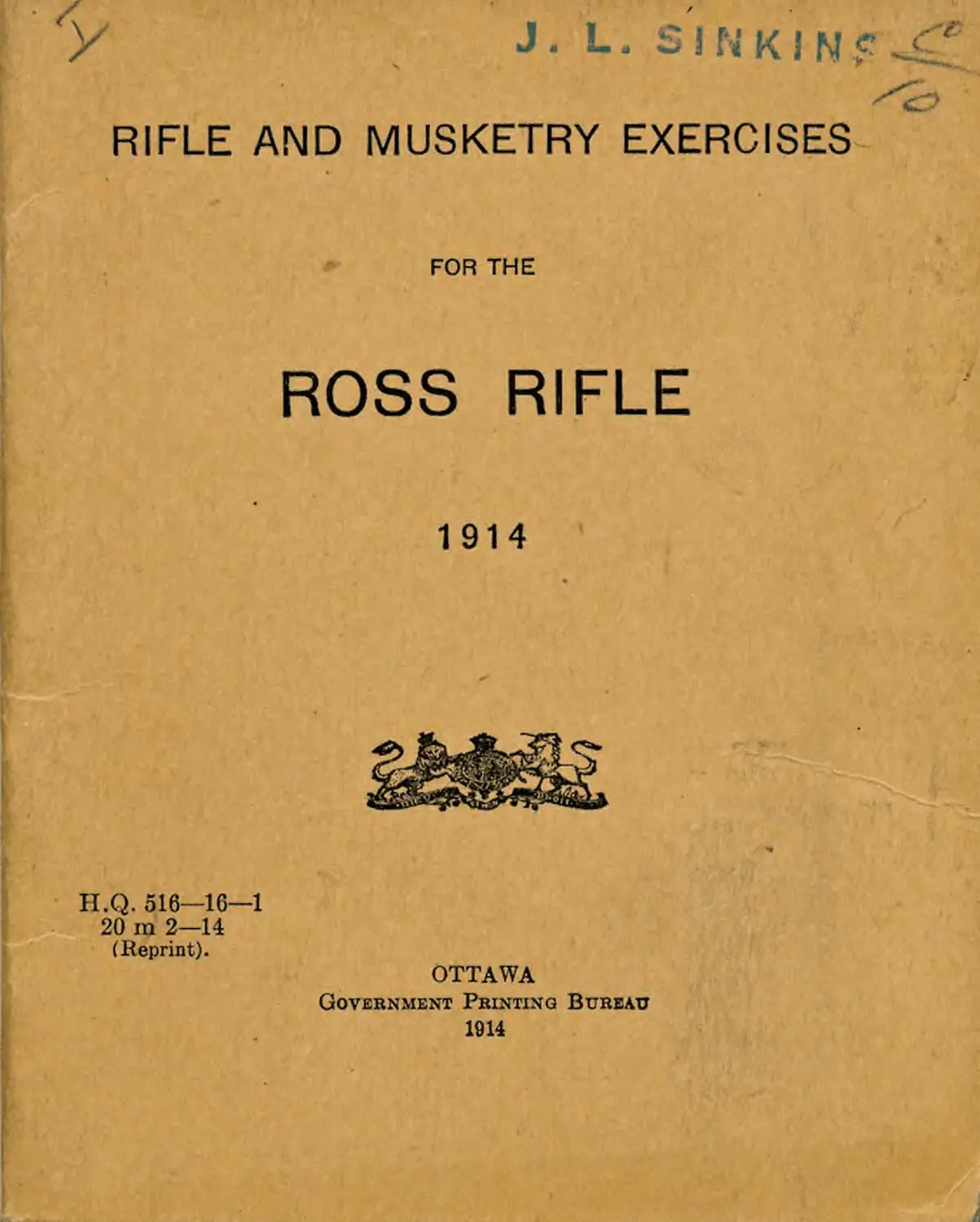
                    RIFLE AND MUSKETRY EXERCISES
L • SIN КI N f
FOR THE
ROSS RIFLE
1914
II.Q. 516—16—1
20 in 2—14
(Reprint).
OTTAWA
Government Printing Bureau
1914
J
RIFLE AND MUSKETRY EXERCISES
FOR THE
ROSS RIFLE
1914
(I.Q. 516 16-1
20 in 2—14
(Reprint).
OTTAWA
Government Printing Bureau
1914
55754—1

3
TABLE OF CONTENTS IN ALPHABETICAL ORDER.
RIFLE EXERCISES.
Section.
Page.
4. Attention from Stand-at-Ease.......................
11. Bayonets, fixing..................................
12. Bayonets, unfixing.............................
22. Bayonets, fixing on march.........................
23. Change when at the Slope..........................
26. Change when at the Trail..........................
29. Change from Secure under right or left arm........
35. Compliments with arms.............................
33. Funeral exercises.................................
1. General rules......................................
31. Grounding and takin up arms.......................
34. Guards, Sentries..................................
13. Inspecting arms on parade.........................
2. Order..............................................
6. Order, from Slope. Л...............................
10. Order, from Present...............................
15. Order, from Trail.................................
17. Order, from Shoulder..............................
7. Present from Slope.................................
9. Present from Order.................................
32. Piling and unpiling arms..........................
3. Stand-at-Ease from Order...........................
5. Slope from Order...................................
8. Slope from Present.................................
25. Slope from Secure.................................
55754—2
7
9
10
15
15
16
17
22
19
5
18
22
11
6
7
9
13
9
18
6
16
4
i6. Shoulder from Order.................................  13
18. Shoulder from Trail.................................. 14
20. Short Trail from Order................................14
21. Short Trail, use of.................................. 14
24. Secure from Slo^e.................................... 15
27. Secure from Trail.................................... 17
30. Slinging arms........................................ 17
14. Trail from Order..................................... 12
19. Trail from Shoulder.................................. 14
28. Trail from Secure.................................... 17
MUSKETRY EXERCISES.
36. Aiming instruction, stages of..................... 23
38.	Aiming, accuracy in.............................. 26
39.	Aiming, common faults in........................  27
41.	Aiming off for wind.............................  30
42.	Aiming off for movement.......................... 31
43.	Aiming at ground, and marking down enemy......... 32
44.	Aiming up and down............................... 32
37. Sights, adjustment of............................. 24
45.	Sights, rapid adjustment of...................... 33
40. Triangle of error................................. 28
FIRING INSTRUCTIONS.
47.	Firing rest............................................. 34
49.	Firing, standing........................................ 36
50.	Firing, prone........................................... 40
51.	Firing in other positions............................... 41
46.	Instructors...........................................   33
8.	Trigger pressing......................................... 34
5
CHAPTER I.
RIFLE EXERCISES,
i,—General Rules,
i.	Recruits, before they commence the Rifle Exercises, are
to be taught the names of the different parts of the rifle and the
care of arms as laid down in the Handbook of the Ross Rifle 1913.
2,	The rifle exercises will not be performed at inspections
and will only be practised by units larger than a squad for pur-
poses of ceremonial.
3.	Drilling by numbers should be carried out at intervals and
restricted to the instruction of recruits, and should, in the case of
the Active Militia, be curtailed as far as possible.
4.	The recruit having been thoroughly instructed in the rifle
exercise by numbers will be taught to perform them in quick
time, the words of command being given without the numbers,
and executed as detailed in the following sections, with a pause of
one beat of quick time between each motion.
5.	Instruction in the rifle exercises should be combined with
firing instruction; the recruit should be accustomed to regard his
rifle from the first as his chief means of destroying the enemy, and
not merely as an implement to be carried at drill or manoeuvres.
Squad drill with arms should be practised occasionally in
extended order to accustom men to handle their rifles steadily and
correctly when separated from their comrades.
55754—2J
6
6.	In performing the various motions of rifle exercise the
hand should be carried the shortest way to the rifle.
7.	Arms may if desired be sloped from the Stand-easy on the
command Slope-arms. When the squad is at the slope it will
be taught to go through the motions of che order, Stand-at-
ease, and Stand-easy, on the command STAND-EASY.
8.	Squads with arms will be practised in the different marches
and variations of step, described in “ Infantry Training.”
The disengaged arm will be allowed to swing naturally as
described for marching in quick or double time without arms
respectively.
2.—The Order.
The recruit will fall in as directed in “Infantry Training”
Sec. 30, with the rifle held perpendicularly at his right side, the
butt on the ground, its toe in line with the toe of the right foot.
The right arm to be slightly bent, the hand to hold the rifle ’near
the lower band, (.22 Cadet Rifle, at the most convenient
point,) back of the hand to the* right, thumb against the thigh,
fingers slanting towards the ground.
When each man has got his dressing he will Stand-at«-Ease.
3.—The Stand-at-Ease from the Order (with or without bayonets
fixed.)
Stand-at- Incline the muzzle of the rifle slightly to the
Ease.	front with the right hand, arm close to the side,
at the same time keeping both legs straight,
carry the left foot about one foot length to the
left, the left arm steady.
7
4.—The Attention from Stand-al-Ease.
The left foot will be brought up to the right and the rifle
returned to the Order.
J.—The Slope from the Order.
Slope-Arms. Give the rifle a cant upwards with the right
One.	hand, catching it with the left hand above the
guard, forearm horizontal, the right hand at the
small of the butt, thumb to the left, elbow to the
rear, rifle barrel pressed into the shoulder.
Two.	Carry the rifle across the body, and place it on
the left shoulder, trigger guard to the left. Seize
the butt with the left hand, the first two joints
of the fingers grasping the upper side of the butt,
the thumb one inch above the toe, the upper
part of the left arm close to the side, the lower
part horizontal, and the heel of the butt in line
with the centre of the left thigh.
Three.	Cut away the right hand to the side.
6	.—The Order from the Slope.
Order—Arms.	Bring the rifle down to the full extent of the
One.	left arm, at the same time meeting it with the
right hand, in line with the left shoulder, arms
close to the body.
Two.	Carry the rifle to the right side, seizing it with
the left hand at the upper band, butt just clear
of the ground.
8
Three.	Place the butt quietly on the ground, cutting
the left hand smartly to the side.
7	.—The Present from the Slope.
Present—Arms. Seize the rifle with the right hand at the small,
One.	both arms close to the body.
Two.	Raise the rifle with the right hand perpen-
dicularly in front of the centre of the body,
trigger guard to the left; at the same time place
the left hand smartly on the stock, fingers point-
ing upwards, thumb close to the forefinger, point
of the thumb in line with the mouth; the left
elbow close to the butt, right elbow and butt
close to the body.
'Three.	Bring the rifle down perpendicularly close in
front of the centre of the body, trigger guard to
the front, holding it lightly at the full extent of
the right arm, fingers slanting downwards; at
the same time meet it smartly with the left hand
so that the forearm is horizontal, thumb pointing
towards the muzzle; at the same time place the
hollow of the right foot against the left heel, both
knees straight. The weight of the rifle to be
supported by the left hand.
8	.—The Slope from the Present.
Slope—Arms.— Bring the right foot in line with the left and
One.	place the rifle on the left shoulder as described in
the second motion of the Slope from the Order.
Two.	Cut the right hand smartly to the side.
9
9	.—The Present from the Order.*
Present—Arms Give the rifle a sharp cant upwards with the
—One.	right hand, catching it with the left hand with
the forearm horizontal and the right hand
grasping the butt at the small, thumb to the left,
elbow to the rear.
Two.	Bring the rifle to a perpendicular position in
front of the centre of the body, turning the guard
to the left; at the same time place .the left hand
smartly on the stock, fingers pointing upwards,
thumb close to the forefinger, point of the thumb
in line with the mouth; left elbow close to the
butt, right elbow and butt close to the body.
Three.	As in the third motion of Present from the Slope.
io	.—The Order from the Present*
Order—Arms— Carry the rifle to ths right side and seize it
One.	with the right hand at the lower band, and with
the left hand at the upper band, butt just clear
of the ground, at the same time bring the right
foot smartly up to the left.
Two.	Place the butt quietly on the ground as at the
Order, cutting the left hand away to the side.
11	.—Fixing Bayonets.]
Fix—	Seize the handle of the bayonet with the
Bayonets.— left hand, knuckles to the front, thumb and
One.	fingers to the rear, at the same time push the
muzzle of the rifle sharply forward and turn
♦For Rifle Regiments only.
|On the word Fix, the right hand man will take three paces forward
resuming his place in the line when the third motion Is completed.
10
the head and eyes to the right, the right hand
man looking to the left.
Two.	Taking the time from the right hand man
draw the bayonet, turning the point upwards
and keeping the elbow down. Place the handle
on the bayonet stud, with the ring over the
muzzle, pressing it home to the catch. Body
and head to be erect.
Three.	Taking the time from the right hand man,
(who will raise his disengaged hand to the full
extent and in line with the shoulder), bring
the rifle to the Order* at the same time cut
away the left hand to the side, turning the
head and eyes to the front.
12.—Unfixing Bayonets*
Unfix—	Keeping the heels closed, place the rifle be-
Bayonets.— tween the knees, guard to the front, and grasp
One.	the handle of the bayonet with the right hand,
knuckles to the front, thumb of left hand on
the bayonet bolt spring, draw the rifle into the
body with the knees, and press the spring.
Raise the bayonet about one inch, and at the
same time turn the head and eyes to the left,
Two.	Taking the time from the left hand man, raise
the bayonet off the stud, drop the point to the
left side, arm in front of the rifle, bayonet ring
to the rear and at the same time seize the scab-
bard with the left hand and place the point of
the bayonet into it.
•On the word Unfix, the left hand man will take three paces forward,
resuming his place in line when the fourth motion is completed.
IX
Three.	Taking the time from the left hand man (who will look inwards and raise his right arm), force the bayonet home, and bring the right hand to the lower band.
Four.	Taking the time from the left hand man, cut away the left hand to the side and return to the Order, turning the head and eyes to the front at the same time.
13>—Inspecting Arms on Parade.
i. The men will stand at the Order.
For Inspection. Port—Arms.	Cant the rifle, muzzle leading, with the right hand smartly across the body, trigger guard to the left and downwards, the barrel crossing opposite the point of the left shoulder, and meet it at the same time with the left hand at the guard swivel, thumb and fingers around the rifle, the left wrist to be opposite the left breast, both elbows close to the body. Disengage the safety catch, open the breech and grasp the butt with the right hand im- mediately behind the bolt, thumb pointing to the muzzle.
Ease— Springs.	Close the breech, press the trigger, engage the safety catch and return the hand to the small.
Order—Arms. Holding the rifle firmly in the left hand, seize
One.	it with the right hand at the lower band. (For
. 22 calibre rifle well above the left).
Two.	As in second motion of Order from Slope.
65754—3
12
Three.	As in the third motion of Order from Slope.
2. When arms are inspected, the officer will see that the
sight is at zero both for deflection and elevation, and that the
magazine platform works freely. Each soldier, when the officer
has passed the file next to him, will, without further word of
command, close the breech, press the trigger, engage the safety
catch, order arms, and stand at ease.
3. If it be necessary to examine arms, the men will be
cautioned to remain at the Port.
On the command Examine-Arms, both ranks will come
to the position for loading, with the muzzle of the rifle so inclined
as to enable the officer to look through the barrel, the thumb
nail of the right hand being placed in front of the bolt to reflect
light into the barrel.
The officer will look through each barrel to see that it is
clean and free from rust. The soldier, when the officer has
passed the file next to him, will close the breech, press the trigger,
engage the safety catch, order arms and stand at ease.
Note .—A squad when falling in for inspection in two ranks,
the rear rank will be three paces from the front rank.
14.—The Trail from the Order.
Trail.	By a bend of the right arm give the rifle a
cant forward and seize it at the point of balance,
bringing it at once to a horizontal position at
the right side at the full extent of the arm,
fingers and thumb around the rifle.
13
zj-—The Order from the Trail.
Order—	Raising the muzzle, catch the rifle at the
Arms. lofcer band, and come to the Order.
Note.—The trail is not to be used in close order drill except
by rifle regiments. It will be used when re-
quired for movements in the field in both close
and extended order.
16.—The Shoulder from the Order*
Shoulder—	Give the rifle a cant upwards with the right
Arms.	hand and catch it with the left hand in line with
One.	the elbow; place the second finger of the right
hand inside the trigger guard (Mark II short
rifle, around the bottom of the trigger guard),
thumb and remaining fingers pointing down-
wards, the upper part of the barrel resting in
the hollow of the right shoulder.
Two.	Drop the left hand smartly to the side.
17.—The Order from the Shoulder*
Order—•	Grasp the rifle with the left hand in line with
Arms.—One. the elbow, at the same time slipping the right
hand to the lower-band.
Two.	Lower the rifle and place the butt quietly on
the ground, at the same time drop the left hand
smartly to the side.
♦Rifle Regiments only.
55754—3J
	14 18.—The Shoulder from the Trail *
Shoulder— Arms.—One.	By a bend of the right wrist bring the rifle to a perpendicular position, and grasp it with the left hand in line with the elbow, then seize it with the right hand as at the Shoulder,
Two.	Drop the left hand smartly to the side. 19,—Trail from the Shoulder*
Trail- Arms.—One.	Seize the rifle with the left hand in line with the elbow, arm close to the body, slipping the right hand to the point of balance.
Two.	Bring the rifle to the Trail, at the same time drop the left hand to the side. 20,—Short Trail from the Order,
Short— Trail.	Raise the rifle about three inches from the ground, keeping it otherwise in the position of the Order. 21,—Use of the Short Trail,
No word of command is given to Short-Trail.	If standing with arms at the Order, and directed to form fours, to close to the right or left, to step back, or to take any named number of paces forward, men will move at the Short Trail.
♦Rifle Regiments only.
15
22	.—Fixing Bayonets on the March.
Fix—	i. When at the Slope seize the rifle with the
Bayonets,	right hand at the point of balance and bring it
to the Trail, with the muzzle sloping upwards
in front of the right breast. Draw and fix the
bayonet with the left hand. Bring the rifle to
the Slope.
ii.	When at the Trail raise the muzzle of the
rifle and proceed as above described.
23	.—To change when at the Slope.
Change—	Seize the butt of the rifle with the right hand
Arms.—One. back of the hand up and slip the left hand to the
small.
Two.	Carry the rifle, turning the trigger guard out-
wards, on to the right shoulder bringing it well
to the front so as to clear the head.
Three.	Cut the left hand to the side.
Note.—To change arms from the right to the
. left shoulder act as above, reading left for right,
and right for left.
24	.—The Secure from the Slope.
Secure— Bring the rifle down to the full extent of the
Arms.—One left arm and seize it with the right hand in line
with the shoulder.
Two.	Turn the trigger guard to the front seizing
the rifle with the left hand at point of balance.
	16
Three.	Give the butt a sharp cant to the rear, place the breech under the left arm-pit, knob of bolt to the rear, muzzle inclined slightly to the right and downwards, at the same time cut the right hand co the side. 25.—The Slope from the Secure.
Slope— Arms.—One.	Bring the rifle to a perpendicular position opposite the left shoulder, at the same time meeting it at the small of the butt with the right hand.
Two.	Carry the rifle on to the left shoulder, and grasp it with the left hand as at the Slope.
Three.	Cut the right hand to the side. 26.—The Change when at the Trail.
Change— Arms.—One.	Bring the rifle to a perpendicular position in front of the right shoulder, trigger guard to the front, upper arm close to the side, forearm horizontal, hand in line with the waist belt.
Two.	Pass the rifle across the front of the body, catching it with the left hand at the point of balance, at the same time cutting the right hand smartly to the side. In this position the rifle is to be held perpendicular and opposite the left shoulder, trigger guard to the front, upper part of the left arm close to the side, left forearm horizontal, hand in line with the waist belt.
Three.	Lower the rifle to the full extent of the left arm as at the Trail.
17
г/.—To Secure Arms from the Trail*
Secure—	Keeping the grip of the right hand at the
Arms. point of balance, bring the breech up under the
arm-pit by bending the arm, the muzzle of the
rifle slanting slightly to the right and downwards.
28	.—Trail Arms from the Secure*
Trail—	Lower the ri fle to the full extent of the right
Arms. arm at the Trail.
Note.—The rifle may be brought to the Trail from the
Secure under either arm.
29	.—Change Arms from Secure under right arm.
Change—
Anns.—One. As in “One" Change arms from Trail.
Two.	As in “Two" Change Arms from Trail.
By bending the left arm, bring the breech under the left
arm-pit, muzzle slanting slightly to the left and downwards.
Note.—Ьгтаз may be changed in a similar manner from the
left side.
30	.—Slinging Arms.
The sling of the rifle having been loosened to the full extent,
the soldier will pass the head and right arm between the sling
and rifle, muzzle upwards, rifle hanging diagonally across the
back.
♦Rifle Regiments only.
i8
jj.—-Grounding and Taking up Arms.
On the command Ground Arms, the rifle will be placed
gently on the ground at the right side» trigger guard to the right.
The right hand will be in line with the toe as the rifle is placed
on the ground, then return smartly to attention.
On the command Take up Arms, the men will take up arms
and come to the Order.
32.—Piling and Unpiling Arms.
The squad in two ranks will be taught to pile arms as fol-
lows.—
Pile—Arms.— The rear rank will take a pace forward and
One.	turn the barrels of their rifles towards the front
rank. The front rank will turn about and
place the butts of their rifles between their
feet.
Two.	The odd numbers of the front rank will incline
their muzzles towards those of the even num-
bers. barrels downwards, slipping the right hand
to the upper band, the odd numbers will then
seize the rifles of the even numbers with the
left hand in the same manner and hold up
the piling swivels of both rifles with the fore-
fingers and thumbs, crossing the muzzles by the
right to bring the swivels together. The even
numbers will drop the right hand to the side.
Three.	The even numbers of the rear rank, holding
their rifle sling upwards at the lower band, will
incline the muzzles forward, and with the left
hand will link swivels through the crossed
muzzles of the front rank raising their butts
as high as necessary to do so. The odd numbers
19
of the front rank will now turn the barrels of
their rifles towards the even numbers of the
rear rank, who will then place the heel of their
butt six inches to the right of the toe of the
right foot so as to make the pile secure.
Four.	The odd numbers of the rear rank will lodge
their rifles against the pile, and will then drop
their hands to the side.
Stand—	Ranks will step back one pace and turn to
Clear. the right flank.
Stand—	Ranks will turn inwards and take a pace
To.	forward.
Unpile—	The whole will seize their rifles at the lower
Arma.—One. band.
Two.	Swivels will be unlinked by raising and inclin-
ing the butts inwards, and rifles brought to the
Order.
Three.	The front rank will turn about, and the rear
rank will step back a pace.
The recruit will be taught this exercise in quick time.
In piling arms on parade, the word Fall-Out will be given
after Stand-Clear. On again falling in. the men will place
themselves as they stood before falling out.
jj.—Funeral Exercises,
Slope—Arms.	As usual.
55764—4
	20
Present— Arms.	As usual.
Reverse— Arms.— One.	Bring the right foot smartly up to the left, throw the rifle out to the front to the full extent of the left arm, and give the butt a cant with the right hand towards the body, bring it inside the left arm and turning the muzzle straight over to the front, grasp the rifle with the right hand under the lower band, barrel to the front, muzzle pointing downwards, guard as high as the chin, and seize the small with the left hand without moving the rifle, arms close to the body.
Two.	Give the rifle a cant under the left arm, bring- ing the muzzle to the rear, sling uppermost, and seize the rifle with the right hand behind the body.
On command Quick-March, the rifle is brought from
the Reverse to the Trail at the left side, butt leading, sling upper-
most.
Quick—	Quit the rifle with the left hand, and seize
March.—One. it again with the left hand at the point of balance.
Two.	Quit the rifle with the right hand, and bring it to the Trail, butt to the front, sling uppermost.
Change— Arms.—One.	Bending the arm from the elbow, bring the rifle to a perpendicular position in front of the left shoulder.
Two.	Throw the rifle across the body to the right side, and seize it with the right hand, as at present held with the left.
21
Three.	Bring the rifle to the trail, sling uppermost.
When approaching the church-yard, on the command—
Siow-March—the rifle is brought to the Reverse from the Trail
at the left side.
Slow—March. Give the rifle a cant underneath the left arm-
pit with the left hand, and seize it at Reverse.
Rest on your Arms.— Reversed.	Quitting the rifle with the right hand, bring it with the left to a perpendicular position and lower it until the muzzle rests upon the toes of the left foot; then extend the right arm to the right to the full extent, hand open, back of the hand uppermost, bring the right hand slowly on the butt, make a pause of slow time, then turn the head and eyes to the right and bring the elbow close to the side. Turn the head and eyes to the left and repeat above motions with the left hand, then turn the head and eyes to the front, and lower the head on the breast.
Attention.	Raise the head.
Reverse— Arms.	Seize the rifle with the left hand at the small, bring the rifle under the left arm, at the same time seizing it with the right hand behind the
Rest on your	body.
Arms.— Reversed.	As above.
Present— Arms.—One.	Raise the rifle with the right hand about six inches, at the same time seizing it with the left hand immediately in front of the trigger guard back of the hand towards the body.
22
Two.	Seize the small of the butt with he right thand,
back of the hand to the front.
Three.	Lower the butt towards the body and come
to the Present.
Note.—For complete Funeral Exercise see “ Ceremonial. ”
34.—Guards. Sentries.
Guards, including reliefs, rounds and patrols, will march
with sloped arms and bayonets fixed, (those belonging to Rifle
Regiments with Trailed Arms). In wet weather, arms will be
carried at the Secure.. Bayonets will not be fixed when arms are
carried at the Secure or Trail.
Sentries are to walk with their arms at the Slope, except
those of Rifle Regiments, who will carry their arms at the Trail.
Further instructions concerning guards and sentries are
given in “ Ceremonial.”
35—Paying Compliments with Arms.
When a soldier, other than a riflemen, carrying a rifle, passes
or addresses an officer he will do so at the Slope, and will saUite
by carrying the right hand smartly to the small of the butt, fore-
arm horizontal, back of the hand to the front, fingers extended,
saluting at the same number of paces before reaching the officer,
and cutting the hanef away, as directed when saluting without
arms, “ Infantry Training,” S. 21, Note 3. A rifleman when
passing an officer will do so at the Shoulder; when addressing an
officer he will do so at the Order. In passing an officer the soldier
will always turn his head towards him in the same manner as
when unarmed.
23
MUSKETRY EXERCISES.
The foundation of rifle shooting is skill at short ranees, to
obtain which the man must in addition to possessing a know*
ledge of his rifle, be accurate in aiming, and have overcome the
difficulties of pressing the trigger without disturbing the aim;
due regard must also be paid to proficiency in handling the rifle
in the various firing positions.
AIMING INSTRUCTION.
36.—Stages of Instruction.
Aiming will be taught as follows:—
Object of Sights. Sec. 21, M.R. Part i, 1909 (reprint 1912).
Adjustment of Sights; for elevation.
Proper use of the sights in aiming.
Aiming with accuracy from a rest.
Desmontration of results of inaccuracy of aim.
Aim combined with trigger pressure.
Use of windgauge; section 30; M.R. Part I, 1909, (reprint
1912).
Aiming off for movement. Sec. 44, M.R. Part I, 1909,
(reprint 1912).
Aiming at figures and ground from a rest.
Setting of windgauge and tine adjustment as ordered.
24
Judging deflection allowance for wind and movement.
Aiming up and down.
Rapid adjustment of sights.
Aiming and snapping without rests; Target-Index—Practice
Rods to be employed.
Fire discipline exercise.
Although the above headings are given with a view to
progressive steps, it is immaterial whether the instruction is
given in this order, but further training should be deferred until
the eye is shown to be accurate in aiming. Particular attention
must be given to trigger pressure; and declaring the point of aim
on discharge. This instruction may be conveniently given
indoors in which Sub-Target-Guns and Target-Index-Practice
Rods should be employed.
Aiming and firing instruction should be carried out simul-
taneously, together with such explanations of elementary theory
as will ensure the instruction being intelligently understood,
short lectures and questions being included during periods of
rest.
37.—Adjustment of Sights-
Screw Elevating Sight.—To adj us. in yards, turn the screw
until the top of the slide is brought even with the line opposite
the required distance.
For Minutes of elevation.—Turn the rifle until the scale on
the right side of the sight can lx? seen, move the elevating screw
until the index line on the slide is opposite the elevation re-
quired.
25
Mark I Sutherland Sifftl.—Release the clamp screw; to
adjust in yards, move the slide forward until the top is even with
the line giving the required elevation, engage the clamp.
To use the Vernier scale—Each mark on the leaf is equal
to ten minutes of elevation and, used in conjunction with those
on the slide, minutes of angle are obtained. Move the slide until
the zero mark is even with the required line on the leaf, engage
the clamp.
Example.—If sixty-three minutes of elevation is required
move the zero mark even with sixty, then with the sight clamped,
turn the screw until the third line on the slide above the zero line
is brought up to the next line on the leaf.
Mark II Sutherland Sight.—To adjust in yards, release the
clutch and move the slide until the index mark is even with the
line giving the required elevation.
Note.—On the right of the opening in the slide there are two
index marks, the upper one to give elevation when using the
‘IT sight, the lower mark when using the peep. To adjust in
minutes, move the slide until the zero line is even with the
elevation required. As the lines on the leaf are equal to five
minutes of elevation fine adjustment may be obtained as follows:
Example.—If 67 minutes ar»* required—move the slide until
65 minutes are obtained, then turn the screw until the second
line above the zero on the slide is brought up to the next line on
the leaf.
.22 Cadet rifle each mark on the left side of the sight is
equal to twenty-five yards; to adjust the sight, turn the screw
until the elevation required is even with the top of the sight
chamber.
2б
38.—Accuracy in Aiming.
1.	Especial care will be taken that the sights of any rifle
used in aiming instruction are in perfect order.
2.	The aiming mark in the earlier stages will be a target
placed at a convenient distance so as to be easily seen, but when
the habit of accuracy has been acquired service targets should be
used and care will be taken that there is no falling off in accuracy
owing to the shape and comparative invisibility of these targets.
3.	The instructor must inspect the, sights frequently to
ensure that they are correctly adjusted in accordance with his
order.
He will explain the following rules, and demonstrate the
results to be anticipated Jrom common errors in aiming:—
i.	The backsight must be kept upright.
ii.	The left or right eye, according to the shoulder from
which the man shoots, must be closed.
iii.	Aim must be taken by aligning the sights on the centre
of the lowest part of the mark, the top of the fore-
sight being in the centre of, and in line with, the
shoulders of the ‘IT or *V’ of the backsight.
iv When using the aperture sight, the eye should be close
to the aperture (about one inch), the top of the fore-
sight brought in line with the centre of the lowest
part of the mark.
Note.—It should be explained to recruits, that, the nearer
he eye is to the aperture the greater will be the field of view”.
*7
4. When these principles have been. mastered, the in-
structor will loosen, the sling, adjust the sights for any given
range, and aim from the rest at the target, taking care that
uniformity is observed in the distance of the eye from the back-
sight. It will be convenient to use sand bap aiming rests to
steady the recruits during this practice. Having aimed, he will
call on each individual to observe the correct method of aligning
the sights on the mark. Each recruit will then act similarly
when the instructor will verify the aim, point out errors, and
explain how they would have affected the accuracy of the shot,
and how they are to be avoided. He should occasionally call
on a man to point out any errors which may have been made by
his comrades.
5. Extreme accuracy of aim must be insisted on even during
the first lesson.
jp.—Common faults in Aiming.
The most common faults in aiming with open sights are:—
i.	Taking too much or too little foresight into the ‘U’ or *V*
of the backsight.
It should be explained that a fine or half sight will cause the
bullet to strike witn Mark VI. ammunition about $ inches and
3 inches lower respectively, and, with Mark VII., 7 inches and 4
inches lower respectively per 100 yards of range, than when the
correct sight is taken.
The following method will be found useful to guide a recruit
in taking the correct amount of foresight:—Lay the edge of a
piece of paper on the upper edge of the backsight cap.* A piece
of cardboard laid on the cap and held in place by an elastic band
will answer the same, purpose.
*See diagram (M.R. page 86.)
28
ii.	Inaccurate centering of the foresight in the notch of the
backsight.
The recruit should understand that this inaccuracy will
deflect the muzzle of the rifle to the side on which the line of aim
is taken, e. g., if aim be taken over the right edge of the notch, the
direction of the line of fire will be to the right of the line of sight.
iii.	Fixing the eyes on the foresight, and not on the object.
If the eye is accommodated for the foresight, the firer will
retain only a blurred image of the target. This may not affect
the result of his shooting at stationary vertical targets, but when
firing at service targets which appear and disappear, or at areas
of ground, it will be necessary for him to watch tne target closely
iv.	Inclining the backsight to one side.
In this case the bullet will strike low, and to the side on which
the sights are inclined. The resulting error will be considerable
at long ranges.
40.—Triangle of error.
1. To test proficiency in aiming and to demonstrate the
errors which will arise from inaccuracy, the following method of
recording a “triangle of error” will be employed.
The rifle will be placed on an aiming rest, and directed at a
sheet of blank white paper, affixed t.o any convenient object at a
distance of about 10 yards from the rifle; a second aiming rest
should be used to steady the recruit in aiming. A marker will
stand at one side of the target with a small rod bearing an aiming
disc of metal or cardboard, painted white, about 1} inches in
diameter; ой this is a black bull's-eye, J-inch in diameter, in the
29
centre of which is pierced a hole just large enough to admit the
point of a pencil. The disc will be held on the paper, the in-
structor will align the sights on it, as laid down in section 38
Para. iii. and its position will be marked with a pencil.
Each man in succession will be called up and ordered to look
along the sights, but without touching the rifle, and when he has
satisfied himself as to the correctness of the aim, the disc will be
removed. It will then be replaced on the paper and moved at
his direction until the lower edge of the bull's-eye is brought into
the line of sight4, when its position will be marked. The operation
will be repeated three times, and the points thus fixea will be
joined in such a way as to form a triangle. The position of the
points in relation to the instructor’s aim* will expose any con-
stant error in arming. Their position in regard to one another
will show any inconsistency.
2. If the triangle is formed so that its greatest side lies
vertically on the paper, it proves that the soldier’s principal fault
is inconsistency in respect of the amount of foresight taken up
into the line of sight; if horizontally, that his principal error is
inaccurate centering of the foresight.
When any one of the sides of the triangle exceeds one-third
of an inch, or if the centre of the triangle is more than one-third
of an inch from the instructor's aim, the recruit will be noted for
further instruction."••
•If the recruit's aim is below that of the instructor, it shows that he has
taken too full a sight; if above, that his sighting has been too fine; if to the
right that the foresight was on the left of a perpendicular drawn through the
centre of the notch; if to the left, vice versa.
••See diagram page 89 M.R.
30
41»—Aiming off for Wind,
i.	The use of the windgauge will be explained, but it is not
to be regarded as the normal means of making allowance for
wind under service conditions. The instructor, having explained
that a variation of one division on the windgauge scale is equiv-
alent to 5 inches on the target per ioo yards of range, will tell the
soldier how many feet of deflection allowance would be required
for the wind which is blowing, and then direct him to set his
sights for the range, adjust the windgauge, and aim from an
aiming rest.
2.	To adjust the windgauge (screw elevating sight). Turn
the screw until the centre line is even with the mark on the scale
required. Each mark on the scale is equal to five minutes; to
obtain less, use the scale on the plate in conjunction with the
scale on the sight as a vernier.
Mark I. and Mark II. Sutherland sight.—Each click of the
'windgauge screw is equal to one minute of deflection.
3.	The. recruit should be taught to discriminate between
mild, fresh, and strong winds, by the effect which they exercise
on natural objects, and to note the direction of the wind as front,
rear, right angle, or oblique, by turning his face full towards the
wind.
4.	The approximate allowances in elevation or deflection for.
these winds at decisive range will be taught. Practice will be
afforded in aiming off a full-length figure target according to the
range, and the strength and direction of the wind, actual or
supposed.
5.	The recruit should be accustomed to make deflection
allowance with reference to the breadth of the target, the full
length figure target being rather less than 2 feet wide. Such
31
practices should be limited to 600 yards, but in addition there
must be practice in aiming off at all ranges according to orders,
the allowance being indicated if possible by reference to the
breadth of the target, or intervals in a formation, or by selection
of an auxiliaiy aiming point. If this is not possible, it must
be expressed in feet or yards.
6.	In such exercises it is necessary to employ a fatigue man
at the target to indicate the correct point of aim with a marking
disc after each aim taken by the recruit. The amount of allow-
ance made will be observed by the instructor from the aiming
rest.
42,—Aiming off for movement.
1.	The instructions for aiming at moving targets in the
following paragraphs will be given during the latter portion of
preliminary training, practice in this form of shooting being
carried out on 30 yards, or miniature ranges, where the pace of
movement may be regulated in strict accordance with that of
service targets.
2.	When firing at crossing targets, aim will first be taken on
the object, then following it sideways, the aim will be carried in
advance and kept in front of the object until the rifle has been
fired. The distance to which the aim should be carried in advance
of the target will vary according to the range, rate of movement,
and direction of movement.
3.	Up to 500 yards’ range, aim should be taken:—
About 1 foot in front per too yards, at a man walking.
About 2 feet in front per too yards, at a man doubling.
About 3 feet in front per too yards, at a horseman trotting.
About 4 feet in front per 100 yards, at a horseman galloping
32
4-	Thus, at loo yards, a soldier should aim about the breadth
of a man in front of an individual walking, and at 200 yards
about a horse-length in front of a single horseman trotting.
Fire will rarely be effective at a single man moving across the
front at more than 300 yards range, or at a single horseman above
500 yards. At effective and long ranges, aim should be taken at
the head of a body of troops moving to a flank.
5.	In aiming at an object moving directly or obliquely
towards or away from the firer, allowance for elevation must
usually be made by aiming lower or higher.
43	.—Aiming at the ground, and marking down an enemy.
The eyesight must be gradually trained in aiming at figures
or other service targets and at ground which might conceal an
enemy. For this latter purpose a fatigue man will be directed to
show himself for a few seconds at different ranges. The squad
will then aim from rests at the ground which they believe to be
occupied. After a short interval the fatigue man will stand up,
when errors will be corrected and criticized.
44	.—Aiming up and down.
In aiming up and down the aim should be directed at a point
not more than three feet above or below the six o'clock line,
according to the position of the target beyond or short of the zone
for which the sights are set, but if the difference between the
range and the sighting exceeds 200 yards, it will be better to alter
the sighting.
To practice aiming up and down, fatigue men or disappear-
ing targets should be brought into view for short periods of time
at various ranges, the sights being fixed as may be ordered.
33
45-—Rapid adjustment of sights,
I.	Instructors will frequently test their squads in setting
their sights rapidly and accurately. They will give orders for
aiming or firing at definite targets, but without naming the
range, and require their squads to adjust their sights before they
bring the rifle to the shoulder. The careful adjustment of sights
will thus become instinctive.
2.	Adjustment of sights will also be practised in connection
with movement of the firer or the target.
3.	When there is time, the sights will be adjusted for every
alteration in the range, and aim will be taken at the lowest part
of the mark, but, frequent small changes of sighting lead, as a
rule, to loss of fire effect, and may be avoided by aiming up or
down. (Section 44.)
FIRING INSTRUCTIONS.
46,—Instructors,
I.	Instructors will teach by force of example rather than by
word of mouth, and be careful to refrain from any form of com-
ment which may discourage young soldiers. Words of command
are seldom required except in collective firing instruction, all
motions of firing being performed independently, and each man
being required to use his own judgment as much as possible.
Faults must not, however, be overlooked or allowed to become
formed habits; the essential points of the firing positions are to
be insisted upon from the beginning, as the foundation of fire
discipline.
2.	In the early part of training, squads will not as a rule,
consist of more than seven men, who will be assembled around
the instruetpr in a semi-circle. The instructor will explain the
34
uses of the different firing positions and illustrate them to the
squad. Recruits will practise the motions separately until able
to combine, them, and assume each position rapidly and withput
constraint.
3.	The position of each individual will be corrected in turn;
the regulation positions may be varied if physical characteristics
render them unsuitable in any case, but awkwardness in the first
stages of instruction will not be accepted as an indication that
the regulation position requires modification.
.	4. The instructor should stand about 5 paces from the re-
cruit and to his right front while correcting his faults.
47.—Firing rest.*
The firing rest will be frequently employed in early in-
struction to enable the recruit to support the rifle and rest his
muscles, whilst the instructor modifies, or corrects, his position.
An incorrect position, however, usually arises from want of
accuracy in the preliminary actions which lead to it, and it is to
these that attention must be given, for a faulty position once
acquired cannot easily be corrected.
48.—Trigger pressing.
1.	Before he is permitted to practice snapping, the recruit
will be given several lessons in the correct method of pressing the
trigger. The rifle will be rested on sand bags or in an aiming
rest, and the recruit will be seated with his elbows rested on a
table or other support. The instructor will first take steps to
ensure that the recruit can move his trigger finger independently
of the remainder of the hand and arm.
•For description of rest see Part II. Musketry Regulations.
35
2.	The instructor will explain, for the Long Ross Mark II.
and Mark III. (i) that, as the trigger has a double pull-off, two
distinct pressures are necessary to fire the rifle (the strength of
the first pull is 3 to 4 lbs.; that of the second, 5 to 6 lbs.). The
first pull should be taken when the rifle has been brought into
the position for aiming; the second, when the sights are aligned
on the mark. (N.B.—The Short Ross and Cadet Rifles nave
single pull-off), (ii) That the direction of the pull-off is diagon-
nally across the small of the butt, (iii) That the first joint of
the forefinger should be placed around the trigger; and (iv) that
in order not to disturb the aim breathing must be restrained when
pressing the trigger.
3.	In order that he may learn from experience the pressure
required to release the cocking-piece, the soldier will also be directed
to place his forefinger under that of the instructor, but without
exercising pressure, whilst the instructor carries out the motion.
Then, to enable the instructor to ascertain whether the method
is understood, the soldier will place his finger over that of the in-
structor, and exert the pressure. Finally, the soldier will himself
press the trigger, while the instructor uses the aim corrector.
The main object is to release the cocking-piece without disturb-
ing the aim. .
4.	Special care will be taken that the breathing is restrained
while pressing the trigger and the recruit is always to say after the
spring is released whether the aim was maintained truly at the
moment of snapping. If not, he must state definitely the direc-
tion in which the rifle was pointed at the moment of discharge.
5.	From time to time the instructor will test the aim and
steadiness of each recruit with an aim corrector, and, if necessary,
further lessons in trigger pressing will be given. Practice with
the sub-target rifle machine, target index practice rod, or with
miniature cartridge may advantageously be given, to develop
steadiness until range practice is begun;
36
6.	Trigger pressing requires most careful individual in-
struction, during which the necessity for determination and
strong personal effort will be impressed on the mind of every
recruit.
7.	Daily practice in snapping is required by trained soldiers
as well as recruits. Progress should be tested by grouping
practice on the 30 yards’, the miniature cartridge range, or with
a sub-target rifle machine.
49.—Firing Standing.
1.	The standing position will as a rule be used on service to
fire from breastworks, high walls, and cover, such as long grass
or standing corn, or to take a snap shot, when advancing, so that
the pace of the advance is not materially checked.
2.	It is a convenient position for elementary instruction,
but when recruits have acquired facility in handling the rifle,
they will be practised for the most part in the prone position in
the open, and occasionally in the kneeling position, or lying
behind cover.
3.	To Load.—Turn half right and carry the left foot to the
left and slightly forward so that the body is equally balanced on
both feet. Bring the rifle to the right side just above the hip
(above the pouch, if worn), with the muzzle pointing upwards,
small of the butt iust in front of the hip, grasping the stock with
the left hand at the point of balance, disengage the safety catch.
Seize the bolt with the right hand and draw it back to its full
extent; place a cartridge in front of the bolt (Mark III, beneath
retainer springs), force the bolt sharply home, engage the safety
catch, seize the rifle with the right hand in front of the left, bring
the left foot back to the right and return to the Order.
37
To engage the safety catch.
Long Rifle.—Turn the safety catch over to the front as far
as it will go.
Short Rifle.—Force the safety catch to the left
Ross .22.—Force the safety catch to the right.
To disengage the safety catch.
Reverse the above operation in all cases.
To engage the cut-off.
Mark III.—With the right thumb, turn the cut-off down as
far as it will go.
Short Rifle.—With the right thumb, press the cut-off down
and forward.
To disengage the cut-off.
Reverse the above operation.
Points to emphasise in the loading position—standing.
i.	Body erect and well balanced.
ii.	Left elbow close to the body.
iii.	Firm grip with left hand at point of balance.
iv.	Muzzle pointing upwards.
38
v.	Butt well forward.
vi.	Fingers clear of the trigger.
vii.	Eyes on the mark/
4. To Unload (whether magazine is charged or otherwise.)—
Come to the loading position, disengage the cut-off, move the
bolt quickly backward and forward until the magazine and
chamber are empty, press the trigger, engage the safety catch,
lower the backsight, if raised, and Order Arms.
To Unload the .22 Cadet Rifle when cocked.—Press back
the locking lever just in front of the trigger guard, close the
breech, press the trigger, engage the safety catch, and Order
Arms.
$. To charge the magazine.—Bring the rifle to the loading
position, disengage the cut-off, disengage the safety catch, open
the breech, press down the lifter fingerpiece, pour nve cartriages
into the magazine, move lifter fingerpiecc until they drop into
position, (Mark 1П, force each cartridge well into the magazine
under the retainer springs), close the breech, engage the safety
catch.
6.	With a charger.—Come to the loading position, raise the
cut-off, disengage the safety catch, draw back the bolt to the full
extent, place a charger in the guides, then place the thumb of the
right hand on the top cartridge with fingers extended down the
right side of the rifle, the first joint gripping the magazine, and
with a continuous pressure of the thumb force all the cartridges
into the magazine, force the bolt sharply home, engage the safety
catch.
7.	To adjust the backsight.—(Screw Elevating sight.)—
Hold the rifle in such a position so that the sight can be easily seen
and with the forefinger and thumb of the right hand turn the
39
screw until the top of the slide is evdn with the line opposite the
elevation required.
8.	Other Sights.—Move the slide with the forefinger and
thumb of the right hand until the necessary elevation has been
obtained.
9.	To aim and fire.—Load, and direct the eyes on the mark.
Then bring the rifle into the hollow of the right shoulder, press
it in with the left hand, grasp the small firmly with the thumb and
three fingers of the right hand, place the forefinger around the
lower part of the trigger. (Long Ross Rifle, exert sufficient
pressure to take the first pull); the backsight to be upright, left
elbow well under the rifle, right elbow a little lower than, and well
to the front of, the right shoulder; as the rifle touches the shoulder
bring the cheek down on the butt, keeping the face well back from
the right hand and cocking-piece, close the left eye, align the
sights on the mark, restrain the breathing, and press the trigger.
After a pause bring the rifle to the loading position and repeat the
practice, or apply the safety catch and Order Arms.
10.	Points to emphasise when firing-standing.
1.	Body well balanced.
2.	Left elbow well under the rifle.
3.	Good bed for the butt.
4.	Firm grip with both hands.
5.	Eye well back from cocking-piece.
6,	Sights perfectly upright.
40
Great care must be exercised to ensure that the forefinger is
not placed on the trigger before the rifle is in contact with the
shoulder, and that a nrm grip is maintained with both hands
while firing.
II. During this exercise the instructor will explain to the
recruits that uniformity accurate shooting cannot be obtained
unless the butt rests firmly in the hollow of the shoulder, and that
the eye must be in a proper position so that the sights may be
clearly defined, and that tnc less strained the position of the head
and neck, the less the effect of recoil.
12. The firer should always declare the direction of his aim
at the moment of discharge before removing the rifle from the
shoulder.
50. Firing prone.
1. The prone position will generally be adopted by troops
on open ground, or when firing from continuous low cover, or
from behind small rocks, trees, ant-heaps, &c. Preliminary
instruction in firing, and firing exercises, will as a rule be carried
out in the prone position.
2. i. To lie down.—Turn half right, bring the rifle to the
right side as when standing. Place the right hand on the ground
and lie down on the stomach obilquely to the line of fire, with the
legs separated, left shoulder well forward, left arm extended to
the front, and rifle resting on the ground in a convenient position,
muzzle pointing to the front.
ii.	To load.—As when standing.
iii.	To Unload.—As when standing.
iv.	To adjust sights.—Draw the rifle back through the left
hand until the lines on the backsight can be clearly
seen, and proceed as when standing.
41
v.	то aim and fire.—Proceed as when standing.
3.	Recruits will be trained to assume the prone position
rapidly, and to perform the loading and aiming motions with as
little movement as possible. The oblique angle is not to be un-
necessarily exaggerated. Behind objects affording a restricted
amount of cover, the body and legs will be parallel to the line of
fire if the oblique position would increase vulnerability.
4.	Points to emphasise in the Prone Position.
1.	Body oblique to line of fire.
2.	Legs separated.
3.	Fleels on the ground.
4.	Good bed for butt.
5.	Firm grip with both hands.
6.	Eye well back from cocking-piece.
7.	Sights perfectly upright.
8.	Elbows closed slightly inwards.
51.—Firing in other positions.
The recruit will also be instructed to fire:—
i. Sitting, which is most suitable when on ground falling at
a steep slope. In this position the right shoulder
should be kept well back, and the left forearm
supported by the thigh, the right elbow resting
against the right knee, or unsupported, as desired.
42
ii. Kneeling, used mainly when firing from continuous cover,
such as a low wall, bank, or hedge, or in long grass
crops, &c., which would obstruct the line of sight if
the prone position were adopted.
The soldier may kneel on either or on both knees
In the former case the body may be supported on the
heel or not, as desired; the left knee will be in advance
of the left heel, and the left elbow rest on or over the
left knee; the left leg, hand, and arm, and the right
shoulder, should be in the same vertical plane.
Points to emphasise when firing-kneeling.
i.	No undue exposure.
2.	Body well balanced.
3.	Left elbow well under rifle.
4.	Good bed for butt.
5.	Firm grip with both hands.
6.	Eye well back from cocking-piece.
7.	Sights upright.
Note.—During target practice, whether on the miniature or
service range, instructors will be held responsible that all pre-
cautions are taken to avoid accidents. Rifles and pouches should
be inspected before the men leave the firing point, and all un-
expended ammunition collected.
For Instruction in Theory, Uses of Fire, Etc., see
M.R. 1909 (reprint 1912.)