/


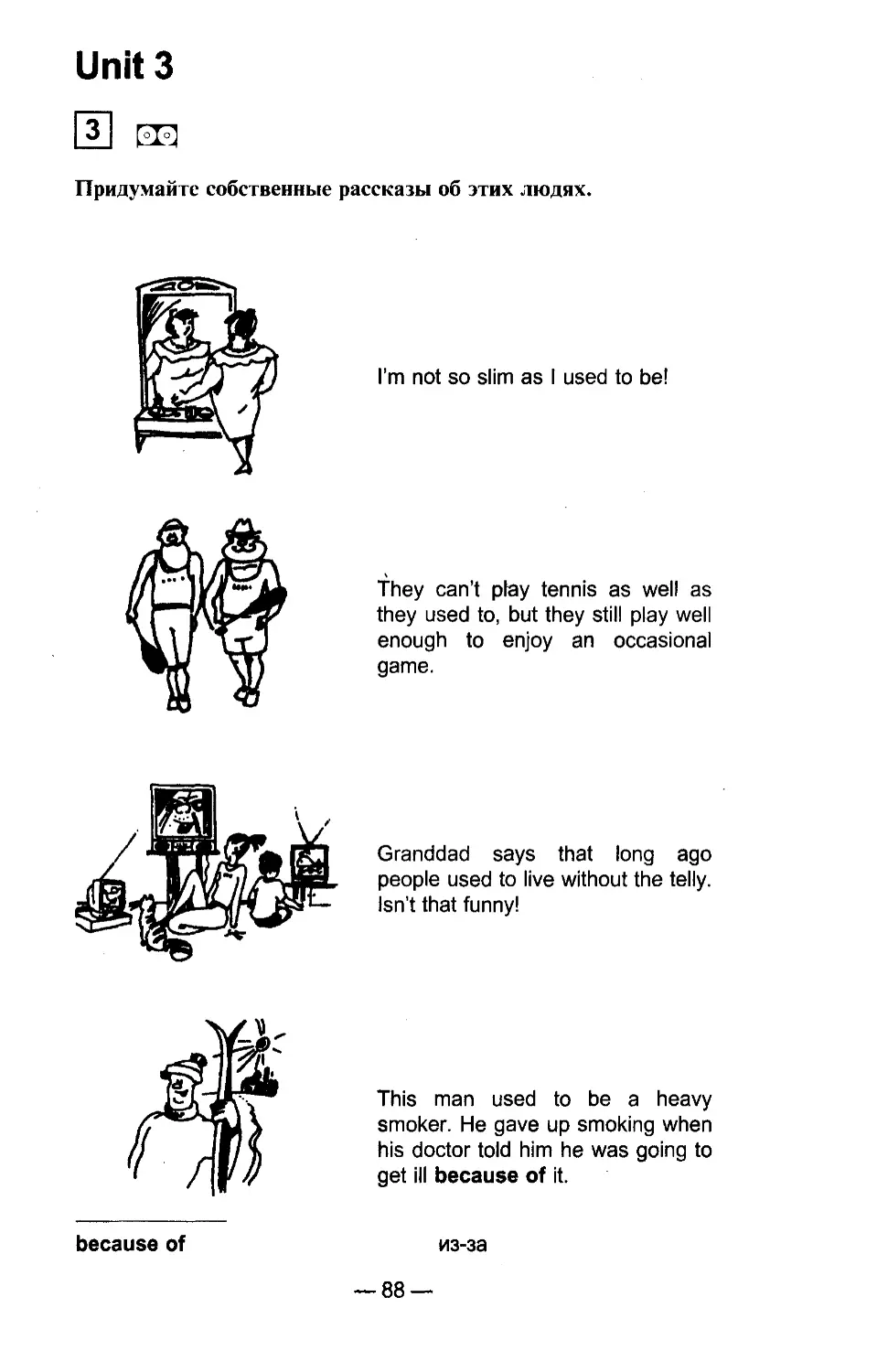
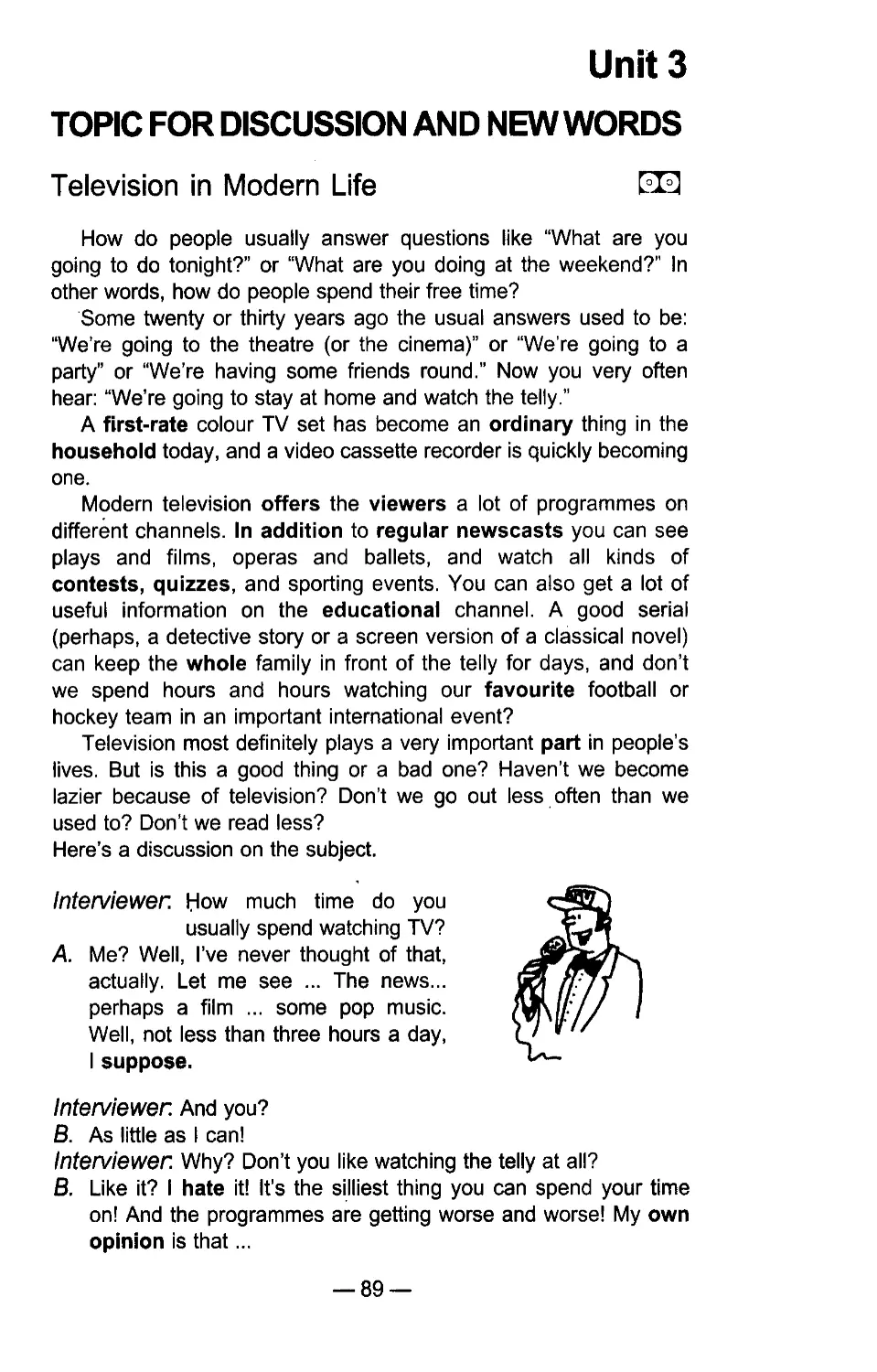
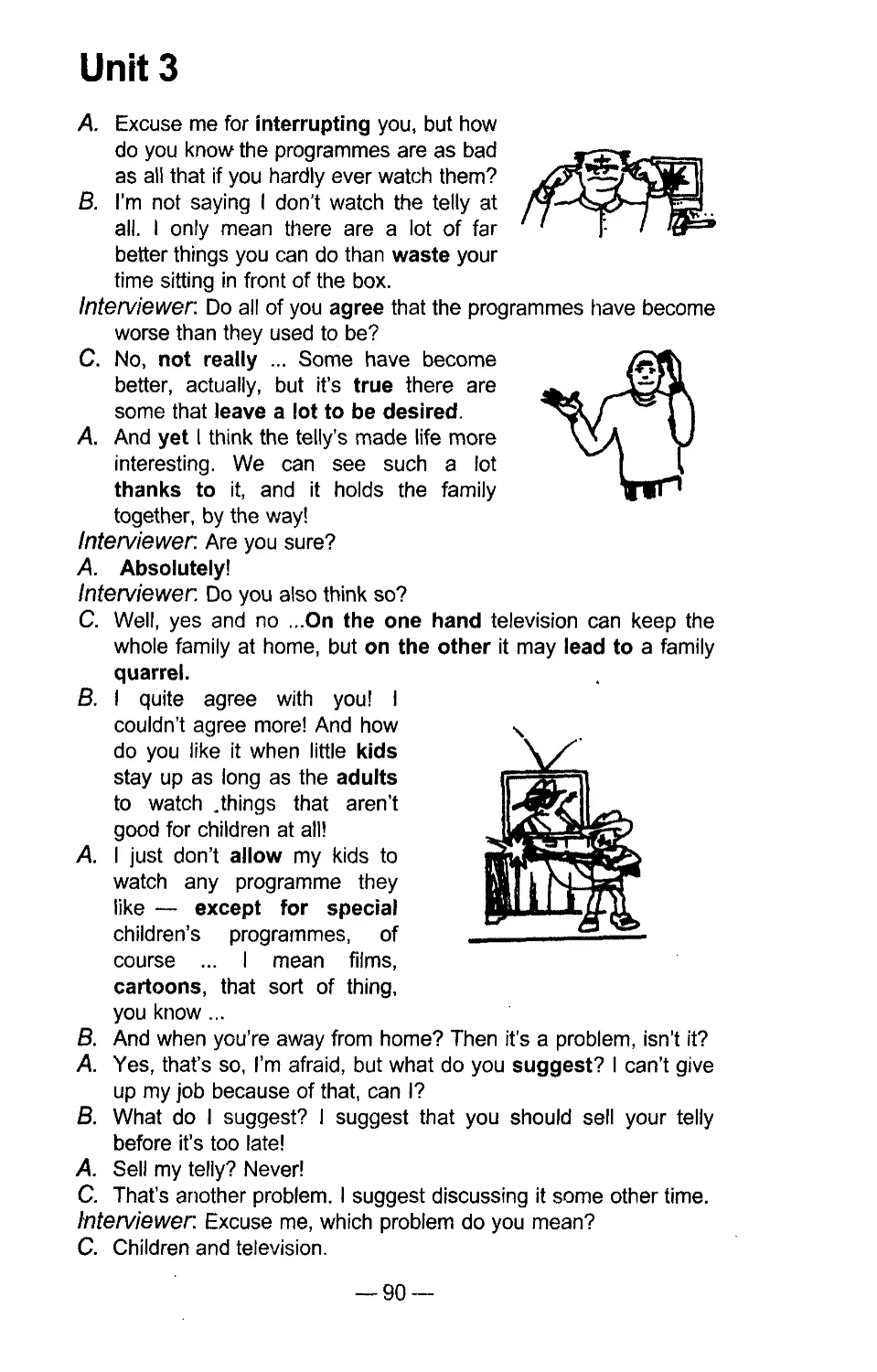
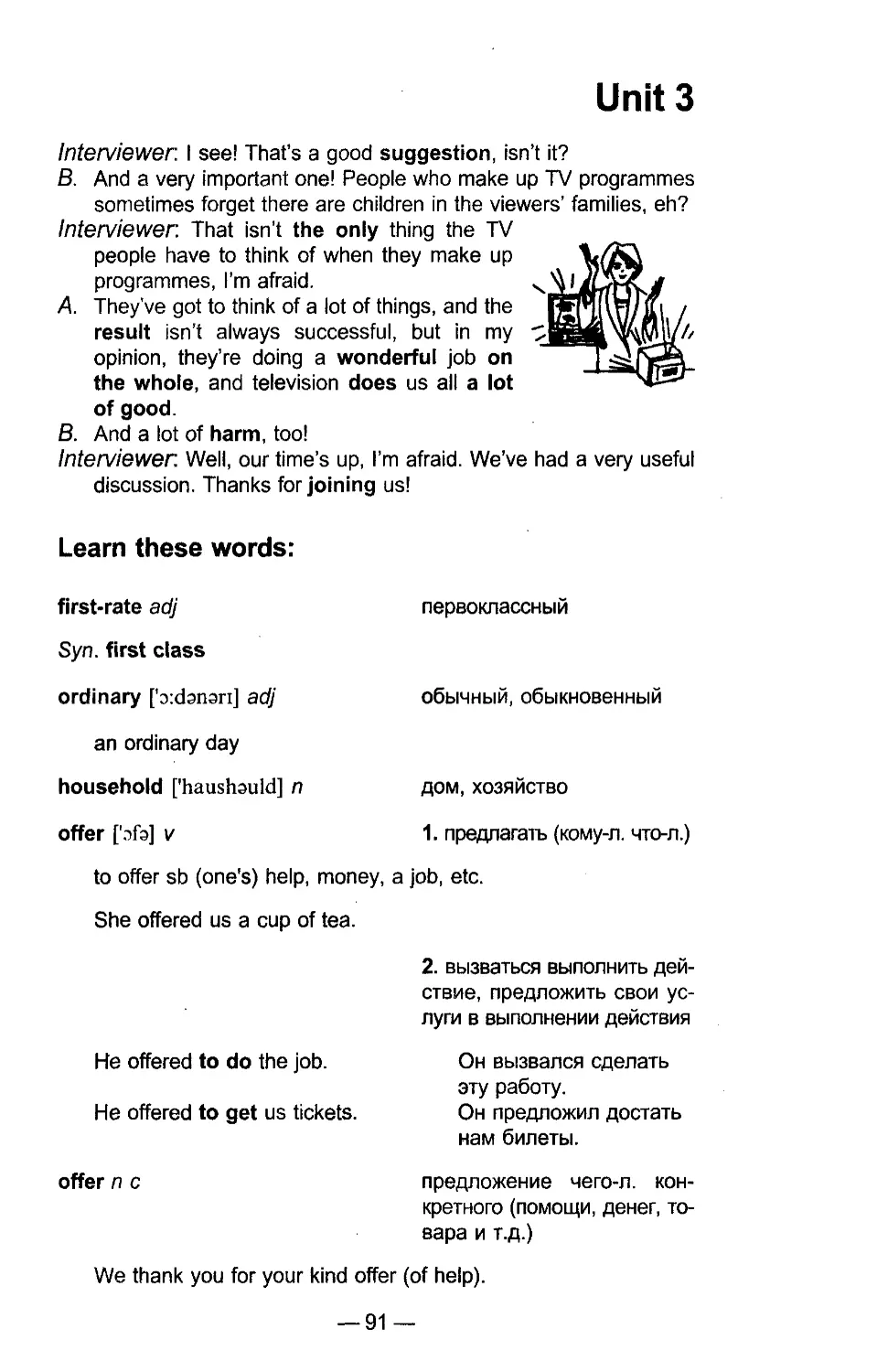


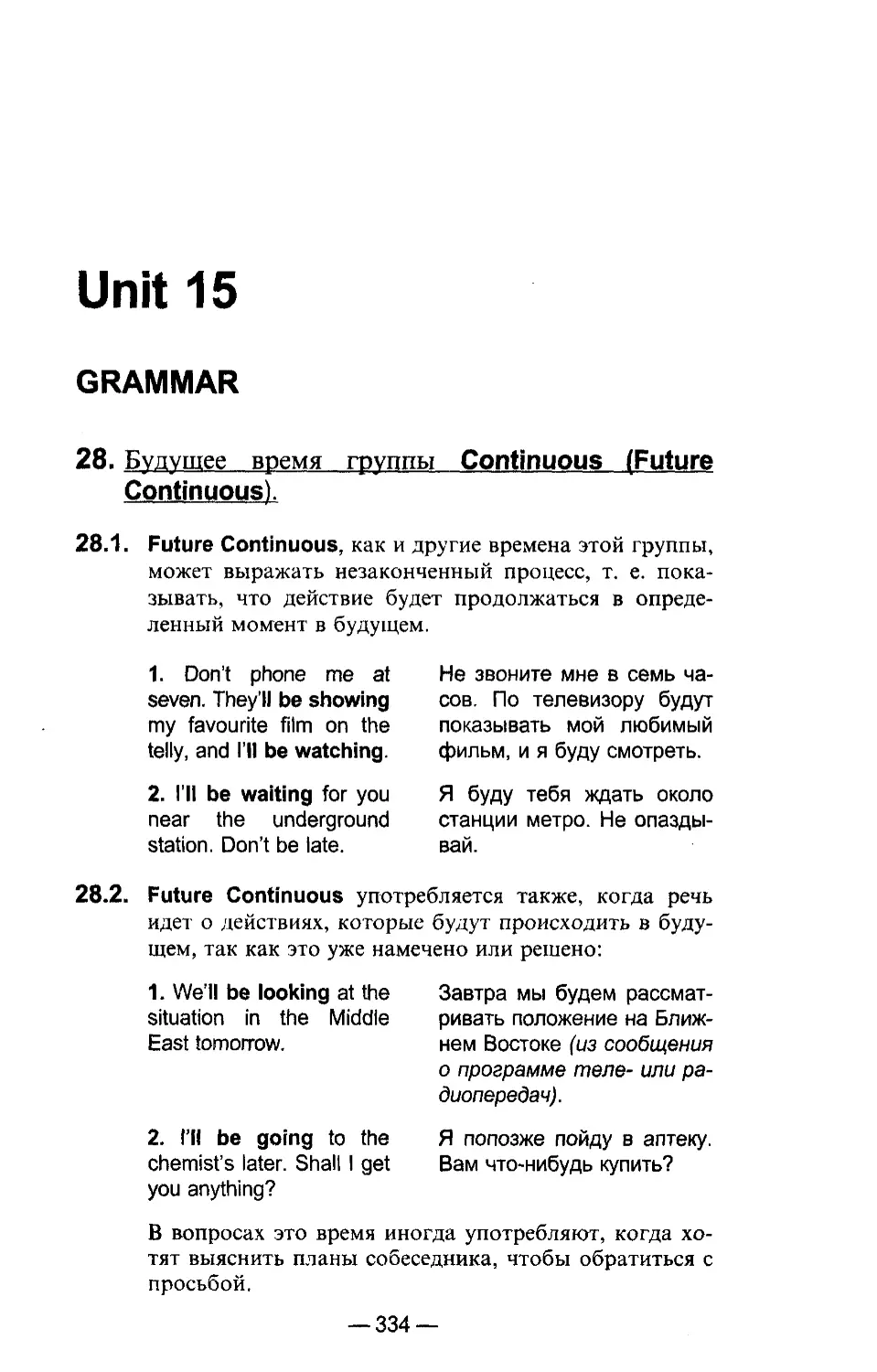
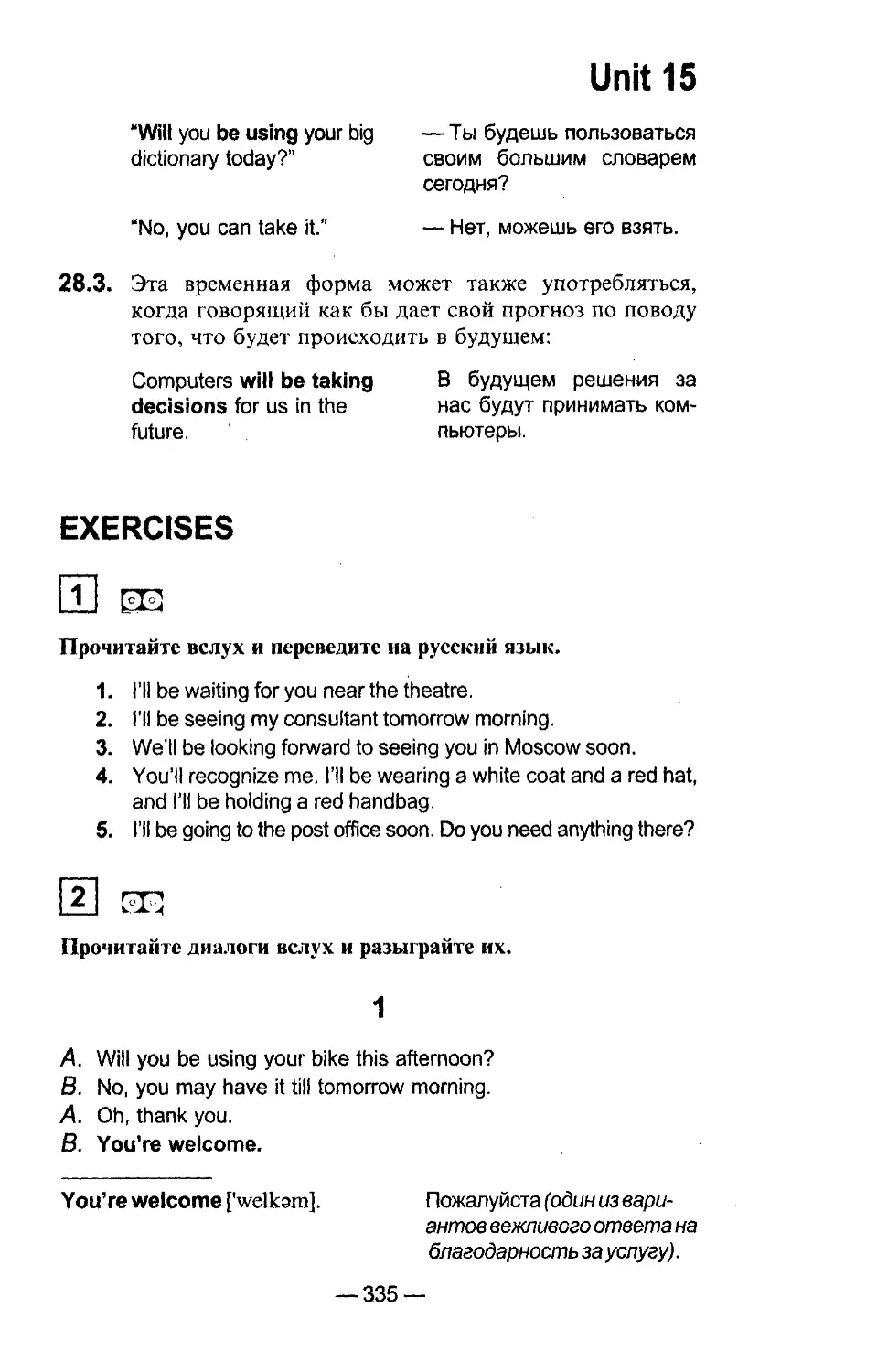
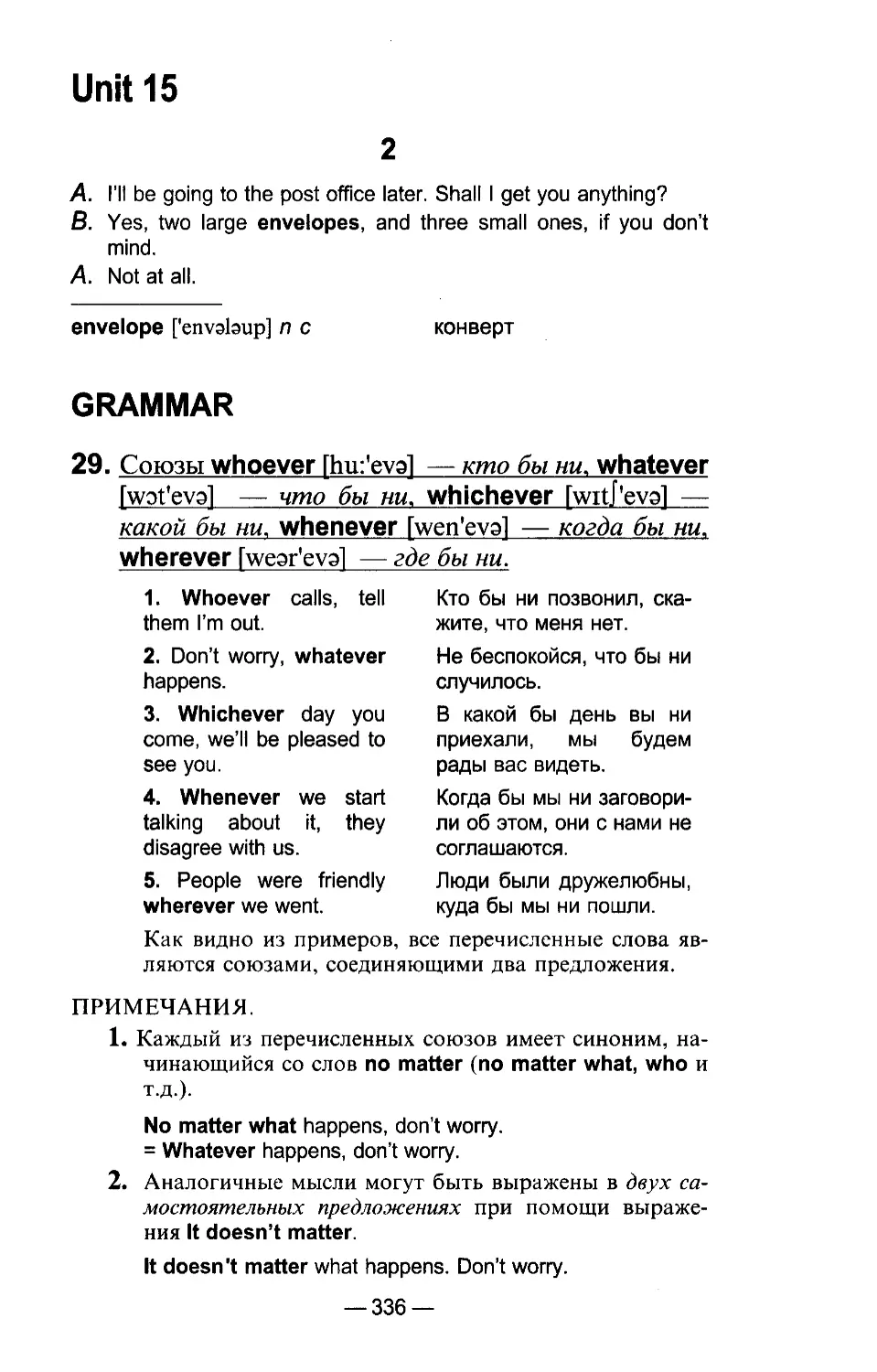
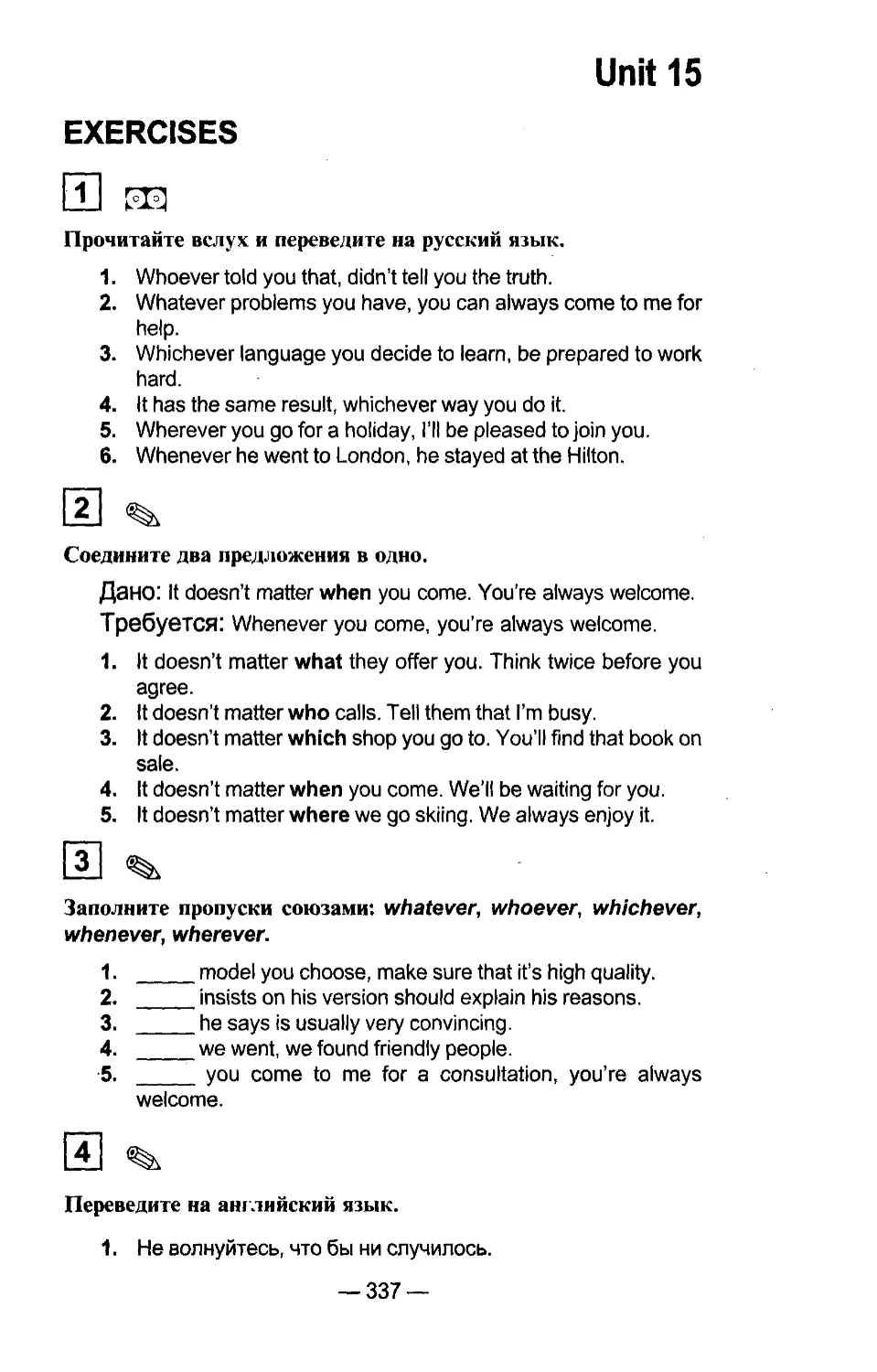







Text
                    Н.А.БОНК
АНГЛИЙСКИЙ
. ШАГ ЗА ШАГОМ
Н.А.БОНК
АНГЛИЙСКИЙ
ШАГ ЗА ШАГОМ
Рекомендован Министерством образования РФ
в качестве учебника для студентов
неязыковых вузов
МОСКВА «РОСМЭН» 2001
ББК81.2 Англ
Б81
•	Продолжение курса для начинающих и тех, кто хочет упо-
рядочить свои знания.
•	Ясные, доходчивые объяснения сложных грамматических
правил.
•	Диалоги — ситуации общения, характерные для современ-
ной жизни.
•	Удобное как для ученика, так и для преподавателя располо-
жение материала: новая информация — упражнения для за-
крепления.
•	Проблемные и познавательные тексты, интересные для об-
суждения.
•	Аудиозаписи, выполненные дикторами из Великобрита-
нии, — тексты, диалоги, новые слова, упражнения (3 кассе-
ты — 4 часа звучания).
Бонк Н. А.
Б81 Английский шаг за шагом: Курс для начинающих.
В 2 т. Т. 2. — М.: ООО«Издательство «Росмэн-
Пресс». — 2001. — 380 с.
Учебник представляет собой вторую часть комплекса «Английский
шаг за шагом». В совокупности с первой частью он охватывает все ос-
новные структуры английского языка и расширяет словарный запас
до 2900 лексических единиц. Текстовой материал содержит много но-
вых тем, характерных для современной жизни. Диалоги отражают наи-
более вероятные ситуации общения. Тексты для обсуждения познава-
тельны или проблемны. Эффективная система упражнений закреп-
ляет навыки разговорной речи.
Учебник может быть использован в высших и средних учебных
заведениях, на курсах, а также для самостоятельного изучения анг-
лийского языка.
ISBN 5-353-00258-х	ББК81.2Англ
© Бонк Н. А., 2001
© Оформление. ООО «Издательство «Росмэн-Пресс », 2001
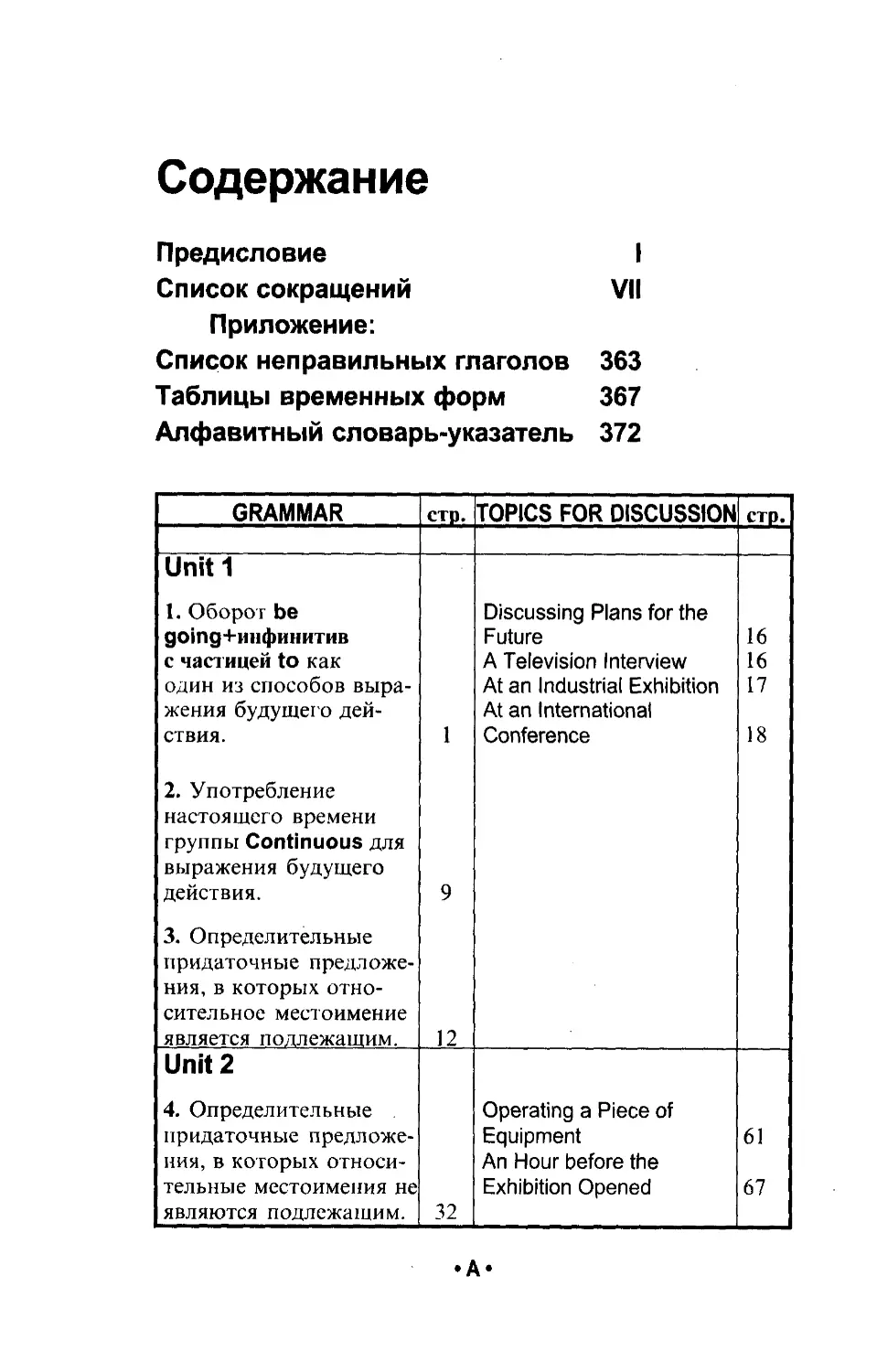
Содержание
Предисловие	I
Список сокращений	VII
Приложение:
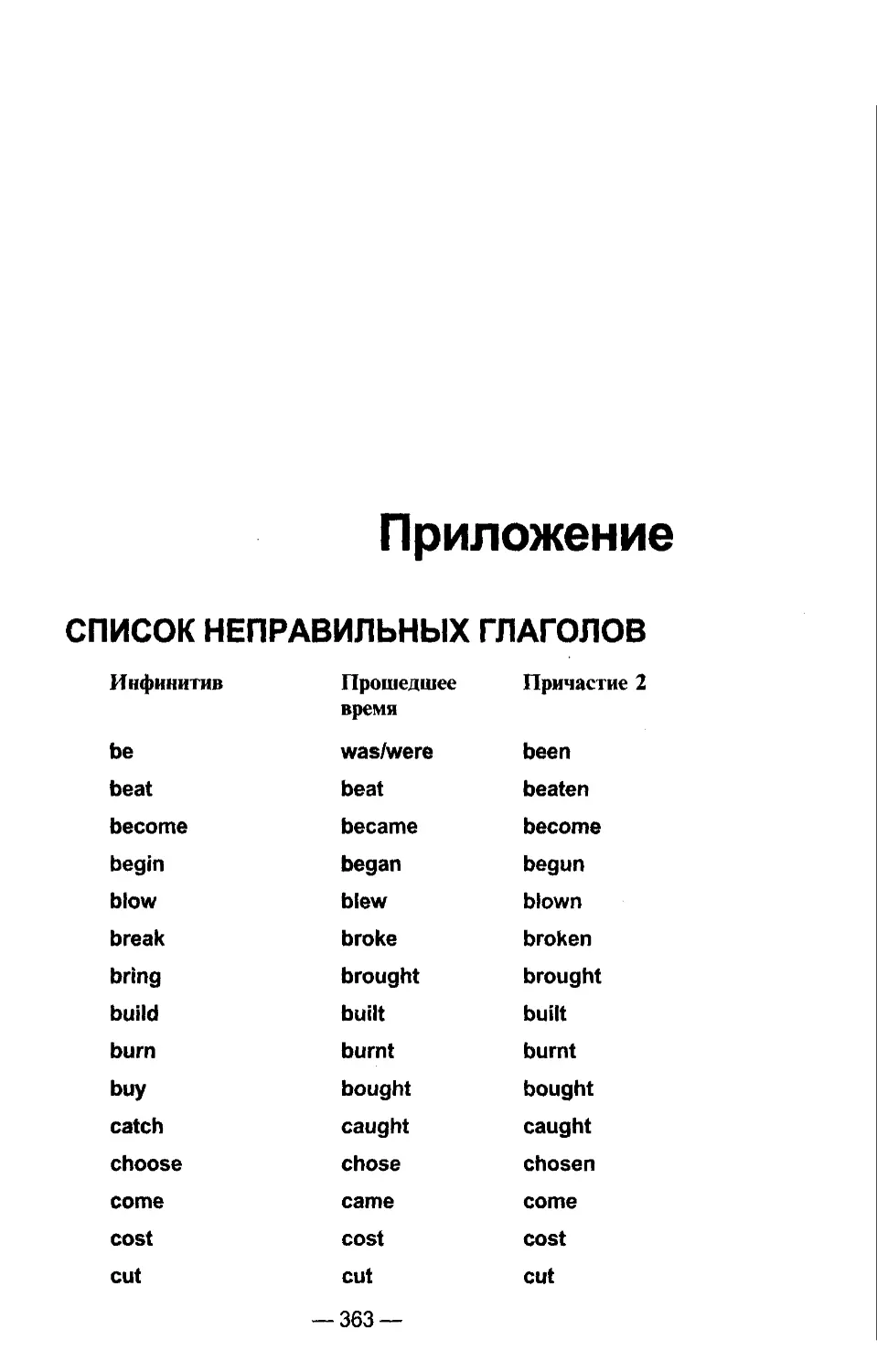
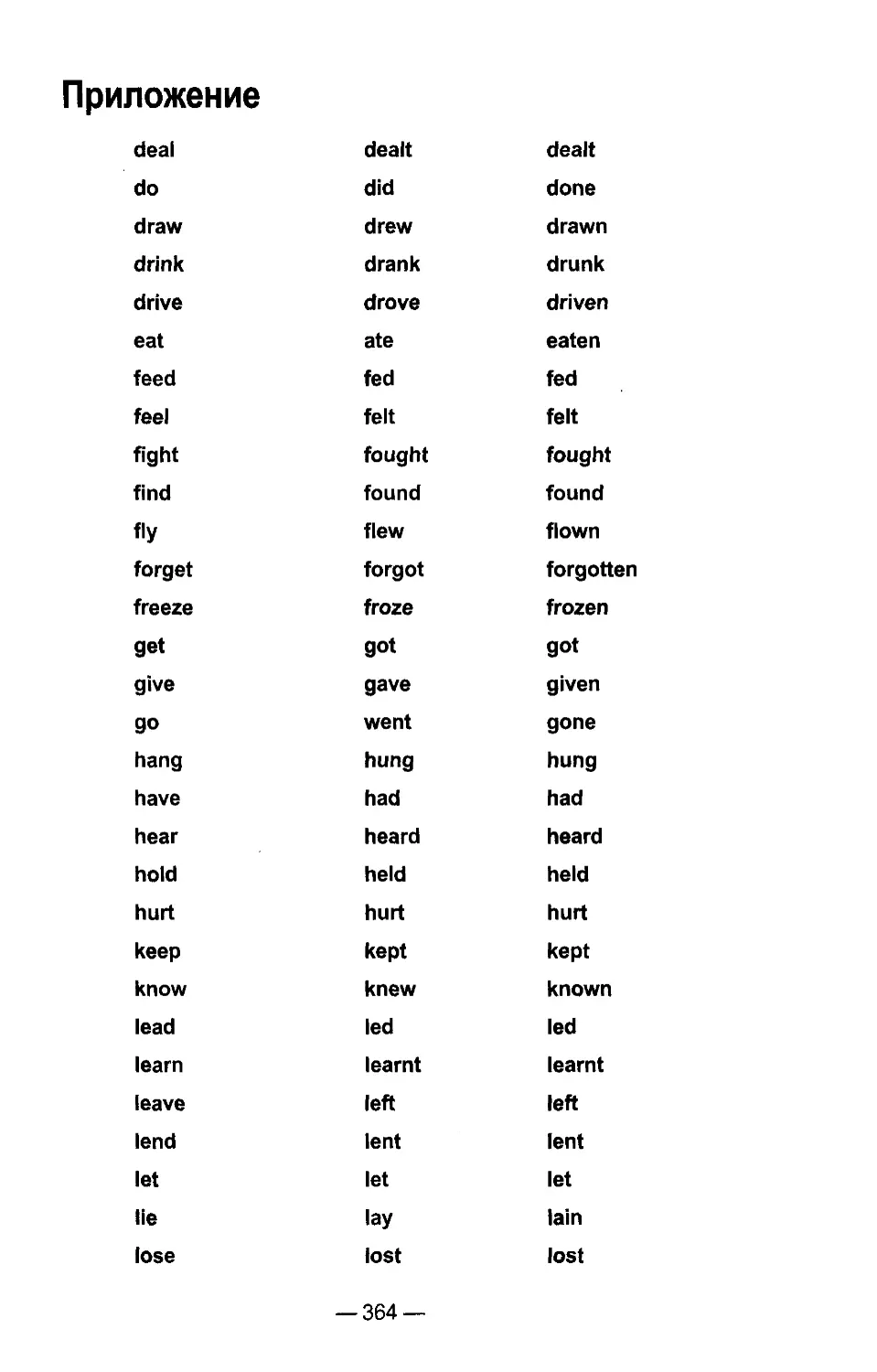
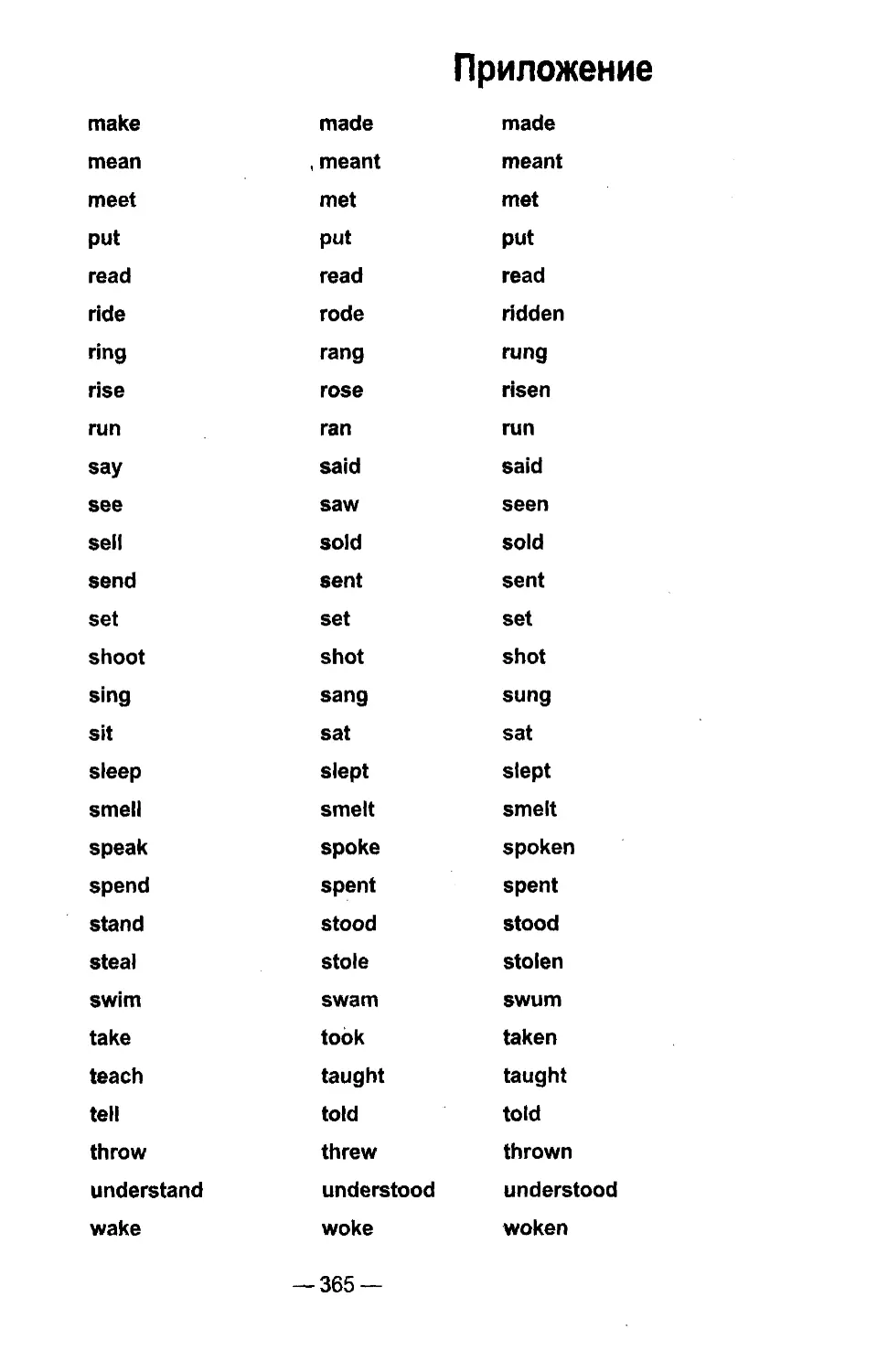
Список неправильных глаголов 363
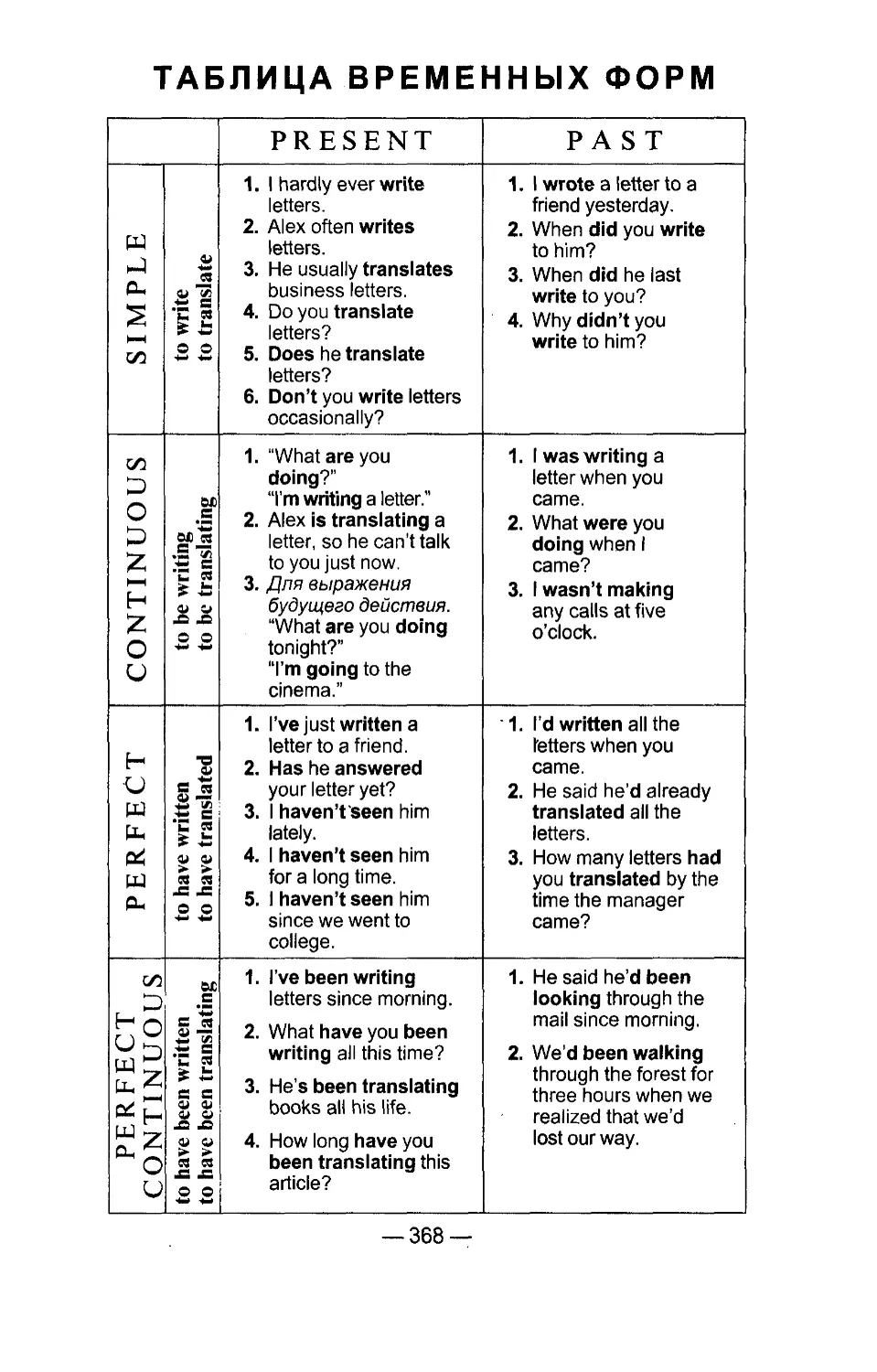
Таблицы временных форм 367
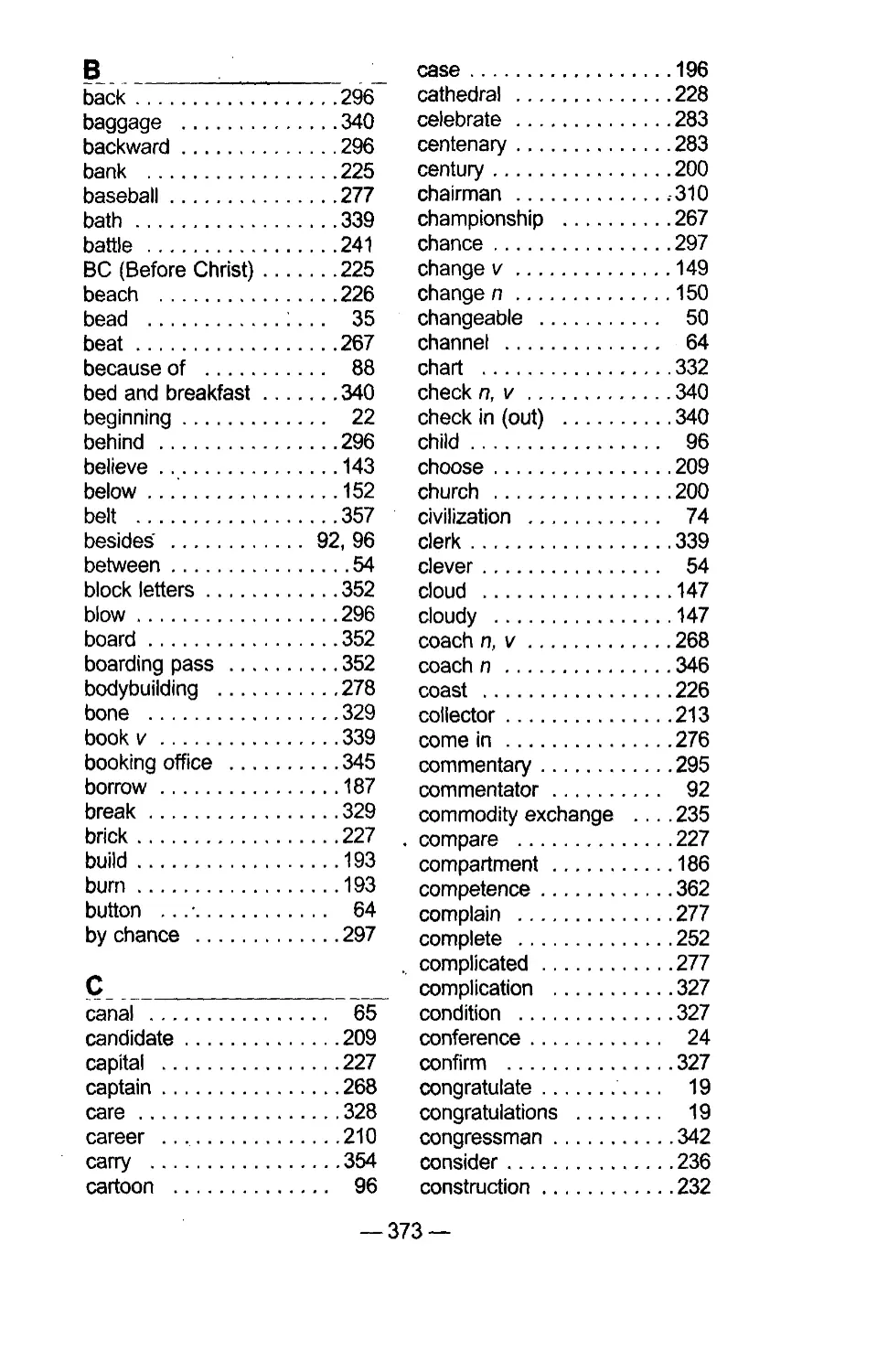
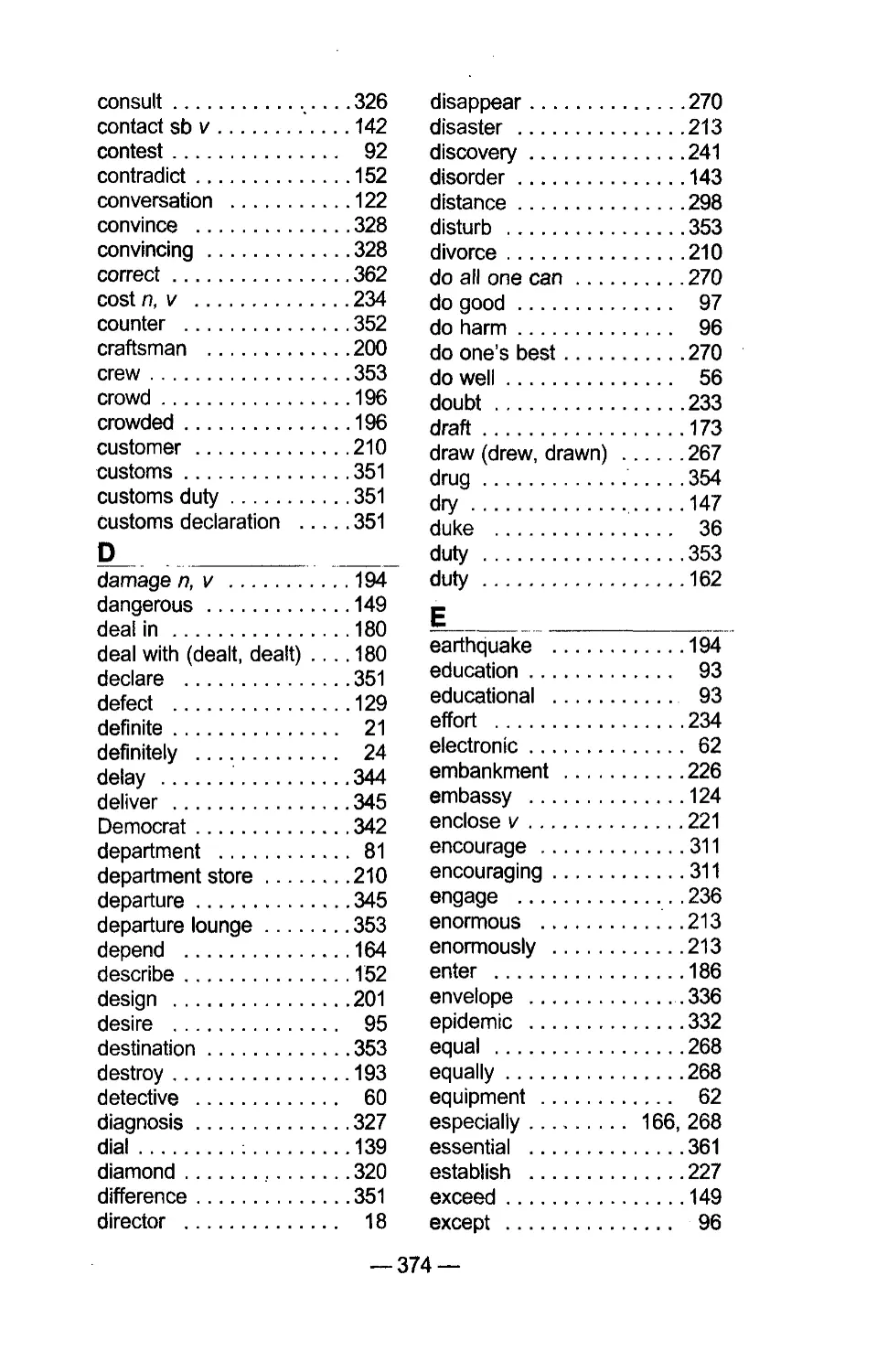
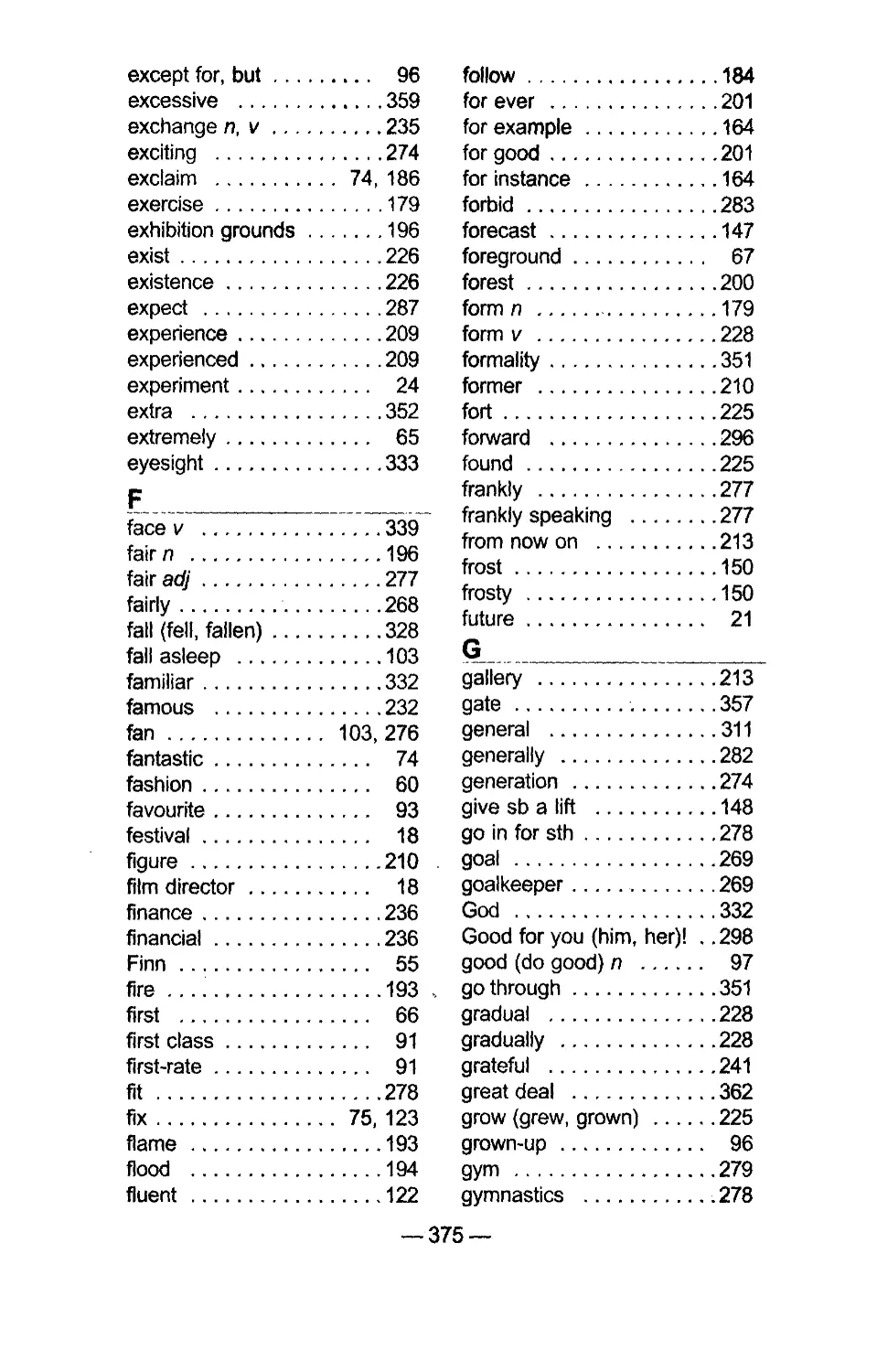
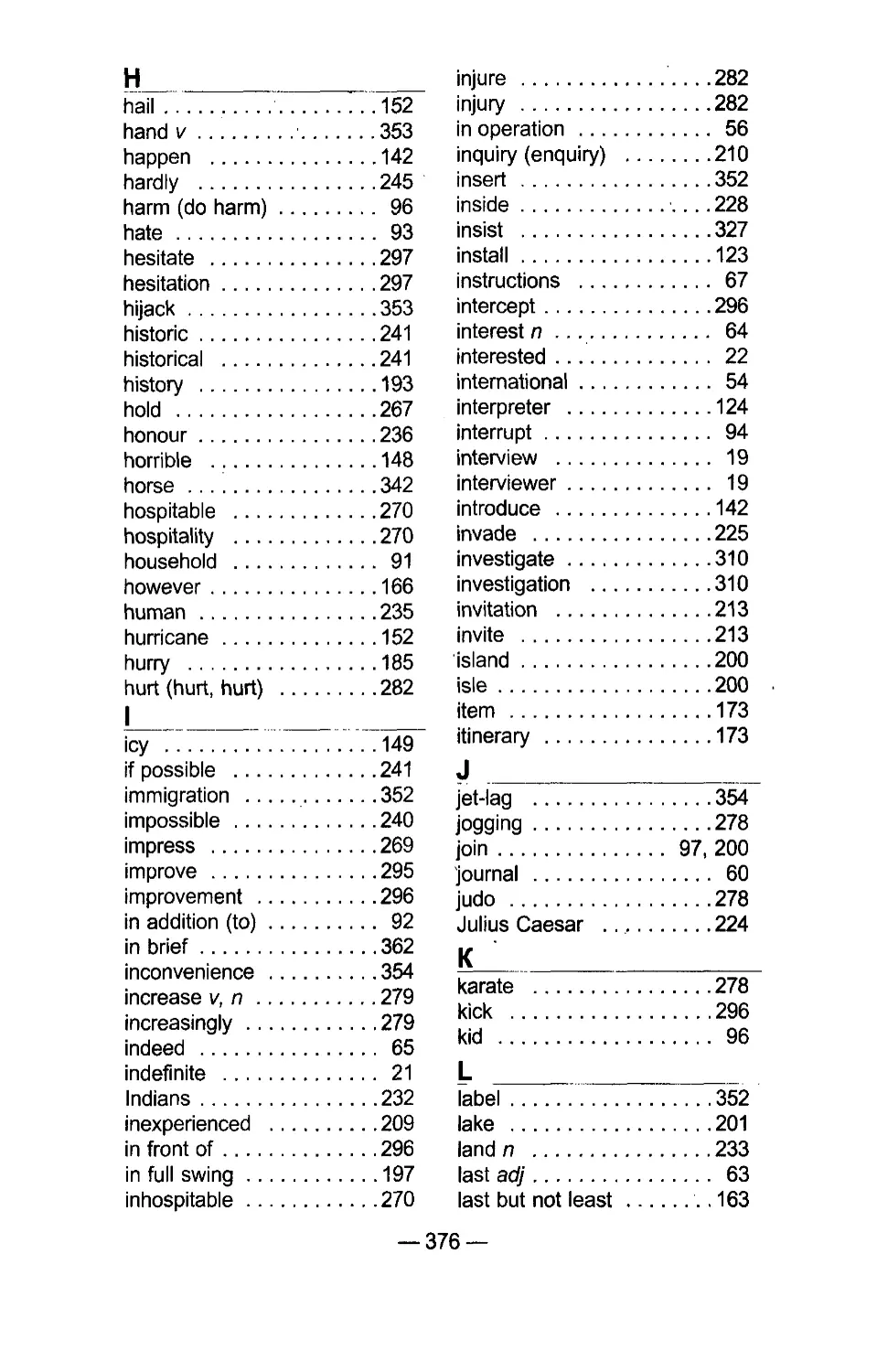
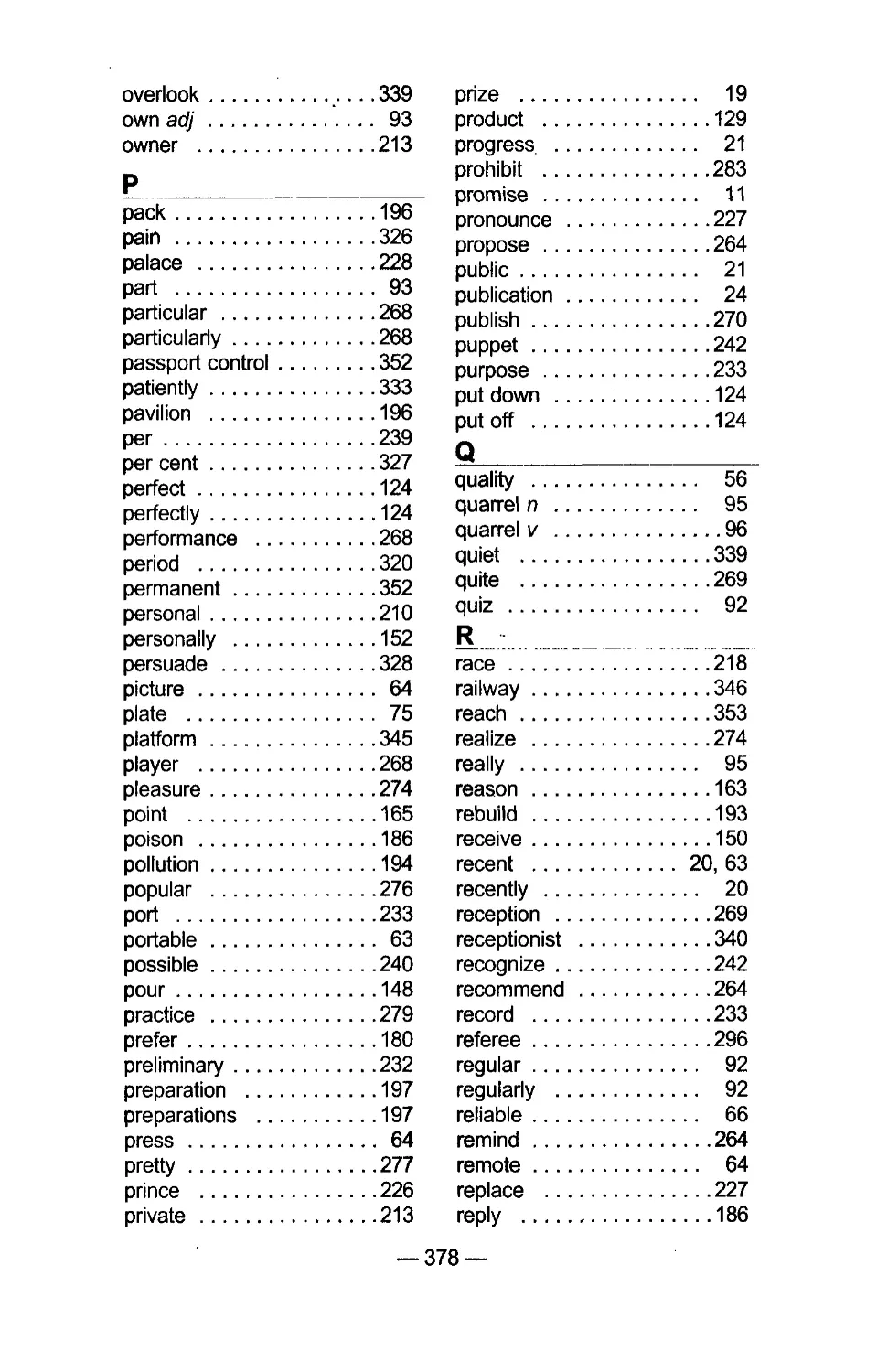
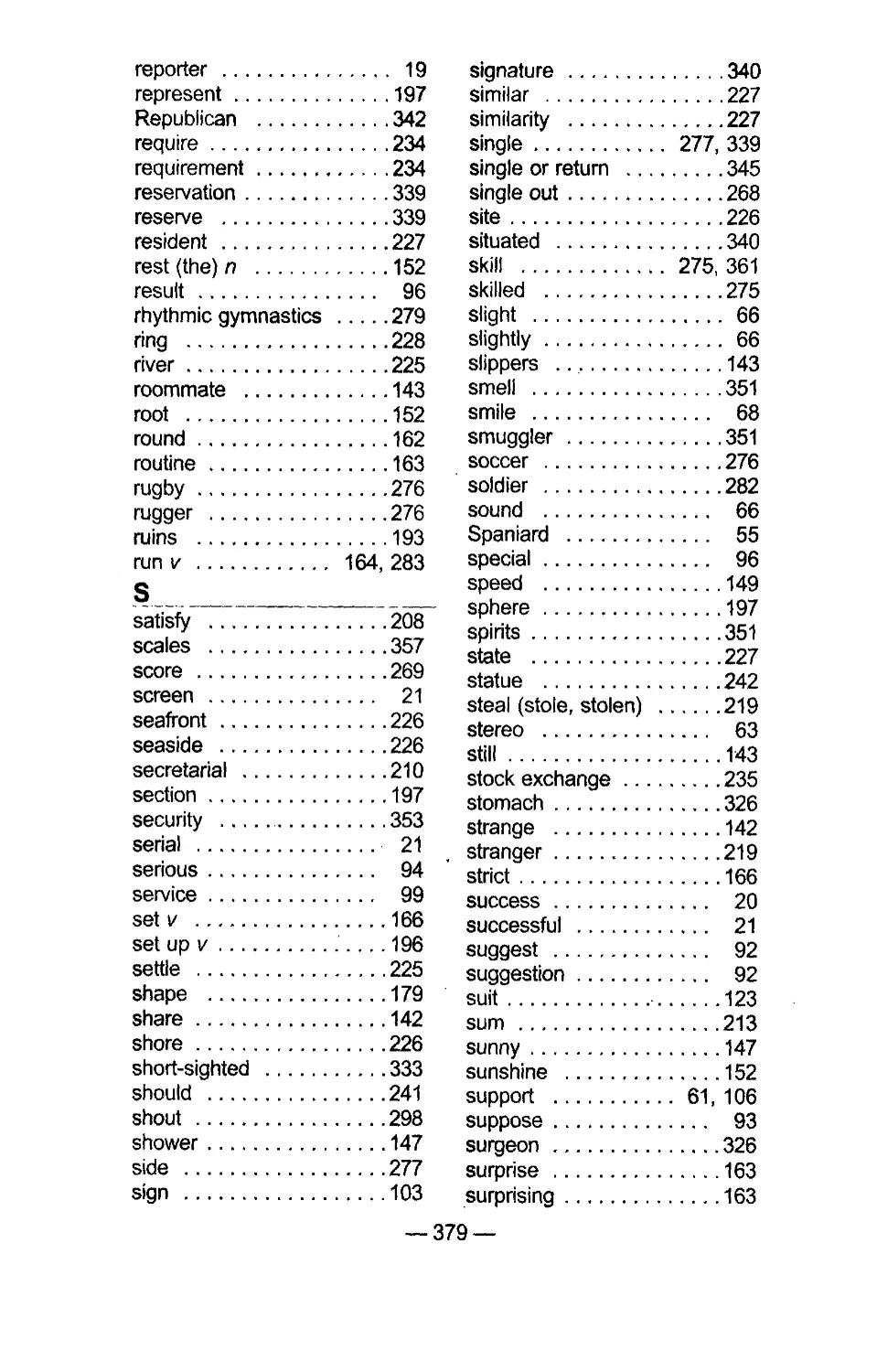
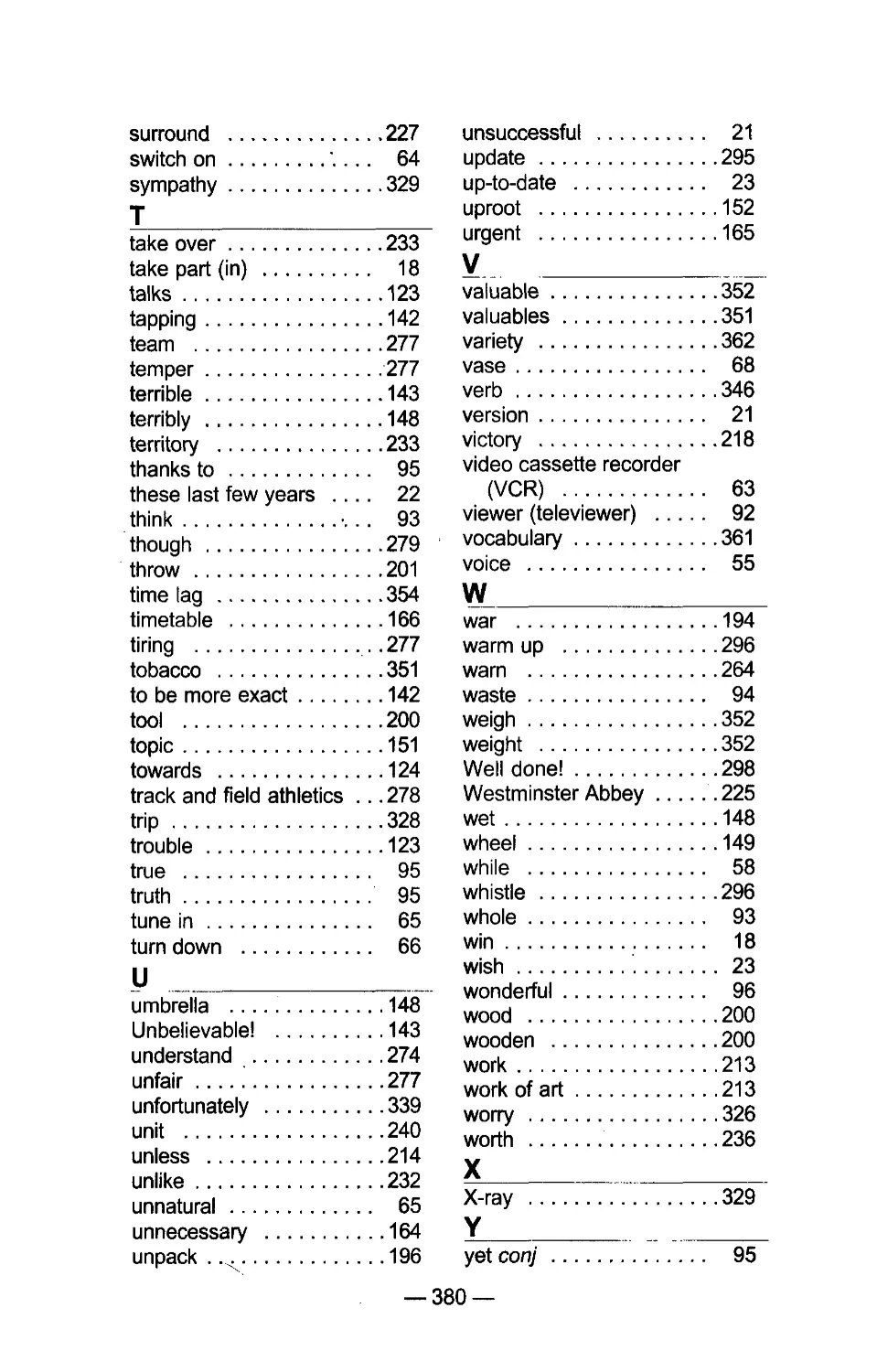
Алфавитный словарь-указатель 372
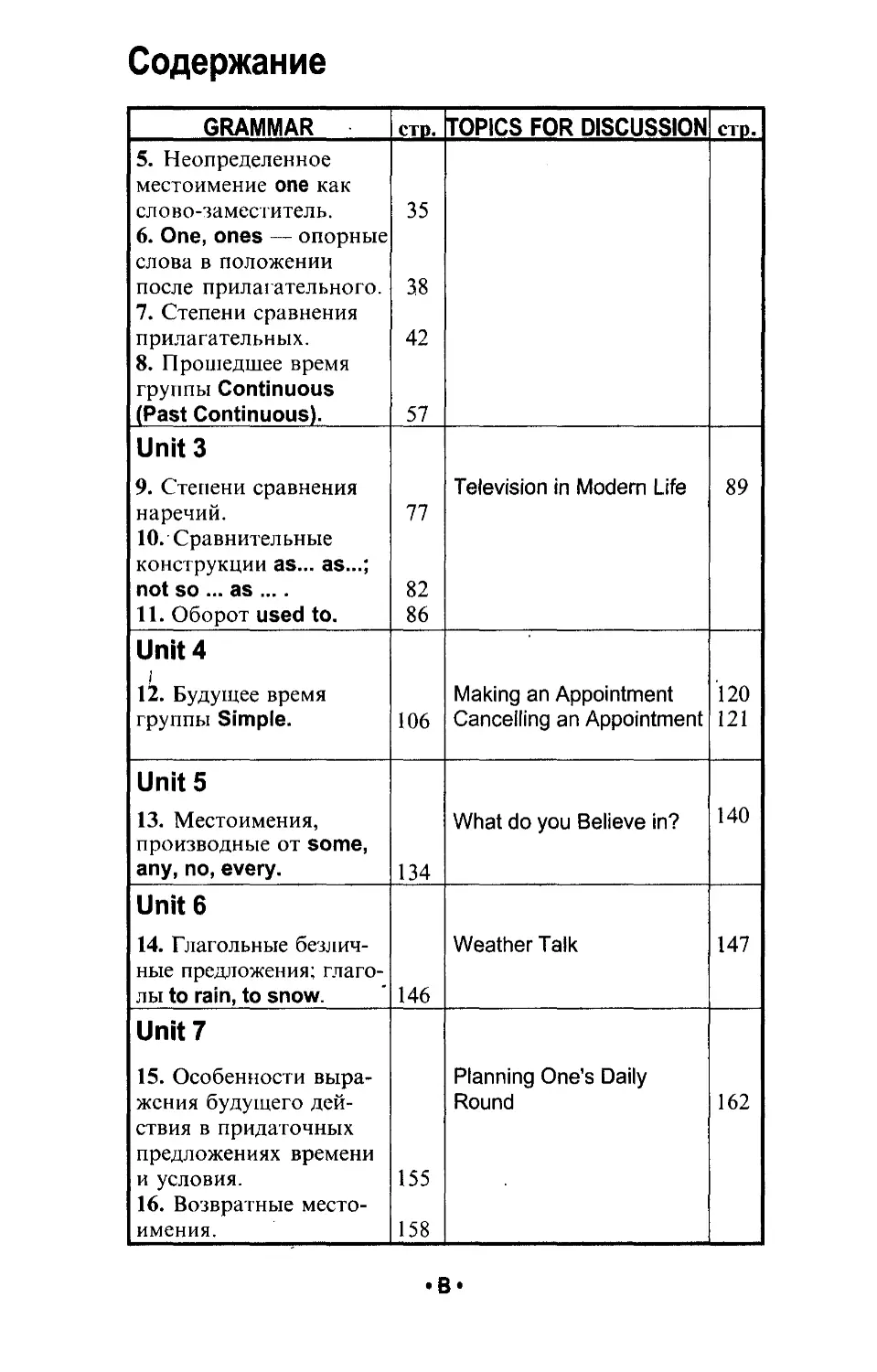
GRAMMAR	стр.	TOPICS FOR DISCUSSION	стр.

Unit 1
1. Оборот be going+инфинитив с част ицей to как один из способов выра- жения будущего дей- ствия.	1	Discussing Plans for the Future A Television Interview At an Industrial Exhibition At an International Conference	16 16 17 18
2. Употребление настоящего времени группы Continuous для выражения будущего действия.	9
3. Определительные придаточные предложе- ния, в которых отно- сительное местоимение является подлежащим.	12
Unit 2
4. Определительные придаточные предложе- ния, в которых относи- тельные местоимения не являются подлежащим.	32	Operating a Piece of Equipment An Hour before the Exhibition Opened	61 67
•А*
Содержание
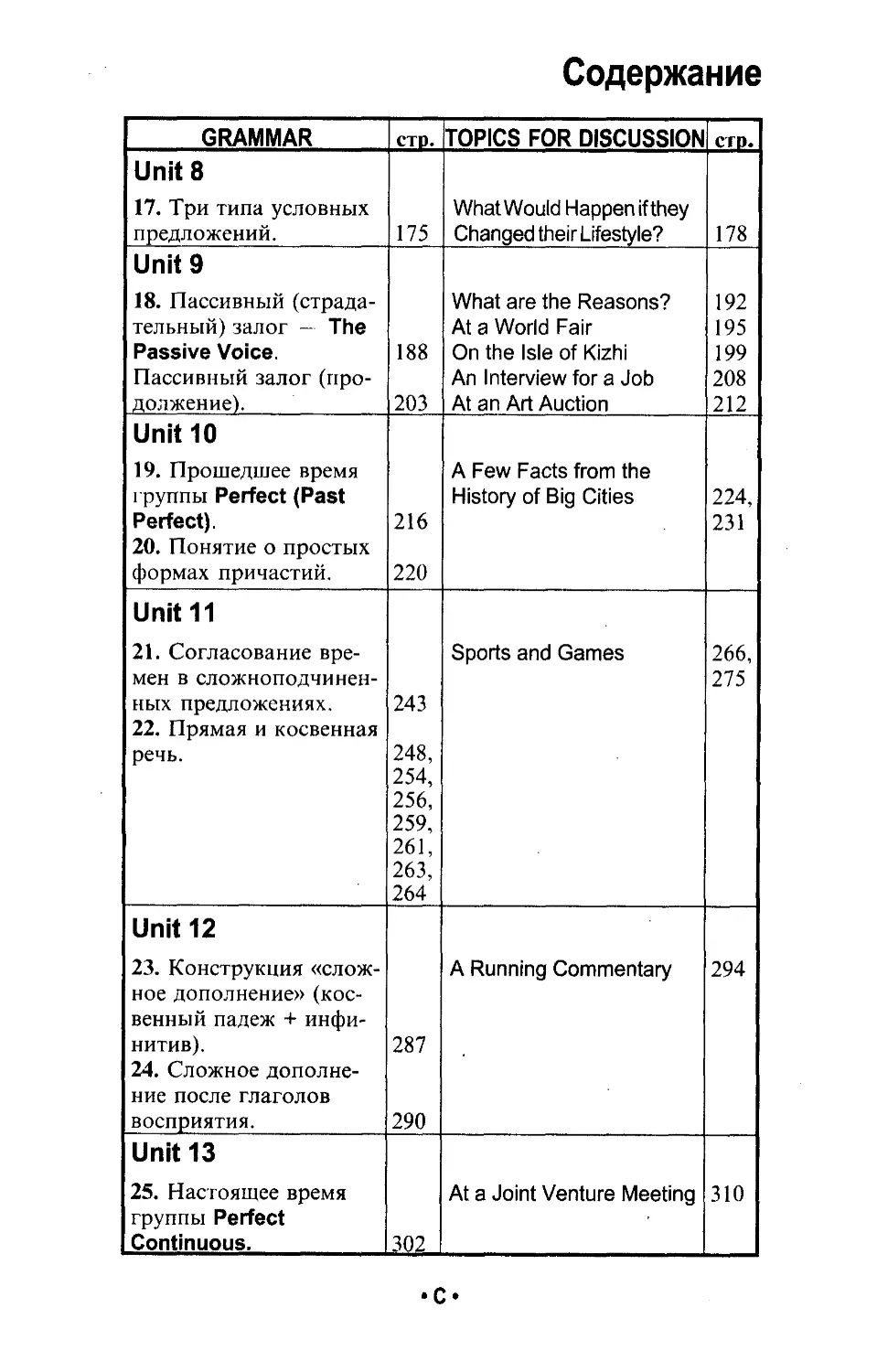
GRAMMAR	стр.	TOPICS FOR DISCUSSION	стр.
5.	Неопределенное местоимение one как слово-заместитель. 6.	One, ones — опорные слова в положении после прилагательного. 7.	Степени сравнения прилагательных. 8.	Прошедшее время группы Continuous (Past Continuous).	35 38 42 57
Unit 3 9.	Степени сравнения наречий. 10.	Сравнительные конструкции as... as...; not so ... as .... 11.	Оборот used to.	77 82 86	Television in Modern Life	89
Unit 4 i 12. Будущее время группы Simple.	106	Making an Appointment Cancelling an Appointment	120 121
Unit5 13. Местоимения, производные от some, any, no, every.	134	What do you Believe in?	140
Unite 14. Глагольные безлич- ные предложения; глаго- лы to rain, to snow.	146	Weather Talk	147
Unit 7 15. Особенности выра- жения будущего дей- ствия в придаточных предложениях времени и условия. 16. Возвратные место- имения.	155 158	Planning One's Daily Round	162
• в*
Содержание
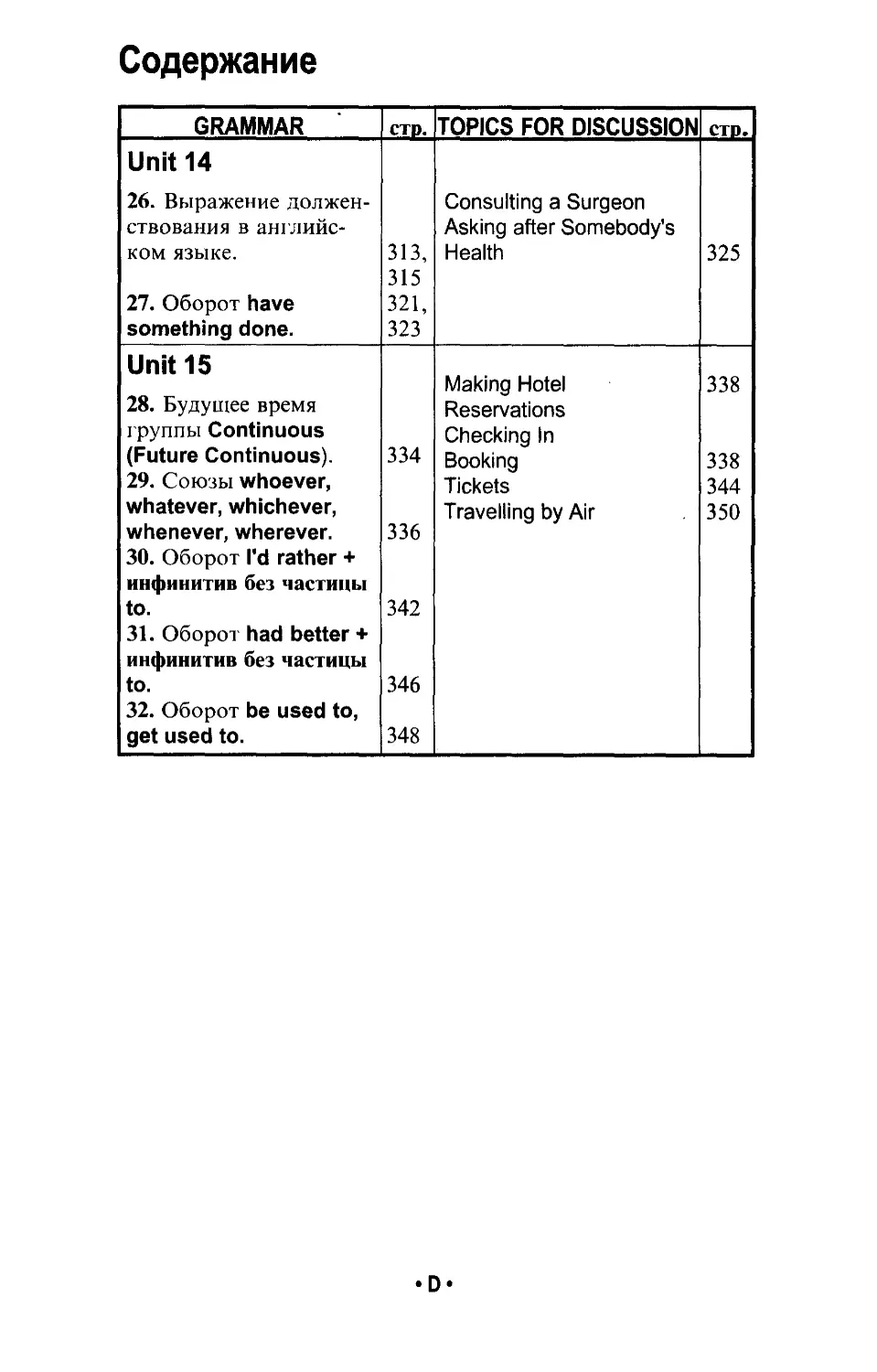
GRAMMAR	стр.	TOPICS FOR DISCUSSION	стр.
Unit 8 17. Три типа условных предложений.	175	What Would Happen if they Changed their Lifestyle?	178
Unit 9 18. Пассивный (страда- тельный) залог — The Passive Voice. Пассивный залог (про- должение).	188 203	What are the Reasons? At a World Fair On the Isle of Kizhi An Interview for a Job At an Art Auction	192 195 199 208 212
Unit 10 19. Прошедшее время группы Perfect (Past Perfect). 20. Понятие о простых формах причастий.	216 220	A Few Facts from the History of Big Cities	224, 231
Unit 11 21. Согласование вре- мен в сложноподчинен- ных предложениях. 22. Прямая и косвенная речь.	243 248, 254, 256, 259, 261, 263, 264	Sports and Games	266, 275
Unit 12 23. Конструкция «слож- ное дополнение» (кос- венный падеж + инфи- нитив). 24. Сложное дополне- ние после глаголов восприятия.	287 290	A Running Commentary	294
Unit 13 25. Настоящее время группы Perfect Continuous.	302	At a Joint Venture Meeting	310
• с»
Содержание
GRAMMAR	CTD.	TOPICS FOR DISCUSSION	CTD.
Unit 14
26. Выражение должен-		Consulting a Surgeon
ствования в английс-		Asking after Somebody's
ком языке.	313,	Health	325
	315
27. Оборот have	321,
something done.	323
Unit 15
		Making Hotel	338
28. Будущее время		Reservations
группы Continuous		Checking In
(Future Continuous).	334	Booking	338
29. Союзы whoever,		Tickets	344
whatever, whichever, whenever, wherever. 30. Оборот I'd rather + инфинитив без частицы	336	Travelling by Air	350


to.	342
31. Оборот had better + инфинитив без частицы to.	346
32. Оборот be used to, get used to.	348
•D*
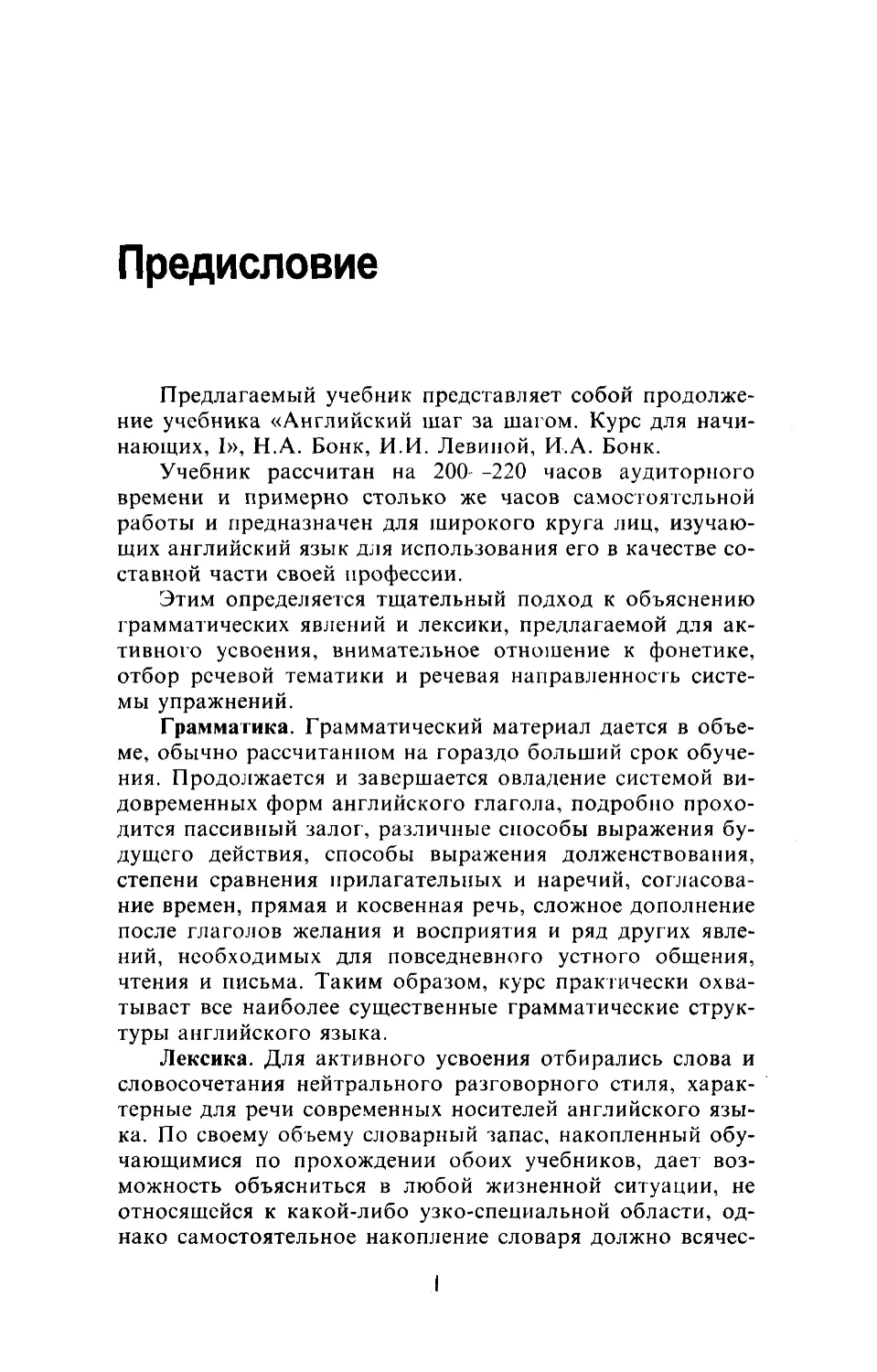
Предисловие
Предлагаемый учебник представляет собой продолже-
ние учебника «Английский шаг за шагом. Курс для начи-
нающих, I», Н.А. Бонк, И.И. Левиной, И.А. Бонк.
Учебник рассчитан на 200- -220 часов аудиторного
времени и примерно столько же часов самостоятельной
работы и предназначен для широкого круга лиц, изучаю-
щих английский язык для использования его в качестве со-
ставной части своей профессии.
Этим определяется тщательный подход к объяснению
грамматических явлений и лексики, предлагаемой для ак-
тивного усвоения, внимательное отношение к фонетике,
отбор речевой тематики и речевая направленность систе-
мы упражнений.
Грамматика. Грамматический материал дается в объе-
ме, обычно рассчитанном на гораздо больший срок обуче-
ния. Продолжается и завершается овладение системой ви-
довременных форм английского глагола, подробно прохо-
дится пассивный залог, различные способы выражения бу-
дущего действия, способы выражения долженствования,
степени сравнения прилагательных и наречий, согласова-
ние времен, прямая и косвенная речь, сложное дополнение
после глаголов желания и восприятия и ряд других явле-
ний, необходимых для повседневного устного общения,
чтения и письма. Таким образом, курс практически охва-
тывает все наиболее существенные грамматические струк-
туры английского языка.
Лексика. Для активного усвоения отбирались слова и
словосочетания нейтрального разговорного стиля, харак-
терные для речи современных носителей английского язы-
ка. По своему объему словарный запас, накопленный обу-
чающимися по прохождении обоих учебников, дает воз-
можность объясниться в любой жизненной ситуации, не
относящейся к какой-либо узко-специальной области, од-
нако самостоятельное накопление словаря должно всячес-
Предисловие
ки поощряться при условии, что новая единица восприня-
та адекватно в'соответствующих границах употребления.
Иначе говоря, на этой стадии обучающийся должен при-
учиться пользоваться словарями, как двуязычными, так и
толковыми, если они имеются в его распоряжении. По-
скольку, скорее всего, будет иметься возможность рабо-
тать с отечественными словарями, в учебнике использует-
ся транскрипция, принятая в этих изданиях.
Среди лексических единиц особое место занимают
формулы речи, необходимые в деловом и повседневном
общении при ведении дискуссии, обмене впечатлениями и
т.п.
Структура учебника и рекомендации по работе с ним.
Для удобства работы с учебником материал располо-
жен линейно, то есть в той последовательности, которая
наиболее целесообразна для его прохождения.
Новые грамматические явления в совокупности с рече-
вой темой или ситуацией общения объединяются в урок-
комплекс — UNIT.
Под темой автор имеет в виду те сферы жизни совре-
менного человека, по поводу которых может возникнуть
желание что-либо рассказать или обсудить, чем-либо по-
делиться, выразить свое мнение, поспорить.
В качестве примеров можно привести такие темы, как
планы на будущее, роль телевидения в жизни современно-
го человека, значение планирования в организации рабо-
чего дня, спорт в современной жизни и т.п.
Высказывания по поводу таких тем или проблем отли-
чаются разнообразием и носят непредсказуемый характер,
в них проявляется речевое творчество говорящего, и они
не могут быть поэтому втиснуты в рамки готовых штам-
пов. Речевое же общение при знакомстве, встрече, проща-
нии, необходимости извиниться, спросить дорогу и т.п.
носит совершенно иной характер по цели, содержанию,
эмоциональной окраске. Это не речевая тема, а скорее си-
туация общения, в которой речь чаще всего укладывается
в рамки принятых клише, соответствующего речевого эти-
кета. Здесь возможно известное разнообразие форм, кото-
рые надо понимать, но не обязательно использовать в сво-
ей речи во всем многообразии, ибо и на родном языке че-
ловек, как правило, не пользуется всей палитрой извине-
ний, приветствий и т.п., а избирает одну-две формы по
своему вкусу.
Для общения на иностранном языке такие формы дол-
жны быть рекомендованы и выучены, но речевого творче-
II
Предисловие
ства здесь не потребуется. Эта разница между темой и си-
туацией общения и предопределяет различный характер
системы упражнений для того или иного учебного текста.
Между грамматической и лексической частью урока-
комплекса нет резкой грани, так как и грамматика, и лек-
сика рассматриваются как средства решения рече-мысли-
тельных проблем, т. е. по существу решают одну методи-
ческую задачу. Поэтому в разделе GRAMMAR имеются
тексты как диалогического, так и монологического харак-
тера, которые содержат новую лексику, подлежащую ак-
тивному усвоению, и служат базой для речевой работы
уже на этапе закрепления новой грамматики. Этот сравни-
тельно короткий текстовой материал, не содержащий мно-
го новых слов, чередуется с тематическими текстами раз-
дела TOPICS FOR DISCUSSION AND NEW WORDS, го-
раздо большими по объему и вводящими обильный новый
вокабуляр. Главная цель этого раздела —  накопление сло-
варя и создание базы для серьезных речевых упражнений.
Как показала практика, такой плавный переход грам-
матического раздела в лексический является более гибким
и удобным, чем жесткое деление материала на граммати-
ческий, не содержащий новой лексики, и лексический.
Предлагаемая система овладения иностранным язы-
ком исходит из того, что, обучая взрослого человека, мы
имеем дело со зрелым носителем родного (в данном слу-
чае русского) языка, свободно пользующимся средствами
этого языка как при устном общении, так и во всех других
случаях, когда решение возникшей проблемной ситуации
возможно только при помощи речи.
Задача, следовательно, заключается в том, чтобы ов-
ладеть новым кодом (средствами изучаемого языка) для ре-
шения того же круга проблем, которые человек решает в
повседневной жизни с опорой на родной язык.
В условиях обучения многоязычной аудитории спо-
собность взрослого человека свободно пользоваться род-
ным языком вряд ли может быть существенным подспорь-
ем в преподавании иностранного языка. Однако при обу-
чении аудитории одноязычной пренебречь возможностью
опоры на родной язык значило бы упустить возможность
огромной экономии времени и усилий и, следовательно,
значительной интенсификации учебного процесса. Опора
на родной язык отнюдь не предполагает переложения од-
ного языка на другой, перенесения норм родного языка
на язык иностранный или неизбежности опосредования
родным языком иностранного языка для выражения мыс-
111
Предисловие
ли. Речь идет об использовании весьма эффективной воз-
можности осмыслить способы решения рече-мыслитель-
ных проблем средствами иностранного языка, прибегая и
к аналогиям, и к противопоставлениям, и к предупрежде-
ниям возможных недоразумений, вызванных интерферен-
цией родного языка. Попутно хотелось бы заметить, что
профилактика ошибок и система тренировки, направлен-
ная на то, чтобы обучающийся испытывал интерес и ува-
жение к нормам чужого языка и получал удовольствие от
того, что он овладевает этими нормами и говорит именно
то, что хочет сказать, гораздо экономичнее и эффектив-
нее, чем бесконечная, мучительная коррекция устоявших-
ся ложных представлений и неправильных навыков.
Уместно было бы вспомнить, что грамотное владение
иностранным языком и хорошее произношение традици-
оннно считались в России престижными, и в отечествен-
ной методике немало было сделано для разработки спосо-
бов достижения этих целей.
Система упражнений.
Освоение средств изучаемого языка, будь то грамма-
тическая структура, слово или словосочетание начинается
с обильной иллюстрации уже на этапе введения.
В грамматике это примеры, иллюстрирующие прави-
ло, в словаре — примеры, дающие представление об осо-
бенностях и границах употребления слова.
В системе упражнений эта иллюстрация значительно
расширяется специальными упражнениями (см. упр. 1 с. 5,
упр. 3 с. 25), построенными на отдельных предложениях.
Работая над отдельными предложениями, следует
иметь в виду, что они могут быть более ситуативными,
чем длинные диалоги или связные тексты, поэтому эффек-
тивность упражнения повысится, если мобилизовать свое
воображение и представить себе, где и когда эту фразу
можно употребить или услышать. При выполнении этого
условия будет как произвольно, так и непроизвольно про-
исходить отбор и накопление того, что войдет в языковый
арсенал обучающегося, причем отбор этот будет опреде-
ляться не только типичностью и необходимостью фразы,
но и личными склонностями говорящего.
Работая над диалогами, на этом этапе можно вполне
рассчитывать на то, что они с легкостью будут выучены
наизусть, однако на точном их воспроизведении настаи-
вать не следует, надо лишь следить за грамотностью и
адекватностью реплик и естественностью общения. Над
IV
Предисловие
диалогами удобнее всего работать, разбив группу на
пары. Если в группе нечетное число обучающихся, препо-
давателю следует по очереди разыгрывать диалог с каж-
дым, ибо в игре всегда хорошо иметь более сильного парт-
нера, к тому же именно такое соотношение сил будет и в
реальном общении с естественным носителем языка, и
обучающегося надо к этому подготовить.
Аналогичную рекомендацию можно дать и в отноше-
нии разыгрывания эпизодов по заданному сценарию (см.
напр.,упр. 9 с. 29). Эта игра иногда носит характер поли-
лога, причем задание легко модифицировать так, чтобы в
игре участвовала вся группа. Надо дать участникам воз-
можность продумать игру и свою роль в ней, обсудить все
соображения предварительно (разумеется, на английском
языке) с тем, чтобы в процессе самой игры они имели ши-
рокую возможность импровизации.
Среди упражнений, помогающих овладеть речевыми
функциями (согласие, возражение, извинение, приглаше-
ние и т.п.) можно указать выбор подходящей ответной
реплики с последующим развитием мысли (см. напр.,
упр.7 с.28).
Несмотря на то что в системе упражнений довольно
большое место занимают тренировочные и предречевые
виды работы, обеспечение обильной речевой практики на
уроке легко достижимо. Речевая работа обеспечивается
отбором тематики, стимулирующей дискуссию, обильным
диалогическим материалом, подкрепляющимся инсцени-
рованием аналогичных ситуаций и ролевыми играми по
заданному сценарию, лексико-грамматическим наполне-
нием уроков-комплексов, обеспечивающим возможность
решить эти задачи. Кроме того, к этому времени обучаю-
щиеся уже владеют достаточными языковыми средствами
для обсуждения текущих событий и других тем, которые
могут вызвать интерес и желание высказаться.
Упражнения, которые рекомендуется выполнять с ис-
пользованием звукозаписи, помечены знаком
Упражнения для письменных домашних заданий поме-
чены знаком Однако распределение видов работы мо-
жет, разумеется, варьироваться по усмотрению преподава-
теля.
Учебник не был задуман как самоучитель, но он мо-
жет с успехом использоваться лицами, изучающими язык
самостоятельно, что показал опыт обучения английскому
языку в заочной школе Московского государственного ин-
женерно-физического института (МИФИ).
V
Предисловие
Кроме начинающих, учебник может быть рекомендо-
ван лицам, ранее изучавшим язык, но основательно его за-
бывшим и нуждающимся в восстановлении утраченных
знаний и приобретении устойчивых речевых навыков.
Автор выражает глубокую благодарность И.И. Леви-
ной и Э.И. Герман за ценные замечания, сделанные ими
при просмотре рукописи, а также И.А. Бонк, которая от-
редактировала книгу и подготовила ее к печати, и
В.И. Кокнаеву, оказавшему неоценимую помощь в подго-
товке этого издания.
Н.Бонк
СПИСОК ИСПОЛЬЗОВАННОЙ
СПРАВОЧНОЙ ЛИТЕРАТУРЫ
1.	A.J. Thomson, A.V. Martinet. A Practical English Grammar
fourth edition. Oxford University Press, 1986
2.	R. Murphy. English Grammar in Use. Cambridge University
Press, 1995
3.	J.Eastwood, R. Mackin. A Basic English Grammar. Oxford
University Press, 1984
4.	M. Swan. Practical English Usage. Oxford University Press,
1980
5.	J.B.Heaton, N.D.Turnton. Longman Dictionary of Common
Errors. Longman Group Ltd., 1987
6.	A.S.Hornby (with A.P.Cowie and A.C.Gimson). Oxford
Advanced Learner's Dictionary of Current English. Oxford
University Press, 1987
7.	A Dictionary of American English. Longman Inc., 1983
8.	Longman Dictionary of Contemporary English. Longman
Group Ltd., 1995
9.	Active Study Dictionary of English. Longman Group Ltd.,
1983
10.	E.A.M. Wilson. The Modern Russian Dictionary for English
Speakers. Pergamon Press, M.: Русский язык, 1982
11.	R.Courtney. London Dictionary of Phrasal Verbs. Longman
Group Ltd., 1983
VI
Список сокращений, используемых
в поурочных словарях
n (noun)	существительное (может быть исчисляемым и неисчисляе- мым)
п с (noun countable)	исчисляемое существительное
n u (noun uncountable)	неисчисляемое существитель- ное
v (verb)	глагол
adj (adjective)	прилагательное
adv (adverb)	наречие
prep (preposition)	предлог
conj (conjuction)	союз
pl (plural)	множественное число
pron (pronoun)	местоимение
sb (somebody)	кто-либо
sth (something)	что-либо
one	местоимение, условно заме- няющее любое лицо
one's	притяжательная форма, ус- ловно заменяющая любую притяжательную форму
etc. (etcetera)	и так далее
VII

Unit 1
GRAMMAR
1. Оборот be going + инфинитив с частицей to как
один из способов выражения будущего дей-
ствия,
1.1.	В английском языке имеется несколько способов вы-
ражения будущего действия. Одним из этих способов
является оборот be going + инфинитив с частицей to.
Он употребляется, когда говорящий связывает буду-
щее действие с тем, что уже происходит в настоящем.
Эта связь с настоящим проявляется в д в у х случаях:
а)	Говорящий высказывается о будущем действии как
вытекающем из уже имеющихся условий или
признаков того, что действие произойдет:
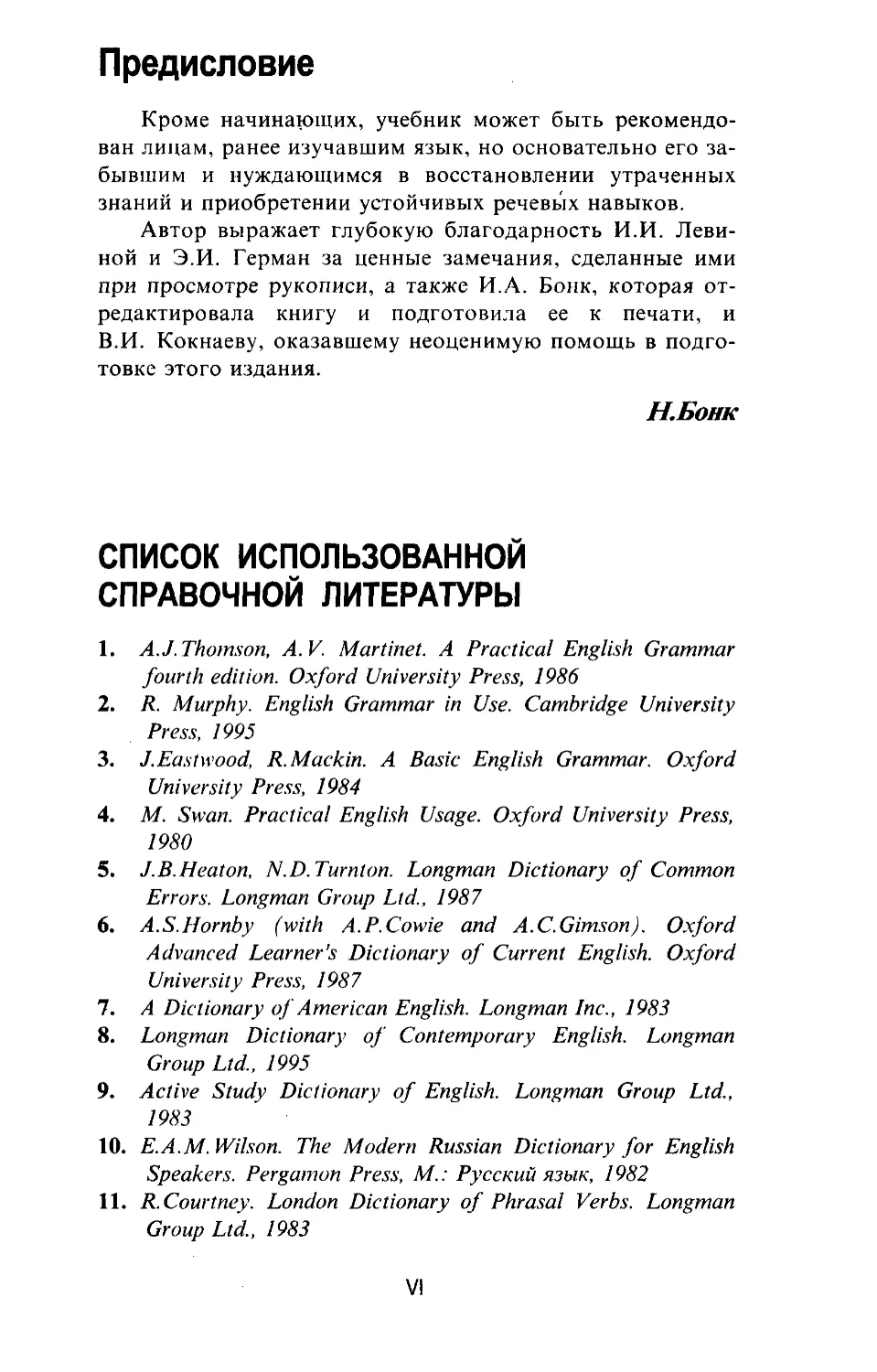
Please hold me! I’m going to fall!
Держите меня, пожалуйста!
Я сейчас упаду!
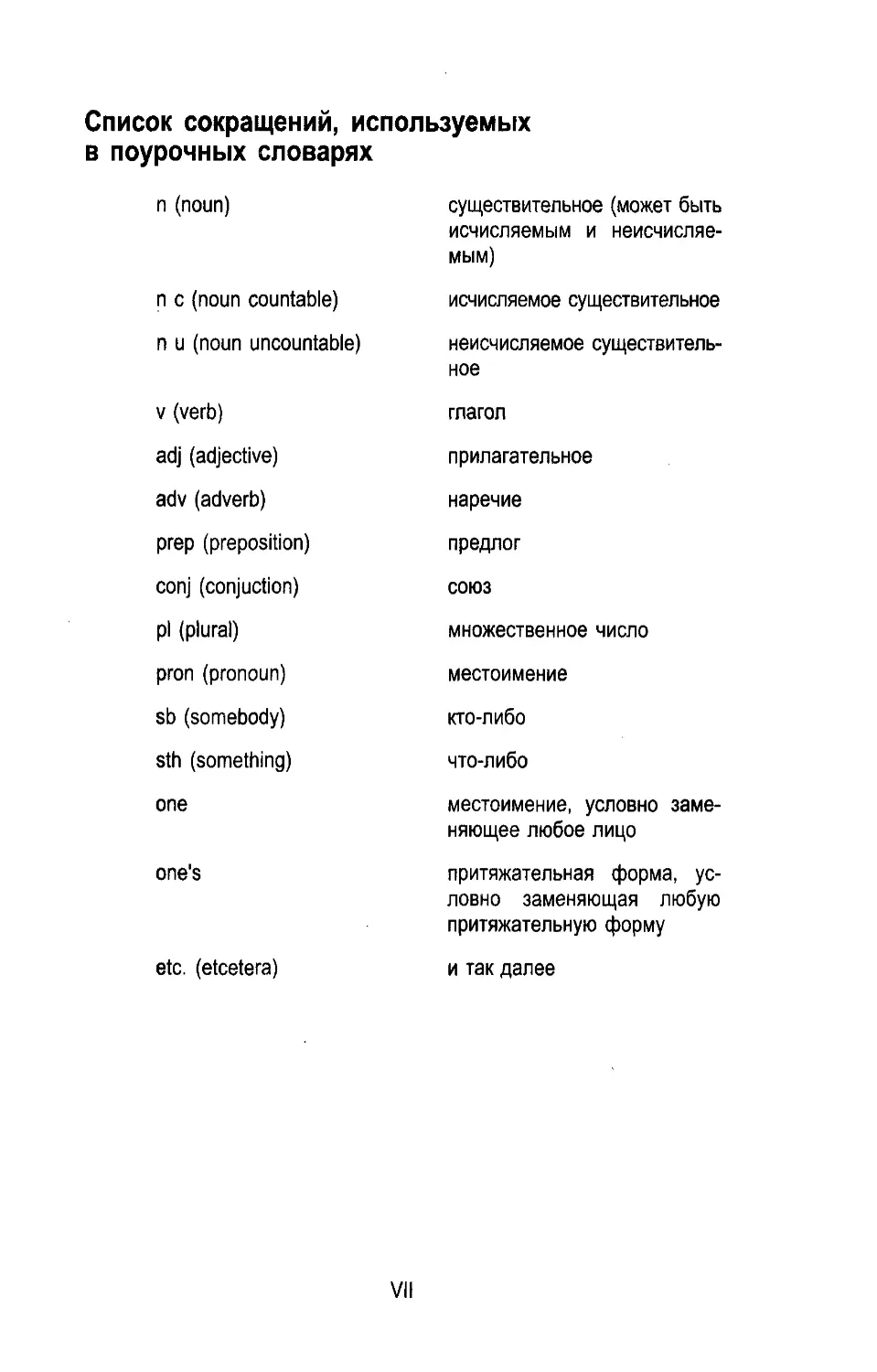
It’s going to be a long and difficult
way!
Это будет долгий и трудный путь!
— 1 —
Unit 1
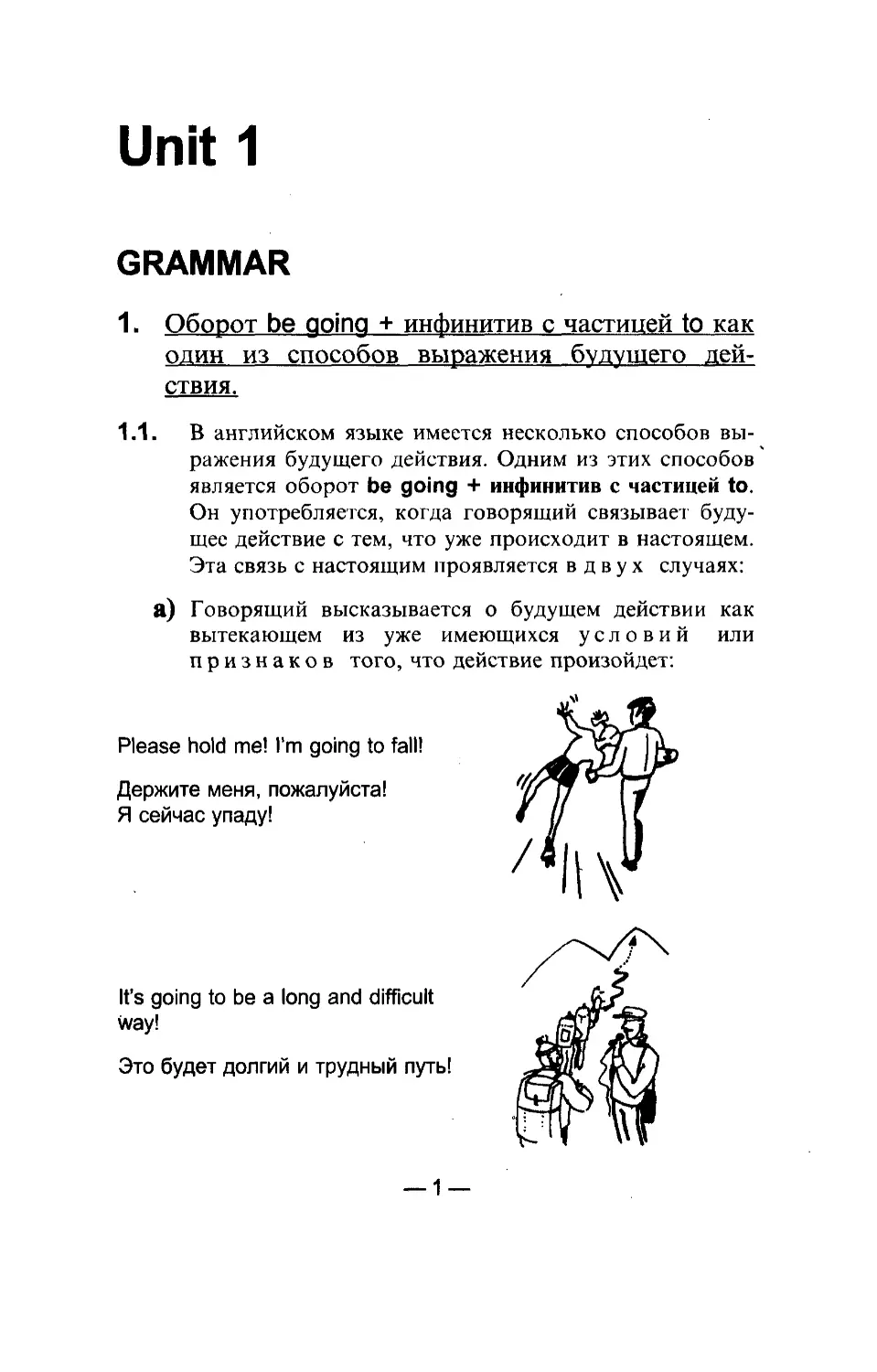
He’s going to be a great pianist, isn’t
he?
Он будет великим пианистом, не
правда ли?
б)	Говорящий высказывается о будущем действии как
вытекающем из принятого решения или имеюще-
гося намерения:
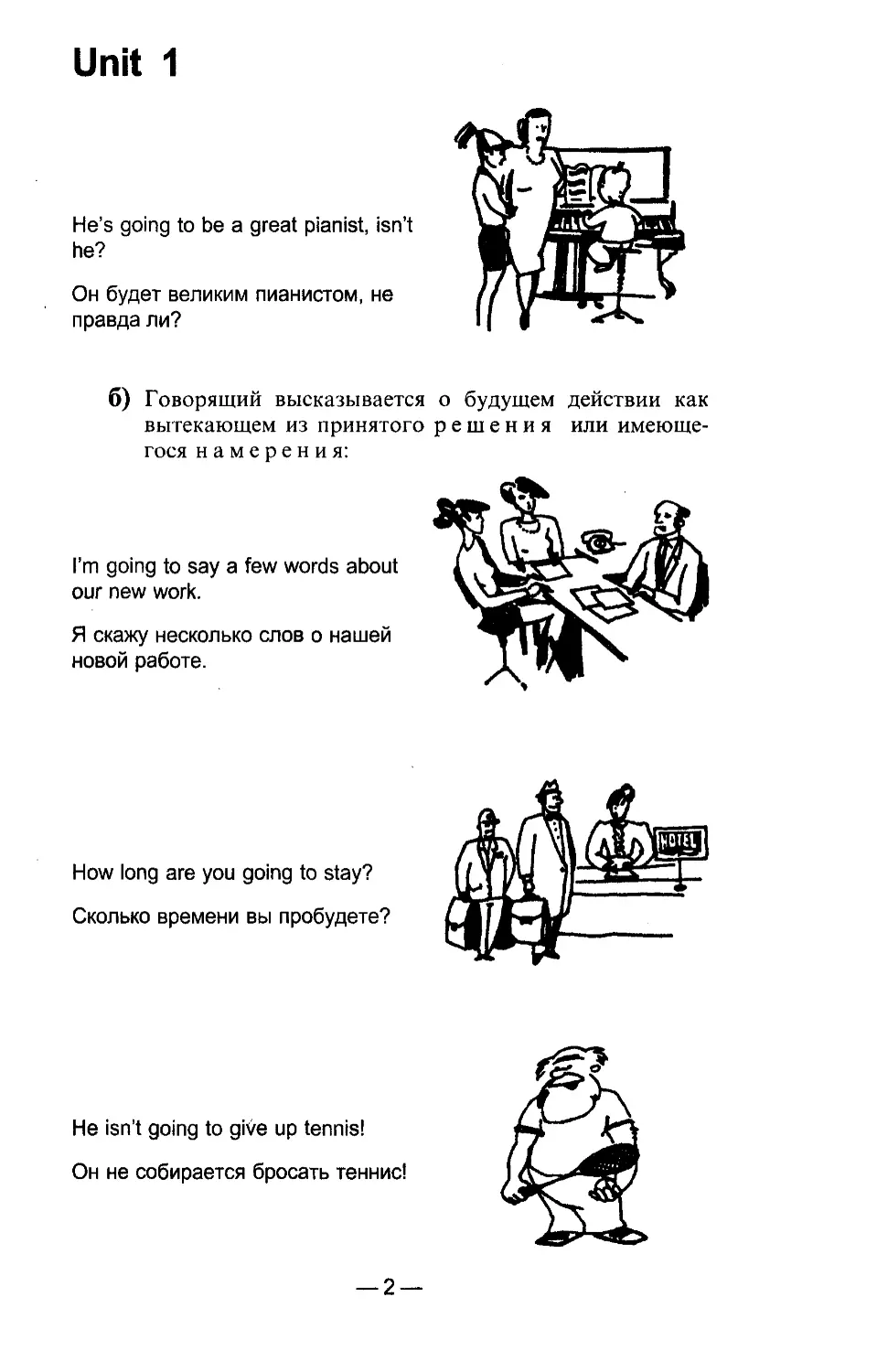
I’m going to say a few words about
our new work.
Я скажу несколько слов о нашей
новой работе.
How long are you going to stay?
Сколько времени вы пробудете?
Не isn’t going to give up tennis!
Он не собирается бросать теннис!
— 2 —
Unit 1
Как видно из примеров, оборот be going + инфини-
тив может переводиться на русский язык несколькими
способами: сочетанием будущего времени со словом
сейчас, сочетанием неопределенной формы глагола с
глаголом собираться (намереваться) и просто буду-
щим временем.
1.2.
1.3.
1.4.
1.5.
Глаголы до и соте реже других сочетаются с оборо-
том be going. Для выражения действия, запланиро-
ванного и подготовленного для совершения в буду-
щем, они чаще употребляются в форме Continuous:
1. We’re going to the
theatre tonight.
2. A Canadian hockey
team's coming to Mos-
cow.
Мы идем сегодня в театр.
В Москву приезжает канад-
ская хоккейная команда.
Обратите внимание на то, что и в русских предложе-
ниях глагол стоит в настоящем времени, хотя
речь идет о будущем действии.
Частица to может заменить в обороте be going ранее
упомянутый глагол, если из контекста ясно, о каком
действии идет речь:
I haven't spoken to him	Я еще не поговорил с ним
about it yet, but I’m	об этом, но собираюсь.
going to.
Оборот be going может употребляться и в прошедшем
времени:
I was just going to call
you when you came.
Я как раз собирался вам
позвонить, когда вы при-
шли.
Слово just в сочетании just going to может означать
только, как раз, сейчас, сию минуту, очень скоро:
1.	Wait a bit! I’m just
going to make a call.
2.	I was just going to
explain it.
3.	I’m just coming!
Подождите немного. Я
только позвоню.
Я как раз собирался это
объяснить.
Я сейчас (сию минуту,
очень скоро) приду.
— 3 —
Unit 1
1.6. В высказываниях о будущих действиях и состояниях
могут быть употреблены времени:	следующие обстоятельства
this afternoon	сегодня днем, сегодня во второй половине дня, пос- ле обеда
this evening	сегодня вечером
tonight	1. сегодня вечером 2. сегодня ночью (пред- стоящей ночью)
tomorrow	завтра
tomorrow morning (afternoon, evening, night)	завтра утром (днем, вече- ром, ночью)
the day after tomorrow	послезавтра
in a few minutes (hours, days, etc.)	через несколько минут (ча- сов, дней и т.д.)
in a week (in a week’s time)	через неделю
in two months (in two months’ time)	через два месяца
in a year (in a year’s time)	через год
next week (month, year, etc.)	на будущей неделе (в сле- дующем месяце, на буду- щий год и т.д.)
next time	в следующий раз
soon	скоро, вскоре
some day	когда-нибудь (в будущем)
some time next week (month, year, etc.)	как-нибудь (где-нибудь) на следующей неделе (в сле- дующем месяце, на буду- щий год и т.д.)
in the next few days (weeks, months, etc.)	в ближайшие несколько дней (недель, месяцев и т.д.)
in the near future	в ближайшем будущем
— 4 —
Unit 1
one of these days
Сравните:
the other day
на днях (по отношению к
будущему)
на днях (по отношению к
прошлому)
EXERCISES
Прочитайте примеры вслух и представьте себе ситуации, в ко-
торых их можно употребить.
а.	1. I’m going to say a few words about it.
2.	We’re going to give a party the day after tomorrow.
3.	They’re going to finish their work in the next few days.
4.	I’m going to see you about it one of these days.
5.	We’re going to meet again some time next month.
6.	They're going to solve the problem in the near future.
b.	1. Is it going to be cold next week?
2.	When are we going to see you again?
3.	What are we going to do next?
4.	They’re going to settle all the problems in the next few
weeks, aren’t they?
c.	1. I’m not going to stay long.
2.	I’m not going to discuss it again.
3.	We aren’t going to have any important work to do in the next
few days.
4.	They aren’t going .to settle it in the near future.
d.	1. We’re going there for the weekend.
2.	They’re coming tomorrow, aren’t they?
3.	Aren’t you going out tonight?
4.	Where are you going for your holiday?
2
Повторите, используя подсказанные слова.
Дано: I’m going to see about the tickets.
• say a few words about it •
Требуется: I'm going to say a few words about it.
— 5 —
Unit 1
1.	I’m going to see about the tickets.
• arrange a visit to the factory • ask the manager a few
questions • ask him to lunch •
2.	Are you going to read the English translation?
• look through those catalogues • collect some information
on the subject • have another look at some of the models •
3.	We’re going to arrange it next week.
• some time next week • in the next few days • in the near
future • one of these days •
4.	I’m just going to say a few words about it.
• tell you a few things about the exhibition • explain our new
ideas • make a few calls • leave him a message •
5.	Aren’t they going to the theatre tonight?
• coming tomorrow night • going to the country for the
weekend • coming to Moscow next week •
6.	They were just going to leave the house when I came.
• have a coffee break • begin the discussion • finish work •
3
Какие вопросы нужно задать, чтобы получить эти ответы.
1.	We’re going to ask ten people to lunch.
2.	The job’s going to take them a month.
3.	It's going to take a week.
4.	She’s going to spend the weekend with her friends.
5.	I’m going to the country for my holiday.
6.	Mr Smith’s coming tomorrow afternoon.
7.	They’re going to talk about classical music today.
Прочитайте диалоги вслух и разыграйте их.
A. Have you seen “Good-bye to Love” yet?
B.	No, not yet, but I’m going to. They say it’s very interesting. Have
you seen it?
A.	No, I haven’t, either. Let’s go together, shall we?
B.	That’s a good idea! But what about the seats?
A.	That’s all right! I’m going to see about them.
B.	Oh, it’s very kind of you, thank you very much.
A.	Not at all.
— 6 —
Unit 1
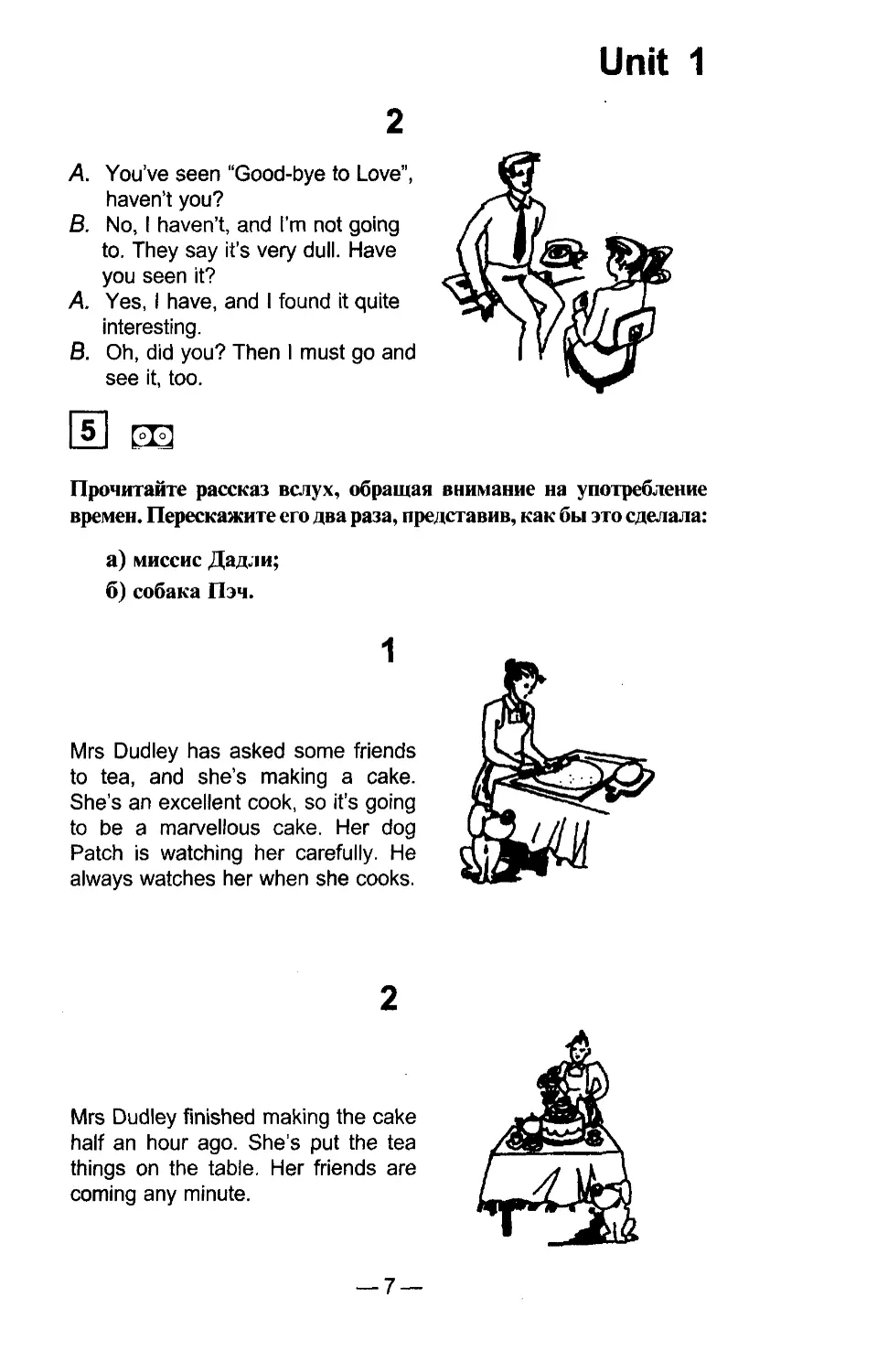
2
A. You've seen “Good-bye to Love”,
haven’t you?
B.	No, I haven’t, and I’m not going
to. They say it’s very dull. Have
you seen it?
A.	Yes, I have, and I found it quite
interesting.
B.	Oh, did you? Then I must go and
see it, too.
5
Прочитайте рассказ вслух, обращая внимание на употребление
времен. Перескажите его два раза, представив, как бы это сделала:
а)	миссис Дадли;
б)	собака Пэч.
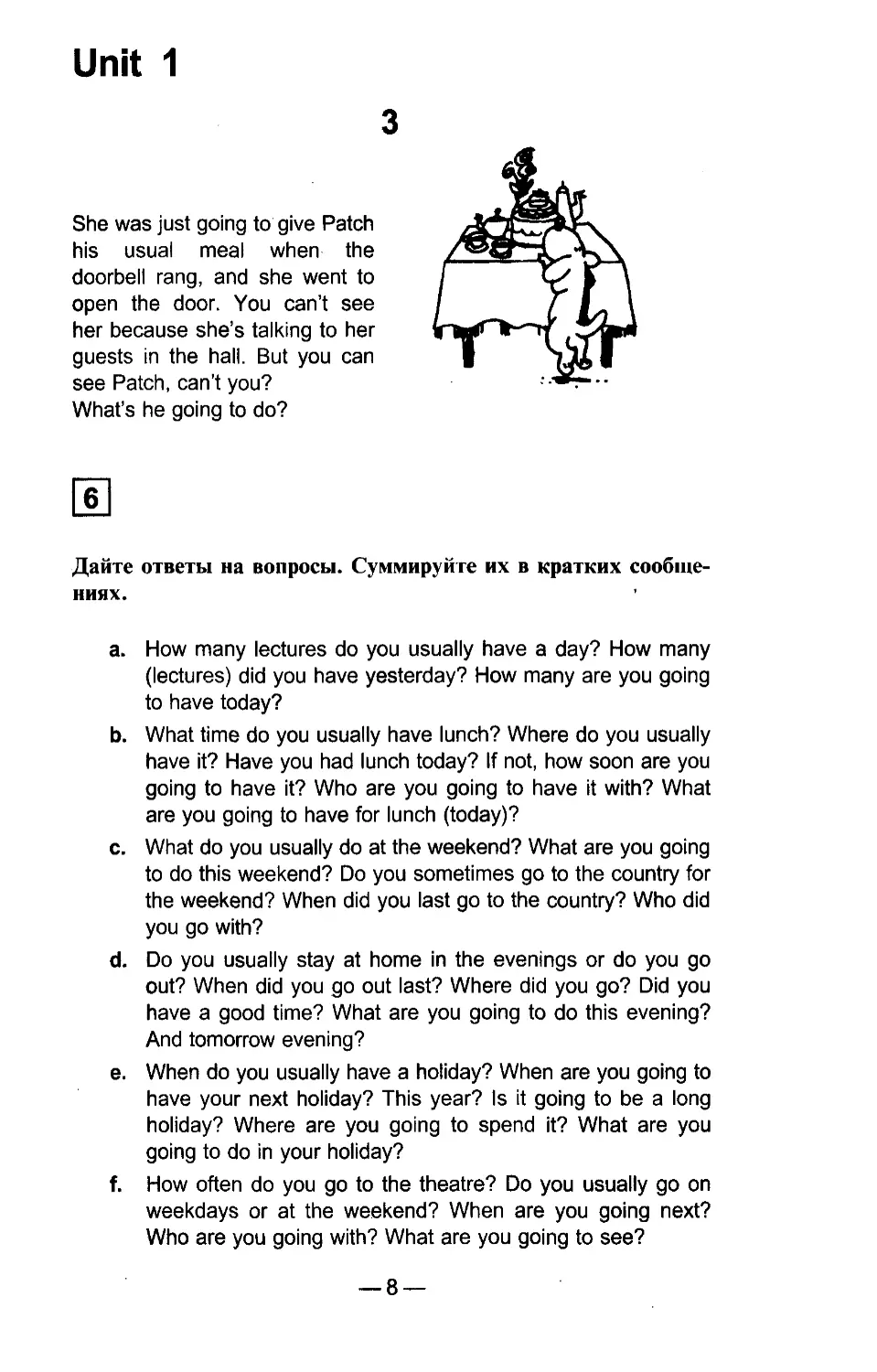
1
Mrs Dudley has asked some friends
to tea, and she’s making a cake.
She’s an excellent cook, so it’s going
to be a marvellous cake. Her dog
Patch is watching her carefully. He
always watches her when she cooks.
2
Mrs Dudley finished making the cake
half an hour ago. She's put the tea
things on the table. Her friends are
coming any minute.
— 7 —
Unit 1
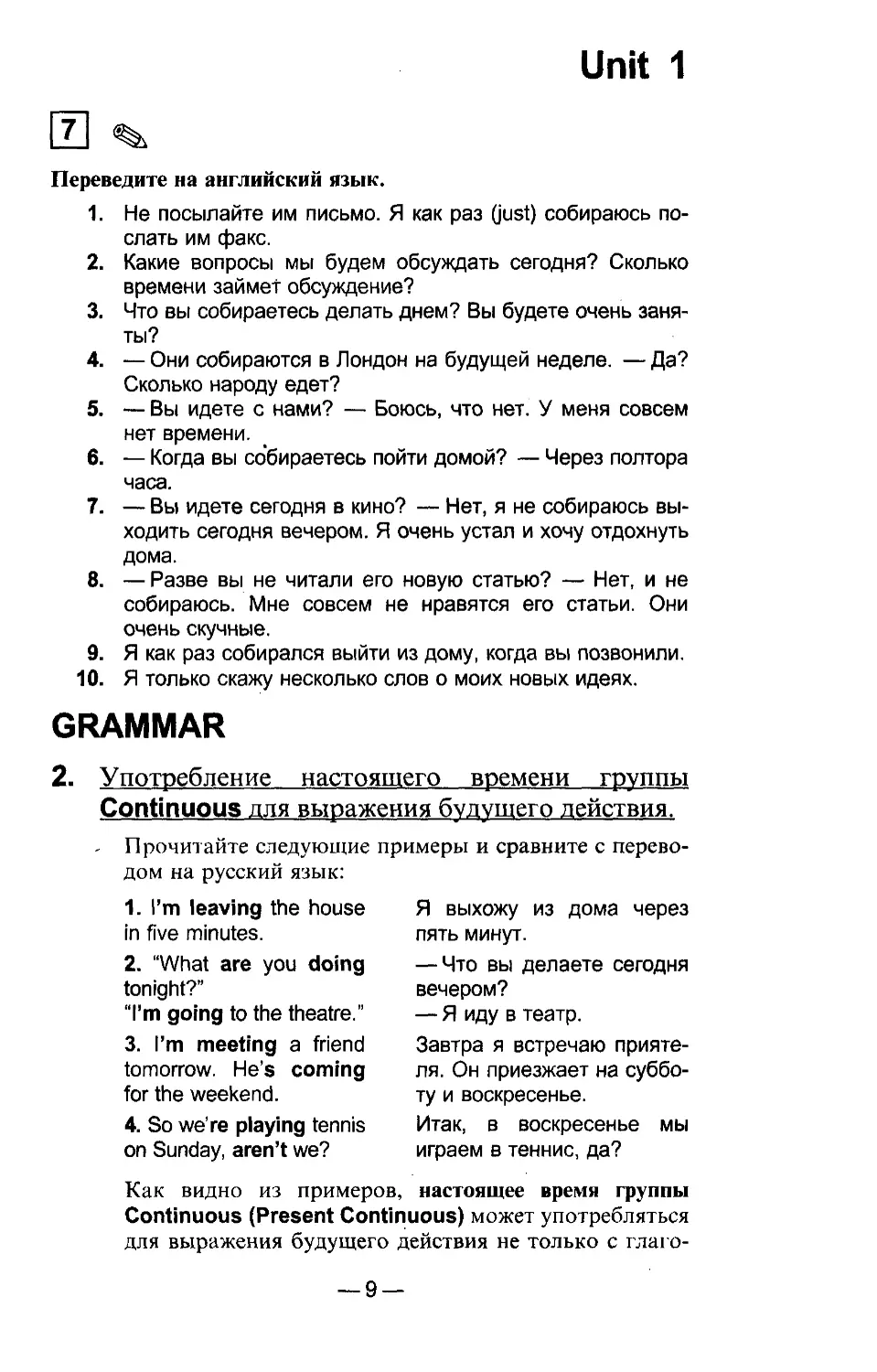
She was just going to give Patch
his usual meal when the
doorbell rang, and she went to
open the door. You can’t see
her because she’s talking to her
guests in the hall. But you can
see Patch, can’t you?
What's he going to do?
6
Дайте ответы на вопросы. Суммируйте их в кратких сообще-
ниях.
a.	How many lectures do you usually have a day? How many
(lectures) did you have yesterday? How many are you going
to have today?
b.	What time do you usually have lunch? Where do you usually
have it? Have you had lunch today? If not, how soon are you
going to have it? Who are you going to have it with? What
are you going to have for lunch (today)?
c.	What do you usually do at the weekend? What are you going
to do this weekend? Do you sometimes go to the country for
the weekend? When did you last go to the country? Who did
you go with?
d.	Do you usually stay at home in the evenings or do you go
out? When did you go out last? Where did you go? Did you
have a good time? What are you going to do this evening?
And tomorrow evening?
e.	When do you usually have a holiday? When are you going to
have your next holiday? This year? Is it going to be a long
holiday? Where are you going to spend it? What are you
going to do in your holiday?
f.	How often do you go to the theatre? Do you usually go on
weekdays or at the weekend? When are you going next?
Who are you going with? What are you going to see?
— 8 —
Unit 1
7
Переведите на английский язык.
1.	Не посылайте им письмо. Я как раз Gust) собираюсь по-
слать им факс.
2.	Какие вопросы мы будем обсуждать сегодня? Сколько
времени займет обсуждение?
3.	Что вы собираетесь делать днем? Вы будете очень заня-
ты?
4.	— Они собираются в Лондон на будущей неделе. — Да?
Сколько народу едет?
5.	— Вы идете с нами? — Боюсь, что нет. У меня совсем
нет времени.
6.	— Когда вы собираетесь пойти домой? — Через полтора
часа.
7.	— Вы идете сегодня в кино? — Нет, я не собираюсь вы-
ходить сегодня вечером. Я очень устал и хочу отдохнуть
дома.
8.	— Разве вы не читали его новую статью? — Нет, и не
собираюсь. Мне совсем не нравятся его статьи. Они
очень скучные.
9.	Я как раз собирался выйти из дому, когда вы позвонили.
10.	Я только скажу несколько слов о моих новых идеях.
GRAMMAR
2.	Употребление настоящего времени группы
Continuous для выражения будущего действия.
Прочитайте следующие примеры и сравните с перево-
дом на русский язык:
1.	I’m leaving the house
in five minutes.
2.	“What are you doing
tonight?”
‘Tm going to the theatre.”
3.	I’m meeting a friend
tomorrow. He’s coming
for the weekend.
4.	So we re playing tennis
on Sunday, aren’t we?
Я выхожу из дома через
пять минут.
— Что вы делаете сегодня
вечером?
— Я иду в театр.
Завтра я встречаю прияте-
ля. Он приезжает на суббо-
ту и воскресенье.
Итак, в воскресенье мы
играем в теннис, да?
Как видно из примеров, настоящее время группы
Continuous (Present Continuous) может употребляться
для выражения будущего действия не только с глаго-
— 9 —
Unit 1
лами go и come, но и с некоторыми другими глагола-
ми, примерно в тех же случаях, когда в русском языке
употребляют настоящее время в значении будущего.
Эта форма выражения будущего действия близка по
значению обороту be going to и отличается от него
большей подготовленностью будущего действия,
большей определенностью плана (ср. русое. Я ухожу
в отпуск на следующей неделе). Поскольку эта гла-
гольная форма способна выразить как настоящее, так
и будущее действие, употребляя ее, для ясности часто
добавляю! соответствующее обстоятельство времени:
1.	The delegation’s arriving
tomorrow.
2.	We’re starting work next
week.
3.	What are you doing
tonight?
Делегация прибывает завтра.
Мы начинаем работать на
будущей неделе.
Что вы делаете сегодня ве-
чером?
EXERCISES
1
Прочитайте вслух и переведите.
1.	What time are we meeting tomorrow?
2.	My friend’s coming here for a holiday soon.
3.	They’re giving a party next week.
4.	They’re arranging a visit to the factory next Thursday.
5.	When are you going there?
6.	Which of them’s giving a talk tomorrow?
7.	We’re going to the new ballet next Saturday.
8.	My colleagues are going abroad on business.
9.	They’re coming any minute.
2
Прочитайте диалоги вслух и разыграйте их.
1
A. What are you doing at the weekend?
В. At the weekend? I haven’t thought of it yet.
— 10 —
Unit 1
A.	Would you like to go to a football match with me?
B.	Oh, I’d love to. Who’s playing?
A.	Two very good teams. They’re both in very good form, so the
match is going to be interesting.
B.	Thanks a lot! I haven’t seen a good game for a very long time.
2
A.	So we’re playing tennis this evening, aren’t we?
B.	No, I’m afraid not. Not this evening.
A.	Why? Didn’t you promise to come and have a game with me?
B.	Well, yes, but my friends are going away on holiday, and I must
see them off. The train’s at seven fifteen p.m. I only found out an
hour ago.
A.	It’s a pity we can’t have a game this evening. What about the
day after tomorrow then?
B.	Okay.
promise [’promts] v
обещать
3
Guide: Tomorrow we’re visiting Kuskovo.
Tourist: Are we going by bus?
G. Yes, as usual.
T. What time’s the bus leaving?
G. At exactly eight. Please be in
time. And don’t forget to take
your cameras. You can take
lots of beautiful photos there,
and make films, too.
Tourists: Lovely!
Marvellous!
T. Excuse me, what time are we
getting back?
G. At seven o’clock in the evening.
— 11 —
Unit 1
GRAMMAR
3. Определительные придаточные предложения, в
которых относительное местоимение является
подлежащим.
3.1. Определительные придаточные, в которых речь идет
о людях, вводятся относительным местоимением who,
а определительные придаточные, в которых говорит-
ся о неодушевленных предметах или животных, вво-
дйЬ'ся относительным местоимением which.
1. The man who rang you
this morning didn’t leave
any message.
2. The message which
has just arrivdd is very
important.
Человек, который звонил
вам утром, ничего не пе-
редавал.
Сообщение, которое только
что прибыло, очень важно.
ПРИМЕЧАНИЯ.
1. Определительные придаточные могут также вводить-
ся относительным местоимением that, которое чаще
употребляется, когда речь идет о неодушевленных
предметах.
1. The fax that (which)
arrived in the morning is
in your file.
2. The air hostess who's
(that’s) going to help the
passenger find his seat
speaks both English and
Spanish.
Факс, который прибыл ут-
ром, находится в вашей
папке.
Бортпроводница, которая
собирается помочь пасса-
жиру найти свое место, го-
ворит по-английски и по-ис-
пански.
2. Обратите внимание на то, что в приведенных приме-
рах определительное придаточное не отделяется от
главного предложения запятой.
— 12 —
Unit 1
3.2.
Как и в русском языке, сказуемое определительного
придаточного предложения согласуется в числе с тем
существительным, к которому относится это прида-
точное:
1.	The girl who usually
works at this desk is on
holiday now.
2.	All the girls who
work at our exhibition
as guides speak several
foreign languages.
3.	The shops which are
open on Sundays only
work till three.
4.	I know a shop which
is sometimes open on
Sundays.
Девушка, которая обычно
работает за этим столом,
находится сейчас в отпуске.
Все девушки, которые ра-
ботают гидами на на-
шей выставке, говорят на
нескольких иностранных
языках.
Магазины, которые быва-
ют открытыми по воскресе-
ньям, работают только до
трех.
Я знаю магазин, который
иногда бывает открытым
по воскресеньям.
3.3.
Перед существительным, к которому относится опре-
делительное придаточное предложение, может стоять
как определенный, так и. неопределенный артикль
(или местоимения some,
употребления артиклей:
1. I know a man who
speaks five foreign lan-
guages.
any), по общему правилу
Я знаю человека, который
говорит на пяти иностран-
ных языках (одного челове-
ка, такого человека, кото-
рый ...).
—.13 —
Unit 1
2. I know the man who
wrote that article.
Я знаю человека, который
написал эту статью (того
самого человека, который...).
ПРИМЕЧАНИЕ.
В английском языке, как и в русском, имеются также
описательные определительные придаточные, содер-
жащие дополнительные сведения о слове, к которому
они относятся:
1. Му business partner,
who is in London now, is
coming back tomorrow.
2. The explanation,
which only took a few
minutes, was very useful.
Мой деловой партнер, кото-
рый сейчас находится в Лон-
доне, возвращается завтра.
Объяснение, которое заняло
всего несколько минут,
было очень полезным.
Описательные определительные придаточные в анг-
лийском языке отделяются от главного предложения
запятой. Поскольку они содержат лишь дополнитель-
ную информацию, их можно опустить, не нарушив ос-
новного смысла высказывания. Такие придаточные
характерны для книжно-письменной речи. В повсед-
невной разговорной речи-им предпочитают более ко-
роткие отдельные предложения или сложносочинен-
ные предложения с союзами and или but:
1. Му business partner is in London now. He’s coming
tomorrow.
2. The explanation only took a few minutes, but it was very
useful.
EXERCISES
1
Прочитайте вслух и переведите.
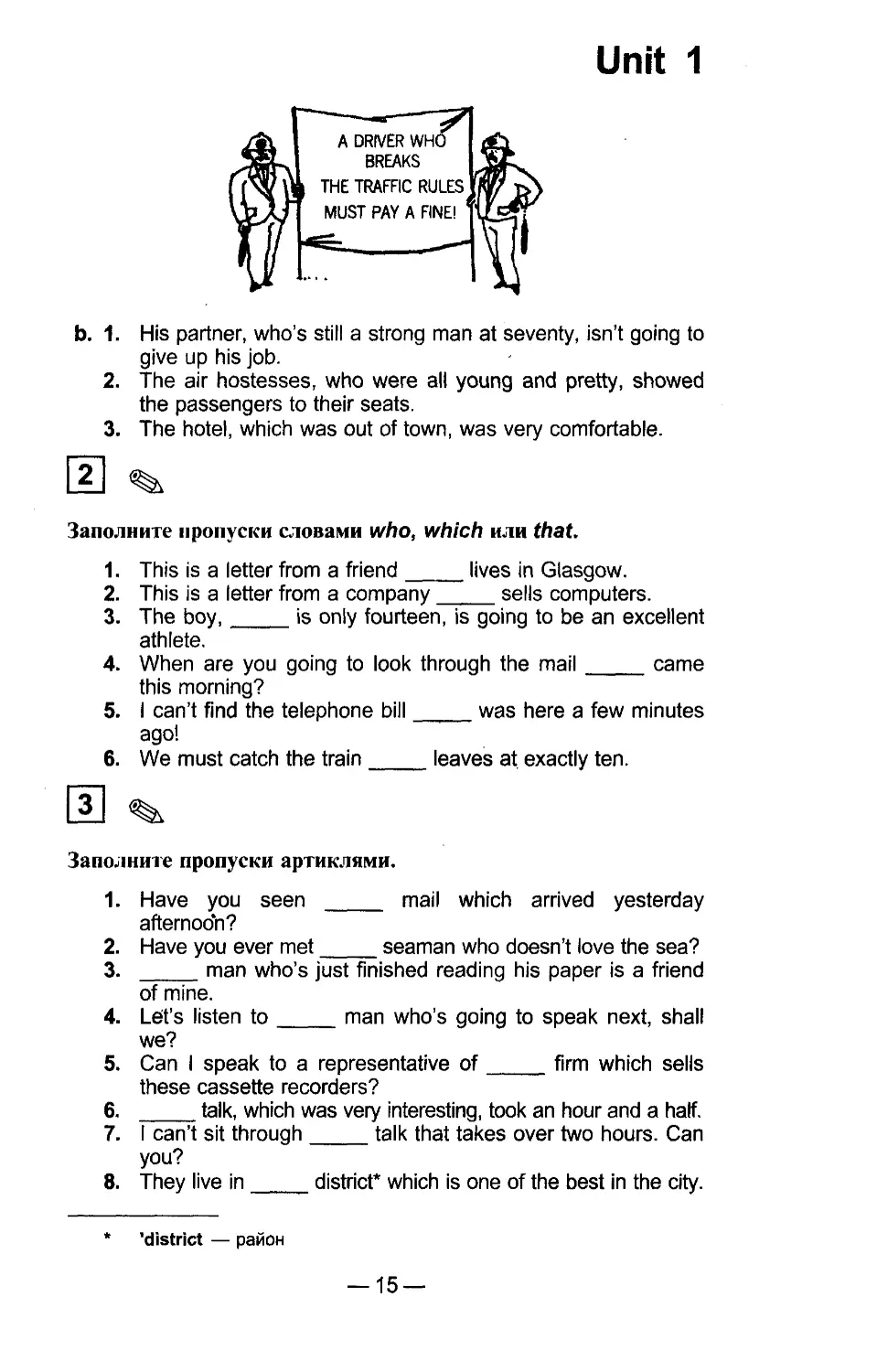
а.	1. The policeman’s just stopped a careless driver who went
through a red light. “A driver who thinks the traffic rules are
not for him must pay a fine!” the policeman says.
2.	There’s a garage which opens at eight in this street.
3.	The man who’s going to give us the next lecture has
travelled a lot.
4.	“Can you see the car that has stopped over there?” “Yes, it’s
got a flat tyre.”
5.	All the actors who played -in that film were just marvellous.
— 14 —
Unit 1
b.	1. His partner, who’s still a strong man at seventy, isn’t going to
give up his job.
2. The air hostesses, who were all young and pretty, showed
the passengers to their seats.
3. The hotel, which was out of town, was very comfortable.
2
Заполните пропуски словами who, which или that.
1.	This is a letter from a friend__lives in Glasgow.
2.	This is a letter from a company____sells computers.
3.	The boy,is only fourteen, is going to be an excellent
athlete.
4.	When are you going to look through the mail________came
this morning?
5.	I can’t find the telephone bill _____ was here a few minutes
ago!
6.	We must catch the train leaves at exactly ten.
3
Заполните пропуски артиклями.
1.	Have you seen  mail which arrived yesterday
afternoon?
2.	Have you ever met_________seaman who doesn’t love the sea?
3.	man who’s just finished reading his paper is a friend
of mine.
4.	Let’s listen to man who’s going to speak next, shall
we?
5.	Can I speak to a representative of firm which sells
these cassette recorders?
6.		talk, which was very interesting, took an hour and a half.
7.	I can’t sit through_______talk that takes over two hours. Can
you?
8.	They live in district* which is one of the best in the city.
'district — район
— 15 —
Unit 1
4
Переведите на английский язык.
1.
2.
3.
4.
5.
6.
7.
8.
9.
10.
Мы все пойдем на выставку, которая открывается
(opens) в понедельник утром.
Мне бы хотелось пойти на некоторые выставки, которые
открываются (open) на следующей неделе.
Врач, который только что осмотрел ребенка, говорит, что
ребенок совершенно здоров.
Врачи, которые только что осмотрели этого человека, го-
ворят, что он немедленно должен лечь в больницу.
Можно подержать эту книгу еще одну неделю? Я еще не
прочитал некоторых статей, которые я хочу использовать
в своей работе.
У вас не уйдет много времени на то, чтобы перевести
статью, которую я положил в вашу папку. Она совсем не
трудная.
Лаборант, который обычно здесь работает, сейчас в от-
пуске. Он приезжает через неделю.
Все экскурсоводы, которые работают в этом музее,
очень хорошо знают свой предмет.
Вы можете купить массу полезных вещей в этом магази-
не, который, кстати, всегда открыт по воскресеньям.
— Что вы ищете? — Мою записную книжку, которая
была здесь минуту назад. Я всегда ее теряю и потом
нахожу снова!
TOPICS FOR DISCUSSION AND NEW
WORDS
Discussing Plans for the Future
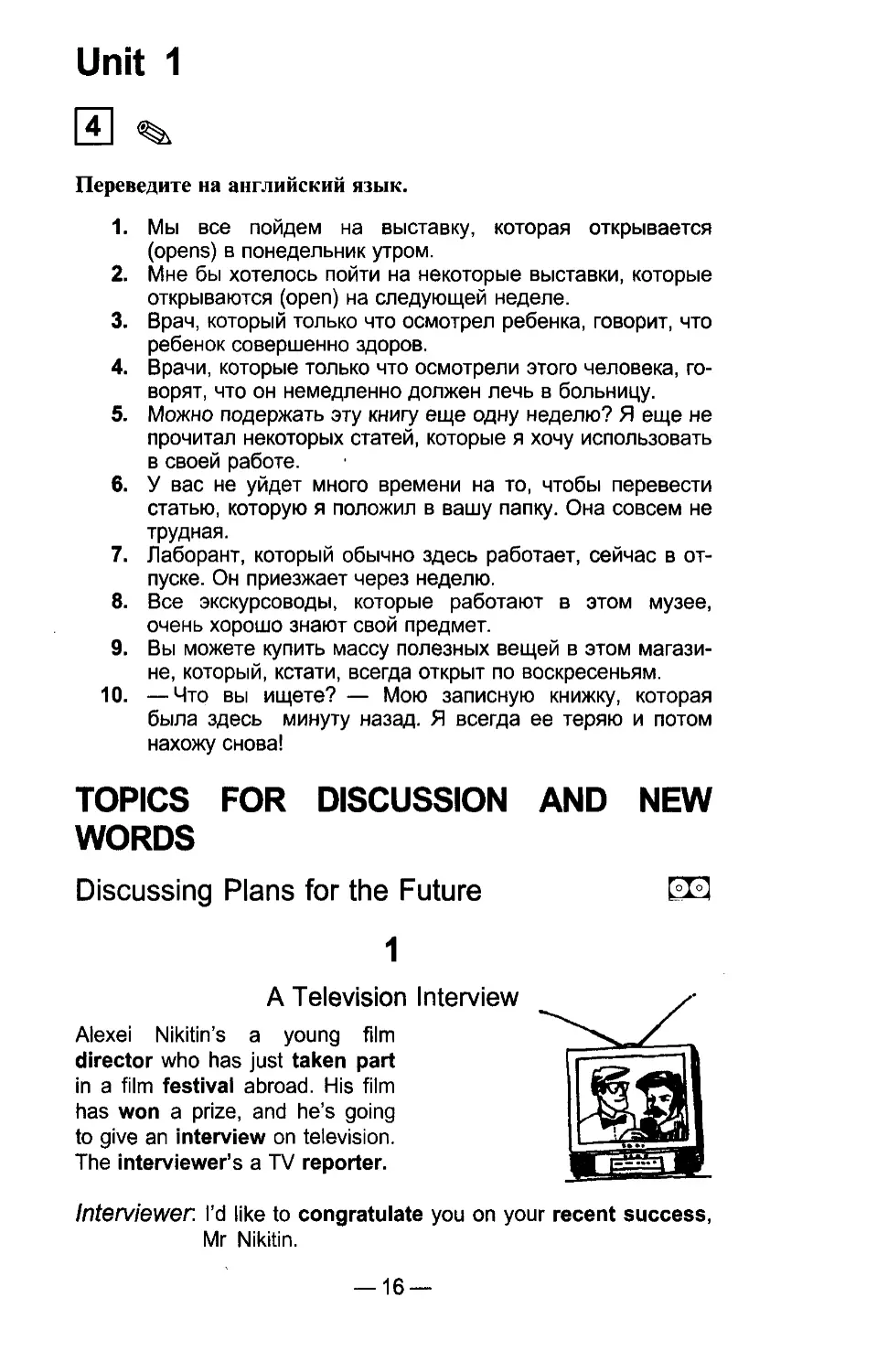
A Television Interview
Alexei Nikitin’s a young film
director who has just taken part
in a film festival abroad. His film
has won a prize, and he’s going
to give an interview on television.
The interviewer’s a TV reporter.
Interviewer. I’d like to congratulate you on your recent success,
Mr Nikitin.
— 16 —
Unit 1
Nikitirr. Thank you very much.
I. Have you got any definite plans for the future?
N. Oh, yes. I’m going to make a television serial about pop singers.
It’s going to be a screen version of a novel which is a great
success with the reading public just now.
/. Are you going to work with the same team?
N. Yes, it’s going to be the same team, actually. We’re all
interested in making another film together.
I. And when are you starting work on the film?
N. \Ne have actually started. We spent a month interviewing
different singers, but that’s only a beginning, of course. We’ve
got to do a lot in the next few months.
/. Well, that was all very interesting. You’ve made great progress
these last few years, and I wish you every success with your
new film. Good luck!
N. Thanks.
2
At an Industrial Exhibition
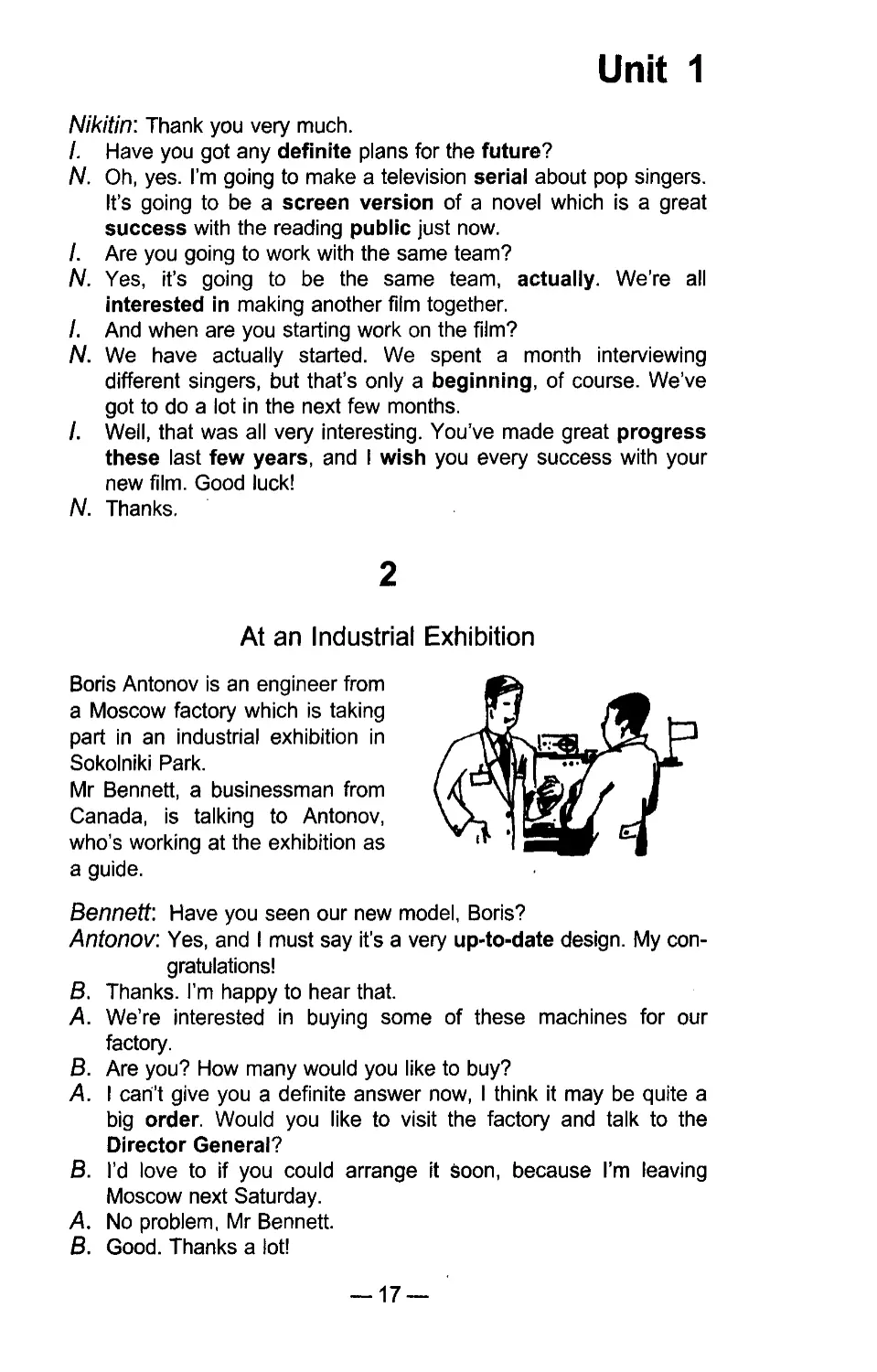
Boris Antonov is an engineer from
a Moscow factory which is taking
part in an industrial exhibition in
Sokolniki Park.
Mr Bennett, a businessman from
Canada, is talking to Antonov,
who’s working at the exhibition as
a guide.
Bennett: Have you seen our new model, Boris?
Antonov: Yes, and I must say it’s a very up-to-date design. My con-
gratulations!
B. Thanks. I’m happy to hear that.
A.	We’re interested in buying some of these machines for our
factory.
B.	Are you? How many would you like to buy?
A.	I can’t give you a definite answer now, I think it may be quite a
big order. Would you like to visit the factory and talk to the
Director General?
B.	I’d love to if you could arrange it Soon, because I'm leaving
Moscow next Saturday.
A.	No problem, Mr Bennett.
B.	Good. Thanks a lot!
— 17 —
Unit 1
At an International Conference
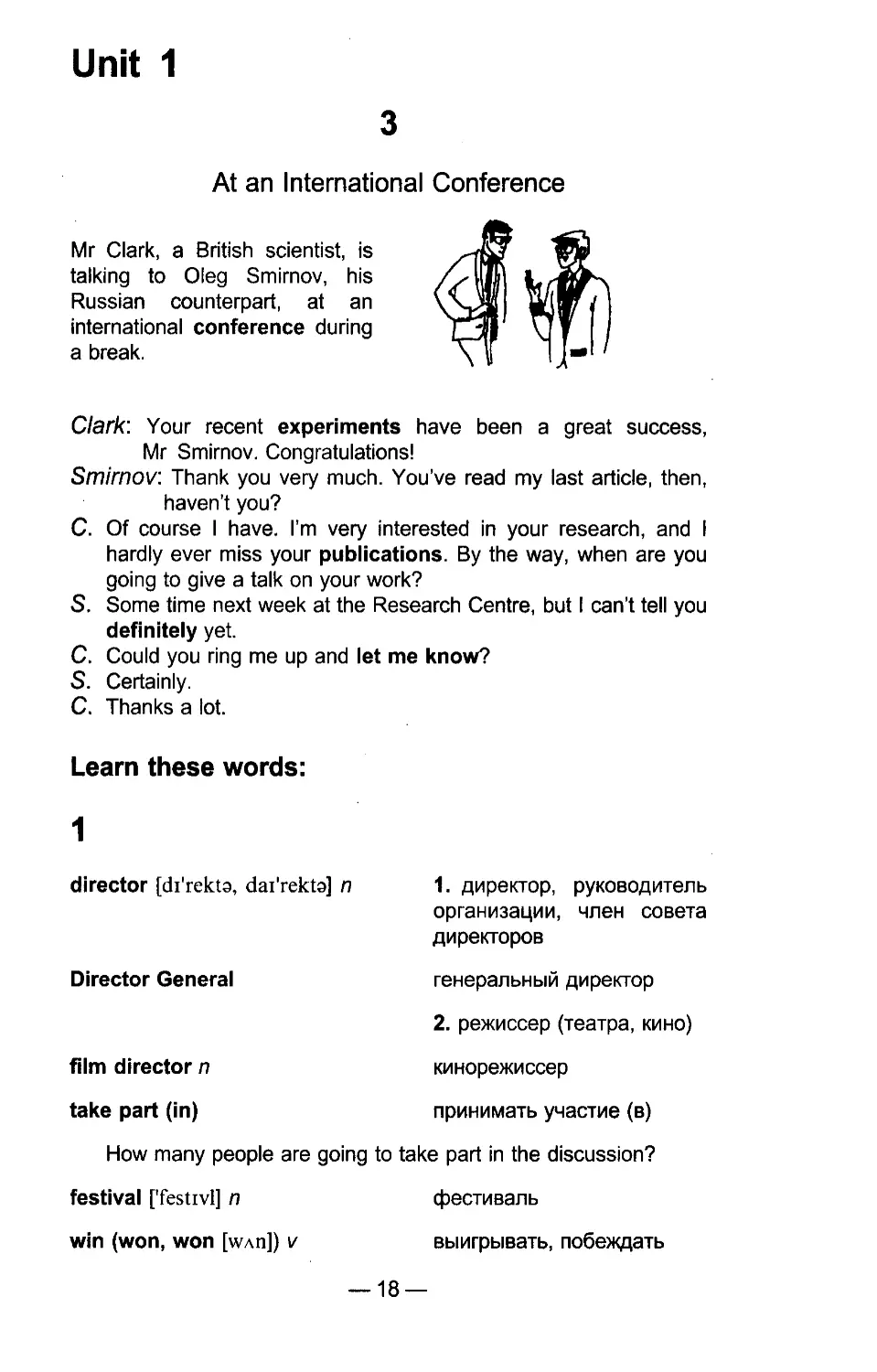
Mr Clark, a British scientist, is
talking to Oleg Smirnov, his
Russian counterpart, at an
international conference during
a break.
Clark'. Your recent experiments have been a great success,
Mr Smirnov. Congratulations!
Smirnov: Thank you very much. You’ve read my last article, then,
haven’t you?
C.	Of course I have. I’m very interested in your research, and I
hardly ever miss your publications. By the way, when are you
going to give a talk on your work?
S. Some time next week at the Research Centre, but I can’t tell you
definitely yet.
. Could you ring me up and
S. Certainly.
C. Thanks a lot.
Learn these words:
1
director [di'rekta, dai'rekta] n
Director General
film director n
take part (in)
How many people are going
festival [’festivl] n
win (won, won [wAn]) v
me know?
1. директор, руководитель
организации, член совета
директоров
генеральный директор
2. режиссер (театра, кино)
кинорежиссер
принимать участие (в)
to take part in the discussion?
фестиваль
выигрывать, побеждать
18 —
Unit 1
Ant. lose [lu:z] (lost, lost) v	терять, проигрывать
Which team won the last match?
Ben lost the game (to Nick).
prize n
to win a prize
The Nobel prize [nau'bel]
interview [’intavju:] n
a press interview
He gave a press interview. (= He gave an interview to the press.)
2. собеседование (часто
при приеме на работу)
брать интервью (у),
проводить собеседование (с)
The TV people have just interviewed the delegation.
The manager's going to interview the man the day after
tomorrow.
interviewer ['intavju:a] n
приз, премия
получить премию (приз)
Нобелевская премия
1. интервью
интервью для печати
interview v
интервьюер
reporter [n'po.ta] n	репортер
Syn. a newspaper man, a TV man, etc.
congratulate [kan'graetjuleit] v поздравлять, поздравить (с
успехом, достижениями, ре-
зультатами, событиями
и т.п., но не с традицион-
ными праздниками)
Let me congratulate you on your excellent results.
Please congratulate him for me.
congratulations
[kan.greetju’leijnz] n
(My) congratulations!
(My) congratulations
on your daughter's
marriage!
(My) congratulations
to you all!
Give him my
congratulations.
поздравления (обычно упот-
ребляется во множествен-
ном числе)
Поздравляю!
Поздравляю с заму-
жеством дочери!
Поздравляю вас всех!
Передайте ему мои по-
здравления!
2 Английский шаг за шагом, кн. 2
— 19 —
Unit 1
Обычные формулы поздравления
с праздниками:
Merry Christmas and (а)
Happy New Year!
The same to you!
Поздравляю с Рождест-
вом и с Новым годом!
И вас также!
Happy birthday to you!
Many happy returns of
the day!
С днем рождения!
recent ['ri:sont] adj	недавний, последний
a recent event (visit, discussion, decision, etc.)
recently adv
I’ve seen him recently.
I haven't seen him recently.
I saw him (quite) recently.
недавно, за (в) последнее
время
Я его недавно видел.
Я его не видел в пос-
леднее время.
Я его видел (совсем) не-
давно.
успех, удача
success [sak’scs] n c
\Ne wish you (every) success in your new job.
He spoke about the recent successes of their research centre.
be a success
The film was a great success
with the public.
The young actress was
a (great) success.
The party was a success.
иметь успех, пользоваться
успехом, быть удачным
Фильм пользовался боль-
шим успехом у зрителей.
Молодая актриса имела
огромный успех.
Вечеринка удалась.
— 20 —
Unit 1
successful adj	успешный, удачный; преус-
певающий
Ant. unsuccessful
He's a successful businessman. Он преуспевающий биз-
несмен.
The plan was successful.
progress ['praugras] n и	успехи, успешное продви-
жение
make progress	делать успехи
You're making progress in your English.
Nelly's still in hospital, but she's Нелли все еще в боль-
making progress.	нице, но она поправля-
ется.
definite [’definit] adj	определенный
Ant. indefinite
a definite answer (plan, time, etc.)
future ffju.tja] n	будущее
in the future	в	будущем
The book is about flights to other planets in the future.
in the near future	в	ближайшем будущем
We're going to discuss it all again in the near future.
in future	в	дальнейшем,	впредь
In future be more careful with your money.
future adj serial ['sianal] n c screen n c version ['va:Jn ] n c a screen version (of) public [’рлЫгк] n и	будущий (-ая, -oe) многосерийный телефильм экран вариант, версия экранизация публика, зрители, читатели
— 21 — '
Unit 1
public adj
общественный, публичный
a public park (library, etc.)
actually [’eektjuali] adv
Do you actually
mean it?
interested [’ininstid] adj
be interested (in)
They are all interested
in this project.
фактически, на самом деле,
действительно
Вы и в самом деле так
думаете?
заинтересованный
быть заинтересован-
ным (в), интересоваться
Они все интересуются
этим проектом.
We are interested in getting a definite answer.
beginning n c
начало
They showed the beginning of the interview on TV.
Внимание: предлоги!
at the beginning	1. в начале
at the end	в конце
at the beginning of the interview (the article, the story, etc.)
Syn. at first
It was easy at the beginning
(= at first), but in a few days
we ran into difficulties.
2. вначале, первое
время (сначала, по-
началу)
Первое время бы-
ло легко, но через
несколько дней мы
столкнулись с труд-
ностями.
с (самого) начала
from the beginning
I knew from the beginning that the first prize was not for me.
from beginning to end	от начала до конца
these last few years
Syn. in the last few years
in the past few years
за эти последние несколько
лет
за последние годы
за истекшие годы
— 22 —
Unit 1
wish v	желать, пожелать кому-л. что-л.
We wish you all	Мы желаем вам всего
the best.	самого хорошего.
I wish you every	Желаю вам всяческих
success with your plans.	успехов в ваших пла- нах.
wish n c	желание, пожелание
Please give them my best wishes. Передайте им мои наи-
лучшие пожелания.
With best wishes...	С наилучшими пожела-
ниями (например, в дар-
ственной надписи).
2
up-to-date [.Apta'deit] adj	современный, соответству-
ющий современным требо-
ваниям
| Сравните: ?	an up-to-date model (design, etc.)	современная (отве- чающая современ- ным требованиям) модель (конструкция и т.п.)
modem music (art, ideas, etc.)	современная (отно- сящаяся к новому времени) музыка (со- временное искусст- во, идеи и т.п.)
— 23 —
Unit 1
order [’o:da] п to make an order	зд. (коммерч.) заказ сделать заказ
We’re going to make an order for 10 machines.	Мы собираемся сделать заказ на 10 машин.
3
conference [’konfrans] п с at a conference	1. конференция на конференции 2. совещание
to be in conference	быть (занятым) на со- вещании
Mr Bennett can't see you, because he’s in conference just now.
experiment [ik’spenmant] п с to do an experiment publication [.рлЫГкег/п] n c definitely [’definitli] adv	эксперимент, опыт поставить эксперимент публикация определенно, несомнен- но, безусловно
He’s definitely going to win.
You definitely didn’t tell me about it.
“Are you coming with us?” “Definitely!”
I can’t answer you definitely yet. let... know	сообщить (кому-л.), дать знать
Please let me know the date.	Пожалуйста, сообщите мне дату.
We can let you know about it by fax.	Мы можем сообщить вам об этом по факсу.
EXERCISES
T
Прочитайте тексты вслух. Предварительно отработайте про-
изношение следующих слов и словосочетаний:
congratulate	interview congratulations	interviewer won the first prize with the same team	prize	model progress	novel
— 24 —
Unit 1
2
Ответьте на вопросы по текстам.
а.	1. What does Alexei Nikitin do?
2.	What is he doing abroad?
3.	Is he a successful film director?
4.	Does he know English?
5.	Has he got any definite plans for the future?
6.	Has he started work on his new film, or is he only going
to?
7.	What’s his new film going to be about?
8.	What kind of film’s his team interested in making?
9.	Why did they spend a month interviewing pop singers?
10.	Why does Alexei say it’s only a beginning?
11.	Why does the reporter say Alexei has made great progress
these last few years?
b.	1. Why is Boris Antonov interested in the new model?
2.	How big is his order going to be?
3.	Why is Mr Bennett interested in visiting the factory?
4.	Is it difficult for Antonov to arrange Mr Bennett’s visit to the
factory?
c.	1. What was Smirnov’s last article about?
2.	Why is Mr Clark interested in his publications?
3.	Why does Mr Clark want to attend his talk?
3
Промигайте вслух и переведите.
1.	Could you tell me the name of the team which won the last
match?
2.	The athlete who’s won the first prize is only seventeen.
3.	Jim’s so lucky at cards! He hardly ever loses a game. He
nearly always wins!
4.	In 1812 the Russian people won the war against Napoleon.
5.	Let me congratulate all the people who’ve taken part in the
work on their great success!
6.	Give them all my congratulations!
7.	Please give my congratulations to them all!
8.	I’d like to thank you all for your warm congratulations!
— 25 —
Unit 1
9.	Recent experiments have shown that the new method is very
good.
10.	We couldn’t even think of it in the recent past.
11.	The play’s definitely a great success!
12.	Your book’s going to be a success.
13.	You’re making good progress in your English.
14.	His progress is just marvellous.
15.	He’s definitely going to be a successful businessman.
16.	The plan definitely has a great future.
17.	In future don’t give a definite answer so soon.
18.	These experiments may be successful in the near future.
19.	We may actually find it out in the near future.
4
Заполните пропуски предлогами: in, at, on, of, for, because of.
1.		his interview the chess player said, “I lost two games
______the beginning, because I wasn’t very good form
an illness, but I was able to win four games the
end.”
2.	There were a lot__________foreign visitors the recent
song festival. They were all interested________the new songs
and the young singers who took part the festival.
3.	the end the interview the manager the
exhibition congratulated the representatives  all the
organisations which took part it.
4.	The problem’s very important_________all_______us, and we’re
going to solve it______the near future. We simply have to!
5.	Please give them my congratulations  their recent
success.
6.	You’ve made good progress your experiments. My
congratulations!
7.	There's going to be a new underground line  this
district_________the near future.
8.	There are going to be several new stations here 1 the
near future.
5
Дайте ответы на вопросы. Суммируйте ответы в кратких со-
общениях.
а.	1. Which of you has seen a television interview recently?
2.	When was it?
3.	Who gave the interview?
— 26 —
Unit 1
4.	Who was the interviewer?
5.	Who else took part in the interview?
b.	1. Do you like television serials?
2.	When did you last watch a serial?
3.	How interesting was it?
4.	Did you watch it from beginning to end, or did you only
watch it in bits?
c.	1. Which screen versions of books can you remember?
2.	Do people get interested in a book after they have seen a
screen version?
3.	Are all screen versions of books successful? If not, why?
4.	Are they going to show any new serials on TV next week?
5.	Do you like watching the same films several times?
d.	1. Have you watched any interesting matches recently?
2.	Which team won the match?
3.	Did the players congratulate each other on their success
after the match?
4,	Why did the other team lose?
e.	1. Are you interested in literature?
2.	What kind of books are you interested in?
3.	Do you read every book from beginning to end?
4.	Do you go on reading a book if it isn’t very interesting at the
beginning?
5.	What English (Russian) books are you going to read in the
near future?
6
Заполните пропуски артиклями.
1.	 friend of mine, who’s  very successful film
director, is definitely going to win prize for one of his
recent films.
2.	experiment is definitely success.
3.	It was very successful experiment, wasn’t it?
4.	Please let me know exact date of interview.
5.	athletes who have won first prizes in
Games are giving  press interview in  few
days.
6.	Let me congratulate you on your success at  last
festival.
7.	We can’t give you definite answer yet.
8.	answer was “No!”
— 27 —
Unit 1
9.	“There’s going to be new serial on television some
time next month.” “Oh, is there?screen version of
novel again?”
7 |
Подберите подходящие ответные
данным в колонке слева.
1.	Му brother’s got married!
2.	How good you've
called. It’s my birthday today!
3.	It’s very kind of you.
Thank you ever so much!
4.	Could you let me know
the time of the meeting?
5.1 wish you every success
in your future work.
6. Are you going to speak
about your recent experi-
ments in your lecture?
7. Merry Christmas and
Happy New Year!
реплики к высказываниям,
Not at all! (That’s all right!)
The same to you!
Yes, definitely!
Oh, is it? Many happy
returns of the day!
Thanks. (Thank you very
much! Thanks a lot!)
Certainly!
Oh! Please give him my
congratulations!
Прочитайте диалоги вслух и разыграйте их, заменяя выделен-
ные слова словами, данными в скобках.
A.	Your lecture was just marvellous. My congratulations!
B.	I’m very glad you liked it. Thanks.
(• talk • recent publication • last article • paper • public lecture •)
2
A.	I find you’ve made very good progress in your English in the
last few months.
B.	Oh, do you? I’m very glad to hear that.
(• your music • your Spanish • driving • tennis •)
— 28 —
Unit 1
з
A.	I’m going to be very busy this week. Could you arrange the
interview for some time next week?
B.	Certainly. No problem.
A.	Thank you very much.
B.	Not at all.
(• these next few days • the next few days •)
4
A.	I was just going to ring you and let you know the time of the
conference.
B.	Oh, were you? So what is the time?
A. Seven on Wednesday.
(• the exact time of the interview •)
1Г
Прочитайте сценарии и разыграйте их.
1.	A Russian specialist is going to work in an international
organisation.
Mr Smith, a representative of the organisation, interviews
him. Mr Smith has looked through the candidate’s papers
carefully, but he still has some questions to ask him.
“So you’ve been a factory manager these last few years,” he
says. “How many people work under you?” His next
questions are: “How do you like your work?” and “What can
you say about it?” He also asks the candidate a few
questions about his family, his hobbies and his interests. The
specialist gives full and interesting answers to all the
questions. They thank each other.
2.	A representative of a Russian firm talks to a British
businessman at an industrial exhibition.
The Russian specialist has just seen some new machines
which Mr Robinson’s firm is exhibiting. He thinks the
designers have done a good job and congratulates Mr
Robinson on the firm’s success. Mr Robinson can arrange for
the Russian specialist to visit the factory which makes the
machines and talk to the designers. The Russian specialist
asks Mr Robinson to arrange the visit for some time next
week and let him know the exact date by phone.
— 29 —
Unit 1
3.	An athlete who’s recently won the first prize in an
international match gives an interview to a TV man.
John Harris, the interviewer, congratulates Oleg Petrov, the
athlete, on his success. Oleg thanks the interviewer. John
Harris asks Oleg about his plans for the future. Oleg says
he's a bit tired, and wants to have a rest, then he plans to
begin preparing (training) for the international games. The
interviewer says Oleg has made great progress in the last
few years. He’s still very young, and it’s only a beginning.
Oleg says he’s going to work very hard. The interviewer
wishes him every success in the games.
4.	An actor who’s won a prize at an international film
festival gives a press interview.
A reporter says the actor’s done very well and congratulates
him on his success. “How many films have you played in?”
another reporter asks. The actor answers he’s already
played in several films, but this is his first big role. “You’ve
had to work hard, haven’t you?” is the next question. The
actor says he’s had to, but it’s all been very interesting. One
of the newspaper men asks him about his plans for the
future. The actor plans to play a test pilot in a television
serial. He's very interested in this work. The reporters thank
him and wish him good luck.
10
Переведите на английский язык.
1.	Несколько певцов, которые только что вернулись из Ис-
пании, где они принимали участие в международном фе-
стивале, дают интервью для печати: «Поездка (tour)
была успешной от начала до конца», — говорит один из
них. — «Мы немного устали, конечно, но мы очень счас-
тливы. Мы собираемся принять участие еще в одном фе-
стивале в ближайшем будущем». «Вы приготовили ка-
кие-нибудь новые песни для следующего фестива-
ля?» — спрашивает один из репортеров. «Нет еще», —
отвечает певец, — «но собираемся».
2.	— Вся наша семья смотрела новый сериал от начала до
конца. А вы? — Да, по-моему (я думаю), он очень удачный.
3.	Выставка, которая открылась в центре города на про-
шлой неделе, пользуется большим успехом. На ней по-
бывало (have been to ...) очень много народу.
— 30 —
Unit 1
4.	— Джордж получил премию за свою новую (recent) конст-
рукцию. — Да? Передайте ему наши поздравления.
— Спасибо. Ему пришлось много поработать. Он, несом-
ненно, сделал большие успехи как конструктор за после-
дние несколько лет.
5.	—Мы очень интересуемся вашими последними (recent)
экспериментами. Мы только что получили ваши публика-
ции и внимательно их изучаем. Нам нравятся ваши идеи,
и мы собираемся их обсудить в ближайшем будущем.
— Мне очень приятно это слышать. Когда у вас будет
обсуждение? — Боюсь, что не могу сказать вам опреде-
ленно пока, но я могу дать вам знать. Где-нибудь в сле-
дующем месяце, я думаю.
— 31 —
Unit 2
GRAMMAR
4. Определительные придаточные предложения, в
которых относительные местоимения не явля-
ются подлежащим.
4.1.
Если относительные местоимения who (whom), which,
that являются в предложении не подлежащим, а до-
полнением, они в разтоворной речи обычно
опускаются:
1. Here’s a photo of the
machine we saw at the
exhibition yesterday (the
machine which/that we
saw at the exhibition
yesterday).
2. The specialist I want
to see about our new
contract is coming in a
week (The specialist
who(m) I want to see).
Вот фотография машины,
которую мы вчера видели
на выставке.
Специалист, которого я
хочу повидать по поводу
нашего нового контракта,
приезжает через неделю.
Если относительные местоимения who, which и that
являются подлежащими придаточного предло-
жения, они не могут быть опущены (см. с. 12).
Сравните:
which — подлежащее
Have you seen the fax
which came this mor-
ning?
which —дополнение
Have you seen the fax we
received this morning?
4.2. Если в определительном придаточном имеется пред-
лог (с которым, о которых и т.п.), он стоит на том же
— 32 —
Unit 2
месте, что и в самостоятельном предложении. Отно-
сительное местоимение опускается:	в разговорной речи обычно
1. These are the documents we’ve just looked through. (We’ve just looked through these documents.)	Это документы, которые мы только что просмотрели.
2. Here's the specialist I talked to you about. (I talked to you about this specialist.)	Вот специалист, о котором я с вами говорил.
ПРИМЕЧАНИЕ.
В официальной речи, особенно письменной, предлог
может стоять перед относительными местоимениями
which или whom, но для разговорной речи такой по-
рядок слов не характерен:
Официальная речь:	Разговорная речь:
There are some ques-
tions in your letter to
which we cannot yet
give definite answers.
There are some questions in
your letter we can’t yet give
definite answers to.
EXERCISES
1
Прочитайте вслух и переведите.
1.	Here’s the document you’re looking for.
2.	That’s just the problem we have to solve.
3.	What’s the name of the book you’re interested in?
4.	Isn’t it a screen version of the book you talked to me about?
5.	I’m going to say a few words about a problem we must settle
in the near future.
6.	Here’s an article you must all read from beginning to end.
7.	He's going to speak about the progress his team’s made in
the past few years.
8.	Let me read you the congratulations we’ve just received.
9.	We’re going to write an article about the experiments we’ve
done recently.
— 33 —
Unit 2
10.	The person you wanted to talk to is coming tomorrow.
11.	The photos'you wanted to look at are on my table.
12.	Today we’re finishing the job we all started a year ago.
13.	Now I can give you a definite answer to the question you
asked me last time.
14.	Let me show you the models you’re interested in.
15.	I’m afraid they can’t settle the problem you’re talking about
so soon.
2
Прочитайте эти предложения вслух и объясните, почему в
некоторых из них нельзя опустить относительное местоиме-
ние.
1.	The experiment, which took a year, is definitely a success.
2.	The experiment I’m talking about is definitely a success.
3.	Have you answered all the faxes that came this morning?
4.	Have you answered all the faxes we received this morning?
5.	Have you met the man you’re going to work with?
6.	Have you met the man who’s going to work with you?
7.	I’m sorry, but the person you’re waiting for is at a conference
just now.
8.	I’m sorry, but the person who can help you with your
problem is in conference now. Can you wait?
9.	I’ve read the article you told me about from beginning to end.
10.	I’ve just read an article which is very important for the work
I’m doing now.
11.	The experiments, which started at the beginning of the year,
went on till May.
12.	Not all the experiments they have done recently are
successful.
13.	What’s the name of the reporter who’s going to interview the
winners?
14.	The reporter you all liked so much is definitely making
progress in his job.
3
Переведите на английский.
1.	Книга, которую он только что написал, будет определен-
но пользоваться успехом.
— 34 —
Unit 2
2.	Его книга, которая пользуется большим успехом, инте-
ресна от начала до конца.
3.	Эксперимент, о котором я собираюсь вам рассказать, на-
чался в марте и продолжался до начала июня.
4.	Эксперимент, который продолжался до конца прошлого
года, был безусловно успешным.
5.	Вот папка, которую вы ищете.
6.	Разрешите мне поздравить всех спортсменов, которые
приняли участие в играх.
7.	Нам пришлось повторить эксперимент, который мы по-
ставили в конце прошлого месяца, потому что он был
тогда неудачным.
8.	Все машины, которые мы только что посмотрели на выс-
тавке, очень современны.
9.	Экспонат, которым вы интересуетесь, находится в зале
(room) № 3.
10.	Разрешите мне поблагодарить всех людей, которые
организовали эту полезную встречу.
GRAMMAR
5. Неопределенное местоимение one как слово-за-
меститель.
5.1. Слово one, известное вам как числительное, может
быть и неопределенным местоимением:
1. I’ve lost my pen, I’m afraid. Can you lend me one (a pen) for today?	Я, кажется, потерял свою ручку. Вы можете одолжить мне какую-нибудь на сегод- ня?
2. They’ve got very nice guidebooks in that shop. Let me go and buy one (a guidebook).	В этом магазине очень хорошие путеводители. Пойду куплю такой путево- дитель.
Как видно из примеров, местоимение one употребля-
ют, чтобы не повторять ранее упомянутое исчисляе-
мое существительное, если его следовало бы повто-
рить в единственном числе с неопределенным артиклем.
В этой функции слово one не имеет фразового
ударения.
— 35 —
Unit 2
5.2. Вам уже известны другие способы избежать повторе-
ния ранее упомянутого существительного. Давайте их
вспомним.
а)	Исчисляемые существительные во множественном числе
и неисчисляемые существительные заменяются неопре-
деленными местоимениями some и any:
1. If you don’t have any
books on the subject, I
can lend you some.
2. We don’t have any
paper. Let me go and
fetch some.
Если у вас нет книг по это-
му вопросу, я могу вам
одолжить.
У нас нет бумаги. Давайте
я пойду и принесу.
б)	Если ранее упомянутое существительное следовало бы
повторить с определенным артиклем, вместо него упот-
ребляется соответствующее личное местоимение:
1. The new serial’s very
successful. I watched it
(the serial) from begin-
ning to end.
2. You have an excellent
assistant. I’ve got one
(an assistant), too,
but he (the assistant)
doesn’t help me much.
Новый многосерийный фильм
очень удачен. Я смотрел
его от начала до конца.
У вас отличный помощник.
У меня тоже есть помощ-
ник, но он не очень-то мне
помогает.
в)	Вместо существительного с предшествующим притяжа-
тельным местоимением употребляется притяжатель-
ное местоимение в абсолютной форме:
1. If you haven’t got a
dictionary, you can use
mine.
2. Seats three and four
are yours, and seats five
and six are ours.
Если у вас нет словаря, вы
можете пользоваться моим.
Места третье и четвертое
ваши, а пятое и шестое —
наши.
г)	После существительного в притяжательной форме сло-
во one не употребляется:
“Is that suitcase yours or
another passenger’s?”
“It’s Mr Bennett’s.”
— Этот чемодан ваш или
другого пассажира?
— Г-на Беннета.
— 36 —
Unit 2
EXERCISES
Прочитайте эти предложения вслух и скажите, вместо каких
слов употребляются выделенные местоимения.
1.	I haven’t got a car yet, but I’m going to buy one in the near
future.
2.	“Can you see any taxis here?” “Oh, yes, I can see one. Let’s
take it. Hi, taxi!”
3.	“Is there any interesting news in the paper today?” “Yes,
there is some. Have a look!”
4.	“If you’re going to travel, you must take a camera with you!”
“But I haven’t got one." “Take mine!”
5.	“Could you lend me some matches?” “I’m afraid I haven’t got
any.”
6.	Haven’t you read his recent publications? They’re very
interesting.
7.	“I like that design. It’s very up-to-date. Is it yours?” “No, it's
a friend’s. He’s the designer.”
Употребите местоимение one вместо выделенных слов.
1.	I haven’t got a pet, but I’d like to have a pet.
2.	What a lovely cat! I have a cat, too, but it isn’t so pretty.
3.	An answering machine is a very convenient thing. I’d like to
have an answering machine at home.
4.	If you want to buy a camera, you can buy a camera in a
shop near here.
5.	I know how to use a computer, but I haven’t got a computer yet.
Выберите правильное слово:
ONE or IT?
1.	It’s a very useful article. Read (it, one) very carefully.
2.	I’m looking for a coat for my daughter. I saw (it, one) in your
shop window that I liked. Could I have (it, one)?.
3.	“Let's have a snack in a cafe today!” “Good idea! I know (it,
one) round the corner, (it, one) is very nice.”
— 37 —
Unit 2
4.	It’s so convenient to work with a computer. I’m going to buy
(it, one) when I have enough money.
4
Заполните пропуски подходящим по смыслу местоимением.
1.	We have a computer class in our college, and’s quite
up-to-date. Have you got in yours?
2.	Your garden’s so large and beautiful! We’ve got too,
but’s very small.
3.	If you haven’t brought your tennis racket, I can give you.
4.	If you haven’t got enough tennis balls, I can lend you.
5.	I want a stamp for my letter. I must go and buy.
6.	If you’re interested in old stamps, I can show you
from my collection.
7.	I can't find my red pen. I think I’ve lost! Could you
lend me for a moment?
8.	You have an excellent secretary in your office. We've got
, too, but doesn’t speak any foreign languages.
9.	If you haven’t got enough money, I can lend you.
10.	They say his recent films are very successful, but I haven’t
sben yet.
GRAMMAR
6.	One, ones — опорные слова в положении после
прилагательного.
6.1.	Слово one часто заменяет исчисляемое существитель-
ное в единственном числе после прилагатель-
ного (a new one, the old one, his recent one, that blue
one). В этом положении one имеет форму множествен-
ного числа ones (some new ones, the old ones, his
recent ones, those blue ones).
Сравните с переводом на русский язык:
1.	Don’t read his old
stories. Read his new
ones. They’re very good.
2.	We have got two
tellies, a big one and a
small one. The big
one’s in the living room,
and the small one’s in
the kitchen.
He читайте его старых рас-
сказов. Прочитайте новые.
Они очень хороши.
У нас два телевизора —
большой и маленький. Боль-
шой — в общей комнате, а
маленький — на кухне.
— 38 —
Unit 2
Обратите внимание на то, что в приведенных приме-
рах русское прилагательное заменяет существитель-
ное самостоятельно, а английское обязательно имеет
после себя опорные слова one или ones.
6.2.	Слово one заменяет исчисляемое существительное в
единственном числе в положении после указа-
тельных местоимений this И that:
“Would you like to have
any of these photos?”
“Yes, this one and that
one, if I may.”
— Вам хотелось бы взять
себе какие-нибудь из этих
фотографий?
—Да, вот эту и ту, если
можно.
6.3.	Указательные местоимения these и those заменяют
существительное во множественном числе само-
стоятельно, без опорного слова ones:
“They have some
excellent exhibits here —
just look at these!” “Yes,
and at those, too.”
— У них здесь есть отлич-
ные экспонаты. Вы только
посмотрите на эти! — Да,
и на те тоже!
Сравните:
Look at this one!	Look at these!
Look at that one!	Look at those!
6.4.	Определенный артикль может стоять непосредствен-
но перед словами one, ones, если после них идут уточ-
няющие слова. В этом положении слова one, ones про-
износятся с ударением:
1. I like the blue suit, the
one in the shop window.
Мне нравится синий кос-
тюм, тот, на витрине.
2. I want to have a look
at those models, the
ones with big screens.
Я хочу посмотреть вон те
модели. Те, с большими
экранами.
EXERCISES
Прочитайте вслух и переведите.
1.	Your car's too old. Aren’t you going to buy a new one?
— 39 —
Unit 2
2.	I’ve got two cassette recorders, a small one, and a big one.
I use the small one for doing my English exercises, and the
big one for music.
3.	Have you read all the articles in today’s paper? There are
some very interesting ones.
4.	The reading public wasn’t much interested in the writer’s first
novels, but his recent ones have been a great success.
He’s written some very good ones these last few years.
5.	“Look! Isn’t that house beautiful!” “Which one? The tall
one?” “No, the one next to the tall one.”
6.	“We’ve got some very elegant ties* today, sir. Have a look at
these." “Well, yes, let me have this one. And let me have a
look at that one. No, no. Not the red one, the brown one.”
7.	It’s a good question and an important one.
2
Замените выделенные слова местоимениями one или ones.
1.	It’s going to be a new screen version of that novel, quite a
new version from beginning to end.
2.	You know Fennell, the film director? Well, he has made
several films in the last few years, and very good films, I
must say!
3.	Your old experiments were very successful, but we’re
interested in your recent experiments.
4.	We’ve got an answer to the question you have asked, a very
definite answer.
5.	My friend isn’t a reporter, he’s a businessman, and a very
successful businessman.
6.	Our teacher doesn’t usually explain rules that are easy to
understand, she only explains difficult rules.
3
Поставьте выделенные слова во множественное число и соот-
ветственно измените остальную часть высказывания.
1.	This old house is very beautiful, and that one’s lovely, too!
2.	We’ve got a lot of useful guide-books. Look at this one, and
let me fetch that one on that shelf.
3.	I don’t quite like this record. Could I listen to this one, and
let me have a look at that one over there.
tie — галстук
— 40 —
Unit 2
4.	“I can't find the model I’m looking for in this catalogue, I’m
afraid.” “Oh, can’t you? Then have a look at this one, and
let me look through that one on the table over there.”
Прочитайте диалоги вслух и разыграйте их.
A.	Have you got a small English-Russian dictionary or a big one?
B.	I’ve got a big one. I don’t like small dictionaries, do you?
A.	No, I don’t, either. Mine’s small, but I’m going to buy a big one.
B.	Are you? They sell some very good ones in a shop near here.
A.	Do they? I must go and have a look then. Would you like to go
with me?
B.	Yes, let’s go right away, shall we?
A. Yes, let’s!
2
In a Shop
Shop assistant. Can I help you?
Customer: Could I have a look at that small TV set?
S.A That one?
C.	No, no, not that one. The one on the left, please.
S.A. This one?
C. Yes, that’s right.
S.A. Just a moment. Let me put it here ... It’s a very good one, isn’t
it? How do you like it?
С. I think it’s okay. Could I also have a look at those on the top
shelf?
S.A. Just a second... Here you are!
C. They’re all nice, but let me have the one I looked at first.
Where do I pay?
3
A.	Did you like the festival?
B.	Oh, yes, there were some excellent films this time. The last one I
saw was just marvellous.
A. Oh, was it? And were there any unsuccessful ones?
8.	Of course, there were some. That’s a usual thing at any festival,
isn’t it?
— 41 —
Unit 2
5
Разыграйте следующие эпизоды.
1.	It’s one of the students’ birthday next Friday. Discuss what
you are going to give him with the other students. (He’s got
several hobbies, is interested in jazz, can play the guitar.)
2.	You’re in a shop buying a present to give your friend for his
birthday. Ask the shop assistant to show you several things
before you buy the right one.
3.	You are at your friend’s birthday party. Say happy birthday to
him and give him the present you’ve bought him. You may
tell each other funny stories, sing songs and discuss the
things you’re interested in (films, music, sports, etc.).
6 |
Переведите на английский язык.
1.	— Мой фотоаппарат очень старый. Я должен купить но-
вый перед отпуском. Я люблю фотографировать. — Да?
Тогда у тебя прекрасное хобби и очень интересное.
2.	— Давайте перекусим в кафе. На этой улице есть несколько
очень хороших. — Да? Я никогда не бывал здесь раньше.
3.	Мы приняли важное решение и очень полезное.
4.	— Мне нравятся многие картины на этой выставке. Вот
эта очень хороша, правда? — А мне нравится та, на той
стене. — Которая? Та, что налево? — Да. Посмотрите
на эти! Ну не великолепны ли они! И те тоже!
5.	—Вы купили путеводитель? — Нет, не купил. — Тогда
возьмите мой. — Спасибо!
GRAMMAR
7. Степени сравнения прилагательных.
7.1.	Как и в русском языке, качественные прилагательные
имеют три степени сравнения — положительную,
сравнительную и превосходную (ср. красивый — кра-
сивее или более красивый - самый красивый).
Способ образования степеней сравнения английского
прилагательного зависит от того, является ли оно ко-
ротким словом или длинным.
— 42 —
Unit 2
7.2.	Короткие прилагательные, состоящие из одного сло-
га, образуют сравнительную степень при помощи
суффикса -er (colder — холоднее), а превосходную —
при помощи суффикса -est (coldest — самый холод-
ный). Соблюдающиеся при этом правила орфографии
видны из следующих примеров:
Положительная степень	Сравнительная степень	Превосходная степень
short	shorter	(the) shortest
nice	nicer	(the) nicest
big	bigger	(the) biggest
1.	“This coat’s too small, I’m afraid. I want a larger size.”
“Here’s a bigger one. It’s the largest size we have.”
2.	What’s the shortest way to the station?
3.	This is the biggest library in the town.
4.	Which is the cheapest of these models?
5.	He’s the nicest person I’ve ever met.
Обратите внимание на то, что после прилагательного
в превосходной степени часто следует определительное
придаточное со сказуемым в Present Perfect (пример 5).
7.3.	Таким же способом образуют свои степени сравнения
короткие двусложные прилагательные, оканчиваю-
щиеся на букву у (easy, busy, happy) и некоторые дру-
гие короткие двусложные прилагательные (simple,
idle):
easy	easier	(the) easiest
early	earlier	(the) earliest
simple	simpler	(the) simplest
1.	“The nine o’clock flight’s too late for me. I’d like to go by an
earlier one.”
“But it’s the earliest flight on Monday, I’m afraid. There are
two flights on Tuesday, at 6 and 7 a.m.”
“The earlier one’s okay.”
— 43 —
Unit 2
2.	It’s the luckiest day in my life! I’m the happiest man in the
world!
3.	He’s the luckiest man I’ve ever met.
4.	I’ve never seen a lazier student in my life!
7.4.	Длинные прилагательные, состоящие из нескольких
слогов, образуют свои формы степеней сравнения при
помощи слов more и most.
Положительная Сравнительная Превосходная
степень	степень	степень
beautiful expensive useful	more beautiful (the) most beautiful more expensive (the) most expensive more useful	(the)	most	useful
A.	Which is the most convenient day for our next meeting?
B.	Wednesday, I think.
A Don’t you think Thursday’s more convenient?
B.	No, Thursday’s usually the busiest day of the week.
7.5.	Таким же способом образуют обычно свои степени
сравнения более длинные двусложные прилагатель-
ные.
careful	more careful	(the) most careful
modern	more modern	(the) most modern
tired	more tired	(the) most tired
1.	You must be more careful when you drive in the rush hour.
2.	Which design is more modern?
3.	It’s the most useful book I’ve ever read on the subject.
7.6.	Слова less и least образуют с более длинными прила-
гательными степени сравнения с отрицательным зна-
чением:
less interesting
менее интересный
the least interesting
наименее интересный
1.	Let’s not discuss (the) less important problems today.
2.	That was the least interesting of his recent publications,
I’m afraid.
— 44 —
Unit 2
7.7.	Запомните формы степеней сравнения прилагатель-
ных good и bad, которые образуются нестандартно:
good — better — (the) best
bad — worse — (the) worst
1.	I have to buy a better car, I’m afraid. I just have to.
2.	This is definitely the best machine on the world market at
this price.
3.	“Do you feel worse today?”
“No, no, doctor! I feel better, actually!”
4.	Isn’t it the worst room in this hotel!
5.	Saturday’s the best day of the week, and Monday’s the
worst!
7.8.	Прилагательное old имеет по д в e формы степеней
сравнения с разными значениями:
с любым существительным о членах семьи
older	elder
старше, более старый	старше (по возрасту)
(the) oldest	(the) eldest
самый старый	(самый) старший
1.	He’s one of my oldest friends.
2.	This theatre is one of the oldest in the city.
3.	My elder (older) brother’s a test pilot.
4.	I’m the eldest (oldest) in the family.
7.9.	Перед сравнительной степенью прилагательных часто
употребляются глаголы-связки, обозначающие пе-
реход из одного состояния (качества) в
другое: to get (got, got), to become (became,
become), to grow [grau], (grew [gru:], grown [graun]).
1.	The weather’s getting
worse.
2.	The situation's definitely
getting better.
3.	He’s getting older.
4.	It's becoming more and
more interesting to learn
English.
Погода ухудшается (стано-
вится хуже).
Ситуация определенно улуч-
шается.
Он стареет.
Изучать английский стано-
вится все интересней.
— 45 —
Unit 2
5. It’s growing (getting) Темнеет.
dark.
Глагол-связка to become — стать, становиться
употребляется и перед превосходной степенью:
1.	Jim has become the best athlete in his college.
2.	He has become one of the most successful film directors
in the last few years.
7.10.	Степени сравнения от слов many, much — много и
little —мало.
More означает больше по количеству и упот-
ребляется как с исчисляемыми, так и с неисчисляемы-
ми существительными: more books, more time, more
films, more bread.
Less означает меньше по количеству и упот-
ребляется с неисчисляемыми существительными: less
time, less money.
С исчисляемыми существительными в этом значении
употребляется форма fewer (от прилагательного few):
fewer people, fewer times*.
1. You must eat more
vegetables and less
meat.
2. You’re making fewer
and fewer mistakes.
Congratulations!
Вы должны есть больше
овощей и меньше мяса.
Вы делаете все меньше и
меньше ошибок. Поздрав-
ляю!
Когда русские слова больше и меньше относятся не к
количеству, а к размеру или объему, они пере-
водятся иначе:
This room is larger Эта комната больше, а та —
(bigger), and that one is меньше.
smaller.
ПРИМЕЧАНИЕ.
Слово more может соответствовать русскому слову
еще в значении больше по количеству.
В современной разговорной речи иногда допускается употребле-
ние less: less people.
— 46 —
Unit 2
1.1 want some more soup.	Я хочу еще супа.
2. Let me have five more copies.	Дайте мне еще пять эк- земпляров.
3. I’m going to stay one more week (= another week).	Я собираюсь остаться еще на неделю.
7.11.	Когда в предложении упоминаются оба объекта
сравнения, после прилагательного в сравнительной
степени употребляется союз than [баеп, бэп] чем, кото-
рый произносится без ударения в слабой форме. Осо-
бенности высказываний такого типа и их перевода на
русский язык видны из следующих примеров.
1. London’s bigger than Sheffield.	Лондон больше Шеффилда (больше, чем Шеффилд).
2. Italy's smaller than Spain.	Италия меньше Испании.
3. Russian grammar’s more difficult than English grammar.	Русская грамматика труднее английской грамматики.
4. Old things are some- times dearer to us than new ones.	Старые вещи нам иногда дороже новых.
5. Your car’s newer than mine.	Ваша машина более новая, чем моя.
6. This hotel’s noisier than that (one).	Эта гостиница более шум- ная, чем та.
7. These models are more up-to-date than those.	Эти модели более совре- менные, чем те.
8. His early films were less successful than the more recent ones.	• Его ранние фильмы были менее успешными, чем бо- лее поздние.
7.12.	Перед сравнительной степенью могут стоять усили-
тельные слова much, a lot (разг.) — гораздо, намного,
a little — немного, a bit — чуть, чуточку (разг.).
1.	Let’s go by car. It’s
much more convenient.
... гораздо удобнее
— 47 —
Unit 2
7.13.
7.14.
2. This coat is a little
more expensive than
that one, but it’s a lot
better.
... немного дороже
... намного лучше
Перед сравнительной степенью могут стоять уточня-
ющие слова, перед которыми, в отличие от соответ-
ствующих русских предложений, нет предлога:
1. He’s five years older
than his wife.
2. This suit’s ten pounds
more expensive than
that one.
Он на пять лет старше сво-
ей жены.
Этот костюм на десять
фунтов дороже, чем тот.
Если после союза than стоит личное местоимение, оно
в разговорном стиле часто употребляется в косвен-
ном падеже без последующего глагола.
Разговорный стиль
Нейтральный стиль
1.	You’re younger than me.
2.	I’m a more careful driver
than him (you, her).
3.	They’ve got more time
than us.
You are younger than I am.
I’m a more careful driver than
he is (you are, she is).
They’ve got more time than
we have.
4.	We're busier this week
than them.
We're busier this week than
they are.
EXERCISES
1
Прочитайте вслух и переведите.
а. 1. Let me have a larger suitcase, please.
2.	Could I try on a size smaller?
3.	It’s deeper* here. Be careful!
4.	I’d like to go by an earlier train, if I can.
5.	The picture’s getting clearer.
deep — глубокий
— 48 —
Unit 2
6.	It was getting colder.
7.	I’ve never read a duller book in my life!
8.	I’ve never heard a funnier story!
9.	I hope you don’t feel worse today.
10.	Please have a better look at these documents.
b.	1. You must eat less bread and spend more time walking.
2.	Would you like some more juice?
3.	Shall I fetch you some more copies?
4.	We’ve got fewer people today, so we can work in a smaller
room, can’t we?
5.	My family's bigger now, so we must think of a larger flat.
6.	I don’t use my car often now, so less money goes on petrol.
7.	That’s more or less convenient.
8.	"Is that okay?" "Well, more or less."
c.	1. I’ve never seen a more Careless person in my life! Can’t you
be more careful?
2.	Could we meet at a more convenient time?
3.	Couldn’t we try to find a less noisy room?
4.	I’ve never eaten more delicious food in my life!
5.	That’s a less usual way of saying it in Russian, I’m afraid.
d.	1. This copy’s better than that one.
2.	These slides are better than those.
3.	The problem’s more difficult than we thought.
4.	Is their decision more important than ours?
5.	They’re more interested in our old models than in our recent
ones.
e.	1. That is the most important problem today.
2.	Which is the simplest way of solving the problem?
3.	Their team’s definitely the best in the world.
4.	He’s one of the best athletes of the year.
5.	She’s the loveliest girl I’ve ever seen!
6.	It was the worst mistake I’ve ever made!
f.	1. The question was much longer than the answer.
2.	The town we’re going to visit is a little smaller than the one
we’ve just been to, but it’s a lot more interesting.
3.	This fax machine’s a bit more expensive than that one, but
it’s a lot better.
g.	1. My son’s two years older than my daughter.
2. This road’s about a mile longer than that one.
3. Model В is five hundred pounds cheaper than Model C, and
Model D is a thousand pounds more expensive.
— 49 —
Unit 2
2
Напишите степени сравнения следующих прилагатель-
ных:
angry, big, busy, cheap, clean, clear, close, cold, deep, fast,
fat, dull, easy, early, funny, healthy, great, happy, heavy, hot,
kind, lazy, light, long, lucky, neat, new, nice, poor, dear,
pretty, quick, rich, sad, silly, simple, slim, slow, sure, tall,
thick, thin, ugly, warm, young, large, small, many (much),
little, good, bad, old, beautiful, careful, careless, comfortable,
convenient, delicious, difficult, elegant, expensive, important,
interesting, interested, peaceful, pleasant, pleased, useful,
usual, definite, recent
3
Сравните, как показано в образцах.
1.
Дано: London, Leeds (large, small).
Требуется: London's larger than Leeds.
Leeds is smaller than London.
2.
Дано: this hotel, that one (expensive).
Требуется: This hotel’s more expensive than that one.
That hotel’s less expensive than this one.
1.	Europe [’juarap], Asia [’ещэ] (small, large).
2.	France, England (big, small).
3.	A journey by car, a journey by train (interesting).
4.	A holiday in the country, a holiday in town (pleasant).
5.	A meal in a restaurant, a meal in a cafe (expensive, cheap).
6.	The English language, the Japanese language (difficult).
Составьте предложения, как показано в образцах.
1.
Дано: It, fast, plane, world.
Требуется: It’s the fastest plane in the world.
1.	This, beautiful, monument, Moscow.
2.	The library of the British Museum, rich, England.
— 50 —
Unit 2
3.	The Caspian Sea, large, lake (озеро), the world.
4.	Peter, quick, player, the team.
5.	He, good, specialist, the company.
2.
Дано: Tuesday, busy, day, the week.
Требуется: Tuesday’s the busiest day of the week.
1.	January, cold, month, the year.
2.	Spring, pleasant, time, the year.
3.	Saturday, good, day, the week.
4.	It was, happy, moment, his life.
5.	It, successful, exhibition, the year.
• 3.
Дано: This, clean, town, I, visit.
Требуется: This is the cleanest town I’ve ever visited.
1.	She, nice, person, I, know.
2.	This, fast, car, I, drive.
3.	That, interesting, experiment, they, do.
4.	This, silly, thing, he, do, his life.
5.	This, delicious, dish, I, eat.
6.	That, funny, film, I, see.
7.	It, least successful, novel, he, write.
8.	She, beautiful, girl, I, meet.
5
Уточните сравнения, употребив перед прилагательным
следующие слова: much, a lot, a little, a bit, far.
1.	The problem’s more important than you think.
2.	Could you make your answer more definite?
3.	John’s older than his wife.
4.	This watch is more expensive than that one, but it’s better.
5.	Anne is better at foreign languages than at other subjects.
6.	Alex is more interested in football than in his lessons, I’m afraid.
7.	My toothache’s worse today!
8.	This way’s shorter and more convenient.
3 Ahi лийский шаг за шагом, кн. 2
— 51 —
Unit 2
3
Выберите правильное слово.
1.	England is (less, smaller) than France.
2.	I’ve got (less, smaller) time today than yesterday.
3.	There’re (less, fewer) people at the stadium on weekdays
than at the weekend.
4.	Don’t we spend (less, fewer) time at the stadium than in front
of our tellies?
5.	We’re going to do (larger, more) business with Brown and
Co. in the near future.
6.	(Larger and larger, more and more) companies in Great
Britain do business with their Russian counterparts.
7.	“Isn’t this exhibition a little (less, smaller, fewer) than the one
we went to last Sunday?" “Yes, there are (less, smaller,
fewer) pictures here, I think.”
7 |
Переведите на английский язык.
1.	Наша новая лаборатория больше и гораздо удобнее
старой.
2.	В этой книге больше информации, чем в других книгах,
которые я прочитал.
3.	По пятницам у меня обычно меньше времени, чем по
четвергам.
4.	Наш стадион немного меньше вашего, но он находится
в более удобном месте, поэтому сюда обычно приходит
больше народу.
5.	Не находите ли вы, что все меньше и меньше народу
ходит в театр? Не грустно ли это!
6.	В нашем городе есть несколько хороших больниц и ско-
ро будет еще одна. Она будет больше других и гораздо
современнее.
7.	Этот магнитофон гораздо дешевле того, но он
хуже.
— 52 —
Unit 2
8
Перефразируйте, как показано в образце.
Дано: Peter's taller than I am.
Требуется: Peter’s taller than me.
1.	My elder sister’s two years older than I am.
2.	Her husband’s five years older than she is.
3.	We were five minutes earlier than they were.
4.	You were ten minutes later than we were.
5.	You are a bit taller than he is.
6.	Ann’s much better at languages than I am.
7.	Is Jane better at cooking than you are?
8.	John’s elder sister's a lot better at tennis than he is.
9
Ответьте на вопросы.
1.	Which country is bigger, France or England (Spain or Italy,
Sweden or Denmark, Holland or Finland)?
2.	Which sea is deeper, the Black Sea or the Azov Sea?
3.	Which sea is colder, the Black Sea or the Baltic Sea?
4.	Which city is older, Moscow or St. Petersburg (London or
Washington)?
5.	Which is the best time for a holiday? Which is the
worst?
6.	Which month is shorter, June or July?
7.	Which is the hottest season* of the year, and which is the
coldest?
8.	Which is the busiest day of the week and why?
9.	Who’s the best athlete in your college? Who’s the best stu-
dent?
10.	Are you better at English than at other subjects? Which
subject is the easiest for you? Which is the most difficult?
Which is the most interesting? Why are you more interested
in it than in the other subjects?
season [’si:zn] — время года
— 53 —
Unit 2
Прочитайте рассказы вслух и обсудите их.
At an International Basketball Match
This is a match between a Finnish
college team and a Spanish one. The
Finnish players are taller than the
Spanish. One of the Finns is taller than
all the others in both teams. The shortest
man’s in the Spanish team, but he is
definitely the quickest.
At the beginning the Finnish team
was luckier, but later the Spaniards
were more successful. They were
quicker and cleverer with the ball.
Now they are winning 90 to 87, but
they are a bit more tired than the Finns.
There’s only five minutes left. Which
team’s going to win the match? What do
you think? Can only tall people play
basketball? Are there any good
basketball players among your friends?
Learn these words:
international [,inta'n<ejnal] adj
between [bi'twi:n] prep
between five and six o’clock
between London and Paris
международный
между (двумя)
among (э’шлг)] prep
между (более, чем двумя),
среди, в числе
He’s among the best of our experts.
clever ['kleva] adj	1. умный
a clever book (speech, student)
How clever of you to think of the tickets!
2. умелый, искусный
He’s clever with his hands.	У него умелые руки.
— 54 —
Unit 2
Finn n c
Spaniard [’spasniad] n c
финн
испанец
At a Pop Music Festival
This French girl's the youngest
singer at the festival. She’s never
taken part in such festivals before,
but she's doing very well. She’s
definitely a success with the public.
Another singer, from Italy, is a bit
older, but she’s prettier and a
better dancer. She’s got a beautiful
dress on. She’s actually the most
elegant girl at the festival.
This singer, who’s Swedish, is less
beautiful than the other two, but
she’s got a more pleasant voice,
and the songs she sings are more
interesting.
Which of them is going to win the first prize?
What do you think?
Learn these words:
voice [vois] n c	ronoc
— 55 —
Unit 2
to do well
преуспевать в чем-л.; ус-
пешно справляться с
чем-л.; поправляться (о
больном)
All the students are doing well in (their) English.
3
A Discussion
The people you can see in this picture are discussing the design
of a new machine.
A.	The new version’s more up-to-
date, but it’s definitely going to be
more expensive. We must think of
economy, mustn’t we?
B.	But quality isn’t less important
than economy, is it? The other
versions were only a little
cheaper, but the machine was
going to be a lot heavier and less
convenient to operate.
C.	You’re both right. The problem is to make the machine cheaper,
lighter, and easier in operation. Let’s think a bit more. Let’s
begin from the beginning again.
Are they going to solve the problem soon?
What do you think?
Learn these words:
quality ['kwoliti] n и
This watch is very good quality.
This is a high quality watch.
operate ['apareit]
The machine's easy to
operate.
in operation [,apa'reijn]
качество
зд. управлять, работать (с
чем-л.)
Этой машиной легко
управлять.
зд. в работе, в действии
Would you like to see the machine in operation?
— 56 —
Unit 2
11
Переведите на английский язык.
1. Наша новая квартира гораздо больше и гораздо комфорта-
бельнее старой. Все комнаты больше и светлее, а кухня и
ванная более современные. Дом находится ближе к стан-
ции метро, вокруг больше магазинов, чем на старом месте.
2. Мой сын только на полтора года младше дочери. Оба ре-
бенка уже ходят в школу, но они больше интересуются игра-
ми, чем уроками. В будни жена проводит с детьми больше
времени, чем я, но по воскресеньям я провожу с ними весь
день. Дети любят задавать мне вопросы, которые становят-
ся все труднее и труднее. Гораздо проще читать им книгу
или играть в какую-нибудь игру, чем отвечать на их вопро-
сы. Моя жена определенно лучший учитель, чем я!
GRAMMAR
8.	Прошедшее время группы Continuous (Past
Continuous).
8.1.	Прошедшее время группы Continuous употребляется,
когда говорящий рассказывает о действии, как о
неоконченном процессе, продолжавшемся в опреде-
ленный момент или отрезок времени в прошлом. Этот
момент может быть указан (точное время) или
понятен из контекста.
1. I couldn’t call you at	Я не мог позвонить тебе в
two, because I was	два часа, потому что я обе-
having lunch.	дал.
2. We were playing tennis	Мы играли в теннис с пяти
from five to seven.	до семи.
Этот момент может быть также обозначен другим
кратковременным действием.
1. When he came, we were just finishing the discussion.	Когда он пришел, мы как раз заканчивали обсуждение.
2. I saw him as I was	Я увидел его, когда выхо-
getting off the bus.	дил из автобуса.
ПРИМЕЧАНИЕ.
Когда речь идет о действиях, следовавших одно за дру-
гим, употребляется прошедшее время группы Simple:
— 57 —
Unit 2
He came, and we finished Он пришел, и мы закончи-
the discussion.	ли обсуждение.
8.2.	Past Continuous употребляется также, когда речь идет
о двух длительных действиях, происходивших парал-
лельно. Придаточное предложение в этом случае час-
то вводится союзом while [wail] — в то время как,
пока'.
While the manager was
talking on the phone, the
secretary was getting
the documents ready.
Пока управляющий разго-
варивал по телефону, сек-
ретарь готовил документы.
8.3.	Past Continuous часто используется в описаниях, ког-
да говорящий хочет воссоздать картину того, что
происходило:
The square was full of			Площадь была полна наро-
people.	Bands	were	ду. Играли оркестры, люди
playing.	The	people	пели и танцевали ...
were	singing	and
dancing...
EXERCISES
1
Прочитайте вслух и переведите.
1.	As I was going home, I met a friend.
2.	Jane was looking through the mail when the telephone rang.
3.	I didn’t hear your question, because I was listening to a
colleague.
4.	This time last year he was living in London.
5.	Who were you waiting for when I came?
6.	So what were we talking about? (Итак, на чем мы остано-
вились?)
7.	The line was free from ten to eleven, I wasn’t making any
calls.
8.	The weather was bad, and it was getting worse and worse.
9.	While the gentlemen were discussing the recent events, the
ladies were talking about the weather.
— 58 —
Unit 2
2
Какие вопросы нужно задать, чтобы получить эти ответы.
1.	Не was meeting his British counterparts when we saw him
at the airport.
2.	I was looking for my key when you came in.
3.	John was looking through the morning mail when his boss
called him.
4.	I didn't answer the call, because I was taking a shower.
5.	We were just talking about your new ideas when you came in.
3
Прочитайте рассказы вслух и перескажите их:
а) близко к тексту;
б)	от лица одного из персонажей.
1
Alex wanted to talk to his wife Deb
on the telephone during the lunch
break, but he couldn’t get through
to her, because the line was busy.
“Who were you talking to on the
phone at one o’clock?” Alex asked
Deb when he got home.
“At one? Let me see... To Amy.
Why?”
“How long were you talking?”
“Not very long, not more than five
minutes.”
“Five minutes? I was trying to get
through to you till a quarter to two,
but the line was busy all the time!"
“It was the worst moment I've ever
had with him,” Deb told Amy when
they were shopping together the
next day.
2
These girls weren’t working when the manager came in. One was
talking to her boyfriend on the telephone, two were looking at a
fashion magazine. Another girl was reading a detective story.
— 59 —
Unit 2
The manager was very angry. “What are you doing here?
Why aren’t you working?” he wanted to know. The girls
couldn’t explain, but they went on with their work at once.
Learn the new words:
fashion [’faejn] n и
to be in (out of) fashion
a fashion magazine
[.maega'zkn]
Сравните:
magazine n c
мода
журнал мод
journal №а:п1] n c
detective [di'tektiv] n c
a detective story
a detective film
журнал, обычно содержа-
щий рассказы, фотографии,
рекламу и т.п.
журнал, периодическое из-
дание; газета
детектив, сыщик
детектив (книга)
детектив (фильм)
4
Переведите на английский язык.
1.	Когда мы обсуждали вчера мое сообщение, вы задали
мне вопрос, на который я не мог ответить сразу. Сейчас
я готов дать ответ.
2.	Когда мы путешествовали по (round) Японии, я сделал
много фотографий. Вы хотели бы посмотреть?
— 60 —
Unit 2
3.	Когда я выходил из дома, зазвонил телефон, и мне при-
шлось вернуться и ответить на звонок.
4.	Я не слушал преподавателя, когда он объяснял это пра-
вило, поэтому я сделал больше ошибок в переводе, чем
другие студенты.
5.	Когда он пришел, мы обсуждали очень интересный вопрос.
6.	Когда он пришел, мы обсудили очень интересный вопрос.
7.	Кто из вас поддержал (support [sa’po:t]) эту идею, когда
мы ее обсуждали?
TOPICS FOR DISCUSSION AND NEW WORDS
Operating a Piece of Equipment
We are at an international exhibition of radio and electronic
equipment.
In one of the rooms the visitors can see the latest models of
radio and television sets, cassette recorders and players made in
different countries. There are all kinds of exhibits here: colour
television sets with larger and smaller screens, very small portable
tellies, video cassette recorders and different types of stereo
equipment
The exhibition is a great success. Most visitors examine the
exhibits with interest and often ask the stand attendants questions
about the things they are interested in. One of the visitors, who is
interested in a television set, is talking to the stand attendant about it.
Visitor: Excuse me, could you switch on that set, the one on your right?
Stand Attendant: Certainly!
(He switches it on. The picture is
clear.)
V. Thanks. And how do I
switch to another channel?
S.A. Just press this button on
the remote control unit.
This set is extremely easy
to operate.
(The visitor presses the button and
looks at the screen.)
V. I don’t quite like the colour on this channel. How can I make
it more natural?
— 61 —
Unit 2
S.A You can adjust the picture with these buttons. Look! How do
you like it now?
V. Oh, that’s a lot better! It’s very good indeed!
S.A If you press this button twice, the picture becomes slightly
different.
As they are talking, some other visitors come up to the stand. One
of them is interested in a video cassette recorder, and the stand
attendant shows him how it works.
S.A. First press this button to switch it on, and then press this one
to tune in to the station you want. Let me do it for you first.
The attendant starts tuning in. At first there is no picture, but in a
few seconds the picture appears on the screen. The visitor, who is very
pleased, thanks the attendant and listens to the news for a short time.
“A high quality piece of equipment!” another visitor says. “I’ve got
one at home and I’m very pleased with it. It’s one of the most
reliable VCRs I’ve ever had!”
The stand attendant turns the sound down a bit, and the visitors
ask him some more questions to which he gives clear and full answers.
Learn these words:
equipment [I'kwipmant] n и
1. оборудование (машины,
приборы и т.п.)
modern lab equipment
kitchen equipment
2. оборудование, процесс
оснащения
The equipment of the new hospital took a year.
electronic [jlek'tronik] adj
electronic equipment
электронный
электронное оборудова-
ние
latest adj
последний, новейший, све-
жий
the latest news
свежие новости, послед-
ние известия
in the latest fashion
по последней моде
the latest models
последние (новейшие)
модели
— 62 —
Unit 2
Сравните: LATEST	— LAST — RECENT
latest	последний по времени, новейший, самый свежий
last	последний по порядку
recent	последний, недавний
the latest events	самые последние события
a recent event	недавнее событие, одно из недавних со- бытий
his last visit	его последний визит
made	сделанный, произведенный
made in Japan
video cassette recorder ['vidiau ka'set ri'ko:da] (VCR ['vi:'si:'a:])	видеомагнитофон
portable [’poitabl] adj	переносной, портативный
stereo ['stenau, 'stiriau] adj	стерео-, стереофонический
stereo equipment
most [maust] adj	1. большинство (об исчисл. сущ.)
Сравните: Most children like toys.	Большинство детей (во- обще) любят игрушки.
"Most of the children are doing well," said the teacher.	«Большинство детей (из конкретного числа) хо- рошо успевают», — ска- зал учитель.
2. большая часть (о неис-
числ. сущ.)
Most of the time went	Большая часть времени
on discussions.	ушла на дискуссии.
— 63 —
Unit 2
interest [’intnst] n . to do sth with interest	интерес делать что-л. с интере- сом
to be of some (great) interest to sb	представлять некоторый (большой) интерес для кого-л.
This journal is of (great) interest to most of us.
to be of no interest to ...	не представлять инте- реса для...
to be of little interest to ...	не представлять боль- шого интереса для ...
The work I’ve just looked through is of little interest to us, I’m
afraid.
attendant [a'tendant] п с	обслуживающее лицо (кон- тролер, билетер, служитель и т.п.)
a stand attendant	стендист
switch on Syn. turn on, put on Ant. switch off (turn off) picture n c channel [’tjeenl] n c the English Channel	включать выключать зд. видимость, изображение 1. канал (пролив) Ла-Манш 2. канал (коммуникации, ин- формации)
through diplomatic channels	3. зд. канал, программа
Syn. programme (program) [’ргэидгжт]
on the first (second) channel (programme)
press v button [’bAtn] п с remote [ri'maut] adj remote control unit	нажимать пуговица, кнопка отдаленный пульт дистанционного управления
— 64 —
Unit 2
extremely [iks'tri:mli] adv	чрезвычайно, исключитель-
но (усилительное наречие)
Syn. very
extremely interesting (difficult, useful, etc.)
natural [’naetjaral] adj	1. естественный, натураль-
ный
Ant. unnatural	неестественный
It’s quite natural to feel tired after such hard work.
2. естественный, природный
Ant. man-made,
artificial [,u:ti'fijl]
natural resources
[ri'zo:siz]
A channel is natural, and
a canal [ka'na:l] is
man-made.
adjust [a'dgASt] v
I must adjust my watch. It’s fast,
indeed [m'di:d] adv
сделанный человечес-
кими руками, искус-
ственный
естественные ресурсы
Пролив создан приро-
дой, а канал — челове-
ческими руками.
регулировать, отрегулиро-
вать, наладить
The equipment is very
good indeed?
Thank you very much
indeed.
as [eez, az] conj
действительно, в самом
деле (как усилитель после
прилагательного или наре-
чия, переводится по смыс-
лу)
Оборудование действи-
тельно очень хорошее.
Огромное вам спасибо.
1. когда
Syn. when, while
As I was leaving the house, it began to rain.
2. по мере того как ...
We got more interested as the lecture went on.
tune in v	настраиваться
tune in to a station	настроиться на станцию
tune n	мелодия
— 65 —
Unit 2
at first
Syn. at the beginning
сначала, первое время, вна-
чале
At first I read the book without interest, but as I went on, I liked it
more and more (= better and better).
Сравните: FIRST — AT FIRST
first adv	сначала, в первую оче-
редь, сперва
at first	сначала, первое время,
поначалу
Let me think first, and only then give an answer.
At first the film wasn’t a success with the public, but as
more people saw it, it became more and more popular.
appear [a'pia] v
Ant. disappear
[,disa'pia]
slight adj
a slight mistake
a slight cold
slightly adv
Syn. a little, a bit
I feel slightly ill.
reliable [n'laiabl] adj
reliable information, facts, etc.
появляться
исчезать
незначительный, небольшой
незначительная ошибка
легкая простуда
слегка, незначительно
надежный
turn down v	зд. приглушить, прикрутить
to turn down the light (the gas, the radio, etc.)
sound n с	звук
The sound's clear (good).
sound v	звучать
Does that sound natural in Russian?
That sounds nice, doesn’t it? Неплохо звучит? (т.е.
производит неплохое
впечатление)
— 66 —
Unit 2
2
An Hour Before the Exhibition Opened
This is a photo a newspaper reporter took an hour before the
exhibition opened. There were no
visitors in the rooms as yet. The
director of the exhibition was looking
through the text of his opening
speech. The managers were giving
last-minute instructions to the
stand attendants. A young girl was
arranging some flowers on a little
table near the electronic clocks and
watches stand. The reporter liked the
look of the girl and decided to put her
in the foreground of his picture.
When she saw that he was going to take a photo of her, she took
the most beautiful flower out of the vase and smiled. So she was
smiling and holding a flower in her hand when the reporter pressed
the button of his camera.
Learn these words:
as yet
instructions [in'strAkJnz] n pl
пока что
указания, инструкции (обыч-
но во мн.ч.)
to give instructions
to get (receive) instructions
He got instructions to examine the equipment again.
last-minute adj
последние, происходящие в
последнюю минуту перед
чем-л.
last-minute instructions (preparations)
look n
I don't like the look of him.
foreground [’fograund] n и
Ant. background
in the foreground
(background)
зд. (внешний) вид
Мне не нравится, как он
выглядит (смотрится).
передний план
задний план, фон
на переднем (заднем)
плане
— 67 —
Unit 2
vase [va:z] n c
a vase of flowers
smile v
smile n c
EXERCISES
T
ваза
ваза с цветами
улыбаться
улыбка
Прочитайте тексты вслух. Предварительно отработайте про-
изношение следующих слов и словосочетаний:
[ffi]	[эи]	W
natural	most	adjust
international	stereo	button
channel	video	instructions
the colour on this channel
for a short time
2
Подберите в тексте английские эквиваленты.
последние модели • сделанные в разных странах • все-
возможные экспонаты • различные типы оборудования •
большинство посетителей • изображение хорошее • а
как переключить на другую программу? • чрезвычайно
легок в обращении • вы можете регулировать изображе-
ние этими кнопками • пока они разговаривают • сначала
изображения нет • но через несколько секунд изображе-
ние появляется на экране • за день до открытия выстав-
ки • в залах еще не было посетителей • его речь по слу-
чаю открытия (выставки) • последние указания • стенд
электронных часов • понравилось, как смотрится девуш-
ка • на переднем плане
т
Ответьте на вопросы.
а. 1. Why is the first story called “Operating a Piece of Equipment’’?
(By the way, are you clever (good) at operating equipment?)
2.	What kind of exhibition is the text about?
3.	What can visitors see at the exhibition?
— 68 —
Unit 2
4.	Why do you think the exhibition is of interest to most
visitors?
5.	Do you think it’s a recent exhibition?
6.	What kind of people visit these exhibitions?
7.	Which exhibits are the visitors most interested in?
8.	Does the visitor know how to operate the equipment?
b. 1. Why did the reporter come to the exhibition an hour before it
opened?
2.	What were the people at the exhibition doing when the
reporter arrived?
3.	Why did the reporter decide to put the girl who was
arranging flowers in the foreground of his picture?
4.	What did the girl do when she saw that the reporter wanted
to take a photo of her?
5.	What was she doing when the reporter pressed the button of
his camera?
4 r°I°J
Прочитайте вслух примеры на новые слова.
1.	Does the company sell lab equipment?
2.	We are interested in buying modern office equipment for a
research institute.
3.	We would like to have some more information about the
equipment you make.
4.	“How long is the equipment of the new hospital going to
take?" “Not less than a year, I think.”
5.	“The last model on the list is your latest, isn’t it?” “No, not
the very latest, but a recent one.”
6.	You could see all the latest in electronic games at the last
exhibition.
7.	Most of his recent articles are of great interest to
scientists.
8.	Most people are interested in recent international events.
9.	Most men like watching football and hockey on TV.
10.	Most women are interested in fashions, aren’t they?
11.	Most of the women were dressed in the latest fashion.
12; The equipment is of no interest to most buyers, because it is
out-of-date.
— 69 —
Unit 2
13.	At first people watched the new serial with interest, but as it
went on it became less and less interesting.
14.	Let me read the article from beginning to end first, and then
tell you what I think of it.
15.	At first the boy worked hard at school and did very well, but
soon he lost interest in his lessons and stopped making
progress.
16.	First study the instructions carefully, and only after that try to
operate the machine.
17.	The engineers got instructions to examine the equipment
again before putting it into operation.
18.	Did the manager give you any other instructions?
19.	The manager was giving last-minute instructions to his
assistant^ when the TV people came to interview him.
20.	The translation sounds slightly unnatural in Russian, I’m
afraid.
5
Перефразируйте, как показано в образце.
Дано: turn the sound down
Требуется: How do I turn the sound down?
• turn the sound up • turn it down a bit • switch the set on
• turn it off • switch to another programme • adjust the
picture • make the picture clearer • make the colour more
natural • tune in to another station •
6 «
Составьте предложения, как показано в образцах.
1.	Дано: the book — economists
Требуется: The book’s of great interest to economists.
his recent work — specialists
the news — us all
your latest catalogues — a lot of businessmen
their recent publications — scientists
the recent events — most of us
2.	Дано: the interview — the public
Требуется: The interview was of no interest to the public.
— 70 —
Unit 2
the last match — those who were watching it
the equipment — the buyers
his last lecture — the students
the old models — the firm
the subject of the talk — most of the people
3.	Дано: the discussion — those who took part in it
Требуется: The discussion wasn’t of much interest to
those who took part in it.
the recent fashion show — the public
the story — those who were listening
the screen version of the novel — those who knew the novel
most of his ideas — the specialists
3
Заполните пропуски предлогами.
1.	My sister gave me a new TV set my last birthday, and
I’m very pleased it. It’s a portable TV set, much lighter
than my old one and a lot easier to operate. The picture’s
very clear, and it isn't difficult to tune in. If you want to tune
in a station you are interested, you just press a
button.
2.	I usually listen the radio the morning ,
breakfast. I don’t always have enough time to read the
newspaper before I go work, so I’m very glad I can
hear the morning news the radio. I also enjoy listening
 music, and lectures and talks  different
subjects.
3.	There’s a new musical the fourth channel nine
thirty this evening. I’ve seen it the theatre and enjoyed
it beginning end.
4.	A. I’m afraid I can’t get a clear picture the fourth channel.
What can I do?
B. Let me come your place work and adjust it. I
know all about TV sets and radios.
A. Thanks a lot. It’s very kind you!
5.	A guide was taking a group foreign tourists round
Moscow.first the tourists only looked the sights
and listened  the guide’s explanations. Later they
began to ask questions. The guide gave full, interesting
answers  all their questions. “This is my first visit
Moscow,” one of the tourists said. “And I’m enjoying
every minute it."
— 71 —
Unit 2
8
Выберите правильное слово.
1.	(First, at first) we didn’t quite like the new serial, but as the
film went on, we got more and more interested.
2.	“Let me (at first, first) adjust the picture, and then see to the
sound,” he said.
3.	(First, at first) he wanted to be an actor, but then he got
interested in medicine and decided to be a doctor.
4.	(First, at first) most of his colleagues didn’t like his new
ideas, but after some extremely successful experiments he
did, they saw he was right.
5.	Have you heard the (last, latest, recent) news? Our team
won the (last, latest, recent) match in Canada.
6.	“Don’t you think his (last, latest, recent) films are a little less
interesting than his earlier ones?” “I thought so (first, at first),
but now I think they are just slightly different in style.”
7.	He only used (last, latest, recent) publications for his (last,
latest, recent) talk on (modern, up-to-date) English liter-
ature.
8.	Our (last, latest, recent) model is a little more expensive than
the others, but it’s a lot more reliable and easier to operate.
It’s a very (modern, up-to-date) design.
9
Ответьте на вопросы. Суммируйте ответы в кратких сообще-
ниях.
а.	1. You’ve got a radio-set, haven’t you?
2.	What kind of radio is it?
3.	Is it the latest make?
4.	Is it better than other models?
5.	Is it reliable and easy to operate?
6.	When did you buy it?
7.	Are you pleased with it?
b.	1. Do you enjoy listening to the radio?
2.	How regularly do you listen?
3.	Which is more interesting, listening to the radio or watching
television?
— 72 —
Unit 2
4.	Do you usually switch on the radio when you are driving the
car?
c.	1. What kind of TV set have you got?
2,	Is it a high quality set?
3.	Are the colours natural?
4.	What can you do to make the colour more natural?
5.	Is the picture always clear? How can you make it clearer?
6.	When did you buy it?
7.	Are you pleased with it?
8.	Would you like to buy another one?
d.	1. Have you got a cassette recorder?
2.	Is it a portable model?
3.	Is it easy to operate?
4.	Is it one of the latest models or is it a little out-of-date?
5.	How often do you use it for your English?
10
11ридумайте короткие рассказы, используя данные слова.
1. recently; decide; a new radio set (TV set, cassette recorder,
VCR); go to a shop; ask the shop assistant to show; several
models; reliable; easy to operate; tune in to a lot of stations;
at first; the picture; the sound; get clearer; the best ... I’ve
ever seen
2. an English novel; at first; dull; not to give up reading; get
more and more interested; recently; a screen version on TV;
to be slightly different from the novel; successful; to watch
from beginning to end; to enjoy
Ti
Разыграйте следующие эпизоды.
1.	You are in a shop. You want to buy a portable cassette
recorder. Ask the shop assistant to show you the latest
models. You want a reliable one, easy to operate, and not
very expensive. Ask the shop assistant how to operate the
model you like best.
2.	You are a guide at an exhibition of electronic equipment.
Answer a visitor’s questions about a TV set he is interested
in. Show him how to adjust the picture and the sound, how
to switch over to other channels, etc.
— 73 —
Unit 2
3.	You are a visitor to an exhibition of TV sets and video
cassette recorders. You are interested in a high quality VCR.
Ask the stand attendant how to put in a cassette, how to
make the picture clear, etc.
12
Прочитайте рассказы вслух и перескажите их.
A Clever Old Man
An Englishman was travelling in Alaska. In a village there he
met an old man who was nearly one hundred years old. He could
hardly read, and he couldn’t write at all, but he knew a lot of
interesting things about medicine, science and industry. As the old
man told his stories, the Englishman grew more and more interested
in him as a person. “And he has learnt all this without books, far
from modern civilization! He’s the cleverest man I’ve ever met!” he
thought. “Could you tell me a few things about the near future?” he
asked. “Certainly!” the old man answered. “It's going to get colder
next week, some important visitors are coming to this country, and
the president’s going to give them an interview next Wednesday.”
“Fantastic!” the Englishman exclaimed. “How did you find all that
out?” “I heard it on the radio,” was the answer.
Learn these words:
Alaska [o’lasska]
civilization [.sivilai'zeijn] n
fantastic [fen'tsstik] adj
exclaim [iks'kleim] v
Аляска
цивилизация
фантастический; зд. "Потря-
сающе!"
воскликнуть
— 74 —
Unit 2
What does 'GB' Mean?
An Englishman, who couldn’t drive, bought a car. As he had to
learn to drive, he went to a driving school and took driving lessons.
While he was learning, he had a large 'L' plate on the back of his
car to show that he was a learner. After some time he took the
driving test and passed it. He got a driving licence and was then
able to drive without the 'L' plate. He decided to spend his holiday
abroad, and so he had to fix a 'GB' plate on his car, because every
car that leaves Great Britain must have a 'GB' plate on it.
One day his little son was playing with another boy, and they
were discussing the new car. “Why did your father have an 'L' on the
back of his car at first, and now a 'GB'? What does that mean?” the
other boy asked. “Well,” the car driver’s son answered. “That’s very
simple: 'L' means learning, and 'GB' means getting better.”
Learn these words:
plate n c
an 'L' (learner) plate
fix v
13
табличка, номерной знак
знак «неопытный води-
тель»
прикрепить
Переведите на английский язык.
1.	Мы получили письма с заводов, которые интересуются
Вашими машинами, г-н Беннетт, и сегодня я могу дать
определенный ответ на Ваш вопрос о наших планах на
будущее.
2.	Цена этой машины немного выше цен других моделей,
но ее качество гораздо выше. Это, фактически, самая
лучшая модель, которую мы сделали за последние не-
сколько лет. Конструкция современна, машина надежна и
легка в эксплуатации.
3.	— Мне не совсем нравится этот магнитофон, он очень
тяжелый. Я хочу более легкий. — Одну минуту. Взгляни-
те на этот. Он гораздо меньше и легче, но он немного
дороже.
— 75 —
Unit 2
4.	— Выставка чрезвычайно интересна, не правда ли? —
Да, это самая удачная выставка, которая у нас была за
последние несколько лет.
5.	— Почему я не могу получить четкого изображения? —
Давайте я вам помогу. Вы нажимаете не на ту кнопку.
Сейчас лучше? — Да, спасибо. А как переключиться на
другую программу? — Нажмите эту кнопку.
6.	У этого телевизора экран больше, но изображение недо-
статочно четкое.
7.	Моя старая машина была меньше новой, она была ме-
нее удобной и брала больше бензина.
8.	Завтра у меня будет меньше времени, чем сегодня. Зав-
тра мы играем в баскетбол после занятий, а вечером я
буду смотреть детектив по телевизору.
— 76 —
Unit 3
GRAMMAR
9.	Степени сравнения наречий.
9.1.	Степени сравнения имеют наречия, показывающие
как, каким образом совершается действие.
Number 15’s running very fast.
Number 18’s running a little faster
than Number 15.
Number 21’s running a lot faster
than all the other runners.
He's running fastest (of all).
— 77 —
Unit 3
9.2.	Способ образования степеней сравнения наречий схо-
ден со способом образования степеней сравнения
прилагательных. Короткие наречия, совпадающие по
форме с прилагательными, образуют степени сравне-
ния при помощи суффиксов -ег и -est:
hard	harder	hardest
high	higher	highest
early	earlier	earliest
fast	faster	fastest
late	later	latest
Dad gets up earlier than me, and Mum gets up earliest (of
us all). (= Mum gets up earlier than all of us.)
Более длинные наречия, оканчивающиеся на -1у, обра-
зуют степени сравнения при помощи слов more и
most:
lazily	more lazily	most lazily
carefully	more carefully	most carefully
1.	Please say it more slowly!
2.	I drive more carefully in the rush hour.
ПРИМЕЧАНИЯ.
1. В разговорном английском языке вместо формы more
loudly — громче обычно употребляется форма louder.
Наряду с формой more quickly — быстрее употребля-
ется форма quicker.
1. Please say it louder.
2. Jane types more quickly (quicker) than Ruth.
2. В сочетаниях типа most successfully, most beautifully
и т.п. слово most чаще всего имеет значение весьма,
очень.
They use new ideas most Они весьма успешно ис-
successfully.	пользуют новые идеи.
9.3.	Некоторые наречия образуют степени сравнения не-
стандартно:
well	better	best
badly	worse	worst
— 78 —
Unit 3
much	more	most
little	less	least
1. I work better after a holiday.	Я работаю лучше после от- пуска.
2. Bill did worst in the last match.	Билл хуже всего выступил в последнем матче.
3. Most students usually work hardest before the exams.	Большинство студентов обычно усерднее всего за- нимаются перед экзаме- нами.
9.4.	После глагола like понятие больше всего передается
словом best чаще, чем словом most.
1. He's good at games, but he tennis best.	many likes	Он хорошо играет во мно- гие игры, но больше всего ему нравится теннис.
2. I like this idea (best of all).	best	Эта идея мне нравится больше всего.
9.5.	Русскому обороту типа чем скорее, тем лучше соот-
ветствует английский оборот типа the sooner the
better, в котором слово the, совпадающее по форме с
определенным артиклем, является наречием степени.
1. The longer I look at this picture the more I like it.	Чем дольше я смотрю на эту картину, тем больше она мне нравится.
2. “When shall I come?"	Когда мне приехать?
“The sooner the better.”	Чем скорее, тем лучше.
9.6.	Если в сравнительной конструкции с наречием после
союза than стоит личное местоимение, оно в разго-
ворном стиле может употребляться в косвенном паде-
же без последующего глагола (ср.п. 7. 14, стр. 48).
Разговорный стиль Нейтральный стиль
1. They arrived earlier than 1. They arrived earlier than
US.	we did.
2. She speaks English	2. She speaks English better
better than him.	than he does.
— 79 —
Unit 3
EXERCISES
Прочитайте вслух и переведите.
а.	1. Could you walk faster? We may be late!
2.	Could you come a bit earlier tomorrow?
3.	Let me explain it all a little later.
4.	You must work harder if you want to make better progress in
your English.
5.	We're so sorry we couldn’t give you a definite answer sooner.
6.	Please speak louder! I can’t hear you!
b.	1. Could you speak more slowly, please?
2.	Can’t you write more neatly?*
3.	Please explain it more clearly!
4.	Let me try to explain it more exactly.
5.	The road's so bad today! You must drive more carefully!
6.	Could you do it more quickly?
c.	1. Jim works harder than Tom, but earns less.
2.	Alice speaks French better than Nancy, but she writes worse.
3.	You know it better than me (You know it better than I do).
4.	They arrived earlier than us (They arrived earlier than we
did).
5.	I left the house later than them (I left the house later than
they did).
6.	The train left a little later than usual.
7.	The team’s doing better than usual today.
8.	He sang worse than usual last night, didn’t he?
d.	1. The sooner you come the better.
2.	The longer we live the more we learn.
3.	The less we eat the better we feel.
e.	1. Which of them worked hardest?
2.	Which of the students is doing best?
3.	Which of them’s doing best of all?
4.	“Which photo do you like best of all?” “I like that one best.”
* neatly — аккуратно; neat — аккуратный
— 80 —
Unit 3
2
Перефразируйте, как показано в образце.
Дано: Could you give a more definite answer?
Требуется: Could you answer more definitely?
1.	Women are more careful drivers than men.
2.	John’s a less careful driver than his wife.
3.	Please try to give a more exact explanation.
4.	His work’s more successful now than before.
5.	He gave a clearer explanation of the rule, didn’t he?
6.	I’m sure we can find an easier way of settling it all.
3
Прочитайте диалоги вслух и разыграйте их.
A. Good morning. The English Language Department.
6. Good morning. I’d like to know the exact time of tomorrow’s
exam.
A.	So sorry, I can’t hear you. Could you speak more loudly, please?
B.	Can you hear me better now?
A.	Yes, a bit better. Who's calling?
B.	My name’s Savelyeva, a student from Moscow.
A.	I'm sorry, I didn’t quite catch the name. Could you say it more
slowly, please?
B.	Certainly. But I can hardly hear you now. Let me call back. Okay?
A. Thpt’s a good idea! Okay!
department [di'pa:tmant] n c
отдел; зд. кафедра
2
A. When do you feel better, in the morning or in the evening?
B. Well, I’ve never thought of that! Let me see ... In the afternoon.
Yes, most definitely! I work much better in the afternoon than in
the morning, I even try to leave the more important jobs for the
afternoon. And you?
A. I work best in the morning. I like to begin working early, the
earlier the better. I get tired more quickly in the afternoon than in
the morning.
B. Do you go to bed late?
A. Oh, no! I have to go to bed not later than eleven o’clock so as
not to feel sleepy the next morning.
— 81 —
Unit 3
4
Ответьте на вопросы.
1.	Which of you did best at the last exam?
2.	Which of you comes earliest of all?
3.	Which of you comes later than all the others?
4.	Which of you plays football (tennis, etc.) better than the other
students?
5.	Who can dance best?
6.	Which of you can sing best of all?
7.	Who can play the guitar better than the others?
8.	What kind of music (films, books) do you like best of all?
5
Переведите на английский язык.
1.	— Пианист, который получил первую премию, играл луч-
ше всех, не правда ли? — Мне больше понравился пиа-
нист, который получил вторую премию, но большинство
(людей) думают, как вы (like you или as you do).
2.	Вы можете решить эту проблему более успешно, если
(вы) обсудите ее с конструкторами машины.
3.	Пожалуйста, говорите немного медленнее, мне трудно
вас понимать, когда вы говорите так быстро.
4.	В следующий раз будьте осторожнее.
5.	В следующий раз ведите машину осторожнее.
6.	Говорите громче! Я вас не слышу!
7.	Я пою гораздо хуже него, но играю на гитаре немного
лучше, чем он.
8.	Вы могли бы прийти завтра немного раньше, чем обычно?
9.	Он пришел раньше всех, как всегда.
10.	Чем больше я слушаю эту музыку, тем лучше я ее пони-
маю.
11.	Чем дольше я работаю с ним, тем больше он мне нра-
вится.
GRAMMAR
10.	Сравнительные конструкции as... as...; not so ...
as....
10.1.	При сравнении двух предметов (или лиц) или двух дей-
ствий, обладающих одинаковой степенью качества,
— 82 —
Unit 3
употребляется конструкция с двойным союзом as... as,
так же ... как, такой же ... как и прилагательным или
наречием в положительной степени.
1. It’s as warm today as it was yesterday.	Сегодня так же тепло, как вчера.
2. He isn’t as old as he looks.	Ему не столько лет, на сколько он выглядит.
3. Is ten o’clock as	Десять часов так же удобно
convenient for you as eleven?	вам, как одиннадцать?
4. He was running as quickly as he could.	Он бежал так быстро, как мог.
10.2.	В отрицательных предложениях наряду с союзом as...
as употребляется союз so... as... .
1.	The traffic here isn’t
so heavy as in the city
centre. (= The traffic
here isn’t as heavy as in
the city centre.)
2.	I can’t come as early
as all the others, I’m
afraid. (= I can’t come
so early as all the
others, I’m afraid.)
Здесь движение не такое
сильное, как в центре.
Боюсь, что я не могу прий-
ти так рано, как все осталь-
ные.
Запомните:
As far as I know ...	Насколько я знаю ... (на- сколько мне известно...)
As far as I remember...	Насколько я помню...
ПРИМЕЧАНИЕ.
В английском языке широко употребляются устойчи-
вые сравнения при помощи союза as... as, в которых
после второго as стоит существительное:
as white as snow	белый как снег
as busy as a bee	занятый (трудолюбивый) как пчела
as black as coal	черный как уголь
4 Английский шаг за шагом, кн, 2
— 83 —
Unit 3
Таких устойчивых сравнений очень много. Они явля-
ются принадлежностью разговорного языка и состав-
ляют его фольклорное богатство.
10.3.	С конструкцией as... as могут употребляться слова
twice — вдвое, three times — втрое, four times —
вчетверо и т.д.
1. Petrol’s twice as expensive now as it was a few years ago.	Бензин теперь вдвое доро- же, чем несколько лет на- зад.
2. Your garden’s three
times as large as ours,
isn’t it?
Ваш сад раза в три больше
нашего, не правда ли?
10.4.	Понятие во столько-то раз больше по количеству вы-
ражается сочетанием as... as со словами many и much.
1.	This year there are
twice as many exhibits
as there were last year.
2.	You may have to
spend three times as
much time if you go by
train.
3.	Не must read five
times as much if he
wants to make progress.
В этом Ьоду экспонатов
вдвое больше, чем в про-
шлом.
Вам, возможно, придется
потратить втрое больше
времени, если поедете по-
ездом.
Ему надо читать в пять раз
больше, если он хочет де-
лать успехи.
EXERCISES
1
Прочитайте вслух и переведите.
1.	This room’s as large as that one, but it isn’t so light.
2.	His German’s as good as his French.
3.	The problem isn’t as simple as we thought.
4.	Please send us an answer as soon as you can.
5.	Is the new model as reliable as the old one?
6.	Is the screen version as successful as the book?
7.	The problems we are going to discuss today are as
important as the ones we’ve already solved.
8.	This model looks as elegant as the one we’ve just seen, but
it isn’t so easy to operate, I’m afraid.
— 84 —
Unit3
9.	I’m sure the new method’s ten times as economical as the
old one.
10.	I’m trying to finish this work as quickly as I can.
2
Составьте предложения, как показано в образце.
' Дано: this design, that one, up-to-date
Требуется:
a.	This design’s as up-to-date as that one.
b.	That design isn’t as up-to-date as this one.
c.	Is this design as up-to-date as that one?
1.	his early films, his recent ones, successful
2.	the novel, its screen version, interesting
3.	room five, room six, convenient
4.	a winter holiday, a summer holiday, healthy
5.	classical music, modern music, difficult to understand
6.	this make, that one, reliable
7.	this company, that one, reliable
3
Перефразируйте, как показано в образцах.
1. Дано: The new model’s less expensive than the old one.
Требуется: The new model isn’t as expensive as the old
one (The new model isn’t so expensive as the
old one).
1.	The traffic in the afternoon’s often heavier than in the morning.
2.	The conference last spring was less successful than this
one.
3.	The old models were less convenient to operate than the
recent ones.
4.	The picture on this screen’s worse than on that one.
5.	The first singer’s voice was less pleasant than this one’s,
wasn’t it?
2. Дано: I play tennis worse than John (worse than he does).
Требуется: I don’t play tennis as well as John (as well as
he does).
1.	I read less than he does.
2.	He smokes more than I do.
— 85 —
Unit 3
3.	I feel less tired today than yesterday.
4.	He knows the subject better than I do.
5.	The other students work harder than you do.
6.	His sister can play the piano better than him.
GRAMMAR
11. Оборот used to.
11.1.	Оборот used to [’ju:st to] + основная форма глагола
(used to smoke, used to live) употребляется для обо-
значения действий, которые когда-то в прошлом со-
вершались регулярно, часто, но в настоящем уже не
совершаются.
1. I used to go to the
stadium often, but now I
haven’t got enough time,
I’m afraid.
2. “Do you play tennis?”
“Not now, but I used to.”
Раньше я часто ходил на
стадион, но сейчас у меня, к
сожалению, слишком мало
времени.
— Вы играете в теннис?
— Сейчас нет, но когда-то
играл.
11.2.	Оборот used to употребляется также для обозначения
состояний или фактов, которые имели место в про-
шлом, но более не существуют.
1.	She used to be very
beautiful when she was
young.
2.	He used to be an
army officer.
Она была очень красива в
молодости.
Когда-то он был военным.
ПРИМЕЧАНИЯ.
1.	В силу своего значения этот оборот употребляется
только в одной временной форме — простом про-
шедшем времени.
2.	Вопросительная и отрицательная формы употребля-
ются реже, чем утвердительная.
Did he use to be an
athlete?
We didn’t use to stay at
home as often as now.
Он раньше был спортсме-
ном?
Мы не сидели раньше до-
ма так часто, как сейчас.
— 86 —
Unit 3
3.	Как видно из примеров, в русском языке соответству-
ющей грамматической формы нет, поэтому в перево-
де значение оборота used to передается лексическими
средствами — словами раньше, прежде, когда-то, в
прошлом и т.п.
EXERCISES
1
11рочитайте вслух и переведите.
1.	We used to live in a village when we were little children.
2.	Old John used to be a seaman.
3.	“Ben used to be a good athlete.” “Oh, did he?”
4.	We don’t go out as often as we used to, I’m afraid.
5.	I can’t speak German as well as I used to, I’m afraid.
6.	Tom hasn’t given up smoking, but he doesn’t smoke as
much as he used to.
2
Закончите предложения, как показано в образцах.
1.	Дано: John doesn’t play tennis now, but he ....
Требуется: John doesn’t play tennis now, but he used to
(...but he used to be very good at tennis when
he was young).
1.	Peter’s too old to go skiing now, but he ... .
2.	John’s given up smoking, but he ... .
3.	Mary’s very fat now, but she ....
4.	Sally doesn’t go out to work, but she ... .
5.	Roy’s a rich man now, but he ... .
6.	I’m too old to dance, but I ... .
2. Дано: We don’t go out as often ....
Требуется: We don’t go out as often as we used to.
1.	We don’t give parties as often ....
2.	I don’t smoke as much ... .
3.	He doesn’t work as hard ... .
4.	I don’t drive as carelessly as ... .
— 87 —
Unit 3
з
Придумайте собственные рассказы об этих людях.
I’m not so slim as I used to be!
They can’t play tennis as well as
they used to, but they still play well
enough to enjoy an occasional
game.
Granddad says that long ago
people used to live without the telly.
Isn’t that funny!
This man used to be a heavy
smoker. He gave up smoking when
his doctor told him he was going to
get ill because of it.
because of
из-за
— 88 —
Unit 3
TOPIC FOR DISCUSSION AND NEW WORDS
Television in Modern Life	03
How do people usually answer questions like “What are you
going to do tonight?” or “What are you doing at the weekend?” In
other words, how do people spend their free time?
Some twenty or thirty years ago the usual answers used to be:
“We’re going to the theatre (or the cinema)” or “We re going to a
party” or “We’re having some friends round.” Now you very often
hear: “We’re going to stay at home and watch the telly.”
A first-rate colour TV set has become an ordinary thing in the
household today, and a video cassette recorder is quickly becoming
one.
Modern television offers the viewers a lot of programmes on
different channels. In addition to regular newscasts you can see
plays and films, operas and ballets, and watch all kinds of
contests, quizzes, and sporting events. You can also get a lot of
useful information on the educational channel. A good serial
(perhaps, a detective story or a screen version of a classical novel)
can keep the whole family in front of the telly for days, and don’t
we spend hours and hours watching our favourite football or
hockey team in an important international event?
Television most definitely plays a very important part in people’s
lives. But is this a good thing or a bad one? Haven’t we become
lazier because of television? Don’t we go out less often than we
used to? Don't we read less?
Here’s a discussion on the subject.
Interviewer. How much time do you
usually spend watching TV?
A. Me? Well, I’ve never thought of that,
actually. Let me see ... The news...
perhaps a film ... some pop music.
Well, not less than three hours a day,
I suppose.
Interviewer. And you?
B. As little as I can!
Interviewer. Why? Don’t you like watching the telly at all?
B. Like it? I hate it! It’s the silliest thing you can spend your time
on! And the programmes are getting worse and worse! My own
opinion is that...
— 89 —
Unit 3
A. Excuse me for interrupting you, but how
do you know the programmes are as bad
as all that if you hardly ever watch them?
B. I'm not saying I don’t watch the telly at
all. I only mean there are a lot of far
better things you can do than waste your
time sitting in front of the box.
Interviewer: Do all of you agree that the programmes have become
worse than they used to be?
C. No, not really ... Some have become
better, actually, but it's true there are
some that leave a lot to be desired.
A. And yet I think the telly's made life more
interesting. We can see such a lot
thanks to it, and it holds the family
together, by the way!
Interviewer: Are you sure?
A.	Absolutely!
Interviewer: Do you also think so?
C. Well, yes and no ...On the one hand television can keep the
whole family at home, but on the other it may lead to a family
quarrel.
В. I quite agree with you! I
couldn’t agree more! And how
do you like it when little kids
stay up as long as the adults
to watch .things that aren’t
good for children at all!
A. I just don’t allow my kids to
watch any programme they
like — except for special
children’s programmes, of
course ... I mean films,
cartoons, that sort of thing,
you know...
B.	And when you're away from home? Then it’s a problem, isn’t it?
A.	Yes, that’s so, I’m afraid, but what do you suggest? I can’t give
up my job because of that, can I?
B.	What do I suggest? I suggest that you should sell your telly
before it's too late!
A. Sell my telly? Never!
C. That’s another problem. I suggest discussing it some other time.
Interviewer. Excuse me, which problem do you mean?
C. Children and television.
— 90 —
Unit 3
Interviewer: I see! That’s a good suggestion, isn’t it?
B. And a very important one! People who make up TV programmes
sometimes forget there are children in the viewers’ families, eh?
Interviewer. That isn't the only thing the TV
people have to think of when they make up
programmes, I’m afraid.	к 1	4
A. They've got to think of a lot of things, and the RrWlHJjfi /
result isn’t always successful, but in my 'WcjV'''
opinion, they’re doing a wonderful job on
the whole, and television does us all a lot	ЧХ--'
of good.
B. And a lot of harm, too!
Interviewer. Well, our time’s up, I’m afraid. We’ve had a very useful
discussion. Thanks for joining us!
Learn these words:
first-rate adj
первоклассный
Syn. first class
ordinary [’oidsnan] adj
обычный, обыкновенный
an ordinary day
household [’haushauld] n
дом, хозяйство
1. предлагать (кому-л. что-л.)
to offer sb (one’s) help, money, a job, etc.
She offered us a cup of tea.
2. вызваться выполнить дей-
ствие, предложить свои ус-
луги в выполнении действия
Не offered to do the job.
Не offered to get us tickets.
Он вызвался сделать
эту работу.
Он предложил достать
нам билеты.
offer n c
предложение чего-л. кон-
кретного (помощи, денег, то-
вара и т.д.)
We thank you for your kind offer (of help).
offer [’.ifa] v
— 91 —
Unit 3
suggest [safest] v	предлагать (советовать, выдвигать предложение, идею)
1.1 suggest that you (should [fud]) discuss it at once. (I suggest you discuss it at once.)	Я предлагаю вам обсу- дить это немедленно (исполнитель действия назван —you).
2. He suggests discussing it at once.	Он предлагает обсу- дить это немедленно (исполнитель действия не назван).
suggestion [sa'dgestfan] n c	предложение (идеи, дейст- вия)
to make a suggestion What’s your suggestion?	внести предложение
Have you got any (other) suggestions (to make)?
viewer (televiewer) [’vjua] n с audience [’rxdians] n	телезритель зрители (в театре, на кон- церте), аудитория (на лек- ции)
in addition (to) Syn. besides [bi'saidz]	кроме, помимо, сверх того
She does a lot of other work in addition to her lectures (= besides
her lectures). regular [’regjula] adj regularly adv newscast [’nju:zka:st] n c	регулярный, постоянный регулярно, постоянно радио или телепрограмма новостей
Syn. news programme newscaster n c	диктор, читающий новости
Syn. announcer [a'naunsa] commentator [’komenteita] contest ['kontast] n c	диктор комментатор состязание, соревнование, конкурс
a musical contest, a beauty contest
quiz [kwiz] n с	викторина
— 92 —
Unit 3
education [.edju'keijn] п с, и
She has had a good education.
a higher education
educational [,edju'keijanl] adj
whole adj
образование
Она получила хорошее
образование.
высшее образование
учебный, образовательный
весь, целый (употр. с ис-
числ. сущ)
the whole world (= all the world)
the whole day (= all the day, all day, all day long)
We were busy the whole day (= all the day, all day long).
on the whole	в целом
On the whole, I liked the programme.
It was quite good, on the whole.
favourite [’feivant] adj	любимый, излюбленный
my favourite game (book, writer, actor, announcer, commentator,
etc.)
part n c
suppose [sa'pauz] v
Syn. think
I suppose he’s right (He’s right, I suppose).
hate v	1.ненавидеть
зд. роль
зд. полагать
Ant. love
Why does he hate his mother-in-law?
I hate getting up early.
I hate to ask you to come
again, but I have to.
Терпеть не могу вста-
вать рано.
2. очень не хотеть что-л.
делать (при выражении из-
винения)
Мне очень неловко про-
сить вас прийти снова,
но я вынужден это сде-
лать.
own [sun] adj
I saw it with my own eyes.
собственный
— 93 —
Unit 3
opinion [a'pmjsn] n c	мнение
What's your opinion of the new project? (= What do you think of...) in my opinion	Каково ваше мнение о новом проекте? по моему мнению (по- моему)
In my opinion they’re wrong.
My opinion is that he wasn't quite right.
interrupt [jnto’rApt] v Excuse me for interrupting you, but... waste v	прерывать Извините, что я вас прерываю, но... напрасно тратить что-л.
Let’s not waste our time on this useless discussion!
I’ve wasted a lot of money on that old car!
waste п It’s a waste of time!	1. напрасная трата 2. отходы, отбросы
industrial waste	промышленные отходы
agree [a'gri:] v	соглашаться
a) to agree with a person or his opinion, point of view, etc.	согласиться с кем-л. (его мнением, точкой зрения и т.п.)
I quite agree with you (your point of view, etc.).
b) to agree to a price (а plan, etc.)	согласиться на что-л. (цену, план и т.п.)
We can’t agree to the prices because they are too high.
с) to agree about (on) a date (a place, etc.)	согласовать, договорить- ся (о дате, месте и т.п.)
Let's agree about the date and place of our meeting.
d) to agree to do sth	согласиться, договорить- ся что-л. делать
They agreed to start work at once.
— 94 —
Unit 3
really ['noli] adv	действительно, на (в) са- мом деле; очень
Really? Not really. “Are you hungry?” “No, not really.” true [tru:] adj	Да ну? Не совсем, не особенно. правдивый, истинный, вер- ный
a true story, a true friend	правдивый рассказ, вер- ный друг
Is it true (that) ...? It's true, he's not an expert, but...	Правда ли, что ...? Он, правда, не эксперт, но...
truth [tru:0] n to tell the truth to tell a lie (to tell lies, to lie) desire [di'zaia] v The quality leaves much (a lot) to be desired. yet conj	правда говорить правду солгать желать Качество оставляет же- лать много лучшего. однако, и все же, тем не менее
The film may be silly, yet most people like it.
thanks to prep thanks to you (your help, etc.) absolutely [.asbso'lurtlr] adv That's absolutely wrong! on the one hand ... on the other (hand) ... lead (led, led) [li:d, led] v All roads lead to Rome.	благодаря совершенно, абсолютно с одной стороны ... с другой стороны ... вести Все дороги ведут в Рим.
lead to v	приводить к чему-л., вызы- вать что-л.
An ordinary cold can lead to a bad chill.
quarrel ['kworal] п с They had a bad quarrel about it.	ссора
— 95 —
Unit 3
quarrel v Have you quarrelled? 1 don’t want to quarrel about (over) such a silly thing! kid n c Syn. child adult ['sdAlt, a'dAlt] adj, n c Syn. grown-up [’дгэип'лр] allow [a'lau] v	ссориться Я не хочу ссориться по такому глупому поводу! ребенок взрослый разрешать, позволять
Syn. let... do
The doctors don’t allow him to smoke at all.
except [ik'sept] prep, conj	за исключением, кроме, если не считать...
Syn. except for, but Ant. besides, in addition to	кроме, помимо, в дополне- ние к
I liked all the stories except the last one (= but the last one).
... кроме ...
The road was empty except for a few cars. ... если не считать ...
special ['spe.fl] adj cartoon [ka'turn] n c only adj	специальный зд. мультфильм зд. единственный
That was the only picture I really liked at that exhibition.
He's an only child.	Он единственный ре- бенок.
result [n'zAlt] n с, и	результат
What was the result of the experiment?
They worked hard, but without much result.
As a result we quarrelled.	В результате мы поссо- рились.
wonderful [’wAndafl] adj	чудесный, удивительный, замечательный
The weather’s just wonderful!
You've done a wonderful job!
— 96 —
Unit 3
do good
A holiday at the seaside always
does me a lot of good.
do harm
This medicine can’t do you
any harm.
join v
Let me join you in five
minutes.
Thanks for joining us!
приносить пользу
Мне всегда идет на
пользу отдых на море.
наносить вред, вредить
Это лекарство не может
вам повредить.
присоединиться к
Разрешите мне присое-
диниться к вам через
пять минут.
Спасибо, что вы к нам
пришли, были с нами
и т. п.
EXERCISES
1
Прочитайте текст вслух. Предварительно отработайте произ-
ношение следующих слов и словосочетаний.
In other words worse and worse educational absolutely	On the one hand	regular on the other...	favourite I suggest that you should sell it. That’s a good suggestion. That’s 'absolutely natural.
2J
Найдите в тексте английские эквиваленты.
•	такие вопросы как • иначе говоря • как люди проводят
свободное время • к нам собираются прийти друзья •
обычная вещь в доме • по образовательной программе •
детектив • совершенно определенно играет важную роль
•	сколько времени вы проводите у телевизора? • я никог-
да об этом не задумывалась, собственно говоря • я лично
думаю, что ... • извините, что я вас перебиваю, но ... • по-
чти никогда • нет, не совсем • некоторые стали даже луч-
ше • оставляют желать много лучшего • сплачивают се-
мью • дети не ложаться спать • всякое такое • я предла-
гаю вам продать телевизор пока не поздно • предлагаю
обсудить это как-нибудь в другой раз • в целом они дела-
ют замечательную работу • наше время истекло •
— 97 —
Unit 3
з
Ответьте на вопросы.
1.	Is it true that a first rate colour TV set has become an
ordinary thing in nearly every household today?
2.	What about a video cassette recorder?
3.	Have you got a video cassette recorder? If not, would you
like to have one? Why not?
4.	Do you find that all the programmes television offers are
interesting or at least (по крайней мере) useful?
5.	Which programmes do you watch regularly? Why?
6.	What’s your opinion of the educational programmes?
7.	Do you like to watch TV quizzes? Which of those
programmes is your favourite? Why?
8.	Can you say that television plays an important part in your
life?
9.	Do you go out less often because of television?
10.	How many people took part in the interview? (see text)
11.	What kind of people are they? (Give each of them a name,
speak about their jobs, age, etc.)
12.	Do you think there are many people who hate watching TV
as B. does?
13.	Do you agree that watching television is one of the silliest
things you can spend your time on? What’s your own
opinion?
14.	Is watching the telly a waste of time?
15.	Is it true that some of the programmes leave a lot to be desired?
16.	Do you agree that television has made life more interesting?
17.	Do you allow your children to watch all the programmes they
like?
18.	Watching the telly doesn’t do you any harm, does it?
19.	On the whole the programmes television offers are not bad,
are they?
20.	Which programme (newscaster, commentator) is your
favourite?
Прочитайте и переведите примеры на новые слова.
1.	Му opinion is that the new design’s definitely first-rate.
2.	When he was rich, he used to travel first class and live in
first-rate hotels.
3.	In my opinion he’s just an ordinary writer.
4.	My opinion is he's no ordinary writer.
— 98 —
Unit 3
5.	He 'used to be an ordinary country doctor.
6.	“It isn’t an ordinary household, is it?” “Yes, it is. It’s quite
ordinary.”
7.	He couldn't go to the theatre, and offered me the tickets.
8.	They offer us the machine for $1,000.
9.	Can I offer you a cup of coffee?
10.	They offer their services [’sa:visiz] (услуги) at a lower price
than other firms.
11.	He offered to find us a taxi.
12.	He suggested going by taxi.
13.	He suggested that we should go by taxi.
14.	They offered to take us to the country in their car.
15.	They suggested going to the country for the weekend.
16.	They suggested that we have another look at the machine.
17.	Thank you for your kind offer of help.
18.	Thank you for all your suggestions. They can really help our
team to make the next programme more interesting.
19.	Are you going to offer any new models in addition to those
we can see in the catalogue?
20.	Would you like to make any other suggestions in addition to
those we’ve just heard?
21.	Bennett and Co. aren’t the only firm we’ve received an offer
from. There are several other reliable companies who've
sent us offers besides them.
22.	We can agree to all the suggestions but the last one.
23.	He answered all the questions except the last one.
24.	Except for one old lady, the bus was empty.
25.	I can’t agree with you there, I’m afraid.
26.	Let’s agree about the date of our next meeting.
27.	They agreed to interrupt the discussion and take a short
break.
28.	Excuse me for interrupting you, but we’re wasting our time,
I'm afraid.
29.	“Is it true that the medicine you’re talking about has already
done a lot of harm?”
“No, not really!”
30.	It’s true his English still leaves a lot to be desired, yet (и все-
таки) he’s making progress.
31.	Is it true you’ve quarrelled over such an unimportant thing?
32.	It's true his suggestion may lead to some difficulty, yet in my
opinion it’s the only way to solve the problem.
33.	Both adults and children like cartoons.
34.	Moscow television offers special programmes for language
learners in several languages.
— 99 —
Unit 3
Гв1
Заполните пропуски предлогами: on, in, for, of, to, with,
except, except for, because of, besides, about.
1._________their letter, they thanked their counterparts ______
their kind offer____help.
2.	The commentator could speak English nearly as well as a
real Englishman, and he could speak two more foreign
languages___________English.
3.	I liked the programme_the whole. It wasn’t bad at all
____________the last singer.
4.	They couldn’t skate as well as usual the bad
weather.
5.	She’s had a good musical education__addition________
special training____dancing.
6.	How many pianists are going to take part_the contest?
7.	It’s true! I heard it_my own ears.
8.	What’s your opinion___the new project?
. 9. _______the opinion___________most televiewers, the announcers
who take part in children’s programmes are doing a
wonderful job.
10.	Excuse me __________ interrupting you, but I’ve got a very
important suggestion to make.
11.	I’ve wasted so much money__________ that old cottage!
12.	I quite agree_______your opinion______that job. It was just a
waste_______time!
13.	I’m so happy we have agreed_______all the important things.
14.	We can agree________your new prices, I suppose.
15.		the one hand his suggestion isn’t bad at all, but____
the other it may lead  new discussions and even
quarrels.
6
Повторите, употребляя подсказанные слова.
Дано: We сап offer you a new model.
• the latest models •
Требуется: We can offer you the latest models.
1.	We can offer you a new model.
• a portable model • our latest design • our help • another
explanation • the most up-to-date equipment • our services
at a lower price than other firms •
2.	I suggest that you should go with us.
• look through the catalogue • give your own opinion • listen to
some other opinions • begin your story from the beginning • test
the set more carefully • work at your English twice as much •
— 100 —
Unit 3
3.	I suggest going there together.
• taking a short break • discussing the results more carefully
• going to the country for the weekend • taking part in the
next conference • discussing the project again • listening to
the expert’s opinion •
7
Подберите подходящие ответные реплики к высказываниям,
данным в колонке слева. Продолжите мысль.
1.	Mothers who go out
to work don't have
enough time to look after
their children.
2.	Buying cheap low
quality things is just a
waste of money.
3.	It isn't easy to
understand another
person's point of view if
it's different from yours.
4.	The earlier in life you
start earning your own
money the better.
5.	Helping children with
their homework doesn't
really do them much good.
6.	People don't go to
see each other as often
as they used to.
7.	Most people have
hobbies in addition to
their jobs.
8.	A hobby makes life
more interesting.
Well, no, not really ...
On the whole, yes.
I couldn’t agree more.
Yes, that’s so, but what do
you suggest?
Well, I suppose so ...
Well, yes and no. On the one
hand ... on the other (hand)...
That isn’t quite so I’m afraid.
My own opinion is ...
I quite agree with you.
I think so, too, but...
Well, I’m not absolutely sure ...
No, they don’t, and it’s
absolutely natural, because ...
What makes you think so?
9.	Most hobbies are very
silly. They're just a
waste of time.
— 101 —
Unit 3
8 |
Заполните пропуски артиклями и обсудите текст.
"Three out of each four televiewers in Great Britain dislike
 programmes British television offers them daily so
much that they are ready to give up watching box.”
That was what popular British newspaper wrote after
its reporters had interviewed large group of people to
find out what public opinion was on__subject. In
opinion of many viewers most of programmes left
lot to be desired. Not all adult viewers
interviewers talked to liked television. Some even hated it,
very often because of harm it was doing to their
children.interview showed that kid in
ordinary British family watched telly about twenty-five
hours______week. Most parents can’t control it, because
they have to stay away from home most of_____time, so
.______little televiewers can sit in front of_box as long
as they like and watch all programmes they like.
9
Прочитайте диалоги и инсценируйте их.
A.	Our time’s nearly up, I’m afraid.
B.	Are you sure?
A.	Absolutely. We can only stay in this room till twelve.
B.	Oh, is that so? I’ve left my watch at home. Can you tell me the
time?
A.	Certainly. It’s five to twelve. There’re only five minutes left.
B.	Oh, dear! And we haven't done so much!
A.	No, we haven’t! Well, what do you suggest?
В.	I suggest that we should meet again. What about next
Thursday?
A.	Fine! Thursday morning, say, at ten o’clock. Okay?
B.	Okay! Till Thursday, then. Bye!
2
A.	Is it true that the less you eat the better you feel?
B.	Well, yes and no. On the one hand good food is certainly good
— 102 —
Unit 3
for your health, but on the other, too much food makes people
fat, and this may lead to some very unpleasant things.
A.	I see! Heavy food does you more harm than good, doesn’t it?
B.	Quite right.
3
A.	I suggest reading the documents again from beginning to end
before we sign them.
B.	A very good suggestion.
A. Let’s not waste our time, then. Let me begin reading.
10| [50
Прочитайте рассказы вслух и перескажите их.
A Football Fan
A man spent his whole Sunday in front of the TV set watching
one football game after another. His wife, who did not want to
quarrel with him, let him watch the telly till he fell asleep in his
armchair. After doing all her housework she went to bed and slept
till morning. When she got up, she saw that her husband was still
asleep in his armchair. “He may be late for work!” she thought and
went to wake him up. “Get up, dear,” she said. “It’s five to seven!”
The man woke up at once and said: “Five to seven? And who’s
winning?”
a fan	болельщик
to fall asleep to be asleep armchair [’сепн/еэ] chair	заснуть спать кресло стул
Clever Dogs
Two men were speaking about their dogs.
“My Spot’s the cleverest dog I’ve ever seen,”
one of them said. “He switches on the telly and
watches it, and then switches it off!” “That isn’t
news to me,” the other man said. “I’ve known it
for a long time, actually.” “Really? And who told
you?” “My Patch!” was the answer.
— 103 —
Unit 3
Ti
Согласны ли вы со следующими высказываниями? Обоснуйте
свою точку зрения.
1.	People give parties more often than they used to. A dinner
party is quite an ordinary thing in modern life. People even
go to see each other on weekdays.
2.	You don’t have to prepare much food for a party. It’s quite
enough just to have some friends round for a cup of coffee
and cake and a friendly talk.
3.	Television is really a very bad thing. When people get home
after work, they don't discuss the news of the day or go out
for a walk. They sit down in front of the box and watch it until
they go to bed. Isn’t it the silliest way of spending the
evenings! Just a waste of time!
4.	Television interests both men and women. Men are usually
interested in serials, musicals and educational programmes,
while women usually watch sporting events.
12
Переведите на английский язык.
1.	—Можно предложить вам чашечку кофе? — Да, спаси-
бо.
2.	Фирма, о которой я вам только что рассказал, предлага-
ет различные виды оборудования для легкой промыш-
ленности.
3.	Он предлагает отвезти нас за город на своей машине.
4.	Я предлагаю просмотреть все документы еще раз.
5.	Я предлагаю вам делать эти упражнения регулярно, не
от случая к случаю.
6.	Что вы предлагаете обсудить, кроме тех результатов, о
которых мы уже говорили?
7.	Я предлагаю вам посмотреть все фильмы, кроме
последнего. Я его уже смотрел и должен сказать, что это
была напрасная трата времени.
8.	Мы согласны со всеми вашими предложениями, кроме
(all ... but) последнего.
9.	— Какого вы мнения о последней выставке? — В целом
она мне понравилась, но некоторые картины оставляют
желать много лучшего. Жаль, что в ней не приняли учас-
тия некоторые мои любимые художники.
— 104 —
Unit 3
10.	Извините, что я вас прерываю, но я должен попрощаться
и уйти.
11.	В целом мы совершенно согласны с вашей точкой зре-
ния, но, по нашему мнению, обычный специалист не мо-
жет работать с этим оборудованием. Для этого нужно
(You must have) специальное образование.
12.	Я предлагаю сейчас же договориться о дате следующей
встречи.
13.	Правда ли, что качество некоторых машин, которые мы
получили в прошлом году, оставляет желать много луч-
шего?
14.	Это единственное мнение, с которым мы не можем со-
гласиться.
15.	Мы не можем на это согласиться, потому что это опреде-
ленно приводит к напрасной потере времени. Наш метод
(method) не так прост, как ваш, но он не требует (take)
столько времени и (or) денег.
— 105 —
Unit 4
GRAMMAR
12. Будущее время группы Simple.
12.1.	Утвердительная форма.
Образование утвердительной формы будущего време-
ни группы Simple хорошо видно из следующей схемы:
will (shall) come
Не
She
It
They
will come
Как вы увидели, в первом липе единственного и
множественного числа наряду со вспомогательным
глаголом will (слабая форма ’ll [I]) употребляется
также вспомогательный глагол shall (слабая форма
[Л]).
Однако в современном языке есть тенденция употреб-
лять во всех лицах вспомогательный глагол will, ко-
торый в утвердительном предложении не имеет ударе-
ния и поэтому в речи нормального темпа обычно упо-
требляется в своей слабой, редуцированной форме ’II:
1.	I'll do it.
2.	He’ll be happy to hear
it.
3.	She’ll call you
tomorrow.
4.1 hope it’ll be
interesting.
5. I’m sure they'll support
[so'po: t] your idea.
6. They’ll be here
tomorrow.
Я это сделаю.
Он будет счастлив услы-
шать это.
Она позвонит вам завтра.
Надеюсь, это будет инте-
ресно.
Я уверен, что они под-
держат вашу идею.
Они будут здесь завтра.
— 106 —
Unit 4
12.2.	В отличие от оборота be going, будущее время груп-
пы Simple не подчеркивает связи будущего действия
с тем, что происходит в настоящий момент, а лишь
называет действия, которые произойдут в буду-
щем. Из этого общего значения будущего времени
группы Simple вытекают следующие частные случаи
употребления:
а)	Говорящий высказывается о будущем действии или
состоянии как о естественном ходе со-
бытий:
Му elder son will be seven
in June, and he’ll go to
school this autumn.
Моему старшему сыну ис-
полнится в июне семь лет,
этой осенью он пойдет в
школу.
б)	Говорящий высказывает свое мнение (пред-
положение) о том, что действие или состояние
будет (или не будет) иметь место в будущем:
1.1 think we’ll go to the
seaside for our holiday.
2.1 hope you’ll enjoy your
holiday.
3.1 think there’ll be a lot
of people there.
4.1 don’t think there’ll be
many people there.
5. He’ll probably
[’probabli] take part in
the conference.
6. Perhaps they’ll be
interested.
7.1 suppose it’ll be useful.
Я думаю, мы поедем в
отпуск к морю.
Я надеюсь, вы получите
удовольствие от отпуска.
Мне кажется, там будет
много народу.
Я думаю, там не будет
много народу.
Он, вероятно, примет
участие в конференции.
Возможно, они заинте-
ресуются.
Полагаю, что это будет
полезно.
12.3.	Будущее время группы Simple употребляется также,
когда говорящий высказывается о будущем действии
с оттенком обещания или заверения:
1. We’ll be on time.
Мы будем точно в назна-
ченное время.
— 107 —
Unit 4
2. He’ll call .you back later.
Он перезвонит вам попоз-
же.
12.4. Будущее время группы Simple может выражать реше-
разговора:
Одну секунду! Я это запи-
шу.
Значит, вы действительно
считаете это важным? Тог-
да я сейчас же туда поеду.
ние, принятое в момент
Just a second! I’ll put it
down.
So you really think it’s
important? I’ll go there at
once, then.
Сравните:
Решение, принятое в
момент разговора:
1. Wait here! I’ll go and
get a taxi.
2. I’m hungry. I’ll go and
have a snack.
3.1 quite forgot to make
an important call. I’ll do it
now.
Решение, принятое зара-
нее; намерение, сложив-
шееся до разговора;
запланированное дейст-
вие:
I’m going to the theatre next
Saturday.
I'm going to have some
friends round at the
weekend.
We’re playing tennis on
Sunday.
12.5. Модальные глаголы сап
щ е г о времени н е имеют.
Понятия смогу, сумел, буду в состоянии передаются
эквивалентом глагола сап — be able to.
и must формы буду-
I hope we’ll be able to
settle it all in the near
future.
Надеюсь, мы сможем все
это урегулировать в бли-
жайшем будущем.
Понятия придется, должен буду, буду вынужден пере-
даются эквивалентом глагола must — have to.
I'm afraid we’ll have to
discuss these proposals
again.
Боюсь, что нам придется
обсудить эти предложе-
ния еще раз.
ПРИМЕЧАНИЕ. Хотя модальные глаголы сап и must не
имеют формы будущего времени, они способны относить
— 108 —
Unit 4
действие к будущему, если в предложении имеется соответ-
с । вующее обстоятельство времени (tomorrow, next week, in five
Jays, etc.). Обратите внимание на то, что аналогичным образом
\ потребляются русские слова могу и должен.
1. They can give a press
interview any time you
like.
2. We must agree about
the prices not later than
next week.
Они могут дать интервью
для прессы в любое под-
ходящее для вас время.
Мы должны сргласовать
цены не позднее следую-
щей недели.
EXERCISES
Прочитайте предложения вслух и представьте себе ситуации,
н которых их можно употребить.
1.	I’ll call you back in fifteen minutes.
2.	I’m afraid I’ll be late.
3.	We’ll be happy to see you in Moscow again, Mr Clark.
4.	I’ll probably see them one of these days.
5.	I’m sure the work will be successful.
6.1 hope it’ll be a success.
7.	We’ll try to find it out tomorrow. •
8.	There’ll be a new serial on the first channel next week.
9.	It’ll only do you good. I’m absolutely sure of it.
10.	They’ll give us a definite answer soon, I suppose.
11.	Just a second, I’ll switch it off.
12.	Just a moment, I'll turn down the radio.
13.	You’ll only press the button.
14.	Wait a bit, I’ll go and find out.
15.	I’m afraid we’ll have to agree to their prices.
16.	We’ll have to spend two more days on this job.
17.	I’m sure they'll be able to operate the equipment.
— 109 —
Unit 4
2
Скажите, что, по вашему мнению, произойдет в будущем.
Дано: He’s always late. (I’m afraid.)
Требуется: I’m afraid he’ll be late.
1.	They’re interested in our suggestions. (I hope.)
2.	You have made good progress in your English. (I’m sure.)
3.	This style’s (стиль) in fashion. (I think.)
4.	They allow us to watch their experiments. (I hope.)
5.	He can make very successful films. (I’m sure, be able.)
6.	We always have to wait for him. (I’m afraid.)
7.	It’s a waste of time (I’m afraid.)
8.	His flight’s late. (I’m afraid.)
Прочитайте диалоги, обращая внимание на различные спосо-
бы выражения будущего действия.
A.	I think today's discussion will be very interesting. Are you staying?
В. I don’t know. Actually, I've finished work, so I’ll have to wait for
nearly an hour. Are you staying?
A. Yes, I am, and I’m even going to speak.
B.	Oh, are you? Then I think I’ll stay, too.
2
On the Phone
A.	Hello! Is that Mr Johnson’s office?
B.	Yes, it is. What can I do for you?
A.	Could I speak to Mr Johnson, please?
B.	No, I’m afraid not. Not for the next two hours. Any message?
A.	No, I’ll call back in two hours’ time. I hope he’ll be able to talk to
me then.
B.	Yes, I think so. Your name, please?
A. Hailey. Frank Hailey.
— 110 —
Unit 4
В. Just a second, I’ll write it down... I’ll tell Mr Johnson you rang him.
A.	Thank you, bye!
B.	Bye!
a
11ереведите на английский язык, используя будущее время
 руины Simple.
1.	Я полагаю, у нас будет достаточно времени, чтобы выслу-
шать все мнения.
2.	Надеюсь, что вы согласитесь со мной.
3.	Сегодня вечером будет интересная лекция по образова-
тельной программе. Надеюсь, что я смогу добраться домой
вовремя, чтобы послушать.
4.	Я зайду к вам как-нибудь на следующей неделе.
5.	Я уверен, что они предложат нам принять участие в дис-
куссии.
6.	Одну минуту. Я приглушу радио.
7.	Подождите минутку, я посмотрю (look up) его номер теле-
фона в моей записной книжке.
8.	Это лекарство принесет вам только пользу. Я уверен, вы
скоро поправитесь.
9.	Боюсь, что мы только зря потратим время.
10.	Боюсь, что нам придется прекратить работу (stop working)
из-за этого шума.
Переведите на английский язык, используя различные спосо-
бы выражения будущего действия.
1.	Мы собираемся закончить нашу работу в ближайшие дни.
2.	Я выхожу из дома через десять минут.
3.	Они собираются урегулировать это в ближайшем'будущем.
4.	Подождите немного. Я только позвоню и присоединюсь к вам.
5.	Сколько времени вы пробудете в Москве?
6.	Мы уверены, что наша новая модель будет очень надежна в
работе.
7.	Они приезжают завтра в три часа дня.
— 111 —
Unit 4
GRAMMAR
(continued)
12.6 Отрицательная форма будущего времени группы
Simple.
Образование отрицательной формы будущего времени
группы Simple видно из следующей схемы:
.2 will (shall) not come
We
I I won’t [waunt]l
г	г	г Wille
WeJ shan’t [fcr.nt] j
He	He
She It	... .	She will not come	|t	won’t come
They	They
В современном английском языке есть тенденция
употреблять для всех лиц форму won’t, которая все-
гда произносится с ударением.
1.1 won’t come tomorrow.
2.	We won’t be late.
3.	It won't take you long.
4.	You won't have to wait
long.
5.	He won't be able to
come soon.
6.	There won’t be many
people there.
Я завтра не приду.
Мы не опоздаем.
Это не займет у вас много
времени.
Вам не придется долго
ждать.
Он не сможет прийти скоро.
Там не будет много народу.
ПРИМЕЧАНИЕ. Обратите внимание на перевод русских
высказываний, начинающихся со слов думаю, мне кажется,
после которых идет отрицательное предложение:
1. Я думаю, он не
придет.
2. Мне кажется, что
времени не хватит.
I don’t think he’ll come.
I don’t think there’ll be
enough time.
— 112 —
Unit 4
3. Он думает, что не
сможет это сделать в
срок.
Не doesn’t think he’ll be
able to do it in time.
EXERCISES
1
Прочитайте предложения вслух и представьте себе ситуации,
в которых их можно употребить.
1.1 won’t forget it.
2. Не probably won’t remember.
3.1 won’t keep you long.
4.	Perhaps it won’t take us long.
5.	You won’t have to waste any time.
6.	It won’t do him any harm, I’m sure.
7.	He won’t be able to take part in the contest, I’m afraid.
8.1 don’t think they’ll be interested.
9.	He doesn’t think the machine will be reliable.
10.	We’ll never forget it.
11.	There won’t be any problems.
12.1 don’t think there’ll be any difficulty.
Начните высказывания co слов / don’t think.
Дано: There won’t be many people there.
Tребуется: I don’t think there’ll be many people there.
1.	The weather won’t get any better.
2.	The film won’t be a success.
3.	It won’t be an ordinary event.
4.	There won’t be any news soon.
5.	He won’t offer us any help.
6.	We won’t be able to give a definite answer soon.
7.	You won’t have to stay from beginning to end.
— 113 —
Unit 4
з
Сделайте высказывания отрицательными.
1.	They’ll stay there the whole week.
2.	The exhibition will be an ordinary one.
3.	My favourite actors will play this time.
4.	I’ll watch it from beginning to end.
5.	It’ll take us a long time.
6.	They’ll support this idea.
7.	They’ll agree to it.
8.	They’ll agree with your opinion.
9.	It’ll be a waste of time.
10.	We’ll have to interrupt our work.
11.	They’ll be able to operate this equipment without any special
instructions.
Переведите на английский язык.
1.	Я уверен, что обсуждение не займет много времени.
2.	Боюсь, что он опять опоздает.
3.	Боюсь, что этот фильм не будет иметь успеха у публики.
4.	Я не думаю, что будет много вопросов.
5.	Боюсь, он не сможет дать интервью на этой неделе.
6.	Он надеется, что нам не придется ждать долго (to wait long).
7.	Я не уверен, что найду мои любимые книги в такой малень-
кой библиотеке.
8.	Я не уверен, что все вы согласитесь с моим мнением.
9.	Я думаю, что они не смогут работать на этой машине без
специальных инструкций.
10.	Мне кажется, что одна сигарета в день не принесет мне ни-
какого вреда.
11.	Я думаю, вам не придется понапрасну тратить свое время.
12.	Я вас долго не задержу. Нам не понадобится много време-
ни на то, чтобы решить все наши проблемы.
— 114 —
Unit 4
GRAMMAR
(continued)
12.7.	Вопросительная форма будущего времени
группы Simple.
Образование вопросительной формы видно из следу-
ющей схемы:
Will I (you, he, she, it, they) arrive in time?
В современном английском языке есть тенденция упот-
реблять в вопросительной форме будущего времени
группы Simple вспомогательный глагол will .тля всех лиц:
1.	Will I (we) go with you?
2.	When will he (she) be
back?
3.	Will they be in time?
4.	Will it be convenient for
you?
Я (мы) поеду (поедем) с
вами?
Когда он (она) вернется?
Они будут вовремя?
Это будет удобно для вас?
ПРИМЕЧАНИЕ. Как вам уже известно, вопрос в первом
лице, начинающийся с shall, в большинстве случаев является
вопросом о распоряжении и лишь иногда, в зависимо-
сти от контекста, может выражать просто будущее действие.
Сравните, обращая внимание на ответ собеседника:
1. “Shall I explain it
again?”
“Yes, please!”
2. “Shall I have enough
time?”
“Yes, you will.”
— Объяснить это еще раз?
(Вопрос о распоряжении.)
— Да, пожалуйста.
— У меня будет достаточно
времени? (Будущее дей-
ствие.)
— Да.
12.8.	Вопрос, начинающийся с will и обращенный ко второму
лицу, может в зависимости от контекста выражать
либо просто будущее действие, либо вежливую
просьбу.
Сравните, обращая внимание на ответ собеседника:
1.	“Will you be at home — Вы будете дома сегод-
tonight?”	ня вечером? (Вопрос о
будущем.)
“Yes, I will.”	—Да.
5 Английский шаг за шагом, кн. 2
— 115 —
Unit 4
2.	“Will you turn down the — Уменьшите, пожалуй-
sound, please?"	ста, звук! (Вежливая
просьба.)
“Certainly.”	— Пожалуйста!
В вежливых просьбах наряду с will употребляется would
[wud].
Would you (please) come back later?
12.9.	Вопросительная или вопросительно-отрицательная
форма вопроса, обращенного ко второму лицу, часто
имеет оттенок приглашения.
Сравните, обращая внимание на ответ собеседника:
1. “Will you (won't you)
have some tea?”
“Yes, thank you.”
(“With pleasure ['plego].”)
2. “Will you (won’t you)
have a snack?”
“No, thanks, I’m not hungry
yet.”
— He попьете ли чайку?
— Спасибо.
— (С удовольствием.)
— Не перекусите?
— Нет, спасибо. Я еще не
проголодался.
12.10.	Глагол will может употребляться после повелитель-
ных предложений для образования своеобразного
присоединенного вопроса, выражающего полу-
просьбу, полу-приказание. В таких высказываниях
иногда употребляется слово just:
1. Just press this button,
will you?
2. Please switch off the
light before you leave, will
you?
Нажмите эту кнопку, хо-
рошо?
Пожалуйста, потушите
свет перед уходом, хоро-
шо?
ПРИМЕЧАНИЕ. Как вам уже известно, глагол shall упот-
ребляется для образования своеобразного вопроса после по-
будительных предложений, начинающихся с Let me и Let’s:
1. Let me turn the sound
down, shall I?
2. Let’s take a break,
shall we?
Давайте я приглушу звук,
хорошо?
Сделаем перерыв, хоро-
шо?
— 116 —
Unit 4
EXERCISES
I 1рочитайте примеры вслух и представьте себе ситуации, в ко-
 орых их можно употребить.
а.	1. Will it be convenient for you to begin at nine?
2.	Will you be back in Moscow by that time?
3.	Will they be in time for the interview?
4.	When shall we meet again?
5.	Which of you’ll be able to join us?
6.	How long shall we have to wait?
7.	Which of them will be able to take part in the discussion?
8.	Why won’t he be able to operate the machine alone?
b.	1. Will you have a cup of coffee?
2.	Won’t you sit down?
3.	Will you have a cigarette?
4.	Will you join us?
5.	Will you join me for lunch?
c.	1. Please switch it on, will you?
2.	Just turn it off, will you?
3.	Please close the window, will you?
d.	1. Let’s discuss it some other time, shall we?
2.	Let’s work out more definite instructions, shall we?
3.	Let’s listen to the specialist’s opinion, shall we?
Какие вопросы нужно задать, чтобы получить эти ответы.
1.	He’ll be fifty next month.
2.	It’ll take us two hours to discuss all the proposals.*
3.	Mr Fennell will be in his office the whole day tomorrow.
4.	He’ll be back in a month.
5.	There’ll be an English film on the educational channel tonight.
6.	You’ll have to wait for an hour and a half.
7.	I won’t be able to come, because I’ll be busy all day.
proposal [pre’pauzl] — предложение
— 117 —
Unit 4
8.	He won't be able to give us any news, just because there
isn’t any.
9.	1 won’t be able to give you a definite answer tomorrow,
because it’s too soon.
3
Перефразируйте просьбы.
Дано: Please press this button!
Требуется: 1. Will you press this button, please?
2.	Just press this button, will you?
3.	Would you press this button?
1.	Please switch to another channel!
2.	Please turn off the radio!
3.	Please turn on the light!
4.	Please switch off the telly!
5.	Please turn down the sound!
6.	Please see to the tickets!
7.	Please test it again!
8.	Please begin from the beginning!
9.	Please turn up the sound!
10.	Please fetch me some juice!
Выучите диалоги наизусть и инсценируйте их.
A.	Good morning, Mr Bennett.
В.	Good morning. It’s so nice to see you in London again. Won’t you
sit down?
A.	Thank you.
B.	Have a cigarette?
A.	No, thank you. I don’t smoke.
B.	Oh, don’t you? You used to smoke, didn’t you?
A.	Yes, I used to be a heavy smoker, but I’ve given it up, and I’m
very happy about it!
B.	Oh, good! I don’t smoke either, actually. A cup of coffee, then?
A.	With pleasure!
— 118 —
Unit 4
В.	I’ll tell Mary to bring us the coffee, and then we’ll get down to
business, shall we?
A.	Okay!
Learn this:
to get down to business приступить к делу
2
On the Phone
A. 575 09 79
B.	Hello! Is that Bailey and Co.?
A.	Yes, it is. Can I help you?
B.	I’d like to speak to Mr Bailey.
A. Mr Bailey? I’m not sure he’s in. Will you hold on a moment? I’ll go
and find out.
(A few seconds later)
A.	Are you there?
B.	Yes, I'm still here.
A.	Mr Bailey is out at the moment. Will you leave a message?
B.	No, I think I’ll call back. When will Mr Bailey be in?
A.	In the afternoon. Will it be convenient for you to ring then?
B.	Yes, quite. Perhaps I’ll even come round. Do you think he’ll be
able to see me?
A.	I think so. Who shall I say was calling?
B.	Lawson.
A.	Will you repeat the name, please?
B.	Let me spell it. L-a-w-s-o-n, Lawson.
A.	Yes, thank you, Mr Lawson, I’ll tell him you called. Bye!
B.	Bye!
5
Переведите на английский язык.
1.	— Вы скоро вернетесь? — Да, через десять минут.
2.	— Вы будете смотреть всю программу от начала до конца?
— Нет, думаю, что нет. У меня не будет времени.
3.	Что сегодня будет по первой программе?
4.	Что будет по образовательной программе днем?
— 119 —
Unit 4
5.	— Какие предложения мы обсудим в первую очередь?
— Самые важные, конечно.
6.	— Вы сможете решить эти проблемы в ближайшем будущем?
— Боюсь, что нет.
7.	Много ли новой информации будет в его докладе? Будет ли
эта информация представлять интерес для нас?
8.	— Вы пойдете с нами (join us) пообедать? — С удовольствием.
9.	— Вы выпьете чашечку кофе? — Да, спасибо.
10.	— Вы не приглушите звук? — Пожалуйста!
11.	— Позаботьтесь, пожалуйста, о билетах, хорошо? — Конеч-
но, позабочусь.
12.	Давайте переключим на другую программу, хорошо? —Да,
давайте. Эта не интересная.
13.	Пожалуйста, выключите телевизор, хорошо? Здесь слиш-
ком шумно.
14.	Разрешите мне внести еще одно предложение, хорошо?
TOPICS FOR DISCUSSION AND NEW WORDS
1
Making an Appointment
Victor Pavlov is a representative of a
Russian company which is interested in
buying Japanese equipment. The compa-
ny has done business with Japanese
firms before.
Victor has just come to Tokyo. He
wants to make an appointment with his
Japanese counterpart. Victor is learning
Japanese, but he is afraid it will be diffi-
cult for him to speak Japanese on the
phone. He knows that his counterpart’s
secretary speaks fluent English, so the
whole conversation is in English:
Pavlov: Good morning! Is that Mr Fukuda’s office?
Secretary: Good morning. Yes. What can I do for you?
P. Victor Pavlov from Moscow here. Can I speak to Mr Fukuda,
please?
S. I’m sorry, not just now. Mr Fukuda’s in a meeting.
P. Oh, is he? When will he be free?
S. In an hour and a half, I think. Will you leave a message?
— 120 —
Unit 4
P No, I’ll call back later.
Two hours later Mr Pavlov calls back and makes an appointment
with Mr Fukuda for eleven o’clock the next day. Next morning
Mr Pavlov and Mr Fukuda meet at the appointed time for talks.
Here’s the end of the talks.
P. I think we’ll order ten of these machines now, and we'll probably
buy some more in the near future.
F. I’m sure you won’t have any trouble with them. It's really a first
class model.
P. Could I see the machine in operation while I’m here?
F. Certainly! We can arrange a visit to a factory where they have
just installed some. You’ll be able to ask the engineers any
questions you like. When would you like to go?
P. The sooner the better. How long do you think it’ll take you to
make the arrangements?
F. It won’t take me long. I’ll just have to let them know and fix the
time. Will the day after tomorrow be too late for you?
P. Oh, no! I’m only going home in five days, so it’ll suit me
perfectly. Shall I give you a call tomorrow?
F. Yes, please. I think I’ll be able to give you a definite answer
towards the end of the day, and the day after tomorrow I'll call for
you at your hotel and take you to the factory.
P. Fine. Thank you very much! I’ll give you a ring tomorrow
afternoon, then.
2
Cancelling an Appointment
Nelly Stepanova, an interpreter with our Embassy in London, has
an appointment with the dentist, but she has caught a bad cold, so she
won’t be able to go. She has rung up the dentist’s office and is
speaking to the nurse.
Nurse: Hello! Dr Robertson's office.
Nelly: Good morning. My name's Stepanova. I’ve got an
appointment for three o’clock this afternoon, but I won’t be
able to keep it, I’m afraid.
Nurse: Im sorry, I didn’t quite catch your name. Will you spell it,
please?
Nelly: S-t-e-p-a-n-o-v-a, Stepanova.
Nurse: Ah, Stepanova. Yes. Let me have a look at the book... Yes.
Miss Stepanova, three o’clock. Shall I cancel it?
— 121 —
Unit 4
Nelly: I’d like io put it off till next Thursday, if I may. Sorry to give
you so much trouble, but I’ve fallen ill.
Nurse: Shall I put you down for Thursday at the same time then?
Nelly: Yes, I think I’ll be all right by then. Thank you very much.
Nurse: Not at all. Thursday at three, then.
Learn these words:
appointment [a'pointmant]
I have (I’ve got) an
appointment with the
manager for five p.m.
to make an appointment
1. встреча, свидание
У меня встреча с дирек-
тором в пять часов ве-
чера.
назначить встречу, дого-
вориться о встрече
I’ll make an appointment with my dentist for tomorrow.
to keep an appointment
встретиться (как было на-
значено)
to cancel an appointment
назначить
отменить встречу
2. назначение (на должность)
Mr Bennett has received a new appointment, hasn’t he?
appoint [o'pomt] v
They appointed him (as) their representative.
Let’s appoint the day of our next meeting, shall we?
appointed adj
at the appointed time (hour)
on the appointed day
at the appointed place
fluent ['fluant] adj
He speaks fluent French
(= He speaks French
fluently).
He’s fluent in several
foreign languages.
назначенный
беглый, свободный (о речи)
Он свободно говорит по-
французски.
Он свободно говорит на
нескольких иностранных
языках.
conversation [.konva'sei/n] п с
We’ve had several conversations on the subject.
разговор, беседа
— 122 —
Unit 4
talks n pl to have talks	переговоры вести переговоры
The manager’s having talks with the British businessmen just now.
trouble [ЧглЫ ] n и to have trouble with...	беспокойство, неприятности испытывать трудности, неудобство с чем-л. (по поводу чего-л.)
I’ve never had any trouble with my old car.
to give sb trouble	причинять кому-л. беспо- койство
“I’m sorry to give you so much trouble.” “Not at all.” (“It’s no trouble at all.”)	Простите, что я причиняю вам столько беспокойства. Ничего. Меня это совсем не за- труднит.
install [in'sto.-l] v	устанавливать (о машинах, оборудовании и т.п.)
arrangement [n'reindgmant] n to make arrangements (for)	1. договоренность договориться о чем-л., устроить что-л.
The secretary will make arrangements for your visit to the factory
(= He'll arrange your visit).	2. расположение; аранжи- ровка
I hope you'll all like the arrangement of the exhibits.
fix v	1. прикрепить, закрепить
Please help me (to) fix the shelf on the wall, will you?
	2. назначить, установить
to fix the time (date, price, etc.) at fixed prices	по твердым ценам
suit [sju:t] v	подходить, быть подходящим, устраивать
Will tomorrow suit you?
The arrangement doesn’t quite suit us, I’m afraid.
— 123 —
Unit 4
The hat doesn’t suit me
at all!
Шляпа мне совсем не
идет!
perfect [’po:fakt] adj
совершенный, безупречный,
безукоризненный
He speaks perfect English.
The weather was perfect.
perfectly adv
совершенно, совсем, абсо-
лютно
Syn. quite, absolutely
I’m perfectly all right (happy, well, etc.).
towards [ta'wo-.dz] prep
1. по направлению к..., в на-
правлении
They were driving towards (= to) the seaside.
2. (о времени) ближе к...
I think they’ll be back towards evening.
interpreter [in'taiprita] n
переводчик (устный)
Syn. translator
переводчик(письм.и
устн.)
embassy [’embosi] nc
посольство
the French embassy in Great Britain
ambassador [asm'baesoda] n c
посол
the British ambassador to the United States
put off V
отложить (во времени)
We’ll have to put it off till
next Friday, I’m afraid.
Боюсь, что нам придется
отложить это до следую-
щей пятницы.
put down v
записать
Syn. write down
Just a moment, I’ll put it down in my notebook.
— 124 —
Unit 4
EXERCISES
Прочитайте текст вслух. Предварительно отработайте
произношение следующих слов и словосочеганий.
[a:]	[a:]	[e- ae]
interpreter	talks	embassy
surgery	order	ambassador
perfectly	install	cancel
to make an appointment
to make an arrangement
it’ll suit me perfectly
2
11айдите в текстах английские эквиваленты.
• компания вела торговлю с японскими фирмами • он хочет
назначить встречу • бегло говорит по-английски • весь разговор
происходит по-английски • г-н Ф. сейчас на совещании • когда он
освободится? • я перезвоню попозже • через полчаса • в назна-
ченное время • у вас не будет с ними никаких неприятностей • я
мог бы посмотреть машину в работе, пока я нахожусь здесь? •
чем скорее, тем лучше • как вы думаете, сколько времени вам
понадобится, чтобы договориться? • я уезжаю домой только че-
рез пять дней • это вполне меня устроит • к концу дня • она на-
значена к зубному врачу • я назначена на три часа дня сегодня •
я не совсем разобрала вашу фамилию • извините, что причиняю
столько беспокойства • записать вас на четверг?
3
Ответьте на вопросы.
1.	What can you say about the business relations between Mr
Pavlov’s company and the Japanese firm?
2.	How well does Pavlov know Japanese?
3.	Why can’t Pavlov speak to Mr Fukuda when he makes his first
call?
4.	Why does he want to see the machine in operation?
5.	Do you think he’ll ask the factory people any questions?
6.	Do you think he’ll be pleased with his visit to the factory?
7.	When do you think he’ll make his next order?
— 125 —
Unit 4
8.	What does Nelly Stepanova do?
9.	Do you think she's fluent in more than one foreign language?
10.	Why won’t she be able to keep her appointment with the
dentist?
11.	Why do you think the nurse can’t catch Nelly’s surname first
time?
12.	What arrangement does she make with the nurse?
4
Прочитайте вслух и переведите примеры на новые слова.
1.	I'm afraid I’ll have to miss a class tomorrow, because I’ve got
an appointment with the dentist.
2.	1 hope I'll be able to make an appointment with Mr Clark for an
earlier hour.
3.	1 won’t be able to keep the appointment, I’m afraid.
4.	I’ll have to call off my appointment with the factory manager
tomorrow.
5.	Please don’t cancel my appointment, just put it off till next
Monday.
6.	I’ve got so many appointments for next week, that I’m afraid I
won’t be able to keep some of them.
7.	1 hear you’ve got a new appointment. My congratulations!
8.	Let me congratulate you on your appointment as manager!
9.	Is it true they’ve appointed Mr Parker manager?
10.	“Let’s appoint the day of our next meeting.” “Yes, let’s fix it now
while we’re all here.”
11.	You’re far more fluent in Russian than you used to be,
Mr Parker.
12.	He’s as fluent in Spanish as in Italian.
13.	1 had several conversations with Mr Bennett.
14.	There’ll be an international conference on the problem next
month.
15.	Let’s appoint the day for the talks.
16.	They’re having talks just now. Will you leave a message?
17.	We’re having some trouble with the machine we've just
installed.
— 126 —
Unit 4
18.	I’m absolutely sure you won’t have any trouble with this piece
of equipment. It’s one of our best models.
19.	Their son’s a great trouble to them all!
20.	The trouble is I haven't got enough time!
21.	I’m nearly sure we won’t be able to finish the work in time.
That’s the whole trouble!
22.	“I’m sorry to give you so much trouble, but I have to put off our
appointment, I really do!” “That’s perfectly all right. No trouble
at all. We can meet towards the end of the week.”
23.	I’ll make arrangements for one of our people to meet you at the
airport.
24.	I’ve made all the arrangements for my journey.
25.	“Let’s fix the date for our next meeting, shall we?” “Yes, let’s.
Does next Friday suit you?”
26.	It suits me perfectly.
27.	Does the time suit you?
28.	Does this arrangement suit you all?
29.	It’s perfect quality, isn’t it?
30.	The results are perfect, aren’t they!
31.	He’s just been appointed ambassador to Italy.
32.	The embassy is in one of the most beautiful streets in London.
5
Прочитайте диалоги вслух и разыграйте их.
Secretary: 756 61 09. Mr Johnson’s office. Good morning.
Petrov: Good morning. Can I speak to Mr Johnson, please?
S.	Just a moment. I’ll put you through.
Johnson: Johnson here.
P. Good morning, Mr Johnson. This is Petrov from Moscow. We
bought some machines from you a few months ago.
J. Yes, I remember. What can I do for you, Mr Petrov?
P. You see, Mr Johnson, we’re having some trouble with one of the
machines, and I’d like to see you about it.
— 127 —
Unit 4
J. When would you like to come?
P. The sooner the better. Will tomorrow morning be too early?
J. No, it's quite all right. Will 10 o’clock in the morning suit you?
P. Yes, perfectly. Till tomorrow, then. Good-bye.
J. Good-bye.
2
Next morning
P Good morning. I’ve got an appointment with Mr Johnson for 10
o’clock. My name’s Petrov.
S. Just a moment, Mr Petrov. I’ll tell Mr Johnson you’re here. Won't
you sit down and wait a minute?
P. Thank you.
3
S. Here’s Mr Petrov to see you. He's got an appointment for exactly
ten. It’s a quarter to ten. He’s a bit early.
J. That’s perfectly all right. Please ask him to come in, will you?
S. Right!
4
J. Good morning, Mr Petrov. Pleased to meet you.
P. Nice to meet you, too.
J. Won’t you sit down?
P. Thank you.
J. Will you have a cigarette?
P No, thanks, I don’t smoke.
J. A cup of coffee, then?
P. With pleasure.
J. (presses a button)
Mary, will you bring us some coffee, please?
• • •
J. So what exactly is the trouble, Mr Petrov? We tested all the
machines very carefully, and your inspectors were here during the
tests, weren’t they?
P. Yes, that's true, and the machines operated normally for a time
after we installed them at our factory. But towards the end of the first
— 128 —
Unit 4
month we began to find some very funny defects in the products.
I’ve got a list of them here. Will you have a look, please?
J. Certainly.
(He goes through the list.)
Yes, I quite agree with you. It’s more than funny. You see, we’ve
never had any trouble with this model. I’m afraid you’ll have to go
to the factory and discuss it there.
P. Yes, actually I’ve thought of that, too. But I’m only staying here a
week, and I wouldn’t like to put off my visit to the end of my stay.
The sooner I go the better.
J. No problem, Mr Petrov. It won’t take me long to make arrangements.
You’ll be able to visit the factory tomorrow. How about that?
P. Suits me perfectly! And how do I get to the factory?
J. Just leave your telephone number with Mary. I’ll ring you
tomorrow morning, and well go there together.
P. It’s very kind of you, Mr Johnson. I’m really sorry to give you so
much trouble.
J. No trouble at all, Mr Petrov. I’m interested, too. Any more
questions to ask me?
P. No, that’s all, thanks.
J. Till tomorrow, then. Bye!
P. Bye!
Learn this:
defect [di'fect]	дефект
product [’prodAkt]
изделие, продукция
6
Заполните пропуски предлогами: in, on, at, of, for, with, till,
down.
1.	I’ve got an appointment Dr Floyd three o’clock
the afternoon, but I won’t be able to keep it, I’m afraid.
Can I put it off next Friday the same time, if I
may?
2.	The conference began the appointed time.
3.	Mary’s extremely good foreign languages. She’s fluent
Spanish, Italian and even Japanese.
4.	If Mr Carter’s conference now, I’ll call back later.
— 129 —
Unit 4
5.1 hope you won’t have any trouble the new car.
6. Please make arrangements Mr Fennell’s visit
the exhibition Friday morning, will you?
7.	1 can’t say I like the new arrangement of things the
room.
8.	Please put the address the Embassy.
9.	He’s been ambassador  several countries
Europe and Asia.
10.	Don’t put off tomorrow what you can do today.
7
Подберите подходящие ответные реплики к высказываниям,
данным в колонке слева.
1.	A cup of coffee? 2.	I’m afraid I'll have to cancel my appointment for today. 3.	I’m sorry to give you so much trouble.	Suits me perfectly. It’s no trouble at all! When do you think he’ll be free?
4. Mr Bennett’s in con- ference just now. 5. I’m a bit early, I’m afraid.	Shall I put you down for another day? No, thanks, I don’t smoke.
6.	We can go there right away. How about that? 7.	Hello. Is that the Em- bassy? 8.	Fred's just got a new appointment! 9.	Are you pleased with your new appointment? 10.	Let’s make an ap- pointment for 11 o’clock next Wednesday. 11.	A cigarette?	With pleasure. Oh, has he? Give him my congratulations. Well, yes and no... Yes, let’s. Wednesday suits me perfectly. Quite right. What can I do for you? That's perfectly all right.
— 130 —
Unit 4
8
Заполните пропуски артиклями.
1.1 suggest that we make appointment with pro-
duction manager for Tuesday, not for Monday. Does
day suit you all?
2. “What time will talks begin?” “At exactly eleven. Didn’t
Miss Gray tell you time?”
3.	1 fully support idea of special conference on
subject, but I don’t think this is right time for it.
I suggest that we put it off till some time towards end of
_____year.
4.	Her English is perfect, and she never has any trouble with
most difficult translations.
5.	In my opinion Alan’s best sports commentator we’ve
ever had on television. It’s always pleasure to listen to
him, and besides, he’s fluent in several foreign languages, so
he interviews most foreign athletes without interpreter.
6.	In my opinion talks were just waste of time.
They did more harm than good and nearly led to quarrel.
7.	On whole exhibition is success, but
arrangement of exhibits leaves much to be desired.
8.	trouble with engine started right after we in-
stalled machine and began to operate it.
9.	match was called off, because of weather.
9
Допишите недостающие реплики и разыграйте диалоги.
1
Making an Appointment
(You want to make an appointment with Mr Jackson, the produc-
tion manager of a company you are doing business with.)
Secretary: 708 99 66. Mr Jackson’s office. Good morning!
You:	This is. Could I?
S. Mr Jackson’s in conference just now, but I think he’ll be free soon.
Shall I take a message?
Y. I’d like___. It’s important.
S. Will you call back later or leave your telephone number?
Y. .
— 131 —
Unit 4
2
The Trouble with the Engine
(You have come to Mr Jackson’s office to discuss your problem.)
Jackson: Good morning, Mr. Won’t you sit down?
You:	.
J. Isn’t it cold today! Won’t you have a hot cup of coffee?
Y .
J. Well, let’s get down to business, then. So what exactly is your
problem?
Y. installed a month ago. At first normally, then
funny noise in the engine defects.
J. I’m very sorry to hear that. It’s a new model, but it’s selling well,
and we’re using it at our.own factories, too.
Y. Are you? Could I and speak?
J. Good idea! I’ll make all the arrangements for your visit at once.
When would you like to go?
Y The sooner. Say,.
J. Very good. I’ll call for you at your hotel, and we’ll go to the factory
together.
Y. .
10
Переведите на английский язык.
1.	Извините, что я причиняю вам столько беспокойства, но
мне хотелось бы встретиться с вами еще раз и обсудить
некоторые вопросы.
2.	Я уверен, что у вас не будет никаких неприятностей с этой
машиной. Это одна из наиболее надежных машин на ми-
ровом рынке. Кстати, она не намного дороже других ма-
шин этого типа.
3.	— Боюсь, что мне придется отложить нашу встречу в по-
недельник, потому что я буду очень занят. — Ничего. Когда
вы сможете прийти? — В среду утром, если это устраивает
вас. — Вполне меня устраивает. — Отлично! Чем раньше
мы начнем, тем лучше. До среды!
— 132 —
Unit 4
4.	— Г-н Феннел все еще на совещании. — Тогда я перезво-
ню к концу дня.
5.	Разрешите поздравить вас с новым назначением, мы все
уверены, что ваша работа будет успешной как всегда.
6.	Анна говорит по-французски так же хорошо, как по-английс-
ки. Кроме того, она знает испанский и итальянский. Ей
очень хорошо даются иностранные языки. Она никогда не
испытывает затруднений даже в самых трудных переводах.
7.	Боюсь, что я недостаточно хорошо говорю по-английски,
чтобы провести (to have) переговоры без переводчика.
8.	Вы были недостаточно внимательны, когда устанавливали
машину. В этом-то и вся беда.
-133-
Unit 5
GRAMMAR
13. Местоимения, производные от some, any, no, every.
13.1. Местоимения some, any, no имеют следующие произ-
водные:
something [Члтвщ] что-то что-нибудь	somebody ['sxmbadi]	someone ['sxmwan]
	кто-то кто-нибудь
anything	anybody	anyone
['eniOii)]	[’enibodi]	[’eniwxn]
что-то	кто-нибудь
что-нибудь	кто-либо
nothing	nobody	no one
['плбщ]	[’naubadi]	['nauwxn]
ничто	никто
ничего	никого
Правила употребления этих производных местоиме-
ний аналогичны правилам употребления местоимений
some, any, no.
13.2. Местоимения somebody, someone, something употреб-
ляются в утвердительных предложениях, а
anybody, anyone, anything в вопросительных и
отрицательных предложениях:
1. Something interrupted	Что-то прервало их разго-
their conversation.	вор.
2. Did anyone ring me this	Кто-нибудь звонил мне ут-
morning?	ром?
3.1 can’t hear anything. Я ничего не слышу.
— 134 —
Unit 5
Мы никого там не заста-
ли.
Мне ничего не видно.
подчеркнуть отсутствие
4. We didn’t find anybody
(anyone) there.
5.1 can’t see anything.
Если говорящий хочет
того, о чем идет речь, он употребляет отрицательные
местоимения nobody, no one, nothing после сказуемого
в утвердительной форме:
1. We found nobody there (We didn’t find anybody there).
2.1 can see nothing (I can’t see anything).
Внимание!
Никто вам не звонил.
Никто не согласился по-
мочь.
Ничто не прерывало на-
шей работы.
Перед сказуемым (т. е. в функции подлежащего) в
значении никто, ничто употребляются только произ-
водные от по — nobody, по one, nothing, а не от any:
Nobody (по one) rang you.
No one (nobody) agreed
to help.
Nothing interrupted our
work.
ПРИМЕЧАНИЯ.
1. В специальных вопросах, а также в общих вопросах,
содержащих просьбу или предложение, могут употреб-
ляться местоимения, производные от some, а не от any:
1. Why didn’t you ask
somebody to call the
factory manager and
cancel the appointment?
(Why didn’t you ask
anybody?)
2. Can you arrange some- ,
thing so as not to put off
our appointment?
2. В условных придаточных предложениях после со-
юза if чаще употребляются производные от any, а не
от some:
If anybody has any
questions to ask me, I’m
ready to answer.
Почему вы не попросили
кого-нибудь позвонить
директору завода и отме-
нить встречу?
(Почему вы никого не по-
просили... )
Вы можете что-нибудь
устроить, чтобы не откла-
дывать нашей встречи?
Если у кого-нибудь есть
ко мне вопросы, я готов
ответить.
— 135 —
Unit 5
3. Местоимения anything, anybody могут употреблять-
ся в утвердительных предложениях в значениях что
угодно, кто угодно, любой'.
1. Anybody can do it. Это может сделать кто
угодно (любой).
2. You can buy anything Вы там можете купить все,
you like there.	что угодно (все, что захо-
тите).
13.3.
После местоимений, производных от some, any, no,
часто стоит прилагательное:
nothing special
anything interesting
nothing urgent [’a:d3ont]
ничего особенного
что-нибудь интересное
ничего срочного
13.4.
Местоимение every образует в сочетании с -one, -body,
-thing следующие производные:
everybody [’evnbodi]
everyone ['evnwxn]
everything ['evri6n)]
t все
всё
Местоимения everybody, everyone, everything могут
быть в предложении дополнением, подлежащим и
именной частью сказуемого:
1.	i’ll arrange everything.
2.	Everything’s all right.
3.	Music’s everything to
him.
Я все устрою.
Все в порядке.
Музыка для него все.
13.5.
В функции подлежащего местоимения, оканчива
ющиеся на -one, -body, -thing, согласуются со сказус
мым в единственно
1.	Everybody (everyone)
knows about it.
2.	Not everybody knows
about it.
3.	Nobody knows about it.
4.	Something has hap-
pened.
числе:
Все об этом знают.
Не все об этом знают.
Никто об этом не знает.
Что-то случилось.
— 136 —
Unit 5
5. Everybody was busy.
(Cp. They were all busy.)
6. Everything was ready
for the talks.
Все были заняты. (Ср.
Они все были заняты.)
Все было готово к пере-
говорам.
13.6. Some, any, no, every образуют c where следующие про-
изводные наречия:
somewhere [’sAmwio]
anywhere feniwia]
nowhere [’nauwca]
everywhere [’evnwca]
где-то, где-нибудь, куда-
то, куда-нибудь
где-нибудь, куда-нибудь
нигде, никуда
везде, всюду
Все эти наречия являются в предложении обстоятель-
ством места:
1. I’ve left my telephone
book somewhere!
2.1 can’t find their new
address anywhere.
3. They sell it everywhere.
Я где-то оставил свою
книжку с телефонами.
Я нигде не могу найти их
новый адрес.
Это продается везде.
13.7. После местоимений и наречий, производных от some,
any, no, every, может стоять слово else:
1.	Please ask somebody
(someone) else.
2.	I don’t know anything
else.
3.	Let’s see something
else.
4.	Perhaps we’ll go
somewhere else.
5.	Please tell everybody
(everyone) else.
Спросите кого-нибудь
еще.
Я больше ничего не знаю.
Давайте посмотрим что-
нибудь еще.
Возможно, мы поедем
куда-нибудь еще.
Пожалуйста, сообщите
всем остальным.
ПРИМЕЧАНИЯ.
1. Местоимения, оканчивающиеся на -body и -one. мо-
гу г употребляться в притяжательном падеже:
I’ve found somebody’s Я нашел чьи-то ключи на
keys on the floor.	полу.
— 137 —
Unit 5
2. В сочетаниях типа somebody else в притяжательное
падеже стоит слово else:
That is everybody else's	Это мнение всех осталь-
opinion.	ных.
13.8. После местоимений, производных от some, any, no
every, н e может стоять предлог of. Перед предлогох
of в значении из употребляются соответственно мес-
тоимения some, one, any, none [пап], each:
1.	I’m sure some of
them will be interested in
our offer.
2.	One of us will stay to
help.
3.	Does any of them
speak fluent English?
4.	None of us knows
(know) it for sure.
5.	Each of them wants to
take part in the discussion.
Я уверен, что кто-нибудь из
них заинтересуется нашим
предложением (некоторые
из них заинтересуются...).
Кто-нибудь из нас оста-
нется помочь.
Кто-нибудь из них гово-
рит по-английски бегло?
Никто из нас не знает
этого наверняка.
Каждый из них хочет при-
нять участие в обсуждении.
EXERCISES
1
Прочитайте вслух и переведите на русский язык.
1.	Someone wants to see you, Mr Bennett.
2.	Is there anything interesting on the telly tonight?
3.	There’s something very important in today’s newspaper.
4.	We’d like to see something more up-to-date.
5.	I can’t suggest anything else, I’m afraid.
6.	Have you got anything else to ask me while I’m here?
7.	We haven’t discussed our new ideas with anyone except you
yet.
8.	Nobody has ever had any trouble with this equipment.
9.	Nobody has anything against (против) your suggestions.
10.	I have nothing against it.
11.	I can’t see anything important here. I see nothing special in it.
12.	I see nothing new in this design.
13.	I’m sure everybody will support your idea.
14.	I'll discuss it with everybody else as soon as I can.
— 138 —
Unit 5
15.	If anybody rings me while I’m out, tell them I’ll be back by three
o’clock this afternoon.
16.	I think we’ve met somewhere before, haven’t we?
17.	I’ve already looked for my telephone book everywhere. I can’t
find it anywhere!
18.	Is there anything urgent today?
19.	“Is there anything interesting in the catalogue?” “No, nothing
special.”
20.	If that’s everybody’s opinion, I’m happy.
21.	It isn’t my key, I’m afraid, it’s somebody else’s.
< делайте высказывания отрицательными.
1.	There’s something interesting on the third channel this
evening.
2.	I know something about it.
3.	We can find somebody who knows the subject better than John.
4.	Something interrupted their conversation.
5.	Somebody called you this morning.
6.	He quarrelled with somebody.
7.	I can ask somebody else.
8.	Somebody else can answer that question.
3
Заполните пропуски словами, оканчивающимися на -body,
•one, -thing, -where.
1.	“I rang up the embassy this morning, but answered the
call.” “Oh, I think you dialled the wrong number, Mr Fennell,
there’s always to answer the calls at the embassy.”
2.	I wouldn’t like to give any trouble, but we’ll have to put
off our meeting, I’m afraid. I can’t do about it.
3.	Has got any other questions to ask me?
4.	Where can I find interesting to read?
5.	understands me as well as you do.
6.	I can’t help you today, so ask else.
7.	was congratulating him on his success and he looked
happy.
8.	Is ready for the talks?
9.	They sell that book, so you can buy it easily.
dial [’daial]
набирать(номер)
— 139 —
Unit 5
4
Перефразируйте, как показано в образце.
Дано: Nobody knows it (... of us).
Требуется: None of us knows it.
1.	Somebody will help you to adjust the machine (... of us).
2.	Everybody will get instructions how to operate the equipment
(... of you).
3.	Nobody will support this idea, I’m afraid (... of them).
4.	Did anybody call to make an appointment for tomorrow (... of
our counterparts)?
5.	Nobody has asked us to put off the meeting (... of them).
6.	Has anybody got any other questions to ask me (... of you)?
7.	Everybody will be able to take part in the discussion (...of us).
8.	Will anybody make arrangements for our next visit, or shall I
do it (...of the secretaries)?
9.	Somebody will have to translate, I’m afraid (...of you).
TOPIC FOR DISCUSSION AND NEW WORDS
What do you Believe in?
TV reporter: Today we’re going to
have a talk about something that will
be of interest to everybody, I’m sure.
We’re in a students’ hostel, and
these three girls are sharing a little
flat here. Let me introduce them to
you:
Julie, Jane, Susan.
TV man: Now, which of you girls will be the first to speak?
Jane:	Well, let me begin, if I may.
— 140 —
Unit 5
TV man: Jane:	Certainly! Some time ago we all, I mean the three of us, felt that there was somebody else living in this flat besides us.
TV man: Julie:	Have any of you actually seen that “somebody”? No, never, but we’ve heard something very strange several times.
TV man: Julie:	Could you be a bit more exact, please? What was it? Some funny signals, some tapping, to be more exact. Somebody was trying to contact us.
TV man: Susan: TV man: Susan:	Oh, was he? And what did you do about it? What did we do? We tried to find out who it was, naturally. Oh, did you? Any luck? Well, nothing to speak of, I’m afraid. We looked
TV man: Julie:	everywhere very carefully, but didn't see anything. And still you were sure there was someone around. Exactly. Something funny hap- pened every day. One morning	__ when there was nobody else in the flat besides me, I found the books on my shelf in a terrible mess. I g didn’t have enough time to put them in order before I went to college, but when I got back home, every- thing was in perfect order.
Jane:	Yes, that’s true. None of us could understand anything. By the way, I can tell you something else, shall I?
TV man:	Go ahead. Tell us your story!
Jane:	The other day I couldn’t find my new slippers anywhere. I put on	_ my old ones and went to the	J bathroom. When I got back, my new slippers were in their usual place next to my bed.
TV man:	Well, well... Aren’t you afraid to keep on living in this flat?
Susan:	You mean aren’t we afraid of our new roommate? Of course, not! He doesn’t do any of us any harm. Let me tell you he can even be useful. He does little jobs for us.
TV man:	Oh, does he? What kind of jobs?
Julie:	Oh, all kinds of things. He lets us know when something’s boiling in the kitchen and switches off the light and the telly when we forget to. You won’t believe it, but he even makes us sandwiches sometimes.
— 141 —
Unit 5
TV man: Unbelievable! But I still think it was just somebody joking.
Д voice: Do you?
Learn these words:
share v
He shares my opinion.
We shared a room in a hostel.
share n
introduce [,intra'dju:s] v
May I introduce Mr Floyd to you?
strange adj
tapping n
to be more exact
contact sb [kan'taskt] v
Please contact them as soon
as possible.
happen v
How did it happen?
It happened a long time ago...
What happened to him?
делить, разделять, пользо-
ваться чем-л. совместно
Он разделяет мое мнение.
Мы жили в одной комна-
те в общежитии.
доля, акция
зд. знакомить, представить
кому-л.
странный, незнакомый
постукивание
точнее (зд. вводная фраза)
связаться с кем-л.
Пожалуйста, свяжитесь с
нами как можно скорее.
случаться, происходить
Как это случилось?
Это произошло много
лет назад.
Что с ним случилось?
— 142 —
Unit 5
terrible [’tenbl] adj
The weather’s just terrible!
mess n c
The room was in a terrible mess
I must clear the mess in my flat.
order n
Ant. disorder [dis'xda]
All the files are in perfect order.
to put sth in order
Please put these papers in order,
to be out of order
My car’s out of order.
slippers n pl
roommate n c
believe [bi’li:v] v
Nobody believed him (his story).
to believe in sb (sth)
He doesn’t believe in anything!
Unbelievable! [,Anbi'li:vabl]
still adv
ужасный, страшный
(разг.) беспорядок
(разг.) Я должен убрать
в квартире.
зд. порядок
беспорядок
привести что-л. в порядок
will you?
быть в беспорядке, в неисп-
равности
комнатные туфли, тапочки
сосед (соседка) по комнате,
квартире
верить кому-л., чему-л.
Никто не поверил ему
(его рассказу).
верить в кого-л. (что-л.)
Он ни во что не верит!
Невероятно! (воскл.)
зд. все же, тем не менее .
EXERCISES
1
Прочитайте вслух и переведите примеры на новые слова.
1.	Everybody shares your opinion.
2.	He shared everything with his roommates in the hostel.
3.	We haven’t got enough copies for everyone today, so you’ll
have to share.
4.	Let me introduce you to your new colleagues.
5.	Let me introduce you to each other.
6.	Everything was strange to me at first.
— 143 —
Unit 5
7.	I don’t find anything strange here. Do you?
8.	They were speaking in a strange language, and I couldn’t
understand anything.
9.	None of them knew about it, most of them didn’t, to be more
exact.
10.	I'll try to contact them all next week, towards the end of the
week, to be more exact.
11.	If you want to contact any of them, try to do so before lunch
break.
12.	“Has anything happened?” “Oh, nothing terrible!”
13.	Can anyone help me to clear the mess?
14.	Everything was in a terrible mess.
15.	Everything is in perfect order.
16.	There was a great disorder everywhere, nothing was in order!
17.	How long will it take you to put everything in order?
18.	None of us believed him.
19.	Believe it or not, but it really happened.
20.	I believe every word he says.
21.	Not everybody believed that it was true.
22.	Nobody believes in that method.
23.	Everyone must pay his share.
2
Ответьте на вопросы по тексту. Обсудите интервью.
1.	Do you believe all those things really happened?
2.	Have you read anything of the kind in books or newspapers?
3.	Do you think the TV man was right to arrange a televised
interview?
4.	Do you think many people were interested?
5.	Do you believe somebody was really living in the flat besides
the girls who shared it?
3
Переведите на английский язык.
1.	Мне жаль, что я причиняю всеМ столько беспокойства, но
нам придется снова отложить нашу встречу, потому что не
все еще готово к обсуждению.
2.	Правда, мы не сделали пока больших успехов, но мы кое-
что сделали, и это лучше, чем ничего.
3.	Боюсь, что мисс Смит недостаточно свободно (бегло) го-
ворит по-русски, чтобы помочь нам на переговорах, я
предлагаю попросить кого-нибудь еще.
— 144 —
Unit 5
4.	В целом мне все очень понравилось, кроме 2—3 фильмов.
5.	Пожалуйста, свяжитесь с ними по телефону и сообщите
(tell) им о новой договоренности.
6.	Возможно, не все разделяют мое мнение, но я абсолютно
уверен в том, что мы можем поверить в эту идею и она
принесет нам большую пользу.
7.	Разрешите мне представить вас друг другу. Это Алексей
Петров — наш новый коллега. Я уже представил его всем,
кроме вас.
8.	Боюсь, никто из нас не читал книги, о которой вы говорите.
9.	Мы никогда ни с кем этого не обсуждали. А вы?
10.	Кто-нибудь из вас останется помочь с переводом?
11.	Все еще верят в это.
12.	Сначала никто из нас не поверил в эту идею.
13.	Все в лаборатории было в идеальном порядке.
14.	Нам не потребуется много времени, чтобы привести все в
порядок.
15.	Кто-нибудь из вас может связаться с управляющим сегодня?
16.	Я не мог связаться с ними, потому что их телефон (линия)
был поврежден.
17.	Как это случилось?
18.	Ничего страшного не произошло. Все будет в порядке
очень скоро.
19.	Я думаю, мы сможем связаться со всеми вовремя, точ-
нее, не позднее следующей недели.
20.	Это произошло в прошлом году, точнее, в конце года.
— 145 —
Unite
GRAMMAR
14.	Глагольные безличные предложения; глаголы
to rain, to snow.
В английском языке существительным rain — дождь и
snow — снег соответствуют глаголы to rain — дож-
дить, идти (о дожде) и to snow — снежить, идти (о
снеге). Подлежащим предложения с глаголами to rain
и to snow может быть только безличное местоимение
it, поэтому эти глаголы всегда стоят в третьем лице
единственного числа.
1.	It never snows here
but it often rains.
2.	Look! It’s raining.
3.	It’s raining hard.
4.	It's going to rain (it
looks like rain).
5.1 don’t think it’ll rain.
Здесь никогда не бывает
снега, но часто идут дожди.
Посмотри, идет дождь.
Идет сильный дождь.
Собирается дождь (сейчас
пойдет дождь).
Я думаю, дождя не будет.
EXERCISES
1
Прочитайте вслух и переведите.
1.	It rains more and more often, it’s getting colder and colder.
2.	It doesn’t often rain here at this time of year, it’s usually dry
and sunny.
3.	“Does it ever snow in September?”
“No, it never does, but it’s often cold outside.”
4.	Everybody thinks it never snows in the summer, but it
sometimes does, believe me!” “Oh, does it?”
5.	“Isn’t it going to rain?” “No, I don’t think so.”
6.	It was snowing so hard when we left the house that we could
hardly see the road.
— 146 —
Unit 6
7.	“It looks like rain, doesn’t it?” “Oh, yes, it does. It’s going to rain
any minute.”
8.	“It didn’t snow much last winter, did it?” “Yes, it did, very much.
We had a lot of snow last winter.”
9.	It’s raining harder and harder, let’s go back before it’s too late,
shall we?
2
11рочитайте диалоги вслух и разыграйте их.
1
A. It’s very cold outside today, isn’t it?
B. Yes, but the forecast says it’ll get warmer towards the weekend.
A. Let's hope for the best.
Learn these words:
forecast [’fo:ka:st] n с	прогноз, предсказание
the weather forecast	прогноз погоды
an economic [,i:ka'nomik] forecast	экономический прогноз
a political [pa'litikl] forecast	политический прогноз
2
A.	What was the weather like in London as you were leaving?
B.	Very cloudy, and it was raining all the time.
A.	Oh, was it? I’m so happy it’s dry and sunny here. They say it’ll
keep fine the whole week.
B.	Let’s hope for the best. But isn’t it starting to rain?
A. Oh, it’s only a shower. It’ll stop quite soon!
Learn these words:
cloudy [’klaudi] adj
cloud n c
dry adj
sunny adj
shower [jaua] n
облачный, пасмурный
облако
сухой
'солнечный
зд. кратковременный дождь
6 Английский шаг за шагом, кн. 2
— 147 —
Unit 6
3
A.	What nasty weather we’re having!
B.	Yes, what an awful day! Just look out of the window, it’s pouring!
A.	Yes, and I’ve left my umbrella somewhere and can’t remember
where. How shall I get home in this horrible rain without an
umbrella?
B.	I’m terribly sorry I haven’t got one to lend you, but I can give you
a lift home, if you like.
A. Thank you very much.
Learn these words:
nasty ['narstij adj
awful [’o:fal] adj
Syn. horrible ['horiblj,
terrible
awfully adv
отвратительный, мерзкий
ужасный
ужасно, страшно (часто разг,
усилит, наречие)
Syn. terribly
I’m awfully sorry (I’m terribly sorry).
It’s awfully hot!
pour [po:] v
зд. лить, литься (о дожде)
It’s pouring!
Дождь льет как из ведра!
umbrella [лт'ЬгеЬ] п с
to give somebody a lift
зонт, зонтик
подвезти кого-л. (на машине,
мотоцикле и т. п.)
4
A.	What a nasty wet day! When will the weather change!
B.	Turn on the telly. It’s just the time for the forecast!
Weatherman:... And now a few words about the weather tomorrow.
The temperature will be a bit lower than today, so the roads may
grow icy and dangerous to drive on. Please be careful at the
wheel, don’t forget the speed limit!
Learn these words:
wet adj
сырой, мокрый
— 148 —
Unit 6
Ant. dry to get wet change [tjemdg] v	сухой промокнуть 1. менять, изменять, пере- менить
That has changed my plans.	2. измениться, перемениться
The situation has changed for the better (for the worse). You haven’t changed at all!	Ситуация изменилась к луч- шему (худшему). Ты совершенно не изменился! 3. разменять, поменять (о деньгах)
Where can I change my money?	4. пересесть (о транспорте)
to change trains (buses, etc.) to change from a train to a bus icy adj dangerous [’demdsaras] adj	скользкий опасный
a dangerous situation
a dangerous driver = a careless driver
to drive dangerously = to drive carelessly
wheel [wi:l] n с at the wheel	колесо, руль за рулем
speed n и	скорость
speed limit [’limit]	ограничение скорости
to exceed [ik'si:d] the speed limit	превысить скорость
5
Mr Bennett has come to Moscow to discuss a contract. Pavel
Antonov, his counterpart, is receiving him in his office. Before
discussing some far more important things they talk about the
weather.
Bennett: The weather here’s nearly as changeable as back home,
isn’t it?
— 149 —
Unit 6
Antonov: I couldn’t agree more. We’ve never had such temperature
changes before. And we used to have frostier winters, too.
B. This winter’s very mild, isn’t it?
A. Yes, it’s extremely mild. There’s hardly any snow in the country.
I could only go skiing three times.
B. Isn’t that a pity! Soon you’ll start playing football in winter, like we do
in England!
A. Not a bad idea! Why not have a game of football for a change!
Learn these words:
receive [n'sirv] v
changeable [’tjeindsabl] adj
change nc
temperature changes
for a change
frosty adj
frost n
mild [maild]adj
like conj
зд. принимать
переменчивый, неустойчивый
перемена, изменение
перепады температуры
для разнообразия
морозный
мороз
мягкий (зд. о погоде, климате)
как, подобно тому как
Прочитайте рассказ вслух и обсудите его.
The Weather
(after George Mikes ['dgordg ’mikij])
This is a very important topic in England. Perhaps, a long time ago,
when you wanted to describe someone as unusually dull, you used to
say: “He is the kind of person who always discusses the weather with
you.” Forget it. In England this is an extremely interesting topic and
you must be good at discussing it.
EXAMPLES FOR CONVERSATION
For Good Weather
“Lovely day, isn’t it?”
“Yes, isn’t it beautiful?”
“The sun...”
— 150 —
Unit 6
“Isn’t it marvellous!”
“Wonderful, isn’t it?”
“It’s so nice and hot...”
“Personally, I think it's so nice when it’s hot — isn’t it?"
“I just love it — don’t you?”
For Bad Weather
“Nasty day, isn’t it?”
“Yes, isn't it awful?”
“The rain ... I hate rain!”
“I don’t like it at all. Do you?”
“And in July! Rain in the morning, then a bit of sunshine, and
then rain, rain, rain, all day long.”
“I remember exactly the same kind of day in July 1936.”
“Yes, I do, too.”
“Or was it in 1928?”
“Yes, it was.”
“Orin 1939?”
“Yes, that’s right."
Now note the last few sentences of this conversation. There is a
very important rule in it. You must never contradict anybody when
discussing the weather. Even when it’s hailing and snowing, and
hurricanes are uprooting the trees from the side of the road, if
anyone says to you: “Nice day, isn’t it?” — answer at once: “Yes, isn’t it
lovely?”
Learn the conversations above by heart. If two are too difficult for
you, learn at least one of them, and it will be useful for any occasion.
If you do not say anything for the rest of your life, just repeat
this conversation, and people will still think you are a very clever man
with pleasant manners.
Learn these words:
тема
topic [’topik] nc
It’s an interesting topic.
— 151 —
Unit 6
describe [di'skraib] v 	1. дать описание, описать
Please describe the place to me more carefully.
2. охарактеризовать, ото-
зваться о чем-л. или о ком-л.
The papers described his visit
sunshine nu
There was a lot of sunshine on
contradict [,kontra’dikt] v
The two stories contradict
each other.
hail n, v
Look! It’s hailing!
hurricane [Ълпкэп] n c
uproot [лр'гип] v
root n
note v
above [а'Ьлу] adv, prep
as stated above
Ant. below [bi'lou]
The temperature is ten
degrees above (below) zero
[’ziarau].
at least
occasion [a'keign] n c
for any occasion
rest n
the rest of the day (time, mone
I left the rest at home.
for the rest of your life
manners n pl
He has no manners!
personally [’pa:s9nali] adv
s useful.
солнечный свет
lat day. (It was a very sunny day.)
противоречить
Эти два рассказа противо-
речат друг другу.
град; идти (о граде)
ураган
вырвать с корнем
корень
зд. обратите внимание на
выше, свыше
как сказано выше
ниже
Температура 10 градусов
выше (ниже) нуля.
по крайней мере
случай, событие
на любой случай, для
любого случая
остаток, остальная часть, ос-
тальное
, etc.)
всю оставшуюся жизнь
манеры
Он плохо воспитан!
лично
— 152 —
Unite
4
Подберите подходящие ответные реплики к высказываниям,
данным в колонке слева.
1. I’m terribly sorry to give
you so much trouble.
2. Will it rain tomorrow?
3.1 think the situation will
change for the better.
4.1 can give you a lift
home.
5.	I'm awfully sorry I
couldn’t let you know.
6.	Aren’t you exceeding
the speed limit?
7.	I’ve left my umbrella at
home!
8.	Do you believe in
political forecasts?
9.	Will the weather change
for the better?
Thanks awfully!
That’s all right!
No trouble at all!
Oh, no! I'm only doing 60
miles.
I hope so.
I hope not.
Well, yes and no...
You can take mine.
Well, let's hope
for the best.
5 |
Повторите, используя подсказанные слова.
Дано: It’s so cloudy!
• windy •
Требуется: It’s so windy.
1.	It's so cloudy!
• frosty • sunny • dry and sunny • wet •
2.	What a fine day!
• wonderful • sunny • windy • wet • awful • frosty •
— 153 —
Unit 6
3.	I’m terribly sorry I’m late!
•	can’t come • have to go • haven’t got enough time just now
•	can’t give a definite answer •
4.	The papers described the visit as useful.
• important • successful • ordinary • unsuccessful •
5.	The forecast says it’s going to get colder soon.
• warmer • much colder • a little warmer • colder towards
the end of the week •
6.	The commentator described the situation as dangerous.
• horrible • terrible • changeable •
6
Переведите на английский язык.
1.	— Все еще идет дождь? — Да, но я надеюсь, он скоро
пройдет.
2.	— Вы думаете, похолодает? — Надеюсь, что нет. Я нена-
вижу холодную погоду!
3.	— Вы слышали прогноз сегодня утром? — Да. Будет пас-
мурно, но дождя не будет.
4.	— Продержится хорошая погода? — Надеюсь, что да.
5.	— Я надеюсь, ситуация переменится к лучшему, по край-
ней мере, к концу месяца. — Ну что ж, будем надеяться на
лучшее!
6.	Если у тебя нет карты, опиши мне это место по крайней
мере. Тогда мне будет легче его найти.
7.	Газеты охарактеризовали недавние переговоры как очень
полезные.
8.	Он самый отчаянный водитель, которого я когда-либо видел.
9.	Дорога скользкая, будьте осторожны за рулем, не превы-
шайте скорости!
10.	Я ужасно сожалею, что не мог подвезти вас вчера, моя ма-
шина была в неисправности.
— 154 —
Unit 7
GRAMMAR
15. Особенности выражения будущего действия в
придаточных предложениях времени и условия.
15.1. В английских придаточных предложениях време-
ни и условия не только настоящее, но и буду-
щее действие выражается настоящим временем.
Иначе говоря, после союзов when, if и их синонимов
будущее время не употребляется.
1.	We’ll call you when we
get to London.
2.	He’ll come to see us
when he isn’t so busy.
3.	We’ll go to the country
if the weather’s fine.
4.	If it rains, we’ll stay in
town.
Мы позвоним вам, когда
приедем в Лондон.
Он придет к нам в гости,
когда не будет так занят.
Мы поедем за город, если
будет хорошая погода.
Если пойдет дождь, мы
останемся в городе.
15.2. Помимо союза when — когда, временные придаточ-
ные могут вводиться следующими союзами: as soon
as — как только, after — после того как, before — пе-
ред тем как, прежде чем, while — в то время как, пока,
till (until) — до тех пор пока не ... .
1.	He’ll give you a ring as
soon as he gets home.
2.	I’ll help you after I finish
this translation.
3.	Look through all the
documents very carefully
before you sign them.
4.	I'll go and make a call
while you are busy.
5.	Go straight on till you
get to the traffic lights.
Он вам позвонит, как
только придет домой.
Я вам помогу, после того
как закончу этот перевод.
Просмотрите все документы
очень внимательно, прежде
чем вы их подпишете.
Я пойду позвоню, пока вы
будете заняты.
Поезжайте прямо, пока не
доедете до светофора.
— 155 —
Unit?
ПРИМЕЧАНИЯ.
1. Союз till является более разговорным вариантом со-
юза until. Обратите внимание на то, что эти союзы
включают в себя отрицание (ср. русский перевод).
поэтому сказуемое после них стоит в утвердитель-
ной форме.
2. Иногда после временных союзов для обозначения
завершенности действия употребляется не
Present Simple, a Present Perfect:
1. You’ll change your
opinion after you’ve
spoken to him.
2.1 won't go home until I’ve
done all my work.
3. Let’s not make a final
[Tainl] decision before
we’ve listened to every-
body.
Вы измените свое мнение
после того, как поговорите
с ним.
Я не пойду домой до тех
пор, пока не сделаю всей
работы.
Давайте не принимать
окончательного решения,
прежде чем не выслушаем
всех.
EXERCISES
1
Прочитайте вслух и переведите.
1.	Please give him my heartiest congratulations when you see
him.
2.	If it keeps dry and sunny, we’ll go to the country for the weekend.
3.	If the weather doesn’t change, we’ll have to stay in town.
4.	I’ll be awfully sorry if you just waste your time.
5.	We’ll contact you when we have the information you are
interested in.
6.	We’ll have another discussion as soon as we receive the final
results.
7.	Please let us know as soon as you get news from your
counterparts.
8.	We’ll leave the house as soon as this horrible hurricane stops.
9.	I’ll sign the documents after I’ve looked through them once again.
10.	We’ll have to work hard till we’ve solved all our problems.
11.	They won’t change their decision until they get more reliable
information.
— 156 —
Unit 7
2
Закончите мысль.
1.	We’ll be awfully sorry if the weather....
2.	Everybody will be happy if the experiment....
3.	We will buy these machines if they ....
4.	We’ll contact the representative of the firm as soon as ....
5.	Please don’t leave the house before ....
6.	We won’t leave the house until this terrible hurricane....
7.	I’m sure you’ll change your opinion after....
8.	We’ll be awfully sorry if he ....
3
Переведите на английский язык.
1.	Отдохните, если (вы) устанете.
2.	Я пойду перекушу, когда проголодаюсь.
3.	У вас уйдет много времени, если вы поедете автобусом.
4.	Если погода не переменится, мы поедем за город.
5.	Позвоните мне, пожалуйста, перед тем, как (вы) выйдете
из дому.
6.	Мы очень огорчимся, если работа будет неудачной.
7.	Все очень обрадуются, если его эксперимент будет удач-
ным.
8.	Боюсь, что мы не сможем поймать такси, если выйдем из
дому в час пик.
9.	Мы свяжемся с вами, как только получим все документы
от фирмы.
10.	Мы не сможем принять окончательного решения до тех
пор, пока не выслушаем всех.
Проведите игру в классе, как показано в образце.
A.	If the weather’s fine....
В.	If the weather’s fine, we'll go to the country.
C.	If we go to the country, we’ll go for a walk.
D.	If we go for a walk ... etc.
— 157 —
Unit 7
GRAMMAR
16.	Возвратные местоимения — myself, yourself и т. п.
16.1.	Формы возвратных местоимений видны из следую-
щей таблицы:
Личные местоимения	Возвратные местоимения
1	myself [mai'self]
you	yourself [jo:'self, j o'self]
he	himself [him'self]
she	herself [ha:'self]
it	itself [it'self]
we	ourselves [aua'selvz]
you	yourselves [jo:'selvz, joselvz]
they	themselves [dam'selvz]
one	oneself [wAn'self]
16.2.	Возвратные местоимения могут быть усилительными. В
этой функции они соответствуют русскому местоиме-
нию сам (сама, само, сами) и имеют фразовое ударение.
1. I'll contact them myself
(I myself will contact
them).
2. The film itself wasn’t
very good but I liked the
actors.
Я свяжусь с ними сам
(Я сам свяжусь с ними).
Сам фильм был не
очень хорош, но мне по-
нравились актеры.
В указанных примерах место усилительного место-
имения не меняет смысла высказывания.
ПРИМЕЧАНИЯ.
1.	Если говорящий хочет особо усилить слово при по-
мощи усилительного местоимения, оно ставится пос-
ле этого слова и произносится с сильным ударением:
— 158 —
Unit 7
The president himself Сам президент вручил им
gave them the medals.	медали.
2.	Предлог by перед усилительным местоимением под-
черкивает, что действие было совершено само-
стоятельно, без посторонней помощи.
Сравните:
I did it (all) by myself.
I did it myself.
Я сделал это сам (мне ни-
кто не помогал).
Я сделал это сам (это было
сделано именно мною, а не
кем-либо другим).
16.3.	Все перечисленные местоимения могут придавать
глаголу возвратное значение, т. е. соответствую-
щее русским возвратным глаголам на -ся (-сь). В этой
функции они н е имеют фразового ударения.
1.	Let me introduce
myself.
2.	Enjoy yourselves!
3.	We found ourselves in
a difficult situation.
4.	He found himself in an
absolutely strange place.
5.	Make yourselves com-
fortable!
Разрешите представиться.
Желаю вам хорошо пове-
селиться! (получить удо-
вольствие и т. п.)
Мы оказались в затрудни-
тельном положении.
Он очутился в совершенно
незнакомом месте.
Устраивайтесь (распола-
гайтесь) поудобнее!
ПРИМЕЧАНИЕ. Глаголы wash — умываться, dress — оде-
ваться, shave — бриться и некоторые другие обычно упот-
ребляются без возвратного местоимения.
I washed, shaved,	Я умылся, побрился, одел-
dressed and had	ся и позавтракал,
breakfast.
16.4.	Английские возвратные местоимения могут соответ-
ствовать русскому возвратному местоимению себя
(себе, собой). В этом значении они также не имеют
фразового ударения.
— 159 —
Unit 7
He могли бы вы сказать
несколько слов о себе?
Он принимал слишком
много лекарств и только
себе навредил.
feel — чувствовать себя и
1. Today I feel well.
1.	Could you say a few
words about yourself?
2.	He took too much
medicine and only did
himself harm.
ПРИМЕЧАНИЕ. После глаголов
behave — вести себя возвратное местоимение не употребляется:
Сегодня я чувствую себя
хорошо.
Он ведет себя как ребенок
повелительное предложение,
2. Не behaves like a child.
Исключением является
обращенное обычно к детям:
Behave yourself!	Веди себя как следует!
16.5.	Возвратные местоимения могут употребляться после
предлога:
1	.Не is hardly ever
pleased with himself.
2	. Take care of yourself!
I.Have you taken a
camera with you?
2. Did he have any money
on him?
Он почти никогда не быва-
ет доволен собой.
Берегите себя!
ПРИМЕЧАНИЕ. Обратите внимание на случаи, в которых
употребляется л и ч н о е, а не возвратное местоимение.
Вы взяли с собой фотоап-
парат?
У него были при себе
деньги?
EXERCISES
Прочитайте вслух и переведите на русский язык.
1.	I hope you’ll enjoy yourself.
2.	Do come in and make yourselves comfortable!
3.	We found ourselves on an awfully icy road.
4.	I’ll make coffee myself.
5.	The President will receive the delegation himself.
6.	Let me introduce myself. My name’s Lawson.
7.	They themselves decided to share the room, didn’t they?
8.	He promised to make all the arrangements himself.
9.	I’m not going to change anything myself.
— 160 —
Unit 7
10.	We are awfully sorry ourselves, but we weren’t able to contact
you in time and let you know.
11.	I think she’ll give you a lift herself.
12.	He’s fluent in several foreign languages and learned them all
by himself!
13.	He’s behaved awfully towards his friends.
14.	“How’s your car behaving?” “Oh, quite well, thanks."
15.	I couldn’t keep my appointment with a colleague and I feel
awful about it.
16.	The problem itself is quite ordinary, but there’s nobody to solve
it.
2
Переведите на английский язык.
1.	Спасибо, но я могу все устроить сам.
2.	Вы сами их поздравите или мне сделать это?
3.	Он сам вас подвезет до станции.
4.	Она сама с нами согласилась.
5.	Разве вы не сами отменили встречу?
6.	Впредь мы будем внимательно читать все документы сами
от начала до конца.
7.	Разве вы не изменили программу сами?
8.	Он сам принял нас в своем офисе.
9.	Мы очутились в незнакомом месте.
10.	Они оказались в затруднительном положении.
11.	Они причинили себе массу хлопот.
12.	К сожалению, я не смогу приехать, потому что я плохо
себя чувствую.
13.	Он чувствует себя совсем хорошо, спасибо.
14.	Я не смог сообщить ему (let him know) и ужасно себя чув-
ствую по этому поводу (about it).
15.	Новый телевизор не совсем хорошо себя ведет, боюсь, что
мы не сможем наладить (fix) его сами.
16.	Располагайтесь поудобнее!
17.	Надеюсь, вы хорошо повеселитесь на вечеринке.
18.	Разрешите представиться. Моя фамилия Петров.
— 161 —
Unit 7
TOPIC FOR DISCUSSION AND NEW WORDS
Г°1с
Planning One’s Daily Round
Have you ever thought that twenty-four hours isn’t enough to do all
you have to do? All of us have so many duties and obligations! In
addition to the daily routine at offices, schools, hospitals, etc., we
have always got some housework to do and shopping, we have to
cook the meals, keep the house clean and (last but not least) see to
the children. It's really surprising how much work some people
manage to do, and quickly at that! But it often happens that we don’t
have enough time to do everything, and put it off till “some other time.”
What do you think is the reason? Why do some people manage and
’ not others?
A lot depends on how you plan your daily round. If you plan your
day carefully, you’ll be able to do more, and it'll take you less time. If
you ask someone to see you at a definite hour, for instance, the other
person will also plan his time accordingly. If you know how long you
can keep your visitor, you will try not to waste his time and have
everything ready for the talk when he comes. Your visitor, in his turn,
will not keep you longer than necessary and will leave as soon as
you’ve discussed your problem. It doesn’t mean that you will interrupt
the talk before you finish the discussion. No, you’ll go on discussing
the matter until you settle every point. But the time limit you set
yourself will help you not to waste time and to keep to the point.
Planning the day is especially necessary for people who want to
make time for important things. Many outstanding people say that a
daily timetable has helped them greatly to achieve what they have.
There are some people, however, who will say that a strict timetable
makes life dull and uninteresting. What do you think?
Learn these words:
round nc
the first round of the talks
the second round of the contest
duty nc
раунд, тур, этап; зд. круг обя-
занностей
первый раунд перегово-
ров
второй тур конкурса
1. обязанность, долг
— 162 —
It was my duty to do it.
Who’s on duty today?
obligation [.obli'geijn] nc
to fulfil (meet) one’s obligations
under the contract
routine [ru:'ti:n] n, adj
one’s daily routine
routine dutes (questions, etc.)
last but not least
surprise [sa'praiz] n
What a pleasant surprise!
surprising adj
to be surprised
We were surprised to hear that...
at that
They’ve done the work
well and quickly at that.
Unit 7
Сделать это было моим
долгом.
2. дежурство
Кто сегодня дежурит?
обязательство
выполнять свои обяза-
тельства по контракту
рутина; рутинный, обычный,
повседневный
рутина, повседневные
обязанности
обычные обязанности, ру-
тинные вопросы
и, наконец (доел, последнее
по порядку, но не по важности)
сюрприз, неожиданность
Какая приятная неожи-
данность!
удивительный, неожиданный
быть удивленным, удивиться
Мы с удивлением узна-
ли, что...
к тому же
Они выполнили работу
хорошо и к тому же бы-
стро.
1.причина
Вы выяснили причину,
по которой эксперимент
не удался?
Они часто меняют пла-
ны по той или иной при-
чине, а иногда и вовсе
без причины.
.причина,основание
reason [’ri:zn] л с
Have you found out the reason why
the experiment wasn’t a success?
They often change their plans
for one reason or another (other),
and sometimes for no reason at all.
2
— 163 —
Unit 7
There’s every reason to believe that... Есть все основания по-
лагать, что...
manage ['masn idg] v	1. руководить, управлять, за-
ведовать
Syn. to run
to manage (run) a factory (an office, etc.)
2. справляться
I don’t think he’ll be able to manage the work without an assistant. I’m sorry, I didn’t manage (wasn’t able) to get through to them. depend [di’pend] v It depends on the weather. It depends! “Do you think they will agree?” “It depends!” (“Well, it all depends!” “Will you come round?” “It depends on how I feel.” for instance [fsr’instans] Syn. for example accordingly [э’ко-.dioli] adv If you change your timetable, I’ll change mine accordingly. necessary ['ncsasan] adj Ant. unnecessary	Думаю, он не сможет справиться с работой без помощника. 3. удаться (кому-л.), суметь сделать что-л., справиться К сожалению, мне не удалось им дозвониться, зависеть Это зависит от погоды. Это зависит от обстоя- тельств. (Возможные переводы: посмотрим! как когда; смотря как и т. п.) —Думаете, они согласят- ся? )	— Посмотрим! (Трудно сказать, зависит от об- стоятельств и т. п.) — Вы приедете? — Смотря, как буду себя чувствовать. например соответственно Если вы измените свое расписание, я соответст- венно изменю свое. необходимый, нужный ненужный
— 164 —
Unit 7
Мы сделали все необхо-
димые приготовления.
Это совершенно необхо-
димо!
Это совершенно не нуж-
но!
Мы считаем необходи-
мым решить эту пробле-
му быстро.
1.	дело, вопрос
Это спорный вопрос.
Это вопрос жизни и
смерти.
Это (совсем) другое дело.
Это дело срочное.
2.	дело, затруднение
В чем дело? (Что случи-
лось?)
Что с машиной?
Что-то не в порядке с
двигателем (Что-то слу-
чилось с двигателем).
3.	(обычно во мн. ч.) вопросы,
дела
деловые вопросы
денежные дела
иметь значение
Какое это имеет значе-
ние (для вас)?
Это не имеет значения.
1. пункт, вопрос
В вашем предложении
есть два-три пункта, с
которыми мы не можем
согласиться.
We’ve made all the necessary
arrangements.
That’s absolutely necessary!
Oh, that’s absolutely unnecessary!
We find it necessary to solve the
problem soon.
matter ['msto] n
That’s a matter of opinion.
It’s a matter of life and death.
That’s (quite) another matter.
That matter is urgent [’aidgnt].
What’s the matter? (= What’s
happened?)
What’s the matter with the car?
There’s something the matter with
the engine (something’s happened
to the engine, something’s wrong
with the engine).
business matters
money matters
matter v
What does it matter (to you)?
It doesn’t matter.
point nc
There are two or three points in
your proposal that we can’t agree to.
— 165 —
Unit 7
	2. дело, смысл
The point (thing) is that...	Дело в том, что...
... that’s the whole point!	... в том-то все и дело!
to keep to the point	говорить по существу 3. точка, позиция
my (his, etc.) point of view	моя (его и т. д.) точка зрения
From his point of view...	С его точки зрения ...
set v	зд. установить, поставить
to set a time limit	установить срок (регла- мент)
especially [1’spejli] adv I like it here, especially in spring.	1. в особенности, особенно
2. особенно (перед прилаг.)
especially important (useful, reliable, особенно важный (по-
etc.)	лезный, надежный и т. д.)
outstanding ['autstasndii)] adj выдающийся
an outstanding writer (actor, painter, scientist, etc.)
timetable ['taimteibl]	n с	расписание
achieve [a'tji: v] v	достичь, добиться
to achieve success (good results, etc.)
achievement n с	достижение
It was a great achievement.
however [hau'eva] conj	однако
Later, however, the weather changed.
strict adj	строгий
a strict rule (teacher, etc.)
EXERCISES
T
Прочитайте текст вслух. Предварительно отработайте произ-
ношение следующих словосочетаний.
at that is the reason at our offices
— 166 —
Unit 7
2
Найдите в тексте английские эквиваленты.
двадцати четырех часов не хватает, чтобы сделать все, что
надо • повседневная работа • и наконец • просто удивительно,
сколько работы некоторым людям удается сделать, и к тому же
быстро • откладываем это «на потом» • как вы думаете, в чем
причина? • многое зависит от того, как вы планируете ... • другой
человек спланирует свое время соответственно • вы постарае-
тесь не тратить его время попусту и все приготовить • дольше,
чем нужно • как только вы обсудите вопрос • регламент, который
вы себе установите • говорить по существу • особенно необходимо
т
Ответьте на вопросы по тексту.
1.	Do you agree that twenty-four hours isn't enough to do all we
have to do?
2.	Is it true that everybody has a lot of duties and obligations?
3.	What does it depend on?
4.	Is the daily routine at offices, schools, hospitals, etc., always
necessary, or do we sometimes have to do unnecessary work?
5.	How much time do you (does your wife/husband) spend on
your daily shopping?
6.	How long does it take you to clean the flat and make the meals?
7.	Can you say that you manage it all quickly?
8.	Do you like putting things off till some other time?
9.	Do you often have to do so? Why?
10.	Is it true that some people manage better than others? What’s
the reason (What does it depend on)?
11.	Do you find it necessary to plan your daily round? Give your
reasons.
12.	Are you good at planning your daily round, or do you find it
difficult?
13.	Do you manage to keep all the appointments you make?
14.	Is it always easy to keep to the point? Do you always manage
to keep to the point? What does it depend on?
15.	Do you agree that planning the day is especially important for
businessmen? Isn’t it important for everybody?
16.	Can you achieve anything really important if you can’t plan
your time?
17.	Do you find that a strict timetable makes life dull? Give your
reasons.
— 167 —
Unit 7
4
Прочитайте вслух и переведите примеры на новые слова.
1.	I believe in planning my daily round. Do you?
2.	The commentator described the first round of talks as very
successful.
3.	The doctor’s out on his routine rounds.
4.	The second round of experiments was less successful than
the first, and nobody knew the reason.
5.	I haven’t done anything important, I only did my duty.
6.	It’s my duty to settle it all myself.
7.	I’ll only be able to go on holiday after I've fulfilled all my
obligations.
8.	You’ll achieve a lot more if you change your daily routine.
9.	You’ll make good progress in English if you don’t only do your
routine homework but also read a lot, try to speak English as
often as you can, and (last but not least) listen to the radio.
10.	Don’t tell anybody. Let it be a surprise!
11.	What a pleasant surprise!
12.	His answer surprised everybody.
13.	We were surprised to hear that the equipment was still at the
factory.
14.	It’s really surprising how quickly they managed to do all their
duties, and very well at that!
15.	What’s the reason?
16.	For one reason or another they never fulfil their obligations.
17.	They are always quarrelling for no reason at all.
18.	The real reason they don’t manage it is quite different.
19.	That’s the reason why some people manage and not others.
20.	If we put off our appointment till a later date, I’ll change my
plans accordingly.
21.	If the situation on the market changes, we will change our
prices accordingly.
22.	Believe it or not, I managed it all by myself.
23.	Everything depends on their decision.
24.	What does it depend on?
25.	It depends on how soon we settle the matter. .
26.	Not everything depends on us. That’s the whole point!
27.	The point is it doesn’t depend on us.
28.	A lot depends on your point of view.
29.	What’s the matter with the remote control unit?
30.	If there’s anything the matter with the engine, let us know.
Don’t do anything before we come and look at it.
— 168 —
Unit 7
5
Повторите, используя подсказанные слова.
Дано: We're surprised to hear it.
• to hear that they’ve changed their plans •
Требуется: We’re surprised to hear that they've changed their
plans.
1.	We’re surprised to hear it.
• to see it • to see all these changes • to see that you’ve
made some changes in the design • to hear that you’ve
changed your opinion • to hear that their point of view is
different • to hear that they haven't signed the contract yet •
2.	There’s every reason to believe that they will fulfil all their
obligations under the contract.
• the situation will change • the situation will change in the
near future • they’ll make all the arrangements • they’ll make
all the necessary arrangements themselves • they’ll settle the
matter themselves • the second round of the talks will be more
successful • we’ll achieve a lot more if we don’t change our
decisions so often •
3.	There are several reasons (why) we can’t fulfil our
obligations.
• they don’t agree with us • they don’t manage to do the work
in time • I find that problem especially important • we can’t
achieve better results • so much depends on your decision •
it’s absolutely necessary • it’s necessary to settle the matter
by ourselves • he doesn’t like to speak about money matters •
4.	The point is they don’t even fulfil their routine duties.
• I can’t manage the job without an assistant • the time limit’s
too strict • we’ve got other obligations to fulfil • he contradicts
himself • you can't always follow a strict routine • there’s
always something the matter with him • there’s always
something the matter with the engine • the matter’s urgent •
— 169 —
Unit 7
6
Подберите подходящие ответы к высказываниям, данным в
колонке слева. Продолжите мысль.
1.	People who plan their
daily round manage to do
a lot more than those who
don’t.
2.	We all have a lot of
duties and obligations,
don’t we?
3.	Why do some people
manage to do all their
duties and some don’t?
4.	If we want to achieve
something in life, we must
follow this rule: Never put
off till tomorrow what you
can do today.
5.	Planning the day and
following a strict timetable
is only necessary for
outstanding people.
Ordinary people can easily
do without* it, can’t they?
6.	Success and achieve-
ment in life don’t depend
on one’s talent. It’s just a
matter of luck, isn’t it?
Oh, there are several
reasons, aren't there? First
of all..., secondly... next...
then... and last but not least
Well, yes and no. Talent
alone isn’t always enough
for success, but...
Oh, it depends! I don’t really
think all of us are as busy
as all that. Some...
That isn't quite so, I’m afraid.
My own opinion is...
That is a good rule, of
course, but...
I couldn’t agree more...
7
Заполните пропуски предлогами in, on, of, for, to, with, under.
1.	A lot depends how successfully we’ll be able to discuss
all the obligations of the Seilers and the Buyers the
contract the first round the talks.
do without — обходиться (обойтись) без
— 170 —
Unit 7
2.	We have to let you know that the factory does not fulfil its
obligations the contract one reason or another.
The point is that if they do not begin to work better, we will not
be able to finish our work time.
3.	What’s the matter that clock? It was ten minutes fast
yesterday, and today it’s five minutes slow!
4.	“What do you think is the matter the machine?” “I’m
afraid something has happened the engine.”
5.	Please try to keep the point, don’t waste your time
unnecessary things.
6.	We can’t agree your opinion several reasons.
7.	“Don't be afraid cold water. Nothing terrible will happen
you. It’ll only do you a lot good. I always begin swimming
May. It doesn’t matter me if the water is cold.” “But I
don’t think everybody can do that, a lot depends your health.”
¥
Прочитайте диалоги вслух и разыграйте их, используя слова,
данные в скобках.
1
Д. When you don’t quite agree with another person’s views, the
best thing is not to contradict him, but to listen carefully and try to
understand.
B.	Well, that’s a matter of opinion. I personally think that it’s much
better to say what you really think. The sooner the better.
(• opinions • ideas • suggestions •)
2
A.	There’s always something the matter with the man. He can never
be on time for some reason or other, and very often for no reason
at all.
B. There’s nothing we can do about it, I’m afraid. That’s the trouble!
(• keep his appointments • fulfil his obligations •)
3
Д. Let me congratulate you on your great achievement!
B.	Thank you very much. I don’t really think it’s as great as all that.
— 171 —
Unit 7
A.	Oh, yes, it is. It’s really surprising how much your whole team has
done!
B.	Well, that’s another matter. It really depended on the team much
more than on myself.
A. Oh, but the ideas were all yours, weren’t they?
(• success • outstanding results •)
9
Прочитайте сценарии и разыграйте их.
1.	An outstanding writer gives an interview to TV people.
The writer gives an interview in his country cottage, where he is
working at a new novel. He meets the TV people at the door, asks them to
come in and make themselves comfortable, and offers them a cup of
coffee; then they begin to talk. The writer was a doctor when he was
young. He wrote his first books while he was still working at a health
centre. Here are some of the questions the interviewer asks him: “How did
you manage to find time for writing books? What kind of people did you
meet during your daily rounds? Did you like your profession? What was
the reason you gave up medicine and decided to become a professional
writer? What is especially interesting in a writer’s life? What does the
success of a book depend on? What progress are you making with your
new book? Do you plan your working hours? Do you find it necessary to
follow a strict timetable?” The writer, naturally, gives full and interesting
answers to all these questions.
2.	Several students (А., В., C., D.) are discussing their
timetable at college.
The students have decided to discuss the matter, because many of
them find it extremely difficult to fulfil all their duties.
A.	says there are too many lectures they have to attend (посе-
щать). On Wednesdays, for instance, they have six! So it isn’t
surprising that they don’t even have enough time to read.
B.	agrees with the first speaker and adds that there are also too
many conferences discussions, and meetings, most of which are just
a waste of time.
C.	interrupts him by saying that discussions and conferences are
absolutely necessary, but it’s true there are too many, sometimes. The
whole trouble, however, is that the speakers do not always keep to the
point and often forget about the time limit.
— 172 —
Unit 7
В. says that’s another matter. As to meetings (что же касается со-
браний), even if everybody keeps to the point and does not exceed
the time limit, they keep the students at college, so the fewer meeting
there are, the better for the students.
D.	says she couldn’t agree more, because she is married and in
addition to college she has to do a lot at home: cook, keep the flat
clean, and, last but not least, look after her baby daughter.
All the students who take part in the discussion make suggestions.
One of them, for instance, suggests that they should set a time limit for
each of their discussions and conferences, especially for meetings. If
everybody knows how long they will last, the students will be able to
plan their time accordingly.
3. Mr Clark discusses the programme for his stay in
Moscow with Alexander Ivanov, his Russian counterpart.
Mr Clark, a British businessman, has come to Alexander Ivanov,
his counterpart, to discuss the programme of his stay in Moscow
where he has come to discuss several important business matters.
Ivanov receives Mr Clark in his office. After saying hello to each other
they sit down. They first talk about Mr Clark’s journey to Moscow, the
weather, etc. Then they get down to discussing Mr Clark’s stay in
Moscow. Ivanov suggests discussing the itinerary together. Mr Clark
looks through the draft and asks some questions about it. The most
important points of the programme are these:
Monday, 3rd April — a visit to the factory which is using the
machines Mr Clark sold them a year ago.
Tuesday, 4th April — a meeting with the representatives of some
other factories which are interested in buying Mr Clark’s machines. A
visit to the theatre in the evening.
Wednesday, 5th April — discussion of a new contract.
Thursday, 6th April — final discussion of the contract.
Friday, 7th April — signing the contract. Mr Clark suggests dinner
at the restaurant in his hotel after signing the contract. They agree on
each item of the programme. They both hope they will be able to do
everything they have planned.
itinerary [ai'tinaran] n с	программа визита, его мар-
шрут
draft [dra:ft] n с	зд. проект (черновой вариант)
item [’aitam] n с	зд. пункт
— 173 —
Unit 7
10|
Переведите на английский язык.
1.	Я уверен, они все устроют сами.
2.	Это огромное достижение. Поздравляю.
3.	Ее ответ удивил всех.
4.	Какая приятная неожиданность!
5.	Хотите верьте, хотите нет, но мне удалось все сделать са-
мому.
6.	Если вы захотите отложить ваш визит, мы соответственно
изменим наши планы.
7.	Мы сумеем все обсудить, если все будут говорить по су-
ществу.
8.	— В чем дело? — Что-то случилось с машиной. Она оста-
новилась безо всякой причины! Боюсь, что я не смогу
справиться с этим сам. — Машина не может остановиться
без причины. Разрешите взглянуть.
9.	Неудивительно, что он так много успевает сделать, и к
тому же очень хорошо! Он очень тщательно планирует
свой рабочий день.
10.	Теперь все зависит от вашего решения.
11.	К сожалению, не все зависит от нас.
12.	— От чего это зависит? — От качества, я думаю.
13.	— Ты поедешь с нами завтра? — Как получится.
14.	— Вы очень заняты по вторникам?— Как когда.
— 174 —
Unit 8
GRAMMAR
17.	Три типа условных предложений.
17.1.	Вы уже знаете первый тип условных предложений, ко-
торые употребляются, когда говорящий считает свое
предположение вполне реальным, осуществимым.
Предположения, относящиеся к настоящему времени.
1.	If you’re tired, have a
rest.
2.	We agree to make some
changes if you find it
necessary.
Если вы устали, отдохните.
Мы согласны сделать не-
которые изменения, если
вы находите это необходи-
мым.
Предположения, относящиеся к будущему времени.
I.The discussion won’t
take long if everybody
keeps to the point.
2. If it doesn’t rain, we’ll
go to the country.
Обсуждение не займет
много времени, если все
будут говорить по сущест-
ву.
Если не будет дождя, мы
поедем за город.
17.2.	Условные предложения второго типа выражают пред-
положения, которые говорящий также относит к
настоящему или будущему, но считает менее вероят-
ными или невероятными
1. I’d change my plans if it
depended on me alone (I
would change my plans...).
2. You’d feel much better
if you gave up smoking
(You would feel much
better...).
Я бы изменил свои планы,
если бы это зависело толь-
ко от меня.
Вы бы чувствовали себя
гораздо лучше, если бы
бросили курить.
— 175 —
Unit 8
3.1 can let you know
tomorrow. Would that suit
you?
4. We wouldn’t suggest
it if we didn’t find it
absolutely necessary.
Я могу сообщить вам завтра.
Вас бы это устроипо?
Мы бы этого не предлага-
ли, если бы не считали это
абсолютно необходимым.
Как видно из примеров, в условных предложениях
второго типа в главном предложении употребляется
вспомогательный глагол would [wud], который в ут-
вердительном предложении не имеет ударения и по-
этому произносится в редуцированной форме I’d,
you’d и т. д., а в придаточном (после союза if) упот-
ребляется форма, совпадающая с Past Simple.
If I had more time and money I’d (I would) travel a lot.
17.3.	Глагол be в условном придаточном предложении
(т. е. после if) имеет форму were для всех лиц:
1. I’d drive faster, if the
road weren’t so bad.
2. If I were you, I wouldn’t
waste so much time on it.
Я бы ехал быстрее, если
бы дорога не была такой
плохой.
(Если бы я был) на вашем
месте, я бы не тратил на
это столько времени.
ПРИМЕЧАНИЕ. В разговорном английском языке встреча-
ется употребление was, однако форма were в данном случае
считается более правильной.
17.4.	В условных предложениях помимо would могут упот-
ребляться could и might с соответствующим изменени-
ем смысла высказывания:
1.	We could stay in the
country longer if the
weather weren’t so
changeable.
2.	If we caught a taxi now,
we might get there in time.
3.	I’d be very happy if you
could come and stay with
us.
Мы могли бы побыть за
городом подольше, если
бы погода не была такой
неустойчивой.
Если бы мы сейчас пойма-
ли такси, мы, может быть,
доехали бы туда вовремя
(такая возможность не
совсем исключается).
Я был бы очень счастлив,
если бы вы могли приехать
и пожить у нас.
— 176 —
Unit 8
ПРИМЕЧАНИЕ. В первом лице единственного и множе-
ственного числа наряду с would может иногда употребляться
и should [Jud].
I shouldn’t be surprised if
nobody supported this
suggestion (= I wouldn’t be
surprised...).
Я бы не удивился, если бы
никто не поддержал это
предложение.
EXERCISES
Прочитайте вслух и переведите.
а.	1. You’d make better progress if you worked harder.
2.	I’d do it all myself if I had more time.
3.	I’m sure everybody would keep to the point if we set them a
stricter time limit.
4.	I’d be very happy if we arranged it all ourselves without giving
any trouble to other people.
5.	You wouldn’t have so much trouble with your car if you didn’t
let other people use it so often.
6.	If he agreed to speak at the conference, we’d all be very happy.
7.	It would be very convenient for me if we could put off our
appointment till next Thursday.
b.	1. They'd agree to pay more for the equipment if it were more up-
to-date.
2.	We’d buy more of these sets if your prices weren’t so high.
3.	If I were you, I wouldn’t do it.
4.	If I were him, I’d think twice before giving a definite answer.
5.	The road’s so icy! I’d be especially careful at the wheel if I
were you.
6.	I wouldn’t be surprised if they didn’t agree with us.
7.	I shouldn’t be surprised if he were late again.
2
Соедините два высказывания в одно, как показано в образце.
Дано: You don’t look after your car, and that’s the reason it gives
you so much trouble.
Требуется: If you looked after your car, it wouldn’t give you so
much trouble.
— 177 —
Unit 8
1.	He eats too much, that's why he’s fat.
2.	I can’t help you to settle the matter, because it doesn’t depend
on me alone.
3.	The weather’s so awful! We won't go to the country for the
weekend.
4.	My car’s out of order. I can’t give you a lift.
5.	Not everybody’s here, so we can’t get down to business yet.
6.	They don’t keep to the point. We waste too much time.
7.	I’m ill, I’ll have to put off our appointment.
3
Прочитайте тексты вслух. Скажите, что произошло бы с эти-
ми людьми, если бы они вели другой образ жизни.
What Would Happen if they Changed their
Lifestyle?
1
This girl never eats as much as
she’d like to, but she doesn’t mind,
because she wants to be in good
shape. She spends more than an
hour a day doing aerobic exercises.
In addition to that she takes long
walks, and never goes to bed later
than twelve o’clock. She doesn’t
smoke. She must keep in shape
because of her job. She’s a successful
fashion model. Her job’s both
interesting and well-paid, and she
doesn’t want to lose it. There’s another
reason, too. She’s going to try her luck
in an international beauty contest. So
she’s learning to speak English and
play the piano.
What would happen if she ate as much as she wanted, if she didn’t
take enough exercise, and (last but not least) if she went to bed late
and smoked? Could she take part in a beauty contest if she didn’t
speak a foreign language or play a musical instrument? What do you
think?
— 178 —
Unit 8
Learn these words:
mind [maind] v
I don’t mind if we put it off
(= I don’t mind putting it off).
Do you mind if I open the window
(= my opening the window)?
Would you mind opening the
window!
shape n
Syn. form
to be in (good) shape
to keep in shape
aerobics [ea'raubiks] n
aerobic exercises
model n
Syn. a fashion model
exercise nu
to take a lot of (enough, too little,
etc.) exercise
lifestyle n
2
This man’s got a family and a job,
but he may lose both in the near
future. The thing is he doesn’t know
how to plan his daily routine, so he
never has enough time to do his work
well. He always puts things off for
another time. That’s the reason he
hardly ever keeps appointments and
is often late to work. So it’s perfectly
natural that his colleagues don’t find
him reliable and prefer to deal with
somebody else, not him. His wife and
he often quarrel. Nobody’s pleased
with him, and he isn’t pleased with
зд. возражать, иметь что-л.
против
Я не возражаю, если мы
это отложим.
Вы не возражаете, если
я открою окно?
Будьте любезны, открой-
те окно.
форма
быть в хорошей форме
держаться в форме
аэробика
зд. модель, манекенщица
движение, физическая на-
грузка
много (достаточно, мало
и т. д.) двигаться
образ жизни
1 Английский шаг за шагом, кн. 2
— 179 —
Unit 8
himself either, but he can’t do anything about it. That’s the whole
trouble.
What would happen if he began to plan his daily routine? Would it
be easier for him to keep appointments and do things in time? Would
other people be more pleased with him? Would he be more pleased
with himself?
Learn these words:
prefer [pn'fa:] (preferred) v предпочитать
Which would you prefer, tea or coffee?
I prefer walking to driving.	Я предпочитаю ходить
пешком, а не ездить на
машине.
Вы предпочли бы прийти
на следующей неделе?
1.	иметь дело с...
Would you prefer to come next
week?
deal with (dealt, dealt) [di:l, delt] v
He’s very pleasant to deal with.
We have never dealt with that firm
(= We have never done
business...).
I’ll deal with it myself.
We’ve got several problems to deal
with.
What does the article deal with?
deal in
They deal in office equipment.
С ним очень приятно
иметь дело.
2.	вести дела, торговать, со-
трудничать
Мы никогда не вели дел
с этой фирмой.
3.	заниматься (уделять вни-
мание, разбираться)
Я займусь этим сам.
У нас есть несколько
проблем, которыми надо
заняться.
4.	быть о чем-л. (о книге,
статье и т. д.)
О чем эта статья (что
говорится в этой статье)?
торговать чем-л.
Они торгуют оборудова-
нием для учреждений
(офисов).
— 180 —
Unit 8
Прочитайте вслух и переведите.
1.	I don’t mind if we cancel the meeting on Friday.
2.	They don’t mind if we deal with it next time.
3.	Do you mind if we make a few changes to our plan?
4.	Do you mind if we keep the window open?
5.	Do you mind if I smoke?
6.	Would you mind repeating the last sentence?
7.	Would you mind my calling back at five?
8.	Would you mind calling back at five?
5
Повторите, употребляя подсказанные слова.
1.	I don’t mind if we discuss it again.
•	put it off till next week • sign the contract tomorrow morning
•	ask somebody else • deal with the problem next time •
don’t deal with it today •
2.	Do you mind if I smoke?
• turn on the telly • turn the sound down a little • switch to
another channel • use your telephone • leave a message with
you •
3.	Would you mind opening the window?
•	closing the door • turning on the light • turning off the radio
•	repeating the last word •
4.	I’d prefer to wait.
• deal with these questions at once • deal with another
company • deal with somebody else • sign it tomorrow •
5.	I prefer discussing it now.
• settling it right away • receiving a definite answer • dealing
with a more reliable partner • dealing with it next time •
6.	He's pleasant to deal with.
• unpleasant • difficult • very easy • very nice •
— 181 —
Unit 8
7.	They deal in electronic equipment.
• office equipment • office furniture • personal computers •
clocks and watches •
8.	What does the book deal with?
• the article • his paper • the story •
6
Придумайте продолжение.
1.	I’d be very sorry if you ....
2.	I shouldn’t be surprised if....
3.	I wouldn’t give you so much trouble if the matter....
4.	If you gave up smoking, you ....
5.	If I wereyou, I....
6.	It wouldn’t do him any harm if he....
7.	You’d make better progress in your English if you ....
8.	They might agree to our suggestions if we ....
9.	It would do you a lot of good if....
10.	Do you mind if I....
11.	If I were rich, I....
7
Продолжите цепочку высказываний, как показано в образце.
First student:	If we didn’t have any lectures today....
Second student: If we didn’t have any lectures today, we’d
go to a cafe.
Third student:	If we went to a cafe, we’d order a nice meal.
Fourth student: If we ordered a nice meal, we’d enjoy it... etc.
8
Переведите на английский язык.
1.	Всем было бы очень удобно, если бы мы перенесли нашу
встречу на следующий понедельник.
2.	Я бы предложил ничего не менять.
3.	Мы не причиняли бы вам столько беспокойства, если бы
дело не было таким важным.
4.	Если бы это зависело от нас, мы бы начали работу немед-
ленно (сразу).
5.	Он бы справлялся с этим, если бы у него был помощник.
— 182 —
Unit 8
6.	Я бы предпочел не откладывать это на следующую неделю.
7.	На вашем месте я бы бросил курить.
8.	На его месте я бы имел дело с более надежными партнерами.
9.	Я бы занялся этой проблемой сам, если бы у меня было
достаточно времени.
GRAMMAR
(continued)
17.5. Условные предложения третьего типа относятся
к прошлому и выражают предположения по по-
воду того, что уже не
1.	If I’d known he was ill,
I’d have visited him. (If I
had known ... I would
have visited...)
2.	If I’d had enough money
then, I’d have bought the
picture. (If I had had ...I
would have bought...)
3.	We wouldn’t have
wasted so much time
yesterday if everybody
had come in time.
состоялось.
Если бы я знал, что он был
болен, я бы его навестил.
Если бы у меня было тогда
достаточно денег, я бы ку-
пил эту картину.
Мы бы не потратили вчера
столько времени напрасно,
если бы все пришли во-
время.
Как видно из примеров, в главном предложении упот-
ребляется would + перфектный инфинитив (would
have done), в придаточном (после союза if) — had +
третья форма смыслового глагола (had done). В утвер-
дительном предложении и would и had могут иметь
одинаковую редуцированную форму'd:
I’d have phoned you if I’d known. (I would ... I had ...)
ПРИМЕЧАНИЕ. В быстрой разговорной речи would have
может быть произнесено ['wudavj. Wouldn’t have может быть
произнесено [’wudntav].
17.6. Вместо would могут употребляться could и might с со-
ответствующим изменением смысла.
1. If all the documents had
been in order we could
have signed the contract
yesterday.
Если бы все документы
были в порядке, мы могли
бы подписать контракт
вчера.
— 183 —
Unit 8
2. If he’d seen the doctor
at once, he might have
done without an operation.
Если бы он обратился к
врачу сразу, он мог бы
обойтись без операции
(возможно, обошелся бы).
ПРИМЕЧАНИЕ. Иногда встречается и смешанный тип услов-
ных предложений — комбинация второго и третьего типов.
1. If I were you, I would’ve
followed his example.
2. If I were you, I wouldn’t
have given up music.
На твоем месте я бы по-
следовал его примеру.
На вашем месте я бы не
бросил музыку.
EXERCISES
1
Прочитайте вслух и переведите.
1.	Nothing would’ve happened if you’d followed the instructions.
2.	I wouldn’t have cancelled the appointment if I hadn’t fallen ill.
3.	We’d have managed to do more if we’d begun earlier.
4.	We’d have contacted them long ago if someone had told us
that it was necessary.
5.	I'd have arranged everything myself if you’d asked me in good
time.
6.	We’d have stayed there longer if the weather hadn’t changed.
7.	Wouldn’t you have agreed if you were me?
8.	If I were you, I wouldn’t have believed it.
9.	Believe me, if I’d had at least five free minutes to talk to you
yesterday, I’d have done so.
2
Повторите, используя подсказанные слова.
1.	We'd have contacted them if you’d told us.
• you’d let us know • we’d received your fax • it had been
necessary • it had been urgent • the matter had been urgent •
2.	Nothing would have happened if you’d followed the
instructions.
• we’d dealt with it ourselves • you’d agreed with us • they’d
described it more carefully • we'd arranged it in good time •
they hadn’t changed the project • I hadn’t exceeded the speed
limit • they hadn’t cancelled the appointment •
— 184 —
Unit 8
3.	We wouldn’t have wasted so much time if they’d explained it
all more carefully.
• you’d described the method more exactly • we’d begun earlier
• they’d let us know in good time • we hadn’t changed anything •
3J
Прочитайте рассказ вслух и продолжите его, как показано в
упражнении 4, с. 186.
Don’t Hurry at the Wheel!
This policeman has stopped a dangerous driver, who exceeded the
speed limit. The driver has to pay a fine.
He was at a party yesterday, so it was
difficult for him to get up in time this
morning, and he left the house later than
usual. He was in a hurry to get to work,
and drove too fast. When he noticed
the policeman, it was too late...
Learn the new words:
hurry [Ълп] n
to be in a hurry
He was in a hurry to leave.
There’s no hurry.
hurry v
Don’t hurry!
Hurry up!
Hurry them up!
notice [’nautis] v
He was hurrying somewhere and
didn’t notice me.
We would have noticed the mistake
if there hadn’t been such a terrible
hurry.
спешка
торопиться, спешить,
(быть в состоянии спеш-
ки)
Он торопился уйти.
Ничего спешного (ника-
кой спешки).
спешить, торопиться (мо-
жет употр. в повелитель-
ных предложениях)
Не спешите!
Поторапливайтесь!
Поторопите их!
заметить (увидеть)
Он куда-то торопился и
не заметил меня.
Мы бы заметили ошиб-
ку, если бы не было та-
кой ужасной спешки.
— 185 —
Unit 8
4
Придумайте свой рассказ о том, чего бы не произошло,
если бы...
If he hadn’t been at a party yesterday he would have woken up
in time.
If he had woken up in time he would ...
If...
5
Прочитайте рассказы и перескажите их.
1
Ladies and Gentlemen
A lady, who was travelling by train, took a seat in a compartment
where a man was smoking one
cigarette after another. “If you
were a gentleman,” she said to
him after some time, “you’d have
stopped smoking when a lady
entered the compartment.” “If
you were a lady," he answered,
“you wouldn’t have entered a
smoking compartment.” “If you
were my husband,” the lady
exclaimed, ‘Td give you poison!"
“If I were your husband, I’d take
it,” was the reply.
Learn these words:
compartment [kom'pa:tmont ]
a smoking compartment
enter v
poison [’poizn] nu
reply [ri’plai] n c
n с купе
купе для курящих
входить в
яд
ответ
— 186 —
Unit 8
2
He Was Lucky
A.	I’ve just borrowed 50 pounds from Mr Harris.
B.	Oh, have you? But Mr Harris doesn’t know you, does he?
A. Of course he doesn’t. If he’d known me, he wouldn’t have lent me
a penny!
Learn this word:
borrow [’borau] v	одалживать, занимать, брать
взаймы
Ant. to lend
6
Переведите на английский язык.
1.	Ничего бы не произошло, если бы вы были внимательнее.
2.	Я бы остался на фильм вчера, если бы у меня было боль-
ше времени.
3.	Мы бы не потратили напрасно столько времени, если бы
мы знали все правила.
4.	Если бы вы сообщили всем заблаговременно, вчера при-
шло бы больше народу.
5.	Мы не пропустили (miss) бы начала, если бы кто-нибудь
нас подвез.
6.	Я бы позвонил всем сам, если бы я знал все номера теле-
фонов.
7.	Вы бы не имели столько неприятностей с этим оборудовани-
ем, если бы вы более тщательно следовали инструкциям.
8.	Если бы он нам не помог,-мы бы не справились с работой
сами.
9.	Вчерашнее интервью могло бы быть более удачным, если
бы репортер не прерывал людей так часто.
10.	Если бы мы остались вчера дома, мы бы не пропустили
эту интересную программу.
— 187 —
Unit 9
GRAMMAR
18.	Пассивный (страдательный) залог — The Passive
Voice.
18.1.	Английский глагол имеет два залога: уже знакомый вам
активный (действительный) — the Active Voice и пассив-
ный (страдательный) — the Passive Voice, который
употребляется, когда объект действия более важен для
говорящего, чем исполнитель (субъект) этого действия'.
Активный залог
1.	\Ne keep all the docu-
ments in perfect order.
Мы содержим все доку-
менты в образцовом по-
рядке.
2.	The manager arranged
everything in good time.
Менеджер все органи-
зовал своевременно.
3.	They’ll solve the prob-
lem in the near future.
Они решат проблему в
ближайшем будущем.
4.	The secretary’s just
sent the mail off (has
just sent).
Секретарь только что
отправил почту.
5.	Some TV reporters
are filming the match.
Телерепортеры снима-
ют матч.
Пассивный залог
1.	Alt the documents are
kept in perfect order.
Все документы содер-
жатся в образцовом по-
рядке.
2.	Everything was
arranged in good time
Все было организовано
своевременно.
3.	The problem will be
solved in the near future.
Эта проблема будет реше-
на в ближайшем будущем.
4.	The mail’s just been
sent off (has just been
sent off).
Почта только что от-
правлена. (Почту только
что отправили.)
5.	The match is being
filmed for television.
Матч снимают для теле-
видения.
— 188 —
Unit 9
6. When we came to the
factory, the workers were
still installing the new
equipment.
Когда мы приехали на
завод, рабочие все еще
устанавливали обору-
дование.
6. When we came to the
factory, the new equipment
was still being installed.
Когда мы приехали на
завод, новое оборудова-
ние все еще устанавли-
валось.
Как видно из примеров, пассивный залог образуется
из вспомогательного глагола be и третьей формы
смыслового глагола (Participle Two). Изменяется толь-
ко вспомогательный глагол be, форма смыслового
глагола остается неизменной:
is / аге
was / were
have / has been
will be
is I was being
filmed, arranged, etc.
На русский язык английский пассивный залог перево-
дится различными глагольными формами.
18.2.	Принцип образования вопросительной, отрицатель-
ной, вопросно-отрицательной формы и присоединен-
ных вопросов виден из следующих примеров:
1.	Was everything arranged in good time?
2.	How soon will the problem be solved?
3.	Has the matter been settled yet?
4.	Haven’t the bills been paid yet?
5.	That film hasn’t been shown on TV.
6.	That film's never been shown on TV, has it?
ПРИМЕЧАНИЕ. В высказываниях с пассивным сказуемым
исполнитель действия чаще всего н е указывается, но
если говорящий считает нужным его указать, он употребляет
перед соответствующим словом предлог by:
America was discovered Америка была открыта
by Columbus in 1492. Колумбом в 1492 году.
[ka'kmbas]
Если ту же мысль выразить в активном залоге, слово,
обозначающее исполнителя, станет подлежащим:
Columbus discovered	Колумб открыл Америку в
America in 1492.	1492 году.
— 189 —
Unit 9
Предлог with стоит перед словом, обозначающим ин-
струмент или материал, вещество; предлог of стоит
перед словом, обозначающим материал'.
1.	It was made with
simple tools.
2.	The ground was
covered with snow.
3.	The table is made of
expensive wood.
Это было сделано про-
стыми инструментами.
Земля была покрыта
снегом.
Стол сделан из дорогого
дерева.
18.3.	Времена пассивного залога употребляются в тех же
случаях, что и соответствующие времена активного
залога.
Следует обратить внимание на то, что у некоторых
глаголов, например, build (строить), pack, settle,
break, send off, Present Simple Passive по значению по-
чти не отличается от Present Perfect Passive:
1.	The goods are packed.
The goods have been
packed.
2.	The matter’s settled
(is settled).
The matter’s been settled
(has been settled).
Товар упакован.
Дело урегулировано.
Однако у других глаголов, в меныпей степени пока-
зывающих завершенность, результат действия, разни-
ца между этими формами может быть существенной,
поэтому в сомнительных случаях предпочтение следу-
ет отдавать форме Present Perfect Passive особенно,
если в предложении имеются такие наречия, как just,
already, yet:
1.	The problem's already
been settled (has
already been settled).
2.	The mail’s just been
sent off (has just been
sent off).
3.	No decisions have
been taken yet.
Проблема уже решена.
Почта только что отправ-
лена.
Еще не принято никаких
решений.
— 190 —
Unit 9
18.4.	Пассивный залог имеет свои формы инфинитива, ко-
торые употребляются по тем же правилам, что и ин-
финитив активного залога.
1.	The discussion had to
be interrupted.
2.	The work must be done
as soon as possible.
3.	The plan can’t be
changed, I'm afraid.
Обсуждение пришлось
прервать.
Работа должна быть сде-
лана как можно скорее.
Боюсь, что план не мо-
жет быть изменен.
EXERCISES
Прочитайте вслух и переведите.
1.	The mail’s usually brought at 9 a.m.
2.	Are the orders always fulfilled in time?
3.	It’s a pity the lecture wasn’t taped.
4.	All the machines have been tested, and the results have been
written down and filed.
5.	The telly hasn’t been switched off, I’m afraid.
6.	The appointment’s been called off, hasn’t it?
7.	Who’s been appointed head of the delegation?
8.	If we use the old methods, a lot of time may be wasted, and
very little will be achieved.
9.	When can the new equipment be installed?
10.	The experiment will be described in several journals.
11.	A conference on those problems is being held now.
12.	The lists are still being typed:
13.	The machine was being tested when we came to the factory.
14.	Something important was being discussed, so I sat down to
listen.
15.	These machines are going to be tested again.
2
Перефразируйте, употребляя пассив (исполнителя действия
можно не указывать, если в этом нет необходимости).
Дано: We test each piece of equipment very carefully.
Tребуется: Each piece of equipment is tested very carefully.
1.	The policeman fined the driver for exceeding the speed limit.
2.	I’m sure we’ll settle the matter very easily.
— 191 —
Unit 9
3.	They started the company a hundred years ago.
4.	Have you changed anything?
5.	How soon will they repeat that TV programme?
6.	We haven’t solved the problem yet.
7.	Have you prepared all the documents?
8.	We haven’t found the reason yet.
9.	Have they tested all the machines?
10.	We won’t repeat that mistake in future.
11.	A discussion will follow the lecture.
12.	They are interviewing the delegates.
13.	What are they building over there?
14.	We were taping the lesson when you phoned.
Какие вопросы нужно было задать, чтобы получить эти
ответы?
1.	This monument was put up three hundred years ago.
2.	Only one of his books has been translated into Russian.
3.	The meeting was put off, because the day wasn’t
convenient for most of the people.
4.	Some pop singers were being interviewed when I switched
on the telly.
5.	These contests are held every four years.
6.	Your order will be fulfilled in five days’ time.
TOPICS FOR DISCUSSION AND NEW WORDS
What are the Reasons?
Many great cities of the world were
built hundreds of years ago. During
their long history some of them were
destroyed several times for one
reason or another, and then rebuilt.
London, for instance, was burnt
down in the Great Fire of 1666. When
Napoleon’s army entered Moscow in
1812, the city was nearly empty and in
flames. Most of the houses were soon
destroyed by the fire, and many were
badly damaged.
— 192 —
Unit 9
A lot of beautiful cities were left in ruins after the World Wars.
Serious damage is done to cities and villages by floods,
hurricanes and earthquakes and still more by wars and industrial
pollution.
Learn these words:
build (built, built) [bild, bilt] v	строить, построить
rebuild v history ['histan] n the history of Great Britain modern history He read history at Oxford.	строить заново, восстанавли- вать 1. история (исторические со- бытия ) 2. история (учебный предмет) Он изучал историю в Оксфорде.
Сравните: history story Nobody believed that story. The next story in the programme .	история (исторические события) история (рассказ, сюжет, ста- тья в журнале, газете и т. п.) Никто не верил этой истории. Следующий сюжет в программе...
destroy [di'stroi] v
Syn. ruin [’ru:in] v
ruins n pl
burn (burnt, burnt) v
to be burnt down
fire [Taia] n
flame nc
разрушать, уничтожать
губить
зд. руины, развалины
зд. гореть, сжигать
быть сожженным, сго-
реть дотла
огонь, пожар
пламя
— 193 —
Unit 9
serious ['sprigs} adj
damage [’daemids] v
You’re damaging your health.
The goods were damaged in transit
[’traenzit].
damage nu
to do a lot of (great) damage
to sb/sth
flood [flAd] n c
earthquake [’g-.Okweik] nc
pollution [ps'lujn] nu
war [wo:]
EXERCISES
серьезный
повреждать, портить, нано-
сить урон
Вы портите свое здо-
ровье.
Товар был поврежден в
пути.
урон, ущерб, повреждение,
порча
причинить сильное по-
вреждение, нанести
большой урон
наводнение
землетрясение
загрязнение (окружающей
среды)
война
Прочитайте вслух и переведите примеры на новые слова.
1.	modern history, natural history, Russian history
He’s interested in the history of literature.
History repeats itself.
2.	It’s an old story.
It’s a true story.
That’s quite another story.
3.	The bridge was destroyed by a bomb [Ьэт].
All his papers were destroyed in the fire.
All his hopes have been destroyed!
4.	The carpet’s ruined!
The flowers have been ruined by the rain.
He’s ruining his health by drinking.
The city was ruined by the bombs.
The country was ruined by the war.
5.	Several villages were badly damaged by the flood.
All the goods were badly damaged.
Was the car badly damaged?
6.	A lot of damage was done by the earthquake.
How serious was the damage?
— 194 —
Unit 9
7.	It’s a serious matter.
If she were more serious about her work, she wouldn’t make
so many mistakes.
He’s seriously ill.
The house was seriously damaged by the flood.
The papers were seriously damaged in the flames.
Перефразируйте, употребляя пассив. Сделайте выделенное
слово подлежащим.
1.	They will build a stadium here in the near future.
2.	The earthquake ruined several big cities.
3.	Storms and floods have done a lot of damage.
4.	The fire has done a lot of damage.
5.	The flood has seriously damaged the city library.
6.	Industrial pollution is ruining our city!
7.	We must do something before it’s too late.
T
Ответьте на вопросы.
1.	How well do you know the history of the city you live in?
2.	What are the reasons why cities and villages were destroyed
in the past?
3.	Do you remember in which year the Great Fire of London was?
4.	Why was Moscow burnt down in 1812?
5.	Earthquakes and floods can do a lot of damage, can’t they?
Can they be forecast?
6.	Does industrial pollution do more harm than earthquakes,
storms or floods?
TOPICS FOR DISCUSSION AND NEW WORDS
(continued)
At a World Fair	ВЭ
The exhibition grounds are full of life. Pavilions are being set
up, and boxes, and cases of exhibits are being unpacked ...
In a few weeks the place will be crowded when a lot of visitors
come to the new world fair.
Now it is a few weeks later, and the picture is quite different. All the
preparations have been made, the exhibits are beautifully arranged on
the stands, and the attendants are ready to receive the first visitors.
— 195 —
Unit 9
The fair’s in full swing ...
It’s hard to say which of the sections is the most popular.
Industry, agriculture, science, art, education, medicine — every
sphere of life is represented here.
The fair naturally attracts a lot of businessmen. Offers are made,
and very often contracts are signed.
Learn these words:
fair n c	ярмарка
a world fair	международная ярмарка
exhibition grounds n pl	зд. территория выставки
pavilion [pa'viljan] n c	павильон
set up v to set up a pavilion (a tent, etc.)	1. установить, поставить 2. воздвигнуть (поставить)
to set up a monument	3. учредить, организовать, основать, создать компанию (совместное предприятие и т. д.)
to set up (start) a company (a joint venture ['vent/э], etc.)
case [keis] n с	зд. ящик
pack v	паковать, упаковывать
unpack v	распаковывать
crowd [kraud] n	толпа
crowd v	толпиться, переполнять
crowded adj	переполненный, насыщенный
to be crowded with people (cars, etc.)
We've got a crowded programme.	У нас насыщенная про- грамма.
later adv	позже, потом, позднее, впоследствии
— 196 —
Unit 9
Сравните:
a few days later	через несколько дней (только о прошлом)
in a few days	через несколько дней (как правило, о бу- дущем)
preparation [,prepa'reijn] пи подготовка
without preparation	без подготовки
preparations npl	приготовления
preparations for a journey (a congress, etc.)
in full swing section n c agriculture [’аедпклк/э] nu art n modern art a work of art sphere [sfia] n c represent [,repn'zent] v Who will your company be represented by? Who will represent your company? attract [a'traekt] v to attract everybody’s interest attractive [a’trjektiv] adj	в полном разгаре секция, отдел, раздел сельское хозяйство искусство современное искусство произведение искусства сфера представлять, являться пред- ставителем Кем будет представле- на... Кто будет представ- лять... привлекать, притягивать привлекать всеобщий интерес привлекательный
an attractive woman (idea, offer, etc.)
— 197 —
Unit 9
EXERCISES
1
Прочитайте вслух и переведите примеры на новые слова.
1.	industry and agriculture; fairs and exhibitions; science and art
2.	an attractive face; their attractive offer
3.	Nothing can be done well without preparation.
4.	A lot of work is being done in preparation for the agricultural fair.
5.	A team of TV reporters came to film the last-minute
preparations for the exhibition.
6.	This company was set up a few years ago.
7.	We find the idea of setting up a joint venture very attractive.
8.	The preparations for setting up a joint venture are in full swing.
9.	Various art schools are represented in this museum.
10.	Our order could be larger if your prices were more attractive
to us.
2
Перефразируйте, употребляя пассив, сделайте выделенное
слово подлежащим.
1.	The workers have already set up all the tents.
2.	They set up their joint venture a long time ago, didn't they?
3.	Have you packed all the catalogues yet?
4.	Some exhibits in the educational section attract a lot of visitors.
5.	When the press arrived at the exhibition grounds, the
managers were making last-minute preparations before the
opening ceremony ['serimanij.
6.	Who will represent your company at the next conference?
7.	Are they still discussing the offer?
8.	They will discuss various problems in industry and
agriculture.
9.	The flood did a lot of damage to the country’s agriculture.
10.	The best athletes will represent the club at the Games.
11.	We are still discussing your proposal.
12.	They were signing the contract when the press arrived.
3
Ответьте на вопросы.
1.	Have any interesting exhibitions or fairs been held recently?
— 198 —
Unit 9
2.	Have you been to any of them? If so, say a few words about it.
3.	Why are international exhibitions held? Have you ever worked
at one?
4.	What kind of exhibitions and fairs attract most visitors?
4
I (ереведите на английский язык.
1.	Интервью было показано по телевидению на прошлой неделе.
2.	Мы уверены, что проблема будет решена в ближайшем
будущем.
3.	Фирма будет представлена несколькими специалистами.
4.	Подождите немного. Сейчас подписываются последние
документы.
5.	Когда будет обсуждаться этот вопрос?
6.	Когда мы пришли, обсуждался очень важный вопрос.
7.	Когда я приехал на выставку, экспонаты все еще расстав-
ляли на стендах.
8.	Почему отменили матч?
9.	Почему отложили встречу?
10.	Все урегулировано, не правда ли?
11.	Обо всем договорились, не правда ли?
TOPICS FOR DISCUSSION AND NEW WORDS
(continued)
On the Isle of Kizhi
Guide: This church is an excellent
example of Russian wooden
architecture. It was built at the turn
of the seventeenth century and is
made of wood. It was built with an
axe alone, no other tools were used
by the craftsman, and the wooden
parts were joined without any nails.
Tourists: Fantastic!
Unbelievable!
Incredible!*
Tourist A: It’s the most beautiful wooden church I’ve ever seen! Who
was it designed by?
Incredible! [in'kredibl] — невероятно!
— 199 —
Unit 9
Guide:	It was designed and built by one and- the same man.
There’s a legend about him. Would you like to hear it?
Tourists: Yes, yes, of course!
Guide: Well, the legend says that after finishing his work he looked at
the church and thought: “I’ll never be able to build
anything better than this, even if it takes me a lifetime!”
So he threw his axe into the lake and left the island for
good!
Learn these words:
isle [ail] n c
the British Isles
island ['ailond] n c
on an island
church [tjo:tj] n c
wooden [’wudn] adj
wood [wud] n
These boxes are made of wood,
forest [Tonst] n c
A wood is smaller than a forest.
We went for a walk in the wood(s).
architecture [’aikitektja] n и
architect n c
century [’sentjan] n c
at the turn of the century
axe [asks] n c
tool n c
craftsman [’kra:ftsman] nc
join v
остров (поэт, и в географ,
названиях)
Британские острова
остров
церковь
деревянный
1. (исчисл.) небольшой лес
2. (неисчисл.) дерево (строи-
тельный материал)
большой лес, лесной массив
архитектура
архитектор
век, столетие
на рубеже веков; в на-
чале века
топор
инструмент
мастер, умелец
зд. соединять
— 200 —
Unit 9
nail nc
design v
legend ['ledgand] n c
lifetime
the work of a lifetime
throw (threw, thrown)
[0rau, 0ru:, Oraun] V
Don’t throw these papers away,
lake nc
Lake Baikal
for good
Syn. forever [far'eva] adv
1. зд. гвоздь
2. ноготь
зд. проектировать, создать
проект
легенда
(вся) жизнь
труд всей жизни
бросать
keep them.
озеро (в геогр. назв. не
имеет артикля)
навсегда, насовсем
навсегда, навечно
EXERCISES
1
Прочитайте и переведите примеры на новые слова.
1.	modern architecture; classical architecture; green architecture;
English architecture of the eighteenth century; an outstanding
architect
2.	an old church; some beautiful churches; a little village church.
3.	The furniture’s made of expensive wood.
What kind of wood is it made of? It would be even more
expensive if it were made of better wood.
The wooden parts are all hand-made.
4.	May I join you? I’ll join you later.
We’d be happy if you joined us on Sunday.
He would have gone to college if he hadn’t joined the army.
Will you join me for lunch?
5.	The island and the town are joined by a bridge.
All the parts of this model are joined together with little steel nails.
6.	Who was that building designed by?
The building was designed as a big shop, but it’s used for
exhibitions.
— 201 —
Unit 9
2
Заполните пропуски предлогами: on, in, of, by, with.
1.	Who was the monument designed?
2.	What kind wood is this church built?
3.	The splendid green architecture this place has been
described many travellers.
4.	All the equipment the lab is made steel and
plastic.
5.	What shall I fix the shelves?
6.	All the dishes the table were cooked the hostess.
7.	The last match was won the Sheffield team, wasn’t it?
8.	I saw it my own eyes and heard it my own ears.
9.	Could you give me something to write?
3
Ответьте на вопросы.
1.	Have you ever been to Kizhi? If so, when?
2.	Where else can you see examples of Russian wooden
architecture?
3.	Do you like sightseeing?
4.	Which do you find more interesting — to go sightseeing with a
guide or all by yourself?
5.	Do you usually read anything about the place before you go
sightseeing?
6.	Do you take photos, or make slides or films when sightseeing?
7.	Could you show us some photos, slides or films you have
made and tell us about the places you've been to?
4
Какие вопросы нужно задать, чтобы получить эти ответы.
1.	This hospital was designed by Kazakov.
2.	All these little wooden houses were built with very simple
tools.
3.	All that damage was done by the flood.
4.	The city’s being designed by several well-known architects.
5.	It would take a lifetime to build such a house with only simple
tools!
6.	All these churches were built by Russian craftsmen.
7.	The church is built of wood.
— 202 —
Unit 9
5
i («вторите, используя подсказанные слова.
1.	It would take you a lifetime if you worked alone.
• didn’t use the right tools • weren't prepared to work very hard •
2.	The work would have taken us much longer if we hadn’t
prepared for it carefully.
• asked experts to join us • set up that company • worked out
a careful plan • found the right team of specialists •
3.	I’d join you if I had time.
• them • their team • my friends •
4.	Will you join me for lunch?
• dinner • lunch at one o’clock • dinner this evening •
T
11ереведите на английский язык.
1.	Этот дом — образец английской архитектуры восемнадца-
того века. Он был построен одним из самых известных
(well-known) архитекторов того времени.
2.	Все деревянные части этих игрушек сделаны очень про-
стыми инструментами.
3.	История этого острова полна легенд, которые были собра-
ны и записаны известным писателем прошлого века. Это
был труд всей его жизни.
4.	Я бы с удовольствием присоединился к вам, если бы не
был так занят.
5.	—Вы пообедаете со мной? — Спасибо, с удовольствием.
GRAMMAR
(continued)
18.5. Пассивный залог (продолжение).
Из значения пассивного залога (объект действия важ-
нее исполнителя) следует, что он существует только у
глаголов, способных иметь после себя дополнения,
т. е. объекты действия. Эти дополнения становятся
подлежащими пассивной конструкции.
— 203 —
Unit 9
1.	Подлежащим становится прямое дополнение
(кого, что) или косвенное дополнение (кому).
Активный залог	Пассивный залог
1. They told us some-	1. We were told something
thing interesting.	interesting. Нам рассказали кое-что интересное.
2. We pay them twice a	2. They are paid twice a
month.	month. Им платят два раза в месяц.
3. We asked him to take	3. Не was asked to take
part in the discussion.	part in the discussion. Его попросили принять участие в прениях.
4. The hostess introduced	4. I was introduced to all
me to all the guests	the guests. Меня представили всем гостям.
5. Someone wants you	5. You are wanted on the
on the phone.	phone. Вас просят к телефону.
6. The teacher allowed	6. Jim was allowed to
[a'laud] Jim to . miss	miss classes on Friday.
classes on Friday.	Джиму разрешили пропу- стить занятия в пятницу.
2.	Подлежащим становится предложное допол-
нение (о ком, о чем, для кого, для чего? и т. д.).
Активный залог
1. Everybody listened to
the speakers very
carefully.
2. Both children and
adults were looking for
the lost dog everywhere.
Пассивный залог
1. The speakers were
listened to very carefully.
Выступающих внима-
тельно слушали.
2. The lost dog was being
looked for everywhere.
Пропавшую собаку иска-
ли везде.
Как видно из примеров, если подлежащим пассивной
конструкции становится предложное дополнение,
предлог остается на своем месте после глагола и про-
износится без ударения, но достаточно отчетливо.
— 204 —
Unit 9
ПРИМЕЧАНИЯ.
,1. Многие глаголы могут иметь два дополнения: пря-
мое — что? и косвенное — кому? К таким глаголам
относятся, например, give, send, show, lend, pay, offer.
В пассивном залоге с этими глаголами возможны два варианта:
They gave the boy a lot of
presents on his birthday.
1. The boy was given a lot
of presents on his birthday.
<
2. A lot of presents were
given to the boy on his
, birthday.
Предпочтение чаще отдается первому варианту, ког-
да подлежащим пассивного предложения является
лицо, а не предмет.
2. Есть и такие глаголы, которые в пассивном залоге
употребляются только с подлежащим — предметом,
а не лицом. К таким глаголам относятся, например,
explain и describe.
Активный залог
I.They explained
everything to me very
carefully.
2.	The commentator
described the situation
as very dangerous.
Пассивный залог
1. Everything was
explained to me very
carefully.
2. The situation was
described as very
dangerous.
EXERCISES
1
Прочитайте вслух и переведите.
а.	1. I was asked to fill in the form in both Russian and English.
2.	We weren’t told to give the English translation. If we’d been
told to, we’d certainly have done so.
3.	The tourists are asked to be in the hotel lobby at exactly ten.
4.	The children were allowed to stay up as long as the adults.
— 205 —
Unit 9
5.	The singer was given so many flowers that she could hardly
hold them.
6.	Our counterparts have just been shown round the factory.
7.	All the important things have been explained to them.
8.	He’s been appointed ambassador to an African country.
9.	Excuse me, you are wanted on the phone.
10.	He’s never been taught to play the piano, has he?
b.	1 .Two more typists have just been sent for.
2	.His recent publication’s much talked about.
3	.AII the children are looked after by trained nurses.
4	. If everything hadn’t been agreed on in good time, we’d have
found ourselves in a very difficult situation.
2
Перефразируйте, употребив пассив. Сделайте выделенное сло-
во подлежащим.
Дано:
Nobody asked me to call
back.
Требуется:
I wasn’t asked to call back.
1.	A friend has invited me to a birthday party.
2.	Did they ask you many questions?
3.	We didn’t allow them to change anything in the design.
4.	They appointed him president of the new firm.
5.	We’ve already sent for the doctor.
6.	We’ll agree on the changes at the next meeting.
7.	People talked about his recent work at the conference.
8.	We have already dealt with the price problem.
3
Какие вопросы нужно было задать, чтобы получить эти от-
веты?
1. Jane was asked to file those papers, not me!
2. Joan’s wanted on the phone, not John!
3.1 was only offered that job a few days ago.
4. This monument was designed by a very well-known architect.
5. The date will be agreed on next week.
6.1 was taught the piano at a music school.
7. Three specialists are going to be interviewed for the job.
— 206 —
Unit 9
Прочитайте и переведите, обращая особое внимание на форму
инфинитива.
1.	Everything can be arranged in good time.
2.	Our obligations under the contract can only be fulfilled if we
are given answers to all the questions on this list.
3.	If the weather doesn’t change for the better, the match may be
cancelled.
4.	If the fire brigade hadn't arrived so quickly, the house might
have been destroyed by the fire.
5.	If I don’t get well by Friday, our appointment will have to be put
off.
6.	All spheres of life are going to be represented at the exhibition.
7.	Is anything else going to be done in the near future?
8.	This equipment has to be looked after like a baby!
9.	All these things will have to be agreed on.
5
Повторите, употребляя подсказанные слова.
1.	These exhibits must be packed very carefully.
• packed in wooden boxes • sent by air • looked at again •
examined carefully • arranged on those stands •
2.	The matter can be discussed at once.
• discussed again • settled very easily • settled in a different
way « dealt with right away •
3.	The appointment may be cancelled.
• put off • put off till some other time • fixed for another date •
4.	These papers have to be read very carefully.
• looked through again • looked at once more • signed and
filed •
5.	This idea's going to be discussed.
• talked about • developed • understood by everybody •
supported •
— 207 —
Unit 9
TOPICS FOR DISCUSSION AND NEW WORDS
An Interview for a Job
These three girls have just been interviewed for a job, but only one
will be chosen by the interviewers.
During the interview they were asked a lot of questions, and then
they were told to type out some business letters. They were also asked
to send some messages by telex and telefax, and use a computer.
Here are some notes the interviewers made while the applicants
were answering their questions:
Sheila Simpson. Age 26. Married. Two
children. Had two years’ experience of work as
a secretary with Byrd & Co. Ltd. Gave up the job
when her second child was born. Doesn’t mind if
we make inquiries about her at her former
place of work. Is fluent in French and German.
age [eidg] возраст
Alice Campbell. Age 28. Divorced. No
children. Has a job as shop assistant in a
department store, but isn't satisfied with it for
two reasons:
a)	finds it unpleasant to deal with some of the
customers;
b)	lives a long way from the store.
Lucy Davies. Age 19. Unmarried. No working
experience. Was taught to type and operate a
computer at school. An excellent figure and a
lovely face! Could be a fashion model, but
prefers a secretarial job as a start for her
business career. Doesn’t mind answering
personal questions.
Which of them would you give the job to?
— 208 —
Unit 9
Learn these words:
choose(chose, chosen)
[tju:z, tlauz, ’tjauzn] v
to choose a friend (a job, a book, etc.)
If I were him, I’d have chosen a
more interesting subject.
выбирать
applicant [’seplikont] nc
На его месте я бы выб-
рал более интересную
тему.
кандидат, претендент
Syn. candidate j'kaendidst]
application [.aepli’keijn] n с зд. заявление
to make an application to...	написать заявление в...
for...	по поводу, о...
Не made an application to the firm Он написал (подал) за-
for the position of manager.	явление на фирму о
приеме на должность
менеджера.
The manager received seven applications for the job.
experience [iks'pianans] n и 1. опыт (жизненный, профес-
сиональный и т. п.)
Не hasn’t had enough experience	У него нет (не было) до-
for this position.	статочного опыта для
этой должности.
working (teaching,	производственный (пре-
etc.) experience	подавательский и т. п.)
опыт
experience in/of this sort of work опыт в такой работе
experience n с	2. случай, приключение, пе-
режитое
It was a pleasant (unpleasant, unusual, etc.) experience.
experienced [iks'piananst]	adj	опытный
Ant. inexperienced	неопытный
an experienced teacher (doctor, nurse, etc.)
Ltd (limited)	лимитед (сокращение после
названия акционерного об-
щества с ограниченной от-
ветственностью)
Benson & Со. Ltd (Benson and Company Limited)
— 209 —
Unit 9
inquiry (enquiry) [in'kwaisn] nc
an inquiry office
to make inquiries (about)...
to make an enquiry for...
former [Тэ:гпэ] adj
My former boss (teacher, student,
divorce [di'vo:s] v, n
department store
[di'pcctmant sto:]
satisfy [’stctisfai] v
to be satisfied with...
customer j'kAstama] nc
figure [Tiga] nc
secretarial [.sekra'teanal] adj
career [ka'na] nc
personal ['pa:sanlj adj
справка, вопрос, запрос
справочное бюро
наводить справки о...
сделать запрос на ...
(заявить о намерении
купить товар)
бывший, прежний
, etc.)
развестись; развод
универсальный магазин
удовлетворять
быть удовлетворенным
чем-л.
покупатель, клиент
фигура, цифра
секретарский
профессия, занятие, карьера
личный, персональный; зд.
личного характера
EXERCISES
1
Закончите предложения, употребив слова, данные в скобках.
Дано: If the girls couldn’t type, use a computer they (not to be
invited for an interview).
Требуется: If the girls couldn’t type, use a computer they
wouldn’t have been invited for an interview.
1.	The girls wouldn’t have been asked to use a computer if
computers (not to become an ordinary piece of office
equipment).
2.	If Sheila hadn't had another baby, she (not to give up her
former job).
3.	If Lucy didn’t want to go into business, she (not to make an
application for a job with the firm).
— 210 —
Unit 9
4.	If Lucy preferred a home to a career, she (to try to find herself
someone to marry).
5.	If the interviewers aren’t satisfied with the results of the
interview, none of the girls (to be chosen for the job).
6.	If none of the girls is chosen for the job, other applicants (to be
interviewed).
2
Перефразируйте, употребив пассив. Сделайте выделенное сло-
во подлежащим.
Дано: They are going to interview some other candidates.
Tребуется: Some other candidates are going to be interviewed.
1.	They are going to interview three girls for the job.
2.	They will only choose one of them to work with their firm.
3.	They told the girls to type the letters both quickly and
carefully.
4.	They have actually taken a decision, but they haven’t told the
girls about it.
5.	They will ask the girls to find out the decision the next day by
telephone.
6.	We have already made some inquiries.
7.	They would prefer a more experienced worker.
8.	The manager asked the customer to explain why she wanted
her money back.
3
Ответьте на вопросы.
1.	Do you think an interview for a job is a good way to choose the
right worker?
2.	Is it always necessary to make inquiries about the applicant?
3.	Have you ever interviewed anyone for a job?
4.	Have you ever been interviewed for a job?
5.	What questions were you asked?
6.	If you were a boss would you prefer an experienced worker to a
beginner?
7.	Do many experienced workers like to share their experience
with their inexperienced colleagues?
8.	Could an inexperienced worker be easier to deal with than an
experienced one? What does it depend on?
8 Английский шаг за шагом, кн. 2
— 211 —
Unit 9
4
Разыграйте следующие эпизоды.
1. Интервью с кандидатами, претендующими на должность
на фирме.
2. Обсуждение результатов интервью теми, кто его прово-
дил.
Действующие лица:
менеджеры, их помощники, секретарь, претенденты на
должность.
Выражения и вопросы, которые вы можете использо-
вать:
Who’s next?
Do come in! Won’t you sit down? Make yourself comfortable.
Do you mind if we ask you a few questions (give you a typing
test, ask you to write a fax, etc.)?
What sort of school (college) did you go to? How well did you
do at school (college)? How long did you work in various jobs
before you present one? Why do you want to change it? What
sort of work would you prefer to do?
TOPICS FOR DISCUSSION AND NEW WORDS
(continued)
At an Art Auction	EE
This is an art auction in Great Britain. A
picture from a private collection has just
been sold for an enormous sum, and its
new owner is being congratulated. The
picture will be sent to his home in the United
States, and from now on it will only be
seen by those who will have a personal
invitation from him. It may never be
exhibited in museums or picture galleries.
A lot of works of art are bought at auctions by private collectors.
This is a disaster for museums and picture galleries, which can’t
afford to pay such enormously high prices. That may be the reason
why many works of art will be lost to the public for good unless the
owner decides to exhibit them.
— 212 —
Unit 9
Learn these words:
auction [’a:kjn] n c	аукцион
to sell (buy) sth at an auction	...на аукционе
to sell by auction	...с аукциона
private ['praivit] adj	частный
private property [’propati]	частная собственность
enormous [i’n:y.mas] adj	огромный
The play was an enormous success.
enormously [i'no:masli] adv чрезвычайно, невероятно
The town has changed enormously during recent years.
sum п с	сумма
owner [’эипэ] п с	владелец
from now on	отныне
invitation [.invi'teijn] n c	приглашение
at the invitation of ...	по приглашению кого-л.
invite [m'vait] v	приглашать
Syn. ask
How many people are you going to invite (ask) to dinner?
work л с	зд. произведение
a work of art	произведение искусства
collector [ka'lekta] n c	коллекционер
disaster [di'za:sta] n c	катастрофа, бедствие
a political (economic) disaster
It was a disaster!
The flood was a terrible disaster.
gallery [’gaelan] nc	галерея
a picture gallery the Tretyakov Gallery
afford [a'fo:d] v	разрешить себе, позволить себе (после сап или be able to)
— 213 —
Unit 9
I can’t afford-a more expensive car yet.
You can afford a short holiday, can’t you?
Внимание! После глагола afford употребляется инфинитив.
I can't afford to spend so much time on telephone conversations!
unless [An'ies] conj	если только не...
Syn. if not
He won't come unless he’s invited Он не приедет, если
personally.	только его не пригласят
персонально.
EXERCISES
Прочитайте и переведите примеры на новые слова.
1.	an art auction; a furniture auction; a book auction, a public
auction; to hold an auction; to be sold by auction
2.	private property; public property; collective property; national
[’naejnal] property
3.	an enormous success; an enormous difference; enormous
progress; an enormous sum; (an) enormous interest; an
enormous collection; an enormous disaster
4.	This auction’s usually held once a year.
5.	When was the auction held?
6.	Was the picture bought at an auction?
7.	Their property may be sold by auction.
8.	If I could afford a more expensive car, I'd buy one.
9.	I’d go on holiday if I could afford to.
10.	I can’t afford to be idle.
11.	Now they can afford to buy a larger house.
12.	If they could afford to have a larger family, they’d have another
child.
13.	I’m afraid I can’t afford it yet.
2
Повторите предложения, используя подсказанные слова.
1.	We can’t afford to waste so much time.
• wait so long • buy such expensive things • have such a long
holiday • spend so much money • buy things at auctions •
— 214 —
Unit 9
2.	We won’t sign the contract unless you make all the
necessary changes.
• they change the design • they agree to our proposals • we
have a better idea of the situation • the economic situation
changes for the better •
3.	It would have been a disaster if they hadn’t agreed to help.
• invited experienced specialists • had enough experience •
dealt with the problem at once •
3
Ответьте на вопросы по тексту.
1. The new owner of the picture is enormously rich, isn’t he?
2. Will the picture be exhibited in museums or picture galleries?
* 3. What’s the reason why many works of art are sold by auction
and bought by private collectors?
4.	Do you agree that it's a disaster for museums and picture
galleries?
5.	Is a picture that goes to a private collection always lost to the
public for good?
6.	Why can’t museums and picture galleries afford to buy works
of art at auctions?
7.	Have you ever been to an auction?
8.	Have you watched one on the telly?
9.	How often do you go to picture galleries and art exhibitions?
10.	How often are art exhibitions held in your city?
11.	Can you afford the time to go to many exhibitions?
— 215 —
Unit 10
GRAMMAR
19. Прошедшее время группы Perfect (Past Perfect).
19.1. Past Perfect образуется из прошедшего времени вспо-
могательного глагола have и (Participle II) смыслового глагола.		третьей формы
Утвердительная форма	Bon росител ьная форма	Отрицательная форма
I had known (I’d known	Had you known? [’haedju'noun]	We hadn’t known.
[aid'naun])
19.2.	Past Perfect употребляется, когда речь идет о дей-
ствии, которое уже совершилось (или еще не совер-
шилось) до другого прошедшего действия.
1.	We arrived five minutes
late. The train had gone!
2.	The room was in awful
disorder. Someone had
been in it!
3.	We couldn’t answer
your fax at once. We
hadn’t taken a final
decision by that time yet.
4.	I didn’t join you for
lunch, because I’d had a
snack in a cafe and
wasn’t hungry.
5.	I remembered (that) I
hadn’t turned off the
telly.
Мы прибыли с опоздани-
ем на пять минут. Поезд
ушел\
Комната была в страш-
ном беспорядке! Кто-то в
ней побывал]
Мы не смогли ответить
на ваш факс сразу. К
тому времени мы еще не
приняли окончательно-
го решения.
Я не пошел с вами обе-
дать, потому что успел
перекусить в кафе и не
хотел есть.
Я вспомнил, что не вы-
ключил телевизор.
— 216 —
Unit 10
6.	He thought (that) he
had seen the man
before.
7.	He said (that) they had
discussed everything.
8.	They told us (that) they
had managed to solve
the problem.
Он подумал, что ви-
дел этого человека
раньше.
Он сказал, что они
все обсудили.
Они сказали нам, что
им удалось решить
эту проблему.
19.3.	Эта временная форма всегда выражает идею предше-
ствования другому прошлому действию, например ког-
да рассказ о последовательных событиях в прошлом со-
держит экскурсы в еще более отдаленное прошлое.
His paper was listened to
with great interest and he
was asked a lot of
questions. He had come
from a small town, and
nobody had heard of
him before.
Его доклад был выслу-
шан с огромным интере-
сом, и ему задали много
вопросов. Он приехал из
небольшого города, и
никто о нем раньше не
слышал.
ПРИМЕЧАНИЯ.
1. В сложноподчиненных предложениях времени с со-
юзами before и after употребление Past Perfect зави-
сит от того, есть ли необходимость подчеркивать пред-
шествование одного действия другому. Если такой не-
обходимости нет, употребляется простое прошедшее
время, так как слова before и after сами показывают
последовательность действий.
1. I turned off the light
before I left the room.
2. After the host (had)
introduced the guests to
each other, they all went
to the dining room and
sat down to table.
Я потушил свет, прежде
чем вышел из комнаты.
После того как хозяин
представил гостей друг
другу, все прошли в сто-
ловую и сели к столу.
2. Past Perfect может не употребляться, когда время
совершения действия выражено точной датой.
1. We found out that they
(had) started a joint
venture in 1989.
Мы выяснили, что они ос-
новали совместное пред-
приятие в 1989 году.
— 217 —
Unit 10
2. He said he was born in
1960.
Он сказал, что родился в
1960 году.
19.4.	Past Perfect употребляется и в страдательном залоге
(Past Perfect Passive):
When the fire brigade
arrived, a large part of
the building had been
destroyed by the fire.
Когда прибыла пожарная
команда, большая часть
здания была уже унич-
тожена огнем.
EXERCISES
1 [ojoj
Прочитайте вслух и объясните, почему употреблено то или
иное время.
1.	When we arrived at the theatre, the play had already begun.
2.	When we arrived at the theatre, the play hadn’t begun yet.
3.	When we arrived at the theatre, the play was beginning.
4.	It was five to ten in the morning. The exhibition had not yet
opened, but all the preparations for the opening ceremony had
been made, and a lot of people who had come to watch it
were waiting outside.
5.	Many reporters wanted to talk to the winner, but he was too
tired to talk. He had run a long race and wanted to rest. He
was very happy, because it was his first real victory. He had
never taken part in such an outstanding event before.
race [reis] n
victory [’vikton]
Л
любое соревнование на ско-
рость: бег, скачки и т. д.
победа
Раскройте скобки, употребив необходимую глагольную
форму.
When we (join) a group of tourists, who (stand) in front of an old
church and (listen) to the guide, she already (tell) them most of
the story. When she (finish) speaking, I (go up) to her and (ask)
her a few questions. She (be) kind enough to answer them, and
— 218 —
Unit 10
I (find out) that the church (be designed and built) at the turn of
the 15th century by an unknown architect.
3|
1(рочитайте начало детективных рассказов и придумайте свои
версии окончания.
1 When John was driving home, he had an unpleasant feeling
that something had happened while he was away. He parked
the car and went to open the front door. He turned the key, the
door opened, and he found himself in the hall. When he went
into the sitting room, he saw that someone had been there,
because the room was in a terrible mess. Then he remembered
that he hadn’t locked the front door. He turned to go and lock
the door and saw a man standing in the hall. John thought he
had seen the face before. “What are you doing here?” he asked.
“I... I have lost my way,” the stranger answered...
Learn these words:
lock и	запереть
stranger [’streindga] n с	незнакомец
2. When the detectives arrived, the auction was in full swing. A
picture by a famous painter had just been sold. The new owner
had paid an enormous sum for it. He did not know that the picture
had been stolen from an art gallery in a small European state.
The auctioneer did not know that either, but the detectives did...
Learn these words:
steal (stole, stolen) v	украсть
auctioneer [,o:kja'nia] nc	аукционер
4
Переведите на английский язык.
1.	Когда я приехал повидаться с ним в гостинице, он уже дал
интервью журналистам и отдыхал.
2.	Когда я приехал к нему в гостиницу, мы связались с наши-
ми партнерами по телефону и назначили с ними встречу.
3.	Когда прибыл ваш факс, мы еще не получили определен-
ного ответа от наших партнеров.
— 219 —
Unit 10
4.	Когда я вошел в конференц-зал, свое сообщение делал
какой-то молодой архитектор. Его внимательно слушали.
Я нашел место и тоже начал слушать. Мне очень понрави-
лись его идеи. Он проделал большую работу в своем горо-
де, чтобы сделать его более современным, более удоб-
ным для людей и более красивым.
5.	Когда мы присоединились к туристам, которые слушали
своего гида, он рассказывал им легенду об истории этого
места. Я никогда раньше не слышал этой легенды и на-
шел ее настолько интересной, что решил ее записать.
6.	Я не был уверен, что выключил газ (gas), и решил вернуть-
ся домой.
7.	Мы узнали, что они еще не приняли окончательного ре-
шения.
8.	Они сказали нам, что все необходимые приготовления уже
сделаны.
GRAMMAR
20. Понятие о простых формах причастий (writing,
translating; written, translated).
20.1.	Эти причастия уже встречались нам в составе гла-
гольных форм:
причастие первое Participle I — во временах группы
Continuous (Гт writing; I was writing) ',
причастие второе Participle II — во временах группы
Perfect и в пассивном залоге (I’ve written. It was
written. It has been translated.).
20.2.	Причастия употребляются и самостоятельно в функ-
циях, сходных с функциями русских причастий и де-
епричастий. В положении перед существительным
они являются определениями и отвечают на вопрос
какой?
1.	The leading athletes
2.	His ruined hopes
3.	The damaged goods
4.	The cancelled
appointment
5.	Her smiling face
Ведущие спортсмены
Его рухнувшие надежды
Поврежденный товар
Отмененная встреча
Ее улыбающееся лицо
— 220 —
Unit 10
20.3.	В положении после существительного причастие обыч-
но сопровождается пояснительными словами, образуя
причастный оборот.
1.	The athlete leading in
the first event is a
representative of a college
team.
2.	The match cancelled
last week will be held next
Sunday.
3.	The policeman went up
to the man standing next
to the car.
Спортсмен, ведущий в пер-
вом виде соревнований, яв-
ляется представителем ву-
зовской команды.
Отмененный на прошлой
неделе матч состоится в
следующее воскресенье.
Полицейский подошел к че-
ловеку, стоявшему рядом
с машиной.
Как видно из примеров, английский определительный
причастный оборот всегда Стоит после определяемо-
го существительного (в русском языке он может сто-
ять и до и после него).
20.4.	Так же, как и в русском языке, причастные обороты не
характерны для разговорной речи, но они весьма упот-
ребительны в художественной литературе (в описани-
ях), научной и общественно-политической литературе
и деловых документах.
Как и в русском языке, определительный причастный
оборот является стилистическим способом сократить
определительное придаточное предложение.
1. There were trees on
both sides of the road
leading to the church.
(There were trees on both
sides of the road which '
led to the church.)
2. We enclose a list of
goods damaged in transit.
(... which were damaged
in transit)
enclose [m'klsuz]
in transit [ trsenzit]
По обеим сторонам дороги,
ведущей к церкви, росли
деревья.
(... по обеим сторонам до-
роги, которая вела к церк-
ви.)
Прилагаем список товаров,
поврежденных в пути.
(... которые были повреж-
дены в пути)
прилагать
при перевозке
— 221 —
Unit 10
20.5.	Причастный оборот с причастием первым может так-
же сокращать и обстоятельственные придаточные
предложения, например придаточное предложение
времени:
1. While looking through
the documents, he found
several errors feraz] in
them.
(While he was looking
through the documents
2. When crossing the
road in England, look first
to the right, not to the left.
(When you cross the road
Просматривая документы,
он нашел в них несколько
серьезных ошибок.
(Когда он просматривал до-
кументы...)
Переходя дорогу в Англии,
сначала посмотрите напра-
во, а не налево.
(Когда будете переходить
дорогу...)
Как видно из примеров, в функции обстоятельства
Participle One соответствует русскому деепричастию.
Перед Participle One часто употребляются союзы
while — в то время как и when — когда, которые на
русский язык в деепричастных оборотах не перево-
дятся.
20.6.	Причастный оборот в функции обстоятельства причи-
ны является стилистическим способом сократить при-
даточное предложение причины'.
1.	Knowing the town very
well, he was an excellent
guide.
(As he knew the town...)
2.	Not knowing the
working instructions, we
couldn't use the
equipment.
(As we didn’t know...)
3.	Being very busy, he
couldn’t attend the
conference.
(As he was very busy...)
Хорошо зная город, он
был прекрасным экскурсо-
водом.
(Так как он знал город...)
Не зная инструкций по
эксплуатации, мы не смог-
ли пользоваться этим обо-
рудованием.
(Так как мы не знали...)
Будучи очень занятым, он
не смог присутствовать на
конференции.
(Так как он был очень занят...)
— 222 —
Unit 10
ПРИМЕЧАНИЕ. Причастный оборот с глаголом be (being
ill, being tired) не может быть обстоятельством времени. Рус-
скому предложению: Находясь в Кижах, мы посмотрели об-
разцы деревянной архитектуры. — соответствует: When we
were in Kizhi..., или — When in Kizhi, we... Однако причастный
оборот c be может выражать причину:
Being ill he couldn’t come. Будучи больным, он не
. смог прийти.
(As he was ill...)	(Так как он был болен...)
EXERCISES
1
Прочитайте и переведите образцы книжно-письменной и офи-
циальной речи.
1.	We would like to contact someone in your institute interested
in our programme and sharing our ideas.
2.	All the workers operating this equipment must read the
instructions very carefully and follow them.
3.	The city has houses representing various architectural styles.
4.	The houses damaged by the flood will be rebuilt.
5.	Congratulating the film director on his success, the speaker said
that his film was a great achievement for the whole team.
6.	While introducing her guests to each other, the hostess says a
few kind words to each of them.
7.	When planning your daily routine, don’t forget to leave time for
outdoor exercise.
8.	Not knowing our partners’ point of view, we decided not to give
a definite answer.
9.	Being very strict, he never allowed his students to miss classes.
2 I
Перефразируйте, употребляя придаточные или самостоятель-
ные предложения вместо причастных оборотов.
1.	It was a film about some researchers making interesting
experiments in a sphere of science unknown to most of the
viewers.
2.	While reading the letter, he smoked one cigarette after another.
3.	When driving in this road, do not exceed 60 miles per hour.
4.	Feeling very tired, he cancelled all his appointments.
5.	Being very careful, he never drives dangerously.
— 223 —
Unit 10
TOPICS FOR DISCUSSION AND NEW WORDS
A Few Facts from the History of Big Cities EE
1
London, the capital of Great Britain, is one of the oldest cities
in Europe.
When Julius Caesar crossed the English Channel and
invaded Britain as far as the Thames in the middle of the first
century BC, people had already settled there and were living on
both sides of the river.
Like many other very old cities, London was never planned. It
grew around two centres — a fort the Romans built on one
bank of the Thames, and an abbey, founded later on the other
bank. As time went by, the place round the Roman fort developed
into the City of London, the country’s business centre, the abbey
is now known as Westminster Abbey.
By the middle of the first century AD London had already
been in existence for about a hundred years. Roads leading to
other towns had changed into streets, market grounds became
squares. London was growing...
In the year 1147, in a part of the world Londoners had never
heard of, a town was founded by a prince on a site which he
chose for its beauty and convenient location in the middle of a
magnificent forest, on the bank of a river called the Moskva.
The river gave its name to the city which later became the
capital of the Russian state. When the first trade contacts were
established between England and Russia, the English
pronounced the name of the Russian capital their own way
Muscovy. From this comes the modern Muscovite, a person
living in Moscow.
If we compare the maps of Moscow and London, we can see
a similarity between them.
Like London, Moscow was never planned. It grew up around
its centre, which had been surrounded by a wooden wall built by
the first residents. The wooden wall was later replaced by a
brick one, and palaces, cathedrals and churches were built
inside it, forming what is now known as the Kremlin.
New houses were built around this centre, forming enormous
rings, and the roads to other towns gradually changed into
streets running across them.
(to be continued)
Имена собственные, географические названия
и общепринятые сокращения
Julius Caesar	Юлий Цезарь
[dguJjas ’si:za]
the English Channel	Ла-Манш
— 224 —
Unit 10
Запомните: названия рек употребляются с определен-
ным артиклем.
the Thames [temz]	Темза
BC [,bi:'si:] (Before Christ [kraist])	до Рождества Христова; до нашей эры
in 45 ВС
AD [.ei'di:] (Anno Domini Lat ['aenou'dommai])	после Рождества Христова; ...нашей эры
in 57 AD
the Romans ['raumanz]	римляне (ист.)
When in Rome do as the Romans do.	Когда живешь в Риме, поступай как римляне. (пословица)
Rome was not built in a day.	Рим не был построен за день, (пословица)
Westminster Abbey fwestminstar'asbi]	Вестминстерское аббатство
Muscovite ['mAskavait]	москвич
Learn these words:
invade [in'veid] v	вторгаться в ..., напасть на ...
Napoleon invaded Russia in 1812.
river [’riva] n с	река
settle v	зд. поселиться
settlement fsetlmant]	зд. поселение
fort n c	форт, укрепленное военное поселение
grow (grew, grown) v	расти
found (founded, founded) v	основать
bank n c	зд. берег реки
— 225 —
Unit 10
Для вашего сведения:
shore [Jo:] пс	берег моря или большо- го озера (полоса земли вдоль берега)
to walk along the shore	идти по берегу
coast [kaust] л c	берег моря или океана (район, часть которого выходит к морю или океану)
the North Pacific coast	северное побережье Тихого океана
on the south coast of France	на южном побережье Франции
seaside n и	море — приморское место отдыха
We’re going to the seaside for our holiday.
beach л c	пляж
embankment [im'baei)kmont] n c	набережная реки
The Thames embankment	набережная Темзы
seafront ['si:frAnt] n c	набережная моря или океана
existence [ig'zistans ] п и	существование
Do you believe in the existence of life on other planets?
exist [ig'zist] v	существовать
The Roman Empire [empaia] existed for several centuries.	Римская империя про- существовала несколь- ко веков.
prince [pans] n c	князь, принц
site n c	зд. место, площадка
location [bu’keijn] n c	расположение, местополо- жение, место
a suitable location for the new
factory
подходящее место для
нового завода
— 226 —
Unit 10
magnificent [masg'nifisnt] adj state n c establish [i's taeblij] v	великолепный государство, штат основать, учредить, установить
Syn. set up
to establish a business (a company, etc.)
to establish business (diplomatic, cultural) relations
pronounce [pra'nauns] v capital [’kaepitl] n c	произносить 1. столица 2. капитал
compare [kam'pea] v	сравнивать
The two designs can't be compared.
Let me compare my translation with yours.
similarity [.simi'lasnti] n similar [’simila] adj	подобие, Сходство подобный, сходный, похо- жий, аналогичный
We have similar views on many things.
Model A is similar in quality to model B.
We can offer you other models of similar quality.
surround [sa'raund] v The journalists surrounded him. to be surrounded by (with) sb, sth The palace was surrounded by (with) a high wall. resident j'rezidani] n c	окружить, обнести быть окруженным кем-л., чем-л. Дворец был окружен вы- сокой стеной. постоянный житель
replace [ri’pleis] v George Harris has replaced Bob Simpson as Director General.	заменить Джордж Харрис сменил Боба Симпсона на по- сту Генерального ди- ректора.
The broken part must be replaced by (with) a new one.	Сломанная деталь долж- на быть заменена новой.
brick n, adj The house is made of brick. It’s a brick house.	кирпич;кирпичный
— 227 —
Unit 10
palace ['pahs] n.c
cathedral [ko’Okdral] n c
inside ['insaid] prep
[m'said] adv
Ant. outside ['autsaid] prep
[aut'said] adv
form v
ring n c
gradual ['grasdgud] adj
gradually adv
дворец
собор
внутри
снаружи
образовывать, образовать,
формировать
кольцо
постепенный
постепенно
EXERCISES
1
Прочитайте текст. Предварительно отработайте произноше-
ние следующих слов.
[I]
inside
similar
existence
abbey
magnificent
gradual
similarity
establish
2
Подберите в тексте английские эквиваленты.
В середине первого века до нашей эры • подобно мно-
гим другим очень старым городам • с течением времени
• деловой центр страны • то, что сейчас известно, как...
• к середине первого века нашей эры • превратились в
улицы • выбрал это место за его красоту и удобное рас-
положение • когда были установлены первые торговые
связи • произносили название по-своему • отсюда —
современное «москвич» • как и Лондон •
— 228 —
Unit 10
з
Ответьте на вопросы по тексту.
1.	When did Julius Caesar invade the British Isles?
2.	Were any people already living there at that time?
3.	Did the Romans find any human settlements on the Thames?
4.	Was London built according to an architectural plan?
5.	Did it grow around only one centre like most cities?
6.	Do you think the Thames played an important part in its
development?
7.	Which city is older, London or Moscow?
8.	How long had London been in existence when Moscow was
founded?
9.	Who was Moscow founded by?
10.	How can you describe the place chosen for the construction of
Moscow?
11.	When were the first trade and diplomatic contacts established
between Russia and England?
12.	What kind of similarity between London and Moscow can we
see if we look at the maps of both cities?
13.	Why was the centre of Moscow surrounded with a wooden
wall by the first residents?
14.	Which of you know the reason (why) the wooden wall was
 replaced by a brick one?
15.	What was built inside the wall and outside?
4
Прочитайте и переведите примеры на новые слова.
1.	Trade and cultural contacts already existed between Russia
and England at the time of Ivan [’aivn] the Terrible.
2.	I have similar ideas on the subject, but I wouldn’t say mine are
exactly the same as yours.
3.	We can offer you another model of similar quality.
4.	I’m happy to say that the college founded a few years ago has
grown into an important research centre.
5.	If it hadn’t been for the city’s residents, the magnificent forests
surrounding it on all sides wouldn’t be in existence now.
6.	The hotel serves meals to residents only.
7.	They live in a small town on the south coast of Italy.
8.	There were gradual changes for the better.
9.	Our views were changing gradually.
— 229 —
Unit 10
10.	The old equipment was gradually replaced by the most up-
to-date.
11.	I’ll have to replace those tyres. They are badly damaged.
12.	I wouldn’t believe it if it weren’t an established fact.
13.	I suggest that you compare your results with theirs.
14.	“How does your new model compare with the old one? Are
they very different?” “No, I’d say they are very similar, but the
new one is more up-to-date.”
15.	These two pictures can’t be compared. One is clearly so much
better than the other. There’s no comparison between them!
5
Прочитайте диалоги вслух и инсценируйте их.
A.	According to the map, the museum isn’t very far from here.
B.	Let me have a look. Well, it’s most definitely somewhere down
this road, but it may be a long walk. Look! There’s a policeman,
let’s ask him.
A.	Excuse me, officer, can you tell us the way to the Museum of
Modern Art?
P. Certainly. Walk down this road to the third traffic light, cross the road,
turn right, walk a bit, and take the first turning on the left, and you'll
see the museum. It’s opposite the City Bank, you can’t miss it.
B.	Thank you very much. I’ve written it all down. Is it a very long
walk? Wouldn’t it be a better idea to take the bus?
P. Well, I don’t think so. It isn’t very far, and you’ll enjoy the walk.
A.	Thanks again.
P. Not at all.
according to [a’kordnjta] prep
according to the timetable
according to the radio
opposite [’opazit]
согласно (чему-л.), как указано
по расписанию
по сообщению радио
зд. напротив
2
A. Excuse me, how do I get to Albert Road?
B.	Albert Road? Let me see... Take the 24 bus. The stop’s over there
across the road. The 24 will take you as far as the new City Library.
Get off there, and change to the 15 bus, it'll take you to Albert Road.
— 230 —
Unit 10
A Thanks a lot!
B. That’s all right.
6
Разыграйте следующие эпизоды.
1. К вам на улице подошел иностранец и попытался задать
вам вопрос, пользуясь русско-английским разговорником.
Узнав, что вы говорите по-английски, он обрадовался и по-
просил объяснить ему, как пройти или проехать к одной из
достопримечательностей вашего города. Дайте подробные
объяснения. Для игры используйте карту вашего города.
2. Вы находитесь в англоязычной стране. Спросите прохоже-
го, как пройти или проехать в гостиницу (музей, банк, на
стадион и т.п.). Для игры используйте этот рисунок.
TOPICS FOR DISCUSSION AND NEW WORDS
(continued)
A Few Facts from the History of Big Cities FEJ
2
Unlike old cities, such as London or Moscow, that grew by
themselves, without any preliminary architectural plans, cities built
later were planned by architects before construction started.
The best example of a Russian city built according to a plan is,
without any doubt, St. Petersburg, founded by Peter the Great. Peter
wanted to found a new capital for his new Russia, and for this purpose
chose a piece of territory on the Baltic Sea that had been taken over
— 231 —
Unit 10
by Russia after a war with Sweden. It was swampy land on which it
was extremely difficult to build anything, but a convenient place for
a port that could give Russia an outlet to the seas and other
countries. The city was built in record time, but it required
enormous effort, and cost a large number of human lives. The city
is famous for its wonderful planning, and its magnificent palaces,
monuments, cathedrals, and other places of interest.
Most towns and cities in North America were built according
to a plan. One such town was founded by the Dutch on territory
bought from Indians. It is known that part of the territory, called
Manhattan Island, was exchanged for beads and other
ornaments, all in all worth twenty-four dollars at that time. The
Dutch called their new town New Amsterdam, but when the
territory was taken over by the British in 1664, they renamed it
New York in honour of the Duke of York. Now New York, where
millions of people are engaged in industry, banking and finance,
is considered the financial and business capital of the United
States.
Имена собственные и географические названия
St. Petersburg	Санкт-Петербург
[sn'pi:tazba:g] Indians	индейцы
Manhattan Island	Остров Манхэттен
[maen'heeton'ailand] New Amsterdam	Новый Амстердам
['nju:'aemsta'dsm] New York [’nju:'jo:k]	Нью-Йорк
Learn these words:
unlike [An'laik] prep	в отличие от...
Ant. like	подобно, как и...
Unlike his brother, he’s a very serious person.
preliminary [pn'liminari] adj	предварительный
a preliminary discussion (agreement, arrangement, etc.)
construction [kon’strAkJn] n	строительство
The new underground line is still (...все еще строится.)
under construction.
The construction of the palace took several years.
— 232 —
Unit 10
doubt [daut] n There’s no doubt about it. There’s no doubt that the plan is correct. He is, without any doubt, the best specialist in this field. purpose ['pa:pas] n What’s the purpose of your visit? territory [’tentan] n take over v When Mr Green grew old, his elder son took over. land n c There’s more water than land on the Earth. swampy [’swompi] land land v The plane landed on time. When did people first land on the Moon? port n outlet [’autlet] n c an outlet (market) for goods record [’reko:d] adj record output (crop, etc.)	сомнение В этом нет сомнения План, безусловно, пра- вильный. Он, безусловно, лучший специалист в этой об- ласти. цель Какова цель вашего ви- зита? территория 1. занять, отвоевать 2. сменить, принять чьи-л. обязанности, пост, долж- ность, дела и т. п. Когда г-н Грин состарил- ся, дела принял его старший сын. земля, суша На Земле больше во- ды, чем суши. болотистая местность (земля) приземлиться, пристать к берегу, высадиться Когда люди впервые высадились на Луне? порт зд. выход рынок сбыта рекордный рекордный выпуск (урожай и т.п.)
— 233 —
Unit 10
require [ri'kwaia] v Syn. take The reconstruction of the factory will require a lot of money.	1. требовать, потребовать Реконструкция завода по- требует массу денег. 2. требоваться
Syn. need We require ten more computers. This country has got all it requires to build a healthy economy.	Нам требуется еще де- сять компьютеров. Страна располагает всем необходимым, чтобы по- строить здоровую эко- номику.
requirement [n'kwaiamant] n c to meet the requirements	требование (к качеству или количеству) удовлетворять требова- ниям
I hope this model will meet all your requirements.	Надеюсь, что эта мо- дель удовлетворит всем вашим требованиям.
effort ['efat] n to make an (every) effort to do sth	усилие, усилия приложить (все)усилия, чтобы сделать что-л.
We’ll make every effort to fulfil your order soon
(= We’ll do our best...).
cost [kost] л	стоимость
the cost of production production costs the cost of living	издержки производства стоимость жизни; про- житочный минимум
at the cost of...	ценою...
cost (cost, cost) V The project may cost too much. It cost him a lot of time and effort.	стоить Это стоило ему...
— 234 —
Unit 10
number n	зд. число, количество (с ис-
числ. сущ.)
*. • -'9«1шмшммяа<мммяммншмяяямиямнамяммшмммняшмжашмвтмтжшйнмшмашмммйтмвя1м|
Сравните:
a number of books . ряд книг (студентов и
(students, etc.)	т.п.)
the number of books число (количество) книг
(students, etc.)	(студентов и т.п.)
*-		...IH--I -v-i -.-............................-.........
human [’hjuman] adj a human being the human factor human rights famous [Teimas] adj to be famous for sth exchange [iks'tjeindg] v to exchange dollars for pounds to exchange greetings (delegations, students, etc.) exchange n c in exchange for... (foreign) exchange n и Syn. currency ['kAransi] the rate of exchange exchange n c a stock exchange a commodity exchange bead [bird] n c ornament ['ornament] n c	человеческий человек (человеческое существо) человеческий фактор права человека знаменитый славиться чем-л. 1. обменивать, обменять 2. обмениваться, обменяться обмениваться привет- ствиями (делегациями, студентами и т. д.) обмен в обмен на... валюта валютный курс биржа фондовая биржа товарная биржа бусина украшение
— 235 —
Unit 10
worth [wa:0] adj	1. стоящий, имеющий сто- мость; 2. заслуживающий чего-л.
to be worth	стоить, заслуживать
The game is worth the candle.	Игра стоит свеч.
A bird in the hand is worth two in the bush.	Одна птица в руке стоит двух в кустах (пословица).
Ср. русское: Лучше синица в руках, чем журавль в небе.
The matter isn’t worth wasting time on.	На это дело не стоит тратить время.
honour [’эпэ] n c in honour of...	честь в честь кого-л.
duke n c	герцог
engage [in'geidg] v	1. нанять, нанимать
to engage a guide (secretary, etc.)
This seat is engaged (taken). to be engaged (in)	2. занять, занимать, быть занятым Это место занято. заниматься чем-л.
finance [fai’nacns] n	финансы
the Minister of Finance the Finance Manager	министр финансов финансовый директор
finance v	финансировать
The project was financed by several companies.
financial [fafnasnjl] adj the financial year financial obligations	финансовый финансовый год финансовые обязатель- ства
consider [kan’sido] v I consider it a great honour to be here with you today.	считать (иметь мнение) Я считаю большой чес- тью быть сегодня здесь с вами.
— 236 —
Unit 10
He is considered (to be)
the best specialist in this
field.
EXERCISES
Он считается лучшим
специалистом в этой об-
ласти.
1
Прочитайте текст. Предварительно отработайте произноше-
ние следующих слов.
territory	require	purpose
preliminary
requirements St. Petersburg
2 a
11одберите в тексте английские эквиваленты.
В отличие от старых городов, таких, как Лондон и
Москва • без предварительного плана • по плану •
несомненно • с этой целью • выход к морям • в ре-
кордный срок • это потребовало огромных усилий •
славится замечательной планировкой, великолепны-
ми дворцами и другими достопримечательностями •
большинство городов в Северной Америке • извест-
но, что часть этой территории • всего стоимостью в
24 доллара «. заняты в промышленности • считается
финансовой столицей •
3
Ответьте на вопросы.
1.	Why did Peter the Great want a new capital for Russia?
2.	Why did the construction of St. Petersburg require enormous
effort and cost a large number of human lives?
3.	Was it worth doing?
4.	What can you say about the location of St. Petersburg?
5.	What is St. Petersburg famous for?
6.	Have you ever been there?
7.	What had been the name of New York before it was taken over
by the British?
8.	In whose honour was it renamed?
9.	Why is New York considered the financial capital of the United
States?
10.	What is the capital of the United States?
— 237 —
Unit 10
4
Прочитайте и переведите примеры на новые слова.
1.	Unlike many other big cities, it isn’t very noisy.
2.	Unlike many other people, he prefers to travel by train;
3.	This is only a preliminary plan.
4.	A preliminary agreement has already been signed.
5.	The building is still under construction.
6.	The gallery is under reconstruction.
7.	We operate the equipment according to the instructions.
8.	According to a preliminary arrangement, there will be another
discussion before the contract is signed.
9.	According to the latest reports, the situation hasn't changed.
10.	There’s no doubt that all the financial obligations will be fulfilled.
11.	That piece of land is, without any doubt, the best site for the
construction of a health centre.
12.	What a magnificent location!
13.	Most people learn foreign languages for practical purposes.
14.	This piece of equipment can be used for various purposes.
15.	It’s perfectly natural that they are looking for new outlets for
their goods.
16.	He took over the firm from his father.
17.	The firm has been taken over by an international corporation.
18.	How many machines do you require?
19.	The reconstruction will require a lot of money and a great
effort, too.
20.	We’ll require a large number of experienced specialists.
21.	A number of important changes have been made in the
preliminary project.
22.	Please let us know the exact number by telex.
23.	Diplomatic relations between the two countries were
established a long time ago.
24.	We would like to establish good business relations with your
company.
25.	The company was established at the turn of the century.
26.	How do you pronounce it?
27.	If you compare the two projects, you will see a similarity
between them.
28.	We’ll make every effort to minimize the production costs.
29.	This project is, without any doubt, worth the money it cost.
30.	Is the article worth reading?
31.	I'm sorry this seat’s taken.
— 238 —
Unit 10
32.	I tried to get through to him several times, but the number was
engaged.
33.	A new stock exchange has been established.
34.	The construction of the hospital will be financed by the state.
35.	It’s considered an established fact.
36.	He’s considered an outstanding actor.
37.	After the concert reporters surrounded him.
38.	I suggest exchanging opinions on the subject
5
Прочитайте диалог. Придумайте свой вариант начала и ра-
зыграйте весь эпизод.
Part of a Business Talk
A.	According to the catalogue, this model can be used for several
purposes. Does that mean that you want a higher price?
B.	Well, the price will largely depend on the number of machines
you’re going to order.
A.	\Ne need twenty now, but we may require many more in the
near future.
В.	I think we could agree on $1,000 per unit. Would that suit you?
A.	Yes, I think so.
B.	Believe me, it is, without any doubt, the best equipment you can
get at this price.
A.	Oh, yes. It meets all our requirements. There’s another problem
I’d like to settle today. The point is we want to have the
machines very soon, not later than April.
B.	Well, that wouldn’t be easy, but we’ll make every effort to do it
for you. Anything else?
A.	No, that’s all, I think. The rest can be left to our assistants. Do
you mind?
B.	Not at all. Oh, it’s half past one already! Will you join me for lunch?
A.	Oh, thanks, with pleasure.
Learn these words:
many more	гораздо больше (для исчисл.)
per [рэ(г)] prep	предлог латинского проис-
хождения, означающий с
единицы. Сущ. после него
не употр. с артиклем.
— 239 —
Unit 10
per hour
per day
per head
unit [’ju-.nit] n c
в час
в день
на душу
зд. единица оборудования
$1,000 per unit (a thousand dollars per unit)
6
Прочитайте диалоги вслух. Запомните выражения, которые
могут понадобиться, если вам придется знакомить кого-либо с
достопримечательностями вашего города.
1
A How long are you going to stay here after the congress, Mr
Fennell?
B.	A week or so, I think. Is it possible to see anything of Moscow
in a week?
A.	Well, yes, but of course not much.
B.	What do you think I should see first?
A.	Well, if you are interested in historical places, you should go to
the Kremlin first. It would be a good idea to go to Ostankino or
Kuskovo, too.
B.	That would be fine, but I’d like to leave some time for art
galleries, too.
A.	^Ne could go to the Tretyakov Gallery tomorrow, there’s a
marvellous collection of Russian artists there, and the day after
tomorrow we could see the Museum of Fine Arts.
B.	Wonderful! I feel most grateful to you. When will I see you
tomorrow, then?
A.	Tomorrow’s Saturday. What about ten in the morning?
B.	Right. See you!
A.	Till tomorrow!
Learn these words:
possible [’posibl] adj	возможный
Ant. impossible	невозможный
We’ll do everything possible (= well do our best) to meet all your
requirements.
as soon as possible	как можно скорее
Please contact us as soon as possible.
— 240 —
Unit 10
If possible	если возможно
“When do you want to go?” “This weekend, if possible.”
should v mod	модальный глагол, выража- ющий совет, рекомендацию; возможные переводы: сле- дует, следовало бы, надо бы (подробно см. с. 315)
You should spend more time out-of-doors.	Вам надо (следует) боль- ше бывать на свежем воздухе.
You shouldn’t waste your time on it!
historical [hi'storikl] adj	1. исторический, не вы- мышленный 2. на историческую тему (о книге, фильме и т.п.)
a historical event (person, fact, etc.)	историческое событие (лицо, факт и т.п.), т.е. не вымышленное
a historical novel (film, play, etc.)	исторический роман (фильм, пьеса и т.п.), т.е. на историческую тему
historic [hi'storik] adj	исторический, повлиявший на ход истории
a historic event (place,	историческое событие (место,
battle, discovery, etc.)	сражение, открытие и т.п.), т.е. отмеченное в истории
grateful [’grcitfl] adj	благодарный
We would be grateful to you if you could send us your latest
catalogues.
2
Victor Lavrov is taking Bill Landon, his American counterpart,
round Moscow. They are driving to Ostankino.
В. I can recognize this monument. It’s a statue of Pushkin, isn’t it?
V. Quite right. It’s my favourite Moscow monument.
B.	And that building on the left... What a fine piece of architecture!
— 241 —
Unit 10
V. It used to be called “The English Club” before the Revolution. I’m
sorry I don’t remember the architect’s name. It’s such a pity I’m
not a professional guide!
B. That’s all right! I don’t much like sightseeing with professional
guides. You’re doing well enough for me.
V. Oh, thanks, then I’ll go on. Soon you’ll see the clock on the
Puppet Theatre. At exactly twelve all the doors in the clock
open, and figures of animals come out and dance. It’s worth
seeing. A lot of people come to watch.
B. I’d like to see one of their plays if I manage to leave some time
for theatres. Our programme’s going to be very crowded, isn’t it?
V. Oh, not as crowded as all that! We can go on Saturday evening.
Learn these words:
recognize [’rekagnaiz] v
He had changed so
much that I didn’t
recognize him at once.
His talent wasn’t
recognized.
statue f'staetju:] n c
a statue of...
puppet [’рлрП] n c
a puppet theatre
1. узнать (опознать)
Он так изменился, что я
его не сразу узнал.
2. признать (воздать долж-
ное)
Его талант не был при-
знан.
статуя
кукла, марионетка
кукольный театр
7
Разыграйте следующие эпизоды.
1. Вы встречаете в аэропорту гостя (делового партнера) из
англоязычной страны и везете его в гостиницу. По дороге
рассказываете ему о тех местах, которые вы проезжаете.
Ответьте на его вопросы.
2. Ваш гость хочет посмотреть достопримечательности ва-
шего города. Он здесь находится впервые. Ответьте на его
вопросы. Покажите ему город. Пригласите его в театр, му-
зей и т.п.
— 242 —
Unit 11
GRAMMAR
21.	Согласование времен в сложноподчиненных
предложениях (Sequence of Tenses).
21.1.	Это правило касается в основном сложноподчиненных
предложений с дополнительным придаточным. Вы уже
знаете такие предложения и умеете их употреблять, если
главное предложение стоит в настоящем времени, буду-
щем времени или повелительном наклонении.
1. I think the time’s convenient for everybody.	Я думаю, что это время удобно для всех.
2. I’m not sure that everybody liked our suggestion.	Я не уверен, что всем по- нравилось наше предложе- ние.
3. Please explain to them that they’ll be able to join us in a few days.	Пожалуйста, объясните им, что они смогут присоеди- ниться к нам через не- сколько дней.
В этих случаях употребление времен в придаточном
предложении не регулируется каким-либо особым
правилом -- времена употребляются по смыслу по-
добно тому, как это происходит и в соответствующих
русских предложениях.
21.2.	Однако если английское главное предложение
стоит в прошедшем времени, употребление времен в
дополнительном придаточном подчиняется правилу
согласования (последовательности) времен.
Суть этого правила заключается в том, что после
главного предложения в прошедшем времени в прида-
точном дополнительном не употребляются настоя-
щие времена и простое будущее.
1.1 thought you spoke Я думал, что вы говорите
Russian.	по-русски.
9 Английский шаг за шагом, кк. 2
— 243 —
Unit 11
2.	He said he was very
busy and couldn’t stay
for the lecture.
3.	I was sure (that) you
knew everything.
4.	She thought we were
waiting for her.
Он сказал, что он очень за-
нят и не может остаться
на лекцию.
Я был уверен, что вы все
знаете.
Она думала, что мы ее
ждем.
Эта разница объясняется тем, что в русском языке дей-
ствие придаточного предложения сопоставляется с
фактическим настоящим моментом, а в английском
точкой отсчета является действие главного предло-
жения, поэтому временная форма глагола-сказуемого
придаточного предложения зависит от того, яв-
ляется ли выраженное им действие одновременным,
предшествующим или будущим по отношению к дей-
ствию глагола-сказуемого главного предложения.
21.3.	Действие придаточного предложения, одновре-
менное действию главного предложения с глаго-
лом-сказуемым в прошедшем времени, может выра-
жаться простым или продолженным прошедшим вре-
менем (Past Simple или Past Continuous).
1. We wrote to our partners that we liked their new ideas.	Мы написали нашим парт- нерам, что нам нравятся их новые идеи.
2. I wasn’t sure that he knew my address.	Я не был уверен, что он знает мой адрес.
3. We didn’t know (that) they were still having talks.	Мы не знали, что у них все еще идут переговоры.
21.4. Действие придаточного	предложения, и р е д ш е -
ствующее действию главного предложения, выра-
жается прошедшим временем группы Perfect (Past
Perfect).
1. I thought (that) they hadn’t received our letter.	Я подумал, что они не по- лучили нашего письма.
2. We didn’t know that you had already discussed the problem.	Мы не знали, что вы уже обсудили эту проблему.
— 244 —
Unit 11
Мы договорились, что то-
вар будет упакован в дере-
вянных ящиках.
Режиссер надеялся, что
фильм будет иметь успех.
21.5.	Действие придаточного предложения, будущее по
отношению к действию глагола-сказуемого главного
предложения в прошедшем времени, выражается осо-
бой временной формой — будущим в прошедшем
(Future in the Past):
1.	We agreed that the
goods would be packed
in wooden boxes.
2.	The director hoped
(that) the film would be a
success.
3.	I wasn’t sure I'd get
through to them at once.
Я не был уверен, что сразу
им дозвонюсь.
21.6. Согласование времен распространяется и на времен-
ное или условное предложение, следующее за дополни-
тельным придаточным:
1. Не said (that) he
would phone us as soon
as he got to London.
2. She said she would
visit us if she had
enough time.
Он сказал, что позвонит
нам, как только приедет в
Лондон.
Она сказала, что наве-
стит нас, если у нее будет
время.
EXERCISES
1
Переведите на русский язык, обращая особое внимание на со-
гласование времен в английских примерах.
а.	1. I thought you spoke Russian.
2.	I knew he was a historical person.
3.	I thought the seafront was a long way from the hotel.
4.	He said the embankment was worth seeing.
5.	I wasn’t sure the book was worth reading
6.	The speaker said it was a historic discovery.
7.	Did you say it was a historical novel?	f
8.	He asked where he could exchange dollars for the local
currency.
9.	He said the matter was hardly worth troubling about.
10.	The buyers found that the goods met all their requirements.
hardly
почти не; зд. едва ли
— 245 —
Unit 11
.11. They wrote that they required ten more machines.
12.	He said the purpose of his visit was to talk about cultural
exchanges for the next few years.
b.	1. I didn’t know Mr Carter had taken over as finance manager.
2.	He told us they’d had a very useful exchange of opinions.
3.	It was really surprising how the rate of exchange had gone up.
c.	1. Everybody knew that the project would require a great effort.
2.	They wrote that a new stock exchange would be established in
the near future.
3.	They said the reconstruction would require more time and
money if a few changes weren’t made in the project.
4.	They wrote they would send another fax after they spoke to
the representative of the sellers.
5.	He was sure the matter would be settled after we had another
discussion.
6.	They told us they would let us know their decision as soon as
their finance director came back from his holiday.
7.	They said they wouldn’t be able to give a definite answer till
they received a telex from their partner.
2
Поставьте сказуемое главного предложения в прошедшее вре-
мя и сделайте соответствующие изменения в придаточном
предложении.
1.
Дано:	I think I know it.
Требуется: I thought I knew it.
1.	They say the hotel’s a mile from the shore.
2.	They write they are going to the south coast of Spain for their
holiday.
3.	He says he doesn’t even know such problems exist.
4.	The newspapers write that he is, without any doubt, the best
actor of the year.
5.	I think the game’s worth the candle.
6.	Do you know when they are going to discuss the preliminary
project?
7.	He knows we have similar views on the problem.
8.	Do they say it is an established fact?
9.	He says it’s impossible.
— 246 —
Unit 11
2.
Дано: She says she heard it on the radio.
Требуется: She said she had heard it on the radio.
1.	He knows she didn’t say that.
2.	I think he recognized me.
3.	She says she didn’t see it.
4.	It’s really surprising that the factory was built in record time.
5.	We are surprised to hear that your question wasn’t answered
at once.
6.	He says he didn’t recognize her.
3.
Дано: I hope you have settled it.
Требуется: I hoped you had settled it.
1.	She thinks she has lost the key.
2.	He says he has never thought of that.
3.	We are surprised to see that nothing has changed.
4.	He says the defective parts have been replaced.
5.	They write that preliminary contacts have already been
established.
Дано: I’m sure everything will be all right.
Требуется: I was sure everything would be all right.
1.	The experts find the construction will cost an enormous sum.
2.	Everybody understands the new project will require a great
effort.
3.	He says we’ll have a short rest when we get to the river.
4.	They write that they will be able to give us an idea of the cost of
the project when they receive all the necessary documents.
5.	The air hostess says we will only be allowed to get up from our
seats after the plane lands.
3
Переведите на английский язык.
1.	Я думаю, это хорошая идея.
2.	Я подумал, что это хорошая идея.
— 247 —
Unit 11
3.	Мы знаем; что эти культурные связи все еще существуют.
4.	Мы знали, что эти культурные связи все еще существуют.
5.	Они пишут, что поселились на берегу моря.
6.	Они написали, что поселились на берегу моря.
7.	Мы знаем, что этот форт все еще существует.
8.	Мы знали, что этот форт все еще существует.
9.	Он говорит, что строительство потребует много денег?
10.	Он сказал, что строительство потребует много денег?
11.	Он говорит, что это только предварительное решение.
12.	Он сказал, что это только предварительное решение.
13.	Они пишут, что сравнили результаты и обсудят их в бли-
жайшем будущем.
14.	Они написали, что сравнили результаты и обсудят их в
ближайшем будущем.
15.	Он говорит, что заменит сломанную деталь (part) новой.
16.	Он сказал, что заменит сломанную деталь новой.
17.	Он надеется, что установит новый мировой рекорд.
18.	Он надеялся, что установит новый мировой рекорд.
19.	Он был уверен, что они купят эту модель, если цена не бу-
дет очень высокой.
20.	Он сказал, что мы поговорим об этом, когда он вернется из
отпуска.
GRAMMAR
22.	Прямая и косвенная речь.
22.1.	В английском языке, так же как и в русском, есть два
способа передачи чужой речи. Один из них вам уже
хорошо знаком — это простое повторение чужо-
го высказывания с сохранением его грамматических,
лексических и интонационных особенностей - так
называемая прямая речь:
1.	The commentator says: “It’s a new record."
2.	The old lady asked, “Is this my seat?”
3.	The doctor asked, “How do you feel today?”
4.	The lecturer said to the students: “Look at this map!”
5.	“I’m busy,” he said.
6.	“Please make yourselves comfortable,” she said to us.
7.	“Can you call back?” she asked.
8.	“Where is it?” he asked me.
— 248 —
Unit 11
Другой способ передачи чужой речи — пересказ
чужой мысли в косвенной речи, при котором происхо-
дят грамматические изменения, по смыслу заменяют-
ся некоторые слова и соответствующим образом ме-
няется интонация.
22.2.	Утвердител^ное предложение в косвенной речи.
Прямая речь	Косвенная речь
1. She says, “I’m happy.”	She says (that) she’s happy.
2. He said, “I don’t agree with you.”	He said (that) he didn’t agree with me.
3. “I don’t know anything about it," he said to me.	He told me (that) he didn’t know anything about it.
4. “I’ve never been there,” he said to us.	He told us (that) he had never been there.
Как видно из примеров, утвердительное предложение
в косвенной речи становится дополнительным прида-
точным, которое после главного предложения в про-
шедшем времени подчиняется правилу согласования
времен.
Если в косвенной речи указывается лицо, к которому
обращено высказывание, глагол say заменяется гла-
голом tell.
ПРИМЕЧАНИЯ.
1.	После глагола, вводящего прямую 0ечь, перед кавыч-
ками может стоять Либо запятая, либо двоеточие
(чаще запятая).
2.	Правило согласования времен может в косвенной
речи не соблюдаться, если высказывание представля-
ет собой общеизвестную истину.
Прямая речь	Косвенная речь
1. The teacher said to the	The teacher told the children
children, “Twice two is four.”	(that) twice two is four.
2. The doctor said to him:	The doctor told him (that)
“Smoking is bad for even	smoking is bad (или was
stronger people than you.”	bad) for even stronger people than him.
— 249 —
Unit 11
В современной английской речи такое несоблюдение
согласования времен допускается и в тех случаях, ког-
да говорящий передает в косвенной речи то, что он
сам считает безусловной истиной в настоящий мо-
мент. Это особенно характерно для радио и телевизи-
онных репортажей и газетных сообщений о текущих
событиях.
Прямая речь
The President said: “The
political climate has
changed for the better."
Косвенная речь
The President said (that) the
political climate has changed
(или had changed) for the
better.
Поскольку соблюдение согласования времен ни в
одном из этих случаев не является ошибкой,
изучающему английский язык целесообразно его
придерживаться.
22,3.	Модальные глаголы must и should остаются в косвен-
ной речи без изменения независимо от того, в
каком времени стоит сказуемое главного предложе-
ния. Глагол сап после главного предложения в про-
шедшем времени превращается в could, a may в
might:
Прямая речь
1.	Не said, “I must go
and make some calls.”
2.	She said to me: “You
should spend more time
out-of-doors.”
3.	He said, “I can easily
contact them myself.”
4.	She said, “It may be
true.”
Косвенная речь
He said he must go and
make some calls.
She told me I should spend
more time out-of-doors.
He said he could easily
contact them himself.
She said it might be true.
22.4.	Сослагательное наклонение остается в косвенной
речи без изменения:
Прямая речь	Косвенная речь
She said: “I would have	She said she would have
come if I had known.”	come if she had known.
— 250 —
Unit 11
22.5.	Как было сказано выше (п. 21.1.), при передаче чужо-
го высказывания в косвенной речи иногда приходится
менять некоторые слова, как того требует смысл.
Аналогичные замены происходят и в русском языке.
Их необходимость или отсутствие таковой зависит от
того, какой промежуток времени был между высказы-
ванием и его передачей в косвенной речи, т.е. какой
момент является точкой отсчета.
Прямая речь
1.	When I met him last
week he said: “I'll call on
you tomorrow (завтра).”
2.	When we were having a
holiday at the seaside, my
wife liked the place so
much that she said, “Oh, I
would like to live here
(здесь)!”
3.	He called me a few
days ago and said, “I've
had an important message
today (сегодня)."
4.	Miss Bennett called last
week and said to me: “All
the documents were sent
off two days ago (два дня
тому назад).”
Косвенная речь
When I met him last week,
he said he would call on me
the following (next) day (на
следующий день).
When we were having a
holiday at the seaside, my
wife liked the place so much
that she said she would like
to live there (там).
He called me a few days ago
and said he’d had an
important message that day
(в тот день).
Miss Bennett called last
week and told me (that) all
the documents had been
sent off two days before (за
два дня до этого).
Такая замена слов не нужна, когда смысл того не тре-
бует:
Прямая речь
1. I’ve just seen her and
she said: “I’ll deal with it
tomorrow.”
2. I spoke to the manager
a minute ago, and he said:
"All the bills were paid
yesterday.”
Косвенная речь
I’ve just seen her and she
said she’d deal with it
tomorrow.
I spoke to the manager a
minute ago and he told me
(that) all the bills were paid
yesterday.
— 251 —
Unit 11
EXERCISES
U
Прочитайте вслух образцы прямой и косвенной речи. Следите
за интонацией.
1.	She says, “I’ll join you in a minute.”
She says she’ll join us in a minute.
2.	He said, “The match has been cancelled.”
He said the match had been cancelled.
3.	He said, “I’m absolutely sure!”
He said he was absolutely sure.
4.	He said, “We have a crowded programme for the next week.”
He said we had a crowded programme for the next week.
5.	She said, “I can't afford to buy it.”
She said she couldn’t afford to buy it.
6.	The manager said, “I must deal with it at once.”
The manager said he must deal with it at once.
7.	He said: “My colleagues may be interested in contacting you.”
He said his colleagues might be interested in contacting us.
2 I
Передайте высказывания в косвенной речи. Прочитайте их
вслух, следя за интонацией.
1.	The expert said, “There’s a similarity between the two projects.”
2.	The manager said to his colleagues, “We must look for new
outlets for our goods.”
3.	He said, “The purpose of my visit is to exchange opinions with
you.”
4.	The air hostess says, “The plane is landing.”
5.	He said to us, “The machine meets the highest requirements,
without any doubt.”
6.	Mr Bennett said to us, “The project will be financed by several
companies.”
7.	The manager said to the interviewers, “The construction has
been completed in record time.”
8.	The finance manager said, “I can only give you preliminary
figures.”
9.	He said, “The old equipment must be replaced even if it
requires a lot of money.”
10.	He said, “You should introduce these changes gradually, not all
at once.”
complete [kam'pli:t]
завершить
— 252 —
Unit 11
11.	The Director General said to the architects, “The project may
cost more than it’s worth.”
12.	The interviewer said, “It’s been a useful exchange of ideas.”
3
Проведите игру, как показано в образце. Участники: А., В.,
С., D. и т.д.
Образец:
A. I love detective stories.
В. (to С.) Excuse me, what did A. say? I couldn’t catch it.
C.	She said she loved detective stories. I hate them.
D.	(to E.) Excuse me, what did C. say? I didn’t hear the end.
E.	He said he hated detective stories. I prefer historical novels.
A. Excuse me ... and so on.
4
Переведите на английский язык.
1.	Выступая на пресс-конференции, он сказал, что целью его
визита является обмен мнениями с ведущими специалис-
тами в этой области (сфере).
2.	Он сказал своим коллегам, что постепенные изменения в
работе компании абсолютно необходимы.
3.	Президент сказал, что в результате его визита были уста-
новлены новые контакты между обеими странами.
4.	Он объяснил, что эксперимент может потребовать боль-
ших усилий.
5.	Эксперт сказал инженерам, что часть оборудования долж-
на быть заменена.
6.	Представители фирмы заявили (сказали), что они согла-
сились бы финансировать проект, если бы (они) нашли,
что это стоит сделать.
7.	Он сказал, что все необходимые контакты были установ-
лены в рекордный срок.
8.	Я подумал, что (я) должен поздравить их с (их) успехом.
9.	Продавец сказал мне, что любые товары (goods), куплен-
ные в этом магазине, могут быть заменены (exchanged),
если они не подойдут покупателю по той или иной причине.
— 253 —
Unit 11
GRAMMAR
(continued)
22.6.	Специальные вопросы в косвенной речи.
Прямая речь	Косвенная речь
1. She asks me, “Where is it?”	She asks me where it is.
2. She asked me, “Where is it?”	She asked me where it was.
3. He asked her: “When does the train arrive?”	He asked her when the train arrived.
4. He asked her, ‘Why are ' you leaving so soon?”	He asked her why she was leaving so soon.
5. We asked them, “How did it happen?"	We asked them how it had happened.
6. ‘What’s the matter?” the policeman asked.	The policeman asked what the matter was.
7. “Who does it depend on?” she asked.	She asked who it depended on.
8. He asked us, “Which of you can explain it?”	He asked which of us could explain it.
9. “How soon shall I call back?” he asked.	He asked how soon he should call back.
Как видно из примеров, при передаче специального
вопроса в косвенной речи вопросительное сло-
во превращается всоюзное, а сам вопрос становит-
ся дополнительным придаточным предложением с
прямым порядком слов.
ПРИМЕЧАНИЕ. Модальный глагол shall по правилу согла-
сования времен превращается в should.
— 254 —
Unit 11
EXERCISES
1
Прочитайте вслух примеры из правила 22.6, следите за инто-
нацией.
2
Передайте высказывания в косвенной речи. Прочитайте их
вслух, следя за интонацией.
1.	“How much time is left?” he asked.
2.	She asked, “How far’s the bus stop?"
3.	“How long will it take you to make preliminary arrangements?"
we asked him.
4.	We asked her, “How well does your colleague speak Russian?”
5.	He asked: “Why can’t a definite answer be given soon?”
6.	He asked us: “Which of you would like to join me?”
7.	He asked me, “How do you like it here?”
8.	She asked the secretary, “How soon will Mr Hill be back from
lunch?”
9.	‘What are you looking for?” he asked the boy.
3
Проведите игру, как показано в образце.
Образец:
A.	Where do you live?
В.	In Green Street.
C.	(to D.) Excuse me, what did A. ask, and what did B. answer?
D.	A. asked where B. lived, and B. answered he lived in Green
Street.
(Then D. asks a special question of his own to go on with
the game, and so on.}
Переведите на английский язык.
1.	Он спрашивает, от кого зависит решение.
2.	Она спросила, почему отменили встречу.
3.	Я не знал, сколько времени уйдет на то, чтобы сравнить
результаты.
4.	Он спросил, сколько машин нам потребуется.
— 255 —
Unit 11
5.	He могли бы вы объяснить мне, почему мы должны дать
ответ так скоро.
6.	Корреспондент спрашивает, сколько народу собирается
принять участие в дискуссии.
7.	Я не понимаю, каким образом (как) что-либо может быть
построено так скоро.
8.	Они спрашивают, когда была основана компания.
9.	Они хотели знать, как скоро мы сможем связаться с наши-
ми контрагентами.
10.	Они спросили, когда мы собираемся заняться этим вопро-
сом.
GRAMMAR
(continued)
22.7.	Общие вопросы в косвенной речи.
ГоТ
Общие вопросы превращаются в косвенной речи в до-
полнительные придаточные предложения, которые
вводятся безударными союзами if или whether ['weda],
соответствующими по своему значению русской час-
тице ли:
Прямая речь
1.	The manager asked:
“Does the time suit
everybody?"
2.	“So do you agree with
me?” he asked us.
3.	I asked the secretary,
“Can I call back tomor-
row?"
4.	“Oh, is the game worth
the candle?" he asked.
5.	“Have you heard the
news?” she asked me.
6.	“Well, is there anything
else to do?” he asked.
7.	“Shall I repeat it?” he
asked.
Косвенная речь
The manager asked if the
time suited everybody.
He asked whether we
agreed with him.
I asked the secretary if I
could call back the next day.
He asked whether the game
was worth the candle.
She asked if I’d heard the
news.
He asked if there was any-
thing else to do.
He asked if he should repeat it.
Обрати ге внимание на то, что в косвенной речи не пе-
редаются такие слова, как oh, so, well и т.п.
— 256 —
Unit 11
ПРИМЕЧАНИЕ. Союз whether предпочитается союзу if в
сочетании whether ... or ...
I don’t know whether	Я не знаю, присоединятся
they’ll join us or not.	ли они к нам, или нет.
22.8.	Союз if — ли. вводящий косвенный общий вопрос
(дополнительное придаточное предложение),
не следует путать с его омонимом if — если, вводя-
щим условное придаточное, в котором не
употребляется простое будущее время и будущее в
прошедшем.
Дополнительное при-
даточное
(возможно будущее вре-
мя)
1. Не asks if we’ll stay to
see the film.
(... останемся ли...)
2. He asked if we would
take part in the discussion.
(...примем ли мы уча-
стие...)
22.9.	Согласно той же логике,
в е т на общий вопрос в
жет содержать слов Yes и
Прямая речь
1.	The policeman asked, “Is
the damage very serious?"
“Yes, it is,” they answered.
%
2.	I asked him, “Will you
come in time?’’ “Yes, I
will,” he answered.
3.	The reporter asked the
scientist, “Are you pleased
with the results?" “Yes,
very!” he answered.
Условное придаточное
(будущее время не упот-
ребляется)
ГН call you if we stay to
see the film.
(... если останемся)
He said they would take
part in the discussion if
they had time.
(...примут участие, если у
них будет время)
что и в русском языке, от-
косвениой речи не мо-
No.
Косвенная речь
The policeman asked if the
damage was very serious,
and they answered (that) it
was.
I asked him if he would
come in time, and he said
he would.
The reporter asked the
scientist if he was pleased
with the results, and he
answered that he was very
pleased.
— 257 —
Unit 11
EXERCISES
1
Прочитайте вслух примеры из правила 22.7, следите за инто-
нацией.
2
Передайте высказывания в косвенной речи. Прочитайте их
вслух,следя за интонацией.
1.	Не asked, “Is it true?”
2.	He asked me, “Is it very frosty outside?”
3.	“Is it true that the match has been cancelled?" he asked her.
4.	She asked me, “Do you agree with me?"
5.	She asked me: “Are you hungry?”
6.	They asked us, “Is it absolutely necessary to change our
preliminary arrangements?”
7.	She asked him, “Oh, how could you afford to buy such an
expensive thing?"
8.	He asked, “Would you like to have another look at the text?”
9.	She asked the doctor, “Shall I follow a strict diet?"
10.	He asked us: “Must we really make serious changes in the
programme?”
3
Проведите игру, как показано в образце.
Образец:
A.	(to В.) Do you find the rule we're learning very difficult?
B.	No, not really.
C.	(to D.) Excuse me, what did A. ask, and what did B. answer?
D.	A. asked B. if he found the rule we’re learning very difficult, and
B. answered he didn’t.
(Then D. asks a general question of his own to go on with
the game, and so on.)
4
Переведите на английский язык.
1.	Туристы спросили гида, был ли этот город построен по плану.
2.	Мы спросили продавца, надежна ли эта модель.
— 258 —
Unit 11
3.	Я не знал, много ли времени займет предварительное об-
суждение проблемы.
4.	Я спросил его, может ли он подвезти меня до дома.
5.	Управляющий спросил, все ли согласны с тем, что многое
в работе компании требует серьезных изменений.
6.	Я спросил, находят ли мои коллеги предложение наших
контрагентов достаточно привлекательным.
7.	Их спросили, могут ли они заплатить такую огромную сум-
му за эту картину.
8.	Их спросили, смогут ли они сами заменить дефектные ча-
сти (defective parts).
9.	Я спросил моих коллег, можем ли мы приступить к делу.
GRAMMAR
(continued)
22.10.	Высказывания, введенные глаголом wonder ['wAnda(r)].
Иногда говорящий начинает свое высказывание со
слов I wonder, превращая его тем самым по форме
в косвенный вопрос.
1.	I wonder if she knows
we are here.
2.	I wonder what really
happened.
3.	I wonder how long
we’ll have to wait.
Интересно, знает ли она,
что мы здесь.
Интересно, что же про-
изошло на самом деле.
Интересно, сколько време-
ни нам придется ждать.
ПРИМЕЧАНИЯ.
1.	Обратите внимание на то, что такой вопрос задается
от первого лица, причем глагол wonder стоит в
настоящем времени. Если глагол wonder стоит в
прошедшем времени, это значит, что вопрос не
был произнесен вслух, о нем только подумали:
I wondered why he was Я подумал, почему он
contradicting himself.	противоречит сам себе.
2.	Высказывание, введенное глаголом wonder, может
представлять собой вежливую просьбу или
приглашение. В этом случае глагол wonder мо-
— 259 —
Unit 11
жег употребляться не только в настоящем времени, но
и в прошедшем продолженном (Past Continuous).
1.	I wonder if you could
explain it to me again.
2.	I was wondering if you
would like to join us for
lunch on Saturday.
3.	I was wondering
whether you could take
part in the discussion.
He могли бы вы объяснить
это мне еще раз? (просьба)
Я подумал, не хотели бы
вы пообедать с нами в суб-
боту (приглашение).
Я подумал, не могли бы вы
принять участие в обсужде-
нии (просьба).
EXERCISES
1
Прочитайте вслух, следя за интонацией.
1.	I wonder if the time suits everybody.
2.	I wonder if all the documents have been filed.
3.	I wonder if it’s really necessary to make any changes.
4.	I wonder how it happened.
5.	I wonder how soon we’ll get their answer.
6.	I wonder why we’re wasting so much time.
7.	I wonder if you can tell me the way to the city centre.
8.	I wonder if you could stay and have a look at those papers.
9.	I was wondering if you would like to have a snack before we
got down to business.
10.	I was wondering if you would like to go to the country for the
weekend.
2
Перефразируйте высказывания, начав их со слов / wonder.
Дано: Could you tell me the time?
Требуется: I wonder if you could tell me the time.
1.	Could you tell me the way to the British Museum?
2.	Could I put off the appointment till some time next week?
3.	Could you let me have a look at those pictures?
4.	How did it happen?
5.	Is it convenient to call them so late?
6.	Are those changes really necessary?
7.	Does the time suit everybody?
— 260 —
Unit 11
GRAMMAR
(continued)
22.11.	Вопросы, содержащие вводную фразу do you think.
Общий вопрос.
1.	Do you think the prob-
lem is very difficult?
2.	Do you think it’ll take
long?
3.	Do you think it’s worth
seeing?
Как вы думаете, это очень
сложная проблема?
Как вы думаете, это займет
много времени?
Как вы думаете, это стоит
посмотреть?
Как видно из примеров, такой вопрос начинается с
Do you think, после чего идет прямой порядок слов.
Специальный вопрос.
1.	When do you think we
can get down to business?
2.	Why do you think we
haven’t had a definite
answer yet?
3.	Who do you think it
depends on?
4.	Which of them do you
think knows the problem
better?
5.	How long do you think
it’ll take to study the
matter?
6.	Where do you think we
could get the information
we are interested in?
Как вы думаете, когда мы
сможем приступить к делу?
Как вы думаете, почему мы
до сих пор не получили оп-
ределенного ответа?
Как вы думаете, от кого это
зависит?
Как вы думаете, кто из них
знает эту проблему лучше?
Как вы думаете, сколько
времени пойдет на то, что-
бы изучить этот вопрос?
Как вы думаете, где мы
могли бы получить интере-
сующие нас сведения?
Как видно из примеров, в вопросах такого типа ввод-
ная фраза do you think следует за вопросительным
еловом, далее порядок слов прямой.
— 261 —
Unit 11
EXERCISES
1
Прочитайте вслух примеры из правила 22.11.
2|
Перефразируйте вопросы, начав их со слов Do you think.
1.
Дано: Is that machine very difficult to operate?
Требуется: Do you think that machine’s very difficult to operate?
1.	Does our success depend on all those changes?
2.	Is the time convenient for everybody?
3.	Is the exhibition worth seeing?
4.	Will many people be interested?
5.	Is the new model more reliable?
6.	Did they quarrel for no reason at all?
7.	Did he tell you the truth?
8.	Is the new method worth introducing?
9.	Was the lecture a success?
10.	Will this be a successful venture?
2.
Дано: When does the lecture begin?
Требуется: When do you think the lecture begins?
1.	How long will they be in conference?
2.	Who can I talk to about it?
3.	Which of them is a better specialist?
4.	Who will support the idea?
5.	Why wasn’t the experiment successful?
6.	Why isn’t the new model as reliable as the old one?
7.	How soon can we start work on it?
— 262 —
Unit 11
з
Переведите на английский язык.
1.	Как вы думаете, мы сможем встретиться в ближайшие не-
сколько дней?
2.	Как вы думаете, многим людям понравится эта идея?
3.	Как вы думаете, мы сумеем сделать все необходимые при-
готовления своевременно?
4.	Как вы думаете, кто заинтересуется этой идеей?
5.	Как вы думаете, почему последний эксперимент не был
таким же удачным, как другие?
6.	Как вы думаете, когда они дадут более определенный ответ?
7.	Как вы думаете, сколько ему лет?
8.	Как вы думаете, когда они выполнят все свои обязатель-
ства по контракту?
9.	Как вы думаете, эти изменения действительно необходимы?
GRAMMAR
(continued)
22.12.	Просьбы и приказания в косвенной речи.
При передаче просьб и приказаний в косвенной речи
повелительное наклонение превращается в инфини-
тив. Такие типы высказываний вам хорошо известны.
Прямая речь
1. The manager said to his
secretary: “Please get all
the documents ready.”
Косвенная речь
The manager told (asked)
the secretary to get all the
documents ready.
2. He said to me: “Please
don’t forget to make all the
necessary calls.”
He asked me not to forget to
make all the necessary calls.
EXERCISE
1
Передайте просьбы в косвенной речи.
1.	“Please switch it on,” he said to me.
2.	“Please explain it again,” she said to him.
3.	He asked the stand attendant, “Please show me how to
operate it.”
— 263 —
Unit 11
4.	She said to the children, “Don’t make so much noise!”
5.	“Please be especially careful with this piece of equipment,” he
said to me.
6.	“Please don’t forget to switch the set off,” he said to his assistant.
7.	“Please put this stand in the foreground of the picture,” the
manager said to the reporter.
8.	The manager said to his secretary, “Please cancel all the
appointments for tomorrow.”
GRAMMAR
(continued)
22.13.	Другие виды высказываний в косвенной речи.
В английском языке, так же как и в русском, в косвен-
ной речи могут передаваться не только утверждения,
вопросы, просьбы и приказания, но и другие типы
высказываний, например предложения, предупрежде-
ния. советы, разрешения и т.д. В зависимости от цели
высказывания, оно может в косвенной речи вводиться
такими глаголами, как advise [od'vaiz] — советовать.
recommend [.reka'mend] - рекомендовать, remind
[n'maind] — напоминать, suggest, propose — предла-
гать, warn [worn] — предупреждать (об опасности или
возможной неприятности), и другими глаголами, под-
ходящими по смыслу.
Прямая речь	Косвенная речь
1. “You should take a	The doctor advised him to
holiday and have a good	take a holiday and have a
rest,” the doctor said to	good rest.
him.
2. “Don’t forget to call Mr
Harris,” he said to his
secretary.
3. “Please don’t forget that
we’re going to the theatre,”
she said to her husband.
The doctor recommended
that he (should) take a
holiday...)
The doctor recommended
him to take a holiday...
He reminded his secretary
to call Mr Harris.
She reminded her husband
that they were going to the
theatre.
— 264 —
Unit 11
4.	“Don’t leave your car
unlocked,” he said to me.
5.	“You can use my car
while I’m away,” he said
to me.
6.	’’Let’s have a walk after
lunch,” he said to me.
7.	“Let me give you a lift,”
he said to her.
8.	“The talks were extremely
useful,” the Prime Minister
said.
He warned me not to leave
my car unlocked.
He allowed me to use his
car while he was away.
He suggested having a walk
after lunch.
He offered her a lift.
The Prime Minister described
the talks as useful.
Как видно из примеров, при передаче чужого выска-
зывания говорящий пользуется не только основными
правилами, но и другими довольно разнообразными
способами. Кроме того, хороший рассказчик переме-
жает косвенную речь с прямой, стараясь избежать мо-
нотонности речи, сделать рассказ интересным для
слушающих. Прямая речь эмоциональнее косвенной,
поэтому она всегда присутствует в юмористических
рассказах, анекдотах и т.п. При изложении чужой
речи в письменных, особенно деловых документах
предпочитают пользоваться средствами косвенной
речи. Аналогичные предпочтения существуют и в рус-
ском языке.
EXERCISE
1
Прочитайте вслух и переведите. Восстановите то, что было
сказано в прямой речи.
1.	Не advised me to give up smoking.
2.	She recommended that we should send our little daughter to a
ballet school.
3.	He advised me to give up teaching and go into business.
4.	The secretary reminded him to contact Mr Pierce as soon as
possible.
5.	The manager reminded the secretary to let everybody know
that the company meeting had been put off.
6.	She reminded her husband that they had been invited to their
friend’s birthday party.
— 265 —
Unit 11
7.	The hostess invited us in, and asked us to make ourselves
comfortable.
8.	The doctor warned him not to overuse that medicine.
9.	The policeman warned the driver not to exceed the speed limit
again.
10.	His boss allowed him to take a short holiday.
11.	She allowed her little son to watch the telly till ten.
TOPICS FOR DISCUSSION AND NEW WORDS
Sports and Games	El
1
The Russian national hockey team has just taken part in an
international championship held in Canada. They won two
matches, lost two and drew one. (They beat their opponents
three two and two nil, and drew four all.)
At the press conference that followed the games the captain
and the coach gave an interview.
Question: Which of your players do you think did best this time?
Answer. All of them played equally well; it’s difficult to single out
any particular one.
Q. You’ve got several new men in the team. Are you pleased with
their performance?
A. I think our young players did fairly well, but we must certainly
put in a lot of hard work before the'Winter Olympics.
Q. What can you say about your Canadian opponents?
A. I think they played first class hockey, particularly Bobby Smith,
who scored several beautiful goals, and Dick Clayton, the
goalkeeper. I was impressed.
Q. What do you think of the arrangements for the games? Was the
whole thing well done?
A. It was very good indeed, and we’d like to thank our hosts for
their warm reception and hospitality. They did their best to
make us feel at home.
The next day several press reports appeared in the
newspapers. Here are two of them. One of the papers wrote:
The coach and the captain of the Russian ice hockey team
say they can’t single out any of their players, because all of them
played equally well. They also admit that they will have to work
hard if they want to win the Olympics. They find that the home
team gave a good performance, particularly Bobby Smith and
Dick Clayton.
— 266 —
Unit 11
A sports commentator from another newspaper published
this report:
I asked the Russian coach if he could single out any of his
players, and he said they had all played equally well. I also
wanted to know whether they were pleased with the performance
of their younger men. Mr Sedov, the coach, said they had done
fairly well, but they must put in a lot of hard work before the
Olympics. Then Mr Sedov went on to say that the hosts had
played first class hockey, and he was impressed. He also said
that the Russians had been quite happy about the arrangements
for the games.
Learn these words:
national [’naejnal] adj	национальный, государст- венный
a national dress (holiday, etc.)	национальный костюм (праздник и т. п.)
the national economy the national team	сборная команда
nation [’nei/n] n c	нация, народ
the United Nations Organization (the UN)	Организация Объединен- ных Наций (ООН)
nationality [.naeja'naehti] n c	гражданство
hold (held, held) v	проводить
to hold a meeting, a conference, etc.
championship ['tjtempian/ip] п с	чемпионат
draw (drew, drawn) [dra:, dru:, drain] v	зд. сыграть вничью
They drew four all.	Они сыграли вничью со счетом 4:4.
beat (beat, beaten) [bi:t, ’biitn] v	бить, побить; з<3. победить
They beat the other team three two.
Never beat children!
opponent [a'paunant] п с	оппонент, противник, со- перник (в споре, спорте)
— 267 —
Unit 11
nil [nil] n
ноль (в спорте)
The result of the game was three nil.
captain [’kaeptin] n c	капитан (судна, команды и т. п.); после глагола-связки обычно употребляется без артикля
He's (the) captain of the national team.
coach [kautj] n с	зд. тренер
coach v	тренировать
He coaches (trains) them for the summer games.
player п с	зд. игрок (спорт.)
equal ['i:kwal] adj	равный
on equal terms	на равных условиях
equally ['i:kwah] adv	одинаково
equally well equally good	одинаково хорошо одинаково хороший
single out v	выделить, отметить
particular [pa'tikjula] adj	особый, данный, особенный
in this particular case for no particular reason Nothing particular happened.	в данном случае без особой причины Ничего особенного не произошло.
particularly [pa'tikjubli] adv Syn. especially	особенно, в особенности
He was particularly interested in the history of the city.
The work was particularly important.
performance [pa'formans] n	1. исполнение, работа
Are you satisfied f'sactisfaid] with the performance of the machine?	Вы удовлетворены рабо- той машины?
The team put up a good performance.	Команда показала хоро- шую игру.
— 268 —
Unit 11
	2. исполнение, выступле- ние (муз., театр.)
I liked his performance.	Мне понравилось его исполнение.
The band will give two more performances.	Оркестр выступит еще два раза.
fairly ['ftali] adv Syn. quite	довольно (умеренно)
This is a fairly easy book.
I want a fairly large car (not small, but not very large).
the Olympics [a'limpiks] n Syn. the Olympic Games	Олимпийские игры
score v	забить гол; выиграть очко, балл (спорт.)
to score a goal
to score 5 points
score п The score was 1 to 3.	счет (спорт.)
goal [gaul] n c He achieved his goal.	1. цель Он добился своей цели. 2. гол
to win (lose) by three goals goalkeeper impress [im'pres] v	вратарь произвести впечатление на...
Nobody was impressed by his speech. (= His speech impressed nobody.) reception [ri'sepjn] n	Его речь ни на кого не произвела впечатления. 1. прием
We were given a very friendly reception.
to hold a reception	дать (устроить) прием 2. прием (видимость или слышимость)
The reception isn't very good today. Сегодня не очень хоро-
	шая слышимость (види- мость).
— 269 —
Unit 11
hospitality [.hospi’taeliti] n	гостеприимство
She is known for her hospitality.
hospitable [’hospitabl] adj Ant. inhospitable do one’s best	гостеприимный делать все возможное
Syn. to do all one can, to make every effort, to do everything possible I’ll do my best to help you. make v	зд. заставить
What makes you think so?	Что заставляет вас так думать?
I wonder what made them give up the idea.	Интересно, что заста- вило их отказаться от этой идеи.
admit [od'mit] v	1. признать, допустить
He didn’t admit that he was wrong.
It’s generally admitted that...	Общепризнано, что... 2. принять (в учебное заве- дение и т.п.)
He has been admitted to the university [ju:ni'va:siti]. publish [’рлЫт/] v (he) went on to say	Он был принят в универ- ситет. публиковать, опубликовать затем он сказал (перешел к др. теме)
EXERCISES
1
Прочитайте текст вслух, предварительно отработав произно-
шение следующих слов:
national	opponent	particular
nation	performance	particularly
nationality	reception	hospitable
		hospitality
— 270 —
Unit 11
2
I (одберите в тексте английские эквиваленты.
Они выиграли два матча, проиграли два и один свели
вничью • они победили своих противников со счетом 3:2
и 2:0 • сыграли вничью 4:4 • на пресс-конференции, ко-
торая последовала за играми • сыграл лучше всех • на
этот раз • одинаково хорошо • трудно выделить кого-
либо в отдельности • вы довольны тем, как они выступи-
ли? • довольно хорошо • хорошенько поработать • по-
казали первоклассный хоккей • забил несколько краси-
вых голов • на меня произвело впечатление • что вы ду-
маете об организации игр • они сделали все возможное,
чтобы мы чувствовали себя как дома • затем он сказал •
3
Ответьте на вопросы.
1.	Has Russia a strong national hockey team now?
2.	Where are international hockey championships usually held?
3.	How often are they held?
4.	Do you think the Russian team did very well in this particular
match?
5.	Why do you think so? Why didn’t the coach single out any
particular player?
6.	Do you think he was very pleased with the performance of his
team in this match?
7.	I wonder what the result of a match depends on (the coach,
the captain, the player, the weather, etc.)?
8.	What did the coach mean by saying that the young players did
fairly well?
9.	What did he say about their opponents?
10.	Why were the Russians particularly impressed by Bobby
Smith and Dick Clayton?
11.	Were the Canadians hospitable hosts?
12.	How was the interview described in the newspapers?
13.	Do the reporters use any direct questions and answers in their
articles about the interview?
14.	Do you find indirect speech more natural in a newspaper report?
— 271 —
Unit 11
4 03
Прочитайте вслух и переведите примеры на новые слова.
1.	A national flag; a national holiday; a national park; the national
hockey team; the national economy; international cooperation;
international contacts; international exchanges.
2.	Which of you know how many member-countries there are in
the United Nations Organization?
3.	Where will the next chess championship be held?
4.	The Goodwill Games held in Seattle [si'stl] in the summer of
1990 attracted athletes from many countries.
5.	He always beats me at tennis! They beat their opponents three
nil. Her heart beat fast as she ran.
6.	The commentator said the teams had drawn three all.
7.	I wonder who’ll take over as captain of the team.
8.	A team’s success often depends on the coach.
9.	They want to find a new man to coach the players.
10.	We want to speak on equal terms.
11.	I wonder if the two firms are equally reliable.
12.	He plays the guitar and the banjo equally well.
13.	If you aren't happy about the performance of the machine,
we’ll replace it.
14.	Our football team’s performance has been excellent this year.
15.	They’ll give two more performances before leaving Britain.
16.	His performance as Othello was terrible.
17.	I can speak Spanish fairly well, but I find it difficult to
understand people if they speak too fast.
18.	What was the score?
19.	Who scored the first goal?
20.	Do you think they will achieve their goal?
21.	“Everybody was very impressed by the pianist's performance.”
“I wasn’t particularly impressed. Were you?”
22.	He said the film hadn’t impressed him at all.
23.	We were impressed by the friendly reception they gave us.
24.	I wonder why radio reception is so poor today.
25.	They’re the most hospitable people I've ever met.
26.	I was impressed by (with) their hospitality and kindness.
27.	We write to thank you for your warm reception and hospitality.
28.	We are grateful for your hospitality.
29.	He said he’d do his best to solve the problem as soon as
possible.
30.	I wonder what makes you think so.
— 272 —
Unit 11
31.	I wonder what made him disappear from the party without
saying good-bye to anybody.
32.	When do you think your new book will appear?
33.	He has appeared in every large concert hall in Europe.
34.	I admit the result wasn’t very impressive, but believe me, the
team was doing its best to win the match with a better score.
35.	It won’t be easy, I admit, but we must do our best to solve the
problem.
36.	The story has been published in several magazines.
5
Прочитайте диалоги вслух и разыграйте их. Опишите каждую
ситуацию, пользуясь средствами косвенной речи.
1
On the Phone
Mike: Are you watching the hockey, John?
John: Of course I am. How can I miss a game when my favourite
team’s playing?
M. I was just wondering if you could tell me the score. Something
went wrong with my telly a few minutes ago. There's no
reception on this particular channel.
J. Three to two. Clayton has just scored a marvellous goal!
M. Oh, good! An exciting game, isn’t it?
J. Oh, yes! Come over and let’s watch it together.
M. Thanks a lot! I’ll be at your place in ten minutes.
2
At the Airport
A.	I’m sorry the time has come for us io say good-bye to each other.
Are you happy about the results of your visit here?
B.	Absolutely. Now I’m sure we are going to have a good market
here. I’ll do my best to make my colleagues realize that the
game is worth the candle!
A.	It is, without any doubt!
B.	I’m afraid we haven’t got much time left now. I want to thank you
all for your hospitality and warm reception.
— 273 —
Unit 11
A.	The pleasure was all ours. We hope to see you again soon.
Have a pleasant flight!
B.	Thank you. I'll send you a fax as soon as I’ve talked to my
people at home.
3
At an Exhibition of Agricultural Equipment
S. How did you like the Finnish tractors?
P. Well, they aren’t bad, but I wasn’t particularly impressed. They’re
most definitely not the last word in agricultural machinebuilding.
S. No, they aren’t, but they’re small, cheap and not difficult to operate.
P. I’ve seen similar machines in the Dutch pavilion. They’re all
computerized.
S. But that makes them more difficult for an ordinary farmer to use,
doesn’t it?
P. Well, I admit they require more skill from the operator, but the
new generation of farmers has enough education to understand
the instructions, of course, if they’re clear and simple.
Learn these words:
exciting [ik'saitii)] adj	волнующий, увлекательный
an exciting film (story, event, etc.)
realize [’nalaiz] v	1. осознать, понять
Syn. understand
Does he realize the difficulty? Он осознает эту труд-
ность?
Не realized (that) he was wrong. Он понял, что был не-
прав.
2.	реализовать, осуществить
It won’t be easy to realize your plan.
pleasure [’plega] n	удовольствие
The pleasure was all ours.	(доел.) Все удовольствие
было нашим. (Ответ на
благодарность.)
A.	I’m so grateful to you.
В.	The pleasure’s all mine. (= My pleasure!)
— 274 —
Unit 11
skill n	мастерство, умение, квали-
фикация, навык
her skill as a teacher (nurse, coach, etc.)
a skilled worker	квалифицированный ра-
бочий
generation [dgena'reijn] n	поколение
TOPICS FOR DISCUSSION AND NEW WORDS
(continued)	EE
Discussing Sports and Games
2
British and Russian journalists are talking about sports and
games in a programme for Russian television. Here is part of
their conversation.
Donaldson: By the way, which are the most popular games in this
country?
Nikolayev: If you mean games that are popular with both fans
and players, it’s ice-hockey and football.
Pierce:	When you say football, do you mean soccer or rugger, or
both?
Nikolayev: I beg your pardon, I don’t quite get you.
Pierce:	There are two kinds of football. Association football,
or soccer, played by teams of eleven with a round
ball, and rugby or rugger, played by teams of fifteen
with an oval ball.
Nikolayev: Oh, I see. In this country, when we say football, we
always mean soccer. Rugby isn’t so popular.
Donaldson: You don’t play cricket or golf here, do you?
Rogov:	Golfs coming in. There are even some golf clubs in
big cities. As to cricket, frankly, most people don’t
know anything about it here. I don’t know how it’s
played myself.
Donaldson: It’s pretty difficult to describe. You have to see it
played. By the way, a single game can last two days!
Rogov:	Two days! That must be awfully tiring!
Donaldson: The players don’t all play at the same time. Each team
has eleven men, like in soccer, but there are always
nine players waiting their turn and not playing in one
of the sides. It’s eleven against two all the time.
Nikolayev: That sounds pretty unfair, doesn’t it?
Bentley: Oh, no! Cricket’s the fairest game in the world. The
10 Английский шаг за шагом, кн. 2
— 275 —
Unit 11
players must never lose their temper or complain,
even if there’s a mistake. It’s a good game, because it
teaches you how to lose a game without losing yout
temper. In fact, it forms your character.
Donaldson: If someone acts unfairly, we often say, “It isn’t cricket."
Nikolayev: That’s very interesting. I wonder if they play cricket in
the United States?
Bentley:	I don’t think so. Their national game’s baseball, a
most exciting game, requiring great skill.
Donaldson: But cricket’s played in most other English-speaking
countries in Asia and Africa and in Australia and New
Zealand as well. I wonder if the other sports and
games here are different from those we’ve got at
home.
Nikolayev: I don't think so. In my opinion the main thing about
sports and games in this country is that more and
more people begin to realize their importance for the
health, and try to do something to keep themselves
fit. Both adults and children go in for some kind of
sport or another: swimming, track and field
athletics, figure skating, bodybuilding, judo and
karate are becoming increasingly popular.
Bentley: And what’s your favourite sport?
Nikolayev: Gymnastics. I started when I was very young, and I
still go to the gym regularly and practise, though I
no longer go in for competitions. And what’s yours?
Bentley: Jogging. I run my six miles every morning, and find
that’s enough to keep me fit.
Learn these words:
popular [’popjula] to be popular with ... soccer f’soka] Syn. (association) football rugger [’глдэ] Syn. rugby oval f'suvl] adj come in v Syn. come into fashion as to ...	популярный пользоваться популяр- ностью у... футбол (разг.) регби (разг.) овальный зд. входить в моду что касается ...
— 276 —
Unit 11
frankly ['frserjkli] adv	откровенно; зд. откровенно говоря
Syn. frankly speaking
Frankly, I didn’t enjoy the party at all.
pretty adv single adj tiring ftaianr)] adj side n c	зд. довольно-таки (разг.) зд. один утомительный зд. спортивная команда
fair adj Ant. unfair	справедливый несправедливый
temper л c a sweet (bad) temper	нрав, характер хороший (плохой) ха- рактер
to lose one’s temper to keep one’s temper	выйти из себя сдерживаться, владеть собой
complain [kam'plein] v to complain to sb of sth	жаловаться жаловаться кому-л. на что-л. (о нездоровье и т п)
He never complains. They complained to the manager of (about) the poor service at the hotel (They complained that the service was poor).	Они пожаловались управ- ляющему на плохое обслуживание в отеле.
We have nothing to complain of.	Нам не на что жаловаться.
act v He acted like a true friend.	1. действовать, поступать 2. играть (на сцене)
Who acted Hamlet?
baseball [’beisbo.l] л	бейсбол (национальная американская игра)
complicated [’komplikeitid] adj a complicated situation (rule, etc.)	сложный
— 277 —
Unit 11
Australia [os'treilja]
New Zealand ['nju:'zi:land]
as well
main adj
the main thing
the main points
the main idea
fit adj
He isn’t fit for that job.
He isn't fit to be a manager.
Do as you thirjk fit.
Австралия
Новая Зеландия
а также
главный
главное
основные моменты
основная мысль
1. пригодный
Он не годится для этой
работы.
Поступайте, как считае-
те нужным.
2. здоровый, годный к ка-
кой-л. деятельности по здо-
ровью
Не isn’t fit for military service. to keep fit go in for sth go in for sport(s)	Он не пригоден для во- енной службы. держаться в хорошей форме заниматься чем-л. заниматься спортом
Для вашего сведения.
Названия некоторых видов спорта:
track and field athletics [aeO'letiks]	легкая атлетика
bodybuilding [’bodibildiij]	атлетическая гимнастика
judo [’dsirdau]	ДЗЮДО
karate [ka'ra:ti]	карате
gymnastics [dgim'nsstiks]	гимнастика (общий термин)
rhythmic gymnastics [’ridmik] художественная гимнастика
jogging [’dsogiij]	бег трусцой
— 278 —
Unit 11
increase [in'kri:s] v	увеличивать, увеличиваться
to increase speed (prices, etc.)	увеличить скорость (це- ну и т. п.)
Business has increased.	Деловая активность уве- личилась.
increase [’inkri:s] n	рост, увеличение
There was an increase in prices last month.
increasingly [in'kri-.sujli] adv	(все) больше и больше
gym n c	спортзал
practise ['preektis] v	зд. тренироваться, упраж- няться
though [дэи] conj	хотя
no longer (= no more)	больше не ...
I no longer go in for sport. (= I don’t go in for sport any longer.)
EXERCISES
T]
Подберите в тексте английские эквиваленты.
Вы имеете в виду футбол или регби, или и то и другое •
извините, я не совсем вас понимаю • гольф входит в
моду • что касается крикета ...» откровенно говоря • ин-
тересно, как в него играют? • это, должно быть, ужасно
утомительно • как в футболе • звучит довольно неспра-
ведливо • если кто-то поступает несправедливо • боль-
шое мастерство • а также в Австралии и Новой Зеландии
• отличаются от тех, которые есть у нас на родине • на-
чинают понимать их значение • занимаются тем или
иным видом спорта • становятся все более и более попу-
лярными • какой ваш любимый вид спорта? • тренируюсь
• больше не принимаю участия • держать себя в форме •
— 279 —
Unit 11
2
Ответьте на вопросы.
1.	Do you think sports and games are an interesting topic for
conversation?
2.	Do you agree that the most popular games in this country are
football and ice-hockey? What about other games?
3.	Why do you think rugby is less popular in this country than
association football?
4.	Which of you has ever tried to play golf? Do you think it'll
become a popular game here? Why?
5.	Was the information about cricket new to you, or had you
heard of the game before?
6.	What do you think of the role of sports and games in character
training?
7.	Which is more important for character training —towin, or to
learn how to be a good loser?
8.	Do all games require great skill?
9.	Is cricket only played in England? Where else is it played?
10.	Do you agree that many people in this country realize the
importance of sports and games for their health?
11.	What kinds of sports are becoming increasingly popular in this
country?
12.	Do you think that an athlete must necessarily go in for
competitions?
13.	What do you think of bodybuilding?
14.	Why are judo and karate becoming increasingly popular?
What about jogging?
3
Прочитайте вслух примеры на новые слова.
1.	Frankly, I don’t like the fashion that is coming in. Do you?
2.	Frankly, I find long discussions pretty tiring.
3.	He lost his temper, and frankly, it was pretty awful!
4.	Nothing would have happened if you hadn’t lost your temper.
5.	I wonder if I’ll ever learn to keep my temper!
6.	If you have anything to complain of, tell the hotel manager.
7.	They complain that the equipment is giving a poor performance.
8.	They complain that the decision was unfair.
9.	It’s a fair price, isn’t it?
10.	I admit he acted fairly.
— 280 —
Unit 11
11.	What exciting news!
12.	It was an exciting event.
13.	We wouldn’t have troubled you if it hadn’t been so complicated.
14.	If they hadn’t acted unfairly, they wouldn’t have found
themselves in such a complicated situation.
15.	I wonder if that piece of equipment is very complicated to
operate.
16.	We were very impressed by her skill as a tennis coach.
17.	He realized that he was no longer fit to do such hard work.
18.	Everybody realized that the problem was very complicated.
19.	I’ll be very happy if your plan is realized.-
20.	I believe in your skill as a businessman, so do as you think fit.
21.	The doctor said that I was fit to go in for any kind of sport.
22.	If I didn’t go jogging regularly, I wouldn’t be able to keep fit.
23.	If you don’t practise your English regularly, you will never learn
to speak it.
24.	My coach said I must increase the number of daily exercises
gradually.
25.	Our business contacts are gradually increasing.
26.	There is a slight increase in business.
27.	Jogging is becoming increasingly popular.
4
Заполните пропуски артиклями. Предварительно выучите
данные после текста слова.
Football
It is generally considered that birthplace of football is
England, where it is so popular. But that isn’t quite so.
similar game was played nineteen hundred years ago by Roman
soldiers, who even had - set of rules for it.
In England football was first played in the Middle Ages by
teams formed of whole villages, and there were no very clear
rules for  game. Very often  number of people
playing on each side exceeded hundred.  players
were allowed to attack both ball and their opponents, so
 football match was often considered  very
convenient way of settling conflicts between  villagers,
who were, naturally, doing their best to beat each other as hard
as they could! This often led to injuries, and several times laws
were passed to prohibit game.
In nineteenth century there was already more order in
it, and in 1863 group of Englishmen met to form
— 281 —
Unit 11
football association which set strict rules for  game. It
would only be fair to say that  association formed in
England over hundred years ago is grandparent of
 International Football Association (F.I.F.A), which exists
now and runs World Cup competitions every four years.
In 1963 match between England team and the
World was held to celebrate  centenary of Association
football.  goalkeeper in  World team was Lev
Yashin,famous Russian footballer.
Learn these words:
generally ['djenarali] adv
обычно
Syn. usually
soldier ['ssuldsa] n
солдат
the Middle Ages
средние века
attack [a'taek] v
нападать на, атаковать
injure ['indga] v
повредить, ушибить, пора-
нить
Syn. hurt (hurt, hurt)
ушибить; болеть
John fell down from the tree and injured (hurt) his leg.
Does it hurt?	Болит? (Больно?)
injury findgan] n
повреждение, травма
He has several serious injuries.
law [lo:] n
закон, право (юр.)
civil law
to pass a law
to break the law
гражданское право
принять закон
нарушить закон
— 282 —
Unit 11
lawyer [’h:ja] n c
company lawyer
prohibit [prohibit] v
Syn. forbid (forbade, forbidden)
run V
the World
celebrate [’selibreit] v
centenary [sen'tknan] nc
адвокат, юрист
юристконсульт
запрещать
зд. организовывать, управ-
лять, руководить
зд. сборная мира
праздновать, отмечать
столетие, столетняя годов-
щина
5
Прочитайте вслух примеры на новые слова.
1.	Не wouldn't have been injured if he’d been more careful.
2.	I wonder how seriously he was injured.
3.	Did you hurt yourself?
4.	Did you hurt your leg? Does it hurt?
5.	We would have protested if they had acted against the law.
6.	I doubt whether everything was done according to the law.
7.	The law passed by Parliament ['parlamant] was published by
several newspapers.
8.	I wonder what made them break the law?
9.	I don’t think it’s a lawful decision.
10.	I suggest talking to a lawyer.
11.	Every businessman should know civil law.
12.	Why do you think he decided to give up medicine and study
law?
13.	It’s the law of nature.
— 283 —
Unit 11
14.	I wonder which of them will take over and run the company.
15.	The exhibition is run on a commercial basis.
16.	Let's celebrate the occasion, shall we?
17.	It’s a national holiday, so it’s celebrated by most people in this
country.
6
Согласны ли вы или не согласны со следующими утверждени-
ями? Дайте развернутые ответы. Используйте следующие вы-
ражения:
Well, I’m afraid your idea of this kind of sport isn’t right.
Believe it or not, some people find ...
I quite agree with you, I couldn’t agree more ...
My own opinion is that...
Well, yes and no. On the one hand ..., and on the other..,
I don’t think you are right.
Well, it all depends.
1. Going in for sports and
games is the best way to
keep fit.
2. It's definitely better to
choose one kind of sport
and become very skilled at
it than go in for several
kinds without any
particular success.
3. More and more teachers
realize the importance of
sports and games for
character training, so
physical training	is
becoming increasingly
popular in schools.
4. Going to a stadium to
watch sporting events is
just a waste of time. It’s
equally interesting and
exciting to watch them on the
telly!
— 284 —
Unit 11
5.	Bodybuilding is a very
dull kind of sport. It isn’t
harmless, and last but-not
least, it makes the human
body unnatural and ugly.
6.	When you are losing a
game, the worst thing you
can do is to lose your
temper.
7.	Judo and karate are
very dangerous kinds of
sports, because they may
lead to serious injuries.
8.	Success in sports
depends on the athlete
alone. The coach can do
nothing if the athlete
hasn’t got the necessary
qualities.
— 285 —
Unit 11
9.	The good thing about
tennis is that you can play
it at any time of life. The
longer you don’t give up
playing it the better you
feel.
10.	Jogging is no longer
as popular as it used to
be, because many people
complain that it does them
more harm than good.
7
Переведите на английский язык.
1.	Я рекомендую вам поговорить с юристом.
2.	Я бы не предлагал поговорить с юристом, если бы дело
было менее сложным.
3.	Хотя его работа очень трудна и утомительна, он никогда не
жалуется и всегда владеет собой.
4.	Мы бы не поссорились, если бы я не вышел из себя.
5.	Если бы он не занимался спортом, он не смог бы держать-
ся в хорошей форме.
6.	Она говорила по-английски и по-русски одинаково хорошо
и произвела на всех впечатление.
7.	Откровенно говоря, его речь не произвела на меня особого
впечатления.
8.	Как вы думаете, решение было справедливым?
9.	Как вы думаете, почему это решение справедливо?
10.	Мы были бы благодарны, если бы вы смогли прислать
нам ответ как можно скорее.
— 286 —
Unit 12
GRAMMAR
23. Конструкция «сложное дополнение» (косвенный
падеж + инфинитив).
23.1. После глаголов, выражающих желание (пожелание),
want, would like может употребляться сложное допол-
нение, которое состоит из существительного + инфи-
нитив с частицей to или личного местоимения в косвен-
ном падеже + инфинитив с частицей to.
1.1 want my son to be a
lawyer.
2.	We had least of all
wanted anyone to be
injured in the match.
3.	We would like them to
enjoy their stay in our
city.
4.	I’d like him to come
here for his holiday.
Я хочу, чтобы мой сын
стал юристом.
Нам меньше всего хоте-
лось, чтобы кто-нибудь
получил травму во время
матча.
Мы хотели бы, чтобы они
получили удовольствие от
пребывания в нашем городе.
Мне бы хотелось, чтобы
он приехал сюда в отпуск.
Обратите внимание на то, что после глаголов, выра-
жающих желание, сложное дополнение переводится
на русский язык придаточным предложением, начи-
нающимся с союза «чтобы!».
23.2. К группе глаголов, после которых может употреб-
ляться сложное дополнение, в котором инфинитив
имеет частицу to. относится также глагол expect
[iks'pekt] — ожидать, рассчитывать, полагать.
1. Nobody expected
them to arrive at such an
early hour.
Никто не ожидал, что они
прибудут в такой ранний
час.
— 287 —
Unit 12
2. We expect the Мы ожидаем, что проблема
problem to be solved in будет решена в ближай-
ше near future.	шем будущем.
Наряду со сложным дополнением после глагола
expect может в большинстве случаев употребляться и
придаточное предложение:
We expected them to win the game. = We expected (that)
they would win the game.
ПРИМЕЧАНИЕ. Глагол expect нс следует смешивать с гла-
голом wait — ждать, выражающим не предположение, а
физическое состояние ожидания:
I had expected him at ten,
but he was half an hour
late, and I had to wait.
Я ждал (ожидал) его в де-
сять часов, но он опоздал
на полчаса и мне пришлось
подождать.
EXERCISES
1
Прочитайте вслух и переведите.
1.	I want my son to go in for sports.
2.	I don’t want you to take so much trouble.
3.	I would like you to practise your English every day.
4.	I don’t think he wanted Bob to lose his temper, he simply
wanted him to play according to the rules.
5.	We want our contacts to increase in the near future.
6.	The manager doesn’t want his assistants to do so much
routine paper work any longer.
7.	We are friends, and I naturally want him to be perfectly frank
with me.
8.	The Director General wants us to compare all those projects
and say what we think of them.
9.	I didn’t expect the discussion to be so tiring.
10.	Frankly, we had expected them to find a better place for the
exhibition.
11.	Everybody expected the talks to be a success.
12.	We didn’t expect the matter to be so complicated.
— 288 —
Unit 12
2
Перефразируйте, как показано в образце.
Дано:	I want to have a good holiday (my children).
Требуется:! want my children to have a good holiday.
1.	I don't want to waste so much time on this useless work any
longer (my assistant).
2.	I’d like to be absolutely frank with him (you).
3.	I want to be as fair as possible (them).
4.	My friend wants to begin jogging regularly (his elder son).
5.	I want to make all the arrangements in good time (the
managers).
6.	I’d like to leave a message with the secretary (Mr Bentley).
7.	They wanted to fulfil all their obligations (their counterparts).
8.	She wanted to impress the public (her article).
3
Выберите правильное слово:
EXPECT or WAIT?
1.	I wonder if you are (expecting, waiting for) any more visitors
this afternoon.
2.	Frankly, I had (expected, waited for) better progress.
3.	None of us (expected, waited for) such great success.
4.	I’m afraid you’ll have to (expect, wait) a little.
5.	I didn’t (expect, wait) that he would lose his temper.
6.	He said he couldn’t afford (to expect, to wait) any longer.
7.	Why do you think we had to (expect, wait for) their answer so
long?
8.	She’s (expecting, waiting for) a baby at the beginning of March.
9.	He suggested (expecting, waiting) till eleven, and then going
home if they didn’t come.
4
Перефразируйте, как показано в образце.
Дано:	We didn’t expect that the game would be so tiring.
Требуется: We didn’t expect the game to be so tiring.
1.	We didn’t expect that the matter would be so complicated.
2.	Why do you think nobody expected that the exhibition would
attract so many visitors?
— 289 —
Unit 12
3.	Nobody expected that such an enormous sum would be
offered for the picture at the auction.
4.	Nobody expected that the situation would be so dangerous.
5.	Nobody expected that so much damage would be done by the
flood.
6.	We didn’t expect that the weather would be so changeable.
7.	We expect that the time and date will be convenient for
everybody.
8.	I didn’t expect that they would quarrel over such an
unimportant thing.
5
Переведите на английский язык.
1.	Конечно, я хочу, чтобы моя команда победила своих со-
перников, но я понимаю, что их шансы (chances) равны.
2.	Я хочу, чтобы вы поместили этот стенд на переднем плане
фотографии.
3.	Спросите посла, хочет ли он, чтобы прием состоялся на
следующей неделе.
4.	Нам бы хотелось, чтобы время и место собрания устраи-
вало всех.
5.	Мне бы хотелось, чтобы все победители в соревнованиях
были приглашены на прием.
6.	Никто не ожидал, что фильм будет иметь такой большой
успех.
7.	Откровенно говоря, я не ожидал, что его выступление
(performance) произведет на меня впечатление, но я дол-
жен признать, что он лучший пианист на этом конкурсе.
8.	Никто из нас не ожидал, что обе команды будут играть
одинаково хорошо.
9.	Мы ожидаем, что посетители особенно заинтересуются
нашими последними моделями.
10.	Никто не ожидал, что решение будет таким несправедли-
вым.
GRAMMAR
24.	Сложное дополнение после глаголов восприятия.
24.1.	Основными глаголами восприятия являются see в зна-
чении видеть и hear в значении слышать. После этих
— 290 —
Unit 12
глаголов употребляется сложное дополнение, которое
может состоять из существительного + причастие I или
местоимения в косвенном падеже + причастие I.
1.1 saw him running.
2.	We saw her crossing
the street.
3.	I saw him leaving the
house.
4.	I heard him speaking
on the phone.
Я видел, как он бежал.
Мы видели, что она перехо-
дит улицу.
Я видел, что он выходит из
дома.
Я слышал, как он разгова-
ривает по телефону.
Как видно из примеров, этот оборот переводится на
русский, язык дополнительным придаточным предло-
жением, начинающимся с союзов как или что.
24.2.	Сложное дополнение после глаголов этой группы мо-
жет также состоять из существительного или место-
имения в косвенном падеже + инфинитив без частицы
to:
1. We saw him leave the house.	Мы видели, что он вышел из дома.
2. I heard him make arrangements for his journey.	Я слышал, как он догово- рился о своей поездке.
Инфинитив в этом обороте показывает, что действие
было воспринято полностью.
Сравните:
I saw him change the
wheel.
I saw him changing the
wheel.
Я видел, как он сменил ко-
лесо (т.е. я видел действие
полностью).
Я видел, как (что) он ме-
няет колесо (т.е. я видел
незавершенный процесс).
24.3.	Сложное дополнение после глаголов see и hear воз-
можно только в том случае, когда они выражают не-
посредственное восприятие действия органами
чувств.
В тех случаях, когда see означает увидеть (понять), а
hear —услышать (получить сведения, известия), пос-
— 291 —
Unit 12
ле них употребляются дополнительные придаточные
предложения:
I see that the design is Я вижу (понимаю), что эта
more reliable.	конструкция более надежна.
Русскому Я слышал, что... часто соответствует глагол
hear в настоящем времени.
I hear (I’ve heard) you’re Я слышал, что у вас хоро-
doing very well.	шо идут дела.
24.4.	Сложное дополнение может употребляться и после
глаголов watch — наблюдать, notice - - заметить,
feel — чувствовать, listen — слушать и некоторых
других.
1.	The reporter watched
them arranging the
exhibits.
2.	He felt the car
skidding.
3.	Nobody noticed her
come into the room.
4.	We listened to Alice
playing the piano.
EXERCISES
Репортер наблюдал, как они
расставляют экспонаты.
Он почувствовал, что ма-
шина буксует.
Никто не заметил, как она
вошла в комнату.
Мы слушали, как Алиса иг-
рает на рояле.
Прочитайте вслух и переведите.
1.	When I entered the gym, I saw a group of girls practicing
without their coach.
2.	I've never seen him lose his temper.
3.	I’ve never heard her complain.
4.	I heard them quarrelling, and decided to go up and ask what
the matter was.
5.	I hear that Helen is a good pianist, but I’ve never heard her
play the piano.
6.	We saw that the conversation was growing tiring and decided
to stop before it was too late.
7.	We watched the coach giving last-minute instructions to the
players.
8.	We saw the policeman go up to the driver and say something
to him.
9.	I’ve never heard him say anything unfair.
— 292 —
Unit 12
10.	We heard that after the last injury he was no longer fit to take
part in serious competitions.
11.	I didn’t notice you come in.
12.	I noticed that he wasn’t particularly interested in the
conversation.
2
Соедините два предложения в одно, как показано в образцах.
1.
Дано: Jane was waiting for somebody. I saw her.
Требуется: I saw Jane waiting for somebody.
1.	They were playing tennis. Their coach watched them.
2.	Helen was playing the guitar. We listened to her.
3.	Alice was talking to a colleague in Spanish. I heard it.
4.	Bill Blake was changing money in a bank. The detective saw it.
5.	Jill was parking her саг. I saw it.
Дано: Someone locked the front door. I heard it.
Требуется: I heard someone lock the front door.
1.	She came in. I didn’t hear it.
2.	He went out. Nobody noticed it.
3.	Jeff signed all the documents. Everybody saw this.
4.	Jane congratulated Anne and Tom on their success. We all
heard it.
5.	Jill parked her car in Albert Road. I saw it.
3
Прочитайте вслух и перескажите,,
A Joke
A little boy showed his father a new penknife. He said he
had found it in the street.
“Are you sure it was lost?” the father asked.
“Of course, it was lost!” the boy answered. “I saw a man
looking for it.”
penknife n
перочинный нож
— 293 —
Unit 12
4
Переведите на английский язык.
1.	Я слышал, как он играет на гитаре.
2.	Я слышал, что он хороший гитарист.
3.	Мы видели, как он танцует.
4.	Мы видели, что он профессиональный танцор.
5.	Я видел, как он моет свою машину.
6.	Я вижу, что ты помыл машину.
TOPIC FOR DISCUSSION AND NEW WORDS
A Running Commentary
Hello! I’m Harry Fennell with Sports Update.
We’re now taking you to the Alexandra
Park Sports Centre for the match
between Orient and Arsenal that most
football fans are looking forward to. The
commentary will' be given by Martin
Shaw. Martin?
M.S. Hello, Harry! We’re just waiting for
the teams to come
out. And here they
are. You can see
Larry O’Neil, the Orient captain, leading the
team. They are followed by Arsenal, with
Bobby King, their captain, at their head.
Both teams are in equally good form, and
keep on improving.
Now you can watch the players
warming up ...
The stadium is full. Each fan naturally expects his team to win.
You can hear the referee blow his whistle. The kick-off at
last! Harry Grant takes the ball forward. I can see Dick Hunt
trying to intercept him, but with no success.
Now Arsenal’s centre-forward has the ball. You can see him
trying to take the ball down the field. Oh, he doesn’t notice an
Orient back running up to him from behind!
He may lose the ball! He passes it to Bobby Hurst I wonder
why? What does he want Bobby to do? He’s too far off to have a
chance of scoring. But Bobby acts without hesitation! Oh, what
— 294 —
Unit 12
a magnificent kick! What a beautiful goal! Frankly, I didn’t expect
Bobby to score at such a distance! Good for him! Well done,
Bobby! Arsenal have opened the score. You can hear the crowd
shouting.
Learn these words:
update [’Apdert]	последние сообщения (me- левиз.)
Alexandra [,<Ehg'za:ndra] Orient ['o:nait]	Александра (женск. имя) Ориент (назв. футбольного клуба)
Arsenal ['a:sinl]	Арсенал (назв. футбольно- го клуба)
Martin Shaw ['ma:tin'fo:] Larry O’Neil [’Isnsu'ni:!] look forward (to) v prep I’m looking forward to the trip. I'm looking forward to seeing you. We are looking forward to hearing from you soon.	с нетерпением ожидать чего-л. С нетерпением ждем от вас известий.
We are looking forward to an early Ждем скорого ответа
reply.	(заключит, фраза пись- ма).
commentary [’komantn] п с They аге giving a running commentary on the match.	комментарий Ведется прямая трансляция.
improve [im'prirv] v	улучшать, улучшаться
Your English is improving.
I’m doing my best to improve my English.
The weather’s improving.
— 295 —
Unit 12
improvement [im.'pru:vmant] n	улучшение
There has been an improvement in the country’s economy.
warm up] v	разогревать(ся); зд. разми- наться
They are warming up. referee [,refa'ri:] n c whistle [’wisl] v whistle n c	У них разминка, судья (спорт.) свистеть свисток
The referee blew his whistle.	Судья дал сигнал.
to blow (blew, blown) v	Дуть
[blou, blu:, blaun]
The wind was blowing, but it wasn’t cold.
Внимание! Для любителей футбола:
kick n с	удар ногой
a free kick	свободный удар (спорт.)
a penalty kick a kick-off	штрафной удар первый удар по мячу
, kick v	ударить ногой
He kicked the ball over the sideline. He kicked the ball above (over) the goal. He kicked the ball into his own goal.	(...за боковую линию) (... выше ворот) (...в свои ворота)
forward adv	вперед
Ant. backward	назад
forward n c	зд. нападающий (спорт.)
intercept [.inta'sept] v back n	перехватить зд. защитник (спорт.)
behind [bi'haind] prep, adv Ant. in front of	сзади, позади, за
There’s a garden behind the house.
— 296 —
Unit 12
1. шанс, надежда
chance [tja:ns] n
He didn’t think he had any chance of success.
Do you think there’s still a chance of coming to an agreement?
2. случай, случайность
a lucky (unexpected, rare) chance счастливый (неожидан-
ный, редкий) случай
случайно
by chance
We met quite by chance.
3. удобный случай, благо-
приятная возможность
Syn. opportunity [,opa'tju:noti]
a chance (opportunity) to do sth (of
doing sth)
to take a chance (an opportunity) to
do sth (of doing sth)
возможность что-л. сде-
лать
воспользоваться возмож-
ностью (удобным слу-
чаем) сделать что-л.
дать кому-л. возмож-
ность сделать что-л.
упустить возможность
to give sb a chance (an
opportunity) to do sth (of doing sth)
to miss a (the) chance, an (the)
opportunity of doing (to do) sth
He had a wonderful opportunity to improve (of improving) his
English.
She takes every opportunity of practising the piano.
The children were given an opportunity to go in for any sport
they liked.
I’m so sorry I missed the opportunity to speak to him.
hesitate [’heziteit] v	колебаться (не решаться)
He hesitated before giving a definite answer.
Don’t hesitate to ask me for help. Обращайтесь ко мне за
помощью без колебаний.
hesitation [.hezi'teifn] п и	колебание, нерешительность
Не agreed without a moment’s hesitation.
— 297 —
Unit 12
distance [’distans] n •
расстояние
What’s the distance between the two cities (from London to
Glasgow)?
It's some distance away.
It’s within walking distance (of my house, etc.).
You will be able to see the palace at (from) a distance of 20
miles.
Good for you (him, her)!	Молодец!
Well done!	Здорово! (восклицание одоб-
to open the score
shout v
рения)
открыть счет (спорт.)
кричать
“Help!” he shouted.
He shouted for help.
Don’t shout at me!
He shouted something to me, but I couldn’t hear, because of the
noise.
EXERCISES
Подберите в тексте английские эквиваленты.
Матч, которого все болельщики с нетерпением ждут • мы
как раз ждем, когда появятся команды • А вот и они • Вы
видите, как Ларри О’Нил, капитан Ориента, выводит свою
команду • За ними следует Арсенал • Обе команды в оди-
наково хорошей форме и продолжают совершенствоваться
• Каждый болельщик естественно ожидает, что победит
его команда • Я вижу, как Дик Хант пытается перехватить
его, но безуспешно • Он не замечает, что сзади к нему
подбегает защитник Ориента • Он может потерять мяч! •
Интересно, почему? • Он слишком далеко, чтобы иметь
шанс забить гол • действует без колебаний • Откровенно
говоря, я не ожидал, что он забьет гол с такого расстояния
• Молодец! Здорово! • открыл счет •
Прочитайте вслух примеры на новые слова.
1.	I’m looking forward to ту summer holiday.
2.	We’re looking forward to seeing you in Moscow.
— 298 —
Unit 12
3.	We’re looking forward to new contracts with your company.
4.	Please turn on the radio! They’re giving a running commentary
on the contest.
5.	I’d like you to listen to the commentary on the match this
evening. It’ll be given by our best sports commentator.
6.	I’m happy to hear that his health is improving.
7.	We all expect the situation to improve in the future.
8.	We’d like you to improve the design a little.
9.	They want us to make some improvements in the design.
10.	I didn't notice much improvement, to say the least.
11.	When I left the house, I felt a strong wind blowing.
12.	Nobody expected him to kick the ball into his own goal.
13.	He could have scored if he hadn’t kicked the ball over the goal.
14.	I don’t think the team has much chance of winning.
15.	What do you think is our chance of winning that contract?
16.	Frankly, the chances are a hundred to one against us.
17.	If, by any chance, you find yourself in a difficult situation, don’t
hesitate to ask me for help.
18.	I wouldn’t trouble you again if it weren’t my only chance of
settling the matter.
19.	It would be fair to say that each of us has every opportunity to
improve his or her English.
20.	It’s the chance of a lifetime.
21.	I’m so sorry I had no opportunity to discuss the matter again.
22.	If he’d been given an opportunity to learn to play the piano
when he was a child, he’d have become a good pianist.
23.	It was a wonderful opportunity, and he didn't hesitate to take it.
24.	It was a rare opportunity, and I took it without hesitation.
25.	I could see them shouting something, but I couldn’t hear a
word at such a distance.
26.	I was told that some distance behind the church there was a
beautiful lake.
27.	Don't you think the picture looks better from a distance?
28.	Looking back over a distance of forty years, we can say that
we could’ve done better if we'd had more opportunities.
3
Повторите, используя подсказанные слова.
1.	We are looking forward to seeing you in St. Petersburg.
• hearing from you soon • establishing business relations
with your company • doing more business with you in the
future • setting up a joint venture with your company •
meeting your specialists •
— 299 —
Unit 12
2.	This is an excellent opportunity to sign new contracts.
• improve your position on our market • solve the problem
easily • settle the matter quickly • meet the representatives
of the leading research institutes •
3.	He didn't hesitate to join us.
• support our ideas • offer us his help • agree to our
proposal • give answers to all our questions •
4.	I’m sorry I had no opportunity to see him again.
• discuss the matter with a lawyer • compare the two offers
carefully • study the matter more carefully •
5.	We expect them to increase the order.
• improve the design • make some more improvements
soon • give us another chance • take part in the fair •
4
Подберите подходящие ответные реплики к приведенным
высказываниям. Используйте следующие выражения:
Good for you!
Well done, Tommy!
Congratulations!
It depends. On the one hand... on the other hand ...
Well, I’m not absolutely sure...
If I had to make a decision like that, I should think twice before...
What makes you think so?
I don’t think you’re right. It depends on whether you like your
profession or only work for money...
1. When people have a
chance to get a better-paid
job, they never hesitate to
give up their old one and
accept the offer.
2. I’ve begun jogging regularly,
and I feel a definite
improvement in my health.
— 300 —
Unit 12
3.	You can see Tom Clark
finishing the long distance
race. It’s a new world
record!
4.	What do you think is the
right time for a child to
begin learning a foreign
language?
5.	I want to go into
business, but I wonder if at
my time of life (and I’m
forty) I have any chance of
success.
6.	If you have an opportunity
of giving up your professional
job and going into business,
you must do so without
hesitation.
7. My son has been
admitted to the Law
faculty at the University.
5
Ответьте на вопросы.
1.	Would you call yourself a football (hockey) fan?
2.	Do you like watching sporting events with a commentary or
without one? Why?
3.	Which of our sports commentators do you think is best? Why?
4.	Do you look forward to important matches?
5.	Do you play any games like football, hockey, basketball, etc.?
6.	Do you think there’s always a risk of an injury during these
games?
7.	Do you think you have enough outdoor exercise, or do you
spend most of your time indoors?
8.	If a famous coach found that there might be a future for your
child in professional sport, would you allow your child to take
the chance, or would you hesitate? Why?
9.	Which do you think is better — to be a professional in sports
(music, dancing, acting, etc.) or an amateur? Give your
reasons.
amateur [’smoto]
любитель, не
профессионал
— 301 —
Unit 13
GRAMMAR
25.	Настоящее время группы Perfect Continuous
(Present Perfect Continuous).
25.1.	Эта временная форма образуется из Present Perfect
вспомогательного глагола be и причастия I основного
глагола:
Утвердительная форма:
I’ve been waiting [aiv bin ’weitiij}
He’s been waiting [hiz bin ’weitii)]
Вопросительная форма:
Have you been waiting? ['hsev ju bin ’weitir;]
Отрицательная форма:
I haven’t been waiting [ai 'hievnt bin ’weitiij]
She hasn’t been waiting [Ji 'haeznt bin ’weitig]
Вопросительно-отрицательная:
Haven’t you been waiting? ['hasvnt ju bin 'weitiq]
25.2.	Present Perfect Continuous употребляется, когда речь
идет о действии, которое началось в прошлом и все еще
продолжается или только что закончилось:
1. We’ve been learning	Мы занимаемся английским
English for six months.	языком шесть месяцев.
2. How long have you	Сколько времени вы ждете
been waiting?	(прождали)?
— 302 —
Unit 13
3.1 haven’t been waiting Я недолго жду.
long.
Как видно из примеров, на русский язык эта времен-
ная форма в большинстве случаев переводится глаго-
лом в настоящем времени и реже в прошедшем вре-
мени.
25.3.	В высказываниях со сказуемым в Present Perfect
Continuous обычно указывается отрезок времени, в те-
чение которого продолжается (или продолжалось)
действие. Обстоятельства времени чаще всего вводят-
ся предлогами for — в течение и since [sins] — с, с
тех пор как и отвечают на вопрос How long? —
Сколько времени, как долго"! Since (ever since) может
быть и наречием со значением с тех пор.
1.	I’ve been looking for my
telephone book for over an
hour!
2.	They’ve been quarrelling
for such a long time!
3.	How long have they
been practising today?
4.	They’ve been arranging
the new exhibits since
early this morning.
5.	He took over as Director
General ten years ago, and
has been running the firm
successfully since then.
6.	They met at the last film
festival and have been
working together ever
since.
Я ищу свою записную книж-
ку больше часа!
Они так долго ссорятся!
Сколько времени они тре-
нируются сегодня?
Они с самого утра расстав-
ляют новые экспонаты.
Он стал генеральным ди-
ректором десять лет тому
назад и с тех пор успешно
руководит фирмой.
Они познакомились на
последнем кинофестивале
и с тех пор работают вмес-
те.
25.4.	Present Perfect Continuous может употребляться с на-
речиями lately [’leitli] и recently friisantli], которые пе-
реводятся на русский язык (в) последнее время.
1. They've been doing a lot
to improve the quality
recently.
В последнее время они
многое делают, чтобы
улучшить качество.
— 303 —
Unit 13
2. We’ve been trying to
increase our international
contacts lately (recently).
ПРИМЕЧАНИЯ.
1.
В последнее время мы ста-
раемся расширить наши
международные связи.
Слово lately может употребляться только с временами
группы Perfect и Perfect Continuous. Слово recently
может употребляться и с прошедшим временем груп-
пы Simple в значении недавно, не так давно:
1. I haven’t seen him
lately (recently).
2. He left recently.
3.1 saw him recently.
Помимо перечисленных обстоятельств времени, с
Present Perfect Continuous могут употребляться лю-
бые обстоятельственные слова, обозначающие отре-
зок времени, продолжающийся до момента речи:
1. It’s been raining all day
(long)!
2. He’s been trying to keep
fit all his life.
В последнее время я его не
вижу (не видел).
Он уехал недавно.
Я не так давно его видел.
2.
Весь день идет дождь!
25.5.
Он всю жизнь старается
держаться в форме.
Глаголы, которые не могут обозначать процесса и по-
этому не употребляются в продолженных формах, во
всех перечисленных случаях (24.2; 24.3; 24.4) употреб-
ляются в Present Perfect:
1.	We've been friends
since childhood.
Мы дружим с детства.
Я давно его знаю.
Я тебя целую вечность не
видел.
2.	I’ve known him for a
long time.
3.	I haven’t seen you for
ages.
Среди этих глаголов есть, однако, и такие, которые
можно употребить в Present Perfect Continuous в не-
которых случаях:
1. Не hasn’t been feeling
well lately.
Он неважно себя чувствует
в последнее время.
2. I’ve been wanting to
introduce you to each
other for a long time.
Я давно хочу (хотел) вас
познакомить.
• —304 —
Unit 13
25.6.	Сравнение Present Perfect и Present Perfect Continuous.
В большинстве случаев Present Perfect употребляется,
когда речь идет о законченном действии, a Present
Perfect Continuous — когда речь идет о действии про-
должающемся .
1.	We have studied your
offer carefully, and are
prepared to meet your
specialists.
2.	We have been
studying your offer
carefully, and hope that we
will be ready to meet your
specialists in the near
future.
Мы тщательно изучили
ваше предложение и гото-
вы встретиться с вашими
специалистами.
Мы тщательно изучаем
ваше предложение и наде-
емся, что будем готовы
встретиться с вашими спе-
циалистами в ближайшем
будущем.
ПРИМЕЧАНИЕ. Если в предложении со сказуемым в
Present Perfect указан отрезок времени, оно с некоторыми
глаголами может быть близким по значению аналогичному
предложению со сказуемым в Present Perfect Continuous. К
таким глаголам относятся live, work, teach, want и некоторые
другие:
1. I’ve taught (I’ve been
teaching) English all my
life.
2. He’s lived (he’s been
living) here since child-
hood.
Я всю жизнь преподаю анг-
лийский.
Он живет здесь с детства.
25.7.	Когда речь идет о длительном действии, продолжав-
шемся до определенного момента в прошлом, употреб-
ляется прошедшее время группы Perfect Con-
tinuous — Past Perfect Continuous:
We had been driving for
about two hours when we
realized that we were
going in the opposite
direction.
Мы ехали около двух ча-
сов, когда поняли, что едем
в противоположную сторо-
ну.
Разница между Past Perfect Continuous и Past Perfect
аналогична разнице между Present Perfect Continuous
и Present Perfect.
— 305 —
Unit 13
25.8.	Времена группы Perfect Continuous не имеют форм
пассивного залога. Русским предложениям типа:
Дом строится с прошлого года. Мне сказали, что дом
строится с прошлого года.
соответствуют английские предложения в активном
залоге:
They have been building the house since last year.
I was told they had been building the house since last year.
EXERCISES
Прочитайте вслух и переведите, обращая внимание на упот-
ребление времен.
1.	They’ve been building those pavilions for a very long time.
2.	He’s been learning Japanese for a year. He’s learnt to speak it
a little, but he can’t say he’s learnt to read and write.
3.	We’ve been looking for some exhibition grounds since last
month, but we haven’t found a suitable place yet.
4.	The auction has been going on for two days, and most of the
pictures have already been sold.
5.	They’ve been trying to solve the problem since they began to
work together, but with no success.
6.	Thank you for this wonderful music centre. I’ve been wanting
to have one for a long time!
7.	So sorry I’m late! Have you been waiting long?
8.	“How long have you been using your car?” “Well, since I
bought it three years ago.”
9.	“How long have you known each other?” “Since we went to
college.”
10.	I’ve always wanted to play tennis, but I could never afford to
spend enough time to learn.
11.	Hello, Bill! I haven’t seen you for ages! Where have you been
keeping yourself?
12.	He hasn’t called me lately.
13.	I haven’t seen her lately.
14.	We haven’t heard from them lately.
15.	It happened quite recently.
Повторите, используя подсказанные слова.
1.	We’ve been learning English for six months.
— 306 —
Unit 13
• for nearly half a year • for more than six months • since
September • since last year • since we became students at
this college •
2.	He’s been running the company for ten years.
• for a long time • since 1996 • since he took over as Director
General • for over ten years • for more than seven years •
3.	How long have you been learning English?
• working on your project • studying their offer • doing
business with your counterparts • looking for people who
would be interested in your ideas •
4.	He hasn’t been waiting long.
• working • practising • looking for a job • waiting his turn •
waiting his chance •
5.	There have been some changes recently.
• has been some improvement • has been an increase in
business • has been some trouble with that equipment •
have been some dramatic events •
6.	I haven’t seen them lately.
• heard from them • been to the theatre • been doing anything •
been feeling well • had any trouble with my computer • had any
friends round • read anything interesting in the papers •
7.	I've been wanting to talk to you about it for a long time.
• discuss it with you • go to the theatre • go out • introduce you
to each other • introduce you to a very good friend of mine •
8.	I’ve known it for a long time.
• him for ages • them since we went to college together •
her since childhood •
9.	He said he hadn’t been waiting long.
• had been trying to get through to us since morning • had been
trying to establish business contacts with us for a long time •
T
Прочитайте вслух и переведите, обращая внимание на упот-
ребление Present Perfect Continuous и Present Perfect.
1.	You’ve made good progress in your English lately.
2.	You’ve been making good progress in your English lately.
3.	Have you had any trouble with this equipment since you
bought it?
11 Английский щаг за шагом, кн. 2
— 307 —
Unit 13
4.	I’ve been having a lot of trouble with this equipment. There’s
always something the matter with it.
5.	We've been doing our best to improve the quality recently, and
we hope to attract new buyers.
6.	We have improved the quality of most of our products and are
looking forward to seeing you soon about the models you were
interested in.
7.	We’ve been making some changes in the project but we haven’t
finished the work yet. It’ll take some more time, I’m afraid.
8.	We’ve made some changes in the original [a’ndsinal] project,
so as to meet all your requirements.
9.	We’ve been trying to settle the matter by ourselves, but with
no success.
10.	We are pleased to let you know that we have settled the
matter successfully.
4
Прочитайте диалоги вслух и разыграйте их.
1
A.	I wonder if you’ve got a free moment now.
B.	Yes, why?
A.	I want you to meet Peter Bennett I’ve been wanting to introduce
you to each other for a long time.
B.	Oh, Peter! I’ve been looking forward to meeting him since I
heard he was here. What a lucky chance!
A.	Yes, indeed! Let’s not miss it.
B.	No!
2
A.	Hello! Good to see you again. It’s been a long time since we
talked last. How are things?
B.	Not too bad, but we’ve been having a hard time trying to get
things going.
A. It’s always hard to start a business venture, but well begun is
half done, isn’t it?
— 308 —
Unit 13
5
Прочитайте диалог. Разыграйте аналогичные ситуации, заме-
няя выделенные слова словами, данными в скобках.
Inviting a Friend to Come Round
A.	Hello, Bill! What a pleasant surprise!
B.	Oh, Alan, hello! Glad to see you too!
A. I haven’t seen you for ages. Where have you been keeping
yourself?
6. I’ve been to Canada on business. By the way, if you’ve nothing
planned for Saturday evening, I'll be very glad if you could
come and see me at my place.
A.	Is it going to be a party?
B.	Well, no, not really. Just a few friends who'll come round to see
me. You know most of them. I’m sure they’ll all be very pleased
if you join us.
A.	Thanks a lot! I’d be pleased to come.
B.	Till Saturday, then. Bye!
A.	Bye!
(• are not doing anything on Saturday evening • have nothing
arranged for Saturday evening • have no plans for Saturday
evening •)
6
Разыграйте следующие эпизоды.
1.	Вы хотите познакомить вашего зарубежного партнера со
специалистом, который будет работать в вашем совмест-
ном предприятии. Спросите вашего партнера, есть ли у
него свободная минутка. Скажите, что вы хотите познако-
мить его с одним из лучших специалистов в данной облас-
ти. Ваш собеседник много слышал об этом специалисте с
тех пор, как он работает в России. Он будет рад с ним по-
знакомиться. Представьте их друг другу.
2.	Вы встретили вашего зарубежного коллегу, работающего в
нашей стране по контракту, с которым вы давно не виде-
лись. Спросите, где он пропадал. Если у него нет опреде-
ленных планов на субботний вечер, пригласите его к себе
домой.
— 309 —
Unit 13
7
Прочитайте вслух. Выучите новые слова. Распределите роли
и разыграйте в классе ситуацию: «Деловое совещание на со-
вместном предприятии».
1
At a Joint Venture Meeting
Chairman: Well, if everybody’s here, let’s begin. As I’m sure
all of you know, we have invited a team of experts to do some
work for us. They’ve been doing some market research for our
company, and today I’m happy to introduce to you Mr James
Bennett who is going to tell us the results. James, let me
introduce my colleagues: Nick Petrov, the Finance Director, Boris
Nikulin, the Production Manager, Oleg Belov, the Sales Manager,
Nina Izvekova, a design expert.
James Bennett: I’m very happy to meet you all. I’ve heard a
lot about you from my boss. Now we’ve met, and I hope what I’m
going to say will be of interest to you. So let me begin. Our team
got down to work three months ago, and all this time we’ve been
trying to find out what kind of future this joint venture has. I must
admit that before we started our investigation we’d only had a
general idea of your economic problems, now it would only be
fair to say we have a pretty good idea of your opportunities. I
can’t say that there aren’t going to be any difficulties. On the
contrary, a great effort will be required, but the effort’s worth
making, because there’re a lot of chances for someone who
wouldn’t hesitate to take risks. Let me give you some facts and
figures...
Learn these words:
chairman [’tjeaman] n c
investigation [m,vesti'geijn] n c
The matter is under investigation,
investigate [m'vestigeit] v
to investigate a crime
председатель, председа-
тельствующий
исследование, расследова-
ние, изучение
Вопрос (дело) изучается,
исследовать, расследовать,
изучать
расследовать преступ-
ление
— 310 —
Unit 13
to investigate (study) the market
to investigate the situation
general ['djenral] adj
to have a general idea of sth
in general
on the contrary
исследовать (изучить)
рынок
изучить ситуацию
зд. общий
иметь общее представ-
ление о чем-л,
вообще
напротив, наоборот
quite the contrary	как раз наоборот
“You aren’t impressed, I’m afraid.”
“On the contrary, I find it all very interesting and unusual.”
2
During the Break
A. Well, how did you like the report?
В. I think they’ve done a wonderful job. They've investigated
everything very carefully and in such a short time, too! I was
impressed.
A. I'm very pleased to hear that. I’ve been working with James for a
long time. He’s done some very important market research for
the world’s leading companies.
B.	Then the work he’s been doing for us isn’t of particular interest
to him, I suppose.
A.	On the contrary, he’s very interested. When he was asked to be
head of the team, he agreed without any hesitation, because
he’d always been interested in investigating the Russian market.
By the way, he sounded very optimistic [.opti'mistik], didn’t he?
B.	Yes, very encouraging indeed. Oh, the break's nearly over.
Let’s go back to the conference room, shall we?
A. Yes, let’s.
Learn these words:
encourage [т'клгЫз] v
ободрить, поощрить, под-
держать, обнадежить
The prize encouraged him to work harder.
He was encouraged by his success.
encouraging adj	ободряющий, обнадежива-
ющий
— 311 —
Unit 13
Переведите на английский язык.
1.	—Сколько времени вы работаете над этим проектом?
— Это не простой вопрос. Разрешите подумать. Мы начл
ли прошлой весной ... Да, не менее года. Мы уже многое
сделали, но придется сделать больше.
2.	— У вас есть свободная минута? Я хочу познакомить вас с
г-ном Кларком. — С Биллом Кларком? Я его очень хоро-
шо знаю. Я знаю его много лет. Он здесь? —Да. —Я буду
очень рад увидеть его. Мы не виделись целую вечность.
3.	— Сколько времени вы здесь живете? — Всю свою жизнь.
Я здесь родился и никогда больше нигде не жил. — Разве
вы не путешествовали? — Конечно, путешествовал, но
этот город всегда был моим домом.
4.	— Извините, я опоздал. Вы давно меня ждете? — Нет, я
пришел только пять минут назад.
5.	— Что случилось с Джеком? Я его не вижу в последнее
время. — Ничего, он в отпуске с прошлой недели.
— 312 —
Unit 14
GRAMMAR
26.	Выражение долженствования в английском языке.
26.1.	Русскому глаголу должен соответствуют в англий-
ском языке несколько глагольных форм, различа-
ющихся по значению. Некоторые из них вам извест-
ны. Давайте их вспомним.
Модальный глагол MUST
(Действие должно быть выполнено, потому что так
считает сам говорящий.)
1. I must tell you all about it.	Я вам все должен расска- зать (я считаю это обяза- тельным).
2. You must go and see his recent pictures.	Вы (непременно) должны пойти посмотреть его пос- ледние картины (я вам на- стоятельно советую).
3. You must settle it as soon as possible.	Вы должны это урегулиро- вать как можно скорее (я вам приказываю).
4. You mustn’t cross the road here.	Здесь нельзя переходить дорогу (это запрещается).
5. “Must I do it all today?’;	— Я (обязательно) должен сделать все это сегодня?
“Yes, I’m afraid you must.”	— Боюсь, что да.
“No, you needn’t.”	— Нет, не надо (не обяза- тельно, можете не делать).
Модальный глагол HAVE ТО (= have got to в настоя-
щем времени для однократного случая)
(Действие приходится выполнять под давлением внеш-
них обстоятельств.)
— 313 —
Unit 14
1.	I have to get up early,
because I live far from
here.
2.	He was late, and we
had to wait.
3.	When you have a
computer, you won’t have
to waste so much time.
4.	It’s a straight line, you
don’t have to change.
Я должен (мне приходит-
ся) рано вставать, потому
что я живу далеко отсюда.
Он опоздал, и мы должны
были (нам пришлось) по-
дождать.
Когда у вас будет ком-
пьютер, вы не должны буде-
те (вам не придется, не
надо будет) тратить столько
времени.
Это прямая линия, вам не
надо пересаживаться.
ПРИМЕЧАНИЕ. В отрицательной форме близким по значе-
нию глаголу have to является глагол need + инфинитив с час-
тицей to (отсутствие необходимости из-за внешних обстоя-
тельств):
1. You don’t need to
change (= You don’t have
to...). It's a straight line.
2. I didn’t need to see
the doctor (= I didn’t
have to). It was a slight
injury.
Вам не нужно пересажи-
ваться, это прямая линия.
Мне не нужно было обра-
щаться к врачу. Это была
легкая травма.
Форма needn’t + инфинитив без частицы to выражает
отсутствие необходимости совершать действие, но не
благодаря внешним обстоятельствам, а в виде раз-
решения.
1. You needn’t send а
fax. I’ll call them.
2. We needn’t hurry.
We've still got a lot of time.
Вы можете не отправлять
факс. Я им позвоню.
Мы можем не торопиться.
У нас еще масса времени.
Как видно из примеров, эта форма не имеет какого-
либо вспомогательного глагола и употребляется
только в настоящем времени.
— 314 —
Unit 14
EXERCISES
1
Прочитайте и переведите следующие объявления.
1. Notice in a picture gallery.	CAMERAS AND UMBRELLAS MUST BE LEFT AT THE DESK

2. At the zoo (в зоопарке).	Visitors mustn’t feed the animals
3. Above petrol pump. ALL ENGINES MUST BE
SWITCHED OFF
2 I
Выберите правильное слово.
1.	There has been no rain for a week, but the forecast says the
weather’s going to be changeable, so I (must, have to) carry
my umbrella all the time!
2.	“I’m so sorry I (must, have to) put off our appointment again, I’ve
still got a high temperature.” “That’s all right! You (must, have to)
stay at home till you feel well enough to go out. Get well!”
3.	You (must, have to) come and have a game of tennis with my
son. You'll be impressed!
4.	The buses were full, and we (must, had to) take a taxi.
5.	I understand. You (mustn’t, don't have to) translate.
6.	You (must, have to) look both ways before crossing the road.
7.	We’ll book a room for you. You (mustn’t, don’t have to) look for
a hotel.
8.	We’re going by an early flight, so I (must, have to) get up not
later than six o’clock tomorrow morning.
9.	You (mustn’t, don’t have to) drive so fast, there’s a speed limit
here.
10.	You (mustn't, don’t have tp) drive so fast, we've still got a lot of
time.
GRAMMAR
(continued)
26.2.	Долженствование в виде совета, рекомендации
по поводу того, что следует сделать, выражается
модальным глаголом should [Jud], после которого
идет инфинитив без частицы to:
— 315 —
Unit 14
1.	You should book the
seats in good time.
2.	He shouldn’t work so
hard.
3.	You should consult
[kan'sAlt] a lawyer.
Вы должны (вам надо бы,
следует) заказать билеты
заранее.
Он не должен (ему не сле-
дует, не надо бы) так мно-
го работать.
Вы должны (я вам сове-
тую) проконсультировать-
ся у юриста.
26.3.	После глагола should может идти перфектный инфи-
нитив. В этом случае высказывание выражает с о ж а -
ление, упрек по поводу того, что было или не
было сделано:
1.	You should have
thought of it before
[..Judav... ].
2.	They shouldn’t have
quarrelled!
3.	You should have
consulted a specialist.
Вам надо было подумать
об этом раньше.
Они не должны были (им
не надо было, не следова-
ло) ссориться.
Вы должны были (вам сле-
довало) посоветоваться со
специалистом.
26.4.	Сходные с should значения передает модальный гла-
гол ought [o:t], после которого идет инфинитив с час-
тицей to. Ought to в несколько большей степени,
чем should, подчеркивает долг, обязанность, однако
should и ought to — близкие синонимы. Иногда ответ
на высказывание, содержащее ought to, содержит
should, и наоборот.
1. “You ought to call
them again.”
“Yes, I suppose I should.”
2. “You oughtn’t to have
spoken about it (You
ought not to have spoken
about it).”
“You’re right I shouldn’t
have done it.”
— Вам надо бы позвонить
им еще раз.
— Да, пожалуй что надо!
— Вам не надо было (не
следовало) об этом говорить.
— Вы правы, мне не следо-
вало этого делать.
— 316 —
Unit 14
ПРИМЕЧАНИЕ. Как should, так и ought to выражают совет,
рекомендацию, но не такой настойчивый совет, не
такую настоятельную рекомендацию, как must:
1. You should read it. It’s
very interesting.
2. You must read it. It’s
just marvellous!
Вам надо бы это прочитать
{следует, следовало бы).
Это интересно.
Вы обязательно должны
это прочитать. Это просто
великолепно!
EXERCISES
Прочитайте вслух и переведите.
1.	I think you should see a lawyer.
2.	You should consult a doctor.
3.	You shouldn’t hesitate!
4.	He should be very careful with this equipment.
5.	You ought to visit them more often.
6.	You shouldn’t agree!
7.	You shouldn’t have agreed!
8.	She should have been an actress.
9.	You ought to have told me all about it long ago.
10.	You ought to have compared your chances before taking a
decision.
11.	I think you should have a preliminary exchange of opinions.
2
В ответ на высказывание дайте совет или рекомендацию,
употребив should или ought to.
1.	Your friend: I feel bad. I can’t work any longer today.
You:....
2.	Your colleague: I don’t know what to do. The finance manager
is out, and I don’t understand some of the figures in this paper.
You:....
3.	Your friend: I’ve got a ticket for a film tonight, but I’ve just
remembered it’s my aunt’s birthday!
You:....	,	’
— 317 —
Unit 14
Скажите, что следовало и чего не следовало делать.
Дано: Jane was ill, but didn’t stay at home.
Требуется: Jane should have stayed at home (ought to have
stayed at home).
1.	He didn’t leave a message.
2.	We didn’t congratulate him.
3.	The company didn’t finance the construction.
4.	We didn’t see the cathedral.
5.	They didn’t replace the defective part in the machine.
6.	They didn’t introduce the changes gradually.
7.	They didn’t improve the design.
8.	The tickets haven’t been exchanged.
9.	The seats haven’t been booked.
Верите ли вы предсказаниям? Прочитайте гороскоп и обсудите
эту тему в классе.
Horoscopes [’horaskaups] for the coming week
ARIES [’eari:z]
(March 21 — April 20)
TAURUS [to ras]
(April 21 — May 21)
You may have an
opportunity to change your
place of work, but the
change may be for the
worse. You should think
hard before taking a
decision. You shouldn’t tell
anyone about possible
offers of a new job.
This is a week of success
in business. You may have
to risk your money. Don’t
hesitate! You may not have
another chance like that,
and you must take it!
— 318 —
Unit 14
GEMINI ['dgeminaij
(May 22 — June 21)
CANCER [’kaensa]
(June 22 — July 22)
You may meet someone
you'll be impressed by. Be
careful! You should spend
more time at home with
your family.
You may have some
financial problems at the
beginning of the week.
Don’t be discouraged! You’ll
have to leam how to be a
good loser, but you
shouldn’t lose hope. Things
will improve towards the
end of the week.
LEO [’li:au]
(July 23 — August 22)
There may be an
opportunity to travel. You
should take it without
hesitation. You may want
to talk to someone about
it. This is something you
mustn’t do, because your
chance may be lost.
VIRGO ['va:gau]
(August 23 — September 23)
Someone may tell you that
there’s a chance to win a
television quiz. You
shouldn’t believe it! Quizzes
are not for you. But at the
weekend you may be lucky
at cards. You shouldn't
miss your chance.
LIBRA ['li:bra]
(September 24 — October 22)
(also called the scales or
the balance)
You shouldn’t play
football. You may have an
injury. A drive to the
country and a walk in a
wood will do you good, but
you shouldn't leave
expensive things in your
car. You may be sorry!
— 319 —
Unit 14
SCORPIO f'skoipiau]
(October 23 — November 21)
There may be problems at
work, but you shouldn’t take
them to heart. The situation
will improve soon, you
won’t even have to put in
any particular effort.
SAGITTARIUS
[.sacdgi'tconas ]
(November 22—December 21)
This is an important
moment in your personal
life. You shouldn’t change
anything if you want to be
happy. Think carefully before
taking important steps.
CAPRICORN
fkseprikom]
(December 22—January 20)
AQUARIUS
[a'kwearias ]
(January21 —February 19)
You may have some slight
health problems. Don't
overeat! You should give
up smoking and drinking.
A holiday at the seaside
would put you right.
If you find a large sum of
money or a diamond ring,
don’t be surprised. This week
begins a period of luck. It’s a
good time to start a business
venture, and you should
begin looking for a good
partner.
PISCES [’paisi-.z]
(February 20 — March 20)
(also called the fish)
There may be changes in
your working routine. You
may have to do more than
you used to. You shouldn’t
work too much. You should
leave time for outdoor
exercise and parties.
diamond [’daiomand]
period [’pianad]
бриллиант, алмаз
период
— 320 —
Unit 14
5
Переведите на английский язык.
1.	Вам надо бы проконсультироваться с кем-нибудь еще.
2.	Ему надо бы поискать другую работу.
3.	Вам не следует так поздно ложиться спать.
4.	Нам не надо бы тратить так много времени попусту.
5.	Вам не следует бросать спорт.
6.	Вам давно надо было со мной поговорить.
7.	Нам надо было ему позвонить и поздравить его.
8.	Ему не надо было колебаться.
9.	Билеты надо было заказать заблаговременно.
10.	Ничего не надо было менять.
11.	Этого случая не следует упускать.
12.	Этот случай не надо было упускать.
GRAMMAR
(continued)
26.5.	Долженствование, вытекающее из предвари-
тельной договоренности или заранее
намеченного плана, выражается глаголом be
+ инфинитив с частицей to:
1.	The expedition is to
start in a week’s time.
2.	The goods are to be
packed in strong cases.
3.	The president is to
make a statement
tomorrow.
Экспедиция должна отпра-
виться через неделю (это
намечено по плану).
Товар должен быть упако-
ван в крепкие ящики (име-
ется такая договорен-
ность).
Президент должен завтра
сделать заявление.
ПРИМЕЧАНИЕ. Этот способ выражения долженствования н е
употребляется, когда речь идет о расписании. Поэтому об
отправлении и прибытии поездов, самолетов и т.п. говорят:
The train (plane) arrives at eleven или is due [dju:] to
arrive at eleven.
26.6.	Эта конструкция имеет только настоящее и
прошедшее время. В прошедшем времени после
— 321 —
Unit 14
be может употребляться как простой, так и перфект-
ный инфинитив. Разница в значении видна из следую-
щих примеров:
1. They were to give an
answer yesterday.
2. They were to have
given an answer yes-
terday.
Они должны были дать от-
вет вчера (говорящий не
знает, был ли дан ответ,
он только знает, что была
такая договоренность).
Они должны были дать от-
вет вчера (говорящий счи-
тает, что обещание не
было выполнено).
Подросткам в этой стране
полагается знать, как зара-
ботать себе на жизнь (та-
ков обычай).
Какие записи нам полагает-
ся вести во время испыта-
ний (как мы договоримся)?
Здесь не положено курить
(таково правило).
26.7.	Близким обороту be to способом выражения должен-
ствования является оборот be supposed to [so'poustta],
который выражает долженствование в силу догово-
ренности или обычаев.
1.	Teenagers in this
country are supposed to
know how to earn their
living.
2.	What kind of paperwork
are we supposed to do
during the tests?
3.	You aren’t supposed
to smoke here.
Следует иметь в виду, что так же, как и в русском язы-
ке. в одной и той же ситуации разными людьми могут
быть выбраны различные формы долженствования в
зависимости от того, какая из этих форм наиболее
точно передает отношение говорящего к действию,
которое должно быть выполнено.
EXERCISES
1
Прочитайте вслух и переведите.
1.	The agreement is to be signed on the 22nd of September.
2.	According to the contract the wooden parts were to be made of
expensive wood.
3.	All the machines are to be packed in strong cases.
— 322 —
Unit 14
4.	They were to have come an hour ago. I wonder what happened.
5.	Such documents are to be signed by the Director General.
6.	What are the children doing here at such a late hour? They are
supposed to be in bed!
7.	A secretary at that firm is supposed to be fluent in several
foreign languages.
8.	He didn’t know he was supposed to work overtime if the job
was urgent.
9.	Am I supposed to consult anyone, or can I deal with matters
like that myself?
2
Прочитайте отрывок из интервью при приеме на работу.
Придумайте начало и конец интервью и разыграйте его.
A.	So you’d like to have a secretarial job with this company.
You’ve got a well-paid job. What makes you look for a new one?
B.	Well, I’m only supposed to do the paper work. I don’t mind it, but
I’d prefer to work with people as well.
A.	Do you know that a secretary here is supposed to be fluent in at
least one foreign language?
B.	Yes, I do. I’ve been learning French for two years, and I can
speak Spanish a little.
A.	Do you mind if you have to work overtime, sometimes?
B.	Oh, it depends how often I'm supposed to work overtime.
A. Not more than twice a month, when the work’s urgent.
GRAMMAR
27. Оборот have something done.
Сравните:
1. Anne made herself a
new dress.
2. Anne had a new dress
made.
Анна сшила себе новое
платье. (Она сделала это
сама.)
Анна сшила себе новое
платье. (Ей сшили платье,
это было сделано не ею
самой, а кем-то для нее.)
— 323 —
Unit 14
3. I repaired [n'prad]
my car last week.
4. I had my car repaired
last week.
На прошлой неделе я отре-
монтировал машину. (Я
сделал это сам.)
На прошлой неделе я отре-
монтировал машину. {Это
было сделано кем-то дру-
гим для меня.)
Как видно из примеров, оборот have something done
употребляется для того, чтобы показать, что действие
выполняется кем-то другим. В русском языке эта
разница не отражается.
ПРИМЕЧАНИЕ. В разговорном языке вместо have в этом
обороте может употребляться get:
I think you should get
(have) your hair cut.
Мне кажется, тебе надо
постричься.
EXERCISES
Прочитайте вслух и переведите.
1.	I’ve just had a telephone installed.
2.	I must have my coat dry-cleaned.
3.	I haven't yet had my photograph taken for the passport.
4.	We had our kitchen painted last week.
5.	I must have my watch adjusted.
6.	You should have this door mended.
7.	He’s had his car repaired.
2
Перефразируйте, чтобы показать, что действие выполняется
кем-то другим.
Дано: Bill’s going to repair his house.
Требуется: Bill’s going to have his house repaired.
1.	I must mend my bike.
2.	She installed some new kitchen equipment last week.
3.	I took my temperature.
4.	She cut her hair.
5.	She has done her hair beautifully.
— 324 —
Unit 14
6.	We took some holiday photographs.
7.	I’ve adjusted this clock.
8.	She must repair her car.
TOPICS FOR DISCUSSION AND NEW WORDS
People Get III Sometimes, Don’t They?	И
1
Consulting a Surgeon
Doctor. Please sit down. What's the matter?
Patient'. You see, doctor, I’m not really ill, but I’ve been having
pains in my stomach lately. My wife’s worried. She says I
should have consulted a surgeon long ago.
D. Now let’s see if your wife’s right. (Begins to examine the patient.)
Do you feel any pain here? ... And here? ... Does it hurt now?
P. Yes, a little ... This is just the place where it usually hurts.
D. Well, I think it’s appendicitis. We’ll have some tests made, and
if my diagnosis is confirmed, I would recommend an operation.
P. Do you think it’s urgent? I’m to go away on business tomorrow
morning.
D. You can’t go away in this condition. The operation itself isn’t
very serious, but I strongly advise you to have it done at once.
The sooner the better. You may have complications later.
P. But you said you only thought it was appendicitis. You aren’t one
hundred per cent sure, are you?
D. I’m nearly sure it is. I wouldn’t insist if I thought you had just
eaten something that disagreed with you.
P. Well, that sounds convincing enough, but what should I do with
my business trip?
D. Oh, this, I’m afraid is something doctors aren’t supposed to deal
with. Put it off or ask somebody else to go instead of you. That’s
the only advice I can give.
P. Oh, oh! It's beginning again ... Ah, well! All right then.
Where am I to go for the tests?
D. Let me call the nurse, and she’ll take care of it all.
2
Asking after Somebody’s Health
A.	Why hasn’t Miss Collins come in today? Is anything the matter?
— 325 —
Unit 14
В. Yes, she hurt her leg badly yesterday and can’t walk.
A. Too bad! Have any of you been to see her?
B.	No, not yet. None of us knew. We only found out this morning
when she rang from home.
A.	How did it happen?
B.	She fell somewhere near the office. Someone gave her a lift to
the nearest hospital, and they gave her first aid and sent her
home in an ambulance.
A.	I wonder how she is now.
B.	Her leg still hurts, but she’s had an X-ray, and it shows the bone
isn’t broken.
A. Poor girl! Please give her my sympathy!
Learn these words:
1
consult [kan'sAlt] v
1. проконсультироваться (у...);
получить консультацию; об-
ратиться к ...
to consult a doctor (a lawyer, a specialist, etc.)
2. посмотреть, справиться
(по чему-л.)
to consult a dictionary (a map, etc.)
surgeon ['sa:d3n] n c	:
pain n	(
хирург
боль
I’ve got a pain in my leg (= My leg hurts).
stomach [’sUmak] n
желудок
on an empty stomach
I have a pain in my stomach (= I have stomachache).
worry [wah] v
беспокоить(ся), волновать(ся)
What’s worrying you?
Don’t worry!
to be worried about
sb/sth
I’m worried about him.
I'm not worried (about it)
at all!
беспокоиться, волновать-
ся из-за кого-л., чего-л.
Меня это совершенно не
волнует!
— 326 —
Unit 14
Сравните:
worry — употребляется, когда речь идет о душевном
волнении;
trouble — употребляется в таком же значении и также
по поводу неудобства, физического беспокойства.
bother [’ЬэЗэ] — употребляется по поводу незначительно-
го неудобства.
He was worried (troubled) by the news.
I won’t trouble (bother) you if you’re busy.
appendicitis [a.pendi'saitis] п и
diagnosis [,daiag'nausrs] п с
confirm [kan'fa:m] v
Nothing has been confirmed yet.
operation n c
He’s just had an operation.
operate fapareit] (on sb for sth) v
аппендицит
диагноз
подтверждать
операция (мед.)
оперировать, проопериро-
вать
He was operated on for
appendicitis.
condition [kan'di/n] n
Syn. state
The house is in terrible condition (in a terrible state).
2. условие
We can’t agree to your conditions.
Его прооперировали по
поводу аппендицита.
1. состояние
complication
[,kompli'kei/n ] n c
per cent [pa'sent]
The prices have
increased by 10 per cent.
insist [in'sist] v
We insisted on our conditions.
осложнение
процент (сотая доля)
Цены увеличились на
10 %.
настаивать
— 327 —
Unit 14
We insisted that all the conditions of the contract (should) be
fulfilled.
convince [kan'vins] v	убедить (не употребляет-
ся перед инфинитивом}
You should try to convince him that he isn’t right.
We couldn’t convince him of his mistake.
Syn. persuade [pa'sweid] They persuaded us to join them. convincing adj a convincing speech (fact, etc.) trip n c Syn. journey a trip to the seaside a holiday (business, pleasure) trip to make a trip to ... to go on a trip to ... advice [ad'vais] n и I often go to him for advice. to give sb some (a piece of) advice care n и to take care of sb/sth Take care! (Take care of yourself!) 2 fall (fell, fallen) v aid [eid] n и first aid	убедить, уговорить (мо- жет употребляться пе- ред инфинитивом) Они уговорили нас при- соединиться к ним. убедительный поездка, путешествие совет Я часто обращаюсь к не- му за советом. дать кому-л. совет забота позаботиться о ком-л., чем-л. Береги себя! (часто употребляется при прощании) падать, упасть помощь (обычно со сторо- ны более сильного) первая (скорая) помощь
— 328 —
Unit 14
ambulance ['aembjubns]
X-ray ['eksrei n
to have an X-ray
bone n
break (broke, broken) v
sympathy ['simpa0i] n c
машина скорой помощи
рентген, рентгеновский сни-
мок
сделать рентген
кость
ломать, сломать
сочувствие
EXERCISES
1
Прочитайте тексты вслух. Предварительно отработайте про-
изношение следующих слов:
Ы		[s—z]
worry	surgeon	advice
consult	confirm	advise
[0]
operate	diagnosis
bother	appendicitis
2
Подберите в текстах английские эквиваленты.
1. Моя жена беспокоится • я давно должен был обратиться к
хирургу • посмотрим, права ли жена • здесь чувствуется
боль? • мы сделаем анализы • если мой диагноз подтвер-
дится, я бы порекомендовал... • я должен уехать в команди-
ровку • в таком состоянии • я настоятельно советую вам • у
вас могут быть осложнения • вы не на сто процентов увере-
ны • я бы не настаивал • просто съели что-то • звучит дос-
таточно убедительно • что мне делать с командировкой? •
это то, что не входит в обязанности врачей • это единствен-
ный совет, который я могу дать • куда мне идти, чтобы сде-
лать анализы? • онаЫ обо всем позаботится •
2. Почему не пришла? • она сильно ушибла ногу • не может хо-
дить • кто-нибудь ее навещал? • мы узнали только сегодня
— 329 —
Unit 14
утром • кто-то подвез ее • оказали первую помощь • интерес-
но, как она себя чувствует • передайте, что я ей сочувствую •
3
Прочитайте вслух примеры на новые слова.
1.	How long have you been having pains?
2.	I have a pain in my back.
3.	I’ve been having toothache since this morning.
4.	If the pain’s so bad, you should certainly see a doctor.
5.	We are not supposed to start work before they confirm that
they agree to all our conditions.
6.	They are supposed to confirm their offer in writing.
7.	You can take part in the quiz on one condition: that you don’t
consult anybody.
8.	You aren’t supposed to consult a dictionary during the exam.
9.	The goods arrived in poor condition.
10.	This car’s in very good condition.
11.	We don’t expect any complications. We’re one hundred per
cent sure everything will be okay.
12.	We insist that you should confirm the arrangement by fax.
13.	I’m sorry, but I have to insist on our conditions.
14.	I wouldn’t insist if the matter weren't urgent.
15.	You should try to convince them that the changes are
absolutely necessary.
16.	It was hard to convince her that we couldn’t afford to buy that
house.
17.	You should try to persuade her not to buy that car.
18.	He convinced me that I wasn’t right.
19.	He persuaded me to go in for the competition.
20.	I wouldn’t have believed him if his story hadn’t sounded so
convincing.
21.	People often go to him for advice.
22.	Let me give you a piece of advice.
23.	I wonder what’s worrying you.
24.	Why does he look so worried?
25.	‘Tm worried about it.” “Don’t worry! Everything will be all right.”
26.	How do I call an ambulance?
27.	Where am I supposed to go for an X-ray?
28.	You ought to have given him first aid.
29.	The X-ray will show if the bone’s broken.
30.	My sympathy’s with you.
31.	Please give them my sympathy.
32.	Take care of yourself.
33.	The market will take care of itself.
— 330 —
Unit 14
4
Заполните пропуски предлогами: ол, in, of, for, by, with, about,
after.
1.	I have a pain my stomach. I’m one hundred per cent
sure I haven’t eaten anything that disagreed me, so I’m
a little worried it.
2.	He’s been operated on leg injury. The surgeon wouldn't
have insisted the operation if the X-ray hadn’t shown
that the injury was serious. There might have been
complications an operation.
3.	The inspection confirmed that part the goods were
poor condition.
4.	We wouldn't insist those changes if the prices hadn’t
increased 20 per cent.
5.	He persuaded me to go to the old man advice.
6.	Don’t trouble. I’ll take care it myself.
5
Заполните пропуски словами: worry, worried, trouble, bother.
1.	There’s no need to. He’s in good condition now.
2.	I wouldn’t have you if it weren’t so important.
3.	He was about his financial position.
4.	I’m busy. Don’t me!
5.	Don't. I’m sure the situation will improve.
6.	He didn’t even to say that he was sorry!
7.	Don’t. I’ll try to convince them.
6
Выберите правильное слово.
1.	Let’s (consult, advise) a dictionary.
2.	You ought to have (consulted, advised) him to (consult,
advise) a lawyer.
3.	If I were you, I’d (consulted, advised) a professional financier.
4.	You wouldn’t have lost your way if you’d (consulted, advised)
the map.
5.	I don’t (consult, advise) you to put off talking to him.
— 331 —
Unit 14
7
Прочитайте рассказы и перескажите их.
1
A New Abbreviation
A famous American doctor came to England to study the
latest methods. When he looked at the charts, he found that the
system of abbreviations was familiar to him. They were the
same as doctors used in the United States. He understood them
all except for some charts marked GOK. He decided to consult a
British colleague about it. “How am I supposed to understand
this GOK?" he asked. “I see you have quite an epidemic of it!
What does it stand for?” “Oh,” the British doctor answered.
“That’s what we use when we don't know the diagnosis. It means
God Only Knows.”
Learn these words:
chart n c
abbreviation [9,bri:vi'eijn] n c
familiar [fa'milja] adj
mark v
epidemic [.epi'demik] n c
God n
диаграмма, таблица; зд.
карта больного
сокращение
знакомый
помечать
эпидемия
Бог, Господь
2
Не Found a Way Out
It happened in a small American town during World War Two.
A man didn’t want to join the army. As he knew he didn’t have
any particular illness to complain of, he decided to tell the
medical commission that he was short-sighted. When the day
of the medical examination came, he told the medical officer that
he could hardly see anything. “All right,” said the officer, “I shall
test your eyes.”
There was a chart on the wall, and the officer asked the man
to read the biggest letters first.
— 332 —
Unit 14
“What letters?” the man asked looking very surprised.
"The letters on the chart,” the officer answered.
“What chart?” the man asked again looking still more
surprised.
“The chart on the wall,” the officer explained patiently.
“What wall?” the man asked again looking absolutely
helpless.
That convinced the medical officer, and he wrote that the man
wasn’t fit for military service because of extremely poor
eyesight. The man was very pleased, and decided to celebrate
by going to the cinema in the evening. When the film was over,
he saw that the man sitting next to him was the medical officer
who had tested his eyes. At first he wanted to run away, but
seeing that the officer had recognized him, he quickly turned to
him and said, “Excuse me, madam, is this train going to New
York?”.
Learn these words:
short-sighted [Jo:t'saitid] adj
eyesight [’aisait] n и
patiently [’peijntli] adv
близорукий
зрение
терпеливо
— 333 —
Unit 15
GRAMMAR
28.	Будущее время группы Continuous (Future
Continuous).
28.1.	Future Continuous, как и другие времена этой группы,
может выражать незаконченный процесс, т. е. пока-
зывать, что действие
ленный момент в будущем.
1.	Don’t phone me at
seven. They’ll be showing
my favourite film on the
telly, and I’ll be watching.
2.	I’ll be waiting for you
near the underground
station. Don’t be late.
г продолжаться в опреде-
Не звоните мне в семь ча-
сов. По телевизору будут
показывать мой любимый
фильм, и я буду смотреть.
Я буду тебя ждать около
станции метро. Не опазды-
вай.
28.2.	Future Continuous употребляется также, когда речь
идет о действиях, которые будут происходить в буду-
щем, так как это уже намечено или решено:
1. We'll be looking at the
situation in the Middle
East tomorrow.
2. I’ll be going to the
chemist’s later. Shall I get
you anything?
Завтра мы будем рассмат-
ривать положение на Ближ-
нем Востоке (из сообщения
о программе теле- или ра-
диопередач).
Я попозже пойду в аптеку.
Вам что-нибудь купить?
В вопросах это время иногда употребляют, когда хо-
тят выяснить планы собеседника, чтобы обратиться с
просьбой.
— 334 —
Unit 15
“Will you be using your big
dictionary today?”
— Ты будешь пользоваться
своим большим словарем
сегодня?
“No, you can take it."
— Нет, можешь его взять.
28.3.	Эта временная форма может также употребляться,
когда говорящий как бы дает свой прогноз по поводу
того, что будет происходить в будущем:
Computers will be taking
decisions for us in the
future.
В будущем решения за
нас будут принимать ком-
пьютеры.
EXERCISES
Прочитайте вслух и переведите на русский язык.
1.	ГН be waiting for you near the theatre.
2.	I'll be seeing my consultant tomorrow morning.
3.	We’ll be looking forward to seeing you in Moscow soon.
4.	You’ll recognize me. I’ll be wearing a white coat and a red hat,
and I’ll be holding a red handbag.
5.	I’ll be going to the post office soon. Do you need anything there?
2
Прочитайте диалоги вслух и разыграйте их.
1
A Will you be using your bike this afternoon?
B. No, you may have it till tomorrow morning.
A Oh, thank you.
B. You’re welcome.
You’re welcome [’welkom].
Пожалуйста (один из вари-
антов вежливого ответа на
благодарность за услугу).
— 335 —
Unit 15
A. I’ll be going to the post office later. Shall I get you anything?
B. Yes, two large envelopes, and three small ones, if you don’t
mind.
A. Not at all.
envelope [’envahup] n c
конверт
GRAMMAR
29.	Союзы whoever [hu:'eva1 — кто бы ни, whatever
[wat'eva] — что бы ни, whichever [witj'eval —
какой бы ни, whenever [wen'evo] — когда бы ни,
wherever [wear'eva] — где бы ни.
1. Whoever calls, tell them I’m out.	Кто бы ни позвонил, ска- жите, что меня нет.
2.	Don’t worry, whatever happens. 3.	Whichever day you come, we’ll be pleased to see you. 4.	Whenever we start talking about it, they disagree with us. 5.	People were friendly wherever we went.	Не беспокойся, что бы ни случилось. В какой бы день вы ни приехали, мы будем рады вас видеть. Когда бы мы ни заговори- ли об этом, они с нами не соглашаются. Люди были дружелюбны, куда бы мы ни пошли.
Как видно из примеров,	все перечисленные слова яв-
ляются союзами, соединяющими два предложения.
ПРИМЕЧАНИЯ.
1. Каждый из перечисленных союзов имеет синоним, на-
чинающийся со слов no matter (по matter what, who и
Т.Д.).
No matter what happens, don’t worry.
= Whatever happens, don’t worry.
2. Аналогичные мысли могут быть выражены в двух са-
мостоятельных предложениях при помощи выраже-
ния It doesn’t matter.
It doesn't matter what happens. Don’t worry.
— 336 —
Unit 15
EXERCISES
1
Прочитайте вслух и переведите на русский язык.
1.	Whoever told you that, didn’t tell you the truth.
2.	Whatever problems you have, you can always come to me for
help.
3.	Whichever language you decide to learn, be prepared to work
hard.
4.	It has the same result, whichever way you do it.
5.	Wherever you go for a holiday, I’ll be pleased to join you.
6.	Whenever he went to London, he stayed at the Hilton.
2
Соедините два предложения в одно.
Дано: It doesn’t matter when you come. You’re always welcome.
Требуется: Whenever you come, you’re always welcome.
1.	It doesn’t matter what they offer you. Think twice before you
agree.
2.	It doesn’t matter who calls. Tell them that I’m busy.
3.	It doesn’t matter which shop you go to. You'll find that book on
sale.
4.	It doesn't matter when you come. We’ll be waiting for you.
5.	It doesn’t matter where we go skiing. We always enjoy it.
3
Заполните пропуски союзами: whatever, whoever, whichever,
whenever, wherever.
1.	model you choose, make sure that it’s high quality.
2.	insists on his version should explain his reasons.
3.	he says is usually very convincing.
4.	we went, we found friendly people.
5.	you come to me for a consultation, you’re always
welcome.
4
Переведите на английский язык.
1.	Не волнуйтесь, что бы ни случилось.
— 337 —
Unit 15
2.	Какую бы комнату вы ни выбрали, вы будете себя чувство-
вать удобно.
3.	Когда бы вы ни приехали, мы будем рады видеть вас.
4.	Кто бы ни позвонил, скажите, что я очень занят.
5.	Куда бы вы ни решили поехать в отпуск, мы только будем
рады (довольны) присоединиться к вам.
5
Прочитайте диалоги вслух, выучите новые слова и разыграй-
те аналогичные эпизоды.
1
Making Hotel Reservations by Telephone
Clerk'. Centre Hotel. Good morning. Can I help you?
Lavrov: Good morning. I’d like to reserve a single room with bath
beginning next Tuesday.
C. Name, please?
L. Victor Lavrov.
C. How long will you be staying, Mr Lavrov?
L. I’ll be staying for ten days. And one more thing. I’d like it to be a
quiet room, not overlooking the street.
C. Just a moment... Unfortunately, we haven’t got any such
accommodation available at the moment, but the hotel’s
situated in a very quiet part. I’m sure you’ll enjoy your stay here
whichever room you book.
L. Oh, thanks, I’ll leave it to you, then.
C. Very good, sir. We’ll be looking forward to seeing you next
Tuesday.
2
Checking In
Receptionist: Good morning, sir. Can I help you?
Lavrov: My name’s Victor Lavrov. I believe you have a room
booked for me.
R. Just a second... Yes, it’s a single room with bath on the third
floor facing the park. Just bed and breakfast, right?
L. Yes, that's right. What time’s breakfast?
R. From 8 to 10, sir.
L. Would you call me at 7.45, please?
— 338 —
Unit 15
R. Certainly, sir. Just sign here.
L. (Puts his signature.) Is that all?
R. Yes, sir. Here’s your key. Room 327 on the third floor. I’ll have
your luggage sent up.
Learn these words:
clerk [kla:k] п	клерк, служащий, кассир в билетной кассе и т.п.
reserve [n'za:v] v	оставить за собой, зарезер- вировать
Syn. book	забронировать, заказать за- ранее
to reserve a seat (a table in a restaurant, a room in a hotel)
reservation [.rezs'vei/n] n	зд. предварительный заказ
My travel agents have made all the reservations for my journey.
single adj	один, отдельный, одинокий, одиночный
There isn’t a single ticket left.	Не осталось ни одного билета.
He’s single. = He’s unmarried, a single room	номер на одного в гос- тинице
a double room	номер на двоих в гости- нице
bath [ba:G] n	ванна
quiet [’kwaiat] adj	тихий, спокойный
a quiet child (street, part, place, etc.)
overlook [.auva'luk] v	зд. выходить на... с видом на...
Syn. face
a room overlooking (facing) the sea комната с вццом на море
unfortunately [An'fbrtjanath] adv	к сожалению
Unfortunately, there was nobody to consult.
12 Английский шаг за шагом, хл. 2
— 339 —
Unit 15
accommodation [a,koma'deijn] n и помещение, жилье
Accommodation is expensive here. Жилье здесь дорогое.
The hotel has accommodation for В гостинице могут раз-
200 guests,	меститься 200 посто-
яльцев.
available [a'veibbl] adj	имеющийся в наличии
Is the manager available just now? Можно видеть сейчас
заведующего?
Fruit is always available in that В этом магазине всегда
shop.	есть в продаже фрукты,
receptionist [n'sepjonist] п с администратор в гости-
нице
situated [’sitjueitid] adj	расположенный
The house is situated near the Дом расположен непо-
seafront.	далеку от набережной.
check v	проверить
to check figures (bills, engines, etc.)
check in	въехать в гостиницу; пройти
регистрацию на самолет
to check in at a hotel
to check out of a hotel
check n c
bed and breakfast
signature [’signatja] n c
luggage ['Ugids] n и
Syn. (Am) baggage [’baegids]
чек, талон
условия, на которых в гости-
нице, помимо помещения,
предоставляется завтрак
подпись
багаж
“Have you got much luggage?” “Yes, quite a lot.'
the left-luggage office (= the left-
luggage)
Syn. (Am) the baggage room
the carry on luggage
(= hand luggage)
камера хранения
a luggage (baggage) claim-
check
багаж, который авиа-
пассажир берет с собой
в салон
талон для получения багажа
— 340 —
Unit 15
6
Повторите, употребляя подсказанные слова.
1.	I'd like to reserve a single room with bath overlooking the
sea.
• a double room facing the park • a single room with shower •
a double room with bath not overlooking the street • a table in
your restaurant • a table for two on Saturday evening •
2.	Unfortunately, Mr Bennett isn’t available at the moment.
• the book you’ve ordered • the wine you want • a room
like that • accommodation like that •
3.	The hotel is situated in a very quiet part near the sea.
• in a quiet street • in a beautiful place • near an
underground station •
4.	Whenever you make a reservation there’s always a room
available.
• accommodation • a table • convenient accommodation •
a quiet room • a nice room facing the sea •
5.	I haven’t got much luggage.
• any hand luggage • any luggage to leave in the left-
luggage office • any luggage to take from the left-luggage •
the claim check for the smaller suitcase •
Прочитайте рассказ и перескажите его.
A Republican and a Democrat
It isn’t difficult to travel now. People can travel by train and by
plane, and if they have cars, they can drive to any place they
want. But over a hundred years ago it wasn’t as easy to travel as
it is now. Though there were trains at that time, people often
used horses.
Here is a story about an American congressman who was
travelling from New York to Washington on horseback. On his
way he had to stop at a small hotel for the night. The owner of
the hotel came out to meet him. The congressman asked if there
was a room available till the next morning. “Certainly,” the owner
of the hotel answered. “But I want to know whether you are a
Republican or a Democrat.” “Why do you want to know?” the
congressman asked. “You see,” the owner of the hotel explained,
“I want to do my best for all my visitors. And I’ve heard that a
— 341 —
Unit 15
Republican likes good accommodation for himself, and a
Democrat is more interested in a warm place and good food for
his horse.” “Then," said the congressman, “I am a Republican
and my horse is a Democrat.”
Learn these words:
a Republican [п'рлЬккэп]
a Democrat [’demakrat]
horse [ha:s] n c
congressman ['koggresman] n c
республиканец
демократ
лошадь
конгрессмен
GRAMMAR
30. Оборот I’d rather + инфинитив без частицы to.
1.	I’d rather stay at
home.
2.	I’d rather not go out
today.
3.	I’d rather read a book
than watch that silly film.
Я лучше останусь дома.
Мне бы лучше не выходить
сегодня.
Я уж лучше почитаю, чем
стану смотреть этот глупый
фильм.
Как видно из примеров, оборот I’d rather + инфини-
тив без частицы to употребляется с первым лицом и
выражает предпочтение. Он является разговор-
ным синонимом формы I’d prefer to — я бы предпочел.
ПРИМЕЧАНИЕ. Кроме известных вам случаев употребле-
ния глагола prefer (I prefer tea. Не preferred to go for a walk.
— 342 —
Unit 15
She prefers swimming to jogging.), существует единственно воз-
можное продолжение высказывания, начинающегося с
prefer + инфинитив с частицей to:
1. He prefers to walk rather than go by bus.	Он предпочитает ходить пешком, а не ездить в ав- тобусе.
2. I'd prefer to consult	Я бы предпочел посовето-
someone else rather than make a mistake.	ваться с кем-нибудь еще, чем сделать ошибку.
EXERCISES
Прочитайте вслух и переведите на русский язык.
1.	I’d rather reserve accommodation in a quiet place.
2.	I'd rather leave it all to the travel agency.
3.	I’d rather check out in the morning.
4.	I’d rather check out a bit earlier than stay in the hotel till
evening.
5.	I’d rather check all the figures again than make a mistake.
6.	I’d rather check it all myself than worry.
7.	“Shall we go by train?” “Well, I’d rather go by car.”
Перефразируйте, употребив оборот I’d rather.
Дано:	I’d prefer to settle it today.
Требуется: I'd rather settle it today.
1.	I’d prefer to check all the bills myself.
2.	I’d prefer to book a room facing the park.
3.	I’d prefer not to stay long.
4.	I’d prefer to live a quiet life.
5.	I’d prefer not to trouble anyone.
6.	I’d prefer to make a reservation today.
— 343 —
Unit 15
3J ise!
Прочитайте вслух диалоги, выучите новые слова и разыграй-
те аналогичные эпизоды.
1
Booking Airline Tickets by Telephone
Travel Agency Clerk: Good morning. Can I help you?
Alexander Nikitin: I’d like to reserve a seat on a morning flight to
Seattle [si'aetl] next Wednesday.
Clerk: I can offer you two flights: at 7.30 a.m. and at 10 a.m. Which
would you prefer?
N. I’d rather go by the 7.30.
C. First class or economy?
N. Economy, please.
C. Okay. Anything else?
N. When is the plane due in Seattle?
C. At 12.30. There are no delays as a rule. Your name, address
and telephone number, please.
N. (Gives the information required.)
C. We'll deliver the ticket two days before your departure. Thank
you for calling us.
2
Booking a Seat at a Booking Office in London
Clerk: Yes, sir?
Lavrov: I’d like to book a seat on an afternoon train to Glasgow.
C. Single or return?
L. Return, please.
C. That’ll be fifty-seven pounds, sir.
L. There you are.
C. Thank you. Your train leaves at two twenty-five from Platform 6.
Learn these words:
delay [di'lei] n c
with 35 minutes’ delay
after an hour’s delay
задержка
с задержкой в 35 минут
после часовой задержки
— 344 —
Unit 15
without delay	без задержки, без про- волочек
a delay in payment (delivery, etc.)	задержка платежа (по- ставки и т. д.)
deliver [di’liva] v to deliver letters (goods, etc.) booking office n c	доставлять, поставлять железнодорожная или авиа- ционная касса
a box-office	театральная касса
single or return	в один конец или в оба (о билетах)
departure [di'pcutjo] n arrival [a’raivl] n arrive [a'raiv] v platform [’plaetfo:m] n c	отъезд, отправление прибытие прибывать, приезжать платформа
Внимание! Предлоги:
to arrive at a station (a port, an airport)	(имеется в виду пункт прибытия)
to arrive in Moscow (London,
Sweden, etc.)
(имеется в виду город,
страна и т.п.)
4
Прочитайте вслух и переведите на русский язык.
1.	The plane landed after an hour’s delay.
2.	I hope there won’t be another delay.
3.	There was a delay in delivery.
4.	I prefer to make arrangements with a travel agency rather than
see to booking tickets and reserving hotel accommodation
myself.
5.	Which platform does the train leave from?
6.	What time does the train arrive?
7.	What time is the train due in London?
8.	We got to the station half an hour before their arrival.
9.	I'd rather get to the airport in good time before the departure.
10.	The ship arrived at the port with two hours’ delay.
— 345 —
Unit 15
11.	We are all looking forward to your arrival in Moscow.
12.	All the signatures were collected without delay.
5
Заполните пропуски предлогами: in, at, from, with, without for,
among.
1.	The plane arrived the airport three hours’ delay.
2.	a short delay the plane landed.
3.	All the documents will be signed delay.
4.	Your train leaves platform 9.
5.	When we arrived London, it was raining.
6.	When the train arrived the station, we started looking
our friend the passengers.
6
Заполните пропуски артиклями.
Why do we call  place where we get tickets
booking office?
answer can be found in old way of travelling.
Before there were railways, people used to travel in coaches.
On  day of  departure they had to go to
special office to reserve seat in coach.clerk
entered  passenger’s name and  place where he
wanted to go in book. Soon verb “to book” entered
English language and has remained in it since then.
railway [’reilwci]
coach
verb [vo:b]
GRAMMAR
железная дорога
зд. карета, дилижанс
глагол
31.	Оборот had better + инфинитив без частицы to.
1.	It’s going to rain. You’d
better take an umbrella.
2.	I’d better go now, or
I’ll be late.
3.	We’ve almost run out
of petrol. We’d better stop
somewhere to fill up.
Собирается дождь. Вы бы
лучше взяли зонтик.
Я уж лучше пойду сейчас,
а то опоздаю.
У нас почти кончился бен-
зин. Нам бы лучше остано-
виться где-нибудь, чтобы
заправиться.
— 346 —
Unit 15
Как видно из примеров, этот оборот выражает совет,
предупреждение и близок по значению модальному
глаголу should. Этот совет (предупреждение) отно-
сится к настоящему или будущему.
Отрицательная форма этого оборота — had better not.
1. You look ill. You’d
better not go to work.
2. “Will you join us?” “I’d
better not, I’ve got a lot of
work to do.”
Ты плохо выглядишь. Тебе
бы лучше не ходить на ра-
боту.
— Ты пойдешь с нами? —
Пожалуй нет. У меня очень
много работы.
EXERCISES
1
Прочитайте вслух и переведите.
1.	You’d better make a reservation before it’s too late.
2.	You’d better hurry up. You may be late.
3.	You’d better have all the documents signed without delay.
4.	I’m not one hundred per cent sure it’s the right thing to do, so
I’d better keep quiet about it.
5.	He’d better book any accommodation available before it’s too
late.
6.	You’d better leave your luggage in the left-luggage office.
7.	You’d better have the tickets delivered at your place.
8.	You’d better not insist if you don’t find it absolutely necessary.
9.	She’d better book a return ticket.
10.	You’d better not book a room facing the street.
2
Перефразируйте, как показано в образце.
Дано: a) You should make a reservation.
b) You shouldn’t hurry.
Требуется: a) You’d better make a reservation,
b) You’d better not hurry.
1.	You should try to convince them.
2.	You shouldn’t do it in a hurry.
3.	He should keep quiet.
4.	He shouldn't put it off.
—.347 —
Unit 15
5.	You should wait.-
6.	You shouldn’t expect too much.
7.	He should consult a specialist.
8.	We shouldn’t start work on an empty stomach.
9.	They should confirm their offer in writing.
10.	You shouldn’t bother him with such silly questions.
GRAMMAR
32.	Оборот be used to, get used to — привыкнуть,
привыкать.
1.	I’m not used to getting
up so early.
2.	It was difficult for him to
drive in England, because
he wasn’t used to left-
hand traffic.
3.	It took him some time
to get used to driving on
the left.
Я не привык так рано вста-
вать.
Ему было трудно водить
машину в Англии, потому
что он не привык к левосто-
роннему движению.
Ему понадобилось некото-
рое время, чтобы привык-
нуть водить слева.
В обороте be (get) used to слово to является предлогом,
поэтому после него может идти существительное, мес-
тоимение или герундий.
Оборот be (get) used to не следует путать с известным
вам оборотом used to, в котором слово to является
частицей перед инфинитивом.
Сравните:
1.	He’s used to travelling
a lot.
2.	He used to travel a
lot.
ПРИМЕЧАНИЕ. Оборот be (get)
(get) accustomed to [a'kAStomd],
He’s accustomed (used) to
working hard.
Он привык много путеше-
ствовать.
Он (когда-то) много путе-
шествовал.
used to имеет синоним be
Он привык много работать.
— 348 —
Unit 15
EXERCISES
1
Прочитайте вслух и переведите на русский язык.
1.	She’s used to looking after little children.
2.	I can’t get used to this terrible noise!
3.	I don’t mind getting up early. I’m used to it.
4.	People get used to living in better conditions very easily.
5.	She’s used to dealing with very difficult matters.
6.	When you get used to the cold weather in this country, you’ll
even enjoy it.
7.	This is the kind of work I’m accustomed to.
2
Повторите, используя подсказанные слова.
1.	He’s used to getting up early.
•	dealing with complicated problems • making decisions
quickly • being patient with people • doing his job carefully
•	driving on bad roads •
2.	It won’t take you long to get used to the new time.
•	your new colleagues • the new place • the changes in the
timetable • the new working routine • using this equipment
•	doing the paperwork •
3.	It was difficult for me to get used to the noise.
• the new flat • working late • driving on the left • teaching little
children • working overtime • speaking English on the phone •
3
Заполнит е пропуски оборотом be(get) used to или used to.
1.	It didn't take her long to working with a computer.
2.	I’m not afraid of swimming in cold water. I to it.
3.	When he was young he be a splendid athlete.
4.	She isn’t taking care of other people. It won’t be easy
for her to it.
5.	At first he found it difficult to work overtime, but then he it.
6.	He doesn't smoke any longer, but he  smoke 20
cigarettes a day!
— 349 —
Unit 15
TOPICS FOR DISCUSSION AND NEW WORDS
Travelling by Air	Ы
The rules for
passengers who are going
abroad are similar in most ^*‘4^ **	___
countries, but sometimes
there might be a slight .r*^"**^
difference in formalities. <—*—
If, for instance, you are
supposed to begin with
going through customs, you’d better fill in the customs declaration
before you talk to the customs officer. An experienced customs
officer usually “smells” a smuggler, but he may ask any passenger
routine questions, for instance, “Have you got anything to declare?”
or “Any spirits, tobacco, presents?” The usual answers would be,
“Yes, I've got some valuables, but I’ve put them all down in the
declaration”, or “I’ve got two blocks of cigarettes for my own use” or
something of that kind.
Then you go to the check-in counter where your ticket is
looked at, your things are weighed and labelled, a claim-check
for each piece of luggage is inserted in the ticket and you are
given a boarding pass, which has a seat number on it. Of
course, if your luggage weighs more than 20 kgs, you have to
pay extra. The next formality is filling in the immigration form
and going through passport control. The form has to be filled in
in block letters. You write your name, nationality, permanent
address and the purpose of your trip. In most countries there is
also a security check when your carry-on luggage is inspected.
This is an anti-hijacking measure, and anything that might be
dangerous or disturbing to other passengers must be handed to
one of the crew and only returned to the owner after the plane
has reached its destination.
After fulfilling all these formalities you go to the departure
lounge where you can have a snack, read a paper, buy
something in the duty-free shop and wait for the announcement
to board the plane.
Some of these formalities are repeated when you arrive at
your destination. The customs declaration and the immigration
form are often filled in on board the plane. At the airport you
may be met by a specially trained dog who will make sure that
you are not carrying drugs, and the immigration officer might
want to know at whose invitation you are coming and whether
you have a return ticket.
— 350 —
Unit 15
There is another inconvenience you have to be prepared for
when travelling long distances by plane. It’s the jet-lag, a
difference between the time you are accustomed to and the new
time.
At first you won’t be feeling very well because of it, but don't
worry — it won’t take you long to get used to it.
Learn these words:
difference [’difrpns] л	разница
What’s the difference between a mile and a kilometre?
formality [fo:'maelati] л to go through v	формальность проходить
to go through formalities	пройти формальности
customs [’kAstoms] n pl to go through customs	таможня пройти таможенный до- смотр
a customs duty (customs duties) таможенная пошлина
a customs declaration [.dekla’reijn]	таможенная декларация
smell v	нюхать, пахнуть; зд. чув- ствовать
smuggler [’зтлдЬ] n с	контрабандист
to smuggle sth in (into the country, что-л. провезти контра-
out of the country)	бандой
declare [di’klea] v to declare war on ... I declare the meeting open.	заявить; объявить объявить кому-л. войну Объявляю собрание от- крытым.
Have you (got) anything to declare? У вас есть что-либо для
предъявления таможне?
spirits ['spirits] л pl Syn. alcohol [’telkahol] n и tobacco [ta’baeksu] n valuables [’vsljuablz] n pl	спиртное алкоголь табак, табачные изделия ценности
— 351 —
Unit 15
valuable adj
a valuable thing (piece of advice)
valuable experience
counter [’kaunts] n c
a check-in counter
the British Airways counter
weigh [wei] v
It weighs a ton [Un]!
You must have your luggage
weighed.
weight [weit] n
label [’leibl] n v
to label
insert [in'sa:t] v
board [bo:d] v
to board a ship (plane)
Your plane is called (to board).
Your plane is boarding.
boarding pass n c
extra ['ekstra] adj
You’ll be getting extra pay for
overtime.
to pay extra
immigration [jmi'greijn] n
an immigration form
block letters
passport control ['pa:spo:t
kan'traul]
nationality [.naeja'nseliti] n
ценный
ценная вещь (совет)
ценный опыт
прилавок: зд. стойка
стойка регистрации
стойка регистрации ком-
пании “Бритиш Эруэйз”
весить; взвешивать
Это весит тонну!
Вы должны взвесить
свой багаж.
вес
бирка, ярлык
навесить бирку, накле-
ить ярлык
вложить; зд. вклеить
сесть на
сесть на пароход (само-
лет, поезд)
На ваш самолет объяв-
лена посадка.
На ваш самолет идет
посадка.
посадочный талон
дополнительный
Вы будете получать до-
полнительную плату за
сверхурочные.
платить дополнительно,
доплатить
въезд в страну, иммиграция
иммиграционный бланк
печатные буквы
паспортный контроль
зд. гражданство или под-
данство
— 352 —
Unit 15
permanent ['parmanant] adj security [si'kjuarati] n	постоянный безопасность; меры безо- пасности
the Security Council ['kaunsil] a security check hijack [’haidjaek] v	Совет Безопасности проверка безопасности угонять (гл. обр. самолеты)
anti [’aenti] (Br.), farntai] (Am.) measure [’mesa] n	анти-, против(о)- (приставка) 1. мера (веса и т.п.) 2. мера (мероприятие)
They took strong measures against hijacking.
disturb [di'starb] v	беспокоить
I hope the noise doesn’t disturb you.
“Please don’t disturb”	.«Просьба не беспоко- ить» (табличка, гл. обр. в гостиницах)
hand v	вручить, сдать
You can hand the filled in form to the man at the desk.
crew [kru:] n destination [.desti'neijn] n	экипаж, команда место назначения
They arrived at their destination on time.
reach v	достичь, добраться до (до- тянуться до)
The ship reached the port of destination with a delay. I can’t reach the top shelf.	Корабль прибыл в порт назначения с опозданием. Я не могу дотянуться до верхней полки.
They reached an agreement.	Они достигли соглаше- ния.
departure lounge [launds] duty n a customs duty to pay duty on sth	зал ожидания зд. пошлина таможенная пошлина уплатить пошлину за что-л.
— 353 —
Unit 15
duty free (= not liable ['laiabl] to duty) announcement [a'naunsmant] n to make an announcement	не подлежащий тамо- женному обложению объявление (обычно устное) сделать объявление
announce v	объявить, сделать объявле- ние
It was announced on the radio.	Это было объявлено по радио.
carry [’keen] v to carry sth in one’s hands (arms) drug n c drugstore [’drAgsto:] drug traffic inconvenience [jnkan'virnisns] n to cause [ko:z] sb inconvenience	нести, носить, везти лекарство, наркотик (Ат.) (лат.) аптека торговля наркотиками неудобство причинить кому-л. не- удобство
jet-lag n	разница во времени при пе- релете в разные часовые по- яса
Syn. time lag
EXERCISES
T
Прочитайте текст вслух. Предварительно отработайте произ-
ношение следующих слов.
formality	insert
valuables	disturb
tobacco	disturbing
hijack	permanent
invitation	boarding pass
immigration	customs duties
destination	passport control
declaration	departure lounge
— 354 —
Unit 15
2 |
Подберите в тексте английские эквиваленты.
Возможна небольшая разница в прохождении формально-
стей • прохождение таможни • заполнить таможенную
декларацию • у вас имеется что-либо для предъявления
таможне • я записал их в декларацию • для личного
пользования • что-нибудь в таком роде • стойка регистра-
ции • талон для получения багажа вкладывается в билет
• вам выдают посадочный талон • вы должны оплатить
отдельно • бланк надо заполнять печатными буквами •
гражданство • постоянный адрес • цель поездки • провер-
ка безопасности • противоугонные меры • должно быть
сдано одному из членов экипажа и возвращено владельцу
после того, как самолет достигнет места назначения •
ждать объявления о посадке на самолет • когда вы прибу-
дете на место назначения • вы не везете наркотики • есть
еще одно неудобство, к которому вы должны приготовить-
ся • разница между привычным вам временем и новым •
сначала будете не очень хорошо себя чувствовать • не
беспокойтесь, вы быстро к нему привыкнете •
3
Ответьте на следующие вопросы. Суммируйте ответы в крат-
ких сообщениях.
а.	1. Have you ever travelled long distances by plane?
2.	When was it?
3.	Where did you go?
4.	How long did the journey take?
5.	Did you enjoy your trip?
6.	Was it a business trip or a pleasure trip?
b.	1. Have you ever had to go through the customs?
2.	Did you have anything liable to duty?
3.	Did the customs officer ask you to open your suitcases?
4.	Did you carry any spirits, or tobacco for your own use?
5.	How long did it take you to go through the customs and other
formalities?
c.	1. What are you supposed to write in the immigration form?
2.	Why does it have to be filled in in block letters?
13 Английский шаг за шагом, кн. 2
— 355 —
Unit 15
3.	Do you think a security check is a necessary measure? Why?
4.	Do you think you would be allowed to carry a toy pistol (игру-
шечный пистолет) on the plane?
d.	1. What can passengers do in the departure lounge?
2.	Do you always understand the announcements made at the
airport in Russian?
3.	Where are the forms filled in before the arrival?
4.	Why are specially trained dogs used at airports?
5.	Have you ever seen such a dog?
e.	1. Which do you prefer — to travel by air or by land?
2.	Do you like travelling, or would you rather not experience all
the inconveniences of a long journey?
3.	Have you ever experienced a jet-lag?
4.	How long did it take you to get used to the new time?
f.	1. Do you like to live in hotels?
2.	What kind of accommodation would you like to have in a hotel?
3.	Tell us about the hotel you were really impressed by.
4
Прочитайте диалоги вслух и разыграйте аналогичные эпизоды.
Д. Excuse me, could you tell me where the British Airways counter is?
B. Certainly. Can you see the escalator [’eskaleita] over there?
Д. The escalator? Yes.
B. Well, go up the escalator, and you will see the counter you’re
looking for. You can’t miss it.
A.	Thanks a lot.
B.	You’re welcome.
2
Clerk: Will you put your bags on the scales?
Passenger. Shall I have my carry-on things weighed, too?
C.	Yes, sir. I’m afraid you’ll have to pay extra.
P How much?
C. Fifty dollars, please.
— 356 —
Unit 15
P. Here you are.
C. Thank you. Where would you like to sit?
P. I’d rather have a window seat. '
C. Smoking or non-smoking?
P. Non-smoking, please.
C. Okay. Here’s your ticket. And hurry up. Your flight’s now
boarding at Gate 7.
scales n pl
gate n
весы
ворота; зд. выход
3
Passenger. I wonder why they aren’t making any announcements
about flight 25 to Moscow.
Clerk: Just a moment, madam. I’m sorry there will be a 45-minute
delay, so your flight will be boarding in about an hour.
P. Oh, I can’t find my claim-checks!
C. They are inserted in your tickets, madam.
P. Oh, thanks a lot.
C. You're welcome. Have a nice flight.
4
Going Through the Security Check
Officer. Will you put all your hand luggage on the belt, sir?
Passenger. Okay.
O. Now go through here. Are you wearing any metal, sir?
P. Metal? Yes, this watch.
0.	Please take it off and step through here again. Now it’s okay.
Thank you. Here's your watch. Have a good flight.
P.	Thanks.
belt n c
пояс; зд. лента конвейера
— 357 —
Unit 15
5
Заполните пропуски артиклями.
Fathers and Sons
 well-known American millionaire was travelling on
business in England. He came to town, where he had been
several times before, always staying in same hotel and in
same room. Handing him key,receptionist said
he could never understand why such rich and famous man
always booked smallest and cheepest room they had. ‘Tm
used to it,”millionaire answered. “It’s nice quiet room,
and I don’t need larger one.” “Well,” said receptionist,
“I must say your son isn’t like you at all. He often stays with us, too,
and always books most expensive room we have.” “I haven’t
slightest doubt he does,” said millionaire. “Don’t forget
that there’s great difference between two of us. His
father’s rich man, and mine is not.”
millionaire [.milio'nea] n c
миллионер
6
Представьте, что вы находитесь в данной ситуации. Разыг-
райте следующие эпизоды.
1.	You must urgently fly from London to New York. Phone the
travel agency or a booking office and book a seat on a plane.
Give the date on which you want to leave London. If you want
a return ticket, say so to the clerk. Say when you are planning
to fly back to London.
2.	You are at London airport. Ask someone how to get to the
counter you want (you’re flying by a British Airways plane).
Thank the person who has shown you the way.
3.	You are checking in at the British Airways counter.
Unfortunately, you have excessive weight. Ask the agent how
much you must pay extra. Ask him if the plane has been called
yet and which gate it is boarding at.
4.	You are meeting a friend at an airport in Canada. The plane
hasn’t arrived on time. Ask the clerk at the inquiry office why
there is a delay and how long it is going to be. Thank him for
the information he gives you.
— 358 —
Unit 15
5.	You are going through security check. You don’t want to put
your camera on the belt because you're afraid the film might
be damaged. Ask the officer if he could check your camera by
hand.
6.	You are meeting your American counterpart at Moscow airport.
You have come to meet him with a younger colleague. When
your counterpart comes out to you, introduce them to each
other. Your colleague will take you to the hotel where you have
reserved a room. On the way to the hotel your counterpart may
be interested in some buildings and monuments. Give
explanations. Help him to check in at the hotel.
excessive [ik'sesiv] adj
лишний, чрезмерный
— 359 —
A Letter from the Author of this Book
Dear Students,
Now the time has come to congratulate you again, because
you have completed another important stage in your English.
You are no longer beginners! You have practically covered
all the essential rules of English grammar, and your
vocabulary now exceeds 2,700 words. You have already
learnt enough general English to begin specializing in the
English of your profession. This is not a bad result, and you
have every reason to be satisfied.
There is something, however, we must talk about very
seriously. Unfortunately, there is no such thing as a stabilized
state in your knowledge of the language. Like any activity
requiring a skill, your ability to use English needs regular
practice. You either go on acquiring knowledge, practising
and making progress, or you begin to forget what you have
learnt and lose the skills, and very quickly at that!
In other words, once you have started learning a foreign
language, you shouldn’t stop, otherwise, you risk forgetting a
great deal of what you know.
Of course, it isn’t always easy to find someone to speak to,
but finding a good English book to read is no problem at all.
When you read, you sometimes increase your vocabulary
without any special effort on your part, but don’t forget that a
new word is always worth looking up in the dictionary,
especially if you are going to use it in your own speech.
In addition to reading, which has always been a reliable way
of increasing competence in a foreign language, there is
something that only a modern learner can afford to do. It is
listening to the radio and tapes and watching video films.
— 360 —
These are opportunities not to be missed, because it is very
important to learn to understand different varieties of natural
spoken English, especially the two main ones — British and
American.
When you find it difficult to understand a tape or a film, don’t
be discouraged. Play it again and again until you understand
it better. Regular listening will improve your ability to
understand other speakers.
And now a few words about writing. We don’t write as much
as our grandfathers used to, but writing is very important,
particularly for a businessman. Technically, an exercise in
writing is very simple. All you need is paper and a pen and, if
possible, someone to see if what you have written is correct.
In brief, you have every opportunity to keep up your English
and improve it.
I wish you every success
essential [i'sen/1] adj
vocabulary [va'kaebjulon] n
activity [aek'tivitr] n
skill n
существенный, основной
словарь
деятельность
зд. навык
— 361 —
ability [a'bihti] n
acquire [a'kwaia] v
otherwise [’Adawaiz] adv
a great deal
competence [’kompatans] n
variety [va'raiati] n
correct [ka'rekt] adj
in brief
способность
приобретать
иначе, в противном случае
многое
компетенция
вариант, разновидность
правильный
вкратце; зд. короче говоря
— 362 —
Приложение
СПИСОК НЕПРАВИЛЬНЫХ ГЛАГОЛОВ
Инфинитив	Прошедшее время	Причастие 2
be	was/were	been
beat	beat	beaten
become	became	become
begin	began	begun
blow	blew	blown
break	broke	broken
bring	brought	brought
build	built	built
burn	burnt	burnt
buy	bought	bought
catch	caught	caught
choose	chose	chosen
come	came	come
cost	cost	cost
cut	cut	cut
— 363 —
Приложение
deal	dealt	dealt
do	did	done
draw	drew	drawn
drink	drank	drunk
drive	drove	driven
eat	ate	eaten
feed	fed	fed
feel	felt	felt
fight	fought	fought
find	found	found
fly	flew	flown
forget	forgot	forgotten
freeze	froze	frozen
get	got	got
give	gave	given
9°	went	gone
hang	hung	hung
have	had	had
hear	heard	heard
hold	held	held
hurt	hurt	hurt
keep	kept	kept
know	knew	known
lead	led	led
learn	learnt	learnt
leave	left	left
lend	lent	lent
let	let	let
lie	lay	lain
lose	lost	lost
— 364 —
Приложение
make	made	made
mean	, meant	meant
meet	met	met
put	put	put
read	read	read
ride	rode	ridden
ring	rang	rung
rise	rose	risen
run	ran	run
say	said	said
see	saw	seen
sell	sold	sold
send	sent	sent
set	set	set
shoot	shot	shot
sing	sang	sung
sit	sat	sat
sleep	slept	slept
smell	smelt	smelt
speak	spoke	spoken
spend	spent	spent
stand	stood	stood
steal	stole	stolen
swim	swam	swum
take	took	taken
teach	taught	taught
tell	told	told
throw	threw	thrown
understand	understood	understood
wake	woke	woken
— 365 —
Приложение
wear	wore
win	won
write	wrote
worn
won
written
— 366 —
ТАБЛИЦЫ ВРЕМЕННЫХ
ФОРМ
ТАБЛИЦА ВРЕМЕННЫХ ФОРМ
		PRESENT	PAST
SIMPLE	to write to translate	1.	I hardly ever write letters. 2.	Alex often writes letters. 3.	He usually translates business letters. 4.	Do you translate letters? 5.	Does he translate letters? 6.	Don’t you write letters occasionally?	1.	I wrote a letter to a friend yesterday. 2.	When did you write to him? 3.	When did he last write to you? 4.	Why didn’t you write to him?
CONTINUOUS	to be writing to be translating	1.	“What are you doing?” ‘Tm writing a letter.” 2.	Alex is translating a letter, so he can't talk to you just now. 3.	Для выражения будущего действия. “What are you doing tonight?” 'Tm going to the cinema.”	1.	I was writing a letter when you came. 2.	What were you doing when I came? 3.	I wasn’t making any calls at five o’clock.
PERFECT	to have written to have translated	1.	I'vejust written a letter to a friend. 2.	Has he answered your letter yet? 3.	I haven’t seen him lately. 4.	I haven’t seen him for a long time. 5.	I haven’t seen him since we went to college.	1.	I’d written all the fetters when you came. 2.	He said he’d already translated all the letters. 3.	How many letters had you translated by the time the manager came?
PERFECT CONTINUOUS	to have been written to have been translating	1.	I’ve been writing letters since morning. 2.	What have you been writing all this time? 3.	He’s been translating books all his life. 4.	How long have you been translating this article?	1. He said he’d been looking through the mail since morning. 2. We'd been walking through the forest for three hours when we realized that we’d lost our way.
— 368 —
АКТИВНОГО ЗАЛОГА
FUTURE	FUTURE IN THE PAST
1.	I think I’ll write to him one of these days. 2.	He'll probably write to me soon. 3.	Just a moment! I’ll write it down. 4.	I’ll send you a fax as soon as I make all the necessary arrangements. 5.	I’ll call you after I’ve seen everybody about it.	1. He said he’d write to us as soon as he got to London. (... he would write to us...)
1.	I’ll be waiting for you at exactly ten. 2.	Will you be using your computer this afternoon? 3.	Tomorrow we’ll be looking at the situation in Panama.	1. He said he'd be waiting for you at exactly ten. (... he would be waiting...) 2. They said (on TV) they would be looking at the situation in Panama tomorrow.
(Употребляется сравнительно редко) 1. We’ll have written all the most important letters by one o'clock (by the time you need them). 2. You’ll understand the problem better after you’ve studied it more carefully.	1. They said they would have written all the documents by the time you needed them next week. 2. He said you’d (you would) understand the problem better after you’d (you had) studied it more carefully.
(Употребляется сравнительно редко) 1. He'll have been working for an hour by the time we come to help him.	(Употребляется сравнительно редко) 1. He said he would have been working for an hour by the time we came to help him.
— 369 —
ТАБЛИЦА ВРЕМЕННЫХ ФОРМ
		PRESENT	PAST
SIMPLE	to be written to be translated	1.	The mail is always received after 10 o’clock. 2.	New houses are usually built on the outskirts. 3.	All the contracts are signed by Director General. 4.	This work is done with a very thin needle. 5.	What is it made of? 6.	He’s often invited to parties. 7.	The boy isn’t often given new toys.	1.	America was discovered by Columbus. 2.	I was asked to wait another week. 3.	When were those houses built? 4.	Who was the palace designed by? 5.	We weren’t told about it in time.
CONTINUOUS	to be being written to be being translated	1.	The event's being discussed everywhere. 2.	Are those houses still being built? 3.	Is everybody being served? 4.	Why isn’t that lady being served?	1. The problem was still being discussed when the telephone rang. 2. Were those houses still being built when you visited the town last year?
PERFECT	1 to have been written to have been translated	1.	The contract has just been signed. 2.	Has the doctor been sent for? 3.	The problem hasn't been solved yet.	1. All the necessary documents had been prepared before the discussion started. 2. Had all the tickets been sold out when you came to the booking office?
ВНИМАНИЕ: Группа PERFECT CONTINUOUS в пассивном
залоге отсутствует.
— 370 —
ПАССИВНОГО ЗАЛОГА
FUTURE	FUTURE IN THE PAST
1.	I think the answer will be received one of these days. 2.	When will the work be finished? 3.	How many people will be invited? 4.	The problem won’t be solved soon.	1. I thought the answer would be received last week. 2. I knew the problem wouldn’t be solved soon.
не употребляется	не употребляется
1. The construction of the factory will have been completed by the time you arrive. 2. All the machines will have been installed by the 5th of April.	1. They wrote the equipment would have been installed by the 5th of April.
— 371 —
Алфавитный
сл оварь-указател ь
А
abbreviation..............332
ability...................362
above ....................152
absolutely ............... 95
accommodation.............339
according to..............230
accordingly ..............164
achieve ..................166
achievement ..............166
acquire ..................362
act ......................277
activity..................361
actually ................. 22
AD (Anno Domini)..........225
adjust.................... 65
admit ....................270
adult .................... 96
advice’...................328
advise ...................264
aerobics..................179
afford....................213
agree..................... 90
agriculture ..............197
aid ......................328
Alaska ................... 74
alcohol...................351
allow .................... 96
amateur...................301
ambassador................124
ambulance.................329
among .................... 54
announce..................354
announcement..............354
announcer ................ 92
anti .......................353
appear...................... 66
appendicitis ...............327
applicant ..................209
application.................209
appoint.................... 122
appointed...................122
appointment.................122
architect...................200
architecture .............  200
arrangement ................123
arrival .................... 45
arrive .....................345
art ........................197
artificial ................. 65
as conj..................... 65
as soon as possible ........240
as to ......................276
as well.....................270
as yet ..................... 67
ask.........................354
at first ................... 66
at least ...................152
at that .................... 63
attack .... r...............282
attendant................... 64
attract ....................197
attractive .................197
auction.....................213
auctioneer .................219
audience ................... 92
Australia ..................278
available ..................340
awful ......................148
awfully.....................148
axe ........................200
— 372 —
в_______________________________
back......................296
baggage ..................340
backward..................296
bank .....................225
baseball..................277
bath......................339
battle ...................241
BC (Before Christ)........225
beach ....................226
bead ...............I... 35
beat......................267
because of ............... 88
bed and breakfast.........340
beginning................. 22
behind ...................296
believe ..................143
below.....................152
belt .....................357
besides ............... 92,	96
between....................54
block letters.............352
blow......................296
board.....................352
boarding pass ............352
bodybuilding .............278
bone .....................329
book v....................339
booking office ...........345
borrow....................187
break.....................329
brick.....................227
build.....................193
burn......................193
button .. .•.............. 64
by chance ................297
C______________________________
canal .................... 65
candidate.................209
capital ..................227
captain...................268
care .....................328
career ...................210
carry ....................354
cartoon .................. 96
case.....................196
cathedral ...............228
celebrate ...............283
centenary................283
century..................200
chairman ...............-310
championship ............267
chance...................297
change v.................149
change n.................150
changeable .............. 50
channel ................. 64
chart ...................332
check n, v...............340
check in (out) ..........340
child.................... 96
choose...................209
church ..................200
civilization ............ 74
clerk....................339
clever................... 54
cloud ...................147
cloudy ..................147
coach n, v...............268
coach n .................346
coast ...................226
collector................213
come in .................276
commentary...............295
commentator.............. 92
commodity exchange .... 235
. compare .................227
compartment..............186
competence...............362
complain ................277
complete ................252
. complicated .............277
complication ............327
condition ...............327
conference............... 24
confirm .................327
congratulate...........	19
congratulations ......... 19
congressman..............342
consider.................236
construction.............232
— 373 —
consult.................  326
contact sb v..............142
contest................... 92
contradict................152
conversation .............122
convince .................328
convincing ...............328
correct...................362
cost n, v ................234
counter ..................352
craftsman ................200
crew......................353
crowd.....................196
crowded...................196
customer .................210
customs...................351
customs duty..............351
Customs declaration ......351
D_______________________________
damage n, v ..............194
dangerous ................149
deal in ..................180
deal with (dealt, dealt) .... 180
declare ..................351
defect ...................129
definite.................. 21
definitely ............... 24
delay ..................  344
deliver ..................345
Democrat..................342
department ............... 81
department store..........210
departure.................345
departure lounge..........353
depend ...................164
describe..................152
design ...................201
desire ................... 95
destination...............353
destroy...................193
detective ................ 60
diagnosis.................327
dial.......... ...........139
diamond.......... ........320
difference................351
director ................. 18
disappear.................270
disaster .................213
discovery.................241
disorder..................143
distance..................298
disturb ..................353
divorce...................210
do all one	can...........270
do good................... 97
do harm................... 96
do one’s best.............270
do well................... 56
doubt.....................233
draft.....................173
draw (drew, drawn) .......267
drug..................... 354
dry....................... 147
duke ..................... 36
duty .....................353
duty......................162
E.............................
earthquake ...............194
education................. 93
educational .............. 93
effort ...................234
electronic................ 62
embankment ...............226
embassy ..................124
enclose v.................221
encourage ................311
encouraging...............311
engage ...................236
enormous .................213
enormously ...............213
enter ....................186
envelope .................336
epidemic .................332
equal ....................268
equally...................268
equipment ................ 62
especially.......... 166, 268
essential ................361
establish ................227
exceed....................149
except ................... 96
— 374 —
except for, but............. 96
excessive ..................359
exchange n, v...............235
exciting ...................274
exclaim ................ 74,	186
exercise....................179
exhibition grounds..........196
exist.......................226
existence...................226
expect .....................287
experience..................209
experienced.................209
experiment.................. 24
extra ......................352
extremely................... 65
eyesight....................333
F_________________________________
face v .....................339
fairn ......................196
fair adj....................277
fairly..................... 268
fall (fell, fallen).........328
fall asleep ................103
familiar....................332
famous .....................232
fan.................... 103,276
fantastic................... 74
fashion..................... 60
favourite................... 93
festival.................... 18
figure......................210
film director............... 18
finance.....................236
financial...................236
Finn ....................... 55
fire ........................193	..
first ...................... 66
first class................. 91
first-rate.................. 91
fit ........................278
fix..................... 75,	123
flame.......................193
flood ......................194
fluent .....................122
follow.....................184
for ever ..................201
for example ...............164
for good...................201
for instance ..............164
forbid ....................283
forecast...................147
foreground................. 67
forest.....................200
form n ................... 179
form v ....................228
formality..................351
former ....................210
fort.......................225
forward ...................296
found .....................225
frankly ...................277
frankly speaking ..........277
from now on ...............213
frost......................150
frosty ....................150
future..................... 21
G______________________________
gallery ...................213
gate...................... 357
general ...................311
generally .................282
generation ................274
give sb a lift ............148
go in for sth..............278
goal ......................269
goalkeeper.................269
God .......................332
Good for you (him, her)! .. 298
good (do good) n .......... 97
gothrough..................351
gradual ...................228
gradually .................228
grateful ..................241
great deal ................362
grow (grew, grown) ........225
grown-up................... 96
gym .......................279
gymnastics ................278
— 375 —
н
hail...................... 152
hand v.....................353
happen ....................142
hardly ....................245
harm (do harm)............. 96
hate ...................... 93
hesitate ..................297
hesitation.................297
hijack.....................353
historic...................241
historical ................241
history ...................193
hold ......................267
honour.....................236
horrible ..................148
horse .....................342
hospitable ................270
hospitality ...............270
household ................. 91
however....................166
human .....................235
hurricane .................152
hurry .....................185
hurt (hurt, hurt) .........282
I_______________________________
icy .......................149
if possible ...............241
immigration .............. 352
impossible ................240
impress ...................269
improve ...................295
improvement ...............296
in addition (to)........... 92
in brief...................362
inconvenience .............354
increase v, n..............279
increasingly...............279
indeed .................... 65
indefinite ................ 21
Indians....................232
inexperienced .............209
in front of................296
in full swing..............197
inhospitable...............270
injury .......................282
in operation ................. 56
inquiry (enquiry) ............210
insert .......................352
inside......................  228
insist .......................327
install.......................123
instructions ................. 67
intercept.....................296
interest/? ................... 64
interested.................... 22
international................. 54
interpreter ..................124
interrupt..................... 94
interview .................... 19
interviewer................... 19
introduce ....................142
invade .......................225
investigate...................310
investigation ................310
invitation ...................213
invite .......................213
island........................200
isle..........................200
item .........................173
itinerary ....................173
J_________________________________
jet-lag ......................354
jogging.......................278
join..................... 97,	200
journal ...................... 60
judo .........................278
Julius Caesar ................224
К_________________________________
karate .......................278
kick .........................296
kid .......................... 96
L_________________________________
label.........................352
lake .........................201
land n .......................233
last adj...................... 63
last but not least...........163
— 376 —
last-minute.................. 67
later........................196
latest ...................... 62
law..........................282
lawyer ......................283
lead (to).................... 95
legend ......................201
let do....................... 96
let know..................... 24
lifestyle ...................179
lifetime.....................201
like conj....................150
location ....................226
lock ........................219
look n ...................... 67
look forward (to) ...........295
lose ........................ 19
love v....................... 93
Ltd (limited)................209
luggage .....................340
M
made..................  63
magazine............... 60
magnificent ............227
main ...................277
make v .................270
make progress ......... 21
manage .................164
Manhattan Island.......232
man-made............... 65
manners ................152
many more ..............239
mark ...................332
matter n, v............165
Merry Christmas and (a)
Happy New Year! .... 20
mess ...................143
mild ...................150
millionaire ............358
mind v.................179
model .................179
most .................. 63
Muscovite ..............225
N ________________________
nail......................201
nasty ....................148
nation ...................267
national .................267
nationality ......... 267,	352
natural .................. 65
natural resources ........ 65
necessary ................164
New Amsterdam ............232
New York .................232
New Zealand...............278
news programme ........... 92
newscast.................. 92
newscaster ............... 92
nil.......................268
no longer (no more) ......279
note v ...................152
notice v..................185
number ...................235
О_____________________________
obligation................163
occasion .................152
offer v, n ............... 91
Olympics .................269
Olympic Games.............269
only adj.................. 96
on the contrary ..........311
on the whole ............. 93
open the score ...........298
• operate sth ............ 56
operate (on sb for sth) ... 327
operation ................327
opinion................... 94
opponent..................267
- opportunity.............297
opposite..................230
order n............... 24,	143
ordinary.................. 91
ornament..................235
otherwise.................362
outlet ...................233
outstanding ..............166
oval .....................276
— 377 —
overtook.................  339
own adj ................... 93
owner .....................213
P_______________________________
pack.......................196
pain ......................326
palace ....................228
part ...................... 93
particular ................268
particularly...............268
passport control...........352
patiently..................333
pavilion ..................196
per........................239
per cent...................327
perfect....................124
perfectly..................124
performance ...............268
period ....................320
permanent..................352
personal...................210
personally ................152
persuade ..................328
picture ................... 64
plate ..................... 75
platform ..................345
player ....................268
pleasure...................274
point .....................165
poison ....................186
pollution..................194
popular ...................276
port ......................233
portable .................. 63
possible...................240
pour.......................148
practice ..................279
prefer.....................180
preliminary................232
preparation ...............197
preparations ..............197
press ..................... 64
pretty.....................277
prince ....................226
private ...................213
prize ..................... 19
product ...................129
progress .................. 21
prohibit ..................283
promise ................... 11
pronounce .................227
propose....................264
public..................... 21
publication................ 24
publish....................270
puppet.....................242
purpose ...................233
put down ................. 124
put off ...................124
Q______________________________
quality ................... 56
quarrel n ................. 95
quarrel v ..................96
quiet .....................339
quite .....................269
quiz ...................... 92
R
race.......................218
railway....................346
reach ......................353
realize ...................274
really .................... 95
reason .....................163
rebuild ....................193
receive....................150
recent ..................20,	63
recently .................. 20
reception .................269
receptionist ...............340
recognize..................242
recommend .................264
record ....................233
referee....................296
regular.................... 92
regularly ................. 92
reliable................... 66
remind ....................264
remote..................... 64
replace ...................227
reply ......................186
— 378 —
reporter .................. 19
represent..................197
Republican ................342
require....................234
requirement................234
reservation................339
reserve ...................339
resident ..................227
rest (the) n ..............152
result .................... 96
rhythmic gymnastics .......279
ring ......................228
river......................225
roommate ..................143
root ......................152
round......................162
routine....................163
rugby......................276
rugger ....................276
ruins .....................193
run v ................ 164,	283
s______________________________
satisfy ...................208
scales ....................357
score .....................269
screen .................... 21
seafront...................226
seaside ...................226
secretarial ...............210
section....................197
security ................. 353
serial .................... 21
serious.................... 94
service.................... 99
set v .....................166
set up v ............... 196
settle ....................225
shape .....................179
share......................142
shore .....................226
short-sighted .............333
should ....................241
shout .....................298
shower.....................147
side ......................277
sign ......................103
signature ..................340
similar ....................227
similarity .................227
single................ 277,	339
single or return ...........345
single out..................268
site........................226
situated ...................340
skill ................ 275,	361
skilled ....................275
slight ..................... 66
slightly.................... 66
slippers ...................143
smell ......................351
smile ...................... 68
smuggler ...................351
soccer .....................276
soldier ....................282
sound ...................... 66
Spaniard ................... 55
special .................... 96
speed ......................149
sphere......................197
spirits.....................351
state ......................227
statue .....................242
steal (stole, stolen) ......219
stereo ..................... 63
still.......................143
stock exchange..............235
stomach.....................326
strange ....................142
, stranger....................219
strict......................166
success .................... 20
successful ................. 21
suggest .................... 92
suggestion.................. 92
suit....................... 123
sum ........................213
sunny.......................147
sunshine ...................152
support ............... 61,	106
suppose..................... 93
surgeon ....................326
surprise ...................163
surprising..................163
— 379 —
surround ................227
switch on...........	64
sympathy.................329
T
take over...................233
take part (in) ............. 18
talks.......................123
tapping.....................142
team .......................277
temper......................277
terrible....................143
terribly ...................148
territory ..................233
thanks to .................. 95
these last few years .... 22
think.................... 93
though .....................279
throw ......................201
time lag ...................354
timetable ..................166
tiring ..................   277
tobacco ....................351
to be more exact............142
tool .......................200
topic.......................151
towards ....................124
track and field athletics ... 278
trip........................328
trouble ....................123
true ....................... 95
truth....................... 95
tune in .................... 65
turn down .................. 66
у_______________________________
umbrella ...................148
Unbelievable! ..............143
understand .................274
unfair......................277
unfortunately ..............339
unit .......................240
unless .....................214
unlike......................232
unnatural .................. 65
unnecessary ................164
unpack .....................196
unsuccessful ............ 21
update...................295
up-to-date .............. 23
uproot ..................152
urgent ..................165
V ___________________________
valuable.................352
valuables................351
variety .................362
vase..................... 68
verb.....................346
version.................. 21
victory .................218
video cassette recorder
(VCR) ................ 63
viewer (televiewer) ..... 92
vocabulary...............361
voice ................... 55
W____________________________
war .....................194
warm up .................296
warn ....................264
waste.................... 94
weigh....................352
weight ..................352
Well done!...............298
Westminster Abbey.......... 225
wet......................148
wheel....................149
while ................... 58
whistle .................296
whole.................... 93
win...................... 18
wish..................... 23
wonderful................ 96
wood ....................200
wooden ..................200
work.....................213
work of art..............213
worry ...................326
worth .................. 236
X____________________________
X-ray ...................329
Y____________________________
yet conj................. 95
— 380 —
ДЛЯ ЗАМЕТОК
Бонк Наталья Александровна
АНГЛИЙСКИЙ ШАГ ЗА ШАГОМ
Том 2
Лиц. изд. ИД № 04933 от 30.05.01.
Налоговая льгота — общероссийский
классификатор продукции ОК-005-93, том 2;
953000 — книги, брошюры.
Подписано к печати 08.10.01.
Формат 60x90 '/16. Бум. газетная.
Печать офс. Усл. печ. л. 25,0.
Тираж 15 000 экз.
Заказ №2410. С-258.
ООО «Издательство «Росмэн-Пресс».
125124, Москва, а/я 62.
Тел.: (095) 933-70-70.
МЕЛКООПТОВЫЙ СКЛАД:
Москва, 1-я ул. Ямского поля, 28 (левое крыло).
Тел.: (095) 257-34-75.
ОТДЕЛ ОПТОВЫХ ПРОДАЖ:
все города России, СНГ: (095) 933-70-73;
Москва и Московская область: (095) 933-70-75.
Отпечатано с готовых диапозитивов на ФГУП Тверской ордена Трудового
Красного Знамени полиграфкомбинат детской литературы
им. 50-летия СССР Министерства Российской Федерации по делам печати,
телерадиовещания и средств массовых коммуникаций.
Россия, 170040, г. Тверь, проспект 50-летия Октября, 46. *•
Все права на книгу на русском языке принадлежат
издательству «РОСМЭН». Ничто из нее не может быть
перепечатано, заложено в компьютерную память или
скопировано в любой форме— электронной, механической,
фотокопии, магнитофонной записи или какой-то другой —
без письменного разрешения владельца.
N.A.BONK
ENGLISH
STEP BY STEP
Продолжение курса «Английский шаг за шагом».
•	Ясные и доходчивые объяснения сложных грамматических правил
•	Актуальные и познавательные тексты, интересные для обсуждения.
•	Диалоги - ситуации общения, характерные для современной жизни.
•	Аудиокассеты, выполненные дикторами из Великобритании, содержат
тексты, диалоги, упражнения и новые слова.
«Английский шаг за шагом» - это учебно-методический комплекс:
1.	Основной учебник (2 тома).
2.	Ключи-ответы к упражнениям.
3.	6 аудиокассет (8 часов звучания).
Готовятся к изданию:
I. Сборник дополнительных упражнений (Workbook).
2. Книга для преподавателей, включающая набор контрольных работ.
«Английский шаг за шагом» можно использовать
для самостоятельного изучения языка.
ISBN 5-353-00258-х
785353 002581