/
















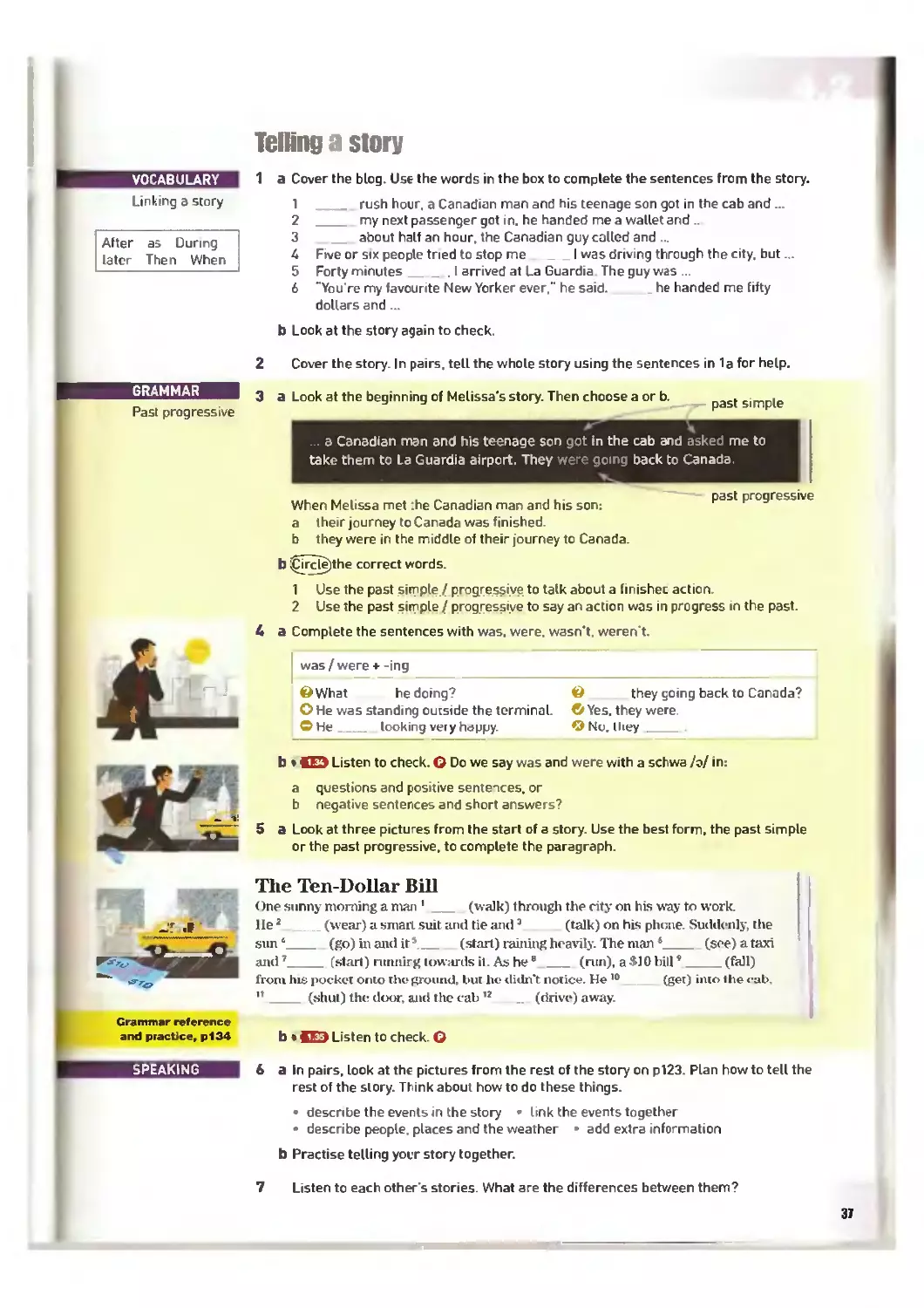




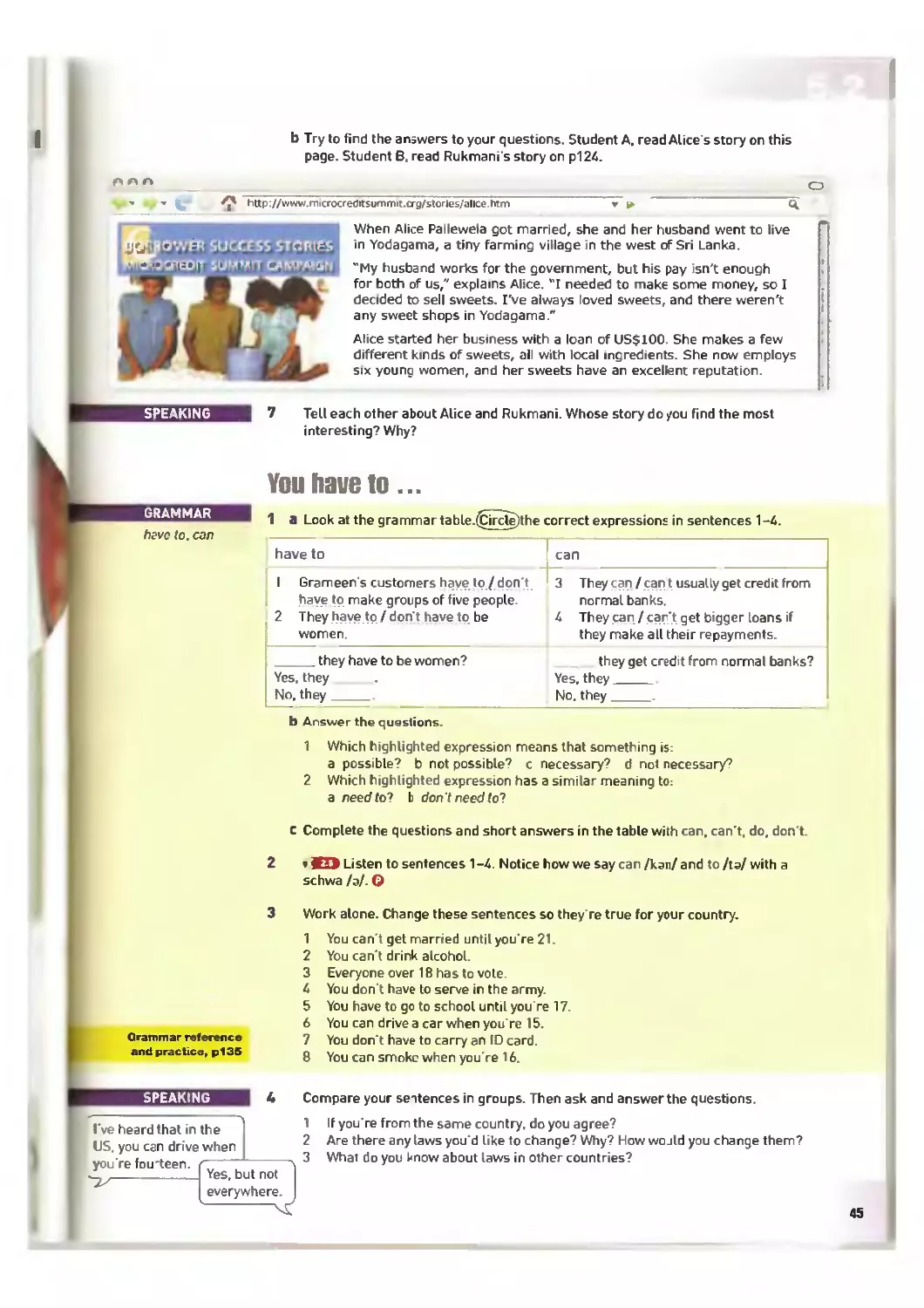




























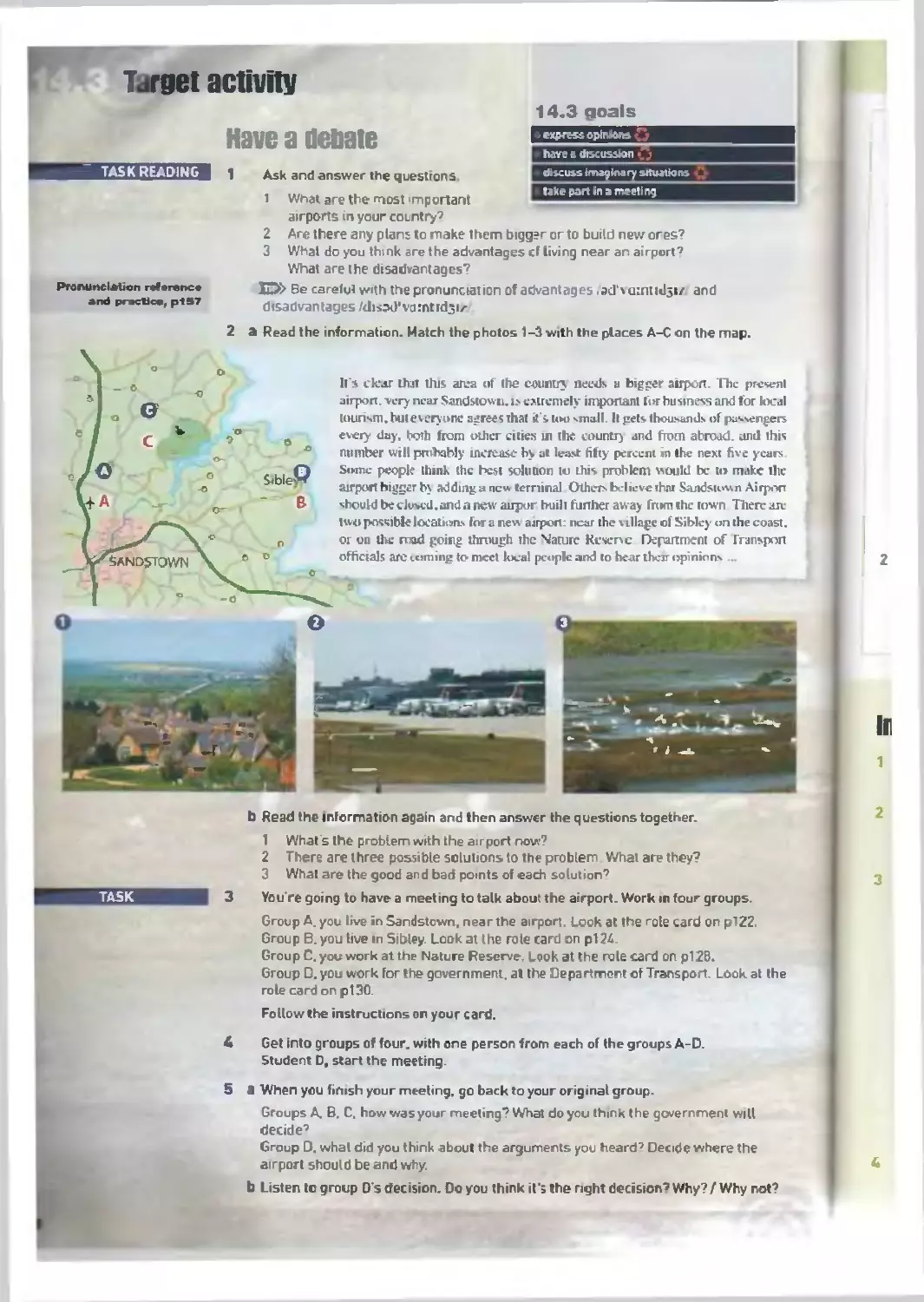

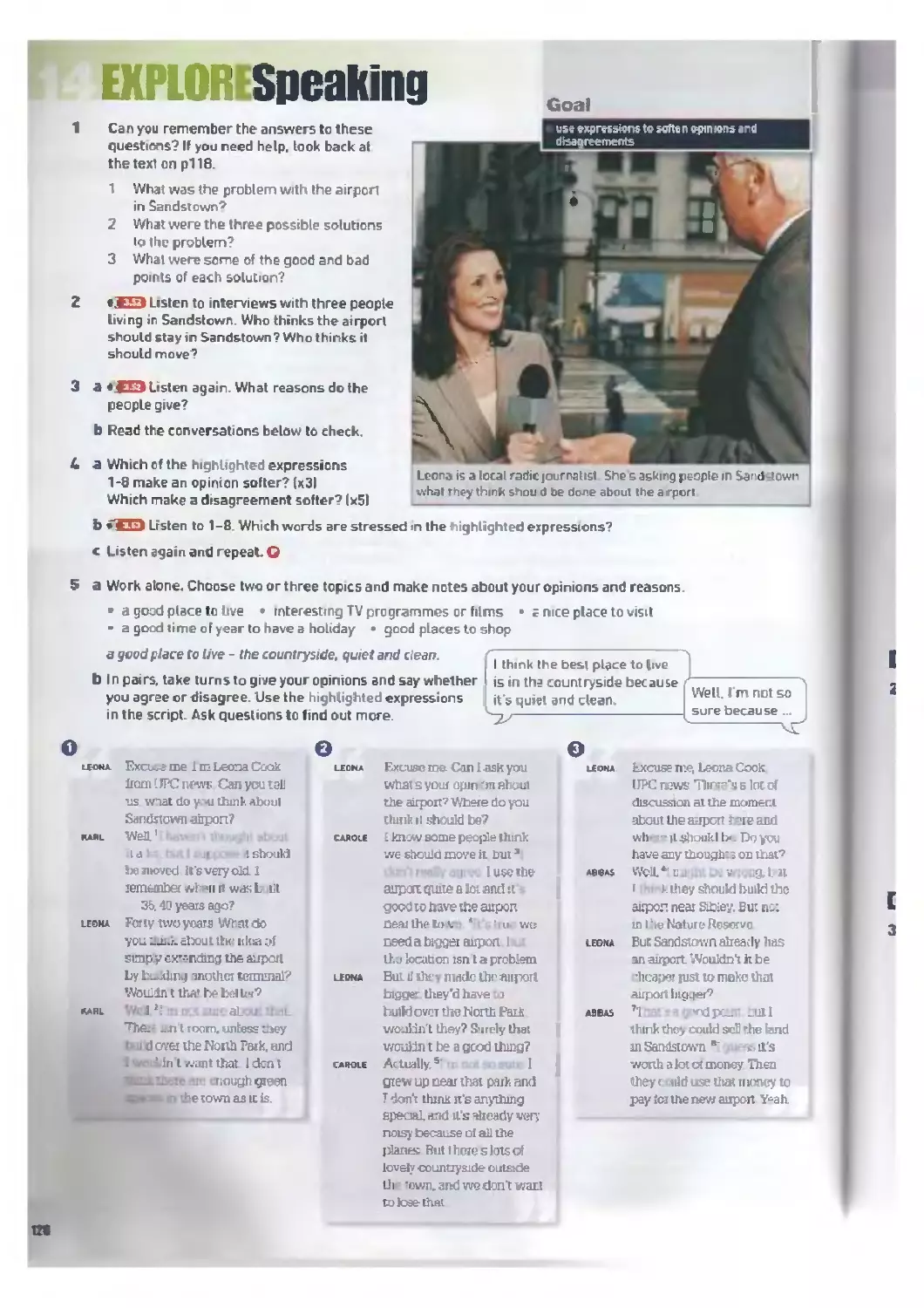
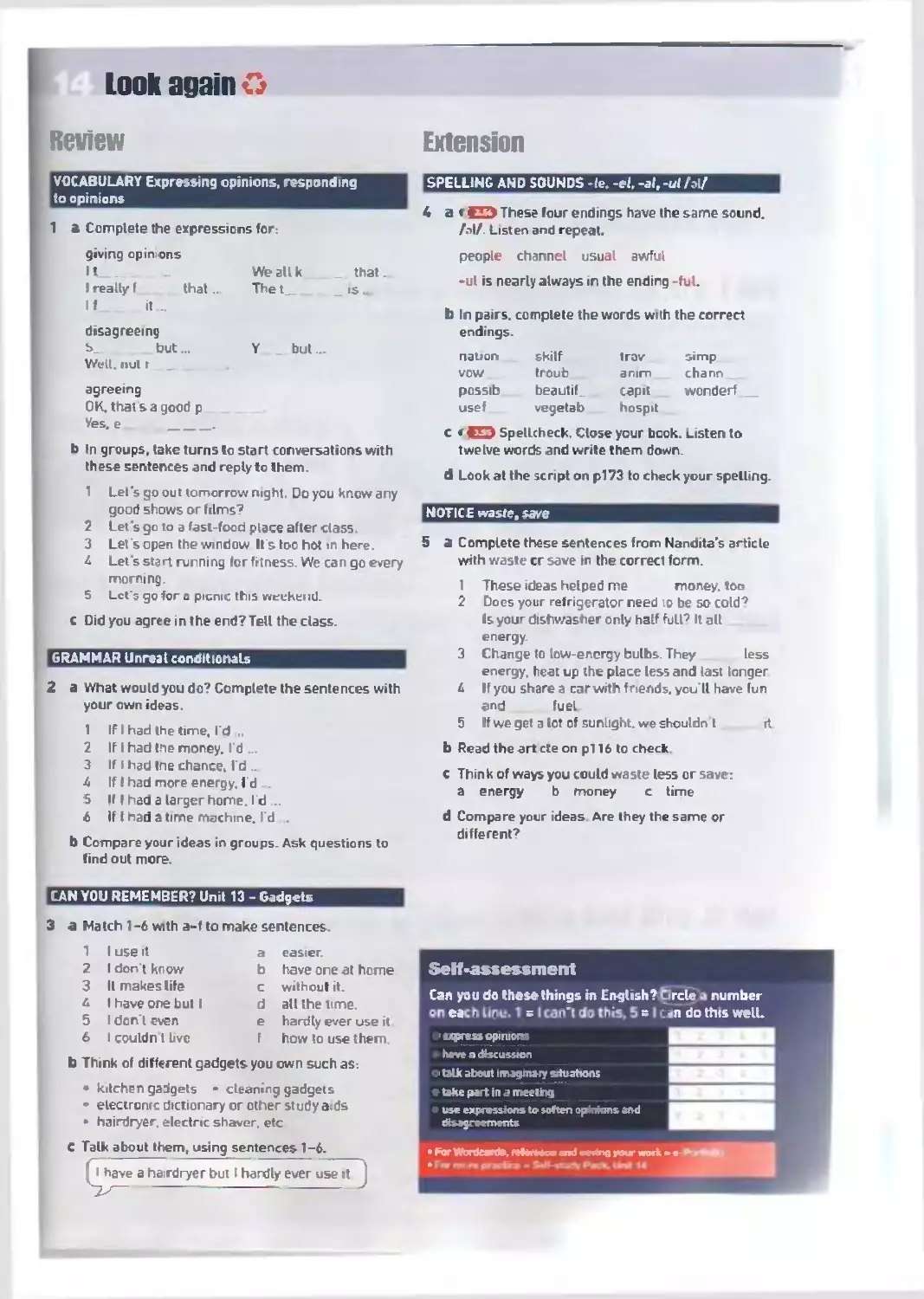

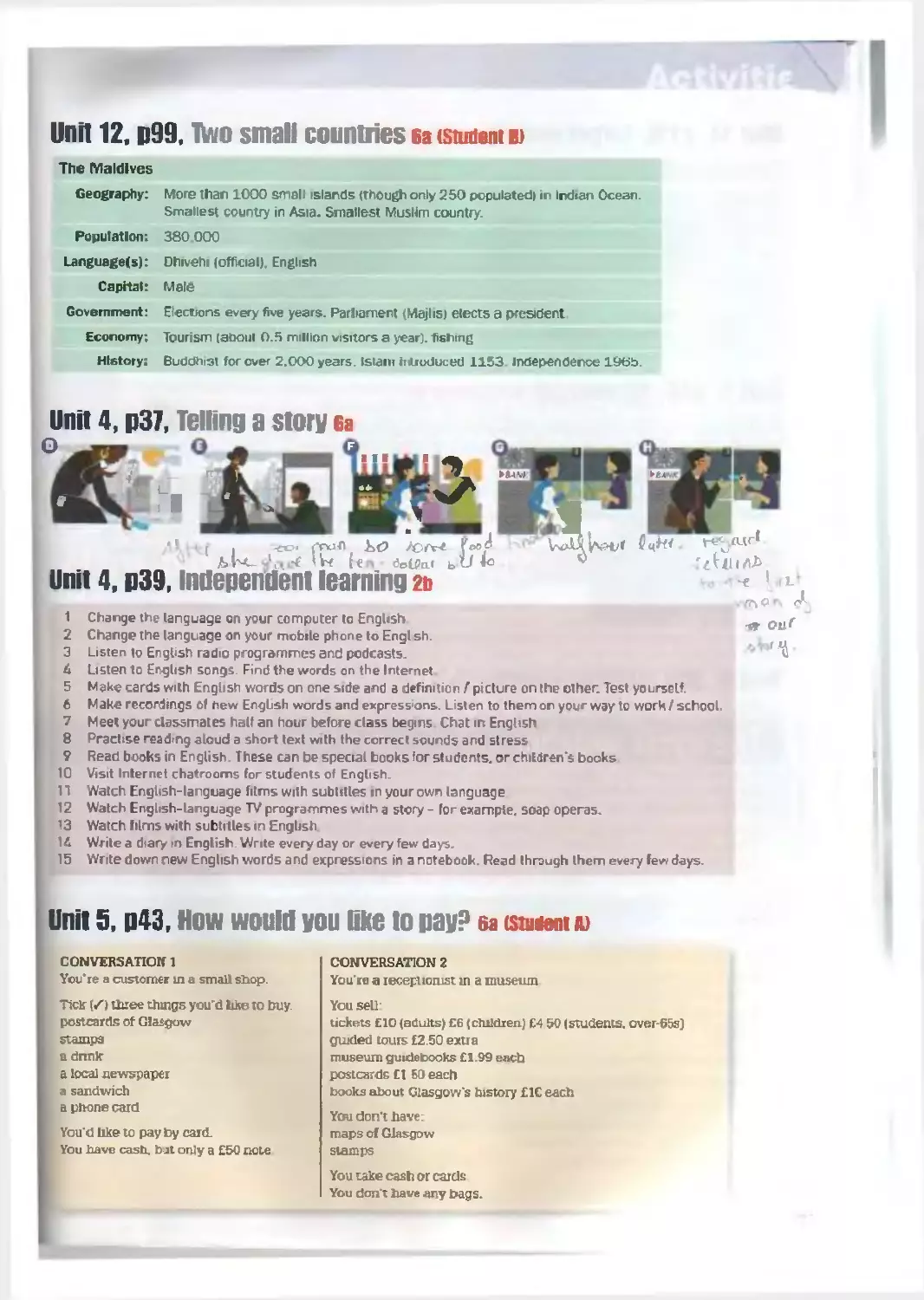
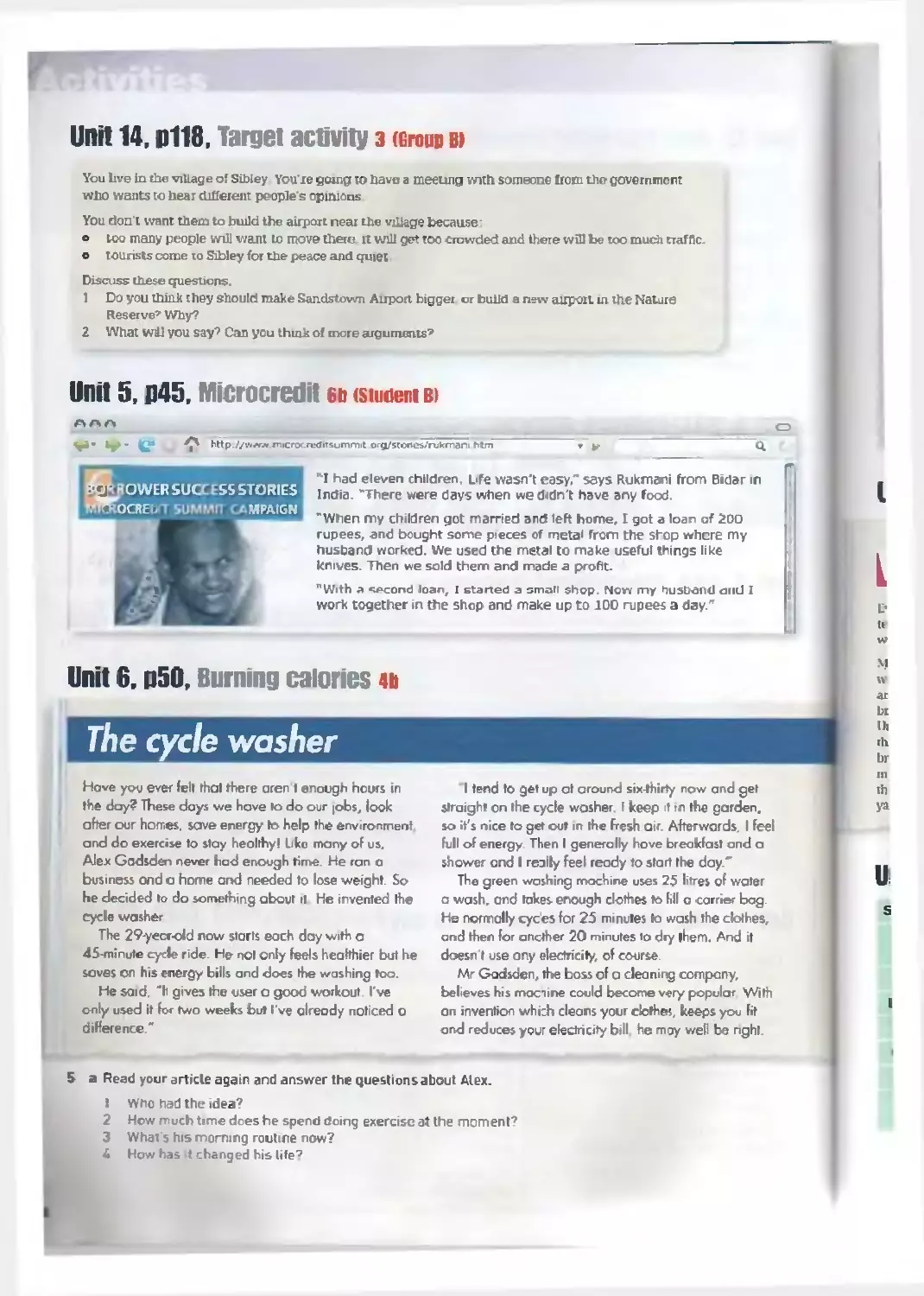
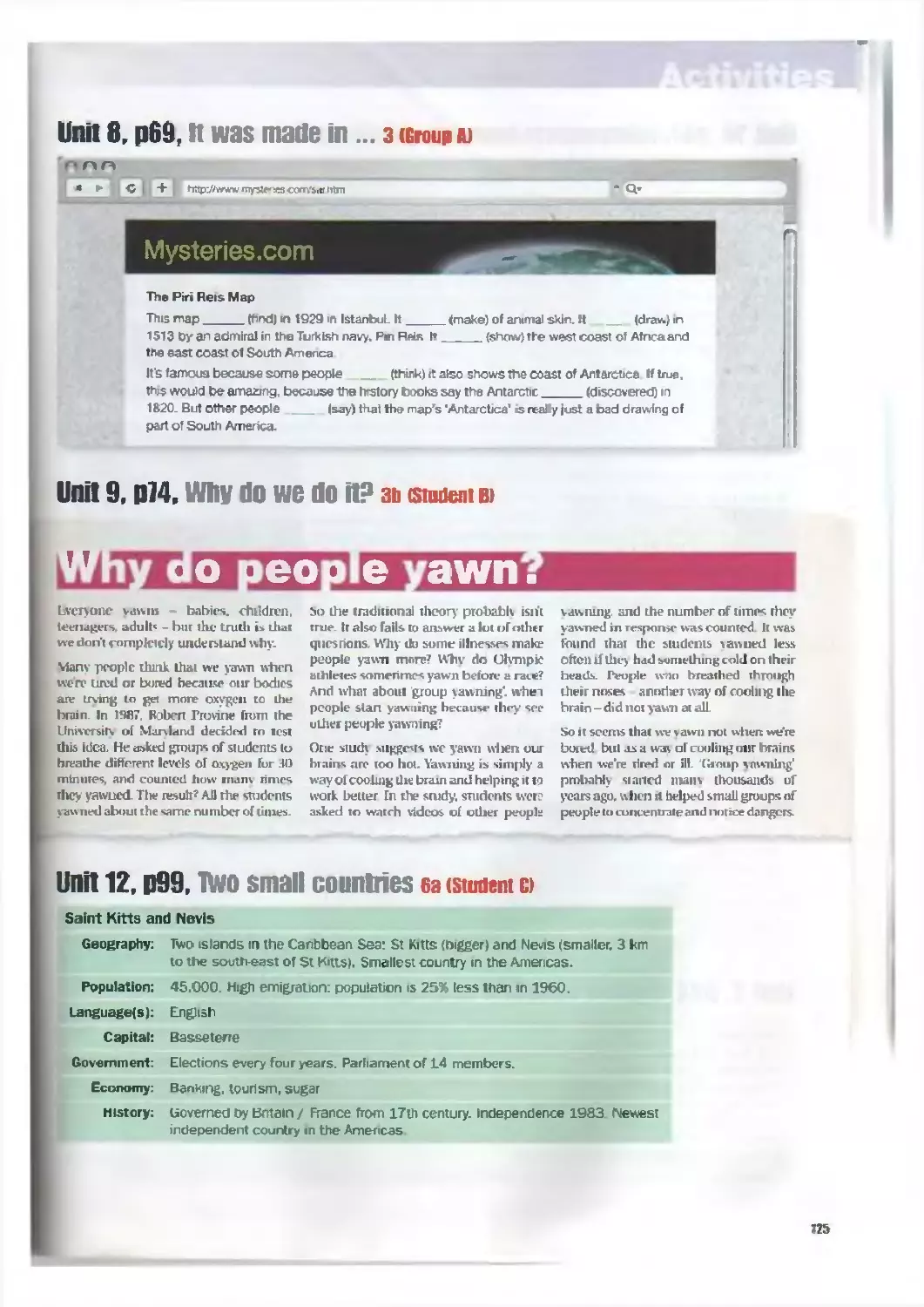

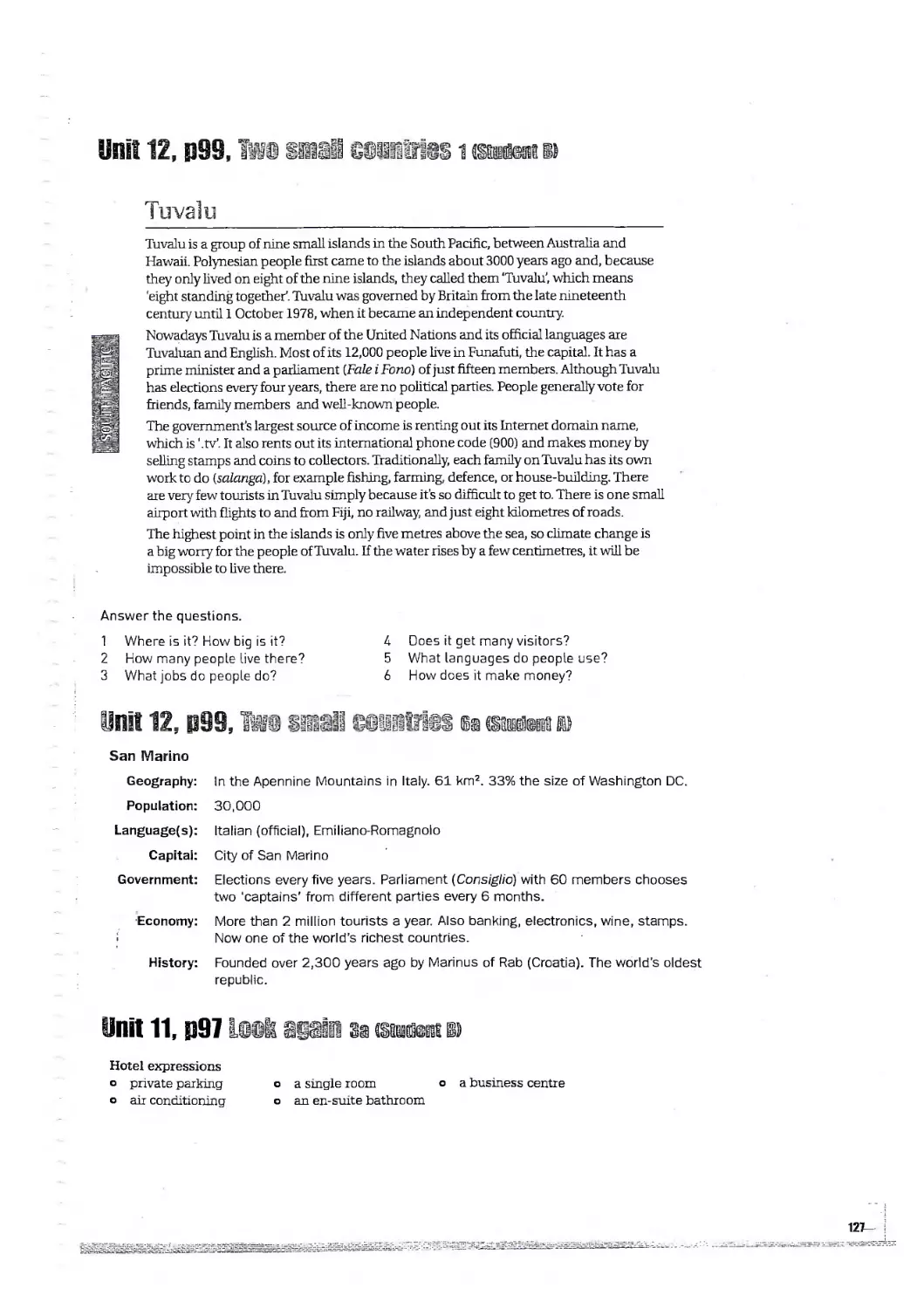
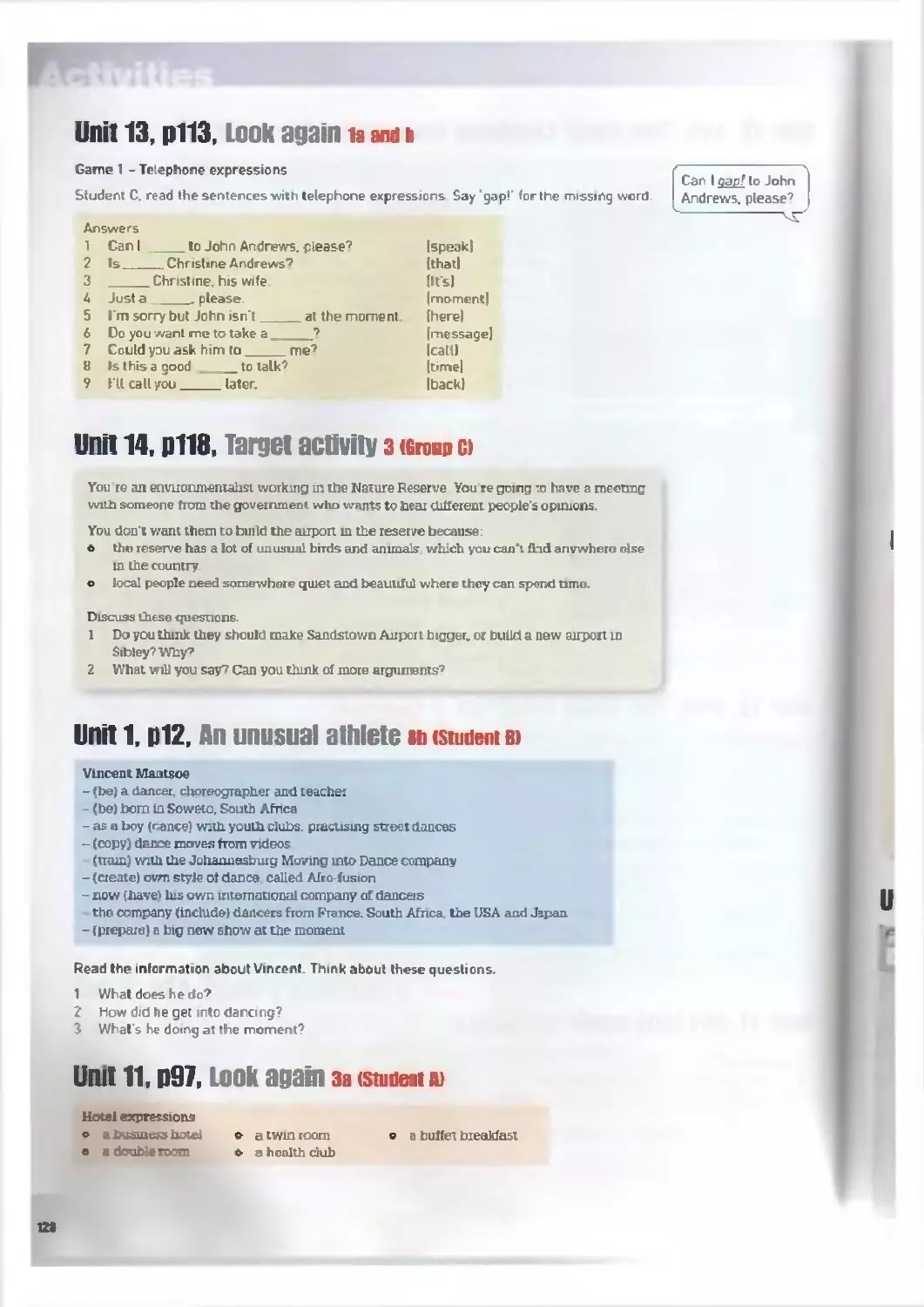





















Author: Tilbury A. Clementson T. Hendra L.A. Rea D.
Tags: english english grammar english language
ISBN: 978-0-521-69777-4
Year: 2010



Text
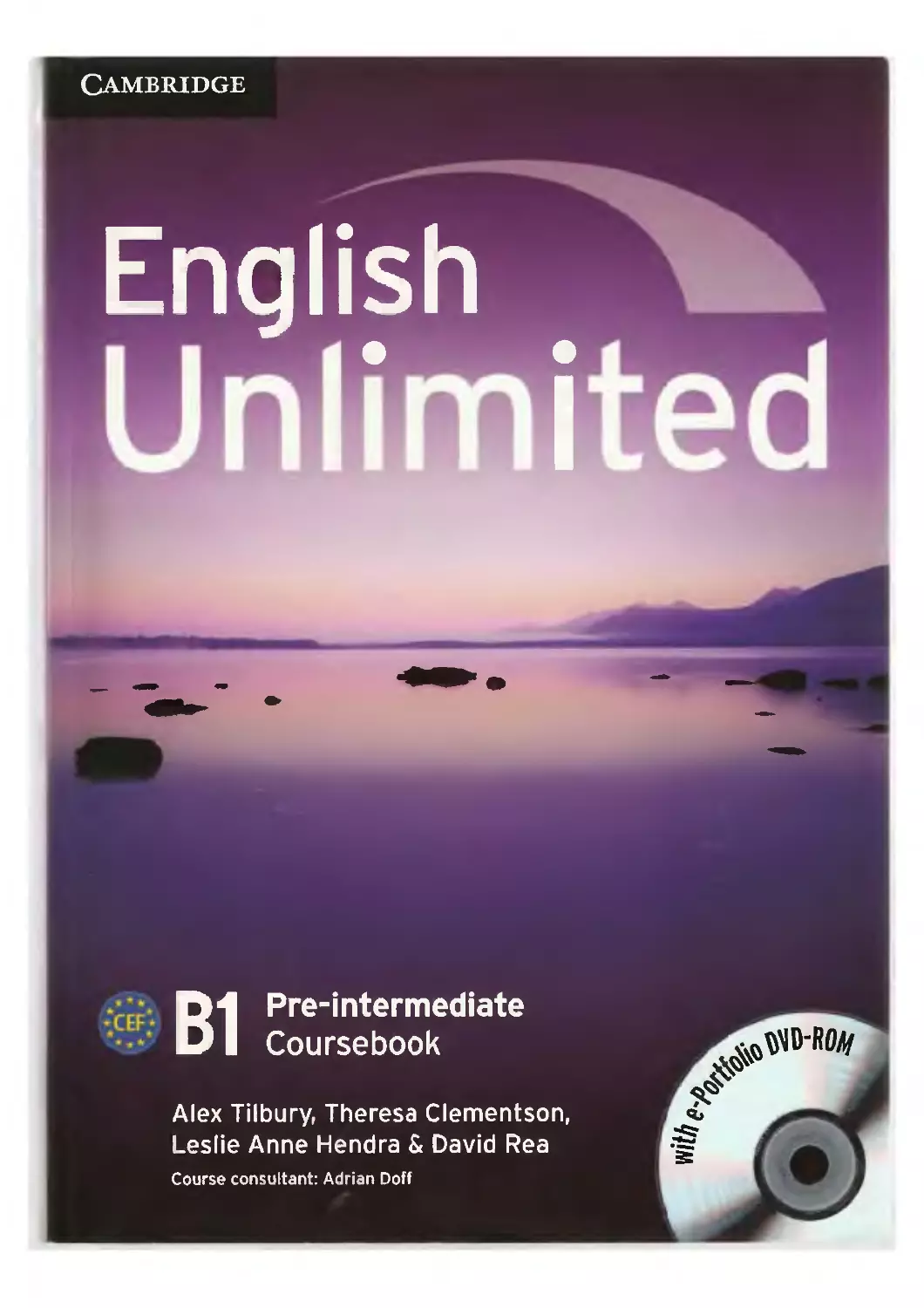
CAMBRIDGE
English
. .
I
- -
-
.
-
-
.
-
81 Pre-intermediate
Coursebook
\\ \) D-ROM
:s
"-
:!:
Alex Tilbury, Theresa Clementson,
Leslie Anne Hendra & David Rea
Course consultant: Adrian Doff
English
.
.
II
..
-
.
..
.
81
Pre-intermediate
Coursebook with e-Portfolio
.
Alex TilbJry, Theresa Clementson, Leslie Anne Hendra & David Rea
Course consultant: Adrian Doff
-
CAMBRIDGE
UNIVERSITY PRESS
I
I
3
::: I,'BRIDGE UNIVERSrrY PRESS
Cambridge, New York, Melbourne, Madrid, Cape -O\l/n, Singapore,
s.1io Paulo, Delhi, Dubai, Tokyo
Cambridge Unive ity Press
The Ed nburgh BuilllillY. Cdfllbfllly l.tlL tiKU. UK
www.cambridge.org
Information on this title: www.cambridge.org/9783521697774
o Cambridge University Press 2010
This pwlication is in copyright. Subject to statutory exception
and to the provisions of relevant collective licensing agreements,
no reproduction of any part may take place without the written
permission of Cambridge University Press.
first pLblished 2010
Printed in the United Kingdom at the University P'ess, Cambridge
A calalJgue record for this publication is available from the British Library
ISBN 978.0.521.69777.4 Pre-intermediate Coursebook with e-Portfolio
ISBN 978.0-521.69778.1 Pre.intermediate Self-study Pack (Workbook and DVD-R
ISBN 9l8-0.S21.69780-4 Pre.intermediate Teacher', Pack
ISBN 9l8.0'S21.69779.8 Pre-imermediate Class Audio CDs
Cambridge University Press has no resP'Jnsibility for the persistence or
accuracy of URls for external or third-party internet websites referred to in
this pU:llication, and does not guarantee that ar.y content on such websrtes is.
or will remain, accurate or appropriate. Information regarding prices,. travel
timetables and other factual information given in this wo<k are correct at
the tirre of first printing but Cambridge University Press does nDt
guarantee the accuracy of such information thereafter,
Acmowledgements
the authors would like (0 thank aU 1M ''tam 0111 CUP for Iheir Ideas. support and
tommllrnenl 10 English Unlimited. In particular their editors. -<aren Momber. Greq
\ O!."d 'o( l'Ih SCl1\ 5.. cm6 'OiW"\Q L..."""u":\' \U'l: n 'l'0(''\. on ,'\I.e " 'I" Qi1!o
\9f\ t'he')l" 6 it.\!lO \\\o.. \ ''''i't\"y. ""6n<X"o (;.0\\ \Q1 \ u')" \'1o\t""\ t:f\ U'f ""'i\ ".It.f\'I1
re-m;Jrk,)b\y detal\ed te-edboi.:A:: af'ld Oa'>le W.Uis. Jal'l W'1bs.. AUsof\ Sh.\rpe and
Sue UlIslein for rhtlr Idea al"Jd lospirallo,} in the early day;, of Ihis prDjecl
Tha1M;s are also due:o Michael Stuart Clark. Oanus! Klimlc.oYJicl. Monica
Koorlchh and lIt-hUs lor parhcular tdeas and conlr.buhons.
Alex Tilbury Ylould 1.k@10dedlcate his work on English Unlimited to Geoffrey
William T. bury. C8rol Tilbury and Stawek Srnolorz. with IDle end thanks
David Rea ....,ould like to than"'- the students. teachers. trainers and slalf at
IH I<rakow. IH H llOpolis.. IH Buenos AlriP . IH Pari, and IH London 'or all the
support. df'Velopmpn! and fun over Ihe years He d also li to thank Emma
McLachlan. Ihe rno t beautl'u1 woman In the world.
Les1ie Anne Hendr.. would like to thank her 'our tong-time sfudiPnlS bnd friends
In Japan Junoto TeraJima. Elko Kanal. Aklko Tsu ukl and A(lko Ohno With much
appreciahon for all the wonderlul time we spenllogelher
Theresa Clementson '''outd likt to thank Anlhony. Sam an Megan lor IJ'I,,"
IdiPas. 5upport and unwavering confidence. and Cti$lina Rimini lor her he\p and
advice on aU maultfs TEFL over the years.
The authors and pubUShtn would lib tD th,ank the following teachers for
invatuable feedback they prov1dfd wtlon reviewmg draft material:
Howard Smith. Merryn Gnmley IUI<I; Marla de los A.r.gclc Velez Guzman
(MexlcoJ; JIISi'yna Kubica (Poland): Gin HamlRon ($pollini. "'arbn Goosey (Korea);
C.J"thenne Land ICZtch Republic): Ins GraUert. Donna ltel"ieh (Germanyl; Rachel
Connaheer IUal't1. Jamelt'a Noder U.:rp..JOI. Amanda G 4 mble (Turk..-y1; and the
vanous members of the Cam"ndge AduU Pdnel.
Tl'1e authors and publlstlers are also grateful to the 'ollowing contnbutors:
Design and page make'up: SIc>phanit Whll02,1 Kamae De!:lgn
Piclure research; Hilary Luc cock
Photography: G,}re-Ih Boden
Audio recordings: John Green at Aucllo Workshop and id-l\IJdlo. London
The authors and publishers would Ilk. to thank aU of tho.e wtlo took pari in
the authentic recording sessions, especially:
Annie Genlrl Alba Higgins. David \Val\vlck.. Susanne Neuber.. SiewVlan Chal. Xi Yen
Tan, PalAa Porront NaiallC' Krol. Leonardo Soiano. Me93n R rs.Moo . M e\
ArrtlyO-l<alin. Pham Thl Thant1 An. And Reid Richa Bans 1 twI,iIIsha Sutton,
Srung Yang. Tom Boyd. Fran Disken. A$lrrd Gonzale .RaNo'.. A.nrr t-v..saki. Anme
Gentl!. Marlin Huarte.Esplno5c1.lvan Gladstone. Huna Gon"at..-s-Rabad .
The authors and publlsl'1f1rs acknow1.dge the 'ollowing sourCes of copyright
material and are gratet\i( for th. permissions granted. While every effort has
been fI1ade... it has not always been pOSllbte to Identify Ihe SOUrces of aU the
rnafKi"l us,ed. or to trace aU copyright l'1otders. If any omissions art brought
\Q QUII' naUce.. we. w \l MiQQ\J ta lnc.lude the aOOfQonateadc.[\(M1.edg,ement5
onrepnil((hg.
\"10.. Ih,.n"ks 10 Ihfl \ () I\'[)e\:lItle i-ound.""lon anti W,.ter Oavlt y 11)1 t'he extract
. '\.""'\.. QI> 'W"........ ".( -S...... ...""S"...",o:>'-..%.
udi Bevan lor Ihe lexl on p11. Mebssa Plaut fOl" the lexl on p36 laken tromp
tUp;lIn "'I'fc.rkhack.blo9SPOI.ComJ2006l08Jcow-calcherhtml Reproduced by
(:ermisslOn 01 Mell5>5a Plaul; Mi(rocredil Summit Campaign for the e1!.t"ac:s on
pz. . 12l.. Reproduc d by rml55lOn 01 Mlcrocredll Summ.. Campalg",\; Mark
m:.ser lor the lext on pliO taken from htlp:I/'lNJw pbs org/Tleclrasrllfll2006J031
(pen-sO\lrce-reportinglivin9-Vour-life-onlinc086.html. Cop,Tiqhl PBS 2006;
Conlenl copyn ht 0 OrNandila Iyer lor 1he texl on p116; Tt:e Melro for Ihe
Uhcle The Cye" Washer' bySar,}h Hillson D121.. 4P Th MPlro.
1"& p b\I 'hOT "u u ed ,\ 'ocs.\ en6e "l)uts \0 &nsu.r& \hiilo' M UR\.r. 101
ixternal websites n lened to in this book are corr«1 andadive at Ihe time 01
ilDlng 10 pres5. liowever. the publisher I:.s no respon lblllty lor the websltes
Ind can make no guarantee th.n a site will remain live or Ihat the content IS cr
Hill remain approprJ.r:e.
fhe publJsl\.rs .r. graleful to the following for permissio, to reproduce
ropyrighl pl'lotographs and materioill:
Key" I . left. c = centre. r - nghl. t. lOP. b - bottom
.\Iamy Imag John Sylvesaer lor p1hd./COJt>pllellmagesJ'ComSlock lor p1(tll.
; Btend Im\rges for p7IbU./OOJO Images Lid lor p71lrl.JCI OJO Images lid for
p8(ttJ./C>Photo R utce Hdwaii for pl2lbll/OSludio9 for p1'ltri. I()R;:rdlus
ffiJges for p 18lUl/e::>Rachus Image!:. lor p 1811d. 1(;J ex gre tor p ISlblt IIDJenl1y
"aUhews for pl8lbrl./It>Radlus Images for p10111./Q')Radius Imagi's tor p2otbl.
:CDave Penman lor p26t1l.I@PelerHorrec lor p261c1. J0M.11 Gnggs for p26(r)
:ClGraharn Corney lor p2'1111. lenanr Images '0" p27IUd./OUira lor p271lbd.
:0Blend Im3ge-s lor p31kJ./OSteve TeaguE' for p32(H1./ClLOOK Ole BlIdagentut
j r Folograft:n GmbH for p3 . IV LOOK Ole Brldagenlur der Fotogralen GmbH
.or pt.Olcl./ClJTB Pholo fo.. pt.Ib{lrL /Olmagebroker lor p/.8111./@A T WilleU
:Or p52(1 backgrcundl./€>irnagebrokpr lor p5211rl./<ouli nuslo for pSZ{!crl.
'ORo en Read lor p52!tcl. iORlChard Naude lor p56(lrJ.l P.upert HonoxJ
5,:yt.,'-' Cordai")'" Ptlolos L1d lor D11./OPichJr@ Colour ll rary lor p6J, J(JAndt
J nny for p6'(d. JOMark OybaU 101 p67fbJ./€;11\ TcitFOTO Presspb'ldagenlur for
p69Itl./C fo.,ISADCO PI'otography '(or p101BI./Oti0260 com lor p10IbU./l{}lmagt'
S\tI\e.\ot 91f,. '. '()Ga,1"It.oo\o. b o1Q\\\. '<t) \l.f\6..\.., \()e." ?o'D. \Ot l \b\.
1 1..U 'G.tt. \a\ 9Wl. (C\ , l \.{@\(\t:.... S.1A<. lat 1lb.\. '(Qlaw.
M,JS\trs.1ol\ lor p8/,(,I./ClRedCoDshck'S.c:om LLC lor p84lbI./ORous.se1 aemard
lor p85Itl/@uppe-rCut Images 1eW' p87(tri./t)Davld Young-Wolff lor p8"/lbI.
ItDGuillen Pholography for p'95. /PAshley Cooper for p991bl. Je'rolts.ph IO lor
pl021111.JroBtend Images lor pl06lbll./4PElmtr@e Images lor pI18(U./ I oy
LaY\'e for p 1181«t/.&IHornblllma9@s lor pI18trl./t)lmage Source Black lOr
p 119Ibll./@Dlgl!dIVislonforp120./0Imagebroker lor pU2(cheese). Ie:JArJdrew
Twort lor pl£2(cream). lefoodfobo lor pI41Isa\adl. IClJ lIrcy Blackler for
pM 2($Ctu'es)./ 4ndre Jenny for pl/.2(splccs1./(t)mcdiabht2IrNg S IUK) Ud
lor p 1l.:?lvegelablt'Sl. JOB & Y Protography lor pl'21S;dgne1tIJ./()'oodfoho
lor pll.2lbakel I€)Edd W stmac:cll for pi 421wllI. J<':JRed Fred lor p1421fryl
JOfoodlolio for p1421roas1t Alf-IC ::.sdsden lor p50(rI: Be.nbect(e RarA Book &
Manuscript library. YaleUnlver$i1y lor p6B(IJ. Bob Lestina fOt pt.S; Bopha Oe'YI.
Oocklands. Aus:tahillor p28ltc); :orbls./ Dan ForerlBeateworks lor p71brl.
J()lWA.O nn Tardil lor p8(tr!. ICDJlm Cra.gmylE' lor p8lbl. IClStudio Eye lor p301cl.
J"Bloern Sigurdsoen/cpa for pM. IClJonny te Forlunelzol'l',) lor p&6hU./Qlmage
100 'or p41./ClThe IfI$h Image C)UeWon lor p56(11i. leCorbls Premium RF for
p74(CI./ Corbls Super RF lor p/4ID). lePaul Almasy lor p92IU./@Pt"ter Turn\e-)
for pl02flrl. J0Belimannior p IOO(bl./eStudlo Eye for p11.21gnUI. DK Images for
pI421S1rrl./t>Howard Sl1(Ioler for p32G./OOave King lor p l i ,2Ishakel. EqYPIIan
Museum. Cairo 'or pp68(rJ. 13; Emporls GmbH lor p'101Irl. Fondallon Le- Corbusier
lor pp 921c1. cr. rl. Getty Image lone for p101tcO.IOAUrendo Images for
pIOllr1./elmage Bank 10" pI8IbcJ./IDGu\f Images lor o21./0Phot01ibrary for
p2/,ld. 1t)lmage'M.'rks for pZ,6ibIl/ClTlmolh)' A Clary/AFP for p5O(l1. lCOHarald
Sund lor pbOlbL Jt>Paul OIJ"yle for p661t1J./ClPNC lor p66(tr), /t.)Alan Secker for
p66lbrl.I<PStephen Hoeck for p7)lbcrl. J€lNannder NanuJAFP for p93. i0Aurora
lor DIOO\ll/tJDtnis Poro)'lhFP 'or p100lr)./esliPve Smith lor p115./0M:ke
PoweU lor p 114111; IS10<'kphC)told:Ark3dy Chubykln tor p52tbrl/tD ...."mu Media
for p741et 0. Nandlta lyer for p116; PA Pt!otos/AP Pho1QfOiane Bonda..." for
p3bllJ. PanosfOTim A Hethefinglon lor pb41bt PhotollbraryJOOJO Images lid
'or p 18Url./t>H3'ls-Peter MerJen lor pMUI./C>PholoOISC lOr" p311tl./(jjRobert
Lall'lSOn lor p32(EI./@PholoD. c .or p66IbO./lDlmagel 00 lor D71;IBI. J@JonArnotd
RF for p82hI./OOJO fmages lOr p83,/f:'\Rlchard Glover lor p90ltll/@Warwlck
I< I'II fo... pWlbl./IDJuan Cartos lVunollor pIO ./«>Robert Harding Travel lor
pl061b<"../@lontylor pl09./4PAllanudeSNC lor pl11ItLioerond X I.r 0'261.1.
IIDPhotoDlsc lor p1261bl. PiClure-> Colour Lrbrary/ClDavld Tomlinson fOt 1>'01t1.
Punchstoclc.j()ValuelJne lor p1Ib(rl.l4PGlowimages lor p31lbl./OValut?lIne lor
p'8fbrl. I@Corblsfor p52(tcll./(,f.holoslndla lor p52(crl./OGlowlmages lor p851b,
IIDGoGo Images for p971U1./4PO,9I1al VISion lor pl02(cU.I@Cultura io" pl19(br).
/tCCom£lock for pl£11fcasll. Rarl(lom Hou e Inc lor p3b(r): Rex Fealures for
p27I1bl./()Geolf Robinson for p33./tlSlpCI Press lor p60It). IOEverett Collection
lor p60Icl.J@Sky Magaline lor p 12(c1: Ruben Gonl'a1el' for pl2lt1. trl; Science
Museum for p112:U; ShulierslocllllDDavld P Lewis lor p9./It'ILana Langiois for
plOllcr)./OSmI110r p32tAI./f) p! lor p32lBI./()Sandra Caldwetllor p321CI,
/If:'Safl d c;;Hlffl'.Ht"(f)i" pfLrl7/. ,d;;h"P JltiQm I17r p.j' }--r. ptrt:n ,,'bourn rDr
O1nlrl.//f)M.at o (In- 9S'2ltU.I(QR H r"',cbo for Q!1l..ltrLlf> I\I'I; Ar;u;lr'Jvlc tor
p I..\'b\). J ?"el'oe } I'o:'\:I\OI p ':I.I t\:lr'"' t) 'R. \ m t 'rot v.. 'D\. Jq;,\"'b1'b 'RGU '
lor p701AI.l«>grzym tor p101tl1I'E;:1Tool\e350'or p7m.C1, lCSerQE"y7ltov lor p"1ti\D1,
/Junah MOSln lor p75. /<OMa)(FX ler p97./ SF Phoor-tor p991:1. J()Lee Tore-ns
for p 106(lrl.IOsergbl., lor p 112(b)./QU\lll1'\a'tI'de lor D 1I.2Ibasl\J. J€>wnlcluS
Tuplnamba lor pllo:?lch'ckenl./@heGougl1 for p1ij.2Icurryl. J()Jan Hopgood 'or
p 142(fnJlII./(.Walda fOT p(42Iherbsl.ICJJoe Gough lor pl,2(las neJ./t)luChscher:
lor pl'2lmushroomsl. 10010upa fcr p 1'2(strawberflesl. leviklorl for pIl.2Ib"'E' d-'
lens for pl.(2I<akel./4PZTS for pl.G2Icucurnberl./()5arune Zurbalte for p1'2Iic..-
creamt/@OI.ga Lyubkina for pU.2bll) l@ncr.1810rp142(01ivesJ./IDJuha-
Pekt(a Kervll\en lor pll.21p..)stal./ Anlol\ Gvoldtkov for pl'2ta pearl. JORobert
Rede\aws.kl tor p\.L2\po\a\oes.t JCy;.en\O'n tor D\J,2\prawnst ICl10'b1"" tor p1lt2\ntl
I@Sluan Monk lor pll.2lsatmol1l./l'OChln K l'Sen for DI '2(soupl. Jf:JJoe Gough for
p 1I.2IsleJ ). IORobyn Mackel'\2'le -or p 1'21Iom 10esl./@Elkp Dennis for 1i,2Ichopf
/()3":'J;512&71 lor p1G2Icu\I./elk r canlkbgll 'or p 1J.2Ipourl. Stodc FOod UK
lor p]2(tr brJ; The Terem Duarlel .or pl1lr!; TOpfotolQForlean for p681c1. YNNI.
Judybevan.com tor p17(rI: www.SE!oC.waman.coza lor p121brl wwwwomadelalde.
com lor p IIIU.
We have been unable to Irace lhe :opyrighltJolder of Ihe photographs on
pp58bUrl. 691bl and 11' and would Icome any informalion enabbng us to do so
fhe photograph on 2811rl was kindly la1c.en by an employee of the Meltourne
Ollie!? Cambridge Uni... rsiIY Press
The followlOg photographs were lak(i'n on COmRIlSSlon by Gareth Boden for CUP:
7lbtll. 16. n 7<"1. .I8lbll. <211. rl <:\ 8rbll 5<1.11. >blerl. .7. "elA. e. c. OJ. 18
We re gr.lefut to thelq (owing :or Il'1elr help with the commissioned
photography:
F.ll1"iiiam Museum. Cambridge; Greens Health & Fitness. Cambndge. Gre-g
Sibley. Leg,,1 Move$, Henlord; Linda MaUh : Stephcm Perse 6th Form CoUeg
Cambndgif!. The Lounge. Herllord; Thomas Cook. Cambridge.
Illustralions by Oer k BacO'1. I<a hy Baxendale. Tom Cr011. Mark Duffin. Kom;:re
Derign. Juhan Mosedale. Mark P e!tlon. Nlge1 Sc1"1derson. Sean S,mms,
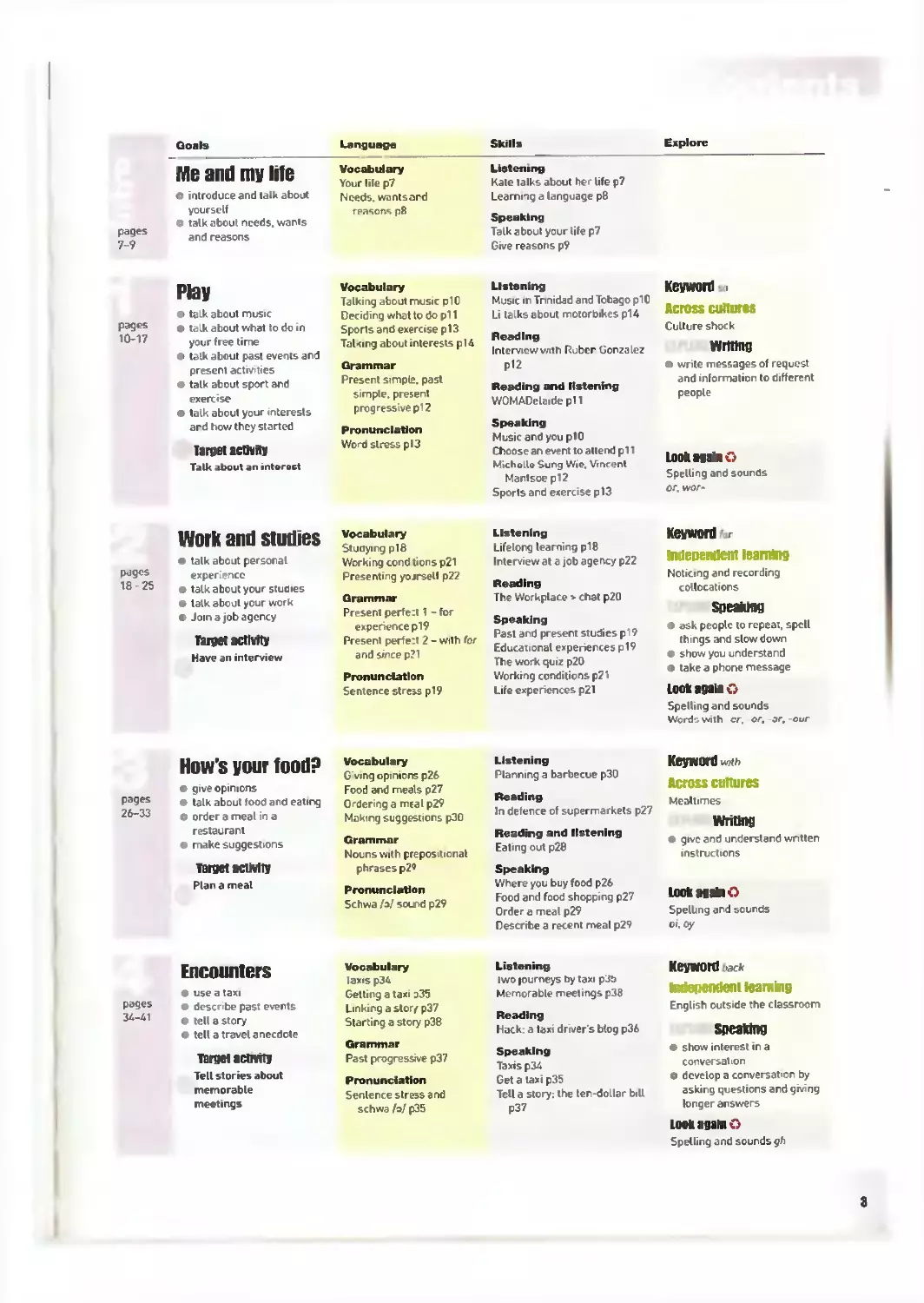
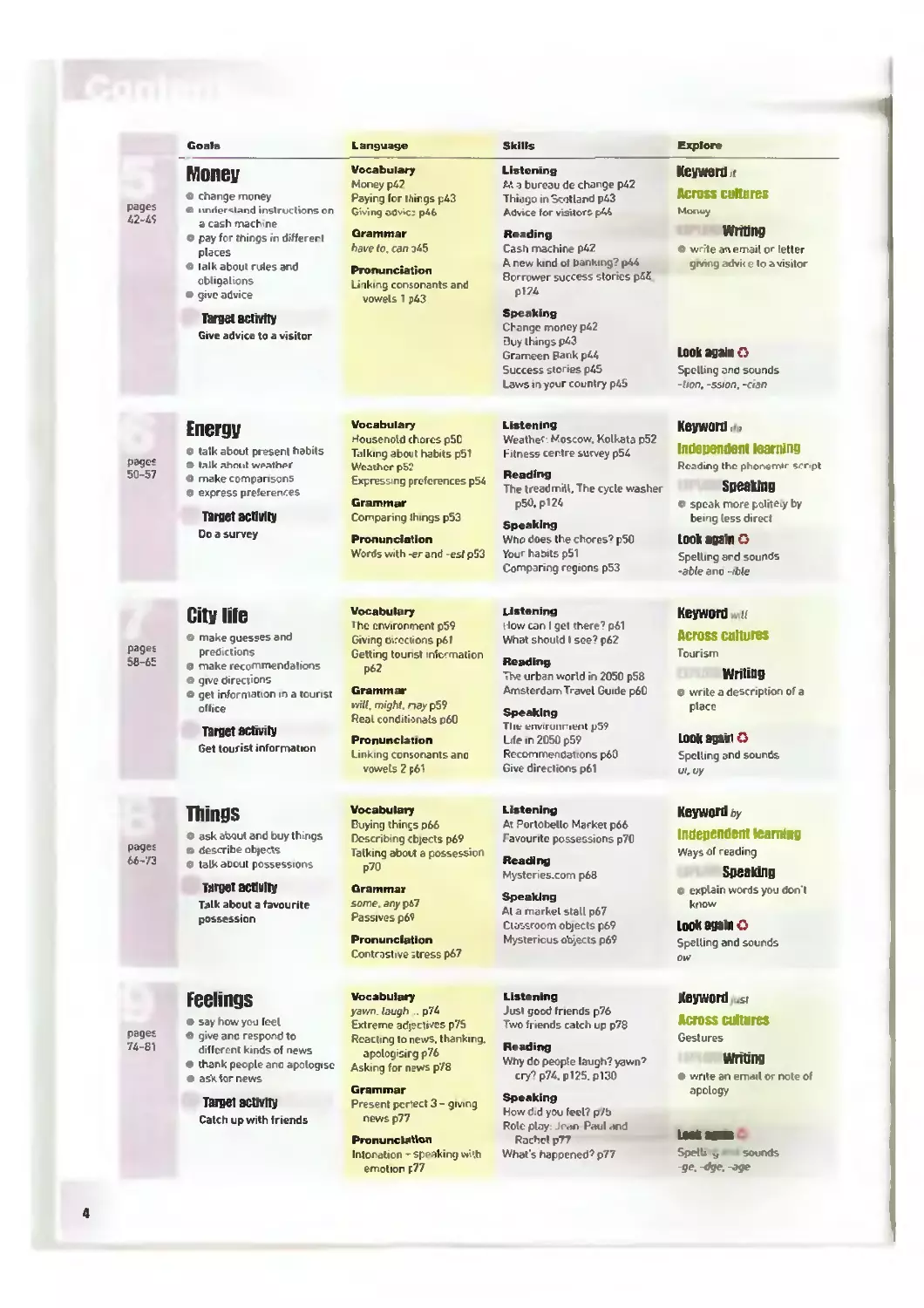
Goals Language Skills Explore
Me and mv life Vocabulary Lletenlng
Your lile p7 Kate talks about he-r life p7
. i.,troduce and talk abollt Needs. wi:Jntsi3nd Learnl'lg a language p8
yourself rP"'''ioon''io p8
o talk bout needs. wanls Speaking
pages and reasons Talk about your life p7
7-9 Give reasons pC;-
Plav Vocabulary Listening Kevword I
Talking about music p10 MusIc In Tnnidad and Tobago p1() across cunuru
. laLk about musIc Deciding what to do pll Li talks about motorbikes p14
pages . lalk about what to do in Sports al"ld exercise p 13 CuUure shock
10-17 your free time Tal.ung aboul interests pl4 Reading
. lalk aboul pasl evel"Jts and Inltrvlcw wllh RlJber Gonz;) lez Wrmng
present activities Grammar p12 . write messages 01 requcsl
. talk about sport and Present simple. past Raadlng _ listening al"ld information to different
exercise simple. present WOMADeialde pll people
. talk about your interests progressive p12
ard how they slC3rted Pronuncletlon Speaking
TII\I8IICIIvIlJ Word slre$$ pl3 Music and you plO
Choose an event to attend p11 Look... 0
Talk about an interest Michollo Sung Wie. Vincent
Manlsoe p12 SpeUiog and sounds
Sports 81"1d exercise p 13 or. war-
Work and studies Vocabulary Listening Kevwonl r
Stuay,ng pi 8 lifelol"lQ learning 1'18 hlependellliearnlll!l
. talk abollt personal Working (cnd tions p21 Interview at a job agency p22
P<J9"s experience Presenting YOJrseli 1'22 Noticing and recording
18.25 . talk about your stuDies Raadlng coltocatiol"ls
. talk abo\J1 your work Grammar The Workplace> chat p20
. JOin a job agency Presel"lt perfe:11 - for Speaking SlleaiII!I
experience p 19 . ask people 10 repeat, spell
TlrDelII:I1ItIJ Presel"lt perfe:t 2 - with (or Past and present studies p19 things and slow down
Have an interview aod since p?l Educational experiel"lces p 19 . show you understand
The work q.iz p20
Pronunciation Workiog conditions p21 . take a phone message
Sentence slreiS p 19 Life experiences p21 LoolI..'.O
Spelling and soul"Jds
Word:. with cr. or. -:Jr. -our
How's your food:- Vocabul.ry Listening Keyword wlfh
G.vlng opinions p26 Planning a barbecue p30
. give opinions Food and meats p27 across cunures
pages . talk about food and eating Ordering a mEal p29 Reading Mealtimes
26-33 o order a meal i., a M01klng suggestions pJO In defence of supermarkets 1'27
restaurant Reading and listening Wri1in!I
. make suggestions Grammar . glVc and underslal"ld wnUen
Nouns wllh J:reposltlOnal Ealing out p28 instruchons
Tn"", IICIMIJ phrases p2 0 Speaking
Plan a meat Pronuncletlon Where yo. buy food p26
Schwa ,., sO'-"d p29 Food and food shopping p27 LoDII...O
Order a meal p29 Spellmg al"ld sOl.mds
Describe a recent meal p29 O;.OjI
Encounters Vocabulary Listening Keyword ..ck
1axls p34 IwO Journeys by taxI p:.J 1llll8Dendlll11la1W1n9
. 1Jse a taxI Getlil"lg a taxi :135 Memorable meetings p38
pages . describe past eveFlts Linking a slor ( p37 English outside the classroom
34-41 . lell a story Slarting a slory p38 Reading
. tell a travel anecdote Hock: a la.i driver's btog p36 SlleaIdng
Grammar . show inlerest in a
Tn"", ICIfIiIJ Pasl progressive p37 Speaking
Taxis p34 conversatLon
Tell stories about Pronunciation Get a ta.i p35 o dc lop a conversation by
memorable Senlence stress aod Tell a story: the ten-dollar bIll asking queslions and qivi.,g
meetings schwa ,., p35 p37 10l"lger al"lswers
LouII...1II 0
Spellil"lg and soul"lds gh
a
GOBla Lang\lage Skills EJlplo..
Monev Vocabulary Listening IeVWOrd ,I
Money p47 t..... :] bureau de change p42
. change money Paying for things p43 Thidgo in 'St;:f)Ual1d p43 Across culIDres
pages . unlier-=.Io:md instructions on Giving iSGvic-: p46 Advice for visitorc- p Monoy
42-4 a cash machIne
o pay for things in differert Grammar Reading wriling
places have 10. can ,1&5 Cash machin p42 . write email or letter
. lalk aboul rules and Pronunciation A new kind of bankmg? p44 gIVing advi< e to O!!o visitor
obligalions li1klng consonants and 8orrower success stories pll
. give advice vowels 1 p43 pl74
_III BClivtty Speaking
Give advice to a visitor C ange money p42
auy things p43
Grameen Bank pl.4 look 11II111 0
Success stories p45 SJJctling anQ sounds
laws il1 your country p45 -lion. -5510n, -cian
Energv Vocabulary Llat&nlng lIeVWOrd, ,
Housenold (hores p5£J Weather.. Moscow. Kolkata p52
. lalk about present habits TalkIng about habits p51 Fitness, cel"ltre s.urvey p54 Independent learning
pagc! . ,..Ik nhOlI' wp",thpf WC3thcr pS'2 Re>ading the> phonem.r rlpt
50-57 . make compansons Expressing preferences p5& Reading
o express preferences The tfeadmill. The cycle washer SP881Jng
Grammar p50,p12' o spcak more pt!.1iteLY by
Brae! HCOVlIY Comparing Ih,ngs p53 Speaking beiog less direct
Do a survey Pronunciation WhO does the chores? p50 lOllIl..'" 0
Words with -er and -esl p5'3 Your ha its p51 Spellll'1g a"d sout\ds
Comparing regions pS3 -able ano -Ible
City lire Vocabulary Listening lIeywOrd II
The environment p59 I-Iow can I get there? pb1
. make gues,es and Giving O\ ctions p61 What should t see? p62 Across cultullS
page prediclions Getting tounst Inf«mation Tourism
58-6 o make recommendatiol"ls p62 Reading
. give direccions ... urban world in 2050 p58 Wriliag
. get inforntauon 10 a tounst Gramm.. Amsterdam Travel GUIde p60 o write a description or a
office will, mighl. nay p59 Sp&.klng JJlace
Real condilio)nals p60
Brae!8C1iviIV Thtt nVlrUI1"It:"1I 1'59
Get tourist information Pronunciation Life In 2050 p59 lOlMIlllllii 0
linking consonants anD Recommendations p60 Spelling and sounds
vowels 2 ,61 Give directions p61 ut.uy
ThingS Vocabulary Listening lIevword by
Duying Ihin s p66 AI Porlobello Marke. p66
o ask iloout and buy things Describing cb)ects p69 favounte possessions p70 Independem leamll"
page!: . describ obJec.\1i. Talking abotJt a poss.es-sion Ways £lr reading
66-13 _ding
o talk aDOUI possessions p70 Speaking
Mysteries.com p68
Dlrgel aCUully Grammar Speaking o explain words you don't
T4Ilk about a tavDurite some. any p67 k.1Ow
possession Passives p69 Ata market staU p67
CliJ 'S.room objects JJ69 looka.1n 0
Pronunciation Mysterious o e.cI.s p69 Spelling and sounds
Contri)shve ;tress p67 a"'
FeelingS Vocabulal'J Listening KeVWOrd 51
. say how yOll reel yawn, laugh .. p74 Just good friends p76 Across edt.res
Extreme ad)ecti'les p75 Two friends catch up p78
pagef . give ano respond to Reacting to newS. thanking. Gestures
74-81 different kinds of news apolog;sirg p16 Reading
. thank people anti apologlse Asking for n!WS p18 Why do people laugh? yawn? Wl'fti11ll
. aSK -ror news cry' p74. p125. p130 . Virile an emdlt or note 01
Grammar Sp&.klng apology
TBrIIet BCIIVIIY Present penect 3 - giving
Catch up with friends news p77 How d,d you leel? pi!>
Role play: JC'dn Paul dnd
Pronunclll\\an Rac el p71 -
Intonation - spp kin9 wi..h What's happened? p77 Spe\b" sounds
emollol'1 17 'g e . -<1ge. --
4
Goals Language Skills Explore
Genmg orgamsed Vocabulary Listening KeJWord make
Hotel facilities p82 A room in Kuala Lumpor p83
. book a room and check S.ayiog in a hotel p83 Leonardo and Min's plans p85 IndePIIAdem learning
pages inln holfll Ar..-anging 10 meet up p86 A ch.:mgQ of plan pS6 Impr(lv yrulr lic.t nin!J
82-89 . 'alk about plans and
arrangements Grammar Reading SpB8lting
. make and chan:;re Future plan and Remember me? p84 . use questions to pre-face
an angements arrangerne ts p85 Speaking Invitations aod reql.ests
brget ICtivity PronunclaUon Book a room. ct'leck in p83 LD,* Igllin 0
Arrange to meet up Intonation Ir questions p85 Plans and arrangements pas Spelling ana sounds
BU.BW
Spaces Vocabula". Listening Kerwonl ,..ere
Oescriblng tomes p90 Moving home p91
. talk about homes and Talk about pros and cons Evas problem p94 Across cunures
pdges hoosing p93 Nelghbours
90-97 . describe imaginary Solving protiems p94 Reading
situatloflS Archilect ollhe lutu..? p92 Wrilltlg
. discuss pros and cons Grammar Speaking . write a letter or email or
. talk about ways to solve would p91 Describe YOl.r I,ome p91 complaint
problem:;. PronunCiation Your ideal home pYl LD,* 11II1111 0
T.,.lIIlctiIitJ/ Groups of wt)rds 1 p93 Le Corbusier.s Ideas p93 SpeRing a"d sounds
Talk about a problem Your area: pros and cons p93 ck. k. ch. qu
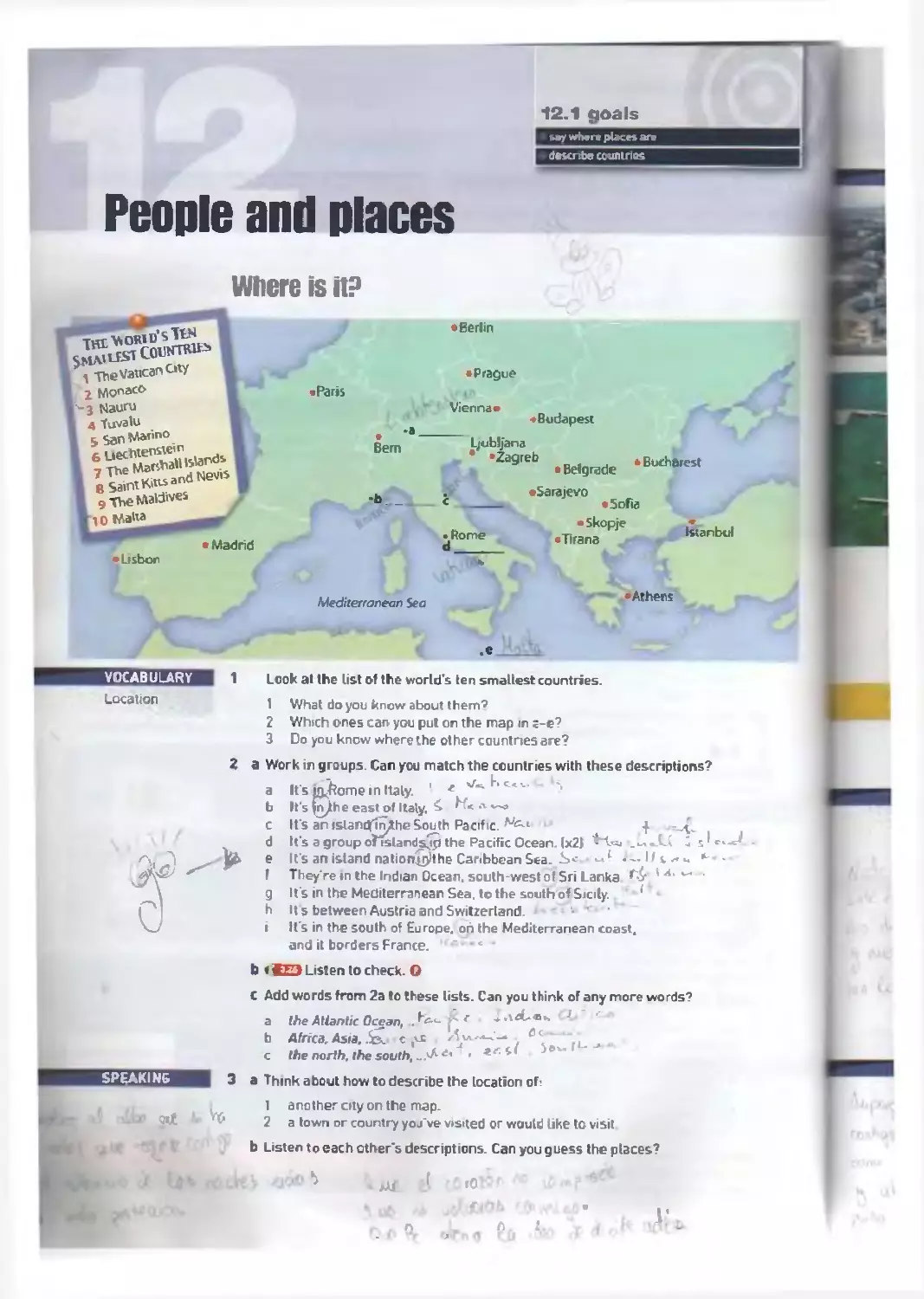
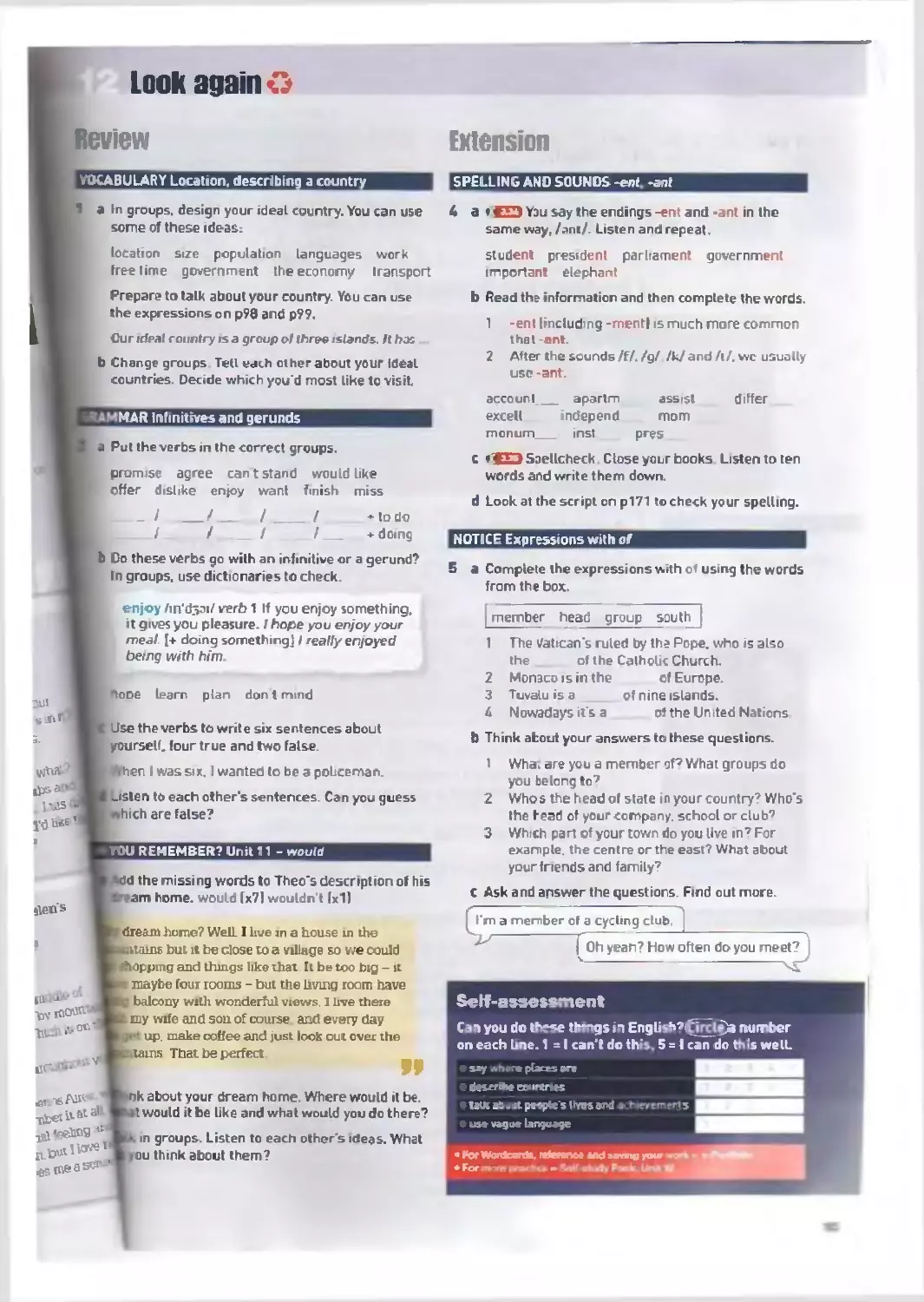
people and places Vocabulal')' Listening KeJWord ,
Localion p98 Akcbono. sumo wrestler plOD
. say where places are OescntJing i country p99 Lech Wa( a. Kra 6w plO2 IndIPBndllllt lIIarning
pages . descnbe coun ries Life and ach evements pi 00 Ol.esslng what words mea...
98-105 . talk about people.s lives Expressions wil know p 102 Reading
and achievements The Vatica" Cily. Tuvalu p99. Speakutg
Grammar p127 o use vague language
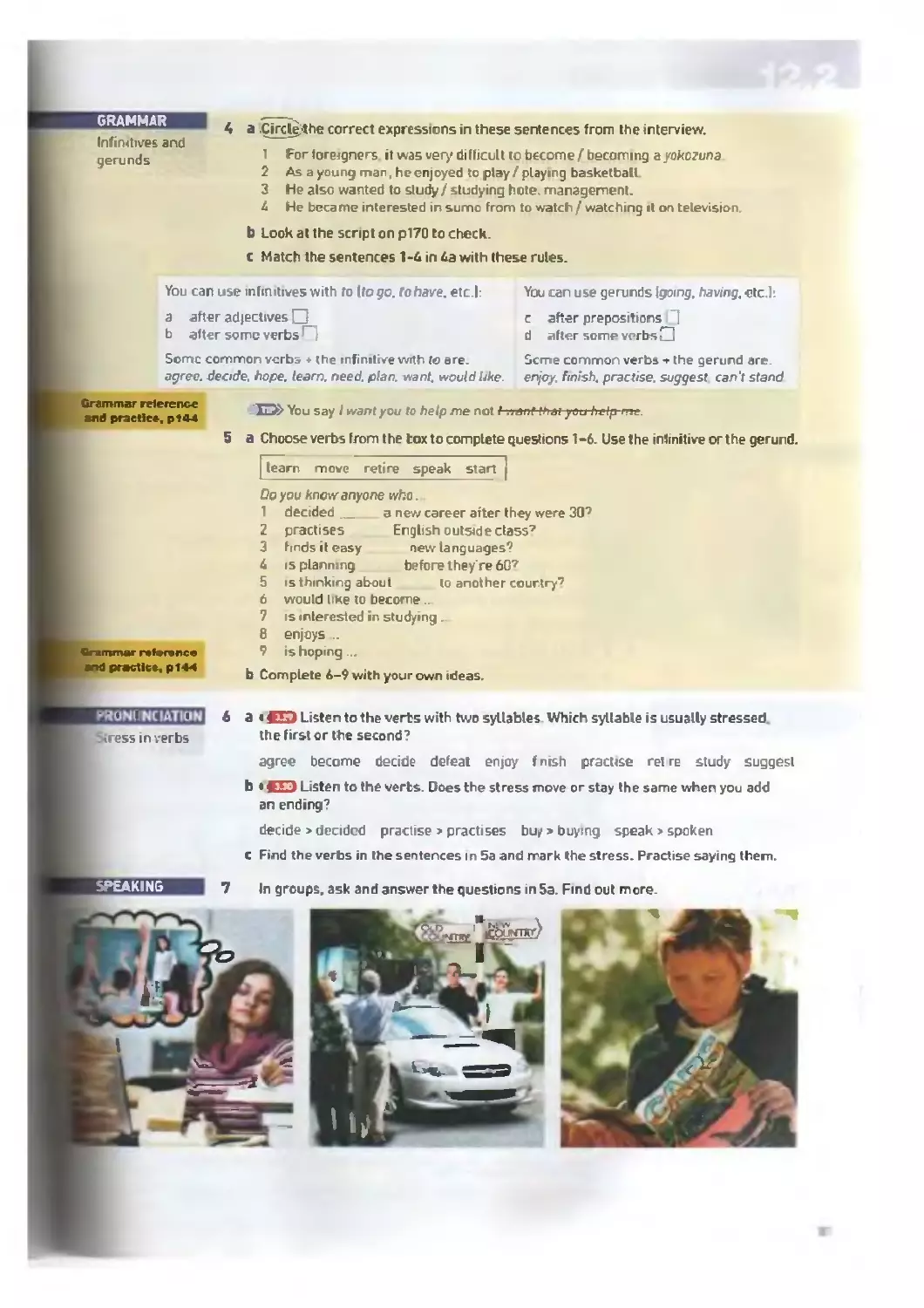
lIIt IctIvIIJ hrlnltives and gerunds plOI Speaking
Tatk about people and Pronunciation Oescrl3e where ptaces are p98
places in your country Stress in verbs p101 Three sm ll countries p99 LD,* II"" 0
Talk about your hie plOD Spelling and sounds
Hopes and plans plO1 -ent. -ant
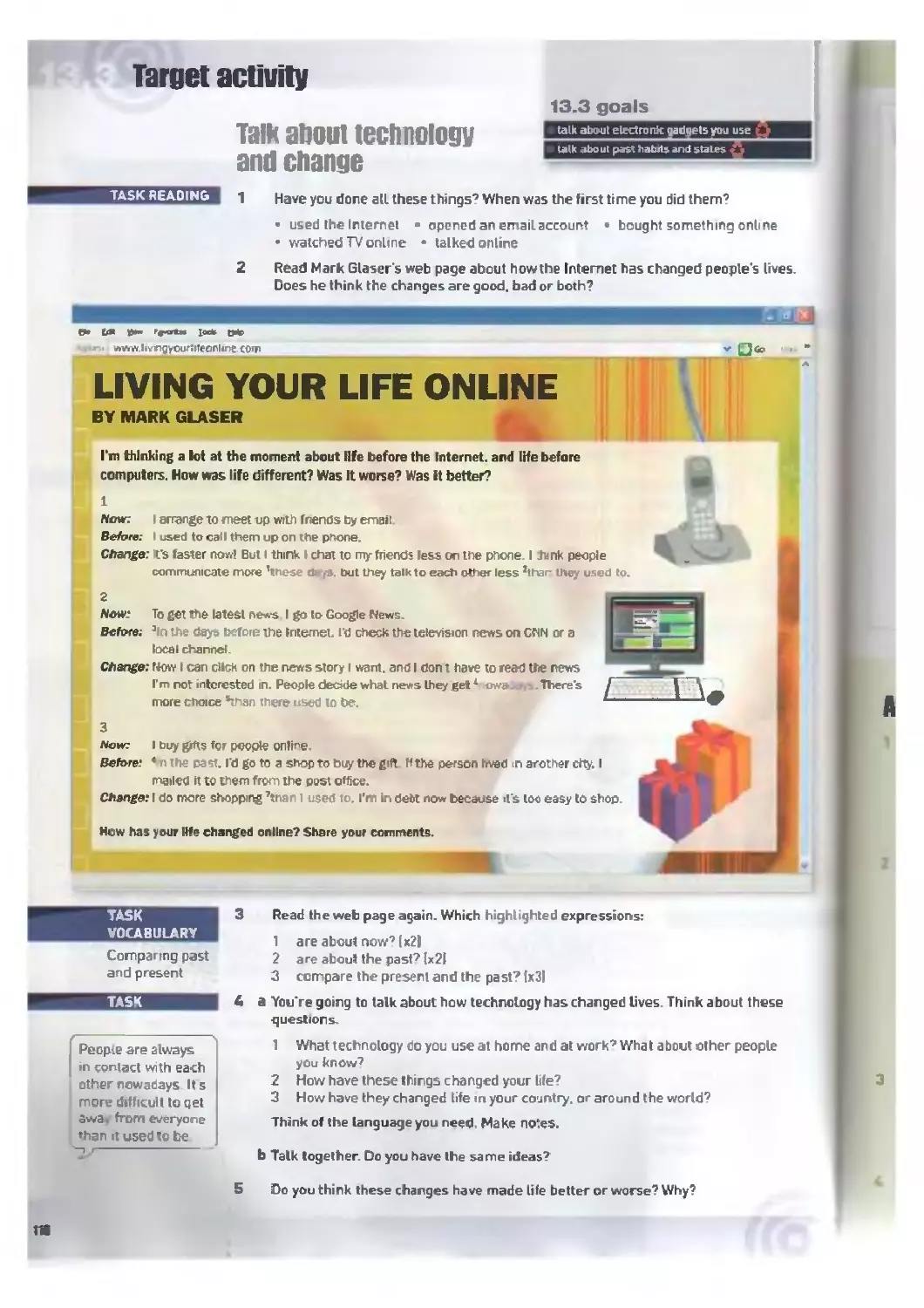
Now and then Vocabulary Listening KeYWOrd "e
I-iow I feel about gadgets Electronic gadgets p 106 across cultures
o tatk about electronic p 1 06 Chrisline's phone calls pl07
pages gadgets you use Telephone e:presstOns pi 01 Time
106-113 . use tne pho'le In differer'Jt Comparing past and Reading
siluauons present plIO chlldhoodbetiefs.com plO8 Writing
. lalk about past habits and Living your life online p11C . write abotJt a memory
states Gremmar Speaking
used 10, wotAd p109
brgllt IICIiViIY Gaogels you use pI 06 LD,* BglIlI 0
Pronunciation Role play, phone calls p' 0 I
Talk about technology and Groups 01 words 2 P 107 Childhood memories pl09 Spelling and sounds
change ei,ey
A maner of oPInion Vocabulary Listening Keyword would
Expressing opjpions p115 Argument aboul boxing pl14
. I!xpress and respond to Responding to opinions ..1IeP8ltllenllelnitg
page opinion:;. pl55 Reading Improve )'0"'1" :;pcohlOg
111.-121 . have a discussion Ways to reduce your kitct1en.s
. discuss imaginary Grammar carbon footprint p 116 SllllaUtg
situations Real and unreal A new airport pi is e usc expressions to soften
. take part in a meeting condltion.ts p117 Spe...lng OplOlOOS and disagreements
TtIrIJet BctlvIIJ Pronunciation Give opinions pl15
Have a debate: Groups 01 \Wrds 3 P 117 Agree and disagree p115 100. II"" 0
Nandil'-s blog p116 Spelling and sou"ds
Our carbon rootprint pl17 .Ie, .er. -al. -ul
activities pages 122-131,BnIn... msrenclBIUI uraCUCc pages 132-142, SCItp1s J ges 1'3-158
5
How to use this coursebook
r
L -
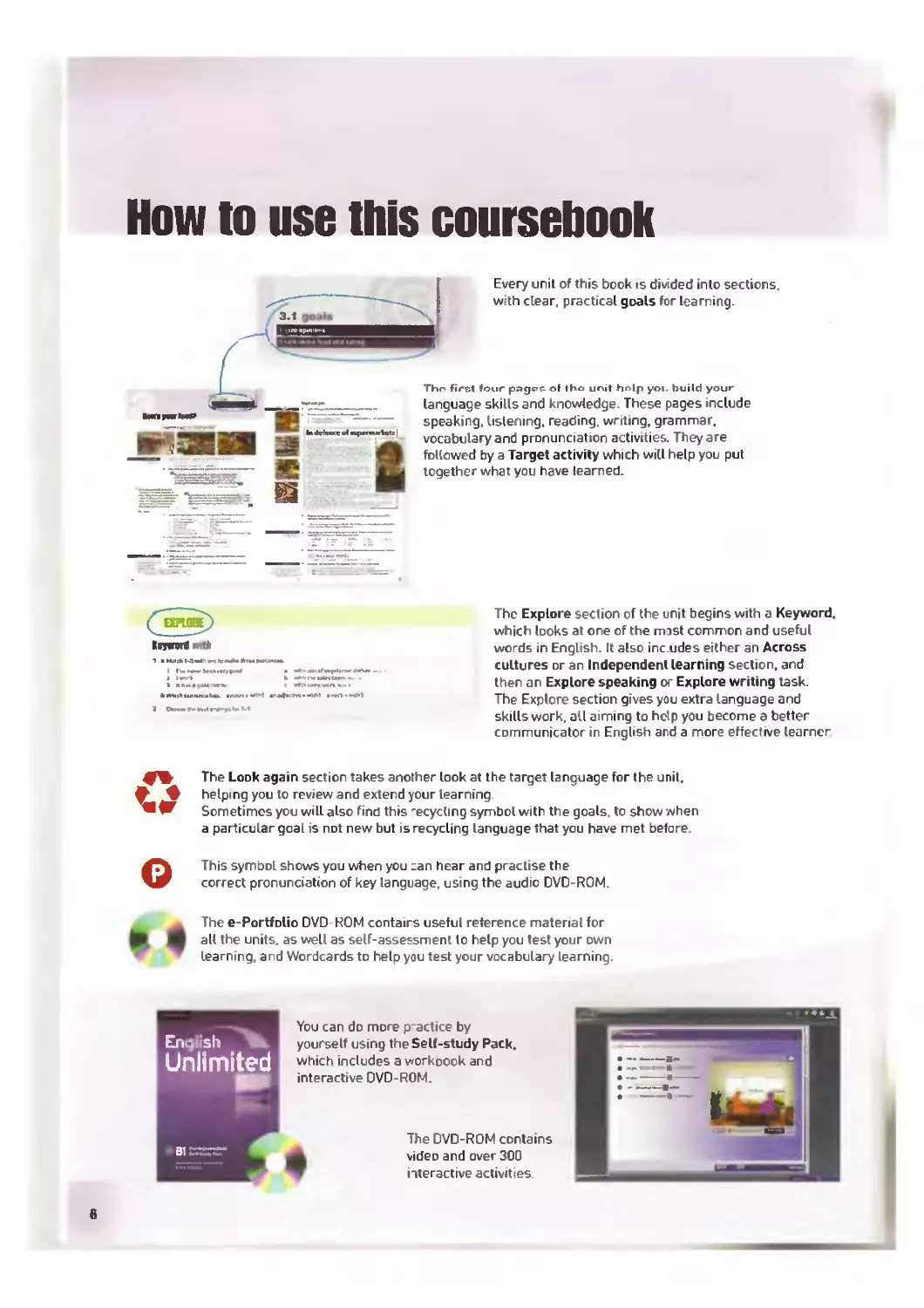
Every unit of this book IS divided into sections.
with clear, practical goals for learning.
,-.
....-'-.................1
f '
Th.... first four p::tgpc::. of tho unit ht')lp yOL build your
language skills and knowledge. These pages include
speaking, lislening, reading. writing, grammar,
vocabulary and pronunciation activities, They are
followed by a Target activity which will help you put
together what you have learned.
---
- -. -------
-.--
.----
---.. - --
.
-=-- ",==5- .
::- - -=..---- '.
m
-.=....
-.':r=.------
._---- _._-
_. -.-------
-. -----
.- _. . -
;. ;- ,..
. ----.-
-. -=: = --
C
..,... ri
, ........'4__"'........__
I ......_"'....009fY..... . ....,.._II...,....__
, 1-'0 .. ...nl'-......__.
'11111....,..._... "",,__.........
"_.h,"",, _, ._. .. ._, ...n._1
:a 1tIo...h""",,"I"'"
The Explore section of the unit begins with a Keyword.
which looks at one of the m)st common and useful
words in English. It also inc.udes either an Across
cultures or an Independent learning section, and
then an Explore speaking or Explore writing task.
The Explore section gives you extra language and
skills work. all aiming to hctp you become a better
communicator in English and a more effective learner
"
\1
The Look again section takes another look at the target language for the unit,
helping you to review and extend your learning,
Sometimes you will also find this "ecyclmg symbol with the goals. to show when
a particular goal is not new but is recycling language that you have met before.
o
This symbol shows you when you :an hear and practise the
correct pronunciation of key language. using the audio DVD-ROM.
The e-Portfolio DVD-ROM contairs useful reference material for
all the units. as well as self-assessment to help you test your own
learning. and Wordcards to help you test your vocabulary learning.
,......J..
En. sh
Unlimited
You can do more p-actice by
yourself using the Self-study Pack,
which includes a workoook and
interactive DVD-ROM.
. -- --.-
.......- .
..._-a_
. .... --D-
. -a-
I
81=::-
The DVD-ROM contains
ideo and over 300
hteractive activities,
""""
--
,--
8
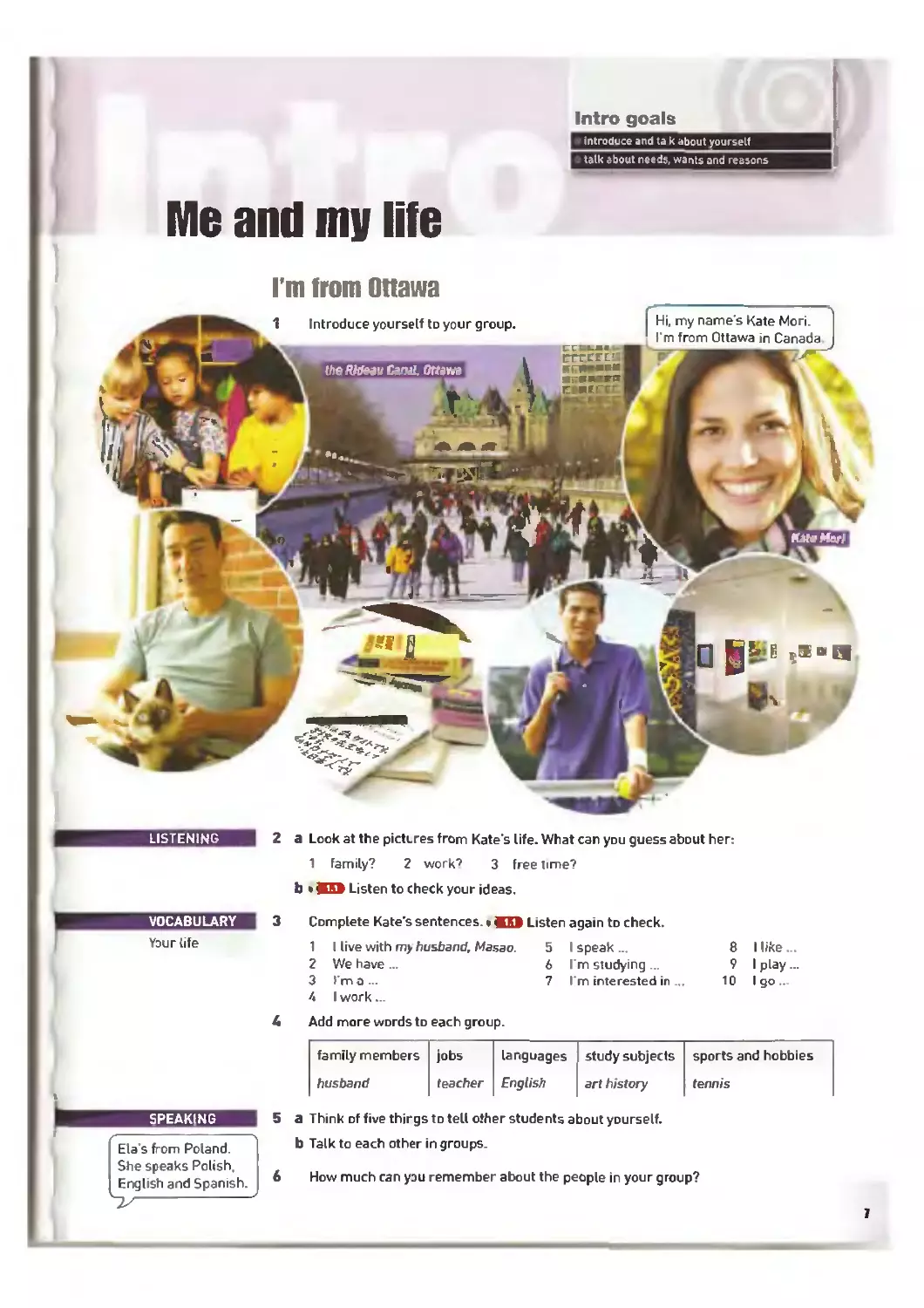
Inlro goals
introduce and ta k about yourself
talk about needs, wants and reasons
Me and mv life
1
t
"
.
"
t, ..,....
.
..
'1
t -;
I'm from onawa
1
Introduce yourself to your group.
Hi. my name's Kate Mori.
I'm from Ottawa in Canada
.t....
:\
L7t" L..
I:L!'lTP
.." ...
.-r.. ..a
r.: ."
the RldHu GItMt. art......
-..
...-.
\.
.,... -
..
.
.,
"1. '1
IIW'
f)
1
I
\
\
J
--
.....
-
,. 0 1J!or till DI m
.,.,
,
"\
- .
-...::-
....
-"' '''' "-.-
=--'-'". -7 _,
.:.s--d ;..zo """A.
cc.c9: '....
'* <"'..;-
I
LISTENING
2 a Look at the pictLres from Kate's life. What can you guess about her:
family? 2 work? 3 free t.me?
b .... Listen to check your ideas.
VOCABULARY 3 Complete Kate's sentences..... Listen again to check,
YJur life 1 I live with m) husband, Masao. 5 I speak n. 8 I like..,
2 We have ... 6 I'm studying ... 9 I play on
3 I'm;)... 7 I'm interested in ... 10 I go..,
" Iwork,n
, Add more words to each group.
family members jobs languages study subjects sports and hobbles
husband teacher English art history tennis
SPEAKING
5 a Think of five thirgs to teU other student about yourself.
b Talk to each other in groups.
Ela's from Poland.
She speaks Polish.
English and Spanish.
6 How much can YJU remember about the people in your group?
J
11'.18 Ir«'1
I reallv 100110 ...
"
..
""-
.\
"
..
I<dlc, Kernal and Sun.Hi are aI.1
learning languages.
LlS'tEN.lN.G
VOCABULARY
Needs. wants
and reasons
B 8
,-
.....
,
-
,
Kemal from Tur/cey
, a, WD Can '1IJu remember what language Kate is leaming"!
Why do you think she's learning it? Listen to check.
b . EJ Liste, again. Does Kate learn at home or go to a class? Why?
2 a. EJ Now .isten to Kemal and Sun-Hi,
t What la1guages are thC'y learning?
2 Who s learning for work? Who's learning for fun?
b . EJ Liste, again. What exactly does each person want to do in the language?
3 Read the sLripts on pt43 to check your answers in 1 and 2.
,
Who says these things: Kate, Kemal or Sun-Hi?
t I need English for my work, Sun-Hi
2 I sometimes need English for my studIes.
:> I don't need English for traveL
l. I need to practise my writing.
5 One cay I want to watch Spanish films.
6 I really want to talk with my husband's family.
7 I'd like to have a real conversation with them.
e I'd really like to go Ie Spain.
SPEAKING
5 Complete these sentences with because or so.
1 I'm learning Japanese Pe.'qu e I want to talk with my lusband's family.
2 I didn't want to stop studying, _I started going to classes.
3 I'm learning Spanish I like it.
I, I have a job with an international company, _ I need Enqlish for my work.
6 a Why are you leanmg English? Think about why you need it and what you'd like to do.
b Talk together. Which reasons are the most common and the most interesting?
I need English for work
because I travel a lot.
I'd like to watch Amercan films.
so I need to improve my listenmg
7 a Read 1-8. Write uestlons.
Do you want to m ve to another city or town?
Find someone who:
1 wants to mcve to another city or town.
2 WOUld like to change Jobs.
3 always neecs a coffee first thing in the morning.
4 likes modern art.
5 wants to run in a marathon.
6 would like to have more free time.
7 is interested in motorbikes.
8 goes to night school.
b Make two more questions for the people in your class.
8 a Talk to different people. Ask each other questions and us because or so to
give reasons.
Becduse most of my fdmily
and friends are here.
b In pairs, tell each other what yOU learned about the people in your class.
'I II
-..
=
..
Self-assessment
an you do these things In EngllSh?CJa number
'. , ,. = ' " " , . = . n do this well.
. introduce and talk about y.urs
. talk about needs. wants and rea!ons
1
II
Plav
USTENING
Natalie talks about
music in Trinidad and
10'c 20, where she
grev> up.
VOCABULARY
Talking about
music
SPEAII;ING
. 10
1.1 goals
talk about music
tatk about what to do in your free time
Local music
1
Talk together.
1 Do you list n to music a lot?
2 What types of music do you like?
3 Can you ploy any instruments?
t
L
,,"--":-
.
-t
""
A
h,
"
lhe sf ,rums
2 . listen to Natalie and anSwer the questions.
Do people in Trinidad and Tobago only listen to local music, or music from
around the world?
2 WhICh instruments in the pictures 6 es Natalie talk about?
3 a Which instrument does Natalie play now? Which doesn't she play? Why?
b ..xI Listen again to check.
4 a Natalie mentions these types of music. Can you think 01 any more?
Cuban music. reggae, classicaL. calypso, salsa, rumba n
b What types of music are popular where you live?
5 Match 1-7 with a-g and complete the sentences from Natalie's interview.
1 I learned how to play the steel drum when a calyp o.
2 I would love to able to b play classical piano.
3 I was brought up to c Cub"n music.
4 Nowadays I play more d I was a little girL
5 We have o\"r own instrument called e Latin America.
6 We have a local music called "f pl.Jy it again.
7 Calypso IS simitar to music from '--g the stee\ <lrum.
6 Write four or fi1e sentences about some of these things. Use the highlighted
expressions from 5.
7
. music in your country . a special instrument in you' country
. a type 01 mu;1C you like . music in your childhood
. music in your life now . something you'd like to lea-n
Talk to each other about music
in your country and in your life.
Ask questions to lind out more.
I learned how to play the guitar
when I was a teenager.
READING AND
lISTENING
noR"
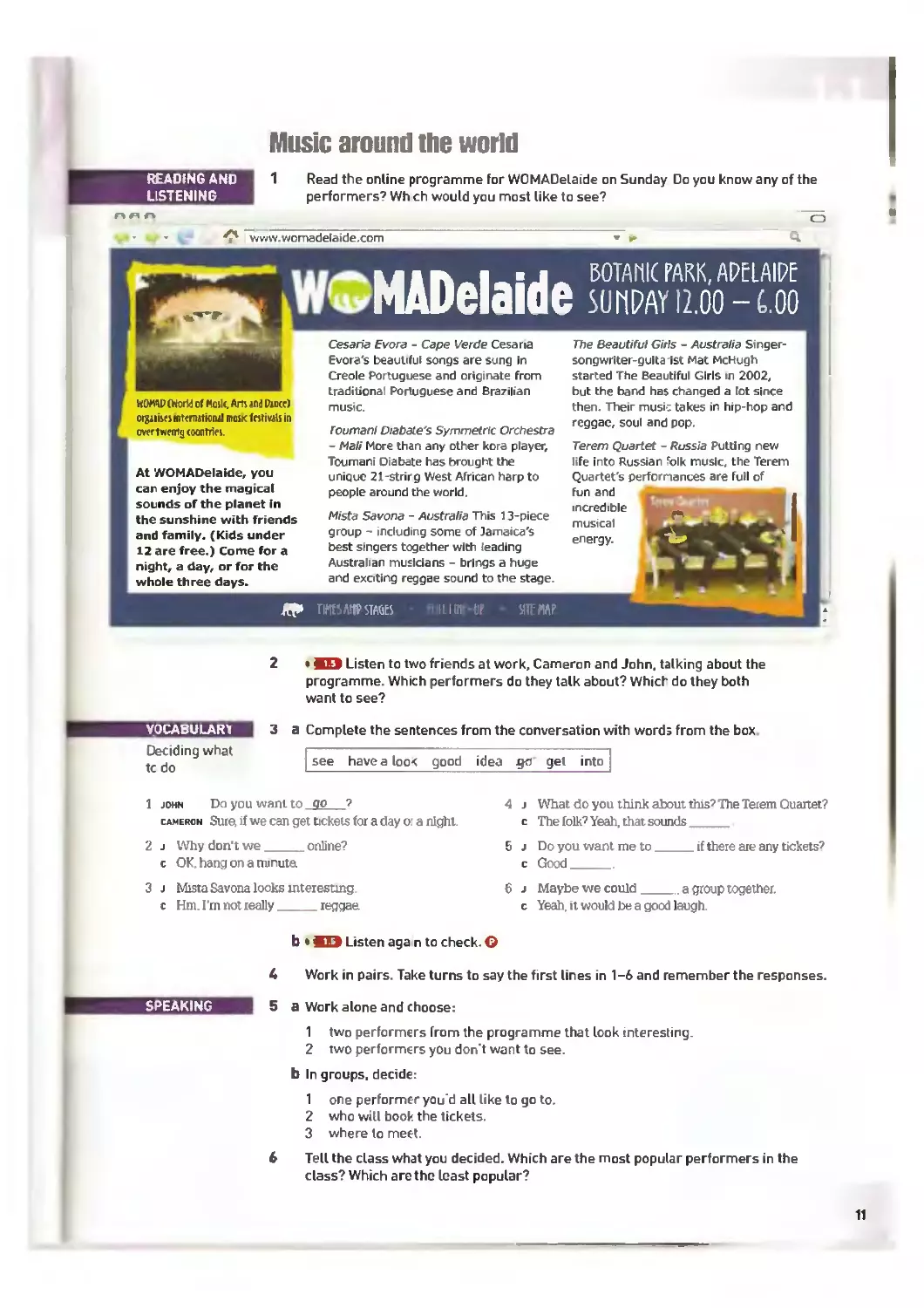
Music around the world
1
Read the online programme for WOMADeiaide on Sunday Do you know any of the
performers? Wh ch would you most like to see?
.
C)
-www.womadelaide.com
... r
WOl\ D!World of Mo,I" AttIind DiO,r!
orgui!.C'J mtC'mAtion.1 maSK frnivAl1 in
DVtrtwemg (oootrif'!.
At WOMADelalde, you
can enjoy the magical
so nds of the planet in
the sunshine with friends
and family. (Kids under
12 are free,) Come for a
night, a day, or for the
whole three days.
VOCABULARY
Deciding what
tc do
MADelaide
Cesaria Evora - Cape Verde Cesaroa
Evora's beaut.ful songs are sung In
Creole Portuguese and originate from
traditional Portuguese and Brazilian
music.
foumanl Dlabate's Symmetric Orchestra
- Mali More than any other kora player,
Toumani Oiabate has brought the
uniQuc 21-strirg West African harp to
people around the world.
Mista Savona - Australia This 13-piece
group - including some of Jamaica's
best singers together with leading
AustralIan mU51clans - brings a huge
and excIting reggae sound to the stage.
lIfII TlMf NW STMES
ill m ur
lf1"AP
.. ..
q,
BOTANIC PARK, ADELAIDE
SUNDAY 12.00 - .OO
The Beautiful Girls - Australia Singer-
songwrlter-gulta-Ist Mat McHugh
started The Beautiful Girls ,n 2002,
but the band has changed a lot since
then. Their musi takes in hip.hop and
reggae, soul and pop.
Terem Quartet - Russia Putting new
life into Russian folk music, the Terem
Quartet's perfornances are full of
fun and
incredible
musical
energy_
, ,I
JOHN Do you want to..!l!1..-?
CAMERON Sure, if we can get tickets for a day or a night.
2 J Why don't we _ online?
c OK. hang on a minute.
3 J Mlsta Savona looks mterestlng,
c Hm.l'm not really _ reggae.
SPEAKING
.....
2 . "listen to two friends at work. Cameron and John, talking about the
programme. Which performers do they talk about? Whic do they both
want to see?
J a Complete the sentences from the conversation with word, from the box
I see have a loo good idea gel into I
4 J What do you think about this? The Terem Ouanet?
c The folk? Yeah, that sounds_
5 J Do you want me to _ if there are any tickets?
c Good_.
6 J Maybe we could _ a group together.
c Yeah, it would be a good laugh.
b ..u listen aga n to check. 0
, Work in pairs. Take turns to say the first lines in 1-6 and remember the responses,
5 a Work alone and choose:
1 two performers from the programme that look interesling.
2 twO performers you don't want to see.
b In groups, decide:
1 one performer you'd all like to go to.
2 who will boo the tickets.
3 where \0 meet
6 Tell the class what you decided. Which are the most popular performers in the
class? Which arc the least popular?
11
1.2 goals
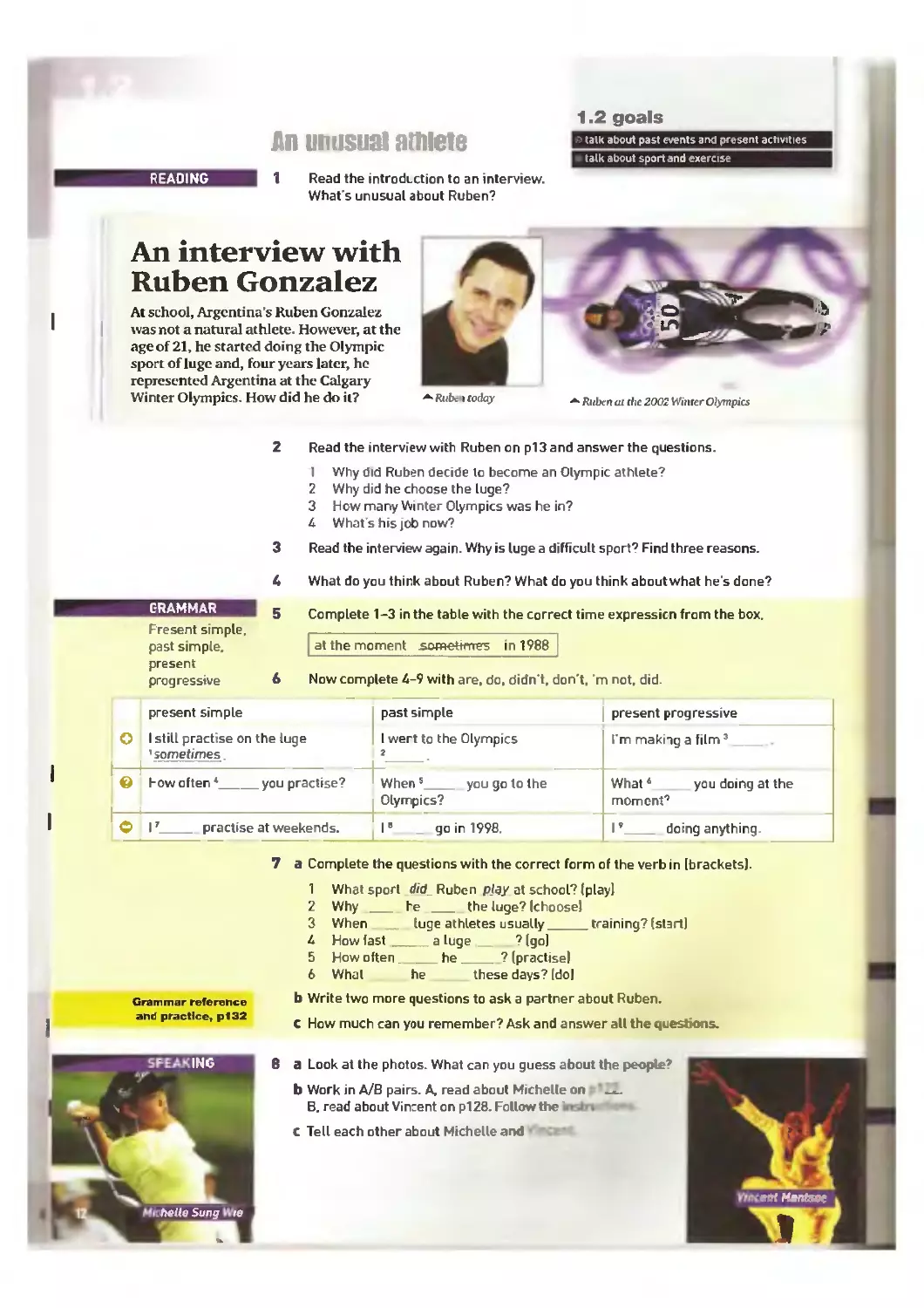
An unusual atlliets
ta\k about past events and present activities
talk about sport and exerCise
READING
1
Read the introdLction to an interview,
Whafs unusual about Ruben?
An interview with
Ruben Gonzalez
At school, Argentina's Ruben Gonzalez
was not a natural athlete, However, at the
age of 21, he started doing the Olympic
sport of luge and, four years later, he
represented Argentina at the Calgary
Winter Olympics. How did he do it? ....Rubt /Coday
o
,-
· LI'
. -
......
,:
..
,
.... Rllbfn al die 2002 Wimer Olympics
2 Read the interview with Ruben on p13 and answer the questions.
I Why did Ruben decide 10 become an Olympic athlete?
2 Why did he choose the luge?
3 How many VYinter Olympics was he in?
4 Whafs his job now?
3 Read the interview again. Why is luge a difficult sport? Find three reasons.
, What do you think about Ruben? What do you think about what he's done?
GRAMMAR
Fresent simple.
past simple.
present
progressive
5
Complete 1-3 in the table with the corr ect time expressicn from the box.
I at the moment .so eli, ,, s in 1988 I
Now complete 4-9 with are, do, didn't, don't, 'm not, did.
6
present simple
I past simple
I wert to the Olympics
2
T When '_ you go to the
lympi CS?
I I. _ go in 1998.
7 a Complete the questions with the correct form of the verb in [brackets).
1 What sport tfid_ Ruben pli1Y at school? (play)
2 Why _ e _ the luge? !choosel
3 When _ luge athletes usually _ training? (st rt)
4 How last _ a luge _ ? (gal
5 How olten, _ he _ ? (practisel
6 Whal he these days? (dol
I present progressive
o
I I
I still practise on the luge
' ometimes .
I'm maki1g a film 3 _
!-ow often '__ you practise?
What'
mOment'
you doing at the
I Q , I 7_ practise at weekends.
1'_ doing anything.
Grammar reference
and practice, pt32
b Write two more questions to ask a partner about Ruben.
C How much can you remember? Ask and answer all the questions.
ING
B a Look at the photos. What can you guess about the peopli!?
b Work in Al8 pairs. A. read about Michelle on
B. read about Vin:ent on p128. Follow the .
C Tell each other about Michelle and
.
.
...
.JiC
helle Sung Ie
J
Interviewer So, Ruben, how did you gN into
Ihpluge?
RulJen Wpll, al school, I couldn't jump high or
run fast. I played football bUT I wasn't very
good. IT was really sad I But when I was ten,
I saw the Olympics On TV for The first time
and I loved it. And later, when I was 21, I saw
Scott Hamilton win an Olympic mcdal in
figure skating. Scott's about 155 cm tall and
weighs about 50 kilos, and he gave me hO)e. I
thought: if that little guy can do it, I can d3 it
too. So I dedded to be an Olympic ch.,mp:on
- but I had to find a sporr. It's true, I'm not a
great athlete. but I never give up. I try again
and again. So I chose the luge because people
get hurt a lot, people often break bones -
ninety percent of them give up. And I thoughT,
well, I don't give up, so I have a chance.
Interviewer MOST Olympic luge athletes star
training aT 12. You sTarred aT 21, bUT you've
competed in Three Olympics.
Ruben Yes. I started in 1984. I wenr to the WinTer
Olympic, in Calgary in 1988 and in A1bem I1e
in 1992. Thpn, nparly Ipn years later, myoid
coach phoned me up and said "Argentina
needs you!" So at age 39, I competed in the
2002 Salt Lake City Winter Ol}mpics.
Interviewer What's it like to luge down a
mountain aT 90 miles an hour?
Ruben Well, at Ihat speed, you don't haw lime 10
think. The luge is very sensitive. If you hiccup,
you Qln crash. And when you finish, you have
TO sit up and SlOp the luge by purring your feeT
on the ice. It rakes a couple of hundred meues
to stop because you finish the run at about
80 miles an hour. I still practise 3n the luge
somerimes and I'm frightened on every run.
Interviewer And what do you do these days?
Ruben I'm a morivaTional speaker. I ralk abouT
my experiences and how to be successfuL I'm
making a film about success at the momenr.
We're interviewing a lot of business people,
philosophers. athletes, HoUyw,)od people. It's
very interesting.
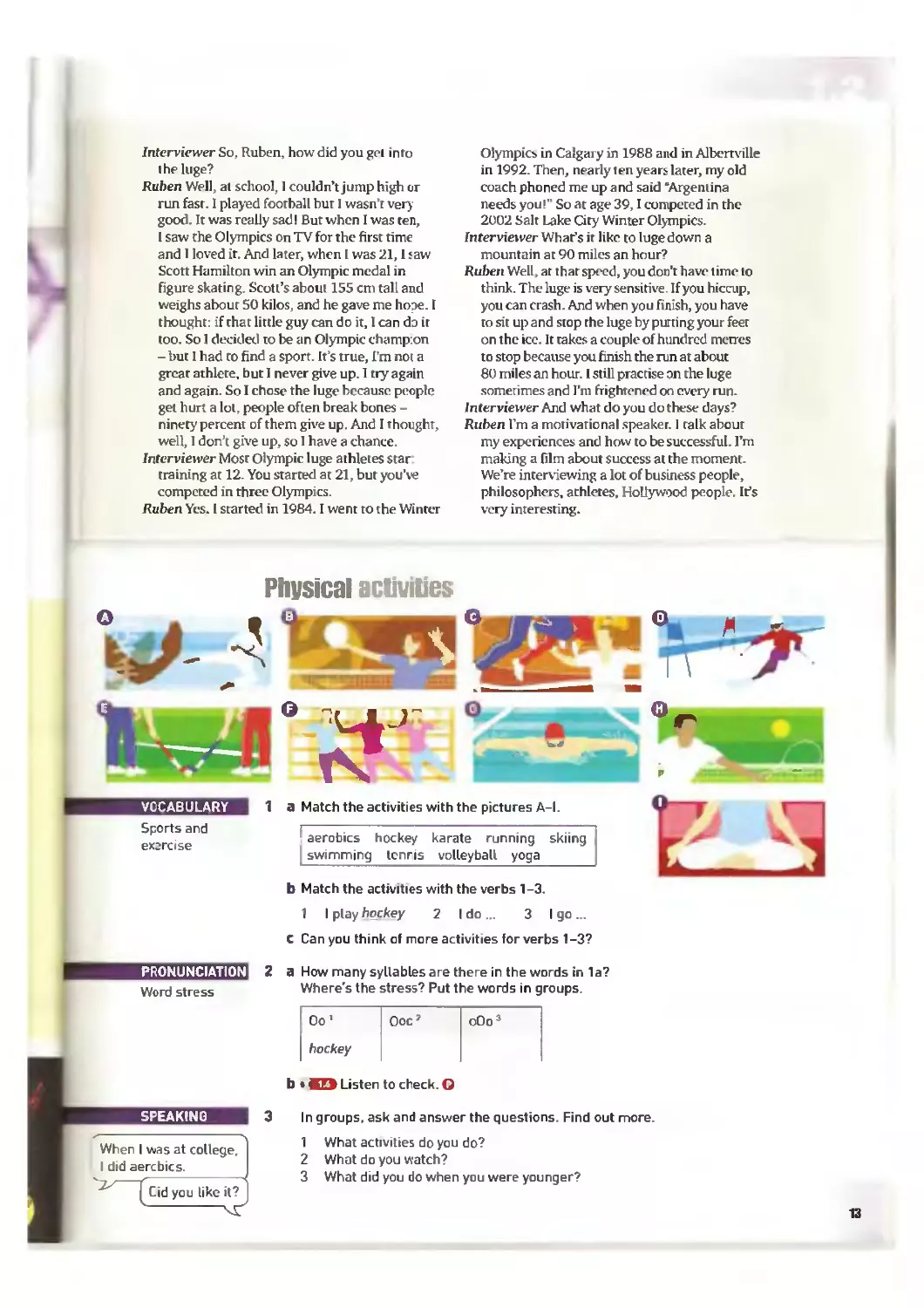
Phvsical activities
0 B G -" e ,.,
\ ...
- I \
,. -
E G "; J «a,...
-- ...
--
,
VOCABULARY
Sports and
ex rcise
1 a Match the activities with the pictures A-I.
aerobics hockey karate running skiing
swimming tenris volleyball yoga
I play hQ,ckey
b Match the activities with the verbs 1-3.
3 I go n.
2 I do n'
C Can you think of more activities for verbs 1-3?
PRONUNCIATION 2 a How many syllables are there in the words in 1 a?
Word stress Where's the stress? Put the words in g roups.
I 00 1 I Doc> I 000 3 I
hockey
b . Listen to check. 0
SPEAKINO
3
When I was at college.
I did aercbics.
[id you like it?
In groups. ask and answer the questions. Find out more.
1 What activities do you do?
2 What do you watch?
3 What did you do when you were younger?
13
Target activity
Talll about IT interest
'-
talk about past event. and prownt acl,vltl.. {}
talk "bout your Inle,.SIS anI! how lhoy st.arted
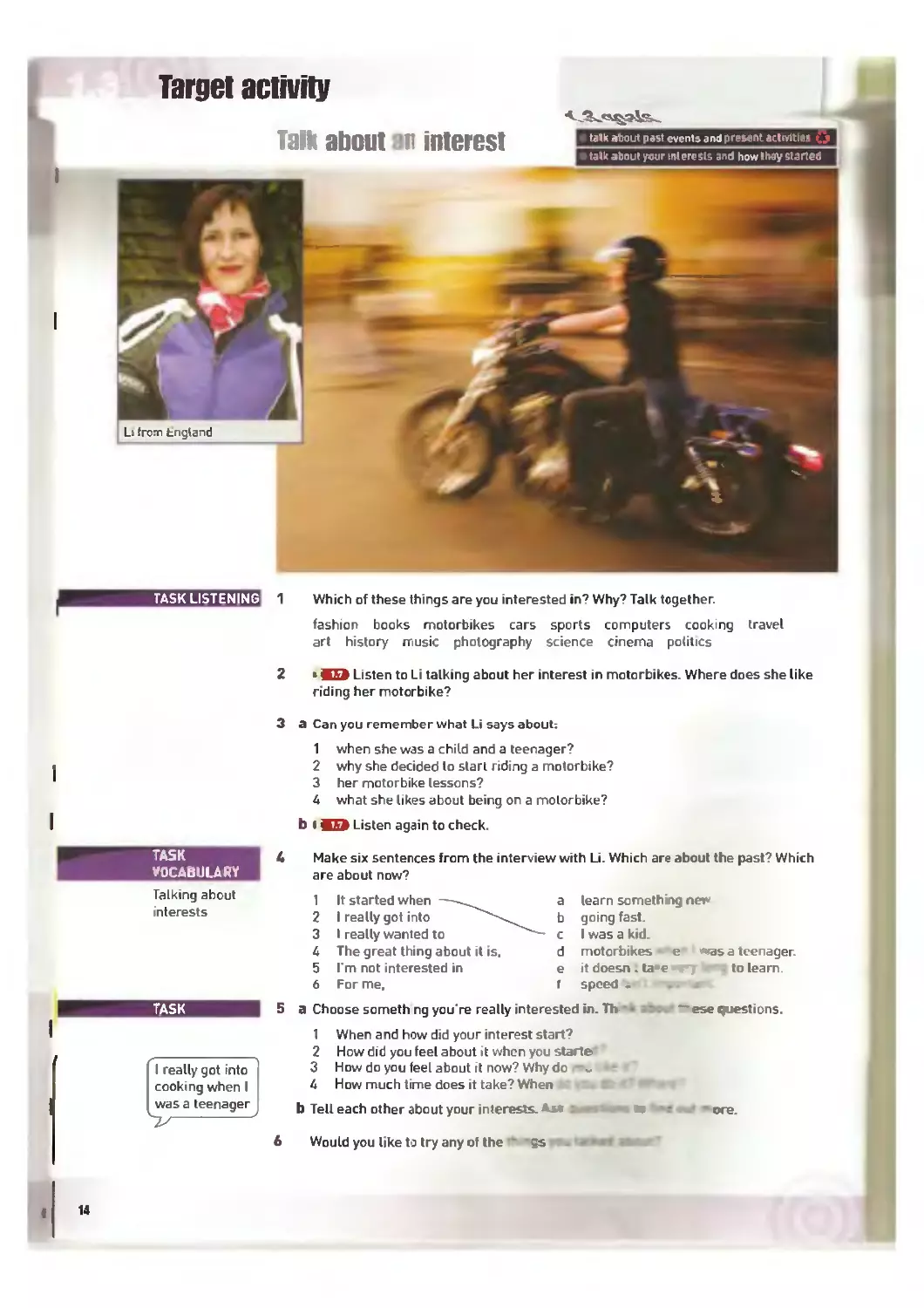
L, from I:ngtand
....
TASK LISTENING 1
Which of these things are you interested in? Why? Talk together.
fashion books motorbikes cars sports computers cooking travel
art history music photography science cinema politics
2 . Listen to Li talking about her interest in motorbikes. Where does she like
riding her motorbike?
3 a Can you remember what Li says about:
1 when she was a child and a teenager?
2 why she decided to start riding a motorbike?
3 her motorbike tessons?
4 what she likes about being on a motorbike?
b I Listen again to check.
TASK , Make six sentences from the interview with Li. Which are about the past? Which
YOCABULARY are about now?
Talking about 1 It started when a learn someth...g ne,or
interests 2 I really got into b going fast.
3 I really wanted to c I was a kid.
4 The great thing about it is, d motorbikes e _s a teenager.
5 I"m not interested in e it doesn . ta"e-rT to learn.
6 For me, I speed .
TASK 5 a Choose someth ng you.re really interested in. Jh, - ese questions.
1 When and how did your interest start?
2 How did you feel about it when you starte
I really got into 3 How do you feel about it now? Why do
cooking when I 4 How much time does it take? When
was a teenager b Tell each other about your interests.. AM . ore.
6 Would you like to try any of the gs
I 14
EXPLORE
Kevword so
1 We use so before a result, like this:
My fir!':t h?Y ,[".:.crd :18d a rcd.!.lv nice bikf!: 80 Wf!: wp.nt. rttJ\t'lg in t.hp r.onntryAiop A 1nt nnJ.t
Add so to the correct place in each sentence.
so
1 I thought. well. I don't give up A I have a chance. UMI
2 A sleel drum's about a metre high I cou ,dn't really travel with it. Unit 1
3 I have a job with a large international ccmpany I need English for my work. Inlr. um'
4 Masao's interested in art too we usually go to galleries together.ln"oun"
2 a What important decisions have you made in the last five years? Write three sentences with so.
I wanted a better job, so I started studying at the local college.
b Listen to each other's sentences. Ask ques:ions to find out more.
What did you tudy?
3 Make four conversations and then practise in pairs. Take turns to say 1-4 and reme11ber a-d.
1 00 you need to work late lonig hI? _______ a
2 Du yuu lhink. irU Idlll tUIIIOIIUW? - It
3 What's the capital of Morocco? Is it Rabat? c
4 00 you think the bank's open now? d
Yes. I think so. but Cas<Jblanca's much bigger.
rill r edlly Iii ed IJul yes. I supPQse SQ II guess so.
I hope so, This we;tther's too hot for me.
No. I don't think so. They usually close at four.
, a Write three questions for a partner about these topics.
Use: 00 you think ... ?
. food and drink . sport . musIc . the weather
b Ask and answer the questions. Try to use the expressions in 3
00 you think chocolate is good for you?
I hope so. I eat lots of it!
Across cultures Cullure
ock
I W,,,I do you think happen:> when people mDve to a new country or culture? M"ke three sentences.
1 At first a .ife is difficult "nd you miss your home
2 After a few days or weeks b rou start living normally.
3 After a while c rou think everything is great.
Read the article to check. 00 you agree wi I' the ideas?
t}h {cI!: ..... ravoriC5 lods t:e"p
Addr s 'hVW articloslcultureshock
I
¥ !aGo
....,"
1\ )f
Artioc
I D,SCUSS1OI\ I
('"ILogIrw'
Culture Shock
When people movelD a foreign coun.ry. 'he often get culture shock. This has Ihree diff9fent stages, lhough not
everyone is in the new cutture long enough to go through a1l three.
. Stage 1 At first, people often feel that tt.e differences between the o1d and new culture are Interesting and
exciting. They may lall,n love with lhe n.w foods, the lifestyfe, people's habits, lhe buildings. and so on.
. Stell" 2 After a few days. weeks or morlhs, many people slart 10 have problems. They may Ihink a 101 about Ihe"
old cuttur . and flfld It diHlcui! to corrlmunicate with people. They miss the food from their own country, they feel
Ihallhe lifestyle is 100 fasl or too slOw, they get angry al people's habits, and so on.
. Stage 3 After a while, the new culture starts to feel 'normal" and not 'new'. Peo e understand that it flas 9000
and bad things to offer. Trrcy start thinkhg about day-to-ouy liVing, as they did In their origi"la1 cutture.
-
Think about the questions. Then talk together, using the highlighted expressions in the article to help you.
1 Have you (or people you know) ever had culture shock? What happened?
2 What things do people usually like when they come to your country? What things can be difficult for them?
3 Have you ever gone to live, work or study in a new place? Would you like to?
4 What things were new for you? How did you feel about them? Did you get used to them? 15
I
I
EKPlOH Writing
1
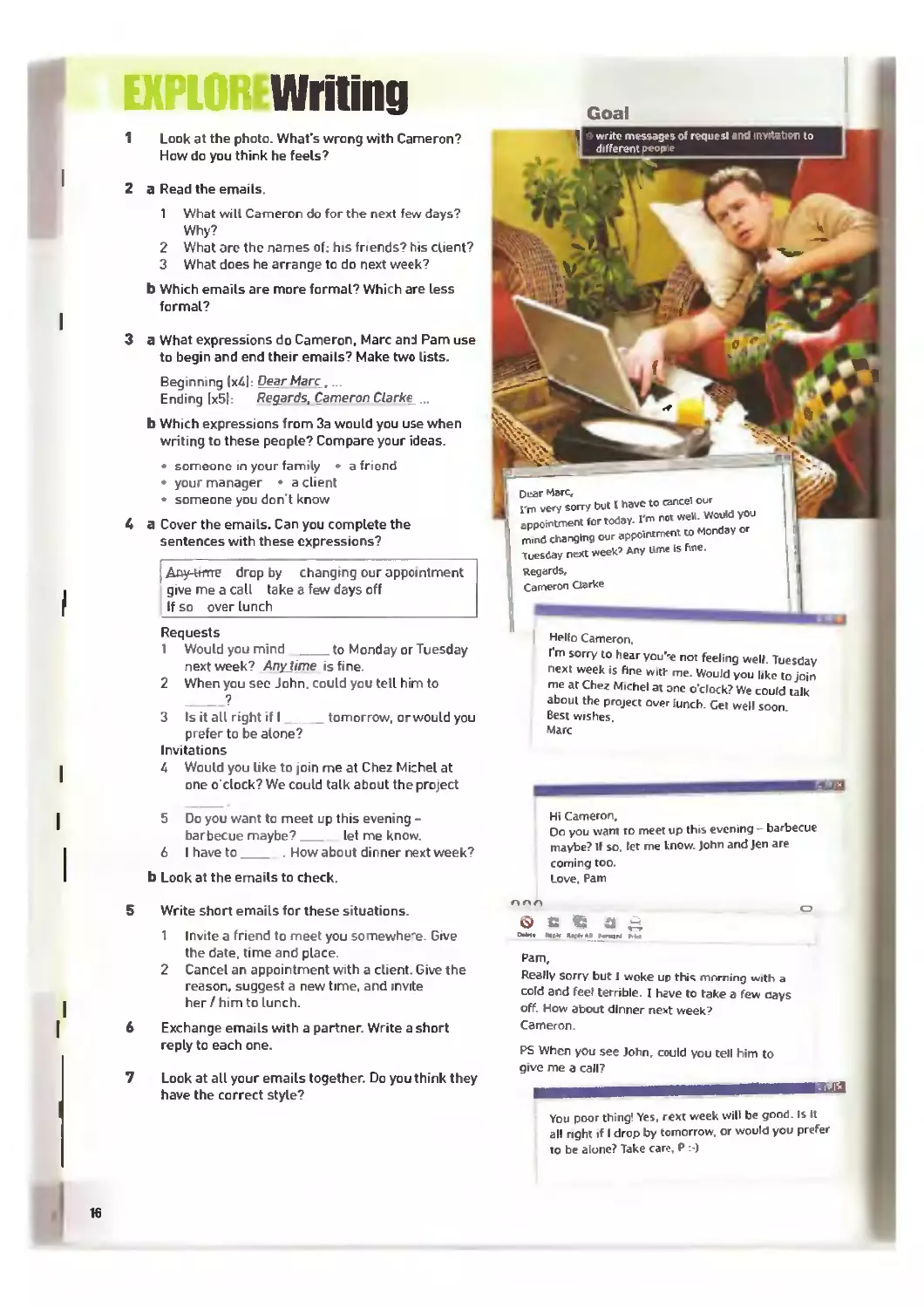
Look at the photo. Whafs wrong with Cameron?
How do you think he feels?
2 a Read the emails.
What will Cameron do for the next few days?
Why?
2 What arc the names of: his froends? his client?
3 What does he arrange to do next week?
b Which emails are more formal? Which are less
formal?
3 a What expressions do Cameron, Marc anj Pam use
to begin and end their emails? Make two lists.
Beginning Ix41: Dea r Marc.., no
Ending Ix51: Reg,ards, f;ameron ClarklL .n
b Which expressions from 3a would you use when
writing to these people? Compare your ideas.
. someone in your family . a friond
. your manager . a client
. someone you don't know
, a Cover the emails. Can you complete the
sentences with these expressions?
drop by changing our appointment
give me a call take a few days off
If so over lunch
Requests
1 Would you mind _ to Monday or Tuesday
next week? AnyJime is fine.
2 When you see John, could you tell him to
?
3 Is it all right if I _ _ _ tomorrow, orwould you
prefer to be alone?
Invitations
4 Would you like to join me at Chez Mi:hel at
one o'clock? We could talk about the project
5 Do you want to meet up this evening-
barbecue maybe? _ let me know.
6 I have to . How about dinner next week?
b Look at the emails to check.
5
Write short emails for these situations.
Invite a friend to meet you somewhe-e. Give
the date, time and place.
2 Cancel an appointment with a client. Give the
reason, suggest a new time, and invite
her I him to lunch.
Exchange emails with a partner. Write a short
reply to each one.
6
7
Look at all your emails together. 00 you think they
have the correct style?
16
Goal
,
, 9 write messages 01 u.5I.ncI InVllab911 to
different people
....
...'
! '
I
....1
"
..
I'
I
"
(
,
fI ,.
f -,
;:;. .
.
-=:'- I
.... ....
'. -
,
;;.
-
...-
:
.
.
Dear Marc,
rm very SOrTY but 1 havC to cance1 our
. t for tod a y I'm not welL Would you
IIppOlntmen .
mind changing our appointment to Monday or
luesClay neJet week' Any Lime is fme.
Regards,
Cameron Clarke
Hpllo Cameron,
I'm sorry to hear you". no' feeling well. Tuesday
next week is fine Witt me. Would you like to join
me at Che Michel at 3nc o'clock? We could talk
about the proJect Ove' lunch. eet well SOOn.
Best wishes,
Marc
Hi Cameron.
Do you want to meet up this evening - barbecue
maybe? If so, let me know. John and Jen are
coming too.
love, Pam
n,.",
o
(gct;:
DMot. "M' ... ........ ......
Pam,
Really sorry but J woke up thic; morning with a
cold and feel terrible. I heve to take a rew cays
off. How about dinner neJilt week?
Cameron.
PS When you see John, could you tell him to
give me a call?
.JIJ
You poor thing! Yes, rext week will be good. 15 It
all FIght ,f I drop by tomorrow. or would you prefer
to be alone? Take care. P :.J
look again 0
Review
VOCABULARY Music, sports and exercise
---
1 ;II Work tog..th..r. How many words or expressions
can you think of:
1 connected with music? jazz. instrument ...
2 lor sports and exercise? swimming, yoga...
b .EI Listen to eight instructions. Write down
your answers - but don't write them in order.
( Look at each other's answers. Can you gu ss
what they mean?
,
.
Wrestling ... Do you like
watching wrestling on 1V?
GRAMMAR Question patterns
2 a Put the words in order. Write the questions in the
table,
1 like do What you doing In the evening?
2 Can ride you a motorbike?
3 did Where go you to school?
4 reading you Are anything interesting at the
moment?
5 you would What places like to visit in luture?
· Questian
word
1 What
Auxiliary Subject Verb
verb
do you like dOln1 In the
evening?
Can
2 -
b Vlrite two more questions to ask a partner. Then
ask and answer all the questions.
CAN YOU REMEMBER? Intre unit - Needs, wants
3 a Complete the conversations with 'd like, walt, need.
A I can't find my bank card.
B I think you _ to phone the bank.
2 A Hello. Can I get you somethIng?
B Yes, I _ some cake and a coffee, please.
3 A Shelll we go out tonight?
B No, I_I _ to stay at home.
There's a good film on TV.
b Vlrite sentences about things you'd like, want or
need to do:
. alter this lesson . tomorrow
. next weekend . next week . next year
( Listen to each other's sentences. Give more
information.
Well, alter the lesson r d
tike to go home and relax ..
... but actually I need
to go back to work!
Extension
SPELLING AND SOUNDS or, 'Nor-
I. ;II. Listen and repeat the words with or and
wor-.
or with stress
I:J:I
or without stress
hI
wor-
IW3:1
sp rt b rn
m torbike d ctor
work
b Add these words to the correct group. Practise
saying them.
forget morning word
orchestra visitor wo-Id
( . tIIID Spellcheck. Close your book. Listen to ten
words with or and wor- and write them down.
d Look at the script on pI" to check your :;petting.
NOTICE Extreme adjectives
5 a Find the adjectives in this unit which mean:
really good. special: m gi 'al ,u _ e.
. e.
(the festival programme on plll
2 rcally nice: 1_ _yo
(Natalie's script on p1431
3 really good, great: a _ g
(Cameron and John's conversation on p143]
4 really interesting: f. _g
5 really frightening: t _ g
6 reallybad:t_e
(the interview with II on p 143-41
b Think about how to describe some things and
people you really like or don't like, for example:
. a musician . a boo . . a 1V programme
. a sportsperson . a 'ilm . a politician
. a place . an activity
C Tell each other your ideas. Do you agree?
Self-assessnent
Can you do these th"9s in En9lish a rumber
. e i.. = _1',1 II andot"iswe l .
.'allcaboltrl ic
.
. 'al about .. .t to do .n your free t I ,.
. talk about sport and exerc se
. a '<. about past ever 5 a,d presert 31.1 5
.talk abOIt ro" i. er 5 a,d t.'V '''1ey
I a rt'ea
. M'i e ne 5Qges of requ ' -;nd i..vitatlo '" to
d fert people
. For"'" . eerds. ...nee ....11'II yaw....-I( .. e-90rtfalo
. Formorw practice» s.tr-studr Pack. Unit f
11
,
\
I
II
2.1 goals
'aUt about personal experience
e talk about your studieS
Work and studies
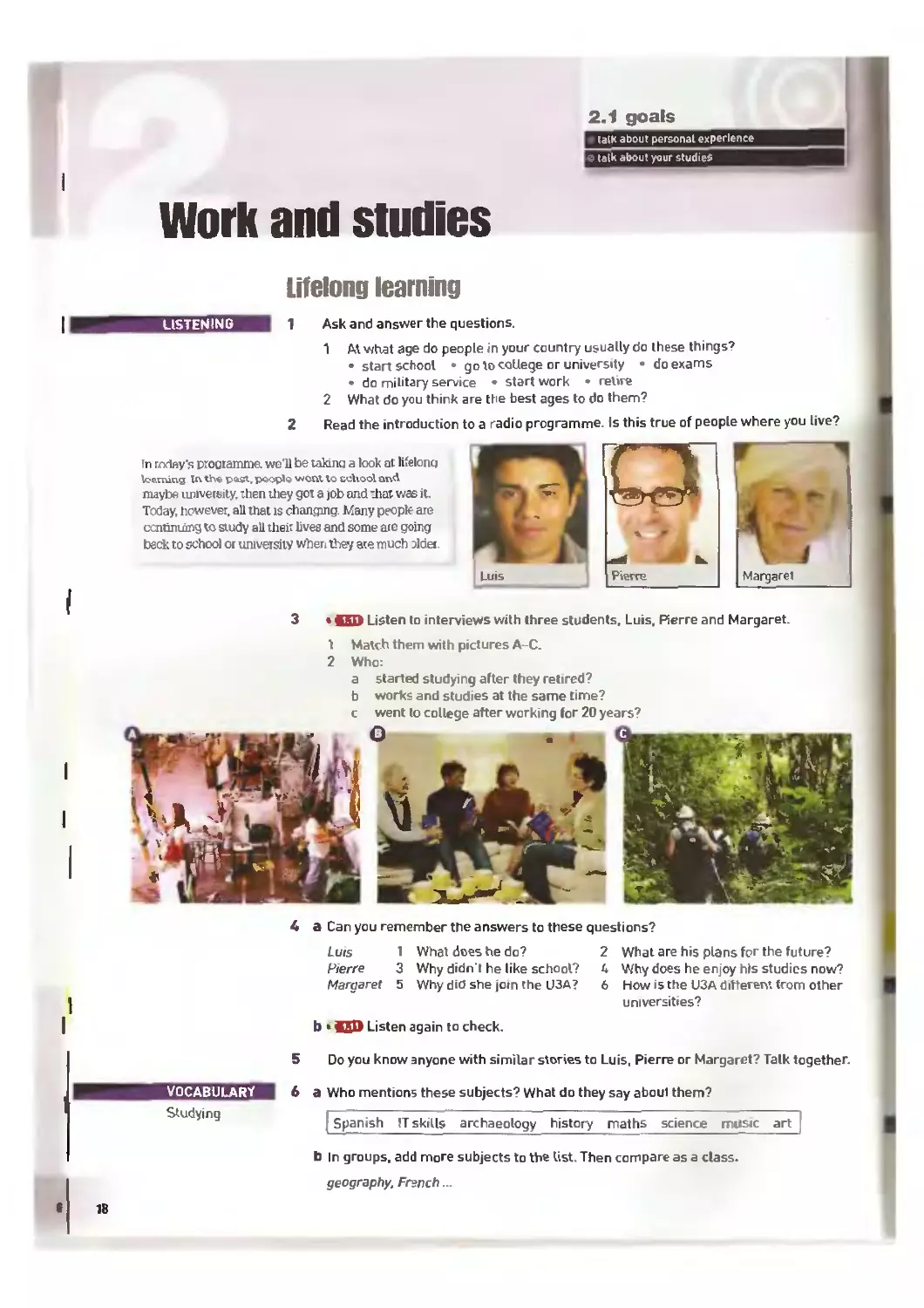
LISTENING
Lifelong learning
1
Ask and answer the questions.
1 A\ what age do people in your country usually do lhese things?
. start school . go \0 coUege or univerSIty . do exams
. do military service . start work . re\ire
2 What do you think are Itle best ages to do them?
Read the introduction to a radio programme. Is this true of people where you live?
2
-
'W.
In rMAY' prooramme. we'n be takina a look at lifelona
\c.e.ming In th40 P . 1>QOP'Q want \0 &cho01 Qnd
maybA IUllvelbity. then tlJeY got a Job and :hat was it.
Today, however, an tl1at IS changmg, Many pt'Ople are
ccnnmirf\\j to study an their lives and some ale going
back to school or uruversitY wben t.1)e</ i!{e much )loeJ,
. .
, - ,
; ','I ,.f: ...
,, \.
\' ' :"
"- \ -
f
oil
VOCABULARY
Studying
18
...
Luis
P\t!rre
Margaret
3
. Listen to interviews with three students, Luis, Pierre and Margaret.
\ Mat'(,h them with pictures A-C.
2 Who:
a started studying after they retired?
b works and studies at the same time?
c went to college after working lor 20 years?
o . C
!
'
I f l _ I
,
..
"l
f 'f
t ',
t, <,
"
\1 , , - "
.. ,
. . ... -
..
r ---
"..
. J -
.
;'
..
,.. \-to.,
.....
r
"
.."
, .. $"" < , ....
14 .,\, ......
': ..., - '
""
, a Can you remember tne answers to these questions?
Luis 1 What does he do? 2 What are his plans It'r the luture?
Pierre 3 Why didn', he like school? 4 Why does he enjoy his studies now?
Margaret 5 Why dil! she jom the U3A? 6 How is the U3A dltterem trom other
universities?
b . aD Listen again to check.
5 Do you know 3nyone with similar stories to Luis, Pierre or Margaret? Talk together.
6 a Who mentions these subjects? What do they say aboulthem?
Spanish IT skills archaeology history maths science rTIUSIC art
b In groups, add more subjects to the list. Then compare as a class.
geography, Ff'!!nch .n
exams
I J degree
a thesis
an IT sk lis course
college.
a-deeto.ollC'
courses
degrees
School
SPEAKING
GRAMMAR
Present perfect 1
- fer experience
Grammar reference
iilnd practice, p133
PRONUNCIATION ,
Sertence stress
I
SPEAKING 5
7 a Complete the sentences from the interviews with words or expressions from the box
1 I'm doing .a.dec,tpra te in archaeology.
2 I'm writing _ on my work in the Amazon
3 I passed my _ - just!
4 I wanted \0 do in art.
S I applied 10 some _
6 I gol into the of Art and Design in Limoges.
7 We don't do exams or get _ .
8 I've done _ in music, local history and Spanish
9 last week I signed up for _'
b Which words in the box in 7a can go with these verbs? do get pass I fail
do a degree. do a doctorate u'
S Write five sentences about your past or present studies. Use the expressions in 7a,
9
Listen to each other's sentences.
Ask questions 10 find out more.
Last year I did a
course in marketing. Where did you do il?
I've done ...
1
Look at Ihe sentences from the interview with Pierre and answer the questions.
I've always enjoyed art. 2 I didn't like a lot of subjects al school.
In which sentence is he talking about: a only the past? b his whole life up to now?
2 a Complete the sentences with have, has, 've, haven't, hasn't
have I has + past participte
What kind of course!> _ you done?
o I've done courses in mUSIC, local history and Spanish.
= I choose things I studied before.
= I _ never been very good with compulers.
[ as she ever studied Spanish?
Yes, she _' I
I No, she -
b . Listen to check. 0
3 Complete the questions with the past participles of Ihe verbs in (bracketsl,
1 What subjects have you always e,njpyed? (enjoy)
2 What subjects have you always _ good at? (bel
3 What's the most useful subject you've ever _? (study)
4 Who's the best teacher you've ever _ _? (have]
5 Have you ever _ a course in your free time? (dol
6 Have you ever _ a thesis or a very long essay? (writ J
7 Have you _ a lot of exams in your life? Idol
8 What's the most difficult exam you've ever _? (pass]
You can look up irr gular past participles on p160,/rregular verbs.
a . DE) We stress the most important words in a sentence (often question words,
nouns, verbs, adjectives and adverbs!, Listen 10 Ihese questions from 3 and practise.
1 Wh t s bjecls have you lways enj yed?
2 Wh:t subjects have you lways been go"od at?
b Look at the other queslions in 3. Decide which words should be stressed and
underline them..UB Then listen and compare,
Ask and answer the questions in 3. Ask questions to find out more.
I've always lO\.ed mdths. .
Why? DId you have good teachers al school?
19
I
I
I
2.2 goals
A great place to work:»
talk aboul personal experience '.J
10 lalk about \'Our work
SPEAKING
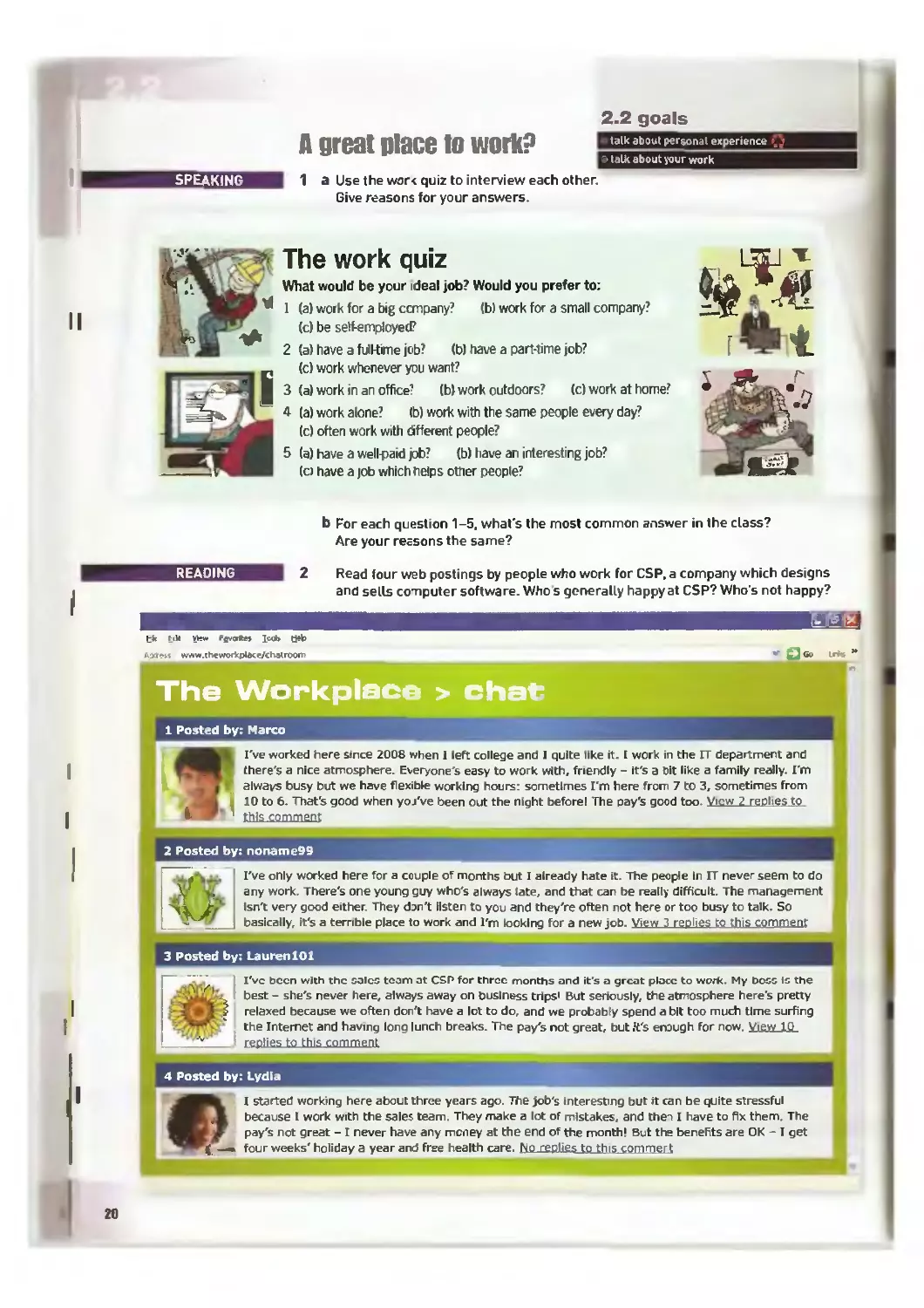
1 a Use the wor< quiz to interview each other.
Give reasons for your answers.
.J' 10.,
' ,
, ,
..
...
II ...
l-<>
, . I
.,
The work quiz
What would be your Ideal job? Would you prefer to:
1 (al work for a big ccmpany? (b) work for a small company?
(el be self-employed?
2 (al have a full,time job? Ibl have a part.time job?
(el work whenever you want?
3 Ia) work in an office Ibl work outdoors? lei work at home
4 lal work alone? Ibl work with the same people every day?
lei often work with different people?
5 lal have a well-paid pb? (bl have an inleresting job?
(CI have a JOb which Mips olner people?
Lj1M
r t
..»..-"
\ ."" \).
_ .,;;n.
b For each question 1-5, what's the most common answer in the class?
Are your recsons the same?
READING
2
Read four web poslings by peopLe who work for esp, a company which designs
and sells cOTlpuler software. Who s generally happy at eSP? Who's not happy?
,
tk tdl ' orRef l«b tte\:l
A1a' u www.[heworkpl&c: /chatroom
v CJGo Lm No
The Workpiece > chat
1 Posted by: Marco
l
I've worked here since 2008 when I left college and I quite like it. I work in the IT department and
there's a nice atmosphere. E_eryone's easy to work with, frIendly - it's a bit like a family really. I'm
alwavs busy but we have flexible working hours: sometimes I'm here from 7 to 3, sometimes from
10 to 6. That's good when YOJ've been out the night before I The pay's good too. VICW 2 rephes to
this comment
..
2 Posted by: noname99
J I've only worked here for a couple of months but I already hate it. The people In IT never seem to do
\ ' any work. There's one young guy who's always late, and that can be reall difficult. The management
""V Isn't very good either. They dJn't listen to you and they're often nol here or 100 busy to lalk. So
_ , basically. it's a terrible place to work and I'm looking for a new job. View 3 reolies to this comment
3 posted by: Laurenl0l
I
I
1 - I I've been wjth the :;;]Ie:; tC,Jm ,Jt CSP for three months and it's i1 great place to work. My bo ::; I:; the
." best - she's never here, alwa)'s away on busln s tripsl But seriouslv, the atmosphere here's pretty
relaxed because we often don't have a lot to do, and we probably spend a bit too much lime surfing
. Ihe Internet and havmg long lunch breaks. The pay's not great, but It's enJugh for now. View 10
.V I r.ep1ies to this commp-nt
4 Posted by: Lydia
I started working here about three years ago. The job's Interestmg bul it can be quite stressful
because I work w,lh the sales team. They make a lot of mistakes, and the' I have to fix them. The
pay's not great - I never have any mcney al the end of the month! But lhe benefils are OK - I gel
C. - four weeks' holiday a year and free health care. No reolie..c; to this commert
20
I
I
VOCABULARY
Working
conditions
SPEAKING
I
lIat's your job like?
It's reat, because
we 1ave flexible
working hours n.
..
GRAMMAR
Present perfect
2 - with for and
since
GfiI.,mar reference
:II .d practice, p133
SPEAKING
fou've been a teacher
for five years, right?
No, only two.
Oh, sor)', two
ears, What do
(JU teach?
3
Read the postings again. Who:
1 is in lhe sales team?
2 sometimes h s problems because of the sales team?
3 is in the IT department?
4 isn't happy with the IT department?
5 doesn't have a lot of work?
6 came to CSP alter college?
7 wants to leave CSP?
8 doesn't say anything about money?
Who do you thin would be good to work with? Who could be difficult to work with?
Why?
,
5
Complete statements 1-6. Then read the postings again t3 check.
We have flexible working a I never have any money at the end
hours: of the month'
2 The management isn't b Iget four weeks' holiday a year and
very good either. free health care.
3 The benefits Jre OK - c They don'tlisten to you.
4 The pay':; not grcat d and rm looking for a new job.
5 It's a terrible place to work e everyone's easy to work with.
6 There's a nice atmosphere. f sometim s rm here from 7 to 3.
sometim s from 10 to 6.
6 a Think about how to describe some of these things with th expressions in 5.
your job now 2 jobs in your past 3 jobs of people you know
b Talk together.
I've worked here for ...
1
Look at the sentences from the postings.
Marco rve worked here since 200S.
Lauren101 rve been with the sales team at CSP for three months.
1 When did Marco and Lauren start working at CSP?
2 Do they work there now?
3 Complete a and b wIth for and since:
a You can use _ to say when something started (Monday. last month, 70081.
b You can use ._ with a period of time la week, three months, five yearsl.
2 a Write four sente1ces about yourself on a piece of paper. Use the ideas below with
for and since. Then give your sentences to your teacher.
rve worked at.n rve been a... rve lIVed In ...
rve known.n I've studied n. rve had my...
I've worked at m) present company for about five years.
b Listen to each set of sentences. Can you guess who wrote them?
3
Talk in groups. What can you remember about each other from 2? Ask questions to
find out more.
fit
c-
\-
21
Target activitJ
Have an interview
2.3 goals
talk about personal expenence '::,
talk about your studies CO
talk about your work 0
let Findajob help you find your dream job. Simply give us your ev and come in
tor an interview and we'll find the best job tor someone with your skills and
interests. You'll get experience with some of the wor d's best organisations and have
the freedom to work how you want to, We can find JOU a job with a permanent or
tem orary contract and you can work full-time or p<Jt-time - the choice is yours!
TASK LISTENING 1
II '....
,.
'-J/'
r
2
.
II.
..
..
3
Lauren Go"don has left CSP
I and is looking for a new Job.
She has ar inlerview allhe
, Firn3ajob agenq.
Read the advErt for a job agency.
1 Do many people use job agencies where you live?
2 What are the advantages and disadvantages of using a jOb agency?
3 Have you or people you know ever used a job agency?
11m) Listen to part of Lauren's interview. In what order does the intervIewer ask
about these things?
o experience in sales
!II qualifications in catering
[J strenglhs and weaknesses
Olangu3ge"
o computer kills
o driving licelce
a Can you remember if these sentences are true or false? Lauren:
1 brings her CV with her true
2 only wants to work in catering.
3 has her Food Safety certificate with her.
" speaks some French and Spanish.
5 left CSP b cause she wasn't happy there.
6 says she t as no weaknesses.
b . 1m) Listen again to check.
TASK , a What does Lauren say in her interview? Match 1-8 with a-h.
VOCABULARY 1 I"ve got experience in work for a big company.
a
Presenting 2 I"m "ok;", fur "';\ b Food Safety for Catering.
yourself 3 I"ve got a certificate in c talking to people, I think.
" I've been in d working in a team.
5 I've always wanted to e any of those areas, really.
6 I'm good at f sales. administration and catering.
7 I really enioy g sales for a )ear now.
8 I'm not very good at h working on my own.
b Look at the script on pl44 to check.
TASK
I
I
2Z
C Use the highlighted expressions in 4a to write five sentences about yourself.
5 a Work in AlB pairs.
A, you've got en interview with Findajob. Think of answers to questions 1-5.
B. you're the hterviewer Write two more questions.
I What experience have you got?
2 What kind of work are you looking for?
3 What quaUfications have you got?
" What languages can you speak?
5 What are your strengths and weaknesses?
b Interview your partner. Then change roles and do the i,terview again.
6 Were you happy with your interview? Why I Why not? Talk together.
UPLME
Keyword tor
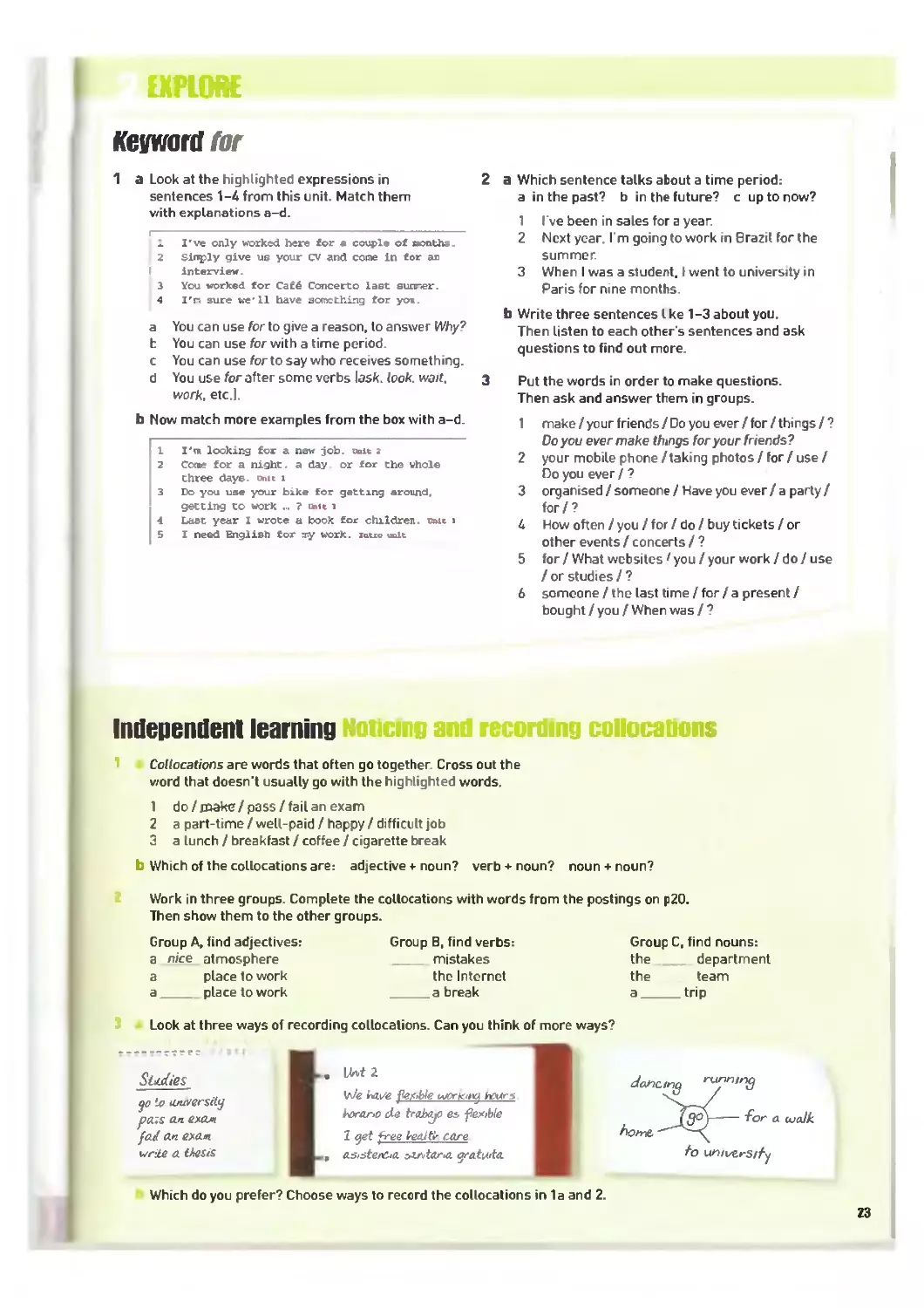
1 a Look at the highlighted expressions in
sentences I-I, from this unit. Match them
with explanations a-d.
Irve only worked here for. couple of .:mth8.
2 Simp] Y give us your CV and come in for all
I interview.
3 You worked for Cat' Concerto last. sUW".er.
4 rn sure we" II have something for yQW..
You can use for to give a reason, to answer Why?
You can use for with a time period.
You can use for to say who receives something.
You use for after some verbs lask, look. walt,
work, etc.!.
b Now match more examples from the box with a-d.
a
t
c
d
1
2
I m looking for a new job. UDl 2
C for a night. a day or for the whole
three days. on! t. 1
Do you use your bike for gett1ng around.
getting to WiOrk ... ? 't 1
Last. year 1 wrote a book for ch1.1dren. tlDit 1
I need English for :ny ",,'Ork. J:o.t.J:o UD.1.t.
3
I:
2 a Which sentence talks about a time period:
a in the past? b in the future? c up to now?
1 I've been in sales for a year.
2 Next year. I'm going to work in Brazit for the
summer,
3 When I was a student, I went to universIty in
Paris for nine months.
b Write three sentences t ke 1-3 about you.
Then listen to each other's sentences and ask
questions to find out more.
I
3 Put the words in order to make questions.
Then ask and answer them in groups.
make /your friends/Do you ever /for /things /?
Do you ever make thmgs for your friends?
2 your mobile phone /taking photos / for / use /
Do you ever / ?
3 organised / someone / Have you ever / a party /
for /?
I, How often / you / for I do / buy tickets I or
other events / concerts / ?
5 for / What web sites I you / your work / do / use
/ or studies / ?
6 someone / the last time / for / a present /
bought / you / When was /?
Independent learning NOhCll1U and recording eolloeshons
Collocations are words that often go together. Cross out the
Vlord that doesn't usually go with the highlighted words.
1 do / / pass / fail an exam
2 a part-time / well-paid / happy I difficult job
3 a lunch / breakfast / coffee / cigarette break
b Which of the collocations are: adjective + noun? verb + noun? noun + noun?
Z Work in three groups. Complete the collocations with words from the postings on p20.
Then show them to the other groups.
Group A, find adjectives:
a nice atmosphere
a place to work
a place to work
Group B, find verbs:
_ mistakes
the Internet
_a break
Group C, find nouns:
the _ department
the team
a_trip
"'--"--:,,;,:'r
3 Look at three ways of recording collocations. Can you think of more ways?
Sid,es
')0 W/lvqrSil'j
pa.;s an tI)<Q.Ar
fa.la...tI)<a...
wdtl a. tlt4SiS
. u",t 2
We have fluMe IAKJrk""j MA'"
/,or-w.o cJ.e tl'a.bo.JO es flex,ble
1 'Jet fr'ee /-ed.lt ewe
. 4sI:;;teN:.,a. .:..tJ\otar.a. qr-a.t/Atta.
donc.I"'8 ru""''''8
-V for" walk
home
'0 univerSity
Which do you prefer? Choose ways to record the collocations in 1 a and 2.
Z3
I
II'
I
/.
I
I
.1
EX L
Speaking
1 a. Listen to the phone call and choose a, b or c.
The caller s name is
a Clare.
b Lisa Moore.
L Yu ur Kdl illi.
2 The person he needs to speak to is
a at lunch.
b in a meeting.
c on holiday.
3 The caller leaves his
a mobile number.
b home number
c home address.
4 He wants Lisa Moore to
a email him.
b phone hIm
c send hIm something.
j) Read the conversation to check.
2 a Read the conversation again. Which highlighted
expressions:
1 ask someone to slow down? (xli
2 ask someone to say something again? (x3)
3 ask someone to spell something? (xli
4 show you understand? (x3J
b . Listen to check. 0
3 a Put the words in order to make sentences or
questions about taking messages.
1 take you Would me message to like a ?
2 name agam What your was please?
3 would like to tell you What me her?
l. mp"""!Jp !Jivp hpr I'll the
5 ask you her to ru contact.
b Read the conversation to check.
, a Cover the conversation. Role-playa sirrilar
conversation in AlB pairs.
A, you're Clare from CSP.
8, you're Yusuf Karim from Findajob (telephone
0412556 207, email y.karim0findajob.ccm.auJ.
Try to use the highlighted expressions h 2 and 3.
j) Change roles and practise again.
5 a Make two new phone calls in AlB pairs.
1\, you work for esp. Read role card 1 on p126.
B, you work for FmdaJob. Read role card 2 on p129.
Start the call.
j) Change roles.
8. you work for CSP Read role card 4 on p 130.
A you work for Findajob. Read role card 3 on p176.
Start the call.
24
Goals
051< ....... to ........1. spoil thongs and slow
down
show you understand
- .oke a phone message
IT
"-
\
\
A manager at the FindaJob agency calls CSP to ask about
their ex employee. Lauren Gerdon.
CLARE
YUSUF
Hello, CSP, Clare speaking, How con I help you?
Oh hello, my name's tusuf Karim. I'm trom the
job agency. Findajob, Could I speok to Lisa Moore.
please?
CenoL'1Iy. Can I ask you the reason for the call?
01 course. I'm calling about an ex'CSP employee.
Lawen Gordon I,isa Moore was her manager,
ThaP.k you Let me just see II usa's aV81lable.
Hello? I'm afraid she's in a meeting. Car I take 8
message?
I'm sony, this line's rot very good. Could you say
that again, please?
Yes, 01 course. I'm sorry, Would you like me to take
a message?
Yes, please,
Er, what was your name agam, please?
Yes. It's Yusuf Ka!m.
Could you spell tbm for me?
Yes. it.s Yusuf with ai, Y.U-S.U.I', and Ka:im is
K-A-R-I.M.
OK And what's you: lelephone number?
I'll give you my mobie number It's 0412 556 2m.
SorlY, can you speak more slowly. please?
Yes,lt's 0412 556 207
Right. And has LlSa got yow eUklJ! address?
Er. no. It's y.kar.m@tindaJOO,COOlau
Sorry. y.karim@ ... .
Findajob - that's one WOld - dot com dot au
OK, so that's y kanmUfiodajohrnrn au And what
would you likp me 10 leD bel?
Well, I'd bile to ask lie! quesbooS about Lauren
Gordon, what was she like 8. an emp10yee and
things, Jt would be great:! she rouJd phone me.
OK, I'll give her the message mxlask her to contact
YOII,
Thank you. 'I'bat's beIPuI
No problem Goo
CLARE
YUSUF
CLARE
YUSUF
CLARE
YUSUF
ClARE
YUSUF
CLARE
YUSUF
CURE
YUSUF
CLARE
YUSUF
CLARE
YUSUF
CLARE
VUSUF
CLARE
YU5UF
CLARE
YUSUF
CLARE
look again 0
I
I
I
Review
GRAMMAR Present perfect
1 a RQad the 'Find someone who' sentences bQlow.
Write four more like these for the people in
your class.
Find someone who:
. has had the same job for more than two years.
. has always liked the same music.
. has worked for more than three companes
b Make questions from the sentences, then ask
them. Find out more details.
Have you always liked the same music?
c Talk in groups. What did you lind out about other
people in the d';)55?
VOCABULARY Working conditions
2 a Use the expressions to complete Fleur's pc sting.
Is she happy in her job?
flexible working hours pay free health care
ea y te ..o r!rwl11\ benefits managemerl
atmosphere
Posted by: !'IeWS'
The job's a bit boring, but the people are
'!'a !y to Vfgr k _ ""itl1 and there's a really good
2 _ in the office. The 3_ aren't bad - I
get' _ - but the' _ is terrible! [ haven't
had a rise since [ started. We don't have' _
- we start at eIght In the morning and often work
late. But the 7 _ IS qUIte good. My boss is
great and tells me conditIons will get better if [
stay here longer.
b Write a posting like Fleur's about your job or the
jO!J of someone you know.
tAN YOU REMEMBER? Unit 1 - Music, sports and
exercise
3 a Use verbs from the box to com plete the qu:stions.
I done go (x21 listen to
1 Can you "pI'!}' volleyball?
2 Do you ever _ running?
3 How often do you _ to concerts?
4 Do you ever _ classical music?
5 Have you ever _ yoga?
b T,ink 01 two more endings lor each questi!)n.
Can you play the guitar?
Can you play football?
C Ask and answer all the questions in 3a and b.
Extension
SPELLING AND SOUNDS Words with -er, -or, oar, -our
, oIl. You say the endin -er, -or, -ar, -our in the
same way,!;)!. Listen and repeat.
-er
I:wyer
-or
-ar
-our
n:ighbour
.
.
visItor
grammar
b Complete these words with the correct endings.
Practise saying them.
teachg.r. direct_ danc_
act_ sug. _ behavi_
C . Spellcheck. Listen to ten more words and
write them down.
d Look at the script on p 145 to check your spelling.
NOTICE Collocations
5 a Complete the highlighted collocations Irom the
radio interviews with Pierre and Margaret.
I ask free g at great have IT kff Pi] ssed I
1 I lelt school when I was eIghteen. 1_
my exams - just! - and then I _ a job.
2 It's a, _ experience, completely different
from school.
3 I'm a lot older... so it'. easier to
questions, talk to the teachers, things Like that.
4 We _ meetings and talks in members'
homes.
S I retired three years ego. I had a lot of _
time, and nothing to do,
6 Last week I signed up for an _ skills
cou rse.
b Look at script 1.11 on pH.4 to check.
c Choose three collocations and write questions
with them.
Do you have a lot of meetillgs where you work?
d Ask and answer your questions.
Self-assessment
Can you do these things In English?C]>a number
. an do this welL
talk about personal cxp(!rionce
. about your stud!!!.
. tall< about your work
ask people to repeal, spellihings and slow
down _ _
. show you under$tand
e'ake a'telephone message
. For nderence -.d uW'tg your work .. e-PorUolo
. Formorw practice '" Setf-8tudy PIICk.Unit 2
25
I
II
I
I
I
I.
I
\
I
. 26
3.1 goals
<> give opini:ms'
. talk about food and .ating
HOw'S JOUr loodil
. .
... .
.
---
..
VOCABULARY
Giving opinions
Supermarkets or small shops:-
.. ... '-.... ,
.-......
. J
,1
,
. ..
.... ...'
\..'o_ '\:.
t£ '
'II ,..
'.
...
,-
' .. __ I
,'. I.'
. : k"Q
. ... , f( ,"'.. .: _ .:
...; . .,.' "
..
. .1.-
"11M "
, ..= 0,'
" ..
;.r'
..... .'
,. -
.....
I '.....;: ..__
".,
..
.
.
.r
.:
-
1
Look at the pictures. In groups, ask and answer the questiol'/s.
1 How often do you shop at places like these?
2 In your home, who docs the food shopping?
Read three people's opinions about supermarkets. Do they like or dislike them? Why?
"I thwk small shops are better. The owners are u9ually fnendly
and you can ask them aJ;out tlungs. I find super:narkets quite
stressful They're a!ways crowded and nOIsy. If ;,ou ask me,
they':e only Interested in making money, not in their customers "
Jenn!. New Zealand
2
Well, supermarkets arc cheap and
convenient but I prefer convenience
stores. They're fast and modern and sell
inf.Prp. tiT'lU thiT'l(J Ah::o. "UpATm;}Tkpt.c::
bring a lot of theu sluff here by plane
and that's bad for the environment
They should sell more local food.
"-kia, .Japan
SPEAKING
"I go to the market near my fiat every day to buy food - tlungs
likp. mPRt. fi h ::m'" vP'OPtRh1p. T nF!VPT huy things likp thAt in
the supermarket. I don't thmk their food is fresh. But I guess
they're good for cleaning products, pet food and so on.
"
"
Luz, Spain
3 Match the beginnings and endings of the opinions. Then look at 2 to check.
1 I think small shops a sell more local food,
2 I find supermarkets b cleaning products and pet food and so on.
3 If you ask me, c are better.
4 They should d is fresh.
5 I don"t think their food e quite stressfJI
6 I guess they're good lor I they're only interested In making money.
, a Find the opposites of these adjectives in 2.
unfriendl} friendly expensive relaxing ir.,
quiet boring empty old-fashioned
b . UD Listen to check. 0
5 a Think about places where people buy food in your country. What are their
good and ad points?
b Listen to each other's opinions in groups. Say if you agree or disagree and
give reasons.
Well, I don't agree, I think .n
READING
,-
..
...
"""
".l
-,' -
finned food t.
-,
... .:.
r_'- '.
frozen "od
. -.....
'.'
.....
,
fresh tnii/anil..,.
vege/ables . .. ...
'!\'
J
. ..
..
ready-lNIde meal "
VOCABULARY
Food and meals
SPEAKING
Food and VOIl
1
Look at the pictures. Which kinds of food do you prefer to buy? Why?
2
Read th" article by Judi Bevan. Which paragraphs,
a are about supermarkets now?
b are about shopping in the past?
c compare shopping in the past and present?
.....
In defence of supermarkets
:..
1 I like supennarkeb. I can buy a week's sbopping in ninely minules.
giving me lime 10 help my daughler w ilb ber homework, or read a
good book in Ihe bath.
, SupennarkeLS sell aJ amazing choice of fresb .md Ii"ULen food. If I
want to spend hours cooking a three.course dinner for fricnds, I can
find all the ingredients I need al my local supermarkel. If I choose an
lIali n meal. tbere arc porcini mushroom,. fresb basil and mou.arclla
cbeese. If I wanl some olher cuisine - Indian. Chinese or French -
heros. spices, sauces .nd vege\.ilbles from every continenl are only a
few minutes away.
3 On the other hand, when I'm lired and jUsl want 10 put togcther a
quick family meal. I can buy a ready-made lasaplle or curry, a bag of
sal d alld SOllie fresh fru;1 alld slart e lillg it len minutes after I get
home.
· Thanks to supermatl<ets, I can now shop all day from early morning
10 laic al night. In somc Siores I can even shop 24 hours.
5 When I was" child, my molher didn't have thcse choices, .. she
went 10 three 01' four Jepreosmg lillie shops every day 10 buy wlldl she
nceded. These shops "pcned from 9 dill to 5 pm Monday to SaturdlY.
and they all closed or Thursday afternoons.
· The food was nol a!.vays good. there was almOSI no choice and Ihe shopkcepers were nOI
vcry friendly. And alll.allimc. food was very expensive. Cream or strawberries was a luxuf)'.
and roasl chicken was for special occasions only.
7 NOI m,my people would say Ihal shopping in their local supell1l<UkCI on a crowded S,,(uroay
morning makes Ihem happy. But it's much, much better than wh"t we had before,
Judl Bevan is a freelance
financlallournallst, author
and broadcaster. Her bool<s
include Trolley Wafs - the
Battle of the Supennarlrets.
published in 2006,
3 Read the article again. Find four reasons why Judi likes supermarkets and four
problems with shopping in the past.
, Judi describes supermarkl'ts in the UK. Which things are true about supermarkets
in your country? Which things are differl'nt?
5
Add vowels to make food words from the article. Then look at the article to check.
Look on p131 to check ilny words you don't know.
1 bsl bas;1 4 vgtbls 7 strwbrrs
2 chs 5 crry 8 hrbs
3 spcs 6 frt 9 scs
10 lsgn
11 s.d
12 c.7ckn
13 mshrms
14 crm
6 Match the examples from the box with a-d. Think of two more examples each for a-d.
I basil dessert .asagne bredkfa!>t I
a a meal b a course c a,' ingredient dad sh
7
In groups, ask and answer the questions. Find out more information.
1 Do you have a favourite kind of food, dish, or meal of the day?
2 What dishes C201 you, or people you know, cook? What ing-edients do you use a lot?
3 Where YOll iive, are there any good places to buy food from other countries?
fI
I
It
I
II
I
I
I
I
I
I
28
Eating out
3.2 goals
talk about food and eating .::-
order a meal In a restaurant
1 Talk together.
1 How ofter do you go to cafes or reslauranls?
2 Are there any good places to eat near your home?
2 a Read the information from a guide to eating out in Melbourne. Australia.
Which restau"ant:
READING AND
LISTENING
1 is owned JY a family?
2 has tables outside?
3 IS open on Sundays?
4 sometimes has live music?
b Which of these restaurants would you like to go to? Why?
I
The Bridge Restaurant
45 Hardware Lane. Melbourne Vie 3000
'fr03 9600 234
..........._.'......................uunnn....nnn.......unnnu.
"!! ' mmm.mm.m..mm.mmn..m..mnmm
.....
...
,
. i ,!
.';0 \
'"
c:
'C
...
..
J
,
Th" Bridge ha< a modem dining
room scrvinp; quality European
fOOd. There is also a beautiful
terrace for outdoor dining, and
live jazz every Friday. Bookings
essential Open Monday-Friday 12
pm - lO pm, Satutday 5 pm - lO pm.
3
Bopha Devi Docklands
27 Rakaia Way. Docklands Vie 3008
n03 9600 187
....... .n..nnn.........uuun...........nn......................
*****
.....,.,................................................................
l'he new place in Docklands that
veryone's wlking about. The
Bopha Deyi Cambodian reslaurant
combines lama'lic lood "ith
excdlent scn'ice. Open 12,=-
11 pm. .">sed Monday...
Abla's Lebanese
Restaurant
109 Elgin Slreet. Carlton Vie 30S3
n039347006
hn.... huo....nnnn... ............................................
*****
...........................-............................................
Choose from an exciting menu of
Middl.. EaSlern fuud, r.h..n sir. back
and enio} the friendl} service in
lhisfamily-<>\\'ned restaurant. Open
/ hursday-l',iday l!pm - 3pm,
.\/onday-Satunlay 6pm - llpm
L!
. un Listen :0 Bryan and Lynn talking about the restaurants. Which one do they
choose? Why?
,
Read the restaurant menu. Which dishes would you like to try? Look on p131 to
check any words you don't know.
\ 1
-
_I
,.......
B')an and Lynn arc cousins. They want
to celebrate I fAn's birthday
STARTERS
Soup of the day
Pear. apple and choosesalad tyl
Worm olives wrth 011 and brood (v)
MAIN COURSES
Home-mod<" posto in a tomoto cnd olive souce (v)
Grilled solmon with potofo03 end green :solad
Steak in a mushroom souce with roosted pototoes
Fried rice with mushrooms (y)
Prawns ond green vegetobles w h a tresh cucumber solod
DESSERTS
Worm chocolate coke - WIIh chocolate or vanlllo ice croom tv)
Cheese plate wit... to:)st <vi
Fresh fruit so lad with cream tv)
(y) - SlJItabie for nans
5 . DE» Listen to Lynn and Bryan ordering their meals, Tick (,I) the things they order.
LEX IS
Ordering a meal
PRONUNCIATION
S:hwa /3/ sound
SPEAKING
GRAMMAR
"ouns with
prepositional
phrases
Grammar reference
and practice, p 134
SPEAKING
We went to Abla's.
It's a Lebanese
restaurant with
really friendly staff.
We S3t at a table in
the corner ...
6 a Put the lines of the restaurant conversation in order, 1-12,
Waiter
ur OK. And lur yuu, ir?
[Ij Hi, are you ready to 0 rder?
D All rlgl;!' Can I get you som thing to drink?
D Fine, and how would you li e your steak?
o Today it's cream of mushro,)m soup.
DSure. Sparkling or still?
Customers
o Can we have a be,ttle of water?
o Could I have the :heese alad to start ...
and then the steak?
o OK, so ru have thai and thl:! pasta, please.
D Medium, please.
D Still, please.
IlJ Yes. I think so. What's the soup of the day?
.
b . D!) Listen aga n to check.
7 a. ED Words or syllables without stress often have a schwa /3/ sound. Listen and
say the sentence.
.;) ....:it. ='
Can we have a bottle of water?
b Mark the /3/ sounds in the rest of the customers' sentences in 6a.
e: . list,," ilnd r"ild th.. script on pll.5 to ch..ck. G Prilctise silying the sentenc"s.
8 a LOok at the menu and decid e what you want to order.
b Work in groups of three. Student A, you're the waiter. Students Band C, you're the
customers. Order a meal.
e: Have two more conversations. Take turns to be the waiter.
Describing 8 meal
1
Look at sentences 1 and 2. Then8the nouns and underline the prepositional
phrases in 3-6.
1 f Ihe day
"1 Warm chocolatE! @witt1 ice cream
3 Fresh fruit salad with ice cream
4 Pasla in a to malo and olive sauce
5 Warm olives with oil and bread
6 Steak in a mushroom sauce with roasted polatoes
2 a Put the highlighted phrase in the correct place in each sentence.
. .r.------
1 I d like to bock a tablerpleasc. for two
2 My parents c')ok a big meal every weekend. for nine or ten people
3 Could I have the chickl n, please? in garlic sauce
4 That table is free. Why don'l we sil there? in the corner
5 Would you li e a bottle with your meal? of water
6 The weather was great, so we sat at a table. on the terrace
7 There's a good menu and Ihe staff are very friendly. with lots of vegetarian dishes
8 I'll have the almon, please. with rice
b . m> Listen to check. 0
3 a Think about a meal you had recently.
Where did you have the meal:
in a restaura,t or cafe? at a party? al a friend's house?
2 When did yo have it? Who witb?
3 What did you eat? How was the food?
4 What was Ihe place like?
5 Did you have a good time?
b In groups, describe your meals. Give details.
29
./
Target activitv
!
II
s.--1rDtn Ct«trNn....
1/1
.,.
,
..
. .
I
II-
TASK LISTENING 1
I
I
TASK
VOCABULARV
Making
sugge tions
TASK
I
I
I
I
30
.. .
3.3 goals
Plan a meal
'I O#tIl'llll)ns ..
.talk about fo)d and eilting
em Ike suggesttans
--...-
....
'-
..
' :z'
',.
,
_'
....", t,
....
..
s-b
."
..
,.
,...
"
4..
..
...
,1m) Four people are planning a barbecue, but some 01 their friends are
vegetarian. What do they decide to do? Listen and choose from 1-4.
cook meat and vegetables together
Z cook only meat but make some salads too
3 cook meat and vegetables on different grills
4 cooo< only vegetables
. Ui) Listen :0 the second part of the conversation. Tick (.II the things they need
for the salad.
lettuce black olives parmesan cheese ol.ive oil
leta cheese limes garlic tom<ltoes
3 8 Can you ren1t'.lItJtH whil:h six of the50e s.uyy lioll the friends. Indk ?
2
1 How about we organise a barbecue?
2 We could do some pasta.
3 We can put veggies on the barbecue as well.
4 Why don"' we get some burgers?
5 Sausages are nice
6 How about a fruit salad?
7 Perhaps we should make a cake.
8 What abo t fruit?
9 Melons?
b . . ua Listen again to check.
, a You're going to plan a meal for your group" Work alone and think about these
Questions.
1 hould you eat Insllle or outside? Could the meal be In or near your home?
2 What kinc 01 food should you make? How many cOlrses? What about drinks?
3 Who should make the lood? How can you help?
b Now think about how to:
1 describe the food. Chicken with no
2 give opinions" I think we should ..,
3 make suggestions. How about ... ?
In groups, plan your meal. Make a list of the dishes yo decide to make.
5
6
Read the other groups" lists. Which meats do _ thir1t SOlo . the nicest or the
most interesting?
I
r
EXPLORE
Kevword w,'"
1 a Match 1-3 with a-c to make three sentenCES.
1 I've never been very good
2 I work
3 It has a good menu
b Which sentence has: a noun + with?
a with lots 01 vegetarian dishes. ..... J
b with the sales team. ..i< 2
c with computers. ..... 2
an adjective + with? a verb + with?
2
Choose the best endings lor 1-9.
1 I have an appointment with
') I've got a problem with
3 I had a meeting with
4 I m bored with
5 What's wrong with
6 My new lIat's nice but I'm not very happ>, with
7 I'm staying with
8 Steve's going out with
9 The tour of the castle starts with
a Cecile? She looks ill.
b the view.
c a walk around its lamous ardens.
d my computer. It won't start up
e this film. Can we change channels?
I Erika now. They met at a party a month ago.
g the sales team yesterday,
h friends in Honolulu right now. It's wonderful here.
Or Jones for two o'dock.
3 a Complete five or six of these sentences with your own ideas.
rn Inot veryl good with... I work with no I have a meeting with ... I've got a problem with ...
rn bored with... I'm (not very\ happy with n, I sometimes stay with __. My day uSJally starts with ...
b Compare your ideas in groups. Ask questicns to find out more.
Well, at the moment I've OK Wh t '. ' th . t ?
, . a s wong WI I.
got a problem with my car,
Across cultures r ealUmes
1
olD Listen to Matt and Carlos talking about mealtimes.
Who talks about these things?
bredkfast the evening meal dinner on Friday
e enings dinner with guests
Can you remember who said these things, Matt or Carlos?
oil!) Listen again to check.
1 We usudlly eat together," the evening.
2 Everyone sits around the table and eats and talks.
3 In my family, we all have breakfast at different times.
4 I send my kids to wash their hands before dinner.
5 My mum says bon appefit before we start eating
6 We usually have a quick meal in Iront of the TV.
Talk together.
1 What time do you usually have meals? Are meals quick or do they take a long time?
2 00 you eat at the same time as other people? 00 you eat in the same room?
3 00 you say or do anything belore you begin a meal?
4 What do you do while you're eating? (talk? watch TV? smoke? something else?1
5 If you talk, what do you usually talk about?
6 Where you live. do you think lood and rrealtimes are a very important part of:
a family life? b sociallile? c work or business life?
b Now think about these questions and talk again.
1 Are the things in 3a the same or different in other places you know?
2 Have you ever had a meal in someone's home in another country? What was it like?
":'
.
.
...
"
,
HMJ
-J
31
o
Writing
II
1 a Look at the pictures of two snacks ard items A-H.
Which items do you think you need for bruschetta
and which for spiced nuts?
0 0
<\ .
-. .
I
l!-
I
I 0 0
I
,
II
1/
0 ,r e
\. \
J
e
CD
b Read the recipe for bruschetta to check.
Tomato and cheese bmschetta
I
I
2 medium tomatoes, chopped
l00g mozzarella cheese. chopped
2-3 basil/eaves
40 mlllKtra virgin olive oil
sa/I, pepper
4 slices 0/ good whfee bl1J8d
1 Clove of garlic. peeled
Chop the tnmAtneR Anti mn"mrpJlA Antlllllt thpm
in a bowl. Add the basil. 011. salt and pepper. Stir.
then leave for 20 minutes to an hoUl. T081t tbe
bread until golden brown, then put OD a plate. Cut
the garlic clove In half and rub over eacb piece of
toast. Put a quarter of tbe tomato mixture on eacb
slice and serve.
II
2 a Which of these verbs can you find in the recipe
for bruschetta?
chop cut pour shake serve stir
You can look up the words on p131.
I
I
b In pairs. take turns to mime and guess the verbs
for preparing.
I
I
3 What kinds of foods do you cook in these ways?
Talk together
bake boil fry grill roast toas!
Look on p131 to check any words YOL don't know.
II
I
I
32
Goal
give and u1derstand written ins-truetions
....
.
)"- '""-
W.rm SlJICM nuts
...
. ,Iollndclree".
, Read the recipe for warm spiced nuts. Choose the
correct verbs.
Warm spiced. DUb
200g mixed nurs
40ml olive 011
a llttJe salt
IOmI chopped fresh r08em'
5m1 clJopped drIed . ies
PuClbe no... all and " t in a " . CboJII ".
UIe 1rnIL _ 'T IID4 drI_ cb111IM &lid add.
die bold. 'CUI Sllr aU U. iIIaNdt--. UIeD pam
oltto. II.,. 1IaII.,.....t J' c..r0l'15.
20 DIIDma, .....1.1"11 _ Po IBllr '!HI Duts
'HIW . ".. , .-d tIId.. -. diIIII
"1IIIA\Ia' 8uft__
5 Read both recipes again.
1 Which snack do you think is the easiest to make?
2 Would you like to try these snacks?
Why? I Why nol?
6 a Think of a snack or some other quick dish that
you know hOW to make.
b Write the ingredients for your recipe.
c Write the instructions for your recipe.
7 Look at each other's recipes. Ask and answer the
questions.
1 Would you like to try them?
2 Can you understand dll the instructions?
I
lOOk again 0
ReVIeW
VOCABULARY Opinions
1 a PII thp wnrr1c; in nrr1pr to mo:lkp c;.pntpnrpc;.
are better than Iresh ones frozen vegeta31es
I think.
2 seven days a week should open shops I don't
think.
3 should buy everyone II you ask me. locallood
4 expensive restaurants I find quite stress'ul.
5 ready-made meals very good lor you I don't
think are.
b Talk about the opinions. Do you agree with them?
VOCABULARY Ordering a meal
2 a As a class make a cale menu, Suggest your
lavourite dishes. Include:
starters main dishes desserts drinks
Then think about what you'd like to order.
b Work in groups 01 three: one waiter. two customers.
Order a meal. Take turns to be the waiter.
Hi are you ready to order?
Yes, r d like the bruschetla, please.
CAN YOU REMEMBER? Unit 2 - Studying, Working
conditions
3 a Work in two teams, A and B.
A, how many expressions about studYing can you
renember?
Make a list: IT skills, do a degree ...
B, 'low many expressions about working
conditions can you remember?
Make a list: pay, working hours .n
b Look back at unit 2 to check.
A,look on p19. B, look on p21.
e Follow the instruclions lor the quiz.
Choose five expressions to test the other
teams.
2 Write sentences with gaps.
3 Take turns to read your sentences to the other
teams,
4 Guess the words. You win a point for eve}!
corred word, and a bonus point if you can
spelli!.
Extension
SPELLING AND SOUNDS oi, oy
, a. You "y oi ..nli oy in thp ..mp w'"y: h,/.
Listen, then say the words.
enjoy employee noisy boil
b Complete the rules with oi or oy.
1 We usually write _ before a consonant.
2 We usually write _ before a vowel or al
the end of a word.
e . IE:) Spellcheck. Listen to eight words and Wl"ite
them down.
d Look at the script on p11.t to check your spelling.
NOTICE Making sentences stronger I weaker
6 a Look at the"c "cntcncc" from Judi Bcv"n'"
article, In Defence of Supe"markets. Decide where
the missing words go in e3ch sentence. Then look
back at the article on p27 to check.
I can lind .J, the ingred ents I need at
my local supermarket.
2 .. vegetables from every continent
are a few minutes aw"y.
In some stores I can s op 24 hours.
The food was not gooc __.
no there was no choice,
... and (he shopkeepers were not
friendly. very
7 And at that time. food was expe'lsive. very
8 But iI's much better than what we
had before.
all
3
I.
5
6
only
even
always
almost
much
b Cover the highlighted words. Can you remember
the complete sentences 1-8?
.." .. . -
'. "
"10 " .... ..
II! ..
;I -
0:11I V "==-= "- ...,
U ...
, f.. AIIif ......
..' ..,
Self. assessment
Can you do these things in English? irc! a number
on each line. 1 = I can't do this, 5 = I can do this welL
. give opimons
. talk about fo a g_
rant
. make suggestions
. give and underst8l1d wriUen Instructions
. FOt" Wordoarda. . and ta\'Ing wortc "'. Portfolio
. For m6 praCbce II> SeIf-sbKI», Pack tinlt 3
33
III
I
II.
I
I
I
,
I
I
I
I
,
I
I
I
I
.
34
4.1 goals
use a taxi
Encounters
Taxi!
VOCABULARY
TaxIS
1 Ask and ansVier the questions together.
1 How often do you use taxis in your own city? What :10 you use tl\em for?
2 What aboul when you're travelling?
3 When was your lasl trip by taxi? Where did you gO!
R
13 · 00 Cft.
:i \. \\ I\I\
,el tiT
..-
oU tor
'T"an V ....it"
tra ve \\\n9 b
e"o'" Ca .
,
YEllOW CAB
...
...
ft) ,
...
....
..
-
-
' I YELLOW
CAB
TAXI
,
.
,
O"l arch "lO'lO
101 L $'\3. 00
$20. 00
$1 .00
-
It
""'
R CU"E\)
CtlM GE
. f
,
\\\\\\\\\\\\\
...
2 a Read the questions. Match the highlighted expressions with A-F in the pictures.
1 When was the last time you phoned for a taxi or got a taxi at a taxi rank?
2 How much is the minimum fare for a laxi in your city?
3 Whafs Ihe maximum number of passengers a taxi can usually take?
4 Do laxis Ii) your cily always use a meter? What about in other cilies you know?
5 Do you u ually ask the driver to keep Ihe change?
6 Do you ever ask for a receipt al the end of a journey?
b . &t Listen to check. 0
SPEAKING
3 Ask and answer the questions together Find out more.
The l.;!st time I got a laxi at a
taxi rank Vias two weeks ago.
Really? Where was that?
1\ was oulside the train
station. It was raining and ...
LISTENING
.
,
fMy IS , ',IR driver In
I6InoCIU""'. CMlMI..
VOCABULARY
Getting a taxi
J
PRONUNCIATION
Sentence stress
ard schwa I I
SPEAKING
OK C<ln you take me to
the OSP tuilding. please?
1Wo journeyS
1
..
. un Listen to Tcny's conversations with two passengers, first Nicola and then Dan.
Who wants to go to:
a a bank? b a hotel? c the airport?
2 Who asks Ton)':
a for a receiJt? b to wait? c how much the journey will cost?
2 a Can you remember if these sentences are true or false?
1 It's Nlcola's first time In Canada.
2 She wants to go to a hoteL
3 Dan goes to the bank to get some money.
" He's going on a business trip.
5 It costs more than $30 from the bank to the airport,
b , un Listen again to check.
3
Do you ever chat with people you meet in these situations' What do you talk about?
in a taxi on a plene I bus I train waiting for a bus sharng a table in a cate
, a Mijtch what the passengers say 1-8 with the drivers replies a-h,
The start of a journey
1 Iow much is t to the city centre?
2 Ciln you take Tle to the Park Inn?
3 I'd like to go to the airport. please.
I. Can I put my case in the back?
a
rhe Park I,n on Broadway, right?
I'll do that for you.
It's usually about thirty, thirty-five
dollars.
OK. Which terminal?
b
c
d
The end of a journey
5 Could you walt here for five minutes?
6 How much is t?
7 Just make it thirty' five doll<lrs.
8 And can I have a receipt. please?
e Thanks very much ." And here's
your change, fifteen dollars.
f Well, OK, but can you pay me first?
g Sure ... Here you are.
h I hirty-one fifty. please.
b Cover 1-8 and lock :>t:> h. C:>n you remember wh:>t the p:>""engers say?
5 a Mark the stressed syllables in these sentences.
1 How much is it to the city centre?
2 Can you take me to the Park Inn?
3 I'd like to go to the airport, plea!>e.
" Can I put my case in the back?
5 And can I have a receipt, please?
b Remember that words or syllables without stress often have a schwa hI sound.
Mark the hI sourds in the sentences in Sa.
H w m ch is It t th city c ntr ?
C . DD Listen and -ead the script on pI 1.6 to check. 0 Pracl se saying the sentences.
6 a You're going to take a taxi. Work alone and think about these questions.
1 Where are you?
2 Where do you want to go?
3 What's the reason for your journey?
" What will you chat about with the driver? (the weather, the traffic, your job no I
b Take turns to be the passenger and taxi driver. Have conversations with three parts'
the start of your journey a short chat the end of your journey
C Change pairs and have two more conversations.
35
'1-
I
lI-
I
I
II
I
I
II
I'
I
I
I
II
II
I
I
38
4.2 goals
HaClC
describe past events
. t.Ua story
.,.,.
Melicca Plaut ic one of only 400 women among
.. New York's 40,000 taxi drivers. "I start
.
. " driving a cab after losing my boring office
job," says Melissa. "I didn't want to work
on an office again, so J decided to get l1',y
cab licence." She started a blog about her
experiences as a taxi drivcr, newyorkhack.
bJogspot.com, which quickly became P3Pular.
She's also written a book called Hack. In New
York, hack is slang for taxi, or taxi driver.
-.. -.
....'
-
.. !A"
,
., .
I
..
"
.::..-.-- -::- -
READING
1
Read the information about Melissa Plaut, a New Ycrk taxi driver.
1 How did Melissa become a taxi driver?
2 Where can you read about her experiences as a driver?
2 a You're going to read a true story from Melissa's blog. Look at these words and
expressions from the story and guess what happened.
a CanadIan man the airport a wallet credit card
phoned s,opping filty dollars laughed
b Read the story to check your ideas.
.
non
... c; + www.newyorkhack.blog5pot.com
q,-
DUring rush hour, a Canadian man and his teenage son got In the cab ard asked me to take
them to La Guardia airport. They were going back to Canada, We had a OIce conversation
together and when they got out, they gave me a good tip.
When my next passenger got in, he handed me a wallet and said he found .t on the back
seat. 1 immediately knew it belonged to the Canadian man, It contained a driving license and
a credit card, nothing much else.
Now, I liked the Canadian guy, so 1 found the 800 number on the back of the credit card and
phoned the company, I explained what happened and gave them my number. After about
half an hour; the Canadian guy called and asked me to go back to the airport and retum the
wallet. So I tumed off my cab light and 1 started for the airport, Five or six people tlied to
stop me as I was driving througt, the city, but I didn't stop. I was doing a good thing'
Forty minutes later, I arrived at La Guardia. The guy waS standing outside the terminal
building and looking pretty stressed. I gave back the wallet and told him that I only did a
little shopping with his credit carj! Just a Joke. He was so happy, he Just laughed. 'You're my
favourite New Yorker ever: he said. Then he handed me fifty dollars and ran back into the
airport. The whole lhing - plu,; the fifty dull(,, 1 - ."ally lIIau" illY IlIyhl,
.
3
Read the story again. Answer the questions in groups.
1 Why do you think Melissa liked the Canadian man?
2 How did the Canadian man know Melissa's phone number?
3 Why do you think the Canadian man was loolung stressed -fllhen Melissa saw him?
4 Why did the Canadian man laugh?
5 How did Melissa feel at the end of the stOI'} "'" I 'nk?
,
What do you think are the good and bad points aD
Talk together.
a taxi driver?
VOCABULARY
Linking a story
After as DUring
later Then When
GRAMMAR
Past prog ress ive
r
t
..;! .1.
. .
r:i"Tv /
-.
""0
Grammar reference
and practice, p134
SPEAKING
Telling a story
1 a Cover the blog. Use the words in the box to complete the sentences from the story.
1 rush hour. a Canadian man and his teenage son got in the cab and ...
2 _ my next passenger got in, he handed me a wallet and n
3 _ about half an hour, the Canadian guy c<llled and '"
4 Five or SIX people tried to stop me I was driving through the city. but ..,
5 Forty minutes _ _ . I arrived at la Guardia The guy was ...
6 -You're my favourite New Yorker ever:' he said. _ he handed me fifty
dollars and ...
b look at the story again to check.
2 Cover the story. In pairs. tell the whole story using the sentences in la for help,
3 a look at the beginning of Melissa's story. Then choose a or b.___ past simple
... a Canadian man and his teenage son got In the cab and asked me to
take them to La Guardia airport. They were gOing back to Canada,
- past progressive
When Melissa met :he Canadian man and his son:
a their journey to Canada was finished.
b they were in the middle of their journey to Canada.
b the correct words.
1 Use the past simple} p'rogre,s iv to talk about a finishec action.
2 Use the past ,simple { p'rogressiye to sayan action was in progress in the past.
J
, a Complete the sentences with was, we re. wasn't. w eren't.
I was I w ere + -i ng _
What he doing?
o He was standing outside the terminal.
He _ looking very hdPIJY.
tI they going back to Canada?
& Yes, they were,
Q No, they _
- ...
b t Listen to check. 0 Do we say was and were with a schwa hi in:
a questions and positive sente...ces, or
b negative sentences and short answers?
5 a look at three pictures from the start of a story. Use the best form, the past simple
or the past progressive, to complete the paragraph.
.
Tile Ten-Dollar Bill
OnE' sunny morning a man I _ (w31k) through thE' city on hi way to work.
lie 2 __,._ (wear) a smart suit and tie and 3 (talk) on his phone. SOlld('nly, rhe
sun '_ ( o) in and it'_ (start) rainitl h('a\"ily. The man 6_ (sC'e) a taxi
and 7 _ (stat1)nI/UlirKlowanlsiI.Ashe t _ (nm).a$]Obill' _(f31l)
front his pocket onto the Al"ound, but he didn.t notice. He 10 __ (get) into the <"ab.
IT _ (shul) t/w door. and the cab 12 _ (driv(') away.
b t Ul) Listen to check. 0
6 a In pairs, look at the pictures from the rest of the story on p123. Plan how to tell the
rest of the story. Think aboul how to do these things.
. describe the evenls in the story . link the events together
. describe people. places and the weather . add extra information
b Practise telling Y0l!r story together.
7 listen to each other's stories. What are the differences between them?
3J
I
Target activilV
II
I
lI-
I
I
I
i l
-
-..
I
"
Tell stories about
memorable meetings
4.3 goals
. describe past events <:
ten a travel anecdote
JJ\
'»
..
--
\.
-
I j ; -
n .
- l-
I.
I
, \ ..
" \
.
.
--
-
oJ
TASK LISTENING 1 a The people in the pictures have just met each other, Where are they? Do you think
they're havir'g a good time together?
II
TASK
VOCAbULARY
Starting a story
b . DI» Listen to Osman's and Annie's stories. Check your ideas.
2 a Which sente, ce in each pair is about Osman and Bernd? Which is about Annie and
Lukas?
1 a They met in Germany. b They met in France.
2 a They were going to the US on business. b They had French lessons together
3 a They met One or two years ago. b They met a long time ago.
4 a They met a few times. b They only met once.
5 a They'rE not in contact now. b Now th y're pen friends.
b . DJ Listen again to check.
3 a Make sentences for starting a story.
I
I
1 Iwas a for a little restaurant. 6 I was f for a train.
2 I was living b in France. 7 It was g in a shop.
3 I was looking c in Frankfurt. S I was working h surnmer.
4 I was on mywat' d my brother 9 I was travelling to the USA.
5 I was visiting e to a conference. 10 I was waiting with two friends.
I I
II
r
TASK
38
b Look at 1-10 again. Think of more ways to complete Each sentence.
, a Think of a tine in your life when you met someone interesting. Think about
these questions.
1 Where w re you? When was it?
7 What were you doing?
3 What was the person like?
4 What did you talk about?
5 O,d you spend much time together?
6 Are you i1 contact now?
b Tell each other about the people you met.
Independent learning ngllsh outside the classroom
o
I EXPlORE
I Kevword back
verbs with back
1 a Read the sentences. How do the two highlignted
expressions differ in meaning?
a Pd like to go to the airport.. please. UDJ.1t .
b The Canadian guy called and asked me to go
back to the auport. DlLit.
b Add back to the correct place in each sentence.
\ 1
! 2
Could you wait? I'll be in five minutes.
unit 4
._ a Canadian man and his son were going to
Canada. UDiI: ..
I gave the wallet and t.old him I only did .a
little shopping! DDJ.t.
He handed me fifty dollars and ran inco the
airport. OAl.t ..
3
I 4
back (opposite of frontl
2 Which highlighted expressions refer to:
a a motorbike?
b a car?
c a credit card?
I:
Can I put my case in the back? \.'1IJ.t ..
He handed me a wallet and said he
found it on t.hp back seat.. _It ..
I found t.he number on t.he back and
phoned the corrpany. u.tt: 41
I really wanted to ride it, not eit
on the back! unn: L
4
A
B..cc !/,,,,ttL
,,
c
r -- ,.' I .
?(;.'-:! 1 ..:...
11-111 I .
. " . -' \ ,L
. " ... ..
, . c, .
1.:'- .. =,;":.6- V"
..
.
y'
-
3 a Complete the questions v..ith the words and
expressions in the box.
a shop car home how quickly old
1he.IJ t doy travelled wardrobe
Have you ever flown tc a different country and
come back the next dcv ?
2 Have you ever been back to your _ school
or college?
3 When someone texts ou, _ . do you text
them back? What about emalls?
4 When was the last time you took something
back to _? What was it?
5 What's the first thing you do when you get
back after a day at work or college?
6 Do you know anyone who's _ on the back
of an elephant?
7 Have you ever spent the nighl on the back seat
of a ?
8 What things do you keep in the back of your
?
b Ask and answer the questions together.
Well. a few months ago I to k Oh. Why?
a pair of jeans back to a shop.
"
Ash' om exlCo
.
a tlEi) Listen to three people talking about how they learn languages outside
the classroom. Which things A-E does eact person talk about?
tlEi) How do they use the things in the pic:ures? Listen again and make notes.
Astrid - read children.s books
C What do you think about their ideas? Why? Talk together.
romfromE
Can you think of more ways of learning English outside the classroom? Make a
list of your ideas. Think about listening. speaking. reading and writing.
b Compare with the tist on p123.
-
Talk together. Which of the ideas for learning outside the classroom:
1 do you do now? 2 do you like I not like? 3 would you like to try?
IQsMtnIm IInW
39
u
OR Speaking
\ , \
_ t ,,1.
I ,J II
r -
. .
x
.,
-..
'...
'":. \
.
,t
-
..,;
1_
".
..
-
..
"
...
:0-
I
I"
I _
II
,.
I I
I
I
I
II
II
I
I
r-
III
...
\
I
"It
:;\'1
'.
""'Ill
.,f".
.....
..,.
\"ii
-
,
--
1 a, D:) Listen to a conversation between Tony and Valerie.
1 Why's Valerie in Vancouver?
2 Whal does she do?
b Do you think they have a friendly conversation? Why? I Why not?
2
II
Read the conversation.
1 How many questions does Tony ask?
2 Which highlighted expressions i1 the text are used:
a to show interest? So...
b to add extra information? Actually, .'.
3 Underline the extra information Valerie gives in her answers.
3 a In pairs, write the next five lines of '1alerie and Tony's conversation.
b Compare your conversations with a10ther pair. Were your ideas the
same or different?
, a Think of four questions for starting a conversation. Use the
expressions in A below or your own ideas.
b In AlB pairs, use your questions to start conversations.
Then continue the conversations.
I
I
A Are you inlerested in ... ?
What's your favourite ... ?
Have you ever been to ... ?
Are you going 10 ... ?
00 you like ..' ?
Have you seen no ?
Where do you ... ?
Have you got no ?
B Answer the question. Give some extra information.
A Listen carefully to what your partner says. Ask another question.
5
Tell another partner about the conversations you had.
1 What did you talk aboul?
2 What was your most interesting conversation?
40
Goals
show Interest In Q conyer atlon
>llcleve\Q'II a tGftver1latloR by a.kiRg Clue.lions and
glYlnq Ion ger answers
I
.
".
.\
-
,"
..
..
-\
VAlERIE Good mommg, C'd11 you
take me to the Holiday Inn,
please?
rONY Swc W'.1ie one?
VALERIE The one on Broadway, please.
rON\' So. W\1at bnngs you to
Vancouver?
VAIlRIE I have some old Wends
here Actually. W,j'IeI().al
ILO..ivf!rsitv tDQ'e t her
JON' SO it's not your filst bme here?
YAlmlE 011. no I VIsit every three or
fow months.
rON.. Right So you like it here?
VAlERIE Yes, In fact, I'd really l1ke to
liVe here.
JON' Oh ypah?Where do you live?
VALERIE In Monueal Well. actually. I've
got a mall husiness there.
JON' Really? What do you do?
VAL1RIE I own a eouple of restauranl.s
Do you like> footb;III?
Yes. l\ctually, I play for a team at work.
So where do you play?
I
look again 0
Review
VOCABULARY Getting a taxi
, a Put the words in 1-8 in the correct order.
is centre much it city How the to ?
2 you Can the take Park Inn to me?
like to station to the please I'd go.
I. suitcases the I my put m Can back?
5 five Could for minutes here you wait?
t it much is How?
j Just thirty it make dollars.
f, Can a have receipt I please?
b In pairs, take turns to say 1-8 and think of answers
GRAMMAR The past progressive
2 a Choose a time from yesterday. Make sure you all
choose a different time.
b Find out what different people were domg at the
time you chose. Make notes.
What were you doing at 9.30 in the evening?
Hm ... I think I was having a shower.
c Choose one of the people in your class.
Make sure you all choose a different person.
d Find out from the others what your person did
yesterday. Make notes.
Well, at 9.30 pm he was having a shower.
e h groups, tell each other what your people did
yesterday. Who had the most interesting day?
In the morning, Jakub drove to work.
He had a meeting and ...
-'"
CAN YOU REMEMBER? Unit 3 - Ordering a meal
l
3 a Complete the restaurant conversation.
"AlTER Hi. are you '_ to order?
aJ.TOMER Yes. What's the soup of the 2 ?
"AlTER It's vegetable soup' _uash heJbs.
aJ.TOMER That sounds nice 1'1I'_ . that ar d t e fish,
please,
"AlTER AU right. And lor you, sir?
aJ.TOMER S _ _ I have the green salad to start end
then ille steak?
"AlTER Yes, and' _ would you like your steak?
aJ.TOMER · _, please.
"AlTER And can I' _ you something todrin ?
aJSTOMER Can we have a bottle' _ wat r,please?
"AlTER 01 cowse. 10__ or still?
aJSTOMER Still. please.
"AlTER OK, thanks very much
b Practise in groups of three. Change the food and
drink to make new conversations.
Extension
SPELLING AND SOUNDS gh
a. gh is usually silent. List"n, then say the
words.
right night frightening eight neighbours
bought through straight
b 'tIm In a few words, gh is pronounced If I or 19/.
Listen, then say the words.
If I enough laugh
Igl yoghurt spaghetti
c ' SpeUcheck, Close your book. Listen to ten
words with gh and write them down.
d Look at the scripi on p147 10 check your spelling.
NOTICE find
5 a Look at the sentences from this unit. Which
highlighted expression describes a feeling or an
opinion? Which describe an action?
... when my next passenger got in. he handed
me a wallet and said he found it on the back
seat.
2 I liked the Canadian guy. 50 I found the
number on the back of Ihe credil card and
phoned the companf.
3 When I was learn ins French ... I liked reading
chlldren's books. I found It very useful
because the sentences are very simple.
b Ask and answer the questions in groups.
Have you ever found something on the street,
in a taxi, etc.? What was it? What did you do?
2 What was the lasl thing you lost? Did you ever
find it?
3 What situations or things do you find:
stressful? boring? lascinaling? terrifying?
funny? inconvenient?
I find travelling stressful.
Why? I usually find
it really interesting.
Self-assessment
Can you do these things In EngUsh? a number
on each line. 't 0 5 = , n do this well.
euse8 xi
. tetl a 0I0P"/'
. tetl a travel anecdote
-scribe past 8 ve 5
..how Interest in Ii conv8r&ation
. d';; iOj, a conv-; "'ation by aSking que sllon .
and . win. lon. er ilRSWenii
. For Wordcards. noference .nd AVlng your wottc .. ..Portfolio
. For mo,. practice .. SeIf-study Pack. Unit.
41 I
I
II-
II
, .
I I
I II
II
II
II;
I
i
, .
'I
II
I,
I
..
42
Monev
--lIIIf.':LFJ"'a'"
Money
USTE IMNo.
r,
SPEAKING
READING
5.1 goals
. change money
. understand instructions on a cash machine
pay for thin s in different places
Monev maners
o
. y "r'
__ ('":lNl _
:,......D-. "0..
.
e
o
"f
<. I.
.......,c-\ .I'\ "
-a J
-
I:
..
..
.
..ft..
--
--
AMOUN'DUE £61.8.
"'
1 a Read the questions. Match the highlighted words and expressions with the things in
pictures A-F.
How many different coins and notes are there in your country? What pictures do
they have on Ihem?
2 How ollen do you use a cash machine or go into a ba,k? What do you do at each place
3 When YOl go shopping, how do you prefer to pay? [in cash? by card? another way?1
4 How do y')U usually pay bills? Do you ever use the Internet for paying bills,
banking or shopping?
b ... Listen to check. 0
2 Ask and answer the questions together.
3 . EJ Thiago's flying from France to Scotland. Before his flight. he changes some
money in the airport. Listen to Thiago's conversation.
1 How much money does he change?
2 How much does hE! gE!t?
" a Match the questions and answers. Which questions does Thiago ask? Which does
the assistant ask?
1 Do you have Scottish pounds?
2 Can I change these euros, please?
3 That's a hundred and eighty euros, yes?
4 Sorry, doyou have any smaller notes?
b . EJ Listen again 10 check.
a N) problem. Are twenties OK?
b 01 course.
c N), we don't.
d Yes, that's right.
5 a How many different currencies can you think of? euros, pounds n.
b You're going to change money at a bureau de change. Decide:
. which currency you want 10 change. and how much
. whIch currency you want 10 get
c Have conversations in different pairs. Take turns to be the customer and assistant.
6
Thiago uses a cash machine in Glasgow, Scotland.
Put the screens A-E on p43 in order. Then answer .
the questions.
Which buttons on screen A. 1-6, can you press if you
want 10:
a get some money?
b change your PIN number?
c know how much money you have?
2 Find wores or expressions in screens A-E that mean:
a choo e b question c how much
-
ash
-==-
.. .,..
I
..
- W111 '" .-. """IU"JO
'. . ... 50
no' -1aI<e)'DUf cash and ,e<8ipt
2. enqury baJonce enqlOry . 5 I. . . -42.0 100 .
no
....1 chaI1ge PIN' .. . .-c30 ----' other .
3. .
""-....
I. ldent_an IILmber jilt! I.
.
.- I
. .
I
. D
_ take)'IU caI&
! ..n II'
.- .. 1
. ('
. ti ;- 'J c
,
r o -
How would vou like to pav:-
re?
. Listen to three conversations with
Thiago in Glasgow. In each conversation:
a Where is he?
1 a bus station 3 a shop
:I a museum 4 a restaurant
b Does he pay in cash or by card?
2 . EI List"n again and complete the information.
Conversation I Thiago buys some _ They cost _
The assistant asks him if he'd like a _
Conversation 2 The waitress asks Thiago to type in his PIN and press
She gives him a _
Conversation 3 The receptionist asks to see a _ His ticket costs_
He pays with a [ _ note.
VOCABULARY 3 a Which of these questions does Thiago ask?
Payir.q for thmqs 1 Anything else? 6 How would YOJ like to pay?
2 How muchjs that? 7 00 you take cards?
3 Can 1 pay b'/ card? 8 Can 1 see YOLr student card?
4 Would you li a bag? 9 00 you ha anything smaller?
5 Could 1 haVE the bill?
1
LISTENING
b Think of ways to answer all the questions. Then compare your ideas with the script
on p147.
PRONUNCIATION
Linking
consonants and
vowels 1
,
. Listen to uestlons 1-9. Notice how consonant and vowel sounds link I I.
Does a consonant or a vowel come:
at the end 0' the first word?
2 at the start of the next word?
5
In pairs. practise asking the questions and giving different answers. 0
SPEAKING
6 a Work in AlB pai's.
A,look at your rJle cards on p123.
B,look at your role cards on p1:19.
b Have two conve-sations.
.
Hello, can I help you?
......
Yes. do you have ...
43
I
II
n:
I
I
I I
I
II
II
II
,
I I
I
I
II In
II
I
I
I
II
I
I
5.2 goal
Microcredil
talk about rules and obligations
READING
1
Why do people borrow money from banks? Make a list of reasons.
to buy a home .n
Complete the sentences with these wor ds.
I credit interest a loan repayments I
1 I borrowed some money from the bank. -} I got I _ from the bank
2 Now f pay money to the bank every month. -} I ma<e _ every month.
3 Borrowin the money costs seven percent a year. -} I pay seven percent
a year.
3 a What do you think microcredit is? Is it credit for:
1 people without much money?
2 buying computer software?
3 the educction of children?
2
b Read the arti:le to check.
....
-
A new kind of banking?
+ '1976 Muhammed a Bangladeshi professor of
econor\ _..., started Grameen Bank Grameen gives small
108n5 -I - Ily no more than US$100 - to very poor people
who C-Jn I at c. edit from normal balks This Iond of credit IS
called IT ... .:Jcredit
+ Most of Grameen s CU8tOmers ve In ... . . as In the
Bangladeshi _ tryslde 97 percerE of them ere woman They
UBB the credit to &tart small bU&l - :. and mske money for
their familIeS, For example, they make furmb.Jre repelr IClines Dr
Ir milk
+ Customers have to make repayments every w!lek fer twalva
They !-Illy B.JCIuL 16 1JI'I''-IfnL IIILt::I'tf1:il. a ytxtr Gr drT1l:8n uys .
all their rvpaymentli
+ People who want a loan from Gramstln have to nlS
The people In the (. rcls meat to
I the grc Ip d"esn't make
However. If everyone mak' .
+ In 2CD7 Gram
\
\
s
..
+
,
SPEAKING
Read the arti:le again. What are these numbers in the text?
100 97 12 16 98 5 7,000,000 80,000 7,000
5 Talk together.
1 Why do you think most of Gramccn's customers arE women?
2 Why do you think Professor Yunus got the Nobel Peace Prize? Do you think he
was a good choice?
READING
6 a You're going to find out about two
people who used microcredit to start
businesses. They make the things in
the pictures. What would you like to
find out? In p3irs. write two questions.
Where are the people from?
' .
;;...., /-",:,j
\L- ...4 .I//f ...
'."':-.... '....j( ....., _')t
../. ...
, t!.
"
44
I
t'lnn
I
b Try 10 find Ihe an;wers to your questions, Student A, read Alice's story on Ihis
page, Student B, read Rukmani's story on p124.
CJ
. "
..
Q.
http://www.mlcrocredltsummlt.ag/storles/allce.htm
When Alice Pallewela got married, she and her husband went to live
.:J ' .' : . . 1"'- in Yodagama, a tiny farming village in the west of Sri Lanka.
. ,. 0'1:0 I " '1'1 .. " " "My husband works for the government, but his pay isn't enough
for both of us," explains Alice. "I needed to make some money, so I
decided to sell sweets, I've always loved sweets, and there weren't
any sweet shops in Yodagama."
Alice started her business with a loan of US$100. She makes a few
different kinds of sweets, all with local ingredienls. She now employs
SIX young women, and her sweets have an excellent reputation.
SPEAKING
GRAMMAR
h2vC 10. can
Qrammar reference
and practice, p136
SPEAKING ,
rYe heard Ihal in Ihe
US. you can drive when
you're fou'leen.
Yes, bul not
everywhere.
7
Tell each other about Alice and Rukmani. Whose story do ou find the most
interesting? Why?
You have 10...
1 a Look at the grammar table. (f:ircl the correct expression in sentences 1-4.
have to can
Grameen's customers h'!\i'i!. tol don',!. t;
"ave t9, make groups of five people.
They ,h!lve,t9.1 don't have to. be
women.
I'
2
4
They c<ln I ar1 t usually gel credit from
normal banks.
They can. I c!l "" get bigger loans if
they make alliheir repayments.
_ they have to be women?
Yes, Ihey
No. they _
they get credit from normal banks?
Yes. they_
, No. they _'
b Answer thll qUllstions.
Which highlighted expression means thai something is:
a possible? b not possible? c necessary? d not necessary?
2 Which highlighted expression has a similar meaning to:
a need lo? b don 'I need lo?
C Complete the questions and short answers in the table with can, can't, do, don't.
2 . Et Listen to sentences 1-4. Notice how we say can Ik;ml and to 1t;,1 with a
schwa 1;,1. 0
3
Work alone, Change these sentences so they're true for your country,
1 You can't gel married until you're 21.
2 You can'l drink alcohol.
3 Everyone over 1 B has 10 vole.
4 You don'l have 10 serve in the army.
5 You have 10 go 10 school until you're 17.
6 You can drive a car when you're 15,
7 You don't have 10 carry an 10 card.
a You can smoke when you're 16.
Compare your se,tences in groups. Then ask and answer the questions,
1 If you're from the same counlry. do you agree?
2 Are there any laws you'd like to change? Why? How WOJld you change them?
3 What do you now about laws in other countries?
45
Target activitv
Give advice to 8 visitor
5.3 goals
lalk about rules and obtigatlons It"..
. give advice
TASK LlST,ENING 1 a Loo. at the pictures and read the
situations, Which things, 1-6, do you think
you should do? Which things shouldn't you do?
I \
II ..
I I I
-f
II ,
....
'I y...'
"
II .. '-
,
. --
II
,
Visiting a home in Canada
1 before the visit, ask if you can bring sornething
2 take a gift to the hosts
3 wear shoes in their home
Having a hot spring bath n Japan
4 wash yourself before you get into the water
5 get out of the water from timp to time and rest
6 make a lot of noisp
II
b . Listpr to Megan and Yukio
and check your ideas. Do you find
any of the rlles surprising?
,
"ASK
VO,CABULARY
GIving advice
2 What advice did Megan and
Yukio give? Match 1-7with a-g.
I I
I
III
I
You should probably ask
ahead of time
2 Maybe YJu can bring a
3 Don't wear
4 You have to wash
5 After that, you can !let into
6 The water's qUIte hot, so you
shouldn't stay in it
7 You can': make
TASK
"
.
I
\
-
..
.
.....
Megan Irom Canada
Yukio Irom Japan
a your shoes inside.
b il you can bring something with you.
c too long.
d aff alllhe soap, so you are realty clean.
e a lot of noise.
f the hot sp'ing.
g bottle of ....ine, or maybe some flowers,
somethin like thaI.
,I 111 1
II
I
I
I
3 a Choose three things that are useful to teU a visitor about your country. Use these
VI" your own ideas..
. visiting a religious building, e.g. a church, a mosque, a temple ...
. using a litrary, public transport. ski slopes, ...
. going to a wedding, someone's house for dinner, a -estauranl. 'n
b You're going to teU someone about the three things. Think about the advice you
want to give.
You have fO.., You can'f .'. You should probably... Don't ...
c listen to each other's advice and ask questions to find out more. If you're from the
same country, do you agree?
When you go to
a mosque, there
are a few rules,
You have to n,
46
Complete the statements with verbs from th e box.
I borrJw cost give edrn lend pay (x31!
1 If you need a big loan, you should _ from your family if you can.
2 If you _ money to a friend, you should)'t ask for interest.
3 P3rents should some money to thei' children every week.
4 Mults who live with their parents should _ rent,
5 You shouldn't talk about how much you_.
6 You shouldn't ask people how much their home_.
7 If a man and a woman go to a cafe, the man should always the bill
II II you mVlte Inends to a restaurant, you should _ lor all the lood and dnnk.
. tED Listen to Hayley and John. Which statement, 1-B, do they talk about?
. tED Listen again. Who agrees with the statement? Who disagrees with it?
Why'
Read the script on p14B to check.
Think about these questions. Then ask and answer them together.
1 What do you think about statements l-B? Why?
2 Where you live, what do most people think' Do they have the same
ideas as you?
3 What do people thmk In other regIons or countries that you know?
EXPLORE
Kevword il
Three uses of it
1 a Re"d the inform"tinn "nd "no;wer thp qlJP tior .
You can use it to talk about:
A things, places and ideas you've mentioned
already.
I The wat.er.s quite hot so you shouldn"t. stay
111 it t.oo long.
B ti"es and dales.
I rt was July and I was looking for.....;jrd. to my
"")Oliday_
C the weather and temperiJture,
I It was ::eally nice weather so you could eat
outside.
1 What does it refer to in sentence A?
2 C3n you think of five more expressions to
replace the underlined words?
a times and dates: It was 1998. my birthday
b the weather: It was rainy. hot and sunny
b You're going to talk about an important day from
your life. Think about these questions.
When was it? What happened? Why was it impor.ant?
What was the weather like? How did you feel?
c Tell each other about your important days.
A sk questions to find out more.
It v.as a summer day in 2005. It was important
because it was the day I got married!
v
Across cunures
onev
Expressions with it
2 a Complptp thp ronvpro;"tiono; with pxprpo;o;iono;
from the box.' Then listen to check. 0
Don t worry about.t I'll th nk about it
It depends J UiDesn't rcall, "'dll 1
Irs up to you ThaI's it
A When can we meet? T,)morrow? Sunday?
B It doesn't rea/luDatte!:, .l'm free all
weekend.
2 A I'm sorry I'm late' Wh re's the meeting?
B _' The meeting asn't started yet.
3 A Do you like parties?
B . Generally yes, but not when there
are too many people.
4 A Do you want to come to the cinema tonight?
B Mm, I'm not sure I ha<e time, _' OK?
5 A Have we got any food at home?
B Not really... we've got some mIlk In the
fridge. _ '
6 A What time do I have te start work?
B _' But you have to be here eig ht hours
a day.
b Work in pairs, Take turns to start conversations
1-6 and remember the respJnses.
l.LE,cn uc (.R\
..f; "' - ou OIJ '(
;)/ ...
; 111 01109 ..
t1- 0... ....
./ e,
\)\'\J; .. ",:!t
."
-:;:... b1 J
..... ,
>0:1"""-
o
1Yf from ". USA
,
I
.
i( r1Ithe UIC
4J
I
I
,I
II
I
III
II
'I
III
II
"
I
I II
I I
I
I
I
I
I
II
r I
II
I
. 48
X LO
Writing
1
a Imagine you're going to visit a friend who lives in
another country, What things would you ask your
friend about before you go? Make a list.
the weather, ctothes n,
bRead Thiago's emailto Chris, who lives and works in
Cairo, Which things on your list does heask about?
--
"-
-..
....
-
-..foil....
_................ ........... Do_..........
.
..1-
Chris,
Hello from sunny Glasgow! Is itstJIl OK for me to stay
with you In Cairo for a few days? I'm arrivin;j at Caaro
InternalIOnal next Thurs (t 9th) at 18.55 (flight KL0549).
How's the weather there? What clothes should I bring?
Also, is it a good idea to change some mor.ey here ()(
can I get some when ( arrive?
Having a great time here in Scotland. Hope to see you
soon. Take care,
Thiago
2 Read Chris's reply. Does he answer all Thiago's
questions?
"'AA
ce<:J
"Plr .elrM
Hi -hiago,
Of course it's still OK, no problem. Reallv looklrg
forward to seeing vou!
('m working when Vou amve, so I can't meet you at the
air ort, sorry. You'll have to find vour wav to m flat.
Tak a taxi but remember to agree on a price first. It
should be about thirtV pounds (Egvptian). I think vou've
gOt the address of mV flat, right? I'll be at home bv the
time you arrive.
It's pretty hot here, so make sure vou bring plenty of light
clot,es. You'll need to cover vour arms and legs 'n some
pans of the CltV, so trousers and long.sleeved shIrts are
goo:l. Also, yes, it's a good Idea to change some money
befc,re vou come. You're amving Thursday evemng and it
can be difficult to change monev on Fridays here, About a
hundred Egvptlan pounds should do it.
Ano:her thing Is, don't forget to bring a guidebcokll've
only hppn here 3. couple of month!i and don"t kn:>w th
city very well yet, so ('m hoping we can explore the CltV
together,
Tha(s everything, , think. If vou have anv problems,
give me a call on mV mobile (+201253095 49). See you
at my place on Thursdav night'
Chris
Goal
write an emlll or teUer giving advice to a "isitor
...
-,
-
I. ..t ._._
""'I ..._
- ......
.....:-::--
....---
.....'"--..-
.......
----....
'1 -___.....
,.
Thiago is planning to visit nlS fnend Chns in Cairo.
C)
3 a Cover the emllils. Clln you remember Thillgo's
questions and Chris's advice?
Asking for advice
1 What... should I bring?
2 Is it a good idea to change ... ?
Giving advice
3 You'll have to find your way to u.
4 Remember to iJgree on u.
5 Make sure you bring plenty of no
6 You'll need to cover your ..
7 It's a good idea to change ...
B DonOt forget to bring a n.
b Read the emails again to check.
I. CompLete th" sent".ces. Use the words in
[brackets] and different expressions from 3a.
1 There are lots of i,sects so no [buy I insect spray)
2 You can't get into the country without the right
visa so ... (get ItourisL visal
3 The museums have discounts for students, so
no (bring I student card!
4 The weather here's freezing, so ... (pack I warm
clothesl
5 It's a reaLLy long train journey, so no (bring I
good bookl
5 a Plan an email or leller to a friend who's going to
visit you.
Which topics do rou want to talk about? Use
lhi lb.l dull YUUI UWrI ilh d .
the weather clc,thes money transport
where to meet chone numbers
2 What do you want to say about each tOpiC?
3 How many piJragraphs will you write?
4 What will you sar in each paragraph?
5 How will you stiJr: and finish your email or letter?
b Write your email or leller, Write about 100 words.
6 Read each other's emails or lelters, Is there
anything else you'd like to know about? Ask
questions to find out.
LOOk again 0
Review
GRAMMAR call, have 10
.
.-
..
1 :II In pairs, decide on the rules for a library.
Complete the sentences with: can, can't, have to
or don't have to.
1 You pay to join the library.
2 You _ borrow more than six books.
3 You keep books lor up to three weeks.
4 You pay a line if you keep books too long.
5 You _ borrow dictionaries.
6 You _ keep quiet in the library.
b Work alone. Think of the rules and advice for two
places. Use can, can't, have to or don't have to.
e In groups, listen to the rules and advice, Can you
guess the places?
U"udlly yuu don't have to buy a ticket.
You can bring your own food. You
shouldn t leave any rubbish...
VOCABULARY Giving advICe
2 a Work in pairs. For each situation, think of advice
for a friend. Use your OWn ideas.
I'm going on holiday to Paris but I don't speak
any French.
2 My manager wants me to work this weekend
but friends are coming to stay with me.
3 I promised to meet a friend tonight but Ileel
too tired now.
4 I rcally want to top mol(in9 but I c"n't.
b Lislen to each other's advice. Who has the best
ideas?
We'd tell our friend: You should talk to
your manager. Explain that your friends on
CAN YOU REMEMBER? Unit I. - Getting a taxi
3 a Malch the sentences 1-6 with the responses a-I.
1 How much is it to the city centre ?
2 Can you take me to the Pa r k Inn ?
3 Could you wait here for five minutes? I just
have to eet some DaDers .
/, Tho> Royal Bank on Howe Street , please.
5 Just make it thir\y' -five dollars .
6 And can I have a receipt, please?
a Sure n. here you are. Have a safe trip noVi.
b OK.
c Thanks very much n. And here's your change,
fifteen dollars .
d The Park Inn on Broadway , right?
e That depends on the traffic.
I Well, OK, but can you pay me first?
b Practise taxi conversations in pairs. Change the
unl!erlined parts 01 the sentences in 3a.
Extension
SPELLING AND SOUNDS -lioll, -SSiOIl, -ciall
, :II. BJ You say the endings .tion, -ssion, -cian in the
same way,/[:.n/. Listen and say the words. Notice
how the stress always goes before the ending.
. . .
conversation expression musician
b Practise saying these words with the correct
sound and stress.
politician station discussion reception
electrician pronunciation
e ' Spellcheck. Close your books, Listen to ten
words and write them dov.n.
d Look at the script On p11.8 to check your spelling.
NOTICE Vague language
5 a What can you remember about the Grameen
bank? Complete the sentences with the numbers.
seven thousand seven million
16 eighty thousand 10J
Grameen gives smaliloJans - usually no more
than US$
2 They pay about _ percent interest a year.
3 In 2007, Grameen Bank had over
customers in nearly _ villages.
I. There are now more than _, other
micro credit organlsations around the world.
b Look at the a rticle on p44 to check.
e . Listen to eight questions and write down
your answers - but don't write them in order. Use
the expressions in 5a. No more Ihan Ihree.
d Look at each other's answers. Can you guess
what they mean? Ask questions to lind out more.
OK, 'No more than three' ... is that
how much tea or coffee you drink?
Self-assessment
Can you do these things in English? a number
. . n do this well.
.c nge mon !L
d instructions on a cash maehine
- -
. pay 'r things In different places
. bout rules and obligations
- -
. gIVe advICe
.wr" an emaR or leUer giving advice to a
¥I gr
. For Wordcerds. reference and saving your work No e-Portfono
. For more preotico .. s.w-at\Idy Peck, Unit 5
49
II
.
, I
I
I
I
I
I
.l I,:
(I
I
I
I
I
I
I
i
I'
I
I ,
.'
1,1
Energv
Burning calories
Qftti 0
..
Q !:y,
'
Q\._
, 0
T\ .
6.1 goal
talk about prese.t habtts
/
'. 0
r
tI'. 0
f
" '
VOCABULARY
Household
chores
1 a What chores can you se e in each picture?
cleaning the wlndows d ing the co'oking doing the d sting
. . . . . eo . ,
doing the Ironing making the bed dOing the vacuuming
SPEAKING
b . B) Listen to check. 0 Can you think of more chores?
2 Talk together.
1 Who does the different chores in your home?
2 Which chores do you like the most? Which don't (ou like? Why?
3 a Which three chores;n r do you think use the most energy?
b Read the fact file from a magazine to cheCk your ideas.
Daily chores may do
you more good than
going to the gym
D oing the \'acuuming mar be a better wav to keep
fit than s,,'imming or, yeling. according to new
research. This is great nf'ws for all of us who don't like
going to the gym! Here's how some house.lOld chores
compare to more naditi,,,,al ways of keeping fit
..1lori"'f: ,1n hour
Vacuuming 320
Swimming (20 metres a minutc) 270
Walking (5 ki l Qli1etres 1"" hour) 260
<..yding (10 kilOlnetres per hour) 240
Voga 230
Ironing 203
Cooking 180
Making beds 180
Cleaning \",indows 150
Dusting 150
I
,
" "'
, a Look at the photos showing two unusual ways to burn calories. What do You think
are the advantages of each way?
b Check your ideas in pllirs. A. read the article about Manuel Pedro below. B, read
the article about Alex Gadsden on p124.
READING
r
....
\'
\
.
1
300
-
1>4.,",11I PNro 011 Ins
treadmIll In tile Dlfke,
....
51
.'
-
Alex GBdsden on his
cycle wlI$/rer.outslde.
.L _
=
-
,
-:::."!'\'
- ...- ,....-;1\
-
- r' ./
' i .'
Jhlj i ,t. j
-....... .
The treadmill
When Manuel Pedro's daughter looked at him one
morning and said NWaw, you're fatl", he knew il was
time to lase same weight. The trouble was, he didn't
have time to do any exercise,
"I work in an office all day and when I get home in
the evening, I generally iust want to sit down and relax.
At the weekend I normally do Ihings wilh my kids, so I
just don't have time 10 go 10 the gym or go for a rln."
However, one day, his wife suggested buying a
treadmill and walking on it while he worked.
"I thought she was crazy at first," he says. "Bl't
then I thought, why not?"
So the forty.year-old bought a cheap 'readmill and
put it in the corner of his office. He fixed his laptop to
il and begon walking and working at the same time.
.
I
I
"At first. I found it hard to type and walk of the
same time. I got really stressed and sometimes only
did it once or twice a week. I also looked really
stupid in a shirt and tie an a treadmill. My colleagues
thought it was really funny."
However, soon Manuel got better at working wl1ile
he walked, and started to feel healthier. After a while
he was doing several hours' walking every morning.
"I have a lot more energy now: says the office
manager. "When I get to the office, I get straight on
lhe treadmill and check my emails. I do three hours
a day at the moment. Every week I do ten minutes'
mare walking. I've last a lot of weight. My wife can',
stop smiling."
5 a Read your article again and answer the Questions about Manuel or Alex.
1 Who had the idea?
2 How much tilT1e does he spend doing exercise at the 1T10ment?
3 What's his morning routine now?
4 How has it changed his life?
b Ask and answer the Questions about each other's articles.
6 What do you think 3bout the ideas in the articles?
lIend to ...
1 a Which sentences from the articles are about Manuel? Whic, are about Alex?
1 Then I generally have breakfast ilnd a shower.
2 He normally cycles for 25 minutes to wash the clothes,
3 Aller a while he was doing several hours' walking every morning.
4 Every week I do ten minutes' marc walking.
5 I got really stressed and sometimes only did it once or twice a week.
6 I do three hours a day at the moment.
7 I tend to get up at around six-thirty now and get straight on the cycle washer.
S The 29-year-ol:l now slarts each day with a 45-minute cide ride.
b Which highlig/:ted Nords or expressions from 1-8:
1 mean usually? (x31
2 say how often you do things? (x3]
3 say how long or when you do thinqs? (x21
2 Write six sentences about your habits - four true, and two false. Use these topics
and your own ideas.
. in the morning . when you get up . in the evening
. after your work/studies . before you go to sleep . meals, food and dllnk
. sports and exercise . household chores
SPEAKING 3 a listen to each other's sentences. Can you guess which are false?
b Find out more about each other's habits. Do you do the same or different things?
I start each day with two OK, it's false. Il I
or three C up s of coffee. But you don't S d e. ...
o what do you 0
Ii ke coffee!
in the morning?
VOCABULARY
Talking about
hatits
51
II \
I
,
I I
I, !
I
II
I
J1:1
I
I I
I
I
I
I
'I
II'
I I"
I I
I
6.2
c
.'
6.2 goals
talk about we;! ther
make (omp nsof'l!;
"
o
"
,
a
8
8
.
.(
\
.
Edt
I r
VOCABULARY
Weathcr
1 a Read the weather fact file, Find the highlighted words in the pictures,
What's the most surprising fact for you?
b Have you experienced these kinds of weather? Wh ch ones occur in your
country or region?
II
[ct:XDI'IF2 JocJt, \J
...
Fact file: weather
If A . ..... '" oaDbaveu..oh_...fGardap' of eleoklot'Y forUlewbole1Jlll&edS&da
If A 1I I"" ill:lBcJaeateUul air to abolltSO,OOO.c. 'l'bat'B UIan tJte sur!' ofu.e....
If 'fIut oaIauda.... cumuJoDimIlus cIoads. Prom bottoJi. to top, can up to 18 ..
,., In 111ft .ndAbowinNorth Wa1ealaakdtorUu'ee
If u.vieR:raID was on the island oC ReunioJ11n the In.; . Ocean: 1,e81 ..,.. .
It' w:1D4a....eartl1are1nsldeatornacl.o.Tbe Speedinstdeone n"...._.,
blA _ _ QIuI. .aokph.
'I'be W'IIJ'Id'alaJ8u' snowflake cen in 1887. Ie was 88 . .' en...
ooIden \empa'ature ever recorded was -89.2.C. ., e VOIItok Station In Che
'1ArCe .....""""'. .. faD at speeds Caster than 180 kph. ba.vied hailstone r.u . . 1D
1.188 1\ wetCI*Il ... and was ..large as a melon.
LISTENING
2 a What problems dO you think people can have when the
weather's really hO\, or really cold?
b _ BD Listen to Jeevan and Vasily talking about the
weather where they live.
1 What kindS ot wedther 110 they talk about!
2 Who talks about thesc things?
. dfternoons . driving . air conditionmg
. clothes . drinks . temperature . tourists
3 a Can you remember what Jeevan and Vasily say abcutthe
things in 2b? Talk together.
b -lID Listen agail1to check.
-
-=-
Jeevan from Kt>\I<ata
,
What do you tlo when the weather's really hot or cold?
Do you like this kind o weather?
Vasily from Moscow
52
.
.
.
:a
mparing
"go;
I>.H-,I-\I>.NIS1AN
It isn'las cold as ...
1 a What are the comparatives and superlatives of the adjectives in the table?
I Irr egul ar
Two or more
syllables
careful impo 900d bad far
One syllable
Two syllables
ending in -y
I-
cold
colder, fhe coldest
b Use words from 1a to complete the sentences from the talks and the fact file.
--
I
I Comparatives and superlatives
You have to be on the roads.
That's _ than the surface of the sun.
I The _ hailst:me fell in Bangladesh in 1986.
I The _ thing is to drink a lot
as... as...
It weighed 1 kg ana was as
as a melon.
I It isn't as _ as Siberi<l.
I
C . DB Listen to check. 0
2 Look at sentences 1-5. Which highlighted expression(s) means:
a big difterence? a small difference? exactly the same?
1 It' usually -5 to -10 °c but it can get a lot colder.
2 People prefer to go to much hotter countries
3 You should be a bit more careful in the hot sun.
f. Moscow is almost as cold as Siberia.
5 Helsinki is just as cold as Moscow.
Complete the paragraph about Pakistan with thes e adjectives in the correct form.
IJar1jE'" big frightening hot cold (x21 heavy I
3
"O"(O
/. ......- '/.'..'/,'
/ , I
i'esna'Na' .
When 1 was little, Il1ved in Lahore in Paklstan. It's
the second . largest, city in PalUstan atter KarachI.
i\\e wea\\\e\ iTl \.:i\\\o\e ex\\eme d\l\\'!\ \\\e s=e\.
The 2 months are May, June and July, when
temperatures can nse to 40-4E "C. The 3 _ rainfall
is in July and August during tJ:c monsoon. The
· _ months ilIe December, January and February,
but it doesn't often get 5 _ than goC. What 1
remember most clearly is the hall. Hailstones almost
as' _ as tOIUllS balls would hit our house. They
cou1d break windows and damage cars. However, the
7 moments were the dust storms. when the sky
turned black in the middle of the day.
. Islamabad
40 c C 0
////N/
. Multan
C Quetta. C
/. ' ' /. P/..-;(;S;AN
, /, / / 4(J'C"
PRONUNCIATION
Words with -er
and -est
SPEAKING
-ubai, the wettest
nths are January
Feb-uary.
Actually, I think
it's just as wet
in December.
. 1'/."
INDIA
. Hyderabad
, a When a word ends in -er or -est, the stress stays On the same syllable
Say these words.
hot hotter the hottest he vy he vier the hea lest
b Practise saying the comparatives and superlatives in 1a with the correct stress.
5 a Think about these things in your country or another country you know. Make notes,
. climate and seasons . extrelT'e wealher and storms
. oceans or seas . rivers alid lakes . mountains
wettest - January and February
longest river - the NIle
b Compare your ideas in groups. If you're from the same country, do you agree?
53
-
Target activity
I
I
r '.
1
l
,..
II
I I
I
Sports Plus is planning to open a
rew fitness centre, They're doing a
survey of local people's habits and
preferc!! nee!.
TASK LISTENING 1
2
I
,
'l'ASK 3
VOCABULARY
Expressi ng
preferences
- I '
.i:; \ .
- *t
j.......i,'i::" , ,.J. ;r.
. ";a.,
I I i!..- "
..,;:"
/\ ,
, TASK 5
I
I
III,
II I" How ollen do you go
to a sports centre?
I I Wi>U, I go swimming
once a week. 6
I 7
54
6.3 aoals
Do a survey
talk about pre....t habits U
make comparisons .
express preferences
----.
-
. .
.
....
.
Is there a fitness centre near where you live? What can you do there? 00 you ever
use it?
. SI) listen to the interview with Sally.
1 What does Sally think of the fitness centre she visits?
2 How often does she go there?
3 How lorg does she spend there?
4 What does she usually do?
a Can you remember what Sally says? Complete the sentences with words from the box.
a nicer pool facilities showers women-only cla:;ses changing rooms pool
1 The _ _'s OK, but it coutd be bigger.
2 I'd prefer as well.
3 The _ could definitely be better.
" I don't mind the_.
5 I'd much rather have private.
6 I'd rather have _ than a sauna.
b . SI) Listen again to check.
Cover the sentences and look at the things in the box. Try to remember what
Sally says.
a You decide 10 open a new business, In groups. choose one of the following or your
Own idea.
. a fitness centre . a music shop . a cafe or restauranl . a market stall
b Before you open your business, you want to kno'H about people's habits and
prpfprpnrp. n"sign a qup"tionn"irp with "ix '1"..<;tion<;. 'Think ahollt thp!>p thin!]"
. the kind of products/ facilities/service . location
. hours . special features . other ideas
Do you...? Where...? When...? Are you Interested in...? How often... ?
How long...? What do you...? Do you prefer... ?
Use your questionnaire to interview people from other groups, Talk to three
different people each.
a Go back to our group and compare your results. What kind of service would most
people like?
b Tell the class about your decisions..
I
tlPlORE
Kevword 110
1 Put the hightighted collocations with do into three groups:
a work and studies b chores c sports and exercise
I 1 Do.!ng the vacuuming may be a bet.ter way to keep f it than switmllng. ODic'
I 2 TheSQ days we have to do our jobs and 00 exercise to stay healthy! bD1t:'
3 In your home, who d::x..s the fOOd shoppir,g? ODlc. J
41 I haT ed doing exams and testE: and so or.. uaJ.I::iII
5 I"ve done courses in muslc l()Cal history and Sparl1.sh VlDJt. J
6 I do a lot' of "O k in the ra1nforest in the centy l Amazon. Uldt: :ill
'1 When [ was at college. I did aerobics. UlDiI: 1
2 a MaKe questions with the collocations in 1.
Have you ever... ? How often do you n. ? When WclS the last time you .. ?
Have you ever done yoga?
b Ask and answer the questions together.
"
3 a Continue sentences f -6 with a-I.
do.. a bit ofla lot of 150 me + activity
1 I did a bit of singing when I was younger. \ a
2 I'm doing a lot of reading at the moment. b
3 When I'm stressed I do some yoga. c
do.. somethinglanythingleverything
4 I did something really stupid lasl week, d
5 I didn't do anything last night. e
6 I have to do everything when my wife is <way. f
b Write three more sentences about what you do.
I did a bit of karate when I was at school.
e In groups. read out your sentences. Ask questions to find out more.
Iteft my key 10 the door!
The cleaning, the ironing. all the chores.
The exercise really calms ne down.
I'm half-way through a 500-page book.
I was really into it.
I just came home and went to bed.
Independent leaming Reading the phonemic senPI
;jI Lock at the dictionary entry for routine. How do you say it?
b Wo'k in pairs. How do you say these sounds?
/bl If I Iml leI Isl Ijl lei li:1 /II lrel h:1 Ii'll
c Check with the chart on p159.
2 Match the symbots1-8 with the highlighted sounds in words a-h.
Use the chart to help you.
routine lru: ti:nJ noun the things
that you do every day at the
same time: a daily routine
3 a In pairs. read the words 1-10.
1 Id31rnJ
2 I'Shn.d...st..:mJ
3 l'saIkhDI
4 /tJ ..:'z/
5 IklalJdz/
b , Listen to check.
6 l'kli:.mIJI
7 I'rem. b;JlJI
8 l'v k..u:mIDI
9 It..: 'ncl.d3lJ1
10 l'w..:.kIDI
1
I
14
I
7
18
li:1
II'
IN
Ie!
1c:J1
I d 31
lell
13:1
a her
b stay
c shopping
(j current
e best
f energy
g hair
h free
b , Hl) Listen to check. 0
55
'.1
r
I
I,
,
,
I
..
,
I
I'
I
I
II
I II
I II
, I
PlO Speaking Goal
- speilk more politely by being I.... direct
...
" ,
d ..
l . .'
""?j J:I
'....
1 ..
... -
... 191 t
- M- Y
..... .
-:=:
a_..,.,.'
1 . Listen to three conversations. Match them
with the pictures.
2 a You can more polite by speaking less directly,
Which sentences ilre l..ss direct. a or b?
a Would you mind answering sorre qlli!Slions?
b Can you answer some questions?
2 a II could be better.
b It's bad.
b Look at the conversations. Find and underline
the expressions that are less direct than these.
Requests
1 Can you answer a lew questions?
2 Can you change this ten lor me?
3 Can you tell me a bit more?
Refusing requests
4 No, I don't want to.
5 No, I don't need anything
OlJilliull
6 The pool is dirty,
7 The staff aren't interpsted.
8 It's boring.
9 I'm not interestpd in (\)otball.
C . Bl) Listen to check. 0
3 Make these expressions less direct using the
words in (bracketsl. Then compare your answers.
My parents are old-fashioned. (a bltl
My parenls are a bit old-fashioned,
2 We're not hungry. (reallyl
3 Ronnie ar,d Clara are unhappy. (do,-t seeml
4 I hate bananas. !really \ik 1
5 George is stupId sometimes. Iclever\
6 Can you wait lor five minutes? (Wodd you mind)
7 Can you be quiet. please? 100 you think)
8 Can you help me with my bags? (I wonder if)
, a, Listen to a phone conversation between
Andre and Sue. Do you think it sounds polite?
b look at the script on p149.ln pairs, write a more
polite version 01 the conversation. Practise it.
e Listen to each other's conversations. Do you think
they sound polite?
56
.t flDIHi cen .
G
BILL
SHEILA
BILL
SHEILA
BILL
SHEILA
BilL
e
BEN
Would you mind arsweJing a few questions,
please? It won'( tal.., long,
Er, yes, that's OJ(
Thank you. Are you happy with the fttness centre
genera1ly?
:rm, weRlt could be better.
Oh. I see. Do you t!1lnk you could reU me a bit JIlQre?
Well. to be hallest, the pool isn't always very
clean, Alld the staft don't seem very interested
Oh dear. Well. I'U de lIIte]y tell the Uldnager.
Hi I wonder if you couJd change this ten for me,
I need some coins for tIJI) ticket machinE\
CLDDADH Sorry, but I'd rather nOl Pe ple are aJways
asking me for change,
BEN Oh
ClOOAGH Perhaps you'd hke to lJuy something?
BEN Erm, no, not really,
E)
PHil Here s your drink, Sony it took so long.
CATNERINE So. what do you think of the game?
PNll Urn. it's a bit boring.
CATHERINE Bonog?
PHil Well. you know I'm not rea'.l'l imerested In
football,
CATHERINE SO shauJd we go? The second hall starts In two
minutes
PHil No, you stay he:e. I'U do some shopprng, then
come back in an hour, OK?
CATHERINE Well, OK. See ye,u bier
Look again 0
Review
VOCABULARY Weather
1 a Work in teams. Complete these weather words
with 'Iowels. Who can finish first?
rn thndrstrnl Ightnng snwflk trnd
rnbw hl.stns wnd clds tmprtr
b How did you feel about Mierent kinds of weather
when you were a child?
When Iwas a child,l was afraid of lightning.
Really? I thoug ht it was excit;,g.
GRAMMAR Comparing things
2 a Order the words in these questions.
lif" ! in the past! 00 you think ( than! is easier
now?
2 it's better for children! 00 you think! or I to
play computer games! to read?
3 cheerfutl Who's I person you know I the most?
4 tetter kinds of! than in the past I 00 people
ave I entertainment?
5 for you I the best place! What's! to relax?
6 been Ie (the most exhausting event! Whafs!
ou've ever?
b Ask and answer the questions. Give eXamp\e and
reasons.
CAN YOU REMEMBER? Unit 5 - Paying for things
3 a Put the sentences of the conversation In orde-.
CA55ISTANT
D THIAGO
DASSISTANT
Anything else?
Next door? OK.
Eiaht Dostcan!s That comes to six
Dounds fort V , please.
No, that's all, thanks. How much is
that?
UAS51STANT I'm afraid not, no. There's a cash
machme just -
I'll take thesc Dostcards . please. And
do you have any maDs ?
O,WAGO No. it's OK. I've got some cash. I think.
D ASSISTANT r m sorry. we don't have any maDS at
the moment. )'ou eQuId try next coor.
D ASSISTANt Thank you. And that's 60 pence
chanae .
D THIAGO Can I pay by card?
b Practise in pairs, changing the underlined
expressions. Take turns to be Thiago and the shop
assistant.
D IHIAGO
JJ IHIAGO
Extension
SPELLING AND SOUNDS -able and -ible
" a. En These two IIdjective endings sound the
same.l;,bl!. Read and listen.
comfortable available possible sensible
b Complete these words to make endings with -ible
or -able.
terr_ble fashion__ble impos5_ble
horr _bLe memor _ble enjoy_ble
c ..e Spellcheck. Close your book. listen to ten
words and write them down.
d Lool< at the script On p149 to check your spelling.
NOTICE Abbreviations
5 a Mat<.h these words with abtreviation.. fro III the
weather fact file on p52.
1 millimetre a km
2 degrees ICelsiusi b °C
3 kilometres per hour c em
I. centimetre d mm
5 kilo metre e kg
6 kilo (kilogram! f kph
b Can you remember what these figures are about?
Talk together, then read to check.
, 38 cm 4 480 kph
2 18 km 5 1,825 mm
3 30,OOO°C
6
7
-89.2°C
1 kg
I think 3tj cm was the largest
snowftake. II was 38 cm across.
C Talk together. Do you know, or can you guess:
1 how tall you are?
2 what the speed limit is for cars in your country?
3 how far it is from your h3me to the nearest
airport?
4 what the temper3ture was on the honest and
coldest days you ve had this year?
5 how much you weighed ",hen you were born?
Self-assessment
Can you do these things in Engllsh?(Ja number
, i..' n do this well.
. about present habltf
. talk aboul weather
. make c pa"s0E!.-
. e xpress preferences
. &peek more p olote ly by berng ess direct
. For WordcBrda, reterenCf and eavtng)'OU" work .. ...-Portfoho
. For more practtce » s.w studV Pack. un" 8
5J
I
,1
I
I
,
I
II
II
Jill
I I
I
I,
I
II
II
'I
.. ..
-
-
. I ." ,
\
, .
" z.,.. IItMtJ In . ,'HI '- SlMIIcb z.,.,J 11. 2f1(J
City lile
Urban saUon
READING
1
Look at the pictures. What changes can you see?
7.1 goal
. make guesses and predictions
=
'.:- ;
.. .
-
-.
2 Read the introduction to the article about urbanisatior. Why do you think so many
people around the world are going to live in cities?
C + www.viewpoint.ctm/urbanworld
- q,-
Viewpoint - The urban world in 2050
In 1900, just 13 per cent of the wortd's people lived in cities. In 2008, the
number passed 50 per a!nt for the first time in history. By 2050, the number will
be about 70 per cent. The urban population in Asia and Africa will double, and
there will be necilly 30 "me9ddli .. - l.ili ) wilh mur thdll 10 miUton people.
So what will life be like for people in the cities of the future? Professor IIf
human geography Ben Rhodes describes his vision of the llrban world In 2050. P'ofessor Ben Rhodes
life in cities will be very different from how it is
today. Energy, especially oil, will be very expersive,
so many people will probably work at home, or have
their workplaces close to where they live. There'll be
less traffic on the roads, and it'll be easier for people
to be close to their families. For these reasons cities
won't have just one centre where everyone goes to work
and shop. Instead, we'll probably see cities with many
di'ferent centres.
2 It will be difficult to provide enough water, gls and
p't.rtricity for rpally bi!) cities. so these will prot>ahly
st)P gmwing. Many people from the countryside will
move to sma\!er cities of 500,000 people or lr.ss.
rransport over lor,g distances will be a lot more
expensive than it is ncw, so people will have to use food
ard energy from the countrJside around their cities.
They'll use local materials for btiilding, and perhaps
traditional styles of architecture too.
'The thing I really worry about is that ener y may
become too expensive for many people. In the end we
might have two groups of people: a rich group which
can afford energy and lives in clean, green areas, and a
bigger. poorer group which can't afford it and has to live
in the more polluted parts of the city. This might lead to
serious political problems.
. As we all know, cities near the sea will probably
expenence some extra problens. As temperatures around
the world go up, sea levels will rise and many places will
have problems with flooding. Some cities will be OK,
some may even find that the change in the climate is
good for them, but others will need help. We really need
to start planning for this MW.
.
y
3 Read the rest of the article. In which paragraph 1-4 does Professor Rhodes talk
about these topics?
a Cities and the countryside c Energy, money and politics
b Cities near the sea d Working and living in cities
58
I
I
VOCABULARY 6
The environment
SPEAKING
GRAMMAR
wil', might, may
Gr..mmar reference
and 1)ractlce, p't37
SPEAKING
-
4
Read the article again. What reasons does Professor Rhodes give for these
predictions?
1 Cities will have many centres.
2 Big cities will stop growing.
J HUlldmgs will use tocal matenals.
4
5
There might be political problems.
Some cities near the sea will need help.
5 In groups, ask and answer the questions.
How do you feel about the changes Professor Rhodes describes?
Which are good and which are bad?
2 00 you disagree with anything Professor Rhodes says? Why?
Cover the article and use the words and expressions from the box to complete the
sentences. Then check in the article.
7
- 6
clean, green climate flooding gas oil
poll ted se levels tr ffic tr nsport
1 Energy, especially _' will be very expensive
2 There'll be les; _ on the roads.
3 It will be difficLlt to provide enough water, and electricity for really big cities.
4 _ over long distances will be a lot more expensive.
5 We might havc two groups of people: a rich group which lives in areas no
6 ... and a poorer group which has to live in the more parts of the city.
7 As temperatures around the world go up, wIll rise and many places will
have problem with _ .
8 Some cities m3Y find that the change in is good for them, but others will
need help.
Ask and answer the questrons.
1 00 you think the climate is changing around the world? Vvhat about where you live?
2 Which places in your country or city:
. have the worst traffic? . sometimes have problems with flooding?
. have the most popular green areas? . are the most polluted?
. might have problems If sea levels go up?
Making predictions
1
Read sentences 1-5, Then complete the grammar table with the highlighted words.
1 There'll be les; traffic on the roads.
2 Cities won't h ve just one centre.
3 Big cities witt probably stop growing.
4 Energy may bccome too expensive.
5 This might create two groups of people.
1(
I'm sure
wonJ .
I'm not sure
miahl
I
.
I'm sure
3
'Il- will won't. will not
2
What do you think the world will be like in 2050? Make sen:ences with the words.
1 people I have I free time 5 food I expensive
2 families I have I children 6 people I do I exer,:ise
3 children I study I home 7 English I importa)t
4 people I use I cash I shops 8 people I happier
People will probab,y have less free time,
3 a Think of three more predictions about life in 2050.
b Compare all your predictions from 2 and 3a in groups. Talk about your ideas,
59
II
I
II
. II
I
I I'
J
I
I
I
I I
I
I
1
I
II
II
I
II
READING
nA'"
.t:
Total , )
Tourist
,
7.2 goals
n you're i11eresred In an
make recommendationl
give directions
1 Look at the hotos in the website
for t(,iJrists. What do you know
about Amsterdam?
2
Now read the entries. Which place woutd you most like to visit? Why?
.lotalto"';:;nst comi trave9-idelamsl;:a.arT
. ..
:, . ".1 _IT'" 1I ...__ : f"I"7T:__'ml . :II__I7";'7 1 . :'1 _1"";";"I:'1 "
-
"""'Iml.
AMSTERDAM TRAVEL GUIDE
n.,g:s to Do
......
Van Gogh Museum
Updated by heidt7"B on February 18. 20081 Send to II friend
II you're Interested In art, you'll love the Van Gogh Museum. It has the world's biggest
Van Gogh colle tion with over 200 paintings. Personally, I'm not REALLY into art, but I stHI
found this an amazing place. The queue to get In can be quite long. tJulll)) worth Iht:t wCiit.
Luve 8 carnmen. I Phone: +31 20 570 S252 Website: http;/ jwwwvanoootn'\UgeUr.'\.fll
I
.
Keukenhof Gardens
Updated by alexx on August 30. 2010 I Send to..afrimd.
H,is is a great day out lor anyone who loves gard",,", II you vist at the right time, you'll
see more than ileVen million llowers! They say n's the biggest fI wer garden In the world,
but II slill gets very crowded. When we We.1t, the restauranls were all tull allunchlime, so ,I
you want to eat here, you mighl have :0 book in advance. It's a:>oul an hour lrom the city.
L9auJ): I Phone: +3125226 5555 Website: ht 1p.llww\\IIo::Atlkantnf nl
11I1111I1
111111111
tllllli
111111
11\11
U2.- I
I
I
Anne Frank's house
Updatod b)o m.diI on December 2, 20091 to..a..friend
This is tho house where two Jewish families, the Franks and the Van Pels, hid during Ihe
Second WONd War, and where 13-year-old Anne Frank wrote her tamous diary. My visit
was a sad but interesting expenence. Top: il you visit in the suomer, you should go 10 the
house in the e.TIy eveninQ. It's open unl1l 8 pm and the Queue b !lel,n is not so long.
Leev8 B commen I Phone: +31 20 556 1100 Websito: I1l lpJ/www..annerrnl..k..nl
GRAMMAR 3
Real conditionals
Crammar reference
and practice, pt37
SPEAKING
60
Complete the sente nces from the website with words from the box.
1'1\ (x2) might sh
4
.-
I willi mIg ht I should + infinitive
you _ love Ihe Van Gogh Museum.
you see more than seven millIon 'lowers.
you have to book in advance.
I you go to t e h ouse in the ear ly evening.
Write recommendations for visitors to your country.
1 If you re interested in sightseeing, you'Ulove...
2 If you want to do some shopping, you should go ..
3 If you en.oy trying new food, you might like n
4 If you like the countryside, YOIJ'U..,
5 If you come In the winter. you should '..
6 If you lik sports, you might n
7 If you. rc interested ill ...
8 If n.
If + present,
1 II you're interested 'n art,
2 II you v,s,t at the righl time,
3 If you Viant to eat here,
4 If you visit in the summer,
5
Listen to each other's recommendations. Which ones would you like to try?
If you're from the same country, do you agree?
o
Q.
LISTENING
I
.
.
.
-
VOCABULARY
Giving directions
PRONUNCIATION
linking
cons,)nants and
vowels 2
SPEAKING
Getting dlrecUons
1
. E) Listen to Lizz(s conversation In the tourist office and answer the questions.
Where does she want to go?
2 How far is it?
"
O&>1''''pd'
" . ',-
Z ';i : ,
,f / st Church! )
q /" .,:.
New Stock Exchange J
Church ..
.l1am $.... /
"A..t.o... R I. S 2Ire .# New
:r oya . A{'. rkE'
Palace .National .
O. Monumen,
""""'me
i ff g J TU dUd"S
i /A £ i
... Amsterdam
f History
. Museum
005"""",,
c '-...
"
I
i
r Nieuw
Ma""-
/
\ .lIombran(!'
t-ouse
2 ,DI) Find the tourist office on the map and then listen again,
Where's Anne Fran 's house: 1, 2 or 3?
3 a Use the map to put the directions in order, 1-8,
Ask
How can I get to Anne Frank's house?
Start We're next to the main train station.
o Go along Raadhuisstraat for about fiv.. hundn.d mgtrgs
IlJ Go down the big street. It's called Damrak.
rn Go out of here and turn left,
-l. 0 Turn right and go past the palace.
o When you get to the canal called Prinsengracht. tLrn right.
n If you cortinue along Damrak. you'll come to the [am.
rn You'll go past a big building on your left, the Beurs,
o You'll see the National Monument on your left and
the Royal Palace on your right.
Finish The house is by the canal.
b Check in the script on p149. Then cover 3a,look at the map and give directions to
Anne Frank's house.
4 a, Listen and nO:lce how the consonant and vowel sounds link in this sentence
Go oul vr ""!,Sdll.] Iv. II I"n.
b Mark the consonants and vowels that link in these directions.
1 Turn right and go past the palace. (x1)
2 You'll go past a tig building on your left, the Beurs. (x2)
3 You'll see the National Monument on your left and
the Royal Palace on your right. (x3)
c . Listen to check. 0 Practise saying the directions.
5 a Work alone. Choose two places on the map, Think about how to give directions
from the tourist office.
b Listen to each others directions and guess the places.
61
,
I I
I
I
t
I I
lalllBI BGlilli"
7.3 goals
Get tourist informalion
make recommendations , '
gl'/8 directions .
CI get information in a tourist O"lt
-
.11.....
-
AMSTERDAM
MOET IE HOREN
,
.- <'''':''.
'........
_t.",!m
'.
- ..
.. "
..
" I
. I i;j...,
..... ... ..
\
.'
...
I
II
II
,
-
\
.."""
\
i,
Ii .
--
AMSTERDAM
l 10 ,
.1 \
"-:ij II J1.. '"
- .
--
Sergei is in Amsterdam on business. but has some free lime to see the city.
, .'
,
TASK LISTENING 1 a What can YOJ remember about:
the Van Gogh Museum? the Keukenhof Gardens? Anne Frank's house?
b . HI» Listen to Sergei"s conversation in the tourist office. Which places does he
decide to visit?
II
"
TAStI;
V01;A8ULAR't
Getting tourist
informalion
2 a Can you remember what Sergei says? Tick ......1 the highlighted expressions he uses.
1 I'm looking for somewhere to stay.
2 Do you organise tours of the city?
3 Have you got a map?
4 Can you recommend some things to see?
5 Do you have any information about art galleries?
6 Do you s 1I tickets?
b . HI) Listen again to check.
jl
II
3
Can you think of more ways to continue the highlighted expressions in 2a?
Use these and your OWn ideas.
. day trips . guidebooks . a leaflet . a restaurant
. the railway station . travel passes . a hotel
I'm looking for lJ good hotel.
4 a You're going to do a role play in a tourist office. Work in A/B pairs.
Student B, tell Student A the name of a neighbourhood, town or city you know well.
A, you're visiting this place. Think of five questions to ask.
8, you work n the tourist office. Decide where the tourist office is. then think of five
things to recommend and how to get there.
I
TASK
1I0' I'm lookingt;":'l
b Have a conversation in a tourist office.
A, start the conversation with one of your questions.
B, listen, make recommendations and give directions.
C Change roles and have another conversallon.
62
J
EXPlORE
Kevword wIll
will for predictions
wit( for offers, promises, requests
, a Put the Lines of each conversation in tho corroc!
order, 1-3.. Hi) Then Listen to check. 0
2 a Vou can also use will to make,
offers
o It'U be Leona I invited her tor a coffee,
o Rou l Can you answeI the door? I'm doing the
washing up.
o Yeah, OK. Who is it?
1\ Can J pat:. my case in t.he back?
B I' 1J o t.hat lor you. DUIt.
promises
o Ah,yes, Howo\dishe 7
o Don't 100get,II's Deite!'s b'.rthday on Monday,
o He U be twenty.fve, I thmk
OK, I 1). give her llao II'Ia::>Eage and ask her co
cont:.act you. IllDit 2
b In which conversation is will ('lIJ:
a about the future? b about now?
request s I orders
a'k.e .hesp postcard;,
I have y ("1Mps? OD.1t 5
please. And do you
c Write a Ibt or !iv" illlfJUI tant people in your life.
Then Look at each others Lists and find out
ab3ut the peopLe. Use these questions and
your own ideas.
1 Who are they? How do you know them?
2 Where do you think they are at the moment?
3 When will you see them again?
" How do you think their lives will change in the
next five years?
Can you remember who said these sentences
and where?
b . B) Listen to three short conversations. Which is:
a a phone caLI? b h a car? c in a cafe?
c ..m Listen again. Think of a sentence with w\\l
to continue each conversation and then compare
your ideas.
Ves, I'll have some water, pLease.
!5.
Across cultures Tourism
. Read statements 1-6. Find a highlighted expression which means:
a a pLace where a Lot 01 people go for holidays, c important pLaces in a country's hIstory.
b the peopLe who live in a place, not touri ts. d peopLe's habits and Wcys 01 behaving.
1 Tourism heLps people from different pla:es to understand each other.
2 When yoU visit another country. you shoJLd try to speak the LocaL language,
3 In a tourist resort, restaurants shouLd s Ll food from tourists' countries and LocaL food.
" Tourism is bad for a country's areas of naturaL beauty and historical sites,
5 Visiting a pLace during a festivaL is a great way to Learn about the customs and traditions there.
6 Tourism is good for Ihe LocaL people and Local businesses.
b Tick I.rJ the statements you agree with.
iI . III) Listen to NataLie and PauLa
tdlking dbout statement 2. Do they
generally agree or disagree with
the statement?
· IE) What do they say are the good
pc.nts about the statement? What are
the problems? Listen again. then read
the script on p150 Ie check.
TelL each ether what you think about
statements 1-6. ExpLain your ideas.
..
'I, '4 '
" \
..I . . ...
...
.. r . ,
,
. ;\ " .I ,',
"..
0 \.:
,>
, ,-I',.
.
.
.a -- j J:\
"
..
-
,.
.
..
"'
,I
I
II
II
I
"I
r I
III
I
I
\
I
I
il
II
. Writing
Goal
1 a Choose a city, or a place you know well, to write about.
Make a list of things you could write about.
buildings, parks, the weather ...
b Compare your ideas and add more things to your list.
write a description of a place
2 a Read the web postings about home t wns. Who writes about these thmgs, Kel.y, Mildu or both of them?
1 people 3 flowers 5 the weather
2 homes "popular activities 6 the city's atmospherE
"!.« '_l"""'"
"tI.""f'lS'I: www.mv.nc.rue(Own_corn/welcome
" g)Go
''''''
WELCOME TO MY HOME TOWN! . 'fJ. 1ft
KELLY - SHERIDAN,""""
. (USA)
I Ten years ago, Sheridan had 15,500 people. Now it has 16,000. The growlh
has all be(!n outside th city. Thcyre bui ding a lo! of homes four or five miles.
out of lown.
'Sheridan's about 1,200 metres above soa level. We get lots of snow and there
are qood ski slopes near here. Dnve an hour west and you'li be in the best
camping and fishing areas.
'Sheridan has some of the best schools ,n the country. Great football and soccer
learns. W. also have streel dances and kids' groups. There's always something
going On around here.
. "
Jii",h,-
.. 'I n .\\'
, ' lnU I
, ' I.-
, ,.
... .
.
..
, In Nlgena, people ohen talk about Ihe beauty of Abuja. II was a DIce surprIse
when I stepped onto this city for the first li,.,e. The city gate has many flowers
planted around It. Nearby is the very mcdern NatiONI tadium and the Games
Village, which was used for the All African Games.
'Abuja is the federal capilal city of Nigeria and a lot of the country's oil money
has been spent on it. The streets and buildings look new, clean and beautiful.
'There are modern houses and lots of tr es and flowers. A nice wind blows In
from the Sahara Desert. It's Quiet and peaceful. Aher my first vIsit, I decided to
make AbuJa my home.
T '. I
b Would you like to visit these places' Why? I Why not?
3 a Add words and expressions from the postings to
these groups.
1 places and buildings ski slopes. ..
2 groups of people foofball teams,...
3 events street dances. n.
/" the we ther, n lure snow....
b What words or expressions could you use to talk
about your city? Add more things to each Qroup.
5 a Plan a posting describing a place you know well.
I DecIde what tlings you want to t lk about.
2 Organise the Ihings into three or four
paragraphs.
3 ThInk of words and expressions to use m each
paragraph
Look at the langu3ge in 3-4 and use your own
ideas.
, a What adjectives do Kelly and Madu use? Try to
complete the list, then check in the postings.
goQfL gr_ _ ni_ mo _ ne_
c be_ qu_ pe_
b Whal adjec ives could you use to talk about your
city? Add them to the list.
b Explain your ideas to each other.
6 Write your posting.
7 Read each other's postings. Ask questions to fInd
out more informalion.
64
look again <)
Review
GRAMMAR Real conditionals
1 II Paul is .alking about his life in the next five years.
Put the words in order to make sentences.
be happy have I ru if job same the.
/'II be happy if I have the same job.
2 s annoyed be better can't car get I ru if .
3 be don't exams I ru if my pass sad,
I. be get I ru if married surprised.
5 be children have I ru if shocked.
b Write sentences like 1-5 about your life in the
next five years.
c Listen to each other"s sentences. Ask questions to
find out more.
VOCABULARY Giving directions
2 a. B:) Look at the map of a language school and
listen to the receptionist's directions to a stucent.
Whe"e does the student go?
Drinks
machines
b Reac the script on p150 to check. Then look al the
map and try to remember the directIons.
c Take lurns to ask for and give directions to other
rooms from the receplion. Listen and check the
directions are correct.
CAN YOU REMEMBER? Unit 6 - Chores. habits
3 a Look at the sentence about chores. In groups.
think of words or expressions which could replace
each part of the sentence 1-1..
I usuaUy clean Ihe windows once a monlh ,
1 231.
tend to do the ironing every day
b Work alone. Think aboul how 10 describe a
normal day in your life:
. during the week, . at the weekend.
c TeU each other about your days. Who spends :he
most time:
at work? doing chores? studying? relaxing?
Extension
SPELLING AND SOUNDS ui uy
, a. You c:>n s:>y ui :>nd uy in three w:>ys. Listen
and repeat.
/J/
Ju:J
/al/
buy
fruit
build
b Add these words to the correct group. Practise
saying the words.
guide suit guy juice guitar biscuit
c :e the correct answer. Which letters do we use:
1 in the mIddle of words?ui luy
2 at the end of words? ui /uy
d . DE) SpeUcheck. Close your books. Listen to
nine words and write them down. Then look at the
script on p150 to check your speUing.
NOTICE Noun + infinitive
5 a Complete the sentences from this unit with these
nouns.
place queue something
somewhere things time
1 The _ to get in can be qUite long.
2 rm looking for _ to stay.
3 One of Ihe most popular _ to see is Anne
Frank's house
I. The best _ _ to go is early evenmg.
5 Irs definitely a good _ _ to visit
6 Would you like _to drink?
b Think about these questions. Then ask and
answer in groups.
Can you recommend a city to visit? When's the
best tIme to go?
2 In the city. can you recommend:
a somewhere to stay?
b some things 10 see? Are there long queues
to get in?
c somewhere to have a meal?
Self-assessment
Can you do these things in Engllsh7C)a number
. .' .. n do this well.
. make guesses and predictions
make recom mendations
.91 diroc tion s
. get nformation in e tourist office
. write a des.crlptlon or a plate
. For Won:Ic8rds. rwterence... ..Wlng yow work . eaporUoIIo
. For more practtce.. SeIf-.tudy Plick, Un4f 7
65
Things
,
o
. . .
II
'I
\1
rl
I I
I'
I LISTENING
f
I III"
iI
Carolina lives in
lond on.
VOCABULARY
Buying things
ponobello Market
... . ......
.'
l
!j
8.1 goal
ask about and buy things
.......
..
- I
,.
I
.,.
. -:>
\
.'
.
J
...
It=""
'..! "
'. .
t.
,.
"
I..
,
to!
---.
. ..-..' ......
.
i=J.. f-
; 4. '10
) .
. -
"
L
01'
..
1 look at th photos of stalls in Porto bello Market, london. Ask and answer the
questions together,
1 00 yo likE> shopping in markets? Why? I Why not?
2 Do yo usually just pay the full pnce at market stalls, or do you bargain?
3 What do markets in your town sell? Ifood, antiques. second-hand clothes ...1
4 Are there any famous markets in your country? Have you ever visited them?
2 'BE) Carolina is from Spain but lives and works in london. listen to her shopping
in Portobello Market. What thing in each photo does she ask about?
3 'BE) listen agail1. What does Carolina buy? How much does she pay?
, a Complete the highlighted expressions from Carolira's conversations with the
stallholde-s with verbs from the box.
I give hi.we (x2] is leave "-<rTlg see take 1x21 try want I
Looking
o 5 Do you nee1 any help?
< No. lJ1anks, I'm just J110killg
6 < Can I _ a look at those
ones there?
5 These big ones?
< No, the smaller ones.
I
e c Can 1_ the big rug at the top?
s The orange one?
c No, the white one,
66
Bw yuill.ill.Y
o c I could you eighty.
5 I'll do it lor aighty-live.
c Well...OKI'])_lt
o c Would you __ twenty'?
. ] can take thirty.
c Thanks. butl'll_ them
o c How much do yw __ for
them?
> These ones are tluny-live.
b look at the script on p 150 to check.
-
Buyiull "tuLllcs
0< Whatslzc_ it?
5 It's B medium,
Oc Canl__lton c
5 Yes. 01 c:ow:se,
o < Do you _ Bny other colours?
s I'm afraid not, no.
,
_ ik;, '.
...
-, 1
.1/ I
I
PRONUNCIATION
Contrastive
stress
I I
GRAMMAR
some. any
Grammar refcrence
and ctlce 138
SPEAKING
'_..7.r,;. t :. mi:". ':ziJ
5 a. Listen to 2 and I. from I.a. Notice that two of the words have strong stress.
.
C Can I have a Look at those ones there? c I could give you eighty.
s These big ones? s I'll do it fo' eighty-five
c Nn, thp <;m lIprnnp<; c Wpll OK. I'll t"kp it
b Now look at 3 in 4c. Which two words have strong stress? What about in 5?
C . Listen to check. 0 Practise saying 2-5 in I.a.
6 In pairs, take turns to start the conversations from 4a. Ans\ver with your own ideas.
Do YOU have any ... :»
1
Look at the examples in the table. Then co m plete 1-4 with some and any.
l here are some second-hand stalls just I Excuse me?
over there. s Yeah, do you need some help?
I might have some other sizes, I 0 . d ' ?
o you have ary sIlver can testocks.
C Do you have ary other colours?
We don't have any second-hand clothes.
s Do you need any help?
I c No thanks, I'm just looki ng.
1 In positive senlences, we usually use
2 In negative sertences, we usually use
3 In questions. v-.e use _ when we don't know the answer,
I. In questions, we use _ when we expect the answer 'y s' loffers, requests, elc.l.
2 a Add some or any to sentences 1-5 in the conversation.
some
1 STAllHOLDER Hello. Do you need A help?
2 CAROll"'" Yes. Do you have I)Qokcasl!s,?
3 s Yes. we do. We've got njp J1Qo, <\sl!s over here.
c Oh, right. How much i the .l1i9. one?
I. sit's UQ, but oJ/e've got cheaper ones. This .I)l c; . one's just Q.
5 C Hm. Do you think you'll get more?
s Yes, I get them In qUite often. sO you could try again jP.!!..f.I!W,wee!ss.
b . &!) Listen to a conversation with possible answers. Are our answers the same?
c In pairs, change the underlined expressions and have more conversations.
3 a Work in Al8 pairs. Choose the rug, antique or jacket stall in the photos on pM.
A. you're the stallholder. Decide on prices for things in the photo.
B, you want to buy something for a good price. Choose something.
b Role play together,
, Change roles and choose another stall. Role play again.
5 Tell the class what you bought and how much you paid.
\
'-
,
l-
\.
"
,- I ..1
. (I _
.
J
'I
,
i
I
, ....
I
,
I
I,
\
III
I
1\
II
,
o
. :\
'! . ....-.!......-.:: .
" :.!- ---" ."
-- ..
8.2 goal
Musterv obiects
r
. describe objects
c
.
-
\
.{.. __:... A
..__. _,_ \f I.
"_0._ ...
READING
r\nn
4 C
68
1 a Look at the three objects. What do you think they are?
b Read the webpage and check your ideas.
+
-Q.
http://www.mys!eries..comlsar_htm
Mysteries.com
The Voynich Manuscript This strange book was discovered in 19121n Frasca1i, near Rome,
by Wilfred Voynich, an antIque book collector. It's smalJ, 25 by 18 cm, but thick, with 235
pages. The pages are illustrated with strange coioured pictures of different things, including
unknown plants and herbs. The book uses a kind of writing which no one can understand.
Some people 1hink It's wrJlten in an unknown, secret language. Others think the whole
manuscript must be a very compl Ca1ed (and expensive) joke. No one knows fer sure where it
came from, but many experts believe it was made in Europe, sometime between the fifteenth
and sov ;mt enth CQnturies.
The Baghdad Battery This small pot, about 15 cm tall, was probably discovered in a village
near Baghdad in the 1930s. It's about 2000 years old and is made of light yeliON clay but also
has two pieces of metal inside. In 1940, an article was written suggestin!J that 1he pot was
in fact a very old electric battery. .., the 1970s. a copy of the 'Baghdad battery' was made
and filled with grape JUIce. It prodJced a small amount of electricity - 0.87 volts - so it seems
possible 1hat electric batteries were used in the ancient wond, nearly 2000 yea:s before their
'invention' by Alessandro Volta in 1800.
The Saqqara Bird This object, made of wood, was found in 1898 in Saqqara, Egypt. It's about
18 cm across and weighs about 40 g. At fllst i! was thought to be a model of a bird, made
in about 200 BC. and it was pu1 in a box in the basement of the Egyptian Museum in Ciliro.
Then, in 1969, it was rediscovered by Dr Khalil Messiha. He believed that the o Ject looked
very similar to a modern aeroplan - for exan,ple, It has wIngs like an aeroplane, not a bird.
The anc,.mt Egyptians often made small models of things they planned to buiJd, so could this
be a model of a simple aeroplane that was built over 2000 years ago?
II
.
,f.
2 Read again and complete the table.
place found
when found
Voynich Manuscript
Frascati, neiElr Rome
SaQQara Bird
Baghdad Baltery
---..
size
aoe
3 Which ideas about each object do you think are correct or incorrect? Tatk together,
VOCABULARY
Describing
objects
SPEAKING
GRAMMAR
Passives
o
!
"" ... I:'.:r-
.. " t:I ',.
,i ,.,,-
.... ..'
:;::-......"> c' r ,#
? ,,''i''. '
"-...: , "'1 . ' ,', i ""
.l"
, fi"
._ '\.,
'Y"""-
- .\ t-
. T' .
' r(t ;
"--1,," '
_..
Grammar reference
and practice, p138
SPEAKING
, a Match the descriptions, 1-6, with pictures A-C.
1 Irs tIght yellow.
2 Irs small but thick. with 235 pages.
3 Irs 25 by 18 em.
I. Irs made of ctay.
5 It has wings like an aeroplane.
6 It weighs about 1.0 g.
b Answer the questions in groups, then compare your ideas.
1 Whars the oppo;ite of lIght in sentence I?
2 How many more colours can you think of?
3 Find things in your classroom which are made of these materials.
cotton glass leather metal paper plastic stone wood
c Choose some things in your classroom and write two or three sentences about
each one.
5
listen to each other's sentences.
Can you guess the objects?
Irs blue with white lellers.
Irs about 20 by 12 em.
II was made in ...
1 a Which sentence, 1 or 2, is used in the paragraph about the Voynich Manuscript?
1 Wilfred Voynich :fiscovered this strange book. [activel
2 This strange book was discovered by Wilfred Voynich. [pa;sivel
b Why does the writer use the passive? Is the writer more interested in the book or
Wilfred Voynich?
2 a Complete the sentelces in the table with the correct form of be.
present simple passive
am I is I are + past participle
Some pcople think it written in
an unknown, secret language,
The pages _ ,i ,Iustrated with
stmnge cOloured pictures.
past simpte passive
was I were + past participle
Many experts believe it _ made in
Europe.
It seems possible that elcctric batteries
used in l1e ancient world.
b Find and underline line more examples of the passive in the text.
3
Work in two groups, Group A and Group B.
A, turn to p125 and complete the information about the objec: in picture 0,
B. turn to p129 and complete the information about the objects in picture E.
Use the active or passive. You can look up irregular past par:iciples on p160,
Irregular verbs.
, a Prepare to tell someone from the other group about your object.
Use these expressions to help you remember.
b Work in A!B pairs. Tell each other about your objects.
5 Which of the five objects, A-E, do you think is the most interesting? Why?
69
I
II
I II
I II
I
\
I
II
I
/1
II
Target activitv
"
.
from the
TASK LISTENING 1
TASK
YOCA.BULARV
Talking about a
possession
ASK
1D
Talk about a lavourite
possession
8.3 goals
describe objects 0
ta\k about Jl05s ssion5
kuaoPAlsCfq; UIIt
IIQouu ON
LIJ: CR
':
RJasapAsS
..
..
.
,
A.IN from "eZllel ....
OMIIII" from Au m
£I'IHI trom Turlcev
. tEla Listen to four people talking about their favourite possessions. Match the
people and possessions.
2 a Can you remember who uses these sentences?
1 I Ihink my favourite thing is my TV.
2 I need ilfor work.
3 It helps me relax aller a long day at work.
4 I've had 50me of them since I was five.
5 They were given to me by my mother.
6 It just reminds me of Ihose days. the sunny summer days.
7 I just like it because il means I can do a lot of different things.
B I absolutely love it because il is like a mosaic.
b . tEla Listen again to check.
3 a Think of one of your favourite possessions. Think about how to describe:
1 whal it looks like. It's made of...
2 how lon you've had il. rve had if ..
3 how you got it. It was given to me t;y...
4 how you feel about it. I like it because__.
5 any other details.
b Tell each olher about your favourile possessions. As questions 10 find oul more.
, As a class, make a list of everyone's favourite possession. Which are the oldest?
Which are the smallest? Which are the mosl unusual?
EXPLORE
Kevword lIy
1 Add the underlined expressions from previous units to the correct groups in the table.
I 1 ThiSI' .trMt., boxak W"'. di.covered :.n 1.912 by W11£red Vovn:Lch _ valli: .
I 2 [t was drawn in 1513 by an adm..ral 10 t'1e Turkish navy. Piri Reis. OUt.
I 3 The house is t c 4IL:11 , just here. tTt.it .,
I 4 can I pay by card ? UltJ.t 5
5 I'll be at home by the time YOU arrive . 'DrlJ.t 5
6 No one really talks. Everyone's a bit tired Pri . IDD1t)
7 Supennarkets bring a lot of their stuff here by plane and that's bad for the environment. OIIJ.t JI
8 You have: to stop the: luge by puttinq YOU feet on the ice. t2nit. 1
A who?
by a person
by Alessandro Volta
B how?
by [noun I-ingl
by taxi
C no later than
bya time
by two o'clock
o next to
by a place
by the park
2 a Add by to these questions.
1 Do you have to do anything important the end of this week?
2 What tmngs do you keep your cooker at home?
3 How often do you contact people letter?
" Were any of the things in your home mad your family or friends?
5 When you're on holiday, do you prpfpr to travel car or use public transport?
6 Would you prefer to live the sea or in the 11ountalns?
7 Do you think you'll still live in the same p!ace the end of next year?
8 What do you hope to have done 2020?
b Ask and answer the questions together.
Independent learning WayS of readang
Which of these do you usually read on a computer?
Which do you usually read on paper? Why?
bank statements dictionaries essays
nev<spaper and magazine articles recipes
stories and poems transport timetables
TV and film listings work documents
a Think about how you read the things in 1. W ich do you:
a read Quickly to get a general idea of what irs about?
b read quickly to find information le.g. a price!?
c read slowly and carefully so you can understand everything?
d read slowly and carefully because you en.oy it?
II Compare your ideas in groups. Do you read thing<; in thp
same way?
,
Tal , about your reading in English.
1 What kinds 01 English texts do you read?
2 What ways of reading in 2a do you use for each one?
3 What ways of reading do you use lhe mas! often and the
least often?
Loo< again at the article Mysteries.com on pb8. Which ways
of reading do you think tasks 1 band 2 practise?
I
I
I
i. C;
:\."i@,..,- ----
t' ,. ,., ""';;'--c-.,
, ',- ...."'1<\
\ _j., r; 5 ' ..,
,..v'
-''so''
-I
I
.....
I.A ..
If> - ...
.nt" .(,mw
......::.
11
I
I
\
II
I
\
III
ill
II
\
II
Speaking
"
...
- .
...
f
.
.
B
1 a .E)listen to three conversations, In each
conversation:
Where are the people?
a classroom an office a restaurant
2 Which thing in pictures A-E do they ta.k about?
b Read the scripts to check, In which conversation
aes someone:
a describe something in \)th r words be:ause
they can'l remember an Englosh word?
b help someone by explaining an English word?
c explain a word in their language that doesn't
have an English translation?
Z Look at the nlghllghted expressions 1-'1 in the
scripts. Which are for:
I saying you don't know a word? 00
2 describing size, shape. material,
similar things? 0000
3 describing use, location? 000
3 a In pairs, think about how to describe the things in
p',ctures A and D, Use expressions from 2.
b Compare your descriptions with .mother air.
, a Work alone. In your first language, write down
the names of four things in your home or
workplace. Choose things you don't know the
English words for:
b Work in groups. Don't show your words but take
turns to describe your things to your group.
Can anyone tell you the English word?
I don't know what you call it
in English. Irs a kind of ...
C Check each word in a bilingual dictionary.
12
Goal
,
.xp ," word' you don', know
()
.
,.
.
_..= ..' '. l... '
.--..,:....;..;::. :.'
.:; .. .:.::.:..:..:..
. .. ....".......
. . ... .........
... ., -,, , ." .
...; 1'. .... .....,
....1........
I .,.,.1 ,f. .
n:::. .:.
'. . .
. . .
.
o
AGNIESZKA So. what ale we hailing to pat?
BRENDA [don't know. Is ther a menu in English?
AGNIE.,,,,," I don't think so, Can I help?
BRENDA Yeah.. bamcz I I<r:ow, placek I know what's
. kluskl'?
AGNIESZ... KluslG 'They're made of potato
BRENDA Potato?
AONIESZKA Yeah, "tbey're like little balls. Somewnes
>they h<!ve meat inside them
OK What about this?
m\1I£. OA
0
NAZI'
"ELEH
NAZI.
VIi.\.lE.tI
NAZIF
Hi, HeJpn
Afternoon. Yavp you lost somct'11ng?
Yes, ['m looking [or my blue... erm '.' .What's it
called?
YOUI pen1
No. 51 don't mmembel the word in English, 'It's
a kind of book 'You wnte in It, ,/00 know, urnes,
Ihings te> do ,.
Yoo me3IJ your chary?
That's ii, 8 diaIy.
Is that It over mele?
HELEN
H.AZIF
HELEt!
E)
HAE-WQN
MANUEL
HAE-WON
MANUEL
.....WON
MANUEL
Manuel, what's 8 'kettle'?
A what?
A 'kettle'.
Whem's that?
ErIn ... it's in paragraph two
Hang on. Oh,lrs a '.. .you usually find it rn tbe
Kltcnen
.AE-WON OK..,
MANUEL 'You use it to make water bot,
.AE-WON Right,
MANUEL When you make tea r coffee, 101 exampIe.
."'WON Oh I see, Thanks
Look again 0
Review
VOCABULARY Describing objects
1 a. E) Listen to Sandra describing an object t at's
important to her. Guess what it is.
b Think of an important object you have at home.
Plan how to describe it without saying what it is.
It"s made of plastic and '"
c Listen to each other's descriptions. Can you guess
the objects?
GRAMMAR The passive
2 a Complete the quiz questions with the correct form
of the passive, present or past.
..............................................................
1 Farsi (speak) in
a Turkey b Iran c Iraq.
2 The first calour photographs _ (take) in the
a 186:15 b 18905 C 19205.
3 The Yellow River (locate) in
a Cambodia b China c Korea.
4 In 1867, Alaska .__ (sell) to the USA by
a Russia b Britain c Canada
5 Ulyssess, by James Joyce. (write) in the
a 18th century b 19th century c 20th century.
6 The 2005 Nobel Prize for literature _ Iglvello
a V S Naipaul b Kenzaburo Oe
c Har:>ld Painter.
7 In English, babyelephanrs (calli
a 'kids' b' calves' c' cubs'.
8 The first footboll World Cup _(winl in 1930 tr,
a Argentina b Brazil c Uruguay.
. .
..............................................................
b . e) Do the quiz and then listen to check.
c In groups, write four more quiz questions.
d Exchange quizzes with another group. Do the qUIz
and then check your answers together.
CAN YOU REMEMBER? Unit 7 - will, might
3 a What do you think will happen in your life in the
next five ye"r:;? Complete the sentences. Think
about these topics:
. fanily . work . studies . travel
. free time . possessions
1 i'll...
2 i'll probably .h
3 Imight...
I mig.lt get married.
b Listen to each other's sentences. Ask questions to
find out more.
" I hope I'll ...
5 I think ru ...
6 I don't think ru ...
Extension
SPELLING AND SOUNDS ow
I. a. DB You say ow in two ways. Listen and repeat.
taut
/30/
now down shower stow yellow known
b Add these words to the correct group.
borrow brown crowd eel /lower /lawn fa llow
how snow tomorrow 10Nn vowel window
c ,.m Spellcheck. Close YOlr book. Listen to ten
words with ow and write them down.
d Look at the script on p151 to check your spelling.
NOTICE Describing opinions and beliefs
5 a Which of these sentences are about the Voynich
Manuscript? Which are about the Piri Reis map?
1 No one knows for sure where il came from,
2 Many experts believe it was made in Europe.
3 Some people think it shows the coast of
Antarctica.
" Other people say it's really just a bad drawing
of part of South America.
b What else can you remember about these mystery
objects?
. the Baghdad Ballery . the Saqqara Bird
. the Stone Balls of Costa J;ica
Use the expressions in Sa.
Some people
say it's a model
aeroplane.
Self.assessment
Can you do these things In Englllih?C:)a number
. ,. . n do this welt.
. ask abouland buy Ihlng':....
. descrobe objecls _ _
. talk about possessions
. explain words)'OU don t know
. For Wordcerds. reference...d U\ltng your wortc . e-Pontollo
. For mo.. practic -atuc:Iy Pack. UrHt8
13
9.1 goal
. say how you leel
I
FeelingS
Whv do we do it:»
J 0 0 .... a e t:t> ..
..
-.. , -...
" , .
1 I
I
\
II
III
!II
I
J I
,
I
VOCABULARY
y"wn.'"ugh ."
READING
brealhe - 10 take air into
and out of your body
deaf - nol able 10 hear
blinD - nol able to see
hormones - chemicals
thaI make the body
grow and change
a ygen - a gas in Ihe
air. O 2
fears - drops of waler
from Ihe eyes
, ,
II
.'
1
Match Ihe highlighled words wilh Ihe piclures.
Did you know:
1 babies slart to yawn _ months before they re born?
2 adults laugh, on average, limes a day?
3 Ihe average baby cries for _ hours a day?
4 you use _ muscles in your face to smile; you use aboul _ muscles
10 spea k,
5 when you sneeze, air leaves your nose at _ kilomelres per hour?
2 a Can you guess how 10 complete the sentences 1-5 with these numbers?
20r3 6 12 17 70 150
b f E!9 Lislen 10 cbeck. 0
3 a Read the sentences, uSlOg Ihe glossary to help you. Which do you think are true?
Which are false?
I People who are d"af and blind don't laugh.
2 People u ually laugh because they see or hear something funny.
3 People yawn when their brains need more oxygen.
4 If you breathe through your nose, this will slop you from yawnrng.
5 The human eye makes three differenl kinds of tears.
6 When people l'ry, their bodies make a lot of hormones
b Work in groups of three. A. Band C.
A, read the article about laughing on this page and check sentences 1-2 in 3a,
B. read Ihe article aboul yawning on p125 and check senlences 3-4 in 3a.
C. read Ihe article aboul crying on p130 and check sentences 5-6 in 3a.
'0
.eo.
e
au.
.
BablesslaJ1laughlngverysoon afte.'lhe)'re
borDo Deaf and blind peoplecanlaughe>'en
though they"'c never seen or heard anyone
la,, ing. l.aughing seems 10 be a pari of
human nature, but "..hat's it for!
Iany people Ihink thdl we laugh bccausc
we ee or hear somethinR funny, hut most
of ,bc time this isn't true. In one 5ludy. a
professor of psycbology and his srudenls
listened In and made nores on hundreds
of ((mVer dUOIiS in public places. They
heard aboUT 1,200 laughs, bUI only 10-20
)4
percent c-.ame a(Jer a joke or someThing
funny The olher 60-90 percent foUowed
normal. everyday cxprcssiOllS like. "I'll see
you later" or, "It ,,,.as nice to rneet you
No one reaUy knows why we laugh, bUlone
idea i mat Lhe most imporrant rcason for
laugh,ng is to make oll",r people fecI good.
\'\onen you laugh, the people around you
often stan laughing too. Soon, WI.' whole
group is cheerflll and relaxed. l.allghter
can .IOp negative feelings and belp people
10 leel clo.er to each olher. II may be thaI
thousards of years ago, before people
eouid speak. laughter helped them to form
groups and \....ork together.
II also seems Ihal laughter can be good
for you health. l.aughing a hundred
times u s the same energy as riding on
an exer:ise hike for fifteen minutes. The
writer Norman Cousins, who suff rs Irom
back pain, 'oJTote that watching comedy
programmes on TV helped him to feel
hetter. He said that ten minutc5 of laughter
Sd\'C him rn.-o hours of paUl-free sleep.
VOCABULARY
Extreme
adjectives
j
i
1
.
.
I
c
SPEAKING
I was delighted when I
passec my driving test.
Oh yes. Wher was that?
c Talk together. Are sentences 1-6 in 3a true or false?
4 Read your article again. Choose two or three more facts, then tell your group
about them.
5 Which ideas from the articles do you find most interesting? Do you have any
different ideas?
How do vou leel;l
1 a Choose words from the table to complete the conversations.
ordinary adjectives extreme adjectives
angry cold pleased hot amazed boiling delighted
hungry frightened sure exhausted freezing furious
surprised tired positive starving terrified
A I'm very hungry. Shall we make some dinner?
. Good idea. I'm absolutely
2 A Are you sure the shops will be open tomorrow?
B Yes, I'm _' Don't worry,
3 A You look reall'( _ . Have you had a long day?
B Yeah, I'm exhausted. I'm going to bed.
" A It's very hot ir here. isn't it?
B Hot? It's _! Can we open a window?
5 A How could you do that parachute jump? Weren't you ?
B Yeah, I was atsolutcly terrified, but it was fun!
6 A I heard Kirsten found a job. She must be really _
B Oh, yes. she's delighted.
7 A Will Ron be if we don't go to the meeting?
. I think he'll be absolutely furious!
8 A Is it cold there at the moment? Should I bring a winter coat?
. Yes. It's
9 A Were you urpri!;cd you passed the exam?
. I was really _' I don't know how I did it.
b . Listen to check. 0
c Work in pairs. Take turns to start the conversations 1-9 and -emember the
responses.
2 Which of these worcs in the box can we use:
1 only with ordinary adjectives?
2 only with extreme adjectives?
3 with both kinds of adjective?
3 a Try to think of a time when you were:
. delighted . exhausted . amazed
absolutely
really
very
. freezing . furious . bOiling
Wh 1I Wd il? Whdl hdpp lIt:'d?
b Tell each other about your experiences.
t
t'
-
--
-
15
J I
'III
I
, I
II
I'
I
I III
,
r II
I I
'1
I
II
I
..
l
.
3-
.,;
-
',-
o
LISTENING
VOCABULARY
Reacting to
news, thanking,
apologlsing
16
Just gOOd friends
I
9.2 goals
give a.d respond to dIfferent kinds 01 news
thank people and apol<>g''''
I
",.
..
.\;
t 1
; , .
.........
...
,
--
.--
,."
,
.J
1,
-;;;
"
/'
- -c:
0--
")
1 a These pi:tures tell a story. Can you guess:
1 what's happening in each picturc::?
2 how Jc::an-Paul and Rachel feel about each other?
b. List n to Rachel and Jean-Paul's conversation in each picture. Check your
ideas.
2 a Can you complete these sentences?
Conversation 1
1 Jean-Paul bought Rachel a cactus because s e needed some plants In her
2 In the evoning Rachel's going out with
Conversation 2
3 She didn'l 9cllhe job wilh NBS becau!:c !:hc doc!:n'l have enough
4 She's worked for the company for almost years.
Conversation 3
5 She didn't come to the cinema because she had a call trom her
6 Jean-Paul and Rachel planned to meet at _
Conversati on 4
7 Rachel's new job is ___ miles away.
B She thinks she should start looking for a
b . Listen again to check.
3 What doyou think Jean-Paul should do?
4 a Add these expressions from the conversations to the correct group.
.c : Congratulations. I'm really sorry. (x2) Sorry.
Th"t'!: rot geod. Th"t'!: very kind of you. Well done.
Good news
Thanking
Thanks very
much.
CMers
That's great! You
didwel..
Bad news
I'm sorry to hear
that.
Apologislng
I'd like to
apologise.
b . .m Listen to check 0
5 Look at conversations 1 and 3 on p151. Find two Expressions Jean-Paul uses to
respond to an apology and two expressions he Uses to respond to thanks.
I
PRONUNCIATION
Intonation -
speaking with
emotion
SPEAKING
GRAMMAR
Present perfect
3 - giving news
Qrammar reference
and practice. p139
SPEAKING
6 iI' Listen to the expressions in A and B. Notice how the speakers use intonation
to express different emotions.
A Thanks very mLch. B I'd Like to apoLogise.
That"s great' I'm sorry to hear that
b Practise saying aLL the expressions from I<a.
7 iI In pairs, choose one of the pictures A-D, and roLe pLay Jean-PauL and RacheL s
conversation.
b Change roLes and rJLe play another conversation.
What's happened;J
1
Look at the examples in the table, the nG:ircL the correct words in 1 and 2.
You use the presenl perfect to taLk about an action which:
1 is !j!]! .I). !!J.nQPi!]i.!;h d..
2 has a result in the p.;!!;.t.1 p sen. .
have/has + past participle
I've bought you a present.
They've given the job to someone eLse.
She's just had her second baby.
I've found a new job!
I Res ult
I (Here is your pre;ent'\
(Someone eLse hJS the job now.\
(My sister has two chiLdren now.\
II have a new job now.\
2 iI Complete the sentences with these verbs in the present perfect.
bUild buy decide finish forget Lose move pass
1 I'm really sorry. 1_ your !];!!!! .
2 I _ my .15 Y . Can you heLp me find them?
3 Have you heard? ,!ea, ,- ;!UL his !!ri)!il!,g,t L
4 We don't have a Lot of money at the moment because we_just a
new. a.r.
5 The town's charging rcaLLy fast. They _ .tw9.!) "".ho!.e!!; in the Last ' .rr1O,l!th!;
6 RacheL and J a, .c .\J. don't work. here any more. They _ to another
!!!P.i,InY.
7 That was the . Ji on Ihe phone. He _ to canceL .t,Q!!!Rrr.Qw.'Ji.r:'[I. !'!!il1!l.
B 1_ my W9, !<. for today. Let's go for a R!! .
You can Look up irreguLar past participLes on p160, Irregu/arverbs.
b Change the !Jnderlined words in the sentences in 2a with your own ideas. Write five
sentences.
rm really sorry. rve forgotten your email address.
c Compare your sentences.
3 a TaLk about pictures 1-5 in pairs. How do you think each person feeLs? Why?
0 AI . , .,
" .. -
e MDlISnRSI 5...
, _5 . i
0 &,'
-- '. J Ih1 ,A
"
........... . lrl
She Looks happy. Yeah, maybe she's passed an exam.
Or she's just got a new job.
b Compare your ideas. How many do you have for each person?
I,
I
I
n
1 I I I
\ I
.
"I
,I
I
I
I',
,
III
I
II
I
,
l11ge1 aC1ivitV
9.3 goals
ta\e" U\\ '11\\\\ tl,en",
. sa. now '1OU teel '.J
' , <\I! "<!.\<\<\\"'''''R\ '-,l\I!'1, (''''''''''' "
ask for news
t
.
,.
A ifo.l'
.
'"
-
JI
,
It
tit
-
..,
---
-----
,
1\
w
-
Jearr'l . ttd.1Id SMnniI.I
.... -'II tn.-....
'
TASK LISTENING
1 Talk together. Which of your family and friends do you see:
every day? about once a week? two or three times a year? less than once a year?
2 . Lis:en to Sharmila and Jenny. Tick 1,11 the things they talk about.
a movie Sharmila's new home Sharmila's new job Mani's new job a concert
3 a What do they say about the things?' eJ Listen again to check.
b How often do you think they see each other?
TA5K
VOCABUlARY
Asking for news
A B
1 What have you been up to? \ a
2 I've just started a new j\!b, b
3 How is it? c
4 How's Mani? d
5 Anyway, what's new with you? e
, a Match the expressions from the conversation.
C
He's really happy. v
Not mIlch. w
Oh, great. So what are you doing? x
Some of the kids are difficult! /,y
Erm, things are very busy right now. /' Z
rn1 still teaching maths.
No? How are things at work?
Oh, that's good.
Really?
Hm, that's not good.
b Read the script on p152to check.
c Take turns to say 1-5 and remember the responses.
II
TASK
5 a You're going to a cafe to meet a group of friends you haven't seen for six months.
Think of five pieces of news to tell them about. For example:
. work . family . trips and holidays . home studies . free time
b Think about how to:
1 give n WS about the things in 5a. I've started n.
2 say hcw you feel. I'm a bit '"
3 ask ycur friends about their news. How are things at ... ?
4 react :0 your Iriends' news. That's great!
6 In groups, tell each other your news. Ask questions to find out more.
18
EKPlORE
Kevword iust
1 a In which of these sentences from previous units does just mean: a short time ago? only, simply?
1 X"v. )U t At';'Tr... n..-w joo ara.&1: 0
2 My sister called. the one from New zea]d.ld. She s Just Iu1d a baby. ODJ.t'
3 J"ve just bought you a pre!;ent. ODit:'
4 Some ( the Wills are very sma.l1 - just two centimetree. ante .
5 In 1900. ;ust 13 percent of the world's population lived in cities. UDh,7
6 Cities "",n" t have just one centre where everyone goes to work and shop. Van,'
2 a Add just once to each line, 1-6, of the phonecaU.
b In the sentences where just means a short time ago, which verb form is used?
Wh re you live, do people use gestures to communicate these things? What are they? Talk in groups.
1 Hello. 11 Stop'
2 Goodbye. 12 Be quiet
3 Yes and no. 13 What's the time?
" I don't know. 1" It's good.
5 I'm not sure. 15 It's bad.
6 Come here. 16 It's a secret.
7 I'd like the menu. 17 He's crazy.
8 I'd like the bill. 18 He's rich.
9 OK, I understand. 19 Thank ycu.
10 Please wait. 20 Sorry
iEN Hi, Rosy,tt's Ben. Look, would you Ukp to rome
out to dinner tOrughl?
1 osy Maybe, I've got back from a liard day at wmk.
Who's going?
2 OEN Well, me actually.
3 'OSY 0!:1. right, You know. I think I'm going to &ay in,
'EN That's OK. don't worry, By the way, do you thInk
Jen 'U be at home?
4 ROSY Ai:\ually, I've seen her at the bus stop,
5 BEN Really? What's her mobile number? I have her
home numw.
6 ROSY Oh, a second. HelB you are, It's 077 14596 70
BEN Thanks. Rosy, You re a £lat. Well. have a nice
evening
b . Listen to check. 0 Then practise the
conversation in pairs.
Across cultures eslures
. Km Listen to Pete talk alJuul a y""ture he ,.aw wh"n
he lived ie', Egypt.
1 Did he understand the gesture?
2 What does it mea:>?
Read the script on p152 to check.
3 a Match the sentences. Where do you thmk the
conversations take place?
1 Can I have the bill, please?
2 Can I gel you a coffee?
3 Do you need any help?
" Hello, we have a reser/ation.
5 Where are YOIJ going?
6 I'm sorry but Lisa's no: in at the moment.
a Could you just teU me your names. please?
b Oh. Could I just leave" message?
c I'm just looking. thank you.
d No thanks. I've just ha:! one
e I just have to go to the bank. I'll be back sOOn,
f Yes. of course. Just a moment.
b Take turns to say 1-6 and remember a-f.
.. -
.... - n
;,r , .
; " '"
" .
..
1, 1
1
,II .
, Itl
.1 . r
"
'J>
I
.
-y
-:or
...
"
""2!M. ,,-
...
Ask and answer the questions together.
1 Have you ever had an experience like Pet 's?
2 Do you know any different gestures from otr,er countries or places you've visited?
3 Do you thinK people where you love use a lot of gestures when Ihey speak?
,. .-.
19
"'.....
.... ""
II, ....-
1I!Iia.14_J
..-
'II --
-'-
-..-
\ I -
...
.-
I .
I
II
II
I
I',
I
III
III
I
,
III
Wriling
1
Sometimes we get invitations \0 parties
but can't go. What reasons can you think of?
2 Read the two emails from Adam.
1 Why didn't he go to Kim's party?
2 Why can't he go to the lunch on the 14th?
3 Read the emaits again and put these events
in order from 1 Ifirst) to 7 (last I.
Kim's partyITJ go to Porto 0 meet Sean LJ
phone Kim 0 return from Porto 0
re\irement lunch for Marina 0 see Kim 0
. .
.ftI!,_""""'IIID """
I m l!Dll!3l11111
r& 1K>m
1 b1;y
-
HI Kim,
'Sorry I couldn't come to your party last
Saturday. ' I had a bad cold and \'\as on bed all
weekend. I've just started to feel better ,n the
last day or two. 'Hope you had a great time.
How are things at WOrk7 Everythmg's OK here but
I have to go to Porto next week for a few days.
I'll give you a call tomorrow night and hopefully
we can get t"gether this weekend.
See you soon,
Adam
4 a Match the highlighted expressions 1-8 with
possible endings a-f.
a 0 away on business.! on holiday.
b [JO a great party.! a wonderfu. evening.
c 0 lake my children to the doctor's.! work late.
d DO come to your parly.! attend the meeting.
e U a bad cold.! a dentist's appoinlment.
f Oru misslhe lunch.! I won't see you.
b Which expressions 1-8 are for:
1 apologies
2 excuses
3 good wishes
5 a you're going to write an em ail of apology. Choose
one of the situations.
You've been invited to an event by a friend or
relative. You can't go because you have other
things to do on that day.
2 You were inviled to an event by S3meone from
another company. You didn't go b cause you
had 10 do something important, ,r somelhing
you didn't expect.
80
Goal
wr \e an eTla\\ Dr no\( 01 apo\ogy
...
..
--
---
-
..
.
.
A.A.-
'..
.
..
J
-
..
" __""".r___"",
.
...
1'Oo -
MDu I Ada.TI
" ':I'
"'"
.J!.......
'-dI ,. fIo:rwI
......
-0
Dear Sean,
Tnank you very much 'or the invitation to the retirement
lunch for Marina Lopez on the 141h,
. Unfortunately I won't be able to come because' I'n be in
Porto. 'I have to make a couple of presentations to our
sales team there but I'll be back on Friday. Is II possible to
see you on the 19th (Mondayj? I've just received a copy of
Yulia's report and would like to discuss It with you.
, I'm sony I'll miss the lunch. 'I hope you have a good
time. Please give Malira my best wishes.
Yours, Adam
Adam Clarl(.
Techn",cat Manager
Then think about:
Who invited you?
What is! was the vent? When is! was it?
Why can't! didn't you go?
b Write your email.
6 Read some other students" emails. Do you think
they give good reasons for not going?
Look again 0
Rev1ew
VOCABULARY Extreme adjectives
1 a Can you remember the extreme adjectives?
1 angry - f uri ous
2 cold-I
3 hghtened - 1_
4 tot-b_
5 tungry - s_
b Ask and answer the questions in groups.
6
7
8
9
pleased - d_ _
sure-p __
surprised - a_
tired - e_
How do you feel:
1 cn Monday morning?
2 at the end of a working week?
3 when you meet an old friend?
4 after you've just finished some housework?
5 when you've been too busy to eat lunch?
GRAMMAR Present perfect
2 a Complete the questions with Have you ever,
recently, How long.
ridden a camel or an elephant?
!Jresent perlect 1, Unit 2)
') _ have you known your closest friend?
!Jresent perfect 2, Unit 2)
3 Have you bought anything nice _ ?
!Jresent perlect 3. Unit 9)
b Which questions in 2a are about:
a an unfinished action or situation?
b c finished action with a present result?
c your whole life up to now?
c Write three more questions for a partner, wit,
Have you ever, recently, How long.
d Ask and answer all the questions. Find out more
detalts.
CAN YOU REMEMBER? Unit 8 - Buying things
3 a Match sentences 1-7 with responses a-g
1 Can I try it on?
2 Do you need any help?
3 Can I see the big rug at the top?
4 I could give you seventy.
5 What size is it?
6 Can I have a look at those shoos there?
7 Do you have any other colours?
a I:'s a medium.
bill do it for seventy-five.
c No, thanks. I'm just looking.
dim afraid not. Only red.
e es, of course.
I The blue one?
g The black ones?
b In pairs, cover a-g and take turns to answer 1-7
with your own ideas.
Extension
SPELLING AND SOUNDS -ge, -dge, -age
1 a. at You say -ge and -dge as /d3/. When it's not
stressed, you say -age as /rd3/. Listen and repeat.
/d3/
!Id3/
age
huge
bridge
judge
average
language
b Add the correct endings for these words, -ge.
-dge or -age.
viLl... chan... lugg... fri.. mess.. oran...
pa... lar... arran...
c ..m SpeLlcheck. Close your book. Listen to ten
words and write them down.
d Look at the script on p152 to check your spelling.
NOTICE Describing ideas
2 a Can you complete the sentences about laughing?
Look at the article on p74 a ain to check,
1 It seems that laughter can be good for your ...
2 One idea is that the most important reason for
laughing is to make other people feel...
3 It may be that, before people could speak,
laughter helped them to ...
..
t.
b Why do people yawn? Why do they cry? Read one
of the texts on p125 and p130 that you haven't
read before. Then tell each other what you
remember using the highlighted expressions.
Self-assessment
Can you do these things in Engtish a number
. .. an do this well.
say how you leel
. give and respo nd to di!'e rent Kinds 01 MWS
.Ihank people and apologise
. ask for news
---
. write an ema,l or note of apology
. For Wordcarde. reference _nd tawing 10" work .. ..Portfolio
. For more pqcttce .. 8elf Btudy Peck. UnI,.
81
r.
Gelling organised I
I' ( fl.11'
'- ,,
, I
L\ 11,Ulc:t
(i /
f--
book a room and chock 1ft1..1 hOlM
I
(
/
l
t'
J'
.........,11
10.1 goal
lI 'Q. )
hi .1a.b
A place to slav
J
E
I f\
I I ,
..
...... ,
::=2
--
- - ..
III!
II
I
IIII
- '
=
=
I'
=1
, ".
u.la Lum or Mala ,g
I '
1
Answer the Questions.
Have you eII",r stayed in an.y hotels? Which were the best? Which Ylere the
worst? Why?
2 Are there eny hotels near where you live? Which one would you re<;ommend
to a visitor? Why"
Read the introduction to the Sun Hotel's website. Where's the hotel located?
What's it c1oseto?
Hotel taclbtles
2
e,o. c.- »- ........ t.s II-'>
www boCII<8h(1e!MJIII' IwaIaitJmpur sunhotel
.. .J...
BOO A OTE ,COM
..-.....
'IIXIII_
(01_
U' ..."
...... Of .....an-=: III
Sun Hotel. Kuala Lumpur * * *... *
Our comfortable business holel is localed 111 the heart of Kuala Lumpur. n S JUSI a
few fr11,.,ut ' walk to barlks, 90v ment 3/Id busine.ss off1ces, embassies and a
shOpping mall and it's only 50 minute$ from Kuala Lumpur IntematJonaI AIrport.
Each rt)()/Tl has I",emllt access. Full business facltltleS are aVaJlaDle.
.
HoIIII F_I.... ..... ClIrWQIQnI 0Yett rw'IItM
u"""l biIr
-
'-::: c.......l..
. _ 8'Id conference rooms
"=f1.a ......L.. 1""""'''G
L..:....O
rFrJl . .
---:;;..::
.
P'r1ces
[!=il. AM 15o-flM 150 ' .' f"-'
r l ' AM 188-RM 200 ...,\.':' :
'_"""" _ AM16>-RM210 ' ,""""I'c.__
' - AJII1XJm$ haW:!tI eo.SU1UI bathroom.
. ,
101 All rates Include a - ',. II:! . ...,' ,
__",_"-
-'
' It"
-.::.J on site
( .... -.,-
r
Nopets
..
3 a Complete the web page with these words.
double room parkmg ai r conditioning buffet breakfast h a[th club
tWin room laundry single room business centre
b ...-u Listen to check. 0
Which things do you think are Important when choosing a hotel'?
LISTEN
\ l
Leoonardo B-.rrelf"'Q';
works lor Bra2,biln
(ompan)' Rio A",alonia
l1e s pre panng for a
business tnp to Kuala
Lumpur.
VOCABULARY
taY1 ng 111 a
hotel
Crammar ret....nce
.,d p,..ctic.., p 142
PEAK IN&;
Booking a room. checking in
1
. Listen to Leonarno calbng the Sun Hotel to ask some Questions.
Tick 1,(1 the things he asks about
parking Inlernet a:ceS5 breakFast laundry
late arrival swimming pDol air condi:ioning
2 Does he decide to reserve a room?
2
3
Listen again. Answer the Questions.
1 How much does In te!"net access cost 7
2 What time is Leo'lardo arriving ill the hotel? I. '"
J What kind of room does he want? \'1 tI-
" What day is. he arflYlng') I<
5 How many mghts is he staymg'J :!. ,..
..EJ Listen 10 Leonardo checking in a week later. Which of these things does
he want?
I ..'
a map 2 some sandwiches 3 help wLth his suitcase
rEI Listen again and ,fjrcie' the correct words.
1 Leonardo's leaving on the 3rd '13th I
2 The receptionist as s for hiS credit card' passport. .
3 Leonardo' The receptionist fills In the registratIOn card.
I. His room number is 1406/'4'6, .
5 The check-out lime IS 10.00/11.00.
5 a Complete the senlences from Leona!"do"s c onversalions with tl'es e words.
[check-out have reservatIOn book says induded is charg;:j-7 \'8Pr
Checking amI booking
1 Your webs.le )Iou have Internet access. .s.t wlfeles":; .'
2 And is Internet access !.Y- Or is there an extra . lor thai?
3 Does I"e hotel a $wlmmmg pool'
I. I'd like.o a single room for Ihree nlghls. from the 10th November
Checking in
5 I have a _J:: :-. My name s Leonardo Barreiros
6 Whallime breakla5t?
7 Whafslhe .." - t.rne?
b . EJ Listen to check. 0
,
1i:1) You sa)l Does Ihehotel fril easwlmmmgpeoC?nol ilB5 tht horr htsw/ mm.ng pool"
6 a Match Leonardo's sentences in 5a with answers a-g.
iI Yes. and we ctlso h.a'le a lit 'less room.
b Yes. It IS.
C Irs lrem 6.30 to 10 am. III the dIning rocm.
d Certainly. and what's your name. please?
ell's 11 am
f Sorry. could you spell your surname. please?
g No. It's IIlcluded In the room rate,
b In pairs. cover 6<1 and take tu!"ns to remember the answers 10 501. Then cover 5a
and try to remember whalLeonardo said.
7 ;II Work alone. LClok a1 the Sun Hotel's webpage. Prepare to:
book a room on the phone. Decide whal kind of reom )Iou want, when and ler
how long.
2 check in. Decide wtal quesllons you wiinllo ask, lor example. aboullhe hea:lh
club, a map, breakfasllime ...
b In pairs, practise bookln!! a room and thec ll"Ig In Take lurnslo be the guesl and
the receptionist.
1:&
Remember me;t
10.2 goal
t.&. about iUns .... ....ngemonlS
,, [ ."._ .
........ SQCJaJ nerworkmg 511es r"place
people S :SOCIal I1ves. People don't
see lIi b o!ber any more They just
c-ommumcate throuyh these SIteS.
,
I love cbeckmg mv mends pages and lookmg a't
thvlI ;!lctUIes and n"s been great comaC'tlllg old
scl10cl tnena.s agaIn. But we don't actUally say
vel}' mucl1 and I haven', met up with anyone.
So frn not sure why I go aD It really
I think these SIIes ilIe great You can
stay In touch WIth people who !we
ollll1e other 5lde o11he worlet
"
-;-f:f a 1 1 1ILI..
1
Read the opinions about sociat networ"ing siles. Then as" and anSWer the
questions together.
, Which opinions do you agree with? Why?
2 Have yOu ever used a sociaL networ ,,"g site? Why? tWhy nol?
J Have you ever found an old friend olliine? Did you contact or meet the fnend?
Are you still in touch?
m) 8e careful with the pronunciation of social I , uJ"l'.
Read the meMage from Min 10 Leonardo Sarreiros on a sodaL nerworlling site,
1 How do they know each other? 3 Where dIJes Min live nOw?
:l When did they [asl see 63Ch other?
Pronunciation ntf.,..nce
.nd ... 1DO
2
Or"
'" + nlt www.myworldCD"IIprotile/,ntJoX/..admessag"
. Q-
MyWorId.f;om
PrIIfte
IicIrne
friends
r' _
I.. COmpof'e HaN lt:
s..",,--...
....-
L-....
,
° t- I
eQnardo, I've just fourXI your profile. I can't belll!'Ve Irs you l You look a bit older., your p o but
voo naven't changed muc:I1. Do you remember me? We waned tDgether at GIG in San Franosco
abo six yea", a9" Why don i you 9ft In touch with me byernatl: mln.angl@mango.net.my.
I'm back .n Kuala Lumpur oow.
Mln
3 Read the emaiLs between Leonardo and Min. What are their jobs now?
"A'"
"" "",,,,""" "'IIII-
Hi Hill,
Great to hear "om you! Of course 1 remember you.
and tile year at GIG. They were good times_ Arryway.
things are fine with me. I moved back to BJaZiI a few
years ago and live in Rio now. stiU single. but near
my parents and brothe.. I'm a marketing manager at
Rio Amill ia. and guess what? I was in Kuala Lumpur
las.t Novenber - my fir.;t trip. Fanta c city! I'm going
to be there again next month, from the 3rd to the
6th. What's your mDbiLe numller Maybe we covltf get
t09'!thor. It would bo n;co to catch up on things.
Leonardo
HI Leonard],
11"5 great to know you're commg here 500n. I'd 10'le to
meet you, GIve me a call when you amve and we can
arrange something. My mOOlle's 012-3242349, office
phone OJ-J2 1-J456.
Maybe you...., wondering wny { 1e1t the Stdtes. Aller GIG,
I went to w '" fer CIS Management In LA but it wasn't
very challenging - I'U tell you abOut that later - so
anyway. I returned to Malavsla an<! got a gOOd Job WI Lh
MalayTed1 s AdvertlSl119 Manager. I'm $Ingle. too, but
h.:l.....e Iou of family Lind fncnd ht:!'fe In I<&..
Mln
,
Read the emails agam. What do Leonardo and Min
have in comrnon?
Well, Ihey both rnoved back
fo the r home countries ..
M
I
:::
-
, .
"-
LlSTENINCO
GRAMMAR 5
Future pliins and
arrangements
I
"'-
=.'
..
:9 ;-. 's;ii
::::-
"'--
-
..
.-
'Ii..
ow:!'rs.
lfJur
r ,.fe.,..nC8
..-tIc., pi4
UNCiATION
allonin
lions
INIio
d. Alba's
he sea
lIyand
to ..
Plans and arrangements
1
f listen to a phone call between Leonanlo and Min, Why does Leonardo call Min?
a to make a business appointment <: to change an arrangement
b to make a sociaL arl'angement
f listen again. When and where do thef arrange to meet?
2
J . listen to their second ptlone call. What new arrangemen: do they make?
a After Leonardo returns to Brazil. Min writes him an emili!. What do you think
she says?
b Rp"d hpr pm,,;1 nn 1'1 ?91n rhprk
You can use difleren,t forms to tatk about fu:ure plans and arrarogements.
Match a-d with examptes 1-4.
a present progressIve for arr ngernenl$. wllh people, organlsatlons, ete
b bl!' going to .. infinitive for personal pla,s
The differenc:e lJetween a and b is very small Often. you can use either
e present simple for Ihings with foxed Iomes [train limetables, flight schedules. e\c.l
d am/is/are Iwith adjectives. prepositio'ls. etc.l
1 I'm going to be there agam next month from the 3rd to thi! bth,
2 My flight leaves on Saturday morning a111.15
3 What are you doing on Fndayevening?
" Fnday's difficult.. I'm free on WednesdaveveninQ.
We usually use hme expressions wllh forms a-d to say when someth,ng .s
ha ppening. For example. nex. month. on Frrdayerening. at 11.15.
,.'JI:» You say What areo youdolfl9 on f,.,dayeventng' not 1','1'1611111 )lIu 16 M ,'", ,118, ne ,"g'
t. a Choose the best form lor formsl to complete the questIons.
What (yo.., dol alt r <;I"$$?
What iJre }'O'u domg after class? or What are you going to do aher class?
2 What time _ lUlls class /inr$h!?
3 Iyou gol anlMhere on YOUf next holiday?
4 What [you hilvellor dinner tOnight?
5 [you bel busy tomorrow evening'J
6 What lime [tre shops close tonightl?
7 [you meetl any friends th,s weekEnd?
8 _ (you work) tomorrow afternoon?
b . EI Usten to chec k. G
7 a. EI Listen 10 the quesllons In 6a agaln. fird lhe correct undertined word in
rules a ane! b.
a In yes I no queshons [starting Are. Do. etc.J.the inlonahon often goes up I do""
at the ene!.
b In in/onnaho" quest ons Istarhng What Wllo. etc.!. the mtonation often goes
up {down al the end,
b Prilctise saying the Questions with the right intonation. 0
8
Ask and answer the questions in 6a. Find OLt more informillion.
Ii
TpU thp rla c; ahnut your partner's most interl's!in!] plan.. anri arran!]"m"ntc;
..
-
Target aclivllV
.., \.1:t.("; :f lr T 1
TASK
VOCABULARY
Arrangng 10
meet up
TASK
Hi. Ahmed Are
you domg anything
tomorrow?
I
Arrange to meet UP
10.3 goal
IaIk Haut plans anII mHl15 c.
. make and ctta",.. anangements
Ask and answer Ihe queslions togelher.
1 What do you think is the best way to spend tlmewittllriellds?
2 Does anyone you know cancel arrangem!'nts a lot? What reasons do they give?
.
.
.- .. ,
. ,- .
., .
-
- .
2 .m. L.isten to Jason and AkioafTan!lin to meel in their 'reetime. What do they
arrange to do?
3 -JED listen to their next conversalion, Vlho's going to the perlormancE on
Saturday? Who's going on Sunc:lav?
-----
, . , EJ listen 10 both convel'salions agai n. ,!:!rc:! tt'le underli"ed exp re5sions
Ihal they s.ay.
Checking
1 Are you doing anythmg l.hl5 week? I tomght?
2 Do you fancy having lunch? I going loo?
Arranging a dale and time
3 Can you malle Satul'day", the 121h"7
t. Can you do tomorrow? , :3.30?
Can elli ng and rearrilnging
5 I m sorry but I can t make iltomorrow I on Saturday.
6 Can we poslpone? {Can we do It another lime?
5 II WOl'k alone.
Thonk of Ihree Ihl"95 you-d lrke to do WIth friends, For example:
. have a meal al your home . watch a sports evenl
. go to a concert . have a party . go for a piCfllC
2 Wl'ite down four times when you're free.
" ......:::''' :-
I ""DW, 12.. ....
Z. Mc , 7 .""
T , j P'"
oj s.n..-Mj "".,,",'}
b Make arrangelT1enls with three different peJple. Find someone to do each Ih.1\\:
6 a Work alone. You have to cancel two of your arl'angpmpntc: Ol!cid@whlch two.:.-:
I tomorrow, 11 am - go.Jor--WR<1Hiwth cance' because: m eelinrl at wor
b Talk to the two people you made Ihe
arrangements witl!. Cancel and agl'ee
on a diffel'ent date and lime.
Hi, Ahmed. Sorry but I can'l mo."
i: tomorrow. rve gol iI me!i!llng at
work. Can we postpo e'
oc:ach
,,'"
gal
an t
I'Icel'
"
EXPLORE
'ord make
+ noun
Patterns with make
d the e pres5ions with m ake to the tabl e
<ske an appointment make friends ::J
-ke a profit make a snack make mistakes
a ", some salad mak e repaymen ls
3 look atlh", hlllhhghted expressions wlIh make.
Does kE mean:
a cause sc.methlng to happen or cause a stale?
b creale something'?
"n1e 1II08'E. iapoct.8nl: realli=' for laug..1o.:..ng i.s
tc .. _ D:u.c.'
1 M'hy 00 j,. r.e88e1!
. 'TlOney
Blood, dnnk
C other things
make
arrangcmcnt
1 YO'Ll can use 1. CO -. .... Clldl
.. NQIt aany peOFle WC'".J (I eay 'tl1a= .b..1"fl1"'t9 l..D
tlleir 10:..: IILP'IINrket _
ke money
make donner
...... o _.lIt I
yOu Ihink of more expressions for A-C?
.
plete the questions with the correct fOl'm of
and these words.
a meal a phone call presentallons
en\l,"s the last time you _ to anothel'
Guntry? "
yOU usually _ befof'l! you go shopping?
VI! u ever for more than SIX people?
ou ever have 10 to a tot of people')
b Which highlighled expressions are:
a malle + objett + verb 7
b make + obJect.. adjective?
Talk together about what makes you'
funous tappy feel exhausted
feel energ tlC cl'Y laugh
We II. this !>aU nd s stra nge bu.
wed(jings alwdY IUd"''' lIIe uy
two more questions; with m..k. 'or a
r. Then answer all the Questions.
I denllearnlng Improve vour listening
. answer Ihe ques.lions. in groups.
twould you like to be able lo understand beller in English?
'-, the news, tOnVl.'r$iltlons in shops ..I
>re anything Inat makes listening difficult for you?
en to three people talking about how Uey improve
mng. Who:
English for travel?
-s English at home?
Englosh for work?
remember who does these Ihings?
l l,
.--
...
.
\
AlexeI lrom Russia
M art In 'rom Fra"ce
.0 other people s conversations.
o Ihings on the Internet and learn new words.
"pie to repeat or e plain word$.
ne whal othe-r people might say and prepare Ine answers
en again to check.
IOU think about their ideas? Give reaSOP5.
..
make illist of ideas about how to improve your listening:
e In or VISit an English-speaking country
own country.
ur list with the one on pt26. Which ideas would you like 10 Iry?
Ae-Voung Iron Ih Ko...,.
F'
PL R Speaking
Goal
1
Read the inlurmatlOn. Why is it a good idl'a to use questions:
belor invitations? before requesls?
.. quesdons to IlllAdUCll! and '*1"-
Be10re invitations, a question makes It easier lor Ihe ol"er pel'son to say 'no'_
Are pu free' -+ Erm, I'm it b" busy. -t Do you wanllo go for a qUlc¥ coffee 1..... No. sorry. I've got too much /0 do
Before requests. a question prepares the othel' person lor t"e request.
00 you have a pen? -., Yes. Ilhm/{ so. -t Can I use It for if moment?
2
A
8
. '1m Llliiiten to three ,unversations.
Match them with pictures A-C.
_:=I
....
3
,
,
I.
In conversation 1. Anna asl<s a auestion 111
and then gives an in vitation (;1).
In con'lersalions 2 and J, underiine:
a question to Introduce an invltalron
or request.
2 an invitation or a request
0
"NU D]1 r tell ;rou'i'l m UOlng to 0
Ihe =ema OOXl week wit}] I LE9 H'Jo
"IE mends I JD H1.r..., ItsJo HOWBre u?
ROSE all. reah? What aJ..- '/QII go:ng LED Not bad II5INEI)'thmU O'C w th
to see? I you?
ANNA MctIopohs' It', -u at .!Ie 10 Yeah ilPo, Elm. what 11m you
ROX\' domgwr on0w7
ROSE 0l1. r.!\jt.!. That's a good 'ilm LEO : m WDrlal!g 8J day trom
UlNA 'Ar!"'j',u fT# 11M '"'hUrM.:aV t'JI/..we to "t..ven. Why, Jo?
? JO Do yw want to ffi-oet up !or E
R.tI5E: Erm ves.' am actuaJlv I ooHee In the rno'""'9'
AlINA "'lffiL\1 . M vou hlee I LEO SOrry, '11 be too DIed r nGvef
get up 111 tlJc monung
9SE 'ft1..at wou ,be really nice JD 011 Or. Wen. maybe next
Anr.a 'l'Jbatt time
0=
g
6J
o
UlNA SOny 10 bothor you. Rose.
Hall! you got it ,. I -nt?
1!()5E Yes Go ahead
'"N. Sony, but could you help m
With my computel?
R05I I call ny. What's the PlobJcm?
aNN" I ne;,j to pont somethUlg
but It SDOt wor1<ulg.
_I AQaln? OK Let B hav a look
, a Read the beginning!: of six conve-rsalions.
In pairs, decide what speakers A and B could say
next.
A Do you like Chineliiil! food?
B Yes. I do.
A Well, woutd you ike to ...?
2 A What are you dorng tomorrow?
B NothIng, really.
A
3 A Are you Interested in art exhlbillons?
I
A
" A Havol! you gol your mobile here?
I
..
5 .. Are you gOIng to thl! party tOnight?
B
A _
6 A Do you have any plans for the weel<end?
B
"
5 a Choose one a ivity. Think about the language
youll need tor requests and invilallOns.
Vou want to go to a foot!:alt match tomorrow
Vou have f()ur free IIckets
2 Vou wanllo buy some new clothes You d like
some friends to come with you
J You're moving flat or hovse this weekend. Y
need a few people to help.
I. You WClnt to go to a cantert or show with silmr
frie nd s.
b Talk together: Find people lei do t"e- activily with
you.
c Which activity did you choose? Who's going to dt
it wit" y)u? Tell the class.
b Practise- your ,onversatiuns.
I
c
-
Look again 0
Review
VOCABULARY Hlltel collocations
1 i Match word5 from A and B 10 make hotel
collocations.
I air en-suile
II nternet buson ess
buffel double
private ealth
B
break fast park Ing
bathroom ctub
room conditiOning
access cenlre
b Can you think of more hotel collocations?
C In groups, Imagine the perfect hotel for you.
What facilities would It have? Why?
iRAHMAR Future plilns and arrangements
a Complete the telephone conversation with the
correcl form of these word5.
Ilave get (x2) IS can't go
can 'x21 leave lake
..... Hi John HowaIoyOU"Ihaven'l fromyou
lor iI'J'35
JOHN !know,SOIl}' Wheteare you?' _ youtaDtnoYl1
elM I'm stUle a.IjJOn. &C1ua.!y
,IOOHN Really? Wh... 2 _ you ) _ ?
It'N To luly r' a llloollog It,ere romonow
.MIHM 01 nght. lml\Ju!I Md I' _ mBInEd m.1w:a
_ COngJiltuJlilnns'
JOHM Can vou (;I)me'TI1e wt!d<:l1ng. _ on the 16th
ICI" Tho If'h"' Oh. sony T' 1"_ 8 Iio.lidily
mJlJIJe
JOHN That s too h.ill We.! !l\3Yt;c V.d · 1I.Je1
ali(,"'1e1: W!'''
"'" Swe. ListeD. r lurJe to JJ1 My pl!n!! ,. _ In
ZO Itlnu!
JOHN OR GIve !II!! a cell wh.e!! VI...! II bae!!. 01(1
1 M1. Bye, and speak Ie you 5001,
n pairs. change five or six details in the
lI;onvers<ltion. Then practise your conversation.
10U REMEMBER? Umt 9- Reaclmg to news,
. , apolctgising
.,......,..
r I lthe best response 10 Ihese- statemen ts.
A I passed my driving test yesterday.
s Cheers I Well done!
A My mum.s not very well
. I'd like to apolcgise./I m sorry to hear that
.. Can' get1l0U a dril'lk'
. ThaI s very lond of you.' TI1al'5 great '
.. rve had a heedache for three d;)y now.
. That's not good.' Sorryl
irs. take turns to sa1/1-4 and remember the
onses.
Extension
SPELLING AND SOUNDS 3U, aw /-:>:/
, a.1!!) You usually say au and a", as' :'.listen
and repeat :hese words
laundry S.1una saw awlul
b Complete these words with au or aw.
tumn d_ghter dr ext- sted
L yer s_c@ str berry y n
c: tE:!E) A I"VI' wUI-ds have a diHen!nt pronu ncl::ltlon
Listen and repeat.
laugh aunt Australia sausage
d . C!t Spellcheck. Close y()ur baok. Llslen tolen
words and write them down,
e Look althescnpton p16810 check your spelling.
NOTICE Work
5 ill Look at the sentences with work from this unit.
Match the words with the defin,lrons a-d.
. need to J;nnt somethIng but It'S not working
IAnna. scnp1 pI 681
I chal wilh the people I worfl' wIth, \l5ually after
work'. and when Ihey say something I can I
understand. 1 say. 'Wait!. (Mar1in, script p168
I pl3n everything and then wilen I gellhere.1
can understand thmgs beller ,t usually work5"
qUIte well. IAlexei. scropt p16BI
a the Ihlng you do to earn rJ10ney Inounl
b do a job (verbl
c is broken lverbl
d is successful I ve rbl
bAsk anel answer the questions in groups.
Is there anything t at doesr't work in your
home or place of work or study at the moment?
2 What do 10U do when something you need to
use doesn', work?
3 Whafs the besl way 10 learn a language? WIIat
works best for you"
4 Do you chat to people- at work dunng Ihe day'
When,
SeH-assesament
Can you do these thi in EngUsh _ .1
. II I I -... d8u.sweIL
book .- DId died iIIIIIalllllll
.taUta pla as .,_ .!I!-!n
. !.ndchan!J8 ...... *
. use II\IHIIDM .lMredIIaI ....... & -
- your
.t
11.1 goals
talk t homes And housing
. do:Krib.lnagtll8ry sllua_
Spaces
Moving
Ann
¥' e;' ";' www.nnm(>(h&l\g.orgffo.um/auslr..wg.......1
6..0 homechange.org
.
C)
Q,.
hom(!change forum> aU5lr.i1t1a > gen r.d
An awenov" Australiall will mowe eleven times In their lifl!. ... . .. .'" ",,".d bvCn'g
When I r!!ad this stallstoc, I was SHOCKED! I'm from it small town and I now lIVe "l km from where I grew
up. Laurf!nF
I'm moving at the end ofthls monlh and that makes 21 moves since I was 18. I'm 42 thIs montl!. TR
I hate moving. I want 10 stilY ,n one place for my kids but we're alwavs hawing to mow" because of my
Job DomoZOOO
VOCABULARY
Oescrlbmg
homes
1
Read the postings ftom a website about mowing home. Then ask and answer the
questions.
I Whilt do you tl1ink about the i nlormation in the postings?
2 How many times have you moved in your lile?
3 What are- the reasons you or people you know hawe moved?
" How do you f!!!!L about mowing home?
Read Ihl! adverlisements Irom an !!stat!! ag!!nfs in Sydney. Australia. Match photos
A-C with descriptions 1-3.
C
....
'\
,
.
2
o A comIo/table house In the COIU1U'/Sln
With two bf>drooIDS. a spacpus modem
latchen. a fucplac:e and all condltlorung.
Barbecue aIea r"xt to SWllDIDmy peo1 and
beauWuI gard n WIth uees Perlect fl)(
people WhD love pOOGe and (jUle'
o
TIns rnodoem one-bedroom
apartment on the 31st 1]001
IS close to the CIty cen. ,
It faces east and has great
Vle\"/S of tbe r'11:Y C()mfortable
living roc:rn wooden flools
and lJaJcul1Y Modem
baWOOtl1 No par....mg
szoo per week
LoDgbeacb Road,
LoDg Beach
E) Just iUound J.1e cornel 110m he
beach. thIs two-storey hom has
two bedIoom.'i. a uadruonaJ !tllct'en
and a IaIgfO bathroom The bvan('f
loom faces nonh, so It's warm 111
\'Iimet and cool !t1 summec The
balcony at the w('}; IS peffect lOT
lelaxmg 3 5 haws horn Sydney
,
5350 pel' week
Century Tower.
Sydney
' ...
.
.
c
...
"
...
.
. -.-
-
5380 per week
WaUada. Far North
Coast
PTonu-nclation reference
_ pn ce. 1>1&7
1iI» Be careful whel'l you s.a)' comfortable J'k \mfl.;JblJ. It only hilS three syllables.
3 iI Reaa the al1wenaSements again and find words for, .'">
".J ( -- \J .J..y..
q/Jldoar fei/lures 1 barbecue 2 50:!: P.':'I 3 g,!'- "bk" 5 p'::' .t
indoor feature!!. 6 'irepldce 7 a I' c........ B w)/flA_S \. ." J. ,_
describing rooms 9 comfortable 10 s. .(.'11 m4!A 12 t !. .' IJ ,l""'\ 1£ W,,": 15 c !.".-
b . Listen to check. Q
.
" Match 1-1. with a-f to make sentences about homes.
1 I hve in a - the City centre.
2 Irs on thi! mountains.
3 There's a large tnlmg mom wit people who love peace and qUiet
l. Irs close to two-storey apartment.
S II has a wonderful view of e the 10th Iloor,
6 Irs perfect lor I a balcD ny,
SPEAKING 5 Talk about your home or a home you know well. Ask questions to lind oul more. .J.
.ary m,prence . D> You say Which floor do you tllle on? not .:), .:IJ ft()(}f r10 yo u 111e. ,n? ,J .
pr._. pt52
I live ,n a three-storey builDing
/ ( Whid. lIuUI du yuu I,ve
A dream home
r..
..
:;u
LISTENING
1
..m Listen to Donna and Jose outside the est te agent's.
1 Who likes the idea of movin9? Who doesn't like the ,dea?
2 Which places A-C on p90 do they talk a out? (to ..
Listen again. Answer the questions.
1 Why does Jose th,nk they call't move? I:wo reasonsl .
2 What solution does Donna suggest7
Read part 01 the conver5ation. f;lrc the correct answer in \ and 2.
OON"" !magma I' we . "I hnml\ rr'1ffi WOIk. 'CO joT a Iil'nIn
JMf That n "'" .-h
ell..... ..
.
.
2
...
:a
.
J
MMAR
,d
3
1 They're talking about the past I the p esent or future.. r . ....L
2 They're talking about a Situation that IS real.l is not reilL Lt.D.,t' dr>
, a Complete the 9rammar table with 'd. would Ix31 and wouldn't Ix21. ;)..... V '
What ldo.n the m.ddle of nowhere? \)'.IO '"\YOuChangeyoUrjOb?
() I bel yot. 1..,j.'.1ind a nice little school nearby. Yes, I thll,k I \d-¥l. a(;tuaUy.
C Ie<-c>t."'\,\;ant 10 move schools NO,I wn.I.. ' \
'd = would
b r4IIiJ Listen to check. G
5 iI Complete these descriptions of ideal homes with would or II and verbs lrom
the box.
likelx21 I
a Right now I live lD 11 very small apartIIlent, so I thlnt<
my idea! bomo.v',..l\""a'Tht mom space, It 5 '1 'a<
big livmg loom Ii bIg kitchen. big In'erylhlng. 1 · · -t 14.
I<> have mavbetwo bedrooms, on.e for me and one for
guestS, A15Q thero ':11""''''''' I ea1ly iHg wmdows Wlth
VIews 01 the mountalllS. hke myoid bo.ne In B1az1l. "
I"
/11
be (x31 have hl:21
...e.
hQme I \l ... pretty much l1J!e the place
ow hut [ I . t. J.,fJ,t tc be Moon degrees
&0 lIIStead 01 1II000ng lettuce and spinach
grow Ulmgs like mangoes and oranges and
Ttat' v-' L ",Ieally perfec;t
"
mn Trinidad and Tobago (now lives in England)
Ed1Jarda [rom Bazrl
r_....
-'Ice,p143
b . I!!) listen 10 check. What do you think of Natalie's and Eduardo's Ideas?
KING
,6 1 II Whal would yOUP' ideal home be like? Think about:
. location . size . rooms . indoor features . outdoor features . ct.l'1'\ale
b Talk in groups. Whilt do you think of each other's ideas?
11
Look at the photos and answer the ques.tlons together.
1 Whal can you see in the pictures?
2 Would you like to live In a place like Ihis?
3 00 many people live In tower blocks where you hire?
4 What do you think are the good and bad poin 1$ alKJut lilliny in a lower bloc
Read the article about Leo Corbusier. Which paragraphs A-F are about:
1 a city he de.slgned?
2 why some people dislike his Ideas"
3 why l!lsldellS luiy"l be Important lor Ihe future? _
4 people's different opinions about his v<ork? A
5 h'$ ideas for tower blocks?
6 his tower- block ,n France?
Le Corbusjer
r,
-
I
I
-- .
...V
.
......
LeCorbu,'er [1S87-
1...651 was a SWI5S'
French .arLIII! ct HQ
buillth,. lower block
called Umtt! r! h MallO".
READING
1
2
/
,. t ..
. .... I#
..... ". ..... ..e
. -r.,#
"t'."""::: r :;";'-:"
/. ..-..........
h ..:..-- - ... ,'"
". .. -4........--
.. - ..,.:. - - ...........
...."'1-.,,--. .::;.....-
.. .....--
.- .-;..,;j"';--rr-C
I r_---_.---"
----..
- -r=r
'--
11.2 goals
toile about """- and hoIJsi"') e:)
. discuss pros and <en$
.....
...::....
... ........
....... .....
..-....
"It..:. ....
.... ....-...
t r-..
_ t o
'
- ..
r =....
p---;;
-r"
---
-r-
-
"I t
.
.
Le Corbusier - architect of the future?
. To some people. he 1$ the father of amnion vgly tower
blocks, stloppmg cenlres .and multi-storey car parks. To
others, he was a genius, a man who dreamed of s.a!e
and comfonable cities for everyone. nch or poor. Hs
name was Le Comusler and his bUildings can be seen.n
Europe. North and South Ameri and Asia.
a Le Corbv sier saw concrete and tower blocks as a Ylay
of prOVidIng Inexpensive, quiet and spacious homes for
everyone. He Ihought tower blocks should have tIIe.r OWl
indoor 'streets' with shops. cafes. schools and sports
centres, and be close to histonc city centres.
, Le Co rbUSler used these ideas in one of hIS most
famous deslgl1s. the twelve-s torey Unite d'habrtatlon In
Marseille, bUilt in 1952. Today. the tOWer block IS home
to 1.600 people. It's a popular at!dress and nelghbours
get on wen. It has an indoor shopping street. soc
dubs a kmdergarten. a gym and a hotel. There IS ellen a
wnvT'IIn£ pool allo,l a rooftop garden.
JWeVer. pemaps the best example of Le Corbusier's
or modem urban IMng is in India. 250 km north
T'-P built one of the world's most unusual
cl1les. Chandlg3m. II IS set around a large man-made lake
and is full of parils. trees and flowers. It has 46 areas
each with I1s O\O/n apartment blocks, shops and senilCeS
One resident. RanJlt Sehgal. says. "ChaMlgarh was for
many a dream IIlthl!' desert. a new beginning. People are
terribly proud of be.ng from Chandlgarh:
Hmvever, thEre IS another side 10 the stCf}'. Other
archl1ects tried to use Le Corbusler's ideas. but theI'
tower blocks w re sometimes very dIfferent They....ere
cheaply bUIlt Vlith small. dark apartmen1S .and paper
thin walls. They Wefe bUilt far from c.ty centres. with rr
indooQr shops or streets. Some writers on urbanisabo
beheve tower blocks like these crea1e social problems,
hke crime and violence. and they blame Le CorbvsiL( hr
the problems of modem city '''e.
Laurent Bouvier, an expert on the architer;;t. disagrees
'WIth more thaI' half thp wor1d's pQ9ulatlon now hYll'ljj;
1/1 clbes: he SiltS, -it's time to look at Le CorbUSler
work again. HIs Ideas were misunderstood in the 2(;-
century. but the) may be thl! answer to the problem,
the 21st"
SPEAKI N6
WCABULARY
dlk about pros.
nd clms
R ad the article again. Accordin9to the wriler, who has or had these opinions?
1 TQ\¥er blocks should have their own faci'lties
2 PeGple from Chandlgarh are proud to liv there
3 Le Corbusler is responsible lor som of the problems In Cltl S today.
I. People should think ;;bout Le Corbusier's ideas again
5 Le Corbusier"s ideas could help create better cities In Ihe future.
Talk together. Which opinions in J do you a ree and disagree with? Why?
3
,
The thing is ...
1
Read what some people say about Chandigarh. Which !}ighllghted expressions
show positive, negative or neutral opinions?
I1g abom
IIbgarb ,IrS too quiet
puents bve there and It !I
for them - a city for
Id people But lL's not
llJJ!e the noise the
. the smeUs of Dellu l
p Ouple,
m DeJ.bj
,
thing abo , the
.lege It S SI) green.
IIlIh lots of lighllllSlde,
"
1b.iu: student
ege()(An
...IlJ
.......nee
. pt!i3
......\..
- ,..-"
.......iiili l .
",nllIUIlI ...r.-
;:;i1ii.niiiiiiii ill '!! !
...................
n ""'1111I II""
......- -
. .
r .
1.
..
"
Le Corhusier was the artist or
CODCIoOto. Tr.c- uoublo lA, concrete
is net beautiful to Jook at It can
look duty aI1d depressmg if It's
not cJeaned reguJa:rlv_
'llIlg IS. Chandlgarh IS
too»OFWcr V"'''lJIIcd for..
population 01 up W 500.000.
It's now IJQme to doiWle
that OJ more.
"
"
Vevi Rameesl1,
residenf of c. andJl1arl1
Neena RaJZ1esl1.
reSIdent ofChandlgarb
Choose one of these topics and complete 1-4 wllh your opinions.
. lower blocks . living in the country . modern architecture
1 The bad I wGrst Ihmg about... is, ..
2 Tile gOQd I bestthong about ... is, n.
3 The thing is. .
4 The lroub e I problem IS, --.
2
. livong In the <:ily
The best Ihing aboullower btocks IS, you gel a great view.
IL) You say The best fhlng dbouC the col£e9(' '5, it's 50 green nol l abol't Mc
110<'9c ,so it's so .
3 ill lID People speak;11 groups of words. Listen and put 1/ between the two groups
in a(h sentence:
1 Theworsl thing about Chandlgarh IS/lit's too qUiel
2 The best thing abuJt the co"ege IS, il 5 so green.
3 The thill9 IS. Chandlgaf'h IS too popular.
4 The trouble .s. conCf'ete 15 not beautiful to look at.
b Practise saying Ihe sentences.
I. Listen to each other's ideas from 2. Do you agree?
5 iI Work alone. Think about the area where you IIvl!. and areas near where you live
What are the pros and cons of each place'
. location . If'illiel services and shops . It>ing$ 10 do
. the environment . other
b Listen to each o her'sopinions and ask questions to find out More. If YOJ e ,. -
the same pla e. do you agree?
a
Target aclivilV
Talk about a problem
t t.3 goals
describe nlltJ ..Iumons .0
dlst:1IU p.... nd <OIlS 0
talk .b1Iul w.p to 501ft problems
£
.
... .
.
,
\
"'
,
,
Oonl1.1 amI MOirisa <Ire tatklng about Mal d3 5 daughter. E ..
Eva rents a room in Canberra WIth 6Iam.ly. th. P'erce .
TA.SK USTENING 1
TASK
VOCABULARY
SolVing problems
brother l,ves in
1\ olllats. af1d
.n,nthe
I m often
s.
(E:) Listen 10 Donna and Marisa's conversation. What problem do they talk about?
2 En Listen a'!jain. Which suggestion for Eva does Marisa lhink ,s a good idea?
1 Organ'se her day so she doesn'l see ;he Pier-tes' daughter
2 Tall< 10 the daughter.
3 Talk 10 Mr and Mrs Pierce.
" Wrile 10 Mr and Mrs PiercE
5 Move to a d,Herenlllal.
3 Match 1-5 wilh a-e 10 make sentences from Ihe conversalioll.
1 Could she organi$l! a
2 Maybe she should b
3 r d fjrobably , c
Would it be pOSSlbte 10' d
5 r d telt her 10 mo.e e
bRead Ihe script on p169 to check
C Cover 1-5 and look at a-e. In pairS.lry 10 complele Ihe suggestions.
l.alk 10 Ihe parents, adually,
write to them?
lalk to her.
if that d sn't workl
l1.r day so she doesn't see the daughter"
4 What do you Ihink Eva should do? Why?
5 ,&5) Listen to Paula and Leonardo talking about problems Ihey have
.. with people. What problem does each pe.son have?
6 a Think about each situ3tlon.
1 How you would leel? I think rd feel n
2 What would you do? Think of two or three ideas I'd say.
b Talk about your Ideas in groups. Who has the best ideas?
7 a Think about simll.1r problems you. or SOJ'!leone you know. hashad with peo ,.
hQme or at work.
b In groups, discuss the probLems and ways 10 solve them.
I
EXPLORE
KeyWord '''ete
1
Put Ihe words In order 10 make sentences from
previous unils wilh Ihere + be.
1 Th..... I ""'-" I . lUSl" Uv1n9 <001I I 'C I
balcony _ tllUr. 11
'J'h re I 9!!C::n.d-baad .t.alla / ec.e :J
I !
O\."'er I.beoEe I ariiP'. UiII. I: .
r I .ca t:afflc I 11
o::l tt.e roads. Ddt.
In 20::JC
be
Z iI Notice Ihe difference belween Ihere and It/they.
WhIch hIghlighted words:
1 introduce new ideas?
2 refer back 10 earlier ideas'
There's iI cafe round the corner It opens al ten.
There are 1015 of lovel "arks to go 10. They're
uS\1a!ly I ree
II Complete Ela's description of her flal with Ihere
1:x21. It (x21 and they Ix11
"well. Ih our flat are live looms. 's 8
hvmg room. ana a bedroom - 'rlt qwte big -
and we also MV8 a study. a kitchen and a b thIoom.
ISUPlJOSe mv lavourlte room is the study. 's
also die sm.ll..st room bu< _ '" Q room m..t I
refllly feel IS mme. 1 don't Just work 1J1 the stUdy:
I alsolike olle nn the sofa and mall a good lJook. "
c , lislen to check. 0
cross CUnures HeiUhbours
d Write a description of YOLJr home and favourite
room. like Ela's.
e lislen to each other's descriptions. What are
other people's favourite rooms? Why?
3 iI You can also use there to avoid repeating places.
Replace a 1n1UP 01 words in 1-5 with there.
there
IlovUhe Golden l,nn cafe I go to the Col deft
!:ion q\llte alien on my way home.
2 My favounte room at home IS the kitchen We
do everything In the kitchen, cooking. lalking.
everythng
3 I usuallyamve al work at ttJe same time every
day I usually get to work at eight thl Y.
4 When' need 10 relax. J go to Ihe river near my
house. I pro ba bly go to the fiver on te or twice
a week,
5 I spend a lot of time at my paront ' house. I stay
at my parents' house two orlhree limes a ""i!ek
b Change the sentences in 3a so they're true for you.
Then compare your sentences,
. spend a lo! o"Ime ilt my friend shouse.
'go there ".most cllery Qay
look at the expressions in the box. Tick [.II the places you have lived in.
Compare in groups.
I a house a suburb a v.llage a CIty cenlre a town centre
a slvdent hall',..' iI dormitory us a block 01 'lals ., 'an aparl ment blcck
. ......- 7 .....
Who are your neighbours? Do you know them? Are they friendly?
b ..a Listen to Megan talking about her experience 01 neighbours in
different countries.
--
,
I Wnere does she lIve now?
2 Where did She live In the past7
..:ED Listen again. What does she sayaboul her neighbours in each place?
,-
:el'
Tell each other about the ptaces w"ere you live now.
I 00 nelgl-,bour.; usually say hello when Ihey see eilth other? Do they stop and chal?
2 00 they ever help each other with Ihangs like shopping or taking care 01 chIldren?
3 I,; II normal lor pe0l'l" lu vi".1 new ne.g hbours a 1I introduce tflemselves' l
4 00 neighbours spend Iree lime togelher, or organise thIngs together? What do they do?
5 Do their children play or ge to school together?
6 00 people generally live near olher members oltheir famIly?
What are your eXfjerlences of neighbours in other places you've lived?
J!!
PLOR Writing
, a Have you ever rented an apartment?
What problems can people have?
Make a list.
Can.' opel! if window, if broken /Ighl . ,
b Read Jose's letter. Are his problems on
your list?
2 a Cover the leller. Can you remember the
mlssmg in/ormation in this summary of
the pn.blems?
1 The ... IS broken
2 Jost! and DUlllld 'dn t find.
3 Thll ... doesn't work properly,
I. They lie .asked for someone to.n but
5 They are very unhappy about the ...
b Read the tetter again to check.
3 Which words or expressions In the lette
are used to:
1 explain the reasons lor writing 7 1x21
2 make a lost 01 complaints? Ix41
3 make requests? Ixll
a You're going to write a letter or em ail
of complaint. With a partner. read the
situation and decide on d..t..il.. tn!]plh..r,
You.re renllng a home. When did YQU
move in?
2 You have twO Dr three problems with
Ihe home. What are they7
3 What do you want the owner Dr agency
to do about the problems?
b Think about:
1 how many paragraphs te wnle.
2 whal should go In each paragral)h.
:3 which expresSIons from 2 and 3 you'!!
like 10 use,
Wt>rk alone and write an email or leller
of complaint about your situation,
5
6 oil With a new partner. read each other's
letters or em ails. Can you answer these
questions?
1 What's the reason lor wnllng 7
2 What are the problems?
3 What does the writer want to haIJpen 7
b Talk about your emails or letters together
and improve them if necessary.
Goal r
",",c ilLelter Dr CIDIII of complaint
.
D
. .
J
-
3105 Century'Iawer
Sydney
December 20. 201 0
Dear !.!.r Scott,
I am WI"ItiIlg to complam About tbe service provided by your
ency. Myne &Dd I moved into :3105 Century Tower on
September 12. W &1'6 generally happy with the apartment,
but \l1\fortunately tbere are a nwnlH!r of problems,
first. the r coniltJoDlng Is broken, which tB making the
apartment very t:ncomfoMahIe.A.nother problem IS, we C&IJ't
flnd the key fer tdle b&lCOI\Y door. Also. She Intercom doesn't
work properly.. so Visitors sometImes can't hear wha.t t're're
saJint.
-
We've telephoned your B8ency three tiIres and6Sked for
someone to come round &lid fir these ttJ s. but no one has
come. In addition, I emalled your office on December 12 but
aga.ln,l haven't had & reply. I am very unhappy about tMs
level of service.
Would YOIl "leue contact me as soon as poss.ble to let me
knl1W what you are going to do about this?
Yours sincerel;y,
:J 0- se.. "De- 50-v.. 2-......
Look again Q
Review
VOCABULARY' Discuss pros and cons
1 ill Which eIC pre$$iOIJ. 1 or 2. do th ese words go with?
fbad problem tf1ing best
t go od lrouble worst
1 The is, I don't Ii e hot weather.
2: The thing about summer here is. it s
abs(){utely boiling.
3 Th p thIng about my flat is. It'S got
air-condlhoning.
b Talk together. What do you think are the pros and
c ns of these things?
o summ er . winter 0 Intern..t 0 football
. lIying 0 dffi'ing . pets . fast food
GoRAMMAR would
2 a What would you do in these situations?
Your friend IS tryIng 10 give up smoking
However, when you go out togelher, he always
aslls people for cIgarettes.
2 II's earty in the mornIng and your nelghbouris
playing reall)' laud mu&ic. You wanl 10 "Ieop
3 You re lookIng after your sister's flat and yau
break Dne of her plates. She has lDts and
probably won't notice.
G YDU dnvmg to a party but you're losl You
don', have a map and YOlJr mobile phone
doesn't work
5 II's Monday morning and you're not feeling
well YDU have an irnportant meetmg at worll In
I he afte rnoon
b Talk about situations 1-5 in groups.
CAN YOU REMEMBER? Unit 10- Hotel colloubons
J ill Work in AlB pairs
5tudent A, lool<. at live hotel expresSions Dn p128,
Student 8. look at five hOIl 1 expJ'esslons on p127.
Think of definitions for your expressions.
A big room tor bUS;II"'SS roeelin!;5 Iconference ..-oom]
b Test eacn other. listen to each other's defmitlons
and say the expressions.
c Put the words in onler to make sentenCe$,
a II d I four r like I boolll double I reom I to I
for I mghts.
2 breakfasll included I buffet lIs I the?
3 oil I have III reservat ion.
4 time I breakfast I is I What?
5 the I time I cf1eck-out I is I What?
6 have I access I you I Interne I I Do I wireless ?
d Role playa conver!HItion in pairs, Make a hotel
reserv<ltl9n by telephone. then check an. Take
turns to be the guest and receptionist.
Extension
SPELLING AND SOUNDS cle, Ie. ch o qu
, a. Listen and repeat the words. How do you
say ck. k and ch? How do you say qu ?
1 ck IW blDck back
2 k Ikl 'ork broken
3 ch /kl schoDt architeel
" qu Ikwl quiet questiofl
b . e:) S"ellcheck. Close your bDDks. Usten to
twelve words. and write th em down.
(; look.1t the SCript on pl6'Hocheck your spelling.
NOTICE Expressions with prepositions
5 a Complete the highlighted expressions in the
estate a'lent's advertisements with the correct
prepositions.
I around at from 10 of to I
1 A comfortable house the countryside
:2 It has wDnderful views the City.
3 Jusl the corner from the beach.
t The balc,>ny th.. back .& p",rf"ct for
relaxlOg.
5 3 5 hours _ Sydney.
6 This apartment IS etose the city centre.
b Check in the adverts on p90.
c Write an estate agent's advert for your home or a
home you know well. Use the prepositions from
Sa. You can use the adverts on p90 to help you.
!!l
Tt. ..
---
J
"
,
':.
L
,
SeH-assessment
tin you do tIIese thmgs In EnglJsh? lfcl number
, .' , n do this well.
tMIc about h Uld housmg
- --
. desaibe Imag n;ary sltUXlons
.cliscU55 proi iII1d cons
. bilk .ap to s.otw pI"Obtems
. wm. . 1mII' M enaJlel eoIIIIlUInt
.'01 __.... ---.a_......
-FDr '"0r-" .SeII....,' L
12.1 poals
_whore pIKes.....
descnbe counU'tos
People and Places
tlU: ,",011.1 D'S 'IV!
tAl1.fSl' (OU
, 'The V;a1lCil" C.ty
1 Monaco-
... 3 Nauru
41uv alu
!O Siln Ma.rino .
tlten \el n
6 lie<: \10111 Is.Iilf'lds.
7 The Mars and Nevis.
II Saint K,t\.S
9 e tAaijive
10 MalIa
. lisbon
VOCABULARY
Localion
A.'iJ /'
d
SPEAKIN&
ad
e Madrid
Where is it?
eBerlin
.Ptague
.Paris
Vienna_
.
Bern
.Budapest
-.
- LJvbljana
· .Zagreb
.b
. BumDrest
. Belgrclde
.Sarajevo
e50fia
. Skopje
. Tirana
c
. Rome
d
ktanbul
Medirer'anl'an Sea
. Athef\5
,e
1
Look al Ihe list of the world's ten smallest countries.
1 What do you know about them?
2 Which ones can yau pul on the map In ;:-e'
3 [)o YDU know where the other <:ountnes are?
2 a Work if1 groups. Caf1 you match the countries with these descriptions?
-... I oJ. I-. <' " .
a Irs jn,f'<Ome in Italy. '- - . .
b II's \'!yh e east of Italy, Hoc.... ---
c Irs an Islaf1lf1n)he outh PacifiC. fJc... f -_,\_
d It's a group orrsland the Pacific Ocean. bc2} '" _ _l( :, I ...-
e Irs an island nalionwthe Caribbean SlEa. o: [ h, 1/ So ..... 0.-
f They're to the Indian O<:eal1, south-wesl of Sri Lanka r-. \.!,
9 It's in Ihe Medilerrd ean Sea, to the sDulh of SJClly. '
h 'I:; belween Auslria imd Swilzerland.
Irs in the soulh 01 Europe. on the Mediterranean cDast.
and it borders France.
""
b I EJ Lislen 10 check. 0
c Add words from 2a 10 these lisls. Can you think of any more words?
a fhe Allanf;c Og!iJn. , "' r:' ,\tt...... j','
b Africa. Asia,.l?.. c ,..r. " \A.'_; ( tI eM I L
c fhe north. rhe 5DIJth, ..."- <!. . -I!.
3 a think abo'Ut how to describe the location of,
I anolhercltyon Ihe map_
2 a town Dr country YOJ"ve VIsited or wauhj like 10 visit
b Listen to ea<:h ether's descriptions. Can you gUess the places?
')
MI
,a
I'
.
I'
n
n
z
READING
n.. 1'MJc." C''7
.
. I
-
It
I
" .
-
."
IInHnmiU relenneo
....r ..__bee, ..t...
VOCAeu LA.RY
I;scrlbmQ 3
unt')'
TWO small countries
,
Work in Ale pairs. Student A, read about the Vati an on this page, Siudent B, read
about Tuvalu on p127. Find the ans.wers. to these qUestions.
I Where IS II? How big is. it? I. Does It get m2nyvisilors?
2 How many people live there? 5 What languages do people use?
3 WhatjODSdo peopled0 7 /, How does it make money?
TIle V3ticall City
,
t
l11e smaUesllnde(J"l1dem counln In the 1\'Orld. Ille \"aUl.lIJ1 C.ny
cO\"C:'rs all o1It='"d Ille """iJ' .,r tI u '..:uurse in HornC'. the caplla] or
ItaJy.11 ,,,,. roundPd In t929 and i> ruled hj' just Olle "kID. the
""pc. \ ho" 1110;0 .tl! hMd oflhe Cathulie r.hurch. II, bwldmg.
<11 h as SI Pl:ld5 Ba.'illica imd the SlsUn..-Chapel- arc hume
to rome of 1I11! \\'IIri1'o; mnSl famous art. mcluding work. II)
BorriceUi. Raphael and MicllCI<UlgdO,
The Va.ican..... i,<ol.\'I1 bank. 8rm . pelke fore<', flre b..gade,
pQst QUi!:e. sareUlle n d1Hn nel. radio staUolI and Inremer doma.irr 4. V'd). Thf' V:uican
aml '. edited .he Swiss CUlfn'. is .he small.,.,r UI the wllrld. It has abour tOlI.old,ers.
al1llI11l1a1ried, al1d all frow S,,; r7.erland. The \iu.ican po..tal service has an exrelll'm
Jl'plIIalion: an imemauonaJ I"!ler pnsrC'd UI l1Ie \',,',ean will arrive f8!.ler tha none
dropped i""r a rew hW1dred merre5 aWi\Y mIUl}.
Millions 01 peuple ,-i.irrhe V..r.iLan evel)' y«.'ar. bur <he \..ncm has 8 popuLoriun nl.m!)
..horn 800 petJl'l..., Till' '\uican ha.. no officiallanguagl'. The S,,; s Guard w... German bu.
mo.' peopl.. u e Iralian and Li1iIL In laCT. .he Vauc an bank machmes are the onh ones
in rhe wmld thl1'I;1"': i...uu!:oorrs In I ann.
The roumr 's l!Cunnmy Is uruque. It ='I'''C5 mosl of!" !linnI') from uuholiLs amund
Ihe world ami Irum 'OIm III, It 31sl.1 malees n10n('\, frorh a petrol ,'alion wbere I.allam, can
buy fuelJO percef1l mDR' cheapty than in IralJ - becau5e lit.. \.lIiean has DO Ia.\es!
\ - .
.
ROME
-1W-;> Y{)U say Host people use Italian and Lalin lot Th II,"!, jJ )P IJSI! :til(,/j I!nli La/ ,1I.
2
Read Ihe des riplions again. Choose two more interesting facts to tell your partner;
J
Tell each other aboullhe Vatican and TuvalL.
" What can )IOU remember about the Vatican and Tuvalu? Complete the senten e$
logether:
1978 800 art ollectlon Britain four yea..s Funalutl
tounsm Tuvaluan <lnd Englis.h the UN
, , ' ; 1: I
I The capilal is ._ Lito. '(1"'1 _ J. _' 1'6 11 makes ils mvney from... 1..1
2 The population IS abOut jQ 'C7 It s. famous for ItS.. _
3 The olhClallanguages <lre;;1l. Lll 11.110rJn the past it was governed by..
G IrS. a member of... I\J fl,I_f.-I 9 11 belaml! ,ndeoendent in...
5 It has elections every .., f , r j, Jf ,,( b
5 a Write six sentences about your country, five true and Dn@ fals.@.
Thf' capItal of Sfovema is Ljubljana.
bin groups,lislen Ie» each other's sentences. Which senlence is false?
6 a Work in groups cf three, A, Band C.
Student A. look at the profile of San M<lrino 0'1 p127.
Student B. look at the prohle of the MaldIves on p 123.
Student C, look atlhe profile of Saini Kitts and NevIs en jr125.
PreP<lre to tark about your country.
b Tell each olher about your countries in 6a. Would yOu like 10 visit any af fh!;"{'
countries? Why?
..
h
...
.
USTENING
Big in Japan
12.2 goal
Ik o1bDut people. INK And ........_
, iI Look at the picture of Akebono Taro. GUESS the am;wers to tbese questions.
1 Where IS Akebono from?
2 Where did he b come famous'!
3 Whal was unusual aboul him?
" What IS a yol<OZUfiiJ'!
b . Listen to a radIO interview with the author of a book. Y/I/(oluna. about sumo
wrestling. Check your ideas in 101.
..
.I." .'
..
.
... , t..
. .'- '
. : ... "13 .
'. ...........
, , ... IS .
..
. t
". f .'
. :. .
( ,- IL"'
.. .. ...
'-
Grammar re1erc"".
and prac_. ,,'44
VOCABULARY
Life and
achievements
-
.
.
.
.
.. ... .
.
....: ....
-
I" Akebono Taro. sumo wresller
.
. nd yokoiunil
11 .J'
2 I HeaO the summary. Can you corred the ..nde.-lin ed information'!
" Akebo.no was born in HawaIi. At illS{ he was Interested in 'LootbaJ!, He flow
to in 19SB and started pracbsU1g sumo seriously, HIS 5rn professIOnal
ma ch wa.s in'IDI! He became a YOkOZlJ.16 In' He was t'le first forPlgner to
achieve this In "1JI!K! years Dunng lIis thi"leen yeilis of silmo wrestling. lie won the
Emperor:; Cup a total ()f']1; urnes, HIs last light was ID "mOQ,
3
b -.EiI Listen again to check_
II:» You say He was born in HawaII not in H
Who are the bes:t-known sports people where you live'! What s rts do they play or do
Achievements
t What can you remember about Akebono? Match 1-8 with a-h to make sentences
, He was born a study hoteL management.
2 He won b sumo from watchIng 01 on TV.
3 He wante-d to In ZOO 1.
tJ. He became Interested In become a yokoz...na in 1500 years.
5 He flew to Japan to jom a basketball scholarship.
6 Akebono defeated Konlsh,kI.
7 He was the flrsl foreigner 10 9 in Hawaii.
8 He retired h Azumazek, s stat>le
b ,, Listen to check. 0
1
2
In pairs. cover 1-8 and look at a-h. Can you remember the c;omplete sentences?
-
-
3 a Prepare a short talk about your life or the Life 01 someone you know. Use the
expressions in 1a and your own ideas.
b Listen to each o1her"s talks:. My Lad was born In 1955 He was the first
Ask questions to lind out more. person in my !"mil)' to gv to university..
GRAMMAR
InfinitIves and
gerunds
4 a , !i .the correct expressIons in these sentences from the interview.
1 For foreigners it was very di llicult to become f becommg a yokoluna
2 As a young man, he enjoyed to play I plaYing basketball
3 He also wanted to 5Iudy I studying hote. managemenl.
J. He became interested in sumo from to watc" I watching ,t on television.
b Look at the scnpt on p170 to check.
c Match the sentencE's 1-4 in I.a with these rules.
You can use mhOlliveswith fo [rogo. rohave. ftc.!:
a .after adjectives D
baiter $QITIC verbs fl
You can u St' gerunds 19orng. having. etc.l,
c aft.:!r prepositions l
d ,,'tEr somp yprbs::J
Some common verb:; . the mfimtrve wrth to are.
agree. oeClde. hope, learn, need, plan. wanl. would I,ke.
Grammar merenGe
Md praetle.. p'"
Grammar ......,.nc.
_ IG.. p,....
.., I
..-ess in .erbs
SPEAKING
5cme common verbs. the gerund lire,
enjoy. fmish. practise. suggest can't stand
'Ii:) You say I want you to help me not I ..tint thai )d;;" h.olp ",..
5 a Choo5everbs ' rom the to)( to complete questions 1-6. Use the in!initiye or the gerund.
m move retire speak start I
Dg ygU know anyone who.
1 decided a new career after they were 30"
2 practises English outside class?
J hnds it easy new languages?
4 15 plannm9 befall! they're 60 7
5 IS thinking about to another country"
6 would like to become n
7 IS ,nterested in studying.
8 enjoys..
9 is hoping ...
b Complete 6-9 with your own ideas.
6 a. Listen to the verts with two syllables Which syllable is usually stressed
the firs.t or the second?
agree become decide defeat enjoy f nish practise rei re study suggest
b . E) Listen to the "e,.ts. DOes the stress move or stay the same when you add
an ending?
decide> decided pra<tise > practises bUi> bUYing speak> spoken
c Find the verbs in the sentences In Sa and IT'ark the stress. Practise saying them.
,
In groups. ask and answer the questions in 5a. Find out more.
":') , "Wr>em') .. ...
"0 . "£!t l _
',F; t
J;---- t
L
, :-
'1..:1, \. ...... - /1L"
---- -J.
, Ii
,
Target activitv
TASK USTENING 1
Renata from Polilnd
TASK
VOCABULARY
ExpressIOns
withknCJw
Do you know anything
about Krakow
Well. I know that
1\"50 on Poland
and IrS,.
TASt(
12.3 'Dais
Tall( about people and
places in vour counb'V
. sey wItere places ...
I
d .scnbe countries ....1
taUt.about peopl.'s IiIes and ac__nUi 0
I
,
"
..
..
,
tC
Look at the pictures What do you know ..bout lech Wat sa a d Krakow?
..B) Listen to Renata talking about lech Wat sa. Tick 1.11 the things she mentions
SolJdarity Gdansk communism educatJOn election 1995
:I . ol!I) Lister-. again, What does she say about the things you ticked?
II Check your Ideas In groups. Then check In the script on p170
2
P
2
4 0 E) Nuw li len to Renalalatklng about Krak6w. TIck 1.1'1 the things she mentions.
the capital atmosphere Industry 'azz Warsaw sOuth poputalior
5 a 0 Listen again. Vihat does she say atout the things you ticked?
b Check your ideas in groups. then check in the script on p170,
6 . Mate h 1-7 with a-g 10 complete the sentences.
1 You probably know 'I was a an ordinary worker.
2 I know that he wo....ed b Ihe capitat 01 Poland
3 I dOll't know much ab1)ut Its c he di d before that
, I don't know what d the population IS less than a million
5 Do)/ou know an,.ung about e hIs hfe?
6 I don't really know lor sure butllhink I history.
7 As far as I know. he was 9 In Gdansk
b look at the pIctures at the top of the page again. In palts. tall< about them, using
the highlighted expressilms.
In
,
7 a Choose a person and a place in your CCluntry that you think are important or
intetesting. and prepare to talk about them. Think about these questions.
The person
1 Why do you think they re important or Interesling?
2 When and where were they bo.....?
3 What do you know about their life?
I. Ar-e Ihey we II known in your country nowadays?
The place
1 Why do you thonk it s Important or mtere-sllng?
2 Where is It exactly?
3 What do you know about ils h,story?
" Have you been there? What's itlrke?
b Talk in groups and ask each other questic:ns 10 find out more. If you chose the same
people or places. 110 you have the same information and oplOions?
2
3
8
,
Which people and places lIid you flOll interesting? Tell your group.
EXPLORE
Keyword 10
finatives with to
I Match the underli ned expressions with the corred groups, A-C, in the table.
ff1] F..l' A.;]te1 o l"'h::l!"n;; the CoJJ.f"tJ"Y. I!nat':
: -,3 1- poss:.ble ':.c sa..:! you. an the 19th?
] CAn rou re d scae 'Ch.2noi! to see ? "'1:
1 :t.e.n aI" -oft.ezl 10[15" 'IlJ.e" i5 ao the: be3t time r"Q..90 Is e4rly -evcnL,g WII1t: 1
!t leE! plarJl ang to MV.! a S4' a A.....-.a y ' Inr:E o!n,=-ed 1n U:l1n9 . S4U11.!ii" IlU.t .c
UaviDq a q-re.at . here in Sc-ot!.and. t!o"pe see you 8OCII'1. .ut. I
A verb + infinilive
plan to go
need to buy
B adjective.. infmltlve
difficult 10 do
ready to order
C noun + mhnitive
a .good place to V'Slt
Ihe besl wayla learn
b Wrile five or six questions. Then ask and answer the qu eslions in groups.
Do you want J need ,..' Are you planning' hoping .n? Is it possible.n ?
Do you think Irs difficult I easy . ? Whars. the besl time f way f place .. 7
osition to
iI Write tl) in the correct place in the questions.
00 you like llstenmg musIc when you're working or studying'
2 00 you ever read stones fnends or people in your family?
HdV you ever senl a lext message tne wrong person?
00 you always reply emalls on Ihe same day'
When was the last lime you wrole a letter someone'
How ollen do you give pres-ents people'
k and answerthe questions.
I endent learning Guessing what words mean
)t do you do when you see a word you don't
? Do you;
70k the word up on a dictionary?
ask your teacher'
ask someone els.e in class'
ry to guess whalthe word means?
Ihe web page. then close your books.
m"ch can you remember about
topher"s story?
r
-':= , ....
I!
-....
at Ihe highlighted words 1-'.
n you say which word IS a nou n verb or
]ect,ve?
to you guess what the words mean?
theword with these explanations.
flt:':"dlllJ:,.blt!l
og ether in a group
op part of your legs when you sit dl)wn
clear and slrong
at the highlighted words 1-1. in two more
an p130 Try to guess what they mean
, check your ideas in a dictionary.
.. .. I- ..... ,..
reM umRAr Rorte:s.
-
.-
-
- --
,.... _.... .J.". ;..-
1969 - 'One small step for man'
On 21 July 1969. millions of people around the world
wacched on television as man walked on the moon for
t:he first time. Some of you sent your memories:
I was only live years old but J have
a . VIVid memory cJ that: day. We
all Zpchered in franc of d>e TV -
my mum. dad and JII my 's,bl,ng3
I was che smallest boy, so I sat
on my dad's 'tap. I remember he
was very quiet. Then when Neil
Armurong stood on the moon.
I 't:IL 3Io1J11lt:d lill2S wcl 'UtI L11't: lUp
of my !lead. My bther wu crying,
Chrm"""e.
... &:>-.. -.:... -
. - .
\;......- -:-.-
- ::.
--- -.
.
_._
...
:'-< ..
..
UPlOft Speaking
1 iI I ED Listen to three conversations.
What's Ihe relationship between Heten and
Pal. and between Helen and LUIs?
2 What's each conversation aboul?
bRead scripls 1-3 10 check your ideas.
Z Leok althe hlghllghled expressions in the SCript.
Which ones do you use:
to descnbe Ihlngs when you can't be exacl'>
2 10 mean 'and similar Ihings'
J to mean 'or similar Ihings
3 a Which expressions from 2 ciln you use in 1-6 In
this con ersalion? Two eXI'ressions are always
possible.
PAT 11 5 so qwe! he:e isn't it?
HEL'" Yes sometimes there "'L k lis "" roolOrbJkes
I.::illg 310und and sboutl.D;j 1 but 11 S
usually tIne.
PAY So wha I NC gOlr.J to do Illclily?
HELEN Well, maybe see some SIghts. There are a few
mtL"EII!!lS, a.Tt gallenes me aquanum 2_ _ _
PoT Ye!;, QI we ocr..sld hllVl ,,' q..,el daV, m8\1:e
walk aramd a rul. tt..."1\ go out 1m Junch _1
HElI" Di:l1ruteJy. 'Ih'!:e sa gI€£lt I wanl up lIle I
It does 8 t _ local fISh Wsh wluch rm !lUll!
y 'dJoye
Pid C-reat An:! th n ma 'be we could VIsne mu.o:E'illI1
\I' ganlllY. _ tomorrow
HELE" &lIe. good !dea.
b Practise the- conversalion tWice. Try to use
different expressions each lime.
I, Talk in group5. Tell each other:
where you were born a nd grew up a nd what
IOU remember about ,t.
bout the ingredienls of a mce meat you ale
y
someone VISiting your country in Ih IS
s!'4>uld bring wIth Ihem.
d like 10 do with a close friend or
TI! lie ling IU for Ihe f'rs1 time in a
new
Goal
.
use languig.
o
Pat JS plannmg to VlSlt her daught"r III Mendoza
Argenuna.
PA' I' sc> 1oo'w19 forward 10 seems \IOU, r lolen 6",1
meenng your n-w buylnend I UI$.IIQII!7 But
\'rOO c!vIhes u ! i bnng' 19 11 .....arm'
HaD< Yc.: 111; W!lDl1l1l tJle Cay bur tlnDg romr IImlJer m
a 'ad!:et Ot Eomvthwg for I" f'verunqs
PAT JumJj(rs 7 Thlr rlnes wooDy i>Oes. yeu meaJJ?
HELDI EI. Ye:I. maybe.
PAT n:V bJue one? You !mow !hI! one?
HELEN Ye3 1116 blue no or YOU! red fJf.e or wha.lever
n !oesn"{ matte!.
6
A week later. ID Mendoza. II's lunchtime.
PAT So. wt.ill are we !:Iawnlj fOI ium;h darlmg?
HELEN £r I'm r",;.: sur.. .{t Maybe scme soup"
(lawn
PAT MrI1JY'Jn t.1u.s SQups aboolulet,- de Cious. Your
cooltlrg ha5 got much belter Helen. What 5 in 111
HELEN 011. cr. vegetables rrLillnly On.ODS pepp<"
POLaIJ.J€S ana stuff hIm thBt
PAT R.>ght So, y...u, chop the veg. and then what)
HEUN VIr'. I Ih1nk you add 'fJaler aDd some tJerbs an d
thlngs SorI},! dJdn'! Bel "ny maI<e 11 ...ws did.
'AT Ah. 01: Well. ILnUln II was lD ely and I <l1Ike 19
1<.'1 p IWhenale weseemglillna.:J!'III?
HE'" TIus a!!emoor_ at throB.
-
E)
Later that aft rnoon, Pat is chatnng to Holen's
boyfnend. LlUS
'A1 St:, LW:;.YQ Wt ,!In m Spa:r:.ng t7
LU Yos. thRt ugl1l.!n Gall::ra
PAT OIL es. Where ImIctiy?
wlS We:L I1C1U;:;I]y to a fsrmhouse III the m1dOle of
ngw)lCr-f' II vow; son 01 SUIrC:wclw V'""<lIILRu1S
The !lea: S'" 1O ""1 \WI: Qroguena. w!:ich IS cn thE. E1
the north .../( I, cresl
PAT Oh,IIQh! And 1M .O\: slav thm; throughout yaw
ctukihoctl?
LUIS No. WI' .roved IDJo..Igenl1na.lO 3uer.05I\II05. Wh l
I ViilS th.'ee. 3J ll1oo't (relly mmcrr1beJ IL 81 alL tlLr
I've oIwa 'S h"eJ 11," "'nd 01 speCi Ie€ling about Ih
Inn nl8.Jn3 It s ct1Ii u1t to I'}(p.",n, bLiIII belIlg
abIe to S3e the mountc- > It grves me a se!:.98 o!
sPftIX. I guess
I
R
rJ
,
2
r:=
J
look again u
Review
vtKABULARY Location, describing a country
't a In groups, design your ideal country. You can use
some of these ideas:
IOtalion size populahon languages work
Ir lime gowernment Ihe economy Iransport
Prepar(! to talk about your country. You can use
Ihe expressions on p98 ilnd p99.
Our ,dpOI' roulltry IS a group ot thl'99/slands. It hx
b Change groups Tell ed h other about your Ideal
countries. Decide which you'd most like to visit
MAR IlI'mitiYes and gerunds
a Put the verbs in the correct groups.
promIse agree can t stand would like
offer dislike enjoy want ',nish miss
_ I _/ _ I _ I +Iodo
I I I I + dOing
II Do these verbs 90 with an in'onili\le or a gerund?
In groups, use dictionaries to check.
enjoy Im'd3 11 verb 1 If you enjoy something,
it gives you pleasure. I ho,.e )IOU enjoy your
meal, (+ doing something] I really enjoyed
bel1lg with him.
\JI
j\1
'ooe learn plan don t mmd
yJt11I:
a\:6il.
\..J5
rdb,tE'
Use the verbs to write six sentences about
yourself. 'our true and two false.
hen I \Va!> SIR. ] wanted 10 be a polJceman.
_Isle... to each other's sentences. Ca'n you guess
hich are false?
TOU REMEMBER? Unit 11 - would
\en's
dd the missing words to Theo's descnption of his
am home. would fx71 wouldn't Ix11
I!I
b-: J{\O\1(\. ,
b ....ar'.
drea.ro borno? Well I hve '" a house m the
'tillllli but II be close to a wlUage so we could
"Ioppmg and Uungs like that It be t.oo big - It
maybe four rooms - but the livrng fOom have
balcony Wllh wonderM VIews, ] live there
my wife and son of course and every day
up, make coffee and just look out over the
.UlffiS Tbat be perfect
1\' '
v
"
"" '\5 F\J1'
,-.tel it £It 011
111 '')I1011DQ "
bUt\\(J'ret
[L .-. .
oes!ll@a.....
Ilk about your dream home. Where would it be.
I would it be like and what would you do there'?
,n group!>. listen to each other's Idea s. What
ou think about them?
Extension
SPELLING AND SOUNDS -en! -an!
, a, Y)U say the endings -ent and -ant in the
same wa)',/ nl/. Listen and repeat.
student pri!sldent parliament government
Importanl elephant
b Read the information and then complete the words.
-en! lincludlng -ment\ 15 much more common
that -enl.
2 After the 50unds/f/./gl Ikl and III. we U5U"Uy
US!! -ant.
accounl._ apartm ass,st differ
excel! independ mom
monum_ insl pres
c '-.I:) S3eUcheck Close YOlJr books listen to ten
words and write them down.
d look at the script on p1?1t., che<;11 your spelling.
NOTICE hpressioRs with of
5 a Complete the expressions \\oith of using the words
fr om the box.
I membe r he ad group s out
1 The Vatlcan's ruled by th Pope. who is also
Ihe oflhe C"IhoUc Church.
2 Monaco IS in the 0' Europe.
3 Tuwalu is a 1" nine Islands.
Ii Nowadays it's a 0'1 the United Nations
II Think al:otJt your answers to these questions.
Wha. are you a member f7 Whal groups do
you belong to?
2 Whos the head 01 state in your country? Who.s
the tead of your .:ornpany. school or club?
:3 WhIch part of your town do you live In? For
exampte. the centre Dr the east? What about
your fnends and family?
C Ask and answer the questions. Fmd out more.
I'm a member of a cycling club,
Oh yean? How often do you meet?
Setf-.sse....,ent
C. , you do t'-e tr-.gs i, Engli ""CJa Rurrber
on each II,e. 1 ,.1 can'l do thO 5 = I can do t '5 welL
. say ... pfa<.s en
. dIur... ",-cries
.11III 1. pr>pl.-s \lv.uN! , s
..... 009-langNgII
. Jot ......... lAd..........
.For .
-"'> Uot> <lI.
/J'
A.e. f/;!..
13.1 goals
l. Ulla .J.?> "tIlR J J
!mtA . .MJ)
u AJt£J2 ,.r.:o IJ..
talk .belul electrank 9adfe15 you use
use "'" phDne In situalioN:
o
iJ
-
.,
Now and then
c , (
C. 'l'G.'
n.J tQ
'- t f Jd ..x. :;:J
EWb ds.iJ JJra J -<!) J
.
3
-
../
LISTEN INe;
-"> i(U.
f
)
r N.llahe and Paula
Me"n and FaDo
VOCABULARY
How I feel aboul
gadgets
Prvnunci.tlon n1'erenc.
aMI pnatt"e, pUI1
SPEAKI"'G
I -J
.:U
W. r:t
I cDuldn'lliVe Wilhout it!
.---
.
I
--
· - ii
mil"'" ,,/rQn I
.
..
@
/I """" ;I/Iti :taJI/M,.
--
/I.
t
-
. .
-"-
..-- -
.-J"
..---::.0.. t::.l...1
----..
1 I Look at th pkture. Which 01 these electronic do you have?
b What other gadgets do you use? Make a list.
c Compare your tists. Which are the most (ammon gadgels? Which are Ihe most
unus.ual?
2 fIE!:) lIst n 10 two conversations. T,ck III the gadgets 'ha' Che people mentiOfl.
mob,le phone musIc player computer
1 Natalie and Paula
2 Melin and Fabio
l 3 I Whal can ou remember aboul'-3? Talk logether.
1 How do NataUe an:! Paula 'eel about ttelr mobile phones? Do Ihey leel'he same?
2 How oflen doe-s M tln use his music player 1 Why IS ,t Important to hIm?
:3 How does FabIo feel about gadgets In generill? Which ones docs he have?
II . u:J Listen again to check
, Do you know anyone I ke Nalalie. Paula. Fabio or Melin? Who are you most
similar to?
'-
5 a Can you remernb r what each of these sentences is about?
1 I need to have it wIth me. mobile phone "'I h on':'b I hardly ever use II.
2 I use II aU the time. r,u.' ;I:'...j&1 7 I don'l even have- one at home,l "
3 I u!:e it lor my job. -\..{" Oko'l' e I don I bOlher with il.
4 I don t know how to use theorY). "' ( 9 I think I would die wlthoul iL,J, -E
5 It makes ute easier cu.)\ e.r 10 I couldn'l Io e wlthoul mine.
b Read the scripts on pt71 to check. ,.,.. c. tl
m> Be cilrelul Wllh Ihe pronunciation ollbe 11\' and life /lalf .
6 a Think about the different gadgets you use )
1 How ollen do you use them? W lo.ocii\. -<I) (b
2 Do you use Ihem lor work, lor studies or for your personal life?
3 How do you feel about Ihem?
4 Are Ihere anygadgels you're nol mterested In having 7 Wh'fnOI7 A < ,":I
b Ask and answer the questions.
']..
USTE I
......
"
..
/
l
VOCABULARY
Telephone
e xpressoons
Voc..bul.ry merence
and practice, p153
PRONUNCIA"lO"
Groups of
words 2
SPEAKINIi
Intematoonal.
can I help you?
I dliketo
speak to no
...
Four phone caDs
1
Ask and answer the questions.
Do you ever use the phone to manage lour bank account or book hOlidays?!
Why? I Why not? '\:!;.-L'
2 Do you or people you know gel a bonus al worit? How olten' Whars it usually lor'
. ea Listen to three phone calls with Christi ne. Answer the questions after each one.
CaLI ,
1 Chnstlne calls her bank Why IS she surprised' .:z.. -l. - <Si"
2 Where docs she think the money has come from? .....'" u
2
1 Chri..'mp r"U" " rnmp"ny Whnrln.."..hpw"nl 'n '"Ik In? I..A.- ""' I.. h.
2 What message does she give the receptionist "....--;' ,0 ........flie. "': s., ....-
CaLI 3 c.cu. '-'-'
1 Chnstlne talks to er husband John, Vlhat does she t ll him? J. L-nrt! .
2 What do Ihcydctide to de? 1""",.1; _.IO".
3 The bank manager phones Christine. What do you think he says?
b .-I!:) Listen to check your ideas. f po 0 l \A - J '.....rJ.--r-l.
2
, Has something like this ever happened to you or someone you know?
5 a Who said sentences 1-12?
Christine lei receptionist IRI John IJI bank manager (BI
1 Can I speak te John Andrews. please' C
2 It's ChrIstine, h,sw.lc.
3 rm sorry, but John isn't her!!'
4 Listen. the recepllon's really bad here
5 Just a moment, please.
6 15 that Chnstone Andrews?
7 Do you want me to take a message?
B Could you ask h,m to call me")
9 rll call you back later:
10 ThIs IS Paul Jennings.
11 Is this a good time to talk'
12 Can you hear me now?
b Read the scripts on p171 to check.
Ii:» When speaking an the lelephone you say This IS Paul JerJni g5 not IBm ,"at.t
)1I I"I,Rg3
6 a. £!a Listen to sentences 1-5 in 5a again. Mark/lbetween the two groups of words..
1 Can I speak to John Andrews 1/ please?
b Practise saying the sentences.
7 a LODk ill the sentences in 5a again. In pairs, change the nilmes Then der;:ide what
I he ne.xI line could be.
1 Can I speak to Anna. pleas..? Yes.jusl a momen/.
b Take turns 10 say 1-12 and respond with ur Ideas.
8 Work alone. Think about Ihe language you'll need for these conversations.
1 Caller, you want 10 speak to a retall Itrolher, mother ... L Phone the place wher"
they work and ask to speak to the person You have important news to tell them.
RE'cE'pl onist.thl! p"rson's not in T;;Jklla mE'ssagl!
2 Caller, (:all a friend. The .el:ept'on is b d. Call back, then i!I$k about recent new-
and arrange to do something.
Friend, I<lU\ aDoul reterlt flews. A9ree Qn a d<lY to meet, <I IIf"e and a I ---'" _.'
b Role play the conversations, Take turns to be the caller.
"
nnn
.....
When I was a child
13.2 goal
talk .bout past hablls .nd slales
B
::- -
'1
. #
'", .;"
I
.
..
"'--
...
e r
E
no
. .
"
READING
1
The pictures show what five people believed when ItJey were cnildren. Can you
guess what they Ihought?
2
Read the people-s web poslings. Malch thEm wilh piclureos A-E.
Cam 0 L ol'\ardo 0 N;tlalie 0 RaquelD Dave 0
.
'WWW.m;l<f'QQdI>ere!s.a>m
- ..
[.hi\dh()odbe.\ie.f £.Om is a wllution of strange- and fUrlrl'i ide-ar.
\Nt had Ylhtm we Ylere- c.nildren Add 'jour own to our site..
I used to think my grandmother was inside the telephone '"d hear her voice and say.
'Come out. G an!' but !>he never did" (:am In;Jm H_ Ze.len<1
When I was little, I used to b ieve there w re IiIVe men in!>l<le the teleVIsion an(ll II$ecllo
get close to the TV and tum it on and off to see if I could hear the little men WOrking Ins,ide
It .n And 15tlll don"t understand how it works. Leon_from Co&la Rica
When I was a little gir1.lllVed in a very big neighbourtlood and W shared a garden arod a
pool between forty-e.ght houses. There were a lot of children arcund my age and we all used
to play together. and we'd often swim in the pool. But theIe was one boy about five years
older than us and he told me once, when I "'as swimming In the pool, "I hope you kO()w thai
if ycu're alone In the pool. there's a shark that WIll come out of the light bulb and get you: I
was terrified. and up until today -I'm twenty.flVe now - I still get nervous if I'm in a pool alone
and I always check the light to make sure there's 00 shark. Natallo from TrWdad _ Too.,go
When I was little, I used to beheve the moon followed me and -ny family everywhere we
went. When we went to my unCie's, the moon would come wit' us. When we went on
hol day. the moon would be there. I was so surpriSed when I told my friend and she said
It followed her, too. How could the moon follow me and her at the same time when we
weren't together? II couldn't t;>e. tl1Je! IIlIqlloI'rrnn MeNCO
When I was aDOul Sl!': years Old. I usea to believe Inat monsters lived under my bOO. I'd
jump out of 00d so they couldn't get me. Later I decided they .ust wanted to be mends
and felt bored under the bed. After that, I"d always leave a book under my bed so they
could read It while I slept. D......rom England
I
. .
CJ
q,
WhE
use.
neal
/
GRAMNAR
u,..,d lu, vrould
3 Reallihe postings again. Who:
1 was afraId of somelhmg as a child? !x2)
2 is still a bit a'raid now?
3 dldn't unders.land !:Dmelhing as a child') Ix3]
4 still doesn.1 really undersland .t as an adult?
, Which story do you likelhe besl?.....hy?
I used to ...
1 Reallihe se ntences. Answer questions 1 and 2.
I used to gel close to the TV and tum il on and off (Leonardol
We all used to play together, and we d often swim in the pooL [Nata"el
1 Are they about the present or the past?
2 O,l! Ihe)' do Ihese 1 lngs once or many Ill1'\es?
2 a Underline more examples of used 10 and would ( dl in the web po!:ling!: an II lOB.
b Complele Ihe rules 1 and 2 with used to or W()U ld.
I used 10 believe Ihall1'\on!:ter!: lived under my bed.
I used to lump out of bed so they couldn't get me.
I'd jump out of bed!:o they couldn't get me.
'd= would
We (an use both _ and 10 talk
about actions' go, come.took,jump...
2 We (an only use _ _ 10 talk aboul stales:
believe. be, have,live, thonk, like, hate..
Gr.IlftllLiiilr l'&f@I'Unce
and adlce t
SPEAKING
en I was a child we
d \0 go i:ampin'3
rly every summer:
I Really? Where
. did you go?
C . listenand say lhe sentences. 0
3 a Which sentences can you complele wilh: a used to or would? b only used to?
When I was a chIld on
1 I used ro..Lwould play in the woods near my house after school.
:2 I used fo like swimming in Ihe sea. Ncw Ihnd illoo cold
3 I _ have a wonderfut red bicycle.
£. I live In a small village in Ihf' COUnll)'slOe
5' walk to si:hool wIth my best fr end every day,
6 I _ read one or Iwo comiC books Every week. I loved readlny.
7 I believe the moon was a light tulb on the sky.
e I talk to my toys all the time
9 I go to dante and exerc ise cI as es a fie r s chQol.
10 I buy sweets at a wonderfulliule shop near my hom .
b U$e Ihe I'fighbghted lIetbs in 3/110 write I.ve sentences about your childhood.
I used to pia)' baseball with my friends after school every day.
m> You say I used Iv 9010 Ihe 9ymaherWlJrk not U5e/cr-gol lJ I 91,11 ft , ..Do h
,
Think about things you used to do In your childhood. and things you used to believe
. things you did: games you played school fnends places. YDU went on holiday
. beliefs about: food nature matt1ine$' aoomals toys sCience transport
people mo ney n
In groups. talk about your childhood memCJries..
5
Ii
How many of you believed or did Ihe same things?
..
"""
.
.....
-
,
Target aclivitJ
Talk about technology
and change
13.3 goals
talk about eledronk g.lIgel5 you use 0
.liIlk iIbout habits one! slilles 0.
TASK READING
,
Have you done all these things? When was the first time you did them?
. used Ih Internet . opened an emailaccoul\t . bought something online
. watched TV onlme . talked online
2 Read Mark Glaser's web page about how the Internet has changed people's lives.
Does he think the changes are good, bad or both?
"" t.-: ... '._.. lodJ. .,.
r:u VIIww.hmgyooolffQnlmt (om
"aGo I J
I - ..
LIVING YOUR LIFE ONLINE
BY MARK GLASER
I'm thinking a lot at the moment about life before the Internet. and life before
com pulel'S. How was life different? Was It worse? Was It better?
1
Now; I arrange 10 meet up WIth fnemls lJy email
Berore: I used to call them up on the pnone.
Change: t.s faster now! But I think I chat to my frienc!s le on the phone. I J1mk pe(JpJe
commulllcate more 'tne-se (S. but they talk to eacl1 other less 21har II>")' used 10.
2
NDW:
Bcflxe:
To get lateSit news I go to Coogle News.
'In the daya before the Inlernet 1"1I Check the television news on C N or a
local channel.
Change: lfOw I can click on the news stOI)' I want, afMIlllon t have to re ttIe news
I'm not interested In. People decide ..hat news they get' OWl> . There's
more Choice 'tt1an Ihere u5C!d 10 00.
.
-r--
I G .
3
Now: I buy g/fI for p<;1ople onli e.
Be""re · n the J)ilo;t. I'd go to a shOp to buy the gift If the pe.t on lIVe.:! .n arother cl1:Y. I
rnalle<! it to them from the post Qffice.
C"JJnglJ I do more sMPPl1'rg 'Ins n I used 10. I'm In debt now becatJse .1',;; 10<) as.y 10 ,;;hoP.
Hew has your life changed onllne7 Share your comments.
TASI(
VOCABULARY
Companng past
and present
3 Read the web page again. Which highlighted expressions:
1 a re about now? (x21
2 are aboulthe past? (x21
3 cempare the present and the past? IxJI
, a You're going to talk about how te<:hnology has. changed lives. Think about these
questIons.
What technology 110 you use at home an d at work? Wha t a bout other people
'Iou know?
2 How have these Ihings changed your lile?
:J How have the)' changed Life," your co"nt'}'. or around the world?
Think of the language you need, Ma ke nO:e$.
TASI(
Peop.le are 31ways
in tOntact with ea<:h
other now allays It s
more difficult to Qet
aVo'a from everyone
rh iln ,t used 10 be
....., ,
b Talk logether. Do you have Ihe same ideas?
5 Do you think these chal1ges have made life belter or wor.;e? Why?
111
I
A
3
. Listen to Leonardo and Megan talking about attitudes to time in
Costa Rica. Answer the questions.
1 Which does Leon1trdo say IS faster. Costa Rican ume or regular time'
2 What do they say about how people In Costa Rica leel about.
a having meals? b getting to meetings?
3 How does Megan reel abo1Jttime'?
f Listen to Leonardo and Megan again. Tick I.rJ the sentl!nces VOL hear.
1 I'm usually right on time.
2 I always try to be on time but r m sometimes late.
3 I'm In a hurry to get where I m going.
4 Peojie are always rushing to get somewhere.
5 Peopte take their time having their break last
Which e)pressions are abGut:
1 doing things at the agreed time?
2 doing things quickly. olten with stress?
3 doing things slowly without stress?
Write three sentences about yoursell with the expressIons in 2a.
I m /w;! IO;! hUITJI'o gP' 10 my c!;I,,-OOPo;.
Compare your Sentences and ask questions to lind out mo..e.
Are your attitudes to time the same or different?
EXPlORE
Kevword lime
1 a Use expressions wtth time from the box to
comp lete the sentences Irom prevIous u nits.
I all the time anothertime Anytime
too much lime lor the Ilrst time
I have a good t.moe your first time
1 _ <:OEd my =b11" phone witJI ....
In 1 '9. r:mn. va.lked en ene Iroen
_ !IDJ." U
Il'V..I;o:_
3 It )'Q,l";o b".a.r.i tQJr.r.n. r;an meet
'I
4
7 P m .&err}' r'll m.J.S8 t.he lunch. :- hope you
. ..
Is !biB _ in canada? DU
II" P" :Y sp.ond a bU _ .ur"illg t
Int.e!:71e:t:. o,,=,-_
Would 'YC\.O :n::.nd ch.ans1.l'19' cur aFP01.nt.me:r..:. ")
18 : ..&. Dl1
!i
15
17
b Write four sentences about whe-n you were a
child or teenager with expressions lrom 1.
Then compare your sentences.
I flew for Ihe firsl I,me when I was fourteeo.
Across cultures Time
.It these
. people
2 a Complete the sentences Irom previous units w.th
words Irem the box.
flo 9 Q to think to talk I
1 r21 thu i!I CIiOt".Jd ': tre ? UI.U J
2 'i1-.c.W Aya .;"t=r le.!1g q..: es. so. fh.l! NII'=
I:l !..& early e....-ening 1. 'I'
] At I:}-d. epe-e::i. you docOt t'Ul'.-C _
"'"
f;ou am"" I hea r that expressio n I QO on holiday I
4 .-.r1d ben r.exr. t: .':!JI! _.! kncv J.t
5 ] need 1iJ)I puspo e-/erv tilDl! _ I
J 11 be at !Xme U.l the t.l.D!le- _ ..It I
b lw1al<e questions lor the people in your class. Then
ask and i!nswer the questions
When's the best time,. ,
Do you h.ave tIme. 7
What 111I11 you do th e nextltme '.. ?
When's the be time to call vou'
-
-
.........
--\Fi-
..
"
-
;:;;;. .r I
,\.
J
Leol'laf"do 'S from Costa Rica, Megan is 'rom
C.an.ada They ,alk a bout lime in Costa RIca.
Think aboul other pla<:es you've been to or know abDul, Do you thinll people's anitudes to time there are
similar to yours?
EXPlOR Writing
Goal
I
,
took at the pictures in the web page. Can you remember
your first calculator. musIc player or camera?
1 How otd we re you?
2 H ow did you leel about them?
3 What were they like?
2 Read three people's web postings about Iheir 'firsts', What are their answers to the
questions in 1?
. wr"e .......t . memory
'n" ,.,.
I:a a + htIp:/fIIww"'._ ..........1e> wm
Q
TEcHt- OrI1Eh10R:I:E5 > h1..... F=:I:R$T >
> r'1..... FJ:RST C:ALC:ULATOR
:-.
. -.:...,
Ja_ 4t ...
] got my first calculator when I was about eleven, when I went to Junior high school.
It was really big and heavy but it could do lots of cornpll ted things. I loved It so
much that I used to carry it In my jacket pocJcet ..II the time. It nea Iy pulled my
jacket off my shoulder! Then a lew years later, I began to dislike It. I was doing a
maths exam. which I found really boring, and I had to study all the time, and the
calculator just ...epresented the exam, I stili have It - see pic. Very old-fashioned!
Whenever I see it, I stili think of that exam. Kojl H., Japan
..
........
> tI1..... FJ:RST WFlLI'<:h1Ft '4
I
- . I
r-.......:
I remember getting my first Sony Walkman. My older brother had one and I didn't,
so I used to use his Walk man "Int. """",Uv w.thn..t ",<;kin!j. We had 50 many
arguments that my p.....ents eventually gave me my ()wn Walkman for Christmas.
-.. I think I was twelve or thirteen. 1 remember that mv bl"Other was really Jealous
because it was smaller and more modem than his old one. I love<:! my Walkman.
\ I used to use it all the time, cspedally when I was delivering papers ear1y In the
mornmg before school. It made the e:xperlence almost enjovable. Cdm, New Zealand
> h1..... FJ:RST D:r:Gi:I:TAL CAmERA
\ .
,.
( remember Vlhen I got my first digital camera, a little silver one. Mv husband gave
It to me for my twenty-eighth birthday. I was a bit disappointed - another boring
gadget, ] love taking pictures and I used to take good ones with myoid camera,
before It broke. But.as soon as I started uSing the digital camera. my plctu...es were
terrible! The Quality wasn't good, the battery alv,..ys die1J just when 1 had the perfect
Shot '.. It was all too complicated. I have a much Detter digital camera now but I stdl
miss mv old Camera. Elmira E., Turlcey
3 iI Cover the postings-o Match 1-5 with a-e to complete the sentences.
1 I ,ot my firsI calculator when a Sony Walkman.
2 Bul as 500n as I started using the digllal camera, b was really jealous
3 I remember getting my Iorsl C it Ilttle silver one
" I remember Ihat my brolhel" d my plctuf'es were ter....ble l
5 I remember when I 90' my 'Init dlgilat camcr.!. e I was about elcven.
b Read the web poslings again to check.
4 Choo a 'first' gadget to write about. In pairs, latk ilbcut your ideas for your web postings.
1 When did you get it?
2 Whal was il like? How often did you us.e II?
3 How did you leel about It then? What do )Iou think about It nov.?
L W""ch hlghh'3hted ","pres-sions from 3a can you use? Can you use used to or would?
5 Worll alone and write your web posting.
6 Read your partner's posling Ask questions 10 find out more.
112
look again 0
Review
VOCABU LARY Telephone exprusions. expre55iDns
wItII tim.
1 iI Play In groups 01 three. A, Band C.
Students A and 8. take turns. to choos!! a number
in the bQ . Llslen to stu1Jent c;: read a sente'lte
with a gap Say Ihe missing word and win a square.
You wrn thi! game by geltlng three squares rn
a line.
Student C. read the s.ententes for Game 1 on pl28
1 1\ 9
7 6 2
3 B 5
b Draw anolher grid with numbers 1-9. Change
roles and play again.
Student C, read the s.emences for Game 2 on pl22
GRAMMAR uutl to. uld
2 a Wh ich verbs usually go wIth:
I used to and would 7
11 u:lcd to, but nat would?
thmk -Z1 buyD
walk D believe D
have D listen to D
goD
lakeD
playD
enJoy 0
dislike 0
liveD
b Choose siJ. verbslrom 2a and write sentences
about your past. You tan wnte about your lile:
1 as a teenager.
2 at school.
3 at cQllese
I. in your last job.
C Listen to each other's sentences. Ask questions to
lind out more.
CAN YOU REMEMBER? Unit 12 - Life and
achievement&
3 a Complete the sentences about Akebono. the sumo
wrestler. with wonls and expressionslrom the box
jom rellretl became Interested I"
was the I'l"st <;tudy won
I He ",a'lled 10 _ hotel managemenl.
2 He sumo from watchIng It on tele'llsion
3 He fie'" to Japan to Azumazcki's stable,
G Akebono _ loreigner to become a
yakozlJna.
5 He _ a b<Jskelball scholarshIp.
6 He in 2001
b VIrite senlences about a famous person In your
country. Use the exp..essions in 3a.
C Read your sentences to a partner. Ask questions
to find out more.
btension
SOUNDS AND SPELUNG (II, ey
, a. YtlU a n say e; and oey in two ways. Liste n
and repeat.
Ali:1
B ICII
eight they
receive money
b Dc> you usuaUy use e, Dr ey:
I althe start of a wonI'"
2 in the middle 01 word?
3 at the end 01 a word?
Note that t: ollen goes:
1 after c 2 before silent gh
c Compte Ie these words with el elr ey.. Then put
Ihem In the correct groups above, A or B.
c_ hng gr Journ <
n ghbour rec pt Turll_ w gh
d . Listen to check. 0 Repeat the won/s.
e . €!!) Spellcheck. Close \lour hook. Listen to ten
words and write them down. Then look at the
sc..ipt on p172 10 check your spelli,,!!,
NOTICE wilhouf
5 I Match 1-3wjth a-c to make sentenceslrom this
unit.
1 I used 10 USi! his Walkmana lot, usu lIywithoUI
2 I think I would die withoul
3 How do you live without
a the Internet?
b my moblte phone.
C ilsking
b Ask and answer the questio ns.
1 What three gadgets can YOIl live without?
2 What three gadgets can't}'\Ju live without?
J When )'ou were a child, what coutd you do
withoul asking?
I could play nlhe street wilhoul askIng. But when
I wanted to 90 to the park. I had to ask my parents.
Self-assessment
Can you do these thlngstn English1 number'
. . n do ltIis well.
181II11>.",1 electrortlc god!ob I"'" u...
use !tie phone I. ofIIh-rwot situ_
_0- _ ____ _
./alk ut agsI and_
.wnt. il>gut <l11WT'\IIY
..-:t......... won . . f\.... ,
14.1 goals
elpres and repond 10 opinions
haft a discuss:fon
A maner of opinion
Boling
.
, ,
....
..
-
-
--
USTENING
1 a Find thes!! Ihings in the picture.
boxers gloves the referee Ihe nng
b Whal olher sports similarlo boxing can you Ihinl< of? wrest/mg. karate.
c Are these I<inds of sports popular in your country"
2
- £0 lislen 10 Ihe first
part of Lewis and Amelia's
conversalion, Who likes
boxing? Who doe ,,'t?
2
i
3 -II Which of these opinions
do Y01J Ihink are Lewis's
ILl? Which do y()U Ihink
are Amelia's IAJ?
1 Boxing is dangerous.
2 Other sports are more
dangerous
3 In boxing. the goal IS 10
hlJrt other people.
, People are naturally aggressive.
5 BQxers an! great athletes.
6 People can t:hOOSE to box or not.
7 Children IJnder sixteen shouldn't box.
8 II you ban boxong, It will become moredangerol>s
9 Boxers. could do other spons because they're good athletes
b -,II:!!) Listen to the rest of the conversalicn and check your ideas.
.
. .
. .
Lewis and Amelia from Ihe USA a watdl,ng a boxing
maleh al h011e
rwf._
_ pnc1k:e, p154
,
II:» You say BOKers are 9reat athletes nol 711<: hd.t:, 3 d. <: g, eat /Jtll:, '0 ,
Do you agree wilh the opinions? Talk in groups.
1M
...... "'l ' I" . ' : IIJ"
ExpressIng
opinions
SPEAKING-
VOCABULARY'
Responding 10
opinions
What do JOU think:»
1 . Complete Lewis's and Amelia's opinions with words from the box
feel wurse tAti'll( know find thing (xli anywa I
1 I Ihi11l< il 5 awful.
2 '_ _ ,t quite exciting,
We all thai people are aggressive
4 And , nobody has to box.
5 I really that II peopLe want to 1J00c, we shouldn t SlOP them.
6 01 that s not the same.
7 The IS, they have ruLes and there s;; f'<?leree.
B Another IS, beIng a bo)(er is. a job. YQU know.
b ..e)Listen to check, 0
Z I Thmk alJout your opinions on some of these things.
. the enVIronment . supermarkets . banl<s
. health and Illness . tne Inlernet
b Listen to each other's opinions, Do you agree?
I think we should buy
fresl1 loae ,n markels.
not supe rmarkets.
y-
3
Read siIC extracts from Lewis and Amelia's con'lersation. Which IlIghllghted
expressions can we use if we want t(l:
agree'l 2 disagree finish what we're sayong 7
1 L I mean a let of boxers g.:11II]1J!W. Some = rn d.P
. , I more poop)" Oe In football matches you know
2 . loIS of sports can be 1ge!Ous
L In :OOIOOlJ you', not tryIDg 1.0 hwt som n'<.lIIo 'You?
3 . PeoplE l! "'ggt 'j1e. Naturally
L I " I Olin}[ "depends on the1! envuc-.:r.enl
L Yeah bUI
. The tlI1ng IS they have Jules and \JUf)'6 a Ic!eree.
5. aDd rhall] be a Jut mas dangerous
L ....... I
L But u sa:d bo1ClS il/t' !;relit al1llr<t99.lIcrht')
..
-
, listen to the responses in 3. Which words ere stressed jn the hIghlighted
expressions? 0
5 Work in AlB pairs. Student A, say the first lines In 1-6 above. Student B. cover 1-6
-and give responses. Then change roles.
" oil Think about thesl! statements. Do you agree or disagree? Why?
1 People's. wrillng and speU.ng are getting worse because of texting and ernalt
2 Tower blocks are the best places to live.
3 You don', really need to worry about you!" heat:h until your 30
& Irs best to work lor on I! company aU your life.
5 Everyone sh ould team at least two atherla ng uagl!s.
6 UniverSIty educalion should be free lor everyone
.- b In groups, talk about 1-6.
c Whirh to pies did your group a 1 "e and 1115agree abour 1 Tell th e ctass.
\
Carbon footprinl
1
14.2 Goals
.""';J discussion i)
dlscussl _lions
A carbon footprint IS the amount of
carbon dioxide (C0 2 1 we produce fro m ou r daiLy activities.
What activities do you think neate a carbon footprint?
i z
a You're gOing 10 read an article by Nahdita:Ways 10
reduce your kitchen's carbon footprinr. What do you
think she'Li say about these things?
t
.."
-,
o
Nan j,la .s a wr ler and
bves In IoIumtJa. In dla
She's also a doctor 31\d
h.,. her own 1>10'1 a boul
cookoog. catted Satlron
r,ail
InUol...: 0;"1.
... 0f1 ;;i..._
.. II........ .
. ... ... ....
. ="......
'0
r:m
.
r ...
..
.
r:m, /";....
'(P''''..TTl.1o")
=
II J.......1.1. ....ill
.
,'\\\\
'\\\\\
\\\\
.\\\
-.
-
IIm
EiI
r-I..r....J"
b Read the article, Were your ideas correct?
Bltdt_'....-l__
http . ...",ffrmtnll bIogSpol..(umJ a) .1O UC. vow katlhotn" carhn "tml
w ...
r
Ways to reduce your kitchen's carbon footprint
.blt' IS Wortd Err.
, my own Tt
. Day 11OOugttI" wcukllIc a PI! ., 01!y ID see how I 001I11I "1I'IOY9111e enWanmr"lt
I hflped me rod atbon'oo!II 11111 11>I> k n and 11; pad 111I 51 e I1U1IIY too
Talk about each of Nandita's points Which do )fOU think is:
. a good Idea?
. a good Idea bul a 101 of people do It already?
. a good idea but dlfhcullio do"
. a waste of time"
/" Dc)'Oll kl'!p the microwilVe am! 0IIIar IIIlc.hen rM:I1ines 00
s!afd)y? Voos your relngerator ne.!d to be so cdd" Is
dlshwashet 001)' hall full? It all IIS energy.
, If you use Ilgil bulbs 111 your kitchen, tQlgE 10 law ef1ergy buills
They wasle Ie-ss energy Ileal up \tie pIacs less MIl last longer
II dJanged 10 low-eneo-gy IIutt!s IIHI WIOI wOO!! use
4% less eloc1nCIty
r Whml"m usng \tie IMIn. I tIaIce IYftJ a It1ree dtShl!s lOoetl\et.
For those with a small oven. II you prt!paR evlll)ttunQ ahcaIJ {J\
bme inllIaM the da;hes one alter die oilier you won't have 10
p'e-heatlne -. epn.
ggr III'ObIem we have today In IJII!
- II everyone tI1oUQ11I,
IUd soon De cl..anet 11IIII 9""J!>ef
/:.
WI! wouldn't
SPEAKING
3
" PleaseJearnIDusealftS$.r8coo1<l!r1 youdol . nlake!;
90% _lime IOCGOk lice aoo IenliIS II1an by IX*1g.
I' 1f)'Oll' lap water is drir1l1abJoe, don tnk botlcll water n JUS!
roeases the 8I1IIU1t 01 plastic In the elMroomenl
f' Plan your 5hcpplng for 1000 ancI kItd1en IIS 56 YOu can ge!
everythmg 111 one -.p II you snare a !;CI1' With 1nend5. you U have
fun and saw fuel
f' Grow as I11MY green IIerIJS as posSIble Theyll maJ<e krlI:hefl
look nice. you can use lllem 111 cool<Ing nd 1t '11 aI50 111CI'ea56
tI1e CDY08f1 supply
r Solar heateni are 'IefY populii' WIllie Sooth 11II13:n! nmy new
boIldi1vs ha>e hrr If we get a lot Of SUnlight. 'oIIe shouldn't waste it
.f3/
e ng IIWI!aII
It 0 Illranc.1 Wllj one
D CU' hg beIIIIJ III
lie
dO\l
all
use
'-:if
Ithonk.1 s.a good Idea not 10
keep machines on standby, but
I often lorget 10 turn them off.
---
GRAMMAR
Real ami unreal
cond,tionals
situation
I
2
3
I.
15
6
Imagine
1 a Read Ihe Iwo sente-nces. Then answer the queslions,
A II you share a car Vt,th fnends, you'li have fun and save fuel
B II everyone changl!jj to low-energy bulbs, the world would use ""'3 less electricity
1 Are Ihey aboul, a the past? b the present or (ulure?
2 Which sentence means:
a the situation IS possible !real conditional!
b the slluatlDn IS Imaginary and probably won I happen (unreal conditional!
b Complele the sentences in the table wilh thought. prepare, wore't have and
wouldn'l change.
A If + 1" . ",.",1 "'''" 1'1", WI" + inflmtlve
II you !:hare a car with fnend!:, you'lt have fun and save fuet.
If you everything ahead of time. you _ 10 pre-heal .he oven agam
B II + pasl SI mpte. would... Infinilive
II everyone changed 10 low-energy bulbs, the wortd would use 1.% less electricity.
II everyone _ like thai, we anything
You can change the order:
The WOrld would use L% less electricIty II everyone changCd to low-energy bulbs.
D) You say" eyervQne5harea a car, we would5dvf' luel not If .t"on_ ..o<Ild ltttrelJ
w!ItJttJ 'ja.l ft.!l.
2 a Read the situations. then rc..d he corred underlined words in the sentences.
'---
I might see Susan this afternoon,
I don'L have a bike.
He hates exercise.
We might go to Spain In July.
Yo don I have a compuler.
She It probably \Nork late tOnight
\Nhatthe person !:,ays
'If I see I saw Sus"n, I'll Ird give her your message:
'III ha e Ihad a bl ke, ntl r d use Itte get to work:
'He'll IHe'd be illot healthier If he does I did soome exercise:
-If we go I went to Spain, well Iwe d visit Andalusia first
II you ave I had a com puler, your life willI would be a lot ea5ler:
I 'If she work!: I worked late she'll! !:he'd get a :alll home.'
Grannftar ref..."".
and practice. p14G
PRONUNC IATlON
Groups ot
words 3
SPEAKING
ovoryono turn ed
, n their heatmg or
conditioning, we'd
;: less energy
b . E) liMen to check 0
3
Complete these sentences. Think about you. situation, then choose the correct form,
1'1 have I had time Ihls weekend..,
If I have time Ihis wei!l<end, I'll go and see ,IIa' e"hibi,ion. IYou probably have time.!
If I had 'ime 'hIs weekend, I'd go and seelhal e"hib"Ion. IYou <lon'l have lime.!
2 If I need J needed s()me new clothes '"
3 If my friend CilltS J C3 Iled Iilter
" If I change I changed j()bs ...
5 If I can J could change one thing in my c untry.,
" a Think about how to say your sentences fror:l3, Mark /I between groups of words.
If I ha\ll! lime Ihis weekend /I nt go and see that exhibilion.
b Say your sentences to each other. Are your situations the same or different?
Compare your Ideas.
5 a Nandila says, 'If we all managed our home$ bel1er, our cilles would soon be
cleaner and greener: Think about more things people could do to reduce their
c;trbon footprint:
. at home [healing, air cDnditioning, waste.. I
. travelling (long-distance, 'uel, public or private transport .
. shopping 1I0cat prodw:ts. packaging, secDnd-hand ...1
. free lime .acbvltles (£)'Cling, walking I
. al work lmachines, recycling, working lrom home n. I
b Talk in groups. What doyou think about each other'!: idea!o7 WI,,7
T roel activitv
14.3 qoals
Have a debate
. UIIftSS 6p!n1oM U
-'1-.1:t: :1'I]I (
,
Ask and answer the questions
have . dISCussion W
discuss I....,lnary sm..tions *
IlIIe IlArt In .. "",.lIng
PronuncJ.ation nlerence
and pr"'Ktice, p157
Whal are the ITIost'mportant
airports in you!" country7
2 Are there any plan 10 make them blgg r or to build new ores?
3 Wl1al do you think are the advantages d living near an airpcrP
What are Ihe disadvantages?
Ii:» Be carelyl....'th the pronun\;lation of advantages ,;!d', o:nll.t,511 and
d 1!KIllvan tages Jdl :>J' va :ntld31,
2 a Read the information.lo4atch the photos 1-3 with the places A-C on the map.
0 (>
_ 0 -0
0
0 G
e 10- '0
C 7 0
"
<>-
0 StbleQ
-<>
..... (r B
n
I> <>
0
'"
0
It' dc.sr L1ut tJus an:a of lhe C-OUII DCl-.J, a bigg r airport. The pr.:",nl
airpon. '\'Cry near S"nd lowlI. L' c ln:mcl)' imponanl rllr hu.me's and lor 1')Cd)
louri,m.hUle Cf)'onc 3;!r S thai if;.IIMI ,mall. II j!d;.IOOu"""d, of p"'",nt'er.;
every day, I;1Qtb from oLl1er d lie In lhe cnuntr) dnd from abroJd. and Ihi.
number will p"1b3bl)' in('re.a. b)o 3t lea..t fil,y ""reen' in Ihe nex' 6,'c ycar.;
Some J>eQpk Ibi.... Ihe t>c 1 sohmoll It) LI1i'\. prohlem \\ould be 111 rodk,.. lI1e
:urport higg r h) adding a nc'" lerninal Othc" bel icve ,hm SaJldslu\\ n Ai rp.'"
,hQuk! b<: dv..cll. and il new aupor l11Iill funher awa} fnom the IOwn TIlen: an:
IWo "",.-ible locati"n., for 3 lie" a.rpon: n=r ,he ,illa e of Siblc)' un ,he coaSI.
or 00 !hi: mid t:oil1,g Ibmugh Ihe 'l/arun: Rc-.cnc l)epaltmenl of 'Tarn-port
officials are wming '0 meel local people and 10 hear the". "pin;on. ...
I 2
3
r
,
-.
.....
--
111
-,
,..
...
..
' -4.
-f'
1
TASK
bRead thl! Informati!)n again and then answer the questions together.
1 What's Ihi! probLem with the airport now?
2 There are three possible solutions-to the problem What an! they?
3 What aN! the good and bad poonts of each solution?
3 You'ri! going to have- a meeting to talk about the airport. Work 111 four g oups.
Group A, you live in Sandstown. near the aIrport. Look at the role card on p122,
Group B. you live In SitJle . Look at the role carll on pI2t..
Group C. you work at the Natu e Reserve-. Look at the role card on p126.
Group D. you work for the government, at the Department of Transport. Look. at the
role card on p130,
Follow the instrucllons on your card.
2
3
4 Get into groups 0' four. with onl! pl!rson from eaeh of the groups A-D.
Student D, start Ihe meeting.
5 I Whl!n y()U fitush your meeting. go back to your original group.
Groups A. B. C, how was your meeling'? What do you Ih,nk the gDllernmenl will
decide'
Group O. what did you think about the arguments you heard' Decide where the
airport shoutd be and why,
b listen to group D's decision. 00 you think it'; thl! tight decision" Why? I Why not?
4
EXPLORE
Kevword would
Two uses of would
W us wo ld to talk about:
A Imaglnar")' thlngs.n tl1e present I flJture;
I.o;:. be eal1)' r ce 'CQ .gel: 0'U't of t.he cl'c,y.
B habits on the past:
NheD I WBB a i[;[le 9_rl d cf"t.eD SWIm in c.t.6
pool Iiool'
2
Which sentences. 1-5. are like A? Which are like 8?
It wouLd be a Qood Idca to ban mUSIC In
supermarkets and other public places
2 The wortd would be a lilt happier!! people
didn't have to work se mUl:h.
3 When I "li as a student. rd al\yays get a Job 'n
Ihe surrmer.
4 I think il would be interesting.!Q learn another
language
5 I'd Clflt'n sleep late gn Saturday m{Jmings
when I was. a leenag r.
Write feul' sentences which al'e true fol' you, using
the underlined words. In pairs. talk abgut your
cntcncc!io.
It would be a good Idea to have more tree parkmg In
this city.
Expressions with would
3
Match sentences 1-8 with the (espons s a-h.
II!:) Then listen to check. 0
I Can I ta .e you cut fo,. dinner'
2 Woulil you close the windew please'
3 leI's eat and then go to the cinema.
4 Branda,. Hotel Can I help you?
5 We're gOing for a drink. Can YOIJ come too?
6 Woulil il be possIble to meet up tomorrow?
7 Would you mood lending me your dictionary?
8 HowabcutcClffee<Jllh e o'dock?
a Yes. I'd like to book a room. please.
b I'd love to I'll Just get my Jacket.
c I'd rather meet today If we can.
d Four WOJld be better for me
e Yes. It is rather cold.
r Th t would be lovelyl
9 I'd prefer to go to the cmema to rst.
h Sorry, but I'd rath r not. I'm using it now.
In pairs. lake turns to say 1-8 alld remembe,. the
responses in a-h.
,
How can you use these things outside the classroom
to improve your speaking? Talk in groups.
Independent learning Improve your speaking
o
a In pairs. put Miguela's and As{an's instructIOns in the corred order.
Miguela's Idea
DThen try to say everythin9 at the same time as the reco,.dlf1g.
D Read the scripts and repeat each line after the recon:ling.
C listen 10 the conversations on your course book CD.
Asian's idea
DPlan what you want to say,
o Check your grammar. look up new words and check
pronul\ciillion.
o II sten and write down what you said
Dlisten and do steps 3-5 again if necessary
DPractise again and Ihen record yourself again,
o R l.UI LI )'UUI t!'U fJedk.iny.
b Read the scripts on p173 to check.
I «!It Listen and answer the questions.
1 Which picture. A 0" B. does each person talk about')
2 Were their Ideas successful?
What do you think about their ideas? What other ways have
you tried to improve your speaki ng?
----
o
"
'IIIII!I
,-1
\'. l
. ,
A$.;,n ''1>m Turkey and M gueta Irom Spa'n
lalk aboul how Ihey tned 10 improve the"
spea kin 9
EKPlOR Speaking
1
Ca n you remember the answers to these
questions? II you need help, look back at
the text on pl1S.
1 What was the problem with the air pOri
in Sandst!Jwn?
2 What were the three possible solutions
1(1 tile problem?
3 Whal were some of the good and bad
pomts of ea<:h solution?
2 t;E3llsten to interviews with three people
living in Sandstown. Who thinks the airport
should stay in Sandstown? Who thinks it
should move?
3 a t.D!J listen again. What reasons do the
peopLe give?
b Read the conversations below to eheck.
\
Goal
r
U51 I'lqIrtisions to 5Oft1 n optntollS md
dlsag__
.
.
.
, .a Which of the hlghllghtl!'d expressions
, -8 make an opinion softer? Ix31
Which make a disagreement softer? ()(51
II listen to I-B. Which words are stressed ,n the f1ighlighted expressions?
c listen iI'.jain anI! repeat. 0
Leona is a tCleal r.ldic Journalist She s asking people m Sand lOw"
whal rl1ey th,nl< SI'1ou d be do-ne aboulll1e a rporl
$ iI Work alone. Choose two or three tgplC5 and make notes about your opinions and reasons.
. a ge3d place to bve . interesting TV programmes or films .;;; nice place to visit
. a good lime of yea.- to have a holiday . good places to shop
a 9(1od plac:e to live - the countryside, quiet and clearP.
b In pairs. take turns to give ygur opinions and say whether
)Iou agree a.-disagree. Use the highlighted expressions
in the script. Ask Questions to finl! out mere.
o
uo.... Exa...-a me I m Leona Cook
110m [/PC \1PJIor, Can you leU
'US W'1at do y' u Ihmk "boul
S nds1oWl1 aiJpon1
IWIL WeD. I
L d ! slY)ul<J
he moved II'sveryoJd. 1
!em8llbe! ...1' >"11 WdS L Ilt
3&, 40 years ago?
LEONI. FOlly two y(\aI1I Wi"(It do
you :'.1..1. c!)ou t Itw 111m :.>f
sunp jI "j(. l!ding tM i!lIJ)OIt
lJy l"t..dm,J lnrn!lC! &cml!nil1?
WouJ!tn ! LM' hi' belll ?
""HL I': aL
"The.. ...n I loom. unless ..1eY
d ave the Non!! PBII\. BI1d
. In I 'Jant!bat I den I
nflllgh 9\9611
he town as It is.
121
I
:I
Ilhmk the besl plilce to lIVe
is in th countryside because
it"s lIuiet "nd clean.
o
LEONA ExC\lSlO me. Om I ask you
what s vow orJJn 'm I!bool
the airpon7W e do }'Ou
tllluk II should be?
CAROL' E know some PeapJ" Uum
we soouJd move it bUI >
luwlblt
3IJpcrt (jUlI.e a lot 8nd :1
900d to II:lYe the aupon
neA.lthe-lu \. .. '"\1 wO:
need a blOO811111J)011 I
U." locatIOn Isn I a problem
UONA BUl d W" md(Jc tbNlllnort
btgger they"d have )
hulld OVN me NortJj fBr.Ii
wO'.J!:in'llhey? !I.nely Ihal
W!Till:ln ! be B gcoo thmg1
CAROLE A< lwlly. s, I
grey, up flea! mBt P/Ilil and
T 1on tIun.!I It's anythtng
speaal. d.1d 11',; lrC<ldy Wf1'
nolS)' becat.Se 01 all tl\e
pJaIl.... Rill 1 hme s Jots of
lovely counttygj oulSlde
U, 'owTl.300wcdon1wan
to Io3e-thal
E)
LEONA ucuse n,e, Loona Cook
(/PC JEWS IIIP-. 6 lot cf
dJs.cuBsJon at \he moms!:t
about Ihe IUIJJOIt r 're and
wh II -lllIolIJd 1><. D<J jVU
have any though-; OD that?
AiEl18A$ \VolL'" Il g.Ln
I ,they should build tho [
aitpOr; near Sib,e;,. But II :
In I' '" Nature RElS(JfVO 3
LEONA But Sandsur.'m already has
:ill auport Wou1dn it be
'1!cdiJ6ll11St to mo o thaI
auport htg.J<!f'1
AllIIAS '1 "'<1Jy_ _uti
think tJUJ could s.,]) -.he IBnd
ill Sanilslown It- 1l'S
wonh a lot 01 money Tb.en
I.hey r uld use tJl3IlII()OOY to
pay :CJ the DiNI alIp(}rt Yoah
looll again Q
ReView
VOCABULARY Expressing opinions, responding
to opinions
a Complele Ihe expressions for:
giving opinions
It
I really f thai ..
I f it ..
disagreeing
:._ but...
W"U.lJutr
agreeing
OK. that 50 a gO{Jd p
Yes. e
We all k
Thet_
that.
IS.
y
bul...
b In groups, take turns to start i:onversations with
these sententes and reply to them.
LeI's go ou t tomorrow nIght. Do you kngw any
good shows or hlms 7
2 Le!"s go to a fast-food plil!;e aileI' class.
J Let's open Ihe wondow Irs 100 hol.n here.
" Le!"s stilrt .-unning 'gr f.tness. We can go every
moming.
5 LcI' go for 0 picnic ttus w",ck,,"L1.
Did you agree in the end? Tell the class.
GRAMMAR Unrealtondltlonals
2 a What would you do? Complete the sentences with
your OWn ideas.
1 If I had the time, I'd ..
2 If I had 1M money. rd...
3 If I hild Ine chan!:e, I'd n
" If I had mgre energy. rd..
5 '" had a larger home. I'd ..
6 III had a time MiJch.ne.l'd .
b Compare your ideas in groups. Ask questions to
find out more.
CAN YOU REMEMBER? Unit 13 - Gitdgels
3 a Malch 1-6 WIth a-f 10 make senlences.
, I use It a easier.
2 I don't know b have one at home
3 1\ makes lite c withoul il.
G I have one but I d all the time.
5 I don'l n e hardly ever use it
6 I !;ouldn I love how to USE them.
b Think 01 different gadgels you own such as,
. kllche n ga::lgels . cleaning gadget s
. electronrc [JIClionary or other study a.ds
. hairdryer. electroc shaver. ete
C Talk aboullhem, using sen tence$I-6.
have a ha,rdryer but I hardly ever use It J
V- -
Extension
SPELLING AND SOUNDS -Ie. -.1, -aI, -ul/:M
, a' These four endings have thl! same sound.
I:,j/. Listen and repeat,
people channel usual awful
-ul is ne<lrly always in the ending -!ul.
II In pairs. complete the words with the terrect
endings.
natlDn 5kilf trav
vow troub anom
posslb beautil C.aplt
uset vegetab hosp.t
C . I!:) SpeILchecJ<. Clost' your beok.. Listen to
twelve words .and write them down,
:.imp
chann
wonderf _
d Look allhe scripl on p173 10 check youI' speUing.
NOTICE waste, Hl'e
5 a Completl! these sentences from Nandila's arlicle
with waste u save in Ihe cor.-eet lorm.
1 These ideas helped me money. too
2 Docs your refrigerator need to be 51} cold?
Is your dlshwasf1er only half tull? It aU
energy.
3 Change 10 low-energy bulbs. They less
energy, he;!t up the pla!:e les., and last longer
" II you share a car with tnetlds. you'U have lun
md luel
If we gel a lot ot sunlight. we shouldn I It
bRead Ihe art de on pl16 to check
C Think 01 waY5 you could waste less 0'- save:
a energy b money clime
d Compare YOOJr ideas Are Ihey the same or
different?
Self-auessment
Can yau do Ulesttthings In English? rCle' number
. ea 1 I' ; .1"" " ; --ndothlswelL
...... Gplrn_
'-. ... ;.:;;;;;-
otaUc about IININ--!-.. SINahanS
. Ilk. pIrt In 1iIg_ _
. ..... expnossions 10 soften oplnlans and
oFar-'__-..a___..
Activities
Unit 1, p12. An unusual athlete 8b (Sludenl A)
Mlcbelle SUIlg Wie
- (be) Kotean.Amem:an pmlffiRlOnRI unll..r
- (be) born J:1 Honolulu. Hawan ill 1989
- (begin) playing golf al tbe 8gB of four
- (WID) two Major golf tournaments Ln Hawmi at the age 01 t 1
- (be<:ome) 8 professIOnal player at 15
- (be] 185 em tall and very suong
- (train) liard every day
- (want) to play in the Masters one day
- (prepare) for B tournament at the moment
I
a
Reali the Information about Michelle. Think about these questions.
1 What does she do?
2 How did she get Into golf?
3 Whatsshedolng.atlhemoment?
t
u
Unit 14. p118. Target activity 3 (Group A)
You bve m Sandstown near the anport. You're gOing to have a. rni!etmg WIth someone
from the gO'lernment who wants to hear different people s OpllliOns
You don't ant thorn to make the aupon bIgget I:JecaJSe,
o the toads ro and from the airpon are loa smallllD thets's B1teady too much traffic,
o the only possible space for a new tenninal is a beauttful park near your IIome
You thiIIk they should bUlld a new altJ)orl further away from !he town
Discuss thO$O questions
1 What will you say? Can you tb1nk of more arguments?
2 Where do you rhmk the new airpon sbould be (near Sibley, or ill the Nature
Reserve)? Why?
Uni113. p113. lOok again 11 and b
u.
Game 2 - Expressions with time
Student C. re d the Senlenccs, Say gap" for the missing word
c
y
Answers
, I need my mobile phone with me _ thE limE
2 'Pieosil f!<I ml is my lavounte song of _lime.
3 If )'Du're bUSy tomorTow, we COIn meet _ _ time.
£ In 1969. man walked cn the moon for the _ time
5 I m sorry I'll miss the lunch, I hope you _ it good II me
6 Is Ihis your _ time In Canada 1
We prob.bly _ a bit too mUl::h time surfing the Inlernet
Would you ml d changing Dur appointment? _ time is fone
n d m( passport _ time I go on holiday.
lall\
101111
lanolherJ
Ilirstl
[havel
(lor5t)
(spend!
[Any)
[everyl
P
51
.
8-
a
a
y.
Yo
Unit 12. 099. Two small countries II (Studenl!)
The Maldives
Geography: More than 1000 smalllslanOs (though only 250 populatedl in Indian Ocean.
Smallest country in Asia. Smallest Muslim country.
Population: 380000
Language(s): Dhlvehl (official), Enghsh
Capi'tal: Mal
Go emment: ElectIOns every five yeelrs. Parliament (Majlls) elects a prcSident
Ec;onorny; Tourism (about 0.5 million vls.tors a year). fistllng
Hl6tory: Buddhl3t for Oller 2.000 years. ISI<Im irtllxJuced 1153 InQependence 19t)!>.
Unit 4, p31, Telling a stor" lia
o
F
...
.,
.
\
.. I -co. (mn ho roOd
b tv..... I L of. \ HIt d,,!"pD.' b U k
Unit 4. p39. Independimllnrning 2b
.j
IT
.
.
.
t....l" ,'
.£.4
h,." I.'"
I""' LLtC'1
r t. (!III))
"f I L
"1'\0 ..J.,
.... ou'
.,Jo
1 Change the language on your co mputer to English
2 Change the language on yellr mobile phone 10 Engl sh.
:3 Listen 10 English radio programmes and podcasls.
" listen to En-gllsh song , Find the words on Ihe Inlernet
5 Make !:ards with English words on one side and a ddimtion (piclure on the other: Test YOllrseLf.
6 Make recordings of hew English words and e"press;ons. Listen 10 them on you.- w y 10 work I s!:hgol.
7 Meet your cliJ5-5mates hall an hour before class begins Chat In English
8 Practise readIng aloud a short text Wllh the correct sOljr'ld$ and slress
9 Read bogks in English. These can be special books for students. or chlld n"5 books
10 Visit Interne I chatrooms for students of English.
11 Walch English-language Illms wllh subtitles In your OW" language
12 Walch Engllsh-langlJage TV pr09ramme with slory - lor e>!ample, soap operas.
13 Walch Illms with sublltles In English
It. Wrile a d,ary ,n English, Wrote every day or every few days.
15 Write down Clew English words and eICpl"eSSlens in a notebook. Read Ihr u9h them every feV! days.
r
Unil5. p43. How would vou Dke 10 pa,,:- 6a (Stulllni A)
CONVERSATION 1
You"le a custornu 111 8 small shop.
TIcII' 1,1'1 tlIree t!lUlgs you"d 1J116 to buy,
postcards of Gla!gow
itaIIlps
B dnnlr
a localllem;paper
" sandwich
ii ptKIne card
You'd lIke w pay by card.
You bave cash, b, t only a £50 note
CONVERSATION 2
YoU'(u iI recepUoIUSt m a museum
You seU'
tickets £10 (adults) £6 (ch1ld:ren) £4 50 (litUdents. over.655)
(jUJded rours [2,50 exua
museum gUidebooks £1.99 each
postcards f1 60 each
books about Glasgow'S history £1(; each
You don't bave:
maps 01 Glasgow
stamps
You take castJ or caras
You don't bave '!(lY bags.
Unit 14. p118. Target activity 3 tGroPD It
You live In the vtlIage of Sibley You'Ie QOU1IJ to havo a meeung WIth somBJnlJ Irom thl} government
wbo wants [0 bear d11ferem peop]e's opllUO<lS
You don't want them to bwJd tile airport near the VlIlil.ge bei:;au.se'
o t.oo many people WIll wantlO move thero It WIll om too crowded and there wiD be too much traffic.
o tourists come to SIDley for the peace and 'lluer
Discuss rhe..... question:!'.
I Do you thinJlthey should make Sandstown Allport bigger or build 8 new a1IPQI1 U\ the Nat re
Reserve? Why?
2 What WJIJ YOU say? Can you thInk of more arguments'>
Unit 5. D45. Microcredil 6b (Slulient B)
A"r.
C)
':' j,ttp.IIWH.II mICrQ(..redlt umrnlt org/st()I1 1 ,,1m
. lor
""I had eleven children, Life wasn't easy. says RukmiJl1i from Bidar In
India. "There were days when we didn't have any food.
"Wtlen mv children got married and left home, [got a loan of 200
rupees, and bought some pieces of metal from the stop where my
husband worked. We used the metal to make usefullhings like
knives. Then we sold them and made a profit.
"W,th" ",,"cond loan, I started a "m.." $1'101). Now my usl).and alll! I
wor\< together in tI1e shop and make up to 100 rupees a day."
.¥.",,"
;'!,r . OWER sue
, .. OCRE.
5S STORIES
, MPAIGN
Unit 6. p50, Burning calories 4b
The cycle washer
Have )'Qv ever leI. thaI there aren I enough hours in
Ihe day? These do)'s we have 10 do our Jobs. look
after our homes, save energy 10 help Ih eonvironmenl
and do exercise 10 slay heolthy! lIke many 01 us,
AJe.x Gadsden never 110d enough time. He ran a
business ond c home and needed 10 lose weighl, So
he decided 10 do something about II He invenled the
cycle wash r
The 29-yecr-old now 510rls eOl:h day WI", a
45-minule cycle ride, He '10' only feels healthier but he
S(Jvss on his energy bills and does the washing too.
He $Old. -h giveslhl! user a good workoul. I've
only u il fo,- two wee"s butI've already noliced a
diHerence. -
Q.
l
1:'
I.
w
:\oJ
"
ar
bl
III
,11
br
I lend 10 gel up 01 around six-thirty now and gel
slraight on .he cycle washer. I keep ,I.n the garden,
so it's nice 10 9et out on Ihe Fresh air. Afferwords. lleel
lull of energy, Then I generally hove breakfasl and a
shower and I re:rlly feel ready to 510rt Ihe doy.-
The green washing machine uses 25 litres of waler
a wash. ond takes enough clothes 10 lill a carrier bag,
He oormolly cyc'e5 for 25 minutes \0 wash Ihe clothes,
and thef1 lor another 20 minutes 10 dry them. And il
doesn'l use ony electricity, 01 coorse,
Mr Gadsden, the boss 01 a cleaning company,
believes his moc,ine could become very popular With
on invenlion whi:h cleons your clothes, keeps you Iii
and reduces )'our eledricity bill he moy well be nghl.
(JI
Ih
ya
u
5
s .. Read your article again and answer the qUE!'stions about Alex.
I Who had thl! idea?
2 How much tome does he spend doing exen:isc at the moment?
3 Whaf5 his morning roullne now?
, How has I changed his lile 7
Unit 8. p&9, n was made in n. 3 (GroulIl)
nR
II... (; + tr.tp://www 1T1J"k"":e9 an\"Mr 111m
. 0.'
Mysteries.com
The Pin Rels Map
This map _ mndl In 1929 In Istanbul It _ (make) of anImal skin. II _ Idra...> ,n
1S13 by an admlrBl in the Turkish navy. PIn Rfb;. II _ (8how) tte weost coast 01 Atncaand
the east =t 01 South Amenca
It's famoug because some people _ (think) It also soom the coast of AnlarelJca If true.
Ih1$ would be- amazlOg. becau:se 1118 history books say lhe Antarcttc _ (discovered) In
1&20. Bul oth« people _ (say) that Ih", map's 'Antarctica' is reaIy Jus!: a bad drawing of
part of South Amerlc;a,
Unit 9. p14. WhV do we do it? 3b CStudent H)
, ,
.0
.eo.
e
awn.
L"eI)onc d"lIl - b.lbi . ('hlldren,
\., n"ge...., adu It, - bur tile trulh i. Lhal
we don't f'Omplcldy ullder>lanll "h
\iam' prop1e IluJ1k 1lIa\ we m\TI ",hen
we re urec.l or bu!l!d hK.au our bodies
are u-,.'ing Lo I\'" more oxygcn 10 lite
hrain. In 198., Roben Provine frum 1
Uni........i" of M....I.md decidoo rn Icst
IIlis idea. He ......ktd group' of sludcnlS \u
h....allt.. diff"r nr levI'ls of o:<),&ell fur .m
minnie, and cowucd JIO", mJ,l1\ rim('o;;.
,hey yawucd, Thl! resul'? All mi' ';mdl"nls
)-d\\ nt."t..laooul the mc nllmber of tiJll .
:'0 lh IIadllional ,heory p,obabll isn'l
rru... II also fail.. 10 am_r a lot of nth..
qucsnolls, Wjl ' tIu some illne';."" make
people yawn more? \\1w do UII'mpit
:amlroles ommrrim('"Ci, yawn before a rac..E?
And \Vl1m abolll 'group a\I'ning'. ,,'h..,
people stan ya\\lting beca"... ,hry ..r
uther people 'i1\\7IjnJ::?
Olle stud '"M""" "l.' yawlI \l'hen our
hrain.. an:" (0«) bot. Yawning is ...imply a
way of COOJuIt; Ib bram;mLl helping i'l/)
wad; bellI!! In me ,rud '. stud('nls "'er
asked 'n watch lidC06 of olber !"'Opl.
d" IUJtg, and Ihe number of ,imp< meY'
'3\...-ned in Tesponw \\-a.c; coun(<"d II was
found ,hm ,he siudems \al\lIN les.,
oftell If 111...) had ""lItethmg cold on thrir
bead>. I'aJple \\-no hrea,hed 'hTOIIJ:h
th..i, nose\ another \\'3)' of coohng ,he
hrain - did not }""" aI alL
So il SC"cn\s thaI \\'\;' \ awn nOI wh n Wltre
bun!d bul,t,; a W.I\ of [1JoliuR om br.ljn
\'\--hen 'Y."f'"re rln-d C1T ill. '( ;.'mlp '8\"11lng'
pmb3hl "al1ro 1113111 Ihous-and. of
'ears ago. \lhen II helP<'<1 small group" or
pwptl:" In c..:ullt:enlr.J.le and notice dangers.
Unil12. p99. 1\Vo Small counbies 68 (Student C)
Saint Kitt5 and Navis
Geography: Two Islands In the Canbbean Sea: St Kitts (Digger) and NevIs (smaller. 3 km
10 the souU1-east of 5t I'\lttS), Smallest country In the Amel'lC<ls.
Population: 45.000. High emigration: population IS 25'16 less than III 1960.
Language(sl: EngliSh
Capital: Basseterre
Govemmeni: Ejections every rour )'ears. Parliament of 14 members.
Econont}l: Banillng, IQurlsm, sugar
HlStorr: uoverned by Bntaln I France from 17th c nlury_ Independence 1983 Newest
independent country on the Amencas
IZ
Uni110. p8l. Independent learning 4D
If you're in an English-speGldng .country:
Everyda)' s'tlJC!ion:s;
I Restouront , oirports, siolions, post offices, licket offices, ele.
- Plan what to Soay oheod of time. look up useful words or expressions
Imagine whol the other person might say and prepore answers.
2 Phone ealb: making appointments, buying rickels, or<lel"ing food, elc,
- Do the some as I. Th ink of useful telephone expr&ssions, then Il1inl<
of ether uselullanguage 10 use
3 Announcements: airport:;, slolions, ete
- PracTise lisleni ng to onnouneemenlS. Try to pick out key information:
t,mes numbers, nomes, places.
The medio
News cn Ihe IeleviSion, redio or Internet. Itle woomer, spons, etc.
- Think cbc.ul or look up words or expressions for 'opics that ore in the
lIews Then wotch or listen to the news.
Ofher people
- Ask people to explain the meamngs of interesting new words or
expressions they use. Try 10 use them os soon os possible
H you're in your own ",ountry:
The medic
1 News on the Internet or radio: me wealher. spOrls. ele,
- lislen 10 cr read the news in your own lonsuog8 first. Then listen tc
Ihe news In English II will be easier to undersland
Lislen to the news on the Internet. Write down new words for one
news Item. look rhem up .hen IIslen to the news ilem agofn.
2 Films, TV shows
- WOlCh English-speaking Films or TV shows wi1h sublitles or dubbed in'O your language.
Then watch Ihem in English. Repeal. Eoch hme lhe, film cr TV show wll be easier 10 understand
- Copy the English subtotl&s lor 0 shen scene from the screen. Tronslole them inlo your own language,
Then lislen to check.
3 Songs
- lislen to songs to understand Ihe moin lopic tlove, etc.). Lislen 1;190in 9nd wri down Q$ Irony word$ os
poS5ible Try 10 guess the story or Ihe singer's. ideas. Then recld Ihe Iy'ic:s to check.
- .
,
r-
I
.
..
-. -!
.
-t
-' ,
..
t
1
2
3
I
I
I
I
I
I
I
Unit 2. 024. Explore speaking 5a (StudeIIII)
Role card 1
You work fOI CSF
Answer the phone and:
o explain thalthe person is not lhere
o tQko;> the C<Iller's WDtact details and a message.
Unit 2. 024. Explore speaking 5b ISludenl1)
Role card 3
k for Findajob. You want 10 find out about an ex-employee of CSP AndV Koch.
- Mukam. Lelel
numDel:0481301991
ilddress. mlelei4'tinda]ob rom.au
d
. - 10 1iIllI to MIS McLacbIan. You WilDt to find out about an ex'employee An!1y Koch.
. annact debuts and a message
u
c
Un1112, p99, 1 19 sm ;; tr; S 1 «$n!ilJ!!B tmn I)
Tuvalu
Tuvalu is a group of nine small islands in the South Pacific, between Australia and
Hawaii. Polynesian people first came to the islands about 3000 years ago and, because
they only lived on eight of the nine islands, they called them 'Tuvalu', which means
'eight standing together'. Tuvalu was governed by Britain from the late nineteenth
century until 1 October 1978, when it became an independent country.
Nowadays Tuvalu is a member of the United Nations and its official languages are
Tuvaluan and English. Most of its 12,000 people live in Funafuti, the capital. It has a
prime minister and a parliament (Fale i Fono) of just fifteen members. Although Tuvalu
has elections every four years, there are no political parties. People generally vote for
friends, family members and well-known people.
The government's largest source of income is renting out its Internet domain name,
which is '. tV. It also rents out its international phone code (900) and makes money by
selling stamps and coins to collectors. Traditionally, each family on Tuvalu has its own
work to do (salanga), for example fishing, farming, defence, or house-building. There
are very few tourists in Tuvalu simply because it's so difficult to get to. There is one small
airport with flights to and from Fiji, no ra.ilway, and just eight kilometres of roads.
The highest point in the islands is only five metres above the sea, so climate change is
a big worry for the people ofTuvalu. If the water rises by a few centimetres, it will be
impossible to live there.
Answer the questions.
1 Where is it? How big is it?
2 How many people live there?
3 What jobs do people do?
4 Does it get many visitors?
5 What languages do people use?
6 How does it make money?
Unil 12, 099, Wi1i1l] ]iiif !m €sn n m
San Marino
Geography: In the Apennine Mountains in Italy. 61 km 2 . 33% the size of Washington DC.
Population: 30,000
language(s): Italian (official). Emiliano-Romagnolo
Capital: City of San Marino
Government: Elections every five years. Parliament (Consiglio) with 60 members chooses
two 'captains' from different parties every 6 months.
'Economy: More than 2 million tourists a year. Also banking, electronics, wine, stamps.
Now one of the world's richest countries.
History: Founded over 2,300 years ago by Marinus of Rab (Croatia). The world's oldest
republic.
UOl111, p91lo m aDa 3f1E «S m!mJlBJ i I»
Hotel expressions
c private parking
c air conditioning
c a single room c a business centre
c an en-suite bathroom
- - ,
i
-!
s 5:l -= :: lt F;:: ;: ::- -:- "I ::2::::-: j..-:';:k -: ?_ l JL s:: , ..d --,:;:':: :: :- : ;f- r:J ' -:- 2= : -:= : -:..::-c-..: :.__ ..:".::;-. --:::::::::=_-=: -=- :.:_"'"' . _ _-_'. _: . : ___ _ :--"c_, :::: =- ::: :.. --=-o.. ::-:?';: '::
121-, i
Unit 13. p113. Loole again 11 and .
Game 1 - Telephone expressions
Student C, read the sentences with telephone expressions Say 'gapr lor the missing word,
Answe rs
1 Can I _10 John Andrews. please?
2 Is_ChnshneAndrews?
3 _ Chnstlne, his wife
" Just a please,
5 I'm sorry but John isn't _ al the moment
6 Do you 'Nant me to take a _?
1 Could you asl< him to _ me?
8 Is Ihis a good _to taLk?
9 ru call you _Ialer.
(speak)
)thad
(lrsl
Imoment)
(herel
(message)
!calli
(time]
(backl
Unl114, P118, Target acdvilV 3 (GroIP C)
You Ie an envuonrnemahSl \Yarlung ill the Nature Reserve You re gomg :0 have a meetma
w,th someone from tbe government who wlUI'tIi; tQ beat W1I'ereDI people'5 Opll11ons,
You don't want tbern to bmld llIe aupon m the reserve because:
6 the reserve has a lot of unusual biTds and anuna1s which you can", fI..-.d anvwhero else
m the rouIIIry
o local p00p1e need somewhere qwet and beautiful where they can sp<1nC nmo.
DISCUSS these 'l"estlons.
1 Do you think they should make Sandstown Allport blager. Of build a new alIJ)On lD
Sibley? Why?
Z What w1!l you say? Can you think of mom argummts?
Unn 1. p12. An unusual athlete Ib 'Sludenl HI
Vincent Marltsoe
- (be) II dancer, cnoreographer and teachel'
- (be) born in Sowew, South Mnca
- as B boy «jan ) WIth youll1 clubs. prllct.isu1g moot l1an<:e5
- (copy) darre move.,,: fTom VIdeos:
(IIWIl) WIth the JohaJ:u1esburg Momg mto Dance CQmpany
- (create) OIIm style of dance called ArIO.fuslon
- now (llave\ luJi own mtDm<ltlgnill company of dancel5
tho company (include.1 da!1Ct![S nom France. South Afnca. the USA and Japan
- (preparlJ) a big now 6JJow at the IDgment
Read the information about Vincent. Think abolll these que-stions.
1 What does he do?
2 How dId he gel Inlo dancing?
3 What's he do,"S at the moment?
Um111.091, Look again 38 (Studelll)
HDreJ ap iol1!l
o a boIcl
. . dDubieroam
a twm room
o a henlth club
o a buffet breakfast
1ZI
Can I g£l!1 to John
Andrews, please?
u
Uni110, 085, ]S f ;D g f5[i S LlJrID
@eG
C)
Hi Leonardo,
It was really nice to see you again after so many years - and great to catch up on all your
news. Thanks again for a lovely dinner. And thank you for the flowers - they're beautiful!
I hope you had a good flight home and are not too tired. Keep in touch - and see you in May!
Min
rn nl - t 2, n 24, :.q ,f:\ E,j1 j :a 1i:<JJ'\ 1I@{t e!1 fi (i}Jt\
IJ.6J iri. tJ tm Q;j @ li j nUmi \1 W3t.iJ!j\!blJf4a IIDI1
Role card 2
You are Jake Sanders and you work for Findajob.
Call CSP and:
o say you want to talk to Sara Moore. You want to find out about an ex-employee, Megan Simmons.
o leave your contact details and a message.
Your phone nuDber: 0443 657 234
Your email address:j.sanders@findajob.coin.au
liJrnniitt I: n 43 H:f'1\'!i'! "1!3<'i)1!E1R7Y '1 iJ) ij' IJI! , ' n Ro!IFi!\m)f)!W1'>
fUU 1 ,1J.6J ,;f ;U ...;1J ill1;J JJ tir\1 tl':CI i;d.iU; tID€W \1tIDliooWj\Wu t! fIDlJ
CONVERSATION 1
You're an assistant in a small shop.
You sell:
postcards of Glasgow 80p each
books of 12 stamps £3.50 each
local newspaper £ 1.20 each
phone cards £5 or £10 each
You don't have:
drinks
sandwiches
CONVERSATION 2
You're a visitor to a museum.
You don't take cards, only cash.
You don't want any big notes.
Choose the kind of ticket you want.
an adult ticket, a child ticket (under 18),
a student ticket, a senior citizen ticket (over 65)
Tick (.I) three more things you'd like to buy.
a museum guidebook
a guided tour of the museum
a map of Glasgow
a book about Glasgow's history
postcards
stamps
You'd like to pay by card.
You'd like a bag.
Unit 8, 069, J ffij d$ lfa 80m 3 ( H'OI!JP lED
r-c,,;t' e ' -- e ' -'-,;-
f .J:f> _ - :.. _ .::. " -
. .. ,. .., kLc J 0, http://www.mysteries.com/sar.htm
: : ::" ,fi1 " ! :]
'0::"'-;;-
/..
':
Mysteries.com "
'r.-
.1
.,
There are about 300 of these balls in Costa Rica. The first stone balls (discover) in the
jungles of Costa Rica in the 1930s. The balls are not natural objects. They (make) by
people in Central America a long time ago, but nobody knows for sure what they (use) for.
Some of the balls are very small - just two centimetres - but others are more than two metres
across. We (not / know) how old the balls are because most of them (move)
soon after they (find). They may be 500 years old, or more than 2000. In Costa Rica,
the stones (call) Las Bolas.
129 -
t ::-:: :-.: ,:'_;- --=-..:--","_:",,;'.::-...::,:_-:...,-<':':,:-_,
.. .' ..., ,.- -
',,' ........,......,'". -:'-':'-,',.-'
Unit 9, p14. WhV dO we do it;» 31t (Studem C)
.
ThO! human pYe prodnn>s Ihlee kinds of
1<>8 rs. Hasal lears are produced aU II.
urnI' (0 li.eep vu e \\ t .mE! help us
tu !>ee Rellex teaTS delln ou r I'V!'S \\'hpn
".., Rei din in ,11<>m or. fOl example. chop
onions. :EnlolionaJ ted!'!> Me produced
\'\"hen we.re ,'ery s,ad ur hnppr. or in
g....at pain. Il11ere<ilinKlj. <>mmiona!
lea IS romain a 101 of chcnlica1s and
hocmoues which we OOU'I find In Ihe
othel lunds of le:n
113 31:md II'flfi lears arrcerrain 'usf'ful.
bur wh do W produce emo uonaltc.ars'
\\111' do I'mollondl teM'" ha,e d dtfful"m
clle[ni lr)" frvm urner l d ? \\11)" c.J1) \.V
m I'll all? Thew o;e-em ro he two im , ep;
10 Ihes<) questions..
I-ml. whel' fed \ I) 1Ii:: lIUUUoJl.':'
xtrern n Dr h.oJp(1in 5. our
bodies m.:Jke a 101 of em:! chemic:d.
and honno 'Ibcn, ",-hen \yc cry. our
emotional It!4IS takt! thl'!ll! dlelIUI-as
ami honn"n... out nf vur hodie<. Tn;.
may be wh}' i'C'Oplr mcrimcs &1\" thaI
d1ey 'fecl bettrr after emng. One o' the
hOmlOI1t":) in t'Il1OliunaJ It.""dn hi proweLin
Unit 12, p103. Independent learning 4
.-""'IJI*M
The moon land.ng w.lS a 'rruly h,stOric momen My wle and I were '1"1 Scod.nd and
we stayed up most of the ni,ght (0 w.!tch My d;tughter was then three montns old. so
we put her 2 cotln ','Ont ohhe iY. David H.
I WOI$ only three years old when Apollo II landed on rhe moon. but my father got
tn OUt of oed becaus hoe wanted Me to l'emember it. To this day.' can rer\1embE!f
watching the "fuuy pic.wl-e com,ng from the moon ..nd I an 'recall going outsIde and
trying to see the astronauts' J.Tims
Unit 14 Target activity 3 (Group D)
\\omen U5l1.a1J 1\a\'C aboUi n\1cc as much
I'rul....-un in lI",ir 13odi"" "" n",,,. dud dJb
may nplain \\ill' Il11mrn m' moff' offen
rh:ll1 men.
1111: t..t und ICH'.IoU.' fur l J illS i IU
LQmmUlli .ne \\',ath ULht'f p lJpI . S;.t.bies
I:'3n'( <;peal, o Ihey u e crving 10 lell
propl., ....hen Ihr,",,, hunw>'. mf;htencd
and so on. As adlllis. we CIJ less often but
, prub:Jbl ' CI\' for the a.me rea l1s: 10
show prople thaI we Ie in phyr.ical 01
€mouon 1 pall1. and Ihal we nl'l'd heJp.
..l.J
. g..
You wOlk 101 the government, at the Depanment of Transport You hve arid work hundreds
ollaloml>U:es from San<l'itoWIJ, but n's your Job to de';ld.'" wha to 110 aJ)Q\;t tho allport.
You go to Sandsoown to meet people and hear their oplillODS. You orgarnse a meeting Wlth
three poop'a:
o some-or:e woo I.t ves neRI the Bl1JXJrt m Sandstown.
o someone who lives in the village 01 Sibley.
o someone who works at the Nature Reserve
Discuss these qu tJons.
I At the momem. 110 you bave an opiniQn about whIch solution IS best?
What vn1J 'You ""y at tlle maotmg? What quesbDDs will you ask?
Unit 2. p24. IMPlore speak1ng 5b (Student I)
Role card"
\. \'K kf rCSP
Answer the phone nod:
o IaPlam that the person IS nDt th e
o take the callers contact details and a message
QI
I
t
Unn 3. 021, Food and VOU 5
...
"-.J
b Sll .
(:h..,sl> chicken cream
.... ..
. .... .
0# .
. "'-
.. .......
. s:la\I . ..
mushrooms sauces sl)' "s
Unit 3. p28, fating out 4
t I
..
curry
lrull
Slr wber rie5 v ge tat:\ 5
,
br.ad . .
cake cucumber I(e cream 011 olIVes
I." ..
.
"-
--"
.. .
p<;1lalccs prawns rice salmon sour> sleak
Unit 3, p32. Explore writing 2
Verbs lor prel)a r,"'9
,
..
11 '-"
thOD Cui pour !3.e"Vl! shake sbr
Un" 3, p32. ExPlore wrRing 3
Verbs lor cook,"9
"..
-" .
.
.. .. l' ....
bilke tloll Iry gnll roasl loa 1
herbs
lasagne
..
''''J. . r
1 .
.
1:)85ta a pear
...
.
tomatoes
.1
13!
Grammar reference and practice
be ab/s ID. can
MEAHIN!;
,Ii:) You saT I would love 10 be able 10 pIa, II agaIn noli W't!1tJJd
"'-Io-c"" pllly" Bt]ilffl,
'tou use can and be able 10 10 lalk about a"",'tles lhal you
know how 10 11(1. They have Ihe same meaning
)( You only USe can in lhe pl'1!sent simple
I un play Ihe sreel drum,
'tou use could for Ihe pasl sImple and cond,llonal
She could p/aYIhe- Dlano when she was. it cMd,
My dad could elp LIS .1 he has lIme
You use be able 10 lor the Inl,n.(rve and all olherverb lorms.
f would "1>;,, 10 be able 10 l,slen 10 Calypso.
fn a few years she will be able 10 play bke a proleS510n.1
FORM
You don 1 use to after can or could
Lr ['an smelllfle floWl!fS ..he.. stle m1es her b.ke
Her dad could mje a Ink., 100
You use 10 after be able.
She wanred 10 De able 10 noe .a norse 50 sne lOOk ndlng fe5SOlts.
PAONU NCI#.TION
Be careful how you say the dlfferenllorms,
When can is stressed.. is pronounced kren. ..hich sounds like
man. When &.11'115 nol slressed in Ihe senlenC", you say 'loon.
Can'l 'L!:m has a long if. hke the 'ar' In cilr Make sure you
say Ihe lasl (etter I clearly,
Don 1 say Ihe Iln could Itlld/, II rhymes w.1 h Siood
PRAmCE
, Complele Ihe :;entence:> wilh Ihe correct lorm 01 can,
could orbe :lble 10.
1 _ yau play any Instruments' No.1
2 l nol r.de a motorb.ke unllishe learned
last y=ar.
3 ShE! hDpes 10 nde he molorblk around the
cl'Y soon
, Cameron and Jame5 will buy Ihe tickels
lomar row
2 . Put the words in order to makequestioO$.
1 ro u I Can Ilhe I play I or I piano I guilar/ Ihe ?
Can I'OU playlhe plana or the yurlar'
I kc/rrdc:/yo\J/Can/a
.: oytd I you I read I were I you I lou ?
I me I Could J seme I lend ?
ork you I able I be I do /to l,h...1
II 0iscU5$
at
Present simple. past simple,
present progressive
MEANING
You can use th pre5enl simple 10 lal aboul Ihm9f> Ihal are
always I rUE!. or happen allihe time
, ',ve In Fri", /<rr '" Germany.
IpL3y lennis wI:n my SISler every week>nd
You C<1n use th! past simple 10 talk 'lloullillngs lhal,lfe 'n the
pa sl and finoshed,
When I was f./teen, I decIded 10 be a doclor
I sludll!d lor selen years.
You um use .". presenl progressive 10 talk aboul things
happemng now. or around now
Sor/)'. I can I go ,WI "ow I m wailing fer 3 phDnt! calL
, m feaclm9 a reaffy mlefe 1In9 /}ool< <1 otJt Ihe f"SfOryo' Turkey
FORM
-
p esent simp Ie pi! sl simple presenl
progressIVe
t# Where cia you INhal a,a you What <Ire you
live? slUdy? walling lor?
0 I love ,n I studll!d I "., w:llhng lor a
Franklu-t medl-4:lne. phone call
C I dan I bile in I dld,,'( stucly I'm nOI walt In!!
a..rlin. languag e... for you,
f) Do y!)U play Did you 11a-.e a Are you
lenn,s' g60d wN!kend' listenIng 10 mE!?
-
& Yes, I do. Yes,l dlC, Ye5 I .am
13 No.1 don't No I dldn I No Imnol
Remember:
(11 In the pres nl s,mple. verbs- wllh tie I she' il have s or es,
Whero does he !lve' He lIVes in Frank/urt He doeSI').f ',ve in Beflm,
Does ne pl8'Y lennlS? Yes. he does No. be doesn'l
12) In the pasl simpLe. soml! verbs are rogular and olhers are
irregular
Rcgu Lar; pLily > played dec'fie > dec.rJed study> sfudled
Irregula r: lie s I Wflfe- have. haJi go. went
(3) In Ihe present progreSSM!. you can make negallves In IV/o
ways.
rov afl'n I "slel,ng Co me. rOt/'re nOIIIS(emng Ie rrp
No, you "fell" No you..... nol.
Bullh , I:( curly u.. kinO ulllcy.JI.....C' hllil 1_
I'm nDllalk<ng 'a you.
No. I'm no!.
I
I
I
,
r
,
(
[
"
f-
Y,
IT
H
/.I
PRONUNCIATION
(JuesllOn words anI! main v rb5 u5ually ha\'. Siress
. . .. .
W/)i'f'E' do 1IHJ Irve? I/, p 1M Frankfurt
BUlin negative sentences and sMn answ,,-s. do I dId I be or
not alsc "a\le stress
. .. ..
, d,dn , Sl urly lon9""ge. You aren '1/'5/e'''n9/0 me
. . . .
Ye.s. he does No. , m I)ol
PRACTICE
1 Complele Ihr sentences wilh Ihe corl1!Cl lorm o/Ihe lIut
1 Why don I you call Alain now" Hp 1J 1I"lIy IIM, hp
[fInish I work early on F "days
:l It Irain) all day ye,,'erday so we _
[dec:.delto sla)/ al home.
3 Ahmed (nol worklloday. He's ,II
G I Int'I drivel. so I usually walk 10 places when
I n. orgel buses.
5 I Iseel J;elena In lown yesterday. And guess
what? She (gell marned l.1Ist monlh.
6 Can we make samelhlnQ vegelanan? Pam
I nol eal' meal
7 Sorry. Petra Ilatkllo a d,e,,1 al t e mOMefll.
Can you phone ba ck lal er'0
8 When I Ibe) a child. we (Trot hawl a leI
of monel. 50 we (nol gollo reslauranls
2 a Complete the questions wilh do, does, did or a",.
1 How often do you cool< lor more than two people?
When you have your hrsl Engl.sh lesson?
3 WhallllTle you usu ally go to bed?
, What you doing at work Ihe-se days'"
!> Where yDU gel your walch?
6 How you meel yeur elde:!'.lIrlend?
7 How ofter:! It snow in your home town?
8 Hew man)' bOOks _ you real!ing al the moment?
bAsk anI! answer Ihe queslion5.
Present perfect 1 - for
eXDerience
MEANING
\...u can use the prosenl lIeflecl te 1 lk aboul expenen<:es up I.
"tow. Irom past to presenl
fill! seeniJlIAlmOlJovars films
Oh ,early' I lIavon '/ seen .any 0' Ihem.
Don I use the present perlec. wltn finished limes in the past
I., e ld /" Fuh,olrJb, Jldd o!j'o 'wenllo TOkyo (ouryearsilgo
, " _'" J _l o51 ..."1 lsaw.hnelasr week
Iou can use ever." questions and negatl.....es Ever means 'in
"'y I your whole life'
ii!ve you "lIPr been 10 JaPd 1
haven"1 ewr beenlo Germany
mma
n e and p
e
FORM
have I h.as pijSI a rhclple
I. yau, 'We. they he. she. it
C} I've seen allAtmodc»'iir $ C} She 5 vislled more Ihan
films, twenty counlnes
Q W.. haven I mel Jane s Q He hasn I done a
husband. compuler course
We never m t Jane"s H[I-s never used a
husband. compule
t) tiave the)' b n Ie Japan? Ha he laken his drMnog
Yes, Ihey h",." lesf'
No. Ihey h"""n , Yes he has,
No. he hasn'l I
Contractions
o rv@ . I have you lie = I'0u have We ve = we h"lIe
they'ye = Ih"y have
he' '" he has she'5 =:she has 11'5 - it ha;
Q ha en'l = ha'ie nol
hasn't. has nct
Some pasl particI'1e:!'. are regular and end ,n -ed Thi!y re Ihe
same as Ihe pasl ,'mple.
Irlte > I,lted smoke> srnoJeed ",", > onsiled
Some pa.st par1iciples are .rregular bUI the sam.. as Ihe past
sImple
buy> boughl /Jail" > h:Jd Meet > m t
Some paslpiir1.ciples are ..regular and oI,lIerenllrom the pasl
51mple, They after end wIth n,
dr '" are . eaten do .J. did ). done !iee > ;aw ,)0 5e n
See Irregular W!TIJS pI 75
PRONUNCIATION
Vou usually slress Ihe past participle
You don'l usually Iress have I has In p05111ve senlenCE'S and
questions,
, VI! s';;'n ;/' Alm(J(JJ.'ar 5 lilms Ha s he ",;, Jane?
But you usually Slress have / has,n negaltve sentences and
short answers_
We h;won -t m:t J;n $: h;5band. r:s. 'hey l'l;ve "1o 5he h;sn t,
You cflen :;ay lleen as (1:111I/
PRACTICE
1 a Cemlllete the... sentl'nces wilh Ihe verbs in bracket" in
Ihe presenl perfect or past simple.
.. HaY<! you ever bee" 10 India?
" Yes. I ",eT/llhen on 2006, Igol
2 & Haye you any Brazilian Ii 1m:!'.?
.. Yes. ".,. City of God. Is eel
3 & Havl' you ever any1h1n creative'
. Well I some short SID les a lew years agD,
(wrilel
4 .. Ha yc,u any compuler courses?
. Yes. I one on web design when I was a
sludent. Idol
5 .. What langua ges have you ,
.. Welt, I English a'ld German al school (study)
(, . Have yeIH!'t'er a polilloan'
.. Yes. I my local poltl.c.an lasl year, Imee.'
bAsk Ihe que",ons and !love )'Our 0W'1 answers,
133
mar re
nee and pracbc
Present perfect 2 - with tDf and
since
MEANING
) YClu say life worked helP SlIIc£' 1008 nol I ..e . /I _ ;".. "
-2008
You can also use the pres.!nl perlect te talk about situations
Nhlch began In the past and conltnue in the present
, ve lwed here tor len yt"al'5.
I haven I "alen SInCE' brea'''asl
Be ra...,I1J1 na: ta confuse lar and ago, For is us"d w;,h the
present perlect and age wilh the pasl Simple,
Jane. JOlne/1 t army t"rM Yt'.r :J c,
.-!af"9iJret has sIud,ed mUSfC fDr three years.
FORM AN D PR ONUNC IATION
Be c<lreful when yau pronounce Since/.m...,
Also see Present perfecll on 1)133
PRACTICE
a Add for or SIt\( to these sente nces.
:51lJce
My p rents have bved tn t he same house A thCJY got
h'larn ed_
2 My mum s r>ad the same hairstyle aboul fifteen )'&lrs.
3 I've had Ine me com puler I,ve years
I, ThQr. hasn t b-een any snow in my country 2008
5 I've known my best friend school
" My brother s worked al the same campany he left
unlveroi y.
II Hilke the senten(l!s true for you Then (om pare- wIth
a partner.
:2
Comptete the sentence$ witt) ttle verlls 'n IIratkets In
the present perlect. present simple or past s1mple,
1 LUIS (have) that car s.nce he WOIS 18.
2 P,erre flake! hIS dnVlng tr>st a week ago.
3 They often Igol to wQrt< by tu .
4 . [want 1 10 work m advertising for a
langlime
5 Craig
j, We
become a doctor
[wor1d here since ZOO 1
Imeetl wilen I l.IIas study,ng 10
.
3
Nouns WUh prepositional phrases
MEANING
y .:a use p tepOS itlonal htases to 9''11' ekl r a ,nfOrmahan
aboutnoun5
Lets go to the 'Mt;,vrant Which restaurant? Th;, restaurant m
the town centre
I d like the ltr1 WhiCh salad' The salad ",th blue cherse
Canyoo g'v rr.e my bODI<.Wh.ch beet> Tn book on In table.
FORM
Prep.oslhonal !]hrases can go aftpr.'1 '1nrJn
noun prepositIOnal phrase
Lets go to the --esta"r..nl II> the town <entrE'
Ad,eellves usually ga be'ore a noun ,
adjecl ive noun
Let's go to 'he 'tal,an IPStauran'
Vou can use adJe-ctlves and pre.po511lGnal phrases together
adJ tI ive noun prepo11tlQnai phran
LE'ls gc 10 Ine 'lalla" reslauran' II> Ille lown cenlre.
pfl!positional hfilse
nE'x/lo rile cmema.
PRONUN CIATION
You usually suess the no"ns. not the prep sitlol1s.
. ..
The r /ilurant m the to;,." centre.
. ..
The salad ..'rll,Olve cheese.
The bo"o1< on Ihe I';ole
You usually say the prepositIons of. IDr and to as/av/./f../ and
/I:>/,n senten"'''.
PRACTICE
Complele the se ntent es Wit h I rom, I n. tin or WI! h.
I CI1Urrasco is gritted meat witll sail and 9iulic,
Z This IS RaJee... my fnend work
J L.efsgotott.ecollHShop _ th.ecorMr,
4 I usualLy have my tea _ milk
5 The hod Ihat supermarket IS cheap
& The 1fI _ blonde halns my sIster,
7 Do ycu know 1M man Ihe gr11Y SUit'
8 He !>as a MOu se a small garden.
9 TI><! totel_ the hilt has a grea1 View
10 The market _ the town cenlro IS gOQd for
fresnfr-uil
I
2 a Put the wo-rds in order- to make sentences..
In red WJne sauce I sounds nice I Steak
$Ieal< in red WI M $duee sound,. mce,
Z w.ch J]otOltoes lis I Grolled &;;1 rron I my lavounle dish
3 taday / ,he cheese plate I 00 you Nve I with 'rUI'
bread?
L tomato I.s I The seup of the day / "i'lh basil
5 'resh frUIt salad / I'd like 'he/lar dessert. pleas../
wllh cream.
b with milk and sugar I please/two collees /Can we
have :
n
AI
W;;
It What do you think Qlth. ,jishesand drinks in 2a' Would
you order them in a restaurant?
W1
Id
Wt
!hl
4
The cowuncUon 8S
MEANING
'ID) YCu can .5e as 10 link two separale st>nlences
Vou can usa as vrtIen you wani to lalk aboul acllons or
Sllualro<>5 Ihat happen al the same Inne.
A. MelIssa was dnVlng down BroJdway, 11Ie Canad,an man
stopped her
As has Ihe same meaning as whIle
While Anna ..,.dS S'llln!};l1 rho '"ble. luca3 s"nved.
FORM
As and whIle a e ofte!n used wll" Ihe pasl progressive.
You usually use as and while 10 inlroduce Il1e main aclion 01 a
senlence which started before Ihe shorler evt!nl The shorler
evenl.s In Ihe pasl simple,
Ashe was running. a $10 bill ,"'U 011101 llis pxkel
You can change IN! order allhe sentence! Wllhoul c'>Jnging
lI1e me ani ng
As they W{!re haw,'} a baroccue In the oarlfen, It I!egan to ra il
II began to ram as 'hey were haymg 6 barbecue In the garden
PRACTICE
Join Ihe sentences. wilh as. Use the pasl progress..e
;and the past simple!'.
I Nicola d,d Ihe shopp,ng, N.cola mel Tony,
2 Dan 51o ad oulSlde the lem"nal. HIs IfIend arrwed 10
piCk him LP,
3 I had lea w'lh my brolher, Has girl/fiend phoned.
/. AsICld wenl up Ihe slalrs Aslnd heard her son shou.,
5 Ph,l washtd up Marlha walched Ihe lo lball.
6 Sharon read Ihe map leSley drove,
Past progressive
MEANIHG
Vou can use Ihe pasl progreSosive 10 lalk acoul an aclion thaI
was In progress al a liml' ,n thl' P SI
, slerted mall,ng lhe dlflner ar 5,30 pm
A/6,(J{) pm I was mal<rng thE! dinner. (pCInI,n Iome " 6 00 pm!
Jl>e drnrer WCIS reiltlr al 700 pm
1 left work al " DO pm.
WMn 1'0" phoned me. 1 was dr,v/rI9I1ome. (paIn' in Ilerl! = wtlen
you phoned mel
I go/ home a/ , 20 prr
6,00 pm
I
you phoned me
I
NOW
-
making the dinner
drivIng home
Compare the pi>sl simple and Ihe past progressive'
I made Ihe drnnpr)lf!S'l'rda)', lIalk'n9 about a "R/shed "chonl
At .()O pm yes,.rday. , ....> makIng tnI' amner ISOIYlng an act.on
I was on progress al a lime In Ihe pas,)
When Sf'1e phl1ned me 1 drollf! homl', rShe phoned me. and then
I dro e home, I
""" she phonea me, I was d",,,ng horn" I She honC!d me In
the middle 01 my lour"ey hOme.!
GI amm.u
and
.
FORM
I :as I _Fe. ""9
Whal were ou dOing 31
6,DO pm yesterday'
(} I waS maklrg Ihe dinner
Q I wasn'l walch,ng TV
Were you dnvlng ho e
when I called 7
(} Yes. 1 was
C No, I ....nn I.
Remember;
II he/shell/was
you / we / thl!)' ..ere
PRONUNCIATION
In poSo.tlve sentences end Qu lluns. you don I usually stress
was and we!re. We say j...:>J and /w:.J
In negatIVe senlences and short answen. you usually stress
was and we", We S;:,y/WD'/ and/w :l
. .. .
W o was makJh9 tnI' dmner l..a5 mahlng the dinner.
. . .
You weren't making the dlflner
V;s 'wa
PRACTICE
I
Complete the senlen( wilh the verbs in brackels In
Ihe pasl progressive,
1 We hrsl mel Jim ard E50in when we Wl!Le. IraJleiling.
,n Turkey Ilravell
? V'Jh:>t _ you _ w,..".1 calleel you' Ihere
was. no an.wer. Idol
3 It _ when lleh my flallh.s lTloming. Now iI's hOI
and su"ny.lra,nl
G My brolhor _ Ihe computer so I used II 10 c!'>ecl';
myemall.noluseJ
5 -vihere'5 Ern?- -He _ in lhe garden aboul an
!\aur ago . (p lay I
6 I s;wy an a«idenl when I _ to worfr.lhls mom,ng.
Idnvel
7 _ Pe<!ra _ _ h.s homewcrk when you saw
him'> (dol
8 I went home al aboul two a clo<:k y slergay, I
welL InQII eLJ
!:jJ\ lhe beSot verb lorm In I!;lch sertence!.
1 I was gOing to bed at twe In th.e morning bur
2 I couldn': sle p, My nelghbolJcshadl were hay' g a
pany.
J Sorry, can YJU say lhal agam? I dlcn I sle" / waSn I
.tenlng.
I. When I was younger, my lamily loved I w;as living In
Berlin lor Ihree years
5 The lamily....d / we l1avlng lu"cl1 when Ihe polim
arrived I were arril(lng
tJ Th{! lasl time I saw I was seeing Joanna. she IlVe4/
was li\llng In Paris
7 I tll'51 mel / was meellng my IlUsbaid when I slood (
was standIng al a bus slop.
e We worked I were workIng abroad whe" we hac I
were having Jur forst .:t'-Ild
2
135
m rre e
n
5
halle 10. can
MEANING
Use have 1010 gy Ihal somrlhing's ne(ess ry Inow In Ih&
luture or In gen rall.
Sony, but I have to go IJOW My ta I 5 wiJ,tm'1 tor me I nowl
IhilVf1 to gelupal (i.-ao'cfoc/( tomorrowtTIo"''''9 ,",y tram leavos
al 'en past six, I.., the,.,lurel
On II normal woHl/Og day I ha.-e'o Ire allhe offu:f! bc!fofT! nllle-
tn,>1/ hn glmerail
Ii:» You say T"CJI don'/ have 10 ",a". groups vf f.." """,pt,, nol
TLl.; ,1 1th £., " gror;,"3 ij( . .
Use don'l J doesn'l flaw /0 10 say some1h'ng IS nol neces5a1)'
Please starr eal"'g. You d01l'1 have 10 wall /0 r me
US!! Co I Does w Ih have 10 10 a <k queshons
Do.....e have ro Vlr-re rhe esSdY tor tomorrpw"
Use can 10 say t ..t50melh'n!lls possible (now In Ihe lulure or
In generiJll
You tlln use my phon.. If you wont. lnowl
We can meet aga'" ne t cl<elld If yoo hiJi£' t,me, hn lhe lulufl!1
You can pay your phone "'" al the posl olllCe or on Ihl> Inlemet.
lin generall
Use can'l 10 say :H)melhing is nol possible,
f'dflke-/o buy,] fla' bull t.Jtllgera (oa" Irom l/'e'",,,,1<
FORM
I. you. we. they he. she. 01
0 I have to go now. AL.:I'n has to gel up early
lomorrnw
C I don'l "."'Iogo I!ebecca doesn I havo 10 gel up
unlillen, unlll nine,
Do you havell! go so Does Rebt"<:ca have 10 werle
soon? 10 morrow?
& Yes. I do Yes. she dOM.
0 No.1 don'l. No. she doesn I,
I. you. he. she. II. we.lhey
o You can get married when you're 18
You can I gellTl.!lrned when YDU'rt! 16,
Can you gel marned when you .... 16 7
& Yes.)'Ou c;an.
I) No. you can',
PRONUNCIATION
You usually stress have I hils bUI nDIIO. H3\1e II! and has Ie are
ollen pronou nced fh",rl:>l and /' hiJ: st "I.
''';'''' 10 9;
Vou don't usually stress can in pOSltrve sentences itn<l
quesllons. You say Ik.,oJ.
.. . .
YQU can US&' my phooe Can you smokf! whPfJ yO(l re sIxteen"?
You usually stress un in negallve senlences. and short
:Jn WC'r:;. You say Ik'i£FlI and I d;..l/.
y:s. )'011 c;", /1:=0/
c;n t dn you"re 'ourfe n N , you c;n t lkaiDl1
I
II
PRACTICE
Complete :he sentences with the correct form of can or
.e 10, pcslt,ve or negative,
1 Is therea cash machine near lIero" I have 10 get
some money.
2 Can I rna"e rnyseU a cup of collee 7 -Of course you
Can. You ask -
3 Whert! Ilrve. YOll buy allythlng aller !>.OO pm
Alilhe 5hops ar.. closed.
4 Carto's no( coming 10 work IhlS morning, He
go /0 Ihe doclor"5
5 01<,1 can hear YQU ' You ShOU!'
6 Peoplc think Po'eM 5 a cotd counb,.. Lul nlJlIers In
Poland be really hnl
7 Our cOlTpany kes 'IS emplO}'1!'e5 10 dress smartly You
wear Jeans and men _ wear a tie
8 SQrry, I _ merl ou for lunch lomorrow 1
go 10 WOlk
2 . Put Ihe word$ In order 10 make que5tions.
do I gel up I h;;ov 10 Ion I a IyplGlt clay I Wh:!! lin1e I
y<>u 7
What t,me do you hifYe to get up on iI ryplcat 11,/7
2 Can I manage I online J you J your I bank account 't
at weekends I do I have to J Ho.... orten I won or
study I you 7
I. ch ,Idren I in your country J do I go I have /0 I How
many years 110 school'
5 lOin I pecpl" Iin yOlIr country I r n J II,.. urny J
when It hey're 16 '
6 00 J English I ever' have 10 I lor I your work :!.
sllld,es/ use 1 you?
7 110 J 110 I 'aYe 10 Ilomorrow J Wha Ilhingsl you ?
B go J 5lud>nls/,n your tounlry/lo univers.ly 1 w.thout
pay,ngl Can '
b DiscuS5 Ihe questiol'ls.
Sor
gOG
baa
far
Comparing Ulmus
MEANING
Monday Tuesday dn d y Thursday
J ] r 1C
za-r z."r z."( 19'(
ampar"tives
londay was su nnler than T uesd ay.
....ur ay.3 wellther Wd!. much cooter Ihan Monday's
IJperlaliWl!s
onday's .....eather was 'fte hotte5t and sunmest
,ursday 5 WaS the col(est and w tlesl
i... .S
lesdaw was as warm as Wed"esday
.e$'dav woiI5n't oiI5 warm as MandaI'
.peU,ng nMs I adJect,ve comparatrve supertatlVe
'05t on". last la51er Ihe lastest
yllable
II!J!!ctives
tle-syllable b.g bigger the biggest
:!tecuves,
,dmg In one
'ort vowel.
consonant
DSllwo. careful more Qlrelul Ihe most
liable careful
IJectlves
-o-syllabl" happy frappler Ihe
JeClivcs happIest
-dIng ,n -jf
iectlves cOfl')lortable mor" Ihe mosl
.h three comfonable comfortable
lables or
ore
e common irregular tomparatives and supertalive5 are
. >- "elt r ,. the bes'
. WW!le . Ihp worsl
fur/hilf I"e f"rlhH'
=-=-=
mm .
nd
. r"",nl.
PRONUNCIATION
You usually slress more and adjecltvts YOil d)n', stress than
and -er You say liJanl and I:J/.
.. .. ..
1hlS cameras more rCKpmsIVP rnan myoid OIIe
. ,. .:1 .
,.." harder work/llg at htJme ",an In an oll,te,
You usually SlTPSS most and adjectives You den t slress lhe
a,d -est, You say Mal a,d Itstl
. :> -. . .
fnrs IS Ihe mosl comfo"able room m my lIa/.
1 m th 1;"e51 rn my';mdy.
But when rhe . In front of a \'Vord 51artlng wllh a vowel. W(!
J',onouncc It with en 1:1
t: I:
the earl.esl the oldest
You don't usually 51ress S. You say 1 71
.. ,. .
I don'tthmk you'n! as 1;)11 as me.
PRAcnCE
Complete the sentences with the correct lorm 01 the
adjectives.
It S mu-ch _tte, lwetl In the north olt'le country Ih;)n
'n the south
2 He',. Irela.ed! person I know
3 Amle.sm\Jch IhappylnowthanSM",as,
4 Jayme.s as Illoodl "t hp, Job "Mall .o.
SHe s much 'energellclthan I am,
6 Tl1at's the Ibadl meal!"VI! ever hd her.
7 ThIs 'epon isn't <;5 (,"terestingl as the last one
B Is Ih..tlle [goodl hotel you couldl,nd'1
2 Pulthe word5,n order to make sentence!>,
the I Ru nning the mar alhon /151 difficult' hlng I rVl!
ever done I most
2 cheerful! when .1'.. sunny I. m usually J mon:.
3 gellin9 a la " GellmQ a bus f is I easy f a51 a5.
4 'rozen vegetables I good II th,nk I as "resh one..'
are/as.
5 nteUigeml person I know I t.4y rother J mo,;l I is I
the,
6 worst' way to Irave( I Orgamsed hobday> Ithe , are
7 to get iiI 'Ihan , Doing e erc'se I a healt "'..' way l,s I
<be ling ,
6 ;Is/last 5ummer ilsn'l/This 5ummerl n,ce I as
..
131
mar
and practice
renc
would ralher
MEAN'NG
Ii:»- You say I d rather hawe a mcer pool1han a sauna not k
. I'« loMh( /J..rc "oo/ rlt.an a:l;d "n or r> JI..,. p.,"', Il-
hB .._ . pa.I I ii"a "8".. .
Would rilther meilns tl1e samE' as. wculd pro er.
115 freeDfIg cold IIlId now II:S Degun to snow. rd ralher Slif)' al home
Haley lo s snOll)' w arhl!r. Shl' d prefer 111911 tllr a "'all<
FORM
You cannot use r-alher and prefer toqeth(!,.
RpmpmtJpr wcu.d r...'hpr .... to' 'o by an 'I'f1mtiv"? WlthOY' to.
Dan lovt.>S runmng bIJI John would ralller go sWlmmlllg.
Would refer IS followed by an Infln",ve w,th 10
Would JtOu I,ke 10 comp bowlmg wIlli m/!'?- 'No Ihanks. rd pfT!ler
10 go lo'he "'ne5s nmfre "
Vou usually contrac I would' d] w,th sublecl pronouns when
you're speaking imd In Informal wrol lng,
PRONUNCIATION
In Brotist! English you pronounce ralher r.",\...
In American English you prOMunee rat he.. Jr.J: .-4't
PRACTICE
1 C9mp'etc the cntcncc with the CO.f'rcc' lorm Dr the
verbs In brilckels.
1 I'd preler _ IIlve' in Ihe country
2 She'd falher (meet up wllh) B.ll tomorrow,
3 I can I "ndersland why they"d pre1er _'havel
dlnnl!r I h orne
I. We could renl a car il)/ou'd alher (drive) 10
Odon!
5 They'd probably prefer _ (SI epl when I hey
rrlve
6 Whal WJuld you rather Idol: walch TV or go 10
the cinema"
wm, might, mal
MEAN'NG
You Ciln use w,ll 10 say you are sure aboul somelhing in Ihe
lulure.
Irr 2050. 71196 01 p<;Dple <lro"n" Ihe I'I'crlfl willllYe ,n cill , !luturel
But ycu c;an aL$<: us will 10 laLK about nO"'.l)or atJoul things m
general
A 5'>alll phorre Irma?
. No, call her lilter. She II be al wort now tnowl
1 work WI/h .J fT!a.ly goorlleam. If you have a problem. Ihey 1/
always Iry I., help (in general!
You can use wlllwllh other words 10 show that you are more D:f'"
(PSSSUI'@
E1r zi' "'I'" definitely wrn ;he n.exf World Cup
- Browl w,ll WIn
. 8r:11I1 W1111r /)lyw,"
. I'ofaybe / Perilaps Brazil w,1I wm
..
You can use bolt, m,ghl <lnd may 10 say yo u re nol sure abo ul
sDmething
A Shall we rrtJye a Nr/;lecw lomor(QW7
B 1m rr{)tSUfT! II mlghl/mil'Yra;n. !lulurel
. Where s Ir",a 7
. I <Ion t nDw. $n" ml9hr I may be m a mectlng, Inowl
. When'S lil 05?
B I don I know. Ithmk ;1 mlghl' may be In Mgeml IIn general!
May '5 a lilUe mofe lottnal Ihat! n'ughl. May is more common
in formal kmds c:.f writing. but might 15 more co mmon In
I!"eryday Spe-eCh
Tt1ere is a.. ,"'pensnl d,lference between might / may and C8f\
Tbe 5upermarl<el mIght I may be cf'Owde>d on Saturrfay. Irm no'
sum "., wIll be crowded on SalurdayJ
The 5upermarketcan be crowd d on Saturday 11m 5ur.e.t rS
50melrmes cromed on Sillul"(Jay.1
FORM
will J mlr.,11 m;Jy. Inhnltlve ",ilhoUllo
I
0 1 0 e,r..
JllIlwIII I/wanl/...." W", .1 rain? Yes. ,I WIll
ram. nlJtrain No. ;1 won',
II mlgtlt ril'in 1/ ml9hr nol II mfgh'
rain. II mfgll. n"l
Jt may ram It may not - llmay.
rain. /lltliJynot
PRONUNCIATION
You usually conlract will hke IhIS: 1t/31/ and won 1/.... mdllt
You don t usuall stress ""1111 ffllghl/ may
W,ll )",y pass M J(arr'l M'" wHk? 11":nJ{ SPte II ftY ner b;sl
T ey m.gh' c;ncel tJ.e p;r!y.
But you stress WDnOt, nol and short answers
Stle "';n I "ass, She m19h1 n;' ";55, She m ghl
m
54
bo
Ii
,
PRACTICE
Ccmplete the sentences with w,lI or mlghlmthe
positlv!! ornegalive,
I . What are you dOl ng lon'ghl?
. Nothing. I m really I.red so I IL lust slay'n.
2 . When: are you go.n9?
B Sorry, I Just hav!!' to 90 10 Ihe bank I be long
3 A Are Penny and A'ex he re yet'
. No. lhev said Ihe-y _ he lale, II depenCs on the
traffic
. WIll you "nish paintIng the k IChen loday?
B No. I'm .,red. 1_ probaDly do II In Ihe IT'crnlng,
5 A Why ..n-!Jacob al work today'
I IlkJn-1 kflOW, He hasn't called, He be ,II
6 A Do you know where Ahmed '5?
BYes, re _!Joe in the cafe next dOQr, lie alway
has lunch there
7 A Shall give Lucy a call?
I OK. bul call her on her mobile, She _ be al
homcunbl ix
e A Can we meel il9aln tomorrow?
B I'm no:t Sure I'm pretty busy lomorrow 50 I
be .ble 10 see you
Real conditionals
MEAHIN6
You can use reat cond.tlo""ls to do a 101 or dlfferenllhings
For I>xample:
"YDU .vanl 10 ",5,1 1'3.S country. pu have 10 get a .
Ig v'"g Information)
If ,rou rp IOterosted ," b.:Jltet. you m<Jst see Carlos Acosta,
(recommending so"'''thlngl
/I you re nOr feebng It)'l'u can poD hDme
(giving pernllssionl
you ve wrrrl<ed hen: for five years, }'t/u shoutd ask for a pay rise
IgIVlng advice / you' opin,an'
I see Jell tomorrow. III 9'11P h,m yoUT phQne nlJmbC"f.
(making a promise)
alilhE'se sent nCl!s, the speake-r led. Ihatlhe 5 tu".ion In
"", " part of the sentence Ilf you want 10 ,, ,t th,s cO<Jntry
t.1 is rl>al or pos5lDle.
tondllional SE'nlen' s have lwo parts:
clause ma In clause
" rains tomorrow, we it stay at home
u c.1 n ve'Se Ihe two paris. In Ihis use you don t usua lIy
Ilr a comma 1.1
- I dause ".clause
II tay Be "Qm If -f 'dllfJ wmorrow.
I'RONUNC IATION
e pronunCIatIon 01 real candllional" '" Ihe same as in other
olences. For exal'l'ple, W(> usually stcess verbs .and nouns
I not modal verbs or preposillons.
.. ..
IT rd/riS tomorrow. we'lf stay at flome
PRACTICE
f ircte'the corr..c1 form of the verb,
1- Ca n you gi'2 me your m-ob,le number'" caU /
you" IS U need some help,
2 Don"1 worry III m II be lale home lonlghl I e 91>t
loads of wone at Ihe ollice
3 You'veworkPjj really hard.I'U be I'm wery surpnsed If
you don't / v.on' t pass Ihe "xam.
4 If you come "U corn 10 sa" Paulo again, you tCJme I
m u5t come and see us,
5 II you're I'U be Inle",sled rn ant'ques, you I""" , II
love this muS-eum
6 It thE'r.. 's / '1: be a 101 01 trafnc lomorrow . we I..ave /
II leave home early
7 II you go '"U go \0 Ihe shops laler. dCJ' will you get m..
a p per 1
8 You 'eave' should li1ave now if you don"1I won I wanl
to be late
mmar re
nee nd pract.c
8
some and anv
MEANING
You use some and dny With plural nouns ..hen you don t need
10 say exactly how many.
I need/o tIUy 50me <>pples. ( more Ihan one apptel
fdon', neN1tobuy:J.1)' appfes [ mor.. thar one apple.
rd ""e an "pple. pIe..." ( one apple)
I don '11' e apples 1= apptes In general!
You aliD UE[! !!;omc ;and a"ywrth urtCuullld.1lle nouns when you
don'l need to say"""cUy how mll..h
We hava to gel some m,Ik.
Can you g,,,e me $orte help?
We v..n'l got imy t a,
Do ,ou ""eo any help 7
FOAM
VOt! usually use some In positive s.entences and any 10 negai..ve
se'lIern:es
I'd lIke me coffQe. pleas£'
Sony. we oon I ha... .n, (offer:.
In questions we ollen use any,
Do you h.JV9 any ml/1r7
Bu t ou use Some In Questions. when you eJpect 1he answer
'yes.. or when YQU d like the aO',)W"ef Iv be .yes-
W(}utd you /1/(e some mIlk' 1= an otfer)
Can I have some mIlk' ( a r"quesll
PRONUNCIATION
You dOn't usually SI 5S some and any You usu lly say SOme
Wllh a schw 1:01 .,rrJ.
I'd f;kP some coffei!
But at the end 01 a senlence you slress some and any, You say
"mJ and I eni:'
.. ...
I ha VI' some. Irion / ,lave dny
PRACTICE
1 Complele Ihe !>enlences wllh some or any and one of
I hese words.
I c;Jsl) emalls holels onformatlon D>iIt<
01011 frIends r ce help
1 Is blatk tCJlfce OK? I m a/raid we don'l have. any nllik
2 rmreaUysony.ld,dn"tbuy _ Can we have pasta'
3 Is Ihere a ba..k near heri:'1 need to get
_ I .pcnl last weekend wllh . We had a 9real
hme
5 C:a'l you help me? I'd like _ ilbcul flighls 10 P;;!ris
6 'm lookmg lor some.....here to slay Ir. the cily. Dc yeu
know near here?!
7 1 haven'l wrlllen 10 my fnends lor a whde, , ",ally
need 10 w....le _ _
8 I don I need wllh mv sUIte ase. Ihanks,
Z &: 'Ihe besl V«Jrd,n the Ijueslion",
I Dc yDu Ita"" some I any brothers or sIsters?
2 Have you done 5()me' any E'xerclse Ih,s week?
3 Could I have s,m.. I a.,:!y orange jU1te. plea ?
Do you speak some ( any foreign langu;;!gl'5 1
5 Can you gl\le me some I any lime to thInk at.au'
6 Can I have some I any more Daper, P <,'., '
dr
nc and J.IIr
0;;;
Passives
MEAN IHC
(.ompar IIIeSe....nlences,
Alf! ssandro Vall. m..entlN! Ihe eleClnc ballery In 1800
lac!!vel
In this s.enlence. the wnter IS m0511f1tere lecJ In Al.es.sandro
Voila. The senlmc,," could be lrom an an,de aboul Volla's hI"
Th "(,,cine balw ry was mvel1ted m/800
(passive!
In Ihls sentence Ihe wnler 15 mosl mterested In Ihe eleetnc
battery. The senlence could be Irom an article aboul 'he
hlslory 01 the batlery
You can use by 10 say who dae5 I did the acllon In a paSSI
senlence
Tn", .deClne ballery w.JS ,"venled b)' A e'S;Jndro VoIla '" IBOO.
Bul alien you don I use by b"cause you don', know who did the
acllOn. or it s no. Impooant
Two hundred b;k... iiI'P slolen '" Ih.S crly every week
D,d yau near' MI e was offered a Job yr1stprday
FORM
You always make passive!; with be - past partICiple.
senl5implt passive
am/is/are+ past parliClple
o They.... made of 91"'5
= They aren I mil1Se 01
plasllc.
tl Are they mad" 01
gl.155'
& Yes.theyare.
f) No Iheyaren'l
PUlsimple passive
was/were +- past panlclple
It w.o.s mvente4 In 1020.
II wolsn'l Invented .n Ihe
18th cenhJry,
Was II Invented In Ihe l'9tl\
century'
Yes. it was
No. ,t wasn t.
PRONUNCIATION
You usually slress the pasl participle
Vau don't usually stress be In positive sentences ,and questions.
It ...as m;de ;n Ct;na Was Ir m;de In Ch n(J?
Bu( you usually .(",ss lie in negatIve senlences and shon
answers.
"w;sn I m;lIe ,"China res,1 "";5.
CE:-
PRACTICE
z
Put the words in order to make passive sentences.
I ago J Ih s bill I !;er.t Ilwo wed,s I....,s '
2 in' the :>real Wall 01 China II"e 61h cenlLJry BC ,
,taneo I was.
J are ',h..., offices ,......ry morning' cleaned?
, Invented' Alexander Belli the telephone I by I was,
5 10SI J nv s,sl..r '51 books I,n Ihe posll were .
6 rad.urn' Maria Sklodowo(. a-Cvrie' discovered I was'
by.
7 two thirds IWllhwaler' covered lof Ihe Earth I IS.
8 John F. enneOy I killed Iin Oiillas' was I In 1963 ,
Complele the senlences wllh theaellviI!' or passIve,
present orpas t. Use the.... verbs,
11I lld gl\. In ude clnnk I
1 a thiS house by my gran dpsre nls;
b My 9r.1ndparenls IhlS housl!.
2 a Whe I lI..e.Ihe renl _ gas and electriClIy
b Where I li"e. yas and electri II't' .n the rent.
a thiS neckl ace 10 me by my husband
b My huslland me this necklace,
a Abou: a billion cans of Ceca .Cela Every day
b People abOut it blllrcn cans 01 Coca.Cola
l!\'eryllolY
I
I
s
[
1
Present perfect 3 - giving news
You can use the present perfect to talk about actions which:
.. are in the past and finished, but
.. have a result in the present.
I've passed my driving test. (present result = now I have a
driving licence.)
She's lost her keys. (present result = now she doesn't have her
keys.] ,
They've moved home. [present result = now they're looking for
a new home.!
You can use the present perfect in this way to give news.
Have you heard? Howard and Jola have had a baby! .
Germany have won the World Cup. 3
There's been an earthquake in the north.
Note: speakers of American English often use the past simple
for giving news.
I lost Jane 5 keys.
Did you hear? Howard and Jola had a baby!
Remember that you use the past simple, not the present
perfect, if you say when something happened.
Howard and Jola had a baby yesterday! ha E had
There was an earthquake in the north this morning. ThE:I e's beEf]
With go there are two forms of the present perfect. They have
different meanings.
Sorry, Rachel isn't here. She's gone to the dentist. (She went to
the dentist and now she isn't here.1
I'm sorry I'm late. I've been to the dentist. [I went to the dentist
and came back.J
See Unit 2 Present perfect 1 on p133.
-
See Unit 2 Present perfect 1 on p133.
.. . 't ..,, ,:.: >. ; _' __'.':-.. :: ,..: ",,". .
1 CompLete the sentences with these verbs in the present
perfect.
I fail Leave die make write see win I
1 Ah, you 've done the washing up. Thanks very much.
2 Congratulations! You a two-week holiday in
Kyoto,
I 3 Jitka's a bit sad today. Her cat just
4 Happy birthday! We you a cake.
5 I can't find my keys, I'm sure I them today, but
I don't know where!
6 Oh no! I my economics exam. I'LL have to do it
again in January,
7 The police are looking for Greg, but I think he
th e co untry.
8 I about 40 emails today, I never want to see a
computer again!
- ...- - ."
-. ".-. . '- :.. . :- .
.. _. ____ h___ _. __.
2
Make questions with the present perfect,
The Internet's not working,
'we / pay / the last bill? Have we paid the last bill?
2 I thought we could go to Stefan's party together.
you / decide / to go?
3 That letter from the bank might be important.
you / open / it?
4 I keep calling you but there's no answer.
you / change / your phone number?
5 Do you know where Fernanda is?
anyone / see / her today?
6 Ms Wilden wants that report this afternoon.
the marketing team / finish / it?
7 Your parents'll be here in half an hour!
you I start / making the dinner?
8 I sent Shelley's birthday present two weeks ago.
she / receive it?
Complete these sentences with been or gone.
1 Donna's to see her grandmother. She'll be
back on Friday.
2 I'm sorry I didn't call you, I've on holiday for
a week.
3 We've to that new restaurant a couple of
times. It's great.
4 I don't believe it! My car's ! I can't see it
anywhere.
141
_ . .n_ __ _
.."-.-". ..-
-..,......=:.:.:..-:.......-
mm rr
r n&.. ..nd pr...... c.
10
Does it have... P
MEANING
ID) You !kif Oops/he ho/pl have sWimming pool not
(PI, r<!Btl 1 1!. . :I" ..dt:'
You use have 10 express possesSIon. relallonshlps and statlS
Leonardo has a room In the hotel tor thf"ee' 11I9hfS.
.lose doesn t haYe any lamily m Kvala Lumpur
Do you have d 'oblem? You look ,",omed
Have 15 also us.ed to express actions
Go you lid ve i1 rest aftl!r iUMh? HB rail rest after ItJI!("It'
ErJu;lf(!o t!oo n I Mve a SWim every ",0,n,n9.
You can use have to mean eat. dnnk.enj.ov,
Q, Urn A"g tIaYrIlunc;h at Ille hotel"
Carmen If,d" t haW! coHee ;0' broakfast
They all hiJd.a 500d I,me al 'he olirce parry.
FORM
Use the auxili.1)' verb do wilh hav" In questlo.,s OInd negahm
forms
In short answErS you only repeal the Bw"hary verb. do
'00 YOIJ""'vPcllange ola (5I1i1note" 'No./ma/raidl flon'l
When hawI! refers 10 possession relationships and slates. you
can us e have got
Leonardo ha$ 901 " nxlfII In Ih htJrel tor three nty'/u
.I05e haSlI1 gal any famIly'" Kuala Lumpur
Have you 90' a problem" You lock worrrrxl
FQr question$ with hi.... got. don t ...peat 901 In I he sJ1qrt ilO$wer.
Have yDIJgOI iiIIyapPO'rJlmenlsloday7 "Yes. I have ..
Have golls not olten used in the past.
D,d fOU have any time 10 go srghlseelng? Het1 ,...., 9<" B"r t.m. 10
yU"..., r , <;;".. ..
00 not use have gOI in progressive lorms
PRONUNC IATION
You say have as '11 \ In the strong form and 11;.'\-'1' or ;t\' in
Ihe weak form,
Make sure you put your lop leeth on your bottom lip lor the VI
in h.ave: do not say It as a ,'b
PRACTICE
Correct the mistake in each sentence'.
Have you gOI a show r or a bath In lhe mOrl\lngs"i
2 -Has Carolina got a tlar In lOl1don.... -Yes, she has
gal ..
] Jose doesn't havE got much spare time.
4 Had y()U gOl any p 'oblems with you r p .sspon?
5 Did you have gal air -conditioning .n your haler>
6 Has the cafe wi-fi t!:ccess"1
Future Plans and arrangements
MEANI NG
be gomg to and Ihe presenl progressIVe
You can use be gOing to 10 lalk about ceople.s personal ideas
"nd plan 5 lor t e lutl/re
, m gOing 10 have d dayolf lomorrow
He s gomg 1«1 s'art h,s o»'n company next te.<
You ( I) Y$e' the prosent pTogresslve .') talk about future
"rrangemenls thaI have Deen made ..ith other people orwlth
organisationsl:ompanies schools. air'lnes. clubs _. I
1m meetJng leoOiJrdo f!arre/fOs ,at ZOO pm lom«1rro.... all ernOQl!,
w. r. gomg 10 G....eoo'" Moy
Sometimes the thflerence belwel:!'lllJt: yuin-y tu dud Un! pi I!!d!'
progressive IS ImDortant
gMm-o'nMn Xr /I;; IiI's O[ iusl my ,ded'
I"m g wng mar"led next week lit's an arran4Jemenl Wit"
someone else)
Bu t of1en the d flere nce ISo ve ry smilll.
fm gomgto =lfmys/s'er nexlmon!h lirsmy plan..)
1m vlsltmg my SIster neJfl month. [... and IOvc arranged it with
my sister)
IiI) YOu say Whilr arr you dOllJg on Fnday evelllng? not WM'
J'<I'" v'u, un . . ''<IV'!'" .. ...
pres nl "iMploe
You use the presenlsimple lor I,xed nlS in [he lullJre.
hm lables (buS.lldill, elc I ;!nd ;;chedules [fbQhts. [lasses. el l
My fl1'Jhr leaves ar 3 45 tomorrow aflert/Don
Tonrght's class slar/sat 7,00 and ends ilt B,JQ
am /is , are
You can also ta k about Ihoe fulure In mpte senlences wIth
am ',s I are am,
- adjectives kE Irpf!. busy. home. away bark. , m _ay next week
- expresSions 'WIth ,n, on. iJt, etc I"m at i1 conlerence.
You usually USE lime e"pressilons wrlh aLllhe above lorms.
For Examole: !omorrowaflernoQn, a17.0Q, next mcnrh ...
I
FORM
be going/a
Use be g.omg to with th-e Inhnltlve.
I re you go nglo see her j 0 I'm 9 0in g to see her on 1
_aqa m? my nert trip to Malaysia.
& s, I am. I 0 I m nol gOing to SlOe her I
13 0, I m nol. this mo nth .
Presenl progressive,lhe present simple
See Unit 1 Present simpte. paSISlmple. present prog,.essive
on p 32
PRONUNCIATION
be !lolng /0
You a.,suc,Uy stress gOing and the inflnllive. You sa)' It? with a
sch .a 'k
J m ';101} r see 1,lm ",th Lecn rdc 0" Saru rrlay
In negative sentences and short answer5, you also stress be.
. . .JI. . ..
We arrm I gOing to /]a ve a holiday !hls y ar.
. . ..
Yes, I <1m. IlHJlnot'ce. No. I m nOli
In 'asl speech you ollen say gOIng to ""Ihoul slress. a5/y n"
. . .
We re gOllrta wiltell II (11m '''"'9 hr
Presenl progr s5ive, pre5ent simple
See UM I. Prese-nk simple, Sl simllle, present progressive
on p132.
C
.
I;
Ya
1ft
.
d
Bu
n
.
re
PRACTICE
Complele t'le sentences with the verbs in brackets.
Use be gOing 10 or the present simple.
1 Wpen yourtrilln _ 'larT vel
2 What _ you Ih,!> summer' Ido)
I my essay Ih,s weekend l!onishl
" I think the lasl bus al 1 I 30 pm. [leavel
5 We _ '"ends of ours ,I' Bombay Ihis summer.
IVis.t!
t. The meeling al 2.30 as usuaL (sian)
2 Complele the senlenceswilh Ihe presel'1 progressive or
Ihe present simple, Use Ihe se verbs,
hon be way get be In I
1 We"re h nIJ a parly 10 r Margare. ne_1 WeC1nesd<ly,
2 I _ 10 lhe hamll1!ssenh 15 allernoon at 3.00.
3 We a (at Ihl5 weekend The child""n are really
excited
I. We Irom home next wEek
5 I _ her ""5 evening around 6,00.
6 I checked hiS Schcdulp. tie _ Panslomorrow,
11
woull1
MEANING
Yuu con USe would I 0110 talk abaL' ,SIIualiuns whIch.
- are In the pre!i t or fulure
. you 'eel aren'l real or won 'I happen
II,ve on a small fiat, bur my dream "ome wOlJld have" b,y oardm
and a sWlmmmy pool
/I wouldn', lie ,1IIf,cull lor me /0 I,.,da new lob, bur /hBVen'tgor
'me ro loolc 101' onc.
FORM
Use would W1lh Ihe ,n"Mive wilhoul/o
I 0 I would have a big garden
= 'I wouldn I lie 'n a b.g c.ly
Gould il have a sWlmm'ng pool'
& v s, ,t would
13 'o,1I wOuldI' I
Contractions:
Id you'd hed shed lid wed Iheyd
PRONU NCIATION
YOu usually ,;lre'5 Ihe ,n',n.I,,,e. You don I u ually s.ress would
.1' posItIVe sentences and queslions
. .. .
How WQu/ d you frnd d new lob?
. . . II
, 11 have Ie mOve /0 i! 'Jew city.
Bu' you stress would in negauve .e",erce5 and short answers
II wo ldn I be ;asy
r:S, II wr:uld, N;. rl wOurdn t
-
G mmar lef
nee and pI ......n..e
PRACTICE
Comptete Ihe conversallons with would or wouldn t.
Use 'ontrutlons where possible.
1 A I .c:t leve 10 apply for Ih t ne.... jOb on the IT
deparlment
. So. wty don't u7
A Well. I don't [honk [he boss _ be very happy
aboul I. Whal _ )/OU do'
. I _ worry about the boSo, II you wilnllhe Job
go for I.
2 .. We Ie Ihlnklng about mOVo n9 10 Ha mpden
II Really'rm surpnsed I want [0 be 50 far
from the town centr...:.
lit. WC!II I we got a t'<'I1'
II Yeah, tJu' you w<!nllO drove Evory",her..?
'knowl
2
Complele the senlence' Wllh woul4 orwouldn t and one
o/Ihese verlls,
I be hel., invite loo lc pI8)1 spend WI]
I 'd JI/;ty 'ootballlh;, weekend b 11 .0' 90t a pr9blem
w'In my knee,
2 If you'll! busy tomorr;)',o,_ WI! can meel anolher "me,
II _ . prnblem
I lu.a new flal bull m work,ng 51> hard I
l>aven 1 gal Ihe Iome.
I _ te work on another country. All my l.;Jmlly and
Iflends a here.
We _ Jules and Rachel lor donner too. but we ve
only gal lour Ch.aor5.
6 Maybe you should get a flal on Ih" cenl..., Thi!n you
_ 50 1'1uch on Iransport.
Why don I \IOU ask your parenls '.- (he money' I'm
'Sure they you
1 3
""!', -.,
- -'
.-. -_-:L,:>...
mos" the mos,
@>IDI:» You say Most people use Italian and Latin not ThE ment
pEaplE USE IIB/ian and Lat;n .
Most means the majority of or almost all.
Most people enjoy spending time with their family.
We use the most in superlatives to say more than anyone or
anything else.
Who 5 got the most money?
The most important works of art are in the Vatican.
You don't use of when you use most before a noun.
Most children like sweets and chocolate. Mast a,' ch,U, En ....
If you use a determiner [the. our, those, etc.J before the noun,
use most of.
The Vatican receives most of its money from Catholics.
fo'o', O ' , . "i;" O "'';'-- J,.,.. -::r--- ",
; h_ ._> . ?"- ':. ..... % _==-__':;: r
You pronounce most Im;:;ustl. Don't forget to say the final t.
You usually stress most and the most in sentences
o e 0 e
Most Italians like football.
f) Q 0 0 e
Pasta is the most famous Italian dish.
1 Complete the sentences with most or the most.
1 of my friends speak English.
2 It was interesting film I"ve seen for a long time.
3 Spanish people like going to the beach in
summer.
4 What's
5
amazing experience you've ever had?
intelligent scientist of the last century was
Einstein.
be horn
,--=-_. " .m,
eQB M .,.- J
- _o.=- : -......- :,
@) You say He was born in Hawaii not liE Ga, 1'1 ;1'1 I/a"a;;.
You use the passive verb be born to talk about when someone
or something starts to exist.
Nowadays, most of the world's population is born in developing
countries.
When you talk about your date or place of birth, you use the
past simple.
Laura was born on 25th December.
The twins were born in Barcelona.
i- it ; t ; r. : _; l,;/ o.-< - j
i R1(altr ,
...--:..........:........--:;-..->--....
1 Complete the sentences with the correct form of be born.
1 Many multiracial babies in big cities nowadays.
2 My parents in the 1920s.
3 Pedro on 29th February 1984,
4 When a baby , its birth must be registered.
Verb panerns
.lH lt .;
@> You say I want you to help me not " ,.ant that jau hElp mE
When you ask/want someone to do something, use an object
pronoun or a noun and the infinitive with to. Don't use that.
The teacherwants the students to practise speaking,
My grandmother would like me to carry her case.
Clara needed her assistant to book the meeting room.
The policeman told them to move the car:
When you ask/want someone not to do something, put not
before the infinitive with to.
Margarita told me not to open the window.
Jordi's friend asked him not to be late.
1ff
1 Complete the sentences with an object pronoun and the
correct form of the verb in brackets.
Renata would like him to answer (Lech Wat sa /
answer] some questions.
2 Lech Wat sa needed (the workers I support]
him,
3 Helen told (Patricia / not / forgetlto bring a
jacket.
4 Helen asked [Jim and Pat / help] her in the
kitchen.
5 Philip wants III not I spend) any more money
Infinitives and gerunds
Infinitives with to
You can use an infinitive with to [to go. to have, etc.l:
1 after adjectives
I'm happy to say you've passed the test.
Are you ready to go?
Common adjectives with the infinitive: difficult. easy, free,
hard, ready. tun/able, sorry.
2 after some verbs
I want to go home now.
We've decided to move house.
Some common verbs with the infinitive are: agree, decide,
hope. learn, need, offer, plan, promise. want, would like.
Gerunds
You can use gerunds (going, having, etc.]:
1 after prepositions
You can start by doing some light exercises.
You can learn a lot from watching television.
2 after some verbs
I practised playing the piano every day when I was a kid.
Have you finished painting the wall yet?
Some common verbs with the gerulld are: can't stand,
dislike, don't mind, enjoy, finish, miss, practise, suggest.
You can use a dictionary to check whether ' erbs are followed
by an infinitive with to or a gerund.
144
i
!
l -l= f: ;,; f ;: .f..:- : -==-- :;' 1.'-.s::i'::£' ;:;' ;':-:; ::b..:':" ';.i ::;=::":': :'i- *. : .J:..: .:E;: ..."t it:;-S-:.k-=-_...:, ::t :;:_--:..' :,;;,,-:;,. :-:. ::::: ,,: _.;..",--:7" ;:-,..:: ::::::;::._::;-=--::-.,::-.,f:'":- r::=: S:i _-=-C::*...:..._:' _ =:--":::-':-'="--
PRONUNCIATIO N
W,lh in1lnltlves. u usuall,stl'1!Ss the verb but nol 10 You can
say ro Ita!
. .1.. .
, want IfJ 9fJ home tJow
WIth gerunds. you usually slress Ihe 1i..1 par! 011 he verb but
not -In9.
You can le m a I ' 'rorn w;tchf"9 ,:'eVls,on
PRACTICE
'f i J he correcl lorm, Ihe gerunll or infirul1ve Wllh 10.
I I pfOm'se be. ng 110 be on time lomorrow
2 You can m-emonsc Ihe words by repealIng I to repeat
Ihem.
3 The pol,<o asked seems.llo see my passport,
, I have 10 go 10 Ihe den".'-s geUlng f 10 gel my (-eelh
chec ked
5 I really wanl passlng/IO pass my drMng tes I
6 YDU should always 1jellnsur-al\ce before gOing 1 t090
on holida)
7 I Can I Sla:'ld drIVIng f 10 dnve to work when Ihen! s a
101 or Iralfoc
B Are you ready gOln9 f to go"
2 .. Comple Ie lhe: senlen!:es wi Ih Ihe CDrrect form of Ihe
verbs in brackets. the gerund Or the inf.nitive with to
1 Do you eytr pracl.se spea m!1 (speakl Enghsn ..vhe",
you r-e aloRI!?
2 I. II CD'Y _ ",11\11 d JU where you ve allhe
moml!nl7
3 Have you er Inoughl aboul _ Ilearn) anolher
languagl!?
" What do you do Irelaxl after work?
5 AI'(!)'9u good 011_ Icook'?
6 DD you Ihink people (eam a 101 from Iv,s.11
olher countnes?
7 What do you plan _ Idol.n Ihe ne)(1 love yea..?
8 Doyt>u enJOy _ _19"1 to fool ball malc"es and
other sports eYents?
II Ask and answer the questions.
used '0, would
M£ANI HI;;
use used 1£1 and would to talk about past habits and routtnes.
10 pfay fODlbalf on Salurd;}ys wen I was a kra
foolbdll on Salurdays when I was a kid
uS<! usud 10. but nol would. 10 latk about past ales.
d 10 fie a lawyer 1 1. "'d b( u It>wYff
10 IlVeabro."ld __
,rroon stale v.rbs are, be. have. like. tove Ihmk. "now.
"e, under$lalld, seem, feel, .smell. lasle.
NOW
.
10 play compuler games when I was )'Dun5j.
.;oy compuler games "hen I was young "
NOW
.
10 beU"". thaI man siers loved under my bed "
roe .., TO s len l . d uFcfe, ,
I mm . R r
'IiI» You say IU$rdlo ,/0 10 Ihflgymaflermr)( nel .. I>Jl Co go
t)- ril {lJ .1, fI. rwtJfk.
You can only uS!! used tel tne pesl bul nol In I e p"'""nl
To talk aboul hab,ts In Ihe presenl use Ihe adverb usually anod
Ihe pre5ent simplE.
My Irt..nds usually com.. round al w..ekends ".1 r' z u.," oc 10
"". .. 'YWI,d ar .,e.',l.,d.
, uwarty dD my 1I0r71ewor-k O' Sundays hr5e-Io do ",) 10.. ,." /,
811I $.., Ju,
FORM
used to/would - mf'Mlve
W a t did you Js..:! tel d )'
o I used to play loolbalL
I did n't use to play foolbalL I
I never used 10 play foolball
Inever 15 oftell used as Ihe
negative)
t) Did you use te play foolball'?
& Yes. I dId
f) No.1 d,dn L
What would you do
on Saturdays?
o We d play lootball
e We woutlln'l play
foolbalL
Would you play
footbalL?
& Yes. I_ule!.
I) No, I woutdn'I,
PRONUNCIATION
Yo" usually In,.ss used In used to. You do t normally slre5S
would in sentences
I used 10 pI;" f';olbal/. Ius.ed 10 = !ju:,,;V'j
I t1 pl;y f';olb,,11
In negative sentence5 and short an5we-rs. you stress did and
wouLd.
.. ..
I dll/r>'! use /0 p<iI)' football
. . .
We wouldn'l pWi' on Sundays
. . . .
Yes. I dId Nt) h,;o(J/drJ I.
Make sure you !oay used JU:st wllh onty (ne syllable.
Say used loas one word and Ille roiLow'"9v"'b qUICkly
afterwards' / used to pray leOOIS. I'ju =-Ieplri
PRACTICE
1 at Complelelhesenlences with used 10 or would and
these verbs.
IY" not tlke ptay be eve
gel up work
1 I 'nghosls
Z I 'c ec reolm. bul now Ilove it I
3 She _ wor!< mlS bonng unlilshe bec"me a nurse
L They .n a itaim New York
5 We logel her In a fasl fOM re!:lauranl
6 We _ chess whel'l we were at university
7 I _ chJcota!e once or twIce c day.
e I _ OIl rove in Ihe morning,
b In which senlences can you u"":
a u:scd to or HOullS? b only used to?
2 a Put the words In order to mal<e questions.
1 of clothes I d,d I wnal kInd I yo" I 10 wear 1 uS<! 'I
2 HoW' to travt"ll people f d,lIl berere planes' uS.e ..
3 dId I Where lie play I you I use las a choid ?
4 (0 eal f What food I use I al college I did I you ?
5 on holiday lyou IWhe,,,f U5e 110 o I did '1
6 uSe f people f What I to do I t.pr or elec"'c,1y did"
It Ask and answer the questions.
145
mndr
nc
nd
r ...
Unreal conditionals
MEANING
You can use unreal contllllon"ls 10 lalk bout Sllual,ons which
are ,magina ry and probably won 1 happe 1'1
Real situahon
/'lot ma"y pcoplc rJnvc clcClm: C<lrs.
I don't haw a I I 01 mLJnpy
ImagInary slluallon
II evef}'One drtli'l! electrIc cars, the air would be cleaner
III had a lot fit money. ,.d blJy a bIg houst! In 'he countl}'
Thl;se senl nces uS(! pasl wfbs Idroltl!. t1. elc.l bul t!'lev are
nol about the past They re aboullhe presen' or the fulure
fORM
- ID> You sa II evel}'one sharer! a car. we WD'Jld sa"e fueJ nOI
.1.I'""r..'JI'...." ,...."'fd I.<J' o;;.ac.a," .-v "o..J lds 1urI
If + past simple. would + infinitive
It e..erytme drllfe electnc Ciirs. the aIr 1IVOU1r! be cleaner.
If e....l')'One drove elecfm: cars. the ai, would" I be so "olluted.
You can (hange the order When Ihe IF clause comes second.
you dlm'l need a comma
would. m'mrtrve " ... past simple
The aIr "'foutd be cleaner Ir eYerYQ drvye elect'" cars.
he Jlr "'au/Cn I be sa polluted ,t e erylJ"e r!rove electnc ca/'5
Make sure vOU US!! a 'Jerb In tne pasl slmpl afler if- Don'l use
would In :both clauses
In unr!!al condilloflals. you tan U$ "as IIrwere aller I. he. SIIe
0"'.
II jf was I wen warmrr d have the pany 111 our giJrden
It Iwasl were umversr'y student I d slUdy bus-mpss Dr law
PRONUNC IATION
The pronunciation of real c:::ondlhonal5 IS the: 5&lm as In o[t1er
sentences For e)(.amp1el you us,ual'y $tress v :rt)s and nouf'lS-
but not mod al ver bs or preposlilon s,
II e erjlrme rfoo electric c.; the aIr wauld be cleaner
PRACTICE
I Complete Ihe senlencps with Ihe verbs in brackets I.
make unreal clmdilignal sentences.
1 It we used solar power, I' would save iJ lot of m()ney
luse. savel
2 III _ a bit Oof mOl\ey.1 a second-tJand
car.I'tave. bu t
3 II she John. I m SUI"!! she him. Imeel.
likel
" I 'or a new flill,,. mOf(! tIme llook. have)
5 III _ _ go back (0 un'ver'Slly. I a degree ,n
eCO/!llmICS. (can. do)
6 I walk,ng ,n the mountain!> "I W[]'
lomorrow !go. nol have 101
7 II easier to pay our bills " We Internet
bank'ng Ibe. us..1
e It I the chan ceo I 10 a l:IoIferen! coum ry
Ihaw.mlM!l
Q III _ doser 10 my oll, . mv lite _ _ allOt
ea...e.. I..we. bel
10 I a 101 health,er " I 50 many sweels
and bistul's Ibe, not eall
III
Vocabularv reference and practice
1
Dla, and vraclise
MEANING
.m>YousaylplaYII:nnl5nO I/P.aff.,e r[,R" j.
You use practise when you are t.alk,ng about training for a
s;Jec,IIc objective or Clboul dl!'veloping a skill
He 5 p,.acliS1ng a 101 because Ihe compelll'on IS .,eNI week
Mana pracl15ell her EQgllsh WI/h an AU51raMn Inend.
You use pLayVlflen you are /alking about mdlvldual or learn
sports L,ke reM,s. hOtk-ey or foolbl511
All my classmares play volleyball In the "hernoons
You use go whe" you talk abDut aC lv,tles tho'll i!nd In -Ing.
I go running ev ty marnlll9 tielore tif'l!aklllSI
You US do toO lalk aMul Olher 'c.rms 01 exert;se.
I do 9iI rwICea weef! al a 9ym In Ihe /lerghtJour1>ood.
FORM
In AmQric;!n EngliSh. Ihe verb and noun a sl'eLl the same:
practice.
In Bnlrsh EnglISh. pracllse IS the- verb .me praclice ISlhe noun
PRONUNC IATION
Be C3l'1!luL h ow yo u say play I pic I and practise 'I'r3!:ku,
PRACTICE
1 Complete the sentences with the correct form of do,
pra4:tlse. go or play.
1 He snorkelling Every weekend ;n Ihe summQr
2 The stud,mls _ the exerCISes e5'erda belole
the e]003m
3 t-1arIO"Y on Ihe girt. lootballteam
" My brother karale with a Chlne$e tl'aclJer.
5 How often does your lather _ _ sports?
6 O<Il(Ou want to h ar Jon lor the concert?
2
degree and carBsr
MEANING
',Ii:»Y(Ju sayrm d'oltJgiJr1egree not rn, rlv" "U d, «.
A de9ree is a unrversity course or qUmlif,catwon You get a
unlverslly deg in certain subJects;Or a" as of study.
He wants to do i degree in economics..t unrver'S"r-
A career IS the 10 b or $ene$ 01 ,Obs you have dur.ng our
wOr'"mg hfe,
She h.ad.1 care-tr In bankmg before she deCld d to .bccom .ill
reacher
You say clo a deg when you all! studying When you '",ish.
you have/ g'" . d"g ree in a subieci Later in IiI" )'Ou """e a
career
In Bn \ish English. you say She 5 dDne 8 degree In prrys.cs r iI
physICs degree
In American Erglish, you say: Shes r1Dne a b.JchelDr's mas/cr 5
de!;ree", p" r5..
PRONUNCIATION
Th .re$S In di!gre-ea,nd c:::are.er 15 onth€! second syUoiible
The H in degree .$ pronounced a.. i:.' Id,'gri:
In "areer.t s pronounced as .t..., /ka'''....
I
PRACTICE
, Complete Ihe sentences with d gree or eareN.
Lauren loves coolung so she IS f10pmg to h ve a
'n calenng.
2 Pierre wants to do a 111 art
3 Marco Ih,nk$lhat having a _ .n IT WIll pay ve'"
weU
& Atlhe UJA. (here a no examS but you dOll I et a
_ either
tl
141
Vocabulary reference and practice
dish and I1lale
MEANING
You say dIsh to talk about food cooked In a certam way.
nClI
You USI! dish wilen you'f(! lalklng aboul food cooked In a
certain way
)11111 loVl.'s coak "9 fmlMn dIshes /,/{e curry lor her fnends
Paella.s the most well-known 5pat)jsh dlsl'l
You uS!! the w()fd Iale lor Ihe object on wh,ch you pul you.
la<>d.
Could you put tt.., prates dllli'll..,,..,,, .11 ,,,..table 7
You US!! course 10 talk ifbGlJllhedlHerent part.. 01 a meal
I d like a salad for my fIrs' courw <'Ina a w"d.cool<ed 5tedk lor my
milm course.
FORM and PRONUNCIATlO
The plural 01 dIsh I di.he. It has two .. Iable.. 'd'JllI.
PRACTICE
, 'C, rC It1e <:or cl word.
, Pete.s lavour11e cours.e '- diSh J5 5plcy chicken
2 Whal plale' dish do you enjoy cookmg"
3 Lynn W1Int6 Cl'ea m 01 mu .hroom SOup for he r Ilfsl
cou....<:1 plale.
4 can you lake th(!wdlrly plales/coul'!:l!s IntI> Ihe
kitchen?
COUld and can
MEANING
D) Could llare Ihe chlc;'e". please' i. more po hte than Can
I hare the chicken, pfe;r.;e?
II s more pohlelo use could Ihan can wl)en ask'ng for thIngs.
Caula I hare lhe chE'ese salad IIJ sldn 7
illS 3150 more pohlE' 10 use wa-uldllkf Ihan wanl whM you
olfer somelhin9-
Would you "he a tJolllf' 01 warer 7 is more POlolE Ihan Do you w nl
a b tt1 Df "' Ii!r7
FORM
Could I bool< a lable pli!ase? IS a lequl?I,
You c.m als.o say I would I.hf 10 book a tab/I! vlease
Use cou'd and ,.n wilh the infinollvE' w,lhout to
PRONUNCIATION
The Iin could k.JdJ and would J,,"d IS sIlent.
PAACTICE
. Complete the .entences with could orwould like.
I Could you Dr,nQ me Ihe m,,"u? Requesl
2 I _10 order, plea.e
3 \lOur falher dnve when he was 18 7
, vou _ a coffee after)'Durdes.sert?
) .,OU pass me the salt. please"
" u _ me to bnng you more wine"
II Are Ihe senlences oller. Of' requesl..?
Contamers
MEANING and FORM
Ii:» A bOllle 01 waler and a water tOllte have different
meilnmgs,
When you talk a!/Qul it borrle II' ....aler},ou are lt1inklng about
whal,s Inside the container.
When you latk "boul a waterbollle)'OL are thinking aboullh..
USf 01 the cont ln r: Th.s IS also Irue 01 olher conlainers, cup.
packet, baskel. box, etc.
PRACTICE
1 lC"cl t he correct words.
1 All of my Inemh broughl a WI C belile I DOttie of wIne
to my party
2 I'm going to buy h.,r SIX tea cup.' cup' 01 tea a$ ill
weddln pll!senl
] J,m 1001< a 00' 01 malch e. I maleh box Irom the
ktl,hen be:aus-e his loghler wilsn'l werking,
4 My mum asked me to buy a packel 01 p3sl J pasla
pacltet lrom the convenience stOn!,
S I need to buy a new shoppIng bask..1 / b..,ke, of
s.hopping myoid one 1$ broken.
4
lriD
MEANING anC1 FORM
Ii:» You say Pe s 9"'"9 0" a lIuslne s 1"11 nol H<! s fJ
. I""
You use Ihe pre sllron on before the ..ords trip and Journey
Lasl )'I!ar 'hey WflJr on a tnp ro Canada M .,SJI lhe,r 5on.
I 1051 my !.."reaSES 011 my Journey home
You use trop to mean you have go-ne and come ba' from it
Journf1jl,
Uasna made.1 fo' ollnends on he, trIp '0 Germar1Y. (She went to
Germany and has now CfJme hack I
A Journey is the 3[t 0' Iravelhng lrom one place 10 another.
usually in a vehIcle
'I s a Iwo.hoUT IralnJolJrnry lrom torlr 10 LonlhJn,
When yOU lrayel because of work Yot! y a bUsiness tnp not
a b...)".... .1.1 JVW' " r
Her company sen! her on a bU5'IJess rnp 10 Ilaty 10 attend a
conferonce
A voyage Ii; if long journey by sea
The ["ante sank on ns maIden t/oyrilge.
PRACTICE
Cllmpl@te the sentences with Inp. Journey o voyage.
I Chn510 her Columbus's atross the Allanttc
led 10 Ihe disl:overy of America.
2 A man Left tns wallet In t-1elissa"s taXI on nls _ _ to
the airport.
3 The lrawel agency organo.ed a day _ 10
SlraUonl-upon-Aycn.
6 The IT department IS planning a sal!!s to
promote their" new products.
Vocabulary reference and practice
lJofTOwand lend
MEANING
. > You sa, I borrowed some moner from t"e ban" nol -
bi!I,lk bu. I u". d rn !lom matl!!1
You use borrow II! gy sompl!ne gels or recPIWS somelhlng
from someone else with the mlenllon 01 returning Iltaler
I borrow my SlSler's car when I Ite one
You use leni! II! locus on Ihe penon ...ho gives something to
someone for a short time. eKpe-cbng It t() be retumN it late,..
My slsler/em1. mt! her car when I need one.
Iborrowedcomemtllleylrom Ihebank means the same as 'he
ban" CM' me some money.
FORM
YI'U borrq..... 5I>melh1r)g from someone. Someone lends
mething !!! you
The verb lend ISlrre-gular The past simple and the pas!
participle are the sa me: lent..
In Amenean Englosh. loan IS used as a verb and can mean
e.1her borrow or lend.
The bank loan d me some moooy
J can '(JiJ'n you my umbreJlla SJIlCeo 115 rilmlng
The noun loan refe,.,. 10 Ihe amounl 01 mane)' Iha! you borrow.
I f!e DanK ga lie Ifle rouple a loan 10 1m,sf! oaymg lor Ihe/r'fat 1
PRONUNCIATION
Borrow IS a regular verb In the paSI say il .....,Ih onlylwo
syllables and make sure you pronounce Ihe "nal'd; 'hnr3Jd,
Say the d and -I endings 01 lend and lenl clearly
Lo:'n "as only onE' syllable. ]:T<on',
PRACTICE
1 tomplet the sententes wilh the i:orrecl form got !HIrrow
or len d.
1 tan I
2 "',ke
nighl
3 She some money from her mum 10 pay for her
new motorbike.
" The tank you money but yDu halle to pay .1
back wilt! Interes!
11 few COinS for the vending machine?
me h,S coal as il was te31lv cold last
tacilitias and installation
MEANING
Ii:» You sa The fac,''',es could deilmlely be bell..r nol
.P f<i.M",811. f "l tI-de/H'IIl .
FacIlities r fers to Ihe eqUipmenl an seMces provided tor a
particular pur-Jose,
The new sp-ort5 sladlum has eff'ellenl facllllres for Ihe alNeles
ana t.he specfa'ors.
You use Installation when you are talking alJout equrpmc-nl-or
lurmture heln9 assembled and pullnlo place,
'G.:In you pul u 1/1" sMIl'es'- "Cenai ly. bUI you tI niJv.. ro lJay
59£ more for installation -
FORM
Vou use facIlities In ,,10, plurallorm to e'pr ;,s the m dmng
above.
PRONUN CIATION
Yo u slres5 Ihe seto nd syllable In r a<ol.1I es. Say I he t as '" a d
Ihe endmg -ies as onE' sytlable: f"',,lniz.
In installallon you slress th :'1,rd sy.lable The ending .tion IS
pronounced a.II;,n! Jm I;,'I"IJ";,n/
PRACTICE
tirc 1 he correcl won!
1 The h tel has special facILities I Installation for the
d.sabled
2 The pJwer failure was due to faulty iI1;SlaU.iJ(to"1
tUllit/.
3 They have improved the sports Inslallatlon I faClt,I..,s
al Ihe uni rs Ily.
4 The s Gpping centre has e.tra faCllllles. f Installalions.
for customers at e....r stmas.
149
Vocabulary reference and practice
7
gel 10 and arrive
MEANING
J:ij)} You sa) Whcn- you geliD t/>e canal. lurn rlghl not W/retI
)'jI ilffillf' TO fill! f/i/IBf. It,,
When gIVIng: d tett,otls. yo)u S;ily HowdDl !jell/) Ihe slalton? nOI
, :...... t:"" r l).,.... te; th, JllJ(. rI"
t can use bOI arrive at and get to in clher ome ts.
( amved all llo Ih{) airport Ju lln Ilffle 10 ealch my (lIght
FORM
Vou can use both In and _ with arrive
You say amve in when you talk about a City Dr cDunlry.
My molher amved In Madnd I,,'er Ihan expected
You say amy""t when you talk "bout bUIldings and other
cDntexts.
We both arrived at Ihe a'rp "" al Ihe sam/!' lIme
You don I use 31 preposition after get or arrive with here. the-re
or home,
WharrJmedjdycugelhDme:asI1!lgl1l l'.', , I < :Jd, " "'c
hmnel 1 n'9
PAONU NCIATION
The stress.n uri"e 15 on the seCDnd syllable 'nt['
PRACTICE
, Complete the sentenc with the eorreet form at get Dr
arrIVe and at,ln, to or - 'no preposltlonJ.
, fwty old schoo(mate 15 arntlrng In London tomorrow
2 Vlhelll _ t e IfI1:e cvery ne was," a meet"g
J er parlner ol.en _ home lale in tt1l1l1Yem !:
1\ Vie al"ays Ilke [0 the a.rport Iwo hours berore
Ihe flIght
5 £Xcu me liow do I the nearest cashpoinl?
6 Ber Spain. she changed her dollars to.
curos
151
one and ORBS
MEANINr.
Iii» You say It.e S",.,lIer Ones not I/If> smm
You can use one or Gnes to avo.d rep aling a nou )Iou ave
mentIoned beton!.
'Would you ',k" 10 look .at those b,'l f'U<)5''" fIIo. Ihe smarler onltS
pfl!ase,.
Carolrna's c(Jmpuler Isrr ! worlttng. ShE" rrp.eds to get a fJCrN one
You don't use cone or ones aher DosseSSlve adjectives or
pronoun 5.
IslhrsAlbilspasspon? lVo..n""N N':J 'B"",-I-
You dcn't use C'ne Of' ones atr r quan111y Vtord-s II e sotne. r'\y
both or number5
I'm IlUIkm!j Jor ;or.>e blacK beDls DD y u have any7 88 }B /'161£
6,,; v '1;;;"'"
FORM
You Ciinnot uSE atjjectives Dn their Dwn; they need to have an
accompanYing noun or one or ones.
/o1aria dues" I tlXe Dig dlJgs, s"e prele", smail ones
Remember you cannol make adJect"... plural.
(don'l w.anl sm 1I polaloes I'm loo"m (or b/!j D"eS.lney re
eas,erle>peel t"!!'o..b.gs
PRACTICE
1 Add one Jr ones to the sentences.
ones
I don'lIil<e grEen olives Gou d I have some bliKk".
please'
2 Coutd you lend me an umbreUa'- I m .orry. I
ha'llen I got .
3 00 yw bke ct1ocolate5' -y.,.. especially Ih" wl1h
trearr In.,de -
& ThIS Jackel's 'lieI)' is \'I!ry ex .I'IS'v" Do you howe a
chiCaper?
5 I bkl1those (;Jmp. 00 VOU ave a v b'ggpr"
Vocabulary reference and ptactice-
leminl1 and remember
MEANING
ID> You S.1y" remmds me 01 .hose days nol ' ,,", ,B..' m.
"""I J.c. Ju,"",
You use remio-j when 5()meone or "Some1hing heLps you thInk
01 something IOU halle or mlghl have forgotten.
Remindmetophone'hf'c10Cror_ I " '\;' '(0,;' ,..... C",I>"6J tf._
CI!JCtor--
You us ,,!member when}lOu re able [0 bnng back a piece of
Information Into your mind. o-r to keep a Pl(! of information In
yOur memory,
He C3" remem/J r IIIe sludenls' faces. but t10llherr names. ....
.ooI ITfM. .
FORM
You use remmj objecl 01 when somelhlng makes uS
reml2mber the past and comment an similarllics
Snow m [J 'errtJer remrnds lIIe o/Irvlng I" 5palll"
Remember Islollowed lIy -Ing or IG In/millve,
r remember turnIng oH Ihe lighls this morn<r'g
, WiJys rwmember to 'urn off rhe '19hts
PRONUNC IAilON
You s y remmd n'mamLl. In the pas!. add an Ira sy\l ble
1".'malnduL
PMCTICE
1 &ir:<='I Ihe correcl word,
I Did y,-u f(!membC'f 1 romind to ......rite the date in yc;ur
diary'
2 Car-tnetl I gra.:eful. she reMeMM S I rem.Ms FYle
oi a batlet dancer
3 Do YG,J rnml!mlJer I remind me? We u!;Qd 10 go 10
s<:hoollogelher
Ii Unless you remember I remInd me. III probably
forg t 10 buy hi m a present
be + adjective
MEANINGal1d FORM
ID-)Yousaylmvc/)'hungrynol : "" ,(., u,' " .
Hungry and Ihlrsty am ad)CCllves. Ihey desmbe how yeu leel
These eJlpresr.oons of leeling go with the verb be.
I'm Ih;,sly. II.... ! " sr,
Some other express-Ions thai go with the vt!'rb b are tate. early
nghl and when you talk aboul someone's ge
)Vt:!IS dlwd /Bfe {CJI dltKJl ' / .g ""1... '"..I' ;;..../ 00L
ShillS; 2D yo..rs old " '. j 2 ,' ,'1,
'''mrigl>l'''oJI'l''
PRO HUHCIATION
Be carelullo say [he h- clearly in hung'}' t"iJgri. You don't
want to confuse ,t wilh a ry 'dIJYn/.
PRACTICE
,
Complete Ihese !>entences with the correclform of the
verb be.
1 Ben '5 always very Ih,rsty afler jogg,ng.
2 The S1Jdenls In Ihls class all,n herr Iwenl,es
3 I _ 'lever early v h n 11"1 ItIVlll1d 10 a party
I. She reaUy hungry wilen sr.e got home
yesterjay
5 Nex[ month Ron _ :15 years old.
6 Don'l lale or we II leave wl:houl you!
7 PolitICIans 1'101 al....ay ngnlln I Ptr opinions
151
Vocabulary reference and practice
Adjectives with -ell and -ing
MEANING
D) 1m amalet1 Bnd I'm iimsllng haw dillerent meanongs
WtII!n you say bt.. .ed adjcclive you are talking about hG.Nyou 'tel
I..as absclulell amazrd to see Je,," and Rachellogether
II you say 115 ..",um9 YOu Clre- talking "boul a 511ualion or ""at
pnwokQS the 'eI?lIng
/, ...... absolutel, amazrnplo see lean and Rachell0lJ"tner
I'm amazing. = , m an ext ilDrd,"ary person
FORM
There arc lot:. of adJcctlvc:;. that uo @nd In -ed or -Ing with
d,Herentl't'lean"'9 s ,
,n/ere-sled / inle'estrn!l t"!l"lened I (nglllenlng I.red 11"'ft!J
surp,.,sed I surpns'fjl1 eJtha sted / L'"hausrlng borlld I burrng
, was surprrsed to see Lisa at Ihe parly.
The '"m we saw yesleroay "oJS really surprising
twas re<lll,. Dared In our roe.... reacher 5 ["lass
I rh,»k our llelNta;}clle,.,s fPally blJnng.
PRONUNCIATION
AdJII?dlves ending in a." or a "d! sound before the .ed. add an
eKlra syllable .LIt:
xc"ed Ik' ltUS. exhausted'J ',l'''':Mld mreresred Inlr lld
M...c:.t nthiPr . ..t endin9 adjectlvcs Gnd with t.".
/x1fea/t1 :di t,rOO Idl.'<II (ngllreneIJ 'rr"u ntl. amazed" meudl
PRACTICE
, Complele'he sentences with the adjecllws ..nding in
oed or -Ing.
lOur tnp to the US was absolulely exhau$I'IJJ/ lexhaustl
2 Wi! were realty _ (rrig"tenl when m watc"ed
the horror film.
3 Studyirgfor t'J<ams is very _ (tireJ
" Kirsten s new job must be really _ lexCi I
5 Were you Iborel at t"e parry Ye5terday? I was.
6 I d,gn'l think the gocu mentary was very
linten!stl.
thanks and cheers
MEANING
Ii:» fhanks and Cheers are mare mformallhan rhank you
YOtl say thank you in a 'onn."!1 context wnen you onleract w,lh
peopte you don't know.
You say thanks n an ,nformal context. and with colleagues.
'nends and lam Iy.
Chee... IS very colloquiat and it is used especially in Brotish
English
I Vi' bought)'Du a drink - .ChHN, Mllre, .
In Bnllsh Engl,sh. people alien use cheers [0 say goodbye.
iJye'- 'CheMs, see y!IY nexl we'eh -
'3 'Irs" and Amencan English cheers '5 also -,sed II! [oast
- On-l! MII\ a dr-nk
......UHCIATtON
p"""""
ft:L
'1';)7 Be c..refut not I conlu54.' il Wllh
1
on 3nd 111
MEANING and FORM
m> You say MIlCh noor do you 1.1It' on? nal WII, "00 . ,du
You say on whC!n you talk about the nMr where a place 15
situated or whe-e someone 1,..e5.
Wht>1'e 5 Pauls o'I,ce 7 /ls 01\ lb. 10lb Ilcor.
In general. you use on 'Dr a surl.u:e and In for an endosed
space
Dn
Ihe 2nd II(Jor the wall 'he beach r/-v, menu the TV
'he compuler
In:
'he .apar1menl 'he bill/d.ng !hi! parkf'lY btlg my pocket
the car (. Ins.ide the cart
rhe sign (In I"e wallsiiid -No enlry-.
wn..rs on 'lie menu roday7
W. .... been Joygin!/ It! the park rh.s mO"lIn9.
I ve left my bag m rl'e car. Ill/us, ger .,
PRACTICE
1 De(lde if he use 01 em or In is correelln each sentence
I She found some chocolates ,n the box ,/
2 There ...ere three plales in the table
3 Her '/lend Julia was slaYing on her l1at lor Ihe
WEe keN.
.4 Ivan left hiS van 10 the car part
She lal'ln h@r towel on the beach
6 In Spain. you'll always see gazpacho in the menu.
Vocabulary reference and practice
111e lIesllhing ...
MEANING
E:» YOu y 1M beSIIII/ft9 aboullhe ('olleg.. IS, ,15 so green
nol FIle b_>/ 01>.,.1 rlt. co:I IS. I!5509 "
You can use thl orthings alter a superlatIve to make it a
noun. You cannot use tile + superlalive or adlectrve
The most rnterestlng ,hlng "bout moving is meerin9 new pel:Jple
T m".1 ;,,/., ! nng8Mut nglS"-!"'!1f1 f!tJ
FORM
Vou can use Ih,ng or Ihlfl9S alter superla""es.
The won I Ihlfl9 a o,,1 England IS ltoe wca:hor.
You also use say the good / bad Ihong and thc nght/wrong
thing.
/! s nol a bad Ihlng 10 S<1VE' some money.
Jelung h,m ""dS Ihe nghllhrn!;jlo do.
You lJ e aboull' the e presslon is followed by a noun
The best 'hlngs alroul JaJ<e are hrs sense of humour alld patience.
Yo\.! IIse <in ,nfon,!>ve " '. 1$ follo....ed by a verb
Ny dad allYays nDIYs Ihe Flghl rhrnl110 do
PRACTI CE
1
. ----
Circl the best oplion.
1 The Mo t dlmcult 1I"ngs Ilhrng 1- .boul English is
the pr-onunc,alioo
2 The! goolllhlngs /Iftlng 1- aboul my mum am her
good sense ani! her cookIng'
3 Those algebra problems are Ihe easle5tlhing s I
0;' ',g/_,
i. Helping your 'rlends wf1en Ihey have a problem IS the
flgl'ltth'ngs IlInng ( -to do,
5 H,,,,ng. ho dilY when you're II....d IS iI greallh,ngs /
thIng 1-.
1
Hello, this is Paul
MEANING
Ii::» When speakmg en the lele phone you say Th s is P.aul
Jennings not I mPtt J I ,"g!)
Wh"n you id"ntll} yourself on the phone, you always speak .n
Ihm! per o n.
Th,s,s "'ar'a sfJeal<i"9. h,'
FORM
When ytlu aO$wer tne phone. you can also say Irs Isabel here
nut r" "';>I,:!br.;. 0;."
ThisI5t<4r van5. /g"..'I, L.u",
II you wanlto check that )'ou are t..,klng 10 Ihe fight person,
yo say Is lh.Jr.. ?not AI'!')'O" . 7
Is that you. Mike"
II the situatIon IS mo 'o,mal, you can say CoulD I sp"al< 10
Mr Evans?
To confirm who you are, you say Yes ,lis Dr No.,t,sn I
You c.an also say Yes. speaking
PRACTICE
-....
J\he correct words.
-Can I speak to Joh n, pl.ilse?
-Th,s isll am John:'
2 -H,. IS SLsan there.
"Yes. speak ng I Yes. II,s I."
3 Hello, I am Peter /,t's Pl1ter here
, Ves' Who's thill !Who's speak.n!!, ptcas,,?
5 GOOd alternoon Is [hat 1 A,,, YlfU Mr Jones?
753
Vocabulary reference and practice
lIIe
MEANING
YDu say 80.t!n are greal arhlCJIf!S nol ".. b . rs--Mf
!If'£al ar \/, '
You don I use! Ihe with plural nouns when you aro talking about
thongs.n gcmerat
Children undu 16 ycar!; old Showln't box r 7l ,-'"IJ, < n u
1"'" .1.< .. ,uwl d", IM1t=
The Is nol usoo wltl) pr<tper flouns. thfl n-ilm,.... nf most countne5
languages Dr means of transport with by.
LewIs LS go.'"9 10 Sparn 10. sludy SpanISh
Amel,a usuall, goes 10 school by bus
The IS nOI u5 lIy used wllh home. bed. $l:hDDI. h05pl 1.
church 0' un.,...sil)' wh.." you r/!Ier to th.. plac.. .n g..n..raL
"Ia fal,a ri,dn I rrel welt so sfoe stit)'ed al homf! and Wf!nt 10 Md.
\II,ll you be gong TO. vnlller5lly n.,xl yoa,'
You useo 'h wf1C" the noun refers to someone or somethi"9
spec.lfic
rhf! ch,ldren wl!a lwe lIf!.r door lave pia '"g ""rh a",mals
In our lown. ,'''' ha,p 'ai,s belwe,n Ihe unrvers"r ..nd Ihe hJrclt
,,"ou use Ihe "Ahcn a noun 15 ml:!ntloned for' the second 'Imlf
J saw a ITJiIn tatl off h,s bIke Tile man wasn'l h /'I.
You use Ihe IMth adjectives and adv.rbs In Ihp 1IJ1prl,,';'"
fo.m,
rhls is Ihe tasll'sl car rile elle, sl!en.
Ralph dnV/1s lite m051 c.. lurlr 01 all his b,others,
You USE! the w Ih nouns that are uniquE! the sun, the moon.
Ihe e<lrth,
PRONUNCIATION
The w;ay you say th :I\;anges deper ,J on '" .herth..
following won! beg,ns with a vowel or a 'on5011anl
You 5ay!he 0... when thl' \wrn lolloWing begIns with a COl1S()!lanl
""IP 'Ichen hiJd an eleclfle' Dilen.
You say the 1\1: .....h.n lhe word follow.ng begins with a vo.....t
When f"u IIse lite .,..,n. bake '''10. Dr three II/shes logelher
PRACTICE
1 Complele the sentences wllh the or -Ino artldel.
I IloveIQok.'11j at _ 51<1rs
2 Bill IS In hospital wllh a broken leg.
3 My mother buys_ best ham
4 Terey went to _ bed earty.
5 Moet me by church at 8 o'clock.
6 sky" always blue in Andalusla
iii
Pronunciation reference and practice
Past endings -ell
PRONUNCIATION
IiJ> Be car "ful when you sav started. wanted and rnterested
The oed ending i. pronounced wilh an extra syLlable ,d'.
With regular verbs which end 10 Ii Dr..d m the mfmrtlve. yoa
say the .eel en<!ing wllh an extra !.ytlabte
wan' > ..nJnled IWDnt.&' need> needed /'ni::J.d
dcc,de " decld. II ,11 1'<;;Jld Id
With all otheu'EguLarvmb!. in the pas I simple or pasl
particIple. you say the oed ,,"dong as dI or I
pfal > plilyed p!<:ld en10Y > enjoyed 1m d3 11l
pa£ > passed II'O: I fDo' > looked 'lull
Make SUM! you pronounce the end,ngs c,C!arly so Ihe listener
kl\9W when you are lalklng abo lthe pl1/ ent or Ihe past
PRACTICE
1 Tick 1./1 the re9ular verbs Wllh an exlra syllable Id m
the past.
1 pain I .r £ I'!!ad 7 chan ge
2 start 5 ,. nish 8 inVite
3 Iraln 6 compete wnle
Iju:1 and IN
PRONUNCIATION
IiJ> Be careful wllh Ihe pronunclahon of unoverslty
ju:.nl'" J; ltL
In some words ,ike unrverr.tlyJ/Ou pronounce lhe inillal u as jl/;,
u"",rrs,'y Ju:nII\ : lli unno-rm Ju:nlf :m IJse ju:z
usual' JU:3";o' ur'llly ju:'t dIu!
In most wQrds eglnning with the teller u. ycu say II as \.
up hP. under. \lId;r.- umbrella A!I.-brel:!,
uJr,mattJm "III mCI13m
The prefix un- IS always pronounced .'\n._
PRACTICE
1 Complet. the table with the words In the box.
.....ve-rsiI'i unkInd union umt up usually
upstairs us U5er ultimate
ju.:1
,111
unlversly
Isl and IkI
PRONUNCIATION
ID> Be car Julll/ith Ihe pronunCialion of f'l!celpt in i:I'
The ,. '5 "r nolnced as. one long VChNC! sound ,I: after c. Some
oth rword5 tike ttus are recelYe and deceive.
Remember. .n Ihe WDrd re<e.pl. the p 15 silent.
When <. comes before an e or an I, you sa Y It as Y
{ d " f' 10 go 10 Ine (/Iy cenlre. please. '," i "enl'"
When c comes before it. 0 ()r u. you sa il itS- lu'
Colon cuI hi. b,rlhday ca"e. ,'Iwl.." ,hi kc.1.
PRACTI CE
1 Write cr \. lor the tellers m !loLd,
1 sen lence-s ,. L Vancouver
2 decided :i e.erCI e
3 Qualilo<atoon. " certainly
Words beginning with sl-
PRONUNCIATION
m> Be careful "..hen you say words that begm with sl-
Don l add an 'c' S()und at I he beglnn"'
Be ar-eiul WIth Ihe pronunClO!lIon 01 \'oOrds like slah(ln starl
and st"denl, YOoI don't add an extra vowe! s-ound "eforo the.e
words ;?,rarIOD,JBrart, r>1<Jdenl.
PRACTICE
1 Pradise saying these IlOngue tv.isl.rs.
A slrorg slorm slarled as S';oha and the ,,!uden!
stoDd n rhe statron
:i1 Steye 5topped to slar 031 the smokmg s!(lre
155
Pronunciation reference and practice
wealhBI and whether
FORM and PRONUNCIATION
D) Be (arelul w,lh Ihe Vlords w@illl'ler ;lnd wheth"r, Thev
soun d Ihe same bu I h.,ye dilfe renl mean'''gs
Some words," Englisl1 are spell dillerenlly but sound
the same wh"n you say Ihem. Words like this an! called
homophones. II is I mporlant to be able to recognlse which
word IllS wilen you are listening and to make sure- you 5p 1
the words <orrectly when you are wrn,ng.
The words can be dltfere nl types. nouns. adject ,yos. vorbs
conJunctions. etc.
Sam" typIcal homoph(1nes are'
weal""r > whert r 1'\\ c.hl
n'Jhl > wnle lralll
e'ghl > ..Ie lenl
hE're > hear /h,,,,
Make sure you know which one you iJf"e us'''9 when you speak
and write
PRACTIC E
. Complete the sentences with the C6rrect hom6phoOne.
Make su.... you spell Ihe word ,orre<:tly.
weather whethl!r rlelht eight ale he", hear I
Did yoll _ the lorerasl on Ih2 radio Ih s
morning'
We n ed to know _ rs gOln 10 raIn tomorro'W-
WI! rc r-av,ng a b.1rD:tlUe.
3 We arrPJed at _ pm. but dinner WCi5 very latc. WI!
al,lpm l
OK, you.", anell m wrong. a9alnl
Can you (orne oller . please' r got to
an eff>ail,n English and I n..ed your hetp.
b Praclise saying the sentences.
WOrdS ending in -lure
FORM and PRONUNCIATION
D> Be caretul wnh Ihe pronunciation 01 Il!mperatlJr
Icmp",I!..
In E"'JlIsh, maoy nouns end In -lure: architecture. 'ulure.
plCtU/"!? nature. ClJllure.llterawre. (urn,Wre
The tetters -tur. in these words are not slressed and are
pronounced as If,,;.
Don't say Ifle c:onsonant t as a I (wanted!. but like a ch Imuchl.
The slress is usually on the hrst syllilble 01 the word
p;ctuR' narure f mlturn
PR4CT1CE
. Mark the stress on Ihese words.
l;ml)C!rature architecture fulur p'ctu n.a:llre
lure lA:erarure furniture
' Ise sa)'lng the words
Words ending in IIhland IIh
PRONUNCIATION
.Ii:» Be careful with the pronuncla...... 01 mIght mall
In words ending If) ghl, yOU only say lhe I sound The gh .s
silent
mIght malt
thoug/>/ 6 :t
c",ugh' iK :1
s'ra"ghIIS[r 1I
In SDme other words wllh gh these letters are also silent.
tll9" '113,.
nelqhbCJur I nel b)
There are a lew NOrds in whIch gh IS pronounced w,(h a Ie!
sound
Idug" lu:[
coulJh 1m!
enough Il'n\l
PRACTICE
1 Match Ih..words wilh ghl and 9"'1-6. with the rhyming
wordsla-el.
1 Ioghl
2 caught
3 straight
I. enough
5 high
6 through
a pot
b sky
c stuft
d date
e s,le
I btue
8
/3:/
PRONUNCIATION
ID> Be carelLI with Ihe pronU!1Ciai.ul 01 work 'n: The
vowel sound IS tong
In W()rdslJke wo-k skirt. her. hurt the r mal<es Ihoe vowe s O. II.
.. and u long: J '.
Mak-e sure you really elongClte the vowel sound to avoid
confu51(Jn with other wonls: wo,"",:\\ 3:" 30 wall< \\ ."f;kl
You say the same sound 3: 'or other vowel.. r comb Ina lions
o .. r = J: as In worse. worst. word
, .... r = Je as in.. lirD. first bIrthday
r r = 3: as In /1l!rbs. I!Xpl!rI. ..ero
u + r. 3: as In hurl. furn. Thursday
ea + r = J; as.n farly, Iram. hurd
ou.. r = 'J: a5 ,nJourney
PRACTICE
the 3:1 sounds in the words In bold.
Sl\irtey w nt 10 (JerMany 1<> do a university cOurse In
nursing
2 You can circlQ the Qarth '" m (h less than thirly
hDurs.
3 Eva IS not an expert UJOk; she burnt the turkey
, Kurt Ihinks Esperanto .5 perfect: Ihe best language
in [nil! WJrtd.
Pronunciation reference and practice
1
III
PRONUNCIATION
JiI) Be UI ref ul wIth the pronunciatIon of 50Ciat ''hIUja '
The consonant 50und J, olten corresponds to Ihe letlerssh
she Iii: sh.p III" shake Ierk ashes l'a:f'L'
Words .endlrg In .c,al, are also pronounced Viit'" /f . which
(orrespooos to the lelters cr.
Be carelut to di5unguosh cLea.-ly belwe n " and j, when you
are speaking.
PRACTICE
Pracllse saying Ihese wards.
1 a SCKlal s;tuJ.;1ol
2 a f;lCIal 'rclr 1
3 a commerCIal b'm3:J "I.
4 a r;lCIat Ie IJ L
b SOClct)' ,,:,",.al:Jili.
b lace .rcl""
b commer(t! "11('m:J:')
b race rel
11
Stress patterns
PRONUNCIATION
.E» Be careful when you s.:Jy comlortabte 'hmlt J,, ,1t only
h as three s)Uables
In longer words U1 Enghsh, the sire-55 pattern often means that
some ollhe 'Wntl n lelters are not prono unced These (etters
are \Jn5tress.ed
c:m'ortable-;,. c r' b'e lderalure>-,ir rarure
PRACTICE
a (;roS$QUL Ihe leller:; Ihal are nalsaid.
I vegela ble
Z l&lboratory
3 temperature
, busIness
.. Practise sayong the words.
5 elementary
6 Wedne d<ly
7 chocolate
8 Interes.!ln g
13
lire and lite
MEANING and FORM
de IS a noun, The plural,s IIVE!$.
Jo;rnna '5 " 'e In London was wry d./ll!nml ro he, II/e In Madnd
Livr [3n be a voerb
, enjoyed JIVIng on rhe US dUring rhe <umme<
The word live can a o be IIn adJect've It means a
Dertormanfe In lronl of an audience.
The band plateo Irve In B,lbao
Or It ,. an m,.,.n hi=l\/Ing Illp
Theore were 1M" an/mals '" Ihe CirCUS
PRONUNCIATION
m> Be carerul woth the pronuncIation 01 IrYe Iwl and (ile /I,nf .
In life and tl\''esthe liS pronounced as a.: ,'lOll' 'J31"'.l.
The verb bve has a short "owelsol6ld, 11\,.
When live IS. an adject "e. .t ,s pron nced lal
PRACTICE
Write /au' or 10 forthe wards in bold.
1 Gre'a lives, n Spa'n wIth her parents
2 110.. goong to \,ve concerB.
:J ThcJ' s.oy tNI (:ats have! nine livc: .
J. She had along lile: she IIwd untlt she was 95!
14
Id3/
PRONUNCIA.TION
ID> B", c2rl!luL WIth the pronunciation 01 adva"ta s
.;!I\'vu:nlld311 and d,sadvan1agn IIlaa.J'VIJ:nlld3'z..
In words Wlt1 mOrl! thiln one syllatle the endmg -age IS
pronounced 1'-'3'
language '1" CI"'ld:y V//'agel'"d.d3' cabbag<o l'k."t>.d5-
The sound d can also be written w,lh other lelters.
J = d3 as In Jaclce t. 13m
'9 '= d,. CJ.S In general, gene
ge. d:;. a5 In large, stage
dge. .1:;. as In bridge. '"dge
PRACTICE
a Un der,lRe the lellersl"al ar pranoun e" iI$ d .
1 ,umper 5 orange
2 page 6 Germany
3 JUIce 7 vege lable
4 frid e 8 Jazz
.. Practise 5ilYlng t"e 'Wards.
15J
,,
Hi, my name's Kate Mori and I'm
from Ottawa in Canada. I live with my
husband, Masao, and, er, we have a cat.
I'm a teacher. I work in a kindergarten.
I speak English and French, and right
now I'm studying Japanese, and slowly
making progress! Er, I also study art
history at night school once a week.
Erm, I'm really interested in art,
especially certain Canadian artists like
Frank Johnston, so when I have the time,
I like visiting the art galleries we have
round here. Erm, Masao's interested in
art too so we usually go together. What
else? Well, sometimes I play tennis with
my brother. He lives near me. And in the
winter I go skating on the canal, which is
a typical Ottawa thing to do!
. & :.'iIR)
INTERVIEWER SO Kate, why are you
learning Japa ese?
KATE Well, last year I got married to
Masao, He's from Japan,
Congratulations.
K Thanks. So now I'm learning
because I really want to talk with my
husband's family, his parents and so
on. They don't speak English ...
And you don't speak Japanese?
K Well,' can say 'hello' and 'goodbye',
but I'd like to have a real conversation
with them.
I Hm, so, does Masao teach you?
K No. He tried to give me some lessons
but I just can't study at home. I can't
concentrate.
I OK, so what do you do?
K Well, I didn't want to stop studying, so
I started going to classes.
e: ' ,::,0011
INTERVIEWER SO Kemal, you're at
university?
KEMAL Er, yes, I'm studying chemistry,
but I also have Spanish lessons twice
a week.
Spanish?
K Yeah.
I And why is that?
,K Because I like it.
I OK.
K You know, I've always liked learning
languages. I sometimes need English
for my studies but Spanish is my hobby,
I guess. I like reading in Spanish.
I You mean books?
K Not books, no, but er, you know,
things on the Internet. sometimes
magazines. And I love Spanish
cinema. One day I want to watch
Spanish films without the subtitles.
I Have you ever been to Spain?
K Actually, 1)0.
I Ah.
K I'd really like to go to Spain, of course,
but maybe after finish my studies
here:
)8
,,:"::::-7i- ;' ;".:- :i:_ ;'; ';: - : -:":"''';':_''''''- ::-'':_J:':-:':;._' p.
I So Sun-Hi, you're learning English.
SUN-HI Yes, I have a job with a large
international company in Seoul, so ,
need English for my work.
Hm, do you travel a lot?
s No, I don't need English for travel
so much but, er, we have a lot of
English-speaking visitors from other
countries, especially Australia.
I Ah, I see.
s So I always talk to them in English. Of
course we have a lot of visitors from
other places too.
Sure.
s Europe, other countries in Asia, but
we usually speak in English.
I What about writing?
s Well, yes, my speaking's OK but'
need to practise my writing. I read
and write a lot of emails in English
but it takes me a long time.
, ..; wi:a!E',}
INTERVIEWER Erm, Natalie, did you have
a lot of experience of music when you
were little?
NATALIE I think I was very lucky, in that
I came from Trinidad and Tobago, so
when' was younger there was a lot of
music around me all the time. Lots of
different types of music. We did have
music from the rest of the world but
our local music is very special.
I Was that in your home, or just
generally in the stre,ets and ." ?
N It's everywhere. You cannot get away
from music in Trinidad. We have '"
we've created our own instrument
called the steel drum. And you put ...
you take an oil drum and you hammer
it and you get notes out of it. And
they make huge orchestras ... and I
learned how to play the steel drum
when I was a little girl.
Do you have one?
N Il1ave one in Trinidad, but they're very
difficult to travel with.
How, how big is it?
N Erm, I would say it's about - what's
this? - half a metre wide, maybe, and
probably a metre high,
I Right.
N And you play it with sticks, so , couldn't
really travel with it. But Trinidad
definitely has a lot of variety. We have
a local music called calypso, which is
similar to music from Latin America,
er, sort of a merengue beat. And we
have a lot of reggae, which probably you
would have heard of, from Jamaica.
I What's your personal favourite?
N Erm, well I play classical piano, I was
brought up to play classical piano, but
nowadays' play more Cuban music
on piano. Son, salsa, things like that,
rumba.
I And do you still play the steel drum?
N I have forgotten some. I would love to
be able to play it again because I think
it's very original and it has a lovely
sound, but unfortunately I don't have
it with me.
,
JOHN SO, have you got any plans for the
weekend?
CAMERON No, not really. You?
J Well, I was thinking about going to the
festival, you know?
C WOMAOelaide?
J Yeah, it starts on Friday. Do you wa nt
to go?
C Sure, if we can get tickets for a day
or a night. I couldn't do the whole
weekend.
J Me neither, it's too expensive. So
when's best for you?
C Sunday probably. It doesn't really
matter - it depends what's on.
J Yeah, and if there are any tickets left.
Why don't we have a look online?
c OK, hang on a minute. Right. Sunday.
Ah, Cesaria Evora's playing, She's
amazing.
J Yeah, I'd love to see her. Or Mista
Savona looks interesting.
c Hm, I'm not really into reggae.
J OK, well... er, erm ... What do you
think about this? The Terem Quartet?
c The folk? Yeah, that sounds good,
J Well, there's plenty of good stuff on
Sunday. Do you want me to see if
there are any tickets?
c Good idea. And do you want to ask
anyone else? Maybe Jen?
J Yes, and Sally would probably like
to come too, Maybe we could get a
group together.
c Yeah, it would be a good laugh.
b :,"-':
1 hockey, running, skiing, swimming,
tennis, yoga
2 volleyball
3 aerobics, karate
h:.jjJ"{f.:'J
INTERVIEWER SO, how did you get into
biking?
LI Well, it started when I was a kid.
Er, my dad had a motorbike and I
thought it Looked like fun. Then I
really got into motorbikes when' was
a teenager. My first boyfriend also had
a really nice bike, so we went riding in
the countryside a lot and, yeah, it was
great, er, but really I wanted to ri de
the bike, not sit on the back!
OK, and what about now?
L Well, last year I wrote a book for
children. Er, it was about a mother who
rode a motorbike, a Harlev-Oavidson in
fact, so I just had this mot rbike idea
in my head. Then I decided that I really
wanted to Learn something new. It
didn't really matter what but I wanted
to learn a new skill, you know, and the
>t
great thing about it is, it doesn't take
very long to learn. So I saved up some
money and I started having lessons,
I And how did that go?
L Well, it was a fascinating experience.
It was very difficult at first, er, much
harder than I expected, but I enjoyed
it too. At times it was quite frightening
- terrifying in fact! Er, I passed my
test a few months ago and I'm much
more relaxed now, but I still need to
get a lot more experience.
I So, what is it that you like about being
on a bike? Do you like going fast?
L No. I'm not interested in going fast.
I love it because I feel free. I can go
wherever I want to go, any time. So,
no, for me, speed isn't important.
Do you use your bike for getting
around, getting to work ,.. ?
l No, it's too dangerous. I've been into
the town centre on my bike one or two
times and there are so many cars,
people, it's terrible. I really like riding
in the countryside on big, empty roads
where there are no cars. And as you
ride along you can smell things - not,
you know, cars, but the trees, flowers,
the rain. That's what I really like
about it.
W'fB
Write the name of a sport you're
interested in, but don't play,
Write the name of a sport you did when
you were younger, but don't do now.
Write the name of a sport you really
don't like.
Write the name of a sport you like to
watch on TV,
Write the name of a gi'OUp or singer
you'd like to see in concert.
Write the name of a group or singer you
loved when you were younger,
Write the name of a group or singer you
listen to a lot at the moment.
Write the name of a group or singer you
really don't like.
sport born motorbike doctor work
.
1 normal
2 work
3 important
4 information
5 forty
,
1
INTERVIEWER Luis, you're twenty-nine ...
LUIS Rig ht.
I ... and you're a 5tudent?
L Well, I work as an archaeologist but,
yeah, I'm also a student, I guess.
Right. W!1at kind of archaeology do
you do?
l I do,a lot of work in the rainforest, in
the Central Amazon.
6 world
7 motorway
8 word
9 doctor
10 orchestra
But right now you're doing a degree,
aren't you?
l Yes, I'm doing a doctorate in
archaeology. Actually, I'm writing a
thesis on my work in the Amazon.
I And when do you finish?
l I've got just one more year to go-I
hope!
I And will you stop then?
L Stop studying?
I Yes.
L Well, I think an archaeologist is
always studying, so, no, I'll never
stop. It's a way of life for me.
2
Pierre, you didn't like school much,
Why was that?
PIERRE Well, I didn't like a lot of subjects
at school, like maths and science. I just
wasn't very good at them, and I hated
doing exams and tests and so on.
Hm. But you were interested in art?
P Yes, I've always enjoyed art.
So, you left school when you were ... ?
P 1 left school when I was eighteen. I
passed my exams - just! - and then
I got a job. Then, er, about twenty
years later, I decided I wanted to do
a degree in art. So I applied to some
colleges and I got into the School of
Art and Design in Limoges.
I Oh, and how is it?
P It's a great experience, completely
different from school.
How exactly?
P Well, I'm studying something I really
want to study, you know?
I Right.
P And I'm a lot older and more
confident, so it's easier to ask
questions, talk to the teachers, things
like that.
3
I ,Margaret, you're a student at the
University of the Third Age?
MARGARET Yes, we call it the U A.
I U3A. And what is that exactly?
M Well, 'the third age' means it's for
people over fifty. Anyone over fifty can
join. We have meetings and talks in
members' homes, and we don't do
exams or get degrees. So, you see,
it's not a typical university!
I And why did you join?
M Well, f retired three years ago. I had a
lot of free time, and nothing to do. It
wasn't a very happy time, to be honest.
Then I read something about the U3A
and went to a talk and it was great.
Hm. What kind of courses have you
done?
M Oh, there are so many interesting
things. I've done courses in music,
erm, local history and Spanish. I
choose things I haven't studied before.
And what's next?
::" ii-- - :.: : ' :_-:?" .::-:'::=--z..;.;.$ :; :...: _:: =cl::; :-:-:--:-':;.:-.:--=-:;'-: '::":--_'::p -".-,_:".
M Well, I've never been very good with
computers, so, er, last week I signed
up for an IT skills course.
",'l\,mJ
What kind of courses have you done?
I've done courses in music, er, local
history and Spanish,
I choose things I haven't studied before.
I've never been very good with computers.
Has she ever studied Spanish?
Yes, she has,
No, she hasn't.
, rt:ili@)
Wh t s bjects have you lways
enj yed?
2 What subjects have you always been
good at?
oj K'1
3 What's the most useful subject you've
ver studied?
4 Wh 's the best tegcher you've ver h d?
5 Have you ever d ne a coourse in your
fre"e t me?
6 Have you ver written a th sis or a
very l ng essay?
7 Have you d ne a l t of exams in your
life?
8 What's the most dTfficult ex m you've
ever passed?
'i
INTERVIEWER OK, right. So, it's Lauren,
isn't it?
LAUREN Yes, that's right.
I Great. Have you got your form there?
Yes, here you go.
And did you bring a copy of your CV?
L Yes.
I OK. Er, let's just have a look. So,
you've done lots of different things!
Sales no administration ... and you've
worked in a restaurant.
L Yes, that's right. Last summer.
OK. And you're looking for work in .., ?
L Well, yes, as you can see, I've got
experience in sales, administration
and catering, so I'm looking for work
in any of those areas really.
Right. Er, let's start with catering.
You worked for Cafe Concerto last
summer. What qualifications do you
have? Do you have any kind of food
safety or hygiene certificate?
l Yes, I've got a certificate in Food Safety
for Catering. It's level two.
I Ah, that's excellent. Have you got a
copy of that with you?
L Er, no, sorry.
Oh, that's no problem. Could you fax it
over Later today? Or bring it in?
L Sure.
I Great. Now, administration.n How are
you with computers?
159
L Well, I have experience working with
Word and Excel, so quite good, I think.
OK, good, and more generally... it
doesn't say here, no ... do you have a
driving licence?
L Yes, I do.
Good. And what languages do you
speak?
L Erm, a little French and Spanish.
I OK. And more recently you worked in
sales for CSP. Did you enjoy that?
L Yes, I've been in sales for a year now
and I worked fJr CSP for six months.
It was a nice company.
So why did you decide to leave?
Well... it's quite a small company, you
know. I've always wanted to work for
a big company. I think that would be a
good experience for me.
OK. Now... what would you say are
your strengths and weaknesses?
L Hm, that's a difficult question. Well, I'm
good at talking to people, I think. And
I really enjoy working in a team. But
maybe I'm not very good at working on
my own? I prefer working with people.
OK, great. Well, I'm sure we'll have
something for you. We'll put your
details on our system and see what
we have. And I'll need to contact your
references.
"
CLARE Hello, CSP, Clare speaking. How
can I help you?
YUSUF Oh, hello, my name's Yusuf Karim.
I'm from the job agency, Findajob.
Could I speak to Lisa Moore, please?
C Certainly. Can I ask you the reason for
the call?
Y Of course. I'm calling about an ex-
CSP employee, Lauren Gordon. Lisa
Moore was her manager.
C Thank you. Let me just see if Lisa's
available. Hello? I'm afraid she's in a
meeting. Can I take a message?
Y I'm sorry, this li1e's not very good.
Could you say tt:at again, please?
Yes, of course, I'm sorry. Would you
like me to take a message?
Y : Yes, please.
: c Er, what was your name again, please?
Y Yes, it's Yusuf Karim.
c Could you spell that for me?
Y Yes, it's Yusuf with a Y, Y-U-S-U-F,
and Karim is K-A-R-I-M.
c OK. And what's your telephone
number?
Y i'lL give you my mobile number. It's oh
four one two, double five six, two oh
seven.
c Sorry, can you speak more sLowly,
pLease?
Y Yes, it's oh four one two, doubLe five
six, two oh seven.
c Right. And has Lisa got your email
address?
Y Er, no. It's y dot karim at findajob dot
com dot au.
so
c Sorry, y dot karim at ... ?
Y Findajob - that's one word - dot com
dot au.
c OK, so that's y dot karim at findajob
dot com dot au, And what would you
Like me to tell her?
Y Well, I'd Like to ask her some
questions about Lauren Gordon, what
was she Like as an empLoyee and
things. It wouLd be great if she could
phone me.
c OK, I'll give her the message and ask
her to contact you.
Y Thank you. That's very heLpfuL.
c No probLem. Goodbye.
.;
1 tan you speak more sLowly, please?
2 What was your name again, pLease?
CouLd you say that again, please?
Sorry, y dot karim at ... ?
3 Could you spell that for me?
4 OK.
Right.
OK, so that's ...
6'
Lawyer visitor grammar neighbour
o;:
1 dollar
2 winter
3 computer
4 singer
5 doctor
6 colour
7 composer
8 footballer
9 calendar
10 teenager
L Fine.
B Right, what's the number?
(
WAITER Hi, are you ready to order?
LYNN Yes, I think so. Erm ... what's the
soup of the day?
W Er, today it's, er, cream of mushroom
soup.
L OK, so I'll have that ... and, er, the
pasta, pLease.
w OK. And for you, sir?
BRYAN Yeah, couLd I have the cheese
saLad to start ,__
W Cheese salad ...
B __. and then the steak?
W Fine, and how would you Like your
steak?
B Er, medium, please.
W ALL right. Can I get you something to
drink?
B Do you want some wine?
L Not right now actually, maybe later.
B OK.
L Can we have a bottle of water?
W Sure. SparkLing or still?
L Er, stilL.
B Yep.
L Still, please.
W OK, thanks very much.
:.
:I ";) e ;t I):»
Can we have a bottle of water?
,
Co"uLd I h ve th che"ese s L d t st rt
e
... and then the steak?
&) 0 e 0;» .:I
2 OK, so I'LL have that and the pasta,'
plee ase .
3 M dium, pLe"ase.
4 Still, ple se.
G.oo ;lOa;J
5 Yes, I think so. What's the soup of the
d y?
:
1 I'd like to book a tabLe for two, please.
2 My parents cook a big meal for nine
or ten people every weekend.
3 Could I have the chicken in garlic
sauce, please?
4 That table in the corner's free. Why
don't we sit there?
5 Would you like a bottle of water with
your meal?
6 The weather was great, so we sat at a
table on the terrace.
7 There's a good menu with lots of
vegetarian dishes and the staff are
very friendly.
8 I'll have the salmon with rice, please.
(
MANUEL SO how about we organise a
barbecue?
EREN Barbecues can be tricky because
that means that we have to cook meat
and quite a few people are vegetarian.
M Mmm. That's a thought.
?!..:;&-:Q--2.£:&- ::-.=- :,;:-.= !£ _ _ .,... :- ;; ";:::: ; ::ii - - ::-_ p ,:-'- . ..,_:p:,_::::-::;:,;:;:, .. ;]==:£;.. .:-_ .:.,.,--=-::-;.-.y_:;_::i.2='.£:i.':.i-'::-:';';'-:";:: -=-:':_;:1: ":lL. ..: ;:;--=----. ,:':.." -,' .
.:.._.:. _ z"..;:.-;:--:. ::::_....:-=: '-:::5.-.-_-_-.:::,.-:...-:--==
e;
unfriendly, friendly
expensive, cheap
relaxing, stressful
inconvenient, convenient
quiet, noisy
boring, interesting
empty, crowded
old-fashioned, modern
b"..""W-<L1
LYNN, SO, where are you taking me?
BRYAN Well, I've had a look in this guide
and, er, I think these three look quite
good. Have a look.
L Hmm.
B What do you think?
L Well, they all look nice ... but I went to
Bopha Oevi recently.
B OK, then, uh, what about this one?
L Abla's?
B Yeah, I've heard the food there's very
good.
L I don't know... it's a Long way from
here.
B OK, er ... how about The Bridge?
L Yeah, we could sit outside. Ah, but do
you think they do vegetarian food?
B I'm sure they do.
L OK, Let's go to The Bridge. Is that OK
with you?
B Sure, it's your birthday.
L Great.
B I'll call and book a table for, say,
seven thirty?
SARAH We couLd do some pasta
alternative, maybe?
SUSANNE No, we can put veggies on the
barbecue as well.
E Yeah, that couLd be ... but then some
peopLe are really strict that they don't
want, like, any kind of meat, fat and
stuff being mixed with ...
SA Yes, that's true as well.
M But we couLd have a barbie, we couLd
have Like mushrooms and things Like
this on one burner and another ... and
meat and sausages on another pLace.
su Separated, yeah.
E I think that wouLd work if you have
Like, yeah ."
M Different grills.
E Yes, that would work.
M So what shouLd we buy?
E Well, sausages are nice.
)I'-:1lffi'J
MANUEL What about saLads?
EREN Greek salad I can do
M Okay, okay. We need to buy some feta
cheese then.
E Yeah, feta cheese and some bLack
oLives and, erm, olive oil.
M Very important. What about dessert?
SUSANNE Now this is getting too much
now.
M Well, it depends. A Lot of peopLe are
going to come.
su Well, then keep it easy and simpLe. Ice
cream?
M What about fruit? MeLons?
;
MATT Well, in my family we usually eat
together in the evening, erm, maybe
pasta, salad, chicken. Everyone sits
around the table and eats and talks
about everything - what we did that
day, how we feel n. erm, our plans for
the next day, the food ... whatever. I
don't know what other people do but
I send my kids to wash their hands
before dinner. Er, Friday evenings are
a bit more reLaxed. If we're at home,
we usually have a quick meaL in front
:of the TV ... pizza or Chinese food
or something. No one really talks.
Everyone's a bit tired by Friday.
CARLOS Er, in my family we all have
breakfast at different times because
we all get up at different times. Later
in the day, if we have guests, we
usually have a ... you know, a buffet-
style dinner ... and everyone chooses
things from a side table and then
takes their food to the main tabLe. My
mum says bon appetit before we start
eating but that's all. And during the
meal, we taLk about work and family
and football and different things but
we don't L:sually talk about the food.
:iE) ,
enjoy employee noisy boil
L...;.:
:,:,;=;;';.,:;:: :::'';' r:'''_.p.,.
6'
1 oil 5 toilet
2 join 6 boyfriend
3 self-employed 7 empLoy
4 appointment 8 choice
(
A meter D passenger
B fare E taxi rank
C receipt F change
I,
1
NICOLA Hi. Er, how much is it to the city
centre?
TONY Er, that depends on the traffic. It's
usually about thirty, thirty-five dollars,
N oK. Can I put my case in the back?
T I'll do that for you. So, where are we
headed?
N Erm. can you take me to the Park Inn?
T The Park Inn on Broadway, right?
N Um, yes, that's the one.
T All right .n So, is this your first time in
Canada?
N Well, no. I came here with my
parents, like, fifteen years ago but I
don't remember much.
T Right, so what brings you back here?
T Here we are. The Park Inn.
N Thanks. Er, how much is it?
T Thirty-one fifty, please.
N Just make it thirty-five dollars.
T Thanks very much ... And here's your
change, fifteen dollars.
N OK. Thanks.
T Now, let's get your case.
2
OAN Hello. The Royal Bank on Howe
Street, pLease.
TONY 0 K.
T OK, that'll be eight dollars and fifty
cents.
a Actually, could you wait here for five
'minutes? I just have to get some
papers.
T Well, OK, but can you pay me first?
a Of course .., here's ten. I'll be back in
five minutes.
T OK.
a Thanks for waiting. OK, I'd like to go
to the airport, please.
T OK. Which terminal?
a Domestic, please.
T All right, the domestic terminal n' So
you're going somewhere on business,
right?
a Yeah. I've got some meetings in
Calgary.
T So do you work for the bank?
T OK, that's thirty-five dollars and 75
cents,
a And can I have a receipt, please?
T Sure... here you are. Have a safe trip
now.
D Thanks, bye,
. G -a;»QO
1 How much is it to the city centre?
0 ;»;» e G
2 Can you take me to the Park Inn?
G CI G CI 0 e
3 I'd like to go to the airport. please.
;» I) Q a 0
4 Can I put my case in the back?
CI CI 0;) C 8
5 And can I have a receipt, please?
i'
What was he doing?
He was standing outside the terminal
He wasn't looking very happy.
Were they going back to Canada?
Yes, they were.
No, they weren't.
fi"
The Ten-Dollar Bill
One sunny morning a man was waLking
through the city on his way to work. He
was wearing a smart suit and tie and
taLking on his phone. Suddenly, the sun
went in and it started raining heavily.
The man saw a taxi and started running
towards it. As he was running, a ten-dollar
bill feLL from his pocket onto the ground,
but he didn't notice. He got into the cab,
shut the door, and the cab drove away,
OSMAN Well, er, I was travelling to the
USA on business and, uh, I got a
plane from Germany, from Frankfurt.
Anyway I was just reading the airline
magazine and relaxing, when suddenly
some late passengers arrived. A few of
them came into Business Class, where
I was sitting. One of them was this
reaLly big guy with a huge beard and
sunglasses. He was wearing a black
biker jacket, black leather trousers
and he had a lot of tattoos. He looked
kind of scary, actually. Anyway, he sat
down next to me and before I couLd
pretend to fall asleep, he introduced
himself and we had a good chat. He
was a nice guy. Interesting. His name
was Bernd, I think, but it was a long
time ago. Then, recently, I was in
Germany again and, er, I turned on the
television and there he was, on a news
programme. He's a top manager for
the Harley-Davidson clothing company
in Germany, and he was speaking
at some big conference. And he was
still wearing his biker clothes. so I
recognised him immediately.
ANNIE I went to MontpeLlier, er, one or
two years ago. I was lo king for a little
restaurant to eat on my own. It was
in February but in MontpeLlier it was
really nice weather so you could eat
outside. So I sat at a table for two. At
one point a man arrived and there was
only one table for five availabLe, so he
asked me if he could sit at my table,
erm, and we started having a chat.
He was a reaLly nice person. He was
161
from Switzerland and he was studying,
er, French, erm, in Montpellier, so I
started teaching him a bit. We met
several times when I was there and,
erm, next to Montpellier there is a nice
town, next to the sea, erm, so we, we
had a day trip here and, and that's it
really. We became pen friends but of
course I have my boyfriend at home
so, erm, that's it.
'
ASTRID When I was learning French,
once I knew a few basic words, I liked
reading children's books. I found it
very useful, because the sentences
are very simple.
TDM When I was learning German, I
used to change the language on my
computer games to German. Then
I could pretend to my parents that I
was learning. instead of playing. But
it really did he.p me learn.
MASHA When I learn a foreign language,
I like watching DVDs in that language,
er, with subtitles on so I can, er,
pause and look in a dictionary
what the word means and see how
it's spelt. And also when I was in
Germany learning German I changed
the menu of my mobile phone into
German, so that helped.
,,:
VALERIE Good morning, can you take me
to the Holiday :nn, please?
TDNY Sure. Which one?
v Er, the one on Broadway. please.
T So, what brings you to Vancouver?
V I have some old friends here. Actually,
we were at university together.
T So it's not your first time here?
v Oh, no. I visit e\lery three or four
months.
T Right. So you like it here?
v Yes. In fact, I'd really like to live here.
T Oh, yeah? Where do you live?
v In Montreal. Well, actually, I've got a
small business there.
T Really? What do you do?
v I own a couple of restaurants.
.,
right
night
frightening
eight
neighbours
bought
through
straight
o
If! enough laugh
Igl yoghurt spaghetti
,,
1 light
2 thought
3 eighteen
4 neighbourhood
5 eno.ugh
6 flight
7 spaghetti
8 daughter
9 frightening
10 tonight
162
,.. .--_.--. ---..
i=.:.':: ;&;:- ':.;"_:....: :.=-.._-=_,--
o(',oo
A a cash machine
B bills
C cash
o notes
E coins
F a card
if u:'Zk"19
THIAGO Hello. Do you have Scottish
pounds?
ASSISTANT Er, no, we don't, but English
pounds are OK in Scotland.
T Oh, OK. Can I change these euros,
please?
A Of course. That's fifty, a hundred, and
fifty, sixty, seventy, eighty. That's a
hundred and eighty euros, yes?
T Yes, that's right.
A Right. that's ... a hundred and fifty
pounds. Here you are.
T Sorry, do you have any smaller notes?
A No problem. Are twenties OK?
T That's great. thanks.
. ,'f '-':I
1
ASSISTANT Hello, can I help?
THIAGO Yes, I'll take these postcards,
please.
A OK.
T And, er, do you have any maps?
A I'm sorry, we don't have any maps at
the moment. You could try next door.
T OK.
A Anything else?
T No, that's all, thanks. How much is
that?
A Eight postcards. That comes to six
pounds forty, please.
T Can I pay by card?
A I'm afraid not, no. There's a cash
machine just around-
T No, it's OK, I've got some cash, I think.
A Thank you. And that's 60 pence
change.
T Thanks.
A Would you like a bag?
T E,r, yes, please.
A There you are. Bye now.
T Goodbye.
2
WAITRESS How was your meal?
Everything OK?
THIAGO It was very nice, thank you.
W Would you like to see the dessert
menu?
T No, thanks.
W Maybe some coffee?
T Er, no, that's OK. Could I have the bill?
W Certainly. How would you like to pay?
T Do you take cards?
W Yes, of course. Just one moment.
W Can you type in your PIN and press
'ENTER', please.
T Er, right.
W And there's your receipt. Thanks very
much.
T Thanks.
3
ASSISTANT Good morning.
THIAGO Hi. One student. please.
A Can I see your student card?
T Sure, Here you are.
A That's fine. That's two fifty, please.
T OK.
A Sorry, do you have anything smaller?
T I'm sorry, no, that's all I've got.
A That's OK. That's three, four, five, ten,
thirty, fifty pounds. And here's your
ticket and a guide to the museum
exhibits.
T Thanks very much.
.; £E;)
1 Anything else?
2 How much is that?
3 Can I pay by card?
4 Would you like a bag?
5 Could I have the bill?
6 How would you like to pay?
7 Do you take cards?
8 Can I see your student card?
9 Do you have anything smaller?
<\
1 Grameen's customers have to make
groups of five people.
2 They don't have to be women.
3 They can't usually get credit fro'm
normal banks.
4 They can get bigger loans if they
make all their repayments.
...tg;;'1\J
MEGAN When you go over to someone's
house for dinner in Canada, you
should probably ask ahead of time
if you can bring something with you,
just to be nice. Erm, and you should
probably show up with a gift. Maybe
you can bring a bottle of wine, or
maybe some flowers, something like
that. The other thing to remember
is that you have to take your shoes
off when you get to the house. Don't
wear your shoes inside.
YUKIO OK, when you go to a Japanese
hot spring, there are a few rules.
Women go to the women's area and
men to the men's area. First, you go
into the washing room. Here you wash
yourself with a towel and lots of soap.
Then you have to wash off all the soap
so you are really clean, After that.
you can get into the hot spring. The
water's quite hot, so you shouldn't
stay in it too long. You can get out and
rest for a while and then go back in.
What else? Well, you can't make a lot
of noise. The spring should be a quiet
place where people can just relax.
if
1
A When can we meet? Tomorrow?
Sunday?
B It doesn't really matter. I'm free all
weekend.
2
A I'm sorry I'm late! Where's the
meeting?
B Don't worry about it. The meeting
hasn't started yet.
3
A Do you like parties?
B It depends. Generally yes, but not
when there are too many people.
4
A Do you want to come to the cinema
tonight?
B Mm, I'm not sure I have time. ru think
about it, OK?
5
A Have we got any food at home?
B Not really... we've got some milk in
the fridge. That's it.
6
A What time do I have to start work?
B It's up to you. But you have to be here
eight hours a day.
f, ..}ar:E\)
JOHN What do you think about this
article? I think I agree. You shouldn't
tell people how much you earn.
HAYLEY Why not? I tell people how much
I earn!
J Really?
H Yeah, sure. Why not?
J It just seems really... I don't know,
H I mean, I don't tell people when I first
meet them. I don't say. 'Hi, my name's
Hayley and I earn fifty thousand
dollars a year.' But if it's part of the
conversation, then, sure. It's part of
my life, it's part of who I am.
J Really? In the UK. in general, I don't
think people like to say how much they
earn, It's just more private, maybe.
Ij" ;....;flill
conversation expression musician
,
1 education
2 discussion
3 information
4 expression
5 politician
6 action
7 electrician
8 promotion
9 organisation
10 introduction
8
1 How many books do you have at home?
2. How many hours a week do you work
or study?
3 How many emails do you get every day?
4 How many cups of coffee or tea do
you drink a day?
5 How many kilometres do you drive in
a typical month?
6 How many minutes does it take you to
get to this class?
7 How many times have you travelled by
aeroplane?
8 How many people live in your home
town?
w
A doing the vacuuming
B cleaning the windows
C doing the dusting
o doing the ironing
; :::.: : :: =:.: :' ..: f : -:::-:::"':-'::: :: :::;::=i..:.:-_::':_ -,:-:,-=-;':.':-_-:'-':-_-:"":;':-0-
E doing the cooking
F making the bed
o; "'
JEEVAN The summer months in India
can actually be quite dangerous; it's
so hot before the rains come. The
most important thing is to drink a
lot, to cover up when you go outside,
to cover your head. You'll see Indian
men and women wearing long clothes
which cover everything, including their
arms and legs. Only tourists wear
shorts and T-shirts in the hot sun. On
summer afternoons in Kolkata, where
I live, the streets are empty because
it's, too hot to go out, so most people
are either at work or at home, asleep.
A lot of people use air conditioning but
it's expensive. Not everyone can afford
it. Cold drinks like mango panna are
really popular, This is a drink made
from unripe mangoes; it really helps to
cool your body.
VASILY I live in Moscow, in Russia,
Our winters last from, er, about
November to March and we get
quite a lot of snow. In January and
February, it's usually minus five to
minus ten degrees Celsius but it can
get a lot colder, even down to minus
thirty, OK, maybe it isn't as cold as
Siberia. but it's cold enough! You have
to wear lots of big, heavy clothes and
boots and, er, everything takes longer
... putting clothes on to go out, taking
them off when you get inside. And you
have to be more careful on the roads
too because they can be icy. Everyone
has to carry an emergency kit in the
car, so if the car stops you'll be OK.
These days a lot of young people
prefer to escape the winter and go to
much hotter countries like Egypt and
T,urkey; but most people I know spend
half the winter at home watching TV.
Me? I like to get out of the city and go
skiing. But I think we all look forward
to the New Year celebrations, which
are really fun and help us to get
through our long winters.
You have to be more careful on the roads.
That's hotter than the surface of the sun.
The heaviest hailstone fell in Bangladesh
in 1986.
The most important thing is to drink a lot.
It weighed one kilogram and was as
large as a melon.
It isn't as cold as Siberia.
,
INTERVIEWER Excuse me, do you have a
few minutes?
SALLY Well...
We're opening a new fitness centre
and we'd like to find out what local
people really need. Could I ask you
some questions? We'd really value
your opinion.
S Er, yes, OK.
Thank you. It'll only take a few minutes.
S No problem.
Right. So, erm, do you use a fitness
centre at the moment?
s Er, yes, sometimes.
I Where is that, if you don't mind me
asking?
s That's OK, I go to the Meanwood
Fitness Centre in Kent Town.
Right, and what do you think of it?
s Well, to be honest, it's not that good.
I Yes? Why is that?
s Well, the pool's OK, but it could be
bigger. And there should be time for
adults only. I'd prefer women-only
classes as well.
OK, I'll make a note of that. Ah, what
about the facilities?
s Well, the facilities could definitely be
better too. I don't mind the changing
rooms but I'd much rather have
private showers.
Private showers. Right. Now, we're
planning to have a sauna. Are you
interested in using a sauna?
s Er, well. maybe. But I think I'd rather
have a nicer pool than a sauna,
OK. Erm, how often do you go to the
fitness centre?
s Well, I try to go once a week, but I'd
like to go more often.
Uh-huh. And how long do you usually
spend there?
s Erm, about an hour and a half, I
suppose. I usually swim for half an
hour, then go to the gym for a bit.
OK. And which machines do you
prefer using in the gym?
s Well, I generally use the running and
rowing machines,
I}.
1 h free 5 g hair
2 c shopping 6 f energy
3 d cu rrent 7 b stay
4 e best 8 a her
(
1 gym 6 cleaning
2 thunderstorm 7 rainbow
3 cycling 8 vacuuming
4 chores 9 tornado
5 clouds 10 working
1
Bill Would you mind answering a few
questions, please? It won't take long,
SHEILA Er, yes, that's OK.
s Thank you. Are you happy with the
fitness centre generally?
s Erm, well, it could be better,
B Oh. I see. Do you think you could tell
me a bit more?
1 ';.-,.
S Well, to be honest. the pool isn't
always very clean. And the staff don't
seem very interested.
B Oh dear. Well, I'll definitely tell the
manager.
2
BEN Hi. I wonder if you could change
this ten for me. I need some coins fOf
the ticket machine.
CLODAGH Sorry, but I'd rather not. People
are always asking me for change.
B Oh.
C Perhaps you'd like to buy something?
BErm, no, not really.
3
PHIL Here's your drink. Sorry it took so
long.
CATHERINE SO, what do you think of the
game?
pErm, it's a bit boring.
C Boring?
p Well, you know I'm not really
interested in football.
C So should we go? The second half
starts in two minutes.
p No, you stay here. I'll do some
shopping, then come back in an hour,
OK?
C Well, OK. See you later.
',
1 Can you answer a few questions?
Would you rr,ind answering a few
questions, please?
2 Can you change this ten for me?
I wonder if you could change this ten
for me.
3 Can you tell "e a bit more?
Do you think you could tell me a bit
more?
4 No, I don't want to.
Sorry, but I'd rather not.
5 No. I don't need anything.
No, not really.
6 The pool is d'rty.
The pool isn't always very clean.
7 The staff aren't interested.
The staff don't seem very interested.
8 It's boring.
It's a bit boring.
9 I'm not interested in football.
I'm not really interested in football.
(
SUE Yes?
ANDRE It's Andre. I want to talk to Sue,
S This is Sue, but I'm busy. Call me later.
A Tomorrow?
S No. I don't work on Sundays.
A Monday afternoon?
S OK. Call me at the office. The mobile's
expensive.
A OK. Bye.
(
comfortable available possible
sensible
164
n
1 fashionable
2 memorable
3 available
4 terri ble
5 possible
TOURIST OFFICER Can I help you?
LIZZY Oh, yes, please. How can I get to
Anne Frank's house?
T Oh, you can walk from here. It's very
easy, l.et me show you on the map.
L OK.
T We're next to the main train station.
L Yeah.
T ,Go out of here and turn left. Go down
the big street. It's called Damrak,
L OK.
T You'll go past a big building on your
left, the Beurs.
L OK.
T If you continue along Oamrak, you'll
come to the Dam.
L That's the big square, right?
T That's right. You'll see the National
Monument on your left, and the Royal
Palace on your right.
L Right.
T So, turn right and go past the palace.
Then go along Raadhuisstraat, here,
for about five hundred metres.
L OK.
T When you get to the canal called
Prinsengracht, turn right. The house
is by the canal, just here.
L That sounds pretty easy. Is it far?
T No, two kilometres, maybe a bit less.
It's a nice walk.
L That's great. Thanks for all your help.
T You're welcome. Is there anything
else I can help you with?
L No thanks, that's fine.
6 sensible
7 enjoyable
8 comfortable
9 horrible
10 impossible
!i;
Go,out,,-,of here and turn left.
.,
1 Turn right,,-,and go past the palace.
2 You'll go past,,-,a big buildin on your
left, the Beurs, .
3 You'll see the National Monument,,-,on
your left,,-,and the Royal PalacLon
your right.
(!D
TOURIST OFFICER Hello, can I help you?
SERGEI Yes. Erm, I've only got one free
day to see the sights in Amsterdam,
and I was wondering, do you organise
tours of the city?
T Er, yeah, we can, but it's quite easy to
get around the city on your own.
S OK.
T But, erm, you've only got one day?
That's not enough!
S Yes, I know, I have to leave first thing
tomorrow, so n.
T OK, well, er, what would you like to do?
::-; ::
s Erm, I don't know. Have you got a
map or something?
T Yes, we have. Here you are. Er, it has
all the sights on it ...
S Ah. Thanks. Can you recommend
some things to see?
T Well, one of the most popular things
to see is Anne Frank's house. That's
here.
S Ah, of course. I've heard of her,
T Yes, this is the house where she wrote
the famous diary. Erm, there are often
long queues, unfortunately, so the
best time to go is early evening.
S Well, that should be OK. It sounds
interesting.
T Yes, if you're interested in history, it's
definitely a good place to visit. OK,
er, we have a lot of museums. So,
if you like art, there's the Van Gogh
museum here.
S Ah, right. Er, do you sell tickets?
T I'm afraid we don't, no. Er, there's
also a science museum - NEMO.
That's here.
S Hm, maybe not this time, but the Van
Gogh museum sounds good. Erm ...
what about this? I don't know how to
say it. The Gardens?
T Ah. yes, The Keukenhof Gardens.
They're very nice but they're not
actually in Amsterdam.
S Ah.
T You have to get a train and then a bus,
it takes about an hour.
s Hm, OK. I think that's too far.
T Right. what else? Erm '"
s Actually, I think that's, er, probably
enough. Thanks very much.
T No problem. Have a nice day.
S Thanks.
i
A Rob! Can you answer the door? I'm
doing the washing up.
B Yeah, OK. Who is it?
A It'll be l.eona. I invited her for a coffee.
A Don't forget, it's Deiter's birthday on
Monday.
B Ah. yes, How old is he?
A He'll be twenty-five, I think.
(
1
A I'll have the pasta, please.
B Fine. And would you like something to
drink?
2
A Are you OK? You don't look well.
B Hm, it's very hot in here!
3
A Hello?
B Hi, Jan. It's l.aurence.
A Sorry, I can't talk now. I'm in a meeting.
:-=j: ...:.;: g 3"3- :: i ;' i:-!L=-i" £-=? ";' :-:;.._ .:.i-:.:.:t-:::- ' ===o :; ,=-,,;;,,-': :-:: !: .?:::::-,= 2-::=--S 2,:'::::..":: :...--': ==-.:""':'_;;.,- -p'
.. " ':..:-=-::'--,-;:;":7- _ '':: "'::- --.-.....-...;: -=--=.: -_-::",
b "iJID
NATALIE When I go travelling, which
I really like to do a lot, I think it's
very important to try to speak the
language of the people of the country
you're visiting. I think it's a good
way of getting to know people and
understanding a bit more.
PAULA Yeah, but sometimes don't you
think that makes 'conversation a bit
slow, like if you're walking around with
a little dictionary and you have to sort
of look up words every time you want to
say something and if the other person
speaks your language then maybe it's
just easier to, you know, speak the
language that you both share.
N Yeah, I think you're right in that way.
I know when I go to France even if
I speak French the peopLe reply to
me in English because I don't speak
French well enough, but I think
it's wrong to go to a country and
expect people to speak to you in your
language. I think if they are willing,
then it's OK.
P Yeah, probably, You're probably right,
yeah.
.'
OK, you go out of here and turn left
and you'll see a coffee machine in the
corner. Turn right and continue along the
corridor. Turn right again and pass the
teachers' room, The room you want is on
your right, after the library.
": ,.£ru
build buy fruit
.,:
1 biscuit
2 build
3 buy
4 guitar
5 suit
6 fru it
7 guide
8 guy
9 juice
"'
STALLHOLOER 1 Hi, can I help you?
[AROLINA Yes, can I see the big rug at
he top?
S The orange one?
Erm, no, the white one. next to the
orange one.
s OK, I'll get it for you.
[ Thanks a lot.
S There you are.
[ How much is it?
S It's a hundred.
[ Hm. How about seventy-five?
S I can't take less than ninety.
[ Really? I could give you eighty.
S I'll do it for eighty-five.
C Well n. OK. I'll take it,
STALLHOLDER 2 Do you need any help?
C No, thanks, I'm just looking.
S They're nice candlesticks, aren't they?
[ They're nice, but do you have any
silver ones?
p "p". "
t:i;. .:::.-O-:;_;.:: :..::' ;:'- .,"" "
S Er, yeah, there are some here.
[ Oh, yes. Can I have a look at those
ones there?
S These big ones?
[ No, the smaller ones, just there ..,
That's right.
[ How much do you want for them?
S Ah, these ones are thirty-five.
[ WouLd you take twenty?
s I can take thirty.
[ Erm... thanks, but I'll leave them.
[ Excuse me?
STALLHOLDER 3 Yeah, do you need some
help?
[ Yes, how much is that leather jacket?
S The red one?
[ Yeah.
s Ah, it's seventy-five.
[ Is it second-hand or .., ?
S No, we don't have any second-hand
clothes. All our stuff's new.
[. OK.
S But there are some second-hand
stalls just over there, if that's what
you're looking for.
[ No, no, it's OK. Erm, so what size is it?
S I'll have a look for you. Erm, it's a
medium, but I might have some other
sizes.
[ Can I try it on?
S Yes, of course. There's a mirror just
here.
[ Oh, right.
S What do you think?
[ It's nice, but do you have any other
colours?
S That jacket, I'm afraid not, no. Just
the red.
[ Mm, OK ... I think I'll take it. Can I pay
by credit card?
S No problem.
[ OK. It was seventy-five, right?
,
CAROLINA Can I have a look at those ones
there?
STALLHOLDER These big ones?
[ No, the smaller ones.
[ I could give you eighty.
S I'll do it for eighty-five.
Well, OK ... I'll take it.
.;
CAROLINA Can J see the big rug at the top?
STALLHOLDER The orange one?
[ No, the white one.
[ Would you take twenty?
S I can take thirty.
[ Thanks, but I'll leave them.
'!:
STALLHOLDER Hello. Do you need any heLp?
CAROLINA Yes. Do you have any bookcases?
S Yes, we do. We've got some nice
bookcases over here.
[ Oh, right. How much is the big one?
sit's 110, but we've got some cheaper
ones. This bLack one's just 80.
[ Hm. Do you think you'll get any more?
S Yes, I get them in quite often, so you
could try again in a few weeks.
(
ANNA I think my favourite thing is my TV,
because I watch TV every day for one
hour or two hours. I like to watch my
favourite programmes. And it helps
me relax after a long day at work.
ALBA My most treasured possessions
are my books. I've had some of them
since I was five. They were given
to me by my mother and they've
travelled with me from Venezuela
to Scotland, then to Italy, then to
Austria, then to the UK. Wherever I
go, the longer I live, the more books I
buy and they just pile up. I have boxes
upon boxes and they will go with me
everywhere I go. I love my books.
CLAUDIA Erm, one of my favourite things
I own is my passport. It, erm, I use it
a lot and it has a lot of stamps from
different countries in it because I
travel a lot. I need it for work but
I also need it every time I go on
holidays and I just like it because
it means I can do a lot of different
things in Lots of different countries.
EREN One of my most treasured
possessions is a perfectly round
pebble. It's a pebble that I found
when I was little. I think I was about
ten years old and I was playing on
the beach, and it just reminds me of
those days, the, erm, sunny summer
days and long evenings and, erm, it's
so round that people just can't beLieve
that it's completely natural. And I
absolutely love it because it is, erm,
like a mosaic. It has some white bits
and grey bits, different colours.
i
1
AGNIESZKA SO, what are we having to eat?
BRENDA I don't know. Is there a menu in
English?
A I don't think so. Can I help?
B Yeah... barszcz I know, placek I know
'n what's 'kluski'?
A Klusk;, They're made of potato.
B Potato?
A Yeah, they're like little balls.
Sometimes they have meat inside
them.
B OK. What about this?
2
NAZIF Hi, Helen.
HELEN Afternoon. Have you lost
something?
N Yes, I'm looking for my blue .n erm ,..
What's it calLed?
H Your pen?
N No. I don't remember the word in
English. It's a kind of book. You write
in it, you know, times, things to do ..,
165
H You mean your diary?
N That's it, a diary.
H Is that it over there?
3
HAE-WON Manuel, what's a 'kettle'?
MANUEl A what?
H A 'kettle'.
M Where's that?
H Um... it's in paragraph two.
M Hang on. Oh, ifs a ... you usually find
it in the kitchen.
H OK...
M You use it 10 make water hot.
H Right...
M When you make tea or coffee, for
example.
H Oh, I see. Thanks.
h:lli.v;J
SANDRA OK, it's dark blue with silver
numbers and it's made of metal.
It's quite thin. It's about ten by four
centimetres and weighs about eighty
grams. It has a camera.
iI
1 Farsi is spoken in Iran.
2 The first colour photographs were
taken in the 1860s.
3 The Yellow River is located in China.
4 In 1867, Alaska was sold to the USA
by Russia.
5 ULysses, by James Joyce, was written
in the 20th century.
6 The 2005 Nobel Prize for Literature
was given to Harold Pinter.
7 In English, baby elephants are called
'calves'.
8 The first football World Cup was won
in 1930 by Uruguay.
,
noW down. shower show yellow
known
(
1 known
2 flown
3 brown
4 yellow
5 shower
:
1 Babies start to yawn six months
before they're born,
2 Adults laugh, on average, seventeen
times a day,
3 The average baby cries for two or
threE hours a day.
4 You use 12 muscles to smile; you use
about 70 muscles to speak.
5 When you sneeze, air leaves your
nose at one hundred and fifty
kilometres per hour.
6 follow
7 borrow
8 tomorrow
9 crowded
10 flower
166
;. ......,-:.....
=- ..: .
(
1
A I'm very hungry. Shall we make some
dinner?
B Good idea. I'm absolutely starving.
2
A Are you sure the shops will be open
tomorrow?
B Yes, I'm positive. Don't worry.
3
A You look really tired. Have you had a
long day?
B Yeah, I'm exhausted. I'm going to bed.
4
A It's very hot in here, isn't it?
B Hot? It's boiling! Can we open a
window?
5
A How could you do that parachute
jump? Weren't you frightened?
B Yeah, I was absolutely terrified, but it
was fun!
6
A I heard Kirsten found a job, She must
be really pleased.
B Oh, yes, she's delighted.
7
A Will Ron be angry if we don't go to the
meeting?
B I think he'll be absolutely furious!
8
A Is it cold there at the moment?
Should I bring a winter coat?
B Yes. It's freezing.
9
A Were you surprised you passed the
exam?
B I was really amazed. I don't know how
I did it.
r;, fn}J
1
RACHEL Hi, Jean-Paul.
JEAN-PAUL Morning, Rachel. Happy
birthday!
R Oh, cheers. How did you know?
J Oh, you know. Somebody told me. Er
... I've just bought you a present.
R Is it for me? Ah, that's very kind of you.
J You're welcome. Be careful!
ROuch!
J I said be careful!
R What is it?
J It's a cactus. You said your flat needed
some plants, so ...
R Well, yes, it does. Yes. Thanks very
much, Jean-Paul.
J Don't mention it. Are you doing
anything exciting tonight?
R Oh, you know, just going out with some
friends. Why don't you come along?
J I'd love to, thanks.
2
J Hi, Rachel. What are you reading?
R Oh, hi. I got a letter from NBS this
morning.
J Who?
R NBS? I applied for a job there.
J Yeah?
R Well, they've given the job to someone
else.
J Oh, that's not good.
R They said I don't have enough
experience.
J Well no
R I've been here for almost five years,
Jean-Paul!
J I'm really sorry, Rach.
R Me too.
J So, does that mean you're staying here?
3
R Hi, Jean-Paul. How are you?
J I'm OK.
R Look, Jean-Paul, about last night ...
I'm really sorry. My sister called, the
one who lives in New Zealand, she's
just had a baby, her second. She
called me and we ended up talking on
the phone all evening!
J That's OK.
R So did you go to the cinema?
J Well. we said we'd meet outside the
cinema at seven-thirty, so, yes, I did.
R So who did you go with?
J What? I didn't go with anyone.
R Sorry!
J Don't worry about it. It was a good
film, anyway.
4
R Good morning, Jean-Paul!
J Oh, hello. You look happy this morning
R Yes, I've done it!
J Done what?
R I've found a new job!
J Oh, right, congratulations! Well done!
R Thanks!
So, where are you going?
q Cool Net.
J What?
R Cool Net.
J But that's not in New York. It's miles
away!
R Yeah, about two hundred miles.
Actually, I should start looking for a
place to live there ."
J That's a long way to go for a new job.
R Not really, I've been here for almost
five years.
J Me too.
R So - time for a change, I think!
t
Good news
That's great! You did well.
Congratulations,
Well done.
Bad news
I'm sorry to hear that.
I'm really sorry.
That's not good.
Thanking
Thanks very much.
Cheers.
That's very kind of you.
Apologising
I'd like to apologise.
rm really sorry.
Sorry.
A
1 Thanks very much.
2 That's great i
B
3 I'd like to apologise.
4 I'm sorry to hear that.
{
SHARMILA Irs great to see you, Jenny.
JENNY Yeah, you too. So, what have you
been up to?
s Erm, things are very busy right now,
J Really?
s Yeah, everything seems to be
happening at once. Erm ... remember
I told you we were planning to move?
J Yeah.
s Well, we've moved now...
J Oh, right.
s ." and it's fantastic! We just love the
house. There's loads of room and the
street is quiet. And I've just started a
new job!
J Oh, great! So what are you doing?
s I'm still teaching maths. But I'm at a
different school.
J And how is it?
s Well, it's close to our new house, so
that's nice, but some of the kids are
difficult!
Hm, that's not good.
s No. WelL
J And how's Mani?
s He's changed jobs as well, actually.
He's getting more money now. He's
really happy,
J Oh, that's good,
s Yeah. Anyway, what's new with you?
J Not much.
s No? How are things at work?
J The same, really. Same job, same
boyfriend, but, yeah, we're OK. We went
to this great concert last weekend.
s 0)1, what did you see?
J We saw this great band '..
BEN Hi, Rosy, it's Ben. Look, would you
like to come out to dinner tonight?
ROSY Maybe. I've just got back from a
hard day at work. Who's going?
B Well, just me actually.
R Oh, right. You know, I think rm just
going to stay in.
B That's OK, don't worry. By the way, do
you think Jen'll be at home?
R Actually, I've just seen her at the bus
stop.
B Really? What's her mobile number?
I just have her home number.
R Oh. just a second. Here you are. It's
077 145 96 70.
B Thanks, Rosy. You're a star. Well, have
a ice evening.
_....::=.:..__ ----,- - ______ . __ .__,...o__ _ _
-'".=.,: ;= _:..._"7_-_--_-""--- -__::o--_.__ __J_ _ P__- w "_ _0_ 0 '" .
_________ -..;::__ _:: _ _:.::."_ o '"_':.:__==_-__:..=.;_..::':..""'_-._.;..:ro--
Well, I lived in Cairo, in Egypt. for a year
and they used a lot of gestures there that
I didn't know. Erm, I remember when I
first got a taxi, I asked to go to the centre
- in my terrible Arabic - and the driver
pointed at his eyes with his finger. And I
really didn't understand this. I thought'
he meant, er, "Becareful" or something
like that. Anyway, the rest of the journey
was, you know, fine and then a few days
later I asked an Egyptian friend about the
gesture. He explained that it means "of
course, no problem". Taxi drivers often do
it when you've told them where you want
to go., So that was interesting, yeah.
., ..
age huge
language
bridge judge average
If
1. bridge
2 message
3 luggage
4 change
5 orange
':o "'
1 business centre
2 parking
3 air conditioning
4 laundry
5 health club
i}
RECEPTIONIST The Sun Hotel. How may I
help you?
LEONARDO Hello, is that reception?
R Yes, it is. Can I help you?
L Yes, I've seen your website and I'd like
to just check a couple of things.
R Yes. Go ahead.
L Erm. your website says you have
Internet access in each room. Is it
wireless?
R Yes, it is.
L And is Internet access included? Or is
there an extra charge for that?
R No. It's Included in the room rate.
L OK, and, erm, I'll probably arrive quite
late, around 10 pm. Is that all right?
R Yes. We have twenty-four hour
reception.
L That's good. And another thing, er,
does the hotel have a swimming pool?
R Yes, and we also have a fitness room,
L OK. well, that sounds fine. Erm, could
I book a room then, please?
R Yes, just a moment .n For what dates,
please?
L I'd like to book a single room for three
nights, from the tenth of November,
R Certainly. And what's your name,
please?
L It's Leonardo Barreiros, B-A-double
R-E-I-R-O-S.
R Thank yoU, Mr Barreiros, and can I
take your credit card number?
L Er, yes, it's a Visa card, number four
one three nine, one one ...
6 village
7 fridge
8 page
9 average
10 arrange
6 single room
7 double room
8 twin room
9 buffet breakfast
RECEPTIONIST Good evening.
LEONARDO Hello, I have a reservation. My
name's Leonardo Barreiros.
R Sorry, could you spell your surname,
please?
L B-A-double R-E-I-R-O-S.
R Thank you. Yes, that's fine, Mr
Barreiros. Three nights, yes?
L That's right. I'm leaving on the 13'h,
Saturday
R Can I see y.our passport, please?
L Here you go.
R And could you fill in this registration
card?
L Right .,. Here you are,
R Thank you. Here's your passport
and the key to your room. It's room
number fourteen oh six, on the
fourteenth floor.
L Thanks, and, uh, do you have a map of
the city?
R Yes, here you are, There's also an
information folder in your room.
L Thanks. Oh, ah, what time is breakfast?
R It's from 6.30 to 10 am, in the dining
room,
L And what's the check-out time?
R It's eleven am.
L Right.
R Would YOIJ like some help with your
suitcase?
L No, thanks. That's fine.
R All right, Mr Barreiros. The lift is over
there. Enjoy your stay.
., ..
Checking and booking
1 Your website says you have Internet
access, Is it wireless?
2 And is Internet access included? Or is
there an extra charge for that?
3 Does the hotel have a swimming pool?
4 I'd like to book a room for three
nights, from the tenth of November,
Checking in
5 I have a reservation. My name's
Leonardo Barreiros.
6 What time is breakfast?
7 What's the check-out time?
Ij'of.i:.
MIN Hello? Min Ang here.
LEONARDO Hello,-Min. It's Leonardo.
M Leonardo, hi! How are you feeling?
Did you have a good flight?
L Yes, it wasn't bad, thanks. Listen, Min,
when are you free? What are you doing
on Friday evening? Are you free then?
MEr, Friday's difficult. I've got to
work late. But, erm ... I'm free on
Wednesday evening,
L Sorry, but I don't get there till about
ten, so ...
M OK. well, what about lunch on
Thursday... or Friday?
L I can't on Friday, but Thursday... hmm,
well, I'm meeting a colleague at one
but I can rearrange it, no problem. So,
could we meet at one o'clock?
161
M Yes, one o'clock's fine,
L And where should we meet?
M Well, how about at Petronas Towers?
My office is near there. Let's meet by
the main entrance of Tower Two.
L OK, that sounds good. I'll see you on
Thursday then.
M Great. There's so much to talk about ...
f;, .
LEONARDO Hello.
MIN Hello, Leonardo, It's Min. I'm really
sorry but I can't make it tomorrow.
I've got meetings all day now.
L Oh... OK.
M But I'm free in the evening.
L Ah... I'm busy tomorrow evening.
M Oh, no! When exactly do you leave
Kuala Lumpur?
L My flight leaves on Saturday morning
at 11.15. You're working late on
Friday, right?
M Yes, but ." well, I guess I can take
some work home ." Yes, OK, let's
meet on Friday evening.
L Are you sure? Great! And let's have
dinner.
M That would te lovely.
L So, we're still meeting at Petronas
Towers, right? Let's say at 6.30.
M OK, 6.30, Tower Two, main entrance.
See you then.
b,
1 What are you doing after class? !
What are you going to do after class?
2 What time dces this class finish?
3 Are you going anywhere on your
next holiday? ! Are you going to go
anywhere on your next hoLiday?
4 What are you having for dinner
tonight? I What are you going to have
for dinner tonight?
5 Are you busy tomorrow evening?
6 What time do the shops close tonight?
7 Are you meeting any friends this
weekend? I Are you going to meet any
friends this weekend?
8 Are you working tomorrow afternoon?
f: '}
JASON Are you doing anything this week?
AKIO Not much. Why?
J Welt, it's the festivaL and there's a
group I'd really like to see. My friend
can get me free tickets.
A Yeah? Which group?
J Ladysmith Black Mambazo. You know,
from South Africa. Do you fancy going
too?
A Yeah, I'd love to. They're fantastic.
When ;s it?
J Well, it's most of the week. I can do
Thursday or Friday evening. What
about you?
A Oh, sorry. I can't make it on Thursday
or Friday. I'm working both nights.
J Can you make Saturday?
A Yeah, yeah. I'm off on Saturday.
168
, .
p o ._ _ ... '.'0 :ro- P
J Me tao. OK, they're performing twice
on Saturday, at 3.30 and 8.00.
A Ah, can you do 3.30? The afternoon's
best for me.
J Yeah, and we could have lunch first at
Hana's Cafe at 12.30. It's close to the
festival halL.
A Hana's Cafe? Nice pLace. OK, I'll see
you there,
".('-€m
AKIO Jason, listen. I'm sorry but I can't
make it on Saturday. Marianne just
asked me to work from 2.00 till 1 0.00.
JASON That's too bad.
A Yeah, I'm really sorry, Can we
postpone?
J Well, the thing is, Sunday's the last day.
A Well, can you do Sunday afternoon?
J No, I can't, actually. I'm seeing
my mum. I'm free in the evening,
though. Hold on, I'll just check the
programme... Where is it? ... Ah, here
it is. Oh, no! Sunday afternoon's their
Last performance!
A Really? Well, I'll have to go then. Can
I still have one of your free tickets?
J Well... yeah, I suppose so. I'm going
to go tomorrow then ... by myself.
O;..
MARTIN Erm, I'm a student at Universite
Bordeaux but every summer I go to
England and get a job in, uh, a cafe
or a pub, or something ... and I need
English for these jobs. My speaking's
OK but, uh, I find listening kind of
difficult so I try to listen to other
people's conversations ... and, yeah,
I chat with the people I work with,
usually after work, and when they say
something I can't understand, I say,
Wait! What did you say? Say it again.
What does it meanT and I try to use
the expression myself. And then the
next time I hear that expression, I
'know it.
ALEXEI I travel to the States a few times
a year, so it's important for me to
understand English well ... especially,
like, restaurant conversations or hotel
conversations - checking in, room
service and, erm, what else ... oh,
buying tickets. You know, things like
that. So before I go to a restaurant
or station, I think about what I want
to say, what they'll probably say and
n. sometimes I check a phrase book.
You know, I plan everything and then
when I get there, I can understand
things better and answer better. It
usually works quite well.
AE-YOUNG Well, I use the Internet for
listening practice. I like to know what's
happening in other countries, so I listen
to the news in English on my computer
- the BBC World Service or CNN or
something - and write down useful and
important words just for one news story
'" one's enough. Then I listen again and
I write more words, then I Listen again.
Each time it gets easier to hear.
1
ANNA Did I tell you? I'm going to the
cinema next week with some friends.
ROSE Oh, yeah? What are you going to
see?
A 'Metropolis'. It's on at the Roxy.
R Oh, right. That's a good film.
A Are you free on Thursday evening?
R Erm, yes, I am, actually.
A WelL, would you Like to come with us?
R That would be really nice, Anna,
A What time?
2
LEO Hello.
JO Hi, Leo, It's Jo. How are you?
L Not bad. Is everything OK with you?
J Yeah, fine, Erm, what are you doing
tomorrow?
L I'm working all day... from tweLve to
eleven. Why, Jo?
J Do you want to meet up for a coffee in
the morning?
L Sorry, I'll be too tired. I never get up
in the morning,
J Oh, OK. Well, maybe next time ...
3
ANNA Sorry to bother you, Rose. Have
you got a moment?
ROSE Yes. Go ahead,
A Sorry, but couLd you help me with my
computer?
R I can try. What's the problem?
A I need to print something but it's not
working.
R Again? OK. Let's have a look.
f
laundry sauna saw awful
(!mJ
laugh aunt Australia sausage
(
1 awfuL
2 daughter
3 sauna
4 Laundry
5 Lawyer
6 sauce
7 strawberry
8 yawn
9 saw
10 autumn
,
1 barbecue
2 swimming pooL
3 garden
4 balcony
5 parking
6 fireplace
7 air conditioning
8 wooden floors
9 comfortabLe
10 spacious
11 modern
12 traditionaL
13 large
14 warm
15 cooL
OONNA Jose, corne over here, Let's have
a look at these homes.
JOSE Why? We can't move. We don't
have enough money.
_-:' -::..;'? "':;"E:-2g -J.....:t d-E:::: :: :-:-=;;: ' 7: : .;: :r; $#: :?.:;:; :?:: :.;.:,...3; .;===-;:'::O. ::.:,:: ,_ -=:0:
.u ._=:.:::: .=:. _;.:;;..= ;..* :=:..::;;,-=.....::-.-:-__:,:.:_:;-;-_:-.z'; :'-:-':..:':..:',-=::'-o;" 0_.- -:;- __ 0 .
D Can we just have a look in the
window? We can Look, can't we?
J I suppose so.
D It'd be really nice to get out of the city.
J Hmmm, would it? .
D Look at this one ... a house with
two bedrooms, a large kitchen, a
swimming pool! Imagine it, we'd
come home from work, go for a swim
to cool off, have a barbecue ...
J That wouLd be nice, yeah.
D Sure it wouLd!
J But it's three hundred and eighty
dollars a week. We'd never be abLe to
afford it.
D You never know. Maybe one day. What
about this one near the beach? You
could go surfing after work.
J It's three and a half hours from Sydney!
I'd be too tired to go surfing after
commuting for three and a half hours.
D You'd move schools, I guess. I bet
you'd find a nice little school nearby.
J Yeah, but I love my job, the kids, all
my friends at work. I wouldn't want to
move schooLs,
D Well, you might change your mind.
Can you imagine? Working in a small
friendLy school, rather than one with
thousands of kids, cycling to work.
Life would be so much easier.
J Well, sorry, but it sounds boring to
me l You know I love the city, What
wouLd I do in the middle of nowhere?
D OK. OK, But one day, you know, if we
have kids, maybe we'd want to get out
of Sydney.
J Hmmm, Would you change your job?
Would you leave IT?
D Yes, I think I would, actually.
J Oh, yeah? And what would you do? It's
not easy to change jobs like that.
,,
What would I do in the middle of nowhere?
, bet you'd find a nice little school nearby.
'wouldn't want to move schools.
Would you change your job?
Yes, I think I would, actually.
No', I wouldn't.
NATALIE My ideal home would be pretty
much like the place I Live in now but
I would like it to be fifteen degrees
warmer, so instead of growing lettuce
and spinach I could grow things like
mangoes and oranges and tomatoes.
That would be really perfect.
EDUARDO R.ight now I live in a very small
apartment, so I think my ideal home
would have a lot more space. It would
have a big living room, a big kitchen,
big everythi:1g. I'd Like to have maybe
two bedrooms, one for me and one for
guests. Also there would be really big
windows with views of the mountains,
like myoId home in Brazil.
, '
-- -- ---. _.- .-----
1 The worst thing about Chandigarh is,
it's too quiet.
2 The best thing about the college is,
it's so green,
3 The thing is, Chandigarh is too popular.
4 The trouble is, concrete is not
beautiful to look at.
(
DONNA How's your daughter getting on?
She's moved to Canberra, hasn't she?
MARISA Yeah, that's right. She's very
happy, she loves it there and loves
her job, but there are some probLems
with her flat.
DOh, no. What sort of problems?
M Well, she Lives with a family, Mr and
Mrs Pierce, and they're really nice,
but Eva doesn.t get on well with their
daughter!
D Ah, that sounds really awkward. Why
don't they get along?
M Well, I think she's always complaining
about Eva, saying she doesn't clean
enough, her music's too Loud, things
like that. Eva doesn't really know
what to do.
D Could she organise her day so she
doesn't see the daughter?
M Eva says she's there all the time!
Apparently, she even goes in her
room. Sounds really annoying'
D Wow, Well, maybe she should talk to
her, tell her how she feels,
M Yeah, she did that, but Eva says she's
not interested. Maybe she should try
again,
D I think so, yeah.
M "ve never really been in that situation,
so I don't know what to suggest. What
would you do?
D What, if I was Eva? I"d probably talk to
the parents, actually,
M Hm, I think she"d find that difficult.
The problem is, they're really nice,
D Well yeah, so they'll probably listen,
M Yes, I think you"re right. She'll have to
think carefully about what to say.
D Would it be possible to write to them?
M A letter? No no I don't think she'd
want to do that. I"ll tell her to talk to
the parents.
D Yes, and I'd tell her to move if that
doesn't work!
M Well, you know, it's not so easy. At
least she's close to her college.
D I bet you miss her.
M Yes, it's hard, but she's fine really,
She's enjoying her independence!
(!rID
PAULA I have a big problem with my
house mate. He loves cooking. He
cooks almost every day, he uses every
pan in the kitchen, every pot, every
fork and knife, and he never, ever
does the dishes.
LEONARDO Really? Have you tried leaving
a note in the kitchen saying, Please
wash all the pots and ... ?
P I've Left notes, LOve sent text messages,
emails, e\(erything. And he always says,
'Oh, sorry, I promise to do it next time, I
forgot, I'm really busy.- and then, every
time I wake up because he leaves most
of the time earlier than me, Like, the
kitchen is a mess. It's really, really bad.
L Well, I also have problems with my
neighbour. He sings very loudly in the
morning and irs not that bad but he
tries to imitate an opera singer.
P That's really bad.
L It is really bad but there's nothing I
can do about it, like leaving a note
or sending text messages or emails
because I don't even know him.
ELA Well, in our flat there are five
rooms. There's a living room and a
bedroom - they're quite big - and
we also have a study, a kitchen and
a bathroom. I suppose my favourite
room is the study, It's also the
smallest room but it's the room that I
really feel is mine. I don't just work in
the study; I also like to lie on the sofa
and read a good book.
(f;'-€!ill')
NATALIE SO, Megan, I know you"ve Lived
in a few different countries. I was just
wondering how you felt when you
moved into a new place, How did you
get on with your neighbours?
MEGAN Erm, now that I live in the UK, I
don't know any of my neighbours at
all. I think that might be also because
I live in an apartment block and you
just never have any contact with
anybody, When I was living in Costa
Rica we lived in a house, erm, but
also, it was much more common to
talk to your neighbours. Very quickly,
as soon as we moved in, all the Ladies
on the street came by, knocked on the
door, introduced themselves.
N That's really nice,
M It was really nice. It was much easier to
get to know people in the community.
N Uh huh.
block
back
fork
broken
school
architect
quiet
question
1 back
2 technology
3 parking
4 quiet
5 ticket
6 market
7 square
8 headache
9 quick
10 stomach
11 thick
12 think
169
f,
a The Vatican City is in Rome, Italy.
b San Marino is in the east of Italy.
c Nauru is an island in the South Pacific.
d The Marsballislands and Tuvalu are
groups of islands in the Pacific Ocean.
e Saint Kitts and Nevis is a two-island
nation in the Caribbean Sea.
The Maldives are in the Indian Ocean,
south-west of Sri Lanka.
g Malta is in the Mediterranean Sea, to
the south of Sicily.
h Liec,htenstein is between Austna and
Switzerland.
Monaco is in the south of Europe,
on the Mediterranean coast, and it
borders France.
.
PRESENTER In the studio with me today
is Hiroto Saitou, the author of a
fascinating new book about sumo
wrestling called Yokozuna, published
by Newman Press. Hirota Saitou,
welcome.
HIROTO Thank you.
P What exactly does the title of your
book, Yokozuna, mean?
H Well, yokozuna is the very highest
rank in sumo. If you're a yokozuna,
you're a top champion. Sometimes
there are no yokozuna, and at other
times there have been three or four
at the same time. The name comes
from the rope - called a tsuna - that
the yokozuna wears. The rope can
weigh up to 20 kilos but it's not used
during matches. It's only worn before
matches, during a special ceremony,
P I see. Now, I always thought sumo
wrestlers had to be Japanese, but
that's not true, is it?
H That's right. Traditionally, sumo is
very much a Japanese sport and,
for foreigners, it was very difficult
to become a yokozuna. But in 1993,
Akebono Taro was the first foreigner
to become a ,okozuna in 1500 years.
He was the first non-Japanese to
reach the highest rank.
'p So is that why he's such an important
person in sumo?
H Yes, because, erm, before Akebono,
nobody believed that foreigners could
become yokozuna.
P So, where's he from?
H Well, he was born in Hawaii. His real
name is Chad Haaheo Rowan. He
changed his name when he went to
Japan.
P Now, there seem to be a number of
Hawaiians who are good at sumo.
Why is that?
H Well, some Hawaiians make excellent
sumo wrestlers because they are big
and heavy. They can put on weight
quite easily. Konishiki, for example,
was another successful Hawaiian
'.110
'..-..:.:, _,.:. _,::..._--:::': :;...-::.': ....::..' 0. :
wrestler, though he never became
a yokozuna. The two men actually
fought each other in March 1991, It
was the first sumo match between
two non Japanese wrestlers and
Akebono defeqted Konishiki.
P Oh. So, what was special about
Akebono?
H Well, he was an unusual success
story. As a young man, he enjoyed
, playing basketball and he won a
basketball scholarship. He also
wanted to study hotel management.
but then he became interested in
sumo from watching it on TV. A family
friend introduced him to Azumazeki
Oyakata, who was also from Hawaii.
Azumazeki had his own group of sumo
wrestlers, which we call a 'stable'. So
in 1988, Rowan flew to Japan to join
Azumazeki's stable, There, he was
given his professional name, Akebono,
which means 'new dawn',
P And he was extremely successful in
his career, wasn't he?
H Yes, that's right. His first professional
appearance was in March 1988 and
during his thirteen years of sumo
wrestling, he won the Emperor's Cup a
total of eleven times. He retired in 2001.
P That's fascinating. Thank you very
much for giving us an insight into this
extraordinary sport.
1 He was born in Hawaii.
2 He won a basketball scholarship,
3 He wanted to study hotel management.
4 He became interested in sumo from
watching it on TV.
5 He flew to Japan to join Azumazeki's
stable.
6 Akebono defeated Konishiki.
7 He was the first foreigner to become
a yokozuna in 1500 years.
8 He retired in 2001.
.,
agree
become
decide
defeat
enjoy
finish
practise
retire
study
suggest
decide> decided practise> practises
buy> buying speak> spoken
(
RENATA I think one of the most important
people in Polish history, I mean recent
history, is Lech Wat sa ...
INTERVIEWER Right.
R ... who was the first president of
Poland after communism. As far as I
know, he was an ordinary worker, but
he had a very strong character and
he wanted to change the country. He
became Leader of a kind of workers'
organisation, I mean Solidamosc.
That was Solidarity? The union?
R Solidarity, yes. So he was a real
leader and people followed him.
Do you know anything about his life?
R Not very much. I think' he wa'S an
electrician and I know that he worked
in Gdansk. I remember him from that
time, but I don't know what he did
before that.
OK. And then he became the president?
R Yes, Communism ended in Poland in
1989 and Walfi!Sa won the election for
president.
I And how long was he president?
R Five years? Yes, five years. And then
he lost the next election in 1995.
Right.
\)
RENATA When it comes to places, I think
that Krakow is very important.
INTERVIEWER Yeah, of course,
R You probably know it was the capital
of Poland in the past. It's a very nice
city, an old city and It has a very rich
history. It gets a lot of tourists but it's
also a place where artists live and
that creates a special atmosphere,
Right. Do you mean it's an artistic
place?
R Well, yes, there's a lot of beautiful
architecture, galleries and music as
well. Especially if you're around in
the evening, and you go to clubs and
pubs. It's the place to go to hear jazz.
Is Krakow well known for jazz?
R Yes, you can find a lot of jazz clubs in
the city centre. If you enjoy listening
to music and stuff, you should
definitely go.
I It must have a very interesting history.
RYes ... I don't know much about its
history. It was the capital of Poland
but then the capital was moved to
Warszawa, to Warsaw... but Krakow
is still the art capital of Poland.
Is it near Warsaw?
R No. No, Warsaw is more or less in the
centre of the country but Krakow is in
the south,
I Ah. And how big is it?
R It's not very big, maybe the fourth or
fifth biggest city in Poland? I don't
really know for sure, but I think the
population is less than a million.
Right.
Ij
1
PAT I'm so looking forward to seeing
you, Helen, and meeting your new
boyfriend ... Luis, right? But what
clothes should I bring? Is it warm?
HELEN Yes, it's warm in the day but
bring some jumpers or a jacket or
something for the evenings.
P Jumpers? Thick ones, woolly ones,
you mean?
HEr, yes, maybe.
p Like my blue one? You know the one?
H Yes, the blue one or your red one or
whatever. It doesn"Cmatter.
2
P So, what are we having for lunch,
darling?
HEr, rm not sure yet. Maybe some soup?
(later!
P Mmmm, this so p's absolutely
delicious. Your cooking has got much
better, Helen. What's in it?
H Oh, er, vegetables mainly. Onions,
peppers, potatoes and stuff like that.
P Right. So, you, er, chop the veg, and
then what?
H Well, I think you add water and some
herbs and things... Sorry, I didn"t
actually make it. Luis did.
P Ah, OK. Well, tell him it was lovely,
and I'd like the recipe! When are WE
seeing him again?
H This afternoon, at three.
P Ah.
3
P So, Luis, you were born in Spain,
right?
LUIS Yes, that's right. In Galicia.
P Oh, yes. Where exactly?
L Well, actually, in a farmhouse in
the middle of nowhere! It was sort
of surrounded by mountains. The
nearest town was Ortigueira, which is
on the, er, the north-west coast.
P Oh, right. And did you stay there
throughout your childhood?
L No. We moved to Argentina, to
Buenos Aires, when I was three, so
I don"t really remember it at all. But
rve always had a, a kind of special
feeling about the mountains. It's
difficult to explain, but I love being
able to see the mountains. It gives me
a sense of space, I guess.
.,
student president parliament
government important elephant
1 student
,2 moment
:3 different
4 important
5 president
6 accountant
7 apartment
8 excellent
9 independent
10 elephant
NATALIE It's really strange about mobile
phones these days. I know I have a
funny relationship with mine because
sometimes I will use it every day and
then I'll go for three weeks when
I just leave it at home and I don"t
bother with it. What about you?
PAULA How, how do you communicate
with people when you, er, leave your
mobile behind?
N The funny thing is, I don't. I quite like
just to leave it in the house and have
nobody call me.
.if2:-::-;; _::.=c-:",:':';';:-:7;:':::":'':." "
P I think, I don"t know, I think I would
die without my mobile phone.
N Re2lly?
P If I, the, the few times that I, I, forget it
I just feel naked without it. I, I become
desperate. I need to have my mobile
phone with me ." erm ...
N Is that for someone to contact you r
for you to send messages?
P I don't know, It's just the fact that I
need it with me all the time,
METIN I have an old iPod which I only
use for music. I always leave it in my
coat pocket so when I go out, I know
I have it. I use it all the time ... on the
way to work. on the bus, when I go
shopping ... The other day it was hot
so I left my coat at home and forgot
my iPod. I was so bored ." and also
kind of nervous. I really need my
music to relax.
FABIO Wow, interesting! I have an iPod,
too, but I hardly ever use it. It was just
a waste of money.
M Really? I couldn't live without mine,
F Well, to be honest, rm just not
interested in electronic gadgets,
machines and stuff. I don't even have
a computer at home. I don't know
how to use them"
M You're joking!
F No. It makes life easier, not having
that stuff.
M No way! It would make life more
difficult for me, I mean, how do you
live without the Internet?
F It's easy... Actually, I have a mobile
phon . My co pany gave it to me and
I use it for my job" Well ... and to call
friends, sometimes. And check the
football scores. But that's it!
M Hm.
6
Call 1
BANK 'ASSISTANT You're through to Alan at
Interbank, How can I help you?
CHRISTINE Oh, hello. Can I check hew
much is in my account, please?
B Of course. I"ll just have to ask you a
few questions, for security. ...
B OK, that's fine. Erm, your bank
balance is two thousand, two hundred
and twenty-five dollars a nd fifty-three
cents.
C How much?
B Two thousand, two hundred and
twenty-five dollars and fitty-three
cents.
I don"t understand. I thought I only
had about two hundred. Was a large
amount paid in recently?
B Er... Yes, two thousand dollars was
paid in yesterday.
C Really? That's,odd. It must be my
annual bonus. I was expecting it ... but
not that much.
B Er... is there anything else I can help
you with today?
C No, no. Thanks very much, You've
made my day!
Call 2
RECEPTIONIST Good '!.I0rnir')g, BC
Investments. How can I help you?
c Can I speak to John Andrews, please?
R Yes, who's calling?
c It's Christine, his wife.
R Just a moment, please.
R Hello, Christine? rm sorry, but John
isn"t here at the moment. I think he's
at lunch.
c Oh, Do you know when he"ll be back?
R No, sorry, but he shouldn"t be too long.
Do you want me to take a message?
c Er, yes, please. When he comes back,
could you ask him to call me? Tell
him rve got some good news!
R All right, I will. Bye.
Call 3
JOHN Hello?
Hello, John? It's Christine.
Hi. Listen, the reception's really bad
here. I'll call you back in a second.
OK?
Yeah, OK.
Christine? Can you hear me now?
c Yeah, that's better. Listen, I've got
some great news. rve got my bonus!
J Oh, really? How much is it this time?
200? 300?
c No. That's what's so amazing! It's 2,OOO!
J 2,OOO! You're joking! Are you sure they
haven't made a mistake?
Thanks a lot!
No, rm sure you've earned every cent.
Wow! We could book that holiday in
Norway!
c That's why rm calling, I checked
flights to Norway in May and they're a
really good price. Shall I book them?
J Er, well ... maybe we should talk
about it tonight ...
c Come on, John. We've thought about
it for years! We"ll never'get another
chance like this.
OK, OK. Go ahead and book. Listen.
rve got to go but I'll call you back
later, OK?
c OK. Speak to you later.
Call 4
CHRISTINE Hello?
BANK MANAGER Oh, hello. Is that Christine
Andrews?
C Yes.
B Oh, hello" This is Paul Jennings from
Interbank. Is this a good time to talk?
c Yes, it's fine.
B rm afraid we've made a mistake on
your account, number 12807747.
c Oh, no. What's happened?
B Unfortunately, a cheque for a different
C Andrews was paid into your account
by mistake. The person has the same
name and almost the same account
number. Only one number is different.
111
We're very sorry but I'm afraid this
was a computer error.
e Ah. WeLL, that expLains it.
B So, we'll make the necessary
arrangements and the money will
Leave your account today.
e Erm, weLL, hold on minute,
Unfortunately, I've booked a holiday
with the money, so I'll, er, need to call
the holiday company to canceL I don't n.
.;
1 Can I speak to John Andrews, please?
2 It's Christine, his wife.
3 I'm sorry, but John isn't here.
4 Listen, the re:::eption's really bad here,
5 Just a moment, please.
'i:
I used to betieve that monsters lived
under my bed.
I used to jump out of bed so they couldn't
get me.
I'd jump out of bed so they couldn't get
me.
,,
LEONARDO In Costa Rica, if you have a
meeting, er, people always ask you,
OK, is it going to be Costa Rican time
or regular time, 'cos if it is Costa Rican
time, you're supposed to get there like
maybe thirty or forty minutes later.
I think that Costa Rican time exists
because people are never in a hurry,
people take their time having their
breakfast, erm, and you take your time
having your lunch and maybe you go to
work and you start talking with friends
and colleagues and there's never a
hurry for anything,
MEGAN I also find that because I'm in
a hurry to get where I'm going I'm
usually right on time and I have to get
used to the fact that, erm, everybody
else is going to be getting to the
meeting a little bit more slowly and
that things will probably start after
we've had a ccffee and a chat as
opposed to right on time.
receive money eight they
(
group A
ceiling
journey
key
receipt
Turkey
(
1 neighbour
2 receipt
3 key
4 grey
5 journey
group B
grey
neighbour
weigh
6 ceiling
7 eight
8 money
9 weigh
10 receive
172
, : " :- : : $irtt: :
I.f
LEWIS Do we have to watch this?
AMELIA What?
L This boxing match. Can't we watch
something else?
A No, I want to see it.
L But you don't like boxing.
A I do. I've always liked it.
L But why? I think it's awful.
A Really? I find it quite exciting.
,,
AMELIA Really? I find it quite exciting,
LEWIS But it's very violent. I mean, a lot
of boxers get injured. Some even die.
A Sorry, but more people die in football
matches, you know - from heart
attacks and stuff. Lots of sports can
be dangerous,
L Yes, but in football, you're not trying
to hurt someone, are you? In boxing,
the idea is to hit the other guy until he
can't stand up.
A We all know that people are
aggressive. Naturally. It's silly to say
they're not-
L Well, not really. I think it depends on
their environment.
A Hmm... anyway, boxers don't just hit
each other, you know. They train for
thousands of hours. The best boxers
are great athletes - like Mohammed
Ali. And anyway, nobody has to box.
They have a choice. I really feel that if
people want to box, we shouldn't stop
them.
L And what about children - like under
sixteen - they shouldn't box. They're
too young. And it teaches them to be
violent and-
A No, no. It's a sport, like any other
sport, and it actually trains them to
defend themselves. And it's perfectly
safe ... they wear helmets and all the
protective gear.
L But what if people want to fight, in the
streets, or in the park?
A Of course that's not the same. In a
proper boxing match, they have rules
to protect the boxers-
L Yeah, but-
A Just a second. The thing is, they
have rules and there's a referee. The
boxers wear gloves, there are doctors
near the ring. If you ban boxing,
people will just start boxing illegally
and that'll be a lot more dangerous.
L OK, that's a good point.
A Another thing is, being a boxer is a
job, you know. Some people box to
make money, to live.
L But you said boxers are great
athletes, right?
A Yes, exactly.
L So they don't have to box. They could do
another sport ... 'Oh, look, it's finished,
A What, already? Oh, thanks a lot.
L Sorry. Erm ... would you like some
more coffee?
(
1 I think it's awful.
2 I find it quite exciting.
3 We all know that people are aggressive
4 And anyway, nobody has to box.
5 I really feel that if people want to box,
we shouldn't stop them,
6 Of course that's not the same,
7 The thing is, they have rules and
there's a referee.
8 Another thing is, being a boxer is a
job, you know.
.
1 S rry, but more people die in football
matches, you know.
2 Y s, but in football, you're not trying
to hurt someone, are you?
3 Well, n t re-ally. I think it depends on
their environment.
4 J st a s cond. The thing is, they have
ruLes and there's a referee.
5 OK, th t's a g;od p int.
6 Y;s, ex;ctly.
f
1 If I see Susan,[li give her your
message,
2 If I had a bike, [Q use it to get to work.
3 He'd be a lot healthier if he did some
exercise.
4 If we 9Q to Spain, we'll visit Andalusia
first.
5 If you had a computer, your life would
be a lot easier.
6 If she works late, she'LL get a taxi home.
Ij,
1
A Can I take you out for dinner?
B That would be lovely!
2
A Would you close the window, please?
B Yes, it is rather coLd.
3
A Let's eat and then go to the cinema.
B I'd prefer to go to the cinema first.
4
A Brandon Hotel. Can I help you?
B Yes. I'd like to book a room, please.
5
A We're going for a drink. Can you come
too?
B I'd love to. ru just get my jacket.
6
A Would it be possible to meet up
tomorrow?
B I'd rather meet today if we can.
7
A Would you mind lending me your
dictionary?
B Sorry, but I'd rather not. I'm using it
now.
8
A How about coffee at three o'clock?
B Four would be better for me.
tg.., £- t* ::-==:-::- l:.. -Lt"" :f 7::.;:0x";:5:-;';':':: :':':-£ i:- *;";. ,:- : :...-:::.,-,: -:_-
_ _' - .===_:.==---=:-:.. ....::? _';,,-:..._ _:..:..:: :;s-=- =_=:- =___=-_-__'O...::;. .-_--
o "
MIGUELA A couple of years ago, I planned
a holiday to Australia and I really
wanted to, er, improve my speaking
before I went, so I went back through
my coursebook CD and listened to
all the conversations in shops and
restaurants and things like that again.
ASLAN OK.
M And then I read the scripts, and I tried
to speak at the same time as the
recording.
A You mean you repeated each line
after the recording?
M You can do that at first, yes. But after
a while, you can actually try to speak
at the same time as the person on the
recording,
A Wow! And did it work?
M Yeah, it gets easier the more times
you do it, of course. You can do it with
songs too, but that's more difficult.
A Mm, Well, I had one teacher who told
us to use dictaphones, you know?
Voice recorders?
M Yeah, I know. And you can use your
computer for that too.
A That's right, yeah. Well, we all had
to prepare a talk about something
- I think I did a talk about Istanbul,
actually. So I planned and recorded it.
M OK.
A Then I listened to my talk, and I wrote
down what I said.
M That's interesting. And then ...
A Then I tried to, er, improve the text,
you know, to make it better.
M How did you do that?
A Well, I checked my grammar, I looked
up some new words in a dictionary,
checked some pronunciation,
things tike that. Then I practised my
talk again, and recorded it again. I
remember I recorded my talk three or
four times,
M Wow!
A Yeah, By the end it was brilliant. No,
really, it was. It was much better. So I
d,o this sometimes when I know I have
to give a talk in English. Irs quite hard
work, but it really helps,
;,,
1
LEONA Excuse me, I'm Leona Cook from
UPC news. Can you tell us, what do
you think about Sandstown airport?
KARL Well, I haven't thought about it a
lot, but I suppose it should be moved,
It's very old. I remember when it was
built ... thirty-five, forty years ago?
L Forty-two years. What do you think
about the idea of simply extending the
airport by building another terminal?
Wouldn't that be better?
K Well, I'm not sure about that. There
isn't room, unless they build over the
Nor h Park, and I wouldn't want that.
I don't think there are enough green
spaces in the town as it is.
2
LEONA Excuse me. Can I ask you, what's
your opinion about the airport? Where
do you think it should be?
CAROLE I know some people think we
should move it, but I don't really
agree. I use the airport quite a lot
and it's good to have the airport
near the town. It's true we need a
bigger airport, but the location isn't a
problem.
L But if they made the airport bigger,
they'd have to build over the North
Park, wouldn't they? Surely that
wouldn't be a good thing?
C Actually, I'm not so sure. I grew up
near that park and I don't think it's
anything special, and It'S already
very noisy because of all the planes.
But there's lots of lovely countryside
outside the town, and we don't want
to lose that.
3
LEONA Excuse me, Leona Cook, UPC
news. There's a lot of discussion at
the moment about the airport here
and where it should be. Do you have
any thoughts on that?
ABBAS Well, I might be wrong, but I think
they should build the airport near
Sibley. But not in the Nature Reserve.
L But Sandstown already has an
airport. Wouldn't it be cheaper just to
make that airport bigger?
A That's a good point, but I think they
could sell the land in Sandstown. I
guess it's worth a lot of money. Then
they could use that money to pay for
the new airport. Yeah.
I haven't tho"ught about it a l t, but I
supp se [it should be m vedJ.
2 Well, I'm n t sure about that.
3 I dgn't rellally agree.
4 It's tnYe (we ne"ed a bigger ;irport, but
the location Isn't a problemJ.
.. "
5 I'm not so sure.
6 I might be wr ng, but I think Ithey
should build the a"irport near Sibley!.
7 Th t's a go"od p;int, but [I think they
could sell the l nd in S ndstown!.
8 I gulless (it's w rth a l t of m ney!.
6,
people channel usual awful
': ';\-""l1
1 skilful
2 simple
3 people
4 hospital
5 vegetable
6 national
7 travel
8 possible
9 useful
10 vowel
11 usual
12 awful
173
--
Vowels
Short vowels
/g/ /(£/ /U/ /D/ /1/ /i/ /e/ /A/
teach er go m rried m b oo k cou ld g,n gQt in swim happy easy w t ny c.\!p .\!nder
Long vowels
/3:/ /a:/ /u:/ /':):/ /i:/
h er shirt ar m c ar b lue t oo or w£1k ea t m eet
DipthD gS
/eg/ /Ig/ /Ug/ /':)1/ /aI/ /eI/ /gU/ /au/
ch air wh ere n ea r we"re t our b oy nQ!sy ,nine eye right d ay gg, .Qver ou t b row n
Consonants voiced unvoiced
/b/ /0/ /V/ /d3/ /d/ /z/ /9/ /3/
he Qit molb.er !he yery liye lob paRe Qown reg maga.?;ine RirL ba teLevi on
/p/ /8/ /f/ /tJ/ /t/ /s/ /k/ /S/
P.ark shop' !hink bo!b. face Lau gh ch ips tea ch lime while ee rif.e f.oLd Look sh oe fi sh
/m/ /n/ /D/ /1/ /r/ /w/ /j/ /h/
me name now rain thi ng drink late hello caLry wr ite '!!.e wh ite i OU }::es bot hand
114
"-. -". - ""- -
." _:;"" ,"_".:_-_:.-..:- '_F"_". :"
i;
,.
'. .-7-'?:o.).?
.-:. .'> .:O .'-
w g ar vrerb
I fi t '. . <t . . . ' . : , P, . st . . .. ' . s , i . 'm . ' p 'i . e . "'.:.' , :;'? .' : . p . .. . '. . a . rt . .'.' . ' . p . .a . :. . rt . ::'Oi ipl ; :.
: .ini iye \. ,,:,;,: . _
All forms are the same
bet
cost
cut
hit
let
put
set
Past simple and past participle are the same
bring brought
build built
burn burned
buy bought
catch caug ht
dream dreamed
fued fud
feel felt
fight fought
find found
get got
have had
hear heard
hold held
keep kept
learn learned
leave left
lend lent
lose lost
make made
mean meant
meet met
pay paid
read In:dl read Ired!
say said
sell sold
send sent
shoot shot
s sat
sleep slept
smell smelled
pell spelled
spend spent
stand stood
teach taught
tell told
think thought
understand understood
win
won
i
!
d2 ;;;'::::,; .:_;. __
- - .
_ _ .-.- r-!:.
.:.
.- ....-
. t; tr ={t
- . i i I:' ::..' .:,:: : :;' / l l : . ' .
All forms are different
be was! Were been
begin began begun "
blow blew n L
break broke
can could beenca'ble to
choose chose chose'n .:. ':.
do did done
draw drew drawn
drink drank drunk
drive drove drive n
eat ate eaten
fall fall fa llen
fly flew flown
forg et fa rgot forgotten
freeze froze frozen
give gave given
go went been I gone
grow grew grown
hide hid hidden
know knew known
ride rode ridden
ring rang rung
rise rose risen
see saw seen
shake shook shaken
show showed shown
sing sang sung n..
speak spoke spoken
steal stole stolen
swim swam swum
take took taken
throw threw thrown
wake woke woken
wear wore worn
write wrote written
Infinitive and past participle are the same
become became become
come came come
run ran run
Infinitive and past simple are the same
beat beaten
115
-... :... .:;:: Z: =-_'-;-:-:
-z} ;:.i;I }; :';;-:; . -=25 = ?:::=' =-:::-=2 -_ .;:"; ::_ "':::_: ::;_.-._
:-::;:-= .:.=_ : ?V:. -::?: ..:_:.=,_ ;- -= -:' :";-""_=_:"_'-:...::::--:::.:..-.;:_ _ ': '_z::._ ___::.
-- -------------------- ---_._------_.._-- --- ..-