/

























































Text
The Chess Manual of
Avoidable Mistakes
First edition 2014 by Thinkers Publishing
Copyright © 2014 Remain Edouard
All rights reserved. No part of this publication may be reprod uced, stored in a retrieval
system or transmitted in any form or by any means, electro nic, mechanical, photocopying,
reco rding or otherwise, without the prior written permission from the publisher.
All sales or enquiries should be directed to Thinkers Publishers, 9000 Gent, Belgium.
Email: info@thinkerspublishing.com
Website: www.thinkerspublishing.com
Managing Editor: lvan Sokolov
Assistant Editor: Gunter Deleyn
Proofreading: lrina Krush & Daniel Vanheirzeele
Software assistant: Hub Van Laar
Cover Design and drawings: Philippe To nnard
Production: BESTinGraph ics
ISBN: 9789082256611
The Chess Manual of
Avoidable Mistakes
By
Romain Edouard
Thinkers Publishing 2014
www.thinkerspublishing.com
Key to Symbols used
a good move
? a weak move
!! an excellent move
?? a blunder
!? an interesting move
?! a dubious move
o onlymove
=
equality
oo unclear position
oo with compensation for the sacrificed
material
;!; White stands slightlybetter
+ Black stands slightlybetter
4
± White has a serious advantage
+ Black has a serious advantage
+- White has a decisive adva ntage
-+ Black has a decisive adva ntage
--+ with an attack
i with an initiative
ii with a lead in development
� with counterplay
11 with the idea of
a better is
N novelty
# mate
+ check
Contents
Keyto SymboIs used ----------------------------------------------------------------------------------------------
4
Preface ---------------------------------------------------------------------------------------------------------------
5
Ch 1: Objectivity throughout a ch ess game -----------------------------� --- --- - -- - -- --- -- - -- - - - -- -- -- -- -- --
9
Exercisesto Chapter 1--------------------------------------------------------------------------------------------
47
Ch 2: Genera I reasons for blundering------------------- - -- -- - -- - --- -- ---- ---- -- -- --- ---- -- - - -- --- ---- - -- -- -- -
51
ExercisestoChapter2--------------------------------------------------------------------------------------------
93
Ch 3 Concrete moves and concessions ----------------------------------------------------------------------- 98
Exercisesto Chapter3--------------------------------------------------------------------------------------------139
Ch 4: A few key tips to improve your results------------------------------------------------------------ --- -
142
Exercisesto Chapter4--------------------------------------------------------------------------------------------
171
Solutionsto allExercises ----------------------------------------------------------
------------------------------
172
5
Preface
In early 2013 I was approached by Thinkers Publishing, asking if I was interested in wri
ting a book, and, if so, what kind of origi nal subject I could find to write about. I was parti
cularly pleased at the second pa rt of this request, since I was also motivated to tackle a
fresh and as yet not well explored angle of chess improve ment.
My guiding principle was : what kind of book does not exist and could have helped me
improve quicker when I was younger. I rea lized that there was an advantage to my young
age, as I still had a clear memory of the diffe rent types of mistakes I was committing in my
formative chess years and it would be instructive to show how I went about correcting
them.
Many chess books only show positive examples of how chess should be played, which
is very helpful in terms of improving general chess culture and understanding. But I feel
that the improvement margin of solving perso nal practical problems is even greater.
Thus, to gather mate rial for this book, I've went over all my games from the last ten
yea rs (approximately 1000 games), selecting at first 300, and after placing them
throughout various chapters, I wound up using a little over 100 examples. By noting the
recurrent mistakes in my ga m es, which are common to many players, I decided that the
book would consist of fo ur main parts :
• how to be more objective during a chess ga me;
• how to reduce the number of blunders;
• how to judge concrete moves and concessions;
• general tips to improve chess re sults (linked to openings, psychology, and work
process)
Apart from fe aturing critical mistakes of mine, there are also examples of recent games
in which I've successfully dealt with a theme that had been a problem in the past. I tried
to fi nd instructive examples that would show what kind of situations mistakes most fre
quently arise from. However, in my recent games, there are plenty of 'negative' exa mples
as well, which show that chess improve ment is a never ending work, and that defects are
6
always coming back at fu ll speed if you don't work regularly on them. A few examples by
other players are also included, mostly as exercises.
The core of the book is the dissection of my ga mes from a psychological and practical
point of view, though I have tried to keep it enterta ining and easy to read. While drawing
on my own games in order to be as accurate and revealing as possible in my explanations,
as a re ader, yo u should recog nize yourself in many of the typical mistakes I'm going to
describe.
Now let's have a deeper look at the composition of the book.
lt is obvious that a human being cannot retain complete objectivity throughout an enti
re ga me of chess. lt is difficult to catch the critical moments, not to fear 'fa ke' threats,
and to keep a cool head under pressure. The logical arc of our game is often interrupted,
since it's linked to the eva luation of the position which we don't always feel correctly. And
fi nally, which one of us has not passed the line of no return in an attempt to win an equal
game ? All this will be discussed in the first chapter.
There are many causes to blundering, the main ones being : ra dical and/or multiple
ev aluation changes during a game that produce an unsettling psychological effect, wrong
automatic moves, time pressure, lack of concentration, over confidence, etc. None of the
se problems can be completely eliminated, but all of them can be improved. This will be
the purpose of the second chapter.
Chess is a concrete ga me, and a game of concessions. This means there are objective
decisions being taken at seve ral stages of the game, and, unless our opponent's moves are
almost all blunders, many of them should be concessions since you cannot dominate the
fu ll chess board. The third chapter will deal with concrete technical decisions of all kinds
(transformations, prophylaxis, tra nspositions... ). In order words: how to give away few of
the things you like in yo ur position in order to get even more major assets.
The fi nal chapter will consist of advice upon diffe rent themes. For exa mple, there are
many reasons for the opening to go wrong: an inappropriate choice of line, inadequate
work at home, a bad way of learning yo ur analysis. There is also a general attitude which
helps to play objective and ambitious chess. Fi nally, there are seve ral key things that
anyone who wants to become good has to st udy.
7
At the end of each subchapter (the first three chapters will contain 4 or 5 sub- chapters
each) we 'll form ulate a 'rule' that will contain several tips (in bold) for your future ga mes.
After each chapter, you will find a general conclusion, summarizing all the rules we have
established, followed by several practical exercises, to be solved according to the
instructions. Only the last, fo urth chapter will be constructed in a tota lly diffe rent way,
with a list of advice illustrated by ga mes.
Since this is a book aiming to improve the reader's practical play, the exercises will re
quire a diffe rent approach than usual. First of all, they will not be sorted by themes/to pics
nor by diffi culty. For most of them the only hint will be that these exercises shall concern
the chapter that is being studied. Secondly, sometimes the reader will not be asked to find
a way to a clear re sult like a win or draw, but other kinds of questions: to compare be
tween several moves, fi nd a mistake in a series of moves, fi nd the trickiest co ntinuation
and assess it. Why? Because in a practical ga me nobody is there to te ll yo u what exactly
you should fi nd and where.
The exercises will resemble a practical ga me as much as possible. For each exercise I
will mention if there should be a ti me limit to find the solution or not. The time limit will
depend on the reader's chess level/rating (a titled player should definitely use the shor
test time allotment). lt takes into consideration the fact that you know yo u are looking for
something, which is a big hint com pared to a chess game. lt does not mean that you
should stop searching if yo u don't answer the question in time, but the 'clock' gives a
relatively good estimation whether you would have 'succeeded' to solve the problem in a
practical game or not. The solutions should not be only 'one move': force yo urself to make
it as complete as possible: calculate full and deep lines, and even write them down if yo u
ca n. Unless it is mentioned, consider moving the pieces on the board as a last resort.
I hope very much that you, dear reader, will enjoy my book 'The Chess Manual of
Avoidable Mistakes' !
Romain EDOUARD, November 2014.
8
Objectivity throughout a
chess game
I
§ l.l lntroduction
Objectivity is what makes the biggest dif
fe re nce between humans and computers.
Computer ca n miss, for exa mple, human
sacrifices. But all the basic tactics are auto
matica lly explored within a few seconds,
while fa ke threats or bad combinations are
not even taken into consideration. We,
humans, have to take thousands things
into consideration during our games, lose
time to keep an eye on many things that
are actually not working, and have to rea
lize where and when to think about what.
This logica lly makes the task of being ob
jective much more difficult.
The first problem we chess players meet
is that we are not always able to objecti
vely assess the possibilities in the position.
Sometimes, if we are happy with some
thing we can do, we are not looking for
more. This is a mistake in many cases.
9
A second problem we have to face is that
we very often miss simple defensive moves
when we are under pressure. We do have
a nasty tendency to feel like things are go
ing wrong prematurely, usually for no ob
jective reasons. Quite often, our fate can
be changed, and the pressure is tempo
rary.
A third problem is linked to nerves, or
sometimes laziness. Indeed, we have to
force ourselves to calculate as deeply as
possible when it is obvious that the mo
ment is important. Sometimes we do not
believe that we'll be able to calculate eve
rything until the end and do not even give
it a try. This is what makes the biggest dif
ference between top players and the ot
hers.
Finally, chess is a game where we have
to be ambitious, sometimes even brave,
but it doesn't mean that we should over
play a position. In order words, chess is a
game in which we have to take risks, but if
we lose our objectivity and cannot mea
sure the risks taken, the outcome of the
game will rarely be satisfying.
The Chess Manual of Avoidable Mistakes
§ 1.2 Try to expect as much as the posi
tion deserves
lt is not an easy task to know how much
you should expect from your position, sin
ce you do not know its precise eva luation
that you have to access. Though chess pla
yers are from time to time too optimistic in
a game (see subchapter number 4), they
are even more often minimalist.
The first most common situation where
chess players get minimalist is when it is
possible to get easily a small, but stable ad
vantage against a strong player. Indeed, it
is very human to be lazy (or too respectful)
and go for the simplest solution if it is qui
te good. But, yo u may not re alize that you
can obtain a much bigger advantage and
be happy with the minimum. This will be
the purpose the fi rst two exa mples in this
subchapter.
The second most common situation is
when a chess player recovers from a very
bad position and loses all kind of ambition
in his moves or decisions. This will be the
purpose of example number 3.
10
Finally, sometimes, yo u have the feeling
that you gave yo ur opponent some unne
cessary chances. The human reaction,
instead of playing strictly according to the
new parameters {which would be eno ugh
to win if, for exa mple, the position was
totally winning before you gave some
chances), is to start to see ghosts every
where and lose all kind of objectivity. This
will be the purpose of exa mple number 4.
[J, Edouard, Romain
(2617)
' Dorfman, lossif
(2587)
Il 2010.06 .06
• FRA-TOP 16,
round 11
� FRA
1.d4dS2.c4c63.ll:Jf3ll:Jf64.ll:Jc3dxc4
5.a4�fS6.e3e67.�xc4jlb48.0-0
ll:Jbd7 9. ll:Jh4 0-0 10. f3 £g6 11. �b3
�b6
11... aS!? 12. ll:Ja2 Ae7 13. tt:Jxg6 hxg6 14.
�xb7 �b8 15. �a6 {15. �xc6? �b6-+)
15. .. cS�
12. � d1 eS 13. tt:Jxg6 hxg6 14. ll:Je2 exd4
15. ll:Jxd4 ll:JeS 16. ll:Jc2 ll:Jxc4 17. �xc4
Ae718.aS�c719.e4Ad620.h3�es
21. '\tb4 b6 22. Ae3 �ab8 23. axb6 axb6
24. �d2 �fd8
24... cS !? 25. 'ltbS �aB=
25. �xd8+ �xd8 26. 'ltb3 cS 27. f4 Ac7
28. eS �dS 29. �a4 ll:Je4 30. ll:Ja3 �d3
30... gS!? 31. �d1 bS! 32. tt:JxbS �c6 33.
ll:Jc3 �xa4 34. ll:Jxa4 �b4 35. �a1 gxf4
36. Axf4 f6=
Objectivity throughout a chess game
31.1:1elbS32.�dl
Position after: 32. �dl
32 ... �xdl?!
32... c4! 33. �xd3 cxd3 34. !!dl d2 35.
tL\bl gS!=
33. �xdl
Until now the game had been very unclear,
but after a few inaccuracies, Black is suffe r
ing and in time trouble.
33... gS 34. 1:1d7 gxf4 35. J.xf4 gS 36.
J.h2 b4 37. lt:Jc4
Position after: 37. lt:\c4
11
Now comes the moment we are interested
in.
37... �dB?
37 ... �c8 was the only move to stay in the
game.
38. �xd8+ J.xd8
Position after: 38 ... �xd8
I had re alized I should have a better posi
tion playing just natural moves, and sud
denly decided not even to look for more. I
considered that Black is go ing to play ...f6
next anyway, and that the e4-knight will
esca pe. So I resigned myself to just exchan
ge my bishop agai nst my opponent's
knight, in order to get a positional advanta
ge and later see how big my winning chan
ces are.
39. �fl?
Of course it is not always easy to realize
that you can just win a piece when you're
playing such a strong and experienced
player like Dorfman, but anyway half a
minute of concentration wou ld have been
The Chess Manual of Avoidable Mistakes
enough to notice that after 39. g4 ! f6 40.
e6! fo llowed by �g2- �f3 the game would
be over: yes, suddenly only two moves are
needed to attack the e4- knight !
39... f6 40. �e2 fxeS
Position after: 40... fxeS
41. AxeS??
Once again the same problem, not trying
to get the most out of the position and
favouring superficial concepts.
41. �d3! llJf6 (41... llJf2+ 42. �e3+-) 42 .
ttJxeS fo llowed by �c4 would still be
easily winning.
41. .. �f7 42. �d3 llJf6 43. �xf6
I fi nally managed to echange my strong
knight against the bad dark squared bish
op: but I simplified so much that the posi
tion is a dead draw.
43.. . _ixf6 44. �e4 �e6
£3, Naiditsch, Arkadij
.1. Edouard, Romain
[] 2011 .06 .04
• FRA Top 12,
� Mul house FRA
(2716)
(2602)
rou nd 10
1.e4e62.d4dS3.llJd2il.,e74..,td3cS
S. dxcS llJf6 6. exdS �xdS 7. llJgf3 ttJbd7
8.b4aS9._ic4�hS10.c3llJdS11.
_ixdS �xdS 12. a4
12. _ib2 axb4 13. cxb4 l:[xa2 14. lixa2
�xa2 15. �cl 0-0=
12... b6! 13. 0 -0 bxcS 14. bS �b7 1S. c4
'@'fS 16. it_b2 0-0 17. '@'b1 �xbl 18.
ll fxb1 11fd8
0 18... llJb6
19. �fl
o 19. i,c3 i,xf3 (19 ... llJb6 20. llJeS;t)
20. llJxf3 llJbG 21. ttJeS .if6 22. 11cl
AxeS 23. �xeS ll d7=
19... llJb6 20. �e2 f6 21. j,c3 eS 22. 11d1
_ic8!? 23. llJb3 ttJxc4 24. l:[xd8+ _ixd8
2S. ttJxcS?!
o 25. llJfd2! �e6!? 26. llJxcS j_dS 27.
ttJxc4 _txc4+ 28. �el=
2S... .ib6 26. llJb3 Ae6 27. llJfd2
o 27. 11cl llc8+
We played another 10-15 moves, and · 27... ttJxd2 28. ttJxd2 ,:c8 29. licl?!
agreed to a draw.
Yz-Yz
12
Objectivity throughout a chess game
29. It a3 �f7+
29... J,.d4 30. ltJbl?
30. lt:Je4 !1c4+
30... �b3
30 ... l:tc4-+
31. �d2 i(.xf2 32. i_xa5 �e3+ 33. �xe3
Itxc1 34. lt:Jc3
Position after: 34. lt:\c3
Now comes the moment we're interested
in: in this position, I felt like I may have de
cent winning chances taking on c3, without
any risk, and didn't even look for more.
34... !1xc3+??
But using my brain a little bit more, I would
have noticed quickly enough that I could
win at once: 34... J,.xa4 35. ttJxa4 !1a 1 36.
b6 �xa4 37. b7 !1a3+-+ Of course, not to
take risks is one thing but not to play an
immediate and forced win is another! This
should not be read as something presump
tuous: but this is something I would almost
13
for sure have seen if I hadn't been playing
agai nst such a strong player like Naiditsch.
What's the point?
35. J,.xc3 i_xa4 36. b6 i_c6 37. g3
Position after: 37. g3
The endgame is actually a dead draw.
37..• �f7 38. h4 �e6 39. i_b4 �f5 40.
J,.f8 g5 41. hxg5 �xg5 42. J,.e7 h5 43.
i_d8 �f5 44. i_e7 �e6
Yz-Yz
[}, Edouard, Remain
.1. Salgado Lopez, lva n
[] 2004.11 .10
• Monde ( G14),
� Heraklio
{2212)
(2264)
round 8
1.e4e62.d4d53.eSc54.c3ltJc65.lt:Jf3
j_d76.a3f67.j_d3"f!/c78.J,.f40-0-09.
b4c410.i_e2g511.i_g3g412.exf6
gxf3?
12... �d6D 13. lt:Jg5 �f8 14. f7 lt:Jf6 15.
J,.xg4;!;
The Chess Manual of Avoidable Mistakes
13. Axc7 fxe2 14. �xe2 r:i;
;
xc7 15. b5?
15. ltJd2±
15... ltJa5 16. f7?
16. ltJd2;!;
16... ltJh6 17. �h5 ltJb3 18. �a2 ltJc1 19.
�d2 ltJd3+ 20. �xd3 cxd3 21. g4 e5 22.
g5 ltJf5 23. dxe5 Ag7 24. f4 Ae6 25. b6+?
25. ltJd2oo
25... axb6 26. a4 �aS 27. 0 -0 AfB 28.
ltJd2 Ac5+
Position after: 28. . . AcS+
From a very good position I got in the ope
ning, I played many nonsense moves be
ca use I was hating my position (especially
on moves 15, 16, and 25). Now my feeling
fi nally became right: I am tota lly lost!
29. r:i;
;
h1 �afB?!
29... �hf8-+
30. ltJb3 Ae3?!
14
30... �xf7 31. �f3 h6-+
31. ltJd4?!
31. �f3 d2! 32. ltJd4 ltJxd4 33. �xe3
ltJb3+
31... ltJxd4 32. cxd4
Position after: 32. cxd4
32. .. Af5?
Now it's my opponent who starts to blun
der.
32 ... �xf7 33. f5 �xf5 34. �xf5 Axf5 35.
�f7+ Ad7 36. e6 d2-+
33.h4r:i;
;
bS?! 34. r:i;
;
h2 �c8?! 35. �h6?
35. e6! �xe6 36. f5 Axf7 37. �xf7 d2 38.
�xd5 �cl 39. �e5+ r:i;
;
a7 40. �xe3
�xfl 41. �xd2 �xf5 42. �d3±
35... d2 36. �f6 �xf4+?
36...
�hf8 37. �xf5 �cl 38. �d3 �xfl
39. �xfl li xf7=
Objectivity throughout a chess game
37. �g2 �e4+ 38. �h3
All of a sudden my position is totally win-
ning.
38... �d3 39. 11 d1 �e2 40. �xf4 �xd1
41. e6+ �a7 42. �xd2 �hS 43. aS bS 44.
�b4 �a6
Position after: 44. . . 'Ot>a6
Now comes the moment related to this
chapter: so happy that I survived this tota l
ly lost position, I took a draw here. But e
ve ry single move is winning for White sin
ce, for example, I can bring my king to g7 .
lt does not mean winning would have been
fair, but chess is a game where you cannot
� Edouard, Romain
(2334)
A Barnett, Alexander
(2193)
[I 2005
• YWCC BU16,
round 4
� Belfort
1.e4cS2.lt:
:l
f3e63.d4cxd44.lt:
:l
xd4 a6
S.�d3�CS6.liJb3�a77.�g4liJf68.
�g3d69.lt:
:l
c3 hS?N
9... lt:
:l
c6 is the theoretical move.
10. �gS lt:
:l
c6 11. 0-0-0 'fi/c712. �f4 �e7
13. �xa6! eS 14. �xg7 exf4 1S. �xh8
lt:
:l
b4 16. �bS �xf2 17. a3 �e3+ 18. �b1
11b8 19. �h6 i.e6
take such irrational decisions.
Position after: 19. . . �e6
4S. �d6+
Of cou rse, being so much material up,
computer shows between +6 and +10 for
45. �g3+-
almost any white moves. But I started to
play not precisely.
4S... �xaS 46. �a3+
46. �xdS+-
46 ... �b6 47. �d6+
Yz-Yz
15
20. 11 he1?!
20. axb4+-
20... lt:
:l
xe4 21. axb4?!
The Chess Manual of Avoidable Mistakes
21. lt:Jd4+-
21.. • lt:Jxc3+ 22. bxc3 �xc3
Position after: 22 ... �xc3
Now comes the moment that is instructive
for my book, though it is not the favourite
one of my career! Of course, my position is
sti ll tota lly winning, but I gave some very
slight counter chances that were unneces
sary. Suddenly, I sta rted to lack time and
decided to go for a queen exchange. Not
only it is giving back a piece for nothing
(which means eve n the queen exchange
would lead to a much less clear position),
but I even missed that I get mated.
23. �h7??
23. l!xe3 would still be com pletely win-
ning, among many other moves: 23 ... fxe3
24. 'ifg5+ (24. I! d3? �e5�) 24... �f8
(24 . .. f6 25. �g7+ j_f7 26. ld4+-) 25.
Ild3+-
23•. . �xb3 24. �d3 Aa2+!
Oops.
16
24... Aa2+ 25. <;f;xa2 .El. a8+-+
0-1
IN THE LIMELIGHT
Rule number one
Sometimes it is very tempting to secure a
sta ble/unlosable position against a stron
ger player.
But, if you make a draw, eve n with Black,
because you were not ready to spend
energy or to take any kind of risk for win
ning a superior position, yo u are sti ll a wor
se player than yo ur opponent: beca use in
the reverse situation he would not let yo u
the opportunity to escape the same way.
A situation where you are willing to secure
a draw after being tota lly lost for a long
period is very similar: when you have ca rds
back in your hands, have in mind that yo ur
opponent is fe eling worse than yo u!
Finally, in a winning (or much better) posi
tion where you have to defend yourself a
little bit, you ca n not be so unobjective that
you're ready to give back a huge part of
your adva ntage (on purpose) in order to
make the situation simple again: it would
mean yo ur opponent's counter play suc
ceeded brillantly. lt is like running a race:
you don't sta rt walking if you are ahead of
the others!
Sometimes yo u may lose a game beca use
of that, but on the long term it will have a
very positive effect on yo ur re sults, and
Objectivity throughout a chess game
especia lly on yo ur play, since practicing is
th e best way to improve, particularly
against a strong oppo nent.
V Rule number one:
Chess is a game in which you have
to be rational and merciless: calcu
lation and confidence are the keys
to concretise an advantage. Play
according to the position, not ac
cording to your opponent or the
past events of the game.
I wi ll illustrate this rule with a top level
!'!:.
..
.
[]
•
�
Topalov, Veselin
Aronian, Levon
2008. 12 .17
Pearl Spring,
Na nj ing CHN
(2791)
(2757)
round 6
ga me Topalov-Aronian (ZOOS), where To-
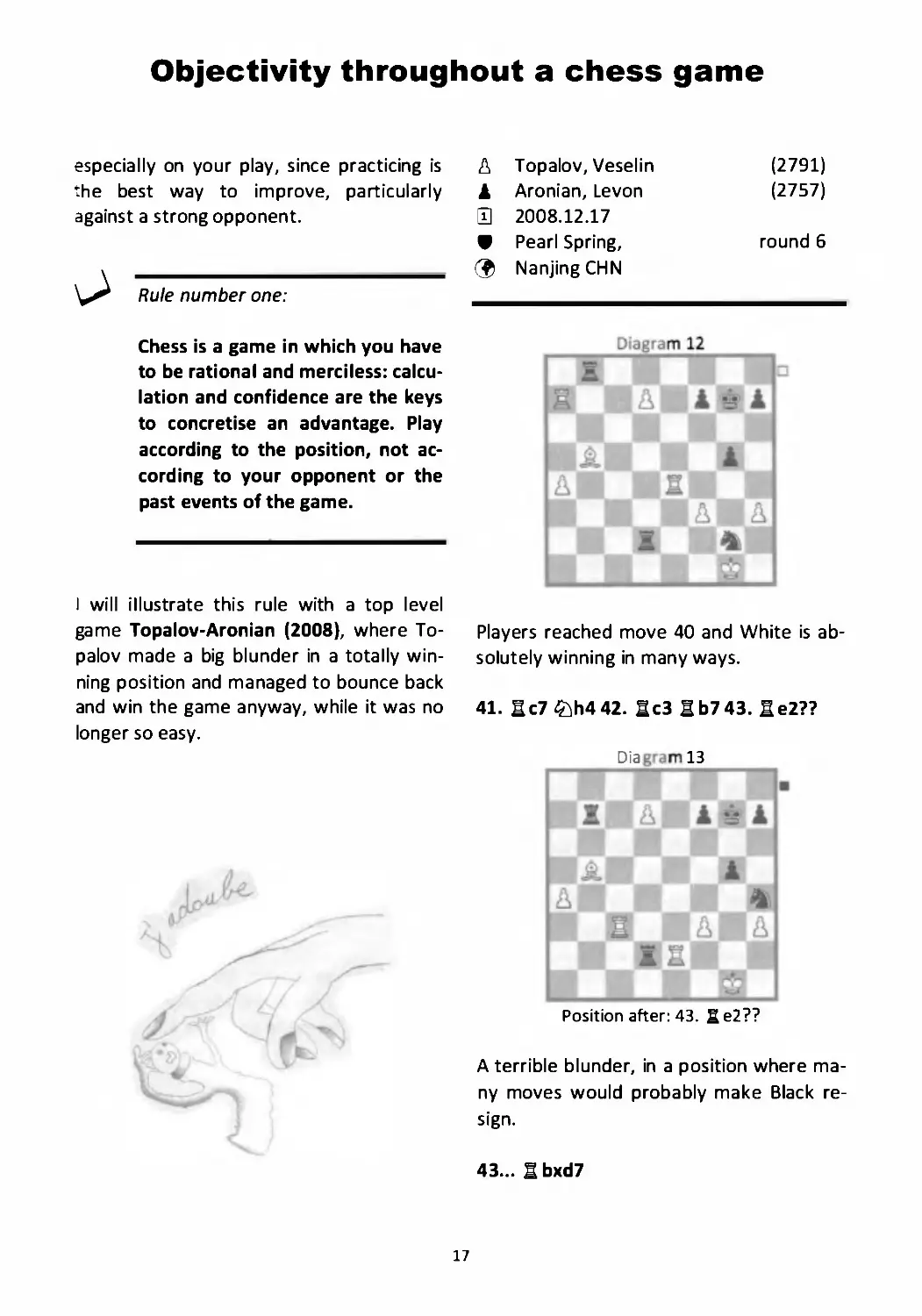
Players reached move 40 and White is ab-
palov made a big blunder in a tota lly win-
solutely winning in many ways.
ning position and managed to bounce back
and win the game anyway, while it was no 41. li c7 tLlh4 42. l1 c3 Itb7 43. li eZ??
longer so easy.
17
Dia
13
Position after: 43. 1:[ e2??
•
A terrible blunder, in a position where ma
ny moves would probably make Black re
sign.
43. .. l1 bxd7
The Chess Manual of Avoidable Mistakes
Now White is better but needs to be very
precise in order to keep winning chances.
44. �f2 !17d5 45. !I xd2 lixd2+ 46. �e3
l!a2 47. �d4!
Position after: 47. �d4!
47... ltjg2 48. �c4 ltjf4 49. �b3 lia1 50.
�b2 !!e1 51. lieS �f6 52. aS lieS?
Position after: 52... � eS?
52... lie7o 53. J¥.f1±
53. l!xeS! �xeS 54. a6 ltje6 55. a7 ltJc7
56. Ac6 fS 57. �b3 �d6 58. J¥.b7 �cS
18
Position after: 58.. . �cS
59. �c2! �d4 60. �d2 h6 61. �e2 �es
62. �e3 �f6 63. J¥.c6 �e7 64. aS=�
ltjxaS 65. J¥.xa8 �f6 66. J¥.c6 �es 67.
J¥.b5 �dS 68. J¥.a6 �es 69. h4! �ds 70.
hxgS hxgS 71. J¥.c8 �es 72. J¥.d7
1-0
Position after: 72. �d7
A brilliant endgame by To pa lov, who
ma naged to play at his top even after the
big blunder he made on move 43 .
Objectivity throughout a chess game
§ 1.3 Simple defences while being under
pressure
There are different kinds of situations whe
re chess players are under high pressure
during a game. In many cases, problems
can be solved by staying stoic and playing
simple defensive moves. But, while it is
easy for a machine, it is not for humans.
Sometimes, you need to fi nd a few precise
moves in order to survive a game in which
you suffe red. But, after having been under
a long and possi bly high pressure, chess
players very often collapse and miss very
simple things. This will be the purpose of
exam ple number 1.
Sometimes, being under an attack - but
that is not necessa rily winning! - players
often get tota lly frighte ned, and start to
make tremendous mistakes mostly due to
halluci nations. This will be the purpose of
ex ample number 2.
Finally, while having a choice between a
worse and a frightening position - but not
necessa rily bad! - players often choose the
first (and simplest) option without objec
tive reasons. This will be the purpose of
exa mple number 3.
19
!':, Timman, Jan H
(2555)
..
.
Edouard, Re main
(2608)
[] 2011.09.07
• lnventiChess GM,
round 5
� Antwerpen BEL
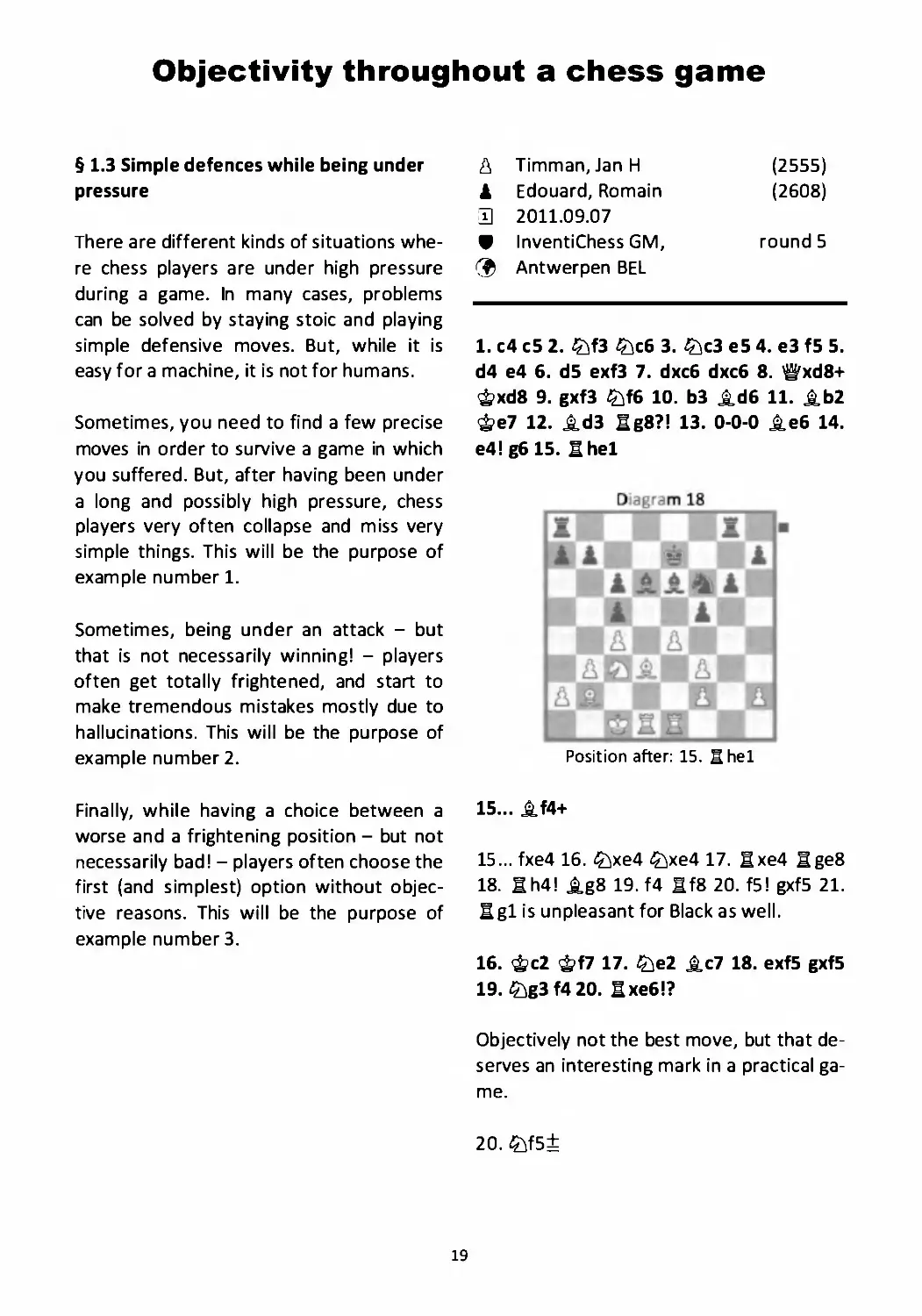
1.c4c52.l'Llf3l'Llc63.l'Llc3e54.e3f55.
d4 e4 6. d5 exf3 7. dxc6 dxc6 8. �xd8+
�xd8 9. gxf3 l'Llf6 10. b3 �d6 11. �b2
�e7 12. �d3 �g8?! 13. 0 -0 -0 �e6 14.
e4! g6 15. �he1
Position after: 15. ll hel
15... �f4+
15 ... fxe4 16. ltJxe4 ltJxe4 17. �xe4 �ge8
18. �h4! �g8 19. f4 l!f8 20. f5 ! gxf5 21.
�g1 is unpleasant for Black as well.
16. �c2 �f7 17. l'Lle2 �c7 18. exf5 gxf5
19. ltJg3 f4 20. �xe6!?
Objectively not the best move, but that de
serves an interesting mark in a practical ga
me.
20. ltJf5;t;
The Chess Manual of Avoidable Mistakes
20... �xe6 21. .1f5+ �f7 22. tt:Je4 tt:Jxe4
23. l:ld7+
Position after: 23. 1:1. d7+
Our key position! Until now, I've been suf
fering a bit but my position has never re al
ly been bad. Now is the crucial moment
and I had a fe eling that the choice of my
next move would decide the result of the
game: draw or loss. This was right. After
thinking (but not deeply enough!), I con
cluded that my initial idea 23...�f8 was
bad, and that 23...�e8 should be OK for
me. These two conclusions were wrong be
cause I missed very simple moves in both
of my calculations.
23... �e8?
23 . .. �f8! 24. fxe4 �aS (with the idea of
playing . . . l:l d8 with an equal position) 25.
.,ieS (25. .1f6 }itg2 26. Ae7+ �e8 27.
j_xcS .,ib6=) 25... lld8 26. .id6+ �e8
27.l1e7+�f828.eS
(see analysis diagram)
20
Position after: 28. eS
made me very afraid, but after the extre
mely simple 28.. .
llg7 which I missed,
Black is more than fi ne!
24. 11xc7 tt:Jxf2
Position after: 24... lt:Jxf2
25. .ig7!
Another very simple move which I have
missed. All of a sudden all my pieces are
st uck and my position is lost.
25. .. ltd8 26. Axh7 llxg7 27. l:lxg7 l1d6
27 ... tl:Jdl 28. l:[g8+ �e7 29. l:[xd8 tl:Je3+
30. �d3 �xd8 31. �e4+-
Objectivity throughout a chess game
28. 11xb7 �h629. Itxa7 11xh230. wcl
:,g2 31. i,.fS ltJhl 32. Ae4 ltJg3 33.
l.xc6+ �f8 34. i,.dS ltje2+ 35. �d2 �e8
36. �d3 lt:Jcl+ 37. �e4 !lxa2 38. �xa2
�xa2 39. �xf4 �e7 40. �eS ltjcl 41.
l.e4 ltjxb3 42. �dS �f6 43. �d6 �f7
44. f4 �f6 45. Ad3 ltJcl 46. _ibl ltjb3
47. _ic2 ltJd4 48. Ad3 ltjb3 49. fS!
•
Position after: 49. fS!
Zugzwa ng!
49... �f7 SO. Ac2 ltjd4 51. Ae4 ltjb3 52.
�dS+ �f8
52... �f6 53. Ae6+-
53. f6 �e8 54. .ig8 �f8 55. Ae6 �e8
56. AdS �f8 57. f70
1-0
21
['!; Bacrot, Etienne
(2710)
' Edouard, Remain
(2587)
[] 2011.08.23
• FRAeh m,
round 9
� Caen FRA
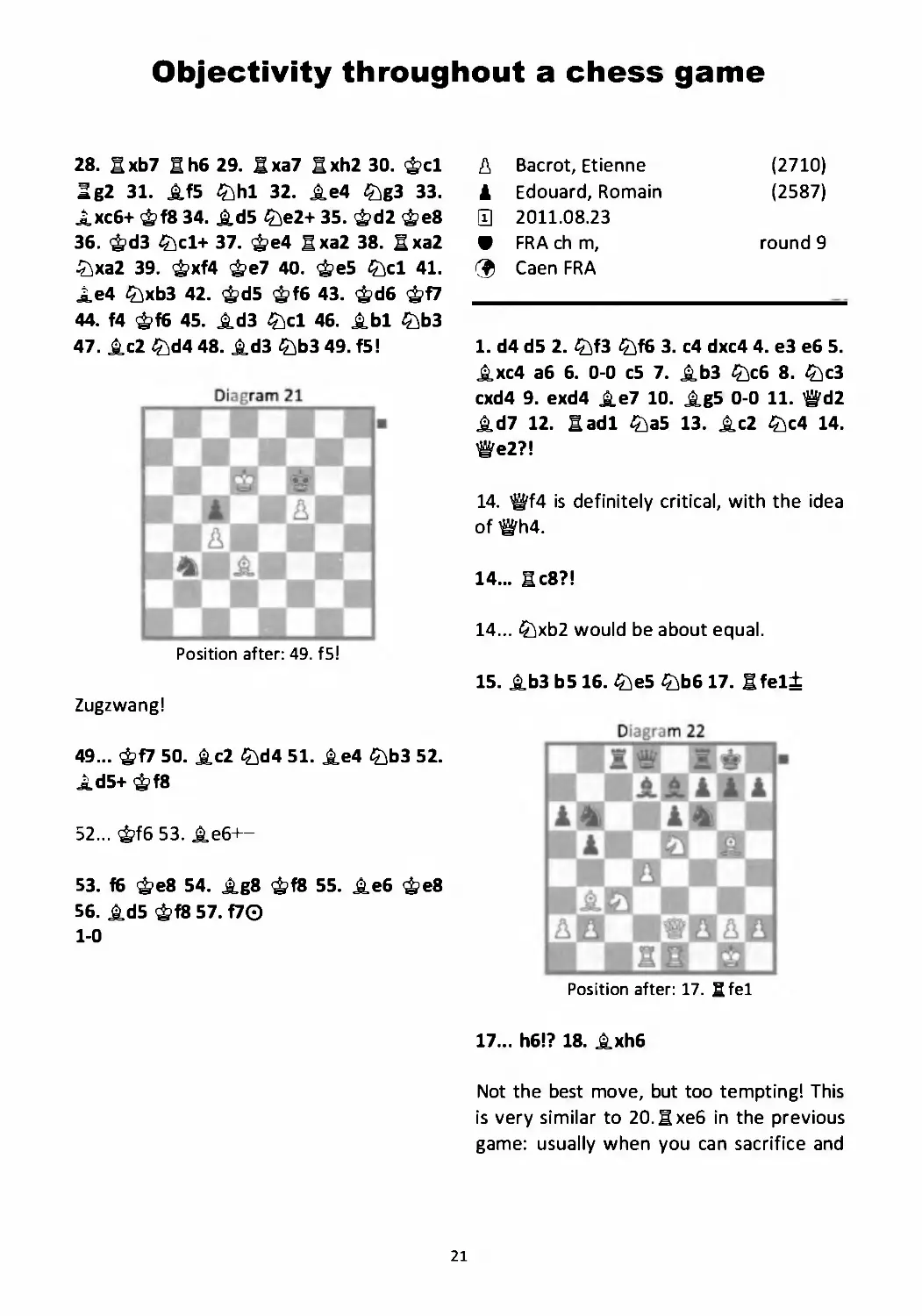
1.d4dS2.ltjf3ltjf63.c4dxc44.e3e65.
_ixc4a66.0-0cS7._ib3ltjc68.lt:Jc3
cxd4 9. exd4 j;_e7 10. AgS 0-0 11 . �d2
Ad7 12. 11 adl lt:JaS 13. Ac2 lt:Jc4 14.
�e2?!
14. �f4 is definitely critical, with the idea
of �h4.
14... jlc8?!
14... ltjxb2 would be about equal.
15. Ab3 bS 16. lt:JeS ltjb6 17. It fel;;t
Position after: 17. I! fel
17... h6!? 18. Axh6
Not the best move, but too tempting! This
is very similar to 20. � xe6 in the previous
game: usually when you ca n sacrifice and
The Chess Manual of Avoidable Mistakes
not be worse, it is quite a good deal in a
practical game.
18... gxh6 19. � d3!?
19. d5 exd5 20. ltjxd7 �xd7 21. �xe7
�xe7 22. �xe7 �fd8=
19... �hS!?
Position after: 19. .. 'it>h8!?
The most human move, intending to de
fe nd with .. .ltjg8.
19.. . ltjc4 !?
20. �d2
20. d5 exd5 2l. ltjxd7 (21. �d2!? ltjg8 22.
ltjxd5 ltjc4! - see 20.�d2 ltjg8 2l.d5
exd5) 21... ltjbxd7 22. �xe7 {22. ltjxd5
ltJc5 !�) 22... ltjc5�
20... ltjgS 21. dS ltjc4
Once again the most human move.
I hesitated entering the fo llowing ugly )ine
(that actually makes a draw) but could not·
make sure it was holding: 21... exd5!? 22.
22
ltJxd5 ltJc4 23. �c3 ltjxe5 24. �xe5+
Af6 25. ltjxf6 ltjxf6 26. 11edl �e8 27.
�xd7 �xd7 28. �xf6+ �h7=
22. Axc4 bxc4 23. �d4
Position after: 23 . .I:! d4
Now is our key moment. lt was time to
stay calm and have an objective look at the
position. Instead I got ti red to defend and
decided to "force my fate ". I entered a line
in which I got immediately lost due to a big
hole in my too light calculation. Instead, a
ve ry simple defensive move would have
led to an unclear ga me.
23... AcS??
23...
'@e8o would be ok for Black, for
example: 24. ltjxd7 �xd7 25. dxe6 �c6
26. ltjd5 c3 ! (avoiding �c3) 27. bxc3 jLg5
28. f4 Af6oo
24. dxe6 Axd4 25. �xd4 �f6
After 25.�xd4 I suddenly realized that
25 . .. Axe6 was losing to 26. ltJxf7+ which
actually is ... a double check!
(see analysis diagram)
Objectivity throughout a chess game
Position after: 26. lt:lxf7+
26. exd7 �cd8 27. 1:!e3 (j
j
e7 28. 1:!f3
�c6 29. ti:Jxf7+
1-0
.:<, Tkachiev, Vladislav
(2637)
' Edouard, Remain
(2662)
Il 2013.08.22
• FRA eh,
round 11
� Nancy FRA
1.d4d52.c4e63.(j
j
c3c54.e3lL\f65.
This is the position we are interested in. I
have a choice between going ...h6 and get
a very unclear but frightening position, or
going ...AxgS while my position would de
fi nitely be worse. I calculated a few lines,
could not fi nd a precise win for White but
got too afraid and went for ... AxgS wit
hout any objective reason. A deep analysis
shows that after .. . h6 the position would
have been OK for Black, without even a ne
cessity to find 'o nly moves'. The conclusion
is that not only I would have increased
considerably the quality of my position go
ing ...h6, but I would also have given my
opponent a few tough practical decisions
to take, si nce it is not so easy to know how
to keep the attack (there are several
possibilities).
15... _txg5?
t[jf3 (j
j
c6 6. a3 cxd4 7. exd4 _te7 8. cS Or 15 ... h6 (see analysis diagram)
!Lle4 9. _tbs tt:Jxc3 10. bxc3 _td7 11. 0-0
b6 12. cxb6 �xb6
12 ... axb6 !?
13. _td3 �c7 14. �e1 0-0 15. lL\g5
Position after: 15. ltJg5
23
Position after: 15... h6
And now:
A)16.(j
j
h7
B) 16. Ah7+
C) 16. �hS
A)16.(j
j
h7 11 fc8 17. _txh6 gxh6 18.
�hS is not particularly dangerous, for ex-
The Chess Manual of Avoidable Mistakes
ample: 18... �f4!? 19. g3 �d2 (using any
possible path to fi nally come into defense)
20. lled 1 �xc3 21. �xh6 �xd4 22.ltJf6+
�xf6 23. �h7+ <;t>h8 24. �g6+ �g8=
B) 16. �h7+ �h8 17. �c2 ltJd8 ! attack
ing c3, allowing my f-pawn to move: simple
and strong. 18. �d2Ll Ad6!?oo followed
by ...fS or ...f6.
C) 16. �hS In that critical position, actu
ally, many moves are playable! (see analy
sis diagram)
Position after: 16. �hS
Cl) 16... �aS!?
C2) 16... ltJeS!?
C3) 16.. . eS
C4) 16. . . ltJdS!?
Position after: 16 ... �aS!?
24
Cl) 16. .. �aS!? The sharpest, trying to
create co unter play on the queenside wit
hout ca ring much about the White attack.
Here would have been some possibilities
for the ga me to continue: 17. �d2
(see analysis diagram, previous column)
Cl.a) 17. Ae3 fS !? 18. ltJxe6 Axe6 19.
�xh6 Itf6 20. AgS �f7 21. �d1 Ite6
22. Itxe6 �xe6 23. �xe7ltJxe7 24. �e2
�f7 25. It e1 �b6 26. �hS+=
Cl.b) 17. Ah7+ �h8 18.ltJxf7+ �xh7!?
19. ltJxh6 Af6 20. ltJg4+ �g8 21. lle3
�e8 22. ltJh6+ gxh6 23. �g3+ Ag7 24.
�g4�c725. �xh6 iifG!+
Cl.c) 17. Ad2 ttJxd4 18.ltJh3 (18. Ah7+
�h8 19. Ad3 �g8=) 18... Ae8!
Now the variations are:
a) 19. .:, abl �xa3 20. Itb7 ltJc6 21.
�xh6 fS 22. �e2 es+
b) 19. Itadl �xa3 !? 20. �g4ltJfS!:+
c) 19. �g4ltJb3 !? 20. Axh6 �xc3 +
d) 19. �dl ltJc6 20. Axh6 gxh6 21.
�g4+ �h8 22. �hS �g7 23. �g4+ (23.
!le3? fS-+) 23 .. . �h8=
C2) 16... ltJeS!? The most equalizing mo
ve, but also the most beautiful! 17. dxeS
�xc3 18. Ah7+ �h8 is also playa ble: 19.
Ae3 (19.ltJxf7+ !? �xh7 20. Axh6 �g8!
21.ltJh8 ! gxh6 22. �g6+ �xh8 23. �xh6+
�g8=) 19 .. .
�xgS 20. AxgS �xh7 21.
Ae7 lifb822.�xf7 lib7=
C3) Even 16... eS is not that bad: 17.
dxeS AxgS 18. AxgS ltJxeS ! 19. Af4 (19.
Axh6 ltJxd3 20. Axg7 �xg7 21. �gS+
�h7=) 19... �xc3 20. Af1 (20. �xeS
Objectivity throughout a chess game
�xd3 21. �xh6 �g6=) 20... f6 21. �xeS
fxeS 22. �xeS �cS 23. �b2-+ (White is
only a very little bit better)
C4) 16. • . ltJdS!? The simplest: once again
to be able to play ...fS, but also winning
some time attacking the c3-paw. 17. �d2
(17. lt:Jh7? �xc3-+) 17.. .
fS (Even 17.. .
gxgS!? is not bad: 18. AxgS �xc3 19.
!i ad1 �a4 20. �f6 �xd1 21. I[ xd1 gxf6
22. '@xh6 fS 23. Af1!? but White is not
better, e.g . 23.. . !i c8 24. !!d3 �xd3 25.
�xd3 11 c3=) 18. lt:Jf3 �e8 19. it'h3
g b8oo I am getting a similar position as in
the game: but I kept my good dark-squa
red bishop and White has more problems
to organize an attack (e.g. misplaced
Queen on h3)
16.�xgS11ae817. 11e3fS18.�hS 11f7
Position after: 18 ... l:I f7
19. llh3?
19. �h4! would have given White a quite
big advantage: it was important to keep as
many pieces as possible in the centre, sin
ce my only counter play is to go ...eS.
25
19.•. g6 20. �d1?!
20. '¥r'h6 eS!:+
20... f4
All of a sudden it looks like all White pieces
are badly placed. 20 ... eS!? 21. dxeS f4 is
also quite good for Black.
21• .i!h6
Position after: 21. 11 h6
21... eS??
Not caring about the �xg6 obvious
threath that wins at once.
My other idea 21... lt:Je7 would have given
me a nice advantage: 22. �d2 eS 23. dxeS
�xeS 24. h4 lt:Jc8! (24... !lc8 25. I:le1
�xc3 26. �xf4 is drawish, although the
h6-rook is still misplaced.) 25. !!d1 lLlb6!
followed by ...�a4, ... lt:Jc4 (or ... �b3-
.. . _ic4) while the white pieces are being
dominated.
22. �xg6 hxg6 23. 11 xg6+ 11 g7 24. 'ifhS
lle6
The Chess Manual of Avoidable Mistakes
I had co mpletely overlooked that any time
I play a move like 24... Af5? my e8-rook is
hanging.
25. llh6
25. Af6 ! �xf6 (25... Ae8 26. Axg7+-)
26. 11 xf6+- was even stronger.
25... I:txh6 26. �xh6 exd4 27. �xg7
�xg7 28. �gS+
Position after: 28. �gS+
My position is now much worse, and my
opponent dominated me tech nica lly until
the end.
28... �f7 29. �xdS+ �e6 30. �hS+ �g7
31. l!el �d6 32. cxd4 ltJxd4 33. �gS+?!
33. ,ite4!+-
33... �f7 34. �hS+ �g7 35. �gS+ �f7
36. f3 ltJfS 37. h4 �d4+ 38. �h2 ttJe3 39.
�bl AdS 40. hS �fGo 41. �xf6+ �xf6
42.litb4�gS43.h6!?
43. lla4 !? �xh5 44. �xa7 is also winning.
26
43... �xh644. �xf4 aS45. 11d4�f746.
g4 �g7 47. �g3 ltJc4 48. a4 ltJbG 49.
11d6ttJxa4SO. 11a6ttJc351. 11xaSltJe2+
52. �f2!+-
Position after: 52. �f2!
I am not on time to reach a fortress (e. g.
�f6+Ae6+ltJe7, stopping f5 forever). The
position is lost.
52... ltJf4 53. �e3 ltjdS+ 54. �e4 ltjf6+
SS. �fS �g6+ 56. �gS �f7 57. 11a7
ltJh7+ 58. �fS ltJfS 59. f4 lt:JeG 60. �es
ltjcS 61. gS �f8 62. fS Ae8 63. g6 ltjd7+
64. �e6 ttJcS+ 65. �ds
1-0
Objectivity throughout a chess game
IN THE LIMELIGHT
Rule number two
. n a pra ctical chess game, there are not so
"Tlany stronger things than a good defen
sive move.
Good' does not necessarily mean aweso
"Tle or complicated. lt can be a very calm
but precise move in a very tense situation.
Why am I saying there is almost nothing
stronger than it? Because by attacking you,
your opponent puts you under pressure
and takes the psychological edge. But,
when you are able to face it correctly, it of
ten reverses the situation totally, including
psychologically. A bit like if you manage to
survive a big series of smashes in tennis.
When you are under the pressure
of an attack, you should have in
mind that it may be a chance: if
you pass the test, your potential
result in the game is increasing
compared to before!
The principle remains the same in an
unclear situation. Refusing any kind of
complications is often like surrendering, or
admitting your opponent dominates you
both chess wise and mentally.
27
Rule number two
Do not choose a worse position
compared to a frightening I surpi
cious one if you can't see why the
second option is wrong!
Otherwise it is, once again, like surrende
ring, or like admitting your opponent do
minates you both chess wise and mentally.
Usually, that kind of bad decisions is even
conscious: when it happens to you, fight
against your emotions.
An option, if you have enough time, is even
to try to get some fresh air outside, and
then, to think of the tips just above, also
having in mind the advice of the
subchapter number one: play strictly ac
cording to the position. If you respect this
principle, sometimes, you may miss a
direct win for your opponent. But most of
the time, not only you will succeed be
cause your opponent will not see more
than you, but your general quality of play
will also be better.
Energy, calculation, and confiden
ce are the keys to avoid being af
raid of fake threats
The Chess Manual of Avoidable Mistakes
Just to have a super-we ll- known example,
it is good to recheck game number 9 of the
match Carlsen-Anand, Chennai 2013: Mag
nus Ca rlsen won beca use he we nt deeper
than other players would in the line that
actually happened in the game, and chose
a frightening position rather than a worse
one.
From a purely optical point of view it
looked very bad for Black but.. .
strictly
speaking it was quite unclear and it even
tually quickly decided the game in his fa
vo ur.
Let's start with the diagra m in the next co
lumn.
28
£!, Anand, Viswa nathan
.l Carlsen, Magnus
:Il 2013.11 .01
W FWCM 2013,
� Chennai
22... b3!
Keeping cool.
23. �f4 ltjc7!? 24. f6 g6
(2775)
(2870)
round 9
24. .. gxf6 !? was a good defensive move as
well: but Carlsen decided to trust his
calculation and went for a forcing line.6
25. ltjh5?! fxg5 26. ltjf6+ <;i(h8 27. '@'xg5?!
.litgB !=t
25. '@h4 ltje8o
Difficult to imagine a calmer defence.
26.'@'h6
Threatening 11 f4.
26... b2!
Objectivity throughout a chess game
. .Jst in time.
Position after: 26. . . b2!
27. i!f4
Anyway! Otherwise Black has not much to
wo rry about.
27... b1=�+ 28.llJf1??
After such a good defence by Black, White
blundered.
28. Aflo �dl 29. 11 h4 �hS 30. llJxhS
gxhS 31. llxhS (31. �h3? �xh3 32. llxh3
' "'b6 33. �xhS �bl+-+) 31... j_fS!:+
28... �e1!
Position after: 28 ... �ell
29
A slightly lucky end for Magnus Carlsen,
but I 'm pretty sure even most of the elite
players would have panicked and wo uld
not have entered these concrete defensive
lines.
28... �dl?? 29. 11h4 �hS 30. .lixhS gxhS
31. llJe3 Ae6 32. J,.xdS!+- was what
Anand had seen.
0-1
§1.4 Feel the opportunities, importance of
the calculation depth
Chess players ca nnot always feel tactical
opport unities, because some of them are
so hidden that - almost - only computers
can fi nd them. But in general, opportu ni
ties are accessible to humans.
Some opportunities are very obvious and
only require a clean calculation - a bit like
when you open a tactics book and know
that you should fi nd a win in this or that
precise position. This will be the purpose
of exa mples numbers 1 and 2.
Some opportunities are 'in between':
they're not obvious but the position looks
suspicious. In general, it is indicated by a
misplacement of your opponent's pieces,
or/and a temporary vulnerability of his
king. This will be the purpose of exa mples
numbers 3 and 4.
Some opportunities are only a matter of
very deep calculation. When you know
that yo ur move ca n be decisive (for exam-
The Chess Manual of Avoidable Mistakes
pie: yo u have the opportunity to secure a
draw or to enter a very concrete and
complicated line) you know that yo u need
to calculate. But, even with a lot of time on
the clock, players often get afraid (or lazy)
and do not calculate at their best. This will
be the purpose of example number 5.
Finally, sometimes, it seems like all the
moves lead to the same. Example number
6 will be a game where 'draw was in the
pocket' (as chess players like to say) and I
cou ldn't figure out a way to create pro
blems.
� Edouard, Romain
(2483)
..
.
Libiszewski, Fabien
(2469)
[] 2007.08.16
• FRA-Ch Nat. B,
round4
� Aix-les- Bains
Position after: 22. . . �e8
Now comes the moment we are interested
in. Black is close to taking my super knight
on d5, and the very well- known pattern
lL\f6+ is obvious. it's only a matte r of
ca lculation .
23. lL\f6+! gxf6 24. gxf6 �ha 25. �h3!
Threatening to take on h7.
1.e4c52.lL\f3lL\c63.d4cxd44.lL\xd4 25...�fa
e55.lL\b5d66.lL\1c3a67.lL\a3il_e7a.
lL\c4 b5 9. lL\e3 lL\f6 10. g3 0-0 11. il_g2 25 ... �g8 26. �g3+-
b4 12. lL\cd5 lL\xd5 13. lL\xd5 il_g5 14.
il_xg5 �xg5 15. 0 -0 �da
26. �h5 �ga
15... �b8! is now known as a better move 26... h6 27. c3 lL\c6 28. 11ff3+-
(according to Cornette and ... Libiszewski's
book on this ope ning!), and I eve n played it 27. �g3+- d5
myself in 2013.
16. a3 bxa3 17. ,l
l
xa3 �ba 1a. f4 �h6 19.
�c3! lL\d4 20. g4! il_b7 21. g5
21. llh3!? �e6 22. c3 lL\b5 23. fS �d7
24. g5+-
21... �e6 22. f5 �ea
30
27...�f8 28. ,l
l
g7+-
2a. c3 dxe4 29. cxd4 e3 30. il_xb7 �xb7
31. �xga+ ,lixga+ 32. �h1 llxb2 33.
dxe5 11 bg2 34. �f3 e2 35. �xg2 �xg2
36. �xg2
1-0
Objectivity throughout a chess game
-
Edouard, Romain
' Jansa, Vlastimil
:-
2009.07.12
�
• Benasque-XXIX Open,
··� ESP
(2597)
(2470)
ro und 11
der to take on e6. Once again, it is only a
matter of calculation.
18... cS 19. hS;!;
19. �xe61
1. e4 cS 2. lL!f3 e6 3. d4 cxd4 4. tt:Jxd4 (see Diagram, previous column)
�c6S.lL!c3a66.ttJxc6bxc67.Ad3dSS.
3-0l2Jf69. 11e11;.
.
e7 10. eS lt:Jd7 11. �g4 Below few of the (not so difficult) lines that
cE;12. lL!a4 0-0 13. �h6 l:,eS 14. c4 ltJb6 were necessary to calculate.
15. tt:Jxb6 �xb6 16. b3 1;.
.
b7 17. h4 dxc4
18. _ixc4 11 adS?
19... �d4
a) 19... fxe6 20. �xe6+ 'it>h8 21. 'fVf7
i_f8 22. �gs Ag7 23. S;(.f6 llg8 24. e6+
b) 19... lld4 20. i_xf7+ 'it>xf7 21. e6+
'it>g8 22. �f3+-
c) 19... �b4 20. Axf7+! (20. �c4!?
Axe1 21. llxe1-t-) 20... 'it>xf7 21. e6+
'it>g8 22. e7 ! lld6o 23. 'fVf4 lld2 24.
Ite4+-
20. !! ad1 'fVxg4 21. i_xg4 Axh4 22. g3
Position after: 18 ... .: adS?
11 xd1 23. Itxd1 Jl_e7 24. lld7 Ac8
Jne very similar exam ple to the previo us 24 .. . Jl_a8 25. Ae2+-
Jne: for very obvious reasons I may consi-
Position after: 19. �xe6!
31
2S. llxe7 llxe7 26. AxeS aS 27. f4 a4 2S.
bxa4 I!c729. .tg4cS30.'it>f2c431. 'it>el
c3 32. �d1c2+33. 'it>c1 11c334. aS li.xg3
3S. a6 lla3 36. J.cB 1:.a4 37. a3 llxa3 38.
wxc2
1-0
The Chess Manual of Avoidable Mistakes
£:, Vajda, Levente
' Edouard, Romain
[] 2012.09 .07
• lstanbul-40th Olympiad
� TUR
(2612)
(2652)
round 10
24. �f3;l;
;
24... ..\ixeS 25. dxeS "f/lc7 26. ..\id4 �cS
27. �e3 �d3 28. !tf1 �xeS
(see Diagram, previous column)
1. e4 e6 2. d4 dS 3. �d2 ..\ie7 4. �gf3 28... �c6 would be excellent for Black.
�f65.eS�fd76...\ie2!?cS7.c3�c68.
0-0 0 -0 9. �e1 f6 10. exf6 ..\ixf6 11. �b3 29. �xdS!
c4 12. �bd2 Wh8 13. �f1 eS 14. ..\ie3 e4
15. �3d2 bS 16. a4 bxa4 17. "f/lxa4 �e7 The 'eq ualizing' trick I had missed.
18. f3 �b6 19. "f/ld1 exf3 20. �xf3 �g4
21. �eS �xe2 22. �xe2 �d7 23. ..\if2 aS 29... �xdS 30. "fi
i
e4 �xc3
Position after: 23... aS
24. �c2?!
Position after: 28... lt:\xeS
32
30... lt:Jc6 31. �xdS lt:Jxd4=
31. ..\ixc3 �d3 32. �xf8+ llxf8 33. �xaS
Position after: 33. 11 xaS
Now comes what I'm ca lling "the moment
to feel the tactical opportunity": the White
pieces seem little bit vulnerable, especia lly
the White king.
But, during the ga me, I could not fi nd any
tactics working at first sight and resigned
myself thinking that my move 30.. .�xc3
(instead of just making draw) had been
Objectivity throughout a chess game
:ompletely senseless. I did not have a
jeeper look and went for a worse position.
33...�f7?
� bad move even if there were no tactics
Narking. Even a simple move like 33...h6
Nould have been better.
--taving a deeper and more critical look, I
:ould probably notice that 33. .. �b6+ 34.
�d4 tt:
:l
f4! (taking advantage of the
.Vhite's pieces displacement) would create
:Jroblems. Suddenly I'm no longer the one
Nho should be precise! White would have
:o go 35. 11 e5 and after 35... '@f6!? {35...
t:·g6 36. g3 �bl+ 37. �el tt:
:l
d3 38. Ite7!
_:g8 39. �c3=) 36. h4 {36. h3!? tt:
:l
xh3+
37. �h2 tt:
:l
f4 38. �e4�) 36... �xh4 37.
�e8 tt:
:l
h3+ 38. �h2 tt:
:l
f4+ 39. �gl the
game would be a draw.
34. h3±
�ow White is being much better thanks to
the activity of his pieces, and especially to
:he strong bishop on c3. My opponent
:>layed well and I could not hold the posi
tion.
34... tt:
:l
f4 35. �h2�c7 36.�es
o 36. g3 ttJg6 37. �e3±
36...�b7 37.�gS �g8 38. 11 bS�d7 39.
:eS ltJg6 40. 1!dS�c6 41. 11d4�c7+
42. @g3 lieS 43. lid6�e7 44. �gl tt:
:l
fS
45. lldl �a7+ 46. �hl @f7 47. �g4
:aS 48. 11 d4�c7 49.�dl�f7 50. 11 d6
:a7 51.�g4 hS 52.�gS lld7?!
33
52... tt:
:l
e6;!;
53. l!c6 �h7 54. �h4 lidS 55. �e4+
ltJg6 56. �h2 lid1 57. lieS?!
57. lixc4+-
57...�f4+ 58.�xf4 tt:
:l
xf4 59. l!xc4 tt:
:l
dS
60. �d4 h4?
60... 11 d2 with the idea 61. �g3 11 d3+ 62.
�f2 g5 would be less clear.
61. �es gS 62. lld4! llxd4 63. �xd4+-
The endgame is totally lost for Black.
63... �g6 64. �cS �fS 65. b4 ltJc3 66.
�d4 tt:
:l
bS67.�f2�e468.�gltt:
:l
c3 69.
�el tt:
:l
e2+ 70. �fl tt:
:l
d471.Af2tt:
:l
bS
72. �e2 tt:
:l
d673.�e3�fS74.�f3tt:
:l
bS
75. Af2 tt:
:l
d676.�e3tt:
:l
e4 77. �el �es
78.�d3�dS79.bStt:
:l
f680.�c3tt:
:l
e4
81. �d4 tt:
:l
d682.b6�c683.�e3tt:
:l
f7
84. �e4 tt:
:l
d6+ 85. �f3 tt:
:l
c4 86. �gl
tt:
:l
b287.�g4tt:
:l
d3 88. �xgS tt:
:l
el 89.
�g4 ttJxg2 90. �f2
1-0
� Edouard, Remain
{2657)
' Hansen, Eric
{2567)
iil 2013.10.29
• Casino de Barcelona 2013, round 5
� ESP
1.d4tt:
:l
f62.c4e63.tt:
:l
c3dS4.tt:
:l
f3cS5.
e3tt:
:l
c66.a3tt:
:l
e47.�d3tt:
:l
xc3 8. bxc3
dxc4 9. Axc4 �e7 10.0-00-0 11. �b2 b6
12.�e2
The Chess Manual of Avoidable Mistakes
12. d5?! lt:
:\
a5 13. Aa2 c4!+
12... Ab7 13. e4 lt:
:\
aS 14. Ad3 !IcB 15.
l:!,ad1 cxd4?1
o 15...'ifc7
16. cxd4 Ad6?1
Position after: 16... Ad6?!
o 16... Af6
17. dS? I
The very natural reaction, but to my big
gest surprise it seems like it was better to
delay it. 17. 11 fel was probably a better
move, especially because 17 ... �e7 would
be met by 18. e5! while 18... Axa3? would
lose to 19. Axh7++-
17... exd5 18. eS AcS
18... !le8! 19. Af5 lt:
:\
c4 20. Axc8 �xc8�
19. h4?1
A very logical move, aiming to go lt:
:\
g5, but
the engine laughs at it!
34
19. e6! �e7 20. exf7+ l:!, xf7 21. lt:
:\
e5 l:!,f6
22. ii del;!;
Position after: 19. h4? !
19... �c6?
The most human move. But, 19 ...h6 was an
excellent "ca lm" defence, a bit reminding
of my game with Tkachiev (subchapte r
number 2). We will analyse here:
A) 19... h61 20. Abl lt:
:\
c4! 21. �d3 g6
22. Acl �d7 ! and Black is just bette r: 23.
h5 (23. Axh6 lt:
:\
b224.�e2lt:
:\
xdl 25.
li{xdl �g4+l 23... �g4! 24. hxg6 fxgG+
Objectivity throughout a chess game
B) 19... �e7 20. ltJgS (20. �xh7+? �xh7
21. ltJgS+ �h6 22. �cl g6-+) 20. .. g6 21.
·�g4i
20.ltJgS h6
Around now there is no option but to cal
culate very precisely in order to find the
right way to play. During the game, though
I had seen the winning idea, I simply beca
me superficial and didn't push my cal
culations until the end. 20... l!h6 21. e6±
Position after: 20... h6
21. �hS?!
We will also pay attention to following:
A) 21. �h7+! �h8 22. �bl! hxgS (22.. .
�g8 23. e6 hxgS 24. �hS fS 25. hxgS is
the same.) 23. e6 fSo and here I simply
missed 24. �hS+ �g8 25. hxgS! that takes
a huge advantage: 25... l!xe6 26. g6
ltxg6o 27. �xg6 �d7 28. �a2+-
B) 21. e61? with the same idea is also
possible, but it's even better with the
bishop on bl.
21... d4
35
Position after: 21... d4
Our critical position.
22. �c3??
Soon getting low on time I simply thought
this move can't be bad since Black has no
real way to defend himself. I somehow
wanted to get rid of the aS-knight in order
to simply go �h7-�e4. However, this was
definitely a too light and too superficial
thinking: it was time for concrete calcula
tions in order not to let the winning attack
fail. "Now, or never." Now we have follow
ing choices:
A) 22. �h7+1 �h8 23. �bl! was still the
right way: 23... �g8 24. e6!
(see analysis diagram)
Position after: 24. e6!
The Chess Manual of Avoidable Mistakes
Key alternatives are:
a) 24... llxe6
bad. o 23...
£xg5 24. �xf8 �xf8 25.
hxg5 fk'xg5 26. �xg5 hxg5 27. f4 ;;l;
;
b) 24... fS
c) 24... fxe6?
24. £xc5 bxcS 25. e6!
a) 24... .laxe625.lt:Jxe6fxe626.�g4±
b) 24. . . fS 25. £a2!+- This is why, in this
precise position, we need the bishop to be
on bl!
c) 24... fxe6? 25. �g6 hxg5 26. �h7+
�f7 and here, for some reason, I simply
stopped my calculation, missing that 27.
£g6+ was mating.
B) Once again 22. e6 is not as good as fi rst
going £h7- £bl: 22 ... f5 ! 23. 11 fel hxg5
Position after: 25. eG !
24. hxg5 llxe6 25. g6 11 xg6 26. �xg6 �f6
27. �xf6 11 xf6 28. £bl;;l;
;
25... £xg5
22... ii,e7?
25 ... f5? 26. lt:Jf7+-
Playing the move which I expected -fo rtu-
26. hxgS
nately for me - ! 22... llg6! would be a
terrible news for me. I had missed that all 26. exf7+ llxf7 27. hxg5+-
of a sudden the ty pical 23. e6? would fa il
to (23. ii,xa5 hxg5+) 23... �d5! since 24. 26. .. @dS
f3 is met by 24. .. dxc3+-+ (with check !).
26... fxe6 27. gxh6 �f6 28. hxg7 @xg7 29.
23. £ b4?!
f3+-
o 23. £xa5 bxa5 (23... ii,xg5 24. hxg5
bxa5 25. ii,e4±) 24. �h7+ �h8 25.
ii,e4±
23... lieS?
Trying to get me confused due to my time
trouble. However the move is just
36
Position after: 30.. . c4
Objectivity throughout a chess game
27. exf1+ .li.xf1 28. f3 �xgS 29. �xgS
hxgS 30. lt fell c4
see Diagram, previous page)
31. j,g6
�ot the most precise, but winning anyway.
\1y opponent just resigned. Some other
-naves deserve coverage too:
a) o31.l1e8+11f832. lie5+-
b) 31. _tg6 ltjb3o 32. 11e8+! 11f8 33.
:del _tc6o 34. £h7+! wxh7 35. !lxf8
:3 36. ll c8 Ab5 (36... d3? 37. lilxc6 c2 38.
�f2+-) 37. !if.bl+-
1-0
::, Cornette, Matthieu
i Edouard, Romain
I! 2009.03.27
(2564)
(2562)
• Match Edouard I Cornette, round 4
l Chalons en Champagne FRA
1.e4cS2.lt:)f3lt:)c63.lt:)c3g64._tbs
�g7 5. 0 -0 d6 6. eS!? dxeS 7. Axc6+ bxc6
8. It el ft'c7?!
8 ... f6!?
9. d3 ltjf6 10. lt:)xeS lt:)dS?I 11. 'f!fe2 0-0
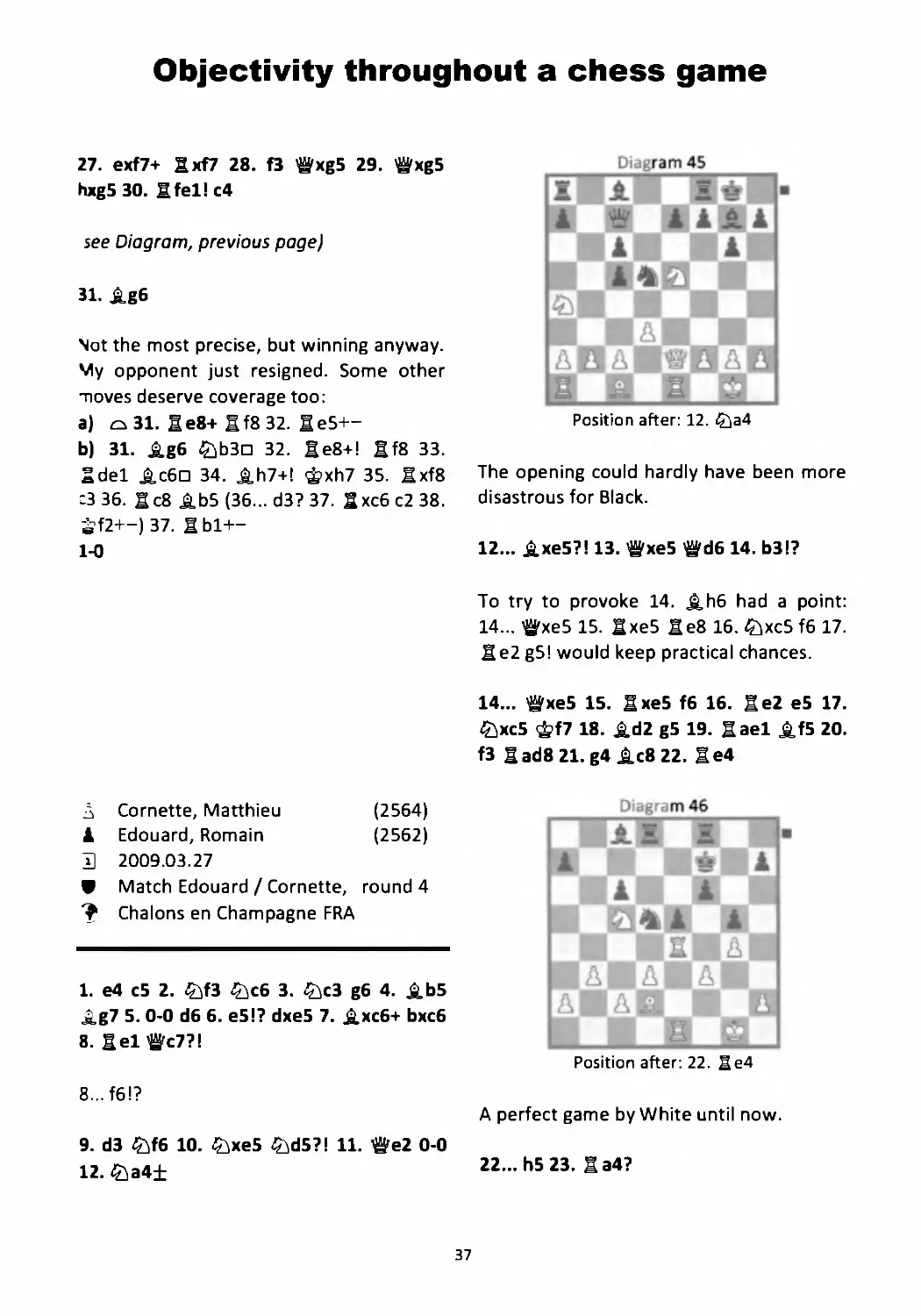
Position after: 12. ttJa4
The opening could hardly have been more
disastrous for Black.
12... Axe5?113. �xeS �d6 14. b3!?
To try to provoke 14. jt_h6 had a point:
14... �xe5 15. llxe5 !if.e8 16. lt:)xc5 f6 17.
!if.e2 g5! would keep practical chances.
14... �xeS 15. !lxeS f6 16. lle2 eS 17.
ltjxcS r:};
;
f7 18. _td2 gS 19. llael J_fS 20.
f3 ItadS21.g4J.cS22. lle4
Position after: 22. li e4
A perfect game by White until now.
12.ltja4±
22... hS 23. lla4?
37
The Chess Manual of Avoidable Mistakes
23. gxhS �h8 24. �a4+-
42. �fl �f3 43. �b8 �gS 44. d4
23... hxg4 24. fxg4 �g6
44. �g8+ �h4�
Suddenly I am getting some decent coun-
44... �h4 4S. dxeS?
ter play.
2S. h3
25. �xa7 �h8�
2S... �h8 26. �g2 �h7 27. ltJe4 �dh8
28. ltJf2 cS 29. �aS �c7 30. ltJe4 �ch7
31. ltJf2 I:Ic7 32. �gl a6 33. �e3 ltJf4
34. �xf4 gxf4 3S. �e4 �b7 36. �c4
�ch7 !
Position after: 36 ... li eh7!
37. !!axeS
37. �h2 �f3=
37... �xh3 38. lt:)xh3 �xh3 39. �b4
�hl+ 40. �f2 �h2+ 41. �gl �g2+ !?
All of a sudden the position is a bit un
pleasant for White.
41... llhl+=
38
45. gS! fxgS 46. �xeS would still be a
complete draw objectively.
4S... �g3 46. exf6
Position after: 46. exf6
The position we are interested in. In that
decisive game for the match, while I can
just take a draw going 46 ... �d2, I did reali
ze that the move 46 ... 1:! f2+ should be win
ning but could not calculate it until the end
and got afraid. If yo u did not look at the li
nes just below, yo u may take a chess board
and try to figure out you rself why the mo
ve 46... l:l f2+ wins, taking it as an exercice.
46 ... l!d2??
46. ..
�f2+! 47. �el �e2+ 48. �dl (48.
�fl l:le3-+) 48.. .
�e8+ 49. �d2 �xb8
50. gS �g4! the very simple idea which I
have missed. 51. g6 f3 52. f7 f2 53. g7
fl=� 54. g8=� (not queening with
check !) 54... �dl+ 55. �c3 (SS. �e3
Objectivity throughout a chess game
�d8-+) 55... �al+o 56. �c4 'tlffl+D 57.
.r;c3 'tlff6+ 58. �c4 (58. �d2 l!d8+-+)
58... �e6+-+
47. l!e8 lld1+ 48. l!e1 �g2+ 49. c;te2
.i. f3+ 50. �fl
��
-
Terrieux, Kevin
(2434)
' Edouard, Romain
(2602)
l
2011.05.28
• FRA Top 12,
round 3
1' Mulhouse FRA
1. d4lt:Jf62. c4g63.lt:Jc3dS4. cxdS
�xdS 5. �d2 �g7 6. e4lt:Jxc3 7. �xc3 cS
8. dS �xc3+ 9. bxc3 0-0 10. �d2 �d6 11.
�f3 �g4 12. lt:JgS h6 13. h3 hxgS 14.
hxg4 'tlfeS 15. �d3 'tlff6 16. !Ib1 b6 17.
l.bS a6 18. �e2 lt:Jd7 19. 'tlfe3 �g7 20.
g3 11h8 21. 0-0 1:th622. �g2 1:tah8 23.
�h1 11xh124. 11xh1 11xh125. �xh1bS
26. �g2 c4 27. f4 gxf4 28. gxf4 gS!
Position after: 28 . .. gS!
In this difficult position my opponent took
the wise decision to play dynamically,
which was probably his best chance.
39
29. �a7!?lt:JfS
29... �xc3 30. �xd7 �d2 31. "YWxe7o
looked to me like a draw, for example:
31. . . 'ifxe2+ 32. �g3 �e3+ 33. �g2 �xf4
34. d6 'tlfxg4+ 35. �f2 c3 36. d7 'iff4+ 37.
�g2 �d2+ 38. �h3 c2 39. �eS+ �h7
40. �fS+ �g8 41. �dS! �xdS 42. exdS
cl=� 43. d8=�+ �g7 44. d6 but actually
after 44.. . �fl+ 45. �h2 �f6! 46. �c7
�eS+ 47. �g2 b4 White might be lost
since it takes time to manage to push the
d-pawn.
30. fS 'tlfxc3?
A very bad decision, actually overlooking
for some reason that a future ...�f6 would
be met by d6. After playing that move I re
alized after 31.�xe7 the position is a dead
draw.
30... �d6 would give me a good and stable
positional advantage.
31. �xe7 'tlfd2 32. �f2 'ifd4+ 33. �g3?
All other moves would force an immediate
draw.
Position after: 34. Af3
The Chess Manual of Avoidable Mistakes
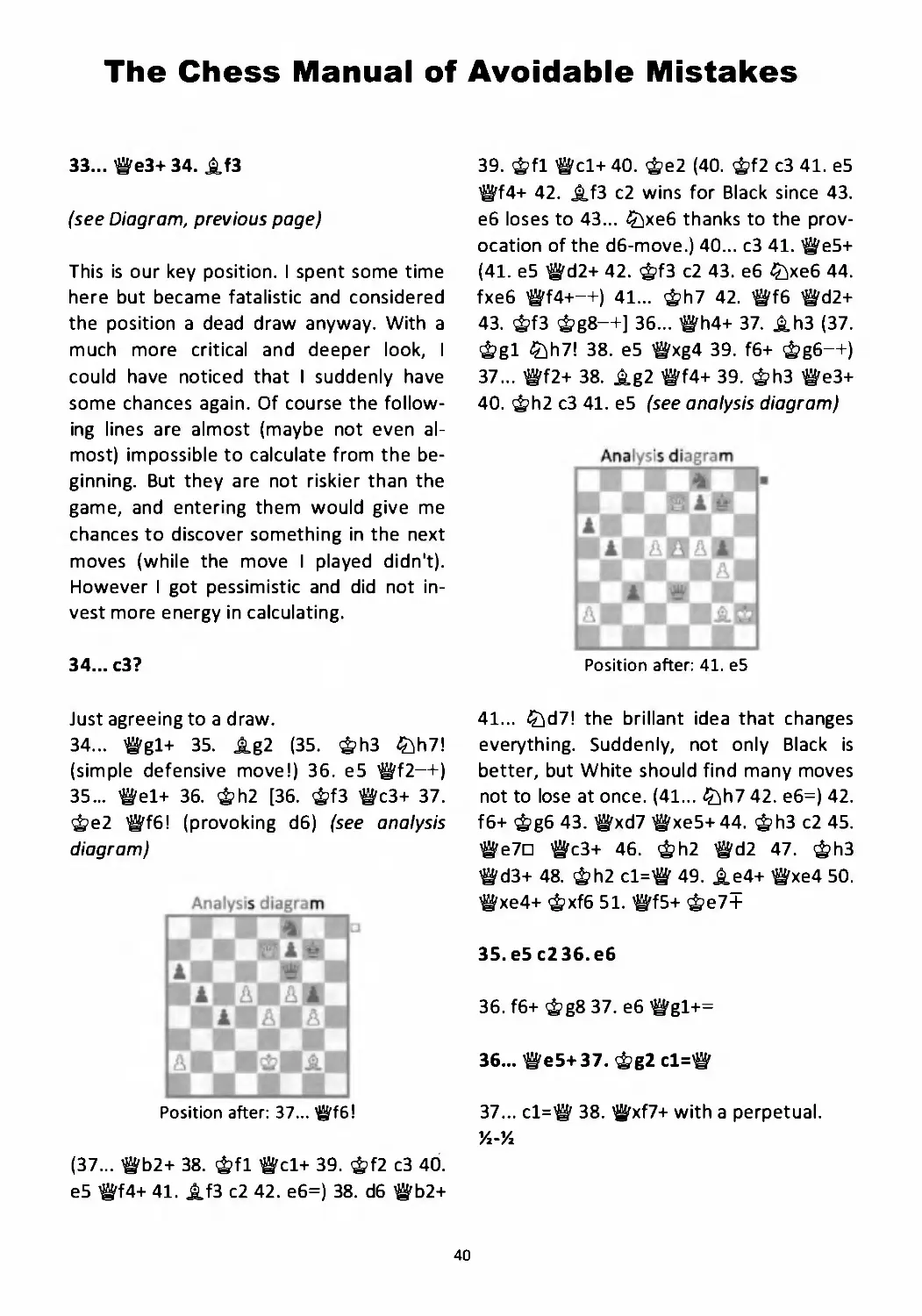
33... �e3+ 34. �f3
(see Diagram, previous page)
This is our key position. I spent some time
here but became fatalistic and considered
the position a dead draw anyway. With a
much more critical and deeper look, I
could have noticed that I suddenly have
some chances again. Of course the fo llow
ing lines are almost (maybe not even al
most) impossible to calculate from the be
ginning. But they are not riskier than the
game, and enteri ng them would give me
chances to discover something in the next
moves (while the move I played didn't).
However I got pessimistic and did not in
vest more energy in calculating.
34... c3?
Just agreeing to a draw.
34. .. �gl+ 35. .,tg2 (35. �h3 lt:Jh7!
(simple defensive move!) 36. e5 �f2-+)
35... �el+ 36. �h2 [36. �f3 �c3+ 37.
�e2 �f6 ! (provoking d6) (see analysis
diagram)
Position after: 37 .. . �f6 !
(37... �b2+ 38. <;i(fl �cl+ 39. �f2 c3 40.
e5 �f4+ 41. .,tf3 c2 42. e6=) 38. d6 �b2+
40
39. �fl �cl+ 40. �e2 (40. �f2 c3 41. e5
�f4+ 42. .,tf3 c2 wins for Black since 43.
e6 loses to 43 ... lt:Jxe6 thanks to the prov
ocation of the d6- move .) 40.. . c3 41. �e5+
(41. e5 �d2+ 42. �f3 c2 43. e6 lt:Jxe6 44.
fxe6 �f4+-+) 41... �h7 42. �f6 �d2+
43. �f3 �g8-+] 36... �h4+ 37. j_h3 (37.
<;i(gl lt:Jh7! 38. e5 �xg4 39. f6+ <;i(g6-+)
37 .. . �f2+ 38. j_g2 �f4+ 39. �h3 �e3+
40. �h2 c3 41. e5 (see analysis diagram)
Position after: 41. eS
41... lt:Jd7! the brillant idea that changes
everything. Suddenly, not only Black is
better, but White should fi nd many moves
not to lose at once. (41... lt:Jh7 42. e6=) 42.
f6+ �g6 43. �xd7 �xe5+ 44. �h3 c2 45.
�e7o 'lic3+ 46. <;i(h2 �d2 47. <;i(h3
�d3+ 48. <;i(h2 cl="@' 49. .,te4+ �xe4 50.
�xe4+ �xf6 51. @f5+ �e7+
35. eS c236.e6
36. f6+ �g8 37. e6 @gl+=
36... �eS+ 37. � g2 cl =@
37 ... cl=� 38. 'ifxf7+ with a perpetual.
Yz-Yz
Objectivity throughout a chess game
IN THE LIMELIGHT
Rule number three
In most of the situations where you are
cutting problems that your opponent tries
to solve, there is a critical moment where
it appears like your opponent is close to
solving all the problems, but also close to
facing news ones. You are the one who
should find how to make these new
oroblems as big as possible.
When you have an obvious tactical oppor
tunity, when your opponent's position
seems suspicious, or when the position if
very forcing and requires an immediate de
cision: it means the next move(s) you're
going to play will be the most important
one(s) of the game.
\.,) Rule number three:
In such critical situations only cal
culation counts: you should erase
all kind of superficial thinking from
your mind and invest twice more
energy in this calculation.
This looks like something obvious, but I be
lieve in most of the cases chess players are
getting pessimistic (or lazy) in that kind of
situations and cannot convince themselves
to put more effort into calculation. In ot
her words chess players like to win games
41
as effortlessly as possible and reaching the
critical moment, often believe the key
moment has passed. If this is attitude
change it!
Finally, when you see several continua
tions but that you don't believe in some of
them or believe all of them lead to the sa
me fate: do not become lazy! If you have
time on your clock, push your brain to its
maximum, and understand that chess is
not only a sport, but also a science offering
many surprises.
If you can play on without any
risk, try to open yourself as many
doors as possible.
The Chess Manual of Avoidable Mistakes
§1.5 Situation limits: do not overplay a
position
WA RNING
Sometimes, when a player has
been pressing his opponent most
of the time, or simply when he has
more rating than him, he forgets
about the situation limits and that
he may actually lose the ga me.
This is one of the most obvious
behaviours that shows a loss of
objectivity.
My first example will be a game of mine
where the perpetual co uld not be avoided,
and I decided to introduce one unusefu l
move in the ga me, which made no sense
apart from trying to play a few more
moves, and that could (and should) have
been harshly punished.
Another problem is when we sta rt to ask
too much from our position beca use we do
not want to make a draw. Sometimes it is a
good idea against weaker players, but not
anyt hing can be done! This will be the
purpose of example number 2.
42
[!:
:.
Chomet, Pascal
,l Edouard, Ro main
� 2008.03 .23
• FRA-TOP 16,
� FRA
(2333)
(2507)
round 2
After a com plicated ga me which seemed
quite good for me for a long period, the
position is a dead draw, and it is obvious
White is not risking anything any more.
33.. . �cl+ 34. �h2 �h6+ 35. �g2 �d2+
36. �h3 �h6+ 37. �g2 �d2+ 38. �h3
11 f8??
Totally useless. My opponent's next move
is totally obvious (and ... even not the only
good move !) and with or without that my
winning chances are anyway zero.
39. gaS �h6+ 40. �g2 �d2+ 41. �h3
41. �e2 would win instantly.
41... �h6+
Luckily my mistake re mained unpunished.
Yz-Yz
Objectivity throughout a chess game
_
leiva Rodriguez, Giuseppe
i Edouard, Remain
!. 2012.08.29
• lstanbul-40th Olympiad,
� TUR
(2283)
(2652)
round 2
1. d4'bf6 2.'bf3 c5 3. d5 b5 4. Ag5 �b6
5. c3 lt:Je4 6. Ah4 Ab7 7. e3'ba6?! 8. a4
�c7 9. axb5 Axd5 10.'ba3 e6 11. �c2
�d6 12.'bd2 f5 13. Ag3
13. f3!?+-
13... lt:Je4 14. lt:Jac4 �b7 15. lt:Ja5 �cS
16. c4 Ab7
Position after: 16... Ab7
Until now, the short summary of the game
is that I have been completely crushed by
my opponent. However he spent a lot of
time and his next move was a quite pacific
one.
17. Axc7?
17. tt:lxe4 Axe4 18. �c3+-
43
17... �xc7 18. lL\xb7 lL\xd2 19. �xd2
�xb7 20. .l:!a6 Ae7 21. f3 0-0 22. �d3
�h4+23. g3
Position after: 23. g3
Now I reached a position in which I can just
play normal (23.. . .,td8) and most probably
make a draw in that slightly worse but ne
vertheless solid position. But, since my op
ponent had little time and a much lower
rating, I decided to take a risk and "over
played" the position.
23... �xf3?? 24. � f1 .,txg3+ 25. hxg3
�xg3+
Position after: 26 . .,f2
The Chess Manual of Avoidable Mistakes
I hadn't thought for long but simply con-
Hiding the king on c2.
sidered that it could not be so disastrous
to take three pawns for a piece.
27... g5 28. �c2 d5 29. cxd5 c4 30. Axc4
!Iac831. !Ic6
26. �f2
(see Diagram, previous page)
But, all of a sudden, I started to look for
moves and I realized that my position is to
tally lost (all White pieces st and perfect,
while I just cannot push those many but
useless pawns). My opponent just needs to
play a couple of simple moves to acq uire a
completely winning position. lt means the
sacrifice was just insane and inappropriate :
typical bad reaction against a much lower
rated opponent. Let's add that, after being
crushed that much in the opening (where
both of us were 'out of book'), it wo uld ha
ve been quite objective to realize that my
opponent was unde rrated and that I
should not care that much of the 400-
points difference !
26... �e5 27. �d1!
Position afte r: 31. 1:!. c6
44
(see Diagram, previous column)
White is totally winning.
31. �b3!?+-
31... �e4+ 32. Ad3
c 32. �c3 !? exdS 33. Ad3+-
32... �xd5 33. �f3! �e5
33... �xf3 34. !ixf3 �g7 35. �c4 l!xc6
36. bxc6 !Ic8 37. JibS g4 38. }Ifl hS 39.
�d3 h4 40. �e2 looked totally lost to me.
34. Ac4 �g7 35. l!d1 !IceS 36. !id7+
�g6 37. !Icc7 llc8 38. �h1?!
38. li xh7 g4 39. �hl+-
38... h5 39. 1:, g7+ �xg7 40. 11 xg7+ �xg7
41. �b3 �g6 42. Axe6 llc5 43. Ad7!
11 e5 44. �c6+ �g7 45. �c3 �f6
Position after: 45 . . . <;t>fG
Objectivity throughout a chess game
•Vhile I was about to resign (for example
�·d4 wins a rook) my opponent got afraid
::
:>
eing short on time (ignoring he had 40
,ore minutes since we had passed move
�0...) and, miraculously for me, repeated
,oves.
46. �c6+ rl;
;
g747.�c3rl;
;
f6 48. '@c6+
�-Y.
IN THE LIMELIGHT
Rule number four
Chess is a sport in which not everything
can go perfect. Sometimes you are not
happy with a draw or what your position
became. Depending on your opponent's
strength, or on the tournament/match si
tuation, you may take some risk.
..
.,)
Rule number four
However risks should be the result
of a rational thinking: its size
should be adapted to the situa
tion, and not be mostly impulsive.
45
In many cases, trying to change your fate
when it's settled does not give you any
potential chance to improve the logical
outcome of the game. When you don't
want to agree to a draw in a dead drawn
position, and are not willing to play the
logical move because of that, ask yourself
one thing: is changing your move gives you
any potential chance to win the game?
Once again, this sounds obvious, but it is
not always easy to control it during a
game.
Careful: being reasonable does not mean
you should become a boring player and,
for example, not 'push' and equal position
against a weaker player.
The Chess Manual of Avoidable Mistakes
General conclusion
In order to push yourself to your best and
to improve yo ur com bativity, you should
not confuse:
• ach ievement (good re sult) and success
(best possible result);
• fa iling (bad resu lt/ga me) and being
fata list (co nsidering everything went
wrong prematurely);
• illusions (fo rgetting things can always
get worse) and combativity (trying the
best practical chances ).
In order to limit your number of bad deci
sions, yo u should control your emotions,
and not the contrary:
• Force yo ur brain to erase negative
things when you rea lize you are losing
your objectivity;
• force yourself to calcu late as much as
possible when you rea lize the situation
is critica l, and trust yo ur calculation;
• before taking risks, eva luate how crazy
they are com pared to the potential
chances to improve the logical outcome
of the game.
46
CONCLUSION
In order words, you have to renew
constantly and rationally your ob
jectives during a chess game.
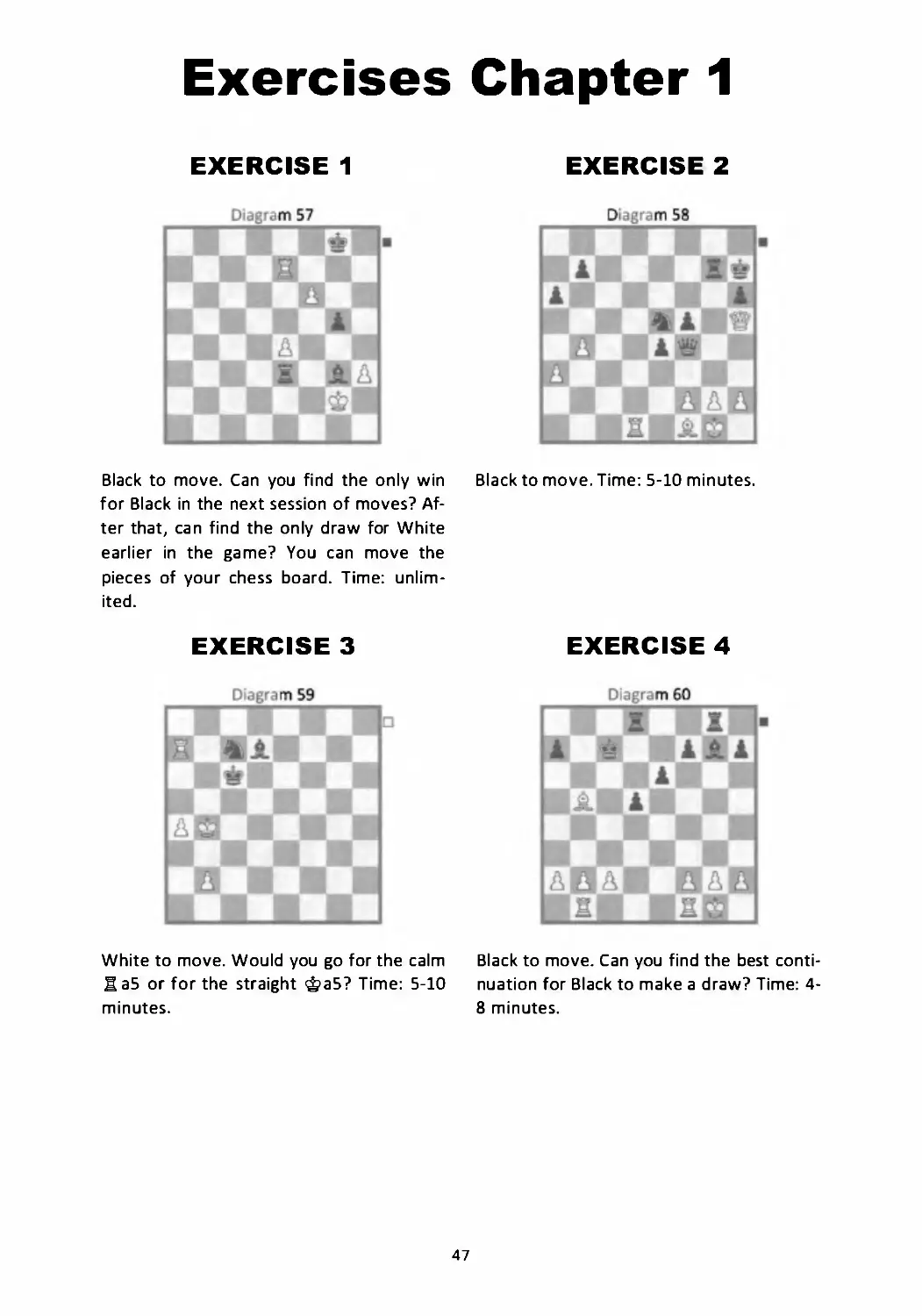
Exerc ises Chapter 1
EXERCISE 1
EXERCISE 2
Black to move. Can you fi nd the only win Black to move. Time: 5-10 minutes.
for Black in the next session of moves? Af-
ter that, ca n find the only draw for White
earlier in the ga me? You can move the
pieces of your chess board. Time: unlim-
ited.
EXERCISE 3
White to move. Would you go for the calm
l:taS or for the straight �aS? Time: 5-10
minutes.
47
EXERCISE 4
Black to move. Can you find the best conti
nuation for Black to make a draw? Time: 4-
8 minutes.
The Chess Manual of Avoidable Mistakes
EXERCISE 5
EXERCISE 6
White to move. Find the best continuation.
White to move. Can you see a big differ-
Time: 7- 14 minutes.
ence between re peating moves with �f2
�b2+ (etc.) or playing f4 first? Ti me: 7 - 14
minutes.
EXERCISE 7
Black to move. Ti me: 12-24 minutes.
48
EXERCISE 8
White to move. Can you assess the move
10. AgS? Ti me: 30-60 minutes.
Exercises Chapter 1
EXERCISE 9
Black to move. Is there any significant dif
fe rence between ...whB and ...wh7?
Time: 5- 10 minutes.
EXE RCISE 11
Black to move. Can yo u fi nd the only way
not to lose at once? Can you assess it? Ti
me for the first question: 2 -4 minutes. Ti
me for the second question: 25-50 mi
nutes.
49
EXERCISE 10
White to move. Find the most precise win
ning continuation. Ti me: 8- 16 minutes.
EXERCISE 12
Black to move. Can you fi nd the only move
to stay in the game? Ti me: 15-30 minutes.
General reasons for blun
dering
2
§ 2.llntroduction
Chess is one of the toughest ga mes that
exists because it is one of the very few
where you can lose everything due to a
:Jne-second blunder, even if yo u have play
ed perfectly for several hours. The fact it
'lappens so often is the reason why a rath
er weak co mputer could beat a strong GM:
:he general quality of play of the computer
Nould be worse, but he would never make
any serious blunder.
'Blundering' is the most com mon way to
spoil chess ga mes. In this chapter we're
going to study all the reasons why 'we',
1umans, blunder in chess games and we 'll
+ind out how to reduce this number of
"1
1
istakes. Not all the blunders are avoi
dable, but many of them are.
Most of the reasons for blundering are
purely psychological. lt means that in the
very sa me positions, we would not make
the same big mistakes if we were analysing
51
instead of playing. The reason is not only
that we have more time when we analyse .
lt is also that we have no stress or any
other kind of psychological pressure when
we are not in a practical ga me. For most of
chess players, the important the ga me, the
bigger are the chances to blunder. But of
course, there are many other para meters.
We will speak about the five situations
where blunders occur the most.
First situation: after any kind of shock,
like when the eva luation of the position
has just changed due to something (and
not only negatively !). Indeed chess players
like their games to go their way and often
somehow lose the thread when something
unusual happens.
Second situation: when the automatic
move is not been played by one of the
players. The brain has mechanisms which
are getting better, faster and more precise
grad ually as we improve. But sometimes,
especially when we are tired, these mecha
nisms are working on autopilot and our
br ain only thinks of one move when it
looks like the normal/only one at first
sight.
Third situation: when we lack time. Time
tr ouble is a difficult situation. lt ca n not al-
The Chess Manual of Avoidable Mistakes
ways be avoided, but, it is possible to
handle it decently by avoiding some parti
cular pr actical mistakes.
Fourth situation: when we lack concen
tr ation. Indeed it is not always easy to
keep the brain at the same level of concen
tr ation during a game. Some things should
be done to avoid big holes in your thinking.
Fifth situation: being overco nfident.
While some of the ca uses for blunders I ha
ve just mentioned are rather linked to a
lack of confidence, overconfidence is also a
big source of blunders. lt is important al
ways to be aware of the danger during a
chess game.
52
§ 2.2 Psychological reactions after a shock
Let's start with one of the biggest cause for
blundering: bad psychological reaction
after a shock. I did notice several cases
when chess players cannot play correct
ly/objectively anymore after something
abnormal happened during a game:
• after already having blundered once,
which changed abruptly the situation of
the game (examples numbers 1 and 2);
• after missing a move that 'looks' super
strong (example number 3);
• while being very close to escape mira
culously after a very bad ga me or a hu
ge blunder (exa mples number 4 and 5).
In all these cases, I noticed that chess pla
yers are often either getti ng fatalist or too
excited (in the third case). These are major
causes of blundering.
£!:, Marin, Mihail
A Edouard, Rom ain
� Benasque-XXIX Open 2009.
(2583)
{2597)
General reasons for blundering
This game was the subject of the very first
exercise of the first chapter. Indeed, after
being a piece up (and very close to win
ning) most of the game I reached this ab
solutely drawn position where my oppo
nent immediately declined a draw. I could
simply not believe it and started to play all
my moves in one second. This is typical a
childish and bad reaction.
76. �g3 �f5 77. llg8 �f4+ 78. �h4 g3
79. �h3 �e5 so. �g2
Position after: 80. '>ftg2
80... �f4?
Yes, we reached move 80. I had two op
tions: to look at the board, play my move,
and take a new score sheet (starting on
move number 81) or to take a new score
sheet, look at the board, and play my
move. What did I do? I played a move with
one of my hands, and took the new sheet
with the other hand. The position was so
drawn that I considered it unnecessary to
look at the board: and I blundered my g3-
pawn in one move. Of course the position
is still a total draw: but as if I hadn't done
53
enough mistakes I kept on playing all my
moves extremely fast.
80... �e4=
81. llxg3 �e4 82. llf3 �d6 83. �f2
�f4 84. �e2 �d6 85. l!h3 �d5 86.
�d3 �c6 87. lih6 �d5 88. llg6 �f4 89.
� f6 �d6 90. llf5+ �c6 91. �c4 �b7
92. �b5 �as
Position after: 92... '>fta8
Reaching the usual drawn setup.
93. �b6 �h2 94. llg5 �f4 95. llg4 �h2
96. �a6 �b8 97. !ig7 Ae5 98. lla7+
Position after: 102. � f7
The Chess Manual of Avo idable Mistakes
�b8 99. 11e7 �d6 100. 11d7 �c7 101. 104 . 11a7+ �b8 105. 11d7
11g7 �eS 102. 11f7
(see Diagram, previous page)
Until now all was fi ne. I had gone from 3
minutes to almost 15 minutes on clock,
which were totally useless.
102... �d6??
Why to go to such a square? There is no
answer, so the only way to avoid it would
have been to ask myself that question. But,
instead I moved within two seconds and
played one ofthe few 'legal' losing moves.
102... �g3=
103. �b6 �aS?!
Getting tired and not even creating more
(see Diagram, previous column)
Experience won against the child !
1-0
!'!, Podolchenko, Evgeniy
..
.
Edouard, Romain
[!] 2010.03 .08
• EICC 11th Men,
� Rijeka CRO
(2502)
(2617)
round 3
1.d4dS2.c4dxc43.lt:Jf3lt:Jf64.e3e65.
�xc4cS6.0-0a67.�b3bS8.a4b49.
lt:Jbd2 �e7 10. e4 �b7 11. eS lt:Jfd7 12.
lt:Jc4 0-0 13. �c2 cxd4 14. �xd4 b3!
14... �xf3? 15. �d3±
'pro blems'. 103...
�a3 104. l:id7 � c8 15. �xb3? !
105. 11 dS �b2 106. �c6 is a theoretical
win for White.
15. �b1 �dSoo
Position after: 105. � d7
54
15 •• . �xf3 16. gxf3 lt:Jc6 17. �e3 ltJcS 18.
�d1 11bS=i=19. 11a311b420. �c3lt:Jd4
21. aS?!
o 21. b3 e.g. 21. .. lt:Jcxb3 22. �xb3 ltjxb3
23. �a3! �cS 24. �e2 ltjd4 25. �d3
�dS 26. �g2 11bb827. 11d1 �xa3 28.
11xa3 lt:Jxf3 29. �xdS exdS 30. !!xdS
ltjh4+ 31. �g3 lt:JfS+=
21•.. ltjbS 22. !! c2 ltjb3+ 23. '@'e4
General reasons for blundering
Position after: 23. �e4
In this fantastic position I hesitated be
tw een staying a pawn down (with strong
compensations for sure) or recove ring the
pawn by taking on aS (with a position that I
considered better for me anyway). I decid
ed to be materialist.
23. .. �xaS??
Position after: 24. �d2!
23 ... fS ! 24. exf6 ,lixf6+ would have given
me amazing compensation and most pro
bably a winning position.
24. �d2!
55
I had completely missed that I am now lo
sing material. However the situation is not
so dramatic. But, beca use of the 'shock' I
played my next move too fast and lost in
one move a game that should have contin
ued for a long time.
24... �xc4?
The worst possible choice.
a) 24... 11 xc4? 25. AxaS+-
b) The very simple 24... �b3 ! (keeping
some positional domination) was not that
clear: 25. �xb4 �xb4 with the idea of .. .
ltJSb3 and the position rem ains playable.
25. Axb4 �xb4 26. 11xc4+-
Position after: 26 . .!:. xc4
The position is tota lly lost.
26... aS 27. f4g6 28. Af3 �c7 29. 11d1
'iVb8 30. 'ifb7 fixb7 31. Axb7lt:Je8 32.
Af3 lt:Jg7 33. lld7tt:Jts 34. Ae4lt:Jg7 35.
Af3 lt:JfS 36. �g4 tt:Jg7 37. l!cc7 h6 38.
�f1 a4 39.lh7 _tcs 40. ,lixa4 l:tb8 41.
gc4Af842. 11cc7 Itxb243. !ic8 1-0
The Chess Manual of Avoidable Mistakes
!'!, Pijpers, Arthur
A Edouard, Romain
[] 2012.04.06
(2338)
(2607)
• Deizisau-16th Neckar Open, round 3
� GER
1.e4c52.ltJf3d63.d4cxd44.lt:
:l
xd4
lt:
:l
f65.lt:
:l
c3a66.Ag5lt:
:l
bd77.f4'@c78.
�f3 b5 9. 0-0-0 Ab7 10. Ad3 g6 11.
l:the1Ag712.ltJd5lt:
:l
xd5 13. exd5 A f6
Position after: 13 ... �f6
14. '@e3
While there was a 300 points gap between
me and my opponent I was happy to see
that move appear on the board since the
logical move 14.lt:Jc6 is a forced draw. But
it is actually very interesting!
14. lt:
:l
c6 AxgS 15. fxgS Axc6 16. dxc6
lt:
:l
e5 17. �xe5 dxe5 18. Axg6 hxg6 19.
�d7=
14... Axg5 !?
14... Axd5 15. AxbS 0-0 (15... axbS?! 16.
lt:
:l
xb5 �c6 17. Axf6 0-0 18. Ac3 e6 19.
56
lt:
:l
d4i) 16. Axd7 '@xd7 17. Axf6 exf6 is
about equal.
15. fxg5 lt:Jb6 16. Ae4 Axd5
Unnecessary since castling or 16... � c8
would be unclear, but I had totally missed
my opponent's 18th move.
17. Axd5 lt:Jxd5 18. '@f3
Position after: 18. �f3
All of a sudden I thought I was losing a lot
of material since 18... lt:
:l
b6ismetby19.
lt:
:l
c6 and a queen move would not be e
nough to save the d5-knight. I looked for a
minute and played 18... lt:Jb6, being very
upset.
18. '@e4 lt:Jb6 19. lt:Jc6 e5oo was what I
had calculated.
18... lt:Jb6
But the very simple move 18.. . '@c4 would
save the ga me, since afte r 19. b3 '@c5
there is no ltJb3 anymore.
19. lt:
:l
c6 e6 20. '@f6+-
General reasons for blundering
Position after: 20. 'ir'f6
I have eventually won that game (incredi
ble as it may seem) but the rest is not so
interesting to appear in this book!
0-1
fj, Bellaiche, Anthony
(2472)
' Edouard, Remain
(2446)
I! 2007.02 .11
• FRA-TOP16,
round 3
� FRA
The short summary of the first 46 moves of
decided to play a bit more although the
position is resignable.
47. !r,e6
47. d6!?+-
47... "J/!jc7 48. �xc7 !?
48. �b4!?+-
48 ...
1Ixc7 49. �bS lL:\ed6 50. i_c6
l!a7?! 51. ,Jixd6 !lh2+ 52. �el llal+
53. �e2 11 a2+ 54. �dl lL:\xd6 55. lL:\d4
lig7 56. lL:\e6+ �g8 57. llxg7+ �h8
Position after: 57.. . �h8
My position is of course tota lly lost in ma
ny ways, but my opponent was in a big ti
me trouble and started to get nervous
(especially since he had to win to save that
important team match).
58. lite7 g4 59. �el
59. lL:\f4+-
the game is that I have been tota lly crus-
59... g3 60. �fl
hed by my opponent. Especially since it
was a decisive game in a team match I 60. ltJf4+-
57
The Chess Manual of Avoidable Mistakes
60... l2Jc4 61. llg7 l2Je3+ 62. �el gZ 63. 67 . �el?!= would be a third repetition.
d6
67... l!cZ+ 68. �bl llxc6 69. d7 lid6 70.
63. llg3 !?+-
.laxgZ ltjxgZ 71. dB=�+ I[xdS 7Z.lljxd8
63.. .lljc2+ 64. �dlllje3+ 65. �ellljc2+ (see Diagram, previous column)
Position after: 65 ... l!)c2+
66. �dl??®
66. �f2 lljd4+ 67. �e3 lljxe6 (67 ... l2Jxc6
68. d7+-) 68. ii
i
xg2+-
66...llje3+ 67. �cl
Position after: 72. l!)xd8
58
Yes, this is also a kind of shock: after play
ing 50 moves telling myself "I re sign next
moveifheplaysthisorthat"I amallofa
sudden having a worse but tota lly drawn
position. But I lost control of my emotions
and made a wrong calculation instead of
playing 'normal moves'.
12... �g7 73. �c2 �fS
The super-obvious 73... �h6 74. �d3
�gS would make a draw at once.
74. �d2 rl;e7 75.lljb7 �d7??
Position after: 75... �d7??
Giving the half point back: of course eve ry
body can see that the only thing to do to
make a draw was to run away with my g2-
knight. But, all of a sudden it is no longer
possible and the position is lost.
General reaso ns for blundering
75 ... lt:Jf4=
76. 'Llc5+ wc6 77. 'Lld3 Wb5 78. wc3
-;tc679. Wd2 Wb580. we2 Wc481. e5!
Position after: 81. eS !
Just in time. Not so fo rtunate for me, but
defi nitely deserved!
81... ltjh4
81... fxe5 82. f6+-
82. exf6 ltjxf5 83. f7 ltjd4+ 84. We3 ltje6
85. lt:Jf4 lt:Jf8 86. We4
The kind of position that is always lost: the
white pawn is on the 7th ra nk, my knight is
tota lly dominated, and my king is too far.
86.•. wc5 87. we5 wc6 88. wt6 Wd6 89.
c;tg7 ltjd7 90. ltjh5 We5 91. ltjf6 ltjc5 92.
�g8 lt:Je6 93. lt:Je8
1-0
59
!'!:, Brica rd, Emmanuel
(2453)
..
.
Edouard, Remain
(2508)
[] 2008.08 .14
• FRA-83rd eh National B,
round4
� Pau FRA
1.d4lt:Jf62.lt:Jf3e63.g3b5!?4.Ag2
Ab75.Ag5c56.Axf6�xf67.c3'iVd8
8.0-0Ae79.'Llbd20-010.a4b411.c4
Af6 12. ltjb3 lt:Ja6 13. �d3
The position is very normal.
13... l!c8??
Now I'm going to say a fu n ny, difficult to
bel ieve, but true story that happened. Af
ter that move, I started to look around
what was going on and got distracted. My
opponent was already thinking for more
than 15 minutes. I was fee ling confident
and started to look at the screen where all
the games of the event were being broad
casted. I saw my own position and noticed
that "some guy allowed a very simple
winning tactic: lt:Jg5". Of course, two se
conds later, I re alized this guy was me. Af
ter thinking for 10 more minutes, my op
ponent fi nally also missed ltJg5.
14. l!ac1??
Relieved, I started to play very fast in a
(still) co mplicated position, feeling like a
free man !
14. lt:Jg5+-
14... jlc6
The Chess Manual of Avoidable Mistakes
14. .. cxd4+
1S. d5
Position after: 15. dS
15... j_xa4??
Played within a minute, only considering
16. lt:Jbd2 and missing that after 16. 11 a1
i,xb3 my opponent did not have to take
on b3 necessarily! This could by the way be
an illustration to subchapter number 2 as
well (about 'automatic moves') .
16. llal!
16. l2Jbd2 b3 ! 17. lla1 lt:Jb4 18. �b1
lt:Ja2+
16... j_xb3 17. !lxa6
(see Diagram, next column)
Now the ga me is over again !
17 ... exdS 18. �xb3 dxc4 19. �xc4 dS 20.
'iVa2c421.b3'iVe722.e3'iVb723.
!ia4+-
60
Position after: 17. �xa6
I have logically lost the ga me in 50 moves.
IN THE LIMELIGHT
Rule number one:
After missing something important or after
blunderi ng, it is very human to get fata list
or angry with yo urself (for example to start
to play fast and/o r without calculating).
This is childish and not the right time for it.
If you make a mistake it is not a reason to
make one or several more. Most of the
time, one (even relatively important)
mistake is not enough to lose the ga me.
Nonetheless in many practical games one
big mistake often hides another (or several
others) due to the psychological shock.
In other words, even if you make a mistake
have in mind that your opponent is not a
computer.
General reasons for blundering
Rule number one
The general philosophy to follow
during a game is that you should
never look behind and that you
should always force your oppo
nent to be as precise as possible.
The situation changed badly? Adapt your
self. Play acco rding to the new position
and to the new pa rameters.
it also means that in the reverse situation
you should not believe that the point is in
the pocket if yo ur opponent starts blunde
�ing. At some point he may come back to
reality. Keep on calculating, and try to be
precise and not superficial.
IDEA
Having a much better position, un
less you have a clear and easy
way, do not refuse small complica
tions if they seem like the very
best choice.
Finally, if you get relieved from a tota lly
lost position or if yo ur opponent missed
something:
WARNING
lt does not mean that you became
untouchable.
In that situation too just play acco rding to
the new parameters without looking be-
61
hind. Aga in, your opponent may come
back to rea lity at one point! Not all of yo ur
mistakes will remain unpunished.
The Chess Manual of Avoidable Mistakes
§2.3 Automatic moves blindness
Unlike a computer, human bra in works ac
cording to certa in logic. This means when
there is something very normal to do that
it is sometimes closed for other options. In
many situations, the 'automatic' move is
the best. But in some of them it is not.
The first very common kind of automatic
move is the 'recapture': unless there is a
very clear intermediary move the brain of
ten only considers recapturing and forgets
about more options. This will be illustrated
by my fi rst exa mple.
A similar automatism is the 'logical captu
re' as a consequence of very short-term
thinking. As for the fi rst kind of automa
tism just above, sometimes you may even
play it impu lsively although this was not
your intention. This will be illustrated by
my second exa mple.
Another similar problem is while calcula
ting, to only consider moving a piece when
it is attacked. This will be illustrated by my
third example.
The last very common situation is to avoid
all kind of schematically 'wrong setups' un
consciously although it is sometimes pu
rely virtual and can be refuted by an extre
mely easy calculation. This will be the pur
pose of example number 4.
62
!":, Grachev, Boris
(2680)
..
.
Edouard, Ro main
(2587)
[] 2011.07 .27
• Biel MTO Open,
round9
� SUI
1.d4ltJf62.c4g63.ltJc3dS4.cxdS
ltJxdS 5. e4 ltJxc3 6. bxc3 il,g7 7. �a4+
�d78.�b30-09.il,e3b610.il,bSc6
11. il,e2 cS 12. dS e6 13. ltJf3 exdS 14.
exdS il,a6 15. i.xa6 ltJxa6 16. lld1 ltJc7
17. c4 ltJe8 18. 0-0 ltJd6 19. i.f4 llfe8
20. i.xd6 �xd6 21. ll fe1 �d7 22. g3
!lxe1+ 23. !lxe1 !le8 24. �d1 il,f6 25.
h4 bS 26. !lxe8+ �xe8 27. �d3
Position after: 27. �d3
27... b4? !
Defi nitely a positional mista ke, and the
start of the problems in that (until here)
very equal ga me. And now:
A) 27... a6=
B) 27... bxc4=
28. d6 aS?!
General reasons for blundering
28... �c6! 29. d7 �g7! would still be quite
OK for Black.
29. d7 �dB 30. 'iVdl
30. �dS±
30... �g7
Position after: 30... <;tg7
31. �a4?
31. 'iVdS±
31.. . �fS?!
31... �c7 !=
32. �c6 �e7 33. �xcS+ �xd7 34. lt:\d2
�es 35. lt:\b3 a4 36. lt:\aS?!
36. �c6+;!;
36... �dl+
Not the easiest way si nce many other mo
ves wo uld have equalized.
37. �g2 il.,e7 38. �bS+ �f8 39. lt:\c6
�e2 40. lt:\xe7
63
Position after: 40. ttJxe7
This is the position we are interested in. I
had to play rather fast (since it was move
40) and I thought giving check on e4 is not
useful beca use the King would not be
worse on h2 and I wou ld have no more
checks. I stopped my calculation here and
took on e7 within a few seconds. But, of
cou rse, a deeper look who have indicated
me how to force a draw.
40... �xe7?
40... �e4+ 41. �h2 �el! is a draw:
forcing the white queen to move in order
to avoid a perpetual, after what it will not
attack a4 anymore.
41. �xa4 �e4+ 42. �h2 'iVel 43 . �c2
�c3 44. �e2
The endgame is quite diffi cult for Black.
44... hS 45. �g2 �d4 46. �f3!
Slowly bringing the king to the other side
of the board.
46... �f6+ 47. �e4 �e7+ 48. �d3 �d7+
49. �e3 �e6+ SO. �d2 �f6 51. �d3
The Chess Manual of Avoidable Mistakes
Position after: 51. Wd3
A critical position.
51... �dB+?!
51... �g8! was a very strong waiting
defensive move: 52. �c2 (52. '@d2 �fS+
53. �d4 �d7+ 54. �e3 �e6+=) 52 ...
�c3+ 53. �bl �d4! 54. �c2 �f8! 55. cS
�e7 56. c6 �d8=
52. �c2 �as 53. �bl �fS+
53 ... �cS 54. �b2 �d4+ 55. �b3 'i'c3+
56. �a4±
54. �c2 'liVeS 55. cS �e7 56. c6 �dB 57.
�d2+ �c7 58. @xb4 �fS+ 59. �cl
�xf2?
59 ... �xc6 had to be played but the ending
should be lost anyway.
60. �f4+ !?
60. 'i'b7++-
64
60... �xf4+ 61. gxf4 �xc6 62. �d2 �dS
63. �e3 f6 64. �d3 �cS 65. �e4 �b4
�.5
�0
[:, Feller, Sebastien
(2525)
" Edouard, Romain
{2562)
iiJ 2009.02 .20
• Nancy-GM,
round 7
� FRA
Here is my most illustrative exa mple of 'au
tomatic move' which I have played. While I
had calculated earlier that my opponent's
last move lL\c4-d6 was even more losing
than the rest (because of ...�xd6) I simply
played insta ntly the 'automatic' move. Im
mediately after touching my bishop I noti
ced what mistake I had done: but the auto
matism (not to somehow make my queen
hang) had been stro nger than my calcula
tion.
29... Axd6??
29... �xd6-+
General reasons for blundering
30. exd6 �xd6 31. lt:Jf5 ! exf5 32. �xg7
Position afte r: 32. �xg7
32... �e7??
Played instantly. This wou ld also be a
perfect exam ple for subchapter number 1:
'Psychological reactions after a shock'.
32... �d7 had to be played but after 33.
�d4 White wou ld already have big chanc
es to make a draw. (33. Af4? �xf4 34.
�xf7+ �c8 35. �xd5 ,l
l
xb2-+)
33. Ac5+- �xc5 34. �e5+ �d7 35.
l'!xd5+ �xd5 36. �xd5+ �e7 37. '¥:fe5+
�d7 38. '@'xf5+ �e7 39. g3 n hdS 40.
�e5+ �fa 41. �hS+ �e7 42. �xh6 1! d6
43. �g5+ �e6 44. "¥!Ve3+ �f6 45. �f4+
�e6 46. b3
1-0
65
£!:, Edouard, Romain
(2652)
' Tkachiev, Vladislav
(2644)
IIl 2012.08.22
• FRA-87th eh m,
round9
� Pau FRA
1.d4lt:Jf62.c4e63.lL\c3Ab44.e30-0
5.Jid3c56.lL\f3lL\c67.0-0Jixc38.
bxc3d69.e4e510.d5lL\e711.lL\h4
�h8 12. g3 !?
Position afte r: 12. g3!?
12... Jih3 13. l!e1 �d7N 14. f3 lL\fgS 15.
g4
Position after: 15 . . . ltjg6
The Chess Manual of Avoidable Mistakes
Black is already facing specific problems:
my idea is to go �f2-�g3 and take the h3-
bishop.
15... lt:)g6
(see Diagram, previous page)
This is the position we are interested in.
My initial idea was to go 16.lt:)f5, which I
considered to be much better for White.
But then I started to calculate 16...lt:)f4
and was not happy that later (after .. .g 6)
my Knight should go to a square I am not
happy with. Beca use of that I could not
make the move lt:)fS work for me. I fi nally
surrendered and took on g6, making my
position only a bit better. But a more
open-minded calculation should have hel
ped me taking the right decision.
16. lt:)xg6+?
16. lt:)fS ! lt:)f4 (16 ...
hS 17. �hl!±) 17.
�xf4! exf4 18. �d2! g6 And now, of
course, I do not have to move my knight at
all: 19 . �xf4 ! gxfS 20. exfS (see analysis
diagram)
Position after: 20. exfS
66
and, while I have two pawns to com pensa
te for the piece I have lost, I am going to
win the h3-bishop for one pawn only, and
the position is totally winning. lt looks ob
vious once yo u see it: and if you think of it,
it is not even required to calculate (this fi
nal position is just winning). The only thing
to think about was that... an attacked pie
ce does not 'always' necessarily has to mo
ve.
16... fxg6 17. �h1 hS 18. gxhS �f7
18...gxhS 19. �gl !:If7 20. j,e3 1taf8 21.
j,e2;!;
19. �e2 gxhS 20. !:lg1 lt:)f6 21. '@'e1;t
Followed by �h4. My position was quite
pleasant anyway, and I have won the game
in 51 moves. Part of it will be used in the
last subchapter of this same chapter.
1-0
£:
:,
Zhu, Chen
.t. Edouard, Ro main
r:n 2011.01.26
(249 5)
(2634)
• Tradewise Gibraltar Masters, round 2
� ENG
1.d4e62.c4�b4+3.�d2aS4.lt:)f3d6
5.g3�e76.lt:Jc3lt:Jf67.j,g2eS8.dxeS
dxeS 9. ltjdS lt:JxdS 10. cxdS c6 1? 11. e4
j,g4 12. 0-0 0-0 13. h3 Axf3 14. �xf3
I:ld8
14... cxdS 15. exdS lt:)d7=
General reasons for blundering
15. �e3 �cS 16. �xcS �xcS 17. I[cl
·�b6 18. �e2tLla6? !
Too am bitious.
a 18... cxd5 19 . exd5 �d6
19. �c3 t2Jc720.dxc6?!
20. �e3 ! �xe3 21. fxe3! wou ld give White
a small advantage si nce the black Knight
no longer has the d4-square available and
there are some problems rega rding the c6-
pawn: 21...tLlb5?! 22. �c5!±
20 ... bxc6 21. � fcl
21. �c2 !?tLle6 22. E:,xc6 �b5�
21... lt:JbS 22. � xc6 �b8
Position after: 22. . . �bB
Now I am a pawn down, but my opponent
is in time trouble and I have huge compen
sation due to the ... tLld4-move which is
coming. My opponent tried to go for an at
tack.
23. �hS!? lt:Jd4? !
67
I evaluated 23... g6 24. �g4 to be very dra
wish but maybe it was the best anyway:
24...tLld4 25. �xg6 fxg6 (25 ... tt:Jxc6? 26.
�h5+ Wh8 27. I[xc6i) 26. �xg6+ Wh8
(26...
hxg6 27. �xg6+=) 27. �g7 �g8!?
(27.. . �a7 28. �xa7 �xa7 29 . �c8=) 28.
!!xg8+ (28. l:!cc7?! �xc7+) 28.. .
�xg8
and Black is actually a little bit better.
24. �xf7+ Wh8 25. �hS tt:Jxc6 26. � xc6
�d6
Not the most precise. lt was time to bail
out with a draw.
26.. .
�bS 27. �g6 �dl+ !? 28. Wh2
�hl+ 29 . wxhl �fl+=
27. �c2
Position after: 27. l:!, c2
Here is the position we are interested in.
White is going to put his Bishop on dS
next. I decided that I should play 27 ...�b4
because after 28.Ad5 I wo uld be ready to
go 28... �el+ forcing 29 .W h2 (29.Wg2 is
met by 29 ... llxd5 fo llowed by . .. �e4+)
while after 29 ... li[ f6 the position remains
playable and unclear. This reasoning
sounds quite logical doesn't it?
The Chess Manual of Avoidable Mistakes
27.•. f;'b4??
27... �b6 28. 'fixeS li fG=
28. i.,dS 'f;e1+ 29. �g2!+-
Position after: 29. Wg2 !
No. The automatic move didn't have to be
played. Now everything is hanging and.. .
my co mbination is not working at all ! The
reason is that I considered ·�g2+ g c2' to
be some kind of wrong setup due to the
fork on e4. I based all my ca lculation on
this factor which did not work.
29. �h2 11fGoo (29... 11f8oo)
29... lif8
29... 11xd5 30. li,e2 !+- Oops.
30. �xeS 11h6 31. �c3 �d1 32. !Id2
�e133.Itc2�d134. 11d2ft'e135.h4
Itg636. eS .itdB37. 11d3�xc338.bxc3
gb6 39. �f3 11b2 40. �e3 a4 41. e6
11e8 42. lid4 1lc2 43. �d3 11xf2 44.
jtc6
1-0
68
IN THE LIMELIGHT
Rule number two
Just as you cannot prevent all of your blun
ders, you cannot always think of every
thing either: you are not a computer. Ho
wever it is possible to avoid many mistakes
by not being impulsive . First of all, during a
game,
Rule number two
You need to force yourself to be
more open-minded when you cal
culate.
In 95% of the cases yo u have to re capture
a piece or to move it when it is attacked.
But you need to be ready to be a little bit
more 'creative' in the other 5% of cases.
Most of the 'bad automatisms' are due to
the very fact that the br ain always consi
ders the va lue of the pieces as totally over
riding - this is why sometimes you have to
push it a bit in the other direction (for
example in order to play a long term win
ning sacrifi ce).
Secondly, unless the clock fo rces you,
i IDEA
You should always take at least a
few seconds before playing an
'obvious' move.
General reaso ns for blundering
lt is very easy to do especially in a Fischer
time control, and, as in the situation just a
bove, it will reduce yo ur number of over
sights considerably.
Finally,
WARNING
When you base all your calculation
on one key factor, don't think too
quickly and check several times
this factor does work!
lt may avoid overlooking immediate tacti
cal refutations that you may miss if you
only calculated complicated things.
69
§2.4 Practical play in time trouble
There are two big problems linked to time
trouble.
The first one is very obvious: there is not
much time to think of the most accurate
move. However in a time trouble we have
a nasty tendency to enter concrete lines
blindly. This will be the purpose of exam ple
number 1. We also tend to cha nge our
plan too often, without making time to ela
borate a new one. This wi ll be illustrated
by example number 2.
The second one: there is a big risk that
yo ur clock goes down to 3-4 seconds and
that you need to play a move as fast as
possible. This is the main origin ofthe most
crazy decisions/blunders you can see in
chess games. This will be illustrated by my
three last examples (numbers 3, 4, 5).
/:}, Sa lgado Lopez, lvan
(2602)
..
.
Edouard, Romain
(2636)
� 2010.11.08
• Barcelona-M agistral,
round5
� ESP
1.e4c52.lt:Jf3d63.d4cxd44.lt:Jxd4
ft:jf65.ft:jc3ft:jc66.�g5e67.�d2a68.
0-0-0 ft:jxd4 9. �xd4 �e7 10. f3
10. f4 is the main line.
10... 0-0 11. h4 b5 12. Wb1 �b7 13. �d2
'fi/c7 14. �d3 llac8 15. ft:je2 d5 16. e5
ft:je4!
The Chess Manual of Avoidable Mistakes
Position after: 16. . . lt:
:l
e4!
Position after: 22 . . . fS
Black achieved everything possible. How- 23. lt:Jf4? !
ever I have overplayed my hand in the next
session of moves, until my opponent
played imprecise moves himself.
17. 'lte1 .\k_cS
We look into :
A) 23. exf6 'l£fxg3 24. lt:Jxg3 gxf6 25.
.lk. h6;!;
B) 23. hS!?
17... f6! ? 18. exf6 .\k.xf6!:+
23... 'ltf7?!
18. nf1.\k.b6 19. ncl.\k.aS?!
23... nfe8! ?
19... lt:Jc5! ? 20. 'l£fg3 fS!:+
24. hS .\k.c7 25. .\k.xa4 bxa4 26..\k.f6?!
20. c3 lt:Jc5 21. .\k_c2
26. h6 AxeS (26... g6 27 . .\k.f6;!;) 27.
nfe1;!;
All of a sudden 'l£fg3 is co ming and my
position becomes very unpleasant. Around 26... h6
that moment I started thinking and spent
all of my re maining time.
Now that I could play ... h6 myself I under
stood my position was exce llent. My op-
21... lt:Ja4 22. 'l£fg3 fS
ponent played his next move quickly to
take adva ntage of the fact I had to play 14
more moves with 30 seconds per move.
But, in such a good position it should be
enough.
(see Diagram, next column)
27. c4
70
General reaso ns fo r blundering
Position after: 27. c4
Our key position.
27 ..• rwt>h7?Ef>
While I had seen this move was probably
not so good, I co uldn't resist to enter a for
ced line (thinking 'if I don't I might regret':
a bad reasoning!) .
The extremely simple 27 ... 11 fe8 which I
actually even thought about was just
better for Black, with very easy play. Exact
ly the kind of simple moves we, chess pla
yers, have problem to make in time trou
ble. This could also be an exam ple for
subchapter number 2 of the first chapter
('simple defences while being under pres
sure').
28. cxdS gxf6??
Keeping on in the same terrible optic.
The normal 28... Axd5 wou ld not have
been such a disaster: 29. �g6+ �g8 30.
�h4 j_xeS 31. �xf7+ �xf7 32. ltJg6 �d6
33. ltJxf8 11xf8 34. Af2;t
29. dxe6 �g7 30. �g6+!
71
Oops. All of a sudden I am tota lly lost.
Worse (but still good) would have been 30.
�xg7+ �xg7 31. 11 fd l fxe5 32. l2Jg6
11fe8 33. lld7+�f634. iicxc7 llxc7 35.
llxc7 i.d5 36. e7±
30... �xg6 31.lL:\xg6
31. lL:\xg6 AxeS 32. lL:\xf8+ ]lxf8 33.
11 fdl+-
1-0
[!, Edouard, Romain
j Solodovnichenko, Yuri
[I 2013.04.01
(2680)
(2559)
• Deizisau-17th Neckar Open, ro und 9
� GER
1. e4 cS2.lL:\f3 e63.lL:\c3 l2Jc64.d4cxd4
5.lL:\xd4d66.Ae3ltJf67.f4�e78.�f3
eS 9. lL:\xc6 bxc6 10. fS �aS 11. 0-0-0 0-0
12. Ac4 llb8 13. Ab3 d5 14. exdS lixb3
15. cxb3 cxdS 16. 11 xdS lL:\xdS 17. lL:\xdS
Ah4 18.lL:\c3 ltd8 19. �e4 ii,e7 20. g4
Position after: 20. g4
The Chess Manual of Avoidable Mistakes
Until now my opponent had played his
opening preparation. Therefore I had so
little time left on clock that he started to
get too optimistic.
20... hS?!
20... �c7!?�
21. gxhS �b4?!
29. �c2??
A crazy and unexplainable decision, typical
of time trouble.
29. �xf7 (why not? !) would win at once,
e.g . 29... �f4+ 30. �e3 �xfS 31. �g3+-
29... �f4 30. ,l:l xf7 �xfS?
30... e3! would be quite unclear: 31. �xe3
o 21... �b4 22. lldl;l;
'@'xfS+ 32. �cl �dl! 33. lt:Jxd l �dS 34.
lt:Jc3 'fVxf7oo
22. gf1 aS 23. h6! �b7 24. 'fVc2 �f62S.
lig1 �f3 26. 'fVf2
31. �e3 'l'e6 32. li b7?
26. hxg7 ! ?+-
The most terrible square. Not reaso ning
enough in terms of 'hanging pieces'.
26... e4 27. �xg7+ �h8 28. �cS 'i'b8?
32. l:[a7+-
32... '¥!Va6 33. li c7?
Position after: 28 . . . �b8?
Until now I managed to keep everything
Position after: 33. li c7?
under control but I had simply no time left
on clock. While I could play the logical 33. li bSo �xc3 34. a4 �eS 35. �bl and
11 xf7 that looks completely winning, I did the position is not totally lost.
not dare without any good reason.
33... fVd6??
Q 28... �b7±
72
General reaso ns for blundering
33... �dl !-+
34. !ic4?
c 34. 11 c5 allowing tricks on the d5-
square.
34 ... �h7?
34... �d3+ 35. � cl a4!�
35. �d2
35. �bl!?+-
35... 'i:feS 36. �f2 �d6 37. �d2 �es 38.
Er,e2+ 46. �cl �xh6 47. �dl �e3 48.
�d2 !ld3+ 49. �e2 iU6 SO. 11a4 �gS
51. llxaS+ �f4 52. lla6 JLfS 53. llc6
11h3
Position after: 53.. . l1 h3
�cl �xh2+ 39. �bl 11 d3
54. Er. d6??
Position after: 39. ..
l1d3
40. �gl??
Once again changing my move at the last
moment without any objective reaso n.
40. 1Lf4!+-
40... �xgl+ 41. JLxgl e3 42. 11 f4 Axc3
43. Axe3 !lxe3 44. bxc3 Ae4+ 45. �b2
73
54. 11 f6 was the most logical move.
would suffer but the position is a draw.
54... lith2+ 55. �dl �e3
All of a sudden I am getting mated.
56. �cl !ic2+ 57. �dl llxc3
57 ... !! b2 wou ld mate instantly: 58. �el
11g2 59. �fl Er,g3-+
58. �el llcl+
58... JLg4 would again mate instantly: 59.
� f1 11c2-+
59. 11dl !IcS 60. 11dS £e4 61. 11d7
11c1+ 62. gdl 11c2
The Chess Manual of Avoidable Mistakes
Position after: 62... l1 c2
The position is sti ll theoretically lost, but I
have fi nally achieved a draw. The endgame
will be one example of chapter number 4.
Yz-Yz
� Edouard, Remain
(2363)
' Feller, Sebastien
(2345)
[] 2006
• FRA-ch Ul6,
round8
� Aix les Bains
Now let's see a few exam ples of crazy
moves I have made beca use I let my clock
drop to two seconds.
74
ss. �f6??
All of a sudden thinking that 55. �el+
(that was of course my only intention)
loses to 55... l!al+ although I can actually
go 56. Wf2 : when you see your clock
showing 'two seconds' any kind of halluci
nation is possible.
ss... !!b256. 1!f7+ wc6 57. :f6+ WdS
58. llf4 f259. a6 !!xb4 60. nxf2 wxcS
61.!!a2l1b8
Yz-Yz
� Edouard, Remain
(2662)
' Apicella, Manuel
(2512)
;Il 2013.08 .20
• FRA eh,
round9
� Nancy FRA
Until now, my opponent had played much
better than I did, but I had very decent
chances to hold the game.
34. '¥Hd6 £d7
Afte r that move (threate ning ... �xg4 with
mate to fo llow), I immediately saw that I
General reasons for blundering
could go back with my queen (35.�h2)
and that not much would be happening.
Instead of playing it instantly to gain time,
or instead of thinking of something else for
no more than 15 seconds (half of my
increment time), I spent more than 25
seconds on it. All of a sudden, I saw my
clock showing three seconds and was
unable to remember my move. I finally
remembered it but saw my clock showing
one (!) second. For physical reasons, I
played the move that was the closest to
the clock, but of course not avoiding the
mating threat.
35. �al??
Even playing nothing would have been
� lllescas Cordoba, Miguel
1 Edouard, Romain
IIl 2011.11 .23
W ESP CECLUB DH,
� Melilla ESP
(2609)
(2621)
round 4
much better than this move, since I do not 25... c6!? 26. d6 �e6 27. b3 lt:
:\
c8
even have pressure on b7 anymore!
35... Axg4 36. hxg4 �xg4+ 37. �fl
�xe3
37... �h3-+
38. �h2+ �g8 39. �xb7 �xb7 40. fxe3
�g5!-+
After a series of miracles I have drawn that
game in 58 moves.
Yz-Yz
75
27... lt:
:\
ds+
28.d7lt:
:\
b629. 1!d6�e730.f3 �f531.
�d4 �e5 32. �f2 �f8 33. a4 �xd4+ 34.
�6xd4 �cS 35. �1d3 �e7 36. �e3+
�f8 37. l!ed3
Position after: 37. � ed3
The Chess Manual of Avoidable Mistakes
I had been slightly better for most of the
time during that game, but my opponent
had defended very well. Now, with very
little time on clock, the very normal deci
sion would be to agree a draw by re pea
ting the moves for the third time. But, on
ce again, with two or three seconds on
clock, I played a move that makes absolu
tely zero sense.
37... lt:JaS?<±>
a) 37... �e7=
b) 37... �eS!? was however possible in
order to keep on playi ng. Of course the d7-
pawn is quite weak and it is not a complete
nonsense to at least try to look for an
advantage. But, in time trouble, and like
for eve rything, there is a moment to be
re asonable.
38.b41:!eS39.f4!!e740.lt:Je4b641.
lt:Jf6
Position after: 41. lt:.\f6
76
Now I am having big problems. My oppo
nent played very well from now until the
end and beat me.
41... hS?!
o 4l... lt:Jc7
42. g4 hxg4?!
o 42...4Jc7
43. lt:Jxg4 cS 44. � d6 cxb4 45. lt:Je5+
�xe5 46. fxe5 �e7 47. �3d4 b3 48. �b4
ii
i
xd7 49. � xd7+ �xd7 50. � xb3 lt:Jc7
51. �e3 lt:JdS+ 52. �e4 �e6 53. � d3
lt:Jb4 54. �d8 lt:Ja6 55. �e8+ �d7 56.
�as lt:JcS+ 57. �dS aS 58. �a7+ �es
59. �d6 �fa 60. �aS+ �g7 61. �e7
ltJd3 62. Itb8 lt:JxeS 63. �xb6 lt:Jf3 64.
�bSlt:Jxh465. �xaS ltJfS+66.�d7 �f6
67. �b5lt:Jd468. �b6+�es69. as�ds
1-0
IN THE LIMELIGHT
Rule number three
Time trouble is of course a difficult situa
tion, and sometimes it is impossible to
avoid it. The first problem is obvious: it lea
ves little time for thinking. The second pro
blem is that players tend to think until the
very last second and change their move
without any rational reason.
General reasons for blundering
Rule number three
You should avoid: entering forced
lines that you have no time to ca l
cu late;
AND
letting your clock drop to less than
4 or 5 seconds, as you will very of
ten change your move at the last
moment without any reason and
blunder.
IDEA
If you believe a move is good, play
it. No matter if you think it may be
bad for a reason you haven't seen.
Yes, these tips and warn ings are not per
fect solutions. By following them, someti
mes you may not enter blindly a forced
line that is actually good, or, conve rsely,
you may trust your calculation when you
should not. But, in the very big majority of
the cases, these advices will help you not
to blunder system atically in time trouble.
77
However, do not forget that in a time
trouble, yo ur 'feeling' should be an integral
part of yo ur decision - if you strongly feel
that a line should be good, but don't have
time to calculate it, you may risk yourself
to play it.
let's add that, by staying calm and taking
weighted and reasonable decisions, yo u
may win games thanks to yo ur time
trouble if yo ur opponent tries to punish it
an innacurate way. Always think positive !
The Chess Manual of Avoidable Mistakes
§2.5 Lack of concentration
There are several ca uses to lack of concen
tration.
Sometimes it is linked to tired ness. For
exam ple it is quite recurrent to see some
one play the second move of the line he is
calculating, before the first one (example
number 1).
But I believe in most of the cases it is due
to an unidirectional functioning of the
brain. For exam ple, you are concentrated
on some concrete or positionnal stuff and
forget about very simple tactics, very often
linked to basic patterns (simple mating
themes, number of hanging pieces ... ). This
will be illustrated by examples numbers 2,
3and4.
!'!:, Piorun, Kacper
(2529)
..
.
Edouard, Romain
(2686)
Il 2012.12.16
• Am plico EUR eh RAPID,
round8
� Wa rsaw POL
78
20.1:te3
After I played the opening badly, I got this
slightly worse but solid position: ... �d7,
. .. l:t ab8, etc.. This was a rapid game but
nevertheless quite important. I lost con
centration before playing my move and
everybody around got surprised that I
sim ply resigned here: the reason was that I
had touched my aS-rook (forgetting to go
. . . �d7 first) and would lose it due to
ltjc6+.
1-0
!'!:, Edouard, Romain
(2607)
..
.
Cvitan, Ognjen
(2528)
Il 2012.10 .20
• SUI TCh,
round 8
� SUI
17. �d3?
After I checked 17. �c2 ltjxgS 18. ltJxgS
g6 for a long time and rea lized that Black
would just be just fi ne, I had a quick look
and decided to go for 17.�d3 as there we
re not so many options. After playing it I
General reaso ns for blundering
immediately realized something was
!'!, Narciso Dublan, Marc
(2540)
(2620)
wrong!
.t. Edouard, Remain
[] 2010.07.23
17..• lt:)c5 ! 18. �d1
• Andorra Open,
� La Massana AND
round 7
Now Black can just take on f3 and b3 and
be slightly better. Fortunately for me, my
opponent felt like it was not much of an
advantage and decided to agree a draw.
Yz-Yz
!'!, Edouard, Rem ain
(2085)
.t. Jessel, Ste phen
(2205)
[] 2004 .01 .17
• FRA TCh divers,
round5
� FRA
24. �g3?
Only thinking of my own attack and not
looking at what is wrong in my position.
24... g6 25. lt:)f6+?
25. �f4o gxh5 26. �xh6+ <;t>g8 27. �g5
�f8 28. �xh5 �g7=F
In this position which see ms very good for
Black I had the problem that 29. .. lic2
was not working because of back-ra nk ma
ting problems, while White was intending
to play lt:)e2 next followed by lt:)c3 and
somehow reach equality. After I analyzed
'normal' moves like 29...g6 for quite some
time which didn't satisfy me, I unco rked
the move 29 ...g5 almost without thinking
in order to threaten llc2 and offer myself
more possibilities in the next moves.
29 ... g5??
29 ... �c2?? 30. �xc2 (30. �xd3?? lixg2+
31. <;t>xg2 �d5+-+ is the main idea of
... .l:l c2.) 30... dxc2 31. llxd4 g6 32.
lt:)e2+-
25... �xf6 26. exf6 �xa4!
0-1 (see Diagram, next page)
79
The Chess Manual of Avo idable Mistakes
Position after: 29 . . . gS??
30. fS+-
Simply ove rlooking that all of a sudden gS
is hanging with check. I lost that ga me 13
moves later.
a) Indeed, for example 30. fxgS?? wo uld
lose to 30... 11 c2-+
b) 30. ltje2? �f2 wo uld also be better for
Black.
1-0
IN THE LIMELIGHT
Rule number four
The brain cannot work consta ntly optimal
ly. This is that why, as we have said in the
second subchapter, it is sometimes neces
sary to push it to do some things that it
does not always do automatically.
80
Rule numberfour
Before playing a move you should
analyse the concrete and basic
weak points of your position.
Number of hanging pieces (or pieces only
protected by hanging pieces) and other ba
sic patterns (e.g . back-ra nk mate) in order
to avoid very simple blunders.
Actually yo ur brain does it automatically
when yo u are in good shape. But to push
yourself to pay a bit more of atte ntion will
take you only a few seco nds and, while it
may sometimes be unuseful, it will from
time to time compensate for a phase of
tired ness. Be honest with yo urself:
WARNING
How often do you asked yourself,
one second after playing a move,
the fa mous embarrassing question.
'What the hell did I just do?'
Let's also repeat one of the tips of the 'rule
number 2': you should always take at least
3-4 seco nds before playing a move that
you consider obvious. This also means:
General reaso ns for blundering
WARNING
You should not rush on a move if
you are not satisfied with the oth
ers. The move you would play
might be even worse !
To finish with:
IDEA
When you relax during the game,
you should never forget complete
ly about your position.
Otherwise you may forget about some
things that you have seen earlier and need
to start yo ur calculation again from the be
ginning. To illustrate that I will use a recent
game Leko-Ca ruana, Wijk aan Zee 2013.
81
£!, leko, Peter
I. Caruana, Fabiano
[] 2013.01 .17
(2735)
(2781)
• WijkaanZeeTata Steel Gp A, round5
� NED
Peter leko reached move 40 and took a
wa lk for some minutes thinking his posi
tion was tota lly wi nning. When he came
back he saw this position and co uldn't re
member how he was planning to finish it in
a clear away. Indeed, at first sight, White
seems better but Black also seems solid.
After a few minutes, he remembered
Black's gS-pawn just came from g7 and
that he could take 'en passant'. Of course it
is understa ndable that these things hap
pen on move 41, and not such a big deal as
the first time control has passed. However,
it may also happen to someone losing
concentration even before re aching move
40.
41. fxg6 fxg6 42. gS hxgS 43. ilxgS k,g7
44. hS ll8b4 45. hxg6
1-0
The Chess Manual of Avoidable Mistakes
§2.6 Overconfidence
Let's fi nish with another of the biggest
sources of blunders: overconfidence. There
exists seve ral examples of it, and some of
them are very similar to a lack of concen
tration, especially rega rding consequences.
First situation, our opponent has been
fighting the whole game for a draw, and
we simply don't have in mind that losing is
a possibility. This will be the purpose of
exam ple number 1.
Second situation, our position is obviously
winning, and we consider the game as won
prematurely. This may get us distracted
and/or ma ke us forget about a 'last trick'.
This will be illustrated by examples num
bers 2, 3, and 4.
Third, we are in the opposite situation as
we discussed in subchapter number 3: our
oppo nent is in time trouble. Once again,
we feel like we are invincible, and have a
nasty tendency to play superficial moves
too quickly because we believe our oppo
nent cannot react to it. This will be illus
trated by exam ples num bers 5 and 6.
82
lil
Edouard, Romain
Ernst, Sipke
2013.01 .15
(2686)
(2556)
• WijkaanZee Tata Steel GpB, round4
� NED
Having lots of time on my clock against a
few seconds I hadn't the slightest doubt
about winning this game. I sta rted to play
'shy' moves instead of go ing for concrete
lines, which would for sure be cleverer
with such a time difference.
36. �gl
36. '@xb6 d4 37. !lel!?+-
36... lt:JeS 37. f3 '@g6 ! 38. fxe4 d4
At least rea ching some kind of sm all posi
tional compensation for the exchange -
even if Black's position is sti ll very bad- .
39. '@f4 d3 40. lld2?!
General re asons for blundering
40. 11 el was cleverer: my rook wo uld later
be more mobile: 40. .. �d6 41. �fS+ g6o
(41. . . \t>h8 42. �cl+-) 42. �f2+-
40... �c6 41. � h2
c 41. lif2
41... �cl
Position after: 41... �cl
42. gf2??
While I was about to play 42. b3 'a tempo' I
decided to take more time and calculate
the ending after 42. � f2 �xf4 43. 11 f4 d2
44. lH1 tt:
:l
c4 45.�dl tt:
:l
xb2 fo llowed by
. . . tt:Jxa4. Indeed, the ending is winning but
a bit complicated anyway (aim was to
avoid having only 'g' and 'h' pawns left).
After fi nishing my calculation, I did not
analyze anything else. I simply did not
co nsider that sometimes things can go
wrong and that losing is always an option ...
until I touched my rook.
42. b3±
42...�xf4+43. !!xf4 d244. l1f1 tt:
:l
c4 45.
�dl
83
Position after: 45. I!. dl
45... tt:
:l
e3!
a) 45... tt:
:l
xb2 46. llxd2 tt:
:l
xa4 47. eS
�g6 48. g4 !+- wo uld indeed be winning
for White. But who cares?!
b) 45... tt:
:l
e31 46. llxd2 tt:
:l
fl+-+
0-1
£:
:,
Leroy, Olivier
i Edouard, Romain
j] 2003
(1770)
(2088)
• France (cham pionnat U14),round 1.6
� Le Grand Bornand
The Chess Manual of Avoidable Mistakes
A very old game of mine, played ro und one
of a French Youth Championship:
45... �c3+
45.. . a1=� 46. !!xa1 �c3+-+
46. �d5 al=�??
No, Romain, have a look at the boa rd
before playing your move !
47. e6+
And 11 f8 mate is coming next move.
1-0
£!, Edouard, Romain
(2587)
..
.
Haimovich, Ta l
(2419)
[] 2011.07 .29
• Biel MTO Open,
round 11
� SUI
A quite similar example to the previous
domination with which I can do more or
less anything I want.
32. f3 11af8 33. lla2 i.e8 34. llbl lt.JdS
35. i.cl 11g7 36. i.a3 11fg8 37. i.c5
lt.Jc6 38. i,b6+ �d6 39. 11ab2
39. lt.Jxc6 �xc6 40 . i,xa5±
39• •. lt.Jd7
Position afte r: 39. . . lt:
:l
d7
believed the game was already won,
especially since I had a lot of time against a
few seconds, and didn't care what was
going on.
40. lt.Jxc6??
Played 'a tem po', thinking more of joining
my friends outside than the game. I simply
overlooked that the d7-knight was not only
atta cking e5.
40. lt.Jxd7 �xd7 41. 11 bS±
one. I am not having any material advan- 40... lt.Jxb6
tage this time but a quite nice positional
Now Black is bette r!
84
General reasons for blundering
41. ltjxaS ltjxa4 42. la, xb7 1i xb7 43.
ltjxb7+ �c7 44. ltJcS ltJxcS?!
44... ltjxc3 45. llel �d7+
45. dxcS eS 46. llal �c6 47. 1la7+? !
�b7 48. �g3 lla8 49. !lxa8 �xa8 50.
�f2 �c6 51. �e3 �xcS
Position after: 51... �xcS
This endgame is very diffi cult and I didn't
ma nage to save it.
52. �d2 �c6 53. �cl �e8 54. �fl �f7
55. �d2 �g8 56. �cl �bS 57. �e2
�a4 58. �b2 �e6 59. �dl �d7 60.
�e2 �bS 61. �fl �a6 62. �g2 �c8 63.
�h1 �e6 64. �g2 �g8 65. �f1 d4 66.
cxd4 (66. �e2 �bS-+ ) 66 ... exd4 67. c3
d3 68. �cl �dS 69. �g2 �bS 70. �d2
�cs 71. �e3 �d6 72. �hl �es 73.
�g2 �c6 74. �fl �a4 75. �h3 �c2 76.
�fl �b3 77. �h3 �c2 78. �f1 �b1 79.
�h3 �a2 80. �g2 �b3 81. �h3 �a4
82. �f1 �e8 83. �g2 �f7 84. �h3 d2!
85. �xd2 �f4 86. �e2 �dS 87. �g2
�g3 88. �fl �xf3+ 89. �d2 �xg4 90.
�xc4 �xhS 91. �ds �e8 92. c4 hS 93.
85
cSh494.c6h395.�e2g496.�fl�h2
97. �e6 g3 98. c7 Ji,bS+ 99. �el �a6
0-1
[!:
:.
Edouard, Romain
A Nakhapetiane, Pogos
!IJ 2007 .11.28
• Wch U18,
� Kemer TUR
(2472)
(2427)
ro und 11
Th is game has been played board 2 of the
U18 World Championship. I needed to ma
ke a draw in order to ensure the second
place and to win in order to hope for the
first place. Until now that game was the
most terrible one I had played in this
event, and my position was strategi ca lly
tota lly lost.
27. llf3 �c6 28. �c3 �e8 29. !If3 �e7
30. �e2 f6 31. exf6+ gxf6 32. fS eS 33.
llh3
Fortunately, even though my position was
lost, my opponent was having a huge time
trouble.
33... e4
The Chess Manual of Avoidable Mistakes
33... h5 !? 34. Axh5 Axh5 35. Jlxh5 11xb3
(35... e4!?) 36. 11h7+ �d6 37. !if7 e4 38.
li,xf6+ �e5-+
34. li,xh7+ �d6 35. li,a7 d4? !
The most human move.
o 35... li,xb3 36. 11a6+ Ac6 37. i.dl
11b438.h4�c739.h5 �xb240.h6gb8
41. li,a7+ i.b7 42. 11xa5 11h8-+
36. 11a6+? !
o 36. 11xa5 d3 37. i.dle3 38. lia6+
�d739.lie6e240.Axe2dxe241. 11xe2
with decent chances to make a draw.
36... Ac6 37. Ac4
Position after: 37. �c4
37... e3?
A) 37.. . a4-+
B) 37... d3 38. �f2 d2 39. �e2 e3 40.
li,xa5 Ae4+
38. h4!
86
Position after: 38. h4 !
All of a sudden the situation is cha nging
and my h-pawn is quite fast!
38... ilb7?
Q 38... 11b8
39. Ae2?!
Dubious, but actually definitely the best
move in time trouble, threate ning both
i.f3 and li,xc6+. Or 39. �fl !?
39... 11b4??
Played with one second on the clock. Of
co urse it even loses one tempo compared
to taking immediately on b3. 39... 11e7!
would still be OK for Black, since 40. i.f3??
would be met by 40 ... e2-+
40. i.f3
Of course now my position is completely
winning in many ways. At that moment the
leader had won on board one and I knew
General reasons fo r blundering
that I could not win the event anyway (he Oops !
had a better tiebreak). Still, it was im-
portant for me to win (aiming to share 48. �xd2 �f2
first), but my concentration was gone and I
got overconfident due to the several mis
takes my opponent had made.
40... �xb3 41. �xc6+ � eS 42. liteS+ �f4
43. !:IxaS
43. �dS !?+-
43... �xb244. �dS �d245. �fl �g3
Position after: 45 . .. �g3
The last moves went normal. But I kept on
playing fast and didn't open my eyes to
possible black tricks. Definitely a lack of
distrust. lt is true that the position looks
tota lly winning, but two pawns at the third
ra nk are always something!
46. h5??
46. �d8 �xh4 (46. . . d3 47. �el+-) 47.
�g8+-
46...d3 47. �el e2!
87
Position after: 48 ... �f2
The position is a dead draw. To be honest,
after 47.. .e2 came, it was such a shock that
for a second I did think I was losing the
game!
49. �xd3 el=� 50. �c4 �g3
Yz-Yz
[!, Edouard, Remain
.1. Tkach iev, Vladislav
!Il 2012.08.22
W FRA-87th eh m,
� Pau FRA
(2652)
(2644)
round9
The Chess Manual of Avoidable Mistakes
We have studied the begi nning of that
ga me in the subchapter about 'automatic
moves', in this very same chapter.
21. �e1 lL\h7 22. �h4 Ad7 23. Ae3 g6? !
23 ... g gs 24. gafl g5 25. Axg5 gxg5 26.
g xg5 ltjxg5 27. �xg5 g g8 28. �h6+
�h7 was worse but maybe the best
chance to hold, since 29. �xd6?? is met
with 29... �g7-+
Position after: 34... � e7
24. !I afl �f6 25. �g3
This is our critical position. Everything has
Position after: 25. �g3
Move f4 is coming and Black is more or
less lost.
25... gg8 26. h4!? �e7 27. f4 gae8 28.
fxe5 dxe5
28... �xe5 29. �xe5+ g xe5 30. Af4
EI,xe4 ?! 31. A d3+-
29. �h2 b6 30. Ah6 Aa4 31. 11f2 Ac2
32. !lgf1 Axe4 33. 1:[ f7 �d8 34. Axh5
l:[e7
(see Diagram, next column)
88
gone pe rfect for me in the last 15 moves
and my position is totally winning. I had a
lot of time and my opponent had a few se
conds only. Instead of concentrating in or
der to be precise, I beca me overconfident,
also played fast and left my opponent a
chance to come back in the game.
35. Ag4?
35. Adl would just be completely win
ning, since of course 35. . .
Af5 would be
met by 36. lllxf5+-
35... AfS!
Now Black is doing badly but the ga me is
not entirely lost.
36. l:[xe7 �xe7 37. Ah3! Axh3 38.
�xh3 g5?! 39. hxg5?!
Again the same mista ke. This move seems
good enough but there is much better.
Concentration is the keyword.
General reasons for blundering
39. � fS gxh4 40. �xeS+ �xeS 41. li xeS
wo uld be com pletely winning.
39... ltJxgS+ 40. AxgS llxgS?!
40 ... �xg5 41. �xg5 �xg5 42. �h4± (42.
1!f7 �g7?! is the only case where the
pawn ending would be a draw: 43. lixg7?!
�xg7 44. �g4 �g6=)
41. �h4+ <;t>g8 42. 11 fS ilg7 43. �xe7
�xe7 44. �g3
Indeed, the black king is cut of and all
pawn endings are winning for White. The
ending is probably lost.
44.•• e4 45. �f2 1!h7 46. �e3 ilh3+ 47.
Wxe4 11xc3 48. d6 11xc4+49. �dS lld4+
50. wc6 c4 51. d7
1-0
8, Edouard, Remain
(2662)
..
.
Wirig, Anthony
(2496)
[I 2013.08.15
• FRA eh,
round 5
� Nancy FRA
1.c4eS2.g3ltJf63.Ag2h64.ltJc3_tb4
Position after: 25. llJg3
25 ... il dg8?$
25... �xg2 26. �xg2 ll dg8 was not that
clear, e.g. 27. �d5 (27. �f3 e4! 28. dxe4
ltJe5 29. �f5 'i!Ve7 30. lldS ltJcd3�) 27...
fgf6 28. llgl (28. d4 fih4! 29. fj'f3 ltJf6
30. dxc5 ltJg4+ 31. �g2 ltJxe3+ 32. fj'xe3
�xh5�) 28... c6 29. 'i
iV
g2 ltJxd3�
26. �xb7 ltJxb7 27. llgl ltJd6? ! 28. �e2
My opponent was already in big time trou
ble for a couple of moves and my position
went tota lly winning.
28... !'I. h7 29. cS !? bxcS
5. e4 _txc3 6. bxc3 d6 7. ltJe2 a6 8. a4 aS 29... ltJxcS 30. �xc5 bxc5 31. d4+-
9.o-ob610.d3Ab711.h3ltJbd712.f4
ltJcS 13. �e3 ltJfd7 14. g4 �e7 15. ltJg3 30. !l abl+ r:j;a7
0-0-0 16. ltJfS �f8 17. fxeS dxeS 18. �c2
g6 19. ltJg3 fid6 20. !!fdl wb8 21. wh2
hSI? 22. gxhS fS
22 ... ltdg8 !?
23. exfS gxfS 24. ltJxfS �e6 25. ltJg3
(see Diagram, next page)
89
The Chess Manual of Avoidable Mistakes
Position after: 30 ... �a7
Here is our critical position. Here, I wa nted
to somehow "punish" my opponent's time
trouble by opening the position even mo
re . Instead, a more serious approach
would have shown me one of the easy
ways to win. lt is also true that I didn't take
in consideration that I knew my opponent
was a great blitz player.
31. d4?
31. ltje4 ltjxe4 32. dxe4 would win at on-
Position after: 37 ... �c6 !?
All of a sudden I noticed that �b8+, the
move I had planned, was not working. I
started to calculate, worked myself into ti
me trouble, and got lucky that things
somehow didn't get worse for me.
38. ligcl
A) o38.lt:Je2
B) 38. il.b8+ �xb8 39. �xf7 Itf8 edi
tor's note
ce, just keeping extra material and wiping 38... ltjde5??
out all Black's attacking ideas.
My opponent fi nally blundered: but I was
31... exd4 32. cxd4 ltjc4! 33. �f3
also in time trouble, and didn't punish it.
38... ltjce5 !oo
33. il.f4 �xe2+ 34. tt:Jxe2 11 xgl 35. It xgl
cxd4 36. h6 should be easily winning, but, 39. It b3??
again, I somehow closed myself to "simple
options".
39. I[xc4 ltjf3+ made me afra id but after
40. c;t>hl nothing happens: 40... ltjd2+
33... c6 34. il.f4 cxd4 35. �d3?!
(40 ... ltjd4+ 41. �g2+-) 41. c;t>gl lt:Jxbl
(41... ltjxc4 42. Ab8++-) 42. llxc5+-
o 35. .l:lgel
35... I[ f7 ! 36. �xd4+ c5 37. �f2 �c6!?
90
39... I[gf8 40. lt:Je2 c;t>a6!?
(see Diagram, next page)
General reasons for blundering
Position after: 40... 'if;la6 !?
41. �g2
I somehow could not fi nd a better move,
even having passed time control (move
41).
41... �xg2+ 42. �xg2 It xf4 43. lt:lxf4
lixf4 44. �g3
The position is a draw, but I felt like Black
has more chances to trick White than the
contrary.
Y.-Y.
IN THE LIMELIGHT
Rule number five
Fi rst, let's once again repeat that when you
want to enter a com plicated line you
should first try to make sure you consi
dered all the moves at the beginning of
yo ur thinking: no point to calcu late a 12-
moves line if you made a mistake on move
two.
91
IDEA
Go step by step.
Secondly, until the game is not over: al
ways beware. If players would always win
winning positions, chess wou ld be much
less interesting, not to say boring. Do not
forget that chess is also a sport and that
practice is very different than analysis. So,
when your opponent seems to be about to
resign, do not forget that he didn't yet:
again, do not play impulsively and
\)
)
Rule number five
Have in mind that a winning game
is a won one only once the score
sheet is signed that way.
Finally, over the board nobody asks you to
be a chameleon.
WARNING
If your opponent is in time trou
ble, prevent yourself from playing
fast as we ll.
The argument that you should not let yo ur
opponent time to think on yo ur own time
is a bad one: when you calculate yo ur next
move, you calculate only this one. How
ever yo ur opponent is not in yo ur head
and must think of seve ral options. lt
mea ns:
The Chess Manual of Avoidable Mistakes
IDEA
You'll use your time better than
your opponent will.
Playing fast in order to tease your oppo
nents just puts yo u in the very same situa
tion as him, unless you are as strong in bul
let-games (1-minute) as Hikaru Nakamura
is!
General Conclusion
During a chess ga me:
• you have to be ableto adjust to your si
tuation, being a fighter when the situa
tion is bad, being confident when the
situation is unclear, being modest when
the situation is good;
• yo u should never do/play anyt hing on
impulse and yo u should re member that
the right moment to analyse your past
mistakes is AFTER the ga me;
in a time trouble (in a classica l ga me) you
should avoid any situation that you ca n not
control (entering concrete lines without
calcu lation, letting yo ur clock drop to 2 or 3
seconds, etc.) .
92
You should not confuse:
• a 'good mechanism' (helping you to ex
clude senseless moves) and a 'bad auto
matism' (making you narrow-minded or
impulsive);
• 'relaxing' (walking around, getting some
fresh air...) and 'getting distracted'
(starting to think of many things that
have nothing to do with yo ur game, af
ter which yo u may lose the thre ad).
CONCLUSION
In other words, strong nerves, pa
tience and a constant high concen
tration are the keys to reduce your
number of blunders.
Please try to solve the fo llowing exercises
accord ing to the fo llowi ng topics which we
have just studied:
• unexpected surprises;
• bad automatisms;
• general control of decisions.
Exercises Chapter 2
EXERCISE 1
White to move. Would you take on h5 or
play gd4? Time: 10-20 minutes.
EXERCISE 3
Black to move. Same question as for the
previous exercise (although you are now
on the attacking side): can you see a diffe
rence between all the king moves? How
many of them are actually winning? Which
one(s)? Time: 25-50 minutes.
93
EXERCISE 2
Black to move. In this boring position, are
all the King moves a draw? Time: 4-8 minu
tes.
EXERCISE 4
White to move. What is the best winning
chance: 84.lLJc5 or 84. �xb6? Time: 8-16
minutes.
The Chess Manual of Avoidable Mistakes
EXERCISE 5
EXERCISE 6
Black to move . In that excellent position,
White to move. Time: 30-60 seco nds.
would you go for the simple . .
.
1:tae8 or
for the concrete ...f6? Time: 4-8 minutes.
EXERCISE 7
EXERCISE 8
Black to move. Would you ra ther play ...a6
White to move . Time: 8-16 minutes.
or ...b6? Time: 20-40 seconds.
94
Exercises Chapter 2
EXERC ISE 9
You can see the last 23 moves of the game.
Did White miss anything at any moment?
You can move the pieces on your chess
boa rd. Time: as quickly as possible.
36 . .,tc4 d3 37. cxd3 .,td4 38. 11xf7+
!I,xf739..,txf7e340. 11el .:_h241. �a2
�xc6 42. �b3 �d6 43. �c4 �es 44. b4
.la,c2+ 45 . �bS �xfS 46. .,thS �gS 47.
lie2 11c1 48. .,tf3 �f4 49. �dS .,tc3 50.
d4 .,td2 51. .,tc4 11bl 52. dS �es 53.
gh2 11xb4+ 54. �cS lib8 55. 11hS+
<;t>e4 56. !!h4+ �f3 57. 11h3+ �g2 58.
11h6 11c8+59. !!c6 !!xc6+
%-%
95
EXERC ISE 10
White to move . Would you go for fxe6 or
just play ll cl? Time: 1-2 minute(s).
The Chess Manual of Avoidable Mistakes
EXERCISE 11
White to move . What would yo u play if
you were in time trouble? Can yo u assess
the move SS.a3 (here) quickly? Can yo u
assess the line SS.a3 was 56. axb4+ cb4
57.c5 and then assess the move SS.a3
more seriously? Can you fi nd the best
continuation for White in the initial posi
tion? Time for the first question: 30-60
seconds. Time for the second question:
1,5-3 minutes. Time for the third question:
unlimited. Time fo r the fo urth question: 7-
14 minutes. You are allowed to move the
pieces on yo ur chess board for question
number 3 only, but you should first try to
calculate without doing it.
96
EXERC ISE 12
Black to move . Can you see any difference
between ...�a2 or ...�g4? If so, which
one is best? Time: 2-4 minutes.
EXERCISE 13
White to move. Time: 3-6 minutes.
Exercises Chapter 2
EXERC ISE 14
EXERCISE 15
White to move. Wo uld you ra ther play d7 Black to move. Can you assess both . .. �gS
or 11 dl? Time: 20-40 minutes.
and . ..f4 moves? Time: 12-24 minutes.
97
Concrete moves and
•
concessions
3
§3.1 1ntroduction
To have an objective approach and not
to blunder is not enough to win chess ga
mes in most of the cases, especially if the
opponent doesn't blunder either. In order
to win games, we have to take concrete
decisions at several stages of the ga mes.
In the fi rst chapter we have studied two
kinds of concrete decisio ns: tactical oppor
tunities and calm defences, which are mo
re or less excl usively related to pure ca lcu
lation. They are the basic ones, but there
are many other kinds of concrete decisions
that a player should be able to take in or
der to become good: the technical ones.
In a chess game, we cannot go on wit
hout a plan. This means, that unless we ha
ve a tactical opportunity (Chapter 1), we
have to take technical decisions at one or
several crucial moments. However, if our
opponent is not blundering, these deci
sions ca n not be so easy to take. This
means they should have a concrete posi-
98
tional ta rget and linked to a precise calcu
lation.
The different kinds of concrete technical
opportunities in a chess game are:
• positional tra nsformations;
• prophylactic decisions;
• concretising decisions in endgames;
• active defending decisions in endga
mes.
We use all these technical issues auto
matically in the most natural cases. For
exa mple, going ...eS in the Najdorf is a po
sitional transfo rmation, castling when the
centre is going to be opened is a prophy
lactic decision, exchanging the last piece to
enter a winning pawn ending when we ha
ve extra pawns is a winning endgame
tra nsposition, etc.. We use all these basic
technical cunnings instinctively because
they entered our customs. But, to use
them in more com plicated situations, we
need to push our brain to do it: it is no lon
ger mechanical.
For pedagogic re asons this chapter will
contain much more 'positive' illustrative
examples than other chapte rs .
Concrete moves and concessions
§3.2 Positional transformations
A positional transfo rmation aims to
:hange something positive ly in the posi
:ion from a technical point of view: to im
::lrove the pawn structure, to exchange ma
:erial in an appropriate situation, to create
::lroblems out of the opponent's king posi
tion or other kinds of tactical problems.
But usually chess players want to impro
"e their positions without doing any kind
of concessi on. While it can work if our op
ponent is being very cooperative, in a
double-edged fighting ga me, this cannot
work.
To manage a positional transfo rmation,
there are severa l kinds of concessions that
may help to improve other more impor
tant things in the position. Of course, every
single example is diffe rent and there is no
definite rule 'what the concession should
be to manage this or that'.
We're going to illustrate a few types of
concessions:
• an unfavourable change of the pawn
structure (examples numbers 1 and 2);
• a bad pieces exchange from a strategic
point of view (exa mple number 3);
• a weake ning of an importa nt centra l
sq uare (exa mple number 4);
• a temporary wea kening of our own king
(example number 5).
99
!'!:
:.
Edouard, Remain
(2608)
A Jussupow, Artur
(2611)
JJ 2010.06 .27
• SUI-TCh liga A,
round 5
� SUI
1.d4lfjf62.c4e63.ltJf3dS4.lfjc3
ltjbd75.�gS�e76.e3h67.�h40-08.
�cl dxc4?!
8... c5 9. cxd5 lfjxd5 10. �xe7 lfjxe7 11.
�b5!? cxd4 12. �xd4 lfjf6 13. 0 -0 �xd4
14. lfjxd4 � d8 was very drawish in: AYz
AYz (40) Vachier Lagrave, M (2742) -
Radjabov,T (2715) POL 2013.
9. �xc4 a6 10. a4 c5 11. 0-0 cxd4 12. exd4
b6
Position after: 12. .. b6
13. dS!?
The negative point of that move is that it
excha nges many pieces which is not logical
since I'm having a space adva ntage and a
quite good version of an isolated pawn.
However, for concrete re asons this is a
stro ng positional transformation.
The Chess Manual of Avoidable Mistakes
13... lt)xd5?
The most natural move, in order not to
give up the bishop pair. However it is just
losing for concrete reasons.
13... exd5 had to be played, though is like
admitting that White is better: 14. lt)xd5
Ab7 (14... lt)xd5 15. Axd5 11a7? ! 16.
!lxc8+-) 15. lt)xe7+ �xe7 16. l:I,e1 �b4
17. �d4 (threatening Axf7+) (17. Axf6 !?
lt)xf6 18. lt)e5 is also good for White, for
example 18... 11 ae8 is met by 19. lt)xf7!
�xe1+ 20. �xe1 11xe1+ 21. l:lxe1 l:lxf7
22. 11d1! �f8 23. Axf7 �xf7 24. 11d6
and Black has a very difficult ending.) 17...
a5o and White has many moves to be
better (18. !! cd1, 18. ll ed1, 18.A b5, etc .)
but it is not such a killing advantage.
14. AxdS exdS 15. Axe7 �xe7 16. lt)xdS
�d8 17. 11c6!
Position after: 17. 11 c6 !
The point of the white idea. Black's pieces are
getting overwhelmed and he loses material.
17... lt)cS
100
Giving a big pawn away, but nevertheless
the best move !
a) 17... 11b818. lid6 11e819.lt)d4(19.
lle1!? llxe1+ 20. �xe1+-) 19. .. Ab7 20.
lt)f5Axd521. �xd5 }Ie5 22.�d3 11b7
(see analysis diagram)
Position afte r: 22 . . . 1Ib7
23. f4! The clea rest. 23 .. . ge6 24. 11xe6
fxe6 25. lt)xh6+ ! gxh6 26. �g6+ �f8 (26...
�h8 27. 'ifxh6+ �g8 28. 11 f3+-) 27. f5+-
b) 17... !ta7? 18. llxc8+-
c) 17... 1i e8?! 18. lt)c7+-
18.lt)xb6 11b819.b4+-
Position after: 19. b4
White is winning.
Concrete moves and concessions
19... �xdl 20. It xdl l2Je6 21. llJeS �b7
22. 11cd6 11feS 23. l2Jed7 ItbdS 24. f3
�hS25. �fl 11e726. llJcS 11deS
26... 11xd6 27. 11xd6 l2Jxc5 28. bxcS Itc7
29. l1d7+-
27. lld7
27. l2Jbd7+-
27 ... l2Jxc5 28. bxcS aS 29. l1xe7 l!xe7
30. �f2 _ta6 31. llel!+-
Position after: 31. 1:!, el!
31... llc7 32. lleS+ �h7 33. llaS llxcS
34. llxa6 �c635. <J;e3 lld636. �e4f6
37. g4 �g6 38. h4 hS 39. gxhS+ �h7 40.
f4 �h6 41. llaS �xhS 42. llxaS+ <J;xh4
43.l2Jc4 lld744. lldSllc745.l2Je3 �g3
46. lld3 lle7+ 47. <J;fS lla7 48. lt:\dS+
�h4 49. l:la3 llaS 50. �e4 fS+ 51. �d4
gS 52. fxgS �xgS 53. l2Je3 f4 54. l2Jc4
llfS 55. aS f3 56. l2Jd2 llf4+ 57. �e3 f2
58. llal �fS59. a6<J;fs60.a7 11aS61.
<;t>xf2
1-0
101
['}, Edouard, Ro main
j, Rodshtein, Maxim
[] 2007.07 .26
• Biel MTO,
� Biel SUI
27. cS !?
(2483)
(2586)
round4
Not a bad move, but I had another strong
and more concrete option. And now:
A) 27. cxdS! Granting the dS square, but
giving the white position other big assets.
Though in this position it was not absolute
ly necessary to fi nd it to reach a huge
adva ntage, this is a typical concrete attack
ing move and positional tra nsformation.
27 ... llxcl+ 28. 11xcl l2Jxd5 29. l2Jc4 .l:lc8
Here I simply thought the position is less
clear, but I didn't calculate far enough. 30 .
�h2! The point behind the white idea,
making the cxdS idea work: now llJd6
can not be avoided. The best for Black
would be to go ... 11 c6 and sacrifice an
exchange.
(see analysis diagram, next page)
The Chess Manual of Avoidable Mistakes
Position after: 30. Wh2!
(30. ltjdG? �xcl+ 31. Axcl �f8 is what I
wa nted to avoid. White is still better but
Black is suddenly very solid.) 30.. . � c6 31.
ltjd6 � xd6 32. exd6+ �xd6+ 33. � gl+
Black has a knight on d5 but ca n not organ
ize the rest of his pieces. Moves like 27.
cxd5 are typically concrete decisions that a
player should be able to take from time to
time, even though here, the text move was
very good as well.
B) 27. a4!?
27... bxcS 28. dxcS � b8 29. ltjd3 ltja6 30.
lit abl
30. �f4! .li b3 31. ltjb4 ltjxb4 32. axb4
would be crushing: Ag7 and �h6 is co
ming.
Position after: 32 ... �c8
102
30... .1
1
xbl 31. .li xbl "fljc7 32. �e3 �c8
(see Diagram, previous column)
33. Ag7?
A weird blunder. lt was necessary, once
again, to be concrete.
A) 33. .libS±
B) 33. ltjb4! li c7 (33... ltjxb4 34. axb4 a6
35. .li b3+- followed by �f4, lt f3, Ag7 .)
34. c6 ! The stra ight and concrete way.
Exchanging the passed c-pawn against the
black a-pawn in order to develop ot her
assets of the position. Aga in a positional
transfo rmation ! 34 ... ltjxb4 35. axb4 .li xc6
36. '@'xa7+ llc7 37. '@'a3 llc3 38. �al+
(b5 is coming)
33... lt:JxcS34.lt:JxcS �xcS 35. Itb3 .lic7
36. "flif4 llcl+ 37. �h2 .lic4!
Position after: 37.. . l:tc4!
Now Black is fine.
38. �e3 .lixh4+ 39. �g3 �a440. .lib4
"flic6
Concrete moves and concessions
40...
11 xb4 !? 41. axb4 lt:)f8 (41.. .
a6 42.
�h2�) 42. '@xa7+ lt:)d7 is probably even
better for Black.
41. '@h6 l!xb4 42. axb4 '@c3+ 43. �h2
�d4 44. �xh7 �f4+ 45. �g1
Yz-Yz
8 Edouard, Remain
(2531)
I. Atlas, Valery
(2465)
Il 2008.10.22
• ECC,
round6
� Ka llithea GRE
1.e4cS2.lt:)f3e63.d4cxd44.lt:)xd4
ltJf65.ttJc3d66.f4ltJc67.�e3�e78.
�f3 0-0? 1
8 . . . e5 is probably the most critical.
9. 0-0-0 ttJxd4 10. Axd4 '@aS 11. eS!
Though Black had problems to activate his
pieces, I decided to exchange my strong
bishop in order to start a concrete and
strong attack. 16 . : e1 with the idea to go
16.. . a6 17. Ad3 is enough to get a clear
advantage.
16... Axd7 17. ltJe4
Position after: 17. t'Lle4
dxeS 12. fxeS ltJd7 13. �e3 AcS?I 14. 17 .. . �h8
AbSI Axd4 15. !!xd4 '@c7
13 ... ltJbS fo llowed by .. .lt:)c6 would have
been a better defense. Our critical posi
tion.
Position after: 15 ... 'f!ic7
16. Axd71
Avo iding ltJf6+. The alternatives are:
Position after: 19.. . g6
103
The Chess Manual of Avoidable Mistakes
A) 17... i!ac8 (or 17... l!fc8) does not
change much: after 18. c3 White is crushing.
B) 17... fS 18. exf6 gxf6 19. lt:Jc5 !?+-
18. '@d3 �c6 19. lt:Jg5 g6
(see Diagram, previous page)
20. �f1!
Continuing a concrete attack. With so ma
ny weak squares and such a vulnerable
king Black is lost. 20 . 11 h4 �xe5 21. lt:Jxh7
Wg8 is less clear.
20... wg8
20... �xg2 21. 11 g1 �d5 22. 11 h4+-
21. @h3 hS 22. '@e3 (22. �g3 !?) 22...
'@e7?!
22... 11ad8 23. 11df4 'li'a5 24. a3 11d7
(24... j_xg2 25. ggl+-) 25. g4+-
23. 11f6+-
Position after: 23. � f6
104
23 .. . Itac8 24. lldf4 �dS 25. lt:Jxf7 .laxf7
26. �xf7 '@cS 27. '@xcS �xcS 28. !!f8+
Wg7 29. ll4f7+ wh6 30. h4 gS 31. lle7
�e4 32. 11 f6+ �g6 33. hxgS+ wxgS 34.
l:[g7 �xc2+ 35. wd1
1-0
8 Neubauer, Martin
.1. Edouard, Re main
:!] 2010.09.27
W Olympiad 39th,
� Khanty-Mansiysk RUS
{2428)
(2636)
round 6
1.d4lt:Jf62.c4e63.lt:Jc3j_b44.'@c2cS
5. dxcS AxeS 6. lt:Jf3 �b6!?
Forcing e3 in order to keep the white dark
squared bishop on cl.
7.e3�c78.j_e2
8. g4 !? is supposed to be an interesting
way to try to "punish" this loss of time
( ...'@ b6- .. .'@c7).
8...0-09.0-0a610.b3j_e711.j_b2d6
12. ll fd1 lt:Jbd7 13. lt:Je4
13. lt:Jd4 b6 14. e4 j_b7 15. f3 to play like
a normal Hedgehog is possible, but of
course the bishop should be on e3 and not
b2.
13... lt:Jxe4 14. �xe4 lt:Jf6 15. �d3 h6
Concrete moves and concessions
very good Kalashnikov pawn structure
(l.e4 cS 2.lt:
:l
f3lt:
:l
c6 3.d4 cxd4 4.lt:
:l
xd4
eS). Black is ga ining a lot of space, and will
be able to play ...fS soon. The White pieces
are badly placed: the dark squared bishop
is doing nothing on b2 while, last but not
least, the knight on f3 is very far from rea
ching the dS square. All of a sudden Black
is doing very we ll.
Position after: 15... h6
18. lt:Je1 lL:lcS?!
16. e4? 1
Not the best way to carry on. 18 .. . b6! with
the idea of 19. lt:
:l
d3 AgS 20. �f3 aS
16. 11 ac1 followed by lt:
:l
d2 should surely somehow dominating the knight on d3 was
be a better plan.
a better plan.
16... lt:
:l
d7 17. �e3
19. f3?!
Position after: 17. �e3
Our critical position. lt not only seems like
White is having a ty pical space adva ntage
in this Hedgehog pawn structure, but he is
also willing to play eS.
17... eS!
A concrete positional transfo rmation, gran
ting the dS-square but transposing into a
105
I underestimated 19. lt:
:l
d3 ! creating little
problems: 19... AgS (19 . .. b6 20. lt:
:l
b4�)
20. �f3 �e6 21. lt:JxcS ! dxcS (21. . . ft'xcS
22. a4;!;) 22. �g3 j_f6 23. Ag4 and White
is a bit better though Black is extremely
solid.
Position after: 19. .. fS !
The Chess Manual of Avoidable Mistakes
19... fS!
(see Diagram, previous page)
Now I definitely got a wonderful Kalashni
kov pawn structure.
20. exfS �xfS 21. �d3 �gS 22. �e2
Position after: 22. ..
.
e2
22... e4 !
Ignoring the possibility to take a small ad
vantage and opening the position in my fa
vo ur: that's also a 'concrete positional
transformation'. 22 . .. lt:Jxd3 23. lt:Jxd3 b5+
was also possible.
23. �xe4? !
23. fxe4 was better but after 23.. .
11 ae8
24. e5 lt:Jxd3 25. lt:Jxd3 dxe5 26. lt:Jxe5
�f4 27. 11 d5 �e7 Black has very big com
pensation and White has problems.
23... lt:Jxe4 24. fxe4 l:t ae8 25. eS �g4 26.
'Llf3 dxeS 27. �e4 �b6+
106
Position after: 27.. . ..
.
b6+
28. �f1?
28. �hl had to be played, and after 28. . .
�xf3 29. gxf3 �f2 30. �cl White will
soon be a pawn down but the position is
not entirely lost.
28... !!f4 29. �dS+ �e6
0-1
[:, Fra nco Alonso, Alejandro (2483)
..
.
Edouard, Remain
(2665)
::!] 2013.09.08
• TCh-ESP CECLUB 2013,
round 1
(� Linares ESP
Concrete moves and concessions
In this position I am a pawn up but White
defi nitely has compensation. lt appears
that my opponent is going to make an easy
draw.
15 ... ltjhS!?
Position after: 18. . . l2Jfg6
19. 'i:Vg4 _tc8o 20. ltjxe7+ �xe7o 21.
_txe7 _txg4 22. _txf8 �xf8 and Black is
better.
16... fi:Jxe7
Now I want my knight to jump to f4. lt is
Position afte r: 15 . .. lLJhS !?
no longer so easy for White to equalize.
A logical positional transform ation, trying 17. ltjh4
to exchange material in order to give my
extra pawn more va lue. lt however re qui- 17 . li:Jd4 li:Jf4+
red a precise calculation.
16. _txe7?!
Va riations are:
A) 16. 'i:Va4! _txh4 17. �xh4 wo uld give
Wh ite suffi cient compensation, since after
17.. .
'i:Vxh4 18. ltjxh4 the knight would
soon come to fS .
B) The most important concrete line to
calcu late was 16. iixe7? ! li:Jxe7 17. lj
j
d4
lt:Jf4D 18. ltjfS ltjfg6D
(see analysis diagram)
17.•• ltjf6
17 ... fi:Jf4?! 18. 'I;!Vg4i
Position afte r: 21. h3?!
107
The Chess Manual of Avoidable Mistakes
18. �d3 �d7 19. .!ad1 1ladS 20. �g3
1lfe8
20. .. ltjf5?! 21. ltjxf5 �xf5 22. l:le7�
21. h3?!
(see Diagram, previous page)
Our most critical position. After that "slow"
move I have fo und a very nice answe r for
cing many simplifi cations in my favour. lt is
not a very usual one, and it is difficult to
fi nd it without a very concrete approach.
21. Jtbl d5+
21... gS !=F
Position after: 21... gS !
All of a sudden, ...�f8 is coming and White
will have concrete problems with his pie
ces. The white queen ca nnot move (other
wise the knight on h4 is lost) and the
knight on h4 only has one square: f3, after
which .. . ltjh5 or ...ltjf5 will be very strong.
The problem of a move like ...g5 is that it
opens the black king and it can sometimes
be bad even if it wins material. Here, a pre-
108
cise and concrete calculation shows this is
not the case.
22. ge3?!
Other possibilities are:
A) 22. _ib1 �f8 23. ltjf3 ltjh5=t
B) 22. f4 ? ltjhS-+
C) 22. J,b3 �f8 (22 ... a6!?) 23. J,a4 J,.c6
24. J,.xc6 �xc6+
22... �f8!
22... ltJh5? 23. �g4 �xg4 24. hxg4 ltjf6
25. ltjfS would be less clear.
23. 1.t f3 Axf3
23 ... ltjeg8 !? 24. ltjf5 ltjh5-+
24. �xf3 gxh4? !
24... �g7 would have been even stronger:
25. ltje4 ltjxe4 26. �xf7+ �h8 27. J,.e6
l!f8!-+
25. 'li'xf6 ltjg6 !
Position after: 25. . . lf.jgG !
Concrete moves and concessions
White does not have compensation for the
lost mate rial.
26. ltJbS?!
Or:
a) 26. Itxd6? ,liel+-+
b) 26. ltJdS 'lfeG+
26... �e7 27. �fS dS!-+
Unblocking all my pieces.
28. �xdS rj;
;
g7 29. l!Jc3 'i!Vf6 30. �g4
lleS
0-1
IN THE LIMELIGHT
Rule number one
In a fighting ga me, and even with a very
thorough calculation, it is impossible to
keep the control of the entire chess board.
In other words not everything in the posi
tion ca n be improved.
<i> IDEA
In order to go ahead in the game,
you should often forget about
some small assets you have in or
der to create bigger ones.
This is called 'positional transformations'
and in such cases these 'tra nsformations'
could also be called 'concessions'.
109
Rule number one
The key is to know if you'll be able
to take benefit of your new assets
before your opponent ca n punish
your concessions.
A few examples of this have been covered
just above : strategic concessions in order
to start a concrete attack or to gain space,
or a temporary self-endangerment in order
to achieve a strategic go al. However, these
transformations have to be evaluated
rationally so that the concession does not
become a donation.
IDEA
You have to be able to judge
which assets will remain impor
tant in your position, and which
will not.
When you're dreaming of a posi
tional transformation, but cannot
make it work using normal tech
nical means you must have in
mind that a precise and concrete
calculation (or even a temporary
mess) can be the key to make so
mething work even when it looks
dubious.
The Chess Manual of Avoidable Mistakes
§3.3 Prophylactic decisions
Chess players have quite significant prob
lems using prophylaxis. We have a nasty
tendency to exa mine the board almost on
ly from our point of view.
Very ofte n, it is possible to improve our
position a lot using 'defe nsive' prophylaxis,
which means trying to prevent our oppo
nent from achieving something, not only
concentrating on our own plan. This will be
the purpose of examples numbers 1 and 2.
There also exists another kind of prophy
laxis: the 'offensive' one. The principle is
exactly the same: to make something work
in our favo ur. We try to prevent our oppo
nent's counter play. This will be illustrated
by example number 3.
IIl
lstratescu, Andrei
Edouard, Re main
2007.03 .05
(2619)
(2446)
• La Roche sur Van-Closed GM,round 8
� FRA
1.lL\f3cS2.c4lL\c63.lL\c3eS4.g3g65.
�g2 �g7 6. 0-0 ttJge7 7. lL\e1 0-0 8. lL\c2
d6 9. d3 �e6 10. lL\e3 �d7 11. ltjedS
�h3 12. lL\xe7+ !?
A rare move.
12... lL\xe7 13. e4 !?
110
Position afte r: 13. e4 !?
White is willing to close the position and
exc hange the light squared bishops in his
favour without giving Black too much
space by taking immediately. For sure,
exchanging on g2 and then going .. .fS to
play a solid game is not bad, but lstratescu
had won a nice ga me against Volokitin in a
similar position so I decided that I should
move my bishop. However I co uldn't deci
de whether to go ... �g4 (to provoke f3)
fo llowed by .. . �e6 or ... �e6 immediately
since White should play f4 one day. I have
chosen the seco nd option but it was not a
good decision.
13... �e6
A prophylactic thinking wo uld have indi
cated me that White does not want to play
f4 himself immediately. The aim is to wait
for fS and take it. If Black ca ptures with the
g-pawn f4 comes. If Black takes with a
piece then White does not move his f
pawn and ta ke adva ntage of the light
squares thanks to his strong bishop on g2.
In the reverse situation Black wa nts to do
exactly the same (in case of f4, to capture
it and see how White ta kes back) . This is
Concrete moves and concessions
why it was good to provoke f3. 13 ... Ag4!
14. f3 (14. �c2 is also possible but Black
goes 14...
ltjc6 and gets an improved
version of the game.) 14... Ae6 15. � b1
(15. f4 exf4 ! 16. Axf4 ltjc6�) 15... fS 16.
exfS ltjxfS ! and Black is fi ne: the pawn on
f3 is blocking the bishop on g2 and White
does not want to go f4. This is the big
diffe rence with the ga me. (see analysis
diagram)
Position after: 16 ... tt:
:l
xfS !
14. Itb1f5
Position after: 14. . . fS
15. exf5 ! gxf5
15 ... ltJxfS 16. b4;!;
16. f4
111
Now White is going to develop easily and
has a more pleasant position.
16... �h8 17. �h1 exf4?! (o 17... Itae8)
18. Axf4 ltjg6 19. Ae3
White is better. I lost the ga me in 59 mo
ves.
1-0
[!:, Edouard, Romain
(2508)
' Smeets, Jan
(2593}
!I! 2008.09.18
• EU Championship 4th,
ro und 10
� Liverpool ENG
1.e4e52.ltjf3ltjc63.Ab5a64.Aa4
ltJf65.o-ob56.Ab3Ae71.d3o-o8.a4
l:tb8
8 .. . b4 is now known to be more accurate.
9. axb5 axb5 10. ltjc3 d6 11. h3 Ae6 12.
ltjd5 Axd5 13. exd5 ltjb4 14. d4!
A bad opening for Black.
Position after: 14. d4!
The Chess Manual of Avoidable Mistakes
14... e4 15. ltjgS h6 16. ltjxe4 ltjxe4 17.
�e1
17. c3 was the other (and maybe better)
option: if Black goes 17.. .
ltjxdS?! 18.
JixdS ltjfG White goes 19. Jic6! and is
much better.
17... ltjxc2 18. �xc2 ltjf6 19. �b3 �e8
Position after: 19 ... 11 e8
Our critica l position. Black has two aims: to
centralize his pieces and, most importa nt,
to go ... JigS either to provoke the weak f4
or to exchange the dark squared bishops
and penetrate White's position with . ..
�gS. I did not think a prophylactic way
and lost my small advantage.
20. �c3?1
20. �e2 ! (fi rst of all not allowing .. . ltje4)
would pose much bigger problems: 20...
l't:Jd7 21. �g4 !? (forcing the Black queen
to defend the d7 knight) (21. �c2 in order
to condemn the black queen to defend c7
is also possible but after 21... ,igS 22.
�xgS hxgS 23. .laa7 l!c8 24. �d3 lt:JfG!
2S. �xbS g4 Black has sufficient compen-
112
sation to make a draw.) 21... JigS (21 ...
ltJfG 22. �fS ;t) 22. JixgS hxgS 23. Ac2
(followed by f4). Black is in trouble. (see
analysis diagram)
Position after: 23. Ac2
20... ltJe41 21. �c2 JigS=
Position afte r: 21... JtgS
Now Black equalized. I made a few crazy
mistakes in the next moves, trying to win
to score a GM norm, and lost the ga me
very quickly.
22. l!e1 fS
22 ... ,ixc1 23. l! axc1 ltjf6=
23. f3 Ah4 24. fxe4??
Concrete moves and concessions
24.:e2lt:Jg325.11e611aBoo
24... ,.txe1 25. eS '@'h4!-+ 26. .,ie3 f4 27.
Ac1 :as 28. �xa8 ,ilxa8 29. �fl l1a1
30. �e2 �f2+ 31. �d3 'fi'xc2+ 32. �xc2
gS
�1
� Edouard, Romain
(2653)
' Efimenko, Za har
{2657)
[] 2013.11.10
• 19th European Teams,
round 3
� Warsaw POL
1.d4lt:Jf62.c4e63.lt:Jc3Ab44.ltjf3b6
5. 'ifb31? aS
5... cS is the main line.
6. g3 Ab7 7. _tg20-0 8. 0-0 lt:Ja6?!
8...
i,xc3 9. �xc3 d6 10. b3 ltjbd7 11.
Ab2 �e7 is more so lid.
9. a3!?N J.,xc3 10. �xc3 dS?!
10... h6 fo llowed by ...d6 and .. .cS would
get on better with the ... ltjaG move.
11. lt:JeSI cS?!
o 11 ... ltje4 12. �c2;!; (12. J_xe4 !? dxe4
13. b4;!;)
12. j_gS
Threatening to ta ke on f6 with the idea
. .. 'fi'xd6 lt:Jd7. Black already has big prob
lems.
113
12.. . ges
Position after: 12. .. ![ e8
This is our critical position. Here it was ti
me for a concrete decision. I thought a lot
and hesitated a long time between lt:Jg4
(entering a better endgame) or tbd3 (ente
ring a better middle ga me position). In
stead I have missed a very strong prophy
lactic offensive move.
12... cxd4 13. 'fi'xd4 h6 (13... ltjcS 14.
�adl±) 14. i,xf6 �xf6 15. f4 !? (15.
�xb6?! �xeS 16. '@'xb7 !I fb8) 15... ltjcS
16. lladl±
13. ttJg4?!
We will look at:
A) 13. _ih4! was incredibly strong. lt is
very difficult to think of that kind of moves.
But let's see what would happen if I had
thought a prophylactic way. "I have a pro
blem that Black wants to enter an ending
going ...lt:Je4 in many lines, beca use of the
hanging gS-bishop. I have another problem
that I do not really have a waiting move
beca use ...h6 is coming next. The only way
to solve both problems would be to get my
dark-sq uared bishop protected AND avoid
The Chess Manual of Avoidable Mistakes
that .. . h6 forces too many simplifications.
Conclusion: �h4. Let's see if it works. Can
Black go .. . h6 anyway? No, then lt:)g4 will
be even more winning." lt means after 13.
�h4 Black wo uld have got to play a weird
move like .. . h5 in order not to lose imme
diately, after what White would have been
much better.
B) 13. �f3 (threatening lt:)g4) was also
very stro ng: 13 ... h6o 14. �xf6 gxf6 15.
�g4+ �f8 16. lt:Jd3 f5 17. 'i¥f4 �g7 18.
11fdl±
13... lt:Je4o 14. AxdS ltjxc3 15. bxc3
�axd8 16. 11fb1 11d6 17. �b2
Position after: 17. � b2
I considered this ending to be close to win
ning but I made a miscalculation mistake
while analysing 17 ... 11 b8 early on. lt
means also 13.'/£ff3 was stronger than
13.lt:Jg4.
17• .. AaS
17... 11 b8! 18. lt:Je3 (18. cxd5 Axd5 19. e4
�a8 20. e5 11dd8 21. �xa8 11xa8 22.
11xb6 cxd4 23. cxd4 11xd4 24. !!cl is
better for White but not that clear. An
114
extra pawn in a rook ending is rarely an
easy win!) 18... cxd4 19. cxd4 dxc4 20.
lt:Jxc4 11 xd4 (see analysis diagram)
Position after: 20 ... !! xd4
21. Axb7 I considered this position to be
winning because I only thought of the au
tomatic move 21... 11 xb7. lt is indeed quite
a deep line though most of the moves we
re either forced or natural. Anyway all
chess players tend to miss moves like the
next one in many situations. 21 . . .
lt:Jc5o
(oops !) (21.. . �xb7? 22. lt:Jxa5+-) 22. 11c1
lt:)xb7 23. 11xb6 11c8 24. 11xb7f5! and
White has nothing better than 25. ll b5
11dxc426. 1!xc4 11xc427. 11xa5 whichis
better for White but drawish .
18. cxdS cxd4
Position after: 19 .. . �xdS
Concrete moves and concessions
18 ... exdS 19. l'L:le3±
22. :cl
19. cxd4 �xdS
22. l'L:le3 !?
(see Diagram, previous page)
22••. lt:Ja6
20. e4!
22... :e723. �bc2 l'L:le824. Itc8 �b7
2s. :b8+-
A concrete attacking decision/position
tra nsformation. Instead I could have won 23. 11 c4!
materi al but the position would have been
much easier to play fo r Black than this one.
20. �xdS :xdS 21. ltxb6 11xd4 22.
11 xa6 11 xg4 23. 11 xaS is better for White,
and for exa mple a much better version
than the rook endgame I could get after
17... 11 b8 but, still, an extra a-pawn is ne
ve r an easy win. The text move is also rat
her safe and it poses my opponent much
more practical problems.
20... �as 21. 11 dl
Position after: 21. 1:!. dl
21... lt:Jc7?!
a) 21... f6 22. l'L:le3±
b) 21... eS 22. dS+-
115
Position after: 23. li c4 !
My rook is being much better here than on
c4.
23... f6 24. eS fxeS 25. Axa8 11 xa8 26.
dxeS
26. l'L:lxe5 !?
26... 11d3 27. ltxb6 Itxa3 28. Itxe6 a4? !
28 ... lt:Jb4o 29. lt:Je3+-
29. 11d6!
(see Diagram, next page)
The Chess Manual of Avoidable Mistakes
Position after: 29. 11 d6!
Now all the Black pieces are stuck and the
ga me is over.
29... 11a1+30. �g2hS31. lt:Je3 11a732.
e6 11a233. 11xa6
33. � c8+!?�h734. 11d7+-
33... 11xa6 34. 11c8+ �h7 35. e7
1-0
IN THE LIMELIGHT
V Rule number two
While it is important in a chess
game to have a good plan, it is al
so important to fi nd and under
stand your opponent's plan
At a few crucial moments in the game, you
should be able to understa nd what your
opponent's «dream » is and try your best
to prevent it.
116
You should use defensive prophylaxis al
most permanently. lt means that, once you
have a plan, you should implement it in the
most ingenious manner in order to make
your opponent's best plan as difficult as
possible to rea lize.
When yo ur opponent is in trouble but you
cannot fi nd a forced win or a concrete way
to go ahead, you should try to use 'offen
sive' prophylaxis, in order to make him un
able to defend himself even before sta rting
the attack. To use an imagi native expres
sion, it is like trying to create yo urself a
one-way-street !
In other words in a fighting game never
mind who is better, you should try to
prevent your opponent's goals at least as
much as you try to make your own plan
work.
Concrete moves and concessions
§3.4 Endgames concretising decisions
Let's introduce this subchapter that way:
chess players like to work as less as possi
ble during their games. We like to provoke
blunders from our opponents and to take
the least possible concrete decisions. How
ever, in a fighting game, and especially in
endings, it is usually not enough.
There are two kinds of concretising deci
sions in endings:
• concrete transpositions (examples
numbers 1 and 2);
• dynamic decisions (exam ples numbers
3 and 4).
However sometimes players confuse con
cretisation and com pletion: once the posi
tion is tota lly winning sometimes we unne
cessarily keep on playing double-edged
moves. This will be illustrated by the fifth
example.
Let's notice that a dynamic decision is most
of the time re lated to pushing pawns soo
ner or later. Since that is the way to win al
most any ending. A concrete transposition
aims to excha nge the right pieces to enter
a technically winning endgame. In both ca
ses: you cannot go back! This is what ma
kes endings even more difficult than the
rest.
117
£!, Edouard, Romain
(2255)
' Heinz, Ti mothee
(2231)
[] 2005.05 .14
• FRA-N at 1 Jeunes,
round8
� FRA
1.e4e62.d4d53.ltJc3ltJf64.e5ltJfd7
5.f4c56.ltJf3a67.ltJe2cxd4?!
o 7... ltJcG
8. ttJexd4 ltJc6 9. i,e2 ,Ae7 10. 0-0 ltJc5
11. �e3 �d7 12. ltJb3! ttJxb3 13. axb3 0-
014.c3'f/Jc715.'f;\Ve1f516.'f;\Vf2b517.
b4±
Position after: 17. b4
17... �b7 18. ltJd4 ltJxd4 19. i,xd4 c;t>hS
20. �c5?!
Unnecessary for the moment. lt was better
to concentrate on the kingside.
20... i,xc5 21. �xc5 'f/Jc6 22. �d4 �c8
23. c;t>f2 i,b7 24. c;t>e3 'f/Jc7 25. lla5?!
'flie7 26. g3g527. !!g1?! g4?
27 ... gxf4+ 28. gxf4 �h4�
The Chess Manual of Avoidable Mistakes
28.�f2�g729. ]Ih1hS30.h3 ]IaeS31.
1.:[ aa1 il.cS?
c:
::.
31... ]Ih8
32. hxg4hxg433. ]IhS ]IhS
Position after: 33... l:l h8
34. !!ah1?
34. il.xg4!! fxg4 35. fS wins.
34... lixhS 35. 11xhS 11hS 36. ]IxhS
�xhS 37. �b6 �g7 38. �e3 �f7 39.
�d4 �eS?
Position after: 40... �d8
118
c:
::.
39... �d7 and it will be very difficult to
win if I don't manage to exchange queens:
which is diff icult to achieve.
40. �c6+ �dB
(see Diagram, previous column)
Our critical position. My opponent gave
me the possibility to exchange queens. lt
appears winning but I started to calculate
and wasn't totally sure. As my position was
better I decided not to go 4l.�d6+ in or
der not to "force my fa te". But, my oppo
nent's position was too solid and, because
of that the game ended in a draw. A long
and clean calculation wo uld have confir
med that 4l.'@d6+ was winning.
41. �CS
The key alternative is:
41. �d6+ '@xd6 (41... �d7?! 42. �cS+-)
42. exd6 �d7 43 . �es (43. �cs il.b7=)
43... il.b7 44. b3 il.c6 45. c4 dxc4 46. bxc4
il.f3 47. il.d3 (see analysis diagram)
Position afte r: 47. Jlt_d3
47 ... il.e4o (47... il.c6? 48. il.fl+- is a
zugzwa ng: this is what we want to
achieve.) (see analysis diagram)
Concrete moves and concessions
Position after: 47.. . _ie4
Some other moves deserve coverage too:
Al) 48. Afl Ac6 49. cs AdS so. Ae2
Ab3 seems just to be a draw: 51. �d4
AdS 52. Adl Jic4 53. �c3 AdS 54. Jib3
wo uld "fail" to 54 ... _txb3 55. �xb3 eS !
56. fxeS f4 57. gxf4 g3 58. e6+ !? �xe6 59.
fS+�d760.f6�e661.c6g262.d7
gl=� 63. d8=� �bl+=
A2) 48. Ae2 Jif3 doesn't help White.
A3) 48. Axe4 ! fxe4 49. �xe4 bxc4 (49.. .
�xd6 50. cxbS axbS 51. �d4 �c6 52.
�eS �d7 53. fS+-) 50. �d4 (see analysis
diagram)
Position after: 50. �d4
Around there I stopped my ca lculation,
thinking it was not useful to enter such a
forcing line. A very typical mistake. 50.. .
�c6!? [SO.. . �xd6 51. �xc4 �d7 {51.. . eS
52. fS+-) 52. �d4 �d6 53. �e4 �d7 54.
�eS �e7 55. fS+-] 51. �xc4 �xd6 52.
119
�d4 �c6 53. �es �d7 54. �f6 �d6 ss.
�gS �dS 56. �xg4 �c4 57. �hS �xb4
58. g4 aS 59. fS !+- (see analysis diagram)
Position after: 59. fS !
and White is going to promote to queen
first, ... with check !
41... �d7 42. �b6+ �es 43. Afl �f7
44. b3 �es 45. _te2 �f7 46. �bS �c6
47. �d6 �b7 48. �cS �a7+ 49. �b6
�e7+ so. �d4 �d7 51. Ad3 �es 52.
�e3 �f7 53. �d4 �b7 54. �d2 �e8
55. Ae2 '@d7 56. �d3 �b7 57. Jif1
�e7 58. �g1 �d7 59. �h2 �dS 60.
�h8+ �c7 61. �fS �b7 62. �d4 Jic8
63. Jig2 Ab7 64. �cS+ Ac6 65. �a7+
Ab7 66. Afl �d8 67. Ad3 �d7 68.
£_e2 �d8 69. Af1 �d7 70. £.g2 �d8 71.
�d3 �d7 72. �e3 �c6 73. �d3 �b6!?
Now this endga me is a very diffe rent story.
74. �xb6+ �xb6 75. �d4 Ac6 76. Af1
Jib7 77. c4 bxc4 78. bxc4 dxc4 79. Axc4
Jic8 80. Ae2 Ad7 81. Jid3 AcS 82. �c4
Ab7 83. Ae2 AdS+ 84. �c3 Aa2 ss.
Ad1 aS 86. bxaS+ �xaS 87. �d4 �b6
88. Ae2 Ab3 89. £_d3 Aa2 90. Ac2 �c6
91. _ta4+ �b6 92. Ad1 �c6 93. Ac2
�b6 94. Ad3 Ab3 95. Ab1
Yz-Yz
The Chess Manual of Avoidable Mistakes
£:
:.
Hunt, Harriet V
i Edouard, Romain
[] 2013.02 .23
(2450)
(2680)
W 4NCL Division lb,
round 5
� De Vere, Staverton Park ENG
1.e4cS2.ltjf3d63.d4cxd44.ltjxd4
ltjf65.ltjc3a66.Ae2eS7.ltjb3Ae78.
o-o o-o 9. �h1 b6!? 10. Ae3 Ab7 11. f3
bS 12. a4 b4 13. ltjdS ltJxdS 14. exdS ltJd7
15. c4 bxc3 16. bxc3 AgS 17. Af2 'f/
/
c7
18. c4 11ab8!19. aS Aa820. 11b1
20. c5?! dxc5 21. il,xa6 c4 22. ltjd2 c3 23.
ltJc4 11 fd8+
20... 11b421. _te1 11b7
21... llxc4 !? 22. .txc4 �xc4 23. ltjd2
�d3o 24. 'f/
/
b3 �xb3 25. ltjxb3 Axd5 26.
�d2�e727. 1!fdl!:
:+
30. �xf6 '@'f7
30 ... !txb3?? 31. l1xb3 l!xb3 32. 'f/
/
xg6+=
31. 'f/
/
xf7+ �xf7 32. Ae3o l!xb3 ?!
32... .txe3 33. ltxe3 li,b4 (33.. . !lc7!? 34.
11cl 11bc835. ltjd2Axd536. 11d3Axc4
37. l:[xd6 Ab5 38. l1xc7+ l!xc7 39. fxg4
�e7-+) 34. llc3 �e7 !-+
33. 11 xb3 11 xb3 34. Axa7 gxf3 35. �g1
22. j,c3 l1fb8 23. 'f/
/
c2 Ae3 24. j,d3 g6
Position after: 35. Wgl
25. l1 fe1 Aa7 26. Ad2 fS 27. g4?! fxg4
28. j,xg6
35... �f6??
28. fxg4 ltjf6 29. h3 �c8+
The kind of mistake I've mentioned in the
previous chapters: I've played that move
28... ltjf6!
su per-q uickly after I got unhappy with 35.. .
l1 c3. Never play a move fast just because
28... gxf3 ?? 29. _txh7+ �h8 30. j,g5 !+-
you're not happy with another/the others !
29. �fS?
29. j,e4 @g7+
29 ... hxg6?
29... 'fijg7 wins instantly.
120
Alternatives are:
A) 35... 11 b4 36. lt cl �f6 still wins
easily.
B) 35.. . ltc3 36. c5 _txd5 37. cxd6 �e6
38. d7 (38. j,d4? 1lc2-+) 38... �xd7 39.
l1 xe5 should be lost but gives White prac
tica l chances.
Concrete moves and concessions
36. 11e3
Now the position is drawish.
36... g bl+ 37. 'l¥tf2 !! b2+ 38. ..txf3
38. �fl!? lic2 39. 11xf3+ '1t;g7 40 . .ib8
only saw 48. 11 b8?! !1 a2+ 49. '1itel ..txdS
so. cxdS ]Ixas+)
44... �b745.Ab6?
o 45. Af2
e4 41. 11b3 �xc442. .ixd6'lt;f7+
45... 11 h8?
38... lic2 39. Ab8 <J;
;
e7
45 ... li h3 (th reatening . .. .\lc8) 46. Ji,.d8+
'l¥tg7 47. �e7 llc3!-+
39... 11 xc4 40. .,txd6 .,txdS+ 41. '1itf2 is
difficult to win for Black.
40. l1e4Itxh241. 11g411h8
Position after: 41.. .
lih8
42. .Aa7?!
42 . j,c7! would have been a better move,
but my opponent might have missed that
42... ltc8?! 43. 11xg6 ! is a draw: 43 ...
lixc744.llg7+<J;
;
d8 45. ll g8+=
42... <J;
;
f643.Ae3 11h544.�e4?
44. l1gl �fS 45. 11bl 11h3+ 46. '1t;e2
'1t;e4 47. j,f2 !la3 48. j_el! is a draw. (I
121
46. .,te3 li h3!
Still a good move but one move ago it was
bette r!
47. '1t;d31J
47. j_gS+ �g7 goes back into 45 ... 11 h3
line.
47... Ac8 48. li,g2 Af5+ 49. <J;
;
d2
49. '1t;e2!?
49... llhl
Position after: 53... li al
The Chess Manual of Avoidable Mistakes
49 ... �e4 50. 11 f2+ �f3 would have been
a better try intending to advance with the
king.
SO.�c3 11h351.�d2�f752. 11f211hl
53. �c3 11al
(see Diagram, previous page)
54. �b4
54. �b2! iixa5 55. :,b7+ �e8 (55...
�f6?? 56. �b6+- was what I missed, to
be honest!) 56. �g5 with a draw.
54... gel 55. �d2 11hl 56. �e3 lih3
57. �b6 �e7 58. lld2 e4? !
58... gS! 59. cS 11h4+ 60. �c3 11hl is a
better try. (60... g4? ! 61. !J,.c7 should be a
draw.)
59. c5
had many possibilities to blunder. Even
after analysing the ga me I consider it was a
good decision.
59... lld3!?
An interesting transposition.
59... dxcS+ 60. AxeS+ �f6 61. d6 �d7 62.
g dS is drawish: 62 ... 11 hS (62... e3 63.
�d4+ �e6 64. �cS=) 63. 11 xhS gxh5 64.
j,f2 �g5 65. �c3 h4 66. �xh4+ �xh4
67. �d4 �c6 68. d7 �xd7 69. �xe4=
60. 11 xd3 exd3 61. �c3 gS
Position after: 61... gS
62. c6??
White should just have ... waited ! Now, for
some re ason, the position is lost for White.
Let us mention that 62.c6 is the co mput
er's suggestion ! The other approach is 62.
Position after: 59. cS
�d2 g4 63. �c3
Our critica l position. I realized that playing
normal moves wou ld probably no longer
bring me the victory. So I decided to force
my fate entering an ending that I consid-
ered to be a draw but where my opponent (see analysis diagram)
122
Concrete moves and concessions
Position after: 63. �c3
We investigated :
a) 63. .. c;t>d7 64. J;.a7 does not help
Black: 64... g3? 6S. cxd6 g2 66. J;.cS=
b) 63... g3? 64. J;.c7=
c) 63... dxcS 64. AxeS+ �d7 (64 .. .
�f6
6S. J;.d6=) 6S. �d2 g3 66. �c3 g2 67.
c;t>d2 J;.e4 68. �c3 �e8 69. �d2 �f7 70.
c;t>c3 (70. d6?? should never be played so
early: 70... c;t>e6-+ and the king goes to
c6.) 70 ... �f6 71. J;.d4+ �fS 72. �d2
c;t>g4 73. d6! J;.fS 74. d7 J;.xd7 7S. �xd3
�f3 76. �c3 �e2 77. �b2 �fl 78.
�al=
62... g4 63. J;.f2 �dBo (63... J;.e4? 64.
J;.h4+ �e8 6S. J;.g3=) 64. j)_g3 c;t>c7 65.
J;.f2 J;.e4 66. J;.b6+ �c8
Position after: 66 . .. �c8
123
67. J;.f2
And now 67. c7 had to be played but it is
already too late: 67.. . g3 68. �d2 g2 69.
�c3 �d7 70. �d2 J;.fS 71. �c3 �e7
(see analysis diagram)
Position after: 71... �e7
a) Waiting goes not help White: 72. J;.gl
c;t>f6 73. Ah2 �gS 74. c;t>d2 c;t>g4 7S. c;t>e3
c;t>h3 76. J;.gl c;t>g3 77. c;t>d2 c;t>f4-+
b) 72. _id4 �f7 73. �d2 �g6 74. _ie3
�hS-+
c) 72. c8='@ _ixc8 73. �xd3 _ifS+ (73 .. .
J;.b7!?) 74. �c4 (74. �e2 J;.e4-+) 74 .. .
c;t>f6-+
67... J;.xdS 68. �xd3 �c7 69. �d4 �xc6
70. _ig3
Position after: 70. Ji_g3
The Chess Manual of Avo idable Mistakes
Now the position is totally winning and my
opponent is in time trouble. I started to
play a few foolish moves too fast: a bad
behaviour that we'll discuss in the fo urth
and last chapter.
10... Af7
70... Af3 is much more natural.
71. i,f4 dS 72. �g3 �bS?!
o 72 .. . Ag6 followed by ...Ae4, fi nally!
73. J,.el Ag8?
Position after: 73 . . . �g8?
Immediately after playing my move I noti
ced that I had put my bishop on the least
accurate square.
74. �d3?
Phew.
74. wes Black no longer has a way to keep
the g-pawn ! I would have to go 74.. . �c4
75. �fS �d3 76. �xg4 �e2 77. J.c3
�e378.�f5d479.J,.b4d380.�e5d2
81. j_xd2+ �xd2 82. �d4 which is a theo-
124
retical draw though White has to defend
precisely.
74... ,ih7+ 75. �e3 �c2 76. �f4
76. �d4 A e40-+
76... Adl 77. �es �c4 78. i,f2 ..te2 79.
,ig1 g3 80. J.d4 g2 81. ,ig1 ,if3 82. �f4
,ie4 83. �es �c30
Position after: 83 ... �c3
White has no square for his bishop!
83 ... �d3 84. �f4 �e2 85. �g3 �fl 86.
�h2 would not help Black.
84. �f4
The alternatives are:
a) 84. i_f2 �d3 85. �f4 �e2 86. �g3
�fl-+
b) 84. .i.b6 <;t>d3 85. �f4 d4-+
84... d4
0-1
Concrete moves and concessions
b Edouard, Romain
l D'Amore, Carlo
:!] 2008.10.21
• ECC,
� Kallithea GRE
31. !!aB
(2531)
(2481)
round 5
My opponent is going to lose one pawn,
and as his king is weaker he took the right
decision to go for a rook ending.
31... �gS 32. �xgS ltxgS 33. !!Bxa7
Itxa734. :,xa7+Wg635. Ita1 !!cS36.
llc1 wts 37. Wf2 eS 38. we3 ltc4 39. c3
Position after: 39. c3
125
39... we6?!
39... e4 40. Wd2 h5 was a better way to
defend.
40. Wd3 wds41. 11a1 11f4 42. 11aS+
we6 43. lia6+ wts
43... Wd5 44. 11h6 e4+ 45. we3 11f7 46.
11 h5+ Wc4 47. wxe4+-
44.:,a7Ith445.h3Ith6
Position after: 45 ... g h6
Our main position. Everything went perfect
for me in this rook ending (my rook went
from passive to active, and my opponent's
rook did the contrary). Now I ca n not im
prove much and it is time for a concrete
decision. I thought for a long time about
46. g4+ but decided that playing "normal
moves" should be enough to win while 46.
g4 might for some (imaginairy) reason fa il.
lt was a bad decision: what I played in the
ga me was rather drawish while 46. g4 was
winning. lt is important to fi nd the limit
between the moment you must improve
your position and the moment yo u should
convert it.
The Chess Manual of Avoidable Mistakes
46. .l':!f7+
46. g4+ ! <;t>f4 (46... <;t>g5 47. ,l':!g7+ <;t>h4
48. <;t>e4+-) 47. 11 f7+ <;t>g3 48. <;t>e4 <;t>xh3
49. c4 ! Concrete decision, again! (49.
llg7?? ,l':!c6=) 49... <;t>xg4 50. ,l':!g7+ �h4
51. c5 (see analysis diagram)
Position after: 51. c5
Black is being dominated and is obviously
doing bad in spite of his extra pawn. More
to the point, the position is lost. 51... 1':! c6
(51... �e6 52. �xh7+ <;t>g5 53. �h8!EB
<;t>f6 54. c6! �e7 55. �h6+ <;t>g7 56.
�h5+-) 52. �d5 11c8 53. 11xh7+ �g5
54. ,l':!e7+-
46... �e6 47. �f3 �g6 48. g4 ,l':!g8
48. ..
h5 49. gxh5 �g5 50. h4 �xh5 51.
,l':!h3±
49. ,l':!g3?!
Trying to push my 'g' and 'h' pawns, but
this is too slow.
49. !If5 �c8 50. �h5 �c7 51. h4 was
much stronger.
49 ••• ,l':!d8+ SO. �e2 �aS!
126
Position after: 50. . . 11 a8 !
Cou nter-attacking.
51. h4 Ita2+52. �d3 �h2 53. hS �hl
54. <;t>e4 h6
Now the position is very drawish.
SS. �f3 ,l':!cl 56. �e2 �dS 57. ,l':!d3+
<;t>e4 58. �d6 1':!c2+ 59. <;t>dl I1g2 60.
�xh6 �xg461. �g6 �h462. h6<;t>f463.
<;t>c2e464.c4e365. 1':!c6 1':!h2+66.<;t>d3
e267.<;t>d2�es68.1':!c71':!xh6
�-�
£:, Edouard, Rom ain
(2646)
..
.
Cebalo, Miso
(2416}
Il 2012.07.26
• Biel-45th MTO,
round 4
� SUI
1.e4cS2.lt:Jf3g63.d4cxd44.lt:Jxd4
lt:Jc65.c4lt:Jf66.lt:Jc3lt:Jxd47.�xd4d6
8._te2_tg79._te30-010.�d2aS11.
1':!dl_te612.0-0 a413._td4�as14.f4!
Ei fc8 15. b3 axb3 16. axb3 �b4?!
16... ,l':!e8 17. �e3;!;
Concrete moves and concessions
17. fS ! �d7 18. �xf6 �xf6 19. tl:JdS
'W!xd2 20. tt:Jxf6+ exf6
20 .. . �g7 21. llxd2 �xf6 22. fxg6+ �xg6
23. eS±
21. !! xd2 �c6 22. fxg6 hxg6 23. !! xf6
Ji(.xe4 24. !!fxd6 !!al+ 25. �f2 !!cS 26.
Ji(.dl! �c6 27. �e3 !!eS+ 28. �d4 !!el
Position after: 28 . . . It el
29. �f3!
A tra nsposition (the purpose of games 4
and 5).
29... �xf3 30.gxf3 !!fl 31. gd3 !!f2 32.
llb6 lla7
Position after: 32.. . It a 7
127
33. h4
Also interesting is:
A) 33. h3!?
B) 33. �e3 !?
C) 33. �cS!?
33... !! h2
Position after: 33. . . It h2
34. �e3
34. �cS � xh4 35. �d6 was the clearest
win: keeping the super-strong defensive
rook on d3.
34... !!xh4 35. !!dB+? !
Unnecessary. lt was possible to go !! d7
immediately.
35... �g736. gd7 !!aS
36... lla3 37. lld4! gS (37...
�xd4 38.
�xd4 lla7 39. cS ! �f8 40. �eS �e7 41.
f4+- Black is dominated.) 38. !!xh4!? (38.
!!xb7±) 38... gxh4 39. �f4 with an easy
win.
The Chess Manual of Avoidable Mistakes
37. Itbxb7 llfS
Position after: 37 ... .ifS
This is our critical position. My opponent is
close to reaching positional com pensation
as his rooks are quite active and well pla
ced, while I have problems to push my
pawns. lt was time for a concrete dynamic
decision.
37.. .
!!eS+38. �f2 11fS 39. 11d3 11h2+
40. c;t>e3 (40. �g3 11 fhS) 40...
11h3 41.
�d2! Co ncrete dynamic decision. 41. . .
lHxf3 (41.. .
gS 42. !I bS !+-) 42. 1Ixf3
li[xf3 43. cS with an easy win: White is too
fast pushing his pawns.
38. �d3?
The main alternative 38. ll d41 gra nting
the pawn back to get a winning position
thanks to the more adva nced pawns: with
one rook less, there are no more problems
to push them. This concretising decision is
also a concession, as I had to give back my
extra pawn.
(see analysis diagram)
128
Position after: 38. li d4!
We will analyse here:
a) 38.. .
.1
1
h8 39. llf4 lie8+ 40. 11e4
.:.h841.f4 :h3+42.�d411hl43.b4+
b) 38...gS39. Itxh4 gxh4 40. litbS Itf6
41. b4 11a6 42. :as+-
c) 38... It hhS 39. ll f4+-
d) 38... ll xf3+ 39. �xf3 It xd4 40. cS
11 d3+ 41. �e4 : c3 42. b4 (threatening
�d4) 42... gS 43. �fS!?+-
e) 38... 11h2 39. 11f4+-
f) 38... .i[hl 39. 11b5 !tf6 40 . I[d3!?
with a very improved version of the ga me,
and, most probably an easy win.
38... g5
Diagram 208
Position after: 38... gS
Now things are no longer easy.
Concrete moves and concessions
39. �f2
49... �f5 ! with an easy draw since 50.
I!ed3 is met by 50... f6=
We will also pay atte ntion to fo llowi ng:
a) 39. I! bS? is no longer possible: 39... 50. � b6 11 gl+ 51. �f2
litxb5 40. cxb5 Itb4=
b) lt is also too late for 39. � d4? since
Black would have 39. . . It h3= as the easi
est way.
39... �h2+40. �g3 �c2
Position after: 51. Wf2
51 ... �cl?
51... �aal! was a better try, since 52.
�e2?! is met by 52... �gel+ 53. �d3
Position after: 40. . . � c2
� adl+ while 54. �e4?? loses to 54... f5+-
Black acquired positional com pensation 52. �e2
and it is now very diffi cult to convert the
position to a winning one.
Now my king escapes and the position is
41. �bd7 �g6 42. �d2 �cl 43. lldl
�c3 44. !l7d3 !Ic2 45. �ld2 !Icl 46.
�d4 � b1 47. �4d3 !!aS 48. �e3
48.�c2f5!:+
48... lla3
48...f6!?
49. �d6+ �g7?!
129
winning again.
52... 11a2+53.�d3 !Iac254. �eS �c3+
55. �d4 llxf3 56. lixgS+ �f8 57. !l,dS
�e7 58. �cS �cc3 59. b4 �f460. !1d4
!{fS+ 61. �c6 geS 62. cS fS 63. 11d6
lle6 64. IK.xe6+ �xe6 65. �b7+ �eS 66.
c6f467.c7f368. 11h6
1-0
The Chess Manual of Avoidable Mistakes
[:, Edouard, Romain
I. Gofshtein, Le onid
[] 2012.10 .15
(2664)
(2480)
• Eilat-28th European Club Cup,round 5
� ISR
1.e4e52.lt:Jf3lt:Jc63.�b5a64.�a4
lt:Jge75.c3g66.d4exd47.cxd4bS8.
�c2 �g7 9. d5 lt:Ja5 10. �d2!
Position after: 10. _id2 !
10... c5 !?
Now we have fo llowi ng choices:
A) 10... lt:Jc4 11. �c3;!;
B) 10... Axb2 11. �xa5 Axa1 12. lt:Jc3i
11. �c3 �xc3+ 12. lt:Jxc3 d6 13. 'iVcl? !
13. h3 0-0 14. 0-0;!;
13... �g4 14. �d1 Axf3 15. Axf3 o-o 16.
h4 Wg7
16...f5!?
17. lt:Je2
130
17. h5 lt:Jg8�
17... lt:Jc4 18. h5 lt:Jg8 19. hxg6 hxg6 20.
lt:Jg3
Position after: 20 . lt)g3
20 ... 'iVf6
Key alternatives are:
A) 20... !le8!?
B) 20... 'iVaS+!?
21. �b1lt:Je522. �e2 c423.�e3 �fe8
24. wt1! 11acs 25. wg1 11e7?
25 ... lt:Jd3 ! 26. Axd3 cxd3 27. 'iVxd3 �f4�
26. f4 lt:Jd3
26... lt:Jd7 27. �g4±
27. f5 ! lt:Jb4o
27... lt:Jxb2 28. fxg6 fxg6 29. �f1 'iVe5 30.
lt:Jf5+ gxf5 31. �g5++-
28. fxg6 fxg6 29. lit f1 lt:Jc2o 30. 11 xf6
lt:Jxe3 31. �xd6 c3 32. bxc3 �xc3 33.
Concrete moves and concessions
� xa6 ltjf6 34. � h4 lt:Jexd5 35. exd5
�xg3 36. �f3 I;ig5 37. llb4
37. lld4!?
37... lt:Jxd5 38. �xb5 ltjc7 39. 11xg5
lt:Jxa6 40. lib5 liel+ 41. �f2 �al 42.
llb2
42. �dS!?
42... ltjc5 43 . �e3 �f6 44. �d4 lt:Je6+
45. �c4 gcl+ 46. �b4 ltjd4
Position after: 46 ... ltjd4
47. a4!
The start of concrete decisions.
47... �e5
47... lt:Jxf3 48. gxf3 �e6 49. aS �d7 50.
11b3followedby 11c3 with an easy win.
48.a5lt:
:\
xf3?!
Making White's win even easier... in theo
ry!
131
48 ... �d6 49. lid2 � es so. �d3!? I;ial
51. �aS!? gS 52. gg3 �f4 53. !ic3 with
an easy win.
49. gxf3 �d6
49... 11al 50. �bS! The concrete way.
50... 11a3 51. 11g2 11xf3 (51... �fS 52. a6
11xf3 53. �a2+-) 52. 11xg6+-
50. 11g2 �bl+ 51. �c4 1lcl+
Position afte r: 51... 11 cl+
Our critical position.
52. �b5??
I have taken enough decisions in the last
moves. Now it was time to be technica l: to
enter the easiest won position and not to
bet on calculation any longer. There is a
limit to everything. Clearly better was:
A) 52. �d3 was the easy way, just taking
a second pawn for free: 52... li dl+ 53.
�e2 lla1 54. gxg6+ �eS 55. �d3 !?+
B) 52. �b4!? 11 bl+ 53. �a4 with the
idea 53.. . 11 al+ 54. �bS avoiding ... 11 cS+
was another way, this time rather dynam
ic.
The Chess Manual of Avoidable Mistakes
52... :cs+ 53. �b6 11c6+ 54. �b7 l!c7+
55. �bS
Position after: SS. �b8
ss. . . ilf7??
While calculating I only considered 55. ..
11 f7 as a decent move and decided to trust
my calculation, go ing for the dynamic and
concrete 52. �b5. That would have been a
normal practical decision if the position
had been "better but not easy" . But as the
position was very easily won that was a
bad decision.
The passive 55. ..
� g7 ! would have held
the ga me: 56. llc2 llf7 57. :c3 11f5 58.
a6 llb5+ 59. �aSg5 60. a7 11b2 White
cannot improve: 61. lle3 (61. gcl !!b3=}
61. .. �c7= Why to give Black a chance to
defe nd the g6-pawn that was just lost?
56. a6 !IfS+? !
56 ... �c6 57. llxg6+ �b5 58. a7 11 f8+ 59.
�c7 lH7+ 60. �d6 llxa7 61. �e5+-
57. �b7 llf7+ 58. �b6 ,itxf3 59. !lxg6+
�d760. a7 lib3+61.�a6
1-0
132
IN THE LIMELIGHT
Rule number three
If you want to co ncretise a better (but still
not winning) endgame you ca n not 'stay'
and hope for a mista ke: yo u hold all the
cards. At one or seve ral moment(s), you
have to take specific technical decision(s).
& WARNING
When you have a better game and
can take a dynamic decision or
transpose into a very promising
endgame, but in the mean time
you see that your opponent may
run for a draw if you miscalculate,
the solution is not to play some
thing else : you may not have this
possibility twice ! The key is to cal
culate, and to trust yourself. May
be from time to time you'll miscal
culate and make a draw from a
better position but you'll win
many games while, by just never
daring to take decisions, you'll
make much more draws than
wins.
However once the position is tota lly win
ning it might just be necessary to play
technical moves that not always will be dy
namic. Find the right limit between the
moment where you play 'brutal' concrete
Concrete moves and concessions
moves and the moment where yo u should
just be tech nical.
The very typical way to take advantage of a
better/winning endgame is the fo llowing:
Rule number three:
You must improve your position as
much as possible from a static
point of view (space, position of
your king, etc.);
You must find a consistent plan or
idea with the help of accurate ca l
culation;
Once you are winning you must
'finish the job' technically and with
patience.
Endgame dyna mic defending deci
sions
If chess players sometimes lack the nerves
in order to take dynamic decisions in bet
ter positions, it is even more the case in
worse positions. Usually players don't like
to force their fate and prefer the ga me to
deve lop normally.
In slightly worse positions, and espe cially
in endgames, we tend to sta rt to take con
crete dynamic decisions when the prob
lems are already quite big inste ad of taking
them when we are still on time to create a
rea l balance/co unter play. This will be il
lustrated by the two examples of that sub
chapter.
133
� Geller, Jakov
(2490)
' Edouard, Ro main
(2338)
[] 2005.10.23
• Rohde Open 5th,
round 2
� Sautron FRA
After a long equal game I got this position,
that is obviously totally drawn, but that is
very slightly worse since my opponent's
king is more active, and my pawns on dark
squares are pote ntial future targets. I have
a choice between ke eping my king on the
side of the pawns, in order to play passive
ly and try to hold, or to activate my king on
the other side, trying to somehow get
counter play. I went for the passive option.
46... �d7
The dynamic 46... �f7! would have creat
ed some sort of balance instead of having
an annoyi ng position: 47. �c4 �g6 48.
� e6+ �fS and Black makes an easy draw,
e.g. 49 . Ji_a7 AeS 50. �xb4 �e4=
47. c;
;t
c4 1lh3 48. ,Ad4 llh5 49. j_f2
The Chess Manual of Avo idable Mistakes
Of course the passive option was enough,
but now, it was time to be precise, while,
in the 'dynamic' line (46 ...�f7) there was
not much to worry about.
49... !!hS?
Too passive. lt was still time to fi nd a more
active option.
Position after: 61. wbs+-
49...
!!h2! 50. �d4 li
i
h5! 51. !!g4 �c7
52. Af2 !! f5 53. Ae3 I! h5 and White I'm somehow never able to reach the b7-
ca nnot progress.
square with my king if I don't want to
exc hange bishops !
so. !!h4!
Diagra m 217
Position after: 50. 11 h4 !
Now my position is already difficult.
SO... llcS+
50 ... !!xh4+? is losing: 51. �xh4 �c7 52.
�bs �b7 (52... �es 53. �a6! Ad4 54.
�el �cs 55. �b5+-) 53. Ag3 �c7 54.
�a6! Ad4 55. Ael Ac3 (55 ... Ac5 56.
�bs �b7 57. Axb4+-) 56. Af2 �d7 57.
�b7 Ad2 ss. �b6 �el 59. Aas Ad2
60. �b6 Ae1 61. �bs+-
(see analysis diagram)
134
51. �bS !!bS+?!
The best chance was trying to escape with
the king at any price, going 51.. . �e7
52. �b6
Position afte r: 52. it, b6
52... Af6?
The last chance, one more time, was to
play actively: 52... ,ig8! 53. llh7+ �e8
54. JLc7 �e5 55. �xb4 ,ig3! fo llowed by
. .. � d3, while the most likely to happen
would be R+B versus R (in White's favo ur).
Concrete moves and concessions
53. �xb4 �d8 54. wa6!
Position after: 54. �a6!
Now the position is lost. In that drawish
endgame I had fo ur diffe rent chances to
improve the game by playing 'dynamically'
(the first being the clearest draw, the last
being the less clear one). Instead I defend
ed passively and lost without doing any
thing in a position that 'looked' ve ry easy
for me.
54. • • �xb6 ss. l:lxb6 l:la8+ 56. wbs we7
57. b4 lldS ss. llb7+ wt6 59. wc6 wes
60. b5
1-0
135
£3, Prie, Eric
.1. Edouard, Re main
:I] 2008.08.22
• FRA-83rd eh National B,
� Pau FRA
{2526)
{2508)
ro und 11
Afte r a very equal ga me I made some inac
curacies and later on reached that slightly
worse position. This example is also a very
good one to discuss prophylaxis. White
wants to go lt:Jd3 and Wd2 (with the idea
Wc3) to provoke ...b4. After that, the
white king will sta rt to go ahead ( wc2,
Wb3, etc.) in order to create problems. In
the game I stayed passive for some moves
and got into trouble. Unfo rtunately when I
decided to play active it was already more
or less too late.
30•. . lt:JbS
The dynamic 30••• lt:Jf6! was the best mo
ve, in order to provoke a wea ke ning of the
white kingside. As soon as the white f
pawn has to move the position will be an
easy draw because the black rook will at
tack e3 eve ry time the white king runs to
the other side of the board. Typical pro-
The Chess Manual of Avoidable Mistakes
phylaxis. Not that difficult, is it? (see analy
sis diagram)
Position after: 30 . . . tLlf6 !
Possibilities are:
a) 31.gSlt:\e432.h4 11a7�
b) 31. f3 lt:\g8 32. lt:\d3 lt:\e7 33. 1:.b2
ltjc6 is similar.
c) 31. h3 lt:\e4 32. f3 (32. ltjd3 lla7�)
32. .. ltjg5 33. h4 lt:\e6 34. ltjd3 lt:\d8 35.
11 b2 ltjc6= The position is equal due to
the reason I have just mentioned . (see
analysis diagram)
Position after: 35 ... lL!c6
31.lt:\d3ltjc632. 11b2b433.�d2
(see Diagram, next column)
136
Position after: 33. <;td2
Now it doesn't look like much but the pro
blems are actually quite substa ntial and it
is too late to really weaken the white king
side. Indeed the diffe rence with the white
pawn on f2 instead of f3 is massive. I reali
zed playing passive would not be a solution
and fi nally fo und a dynamic plan. This was
the best decision, but it was too late.
33... I:t b8 34. �c2 gS
Just waiting is bad: 34... ll b7 35. �b3
11b8?! 36. lla2±
35. wb3hS36.gxhS 11h837. 1ia2 11xhS
38. I[a6 wd7
Position after: 38. . . <;td7
Concrete moves and concessions
39. �a4!
An excellent move. My pieces are domi
nated and White has a very solid setup.. .
beca use I did not weaken is before !
39... b3 40. �b5 lL\d8?!
40 ... lL\e7 was a better defe nse, since after
41. lL\cS+ �d8 Black is sti ll solid.
41. 11 a7+ �ea
41... �e6 42. �cS± with the idea 11 a6+.
42. 11a3!
Position after: 42. It a3!
Now the position is lost.
42... �d7 43 . !lxb3 lL\e6 44. lla3?!
44. lL\eS+ �e7 45. !ia3+-
44... �xh2?
45. lL\eS+ �c8 46. �b6!+- �dB 47.
!!aS+ �e7 48. �a7+ �e8 49. llxf7 l:lg2
SO. 11f6 �e7 51. 11fS g4 52. �c6 g3 53.
11f1+ �ea 54. �d6 lL\gS ss. 11e7+ �fa
56. lL\d7+ �g8 57. fxg3 �xg3 58. �xdS
lL\h3 59. 11 e4 �f7 60. lL\eS+ �e7 61.
lL\c4+ �dB62. !!h4lL\gS63. e4lL\f364.
!ih8+ �e7 65. lL\d6 !lgl 66. 11 h7+ �dB
67. eS lL\gS 68. l!g7 lL\h3 69. l!xgl lL\xgl
70. �e6 lL\e2 71. lL\bS lL\f4+ 72. �d6
ct:Jg6 73. e6 C"t:Je7 74. dS ct:Jc8+ 75. �es
lL\b6 76. d6 �c8 77. C"t:Jc3 �dB 78. �e4
1-0
IN THE LIMELIGHT
Rule number four
In worse or slightly worse positions, and
especially in endings, the key to diminish I
face the problems is often to play dynamic
moves. The right way is to take these de
cisions when the pressure is not too big
yet. After that, it might be too late.
V Rule number four:
In many cases when you start to
get dominated, the right way to
compensate for your opponent's
activity is not to fight against it in
va in but to create your own dy
namism.
Of course, these active decisions should be
44 ... lL\c7+ 45 . �cS llxh2 46. lL\eS+ �c8
supported by an objective calculation: if
was little bit less clear.
your position is almost a draw, don't enter
137
The Chess Manual of Avoidable Mistakes
a forced line that looks ve ry bad just to
play dynamic moves. Stay rational!
In some cases, yo u may miscalculate and
regret that yo u didn't stay and wait for
your opponent to develop the game. But in
the majority ofthe cases yo u'll save a draw
while yo u may have lost playing in a
passive way. Not only because yo ur posi
tion is worse, but also beca use playing pas
sive is much more difficult for you than for
your opponent who can play on and on for
very long without worrying about any
thing. Be practical!
IN THE LIMELIGHT
General conclusion
Ina chessgameyou have to be ableto:
• mainta in yo ur position's assets as long
as you need them: not less (would be
like fa iling), not more (would mean that
yo u don't co ncentrate on the right
things);
• think fro m yo ur oppo nent's point of
view constantly (the more yo u'll put a
spoke in yo ur opponent's wheel, the
easier yo ur plan will be implemented).
In an endgame yo u have to be able to:
• take concrete ambitious decisions
{when you are better) at the right mo
ment: not too early (you can first im
prove your position statica lly), not too
late (at one point yo ur opponent's set
up will become tougher to break);
• take rational dynamic defending deci
sions {when you are worse) as early as
138
possible: not when problems are al
ready too big so that the game ca n't be
saved.
You must constantly look for the right
moment to force the hand of your
destiny.
Please try to solve the fo llowi ng exercises
according to the fo llowing topics which we
have just studied:
• positional tra nsformations;
• prophylactic decisions;
• endgames concrete decisions;
• endga mes tra nspositions;
• concrete active decisions.
Exercises Chapter 3
EXERCISE 1
Black to move. Tim e: 3-6 minutes.
EXERCISE 3
Black to move. The automatic move here is
10..._ic4. Ca n you find another idea and
assess it? Time: 7-14 minutes.
139
EXERCISE 2
Black to move. Hint: prophylaxis is the to
pic. Time : 8-16 minutes.
EXERCISE 4
Black to move. Find the best way to play
and assess the position. Time: 20-40 minu
tes.
The Chess Manual of Avoidable Mistakes
EXERCISE 5
White to move. The wmnmg plan is to
bring knight to d4. One winning plan is to
go 44. l2Jc5+ �d6 45. b4 fo llowed by 46.
l2Jb3. But I continued the game with 44.
ltJel Ae5 45 . c3 and my opponent tried
his only chance 45 ...b4. Can you assess this
final position? Do not move the pieces
from the initial position. Time: 20-40 minu
tes.
EXERCISE 7
Black to move. Can yo u fi nd the best move
and access the position? Ti me for the first
question: 12-24 minutes.
140
EXERCISE 6
In the next session of moves, please fi nd
two diffe rent winning moves for White (at
two diffe rent moments). Afterwards fi nd a
drawing move for Black earlier. You can
move the pieces on yo ur chess board. Ti
me: unlimited.
46.g5�c447.g6l!bl48.g7l:igl49.
�h5 �xb4 50. h4 �a3 51. �h6 b4 52.
�h7b353.Itb711hl54.�g6b255.h5
�gl+ 56. �f7 �a2 57. h6 bl=� 58.
llxbl �xbl 59. h7 llxg7+ 60. �xg7 a3
61. h8=�
Yz-Yz
Exercises Chapter 3
EXERC ISE 8
White to move. If White goes 35.'�xd1,
would you play 35 ... �b2 in order to ex
change queens? Access this pawn ending.
Do not move the pieces from the initial po
sition. Time: 30-60 minutes.
EXERCISE 10
Black to move. What is the best continua
tion? Time: 12-24 minutes.
141
EXERCISE 9
Black to move. Would you take on g4 or
would you play . .. f5 in order to put an
eternal pressure? Hint: Try to fi nd the best
white resources as possible. Ti me: 20-40
minutes.
EXERCISE 11
White to move. Can yo u fi nd the best con
tinuation and assess it? Time: 15-30 minu
tes.
Afe\Nkeytipstoi11
1
prove
your results
4
§4. llntroduction
Building your chess is like building a pyra
mid: a strong basis is the most important
in order to support all the rest. You need
to arrive to eve ry chess game with good
basic understa nding, regarding openings,
general ambition, and a minimal technical
knowledge. You can be a super good pla
yer intrinsically: if you don't have these ba
sics, which all depend on your preliminary
work, you can not have good results.
The first part of this chapter will be dedi
cated to opening approach. lt is indeed ve
ry important that you can start a game
with a position you like, that suits you, and
that you prepared decently. You ca n not
reinvent eve rything over the board.
In the second part we will discuss the ge
neral attitude to adopt going to the chess
142
board and playing the game. lt is indeed
important to be ready to fight from the be
ginning till the end and never to await the
end of the game passively.
Finally, there is a minimum of tech nical
knowledge needed, especia lly in endgames
with very little material. There are basic
key positions to learn as, once again, you
can not reinvent eve rything over the board,
and you also need to have automatisms.
This chapter will consist of a list of tips.
There will be no general conclusion, but all
these advices will be recapitulated or at
least summarized in the general conclusion
of the book.
A few key tips to improve your results
§4.2 Opening matters
In this subchapter we're going to discuss
opening matters: how to choose them,
how to work on them.
IN THE LIMELIGHT
Advice number 1
You have to choose yo ur openings accor
ding to your own feelings, not because
so meone told/showed you something.
When you adopt an opening and realize af-
6. 0-0 �e6 7. i,xe6 fxe6 8. �b3 �d7 9.
�xb7 11 b8 10. 'i!r'a6tLlf6 11. ltJbd2 �d6
12. b3 0-0 13. .i,b2 eS
A well known theoretical position.
ter some games that the position doesn't
Position after: 13 ... es
fit you, you have to ban this opening from
yo ur repertoire. At least temporari ly, never 14. l:i fc l!
mind ifyou believe it is objectively good.
£:, Dreev, Aleksey
(2703)
' Edouard, Romain
(2602)
[] 2011.06.01
• FRA Top 12,
round 7
� Mulhouse FRA
Let's st art with one example to demonstra
te I definitely insisted too much on playing
a specific line.
1.d4dS2.c4dxc43.e4eS4.lbf3exd45.
.i.xc4 lbc6
One of the most fa mous lines in the
Qu eens Gambit Accepted.
143
Three times I insisted playing this position
which is unclear but due to the positional
weaknesses req uires very precise play. The
first time I blundered going 14... l2Je7 and
became worse im mediately. Afte rwards I
improved the game with 14...11 b6. I lost
twice to Aleksey Dreev which by itself is fa r
from a shame. However I lost twice more
or less in the same way. 14. l:tacl?! lLlb4
15. �c4+ �f7+
14... g b6
14... l2Je7 15. .i,xd4! exd4 16. e5 J,.xe5 17.
l2Jxe5 'it'fS 18. l2Jdf3 l2Jfd5 19. �d3± 1-0
(37) Werle,J (2591)-Edouard,R (2508) Liver
pool ENG 2008
15. �e2 �h8
The Chess Manual of Avoidable Mistakes
Position afte r: 15 . . . �h8
16. lL\c4
In the first game Dreev played 16.lL\e1
which makes very little difference with
16.lL\c4 that he played the game thereaf
ter (couple of months later). However as I
was completely unable to judge the com
plications I went for a too optimistic sacri
fice and lost the ga me: 16. lL\e1 �b4? 17.
lL\c4 �xe1 18. lL\xb6 �xf2+ 19. �xf2
cxb6 20. 'fj'fS �d6 21. �a3! �xa3 22.
]ixc6± 1-0 (44) Dreev,A (2697) -Edoua rd, R
(2600) Aix-les-Bains FRA 2011
16. .. 11 bbS 17. lL\e1 lUeS
The main idea of the position is to go
. .. lL\b4 as soon as White plays lL\d3. With
these knights being exchanged, Black is
more or less fine (with ... aS, ... a4 to come
while the rest of the position is solid). This
time my opponent deviated a little bit,
creating a free square for his knight on f2 .
18. f3 !?
Here it was necessary to react quickly. For
example going ...lL\hS or .. . g e6. Once
144
more I was unable to understa nd it and got
ove rplayed .
18... h6?!
Too slow.
19. lt:
:\
d3lL\b420.lt:
:\
f2 @bS 21. a3 lL\c6
22. b4 �fS 23. lL\d3±
I have lost that game in 48 moves. Yes, the
line is probably objectively decent, but
sometimes a player likes a line but the
line doesn'tlike the player!
1-0
IN THE LIMELIGHT
When you p l ay tricky openings it is not
enough to try to understand what's going
on: you have to learn some of the lines/key
moves by heart. Opening work is a mix of
research, understa nding, but also learning:
you cannot afford missing one of these
steps.
A few key tips to improve your results
j Laznicka, Viktor (2702)
' Edouard, Remain
(2607)
IJ 2012.03.27
• European lnd eh m,
round 7
� Plovdiv BUL
1.d4dS2.c4dxc43.ltjf3ltjf64.e3e65.
�xc4a66.0-0cS7.�b3
P ro bably the other main line of the Qu eens
Ga mbit Accepted in refe rence to the one
we have seen before (3.e4).
7... ltjc6 8. ltjc3 cxd4 9. exd4 �e7 10.
�gS 0-0 11. �d2 ltja5 12. �c2 bS
Position after: 12 ... bS
Aga in a very critical and complicated posi-
Position afte r: 15. dS
15 ... b4?? (15... �xd5 has to be played,
but I was unable to remember it in this
ra pid game.) 16. d6 fgxd6 17. ltje4+- 1-0
(33) Bacrot,E (2704)-Edouard, R (2616) Le
Port-Marly FRA 2012
13... �b7 14. dS
Position afte r: 14. dS
tion .
This time I couldn't re member my first ga
me exactly, only re membered that I forgot
13. 11 ad1
to take on d5 with my bishop.
First in a rapid game I lost the fo llowing 14... � xdS?
way: 13. fgf4 �b7 14. fgh4 g6 15. d5
In this move order 14... exd5! had to be
played. Obviously I had everything in my
fi les, ca refu lly checked, but I didn't learn
(s ee analysis diagram)
the basic things "by heart" and got con-
145
The Chess Manual of Avoidabl e Mistakes
fused over the board due to the com plexi
ty of the position and my hasty learning.
15. ltjxd5 exd5 16. 11 fe1 ltjc6 17. �f4
ltjh5 18. '@'h4 �xg5 19. �xh5 h6 20. h4
Ae7 21. �xd5 �b6 22. �f5 g6 23. �f4
I!adS24. I!h5 1-0
IN THE LIMELIGHT
Advice number 3
When you learn some theory you must try
to understand the how and the why of all
the moves orders. Otherwise you will con
fuse yo urself many times, or will not know
how to punish a worse move order.
146
[!, Edouard, Romain
.t. Roser, Kevin
Il 2011.03 .31
(2600)
(2423)
• European Individual Chess Ch round 9
� Aix-les-Bains FRA
1.e4c52.lt:
:l
f3ltjc63.d4cxd44.lt:
:l
xd4
e65.ltjc3'fjc76.Ae3a67.�d2ltjf68.
0-0-0 �b4 9. f3 ltje5 10. ltjb3 b5 11. �bl
ltjc4 12. �xc4 bxc4 13. ltjcl l! bS
Position after: 13 . .. I! b8
In this very theoretical position, I remem
bered that I had to do two things: to go
�f4- �gS at some point with the idea to
take on f6 in order to play positional with
the help of the dS-square, and to go ltjce2
at some moment in order to be solid and
to somehow link my knights. But during
the game I did not realize that the move
order is quite important.
14. ltJ1e2
14 . �f4! first had to be played but over
the board I got confused because I thought
I should first stop 14 . .. Axc3 which actual
ly does not work because of 15. �xc7
A few key tips to improve your results
�xb2+ 16. �a1 �xc2+ 17 . �xc3 �xc3
18. �b2±
14... 0-0 15. i.f4 e5 16. i.g5
Position after: 16 . .,igS
And now Black had time to castle before I
go i.g5 and this is a big difference.
16... ltjeS!
All of a sudden Black is on time to remove
the knight from f6 and Black is doing more
than fi ne. This is why to learn theory an
appropriate way it is necessary to look at
the position with your own eyes and un
dersta nd what goes on. The game was a
draw in 73 moves.
Yz-Yz
147
[}, Xi u, Deshun
(2508)
' Ed ouard, Remain
{2634)
Il 2011.02.08
• Aeroflot Open A,
round 1
� Moscow RUS
1.ltjf3c52.c4ltjc63.d4cxd44.ltjxd4
ltjf65.ltjc3e66.a3i.e77.e40-08.ltjf3
"¥/jc7 9. i.e2 b6 10. i.g5?!
Position after: 10. £g 5?!
Everybody goes 10. 0-0 i.b7 11. i.g5 -
guess why?
10. .. �b7?!
lt is important to understa nd why people
play one move order and not another: 10...
h6! 11. i.h4 ltJxe4 !
(s ee analysis diagram, next page)
12 . i.xe7 (12. ltjxe4 Axh4 13. ltjxh4
'l'f4+l 12... ltJxc3 13. 'i'd6 'ifxd6 14.
Axd6 ltJxe2 15. Axf8 ltjf4+
11. 0-0
The Chess Manual of Avoidable Mistakes
Position afte r: 11 ... l[Jxe4 !
Reaching the normal position.
11... lt:JeS 12. Jih4 d6 13. lt:JxeS dxeS 14.
�c2 llacS
The position is about equal. Anyway, after
a few blunders, I have lost the game in 29
moves.
1-0
IN THE LIMELIGHT
Advice number 4
When you work on some opening (never
mind if you work with ChessBase or a
book), you must leave the computer some
time to think in critical positions but above
all else you must always and systematically
look at the games that have already been
played . In ot her words, before trying to
fi nd your own ideas make sure you know
what other people already know !
148
/:}, Tkachiev, Vladislav (2650)
' Edouard, Remain
(2597)
[) 2009.08.20
• FRA- National A,
ro und 10
� Nimes FRA
1.d4dS2.lt:Jf3lt:Jf63.c4dxc44.e3e65.
Axc4 cS 6. �e2
Another line of the Qu eens Gambit Ac
cepted.
6...a67.dxcSAxeS8.0-0lt:Jc69.e4bS
10. Jib3 lt:Jd4 11. lt:Jxd4 �xd4 12. Jie3
Position after: 12. Ae3
12... �xe4? 13. lt:Jd2 �fS 14. g4! '@'eS 15.
lt:Jf3 �e4 16. lt:JgS
(see Diagram, next page)
16.•• �c6? !
For openings general culture let's mentio r
that 16 ... �e5 !? is anyway better fo·
White due to: 17. �f3 Axe3 18. �xa8 0-(
19. lt:Jxf7 �f4 (19 ... �xf7 20. fxe3 �xe3-
21. 11 f2 �g8 22. �f3+- 1-0 (28) Bl.
A few key tips to improve your results
Position after: 16. lUgS
Xiangzhi, (2644) - Mainka, R (2492) Bad
Woerishofen 2007) 20. fxe3 'ifxe3+ 21.
'ithl 'ifb6 22. lt:)d6 'ilfxd6 23. 'ifg2;!; 1-0
(44) Bu Xi angzhi,- (2656)-Zhou,J (2572)
Shandong CHN 2007 (o 23. 11 ac1±)
17. llacl j_b7 18. f3 i(.xe3+ 19. \j'xe3
'l'd6
Position after: 19. . . �d6
I had prepared all this stuff before the
game with my computer which at that ti
me was absolutely terrible, and didn't find
the next White's move though recent engi
nes show it in one second.
20. lt:)xe6!
149
However it wo uld have been useful to ha
ve a look at the database and experience
that this move had already been played in
a fa mous game Ti mman-Lautier (1997).
20... fxe6 21. Axe6 wts 22. 11 fd1 'i
i'
e7
23. g5
Nowadays engines show that 23. �b6! is
even more winning: 23... 11 e8 (23 ... Axf3
24. 1l e1!+-) 24. 11d6! lt:)d5 25. Axd5
�xd5 26. llxd5 h5o 27. g5+-
23 ... 11 e8 24. gxf6 'fixe6?
24... gxf6 25. 'fih6+?! (o 25. li.el ltg8+
26. Wfl 11g5 27. 'ti'b6 11eS 28. 11xeS
fxeS 29. j_g4 �g5 30. 1! dl± j_a8 31.
lld7 �g6 32. �xg6 hxg6 33. !!a7±) 25...
�g7+ 26. �xg7+ wxg7 27. llc7+ whG
28. l!d6 �c8 29. �xc8 l:[xc8 30. llxf6+;!;
1/2-1/2 (60) Timman,J (2630)-La utier,J
(2630) ESP 1997
25. �xe6? (25. �a3+ wg8 26. fxg7 wxg7
27. l!c7++-) 25... l!xe6 26. llc7 gxf6 27.
l!xb7±
Position after: 27. 1I xb7
The Chess Manual of Avoidable Mistakes
Afte r a to ugh defense I fa iled to save the
game (part of it will be used as an exercise
in the second chapter) and lost in 66
moves.
1-0
� Solodovnichenko, Yuri
(2574)
I. Edouard, Romain
(2602)
[] 2011.05 .26
• FRATop 12,
round1
� Mulhouse FRA
1.e4e62.d4d53.lt:Jc3Ab44.lt:Jge2
dxe4 5. a3 Axc3+ 6. lt:Jxc3 lt:Jc6 7. d5
exd5 8. �xd5 Ae6 9. �xe4 lt:Jf6 10. �h4
�d4 11. Ag5 �e5+? ! 12. Ae2 lt:Jd4
Position after: 12. . . ltJd4
Again a line that I prepared with a poor
laptop (in the train on the way to my
ga me) and a bad engine. However a look at
the database wo uld have shown me that
the line was bad for Black beca use of my
opponent's next move that had already
been played.
13. 0-0 -0! 0-0-0
150
13 ... lt:Jxe2+ 14. lt:Jxe2 �xe2 15. Axf6
�g4 (15 ... 0 -0? 16. Axg7! �xg7 17. �g5+
�h8 18. �f6+ �g8 19. � hel+-) 16.
�xg4 Axg4 17. l:I,d4 (17. Axg7 I:lg8 18.
� he1+ Ae6 19. Ae5 l:I,xg2 20. Ag3;±;)
17 ... Ae6 18. Axg7 l!g8 19. Af6 l:tg6 20.
Ah4 l:I,xg2 21. 1! hdli
14. Ad3 h6 15. Axf6 �xf6 16. �xf6 gxf6
17. lt:Je4;!;
I have lost that endgame in 57 moves.
1-0
IN THE LIMELIGHT
Advice number 5
When, over the board, you can't remem
ber some analysis that you have done (or
that you think you have done) play accord
ing to the position and do not try to re
member it if it's clear that you cannot:
most of the time you would convince
yourself that some move must be the right
one, and mix everything up.
!'!:, Kuzubov, Yuriy
(2619)
' Edouard, Romain
(2670)
[] 2013.04.14
• Du bai-15th Open,
round8
� UAE
1.e4c52.lt:Jf3d63.c3lt:Jf64.h3g65.
Ad3Ag76.0-00-07.Ac2e58.d4cxd4
9. cxd4 lt:Jc6!?
A few key tips to improve your results
9... exd4 10. tt:Jxd4 lt:Jc6 is known to be 15. �xe4
fine for Black but instead I tried to set so-
me trick that I knew, and it did work.
10. d5 ltJb4 11. Ab3?!
Position after: 11. Ab3?!
o 1l. lbc3
ll... lt:Jxe4!
15. ltJe 1?! lt:Jxc1 16. �xc1 aS!? 17. ltjc3
'lib6+ 18. �h1 a4 19. ltJxa4 �xa4 20.
Axa4 �a6+
15... lt:Jxc1 16. �xc1 Axb2 17. lt:Jc3 Af5
18. �e2 Axa1 19. ll xa1
Position after: 19. li xa1
I am having a super good position. Howe-
The idea that I had in mind and that I knew
ver instead of playing no rmal moves I tried
for some years.
to re member the end of my prepa ration,
being sure I prepared the position until
12. �e1 lt:Jxf2 ! 13. �xf2 lbd3 14. �e3 now and further. I assu red myself that my
e4!
queen should somehow go to f6. In conse
Position after: 14 ... e4 !
151
quence I convinced myself to do it and not
only it was a co mplete nonsense, but I also
not iced later that I did not have this speci
fic position in my fi le.
19... �f6?
With a no rmal approach it is clear that pla
ying simple moves would give me a fantas
tic position: 19.. .
�c8 20. 'lid2 �e8 21.
lt:Jd4 Ad7 followed by ... �eS or ...'f/ie7.
White cannot activate his pieces beca use
of his pawn on dS and if I somehow man-
The Chess Manual of Avoidable Mistakes
age to exchange queens my position will
be much better, not to say winning (just
pushing the 'a' and 'b' pawns).
20. �d2 !! ac8
IN THE LIMELIGHT
Advice number 6
When you analyse a line with the help of
20 ... �xh3 21. !! f1 is very dangerous for the computer, you investigate/d iscover
Black.
three kinds of moves: the ones people
should know, the computer's ones and
21. ltjd4 �d7?
that players should fi nd over the board,
the ones co mputer fi nds but that a player
o 21... !!fe822. !!f1 !!eSoo
will have difficulty to fi nd over the board.
22. ltje4 �eS 23. i!el+-
If the objective conclusion of that analysis
Position after: 23. 11 el
Within three moves only my position came
from better to tota lly lost. I had forgotten
that ltJf3 co mes next. I lost that game in
37 moves.
1-0
152
is not tota lly satisfactory for you, but yo ur
opponent absol utely needs to fi nd moves
of the third category, you should consider
your work a success. This is the main prin
ciple of a high level preparation, as chess
moves and ideas will not be refuted co m
pletely and auto matically.
Note:
To illustrate this advice I will use a famous
game To palov-Kramnik, played less than 2
years after their match in Elista.
!:
:,
Topalov, Veselin
(2780)
' Kramnik, Vladimir
(2799)
Il 2008.01.22
• Corus A,
round 9
� Wijk aan Zee NED
1.d4dS2.c4c63.ltjf3ltjf64.ltjc3e65.
�gSh66.�h4dxc47.e4gS8.�g3bS9.
�e2 �b7 10. 0 -0 ltjbd7 11. ltjeS �g7
A few key tips to improve your results
Position after: 11... it_g7
In that we ll-known position of the Moscow
opening To palov decided to go for a new
idea : a piece sacrifice. The engine manages
to solve Black's problems here but the
question was if Kramnik would be able to
fi nd these moves over the board as it was
clear he wo uld not know about 12.l!Jxf7.
12. l!Jxf7 !? <;t>xf7 13. eS l!JdS 14. l!Je4
<;t>e7 15. l!Jd6 �b6 16. �g4 lhfS 17.
�c2
Position after: 17. 'fkc2
All the moves until now were more or less
normal. Now Kramnik had to find ... 11 hg8
with the idea ... l!Jc7 as the only way to
solve Black's problems. Probably To palov
153
knew about it but guessed correctly that
Kramnik would not be able to fi nd it.
17... 'it'xd4?
Of course later the right way to play was
shown, at least for the next fo ur moves:
17... I[hg8 18. 1Iad1 (18. �gG l!Jc7�)
18... cS 19. �gG lj
j
c7 20. l!Jxb7 cxd4 21.
�e4 d3? (21... l!JdS 22. l!JdG d3oo) 22.
![xd 3? (22. b3 !i) 22 ... cxd3 23. �b4+ liJcS
24. liJxcS aS 25. �a3 li d8!:+ 0-1 (28)
Bromberger,S (2510)-Sa ndipan,C (2585)
SUI 2009
18. �g6 �xg4 19. �xg7+ <;t>dS 20.
l!Jxb7+ �cS 21. a4!
Position after: 21. a4!
White is now much better and To palov
won the game in another 24 moves.
1-0
The Chess Manual of Avoidable Mistakes
§4.3 Fighting attitude
In this subchapter we're going to discuss
the importance of a fighting/a mbitious at
titude. In other words: in what situations
you should play the ga mes as long as you
can, and what approach you should adopt
for each of them.
IN THE LIMELIGHT
Advice number 1
You must fo rce yourself never to accept
draws in better positions, whoever the op
ponent is, unless the situation is very spe
cial (e.g. you need a draw to win a tour
na ment, to make a norm ...) . lt also means
that in such situations you should neve r try
to convince you rself that 't he position is
not so simple' in order to give you a good
excuse to agree a draw.
Note:
There are thousands of examples (and also
many in my games) like this, but showing
them would not be instructive since the
draw acceptances put an end to the ga
mes.
154
IN THE LIMELIGHT
Advice number 2
Playing against a weaker opponent you
should play on dead drawn positions as
long as you can, even if you fe el like abso
lutely nothing can make you win the ga me.
Even after a playing a whole good game
players often see 'ghosts' while being psy
chologically pressured by a stronger oppo
nent. You should try to create fa ke threats
either to get your opponent low on time,
or to provoke mistakes.
£:, Reymann, Cedric
.& Edouard, Romain
Il 2008.05 .10
• Kaupthing Open,
� Diffe rdange LUX
(2236)
(2509)
round 1
We already met the beginni ng of this game
in the second chapter. After my opponent
missed many very clear wins I reached this
position where I had big chances to hold
the game.
A few key tips to improve your results
35. l2Jc5?
Trying to secure a draw although White
st ill definitely had winning chances. lt was
ne cessary for my opponent to keep on pla
ying objectively even if it was clear my po
sition had improved a lot compared to
before.
35. t2Jd 2! �d3 36. llc8+ Wh7 37. ltJbc4
�dS+ 38. f3 is still very bad for Black,
though the position is not so simple.
35... b3 36. t2Jba4 b2 37. ttJxb2 �xb2
Position after: 37 . .. �xb2
Of course the position is a dead draw. But I
40 ... hS 41. llxgS �xe4+ 42. Wgl fol
lowed by h4 would be similar to the same.
Of course 42... h4 is met by 43. ll hS+=
41. h3 h5 42. llxg5? !
42. t2Jc3 is more precise 42. . .
�d3 43.
ll xgS �xc3 44. li xhS+=
42... �xe4+ 43. Wgl �el+ 44. Wg2
�e4+ 45. Wgl �f3 46. h4
46. g4 !? hxg4 (46... h4 47. ii hS+=) 47.
g, xg4 �xh3 48. 1:, g3 is a theoretical draw.
46... wh7 47. wt1 �hl+ 48. we2 wh6
decided to take advantage of the psycho-
Position after: 48 . . . <;t>h6
logi cal edge I had due to the way the game
went.
The only way I can hope to win this tota lly
drawn position is to "stalemate" the white
38. :f4
ki ng in order to force my opponent either
to push his f-pawn or to move his rook. My
Not the most flexible option.
ki ng should first manage to move from the
'h' file after what it should cross the fifth
38... �c2 39. t2Je4 g5 40. llg4? !
ra nk.
40. :f8+r/!;
;
g741.:e8=
49. f4 ?!
40... �e2
155
The Chess Manual of Avoidable Mistakes
Not necessa ry. Now I am getting practical
chances. 49. �e3 !?
49... 'it'gl 50. �f3 'it'el 51. f5 �gl 52.
llg6+ �h7 53. !ig5 �el
Position after: 53... 'itel
I somehow managed to unblock the situa
tion, but the position is still a draw, as I ac
tua lly have a very little edge rega rd ing
material.
54. Itxh5+
54. �f4 �e2 55. f6 should be a rather
easy draw.
Position after: 64. It gS
54... �g7 ss. llg5+ �f6 56. �g4 'it'e2+
57. �f4 �c4+ 58. �f3 �d4 59. li,g4
�dl+ 60. �f4 'f;'fl+ 61. �e3 'it'g2 62.
.lig5'f;'fl63. llg4'it'g264. 11g5
(see Diagram, previous column)
The position is sti ll difficult to break.
156
64.. . �c2
64...
�eS 65. f6+! should still be a very
easy draw for White, sticking my king on
the sixth rank.
65. �f4 'f;'c7+ 66. �g4 �e5 67. �h5
67. f6+ �e4 was my intention. The situa
tion did not change compared to the
begi nning of that endgame: the only way
to get winning chances is to manage to
pass my king on the other side of the
board.
Position after: 73... Wh3
67... �f7+ 68. �h6 �f6+ 69. �h5
69. �h7! was the normal move . The
position is a draw.
A few key tips to improve your results
69 ... �e4 70. llg4+ �f3 71. ltg5 �g2
72. �g4 �c6 73. �h5 �h3
(s ee Diagram, previous page)
Trying to provoke White, again.
74. g4??
Phew, it did work !
74. 11g6 '@'f3+ 75. �h6 �xf5 76. h5=
74... �f6
Position after: 74 . . . �f6
All of a sudden I am co llecting the three re
maining pawns.
75. l!g8 �xh4+ 76. �g6 �xg4+ 77. �f7
�xf5+ 78. �e7 �h4 79. 11g7 �e5+ 80.
�f7 �h5 81. 11g8 '@'d5+ 82. �g7 �g5
83. �h7+ �f6 84. lig6+ �f7 85. 11g7+
�f8 86. 11g6 �h5+
0-1
157
IN THE LIMELIGHT
Advice number 3
You should play on any equal position
where yo ur opponent, whoever he is,
should play couple of more moves to settle
a dead draw, even if they are not difficult
to find.
[3, Mastrova silis, Athanasios (2537)
' Edouard, Ro main
(2587)
Il 2011.07.04
• GRE-39th TCh,
round 2
� Eretria GRE
1.lt:Jf3lt:Jf62.c4g63.lt:Jc3J1.g74.e4d6
5.d40-0 6. _te3 e5 7.dxe5 dxe58.�xd8
11xd8 9. lt:\d5 lt:\a6 10. 11d1 11e8 11.
lt:\xf6+ .,txf6 12. a3 b6 13. .,td3 .,tg4 14.
.,tc2 1! ed8 15. 0-0 lt:\c5 16. _txc5 bxc5
17. ltxd8+ llxd8 18. !I.d1 .,txf3 19.
Et xd8+ .,txd8 20. gxf3 Ag5
Position after: 20. .. AgS
The Chess Manual of Avoidable Mistakes
The position appears like such a dead draw
that noth ing can be done.
21. ,.ia4?1
"Activating" the bishop, but this was not
necessary in such a simple position where
White should just "hold". Of cou rse, the
position is so draw that White would need
to make an amazing nu mber of mista kes to
lose. But while analysing we have a globa l
view of the position/game. Over the board
mistakes come one by one so, theoretically
speaking, they may all happen. That's why
it is always necessary to play on these kind
of positions.
21. b3 is a dead draw. Even if I somehow
force a4 and bring my king on b4, White
will put his king to d3 and fo rget about the
useless f2-pawn. There is no thing to be
done.
21... J.,c1 22. Ac6? 1
22. b3 was more logical: White should
dispatch his pawns as less as possible.
22... �xb2 23. a4 �f8
Now my king should start his route to the
other side of the board. I believe that from
now this ending is particularly instructive,
and this is why we will have a deep look
into it.
24. �g2 �e7 25. �fl �d4 26. �e2 f6
27. h3 �d6 28. Ae8 c6 29. �fl �c7 30.
�e2 �b6 31. Ad7 a6
(s ee Diagram, next column)
158
Position after: 31.. . a6
32. Ae8?!
Only now I started to believe I could actu
ally win the game. The funny thing is that
this move is a big technical mistake, ... but
is the first move of the engine ! This shows
how much a "human to uch" is important
to assess endings. White should forget a
bout the f2-pawn as he did in the game,
but should be ready to go _tc8 when Black
goes ... �aS, in order to simplify the posi
tion: 32. �d3 Jt.xf2 33. �e2 Ad4 34.
�d3 �aS 35. Ac8! and the position is a
dead draw: it will end up very similar to
the game, but without 'a' pawns for both,
which makes a massive diffe rence.
Position after: 40 . . . Wcl
A few key tips to improve your results
32... �as 33. Axc6 �b4 34. �d3 Axf2
35. Ab7 aS 36. j(_c6 �b3 37. AbS �b2
38. �d2 Ag3 39. £d7 Af4+ 40. �d3
�cl
(see Diagram, previous page)
41. �e2?
A very logical move, and the computer is
not unhappy with it. However, apart from
intentional blunders ( � fS or h4), this is
the only legal losing move !
White should just "stay" and prevent my
king from reaching the d4 square: 41. �e6
�dl 42. �g8 h6 43. .\lf7 gS 44. AhS
only question is if Black has a winning plan.
Yes, there is one.
44. �a6 �cl 45. �bS hS 46. �a6 gS 47.
�bs h4! 48. �f2 g4!
�el 45. Jltf7 �f2 46. _thS �g3 47. �g4
Position after: 48... g4 !
�h4 48. �fS and Black can never make a
breakthrough.
49. hxg4
41... �c2 42. Ac6 �c3 43. AbS �d4
49. fxg4 �xe4 is an easy win: the white
Position after: 43 . . . <;t>d4
Here the position sti ll looks drawish but
White has a big problem: his bishop is
stuck around the bS square foreve r. lt is
not even possible to imagine at some mo
ment to put it on dS as ...�c3-b3 would
come and either c4 or a4 would fa ll. The
159
bishop is sti ll out of play and the e-pawn is
going to advance, e.g . 50 . �e2o _tgS 51.
�c6+ �f4 52. �f2 e4 53. �bS e3+ 54.
�g2 (54. �e2 �g3-+) 54... �e4-+
49... Af4
Now I am going to exchange my h-pawn
against my opponent's f-pawn and either
e4, c4, or a4 will drop, after which White
will not be well organized enough to stop
my new passed-pawn.
50. �a6?
50. Wg2 had to be played but after 50...
�e3 51. �c6 h3+52. wxh3 wxf3
(s ee analysis diagram, next page)
The Chess Manual of Avoidable Mistakes
Position afte r: 52 ... �xf3
the position is a win, e.g. 53. Ab7 �e3 54.
�g2 �d3 55. �dS {55. �f3 �xc4 is
similar.) 55.. . �c3 56. �f3 �b3 57 . Ac6
�xc4 58 . �e2 �b3 59. �d1 {59. Ae8 c4
60. Af7 �c3 61. Ae6 AgS 62. AdS �d4
63. �c6 c3-+) 59... c4 60. AdS �c3 61.
Ac6 {61. �e6 �d3-+) 61... �b2 62.
AbS �b3 63. Aa6 c3 64. Ad3 �xa4 65.
�c2 �b4-+
so... h3 51. AbS �c3 52. Aa6 �b4 53.
AbS �b3!
Position after: 53... �b3!
White is in a zugzwa ng !
54. �gl Ag3 ss. �hl �b4 56. �gl
�c3 57. �hl �d3 ss. Aa6 Af4 59. �bs
�e3
160
Now I get the same position as after
SO. �g2, with an extra h-pawn. This shows
that even good players can make mis
takes/see ghosts in quite simple positions.
0-1
£:
::.
Degraeve, Jean-Marc
{2573)
' Edouard, Remain
(2620)
Il 2010.02 .05
• GER-BL 1
round 7
� GER
1.e4cS2.c3dS3.exdS�xdS4.d4ltjf6
5.ltjf3e66.ltja3cxd47.ltjbSltja68.
�xd4 �xd4 9. ltjbxd4 tt:Jc7 10. ltjbS
lt:JxbS 11. �xbS+ �d7 12. �xd7+ lt:Jxd7
13. Ae3 �cS 14. AxeS tt:JxcS 15. 0-0-0
�e7 16. lt:Je5 �hd8 17. �c2 f6
Position after: 17. . . f6
To be honest at this moment I went to my
captain to ask him whether I could just
offer a draw. He answered me that he was
not against it but that according to the
rules I should not do it before move 20.
18. ltjd3 ltjxd3 19. 1! xd3 !I xd3 20. �xd3
lidS+ 21. �e2 eS
A few key tips to improve your results
Position after: 21 ... eS
I decided to play a few extra moves, not
rea lly hoping the situation would change.
22.f3�e623. !!dl
Not necessary. In a rook ending I could ne
ve r rea lly take advantage of my very slight
space adva ntage. In a pawn ending I may
do though the position is a complete draw
anyway.
23... 11 xdl 24. �xdl e4 25. �e2 c;.tes 26.
�e3 exf3
Position after: 26 . . . exf3
Now it is worth playing the position a bit.
161
27. gxf3 ?
A terrible move.
27. �xf3 had to be played.
27 ... gS
This position is just lost for White. Of cour
se I have been lucky that my opponent was
tired and didn't play that endgame the way
he should according to his level. St ill it
shows how fast eva luation can change
even in a very boring game. This endgame
is, as the previous one, quite instructive.
28. b3
28. a4 b6! changes very little.
28... bS 29. h3
The pawn should rather stay on h2 but
anyway Black is going to play .. .fS, ... hS
and White will be under the ...g4 threat at
some point.
Position after: 30. �d3
The Chess Manual of Avoidable Mistakes
29... h6
29.. . hS!?
30. <;t>d3
(s ee Diagram, previous page)
30... fS
We investigate:
.
A) 30... <;t>f4? is a draw: 31. c4! (31. <;t>e2?
fS 32. <;t>f2 g4-+) 31... bxc4+ 32. bxc4 <;t>es
33. cS fS (33...
<;t>dS 34. c6 <;t>xc6 3S.
<;t>e4=) 34. c6 <;t>d6 3S. <;t>d4 <;t>xc6 36.
<;t>es f4 37. <;t>fS <;t>cs 38. <;t>g6 <;t>d4 39.
<;t>xh6 <;t>e3 40. <;t>xgS <;t>xf3 41. h4=
B) 30... hS!? wins (playing it one move
earlier would change very litt le): 31. <;t>e3
<;t>fS 32. <;t>d3 (32. c4 bxc4 33. bxc4 <;t>e6!
leads to the same.) 32... <;t>f4 33. c4 (33.
<;t>e2 fS!? 34. <;t>f2 aS 3S. <;t>e2 g4-+) 33.. .
bxc4+ 34. bxc4 <;t>eS 3S. <;t>e3 <;t>e6! (avoid
f4+ ideas) 36. cS fS ! 37. <;t>d4 h4!-+ The
Black pawns are all of a sudden untoucha
ble.
31. <;t>e3
Position after: 31. <;t>e3
162
31 ... <;t>dS??
Aiming to push .. .hS but first avoiding any
f4 -idea. This had a point, but it was a
wrong re asoning: not only f4 was not wor
king anyway, but my move 31. .. <;t>dS gave
my opponent a change to make a draw. lt
was necessary to take a calculated decision
just like the ones we have studied in the
third chapter.
31... hS ! wins easily (it is very similar to
4 ...hS) and 32. f4+ fa ils to 32 ... gxf4+ 33.
<;t>f3 h4 34. c4 bxc4 3S. bxc4 aS! (winning a
very important tempo - chess is a concrete
game and calculation is stronger than co n
cepts) 36. cS <;t>dS 37. <;t>xf4 <;t>xcS 38.
<;t>xfS (38. <;t>gS <;t>d4-+) 38... <;t>b4-+
Position after: 31... <;t>ds??
32. f4??
Making my task even easier than it should
have been. And now:
a) 32. h4! would simplify the position
enough to make a draw: 32 ... gxh4 (32 ...
g4?! 33. fxg4 fxg4 34. hSo <;t>es 3S. <;t>f2!
even starts to be tricky for Black.) 33. <;t>f2
<;t>es 34. <;t>g2 <;t>f4 3S. c4! and White is
simply on time to make a draw: 3S... bxc4
A few key tips to improve your results
36. bxc4 �es 37. �h3 �d4 38. �xh4
�xc4 39. �hS �d4 40. c;t>xh6 �e3 41.
c;t>gS=
But on the contrary:
b) 32. �d3 hS 33. �e3 �eS wins easily.
32... g4 33. hxg4
33.h4aS34.�d3g335.�e3g236.�f2
�e4-+
33 ... fxg4 34. c;t>d3 hS 35. c4+ bxc4+ 36.
bxc4+ �d6 37. �e3 h4
Position after: 37... h4
0-1
163
IN THE LIMELIGHT
Advice number 4
In a unclear or equal game you should use
any kind of psychological edge you have
(e.g. if you saved a bad position, if you play
against someone you already beat many
times, if your opponent is under a higher
pressure than you for any other reason,
etc.).
A psychological edge increases a lot your
chances to get a better result than the
position deserves, and decreases yo ur risk
of losing if you go a bit wrong. If you have
one you should show no mercy: this is part
of the ga me.
� Naiditsch, Arkadij
(2698)
' Edouard, Romain
(2625)
Il 2012.06 .06
• FRA TCh Top 12,
round 7.2
� Belfort FRA
Let's be fa ir and show a similar example as
the two previous ones, with reversed
situations. Though I had been totally out-
The Chess Manual of Avoidable Mistakes
played by my opponent for the majority of
the game, a few blunders made me 'come
back', and I recieved a draw offer in that
totally equal position. However, the match,
that was an important one in the French
league, was not going so well for us and I
decided to play on. Just a minute later, a
big surprise happened in the match and
my potencial draw became a quite good
result for my team. My opponent logically
used it to put pressure on me, although
the position was a dead draw.
42... 11xe6 43. 11f4 aS 44. �f2 �c6 45.
11b3 l!ed6 46. �e3 lieS 47. llf8 �b6
48. l:tb8+ �c6 49. � h8 l:teS+ SO. �f4
11fS+ 51. �g3 l:tcS 52. lic8+ �b6 53.
11f8�c654.It.e8
Position after: 54. g e8
Just playing on and on. My first slight blun
der happened.
54... �d7?! 55. l:taS!
lt is not good news that my opponent can
force me to put my aS-pawn and a4,
though the position of course re mains a to
tal draw.
164
55... a4 56. 11e3 11c4 57. 11f3 1Icd4 58.
!!b8 !!4d559. l1bf8 11d360.h5!
Position after: 60. hS!
Ta king a well calculated decision at the
right moment as my time on the clock was
getting low.
60... gxh5
For example 60. .. l:t6d5 would make a
draw at once: 61. l:txd3 l:txd3+ 62. �f4
�e7! 63. 1:[ b8 gxhS=
61. �h4 llxf3
61... lldl!? is also a dead draw.
62. 11xf3 b4! 63. axb4 �c6 64. litf5
lit d4+?!
64...
l:tdS which was my fi rst idea wo uld
be a draw: 65. l:tf8 l:td4+!? 66. �xhS
llxb4 67. g6 I!b7 68. l:lf5 a3=
65. �xhS
(s ee Diagram, next page)
A few key tips to improve your results
Position afte r: 65. �xhS
65•. . laxb4??
Panicking.
a) 65... Itdl 66. ItcS+ <;itb6 would be an
easy draw: 67. ItaS !I hl+ 68. <;itg4 gal
69. g6 a3=
b) Less easy but also working wou ld be:
65... a3 66. �aS 11d3 67. g6 11g3 68.
<;i(h6 Ith3+ 69. <;itg7 11 f3 70. <;i(g8 <;i(b6=
66.g6 Itbl67.g7
Position afte r: 67. g7
Anything becomes possible if you are able
to pressure your opponent psychologically!
In that endgame my opponent did eve ry-
thing perfect to beat me at the end. 1 -0
165
IN THE LIMELIGHT
Advice number 5
The only situation where you should not
necessarily think of playing the best move
is when your position is tota lly and abso
lutely lost. In such case you must try to
fi nd a line where you give your opponent
at least one chance to go wrong (a 'last
trick') and go for it at any price. You should
resign only once there is no possible trick
left (find the right limit between competi
tion/challenge and disrespect).
!'!, Olzewski, Michal
(2399)
..
.
Edouard, Romain
(2334)
il 200S.
• World Youth Belfort,
ro und 11
� FRA
As this game is not appearing in the data
base, I had to push my memory in order to
recover the position I had. As this is the
luckiest draw I have ever made I could re
member it. My position was tota lly lost
and instead of just resigning I decided to
The Chess Manual of Avoidable Mistakes
go for a last trick, though chances that it
would work were scarcely above 0,1%.
1. _ixg7 li
it
xg7 2. l'l.c7+li
it
h6 3. �fS+
3. h4 mates at once.
3... �gS 4. f4+ �g4 5. fxeS d2
Position after: 5 ... d2
My opponent had a lot of time and I had
almost no time left. However as we men
tioned in the second chapter that it should
not be done, he played his last moves and
next move 'a tempo'.
6. l'l.d7??
Position after: 6 . . . �f3 !
lt did work! Many other moves ( �g2,
�d8, 1lfd6, llc4+) would just give mate
within a few moves.
6...li
it
f3!
(s ee Diagram, previous column)
The position is a draw.
7.h4 �xg3 8.li
it
flli
it
f3
Yz-Yz
§4.4 Basic endgames knowledge
While it is important to work regularly on
all parts of the chess game (studying top
level/historical games for strategy, having
regular trainings solving tactical exercises,
re ading books or articles on general endga
mes), there is one more thing that simply
has to be learnt: the basic endgames
knowledge.
Basic endgames knowledge comprises:
•
all the positions with very litt le material
that are known to lead to a precise re
sult (e.g. king and pawn against king,
king and queen against king and 7th
ranked pawn, position of Lucena in rook
endgames, how to mate with knight
and bishop, and many, many others);
•
all the basic genera l principles of end
games (e.g . in rook and opposite squa
red bishop endings activity is the most
importa nt, while in pawn and kn ight
endings the mate ria l is the most impor
tant, etc.).
166
There is quite a lot of theory about this
and you usually get these positions in your
A few key tips to improve your results
games when yo u're tired (or have little ti
me left). lt makes the importance of just
'knowing' things more prominent, as it
gives you better reflexes and fewer things
to 'find' over the board .
There is a minimum you should know de
pending on you r chess level. The more you
improve the more you should learn. White
a player rated 1600 should for example
know about basic positions with K+p vs K, a
player rated 2000 should definitely know
how to mate with knight and bishop, etc ...
However the earliest you learn more the
better!
All this can be fo und in severa l endgames
books (e.g. Endgames Chess Manual of
Dvoretsky) and is very important to know
not only to finish your games but also to
fo resee in what kind of theoretical endings
you should transpose or not transpose,
especially if you have to take a fast deci
sion.
All this will be illustrated by three of my
games, followed by three exercises. Please
note that these positions have been cho
sen in that book because they come from
my games or from recent games I know
which gives them a 'practical' touch. How
eve r let's re peat once again that there are
thousands of these theoretical schemes,
from basic ones to the most com plicated.
167
£!, Edouard, Romain
.t. Collas, Didier
[!] 2008.05.29
• FRA-TOP 16,
� FRA
SO. g4!
(2509)
(2446)
round 8
A concrete positional transformation!
50... exf4 51. gxfS 11 h6 52. lit 1d3 �d7
53. cS j_f854. Acl 11h4SS. Ad2 �c7
56. �aS+ �d7 57. _ic3 f3 58. �g3 f2 59.
�xf2 lle4 60. AeS �c7 61. cxd6+ �d7
62. �f3 l!h463. �g31lb464. j_f4 hS
65.h411c266.f611b267.1lxhSl12xb3
Position after: 70 ... Wf7
The Chess Manual of Avoidable Mistakes
68. laxb3 ,lixb3+ 69. �g4 �e6 70. li,h8 78. Ah6?
rJ;
;
f7
78. h5 �xd7 79. � h7+ �e8 80. �xd7
(see Diagram, previous page)
�xd7 81. h6+-
From now until move 78 incl uded, I have 78 ... Axh6 79. d8=@ laxd8 80. laxd8
missed the very same winning idea seve ral
times.
71. �f5?!
71.d7�d372.�f5,li
i
xd7 73. lah7+ �e8
74. �xd7 �xd7 75. h5+-
71... �b5+72.�e4 �b4+73.�e3 �b3+
74. �e2 � b4 75. �f3?!
75. d7 l1d4 76. hS �xd7 77. lah7+ �e6
78. laxd7 �xd7 79. h6+-
75 ... �b3+?!
75 ... �d4 76. �xf8+ ! (76. AeS �dl 77.
hS Axd6 78. ladS+-) 76... �xf8 77. hS
�f7 78. AeS+-
76. �e2 �b4 77. d7 �d4
Position after: 77... li d4
168
Position after: 80. 11 xd8
And now I started to wo nder how to win
this position if my opponent just takes on
f6 and stays with his king on g7 and his
bishop on the c1-h6 diagonal. Most of the
players know that there are tricky posi
tions if Black has a light-sq uared bishop
(versus rook + h-pawn), but many people
don't know about this precise one.
80... Af4
Fortu nately for me, my opponent co nsid
ered the position easily winning for White
after ...�xf6 and made my task much
easier by not taking it.
80... �xf6 81. lad6+ �g7 would be a
much tougher defense, though theoretical
ly lost - see next ga me.
A few key tips to improve your results
81. �f3 AeS 82. �g4 �xf6 83. lieS aS
84. llc6+ �g7 85. �gS a4 86. ,ie6 .i,b2
87. lle7+ �f8 88. l:[a7 a3 89. �g6
1-0
£!:, Edouard, Re main
(2531)
.. Zude, Arno
(2451)
1!1 2008.11 .05
• Bad Wiessee-12th OIBM,
round 5
� GER
less than 6 months later I got this position
in a game. While if I hadn't studied the pre
vious position in between I may have tried
to prevent it from happening. Now I knew
exactly how to win it and could convert
this position in a win without even think
ing.
56. g3 !h4
If my opponent allows me to play h4 the
position is a very easy win.
57. g41 fxg4+ 58. �xg4 Ae3 59. .la.c6+
Position after: 63. . . i_el
64. hS! .i,dZ 65. llg6+ �h7 66. h6!
Position after: 66. h6!
This is the way to win this endgame. Not
that easy to win over the board !
66. h6 .i,e3 (66... ,.lixh6 67. �f6 �e3 68.
�f7 doesn't change anyt hing.) 67. !Ig7+ !
�xh6 68. llg6+ �h7 (68 ... �h5?! 69.
�g3+-) 69. �f6 �d4+ 70. �f7 A theo-
ret ically winning position. 70 .. . il,a7 71.
l!a6 .i,b8 72. lla8 �c7 (72...
il,d6 73.
l1a1 �h6 74. lla6+-) 73. ]Ic8 �b6 74.
1:[ c3+-
�g7 60. �xh4 �d2 61. �g4 Ae3 62. h4 1-0
il,d2 63. �fS il,el
169
The Chess Manual of Avoidable Mistakes
[!:
:.
Edouard, Re main
.t. Solodovnichenko, Yuri
:Il 2013.04.01
(2680)
(2559)
• Deizisau-17th Neckar Open, round 9
� GER
We have seen the beginning of that game
in the second chapter.
63. gds gxa2 64. b4 l:tal+
64... �b2 65. lld7 11xb4 66. !!d8 (66.
!!d2 �b1+ 67. 11dl l:lb2 does not help.)
66... gb2 is the most fa mous theoretical
win in ll+A vs 1! endings. However, even
having in mind it is winning, it is difficult to
fi nd over the board if you don't recheck it
fromtimetotime:67. lld7�a2 68. 11d8
.lig2 69. l1f8 (69. �fl �h2 70. �g8
!! c2-+) 69... Ag6! 70. .li f6 Ad3 71.
.lie6+ Ae4 72. 11f6 .lie2+ 73. �fl (73.
�dl ll b2-+ White cannot go llc6!) 73. ..
l:Ia2 74. �gl !!g2+ 75. �fl ilgS 76.
�e6 llhS-+
65. .l
l
dl !taB 66. ltd7
170
Position after: 66. It d7
66.. . �b8??
While it was not easy to remember 'how to
win' as we were in a time trouble, it was
important to know that the defensive rook
should never be allowed to st and on the
second rank. The pawn should be taken
from behind ( .. . ll b2) in order to prevent
it.
67. �d2!
Now the position is a theoretical draw
(!!e2 comes next whatever Black plays).
We made a draw in 139 moves (game
could have stopped on move 117 accord
ing to the 50-moves rule).
Yz-Yz
Please try to solve the fo llowing exercises
where big blunders happened in very
theoretical endings.
Exercises Chapter 4
Please try to solve the following exercises where big blunders happened in very theoreti
cal endings.
EXERCISE 1
White to move. Can you assess both 61.
11 a2 and 61. � f8? Time: 10-20 minutes.
EXERCISE 3
Black to move. What would you play if you
were in time trouble? After a deeper
thought: how many moves are making a
draw? Which one(s)? Time for question
one: 1,5-3 minutes. Time for other ques
tions: unlimited .
171
EXERCISE 2
Black to move. First take a very short time
and write down the move you would play
in time trouble. Then keep on thinking
until you are sure of it. Time for question
one: 1,5-3 minutes. Time for question two:
unlimited.
Solutions to all Exercises
Solutions Chapt er 1
EXERCISE 1
� Marin, Mihail
i Edouard, Romain
� Benasque-XXIX Open 2009
(2583)
(2597)
Position after: 62. eS !
And now the fo llowing va riations:
a) 62... Ael 63. e6 .Jlb4 64. .it g7 trans
posing into R vs R+B.
b) 62... 11 xeS?! 63. �xg3=
c) 62... �xeS 63. �f2 ! 1l,e4 64. �g2!
and Black can not improve the position,
and can get R+B vs R as a maximum: 64...
g4 65. hxg4 .tixg4+ 66. �f3 JigS and the
ga me should continue for long but.. . is a
theoritical draw.
Th is is a difficult but very good exercice to 62... �f4 63. .tie7 j_d6!
push the reader to 'feel the opportunities'
in a very interesting endgame.
63 ... .li.g3+ 64. �h2 does not help Black.
61•.. �f8
64. llg7
62. 1I g7?
64.�e6i(.c765.iie7.J¥.dB-+
62. eS! wo uld make a draw:
64... ltg3+ 65. �f2
65. �h2 Ab80 66. lle7 llf3+-+
(s ee analysis diagram, next column)
65... ,.tf4 66. lle7
172
Solutions to all Exercises
66. �h7�b367.�g2.ie5-+
66... !! xh3 67. e5
Position after: 67. eS
67... g4?
I have missed the excellent 67... l!c3! win
ning the ga me:
68. e6 �f3+ 69. �g2 .ih6 70. �f7+ �g8
71. �d7 �xf6 72. �d8+ �g7 73. e7 �e6
74. e8=�
11xe8 75. 11xe8 �f6=
I have actually lost that game in 105 mo
ves, and this will be one of the very fi rst
illustrative examples of chapter number 2.
1-0
EXERCISE 2
£:, Conquest, St uart C
i Edouard, Rom ain
� Liverpool 2008
(2536)
(2508)
1.e4c52.c3lt:Jf63.e5ltjd54.ltjf3ltjc6
5.d4cxd46..ic4e67.cxd4d68.0-0
.ie7 9. a3 0-0 10. 11e1 Ad7 11. �d3
11c8 12. Ad2 ltja5?! {12.. .
�c7!?) 13.
Aa2 a6 14. exd6 Axd6 15. ltjg5
An interesting try, but that does not seem
to work. o 15. ltjc3 ltjxc3 16. .ixc3 .ib5
17. �e4;!;
Position after: 67. . . .l:lc3!
15... ltjf6 16. ltjc3 h6 17. ltjge4 ltjxe4 18.
11xe4
The alte rnatives are:
a) 68. �g2 li c5-+
18. ltjxe4 .ib5 19. �f3 .ie7!:
:;
b) 68. 11g7 11e3-+
c) 68. e6 11c7 69. �xc7 Axc7 70. �f3 18...ltjc6
Jie5 71. f7 Ad6 72. �g4 Jie7 73. �f5
�g7-+ and the two white pawns are
fa lling.
(see Diagram, next page)
173
The Chess Manual of Avoidable Mistakes
Position after: 18... tt:
:\
c6
18... bS !? was also interesting, since after
19. �xh6 I would have time to introduce
22... eS!
The move that my opponent missed while
entering this complicated line.
23. ttJxd6 �xg4 24. Ab1+D fS 25. 'fk'xg4
ttJxd4 26. ttJxcS �xc8 27. �d3!
Position after: 27. Ad3 !
And the move I missed, since after 22 ...e5 I
thought I was totally winning. Black is
slightly better here, but nothing so special.
Position after: 21. .. �h7
27... �g8
19. . . !Ixc3 ! solving a part of the attacking 27 ... e4? 28. �xe4;!;
problems.
19. _ixh6 !? gxh6 20. �g4+ �h8 21. 'fk'h3
�h7
(see Diagram, previous column)
22. ltJe4?!
22. 'fk'hS ttJe7o (22... _ie8 23. � h4 'li'f6
28. �h3 e4 29. .tf1 �c2 30. b4 �d2 31.
'fk'hS l:IgS 32. �f1+
32. Q 'it'dft
32... li,g7 33. �hS 'fk'f4 34. �d1? !
o 34. g3 �gs+
24. lt:Je4±) 23. ltJe4 ltJfS 24. lt:JgS+ �h8 34.. . lt:Jf3+ 35. �h1 ltJe5 36. �gl?
25. ltjxf7+ llxf7 26. 'fk'xf7 "fge7 27. �g6
eS !oo
(see Diagram, next page)
174
Solutions to al l Exercises
Position after: 36. '1ftgl?
The fi nal mistake by White, re aching the
position of our exercise. With fresh eyes it
feels like there is something weird with the
white setu p. But during the game, I cou ld
not re alize it and thought that after
36.. . tt:\g4 37.'\¥�t'h4 the move 37...e3 was
strongly met by 38.f3. But, sometimes,
when the position looks good, it is neces
sary to have a deeper look !
36. g3 would be the only way to stay in the
game: 36... �xf2 (36...
tt:\g4 37. �g2
tt:\xf2+ 38. �gl �g4 39. �xg4 tt:\xg4 40.
�h3 hs+ /-/+) 37. Ag2 e3 38. 11 fl �c2
39. Ah3 �e4+ 40. �gl tt:\g4 41. Axg4
fxg4+ /-/+
36... l:r,g4??
36.. . tt:\g4 ! would win, since 37. �h4 e3
38. f3 is met by 38... tt:\f2! 39. �xf4 tt:\h3+
40. �hl tt:\xf4-+ and ...e2 cannot be a
voided.
37. g3 !?
37. �e2!?
175
37... �f3 38. £e2!
Position after: 38. Ae2 !
38... �xe2 39. �xfS+
Perpetual can not be avoided.
39... 11g640. 11cl
40. l!d7+!?=
40... tt:\c6 41. �f7+ l! g7 42. �fS+ �gS
43. �c8+ �f7 44. �d7+ �g6 45. �e6+
�h7
Yz-Yz
The Chess Manual of Avoidable Mistakes
EXERCISE 3
[}; Edoua rd, Remain
A Daly, Colm
� Liverpool ENG
(2508)
(2311)
<itc8 60. lih6 <otc7 61. b6+ <itd7 62. �bS
lljc3+ 63. <itb4 lljdS+ 64. <otcS llJf4 65.
ll h7+ <otcB 66. �d6 �a6 67. �c6 lljg6
68. b7+ �b8 69. �b6
1-0
EXERCISE 4
[}; Cornette, Matthieu
(2578)
A Edouard, Remain
(2597)
� Nimes FRA
1.e4cS2.lljf3d63.d4cxd44.lljxd4
lljf65.lljc3lljc66.�gS�d77.�e2
�as 8. �xf6 gxf6 9. 0-0 fS ?! 10. lljxfs
�xfS 11. exf5 �xf5 12. lljd5 'f#d7 13.
�b5?!
SO. �aS?
13. �g4!±
Noticing the drawing idea too late.
13... 0-0-0 14. �f3 e6 15. lljb4
After 50. lla5 Black wo uld have big prob-
o 15. c4 �b8 16. lt:Jb4 d5 17. lt:Jxc6+ bxc6
lems to make a draw.
18. �a4i
SO... �d6?
15 ... dS 16. lljxc6 bxc6 17. �c3 11gB 18.
�xc6+ �xc6 19. �xc6 wc7 20. �bs
50... �e6! 51. b4 �c4 would make an �g7 21. liab1
immediate draw: the white rook has noth-
ing to do on a7! Of course 50 ...�g4 (with
the idea of ...�f3) or-so...�h3 (with the
idea of .. . �f1) are also working.
51. b4
Now the endgame is just lost for Black.
51... ltJdS 52. bS llje7 53. 11 a6+ �c7 54.
11 h6 lljdS 55. llg6 �c8 56. 1lg7+ �b8
57. llg6 £b7 58. llg8+ <itc7 59. llg6
Position after: 21. 11 abl
176
Solutions to al l Exercises
(s ee Diagram, previous page)
21... eS?!
21... �b8! was the solution, with the idea
22. a4 (22. c4 dxc4=) 22 ... �xb2 ! 23.
11 xb2 a6 and the rook ending should be a
very easy draw.
22.f3fS23.c3 ggf824. gbd1
In spite of my very nice center, my position
Position after: 11. ltjc6 !
is just worse . My opponent played a good An elega nt but theoretical move.
game and beat me in 94 moves.
1-0
11 ... Axc3
EXERCISE 5
[:,. Edouard, Romain
.t. Bruned, Yva in
W Sautron-7th Rohde Open,
� FRA
(2472)
(2355)
round 8
We will analyse here:
a) 11.. . �xc6 12. j_xe5;;!;
b) 11... lljd3+ 12. cxd3 �xc6 13. �b1;;!;
12. bxc3 'C)Vxc6 13. j_xeS 0-0?!
1.e4cS2.lljc3lljc63.lljf3e64.d4cxd4
Position after: 13 . .. 0-0? !
5.lljxd4'iVc76.Ae3a67.'iVd2lt:Jf68.0-
0-0 Ab4 9.f3 bS?!
14. �xf6! gxf6 15. eS !
9... lt:Je5 is the main line.
Opening the black king side completely.
10. j.f4 llje5 11. lljc6!
15... fxeS
177
The Chess Manual of Avoidable Mistakes
15... � g7 16. �f4 �xc3 17. �xf6+ �g8
18. Ad3+-
16. �gS+ �hS 17. �f6+ �gS 1S. Ad3
18. � e1 wins even quicker.
1S... �xc3 19. gde1! Ab7 20. !!xeS
� fcS 21. Axh7+! �fS 22. Ag6 'l!i'a1+ 23.
�d2 �d4+ 24. �e2 �xeS+
24... �c4+ 25. �f2 �d4+ 26. �g3+-
2S. �xeS fxg6 26. �f6+ �eS 27. c3 ll,cS
2S. gd1 �dS29. �xdSAxdS30.h4d6
31. �xg6+ �d7 32. hS eS 33. h6 �gS 34.
�h7+ �c6 3S. �f2 1IfS 36. �g7 .!gS
37. o/;ka7 e4 3S. h7 !leS 39. �xa6+ �cS
40. �a7+ �c6 41. �d4 exf3 42. gxf3 1-0
EXERCISE 6
!:, Edouard, Remain
& Gozzoli, Yannick
� FRA
(2562)
(2503)
1.d4ftjf62.c4e63.ftjc3Ab44.lt:Jf3b6
S.e3Ab76.Ad3cS7.0-00-08.lt:Ja4
cxd4 9. exd4 j_e7 10. �f4 d6 11. b4
lt:Jbd7 12. llb1 lle8 13. lle1 lt:Jf8 14.
ftjc3 lt:Jg6 1S. �e3 lieS 16. dS exdS 17.
ftjxdS ftjxdS 1S. cxdS Af6 19. AbS ge7
20. Aa4 ftjh4? !
Unnecessary, White had no useful moves.
0 20... h6
178
21. lt:Jxh4 �xh4 22. o/;kf3 ll c4 23. i;_c6
�CS 24. Ad2 .!d4?!
24... �c2 25. �xe7 Axe7 26. Ac3 Ag4=
2S. !ixe7 �xe7 26. �c3 �g4 27. �e3
lld1+ 28. !lxd1 �xd1
Position after: 28. .. Axdl
29. a4?
We will also pay attention to fo llowing:
A) 29. �xg7 wou ld simply win a pawn:
29. . . �xg7 30. �d4+ Af6 31. �xd1±
B) 29. �d4? doesnotwork 29... �f6=
29... h6 30. aS
30. Axg7 wo uld still be possible but after
30. .. �xg7 31. �d4+ Af6 32. �xd1 �c3
followed by ...�e7 it should be a draw.
30... Af6!
The idea I missed. Nice defense by my op
ponent.
31. Axf6 �xf6 32. axb6 axb6 33. �xb6?!
Solutions to all Exercises
Q33.h3
33... @al
Position after: 38... �eS+
The position of our exercise.
Position after: 33... �al
39. f4??
34. f3?
A terrible move, very similar to 34.f3 : why
to play some extra moves when the posi-
The first (unpunished) mistake I have tion is absolute ly impossible to win any-
made, trying not to make an immediate
way? ! The answer is: no, f4 is losing.
draw in a position I definitely cannot win
anymore.
Now we have fo llowing choices:
A) 39. �f2=
34. h3 .if3+ 35. �h2 'fk'e5+=
B) 39. �h3 makes absolutely no sense
but is also a draw, e.g. 39 ... g5 40. g4!?
34... �b3+?
�f4 41. @f2 J,dl 42. �g2 �xb4 43.
�e3=
Settling for a dead draw.
34... .1xf3+ 35. �f2 �e4 would be much
better for Black.
35. �f2 'Mfb2+ 36. �g3 �eS+ 37. �f2
�b2+ 38. �g3 �eS+
(see Diagram, next column)
Position after: 40 . . . �d2+
179
The Chess Manual of Avoidable Mistakes
39.. . '@'c3+ 40. �f2?!
40. �h4 �d2 41. �h3 �c2-+
40... �d2+
(s ee Diagram, previous page)
41. �g3
Now a funny story happened. I offe red a
draw (actually thinking the position was a
draw anyway), and my opponent strictly
according to the rules went to his team
capta in to ask him what he should do. The
latest answered : "take a draw, what
else?". While the match wa s pretty unclear
and my opponent had in mind to have a
little deeper look, his ca pta in's deterrent
re sponse made him accept a draw imme
diatly.
An importa nt alte rnatives is 41. �g3 g5!
(s ee analysis diagram)
Position after: 41 ... gS !
would mate immediatly, and probably be a
Some other moves deserve coverage too:
a) 42. 'iVf2 'iVc3+ 43. 'iVf3 �el+ 44. �f2
gxf4+-+
b) 42. �d8+ �g7 43. �xd6 �e3+ 44.
�g4 Adl+ 45 . �f5 Ac2+ 46. �g4 f5+
47. �h5 �e2+ 48. g4 �xg4#
c) 42. fxgS hxg5 43. �f2 �c3+ 44. �f3
�el+ 45. �f2 �e5+ 46. �h3 �h8+ ! 47.
�g3 {47 . �g4 Adl+-+) 47 ... �h4+ 48.
�f3 'iVf4+ 49. �e2 Ac4+-+
Yz-Yz
EXERCISE 7
£:
:.
Hamdouchi, Hicham
.1. Edouard, Remain
� Belfort FRA
31. �al?<±>
{2600)
{2620)
A typical move being in time trouble.
31. f4 !±
31... a3 32. 11 hg2 g6 33. 'itgSo
well deserved punishment:
The only way to defend the dS pawn.
180
Solutions to al l Exercises
33... axb2+
33 ... '@'xd5?? 34. '@'f6+ �g8 35. '@'xf5+-
34. �xb2 e4 ! 35. fxe4?
Position after: 35. fxe4?
The position of our exercise.
35. �e3o would be worse but not losing.
35... �g7+! 36. �bl
36. �cl �xe4-+
Position after: 36... b3 !
181
36... b3!
(s ee Diagram, previous column)
37. axb3
We investigate:
a) 37. exf5 bxa2+ 38. �xa2 �c3-+
b) 37. cxb3 �xe4+-+
37... l1a8 38. �cl �d4 39. c3 �xc3+ 0-1
EXERCISE 8
� Edouard, Romain
,l Tkachiev, Vladislav
� Belfort FRA
(2620)
(2639)
1.e4e52.ftjf3ftjc63.�b5a64.�a4b5
5.�b3ftja56.0-0d67.11elftjf68.d4
ftjd7?
8 ... ftjxb3 9. axb3 ftjd7 was necessary.
Position after: 9 . . . ltjxb3
The Chess Manual of Avoidable Mistakes
9. dxeS lL\xb3
(s ee Diagram, previous page)
Here something sounds weird for Black
13. ttJxeS ttJxeS 14. !IxeS+ J,.e7 15.
�hS+ �d7
(s ee Diagram, previous column)
and 10.J,.g5 is a big tactical opportunity. 15 . .. � f8 16. _ih6+ � g8 17. It e3+-
However it does not mean it is winning, so
it does require a deep calculation.
16. .ixf6 !
10. JtgS !
The final point that had to be seen from
the beginning. Otherwise Black wo uld be
Indeed winning.
better.
10 ... f6
16... lt:lxa1
10. .. J;,.e7? 11. Jtxe7 �xe7 12. exd6 cxd6 16... Jtxf6 17. lld5++-
13. axb3+-
17. _txe7 �xe7 18. !lxe7+ �xe7 19.
11. exf6 gxf6 12. eS ! dxeS
�cS+! �f7
12... fxg5 13. exd6+ �f7 14. dxc7 �f6
(14...
�xc7 15. �d5+ �g7 16. axb3+-)
15. axb3 �g7 16. lL\c3+- Black is just lost:
no need to show any precise tactical line
here (White has three pawns for a piece
and Black's pieces are disastrously placed).
Position after: 15. . . c;ftd7
182
Position after: 19 . . . c;ftf7
20. �xc7+
Also possible is 20. 'fgxc7+
(s ee analysis diagram, next page)
Solutions to all Exercises
Position after: 20. �xc7+
There are the fo llowing branches :
a) 20.. . �f6 21. �c3++-
b) 20... �g8 21. 'fo+'d8+ �g7 22. �d4+
�g8 23. �dS++-
c) 20... �g6 21. �c6++-
1-0
EXERCISE 9
£!,. Edouard, Romain
.t. Epishin, Vladimir
� Vaujany Principal
(2646)
(2567)
183
Afte r a game in which I have missed many
wins, I reached this position where I reali
zed it was time to make a draw. I was just
hoping for a last trick here, going �h6 in
case my opponent would go ...�h7 in
stead of the natural ...�h8.
29. .. �h7?
But all of a sudden I could not see anymore
how to refute 30. �h6 �d6. I considered
this �h6 move to be a total hallucination
and made a draw due to my little time on
clock. 29 ... �h8o would be a draw.
30. 'li'h5+
But of co urse 30. �h6! �d6o (30... l:[g8
31. �f4+-) 31. �xg7 ! wins: 31... �xf7 32.
exf7 �xg7 (32...
�b4 33. f8=�+-) 33.
ltJfS++- This is why it is always necessary
to concentrate as much as possible, eve n if
you think your fate is now only in your
opponent's hands: otherwise you may
forget things that you have seen earlier.
30... �g8 31. �f7+ �h7 32. 'fo+'hS+
So, the answer is, yes, there is a difference !
Though in that precise practical game, no
body could see it!
Yz-Yz
The Chess Manual of Avoidable Mistakes
EXERCISE 10
� Edouard, Romain
j Maze, Se bastien
� Nimes 2009
Let's start here with that game.
27. �e6!
(2597)
(2546)
Going for an attack. There is no point de
fending this b2-pawn : playing passive
White is not going to get any adva ntage in
spite of the bad (but nevertheless solid
defending) bishop on e7.
Position after: 30... dS
184
27 ... �xb2 28. llfl lle8?
28... �b7 was the only move and afte r 29.
h5 White wo uld have an easier but proba
bly not better game.
29.�f7�bB30. :f3dSo
(s ee Diagram, previous column)
This is the position of our exercice.
Black had no time for 30... �d8 due to 31.
l!g3 (31. lt:
:l
h6 !? gxh6 32. 1lg3 1lg8 33.
l:lxg8+ �xg8 34. �xe7+-) 31... � f8 32.
lt:
:l
h6+-
31. eS!
Killing all Black's counter play.
31. li g3?? would be terrible because of
31... i,d6 32. e5 l:le7+
31... fxeS
Position after: 31... fx eS
32. lt:Jh6!
Solutions to all Exercises
Threate ning 33.�g8+.
Alternatively:
A) 32. f6 .txf6 33. 11 xf6 also wins, but is
not as strong as 32.ltJh6.
B) 32. l1g3?? wo uld allow 32 ... .txh4!:+
32... gxh6 33. f6
33. f6 !lg8 (33... .tf8 34. !lg3+-) 34.
fxe7+- is hopeless for Black.
1-0
EXERCISE 11
£:, Libiszewski, Fabien
A Edouard, Romain
� Linares 2013
(2520)
(2665)
28... �c8 29. ltjxb5 is not tota lly over, but
White is a clear pawn up.
29. ltjc6+ �c7 30. b4
Until now my opponent played an excel
lent game and of course he could get a
sta ble advantage playing many other
moves. But 30.b4 seems too winning and
almost any playe r would do it.
Position after: 30. b4
30... ltjd3o
The only chance. A nice tactical opportuni
ty using some kind of tem porary mis
placement of the white pieces.
31. ltJd4
27... ltjc4 28. �c3
31. lid4? �xc6 is OK for Black, since 32.
dxc6?? is losing to 32.. . �xd4 33. �xd4
After that move which I had missed, I felt ltja3+ 34. �al ltjxc2+-+
like my best chance was to provoke a nice
tactical line.
31.. . �eso 32. bxcS
28... ltjde5
32. I!e4? �xgS-+
32... b4o
185
The Chess Manual of Avoidable Mistakes
Position after: 32 . . . b4D
32... ltja3+? 33. �a1 ltjxc2+ 34. �b1o
ltja3+ 35. �xa3+-
33. ltje6+?
Not fi nding the win, which I hadn't seen
either.
33. cxd6+ ! �b7 (33 ... �xd6 34. ltjb5++-)
34. d7! Going for d6+ at any price, while
there will be no good square for the black
king. 34... ltja3+ (34...
bxc3 35. d6+ �a7
36. ltjc6++-) 35. �a1 ltjxc2+ 36. �b1o
ltja3+ 37. �xa3 �e1+ 38. �c2 bxa3 39.
d6++-
33.. . fxe6 34. �xe5 ltja3+ 35. �a1 ltjxc2+
36. �b1 ltja3+ 37. �a1 ltjc2+ Yz-Yz
186
EX ERCISE 12
!:
:.
Edouard, Remain
j Das, Arghyadip
� Hastings 2011
(2621)
(2470)
1.d4d52.c4e63.ltjf3c64.e3ltjf65.
.id3a66.b3c57.0-0ltjc68..ib2cxd4
9. exd4 _ie7 10. a3 b6 11. �c2 dxc4
11... _ib7 12. c5;t
12. bxc4 _ib7 13. !!e1 0-0 14 . ltjc3 �ea
15. d5 ! exd5?!
15 ... ltja5 16. �e2 �c7 17. ltjd2;t
16. ltjxd5 ltjxd5 17. Axh7+ �h8 18.
�f5!
Position after: 18. �fS !
This is the position of our exercise. Until
here I spent a lot of time trying to fi nd the
most precise moves. Here I thought my op
ponent was go ing to resign but ... he found
a very nice defensive move which I hope
you reader also fi nds. And then happened
to me something that frequently happens
Solutions to all Exercises
in chess: I spent all the rest of my time
o22.�adl
trying to fi nd a 'rea l win' which I couldn't
fi nd because. .. it does not exist ! After that I 22... � h4
even beca me lost due to the small 'shock'
and to my low time: a perfect illustration 22... f6 !?
of the 'rule number 2'.
18... lL\d4o
23. .tfS .txfS 24. �xfS lt:Jf6 25. �ad1
�c8 26. �f3 l!a4? !
Other approaches are:
A) 18... lt:Jf4? 19. !:[ adl!? 'i
i'
e8 (19... 'fjfc7
20. � d7+-) 20. 'fi/xf4 �xh7 21. 'fi/fS+
�g8 22. lt:JgS+-
B) 18... ltjf6? 19. Jlxf6 Jlxf6 20. �hS+-
19. Jlxd4
19. lt:Jxd4 lt:Jf6o (19 ... �xc4 20. lie4 _igS
21. 'i
i'
h3 �f6 22. l:Ig4 �h6 23. j_d3+-)
20. �gS ! (20. �h3 lt:Jxh7 21. l!xe7 �xe7
22. lt:JfS �gS 23. Jlxg7+ �g8 24 . .ilh6
�xg2+ 25. �xg2+ j_xg2 26. lt:Je7+ �h8
27. tt:Jxc8 �xc8 28. �xg2 �xc4 29.
�dl;t) 20.. . �xc4 21. .tfS .tcs 22. �adl
j_xd4 23. 'blVh4+ �g8 24. .txd4 '@'dS 25.
j_e4! �xd4 26. �xd4 �aS 27. f3 ± To go
19.lL\xd4 it would have been necessa ry to
ca lculate. .. until here!
19... �xc4 20. j_eS? !®
o 20. � adl �c8 21. lt:JeS �xfS 22. j_xfS
� c7 and Black is worse.. .
but definitely
not lost !
20... .tc8?!
20... lt:Jf6 21. ll adl '@'c8=
21. �d3 bS 22. lL\d2?!
187
o 26... �e8
27. .tb2 'i'c2?! 28. .tal?
28. j_c3 ! lixa3 29. !!cl±
28... �xa3
Now Black id much better and I miracu
lously saved a draw in 65 moves.
Yz-Yz
EXERC ISE 13
8 Greet, Andrew N
I. Edouard, Romain
� Hastings 2009
(2423)
(2620)
The Chess Manual of Avoidable Mistakes
23. e5o d5 24. cxd5 l!xc3 25. d6 lt:Jf5 26. 37 ... �e3?
d7 �f827.d8=�
llxd8 28. i(,xd8 lt:Jg3+ 29. �h2 lt:Jxf1+
30. llxf1
(see Diagram, previous column)
Aren't the Black pieces all of a sudden
vulnerably placed?
37. .. llb3+
38. �f2?
White missed 38. �h4! after what Black is
suffering but luckily only a bit worse: 38. ..
f6D 39. j,xf6 h6D40. h4 llc3D41. lld8+
�f7 42. �g4!? !lc4+ 43. �h3 l:lxb4 44.
g4lt:Jd44S. Itd7+�f846. !Ih7lt:Jxf347.
Position after: 30. li.xfl
llxh6 ltjgl+ 48 . �g3 lt:Je2+ 49. �f2 ltjf4
SO. aS;!;
This long tactical line that has just been
played co uld not be improved.
38... g b3
30... !! cl 31. 11f2 �f8 32. !! b2 11 c3 33. Now Black is already much better.
Ah4 �e8 34. j,e1 l!d3 35. �g3 ltjd4
36. �f4 lt:Jf5 37. l!d2
39. g4? !
All the previous moves are more or less 39. bS axbS 40. axbS g xbS 41. 11 a2 �f8+
normal.
Position after: 37... 1I e3?
188
39... lt:Je7
39... l:lxb4+ !? 40. �gS h6+ 41. �f6 lt:Je7
-+
40. Ac5 lt:Jd5+ 41. �e4?!
41. �g3 lt:Jc3+
41... b6 !-+
(s ee Diagram, next page)
Solutions to al l Exercises
Position after: 41 ... b6!
42. Ad6 lle3+ 43. Wd4 !lxf3 44. bS aS
45. l1c2 Wd7 46. !la2 f6 47. AbS fxeS+
48. wxeS l1e3+49. Wd4 l1xh3 SO. l1f2
We7 51. llc2 llh4 52. �CS llxg4+ 53.
wes llgS+ 54. Wd4 lt:Jf6 ss. llc6 �g4+
56. Wd3 lt:Jd5
0-1
EXERCISE 14
[!:. Edouard, Remain
.l Fressinet, La urent
� Caen FRA
(2587)
(2698)
189
32. wg3? !
Or 32. llc7! �e4?! (o 32... tt:
:l
f3+ 33.
wg3 lt:Jcd2!? 34. c4 ! �a8 and Black still
has compensation but is definitely not
better.) 33. c6 lt:Jxe3? does... not work for
Black: (s ee analysis diagram)
Position after: 33 ... ltjxe3?
We look into:
a) 34. lt:Jxe3?? �xf4+-+
b) 34. wgl tt:Jt3+ 35. wf2 ttJdl+! 36.
wt1 lld2! 37. l1c8+ wf7 38. llf8+ wg6
39. tt:
:l
h4+ lt:Jxh4 40. gxf5+ exf5 41. �xe4
fxe4 42. Ac5o e3 43. l1 e8 lt:Jxc3 44.
Axe3 llc2-+
c) 34. lid7!+- !1 lt:Jefl+ 35. Wgl �xe2
36. llxd8+ wt7 37. llf8+ wg6 38. tt:
:l
h4+
Wh6 39. l1 f6+ ! The final trick which I
missed. 39 .. . gxf6 40. Af8#
(see analysis diagram)
Position after: 40. A f8#
The Chess Manual of Avoidable Mistakes
32•.• �c6!
Now White may still be OK but in time
trouble as I was, the position was just a
nightmare to play especially against a
player of Fressinet's stre ngh.
33. gS?!
Q 33. <t;h2
33•.. g6 34. �aS??
Collapsing.
Q 34. <t;h2
34.•. lt:Je4+ 35. <t;h4
35. <t
t
h2 lit d2-+
35... lt:JxaS 36. � xaS � d2
36... h6!?-+
37. �f1 h6 38. �a1
38. I! a7o lt:Jxg5-+
Position after: 40. .. 11 dB
190
38... hxgS+ 39. fxgS �c7 ! 40. l:[a8+ l:[d8
And ... now my only choice left was to
decide whether I prefer to get mated on
g3, h7, org5!
(see Diagram, previous column)
0-1
EXERCISE 15
8 Edouard, Romain
.1. Bachmann, Axel Schiavo
� Bad Wiessee-12th OIBM
(2531)
(2555)
1.e4cS2.ltjf3lt:Jc63.lt:Jc3d64.d4cxd4
5. lt:Jxd4e66.�e3ltjf67.f4�e78.�f3
�d7 9. 0-0-0 lt:Jxd4?! 10. �xd4 �aS?
Position after: 10... 'li'aS?
Q 10... 0-0
11. eS! �c6
A very typica l pattern in the Sicilian, but
now comes a bad su rprise for Black.
Solutions to all Exercises
12. JibS!± �xbS
12 ... il_xbS 13. �xb7+-
13. lL:lxbS .ixf3 14. gxf3 ltJdS 15. exd6±
I have won the game in 37 moves.
1-0
191
Solutions Chapter 2
EXERCISE 1
8 Edouard, Remain
(2446)
.l Krush, lrina
(2449)
� La Roche sur Von-Closed 2007
41. lt:
:l
xh5
After I took the pawn on hS, my opponent
thought for a few minutes and resigned.
Si nce the position seemed winning I was
not very much surprised. Later, my oppo
nent went to analyse the game with the
help of a computer. After 41.lt:
:l
xh5 she
considered the analysis to be over, but left
the engine running by accident and left for
a short time. When she came back, it was
showing that the position was equal !
We investigate:
a) 41. lL:lxhS? b3 !! (quite simple, if you
only think of it !) 42. axb3 (42 . cxb3??
�fl+-+) 42... �a7 43. �xb2 l:!a8! and
Black has enough counter play to make a
draw, for example 44. Xi dl �a3+ 45. �c3
The Chess Manual of Avoidable Mistakes
�cS+ 46. �c4 �aS+!? 47. b4 �a3+ 48.
�d2 gxhS 49. �d3+ �g7 and White
should not be better.
b) 41. � d4! would give White a winning
advantage.
1-0
EX ERCISE 2
£:, Ruck, Robert
i Edouard, Remain
� GER-BL 2010
55... �e6?
(2555)
(2636)
Any King move anywhere but on the e-fi le
would make an immediate draw. Never
consider the position to be so draw that
you can play anything!
E.g. 55 ... �d6 56. �g3 (56. 11h6+ �d7
57. fS h2=) 56... �el=
56. �g3 lle1 57. lleS+!
All of a sudden I am losing a pawn. The
ending should still be a draw but I lost it in
88 moves.
1-0
192
EXERCISE 3
£:, Hommeles, Thee
i Bogner, Sebastian
� SUI TCh 2013
(2420)
(2548)
This position was reached on move 51 of
this game!
52. �dS �e3+ 53. �c7 �f2 54. �h1
�e7+ 55. �b8 �eS+ 56. �a7 hS 57.
�h4+ �g2 58. �c4 �e7+ 59. �a6 �f6+
60. �as �fS+ 61. �b6 �f2+ 62. �as
�e1+ 63. �a4 �e8+ 64. �aS �d8+ 65.
�a4 �aS+ 66. �b4 �b7+ 67. �as
�a7+ 68. �b4 �e7+ 69. �as �gS+ 70.
�a6 �f6+ 71. �as h4 72. �e4+ �g3 73.
�e1+ �g4 74. �g1+ �hS 75. �d1+
�h6 76. �d7 �eS+ 77. �a4 �gS 78.
�d8+ �f6 79. �g8+ �fS 80. �g2 �a6+
81. �b4 �b6+ 82. �a4 �d4+ 83. �as
�c3+ 84. �a4 '+Wa1+ 85. �bS �b1+ 86.
�as �e1+ 87. �a6 �e6+ 88. �as
�eS+ 89. �a6 �d6+ 90. �as �a3+ 91.
�bs �d3+ 92. �as h3 93. �f2+ �g4 94.
�g1+ �f3 95. �h1+ �g3 96. �g1+ �f3
97. �h1+ �e2 98. �b4 �d4+ 99. �a3
�d6+ 100. �a2 �a6+ 101. �b2 �b6+
Solutions to all Exercises
102. �a2 �a7+ 103. �b2 �b8+ 104.
�a2 '@'g8+ 10S. �a3 '@'g3+ 106. �a4
'@'f4+ 107. �as h2 108. 'l'g2+ �e1 109.
'@'h1+ �f2 110. �dS
Position after: 110. �dS
Almost 60 moves later, Black co uld push
his pawn to h2 but the game is not easily
won yet.
110... �e1
110 ... �g3 ! with the idea of 111. �g8+
�h4 112. @h7+ �g4 was the cleanest
way.
111. '@'h1+ �e2 112. '@'g2+ �d1 113.
Position after: 121. . . �g1!
193
�h1+ �d2 114. �dS+ �e3 11S. �cS+
�e2 116. '@'hS+ �e1 117. �e8+ �f2
118. '@'c6 '@'eS+ 119. �b6 '@'b2+ 120.
�c7 '@'g7+ 121. �b6 '@'g1!
(s ee Diagram, previous column)
Finally Black is queening soo n.
122. �c7 h1=@ 123. '@'cS+ �e2 124.
�c2+ �e3 12S. �b3+
Position after: 125. �b3+
Now co mes the position of our exercise.
Indeed, not all the King's moves are win
ning! And the one played in the game was
actually a draw.
12S... �d4??
And now:
A) 12S... �e4! would win quickly: 126.
'@'e6+ (126. '@'c2+ � eS- +) 126...
�d4
127. 'iVd6+ �c4 128. '@'a6+ � b4-+
B) 12S... �f4 would also win since after
126. '@'f7+ �e3 forces (126... �e4 127.
�e8+ �d3 128. �bS+ �e3 129. �cS+
�e4 130. �c6+ �fS 131. '@'d7+ �g6 also
The Chess Manual of Avoidable Mistakes
wins.) 127. �b3+ back after what 127... 127 . �aS+ �c4 128. �a4+ �dS
�e4! wins.
C) 12S... �d2 (or ... �e2 or . . . �f2) 126. (s ee Diagram, previous column)
�a2+ wo uld be similar to the game and
lead to a draw.
129. �d7+??
126. �a4+
Now the game is a theoretical draw! Unbe
lieva ble, isn't it? The reason is that the
Black king can not avoid checks on the
white queen's key squares: a4, a3, a2, a1,
c6, a8, e8, f8, g8, h8.
126... �CS
126 ... �dS 127. �a8+ (127. �c6+ Equiva
lent is...) 127.. . �eS 128. '@'e8+ �f6 129.
�f8+ the white king is no longer able to
fi nd a 'winning square', e.g . 129 . .. �gS
(129... �e6 130. �e8+=) 130. �g8+ �h4
(130... �f4 131. �f8+ �e3 132. �a3+
�e4 133. �a8+!= (the difference when
the queen is on a3 and not b3)) 131. �h8+
�g4 132. �g8+ �h3 (132 . ..
�f3 133.
�a8+=) 133. �h8+ �g3 134. 'fgg8+ �h2
135. 'fgh8+=
Position after: 128 .. . '1t;>d5
194
Position after: 129. �d7+??
Blundering anyway. This is not one of the
"key" squares !
We also look into :
a) 129. 'it'c6+ �es 130. �e8+ �f4 131.
�f8+ �g4 (131... �e3 132. �a3+=) 132.
�g8+ �f3 133. �a8+=
b) 129. �a8+=
129... �cS 130. �e7+ �c4
0-1
Solutions to al l Exercises
EXERCISE 4
[:
:,.
Vachier Lagrave, Maxime
A LeQuang Liem
� Beijing 2013
84. lt.Jc5 !
(2745)
(2703)
The best practical chance, but also the best
objective chance.
84. �xbG lt.Jc4+ 85. �b5 lt.Jxb2 86. �b4
�e5 ! is an easy draw for Black, as the f
pawn will fa ll by force: 87. �a3 lt.Jdl 88.
f3 lt.Jc3 89. �b4 lt.Jb1 90. �xa4 lt.Jd2=
84••• lt.Jdc4
The human move.
84... lt.Jbc4 85. lt.Jxa4 �e5 would be a
better defence. While Black should not
have huge difficulties to make a draw, the
position is st ill more tricky than after
84. �xb6.
85. lt.Jxa4 lt.Jxa4
195
Position after: 85 ... lt:
:\
xa4
86. b3 !!
A move that the brain has problems to
consider, especially in advance. Beca use it
is so unusual (there are not one, but two
possible automatic moves: �xa4 or �xc4)
there it really req uires to put things into
perspective. Even for a top player like
Maxime Vachier-Lagrave it is quite nice to
see it in a rapid game! Now the ending is
probably sti ll a draw, but Black is in trou
ble.
86... lt.Jc3+ 87. �xc4 lt.Je4 88. lt.Jd3 lt'Jd2+
89. �c3 lt.Jf3 90. b4
Position after: 90. b4
The Chess Manual of Avoidable Mistakes
90... �d5?
The black king should have stayed to block
the b-pawn.
90... �c6 with the idea 91. �c4 ltjd2+ 92.
�d4 �bs should hold.
91. b5
Now the ending is lost for Black.
91... ltjd4 92. �b4 �e4 93. ltjcS+ �dS
94. ltjb3!
EXERCISE 5
!'!:, Bates, Richard A
.t. Edouard, Romain
� ENG-4NCL 2011
(2386)
(2621)
1.d4e62.ltjf3c53.g3cxd44.ltjxd4d5
5.�g2ltjf66.c4e57.ltjb5d48.0-0?!a6
9. ltJ5a3 ltjc6 10. e3 �e7 11. exd4 exd4
12. �f4�g413. �b3�d714. �e10-0
15. ltJd2 ltJh5 16. �e5
Position after: 16. _ieS
Position after: 94. lt:
:l
b3!
16... f6??
94... ltjxbS
Weakening too many squa res in my posi
tion. Such a decision should always be
94... ltje6 95. b6 ltjd8 96. �bS �e4 97.
supported by a precise calculation.
ltjaS �f3 98. �cS! �xf2 99. �d6+-
16... �ae8+
95. �xbS �e4 96. ltjc1 �f3 97. ltjd3 fS
98. �c4 f4 99. �d4 �e2 100. �e4 f3 17. �d6! �xd6 18. cS+ �h8 19. cxd6
101. �d4 �d2 102. ltJf4
1-0
196
(see Diagram, next page)
Solutions to all Exercises
Position after: 19. cxd6
All of a sudden White is much bette r.
luckily won the game in 90 moves - part of
it will be used in the fourth chapter. 0-1
EXERCISE 6
[!, Miles, Anthony J
j Sosonko, Gennadi
� Amsterdam 1977
(2555)
(2530)
1.c4l!Jf62.l!Jc3e63.e4dS4.eSd45.
exf6 dxc3 6. bxc3 �xf6 7. d4 b6 8. l!Jf3
Ab7 9. �d3 �d6?
Position after: 9 . . . �d6?
10. jLgSI �xf3 11. �d21
197
A well-known idea nowadays. People used
to blunder here missing �gS, forgetting
that White does not have to re capture on
f3 . White is now much better.
11... �f4o 12. �xf4 �xg2 13. l!gl �b7
Position after: 13 . . . �b7
14. �es
14. l:ig3!? (threatening AgS) 14... 'flie7
15. I:txg7± 1-0 {51) Ermenkov,E (2463)-
0rev, P (2228) Sofia BUL 2008
14... �f3
Position after: 18. <;t>e2
The Chess Manual of Avoidable Mistakes
14... '@'h4 15. litxg7 lt:Jc6 16. �g3 �f6 17.
'@gS ±
15. Axg7 litg8 16. Axh7 ! litxg7 17. lixg7
�hl+ 18. �e2
(s ee Diagram, previous page)
18.. . �f3+
The alternatives are:
a) 18... Af3+ 19. � e3+-
b) 18... �xa1 19. �f4!? {19. litg8+ �d7
20. dS exdS 21. �fS++-) 19 ... '@b2+ 20.
�d1 �a1+ 21. �d2 �b2+ 22. �c2+-
19. �fl lt:Jd7 20. �e3 '@'hl+ 21. ligl
�xh2 22. A e4+-
Position after: 22. �e4
White is winning but the game was drawn
in 58 moves.
22 ... Axe4 23. '@xe4 �h3+ 24. �e2 0-0-0
25. 1! g3 �hS+ 26. �f3 �h7 27. �d3
liteS 37. '@'g5 e3 38. �xe3 lt:Je4 39. �f4
fS 40. �el??
40. lib4+-
40... '@g6 41. g b4 �gl+ 42. �e2 �b7
43. cS tt:Jxc3+44. �d3 lt:JdS45. �f3 lite4
46. c6+ �xc6 47. Itc4+ �bS 48. �xe4
fxe4+ 49. �xe4 �g6+ SO. �xdS �d6+
51. �e4 �e6+ 52. �d3 '@'xc4+ 53. �e3
�b4 54. '@fS+ �c3 55. �a3+ �c2 56. f4
�e6+ 57. �f2 '@'dS 58. �e3
Yz-Yz
EXERCISE 7
!'!, Reymann, Cedric
.t. Edouard, Romain
� Kaupthing Open 2008
(2236)
{2509)
1.e4c52.c3dS3.exdS'@'xdS4.d4lt:Jf6
5.lt:
:\
f3e66.Ae2cxd47.cxd4Ae78.
ltjc3'@aS9.0-0lt:
:\
c6 10. Ac4 0-0 11.
'@'e2 l!dS12. gdl�h513. a3
�hS+28.'@'f3�h729.gcl�bS30.a4
Position after: 13. a3
eS31.aSe432.'@hl'@fS33.'@h4lt:Jf6
34. axb6 axb6 35. lit al �e6 36. 1:[ a4 13... b6??
198
Solutions to al l Exercises
The knight on c6 is hanging and is the only 15. e5 !? �d8 16. lt:
:l
c4 �e6?
protection of the bishop on e7. This should
have dropped me a hint.
o 13... a6
14. d5!
The kind of tricks you usually see just after
playing your move .
14... ltJa5
14... exd5 15. �b5+-
Position after: 16... Ae6?
The position of our exercise.
15. �a2+-
16. .. �b8! was a strong move, so that the
idea White missed on move 17 does not
Now White is totally wmnmg. I (again)
work anymore.
luckily won the ga me in 86 moves and part
of it will be used in the fo urth chapter.
0-1
EXERCISE 8
[!, Ernst, Sipke
A Bok, Benjamin
� Groningen 2013
(2566)
(2540)
199
Position after: 16... Ae6?
17. �a4
17. l:Ie4! was very strong, but, after 17 .. .
�f5 White probably only co nsidered
taking the black Queen (automatically) as
the big majority of the players wo uld. Just
thinking that "maybe" something else is
possible would make the next move quite
The Chess Manual of Avoidable Mistakes
easy to fi nd. 18 . i,d3 ! (see analysis dia
gram)
Position afte r: 18. i_d3 !
18... i,xe4o 19. �xe4 fS o (19.. . ltjxeS 20.
ltjcxeS �xeS 21. g3 �f6 22. i,xa8 !! xa8
23. �e4+-) 20. exf6 ! (20. �xc6 �xc4 21.
�xa8 Itxa8 22. �d2;;!;) 20. ..
�xf6 21.
11 e1! (21. �xg6;;!;) (see analysis diagram)
Position after: 21. l!el!
There are the fo llowing branches :
a) 21... �h7? 22. ltJceS+-
b) 21... gS?! 22. i,fS±
c) 21... bS 22. ltje3±
d) 21... 11 ac8 22. �xg6 e6 23. a4±
(see analysis diagram)
200
Position after: 23. a4
17... i,xc4
17... i,dS! was good, since 18. ltjxb6? is
met by 18... ltjd4!+
18. .txc4
Now White is a bit better. Black suffe red
but made a draw in 80 moves.
Yz-Yz
EXERCISE 9
!:, Alsina Leal, Daniel
j Edouard, Romain
� Barcelona-Magistral 2010
(2527)
(2636)
Solutions to all Exercises
The aim of that exercise was to make the 40. � el
reader look for something complicated,
while there is just one simple move to see.
40. AdS �h2!:+
36. Ac4 d3 37. cxd3 �d4?
40... � h2 41. �a2 �xc6 42. �b3 �d6
43.�c4�eS44.b4litc2+45.�bS�xfS
37 ... e3 38. d4 �h4=
46. AhS �gS 47. �e2 �c1 48. �f3 �f4
49. AdSAc3 so. d4.id251._ic4 �bl
38. �xf7+ �xf7
52. dS �eS 53. �h2 llxb4+ 54. �cs
Position after: 38 . . . li xf7
39. Axf7
Here Wh ite missed the intermediary move
39. dxe4 which is winning. Automatic
recaptures are never forced ! Now I would
be losing either my Bishop or my Rook and
since I wo uldn't have a passed pawn any
more my opponent wo uld have enough
pawns to have a clear advantage. That was
the solution of the exercise.
39 •.. e3
Now I am three pawns down but defi nitely
have eno ugh compensation to at least
make a draw: in fact the position is even a
bit unpleasant for White.
201
�bB 55. ghS+ �e4 56. �h4+ �f3 57.
![h3+ �g2 58. Ith6 gc8+ 59. �c6
�xc6+
EXERC ISE 10
� Edouard, Rom ain
A Berend, Fred
� Ka upthing Open 2008
Yz-Yz
(2509)
{2350)
22... �b623. �flaS24. �d2h625.g4
1[b826.fSlbxd327.cxd3 1[b6
The Chess Manual of Avoidable Mistakes
Position after: 27 . . . I! b6
Ti ll now everything was going fi ne and
seemed to be co mpletely winning. Now I
entered a specific line too quickly because
while calculating I considered only the
'a utomatic' Black answer.
28. fxe6??
28. �cl+-
28... �xf1
Fortunately my opponent made the same
mistake as me.
28...
� bxe6!= wo uld be about equal (let's
notice once again that counting the num
ber of hanging pieces would drop an hint).
29. exd7 11d6 30. lle8+ �f8 31. lt:Je6
�xe6 32. �xf8+
1-0
202
EXERCISE 11
£:
:.
Edouard, Romain
I. Casper, Thomas
� GER-BL 2009
SS. a3??
(2620}
(2395)
I could not see the winning manoeuver and
decided to go for this move when I had 2
seconds on the clock. Any decision would
be better than this one ! This is why it is
necessary never to change your move at
the last moment, and never to take ulti
mate decisions when you do not have time
to ca lculate.
55. �hl �aS 56. �h7! The winning idea !
(56. �hS �c3 57. �xgS �b8 was bother
ing me.) 56... �c3 (56... �b8?! 57.
� a7++-) 57. � b7 just in time: now Black
is dominated.
ss... was! 56. lt:Jc7
56. axb4+ cxb4 57. cS was more or less
holding miraculously, but impossible to
calculate in time trouble: 57 ... b3 (57... a3
58. � al dxcS 59. ltjxc5oo) 58. cxd6 �b4
Solutions to al l Exercises
59.d7a360. d8='@ !Ixd861.ltjxd8a262.
ltjc6+ �a3 63. !t clo (s ee analysis dia
gram)
Position after: 63. ll clD
63... b2 64. gc3+ �a4 65. lilc4+ �b3 66.
lib4+ �c3 67. !txb2 �xb2 68. d6 al=�
69. d7 (s ee analysis diagram)
Position after: 69. d7
69.. . 'i!Vel 70. d8=� �g3+ 71. �fl �xf3+
72. �gl �xg4+ 73. �f2 'i!Vg3+ 74. �fl
�f3+ 75. �gl '@'e3+ 76. �fl 'i!Vcl+ 77.
<it(g2 �xc6 78. �b8+
(see analysis diagram next column)
203
Position afte r: 78. �b8+
and the ending should be a draw.
56... 11 b8
Position after: 56 . . . 11 b8
57. ltjb5??
The same mistake as on move 55: taking a
concrete decision because I could not find
a serious move to play. lt was time to
make a draw.
The Chess Manual of Avoidable Mistakes
Alternatively:
a) 57. lL\e6 11gB=
b)57.li
it
f1 11hB=
57 ... �xa3 !-+
Now the game is tota lly lost !
58. Jia1
58. l!Jxa3 .la xbl 59. ftjxbl li
it
b4-+
58... i,b2 59. !!a2 ilxbS 60. cxbS a3 0-1
EXERCISE 12
[!, Fedoseev, Vladimir
i Edouard, Ro main
� Moscow 2011
(2505)
(2634)
This is my game against the very yo ung
Vladimir Fedoseev, played in the last rou nd
of the 2011 Aeroflot to urnament. After a
terri ble tournament (I was having 3,5/8) I
was hoping not to fi nish the tou rnament
with another loss, but on the other hand
had no energy for playing. The ga me
st arted terribly:
1.d4ltJf62.lL\f3g63.g3�g74.Ag2o-o
5. 0-0 c5 6. dxcS
After playing my last move "a tempo" I
re alized that it is not so easy to regain the
c5-pawn.
204
6...'V/!/c77.b4aS8.�f4@d89.bSl!Je4
10. �d5 !
Position after: 10. �dS !
Black is already in big trouble.
10... Axa1 11. �xe4 �g7 12. !! d1 d6 13.
cxd6 exd6 14. �xd6 !I e8 15. �f4 lL\d7
16. lL\gS �f6 17. �dS ftjeS 18. ftjc3
�xf4 19. gxf4 h6 20. ftjge4 ftjg4 21. J.c7
.txc3 22. l!Jxc3 lL\f6
Position after: 22 ... ltJfG
23. J.eS?
Giving me a chance to come back into the
game. 23. i,g2+-
Solutions to al l Exercises
23 ... ltjxdS 24. ltjxdS Jk,e6! 25. ltjf6+ <;t>fS
26. ltjxe8 wxeS 27. a4 lidS!
Suddenly I am getting serious drawing
chances, and my opponent played a move
Position after: 29. exd3
which I immediately noticed to be a draw
at once.
28. l'Id3 11xd329. exd3
(s ee Diagram, previous page)
Now I only had to break the central chain
of pawns in order to make a draw. So hap
py to see the game and event taking end, I
did not even wa nt to think what was the
best between . .. Jk,a2 and . . . Jk,g4 which
were, according to my first thought, both
collecting either the c-pawn or the d-pawn.
Though I was first mainly considering
... Jk, a2, I decided to go for the other op
tion.
29.. . Jk,g4?? (29 ... Jk,a2=) 30. Wfl !
Suddenly, I am collecting only the useless
a4-pawn and the endgame is most proba
bly lost !
205
30... �dl 31. c4 �xa4 32. �c3 �c2 33. 'i
i;>
e2
a434.'i
i;>
d2jt_bl35.�b4'i
i;>
d7 36. wc3 hS
37. d4 �e4 38. �cS Af3 39. dS �e2 40.
Wd4 wc7 41. wc3 wcs 42. Jk,a3 wc7 43.
�b4
Position after: 43 . 'i
i;>
b4
43 ... Jk,dl?
43... b6 wo uld surely have given my oppo
nent much more problems to win but I
considered the ending to be lost - and,
once again, I played too fast and co uldn't
recover from my ... �g4 blunder. A big
blunder often hides another!
44. cS Ab3 45. d6+ �d7 46. was Jk,c2
47. �b6 (47 . c6+ bxc6 48. b6+-) 47 ...
.te4 48. fS .tf3 49. fxg6 fxg6 SO. h4 .te4
51. f4 .,tf3 52. was Adl 53. c6+ bxc6 54.
b6 wcs SS. �a6
1-0
The Chess Manual of Avoidable Mistakes
EXERCISE 13
[}; Edouard, Remain
& Sanchez, Joseph
� FRA-Top 12 2013
26... J.
.
e4 27. f3 l2Jg3
Counter-atta cking.
(2659)
(2531)
28. l2Jxg3 ltxg3 29. ..th2 !ldg8 30. !lg1
Position after: 30. !I gl
30... !l8g5??
206
Losing a super important tempo.
30... �dB would make a draw many ways :
31. �aS (see analysis diagram)
Position after: 31. 'fil'aS
We will pay attention to fo llowing:
a) 31... �gS !?
b) 31.. . �xd4 32. @a8+ ..td7 33. �xb7+
..te8 34. fxe4 �f2=
c) 31... ..td7!? 32. �a7 (32. fxe4 l:lxb3)
32... .I:
:[
xg2+ !? (32 ... 'i'gS=) 33. llxg2
!lxg2+ 34. ..txg2 �gS+ 35 . ..tfl J,.d3+ 36.
..te1 �g1+ 37. ..td2 �e3+ 38. ..tc3
Jla6+=
31. aS �f8? !
Position after: 31... 'tlt'f8? !
The position of our exercise.
Solutions to all Exercises
31... e5 32. a6 (32. j_xf7?? j_xf3 33. gxf3
�d7-+) 32 ... �g6 33. 11a2 (33. fxe4?
l!xg2+ ! 34. 11xg2 l!xg2+ 35. �hl 11 f2
36. axb7+ �xb7 37. 11 a7+ �b8 38. l! a8+
�b7=) 33... bxa6 (33 .. . �xf3?! 34. �xf3 !
llxf3 35. a7+-) 34. 'ifa5 .id3 35. d5 with
a crushing attack.
Position after: 31... �f8 ? !
32. �d2??®
Trying to win ca lmly instead of calculating
the most direct move. 32 . a61 wins. 32 .. .
'ifg7 Here I simply got obsessed to defend
my King, as an 'automatism', and didn't
consider that I can at some point just
sacrifice my Queen (in order to defend my
King) and promote to another one. (32 ...
bxa6 33. �c4+-) (s ee analysis diagram)
207
Position after: 32 . . . �g7
Key alternatives are:
Al) 33. a7? 11xg2+ 34. 11xg2 �xg2+ 35.
�hl l:r. h2+ 36. �xh2 'ifg3+ 37. �hl
j_xf3+ 38. '@'xf3 'ifxf3+=
A2) 33. 11 a2 �xf3 34. �xf3 11xf3 35.
a7+- also works.
A3) 33. fxe41 would win at once: (s ee
analysis diagram)
Position after: 33. fx e4 !
The Chess Manual of Avoidable Mistakes
Some ot her moves deserve coverage to o:
a) 33.• . !!xc3 34. a7+-
b) 33... f3 34. �xf3+-
c) 33... :,xg2+ 34. 11xg2 l1xg2+ 35.
Whl+-
32. ..
�g7 33. �xf4 !! xg2+ 34. !! xg2
11xg2+ 35. Whl �g3o
Position after: 35... fgg3
Oops. This I had missed when I went for
the calm (and superficial) 32.'�fd2.
36. jlxe6+ fxe6 37. �xg3
o 37. �f8+ Wd7 3B. �f7+ wds 39.
EXERCISE 14
£!:, Edouard, Romain
j Chatalbashev, Boris
� Sautron 2005
36. d7!
(233B)
(2491)
36. lldl 11xc5 37. d7 jlf6 3B. ltJd6! (3B.
dB=�+ Jilxd8 39. 11 xd8+ Wg7�) 38...
I! aS 39. tt:Jxb7 il xa3 40. dB=�+ jlxd8
41. tt:Jxd8 and White is better but these
positions are always difficult to break.
After 36.d7 White's advantage is much
bigger.
�c7+ weB 40. �xg3 !!xg3 41. fxe4 36... lld8 37. 11d1 e4D 38. Wgl
�xh3+ 42. wg2 !!g3+ 43. Wh2 11 b3 44.
eS llbS45.Wh3cS=
37... llxg3 38. fxe4 llxh3+ 39. Wg2 lld3
40. 11hl 11xd441. 11xh4 !!a442. 11h7
!!xa5 43. .)lc7+ Wb8 44. l:le7 WeB 45.
l!c7+ Wb8 46. l!e7
Yz-Yz
Position after: 38. . . �c3
208
Solutions to all Exercises
38. lt:JaS?? e3 39. ltjxb7 e2-+
38 ... �c3o
(s ee Diagram, previous column)
A simple move I had missed. Avo iding
ltjaS. However the position is still com
pletely winning but I could not see how
anymore.
39. �fl??(f)
39. a4 ! If you managed to fi nd the solution
until here, you more or less solved the
exercise, though it is better if you could
calculate even deeper. 39 . ..
�f8 40. aS
�b4o (40... �e7 41. a6 bxa6 42. cG+-)
41. !I dS! (41. c6 bxc6 42. �fl �e7 43.
ltjeS weG 44. lt:Jxc6 �xaS 45. lt:JxaS
iixd7 46. ![xd7 wxd7 47. we2 should
also be winning.) 41... we7 42. a6 weG 43.
ltjbG!? (43. ltje3 !? �xcS 44. !!xcS bxa6
45 . I[c6+ wxd7 46. I[xaG+- This precise
position is an easy win because Black's
pawns are too much advanced and Black
has no time to reach a solid setup.) 43 ...
bxa6 44. lld6+ wfs (44 .. .
we7? 45.
ltjdS++-) 45. Wfl aS 46. It c6+- (s ee
analysis diagram)
Position after: 46. g c6
209
39... wts
Now Black is doing very fine. I won the
game because at one point my opponent
took too many risks in a drawn position.
40. �e2 we7 41. lt:JbG AeS 42. iibl
Axh2 43. we3 fS 44. I[hl AeS 45.
iixh7+ weG 46. llh6 Wf6 47. iihl Ab8
48.iih7gS49.a4weGSO.g4fxg4
50 ... �f4+ 51. �d4 �eS+=
s1.wxe4g3s2.!!hG+wn
52... we7=
53. wt3 it.f4?! 54. cG wg7 ss. iieG
Position after: 55. 11 e6
55... bxc6??
55... Wf7 56. !ie2 bxc6 57. aS �c7=
56. lle8 Ac7 57. li[xd8 �xd8 58. aS 1-0
The Chess Manual of Avoidable Mistakes
EXERCISE 15
[!, Tkachiev, Vladislav
,l Edouard, Romain
� Nimes 2009
(2650)
(2597)
Solutions Chapter 3
EXERCISE 1
[!, Mainka, Rom uald
,l Edouard, Romain
�� Bad Wiessee 2008
(248 2)
(2531)
1.e4cS2.ltjf3d63.i_c4ltjf64.d3ltjc6
5.c3g66.0-0i_g77.i_b30-08.h3b69.
�e1 ltjeS 10. d4 ltjxf3+ 11. �xf3 i_b7
12. i_f4 bS 13. ltjd2 ltjd7 14. dxcS ltjxcS
15. i_dS 'f!/c7 16. � acl
57. . . �gS??(f)
A losing move. While 57.. .f4 was my initial
idea, I cha nged my move due to a last
second hallucination, which I can't even
remember. This is just one more example
of that precise problem: all chess players
have many!
57...f4!58.b7f359.�c7f2 60. llc1 �g5
Position after: 16. I:t a cl
61.�f1 11c3+isadraw.
The position of our exercise .
58. b7
16... e5!
58. 1! b5 It h3 59. b7 li h8 60. b8='f!/ An excellent positional transformation, a
11 xb8 61. � xb8 wins even quicker.
bit similar to the game Neubauer-Edouard
that we have st udied.
58... � xb7 59. �xb7 �f4 60. �c6 �e4
61. �c4+ �es 62. �cs f4 63. �cl �e4 17. i_xb7
64. �c4 �e3 65. �c3 �e2 66. �d4 1-0
17. i_h2? i_xd5 18. exd5 f5f
210
Solutions to al l Exercises
17... �xb7 18. Ag5?!
18. Ah2 f5 19. �e2 might be the most
solid defense.
18... f5
27. c4 !!f2 28. �xf2 1txf2 29. �xf2
Position after: 29. wxf2
29... �b6+?!Ef>
Hoping for a mistake that did happen...
Position after: 18... fS
29... e4! 30. �g1 (30. cxd5 Ad4+ 31. �f1
�xd5 32. !!xe4 Axb2=F) 30... e3 31. lt:)f3
Black is bette r.
dxc4 32. 11 dB+ �f7+
19. '@e2 lt:)e6 20. Ah4 lt:)f4 21. �fl d5 30. �e2?
22.exf5 !!xf523.�g3!!af824. !!cd1
o 24.�xf4 !!xf425.f3+
24 ... lt:)h5 !?
24... e4 ! 25. Axf4 �xf4 26. f3 b4+
25. @e2
25. �h4 g5 (25... lt:)f4!? and White has
nothing really better than 26. Ag3 after
what it is again possible to go 26 ... e4+)
26. g4 gxh4!? 27. gxf5 lt:)f4+
25... lt:)xg3 26. fxg3 b4
26... e4 !?+
211
30. �fl ! �a6 31. �g1 dxc4 32. lt:)e4 is
not so clear.
30... e4!-+ 31. 11f1 �d4 32. 11 fe1 �d3+
0-1
EXERCISE 2
� Fressinet, La urent
i Edouard, Romain
� Belfort 2010
(2697)
{2620)
1.d4lt:)f62.c4g63.lt:)c3d54.�b3dxc4
5.�xc4�g76.e40-07.�e2a68.�f4
b5 9. �xc7 �xc7 10. �xc7 Ab7 11. f3
The Chess Manual of Avoidable Mistakes
ltjc6 12.dS ltjd4 13. lld1 ltjd714. ,Ad3
ltjcS 15. ltJge2 ltJxe2 16. ,Axe2 b4 17.
ltjb1
Position after: 17. ltjbl
The position of our exercise. In that theo
retical Grunfeld position White should
manage to go ,AaS in order to solve his
problems and be better.
17... ll fc8?!
We investigate:
a) The prophylactic move 17... aS! would
give Black a fantastic position: 18. d6 {18.
b3 ll fc8 19. .Af4 a4+) 18... exd6 19.
,Axd6 ll fc8�
Position after: 21. �hl
212
b) 17... ,Axb2?! 18. ,AaS! b3 19. axb3
ltJxb3 20. ,Ac3;;t;
18. ,AaS ltJa4 19. 0-0 ltjxb2 20. ll cl
,Ad4+ 21. �h1;t
(see Diagram, previous page)
21 ... ,Ae3?
Miscalculating a forced line, actually
missing my opponent's 25th move.
22. llxc8+ �xc823.,Axb4iic224. lle1
,Af2 25. ltja3 !+- llc7 26. lib1 ,Ad4 27.
,AaSgc828.,Ad2fS29.h4e630.d6
�f7 31. ,Acl
1-0
EXERC ISE 3
£!, Kritz, Le onid
i Edouard, Romain
� Kaupthing 2008
{2609)
(2509)
1.e4cS2.ltjf3d63.d4cxd44.ltjxd4
ltjf65.ltjc3a66.,Ae3eS7.ltjb3,Ae68.
�d2 ltjbd79.f4 llc8 10.fS?!
(s ee Diagram, next page)
Solutions to al l Exercises
EXERCISE 4
£:
:,
Kunin, Vitaly
j Edouard, Romain
� Helsingor 2013
(2502}
(2662}
1.d4e62.c4,Ab4+3.�d2aS4.lbf3d6
5. �a4+?1 Ad7 6. �c2 lbc6 7. e3 lbf6 8.
i,e2 0-0 9. 0 -0 _txd2 10. �xd2 l2je4 11.
Position after: 10. fS ?!
'ltc2 f5 12. l2Jc3 l2Jxc3 13. 'M!Vxc3 'M!Ve7 14.
dS l2jd8 15. b3
10. 0 -0-0 wo uld be a better move, though
after 10 ... bS the line is known as good for 15. dxe6?! l2Jxe6-+
Black.
15... b6 16. a3 e5 17. b4 l2jb7 18. l2Jd2
10••• i,xb3 !
lla7 19. £i.d3 l:lfaS 20. i,c2 g6 21. h3
�g7
A nice concession to give bishop pair, in
order to get a quick and superior (/\...e4, or .. . axb4 axb4 e4}
deve lopment.
10 ... .i[xc3? would not make much sense:
22. b5 lieS 23. f4 l2Jc5 24. llae1 llaa8
11. fxe6 g xe3+ 12. 'ltxe3 fxe6 13. 0 -0 -0±
11. axb3 d5!
Black has an excellent position.
11... dS 12. ttJxdS (12. exdS?! jLb4 13.
�d3 0-0!N followed by ...l2jc5 is very bad
for White. 14. 0-0-0.1? '¥!VaS-+} 12... l2Jxe4
13. 'Clt'e2 l2jdf6 ! (13 ... 'f;h4+?! 14. g3 l2Jxg3
15. hxg3 �xh1 16. 0 -0 -0i} 14. l2Jxf6+
l2jxf6 15. I! dl 'f;c7!:+
Yz·Yz
Position after: 24. . . ll aa8
25. e4?
25. l2Jf3=
25... exf4 26. 'M!Vxg7+ �xg7 27. exf5
213
The Chess Manual of Avoidable Mistakes
Position after: 27. exfS
Our critical position. I took a bad decision,
not tra nsposing by force in a winning
knight endgame !
27.. . I!xel?
27... �xf5 ! 28. �xf5 gxf5 29. �xe8 I!xe8
30. !!xf4 !le3! 31. �f3o llxf3 32. ttJxf3
ltJd3 ! (winning an important tempo,
preventing <;f(f2) (s ee analysis diagram)
28... ll e8 29. I! xe8 �xe8 was the last
chance: Black is sti ll slightly better.
29. I!fl I!eS30. gxf4
The position is a dead draw. Nothing to be
done.
30... ge2 31. I!f2 I!el+ 32. 11fl ge2
33. I!f2 11el+34. 11fl lite2
Yz-Yz
EXERCISE 5
£!, Edouard, Romain
I. Le pan, Marvin
� FRA-chT 2006
(2365)
(2201)
Of course the position looks like a tota l
domination, being a pawn up and having a
Position after: 32.. . lt:\d3 !
better king. But when pawns from one side
are all of the opponent's bishop's colour, it
33. <;ftfl <;ftf6 34. <;fte2 lbb2 35. ltJd2 <;fte5 is neve r that easy.
36. lbf3+ (36. <;fte3 f4+ 37. <;ftf3 <;ftd4-+)
36... <;f(f4 37. ltJd2 <;ftg3 38. <;f(fl a4-+
44. lbel?
28. I!xel gxfS? !
The concrete 44. lbc5+ ! <;f(d6 45. b4 �b6
46. ltJb3+- would just win at once.
44... �es
214
Solutions to all Exercises
44 ... �g3!? 45. lt:Jf3?! b4 ! would hold as At first sight this position looks tota lly
well.
winning, doesn't it?
45. c3 b4! 46. cxb4 �xb2
50.. . <;t>xb6 51. lt:Jxf7 <;t>c6 52. lt:Je5+ <;t>d6
53. lt:Jxg6 �xf6!
Position after: 46... il.xb2
47. lt:Jd3
When I went 44. lt:Jel I simply considered
that to put the kn ight on d3 and push the
b-pawn would be the easiest way to win.
But, as I said earlier, this kind of endings
provides surprises. 47. lt:Jf3 <;t>d6 48. b5
�c3o is similar.
47... �c3 48. b5 <;t>d6 49. b6 <;t>c6 50.
lt:Je5+
Position afte r: 50. lt:Je5+
215
Position after: 53... Axf6 !
Oops !
53 .. . �xf6 54. gxf6 <;t>e6=
%-%
EXERCISE 6
[!:; Nyzh nyk, lllya
.t. Edouard, Re main
� FRA-Top 12 2013
{2635)
{2659)
The Chess Manual of Avoidable Mistakes
46. gS �c4??
46...
lixb4+ leads to a draw: 47. �hS
g b3 ! 48. h4 (s ee analysis diagram)
Position after: 48. h4
48...
�c6!? (the simplest) (48.. . lig3 49.
lia6 a3 50. g6 �cSo 51. Wh6 llg4 also
holds.) 49. g6 (49. �g6 �b6 50. ,: a8
�b7=) 49 ... llg3 SO. g7 c;i(b6 51. .U.e7 a3
52. 1le6+ �a7 53. llg6 lixg6 54. �xg6
a2 55. g8='iV al='iV=
47.g6lib148.g7
48. �gS wins easily: 48... �xb4 [48. ..
ligl+ 49. �f6 li fl+ 50. �e6 llgl 51.
�f7 lifl+ 52. �e8! llgl (52.. . llel+ 53.
11e7 llg1 54. g7 a3 55. �f7 llfl+ 56.
Position after: 48... l1 gl
216
�g6 ggl+ 57. c;t;h7+-) 53. g7 �xb4 54.
�f8+-] 49. g7 �a3 (49 ... a3 50. h4 llgl+
51. c;t;fG 11 fl+ 52. �es ltel+ 53. Wf4
1! fl+ 54. �e3+-) so. h4 b4 51. hS ligl+
52.�f6b353.h6b254. 11b7+-
48 ... llgl
(s ee Diagram, previous page)
49. �hS??
49. ltf7! �dSo (49... a3 50. ltf4+ and I
would have no good square for my king:
50... �d3 51. !r,g4 Ir,xg4+ 52. hxg4 a2 53.
g8=� al='fi' 54. 'iVdS++-) SO. �hS �e6
51. 11b7�f652.Wh6a353.11a7a254.
Eta6+ �f7 SS. lba2 llg6+ 56. �hS+-
49... �xb4
Now the position is a dead draw.
SO.h4�a351.c;f;h6b452.�h7b353.
llb7
Diagra m 386
Position after: 53. g b7
53... llhl?!
Solutions to all Exercises
Unnecessary. I played too fast, thinking my
opponent blundered and miscalculating
White's next move ! And now:
58. llxb1 �xb1 59. h7 llxg7+ 60. � xg7
a3 61. hS=�
A) lt is funny that 53. . . �b2 would lead to
a sym metrical position as in the ga me {I
would be up a queen instead of being a
queen down) but the result would be the
same in spite of the two-q ueens
difference: 54. lla7 a3 55. g8=� �xg8
56.�xg8a257.hS�cl58.h6b259.
llxa2 bl=� 60. h7 �xa2+= (s ee analysis
diagram)
Position afte r: 61. h8=Q
Yz-Yz
EXERCISE 7
!'!:, Miton, Kamil
j, Edouard, Ro main
� FRA-TOP 2010
(2581)
(2617)
Position afte r: 60. . . �xa2
1.e4c52.ltJf3d63.d4cxd44.ltjxd4
ltJf65.lt:Jc3a66.�c4e67.�b3ltJbd7
8. 0-0 lt:Jc5 9. f4 �e7 10. e5 dxe5 11. fxe5
B) 53... b2=
ltJfd7 12. �f4
54. �g6 b2
12. �h5 lLlf6 !?=
Afte r 54.. . ,lilxh4? ! 55. <;tfS l!h7 1 overloo-
Diagram 388
ked that White has time to take on b3 with
check: 56. llxb3+ (56. g8=� l!xb7 could
be a bit dangerous for White.) 56... axb3
57. g8=� and after 57 ... b2 the position is
a draw, but I had no reason to take a risk
entering it.
55. h5 �g1+ 56. �f7 �a2 57. h6 b1=�
Position after: 21. 'i!lVhS? !
217
The Chess Manual of Avoidable Mistakes
12... lbfS 13. lbce2 lbg6 14. c3 lbxb3 15.
axb30-016.�e1�d517. Ild1b518.b4
�b7 19. �g3 ,l
l
adS 20. �f3 'ifd7=F 21.
�h5?!
(s ee Diagram, previous column)
The position of our exercise. Black has a
stro nger centre and everybody should
know that in most of the cases you should
open the position when you have a bishop
pair. Those two remarks are enough to find
the strong 2l...f6. However, it is also a
concession: it is re lieving White of his
isol ated e5-pawn which was a long-term
weakness.
21... f6 !-+
Black is just winning.
22. exf6
22. �h3 fxe5 23. �xe6+ It f7 24. �d2
,.tf6-+
22... �xf6 23. �d2 e5 24. l'bf5
24. l'bf3 �d3 25. lbel (25. l'bcl �c2-+)
25.. . �c4-+
24... �e4! 25. lbe3
25. ltJfg3 �c2-+
25... �a7
White is losing material.
0-1
218
EXERCISE 8
� Prie, Eric
A Edouard, Romain
� FRA-Accession 2005
35. �f5?
(2464)
(2334)
Considering the fo llowing pawn ending as
tota lly lost, my opponent just decided not
to recapture the piece and just lost the
ga me.
35. �xdl 'fj'b2+ 36. �c2 �xc2+ Black
should indeed enter the pawn ending: it is
free of risk while otherwise the game
would anyway be a draw. 37 . �xc2 �g8
Position after: 38 ... <;t>f7
Solutions to all Exercises
38. wd2 (38. wb2 wf7 39. wa3?? is too
slow: 39 ... gS 40. hxg6+ wxg6 41. Wb4
Wf7 42. wcS we6-+ My h-pawn is just
queening.) 38 ... wf7
(s ee analysis diagram, previous column)
But now White has to ways to make a
draw. The logical one (with 39. �e2) which
is not so diffi cult, and another bea utiful
one which is very instructive (see 39 .wc2).
39. wc2 (39. we2 we6 40. wf2 wfs 41.
�g3 wgs 42. e6 wf6 43. �f4 �xe6 44.
�g4 wf6 45. wf4 g6� 46. hxg6 hS 47.
g7 !=) 39... we6 (s ee analysis diagram)
Position afte r: 39 ... We6
40. Wcl!! and if Black goes (40. wb2?
wfS 41. �a3 gS-+) 40 ... wfS?! then 41.
wb2! is a zugzwang: 41... gS? (41... we6
42. �a3! g6 43. hxg6 hS 44. Wb4 h4 45.
wcs h3 46. g7 wf7 47. e6+ wxg7 48. wd6
h2 49. e7 hl=� SO. e8=� �h6+ 51.
�xdS �xe3 52. �xe4 �xc3 53. �e7+
and Black is suffering a bit.) 42. hxg6 wxg6
43. wc2 ! and White wins since he is able
to stop the h-pawn. According to basic
endgames principles we say the squares b2
and fS were "mined" until move 41 (it
would go wrong for the one who has to
move).
35... j_a4 36. �CS+ Wh7 37. �fS+ wgs
38. �e6+ wfS 39. 'i'c8+ j_eS
0-1
219
EXERCISE 9
[:; Popov, lvan
.t. Edouard, Re main
� Kemer 2007
(2539)
(2472)
A decisive game for the World U18
Champion title in 2007. My opponent had
just moved his rook from gS to g4, most
probably considering that 53 ... l:I xg4 would
be a draw. After long thinking I got the
same assessment. But with a deeper and
more concrete thinking I could probably
draw the actually right conclusion that
Black is winning.
53... fS?
Position after: 58. W h3
The Chess Manual of Avoidable Mistakes
53 ... l:[xg4 ! 54. hxg4 �g6 55. �d2o Not
allowing ... �g5. 55 . ..
l:[d6 56. �f4 �d3!
(56... �d4? 57. g3 �f7 58. �h3 hxg3 59.
�xg3 would for example be a draw.) 57.
g3 hxg3+ 58. � h3
(s ee analysis diagram, previous column)
During the game I co uld not see how to
break this setup. But it is not so difficult.
58...
!'! f3 59. �d2 (59. Axg3 � g5-+)
59... f5 ! 60. gxf5+ �xf5 61. Ael �f4 62.
Ad2+ �e4 63. �el (see analysis dia
gram)
Position after: 63. Ael
63.. .
11 d3 ! (the simple idea that I had
missed) 64. �xg3 �f3
(s ee analysis diagram)
Position after: 64... �f3
220
This position is a well-known theoretical
win for Black! To fi nd the so lution, it was
important to see eve ryt hing more or less
until there. However, in a practical game,
to take on g4 even without calculating until
the end would have been quite logical,
since after another move the position is
drawish.
54. 11g5 11f4 55. 11g7+ �h6 56. Ad2
�xg7 57. Axf4
Position after: 57 . .)lxf4
Now, this position is actually a draw.
57... �g6 58. �g1 !le2 59. �f1 l:[a2 60.
Ac7 �f761. AdS 11a462. �f2�e663.
�f3 �e5 64. Ac7+ �d5 65. AdS l:[e4
66. Af6 �c4 67. AdS �d3 68. AgS lla4
69. �f2 �c2 70. �e2 � e4+ 71. �f3
�d1 72. �f2
Yz-Yz
Sol utions to al l Exercises
EXERCISE 10
!:
:.
Eljanov, Pave l
j Edouard, Ro main
� Ista nbul 2012
(2693)
(2652)
My opponent just played 2l.e3 which is a
mistake, but I reacted wrongly.
21... .id7?
A) 21... �g4! (s ee analysis diagram)
Position afte r: 21... �g4 !
The alte rnatives are:
Al) 22.gcl?lt:
:l
c4-+
A2) 22.lid4g523.lt:
:l
h3ltJa824. I!c5
'W'd7-+
A3} 22. I! d2 g5 ! (s ee analysis diagram)
221
Position after: 22... gS !
Getting the knight away from the centre:
sometimes it is necessary to play weake
ning moves like ...g5 if it bri ngs many good
things to the position: that's a typical con
cession that reminds litt le bit of the game
Franco-Edouard that we have st udied in
this same chapter. 23 . lt:
:l
h3 (23. lt:
:l
e2
Axe2 24. llxe2 lt:
:l
c4 !-+ was what I mis
sed .) (s ee analysis diagram)
Position afte r: 23. lt:
:l
h3
a) 23... ltJaS?I 24. 11 c5 '¥t'd7? 25. 'W!c3�
b) 23... li c8 24. 11 xc8 '¥t'xc8 25. �xc8
Itxcs+
c) 23... lt:
:l
bd7!+ /-+ fo llowed by ... lt:
:l
e5,
and Black is a big pawn up.
22. Ir.c3 �c6 23. �cS lla8 24. �d4
Now White has sufficient co mpensation to
hold the game. A draw in 74 moves. Yz·Yz
The Chess Manual of Avoidable Mistakes
EXERCISE 11
[!:, Edouard, Remain
i Gozzoli, Ya nnick
� Nancy 2009
46. �bS?
(2562)
(2503)
Being unnecessarily afraid of the h-pawn.
There are the fo llowing branches:
a) The concrete 46. aS! h4 47. We2! (a
small concession to bring the king away)
would win easily. The b3-rook is pe rfectly
placed. 47... Wg4 (47.. . Wf4 48. a6+-) 48.
a6 h3 49. a7 l'r,al 50. lla3 llxa3 51.
bxa3+-
b) 46. ila3? h4 47. we2 wg4=
46... ll al! 47. � bS+
47. l:ta8 l:tbl 48. I:lg8+ wh4 49. llb8
� al 50. l:, b4+ WgS is not easy either.
47... fS 48. aS h4 49. Wg2
49. �dS �a4 50. lieS llg4�
222
49... wg4! so. f3+ wgs
Position after: 50. . . �gS
Now the black setup is unbreakable.
51. Wh2 �a2 52. Wh3 ilal 53. lieS
�hl+ 54. wg2 �al 55. b3 �a2+ 56.
Wh3 �a3 57. llbS �al 58. �b4 �xaS
59.f4+WhS60. 11bS�al61.�hS+Wg6
62. Itgs+wn63. 11bs
Yz-Yz
Solutions to al l Exercises
Solutions Chapter 4
EXERCISE 1
f.':, Bates, Richard A
A Edouard, Rom ain
� ENG-4 NCL 2011
(2386)
(2621)
The beginning of that game has already
been used in the second chapter. I luckily
managed to survive a tota lly lost position
and now my opponent had to 'save' a draw
with very little time on clock.
61. la, a2?!
lt is a 'rule' in these endgames that the
defending rook should go behind the
pawns, e.g. 61. la,f8 g4 62. c;t>f6 h2 (62...
Wh2 63. wg5 g3 64. Wh4 g2 65. llf3=)
63.!!h8Wg264.wg5g365.Wg4=
61... h2
223
Position after: 61... h2
However the position was still a draw.
62. lla1??
62. lla3+ ! Should have been played, and
when the black king hides on h4 White still
has one more opportunity to put his rook
'behind': 62... Wh4 63. ll aS! g4 64. ll h8+
wg3 65. wt6 wg2 66. wg5 g3 67. wg4=
62... g4
Now the position is lost.
63. wt6 wt4 64. .Eta4+ we3 65. 1ia3+
Wd4 66. :a4+ wc5 67. .!xg4 h1='@ 68.
Wg5 Wd5 69. llf4 'fgh3 70. !if5+ we4
71. llf4+ we5 72. llf7 �g3+ 73. wh5
we6 74. llf8 �a3 75. llf4 'fgh3+ 76.
Wg5 �h7 77. 11f6+ we5 78. Jlf2 '@g7+
79. wh4 we4 80. !if1 �h6+ 81. wg4
�g6+ 82. Wh4 we3 83. Wh3 �g5 84.
Wh2 '@h4+ 85. wg2 we2 86. llg1 '@g5+
87. wh2 �e5+ 88. wg2 �e3 89. wh2
�d4 90. wg2 'fkh4
o-1
The Chess Manual of Avoidable Mistakes
EXERCISE 2
£!, Fressinet, La urent
.1. Smeets, Jan
� GER-BL 2012
(2696)
(2619)
100. wts wc7 101. wgs Wd6 102. wh6
wes 103. W g7 �dS 104. �es
Position after: 104. �e8
The position of our exercise. Yes, . . .
it is
move 104 of a morning game and it is ab
solutely understa nda ble that Black could
not "find" the right way with such a tired
ness (and litt le time !). However it will of
ten be the case while reaching a position
224
with so little material. Some of them, like
this one, can just be 'known'.
104... � c4??
The black king should have continued his
journey !
104.. . Wf4! 105. Af7 Af3 106. Ab3 �hs
107. �c2 WgS ! controlling the g6-sq uare,
with a draw.
105. ,Af7 Ae2 106. _Ab3 AhS 107. Ac2
Position after: 107. �c2
Now ,tg6 cannot be avo ided.
1-0
Solutions to all Exercises
E:
:,
Radjabov, Te imour
& Swie rcz, Dariusz
� Warsaw 2013
65... lla7+??
(2715)
(2627)
A terrible blunder made by a very good
player, ... again.
The alternatives are:
a) 65... 11bS=
b) 65... <;t>h6=
66. <;t>fS llaS+ 67. lleS lla6 6S. f7 lla7
69. 11el 11aS+ 70. <;t>e7 lla7+ 71. <;t>f6
11a6+ 72. �e6 1!aS 73. lleS 11a6+74.
<;t>e5
1-0
225