/

















































































































































Text
                    In this series:
p. h. Matthews Morphology Second edition
в. comrIE Aspect
R. M. kempson Semantic Theory
T. BY NON Historical Linguistics
J. allwood, L.-G. ANDERSON and O. DAHL Logic in Linguistics
D. в. fry The Physics of Speech
R. A. HUDSON Sociolinguistics
j. к. chambers and p. trudgill Dialectology
A. j. ELLIOT Child Language
p. Н. MATTHEWS Syntax
A. RADFORD Transformational Syntax
L. BAUER English Word-formation
S. C. LEVINSON Pragmatics
G. brown and G. yule Discourse Analysis
R. HUDDLESTON Introduction to the Grammar of English
R. LASS Phonology
в. comr ie Tense
w. KLEIN Second Language Acquisition
A. CR UTT ENDON Intonation
A. J. WOODS, P. FLETCHER and
A. hughes Statistics in Language Studies
D. A. CRUSE Lexical Semantics
F. R. PALMER Mood and Modality
A. RADFORD Transformational Grammar
. GARMAN Psycholinguistics
. croft Typology and Universals
G. corbett Gender
* a:
PRAGMATICS
STEPHEN C. LEVINSON
FORSCHUNGSGRVPPE KOGNIT1VE ANTHROPOLOGIE
MAX-PLANCK-INSTITUT FOR PSYCHOLINGUISTI К»
NIJMEGEN
Cambridge
UNIVERSITY PRESS
CAMBRIDGE UNIVERSITY PRESS
Cambridge, New York, Melbourne, Madrid, Cape Tow n, Singapore, S3o Paulo, Delhi
Cambridge University Press
The Edinburgh Building, Cambridge CB2 8RU, UK
Published in the United States of America by Cambridge University Press, New York
www.cambridge.org
Information on this title: ww w.cambridge.org/9780521294140
@ Cambridge University Press 1983
This book is in copyright. Subject to statutory exception
and to the provisions of relevant collective licensing agreements,
no reproduction of any part may take place without
the written permission of Cambridge University Press.
First published 1983
Ninteenth printing 2008
Printed in the United Kingdom at the University Press, Cambridge
Library of Congress Catalogue card number: 82-14701
British Library Cataloguing in Publication data
Levinson, Stephen C.
Pragmatics.
1. Pragmatics 2. Languages - Philosophy
1. Title.
401 P99.4.P72
ISBN 978-0-521-29414-0 paperback
Cambridge University Press has no responsibility for the persistence or accuracy
of URLs for external or third-party internet websites referred to in this publication,
and does not guarantee that any content on such websites is, or will remain,
accurate or appropriate.
CONTENTS
Preface	ix
Acknowledgements	xiv
Notation conventions	xv
i	The scope of pragmatics	i
i. i	The origin and historical vagaries of the term
pragmatics	1
1.2	Defining pragmatics	5
1.3	Current interest in pragmatics	35
1.4	Computing context: an example	47
2	Deixis	54
2.0	Introduction	54
2.1	Philosophical approaches	55
2.2	Descriptive approaches	61
2.2.1	Person deixis	68
2.2.2	Time deixis	73
2.2.3	Place deixis	79
2.2.4	Discourse deixis	85
2.2.5	Social deixis	89
2.3	Conclusions	94
3	Conversational implicature	97
3.0	Introduction	97
3.1	Grice’s theory of implicature	100
3.2	Revisions, problems and applications	118
3.2.1	Tests for implicature	118
3.2.2	Implicature and logical form	122
3.2.3	Kinds of implicature	126
3.2.4	Generalized Quantity implicatures	132
3.2.5	Metaphor: a case of maxim exploitation	>47
3.2.6	Implicatum and language structure	162
v
Contents
4	Presupposition	167
4.0	Introduction	167
4»	Historical background	169
42	The phenomena: initial observations	177
4 3	The problematic properties	185
4-3-1	Defeasibility	186
4-3-2	The projection problem	191
4-4	Kinds of explanation	199
4.4.1	Semantic presupposition	199
4.4.2	Pragmatic theories of presupposition	204
4-5	Conclusions	225
5	Speech acts	226
5°	Introduction	226
5-i	Philosophical background	227
5-2	Thesis: speech acts are irreducible to matters of truth
	and falsity	243
5-3	Antithesis: the reduction of illocutionary force to
	ordinary syntax and semantics	246
5-4	Collapse of Antithesis	251
5-4-1	Semantic problems	251
5-4-2	Syntactic problems	260
5-5	Indirect speech acts: a problem for Thesis and
	Antithesis	263
5-6	The context-change theory of speech acts	276
5-7	Beyond theories of speech acts	278
6	Conversational structure	284
6.0	Introduction	284
6.1	Discourse analysis versus conversation analysis	286
6.2	Conversation analysis	294
6.2.1	Some basic findings	296
6.2.i.1	Turn-taking	296
6.2.1.2	Adjacency pairs	303
6.2.1.3	Overall organization	308
6.2.2	Some remarks on methodology	318
6.2.3	Some applications	326
6-3	Preference organization	332
6.31	Preferred second turns	332
6.3-2	Preferred sequences	339
6.4	Pre-sequences	345
6.4.1	General remarks	345
6.4.2	Pre-announcements	349
6-4-3	Pre-requests: a re-analysis of indirect speech acts	356
6.5	Conclusions	364
VI
Contents
6.5.1	Conversation analysis and linguistics	364
6.5.2	Some remaining questions	367
Appendix: transcription conventions	369
7	Conclusions	371
7.0	Introduction	371
7.1	Pragmatics and ‘core’linguistics	372
7.2	Pragmatics, sociolinguistics and psycholinguistics	374
7.3	Applied pragmatics: pragmatics and other fields	376
Bibliography	379
Subject index	397
Index of names	417
vii
To Nicholas’ grandparents
PREFACE
To squeeze all that goes under the rubric of pragmatics
within the confines of a linguistics textbook would be neither possible
nor desirable. Consequently this book is quite conservative in scope
and approach, and considers the main topics in a particular tradition
of work. This is the largely Anglo-American linguistic and philo-
sophical tradition that builds directly, for the most part, on philo-
sophical approaches to language of both the logical and ‘ordinary
language’ variety (an exception is the set of topics treated in Chapter
6, which has a sociological origin). In contrast, the continental
tradition is altogether broader, and would include much that also goes
under the rubric of sociolinguistics. But even within this much
narrower field, this book is in some ways restricted, since its main
aim is to provide an introduction and background to those topics that,
perhaps largely for historical reasons, are central to the Anglo-
American tradition of work in pragmatics. The would-be pragmaticist
must understand these issues in depth, if he or she is to understand
the background to a great deal of current research in both linguistics
and philosophy.
One major way in which this book is perhaps innovative is the
inclusion in Chapter 6 of a brief review of work in conversation
analysis. Apart from its demonstrable importance for theories of
language usage, work in conversation analysis contributes directly
to many of the same issues that have preoccupied philosophers of
language, and thence linguists, while employing a startlingly different
methodology. So both despite and because of the fact that conversation
analysis springs from a quite different tradition from theother topics
reviewed, a summary of findings is included here. In the Chapter,
I have presented explicitly a re-analysis of some issues in the
philosophical theory of speech acts along conversation analytic lines,
Preface
but the reader should be able to spot a number of further re-analyses
of material dealt with differently elsewhere in the book.
Nevertheless, the omission of certain topics from coverage in this
book does warrant explanation. In the first place, a relatively narrow
range of contextual factors and their linguistic correlates areconsidered
here: context in this book includes only some of the basic parameters
of the context of utterance, including participants’ identity, role and
location, assumptions about what participants know or take for
granted, the place of an utterance within a sequence of turns at
talking, and so on. We know in fact that there are a number of
additional contextual parameters that are systematically related to
linguistic organization, particularly principles of social interaction of
various sorts of both a culture-specific (see e.g. Keenan, 1976b) and
universal kind (see e.g. Brown & Levinson, 1978). Such omissions
reflect the primary aim of the book, namely to provide an introduction
to the philosophico-linguistic tradition, rather than to attempt an
exhaustive coverage of all the contextual co-ordinates of linguistic
organization.
Secondly, there are two particular topics omitted that are generally
admitted to belong within a fairly narrow view of what constitutes
pragmatics. One is the topic/comment (or theme/rheme)
distinction. Terminological profusion and confusion, and underlying
conceptual vagueness, plague the relevant literature to a point where
little may be salvageable (but see e.g. Gundel, 1977). For example,
whereas we may be told how to identify a topic in a simplex
declarative sentence, we are never told how? to identify the topics of
a sentence of arbitrary complexity (i.e. we are never offered a
projection principle). In addition there is reason to think that the
whole area may be reducible to a number of different factors: to
matters of presupposition and implicature on the one hand, and to
the discourse functions of utterance-initial (and other) positions on
the other. The other major omission is less defensible, namely the
absence of systematic remarks on prosody, and intonation and stress
in particular. The fact is that, given the clear importance of prosodic
factors in pragmatics, the area is grossly understudied. There is
disagreement even about the fundamentals of how such factors should
be described, whether as discrete elements or variable ones, wholes
(e.g. tonal contours) or parts (e.g. ’levels’), evidenced by quite
different approaches on either side of the Atlantic. But if the way in
Preface
which the phenomena are to be recorded is unsettled, the pragmatic
functions of prosodic patterns are really quite unexplored (see,
though, e.g. Brazil, Coulthard & Johns, 1980). Future textbook
writers will hopefully find themselves in a happier position. Meanwhile
the omission should be recorded.
The reader may also be disappointed to find little reference to
languages other than English (Chapter 2 is a partial exception). The
problem here is that other languages, and especially non-Indo-
European ones, have simply not been subjected to the same kind of
analysis. This is the more regrettable because, from those investi-
gations that have been done (e.g. Fillmore, 1975; Anderson &
Keenan, in press; Sadock & Zwicky, in press), it seems likely that
pragmatic organization is subject to very interesting cross-linguistic
variation. But until we have much more information in hand, we can
only guess at the universal application (or otherwise) of those
categories of analysis that have been developed. In this respect, we
can hope for significant advances in the next decade or so.
The book also contains no systematic observation and theory about
the relations between pragmatics and syntax. There are, of course,
theorists who hold, by theoretical fiatt that no such relations exist
(Lightfoot, 1979: 43-4). The fact remains that there are clear
interactions between the organization of syntactic elements in a clause
and pragmatic constraints of various sorts (see e.g. Green, 1978a,
1978b; Givon, 1979a; Gazdar, 1980a). Two general issues arise here.
One is how such interactions are to be described in models of
grammar: should we think in terms of a syntax that can refer to
pragmatic constraints (see e.g. Ross, 1975), or rather should we let
the syntax generate pragmatic anomalies, which some pragmatic
component can later filter out (see e.g. Gazdar & Klein, 1977)?
Although current thinking would tend to prefer the latter solution,
there have been few' concrete proposals for such a pragmatic filtering
device, and no serious assessment of the degree to which such a device
would simply duplicate syntactic machinery. A second general issue
that arises is whether these observable interactions have any systematic
basis: can a pragmatic theory accurately predict just what kind of
pragmatic constraints on what kinds of syntactic processes are likely
to occur? That would certainly be a reasonable expectation, but at
the moment we can only list an apparently heterogeneous collection
of such constraints, of many different kinds. The present lack of
xi
Preface
interesting answers to either of these questions motivates the light
treatment of these issues in this book, although possible interactions
between pragmatics and syntax will be noted in passing.
The acquisition of pragmatic aspects of language by children is also
excluded from consideration here, partly on the grounds that the early
work in this area (e.g. Bates, 1976) was derivative from, rather than
contributory to, the basic concepts reviewed in this book. Recently,
though, acquisition studies have begun to contribute directly to
theoretical issues in pragmatics (see e.g. Ochs & Schieffelin, 1979) and
a review of this work would be valuable in a volume of larger
dimensions.
Finally, those whose linguistic sights extend back beyond 1957 may
find the lack of reference to Malinowski, Firth and other ‘proto-
pragmaticists’ peculiar. And of course, within the history of
linguistics, pragmatics is a remedial discipline born, or re-born, of
the starkly limited scope of Chomskyan linguistics (while in philo-
sophy, the interest in language use can in part be attributed to
reaction against the extremes of logical positivism and ‘language
reformism’)• Pragmatics prior to 1957, it could be argued, was
practised (if in an informal way) without being preached. By way of
extenuation for this historical myopia, it could be said that this book
is at least in line with the attitudes of most of the current practitioners
in the field.
With these limitations recognized, this book will, I hope, be of use
to advanced undergraduates, as well as more advanced researchers,
in linguistics, literary studies, psychology, anthropology and other
disciplines with an interest in language use, as a crystallization of
issues presupposed, but rarely explicated in full, elsewhere. Even
philosophers should find interesting the distortion of many philoso-
phical ideas in a linguistic mirror.
A note on how to use this book
There is a logical progression through the Chapters in the
sense that each presupposes concepts explained in earlier ones.
However, the reliance on concepts introduced earlier varies: Chapters
2, 3 and 5 are relatively self-contained, and 6 could almost stand alone.
But Chapter 4 will make little sense without having previously read
Chapter 3. Deft use of the Subject index to clarify concepts previously
introduced should allow most of the Chapters to be read alone,
xii
Preface
Finally, the introductory Chapter constantly refers to Chapters
ahead - it is hard not to presuppose many pragmatic concepts in
discussing the scope and nature of the field. Indeed, if readers find
the introduction hard going, they should read just the last section,
then plunge into the body of the book, and return to Chapter i when
puzzles arise about the general nature of the field.
Although I have tried to make this book self-contained, there is no
doubt that readers will get more out of it if they already have some
grounding in semantics in particular. Here two other books in this
series should be helpful, viz. Semantic Theory and Logic in Linguistics.
Where further reading on any topic is required, the many references
will provide a guide, but two works especially will be of general use,
namely Lyons, 1977a and Gazdar, 1979a. The most useful collections
of primary sources are Cole & Morgan, 1975; Rogers, Wall &
Murphy, 1977; Cole, 1978; Schenkein, 1978; Oh & Dinneen, 1979;
and Cole, 1981. The bibliography by Gazdar, Klein & Pullum (1978)
has listings for various pragmatic topics, and there is an annotated
bibliography of pragmatics by Verschueren (1978). Articles on
pragmatics now appear in most of the major linguistic journals, but
the Journal of Pragmatics and the series Pragmatics and Beyond may
be of special interest.
xiii
ACKNOWLEDGEMENTS
Textbook writers must in general be intellectual sponges
and spongers. Those whose brains have been drained include so many
friends, colleagues and students, that to acknowledge them all here,
let alone at every relevant place, would be impossible. I hope they
will forgive me if they find an idea or expression of their own
borrowed without particular acknowledgement. But I must offer
specific thanks to Penny Brown, Paul Drew, John Haviland, John
Heritage, Peter Matthews, Marion Owen, Alan Rumsey, Jerrold
Sadock and Deirdre Wilson who gave me very helpful comments on
parts of the draft, and especially to Jay Atlas, Gerald Gazdar and my
extraordinarily diligent editor John Lyons who provided extremely
detailed comments on the whole. The book has been improved
immeasurably by their care. I have not always taken their advice, and
where faults and infelicities remain, they are almost certainly my own.
I should also record a debt to my original mentors in pragmatics,
Charles Fillmore, John Gumperz, George Lakoff, Robin Lakoff,
Emanuel Schegloff and John Trim. As an experiment, this book has
been printed with the aid of computer files supplied by the author:
however, without Colin Duly’s re-organization of those files, it would
be a heap of gibberish, and without John Haviland’s help in
converting the files from a Cambridge to a Canberra installation and
back again, non-existent. Penny Carter, and other officers of the
Press, were patient enough to see the process through. Finally, my
thanks to the Department of Anthropology, Research School of
Pacific Studies, at the Australian National University, for providing
the facilities where this book was finished in congenial and stimulating
company. If readers get anything out of this book, my thanks and
theirs to the named and nameless here acknowledged.
xiv
NOTATION CONVENTIONS
(For elementary explications of logical symbolism see
Allwood, Andersson & Dahl, 1977; for transcription conventions,
used mostly in Chapter 6, see the Appendix to that Chapter.)
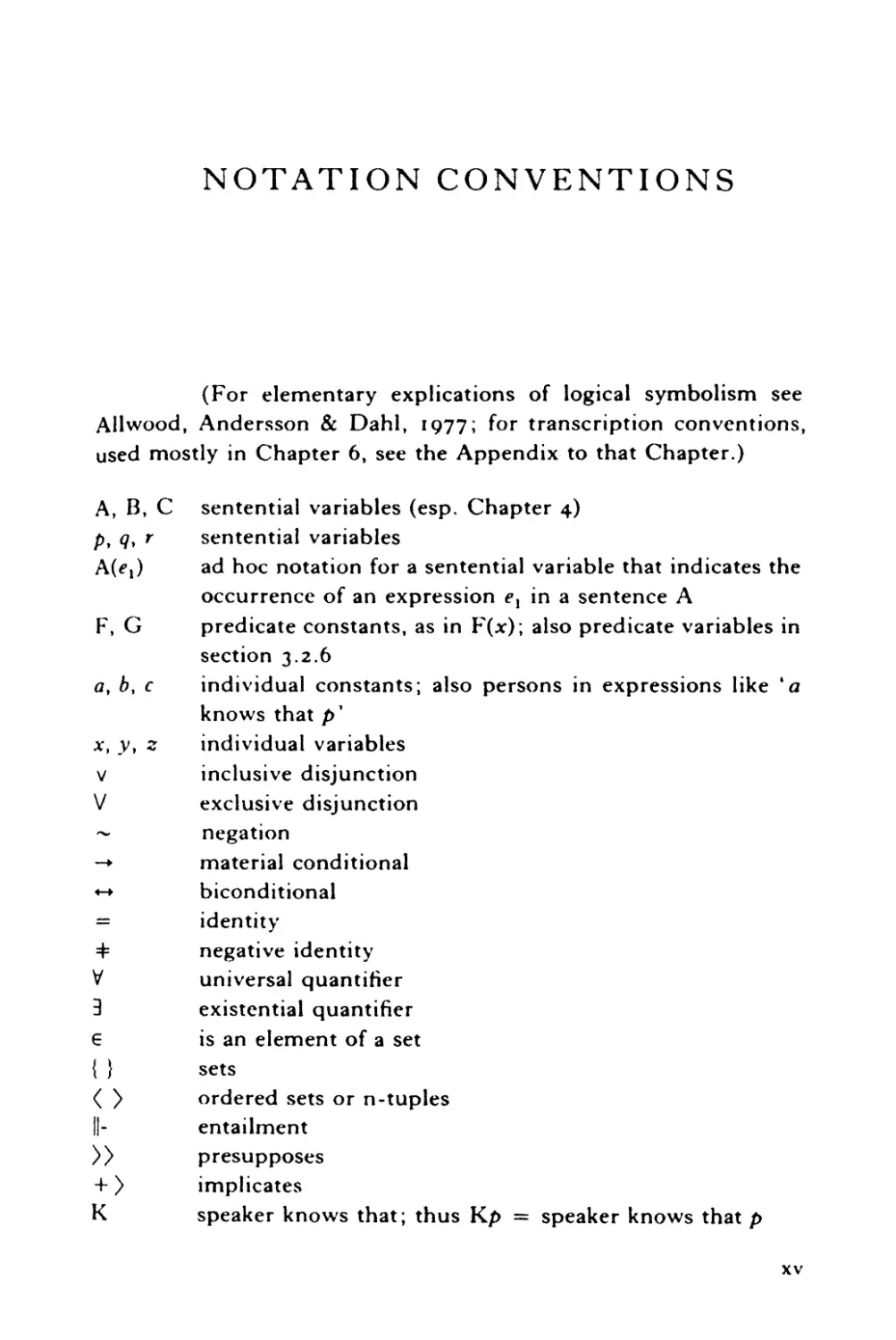
А, В, C p. r Ж)	sentential variables (esp. Chapter 4) sentential variables ad hoc notation for a sentential variable that indicates the occurrence of an expression e, in a sentence A
F, G	predicate constants, as in F(x); also predicate variables in section 3.2.6
a, 6, c	individual constants; also persons in expressions like ‘a knows that />’
x, V, z V V	individual variables inclusive disjunction exclusive disjunction negation
—►	material conditional biconditional
* V 3 e	identity negative identity universal quantifier existential quantifier is an element of a set sets
< > » + > К	ordered sets or n-tuples entailment presupposes implicates speaker knows that; thus K/> = speaker knows that p
XV
Notation Conventions
p	epistemic possibility for speaker; thus Pp = p iscompatible with all that the speaker knows
□ о A 7	necessary ; e.g. Op = it is necessary that p possible; e.g. Op = it is possible that p lambda-operator (Chapter 4) gamma-operator (Chapter 4)
xvi
The scope of pragmatics
The purpose of this Chapter is to provide some indication
of the scope of linguistic pragmatics. First, the historical origin of the
term pragmatics will be briefly summarized, in order to indicate
some usages of the term that are divergent from the usage in this book.
Secondly, we will review some definitions of the field, which, while
being less than fully satisfactory, will at least serve to indicate the
rough scope of linguistic pragmatics. Thirdly, some reasons for the
current interest in the field will be explained, while a final section
illustrates some basic kinds of pragmatic phenomena. In passing,
some analytical notions that are useful background will be
introduced. i.
i. i The origin and historical vagaries of the term
pragmatics
The modern usage of the term pragmatics is attributable
to the philosopher Charles Morris (1938), who was concerned to
outline (after Locke and Peirce)1 the general shape of a science of
signs, or semiotics (or semiotic as Morris preferred). Within
semiotics, Morris distinguished three distinct branches of inquiry:
syntactics (or syntax), being the study of “the formal relation of
signs to one another”, semantics, the study of “the relations of
signs to the objects to which the signs are applicable” (their
designate), and pragmatics, the study of “the relation of signs to
interpreters” (1938: 6). Within each branch of semiotics, one could
make the distinction between pure studies, concerned with the
’ Apart from this connection, there is only the slightest historical relation
between pragmatics and the philosophical doctrines of pragmatism (see
Morris, 1938 (1971: 43); Lyons, 1977a: 119). There have been recent
attempts, however, to recast Morris’s trichotomy in a Peircean (or pragmatist)
mould, which are not covered in this book: see Silverstein, 1976; Bean, 1978.
The scope of pragmatics
elaboration of the relevant metalanguage, and descriptive studies
which applied the metalanguage to the description of specific signs
and their usages (1938 (1971 : 24)).
As instances of usage governed by pragmatical rule, Morris
noted that “interjections such as Oh!, commands such as Come here!,
... expressions such as Good morning! and various rhetorical and
poetical devices, occur only under certain definite conditions in the
users of the language’’ (1938 (1971: 48)). Such matters would still
today be given a treatment within linguistic pragmatics. But Morris
went on to expand the scope of pragmatics in accord with his
particular behaviouristic theory of semiotics (Black, 1947): “It is a
sufficiently accurate characterization of pragmatics to say that it deals
with the biotic aspects of semiosis, that is, with all the psychological,
biological, and sociological phenomena which occur in the functioning
of signs’’ (1938: 108). Such a scope is very much wider than the work
that currently goes on under the rubric of linguistic pragmatics, for
it would include what is now' known as psycholinguistics, socio-
linguistics, neurolinguistics and much besides.
Since Morris’s introduction of the trichotomy syntax, semantics
and pragmatics, the latter term has come to be used in two very
distinct ways. On the one hand, the very broad use intended by
Morris has been retained, and this explains the usage of the term
pragmatics in the titles of books that deal, for example, with matters
as diverse as the psychopathology of communication (in the manner
of G. Bateson and R. D. Laing - see Watzlawick, Beavin & Jackson,
1967) and the evolution of symbol systems (see Cherry, 1974). Even
here though, there has been a tendency to use pragmatics exclusively
as a division of linguistic semiotics, rather than as pertaining to sign
systems in general. This broad usage of the term, covering socio-
linguistics, psycholinguistics and more, is still the one generally used
on the Continent (see e.g. the collection in Wunderlich, 1972, and
issues of the Journal of Pragmatics).
On the other hand, and especially within analytical philosophy,
the term pragmatics was subject to a successive narrowing of scope.
Here the philosopher and logician Carnap was particularly influential.
After an initial Morrisian usage (Carnap, 1938: 2), he adopted the
following version of the trichotomy:
If in an investigation explicit reference is made to the speaker,
or to put it in more general terms, to the user of the language,
2
/./ The origin of the term 4pragmatics'
then we assign it [the investigation] to the field of pragmatics
... If we abstract from the user of the language and analyze only
the expressions and their designata, we are in the field of
semantics. And, finally, if we abstract from the designata also
and analyze only the relations between the expressions, we are
in (logical) syntax.
Unfortunately Carnap’s usage of the term pragmatics was confused
by his adoption of Morris’s further distinction between pure and
descriptive studies, and he came to equate pragmatics with descriptive
semiotics in general, and thus with the study of natural (as opposed
to logical) languages (Carnap, 1959: 13; see the useful clarification
in Lieb, 1971). But Carnap was not even consistent here: he also held
(Carnap, 1956) that there was room for a pure pragmatics which
would be concerned with concepts like belief, utterance, and intension
and their logical inter-relation. This latter usage, now more or less
defunct, explains the use of the term in, for example, the title of a
book by Martin (1959). Thus at least four quite different senses of
the term can be found in Carnap’s works, but it was the definition
quoted above that was finally influential.
Incidentally, already in Morris’s and Carnap’s usages there can be
found a systematic three-way ambiguity: the term pragmatics was
applied not only to branches of inquiry (as in the contrast between
pragmatics and semantics), but also to features of the object language
(or language under investigation), so that one could talk of, say, the
pragmatic particle Oh! in English, and to features of the metalanguage
(or technical description), so that one could talk of, say, a pragmatic,
versus a semantic, description of the particle Oh!. Such an ambiguity
merely seems to parallel the way in which the sister terms semantics
and syntax are used, and to introduce little confusion (but cf.
Say ward, 1974).
The idea that pragmatics was the study of aspects of language that
required reference to the users of the language then led to a very
natural, further restriction of the term in analytical philosophy. For
there is one aspect of natural languages that indubitably requires such
reference, namely the study of deictic or indexical words like the
pronouns I and you (see Chapter 2). The philosophical, and especially
logical, interest in these terms is simply that they account for the
potential failure of generally valid schemes of reasoning. For example,
“I am Greta Garbo, Greta Garbo is a woman, therefore I am a
3
The scope of pragmatics
woman”, is only necessarily true if in addition to the first two
premises being true, the speaker of the conclusion is the same speaker
as the speaker of the first premise. Bar-Hillel (1954) therefore took
the view that pragmatics is the study of languages, both natural and
artificial, that contain indexical or deictic terms, and this usage was
explicitly adopted by Kalish (1967), and most influentially by
Montague (1968). Such a usage has little to offer linguists, since all
natural languages have deictic terms, and it would follow, as Gazdar
(1979a: 2) points out, that natural languages would have no semantics
but only a syntax and a pragmatics. If the trichotomy is to do some
work within linguistics, some less restricted scope for pragmatics
must be found.
In fact, in the late 1960s, an implicit version of Carnap’s definition -
investigations requiring reference to the users of a language - was
adopted within linguistics, and specifically within the movement
known as generative semantics. The history of that movement
aw'aits a historian of ideas (but see Newmeyer, 1980), but its
association with pragmatics can be explained by the resurgence of the
interest in meaning which the movement represented. Such an
interest inevitably involves pragmatics, as we shall see. Moreover this
interest in meaning in a wide sense proved to be one of the best
directions from which generative semantics could assail Chomsky’s
(1965) standard theory. At the same time, there was a keen interest
shown by linguists in philosophers ’ attempts to grapple with problems
of meaning, sometimes from the point of view of the ‘users of the
language’. For a period, at least, linguists and philosophers seemed
to be on a common path, and this commonality of interest crystallized
many of the issues with which this book is concerned. During this
period, the scope of pragmatics was implicitly restricted. Carnap’s
‘investigations making reference to users of the language’ is at once
too narrow’ and too broad for linguistic interests. It is too broad
because it admits studies as non-linguistic as Freud’s investigations
of ‘slips of the tongue’ or Jung’s studies of word associations. So
studies in linguistic pragmatics need to be restricted to investigations
that have at least potential linguistic implications. On the other
hand, Carnap’s definition is too narrow in that, on a simple inter-
pretation, it excludes parallel phenomena.2 For example, just as the
2 On another interpretation, all pragmatic parameters refer to users of the
language, if only because such parameters must, in order to be relevant, be
known or believed by participants.
4
1.2 Defining pragmatics
interpretation of the words I and you relies on the identification of
particular participants (or ‘users’) and their role in the speech event,
so the words here and now rely for their interpretation on the place
and time of the speech event. Therefore Carnap’s definition might
be amended to something like: ‘those linguistic investigations that
make necessary reference to aspects of the context’, where the term
context is understood to cover the identities of participants, the
temporal and spatial parameters of the speech event, and (as we shall
see) the beliefs, knowledge and intentions of the participants in that
speech event, and no doubt much besides.
To summarize, a number of distinct usages of the term pragmatics
have sprung from Morris’s original division of semiotics: the study
of the huge range of psychological and sociological phenomena
involved in sign systems in general or in language in particular (the
Continental sense of the term); or the study of certain abstract
concepts that make reference to agents (one of Carnap’s senses); or
the study of indexicals or deictic terms (Montague’s sense); or finally
the recent usage within Anglo-American linguistics and philosophy.
This book is concerned exclusively with the last sense of the term,
and it is to an explication of this particular usage that we should now
turn.
1.2 Defining pragmatics
The relatively restricted sense of the term pragmatics in
Anglo-American philosophy and linguistics, and correspondingly in
this book, deserves some attempt at definition. Such a definition is,
however, by no means easy to provide, and we shall play with a
number of possibilities each of which will do little more than sketch
a range of possible scopes for the field. This diversity of possible
definitions and lack of clear boundaries may be disconcerting, but it
is by no means unusual: since academic fields are congeries of
preferred methods, implicit assumptions, and focal problems or
subject matters, attempts to define them are rarely wholly satisfactory.
And indeed, in one sense there is no problem of definition at all: just
as, traditionally, syntax is taken to be the study of the combinatorial
properties of words and their parts, and semantics to be the study of
meaning, so pragmatics is the study of language usage. Such a
definition is just as good (and bad) as the parallel definitions of the
sister terms, but it will hardly suffice to indicate what the practioners
5
The scope of pragmatics
of pragmatics actually do; to find that out, as in any discipline, one
must go and take a look.
Nevertheless, there are reasons for attempting at least some
indication of the scope of pragmatics. In the first place, it is simply
a sufficiently unfamiliar term. In the second place, it is not so easy
to just ‘go and take a look* at what workers in pragmatics do: there
are (at the time of writing) no available textbooks, only one specialist
journal (Journal of Pragmatics) and that covering the broader
Continental usage of the term, only a handful of monographs and a
few collections of papers. Nevertheless, there is much work scattered
throughout the various journalsof linguistics and philosophy. Thirdly,
some authors seem to suggest that there is no coherent field at all ;
thus Lyons (1977a: 117) states that “the applicability [of the
distinction between syntax, semantics and pragmatics] to the
description of natural languages, in contrast to the description or
construction of logical calculi, is, to say the least, uncertain ”, while
Searle, Kiefer & Bierwisch (1980: viii) suggest that "Pragmatics is
one of those words (societal and cognitive are others) that give the
impression that something quite specific and technical is being talked
about when often in fact it has no clear meaning. ” The pragmaticist
is thus challenged to show that, at least within the linguistic and
philosophical tradition that is the concern of this book, the term does
have clear application.
Let us therefore consider a set of possible definitions of pragmatics.
We shall find that each of them has deficiencies or difficulties of a sort
that would equally hinder definitions of other fields, but at least in
this way, by assaults from all flanks, a good sketch of the general
topography can be obtained.
Let us start with some definitions that are in fact less than
satisfactory. One possible definition might go as follows: pragmatics
is the study of those principles that will account for why a certain set
of sentences are anomalous, or not possible utterances. That set might
include:3
3 We shall use the symbol ? ? at the beginning of example sentences to indicate
that they are (at least putatively) pragmatically anomalous, reserving * for
sentences that are syntactically ill-formed or semantically anomalous; a single
initial ? indicates anomaly on at least one of these three levels, but is
non-committal about the nature of the anomaly.
6
1.2 Defining pragmatics
0)	??Come there please!
(2)	??Aristotle was Greek, but I don’t believe it
0)	??Fred’s children are hippies, and he has	no	children
(4)	??Fred’s children are hippies, and he has	children
(5)	??I order you not to obey this order
(6)	??I hereby sing
(7)	? ?As everyone knows, the earth please revolves around the sun
The explanation of the anomalies exhibited by these sentences might
be provided by pointing out that there are no, or at least no ordinary,
contexts in which they could be appropriately used? Although an
approach of this sort may be quite a good way of illustrating the kind
of principles that pragmatics is concerned with, it will hardly do as
an explicit definition of the field - for the simple reason that the set
of pragmatic (as opposed to semantic, syntactic or sociolinguistic)
anomalies are presupposed, rather than explained.4 5
Another kind of definition that might be offered would be that
pragmatics is the study of language from a functional perspective,
that is, that it attempts to explain facets of linguistic structure by
reference to non-linguistic pressures and causes. But such a definition,
or scope, for pragmatics would fail to distinguish linguistic pragmatics
from many other disciplines interested in functional approaches to
language, including psycholinguistics and sociolinguistics. Moreover,
it may be plausibly argued that to adopt a definition of this sort is
to confuse the motives for studying pragmatics, with the goals or
general shape of a theory (about which more later).
One quite restricted scope for pragmatics that has been proposed
is that pragmatics should be concerned solely with principles of
language usage, and have nothing to do with the description of
linguistic structure. Or, to invoke Chomsky’s distinction between
competence and performance, pragmatics is concerned solely
with performance principles of language use. Thus, Katz & Fodor
(1963) suggested that a theory of pragmatics (or a theory of setting
4 This line of argument relies on the distinction between use and mention,
or between ‘ordinary’ usage and metalinguistic usage, for which see Lyons,
1977a:	and references therein. In the sense of this distinction, sentences
like (1)-(7) can be mentioned, but they cannot easily be used.
5 Another problem is that it is often in fact possible to imagine contexts in
which the alleged anomalies are after all quite usable the reader can try with
the examples above. This problem will recur when we consider the concept
of appropriateness of an utterance, discussed below.
7
The scope of pragmatics
selection as they then called it) would essentially be concerned with
the disambiguation of sentences by the contexts in which they were
uttered. In fact it is clear that contexts do a lot more than merely select
between available semantic readings of sentences - for example,
irony, understatement and the like are kinds of use that actually create
new interpretations in contexts. Still, one could claim that grammar
(in the broad sense inclusive of phonology, syntax and semantics) is
concerned with the context-free assignment of meaning to linguistic
forms, while pragmatics is concerned with the further interpretation
of those forms in a context :
[Grammars] are theories about the structure of sentence types
... Pragmatic theories, in contrast, do nothing to explicate the
structure of linguistic constructions or grammatical properties
and relations ... They explicate the reasoning of speakers and
hearers in working out the correlation in a context of a sentence
token with a proposition. In this respect, a pragmatic theory
is part of performance. (Katz, 1977: 19)
This position has a number of adherents (Kempson, 1975, 1977;
Smith & Wilson, 1979), but it has a serious difficulty. The problem
is that aspects of linguistic structure sometimes directly encode (or
otherwise interact with) features of the context. It then becomes
impossible to drawr a neat boundary between context-independent
grammar (competence) and context-dependent interpretation
(performance). This problem is unwittingly illustrated by Katz’s
explication of this boundary: he points out that the pairs rabbit and
bunny, or dog and doggie differ in that the second member of each pair
is appropriately used either by or to children. Since the distinction
is one relating to the appropriate users of the terms in a context, the
distinction would not be part of a linguistic description of English,
which would merely note that the members of each pair are
synonymous. However, it is clear that the distinction is built into the
language, in just the same way that in many languages degrees of
respect between participants are encoded in lexis and morphology.
Katz suggests that in order to ascertain whether a linguistic feature
is context-dependent or context-independent, we imagine the feature
occurring on an anonymous postcard (as an approximation to the
empty or null context).6 But if we apply this criterion we see that
• Here contrast Searle (1979b: 117). “There is no such thing as the zero or
null context for the interpretation of sentences ... we understand the meaning
8
1.2 Defining pragmatics
the implication or inference that speaker or addressee is a child is as
available when bunny is written on an anonymous postcard as it is
when said in some concrete appropriate context (Gazdar, 1979a: 3).
And that of course is because the kind of appropriate speaker or
addressee is encoded by the term bunny.
Here we come to the heart of the definitional problem: the term
pragmatics covers both context-dependent aspects of language
structure and principles of language usage and understanding that
have nothing or little to do with linguistic structure. It is difficult to
forge a definition that will happily cover both aspects. But this should
not be taken to imply that pragmatics is a hodge-podge, concerned
with quite disparate and unrelated aspects of language; rather,
pragmaticists are specifically interested in the inter-relation of
language structure and principles of language usage. Let us now
consider some potential definitions that are more plausible
candidates.
We may begin with a definition that is specifically aimed at
capturing the concern of pragmatics with features of language
structure. The definition might go as follows:
(8)	Pragmatics is the study of those relations between language and
context that are grammaticalized, or encoded in the structure
of a language7
Or, putting it another way, one could say that pragmatics is the study
of just those aspects of the relationship between language and context
that are relevant to the writing of grammars. Such a definition
restricts pragmatics to the study of certain aspects of linguistic
structure, and stands in strong contrast to Katz’s proposal, outlined
above, that would restrict pragmatics to the study of grammatically
irrelevant aspects of language usage. Such a scope for pragmatics
would include the study of deixis, including honorifics and the like,
and probably the study of presupposition and speech acts, i.e.
much of the present book. It would exclude the study of principles
of language usage that could not be shown to have repercussions on
the grammar of languages, and this could be an embarrassment,
of such sentences only against a set of background assumptions about the
contexts in which the sentence could be appropriately uttered.”
7 The term grammaticalization is used throughout this book in the broad sense
covering the encoding of meaning distinctions again in a wide sense in the
lexicon, morphology, syntax and phonology of languages.
9
The scope of pragmatics
because, at least at first sight, the extremely important implications
called conversational implicatures would lie outside the purview
of a pragmatic theory. On the other hand, such a scope for pragmatics
has the possible advantage that it would effectively delimit the field,
and exclude neighbouring fields like sociolinguistics and psycho-
linguistics - in short it would bound Morris’s and Carnap’s definitions
in a way that guaranteed linguistic relevance.
Now, any definition of pragmatics that excludes one of its presumed
focal phenomena, namely conversational implicature, is unlikely to
be attractive. Nevertheless, its adherents might appeal to the plausi-
bility of the following general principle: any systematic principle of
language usage is ultimately likely to have an impact on language
structure. There is perhaps some basis for such an assumption (see
e.g. Brown & Levinson, 1978: z6off). And in fact conversational
implicatures, which are inferences that arise on the basis of some
general rules or maxims of conversational behaviour, can indeed be
shown to have repercussions on linguistic structure (see Chapter 3
below). So the definition may in fact be much less restrictive than it
appears at first sight.
Other problems concern the notions of context and gram-
maticalization that the definition rests on. Arguably, though, it is a
strength of this approach that it is not required to give a prior
characterization of the notion of context. For, assuming that we have
a clear idea of the limits of semantics, then pragmatics studies all the
non-semantic features that are encoded in languages, and these
features are aspects of the context. What aspects of the gross physical,
social and interactional aspects of the situation of utterance are
linguistically relevant is thus an empirical question, and we can study
the world’s languages to find out what they are. Of course, we would
need to make an important distinction here between universal
pragmatics, the general theory of what aspects of context get
encoded and how, and the language-specific pragmatics of
individual languages; for example, the pragmatics of English might
have relatively little to say about social status (beyond what we need
to describe the appropriate contexts for the use of sir, your honour and
the like), while in contrast the pragmatics of Japanese would be
greatly concerned with the grammaticalization of the relative social
ranks of participants and referents.
On the other hand, the notion of grammaticalization, or linguistic
10
1.2 Defining pragmatics
encoding, is thorny. To be effective, we need to be able to distinguish
mere correlation between linguistic form and context from
incorporation of contextual significance into the associated linguistic
form. There is little doubt that there are clear cases of the one and
the other: for example, the slurred speech associated with drunkenness
may be mere correlation, while the association of intimacy or
solidarity with the French pronoun tu is a grammaticalized feature
of context. But there are many borderline cases. To make the
distinction, perhaps the following criteria might be suggested: for a
feature of the context to be linguistically encoded, (a) it must be
intentionally communicated, (b) it must be conventionally associated
with the linguistic form in question, (c) the encoding form must be
a member of a contrast set, the other members of which encode
different features, (d) the linguistic form must be subject to regular
grammatical processes. On these grounds one might hope to exclude,
say, the association of a particular dialect with a speaker from a
particular area - such an association, perhaps, not being normally
intentionally conveyed, not being associated with the linguistic
features by arbitrary convention but by historical ‘accident’, and so
on. On the other hand, features of ‘baby talk*, of which the lexical
alternate bunny is a part, wrould presumably be considered to be
encoded in English, because at least some of them seem to meet these
criteria. However, it is unlikely that these criteria are sufficient to
distinguish many borderline cases, and the notion would need further
explication.8
In sum, the main strength of this definition of pragmatics is that
it restricts the field to purely linguistic matters. Yet it is probably too
restrictive to reflect accurately current usage. The most unfortunate
restriction is the exclusion of those principles of language use and
interpretation that explain how extra meaning (in a broad sense) is
‘read into’ utterances without actually being encoded in them. It
is a definition, then, that handles the aspect of pragmatics concerned
with linguistic structure, but not the side concerned with principles
of language usage, or at least only indirectly as they impinge on
linguistic organization.
In the definition above, the notion of encoding implies that
pragmatics is concerned with certain aspects of meaning. One kind
of definition that would make this central might run as follows:
* Consider e.g. the French Je suis malheureuse, which encodes that the speaker
is female: in what sense would this be intentionally communicated?
I 1
The scope of pragmatics
(9)	Pragmatics is the study of all those aspects of meaning not
captured in a semantic theory
Or, as Gazdar (1979a: 2) has put it, assuming that semantics is limited
to the statement of truth conditions:
Pragmatics has as its topic those aspects of the meaning of
utterances which cannot be accounted for by straightforward
reference to the truth conditions of the sentences uttered.® Put
crudely: PRAGMATICS = MEANING TRUTH
CONDITIONS.
Such a definition is likely, at first, to cause puzzlement. Surely
semantics is, by definition, the study of meaning in its entirety, so
how can there be any residue to constitute the topic of pragmatics?
But here we need to note that the definition of semantics as the study
of meaning is just as simplistic as the definition of pragmatics as the
study of language usage. F irst, we need to distinguish between some
broad sense of the term semantics used in a more or less pre-theoretical
way (see e.g. the coverage in Lyons, 1977a),10 and a technical use of
the term to cover a particular, deliberately restricted semantic theory
in an overall theory of grammar, or language structure. Semantic
theory in the latter sense is going to have a very much narrower scope
than the study of meaning in its entirety, as we shall indicate
immediately below. Secondly, the intended scope of the term meaning
in the definition is extremely broad, in a way that will need explication.
So the answer to the puzzle is that, from the point of view of an overall
integrated linguistic theory, there will be a great deal of the general
field of meaning left unaccounted for by a restricted semantic theory,
and this could indeed constitute the domain of pragmatics.
One objection to such a definition could be that the scope of
pragmatics would seem therefore to vary considerably according to
the kind of semantic theory adopted - narrow semantic theories like
those based on truth conditions will leave a large residue of ‘ meaning ’
to be studied in pragmatics; apparently broader semantic theories, like
some of those based on components or features of meaning, may leave
much less for pragmatics to deal with.11 Certainly it has to be
* The "straightforward" qualification, Gazdar explains, is necessary because
pragmatic implications often derive in part from the truth conditions of
sentences uttered See Chapter 3 below.
10 A usage general in linguistics until (he influence of formal semantics,
practised by philosophers, was felt in the 1960s.
” beature-based semantic theories are not of course inherently broader than
truth-conditional ones. But feature-based theories are usually associated w ith
I 2
1.2 Defining pragmatics
admitted that to some extent the nature of a pragmatic theory must
depend crucially on the kind of semantic theory adopted, but that will
be true for any definition of pragmatics that seeks an exclusive
domain, complementary and non-overlapping with semantics. But it
is important to see that this dependency is only partial, for we now
know enough about the nature of meaning in the broad sense to make
it likely that there are substantial areas that could not be accommodated
within any single semantic theory built on homogeneous principles.
This knowledge is based on some substantial advances made in the
last ten years or so, namely the discovery that there are at least half
a dozen distinct and different kinds of meaning component or
implication (or inference) that are involved in the meaning of natural
language utterances. The distinctions are based on the fact that each
of these kinds of inference behaves in different ways. In particular,
they behave differently in projection, i.e. in the ways in which they
are compounded when a complex sentence, whose parts produce the
inferences in question, is built up. Some of these meaning components
disappear under specific and distinctive conditions, namely particular
linguistic constructions. In addition, some of these meaning
components are defeasible, i.e. subject to cancellation by features
of the context (a notion explained in Chapter 3 below). Such features
interact with or arise from assumptions made by participants in the
context, and are particularly inappropriate aspects of meaning to
incorporate within a semantic theory. The dilemma that these
multiple aspects of meaning pose for the semanticist can perhaps best
be gauged from Table 1.1. Here we list seven such putative meaning
components or inferential relations of an utterance, but it should be
borne in mind that these particular aspects of meaning are subject to
revision and addition: some may well collapse into others, while
additional kinds of inference arc undoubtedly waiting to be discovered
(indeed, in the Chapters below, we shall be much concerned with how
well each of these concepts is established).
The problem posed for the semantic theorist is how much to bite
off - certainly no single coherent semantic theory can contain all these
divergent aspects of meaning. If the theorist admits just the first kind
of meaning component, the truth-conditional content, then at least
(a) there are no conflicting principles for the inclusion or exclusion
a scope for semantics that would include all the conventional content of
sentences, whereas (as we shall see) truth-conditional theories cannot have
such a broad scope.
И
The scope of pragmatics
Table i. i Elements of the communicational content of an utterance
i.	truth-conditions or entailments (Chapter 2 and passim)
2.	conventional implicatures (Chapter 3)
3.	presuppositions (Chapter 4)
4.	felicity conditions (Chapter 5)
5.	conversational implicature - generalized (Chapter 3)
6.	conversational implicature - particularized (Chapter 3)
7.	inferences based on conversational structure (Chapter 6)
Note: 1-2, and possibly also 3 and 4. are conventional; y~7 are defeasible
or context-dependent.
of phenomena and (b) semantic theory can be built on strictly
homogeneous lines. Such a semantics will be narrow, and leave a great
deal to pragmatics. On the other hand, if the theorist is determined
that semantics should deal with all the conventional content of an
utterance’s significance (however exactly that is to be determined),12
then semantic theory will deal with aspects i and 2, and quite likely
3 and possibly 4 as well. The inclusion of presupposition is awkward,
however, for if presupposition is conventional, then it is also defeasible
or context-dependent, and matters of context are best left for
pragmatics. Thus, such a semantic theory (a) will contain conflicting
principles for the inclusion (conventionality) and exclusion (defeasi-
bility) of phenomena and (b) will have to be built on heterogeneous
lines to include phenomena with quite different properties. Such
difficulties might motivate a retreat to a semantic theory that deals
only with aspects 1 and 2, i.e. conventional content that is non-
defeasible, as an unhappy compromise.
In this book we shall assume, for working purposes, that a semantic
” The notion of conventional content tsclearer intuitively than it istheoretically;
for example, we would want to say that the termffmus has the conventional
content 'exceptional intellect’ or the like, even though it may be predicated
ironicalJy, and thus convey the non-convcntional meaning 'exceptional
idiot’. Such a distinction would seem to rest on the distinction between
content that is inherent or ’given’ (cf. the Saussurean notion of the
arbitrariness of the linguistic sign) and meaning that may be derived by
general principles of inference taking contextual factors into account. See
Lewis, 1969 for an important philosophical analysis of the concept of
convention, which stresses the essentially arbitrary nature of any convention
See also Morgan. 1978; Searle. 1979b on the notion literal meaning.
*4
i.2 Defining pragmatics
theory is truth-conditional. Apart from the fact that it avoids the
above dilemmas, by claiming only the narrowest scope for semantics,
such a theory recommends itself to the pragmaticist for the following
reasons. First, it is the only kind of theory now available that is precise
and predictive enough to make investigable the nature of a
semantics/pragmatics boundary, or the interaction between the two
components. Secondly, it is arguable that most other theories, e.g.
those based on semantic components, can be subsumed within it, in
so far as they are built on consistent and logical lines. Thirdly, it is
perhaps still the kind of theory with the most support in linguistic
and philosophical circles, despite many dissenters and many un-
resolved problems. Finally, many of the issues in pragmatics have
arisen historically from this particular vantage point, and to understand
them one must at least at first approach from the same direction. But
ultimately, the pragmaticist may do well to remain agnostic, whatever
semantic theory is assumed for working purposes.
The point here, however, is that whatever kind of semantic theory
is adopted, many aspects of meaning in a broad sense simply cannot
be accommodated if the theory is to have an internal coherence and
consistency. From what we now know about the nature of meaning,
a hybrid or modular account seems inescapable: there remains the
hope that with two components, a semantics and a pragmatics
working in tandem, each can be built on relatively homogeneous and
systematic lines. Such a hybrid theory will almost certainly be
simpler and more principled than a single amorphous and hetero-
geneous theory of semantics.
So the notion that pragmatics might be the study of aspects of
meaning not covered in semantics certainly has some cogency. But
we need to know how the broad sense of meaning, on which the
definition relies, is to be delimited. This broad sense should include
the ironic, metaphoric and implicit communicative content of an
utterance, and so it cannot be restricted to the conventional content
of what is said. But does it include all the inferences that can be made
from (a) what is said and (b) all the available facts about the world
known to participants? Suppose that Moriarty says that his watch
broke, and from this Sherlock Holmes infers that he perpetrated the
crime: although the information may have been indirectly conveyed,
we should be loath to say that Moriarty communicated it. For
communication involves the notions of intention and agency, and only
>5
The scope of pragmatics
those inferences that are openly intended to be conveyed can properly
be said to have been communicated. To help us draw a line between
the incidental transfer of information, and communication proper, we
may appeal to an important idea of the philosopher Grice (1957).
Distinguishing between what he calls natural meaning (as in Those
black clouds mean rain), and non-natural meaning or meaning-nn
(equivalent to the notion of intentional communication), Grice gives
the following characterization of meaning-nn :13
(10)	S meant-nn z by uttering U if and only if:
(i)	S intended U to cause some effect z in recipient H
(ii)	S intended (i) to be achieved simply by H recognizing that
intention (i)
Here, S stands for speaker (in the case of spoken communication;
for sender or communicator in other cases); H for hearer, or more
accurately, the intended recipient; “uttering U” for utterance of a
linguistic token, i.e. a sentence part, sentence, or string of sentences
or sentence parts (or the production of non-linguistic communicative
acts); and z for (roughly) some belief or volition invoked in H.
Such a definition is likely to be opaque at first reading, but what
it essentially states is that communication consists of the ‘sender’
intending to cause the ‘receiver’ to think or do something, just by
getting the ‘receiver* to recognize that the ‘sender’ is trying to cause
that thought or action. So communication is a complex kind of
intention that is achieved or satisfied just by being recognized. In the
process of communication, the ‘sender’s’ communicative intention
becomes mutual knowledge to ‘sender’ (S) and ‘receiver’ (H), i.e.
S knows that H knows that S knows that H knows (and so ad
infinitum) that S has this particular intention.14 Attaining this state
of mutual knowledge of a communicative intention is to have
successfully communicated. A simple illustration may help to clarify
the concept: it distinguishes between two kinds of ‘boos’, or
13 There is a slight rephrasing of Grice’s (1957) formulation here, legitimated,
I hope, by Schiffer’s (1972: 14) discussion.
14 The concept of mutual knowledge is discussed in Lew is, 1969, and Schiffer,
1972: joff, and is of considerable potential importance to pragmatic theory;
e.g. one may want to say that a speaker presupposes what speaker and
addressee mutually know (although there are difficulties with this view sec
Chapter 4 below). Schiffer (1972 : 39) argues that the definition of meaning-nn
should in fact make explicit reference to the concept of mutual know ledge.
For a recent collection of papers on the subject see Smith, 1982.
16
1.2 Defining pragmatics
attempts to frighten someone. Suppose I leap out from behind a tree,
and by sheer surprise frighten you. I have caused an effect in you by
‘natural’ means. But now suppose that you know I am behind the
tree, you are expecting me to leap out, and I know you know all that:
1 can still (maybe) frighten you by leaping out, just by getting you
to realize that I intend to frighten you. Only the second is an instance
of communication (meaning-nn) in Grice’s sense. Grice intended his
definition of communication to cover such non-verbal cases, but we
will be concerned here (and henceforth) only with those cases where
linguistic behaviour is part of the means whereby the communicative
intention is recognized.
A puzzle that immediately arises is how this complex reflexive
communicative intention is meant to be recognized by the recipient.
Surely, one could argue, it can only be recognized by knowledge of
some convention that U means z\ but in that case we can do away
with talk of complex intentions and construct an account of communi-
cation based directly on the notion of conventional signal. But this
misses Grice’s essential insight, namely that what the speaker means
by U is not necessarily closely related to the meaning of U at all.
Indeed U may have no conventional meaning, which allows for the
creation of new terms, nonce expressions, and thus ultimately for
some aspects of language change (for an explanation of how these
communications may be understood, see Schiffer, 1972: Chapter V).
But crucial for pragmatics, Grice’s theory explains how there can be
interesting discrepancies between speaker-meaning (Grice’s
meaning-nn) and sentence-meaning.15 For example, Linguistics is
fascinating said ironically may be intended by the speaker to
communicate ‘Linguistics is deadly boring’. Further, there appear
to be general conventions about the use of language that require (or,
perhaps, merely recommend) a certain degree of implicitness in
15	This distinction is sometimes talked about in terms of conveyed meaning
vs. literal meaning. In this book, instead of the notion literal meaning, we
shall prefer the terms sentence-meaning or conventional content (the
latter to cover linguistic expressions that are not necessarily sentences),
although it is hard to do without the adjectival uses of literal. The reader is
warned that none of these concepts is entirely clear (see e.g. Gazdar, 1979a:
i57ff; Searle, 1979b: Chapter 5). There is a possible distinction between the
notions sentence-meaning and literal meaning, such that e.g. kick the bucket
has two sentence-meanings (one idiomatic, the other compositional) but only
one literal meaning (the compositional, non-idiomatic reading). But we shall
not exploit this distinction below.
17
The scope of pragmatics
communication, with the consequence that it is virtually ensured that
what the speaker means by any utterance U is not exhausted by the
meaning of the linguistic form uttered (see Chapter 3 below). How
then is the full communicative intention to be recognized ? By taking
into account, not only the meaning of U, but also the precise
mechanisms (like irony, or general assumptions of a certain level of
implicitness) which may cause a divergence between the meaning of
U and what is communicated by the utterance of U in a particular
context. Much of this book is concerned with spelling out these
mechanisms which, like other aspects of linguistic knowledge, we use
daily in an unconscious way.
If we now adopt Grice’s meaning-nn as the scope of meaning in the
definition of pragmatics in (9), we shall include most of the phenomena
that we want to include, like the ironic, metaphoric and indirect
implications of what we say (elements 5, 6 and 7 in Table 1.1), and
exclude the unintended inferences that intuitively have no part to play
in a theory of communication. It should be added that there are a
number of philosophical problems with Grice’s theory (see e.g.
Schiffer, 1972), but they do not seem to vitiate the value of the central
idea.
We now have some sketch of the scope of meaning that is referred
to in the definition, namely all that can be said to have been
communicated, in Grice’s sense, by the use of a linguistic token in
a context. But can we give as a definition of pragmatics nothing but
the complement of, or the residue left by, semantics in the field of
meaning? Is there no conceptual integrity to the scope of pragmatics
itself? We might try to find such a conceptual unity by making the
distinction between sentence-meaning and utterance-meaning, and
hope then to be able to equate semantics with the study of sentence-
meaning and pragmatics with the study of utterance-meaning.
The distinction between sentence and utterance is of fundamental
importance to both semantics and pragmatics. Essentially, we want
to say that a sentence is an abstract theoretical entity defined within
a theory of grammar, while an utterance is the issuance of a sentence,
a sentence-analogue, or sentence-fragment, in an actual context.
Empirically, the relation between an utterance and a corresponding
sentence may be quite obscure (e.g. the utterance may be elliptical,
or contain sentence-fragments or ‘ false-starts’), but it is customary
(after Bar-Hillel) to think of an utterance as the pairing of a sentence
18
i.2 Defining pragmatics
and a context, namely the context in which the sentence was uttered.
It is important, but in practice exceedingly difficult, to maintain this
distinction at all times in the study of meaning. As an index of the
difficulty, one may note that linguists frequently oscillate between
assigning notions like presupposition, illocutionary force, truth condition
to sentences or utterances, although important theoretical con-
sequences follow from the choice. One may claim that the confusion
here results from the need for yet further distinctions: thus Lyons
(1977a) advocates distinctions between text-sentences and system-
sentences, sentence-types and sentence-tokens, utterance-types and
utterance-tokens, and utterance-acts and utterance-products. It is
unlikely, though, that we can handle all these if we cannot make the
first distinction systematically (and the alert reader can no doubt find
mistakes of this sort within this book). For expositional reasons, we
shall need to use the word utterance in various ways in this book, but
where it is used to contrast with sentence it should be taken in the sense
advocated by Bar-Hillel, as a sentence (or sometimes string of
sentences) paired with a context.16 And this is the sense relevant to
the proposal that semantics is concerned with sentence-meaning, and
pragmatics with utterance-meaning.
Many authors accept this equation implicitly, but there are a
number of problems with it. In the first place, in the (rare) cases where
sentence-meaning exhausts utterance-meaning (i.e. where the speaker
meant exactly what he said, no more, no less), the same content would
be assigned both to semantics and pragmatics. In other words, we
would need to restrict the notion of utterance-meaning in such a way
that we subtract sentence-meaning, and in that case we are back to
a definition of pragmatics by residue. But there are other problems:
for there are aspects of sentence-meaning which, at least on truth-
conditional or other narrow semantic theories, cannot be accounted
for within semantic theory. Such aspects are conventional but
non-truth-conditional elements of sentence-meaning, e.g. what we
shall call conventional implicatures and (at least on many theories)
’* Here the simplifying assumption is made that what speakers produce -
Lyons’s utterance-products - are equivalent to sentences, Lyons’s system-
sentences or theoretical entities. The limitations of such an assumption will
be made clear in Chapter 6. The other main way in which the term utterance
will be used is as a pre-theoretical term to label “any stretch of talk, by one
person, before and after which there is silence on behalf of that person”
(Harris, 1951: 14; adopted in Lyons, 1977a: 26).
19
The scope of pragmatics
presuppositions, and perhaps even aspects of illocutionary force
(concepts expounded in the Chapters below). On the assumption of
a truth-conditional semantics, such aspects of sentence-meaning
would have to be dealt with in pragmatics, and so there can be no
direct equation of sentence-meaning and semantics. On the same
assumption, there is another overwhelming problem for the proposal:
for it is not sentences but rather utterances that make definite
statements, and thus can sensibly be assigned truth conditions (as
philosophers have long noted; see e.g. Strawson, 1950; Stalnaker,
1972). The argument rests in part on the pervasive nature of deixis
(see Chapter 2 below) in natural languages, for sentences like (11) are
true or false only relative to contextual parameters, thanks to the fact
that /, now and the tense of am are variables given specific values only
on particular occasions of utterance (i.e. (11) is true only when spoken
by certain speakers, those who are sixty-three, or true of individuals
only at certain times, when they are sixty-three):
(11)	I am now sixty-three years old
These facts seem to establish that truth conditions must be assigned
to utterances, i.e. sentences with their associated contexts of utterance,
not to sentences alone (or, if one likes, truth conditions include
context conditions). So again, it makes no sense to equate semantics
with the study of sentence-meaning.
There is another formulation of essentially the same proposal:
semantics should be concerned with meaning out of context, or
non-context-dependent meaning, and pragmatics with meaning in
context. The strong version of this, apparently held by Katz (1977),
assumes that there is some given, natural level of context-independent
meaning, and that sentence-meaning can be described independently
and prior to utterance-meaning. But as we have argued, and will
illustrate below, this does not seem to be the case. For, if one accepts
a truth-conditional semantics then one is forced to state truth
conditions on sentences-in-contexts, or if one prefers (as Katz would)
that semantics is concerned with aspects of meaning assigned by
convention to linguistic forms, then one includes context-dependent
aspects of meaning within semantics. A weaker version of the same
proposal would be to consider that semantics is an abstraction away
from context-dependent utterances, in so far as this is possible (as
suggested by Carnap, 1959: 13; Lyons, 1977a: 591). In any case, it
does not seem that the distinction between sentence-meaning and
20
i.2 Defining pragmatics
utterance-meaning can be relied upon to clarify the distinction
between semantics and pragmatics.
We are left with the unrefined definition that pragmatics is
concerned with the study of those aspects of meaning not covered in
semantics. Despite many advantages, such a definition fails to draw
attention to the unifying characteristics of pragmatic phenomena. Let
us turn to another definition that would give the context-dependent
nature of such phenomena more centrality:
(12)	Pragmatics is the study of the relations between language and
context that are basic to an account of language understanding
Here the term language understanding is used in the way favoured
by workers in artificial intelligence to draw attention to the fact that
understanding an utterance involves a great deal more than knowing
the meanings of the words uttered and the grammatical relations
between them. Above all, understanding an utterance involves the
making of inferences that will connect what is said to what is mutually
assumed or what has been said before.
The strengths of such a definition are as follows. It recognizes that
pragmatics is essentially concerned with inference (Thomason,
1977): given a linguistic form uttered in a context, a pragmatic theory
must account for the inference of presuppositions, implicatures,
illocutionary force and other pragmatic implications. Secondly,
unlike the definition in (8), it does not make the distinction between
semantics and pragmatics along the encoded/unencoded line; this is
important because, as we shall see, there is still controversy over
whether such pragmatic implications as presuppositions or illocu-
tionary force are or are not encoded or grammaticalized in linguistic
forms. Thirdly, it includes most aspects of the study of principles of
language usage, for there seems to be a general principle of the
following kind: for each systematic set of constraints on the use of
language, there will be a corresponding set of inference-procedures
that will be applied to language understanding (see Levinson, 1979a).
The weaknesses are, unfortunately, equally clear. First, pragmatics
will then include the study of the interaction between linguistic
knowledge and the entirety of participants’ knowledge of the world
(or ‘encylopaedic knowledge’). For example, in order to understand
the little story in (13), one needs to know the following assorted facts:
presents are usually bought with money; piggy-banks are used to hold
money; piggy-banks are generally made of a dense material like metal
21
The scope of pragmatics
or plastic; money inside a container of dense material will generally
rattle, etc.
(i 3) Jill wanted to get Bill a birthday present, so she went and found
her piggy-bank; she shook it, but there was no noise; she would
have to make Bill a present
This example comes from work in artificial intelligence (Charniak,
1972) which is concerned with the attempt to translate the significance
of ordinary utterances into an explicit representation that might be
used by a computer to produce ‘intelligent* responses. The immense
difficulties of such translations have served to emphasize just how
great a role assumed knowledge plays in the understanding of
utterances.
However, this interpretive dependence on background assumptions
has been used as an argument against the possibility of any systematic
study of language understanding: if the set of potentially relevant
assumptions is coincident with the total set of facts and beliefs held
by participants, then to study this interpretive process will be to study
the total sum of human knowledge and beliefs (Katz & Fodor, 1963).
The argument is clearly fallacious: just as rules of logical deduction
can be stated which will apply to an indefinitely large set of
propositions, so it is quite possible that the principles that underlie
the interaction between utterances and assumptions (however
particular they may be) can be simply and rigorously stated.
Nevertheless, if pragmatics is to be considered a component within
linguistic theory (a question to which we shall return), it may be that
to include such principles is indeed to include too much. But little
serious thought has been given to this problem.
Another difficulty facing this definition or scope for pragmatics, is
that it calls for some explicit characterization of the notion of
context. In an earlier definition, where pragmatics was restricted to
encoded aspects of context, one could claim that the relevant aspects
of context should not be specified in advance but rather discovered
by a survey of the world’s languages. Here though, unless one wants
to claim that context is whatever (excluding semantics) produces
inferences, some characterization of context seems required. What
then might one mean by context? First, one needs to distinguish
between actual situations of utterance in all their multiplicity of
features, and the selection of just those features that are culturally and
linguistically relevant to the production and interpretation of
22
i.2 Defining pragmatics
utterances (see e.g. Van Dijk, 1976: 29). The term context, of course,
labels the latter (although context-description might have been a
more appropriate term, as Bar-Hillel (1970: 80) suggests). But can
we say in advance what such features are likely to be ? Lyons boldly
lists the following (1977a: 574), over and above universal principles
of logic and language usage: (i) knowledge of role and status (where
role covers both role in the speech event, as speaker or addressee, and
social role, and status covers notions of relative social standing), (ii)
knowledge of spatial and temporal location, (iii) knowledge offormality
level, (iv) knowledge of the medium (roughly the code or style
appropriate to a channel, like the distinction between written and
spoken varieties of a language), (v) knowledge of appropriate subject
matter, (vi) knowledge of appropriate province (or domain determining
the register of a language). Ochs (1979c), in an extended discussion
of the notion, notes “The scope of context is not easy to define ...
one must consider the social and psychological world in which the
language user operates at any given time” (p. 1), “ it includes minimally,
language users’ beliefs and assumptions about temporal, spatial, and
social settings; prior, ongoing, and future actions (verbal, non-verbal),
and the state of knowledge and attentiveness of those participating
in the social interaction in hand” (p.5). Both Lyons and Ochs stress
that context must not be understood to exclude linguistic features,
since such features often invoke the relevant contextual assumptions
(a point made nicely by Gumperz (1977) who calls such linguistic
features contextualization cues). Certainly, in this book, we shall need
to include participants* beliefs about most of the above parameters,
including the place of the current utterance within the sequence of
utterances that makes up the discourse. Other authors have been more
coy: “ I have left the central concept of this paper, namely pragmatic
context, in rather thorough vagueness, and this for the simple reason
that I see no clear way to reduce the vagueness at the moment”
(Bar-Hillel, 1970: 80). Although, along the lines suggested by Lyons
or Ochs, we may be able to reduce the vagueness by providing lists
of relevant contextual features, we do not seem to have available any
theory that will predict the relevance of all such features, and this is
perhaps an embarrassment to a definition that seems to rely on the
notion of context.17
17 For particular purposes, pragmaticists are wont to restrict the nature of
context in line with the problems in hand: thus in a work dealing mostly with
presupposition and implicature, “contexts are sets of propositions
23
The scope of pragmatics
Another line of attack on a definition of this sort would start by
questioning the notion of language understanding. How is this to be
construed? A reasonable, and perhaps the only plausible, response
would be to say that to understand an utterance is to decode or
calculate all that might reasonably have been meant by the speaker
of the utterance (cf. Strawson, 1964). Here the notion of speaker-
meaning is best explicated, once again, by reference to Grice’s
concept of meaning-nn, for we are interested only in the inferences
overtly and intentionally conveyed. So the definition really amounts
to: pragmatics is the study of the role context plays in speaker- (or
utterance-) meaning. But since we have failed to produce a clear
notion of context, what we include in context is likely to be whatever
we exclude from semantics in the way of meaning relations. And so
we seem to be back to the idea that pragmatics concerns whatever
aspects of meaning are not included in semantics. (In which case, it
may be objected, the problematic concept of context has been
gratuitously introduced.) Certainly the two definitions ((9) and (12))
are not far apart ; but it might be claimed that at least the one that
focuses on the nature of context makes clear that one of the goals of
a pragmatic theory should be to explicate that nature.
Let us now turn to one of the definitions most favoured in the
literature, albeit mostly in an implicit form. This definition would
make central to pragmatics a notion of appropriateness or felicity:
(14)	Pragmatics is the study of the ability of language users to pair
sentences with the contexts in which they would be appropriate
Such a definition should have a nice ring to it, from the point of view
of those who wish to place pragmatics on a par with other aspects of
linguistic inquiry. For if pragmatics is to be considered an aspect of
linguistic competence in Chomsky’s sense, then like other aspects it
constrained only by consistency ... The consistent sets of propositions that
comprise contexts are to be interpreted as the unique speaker’s own
‘commitment slate’ in the sense of Hamblin (1971: 136)” (Gazdar, 1979a:
130); while in a work concerned with literary interpretation, “a context js
construed as a ‘complex event’, viz. as an ordered pair of events of which
the first causes the second. The first event is - roughly the production of
an utterance by the speaker, the second the interpretation of the utterance
by the hearer” (Van Dijk, 1976: 29). But clearly a general theory of aspects
of context relevant to production and interpretation must be broader than
either of these.
24
1,2 Defining pragmatics
must consist of some abstract cognitive ability. Further, such a view
provides a nice parallel with semantics: for just as a semantic theory
is concerned, say, with the recursive assignment of truth conditions
to well-formed formulae, so pragmatics is concerned with the recursive
assignment of appropriateness-conditions to the same set of
sentences with their semantic interpretations. In other words, a
pragmatic theory should in principle predict for each and every
well-formed sentence of a language, on a particular semantic reading,
the set of contexts in which it would be appropriate.
Such a view enjoys much support, not only among linguists (see
e.g. Van Dijk, 1976: 29; Allwood, Andersson & Dahl, 1977: 153;
Lyons, 1977a: 574) but also among philosophers (originally Austin,
1962 and Searle, 1969). But unfortunately it is beset with many
problems. First, as we shall see, most definitions of pragmatics will
occasion overlap with the field of sociolinguistics, but this definition
would have as a consequence exact identity with a sociolinguistics
construed, in the manner of Hymes (1971), as the study of com-
municative competence. Secondly, it requires a fundamental
idealization of a culturally homogeneous speech community
or, alternatively, the construction of n pragmatic theories for each
language, where n is the number of culturally distinct sub-
communities. For example, in a village in South India, where there
may be say twenty distinct castes, a single honorific particle may have
just one meaning (e.g. speaker is inferior to addressee) but have
twenty distinct rules for its appropriate usage: members of one caste
may use it to their cross-cousins, others only to their affines, etc. (for
the actual details see Levinson, 1977). Thirdly, speakers of a language
do not always comport themselves in the manner recommended by
the prevailing mores - they can be outrageous, and otherwise
‘inappropriate’. So such a definition would make the data of
pragmatics stand in quite an abstract relation to what is actually
observable in language usage, whereas for many linguists one of the
major contributions of pragmatics has been to direct attention once
again to actual language usage. Fourthly, it seems to be a fact that
pragmatic constraints are generally defeasible, or not invariable. So
suppose we attempt, for example, to phrase accounts of the pragmatic
notion of presupposition in terms of appropriateness conditions, we
shall find that they wrongly predict conditions of usage. For instance,
the verb regret seems to presuppose that its complement is true, and
25
The scope of pragmatics
so we could try the following characterization: the sentence John
doesn't regret cheating can only be used appropriately in contexts
where it is known (or believed) that John cheated. But unfortunately
we can then easily imagine a context in which that sentence might
be appropriately used, in which it is not assumed that John cheated:
for example, you thought he had cheated, asked me whether he
now repents, but I tell you he never did, and persuade you accordingly,
and then I say So John doesn't regret cheating (Gazdar, 1979a: 105).
The problem is quite general: when the pragmatic implications of an
utterance do not match the context, then in general the utterance is
not treated as in any way infelicitous or inappropriate or bizarre -
rather the pragmatic implications are simply assumed not to hold. But
the use of the notion of appropriateness-conditions would in that case
simply make the wrong predictions.
Finally, and decisively, there is another problem with the use of
the notion of appropriateness as a primitive or basic concept in
pragmatics. For, there is a widespread phenomenon that Grice has
called exploitation: in general, if there is some communicative
convention C that one does A in context Y, then suppose instead one
does В in Y, or does A but in context Z, one will not normally be
taken to have simply violated the convention C and produced
nonsense. Rather, one will generally be taken to have exploited the
conventions in order to communicate some further pertinent message.
For example, if I normally doff my cap only to my superiors, but on
an occasion doff my cap to an equal, then I can effectively communicate
an ironic regard, with either a joking or a hostile intent (the
non-linguistic example is intended to draw attention to the great
generality of the phenomenon ; for a study of a particular linguistic
practice and the jokes thus made available, see the study of the
openings of telephone calls by Schegloff (1979a)). Irony is a good
example of this exploitation and the difficulties such usages pose for
a pragmatic theory based on appropriateness, for ironies take their
effect and their communicative import, and thus their appropriateness,
precisely from their inappropriateness. So the problem is in general
that, in being grossly inappropriate, one can nevertheless be supremely
appropriate! True, one may need some notion of ‘normal practice’
(in preference perhaps to appropriateness) even to describe such
phenomena, but it would be a mistake to limit pragmatics to the study
of that normal practice or appropriateness. Pragmatics should be
26
1,2 Defining pragmatics
much concerned precisely with such mechanisms whereby a speaker
can mean more than, or something quite different from, what he
actually says, by inventively exploiting communicative conventions.
We must conclude that, despite its initial attractions, the proposal that
pragmatics be based on a notion of appropriateness should be
discarded: language usage is too elastic to allow a pragmatic theory
to be based on such a concept. If instead one accepts that the goal
of a pragmatic theory is to predict the meaning, in the broad Gricean
sense, of an utterance in a specified context, then none of these
difficulties arises.
At this point, someone searching for a simple definition of prag-
matics is likely to be exhausted. One possibility is to retreat to an
ostensive or extensional definition, i.e. simply to provide a list of the
phenomena for which a pragmatic theory must account (cf. Stalnaker,
1972). Such a definition might run as follows:
(15)	Pragmatics is the study of deixis (at least in part), implicature,
presupposition, speech acts, and aspects of discourse structure
This list would certainly provide a reasonable indication of some
central topics in pragmatics, but the definition scarcely helps those
unfamiliar with these topics and has other more serious drawbacks.
For in common with all extensional definitions, it provides no criteria
for the inclusion or exclusion of further phenomena that may come
to our attention; at best one can say that what warrants pragmatic
treatment for some new topic is simply linguists’ consensus based
on intuitive ‘family resemblance’ to more familiar pragmatic topics.
But surely such intuitive resemblance must be based on some
underlying implicit common themes - our difficulty is that when we
try to spell these out we arrive at the various problems experienced
in our earlier attempts at definition.
At this point, we might step back and attempt some conceptual
clarification from other angles. Katz & Fodor (1963) tried to delimit
the scope of semantics by a boundary drawing exercise: the ‘upper
bound’ of semantics was provided by the borders of syntax and
phonology, and the ‘lower bound’ by a theory of pragmatics,
understood as a theory of contextual disambiguation. Using the same
strategy, we could say that the upper bound of pragmatics is provided
by the borders of semantics, and the lower bound by sociolinguistics
(and perhaps psycholinguistics too). Indirectly, we have already
27
The scope of pragmatics
explored this way of thinking in our consideration of the proposal that
pragmatics is ‘meaning minus semantics’, and the idea that some
distinction from sociolinguistics is necessary was responsible for
some of the dissatisfaction with a number of the definitions above.
We have already seen the difficulties of drawing a neat dividing line
between semantics and pragmatics; given the cross-cutting criteria
of conventionality and non-defeasibility (see again Table i.i), the
best strategy seems to be to restrict semantics to truth-conditional
content. Assuming that this is accepted (and many linguists would
resist it), we can turn our consideration to the lower bound, the border
between pragmatics and sociolinguistics. Here things are even more
problematic. Let us take two paradigmatic kinds of sociolinguistic
phenomenon, and ask how they fall with respect to two of our
definitions of pragmatics, namely, the most restrictive and the
broadest definitions. Consider honorifics, most simply exemplified
by the polite singular pronoun of address in European languages (like
vous vs. tu in French - let us call this the V vs. the T pronoun). There
are a number of sociolinguistic investigations of such honorifics and
their usage (e.g. Brown & Gilman, i960; Lambert & Tucker, 1976).
If we take the view that pragmatics is concerned only with gram-
matically encoded aspects of context (see definition (8) above), then
we might propose a tidy division of labour between pragmatic and
sociolinguistic accounts of honorifics: pragmatics would be concerned
with the meaning of honorifics (e.g. with the specification that V
encodes that the addressee is socially distant or superior), while
sociolinguistics would be concerned with the detailed recipes for
usage of such items (e.g. the specification that amongst some segment
of the speech community, V is used to aunts, uncles, teachers and so
on, or whatever the local facts are). Such studies would be exclusive
but complementary. Now, however, consider what happens if we take
pragmatics to be the study of the contribution of context to language
understanding: suppose normally an aunt gives her nephew T, but
on an occasion switches to V, then in order to predict the intended
ironic or angry meaning, a pragmatic theory must have available the
detailed recipe for usage that tells us that V is not the normal usage,
and thus not to be taken at face value. So on this broader scope for
pragmatics, the neat division of labour collapses - pragmatic accounts
of language understanding will at least need access to sociolinguistic
information.
28
1.2 Defining pragmatics
Taking another paradigmatic kind of sociolinguistic phenomenon,
namely the variable phonological realizations associated with social
dialects (see e.g. Labov, 1972a), let us ask how our definitions of
pragmatics treat such facts. On the most restrictive view, that
pragmatics is concerned with linguistically encoded aspects of context,
such facts would seem to lie outside the purview of pragmatics. Such
an exclusion would rely on the restricted sense of encoding that
required, inter alia, that the significances in question are (a) intention-
ally conveyed (and we can now say, meant-nn) and (b) conventionally
associated with the relevant linguistic forms. For, as we noted, the
association of particular accents (realized by proportions of phono-
logical variables) with particular social or geographical communities
is generally not part of an intentional message (Labov (1972a) argues
that such variables are only very partially under conscious control),
nor are such social significances associated with linguistic forms by
arbitrary synchronic convention so much as by regular historical and
social process. However, if we take the broader scope of pragmatics
represented by the definition that relates context to language under-
standing, there may well be cases where sociolinguistic variables
would be of relevance to language understanding. Gumperz (1977),
for example, has argued that such variables can be used to invoke
domains of interpretation, e.g. to mark transitions from chat to
business. Or, consider the case of a comedian telling a joke about a
Scotsman, an Irishman and an Englishman - he may well rely on
mimicked features of accent to track which protagonist is talking. In
short, drawing a boundary between sociolinguistic and pragmatic
phenomena is likely to be an exceedingly difficult enterprise. In part
this can be attributed to the diverse scopes that have been claimed
for sociolinguistics (see Trudgill, 1978: Introduction), but in part it
comes about because sociolinguists are interested in inter-relations
between language and society however these are manifested in
grammatical systems: sociolinguistics is not a component or level of
a grammar in the way that syntax, semantics, phonology and, quite
plausibly, pragmatics are.
Another angle from which we might attempt conceptual clarification
of the issues is to ask: what are the goals of a pragmatic theory ? The
term goal is used here in the special way current in linguistic
theorizing, and is to be distinguished from the ultimate goals or
motivations that might prompt interest in a theory. Those ultimate
29
The scope of pragmatics
motivations will be the subject of the next section, but here we are
interested in exactly what it is that we expect a pragmatic theory to
do. One abstract way of thinking about this is to think of a pragmatic
theory as a ‘black box* (an as yet unexplicated mechanism), and to
ask: what should be the input to such a theory, and what should be
the output (or: what is the theory meant to predict, given what
particular information) ? We can then think of a theory as a function
in the mathematical sense, which assigns one set of entities (the
domain) to another set of entities (the range), and the question is, what
are these sets of entities ? Thinking the same way about syntax, we
can say that a given set of rules (a syntactic analysis) is a function
whose domain is the set of possible combinations of morphemes in
the language L, and whose range has just two elements, denoting the
grammatical and the ungrammatical in L;18 or thinking about
semantics, we might say that a semantic analysis of L has as its domain
the set of well-formed sentences of L, and as its range the set of
semantic representations or propositions representing the meaning of
each of those sentences. It is by no means so obvious what the input
and output of a pragmatic theory should be.
Two authors, at least, have been explicit on this subject. Katz
(1977: 19) suggests that the input should be the full grammatical
(including semantical) description of a sentence, together with infor-
mation about the context in which it was uttered, while the output
is a set of representations (or propositions) which capture the full
meaning of the utterance in the context specified. Since a sentence
plus its context of use can be called an utterance, Katz*s suggestion
amounts to the idea that a pragmatic theory is a function whose
domain is the set of utterances and whose range is the set of
propositions. Or symbolically, if we let S be the set of sentences in
language L, C the set of possible contexts, P the set of propositions,
and U the cartesian product of SxC - i.e. the set of possible
combinations of members of S with members of C, and we let the
corresponding lower case letters stand for elements or members of
each of those sets (i.e. s e S, с € С, p e P, и e U):
(16)	fM = P (or: f(s, c) = p)
•• Or, in alternative parlance, a function/rom the set of morpheme combinations
to the well- vs. ill-formed sentences, or a function that maps the set of
morpheme combinations into the well- vs. ill-formed sentences. See Allwood,
Andersson & Dahl (1977: gff) for elementary exposition.
30
1.2 Defining pragmatics
i.e.f is a function that assigns to utterances the propositions that
express their full meaning in context
Gazdar (1979a: 4-5), on the other hand, wishes to capture the ways
in which utterances change the context in which they are uttered; he
shows that Katz’s formulation is incompatible with that goal, and
therefore suggests instead :
(17)	/(“) = c (oT.f(stc) = c)
i.e. / is a function from utterances to contexts, namely the
contexts brought about by each utterance (or: f assigns to each
sentence plus the context prior to its utterance, a second context
caused by its utterance)
The idea here is that the shift from the context prior to an utterance
to the context post utterance itself constitutes the communicational
content of the utterance. It suggests that pragmatic theory as a whole
should be based on the notion of context change (see some applications
in Chapters 4 and 5 below).
Both these formulations are consistent with the definitions of
pragmatics as ‘meaning minus semantics’ or as the contribution of
context to language understanding. Our other definitions might
require slightly different formulations. Forexample, where pragmatics
is construed as the study of grammatically encoded aspects of context,
we might want to say:
(18)	/(s) = c
where C is the set of contexts potentially encoded by elements
of S
i.e. f is a theory that ‘computes out’ of sentences the
contexts which they encode
Or, alternatively, where pragmatics is defined as the study of con-
straints on the appropriateness of utterances, we could say :
(19)	fiu) = a
where A has just two elements, denoting the appropriate vs. the
inappropriate utterances
i.e./ is a theory that selects just those felicitous or appropriate
pairings of sentences and contexts - or identifies the set of
appropriate utterances
Or, where pragmatics is defined ostensively as a list of topics, we could
say:
(20)	/(«) = b
where each element of В is a combination of a speech act, a
3»
The scope of pragmatics
set of presuppositions, a set of conversational implicatures,
etc.
i.e. / is a theory that assigns to each utterance the speech
act it performs, the propositions it presupposes, the propositions
it conversationally implicates, etc.
Clearly, there are other possibilities, and it is far from obvious, at this
stage of the development of the subject, just which of the many
possible formulations is the best. But as the subject develops we can
expect researchers to be more explicit about exactly how they expect
a pragmatic theory to be formulated.
Let us sum up the discussion so far. We have considered a number
of rather different delimitations of the field. Some of these seem
deficient: for example, the restriction of pragmatics to grammatically
encoded aspects of context, or the notion that pragmatics should be
built on the concept of appropriateness. The most promising are the
definitions that equate pragmatics with ‘meaning minus semantics’,
or with a theory of language understanding that takes context into
account, in order to complement the contribution that semantics
makes to meaning. They are not, however, without their difficulties,
as we have noted. To some extent, other conceptions of pragmatics
may ultimately be consistent with these. Eor example, as we noted,
the definition of pragmatics as concerned with encoded aspects of
context may be less restrictive than it seems at first sight; for if in
general (a) principles of language usage have as corollaries principles
of interpretation, and (b) principles of language usage arc likely in
the long run to impinge on grammar (and some empirical support can
be found for both propositions), then theories about pragmatic
aspects of meaning will be closely related to theories about the
grammaticalization of aspects of context. So the multiplicity of
alternative definitions may well seem greater than it really is.
In any case, we embarked on this definitional enterprise with the
warning that satisfactory definitions of academic fields are rarely
available, and the purpose was simply to sketch the sorts of concerns,
and the sorts of boundary issues, with which pragmaticists are
implicitly concerned. As was suggested at the outset, if one really
wants to know what a particular field is concerned with at any
particular time, one must simply observe what practitioners do. The
rest of this book will largely be concerned with an overview’ of some
of the central tasks that pragmaticists wrestle with.
32
1.2 Defining pragmatics
Before proceeding to a discussion of the motivations that lie behind
the growth of the field in recent years, it would be as well to clarify
the role that pragmatics might be seen to play within linguistic theory
as a whole. There is no doubt that some workers see pragmatics as
a running commentary on current linguistic methods and concerns,
and its role as the juxtaposition of actual language usage with the
highly idealized data on which much current theorizing is based.
Viewed in this way, attempts to delimit pragmatics in the ways
explored above would make little sense; pragmatics would not be a
component or level of linguistic theory but a way of looking afresh
at the data and methods of linguistics. In that case, pragmatics would
be a field more akin to sociolinguistics than semantics. It is therefore
worthwhile seeing that, whatever the merits of this view, there is a
need for a kind of pragmatic theory that can take its pla^e beside
syntax, semantics and phonology within an overall theory of
grammar.
The need for a pragmatic component in an integrated theory of
linguistic ability can be argued for in various ways. One way is to
consider the relation of the pragmatics-semantics-syntax trichotomy
to the competence-performance dichotomy advanced by Chomsky
(see Kempson, 1975: Chapter 9). In Chomsky’s view, grammars are
models of competence, where competence is knowledge of a language
idealized away from (especially) irregularity or error and variation;
to this, Katz influentially added idealization away from context (see
Lyons, 1977a: 585-91, for discussion of kinds of idealization). On
such a view, insofar as pragmatics is concerned with context, it can
be claimed that by definition pragmatics is not part of competence,
and thus not within the scope of grammatical descriptions. But
suppose now we require that adequate grammatical descriptions
include specifications of the meaning of every word in a language, and
such a requirement has normally been assumed, then we find words
whose meaning-specifications can only be given by reference to
contexts of usage. For example, the meaning of words like well, oh
and anyway in English cannot be explicated simply by statements of
context-independent content: rather one has to refer to pragmatic
concepts like relevance, implicature, or discourse structure (this claim
will be substantiated in the Chapters below). So either grammars
(models of competence) must make reference to pragmatic infor-
mation, or they cannot include full lexical descriptions of a language.
But if the lexicon is not complete, then neither is the syntax,
33
The scope of pragmatics
semantics or phonology likely to be. There are other arguments that
have been made along the same general lines, to the effect that to
capture regular processes (e.g. syntactic regularities) one must refer
to pragmatic concepts (see e.g. Ross, 1975), arguments that will arise
from time to time in the Chapters below.
Another more powerful kind of argument goes as follows. In order
to construct an integrated theory of linguistic competence, it is
essential to discover the logical ordering of components or levels. For
example, Chomsky has elegantly argued that syntax is logically prior
to phonology, in that phonological description requires reference to
syntactic categories, but not vice versa; syntax is thus autonomous
with respect to phonology, and phonology (non-autonomous with
respect to syntax) can be envisaged as taking a syntactic input, on the
basis of which phonological representations can be built up. Accepting
for a moment this kind of argument, the question is, is it possible to
argue that there is some accepted component of grammar that is
non-autonomous with respect to pragmatics (i.e. some component
requiring pragmatic input)? If so, pragmatics must be logically prior
to that component, and so must be included in an overall theory of
linguistic competence.
It seems fairly clear that it is possible to make this argument in a
convincing way. For example, we have already noted the argument
(and see Chapter 2 below) that if semantics is to be truth-conditional,
then the truth conditions can only be assigned to utterances, not
sentences - in other words, contextual specifications are a necessary
input to a semantic component, and thus pragmatics is (at least in this
respect)1® prior to semantics. Gazdar (1979a: 164-8) assembles a
number of detailed arguments to this effect (and philosophers have
long noted further such arguments - see e.g. Donnellan, 1966;
Stalnaker, 1972; Kaplan, 1978; etc.). One of these, due to Wilson
(1975: 151), will have to suffice here, and holds not just for truth-
conditional semantics but for virtually any semantic theory indepen-
dent of pragmatics. Consider the following sentence:
’• There are also simple arguments that pragmatics requires semantic input:
for example, an ironic interpretation of an utterance can only be calculated
if the semantic (or ‘literal’) reading is already available. So the two kinds
of arguments together seem to show that neither semantics nor pragmatics
is autonomous with respect to each other - information provided by the one
component must be available to the other.
34
i.j Current interest in pragmatics
(21)	Getting married and having a child is better than having a child
and getting married
Good arguments will be given in Chapter 3 to suggest that the word
and of itself does not mean (have the semantic content) ‘and then’,
but is neutral with respect to a temporal dimension. So, there is no
difference in semantic content between p andq and q andp, or between
‘getting married and having a child’ and ‘having a child and getting
married’. How then are we to explain that (22) does not mean the
same as (21)?
(22)	Having a child and getting married is better than getting
married and having a child
We have to provide a pragmatic account, along the following lines.
The ‘and then’ reading of both ands in the first sentence can be
shown to be systematically ‘ read in ’ to conjoined reports of events
by a pragmatic principle governing the reporting of events: tell them
in the order in which they will or have occurred. If this is accepted,
then the semantic content of (21) (and identically for (22)) would only
allow the interpretation that A is better than A (where A is composed
of p and q or q and pt neutral with respect to ordering). But such a
reading is either necessarily false or meaningless, and in any case
semantically anomalous. The sentence can only be assigned the right
truth conditions, or alternatively be given the correct semantic
representation, if the pragmatic significance of and in this sentential
context (namely the ‘and then’ interpretation) is taken into account
before doing the semantics. This amounts to a concise argument that
semantics is not autonomous with respect to pragmatics, and that
pragmatics provides part of the necessary input to a semantic theory.
But if pragmatics is, on occasions, logically prior to semantics, a
general linguistic theory simply must incorporate pragmatics as a
component or level in the overall integrated theory.
1.3 Current interest in pragmatics
There are a number of convergent reasons for the growth
of interest in pragmatics in recent years. Some of these are essentially
historical: the interest developed in part as a reaction or antidote to
Chomsky’s treatment of language as an abstract device, or mental
ability, dissociable from the uses, users and functions of language (an
35
The scope of pragmatics
abstraction that Chomsky in part drew from the post-Bloomfieldian
structuralism that predominated immediately before transformational
generative grammar). In looking for the means to undermine
Chomsky’s position, generative semanticists were then attracted to a
considerable body of philosophical thought devoted to showing the
importance of the uses of language to an understanding of its nature
(work by Austin, Strawson, Grice and Searle in particular). To this
day, most of the important concepts in pragmatics are drawn directly
from philosophy of language. Once this broader scope for mainstream
American linguistics was established,20 pragmatics soon took on a life
of its own, for the issues raised are interesting and important in their
own right.
But there have also been powerful motivations of a different kind.
In the first place, as knowledge of the syntax, phonology and
semantics of various languages has increased, it has become clear that
there are specific phenomena that can only naturally be described by
recourse to contextual concepts. On the one hand, various syntactic
rules seem to be properly constrained only if one refers to pragmatic
conditions ; and similarly for matters of stress and intonation.21 It is
possible, in response to these apparent counter-examples to a context-
independent notion of linguistic competence, simply to retreat: the
rules can be left unconstrained and allowed to generate unacceptable
sentences, and a performance theory of pragmatics assigned the job
of filtering out the acceptable sentences. Such a move is less than
entirely satisfactory because the relationship between the theory of
competence and the data on which it is based (ultimately intuitions
about acceptability) becomes abstract to a point where counter-
examples to the theory may be explained away on an ad hoc basis,
unless a systematic pragmatics has already been developed.
Alternatively, pragmatics and other linguistic components or levels
can be allowed to interact. Arguments between these two positions
have never been fully articulated, and because of their highly
theory-dependent nature are dealt with, in this book, only in passing.
20 It is worth noting that many other schools of linguistic thought had always
taken for granted such a broader scope, e.g. the Prague school, the so-called
London school, and even the glossematicians. For a treatment of the
historical developments in America, see Newmeyer, 1980.
21 A useful general list of pragmatic constraints on linguistic form can be found
in Gazdar, 1980a (see also Green, 1978a).
/.J Current interest in pragmatics
(But see Gordon & Lakoff, 1975; Ross, 1975; Gazdar & Klein, 1977;
Lightfoot, 1979: 43-4 )
On the other hand, concurrent developments in semantics have
isolated intractable phenomena of a parallel kind: presuppositions,
speech acts and other context-dependent implications, together with
troublesome phenomena like honorifics and discourse particles that
had long been given short shrift in the work of generative grammarians.
Further, thought about the nature of the lexicon, and how one might
construct a predictive concept of ‘possible lexical item’, has revealed
the importance of pragmatic constraints (see Horn, 1972; McCawley,
1978; Gazdar, 1979a: 68ff). It is these issues, arising from the study
of meaning, with which this book is centrally concerned.
In addition to these particular problems that seem to require
pragmatic solutions, there are also a number of general motivations
for the development of pragmatic theory. One of the most important
of these is the possibility that pragmatics can effect a radical simpli-
fication of semantics.22 The hope is based on the fact that pragmatic
principles of language usage can be shown systematically to ‘ read in ’
to utterances more than they conventionally or literally mean. Such
regularly superimposed implications can then become quite hard to
disentangle from sentence or literal meaning; in order to prise them
apart, the theorist has to construct or observe contexts in which the
usual pragmatic implications do not hold. For example, it seems
perfectly natural to claim that the quantifier some in (23) means
‘some and not all ’:
(23)	Some ten cent pieces are rejected by this vending machine
and that would be the basis of the natural interpretation of a notice
with this message, attached to the machine. But suppose I am trying
to use the machine, and I try coin after coin unsuccessfully, and I
utter (23); I might then very well communicate:
(24)	Some, and perhaps all, ten cent pieces are rejected by this
vending machine
and indeed I could say this without contradiction. Faced with these
facts the semanticist must either hold that some is ambiguous between
the readings ‘ some and not all ’, and ‘ some and perhaps all ’, or allow
a pragmatic account of the different interpretations. (Parallel
22 Hence the term radical pragmatics, as in the title of Cole, 1981, although the
term radical semantics might be more appropriate.
37
The scope of pragmatics
arguments can be made for the word all, and indeed most of the
lexical items in a language.) This pragmatic account would explain
how principles of language usage allow addressees to ‘read in’ the
‘not all* implication. Since such a pragmatic account is available, as
will be seen in Chapter 3, we can let the semantics just provide a
reading compatible with ‘some and perhaps all’. Not only will such
a division of labour approximately halve the size of the lexicon (by
accounting for different interpretations of words by a general external
principle), it will also immeasurably simplify the logical base of
semantics - the word some can be equated directly with the existential
quantifier in predicate logic (while the reading ‘some and not all’
taken as basic leads to serious internal contradictions: see Horn, 1973
and Chapter 3 below). In this way, by unburdening semantics of
phenomena that are resistant to semantic treatment but tractable to
pragmatic explanation, there is considerable hope that pragmatics can
simplify semantic theories.
Another powerful and general motivation for the interest in
pragmatics is the growing realization that there is a very substantial
gap between current linguistic theories of language and accounts of
linguistic communication. When linguists talk of the goal of linguistic
theory as being the construction of an account of a sound-meaning
correspondence for the infinite set of sentences in any language, one
might perhaps infer that such a grand theory would eo ipso give an
account of at least the essentials of how’ we communicate using
language. But if the term meaning in this correspondence is restricted
to the output of a semantic component, those interested in a theory
of linguistic communication are likely to be greatly disappointed. For
it is becoming increasingly clear that a semantic theory alone can give
us only a proportion, and perhaps only a small if essential proportion,
of a general account of language understanding. The substantial gap
that remains to be bridged between a semantic theory (together with
a syntactic and phonological theory) and a complete theory of
linguistic communication will be demonstrated throughout this book.
Where are we to account for the hints, implicit purposes, assumptions,
social attitudes and so on that are effectively communicated by the
use of language, not to mention the figures of speech (e.g. metaphor,
irony, rhetorical questions, understatement) that have preoccupied
theorists of rhetoric and literature? These communicated inferences
can be quite diverse in kind. Consider, for example, the following
38
t.j Current interest in pragmatics
extracts from recorded conversations,23 where the responses to an
utterance indicate that for participants the utterance carried the
^plications (or something like them) indicated in brackets:
A: I could eat the wholeof that cake[implication: ‘ I compliment
you on the cake’]
B: Oh thanks
(26)	A:	Уои have coffee to go?24 [implication: ’Sell me coffee
to go if you can’]
B: Cream and sugar? ((starts to pour))
(27)	B: Hi John
A: How’re you doing?
B: Say, what’re you doing [implication: ‘ I’ve got a suggestion
about what we might do together*]
A: Well, we’re going out. Why?
B: Oh I was just going to say come out ...
There are also cases where the location of a verbal exchange in a
particular kind of activity seems to warrant specific inferences:
(28)	(/и fl classroom)
Teacher: Johnnie, how do you spell Ann?
Johnnie: A, N, N
((intervening material))
Teacher: Okay, Isobel, do you see a name on that page you
know ?
Isobel: Ann
Teacher. That’s the one that Johnnie just named [implication:
‘That doesn’t count’]
(29)	(Beginning of a telephone conversation)
Caller:	((rings))
Receiver: Hello
Caller:	Hello [implication: ‘I know who you are, and you
can tell from my voice who I am’]
Receiver: Oh hi [implication: ‘Yes, I know’ who you are*]
Each of these, or examples like them, will be treated in the pages
below, together with more familiar examples of pragmatic implication.
The point here, though, is that the existence of a great range of such
implications, some of which have only the most tenuous relationship
13	Drawn, with orthographic simplifications, from the following sources: (25),
author's transcript; (26) from Merritt, 1976; (27) from Atkinson & Drew,
1979: 143; (28) from Gumperz & Herasimchuk, 1975: togff; (29) from
Schegloff, 1979a. Double parentheses enclose descriptions that are not part
of the verbal record; further conventions are developed in Chapter 6.
14	American idiom for ‘coffee to take away, rather than drink on premises’.
39
The scope of pragmatics
to the semantic content of what is said, emphasizes the need for a
theory or theories that will complement semantics in order to give
a relatively full account of how we use language to communicate.
Finally, another very important general motivation for the recent
interest in pragmatics is the possibility that significant functional
explanations can be offered for linguistic facts. Most recent linguistic
explanations have tended to be internal to linguistic theory: that is
to say, some linguistic feature is explained by reference to other
linguistic features, or to aspects of the theory itself. But there is
another possible kind of explanation, often more powerful, in which
some linguistic feature is motivated by principles outside the scope
of linguistic theory: for example, it seems possible that the syntactic
processes known as island constraints (Ross, 1967) can be explained
on the grounds of general psychological principles (see e.g. Grosu,
1972). This mode of explanation, by reference to external factors
(especially causes and functions), is often palled functionalism (see
e.g. Grossman, San & Vance, 1975). Now the possibility exists that
language structure is not independent (contrary to Chomsky’s well-
known views) of the uses to which it is put. That is to say, it may
be possible to give powerful functionalist explanations of linguistic
phenomena by reference to pragmatic principles. Indeed, to many
thinkers such explanations seem to be obviously of the right kind (cf.
Searle, 1974 ; Givon, 1979a, 1979b). For example, one might observe
the fact that nearly all the world’s languages have the three basic
sentence-types: imperative, interrogative and declarative (Sadock &
Zwicky, in press). On the grounds that these seem to be used
paradigmatically forordering, questioningand asserting, respectively,
one might argue that it is pointless to search for internal linguistic
motivations for these three sentence-types: they recur in the languages
of the world because humans are, perhaps, specifically concerned with
three functions of language in particular - the organizing of other
persons’ actions, the eliciting of information, and the conveying of
information. (Such an explanation is of course suspiciously post hoc :
we would need independent evidence that these three activities are
indeed predominant in social life.) Or one might note that most
languages have some, and many languages have elaborate, ways of
encoding relative social status between participants: again, a functional
explanation in terms of universal (or near universal) principles of
social organization seems called for (see e.g. Brown & Levinson,
40
i.j Current interest in pragmatics
1978). Indeed, one might hope for still more in the way of functional
explanation: much of the syntactic machinery of a language seems to
be concerned with the linear re-organization of material in
sentences (as in passive or topicalized constructions), a re-organization
which does not seem substantially to affect the (truth-conditional)
semantic content. What, then, is the purpose of such elaborate
derivational machinery? It may be that it exists essentially for the
purpose of meshing sentence-construction with pragmatic principles:
for example, for ‘foregrounding* and ‘backgrounding’ informational
content25 (or, in the terms preferred in this book, for eliciting certain
pragmatic implications).
One of the motivations for research in pragmatics might then be
to establish the effects of the uses of language on language structure.
But such research requires a fundamental clarification of the explicans,
i.e. the functional matrix that is to produce explanations of linguistic
structure. Unfortunately, many recent examples of such work have
utilized explanatory principles that have been left quite vague (see M.
Atkinson, 1982). It is important, therefore, that there be sufficiently
well-defined pragmatic principles and structures to make such
functional explanations precise and testable.
How, therefore, should we think of the uses of language, in a way
that could provide functional accounts of linguistic structure? We
might turn to traditional approaches to the ‘ functions of speech ’ (see
the summary in Lyons, 1977a: 50-6). Perhaps the most thoughtful
of these is Jakobson’s (i960) modification of earlier schemes (see
especially Buhler, 1934). He suggests that the functions of speech can
be to focus on any of the six basic components of the communicational
event: thus the referential function focuses on the referential
content of the message, the emotive function on the speaker’s state,
the conative function on the speaker’s wishes that the addressee do
or think such-and-such, the metalinguistic function on the code
being used, the phatic function on the channel (establishment and
maintainance of contact), and the poetic function on the way in which
the message is encoded. Any such scheme, though, is of dubious
utility to the pragmaticist in search of functional principles: the
categories are of vague application, they do not have direct empirical
motivation, and there are many other rival schemes built upon
ts See Given, 1979a; Foley & Van Valin, in press.
41
The scope of pragmatics
slightly different lines. Perhaps the only clear utility is to remind us
that, contrary to the preoccupations of many philosophers and a great
many semanticists, language is used to convey more than the
propositional content of what is said. Certainly, very few linguists
have produced analyses of linguistic facts that make use of gross
functional categories of this sort (but cf. Halliday, 1973). A very
similar sort of enterprise has been engaged in by philosophers
interested in the notion of speech act (addressed in Chapter 5);
either by examining a special set of verbs called performative verbs,
or by more abstract conceptual analysis, they arrive at classifications
of the basic purposes for which language can be used (see e.g. Searle,
1976). Again, such schemes seem to be far too broad to relate to
detailed aspects of linguistic structure.
How else, then, might we proceed? One possibility, which has
scarcely been explored, would be to take some large sample of the
world’s languages and ask what basic pragmatic distinctions are
needed to describe their grammatical structures. (The procedure
requires, of course, acceptance of the view that not all encoded
features of meaning are semantic simply by definition.) We would
note that many languages have, in addition to the three basic
sentence-types mentioned above, others that appear to be similarly
circumscribed in use: exclamatives that are used paradigmatically
to express surprise, imprecatives to curse, optatives to express a
wish, and so on (again, see Sadock & Zwicky, in press).26 Some
languages would motivate distinctions that, from the point of view
of European languages, are quite exotic. For example, to describe the
lexicon, morphology and syntax of Javanese one would need to
distinguish three levels of respect to addressees and two levels of
respect to referents (Geertz, i960; Comrie, 1976b); to describe the
particles of a number of South American Indian languages one would
need to distinguish between sentences that are central versus those
that are peripheral to the telling of a story (Longacre, 1976a); to
describe the third person pronouns of Tunica one would need to
distinguish not only the sex of the referent, but also the sex of the
addressee (so there would be two words for ‘she’ depending on
whether one is speaking to a man or a woman ; Haas, 1964), while in
M But caution is necessary here - e.g. what are traditionally called optatives in
Sanskrit and Greek do not necessarily, or perhaps even primarily, express
wishes.
42
1.3 Current interest in pragmatics
some Australian languages the pronouns encode the moiety or section
(kinship division) of the referent, or the kinship relation between
referents (e.g. there are sometimes two words one of which means
‘you-dual of the same moiety’ and another ‘you-dual in different
moieties from each other’; Dixon, 1980: 2-3; Heath et al. 1982); to
describe the Quileute demonstratives one needs to make a distinction
between objects visible and not visible to the speaker (Anderson &
Keenan, in press); and so on.
From this profusion of language-specific material one then might
be able to build up some idea of just which aspects of the context of
utterance are likely in general to exert functional pressures on
language. Further, taking features that are directly and simply
encoded in one language, one may well be able to find the same
features encoded in more subtle and less visible ways in either the
structure or the use of other languages. For example, although we do
not have in English the grammaticalization of the levels of respect that
exist in Javanese, we do have means of expressing degrees of respect,
largely by choices in the use of expressions: thus (31) would generally
be a more polite request than (30):
(30)	I want to see you for a moment
(31)	I wondered if I could possibly see you for a moment
So by taking at first just the grammaticalized or encoded features of
context in the world’s languages, we would have both something like
a ‘discovery procedure’ for relevant functions of language, and a
constraint on the relatively vacuous theorizing that often attends
speculation about the ‘functions of speech’. We can then go on to
ask how in other languages without such grammatical means, the
same functions are achieved (if indeed they are). Such a way of
proceeding has much to recommend it, but scant progress has been
made in that direction.
To all such approaches to the uses of speech, a strong objection
might be made along the following lines: rather than look for a series
of static functions or contextual parameters, one should attend
directly to the single most important dynamic context of language use,
namely conversation, or face-to-face interaction. The centrality of
this functional matrix for language use hardly needs arguing: face-
to-face interaction is not only the context for language acquisition,
but the only significant kind of language use in many of the world’s
43
The scope of pragmatics
communities, and indeed until relatively recently in all of them.
Those interested in functional explanations of linguistic phenomena
ought then to have a considerable interest in the systematics of
face-to-face interaction. The question is how best to approach the
study of such interaction. There are perhaps two basic lines of attack:
straightforward empirical analysis, and analysis-by-synthesis.
It is the first kind of approach that has so far yielded the most
insight, but it is worth considering the possibility of the analysis of
interaction by synthesis. Interaction, in the abstract sense intended
here, can be understood as the sustained production of chains of
mutually-dependent acts, constructed by two or more agents each
monitoring and building on the actions of the other (in this sense the
mathematical theory of games studies one kind of interaction; see
Luce & Raiffa, 1957). Such an approach might begin by adopting
Goffman’s (1976) distinction between systems-constraints and
ritual-constraints, where the first labels the ingredients essential to
sustaining any kind of systematic interweaving of actions by more
than one party, and the second those ingredients that, while not
essential to the maintaining of interaction, are nevertheless typical of
it - they are, if one likes, the social dimensions of interaction. Con-
centrating on systems-constraints, one may then ask what necessary
and jointly sufficient conditions must be met in order for that highly
co-ordinated kind of inter-dependent behaviour that we call inter-
action to ‘come off*. Suppose, for example, we had as our task the
programmingof two robots in such a way that they could systematically
aid one another in an open range of tasks: what properties beyond
the specific abilities required for the tasks would they need to have?
(It may be helpful to think in terms of some specific co-operative task,
like the production of a building or a machine.) First, it is clear that
they would need to be mutually oriented; they would each need to
be aware of what the other was doing at any time. Secondly, they
would need to be aware of the interactional domain (e.g. their scope
for movement, and the properties of objects around them), and be
constantly updating this as it was affected by their actions. Thirdly,
they would need, in some sense, to be rational - to have an effective
means-ends reasoning that told them how to implement each desired
goal. Fourthly, each would need to be able to produce acts conditional
on the other producing acts, thus securing the chains of inter-
dependent acts typical of interaction. This would seem to require the
44
i.j Current interest in pragmatics
ability to reconstruct from each other’s behaviour the probable goal
that the behaviour was intended to achieve (otherwise, the inter-
dependent actions would not be likely to culminate in the achievement
of the joint task). Fifthly, there would need to be some specific
relation between their overall goals (if interaction is agonistic, or in
the terminology of the theory of games, zero-sum, then their goals
must be inversely related; if interaction is co-operative then there
must be some specific shared goals). Sixthly, each robot would have
to know that the other had these properties, and know that each knew
that, otherwise they could hardly rationally plan actions dependent
on the other’s plans. It is just possible that these properties would
be sufficient, together with the abilities required by specific tasks, to
engender a co-ordinated interdigitation of actions that would
(remotely) resemble human interaction. The purpose of this thought-
experiment is to draw attention to the fact that a number of pragmatic
phenomena can be explicated by reference to just these sorts of
features: for example, as we shall see, deixis can be thought of as based
on the assumption of mutual orientation, presupposition on the
assumption of shared knowledge of a domain and its updating, speech
acts on the making explicit, for other participants, of one’s interactional
goals, conversational implicature on the assumption of interactional
co-operation, and so on. Thus, if such an approach were developed,
one might hope that all the essential concepts for the analysis of
pragmatic phenomena would be traceable to the fundamentals of
interaction (for an actual computer simulation of conversation along
these lines see Power, 1979).
In fact, though, such an approach is still likely to be much too
abstract to provide systematic functional accounts of the minutiae of
linguistic structures. For a start, it would need to be complemented
by the study of ritual-constraints, the social and cultural constraints
on interaction. Amongst these, there are cross-situational constraints
enjoining appropriate social decorum, while there are others appro-
priate just to specific interactional moments or specific kinds of
cultural events. It might be thought that such social constraints would
be likely, simply by being social, to be culturally variable, and thus
of no great interest to a general (or universal) pragmatic theory.
However, this does not seem necessarily to be the case. For example,
there are clear pan-cultural principles governing the production of
‘polite’ or socially appropriate interaction, and these can be shown
45
The scope of pragmatics
to have systematic effects on the linguistic structure of many languages
(Brown & Levinson, 1978; Leech, 1980). It is also clear that there
are highly specific ritual constraints of a universal, or near universal
nature: for example, nearly all cultures seem to have greeting and
parting routines (see Ferguson, 1976). More speculatively, it is also
likely that in all cultures there are social events demarcated as formal
events (Irvine, 1979; J. M. Atkinson, 1982), and that some aspects
of formality have universal linguistic realizations. Here again there
has been very little systematic exploration, although such universal
features of the organization of interaction are good candidates for
potentially important functional pressures on linguistic structure.
Whatever the attractions of universal features of interaction for the
explanation of universal pragmatic phenomena, there are also clear
language-specific pragmatic phenomena, as in the domain of social
deixis and elsewhere, where functional accounts of language structure
would need to relate these to culture-specific aspects of interaction.
Finally, where there are important divisions between kinds of culture
and society, one might well expect systematic differences between the
associated languages - for example, it is likely that literacy has
systematic effects on the lexical, syntactic and semantic structure of
languages, even if these have never been spelt out (see Goody, 1977).
Here it is evident that an interest in language usage motivated by
functionalist approaches to linguistics would take us well beyond the
confines of pragmatics (as sketched in the definitions above) into the
domain of sociolinguistics and beyond. However, in so far as such
social features are part of the meaning of utterances, they ought also
to be treated in pragmatics; yet within pragmatics, these social
constraints on language usage and their systematic effects on language
structure, have been very much understudied, perhaps as a result of
the philosophical and linguistic bias (no doubt reflected in this book)
towards what Buhler (1934) called the representational, and Jakobson
(i960) the referential, function of language.
The other more promising line of investigation is to explore
directly the nature of conversational interaction. The basic concepts
of conversation analysis, as employed in a branch of ethno-
methodology, are the subject of Chapter 6. Here it will suffice to
note that this kind of investigation, employing techniques quite alien
to the dominant tradition in linguistics, has revealed that conversa-
tional interaction has an elaborate and detailed structure of which we
46
i.4 Computing context: an example
have very little conscious awareness. I n this area, at least, the would-be
functionalist is offered the kind of rich and intricate structure that
may match the detailed organization of linguistic structure, and so
can be claimed plausibly to stand in a causal relation to it. For
example, the probable universal existence of tag-questions (under a
functional definition) can perhaps be related to the universal operation
of rules of turn-taking that allow as one option the ending of current
speaker’s turn by a selection of a next speaker. But, as yet, few
linguists have applied the insights from conversation analysis to
functionalist studies of linguistic structure.
Finally, there is another kind of empirical approach to the study
of interaction, and its effects on linguistic structure, that might be
claimed to have a distinct advantage. This is the study of the
acquisition of language by children. During the early stages of
acquisition, children establish an interactional matrix for language
learning, and then slowly learn to utilize linguistic means for promoting
interaction. We are thus enabled to distinguish more easily the
would-be functionalist’s explicans (interactional structure) from the
explicandum (language). A second advantage is that children’s
‘errors’ or incompetences reveal to us what adult competences in
verbal interaction must involve. Thirdly, just as cross-linguistic
comparisons can reveal general functions of language by contrasts
between what is encoded in one language and not in another, so
comparisons across stages of acquisition can be revealing in the same
way (Ochs, 1979a). There has been much recent work by psychologists
and linguists on these early stages of acquisition that has direct
relevance to pragmatics, but is not reviewed in this book (see e.g.
Ervin-Tripp & Mitchell-Kernan, 1977; Snow & Ferguson, 1977;
Ochs & Schieffelin, 1979; and the critical account of such work in
M. Atkinson, 1982).
1.4 Computing context: an example
Abstract discussions about the scope of pragmatics like
those we have reviewed above, may well leave the reader with little
feeling for the nature of pragmatic phenomena. Here an extended
example may help to clarify the kinds of facts with which pragmatic
theories are concerned.27 Let us take a simple three-sentence exchange
” The mode of explication, and a number of the points, are derived from
Fillmore, 1973.
47
The scope of pragmatics
between two parties, and ask what information it provides us with
above and beyond what might be given by the semantic content of
the component sentences. More specifically, we can ask what
implications are carried by the sentences about the contexts in which
they are being used. The example is constructed - the reader is
warned because good reasons for preferring naturally occurring
conversational data will be given in Chapter 6. Here is the exchange:
(32)	(i) A: So can you please come over here again right now
(ii) B: Well, I have to go to Edinburgh today sir
(iii) A: Hmm. How about this Thursday?
It is not difficult to see that in understanding such an exchange we
make a great number of detailed (pragmatic) inferences about the
nature of the context in which (32) can be assumed to be taking
place.28 For example, we infer the facts in (33):
(33)	1. It is not the end of the conversation (nor the beginning)
2.	A is requesting В to come to A at (or soon after) the time
of speaking; В implies he can’t (or would rather not)
comply; A repeats the request for some other time
3.	In requesting, A must (a) want В to come now, (b) think it
possible that В can come, (c) think В is not already there,
(d) think В was not about to come anyway, (e) expect that
В will respond with an acceptance or rejection, and if В
accepts, then A will also expect В to come, (f) think that his
(A’s) asking may be a possible motive for В to come, (g) not
be, or be pretending not to be, in a position to order В to
come
4.	A assumes that В knows where A is; A and В are not in the
same place; neither A nor В are in Edinburgh; A thinks В has
been to A’s place before
5.	The day on which the exchange is taking place is not
Thursday, nor Wednesday (or, at least, so A believes)
6.	A is male (or so В believes); A is acknowledged by В to have
a higher social status than В (or to be playing the role of a
superior)
” There may perhaps be some equivocation here between inferences that
participants, i.e. A and B, might make, and inferences that observers or
analysts or readers of (32) might make. For example, since A and В may
well presume the facts in 4. 5, and 6, we might want to say that they didn’t
infer them; yet, from the fact that participants would be expected to correct
errors in such presumptions, we can conclude that they must nevertheless
make the inferences to check that their presumptions hold. Even the
inference that the conversation is not about to terminate is, as we shall see
48
1-4 Computing context: an example
Obvious to the point of tediousness though some of these inferences
may be,29 they are not* on a reasonable circumscription of semantic
theory, part of the semantic content of the three sentences. Rather,
they reflect our ability to compute out of utterances in sequence the
contextual assumptions they imply: the facts about the spatial,
temporal and social relationships between participants, and their
requisite beliefs and intentions in undertaking certain verbal
exchanges. But if the inferences are not (or not all) part of the ‘ literal ’
meaning or conventional content of what is said, from what sources
do they arise? One possibility is that the sentences simply invoke
mental associations, in the way that hearing, say, the word prognosis
might make one think of hospitals. But here that does not seem to
be the case. The inferences are systematic, they are decodable by
different interpreters in the same way, and without most of them the
exchange cannot be understood ; most of them must therefore be part
of what is communicated, in Grice’s strict sense of meant-nn. But
above all, we can trace each of these inferences to the facts that trigger
them, namely, aspects of the form and juxtaposition of the utterances
themselves, and we can go on to specify the regular principles that,
given such aspects of utterances, produce the inferences in question.
The Chapters below w ill each be concerned with particular principles
of this kind, but let us here just identify the aspects of the utterances
that trigger each of the inferences.
First, we know ((33) 1) that it is not the end of the conversation
because utterance (iii) is not a possible closing utterance: for one
thing, it requires a response from B, and for another it is not a token
of one of the regular closing forms that persons use in conversation
(Okay, see you later or the like). That is, some turns at talking come
in pairs, such that one part of the pair requires the second part in
response, while conversations have overall structures with well-
bounded beginnings and endings. In short we have strong expectations
about the structure of conversation which warrant many different
kinds of inference (see Chapter 6). We also incidentally know that it
is not the beginning (although that, being known in advance by
in Chapter 5, potentially a constant consideration for participants. So at least
most of these inferences are ones that A and В must calculate.
29 Actually, all these inferences need further qualification of a rather tedious
sort: e.g. the inference 6 in (33) that A is male, or at least that В believes
that A is male, should have the additional qualification ‘or at least, В is acting
as if he or she thinks A is male’, etc
49
The scope of pragmatics
participants, is not part of what is communicated), because there is
no token of a conversational opening (like hello), and the particle
with which utterance (i) begins has the function of tying the present
utterance back to prior utterances.
We know the facts in (33) 2 in a rather more complicated way.
Whereas the interrogative form of the first utterance might be
claimed to encode a question, that is not all that is intended : it would
be strikingly unco-operative if В were to say yes (meaning just ‘yes
I am able to come ’) and then not go to A. Somehow, the interrogative
form can also convey a request, and this interpretation is strongly
reinforced here by the presence of the word please (see Chapter 5).
Much more difficult is to see how B’s response in (ii) can be
understood as a request refusal, for there is no overt relation at all
between its semantic content and that function. The implication relies
on some very general expectation of interactional co-operation, which
allows one to assume that if one utterance calls for a response (and
the request in (i) does so), then one may assume (other things being
equal) that a following utterance is a relevant response (see Chapters
3 and 6). Such an assumption is strong enough that when one comes
across a response that is apparently irrelevant (as (ii) overtly appears
to be), an inference is triggered that would preserve the assumption
of relevance. Here, in (ii), the utterance provides the clue: В has to
go to Edinburgh; thus if A and В are both far from Edinburgh (and
mutually know this), so that it will take the rest of the day to travel
and do things there, then В is busy today; so В is indirectly producing
a reason why he or she can’t easily come to see A, and in so doing
can be understood to be refusing A’s request. In actual fact there is
just one overt trigger for this inference: the particle well in English
serves to warn the recipient that some inferencing must be done to
preserve the assumption of relevance. It can be plausibly claimed that,
like so and many other words, well has no semantic content, only
pragmatic specifications for usage. (See Chapter 3; an alternative
account of this inference and the role of well can be constructed using
the notion of dispreferred response in Chapter 6.)
In (ЗЗ) 2 we also have the inference that utterance (iii) counts as
a repeat request. To account for this, we would need first of all to
explain how the form how about VERBing is more or less restricted
to usages in suggestions (again, this looks like a linguistic form that
has pragmatic rather than semantic content, a problem discussed in
Chapter 5). So A is suggesting that someone do something on
50
1.4 Computing context: an example
Thursday. Again, in order to preserve the assumption of relevance,
an inference must be made about who is to do what: since the last
mention of someone doing something involved В going to A, that is
presumably what A intends, and may thus be taken to have meant.
Here we seem to be implicitly relying on a further assumption,
namely an assumption of topical coherence: if a second utterance can
be interpreted as following on a first utterance, in the sense that they
can be ‘heard’ as being concerned with the same topic, then such
an interpretation of the second utterance is warranted unless there
are overt indications to the contrary (again, see Chapters 3 and 6).
Finally, the particle hmm is not dismissable as just a ‘performance
error* or a ‘filled pause*; it has specific interactional functions, best
explicated in terms of the system for taking turns at speaking in
conversation, where it can be seen to be (amongst other things) a
turn-holding device (see Chapter 6).
We come now to the inferences in (33) 3. What are the sources for
these? We have already seen that indirectly the question in utterance
(i) must be understood as a request. Now it simply follows that, if
A is requesting В to come, and A is behaving rationally and sincerely,
we may assume all the facts in (a)-(g). Why? Partly because if we
explicate the concept of requesting, it will be found to be constituted
of the very speaker beliefs and wishes listed in part in (a)-(g) (see
Chapter 5). But of course it would be possible to go through the
behavioural motions of requesting without having any of the requisite
beliefs and intentions. Therefore one is warranted in making the
inference from the behaviour to the beliefs and intentions of the
speaker only by a general assumption of sincerity, or co-operativeness
(see Chapter 3). If A knows in advance that В can’t come, then he
is being deceptive; but if he knows that В knows that he knows that
В can’t come, then he cannot be interpreted as requesting at all
(utterance (i) might then be a joke, or if В is in an incapacitated (say,
inebriated) state, perhaps a gibe).
The inferences in (33) 4 are easier to account for. The word here
denotes the (pragmatically bounded) place where the speaker (A) is
at the time of speaking; if В does not know (or cannot find out) where
A is, here is uninterpretable in the sense that В cannot comply with
the request to go there. So A would be less than fully co-operative
or rational if he did not think that В knew (or could find out) where
he was. We also know that A and В are not in the same place (or at
least are at some distance from one another). We know this because
5i
The scope of pragmatics
the word come (at least with the tense and aspect in (i)) denotes either
motion towards the speaker at the time of speaking (as in Come t0
breakfast, Johnny) or motion towards the addressee’s location at the
time of speaking (as in I'm coming, Mummy). Note that as with here
the meaning of come can only be explicated by reference to pragmatic
or contextual parameters (speakers, addressees, times and places of
speaking). In utterance (i), come cannot denote movement tow ards the
addressee, because the subject of come is you, and the addressee can
hardly move to where the addressee already is. So it must denote
movement towards the speaker; but again, the addressee can hardly
move towards the speaker if there is no significant distance between
them, therefore A and В are not in the same place. Here we might
note that they are also not in Edinburgh: we know this for В because
В claims to have to go to Edinburgh, and go here means movement
away from the place of the speaker at the time of speaking; we know
it for A also, because if A is in Edinburgh, then B’s having to go to
Edinburgh can hardly be an excuse for В not going to A today. We
make all these inferences on the basis of the deictic words, come, go
and here (not to mention now), together with reasonings about the
nature of our physical world (see Chapter 2). A natural interpretation
(by an observer or analyst) of this deictic set-up is that A and В are
talking on the telephone. Finally, we know that (A believes that) В
has been to A’s present location before because of the word again:
this can be claimed to be a pragmatic rather than a semantic
implication just because, unlike semantic implications, those
associated with again are not normally negated by the negation of the
main verb. We are inclined therefore to say that again presupposes,
rather than semantically entails, that some event referred to happened
before as well (see Chapter 4).
The implication (33) 5, that the day of speaking is other than
Wednesday or Thursday, is also due to deixis (explained in Chapter
2), for the word Thursday in utterance (iii) is used in a deictic way
that invokes pragmatic parameters (there are other usages that do not,
e.g. Pay day is Thursday). Here the modifier this picks out a particular
Thursday in relation to the speaker’s location in the week: this
Thursday means the Thursday of the week in which the speaker is
speaking.30 But on Thursday, the Thursday of this week cannot, by
pragmatic convention, be referred to as this Thursday', we must
30 Or the Thursday in some week otherwise pragmatically identified, eg by
gesture at a calendar.
52
1.4 Computing context: an example
instead say today. By the same token, we cannot say this Thursday
on Wednesday, because we ought to say tomorrow. So the exchange
in (32) ta^es P^ace neither on Wednesday nor on Thursday. (There
may be some different restrictions on usage here in different varieties
of English, and there are also some interesting ambiguities; see
Chapter 2 below and Fillmore, 1975 )
Finally, we have the inferences in (33) 6 that A is male, and of
apparently higher social status than B. These are based most soundly
on the vocative item sir, for that is what that word seems to mean.
Again, on a truth-conditional theory of semantics, those meanings
cannot be captured - we would not want to say that B’s assertion in
(ii) was false if В had simply misidentified A and assumed mistakenly
that A was a male superior (that would make truths relative to
whomsoever they are addressed).31 Further, in an intuitive way, the
meanings of sir here are not part of the content of what is asserted;
they are background assumptions about the context, specifically the
kind of person В is addressing. We may therefore say that sir
conventionally implicates that the addressee is male and socially
higher in rank than the speaker (see Chapter 3).
There are no doubt many other pragmatic inferences that can be
wrung from an exchange as short and insignificant as this. But these
will serve to indicate the general nature of the phenomena that
pragmatics is concerned with. The point is that we can compute out
of sequences of utterances, taken together with background assump-
tions about language usage, highly detailed inferences about the
nature of the assumptions participants are making, and the purposes
for which utterances are being used. In order to participate in
ordinary language usage, one must be able to make such calculations,
both in production and interpretation. This ability is independent of
idiosyncratic beliefs, feelings and usages (although it may refer to
those shared by participants), and is based for the most part on quite
regular and relatively abstract principles. Pragmatics can be taken to
be the description of this ability, as it operates both for particular
languages and language in general. Such a description must certainly
play a role in any general theory of linguistics.
31 But some assertions, e.g. those with you as argument of a predicate, do indeed
have just such a relativity. The point here rests on the fact that the vocative
item sir is not such an argument (e.g. subject or object of a verb): thus the
meaning of sir seems not to be part of the proposition expressed by (ii), and
thus not part of the truth conditions.
53
2
Deixis
2.0 Introduction
The single most obvious way in which the relationship
between language and context is reflected in the structures of
languages themselves, is through the phenomenon of deixis. The
term is borrowed from the Greek word for pointing or indicating, and
has as prototypical or focal exemplars the use of demonstratives, first
and second person pronouns, tense, specific time and place adverbs
like notv and here, and a variety of other grammatical features tied
directly to the circumstances of utterance.
Essentially deixis concerns the ways in which languages encode or
grammaticalize features of the context of utterance or speech
event, and thus also concerns ways in which the interpretation of
utterances depends on the analysis of that context of utterance. Thus
the pronoun this does not name or refer to any particular entity on
all occasions of use ; rather it is a variable or place-holder for some
particular entity given by the context (e g. by a gesture). The facts
of deixis should act as a constant reminder to theoretical linguists of
the simple but immensely important fact that natural languages are
primarily designed, so to speak, for use in face-to-face interaction,
and thus there are limits to the extent to which they can be analysed
without taking this into account (Lyons, 1977a: sSyfF).
The importance of deictic information for the interpretation of
utterances is perhaps best illustrated by what happens when such
information is lacking (Fillmore, 1975 : 38-9). Consider, for example,
finding the following notice on someone’s office door:
(1)	I’ll be back in an hour
Because we don’t know tvhen it was written, we cannot know when
the writer will return. Or, imagine that the lights go out as Harry has
just begun saying:
54
2.1 Philosophical approaches
Listen, I’m not disagreeing with you but with you, and not
about this but about this
Or suppose we find a bottle in the sea, and inside it a message which
reads:
Meet me here a week from now with a stick about this big
We do not know who to meet, where or when to meet him or her, or
how big a stick to bring.
The many facets of deixis are so pervasive in natural languages, and
so deeply grammaticalized, that it is hard to think of them as anything
other than an essential part of semantics. If semantics is taken to
include all conventional aspects of meaning, then perhaps most
deictic phenomena are properly considered semantic. However, by
at least some of the views that we reviewed in Chapter i, deixis
belongs within the domain of pragmatics, because it directly concerns
the relationship between the structure of languages and the contexts
in which they are used. But all such categorizations are theory-
dependent, and on the view that we have adopted for convenience,
namely that pragmatics concerns those aspects of meaning and
language-structure that cannot be captured in a truth-conditional
semantics, the grammatical category of deixis will probably be found
to straddle the semantics/pragmatics border.
The important point, wherever the pragmatics/semantics boundary
is drawn, is that deixis concerns the encoding of many different
aspects of the circumstances surrounding the utterance, within the
utterance itself. Natural language utterances are thus ‘anchored’
directly to aspects of the context.
2.1 Philosophical approaches
The topic of deixis, or as philosophers usually prefer,
indexical expressions (or just indexicals), may be usefully
approached by considering how truth-conditional semantics deals
with certain natural language expressions. Suppose we identify the
semantic content of a sentence with its truth conditions, then the
semantic content of
(4)	Letizia de Ramolino was the mother of Napoleon
will amount to a specification of the circumstances under which it
would be true, namely that the individual known as Letizia de
Ramolino was in fact identical to the individual who was the mother
55
Deixis
of Napoleon. The truth of (4) in no way depends on who says it, but
simply on the facts of history.1 But now suppose we try to analyse*
(5)	I am the mother of Napoleon
We cannot assess the truth of this sentence without taking into
account who the speaker is; for (5) is true just in case the person
uttering the sentence is indeed identical to the individual who is the
mother of Napoleon, and false otherwise. In which case, in order to
assess the truth of (5) we need to know, in addition to the facts of
history, certain details about the context in which it was uttered (here,
the identity of the speaker). The expression I is not of course the only
such troublesome feature of English; the following examples all
present us with the same sort of problems (with the relevant deictic
expression italicized, a convention followed throughout this
Chapter):
(6)	You are the mother of Napoleon
(7)	This is an eighteenth-century man-trap
(8)	Mary is in love with that fellow over there
(9)	It is now 12.15
The sentences are true, respectively, just in case the addressee is
indeed the mother of Napoleon, the object currently being indicated
by the speaker is indeed an eighteenth-century man-trap, Mary is
indeed in love with the fellow in the location indicated by the speaker,
and at the time of speaking it is indeed 12.15. each case the
context-dependency can be traced to specific deictic expressions or
indexicals. Sentences that contain such expressions, and whose truth
values therefore depend on certain facts about the context of utterance
(identity of speakers, addressees, indicated objects, places and times,
etc ), are not of course in any way special or peculiar. For just about
every utterance has this context-dependency, due in no small part (at
least in many languages) to tense. For, roughly, the following
utterance will be true
(10)	There is a man on Mars
just in case at the time of speaking there is a man on Mars, whereas
* The contrast here between context-independent and context-dependent
modes of reference is not really quite so simple - ultimately, perhaps, many
kinds of referential expressions rely on contextual information, a point raised
below.
56
2.1 Philosophical approaches
(r i) will be true just in case at some time prior to the time of speaking
(Ю) would have been true:
(n) There was a man on Mars
There has been considerable philosophical interest in expressions that
have this context-dependent property, like demonstratives, first and
second person pronouns, and morphemes indicating tense. It was
Peirce who first termed such expressions indexical signs, and
argued that they determined a referent by an existential relation
between sign and referent (see Burks, 1949). Peirce’s category in fact
included rather more than the directly context-dependent expressions
that are now called deictic or indexical, and his particular system of
categories has not been put to much effective use in linguistic
pragmatics (but see e.g. Bean, 1978).
Part of the philosophical interest in this area arose from the
questions of whether (a) all indexical expressions can be reduced to
a single primary one, and thence (b) whether this final pragmatic
residue can be translated out into some eternal context-free artificial
language. Russell, for example, thought that the reduction in (a) was
possible, by translating all indexicals (or as he preferred, egocentric
particulars) into expressions containing this, where the latter referred
to a subjective experience. The pronoun / would thus be rendered
‘the person who is experiencing this * (for severe difficulties with such
a view, see Gale, 1968). Reichenbach argued, also in support of (a)
and with an ultimate view to (b), that all indexicals involve an element
of token-reflexivity, i.e. refer to themselves, so that, for example,
I means ‘the person who is uttering this token of the word Г. This
view may be initially attractive, but it has many difficulties (Gale,
1968). Further, while there are indeed token-reflexive or self-referring
expressions in natural languages, as in (12) and, arguably, in (13) (see
Chapter 5):
(12)	This sentence contains five words
(13)	I hereby apologize
these pose formidable problems for logical analysis, and nothing is
gained by assimilating indexicals to token-reflexives if this can
possibly be avoided.
From a linguistic point of view, the question in (b), whether
ultimately deictic expressions can be translated into context-
57
Deixis
independent terms without loss of meaning, is perhaps a philosophical
red-herring. Natural languages, after all, just do have indexicals, and
it is the task of linguistic analysis to model these directly in order to
capture the ways in which they are used. It is worth pointing out
however, that there are some good arguments to the effect that
ultimate reduction is impossible (Bar-Hillel, 1970: 77-8; Lyons,
1977a: 639-46).
However, if it is intended, as part of a general programme of
semantic analysis, to extend logical techniques to handle sentences
containing indexicals, provision must somehow be made for their
context-dependency. The syntax and semantics of classical logics
(say, first order predicate calculus) make no such provision. How
should indexicals be accommodated, so that the notion of logical
consequence, as it applies for example to the inference from (14)
to (15), can also be applied to the inference from (16) to (17) ?
(14)	John Henry McTavitty is six feet tall and weighs 200 pounds
(15)	John Henry McTavitty is six feet tall
(16)	I am six feet tall and weigh 200 pounds
(17)	I am six feet tall
Clearly, in order for (17) to be a valid inference from (16), the referent
of I must somehow be fixed - the inference doesn’t follow if (16) and
(17) are said by different speakers. There are various different ways
in which logics can be relativized to contexts of utterance in order
to achieve this. Suppose, as is now common in logical semantics, we
view a proposition as a function from possible worlds to truth values
(i.e. as an abstract assignment of the value true to just those states of
affairs which the proposition correctly describes - see Allwood,
Andersson & Dahl, 1977: 20-3 for elementary exposition). Then one
way in which we can accommodate context-relativity is to say that
the proposition expressed by a sentence in a context is a function from
possible worlds and that context to truth values. A context will here
be a set of pragmatic indices, co-ordinates or reference points
(as they are variously called) for speakers, addressees, times of
utterance, places of utterance, indicated objects, and whatever else is
needed. Sentences can therefore express different propositions on
different occasions of use. Thus the inference from (16) to (17) will
be valid only if the speaker index and the time index are held constant
(see e.g. Montague, 1968; Scott, 1970; Lewis, 1972).
Another way of handling indexicals is to think of the specification
58
2.1 Philosophical approaches
of the content of an utterance as a two stage affair: the ‘meaning’ of
an utterance is a function from contexts (sets of indices) to propositions,
which are in turn functions from possible worlds to truth values
(Montague, 1970; Stalnaker, 1972). On this view pragmatics (at least
in part) is about how, given a sentence uttered in a context, that
context plays a role in specifying what proposition the sentence
expresses on this occasion of utterance. Semantics is then not
concerned directly with natural language at all, but only with the
abstract entities propositions, which sentences and contexts jointly
pick out.
What this approach makes especially clear is that while we might
want to say that the meaning of (17) remains constant across different
occasions of utterance, the proposition that it expresses if Joe Bloggs
utters it is different from the one it picks out if Sue Bloggs utters it.
It also makes clear that sentences in the abstract do not in general
express definite propositions at all; it is only utterances of them in
specific contexts that express specific states of affairs, where the
contexts achieve this by filling in the pragmatic parameters that
indexicals are variables for. On this view, pragmatics is logically prior
to semantics; that is, the output of the pragmatic component of the
theory is the input to the semantic component. However, as we
remarked in Chapter 1, to identify pragmatics wholly with the
truth-conditional apparatus that will handle indexicals is to leave us
with no term for all those aspects of natural language significance that
are not in any way amenable to truth-conditional analysis. Where
indexicals can be routinely treated truth-conditionally, we will
therefore continue to think of the theory that handles them as part
of semantics. However, it is clear that not all aspects of deixis can be
treated truth-conditionally, as we shall see below, and there are
considerable problems even for the apparently tractable cases. So we
shall postpone consideration of just where the semantics/pragmatics
borderline cuts across the field of deixis until 2.3 below.
Before leaving philosophical treatments of indexicals, we should
just point to a subject of deep theoretical importance which lies well
beyond the scope of this book - namely, the connection of indexical
reference to the fundamentals of reference in general. Initially,
philosophers interested in reference (with some notable exceptions)
did not pay a great deal of attention to indexicals (Bar-Hillel, 1970:
76); then they began to treat them as very special kinds of expression
59
Deixis
requiring contextual co-ordinates or indices, as sketched above. NOw
they have begun to wonder whether many kinds of referring expres-
sions are not in fact covertly indexical in at least some usages. Quine’s
(i960) views on ostension, and Strawson’s (1950) treatment of
referring expressions broached this issue (see Bar-Hillel, 1970: 84;
Atlas, 1975b). Searle’s (1969) treatment of reference as a particular
species of action (rather than as some mysterious correspondence
however indirect, between words and sets of objects) also indirectly
advanced the view that indexicals are closely linked to other kinds of
reference. That children early in language acquisition produce isolated
acts of reference, seems to support the view of reference as a speech
act (see Chapter 5) that is prototypically ‘demonstrative’ (Lyons,
1975; Atkinson, 1979). Since demonstrative pronouns typically
involve a gesture, it seems easy to assimilate such acts of reference
to general theories of action; if one can then show that other kinds
of referring expression are related to demonstratives, the case for
view ing reference in general as a species of action is made plausible.
In this connection, Lyons (1975) proposes that deictic reference is
ontogenetically prior to other kinds of reference, and provides the
basis for their acquisition (but see Tanz, 1980). However, it is only
recently that the connection of reference in general to indexicals has
begun to concern those philosophers with an investment in logical
semantics. Donnellan (1966) began by noting a distinction between
two usages of definite descriptions (inter alia, noun phrases in
English with the determiner the)'.
(18)	The man drinking champagne is Lord Godolphin
(19)	The man who can lift this stone is stronger than an ox
The first would most naturally have a referential use, where the
description might in fact be wrong (e.g. the man is actually drinking
lemonade) but the reference succeed in any case; the second would
most naturally have an attributive use where the speaker would not
have any particular individual in mind (we could paraphrase (19) as
‘ whoever can lift this stone is stronger than an ox ’). But in many cases
an utterance is potentially ambiguous between these two usages. It
is the speaker’s intention and the addressee’s successful location of
the intended referent that matter in the first usage, not the exact
aptness of the description, so that we could call this usage speaker
reference (as opposed to semantic reference; Donnellan, 1978;
60
2.2 Descriptive approaches
КарЬп» 1978)- Indeed, just as with a demonstrative, so with the
definite description in (18), the addressee is invited to look up and
identify the referent. But then it is a small step to begin thinking of
(x8) as very similar to (20), and thus containing demonstrative or
indexical elements:2
(20)	That man ((the speaker indicates the man drinking champagne))
is Lord Godolphin
And so it begins to look as if definite referring expressions may in
general be used either in speaker reference or in semantic (or
attributive) reference, and it is only the context of use that tells us
which way to understand them (Donnellan, 1978; Kaplan, 1978). If
this is so, then the role of pragmatics (in the indexical sense) in fixing
the proposition that a sentence expresses, is greatly increased.
However, none of these philosophical approaches does justice to
the complexity and variety of the deictic expressions that occur in
natural languages, and we should now turn to consider linguistic
approaches and findings.
2.2 Descriptive approaches
Given the undoubted importance of deixis to philosophical,
psychological and linguistic approaches to the analysis of language,
there has been surprisingly little work of a descriptive nature in the
area, with a consequent lack of adequate theories and frameworks of
analysis. In the absence of significant theories, in this section a series
of tentative categories are advanced, together with some illustrations
of their application. The most important of the earlier linguistic
works in this area are Buhler, 1934: 79-148; Frei, 1944; Fillmore,
1966; Lyons, 1968; but much of this has been summarized and
systematized in Lyons, 1977a, 1977b and Fillmore, 1971b, 1975, and
it is to these latter works that most of what follows is directly
indebted. There is also, though, a growing body of literature on the
acquisition of deictic terms by children, most of which is referenced
1 Linguists, too, have pointed out that there is a close relation between
demonstrative pronouns on the one hand, and the definite article and third
person pronouns on the other: in many of the Indo-European languages the
latter derive diachronically from the former (Lyons, 1977a: 646 7); the
conditions on usage are closely related (Hawkins, 1978); and, as mentioned
above, early in language acquisition the two kinds of reference are not clearly
differentiated (Lyons, 1975, 1977a: 648ff).
61
Deixis
in Wales, 1979 and Tanz, 1980, while a useful collection of cross-
linguistic observations can be found in Anderson & Keenan, in press
The traditional categories of deixis are person, place and time
Briefly, as we shall devote a section to each below, these categories
are understood in the following way. Person deixis concerns the
encoding of the role of participants in the speech event in which the
utterance in question is delivered: the category first person is the
grammaticalization of the speaker’s reference to himself, second
person the encoding of the speaker’s reference to one or more
addressees, and third person the encoding of reference to persons
and entities which are neither speakers nor addressees of the utterance
in question. Familiar ways in which such participant-roles are
encoded in language are of course the pronouns and their associated
predicate agreements. Place deixis concerns the encoding of spatial
locations relative to the location of the participants in the speech
event. Probably most languages grammaticalize at least a distinction
between proximal (or close to speaker) and distal (or non-proximal,
sometimes close to addressee), but many make much more elaborate
distinctions as we shall see. Such distinctions are commonly encoded
in demonstratives (as in English this vs. that) and in deictic adverbs
of place (like English here vs. there). Time deixis concerns the
encoding of temporal points and spans relative to the time at which
an utterance was spoken (or a written message inscribed). This time,
following Fillmore (1971b), we shall call coding time or CT, which
may be distinct from receiving time or RT, as example (1) made
clear. Thus, just as place deixis encodes spatial locations on co-
ordinates anchored to the place of utterance, so time deixis encodes
times on co-ordinates anchored to the time of utterance. Time deixis
is commonly grammaticalized in deictic adverbs of time (like English
now and then, yesterday and this year), but above all in tense.
To these traditional categories, we should now add (following
Lyons, 1968, 1977a, and Fillmore, 1971b, 1975) discourse (or text)
deixis and social deixis. Discourse deixis has to do with the
encoding of reference to portions of the unfolding discourse in which
the utterance (which includes the text referring expression) is located.3
Instances of discourse deixis are the use of that and this in the
following:
Token-reflexivity is thus a special sub-case of discourse deixis; both that in
(21) and thts in (22) are discourse deictic, but only the latter is token-reflexive.
62
Descriptive approaches
ч Puff puff puff: that is what it sounded like
This is what phoneticians call creaky voice
Finally, social deixis concerns the encoding of social distinctions that
are relative to participant-roles, particularly aspects of the social
relationship holding between speaker and addressee(s) or speaker and
sonle referent. In many languages, distinctions of fine gradation
between the relative ranks of speaker and addressee are systematically
encoded throughout, for example, the morphological system, in
which case we talk of honorifics; but such distinctions are also
regularly encoded in choices between pronouns, summons forms or
vocatives, and titles of address in familiar languages.
Deictic systems in natural languages are not arbitrarily organized
around the features of just any of the many different kinds of medium
and context in which languages are used. Rather there is an essential
assumption of that basic face-to-face conversational context in which
all humans acquire language, or as Lyons (1977a: 637-8) has put it
rather more precisely:
The grammaticalization and lexicalization of deixis is best
understood in relation to what may be termed the canonical
situation of utterance: this involves one-one, or one-many,
signalling in the phonic medium along the vocal-auditory
channel, with all the participants present in the same actual
situation able to see one another and to perceive the associated
non-vocal paralinguistic features of their utterances, and each
assuming the role of sender and receiver in turn ... There is
much in the structure of languages that can only be explained
on the assumption that they have developed for communication
in face-to-face interaction. 'Phis is clearly so as far as deixis is
concerned.4
Further, it is generally (but not invariably) true that deixis is
organized in an egocentric way. That is, if (for the purposes of
semantic or pragmatic interpretation) we think of deictic expressions
as anchored to specific points in the communicative event, then the
* A direct illustration of this is provided by quite a number of languages of
different stocks that encode a basic distinction between objects visible and
non-visibleto participants (see Anderson & Keenan, in press). Thisdistinction
is often subsumed under place deixis, as it tends to show up in demonstratives,
but it is in fact an independent and parallel dimension of deictic organization
that ought to be added to the major five categories of deixis considered in
this Chapter.
63
Deixis
unmarked anchorage points, constituting the deictic centre are
typically assumed to be as follows: (i) the central person is
speaker, (ii) the central time is the time at which the speaker produces
the utterance, (iii) the central place is the speaker's location at
utterance time or CT, (iv) the discourse centre is the point which
the speaker is currently at in the production of his utterance, and (v)
the social centre is the speaker’s social status and rank, to which the
status or rank of addressees or referents is relative. Now there are
various exceptions to this: for example, some languages have demon-
stratives organized in part around the location of other participants
than speakers. There are also various derivative usages, m which
deictic expressions are used in ways that shift this deictic centre to
other participants, or indeed to protagonists in narratives - Lyons
(1977a: 579) calls this deictic projection, Fillmore (1975) shifts in
points of view. The processes involved in such shifts are essential
to an understanding of the diachronic development of various deictic
words (see e.g. the remarks on come below) and to usages in
non-conversational discourse (see Fillmore, 1981), but are beyond the
scope of this Chapter.
It may help readers to visualize this unmarked deictic centre if they
can imagine a four-dimensional space, composed of the three
dimensions of space plus that of time, in which a speaker stands at
the centre. Radiating out from the speaker are a number of concentric
circles distinguishing different zones of spatial proximity ; through
the speaker passes a ‘ time line ', on which events prior to his present
utterance, and events prior to those, can be linearly arranged, and
similarly events at points and spans in the future; while the discourse
to which the speaker contributes unfolds along this same time line.
To capture the social aspects of deixis, we would need to add at least
one further dimension, say of relative rank, in which the speaker is
socially higher, lower or equal to the addressee and other persons that
might be referred to. Now when speaker and addressee switch
participant-roles, the co-ordinates of this entire world switch to the
space-time-social centre of the erstwhile addressee, now speaker.
Such a picture makes the acquisition of deictic terms seem a miracle,
and children do indeed have trouble with them (Tanz, 1980).
It is essential to distinguish different kinds of usage of deictic
expression. Indeed by deictic expression we mean those linguistic units
or morphemes that have a deictic usage as basic or central, for most
64
2.2 Descriptive approaches
ch expressions have non-deictic usages. In addition to deictic vs.
S deictic usages of deictic expressions, we shall need to distinguish
distinct kinds of deictic usage. Following Fillmore (1971b), let us first
distinguish two kinds of deictic usage, namely gestural usage and
tnbolic usage. Terms used in a gestural deictic way can only be
interpreted with reference to an audio-visual-tactile, and in general
a physical, monitoring of the speech event. As a rough-and-ready
guide, one can think of these gestural usages as requiring at least a
video-tape of the speech event if the proper interpretation is to be
available from a recording. Instances would be demonstrative
pronouns used with a selecting gesture, as in:
(23)	This one’s genuine, but this one is a fake
orsecond or third person pronouns used with some physical indication
of the referent (e.g. direction of gaze), as in:
(24)	He’s not the Duke, he is. He’s the butler
There are usually a few words in a language that can only be used
gesturally: for example there are presentatives like French void, and
toasts like British English cheers* In contrast, symbolic usages of
deictic terms require for their interpretation only knowledge of (in
particular) the basic spatio-temporal parameters of the speech event
(but also, on occasion, participant-role and discourse and social
parameters). Thus it is sufficient to know the general location of the
participants in order to interpret:
(25)	This city is really beautiful
and to know the set of potential addressees in the situation in order
to interpret:
(26)	You can all come with me if you like
and to know when the interaction is taking place in order to know
which calendar year is being referred to in
(27)	We can’t afford a holiday this year
We could formulate the distinction thus: gestural usages require a
moment by moment physical monitoring of the speech event for their
interpretation, while symbolic usages make reference only to
5 For a description of the increasing range of uses of this term see Trudgill,
1978: 8.
6s
Deixis
contextual co-ordinates available to participants antecedent to the
utterance. It will then follow that the following are gestural usages
though the sense of gesture is here, of course, vocal:
(28)	Harvey can only speak about this loud
(29)	Don’t do it now, but NOW7!
These two kinds of deictic usage contrast with the non-deictic usage
of the same words or morphemes. Some examples will help to make
the three-way distinction clear; in the following the a cases are
gestural usages, the b cases symbolic usages, and the c cases non-deictic
usages:
(30)	a.	You, you, but not you, are dismissed b.	What did you say ? c.	You can never tell what sex they are nowadays
<3 >)	a.	This finger hurts b.	This city stinks с.	I met this weird guy the other day
(32)	a.	Push not now, but now b.	Let’s go now rather than tomorrow c.	Now, that is not what I said
(33)	a. Not that one, idiot, that one b. That's a beautiful view c. Oh, I did this and that
(34)	a. Move it from there to there
b. Hello, is Harry there?
c. There we go
(Note that, in most cases, the three kinds of sentences only favour
the three kinds of interpretation.) Here are some further contrasts
between just two of the usages, each labelled a, b or c as before:
(35)	a.	((In response to: “Who wants another?’’)) 1 do
	b.	((In response to: “Wilt thou have this woman to thy
		wedded wife?’*)) I will
(36)	b.	I did it ten years ago
	c.	Harry had done it ten years ago
(37)	b.	John lives opposite
	c.	John lives opposite Bill
(38)	b.	We can’t see the chimp because it’s behind the tree
	c.	When Harry’s front axle buckled, he was behind a truck
A few brief comments on each of these: in (35a) the pronoun 1 is used
gesturally to self-nominate from a group, in (35b) it just has the
symbolic usage; in (36b) the word ago places the time at which the
66
2.2 Descriptive approaches
ction occurred relative to the time of speaking, in (36c) the time is
relative to the time at which the events in the narrative occurred. In
(37b) opposite (and equally nearby. around the corner, etc.) is understood
as relative to the place of utterance, in (37c) it is relative to Bill’s
location. In (38b) behind locates the chimp on the opposite side of the
tree from the participants, in (38c) it locates Harry at the rear end
of the truck.
These are perhaps the most important distinctions in the use of
deictic terms, but they are not the only ones. As we shall see when
we consider discourse deixis, within non-deictic usages we shall need
to distinguish anaphoric from non-anaphoric usages? All the c
cases above are, in their most natural interpretations, non-deictic but
also non-anaphoric usages. An anaphoric usage is where some term
picks out as referent the same entity (or class of objects) that some
prior term in the discourse picked out. Thus, in the following, he can
naturally be interpreted as referring to whoever it is that John refers
to:
(jp) John came in and he lit a fire
We will return to anaphora, but just note here that it is perfectly
possible, as Lyons (1977a: 676) points out, for a deictic term to be
used both anaphorically and deictically. For example, in:
(40)	I was born in London and have lived there ever since
there refers back to whatever place London refers to, but simultaneously
contrasts with here on the deictic dimension of space, locating the
utterance outside London. Note that it is also quite possible for the
gestural usage to combine with the non-deictic anaphoric usage too:
(41)	I cut a finger: this one
Here this one refers to whatever a finger refers to, but simultaneously
must be accompanied by a presentation of the relevant finger.
Clearly the proliferation of different kinds of usage of deictic terms
is a source of considerable potential confusion to the analyst. The
following summary of distinctions may help to keep them clear :
• One way of thinking about these non-deictic usages is to think of the deictic
terms as being relativized to the text instead of to the situation of utterance.
In that way, anaphoric usages can be seen to be related to various non-
anaphoric non-deictic usages, e.g. to shifts in deictic interpretation due to
indirect discourse. See Anderson & Keenan, in press; also Fillmore, 1981.
67
Deixis
(42)	Different usages of deictic terms
1.	deictic’.	a. gestural
b. symbolic
2.	non-deictic:	c. non-anaphoric
d. anaphoric
These difficulties are compounded when the phenomenon of deictic
projection, or shifts from the egocentric centre, are taken into
account; and they are further multiplied by the interaction of the
semantics of non-deictic categorizations of (especially) space and time
with deictic modifiers. We shall now take up each of the five major
categories of deixis in turn: person, time, place, discourse and social
deixis, in orderto illustrate the complexities that arise. An appreciation
of these complexities will indicate how involved and unexplored the
phenomenon of deixis really is and how the philosophical approaches
to indexicals can handle only a small proportion of these problems.
2.2.1 Person deixis
As speakers switch, so the deictic centre, on which the rest
of the deictic system hangs, is itself abruptly moved from participant
to participant. The difficulties that a Martian or child might have with
such a system are neatly illustrated in the following Yiddish story:
A melamed [Hebrew teacher] discovering that he had left his
comfortable slippers back in the house, sent a student after
them with a note for his wife. The note read: “Send me your
slippers with this boy”. When the student asked why he had
written “your” slippers, the melamed answered: “Yold! If
1 wrote 'my* slippers, she would read ‘my’ slippers and would
send her slippers. What could I do with her slippers ? So I wrote
‘your’ slippers, she’ll read ‘your’ slippers and send me
mine”. (Rosten, 1968: 443 4)
Although person deixis is reflected directly in the grammatical
categories of person, it may be argued that we need to develop an
independent pragmatic framework of possible participant-roles, so
that we can then see how, and to what extent, these roles are
grammaticalized in different languages. Such a framework would
note that the speaker or spokesman can be distinct from the source
of an utterance, the recipient distinct from the target, and hearers
or bystanders distinct from addressees or targets, and that sometimes
such distinctions are grammaticalized in non-obvious ways (see
68
2.2 Descriptive approaches
Levinson, in prep.).7 The Yiddish joke above depends, of course, on
the distinction between source and speaker, which becomes imme-
diately pertinent if one reads aloud.
However, the basic grammatical distinctions here are the categories
of first, second and third person. If we were producing a componential
analysis (for which see Lyons, 1968: 470-81) of pronominal systems,
the features that we seem to need for the known systems would
crucially include: for first person, speaker inclusion (4- S); for second
person, addressee inclusion (+ A); and for third person, speaker and
addressee exclusion (~S, —A) (see Burling, 1970: 14-17; Ingram,
1978). It is important to note that third person is quite unlike first
or second person, in that it does not correspond to any specific
participant-role in the speech event (Lyons, 1977a: 638).
Pronominal systems, which are the most obvious manifestations of
person, generally exhibit this three-way distinction (Ingram, 1978).
But some pronominal systems exhibit as many as fifteen basic
pronouns (ignoring honorific alternates) by superimposing distinc-
tions based on plurality (dual, trial and plural), gender and so on. Here
it is important to see that the traditional category of plural is not
symmetrically applied to first person in the way it is to third: we does
not mean plural speakers in the same way that they means more than
one third person entity (Lyons, 1968: 277). In addition, in many
languages, there are two first person * plural ’ pronouns, corresponding
to ‘we-inclusive-of-addressee’ and ‘we-exclusive-of-addressce’.
This distinction is not manifested in English directly, but it is perhaps
indirectly: for the contraction from let us to let's only seems felicitous
if the us is understood inclusively, as illustrated below (Fillmore,
1971b):
(43)	Let’s go to the cinema
(44)	? Let’s go to see you tomorrow
Other languages have pronominal systems much richer than the
English one: in Japanese, pronouns are distinguished also with
respect to sex of speaker, social status of referent and degree of
intimacy with referent, so, for example, the second person pronoun
7 Thus it can be argued that in English the sentence Billie is to come in now
grammatically encodes (amongst other things) that the recipient is not the
target (Billie is), in contrast to Btlly, come in now where recipient and target
are coincident. (The example comes from Gazdar, 1979a.) But see also
example (50) below.
69
Deixis
kimi can be glossed ‘you, addressed by this intimate male speaker’
(Uyeno, 1971: 16-17; Harada, 1976: 511); and village Tamil has up
to six singular second person pronouns according to degree of relative
rank between speaker and addressee (Brown & Levinson, 1978: 206).
We shall return to some of these facts below when we consider
social deixis. Here we should simply note that these various distinctions
are often encoded in verbal inflections in an isomorphic manner.
Sometimes, though, morphological agreement can make further
distinctions not overtly made by the pronouns themselves. A simple
example of this occurs in languages that draw their polite second
person singular pronoun from their plural one, where there will be
no overt distinction between second person singular polite and second
person plural pronouns. Here, finite verbs will agree in both cases
with the superficially plural pronoun. But with nominal predicates
the distinction is morphologically marked: such predicates agree with
the real-world number of the referent (Comrie, 1975). So, in French,
(45) is ambiguous as to whether there is one or more addressees, but
(46) can only be addressed to a single addressee:
(45)	Vous parlez fran<;ais?
(46)	Vous etes le professeur?
In a similar sort of way, as Fillmore (1971b) notes, the editorial we
of, for example, the New Yorker takes plural verb agreement (thus
we are not we am), but in the reflexive the underlying singularity
shows through in phrases like as for ourself. Finally, as we have
noted, pronouns are often used non-deictically; but the actual variety
of uses can be shown to be far greater than one would easily imagine
(Watson, 1975; Sacks, 1976).
In addition to pronouns and agreeing predicates, person or
participant-role is marked in various other ways. As is well known
to anthropologists, kinship terms, and other kinds of title or proper
name, often come in two quite distinct sets, one for use in address
(as vocatives in second person usage) and the other for use in
reference (i.e. referring to individuals in third person role). Even
when the lexemes are the same, they may be used very differently in
address and reference (see e.g. Beck, 1972: 29off for Tamil usage),
or only a sub-set of the reference terms may be used in address. The
latter is the case with English kin terms - one can say both Henry is
my uncle and Henry is my cousin, but only Hello, Uncle! not, in modern
70
2.2 Descriptive approaches
standard English, Hello, Cousin! Further, in some Australian
languages there are up to four distinct sets of primary (as opposed
to special supplementary) kin terms: (a) a set of vocative terms, (b)
a set of terms which have an implicit first person possessive feature
(i e mean ‘my mother’s brother’, etc.), (c) a set of terms which have
a second person possessive feature (i.e. mean * your mother’s brother
etc.) and (d) a set of terms which have third person possessive features
(i.e. mean ‘his or her mother’s brother’, etc.). Some Australian
languages even have ‘triangular* kin terms, such that a term X
denoting an individual x is only usable if x is (say) the speaker’s father
and the addressee’s grandfather. Such suppletive sets of terms
therefore encode person-deictic features in what are essentially terms
for reference, not address (see Heath et al., 1982).
Vocatives in general are an interesting grammatical category, again
underexplored. Vocatives are noun phrases that refer to the addressee,
but are not syntactically or semantically incorporated as the arguments
of a predicate ; they are rather set apart prosodically from the body
of a sentence that may accompany them. Vocatives can be divided into
calls, or summonses, as in (47), and addresses, as in (48) (Zwicky,
1974):
(47)	Hey you, you just scratched my car with your frisbee
(48)	The truth is, Madam, nothing is as good nowadays
The distinction is precisely that between gestural and symbolic
usages, applied in this domain. Summonses are naturally utterance-
initial, indeed conversation-initial (see ScheglofF, 1972a), and can be
thought of as independent speech acts (see Chapter 5) in their own
right. Addresses are parenthetical and can occur in the sorts of
locations that other parentheticals can occupy. Not all summons
forms can be used as addresses (e.g. hey you in (47) cannot occur in
the slot occupied by Madam in (48)), although it may be that all
addresses can be used as summonses (Zwicky, 1974: 791). Vocative
forms in different languages appear to be highly idiosyncratic and
complex. Note that greetings, partings and various ‘ritual’ formulae
(e.g. bless you said after a sneeze) can be thought of as vocative in
nature.
A further point to note in connection with person deixis, is that
where face-to-face contact is lost, languages often enforce a dis-
tinct mode of, for instance, self-introduction. Thus, whereas in a
71
Deixis
face-to-face meeting 1 can say Гт Joe Bloggs, on the telephone I must
say This is Joe Bloggs or Joe Bloggs is speaking with third person verb
agreement (but see Schegloff, 1979a); in contrast in Tamil we would
have to say on the telephone the equivalent of Joe Bloggs am speaking*
with first person verb agreement.
In conclusion, it should be noted that the two basic participant
roles, speaker and addressee, are not the only ones that can become
involved in grammatical distinctions. Various languages (e.g. the
Philippine language Samal) have demonstratives (discussed below)
that specify location near other participants - in this case attending
but not speaking parties, and present but non-participating parties.
The Australian language Dyirbal has an entirely separate alternative
vocabulary to be used in the presence of ‘taboo’ kinsmen, whether
or not they are participants (Dixon, 1972: 32ff). Moreover it is
common in many languages (e.g. German; Hymes, 1974: 56) for
mother to say to father, in the presence of little Billie, something like:
(49)	Can Billie have an ice-cream, Daddy?
taking the point of view, for the purpose of vocative selection, of the
audience. These distinctions make it important that we do not
confuse, as is often done in the linguistic and philosophical literature,
the categories of addressee and hearer. (Incidentally, note that as so
often in the analysis of deixis, these various examples involve the
overlapping organizations of the five basic categories of deixis: thus
greetings usually involve temporal, person and discourse deixis;
demonstratives both space and person; vocatives both person and
social deixis; and so on.)
In addition to speaker, addressee and audience (third person, being,
of course, definable in terms of the first two), there are a number of
further distinctions in person deixis that probably need to be made.
We know that, interactionally, important distinctions are often made
between overhearers, unratified vs. ratified participants, those
of the latter who are addressees and those who are non-addressed
participants, and so on (see Goffman, 1976: 260; Goodwin, 1979a,
1981). Also, as we have noted, we sometimes need to distinguish
speaker from source and addressee from target. Thus if the air-hostess
announces
(50)	You are to fasten your seat-belts now
she is the speaker or spokesman, but not the source of the instructions,
72
2.2 Descriptive approaches
and this seems to be encoded in the use of the infinitive form. In
Chinook, in formal ceremonies, neither the source (e.g. a chief) nor
the target (e.g. the spirits) were necessarily present (Hymes, 1974:
0 In time many of these distinctions will perhaps be found reflected
in the grammatical categories of some language or another (see
I^evinson, in prep.).
2.2.2 Time deixis
Both time and place deixis are greatly complicated by the
interaction of deictic co-ordinates with the non-deictic conceptuali-
zation of time and space. To understand these aspects of deixis in
depth it is first necessary to have a good understanding of the
semantic organization of space and time in general, but these topics
lie beyond the scope of this book (see though, Leech, 1969; Fillmore,
1975; Lyons, 1977a: Chapter 15). Briefly, though, the bases for
systems of reckoning and measuring time in most languages seem to
be the natural and prominent cycles of day and night, lunar months,
seasons and years. Such units can either be used as measures,
relative to some fixed point of interest (including, crucially, the
deictic centre), or they can be used calendrically to locate events
in ‘absolute1 time relative to some absolute origo, or at least to some
part of each natural cycle designated as the beginning of that cycle
(Fillmore, 1975). It is with these units, calendrical and non-calendrical,
that time deixis interacts.
Like all aspects of deixis, time deixis makes ultimate reference to
participant-role. Thus as a first approximation (but see below), now
can be glossed as ‘the time at which the speaker is producing the
utterance containing now'. It is important to distinguish the moment
of utterance (or inscription) or coding time (or CT) from the moment
of reception or receiving time (or RT). As we noted, in the canonical
situation of utterance, with the assumption of the unmarked deictic
centre, RT can be assumed to be identical to CT (Lyons (1977a: 685)
calls this assumption deictic simultaneity). Complexities arise in
the usage of tense, time adverbs and other time-deictic morphemes
wherever there is a departure from this assumption, e.g. in letter
writing, or the pre-recording of media programmes. In that event,
a decision has to be made about whether the deictic centre will remain
on the speaker and CT, as in (51), or will be projected on the
addressee and RT, as in (52) (Fillmore, 1975):
73
Deixis
(51)	a. This programme is being recorded today, Wednesday April
i st, to be relayed next Thursday
b. 1 write this letter while chewing peyote
(52)	a. This programme was recorded last Wednesday, April 1 st, to
be relayed today
b. 1 wrote this letter while chewing peyote
Linguistic conventions may often specify the proper usage in situations
where RT is not coincident with CT. For example, the Latin
‘ epistolary tenses ’ used past tense for events including CT, pluperfect
for events prior to CT - in other words the deictic centre was
projected into the future, the recipients’ RT (Lakoff, 1970: 847). But
we shall have to skirt these issues here (see Fillmore, 1975).
There are a number of aspects of ‘pure’ time deixis, where there
is no direct interaction with non-deictic methods of time reckoning.
These include tense (to be discussed below), and the deictic time
adverbs like English note, then, soon, recently and so on. We can
improve on our previous gloss for now, by offering ‘the pragmatically
given span including CT’, where that span may be the instant
associated with the production of the morpheme itself, as in the
gestural use in (53), or the perhaps interminable period indicated in
(54):
(53)	Pull the trigger note!
(54)	I’m now working on a PhD
Now contrasts with then, and indeed then can be glossed as ‘ not now’
to allow for its use in both past and future. Then is sometimes claimed
to be necessarily anaphoric in nature, and to have no gestural deictic
usage, but rather complex usages show this is not so - consider, for
example, the following said pointing at a 1962 model Chevrolet
(Nunberg, 1978: 33):
(55)	I was just a kid then
As an initial step towards seeing how time deixis interacts with
cultural measurements of time in an absolute or non-deictic way,
consider words like today, tomorrow, yesterday. Such terms presuppose
a division of time into diurnal spans. Roughly, then, today glosses as
‘the diurnal span including CT’, yesterday as ‘the diurnal span
preceding the diurnal span that includes CT’, and so on. However,
as Fillmore (1975) notes, these have two kinds of referent: they can
74
2.2 Descriptive approaches
either refer to the entire span itself, as in (56), or to a point within
the relevant span, as in (57):
(56)	Tomorrow is Wednesday
Dennis hit Murphy with a baseball bat yesterday
Note that the deictic words yesterday, today and tomorrow pre-empt
the calendrical or absolute ways of referring to the relevant days. Thus
the following, said on Thursday, can only be referring to next
Thursday (or perhaps some more remote Thursday), otherwise the
speaker should have said today '.
($8) I’ll see you on Thursday
The same holds if it is said on Wednesday, due to pre-emptive
tomorrow 3 Languages differ in how many such deictic names of days
there are: the Amerindian language Chinantec has four named days
either side of today; Japanese names three days back from today, and
two ahead; Hindi has the same word for yesterday and tomorrow (i.e.
it glosses as ‘the relevant day adjacent to the day including СТЭ);
and so on (Fillmore, 1975).
Further aspects of the interaction of calendrical reckoning and time
deixis arise when we consider complex time adverbials like last
Monday, next year, or this afternoon. These consist of a deictic
modifier, this, next, last, etc., together with a non-deictic name or
measure word. Now, interpretation of such adverbials in English is
systematically determined by (a) the calendrical vs. non-calendrical
(and specifically deictic) modes of reckoning, and (b) the distinction
between common noun units, like weeks, months, years, and proper
name units, like Monday, December, and perhaps afternoon, which
cannot be used as measures (Fillmore, 1975). Thus this year is
ambiguous between the calendrical unit that runs from January 1 to
January 1 and which includes CT,® and the measure of 365 days that
begins on the day including CT. In general, the phrase this X, where
" Perhaps this pre-emptive nature of pure deictic words is a general tendency:
it takes special conventions to make it appropriate for a speaker to refer to
himself by name, and it would be strange to say Do it at 10.36 instead of Do
it now, when now is 10.36. Exceptions, though, are titles used instead of
second person pronouns, as in Your Honour should do as he wishes, with full
third person agreement ; and one can say London instead of here if one is in
London.
• There are other possibities too, due to other kinds of calendrical fixed points,
e.g. the tax year, the academic year, etc.
75
Deixis
‘X’ ranges over the terms week, month, year, will refer to the unit
X including CT, and will be ambiguous between the calendrical and
non-calendrical interpretations.10 Similarly, next X will refer to the
unit X which follows the unit of the same order which includes CT,
and so on. In contrast, this Y, where ‘ Y’ is a proper name for a unit
included in the larger calendrical span Z, will often mean ‘that unit
Y which is included in the larger span Z which includes CT’. Hence,
this August does not necessarily mean the month that we are now in,
in the way that this week ordinarily means the week that we are now
in. Rather, this August means the August of the calendar year that
includes CT; and this morning means the morning of the diurnal unit
that includes CT. Thus I can say this morning either during the
morning or the afternoon, and refer to the same span; whereas in
Chinantec, I must use a different word for referring to the morning
in the morning (i.e. when the span includes CT) from the one I use
to refer to the morning in the afternoon (i.e. when the span referred
to excludes CT, but is within the same larger diurnal span as
CT - Fillmore., 1975 : 47)
In the application of next to calendrical names of days, an ambiguity
arises: next Thursday can refer either to the Thursday of the week
that succeeds the week that includes CT, or that Thursday that first
follows CT. Note that on a Friday or a Saturday, these will coincide;
and given the rule that today and tomorrow pre-empt calendrical day
names, on Wednesday and Thursday, next Thursday can only mean
the Thursday of next week. It follows that, if one starts the week on
Monday, next Thursday is ambiguous only on Monday and Tuesday
(Fillmore, 1971b). The example nicely raises the issue of the degree
to which a general linguistic theory is committed to giving an account
of language understanding: for here we have a complex interaction
between deictic words (clearly a linguistic problem) and a culture’s
temporal reckoning systems (not so clearly a linguistic problem), and
the pre-emptive usage of deictic words (which lies somewhere in
between). On the wider programme for pragmatics which we reviewed
in Chapter 1, namely that pragmatics should provide (in connection
with the rest of linguistic theory) a full account of language under-
standing, inferences like this must be fully explained.
Finally, we should turn briefly to tense, although the complexities
10 Note that this use of this is perhaps borrowed from its proximal place deictic
usage, here to indicate spans close to or including CT.
76
2.2 Descriptive approaches
of this subject lie well beyond the scope of this book. In those
languages that unequivocably exhibit it, tense is one of the main
factors ensuring that nearly all sentences when uttered are deictically
anchored to a context of utterance.11 Confusion over whether some
sentences like the following are tenseless or ‘eternal* in part stems
from a deep equivocation over the term tense.
(59)	Two and two is four
(60)	Iguanas eat ants
Let us, following Lyons (1977a: 682), distinguish the semantic or
theoretical category of tense, which we may call metalinguistic tense
or M-tense for short, from the verbal inflections that a traditional
grammar of a particular language may call that language’s tenses,
which we may call L-tenses. M-tense can be given a purely deictic
and strictly temporal interpretation, but it is an empirical question as
to what extent L-tenses can also be treated in the same way. Then
we may say that (59) and (60) are L-tensed, but M-tenseless and
non-deictic (although they may be non-deictic in different ways; see
Lyons, 1977a: 680). Now, we may investigate the properties of
M-tense systems in isolation from their partial and imperfect
realization in L-tense systems, as is done in tense logics (see
Reichenbach, 1947; Prior, 1968). Obviously, though, if M-tense and
L-tense get too far apart, M-tense may be of little use to the analysis
of language. In an M-tense system we can easily distinguish past
(events completed prior to CT), from present (events whose span
includes CT), from future (events succeeding CT); we can further
distinguish points from spans (Lyons, 1977a: 683); and we can also
make first approximations to complex tenses like the pluperfect, by
representing events that are prior to other events, which are themselves
prior to CT (Reichenbach, 1947: 288ff; see also Allwood, Andersson
& Dahl, 1977: iziff). Thus (61) will be true, on this account, just
in case there is some reference time (say, another event) prior to CT,
such that at that reference time, (62) would have been true (while (62)
’* But some languages require other forms of deictic anchoring in al! sentences.
Thus the North American Indian language Kwakwala requires virtually
every noun phrase to be coded as either visible or non-visiblc to the speaker
(Anderson & Keenan, in press, after Boas), while S.E. Asian languages like
Korean and Japanese enforce the coding of social deixis, and other languages
the encoding of discourse deixis (in the form of discourse topic), in almost
every sentence.
77
Deixis
is in turn true, just in case (63) would have been true at some point
prior to the CT of (62)):
(61)	John had seen Mary
(62)	John saw Mary
(63)	John sees Mary
But such M-tenses do not match up simply with L-tenses, for L-tenses
nearly always encode additional aspectual and modal features too (see
Comrie, 1976a; Lyons, 1977a: 703!?, 8o9ff). For example, L-future-
tenses probably invariably contain a modal element, and the nearest
M-tense correlates of L-tenses are to be found in the distinction
between past and non-past (Lyons, 1977a: 678). Any theorist who
wants to claim that, for example, the English L-present and L-future
coincide with the M-present and M-future, will find catalogues of
insuperable odds in Huddleston, 1969; Lakoff, 1970; Lyons, 1977a:
8o9ff; and the references they cite. Nevertheless a pure deictic M-tense
system seems to be an integral component, together with aspectual,
modal and other notions, of most L-tense systems. Clearly, just what
M-tense concepts are needed for linguistic description will differ
from language to language. Further, we can expect interactions
between pure deictic M-tense concepts and cultural divisions and
measures of time to show up in L-tenses. Thus, in the Peruvian
language Amahuacan, there is an L-tense affix (call it T) which
means different things at different times of the day: John kicked-T
Bill said in the afternoon means ‘John kicked Bill in the morning*,
but said in the morning it means ‘John kicked Bill yesterday*. In
other words ‘T* seems to mean that the event described took place
in the largest unit of the daylight span that precedes the unit which
contains CT, whether or not night intervenes. (For this, and other
‘exotic’ elements of time deixis, see Fillmore, 1975.)
It is sometimes claimed that there are languages without true
tenses, for example Chinese or Yoruba, and this is correct in the sense
that such languages may lack L-tenses morphologically marked in the
verb, or indeed systematically elsewhere (Comrie, 1976a: 82ff;
Lyons, 1977a: 678-9). But we can confidently assume that there are
no languages where part of an M-tense system is not realized
somewhere in time-adverbials or the like, not to mention the implicit
assumption of M-present if no further specification is provided
(Lyons, 1977a: 686).
78
2.2 Descriptive approaches
finally, we should mention that time deixis is relevant to various
other deictic elements in a language. Thus greetings are usually
time-restricted, so that
(64)	Good morning
can only be used in the morning, and so on. Curiously, while (64)
can only be used as a greeting (at least in British English), (65) can
only be used as a parting:
(65)	Good night
so that we have here an interaction of time and discourse deixis.
2.2.3	Place deixis
Place or space deixis concerns the specification of locations
relative to anchorage points in the speech event. The importance of
locational specifications in general can be gauged from the fact that
there seem to be two basic ways of referring to objects - by describing
or naming them on the one hand, and by locating them on the other
(Lyons, 1977a: 648). Now, locations can be specified relative to other
objects or fixed reference points, as in:
(66)	The station is two hundred yards from the cathedral
(67) Kabul lies at latitude 34 degrees, longitude 70 degrees
Alternatively, they can be deictically specified relative to the location
of participants at the time of speaking (CT), as in
(68)	It’s two hundred yards away
(69)	Kabul is four hundred miles West of here
In either case it is likely that units of measurement, or descriptions
of direction and location, will have to be used, and in that case place
deixis comes to interact in complex ways with the non-deictic
organization of space (see Leech, 1969; Fillmore, 1975: 16-28;
Lyons, 1977a: 69off; and references therein).
There are, though, some pure place-deictic words, notably in
English the adverbs here and there, and the demonstrative pronouns
this and that. The symbolic usage of here, as in (70), can be glossed
as ‘the pragmatically given unit of space that includes the location
of the speaker at CT’.
(70)	Гт writing to say I’m having a marvellous time here
79
Deixis
The gestural usage must be glossed a little differently, as
pragmatically given space, proximal to speaker’s location at CT, that
includes the point or location gesturally indicated’. Note that We
cannot eradicate the modifier ‘pragmatically given’ in these
definitions: an utterance of (71) may have quite different implications
of precision if said to a crane operator in contrast to a fellow surgeon
(71)	Place it here
Again, we have the interaction between ‘encyclopaedic knowledge*
and linguistic knowledge, which together determine the exact location
in question. This is another point at which philosophical treatments
of indexicals offer us no help. The proposition picked out by the
utterance of (71), as with the referent of next Thursday, depends on
complex interactions between deictic and non-deictic factors.
The adverbs here and there are often thought of as simple contrasts
on a proximal/distal dimension, stretching away from the speaker’s
location, as in:
(72)	Bring that here and take this there
But this is only sometimes so, for although there basically means
‘distal from speaker’s location at CT’, it can also be used to mean
‘proximal to addressee at RT’. Thus, in non-anaphoric uses,
(73)	How are things there?
does not generally mean ‘how are things at some place distant from
the speaker’, but rather ‘how are things where the addressee is’. The
gestural usage of there favours the first interpretation, the symbolic
usage the second. There are also of course anaphoric usages of there
(cf. (40) above), and this explains why there is no necessary pragmatic
anomaly in:
(74)	We’re there
where there refers to the place we previously mentioned as our goal
(Fillmore, 1971b: 226).12
it seem also, though, to be able to say (74) if the referent of there is not
actually mentioned but pragmatically given. Lyons (1977a: 672) draws
attention to the fact that anaphoric references do not really require prior
mention: it is sufficient if, for participants, the referent is situationally salient,
and so already in the domain of discourse, the set of referents being talked
about. The relation between domain of discourse and anaphora is taken up
in 2.2.4 below.
80
2.2 Descriptive approaches
*fhe demonstrative pronouns are perhaps more clearly organized
• a straightforward proximal-distal dimension, whereby this can
fnean ‘the object in a pragmatically given area close to the speaker’s
location at CT’, and that ’the object beyond the pragmatically given
area close to the speaker’s location at CT’ (Lyons (1977a: 647)
suggests the derivative glosses ‘the one here’, ‘the one there’,
respectively). But the facts are complicated here by the shift from that
to this to show empathy, and from this to that to show emotional
distance (Lyons (1977a: 677) calls this empathetic deixis; see
Fillmore, 1971b: 227 and R. Lakoff, 1974 for the intricacies of
English usage). There is also a systematic neutralization of the
proximal-distal dimension when it is not especially relevant, so that
1 can say, searching through a tin of needles for a number 9, either:
(75)	This is it!
(76)	That's it!
Some languages have demonstratives with three and four way
distinctions on the proximal-distal dimension, so that the North West
American language Tlingit, for example, has demonstratives glossable
as ‘this one right here’, ‘this one nearby*, ‘that one over there’, and
‘that one way over there’, while Malagasy has a six-way contrast on
the same dimension (Frei, 1944: 115 ; Anderson & Keenan, in press).
However, care must be exercised in the analysis of unfamiliar
languages, as demonstratives are often organized with respect to
contrasts between participant-roles rather than simply to distance in
concentric circles from a fixed deictic centre (the speaker’s location
at CT). Thus in Latin, and correspondingly in Turkish, hie (Turkish
bu) means ‘close to speaker*, iste (Turkish $u) means ‘close to
addressee ’, and ille (Turkish o) means ‘ remote from both speaker and
addressee’ (Lyons, 1968: 278-9; cf. Anderson & Keenan, in press).
Similarly, in the Philippine language Samal, we have a four way
distinction based on four kinds of participant role: (i) close to speaker,
(ii) close to addressee, (iii) close to audience (other members of
conversational group), (iv) close to persons present but outside the
conversational group that consists of speaker, addressee(s) and
audience. This system (specifically a switch from the demonstrative
that encodes (ii) or (iii) to that encoding (iv)) provides nice ways of
slighting people by cutting them, demonstratively, out of the
conversation (Fillmore, 1975: 43). There are thus systems of
81
Deixis
demonstratives that are not organized primarily, or only, around the
speaker’s location. There are also systems (e.g. in Australian and New
Guinea languages) that distinguish the three dimensions of space
having demonstratives that gloss as ‘the one above the speaker’, ‘the
one below the speaker*, ‘the one level with the speaker’ as well as
distinguishing relative distance from participants (see e.g. Dixon
1972: 26zff re Dyirbal). Some systems combine additional ‘exotic’
deictic parameters like ‘upriver/downriver from speaker* or
‘ visible/non-visible to speaker* to produce enormous arrays (up to
thirty or more items) of demonstrative terms (see Anderson &
Keenan, in press).
The demonstrative determiners combine with non-deictic terms
for spatial organization to yield complex deictic descriptions of
location. The non-deictic conceptual organization of space includes
all those distinctions between surfaces, spaces, enclosures, containers
and so on, and between fronts, backs, tops, sides, of objects, not to
mention widths, lengths, heights, etc. Thus:
(77)	This side of the box
can mean ‘the surface of the box that can be called a side which is
nearest to the location of the speaker at CT’, but:
(78)	This side of the tree
simply means ‘that area of the tree visible from the point where the
speaker is at CT (or the space between that area and that point) ’. The
difference between the glosses for (77) and (78) depends clearly on
boxes, but not trees, having intrinsic sides (the difference is perhaps
even clearer with an object like a car, which has an intrinsic
orientation, so that its bottom remains its bottom even when the
vehicle is turned over, and its front remains its front even when going
backwards). The difference between (77) and (78) is not the same
difficulty we met earlier, in the ambiguity of:
(79)	The cat is behind the car
where behind can have either a deictic usage (i.e. the car intervenes
between the cat and the speaker’s location), or a non-deictic usage
(i.e. the cat is at the intrinsic rear-end of the car). But the ultimate
source of the difficulty is the same: some objects have intrinsic
orientations, with fronts, sides, etc., and these allow both the deictic
82
2.2 Descriptive approaches
selection of some oriented plane and the non-deictic reference to some
such oriented plane. As a result the deictic/non-deictic ambiguity is
very general, and plagues the recipients of expressions like:
(80)	Bob is the man to the left of Mark
where Bob may be to Mark’s own left (non-deictic), or to the left from
the speaker’s point of view (deictic).
There are, as has been noted, fairly close connections between
deictic determiners, third person pronouns, and the definite article
(Lyons, 1968:279, 1977a : 646!!; Hawkins, 1978). All three categories
are definite, and definiteness may perhaps be an essentially deictic
notion. Lyons suggests that this x retains a pronominal element, as
well as containing an adverbial element similar to here. On this
analysis, the x differs from this x and that x only in that this x is marked
‘ 4-proximal’, that x is marked ‘ — proximal’, and the x is unmarked
for proximity, i.e. it is a neutral deictic term (Lyons, 1977a: 653-4).
Finally, let us consider some motion verbs that have built-in deictic
components. English come vs. go makes some sort of distinction
between the direction of motion relative to participants in the speech
event (the exposition here follows Fillmore, 1966, 1975: 5off). As a
first approximation, we may note that
(81)	He’s coming
seems to gloss as * he is moving towards the speaker’s location at CT
while
(82)	He’s going
glosses as ‘he is moving away from the speaker’s location at CT’.
The suggested gloss for come would in fact be roughly correct for
Spanish venir or Japanese kuru, but it will not handle English usages
like:
(83)	I’m coming
since this cannot mean ‘the speaker is moving towards the location
of the speaker’, but rather means ‘the speaker is moving towards the
location of the addressee at CT ’. (Such a usage may have diachronically
arisen from a polite deictic shift to the addressee’s point of view.) In
Japanese one must here say the equivalent of I go. Taking this into
account, we may suggest that English come glosses as ‘movement
towards either the location of the speaker, or towards the location of
83
Deixis
the addressee, at CT’. However this won’t quite do either - one r,
v van
say:
(84)	When I'm in the office, you can come to see me
where come glosses as ‘ movement towards the location of the speaker
at the time of some other specified event* (let us call this time
reference time). Such a usage is still ultimately deictic, in that it
makes reference to participant-role, but it is not directly place-deictic
(in that there is no anchorage to the location of the present speech
event). In narrative, we sometimes dispense with even this last vestige
of deictic content, using come relative to the locations of protagonists
rather than participants, but this non-deictic usage we shall ignore.
Our third approximation to a gloss for come is therefore: ’motion
towards speaker’s location, or addressee’s location, at either CT, or
reference time’.
Our analysis is still incomplete, however, as there is a deictic usage
of come that is based not on participants* actual location, but on their
normative location or home-base. Hence the possibility of saying,
when neither speaker nor addressee is at home .
(85)	1 came over several times to visit you, but you were never there
So we must append another clause to our gloss, namely: ‘or motion
towards the home-base maintained at CT by either speaker or
addressee*. Very similar remarks throughout can be made for go, and
also for verbs like bring and take (see Fillmore, 1975 : soff).
A number of Amerindian languages encode reference to home-base
in a more systematic way. Thus in Chinantec, there are four
expressions to choose from if one wants to say ‘Pedro moved to X’,
depending on the following criteria: (i) one verb form is used if the
speaker S is at X at CT, and X is S’s home-base; (ii) another is used
if S is at X, but X is not S’s home-base; (lii) a third is used if S is
not at X, but X is S’s home-base; (iv) a fourth is used if S is not at
X, and X is not S’s home-base (Fillmore, 1971b: 16).
Further complexities in place deixis arise if the speaker is in
motion - it then becomes quite possible to use temporal terms in
order to refer to deictic locations, as in:
(86)	I first heard that ominous rattle ten miles ago
(87)	There’s a good fast food joint just ten minutes from here
This raises the issue about whether time deixis or place deixis is more
84
2.2 Descriptive approaches
basic Lyons (1977a: 669) inclines to a view that, since place-deictic
terms like this and that can be used in a temporal sense (especially
to refer to Prox’ma^ anc* distal parts of an unfolding discourse), place
deixis is more fundamental than time deixis. Such a view is favourable
localism, the theory that attempts to reduce non-spatial to spatial
expressions (Lyons, 1977a: 718fF). But the usage in (86) and (87) can
be used to reverse the argument, and in general each domain (space
and time) provides fertile ground for metaphors about the other (see
Chapter 3 below). In addition, deictic locations always have to be
specified with respect to the location of a participant at coding time,
1 e. place deixis always incorporates a covert time deixis element,
while the converse is not true.
2.2.4 Discourse deixis
Discourse, or text, deixis concerns the use of expressions
within some utterance to refer to some portion of the discourse that
contains that utterance (including the utterance itself). We may also
include in discourse deixis a number of other ways in which an
utterance signals its relation to surrounding text, e.g. utterance-initial
anyway seems to indicate that the utterance that contains it is not
addressed to the immediately preceding discourse, but to one or more
steps back. (Such signals are deictic because they have the distinctive
relativity of reference, being anchored to the discourse location of the
current utterance.) The only detailed accounts of this area of deixis
are, again, to be found in Fillmore, 1975 and Lyons, 1977a: 667ff.
Since discourse unfolds in time, it seems natural that time-deictic
words can be used to refer to portions of the discourse; thus
analogously to last week and next Thursday, we have in the last
paragraph and in the next Chapter. But we also have place-deictic
terms re-used here, and especially the demonstratives this and that.
Thus this can be used to refer to a forthcoming portion of the
discourse, as in (88), and that to a preceding portion, as in (89):
(88)	I bet you haven’t heard this story
(89)	That was the funniest story I’ve ever heard
Considerable confusion is likely to be caused here if we do not
immediately make the distinction between discourse deixis and ana-
phora. As we noted, anaphora concerns the use of (usually) a pronoun
to refer to the same referent as some prior term, as in:
85
Deixis
(90)	Harry's a sweetheart; he's so considerate
where Harry and he can be said to be со-referential, i.e. pick out
the same referent. Anaphora can, of course, hold within sentences
across sentences, and across turns at speaking in a dialogue. Deictic
or other definite referring expressions are often used to introduce a
referent, and anaphoric pronouns used to refer to thk same entity
thereafter. It is important to remember, however, than deictic and
anaphoric usages are not mutually exclusive, as was remarked in
connection with example (40) above. Nevertheless, in principle the
distinction is clear : where a pronoun refers to a linguistic expression
(or chunk of discourse) itself, it is discourse-deictic; where a pronoun
refers to the same entity as a prior linguistic expression refers to, it
is anaphoric. It follows that there is a close, but quite unexplored,
relation between discourse deixis and mention or quotation ; thus in
the following example (from Lyons, 1977a: 667):
(91)	A: That’s a rhinoceros
B: Spell it for me
it refers not to the referent, the beast itself, but to the word rhinoceros.
Here, it is not doing duty for a use of rhinoceros but rather for a
mention of it. Further, the property of token reflexivity, as in the
following usage of this. is just a special case of intra-sentential
discourse deixis:
(92)	This sentence is not true
Fillmore (1971b: 240) hopes that a theory of discourse deixis will
resolve the well-known paradoxes associated with sentences like (92)
(if it’s false, it’s true ; and if it’s true, it’s false), and indeed with token
reflexivity in general.
A number of significant problems for the distinction between
anaphora and discourse deixis have been thrown up by the very
considerable body of work on pronominalization (see Lyons,
1977b; Lyons, 1977a: 662ff for a review; and for recent work, see e.g.
Heny & Schnellc, 1979). Firstly, there are the so-called pronouns
of laziness (Geach, 1962: i25ff), as in Karttunen’s well-known
sentence (see Lyons, 1977a: 67jff):
(93)	The man who gave his paycheck to his wife was wiser than the
man who gave it to his mistress
86
2.2 Descriptive approaches
vvhere it is not со-referential with his paycheck, but refers to what a
repetition of that NP would have referred to (namely the paycheck
of the man whose mistress got it) if it had occurred in place of it. One
could perhaps say that the pronoun here refers successfully via a
discourse-deictic reference to a prior NP. Secondly, in an exchange
like the following (from Lyons, 1977a: 668):
/04) A: I’ve never seen him
B:	That's a lie
the pronoun that does not seem to be anaphoric (unless it is held that
it refers to the same entity that A*s utterance does, i.e. a proposition
or a truth value); nor does it quite seem to be discourse-deictic (it
refers not to the sentence but, perhaps, to the statement made by
uttering that sentence). Rather, such a usage seems to fall in between:
Lyons (1977a: 670) calls such usages impure textual deixis.
Thirdly, Lyons points out that if one thinks of anaphora as reference
to entities already established in the domain of discourse, then the
ways in which they are referred to in anaphoric reference commonly
make use of the order in which they were introduced by the discourse
itself. For example, the Turkish translation of (95) might be glossed
as (96), where the proximal demonstrative anaphorically refers to
the first referent introduced, and the distal demonstrative to the
second:
(95)	John and Mary came into the room: he was laughing but she
was crying
(96)	John and Mary came into the room: this was laughing, but that
was crying
In that case, there are good arguments for considering that anaphora
ultimately rests on deictic notions (Lyons, 1977a: 671). Such a
conclusion would have important repercussions for the philosophical
worries about the deictic nature of reference which were sketched in
section 2.1.
To return to straightforward issues in discourse deixis, there are
many words and phrases in English, and no doubt most languages,
that indicate the relationship between an utterance and the prior
discourse. Examples are utterance-initial usages of but, therefore, in
conclusion, to the contrary, still, however, anyway, well, besides, actually,
all tn all, so, after all, and so on. It is generally conceded that
such words have at least a component of meaning that resists
87
Deixis
truth-conditional treatment (Grice, 1975 i Wilson, 1975; Levinson
1979b). What they seem to do is indicate, often in very complex ways
just how the utterance that contains them is a response to, or a
continuation of, some portion of the prior discourse. We still await
proper studies of these terms, but one kind of approach will be
sketched in the next Chapter under the rubric of conventional
implicature, another will be indicated in Chapter 6 in discussion of
the conversational uses of well (see Owen, 1981), and a third may be
found in Smith & Wilson (1979: 180), elaborated in Brockway (1981)
Some languages also have morphemes that mark such clearly
discourse notions as main story line. For example, in the Amerindian
language Cubeo, the main protagonists and their actions in a story
are tagged by a particle in such a systematic way that a concise and
accurate precis is obtained if just those sentences containing the
particle are extracted (see Longacre, 1976a for many such cases in this
and other Amerindian languages; and Anderson & Keenan, in press,
re the so-called fourth person category in Algonquian languages, really
a discourse-deictic category).
It is also well known that languages like Japanese and Tagalog have
topic markers distinct from case markers. Thus the Japanese
sentence
(97)	ano-hon-wa John-ga kat-ta
That Ьоок-/орй John-suty><7 bought
means roughly ‘as for that book (or, talking of that book), John
bought it’, where wa marks the topic, ga the grammatical subject
(where topic and subject are identical, only wa is used; Gundel, 1977:
17). In some languages the grammatical encoding of topic is so
prominent, that it is not clear that the notion of subject has the same
purchase as it does in the analysis, for example, of Indo-European
languages (Li & Thompson, 1976). A great deal of the discussion of
such topic markers has been concerned with the sentence-internal
organization of information as given (or the topic) vs. new (or
comment about the topic - see Gundel, 1977 for a review ). But it is
clear that a major function of topic marking is precisely to relate the
marked utterance to some specific topic raised in the prior discourse,
i.e. to perform a discourse-deictic function.
The same function seems to be performed in English, and in other
relatively fixed word-order languages, by word-order changes. Thus
88
2.2 Descriptive approaches
|ep-(jislocated sentences (Ross, 1967) like the following seem to
^ark the topic of the sentence by movement into initial position:13
, g) That blouse, it*s simply stunning
(99) Vera, is she coming down then?
Studies of actual usage seem to show that items placed in this position
really do correlate with discourse topic, or what the participants are
talking ‘ about \ although not always in simple ways (Duranti & Ochs,
J979). The issues that surround the topic/comment distinction are
at present quite ill understood, and discussion has been confused by
terminological chaos (see Gundel, 1977; Lyons, 1977a: sooff),
although the subject is clearly of considerable importance to pragmatic
theory.
The remarks in this section only sketch out a province for which
a proper theory of discourse deixis might provide an account. The
scope, as indicated, may be very large, ranging from the borders of
anaphora to issues of topic/comment structures.
2.2.5 Social deixis
Social deixis concerns “that aspect of sentences which
reflect or establish or are determined by certain realities of the social
situation in which the speech act occurs” (Fillmore, 1975: 76).
Fillmore, unfortunately, then proceeds to water down the concept of
social deixis by including, for example, much of the theory of speech
acts (see Chapter 5). Here we shall restrict the term to those aspects
of language structure that encode the social identities of participants
(properly, incumbents of participant-roles), or the social relationship
between them, or between one of them and persons and entities
referred to. There are of course many aspects of language usage that
depend on these relations (see e.g. Brown & Levinson, 1978, 1979),
but these usages are only relevant to the topic of social deixis in so
far as they are grammaticalized. Obvious examples of such gram-
maticalizations are ‘polite* pronouns and titles of address, but there
are many other manifestations of social deixis (see Brown & Levinson,
1978: 183-92, 281-5; Levinson, 1977, 1979b).
13 Ross proposed left-dislocation as a transformation, but there are in fact
serious problems with such an analysis, and it seems better to treat such topic
phrases as appositional NPs, not unlike vocatives, even though there is little
theory about how to handle the syntax and semantics of these (see Gundel,
1977: 46ff).
89
Deixis
There are two basic kinds of socially deictic information that seem
to be encoded in languages around the world: relational and
absolute. The relational variety is the most important, and the
relations that typically get expressed are those between:
(i) speaker and referent (e.g. referent honorifics)
(ii) speaker and addressee (e.g. addressee honorifics)
(iii) speaker and bystander (e.g. bystander or audience
honorifics)
(iv) speaker and setting (e.g. formality levels)
We can talk of honorifics just where the relation in (i)-(iii) concerns
relative rank or respect; but there are many other qualities of
relationship that may be grammaticalized, e.g. kinship relations
totemic relations, clan membership, etc., as made available by the
relevant social system. The first three kinds of honorific were clearly
distinguished by Comrie (1976b), who pointed out that traditional
descriptions have often confused (i) and (ii): the distinction is that
in (i) respect can only be conveyed by referring to the ‘target’ of the
respect, whereas in (ii) it can be conveyed without necessarily
referring to the target. Thus the familiar tu/vous tvpe of distinction
in singular pronouns of address (which, following Brown & Gilman
(i960), we shall call T/V pronouns) is really a referent honorific
system, where the referent happens to be the addressee. In contrast,
in many languages (notably the S. E. Asian languages, including
Korean, Japanese and Javanese) it is possible to say some sentence
glossing as ‘The soup is hot’ and by the choice of a linguistic
alternate (e.g. for ‘soup’) encode respect to the addressee without
referring to him, in which case we have an addressee honorific
system. In general, in such languages, it is almost impossible to say
anything at all which is not sociolinguistically marked as appropriate
for certain kinds of addressees only. In practice, though, the elaborate
‘speech levels’ of the S. E. Asian languages are complex amalgams
of referent and addressee honorifics (see Geertz, i960 and Comrie,
1976b re Javanese; Kuno, 1973 and Harada, 1976 re Japanese).
The third kind of relational information, that between speaker and
bystander, is more rarely encoded in bystander honorifics. (The
term bystander here does duty as a cover term for participants in
audience role and for non-participating overhearers.) Examples
include the Dyirbal alternative vocabulary, referred to above, used
in the presence of taboo relatives (see also Haviland, 1979 re Guugu
90
2.2 Descriptive approaches
yirnidhirr), and certain features of Pacific languages, like aspects of
4 royal honorifics* in Ponapean (Garvin & Reisenberg, 1952: 203).
To these three kinds of relational information we may add a fourth,
mely the relation between speaker (and perhaps other participants)
and setting (or social activity). Although most languages are used
differently in formal settings, insomethedistinctionformal/informal is
firmly grammaticalized, for example in Japanese by so-called mas-
style, and in Tamil by a high diglossic variant (see below). Note that
while the first three kinds of information are relative strictly to the deic-
tic centre, here specifically the social standing of the speaker, formality
is perhaps best seen as involving a relation between all partici-
pantrolesand situation (but see Irvine, 1979; J- M. Atkinson, 1982).14
The other main kind of socially deictic information that is often
encoded is absolute rather than relational. There are, for example,
forms reserved for certain speakers, in which case we may talk (after
Fillmore, 1975) of authorized speakers. For example, in Thai the
morpheme khrab is a polite particle that can only be used by male
speakers, the corresponding form reserved for female speakers being
kha (Haas, 1964). Similarly, there is a form of the first person
pronoun specifically reserved for the use of the Japanese Emperor
(Fillmore, 1971b: 6). There are also in many languages forms
reserved for authorized recipients, including restrictions on most
titles of address ( Your Honour, Mr President, etc.); in Tunica there
were pronouns that differed not only with sex of referent, but also
with the sex of the addressee, so that there were, for example, two
words for ‘they’, depending on whether one was speaking to a man
or a woman (Haas, ibid.).
Having reviewed the main kinds of social-deictic information that
are grammaticalized by different languages, we may now consider
where in grammatical systems such distinctions are encoded. Note
that only the first kind of relational information, i.e. that on the
speaker-referent axis, imposes intrinsic limitations on the ways in
which such information can be encoded - namely in referring expres-
sions, and morphological agreements with them. For good sociological
reasons, such referent honorifics are found for actors, their social
14 The difference may be more apparent than real; there may well be honorific
systems encoding relations between addressee and referent, and there are the
Australian ’triangular' kin terms mentioned in section 2.2.1, so the role of
the speaker may not always be so central to the first three kinds of social deixis
either.
91
Deixis
groups, their actions and belongings (see e.g. Geertz, i960 and
Horne, 1974: xxi re Javanese). We find, perhaps, pale shadows of
these latter in the English ‘elevated’ terms residence (for ‘home’)
dine (for ‘eat’ or ‘eat a meal ’), lady (for ‘woman’), steed (for ‘horse’)
and so on. Expressions referring to the addressee, though, are
particularly likely to encode speaker-referent relationships, due no
doubt to the addressee’s direct monitoring of the speaker’s attitude
to him or her. Hence the world-wide distribution through quite
unrelated languages and cultures of the T/V distinction in second
person singular pronouns (Head, 1978; Levinson, 1978; for the
sociolinguistics, see Brown & Gilman, i960 and Lambert & Tucker,
1976). The fact that the form of the polite or V pronoun is often
borrowed from the second person plural, or third person singular or
plural, pronouns, introducesconsiderablecomplexitiesintoagreement
systems (Comrie, 1975; Corbett, 1976; Levinson, 1979b). As we
noted, nominal predicates tend to agree with actual number and
person, finite verbs with the morphological person and number
encoded in the polite form of the pronoun, with language-specific
decisions on predicates of intermediate kind. The other way in which
addressees are typically referred to, namely by titles of address, also
causes agreement problems - a decision has to be made between
second or third, person agreement, and, where relevant, between
which titles of address can co-occur with which degree of respect
encoded in verbal agreements (Levinson, 1979b). In languages with
honorifics, honorific concord can thus become an intricate aspect
of morphology, which cannot always be treated formally without
reference to the socially deictic values of particular morphemes.
These are some of the most important, and most ignored, examples
of the direct interaction between pragmatics and syntax. Finally, let
us note that titles of address and all vocative forms seem invariably
marked for speaker-referent relationship: there is no such thing, it
seems, as a socially neutral summons or address (see Zwicky, 1974:
795 re English).
The other kinds of socially deictic information, however, can be
encoded just about anywhere in the linguistic system. Addressee
honorifics (including dishonorifics and intimacy markers), for
example, turn up in lexical alternates or suppletive forms (in e.g.
Javanese; Geertz, i960), in morphology (in e.g. Japanese; Harada,
1976), in particles or affixes (in e g. Tamil; Levinson, 1979b), in
92
2.2 Descriptwe approaches
segmental phonology (in e.g. Basque; Corum, 1975: 96), in prosodies
,• _ „ Tzeltal honorific falsetto; Brown & Levinson, 1978: 272), and
(in
jn many cases a mixture of these (in e.g. Javanese, Japanese,
Madurese, Korean). Similarly, bystander honorifics are encoded in
pyirbal and Guugu Yimidhirr by an entirely distinct vocabulary as
we noted (Dixon, 1972: 32ff; Haviland, 1979), and in other languages
by particles and morphology. Formality levels are encoded morpho-
logically in Japanese, but in Tamil by differences across all the levels
of the grammar, including phonology, morphology, syntax and
lexicon. Cases like the latter are usually termed diglossic variants
(Ferguson, 1964), although not everything so called has either the
strict co-occurrence rules distinguishing levels or the restrictions in
use that formal Tamil has. Some such levels are restricted to the
medium, oral or written; but formal Tamil is used in both writing
and formal address or speech making.
The linguist interested in delimiting the scope of an overall
linguistic theory may be concerned that the description of social deixis
will simply merge into sociolinguistics, and on this ground wish to
exclude consideration of social deixis from formal descriptions of
language altogether. This would be unfortunate. In the first place,
as noted in section 1.2, a boundary can be drawn between deictic
issues and wider sociolinguistic ones. For social deixis is concerned
with the grammaticalization, or encoding in language structure, of
social information, while sociolinguistics is also, and perhaps pri-
marily, concerned with issues of language usage. Despite the fact that
certain approaches seem to conflate the meaning and the use of
social-deictic items (see e.g. Ervin-Tripp, 1972), the possibility of
regular ironic usages of, for example, honorifics to children, argues
for the existence of prior and well-established meanings independent
of rules of usage. Social deixis is thus concerned with the meaning
and grammar (e.g. the problems of honorific concord) of certain
linguistic expressions, while sociolinguistics is also concerned, inter
alia, with how these items are actually used in concrete social contexts
classified with reference to the parameters of the relevant social
system (Levinson, 1979b). Thus, social deixis can be systematically
restricted to the study of facts that lie firmly within the scope of
structural studies of linguistic systems, leaving the study of usage to
another domain.
A second reason why grammarians should not simply ignore social
93
Deixis
deixis is that, while the study of English may suffer no obvi0Us
penalties for such neglect, there is scarcely a single sentence of, fOr
example, Japanese, Javanese or Korean, that can be properly described
from a strictly linguistic point of view without an analysis of social
deixis. The neglect of the subject as a whole is no doubt simply due
to the disproportionate amount of recent linguistic work that has been
done on English or closely related languages.
2.3 Conclusions
This Chapter has been very largely concerned, first, with
the presentation of some useful analytical distinctions, and, secondly,
with a review of some of the many intricacies of deixis in familiar and
less familiar languages. The lack of theoretical discussion reflects the
present state of our understanding: we have, on the one hand, only
the rather simple philosophical approaches to indexicals (covering
just some aspects of person, time and place deixis), and, on the other
hand, a mass of complicated linguistic facts, to which some preliminary
order has been brought by the work of Fillmore and Lyons in
particular.
A central question that remains, though, is whether the study of
deixis belongs to semantics or to pragmatics. However, even if
linguists could all agree on how the pragmatics/semantics boundary
should be drawn, there would be no simple answer to this question.
Montague (1974) held that the study of any language containing
indexicals was, eo ipso, pragmatics. But this has the consequence, as
we noted, that natural languages will only have a syntax and a
pragmatics, and no semantics. So if the semantics/pragmatics
distinction is to do any work at all, we can try and shift the study of
indexicals into semantics. And since at least some aspects of deixis
make a difference to truth conditions, we may hope that this shift will
coincide with the decision to restrict semantics to the truth-conditional
aspects of meaning.
However, we shall be disappointed, for there are aspects of deixis
that are clearly not truth-conditional. The semantics/pragmatics
border will then cut across what is, from the point of view adopted
in section 2.2, a unified linguistic field. But if we proceed to draw the
line, where exactly will it fall? As we saw in section 2.1, we cannot
state the truth conditions of sentences with indexicals without
reference to the deictic function of indexicals; but if we allow’ truth
conditions to be relativized to speakers, addressees, times, places,
94
2. j Conclusions
ndicated objects, etc., then it looks as if many aspects of deixis can
accommodated within truth-conditional semantics. It is a version
f truth-conditional semantics, though, in which not sentences, but
only utterances in context, can be assigned the propositions they
express. Without such a move, the current attempts to define the
notion of logical consequence more or less directly on fragments of
natural language (as initiated by Montague, 1974) would make little
sense as a general semantic programme.
There are, though, many obstacles to the accommodation of deixis
within semantics by simply providing a list of indices or contextual
points of reference relative to which truth conditions can be stated.
For example, no attempt has been made to deal with the distinctions
between gestural, non-gestural, and the various non-deictic usages of
deictic words. For gestural usages, we seem to need, not just a list
of abstract co-ordinates, but a complete monitoring of the physical
properties of the speech event. For example, it will be insufficient to
have merely a single deictic index for time of utterance, yet how many
time indices we need seems to depend on the utterance itself:
(100)	Don’t shoot now, but now, now and now!
The possibility of an indefinitely long list of necessary indices or
co-ordinates thus has to be faced. In answer to this, Cresswell (1973:
niff) produces, by a technical sleight of hand, a formulation which
avoids specifying the necessary indices in advance. But this hardly
solves the problem of knowing how to obtain the relevant indices just
when we need them. A second problem is that utterances like
(101)	Harry can only speak this loud
are token-reflexive to the physical properties of the utterance itself,
so that not only do the enormous technical problems of dealing with
token-reflexives in a logical manner have to be solved, but all the
physical properties of an utterance will also have to be available as
indices (requiring, again, an indefinite number of indices). These
problems alone would not make the prospects for the straightforward
treatment of deictic sentences within truth-conditional semantics
look very hopeful. It may be more helpful to admit that what we are
dealing with here are very complex pragmatic ways in which a
sentence and a context of utterance interact to pick out a proposition,
by reference to the audio-visual monitoring of the speech event as it
unfolds.
95
Deixis
But whatever is ultimately decided about where person, place and
time deixis belong, there is little doubt that most aspects of discourse
deixis and social deixis will lie outside the scope of a truth-conditionaj
semantics. The reason for this is quite simply that these aspects of
deixis mostly make no difference to truth conditions. If I say either
of the following,
(102)	Vous etes Napoleon
(103)	Tu es Napoleon
the conditions under which they will be true will be identical. The
utterer of the first may pragmatically presume that the addressee is
socially superior or socially distant, but (102) does not entail that. If
what (102) entailed was:
(104)	You are Napoleon and you are socially superior to (or socially
distant from) me, the speaker
Then (105) would have to have one reading under which it meant
(106), which it clearly does not have:
(105)	Vous n’etes pas Napoleon
(106)	You are Napoleon, and you are not socially superior to (or
socially distant from) me, the speaker
Exactly the same, and additional, arguments can be shown to hold
for the complex honorifics of * exotic’ languages. Such aspects of
language have conventional but non-truth-conditional meanings.
Similarly, it is generally agreed that the discourse-deictic words
like moreover, besides, anyway, well, etc., in utterance-initial position,
do not make any difference to truth conditions (Grice, 1961, 1975;
Wilson, 1975). Here again, then, it seems that there arc linguistic
items that have conventional meanings, but no (or only partial)
truth-conditional content. If we subscribe to a truth-conditional
semantics, we shall therefore be forced to find a place for such
meanings in pragmatic theory. Attempts have been made to assimilate
such meanings to various pragmatic concepts, for example pragmatic
presupposition (Keenan, 1971), or, as we shall find in the next
Chapter, conventional implicature. But the general conclusion
must be that most aspects of discourse deixis, and perhaps all aspects
of social deixis, lie beyond the scope of a truth-conditional semantics.
Deixis is therefore not reducible in its entirety, and perhaps hardly
at all, to matters of truth-conditional semantics.
96
3
Conversational implicature
3.0 Introduction
The notion of conversational implicature is one of the
single most important ideas in pragmatics (we shall often refer to the
notion simply as implicature as a shorthand, although distinctions
between this and other kinds of implicature will be introduced below).
The salience of the concept in recent work in pragmatics is due to
a number of sources. First, implicature stands as a paradigmatic
example of the nature and power of pragmatic explanations of
linguistic phenomena. The sources of this species of pragmatic
inference can be shown to lie outside the organization of language,
in some general principles for co-operative interaction, and yet these
principles have a pervasive effect upon the structure of language. The
concept of implicature, therefore, seems to offer some significant
functional explanations of linguistic facts.
A second important contribution made by the notion of implicature
is that it provides some explicit account of how it is possible to mean
(in some general sense) more than what is actually ‘said’ (i.e. more
than what is literally expressed by the conventional sense of the
linguistic expressions uttered).1 Consider, for example:
(1)	A: Can you tell me the time?
B: Well, the milkman has come
All that we can reasonably expect a semantic theory to tell us about
this minimal exchange is that there is at least one reading that we
might paraphrase as follows:
’ Grice uses the phrase what is said as a technical term for the truth-conditional
content of an expression, which may in fact be somewhat less than the full
conventional content.
97
Conversational implicature
(2)	A: Do you have the ability to tell me the time?
B:	[pragmatically interpreted particle]2 the milkman came at
some time prior to the time of speaking
Yet it is clear to native speakers that what would ordinarily be
communicated by such an exchange involves considerably more
along the lines of the italicized material in (3):
(3)	A: Do you have the ability to tell me the time of the present
moment, as standardly indicated on a watch, and if so please
do so tell me
B: No I don't know the exact time of the present moment, but I
can provide some information from which you may be able to
deduce the approximate time, namely the milkman has come
(see R. Lakoff, 1973a; Smith & Wilson, 1979:172ff for a discussion
of such examples). Clearly the whole point of the exchange, namely
a request for specific information and an attempt to provide as much
of that information as possible, is not directly expressed in (2) at all;
so the gap between what is literally said in (2) and what is conveyed
in (3) is so substantial that we cannot expect a semantic theory to
provide more than a small part of an account of how we communicate
using language. The notion of implicature promises to bridge the gap,
by giving some account of how at least large portions of the italicized
material in (3) are effectively conveyed.
Thirdly, the notion of implicature seems likely to effect substantial
simplifications in both the structure and the content of semantic
descriptions. For example, consider:
(4)	The Ione ranger jumped on his horse and rode into the sunset
(5)	The capital of France is Paris and the capital of England is
London
(6)	? ?The lone ranger rode into the sunset and jumped on his
horse3
(7)	The capital of England is London and the capital of France is
Paris
The sense of and in (4) and (5) seems to be rather different: in (4)
it seems to mean ‘and then’ and thus (6) is strange in that it is hard
to imagine the reverse ordering of the two events. But in (5) there
2	The meaning of well is discussed in j.2.6 below.
3	As noted, the symbol ?? indicates pragmatic anomaly, • indicates semantic
or syntactic anomaly, while ? is non-committal about the nature of the
anomaly.
98
j.о Introduction
is no * and then * sense; and here seems to mean just what the standard
truth table for & would have it mean - namely that the whole is true
just in case both conjuncts are true; hence the reversal of the
conjuncts in (7) does not affect the conceptual import at all. Faced
with examples like this, the semanticist has traditionally taken one
of two tacks: he can either hold that there are two distinct senses of
the word and, which is thus simply ambiguous, or he can claim that
the meanings of words are in general vague and protean and are
influenced by collocational environments. If the semanticist takes the
first tack, he soon finds himself in the business of adducing an
apparently endless proliferation of senses of the simplest looking
words. He might for example be led by (8) and (9) to suggest that
white is ambiguous, for in (8) it seems to mean * only or wholly white ’
while in (9) it can only mean ‘partially white’:
(8)	The flag is white
(9)	The flag is white, red and blue
The semanticist who takes the other tack, that natural language senses
are protean, sloppy and variable, is hardly in a better position: how
do hearers then know (which they certainly do) just which variable
value of white is involved in (8)? Nor will it do just to ignore the
problem, for if one does one soon finds that one’s semantics is
self-contradictory. For example, (10) certainly seems to mean (11);
but if we then build the ‘uncertainty’ interpretation in (11) into the
meaning of possible, (12) should be an outright contradiction. But it
is not.
(10)	It’s possible that there’s life on Mars
(11)	It’s possible that there’s life on Mars and it’s possible that there
is no life on Mars
(12)	It’s possible that there’s life on Mars, and in fact it is now
certain that there is
Now from this set of dilemmas the notion of implicature offers a way
out, for it allows one to claim that natural language expressions do
tend to have simple, stable and unitary senses (in many cases anyway),
butthat this stable semantic core often has an unstable, context-specific
pragmatic overlay - namely a set of implicatures. As long as some
specific predictive content can be given to the notion of implicature,
this is a genuine and substantial solution to the sorts of problems we
have just illustrated.
99
Conversational implicature	j
An important point to note is that this simplification of semantics
is not just a reduction of problems in the lexicon; it also makes
possible the adoption of a semantics built on simple logical principle
It does this by demonstrating that once pragmatic implications of the
sort we shall call implicature are taken into account, the apparently
radical differences between logic and natural language seem to fach
away. We shall explore this below when we come to consider the
‘logical’ words in English, and, or, if ... then, not, the quantifiers and
the modals.
Fourthly, implicature, or at least some closely related concept
seems to be simply essential if various basic facts about language are
to be accounted for properly. For example, particles like well, anyway t
by the way require some meaning specification in a theory of meaning
just like all the other words in English; but when we come to consider
what their meaning is, we shall find ourselves referring to the
pragmatic mechanisms that produce implicatures. We shall also see
that certain syntactic rules appear at least to be sensitive to implicature,
and that implicature puts interesting constraints on what can be a
possible lexical item in natural languages.
Finally, the principles that generate implicatures have a very
general explanatory power: a few basic principles provide explanations
for a large array of apparently unrelated facts. For example, explana-
tions will be offered below for why English has no lexical item nail
meaning ‘not all’, for why Aristotle got his logics wrong, for
‘Moore’s paradox’, for why obvious tautologies like War is war can
convey any conceptual import, for how metaphors work and many
other phenomena besides.
3.1 Grice’s theory of implicature
Unlike many other topics in pragmatics, implicature does
not have an extended history.4 The key ideas were proposed by Grice
in the W’illiam James lectures delivered at Harvard in 1967 and still
only partially published (Grice, 1975, 1978). The proposals were
relatively brief and only suggestive of how future work might
proceed.
Before we review Grice’s suggestions it would be as well to make
• There was, though, considerable speculation within philosophy about the
utility of a notion of.pragmatic implication, and some proto-Gricean ideas
can be found in e.g. Fogelin, 1967.
IOO
J. I Grice's theory of implicature
leal* that the other major theory associated with Grice, namely his
theory of meaning-nn discussed above in Chapter i, is not generally
treated as having any connection with his theory of implicature (cf.
VValker, 1975)- fact there is a connection of an important kind. If,
aS we indicated, Grice’s theory of meaning-nn is construed as a theory
of communication, it has the interesting consequence that it gives an
account of how communication might be achieved in the absence of
any conventional means for expressing the intended message. A
corollary is that it provides an account of how more can be
communicated, in his rather strict sense of non-naturally meant, than
what is actually said. Obviously we can, given an utterance, often
derive a number of inferences from it; but not all those inferences
may have been communicative in Grice’s sense, i.e. intended to be
recognized as having been intended. The kind of inferences that are
called implicatures are always of this special intended kind, and the
theory of implicature sketches one way in which such inferences, of
anon-conventional sort, can be conveyed while meeting the criterion
of communicated messages sketched in Grice’s theory of meaning-nn.
Grice’s second theory, in which he develops the concept of
implicature, is essentially a theory about how people use language.
Grice’s suggestion is that there is a set of over-arching assumptions
guiding the conduct of conversation. These arise, it seems, from basic
rational considerations and may be formulated as guidelines for the
efficient and effective use of language in conversation to further
co-operative ends. Grice identifies as guidelines of this sort four basic
maxims of conversation or general principles underlying the
efficient co-operative use of language, which jointly express a general
co-operative principle. These principles are expressed as follows:
(13) The co-operative principle
make your contribution such as is required, at the stage at which
it occurs, by the accepted purpose or direction of the talk
exchange in which you are engaged
(14) The maxim of Quality
try to make your contribution one that is true, specifically:
(i) do not say what you believe to be false
(ii) do not say that for which you lack adequate evidence
(15) The maxim of Quantity
(i) make your contribution as informative as is required
for the current purposes of the exchange
(ii) do not make your contribution more informative than is
required
101
Conversational implicatlire
(16)	The maxim of Relevance
make your contributions relevant
(17)	The maxim of Manner
be perspicuous, and specifically:
(i)	avoid obscurity
(ii)	avoid ambiguity
(iii)	be brief
(iv) be orderly
In short, these maxims specify what participants have to do in order
to converse in a maximally efficient, rational, co-operative way: they
should speak sincerely, relevantly and clearly, while providing
sufficient information.
To this view of the nature of communication there is an immediate
objection: the view may describe a philosopher’s paradise, but no one
actually speaks lik^? that the whole time! But Grice’s point is subtly
different. It is not the case, he will readily admit, that people follow
these guidelines to the letter. Rather, in most ordinary kinds of talk
these principles are oriented to, such that when talk does not proceed
according to their specifications, hearers assume that, contrary to
appearances, the principles are nevertheless being adhered to at some
deeper level. An example should make this clear:
(18)	A: Where’s Bill?
B: There’s a yellow VW outside Sue’s house
Here B’s contribution, taken literally, fails to answer A’s question,
and thus seems to violate at least the maxims of Quantity and
Relevance. We might therefore expect B’s utterance to be interpreted
as a non-co-operative response, a brushing aside of A’s concerns with
a change of topic. Yet it is clear that despite this apparent failure of
co-operation, we try to interpret B’s utterance as nevertheless
co-operative at some deeper (non-superficial) level. We do this by
assuming that it is in fact co-operative, and then asking ourselves what
possible connection there could be between the location of Bill and
the location of a yellow VW, and thus arrive at the suggestion (which
В effectively conveys) that, if Bill has a yellow VW, he may be in Sue’s
house.
In cases of this sort, inferences arise to preserve the assumption of
co-operation; it is only by making the assumption contrary to
superficial indications that the inferences arise in the first place. It
102
J.z Grice's theory of implicature
is this kind of inference that Grice dubs an implicature, or more
properly a conversational implicature. So Grice’s point is not that we
always adhere to these maxims on a superficial level but rather that,
wherever possible, people will interpret what we say as conforming
to the maxims on at least some level.
But what is the source of these maxims of conversational behaviour ?
Are they conventional rules that we learn as we learn, say, table
manners? Grice suggests that the maxims are in fact not arbitrary
conventions, but rather describe rational means for conducting
co-operative exchanges. If this is so, we would expect them to govern
aspects of non-linguistic behaviour too, and indeed they seem to do
so. Consider, for example, a situation in which A and В are fixing a
car. If the maxim of Quality is interpreted as the injunction to
produce non-spurious or sincere acts (a move we need to make
anyway to extend the maxim to questions, promises, invitations, etc.),
В would fail to comply with this if, when asked for brake fluid, he
knowingly passes A the oil, or when asked to tighten up the bolts on
the steering column he merely pretends to do so. Similarly, A would
fail to observe the maxim of Quantity, the injunction to make one’s
contribution in the right proportion, if, when В needs three bolts, he
purposely passes him only one, or alternatively passes him 300.
Likewise with Relevance: if В wants three bolts, he wants them now
not half an hour later. Finally, В would fail to comply with the maxim
of Manner, enjoining clarity of purpose, if, when A needs a bolt of
size 8, В passes him the bolt in a box that usually contains bolts of
size 10. In each of these cases the behaviour falls short of some natural
notion of full co-operation, because it violates one or another of the
non-verbal analogues of the maxims of conversation. This suggests
that the maxims do indeed derive from general considerations of
rationality applicable to all kinds of co-operative exchanges, and if
so they ought in addition to have universal application, at least to the
extent that other, culture-specific, constraints on interaction allow.
Broadly, this too seems to be so.
However, the reason for linguistic interest in the maxims is that
they generate inferences beyond the semantic content of the sentences
uttered. Such inferences are, by definition, conversational implica-
tures, where the term implicature is intended to contrast with terms
like logical implication, entailment and logical consequence which are
generally used to refer to inferences that are derived solely from
103
Conversational implicature
logical or semantic content? For implicatures are not semantic
inferences, but rather inferences based on both the content of what
has been said and some specific assumptions about the co-operative
nature of ordinary verbal interaction.
These inferences come about in at least two distinct ways, depending
on the relation that the speaker is taken to have towards the maxims.
If the speaker is observing the maxims in a fairly direct way, he may
nevertheless rely on the addressee to amplify what he says by some
straightforward inferences based on the assumption that the speaker
is following the maxims. For example, consider the following
exchange:
(19)	A (to passer by): I’ve just run out of petrol
B: Oh; there’s a garage just around the corner
Here B’s utterance may be taken to implicate that A may obtain petrol
there, and he would certainly be being less than fully co-operative
if he knew the garage was closed or was sold out of petrol (hence the
inference). Let us call these inferences that arise from observing the
maxims standard implicatures (the term is not Grice’s, although
he introduces the term generalized implicature for a subset of
these implicatures which do not require particular contextual
conditions in order to be inferred)?
Another way in which inferences may be generated by the maxims
is where the speaker deliberately and ostentatiously breaches or (as
Grice puts it) flouts the maxims. Consider for example:
(20)	A: Let’s get the kids something
B: Okay, but I veto I-C-E C-R-E-A-M-S
where В ostentatiously infringes the maxim of Manner (be perspicu-
ous) by spelling out the word ice-creams, and thereby conveys to A
5 To maintain the contrast, Grice is careful to restrict the use of the term
implicate so that, primarily, it is speakers that implicate, while it is
sentences, statements or propositions that enter into logical relations.
However, taking an utterance to be a pairing of a sentence and a context, we
may derivatively talk of utterances having implicatures, and here we shall
adopt this practice, current in linguistics.
• I have also supplied the term observing the maxims (for the behaviour that
gives rise to the standard implicatures), to contrast with Grice's term
flouting. The lack of terminology here presumably derives from the erroneous
assumption that all standard implicatures are generalized ones. See 3.2.3
below.
104
j. i Grice's theory of implicature
that В would rather not have ice-cream mentioned directly in the
of the children, in case they are thereby prompted to
demand some.
Both kinds of implicature are of great interest. Some further
examples of each kind, organized under the maxims that give rise to
them, may help to make the distinction clear. Let us start with
examples of implicatures that arise directly from the assumption that
the speaker is observing the maxims, and which simply amplify the
communicated content in restricted ways (the symbol + > may stand
for ‘the uttering of the prior sentence will generally implicate the
following’)
Quality
(21)	John has two PhDs
+ > I believe he has, and have adequate evidence that he has
(22) Does your farm contain 400 acres ?
+ > I don’t know that it does, and I want to know if it does
The first of these provides an explanation for ‘Moore’s paradox’,
namely the unacceptability of utterances like (23) :7
(23)	??John has two PhDs but I don’t believe he has
This sentence is pragmatically anomalous because it contradicts the
standard Quality implicature that one believes what one asserts. The
example in (22) simply extends the scope of Quality by viewing truth
as a special sub-case of sincerity applied to assertions; when one asks
a question, one may standardly be taken to be asking sincerely and
hence to be indeed lacking and requiring the requested information.
(As we shall see when we come to consider speech acts in Chapter
5, these kinds of inferences are often talked about as felicity
conditions as if they had no connection to implicature at all.)
Normally then, in co-operative circumstances, when one asserts
something one implicates that one believes it, when one asks a
’ Grice (1978: 114) indicates that he actually wishes to withhold the term
implicature from the inference in (21), on the ground that it only expresses
the maxim of Quality itself. Another problem with viewing this inference as
an implicature is that implicatures (as we shall see) are deniable, and this
would suggest that (23) should not in fact be anomalous. One explanation
for this might be that in addition to a general maxim of Quality holding for
assertoric and non-assertoric speech acts, there is an additional convention
that if one asserts p, one should believe and know/» (cf. Gazdar, 1979a: 46 8).
105
Conversational implicature
question one implicates that one sincerely desires an answer and by
extension, when one promises to do x, one implicates that one
sincerely intends to do x, and so on. Any other use of such utterances
is likely to be a spurious or counterfeit one, and thus liable to violate
the maxim of Quality.
Quantity
This maxim provides some of the most interesting of the standard
implicatures. Suppose I say:
(24)	Nigel has fourteen children
I shall implicate that Nigel has only fourteen children, although it
would be compatible with the truth of (24) that Nigel in fact has
twenty children. I shall be taken to implicate that he has only fourteen
and no more because had he had twenty, then by the maxim of
Quantity (‘say as much as is required’) I should have said so. Since
I haven’t, I must intend to convey that Nigel only has fourteen.
Similarly, reconsider the example introduced as (8) above:
(25)	The flag is white
Since I have given no further information about other colours the flag
may contain, which might indeed be highly relevant to the proceedings,
I may be taken to implicate that the flag has no other colours and is
thus wholly white. Or again suppose we overhear the following
exchange:
(26)	A: How did Harry fare in court the other day?
B: Oh he got a fine
If it later transpires that Harry got a life sentence too, then В (if he
knew this all along) would certainly be guilty of misleading A, for he
has failed to provide all the information that might reasonably be
required in the situation.
All these examples involve the first sub-maxim of Quantity, which
appears to be the important one, in which the provision of full
information is enjoined. The effect of the maxim is to add to most
utterances a pragmatic inference to the effect that the statement
presented is the strongest, or most informative, that can be made in
the situation;8 in many cases the implicatures can be glossed by
• I.e. the strongest statement that can be relevantly made. Such implicit appeals
to the maxim of Relevance have prompted Wilson & Sperber (1981)10 claim
that the maxim of Relevance in fact subsumes the other maxims.
106
j.i Grice's theory of implicature
dding only to the propositional content of the sentence, e.g. ‘Nigel
has only fourteen children’, ‘the flag is only white’, ‘Harry only got
a fine’-
Relevance
This maxim is also responsible for producing a large range of
standard implicatures. For example, where possible imperatives will
be interpreted as relevant to the present interaction, and thus as
requests to implement some action at the present time. Hence:
(27)	Pass the salt
4-	) pass the salt now
Or reconsider example (1) repeated here:
(28)	A: Can you tell me the time ?
B: Well, the milkman has come
It is only on the basis of assuming the relevance of B’s response that
we can understand it as providing a partial answer to A’s question.
The inference seems to work roughly like this: assume B’s utterance
is relevant ; if it’s relevant then given that A asked a question, В should
be providing an answer; the only way one can reconcile the assumption
that В is co-operatively answering A’s question with the content of
B’s utterance is to assume that В is not in a position to provide the
full information, but thinks that the milkman’s coming might provide
A with the means of deriving a partial answer. Hence A may infer
that В intends to convey that the time is at least after whenever the
milkman normally calls. Exactly similar inferences can be made in
cases like example (18), and it is clear that such inferences are
fundamental to our sense of coherence in discourse: if the implicatures
were not constructed on the basis of the assumption of relevance,
many adjacent utterances in conversation would appear quite
unconnected.
Manner
Finally, a number of different kinds of inference arise from the
assumption that the maxim of Manner is being observed. For
example, by the third sub-maxim of Manner (‘be brief’), wherever
I avoid some simple expression in favour of some more complex
paraphrase, it may be assumed that I do not do so wantonly, but
because the details are somehow relevant to the present enterprise.
107
Conversational implicature
If, instead of (29), I say (30), then I direct you to pay particular
attention and care to each of the operations involved in doing (29)
this being an implicature of the use of the longer expression:
(29)	Open the door
(30)	Walk up to the door, turn the door handle clockwise as far as
it will go, and then pull gently towards you
But perhaps the most important of the sub-maxims of Manner is the
fourth, ‘be orderly’. For this can be used to explain the oddity of
(6) above, repeated here:
(31)	? ?The lone ranger rode into the sunset and jumped on his horse
This violates our expectation that events are recounted in the order
in which they happened. But it is just because participants in
conversation may be expected to observe the sub-maxim ‘ be orderly ’
that we have that expectation. Presented with (32), we therefore read
it as a sequence of two events that occurred in that order:
(32)	Alfred went to the store and bought some whisky
We now see how the semanticist armed with the notion of implicature
can extricate himself from the dilemmas raised above in connection
with examples (4)~(7)« He need not claim that there are two words
and in English, one meaning simply that both conjuncts are true, the
other having the same meaning plus a notion of sequentiality. For the
sequentiality, the ‘and then’ sense of and in sentences like (32), is
simply a standard implicature due to the fourth sub-maxim of
Manner, which provides a pragmatic overlay on the semantic content
of and wherever descriptions of two events, which might be
sequentially ordered, are conjoined.®
Implicatures that are ‘triggered’ in this unostentatious way,
simply by the assumption that the maxims are being observed, have
so far been of the greater interest to linguists. This is because such
inferences often arise wherever features of the context do not actually
block them, with the result that they can be easily confused with the
permanent aspects of the semantics of the expressions involved.
Consequently, a semantic theory can become plagued by a proliferation
’ For some difficulties here see Schmerling (1975), who argues that not all cases
of asymmetric and are reducible in the Gricean way; for some extensions of
the maxim of Manner to domains other than temporal ordering see eg
Harnish, 1976.
108
j. i Grice's theory of implicature
of hypot^et*ca^ senses ar|d internal contradictions in ways we shall
spell out below. Before returning to these implicatures in the next
section, let us first illustrate the other major kind of implicatures that
Grice had in mind.
The second kind of implicatures come about by overtly and
blatantly not following some maxim, in order to exploit it for
communicative purposes. Grice calls such usages floutings or
exploitations of the maxims, and they can be seen to give rise to
many of the traditional ‘figures of speech’. These inferences are
based on the remarkable robustness of the assumption of co-operation:
if someone drastically and dramatically deviates from maxim-type
behaviour, then his utterances are still read as underlyingly co-
operative if this is at all possible. Thus by overtly infringing some
maxim, the speaker can force the hearer to do extensive inferencing
to some set of propositions, such that if the speaker can be assumed
to be conveying these then at least the over-arching co-operative
principle would be sustained. Some examples follow.
Quality
This maxim might be flouted in the following exchange:
(33)	A: What if the USSR blockades the Gulf and all the oil?
B: Oh come now, Britain rules the seas!
Any reasonably informed participant will know that B’s utterance is
blatantly false. That being so, В cannot be trying to deceive A. The
only way in which the assumption that В is co-operating can be
maintained is if we take В to mean something rather different from
what he has actually said. Searching around for a related but
co-operative proposition that В might be intending to convey, we
arrive at the opposite, or negation, of what В has stated - namely that
Britain doesn’t rule the seas, and thus by way of Relevance to the prior
utterance, the suggestion that there is nothing that Britain could do.
Hence, Grice claims, ironies arise and are successfully decoded. If
there was no underlying assumption of co-operation, recipients of
ironies ought simply to be nonplussed; no inferences could be
drawn.10
10 For a more detailed account, see Sperber & Wilson, 1981. They argue that
ironies consist of sentences mentioned rather than used - much as if they were
in implicit quotation marks - from which recipients calculate implicatures by
reference to Relevance rather than Quality.
109
Conversational implicature
Similar remarks can be made for at least some examples of
metaphor. For example, if I say (34) I express a categorial falsehood
(i.e. a semantic category, or selectional, violation). Either therefore
I am being non-co-operative or I intend to convey something rather
different:
(34)	Queen Victoria was made of iron
The straightforward interpretation is that since Queen Victoria in fact
lacked the definitional properties of iron, she merely had some of the
incidental properties like hardness, resilience, non-flexibility or
durability. Which particular set of such properties are attributed to
her by the utterance of (34) are at least in part dependent on the
contexts of utterance: said by an admirer it may be a commendation
conveying the properties of toughness and resilience; said by a
detractor it may be taken as a denigration, conveying her lack of
flexibility, emotional impassivity or belligerence.
Other Quality floutings include the uttering of patent falsehoods
as in (35):
(35)	A: Teheran’s in Turkey isn't it, teacher?
B: And London’s in Armenia I suppose
where B’s utterance serves to suggest that A’s is absurdly incorrect.
Or consider rhetorical questions like (36):
(36)	Was Mussolini going to be moderate?
which if the participants believe that whatever Mussolini was, he was
not moderate, is likely to convey (37):
(37)	Mussolini was definitely not going to be moderate
Here, by overtly violating the sincerity of a question, once again an
implicature is generated by a flouting of the maxim of Quality.
Quantity
The uttering of simple and obvious tautologies should, in principle,
have absolutely no communicative import.11 However, utterances of
(з8)-(4о) and the like can in fact convey a great deal:
11 Exceptions, of course, will be tautologies that are not obvious to addressees,
as in the didactic use of definitions, or those that point out non-obvious
logical consequences.
I IO
j.i Grice's theory of implicature
(38)
(39)
(4°)
War is war
Either John will come or he won’t
If he does it, he does it
p^ote that these, by virtue of their logical forms (respectively: Vx
^W(x) -♦ W(x)); p V ^p\ p -* p) are necessarily true; ergo they share
фе same truth conditions, and the differences we feel to lie between
them, as well as their communicative import, must be almost entirely
Jue to their pragmatic implications. An account of how they come
to have communicative significance, and different communicative
significances, can be given in terms of the flouting of the maxim of
Quantity. Since this requires that speakers be informative, the
asserting of tautologies blatantly violates it. Therefore, if the
assumption that the speaker is actually co-operating is to be preserved,
some informative inference must be made. Thus in the case of (38)
it might be ‘terrible things always happen in war, that’s its nature
and it’s no good lamenting that particular disaster’; in the case of
(39) it might be ‘calm down, there’s no point in worrying about
whether he’s going to come because there’s nothing we can do about
it’; and in the case of (40) it might be ‘it’s no concern of ours’.
Clearly these share a dismissive or topic-closing quality, but the
details of what is implicated will depend upon the particular context
of utterance. (Incidentally, exactly how the appropriate implicatures
in these cases are to be predicted remains quite unclear, although the
maxim of Relevance would presumably play a crucial role.)
Relevance
Exploitations of this maxim are, as Grice notes, a little harder to
find, if only because it is hard to construct responses that must be
interpreted as irrelevant. But Grice provides an example like the
following:
(41)	A: I do think Mrs Jenkins is an old windbag, don’t you?
B: Huh, lovely weather for March, isn’t it?
where B’s utterance might implicate in the appropriate circumstances
‘hey, watch out, her nephew is standing right behind you’. More
naturally, consider (42):
(42)	Johnny: Hey Sally let’s play marbles
Mother: How is your homework getting along Johnny?
111
Conversational implicature
whereby Johnny’s mother can remind him that he may not
free to play.
Yet be
Manner
One example of the exploitation of this maxim will suffice here
Suppose we find in a review of a musical performance something like
(43) where we might have expected (44):
(43)	Miss Singer produced a series of sounds corresponding closely
to the score of an aria from Rigoletto
(44)	Miss Singer sang an aria from Rigoletto
By the flagrant avoidance of the simple (44) in favour of the prolix
(43) (and the consequent violation of the sub-maxim ’be brief’), the
reviewer implicates that there was in fact some considerable difference
between Miss Singer’s performance and those to which the term
singing is usually applied.
Unhappily, in this book we shall have to pass over most of these
figures of speech (although section 3.2.5 below is devoted to metaphor).
Since Aristotle, much has been written about each of them from a
rhetorical, philosophical and literary point of view, but until Grice’s
brief remarks there had been few attempts to explicate the inferential
mechanisms that must be involved in interpreting figures of speech,
or to explain how’ such mechanisms might be reconciled with any kind
of standard semantic theory. Grice’s work at least suggests ways in
which these important communicative mechanisms can be brought
within the scope of a pragmatic theory, although (as we shall see when
we come to consider metaphor) much mystery still remains. (Indeed,
there are authors who think that Grice’s treatment of tropes is
fundamentally incorrect - see e.g. Sperber & Wilson, 1981; Wilson
& Sperber, 1981.)
One general point that these exploitations of the maxims raise is
that there is a fundamental way in which a full account of the
communicative power of language can never be reduced to a set of
conventions for the use of language. The reason is that wherever some
convention or expectation about the use of language arises, there will
also therewith arise the possibility of the non-conventional exploitation
of that convention or expectation. It follows that a purely conventional
or rule-based account of natural language usage can never be
complete, and that what can be communicated always exceeds the
communicative power provided by the conventions of the language
112
].i Grice s theory of implicature
, -ts use There thus remains a fundamental need for some theory
notion of communication which is not based on the concept of
conventional meaning, as sketched by Grice (1957) in his theory of
meaning-nn.
So far we have only roughly indicated how implicatures actually
come about. Grice tries to tighten up the notion along the following
lines First he proposes a definition of implicature which we may state
as follows:11 12
S’s saying that p conversationally implicates q iff:
(i)	S is presumed to be observing the maxims, or at least (in
the case of fioutings) the co-operative principle
(ii)	in order to maintain this assumption it must be supposed
that S thinks that q
(iii)	S thinks that both S and the addressee H mutually know
that H can work out that to preserve the assumption in (i),
q is in fact required
Then he points out that, for the addressee H to be able to calculate
the implicature q, H must know, or believe that he knows, the facts
in (46) -
(46)	(i) the conventional content of the sentence (P) uttered
(ii)	the co-operative principle and its maxims
(iii)	the context of P (e.g. its relevance)
(iv)	certain bits of background information (e.g. P is blatantly
false)
(v)	that (i)~(v) are mutual knowledge shared by speaker and
addressee
From all this a general pattern for working out an implicature may
be adduced:13
(47)	(i) S has said that p
(ii)	there’s no reason to think S is not observing the maxims,
or at least the co-operative principle
(iii)	in order for S to say that p and be indeed observing the
maxims or the co-operative principle, S must think that q
11 This phrasing, which is not exactly Grice’s, makes explicit the relation of
the notion of implicature to the concept of mutual knowledge, as explored in
Lewis, 1969, and Schiffer, 1972. As we noted in 1.2, we can say that S and
H mutually know p iff S knows p, H knows p, S knows that H knows p, H
knows that S knows that H knows p, and so on, ad infinitum. Many other
pragmatic concepts, e.g. presupposition, meaning-nn, felicity condition, etc.,
may rely implicitly on such a concept (see Smith, 1982).
13 A more precise formulation will be found in (125) below.
I 13
Conversational implicature
(iv)	S must know that it is mutual knowledge that q must к»
supposed if S is to be taken to be co-operating
(v)	S has done nothing to stop me, the addressee, thinking that
Я
(vi)	therefore S intends me to think that q, and in saying that
p has implicated q
From the ways in which implicatures are calculated, Grice suggests
that the essential properties of implicatures are largely predictable
He isolates five characteristic properties of which the first, and
perhaps the most important, is that they are cancellable, or more
exactly defeasible.14 The notion of defeasibility is crucial in prag.
matics as most pragmatic inferences, of various different kinds
exhibit this property. An inference is defeasible if it is possible to
cancel it by adding some additional premises to the original ones.
Deductive or logical inferences are thus not defeasible. For example
given some logical argument like that in (48), it is not possible to
defeat the argument simply by adding premises no matter what they
be:
(48)	i- If Socrates is a man, he is mortal
ii. Socrates is a man
iii.	Therefore, Socrates is mortal
If the two premises i and ii are true, then whatever else is true or false,
iii is true.
In contrast, inductive arguments are defeasible. Take for example
(49) •
(49)	i. I have dug up 1001 carrots
ii.	Every one of the 1001 carrots is orange
iii. Therefore, all carrots are orange
Suppose we now dig up a green carrot: if we add the additional
premiss iii to the argument, it fails and the conclusion is invalidated:
(50) i. I have dug up 1001 carrots
ii. Every one of the 1001 carrots is orange
14 Grice (1975) in fact lists six properties: calculabilily on p. 50, the rest on
pp. 57-8. The additional property is that implicatures (unlike perhaps
entailments) are not inferences carried by sentences, but by utterances, a
general point already made above.
I 14
J. i Grice's theory of implicature
iii.	The 1002nd carrot is green
iv.	Invalid: Therefore, all carrots are orange
In this respect implicatures are more like inductive inferences than
they are deductive ones, for implicatures too are inferences easily
defeasible (Grice, 1973). Consider for example (51) and its
straightforward Quantity implicature (52):
(51)	John has three cows
(52)	John has only three cows and no more
Notice too that (51) entails (53):
(S3)	John has two cows
Now we can immediately see that implicatures are suspendable by
mention in an if clause:15
(54)	John has three cows, if not more
which does not have the implicature in (52). Note here that entailments,
being non-defeasible, cannot be suspended in this way:
(55)	?John has three cows, if not two
More importantly, implicatures are directly and overtly deniable
without a sense of contradiction:
(56)	John has three cows, in fact ten
(57)	John has three cows and maybe more
Again, one cannot deny entailments in this way, as illustrated in (58)
and (59):
(58)	*John has three cows, in fact none
(59)	*John has three cows and maybe none
Further, and most importantly, implicatures can just disappear when
it is clear from the context of utterance that such an inference could
not have been intended as part of the utterance’s full communicative
import. For example, suppose that in order to get the lavish subsidy
15 Horn (1972) makes a distinction between two kinds of defeasibility of
implicatures (and presuppositions): suspension, where the speaker is not
committed to the truth or falsity of the implicature, and cancellation, where
the speaker is committed to the falsity of the implicature. The distinction
is useful descriptively, but both kinds of defeasibility can be accounted for
by the same general kind of mechanism - see e.g. Gazdar, 1979a, and
discussion below.
115
Conversational implicature
under the EEC Hill Cow Subsidy Scheme one must have three C0Ws
and the inspector asks John’s neighbour the following question *
(60)	I: Has John really got the requisite number of cows?
N: Oh sure, he’s got three cows all right
then N’s reply does not commit him to the implicature ordinarily
associated with (51), namely (52), because it is clear from the context
that all the information that is required is whether John’s herd passes
the threshold for subsidy payment, not the exact number of cows he
might in fact have.
So implicatures are defeasible, and can drop out in certain linguistic
or non-linguistic contexts. In that respect they appear to be quite
unlike logical inferences, and cannot directly be modelled in terms
of some semantic relation like entailment (for the contrary opinion
see G. Lakoff, 1975; Sperber & Wilson, forthcoming).
The second important property of implicatures is that (with the
exception of those due to the maxim of Manner) they are, as Grice
puts it, non-detachable. By this Grice means that the implicature
is attached to the semantic content of what is said, not to linguistic
form, and therefore implicatures cannot be detached from an utterance
simply by changing the words of the utterance for synonyms. There
at least appear to be other kinds of pragmatic implication that are
attached to the form rather than the meaning of what is said; for
example, (61) seems to pragmatically imply (or presuppose as will
be suggested in Chapter 4) (62); but (63), which seems at least to be
semantically and truth-conditionally equivalent to (61) (Karttunen &
Peters, 1979), lacks the inference to (62):
(61)	John didn’t manage to reach the summit
(62)	John tried to reach the summit
(63)	John didn’t reach the summit
So in contrast to implicatures, this particular brand of pragmatic
inference (presupposition) does seem to be detachable; that is, it
does seem to be possible to find another way of saying the same thing
that happens to lack the inference in question (e.g. by saying (63)
instead of (61) one can avoid conveying (62)). In contrast, take some
implicature like the ironic interpretation (65) of (64):
(64)	John’s a genius
(65)	John’s an idiot
116
3-t Grice's theory of implicature
(bb)
oose instead we say any of the sentences in (66) in a context in
fjich it is mutually known that (64) is very definitely false:
John’s a mental prodigy
John’s an exceptionally clever human being
John’s an enormous intellect
John’s a big brain
Then the ironic reading will be shared by all the different ways of
expressing the proposition that gives rise to it. So implicatures are
standardly non-detachable, with the exception of those arising under
the maxim of Manner that are specifically linked to the form of the
utterance. And this property may serve to distinguish conversational
implicatures from other kinds of pragmatic inferences like pre-
supposition (see Chapter 4) and conventional implicatures (see 3.2.3).
The third distinguishing feature of implicatures is that they are
calculable. That is to say, for every putative implicature it should
be possible to construct an argument of the type in (47) above,
showing how from the literal meaning or the sense of the utterance
on the one hand, and the co-operative principle and the maxims on
the other, it follows that an addressee would make the inference in
question to preserve the assumption of co-operation.
Fourthly, implicatures are non-conventional, that is, not part of
the conventional meaning of linguistic expressions. Some reasons for
believing this have already been adduced under cancellability (or
defeasibility) and non-detachability. But in addition, if Grice is right
about the manner in which implicatures come about, then since you
need to know the literal meaning or sense of a sentence before you can
calculate its implicatures in a context, the implicatures cannot be part
of that meaning. In addition we can show that an utterance can be
true while its implicature is false, and vice versa, as in:
(67)	Herb hit Sally
which by Quantity would implicate
(68)	Herb didn’t kill Sally by hitting her
(since if Herb had killed Sally, the speaker would, in saying just (67),
be withholding information in a non-co-operative way); but a
speaker might say (67) nevertheless, attempting to mislead, in a
situation where (67) is true, but (68) is false.
Finally, and importantly, an expression with a single meaning can
117
Conversational implicature
give rise to different implicatures on different occasions, and indeed
on any one occasion the set of associated implicatures may not be
exactly determinable.1® Consider for example:
(69)	John’s a machine
This could convey that John is cold, or efficient, or never stops
working, or puffs and blows, or has little in the way of grey matter
or indeed any and all of these. So implicatures can have a certain
indeterminacy in at least some cases, incompatible with the stable
determinate senses usually assumed in semantic theories.
This section has presented a straightforward review of Grice’s
theory of implicature. We now turn to consider linguistic reformu-
lations and extensions of these ideas, and their impact on linguistic
theory.
3.2 Revisions, problems and applications
Grice has provided little more than a sketch of the large
area and the numerous separate issues that might be illumined by a
fully worked out theory of conversational implicature. So if use is to
be made of these ideas in a systematic way within linguistic theory,
much has to be done to tighten up the concepts employed and to work
out exactly how they apply to particular cases.
The theory though is of such broad scope, with ramifications in so
many areas, that here we can do no more than take up a selection of
some of the issues raised. We shall start with some general problems
concerning the identification of, semantic input to and typology of
implicatures, then proceed, first, to a detailed analysis of standard
(non-flouted) Quantity implicatures, then secondly, to a consideration
of metaphor as deriving from the flouting of the maxim of Quality,
and finally to a general assessment of the possible relations between
implicature and language structure.
3.2.1 Tests for implicature
If conversational implicature is to play a principled role in
linguistic theory, it is crucial that we understand its properties and
’• This is claimed by Wilson & Sperber (1981) to be true only of implicatures
due to exploitations of the maxims, and thus to indicate that such exploitations
involve quite different inferential mechanisms.
1 18
j.2 Revisions, problems and applications
thus have some sound ways of distinguishing implicatures from other
kinds of semantic and pragmatic inferences.
Grice suggested, as we saw, that implicatures exhibit the following
four major distinguishing properties:
(i)	cancellability (or defeasibility)
(ii)	non-detachability (or inference based on meaning rather
than form)
(iii)	calculability
(iv)	non-conventionality
Now as Grice was aware, and Sadock (1978) has made doubly clear,
none of these is as unproblematic as it might seem. Suppose, for
example, we claim that (70) implicates (71), this being proved by the
fact that we can cancel (71) as in (72):
(70)
(71)
(72)
Joe taunted Ralph and Ralph hit him
First Joe taunted Ralph and then Ralph hit him
Joe taunted Ralph and Ralph hit him, but not necessarily in that
order
To this thi sceptic can reply: (70) is just ambiguous between two
senses of an one equivalent to logical &, the other to ‘and then*;
all (72) does is disambiguate the and in this particular case by
indicating that m ‘and then* reading is not intended. The attack has
some force because, as we noted in 3.0, one of the attractions of
implicature is that it would rule out or make unnecessary ambiguity
claims of this sort.
Similarly non-detachability, as a defining property of implicatures,
has its problems. As Sadock points out, to test for non-detachability
you have to have a set of synonymous expressions, which should share
the same implicatures. But suppose the alleged implicature is actually
part of the semantic content of each member of that set: then it will
be ‘non-detachable* but hardly because it is in fact an implicature!
Worse, even in the clearest examples of implicature, problems arise;
for example, consider (73) which is usually claimed (as we shall see
in detail in 3.2.4) to implicate (74) and to mean (have the same truth
conditions as) something like (75):
(73)	Some of the boys went to the soccer match
(74)	Not all of the boys went to the soccer match
(75)	Some and perhaps all of the boys went to the soccer match
119
Conversational implicature
So (73) and (75), being equivalent in meaning, should share the same
implicatures. But they don’t, since only (73) implicates (74).
Many problems of this sort in fact evaporate if the properties (i)
to (iv) above are taken together (with some additional criteria to be
discussed) as necessary conditions which are only jointly sufficient for
an inference to be considered an implicature. Thus the fact that in
(70) we can also show that the inference is calculable from the maxim
of Manner, that it is not detachable when but or paratactic conjunction
(or sheer adjacency) is substituted for and, and so on, argues for a
rejection of the ambiguity claim. Other problems, like those associated
with (73) and (75), yield to particular counter-arguments. For
example, Gazdar suggests that some designated implicatures can
cancel others. Thus in (75) there is an additional implicature due to
the phrase perhaps all, namely:
(76)	Perhaps not all
which cancels the implicature (74) due to the quantifier some (see
Gazdar, 1979a: 139 for details).
In addition we may hope that, as work proceeds, further properties
of implicature will come to light. For example, Sadock notes that
implicatures seem to be the only kinds of pragmatic or semantic
inferences that are freely reinforceable, i.e can be conjoined with an
overt statement of their content without a sense of anomalous
redundancy.17 Compare for example:
(77)	Some of the boys went to the soccer match but not all
(78) ?Some of the boys went to the soccer match but not none
A further important feature of generalized conversational implicatures
is that we would expect them to be universal. That is, we would expect
that in every language in which (79) or (80) is directly expressible,
the utterance of the equivalents of (79) and (80) should carry the
standard implicatures (81) and (82), respectively:
17 Presuppositions (Chapter 5). and even perhaps entailments, may also allow
‘reinforcing but only if the reinforcing phrase contains heavy stress, e.g.
Jahn realized it was raining and it IV AS raining. Here, it may be argued, the
exceptions prove the rule, for the stress seems to produce an additional
implicature (of the sort ‘and boy! was it raining’, i.e. it was raining very
hard), so explaining how the reinforcing phrase is not entirely redundant,
and thus pragmatically acceptable. See Grice, 1978: iziff.
I 20
3-2 Revisions, problems and applications
(79)
(80)
(81)
(82)
That man has two children
The cloth is white
That man has no more than two children
The cloth is wholly white
Universality follows from the theory: if the maxims are derivable
from considerations of rational co-operation, we should expect them
to be universal in application, at least in co-operative kinds of
interaction.18 This feature has not yet been put to extensive use but
may turn out to be one of the clearest indications of the presence of
a conversational implicature. Note that without a theory of implicature
the many cross-linguistic generalizations of the sort illustrated by
(79)’s implicating (81) and (8o)’s implicating (82) in (presumably) all
languages would be entirely unaccounted for.
Another prediction from the theory is also empirically verifiable,
and may yield a test for implicatures. Recollect that implicatures are
said to arise from the assumption of underlying co-operation in
conversation. But suppose we can find kinds of talk where a systematic
and avowed non-co-operation is assumed, except for some minimum
essential to maintain talk. Then the implicatures normally associated
with what is said should not routinely go through. And in fact this
seems to be the case; for example, in cross-examination in a court of
law (at least in England or the United States, where there are
adversarial systems) one finds exchanges like:
(83) C: On many occasions?
W: Not many
C: Some ?
W : Yes, a few
Here legal counsel C is cross-examining defendant W. It is C’s job
to extract damaging admissions from W, and W's job to resist that,
this being the accepted convention in an adversarial legal process.
Hence W is not expected to co-operate with C beyond the demands
required by sticking to the truth (the maxim of Quality, it is hoped,
stays in force). So the maxim of Quantity is in abeyance; it follows
that W’s first utterance in (83) cannot be assumed to commit him to
the proposition that he did do the action in question on at least some
occasions, despite the fact that it would standardly implicate that (not
*• For apparent counter-evidence see Keenan, 1976b; and for a counter-
argument to that see Brown & Levinson, 1978: 298-9.
121
Conversational implicature
many implicating ‘some’ by Quantity - see below). This being the
case counsel cannot take not many to commit W to ‘some’ (it would
after all be strictly compatible with ‘none’). C therefore has to
question W explicitly as to whether W did in fact do the action in
question on some previous occasions, such explicit questioning giving
cross-examination some of its distinctive (and to the layman
unpleasant) flavour (see Levinson, 1979a for some further examples)
Again, there would be no such prediction of a failure of the inference
from not many to ‘some’ just in non-co-operative circumstances
without the theory of implicature. But given the theory we can
predict, for example, that if some inference is genuinely a generalized
Quantity implicature it should be possible to find cases where it is
implicitly cancelled simply by virtue of a non-co-operative context
whether this is antagonistic, as in legal cross-examination, or playfully
unco-operative, as in games like 'twenty questions’ or the posing of
riddles.
There is every reason for confidence, then, that the sorts of
problems raised by Sadock (1978) are capable of detailed solutions.
Another kind of attack that has been made on the notion of implicature
is that the maxims are so broad that they allow the derivation of just
about any proposition as an alleged implicature, and thus that the
whole theory is vacuous (see e.g. Kroch, 1972 and Kiefer, 1979 and
replies in, respectively, Gazdar, 1979a: 53 and Gazdar, 1980b).
However this kind of attack would only have force if it were in
principle impossible to predict implicatures on a rigorous basis. But
as we shall demonstrate in section 3.2.4, a firm start has in fact already
been made in the direction of formalization, and there is no reason
to think that further progress cannot be made.
3.2.2 Implicature and logical form
We have seen that implicatures are derived from (a) what is said, and
(b) the assumption that at least the co-operative principle is being
maintained. But exactly what aspect of ‘what is said’ is relevant?
More precisely, what linguistic level or levels must be referred to in
the derivation of an implicature? Are implicatures derived from, for
example, the surface structure, the semantic representation or the
truth conditions?
Some quite detailed arguments can be given to show that all but
the Manner implicatures must be read from the level of semantic
122
3- 2 Revisions, problems and applications
resentation, including some specification of logical form. They
annot be read off from uninterpreted surface structures, nor can they
be inferred simply from the truth conditions of the sentence uttered.
First let us show that implicatures cannot sensibly be derived from
uninterpreted surface structures. There are many utterances that
differ in surface structure but which share the same implicatures. For
example the utterance of any of the sentences in (84), where P is any
declarative sentence expressing the proposition p, will share the
implicature in (85) (providing of course the implicature is not
cancelled):
(84)
(85)
perhaps P
maybe P
possibly P
potentially P
possibly not p
Thus (86) will implicate (87):
(86)	There may be life on Mars
(87)	There may not be life on Mars
because, by Quantity, if one knew that there must be life on Mars
one should have said so (again, see section 3.2.4 for the details). The
problem here is that there is no way to relate the expressions in (84)
simply on surface structure grounds, although they share the
implicature in (85). So we should miss the basic generalization that
all expressions with the same semantic content seem to have the same
implicatures (see Gazdar, 1979a: 56ff for further argument).
Secondly, as we shall show in section 3.2.4, an utterance of the form
Not all of the As are В has the generalized conversational implicature
‘some As are B’ (the former does not entail the latter because the
former could be true even if the latter were false). Now consider:
(88)	All of the arrows didn’t hit the target
This exhibits a well-known type of ambiguity (a so-called scope-
ambiguity) between the two senses expressible by the following
logical forms:
(89)	— (Vx (A(x) Hit(x, the target)))
i.e. it is not the case that for all x, if x is an arrow, then x hit
the target
(90)	Vx (A(x) -* (Hit(x, the target)))
123
Conversational implicature
i.e. for all x, if x is an arrow, then it is not the case that x hit
the target
Here (90) expresses the sense ‘None of the arrows hit the target’
But (89) on the other hand is an expression of the form Not all As
are B; it therefore implicates ‘Some As are B \ or, instantiating;
(91)	Some of the arrows hit the target
Therefore only one of the two readings of (88), namely (89), has the
implicature (91). Therefore, implicatures must be derived not from
uninterpreted surface structures like (88) but from some semantic
representation of a particular reading, in this case from some repre-
sentation with at least the structure in (89).
We can now go on to show that, while implicatures are derived from
a level of semantic representation, they often cannot be calculated
from the truth conditions alone. Consider any expressions of the form
(92) or (93):
(92)	p
(93)	p and if p then p
Clearly these will share the same truth conditions: whenever p is true,
so also (93) is true, and vice versa. But now compare the instantiations
in (94) and (95):
(94)	It’s done
(95)	It’s done and if it’s done, it’s done
The latter alone has a distinctive implicature, roughly that in (96):
(96)	It’s no good regretting what has already happened
So at least some implicatures are derived from the semantic or logical
structure of what is said and not just from the truth conditions,
although the latter will of course also be relevant.
Further evidence for the need to refer to semantic representation
and not just truth conditions comes from a consideration of tautologies.
Compare, for example, (97) and (98):
(97)	A square has four sides
(98)	Boys are boys
Since these are both necessarily true, they must share the same truth
conditions. So if implicatures were read off truth conditions alone,
they should share the same implicatures. But clearly only the second
124
j. 2 Revisions, problems and applications
ould implicate something like ‘that’s the kind of unruly behaviour
oll would expect from boys’.
In general, therefore, the linguistic levels that must be referred to
in the calculation of implicatures include the semantic representation
or logical form of the sentences uttered, together with the attendant
truth conditions. The sensitivity to logical form will explain why, for
example, the readings (89) and (90) are associated with different
implicatures. The fact that utterances with identical truth conditions
but different logical forms (as in (92) and (93)) can give rise to
different implicatures is important: it raises the possibility that
various near-synonyms, like (99) and (too), might have their slight
meaning differences accounted for in terms of different implicatures
generated by different logical forms (as, on a first approximation, in
(101) and (102) respectively) sharing the same or similar truth
conditions:19
(99)	John kissed	the girl
(ioo)	It was John	who kissed the girl
(101)	kq; g)
(102)	3x (K(x, g)	& (x = »)
The different usages of ‘stylistic options’ with the same truth
conditions might thereby be explicated (see Atlas & Levinson, 1981
for a variant of such an account; but see also Chapter 4 for a
presuppositional account of the difference between (99) and (100)).
Finally it should be noted that there is one obvious but important
exception to the claim that implicatures make reference to semantic
representation and truth conditions but not to surface structure. The
exceptions are those implicatures due to two of the sub-maxims of
Manner, namely ‘avoid obscurity’ and ‘avoid ambiguity’, which
make essential reference to the surface form of utterances. (The other
two sub-maxims of Manner, ‘be brief’ and ’be orderly’, can at least
in part be interpreted equally as applying to the level of semantic
representation.)20
*• In fact, (100) requires a more complex logical form than (102), and it can
also be claimed that (99) and (100) have slightly different truth conditions;
here compare the accounts in Halvorsen, 1978 and Atlas & Levinson, 1981.
See also 4.4.2 below.
,0 Here a unitary level of interpreted surface structure would avoid the
embarrassment of reading some implicatures off truth conditions, others off
logical form, and yet others (some of the Manner implicatures) off surface
structure. Such a level, consisting essentially of surface structure trees
annotated with the meanings of their constituents, is made available in recent
work by e.g Gazdar (1982).
125
Conversational implicature
3.2.3 Kinds of implicature
In our account of Grice’s theory of implicature (section
3.1), we stressed a dichotomy between those implicatures (which we
called standard) that are derived from a simple assumption that the
speaker is observing the maxims and those derived in more complex
ways on the basis of the speaker flouting or exploiting a maxim. The
distinction underlies the common view that there is some special class
of utterances that are ’figures of speech* or exploitations of more
straightforward ways of talking.21 But Grice also distinguished
between kinds of conversational implicature on another dimension-
generalized conversational implicatures are those that arise without
any particular context or special scenario being necessary, in contrast
to particularized implicatures which do require such specific
contexts. As an example, Grice notes that in general whenever I say
(103) I shall be taken to implicate (104):
(103)	I walked into a house
(104)	The house was not my house
So there seems to be a generalized conversational implicature from
the expression an F to the assumption that the mentioned F is not
closely related to the speaker. In contrast (105) will only implicate
(106) if (105) occurs in the particular sort of setting illustrated in
(107):
(105)	The dog is looking very happy
(106)	Perhaps the dog has eaten the roast beef
(107)	A: What on earth has happened to the roast beef?
B: The dog is looking very happy
The implicature in (106) is thus particularized (see Smith & Wilson,
1979: 17iff for an account of how implicatures like this might be
calculated).
Now most of the Routings or exploitations of the maxims are
particularized, in that, for example, ironies require particular back-
ground assumptions to rule out the literal interpretations. But it could
Indeed, Sperber & Wilson (forthcoming) insist that the distinction is so
fundamental that two quite different kinds of reasoning are employed, both
of which cannot be subsumed within a single theory of implicature. While
claiming that the standard implicatures are deductions from a single maxim
of Relevance, background assumptions and what is said, they suggest that
‘figures of speech’ typically invoke images and associations of a quite
different kind.
I 26
j.2 Revisions, problems and applications
what they convey in a relatively context-independent way:
efhaps be claimed that metaphors like (108) or tautologies like (109)
$ what they convey in a relatively context-independent way:
COflvey
(108)
(109)
England is a sinking ship
War is war
In any case, it is clear that the two dimensions cross-cut: for example,
all implicatures that arise from observing the maxim of Relevance are
particularized, since utterances are relevant only with respect to the
particular topic or issue at hand. Thus B’s response in (107)
implicates (106) by virtue of its juxtaposition to A’s question in (107).
But the important point here is that those implicatures that are both
derived from observing the maxims and are generalized have a special
importance for linguistic theory. For it is these in particular which
will be hard to distinguish from the semantic content of linguistic
expressions, because such implicatures will be routinely associated
with the relevant expressions in all ordinary contexts.
We have been using the term implicature loosely to refer to what
Grice was careful to designate conversational implicature (and we shall
continue to use the shorthand where no misunderstanding will
result). But Grice in fact intended the term implicature to be a general
cover term, to stand in contrast to what is said or expressed by the
truth conditions of expressions, and to include all the kinds of
pragmatic (non-truth-conditional) inference discernible. In addition
then to conversational implicatures, i.e. those calculated on the basis
of the maxims, Grice envisaged an entirely different kind of non-
truth-conditional inferences, namely conventional implicatures.
Conventional implicatures are non-truth-conditional inferences that
are not derived from superordinate pragmatic principles like the
maxims, but are simply attached by convention to particular lexical
items or expressions. Grice provides just two examples: the word but
has the same truth-conditional (or truth-functional) content as the
word and, with an additional conventional implicature to the effect
that there is some contrast between the conjuncts (Grice, 1961); the
other example is the word therefore which Grice holds contributes
nothing to the truth conditions of the expressions it occurs within
(Grice, 1975 : 44). Other examples that have been suggested are the
meanings of even (Kempson, 1975; Karttunen & Peters, 1979) and
yet (Wilson, 1975).
Conventional implicatures can be expected to contrast with
127
Conversational implicature
conversational ones on all the distinctive properties we have outlined
for the latter. For example, conventional implicatures will be non
cancellable because they do not rely on defeasible assumptions about
the nature of the context; they w ill be detachable because they depend
on the particular linguistic items used (e.g. if you substitute and fOr
but you lose the conventional implicature but retain the same truth
conditions); they will not be calculated using pragmatic principles and
contextual knowledge, but rather given by convention (e.g. there is
no way that given the truth conditions of but you can derive or
calculate that there is a contrast between the two conjuncts); they may
be expected therefore to have a relatively determinate content or
meaning; and there will be no expectation of a universal tendency for
languages to associate the same conventional implicatures with
expressions with certain truth conditions.
In a sense conventional implicature is not a very interesting
concept - it is rather an admission of the failure of truth-conditional
semantics to capture all the conventional content or meaning of
natural language words and expressions. It is natural, therefore, that
the acceptance of the notion has been resisted (see e.g. Kempson,
’975)» and that attempts have been made to reduce alleged cases to
matters of entailment, conversational implicature or presupposition.
Grice’s few examples of conventional implicature encourage the
would-be reductionist: indeed Kempson (1975) claims that there are
only several candidates for the category anyway. But this is an error,
for a very large number of deictic expressions of the sort described
in Chapter 2 seem to have conventional implicatures as a central
meaning component. This is especially true of discourse-deictic items
as in (no),22 and socially deictic items as in (111) (when used in
address):
(1 10) however, moreover, besides, anyway, well, still, furthermore,
although, oh, so
(111) sir, madam, mate, your honour, sonny, hey, oi
Take, for example, T/V pronouns, like tu/vous in French: what a
choice of (1 12) over (113) conveys (as we argued in Chapter 2) is not
22 In section 3.2 6, it will be argued that the meaning of such items often
involves reference to processes of conversational implicature. But the way in
which such meanings are encoded, it is here being argued, is by conventional
implicature
I 28
3.2 Revisions, problems and applications
difference in truth conditions but just a difference in the
essed social relationship between speaker and addressee:
ia)	Tu es professeur
(i 13)	Vous etes le professeur
'Phis vous, when used to a singular addressee, conventionally but
non-truth-conditionally indicates that the addressee is socially distant
from» or socially superior to, the speaker. The whole vast range of
honorifics in, for example, the S.E. Asian languages, like Korean and
Japanese, are similarly encoded as conventional implicatures.
Or take the discourse particle oh in English. As Heritage (in press)
shows, oh as an utterance-initial particle is generally produced (at least
in one distinctive usage) by one speaker just after another has
announced some news. It is the conventional signal in English for
indicating that news has been received and recognized, but in itself
it has no propositional content that could be analysed truth-
conditionally. (See also Owen, 1981, 1982, on related particles.)
Note that discourse-deictic items, as in (110), and address forms,
as in (iii), exhibit the properties Grice expects of conventional
implicatures. For example, they are non-cancellable - you cannot add
aconjoined phrase, for instance, that effectively denies the implication.
Compare:
(114)
(115)
The Duke of Norfolk has three mansions, and in fact more
??The Duke of Norfolk has three mansions, but only one car,
and there is in fact no contrast between these two facts
In (114), the implicature * no more than three ’ is effectively cancelled
by the conjoined phrase; but in (115) a similar conjoined phrase
denying the conventional implicature of but does not seem to lift the
force of but at all, and indeed seems anomalous (here cf. Grice, 1961).
Just as conventional implicatures are non-cancellable, so they are
detachable (in contrast to conversational implicatures), as illustrated
by the switch from tu to vous ; nor are they calculated (no one has to
calculate why vous might be more polite than tu); and they do not
seem to have radically different interpretations in different contexts
(consider, for example, the meaning of the items in (110)).
Various important issues about the organization of a grammar are
raised by the concept of conventional implicature. On the account
suggested here, lexical items will often have non-truth-conditional
but nevertheless conventional features of meaning: so a lexicon for
129
Conversational implicature
a natural language will contain reference to pragmatic component
of meaning. Secondly, syntactic rules seem to be sensitive to such
elements of meaning. Consider again, for example, (i 12) and (113)
above: tu takes the singular form of the verb, vous the plural form
but vous does not take a plural noun phrase after the verb etre if
is being used to refer to a singular addressee. Consequently, as
noted in 2.2.5, there is a morphologically encoded distinction between
the vous that is genuinely plural and the vous that actually refers to
a singular referent, which appears just with nominal predicates (see
Comrie, 1975 for cross-linguistic data here). Now in some languages
which have additional honorific devices, the morphology requires
that all items referring to a particular person be at the same honorific
level. Thus most Tamil speakers would find (116) ill-formed or
unacceptable because the honorific level in the subject does not agree
with the honorific level in the predicate:
(116)	? ?talaivar colraanka
headman-honorific says-super-honorific
Such honorific levels are not always encoded by regular morphological
elements or otherwise in the form of the linguistic items. So rules of
morphological agreement have to refer to the conventional impli-
catures that specify the degree of respect offered by the speaker to
the hearer or the referent. But in that case syntax is not autonomous
with respect to pragmatics, a claim that most linguists would resist.
The only way to escape such a conclusion is to generate sentences
with, for example, unacceptable collocations of honorifics, and then
have an additional set of pragmatic filtering rules that ape standard
morphological processes. The machinery for such a solution has been
explored by Gazdar & Klein (1977). It is not an elegant solution in
that such pragmatic filters would do a tremendous amount of work
in a language rich in honorifics, of a sort that would normally be
thought of as standardly morphological or syntactic (for the magnitude
of the problem see e.g. Harada, 1976, on Japanese). The issue is
important because the inter-relation between conventional impli-
cature and syntax is one of the clearest areas where pragmatics
impinges deeply on grammatical processes. In fact little thought has
yet been given to the implications that such inter-relations have for
the overall organization of a theory of grammar.
Recently a new and different interpretation of the nature of
130
j.2 Revisions, problems and applications
onventional implicature, and the linguistic phenomena that fall
Within its scope, has been put forward by Karttunen & Peters (1975,
1979) Essentially they suggest that the core examples of the
henomenon usually described as presupposition are really best
treated as conventional implicatures, and they outline a formal
treatment within the framework of Montague grammar. The theory
is discussed extensively in Chapter 4, and we note its existence here
to minimize terminological confusion. In fact the phenomena they
describe have quite different properties from the conventional
implicatures of items like those in (110) and (iii) (see Levinson,
1979b) and in this book the term will be retained, as Grice intended,
for the inferences associated with such items.
We have described the kinds of implicature central to the literature,
but, as anticipated by Grice, there do seem to be additional non-
conventional kinds of inference produced by different maxims or
principles of language usage. For example, we shall see below that
there is a principle of informativeness that produces implicatures
sometimes in conflict with those due to the maxim of Quantity (Atlas
& Levinson, 1981), and there are principles of politeness that produce
meantnn
said
implicated
conventionally
non-conventionally
non-conversationally
conversationally23
generally
particularly
Figure 3.1 Kinds of communicational content
,s I.e. implicated by the maxims of conversation.
131
Conversational implicature
systematic inferences of intriguing complexity (Brown & Levinson
1978). Indeed, there may well be a general principle here: for every
kind of mutually assumed constraint on language usage, there will be
a corresponding set of potential inferences that come about either
from the speaker observing or flouting the constraint. If this is so
there are many kinds of implicature yet to be discovered.
The proliferation of species of implicature reminds us of the point
made in Chapter 1, namely that recent developments in pragmatics
have as a consequence a ‘hybrid* view of the nature of meaning. The
total signification or communicative content of an utterance may be
divided, according to Grice (1975), along the lines indicated in Figure
3.1. Here we see that the truth-conditional content of an utterance
(what, in Grice’s special sense, is said) may be only a small part of
its total meaning, and as we explore other topics in pragmatics we shall
continue to add further kinds of pragmatic inference to this
inventory.
3.2.4 Generalized Quantity implicatures
One of the great attractions of the notion of conversational implicature,
as was indicated in 3.0, is that it promises to simplify semantics
substantially. For instance, the proliferation of senses of lexical items
can be avoided by noting that implicatures often account for different
interpretations of the same item in different contexts; thus, as we have
seen, the ‘and then’ interpretation of and can be attributed to the
maxim of Manner.
But to demonstrate how far-reaching the contributions from
Grice’s theory can be in this regard, we shall need to express more
rigorously our understanding of how the maxims work, so that we
can accurately predict some range of implicatures, show how these
could be mistaken for aspects of the sense of the linguistic expressions
involved, and demonstrate the substantial benefits that accrue to
semantics if these mistakes are not made and the systematic effects
of implicature are taken into account.
Here we shall concentrate on some generalized Quantity implica-
tures, as these seem at present to be the best understood (thanks
especially to the work of Horn, 1972, 1973 and Gazdar, 1979a).
Following Gazdar (1979a), we shall consider two specific and
important sub-cases: scalar Quantity implicatures, and clausal
Quantity implicatures.
И2
]. 2 Revisions, problems and applications
A linguistic scale consists of a set of linguistic alternates, or
ontrastive expressions of the same grammatical category, which can
be arranged in a linear order by degree of informativeness or semantic
strength. Such a scale will have the general form of an ordered set
(indicated by angled brackets) of linguistic expressions or scalar
predicates, e2, e3 ... en, as in:
(117)	€n^
where if we substitute en or e2 etc., in a sentential frame A we obtain
the well-formed sentences A(e,), A(e2), etc.; and where A(e,) entails
A(e2), A(e2) entails A(e3), etc, but not vice versa. For example, take the
English quantifiers all and some. These form an implicational scale
(allt some^, because any sentence like (118) entails (119) (i.e.
whenever (118) is true (119) is true also) but not vice versa:
(ji8) All of the boys went to the party
(119) Some of the boys went to the party
Now, given any such scale, there is a general predictive rule for
deriving a set of Quantity implicatures, namely if a speaker asserts
that a lower or weaker point (i.e. a rightwards item in the ordered
set of alternates) on a scale obtains, then he implicates that a higher
or stronger point (leftwards in the ordered set) does not obtain. Thus
if one asserts (119) one conversationally implicates that not all the
boys went to the party; this is so even though it is quite compatible
with the truth of (119) that (118) is also true, as shown by the
non-contradictoriness of (120):
(120)	Some of the boys went to the party, in fact all
We may formulate this generally as a rule for deriving scalar
implicatures from scalar predicates:
(121)	Scalar implicatures'. Given any scale of the form <£| e2, e3, ...
en\ if a speaker asserts A(e2), then he implicates — A(ej), if he
asserts A(e3), then he implicates ~ A(e2) and ~ A(e,), and in
general, if he asserts A(en), then he implicates ~ (A(en-i)),
(A(en-2) and so on, up to ~ (А(в|))
For the scalar implicature to be actually inferred, the expression that
gives rise to it must be entailed by any complex sentence of which
it is a part. Thus the utterance of
133
Conversational implicature
(122)	John says that some of the boys went
does not commit the speaker to knowing ‘Not all of them went’,
because some occurs in a complement clause that is not entailed by
the matrix clause. For this reason, and because of defeasibility in
general, it is useful to make the distinction between potential and
actual implicatures (as in Gazdar, 1979a); rule (121) (and similarly
rule (126) below) generates potential, not necessarily actual,
implicatures.
Such a rule embodies a claim that the semantic content of lower
items on a scale is compatible with the truth of higher items obtaining,
and the inference that higher items do not in fact obtain is merely
an implicature. Thus some is compatible with all, and it therefore
does not include as part of its semantic content ‘not all*, the latter
being a scalar implicature regularly associated with some (but cancel-
lable as implicatures always potentially are). If readers now apply the
rule in (121) to the following scales (from Horn, 1972), they may
check the rule-derived implicatures against their intuitions:
(123)	(all, most, many, some, few}
(and, or}
(n, ... 5, 4, 3, 2, 1}
(excellent, good}
(hot, warm}
(always, often, sometimes}
(succeed in Fing, try to F, want to F}
(necessarily p, p, possibly />}
(certain that p, probable that p, possible that />}
(must, should, may}
(cold, cool}
(love, like}
(none, not all}24
To show that these regular scalar inferences are indeed implicatures
we need now to produce a Gricean argument deriving the inference,
for example, that (118) is not the case, from the utterance of (119)
in co-operative circumstances. A short version of such an argument
might go as follows:
(124)	The speaker S has said A(e2); if S was in a position to state that
a stronger item on the scale holds - i.e. to assert A(e,) - then
24 The implicature here, from not all to ‘not none’, i.e. 'some', is the source
of one interpretation of example (88) discussed above.
134
J.2 Revisions, problems and applications
he would be in breach of the first maxim of Quantity if he
asserted A(e2). Since I the addressee assume that S is co-
operating, and therefore will not violate the maxim of Quantity
without warning, I take it that S wishes to convey that he is
not in a position to state that the stronger item et on the scale
holds, and indeed knows that it does not hold
More generally, and somewhat more explicitly:
(125)	(i) S has said p
(ii)	There is an expression qt more informative than p (and
thus q entails p), which might be desirable as a contribution
to the current purposes of the exchange (and here there
is perhaps an implicit reference to the maxim of Relevance)
(iii) q is of roughly equal brevity to p; so S did not say p rather
than q simply in order to be brief (i.e. to conform to the
maxim of Manner)
(iv) Since if S knew that q holds but nevertheless uttered p he
would be in breach of the injunction to make his contri-
bution as informative as is required, S must mean me, the
addressee, to infer that S knows that q is not the case (K
q), or at least that he does not know that q is the case
(- K?)
The important feature of such arguments to note is that they derive
an implicature by reference to what has not been said: the absence
of a statement A(et), in the presence of a weaker one, legitimates the
inference that it is not the case that A(ej), via the maxim of Quantity.
Another feature to note is that the inference is implicitly or explicitly
epistemically modified; that is to say that from the utterance of
A(e2) one actually infers ‘speaker knows that not A(e1)’, (symbolically,
К A(e,)), rather than just A(e,). Hence what is conveyed is the
speaker’s commitment to his knowing that — A(e,). This makes clear
the pragmatic nature of the implication (referring to participants’
knowledge states), and has important implications for formalization.
Following Hintikka (1962) we may represent ‘ S knows that p ’ as Kp,
and ‘S doesn’t know whether p* (or ‘it is epistemically possible that
p’ ) as Pp. The two concepts К and P are then related just like the
modal notions necessary and possible (see Allwood, Andersson & Dahl,
1977 : 110), i.e. Kp — P — p (S knows that p iff it is epistemically
impossible, given what S knows, that not p). A final and related point
to note about this Gricean argument is that it equivocates (and we
here use the epistemic notation to good effect) between the inference
K(A(e,)) and К — (A(ej)), i.e. between 'S does not know that
135
Conversational implicature
A(q)’ and ‘S knows that not A(et)’. Now empirically the inference
from, for example, (i 19) is to the stronger ‘S knows that not (118)\
and this is a general fact about the scalar implicatures. Other kinds
of Quantity implicature seem generally to license only the weaker
form of the inference, to the effect that the speaker is not aware that
some stronger statement obtains. Why this should be remains one of
the many mysteries in this area (see Atlas & Levinson, 1981 for
discussion).
We now turn to clausal implicatures. Gazdar’s (1979a) formu-
lation is (with slight simplification) as follows:
(126)	Clausal implicatures: If S asserts some complex expression p
which (i) contains an embedded sentence <7, and (ii) p neither
entails nor presupposes q and (iii) there’s an alternative
expression r of roughly equal brevity which contains q such that
r does entail or presuppose q; then, by asserting p rather than
r, S implicates that he doesn’t know whether q is true or false,
i.e. he implicates Pq &, P ~ q.
The underlying intuition is this: if I use some linguistic expression
that fails to commit me to some embedded proposition, in preference
to another available stronger expression that would so commit me,
then I may be taken to implicate that I am not in the (epistemic)
position to make the stronger statement. Thus if I say (127) instead
of (128),
(127)	I believe John is away
(128)	I know John is away
I implicate that it is possible, for all I know, that John is in fact not
away. Or if I say,
(129)	The Russians or the Americans have just landed on Mars
it is entailed that one or the other party has landed on Mars, but I
implicate that it is possible that it is the Russians, and it is possible
that it is not the Russians, for all I know. This is because I have chosen
to utter (129) in preference, for example, to (130), the saying of which
would commit me (inter alia) to the Russians landing:
(130)	The Russians and the Americans have landed on Mars
Thus the uttering of a disjunction implicates that one does not know
which disjunct is true, because the choice of a disjunction has the
consequence that neither of the embedded sentences is entailed (or
>3b
j.2 Revisions, problems and applications
presupposed) by the whole. Since one could have chosen a stronger
expression that did entail one or both of the disjuncts, one can be
taken not to be in a position to utter the stronger expression. Hence
a statement of the form p or q generates the set of implicatures: {Ppt
P ~ pt Pq, P — q} i.e. it is epistemically possible that pf also that not
p, also that q, also that not q.
A sentence of the form p or q has these implicatures by reference
to the availability of other sentences like p and q or simply рог q which
are stronger or more informative because they do entail p or <7 or both.
Similar pairs of ‘stronger* and ‘weaker* constructions are illustrated
in (i31)•
(»31)	(a) stronger form	(b) weaker form
	*p and q'	*p or q’
	‘since p, q*	‘if p then q'
	*a knows p‘	la believes p’
	‘a realized p’	*a thought p’
	‘a revealed p’	'a said p'
	‘necessarily p’	‘possibly p’
(c) implicatures of (6)
{Pp, P-p.P,,?- 9}
(Pp. P~p, P9. P~9)
{Pp. p~p\
{PpsP-p}
{Pp, p - p}
{PpsP-P}
Note that items that occurred in the list of scales in (121) with the
appropriate scalar implicatures could reappear here with additional
and slightly different clausal implicatures. For example, the utterance
of possibly p carries the scalar implicature ‘not necessarily p'; but
since possibly p in contrast to necessarily p does not entail p, there will
also be a clausal implicature from the utterance of possibly p to the
effect that the speaker does not know whether p is or is not the case
(i.e. the set of implicatures {Pp, P ~ p} will arise). Or again, utterances
of the form p or q will have the scalar implicature К ~ (p & q) and
the clausal implicatures {Pp, P p, P#, P ~~ q}. So under rules (121)
and (126) even the more simple complex sentences may give rise to
multiple Quantity implicatures.
We are now in a position to show how the recognition of such
generalized Quantity implicatures can help us to simplify semantics.
At the beginning of the Chapter we outlined a pervasive problem in
semantics: a large number of words seem to behave as if they either
had a single sense that is protean (i.e. may change from context to
context), or alternatively had a very large number of distinct but
closely related senses. Neither conclusion is very palatable. Impli-
cature offers a more attractive solution: words may often have one
single central sense which is augmentable in a context-sensitive and
thus defeasible way by systematic implicatures of various sorts.
137
Conversational implicature
For example, faced with the English words hot and warm, the
semanticist might be tempted to claim that each covers a distinct and
different (if approximate) span on some range of heat. It follows that
it ought to be contradictory to say:
(132)	This soup is warm, in fact hot
just as it would be to say
(133)	*This book is short, in fact long
But of course it isn’t. The semanticist might then either claim that
the meanings of natural language terms like warm are simply too
vague or loose to engender contradictions, or he might suggest that
warm is in fact ambiguous between a 'neither cold nor hot’ sense
(clearly not possible in (132)), and a ‘not cold’ or ‘at least warm’
sense (the reading relevant for (132)). But the theorist who utilizes
implicature has another kind of response: the scale of heat is not
divided into discrete, labelled spans, but rather organized so that what
is hot is a special sub-case of what is warm; thus a sentence of the
form X is hot entails ‘X is warm’. Consequently the terms form a
scale (hot, warm), as in (121), and this predicts that to say X is warm
conversationally implicates ‘X is not hot’. But the implicature, like
all implicatures, is defeasible and thus is cancelled by the assertion
in (132) that X is in fact hot. Such an account can become a general
claim about the meaning of items in linguistic scales : in general such
items (when embedded in statements) entail their lower bounds
(warm in a sentence will entail ‘at least warm’) but merely implicate
their upper bounds (warm implicates ‘not hot’).
The recognition of such scalar implicatures not only aids the
understanding of the semantics of the general vocabulary in a
language, but it also plays a crucial role in understanding the ‘ logical ’
expressions in natural language, specifically the connectives, the
quantifiers and the modals. The correct analysis of such terms is of
course crucial to any semantic theory, but especially to those based
on logical principles. Nevertheless understanding in this area was
seriously hampered until the development of a theory of implicature.
For example, it has long been noted that in many natural languages,
disjunction appears to be ambiguous between an exclusive reading
as in (134) where it seems to be asserted that only one disjunct is true,
and an inclusive reading as in (135) where both disjuncts can be true:
138
J.2 Revisions, problems and applications
(134)	Mirabelle’s in the kitchen or the bedroom
(135)	The book is red or crimson
Thus the two hypothetical senses would be: one and only one of the
disjuncts is true (exclusive, symbolically V); one or both of the
disjuncts are true (inclusive, symbolically v). On this account
the addition of or both in (136) would serve to ‘disambiguate’
the sentence:
(136)	Ronald is a movie star or a politician, or both
However Gazdar (1979a : 82) argues that the ambiguity theory cannot
be correct. For by standard logical equivalences the following
correspondences can be established:
(137)	(P v q) *-* (- p) & (- q)
(138)	(P v q) *“♦ ((p) & (- q)) v (p & q)
Now given (138) we would predict that there ought to be a reading
of (139) as (140):
(139)	Ronald isn’t a movie star or a politician
(140)	Either Ronald’s not a movie star and he’s not a politician, or
he’s both
But there does not seem to be such a reading, where what is asserted
is that either both conjuncts are false or both are true.25 So the
ambiguity view seems to provide the wrong predictions.
But there’s an alternative to the ambiguity claim, namely an
implicatural account. For the scalar mechanism in (121) straight-
forwardly predicts that p or q will standardly get interpreted as 'p
V q' (i.e. exclusively) as follows. There is a scale (and, or) where the
sense of and may be equated with logical & and the sense of or with
logical v (i.e. inclusive disjunction). Hence to say p or q will implicate
that the stronger item on the scale does not hold, i.e. ~ (p & q). But
if we then conjoin the sense of p or q with the scalar implicature we
,s Although with heavy stress on or it is possible to interpret (139) as conveying
just the second disjunct of (140), as shown by the possibility of saying: Ronald
isn’t a movie star OR a politician, he’s BOTH. This might seem to argue that
or cannot be equated with logical v, because ~ (p у q) St (p & q) is a
contradiction. However, this special interaction between stress and negation
is quite general - thus one can say Harry doesn’t LIKE Martha, he LOVES
her, although not liking someone entails not loving them. The principle here
seems to be that given a scale (e^e,), if one asserts — A(et) with heavy stress
on et, one can mean A(et). It could be claimed that e, is here not used but
rather mentioned. For further remarks, see Grice, 1978 and Horn, 1978.
139
Conversational implicature
obtain the exclusive reading: (pv^)&^(p&^)*->pV^. The sense
of or in English, and perhaps in natural language generally, can thus
be considered univocal, and inclusive, the exclusive interpretation
being due to a generalized type of implicature (see Gazdar, 1979a:
78-83).
The modals provide another crucial logical domain where impli-
cature provides essential insights. Over many centuries of logical
thought, as Horn (1973) has nicely documented, there has been
considerable confusion about the proper interpretation of the relation
between the sentential operators necessary and possible and the related
modals must and may, etc. The problems arise in this way. Consider
(141); this seems to imply (142):
(141)	The gorilla may in fact be a member of the genus homo
(142)	The gorilla may not in fact be a member of the genus homo
We might thus be led, as Aristotle was on occasion, to take the
following as a basic axiom (where О = necessarily, О = possibly):
(143)	Op -► О ~ P
i.e. if p is possible, then it is possible that not p
But we will also want to allow that whatever is necessary must also
be possible, and thus we will also adopt the axiom in (144):
(144)	DP -* OP
i.e. if p is necessary, then it is possible
And as a matter of definition :
(145)	Qp ~ О - p
i.e	. if p is necessary, then it is not
possible that not p
But putting these three axioms together we arrive immediately at the
absurdity that, if p is necessary, then it is not necessary:
(<46)	(i) DP Op (by (144))
(ii)	Op -* О ~ p (by (143))
(iii)	О ~ p —► ~ Dp (by contraposition from (145) with
suppression of double negations)
(iv)	therefore, Op -► dp
Clearly we cannot hold onto both axioms, and logicians have mostly
had the good sense to reject (143). But what leads us to think that
(143) might be a valid inference? The answer is a scalar implicature:
О and О form a scale <Q, OX so to assert the weaker element,
140
j. 2 Revisions, problems and applications
Qp, will be to implicate that (the speaker knows that) the stronger
does not hold, i.e. ~ Op (or, strictly, К — Dp). But, by logical
equivalence, if p is not necessary, then it is possibly not the case, i.e.
~ OP О p. So (143) is a legitimate inference in natural
language, if it is viewed as an implicature rather than a logical
inference. Let us rephrase it therefore as:
(147)	an utterance of the form <>/> conversationally implicates Op,
and thus by logical equivalence, ф ~~ p
A considerable amount of confusion in early attempts to formalize
modal logic might have been avoided if the distinction between
logical consequence and conversational inference had been available
(see Horn, 1973).
Turning now to clausal implicatures, note that p or q has the
following implicatures:
(148)	Implicatures of 'p or q'
scalar: К — (p & q)
clausal: {P/>, P — p, Pg, P ~~ q]
The clausal implicature explains the intuition that it would be
extremely misleading to utter (149) if one knew that Claude was in
the dining room:
(149)	Claude’s either in the dining room or in the study
for by (148) the utterance of (149) has the clausal implicature that for
all the speaker knows he may be in either room. Thus if one knows
that p, one does not co-operatively convey that by stating p or q\ the
use of the disjunction rather conveys that one has grounds for
believing one or the other disjunct but does not know which. By
accounting for the fact that the utterance of a disjunction thus
effectively conveys much more than its logical sense, the theory of
implicature once again makes it possible to retain the simple logical
analysis of or as inclusive disjunction while accounting for the
divergence from that analysis in actual use.
Similar remarks can be made about conditionals. Whatever the
correct semantic analysis of conditionals is (and there is now good
reason to think that natural language if... then cannot be equated with
logical , the material conditional - see Gazdar, 1979a: 83-7), a
number of particularly troublesome features can be accounted for by
means of implicature. By our rule (126) we can predict (150):
141
Conversational implicature
(150)	Clausal implicatures of ‘ if p then q *
{Pp, P ~ p, Pg, P q}
Therefore to say (151) is to implicate that one does not have any
reason to think that Chuck has actually already got a scholarship or
to think that he will definitely give up medicine:
(151)	If Chuck has got a scholarship, he’ll give up medicine
Some have thought that the hypothetical implications associated with
the use of if ... then should be built into the meaning of the
conditional. But the problem is that such implications - like all the
others we have discussed in this section - are defeasible. Thus if we
embed (151) in the discourse context indicated in (152), the clausal
implicatures evaporate:
(152)	A: I’ve just heard that Chuck has got a scholarship
B:	Oh dear. If Chuck has got a scholarship, he’ll give up
medicine
Hence consistently associated but nevertheless defeasible aspects of
the meaning of the conditional can be explained by implicature. If
such hypothetical implications were built into the semantics of the
conditional, the usage in (152) would force us into yet another
ambiguity claim.
The existence of a number of different kinds of Quantity implicature,
including scalar and clausal, gives rise to a projection problem for
implicatures, i.e. the implicatures of complex expressions may not be
equivalent to the simple sum of the implicatures of all the parts.
Consider, for example, the fact, discussed in 3.1, that implicatures
can be suspended by explicit mention in i/-clauses, as in:
(153)	Some, if not all, of the workers went on strike
Here there should be a scalar implicature (154) due to some (by rule
(121) above):
(154)	К ~~ (all the workers went on strike)
i.e. S knows that not all the workers went on strike
But there should also be the clausal implicature (155) due to the
phrase if not all (see the prediction in (150)):
(155)	P(aII the workers went on strike)
i.e. it is possible, for all S knows, that all of the workers went
on strike
142
j.2 Revisions, problems and applications
Now the two implicatures (154) and (155) are inconsistent, and it
seems intuitively clear that the clausal implicature (155) effectively
cancels the scalar implicature (154). On the basis of such observations,
Gazdar (1979a) sets up a projection (or cancellation) mechanism
designed to model implicature cancellation, as follows.26 Let the
communicative content of an utterance U be assessed by adding
the distinct semantic and pragmatic inferences of U sequentially to
the context C, where C is understood to be the set of beliefs that the
speaker is committed to at the point when U is uttered. On the
utterance of 17, first the entailments (or semantic content) of U are
added to the context (here we might add: only if they are themselves
consistent with all the propositions in C; otherwise participants will
analyse U as a Quality flout and expect an appropriate implicature).
Next, all the clausal implicatures are added that are consistent with
the content of C (now augmented with the entailments of t7),
inconsistent clausal implicatures simply being rejected and not added
to the set of propositions in context C. Only now can scalar
implicatures be added, just in case they in turn are consistent with
the context as already incremented by the entailments and clausal
implicatures of U. This mechanism will correctly predict that the
scalar implicature (154), being assessed after the clausal implicature
(155) has been added to the context C, will be rejected as inconsistent
with what has already been accepted. Thus on Gazdar’s account
defeasibility is captured by making implicatures acceptable only if
they are consistent with entailments and other implicatures that have
priority. Note that this mechanism also explains why implicatures
may be overtly denied as in (156):
(156)	Some of my best friends are drug-addicts, in fact probably all
for the entailments of the second clause, being added to the context
first, will cancel the implicature due to some.
Gazdar’s mechanism appears to be perfectly general and to operate
on sentences of arbitrary complexity. For example consider (157):
M Gazdar’s model is a model of what individual speakers are committed to, and
the way in which this cancels implicatures. It does not capture interactive
aspects of what may be mutually taken for granted as conversation proceeds.
It also makes the wrong predictions with respect to tropes or exploitations
of the maxims, where implicatures often cancel entailments. But it seems to
operate well within the limited, but important, domain of generalized
conversational implicatures.
143
Conversational implicature
(157)	Some of the Elgin Marbles are fakes, and either the rest of them
are too, or they’re inferior originals
(158)	(i) К ~ (all of the Elgin Marbles are fakes)
(ii)	P(the rest of the Elgin Marbles are fakes too)
(iii)	P ~ (the rest of the Elgin Marbles are fakes too)
(iv)	P(the rest of the Elgin Marbles are inferior originals)
(v)	P (the rest of the Elgin Marbles are inferior originals)
Here (i) is a scalar implicature due to some, and the rest of the
implicatures are clausal ones due to the disjunction in the second
conjunct of (157). Note that implicatures (i) and (ii) are inconsistent,
so the scalar implicature (i) will be cancelled, and the sentence as a
whole will have just the implicatures (ii)—(v).
We also now have some account of the problem raised by Sadock
(1978: 291) and discussed above in connection with example (75).
Implicatures are said to be поп-detachable and therefore not defeasible
simply by substituting a synonymous expression for the expression
that gives rise to them. But consider that the meaning of rightmost
scalar items like some is consistent with leftmost items like all in such
scales. It follows that some has the semantic content paraphrasable as
‘at least some’ or ‘some if not all*. Therefore (159) and (160) should
be synonymous, and ergo by the principle of non-detachability they
should share the same implicatures. But they don’t. However, we now
have a perfectly general mechanism that explains this: by introducing
the additional clause in (160) we have introduced an additional clausal
implicature which cancels the scalar implicature due to some. Similarly,
if we take (161) to be the paraphrase of the semantic content of (159),
we introduce an additional clause, and in this case an additional
entailment which cancels the scalar implicature due to some’.
(159)	Some academics are lazy
(160)	Some if not all academics are lazy
(161)	Some and perhaps all academics are lazy
So we simply need to refine our understanding of non-detachability:
implicatures will be preserved by the substitution of synonymous
expressions provided that the substitutes carry no additional impli-
catures or entailments inconsistent with the original expressions (and
which happen to have priority in the incremental mechanism
outlined).
The analyses sketched here provide some substantial insights into
the interaction between the senseand the useof some crucial expressions
144
j.2 Revisions, problems and applications
in natural language. Such insights, we hope to have shown, promise
to simplify semantics in two basic ways:
(a)	In the area of general vocabulary an implicatural analysis can
help to avoid the proliferation of hypothetical senses promoted by
apparent ambiguities, together with the attendant inconsistencies and
difficulties posed by the selective defeasibility of aspects of meaning
(see McCawley, 1978).
(b)	In the crucial area of logical vocabulary, implicature can allow
the semanticist to maintain relatively simple logical analyses supple-
mented by implicature, whereas in the absence of such an analysis
the linguistic relevance of the entire body of logical machinery built
up over two millennia of thought about linguistic and philosophical
problems would be seriously in doubt.
A hybrid theory of meaning in which both semantics and pragmatics
play a part therefore has the cardinal attraction of shifting some of
the most problematic aspects of meaning out of the domain of
semantics proper into a different component where the difficult
properties of defeasibility and context-sensitivity can be systematically
handled.
It would be misleading, though, to give the impression that all the
problems are solved, even in this quite limited area of two specific
kinds of Quantity implicature. It is quite unlikely, for example, that
the projection mechanism for Quantity implicatures is as simple as
Gazdar’s rule that clausal implicatures take precedence over scalar
ones - and it should be noted that we do not have any explanation for
this observable regularity. There are other kinds of Quantity
implicature, and other kinds of pragmatic inference that are sometimes
in conflict with clausal and scalar implicatures. Some of these latter,
whose origin is not understood, actually take precedence over our two
kinds of Quantity implicature. Consider, for example:
(162)	If you give me a bite of your ice-cream, you can have a bite of
mine
which clearly seems to ‘invite’ the inference (163) (see Geiss &
Zwicky, 1971):
(163)	If and only if you give me a bite of your ice-cream, can you have
a bite of mine
There is thus a clear inference from q if p to ' q if and only if />’.
However, these connectives form a scale, namely and only if, if),
145
Conversational implicature
where the stronger biconditional implies the simple conditional.
Therefore by principle (121) above there ought to be a scalar
implicature from (162) to the effect that not (163). But the implicature
works in precisely the reverse direction: q if p invites the inference
'q if and only if />’. So we have here an inference that is working in
the opposite direction from ordinary Quantity inferences: normally
by Quantity if I say a weaker statement where a stronger one would
have been relevant, I implicate that I am not in a position to make
the stronger one. Here on the other hand by making the weaker
statement (162) I implicate the stronger one (163).
In fact the phenomenon is widespread. Consider the normal
interpretations of:
(164)	He turned on the switch and the motor started
We read this in a way that is as ‘strong* (informationally rich) as the
world allows - and thus read in the following relations between two
conjoined clauses wherever possible:
(165)	Given p and q, try interpreting it as:
(i)	*p and then <7*; if successful try:
(ii)	*p and therefore <7*; if successful try also:
(iii) ' p, and p is the cause of q*
We have already given an account of the inference in (i) by appeal
to the maxim of Manner; but this will not help us with the inference
in (iii) to a causal connection between the two events (of course we
could invent ad hoc new maxims - see e.g. Harnish, 1976 - but this
would soon water down the notion of implicature).
The problem here is that by the maxim of Quantity the inference
from (164) to (i6s)(iii) should be specifically banned. For if I had
meant the informationally richer (i6s)(iii) I should have said so;
having not said so, I implicate that as far as I know (i6s)(iii) does
not obtain. But that of course is the wrong prediction. There
therefore seems to be an independent principle or maxim, which we
may call the principle of informativeness, that in just some
circumstances allows us to read into an utterance more information
than it actually contains - in contrast to Quantity, which only allows
the additional inference that (as far as the speaker knows) no stronger
statement could be made. The problem that now besets the analyst
is to provide a principled account of how in just some cases this
additional principle (* read as much into an utterance as is consistent
146
3.2 Revisions, problems and applications
with what you know about the world’) takes precedence over the
maxim of Quantity, while in other circumstances (e.g. most of the
examples in this Chapter) the reverse precedence holds (see here Atlas
& Levinson, 1981). Thus note that in (166) Quantity prevails,
licensing only the inference to (167); but in (168) the additional
principle appears to license the inference (169) against Quantity’s
strict limitation of what one can mean by saying something:
(166)	Gilbert	wrote The Mikado
(167)	Gilbert	and he alone wrote	The	Mikado
(168)	Gilbert	and Sullivan wrote	The	Mikado
(169)	Gilbert	and Sullivan jointly wrote The Mikado (rather than
independently inventing the same work)
(see Harnish, 1976 and Atlas & Levinson, 1981 for discussion of these
and related examples). In addition, then, to the important insights
the theory of implicature has provided, substantial problems remain
concerning how different kinds of implicature and pragmatic
inferences interact. Nevertheless enough progress has been made to
show that the various attacks that have been made on the theory of
implicature, usually on the grounds that the concepts involved are too
vacuous to be formalizable or testable (see e.g. Cohen, 1971; Kroch,
1972), are quite ill-founded.
3.2.5 Metaphor : a case of maxim exploitation
We turn now to the other major kind of implicatures
suggested by Grice, those arising from the exploitation or flouting of
the maxims ; and we shall consider here to what extent the theory of
implicature actually contributes to the study of metaphor. The
subject of metaphor, and its relations to other classical tropes or
figures of speech, has of course been the focus of much thought since
at least Aristotle’s Rhetoric. Fundamental issues about the nature of
language, and indeed the nature of thought, are raised by the subject:
metaphor is not only central to poetry, and indeed to a very large
proportion of ordinary language usage, but also to realms as diverse
as the interpretation of dreams and the nature of models in scientific
thought (see e.g. the collection in Ortony, 1979a for the wide scope
of the issues raised). Here, however, we can only try to establish the
need for a pragmatic approach to metaphor, and sketch the directions
in which such a pragmatic account might contribute to the study of
metaphor.
147
Conversational implicature
Any discussion of metaphor, or the tropes in general, is plagued
by divergent classifications and terminologies (see e.g. Levin, 1977:
8off). For example, is the following a metonym, a synecdoche or a
metaphor? Different classificatory schemes yield different answers.
(170)	Britain rules the waves
Here we shall simply take a very broad view of what metaphor is,
accepting examples like the following as paradigm cases :
(171)	The tree wept in the wind
(172)	Iago is an eel
(173)	These stones have drunk a thousand years
It should be pointed out immediately that there is a long and
respectable tradition that views metaphor as a central semantic
process and not a problem in pragmatics at all. Indeed the two
traditional theories (or classes of theory) whose central tenets are laid
out in (174) and (175) are both usually construed as semantic theories
of metaphor:
(174)	The comparison theory:
Metaphors are similes with suppressed or deleted predications
of similarity. Thus (172) is semantically equivalent to Iago is
like an eel
(175)	The interaction theory :
Metaphors are special uses of linguistic expressions where one
‘metaphorical’ expression (or focus) is embedded in another
‘literal’ expression (or frame), such that the meaning of the
focus interacts with and changes the meaning of the frame, and
vice versa
To establish the need for a pragmatic approach to metaphor, we shall
need to show, at some length, how such semantic approaches fail to
yield adequate accounts of the phenomena. To see how such semantic
theories of metaphor can be given some plausibility, let us take a
particular instantiation of each and examine its achievements and
shortcomings. One particular version of the interaction theory can be
formalized (or at least given some precision) using the framework of
semantic features as utilized by, for example, Katz & Fodor (1963) or
componential analysts (see Lyons, 1968: 4071?). On such a semantic
theory, the meanings of lexical items are specified by a set of features,
each of which is an atomic concept or irreducible semantic prime
drawn from a larger but restricted set, the members of the latter being
148
j.2 Revisions, problems and applications
in principle sufficient to jointly define all the complex senses of
actually occurring lexical items. Thus the noun stone might have the
following set of semantic features associated with it, which jointly
define its sense:
(176)	physical object
natural
non-living
mineral
concreted
and the verb die might be represented as a set of features related in
particular ways, as indicated:
(177)	process with result, namely, that some living entity x ceases to be
living
Now consider the interpretation of:
(178)	The stone died
(this argument is drawn directly from Levin, 1977: Chapter HI; see
also Cohen, 1979). It is clear that the sentence is not straightforwardly
interpretable because the reading for stone in (176) has the feature
non-living, while the reading for die in (177) requires that its subject
be living. In such cases, the argument goes, an additional set of
‘construal rules’ are brought into play in order to interpret the
sentence. Essentially what such rules will do is map features from one
lexical item on to another: the additional features may be conjoined
or disjoined from the existing ones, or they may replace them.
Applying such rules to (178) we obtain (inter alia) the reading
(179)	The stone ceased to be
where the feature non-living is added disjunctively to the verb’s
specification for a living subject and the specification living simply
dropped from cease to be living, to yield cease to be. In short, the verb’s
meaning has changed to become neutral to living and non-living
subjects. Or alternatively, the reading:
(180)	The living natural mineral concreted thing died
can be obtained, by replacing the feature non-living in the specification
for stone with the feature living transferred from the verb, so that stone
might here refer to some rather solid human individual. Such
analyses can be ‘ formalized ’ in feature frameworks (as has been done
by Weinreich, 1966; Van Dijk, 1972; Levin, 1977; etc.).
149
Conversational implicature
The main attraction of such theories is that they attempt to bring
within the fold of standard semantics interpretive processes like
metaphor which are not always clearly distinct from ordinary processes
of language understanding. Consider the range of examples in (181)
below: where does literal interpretation cease and metaphorical
interpretation take over?
(j 81) John came hurriedly down the stairs
John ran down the stairs
John rushed down the stairs
John hustled down the stairs
John shot down the stairs
John whistled down the stairs
Some have claimed in fact (see e.g. Wilks, 1975; Carling & Moore,
1982) that natural language semantics has an inbuilt ‘elasticity’
that allows such interaction between the senses of words to take place
in standard processes of semantic interpretation, and not just in
metaphors.
However, there are numerous problems for any such account of
metaphor, of which a few will suffice here. First, it seems fairly clear
that the supposed readings of metaphors thus provided are not good
paraphrases: the feature-mapping process is both too limited and too
determinate to capture the metaphorical force of the expressions.
Secondly, and relatedly, many aspects of that force have more to do
with the contingent* factual (real-world) attributes of the referents of
the metaphorical focus than with the semantic features that can be
claimed to express its meaning. For example, if I say (172) I may
effectively convey that Iago is slimy, eats offal (and thus perhaps,
metaphorically at second remove, stoops to dirty deeds), and has the
ability to wriggle off hooks (and thus out of difficult situations). But
none of these associations is a semantic feature by any reasonable
stretch of theory or imagination: an unslimy, non-offal-eating,
non-wriggling eel would still be an eel. An important part of the force
of any metaphor thus seems to involve what might be called the
‘connotational penumbra' of the expressions involved, the incidental
rather than the defining characteristics of words, and knowledge of
the factual properties of referents and hence knowledge of the world
in general. All of these matters are beyond the scope of a semantic
theory, as generally understood within linguistics (although some
semantic metaphor theorists find themselves pushed by these
150
j. 2 Revisions, problems and applications
arguments to deny any distinction between semantics and the totality
of knowledge in a speech community - see e.g. Cohen, 1979).
A final and crucial argument against the feature-transfer variety of
semantic theories of metaphor is that there are metaphors, intuitively
part and parcel of the same phenomenon, which do not involve the
initial semantic anomaly within the sentence required to trigger the
‘construal rules’ (rules for feature-transfer). Suppose, for example,
playing chess, I say to my opponent:
(182)	Your defence is an impregnable castle
This may be understood in a number of ways: literally, providing the
defence in question is constituted by a rook; or metaphorically if the
defensive position is in general impregnable; or, interestingly, both
at once. But in no case is there any semantic anomaly in (182) itself.
Indeed metaphors are closely linked to parables and proverbs - if
I say (183) I generally mean it to apply metaphorically to the situation
in hand:
(183)	A stitch in time saves nine
Whatever explains the understanding of these sorts of utterances is
likely to explain metaphor, and it will not be a semantic theory
however construed.
We turn now to the so-called comparison theory of metaphor. The
essential claim is that metaphors are derived from explicit similes.
Thus one could hold that (184) is equivalent to (185), and that
therefore there is no outstanding problem of metaphor at all beyond
the problems of the semantics of similes.
(184)	Universities are compost heaps
(185)	Universities are like compost heaps
One should note that there are various possible linguistic positions
here: one could maintain that (184) shares the underlying syntactic
structure of (185), or alternatively, whatever the underlying structure
of (184), that (184) shares the semantic interpretation of (185). In any
case, by relating (184) and (185) the claim can be made that the
problem of understanding metaphors is not really distinct from the
problem of understanding some specific kinds of ‘literal’ uses of
language, namely those in similes.
A relatively sophisticated version of this position is held by Miller
(*979) (although he eschews any specific syntactic or semantic claims
151
Conversational implicature
and presents a version of comparison theory as a psychological theory
of how metaphors are comprehended). The claim is that in order to
comprehend metaphors they must be converted into a complex
simile-like form - complex because there are always a number of
extra implicit predicates or variables which have to be reconstructed
by the listener. Rules are proposed that will convert metaphors into
their complex simile-like form for understanding. The rules rely on
a tripartite classification of metaphors. First, we have nominal
metaphors : metaphors like (172) {Iago is an eel) have the form BE(x,
y); to understand them the recipient must construct a corresponding
simile in line with the following rule (where + ) should be understood
as ‘is interpreted as’)'.
(186)	BE(x, y) +> 3F 3G (SIMILAR(F(x), G(y)))
i.e. metaphors of the x is a у kind are interpreted as: ’There
are two properties F and G such that x having property F is
like у having property G *27
The claim then is that a metaphor of the x is у variety is not actually
a comparison between two objects x and у but between two propositions
(x being F, у being G). The job for the listener is to infer what these
two similar properties are: thus (172) might be decoded as ‘Iago’s
ability to get out of difficult situations is like an eel’s ability to wriggle
off hooks’.
The second kind of metaphors are predicative metaphors :
metaphors like (187) have the conceptual form G(x) or G(x, y):
(187)	Mrs Gandhi steamed ahead
To understand them the recipient must construct a corresponding
complex simile in accordance with the following rule:
*’ The relation BE is presumably predicative rather than an identity relation.
It is not clear that identity statements can be used alone to construct
metaphors - it is more natural to say The professor is a Stalin (where the
indefinite article makes it clear is a Stalin is a predicate) than The professor
is Stalin. On the other hand, if the professor’s department has already been
likened to Russia in the 1940s, and the correspondence is now being spelt
out, the latter seems quite natural: cf. The department is like Russia in the
1940s, and the professor is Stalin. Incidentally, although we follow Miller’s
notation, one should note that F and G are here predicate variables, not
predicate constants, in a second-order predicate logic and should properly be
distinguished, e.g. by Greek capital letters (see Allwood, Andersson & Dahl,
1977: 148АГ>
152
j.2 Revisions, problems and applications
(188)	G(x) + > 3F 3y (SIMILAR (F(x), (G(y)))
i.e. metaphors of the x Gs kind (i.e. with metaphorical predicates)
are interpreted as: ‘There is a property F and an entity у such
that x Fing is like у Ging’
The interpreter here has to reconstruct another predicate and another
entity so that once again two propositions may be found to be
compared. Thus for (187) the rule will produce a simile like (189) and
thus more specifically something like (190):
(189)	Mrs Gandhi is doing something which is like something
steaming ahead
(190)	Mrs Gandhi’s progress in the elections is like a ship steaming
ahead
The third kind of metaphors are sentential metaphors: some
metaphors, like B’s remark in (191), are not categorically false (in the
way in which Iago cannot really be an eel, or Mrs Gandhi cannot
really steam ahead); rather they are identified by being irrelevant to
the surrounding discourse when literally construed:
(191)	A: What kind of mood did you find the boss in?
B: The lion roared
Here a sentence of the conceptual form G(y) is interpreted utilizing
the following rule:
(192)	G(y) + > 3F 3x (SIMILAR (F(x), G(y)))
i.e. given an irrelevant proposition у Gs interpret it as: ‘There
is another property F and another entity x such that the
proposition ‘x Fs’ is similar to *y Gs* (and ‘x Fs* ts relevant
to the discourse)*
Thus for (19OB we have the interpretation (193), and thus more
specifically in the context, (194):
(193)	The lion’s roaring is like something doing something
(194)	The lion’s roaring is like the boss displaying anger
On this general scheme there are thus three rules for converting
metaphors into simile form: (186), (188) and (192). The central
problem then becomes how each of the unknowns.in each formula is
given a value: for example, how does the interpreter move from the
vacuous (189) to the specific (190), and similarly from (193) to (194) ?
Miller has little to offer here, although he notes that a partial solution
can be given for metaphors like (187): given a predicate like steam
153
Conversational implicature
ahead applied metaphorically, one reconstructs the missing argument
by going to the most general type of argument the predicate can take
(and thus to ship rather than, say, Mississippi paddlesteamer). That still
leaves a missing predicate unresolved, and the other kinds of metaphor
entirely unexplained. But obtaining a specific interpretation for a
metaphor is the heart of the problem, so most of the mysteries still
remain.
However Miller’s theory is not, in the version he puts forward, a
semantic theory of metaphor, which is what we are here concerned
with. It might though form the basis of one. Suppose now (in contrast
to Miller) we take the strong line that the comparison theory is a
syntactico-semantic theory of metaphor: we would then identify
(185) as the underlying syntactic structure of (184), deriving the latter
from the former by the elliptical deletion of like. We would then claim
that the normal semantic processes involved in the interpretation of
(185) are involved directly in the interpretation of (184).
An initial problem for this position is that not every metaphor can
be simply derived from a simile by deletion of the predicate of
similarity (is like, is similar to, etc.). For example:
(195)	The government is going the wrong way down a one-way street
Here to derive the related simile we need to reconstruct much more
than a deleted like or as if (no well-formed sentence results from the
insertion of such items) - namely we need a structure like the output
of Miller’s rule (188), which specifies an additional implicit predicate
and implicit argument of the sort indicated by italicization below :
(196)	The government is pursuing policies like a car going the wrong
way down a one-way street
Since it seems unlikely that any motivated syntactic machinery could
ever derive (195) from (196), let us retreat to a weaker position:
whatever the syntactic relation between the pairs (184) and (185), or
(195) and (196), the first sentence in each pair has the semantic
representation made most explicit in the second. The claim is therefore
that the members of such pairs share semantic representations. The
question now is whether such a view is tenable, and if so w'hether it
is at all enlightening.
The crucial issue here is how we are to interpret like qt the
underlying concept SIMILAR in, for example, (188). Now many
authors are agreed that there is a contrast between comparisons and
>54
j.2 Revisions, problems and applications
similes. Thus (197) is a comparison, (198) a simile (from Ortony,
j979b: 191):
(197)	Encylopaedias are like dictionaries
(198)	Encyclopaedias are like gold mines
The first is true, the second, arguably, is literally false; the first admits
of empirical verification, the second, arguably, does not (at least when
read as a simile); the first draws attention to certain key attributes
shared by both kinds of volumes (e.g. they are both reference books,
and both alphabetically organized), the second to less salient and very
abstract shared attributes (e.g. value, labyrinthine nature, etc.). In
short, the similarity in (197) is a literal one, the similarity in (198)
is figurative. And of course it is not to comparisons like (197) that
metaphor is closely related, but to similes like (198). Thus we see
immediately that if we relate (198) to the metaphor (199), we are no
more clear about how (198) is actually interpreted than we are about
how metaphors like (199) are understood.
(199)	Encyclopaedias are gold mines
To interpret both (198) and (199) we seem to have to infer some
analogy of the sort:
(200)	knowledge : value : encyclopaedias :: gold : value : gold mines
where the italicized terms are implicit. And even then we have only
pushed the problem back a step, for how we understand that analogy
is still mysterious. We therefore appear to have gained little or
nothing by considering that the semantic representation of metaphors
should be identical to the representations of the corresponding
similes.
Even if there were some advantage in the claim, it is far from clear
that it is actually tenable. Searle (1979a), for example, produces a
number of difficulties for the view. First, take Miller’s rules (186),
(188) and (192): these assert the existence of the objects or relations
mentioned or implicit, but there is in fact no such requirement on
successful metaphor, as (201) illustrates:
(201)	The President is a Martian
Secondly, there are some metaphors that do not seem to be based on
similarity: Searle instances (202) and notes that when it is converted
i55
Conversational implicature
to simile form as in (203) the metaphor is still quite unreduced,
residing now in the term coldness.
(202)	Sally is a block of ice
(203)	Sally has an emotional makeup similar to the coldness of a block
of ice
There is, concludes Searle, simply no relation of similarity between
Sally and a block of ice, or indeed unemotional natures and coldness
(literally construed). Thirdly, it is not clear that the simile counterparts
of metaphors produce paraphrases that are intuitively correct at
all - compare, for example, the following:
(204)	The interviewer hammered the senator
(205)	What the interviewer did to the senator was like someone
hammering a nail
There are enough difficulties then with any view that claims that
metaphors are syntactically or semantically (or both) implicit similes
to make that theoretical path quite unattractive.
We have found substantial problems for both of the two main
semantic approaches to metaphor, and it is reasonable to see what a
pragmatic approach to metaphor has to offer in contrast. A pragmatic
approach will be based on the assumption that the metaphorical
content of utterances will not be derived by principles of semantic
interpretation; rather the semantics will just provide a characterization
of the literal meaning or conventional content of the expressions
involved, and from this, together with details of the context, the
pragmatics will have to provide the metaphorical interpretation.
There have been many objections to a move of this sort on the
grounds that a line is drawn between ‘literal’ and ‘figurative’ usages
of linguistic expressions, and that consequently poetry and other
highly valued uses of language find themselves treated as somehow
bizarre or different from the rest of language usage. The objections
are misplaced: all that is being suggested is that the full meaning of
most of the sentences we utter is best captured by a technical division
of labour between a semantic component and a pragmatic one. To
claim that metaphor is in part pragmatic in nature is not to denigrate
or isolate it, but merely to place it firmly among the other more
straightforward usages of language that we have described throughout
this book.
As an initial step we may revert to Grice’s suggestion, noted in 3.1,
156
j.2 Revisions, problems and applications
that metaphors are exploitations or floutings of the maxim of Quality.
However we have already come far enough to see that this is not
always true - Miller’s sentential metaphors are not necessarily false,
and are not categorial falsehoods like (184) and the other sorts of
examples Grice had in mind. Thus (182) could be true and meta-
phorical at the same time, as we indicated, and similarly (206) could
be both literally true and metaphorical, if said of a place where it was
both the case that Freud lived there and also the case that his theories
were kept alive there after his death:
(206)	Freud lived here
So we shall have to say rather that metaphors taken literally either
violate the maxim of Quality or are conversationally inadequate in
other ways, especially with reference to the maxim of Relevance (cf.
(191) above; and see Sperber & Wilson, forthcoming).
A second problem with Grice’s suggestion that then immediately
emerges is that such a characterization of itself offers little insight into
the nature of metaphor. All it does is offer us a partial criterion for
the recognition of metaphor - only partial because all the other kinds
of implicature due to maxim exploitation (e.g. rhetorical questions,
understatements, etc.) share the same property of being generated by
an overt flouting of a conversational maxim - and how we get from
the recognition to the interpretation remains entirely unclear.
Indeed it may be helpful to reformulate Grice’s general account
of how an implicature is worked out, in terms of a two stage process
(where speaker S says p to addressee H and thereby implicates q):
(207)	Stage 1 : locating a trigger
i.e. identifying the need for inference. There are two kinds of
triggers:
(a)	In saying that p S has generally observed the maxims, but
p is nevertheless conversationally inadequate in some
degree, requiring that p be ‘amplified’ or ‘repaired* with
the additional assumption q
(b)	In saying that p, S has flouted the maxims, and whatever
he means he cannot mean p\ to preserve the Co-operative
Principle, S must substitute some proposition q for p
Stage 2 : inferring q
In the case of (a), H can use the reckoning involved in standard
implicatures, as, e.g., in (125). In the case of (b), H must (i)
determine what kind of trope p is, (ii) apply the reasoning
characteristic of that trope, (iii) select among competing values
!57
Conversational implicature
for q on the basis of their conversational adequacy vis-a-vis the
maxims
What the reformulation makes clear is that Grice’s account of
metaphor only takes us as far as stage i (although the maxims play
a role in the final stage of stage 2). What is further required is an
account of (i) how metaphors are distinguished from other tropes, and
crucially (ii) how, once recognized, they are interpreted. Searle (1979a)
has here, within this sort of framework, offered some suggestions,
especially for problem (ii). He suggests that once a conversational
inadequacy is recognized, an utterance is matched to a series of
pragmatic construal rules or principles of interpretation (and
presumably the best match selected as the speaker’s intended
message). Thus given (208) and one of the rules for metaphoric
interpretation in (209), the recipient may derive (210):
(208)	Sam is a giant
(209)	Given an utterance of the form x is F where this entails ‘ x is
G ’ and G is a salient feature of things that are F, then interpret
the utterance as ‘ x is G ’
(210)	Sam is big
Searle lists seven such principles, of which the search for a relation
of similarity is only one, which can be stated roughly as follows :
(211)	Given an utterance U of the form x is F look for some G or
H which is a salient property of F things; then, if such is found,
interpret U as 'x is G’, rejecting the interpretation ‘x is H’ if
H is less obviously predicable of x
This is intended to handle examples like (172) and (184). However,
even if we grant that many kinds of metaphor have nothing to do with
relations of similarity (and that may be as much a matter of definition
as of fact), (211) tells us precious little about what is, at the very least,
a central kind of metaphor. Moreover, it leaves obscure the motivation
for, and the expressive power of, metaphors.
More concrete suggestions for a pragmatic theory of metaphor
simply do not, at the time of writing, exist. Sperber & Wilson
(forthcoming), experiencing the same sort of difficulties with other
figures of speech, conclude that the theory of implicature does little
to explain how such utterances are decoded, and indeed that the
problems lie largely beyond pragmatics in an essentially psychological
theory of rhetoric. This is, however, to undervalue the role that the
158
j.2 Revisions, problems and applications
maxims play in the location and recognition of tropes, and in the
selection of interpretations relevant to the context. It may be conceded,
though, that the theory of implicature alone cannot produce or
predict such interpretations. One important consideration with respect
to metaphor is that it is, perhaps, too much to ask of a pragmatic
theory that it should actually give us an account of what is clearly a
perfectly general and crucial psychological capacity that operates in
many domains of human life, namely the ability to think analogically.
Such an ability is basic not only to language usage but also to
model-building of all sorts, from map-making to the construction of
theories (see e.g. Black, 1979; Kuhn, 1979), and metaphors, frozen
and unfrozen, are perhaps best thought of as the impingement of this
sort of reasoning on the pragmatics of natural language. Taking such
a view, there is much in the existing literature on metaphor that could
be drawn upon to give an account of metaphor. Crucial, for example,
seems to be the way in which what is involved in metaphor is the
mapping of one whole cognitive domain into another, allowing the
tracing out of multiple correspondences. For example, as Lakoff &
Johnson (1980) have pointed out, two domains or conceptual fields
like politics and war, once put into correspondence, productively
produce all those familiar metaphors, dead and alive, of the sort:28
(212)	The Conservatives routed the Labour Party at the elections,
and Labour has been in retreat ever since
(213)	Under Mrs Gandhi’s generalship, the forces of the Congress
Party were rapidly marshalled for a spirited counter-attack on
the Hanks of the disorderly rabble that constituted the Janata
faction
Or, consider the way in which the domains of the future and the
weather are often superimposed as in :
(214)	Britain’s economy, apart from the sunny prospects of continued
finds in the North Sea oilfields, is as bleak as ever; the future
of education and the arts is clouded, and only the outlook for
the electronics industry is bright
It thus happens, as Black (1962, 1979) has argued, that a single
metaphor reverberates through two entire conceptual fields. The
weakness of any paraphrase of a metaphor is much more than any
M For an interesting and involved correspondence of this sort between kinds
of people and species of animal, see Leach, 1964.
159
Conversational implicature
mere omission of the literal semantic content of the term used
metaphorically (pace Searle, 1979a: 123); such a paraphrase is talk
within a single domain, while a metaphor links two domains in
potentially elaborate parallelisms of indefinite depth. Sperber &
Wilson (forthcoming), argue that the interpretations of tropes are
fundamentally non-propositional, and one way of construing this claim
is precisely in terms of such domain correspondence. The
correspondence theory helps explain why good metaphors usually
substitute ‘concrete’ terms for (metaphorically implied) ‘abstract’
ones - as made clear by a comparison of the relative success of the
following two metaphors:
(215)	Love is a flame
(216)	A flame is love
For if a metaphor is like a model, or a map, or an analogue, of a
domain, then just like models, maps and analogues in general, if they
are to be useful and successful, metaphors had better be simpler,
idealized, more easily grasped than the complex domains that they
model. The correspondence theory also helps to explain the basis for
other failed metaphors. For example, Morgan (1979) points out that
Miller’s simile schema for nominal metaphors should allow (217) to
be used as a metaphor just in case my father (who is not called
Herbert) is a machinist, to convey that Herbert is also a machinist:29
(217)	Herbert is my father
The account would proceed in terms of the failure of the attempted
metaphor to set up any proper correspondence between the two
domains of which fathers and machinists are parts: not just any domain
is a possible model for any other.
The correspondence theory of metaphors therefore has the virtue
of accounting for various well-known properties of metaphors: the
‘ non-propositional ’ nature, or relative indeterminacy of a metaphor’s
import, the tendency for the substitution of concrete for abstract
terms, and the different degrees to which metaphors can be
successful.
Let us now, in summary, consider the broad outlines of a pragmatic
2* It might be argued that (217) fails as a metaphor because it is an identity
statement, and Miller implicitly ruled these out. But Herbert is a father or
Herbert is fatherly will not work either.
I 60
j.2 Revisions, problems and applications
account of metaphor. First, we need an account of how any trope or
non-literal use of language is recognized; and here Grice’s maxims,
or some reworking of them, may be expected to play a central role.
Then we need to know how metaphors are distinguished from other
tropes, and here the search for a possible corresponding domain,
relevant to the conversation in hand, may be a crucial element;
another heuristic may be the absence of all the features associated with
other tropes like irony or understatement (e.g. ironies seem typically
used to make criticisms). Once recognized, the interpretation of
metaphor must rely on features of our general ability to reason
analogically. If we had an account of this very general cognitive
ability, we might expect it to apply directly to the interpretation of
linguistic expressions used metaphorically. It is possible, though
there is no real evidence for it, that such processing would involve
the conversion of metaphors into the complex simile form proposed
by Miller. In any event it could be claimed that linguistic pragmatics
alone should not be expected to provide such a general theory of
analogy, without considerable help from psychological theory. If
there is to be a division of labour the psychologists’ task might be
to provide the general theory of analogy, while the pragmaticists * job
should be to locate the kinds of utterances that are subject to such
interpretation, provide an account of how they are recognized and
constructed, and of the conditions under which they are used. In
addition we would require an account of the way in which contexts
constrain the interpretive search for correspondences, as the following
examples suggest:
(218)	A: Oh what a beautiful house
B: Yes, my wife’s the curator
(219)	A: Oh what a dingy old office
B: Yes, Bill’s the curator
In short, just as the theory of implicature itself reflects the impinge-
ment of general properties of co-operative interaction (not in any way
specific to language behaviour) on language structure and use, so a
theory of metaphor will crucially involve the impingement of a very
general cognitive ability, the capacity to reason analogically, on
language structure and use. Just as we may look to empirical studies
of interaction to refineour understanding of implicature and pragmatic
inference, so we may look to psychological studies of analogical
reasoning (including Artificial Intelligence theories of pattern
161
Conversational implicature
matching and extraction) to provide the basic understanding of
metaphorical processing that we currently lack. In both cases prag-
matics is centrally concerned with the interaction between a linguistic
and an essentially independent domain of human experience.
3.2.6 Implicature and language structure
The theory of conversational implicature is a theory of
language use\ nevertheless it can be shown to have considerable
implications for the study of language structure, that is to say for
language viewed as a self-contained system of rules. To show this is,
of course, to show that there are interesting relations between
structure and function of a sort that many current theories of
grammar do not envisage, or at least consider beyond the purview of
linguistic theory.
It is fairly simple to show that the linguistic description of
morphemes and lexical items must at times refer to the notion of
conversational implicature (or at least to something like it). Consider
for example the English discourse particles well, oh, ah, so, anyway,
actually, still, after all, and the like: these might be described as
‘maxim hedges’ that indicate for recipients just how the utterance
so prefaced matches up to co-operative expectations (Brown &
Levinson, 1978: 169!!). For example, R. Lakoff (1973a) has pointed
out that one might characterize at least one sense of well as follows:
well serves notice that the speaker is aware that he is unable to meet
the requirements of the maxim of Quantity in full. Hence the typical
occurrence of well in partial answers like the following :
(220)	A: Where are my glasses?
B: Well, they’re not here
(there are in fact alternative treatments of well either in terms of
relevance-hedging (see Brockway, 1981) or in terms of discourse-
structural notions (see e.g. Owen, 1980: 68-78, 1981) but these all
refer to conversational expectations, however expressed). Similarly,
a term like anyway could be claimed to be a relevance-hedge in at least
some usages, in that it seems to imply that an utterance prefaced with
it is relevant to the proceedings in some more direct way than an
immediately preceding utterance (Brockway, 1981; Owen, 1982), as
illustrated below:
(221)	A: Oh 1 thought it was good
B: Anyway, can we get back to the point?
162
j. 2 Revisions, problems and applications
(Again it may be that a better analysis can be given using the concepts
of conversational analysis - see Chapter 6 - but the point remains
valid : the description of certain lexical items requires reference to
modes of conversational inference.) There is no shortage of such items
in any language - one could add by the way, now, all right, you know
to the above list for English (see also James, 1972, 1973), and other
languages are sometimes exceptionally rich in them (see e.g. Longacre,
1976a; Brown & Levinson, 1978 : 15 iff). So we may take it as clear
that the metalanguage for the description of the lexicon of a natural
language must make reference to conversational function, and one
way to formulate such functions is in terms of implicature.
Another connection between conversational implicature and the
lexicon is of more theoretical interest. Conversational implicature can
be shown to provide systematic constraints on what is a possible lexical
item in a natural language (see especially Horn, 1972).30 The basic
constraint imposed is roughly as follows:
(222)	If the use of a lexical item w carries a generalized conversational
implicature I, then ceteris paribus there will be no lexical item
x that directly encodes I
In essence this is a redundancy constraint: if a concept is generally
implicated by an existing term in a language, that concept will not
be directly lexicalized. Consider for example the lexicalized incorpora-
tion of negatives in English as in none, never, nor, impossible, etc. There
is in fact a systematic paradigm of possible (realized) and impossible
(unrealized) incorporations of the negative:
(223)	Negative phrase
not possible
not necessary
not some
not all
not sometimes
not always
not or
not and
Lexical incorporation
impossible
*innecessary
none
*nall
never
*nalways
nor
*nand
Now observe that the following are scales in the sense of (117) above:
30 We shall here gloss over considerable difficulties concerning the definition
of the concept lexical item (as opposed to morpheme, etc.) that would need
to be clarified to make the following generalizations clearly testable.
«63
Conversational implicature
(224)	(necessary, possible^
(all, some)
(always, sometimes^
(and, or)>
Hence to use the item on the right of each scale assertively will be
to implicate that the stronger item does not apply - i.e. to implicate
‘not necessary*, ‘not all’, ‘not always’, ‘not and’ (by (121) above).
But then by the constraint (222) they will not be lexicalized, hence
the paradigm in (223).31
Together with additional principles, Gricean principles have been
used by Gazdar & Pullum (1976) to give an account of what is,
theoretically, a surprising economy in the lexicon, namely the very
small set (two or three) of the crucial truth-functional connectives
employed in natural languages, given the theoretically indefinite
number that might exist. Thus, for example, it can confidently be
predicted that no language will lexicalize a truth function that takes
two sentences but yields a truth value that is determined solely by
the truth or falsity of, say, the righthand conjunct. The reason is of
course that such a connective would render its left conjunct always
redundant - and hence it would force a consistent breach of the
maxim of Relevance.
An interesting question is whether there are any pragmatic
constraints on syntax that can be attributed to conversational impli-
cature. There are a number of good candidates. For example, G.
Lakoff (1974) has drawn attention to syntactic amalgams like
(225), where one finds parts of one sentence within another:
(225)	John invited you ll never guess how many people to you cant
imagine what kind of a party
Lakoff notes that this is closely related to:
(226)	John invited a lot of people to a weird party
Note that not just any sentence fragments can occur in the italicized
slots:
(227)	?John invited Harry used to know how many people to you didn't
imagine what kind of a party
31 An exception might appear to be unnecessary, but the negative prefix un- can
be argued to be too productive and non-assimilating to be considered
lexically incorporated (see Horn, 1972: 274).
I 64
j.2 Revisions, problems and applications
The constraint appears to work roughly as follows: suppose we have
a sentence like (228) which conversationally implicates (229); then
one may replace the noun phrase a lot of people with the indirect
question you ll never guess how many people, which stands in an
implicating relationship to that noun phrase, as in (230):
(228)	You'll never guess how many people John invited to his party
(229)	John invited a lot of people to his party
(230)	John invited you'll never guess how many people to his party
(clearly there are a number of additional constraints - see G. Lakoff,
1974: 323). So here we appear to have a syntactic process constrained
in a systematic way by conversational implicature.32
There are other candidates for constructions with implicatural
constraints, including our familiar asymmetric conjunction, where
two conjuncts must be ordered in the sequence in which the two
events they report occurred if the maxim of Manner is not to be
breached. In addition, it has been noted that non-restrictive relatives
are conversationally constrained by relevance: the embedded clause
must be less relevant to the current conversational topic than the
matrix sentence (see Gazdar, 1980a). One may note too that ironies,
metaphors and rhetorical questions can acquire conventional indi-
cators and structural correlates (Brown & Levinson, 1978: z67ff).
Thus Sadock (1974) notes that in English, rhetorical questions that
presume a no-answer permit the occurrence of negative polarity
items, i.e. linguistic expressions otherwise restricted to negative
environments. A large number of possible further cases are raised by
the analysis of indirect speech acts as implicatures (as we shall see in
Chapter 5; see also G. Lakoff, 1974; Ross, 1975).
A final and neglected interaction between implicature and language
structure lies in the domain of language change. It is well known that
metaphor and the other tropes are in part responsible for the
significant semantic shift that can take place in the meaning of words
over time. Euphemisms, for example, begin as polite metaphors but
soon acquire the sense they originally implicated. Similar remarks can
be made about honorifics. Overstatement as in the English use of
32 It may, in response, be claimed that strings like (230) are not in fact
well-formed sentences, and that they should be handled by a (so far,
non-existent) theory of semi-sentences, which is independently required
to handle conversational ellipsis. In that case much of the entire syntactic
machinery of a language will be duplicated in such a pragmatic theory of
semi-sentences sec Morgan, 1973.
1 65
Conversational implicature
frightfully, awfully, terribly can induce new senses: thus the term
starve meant in Middle English just ‘to die’, but through uses
parallel to (231) has of course come to mean ‘suffer from severe
hunger’ in most dialects of English (we have now to specify ‘starve
to death’ if that is what we mean; see Samuels, 1972: 53 from which
these examples are taken; see also Ullman, 1962).
(231) I’m dying to see you
Although the process is well documented, we do not know exactly
how it works: is there a point at which implicatures suddenly become
conventional senses, or is there some gradual process of conventionali-
zation (and if so, how does this accord with our concept of the
lexicon) ? In some limited domains one seems to be able to find a series
of stages in the linguistic change: e.g. from particularized to
generalized conversational implicature, then to conventional
implicature, in the case of some conventionally encoded honorifics in
Asian languages (see Levinson, 1977: 47-60), not to mention second
person polite pronouns in Indo-European languages (see Brown &
Gilman, i960, and references therein). Other questions arise: do the
observable syntactic correlates of such semantic shifts (e.g. the
acquisition of a fo-complement for die in (231) above) follow the
creation of a new sense, or do they cause it? We simply do not yet
know much about the role of implicature in this process (but see Cole,
1975; Brown & Levinson, 1978: 263ft; Morgan, 1978 for comment
and speculation).33
In any case it is clear that implicature plays a major role in language
change, triggering both syntactic and semantic changes. Indeed it
seems to be one of the single most important mechanisms w'hereby
matters of language usage feed back into and affect matters of
language structure. It is thus a major route for functional pressures
to leave their imprint on the structure of a language.
33 This is not to deny the existence of a rich literature on semantic change, but
to suggest that the theory of implicature may provide interesting re-analyses
of this material.
166
4
Presupposition
4.0 Introduction
In the previous Chapter we discussed conversational
implicature as a special kind of pragmatic inference. Such inferences
cannot be thought of as semantic (i.e. as pertaining to the meanings
of words, phrases and sentences) because they are based squarely on
certain contextual assumptions concerning the co-operativeness of
participants in a conversation, rather than being built into the
linguistic structure of the sentences that give rise to them. We turn
in this Chapter to another kind of pragmatic inference, namely
presupposition, that does seem at least to be based more closely on
the actual linguistic structure of sentences; we shall conclude,
however, that such inferences cannot be thought of as semantic in the
narrow sense, because they are too sensitive to contextual factors in
ways that this Chapter will be centrally concerned with.
The reader should be warned of two things at the outset. The first
is that there is more literature on presupposition than on almost any
other topic in pragmatics (excepting perhaps speech acts), and while
much of this is of a technical and complex kind, a great deal is also
obsolete and sterile. The volume of work is in part accounted for by
a long tradition of philosophical interest which, because it is much
referred to in the linguistic literature, will be briefly reviewed in 4.1.
In addition presupposition was a focal area in linguistic theory during
the period 1969-76, because it raised substantial problems for almost
all kinds of (generative) linguistic theories then available. As a
consequence of the large literature, the assiduous student will find just
about every pronouncement in this Chapter contradicted somewhere
in the literature; if the views expressed here seem partial, that is in
part because they have the benefit of hindsight. Much that seemed
confusing and mysterious has become clearer now that some basic
167
Presupposition
distinctions and frameworks have been established (but see Oh &
Dinneen, 1979 for a lively compendium of divergent modern views).
The second caveat concerns the distinction that has evolved
between the ordinary usage of the word presupposition and its
technical usage within linguistics. The technical concept accom-
modates only a small proportion of the usages associated with the
ordinary language term, and the reader who hopes for a full explication
of the latter within a single pragmatic concept is bound to find the
rather narrow range of phenomena discussed below disappointing.
The following examples illustrate some ‘ordinary* senses of the term
that are not dealt with within a theory of presupposition in pragmatics,
although many of the cases have accounts within other branches of
pragmatic theory :1
(1)	Effects presuppose causes
(2)	John wrote Harry a letter, presupposing he could read
(3)	John said “Harry is so competent”, presupposing that we
knew Harry had fouled things up - in fact we didn’t know and
so failed to realize that he was being ironic
(4)	Harry asked Bill to close the door, presupposing that Bill had
left it open as usual; he hadn’t so he threw a chair at Harry
(5)	Adolph addressed the butler as “sir”, presupposing that he
was the host Sir Ansel himself
(6)	The theory of evolution presupposes a vast time-scale
(7)	The article by Jackendoff presupposes Chomsky’s theory of
nominalizations
What these examples have in common is that they use the ordinary
language notion of presupposition to describe any kind of background
assumption against which an action, theory, expression or utterance
makes sense or is rational. In contrast, the technical sense of
presupposition is restricted to certain pragmatic inferences or
assumptions that seem at least to be built into linguistic expressions
and which can be isolated using specific linguistic tests (especially,
traditionally, constancy under negation, as will be discussed below).
’ For example, (3) would be given an explication in terms of the exploitation
of a conversational maxim (see Chapter 3); (4) in terms of the notion of felicity
condition employed within the theory of speech acts (Chapter 5); and (5) in
terms of the notion of conventional implicature (Chapter 3).
168
4-1 Historical background
4.1 Historical background
Once again concern with this topic in pragmatics originates
with debates in philosophy, specifically debates about the nature of
reference and referring expressions. Such problems lie at the heart
of logical theory and arise from consideration of how referring
expressions in natural language should be translated into the restricted
logical languages.
The first philosopher in recent times to wrestle with such problems
was Frege, the architect of modern logic. In elliptical discussion that
allows considerable freedom of interpretation, he raised many of the
issues that were later to become central to discussions of pre-
supposition. For example, he said:
I f anything is asserted there is always an obvious presupposition2
that the simple or compound proper names used have a
reference. If one therefore asserts ‘Kepler died in misery’,
there is a presupposition that the name ‘Kepler* designates
something. (Frege, 1892 (1952: 69))
And he went on immediately to say that it is not part of the meaning
of Kepler died in misery that ‘ Kepler designates something’; if it was
then Kepler died in misery would have the logical form ‘ Kepler died
in misery & Kepler designates something’, and thus the sentence
Kepler did not die in misery would be equivalent to ‘Kepler did not
die in misery or the name Kepler has no reference’.3 That he felt
would be absurd. He adds:
That the name ‘ Kepler’ designates something is just as much
a presupposition of the assertion ‘Kepler died in misery’, as
for the contrary [i.e.negative] assertion, (ibid.)
Similarly he considers the special status of the meaning of temporal
clauses:
‘After the separation of Schleswig-Holstein from Denmark,
Prussia and Austria quarrelled. *... It is surely sufficiently clear
that the sense is not to be taken as having as a part the thought
that Schleswig-Holstein was once separated from Denmark,
but that this is the necessary presupposition in order for the
expression ‘After the separation of Schleswig-Holstein from
Denmark’ to have any reference at all. (1892 (1952: 71))
1 The German term that Frege used was Voraussetzung.
3 This follows from the equivalence of — (p & q) to — p V — qt where p is
‘Kepler died in misery’ and q is 'The name Kepler refers’.
169
Presupposition
A Chinaman, he goes on, ignorant of the historical facts,
will take our sentence ... to be neither true nor false but will
deny it to have any reference, on the ground of absence of
reference for its subordinate clause. This clause would only
apparently determine a time, (ibid.)
Frege thus sketches a theory of presupposition with the following
propositions:
(i)	Referring phrases and temporal clauses (for example)
carry presuppositions to the effect that they do in fact refer
(ii)	A sentence and its negative counterpart share the same set
of presuppositions
(iii)	In order for an assertion (as he put in the Kepler case) or
a sentence (as he put in the Schleswig-Holstein case) to
be either true or false, its presuppositions must be true or
satisfied
As is clear from (iii), Frege held more than one view of presupposition -
sometimes he speaks of uses of sentences (assertions) as having
presuppositions, sometimes of sentences themselves as having pre-
suppositions, and elsewhere he even talks of speakers holding pre-
suppositions (see Atlas, 1975a): “when we say ‘the Moon’ ... we
presuppose a reference*’ (1892 (1952: 61)). Later these distinctions
came to have importance. But it is clear that we have here in embryo
the parameters that have guided much of the subsequent discussion
of presupposition.
Now Russell, writing in 1905, thought that Frege’s views were
simply wrong. Struggling with the same problems in the theory of
reference, he came to quite different conclusions. One problem was
how to account for the fact that sentences that lacked proper referents,
like (8), could be meaningful.
(8) The King of France is wise
Frege had an answer provided by his distinction between sense and
reference: such sentences retain their sense or meaning even if they
lack referents and thus fail to have a truth value. But Russell argued
that Frege’s views led to anomalies, and he proposed instead his
well-known theory of descriptions, which for forty-five years was
to dominate such inquiries. He held that definite descriptions like The
so & so have nothing like the simple logical translation that one might
imagine. Whereas they occur in natural languages as subjects, as in
170
4.1 Historical background
(8)	above, in logical form they are not logical subjects at all but
correspond instead to conjunctions of propositions. So instead of
translating The F is G into the simple subject-predicate formula
G(The F), he held it should be decomposed into the conjunction of
the following three assertions:
(9)	There is some entity x, such that:
(a)	x has property F
(b)	there is no other entity у which is distinct from x and has
property F
(c)	x has property G
Thus the logical form of (8) is not (10) but rather the complex (11)
(where we will let ‘King* stand for King of France)'.
(10)	Wise(the King)
(11)	Эх (King(x) & 3y ((y + x) & King(y)) & Wise(x))
(Paraphrasable as ‘There is a King of France and there’s no
one else who’s King of France and he is wise’)
Russell was able to show that this analysis handled the difficulties that
arose on other views. For example, on this account (8) is meaningful
because it is simply false; it is an assertion that, by virtue of the
Russellian expansion of the phrase The King of France, also asserts
the existence of that individual (by (9) above).
One particular advantage that Russell saw in his analysis was that
it allowed what we today call scope-ambiguities. Thus the negative
sentence:
(12)	The King of France is not wise
can be taken two ways: either it is presumed that there is a King of
France and it is asserted that he is non-wise, or (less usually) what
is denied is that it is true that there is both a King of France and that
he is wise. The latter reading is the only one that can be involved in
the following sentence:
(13)	The King of France is not wise - because there is no such
person
Russell’s formula in (11) allows (at least) two slots for negation to
capture this ambiguity: negation either occurs with wide scope as
in (14) or with narrow scope as in (15) below:
(14)	~~ (Эх (King(x) & ~ Эу ((у ф x) & King(y)) & Wise (x)))
(Paraphrasable as ‘ It is not the case that : (a) there’s a King of
171
Presupposition
France, and (b) there’s no one else who’s King, and (c) he’s
wise’)
(15)	3x (King(x) & - Зу ((у ф x) & King(y)) & ~ Wise(x))
(Paraphrasable as ‘There is a King of France and there’s no
one else who’s King of France, and the King of France is not
wise *)
The former wide-scope negation allows one to use (12) to deny that
the King of France exists, while the latter narrow-scope negation only
denies that the predicate applies to him.
Russell’s analysis remained largely unchallenged until Strawson
(1950) proposed a quite different approach. Many of the puzzles arise,
argued Strawson, from a failure to distinguish sentences from uses of
sentences to make, for example, statements that are true or false.
Russell’s conflation of the distinction led him to think that because
(8) is significant, and has a clear meaning, it must be either true or
false. But sentences aren’t true or false; only statements are. Hence the
statement of (8) may well have been true in A.D. 1670 and false in
A.D. 1770, but in 1970 the statement cannot sensibly be said to be
either true or false: due to the non-existence of a King of France in
1970, the question of its truth or falsity does not even arise.
Strawson was therefore led to claim that there is a special kind of
relationship between (8) and (16):
(16)	There is a present King of France
namely, that (16) is a precondition for (8) being judgable as either true
or false. He called this relation presupposition, and he held that it
was a special species of (what would now be called) pragmatic
inference, distinct from logical implication or entailment, a species
which derives from conventions about the use of referring expressions.
These conventions, he held, are considerably more complex than can
be captured by the “jejune existential analysis-’’ (as he termed
Russell’s theory - Strawson (1952: 187)), and are bound up with
conventions about what it is to assert or state something. More
formally he held that a statement A presupposes a statement В iff В
is a precondition of the truth or falsity of A (Strawson 1952: 175).
One consequence of Strawson’s disagreement with Russell, not
directly addressed, is that, in rejecting the complex logical form
underlying definite descriptions, he has lost a means of explaining
negative sentences like (13), where the presuppositions themselves
172
4-i Historical background
are cancelled. For normally, on Strawson’s view (as on Frege’s), a
negative sentence, when uttered, will preserve its presuppositions.
Russell could point to the two scopes or slots for negation provided
by his complex logical forms. Strawson, had he faced up to this
difficulty, would have had to claim that the word not is ambiguous:
on one reading or sense it preserves presuppositions, on another it
includes presuppositions within its scope and is thus compatible with
denying them. What he actually contended, however, was that there
was only one reading of (12), namely that in (15) where the predicate
is negated, which of course leaves the denial of presuppositions in (13)
quite unexplained.
Strawson and Frege thus held very similar views in opposition to
Russell’s approach to definite descriptions. Presuppositional theories
of course have one signal attraction: they seem much more in line with
our direct linguistic intuitions that, for example, when we utter (8)
there is a foreground assertion, namely that a particular individual
is wise; the implication that that individual exists is somehow a
background assumption against which the assertion makes sense.
Certainly Russell had no account of this.
By the time linguists became interested in the concept of pre-
supposition (mostly after about 1969), a set of important distinctions
and alternative approaches were thus well established in the philo-
sophical literature. Foremost among these were:
(i)	the distinction between logical implication or entailment
and presupposition (in the work of Frege and especially
Strawson)
(ii)	the contrast between assertion and presupposition (again,
in the work of Frege and Strawson)
(iii)	the issue of whether it was proper to think of presupposition
as a relation between sentences (as Frege sometimes did),
between statements (as Strawson held) or between speakers
on the one hand and assumptions on the other (as Frege
did on other occasions)
(iv)	the issue of whether the apparent ambiguity of negation
between a presupposition-denying sense and a pre-
supposition-preserving sense is to be thought of as a scope
distinction (a structural ambiguity) or a lexical ambiguity4
(v) the possibility that apparently background assumptions,
presuppositions, could in fact be viewed as assertions or
4 This was not actually an explicit element in philosophical discussion, but it
is an issue implicitly raised by Strawson’s attack on Russell’s views.
173
Presupposition
entailments, on a par with the rest of a sentence’s meaning
(Russell’s approach)
In addition, a certain range of presuppositional phenomena had been
adduced in the philosophical literature, including the presuppositions
of:
(a) singular terms, e.g. definite descriptions, proper names
(b) quantified noun phrases, e.g. All of John's children can be
claimed to presuppose ‘John has children’ (Strawson,
1952)
(c) temporal clauses (as in Frege’s example quoted above)
(d) change-of-state verbs: e.g. Bertrand has stopped beating his
wife can be claimed to presuppose ‘ Bertrand had been
beating his wife’ (Sellars, 1954)
When Strawson’s notion of presupposition came to the attention of
linguists, it seemed to open up a new and interesting possibility. Up
till this point linguists had been operating with one crucial semantic
relation in particular, namely entailment or logical consequence.5
This relation can be defined in terms of valid rules of inference, or
alternatively in terms of the assignment of truth and falsity
(‘semantically’ as logicians say). Semantic entailment is thus
definable as follows:
(17)	A semantically entails В (written A ||- B) iff every situation that
makes A true, makes В true (or: in all worlds in which A is true,
В is true)
Such a relation is basic to semantics. Not only does it capture logical
truths, but all the other essential semantic relations (like equivalence,
contradiction) can be directly defined in terms of it. The interesting
possibility opened up by the notion of presupposition was that we
might be able to add a new and distinct semantic relation to the
inventory of the well-known ones. In doing so we would be bringing
logical models more into line with natural language semantics. This
programme, the creation of a new, well-defined semantic relation that
would play a role within formal semantic theories, was realized within
a number of theories of semantic presupposition (to be contrasted
with pragmatic theories of presupposition below).
$ Caveat: in just some logical systems (those with truth-value gaps or
non-bivalence) one may wish to make a distinction between the notions of
entailment and logical consequence, but logical terminology is not consistent
here.
>74
41 Historical background
In order to achieve such a programme, it was necessary to make
some subtle but important changes in Strawson’s view. Strawson’s
concept of presupposition can be stated as follows:
(18)	A statement A presupposes another statement В iff:
(a)	if A is true, then В is true
(b)	if A is false, then В is true
The simplest view of semantic presupposition on the other hand
would be based on the following definition:
(19)	A sentence A semantically presupposes another sentence В iff:
(a) in all situations where A is true, В is true
(b) in all situations where A is false, В is true
or equivalently, given our definition of entailment in (17) above (and
assuming a definition of negation where if a sentence is neither true
nor false, its negation is also neither true nor false):
(20)	A sentence A semantically presupposes a sentence В iff:
(a)	A II- В
(b)	- A II- В
The important and significant difference between (18), on the one
hand, and (19) or (20), on the other, is that the first, Strawson’s view,
is a relation between statements (i.e. particular uses of sentences),
whereas the second (semantic) view is a relation between sentences.
It is clear that Strawson would not have approved of the shift?
Now it becomes rapidly clear that the definition of semantic
presupposition in (20) requires some fundamental changes in the kind
of logic that can be used to model natural language semantics. To see
this, consider the following argument, based on classical logical
assumptions:
(21)
1.	A presupposes В
2.	Therefore, by definition (20), A entails В and ~ A entails
В
3.	(a) Every sentence A has a negation ~ A
(b)	A is true or A is false (Bivalence)
(c)	A is true or ~ A is true (Negation)
4.	В must always be true
• The general thrust of Strawson’s views, firmly in the Oxford school of
ordinary language philosophy, are summed up by the closing sentence of the
(1950) article: "Neither Aristotelian nor Russellian rules give the exact logic
of any expression in ordinary language; for ordinary language has no exact
logic." See also Garner, 1971.
175
Presupposition
Suppose now A = The King of France is bald, and В = There is a
present King of France. Then the conclusion of the argument above
(which is valid on classical assumptions) is that the sentence The King
of France exists is a tautology, or always true. Since the whole point
of such presuppositional theories is to deal with presupposition
failure and to explain the intuition that when their presuppositions
fail sentences are neither true nor false, some of the classical logical
assumptions must be abandoned to avert conclusions like that of (21).
The simplest way to reconcile a definition of semantic presupposition
like that in (20) with the bulk of accepted logical apparatus, is to
abandon the assumption that there are only two truth values (the
assumption of bivalence). Instead we can adopt three values, true,
false and neither-true-nor-false (the latter for sentences whose pre-
suppositions are false), and make just the modifications in the rest of
the logical system that this change requires (notably, the abandoning
of modus tollens, and bivalence).7 It has been shown that perfectly
well-behaved logics with three values can be constructed and it could
be claimed that such logical systems are (by virtue of their ability to
handle presuppositions) a notable advance in models of natural
language semantics (see e.g. Keenan, 1972). It is also possible to retain
what is formally a two-valued system by allowing truth-value gaps
instead of a third value, and this would now be the preferred method.
However, such systems have many of the same formal properties (e.g.
the invalidity of modus tollens) and will prove just as inadequate as
models of presupposition for the same reasons that we shall adduce
against three-valued models. (Since students tend to find value-gap
systems harder to conceptualize, they are not discussed here - but see
Van Fraassen, 1971.)
The intellectual moves made here were congenial to the linguistic
theory called generative semantics (which flourished 1968-75), for
workers in this theory were concerned to expand and modify logical
models of semantics to accommodate as many of the distinctive
properties of natural language as possible. It thus became their aim
to reduce pragmatic phenomena to the orderly domain of semantics
(see especially G. Lakoff, 1972, 1975). However it soon became
apparent that there are some presupposition-like phenomena that
don’t behave in quite the way that the concept of semantic pre-
' Modus tollens is the inference from p -» q and q to — p (see Al I wood,
Andersson & Dahl, 1977: 101).
176
4-2 The phenomena : initial observations
supposition requires. For example, Keenan noted that the use of the
pronoun tu in the French sentence (22) seems to presuppose that “ the
addressee is an animal, child, socially inferior to the speaker, or
personally intimate with the speaker” (1971: 51):
(22)	Tu es Napoleon
But suppose I use (22) when none of these conditions obtains - it
would be strange to say that what I said was neither true nor false:
it is true just in case the addressee is indeed Napoleon and false
otherwise. And the polite or formal (23) shares just the same truth
conditions:
(23)	Vous etes Napoleon
Thus the ‘presuppositions’ concerning the relationship holding
between speaker and addressee, expressed by the use of tu or vous,
simply do not affect truth conditions. Keenan (1971) therefore held
that such examples form an independent and distinct class of
pragmatic inferences which he called pragmatic presuppositions,
which are best described as a relation between a speaker and the
appropriateness of a sentence in a context.8
Other putative cases of presupposition that do not fit the definition
of semantic presupposition soon emerged, cases where the inferences
in question seem to be context-sensitive in a way that will occupy us
below. Hence, for a while it was suggested that there are two distinct
kinds of presupposition in natural languages, semantic presuppositions
and pragmatic presuppositions, existing independently (see e.g.
Keenan, 1971). But from 1973 onwards it became increasingly clear
that there were so many problems with the notion of semantic
presupposition that a theory of language (and specifically of semantics)
would do better without it. The reasons for abandoning the notion
of semantic presupposition rest firmly in the nature and properties
of the phenomena when properly explored, a task to which we should
now turn.
4.2 The phenomena: initial observations
Frege’s and Strawson’s claim that presuppositions are
preserved in negative sentences or statements - a claim embodied in
* Note, though, that we have already argued that this kind of inference is in
fact an aspect of social deixis (see 2.2.5) encoded as a conventional implicature
(see 3.2.3).
177
Presupposition
Strawson’s definition (18) above - provides us with an initial opera-
tional test for identifying presuppositions. We can simply take a
sentence, negate it, and see what inferences survive - i.e. are shared
by both the positive and the negative sentence. It should be noted
that from now on we shall sometimes talk as if sentences are the
objects that presuppose; this is a looseness adopted simply for
purposes of exposition, and in fact it is a theory-relative matter as to
whether it is sentences or utterances (sentence-context pairs) that
presuppose, as we shall see.9
Let us start by taking the relatively simple sentence in (24):
(24)	John managed to stop in time
From this we can infer:
(25)	John stopped in time
(26)	John tried to stop in time
Now take the negation of (24) (note that ‘the negation’ here means
the negation of the main verb or the topmost clause in a complex
sentence):
(27)	John didn’t manage to stop in time
From this we cannot infer (25) - in fact the main point of the utterance
could be to deny (25). Yet the inference to (26) is preserved and thus
shared by both (24) and its negation (27). Thus on the basis of the
negation test (and the assumption of its sufficiency), (26) is a
presupposition of both (24) and (27).
Note that whenever (24) is true, (25) must be true, but that when
(27) is true, (25) need not be true. So, (24) entails (25), but (27) does
not entail (25), by the definition of entailment in (17) above. Clearly,
then, when we negate (24) to obtain (27), the entailments of (24) are
no longer the entailments of (27). In short, negation alters a sentence’s
entailments, but it leaves the presuppositions untouched. Thus (25)
is an entailment of (24) which constitutes at least part (and it has been
claimed, all)10 of the truth conditions of (24), while (26) is a
* In the linguistics literature, at any rate, the third possible notion of a speaker
presupposing has played little important role in theorizing. However, those
theories (discussed below) that seek to reduce presupposition to conversational
implicature could be seen as built on this third notion.
*® See e.g. Halvorsen, 1978; on the semantic view of presupposition the
presupposition (26) would also be part, but a special part, of the truth
conditions of (24).
178
4.2 The phenomena : initial observations
presupposition of both (24) and (27). Behaviour under negation
makes a basic distinction between presupposition and entailment.
Where does the presupposition in (24) come from ? From the word
manage of course. If we substitute the word tried in (24) the inference
to (26) of course is the same, but this is now an entailment ar is shown
by considering the negative sentence (28):
(28)	John didn’t try to stop in time
So presuppositions seem to be tied to particular words - or, as we
shall see later, aspects of surface structure in general. We shall call
such presupposition-generating linguistic items presupposition-
triggers.
Let us now take a somewhat more complex example. Consider (29)
and its negation (30):
(29)	John, who is a good friend of mine, regrets that he stopped
doing linguistics before he left Cambridge
(30)	John, who is a good friend of mine, doesn’t regret that he
stopped doing linguistics before he left Cambridge
There are quite a large set of inferences that seem to hold good both
for (29) and for its negation (30), for example:
(31)	There is someone uniquely identifiable to speaker and addressee
as ‘John’
(32)	John is a good friend of the speaker’s
(ЗЗ)	John stopped doing linguistics before he left Cambridge
(34) John was doing linguistics before he left Cambridge
(35) John left Cambridge
Since these are constant or invariant under negation, they are
candidate presuppositions under the Frege/Strawson conception.
Notice too that each of the inferences can be tied back to particular
words or constructions that give rise to them. Thus (31) seems to be
tied to, or arise from, the use of the proper name John', (32) seems
to arise because relative clauses of this informative (non-restrictive)
sort are not affected by the negation of a main verb outside the clause,
and are thus preserved in their entirety under negation; and similarly
for (35)» which seems to arise from the fact that temporal clauses
(initiated by before, after, while, when, etc.) are likewise unaffected
by the negation of a main verb. The source of (33) is a little more
opaque: it arises because (33) is the complement of a particular kind
of verb (called factive), here regret ’, it appears that it simply makes
179
Presupposition
no sense to talk about X regretting У, or alternatively X not regretting
У, unless У is an event that has happened or will definitely happen.
So the complement У is presupposed by both positive and negative
sentences with main verbs in this class. The source of (34) is easier
to locate: if one asserts that X stopped Vingt then one presupposes
that X had been Vingy an inference shared by the assertion that X
has not stopped Ving. So the verb stop is responsible for the pre-
supposition (34).
These are fairly heterogeneous sources, and natural questions then
arise of the sort: what are all the structures and lexemes that give rise
to presuppositions?, do they have anything in common?, why do
some linguistic items have such inferences built into them and not
others ? and so forth. But before we explore these, let us note that there
is a way in which there is an intuitive unity to this set of inferences
For the basic intuition is that they are all in some important sense
background assumptions against which the main import of the utterance
of (29) is to be assessed. A useful analogy here is the notion of figure
and ground in Gestalt psychology: in a picture a figure stands out only
relative to a background, and there are well-known visual illusions
or ‘ambiguities’ where figure and ground are reversible, demon-
strating that the perception of each is relative to the perception of the
other. The analogy is that the figure of an utterance is what is asserted
or what is the main point of what is said, while the ground is the set
of presuppositions against which the figure is assessed. (There are
even some cases where figure and ground, i.e. assertion and pre-
supposition, seem to get inverted like the classic Gestalt ambiguities;
see Langendoen, 1971.) To see that the set of presuppositions really
forms a set of background assumptions, and not just a set of inferences
picked out by some technical definition of presupposition, consider
what happens when we convert (29) into a question:
(36) Does John, who is a good friend of mine, regret that he stopped
doing linguistics before he left Cambridge?
Here the main point of an utterance of (36) will be to question
whether John really does regret stopping doing linguistics, rather
than to assert that he does (as in (29)) or to deny that he does (as in
(30)). But (36) shares all the presuppositions listed above for (29) and
(30). Thus the main point of an utterance may be to assert or to deny
or to question some proposition, and yet the presuppositions can
180
4-2 The phenomena : initial observations
remain constant, or - to employ our analogy - the figure can vary
within limits, and the ground remain the same. This is of course the
intuition that lies behind the position taken by Frege and Strawson,
and the way in which the technical notion of presupposition is
intended to capture at least part of our pre-theoretical intuitions about
what is presumed or (in the ordinary language sense) presupposed
when we speak.
Let us now return to the questions that arose above. What sort of
range of presuppositional phenomena is there? We may begin by
listing some of the constructions that have been isolated by linguists
as sources of presuppositions, i.e. by constructing a list of known
presupposition-triggers. Karttunen (n.d.) has collected thirty-one
kinds of such triggers, and the following list is a selection from these
(the examples provide positive and negative versions separated by ‘ / ’
to allow the reader to check the inferences; the presupposition-triggers
themselves are italicized; the symbol )) stands for ‘presupposes’):
i.	Definite descriptions (see Strawson, 1950, 1952):
(37) John saw/didn’t see the man with two heads
У У there exists a man with two heads
2.	Factive verbs (see Kiparsky & Kiparsky, 1971):
(38)	Martha regrets/doesn't regret drinking John’s home brew
У У Martha drank John’s home brew
(39)	Frankenstein was/wasn’t aware that Dracula was there
УУ Dracula was there
(40)	John realized/didn't realize that he was in debt
УУ John was in debt
(41)	It was odd/\t wasn’t odd how proud he was
У У he was proud
(42)	some further factive predicates: know; be sorry that; be proud
that; be indifferent that; be glad that; be sad that
3.	Implicative verbs (Karttunen, 1971b):
(43)	John managed/didn’t manage to open the door
У У John tried to open the door
(44)	John forgot/didn't forget to lock the door
УУ John ought to have locked, or intended to lock, the door
(45) some further implicative predicates: X happened to
didn’t plan or intend to I7; X avoided Fing >)X was expected
to, or usually did, or ought to F, etc.
4-	Change of state verbs (see Sellars, 1954; Karttunen, 1973):
(46)	John stopped/didn’t stop beating his wife
>> John had been beating his wife
181
Presupposition
(47)	Joan began/didn't begin to beat her husband
)) Joan hadn’t been beating her husband
(48)	Kissinger continued!didn’t continue to rule the world
)) Kissinger had been ruling the world
(49)	some further change of state verbs: start; finish; carry on; cease;
take (as in X took Y from Z >> Y was at/in/ with Z); leave;
enter., come; go; arrive; etc.
5.	Iteratives:
(50)	The flying saucer came/didn’t	come again
>> The flying saucer came before
(51)	You can’t get gobstoppers anymore11
>> You once could get gobstoppers
(52)	Carter returned /didn’t return to power
>) Carter held power before
(53)	further iteratives: another time; to come back;
restore; repeat ; for the nth time
6.	Verbs of judging (see Fillmore, 1971a):
This kind of implication is, arguably, not really presuppositional
at all; for, unlike other presuppositions, the implications are not
attributed to the speaker, so much as to the subject of the verb
of judging (see Wilson, 1975).
(54)	Agatha accused/didn't accuse Ian of plagiarism
>> (Agatha thinks) plagiarism is bad
(55)	Ian criticized/didn’t criticize Agatha for running away
)) (Ian thinks) Agatha ran away
7.	Temporal clauses (Frege, 1892 (1952); Heinamaki, 1972):
(56)	Before Strawson was even born, Frege noticed/didn’t notice
presuppositions
)) Strawson was born
(57)	While Chomsky was revolutionizing linguistics, the rest of
social science was/wasn’t asleep
>> Chomsky was revolutionizing linguistics
(58)	Since Churchill died, we’ve lacked/we haven’t lacked a leader
)) Churchill died
(59)	further temporal clause constructors: after; during; whenever;
as (as in As John was getting up, he slipped)
8.	Cleft sentences (see Halvorsen, 1978; Prince, 1978a; Atlas &
Levinson, 1981):
Sentence (60) exhibits what is known as the cleft construction
(cf. unclefted Henry kissed Rosie), (61) what is known as the
pseudo-cleft construction (cf. unclefted John lost his wallet).
Both constructions seem to share approximately the same
11 In British English anymore is a negative polarity item, i.e. can only generally
occur in negative declarative sentences, hence the lack of a positive exemplar
in (5>)-
182
4.2 The phenomena: initial observations
presuppositions, and share in addition - it has been claimed
(see Halvorsen, 1978) - a further presupposition that the focal
element (Henry in (60) and his wallet in (61)) is the only element
to which the predicate applies.
(60)	It was/wasn’t Henry that kissed Rosie
)) someone kissed Rosie
(61)	What John lost/didn’t lose was his wallet
)> John lost something
9.	Implicit clefts with stressed constituents (see Chomsky, 1972;
Wilson & Sperber, 1979):
The particular presuppositions that seem to arise from the two
cleft constructions seem also to be triggered simply by heavy
stress on a constituent, as illustrated by the following examples
where upper-case characters indicate contrastive stress:
(62)	Linguistics was/wasn’t invented by CHOMSKY?
У У someone invented linguistics
(cf. It was/wasn’t Chomsky that invented linguistics)
(63)	John did/didn’t compete in the OLYMPICS
)) John did compete somewhere (cf. It was/wasn’t in the Olympics
that John competed)
10.	Comparisons and contrasts (see G. Lakoff, 1971):
Comparisons and contrasts may be marked by stress (or by
other prosodic means), by particles like too, back, in return, or
by comparative constructions:
(64)	Marianne called Adolph a male chauvinist, and then HE
insulted HER
>> For Marianne to call Adolph a male chauvinist would be to
insult him
(65)	Adolph called Marianne a Valkyrie, and she complimented him
back/in return/too
> > tocall someone (or at least Marianne) a Valkyrie is to compliment
them11 12
(66)	Carol is/isn’t a better linguist than Barbara
У У Barbara is a linguist
(67)	Jimmy is/isn’t as unpredictably gauche as Billy
УУ Billy is unpredictably gauche
11.	Non-restrictive relative clauses'.
Note that there are two major kinds of relative clause in English
- those that restrict or delimit the noun phrase they modify
(restrictive as in Only the boys who are tall can reach the
cupboard) and those that provide additional parenthetical
information (non-restrictive as in Hillary, who climbed Everest
11 But perhaps the inference is more restricted: ‘For someone (or at least
Adolph) to call someone (or at least Marianne) a Valkyrie is to compliment
them’. See the cautionary note re verbs of judging in 6 above.
«83
Presupposition
in 1953* was the greatest explorer of our day). The latter kind
is not affected by the negation of the main verb outside the
relative clause and thus gives rise to presuppositions:
(68)	The Proto-Harrappans, who flourished 2800-2650 B.C.,
were/were not great temple builders
>> The Proto-Harrappans flourished 2800-2650 B.C.
12.	Count erf actual conditionals:
(69)	If Hannibal had only had twelve more elephants, the Romance
languages would/would not this day exist
>> Hannibal didn’t have twelve more elephants
(70)	If the notice had only said ‘ mine-field' in English as well as
Welsh, we would/would never have lost poor Llewellyn
>> The notice didn’t say mine-field in English
13. Questions (see Katz, 1972: 20iff; Lyons, 1977a: 597, 762(1)
As noted in connection with (36) above, questions will generally
share the presuppositions of their assertive counterparts.
However, interrogative forms themselves introduce further
presuppositions, of a rather different kind, which are what
concern us here. It is necessary to distinguish different types
of questions: yes/no questions will generally have vacuous
presuppositions, being the disjunction of their possible answers,
as in (71). These are the only kinds of presuppositions of
questions that are invariant under negation. Alternative
questions, as in (72), presuppose the disjunction of their
answers, but in this case non-vacuously. WH-questions
introduce the presuppositions obtained by replacing the WH-
word by the appropriate existentially quantified variable, e.g.
who by someone, where by somewhere, how by somehow, etc., as
in (73). These presuppositions are not invariant to negation.
(71)	Is there a professor of linguistics at MIT?
>> Either there is a professor of linguistics at MIT or there isn’t
(72) Is Newcastle in England or is it in Australia?
>> Newcastle is in England or Newcastle is in Australia
(73)	Who is the professor of linguistics at MIT?
>> Someone is the professor of linguistics at MIT
The above list contains perhaps the core of the phenomena that are
generally considered presuppositional.13 However it is important to
bear in mind that any such list is crucially dependent on one’s
definition of presupposition. For example, taking constancy under
negation alone as the definitional criterion one would include
phenomena like those immediately below, even though these would
13 There are other good candidates, though, which happen to have received less
attention. For example, adverbs, and especially manner adverbs, generally
trigger presuppositions; thus John ran/didn't run slowly will presuppose
'John ran
184
4-3 The problematic properties
probably be better accounted for under different aspects of pragmatic
theory, as indicated by the rubrics in parentheses after each example
(where >>? stands for ‘putatively presupposes’):
(74)	Do/don’t close the door
>> ? the door is open (felicity condition on requests)
(75)	Vous etes/n’etes pas le professeur
>>? the addressee is socially superior to or non-familiar with the
speaker (conventional implicature)
(76)	The planet Pluto is/isn’t larger than Ceres
»? s the speaker believes the proposition expressed (The maxim of
Quality, or alternatively, sincerity condition on assertions)
Or suppose instead we abandon constancy under negation as the acid
test of presuppositionhood (as Karttunen (1973) advised), substituting
behaviour in say if... then clauses (see below), then we might be led
to claim that certain particles like only, even, just are presupposition-
triggers. The grounds would be that, even though they do not yield
inferences that survive negation, the inferences do survive in
conditional contexts where entailments do not, as illustrated below:
(77)	If only Harry failed the exam, it must have been easy
>> ? Harry failed the exam
(cf. If only Harry didn’t fail the exam, it must have been easy
»? Harry didn’t fail)
(78)	If even Harry didn’t cheat, the exam must have been easy
jj ? Harry is the most likely person to cheat
(cf. If even Harry cheated, the exam must have been easy
jj ? Harry is the least likely person to cheat)
(79)	If I just caught the train, it was because I ran
? I almost didn’t catch the train
(cf. If I just didn’t catch the train, it was because I ran
У) ? I almost did catch the train)
The isolation of the range of the phenomena thus depends crucially
on the definition of presupposition adopted. But any theory of
presupposition might reasonably be required to handle at least the
majority of the cases listed in 1-13 above. We shall use this set of core
phenomena to investigate some further basic properties that
presuppositions exhibit.
4.3 The problematic properties
Constancy under negation is not in fact a rich enough
definition to pick out a coherent, homogeneous set of inferences.
185
Presupposition
However, if we examine the core phenomena listed above we soon
find that actually presuppositions do exhibit a further set of
distinguishing characteristics. We shall find that presuppositions
seem to have the following properties:
(i) They are defeasible11 in (a) certain discourse contexts, (b)
certain intra-sentential contexts;
(ii) They are apparently tied to particular aspects of surface
structure
The first property will prove to be the undoing of any possible
semantic theory of presupposition, while the second property may
serve to distinguish presuppositions from conversational implicatures,
the other major form of pragmatic inference.
Defeasibility turns out to be one of the crucial properties of
presuppositional behaviour, and one of the touchstones against which
all theories of presupposition have to be assessed. In addition there
is another problematic property of presuppositions, known as the
projection problem, namely the behaviour of presuppositions in
complex sentences. In part the problems raised here overlap with
those raised under the rubric of defeasibility, but we shall deal with
the problems one by one.
4.3.1 Defeasibility
One of the peculiar things about presuppositions is that
they are liable to evaporate in certain contexts, either immediate
linguistic context or the less immediate discourse context, or in
circumstances where contrary assumptions are made. A simple
example of this is provided by a certain asymmetry to do with the
factive verb know. In sentences where know has second or third person
subjects, the complement is presupposed to be true, as in (80). But
where the subject is first person and the verb is negated, the
presupposition clearly fails; thus (81) does not presuppose (82):
(80)	John doesn’t know that Bill came
(81)	I don’t know' that Bill came
(82)	Bill came
The reason of course is that the presupposition that the speaker knows
(82) is precisely what the sentence denies, and such denials override
contradictory presuppositions (see Gazdar, 1979a: I42ff).
14 See 3.1 above for explication of this term.
186
4-3 The problematic properties
Similarly, when it is mutually known that certain facts do not
obtain, we can use sentences that might otherwise presuppose those
facts, with no consequent presuppositions arising. For example, if
participants mutually know that John failed to get into a doctoral
course, we can say :
(83)	At least John won’t have to regret that he did a PhD
despite the fact that regret normally presupposes its complement. The
presupposition is simply cancelled by prevailing assumptions. Note
that in other contexts, e.g. where John has just finally got a job after
finishing a PhD, the normal presupposition will hold.15
Consider another example. As noted above, propositions expressed
by 6e/bre-clauses arc generally presupposed. Hence if I say (84) I
shall - other things being equal - have communicated that I know
(85):
(84)	Sue cried before she finished her thesis
(85)	Sue finished her thesis
But now compare (86):
(86)	Sue died before she finished her thesis
which certainly does not presuppose (85), but rather conveys that Sue
never finished her thesis. Thus in (86) the presupposition seems to
drop out. The reason for this seems to be the following : the statement
of (86) asserts that the event of Sue’s death precedes the (anticipated)
event of her finishing her thesis; since we generally hold that people
(and we assume Sue is a person) do not do things after they die, it
follows that she could not have finished her thesis; this deduction
from the entailments of the sentence together with background
assumptions about mortals, clashes with the presupposition (85); the
presupposition is therefore abandoned in this context, or set of
background beliefs (see Heinamaki, 1972). Again, presuppositions
prove to be defeasible.
This sensitivity to background assumptions about the world seems
to be something quite general about presuppositions, and not some
peculiar property of those due to 6e/ore-clauses, as shown by the
following examples (Karttunen, 1973):
(87)	If the Vice-Chancellor invites Simone de Beauvoir to dinner,
he’ll regret having invited a feminist to his table
11 For another example of the same kind see (200) below.
187
Presupposition
(88)	If the Vice-Chancellor invites the U.S. President to dinner,
hell regret having invited a feminist to his table
(89)	The Vice-Chancellor has invited a feminist to his table
Now (88) here seems to presuppose (89) (assuming that the U.S.
President is not a feminist). The presupposition is due, of course, to
the factive verb regret^ which presupposes its complement. But if we
compare (87), we see that (87) does not seem to presuppose (89),
despite the identical presence of regret and its complement. This, it
is clear, is because if we know that Simone de Beauvoir is a well-known
feminist, then wetend to interpret the phrase a feminist as anaphorically
referring back to Simone de Beauvoir. But since the use of the
conditional in (87) specifically indicates that the speaker does not
know for certain that the Vice-Chancellor has invited Simone de
Beauvoir,16 the presupposition (89), where a feminist is assumed to
refer to Beauvoir, is cancelled. The crucial point here is that the
presupposition (89) is sensitive to our background assumptions: if we
assume the U.S. President is not a feminist, then (88) will presuppose
(89); if we assume Beauvoir is a feminist, then (87) will not presuppose
(89). Again, then, a presupposition turns out to be defeasible in
certain belief contexts.
Here is yet another example of the same kind (due to Karttunen,
1974). Consider (90):
(90)	Either Sue has never been a Mormon or she has stopped
wearing holy underwear
(91)	Sue has stopped wearing holy underwear
(92)	Sue used to wear holy underwear
The presuppositions inferrable from (90) depend on one’s beliefs
about whether Mormons wear holy underwear. For the second
disjunct or clause of (90) is (91), which as we have seen will
presuppose (92) by virtue of the change of state verb stop. The whole
sentence, (90), shares this presupposition (92) with (91) unless we
assume that only Mormons habitually wear holy underwear.17 In that
*• The indication is due to the clausal implicatures of the conditional: if p then
q implicates {P/>, P />}, i.e. that the speaker doesn’t know whether p is or
is not the case, as discussed in 3.2.4.
17 Actually, because there is a generalized conversational implicature from p or
q to there being non-truth-functional connections between p and q (as
discussed by Grice, 1967), we tend to favour this assumption. Perhaps a
clearer case in which the presupposition (92) would generally survive would
be Either Sue has lengthened her dresses, or Sue has stopped wearing holy
188
4 3 The problematic properties
case, the first clause might be true (Sue has never been a Mormon)
with the implication that Sue never did wear holy underwear; this
implication is inconsistent with the presupposition (92), and the latter
thereby evaporates.
Another kind of contextual defeasibility arises in certain kinds of
discourse contexts. For example, recollect that a cleft sentence like
(93) is held to presuppose (94):
(93)	It isn’t Luke who will betray you
(94)	Someone will betray you
Now consider the following argument that proceeds by elimination
(see Keenan, 1971; Wilson, 1975: 29(1):
(95)	You say that someone in this room will betray you. Well maybe
so. But it won’t be Luke who will betray you, it won’t be Paul,
it won’t be Matthew, and it certainly won’t be John. Therefore
no one in this room is actually going to betray you
Here each of the cleft sentences (It won't be Luke, etc.) should
presuppose that there will be someone who will betray the addressee.
But the whole purpose of the utterance of (95) is, of course, to
persuade the addressee that no one will betray him, as stated in the
conclusion. So the presupposition is again defeated; it was adopted
as a counterfactual assumption to argue to the untenability of such
an assumption.
A slightly different kind of discourse context can also lead to the
evaporation of presuppositions, namely where evidence for the truth
of the presupposition is being weighed and rejected. For example,
consider (96):
(96)	A: Well we’ve simply got to find out if Serge is a KGB
infiltrator
B:	Who if anyone would know?
C:	The only person who would know for sure is Alexis; I’ve
talked to him and he isn’t aware that Serge is on the KGB
payroll. So I think Serge can be trusted
The sentence (97) in the exchange in (96) should presuppose (98), for
be aware that is a factive predicate which presupposes the truth of its
complement (i.e. (98)).
underwear. The presupposition would then only be cancelled if we made the
(unlikely) assumption ‘All people who lengthen their dresses have never
worn holy underwear*.
189
Presupposition
(97)	He isn’t aware that Serge is on the KGB payroll
(98)	Serge is on the KGB payroll
However the point of C’s utterance in (96) is to argue that since (97)
is true, (98) is probably false. So once again a specific discourse
context can override a presuppositional inference. There are a
number of further kinds of discourse setting that can have similar
effects.
So far we have shown that some of the core examples of pre-
suppositional phenomena are subject to presupposition cancellation
in certain kinds of context, namely:
(i)	Where it is common knowledge that the presupposition is
false, the speaker is not assumed to be committed to the
truth of the presupposition
(ii)	Where what is said, taken together with background
assumptions, is inconsistent with what is presupposed, the
presuppositions are cancelled, and are not assumed to be
held by the speaker
(iii)	In certain kinds of discourse contexts, e.g. the construction
of reductio arguments or the presentation of evidence
against some possibility or assumption, presuppositions
can systematically fail to survive
There are no doubt many other kinds of contextual defeasibility as
well, but these examples are sufficient to establish that presuppositions
are defeasible by virtue of contrary beliefs held in a context.
In addition to such cases, there are also many kinds of intra-
sentential cancellation or suspension of presuppositions. For example,
bearing in mind that (99) presupposes (100), note that when we
embed or conjoin (99) in the range of sentences that follow, (100)
cannot be a presupposition of the resulting complex sentences:
(99)	John didn’t manage to pass his exams
(100)	John tried to pass his exams
(101)	John didn’t manage to pass his exams, in fact he didn’t even
try
(102)	John didn’t manage to pass his exams, if indeed he even tried
(103)	Either John never tried to pass his exams, or he tried but he
never managed to pass them
(104)	John didn’t manage to pass his exams; he got through without
even trying
But the problems raised here are best dealt with in conjunction with
the general problem of how presuppositions of component sentences
190
4 J The problematic properties
behave when these components are part of complex and compound
sentences, a problem to which we should now turn.18
4.3.2 The projection problem
Frege held that the meanings of sentences are compo-
sitional, i.e. that the meaning of the whole expression is a function
of the meaning of the parts. It was originally suggested by Langendoen
& Savin (1971) that this was true of presuppositions too, and
moreover that the set of presuppositions of the complex whole is the
simple sum of the presuppositions of the parts, i.e. if So is a
complex sentence containing sentences Sp S2, ... Sn as constituents,
then the presuppositions of So = the presuppositions of Sj 4- the
presuppositions of S2 ... + the presuppositions of Sn. But such a
simple solution to the presuppositions of complex sentences is far
from correct, and it has proved in fact extremely difficult to formulate
a theory that will predict correctly which presuppositions of com-
ponent clauses will in fact be inherited by the complex whole. This
compositional problem is known as the projection problem for
presuppositions, and the particular behaviour of presuppositions in
complex sentences turns out to be the really distinctive characteristic
of presuppositions.
There are two sides to the projection problem. On the one hand,
presuppositions survive in linguistic contexts where entailments
cannot (i.e. the presuppositions of component sentences are inherited
by the whole complex sentence where the entailments of those
components would not be). On the other hand, presuppositions
disappear in other contexts where one might expect them to survive,
and where entailments would.
Let us start by considering the peculiar survival properties of
presuppositions. The first and obvious kind of context in which
presuppositions survive where entailments do not is, of course, under
negation. One may, but need not, take this as a defining characteristic
of presuppositions. Thus (105) could be held to presuppose (106) and
entail (107):
*’ In traditional grammar, complex sentences are those formed by embedding
(or subordinating) sentences within sentences, compound sentences those
formed by sentences linked by conjunction (Lyons, 1968: 178,266). Hereafter,
we shall use the term complex sentence to subsume both, simply as a
shorthand, reserving the term compound sentence for sentences containing
clauses linked by any of the logical connectives (whether or not, for example,
the conditional construction is thought of as subordinating).
191
Presupposition
(105)	The chief constable arrested three men
(106)	There is a chief constable
(107)	The chief constable arrested two men
If we now negate (105), as in (108), the entailment (107) does not
survive; but the presupposition (106) does; this being of course the
initial observation from which presuppositional theories sprang.
(108)	The chief constable didn’t arrest three men
So much is obvious. But in a precisely similar way, presuppositions
survive in other kinds of context in which entailments do not. One
such is modal contexts, i.e. embedding under modal operators like
possible, there's a chance that and so on. Thus (109) intuitively
continues to presuppose (106):
(109)	It’s possible that the chief constable arrested three men
But (109) certainly does not entail (107), because one cannot logically
infer from the mere possibility of a state of affairs that any part of
it is actual. This survival in modal contexts will turn out to be an
extremely important fact, and it is worth while noting that the same
behaviour occurs under, for example, deontic modalities like those
expressed by ought, should and the like. Hence (110) presupposes
(106) but does not entail (107), just like (109):
(110)	The chief constable ought to have arrested three men
Consider also a sentence like (111) which has several interpretations
depending on how could is taken - e.g. in the permission sense, or the
ability sense; but whichever interpretation is taken (111) presupposes
(106) and fails to entail (107):
(111)	The chief constable could have arrested three men
A rather different set of contexts in which presuppositions distinguish
themselves by the ability to survive, are the compound sentences
formed by the connectives and, or, if.., then and their equivalents.19
Take for example (112):
” The logical connectives can always be expressed in various alternative ways:
e.g. the conditional by Given A. then B, or Suppose A, then B, or Assuming
A, then В and so on. The remarks throughout this Chapter concerning
compound sentences formed from the connectives should carry over to all
these equivalent or near-equivalent means of expressing the same logical
relations.
192
4.3 The problematic properties
(11 z) The two thieves were caught again last night
which entails, inter alia, (i 13) and presupposes (1 14) by virtue of the
iterative again:
(113)	A thief was caught last night
(114)	The two thieves had been caught before
Now embed (112) in the antecedent of a conditional as in (115):
(115)	If the two thieves were caught again last night, P.C. Katch will
get an honourable mention
Here (113) is not an entailment of (115), but the presupposition (114)
survives unscathed. Similarly, when (112) is embedded in a
disjunction, its presuppositions but not its entailments survive:
(116)	Either the two thieves were caught again last night, or P.C.
Katch will be losing his job
Presuppositions also have a habit of disappearing within such
compound sentences formed with the connectives (as will be discussed
below at length), but the circumstances are quite specific.
There are other environments in which it could be claimed
presuppositions survive in a special way. Karttunen (1973), for
example, lists a large set of complement-taking verbs or sentential
operators, which he calls holes because they allow presuppositions
to ascend to become presuppositions of the complex whole, where
entailments would be blocked. The list includes the factive verbs,
modal operators, negation and so on. It then becomes possible to
define presuppositions not as inferences that merely happen to
survive negation, but that also systematically survive in a range of
other contexts where entailments do not. A problem here is that in
many of these cases it can be reasonably claimed that the positive
sentences constructed with holes in fact entail their alleged pre-
suppositions, and it is only in negative, modal, disjunctive or
conditional contexts that the uniquely presuppositional survival
behaviour manifests itself.
Let us now turn to the second side of the projection problem,
namely the way in which presuppositions of lower clauses sometimes
fail to be inherited by the whole complex sentence. In other words,
presuppositions are sometimes defeasible by virtue of intra-sentential
context.	_л.
Presupposition
The most straightforward way in which such disappearances occur
is where the presuppositions of a sentence are overtly denied in a
co-ordinate sentence, as for example in:
(i 17) John doesn’t regret doing a useless PhD in linguistics because
in fact he never did do one!
(118)	John didn’t manage to pass his exams, in fact he didn’t even
try
(119)	Le Comte de Berry claims to be the King of France, but of
course there isn’t any such King anymore
Obviously, one can’t do this with entailments on pain of direct
contradiction:
(120)	*John doesn’t regret doing a useless PhD because in fact he
does regret doing a useless PhD
The possibility of denying one’s own presuppositions is a funda-
mentally important property of presuppositional behaviour, which
forces semantic theories of presupposition into special claims about
the ambiguity of negation in ways which we shall describe below (see
also Wilson, 1975: 32ff).
In connection with overt denials as in (1 i7)-(i 19), it is important
to note that at least in many cases they are not possible with positive
sentences. Thus the following sentences seem in contrast quite
unacceptable:
(121)	eJohn regrets doing a PhD because in fact he never did do one
(122)	*Florence has stopped beating her husband and in fact she
never did beat him
(123)	*It was Luke who would betray him, because in fact no one
would
A simple but important explanation of this is to claim that, at least
in these cases, the affirmative sentences entail what we have hitherto
called the presuppositions of each of them. Thus (i2i)-(i23) are
simply contradictions and thus semantically anomalous. This claim
leaves it open whether in addition to being entailed the alleged
presuppositions are also (redundantly) presupposed in the affirmative
sentences, although most presuppositional theorists would claim that
they are.20 The asymmetries that thus show up between negative and
,0 But not those who seek to reduce presupposition to conversational
implicature - see discussion in 4.4.2 below. Note that the entailment claim
allows an essentially Russellian treatment of, for example, definite descriptions
in the affirmative cases.
194
4-3 The problematic properties
positive sentences with respect to overt denial of presuppositions
argue strongly for the entailment analysis in positive sentences (see
Wilson, 1975: 25-8; Gazdar, 1979a: 119-23 for further argument).
In addition to the overt denial of presuppositions there is the
possibility of what Horn (1972) has called suspension. Here the use
of a following i/-clause can very naturally suspend the speaker’s
commitment to presuppositions as illustrated by:
(124)	John didn’t cheat again, if indeed he ever did
(125)	Harry clearly doesn’t regret being a CIA agent, if he actually
ever was one
Such suspension behaviour is probably just part of the special ways
in which presuppositions behave in conditionals, which we shall turn
to immediately below.
Much more controversial is another kind of blocking of the
presuppositions of constituent parts of complex sentences, which
appears to take place under certain verbs of propositional attitude like
want, believe, imagine, dream and all the verbs of saying like say, tell,
mumble, retort, etc. Apparently clear cases are the following:
(126)	Loony old Harry believes he’s the King of France
(127)	Nixon announced his regret that he did not know what his
subordinates were up to
(128)	The teacher told the students that even he had once made a
mistake in linear algebra
which do not seem to have, respectively, the expectable
presuppositions:
(129)	There is a present King of France
(130)	Nixon did not know what his subordinates were up to
(131)	The teacher is the least likely person to make a mistake in linear
algebra
In view of this behaviour, Karttunen (1973) has dubbed such verbs
of propositional attitude and verbs of saying plugs, because, in
contrast to holes, they block the presuppositions of lower sentences
ascending to become presuppositions of the whole. However, it is far
from clear that this is generally true. Consider for example:
(132)	a. The mechanic didn’t tell me that my car would never run
properly again
b. My car used to run properly
195
Presupposition
(133)	a. Churchill said that he would never regret being tough with
Stalin
b. Churchill was tough with Stalin
Here the a sentences continue to presuppose the b sentences despite
the presence of plugs. So if one believes in the existence of plugs one
is forced to account for these apparently presuppositional inferences
in another way (Karttunen & Peters (1975) employ the notion of
generalized conversational implicature). This is such an awkward
solution - requiring non-presuppositional inferences to produce
presupposition-mimicking inferences - that one has to conclude that
the existence of plugs is very dubious indeed.
We come now to the most troublesome aspect of the projection
problem, namely the behaviour of presuppositions in complex
sentences formed using the connectives and. or. if... then and the
related expressions that include but. alternatively, suppose that and
many others. As we have already noticed, presuppositions tend to
survive in disjunctions and conditionals where entailments do not,
and one might therefore be tempted to claim that these constructions
are holes that just let presuppositions through. That this is not the
case is shown by examples like:
(134)	If John does linguistics, he will regret doing it
(135)	John will do linguistics
Here the consequent (second clause of the conditional) alone would
presuppose (135)» but the whole conditional does not - clearly
because the presupposition is mentioned in the first clause and is thus
made hypothetical. This turns out to be completely general. Now
consider:
(136)	Either John will not in the end do linguistics, or he will regret
doing it
Here again the second clause alone presupposes (135), but the whole
does not. The presupposition seems to be cancelled in this case
because the alternative expressed in the first clause is the negation of
the presupposition of the second clause. Once again this is a completely
general phenomenon.
Because of this treatment of presuppositions in compounds formed
by the connectives, Karttunen (1973) dubbed the connectives filters:
they let some presuppositions through but not others. He stated the
filtering conditions as follows:
196
4 3 The problematic properties
(137)	In a sentence of the form if p then q, (and also, perhaps, in a
sentence of the form p & q) the presuppositions of the parts
will be inherited by the whole unless q presupposes r and p
entails r
(138)	Ina sentence of the form p or qt the presuppositions of the parts
will be inherited by the whole unless q presupposes r and — p
entails r
For those who think that presupposition and entailment are mutually
exclusive, i.e. that a sentence cannot both presuppose and entail the
same proposition, then it also makes sense to set up filtering conditions
for conjunctions. Thus one might want to claim that (139) does not
presuppose (135) but rather asserts or entails it:
(139)	John is going to do linguistics and he is going to regret it
On this account, (139) fails to presuppose (135) because the first
conjunct asserts what the second presupposes. It is not difficult to see
that, viewed in this way, the filtering condition for conjunctions is
identical to that for conditionals stated in (137) above. However, it
is far from clear that this is a sensible way to view things: the doctrine
of the mutual exclusivity of presupposition and entailment seems to
be left over from the contrast in the philosophical literature between
presupposition and assertion which has not proved of much use to
linguistic analysis. In addition, as we showed above, a good case can
be made for viewing many cases of alleged presuppositions in positive
sentences as entailments, in which case either one will have systema-
tically to block presuppositions in such simple positive sentences or
simply accept that a sentence can both entail and presuppose the same
proposition.
The filtering conditions stated in (137) and (138) above are to a large
extent observationally adequate, and any would-be theory of
presupposition that cannot predict this kind of behaviour cannot be
taken very seriously. One way in which they are not quite adequate,
though, was noted by Karttunen (1974) himself: we have to allow for
the fact that the first clause may be taken together with background
information and that these premises (in conditionals) or the negation
of the first clause plus the background assumption (in disjunctions)
may then filter out a presupposition of the second clause by entailing
it. This is the explanation for the context-sensitivity of the pre-
suppositions in (88) and (90) noted above.21
21 Consider, for example, (90): if we take the first claise, Sue has never been
a Mormon, and negate it, we obtain * It’s not the case that Sue has never been
197
Presupposition
We now have the essential delimitations of the projection problem.
Any theory of how presuppositions are compositionally collected
must be able to deal with the following basic facts:
(i)	Presuppositions may be overtly denied without contradiction
or anomaly; and they may also be suspended by the use of
i/-clauses
(ii)	Presuppositions may be filtered in specifiable contexts when
they arise from sentences that are part of compounds formed
by the use of the connectives or, if... then and others
(iii)	Presuppositions survive in contexts where entailments
cannot: in modal contexts, conditionals and disjunctions in
particular
One influential way of talking about these projection properties, due
to Karttunen (1973, 1974) is to talk of the contexts in (iii) as holes,
and those in (ii) as filters - a terminology we introduced in passing.
For Karttunen there is also the third important category of plugs,
including the verbs of saying, which we have already shown to be a
dubiously genuine property of the projection problem.
Although this discussion has introduced no great complexities,
testing out potential solutions to the projection problem in fact
involves considering how presuppositions behave in multiply-
embedded sentences constructed out of such filters, holes and so on,
up to a complexity that strains the intuitions. Readers may for
example like to compare their intuitions with the predictions made
by the filtering conditions, and other principles discussed above, on
the following sentence:22
(140)	If after taking advice you determine to file form PF101, then
either you have paid arrears and no deductions will be made
from source or before PF 101 is filed the Inland Revenue regrets
that deductions will be made from source
a Mormon', i.e. ‘Sue has been a Mormon'. If we now take the background
assumption ‘Mormons always wear holy underwear’ together with ‘Sue has
been a Mormon’, we can infer ‘Sue has worn holy underwear'. This entails
the presupposition (92) of the second clause, (91). Therefore, on the
background assumption that Mormons wear holy underwear, the pre-
supposition (92) will be filtered in line with the condition in (138).
” Hint: to work out the predictions from the filtering rules note that the logical
form of the sentence is p -* ((9 & r) v j), where i has, inter alia, two
presuppositions, one entailed by — r and the other (making certain assump-
tions) by p.
198
4-4 Kinds of explanation
4.4 Kinds of explanation
The properties of presupposition that we have surveyed
are sufficiently intricate to narrow down the contending theories of
presupposition to a handful of current runners. To show this we shall
first of all demonstrate that no semantic theory of presupposition is
likely to be viable, and we shall then proceed to evaluate the three
main kinds of pragmatic theory that have been proposed.
4.4.1 Semantic presupposition
There are two main classes of semantic theories available
to linguists at the present time. One is the truth-conditional class of
theories, around which this book is primarily organized since it alone
makes clear predictions about what cannot be captured in semantics.
The other is the (not necessarily mutually exclusive) class that
assumes that all semantic relations are definable in terms of translations
of sentences into atomic concepts or semantic features. Attempts have
been made to formulate semantic theories of presupposition in both
frameworks; but both attempts, we shall argue, are misplaced. We
shall deal with the theories one by one.
In order to incorporate presupposition into truth-conditional
theories, presupposition has been characterized as a special species
of entailment, as in (19) and (20) above, namely one in which a logical
consequence relation can be defined in such a way that it is unaffected
by negation. Such theories, we noted, require a drastic re-organization
of the entire logical structure of a semantic theory. Such a re-
organization might be justified if the properties of presupposition
could thereby be captured, but it is not difficult to see that any such
theory cannot in principle succeed.
What dooms such semantic theories of presupposition are the two
cardinal properties of presuppositional behaviour we isolated above:
defeasibility and the peculiar nature of the projection problem. The
point about defeasibility is that presuppositions do not always survive
in certain discourse contexts, as we showed above in connection with
examples (93)-(98). It is often sufficient that contrary beliefs are held
in a context to cause presuppositions to evaporate, without any sense
of semantic or pragmatic anomaly. Now, the definition of semantic
presupposition in (20) is constructed using the notion of semantic
entailment; and the definition of semantic entailment in (17) specifies
that for a proposition p to semantically entail a proposition q it is
199
Presupposition
necessary that in all worlds in which p is true, q is true. The
consequence is that semantic presupposition is a necessarily invariant
relation: if p semantically presupposes qt then p always semantically
presupposes q (providing that p is not embedded in a linguistic
environment - other than negation - in which p fail? to entail q). But
the examples that we raised above under the rubric of defeasibility
are not special linguistic contexts, they are specific extra-linguistic
contexts where presuppositions drop out.
If we now turn to one side of the projection problem, namely the
way in which presuppositions are defeasible or fail to project in
specified linguistic environments, exactly the same problems emerge.
Consider, for example, (141) and (142):
(141)	Either John is away or John’s wife is away
(142)	Either John has no wife or John’s wife is away
(143)	John has a wife
(141) straightforwardly presupposes (143) (although getting semantic
presupposition to model even that may not be so easy, as we shall see
immediately below). But (142) fails to presuppose (143) as of course
predicted by the filter for disjunctions in (138) above. Again we are
faced with the problem of cancelling presuppositions in some
environments and not others, here just in case the first disjunct when
negated entails the presupposition of the second disjunct. While it is
easy to imagine that a semantic relation like semantic presupposition
should be affected systematically by embedding in a disjunction, it
is not easy to see how such an invariant relation could be sensitive
to the content of another disjunct (but cf. Peters, 1979).
An exactly similar point can be made with respect to conditionals:
on the semantic theory of presupposition (144) and (145) should have
the same presuppositions, but in fact only (144) presupposes (146) :
(144)	If Harry has children, he won’t regret doing linguistics
(145)	If Harry does linguistics, he won’t regret doing it
(146)	Harry is doing linguistics
In linguistic contexts like (145) (as generally described by (137)
above) presuppositions are not invariant relations as semantic
presupposition would require: they sometimes do and sometimes do
not survive when the constructions that give rise to them are
embedded in the consequent clause of a conditional.
200
4-4 Kinds of explanation
We noticed also that it is possible to overtly deny a presupposition
without causing anomaly, as in (147) and examples (117)-( 119) above:
(147)	John doesn’t regret having failed, because in fact he passed
Now clearly such examples pose severe problems for the semantic
presuppositionalist, for by definition semantic presuppositions survive
negation - but in that case (147) should amount to a contradiction:
it both semantically presupposes (148) and entails by virtue of the
^cause-clause that (148) is false :
(148)	John failed
Faced with examples like these, there is only one way out for the
semantic presuppositionalist: he must claim that negation is
ambiguous between a presupposition-preserving kind of negation
and a kind in which both entailments and presuppositions get
negated. These are sometimes called internal or predicate negation
and external or sentence negation respectively, but here this
terminology is misleading because the claim required to salvage
semantic presupposition is not the Russellian claim that there are
different scopes for negation, but rather that the negative morphemes
are actually ambiguous (Wilson, 1975: 35). Further, the semantic
presuppositionalist can point to the fact that his trivalent logic (or
equivalent truth-value gaps) allows the definition of two distinct
logical negations, thus making the ambiguity claim technically feasible
(see Gazdar, 1979a: 65 for details).
The problem with this claim is that there is no evidence whatsoever
that there is such an ambiguity in natural language negations, and
considerable evidence that there is not. Linguistic tests for ambiguity
do not confirm the claim (Atlas, 1977), and there appear to be no
languages in which the two senses are lexically distinguished (Horn,
1978; Gazdar, 1979a), whereas the claim would lead one to expect
that it was sheer coincidence that only one word exists for the two
senses in English. (For sundry other arguments against the claim see
e.g. Allwood, 1972; Kempson, 1975 : 95-100.) Moreover the notion
of a presupposition-destroying negation lands in technical difficulties
as soon as iterations of such an operator are considered (see Atlas,
1980). The failure of the ambiguity claim means that semantic
presuppositionalists have no account of sentences like (147), or rather
the semantic theory makes the wrong predictions (here, that (147)
should be drastically anomalous due to semantic contradiction).
201
Presupposition
Let us now turn to consider how semantic presupposition fares
with the other side of the projection problem: namely accounting for
how presuppositions survive in contexts where entailments don’t.
Such contexts we noted include modals of various sorts, as illustrated
by (149), which when embedded in a modal context, as in (150),
continues to presuppose (151):
(149)	John is sorry that he was rude
(150)	It’s possible that John is sorry that he was rude
(151)	John was rude
When this was first noted, it was correctly pointed out that in order
to maintain a presuppositional relation between (150) and (151) it
would be necessary to change the definition of semantic pre-
supposition, so that instead of reading as in (20) above it would read
as in (152) below:
(152)	A semantically presupposes В iff:
(а)	О A И- В
(b)	О - A II- В
(see Karttunen, 1971a). The problem with this definition is that it
has been proved that none of the standard logical systems can
accommodate such a semantic relation.23 The technical difficulties
here militate strongly against the possibility of maintaining any
coherent notion of semantic presupposition.
In addition, possibility is not the only modal operator pre-
suppositions survive through - as pointed out above deontic modali-
ties also let presuppositions through in a way that is quite
irreconcilable with a relation based on entailment. Also, except under
the special conditions noted above, presuppositions survive embed-
ding in conditionals and disjunctions where entailments do not. If p
entails r, and we embed p in either p or q, we can no longer infer r;
but if p presupposes 5 then either p or q will presuppose 5 unless
filtered under the condition in (138). Thus (153) below’ entails (154)
and presupposes (155), but only (155) survives embedding in a
disjunction as in (156):
*3 The proof is due to an unpublished note by Herzberger (1971); a further
demonstration that such a relation can be accommodated in much more
complex logical systems, namely two-dimensional four-valued modal logics,
is due to Martin (1975, «979). but there would need to be considerable
independent justification for adopting such logical systems as models for
natural language semantics.
202
4-4 Kinds of explanation
(153)	The Duke of Westminster has four houses
(154)	The Duke of Westminster has three houses
(155)	There is a Duke of Westminster
(156)	Either the Duke of Westminster has four houses or he borrows
other people’s stationery
It is quite unclear how the definition of semantic presupposition could
be modified to allow presuppositions to be preserved in such
disjunctive contexts.
As a final problem, note that even if the definition of semantic
presupposition could be altered to accommodate all these contexts in
which presuppositions and not entailments survive,24 the same
problem that arose concerning the ambiguity of negation would
plague such a definition with a vengeance. For wherever in such
contexts it is possible to add an overt denial of the presuppositions
of other clauses, one would have to claim that there was an ambiguity
between presupposition-preserving and presupposition-destroying
senses of the expressions involved (Wilson, 1975). Thus given that
one can say (157) without anomaly, it would be necessary to claim
that the possibility operator in (152) above is ambiguous in just the
same way that negation is:
(157)	It’s possible that Nixon regrets tampering with the tapes,
although I don’t believe he ever did
This assortment of problems is sufficient to rule out the possibility
of an account of presupposition within a truth-conditional theory of
semantics.
Let us now turn to the attempts to accommodate presupposition
within a semantic theory based on atomic concepts or semantic primes
or features. The properties of such semantic theories are much less
well defined than logical models, and to a certain extent this makes
them more adaptable to handling new kinds of supposed semantic
relations. Thus Katz & Langendoen (1976) maintain that semantic
presupposition is a perfectly viable concept, indeed the only viable
one, when modelled within a feature-style semantics (see also Leech,
1974). In actual fact it has been shown that Katz & Langendoen’s
suggestions simply cannot handle the projection problem (see the
critique in Gazdar, 1978). Given the informal nature of such semantic
theories, it is open to Katz & Langendoen to make another attempt
24 And note that these would include the verbs of saying if one does not
subscribe to the view that these are plugs.
203
Presupposition
using quite different apparatus invented for the purpose, and it is
therefore difficult to prove that no such attempt could be successful.
However it is not difficult to show that any such attempt, given the
avowed goals of such semantic theories, is simply misplaced. For the
aim of such theories is to tease apart our knowledge of the semantics
of our language from our knowledge of the world, and to isolate the
relatively small set of atomic concepts required for the description
of the semantics alone (see e.g. Katz & Fodor, 1963). Semantics on
this view is concerned with the context-independent, stable meanings
of words and clauses, leaving to pragmatics those inferences that are
special to certain contexts (see e.g. Katz, 1977 : I9ff).
Given this much, it is clear that presupposition belongs in prag-
matics and not in semantics. For presuppositions are not stable,
context-independent aspects of meaning ~ that is show n conclusively
by the examples discussed under defeasibility above, one of which is
repeated here:
(158)	Sue cried before she finished her thesis
(159)	Sue died before she finished her thesis
(160)	Sue finished her thesis
where the presupposition due to the 6e/bre-clause in (158) does not
go through in (159). Why ? Because our knowledge of the world, taken
together with the truth of (159), is inconsistent with the assumption
that (160) is true.
To sum up: semantic theories of presupposition are not viable for
the simple reason that semantics is concerned with the specification
of invariant stable meanings that can be associated with expressions.
Presuppositions are not invariant and they are not stable, and they
do not belong in any orderly semantics.
4.4.2 Pragmatic theories of presupposition
For the reasons adduced above, and others catalogued by
Stalnaker (1974), Kempson (1975), Wilson (1975) and Boer &
Lycan (1976), semantic theories of presupposition have largely been
abandoned (but see Martin, 1979). In their place, various theories of
pragmatic presupposition have been put forward. The earlier of
these were programmatic, and offered little more than possible
definitions of presupposition using pragmatic notions (a list of such
definitions and a discussion of them can be found in Gazdar, 1979a:
lojff). These definitions, despite differing terminology, utilized tw'o
basic concepts in particular: appropriateness (or felicity) and
204
4.4 Kinds of explanation
mutual knowledge (or common ground, or joint assumption) in
the way indicated in the following definition:25
(16 j ) An utterance A pragmatically presupposes a proposition В iff A
is appropriate only if В is mutually known by participants
The idea, then, was to suggest that there are pragmatic constraints
on the use of sentences such that they can only be appropriately used
if it is assumed in the context that the propositions indicated by the
presupposition-triggers are true. So to utter a sentence whose
presuppositions are, and are known to be, false, would merely be to
produce an inappropriate utterance, rather than (on the semantic
view) to have asserted a sentence that was neither true nor false.
Apart from the sketchiness of such proposals, there are objections
to the utility of the notion of appropriateness which we raised in
Chapter i. In addition, as Sadock has pointed out (see Stalnaker,
j 977: 145-6), the mutual knowledge condition is far too strong: I can
very well say (162) in conditions where my addressee did not
previously know the presupposition (163):
(162)	I’m sorry I’m late, Гт afraid my car broke down
(163)	The speaker has a car
It is sufficient, as Gazdar (1979a: tosff) notes, that what I presuppose
is consistent with the propositions assumed in the context. It is
interesting to note that (164) is probably not appropriate in circum-
stances where it is not mutual knowledge that the presupposition
(165) is true:
(164)	I’m sorry Гт late, my fire-engine broke down
(165)	The speaker has a fire-engine
presumably because it is not consistent with the average man’s beliefs
that an average man owns a fire-engine (but see Prince, 1978b for
some more complex explanations).
Such problems indicate that definitions like (161) are at least in
need of refinement. But in the long run what we are interested in is
not a definition, but some model that will accurately predict pre-
suppositional behaviour and capture in particular the problematic
properties of defeasibility and projection reviewed above. In fact
there are only two sophisticated formal models that get anywhere near
accounting for the observable facts, and we shall now review these
,s On the concepts of mutual knowledge and appropriateness see 1.2 above; on
felicity see 5.1 below.
205
Presupposition
in detail, returning later to ask whether any other kinds of approach
are available as alternatives.
We have established that presuppositional inferences cannot be
thought of as semantic in the usual sense, and we have indicated above
that presuppositions seem to be tied to the surface form of expressions.
Thus it could be claimed, not necessarily correctly but nevertheless
plausibly, that the following sentences all share the same truth
conditions:
(166)	John didn’t give Bill a book
(167)	It wasn’t a book that John gave to Bill
(168)	It wasn’t John who gave Bill a book
and differ only in that (167) has the additional presupposition (169),
and (168) the additional presupposition (170):
(169)	John gave Bill something
(170)	Someone gave Bill a book
The presupposition of a cleft sentence (like those in (167) and (168))
can therefore be identified with a proposition formed by taking the
material after the relative clause marker (who, that) and inserting a
variable or indefinite existential expression like somebody, something
that agrees in number, gender (and indeed grammatical category)
with the item in focus position. There seems therefore to be a
conventional association between the surface organization of
constituents in a cleft construction and particular presuppositions.
The two theories we are about to review both assume that
presuppositions are therefore part of the conventional meaning of
expressions, even though they are not semantic inferences. This
should serve to distinguish presuppositions from conversational
implicatures, which otherwise share many of the same properties of
defeasibility, for conversational implicatures are (as we noted in
Chapter 3) non-det achable: i.e. it is not possible to find another way
of conveying the same truth conditions that will lack the implicatures
in question. On the other hand, there appears to be no problem in
finding a way of expressing the same truth-conditional content as in
(167) or (168), while avoiding conveying (169) or (170) respectively -
for example by saying (166).26
M The detachability of presuppositions by paraphrase will in fact be questioned
below; and it is not in fact clear that (166), (167) and (168) actually share
truth conditions (see Atlas & Levinson, 1981).
206
4 4 Kinds of explanation
The first such conventional theory we shall review has been
developed by Karttunen & Peters (1975, 1979). The theory is
expressed in the framework of Montague grammar, in which
clauses are built up from their constituents from the bottom up rather
than from the top down as in transformational generative grammar.27
In such a theory, the semantic content of an expression is built up
in tandem with the syntax, so that in the process of sentence
generation semantic representations are constructed stage by stage in
parallel to the construction of the surface natural language expression.
Thus every word, clause or syntactic operation can have associated
with it a semantic representation or extension expression, as
Karttunen & Peters call it. Now the basic idea in Karttunen & Peters ‘
theory is simply to add to the framework of Montague grammar an
additional set of meaning expressions to be generated in the same sort
of way as extension expressions, as sentences are built up from their
constituent parts; these meaning expressions will, just like extension
expressions, be associated with words, clauses, and constructions - but
here just with what we have called presupposition-triggers. And
unlike extension expressions these presuppositional expressions will
not generally play any part in the specification of truth conditions,
for their function is purely to represent the presuppositions of
constituents. Thus, on this theory, the distinction between truth-
conditional aspects of meaning and presuppositional inferences is
captured by the generation of two quite separate kinds of meaning
for each natural language expression.
Karttunen & Peters call the meaning expressions that capture
presuppositions implicature expressions or conventional
implicatures, and the terminology overtly identifies presuppositions
with those pragmatic inferences that Grice (1975) isolated as being
conventional, non-cancellable and yet not part of the truth conditions.
For on Karttunen & Peters’ theory, presuppositions (or, as they
would have it, conventional implicatures) are in fact non-cancellable.
But Karttunen is well aware of the defeasibility and projection
properties of presuppositions - indeed he was the first to explore
them in detail. How then can it be claimed that presuppositions are
non-cancellable ?
The answer lies in the details of Karttunen & Peters’ system. The
idea is that in addition to implicature expressions capturing the
See Dowty, Peters &, Wall, 1981 for an introduction to Montague grammar.
207
Presupposition
presuppositional content of each presupposition-triggering item,
there will be associated with each constituent a heritage expression
whose sole function will be to govern the projection of the pre-
suppositions expressed in the implicature expressions. In this way,
Karttunen’s (1973) classification of embedding constructions into
plugs, filters and holes can be incorporated into the Montague
grammar framework: for example, where an embedding complement
is a plug it will have a heritage expression that will block the
presuppositions (expressed by the implicature expressions) from
ascending to be presuppositions of the whole sentence. Thus (171)
will not have the presupposition (172) because the word claims will
have an associated heritage expression that will block it:
(171)	Nato claims that the nuclear deterrent is vital
(172) There exists a nuclear deterrent
As we noted above, it is not clear that plugs are a useful category,
but if they are, here is a coherent way of modelling them. Similarly
with the class of filters: each connective will have associated with it
a heritage expression that will block the presuppositions of the lower
constituent sentences just in case the filtering conditions in (137) and
(138) are met. For example, the heritage expression that captures the
filtering condition for conditionals can be thought of as something like
(’73):
(173) The conventional implicatures of if p then q (and also perhaps
of p and q) are the conventional implicatures of p together with
the expression * if p then the conventional implicatures of q'
To see how this works apply it to a case like (174) where the
presupposition, (175), of the consequent is filtered :
(174) If John has children, all of John’s children must be away
(175) John has children
Here the presuppositions of the whole will be whatever the pre-
suppositions of the antecedent are (e.g. John exists), plus the
proposition that if John has children, then he has children. Since this
proposition is tautologous, it is vacuous, and the speaker is specifically
not committed to (175) even though the phrase all of John's children
presupposes (or conventionally implicates, in the terminology of this
theory) (175).
For holes Karttunen & Peters can obviously just let the heritage
208
4.4 Kinds of explanation
expression allow the implicature expressions to ascend to become the
conventional implicatures of the whole.
Thus, on this theory, presuppositions are not actually cancelled,
they are blocked during the derivation of the sentence and simply do
not arise from the whole. In many ways this is a highly sophisticated
and carefully constructed model that can be fully formalized within
what is perhaps the most rigorous of contemporary linguistic
theories.
Karttunen & Peters connect their theory to the earlier attempts to
define pragmatic presupposition, along the following lines: co-
operative participants have the obligation to ‘‘organize their contri-
butions in such a way that the conventional implicata of the sentence
uttered are already part of the common ground at the time of
utterance” (1975: 269). As we have seen, this is too strong a
constraint, and it will be sufficient to require that the so-called
conventional implicata are consistent with the common ground.
There are a number of substantial problems for this theory. It is
formulated specifically to deal with the problems of projection that
we reviewed above, and the solutions offered are what we may call
‘engineering solutions’- i.e. whatever is required in the way of
formal apparatus is simply built into the compositional process of
sentence construction. In order to handle the intricacies of the
projection problem, therefore, the details of the engineering must
become increasingly complicated. It is possible, for example, to show
that the latest formulation does not in fact handle some of the more
intractable cases. For example, the filtering rule for conditionals we
sketched in (173) is identical to the rule for conjunctions, and so the
rule for conjunctions incorrectly predicts that (176) has the pre-
supposition (177) (this counter-example is drawn from the substantial
set assembled in Gazdar, 1979a: 108-19):
(176)	It is possible that John has children and it is possible that his
children are away
(177)	John has children
This happens because the filtering rule in (173) will predict that the
presuppositions of (176) are (or at least include) those in (178):
(178)	John exists and if it is possible that John has children then John
has children
But since the antecedent of the conditional in (178) is entailed by
209
Presupposition
(176), (176) plus the conditional entails (177). So it is predicted,
incorrectly, that (176) will have (177) as a presupposition. Since the
solutions are simply of an engineering sort, it remains open to
Karttunen & Peters to try to re-tool the solutions to cope with the
known counter-examples of this sort. Rather more troublesome is the
evidence that the proposed filtering constraints are asymmetrical in
the way that (137) is above - this makes it impossible to account for
the filtering in (179) (drawn from Wilson, 1975) where the consequent
entails what the antecedent presupposes, namely (180):
(179)	If Nixon knows the war is over, the war is over
(180)	The war is over
Again, though, it is possible that with sufficient ingenuity more
complex filtering rules that will acount for (179) can be built into the
apparatus.
Where the theory begins to get into the greatest difficulty is where
it has to deal with some of the other aspects of contextual defeasibility
that we have reviewed above. For example, to handle the simple
examples of overt presupposition denial like (181) and (182), the
conventional implicature theory is forced to adopt the view that the
negative morphemes in natural languages are ambiguous between
presupposition-preserving and presupposition-negating senses:
(181)	John didn’t manage to stop - he didn’t even try
(182)	John didn’t regret losing the game, because in fact he won
Because presuppositions are, on this theory, really conventional
implicata, they cannot be cancelled, and since they must ordinarily
survive negation (and this has to be built into the heritage expressions
for negative morphemes), the negation in (181) and (182) must be a
different kind of negation, namely one which does not let conventional
implicata survive. But this view runs into all the objections we raised
above against the view that negation is ambiguous (and others: see
Atlas, 1980).
But the main objection is that such a theory cannot handle
contextual defeasibility of the sorts illustrated in examples (84)-(96).
It cannot do this for the same reasons that semantic theories of
presupposition cannot: there is no reference, in the calculation of the
presuppositions of a sentence, to the assumptions that are made in
the context. There is merely an additional pragmatic constraint that
the speaker should not presuppose what is not already mutually
210
4.4 Kinds of explanation
assumed (which is too strong as we have noted). Therefore, if there
are any ways in which contextual assumptions, modes of discourse,
or the like serve to nullify presuppositions - which, we have argued,
there are in abundance - such a theory is going to make the wrong
predictions about what inferences participants make from sentences
in context. It is also going to make the wrong predictions wherever
the classification of linguistic items into holes, plugs and filters is itself
subject to pragmatic re-classification. A number of relevant cases
were brought up by Liberman (1973), who pointed out that two
sentences like the following ought to behave quite differently under
the filtering rule for conjunctions (as in (137)), and yet in fact both
have the presuppositions of their second clauses filtered out:
(183)	Perhaps John has children but perhaps John’s children are
away
(184)	Perhaps John has no children, but perhaps John’s children are
away
Now we have already noted, in connection with (176) above, that the
filtering theory makes the wrong predictions with sentences like
(183): let us therefore assume, as a way of patching up the theory,
that the presuppositions of modal sentences are calculated first on the
basis of their non-modal subordinate sentences (this expedient will
not, in the long run, work - see Gazdar, 1979a: 111-12). Then (183)
will not presuppose that John has children, despite the potential
presupposition due to the phrase Johns children, for the first clause
(ignoring the modal) will entail the presupposition, and the pre-
supposition will therefore be filtered in accord with the filtering rule
for conjunctions in (137) or (173). This seems the correct result, and
is to be expected on the assumption that but has the logical properties
of and (as argued in Chapter 3). However, now consider (184):
intuitively this also fails to presuppose that John has children. But
we cannot account for this in terms of the filtering rule for conjunctions,
as readers may verify for themselves. However, we could account for
it if but was here functioning like or, for then the filtering condition
for disjunctions in (138) would correctly predict the loss of the
presupposition. And, intuitively, this is the correct analysis: the most
likely use of (183) is as a single speculation, but of (184) as two
alternative or disjunctive speculations. So it is the use of an utterance
in discourse for specific conversational purposes, rather than the
logical properties of the particular connective, that seems to determine
211
Presupposition
the appropriate filtering condition. Once again, presupposition
proves contextually dependent.
In short, Karttunen & Peters' theory suffers from much of the
inflexibility of theories of semantic presupposition, even though it
differs from those theories by not including presuppositional
inferences in the truth conditions of sentences.
The other sophisticated attempt to deal with the projection problem
handles the problems of contextual defeasibility as well. In this
theory, which is due to Gazdar (1979a, 1979b), presuppositions are
assumed once again to be non-truth-conditional aspects of the
meaning of linguistic expressions. As on the prior theory there is no
way to predict the presuppositions of any linguistic expression simply
given its truth-conditional characterization; instead presuppositions
have to be arbitrarily associated with linguistic expressions, principally
in the lexicon.
In contrast to the prior theory, in Gazdar’s theory presuppositions
are actually cancelled. First, all the potential presuppositions of a
sentence are generated as a complete set, as in the original Langendoen
8c Savin (1971) suggestion. So at this stage, the presuppositions of
any complex sentence will consist of all the presuppositions of each
of its parts. Then a cancelling mechanism is brought into play which
culls out of this total set of potential presuppositions all those that
will survive to become actual presuppositions of a sentence uttered
in a particular context. (Note that this distinction will allow us to talk
sensibly about both sentences and utterances presupposing: sentences
will be associated with potential presuppositions, utterances with
actual presuppositions.)
The cancelling mechanism works in this way. The context here
consists of a set of propositions that are mutually known by partici-
pants, or which would at least be accepted to be non-controversial.
Participants therefore bring to a conversation or discourse some set
of accepted propositions: e.g. ‘France is a republic’, ‘the second
world war ended in 1945’, ‘Joe Bloggs lives in Liverpool’, or
whatever. When they converse, participants augment the context by
the addition of the propositions they express.28 Crucial to Gazdar’s
theory is that this augmentation should proceed in a specific order:
*• Actually, Gazdar’s formulation is phrased only in terms of an individual
speaker’s commitment towhat his utterancesentail, implicate and presuppose,
but there is a natural, though not necessarily simple, extension to what is
jointly assumed by participants.
212
4.4 Kinds of explanation
first the entailments of what are said are added to the context, then
the conversational implicatures, and only finally the presuppositions.
More precisely the order in which an utterance’s inferences are added
is that in (185):
(185)	i- the entailments of the uttered sentence S
2.	the clausal conversational implicatures of S
3.	the scalar conversational implicatures of S
4.	the presuppositions of S
The ordering is important because there is a crucial constraint put
on the addition of new propositions to the context: at each step, the
additional proposition may only be added if it is consistent with all
the propositions already in the context. It is essential to the formali-
zation of the theory, although it will not concern us here, that all
potential implicatures and presuppositions are epistemically
modified - i.e. what is implicated or presupposed as the proposition
p on other theories, will here have the form ‘the speaker knows that
p’ or symbolically, Kp.
Some examples will quickly demonstrate how cancellation of both
conversational implicatures and presuppositions works. In Chapter
3 we showed that the conditional and the disjunction have the clausal
implicatures indicated in (186):
(186)	A sentence of the form if p then q отрог q will clausally implicate
{Pp, P p, Pg, P q} (where Pp is to be read ‘ It is consistent
with all the speaker knows that p’)
We also showed that the assertion of a low point on a scale will
implicate that a higher point on the scale does not hold, as in the
examples in (187):
(187)	some of the boys implicates ‘ K(not all of the boys)’
ten boys implicates ‘ K(not eleven or more) ’
the coffee was warm implicates * K(the coffee was not hot)’
Now given the ordering in (185) and the consistency requirement,
(189) will not have the same implicatures as (188) (as we noted in
3-2.4):
(188)	Some of the police, if not all of them, beat up the protester
(189)	Some of the police beat up the protester
Only (189) implicates (190), and this is accounted for by the fact that
213
Presupposition
(188) has the additional clausal implicature (due to the parenthetical
conditional) (191) which is added to the context before the scalar
implicature (190). But (190) is not consistent with (191), so when we
come to add (190) to the context, we cannot, due to the fact that (191)
has already been added. The implicature in (190) is therefore
rejected.
(190)	The speaker knows that not all of the police beat up the
protester
(191)	It is consistent with all the speaker knows that all of the police
beat up the protester
Notice that if there had been an inconsistent entailment, as in (192),
that also would block (190), which could not therefore be added to
the context:
(192)	Some of the police, and in fact all of them, beat up the protester
If we now turn to presupposition cancellation, we see that the same
mechanisms work. Thus, (193) potentially presupposes (194) due to
the definite description in the consequent, but this is cancelled by the
clausal implicature of the conditional construction, here (195):
(193)	If there is a King of France, the King of France doesn’t any
longer live in Versailles
(194)	The speaker knows that there exists a King of France
(195)	It is consistent with all the speaker knows that there is not a
King of France
For (195) will be added to the context prior to the potential
presupposition (194) and thus will block the addition of the latter,
which is inconsistent with (195). The advantages of this mode of
presupposition-blocking over the one utilized by Karttunen &
Peters’ theory become especially clear when one considers dis-
junctions and conditionals: on Karttunen & Peters’ theory the
filtering rules treat the clauses asymmetrically with the difficulties
pointed out above in connection with (179), but Gazdar’s theory
makes the order of constituents irrelevant to the cancellation process.
Gazdar’s theory also handles the cases of overt presupposition
denial very straightforwardly. A sentence like (196) will entail (197),
which will be added to the context prior to the potential presupposition
(198) so ensuring that the latter is cancelled:
(196)	John doesn’t regret failing, because in fact he passed
214
4.4 Kinds of explanation
(197)	John passed
(198)	John failed
As a result this theory is the only extant presuppositional theory that
can handle sentences like (199):
(199)	The King of France doesn’t exist
Other theories would commit their authors, given the truth of (199),
to the inconsistent propositions that there is a King of France and
there isn’t.
In precisely the same way Gazdar’s theory handles those cases like
(200), where a presupposition is cancelled simply by background
knowledge:
(200)	Kissinger ceased to be Secretary of State before the third world
war started
(201)	The third world war started
For the presupposition (201) will simply not be added to the context
if it is inconsistent with what is already there. It is for this reason that
Gazdar can happily dispense with Karttunen’s plugs - for example,
the presupposition due to realize in (202) will be rejected not because
it falls under a verb of saying but because we happen to know it is
not the case:
(202)	The student said that he hadn’t realized that Wales was a
republic
Similarly, for those sentences above like (84)-(96) where reference is
made to contextual assumptions in calculating the presuppositions of
a complex sentence, only Gazdar’s theory allows such reference to
be made. Thus the presupposition of the before-clause in (203) is
cancelled just because it is inconsistent with what we already take for
granted (namely, that people without heads do not continue to do
things):
(203)	King Charles I had his head cut off half an hour before he
finished filing through the bars
But the great strength of Gazdar’s system is that while handling the
cases of contextual defeasibility, it predicts correctly the solutions to
the projection problem for sentences of arbitrary complexity. There
are relatively few counter-examples known (but see Gazdar 1979a:
156-7, and also Soames, 1979: 660). Given the complexities of the
215
Presupposition
projection problem, this suggests that there must at least be something
correct about Gazdar’s solution. It contrasts here with the Karttunen
& Peters’ solution using the categories of plugs, filters and holes, where
no independent reasons for the existence of these categories can be
advanced, and where the imperfect filtering conditions also have an
unmotivated and ad hoc existence.
The two theories discussed above are the most developed theories
of presupposition that deal with the projection problem in anything
like an adequate way. However, they are by no means the only
directions in which the best solutions may ultimately be found. In
particular, both theories assume that each presupposition-trigger will
have its own presupposition recorded in the lexicon or elsewhere. A
theory that would be preferable, if it could be found, would not treat
presuppositions item-by-item in this way, but rather would predict
the presuppositions from the semantic content of presupposition-
triggers, by means of general pragmatic principles. There are a
number of indications that such a more powerful explanation will
ultimately prove correct. First, there always seem to be intuitively
close relations between the semantic content of presupposition-
triggers and their corresponding presuppositions. In this way,
presuppositions contrast with conventional implicatures, which often
have no close relation to the semantic content of the linguistic items
that give rise to them (e.g. in Javanese there is a word pisang that
means ‘banana’, but conventionally implicates that the addressee is
socially superior to the speaker). Secondly, the item-by-item treatment
suggests that presuppositions are attached to presupposition-triggers
merely by arbitrary convention. In that case, there would be no reason
to expect presupposition-triggers in different languages to be parallel
in any way; however, even in languages of quite different families,
the linguistic items that give rise to presuppositions seem to be
precisely parallel, in so far as the syntax and semantics of particular
languages allow (see e.g. Annamalai & Levinson, in press). It seems
reasonable, then, to hope that some theory of presupposition can be
found that, given a trigger’s semantic specification, will predict its
presuppositions.
In order to show that alternative theories could be viable, it is useful
to apply what we may call the re-allocation programme, a programme
independent of any particular theory of presupposition and a sensible
preliminary to any such theory. The first step is to assume that part
216
4.4 Kinds of explanation
of the difficulty of formulating adequate theories of presupposition
arises from the fact that what is normally called presupposition is
actually a heterogeneous collection of quite distinct and different
phenomena, some perhaps semantic, others different varieties of
pragmatic implication. The task then is to try to reduce presupposition
to other kinds of inference, in particular to semantic entailment and
matters of logical form on the one hand, and to conversational
implicatures, conventional implicatures, felicity conditions and the
like on the other. If this reductionist programme leaves no residue,
then the notion presupposition would be successfully reduced to other
more useful concepts. If, on the other hand, some clear cases of
presuppositional phenomena remain unreducible, then we can
formulate a theory of presupposition to handle just these cases.
Most theorists have assumed that at least some such re-allocation
of the phenomena is due, and have argued accordingly (for different
versions see e.g. Keenan, 1971; Kempson, 1975; Wilson, 1975;
Karttunen & Peters, 1977, 1979). Karttunen & Peters have argued
for total reduction, mostly to conventional implicature, but this is
little more than a terminological switch, and displaces other
phenomena that seem better thought of as conventional implicatures
(see Chapter 3 above). In reality their concept of conventional
implicature has largely been fashioned to deal precisely with the class
of facts once called presuppositions. More genuine reductionism - in
this case mostly to matters of entailment and conversational
implicature - has been advocated independently by Atlas (1975b),
Kempson (1975), Wilson (1975), Boer & Lycan (1976), and more
recently by Wilson & Sperber (1979) and Atlas & Levinson (1981).
The attraction and initial plausibility of the reduction to matters
of entailment and conversational implicature can be gauged best from
some examples. If we take the cleft construction as in (204) and its
associated presupposition as in (205):
(204)	It was his coat that John lost
(205)	John lost something
we can see immediately that in fact (204) entails (205) - in all worlds
in which John loses his coat it will also be true that he loses something.
It is therefore only necessary to invoke the notion of presupposition
in the negative cases, as in (206):
(206)	It wasn’t his coat that John lost
217
Presupposition
which still continues to pragmatically imply (205). But here we could
say that the implication is in fact a conversational implicature, of the
generalized variety. To show this, we must produce a Gricean
argument of the standard sort that will show that in order to preserve
the assumption of co-operation, a hearer of (206) must assume (205).
The argument might go roughly as follows:
1.	The speaker has said (206), and not the simpler (207):
(207)	John didn’t lose his coat
2.	The logical form of (206) might be roughly as in (208) :
(208)	(3x (Lost (j, x) & (x = jcoat)))
3.	Like most negative sentences (208) is not very informative;
therefore if the speaker is co-operating it is likely that he
intended to convey more than what the relatively unin-
formative statement actually means
4.	The utterance (206) would be relatively informative if the
speaker meant in fact to convey one of the following related
propositions:
(209)	3x (^ Lost 0, x) & (x = jcoat))
(210)	3x (Lost 0, x) & (x Ф jcoat))
But (209) is more directly expressed by (211),
(211)	It was his coat that John didn’t lose
so if the speaker had meant that he should, by the maxim
of Manner, have said it directly; since he didn’t, (210) is
left as the more informative reading of (206).
5.	To preserve the assumption of co-operation, the relatively
uninformative sentence (206) should be read as (210),
which entails the ‘presupposition’ (205); the speaker has
done nothing to stop me so reasoning, so this is what he
must intend to convey
An argument of this sort can be faulted in various ways. It is based
in fact on the principle of informativeness (outlined in 3.2.4) rather
than on Grice’s maxims, and it fails to explain why the cleft sentence
was used in the first place. Moreover such an approach to presup-
position in general would be both ad hoc and piecemeal: for each kind
of presupposition-trigger an argument of this sort will have to be
made. An approach based on general principles that would apply to
218
4-4 Kinds of explanation
a large range of presuppositional phenomena would be preferable if it
could be found. Here two recent suggestions deserve mention.
The first, advanced by Wilson & Sperber (1979), is that semantic
representations should be enriched in such a way that simple
pragmatic principles interacting with them will predict what is
presupposed. They suggest that all the entailments of a sentence are
not on a par; rather an adequate semantic representation would
consist of an ordered set of entailments, divided into two sets -
background and foreground entailments. The actual ordering of
entailments is logical: if entailment A in turn entails entailment B,
then A is ordered before B. However, a sentence may have a number
of such chains of entailment, and the importance of one such chain,
and the distinction between foreground and background entailments,
is determined not by logical considerations, but by grammatical form
(including stress). For example, (212) with heavy stress on Sarah, will
determine the focal scale (or chain of entailments) in (213):
(212)	John is married to Sarah
(213)	a. John is married to Sarah (foreground)
b. John is married to someone (1st background entailment)
c. John has some property
d. Something is the case
This scale is obtained by substituting existentially quantified variables
(or someone, something) for constituents in the sentence, starting with
the focus constituent, here Sarah (see Chomsky, 1972). Now, the first
entailment obtained by substitution of a variable for the focus (here
b), is the first background entailment; all those entailed by it (here,
c and d) are also part of the background. All entailments ordered above
the background, here only a, are part of the foreground. Given this
much semantic structure, we can then bring a simple pragmatic rule
to bear: the background entailments of a sentence are assumed to be
not relevant in the context. What is assumed to be relevant, and thus
the point of saying the sentence, is whatever information has to be
added to the background to obtain the foreground - namely the
entailments ordered above the background (here a). Thus the point
of saying (212) would normally be to assert that it is Sarah that is
John's spouse, against an assumed background that John is married
to someone. Hence, under denial or questioning, the background will
continue to be assumed, and only the foreground denied or questioned.
In short, so-called * presuppositions ’ are just background entailments.
219
Presupposition
For example, (214) will have the same structure of entailments as
(212):
(214)	It is Sarah that John is married to
This semantic structure is again determined by grammatical
structure - here by the cleft construction rather than by heavy stress.
So the alleged presupposition of clefts is simply the first background
entailment, here (213b) above.
The idea of enriching semantic representations so that pragmatic
principles can interact with them in complex ways seems the correct
theoretical move. However, the use of entailment in this way will
again raise all the problems that undermined semantic theories of
presupposition, namely the joint difficulties of defeasibility in
linguistic and extra-linguistic context, and survival in modal and
opaque contexts where entailments cannot survive. We will not
willingly re-invoke these difficulties if any alternative can be found.
And if Wilson & Sperber wish to retreat to an account in terms of
conversational implicatures in complex sentences, then they have not
shown us how to do this.
The other approach, advocated by Atlas & Levinson (1981), is to
take much more seriously the role of logical form (or the structure
of a semantic representation) in the production of pragmatic infer-
ences. We have already argued (in 3.2.2) that conversational impli-
catures are sensitive to the details of logical form ; sentences with the
same or similar truth conditions, but different logical forms, can have
quite different conversational implicatures. But on what grounds,
other than predicting the right entailment relations, should we
hypothesize a particular logical form for a sentence? Perhaps these:
(a) it should capture the intuitively significant semantic structure of
the sentence, (b) it should accurately predict the pragmatic inferences
it will generate in context. Amongst the aspects of structure in (a)
might be the identification of what a sentence is about (Putnam, 1958).
(What a sentence is about might then have a close relation to
pragmatic notions of what is given qt assumed in discourse.) For
example, there seems to be an intuition that what a sentence is about
is indicated by its grammatical structure; and that this has some
relation to its logical structure. In simple sentences what a sentence
is about seems to coincide with the logical subject: thus Mary slept
would be about Mary. We might now try and regiment our logical
forms for complex sentences so that what such sentences are about
coincides with their logical subjects. Such a line leads to quite
220
4-4 Kinds of explanation
complex logical forms, and yet these do seem to capture some
intuitions about the significant semantic structure of sentences. For
example, the logical form hypothesized for the cleft sentence (215)
can be argued on detailed semantic and pragmatic grounds to be
(216):
(215)	It was John that Mary kissed
(216)	Ax(x = John) (yxKiss(Mary, x))
We have made use here of two complex logical devices: lambda-
extraction, which can be used to construct complex properties
(Allwood, Andersson & Dahl, 1977:15s) and the group- or gamma-
operator, which constructs collective terms, so that yxA(x) reads ‘a
group of individuals x that have the property A’. Thus (216) as a
whole reads ‘A group kissed by Mary has the property of being
identical to John*. The logical subject is thus ‘A group kissed by
Mary and this is what the sentence is about} this corresponds to the
surface structure clause (one(s)) that Mary kissed. Such a logical form
will entail that Mary kissed someone, and that Mary kissed John, but
it does not have exactly the same truth conditions as the unclefted
Mary kissed John (since it entails that Mary kissed just John).
We now invoke a general pragmatic principle: if a sentence is about
then the existence or actuality of t can be assumed to be non-
controversial or given, unless there are specific indications or
assumptions to the contrary. The cleft sentence (215) is about its
logical subject in (216): those kissed by Mary. This logical subject
is responsible for the entailment ‘Mary kissed someone’. For
positive cleft sentences we now have the following account: such
sentences entail their alleged presuppositions, but since these pro-
positions are derived from what the sentence is about, and are thus
assumed to be given, they will normally not be the main point
expressed by asserting such sentences.
For the negative cleft, as in (217):
(217)	It wasn’t John that Mary kissed
the account would run as follows. The logical form of (217) is (218),
where negation is (as generally in natural languages) external or
wide-scope.29 Such logical forms with wide-scope negation are not
*• This is the normal assumption made by radical pragmatics, i.e. the attempt
to maximally simplify semantics by developing pragmatics (see Cole, 1981).
However, rather more complex approaches to negation may in fact be
required see Atlas, 1977, 1979.
221
Presupposi tion
very informative: the logical form of (217) merely states that (215)
is not the case, without indicating how it fails to be true. However,
there is again a general pragmatic principle, the principle of
informativeness (discussed in Chapter 3), which legitimates the
interpretation of wide-scope negation as narrow-scope or predicate
negation. The utterance of (217) with the logical form (218) will
therefore have the preferred interpretation indicated in (219):
(218)	~ (Лх(х = John)(yxKiss(Mary, x)))
i.e. * It is not the case that a group that Mary kissed has the
property of being identical to John'
(219)	Лх(х 4= John)(yxKiss(Mary, x))
i.e. ‘ A group that Mary kissed has the property of not being
identical to John'
Once again, then, the statement will be about its logical subject,
‘one(s) who Mary kissed' (in general, if F(a) is about a, F(a) is
about a). Now since saying (217) implicates (219), and (219) has the
logical subject outside the scope of negation, the implicature (219)
entails that Mary kissed someone. So, in the negative cleft, the
proposition that Mary kissed someone will be entailed by an impli-
cature, and thus itself implicated. Moreover, it is the logical subject
(what the sentence is about) that is responsible for this implicature,
so the proposition ‘ Mary kissed someone’ will once again be assumed
to be given.
An approach of this sort is meant to have general application, along
the following lines. First we motivate the setting up of complex
logical forms by making them responsible for capturing aspects of
significant semantic structure. Then we examine how these enriched
semantic representations interact with pragmatic principles of
interpretation, not only of Grice’s sort, but of a sort that actually add
information to the semantic content of the sentence (e.g. the principle
of informativeness). Here we look for general processes: for example,
the relation between logical subjects, ‘aboutness’, and a preferred
interpretation in which what a sentence is about can be presumed.
The hope is that by enriching both semantic representations and
pragmatic principles in this way, they will interact in a more intimate
manner, and that this interaction will be seen to be responsible in a
systematic way for the apparently ad hoc inferences called
presuppositions.
There is one immediate objection to any such reduction of pre-
222
4-4 Kinds of explanation
supposition to entailment and implicature: unlike conversational
implicatures, presuppositions appear to be detachable in Grice’s
sense (see 3.1 and 3.2.1). That is, whereas in the case of implicatures
it is generally impossible to find another way to say the same thing
that lacks the same implicatures, in the case of presuppositions the
inferences seem to be attached directly to certain aspects of the
surface form of linguistic expressions - e.g. to the cleft construction
itself.
In fact, though, the difference is more apparent than real. Consider,
for example, the verb regret which is claimed to have, as an arbitrary
additional aspect of its meaning, the presupposition that its
complement is true. If the presupposition was really detachable it
ought to be possible to find different ways of making the same
statement that lacked the presupposition in question. But this is not
easy. Consider for example all the near-paraphrases in (220):
(220)	a. John regrets that he ate all the pudding
b. John is sorry that he ate all the pudding
c. John repents of having eaten all the pudding
d. John is unhappy that he ate all the pudding
e. John feels contrite about eating all the pudding
f. John feels penitent about eating all the pudding
g. John feels remorse about eating all the pudding
All of these, and all of their negative counterparts, continue to
presuppose what the sentence with regret in it does, namely:
(221)	John ate all the pudding
If readers now return to the list of presuppositional phenomena
above, and armed with a thesaurus try to find paraphrases, they will
discover that it is in fact very difficult to obtain expressions with
similar meanings that lack the presuppositions in question. And
where exceptionally they can be found, it may often be because the
logical forms in question are in fact quite different enough to trigger
distinct implicatures.
The reductionist could therefore claim that presuppositions share
two very important features with conversational implicatures - namely
defeasibility and non-detachability. The only major distinctive
characteristic of presuppositions that remains is the projection
problem, the behaviour of presuppositions in complex sentences. But
this distinction too can easily be eroded, as some examples will
223
Presupposition
indicate. Firstly, survival under modal operators seems to be a feature
shared by both presuppositions and implicatures. Thus (222) and
(223), where the latter is (222) embedded under a modal, can share
the same implicature (224):
(222)	John has some of the tools
(223)	It’s possible that John has some of the tools
(224)	(Speaker knows that) John has not got all of the tools
If we then turn to the most specific property of presupposition
projection, namely filtering in conditionals and disjunctions, we find
again that implicatures can mimic presuppositions. Consider, for
example:
(225)	John has some of the tools, if not all of them
where the consequent (= (222)) implicates (224) but the whole
sentence does not have this implicature. But this is precisely the
circumstance under which presuppositions are filtered, as indicated
in the filtering condition in (137) above. Or consider (226):
(226)	Either John has all of the tools, or he has some of them
where the second disjunct implicates (224) but the sentence as a whole
lacks this implicature. But this is precisely the condition under which
presuppositions are filtered in disjunctions too (see (138) above). So
it really is far from clear that presuppositions are distinguished from
conversational implicatures by their behaviour in compound and
complex sentences.
The reductionist programme thus remains open. The main
difficulties that remain are establishing sufficiently rich logical forms
to trigger implicatures that will effectively model presuppositions,
and some of the more esoteric parts of the projection problem.
Recollect, for example, that Gazdar uses implicatures to cancel
presuppositions and in this way obtains remarkably accurate pre-
dictions of presuppositional behaviour in complex sentences. How
can the reductionist use the same apparatus, given that he would have
to use implicatures to cancel implicatures? In fact it is possible in a
very large range of cases to adapt Gazdar’s mechanisms, allowing
entailments to cancel implicatures and allowing implicatures due to
higher constructions to cancel inconsistent implicatures that arise
from embedded clauses. Thus in (227) the implicature from the
embedded sentence (228) is (229):
(227)	Some of the boys went to the party, if not all
224
4 5 Conclusions
(228)	Some of the boys went to the party
(229) Not all of the boys went to the party
but this is cancelled - on this theory - because there is an inconsistent
implicature from the matrix sentence, namely (230) due to the
conditional construction:
(230) It is consistent with all the speaker knows that it is not the case
that (229) is true
This principle of * matrix wins ’ works extremely well for the majority
of cases. It is too early to know whether or not this approach, or
something similar, is ultimately viable.
4.5 Conclusions
We began this Chapter by noting that philosophical and
linguistic treatmentsof presupposition deal with a very much narrower
range of phenomena than are included within the ordinary language
sense of the term. The general pragmatic effects of foregrounding and
backgrounding information within a sentence can be achieved in
many ways that are not presuppositional in this narrow sense, e.g. by
changing word order, utilizing syntactic subordination, prosodic
emphasis or the emphatic particles provided by many languages.
There is considerable overlap, but no equivalence, between pre-
suppositional accounts and accounts in terms of the topic /comment
distinction (not reviewed in this book; see e.g. Clark & Haviland,
1977; Gundel, 1977; Foley & Van Valin, in press). Yet even within
this narrow scope, we have shown that there are considerable
problems to be overcome. Above all, if, as seems likely, presuppositions
are not correctly treated as inferences associated with linguistic
elements item-by-item in a non-predictable way, then at present we
have no adequate theory at all. In that case, what we need is a theory
that predicts presuppositions from the semantic specification of
linguistic expressions. Such a theory would be an essentially hybrid
account: presuppositions would not be sui generis, but rather the
result of complex interactions between semantics and pragmatics. But
to model such interactions we need to know considerably more about
both the structure of semantic representations and the pragmatic
principles that interact with them. We conclude that presupposition
remains, ninety years after Frege’s remarks on the subject, still only
partially understood, and an important ground for the study of how
semantics and pragmatics interact.
225
Speech acts
5.0 Introduction1
Of all the issues in the general theory of language usage,
speech act theory has probably aroused the widest interest.
Psychologists, for example, have suggested that the acquisition of the
concepts underlying speech acts may be a prerequisite for the
acquisition of language in general (see e.g. Bruner, 1975 ; Bates, 1976),
literary critics have looked to speech act theory for an illumination
of textual subtleties or for an understanding of the nature of literary
genres (see e.g. Ohmann, 1971; Levin, 1976), anthropologists have
hoped to find in the theory some account of the nature of magical
spells and ritual in general (see e.g. Tambiah, 1968), philosophers
have seen potential applications to, amongst other things, the status
of ethical statements (see e.g. Searle, 1969: Chapter 8), while linguists
have seen the notions of speech act theory as variously applicable to
problems in syntax (see e.g. Sadock, 1974), semantics (see e.g.
Fillmore, 1971a), second language learning (see e.g. Jakobovitz &
Gordon, 1974), and elsewhere. Meanwhile in linguistic pragmatics,
speech acts remain, along with presupposition and implicature in
particular, one of the central phenomena that any general pragmatic
theory must account for.
Given this widespread interest, there is an enormous literature on
the subject, and in this Chapter we cannot review all the work within
linguistics, let alone the large and technical literature within
philosophy, from which (like all the other concepts we have so far
reviewed) the basic theories come. Rather, what is attempted here is
a brief sketch of the philosophical origins, and a laying out of the
different positions that have been taken on the crucial issues, together
1 Parts of this Chapter are based on an earlier review article (Levinson, 1980).
226
5.1 Philosophical background
with indications of some general problems that all theories of speech
acts have to face.
5.1 Philosophical background
Issues of truth and falsity have been of central interest
throughout much of the discussion of deixis, presupposition and
implicature. Indeed those issues derive much of their interest from
the way in which they remind us of the strict limitations to what can
be captured in a truth-conditional analysis of sentence meaning.
Nevertheless in the 1930s there flourished what can now be safely
treated as a philosophical excess, namely the doctrine of logical
positivism, a central tenet of which was that unless a sentence can,
at least in principle, be verified (i.e. tested for its truth or falsity), it
was strictly speaking meaningless. Of course it followed that most
ethical, aesthetic and literary discourses, not to mention most everyday
utterances, were simply meaningless. But rather than being seen as
a reductio ad absurdum, such a conclusion was viewed by proponents
of logical positivism as a positively delightful result (see the marvel-
lously prescriptive work by Ayer (1936)), and the doctrine was
pervasive in philosophical circles at the time. It was this movement
(which Wittgenstein had partly stimulated in his Tractatus Logico-
Philosophicus (1921)) that the later Wittgenstein was actively attacking
in Philosophical Investigations with the well known slogan “meaning
is use” (1958: para. 43) and the insistence that utterances are only
explicable in relation to the activities, or language-games, in which
they play a role.
It was in this same period, when concern with verifiability and
distrust of the inaccuracies and vacuities of ordinary language were
paramount, that Austin launched his theory of speech acts. There are
strong parallels between the later Wittgenstein’s emphasis on language
usage and language-games and Austin’s insistence that “the total
speech act in the total speech situation is the only actual phenomenon
which, in the last resort, we are engaged in elucidating” (1962: 147).
Nevertheless Austin appears to have been largely unaware of, and
probably quite uninfluenced by, Wittgenstein’s later work, and we
may treat Austin’s theory as autonomous.2
* See Furberg, <971: 50ft and Passmore, 1968: 597, who trace Austin’s ideas
rather to a long established Aristotelian tradition of concern for ordinary
language usage at Oxford, where Austin worked (Wittgenstein was at
227
Speech acts
In the set of lectures that were posthumously published as How To
Do Things With Words? Austin set about demolishing, in his mild
and urbane way, the view of language that would place truth
conditions as central to language understanding. His method was this.
First, he noted that some ordinary language declarative sentences,
contrary to logical positivist assumptions, are not apparently used
with any intention of making true or false statements. These seem
to form a special class, and are illustrated below:
(i)	I bet you six pence it will rain tomorrow
I hereby christen this ship the H.M.S. Flounder
I declare war on Zanzibar
I apologize
I dub thee Sir Walter
J object
1	sentence you to ten years of hard labour
I bequeath you my Sansovino
I give my word
I warn you that trespassers will be prosecuted
The peculiar thing about these sentences, according to Austin, is that
they are not used just to say things, i.e. describe states of affairs, but
rather actively to do things.4 After you’ve declared war on Zanzibar,
or dubbed Sir Walter, or raised an objection, the world has changed
in substantial ways. Further, you cannot assess such utterances as true
or false - as is illustrated by the bizarre nature of the following
exchanges:
Cambridge). Both philosophers worked out their later theories at about the
same time, the late 1930s (judging from the claim in the introduction to
Austin’s basic work How To Do Things With Words, delivered as lectures
for the last time in 1955. and not published till 1962). Wittgenstein’s ideas
in the late 1930s were only available in manuscript form (see Furberg, 1971:
5 0-
3	This is the central source for Austin's theory of speech acts, but see also
Austin. 1970b, 1971. His views on word-meaning, truth and propositional
content - which do not all mesh closely with his theory of speech acts - can
be found in Chapters 3, 5 and 6, respectively, of Austin, 1970a. For
commentaries on Austin’s work, the reader should see the collection in Fann,
1969, and the monographic treatments in Graham, 1977 and especially
Furberg, 1971.
4	Here, as so often in the literature on speech acts, it is tacitly assumed that
we are not considering metalinguistic uses of sentences, as in linguistic
examples, or other special uses in which sentences do not carry their full
pragmatic force or interpretation, as in novels, plays and nursery rhymes.
228
j.z Philosophical background
(2)	A: I second the motion
B: That’s false
(j) A: I dub thee Sir Walter
B: Too true
Austin termed these peculiar and special sentences, and the utterances
realized by them, performatives, and contrasted them to statements,
assertions and utterances like them, which he called constatives.
Austin then went on to suggest that although, unlike constatives,
performatives cannot be true or false (given their special nature, the
question of truth and falsity simply does not arise), yet they can go
wrong. He then set himself the task of cataloguing all the ways in
which they can go wrong, or be ‘unhappy’, or infelicitous as he put
it. For instance, suppose I say 1 christen this ship the Imperial Flagship
Mao, I may not succeed in so christening the vessel if, for instance,
it is already named otherwise, or I am not the appointed namer, or
there are no witnesses, slipways, bottles of champagne, etc. Success-
fully naming a ship requires certain institutional arrangements,
without which the action that the utterance attempts to perform is
simply null and void. On the basis of such different ways in which
a performative can fail to come off, Austin produced a typology of
conditions which performatives must meet if they are to succeed or
be ‘happy’. He called these conditions felicity conditions, and he
distinguished three main categories:
(4)	A. (i) There must be a conventional procedure having a
conventional effect
(ii) The circumstances and persons must be appropriate,
as specified in the procedure
B.	The procedure must be executed (i) correctly and (ii)
completely
C.	Often, (i) the persons must have the requisite thoughts,
feelings and intentions, as specified in the procedure, and
(ii) if consequent conduct is specified, then the relevant
parties must so do
As evidence of the existence of such conditions, consider what
happens when some of them are not fulfilled. For example, suppose,
as a British citizen, I say to my wife:
(5)	I hereby divorce you
I will not thereby achieve a divorce, because there simply is no such
procedure (as in A (i)) whereby merely by uttering (5) divorce can
229
Speech acts
be achieved. In contrast, in Muslim cultures there is such a procedure,
whereby the uttering of a sentence with the import of (5) three times
consecutively does thereby and ipso facto constitute a divorce. As an
illustration of a failure of condition A (ii), consider a clergyman
baptizing the wrong baby, or the right baby with the wrong name
(Albert for Alfred, say), or consider the case of one head of state
welcoming another, but addressing the attendant bodyguard in error.
As for condition В (i), the words must be the conventionally correct
ones - the response in (6) simply will not do in the Church of England
marriage ceremony:
(6)	Curate:	Wilt thou have this woman to thy wedded wife
... and, forsaking all other, keep thee only unto
her, so long as ye both shall live ?
Bridegroom: Y es
The bridgegroom must say I will. Further, the procedure must be
complete as required by В (ii): if I bet you six pence that it will rain
tomorrow, then for the bet to take effect you must ratify the
arrangement with You re on or something with like effect - or in
Austin’s terminology, there must be satisfactory uptake. Finally,
violations of the C conditions are insincerities: to advise someone to
do something when you really think it would be advantageous for you
but not for him, or for a juror to find a defendant guilty when he knows
him to be innocent, would be to violate condition C (i). And to
promise to do something which one has no intention whatsoever of
doing would be a straightforward violation of C (ii).
Austin notes that these violations are not all of equal stature.
Violations of A and В conditions give rise to misfires as he puts it - i .e.
the intended actions simply fail to come off. Violations of C conditions
on the other hand are abuses, not so easily detected at the time of
the utterance in question, with the consequence that the action is
performed, but infelicitously or insincerely.
On the basis of these observations Austin declares that (a) some
sentences, performatives, are special: uttering them does things, and
does not merely say things (report states of affairs); and (b) these
performative sentences achieve their corresponding actions because
there are specific conventions linking the words to institutional
procedures. Performatives are, if one likes, just rather special sorts
of ceremony. And unlike constatives, which are assessed in terms of
230
5 / Philosophical background
truth and falsity, performatives can only be assessed as felicitous or
infelicitous, according to whether their felicity conditions are met or
not.
But Austin is playing cunning: given this much, he has his wedge
into the theory of language and he systematically taps it home.
Readers of How To Do Things With Words should be warned that
there is an internal evolution to the argument, so that what is
proposed at the beginning is rejected by the end. Indeed what starts
off as a theory about some special and peculiar utterances -
performatives - ends up as a general theory that pertains to all kinds
of utterances. Consequently there are two crucial sliding definitions
or concepts: firstly, there is a shift from the view that performatives
are a special class of sentences with peculiar syntactic and pragmatic
properties, to the view that there is a general class of performative
utterances that includes both explicit performatives (the old
familiar class) and implicit performatives, the latter including lots
of other kinds of utterances, if not all.5 Secondly, there is a shift from
the dichotomy performative/constative to a general theory of
illocutionary acts of which the various performatives and constati ves
are just special sub-cases. Let us take these two shifts in order, and
review' Austin’s arguments for the theoretical “sea-change”, as he
puts it.
If the dichotomy between performatives and constatives is to bear
the important load that Austin indicates, namely the distinction
between truth-conditionally assessed utterances and those assessed in
terms of felicity, then it had better be possible to tell the difference - i.e.
to characterize performatives in independent terms. Austin therefore
teases us with an attempt to characterize performatives in linguistic
terms. He notes that the paradigm cases, as in (i) tfbove, seem to have
the following properties: they are first person indicative active
sentences in the simple present tense. This is hardly surprising, since,
if in uttering a performative the speaker is concurrently performing
an action, we should expect just those properties. Thus we get the
5 Austin does not oppose the terms sentence and utterance in the way done in
this book - he talks about performative sentences and performative utterances
pretty much interchangeably (although he notes that not all utterances are
sentences - Austin, 1962: 6). In our terminology, in so far as it is possible
to characterize performative utterances as being performed by specific types
of sentence it makes sense to talk about performative sentences too - this
being less obviously possible for implicit performatives.
23»
Speech acts
contrast between the following sentences: only the first can be uttered
performatively.
(7)	a. I bet you five pounds it’ll rain tomorrow
b. I am betting you five pounds it’ll rain tomorrow
с. I betted you five pounds it’ll rain tomorrow®
d. He bets you five pounds it’ll rain tomorrow
The progressive aspect in (7b) renders that (most probably) a
reminder, as does the third person in (yd), while the past tense in (7c)
indicates a report; none of these constatives seems, then, to be capable
of doing betting, unlike the performative (7a). However, convincing
though this paradigm is at first sight, there are plenty of other uses
of first person indicative active sentences in the simple present, for
example:
(8)	I now beat the eggs till fluffy
which can be said in demonstration, simply as a report of a concurrent
action. So we shall need other criteria as well if we are to isolate
performatives alone. Here one might fall back on a vocabulary
definition - only some verbs appear to be usable in this performative
syntactic frame with the special property of performing an action
simply by being uttered. To distinguish the performative simple
present from other kinds, one can note that only the performative
usage can co-occur with the adverb hereby , and thus one can isolate
out the performative verbs by seeing whether they will take hereby :
(9)	a. I hereby declare you Mayor of Casterbridge
b. ?I hereby now beat the eggs till fluffy
c. ?I hereby jog ten miles on Sundays
Declare is shown thereby to be a performative verb, while beat and
run are clearly not. So now we can take all these criteria together:
performative utterances are identifiable because they have the form
of first person indicative active sentences in the simple present with
one of a delimited set of performative verbs as the main verb, which
will collocate with the adverb hereby.
However that won’t quite do either. Consider (10)-could this
performative not be expressed equally well as (11)? Or (12) as (13),
or even (14) ?
• Some varieties of English have past tense bet; readers finding (7c) odd may
try substituting did bet for betted.
232
5-/ Philosophical background
(io)	I hereby warn you
(i i)	You are hereby warned
(12)	I find you guilty of doing it
(13)	You did it
(I4)	Guilty!
But if that is so, then the grammatical properties of performatives go
by the board. Nor can we just fall back on the vocabulary definition
alone, for performative verbs can be used non-performatively as in
(7b) above, and (14) contains no verb at all. Moreover even when all
the conditions we have collected so far are met, utterances exhibiting
these properties are not necessarily performative, as illustrated by
(15):
(15)	A: How do you get me to throw all these parties?
В: I promise to come
So what Austin suggests is that explicit performatives are really just
relatively specialized ways of being unambiguous or specific about
what act you are performing in speaking. Instead, you can employ
cruder devices, less explicit and specific, like mood7 (as in Shut it,
instead of / order you to shut it), or adverbs (as in Г ll be there without
fail instead of / promise I'll be there), or particles (like Therefore, X
instead of / conclude that X), Or you can rely on intonation to
distinguish It's going to charge as a warning, a question or a protest;
or simply allow for contextual disambiguation. Perhaps, he suggests,
only “developed ” literate cultures will find much use for the explicit
performative.
Nevertheless, despite the fact that Austin has now conceded that
utterances can be performative without being in the normal form of
explicit performatives, he suggests that performative verbs are still
the best way into a systematic study of all the different kinds of
performative utterance. This suggestion seems to rely on the claim
that every non-explicit performative could in principle be put into
the form of an explicit performative, so that by studying the latter
alone we shall not be missing any special varieties of action that can
be achieved only by other kinds of utterance. (A principle reified by
Searle (1969: i9ff) as a general principle of expressibility -
“anything that can be meant can be said”; Austin was, as always,
more cautious (see Austin, 1962: 91).) The aim is to produce a
’ This is Austin’s term: below we shall distinguish mood from sentence-type.
233
Speech acts
systematic classification of such acts, and Austin sees this as just
a matter of “prolonged fieldwork*’ (1962: 148), using the hereby
test to extract performative verbs from a dictionary. He produces a
tentative five-fold classification that he implies emerges naturally, as
genera might if you were collecting butterflies, into which may be
sorted the many thousands of performative verbs that he estimates
to be in the language. Since many other classificatory schemes
have since been advanced, there appears to be little to justify his
own, and we shall not recount the details here, although the taxonomic
issue will recur below.
Let us now turn to the other major shift in Austin’s work, from
the original distinction between constatives and performatives to the
view that there is a whole family of speech acts of which constatives
and the various performatives are each just particular members. How
this substantial change comes about is this. First, the class of
performatives has been, as we have seen, slowly extended to include
implicit performatives * so that the utterance Go!, for example, may
be variously performing the giving of advice, or an order, or doing
entreating, or daring, according to context. So pretty soon the only
kinds of utterances that are not doing actions as well as, or instead
of, simply reporting facts and events, are statements or constatives.
But then are statements really such special kinds of utterance? May
they too not have a performative aspect ?
Once the doubt is voiced, a few observations will confirm the
insubstantial nature of the performative/constative dichotomy. For
example, there is clearly no real incompatibility between utterances
being truth-bearers, and simultaneously performing actions. For
example:
(16)	I warn you the bull will charge
seems simultaneously to perform the action of warning, and to issue
a prediction which can be assessed as true or false. But, most
convincingly, it can be shown that statements (and constatives in
general) are liable to just the infelicities that performatives have been
shown to be. Indeed for each of the A, B, and C conditions in (4)
above, we can find violations of the sort that rendered performatives
• Austin preferred the term primary to implicit, in order to emphasize the
rather specialized nature of explicit performatives (1962: 69); but the usage
is no longer current.
234
5./ Philosophical background
void or insincere. For example, take the condition A (ii), requiring
that the circumstances and persons must be appropriate for the
relevant action to be performed. Then, just as (17) fails if I do not
own a Raphael, so (18) fails if John does not in fact have any children:
(17)	1 bequeath you my Raphael
(18)	All of John’s children are monks
Presupposition failure is thus, in the domain of constatives, clearly
paralleled in the domain of performatives, where it renders the
utterance infelicitous or void. Similarly, if one offers advice or
delivers a warning, one is obligated to have good grounds for the
advice or warning, in just the same way as one should be able to back
up an assertion or constative. If the grounds are feeble, all three kinds
of utterance share the same kind of infelicity. Or, considering the C
condition, requiring the appropriate feelings and intentions, one can
see that just as promises require sincere intentions about future
action, so statements require sincere beliefs about the factuality of
what is asserted. Hence the close parallel between the infelicity of (19)
and the infelicity of the statement in (20) (‘Moore’s paradox’):
(19)	I promise to be there, and I have no intention of being there
(20)	The cat is on the mat, and I don’t believe it
The critic might hold that, nevertheless, truth and felicity are quite
different kinds of thing - there may be degrees of felicity and
infelicity, but there is only either true or false. But Austin points out
that statements like those in (21) are not so easily thought of in such
black and white terms:
(21)	France is hexagonal
Oxford is forty miles from London
One wants to say of such statements that they are more or less, or
roughly, true. Austin concludes that the dichotomy between state-
ments, as truth-bearers, and performatives, as action-performers, can
no longer be maintained. After all, is not (22) a statement in the
performative normal form?
(22)	I state that I am alone responsible
The dichotomy between performatives and constatives is thus rejected
in favour of a general full-blown theory of speech acts, in which
statements (and constatives in general) will merely be a special case.
235
Speech acts
So it is now claimed that all utterances, in addition to meaning
whatever they mean, perform specific actions (or ‘do things’)
through having specific forces, as Austin was fond of saying:
Besides the question that has been very much studied in the
past as to what a certain utterance means, there is a further
question distinct from this as to what was the force, as we call
it, of the utterance. We may be quite clear what * Shut the door ’
means, but not yet at all clear on the further point as to whether
as uttered at a certain time it was an order, an entreaty or
whatnot. What we need besides the old doctrine about meanings
is a new doctrine about all the possible forces of utterances,
towards the discovery of which our proposed list of explicit
performative verbs would be a very great help. (Austin 1970a:
25O
But if this notion that, in uttering sentences, one is also doing things,
is to be clear, we must first clarify in what ways in uttering a sentence
one might be said to be performing actions. Austin isolates three basic
senses in which in saying something one is doing something, and
hence three kinds of acts that are simultaneously performed:
(i)	locutionary act: the utterance of a sentence with
determinate sense and reference
(ii)	illocutionary act: the making of a statement, offer,
promise, etc. in uttering a sentence, by virtue of the
conventional force associated with it (or with its explicit
performative paraphrase)
(iii)	perlocutionary act: the bringing about of effects on the
audience by means of uttering the sentence, such effects
being special to the circumstances of utterance
It is of course the second kind, the illocutionary act, that is the focus
of Austin’s interest, and indeed the term speech act has come to
refer exclusively (as in the title of this Chapter) to that kind of act.
Austin is careful to argue that (i) and (ii) are detachable, and therefore
that the study of meaning may proceed independently, but supple-
mented by a theory of illocutionary acts. More troublesome, it seemed
to him, was the distinction between (ii) and (iii). Some examples of
his will indicate how he intended it to apply:
(23)	Shoot her!
One may say of this utterance that, in appropriate circumstances, it
had the illocutionary force of, variously, ordering, urging, advising
23 6
5-7 Philosophical background
the addressee to shoot her; but the perlocutionary effect of
persuading, forcing, or frightening the addressee into shooting her.
(Or, he might have added, it might have the perlocutionary effect of
frightening her.) Similarly, the utterance of (24) may have the
illocutionary force of protesting, but the perlocutionary effects of
checking the addressee’s action, or bringing him to his senses, or
simply annoying him.
(24)	You can’t do that
In sum, then, the illocutionary act is what is directly achieved by the
conventional force associated with the issuance of a certain kind of
utterance in accord with a conventional procedure, and is consequently
determinate (in principle at least). In contrast, a perlocutionary act
is specific to the circumstances of issuance, and is therefore not
conventionally achieved just by uttering that particular utterance, and
includes all those effects, intended or unintended, often indeterminate,
that some particular utterance in a particular situation may cause. The
distinction has loose boundaries, Austin admits, but as an operational
test one may see whether one can paraphrase the hypothetical
illocutionary force of an utterance as an explicit performative : if one
can, the act performed is an illocutionary act; if not, the act performed
is a perlocutionary act. One particular problem is that, while one
would like to be able to identify the perlocutionary effects with the
consequences of what has been said, illocutionary acts too have direct
and in-built consequences - there is the issue of uptake (including
the understanding of both the force and the content of the utterance
by its addressee(s) - see Austin, 1962: 116), and the need for the
ratification of, for example, a bet or an offer, while certain illocutions
like promising or declaring war have consequent actions specified.
This interactional emphasis (on what the recipient(s) of an illo-
cutionary act must think or do) in Austin’s work has unfortunately
been neglected in later work in speech act theory (see Austin, 1962:
Lecture IX).
These seem to be Austin’s main contributions to the subject; his
work, though, is not easy to summarize as it is rich with suggestions
that are not followed up, and avoids dogmatic statements of position.
Of the large amount of philosophical work that it has given rise to,
two developments in particular are worth singling out. One is the very
influential systematization of Austin’s work by Searle, through whose
237
Speech acts
writings speech act theory has perhaps had most of its impact on
linguistics, and the other is a line of thought that attempts to link up
closely Grice’s theory of meaning-nn (Grice, 1957 ; discussed in 1.2
above) with illocutionary force. Wejnay approach the latter through
a brief review of Searle’s work.
In general, Searle’s theory of speech acts is just Austin’s systema-
tized, in part rigidified,9 with sallies into the general theory of
meaning, and connections to other philosophical issues (see Searle,
1969, 1979b). If illocutionary force is somehow conventionally linked
with explicit performatives and other illocutionary force indicating
devices (let us call them I FI Ds), then we should like to know exactly
how. Searle appeals to a distinction by Rawls (1955) between
regulative rules and constitutive rules. The first are the kind
that control antecedently existing activities, e.g. traffic regulations,
while the second are the kind that create or constitute the activity
itself, e.g. the rules of a game. The latter have the conceptual form:
’doing X counts as Y’, e.g. in soccer, kicking or heading the ball
through the goal-posts counts as a goal. Essentially, the rules linking
I FI Ds with their corresponding illocutionary acts are just of this
kind: if I warn you not to touch the dog, that counts as an undertaking
that it is not in your best interests to touch that animal. Of course,
as Austin points out, it will only be a felicitous warning if all the other
felicity conditions are also met (Searle assimilates the ‘uttering I FID
X counts as doing Y’ condition to the same schema, calling it the
essential condition).
This prompts Searle to suggest that felicity conditions are not
merely dimensions on w'hich utterances can go wrong, but are
actually jointly constitutive of the various illocutionary forces. For
example, suppose that, by means of producing the utterance U, I
promise sincerely and felicitously to come tomorrow. Then in order
to perform that action it must be the case that each of the conditions
below has been met:
(25)	1. The speaker said he would perform a future action
• Especially tn the sense that where Austin’s characterizations of speech acts
are in terms of loose ' family relationships Searle prefers strict delimitations
in terms of necessary and sufficient conditions. There are reasons to think
that Searle’s treatment here is much too strong and inflexible (see e.g.
sections 5.5 and 5.7 below). In general, students are well advised to turn
back to Austin’s often more subtle treatment of the issues.
238
5 / Philosophical background
2.	He intends to do it
3.	He believes he can do it
4.	He thinks he wouldn’t do it anyway, in the normal course
of action
5.	He thinks the addressee wants him to do it (rather than not
to do it)
6.	He intends to place himself under an obligation to do it by
uttering U
7.	Both speaker and addressee comprehend U
8.	They are both conscious, normal human beings
9.	They are both in normal circumstances - not e.g. acting in
a play
10.	The utterance U contains some I FID which is only properly
uttered if all the appropriate conditions obtain
Now some of these are clearly general to all kinds of illocutionary act,
namely 7-10. Factoring these out, we are left with the conditions
specific to promising: and these (namely 1-6) are actually constitutive
of promising - if one has met these conditions then (if 7-10 also
obtain) one has effectively promised, and if one has effectively (and
sincerely) promised then the world meets the conditions 1-6 (and also
7-10).
We can now use these felicity conditions as a kind of grid on which
to compare different speech acts. To do so it will be useful to have
some kind of classification of felicity conditions, like Austin’s in (4)
above; Searle suggests a classification into four kinds of condition,
depending on how they specify propositional content, preparatory
preconditions, conditions on sincerity, and the essential condition
that we have already mentioned. An example of a comparison that
can be made on these dimensions, between requests and warnings (see
Table 5.1), should make the typology clear (drawn from Searle, 1969:
66-7).
But Searle is unsatisfied with this procedure as a classificatory
method. For sub-types of questions, for example, can be proliferated,
and there may be an indefinite number of tables like the one above
that can be compared. What would be much more interesting would
be to derive some overall schema that would delimit the kinds of
possible illocutionary force on principled grounds. Now Austin
thought that one could come to an interesting classification through
a taxonomy of performative verbs, but Searle seeks some more
abstract scheme based on felicity conditions. In fact he proposes
239
Speech acts
Table 5.1. A comparison of felicity conditions on requests and
warnings
Conditions	REQUESTS	WARNINGS
propositional content	Future act A of H	Future event E
preparatory	1. S believes H can do A 2. It is not obvious that H would do A without being asked	1. S thinks E will occur and is not in H’s interest 2. S thinks it is not obvious to H that E will occur
sincerity	S wants H to do A	S believes E is not in H’s best interest
essential	Counts as an attempt to get H to do A	Counts as an undertaking that E is not in H’s best interest
(Searle, 1976) that there are just five basic kinds of action that one
can perform in speaking, by means of the following five types of
utterance:
(i)	representatives, which commit the speaker to the truth
of the expressed proposition (paradigm cases: asserting,
concluding, etc.)
(ii)	directives, which are attempts by the speaker to get the
addressee to do something (paradigm cases: requesting,
questioning)
(iii)	commissives, which commit the speaker to some future
course of action (paradigm cases : promising, threatening,
offering)
(iv)	expressives, which express a psychological state
(paradigm cases: thanking, apologizing, welcoming,
congratulating)
(v)	declarations, which effect immediate changes in the
institutional state of affairs and which tend to rely on
elaborate extra-linguistic institutions (paradigm cases:
excommunicating, declaring war, christening, firing from
employment)
The typology, though perhaps an improvement on Austin’s, is a
disappointment in that it lacks a principled basis ; contrary to Searle’s
claims, it is not even built in any systematic way on felicity conditions.
There is no reason, then, to think that it is definitive or exhaustive.
Indeed, there are now available a great many other rival classificatory
240
5-/ Philosophical background
schemes (see Hancher, 1979 for a review of five of the more
interesting, including Searle’s; see also Allwood, 1976; Lyons, 1977a:
745ff; Bach & Harnish, 1979). Here the other main strand of
post-Austinian thought, which attempts to relate illocutionary force
closely to Grice’s theory of meaning-nn or communicative intention,
may ultimately prove helpful. Strawson (1964) claims that Austin was
misled about the nature of illocutionary force by taking as his
paradigm cases institutionally-based illocutions like christening,
pronouncing man and wife, finding guilty and the like, which require
the full panoply of the relevant social arrangements. Rather, the
“fundamental part” of human communication is not carried out by
such conventional and culture-bound illocutions at all, but rather by
specific classes of communicative intention, in the special sense sketched
by Grice (1957) in his theory of meaning (see 1.2 above). This view
suggests that given Searle’s essential condition, which generally
states the relevant intention, the felicity conditions on each of the
major illocutionary acts will be predictable from general considerations
of rationality and co-operation of the sort represented by Grice’s
maxims (a point admitted by Searle (1969: 69); see also Katz, 1977).
A principled classification of such possible communicative intentions
may then, it is hoped, be based on the nature of such intentions
themselves and the kinds of effects they are meant to achieve in
recipients. An attempt at such a classification is made by Schiffer
(1972: 95ff), and this makes a first cut between classes of intention
similar to Searle’s directives, and a class similar to his representatives,
and proceeds to finer categories within each of these.10
However, it can be argued that the enthusiasm for this kind of
classificatory exercise is in general misplaced. The lure appears to be
that some general specification of all the possible functions of language
(and thus perhaps an explication of the “limits of our language” that
so intrigued Wittgenstein) may thereby be found. But if illocutions
are perhaps finite in kind, perlocutions are clearly not so in principle,
and there seems to be no clear reason why what is a perlocution in
one culture may not be an illocution in another. Or alternatively, one
could say that the exercise made sense if Searle’s principle of
10 Grice, in an unpublished paper (1973), has himself suggested such a
classification under a further restriction: he hopes to achieve a motivated
taxonomy by building up complex communicative intentions, or illocutionary
forces, from just two primitive propositional attitudes, roughly wanting and
believing.
241
Speech acts
expressibility, which holds that “anything that can be meant can be
said” (Searle» 1969: i8ff), was tenable; but the distinction between
illocution and perlocution seems to belie the principle (see also the
critique of the principle in Gazdar, 1981). Nevertheless there are
certain recurring linguistic categories that do need explaining; for
example, it appears that the three basic sentence-types, interrogative,
imperative, and declarative are universals - all languages appear to
have at least two and mostly three of these (see Sadock & Zwicky,
in press).11 On the assumption (to be questioned below) that these
three sentence-types express the illocutions of questioning, requesting
(or ordering) and stating, respectively, then a successful typology of
illocutions might be expected to predict the predominance of these
three sentence-types across languages. No such theory exists.
Finally we should briefly mention that the distinction between
illocutionary force and propositional content can in fact be found in
another philosophical tradition stemming from Frege. Frege himself
placed considerable emphasis on the distinction between the
“thought” or proposition, and its assertion or “judgement” as true.
To make the distinction systematically clear, Frege was careful to
place a special assertion sign in front of an asserted sentence (see
Dummett, 1973; Atlas, 1975a). This distinction was honoured by
Russell & Whitehead (1910), and plays an essential role in Strawson‘s
(1950) views on presupposition (see Chapter 4) and truth. Hare (1952)
introduced the terms phrastic for propositional content (certainly
preferableforWH-questions which do not, arguably, express complete
propositions), and neustic for illocutionary force. He later went on
to suggest (Hare, 1970) that illocutionary force was in fact an
amalgam of neustic (speaker commitment) and a further element, the
tropic (the factuality of the propositional content), and Lyons
(1977a: 749ff) sees some linguistic merit in these distinctions.
Before proceeding, it is important to emphasize some distinctions
essential to a clear discussion of speech acts. First, the distinction
between linguistic expressions (sentences) and their use in context,
on concrete occasions for particular purposes (utterances), must never
be lost sight of, even though a number of theories of speech acts
11 These authors also draw attention to the occurrence of language-specific
minor sentence-types - e.g. English exclamations like How shoddy that is!,
or Boy, can he run! These will not be treated here, though obviously they
are of substantial pragmatic interest (see Quirk, Greenbaum, Leech &
Svartvik. 1972: 406-14).
242
§.2 Thesis
attempt to conflate them systematically. Secondly, the term speech act
is often used ambiguously, or generally, to cover both a type of
illocutionary act characterized by a type of illocutionary force (like
requesting) and a type of illocutionary act characterized" by an
illocutionary force and a particular propositional content (like
requesting someone to open the door). Thirdly, and most importantly,
we must be careful to distinguish the set of terms imperative,
interrogative, and declarative from the set of terms order (or request),
question and assertion (or statement). The first set are linguistic
categories that pertain to sentences, the second set are categories that
pertain only to the use of sentences (i.e. to utterances and utterance-
types). Now the term mood is often used to designate the first set,
but this is inaccurate as mood, in traditional grammar at any rate, is
a category of verbal inflection, and on this dimension imperative
contrasts with indicative and subjunctive rather than declarative and
interrogative. Lyons (1977a: 747ff) therefore proposes a change in
terminology; nevertheless we shall retain the familiar terms imperative,
interrogative and declarative, using however the cover term sentence-
types instead of the misleading term mood. (Here see also the helpful
discussion in Sadock & Zwicky, in press.)
5.2 Thesis: speech acts are irreducible to matters of
truth and falsity
We shall here summarize, at the risk of repetition, those
aspects of the philosophical work on speech acts that have had the
most direct impact on linguistic theorizing. From Austin’s work, and
in large part through Searle’s systematization of it, there has emerged
a coherent theory of speech acts that demands the linguist’s attention.
This position, which is a judicious selection and slight abstraction
from Austin and Searle’s particular views, we may call the irreducibility
thesis, or Thesis for short. In brief, the position can be formulated as
follows. First, all utterances not only serve to express propositions,
but also perform actions. Secondly, of the many ways in which one
could say that in uttering some linguistic expression a speaker was
doing something, there is one privileged level of action that can be
called the illocutionary act - or, more simply, the speech act. This
action is associated by convention (pace Strawson, 1964 and Schiffer,
1972) with the form of the utterance in question, and this distinguishes
it from any perlocutionary actions that may accompany the central
243
Speech acts
illocutionary act, and be done via that central action. Thirdly,
although any particular illocutionary force may beeffectively conveyed
in various ways, there is at least one form of utterance that (in some
languages at any rate) directly and conventionally expresses it -
namely, the explicit performative, which in English has the normal
form of (26) :
(26)	1 (hereby) Vp you (that) S'
where Vp is a performative verb drawn from the limited and
determinate set of performative verbs in the language in question, S'
is a complement sentence (the content of which is often restricted by
the particular performative verb), and is conjugated in the simple
present indicative active. There are variations, of no great significance
(but see Searle, 1976), about whether a particular performative verb
takes a that complement (as in I state that p) or a for -ing complement
(as in I apologize for laughing) and so on. We may also treat the three
basic sentence-types in English (and most languages), namely the
imperative, the interrogative and the declarative, as containing
grammaticalized conventional indicators of illocutionary force,
namely those associated respectively with the explicit performative
prefixes (or phrases)12 / request you to, I ask you whether, I state to
you that (with the single proviso that explicit performatives, although
in declarative form, have the force associated with the overt perfor-
mative verb in each case). We may say that sentences in the
imperative, interrogative or declarative, and perhaps other kinds of
sentence format, are implicit performatives. Fourthly, the proper
characterization of illocutionary force is provided by specifying the
set of felicity conditions (or FCs) for each force. FCs may be
classified, following Searle, into preparatory conditions that concern
real-world prerequisites to each illocutionary act, propositional
content conditions that specify restrictions on the content of S' in
(26), and sincerity conditions, that state the requisite beliefs,
feelings and intentions of the speaker, as appropriate to each kind of
action. (There is also in Searle’s schema, as we noted, an essential
** The term performative prefix is used here, as tn the speech act literature, as
a shorthand for 'sentence-initial performative phrase’ or the like; from a
linguistic point of view, of course, such a phrase is not a prefix, but the
performative clause minus one argument, namely the complement of the
performative verb, which expresses the propositional content (see immediately
below).
244
$.2 Thesis
condition, which is of a rather different order.) Thus to provide the
felicity conditions for some illocutionary act is to specify exactly how
the context has to be in order for a particular utterance of a sentence
that is conventionally used to perform that type of act to actually
perform it on an occasion of utterance. Given that felicity conditions
jointly define and constitute the nature of any specific speech act,
there is hope that a more abstract and principled classification of
speech acts can be provided in terms of FCs than emerges (pace
Austin) from a study of performative verbs alone.
These claims imply that the illocutionary force and the propositional
content of utterances are detachable elements of meaning. Thus the
following sentences, when uttered felicitously, would all share the
same propositional content, namely the proposition that the addressee
will go home:
(27)	a. I predict that you will go home
b. Go home!
c. Are you going to go home?
d. I advise you to go home
but they would normally be used with different illocutionary forces,
i.e. perform different speech acts.13 There is a problem for this view,
namely that in the case of the explicit performatives, the propositional
content appears to include the force-indicating device. For if, as this
version of speech act theory suggests, the propositional aspect of
meaning is to be treated one way, and the illocutionary aspect
another, then the meaning of promise in 1 hereby promise to come is
different from the meaning of promise in He promised to come. In the
first, it has a performative usage, in the second, a descriptive usage;
in the first it is explicated by reference to FCs, in the second by appeal
to the semantic concepts of sense and reference. One solution to this
problem, adopted by Searle but not by Austin, is to claim that the
propositional aspect of meaning is not after all so distinct in kind: one
can provide usage conditions for the descriptive usage of promise
in just the way that one can apply felicity conditions for the
performative usage. Searle (1969, 1979b) thereby attempts to extend
speech act theory into a general theory of semantics. There are many
objections to such a theory (see Kempson, 1977 for discussion), and
13 Gazdar (1981) points to some significant difficulties with the notion of
propositional content employed here (as e.g. by Katz (1977)).
245
Speech acts
we shall continue to be interested here in speech act theory solely as
a theory of illocutionary force. This does, however, leave quite
unsolved the issue of the way in which performative and descriptive
uses of the same words are to be related. (One possible line for Thesis
theorists is to claim that explicit performative prefixes are indeed
treated semantically just like other non-performative clauses, but that
in addition performative clauses have a force-indicating function
irreducible to ordinary semantics.)
We are now in a position to state the central tenet of Thesis:
illocutionary force is an aspect of meaning, broadly construed, that
is quite irreducible to matters of truth and falsity. That is, illocutionary
force constitutes an aspect of meaning that cannot be captured in a
truth-conditional semantics. Rather, illocutionary acts are to be
described in terms of felicity conditions, which are specifications for
appropriate usage. The reason is that while propositions describe (or
are in correspondence with) states of affairs, and may thus be
plausibly characterized in terms of the conditions under which they
would be true, illocutionary forces indicate how those descriptions
are to be taken or what the addressee is meant to do with a particular
proposition that is expressed, e.g. for an assertion the addressee may
be meant to believe the proposition expressed, for an order he will
be meant to make the proposition true, and so on (see Stenius, 1967).
Illocutionary force belongs firmly in the realm of action, and the
appropriate techniques for analysis are therefore to be found in the
theory of action, and not in the theory of meaning, when that is
narrowly construed in terms of truth-conditional semantics. Thesis
is thus a theory that proposes to handle illocutionary force in an
entirely pragmatic way.
5.3 Antithesis: the reduction of illocutionary force to
ordinary syntax and semantics
Directly opposed to Thesis is a position that we may call
Antithesis', according to Antithesis there is no need for a special theory
of illocutionary force because the phenomena that taxed Austin are
assimilable to standard theories of syntax and truth-conditional
semantics.
The opening move here is to attack Austin's handling of explicit
performatives. Basic to Austin’s theory is the claim that the utterance
of I bet you six pence is simply not assessed, or sensibly assessable,
246
y.j Antithesis
in terms of truth and falsity: you either did or did not manage to bet
successfully, and that depends on whether the FCs were met or not.
Early on there were dissenters to this (see e.g. Lemmon, 1962;
Hedenius, 1963): why not claim instead that simply by uttering
sentences of that sort the speaker makes them true? In this respect
performatives would be similar to other sentences that are verified
simply by their use, like:
(28)	I am here
1	can speak this loud
I can speak some English
There seems to be nothing incoherent with this view held generally
for explicit performatives; for example, if you say / hereby warn you
not to get in my way, then what you have said is true - you have indeed
so warned. Whatever Austin thought of as usage conditions for bet,
warn and the like, are simply part of the meaning of those words.14
To generalize the attack on Thesis, we may then bring in the
performative analysis (or performative hypothesis) to handle
implicit performatives. According to this hypothesis, which we may
refer to as the PH, every sentence has as its highest clause in deep
or underlying syntactic structure a clause of the form in (26) - i.e. a
structure that corresponds to the overt prefix in the explicit perfor-
mative, whether or not it is an overt or explicit performative in surface
structure. Such an analysis can be put forward on what seem to be
plausible independent grounds, namely that it captures a number of
syntactic generalizations that would otherwise be lost (see Ross, 1970;
Sadock, 1974). The syntactic arguments are of two major kinds. The
first uses anaphoric processes along the following lines: some
constituent X of a subordinate clause is first shown to be acceptable
only if there is another constituent Y in the matrix clause; thus
11	This line is more awkward for those performatives involved in illocutionary
acts (like christening, declaring war, even ordering) that require specific
institutional arrangements; here, perhaps, one must allow for falsification,
as well as verification, by use: thus 1 declare war on Wales said by someone
not so empowered may fail to be true in a way parallel to the falsity of a
(non-recorded, non-relayed) utterance of / am not here. There are also
difficulties with (metalinguistic) mention as opposed to (performative) use of
such sentences, but these difficulties are shared by most theories of speech
acts. Finally, there are problems w ith the semantic interpretation of the tense
and aspect of performative utterances (which Kempson, 1977: 64-8 claims
to be illusory).
247
Speech acts
without У, X may not appear in the lower clause. We now turn to
some implicit performatives and find» contrary to our generalization,
some X in the matrix clause, unlicensed by an overt У in a higher
clause. Either our generalization about the У-dependency of X is
wrong, or there is in fact a covert У in an underlying deleted matrix
clause. We then show that if the PH is assumed, i.e. there is a higher
implicit performative clause, then there would in fact be just the
required У in a higher clause, and our generalization can be preserved.
For example, in (29) the reflexive pronoun himself seems to be
licensed by the higher со-referential noun phrase, the President :
(29)	The President said that solar energy was invented by God and
himself
But in breach of the generalization, the myself in (30) seems to lack
any such corresponding antecedent:
(30)	Solar energy was invented by God and myself
Note that such usages are highly restricted; e.g. third person reflexives
as in (31) are unacceptable (at least at the beginning of a discourse):
(31)	?Solar energy was invented by God and herself
Therefore the acceptability of (30) seems puzzling. The puzzle
disappears, according to the PH, if we note that (32) is acceptable for
just the same reasons that (29) is, and if we claim that in fact (30) is
derived from (32) by a regular process of performative clause
deletion:
(32)	I say to you that solar energy was invented by God and myself
Using anaphoric arguments of this kind, it is possible to argue that
every feature of the covert performative clause is motivated by
independent syntactic requirements (see Ross, 1970). For example,
on the basis of the parallelism between the following two sentences:
(33)	Herbert told Susan that people like herself are rare
(34)	People like yourself are rare
we may argue that there must in fact be an implicit second person
antecedent in the second, which would be conveniently provided by
the indirect object of the hypothesized performative clause. And
evidence for the presence of a covert performative verb itself seems
to be offered by the adverbial data to which we now turn.
248
53 Antithesis
Another major kind of argument is based on the fact that there
appear to be adverbs that modify performative clauses appearing in
sentences without such overt performative clauses, as in (35) and (36):
(35)	Frankly, 1 prefer the white meat
(36)	What’s the time, because I’ve got to go out at eight?
where a natural interpretation is that in (35) frankly is an adverb on
an implicit I tell you performative prefix, and in (36) the 6ecaure-clause
is an adverb on an implicit I ask you prefix.
There are in addition a number of minor arguments. Most of these
have as a basis the claim that certain syntactic generalizations that
would otherwise have exceptions manifested in the matrix clauses of
implicit performatives, will be fully general if the PH is in fact
assumed. For example, sentences generally require overt subjects in
English and many other languages, but the imperative is an exception.
If, however, we assume the FH, then (37) will have an underlying
performative clause of the sort made overt in (38):
(37)	Wash the dishes!
(38)	I order you to wash the dishes
(39)	*1 order you that you wash the dishes
Now (39) is ungrammatical because Equi-NP deletion must apply,15
given that order requires that the subject of the complement clause
be со-referential with the indirect object of the matrix clause.
Therefore, on performative clause deletion, one will be left with (37),
providing that Equi-NP deletion applies first. Thus we have
simultaneously an explanation for the subjectless nature of impera-
tives, and the understanding that there is a covert second person
subject in imperatives (see Sadock, 1974: 32-3). Further, if a
performative clause was always available, certain morphological
problems that arise with honorifics, of the sort we encountered in
Chapter 2, might be solved: the subject and object of the performative
verb could be assigned a syntactic feature indicating level of politeness,
and honorific concord be achieved by requiring the same features on
all со-referent noun phrases (see Sadock, 1974: 4iff)- Indeed, the
description of deixis in general might be facilitated by the presence
of the crucial deictic reference points - speaker, addressee and time
15 Equi-NP deletion is a transformational rule that deletes subjects of sub-
ordinate clauses under identity with the subject or indirect object of the
next-higher clause (see Sadock, 1974: 5, 34-5).
249
Speech acts
of utterance (encoded by the tense of the performative) - in underlying
structure (see G. Lakoff, 1972, 1975).
The adoption of the PH thus seems, at first sight, to offer a
significant and general improvement over the earlier suggestions for
dealing with the syntax of sentence-types. Chomsky (1957) had
originally suggested optional transformations to derive the subject-
auxiliary inversion of English interrogatives, and the subject-deletion
of English imperatives, from declaratives; while Katz & Postal (1964)
had proposed two underlying morphemes, call them Q and I, that
would not only trigger the necessary transformations, but also be
available in deep structure for semantic interpretation. The PH
achieves all that these proposals achieved, providing both triggers for
the necessary adjustments in surface structure and structures for
semantic interpretation, but in a much less arbitrary way (substituting
natural language expressions for Q and I, for example; see Sadock,
1974: 17)-
On the basis of arguments like these, we may then formulate
(following Gazdar, 1979a: 18) the strongest version of the PH as
follows:
(40)	1. Every sentence has a performative clause in deep or under-
lying structure
2.	The subject of this clause is first person singular, the
indirect object second person singular, and the verb is drawn
from a delimited set of performative verbs, and is conjugated
in the indicative active simple present tense (or is associated
with the underlying representation thereof)
3.	This clause is always the highest clause in underlying
structure, or at the very least always occurs in a determinable
position in that structure
4.	There is only one such clause per sentence
5.	The performative clause is deletable, such deletion not
changing the meaning of the sentence
6.	Illocutionary force is semantic (in the truth-conditional
sense) and is fully specified by the meaning of the perfor-
mative clause itself
In actual fact, the various proponents of the PH have usually adopted
only some sub-set of these claims - for example, G. Lakoff (1972)
avoids claim 2 in order to allow singular and plural speakers and
addressees; Sadock (1974) has abandoned claim 4 and the first part
of claim 3 for syntactic reasons; G. Lakoff (1975) abandons claim 1
250
5-4 Collapse of Antithesis
for sentences not being actively asserted or expressing timeless truths;
vvhile Lewis (1972) avoids the same claim just in the case of
declarative sentences (for semantic reasons which we will consider in
due course). We cannot review all these distinct but closely related
positions here (see Gazdar, 1979a: Chapter 2), but the very variety
of them, and the general retreat from the strong version of the PH
expressed by the claims in (40), reflects the considerable difficulties
that each of those claims faces, as we shall see.
Armed with the PH, Antithesis theorists may now claim that they
have a complete reduction of speech act theory to matters of syntax
and truth-conditional semantics. That every sentence when uttered
has what appears to be an ‘illocutionary force* is accounted for by
the guaranteed presence of an underlying or overt performative
clause, which has the peculiar property of being true simply by virtue
of being felicitously said - hence the intuition that it makes no sense
to consider its falsity. The particular so-called ‘felicity conditions’
on different speech acts are simply part of the meaning of the implicit
or explicit performative verbs, capturable either in terms of entailment
or semantic presupposition (see e.g. Lewis, 1972, and especially G.
Lakoff, 1975). The basic result is that illocutionary force is reduced
to “garden variety semantics’* (G. Lakoff, 1972: 655).
5.4 Collapse of Antithesis
Antithesis is clearly an elegant theory, promising to reduce
what seems to be an apparently irreducibly pragmatic aspect of
meaning to relatively well-understood areas of linguistic theory.
However, it is now all but certain that Antithesis, at least in its full
form, is untenable. For it runs into insurmountable difficulties on
both the semantic and syntactic fronts. Let us take these in turn.
5.4.1 Semantic problems
Although a widely held belief is that truth-conditional
semantics cannot deal with non-assertoric utterances, using the FH
and the notion that performative sentences are verified simply by their
use, such a semantics handles non-declaratives without too much
difficulty. Paradoxically enough, where the problems arise is with
assertions and declaratives. Consider for example:
(41)	1 state to you that the world is flat
251
Speech acts
On the normal Antithesis assumption, such a sentence will have the
value true simply by virtue of being felicitously utte.rec|. Also by
Antithesis, (42) will have as its underlying form something corre-
sponding closely to (41):
(42)	The world is flat
By hypothesis, (41) and (42) should have the same truth conditions,
so (42) will be true just in case the speaker so states. But clearly such
an argument amounts to a reductio ad absurdum. For, whatever our
intuitions about (41), (42) is, given the way the world actually is,
simply false (see Lewis, 1972 for the full argument).
To this difficulty G. Lakoff (1975) had a response. Let us say that
an assertion is true if, and only if, both the performative clause and
its complement clause are true. However, the response lands one in
further difficulties.16 Consider:
(43)	I stated to you that the world is flat
Here it is sufficient for the truth of (43) simply that I did so state,
the truth or falsity of the complement clause (the world is flat) playing
no role in the overall truth conditions. Hence the non-performative
usages (as in (43)) of performative verbs like state seem to have
different truth conditions from the performative usages of the same
verb. But in that case, we have in fact failed to reduce performative
usages to straightforward applications of uniform semantical
procedures, as Antithesis claims to be able to do.
Various attempts may be made to salvage the PH from this
semantic difficulty, and it is worth considering carefully, at the risk
of belabouring the point, the different options that are open to its
die-hard supporters. Sadock (in preparation), for example, hopes
to escape the dilemma by appealing to two distinct kinds of truth
(and falsity), namely a semantic truth (call it Ti) which holds of
propositions, and a pragmatic concept of truth (call it T2) which
holds only of statements or assertions. We might then say that
the ordinary language use of the English word true, namely the
pragmatic concept T2, can only sensibly be predicated of the
complements of overt or covert performative clauses. Thus we
ordinarily say that (41) is true (i.e. T2) only if we agree that (42) is
true. However, technically, in the theoretical sense (i.e. Ti), the
*• This was pointed out to me by Gerald Gazdar.
252
5-4 Collapse of Antithesis
proposition expressed by both sentences (which is identical on the
assumption of PH) is Ti only if the performative clause (/ state to
you that p)t and on some views the complement p too, is true (Ti).
Thus, one could claim, the view that (41) is true while (42) is false
is due to predicating T1 of (41) and T2 (or rather F2) of (42) - i.e.
to a conflation of the two kinds of truth (see Sadock, in preparation;
also G. Lakoff, 1975). Nevertheless, although such a distinction may
indeed be salutary, this will not solve the present problem. For that
problem is precisely that it seems to be impossible to maintain a
coherent and uniform application of the semantic notion of truth
conditions to sentences if one adopts the PH. Let us restate the
difficulty.
(44)	Snow is green
(45)	I state that snow is green
(46)	I stated that snow is green
To accommodate the PH we must find some way in which (44) and
(45) may reasonably be held to be identical in truth conditions, as they
will have identical underlying structures and semantic representations
on that hypothesis. Let us adopt the following conventions: let s be
the performative prefix I state to you that (or any of its alternatives),
p be the complement clause of the overt or covert performative verb,
p' be the past report of a statement (as in (46)), and s(p) be the overt
performative sentence (as in (45)); further, let [/>] mean ‘the
proposition expressed by />’, and so on for [/>'], etc. Then, to make
(44) and (45) parallel in truth conditions, we may take one of the
following lines. We can, as G. Lakoff (1975) suggested, assign truth
conditions on the following basis (where true is always Ti):
(47)	(i) *P* is true iff [/>] is true and (j(p)] is true
(ii)	‘s(/>)* is true iff [p] is true and [$(/>)] is true
(iii)	‘p" is true iff [p'] is true and [$(/>')] is true, regardless of
the truth or falsity of the complement p of the verb state
in p'
The problems then are (a), (44) can only be true if someone is in fact
stating it, which seems a short road to solipsism, and (b) the solution
forces us (as we noted above) into two kinds of truth conditions for
state, those for performative usages, as in (45) (where the truth of the
complement is relevant to the truth of the whole), and those for
non-performati ve usages, as in (46) (where the truth of the complement
253
Speech acts
is irrelevant to the truth of the matrix sentence). Alternatively, finding
this untenable, we could hold instead:
(48)	(i)	‘p' is true iff [p] is true
(ii)	‘$(p)’ is true iff [p] is true
(iii)	‘p'* is true iff [p'] is true
The problem here is that we have in effect made the performative
clause, whether covert or overt, ‘invisible’ to truth conditions. But
in that case we have failed to give a semantic characterization of the
performative clause at all. Such a solution might well be congenial
to Thesis theorists, leaving open a pragmatic interpretation of both
explicit performatives and sentence-types, but it is hardly a route
open to the proponents of Antithesis. Another alternative would be:
(49)	(i) *p’ is true iff ($(p)] is true, regardless of the truth of p
(ii)	' s(pY is true iff [s(p)J is true, regardless of the truth of p
(iii) ‘pz’ is true iff [s(p')] is true, regardless of the truth of p'
(or p)
i.e. the truth of the whole depends solely on the truth of the
performative clause, implicit or explicit. But clearly such a view has
the consequence that the truth conditions for all declaratives would
be effectively the same, which would be absurd: for any declarative
clause p, both I state that p and simply p, will be true iff the speaker
does so state. But we are now full circle, for that claim, which may
be tenable for explicit performatives, seems clearly wrong for sentences
without the performative prefix, as we noted initially in connection
with example (42).17 Any semantic theory that for an arbitrary
declarative sentence gave as its truth conditions only the conditions
under which it would be successfully stated would signally fail to
connect language to the world - to utter a declarative would simply
be to guarantee that one was issuing correctly a string of morphemes,
and not in any way to affirm the way the world is.
We are left with the conclusion that it seems simply impossible to
achieve the semantical parallelism between (44) and (45) that the PH
17 Indeed the only thorough attempt to work out the truth conditions for
performatives, namely that by Aqvist (1972), would assign to (41) (at least
if it incorporated hereby) a meaning that we can paraphrase as: ‘ I communicate
this sentence to you in this situation and, by doing so, I make a statement
that the world is flat’. Such a paraphrase makes clear the peculiar self-
referential or token-reflexive (sec 2.2.4) nature of performative sentences,
which sets them apart from non-performatives (see Lyons, 1977a: 781).
*54
5-4 Collapse of Antithesis
requires. One can retreat and accept the PH for all sentences other
than declaratives, as Lewis (1972) does, but that is an asymmetry that
few linguists would be attracted to, and indeed one which the
syntactic arguments for the PH will simply not allow. One should
note too that whatever the semantic relation of (44) to (45), there is
a significant pragmatic difference, which will become immediately
clear if the reader prefixes each of the sentences in this paragraph with
I hereby state (R. Lakoff, 1977: 84-5). But if the PH is part of a general
programme to reduce pragmatics to ordinary semantics, then appeal
can hardly be made to the semantic/pragmatic distinction in order
to explain the different usages of (44) and (45) (Gazdar, 1979a: 25).
Now some of the most persuasive evidence for the PH comes from
adverbs like frankly that appear to modify performative verbs (let us
call these performative adverbs without prejudging whether in fact
they do actually modify such verbs). However, there are significant
semantic difficulties here too. Firstly, it is simply not clear that the
meanings of the relevant adverbs are indeed parallel in the explicit
performative, the (allegedly) implicit performative and the reported
performative usages:
(50)	1 tell you frankly you’re a swine
(51)	Frankly, you’re a swine
(52)	John told Bill frankly that he was a swine
According to the PH, frankly should modify the verb tell (implicit
in (51)) in each of these in just the same way. But what frankly seems
to do in (51) is warn the addressee that a criticism is forthcoming,
whereas in (52) it modifies the manner in which the telling was done
(Lyons, 1977a: 783). The explicit performative in (50) perhaps allows
both interpretations (though prosody, especially a pause after the
adverb, can favour a reading as in (51); cf. Sadock, 1974: 38-9). The
alleged symmetry here certainly does not unequivocably exist.
A second fact to note is that there are some adverbs that can only
modify explicit performatives, notably hereby, as the following
sentences make clear:
(53)	I hereby order you to polish your boots
(54)	PHereby polish your boots
Other adverbs, while they may occur with reported performatives
(unlike hereby), nevertheless can only modify the illocutionary act
concurrent with the utterance. Thus in brief in both (55) and (56)
255
Speech acts
modifies the current speech act, and not the reported one in the second
example:
(55)	In brief, the performative analysis is untenable
(56)	Harvey claimed, in brief, that the performative analysis is
untenable
Such asymmetries make it plausible that performative adverbs cannot
in general be assimilated to ordinary adverbs on verbs of communi-
cation (but see Sadock, 1974: 37ft).
Thirdly, it is sometimes claimed that complex adverbial expressions
like the following are evidence in favour of the^PH (Davison, 1973;
Sadock, 1974: 38):
(57)	John’s at Sue’s house, because his car’s outside
However, it is clear that the 6ec«w^e-clause here does not in fact
modify any implicit / state or 1 claim, but rather an understood / know
as made explicit in (59):
(58)	I state John’s at Sue’s house because his car’s outside
(59) I know John’s at Sue’s house because his car’s outside
For if (57) had an underlying structure similar to (58), then John’s
car’s location would have to be taken as the reason for stating, whereas
in fact it is clearly being offered as grounds for believing what is stated.
Now whereas it may be true that believing or knowing that p may
be a FC on asserting that p, and thus true that such reason adverbials
provide evidence for certain aspects of speech act theory in general,
the fact that they do not always modify the implicit performative verb
shows that they do not provide direct evidence for the PH. Rather,
it seems to be appropriate to provide evidence in such a clause that
certain pragmatic conditions on the speech act hold (see Mittwoch,
1977: i86ff). In a similar way note that briefly in (60) does not
paraphrase as (61), but rather as (62):
(60) Briefly, who do you think will win the gold medal?
(61) I ask you briefly who you think will win the gold medal
(62) Tell me briefly w'ho will win the gold medal
but the relevant implicit performative verb must be one of asking not
one of telling (though see here the theory that performatives lexically
decompose so that asking is derived from requesting to tell,
expounded in Sadock, 1974: 1490).
256
5 4 Collapse of Antithesis
Finally, performative adverbs participate in the general problem
associated with the truth-conditional assessment of declaratives. The
issue is this. If we argue that the adverb in (63) is evidence for an
implicit performative clause, as in (64), then (63) should have the
same truth conditions as (64). But as we have seen, (63) seems to be
true just in case semantics is a bore, and (64) true just in case I say
so.
(63)	Confidentially, semantics is a bore
(64)	I say to you confidentially that semantics is a bore
So to assimilate (63) to (64), however it may help us understand the
syntax of performative adverbs, ultimately only clouds our under-
standing of their semantics. Nevertheless to reject the PH lands us
equally in a quandary, for then we are left with the ‘dangling’ adverb
in (63) - how is this to be interpreted in the absence of a verb it might
modify ?
Boer & Lycan (1978) term one version of this dilemma the
performadox. Assuming for purposes of argument that the PH is
syntactically correct, they argue that either (a) one takes the Thesis
view, namely that the performative clause itself is not semantically
interpreted in terms of truth conditions at all, in which case the
associated adverbs (as in (63) and (64)) must also be uninterpreted,
which seems quite ad hoc, or (b) one does interpret the performative
clause, in which case one invariably gets the truth conditions wrong.
Note that if we reject the PH, and allow (63) and (64) to have different
truth conditions, we are still left with the dangling adverb in (63). We
could claim that confidentially is ambiguous between a sentence-
modifying reading appropriate to (63) and a predicate-modifying
reading appropriate to (64), but then we would have to claim this for
all performative adverbs that can show up without explicit perfor-
matives, including the productive adverbial modifiers with because,
since, in case, etc., as in (65):
(65)	Semantics is a bore, since you ask
Semantics is a bore, in case you didn’t know
(see Rutherford, 1970 for further examples, and the discussion in
Cresswell, 1973: 233-4). It must be confessed that the * performadox ’
is ultimately a problem for Thesis theorists too. Cresswell’s (1973:
234) inelegant solution is to consider (63) strictly speaking ill-formed,
and pragmatically elliptical for (64). Boer & Lycan (1978) simply
257
Speech acts
propose a compromise, which is to accept the PH for implicit
performatives just where one is forced to by dangling performative
adverbs, and reject it elsewhere, reaping the reduced harvest of
semantic incoherencies that one has then cultivated.18
We may conclude this discussion of performative adverbs by noting
that although they seem at first sight the strongest evidence for the
PH, they in fact raise a host of problems which the PH in no way
solves. As such, they certainly do not constitute evidence in favour
of it.
There are further difficulties for attempts to reduce illocutionary
force to truth-conditional semantics. Take, for example, the attempted
reduction of FCs to aspects of the meaning of the performative verbs
that they are associated with. It soon becomes clear that the relevant
aspects of meaning cannot be truth-conditional. Consider, for
example, (66) and its corresponding implicit performative version
(67):
(66)	I request you to please close the door
(67)	Please close the door
Due to the presence of an explicit or implicit verb of requesting, these
would have as part of their meaning the FC in (68):
(68)	The door is not closed (or at least will not be at the time the
request is to be complied with)
If (68) was an entailment from (66) or (67), simply by virtue of the
meaning of request, then (69) should entail (70), and (71) be a
contradiction.
(69)	John requested Bill to close the door
(70)	At the time the action was to be carried out, the door was not
closed
(71)	John requested Bill to close the door, but it was already closed
Again, these are the wrong results, and by reductio we must abandon
the assumption that FCs can be captured truth-conditionally as part
of the semantics of the verbs in question. The properties of most FCs
18 Other theorists hope to escape some of these dilemmas by alternative versions
of the PH. Thus Lyons (1977a: 782) and Mittwoch (1977) suggest that the
associated implicit performative clause should be par atactic atty juxtaposed
with, rather than superordinate to, the content of the utterance. But as Boer
& Lycan (1978) show, all such suggestions flounder equally in the
‘performadox*.
258
5.4 Collapse of Antithesis
are in any case far too general to be attributed to the meanings of
particular lexical items (Allwood, 1977). For example, the ability
conditions (i.e. the preparatory conditions requiring that the speaker
or addressee can perform the relevant actions required) unpromising
and offering seem to be based on the simple rational criterion that
it makes no sense to commit oneself to attempting actions one knows
one cannot achieve; similarly, for the ability conditions on requests,
commands and suggestions: it would simply be less than rational to
sincerely attempt to get other agents to do what one knows they
cannot. Such constraints on rational action in general are quite
independent of language, let alone part of the meaning of performative
verbs. One might try to assimilate FCs to the category of pragmatic
presupposition, but they can be shown to have quite different
properties from core examples of presupposition, and would be better
assimilated to the category of conversational implicature (see Rogers,
1978).
Finally, even if it turned out that performative sentences, implicit
and explicit, could be simply handled within a truth-conditional
framework (as Sadock (in preparation) continues to hope), some of
the basic intuitions that underlay Austin’s work would still not
have been accounted for. For the notion of illocutionary force was
specifically directed to the action-like properties of utterances, and
these would in no way be captured by such a treatment. For,
essentially, an utterance like (72) would not be treated as basically
different in kind from (73); both would be reports of events, but the
event reported in the first would simply be concurrent with the
utterance.
(72)	I bet you six pence I’ll win the race
(73)	1 betted you six pence that I’d win the race
Our sense is that there is something over and above a mere concurrent
report in (72), which is curiously lacking in other formats for
concurrent reports like that in (74):
(74)	1 am betting you six pence 1*11 win the race
That utterances do have action-like properties is clear from simple
observations like the following. Some utterances, e.g. requests and
promises, have actions as rule-governed consequences; actions can
substitute for many utterances and vice versa (consider, for example,
259
Speech acts
the utterances accompanying a small purchase in a shop); some
utterances do rely» as Austin insisted, on elaborate non-linguistic
arrangements, and in such arrangements linguistic and non-linguistic
actions are systematically inter-leaved (consider christening a ship,
performing a marriage service, etc.). Finally, Austin correctly attached
some importance to what he called illocutionary uptake; thus if 1 utter
(72) in such a way that you fail to hear, it is fairly clear that (73) would
be false as a report of what had transpired. It seems therefore that
in order for a speech act to ‘come off*, it is ordinarily required that
the addressee(s) may be supposed to have heard, registered and in
some cases (like (72)) responded to what has been said (exceptions,
perhaps, are things like curses, invocations and blessings).
5.4.2	Sy nt actic problems
In addition to these semantic incoherencies and in-
adequacies, the PH required by Antithesis is assailed by syntactic
problems. We can do no more here than indicate the scope of these
(the reader is referred to Anderson, 1971, Fraser, 1974a, Leech, 1976
and Gazdar, 1979a: Chapter 2, for further details). But the following
is a sample of the problems. First, as Austin himself noted, there are
many cases where explicit performatives do not refer to the speaker,
as in the following examples:
(75)	The company hereby undertakes to replace any can of Doggo-
Meat that fails to please, with no questions asked
(76)	It is herewith disclosed that the value of the estate left by
Marcus T. Bloomingdale was 4,785,758 dollars
and others where the addressee is not the target (see 2.2.1) as in:
(77)	Johnny is to come in now
However such examples were handled, they would considerably
complicate the PH. For unless the performative clause has strictly
definable properties, it will be impossible to specify it uniquely in
syntactic terms; and if that cannot be done then the very special,
indeed extra-ordinary, syntactic rules that apply just to performative
clauses (notably, wholesale performative clause deletion) cannot be
properly restricted. One such crucial defining property might be that
the performative clause is always the highest clause in any sentence.
However, examples like (78) seem to be clear counter-examples to
such a generalization:
260
5-4 Collapse of Antithesis
(78)	We regret that the company is forced by economic circumstances
to hereby request you to tender your resignation at your earliest
convenience
Proponents of the PH are forced by such examples either to entertain
otherwise unmotivated rules of ‘performative clause lowering’, or to
claim that the illocutionary force of (78) is in fact assertoric, and only
by pragmatic implication a request.
Further problems arise from the fact that many sentences seem to
involve more than one illocutionary force. For example, (79) has a
non-restrictive relative clause that is clearly assertoric in force despite
being embedded within a question:
(79)	Does John, who could never learn elementary calculus, really
intend to do a PhD in mathematics?
If every sentence has only one performative clause, it would seem to
be necessary to derive (79) from an ‘amalgamation’ of two distinct
derivations (see G. Lakoff, 1974). Similar difficulties arise even with
tag-questions like:
(80)	Wittgenstein was an Oxford philosopher, wasn’t he?
where the tag carries a question force that modifies the assertoric force
of the declarative clause (see Hudson, 1975 for discussion). And even
where we have one unitary syntactic clause in surface structure, in
order to capture the intuitive illocutionary force we may have to
hypothesize a conjunction of two underlying performative clauses.
Thus (81) has been analysed as having an underlying structure similar
to (82) (Sadock, 1970; but see Green, 1975):
(81)	Why don’t you become an astronaut?
(82)	I ask you why you don’t become an astronaut and I suggest that
you do
But clearly a better paraphrase would be:
(83)	I ask you why you don’t become an astronaut, and if you can
think of no good reasons why not, 1 suggest that you do
Yet clearly (83) is not syntactically related to (81). There therefore
seem to be distinct limits to the extent to which one can hope for
illocutionary force to be mirrored in syntactic structure.
But perhaps the most important syntactic objections to the PH are
the following. Firstly, it would require an otherwise atypical and
261
Speech acts
unmotivated rule of performative deletion in the majority of cases (for
all implicit performatives)» and much more complex rules, again not
independently motivated, to deal with cases like (78)-(81). Secondly,
exactly the same reasoning that led to the positing of the performative
clause in the first place leads to arguments that undermine it. For
example, the same anaphoric arguments that were discussed above
as motivations for the performative analysis, lead to the conclusion
that there must in fact be a clause still higher than that, and so on
ad infinitum (see Gazdar, 1979a: 21). Further, the anaphoric
phenomena themselves seem to be pragmatically conditioned rather
than syntactically conditioned (as indicated by the qualification we
had to make about the unacceptability of (31), discourse-initially).
Even the facts about the adverbs that seem to modify implicit
performatives, do not in fact support the PH (Boer & Lycan, 1978).
For performative adverbs unfortunately turn up in syntactic locations
that are not easily reconciled with the claim that they modify the
highest (performative) clause (Mittwoch, 1977). Note, for example,
the following possible locations for frankly '.
(84)	It’s because, frankly, I don’t trust the Conservatives that 1
voted for Labour
(85)	I voted for Labour because, frankly, I don’t trust the
Conservatives
There seems to be no independently required syntactic apparatus that
can be held responsible for lowering these adverbs from their
hypothetical location in the performative clause into the embedded
clauses in which they in fact appear. In the case of (85), one might
try to rescue the hypothesis by claiming that there are in fact two
performative clauses and frankly modifies the second, as in (86):
(86)	I tell you that I voted for Labour because 1 tell you frankly I
don’t trust the Conservatives
But that of course gets the semantics of the becawse-clause wrong: (86)
asserts that I’m telling you something because I’m telling you
something else, which is not the meaning of (85) at all (see Mittwoch,
1977: 179 for further syntactic difficulties with performative adverbs).
Finally, as we shall see when we come to talk of indirect speech
acts, the syntactic mechanisms that are required to handle those
phenomena are powerful enough to entirely replicate the effects of
262
5 5 Indirect speech acts
the PH without actually having performative clauses (see Sadock
1975)-
For all these reasons, and others, Antithesis cannot be considered
an adequate theory of illocutionary force. It fails both on internal
grounds, because it leads to semantic and syntactic incoherencies, and
on external grounds because it fails to capture the basic intuitions that
led to the theory of speech acts in the first place. The collapse of
Antithesis would appear to leave Thesis unassailed, though not
without its own problems. For of course it inherits in part the
problems with the evaluation of performative adverbs, and is obliged
to offer some pragmatic account of all the distributional phenomena
that prompted the PH in the first place. No such account has been
worked out in detail, and in general there has been surprisingly little
recent thought on how the apparent pragmatic conditioning of
syntactic facts should be accommodated within a general linguistic
theory (what ideas there have been will be considered in section 5.5 ;
see also the remarks in earlier Chapters in connection with deixis
(2.2), conventional implicature (3.2.3) and presupposition (4.2)).
However, there are further reasons to doubt the adequacy of Thesis
too, and there is at least one alternative and elegant way of thinking
about speech acts. Before proceeding to it, let us discuss a pervasive
phenomenon that is a serious problem for both Thesis and Antithesis
as they are usually advanced.
5.5 Indirect speech acts: a problem for Thesis and
Antithesis
A major problem for both Thesis and Antithesis is
constituted by the phenomena known as indirect speech acts (or
ISAs for short). The notion only makes sense if one subscribes to the
notion of a literal force, i.e. to the view that illocutionary force is
built into sentence form. Let us call this the literal force hypothesis
(or LFH for short). As Gazdar (1981) has pointed out, LFH will
amount to subscribing to the following:
(87)	(i) Explicit performatives have the force named by the
performative verb in the matrix clause
(ii) Otherwise, the three major sentence-types in English,
namely the imperative, interrogative and declarative, have
the forces traditionally associated with them, namely ord-
ering (or requesting), questioning and stating respectively
263
Speech acts
(with, of course, the exception of explicit performatives
which happen to be in declarative format)
It is clear that Antithesis theorists have to subscribe to LFH by virtue
of their commitment to the PH: by that hypothesis explicit
performatives directly express their illocutionary forces, and the three
basic sentence-types will be reflexes of underlying performative verbs
of ordering, questioning and stating. However, Thesis theorists are
also committed to LFH in so far as they think that they are engaged
in a semantical exercise characterizing the meaning of the various
IFIDs (illocutionary force indicating devices), which clearly include
explicit performatives and the main sentence-types. Certainly Searle
is overtly committed to LFH, and Austin’s emphasis on the
“conventional” nature of illocutionary force and its indicators
would seem also to commit him to LFH.
Given the LFH, any sentence that fails to have the force associated
with it by rule (i) or (ii) in (87) above is a problematic exception, and
the standard line is to claim that, contrary to first intuitions, the
sentence does in fact have the rule-associated force as its literal force,
but simply has in addition an inferred indirect force. Thus any usages
other than those in accordance with (i) or (ii) are indirect speech acts.
The basic problem that then arises is that most usages are indirect.
For example, the imperative is very rarely used to issue requests in
English ; instead we tend to employ sentences that only indirectly do
requesting. Moreover the kinds of sentences that are thus employed
are very varied (see e.g. Ervin-Tripp, 1976 for some empirical
generalizations). For example, we could construct an indefinitely long
list of ways of indirectly requesting an addressee to shut the door
(see also Searle, 1975):
(88)	a. I want you to close the door
I’d be much obliged if you’d close the door
b.	Can you close the door?
Are you able by any chance to close the door ?
c.	Would you close the door?
Won’t you close the door?
d.	Would you mind closing the door?
Would you be willing to close the door?
e.	You ought to close the door
It might help to close the door
Hadn’t you better close the door ?
f.	May I ask you to close the door ?
264
5.5 Indirect speech acts
Would you mind awfully if I was to ask you to close the
door?
I am sorry to have to tell you to please close the door
g. Did you forget the door?
Do us a favour with the door, love
How about a bit less breeze ?
Now Johnny, what do big people do when they come in?
Okay, Johnny, what am 1 going to say next?
Given that the primary function of each of these could, in the right
circumstances, amount to a request to close the door, the LFH
theorist has to devise some way of deriving their request force from
sentence forms that, according to rule (ii) in (87) above, are
prototypically assertions and questions rather than requests (since
they are not, with one exception, in imperative form).
The di versity of actual usage thus constitutes a substantial challenge
to LFH, the theory that there is a simple form:force correlation.
On the face of it, what people do with sentences seems quite
unrestricted by the surface form (i.e. sentence-type) of the sentences
uttered. However, before we ask how Thesis and Antithesis theorists
might respond to this challenge, we should first consider another but
related problem that is posed by ISAs. This problem is that ISAs
often have syntactic (or at least distributional) reflexes associated not
only with their surface sentence-type (and thus, on LFH, with their
literal force), but also with their indirect or effective illocutionary
force. A few examples of this phenomenon will make the dimensions
of the problem clear.
First, consider the quite restricted distribution of please in the
pre-verbal position - it occurs in direct requests as in (89), but not
in non-requests as in (90) (the ? here indicates at least pragmatic
anomaly, and some would claim ungrammaticality):
(89)	Please shut the door
You please shut the door
1 ask you to please shut the door
(90)	?The sun please rises in the West
?The Battle of Hastings please took place in 1066
However, please also occurs pre-verbally in certain indirect requests
(roughly, those that incorporate the propositional content of the
direct request), as in:
265
Speech acts
(91)	Can you please close the door?
Will you please close the door?
Would you please close the door?
1 want you to please close the door
Consequently, in order to describe succinctly the distribution of this
English morpheme, we seem to need to refer to a single functional
class, namely the set of effective requests, direct or indirect (for
further discussion see Gordon & Lakoff, 1971; Sadock, 1974: 88-91,
104-8).
Similarly, consider a performative adverb like obviously, or a
parenthetical clause like 1 believe, which seem to be restricted to
assertions, as (93) makes clear:
(92)	a. The square root of a quarter is, obviously, a half
b. The square root of a quarter is, I believe, a half
(93)	a. ?Is, obviously, the square root of a quarter a half?
b. ?Is, I believe, the square root of a quarter a half?
However, such expressions can occur not only with direct assertions
as in (92), but with assertions in the guise of interrogatives as in (94)
or in the form of imperatives as in (95):
(94)	a. May I tell you that, obviously, the square root of a quarter
is a half?
b. May I tell you that, I believe, the square root of a quarter
is a half?
(95)	a. Let me tell you that, obviously, the square root of a quarter
is a half
b. Let me tell you that, I believe, the square root of a quarter
is a half
Again the generalization is that these modifiers seem restricted to
utterances that can have the force of an assertion, whatever the
sentence-type of the linguistic expression that performs the assertion
(see Davison, 1975). Similar remarks can be made for certain kinds
of (/-clause that seem to mention felicity conditions on the
illocutionary act being performed, as in:
(96)	Pass me the wrench, if you can
where the (/-clause serves to lift the normally assumed ability
condition on requests. Now notice that such a clause occurs happily
with indirect requests, as in (97), but not with questions, w'hether
direct or indirect, as in (98) (see Heringer, 1972):
266
5 5 Indirect speech acts
(97)
(98)
a.	I want you to pass me the wrench, if you can
b.	Will you pass the wrench, if you can
c.	Let me have the wrench, if you can
a. ?Have you got the wrench, if you can
b. ?I want to know if you have the wrench, if you can
c. ?Let me ask you if you have the wrench, if you can
Again, we seem to need to refer to the effective force of an utterance,
irrespective of its form, if we are to express the restrictions on these
clauses.
Another kind of distributional pattern that is associated with ISAs
is the sort of contraction or deletion illustrated by the sentences
below:
(99)	a. Why don’t you read in bed?
b. Why not read in bed ?
Here the first sentence can either be used as a genuine request for
reasons, or as a suggestion, but the form with do-deletion in the
second sentence seems only to allow the suggestion interpretation
(Gordon & Lakoff, 1975). Similarly, the contraction from (100a) to
(100b) forces an advice interpretation of the latter:
(100)	a. You ought to pay your bills on time
b. Oughta pay your bills on time
and this explains the oddity of:
(101)	FOughta pay your bills on time, and you do
since one cannot felicitously advise a course of action that has already
been adopted (Brown & Levinson, 1978: 275). Such examples, of
which there are many, appear at least to provide prima facie evidence
for the systematic pragmatic conditioning of various syntactic, or at
least distributional, processes.
There are many other kinds of apparent interaction between syntax
and indirect illocutionary force (for further examples see Sadock,
1974: Chapter 4; Mittwoch, 1976; Gazdar, 1980a). Ross (1975)
concluded, on the basis of one such putative interaction, that
pragmatic constraints must be referred to during the syntactic
derivation of sentences and suggested that just as Generative
Semanticists have argued for a hybrid ‘semantax’, so these facts
motivate a general ‘ pragmantax’. An alternative, much more in line
with current thinking, is not to restrict the syntax by pragmatic
267
Speech acts
constraints at all (thus generating all the ? sentences above), but to
have an additional set of pragmatic filters that screen out pragmatically
anomalous collocations. But in any case, a general linguistic theory
seems called upon to provide an account of the interaction between
illocutionary force, both direct and indirect, and apparently syntactic
processes.
The LFH is thus confronted with a two-pronged problem : on the
one hand, it seems to make the wrong predictions about the assignment
of force to sentence form, and on the other it needs to provide an
account of how and why sentences seem able to bear the syntactic
stigmata, or distributional markers, of their indirect forces. Two basic
kinds of theory have been proposed to rescue LFH, which we may
call idiom theory and inference theory.
According to idiom theories, the indirectness in many putative
cases of ISAs is really only apparent. Forms like those in (88a)-(88d)
are in fact all idioms for, and semantically equivalent to, ‘ I hereby
request you to close the door’. Forms like Can you VP? are idioms
for ‘ I request you to VP’ in just the same way that kick the bucket
is an idiom for ’die’, i.e. they are not compositionally analysed, but
merely recorded whole in the lexicon with the appropriate semantic
equivalence. As a point in their favour, idiom theorists can point to
lexical idiosyncrasies of ISA formats - for example Can you VP?
seems a more standard format for indirect requests than Are you able
to VP?\ there are moreover forms like Could you VP? that seem
difficult to interpret appropriately in a literal way at all. Further, there
appear to be some ways in which the hypothesized idioms behave
syntactically like their corresponding non-idiomatic direct counter-
parts. For example, consider again the distribution of pre-verbal
please in direct requests and apparently indirect requests. But suppose
the latter are really idioms for requests, then they will have the same
underlying structure or semantic representation as direct requests
(indeed, they are also direct requests, in the relevant sense of direct).
Therefore, on the idiom theory the distributional constraint can be
simply captured: pre-verbal please can be conditioned so that it can
only occur if there is a verb of requesting in the highest clause of the
underlying structure or the semantic representation (the actual
mechanisms involved are dependent, of course, on views of the nature
of, and the relations between, semantics and syntax).
Idiom theory has been seriously and energetically maintained,
268
5-5 Indirect speech acts
especially by Sadock (1974, 1975 J see also Green, 1975). However,
there are overwhelming problems for it. First, responses to utterances
can attend to both the literal force (i.e. that associated by rule (i) or
(ii) in (87) above with the syntactic form in question) and the alleged
idiomatic force, as in (102):
(102)	A: Can you please lift that suitcase down for me?
B: Sure I can; here you are
This suggests at least that both readings are simultaneously available
and utilized, but not in the way that they might be in a pun. Secondly,
the argument that idiom theory is the only way to get the syntactic
or distributional facts right for phenomena like pre-verbal please has
the embarrassment that whenever there’s a grammatical reflex of
indirect force, idiom theorists must claim an idiom. It follows that
every sentence (other than direct requests) with pre-verbal please
must be an idiom with requesting force, e.g. the sentences in (103):
(103)	I’d like you to please X
May I remind you to please X
Would you mind if I was to ask you to please X
I am sorry that I have to tell you to please X
Unfortunately this list seems to be of indefinite length, so if we are
to treat these forms as idioms for * I request you to X ’, the lexicon
will have to contain an indefinite number of such forms. But lexicons
are strictly finite, and this suggests that forms like those in (103) are
not really idioms at all.19
Thirdly, idiom theory suggests that there should be a considerable
comprehension problem: forms like Can you VP?, Will you VP? and
so on will each be n-ways ambiguous. How does a listener know
what’s meant? Although prosodic, and particularly intonational,
factors may clearly help, they do not seem to fully ‘disambiguate’
the forces with which sentences are being used (Liberman & Sag,
1974). In effect, idiom theory will need to be complemented by a
powerful pragmatic theory that will account for which interpretation
will be taken in which context, i.e. a theory that will bridge the gap
•• A corollary of this point is that the set of IS As that allows the syntactic or
distributional marking of their indirect force is not coincident with the set
of idiomatic ISAs (see Brown & Levinson, 1978: 144!!), in which case the
attempt to solve the distributional problems of ISAs by appeal to idiom
theory fails in any case.
269
Speech acts
between what is said and what is meant (intended). But if such a
theory is required anyway, then we don’t need idiom theory at all,
because we will in effect have need of an inference theory in any case
(see below). Similarly, since idiom theory could at most handle cases
like (88a)-(88d) (and not (88e)-(88g)), we would need an independent
inference theory to get the rest of the ISAs which are based on the
inventive use of hints and the like, in which case again we could use
such a theory to do what idiom theory does.
Finally, idioms are by definition non-compositional, and are
therefore likely to be as idiosyncratic to speech communities as the
arbitrary sound-meaning correspondences of lexical items. However,
most of the basic ISA structures translate across languages, and where
they don’t it is usually for good semantic or cultural reasons (see
Brown & Levinson, 1978: 143-7). Such strong parallels across
languages and cultures in the details of the construction of ISAs
constitute good prime facie evidence that ISAs are not, or not
primarily, idioms.
We are left with inference theories as the only way of maintaining
LFH. The basic move here is to claim that ISAs have the literal force
associated with the surface form of the relevant sentence by rules (i)
and (ii) in (87) above. So, Can you VP? has the literal force of a
question; it may also in addition have the conveyed or indirect force
of a request, by virtue of an inference that is made taking contextual
conditions into account. One can think of the additional indirect force
as, variously, a perlocution, a Gricean implicature, or an additional
conventionally specified illocution. There are, therefore, a number of
distinct inference theories, but they share the following essential
properties:
(i)	The literal meaning and the literal force of an utterance
is computed by, and available to, participants
(ii)	For an utterance to be an indirect speech act, there must
be an inference-trigger, i.e. some indication that the literal
meaning and/or literal force is conversationally inadequate
in the context and must be ‘repaired’ by some inference
(iii)	There must be specific principles or rules of inference that
will derive, from the literal meaning and force and the
context, the relevant indirect force
(iv)	There must be pragmatically sensitive linguistic rules or
constraints, which will govern the occurrence of, for
example, pre-verbal please in both direct and indirect
requests
270
5.5 Indirect speech acts
The first such inference theory was that proposed by Gordon &
Lakoff (1971» 1975)- In that theory, property (i) was met by assuming
the PH; while the trigger in (ii) was provided whenever the literal
force of an utterance was blocked by the context. For property (iii),
some specific inference rules were offered, conversational postu-
lates, modelled on Carnap’s meaning postulates (which state
analytic equivalences not captured elsewhere in a semantical system -
see Allwood, Andersson & Dahl, 1977: 144)» but with additional
reference to contextual factors. Thus, an inference rule was suggested
that stated that if a speaker says Can you VP? (or any other expression
of the same concepts) in a context in which a question reading could
not be intended, then his utterance would be equivalent to his having
said I request you to VP. Similar rules were proposed for Will you
VP?, I want you to VP, and so on. So far this was merely a descriptive
enterprise, but Gordon & Lakoff went on to note a compact
generalization behind such inference rules, namely that to state or
question a felicity condition on a speech act (with some restrictions),
where the literal force of such a statement or question is blocked by
context, counts as performing that specific speech act. More specifi-
cally, Gordon & Lakoff suggested that one can state a speaker-based
FC as in (104), and question a hearer-based FC as in (105):
(104)	1 want more ice-cream
(105)	Can you pass me the ice-cream please?
although a more accurate description would be that one can only state
speaker-based FCs, as in (104) (Forman, 1974), while one can state
or question all other FCs, although to state them may be less than
polite,20 as in (106):
(106)	You will do the washing up
You can pass me the salt
Such a general principle elegantly captures the kinds of examples of
ISAs illustrated in (88a)-(88d). Thus the examples in (88a) are
statements of the sincerity condition on requests, that one sincerely
wants what one requests; the (88b) examples are questionings of the
ability (preparatory) condition on requests, to the effect that one
believes that the addressee has the ability to do the thing requested;
For some general predictions of what makes speech acts more, or less, polite
see Leech, 1977; Brown & Levinson, 1978: 140-1.
271
Speech acts
the (88c) examples are questionings of the propositional content
condition on requests, namely that the propositional content be a
specific future act of the addressee’s; and the (88d) examples can be
claimed to be questionings of the FC that distinguishes requests from
orders or demands, namely that the speaker believes that the addressee
might not mind doing the act requested (here see Heringer, 1972; cf.
Lyons, 1977a: 748-9).
The account is not limited to requests and extends naturally to
offers for example, as readers may verify for themselves. Moreover
this general principle, that by questioning or asserting a FC on an
act one can indirectly perform that act itself, successfully predicts
ISAs across quite unrelated languages and cultures (see Brown &
Levinson, 1978: 14iff). In fact, the general principle makes the
specific conversational postulates redundant, for there will be no need,
given the general principle, for a language user to learn such specific
rules of inference.
Finally, to handle property (iv), Gordon & Lakoff suggested the
use of context-sensitive transderivational constraints. Trans-
derivational constraints were rules already proposed within the
theory of generative semantics that allowed one derivation to be
governed by reference to another, and could thus be used to block,
for example, certain structural ambiguities (see G. Lakoff, 1973).
These could now be used to govern processes like pZease-insertion in
indirect requests by reference to the parallel derivation of the explicit
performative or direct request. Such rules allowed one to state that
the please in (107) is acceptable, just because it can also occur in this
pre-verbal position in (108), a sentence related to (107) by a
conversational postulate - that is, a context-sensitive rule of
interpretation.
(107)	Can you please pass the salt?
(108)	I request you to please pass the salt
However, there appear to be serious problems with such rules
thought of as syntactic operations. In the first place they belong to
the now defunct framework of Generative Semantics. Secondly,
syntactic processes are generally thought of as being strictly intra-
derivational. But such rules can be equally well stated as pragmatic
filtering conditions on syntactic strings (as shown by Gazdar & Klein,
1977). More problematic, perhaps, is a methodological objection:
272
5 5 Indirect speech acts
transderivational rules are so powerful that they undermine, for
example, all the arguments for the PH (as Sadock (1975) points out).
For, given such rules, the troublesome reflexive pronoun in (30)
above could be governed by reference to the parallel derivation of
(32), without hypostatizing a covert performative clause in (30) to
govern the pronoun instead. However, it is arguable that the elimina-
tion of the PH is in fact a desirable result (as argued in section 5.4
above), in which case such rules (or pragmatic filters) provide an
alternative account of whatever genuine observations survive the
collapse of Antithesis.
Another version of inference theory is suggested by Searle (1975).
Property (i) will be handled by his version of speech act theory;
property (ii), the trigger requirement, will be provided by Grice’s
theory of conversational co-operation (Grice, 1975), although on this
account the literal force will not be blocked,21 but rather judged
conversationally inadequate alone; and property (iii), the inference
principles, will be provided by Grice’s general theory of conversational
implicature. Since the latter is a general theory of pragmatic inference,
this approach, unlike Gordon & LakofTs, proposes to assimilate ISAs
to a broad range of other phenomena that includes metaphor, irony
and all other cases where speaker’s intent and sentence-meaning are
seriously at variance. Such an approach has the great advantage of
promising to explain ISAs that are not directly based on FCs, as in
(88e)-(88g) above, and thus seems to offer, at least potentially, more
than a mere partial solution to the ISA problem. It then becomes
necessary, though, to explain why those ISAs based on FCs are so
prevalent and successful, and this Searle fails to do satisfactorily (here
see an alternative inference theory sketched in Brown & Levinson,
1978: 143).
Incidentally, both these inference approaches fail to attend to the
motivation for ISAs: why, for example, do speakers so often prefer
the contortions of (110) to the simplicity and directness of (109)?
Clearly, on the assumption of Gricean co-operation there must be
reason to depart from the direct expression of the relevant speech
act.
*’ Searle has a problem here which he does not address; he has to claim that,
for example, (107) is literally a question, and only by additional inference a
request, yet (107) used in this way will fail to meet just about all of his FCs
on questions (Gazdar, 1981).
273
Speech acts
(109)	Please lend me some cash
(110)	I don’t suppose that you would by any chance be able to lend
me some cash, would you?
Labov & Fanshel (1977) suggest that (110) is simply (109) with a
bundle of “mitigators”, or arbitrary politeness markers, tacked on
in front. But this does nothing to explain why the mitigators do the
job they do, and besides will not explain the verbal inflection (here
-ing) in such examples as (111):
(iii)	Would you mind lending me some cash, by any chance?
Attempts to explain the rationale behind the interactional pessi-
mism in (110), and elsewhere, appeal to the systematic pressures of
strategies of politeness (see Brown & Levinson, 1978; also R. Lakoff,
1973b and Leech, 1977). By deviating from the simple and direct
(109), one can then communicate by conversational implicature that
these omnipresent considerations of politeness are being taken into
account in performing the relevant speech act.
However, there is a third solution, more radical than idiom or
inference theory, to the problem of ISAs, and that is to reject the
fundamental assumption (LFH) that sentences have literal forces at
all (see Gazdar, 1981). It will follow that there are no ISAs, and thus
no ISA problem, but merely a general problem of mapping speech
act force onto sentences in context. Illocutionary force is then entirely
pragmatic and moreover has no direct and simple correlation with
sentence-form or -meaning. But what would such a radical theorist
say about explicit performatives and the major sentence-types, for
these seem to embody the corresponding illocutionary forces? What
he must say is something along the following lines. The three major
sentence-types in English must be given a distinguishing truth-
conditional characterization of a very general (and relatively uninfor-
mative) sort. For example, the meaning of the interrogative
sentence-type can be thought of as an open proposition, closed by the
set of appropriate answers (see Hull, 1975), or a particular interrogative
may be held to denote the set of its true answers (see Karttunen, 1977;
and see Schmerling, 1978 for a similar approach to imperatives). Such
meanings are intendedly general, and are consistent with quite
different illocutionary forces. Thus interrogatives can be used with
the illocutionary forces of ‘real’ questions, ‘exam’ questions,
rhetorical questions, requests, offers, suggestions, threats and for
274
5.5 Indirect speech acts
many other functions, without over-riding some ‘literal force’
(which concept has been abandoned). Such an approach will fit well
with the demonstration that there are no isolable necessary and
sufficient conditions on, for example, questionhood, but rather that
the nature of the use to which interrogatives are put can-vary subtly
with the nature of the language-games or contexts in which they are
used (see Levinson, 1979a for the arguments here). In a similar way,
explicit performatives can be assigned truth conditions that are as
general as is consistent with their actual use. Contrast this approach
with the long-standing tradition, supported by Hare (1949), Lewis
(1969 : 186), Hintikka (1974), Gordon & Lakoff (1975), and in part
by Sadock (1974: izoff), to the effect that questions in interrogative
form are in fact requests to tell. Such a view simply does not fit with
all the usages of questions, and predicts wrongly, for example, that
no as a response to a yes/по question might be interpretable as a
refusal to comply (see Lyons (1977a: 753-68), who suggests that
interrogatives simply “grammaticalize the feature of doubt”).
Such a radical solution is obviously more than just a way of
handling the problem of ISAs; it is also a general approach to speech
acts in which semantics plays only a minimal role, by assigning very
broad meanings to sentence-types, and also, where appropriate, to
explicit performatives. What evidence can be adduced in favour of
it ? Firstly, it is consistent with the very general use to which the three
basic sentence-types are put in English and other languages. For
example, imperatives are rarely used to command or request in
conversational English (see Ervin-Tripp, 1976), but occur regularly
in recipes and instructions, offers {Have another drink), welcomings
{Come in), wishes {Have a good time), curses and swearings {Shut up),
and so on (see Bolinger, 1967). On the alternative set of theories that
subscribe to LFH, just about all the actual usages of imperatives in
English will therefore have to be considered ISAs, whose under-
standing is routed through a determination of a literal order or
request, usually quite irrelevantly. Even sentences in explicit perfor-
mative form can be used with different illocutionary forces from those
named in the performative verb, as illustrated by (15) above.
Secondly, theorists who hold LFH will find themselves subscribing
to an inference theory of ISAs (since the idiom theory has the
difficulties outlined above). They therefore hold that the indirect
force of an ISA is calculated on the basis of the literal force. But there
275
Speech acts
are a number of cases where this seems not only implausible (as with
the use of imperatives in English), but quite untenable. For example,
the following would have to have the literal force of a request for
permission to remind:
(112)	May I remind you that jackets and ties are required if you wish
to use the bar on the 107th floor, sir
Yet (1 12) cannot felicitously have that force, because reminding is
done simply by uttering (112) without such permission being granted.
LFH lands one in an awkward position on a number of such examples
(see Gazdar, 1981).
Proponents of LFH may perhaps point to the reliable appearance
of the three basic sentence-types in the world’s languages (see Sadock
& Zwicky, in press) as evidence that some such form:force
correlation does exist. But it is important to see that a mere
approximate correlation of the three sentence-types with their
traditional corresponding forces (questions, orders and statements)
is not sufficient evidence for LFH. Such a correlation can be
accounted for, in so far as it has a firm basis, by assigning truth-
conditional meanings to each sentence-type in such a way that
rational language users would find them generally useful for the
associated purpose. Nevertheless, one may hope that more cross-
linguistic work can be brought to bear on the tenability of LFH.
For these and many other reasons, a very good case can be made
for abandoning LFH. We are then thrown back on the need for an
adequate pragmatic theory of speech acts, or at least a theory that
subsumes whatever is valid in the intuitions that lay behind speech
act theory in the first place.
5.6 The context-change theory of speech acts
One candidate for such a pragmatic theory of speech acts
is a view that treats speech acts as operations (in the set-theoretic
sense) on context, i.e. as functions from contexts into contexts. A
context must be understood here to be a set of propositions, describing
the beliefs, knowledge, commitments and so on of the participants
in a discourse. The basic intuition is very simple: when a sentence
is uttered more has taken place than merely the expression of its
meaning; in addition, the set of background assumptions has been
altered. The contribution that an utterance makes to this change in
276
5-6 The context-change theory of speech acts
the context is its speech act force or potential. Thus if I assert that
p, I add to the context that I am committed to p.
On this view, most speech acts add some propositions to the
context, e.g. assertions, promises and orders work in this way. We
may express each of these as functions from contexts into contexts
very roughly along the following lines:
(i)	An assertion that p is a function from a context where the
speaker S is not committed to p (and perhaps, on a strong
theory of assertion, where H the addressee does not know
that p), into a context in which S is committed to the
justified true belief that p (and, on the strong version, into
one in which H does know that p)
(ii)	A promise that p is a function from a context where S is
not committed to bringing about the state of affairs
described in p, into one in which S is so committed
(iii)	An order that p is a function from a context in which H
is not required by S to bring about the state of affairs
described by pt into one in which H is so required
Such analyses are capable of considerable refinement, and the reader
is directed to work by Hamblin (1971), Ballmer (1978), Stalnaker
(1978) and Gazdar (1981) for sophisticated treatments.
One should note that not all speech acts add propositions to the
context; some remove them - e.g. permissions, recantations, aboli-
tions, disavowals. Thus, for example, we could characterize the giving
of permission as follows:
(iv)	A permission that (or for) p is a function from a context in
which the state of affairs described by p is prohibited, into
one in which that state of affairs is not prohibited
thus capturing the intuition that it makes no sense (at least in some
systems of deontic logic - see Hilpinen, 1971) to permit what is not
prohibited.
One of the main attractions of the context-change theory is that it
can be rigorously expressed using set-theoretic concepts. There is no
appeal, as there is in most versions of Thesis, to matters of intention
and other concepts that resist formalization. The theory is only now
becoming generally considered, and it is too early to assess its
prospects with any confidence.22 Important questions that arise,
though, are the following:
** One may, though, have initial reservations - there are doubts about defining
contexts wholly as sets of propositions, and there is also a real possibility that
277
Speech acts
(i)	How general a theory is it? Can exhortations, curses,
expletives, remindings and the like all be adequately
expressed in such a framework ?
(ii)	Can the full range of speech acts be accommodated with
reasonable economy, i.e. how large is the set of primitive
concepts, like commitment t obligation and so on, that have
to be marshalled in definitions like those above ? The real
interest of the theory depends in part on just how few of
these are actually required
(iii)	Can such a theory capture the intuitive relations that we
feel to exist between some pairs of closely related speech
acts, like requests and orders, suggestions and advice,
questions and requests, promises and threats?
We await the full-scale theories that would provide answers to these
questions. Meanwhile the approach offers hope of systematic formali-
zation in an area of pragmatics that has long resisted it. There are,
however, a number of reasons, to which we now turn, why one might
be sceptical that any such theory of speech acts will be viable in the
long run.
5.7 Beyond theories of speech acts
There are some compelling reasons to think that speech act
theory may slowly be superseded by much more complex multi-faceted
pragmatic approaches to the functions that utterances perform. The
first set of these have to do with the internal difficulties that any speech
act theory faces, of which the most intractable is probably the set of
problems posed by ISAs. Note that any theory of speech acts is
basically concerned with mapping utterances into speech act
categories, however those are conceived. The problem then is that
either this is a trivial enterprise done by fiat (as by LFH), or an
attempt is made to predict accurately the functions of sentences in
context. But if the latter is attempted, it soon becomes clear that the
contextual sources that give rise to the assignment of function or
purpose are of such complexity and of such interest in their own right,
that little will be left to the theory of speech acts. In the next Chapter
we shall review extensive work in conversation analysis that shows
full characterizations of speech acts in terms of deontic, epistemic and other
complex propositions will only shift the problems of analysis to another level.
Finally, the difficulties associated with the attempt to provide necessary and
sufficient conditions for particular illocutionary acts will recur here, albeit
in a different form.
278
5.7 Beyond theories of speech acts
how the functions that utterances perform are in large part due to the
place they occupy within specific conversational (or interactional)
sequences.
In this way, speech act theory is being currently undermined from
the outside by the growth of disciplines concerned with the empirical
study of natural language use (as Austin indeed foresaw). Apart from
the important work in conversation analysis dealt with in Chapter 6,
there are two major traditions that concern themselves with the
details of actual language use in a way pertinent to theories of speech
acts. One is the ethnography of speaking, which has been concerned
with the cross-cultural study of language usage (see the representative
collection in Bauman & Sherzer, 1974). A central concept in this work
is the notion of a speech event, or culturally recognized social
activity in which language plays a specific, and often rather specialized,
role (like teaching in the classroom, participating in a church service,
etc. *, see Hymes, 1972). Now given that such cultural events constrain
the use of language, there seem to be (as corollaries of such constraints)
corresponding inference rules that operate to assign functions to
utterances partly on the basis of the social situation that the talk is
conducted within (Levinson, 1979a). Thus, in a classroom, the
following exchange may have a natural interpretation significantly
divergent from the content of what is said:
(113)	Teacher: What are you laughing at?
Child: Nothing
- roughly, as a command to stop laughing issued by the teacher, and
an acceptance of that command, this by virtue of the assumption that
laughing (unless invoked by the teacher) is a restricted activity in the
classroom (Sinclair & Coulthard, 1975: 3off)- Orconsider the following
said towards the end of a job interview :
(114)	Interviewer: Would you like to tell us, Mr Khan, why you have
applied to Middleton College in particular?
where such a leading question does not anticipate replies like ‘"There
weren’t any other jobs going”, but rather, by reference to interview
conventions, fishes for compliments on the institution’s behalf (see
Gumperz, Jupp & Roberts, 1979 for the cross-cultural misunder-
standings that can result from not knowing such conventions). Some
further examples should serve to indicate just how general such
activity-specific inferences seem to be. Thus, the following sentence,
279
Speech acts
delivered in a grocer’s shop, and accompanied by a gesture at a
lettuce,
(115)	That’s a nice one
may count as a request to supply the selected vegetable, and an
undertaking to purchase it in due course (Levinson, 1979a). Similarly,
utterances that initiate certain kinds of proceedings achieve their
effectiveness through assumptions about the nature of those
proceedings: hence (116) may serve to constitute the beginning of a
committee meeting, of the sort that awaits the arrival of a full
complement of personnel:
(116)	Well, we seem to all be here
while some scheduled activity, like a lecture, may be begun by
reference to the appropriate schedule:
(117)	It’s five past twelve
(see Turner, 1972). All these utterances seem to owe their decisive
function in large part to the framework of expectations about the
nature of the speech event to which they are contributions. Not only
are expectations about the purpose and conduct of the proceedings
relevant to this attribution of function, but also, it can be argued,
knowledge of social roles. Thus, the following utterance said by one
of a pair of students to their landlady may serve as a request for
permission, but said by the landlady to the students may be a request
for action (Ervin-Tripp, 1981; see also Goody, 1978):23
(118)	Can we move the fridge?
Such examples point to the efficacy of Wittgenstein’s notion of
language-game.24 He denied that there is any small set of functions
or speech acts that language may perform; rather, there are as many
such acts as there are roles in the indefinite variety of language-games
(or speech events) that humans can invent (Wittgenstein, 1958:
10-11). Some support for such a view is offered by the failure of
attempts to match up the actual usage of utterances with the felicity
conditions proposed by Searle, i.e. with the sets of necessary and
sufficient conditions constitutive of specific speech acts. For example,
t3 This particular example relies, of course, on the absence of an inclusive/
exclusive distinction in the English first person plural pronoun.
24 Or the Firthian notion of restricted languages: see e.g. Mitchell, 1975.
280
5.7 Beyond theories of speech acts
questions in actual usage are just too variable and situation-dependent
in nature to be captured by any set (or indeed many different sets)
of felicity conditions (see Levinson, 1979a), and the same can be
shown even for such apparently Ritualized* speech acts as apologies
(see Owen, 1980).
The interpretive corollary of the notion of language-game is the
notion of inferential schema, or frame, now widely current in
artificial intelligence and cognitive psychology (Minsky, 1977;
Tannen, 1979). A frame, in this sense, is a body of knowledge that
is evoked in order to provide an inferential base for the understanding
of an utterance (see e.g. Charniak, 1972), and we may suggest that
in the comprehension and the attribution of force or function to
utterances like (113)-—(1 18) above, reference is made, as relevant, to
the frames for teaching, shopping, participating in committee
meetings, lecturing, and other speech events (see e.g. Gumperz,
1977)15
The second major empirical tradition that takes us well beyond
speech acts narrowly conceived, is the study of language acquisition.
Significant advances were achieved here recently when, instead of the
emphasis on the grammatical systems lying behind the child’s early
utterances, attention was shifted to the functions that those utterances
perform, and the interactional context they contribute to. It was then
seen that, in a sense, the acquisition of speech acts precedes, and
systematically pre-figures, the acquisition of speech (Bruner, 1975 ;
Bates, 1976); that is to say that children’s gestures and pre-verbal
vocalizations play a role in interaction with their caretakers closely
similar to the requests and calls for attention that manifest themselves
verbally later in development. Thus, with the onset of the child’s first
use of pre-syntactic utterances (traditionally called holophrases), these
initial speech functions are already well developed - it seems indeed
as if holophrases simply replace gestural indicators of force (Dore,
1975; Griffiths, 1979: 110).26 An important suggestion that emerges
15 However, there is a significant danger in this line of theorizing, namely that
appeal will be made to implicit aspects of context before the full significance
of explicit aspects of context - notably prosody and discourse location - have
been taken properly into account.
” It is interesting that in the holophrase period - from 9-18 months or so - such
forces seem very restricted, namely to requests, summonses, greetings and
acts of reference. Utterances analysable as unequivocal statements and
questions do not seem to appear until the child is nearer 2 (Griffiths, 1979).
281
Speech acts
is that the acquisition of illocutionary concepts is a precondition for
the acquisition of language itself.
However, despite much use of the terms speech act and performative,
this recent work on language acquisition does not really support the
importance of the concept of speech act at all; rather it emphasizes
the essential roles that communicative intention, utterance function
and the interactive context play in the acquisition of language. Indeed
the Gricean intentional view of speech acts (as in Strawson, 1964;
Schiffer, 1972) seems much more relevant to the description of
language acquisition than the convention-based accounts that we
have reviewed in such detail in this Chapter. Further, recent work
(in part reviewed in Snow, 1979) has stressed the interaction between
mother and child that jointly produces discourse. The role of adult
interpretations of child utterances, whether those adults are parti-
cipants or analysts, is thus acknowledged: it is through the responses
that adults make on the basis of such interpretations that children
“learn how to mean“ (Halliday, 1975). Here the other two traditions
we have mentioned seem to have promising application. First,
conversation analysis is likely to tell us a great deal more than
theories of speech acts about the ways in which language is acquired
and used by children (see Drew, 1981; Wootton, in press). Secondly,
the idea of the speech event and its associated interpretive frame
seems very relevant: child-minding is seen as a specific kind of
activity in most cultures, associated with a special style of talk by
adults (*baby talk* or ‘motherese’; see Snow, 1979 for a review of
recent work). In such a language-game, expressions of want by the
child are not interpreted as requests by virtue of any conversational
postulates or the like, but simply because minders tend to see
themselves as general want satisfiers (Griffiths, 1979: 109). Further,
progress in acquisition can be seen as the acquisition of additional
language-games and interpretive frames, extending in a sequence well
into adulthood (Keenan, 1976a). Again, then, the study of language
acquisition, where the attribution of intent and purpose is often so
problematic for both adult participants and analysts, while addressing
the issues that lie at the heart of speech act theory, takes us well
beyond it.
In conclusion, the future of speech act theory probably rests on the
tenability of the LFH. If some version of a strict form:force
correlation can be maintained in such a way that the predicted forces
282
5.7 Beyond theories of speech acts
ynatch actual usages, then a theory of speech acts is likely to continue
to play a role (though not necessarily a central one) in general theories
of language usage. If, on the other hand, no such version of LFH can
be found (and certainly none now exists), then there is little reason
to isolate out a level of illocutionary force that is distinct from all the
other facets of an utterance’s function, purpose or intent. In that case,
we can expect speech act theory to give way to more empirical lines
of investigation of the sort briefly reviewed here, and dealt with more
extensively in the next Chapter.
283
6
Conversational structure1
6.0 Introduction
In this Chapter we shall be centrally concerned with the
organization of conversation. Definitions will emerge below, but for
the present conversation may be taken to be that familiar pre-
dominant kind of talk in which two or more participants freely
alternate in speaking, which generally occurs outside specific insti-
tutional settings like religious services, law courts, classrooms and the
like.
It is not hard to see why one should look to conversation for insight
into pragmatic phenomena, for conversation is clearly the prototypical
kind of language usage, the form in which we are all first exposed to
language - the matrix for language acquisition. Various aspects of
pragmatic organization can be shown to be centrally organized around
usage in conversation, including the aspects of deixis explored in
Chapter 2 where it was shown that unmarked usages of grammatical
encodings of temporal, spatial, social and discourse parameters are
organized around an assumption of со-present conversational
participants. Presupposition may also be seen as in some basic ways
1 Illustrative data in this Chapter are drawn where possible from published
sources so that readers can refer to them for additional context or further
discussion; in those cases the source heads each extract. Where this has not
been possible data have been drawn from transcripts circulated by workers
in conversation analysis, such sources being indicated by customary
identifying initials (e.g. US, DCD), a large proportion of which have been
transcribed by Gail Jefferson; otherwise, data headed by a number (e.g.
176B) are drawn from the author’s collection, some of which were transcribed
by Marion Owen. Data without a heading are constructed for illustrative
purposes unless otherwise indicated in the text It has not been possible to
check transcripts against the original recordings, so there may only be a
modicum of consistency in the use of transcription conventions (see Appendix
to this Chapter).
284
6.0 Introduction
organized around a conversational setting: the phenomena involve
constraints on the way in which information has to be presented if
it is to be introduced to particular participants with specific shared
assumptions and knowledge about the world. The issues touch
closely on the distinction between given and new (see e.g. Clark &
Haviland, 1977), and concern constraints on the formulation of
information (that is, the choice of just one out of the indefinitely many
possible descriptions of some entity - see Schegloff, 1972b), both of
which are important issues in conversational organization. Similarly,
implicatures derive from specific assumptions about conversational
context: they do not always arise in the same way in all kinds of
discourse - rather they are typical of conversation (yet, as we have
seen, they have general grammatical reflexes, as in the constraints they
impose on lexicalization). In the same way it may be argued that many
kinds of speech act are built on the assumption of a conversational
matrix - betting, for example, requires uptake to be effective, so that
the utterance of / bet you six pence does not succeed without the
interactional ratification typical of conversation. Indeed the conversa-
tional dependence of illocutionary force is such that the concept itself
can be claimed to be substantially replaced by concepts of
conversational function, as we shall see.
Nearly all the pragmatic concepts we have reviewed so far can thus
be claimed to tie in closely with conversation as the central or most
basic kind of language usage. Now if, as we shall argue, the proper
way to study conversational organization is through empirical
techniques, this suggests that the largely philosophical traditions that
have given rise to pragmatics may have to yield in the future to more
empirical kinds of investigation of language usage. Conceptual
analysis using introspective data would then be replaced by careful
inductive work based on observation. The issue raised here is whether
pragmatics is in the long term an essentially empirical discipline or
an essentially philosophical one, and whether the present lack of
integration in the subject is due primarily to the absence of adequate
theory and conceptual analysis or to the lack of adequate observational
data, and indeed an empirical tradition. So far, in this book, we have
reviewed the philosophically rooted traditions, but in this Chapter we
turn to the outstanding empirical tradition in pragmatics. First,
however, we should make clear the reasons for preferring this
tradition to other approaches to the study of conversation.
285
Conversational structure
6. i Discourse analysis versus conversation analysis
In this section some different approaches to the study of
conversation are assessed. At the risk of oversimplification, there can
be considered to be two major approaches to the analysis of
conversation, which we shall designate discourse analysis and
conversation analysis (other distinctive approaches exist, of which
the most important is probably the modelling of conversation using
computer programs instead of human participants, as yet in its
infancy - but see e.g. Power, 1979). Both approaches are centrally
concerned with giving an account of how coherence and sequential
organization in discourse is produced and understood. But the two
approaches have distinctive and largely incompatible styles of analysis,
which we may characterize as follows.
Discourse analysis (or DA) employs both the methodology and the
kinds of theoretical principles and primitive concepts (e.g. rule,
well-formed formula) typical of linguistics. It is essentially a series of
attempts to extend the techniques so successful in linguistics, beyond
the unit of the sentence. The procedures employed (often implicitly)
are essentially the following: (a) the isolation of a set of basic
categories or units of discourse, (b) the formulation of a set of
concatenation rules stated over those categories, delimiting well-
formed sequences of categories (coherent discourses) from ill-formed
sequences (incoherent discourses). There are a number of other
features that tend to go with these. There is typically an appeal to
intuitions, about, for example, what is and what is not a coherent or
well-formed discourse (see e.g. Van Dijk, 1972; Labov & Fanshel,
1977: 72). There is also a tendency to take one (or a few) texts (often
constructed by the analyst) and to attempt to give an analysis in depth
of all the interesting features of this limited domain (to find out, as
some have put it, “what is really going on’’-Labov & Fanshel,
1977 • 59» 117)- Into this broad avenue of w ork fall not only (and most
obviously) the text grammarians (like Petofi and Van Dijk - see de
Beaugrande & Dressier, 1981: 24ff for review), but also the rather
different work based on speech acts (or related notions) of researchers
such as Sinclair & Coulthard (1975), Longacre (1976b), Labov &
Fanshel (1977) and Coulthard & Brazil (1979).
In contrast, conversation analysis (or CA), as practised by Sacks,
Schegloff, Jefferson, Pomerantz and others, is a rigorously empirical
approach which avoids premature theory construction (see the
286
6.i Discourse analysis versus conversation analysis
collections in Schenkein, 1978; Psathas, 1979; Atkinson & Heritage,
in press). The methods are essentially inductive} search is made for
recurring patterns across many records of naturally occurring
conversations, in contrast to the immediate categorization of (usually)
restricted data which is the typical first step in DA work. Secondly,
in place of a theoretical ontology of rules as used in syntactic
description, we have an emphasis on the interactional and inferential
consequences of the choice between alternative utterances. Again in
contrast to DA, there is as little appeal as possible to intuitive
judgements - they may, willy-nilly, guide research, but they are not
explanations and they certainly do not circumscribe the data; the
emphasis is on what can actually be found to occur, not on what one
would guess would be odd (or acceptable) if it were to do so. Intuition,
it is claimed, is simply an unreliable guide in this area, as indeed it
may be in other areas of linguistics (see e.g. Labov, 1972a). There
is also a tendency to avoid analyses based on single texts. Instead, as
many instances as possible ofsome particular phenomena are examined
across texts, not primarily to illuminate “what is really going on”
in some interaction (a goal judged impossible, such illuminations
evading participants as well as analysts on many occasions), but rather
to discover the systematic properties of the sequential organization
of talk, and the ways in which utterances are designed to manage such
sequences.
Which is the correct manner in which to proceed ? The issue is a
live one: DA theorists can accuse CA practitioners of being inexplicit,
or worse, plain muddled, about the theories and conceptual categories
they are actually employing in analysis (see e.g. Labov & Eanshel,
1977: 25; Coulthard & Brazil, 1979); CA practitioners can retort that
DA theorists are so busy with premature formalization that they pay
scant attention to the nature of the data. The main strength of the
DA approach is that it promises to integrate linguistic findings about
intra-sentential organization with discourse structure; while the
strength of the CA position is that the procedures employed have
already proved themselves capable of yielding by far the most
substantial insights that have yet been gained into the organization
of conversation.
There may well seem to be room for some kind of accommodation
or even synthesis between the two positions; however there are some
reasons to think that the DA approach as outlined is fundamentally
287
Conversational structure
misconceived. We may start by noting that DA analysts can be
divided into two basic categories - the text grammarians and the
speech act (or interactional) theorists. The text grammarians believe,
at least in the simplest formulations, that discourses can be viewed
simply as sentences strung together in much the same way that
clauses w ithin sentences can be conjoined with connectives of various
kinds. It follows that there are no problems for discourse analysis that
are not problems for sentential analysis - “ discourse can be treated
as a single sentence in isolation by regarding sentence boundaries as
sentential connectives” (Katz & Fodor, 1964: 490; see critique in
Edmondson, 1978, 1979). However adequate such a view may be for
written non-dialogic text, it is simply not feasible as a model for
conversation where the links between speakers cannot be paraphrased
as sentential connectives - for example (1) does not paraphrase as (2):
(1)	A: How are you ?
B: To hell with you
(2)	How are you and to hell with you
(3)	Anne said “How are you?” and Barry replied “To hell with
you”
Even if (1) can be reported as (3), this shows nothing about the
reducibility of (1) to (3), but merely that like all other kinds of events
conversations are reportable (contra Katz & Fodor, 1964: 491).
The DA theorists that are therefore of interest to us are those who
have been specifically concerned with conversation as a particular
type of discourse, and we shall devote the rest of this section to a
critique of their basic methods and assumptions. Here there is a
remarkable underlying uniformity of views, a basic assumption
(probably right as far as it goes) that the level at which coherence or
order in conversation is to be found is not at the level of linguistic
expressions, but at the level of the speech acts or the interactional
moves that are made by the utterance of those expressions. Or, as
Labov & Fanshel (1977: 70) put it: “obligatory sequencing is not
to be found between utterances but between the actions that are being
performed”. It is thus possible to formulate the general properties
of the whole class of models to which, in one guise or another, most
DA theorists of conversation would subscribe (see e.g. Labov, 1972b;
Sinclair & Coulthard, 1975; Longacre, 1976b; Labov & Fanshel,
1977; Coulthard & Brazil, 1979; Edmondson, 1981):
288
6.1 Discourse analysis versus conversation analysis
(4)	(i) There are unit acts - speech acts or moves - that are
performed in speaking, which belong to a specifiable,
delimited set
(ii) Utterances2 are segmentable into unit parts - utterance-
units - each of which corresponds to (at least) one unit act
(iii) There is a specifiable function, and hopefully a procedure,
that will map utterance units into speech acts and vice
versa
(iv) Conversational sequences are primarily regulated by a set
of sequencing rules stated over speech act (or move) types
The kernel idea here is both simple and highly plausible: since
sequential constraints are clearly not easily stated on the form or
meaning of what is said, utterances have to be ‘translated’ into the
underlying actions they perform, because on this deeper (or more
abstract) level rules of sequencing will be straightforwardly
describable. Such a model seems to capture the obvious regularities
of the sort that answers generally follow questions, actions or excuses
follow requests, acceptances or rejections follow' offers, greetings
follow greetings, and so on. The difficulties are thus generally
considered to lie at the level of (iii) above, the translation from
utterances into acts - “the rules of production and interpretation ...
are quite complex; the sequencing rules are relatively simple”
(Labov & Fanshel, 1977: 110) - and the various theories of indirect
speech acts are therefore a focus of interest.
If the view is right then we can build up a model of conversation
from a linguistic base by utilizing (while improving) the basic notions
of speech act theory, merely adding a syntax for the concatenation of
speech act categories that will capture the simple regularities noted
above.
However there are some strong reasons to believe that such models
are fundamentally inappropriate to the subject matter, and thus
irremediably inadequate. Some of these have to do with the general
problems that beset speech act theory, which we have already
reviewed in Chapter 5. But in fact there are severe problems for each
- As noted in Chapter i, considerable ambiguities attend the use of this term.
We have generally used the term in prior Chapters to denote a sentence-context
pair; however here, and generally elsewhere in this Chapter, it is being used
in the sense of a product of an act of utterance, occurring within a turn (see
below) at talk. On the notion utterance-unit see Lyons, 1977a: 63}ff;
Goodwin, 1981: 25ft
289
Conversational structure
of the basic assumptions in (4), which should be briefly indicated (see
also Levinson, 1981a, 1981b).
First, there are a number of problems with assumption (4)(i). One
of these is that some single-sentence utterances clearly perform more
than one speech act at a time (if the notion of a speech act is to capture
at least what utterances conventionally achieve) - consider, for
example, the first utterance in the following exchange:
(5)	A: Would you like another drink?
B: Yes 1 would, thank you, but make it a small one
The first utterance seems to be both a question and an offer, as
indicated by the response. Now such multiple functions are not in
principle problematic for assumptions (4)6) and (4)(iii), but as they
accumulate they do render the whole model considerably less
attractive. How, for example, are the sequencing rules in (iv) to
operate if more acts are being done than can feasibly be responded
to directly? Moreover, as we shall see, the sources for multiple
functions often lie outside the utterance in question, in the sequential
environment in which it occurs; but such environments are not
obviously restricted in kind, so that the existence of a well-defined
and delimited set of speech act types, as required by the model, is
quite dubious.
However, more problematic for the assumption in (4)(i) is the fact
that conversational responses can be directed not just to the illocutions
performed by utterances, but to their perlocutions too. Suppose, for
example, that A and his companion В are at a party, and A being bored
says to B:
(6)	A: It’s getting late, Mildred
B: a. But I’m having such a good time
b. Do you want to go?
c. Aren’t you enjoying yourself, dear?
Then В might reply in any of the ways indicated, but none of these
addresses the illocutionary force of A’s utterance; rather they respond
to a number of possible perlocutionary intents that A might have had.
But this is highly problematic for the species of model in question:
for perlocutions are unlimited in kind and number and any responses
based on them will necessarily fall outside the scope of such a model.
There are serious problems too with (4)(ii), the requirement that
there be identifiable utterance-units upon which speech acts or moves
290
6.1 Discourse analysis versus conversation analysis
can be mapped. Single sentences can be used to perform two or more
speech acts in different clauses, and each clause (as we have seen) may
perform more than one speech act. Further, there are many sub-
sentential units that occur as utterances, and it is possible for
non-linguistic vocalizations (e.g. laughter), non-vocal actions (like
handing someone something requested), and sheer silence (e.g. after
a loaded question) to perform appropriate responses to utterances.
The problem is that in order for the function in property (4)(iii) to
be well-formed, there must be an independently specifiable set of
utterance-units onto which actions can be mapped. But in fact it is
impossible to specify in advance what kinds of behavioural units will
carry major interactional acts; rather the units in question seem to
be functionally defined by the actions they can be seen to perform
in context.
The requirement (4)(iii), therefore, inherits two problems: for a
function to map actions onto utterance-units, there must be well-
defined sets of (a) relevant actions and (b) relevant utterance-units.
But we have seen that there are not. In addition, for this kind of model
to have any real interest, we require not merely an abstract function,
but an actual procedure or algorithm that will implement the
function. But here we shall be even more disappointed, for as our
discussion of speech act theory in Chapter 5 showed, there simply
is no simple form-to-force correlation, and the attempts to bridge the
gap (between what utterances ‘literally’ mean and ‘actually* do in
the way of actions) with theories of indirect speech acts have provided
at best only partial solutions. For questions of context, both sequential
(or discourse) context and extra-linguistic context, can play a crucial
role in the assignment of utterance function. We can expect, therefore,
no simple ‘force conversion’ rules to supply a general solution here,
but rather some immensely complex inferential process that utilizes
information of many different kinds. In the present state of knowledge,
proponents of the kind of model outlined in (4) cannot expect to have
even the general outlines of such an algorithm.
But this has an unfortunate consequence for such models, namely
that they are unfalsifiable, and therefore essentially vacuous. The
reasoning is this: suppose I claim (in accordance with the final
assumption in (4)) that, given some set of speech act types or moves
(let us call them X, Y and Z), only some sequences of these are
well-formed or coherent sequences (say, XYZ, XZ, YXX) while all
291
Conversational structure
others (like *ZXY, *XYX, *ZX, etc.) are ill-formed sequences.
Then in order to be able to disprove this hypothesis it must be
possible to test independently whether some sequence of utterances
in fact corresponds to, say, the string XYZ. But such a test is only
possible if there is an explicit procedure for assigning utterances to
categories like X, Y and Z. And as there is no such procedure, there
is no empirical content to the claim that strings of the form XYX do
not or should not occur in discourse.
Finally we come to (4)(iv), the assumption that there is a set of
sequencing rules, stated over speech act (or related) categories, which
govern the sequential organization of conversation. This assumption
is the motivating property of all such models, for the point of
‘translating’ utterances into the actions they perform is to reduce the
problems of sequencing in conversation to a set of rules governing
well-formed action sequences. The assumption embodies a strong
claim about the ‘syntactic’ nature of sequential constraints in
conversation, and essential to such a claim is that there should be clear
cases of ill-formed sequences (like *XYX above) just as there are in
sentence grammars (like *on cat the sat mat the). Yet cases of such
impossible discourses are hard if not impossible to find (see e.g. the
successful contextualization by Edmondson, 1981: 1 zff of the allegedly
ill-formed discourses in Van Dijk, 1972). One reason for this is
predicted by Grice’s theory of implicature: any apparent conversa-
tional violation (e.g. a flouting of Relevance) is likely to be treated on
the assumption that the utterances involved are in fact interpretable,
if additional inferences are made (see Chapter 3 above). Another is
that, as mentioned above, responses can be made to perlocutions, and
perlocutions are not limited in kind and number and are not solely
predictable from the utterances involved. A third is that our intuitions
do not seem to be reliable guides in this area - sequences that we
might judge ‘ill-formed’ in isolation do in fact frequently occur.
Consider the following example (from Sacks, 1968, April 17):
(7)	A: I have a fourteen year old son
B: Well that’s all right
A: I also have a dog
B: Oh I’m sorry
which can seem in isolation quite bizarre, but when re-embedded in
the actual conversation from which it is taken - in which A is raising
a series of possible disqualifications for apartment rental with the
292
6.1 Discourse analysis versus conversation analysis
landlord В - it will seem natural and indeed quite unremarkable. So
the fundamental basis for the postulation of general sequencing rules,
namely the existence and predictability of ill-formed sequences, is
seriously called into question.
It is an initial consideration of paired utterances like questions and
answers, offers and acceptances (or rejections), greetings and greetings
in response, and so on, that motivates the sequencing rules approach.
But not only is conversation not basically constituted by such pairs
(cf. Coulthard, 1977: 70) but the rules that bind them are not of a
quasi-syntactic nature. For example, questionscan be happily followed
by partial answers, rejections of the presuppositions of the question,
statements of ignorance, denials of the relevance of the question, and
so on, as illustrated below:
(8)	A: What does John do for a living?
B: a. Oh this and that
b.	He doesn’t
c.	I’ve no idea
d.	What’s that got to do with it?
Rather we want to say that given a question an answer is relevant,
and responses can be expected to deal with this relevance (see the
explication of the notion of conditional relevance in 6.2.1.2 below).
Such expectations are more like the maxims proposed by Grice, with
their associated defeasible inferences, than like the rule-bound
expectancy of an object after a transitive verb in English. This is made
clear by, for example, the fact that in conversation inventive co-
operative responses following questions may be preferable to
answers:
(9)	A: Is John there?
B: You can reach him at extension thirty-four sixty-two
Finally we should note that sequencing constraints in conversation
could in any case never be captured fully in speech act terms. What
makes some utterance after a question constitute an answer is not only
the nature of the utterance itself but also the fact that it occurs after
a question with a particular content -’answerhood’ is a complex
property composed of sequential location and topical coherence
across two utterances, amongst other things; significantly, there is no
proposed illocutionary force of answering. But the model in question
skirts the puzzling issue of constraints on topical coherence, despite
293
Conversational structure
the fact that their relevance to issues of conversational sequencing is
made clear by examples like (7). It seems, then, that it is doubtful
that there are rules of a syntactic sort governing conversational
sequencing, and that even if such rules could be found they would
not give anything but a partial account of constraints on conversational
sequences.
The conclusion that can be drawn is that all of the models that fall
within the class having the general properties outlined in (4) are beset
with fundamental difficulties. In addition, the actual analyses offered
within theories of this kind are often quite superficial and disap-
pointing, involving an intuitive mapping of unmotivated categories
onto a restricted range of data. Even where this is not so (as in the
major work by Labov & Fanshel, 1977), the analyses can often be
shown to have obscured basic features of conversational organization
(see e.g. the re-analysis of their data in (104) below).
It seems reasonable, then, to turn to CA as the approach that, at
least at present, has most to offer in the way of substantial insight into
the nature of conversation. It is important to see, though, that the
basis for the rejection of DA is that the methods and theoretical tools
advocated, namely those imported from mainstream theoretical
linguistics, seem quite inappropriate to the domain of conversation.
Conversation is not a structural product in the same way that a
sentence is - it is rather the outcome of the interaction of two or more
independent, goal-directed individuals, with often divergent interests.
Moving from the study of sentences to the study of conversations is
like moving from physics to biology: quite different analytical
procedures and methods are appropriate even though conversations
are (in part) composed of units that have some direct correspondence
to sentences.
6.2 Conversation analysis3
Conversation analysis of the sort that will be described in
the rest of this Chapter has been pioneered by a break-away group
1 Th is Chapter, though relatively long because of the need to cite a considerable
amount of data, is only a preliminary introduction. It may be supplemented
with the introductory Chapters of Atkinson & Drew, 1979; the exemplary
papers by Schegloff & Sacks (1973), ScheglofT (1976); and the collections in
Schenkein. 1978; Psathas. 1979; Atkinson & Heritage, in press. See also the
introduction by Coulthard (1977). 11 should also be noted that for expositional
purposes I have presented in a bold and simplified way a number of findings
that are still treated as working hypotheses in conversation analysis.
294
6.2 Conversation analysis
of sociologists, often known as ethnomethodologists. The relevance
of the sociological background to the pragmaticist is the methodo-
logical preferences that derive from it. The movement arose in
reaction to the quantitative techniques, and the arbitrary imposition
on the data of supposedly objective categories (upon which such
techniques generally rely), that were typical of mainstream American
sociology. In contrast, it was argued cogently, the proper object of
sociological study is the set of techniques that the members of a
society themselves utilize to interpret and act within their own social
worlds - the sociologist’s ‘objective’ methods perhaps not really
being different in kind at all. Hence the use of the term ethno-
methodology, the study of ‘ethnic ’ (i.e. participants ’ own) methods
of production and interpretation of social interaction (see Garfinkel,
1972; 7'urner, 1974a). Out of this background comes a healthy
suspicion of premature theorizing and ad hoc analytical categories:
as far as possible the categories of analysis should be those that
participants themselves can be shown to utilize in making sense of
interaction; unmotivated theoretical constructs and unsubstantiated
intuitions are all to be avoided. In practice this results in a strict and
parsimonious structuralism and a theoretical asceticism ~ the
emphasis is on the data and the patterns recurrently displayed
therein.
The data consist of tape-recordings and transcripts of naturally
occurring conversation, with little attention paid to the nature of the
context as that might be theoretically conceived within sociolinguistics
or social psychology (e.g. whether the participants are friends or
distant acquaintances, or belong to a certain social group, or whether
the context is formal or informal, etc.).4 As anyone who works on
conversational data knows, heavy reliance inevitably comes to be
placed on transcriptions and, as in phonetics, issues immediately arise
here as to how broad or narrow such transcriptions should be, what
notational systems should be used, and to what extent the exercise
of transcription itself embodies theoretical decisions (see Ochs,
i979d). Excerpts from transcripts will here be given in the notation
generally utilized in conversation analysis and listed in the Appendix
4 It is not that the relevance of these factors is denied a priori, but simply that
it is not assumed if participants themselves can be rigorously shown to
employ such categories in the production of conversation, then they would
be of interest to CA. See e.g. Jefferson, 1974: 198.
295
Conversational structure
to this Chapter: standard orthography will be used in some places
where linguists might prefer phonetic transcription, and there is not,
unfortunately, an adequate treatment of prosodic, and especially
intonational, cues.5
In section 6.2.1 we shall present some of the most basic findings
that have resulted from this kind of work. These findings are not in
themselves, perhaps, of a very surprising sort, but we will then go
on to show in later sections (especially, 6.2.2 and 6.2.3) that these
apparently disparate little facts about conversation all fit together in
a systematic way, and it is only then that one can begin to see that
conversation has in fact an elaborate and detailed architecture.
One important caveat should be made immediately. The work here
reviewed is based almost entirely on English data, especially telephone
conversations and group talk, and we simply do not know at the
present to what extent these findings extend to other languages and
cultures. But although the findings here may be in part culturally
specific, the methods employed should be of quite general
application.
6.2.1	Some basic findings
6.2.1.1	Turn-taking
We may start with the obvious observation that conversation
is characterized by turn-taking: one participant, A, talks, stops;
another, B, starts, talks, stops; and so we obtain an A-B-A-B-A-B
distribution of talk across two participants. But as soon as close
attention is paid to this phenomenon, how such a distribution is
actually achieved becomes anything but obvious. First there are the
surprising facts that less (and often considerably less) than 5 per cent
of the speech stream is delivered in overlap (two speakers speaking
simultaneously), yet gaps between one person speaking and another
д Workers in CA have sometimes used ad hoc orthography to represent
segmental features, to the irritation of linguists, although no serious theoretical
issues seem to be involved (sec Goodwin, 1977: 120, 1981: 47). 1 have taken
the considerable liberty of standardizing the orthography of transcripts, but
only where non-native speakers might otherwise have difficulty interpreting
the text. Punctuation marks are also used by workers in CA to give some
indication of intonation (see Appendix) and the original punctuation has
therefore been reproduced in examples taken from these printed sources. One
hopes that in future work a better system of prosodic transcription will be
adopted (as used in e.g. the British tradition by Crystal (1969); O’Connor
& Arnold (1973); Brazil, Coulthard & Johns (1980)).
296
6.2 Conversation analysis
starting are frequently measurable in just a few micro-seconds and
they average amounts measured in a few tenths of a second (see
Ervin-Tripp, 1979 : 392 and references therein). How is this orderly
transition from one speaker to another achieved with such precise
timing and so little overlap? A second puzzle is that, whatever the
mechanism responsible, it must be capable of operating in quite
different circumstances: the number of parties may vary from two to
twenty or more; persons may enter and exit the pool of participants;
turns at speaking can vary from minimal utterances to many minutes
of continous talk; and if there are more than two parties then
provision is made for all parties to speak without there being any
specified order or ‘queue’ of speakers. In addition the same system
seems to operate equally well both in face-to-face interaction and in
the absence of visual monitoring, as on the telephone.
Sacks, Schegloff & Jefferson (1974» 1978) suggest that the
mechanism that governs turn-taking, and accounts for the properties
noted, is a set of rules with ordered options which operates on a
turn-by-turn basis, and can thus be termed a local management
system. One way of looking at the rules is as a sharing device, an
‘economy* operating over a scarce resource, namely control of the
‘floor*. Such an allocational system will require minimal units (or
‘shares*) over which it will operate, such units being the units from
which turns at talk are constructed. These units are, in this model,
determined by various features of linguistic surface structure: they
are syntactic units (sentences, clauses, noun phrases, and so on)
identified as turn-units in part by prosodic, and especially intonational,
means. A speaker will be assigned initially just one of these turn-
constructional units (although the extent of the unit is largely
within the speaker’s control due to the flexibility of natural language
syntax). The end of such a unit constitutes a point at which speakers
may change - it is a transition relevance place, or TRP. At a TRP
the rules that govern the transition of speakers then come into play,
which does not mean that speakers will change at that point but
simply that they may do so, as we shall see. The exact characterization
of such units still requires a considerable amount of linguistic work
(see Goodwin, 1981: 15ff), but whatever its final shape the characteri-
zation must allow for the projectability or predictability of each
unit’s end - for it is this alone that can account for the recurrent
marvels of split-second speaker transition.
297
Conversational structure
There is one other feature of turn-units that has to be mentioned
before the rules can be presented, namely the possibility of specifically
indicating within such a unit that at its end some particular other
party is invited to speak next. Techniques for selecting next speakers
in this way can be quite elaborate, but include such straightforward
devices as the following: a question (offer, or request, etc.) plus an
address term; a tagged assertion plus an address feature; and the
various hearing and understanding checks (Who?, You did what?,
Pardon?, You mean tomorrow?, etc.) which select prior speaker as
next.
Operating on the turn-units are the following rules (slightly
simplified from Sacks, Schegloff & Jefferson, 1978), where C is
current speaker, N is next speaker, and TRP is the recognizable end
of a turn-constructional unit:
(10)	Rule 1 - applies initially at the first TRP of any turn
(a)	If C selects N in current turn, then C must stop
speaking, and N must speak next, transition occurring
at the first TRP after N-selection
(b)	If C does not select N, then any (other) party may
self-select, first speaker gaining rights to the next turn
(c)	If C has not selected N, and no other party self-selects
under option (b), then C may (but need not) continue
(i.e. claim rights to a further turn-constructional unit)
Rule 2 - applies at all subsequent TRPs
When Rule i(c) has been applied by C, then at the next
TRP Rules 1 (a)-(c) apply, and recursively at the next
TRP, until speaker change is effected
It may be asked whether Rule i(c) is not just a special case of Rule
i(b), and therefore redundant. However there is some evidence that
the self-selecting parties in Rule i(b) should not properly include
current speaker (C): for example, the delays between two turns by
different speakers are statistically shorter than between two turn-
constructional units produced by a single speaker, suggesting that
opportunity for others to speak is specifically provided by Rule 1(b)
(see Sacks, Schegloff & Jefferson, 1978: 54 n.30).
Careful consideration will show that the rules provide for the basic
observations already noted. On the one hand they predict the
following specific details. First, only one speaker will generally be
speaking at any one time in a single conversation (although four or
more speakers may often conduct more than one conversation
298
6,2 Conversation analysis
simultaneously). However where overlaps do occur, they can be
predicted to be, at least in the great majority of cases, precisely placed:
overlaps will either occur as competing first starts, as allowed by Rule
i(b) and illustrated in (i i), or they will occur where TRPs have been
misprojected for systematic reasons, e.g. where a tag or address term
has been appended as illustrated in (12), in which case overlap will
be predictably brief. The rules thus provide a basis for the
discrimination (which we all employ) between inadvertent overlap as
in (11) and (12) and violative interruption as in (13):
(11)	Sacks, Schegloff & Jefferson, 1978 : 16
J: Twelve pounds I think wasn’t it. =
D: = //Can you believe it?
L:	Twelve pounds on the Weight Watchers’ scale.
(12)	Sacks, Schegloff & Jefferson, 1978 : 17
A:	Uh you been down here before // havenche.
B:	Yeah.
(13)	DCD.22
C: We:ll I wrote what 1 thought was a a-a
rea:s’n//ble explanalio:n
F:	I: think it was a very rude le .tter
It is also predicted that when silence - the absence of vocalization -
occurs, it will be differentially assigned, on the basis of the rules, as
either (i) a gap before a subsequent application of Rules i(b) or i(c),
or (ii) a lapse on the non-application of Rules i(a), (b) and (c), or
(iii) a selected next speaker’s significant (or attributable) silence6
after the application of Rule 1 (a). Thus in (14) we have first a gap
by delay of the Rule i(b) option for just one second, then a lapse of
sixteen seconds:
(14)	Sacks, Schegloff & Jefferson, 1978 : 25
C: Well no I’ll drive (I don’t mi//nd)
J:	hhh
-	(1.0)
J : 1 meant to offer.
(16.0)
J: Those shoes look nice ...
While in (15) we have two clear cases of attributable silence, by virtue
•	Henceforth the term silence is sometimes used in this technical sense, while
the term pause is used as a general cover term for these various kinds of
periods of non-speech. Other usages will be clear from the context.
299
Conversational structure
of the fact that A’s utterances select В as next speaker, and by Rule
i(a) В should then speak:
(15)	Atkinson & Drew, /979: 52
A: Is there something bothering you or not?
-*	(1.0)
A: Yes or no
-	(15)
A: Eh?
B: No.
While making such specific predictions, the rules also allow for the
observable variations in conversation: lapses may or may not occur;
there is no strict limit to turn size given the extendable nature of
syntactic turn-constructional units and the continuations allowed for
by Rule i(c); there is no exclusion of parties; the number of parties
to a conversation can change. These diverse variations are allowed for
basically because the system is locally managed, i.e. it operates on
a turn-by-turn basis, organizing just the transition from current
speaker to next, and is therefore indifferent to, for example, the pool
of potential next speakers.7
An important consequence of the system is that it provides,
independently of content or politeness considerations, an intrinsic
motivation for participants to both listen and process what is said - for
the transition rules require prior location of next speaker selection
should it occur, and the projection of upcoming TRPs.
Where, despite the rules, overlapping talk occurs, detailed study
has revealed the operation of a resolution system that is integrated
into the main turn-taking system. First, if overlap occurs, one speaker
generally drops out rapidly, as in (16):
(16)	Atkinson & Drew, igjg: 44 (simplified)
D. ... he’s got to talk to someone (very sor) supportive way
towards you (.)
-♦	A: //Greg’s (got wha-)*
G : Think you sh* - think you should have one to: hold him
Secondly, as soon as one speaker thus emerges into ‘the clear’, he
typically recycles precisely the part of the turn obscured by the
overlap, as in G’s turn in (16). Finally, if one speaker does not
immediately drop out, there is available a competitive allocation
' Although such factors do influence, for example, the details of techniques
for next-speaker selection.
300
6.2 Conversation analysis
system which works roughly on a syllable-by-syllable basis, whereby
the speaker who ‘ upgrades ’ most wins the floor, upgrading consisting
of increased amplitude, slowing tempo, lengthened vowels and other
features, as illustrated in (17):
(17)	US: 43
J: But dis // person thet DID IT* IS GOT TO BE::
V:	If I see the person
J : .hh taken care of
There is, then, quite an elaborate back-up machinery for resolving
overlap if, despite the rules, it should occur (see Jefferson & Schegloff,
1975)-
It is important to see that, although the phenomenon of turn-taking
is obvious, the suggested mechanism organizing it is not.8 For a start,
things could be quite otherwise: for example, it is reported of the
African people, the Burundi (see Albert, 1972: 8iff), that turn-taking
(presumably in rather special settings) is pre-allocated by the rank of
the participants, so that if A is of higher social status than B, and В
than C, then the order in which the parties will talk is A-B-C. Of
course in English-speaking cultures too there are special non-
conversational turn-taking systems operative in, for example,
classrooms, courtrooms, chaired meetings and other ‘institutional’
settings, where turns are (at least in part) pre-allocated rather than
determined on a turn-by-turn basis, and these too emphasize that the
rules in (10) are not the only possible or rational solution to the
organization of the ‘economy’ of turns at talk. Nevertheless, there
is good reason to think that like many aspects of conversational
organization, the rules are valid for the most informal, ordinary kinds
of talk across all the cultures of the world. There is even evidence of
ethological roots for turn-taking and other related mechanisms, both
from work on human neonates (see e.g. Trevarthen, 1974, 1979) and
primate research (see e.g. Haimoff, in press).
Another indication that the suggested mechanism is far from
obvious is that psychologists working on conversation have suggested
a quite different solution to how turn-taking works. According to this
* It is also worth pointing out that the motivation for turn-taking is not as
obvious as it may seem: as Miller has noted (1963: 418) turn-taking “is not
a necessary consequence of any auditory or physiological inability to speak
and hear simultaneously; one voice is poor masking for another" (cited in
Goodwin, 1977: 5). The possibility of simultaneous translation bears witness
to this (see Goldman-Eisler, 1980).
301
Conversational structure
other view, turn-taking is regulated primarily by signals, and not by
opportunity assignment rules at all (see e.g. Kendon, 1967; Jafle &
Feldstein, 1970; Duncan, 1974; Duncan & Fiske, 1977). On such a
view a current speaker will signal when he intends to hand over the
floor, and other participants may bid by recognized signals for rights
to speak -a practice similar to the ‘over’ announcement on a field
radio transmitter. One of the most plausible candidates for such
signals is gaze : it seems roughly true, for example, that a speaker
will break mutual gaze while speaking, returning gaze to the addressee
upon turn completion (Kendon, 1967; Argyle, 1973: 109, 202; but
see contrary findings in Beattie, 1978a; and see Goodwin, 1977, 1981
for a CA approach to gaze). The problem here is that if such signals
formed the basis of our turn-taking ability, there would be a clear
prediction that in the absence of visual cues there should either be
much more gap and overlap or that the absence would require
compensation by special audible cues. But work on telephone
conversation shows that neither seems to be true - for example, there
is actually less gap and shorter overlap on the telephone (see
Butterworth, Hine & Brady» 1977; Ervin-Tripp, 1979: 392), and
there is no evidence of special prosodic or intonational patterns at
turn-boundaries on the telephone (although there is evidence that
such cues are utilized both in the absence and presence of visual
contact to indicate the boundaries of turn-constructional units - see
e.g. Duncan & Fiske, 1977). In any case it is not clear how a
signal-based system could provide for the observed properties of
turn-taking anyway: for example, a system of intonational cues would
not easily accomplish the observable lapses in conversation, or
correctly predict the principled basis of overlaps where they occur,
or account for how particular next speakers are selected (see Goodwin,
1979b, 1981 : 23ff). Therefore the signalling view, plausible as it is,
viewed as a complete account of turn-taking seems to be wrong:
signals indicating the completion of turn-constructional units do
indeed occur, but they are not the essential organizational basis for
turn-taking in conversation. That organization seems rather to be
based on an opportunity assignment of the sort specified by the rules
in (10).
Another possible view that also seems to be incorrect is that, while
turn-taking is indeed an option-based system, the options are
organized not around surface-structural units, as suggested by Sacks,
302
6.2 Conversation analysis
Schegloff & Jefferson (1978), but rather around functional units -
speech acts, moves, or perhaps ideational units (as in Butterworth,
1975)- Such a view has an initial plausibility: as a participant one
should wait until one sees what interactional contribution the other
party is making, and then perform one’s own. Again, however, such
a view makes the wrong predictions - for example, since greetings,
expressions like How are you ?, etc., are generally precisely predictable,
they ought to get regularly overlapped, but this is not the case.
Similarly, where a speaker fails to make himself audible or compre-
hensible to a recipient, requests for repair ought to occur immediately
after the ‘ repairable ’, whereas in fact the initiation of repair generally
awaits the next TRP (see Sacks, Schegloff & Jefferson, 1978: 39, and
section 6.3.2 below). And in general, given the apparent projectability
of other persons’ utterances, we should expect the majority of turns
to be completed in overlap - and of course such is not the case. So
despite its plausibility, this view too seems to be wrong: turn-taking
is firmly anchored around the surface-structural definition of turn-
units, over which rules of the sort in (10) operate to organize a
systematic distribution of turns to participants.
6.2.1.2 Adjacency pairs
We now turn to another local management organization in
conversation, namely adjacency pairs - the kind of paired utterances
of which question-answer, greeting-greeting, offer-acceptance,
apology-minimization, etc., are prototypical. We have already noted
that these are deeply inter-related with the turn-taking system as
techniques for selecting a next speaker (especially where an address
term is included or the content of the first utterance of the pair clearly
isolates a relevant next speaker). Once again, the existence of such
paired utterances is obvious, but a precise specification of the
underlying expectations upon which the regularities are based is not
so easy. Schegloff & Sacks (1973) offer us a characterization along the
following lines:
(18)	adjacency pairs are sequences of two utterances that are:
(i)	adjacent
(ii)	produced by different speakers
(iii)	ordered as a first part and a second part
(iv)	typed, so that a particular first part requires a particular
second (or range of second parts) - e.g. offers require
303
Conversational structure
acceptances or rejections, greetings require greetings, and
so on
and there is a rule governing the use of adjacency pairs, namely:
(19)	Having produced a first part of some pair, current speaker must
stop speaking, and next speaker must produce at that point a
second part to the same pair
Adjacency pairs seem to be a fundamental unit of conversational
organization - indeed it has been suggested that they are the funda-
mental unit (see e.g. Goffman, 1976; Coulthard, 1977: 70). Such a
view seems to underlie the speech act models of conversation
reviewed in section 6.1 above. However there are many other kinds
of more complex sequential organizations»9perating in conversation,
as we shall see, nor indeed can the constraints across such pairs be
properly modelled by formation rules analogous to syntactic rules. It
is therefore important to see that the characterization of adjacency
pairs in (18) and (19) is only a first approximation, and is in fact
inadequate in a number of important respects.
There are problems with each of the conditions in (18), but we shall
focus on (i), adjacency, and (iv), the kinds of expectable second parts.
First, strict adjacency is actually too strong a requirement: there
frequently occur insertion sequences (Schegloff, 1972a) like the
following in which one question-answer pair is embedded within
another (where Q1 labels the first question, A1 its answer, and so on):
(20)	Merritt, /976; jjj
A:	May	I	have	a	bottle	of Mich? ((Qi))
B.	Are	you	twenty one	?	((Q2))
A:	No	((Az))
B:	No	((Ai))
or like the following where a notification of temporary interactional
exit and its acceptance are embedded within a question-answer pair:9
(21)	i44l<>
B: U :hm (.) what’s the price now eh with V.A.T.
do you know eh	((Qi))
A: Er 1*11 just work that out for you =	((HOLD))
” Hold and acceptance) are ad hoc terms for the parts of the adjacency pair that
are used to initiate an interactional interlude or ‘time out’. Interaction may
then, but need not, be re-initiated by another adjacency pair {Hello?; Hello).
304
6.2 Conversation analysis
В: =thanks	((ACCEPT))
(10.0)
A: Three pounds nineteen a tube sir	((Ai))
Indeed numerous levels of embedding are not at all infrequent, with
the consequence that, say, a question and its answer may be many
utterances apart; nevertheless the relevance of the answer is merely
held in abeyance while preliminaries are sorted out, and insertion
sequences are thus restricted in content to the sorting out of such
preliminaries. In fact (21) is extracted from the larger sequence of
nested adjacency pairs in (22) (here R labels a request first part, Q
and A question and answer, respectively, and turns are numbered T 1,
T2, etc., for reference):
(22)	Ч4/Ь
T1	В: ... 1 ordered some paint from you uh a couple of weeks ago some vermilion
Тг	A: Yuh
T3	B. And I wanted to order some more the name’s
	Boyd	((R«))
т4	A: Yes // how many tubes would you like sir	((Q>))
TS	B:	An-
Тб	B: U :hm (.) what’s the price now eh with V.A.T.
	do you know eh	(<Q2))
T7	A : Er 1’11 just work that out for you =	((HOLD))
Т8	B: = Thanks (10.0)	((ACCEPT))
т9	A: Three pounds nineteen a tube sir	((Аг))
Тю	B: Three nineteen is it =	((Оз))
Ти	A: =Yeah	((Аз))
Т12	В: E: :h (i .0) yes u:hm ((dental click)) ((in paren- thetical tone)) e:h jus-justa think, that’s what three nineteen
	That’s for the large tube isn’t it	((04))
Т>3	A: Well yeah it’s the thirty seven c.c.s	((A4))
Т14	B: Er, hh I’ll tell you what I’ll just eh eh ring you back I have to work out how many I’ll need.
	Sorry I did- wasn’t sure of the price you see	((ACCOUNT FOR NO Ai))
Т| 5	A: Okay
A number of points may be parenthetically made here. First,
insertion sequences, which are of great interest in their own right, can
305
Conversational structure
effectively structure considerable stretches of conversation. So what
is strictly a local system, operating over just two turns - namely
adjacency pair organization - can by means of the accumulation of
first pair parts project a large sequence of expectable seconds, as in
the structure schematized in (23):
(23)	(Qi(Q2(Q3(Q4-A4)A3)A2)Ai)
Secondly, we should note that in (22) neither the initial request (Ri)
nor the first question (Qi) ever receives its second part (an acceptance
or rejection, and an answer, respectively). Nevertheless what takes
place after these two turns, T3 and T4, takes place under the umbrella
of the expectation that the relevant second parts will be forthcoming.
Finally in T14 an explanation or account is provided for the failure
to provide an Ai for Qi, showing that there is an orientation to the
expected appropriate second part even though it never occurs.’
Further, note that the acknowledged failure to produce an Ai is
sufficient to explain the absence of any response to Ri : failure to
resolve an insertion sequence regularly aborts the entire umbrella
sequence too.
But the main point is that w'e need to replace the strict criterion
of adjacency with the notion of conditional relevance, namely the
criterion for adjacency pairs that, given a first part of a pair, a second
part is immediately relevant and expectable (Schegloff, 1972a: 363ff).
If such a second fails to occur, it is noticeably absent; and if some
other first part occurs in its place then that will be heard where
possible as some preliminary to the doing of the second part, the
relevance of which is not lifted until it is either directly attended to
or aborted by the announced failure to provide some preliminary
action. What the notion of conditional relevance makes clear is that
what binds the parts of adjacency pairs together is not a formation
rule of the sort that w'ould specify that a question must receive an
answer if it is to count as a well-formed discourse, but the setting up
of specific expectations which have to be attended to. Hence the
non-occurrences of an Ri and an Ai in (22) do not result in an
incoherent discourse because their absences are systematically
provided for.
A second kind of problem that arises with the notion of an
adjacency pair concerns the range of potential seconds to a first part.
Unless for any given first part there is a small or at least delimited
306
6.2 Conversation analysis
set of seconds, the concept will cease, it seems, to describe the tight
organization in conversation that is its principal attraction. But in fact
there are, for example, a great many responses to questions other than
answers which nevertheless count as acceptable seconds-(rather than,
say, beginnings of insertion sequences prior to answers) - including
protestations of ignorance, ‘re-routes* (like Better ask John), refusals
to provide an answer, and challenges to the presuppositions or
sincerity of the question (and see (8) above). For example, we noted
in (22) that in T14, the slot for an answer to Qi, we have not an answer
but a promise to provide an answer at a later date, together with an
account explaining the deferral. So while responses to, for example,
questions may be restricted, they certainly do not constitute a small
set, and this does seem to undermine the structural significance of the
concept of an adjacency pair.
However the importance of the notion is revived by the concept
of preference organization. The central insight here is that not
all the potential second parts to a first part of an adjacency pair are
of equal standing: there is a ranking operating over the alternatives
such that there is at least one preferred and one dispreferred
category of response. It must be pointed out immediately that the
notion of preference here introduced is not a psychological one, in the
sense that it does not refer to speakers’ or hearers’ individual
preferences. Rather it is a structural notion that corresponds closely
to the linguistic concept of markedness. In essence, preferred
seconds are unmarked - they occur as structurally simpler turns; in
contrast dispreferred seconds are marked by various kinds of
structural complexity. Thus dispreferred seconds are typically
delivered: (a) after some significant delay; (b) with some preface
marking their dispreferred status, often the particle well\ (c) with
some account of why the preferred second cannot be performed. For
the present (but see 6.3) a contrastive pair of examples will suffice to
illustrate the notion:
(24)	Wootton, in press
Child:	Could you .hh could you put on the light for my
.hh room
Father:	Yep
10 In examples from telephone calls, where the roles of caller and receiver may
be relevant to the interpretation, caller is labelled C, receiver R.
307
Conversational structure
(25)	i76BiG
C: Um I wondered if there’s any chance of seeing you tomorrow
sometime (0.5) morning or before the seminar
-♦	(1-0)
R: Ah um (.) I doubt it
C: Uhm huh
R: The reason is I’m seeing Elizabeth
In (24) a granting of a request is done without significant delay and
with a minimal granting component Yep. In contrast in (25), a
rejection of a request for an appointment is done after a one second
delay, and then, after further delay components (ah um, the micro-
pause (.)), by a non-minimal turn (compare / doubt it with No),
followed by an account or reason for the difficulty. In fact, rejections
of requests are normally done in this marked way. Thus we can say
grantings are preferred seconds (or preferreds for short) to requests,
rejections are dispreferred seconds (or dispreferreds). This is a
general pattern: in contrast to the simple and immediate nature of
preferreds, dispreferreds are delayed and contain additional complex
components; and certain kinds of seconds like request rejections,
refusals of offers, disagreements after evaluative assessments, etc., are
systematically marked as dispreferreds.
Preference organization is described in detail in section 6.3 below,
but the relevance here is that by ordering seconds as preferreds and
dispreferreds, the organization allows the notion of an adjacency pair
to continue to describe a set of strict expectations despite the
existence of many alternative seconds to most kinds of first parts.11
6.2.1.3 Overall organization
We have now described two kinds of local organization
operating in conversation - local in the sense that turn-taking and
adjacency pair organization operate in the first instance across just two
turns, current and next. But there are quite different orders of
organization in conversation: for example, there are certain recurrent
kinds of sequence definable only over three or four or more turns,
like those treated in following sections that deal with repair (6.3) or
begin with pre-sequences (6.4). Further, there are some that can
be called overall organizations in that they organize the totality
11 The exceptions here include greetings, where return greetings are more or
less the only kind of second.
308
6.2 Conversation analysis
of the exchanges within some specific kind of conversation, and it is
these that we shall illustrate here.
One kind of conversation with a recognizable overall organization
that has been much studied is the telephone call. But it is not by virtue
of ‘being on the telephone’ that such conversations have most of the
features of overall organization that they display: rather they belong
fairly clearly to a class of verbal interchanges that share many feat-
ures, namely those that are social activities effectively constituted
by talk itself, like a chat on a chance meeting in the street, or a talk
over the garden fence. These tend to have clear beginnings and
carefully organized closings. Thus in telephone calls we can recognize
the following typical components of an opening section: the
telephone rings and, upon picking up the receiver, the person at the
receiving end almost invariably speaks first, either with a station
identification (name of a firm, a telephone number, etc.) or a plain
Hello, whereupon the caller produces a Hello, often with a self-
identification. If the call is between two friends or acquaintances we
may expect an exchange of How areyous. Then at that point we expect
some announcement from the caller of the reason for the call, and we
thereby find ourselves projected into the substance of the call, and
thus (as we shall see) into matters of topical organization.
To say this is to say little more than that telephone conversations
have recognizable openings. But there is much elaborate structure
here. For a start we may note that such openings are constructed
largely from adjacency pairs: thus we typically get paired Hellos as
an exchange of greetings, we may get self-identifications with paired
recognitions, and an exchange of How are yous each with their paired
responses (see Schegloff, 1972a, 1979a; Sacks, 1975, respectively, for
each of these). There is, moreover, a puzzle about why the receiver,
the person with the least information about the identity and purposes
of the other, almost invariably talks first. The puzzle dissolves when
we assimilate the openings of telephone conversations to summons-
answer sequences. Such sequences in face-to-face interaction run
typically in any of the following ways:
(26)	Terasaki, /976.- 12,13
(a) A: Jim? (b) A: Mo.m (c) A: ((knock knock knock))
B: Yeah? B: What? B: Come in::
(27)	Atkinson & Drew, 1979.46
Ch: Mummy
309
Conversational structure
M:	Yes dear
(2.1)
Ch:	I want a cloth to clean (the) windows
where the first utterance (or action) is a summons, the second an
answer to the summons, the exchange establishing an open channel
for talk. Schegloff (1972a) suggests that the ringing of the telephone
is the summons component in such an adjacency pair, so that the first
turn at talk (the receiver’s Hello) is actually the second interactional
move. This explains a number of features of telephone openings,
including the strong compulsion to respond, and the reportable
inference which motivates it - namely that (by conditional relevance)
no response ‘means* that ‘no one is at home*. It even explains the
mechanical ring-pause-ring, which imitates the recursive repetition
of a verbal summons that is not attended to. That repetition is in turn
the basis of the rare exceptions to the generalization that the receiver
speaks first, for these occur where the receiver upon picking up the
telephone after the first (mechanical) summons, fails to respond - we
then get a repeated summons (now verbal) from the caller.
A moment’s consideration will show too that summons-answer
sequences are a little different from other adjacency pairs (like
greetings-greetings, offers-acceptances/refusals) in that they are
always a prelude to something. Moreover the something in question
can be expected to be produced by the summoner as the reason for
the summons. So summons-answer sequences are actually elements
of (minimally) three-turn sequences, as illustrated below (and in (27)
above):
(28)
Ti	A: John?	((SUMMONS))
T2	B: Yeah?	((ANSWER))
T3 A: Pass the water wouldja? ((REASON EOR
SUMMONS))
The three-part structure is evidenced by the common use of question
components in T2 (like What?, What is it?, Yeah?), which, by
simultaneously being the second part to the summons and a first part
requesting reasons for the summons, provide for a three-turn structure
constructed out of twro adjacency pairs. One may also note the
obligation that the summoner often feels, for example, in calling a
store to find if it is open, to produce a T3 (e.g. Oh I was just calling
to see if you were open) even though the presence of a T2 was sufficient
ЗЮ
6.2 Conversation analysis
to make the third turn redundant. It is the three-turn structure of such
sequences that establishes not only the obligation for the summoner
to produce a T3, but an obligation for a recipient who has produced
a T2 to attend to a T3. The sequence thereby serves to establish the
co-participation necessary to conversation.
One important feature of opening sections in telephone conver-
sations is the immediate relevance, and the potential problems, of
identification and recognition (Schegloff, 1979a). Many telephone
conversations have as their first three turns the following, or something
closely similar:
(29)	C:	((causes telephone to ring at R’s location))
Ti	R:	Hello
T2	C:	Hi
T3	R:	Oh hi::
Such openings illustrate a basic finding of CA, namely that a single
minimal utterance or turn can be the locus of a number of quite
different overlapping constraints - it can thus perform, and can be
carefully designed to perform, a number of quite different functions
at once. Here for example, Ti, despite being the first turn in the
conversation, is not (as we have seen) the first move in the interaction:
the ring is the summons, and T1 its answer. But T1 is also
simultaneously a display for recognitional purposes of recipient’s
identity (in cases where recognition is relevant, as not always, e.g. in
business calls), and it is notable that speakers tend to use a ‘ signatured ’
prosody or voice-quality in this turn (Schegloff, 1979a: 67). Despite
the apparent greeting token in Ti, greeting is not what the turn
appears to do, as the discussion of T3 will make clear. T2 on the other
hand is indeed a greeting token that does greetings, and greetings
being adjacency-paired, T2 gets a return greeting in T3 (this showing
that T 1 is hardly a greeting after all, greetings being in general not
reiterable kinds of things). But that is not all, indeed the least, of what
is going on in T2 and T3.12 T2, by virtue of its minimal greeting form,
actually claims recognition of the recipient on the sole basis of the
voice-quality sample offered in Ti; and moreover T2 claims that the
recipient should likewise be able to recognize the caller on the basis
of the minimal voice-quality sample it provides. T3 then, in
Note that the Oh in T3, normally a marker of receipt of new information,
only makes sense if more than greetings are going on in Tz and Tj (see
Heritage, in press).
311
Conversational structure
performing return greetings, also claims to have recognized the caller.
The overlapping organizations here are thus: (a) telephone (and other
related) conversations begin with summons-answer pairs; (b)
reciprocal greetings are relevant at the very beginning of calls; (c) also
at the very beginning of calls, recognition (or identification) is a prime
concern. Note that Ta is the slot for recognitions to be begun,
recipient clearly not being able to do this in Ti in the absence of any
evidence of who the caller might be. And despite the total absence
in (29) of any overt recognitional devices (e.g. Hi, Sam), the
expectation, based on overall organization, of the recognitional
relevance of Ta is strong enough invariably to impose on Hi, Hello,
and other minimal greeting components in Ta, aclaim that recognition
of the recipient by the caller has been achieved (see discussion of (45),
(46), and (81)-(85) below, and Schegloff, 1979a). We may summarize
this as follows:
(30)	C: ((rings))	((SUMMONS))
Ti	R: Hello	((ANSWER)) + ((DISPLAY FOR RECOGNITION))
T2	C: Hi	((GREETINGS 1ST PART)) ((CLAIM THAT C HAS RECOGNIZED R)) ((CLAIM THAT R CAN RECOGNIZE C))
Тз	R: Oh hi::	((GREETINGS 2ND PART))
((CLAIM THAT R HAS RECOGNIZED C))
We are introduced here to the richness of the communicational
content that is mapped onto minimal utterances by virtue of
sequential location - here a location whose specificity is due to the
structure of opening sections of the overall organization of telephone
calls.
The opening section of a telephone call is usually followed in what
may be called first topic slot by an announcement by the caller of
the reason for the call:
(31)	Schegloff\ /979« * 47
R: Hello.
C: Hello Rob. This is Laurie. How’s everything.
R: ((sniff)) Pretty good. How ’bout you.
C: Jus’ fine. The reason I called was ta ask ...
312
6,2 Conversation analysis
The first topic slot immediately after the opening section is a
privileged one: it is the only one that is likely to be almost entirely
free from topical constraints arising from prior turns. The main body
of a call is thus structured by topical constraints : the content of the
first slot is likely to be understood as the main reason for the call
(whether or not, of course, from the point of view of the caller, it
‘really* is),13 and after that topics should by preference be ‘fitted*
to prior ones - topics therefore often being withheld until such a
‘natural* location for their mention turns up (Schegloff & Sacks,
1973• 3ooff)- Evidence for this preference for linked transitions from
topic to topic can be found in the common experience of having things
to say that one never manages to get in, and more demonstrably in
the marked nature of the other main kind of transition, unlinked topic
‘jumps’. Thus, for example, in the arrowed utterance in (32), a topic
jump is signalled in a typical way by the features of increased
amplitude, raised pitch, markers of self-editing and hesitancy (see
Schegloff, 1979b) and a marker of discontinuity, Hey.
(32)	163
R: It’s о - it’s okay we’ll pop down tomorrow Gertrude
C: You sure you don’t, it is an awful lot of it, you want to
quickly nip down now for it
-*	R: Okay 1 will. Er HEY you hmm that is have you been
lighting a fire down there?
Sacks remarks (1971, April 5) that the relative frequency of marked
topic shifts of this sort is a measure of a ‘ lousy ’ conversation. Instead,
what seems to be preferred is that, if A has been talking about X, В
should find a way to talk about Z (if Z is the subject he wants to
introduce) such that X and Z can be found to be ‘natural’ fellow
members of some category Y. However it should not be thought from
this that such co-class membership is somehow antecedently given;
rather it is something that is actually achieved in conversation.
This last point needs a little elaboration. It has been suggested, very
plausibly, that topic can be characterized in terms of reference: A
and В are talking about the same topic if they are talking about the
same things or sets of referents (see Putnam, 195-8; but see Keenan
u In some cultures there seems to be a preference for displacing the business
of a conversation to later on - however, one needs to distinguish here an
elaboration of openings to include conventional inquiries about health, family
and so on, from a true difference in the use of the first free topic slot.
313
Conversational structure
&, Schieffelin, 1976). Alternatively, we can say that A and В are
talking about the same topic if they are talking about the same or
linked concepts (de Beaugrande & Dressier, 1981: 104). However
it is easy to show that co-referentiality, or a set of shared concepts,
is neither sufficient nor necessary to establish topical coherence.
Consider, for example:
(33)	Sacks, iy68, April /7 : 16
A:	God any more hair on muh chest an’ I’d be a fuzz boy.
B:	*d be a what.
C:	A // fuzz boy.
A:	Fuzz boy.
B:	What’s that.
A: Fuzz mop.
C:	Then you’d have t’start shaving.
(1.0)
—►	B: Hey I shaved this morni- I mean last night for you.
Here the last two utterances both mention shaving, and share that
concept, and also on the logical analysis of predicates (see Allwood,
Andersson & Dahl, 1977: 72ff) would share some of their referents.14
But, as Sacks (1968, April 17) points out, B’s utterance is produced
in such a way as to indicate that it is not topically tied to what has
gone before. Rather the Hey marks (as it can be shown to do generally)
the introduction of a new topic ’touched off’ by the prior utterance,
which is just evoked from memory by some chance association to the
content of the prior turn.
But if shared reference, or a set of shared concepts, across turns
is not sufficient to ensure shared topic, neither is it necessary for two
turns to share some referents, or concepts, in order for topic to be
11 It may be objected that the example indicates only that use of the same words,
e.g. shaving, does not entail identity of reference. However, it is easy to show
that identical referents may be picked out by terms either side of a topic break,
here marked by By the way and increased amplitude follow ing a pause .
Owen 8b
B: Probably is because of that 1 should think, yes, mm
A: Mm
(1.2)
A: ((louder)) By the way, do you want any lettuces
Here of course I and you both refer to the same entity, namely B. but neither
topic is in any ordinary sense 'about B*. So the argument can be generalized,
neither identical reference, nor the use of identical terms or concepts (with
same or different reference) is sufficient to engender topical continuity.
314
6.2 Conversation analysis
preserved. For example, C’s utterance below is topically tied to prior
utterances:
(34)	Sacks, 1968, April /7
A:	If yer gonna be a politician, you better learn how to smoke
cigars
B:	Yeah that’s an idea Rog
С: I heard a very astounding thing about pipes last night
but pipes and cigars are distinct concepts, and are terms with no
overlapping sets of referents. Of course we can retreat and say: two
utterances share the same topic or are at least topically tied only if
there is some superordinate set which includes referents or concepts
from both utterances (here, say, the set of * smokables ’). But then any
two utterances share a topic (or at least are topically tied) because for
any two sets of referents or concepts one can invent a superordinate
set that includes them both - nor is this conversationally absurd (see
e.g. (7) above where the shared class was ‘apartment rental
disqualifiers’, hardly some ‘natural’ class).
The point is simply that topical coherence cannot be thought of
as residing in some independently calculable procedure for
ascertaining (for example) shared reference across utterances. Rather,
topical coherence is something constructed across turns by the colla-
boration of participants. What needs then to be studied is how
potential topics are introduced and collaboratively ratified, how they
are marked as ‘new’, ‘touched off’, ‘misplaced’ and so on, how they
are avoided or competed over and how they are collaboratively closed
down.15
Now such collaborative procedures for opening, changing and
closing down topics are not strictly part of the overall organization
of telephone calls: they are local procedures that can operate
throughout a call. But they interact in complex ways with matters of
overall organization, hence their treatment here. For example, as we
noted, later topical constraints give the first topic slot after the
opening section a special importance, reinforced by the expectation
that, after a summons and its answer, a reason for the summons will
be presented. Further, the elaboration of How are yous provides a
route into topical talk that can displace the reason for the call and its
*•	’ Relatively little work has been done here, but see Sacks, 1967-72 passim and
summary in Coulthard, 1977: 78ff; Button & Casey, in press; Jefferson, in
press; Owen, 1982.
315
Conversational structure
first topic slot to later in the call, thereby providing a powerful motive
for escaping from such elaborations (see Sacks, 1975). And techniques
for topic closing are intimately connected to the introduction of the
closing section shutting down the conversation: the closure of any
topic after the privileged first one makes the introduction of the
closing section potentially imminent, matters dealt with below.
Finally, some kinds of telephone calls have an expectable overall
organization that admits just one topic - such monotopical calls
being typical of routine business calls or service inquiries.
Interestingly, such calls are monotopical not in the sense that no more
than one topic is ever addressed within them, but in the sense that
the caller orients to the expectation of a single topic in the very
introduction of further topics. Thus one finds, not only initial
announcements in first topic slot that the caller has in fact more than
one thing to say, but also careful tracking of the progress through the
list of topics:
(35)	Birmingham Discourse Project TD.C1.2 (After initial inquiry}
B: Yeah er two other things firstly do you know the eventual
street number of plot 36
((several turns later))
Erm the other thing is erm ((ahem)) presumably be okay for
somebody to have access to it before we move in to put carpets
down and that
So matters of overall organization and of topical organization can be
closely interlinked.
We come finally to the closing sections of the overall organization
of telephone calls or similar kinds of conversation. Closings are a
delicate matter both technically, in the sense that they must be so
placed that no party is forced to exit while still having compelling
things to say, and socially in the sense that both over-hasty and
over-slow terminations can carry unwelcome inferences about the
social relationships between theparticipants.Thedevices that organize
closings are closely attuned to these problems. We find typically that
conversations close in the following sort of manner:
(36)	1728(7)
R: Why don’t we all have lunch
C: Okav so that would be in St Jude’s would it?
R: Yes
(0.7)
C: Okay so:: :
3*6
6.2 Conversation analysis
R: One o’clock in the bar
C: Okay
R: Okay?
C: Okay then thanks very much indeed George —
R: = A11 right
C: //See you there
R: See you there
C: Okay
R: Okay // bye
R:	Bye
The typical features here are the arrangements for a next meeting,
a sequence of Okays closing down the arrangements (or other topic),
a Thank you produced by the caller, and a further sequence of Okays
just prior to a final exchange of Good-byes. One very general schema
for closing sections, of which (36) is merely one instantiation, might
be represented thus:
(37)	(a) a closing down of some topic, typically a closing
implicativetopic; whereclosing implicative topicsinclude
the making of arrangements, the first topic in monotopical
calls, the giving of regards to the other’s family members,
etc.
(b)	one or more pairs of passing turns with pre-closing
items, like Okay, All right, So:etc.
(c)	if appropriate, a typing of the call as e.g. a favour requested
and done (hence Thank you), or as a checking up on
recipient’s state of health (Well I just wanted to know how
you were),etc., followed by a further exchangeof pre-closing
items
(d)	a final exchange of terminal elements: Bye, Righteo, Cheers,
etc.
The crucial elements here (after (a) has been achieved) are (b) and
(d). Essentially what the two components jointly achieve is a co-
ordinated exit from the conversation: they do this by providing, in
the form of the topic-less passing turns in (b), a mutual agreement
to talk no more, this being a prelude to the exchange of the terminal
adjacency pair in (d) that closes down the conversation. The mutual
agreement is secured by one party producing a topic-less passing turn,
indicating that he has no more to say, whereupon the other party - if
he too has no more to say - may produce another such turn. The
technical and social problems that closings raise are thus initially dealt
with by providing that the closing section as a whole is placed in a
317
Conversational structure
location that is interactively achieved: a pre-closing offer to close is
issued in the form of Okay, Right, etc., and only if taken up do
closings proceed. Further motivation for this pattern in closing
sections will be provided below (but see Schegloff & Sacks, 1973).
A final point about closing sections that is of interest here is that
components of the sort in (37)(c) indicate that the placement and
content of closing sections is attuned to other aspects of overall
organization. Thus, for example, the Thanks in (36) is oriented to the
specific content of the first topic slot of that call, namely a request
for a favour. Similarly one finds in closings reference to aspects of
opening sections, as in Sorry to have woken you up referring back to
I hope Гт not calling too early, or Well I hope you feel better soon
referring back to responses to How are yous, and so on. Each aspect
of overall organization, then, can be oriented to other aspects, as is
exemplified in the attention paid in the opening sections of expectably
monotopical calls to the imminence of closing immediately after the
first topic is closed down (the attention revealed in the^zsZ two things
kind of bid for more than one topic).
We are now in a position to give a more technical characterization
of what a conversation is. We must first distinguish the unit a
conversation from conversational activity. The latter is someth ing
characterizable in terms of local organizations, and especially the
operation of the turn-taking system in (10); there are many kinds of
talk - e.g. sermons, lectures, etc. - that do not have these properties
and which we would not want to consider conversational. Yet there
are also many kinds of talk - e.g. courtroom or classroom
interrogation ~ which exhibit features of conversational activity like
turn-taking, but which are clearly not conversations. Conversation as
a unit, on the other hand, is characterizable in terms of overall
organizations of the sort sketched here in addition to the use of
conversational activities like turn-taking (Schegloff & Sacks, 1973:
325; Sacks, Schegloff & Jefferson, 1974: 730-7).
6.2.2 Some remarks on methodology
The basic findings in the prior section have been presented (for the
sake of brevity) in a way that CA workers would in fact be careful
to avoid. The reason is that, for each substantial claim, the method-
ology employed in CA requires evidence not only that some aspect
of conversation can be viewed in the way suggested, but that it
6.2 Conversation analysis
actually is so conceived by the participants producing it. That is, what
conversation analysts are trying to model are the procedures and
expectations actually employed by participants in producing and
understanding conversation. In addition, for each conversational
device we should like, by way of explanation, to elucidate the
interactional problems that it is specifically designed to resolve - that
is, to provide functional explanations, or expositions of rational
design, for the existence of the device in question. There are, then,
two basic methods to be employed in CA-style investigation:
(a)	We should attempt to locate some particular conversational
organization, and isolate its systematic features, by
demonstrating participants’ orientation to it
(b)	We should ask, (i) what problems does this organization
solve, and (ii) what problems does this organization raise -
and therefore what implications does it have for the
existence of further solutions to further problems?
These methods are important because they offer us a way of avoiding
the indefinitely extendable and unverifiable categorization and
speculation about actors’ intents so typical of DA-style analysis. Let
us therefore look at some illustrations of how the methods may be
applied to yield and then confirm results of the kind we have
reviewed.
We may start with the problem of demonstrating that some
conversational organization is actually oriented to (i.e. implicitly
recognized) by participants, rather than being an artefact of analysis.
One key source of verification here is what happens when some
‘hitch’ occurs-i.e. when the hypothesized organization does not
operate in the predicted way - since then participants (like the
analyst) should address themselves to the problem thus produced.
Specifically, we may expect them either to try to repair the hitch, or
alternatively, to draw strong inferences of a quite specific kind from
the absence of the expected behaviour, and to act accordingly.
Where hitches of these sorts are a recurrent possibility, there is
likely to be a regularized repair procedure. Such occurs, we noted,
in association with the turn-taking system, where a special set of
procedures operates to reduce and resolve overlap, should this arise
despite the rules assigning turns. But there are overlaps allowed (and
thus their location and nature predicted) by the rules, and overlaps
that contravene the rules (interruptions). When the latter occur, they
3>9
Conversational structure
are subject not only to the standard resolution procedures, but also
to overt reprimands and sanctions - and such overt attention to
interruptions again indicates participants’ orientation to the basic
expectations provided by the rules:
(38)	DCD: 28
Collins: Now // the be:lt is meh*
Fagan:	is the sa :me material as // thi :s
Smythe:	Wait a moment
Miss Fagan
Similarly, the conditional relevance of a second part of an adjacency
pair given a first part is easily shown to be more than just an analyst’s
fancy. Consider for example what happens when, employing Rule
1 (a) of the turn-taking system, a speaker addresses a recipient with
the first part of a pair and receives no immediate response. Strong
inferences are immediately drawn, either of the sort ‘no response
means no channel contact’, or, if that is clearly not the case, then ‘no
response means there’s a problem’. So, in the case of a failure to
respond to a summons, the absence of a second part can, in the case
of the telephone, be understood as ‘recipient is not at home’, or in
face-to-face interaction as ‘recipient is sulking or giving the cold
shoulder’ (Schegloff, 1972a: 368ff). Or, consider:
(39)	Z72/?(7)
Ti	C: So I was wondering would you be in your office on Monday
(.) by any chance?
T2	(2.0)
T3	C :	Probably not
T4	R:	Hmm yes =
T5	C:	= You would ?
T6	R.	Ya
T7	C:	So if we came by could you give us ten minutes of your time?
Here a two-second pause after the question in Ti is actually taken
by C to indicate a (negative) answer to the question. How can this
come about? Note first that (by Rule i(a) of the turn-taking system)
C has selected R to speak (a feature of address not being necessary
as there are only two participants here). Therefore the two-second
pause is not just anyone’s pause or nobody’s pause (i.e. a lapse):
rather it is assigned by the system to R as R’s silence. Then recollect
that adjacency pairs can have dispreferred seconds, these in general
being marked by delay (amongst other features). Therefore the pause
can be heard as a preface to a dispreferred response. Now in full
320
6.2 Conversation analysis
sequential context it is clear that C’s question is a prelude to a request
for an appointment, and for such questions it turns out that negative
answers (answers that block the request) are dispreferred (see 6.3 and
6.4 below). Hence C draws the inference from R’s silence that he
makes explicit in T3. (That he got it wrong, as indicated by R in T4,
does not affect the point - such inferences are made, often correctly,
though sometimes not.) Note here the remarkable power of the
turn-taking system to assign the absence of any verbal activity to some
particular participant as his turn: such a mechanism can then quite
literally make something out of nothing, assigning to a silence or
pause, itself devoid of interesting properties, the property of being
A’s, or B’s, or neither A’s nor B’s, and further, through additional
mechanisms, the kind of specific significance illustrated in (39) (a
point taken up below).16
A fundamental methodological point can be made with respect to
(39), and indeed most examples of conversation. Conversation, as
opposed to monologue, offers the analyst an invaluable analytical
resource: as each turn is responded to by a second, we find displayed
in that second an analysis of the first by its recipient. Such an analysis
is thus provided by participants not only for each other but for
analysts too. Thus in (39) the turn in T3 displays how the pause in
T2 was interpreted. Hence “the turn-taking system has, as a
by-product of its design, a proof procedure for the analysis of turns”
(Sacks, Schegloff & Jefferson, 1978: 44). A good case can therefore
be made for the methodological priority of the study of conversation
over the study of other kinds of talk or other kinds of text.
Having shown that participants themselves orient to the conditional
relevance of, for example, an answer after a question, let us now
briefly consider the kind of evidence that could be used to show that
’• Examples of this sort provide a clue to the nature of conversational
constraints. Participants are constrained to utilize the expected procedures
not (or not only) because failure to do so would yield ‘ incoherent discourses’,
but because if they don’t, they find themselves accountable for specific
inferences that their behaviour will have generated. Thus defendants in
political trials may hope that silence will count as rejection of the proceedings,
only to find it read as admission of guilt. Or, in (39), R’s disregard of the
expectation that preferred responses will be immediate not only produces an
unintended inference that has to be corrected, but, if sustained, may produce
an inference of general reluctance to co-operate. Conversationalists are thus
not so much constrained by rules or sanctions, as caught in a web of
inferences.
321
Conversational structure
the overall organizations we have claimed to be operative in
conversation are actually oriented to by participants. As already
noted, closing sections may refer back to opening sections and vice
versa, indicating that “the unit ‘a single conversation’ is one to
which participants orient throughout its course ” (Schegloff & Sacks,
1973: 3>o)- Further, if closing sections have the character suggested
above, then a co-ordinated determination to close is mutually accepted
by an exchange of pre-closings like Okay, and we expect thereupon
the immediate exchange of terminal elements like Bye. But every now
and then closings are in fact re-opened, and if these re-openings occur
after the exchange of pre-closings, then they are typically marked as
grossly misplaced, as in the extract below:
(40)	Schegloff & Sacks, 1973: 320
C: Okay, thank you.
R: Okay dear.
-	C: OH BY THE WAY. I’d just like to say ...
Such misplacement markers demonstrate an orientation to the closing
section as a unit not properly taking such interpolations, and thus
once embarked on, properly final.
Let now consider the other basic methodological procedure,
namely the search for the raison d'etre of particular conversational
organizations, and then the implications that the existence of one
device has for the necessity for others. We may show in this way how
all the structural facts we have reviewed (and indeed others too) are
in fact closely integrated ; and in doing so we may illustrate how in
discovering one such organization the analyst is provided with a lever
for prying up further levels of organization. So the assumption of
functional inter-connection actually yields a powerful discovery
technique.
Suppose we take the turn-taking system as the fundamental device,
our initial discovery. What we then have is a system primarily
designed to (a) organize the change of speakers and (b) keep only one
speaker speaking at a time. But then we may ask: how is such a device
‘ cranked up *, how is the machinery to be got rolling ? Clearly we need
some device that will establish (for the case of two parties) the
A-B-A-B pattern of turns, while launching us into the business of
the interaction. An adjacency pair, it would seem, would nicely do
thejob, setting up an initial A-В sequence. However, as the turn-taking
rules permit a conversation to lapse, that is all such a pair might
322
6.2 Conversation analysis
achieve: A-В, finish. So we need an opening section that has at least
a three-turn structure, wherein the first requests attendance from the
other party, the second provides a slot for that other party to commit
himself to an initiation of interaction, and the third turn~is the slot
for the initiating party to provide some initial business for the
interaction. We then have the familiar structure, summons-answer-
first topic, which establishes a co-ordinated co-participation, assigns
speaking and receiving roles to the two parties for the first three turns,
and thus cranks up the turn-taking machinery as minimally required.
Small details of the design of such sequences reflect their adaptation
to this task - e.g. the tendency (in face-to-face interaction) for the
second turn to be an open question requiring by adjacency pair format
the third turn necessary for the proper initiation of talk (as already
noted). There is thus nothing ad hoc or arbitrary about the design of
conversational sequences like summons sequences: they are rational
solutions to particular organizational problems.
We now have the turn-taking machinery started up. But then the
question arises: how do we suspend it ? Consider: A and В are talking
and A now wants, in response to B’s remark, to tell an apposite story.
But how is A to get such a substantial section of talk, when by the
rules of the turn-taking system В is allowed at the very first TRP to
compete by first start for the floor? Clearly obtaining such an
extended turn at talk (by other than sheer listener apathy) requires
special techniques. One such special device is a story announcement
sequence of the stereotypical sort illustrated below:
(41)	A: Have you heard the one about the pink Martian?
B: No
A: ((Story))
where a bid is specifically made for an extended space for the telling
of a story, the telling being conditional on the acceptance of the bid.
Or, from a recording:
(42)	Sacks, 1974 : 338
T1	К: You wanna hear muh- eh my sister told me a story last night.
T2	R: I don’t wanna hear it. But if you must,
(1.0)
T3	A: What’s purple an’ an island. Grape-Britain. That’s what
iz sis//ter -
T4	K:	No. To stun me she says uh there was these three
girls .. .((Story follows))
323
Conversational structure
Here, in T2, R gives a reluctant go-ahead, while in T3 the other
intended recipient produces a ‘guess* at what kind of a story it is as
a potential dismissal (T3), itself dismissed by the story teller in T4.
Such sequences contain (minimally) in Ti an offer to tell, in T2 a
‘go-ahead’ or rejection, and then contingent on the ‘go-ahead’ the
telling of the story in T3 (see 6.4 below). What such a structure
achieves is the collaborative suspension of the turn-taking machinery,
by joint agreement, for the duration of the story (there are of course
other techniques for doing this - seeTerasaki, 1976; Jefferson, 1978;
Ryave, 1978).
But if we have achieved a suspension of speaker transition relevance
over an extended period of talk, we now have yet another problem,
namely how to start up the turn-taking machinery once again (or more
strictly, since co-participation is still assured, re-invoke the relevance
of TRPs). A solution here had better provide for the recognizability
of story endings - for if they are recognizable then on such a completion
the normal turn-taking machinery can once again automatically
resume. So stories must be recognizable units if turn-taking is to be
adjusted around them; and of course they are: stories, if of the
‘funny’ variety, typically have punchlines, whereupon laughter by
listeners is immediately relevant (Sacks, 1974: 347ff), or if they are
topically tied to the sequential locus in which they occur then endings
are recognizable in part because they return participants to that
particular topic (Jefferson, 1978); or other recognizable ending
formats are used (Labov & Waletsky, 1966; Sacks, 1972).
Once again, then, we have the turn-taking machinery operating
normally. But now let us suppose we want not merely to suspend it,
but to close it down, i.e. to finish the conversation. Again some special
device is needed which will provide a solution to the following
problem: “how to organize the simultaneous arrival of co-
conversationalists at a point where one speaker’s completion will not
occasion another speaker’s talk and that will not be heard as some
speaker’s silence” (Schegloff & Sacks, 1973: 294-5). Again one basic
ingredient suggests itself: an adjacency pair such that the first part
announces imminent closure and the second part secures it. And we
do indeed have the terminal exchange generally realized as A: Bye:,
B: Bye.
However there would be substantial problems for the use of the
terminal exchange alone as a solution to the closing problem. For A
324
6.2 Conversation analysis
might have said all he wants to say, and therefore have issued a Bye,
whereupon B, despite perhaps having important things to say (things
perhaps that must be said in this conversation - see Sacks, 1975),
would be constrained by the adjacency pair format to produce a
second Bye that terminated the interaction. Therefore there needs to
be some pre-terminal section where undelivered news and the like can
be fitted in. This need is strongly reinforced by the topical organization
we reviewed, since (a) one is constrained not to mention in first topic
slot anything that one doesn’t want to be taken as the main reason
for engaging in interaction, and is therefore forced to hang on to these
other ‘mentionables’, and (b) after first topic slot, mentionables
should by preference be fitted to prior topics, requiring that one waits
for a suitable slot for such deferred mentionables. However, such a
slot may never come up, and there is therefore a need for some slot
towards the end of a conversation specifically set aside as the place
where such deferred mentionables can be unburdened.
What is needed for effective closings is therefore a device which
(a) offers each party a turn for such deferred mentionables, (b) if such
a turn is taken up, recycles the opportunity in (a), and (c), consequent
upon no party taking up the opportunity in (a), makes the terminal
exchange immediately relevant. And it is this that motivates the
familiar four-turn closing section:
(43)	A: Okay
B: Okay
A: Bye
B. Bye
where the first Okay yields the floor to the other party for any deferred
mentionables that he may have, the second indicates that no such
items have been w ithheld, and thus the exchange of topic-less passing
turns may be taken as a mutual agreement that termination should
now commence. The exchange of Okays can thus be called pre-
closings - producing the forewarning and collaborative co-ordination
of closure, which the turn-taking system and topical organization
independently but jointly require.
So in the way thus informally sketched, from one kind of
conversational organization one can foresee the need for other kinds
of organizations with specific properties, providing simultaneously
both a search procedure for conversational organizations and explana-
tions for their existence and design.
325
Conversational structure
One further methodological preference is a growing tendency in
CA to work with increasing numbers of instances of some
phenomenon. Until one knows how, for example, certain kinds of
sequence normally unfold, the analysis of individual complex cases
will not yield up the rich texture they almost invariably conceal (see
e.g. the analysis of (49) and (104) below).
In summary, then, CA methodology is based on three basic
procedures', (a) collecting recurrent patterns in the data, and hypo-
thesizing sequential expectations based on these; (b) showing that
such sequential expectations actually are oriented to by participants;
and (c) showing that, as a consequence of such expectations, while
some organizational problems are resolved, others are actually created,
for which further organizations will be required.
6.2.3 Some applications
In this section we illustrate how the observations above
may be applied to yield insight into particular instances of talk. We
will start by considering what is apparently just one phenomenon ~
silence, or a period of non-speech - and show how' such pauses can
be discriminated into many different kinds with quite different
significances on the basis of their structural locations. Then we will
summarize an analysis by Schegloff of an opaque little sequence rich
in structural detail, showing that detailed analysis of individual
segments of talk is made possible by the use of the general findings
and techniques already reviewed. These examples should suffice to
indicate how much organization there is to be discovered in the
smallest extract of talk, and how powerful sequential location can be
in the assignment of multiple functions to individual utterances.
There have been many theories about the significance of pauses and
hesitations in conversation: some analysts, for example, have seen
pauses as evidence of verbal planning, i.e. * time out * for psychological
processing either in the routine preparation of the fluent phases that
often follow (Butterworth, 1975) or in the production of complex
syntax (Goldman-Eisler, 1968; Bernstein, 1973). But the following
observations show that any unitary account of pauses, and any
account that does not take into consideration their role as potentially
symbolic devices, will be fundamentally misguided.
The turn-taking system itself assigns different values to pauses
within conversation. We have already described how the rules in (10)
326
6.2 Conversation analysis
discriminate between gaps (delays in the application of Rules i(b) or
i(c)), lapses (non-application of the rules) and next speaker silence
(after application of Rule i(a)), as illustrated in (14) and (15) above.
Where these rules assign a pause to some speaker as a silence,
additional factors systematically play a role in its interpretation. For
example, we have seen in (39) how a silence after a question of a
special sort (a prelude to a request - a pre-request - see section 6.4
below) can be read, by virtue of preference organization, as indicating
a negative answer. Or, consider the three-second silence in (44):
(44)	Drew, 1981 : 24g
M: What’s the time- by the clock?
R: Uh
M: What’s the time ?
-	(30)
M: (Now) what number’s that?
R: Number two
M: No it’s not
What is it?
R: It’s a one and a nought
Here, in the turn prior to the pause, a mother asks her child to try
and tell the time. So, by Rule i(a) in (10), the pause is a silence,
attributable to the child R. But just because the question is an ‘exam
question* (and not, say, a pre-request), the silence here can be
understood as ‘answer unknown’. Such an analysis is made clear by
the mother’s next turn, where an easier question is asked that, if
answered, might provide a partial solution to the first question.
Now in (45) we have a small pause after the second turn in the
opening of a telephone call:
(45)	Schegloff, 1979a: 37
C: ((rings))
Ti	R;	Hello?
T2	C:	Hello Charles.
-*	(0.2)
T3	C:	This is Yolk.
As noted earlier, for a caller to provide a greeting in T2 (his first verbal
turn) is to claim that the recipient should be able to recognize the
caller on the basis of this sample of voice-quality alone. The second
turn, we noted, is in fact the first part of an adjacency greeting pair;
a second is therefore due. Once again, then, the delay (short though
327
Conversational structure
it is) is R’s delay and can be taken by C to indicate a problem for
R. That the problem is here a problem in identification is shown by
the repair C offers, after a significant pause has developed, namely
an overt self-identification (This is Yolk). That the problem indicated
to C by this small delay is not imaginary is shown by examples like
the following, where in T3 R has to invite C to repair what C had
taken to be an adequate self-identification (the Hello in T2):
(46)	Schegloff, igjga : 39
C: ((rings))
Ti	R:	Hello?
T2	C:	Hello.
-	(15)
T3	R:	Who’s	this.
Here a momentary pause is heard immediately as a problem with what
is always underway in the first few turns of telephone conversations,
namely the business of mutual identification. Therefore the signi-
ficance of a pause here is determined by that set of overlapping
organizations that converge on the first few turns of telephone calls,
as indicated in (30) above; that set determines, via adjacency pair
organization and the structure of opening sections, just how a pause
in this location will be interpreted.
In (47) a pause, which can be analysed as somewhat similar to that
in (45), occurs after an invitation. Once again, an invitation is a first
part of an adjacency pair, and this assigns next turn to the other party:
(47)	Davidson, in press
A: C’mon down he.re, — it’s oka:y,
->	(0.2)
A: I got lotta stuff, = I got be .er en stuff
And, as in (45), a short pause occurs, hearable as the other party’s
silence, and clearly analysed in this (and many related examples) as
some problem with A’s invitation, which A consequently upgrades -
i.e. an attempt is made to make the invitation more attractive (see
Davidson, in press on the systematicity of this pattern).
Finally, the following example features the punchline of a dirty joke
and the ensuing laughter. As we pointed out, after a story an
appreciation is immediately relevant, and the temporary suspension
of the turn-transition relevance is lifted. But here we have a two-second
delay, and then instead of recipient laughter we have teller’s laughter
(with a further four-second delay interspersed). Only then does one
328
6.2 Conversation analysis
of the recipients (A) laugh, and then it has the careful syllabicity of
mock laughter. The pauses here are assignable to story recipients as
their silences, and the withholding of appreciation signals ‘failed
joke* (see Sacks, 1974).
(48)	Sacks, 1974: 339
K: ((tells dirty joke, ending thus:)) Third girl, walks up
t’her - Why didn’ ya say anything last night; W’ you told
me it was always impolite t’talk with my mouth full,
-	(2.0)
K: hh hyok hyok,
—	(1.0)
К: hyok,
-	(3-o)
A: HA-HA-HA-HA
Many fu rther kinds of significant absences of speech can be found - see
e.g. (66), (67), (76) and (77) below - and each kind draws the analyst’s
attention to the strong kinds of expectations that different conversa-
tional organizations, whether local, overall or intermediate in scope,
impose on particular sequential slots. The demonstration is the more
remarkable in that silence has no features of its own: all the different
significances attributed to it must have their sources in the structural
expectations engendered by the surrounding talk. So sequential
expectations are not only capable of making something out of
nothing, but also of constructing many different kinds of significance
out of the sheer absence of talk. If conversational organization can
map ‘ meaning ’ onto silence, it can also map situated significance onto
utterances - and in fact can be shown to regularly do so.
Let us now turn to one short extract of conversation and show how
the various findings and techniques we have reviewed can be applied
to good effect. The argument is a brief resume of Schegloff, 1976. The
extract comes from a radio call-in programme broadcast in the United
States, and in it B, who is a High School pupil, is reporting to the
compere of the show', A, an argument that he has been having with
his history teacher about American foreign policy. The teacher (T)
holds that foreign policy should be based on morality, but В thinks
it should be based on expediency - ‘what is good for America’. It
runs as follows:
(49)	Schegloff, /976 : D9
Ti	B: An’s- an’ ( ) we were discussing, it tur- , it comes down,
he ((T)) s- he says, I-I-you’ve talked with thi- si- i- about
329
Conversational structure
this many times. I ((B)) said, it came down t* this: =
= our main difference : I feel that a government, i- the main
thing, is- th-the purpose of the goverment is, what is best
for the country.
T2 A: Mmhmm
T3 В: He ((T)) says, governments, an’ you know he keeps- he
talks about governments, they sh- the thing that they sh’d
do is what’s right or wrong.
T4 -* A: For whom.
T5	B:	Well he says-//he-
T6	A:	By what s/andard.
1'7	B:	That’s what- that’s exactly what 1 mean.	He s- but he says
The particular interest of this extract is a crucial ambiguity associated
with the utterance For whom. It is not, however, an ambiguity that
lies in the linguistic structure of the utterance, nor has it to do with
any lexical ambiguities of the words for and whom; and unlike
linguistic ambiguities, which scarcely ever cause difficulties in context,
this one demonstrably is (or becomes) ambiguous for the participants.
The ambiguity is this: on one reading (Ri) A, in uttering For whom,
asks a question that we might paraphrase as ‘What exactly did your
teacher say - governments should do what’s right for whom'I Whom
did he have in mind?* On the other reading (Rz), A, in asking For
whom, is actually trying to show that he agrees with В against B’s
teacher (T), and he is trying to show this by offering a potential piece
of B’s argument against T. To see this consider that В is reporting
T as saying that foreign policy should be based on what is morally
right - to which В might have retorted by saying Yes, but right for
whom?, pointing out that ethical judgements of good or bad depend
upon different parties’ points of view. So on this reading, or
interpretation, A in saying For whom is providing an utterance that
В might have used against his teacher, thus showing agreement with
B.
That both readings of the utterance become available to В is clear.
First, in T5, he starts off responding to Ri, the straightforward
question interpretation, by beginning on a further specification of
what the teacher says. But then A interrupts with a correction; we
know this in part because only corrections of such sorts arc priority
items licensing violations of the turn-taking rules. But we also know
that T6 is a correction because it utilizes a standard device for
330
6.2 Conversation analysis
correcting misunderstandings, namely reformulation that makes
the same point in different words. In the following turn, В then
displays understanding of the alternative reading, by acknowledging
A’s agreement with him, that's exactly what I mean. We can thus
show that the ambiguity is a participant’s (and not merely an
analyst’s) ambiguity : each party deals with each reading once - A by
correcting B’s interpretation, and then reformulatinghisown intended
reading, and В by first beginning to respond to the non-intended
reading, and then showing understanding of the second reading as
an agreement with him against his teacher, by acknowledging A’s
agreement.
But how does the ambiguity arise ? Since it is clearly not a matter
of the grammatical or lexical ambiguity of For whom, the source of
the ambiguity must lie outside the utterance itself in its sequential
location in the conversation. We need now to show that the structural
location itself predisposes us to both of the relevant interpretations.
Stories, we noted, require the suspension of the normal turn-taking
system, which then requires resumption. This could be provided for,
it was argued, if story endings are easily recognizable. One recognizable
and recurrent story ending format is a summing up of the story, and
that is what we find occurring in our extract - В says It came down
to this : our main difference is ... and the summary follows. So the slot
in which A says For whom is the first slot after a story ending. Such
a slot is one where story recipients can be expected to do one of two
things: they may ask for further details or clarifications of the
story - and this is the sequential basis for the simple question
interpretation, R i; or they may show understanding and appreciation
of the story (as e.g. in the expectable laughter after a joke: see
discussion of (48) above), and it is this possibility that forms the basis
of the second, more complex, interpretation, Rz. For one way of
showing understanding is to express agreement in such a way that
prior understanding must have taken place, and For whom does just
this, by showing agreement through displaying understanding of the
argument that В was having with his teacher.
But there’s another element here: this agreement reading is
reinforced by consideration of the kind of story that B’s story is,
namely an ‘opposition story’ or a reported argument. Such stories
have as features not only an alternation of reported speakers, or an
A-B-A-B structure of reported turns, but also, mapped onto the
331
Conversational structure
alternation of turns, the alternation of positions, or sides in the
argument. So when reported speakers change, the positions being
argued for change. Such structural expectations lie behind our ability
to understand some minimal story like Pay the rent. I cant pay the
rent as being a reported argument where one party said Pay the rent
and the other / can't pay the rent. Now it is just because B’s story
here is an opposition story that we can hear A’s For whom as taking
up B’s position against the teacher. For В is reporting an argument
in which the teacher (T) and he alternated in turns and positions in
a T-B-T-B ... sequence. Further, we can see that it is just because
in addition to being an opposition story, it is one which ends with
a turn by T, that A can jump in and show story understanding by
taking B’s turn after T’s. And for A to do this is an optimal way of
displaying understanding, one of the expectable things to be going
on in the first slot after a story.
Analyses of this sort, which show how surrounding conversational
structure can impose rich interpretations on utterances, provide
important lessons for linguistic and psychological theories of language
understanding. First, they indicate that semantic interpretation is
only a small and not perhaps the most complex aspect of the
communicational significance of an utterance. Secondly, they show
that speech act theory and allied theories of utterance function can
only be considered crude and (at best) partial accounts of such
situated significance (consider, for example, what little of interest
speech act theory could say about For whom). Thirdly, such analyses
suggest that while it is correct to look for the sources of such
significance outside the utterance itself, it may be a mistake to look
too far afield, and specifically that it can be premature to invoke the
application of large quantities of background knowledge, as in the
frames approach now popular in cognitive psychology and artificial
intelligence approaches to language understanding (sec e.g. Charniak,
1972).
6.3 Preference organization
6.3.1 Preferred second turns
As we have seen (6.2.1.2), alternative second parts to first
parts of adjacency pairs are not generally of equal status; rather some
second turns are preferred and others dispreferred. The notion of
preference, it was noted, is not intended as a psychological claim
332
6. ] Preference organization
about speaker’s or hearer’s desires, but as a label for a structural
phenomenon very close to the linguistic concept of markedness,
especially as used in morphology:17
The intuition behind the notion of markedness in linguistics
is that, where we have an opposition between two or more
members .... it is often the case that one member is felt to be
more usual, more normal, less specific than the other (in
markedness terminology it is unmarked, the others marked).
(Comrie, 1976a: 111)
Further, in morphology, “unmarked categories tend to have less
morphological material than marked categories” and there is a
“greater likelihood of morphological irregularity in unmarked
forms” (Comrie, 1976a: 114). The parallel is therefore quite apt,
because in a similar way preferred (and thus unmarked) seconds
to different and unrelated adjacency pair first parts have less material
than dispreferreds (marked seconds), but beyond that have little
in common (cf. “irregular”). In contrast, dispreferred seconds of
quite different and unrelated first parts (e.g. questions, offers,
requests, summonses, etc.) have much in common, notably compo-
nents of delay and parallel kinds of complexity. Some further
examples will make this clear, but before proceeding we should point
out that, in addition to the structural aspect of preference organization,
we will need a rule for speech production, which can be stated roughly
as follows: ‘try to avoid the dispreferred action - the action that
generally occurs in dispreferred or marked format’. (The two
essential features of dispreferred actions are thus (a) they tend to
occur in a marked format, and (b) they tend to be avoided.) Such a
rule is non-circular if we already have an independent characterization
of preferred or dispreferred alternatives on structural grounds.
So let us return to a characterization of dispreferred seconds -
consider the following pair of invitations and their responses:
(50)	Atkinson & Drew, 197g: 58
A: Why don’t you come up and see me some//times
В:	I would like to
(51)	Atkinson & Drew, 197g: 5#
A: Uh if you’d care to come and visit a little while this morning
I’ll give you a cup of coffee
17 The concept of tnarkedness was originally developed by linguists of the Prague
School; the classic references are Jakobson, 1932; Trubetzkoy, 1939:
Chapter 3; see also Lyons, 1968: 79!!.
333
Conversational structure
—»	В: hehh Well that’s awfully sweet of you,
((DELAY))((MARKER))((APPRECIATION))
I don’t think I can make it this morning.
((REFUSAL or DECLINATION))
hh uhm I’m running an ad in the paper and-and uh I have
to stay near the phone.
((ACCOUNT))
Here (as Atkinson & Drew (1979: s8ff) point out) the invitation in
the first example has an acceptance as a second part : the acceptance
is of simple design and is delivered not only without delay but actually
in partial overlap. In contrast, the invitation in the second example
receives a refusal or declination as a second, and here we have all the
typical features of dispreferreds, namely (as indicated by the glosses
in capitals) delay, the particle Well which standardly prefaces and
marks dispreferreds (and here we have a rival analysis to that offered
in Chapter 3 in terms of implicature ~ see Owen, 1980: 68ff, 1981),
an appreciation (notably absent from the acceptance in the prior
example),,R a qualified or mitigated refusal (/ don t think I can), and
an account or explanation for the dispreferred second. (Compare also
the request examples in (24) and (25) above.)
The characteristics of dispreferred seconds can be further
generalized (see Pomerantz, 1975: 42ff, 1978, in press; Atkinson &
Drew, 1979: Chapter 2; Wootton, in press) - such turns typically
exhibit at least a substantial number of the following features:
(a)	delays’, (i) by pause before delivery, (ii) by the use of a
preface (see (b)), (iii) by displacement over a number of
turns via use of repair initiators19 or insertion sequences
(b)	prefaces’, (i) the use of markers or announcers of dis-
preferreds like Uh and Well, (ii) the production of token
agreements before disagreements, (iii) the use of apprecia-
tions if relevant (for offers, invitations, suggestions,
advice), (iv) the use of apologies if relevant (for requests,
invitations, etc), (v) the use of qualifiers (e.g. I don t know
for sure, but ...), (vi) hesitation in various forms, including
self-editing
(c)	accounts: carefully formulated explanations for why the
(dispreferred) act is being done
(d)	declination component : of a form suited to the nature of the
*" Of course, appreciations can occur with invitation acceptances, but they
typically occur after acceptances while they occur before rejections.
** This term is explained below.
334
6. J Preference organization
first part of the pair, but characteristically indirect or
mitigated
There follow some examples of each of these (the headings indicate
which features are especially notable in each extract):
(52)	Wootton, in press (Illustrating (a)(i))
Ch: Can I go down an see *im
(2.0)
()
(1.8)
C mo::n
(b5)
Come’n te see ‘im
(16)
C’mo: :n
M: No:::
(53)	33^ (Illustrating (a)(ii), (b)(iii), (c), (d))
В: She says you might want that dress I bought, I don't know
whether you do
-♦	A: Oh thanks (well), let me see I really have lots of dresses
(54)	Wootton, in press (Illustrating (a)(iii))
Ch: I wan my ow:n tea .hh myself
-♦	M: (You) want what? =
Ch: = My tea myse :lf
M: No:w? We are all having tea together
(55)	176B (Illustrating (b)(i), (c))
R: What about coming here on the way (.) or doesn't that give
you enough time?
C: Well no Гт supervising here
(56)	176B (Illustrating (b)(v), (d))
C: Um I wondered if there's any chance of seeing you
tomorrow sometime (0.5) morning or before the seminar
(1.0)
R: Ahum (.) I doubt it
(57)	j6j (Illustrating (b)(vi)) (R has been complaining that C*s fire in
the apartment below has filled R's apartment with smoke)
C:	...is it-it’s all right now- you don’t want me to put it out?
R: E: :r (1.5) well on the whole I wouldn’t bother because er
huhuh (2.0) well I mean what- what (0.5) would it involve
putting it out
(05)
C: Hahaha ( ) hahah
(58)	163 (Illustrating (b)(iv))
A: ((to operator)) Could I have Andrew Roper’s extension
please ?
(9.0)
335
Conversational structure
В: Robin Hardwick’s telephone (i.o) hello
A: Andrew?
—*	B: No I’m awfully sorry Andrew’s away all week
Given a structural characterization of preferred and dispreferred
turns we can then correlate the content and the sequential position
of such turns with the tendency to produce them in a preferred or
dispreferred format. And here we find recurrent and reliable patterns,
e.g. refusals of requests or invitations are nearly always in dispreferred
format, acceptances in preferred format. Table 6.1 indicates the sort
of consistent match between format and content found across a
number of adjacency pair seconds.
Table 6.i Correlations of content and format in adjacency pair
seconds
FIRST PARTS:		Assessment	Question	Blame
Request	Offer/Invite
SECOND PARTS: Preferred:	acceptance	acceptance	agreement	expected	denial20
Dispreferred:	refusal	refusal	disagreement	answer unexpected	admission
			answer or non-answer
Given such a correlation between the kind of action performed and
the way in which it is done, we can then talk not only of preferred
turns but also of preferred actions (namely, those normally performed
in the preferred format).
Now given these patterns we can see that the analysis can in fact
be pushed much further back into the structure, not only of the second
part of a pair, but of the first part as well. Take again example (47),
in which we noted that the delay of two-tenths of a second seems to
be taken as evidence of a dispreferred action - namely an invitation
rejection - coming up, so that A then adds further inducements (lotta
stuff being intended to indicate that plenty of food and drink is
available, including the specified beer). Similarly, reconsider (55),
where again a small delay (marked (.)) is sufficient to indicate to R
i
M Note that blamings receive denials in simple preferred format, thus indicating
again that preference cannot be identified with, for example, blamer’s desire;
see Atkinson & Drew, 1979: 80.
336
6.j Preference organization
that there may be a problem with R’s suggestion, namely the one R
suggests. Or again:
(59)	l44
С: ...I wondered if you could phone the vicar so that we could
((in-breath)) do the final on Saturday (0.8) morning o:r (.)
afternoon or
(30)
R: Yeah you see I’ll I’ll phone him up and see if there’s any
time free
(2.0)
C: Yeah
R: Uh they’re normally booked Saturdays but I don’t- it
might not be
Here over the course of C’s first turn there are a number of slots
provided where R could have performed the preferred compliance
with C’s request (these include the prolonged in-breath, the eight-
tenths of a second pause, the lengthened о :r and its following short
pause, and of course the long three-second silence after the turn).
Given that preferred actions are properly done without delay, the fact
that R’s compliance is systematically delayed indicates that significant
problems are coming up.
What such examples illustrate is that over the course of a single
turn’s construction, interactional feedback is being systematically
taken into consideration (see Davidson, in press). In this sense a single
turn at talk by one speaker can itself be seen to be a joint production,
here by virtue of the strong expectations for no gap between the
transition of speakers provided by preference organization. There is
also further evidence of quite different kinds which shows that a single
speaker’s turn is often a joint production, in that recipients ’ non-verbal
responses are utilized to guide the turn’s construction throughout the
course of its production (see Goodwin, 1979a, 1981). Here, though,
preference organization, in constraining the construction of second
parts of adjacency pairs, can systematically affect the design of first
parts - and as we shall see this can happen in more ways than one.
Preference organization, however, extends far beyond the confines
of adjacency pairs. There are, for a start, kinds of turns paired less
tightly than adjacency pairs, where a first part does not seem to
require but rather makes apt some response or second - action-
chains in Pomerantz’s (1978) terminology. For example, after an
337
Conversational structure
assessment (or assertion expressing a judgement) a second
assessment is often due, as in:
(60)	Pomerantz, 1975: 1
J : T’s - it’s a beautiful day out isn’t it ?
L: Yeah it’s jus’ gorgeous ...
(61)	Pomerantz, 1975: 1
A: (It) was too depre//ssing
B:	O::: :h it is te: :rrible
Given a first assessment there is a clear preference for agieement over
disagreement. Disagreements here, and after assertion? in general,
typically have a yes, but kind of format (i.e. disagreement, prefaced
with token agreement), or they are delayed, or prefaced with well like
other dispreferreds:
(62)	Pomerantz,	Г975 : 66
R: ... Well never mind. It’s not important.
-*	D: Well, it	is important.
(63)	Pomerantz,	1975 : 68
R: ... You’ve really both basically honestly gone your own ways.
-»	D: Essentially, except we’ve hadda good relationship at
//home
R: .hhh Ye :s, but I mean it’s a relationship where ...
We are now in a position to appreciate one kind of complexity that
arises, where two different kinds of conversational expectations work
in opposing directions. One such area is self-denig ition: by the
preference for agreement after assessments, if A self-denigrates, an
agreement from В is preferred. But by an independent principle of
a different order, namely a norm enjoining the avoidance of criticism,
В should avoid such an agreement. The latter principle in fact
generally takes precedence (if agreements occur at all after self-
deprecations they are preceded by disagreements - see Pomerantz,
1975: 101):
(64)	Pomerantz, 1975: 93
L: ... I’m so dumb I don’t even know it. hhh! heh
—*	W: Y-no, у-you're not du :mb...
(65)	Pomerantz, 1975 : 94
L: You’re not bored (huh)?
-*	S: Bored? No. We’re fascinated.
It follows from this, and the nature of pauses as markers of dispreferred
responses, that there is an asymmetry in the significance of a pause
338
6.J Preference organization
after an ordinary assessment like (66) and after a self-deprecating
assessment like (67):
(66)	A: God isn’t it dreary!
B: ((SILENCE = DISAGREEMENT))
(67)	A: I’m gettin fat hh
B: ((SILENCE = AGREEMENT))
Further complexities arise in another special kind of assessment,
namely compliments. Once again there are cross-cutting principles
at work: a preference for agreement with the compliment, and a norm
specifying the avoidance of self-praise. Compromise solutions
employed here include down-graded agreements, shifts of praise to
third parties, and plain disagreements (Pomerantz, 1978).
6.3 2 Preferred sequences
So far we have been concerned with how preference
operates over a range of alternative seconds to some prior turn. We
have, though, indicated that it can operate to structure that prior turn
during the course of its production; we have also briefly indicated that
the delay component of a dispreferred second can be realized by what
may be called a next turn repair initiator, or NTRI, which invites
repair of the prior turn in the next turn, as in (54) above, where M
asks You want what?, or as in the arrowed turn below:
(68)	Pomerantz, 1975 : 74
A: Why wAat’sa matter with y-you sou//nd H?1:PPY, hh
B:	Nothing
-*	В: I sound ha:p//py?
A:	Te.uh
(0.3)
B: No:,
A dispreferred ‘second* turn can thereby become displaced into
fourth turn, by the sequence: A:((ASSESSMENT)), B: ((NTRI)),
A: ((RE-ASSESSMENT)), B: ((DISPREFERRED SECOND)).
One motive here is that В thereby provides A with an opportunity
to re-formulate the first turn in a more acceptable way. So preference
organization can and often does spill over into a number of turns
subsequent to a first turn.
One area where preference organization routinely operates within
and across turns is a central conversational device, the organization
of repair (Schegloff, Jefferson & Sacks, 1977). As was pointed out
above, the tendency for an utterance to attend to those immediately
339
Conversational structure
prior to it provides, for both analysts and participants, a ‘proof
procedure’ for checking how those turns were understood. This
would be of little use if there was no device for the correction of
misunderstandings, mishearings or indeed non-hearings. There is of
course such a device and it has the following properties. First, it
provides a number of systematic slots across (at least) a three-turn
sequence in which repair, or at least its prompting, can be done, as
follows:
(69)	Ti (includes repairable item) = first opportunity: here for
self-initiated self-repair
Transition space11 between T1 andTz = second opportunity:
here again for self-initiated self-repair
T2 = third opportunity : either for other-repair or for other-
initiation of self-repair in T3
T3 = fourth opportunity: given other-initiation in T2, for
other-initiated self-repair
There are two important distinctions here: first, self-initiated
contrasted to other-initiated repair - i.e. repair by a speaker without
prompting vs. repair after prompting; secondly, self-repair, repair
done by the speaker of the problem or repairable item, contrasted to
other-repair, done by another party. An example of repair in each
opportunity should help to make the distinctions clear:
(70)	Schegloff, Jefferson & Sacks, 1977 : 364
(Illustrating self-initiated self-repair in opportunity z)
N: She was givin’ me a:ll the people that were gome
this yea:r I mean this quarter y’//know
J:	Yeah
(71)	Schegloff, Jefferson & Sacks, 1977 : 366
(Illustrating repair in opportunity 2, again self-initiated
self-repair)
L: An’ ‘en but all of the doors ’n things were taped up =
-*	= I mean y’know they put up y’know that kinda paper ’r
stuff, the brown paper.
(72)	Schegloff, Jefferson Sacks, 1977 : 378 (Illustrating other-
initiated other-repair in opportunity 3)
A: Lissena pigeons.
(07)
21 Transition space labels “the beat that potentially follows the possible
completion point of a turn” (Schegloff, Jefferson & Sacks, 1977: 366). A
more detailed analysis here might be: first opportunity is immediately after
the error, second is at end of turn, third is after recipient delay at end of turn,
fourth at T2, fifth at Tj, and sixth at still further remove (Schegloff, in prep,
a).
340
6-3 Preference organization
-♦	В: Quail, 1 think.
(73)	Schegloff, Jefferson & Sacks, /977 : 36} {Illustrating other-
initiation of self-repair in opportunity 3)
A: Have you ever tried a clinic?
B: What?
A: Have you ever tried a clinic?
(74)	Schegloff, Jefferson & Sacks, /977 368 (Illustrating self-repair
in opportunity 4, following other-initiation by NTRJ)
B: .hhh Well Гт working through the Amfat Corporation.
-♦	A: The who ?
—*	B: Amfah Corporation. T’s a holding company.
The range of phenomena collected here under the concept of repair
is wide, including word recovery problems, self-editings where no
discernible ‘error* occurred, corrections proper (i.e. error replace-
ments) and much else besides. The claim (Schegloff, Jefferson &
Sacks, 1977) is that the same system handles the repair of all these
problems. The examples above are only illustrative : there are many
ways, for example, in which self-repair within the turn is signalled
(e.g. by glottal stops, lengthened vowels, long schwa, etc.), or
other-initiation of self-repair is achieved (e.g. by What?, * Scuse me?,
etc., or by echo-questions, or repetitions of problematic items with
stress on problem syllables as in (74), (77) and (78)).
Now the second major component of the repair apparatus is a set
of preferences setting up a rank ordering across the opportunity set
above. Briefly, the preference ranking is as follows:
(75)	Preference 1 is for self-initiated self-repair in opportunity 1
(own turn)
Preference 2 is for self-initiated self-repair in opportunity 2
(transition space)
Preference 3 is for other-initiation, by NTRI in opportunity 3
(next turn), of self-repair (in the turn after that)
Preference 4 is for other-initiated other-repair in opportunity
3 (next turn)
The evidence for such a ranking is, first, that this corresponds to the
ranking from the most frequently used to the least used resource,
(other-repair, for example, being really quite rare in conversation).
Secondly, the system is actually set up so that there will be a tendency
for self-initiated self-repair, this being the type of repair relevant in
the first two opportunities traversed. Thirdly, we have the typical
delay by recipient following these two opportunities if they’re not
341
Conversational structure
immediately utilized, indicating a ‘ problem ’ and inviting self-initiated
self-repair. Sometimes the invitation by the non-responder is
successful as in (76), sometimes not, as in (77):
(76)	Schegloff, Jefferson Sacks, 1977 : 364
К: Didfu know the guy up there at-oh. What the hell is’z name
use to work up’t (Steeldinner) garage did their body work
for 'em.
-	(i-5)
K: LJh::ah, (0.5) Oh:: he meh- uh, (0.5) His wife ran off with
Jim McCa:nn.
(77)	Schegloff, Jefferson & Sacks, 1977 : 370
A: Hey the first time they stopped me from sellin’ cigarettes
was this morning.
(1.0)
B: From selling cigarettes?
A: From buying cigarettes.
Fourthly, there is clear evidence that even where other parties can
do the required repair, they produce an NTRI (i.e. other-initiation
of a self-repair) instead of doing other-repair on many and probably
most occasions. B’s turn in (77) is a case in point, and the fourth turn
in the following makes this explicit:
(78)	Schegloff, Jefferson & Sacks, 1977 : 377
K: *E likes that waiter over there,
A: Wait-er?
K: Waitress, sorry,
A: ’Ats better,
Finally in the rare event of other-repair occurring, it is followed by
‘modulators’ like the I think in (72) above, or prefaced by y'mean,
or otherwise marked:
(79)	Schegloff, Jefferson & Sacks, 1977 : 378
L: But y’know jingle beds'? awfully thin to sleep on.
S: What?
L: Single beds. // They’re-
—►	E:	Y’mean narrow?
L: They’re awfully narrow yeah.
So the repair apparatus as a whole is strongly biased both by a
preference for self-initiation of repair and by a preference for
self-repair over repair by others. As a consequence preference
organization governs the unfolding of sequences concerned with
repair.
342
6.j Preference organization
We have now widened the scope of preference organization to cover
not only rankings of alternative turns, but alternative solutions to
problems (like the handling of repair), the solutions being either
handled within a single turn or across a sequence of turns. However,
preference also seems to operate across sequence types - for example,
it seems that, if possible, prompting an offer is an action preferable
to performing a request (Schegloff, 1979a: 49). Hence, as we shall see
in 6.4.3, there is a special utility in a turn designed to prefigure or
preface a request (a pre-request), for it provides for the possibility
of recipient performing an offer instead, as below:
(80)	176
C: Hullo I was just ringing up to ask if you were going to
Bertrand’s party
R: Yes I thought you might be
C: Heh heh
-♦	R: Yes would you like a lift?
C: Oh I’d love one
In a similar way, in the initial three turns of telephone calls
recognition is done by, and totally submerged within, greetings
(where this is possible) in preference to being achieved by a sequence
involving overt self-identifications. Thus (81) is the preferred
sequence, (82) the dispreferred:22
(81)	Schegloff. : 35
C: ((rings))
Ti	R:	Hello
T2	C:	Hello
T3	R:	Hi
(82)	Schegloff. 1979a : 59
C: ((rings))
Ti	R:	Hello,
T2	C:	Hi. Susan?
T3	R:	Ye s,
T4	C:	This’s Judith (.) Rossman
T5	R:	Judith!
The evidence that self-identification is in general dispreferred is this.
Despite the fact that R can be assumed to have a strong interest in
learning who is calling, in the first turn by callers (T2) self-
identification is often absent; if, given this turn, identification is not
’* This sort of preference may be quite culture-specific; see Godard, 1977 on
French conventions.
343
Conversational structure
immediately achieved by R, then C generally leaves a gap or pause
for recognition to occur - hence, as we saw in 6.2.3, delay after a
minimal T2 is understood as evidence of a problem in R‘s recognition
of C. Only after such a delay does C offer an identification (as in (45)
above) or does R request one (as in (46)).
Now given this dispreference for self-identifications, if a caller
wishes to avoid overt self-identification but is uncertain that recipient
can do identification on a minimal T2 (e.g. Hello), then he can
produce a T2 that prefigures or prefaces a self-identification while
withholding it, thus giving the recipient an opportunity to recognize
the caller without actually claiming (as a plain Hello would) that
recipient can do so. The caller can achieve this by the use of Hello
plus the name of the recipient, with the characteristic low-rise
intonation contour of a ‘try* on the name, as in :
(83)	Schegloff, 1979a: 52
R: Hello:,
-	C: Hello//se?
R: Yes. Be. tty.
(Note that a high-rise contour would seem to signal genuine un-
certainty about the recipient’s identity, whereas a low-rise primarily
conveys uncertainty about whether the recipient can recognize the
caller - see Schegloff, 1979a: 50.) Now just as a pre-request invites
the recipient to provide an offer, thus avoiding the dispreferred
request sequence, so Hello plus name (with low-rise contour) invites
recognition (as in (83)) in preference to the self-identification it
prefigures, namely the dispreferred sequence instanced by (82).
Hence such a dispreferred sequence, with overt self-identification,
will generally only occur if in T3 recipient shows no evidence of
recognition, like an address term or enthusiastic response (e.g. Oh hi!
How are you?). And that it is dispreferred is further shown by the
fact that, on the absence of recognition in T3, the caller sometimes
provides no more identificatory material in T4 than a further sample
of voice-quality:
(84)	Schegloff, 1979a: 55
R: H’llo:?
C: Harriet?
R: Yeah ?
- C: Hi!
R: Hi:.
344
6.4 Pre-sequences
Finally, the dispreferred nature of self-identification is confirmed by
the fact that, if it is after all required, it is often received with 'the
big hello’ - the upgraded recognition component in e.g. T5 in (82),
regularly with an account of why recognition was not achieved earlier
(e.g. You sound different-see Schegloff, 1979a: 48).
So for telephone recognitions between known parties the preference
is for caller to provide the minimal cues he judges sufficient for
recipient to recognize caller (note here the pause before the provision
of the surname in (82)). And such a preference not only ranks T2 cues
as in (85):
(85)	6) Hi
(ii)	Hello
(iii)	Hello. It’s me
(iv)	Hello. It’s Penny
(v)	Hello. It’s Penny Rankin
but it also ranks the two sequence types, (i) greetings alone, (ii)
greetings followed by overt self-identifications and recognitions.
Preference organization thus extends not only across alternative
seconds to first parts of adjacency pairs, but backwards into the
construction of first parts, forwards into the organization of subsequent
turns, and also across entire alternative sequences, ranking sets of
sequence types.
6.4 Pre-sequences
6.4	.1 General remarks
The term pre-sequence is used, with a systematic
ambiguity, to refer both to a certain kind of turn and a certain kind
of sequence containing that type of turn. We will, however, use the
abbreviation pre-s for the turn-type, reserving pre-sequence for the
sequence type. Some examples of pre-sequences and pre-s have
already been introduced in passing. We have noted for example that
a summons prefigures a turn which contains a reason for the
summons, as in:
(86)	Atkinson & Drew, /979: 46
Ch: Mummy
M: Yes dear
(2.1)
Ch: I want a cloth to clean (the) windows
345
Conversational structure
Since such reasons can be various, summonses are ‘generalized
pre-s’; most pre-s, however, are built to prefigure the specific kind
of action that they potentially precede. For example, pre-closings,
often realized as tokens of Okay, are recognizable as potential
initiations of closings, otherwise closings could not be co-ordinated.
Pre-closings illustrate one major motivation for pre-s in general,
namely that by prefiguring an upcoming action they invite colla-
boration in that action (as in pre-closings) or collaboration in avoiding
that action (as in pre-self-identifications).
Some of the clearest kinds of pre-s are pre-invitations, like the
following:
(87)	Atkinson & Drew, /979: 25J
-►	A: Whatcha doin’?
B: Nothin*
A: Wanna drink?
(88)	Atkinson & Drew, /979 : 143
R: Hi John
C: How ya doin =
-*	=say wha/’r you doing?
R: Well we’re going out. Why?
C: Oh, I was just gonna say come out and come over here an ’
talk this evening, but if you’re going out you can’t very well
do that
Notice that in both cases the pre-invitations are treated as transparent
by the recipients - so that their responses are clearly attuned to the
fact that an invitation (or related act) is potentially forthcoming in
the next turn. Thus Nothing in (87) can be read as ‘ nothing that would
make the offer of an evening’s entertainment irrelevant’ or the like,
while the formulation of what R is doing in (88) is clearly attuned
to the possibility of an upcoming invitation, which the Why ? requests
details of.
A pre-s is not just some turn that comes before some other kind
of turn - most turns have that property; it is a turn that occupies a
specific slot in a specific kind of sequence with distinctive properties.
On the basis of examples like the pre-invitation ones above, we might
attempt the following characterization of the structure of such
sequences (although such a characterization requires generalization
to other kinds of pre-sequence):
(89)	(a) Ti (Position 1): a question checking whether some
precondition obtains for the action to be performed in T3
346
6.4 Pre-sequences
T2 (Position 2): an answer indicating that the precondition
obtains» often with a question or request to proceed to T3
T3 (Position 3): the prefigured action, conditional on the
‘go ahead’ in T2
T4 (Position 4): response to the action in T3
(b) distribution rule', one party, A, addresses Ti and T3 to
another party, B, and В addresses T2 and T4 to A
Of course, a crucial part of the motivation for such a sequence is the
conditional or contingent nature of T3 on the nature of T2; so, in
the absence of an encouragement in T2, the sequence can be expected
to abort along the following lines:
(90)	Ti: as in (89)
T2: answer indicates that precondition on action does not
obtain - often so formulated as to specifically discourage
the foreseeable action
T3: withholding of the prefigured action, usually with a report
of what would have been done in T3, by way of explanation
for T1
Such a sequence occurs in (88).
Given such a characterization, we then have no difficulty finding
further kinds of pre-sequence, e.g. pre-requests like the following:
(91)	Merritt, igy6 : 337
-♦	C: Do you have hot chocolate?
S: mmhmm
-♦	C: Can I have hot chocolate with whipped cream?
S: Sure ((leaves to get))
(92)	Merritt, igy6 : 324
C: Do you have the blackberry jam ?
S: Yes
-+	C: Okay. Can I have half a pint then?
S: Sure ((turns to get))
(93)	i?2B(7)
-♦	C: So um I was wondering would you be in your office on
Monday (.) by any chance (2.0) probably not
R: Hmm yes =
C: =You would
R: Yes yes
(1.0)
-♦	C: So if we came by could you give us ten minutes or so?
Similarly one can recognize pre-arrangements for future contact,
as in:
347
Conversational structure
(94)	176B
R: Erm (2.8) what what are you doing today ?
C: Er well I’m supervising at quarter past
(16)
R: Er yuh why (don’t) er (1.5) would you like to come by after
that ?
С: I can’t I’m afraid no
Now there is a problem raised for our characterization of such
sequences by examples like (93),23 where the distribution of the
characteristic actions is not exactly over the paradigmatic four-turn
sequence proposed in (89). Such problems are more acute in examples
like the following, where we have two insertion sequences, one in
T2 and T3 concerned with repair, one in T4 and T5 concerned with
establishing a temporary ‘hold* in the turn-taking system, both these
sequences being inserted between a pre-request on the one hand (in
T1), and its response (in T6) with the follow-up request (in T7) on
the other.
(95)
Ti
T2
T3
T4
T5
T6
T7
144(3}
C: ... Do you have in stock please any L/Г. one eight eight ?
((POSITION 1))
R: One eight eight ((HEARING CHECK))
C: Yeah= ((CHECK OKAYED))
R: =Can you hold on please ((HOLD))
C. Thank you ((ACCEPT))
(15)
R: Yes I have got the one ((POSITION 2))
C: Yes. Could I- you hold that for H.H.Q.G please
((POSITION 3))
Intuitively, then, we have two insertion sequences between what
would be the paradigmatic turns Ti and T2 in (89). But if we have
defined the notion of a pre-sequence in terms of just the sequence of
turns in (89), how is this case to be assimilated? What we need here
is the distinction introduced recently by Schegloff in the discussion
of repair, between turn location - i.e. sheer sequential locus of a turn
in a sequence by a count after some initial turn - and position, the
response to some prior but not necessarily adjacent turn. Thus a
second part of an adjacency pair separated from its first part by a
two-turn insertion sequence will be in fourth turn but second position.
What we want to claim, therefore, is that the structure in (89) actually
2:1 And compare the different transcription of the same data in (39).
348
6.4 Pre-sequences
holds across a sequence of positions rather than turns, and that the
utterance T6 in (95) is in second position despite being sixth in turn,
and likewise T7 is in third position though seventh in turn.
But if this distinction between turn and position is not to render
vacuous the claim that pre-sequences ordinarily have the structure
in (89), then we must have an independent characterization of each
position, so that it can be recognized wherever in a sequence of turns
it actually shows up. This is not easy to do in a general way for all
pre-sequences, but it can certainly be done for sub-classes of pre-
sequences, like that including pre-requests, pre-invitations, pre-offers
and the like. Indeed the glosses on the content of each turn (or,
preferably now, position) in (89) indicate some typical recognizable
features of each. Let us take up this problem of characterizing turns
in particular positions with respect to one particular type of
pre-sequence.
6.4.2 Pre-announcements
One class of pre-s of special interest are pre-
announcements (see Terasaki, 1976, on whose work the following
is based). We have already met the sub-class of these which are bids
for story space (see examples (41) and (42) above), noting that they
operate to gain ratified access to an extended turn at talk. But there
are many other kinds of pre-announcements, like the following:
(96) Terasaki, 1976; j6
D: .hh Oh guess what.
R: What.
D: Professor Deelies came in, *n he- put another book on ’is
order.
(97) Terasaki, 1976 : 53
D: I forgot to tell you the two best things that happen ’ to me
today.
R: Oh super = what were they.
D: I got a В 4- on my math test ... and I got an athletic award.
(98)	Terasaki, /976: 33
D: Hey you’ll never guess what your dad is lookih-is lookin’
at.
R: What’re you looking at.
D: A radar range.
Let us now attempt to characterize such sequences. One way of
thinking about them (and perhaps pre-sequences in general) is that
349
Conversational structure
they are made up of two superimposed adjacency pairs: a pre-pair
(e.g. A: Have you heard the news?, B: No) and a second pair (e.g. B:
Tell me, A: John won the lottery) - superimposed in that the second
of the first pair and the first of the second pair occur in the same turn
or position - namely position 2. Hence we often find in the turn
occupying position 2 dual components of the kind in the second turn
in (97), where Oh super looks backward to the prior turn, and what
were they is a first part requiring the announcement as a second. We
thus have the following structure for pre-announcements:
(99)	Position 1: pre-sequence first part, generally checking on
newsworthiness of potential announcement in
position 3
Position 2: pre-sequence second, generally validating news-
worthiness, and first part of second pair, namely
a request to tell
Position 3: second part to second pair - the announcement
delivered
Position 4 : news receipt
As required by the distinction between turn and position, we should
attempt to characterize the format of each position independently of
its sheer sequential location (though the order of the positions must
of course be maintained, so sequential considerations can still play
an important part in the recognition of specific positions). Thus we
can say of position 1 turns that, although they may be in any of the
three main sentence-types (e.g. interrogative in (41) above, imperative
in (96), declarative in (97) and (98)), they typically have at least one
of the following elements: they name the kind of announcement (e.g.
what your dad is looking at in (98), the news in the examples
immediately below); and/or they evaluate it e.g. as good news in (100),
and terrible news in (101):
(100)	Terasaki, 1976 : 33
D: Hey we got good news.
R: What’s the good news.
(101)	Terasaki, 1976: г824
D: Didju hear the terrible news?
R: No. What.
D: Y’know your Grandpa Bill’s brother Dan?
R: He died.
D: Yeah.
M This example is a principled exception to the schema in (99), as explained
below in terms of a preference for guessing over telling in the case of bad news.
350
6.4 Pre-sequences
Further they often date the news (e.g. the specification today in (97));
and finally, and most importantly, such position 1 turns generally
have some variable, a WH-word (as in What? in (96) and (98)) or an
indefinite phrase (a good thing happened) or a definite but non-specific
phrase {the news). It is of course this variable that these first turns in
the sequence offer to instantiate in position 3.
Position 2 turns are generally characterized by (a), optionally, a
response to position 1 taken as a question (e.g. No in (101)), and (b)
almost invariably a question-like component. These question
components are one-word questions like What (as in (96)) or echo-
questions or questions like What were they? in (97), which copy parts
of position j*s material. That is, they are built like NTRIs (next turn
repair initiators), which include of course echo-questions. What they
share with NTRIs is that they have the same double-directedness -
they look back to prior turn (making possible the truncated format)
and they look forward to next turn (hence the question format). In
this way the format of position 2 turns is designed both as a second
to position 1 turns and as first parts taking position 3 turns as seconds.
Turning to position 3 turns, the announcements themselves, we
find a series of tight constraints on their format. For example, they
sometimes retain the syntactic or case frame of their corresponding
pre-announcements in position 1 (Terasaki, 1976):
(102)	Terasaki, 1976: 26
-*	D: Oh. You know, Yuri did a terrible thing
((SUBJ)) ((VERB)) ((DIRECT OBJECT))
R: hhh! 1 know.
D: You know?
She committed suicide
((SUBJ)) ((VERB)) ((DIRECT OBJECT))
Alternatively, position 3 turns provide just the items that would fill
the variable slot (here in bold face for recognitional purposes) typical
in position 1 turns:
(103)	Terasaki, 1976: 53
D: Y’wanna know who I got stoned with a few w(hh)eeks ago ?
hh!
R: Who.
D: Mary Carter ’n her boy(hh) frie(hhh)nd. hh.
Note here too the tie back of position 3 to position 2, since position
3 provides just the information solicited in position 2 (and offered in
351
Conversational structure
position i). There are other variations, but the point here is that each
position is indeed characterizable, independently of absolute location
in a sequence of turns, as having certain kinds of (alternative) format.
Clearly, the design of the turn in position i is crucial: for it is on
the basis of this that the recipient must decide whether or not he
already knows the content of the announcement, and thus should
abort the sequence. Hence the prefiguring of the syntactic frame of
the announcement, as in (102), is a very useful clue to the recipient,
as is the characterization of the announcement as ‘ news ’ or as a ‘joke ’
or ‘story’, the dating of reportable events, and the evaluation of
‘news’ as ‘good’, ‘terrible’, etc. So we can appreciate that some
phrase like the two best things that happened to me today (in (97)) is
carefully formulated to prefigure what is coming up - namely two
items, good things, and things that happened today.
It is instructive in this regard to reconsider an analysis by Labov
& Fanshel (1977) of the very beginning of a psychiatric interview:
(104)	Labov & Fanshel, 1977 : 36 j {transcription conventions converted
to CA style)
R: I don’t (1.0) know, whether (1.5) I- I think I did- the right
thing, jistalittle situation came up (4.5) an’ I tried to uhm
(3.0) well, try to (4.0) use what I- what I’ve learned here,
see if it worked
(03)
T: Mhm
R: Now, I don’t know if I did the right thing. Sunday (1.0)
um- my mother went to my sister’s again ... ((story
continues))
In seventeen pages of painstaking analysis in DA style, Labov &
Fanshel (1977: 1 ijff) analyse the patient’s (R’s) first turn here as
containing various speech acts including questions, assertions and
challenges. To achieve an understanding in such depth they look
forward in the interaction to see what the right thing and jistalittle
situation refer to; they then pack back into the gloss or “expansion”
of the first turn these details gleaned from later on. Despite the
obvious discrepancy between the information thus available to
participants (who cannot look ahead in a transcript) and analysts (who
can), the authors feel this procedure is justified by the analysts’
relative lack of the knowledge available to participants about each
other (ibid.: 120). They further argue that the various features here,
including the glottalizations and hesitancy, and crucially the “vague
352
6.4 Pre-sequences
reference” in thing and situation, can be attributed to aspects of
“interview style” (ibid.: 129).
Now contrast an analysis in CA style. R’s first turn is a prc-
announcement, formulated to prefigure (a) the telling of something
she did (I think I did the right thing), and (b) the describing of the
situation that led to the action (jistalittle situation came up). We are
therefore warned to expect a story with two such components;
moreover the point of the story and its relevance to the here and now
is also prefigured (use what Tve learned here, see if it worked). The
alleged vagueness of the right thing and jistalittle situation is in fact
the provision of just those variables typical of position 1 turns in
pre-announcement sequences. That a pre-sequence analysis seems
correct is reinforced by the fact that the recipient, the therapist, does
indeed wait for each prefigured segment of the story, receiving the
first with Oh (a typical news receipt item - see Heritage, in press),
and the second with an agreement ( Yes I think you did (the right thing)
too), abstaining from any other substantial turns throughout the story.
The point to be made here is that the original DA-style analysis,
proceeding in an act-by-act fashion, is not attuned to the larger
sequential structures that organize conversation; nor are such
structures easily recognizable without a lot of comparative material.25
The recognition of pre-announcements can be problematic not
only for analysts, but for participants too. Consider, for example,
(105):
(105)	Terasaki, 1976 : 45
Ti	Kid:	I know where you’re going.
T2	Mom:	Where.
T3	Kid:	'Го: that (meeting ...)
T4	Mom:	Right. Yah?
—*•	Do you know who’s going to that meeting?
T5	Kid:	Who.
T6 -♦ Mom:	1 don’t know!
T7	Kid:	Ou: :h prob’ly: Mr Murphy an ’ Dad said prob’ly Mrs
Timpte an’ some o’ the teachers.
Here in T4 we have a turn in question format: Kid takes it to be a
** Incidentally, CA can also provide rival analyses of other features of this first
turn - for example, the hesitation and glottal stops attributed in the original
analysis to "style” are also the typical markings of self-initiated self-repair,
which is characteristic of the production of first topics (see Schegloff, 1979b),
and is also used to request listener attention (Goodwin, 1981 : Chapter 2).
353
Conversational structure
pre-announcement, and for good reasons - the sequential locus is
such that given his own use of a guess in T i, he may expect another
‘ riddle * in return. So in T5 Kid solicits the prefigured announcement,
with Who. But it turns out that Mom intended T4 as a question, not
a pre-announcement, as her response in T6 makes clear. Notice that
Kid can then in fact produce an answer in T7, indicating that the Who
in T5 was only intended as ‘Go ahead and tell’, not ‘I don’t know*.
An ambiguity of this sort, which is shown here to be an ambiguity
for participants like that in (49) above, is a good example of the kind
of phenomenon that analysts using intuitions as data have failed to
notice. Instead, such theorists might be concerned about another
ambiguity, namely that between the ‘direct ’ speech act interpretation
of Do you know p? (for which Yes or No would be a complete and
adequate response) and the ‘indirect’ speech act interpretation as a
request to tell, which is not an issue for participants here (Schegloff,
in prep. b).
What motivates the use of pre-s like these pre-announcements ?
There seem to be a number of motivations, sometimes working
concurrently. We have already sketched, for pre-story turns like that
in (42), a motivation based on the turn-taking system: if a speaker
wishes to suspend temporarily the relevance of possible transition at
each TRP, he may make a bid for ratification of an extended turn.
This motivation, Sacks has pointed out, explains the frequent use of
pre-announcements by those with restricted rights to speak - hence
children’s use of formulae like Want to know something, Daddy?
However, perhaps the most prominent motivation for pre-
announcements is a keen concern with not telling people things that
they already know. The concern ramifies through this and other
conversational organizations, motivating a general tendency to
“oversuppose and undertell’’ (Sacks & Schegloff, 1979), which we
have already met in the domain of telephone identifications (Schegloff,
1979a: 50). Grice’s maxim of Quantity, and its basis in rational
co-operative efficiency, seems scant motive for the strong interactional
aversion to self-repetition. In any case, the extraordinary fact is that
everyone is expected to keep an account book, as it were, of every
matter talked about with every other co-participant. If uncertainty
does arise, or if there is reason to suppose that some other third party
may have already imparted the ‘news’, then recourse can be had to
the pre-announcement, which offers to tell contingently upon the
354
6.4 Pre-sequences
‘news* not already being known. Thus solicitations to tell in position
2 will tend to commit the recipient to claiming that he has not
previously heard the news (a commitment escapable - but not
without loss of grace — by an Oh that, or the like, in position 4). A
puzzle that then arises is how, from the sometimes fairly non-specific
turns in position 1, participants can effectively judge whether what
is prefigured is already known, as they confidently do:
(106)	Terasaki, /976: 26
D: ... Hey we got good news.
R: 1 know.
Here, besides the format of the pre-announcement itself, participants
rely on features like sequential context (stories, for example, are often
topic-tied to prior turns, providing a resource for guessing what story
may now be told - see Jefferson, 1978) and the dating of news
provided by the occasion of last meeting (whatever was ‘news’ then,
should have been delivered then, so ‘ news * now must be ‘ news ’ since
then - see Sacks, 1975).
We thus see in pre-announcements a concern, reflected in a
sequential organization, with the distinction between given and new
information that we have discussed elsewhere under the rubrics of
presupposition and the maxim of Quantity. The concern runs deep
in the usage of pre-announcements: the structure of position 1 turns
is often so designed that it provides a frame that is given information,
and a variable whose instantiation is thought to be new (as in (98),
where the frame is You'll never guesswhat your dad is looking at, given
by the situation, and what is delivered in position 3 is just what is
new: A radar range). Further, in cases where a pre-announcement
is delivered to a set of recipients in potentially different states of
knowledge, one finds position 1 turns like Some of you may not have
heard the news', and if one of these recipients is ‘in the know’ he may
produce a ‘ collaborative' T2 like Yeah tell ‘em about it, thus carefully
excluding himself from those ‘in the dark’ (Terasaki, 1976: zoff).
But there are other motivations for pre-announcements besides
these. One important one involves preference organization, which we
have noted can rank order not only alternative turns but also the
choice between alternative entire sequences. Offer sequences can thus
be preferred to request sequences (see example (80) and discussion
above); and implicit recognition in greetings preferred to overt
355
Conversational structure
self-identification sequences in the openings of telephone calls. So
also there seems to be, in the case of the delivery of ‘bad news’, a
preference for В guessing over A telling. Just as a pre-request can,
in projecting an upcoming request, secure an offer, so a pre-
announcement can obtain, and be specifically designed to obtain, a
guess:
(107)	Terasaki' 1976 : 29
D: I-I-I had something /errible t’tell you.
So // uh
R:	How terrible is it.
D: Uh, th- as worse it could be.
(0.8)
R: W- y’mean Edna?
D: Uh yah.
R: Whad she do, die?
D: Mm:hm,
Note here the delay after the third turn, that seems specifically to
invite a guess. And note that in (1 о 1) above, the first pre-announcement
is followed by a second, until recipient guesses. So another motivation
for pre-announcements is that by prefiguring a dispreferred action,
the telling of bad news, they can prompt a guess by the other party
that obviates the need to do the dispreferred action at all.
In this discussion of pre-announcements we have shown that (a) a
specific kind of sequence can be properly characterized as an ordered
sequence of not necessarily contiguous turns of distinctive type, (b)
on inception, it is recognizable to participants by virtue of character-
istic position 1 turns, and (c) the usage of such sequences is strongly
motivated by various principles of language usage.
6.4.3 Pre-requests: a re-analysis of indirect speech acts
We now have all the ingredients for a powerful re-analysis
of the problem of indirect speech acts2* Strictly speaking, perhaps, we
should say that on the CA view the alleged problem does not even
arise; and in any case the terms of the two kinds of analyses are so
starkly different that what is a problem for the philosophico-linguistic
approaches is not for the CA approach, and perhaps vice versa.
A number of authors should be credited here: Schegloff, in unpublished
work; Goffman, 1976; Merritt, 1976; Coulthard, 1977: 71; Heringer, 1977.
The argument also benefits from unpublished work by Pau! Drew and John
Heritage.
356
6.4 Pre-sequences
The problem, recollect, from the point of view of speech act theory,
is that indirect speech acts do not have the ‘literal force’ (allegedly)
associated by rule with their sentence-types, but rather some other
force which a theory of indirect speech acts is concerned to explain.
Thus the question is how, for example, sentences like Is there any
more?, or Can you reach that book? or Will you come here please? can
be effectively employed to perform requests. Let us restrict ourselves
to requests as the variety of indirect speech act which has received
the most attention.
A CA analysis might go roughly as follows. Pre-request sequences,
we noted, properly have a four-position structure, providing the
following kind of analysis:
(108)	Merritt, 1976 : 324
Position 1: A: Hi. Do you have uh size C flashlight batteries?
((PRE-REQUEST))
Position 2: B.	Yes sir	((GO AHEAD))
Position 3: A:	Г11 have four please	((REQUEST))
Position 4: B:	((turns to get))	((RESPONSE))
Now, as we have argued, it is possible to distinguish sheer sequential
location in a sequence of turns, from position or location in a sequence
of responses. So we need an independent characterization of, for
example, position 1 turns in pre-request sequences, thus giving an
account of how they can be recognized prior to position 3 turns being
performed. One characteristic, we noted, for a wide range of pre-
sequences, is that position 1 turns check that conditions for successful
position 3 turns obtain. Why should this be so?
In the case of requests it seems clear that one prime motivation for
employing pre-requests is provided by the preference ranking which
organizes responses to requests themselves. Request refusals are
dispreferred: therefore, by the accompanying rule for production, to
be avoided if possible. One major reason for utilizing a pre-request
is, then, that it allows the producer to check out whether a request
is likely to succeed, and if not to avoid one in order to avoid its
subsequent dispreferred response, namely a rejection. Given which,
in cases of doubt, pre-requests are to be preferred to requests.
One kind of evidence for this is that not just any precondition on
a request is generally usable in a pre-request: rather just those that
are, in the particular circumstances, the usual grounds for refusal of
that request (Labov & Fanshel, 1977: 86ff). It is no accident, for
357
Conversational structure
example, that questions about recipient’s abilities figure so largely in
both indirect speech acts of requesting and pre-requests - they are
also the favoured basis for request refusals in conversation:
(109)	164
(Context: A has asked a third parly В for change, C standing by
note joins in.)
C: How much do you want ?
A: Well a fiver, can you do five?
-♦	C: Oh sorry, I’d be able to do a couple of quid
(110)	170
A: Hullo I was wondering whether you were intending to go
to Popper’s talk this afternoon
-♦	B: Not today I’m afraid I can’t really make it to this one
A : Ah okay
B: You wanted me to record it didn’t you heh!
A: Yeah heheh
B: Heheh no I’m sorry about that, ...
Note that in (110) В treats A’s first utterance as a transparent
pre-request, hence the apologies typical of dispreferreds and the guess
at the request that would have been relevant had В been able to attend.
While in conversation inability seems to be the preferred grounds
for request refusals (in preference to, say, unwillingness), in service
encounters (in shops, offices, bars, etc.) it seems that requests for
goods are usually rejected by explaining that the desired goods are
not in stock (see Ervin-Tripp, 1976; Sinclair, 1976). Hence the
symmetry across the pre-request format and the refusal format below
is not accidental:
(iii)	Merritt, 1976 : J25
C: Do you have Marlboros?
-+	S: Uh, no. We ran out
C: Okay. Thanks anyway
S: Sorry
What is checked in the pre-request is what is most likely to be the
grounds for refusal; and if those grounds are present, then the request
sequence is aborted.
We now have at least a partial characterization of position 1 turns
in pre-requests: they check (and are therefore generally questions) the
most likely grounds for rejection. We also have a motivation for this
particular format - namely avoiding an action (the request) that
would obtain a dispreferred second (a rejection), and hence the
358
6.4 Pre-sequences
checking of the most likely grounds for refusal in position i
turns.
But there is a further motivation for using pre-requests, namely the
possibility of avoiding requests altogether. As we noted, preference
organization operates not only over alternative seconds but also over
alternative sequences, so that offer sequences seem to be preferred
to request sequences (Schegloff, 1979a: 49).27 By producing a pre-
request in turn 1, one participant can make it possible for another to
provide an offer in turn (or position) 2, an offer of whatever it was
that the pre-request prefigured, as below:
(112)	Memtt, ig?6 : 324
C: Do you have pecan Danish today ?
-*	S: Yes we do. Would you like one of those?
C: Yes please
S: Okay ((turns to get))
(113) (as tn (80))
C: Hullo I was just ringing up to ask if you were going to
Bertrand’s party
R: Yes I thought you might be
C: Heh heh
—►	R: Yes would you like a lift?
C: Oh I’d love one
R: Right okay um I’ll pick you up from there ...
There is a further possibility, beyond the preference for offers over
overt requests. For it may be that, after a pre-request, it is preferred
that neither a request nor an offer takes place at all. There are some
parallels for such avoidance of overt actions altogether. In telephone
recognitions, as we noted, there seems to be a preference not only for
the use of minimal resources for mutual recognition, but for the work
of recognition to be actually submerged and hidden altogether in the
exchange of minimal greetings - i.e. a preference for recognition to
appear to be no issue at all. There is another, rather different, parallel:
in repair we noted that there is a preference for self-initiated self-repair
over other-initiated repair either by self or other. But if self fails to
initiate repair, and other is to initiate, then there is a way of doing
this that avoids the use of an NTRI and the consequent three-turn
In addition to the other cases in 6.3.2, we have also seen that, when telling
bad news, there seems to be a preference for the sequence (a) Ti: pre-
announcement, T2: guess, over the sequence (b) Ti: pre-announcement,
T2: go-ahead, T3: announcement.
359
Conversational structure
repair sequence: other can do such repair when his turn naturally
comes up, simply by substituting (for example) a ‘correct’ term for
the offending one, as in the following (the relevant terms are in bold
face):
(114) Jefferson, MS.
(Hardware store: customer trying to match a pipe-fitting. C =
customer, S = salesman)
C: Mm, the whales are wider apart than that.
S: Okay, let me see if I can find one with wider threads.
((looks through stock))
S: How’s this.
C: Nope, the threads are even wider than that.
Here S, the expert, simply substitutes threads for whales, and C
subsequently adopts the suggested usage. So here ‘correction’ is
being effectively achieved without ever becoming the sort of inter-
actional issue that it can become if done through the normal
three-position sequence of other-initiated self-repair:
(115) Jefferson, MS.
A: ... had to put new gaskets on the oil pan to strop-stop the
leak, an* then I put- an then-
R: That was a gas leak.
-	►	A: It was an oil leak buddy.
-	♦	B: *T’s a gas leak.
-	♦	A: It’s an oil leak.
((dispute continues for many turns))
Jefferson (MS.) calls correction of the sort in (114) embedded,28 and
the sort in (115) exposed, and there is reason to think that embedded
correction is preferred to exposed, in part perhaps because issues of
competence are not overtly raised. So the avoidance of a sequence
altogether in favour of a covert solution can sometimes be preferred
in repair work also.
Returning to requests, what we may now suggest is that there may
also be a preference for the avoidance of requests altogether. So, if
you can see that someone wants something, and a pre-request may
be an effective clue to that, then it may be most preferred to provide
it without more ado, next most preferred to offer, and third in
preference to simply solicit the request. If this is correct, then after
a pre-request, we have the following preference ranking operating
*• A misleading terminology for linguists - better would be covert or implicit.
360
6.4 Pre-sequences
over three kinds of sequences (ignoring those that are aborted when
preconditions are not met):
(116)	(i) most preferred: Position i: (pre-request)
Position 4: (response to non-overt
request)
(ii)	next preferred: Position 1: (pre-request)
Position 2' : (offer)
Position 3': (acceptance of
offer)
(iii)	least preferred: Position 1: (pre-request)
Position 2: (go ahead)
Position 3: (request)
Position 4: (compliance)
Some examples of sequences of type (i) follow:
(117)	Sinclair, igy6 : 6o
S:	Have you got Embassy Gold please? ((POSITION 1))
H: Yes dear ((provides))	((POSITION 4))
(118)	Merritt, igy6 : 325
C: Do you have Marlboros? ((POSITION 1))
S: Yeah. Hard or soft? ((INSERTION
C: Soft please	SEQUENCE))
S: Okay	((POSITION 4))
It may be objected that the initial turns here are just indirect
requests - but note that they are in the format of pre-requests, and
the difference between, for example, (108) and (117) is simply that
position 2 and position 3 turns are missing in the latter. Since (117)
might very well have run off similarly to (108), it would be a post-hoc
distinction to say of the first turn in (108) that it is a pre-request while
to say of the first turn in (117) that it is an indirect request.
Sometimes, though, the sequential pattern (i) in (116) is absolutely
clear (see also (120) below):
(119)	178
(Context: R and Sheila have delivered a joint lecture course, but
failed to provide C, compiler of the relevant examination, with
questions for it)
((immediately after greetings))
C: Um (1.5) you and Sheila have been doing some lectures for
first year Microbiol//ogy
R-	Right and oh my God it’s the third
of March or whatever- yes - fourth of March
(1.0)
er we’ll get them to you (1.0) toda:y ...
361
Conversational structure
We want to say that C’s turn here is treated as a pre-request or
position i turn, which receives in response a position 4 turn, i.e. a
response (compliance) as if the request had itself been deliv-
ered.
Now the great majority of sequences of this truncated type have
pre-requests that are distinctive - namely, they appear to be built to
obtain a position 4 in second turn. Consider, for example:
(120)	US: 24
M: What’re you doing wi’ that big bow-puh tank.
Nothing.
(05)
V: ((cough)) uh-h-h (i.o) I'm not into selling it or giving it.
That’s it.
M: Okay
Here a pre-request in the form of a question has tagged on to it a
presumption of its answer (Nothing). But in supplying the answer to
the question that checks the precondition on the request, M invites
a position 4 response directly - and gets it (but it is the dispreferred
second, a refusal). Note that M’s Okay in accepting the refusal
acquiesces in the request interpretation. Recollect a parallel in the
case of pre-announcements, where position 1 turns are often carefully
formulated (a) to provide enough information about the upcoming
announcement for recipients to judge whether they have already
heard it, (b) sometimes so formulated as to extract guesses in position
2 of what would otherwise appear in position 3. Similarly, then,
pre-requests can be built specifically to invite position 4 responses.
One technique for this formulation is to provide in the pre-request
all the information that would be required for recipient to comply
with the request. Thus there is a systematic difference in the way the
following two sequences run off, given the difference between their
first turns:
(121)	Sinclair, 1976 : 68
S: Can I have two pints of Abbot and a grapefruit and whisky ?
((POSITION 1))
H: Sure ((turns to get)) ((POSITION 4))
((later)) There you are ...
(122)	Sinclair, 1976: 54
S: Do you have any glue ? ((POSITION 1))
H: Yes. What kind do you want dear? I’ve got um, I got ajar
or-
362
6.4 Pre-sequences
S: Do you have some tubes? ((another POSITION i))
H: The tubes? Ah you’re lucky, aren’t you actually. That’s
twenty five	((POSITION 2))
S: Oh I’ll take that	((POSITION 3))
In the first example the full specification in position 1 is built to take
a position 4 turn in second turn, whereas in the second the lack of
specification for kind and and quantity of goods does not make such
a second turn possible. Now there are many other properties of
position 1 turns that are designed to get position 4 responses. For
example, there are the range of markers of interactional pessimism
(Brown & Levinson, 1979: 320) which occur in position 1 turns like
the following:
(123)	145B
C: You don’t have his number I don’t suppose
(124)	*5*
C: 1 wonder whether I could possibly have a copy of last year’s
tax return
In cataloguing such features of position 1 turns that obtain position
4 responses we would soon find ourselves in the business of noting
all the features of ‘indirect requests’ - including that same trouble-
some pre-verbal please that causes such difficulties in theories of
indirect speech acts.
We can now say that so-called indirect speech acts are position 1
turns - pre-requests - formulated so as to expect position 4 responses
in second turn. Questions about whether they have ‘literal’ or
‘indirect* (or both) forces or meanings simply do not, on this view,
arise. Such position 1 turns mean whatever they mean ; that they can
be formulated so as to project certain conversational trajectories is
something properly explored in the sequential analysis of successive
turns.
Let us just review the ingredients of such an analysis: (i) we make
a distinction between position and turn, which will allow us to claim
that indirect speech acts are position 1 turns that get position 4
responses in second turn; (ii) we note that preference organization,
in seeking to avoid request refusals, motivates the standard four-
position pre-request sequence; (iii) we show that there’s a motivation
provided for the precise content of position 1 turns in such sequences -
namely, in order to avoid request rejections, the material used to
check whether a request is likely to succeed is drawn from the grounds
363
Conversational structure
that would usually be used to reject the request (i.e. position i
material is drawn from the dispreferred position 4 material), and
therefore questions of ability and the existence of goods routinely crop
up in pre-requests; (iv) we can find in preference organization a
systematic preference for the avoidance of some sequences altogether,
and this provides a motivation for the collapse of the four-position
sequence into the two-position sequence consisting of a position 1
turn followed by a position 4 turn; (v), given (iv), and the general
tendency for pre-s to be so formulated as to prefigure what is to come
up next, we can expect position 1 turns to be expressly formulated
to get position 4 turns in second turn - and hence for pre-requests
of this sort to contain special markers (including would, could, not,
please, etc.).
Careful comparison of this conversationally based account with the
standard accounts of indirect speech acts will show that it renders
many of the most problematic aspects of the indirect speech acts issue
quite illusory. In actual fact the issue is not of great interest to
conversation analysis, and we have covered it in detail only because
it illustrates just one of a number of different ways in which CA
insights can unravel linguistic problems.
6.5 Conclusions
6.5.1 Conversation analysis and linguistics
In this Chapter we have argued that conversation analysis
has made important contributions to the understanding of utterance
meaning, by showing how a large proportion of the situated signi-
ficance of utterances can be traced to their surrounding sequential
environments. Just as the problems of indirect speech acts can be
re-analysed in CA terms, so many of the other central concepts in
pragmatic theory may be amenable to CA (or other discourse-analytic)
treatments. Grice’s maxims are, of course, prime targets in this
regard, but so are problems with presupposition (see Sacks, 1968,
May 29; Prince, 1978a, 1978b), and even problems with the analysis
of deixis (Watson, 1975; Sacks, 1976; Goodwin, 1977).
Less clearly, perhaps, CA has much to contribute too to the study
of linguistic form: to prosodies, phonology, syntax and the description
of the lexicon. It is worth spelling out here some of the observable
relations between conversational and linguistic structure. Let us take
some of the conversational organizations we have reviewed and ask
364
6.5 Conclusions
how each may be a functional source of, or explanation for, certain
linguistic structures and expressions.
The turn-taking system, for example, directly motivates the
prosodic and syntactic signallingof turn completion and incompletion.
The signalling of incompletion then provides a motivation for
syntactic subordination, and predicts a preference for left-branching
structures, or traces to the left of right-branching structures that may
be forthcoming. Thus the English relative clause in I am reading the
book which I gave you is more vulnerable to overlap than the
equivalent clause in the comparable Dravidian or Japanese sentence,
glossable as ‘The I to-you given book I am reading’; but the
vulnerability is reduced by the location of the WH-word at the head
of the clause. On the other hand, the possibility that after completion
the speaker may be able to continue, so that a turn may extend over
more than one turn-constructional unit, makes it desirable that
syntactic structures allow open-ended conjunction or addition to the
right. In addition to such very general functional pressures, the
turn-taking system provides more specific demands on linguistic
structure: for example, the provision in the rules for the selection of
next speaker directly motivates tag-formation. There are also many
particles in languages that seem to have a function only explicable in
relation to the turn-taking system, whether they are floor-holders
(like uh in English), floor-returners (like hm in English), or turn-
enders (like tag-particles in many languages).
The repair system also motivates many aspects of linguistic or
utterance structure (Schegloff, 1979b). Apart from the markers of
self-repair (glottal stops, I mean, etc.) and simple understanding or
hearing checks (Pardon?, etc.), there are special syntactic features of
NTRIs or echo-questions (cf. John went to the what?). There are also
some interesting interactions between segmental phonology and
repair (Jefferson, 1974).
Adjacency pair organization likewise motivates aspects of linguistic
structure. Indeed a general explanation for the cross-linguistic
prevalence of the three basic sentence-types (declarative, interrogative
and imperative) may lie in the basic distinction between, respectively,
utterances that are not first-pair parts, utterances that are first parts
to other utterances, and utterances that are first parts to actions.
Adjacency pair organization also motivates other ways of typing first
parts of pairs as requiring specific kinds of second part (e.g. Yes/No
365
Conversational structure
vs. WH-questions; or the conventional sets of summons formats like
Hey!, Excuse me, etc.). While preference organization, working across
adjacency pairs, motivates theconventionalannouncersof dispreferred
responses like Well and Actually.
Sequences of various sorts also have linguistic implications. As we
noted for pre-sequences, it is possible to make a distinction between
position and turn precisely because positions in a sequence are
linguistically marked: thus pre-requests have those syntactic features
(pre-verbal please, the polite past as in I was wondering ..., the Could
you ... forms, etc.) previously associated with indirect illocutionary
force. We have also noted the w ays in which given vs. new information
is packaged in the structure of pre-announcement sequences.
Topical organization is also an area that has direct linguistic
implications, although it should not be thought that there is any direct
connection between what has been talked of in linguistics under the
rubric of topic or theme and the notion of discourse topic (see
Keenan & Schieffelin, 1976). What is clear, however, is that certain
syntactically marked constructions like left-dislocations (as in John,
I like him) are used in attempts to control the flow of topic in the
conversational sense (see e.g. Ochs & Duranti, 1979). Further,
phrases like By the way, and interjections like Hey, mark introductions
of new topics, while utterance-initial Anyway may mark return to
prior topic (cf. Owen, 1982). Much work needs to be done here to
clarify linguistic concepts of topic and their relation to discourse or
conversational topic; given such clarification, it is possible that many
syntactic constructions can be shown to be directly motivated by
requirements of topical organization in conversation.
Finally, aspects of overall conversational organization also interact
with linguistic structure, most noticeably in the linguistic formulae
typical of openings and closings (Irvine, 1974; Ferguson, 1976), but
also in the use of particles like Well and Okay in pre-closings, and
the like.
In the present state of our knowledge, remarks of this sort can only
be suggestive of the many, largely unexplored, ways in which
conversational organization interacts with sentence and utterance
structure.
366
6.5 Conclusions
6,5.2 Some remaining questions
It is perhaps no accident that the analyses produced by CA
so far have a striking (if superficial) resemblance to the structuralist
theories of linguistics that predominated before the 1960s. Both kinds
of approach are concerned with corpora of recorded materials; both
have as a central methodological tool the use of a ‘slot and filler’
heuristic - i.e. the investigation of how sequential (or syntagmatic)
considerations restrict the class of items that may expectably follow,
and of how items in that class contrast with one another (or stand in
paradigmatic relations). The parallel is clearest perhaps in CA
discussions of formulation, where the central issue is why one
particular description is chosen from a set of paradigmatic alternatives
(see Schegloff, 1972b; also Sacks, 1972 on membership
categorizations). Just as structuralist analyses of linguistic structure
have been shown to be theoretically inadequate as models of human
competence, so in the long run CA analyses may perhaps be found
deficient as rather simple reconstructions of the no doubt immensely
complicated cognitive processes involved inconductingconversations.
But meanwhile, at least, no other kind of investigation of conversational
organization has yielded such a rich harvest of insights.
A possible puzzle that is raised here is whether, despite the remarks
in section 6.1 above, CA is not after all a ‘syntactic* model of
conversation. For, it is largely concerned with constraints on sequential
possibilities. However the differences are in fact substantial. First,
some of the rules formulated in CA, e.g. the turn-taking rules
described in section 6.2.1.1, are as much regulative as constitutive,
to employ the distinction used by Searle (1969) to distinguish speech
act rules (themselves constitutive of each kind of speech act) from, for
example, traffic rules (merely regulative of independently existing
traffic flow). Secondly, the CA rules describe unmarked expectations
rather than the set of possible well-formed sequences or conversations;
in this way such rules are much more like Grice’s maxims than like
linguistic rules. Consider, for example, the rule that given a first part
of an adjacency pair, a second part should follow; as the notion of
conditional relevance (which we introduced in 6.2.1) makes clear,
failure to provide a second is itself a communicational resource that
can be used to contribute effectively to conversation. So the adoption
of the ‘slot and filler’ heuristic should not be construed as carrying
with it the special sense of rule that is found in linguistics.
367
Conversational structure
Another puzzle that arises is whether the unreflective use of
categories like request, invitation, greeting and the like, does not
embody an implicit theory of speech acts. Might it be that, while
speech act theory has been attempting to provide an internal
characterization of the function of turns, CA has been concerned with
inter-turn relationships, so that some simple synthesis is possible?
Workers in CA would reject such suggestions. First, they would point
out that the terms request, invitation, greeting, and so on, are not the
inventions of speech act theory, but rather part of a rich (if largely
unexplored) natural language metalanguage (see e.g. Allwood, 1976;
Verschueren, 1980). It does not follow from the existence of such
terms either that there is a close connection between ‘folk* meta-
language and the categories actually utilized in speech production, or
that such categories are properly explicated by providing sets of
necessary and sufficient conditions for speech act category membership
(contrast: Searle, 1969; Levinson, 1979a). In any case, if pressed, CA
workers would claim that intuitive use of categories like request should
in fact be backed up by at least (i) a full sequential explication in terms
of the range of expectable responses (like refusals, deferrals,
compliances, etc.), (ii) an account of the way that requests are
typically formulated in order to obtain the desired responses (see
section 6.4.3 above). Secondly, it is incorrect to view CA as primarily
concerned with inter-turn relationships: the discussion of examples
like (59) or (102) above, as well as the re-analysis of indirect speech
acts, should make clear that CA is specifically interested in the
relationship between intra-turn structure and inter-turn organization
or sequence. It is not clear, therefore, that CA has to yield any quarter
at all to speech act theory (see Turner, 1974b).
This raises a final and central issue. To what extent are aspects of
conversational organization universal ? Or, to what extent are the
features of that organization reviewed here restricted to English (or
even a sub-variety thereof)? The issue is central for a number of
reasons: if basic aspects of conversational organization are universal
then: (a) linguists may be able to explain significant linguistic
universals by pointing to universal functional pressures exerted by
basic patterns of language use ; (b) general patterns of child language
acquisition may be explained by reference to a single basic learning
situation, which is conversational; (c) pedagogical programmes in
second language acquisition can take certain basic pragmatic para-
368
6.5 Conclusions
meters for granted; (d) there are distinct limits to the kind of social
variation in the use of language that has been explored in the
ethnography of speaking. Further, such universals would throw light
on a basic facet of human nature - perhaps humans as a species are
as much characterized by conversational activity as they are by
differing cultures, complex social systems and tool-making.
At the present we simply do not know to what extent conversational
organization is universal - very little comparative work has been done
on this level for languages other than the familiar European ones (but
see e.g. Moerman, 1977). But it seems safe to say that, of the features
reviewed in this Chapter, those that have been described as local
management systems - e.g. turn-taking, adjacency pair organization,
repair systems - have a universal basis, even if the descriptions in this
Chapter are culturally skewed in certain ways. Overall structural
units - like the notion of a conversation - are much more likely to be
culturally variable; indeed this is a significant theme in the ethno-
graphy of speaking (see e.g. Bauman & Sherzer, 1974). Intermediate
organizations, like preference organization and pre-sequences,
probably lie somewhere in between: such things probably exist in all
cultures, although the kinds of actions they organize may be quite
different (e.g. there is a difference even between American English
and British English in the preferred response to a compliment). But
these are speculations. Disentangling cultural particulars from
universal tendencies can be a difficult job, and given the importance
of the issue, this is likely to be a preoccupation of comparative
pragmatics and sociolinguistics in the years to come.
Appendix: transcription conventions
The conventions used in this Chapter in all examples from
cited sources (except those from Merritt, 1976, Sinclair, 1976 and
Labov & Fanshel, 1977) are mostly those employed in Schenkein,
1978: xi-xvi and developed by Jefferson and others. The most
important are:
//	point at which the current utterance is overlapped by that
transcribed below
*	asterisks indicate the alignment of the points where overlap
ceases
(0.0) pauses or gaps in what is very approximately tenths of seconds
369
Conversational structure
	(closer measurements often being irrelevant because the significance of pauses is linked to some sense of ‘ the beat ’ of any particular conversation - see Goodwin, 1981: 114)
(.)	micropause - potentially significant but very short pause, comparable perhaps to an average syllable duration or somewhere below 0.2 seconds’ duration
CAPS	relatively high amplitude, or, in double parentheses, analytical labels
italics	syllables stressed by amplitude, pitch and duration lengthened syllables
-	glottal-stop self-editing marker
	‘latched’ utterances, with no gap not a punctuation mark, but a rising intonation contour used to indicate falling intonation contour used to indicate maintained (‘continuing’) intonation contour
(( ))	used to specify “some phenomenon that the transcriber does not want to wrestle with’’ or some non-vocal action, etc.
( ) —♦	uncertain passages of transcript draws attention to location of phenomenon of direct interest to discussion
hh	indicates an audible out-breath, .hh an in-breath
370
7
Conclusions
In the history of human inquiry, philosophy has the place of
the central sun, seminal and tumultuous: from time to time it
throws off some portion of itself to take station as a science, a
planet, cool and well regulated, progressing steadily towards a
distant final state ... Is it not possible that the next century may
see the birth, through the joint labours of philosophers,
grammarians, and numerous other students of language, of a
true and comprehensive science of language ? Then we shall have
rid ourselves of one more part of philosophy (there will still be
plenty left) in the only way we ever get rid of philosophy, by
kicking it upstairs. (Austin, 1956: 131-2)
7.0 Introduction
In these conclusions we shall try to tie together some of
the loose strands of thought that have run through this book, by
considering the relation between pragmatics and other disciplines.
One discipline will stand noticeably absent: philosophy, the ‘prodigal
provider’, cannot easily re-absorb the empirical studies that it has
spawned (but cf. Atlas, 1979). The general tenor of this book has been
the description of how, from original, mostly philosophical concepts,
a series of empirical modes of investigation have developed, which
jointly form the climate of the Anglo-American tradition in prag-
matics. As the quotation indicates, Austin foresaw, and indeed hoped
for, just this development of a field that he, perhaps more than any
other single individual, did most to promote.
In the sections below, we shall first consider the inter-relations
between pragmatics and the other ‘core’ components of linguistic
theory, then between pragmatics and the ‘hyphenated’ linguistic
disciplines (sociolinguistics and psycholinguistics in particular), and
finally between pragmatics and less closely related fields.
371
Conclusions
7.1	Pragmatics and ‘core’ linguistics
A great deal has been said in this book about the relations
between pragmatics and semantics; about how pragmatics may
simplify semantic analyses (Chapter 3), allow a semantic theory to be
built on homogeneous lines, and indeed on a logical base, and remove
problems from the semantic field altogether. We have also argued that
there must be an interaction between the two components (Chapter
1), and we have speculated on how' this interaction may be responsible
for many of the inferences we have called pragmatic (Chapters 3 and
4). More specifically, we have reviewed reasons why not all aspects
of deixis can properly be thought of as semantic (in the truth-
conditional sense), why presupposition in general should not be
thought of as an essentially semantic problem, and why the perfor-
mative analysis, which would have made illocutionary force a semantic
notion, ultimately collapses. Further, the theory of implicature has
helped immeasurably to tease apart the semantic and the pragmatic
content of words and sentences. Finally, we have noted many ways
in which pragmatics interacts with the theory and description of the
lexicon; for example, we have noted the existence of pragmatic
dimensions of meaning in most deictic words, the existence of
pragmatic particles (like well and anyway in English) whose meaning
is best explicated in terms of pragmatic concepts, and the predictive
power of implicature in the concept of ‘possible lexical item1.
However, as was indicated in the Preface, a different textbook
might have stressed the relation between pragmatics and linguistic
form, i.e. between pragmatics and phonology (including prosodies),
morphology and syntax. Here it is worth assembling a set of
reminders to indicate just how' deep such relations may be. Indeed,
the general process of the unburdening of intractable concepts from
semantic theory and their absorption or re-analysis in pragmatics has
an interesting corollary, namely that many of the putative interactions
between semantics and linguistic form that were assembled, especially
during the struggle between generative semantics and the standard
theory in the early 1970s, must now be analysed as interactions
between pragmatics and linguistic form.
Let us start by bringing together some of the interactions between
syntax and pragmatics that we have noted in passing.1 In discussing
* For more systematic collections of such interactions, see Green, 1978a;
Gazdar, 1980a.
372
у.i Pragmatics and 'core' linguistics
social deixis and conventional implicature, it was noted that honorifics
raise significant problems in morphology and the description of
predicate agreement. In discussing implicature, we noted that what
G Lakoff (1974) has called syntactic amalgams seem to be
governed by generalized conversational implicature. There are many
possible connections, both synchronic and diachronic, between the
exploitative implicatures (the figures of speech) and syntax and
semantics (see e.g. Sadock, 1974 on queclaratives or rhetorical
questions in English). As for presupposition, since many kinds of
presupposition-trigger seem to be essentially syntactic (e.g. clefts) or
to have syntactic consequences (e.g. factives - see Kiparsky &
Kiparsky, 1971), there seem to be intimate relations between syntactic
processes and the inferences we call presuppositions. When discussing
theories of speech acts we noted that (a) the fundamental syntactic
facts about sentence-types (imperative, interrogative, declarative,
optative, etc.) which in turn govern all sorts of further syntactic facts,
may plausibly be related (though exactly how is a matter of
controversy) to concepts of illocutionary force; (b) there are
innumerable interactions between indirect illocutionary force and
sentence structure. Since the notion of indirect illocutionary force
may be re-analysed in conversation analytic terms, as argued in
Chapter 6, it follows that there are strong relations between discourse
structure and sentence structure in this area too. There are many
other kinds of interaction between conversational structure and
syntax that were brought up at the end of Chapter 6; for example,
there are many general syntactic processes that seem to be motivated
by aspects of conversational organization like turn-taking and repair.
But perhaps the most interesting lie in the area subsumed by the
(rather unclear) notion of topic, for many of the syntactic processes
called movement rules seem to have the function of indicating how
information in the clause relates to what has been talked about before.
Here a general speculation, raised in Chapter 1, becomes relevant:
perhaps the great bulk of the derivational machinery in the syntax of
natural languages can be functionally explained by reference to the
specialized conversational jobs that many sentence structures seem
to be designed to perform (see papers in Givon, 1979a).
Relations between pragmatics and phonology (including prosodies,
and intonation in particular) have received much less attention. But
we have remarked in passing how' there are connections between
373
Conclusions
social deixis and phonology (e.g. palatalization in Basque; Corum,
1975), and social deixis and prosodies (e.g. Tzeltal polite/formal
falsetto; Brown & Levinson, 1978: 272). Grice (1978: 121) has
attempted to give an account of the significance of contrastive stress
in terms of conversational implicature, while the relation of stress to
presupposition has long been noted (Lakoff, 1971; Chomsky, 1972;
Wilson & Sperber, 1979). Intonation clearly plays some role in the
disambiguation of actual (often indirect) illocutionary force (Liberman
& Sag, 1974), and can invoke activities or frames of interpretation,
thus acting as contextualization cues (Gumperz, 1977). The role
of prosodic factors in the governing of conversational interaction has
been noted in many places: we have referred to their role in the
turn-taking system, in the lengthened syllables of overlapping speech
or dispreferred responses, in the marked introduction of new topics,
and so on. However, there have been few attempts to provide some
systematic account of these phenomena (but see Brazil, Coulthard &
Johns, 1980), and this is a field that needs much further at-
tention.
7.2	Pragmatics, sociolinguistics and psycholinguistics
We noted in Chapter 1 that only the most restrictive
definitions of pragmatics would draw anything like a clear boundary
between sociolinguistics and pragmatics, for sociolinguistics is a field
that cross-cuts linguistic levels or components of a grammar. Indeed
pragmatics and sociolinguistics share many areas of common interest,
and sociolinguists have contributed much to certain areas of prag-
matics, especially the study of social deixis and speech acts and their
use. However, pragmatics in turn has much to contribute to
sociolinguistics; for in trying to understand the social significance of
patterns of language usage, it is essential to understand the underlying
structural properties and processes that constrain verbal interaction.
So, for example, Bernstein (1973: Chapter 6) has attributed socio-
logical causes to patterns of hesitation without understanding the
underlying conversational motivations for such patterns (e.g. the role
of preference structure). Similarly, sociolinguists have tended to
ignore the conversational motivations for the use and location of
address forms (contrast Ervin-Tripp, 1972 and Brown & Levinson,
1978: i87ff). Indeed conversation analysis in general has a great deal
to offer to sociolinguistics. For example, the view of conversation as
374
7.2 Pragmatics, sociolinguistics and psycholinguistics
basic or paradigmatic and other forms of talk exchange as speciali-
zations (Sacks, Schegloff & Jefferson, 1978: 45ff; Atkinson & Drew,
1979) may help to put the ethnography of speaking on a sounder
comparative basis (cf. Hymes, 1972). Similarly, the variationist
paradigm associated with Labov (1972a) would benefit greatly from
the systematic application of Labov’s own observation that socio-
linguistic variables are in part discourse-conditioned (Labov &
Fanshel, 1977: 139). But the fields have so many common concerns
that there is no real danger of the lack of cross-fertilization, especially
amongst sociolinguists with an interest in language understanding
(Ervin-Tripp, 1976; Gumperz, 1977).
Relations between pragmatics and psycholinguistics may be
considered under two heads. First, there are the inter-relations
between pragmatics and cognitive psychology, and especially theories
of language processing and production. Since both disciplines share
a basic interest in the processes of language understanding, they have
a mutual interest in the development of concepts like implicature,
presupposition and illocutionary force. Here, pragmatics is likely to
be the provider, psycholinguistics the tester, refiner or rejector. For,
in the development of pragmatic concepts, there has been little
consideration of issues of psychological plausibility, and pragmatic
theories may have much to gain from rigorous testing by psychologists
(see e g. Clark & Lucy, 1975, on indirect requests). On the other hand,
advances in discourse analysis may show that certain language
production parameters - e.g. pauses, hesitations and self-editings -
that psycholinguists have taken to be straightforward indicators of
internal cognitive processes are in fact subject to manipulation for
interactional purposes (see e.g. Goodwin, 1981 : 6off).
The other branch of psycholinguistics that has much common
ground with pragmatics is developmental psychology concerned with
language acquisition. This is a burgeoning field and, as made clear
in Chapter 1, it has drawn much from pragmatics; it is now beginning
to contribute much in return about the way in which contexts of
language acquisition play a crucial role in how what is learned when.
Developmental pragmatics has not been covered in this book, but
useful sources are Fletcher & Garman, 1979 and Ochs & Schieffelin,
1979.
375
Conclusions
7.3	Applied pragmatics: pragmatics and other fields
Pragmatics has potential application to all fields with a
stake in how utterances are understood. Such fields include those, like
the study of rhetoric or literature, that are not immediately concerned
with practical problems (thus Sperber & Wilson (forthcoming) see
a close relation between pragmatics and rhetoric). But they also
include fields that are primarily concerned with solving problems in
communication, and it is here that the applications of pragmatics are
likely to be of direct practical importance. Four areas in particular
seem to be especially promising in this regard: so-called applied
linguistics (i.e. the theory and practice of second language learning),
the study of man-machine interaction, the study of communicational
difficulties in face-to-face interaction and the study of communi-
cational difficulties that arise when communicators are not in face-
to-face interaction. In these four areas applications of pragmatic
insights promise to alleviate communicational problems. Let us take
them one by one.
The application of pragmatics to problems in second language
learning is based on the assumption that, despite the probable
universality of processes like implicature, there are likely to be
significant differences not only in the structure of languages but in
their use (Hymes, 1972). Even where there are underlying universals
of usage, as seems to be the case in the construction of polite
expressions (Brown & Levinson, 1978), there is considerable room
for cross-cultural misunderstanding: for example, German speakers
seem to be significantly more direct, or less polite, in requests and
complaints than English speakers (House & Kasper, 1981; see also
Walters, 1981). There thus arises the possibility of a systematic
contrastive pragmatics, that would isolate potential areas of mis-
understanding arising from the learner’s assumption that a con-
struction in the language being learnt will have the same implicatures,
presuppositions, illocutionary force and conversational uses as some
analogous construction in the native language. There is much current
research on such issues.
In the field of man-machine interaction (i.e. the study of the
difficulties humans experience interacting with computers), prag-
matics also has direct applications. The problems here arise from the
need for more and more workers with little experience of computers
to use them successfully; if computer programmers can make the
376
7-3 Applied pragmatics
language shared by machine and human work on principles similar
to natural languages and their rules of usage, the computer age will
not need to await the massive re-education of the labour force. But
such engineering requires a prior analysis of the properties of natural
language usage, and it is here that pragmatics promises some help.
For example, knowledge that the quantifier some can, but need not,
implicate ‘not all’, allows the programmer to avoid making a direct
match between the English word and the logical existential quantifier;
in translating English input into machine readable programming
language, some program component must test for the likely reading
in a particular context. Work proceeds apace in the research divisions
of the giant computer companies on precisely this sort of problem ~
on the modelling of presupposition, illocutionary force and conversa-
tional routines (see papers in Joshi, Webber & Sag, 1981). In
addition, but with applications further in the future, there are
projects concerned with speech synthesis and comprehension; as the
immediate technical difficulties in these areas are overcome there will
be increasing interest here too in the contributions of pragmatics to
theories of language understanding.
Finally, there are the contributions that pragmatics can make to
problems of communication between humans who speak (more or
less) the same language. For example, there can be significant
inter-ethnic misunderstandings due to different pragmatic analyses
of utterances whose literal content is perfectly well understood;
leading questions, probes, hints, etc., may well not be interpreted
correctly. Here work by Gumperz (1977; 1982; see also Gumperz,
Jupp & Roberts, 1979) has opened up an area of great practical
importance. Another area where pragmatic analyses may be of great
interest is the design (or more often, re-design) of institutional
proceedings; how should, for example, newly introduced small claims
courts be organized ? Should they be conducted on more conversational
lines than ordinary courts of law, or are the traditional procedures
actually more conducive to the orderly pursuit of truth (see Atkinson
& Drew, 1979)? Similar questions continually arise among those
interested in reforming or improving classroom practices. A rather
different set of concerns is raised by the possible existenceof language
pathologies that are essentially pragmatic; for example, there may be
difficulties that arise in the rehabilitation of brain-damaged patients
that are specifically pragmatic in nature. If this turns out to be the
377
Conclusions
case, again practical help will rely on prior pragmatic analysis of
normal language usage (see Lucas, 1981). Finally, there are familiar
communicational problems that arise when humans communicate at
a remove through space or time, by means of recorded or written
messages. In Chapter 2 we explored how natural languages are
constructed, so to speak, around the assumption of face-to-face
interaction, and we noted how deictic terms can be misinterpreted
when this face-to-face condition is not met. Analytical considerations
may be quite helpful here to the design of crucial notices (e.g. on
roads, or for the maintenance crew of aircraft, etc.), questionnaires,
and other down to earth usages of written language. They may also
be useful in the design of special programmes of learning for those
who have difficulty in literate skills. As another example, quite
interesting problems arise when normal conversational turn-taking
cannot operate, as in communications by field radio, telex, or the
message capabilities of computer terminals; how should substitutes
for the normal practices be designed? It is only recently that the
possibility has arisen of informed advice on such relatively simple but
important issues - advice based on the detailed study of natural
language usage.
As always in the application of academic ideas to vital practical
issues, there is the very real possibility of the premature acceptance
and application of untested concepts and theories (with the sorts of
potential dangers made clear by the premature application of
sociolinguistic theories to educational practices - see the critique in
Dittmar, 1976). Here the pragmaticist has a responsibility to point
out the limitations of current approaches, and to demonstrate the
empirical basis for the working categories employed. It is for this
reason that this book has surveyed a relatively restricted set of issues
in a depth that will make those limitations clear, rather than covered
a larger area in a relatively superficial way. Austin’s vision of a “true
and comprehensive science of language" still, as he predicted, has
some time to wait.
378
Bibliography
Albert, E. M. (1972). Culture patterning of speech behavior in Burundi. In Gumperz &
Hymes (1972: 72-105).
Allwood, J. (1972). Negation and the strength of presuppositions. Logical Grammar
Report 2. University of Gothenberg, Department of Linguistics. (Reprinted in й.
Dahl (ed.) Logic, Pragmatics and Grammar (1977). University of Gothenberg,
Department of Linguistics, pp. 11-52.
AIIwood. J. (1976). Linguistic Communication in Action and Co-operation: A Study in
Pragmatics. Gothenberg Monographs in Linguistics 2. University of Gothenberg,
Department of Linguistics.
Allwood, J. (1977). A critical look at speech act theory. In O. Dahl (ed.) Logic, Pragmatics
and Grammar. University of Gothenberg, Department of Linguistics, pp. 53-69.
Allwood, J., Andersson, L-G., & Dahl, 0. (1977). Logic in Linguistics. Cambridge:
Cambridge University Press.
Anderson, S. R. (1971). On the linguistic status of the performative/constative distinction.
Mimeograph, Indiana University Linguistics Club.
Anderson, S. R. & Keenan, E. L (in press). Deixis. In Shopen (ed.) (in press).
Annamalai, E. & Levinson, S. C. (in press). Why presuppositions are not conventional:
some cross-linguistic evidence. Linguistics.
Aqvist, L. (1972). Performatives and Verifiability by the Use of Language. Filosofiska
Studier 14. University of Uppsala.
Argyle, M. (1973). Social Interaction. London; Tavistock Publications Ltd.
Atkinson, J. M. (1982). Understanding formality: the categorization and production of
’formal’ interaction. British Journal of Sociology, 33.1, 86-117.
Atkinson, J. M. & Drew, P. (1979). Order in Court. London: Macmillan.
Atkinson, J. M. & Heritage, J. (eds.) (in press). Structures of Social Action. Cambridge:
Cambridge University Press.
Atkinson, M. (1979). Prerequisites for reference. In Ochs & Schieffelin (1979: 229-50).
Atkinson, M. (1982). Explanations in the Study of Child Language Development.
Cambridge: Cambridge University Press.
Atlas, J. D. (1975a). Frege’s polymorphous concept of presupposition and its role in a
theory of meaning. Semantikos, 1.1, 29-44.
Atlas, J. D. (1975b). Presupposition: a semantico-pragmatic account. Pragmatics Microfiche,
1.4, D13-G14.
Atlas. J. D. (1977). Negation, ambiguity, and presupposition. Linguistics & Philosophy,
1, 321-36.
Atlas, J. D. (1979)- How linguistics matters to philosophy: presupposition, truth and
meaning. In Oh & Dinneen (1979: 265-81).
379
Bibliography
Atlas. J. D. (1980). A note on a confusion of pragmatic and semantic aspects of negation.
Linguistics & Philosophy, 3, 411-14.
Atlas. J. D. & Levinson. S (1981). //-clefts, informativeness and logical form: radical
pragmatics (revised standard version). In Cole (1981 : 1-61).
Austin. J L. (1956). Ifs and cans. Proceedings of the British Academy, (195b), 109 32.
Reprinted in Austin (1970a: 205-32).
Austin, J. L. (1962). Hate To Do Things With Words. Oxford: Clarendon Press.
Austin, J. L (1970a). Philosophical Papers. Oxford: Oxford University Press.
Austin, J. L. (1970b). Performative utterances. In Austin (1970a: 233 52).
Austin, J. L. (1971). Performative-Constative. In Searle (1971 : 13 22).
Ayer, A. J. (1936). Language, Truth and Logic. London: Victor Gollancz.
Bach, K. & Harnish, R M. (1979) Linguistic Communication and Speech Acts. Cambridge.
Mass : MIT Press
Ballmer, T. (1978). Logical Grammar. Amsterdam: North-Holland.
Barense, D. D. (1980). Tense structure and reference: a first order non-modal approach.
Mimeo. Indiana University Linguistics Club.
Bar-Hillel, Y (>954)- Indexical expressions. Mind, 63, 359-79. (Reprinted in Bar-Hillei
(1970: 69-89).)
Bar-Hillel. Y. (1970). Aspects of Language. Amsterdam: North-Holland.
Bar-Hillel, Y. (1971). Pragmatics of Natural Language. Dordrecht: Reidel.
Bates, E. (1976). Language and Context: the Acquisition of Pragmatics. New York.
Academic Press.
Bauman, R. & Sherzer, J. (eds.) (1974). Explorations in the Ethnography of Speaking.
Cambridge: Cambridge University Press.
Bean. S. (1978). Symbolic and Pragmatic Semantics. Chicago. University of Chicago Press.
Beattie, G. (1978a). Floor apportionment and gaze tn conversational dyads. British Journal
of Social & Clinical Psychology, 17, 7-16.
Beattie, G. (1978b). Sequential temporal patterns of speech and gaze in dialogue. Semiotica,
23.2, 29-52.
Beaugrande. R. de & Dressier, W. (1981). Introduction to Text Linguistics. London:
Longman.
Beck. B. (1972). Peasant Society in Konkit. Vancouver: University of British Columbia
Press.
Bernstein, B. (1973). ('lass, ('odes and Control, Vol. 1. St Albans, Herts.: Paladin.
Black, M. (1947). Limitations of a behavioristic semiotic Philosophical Review, 56, 258 72
Black, M. (1962). Models and Metaphors. Ithaca, Neu York: Cornell University Press.
Black, M (1979). More about metaphor. In Ortony (1979a: 19-43).
Boer, S. G .& Lycan. W. G. (1976). The myth of semantic presupposition. Mimeo. Indiana
University Linguistics Club.
Boer, S. G. & Lycan, W. G. (1978). A performadox in truth-conditional semantics.
Pragmatics Microfiche, 3.3, A3 C12. (Revised version printed in Linguistics &
Philosophy (1980) 4.1, 71-100.)
Bolinger, D. L. (1967). The imperative in English. In M. Halle, H. G. Lunt, H. McLean
& С. H. von Schooneveld (eds.) To Honour Roman Jakobson: Essays on the Occasion
of his Seventieth Birthday. Janua Linguarum ser. major 31. The Hague: Mouton,
PP 335-62.
Brazil, D., Coulthard, M. & Johns, C. (1980). Discourse Intonation and Language Teaching.
London: Longman.
Brockway. D. (1979). Semantic constraints on relevance. MS. University College London.
Published as Brockwax (1981).
380
Bibliography
Brockway. D. (1981). Semantic constraints on relevance. In Parret, Sbisa & Verschueren
(1981 : 57 78).
Brown. P. & Levinson. S. (1978). Universals in language usage: politeness phenomena.
In E. Goody (ed.) Questions and Politeness : Strategies in Social Interaction. Cambridge:
Cambridge University Press, pp. 56 311.
Brown, P. & Levinson, S. (1979). Social structure, groups and interaction. In K. Scherer
& H. Giles (eds.) Social Markers in Speech. Cambridge: Cambridge University Press,
pp. 291 347.
Brown, R. & Gilman, A. (i960). The pronouns of power and solidarity. In Sebeok (i960:
253 76). (Reprinted in Giglioli (1972: 252 82).)
Bruner, J. (1975). The ontogenesis of speech acts. Journal of Child Language, 2, 1-20.
Buhler. K. (1934). Sprachtheorie. Jena: Fisher. (Reprinted Stuttgart: Fisher, 1965.)
Burks. A. W. (1949). Icon, index and symbol. Philosophy and Phenomenological Research,
9. <>73 89.
Burling. R. (1970). Man's Many Voices. New York: Holt, Rinehart & Winston.
Butterworth, B. (1975). Hesitation and semantic planning in speech. Journal of Psycho-
linguistic Research, 1. 75 -87.
Butterworth. B., Hine, R. & Brady, R. (1977). Speech and interaction in sound-only
communication channels. Semiotica, 20.2, 81-99.
Button, CL & Casey, N. (in press). Generating topic. In Atkinson & Heritage (in press).
Carling, C. & Moore, T. (1982). Understanding Language: Towards a Post-Chomskyan
Linguistics. London: Macmillan.
Carnap, R. (1938). Foundations of logic and mathematics. In O. Neurath, R. Carnap &
C W. Morris (eds.) International Encyclopedia of Unified Science, Vol. 1, pp. 139-214.
Carnap, R. (1955). On some concepts of pragmatics. Philosophical Studies, 6, 89 91.
Carnap, R. (1956). Meaning and Necessity. 2nd ed. Chicago: University of Chicago Press
Carnap, R. (1959). Introduction to Semantics. Cambridge: Harvard University Press.
Charniak, E. (1972). Towards a Mode! of Children's Story Comprehension. MIT Artificial
Intelligence Laboratory Monographs, No. 226. Cambridge, Mass.
Cherry, C. (ed.) (1974). Pragmatic Aspects of Human Communication. Dordrecht: Reidel.
Chomsky, N. (1957). Syntactic Structures. The Hague: Mouton.
Chomsky. N. (1965). Aspects of the Theory of Syntax. Cambridge, Mass.: MIT Press.
Chomsky, N. (1972). Studies on Semantics in Generative Grammar. The Hague: Mouton.
Clark, H. & Haviland, S. E. (1977). Comprehension and the given-new contract. In R.
Freedle (ed.) Discourse Production and Comprehension. Hillsdale, NJ: Lawrence
Erlbaum, pp. 1-40.
Clark, H. & Lucy, P. (1975). Understanding what is meant from what is said: a study in
conversationally conveyed requests. Journal of Verbal Learning and Verbal Behavior,
14, 56-72.
Cohen, L. J. (1971). The logical particles of natural language. In Bar-Hillel (1971: 50-68).
Cohen, L. J. (1979). The semantics of metaphor. In Ortony (1979a: 64-77).
Cole, P. (1975). The synchronic and diachronic status of conversational implicatures. In
Cole & Morgan (1975: 257-88).
Cole. P. (ed.) (1978). Syntax and Semantics д: Pragmatics. New York. Academic Press.
Cole, P. (ed.) (1981). Radical Pragmatics. New York: Academic Press.
Cole, P. & Morgan, J. L. (eds.) (1975)- Syntax and Semantics j : Speech Acts. New York:
Academic Press.
Comrie. B. (1975)- Polite plurals and predicate agreement. Language, 51, 406 18.
Comrie, B. (1976a). Aspect: an Introduction to the Study of Verbal Aspect and Related
Problems. Cambridge: Cambridge University Press.
381
Bibliography
Comrie, В. (1976b). Linguistic politeness axes: speaker-addressee, speaker-reference,
speaker-bystander. Pragmatics Microfiche, 1.7, A3 Bi.
Corbett, G. (1976). Syntactic destructors (problems with address especially in Russian).
Pragmatics Microfiche, 1.7, A3-B1.
Corum, C. (1975). Basques, particles and baby-talk: a case for pragmatics. In Proceedings
of the First Annual Meeeting of the Berkeley Linguistics Society, pp. 90-9.
Coulmas, F. (ed.) (1981). Conversational Routine : Explorations in Standardized Communi-
cation Situations and Prepatterned Speech. The Hague: Mouton.
Coulthard, M. (1977). An Introduction to Discourse Analysis. London: Longman.
Coulthard, M. & Brazil, D. (1979). Exchange Structure. Discourse Analysis Monographs,
5. Birmingham: Birmingham University. (Reprinted in M. Coulthard & M.
Montgomery (eds.) Studies in Discourse Analysis. London: Routledge & Kegan Paul,
pp. 82-106.)
Cresswell, M. (1973). Logic and Languages. London: Methuen.
Crystal, D. (1969). Prosodic Systems and Intonation in English. Cambridge: Cambridge
University Press.
Davidson, D. (1980). What metaphors mean. In Platts, M. (ed.) Reference, Truth and
Reality. London: Routledge & Kegan Paul, pp. 238-54.
Davidson, D. 8c Harman, G. (eds.) (1972). Semantics of Natural Language. Dordrecht :
Reidel.
Davidson. J. (1978). An instance of negotiation in a call closing. Sociology, 12.1, 123 33.
Davidson, J. (in press). Subsequent versions of invitations, offers, requests and proposals
dealing with potential or actual rejection. In Atkinson & Heritage (in press).
Davison, A. (1973). Performatives, Felicity Conditions, and Adverbs. Unpublished PhD
dissertation, University of Chicago.
Davison, A. (1975). Indirect speech acts and what to do with them. In Cole & Morgan
(1975: 143'86).
Dittmar, N. (1976). Sociolinguistics : a Critical Survey of Theory and Application. London :
Arnold.
Dixon, R. M. W. (1972). The Dyirbal Language of North Queensland. Cambridge:
Cambridge University Press.
Dixon, R. M. W. (1980). The Languages of Australia. Cambridge: Cambridge University
Press.
Donnellan. K. S. (1966). Reference and definite descriptions. Philosophical Review, 75,
281-304. Reprinted in Steinberg & Jakobovits (1971 : 100-14).
Donnellan, K. S. (1978). Speaker reference, descriptions and anaphora. In Cole (1978:
47-68).
Dore, J. (1975). Holophrases, speech acts, and language universals. Journal of Child
Language, 2, 21-40.
Dowty, D. R., Peters, S. 8c Wall, R. (1981). Introduction to Montague Semantics.
Dordrecht: Reidel.
Dressier, W. (1972). Einfiihrung in die Textlinguistik. Tubingen: Niemeyer.
Drew. P. (1981). The organisation and management of corrections in ’instructional' talk:
a response to Wellsand Montgomery. InP. French 8c M. MacLure(eds), Adult-Child
Conversation : Studies in Structure and Process. London: Croom Helm, pp. 244-67.
Dummett, M. (1973). Frege: Philosophy of Language. London: Duckworth.
Duncan. S. (1974). Some signals and rules for taking speaker turns in conversations. In
S. Weitz (ed.) Nonverbal Communication. New York: Oxford University Press,
pp. 298-311.
Duncan, S. & Fiske, D. W. (1977). Face to Face Interaction : Research, Methods and Theory.
Hillsdale. NJ: Lawrence Erlbaum Associates.
382
Bibliography
Duranti, A. & Ochs. E. (1979). Left-dislocation in Italian conversation, in Givon (1979a:
377-4’8)
Edmondson, W. (1978). A note on pragmatic connectives. Interlanguage Studies Bulletin
(Utrecht), pp. 100-6.
Edmondson. W. (1979). A Model for the Analysis of Spoken Discourse. Unpublished PhD
dissertation, Ruhr-Universitiit, Bochum.
Edmondson, W (1981). Spoken Discourse: A Model for Analysis. London: Longman.
Ervin-Tripp, S.( 1972). On sociolinguistic rules: alternation and co-occurrence. InGumperz
& Hymes (1972: 213-50).
Ervin-Tripp. S. (1976). Is Sybil there? The structure of American English directives.
Language in Society, 5, 25-66.
Ervin-Tripp. S. (1979). Children’s verbal turn-taking. In Ochs Sc Schieffelin (1979:
391-414).
Ervin-Tripp, S. (1981). Hoxv to make and understand a request. In Parret, Sbisa Sc
Verschueren (1981: 195-210).
Ervin-Tripp. S. Sc Mitchell-Kernan, C. (eds.) (1977). Child Discourse. New York:
Academic Press.
Fann, К. T. (cd.) (1969). Symposium on J. L. Austin. London: Routledge Sc Kegan Paul.
Ferguson. C. A. (1964). Diglossia. In Hymes (1964: 429-39). (Reprinted in Giglioli (1972:
252-82).)
Ferguson. C. A. (1976). The structure and use of politeness formulas. Language in Society,
5» 137-51. (Reprinted in Coulmas (1981 : 21 35) )
Fillmore, C. J. (1966). Deictic categories in the semantics of come. Foundations of Language,
2, 219 27.
Fillmore, C. J. (1971 a). Verbs of judging: an exercise in semantic description. In Fillmore
& Langendoen (1971: 273-90).
Fillmore. C. J. (1971b). Towards a theory of deixis. The PCCLLU Papers (Department
of Linguistics. University of Hawaii). 3.4, 219-41.
Fillmore, C. J. (1973). May we come in? Semiotica, 9, 97-116.
Fillmore, C. J. (1975). Santa Cruz Lectures on Deixis, /97/. Mimeo, Indiana University
Linguistics Club.
Fillmore, C. J. (1981). Pragmaticsand the description of discourse. In Cole (1981: 143 -66).
Fillmore, C. J. & Langendoen, D. T. (eds.) (1971). Studies in Linguistic Semantics. New
York: Holt. Rinehart & Winston.
Fischer. J. L. (1972). The stylistic significance of consonantal sandhi in Trukese and
Ponapean. In Gumperz & Hymes (1972: 498 511).
Fletcher, P. & Garman, M. (eds.) (1979). Language Acquisition. Cambridge: Cambridge
University Press.
Fodor, J. A. Sc Katz, J. J. (eds.) (1964). The Structure of Language: Readings in the
Philosophy of Language. Englewood Cliffs. NJ: Prentice-Hall.
Fogelin, R. (1967). Evidence and Meaning. New York: Humanities Press.
Foley. W. Sc Van Valin. R. D. (in press). Information packaging in the clause. In Shopen
(in press).
Forman, D. (1974). The speaker knows best principle. Papers from the 10th Regional
Meeting of the Chicago Linguistic Society, pp. 162-77.
Fraser, B. (1974a). An examination of the performative analysis. Papers in Linguistics, 7,
1 40.
Fraser. B. (1974b). An analysis of vernacular performative verbs. Mimeo, Indiana
University Linguistics Club.
Frege, G. (1952). On sense and reference. In P. T. Geach and M. Black (eds.) Translations
from the Philosophical Writings of Gottlob Frege. Oxford: Blackwell, pp. 56 78.
383
Bibliography
(Originally published 1892, as Uber Sinn und Bedeutung. In Zeitschriftfiir Philosophic
und philosophische Kritik, 100, 25-50.)
Frei, H. (1944). Systemes de deictiques. Acta Linguistica, 4, 111 29.
Furberg. M. (1971). Saying and Meaning. Oxford: Blackwell
Gale, R. M. (1968). Indexical signs, egocentric particulars, and token-reflexive words. In
P. Edwards (ed.) Encyclopedia of Philosophy, Vol. 4. New York: Collier Macmillan,
PP 151 5
Garflnkel, H. (1972). Remarks on ethnomethodology. In Gumperz & Hymes (1972:
301-24)
Garner, R. T. (1971). ’Presupposition’ in philosophy and linguistics. In Fillmore &
Langendoen (1971 : 23-44).
Garvin, R. L. & Reisenberg, S. H. (1952). Respect behavior on Ponape: an ethnolinguistic
study. American Anthropologist, 54, 201-20.
Gazdar. G. (1978). Heavy parentheses wipe-out rules, okay? Linguistics & Philosophy, 2,
281-9.
Gazdar, G. (1979a). Pragmatics : Implicature, Presupposition and Logical Form. New York:
Academic Press.
Gazdar. G. (1979b). A solution to the projection problem. In Oh & Dinneen (1979 : 57 -89).
Gazdar, G. (1980a). Pragmatic constraints on linguistic production. In B. Butterworth (ed.)
Language Production, Vol. 1: Speech and Talk. New York : Academic Press, pp. 49 68.
Gazdar, G. (1980b). Reply to Kiefer. Linguisticae Jnvestigationes, 3, 375-7.
Gazdar. G. (1981). Speech act assignment. In Joshi, Webber & Sag (1981 : 64-83).
Gazdar, G. (1982). Phrase structure grammar. In P. Jacobson & G. K. Pullum (eds.) On
the Nature of Syntactic Representation. Dordrecht: Reidel.
Gazdar, G. St Klein, E. (1977) Context-sensitive transderivational constraints and con-
ventional implicature. Papers from the Thirteenth Regional Meeting of the Chicago
Linguistic Society, pp. 137-46.
Gazdar, G. St Pullum, G. (1976). Truth-functional connectives in natural language. Papers
from the Twelfth Regional Meeting of the Chicago Linguistic Society, pp. 220-34.
Gazdar, G. St Rogers, A. (1978). Conventional implicature: a critical problem. MS.
Department of Linguistics, University of Texas at Austin.
Gazdar, G., Klein, E. St Pullum, G. (1978). A Bibliography of Contemporary Linguistic
Research. New York: Garland.
Grach, P. T. (1962). Reference and Generality. Ithaca: Cornell University Press.
Geertz, C. (i960). The Religion of Java. Glencoe, III.: Free Press. (Extract reprinted as
Geertz (1972).)
Geertz, C. (1972) Linguistic etiquette. In Pride St Holmes (1972: 167-79).
Geiss, M. & Zwicky, A. (1971). On invited inferences. Linguistic Inquiry, 2, 561-5.
Giglioli, P. P. (ed.) (1972). Language and Social Context. Harmondsworth: Penguin.
Givon, T. (ed.) (1979a). Syntax and Semantics 12 : Discourse and Syntax. New York :
Academic Press.
Givon, T. (1979b). From discourse to syntax: grammar as a processing strategy. In Givon
(1979a: 81-114).
Godard, D. (1977)- Same setting, different norms: phone call beginnings in France and
the United States. Language in Society, 6.2, 209-20.
Goffman, E. (1976). Replies and responses. Language in Society, 5, 257-313.
Goldberg, J. (1982). Discourse Particles: an Analysis of the Role of ’ Y’know', ‘I mean',
‘ Well', and 'Actually' in Conversation. Unpublished PhD dissertation, University of
Cambridge.
Goldman-Eisler, F. (1968). Psycholinguistics: Experiments in Spontaneous Speech. London:
Academic Press.
384
Bibliography
Goldman-Eisler, F. (1980). Psychological mechanisms of speech production as studied
through the analysis of simultaneous translation. In B. Butterworth (ed.) Language
Production, Volume 1: Speech and Talk. New York: Academic Press, pp. 143-54.
Goodwin, C. (1977). Some Aspects of the Interaction of Speaker and Hearer in the
Construction of the Turn at Talk in Natural Conversation. Unpublished PhD
dissertation, University of Pennsylvania. (Revised version published as Goodwin
(1981).)
Goodwin, C. (1979a). The interactive construction of a sentence in natural conversation.
In Psathas (1979: 97-121).
Goodwin, G. (1979b). Review of Duncan & Fiske (1977). Language in Society, 8.3, 439-44.
Goodwin, C. (1981). Conversational Organization: Interaction between Speakers and
Hearers. New York: Academic Press.
Goody, E.(ed.)(i978). Questions and Politeness : Strategies in Social Interaction. Cambridge:
Cambridge University Press.
Goody, J. (1977). Domestication of the Savage Mind. Cambridge: Cambridge University
Press.
(Jordon, D. & Lakoff, G. (1971). Conversational postulates. Papers from the Seventh
Regional Meeting of the Chicago Linguistic Society, pp. 63-84.
Gordon, D. & Lakoff, G. (1975). Conversational postulates. In Cole & Morgan (1975:
83-106). (Reprint of Gordon & Lakoff, 1971.)
Graham, K. (1977). J. L. Austin : a Critique of Ordinary Language Philosophy. Hassocks,
Sussex: Harvester Press.
Green, G. (1975). How to get people to do things with words: the whimperative question.
In Cole & Morgan (1975: 107-42).
Green, G. (1978a). Pragmatic motivation and exploitation of syntactic rules. MS. Dept
of Linguistics, University of Illinois, Urbana.
Green, G. (1978b). Discourse Functions of Inversion Constructions. Technical Report No.
98, Center for the Study of Reading, University of Illinois, Urbana.
Grice, H. P. (1957). Meaning. Philosophical Review, 67. (Reprinted in Steinberg &
Jakobovits (1971: 53-9) and in Strawson (1971: 39-48).)
Grice, H. P. (1961). The causal theory of perception. Proceedings of the Aristotelian
Society, Supplementary Vol. 35, 121-52.
Grice, H. P. (1967). Logic and Conversation. Unpublished MS. of the William James
Lectures, Harvard University.
Grice, H. P. (1968). Utterer’s meaning, sentence-meaning, and word-meaning. Founda-
tions of Language, 4, 1-18. (Reprinted in Searle (1971: 54-70).)
Grice, H. P (1973) Probability, defeasibility and mood operators Mimeo. Paper delivered
at the Texas Conference on Performatives, Presuppositions and Implicatures, 1973.
Grice, H. P. (1975) Uogic and conversation. In Cole & Morgan (1975’ 41-58). (Part of
Grice (1967).)
Grice, H. P. (1978). Further notes on logic and conversation. In Cole (1978: 113-28). (Part
of Grice (1967).)
Grice, H. P.(i98i). Presupposition and conversational implicature. In Cole (1981: 183-98).
Griffiths, P. (1979). Speech acts and early sentences. In Fletcher & Garman (1979: 105-20).
Grossman, R. E., San, L. J. & Vance, T. J. (eds.) (1975). Papers from the Parasession on
Functionalism. Chicago: Chicago Linguistic Society.
Grosu, A. (1972). The Strategic Content of Island Constraints. Ohio State University
Working Papers in Linguistics 13, 1-225.
Gumper2, J. J. (1977). Sociocultural knowledge in conversational inference. In M.
Saville-Troike(ed.)Lmgufjffrj<iH(/j4rttAro/>o/o£y. Washington: Georgetown University
Press, pp. 191 -211.
385
Bibliography
Gumperz, J. J. (1982). Discourse Strategies. Cambridge: Cambridge University Press.
Gumperz, J. J. & Herasimchuk, E. (1975). The conversational analysis of social meaning:
a study of classroom interaction. In B. Blount & M. Sanches (eds.) Sociocultural
Dimensions of Language Use. New York: Academic Press, pp. 81-116.
Gumperz, J. J. & Hymes, D. H. (eds.) (1972). Directions in Sociolinguistics. New York:
Holt, Rinehart & Winston.
Gumperz, J. J.. Jupp. T. & Roberts, C. (1979). Crosstalk. London: Centre for Industrial
Language Teaching.
Gundel. J. K. (1977). Role of Topic and Comment in Linguistic Theory. Mimeo. Indiana
University Linguistics Club.
Haas, M. R. (1964). Men's and women’s speech in Koasati. In Hymes (1964: 228-33).
Haimoff, E. (in press). Video analysis of Siamang (Hylobates Syndactylus) call bouts.
Behaviour.
Halliday, M. A. K. (1973). Explorations in the Functions of Language. London: Arnold.
Halliday, M. A. K. (1975). Learning How to Mean: Explorations in the Development of
Language. London: Arnold.
Halvorsen, P. (1978). The Syntax and Semantics of Cleft Constructions. Texas Linguistic
Forum 11, Austin: University of Texas, Linguistics Dept.
Hamblin, C. L. (1971). Mathematical models of dialogue. Theoria, 37, 130-55.
Hancher, M. (1979). The classification of co-operative illocutionary acts. Language in
Society, 8.1, 1-14.
Harada, S. I. (1976). Honorifics. In M. Shibatani (ed.) Syntax and Semantics 5 . Japanese
Generative Grammar. New York: Academic Press, pp. 499-561.
Hare, R. M. (1949). Imperative sentences. Mind, 58, 21-39. (Reprinted in Hare (1971:
1-21).)
Hare, R. M. (1952). The Language of Morals. Oxford: Clarendon Press.
Hare. R. M. (1970). Meaning and speech acts. Philosophical Review, уд, 3-24. (Reprinted
in Hare (1971 74 93) )
Hare, R. M. (1971). Practical Inferences. London: Macmillan.
Harnish. R. M. (1976). Logical form and implicature. In T. Bcver, J. Katz, & T.
Langendoen (eds.) An Integrated Theory of Linguistic Ability. New York: Crowell, pp.
464 79
Harris, R. (1980). The Language Makers. London: Duckworth.
Harris, Z. (1951). Methods in Structural Linguistics. Chicago: University of Chicago Press.
Haviland, J. B. (1979). Guugu Yimidhirr brother-in-law language. Language in Society,
8» 365-93
Hawkins, J. A. (1978). Definiteness and Indefiniteness. London: Croom Helm.
Head, B. (1978). Respect degrees in pronominal reference. In J. H. Greenberg (ed.)
Universals of Human Language, Vol. 3 : Word Structure. Stanford: Stanford University
Press, pp. 150-211.
Heath, J., Merlan, F. & Rumsey, A. (eds.) (1982). The Languages of Kinship in Aboriginal
Australia. Sydney: Oceania Linguistic Monographs. No. 24.
Hedenius, I. (1963). Performatives. Theoria, 29, 115-36.
Heinamaki, O. (1972). Before. Proceedings of the Eighth Regional Meeting of the Chicago
Linguistic Society, pp. 139-51.
Heny, F. & Schnelle, H. (eds.) (1979). Syntax and Semantics to : Selections from the Third
Groningen Round Table. New York: Academic Press.
Heringer, J. T. (1972). Some Grammatical Correlates of Felicity Conditions and Pre-
suppositions. Mimeo. Indiana University Linguistics Club.
Heringer, J. T. (1977). Pre-sequences and indirect speech acts. In E. O. Keenan and T.
386
Bibliography
Bennett (eds.) Discourse Structure Across Time and Space, SCOP1L 5. University of
Southern California. Linguistics Department, pp. 169-80.
Heritage. J. (in press). A news-receipt token and aspects of its sequential distribution. In
Atkinson & Heritage (in press).
Herzberger, H. O. (1971). Some results on presupposition and modality. Mimeo.
University of Toronto.
Hilpinen. R. (ed.) (1971). Deontic Logic : Introductory and Systematic Readings. Dordrecht:
Reidel.
Hintikka, K. J. J. (1962). Knowledge and Belief. Ithaca: Cornell University Press.
Hintikka, K. J. J. (1974). Questions about questions. In Munitz & Unger (1974: 103-58).
Horn, L. R. (1972). On the Semantic Properties of the Logical Operators in English. Mimeo.
Indiana University Linguistics Club.
Horn, L. R. (1973). Greek Grice. Proceedings of the Ninth Regional Meeting of the Chicago
Linguistic Society, pp. 205 14.
Horn. L. R. (1978). Some aspects of negation. InJ. H. Greenberg (ed.) Universals of Human
Language, Vol. 4: Syntax. Stanford: Stanford University Press, pp. 127-210.
Horne, E. C. (1974). Javanese-English Dictionary. New Haven: Yale University Press.
House, J. & Kasper, G. (1981). Politeness markers in English and German. In Coulmas
(1981 : 15785).
Huddleston, R. (1969). Some observations on tense and deixis in English. Language, 45,
777-806.
Hudson. R. A. (1975). The meaning of questions. Language, 51, 1-31.
Hudson, R. A. (1980). Sociolinguistics. Cambridge: Cambridge University Press.
Hull, R. D. (1975). A semantics for superficial and embedded questions in natural
language. In Keenan (1975: 35 45)-
Hymes, D. (ed.) (1964). Language in Culture and Society. New York: Harper & Row-.
Hymes, D. (1971). Competence and performance in linguistic theory. In R. Huxley & E.
Ingram (eds.) Language Acquisition : Models and Methods. London: Academic Press,
pp. 3-28.
Hymes. D. (1972). Models of the interaction of language and social life. In Gumperz &
Hymes (1972: 35-71)
Hymes, D. (1974). Foundations in Sociolinguistics . an Ethnographic Approach. Philadelphia:
University of Pennsylvania Press.
Ingram, D. (1978). Typology and universals of personal pronouns. In J. H. Greenberg
(ed.) Universals of Human Language, Vol. 3: Word Structure. Stanford: Stanford
University Press, pp. 213-47.
Irvine, J. T. (1974). Strategies of status manipulation in the Wolof greeting. In Bauman
& Sherzer (1974 . 167-91).
Irvine, J. T. (1979). Formality and informality in speech events. American Anthropologist,
814. 773-90
Jacobs, R. A. & Rosenbaum, P. S. (eds.) (1970). Readings in English Transformational
Grammar. Waltham: Ginn.
Jaffe, J. & Feldstein, S. (1970). Rhythms of Dialogue. New York: Academic Press.
Jakobovitz. L. A. & Gordon, B. (1974). The Context of Language Teaching. Row ley, Mass.:
Newbury House.
Jakobson, R. (1932). Zur Struktur des russichen Verbums. In Charisteria G. Mathesio.
Prague: Cercle Linguistique de Prague, pp. 74-84.
Jakobson, R. (i960). Linguistics and poetics. In Sebeok (1960: 350-77).
James, D. (1972). Some aspects of the syntax and semantics of interjections. Proceedings
of the Eighth Regional Meeting of the Chicago Linguistic Society, pp. 162-72.
387
Bibliography
James, D. (1973). Another look at, say, some grammatical constraints on, oh, interjections
and hesitations. Proceedings of the Ninth Regional Meeting of the Chicago Linguistic
Society, pp. 242-51.
Jefferson. G. (1972). Side sequences. In Sudnow (1972: 294-338).
Jefferson, G. (1974) Error-correction as an interactional resource Language in Society, 3,
181 200
Jefferson. G. (1978). Sequential aspects of story-telling in conversation. In Schenkein
(1978: 219 48).
Jefferson, G. (MS). On exposed and embedded correction in conversation MS. University
of Manchester, Department of Sociology.
Jefferson. G. (in press). Stepwise transition out of topic. In Atkinson & Heritage (in press).
Jefferson. G. & Schegloff, E. A. (1975). Sketch: some orderly aspects of overlap in natural
conversation. Paper delivered at the December 1975 meetings of the American
Anthropological Association. Mimeo Department of Sociology, University of
California. Los Angeles.
Joshi. A. K., Webber, B. L. & Sag, I. A. (eds.) (1981). Elements of Discourse Understanding.
Cambridge: Cambridge University Press.
Kalish. D. (1967), Semantics. In P. Edwards (ed.) Encyclopedia of Philosophy, Vol. 7. New
York: Collier-Macmillan, pp. 348-58.
Kaplan, D. (1978). Dthat. In Cole (1978: 221-43).
Kaplan, S. J. (1981). Appropriate responses to inappropriate questions. In Joshi, Webber
& Sag (1981 127-44).
Karttunen. L. (n d.) Presuppositional phenomena. Mimeo. Department of Linguistics,
University of Texas, Austin.
Karttunen, L. (1971a). Some observations on factivity. Papers in Linguistics, 4, 55-69.
Karttunen, L. (1971b). Implicative verbs. Language, 47, 340-58.
Karttunen, L (1973). Presuppositions of compound sentences. Linguistic Inquiry, 4,169-93.
Karttunen, L. (1974). Presupposition and linguistic context. Theoretical Linguistics, 1,3-44.
(Reprinted in Rogers. Wall & Murphy (1977: 149-60).)
Karttunen, L. (1977). Syntax and semantics of questions. Linguistics ^Philosophy, 1,3-44.
Karttunen, L. & Peters, S. (1975). Conventional implicature in Montague grammar.
Proceedings of the First Annual Meeting of the Berkeley Linguistic Society, pp. 266 78.
Karttunen, L. & Peters, S. (1977). Requiem for presupposition. Proceedings of the Third
Annual Meeting of the Berkeley Linguistic Society, pp. 360-71.
Karttunen, L.& Peters,8.(1979). Conventional implicature. InOh& f,*inneen( 1979: 1-56).
Katz, J. J. (1972). Semantic Theory. Neu York: Harper & Row.
Katz, J. J. (1977). Propositional Structure and Illocutionary Force. New York: Crowell.
Katz, J. J. & Fodor, J. A. (1963). The structure of a semantic theory. Language, 39, 170-210.
(Reprinted as Fodor & Katz (1964: 479-518).)
Katz. J. J. & Fodor, J. A. (1964). The structure of a semantic theory. In Fodor & Katz
(1964.479-518).
Katz, J. J. & Langendoen, D. T. (1976). Pragmatics and presupposition. Language, 52,
» »7
Katz, J. J. & Postal, P. M. (1964). An Integrated Theory of Linguistic Descriptions.
Cambridge, Mass.: MIT Press.
Keenan, E. L. (1971). Two kinds of presupposition in natural language. In C. J. Fillmore
& D. T. Langendoen (eds.) Studies in Linguistic Semantics. New York: Holt, pp. 45-54.
Keenan, E. L. (1972). On semantically based grammar. Linguistic Inquiry, 3, 413-61.
Keenan, E. L. (ed.)( 1975). Formal Semantics of Natural Language. Cambridge : Cambridge
University Press.
388
Bibliography
Keenan. E. О (1976a) Unplanned and planned discourse. Pragmatics Microfiche, 3.1,
A3-D2. (Reprinted as Ochs, E. (1979a).)
Keenan. E. (). (1976b). The universality of conversational implicature. Language in
Society, 5, 67 80.
Keenan, E. (). & Schieffehn, В. B. (1976). Topic as a discourse notion: a study of topic
in the conversation of children and adults. In Li (1976: 335-84).
Kempson, R. M. (1975) Presupposition and the Delimitation of Semantics. Cambridge:
Cambridge University Press.
Kempson, R. M. (1977) Semantic Theory. Cambridge: Cambridge University Press.
Kempson, R. M. (1979). Presupposition, opacity and ambiguity. In Oh & Dinneen (<979
283-97)
Kendon, A. (1967). Some functions of gaze-direction in social interaction. Acta Psychologia,
26. 22 63.
Kiefer. F. (1979). What do conversational maxims explain? Linguisticae Invesligationes, j,
57 74
Kiparsky. P. & Kiparsky, C. (197»)- Fact. In Steinberg & Jakobovits (197*• 345 69).
Kroch. A. (1972). Lexical and inferred meanings for some time adverbs. Quarterly Progress
report of the Research Lab. of Electronics, MIT, 104.
Kuhn. T. S. (1979). Metaphor in science. In Ortony (1979a: 409-19).
Kono, S. (1973) Structure of the Japanese Language. Cambridge, Mass.: Harvard
University Press.
Labov, W. (1972a). Sociolinguistic Patterns. Philadelphia: University of Pennsylvania
Press.
Labov. W. (1972b) Rules for ritual insults. In Sudnow (1972: 120-69).
Labov, W. & Fanshel, D. (1977). Therapeutic Discourse: Psychotherapy as Conversation.
New York: Academic Press.
Labov, W. & Waletsky, J. (1966). Narrative analysis: oral versions of personal experience.
In J. Helm (ed.) Essays on the Verbal and Visual Arts. Seattle: University of
Washington Press, pp. 12 44.
Lakoff, (>.(1971). Presupposition and relative well-formedness In Steinberg &: Jakobovits
(>97< : 329 4O)-
Lakoff, G. (1972). Linguistics and natural logic. In Davidson & Harman (1972: 545-665).
Lakoff, G. (1973). Some thoughts on transderivational constraints. In В. B. Kachru
et al. (eds.) Issues in Linguistics : Papers in Honor of Henry & Renee Kahane. Urbana :
University of Illinois Press, pp. 442-52.
Lakoff", G. (1974). Syntactic amalgams. Proceedings of the Tenth Regional Meeting of the
Chicago Linguistic Society, pp. 321-44.
Lakoff, G. (1975). Pragmatics in natural logic. In Keenan (1975: 253-86).
Lakoff, Ci. & Johnson, M. (1980). Metaphors We Live By. Chicago: Chicago University
Press.
Lakoff. R. (1970). Tense and its relation to participants. Language, 46, 838-49.
Lakoff, R. (1973a). Questionable answers and answerable questions. In В. B. Kachru et
al. (eds.) Issues in Linguistics : Papers in Honor of Henry and Renee Kahane. Urbana:
University of Illinois Press, pp. 453-67.
Lakoff. R. (1973b). The logic of politeness: or minding your p‘s and q's. Proceedings of
the Ninth Regional Meeting of the Chicago Linguistic Society, pp. 292 305.
Lakoff. R. (1974). Remarks on this and that. Proceedings of the Tenth Regional Meeting of
the Chicago Linguistic Society, pp. 345-56.
Lakoff, R (1977). Politeness, pragmatics and performatives. In Rogers, Wall & Murphy
(1977: 79 106).
389
Bibliography
Lambert, W. E. & Tucker, G. R. (1976). Tu, Fous, Usted. Rowley, Mass.: Newbury House.
Langendoen, D. T. (1971). Presupposition and assertion in the semantic analysis of nouns
and verbs in English. In Steinberg & Jakobovits (1971 : 341-4).
Langendoen. D. T. & Savin, IL B. (1971). The projection problem for presuppositions.
In Fillmore & Langendoen ( j971 : 55-62).
Leach, E. R. (1964). Anthropological aspects of language: animal categories and verbal
abuse. In E. Lenneberg (ed.) New Directions in the Study of Language. Cambridge,
Mass.: MIT Press, pp. 23-64.
Leech, G. N. (1969). Towards a Semantic Description of English. London: Longman.
Leech, G. N. (1974). Semantics. Harmondsworth: Penguin Books.
Leech, G. N. (1976). Metalanguage, pragmatics and performatives. In C. Rameh (ed.)
Semantics - Theory and Application. Georgetown University Round Table on
Languages and Linguistics. Washington: Georgetown University Press, pp. 81 98.
Leech, G. N. (1977). Language and Tact. L. A. U. T. paper 46. Trier. (Reprinted as Leech
(1980).
Leech, G. N. (1980). Language and Tact. Pragmatics and Beyond Series. Amsterdam:
Benjamins.
Lemmon, E. J. (1962). On sentences verifiable by their use. Analysis, 22, 86-9.
Levin, S. (1976). Concerning what kind of a poem a speech act is. In Van Dijk (1976: 141 60).
Levin, S. (1977). The Semantics of Metaphor. Baltimore: Johns Hopkins University Press.
Levinson, S. C. (1977)- Social Deixis in a Tamil Village. Unpublished PhD dissertation,
University of California, Berkeley.
Levinson, S. C. (1978). Sociolinguistic universals. Unpublished paper. Department of
Linguistics, University of Cambridge.
Levinson, S. C. (1979a). Activity types and language, linguistics, 17.5/6, 356-99.
Levinson, S. C. (1979b). Pragmatics and social deixis. Proceedings of the Fifth Annual
Meeting of the Berkeley Linguistic Society, pp. 206-23.
Levinson, S. C. (1980). Speech act theory: the state of the art. Language and Linguistics
Teaching: Abstracts, 13.1, 5-24.
Levinson, S. C. (1981a). The essential inadequacies of speech act models of dialogue. In
Parret. Sbisa & Verschueren (1981 : 473 92).
Levinson, S. C. (1981b). Some pre-observations on the modelling of dialogue. Discourse
Processes, 4.2, 93-110.
Levinson, S. C. (in prep.). Explicating concepts of participant-role: on the infelicity of S
and H. To appear in P. Brown & J. Haviland (eds.) Language and Cultural Context.
Lewis, D. (1969). Contention. Cambridge, Mass.: Harvard University Press.
Lewis, D. (1972). General semantics. In Davidson & Harman (1972: 169 218).
Li, C. N. (ed.) (1976). Subject and Topic. New York: Academic Press.
Li, C. N. & Thompson, S. A. (1976). Subject and topic: a new typology of language. In
Li(1976: 457-89).
Liberman. M. (>973)- Alternatives. Proceedings of the Ninth Regional Meeting of the Chicago
Linguistic Society, pp. 346-55.
Liberman, M. & Sag, I. (1974). Prosodic form and discourse function. Proceedings of the
Tenth Regional Meeting of the Chicago Linguistic Society, pp. 416-27.
Lieb, H.-H. (1971). On subdividing semiotic. In Bar-Hillel (1971: 94 119)
Lightfoot. D. (1979). Principles of Diachronic Syntax. Cambridge: Cambridge University
Press.
Longacre, R. E. (1976a). ‘ Mystery ’ particles and affixes. Proceedings of the Twelth Regional
Meeting of the Chicago Linguistic Society, pp. 468-75.
Longacre, R. E. (1976b). An Anatomy of Speech Notions. Lisse: Peter de Ridder Press.
390
Bibliography
Lucas. E. D. (1981). Pragmatic and Semantic Language Disorders: Assessment and
Remediation. Germantown, Maryland: Aspen Systems Corporation.
Luce. R. D. & Raiffa, IL (1957). Games and Decisions. New York: Wiley & Sons.
Lyons. J. (1968). An Introduction to Theoretical Linguistics. Cambridge: Cambridge
University Press.
Lyons, J. (1975). Deixis as the source of reference. In Keenan (1975: 61-83).
Lyons, J. (1977a). Semantics, Vols. 1 & 2. Cambridge: Cambridge University Press.
Lyons. J. (1977b). Deixis and anaphora. InT. Myers (ed.) The Development of Conversation
and Discourse. Edinburgh: Edinburgh University Press.
McCawley, J. (1978). Conversational implicature and the lexicon. In Cole (1978: 245 59).
Martin, J. N. (1975). Karttunen on possibility. Linguistic Inquiry, 6, 339-41.
Martin, J. N. (1979). Some misconceptions in the critique of semantic presupposition. Mimeo.
Indiana University Linguistics Club.
Martin. R. M. (1959). Toward a Systematic Pragmatics. Amsterdam: North Holland.
Matthews, P. H. (1972). Review of Jacobs & Rosenbaum (1970). Journal of Linguistics, 8,
125-36.
Merritt, M. (1976). On questions following questions (in service encounters). Language in
Society, 5.3. 315-57
Miller, G. A. (1963). Speaking in general. Review of J. H. Greenberg (ed.) Universals of
Language. Contemporary Psychology, 8, 417-18.
Miller,G. A.(1979). I mages and models, similes and metaphors. In Ortony( 1979a: 202-50).
Minsky, M. (1977). Frame-system theory. In P. N. Johnson-Laird & P. C. Wason (eds.)
Thinking: Readings in Cognitive Science. Cambridge: Cambridge University Press.
Mitchell. T. F. (1975) Principles of Firthian Linguistics. London: Longman.
Mittwoch. A. (1976). Grammar and illocutionary force. Lingua, 40. 21-42.
Mittwoch, A. (1977) How to refer to one’s own words: speech act modifying adverbials
and the performative analysis. Journal of Linguistics, 13, 177 89.
Moerman, M. (1977). The preference for self-correction in a Tai conversational corpus.
Language, 53.4, 872-82.
Montague, R. (1968). Pragmatics. In R. Klibansky (ed.) Contemporary Philosophy.
Florence: La Nuova Italia Editrice, pp. 102-21. (Reprinted in Montague (1974:
95-118).)
Montague, R. (1970). Pragmatics and intensional logic. Synthese, 22, 68 94. (Reprinted
in Montague (1974: 119-147).)
Montague, R. (1974). Formal Philosophy: Selected Papers. (Edited by R. H. Thomason.)
New Haven: Yale University Press.
Morgan. J. L. (1973). Sentence fragments and the notion ‘sentence’. In В. B. Kachru et
al. (eds.) Issues in Linguistics: Papers in Honor of Henry and Renee Kahane. Urbana:
University of Illinois Press, pp. 719-51.
Morgan, J. L. (i977)- Conversational postulates revisited. Language, 53, 277-84.
Morgan, J. L. (1978). Two types of convention in indirect speech acts. In Cole (1978:
261 80).
Morgan, J. L. (i979)- Observations on the pragmatics of metaphor. In Ortony (1979a:
>36-47).
Morris. C. W. (1938). Foundations of the Theory of Signs. In O. Neurath, R. Carnap &
C. Morris (eds.) International Encyclopedia of Unified Science. Chicago: University of
Chicago Press, pp. 77-138. (Reprinted in Morris (1971).)
Morris. C. W. (1946). Signs, Language and Behavior. Englewood Cliffs, NJ : Prentice Hall.
Morris, C. W. (1964). Signification and Significance. Cambridge, Mass.: MIT Press.
Morris, C. W. (1971). Writings on the General Theory of Signs. The Hague: Mouton.
391
Bibliography
Munitz, M. K. & Unger, P.K. (eds.) (1974). Semantics and Philosophy. New York: New
York University Press.
Newmeyer. F. J. (1980). Linguistic Theory in America. Neu- York: Academic Press.
Nunberg.G. 0.(1978). The Pragmatics of Reference. Mimeo. Indiana University Linguistics
Club.
Ochs, E. (1979a). Planned and unplanned discourse. In Givon (1979a: 51-80).
Ochs, E. (1979b) Social foundations of language. In R. Frredle (ed.) New Directions in
Discourse Processing, V0I.3. Norwood, NJ: Ablex, pp. 207-21.
Ochs, E. (1979c). Introduction: What child language can contribute to pragmatics. In Ochs
& Schieffelin (1979: 1 17).
Ochs, E (i979d). Transcription as theory. In Ochs & Schieffelin (1979: 43-72).
Ochs, E. & Duranti, A. (1979). Left-dislocation in Italian conversation. In Givon (1979a:
377 416).
Ochs, E. & Schieffelin, В. B. (eds.) (1979)- Developmental Pragmatics. New York:
Academic Press.
O’Connor, J . D. & Arnold, G. F. (1973). Intonation of Colloquial English. 2nd ed. London :
Longman.
Oh, C.-К., 8c Dinneen, D.A. (eds.) (1979). Syntax and semantics it : Presupposition. New
York: Academic Press.
Ohmann, R. (1971). Speech acts and the definition of literature. Philosophy & Rhetoric,
4. 1-19
Ortony, A. (ed.) (1979a). Metaphor and Thought. Cambridge: Cambridge University Press.
Ortony, A. (1979b). Similarity in similes and metaphors. In Ortony (1979a: 186-201).
Owen, M. L. (1980). Remedial Interchanges : a Study of Language Use in Social Interaction.
Unpublished PhD dissertation, University of Cambridge. To appear as Owen (in
press).
Owen, M. L. (1981). Conversational unitsand the useof ’ well... ’. In Werth (1981:99 116)
Owen, M. L. (1982). Conversational topics and activities: final report to the SSRC of the
project on Topic Organization in Conversation. Mimeo. University of Cambridge.
Owen, M. L. (in press). Apologies and Remedial Interchanges. The Hague: Mouton.
Parrel, H., Sbisa, M. & Verschueren, J. (eds.) (1981). Possibilities and Limitations of
Pragmatics: Proceedings of the Conference on Pragmatics at Urbino, July 8-14, tqyq.
Amsterdam: Benjamins.
Passmore, J. (1968). A Hundred Years of Philosophy. Harmondsworth: Penguin.
Peters, S. (1977). A truth-conditional formulation of Karttunen’s account of presupposition.
Texas Linguistic Forum, 6, 137-49. Revised version published as Peters (1979).
Peters, S. (1979). A truth-conditional formulation of Karttunen’s account of presupposition.
Synthese, 40.2, 301-16.
Pomerantz, A. (1975). Second Assessments: A Study of Some Features of Agreements/
Disagreements. Unpublished PhD dissertation, University of California, Irvine.
Pomerantz, A. (1978). Compliment responses: notes on the co-operation of multiple
constraints. In Schenkein (1978: 79-112).
Pomerantz, A. (in press). Agreeing and disagreeing with assessments: some features of
preferred/dispreferred turn shapes. In Atkinson & Heritage (in press).
Power, R. (1979). The organization of purposeful dialogues. Linguistics, 17, 107- 52.
Pride, J. B. & Holmes, J. (eds.) (1972). Sociolinguistics. Harmondsworth: Penguin.
Prince, E. F. (1978a) A comparison of wA-cicfts and it-clefts in discourse. Language, 54.4,
893-906.
Prince, E. F. (1978b). On the function of existential presuppositions in discourse.
Proceedings of the Fourteenth Regional Meeting of the Chicago Linguistic Society,
pp. 362-76.
39*
Bibliography
Prince, E. F.( 1981). Towards a taxonomy of given-new information. In Cole (1981:223-56).
Prior, A. N. (1968). Time and Tense. Oxford: Clarendon Press.
Psathas, G. (ed.) (1979). Everyday Language: Studies in Ethnomethodology. New York:
Irvington.
Putnam, H. (1958). Formalization of the concept‘about’. Philosophy of Science, 25, 125-30.
Quine, W. V. O. (i960). Word and Object. Cambridge, Mass.: MIT Press.
Quirk, R., Greenbaum, S., Leech, G. & Svartvik, J. (1972). A Grammar of Contemporary
English. London: Longman.
Rawls, J. (1955). Two concepts of rules. Philosophical Review, 64, 3-32.
Reichenbach, H. (1947). Elements of Symbolic Logic. London: Macmillan.
Rogers, A. (1978). On generalized conversational implicature and preparatory conditions.
Texas Linguistic Forum, 10. 72-5.
Rogers, A., Wall, B. & Murphy, J. P. (eds.) (1977). Proceedings of the Texas Conference
on Performatives, Presuppositions and Implicatures. Washington: Center for Applied
Linguistics.
Ross, J. R. (1967). Constraints on Variables in Syntax. Unpublished PhD dissertation,
MIT. (Extracts reprinted in G. H. Harman (ed.) (1974). On Noam Chomsky : Critical
Essays. New York: Anchor Books, pp. 165-200.)
Ross, J. R. (1970). On declarative sentences. In Jacobs & Rosenbaum (1970: 222-72).
Ross, J. R. (1975). Where to do things with words. In Cole & Morgan (1975: 233-56).
Rosten, L. (1968). The Joys of Yiddish. New York: McGraw-Hill.
Russell, B. (1905). On denoting. Mind, 14, 479-93.
Russell, B. (1957). Mr Strawson on Referring. Mind, 66, 385-9.
Russell, B. &. Whitehead, A. N. (1910). Principia Mathematica. Cambridge: Cambridge
University Press.
Rutherford, W. E. (1970). Some observations concerning subordinate clauses in English.
Language, 46, 97 115.
Ryave, A. L. (1978). On the achievement of a series of stories. In Schenkein (1978: 113-32).
Sacks, H. (1967-1972). Lecture Notes. Mimeo. Department of Sociology, University of
California, Irvine.
Sacks, H. (1972). On the analyzability of stories by children. In Gumperz & Hymes (1972:
325-45)
Sacks, H. (1974). An analysis of the course of a joke’s telling in conversation. In Bauman
& Sherzer (1974: 337 53)
Sacks, H. (1975). Everyone has to lie. In M. Sanches <8c B. Blount (eds.) Sociocultural
Dimensions of Language Use, pp. 57-80. New York: Academic Press.
Sacks, H. (1976). Paradoxes, pre-sequences and pronouns. Pragmatics Microfiche, 1.8,
E6 G12.
Sacks, H. & Schegloff, E. A. (1979). Two preferences in the organization of reference to
persons in conversation and their interaction. In Psathas (1979: 15-21).
Sacks. IL, Schegloff, E. A. & Jefferson, G. (1974). A simplest systematics for the
organization of turn-taking in conversation. Language, 50.4, 696-735. (Variant version
published as Sacks, Schegloff & Jefferson (1978).)
Sacks. H., Schegloff, E. A. & Jefferson, G. (1978). A simplest systematics for the
organization of turn-taking in conversation. In Schenkein (1978: 7-55).
Sadock, J. M. (1970). Whimperatives. In J. Sadock & A. Vanek (eds.) Studies Presented
toR. B. Lees by His Students. Edmonton, Canada: Linguistic Research Inc., pp. 223-38.
Sadock, J. M. (1974) Toward a Linguistic Theory of Speech Acts. New York: Academic
Press.
Sadock, J. M. (1975)- The soft interpretive underbelly of generative semantics. In Cole
& Morgan (1975: 383 96).
393
Bibliography
Sadock, J. M. (1978). On testing for conversational implicature. In Cole (1978: 281-98).
Sadock, J. M. (in prep.). A semantic version of the performative hypothesis. (Paper
delivered at the University of Cambridge, 1979 )
Sadock. J. M. & Zwicky. A. M. (in press). Sentence types. In Shopen (ed.) (in press).
Samuels, M. L. (1972). Linguistic Evolution, with Special Reference to English. Cambridge:
Cambridge University Press.
Sayward, C. (1974). The received distinction between pragmatics, semantics and syntax
Foundations of Language, 11. 97 104.
Sayward. C. (1975). Pragmaticsand indexicality. Pragmatics Microfiche, 1.3. D5 D12.
Schegloff, E. A. (1972a). Sequencing in conversational openings. In Gumperz & Hymes
(1972 : 346-80).
Schegloff, E. A. (1972b). Notes on a conversational practice: formulating place. InSudnow
(1972: 75-119) (Reprinted in Giglioli (1972: 95"» 35) )
Schegloff, E. A. (1976). On some questions and ambiguities in conversation. Pragmatics
Microfiche, 2.2, D8 Gi. (Reprinted in Atkinson & Heritage (in press).)
Schegloff. E. A. (1979a). Identification and recognition in telephone conversation openings.
In Psathas (1979: 23-78).
Schegloff, E. A. (1979b). The relevance of repair to syntax-for-conversation. In Givon
(1979: 261-88).
Schegloff, E. A. (in prep. a). Repair after third turn. (Paper delivered to the Conference
on Conversational Analysis at the University of Warwick. 1979.)
Schegloff, E. A. (in prep. b). ’Do you know where Mr Williams is’. (Paper delivered to
the Conference on Pragmatics, Urbino, July, 1979.)
Schegloff, E. A. & Sacks, H. (1973). Opening up closings. Semiotica, 7.4, 289 327.
(Reprinted in Turner (1974a: 233-64).)
Schegloff, E. A., Jefferson, G. & Sacks, H. (1977). The preference for self-correction in
the organization of repair in conversation. Language, 53, 361 82.
Schenkein, J. (ed.) (1978). Studies in the Organization of Conversational Interaction. New
York: Academic Press.
Schiffer, S. R. (1972). Meaning. Oxford: Clarendon Press.
Schmerling, S. F. (1975). Asymmetric conjunction and rules of conversation. In Cole Sc
Morgan (1975: 211 32).
Schmerling, S. F. (1978). Towards a theory of English imperatives. Mimeo. Department
of Linguistics, University of Texas, Austin.
Scott, D. (1970). Advice on modal logic. In K. Lambert (ed.) Philosophical Problems in
Logic. Dordrecht: Reidel, pp. 143-73.
Searle, J. R. (1969). Speech Acts. Cambridge: Cambridge University Press.
Searle, J. R. (ed.) (1971). Philosophy of Language. Oxford: Oxford University Press.
Searle, J. R. (1974). Chomsky’s revolution in linguistics. In G. Harman (ed.) On Noam
Chomsky: Critical Essays. New York: Anchor Books, pp. 2-33.
Searle, J. R. (1975). Indirect speech acts. In Cole & Morgan (1975: 59-82).
Searle, J. R. (1976). The classification of illocutionary acts. Language in Society, 5, 1-24.
(Reprinted in Searle (1979b: 1-29).)
Searle. J. R. (1979a). Metaphor. In Ortony (1979a: 92-123). (Reprinted in Searle (1979b:
76-116).)
Searle, J. R. (1979b). Expression and Meaning. Cambridge: Cambridge University Press.
Searle, J. R., Kiefer, F. & Bierwisch, M. (eds.) (1980). Speech Act Theory and Pragmatics.
Synthese Language Library, Vol. 10. Dordrecht: Reidel.
Sebeok, T. (ed.) (i960). Style in Language. Cambridge, Mass.: MIT Press.
Sellars, W. (1954). Presupposing. Philosophical Review, 63, 197-215.
394
Bibliography
Shopen. T. (ed.) (in press). Language Typology and Syntactic Fieldwork. (Provisional title).
Cambridge: Cambridge University Press.
Silverstein, M. (1976). Shifters, linguistic categories, and cultural descriptions. In К. H.
Basso & H. A. Selby (eds.) Meaning in Anthropology. Albuquerque: University of New
Mexico Press, pp. 11-55.
Sinclair, A. (1976). The sociolinguistic significance of the form of requests used in service
encounters. Unpublished Diploma dissertation, University of Cambridge.
Sinclair. J. M. & Coulthard, R. M. (197$)- Towards an Analysis of Discourse: the English
Used by Teachers and Pupils. London: Oxford University Press.
Smith, N. V. (ed.) (1982). Mutual Knowledge. London: Academic Press.
Smith, N. V. Sc Wilson, D. (1979). Modern Linguistics : the Results of Chomsky's Revolution.
Harmondsworth, Penguin.
Snow, C. (1979). Conversations with children. In Fletcher & Garman (1979: 363-76).
Snow, C. Sc Ferguson, C. (eds.) (1977). Talking to Children. Cambridge: Cambridge
University Press.
Soames, S. (1979). A projection problem for speaker presuppositions. Linguistic inquiry,
10.4, 623 66.
Sperber, D. & Wilson, D. (1981) Irony and the use/mention distinction. In Cole (1981:
29S~3»8).
Sperber, D. & Wilson, D. (forthcoming). The Interpretation of Utterances: Semantics,
Pragmatics, and Rhetoric.
Stalnaker, R. C. (1972). Pragmatics. In Davidson Sc Harman (1972: 380- 97).
Stalnaker, R. C. (1974). Pragmatic presuppositions. In Munitz Sc Unger (1974: 197-214).
(Reprinted as Stalnaker (1977).)
Stalnaker, R. C. (1977). Pragmatic presuppositions. In Rogers, Wall Sc Murphy (1977:
»35-47)
Stalnaker, R. C. (1978). Assertion. In Cole (1978: 315-32).
Steinberg, D. & Jakobovits, L. (eds.) (1971). Semantics: an Interdisciplinary Reader in
Philosophy, Linguistics and Psychology. Cambridge: Cambridge University Press.
Stenius, E. (1967). Mood and language game. Synthese, 17, 254-74.
Stevenson, C. L. (1974), Some aspects of meaning. In F. Zabeeh, E. D. Klemke Sc A.
Jacobson (eds.) Readings in Semantics. Urbana: University of Illinois Press, pp. 35-88.
Strawson, P. F. (1950). On referring. Mind, 59, 320-44.
Strawson, P. F. (1952). Introduction to Logical Theory. London: Methuen.
Strawson, P. F. (1964). Intention and convention in speech acts. Philosophical Review, 73,
439-60. (Reprinted in Searle (1971: 23-38).)
Strawson, P. F. (ed.) (1971). Philosophical Logic. Oxford: Oxford University Press.
Sudnow, D. (ed.) (1972). Studies in Social Interaction. New York: Free Press.
Tambiah, S. J. (1968). The magical power of words. Man, 3, 175-208.
Tannen, D. (1979). What’s in a frame? Surface evidence for underlying expectations. In
R. O. Freedle (ed.) Ляг Directions in Discourse Processing, Vol. 2. Norwood, NJ : Ablex,
pp. 137-82.
Tanz, C. (1980). Studies in the Acquisition of Deictic Terms. Cambridge: Cambridge
University Press.
Terasaki. A. (1976). Pre-announcement Sequences in Conversation. Social Science Working
Paper 99. School of Social Science, University of California, Irvine.
Thomason, R. H. (1977). Where pragmatics fits in. In Rogers, Wall Sc Murphy (1977:
161 6).
Trevarthen, C. (1974). Conversations with a two month old. New Scientist, 62, 230-3.
Trevarthen, C. (1979). Instincts for human understanding and for cultural co-operation:
395
Bibliography
their development in infancy. In M. von Cranach, K. Foppa, W. LepcniesA D. Ploog
(eds.) New Perspectives in Ethology. Cambridge: Cambridge University Press,
PP 530-71
Trubetzkov. N. S. (1939). Gruudziige der Phonologic. Travaux du Cercle Linguistique de
Prague 7.
Trudgill, P. (ed.) (1978). Sociohnguistic Patterns in British English. London: Arnold.
Turner, R. (1972). Some formal properties of therapy talk. In Sudnow (1972: 367-96).
Turner. R. (ed.) (1974a). Ethnomethodology : Selected Readings. Harmondsworth: Penguin.
Turner, R. (1974b). Words, utterances and activities. In Turner (1974a: 197- 215).
Ullman, S. (1962). Principles of Semantics. 2nd ed. Oxford: Blackwell.
Uyeno, T. Y. (1971) A Study of Japanese Modality : a Performative Analysis of Sentence
Particles, Unpublished PhD dissertation. University of Michigan.
Van Dijk, T. A. (1972). Some Aspects of Text Grammars. The Hague: Mouton.
Van Dijk, T. A. (ed.) (1976). Pragmatics of Language and Literature. Amsterdam: North
Holland.
Van Fraassen. В. C. (1969). Presuppositions, supervaluations and free logic. In K. Lambert
(ed.) The Logical Way of Doing Things. New Haven: Yale University Press, pp. 67-92.
Van Fraassen, В. C. (1971). Formal Semantics and Logic. New York: Macmillan.
Verschueren, J. F. (1978). Pragmatics :an Annotated Bibliography. Amsterdam: Benjamins.
(Supplements appear annually in the Journal of Pragmatics.)
Verschueren, J. F. (1980). И7шГ People Say They Do with Words. Unpublished PhD
dissertation, University of California, Berkeley.
Wales, R. (1979). Deixis. In Fletcher & Garman (1979. 241-60).
Walker, R. (1975). Conversational implicatures. In S. Blackburn (ed.) Meaning, Reference
and Necessity. Cambridge: Cambridge University Press, pp. 133-81.
Walters, J. (ed.) (1981). The Sociolinguistics of Deference and Politeness. Special issue of
International Journal of the Sociology of Language, 27. The Hague: Mouton.
Watson, R. (1975). The interactional uses of pronouns. Pragmatics Microfiche, 1.3, A3-C1.
Watzlawick, P.. Beavin, J. H. & Jackson, D. D. (1967). Pragmatics of Human Communications.
New York: W W. Norton.
Weinreich, U. (1966). Explorations in semantic theory. In T. Sebeok (ed.) Current Trends
in Linguistics, Vol. 3. The Hague: Mouton, pp. 395-477
Werth, P. (ed.) (1981). Conversation and Discourse. London: Croom Helm.
Wilks, Y. (1975). Preference semantics. In Keenan (1975: 329- 48).
Wilson, D. (1975). Presuppositions and Non-Truth Conditional Semantics. New York:
Academic Press.
Wilson, D. & Sperber, D. (1978). On Grice’s theory of conversation. Pragmatics
Microfiche, 3.5, F1-G14. (Reprinted as Wilson & Sperber (1981).)
Wilson, D. & Sperber, D. (1979). Ordered entailments: an alternative to presuppositional
theories. In Oh & Dinneen (1979: 229-324).
Wilson, D. & Sperber, D. (1981). On Grice’s theory of conversation. In Werth (1981:
155-78)
Wittgenstein, L. (1921). Tractatus Logico-Philosophicus. (Reprinted and translated as
Wittgenstein (1961).)
Wittgenstein, L. (1958). Philosophical Investigations. Oxford: Blackwell.
Wittgenstein, L. (1961). Tractatus Logico-Philosophicus. Translated by D. F. Pears & B.
F. McGuiness. London: Routledge & Kegan Paul.
Wootton, A. (in press). The management of grantings and rejections by parents in request
sequences. Semiotica.
Wunderlich, D. (ed.) (1972). Linguistische Pragmatik. Frankfurt: Athenaum.
Zwicky, A. (1974). Hey, whatsyaname! Proceedings from the Tenth Regional Meeting of the
Chicago Linguistic Society, pp. 787-801.
396
SUBJECT INDEX
Page numbers in bold type indicate definitions or main discussions. The first
occurrence of abbreviations is indexed; thereafter references will be found
after the full form.
ability, pragmatic, 24-5, 53, 367» 377
’aboutness*, 89, 220-22
accounts, conversational, 306, 307, 334
acquisition, xii, 43, 47, 60, 61-2, 68, 226,
281-2, 284, 301, 368, 375
of deixis, 61-2, 68
of second languages, 368, 376
of speech acts, 281-2
action:
theory of, 44-5, 60
and discourse, 288-94
and speech acts, 227ft, 240, 246, 259
action-chains, 337-8
actions:
as conversational responses, 237, 259,
288, 291
involved in speech, 236; ree also under
illocutionary acts, speech acts
mapping of utterances onto, 263-76,
289-94
address, 63, 70-1, 128-9;	a^°
participant-role, summonses,
vocatives
terms or titles of, 53, 70-1, 75, 89, 91,
92, 128-30, 298, 303, 344, 345, 374
addressee, 16, 23, 52, 53, 62, 68-72, 81,
90, 92, 113-14, 248-9, 250, 260; see
also participant-role
honorifics, see under honorifics
adjacency pairs, 289, 293, 303-8, 309-12,
320, 322. 323, 324-5. 327-8. 332-9.
348, 350; see also under pre-
sequences, questions, requests,
summonses, etc.
characterization of, 303-4, 306-8
and conditional relevance, 306, 320
in closings, 317, 324-5
first parts, 303, 305ft, 324, 350
as fundamental unit, 304
and linguistic structure, 365-6
in openings, 309-10, 322-3
preference organization in, 307-8,
332-7. 345
rule for use, 304
second parts, 303, 304, 306-8, 320, 324,
333ft, 350; dispreferred, see
dispreferred turn; range of, 306-7;
unforthcoming, 306,320, 327, 328,335
adverbs:
manner, 184П
performative, 249, 255-8, 262, 263, 266
place, 54, 62, 79ft
time, 54, 62, 74ft
advice, 267, 278, 334
agreement:
of predicates, 70, 91-2, 130, 373
in conversation, see disagreement
Algonquian languages, 88
all, 38, 123-4. 133-4. «44. «63-4; see also
quantifiers
Amahuacan, 78
ambiguity, avoidance of, 102, 272; see also
Manner, maxim of
ambiguity:
claims, 37-8, 98-100, 108-9, 119-20,
132-45, 201, 203, 257-8
and conversational sequence, 330-2,
353-4
deictic, 75-6, 82-3
of literal vs. indirect force, 269-76, 280,
330. 354. 3^3
of negation, 171-3, 194, 201, 203, 210,
222
of scope, 123-4, «71-2, 173, 201,
221-2, 257
Amerindian languages, 42, 75, 77П, 78,
81, 84, 88 ; see also under individual
languages
amplitude, 301, 313, 370
analogy, 155, 159-62
anaphora, 67, 85-7, 188, 247-8, 262
and discourse deixis, 8on, 85
397
Subject index
anaphoric usage, of deictic expressions,
67, 80, 85-7
and, 35, 98-9, 108, 119-20, 127, 132, 134,
139, 192; see also conjunction
anomaly:
pragmatic, 6-7, 25-6, 54-5, 98, 105.
129, 160, 172, 199, 205, 228-30, 232,
235, 248, 265-7, 292-3; see also
appropriateness
semantic, 86, 151, 194, 199, 201; see
also contradiction, falsehoods
(categorial)
anyway, 33, 85, 87, 96, 100, 162, 366,
372
answers, 106, 107, 274, 293, 303, 304,
305-6, 307, 310, 312, 327. ЗЗб, 354.
362; see also adjacency pairs,
questions
‘Antithesis*, 246!!; see also under speech
acts
‘Applied linguistics*, and pragmatics,
368, 376
appreciations, 328-9, 331, 334
appropriateness, 7, 24-7, 31, 177, 204-5,
229ft, 246
appropriateness-conditions, 25
apologies, 281, 303, 334, 336, 358
article:
definite, 6in, 83; see also definiteness
indefinite, 126
artificial intelligence, 21, 45, 161-2, 281,
286. 332-3
aspect, 78
assertion:
concept of, 105, 133, 169ft, 240, 242,
243, 246, 251-5, 256, 261, 265, 266,
277, 337; see also constatives,
representatives, speech acts,
statements
and presupposition, 169ft, 180-1, 197;
see also under presupposition
assessments, 336, 337, 339
atomic concepts, see componential
analysis
attributives uses, see referential uses
audience, 72, 81, 90; see also bystanders
augmenting context, see under context
(incremental model of)
Australian languages, 43, 71, 72, 82; see
also under individual languages
authorized speakers/recipients, 91
autonomy:
of semantics from pragmatics, 20, 34-5,
59, 94-5; see also under components,
pragmatics, semantics
of syntax from pragmatics, xi, 267-8,
398
372-3; see also under pragmatics,
syntactic rules
‘baby-talk*, 8-9, 11, 282
background vs. foreground entailments,
219-20
background knowledge or belief, 4П,
21-2, 23, 51, 53. 43. «25. «43.
146-7, 168, 173, «80-1, 187-8, 190,
«97. «99. 204-5, 209, 211, 215, 219,
221, 276, 281, 285, 332, 352, 354-5;
see also common ground, mutual
knowledge
backgrounding, of information in clause,
41, 219 20, 221-2, 225, 373; see also
given/new, presupposition
Basque, 93
бесаше-clauses, 214-15, 256, 262
6e/or e-clauses, 179, 182, 187, 215
belief, 3, 101, 105, 136, 277; see also
background knowledge, Moore’s
paradox
believe, 136, 137
biconditional, 146
bi valence, 174П, 175, 176, 201; see also
truth values
brevity, 102, 107-8, 112, 135, 136
but, 120, 127, 129. 211, 338
bystanders, 68, 90
honorifics for, 90-1
С, 307П; see caller
CA, 286; see conversation analysis
calculability, of implicatures, 117, 119,
120, 128, 129; see also under
conversational implicature
calendrical measurement, of time, 73,
75’6
caller, in telephone calls, 307П, 309ft,
327-8, 343-5
cancellability:
of inferences, 114-16; see also
defeasibility, suspension
of conversational implicatures, 114-16,
119, 120, 134, 143-4. 224-5
and conventional implicatures, 128,
129
of presuppositions, 173, 187-90, 191-8,
207-9, 212-16, 224
canonical situation, of utterance, see
situation of utterance
channel, of communication, 23, 63, 310,
320
Chinantec, 84
Chinese, 78
child language, see acquisition
Subject index
Chinook, 73
classroom interaction, 39, 279, 284, 318,
377
clausal implicatures, see under Quantity
cleft sentences, 125, 217-22
implicatures of, 125, 217-22
implicit, 183
presuppositions of, 182-3, >89, 206,
217-22. 373
truth conditions of, 125, 206, 217
closings, conversational, 46, 49, 71, 79,
316-18, 320, 324-5, 346; see also
under overall organization
elements of, 317
pre-closings, 317-18, 322, 325
re-opened, 322
coding time, 62, 73ft, 85
coherence, in conversation, 51, 107, 286,
288, 313-15; see also under
conversation
come, 51-2, 64, 83-4; see also verbs of
motion
comment, see topic/comment
commissives, 240
commitment, of speaker, 24П, 134, 135-6,
143, 212n, 240, 276-8
common ground or knowledge, 190, 205,
209; see also mutual knowledge
communication, 15-18, 24, 25, 26-7, 29,
38-40, 49, 97-8, 101, 112-13, 24».
282, 376; see also meaning-nn
communicative competence, 25; see also
ability (pragmatic)
communicative content, of utterances, 14,
15. 98, 131-2, 143; see also sentence-
meaning, utterance-meaning,
meaning-nn, word-meaning
communicative intention, see intention
communicative power, of a language,
112-13; *** a^so expressibility
comparison, across languages, xi, 10,
42-3, 45-6, 47. 69-72, 75“8, 81-4,
88-94, 121П, 201, 216, 233, 242, 270,
276, 296, 301, 313П, 343П, 368-9,
376; see also universals
comparison:
and implicature, 35
and presupposition, 183
vs. simile, 154; see also similes
competence/performance, 7-9, 24, 33-5,
36
complex sentences, 19m
and projection, see projection problem
compliments, 339, 369
componential analysis, of meaning, 12,
69, 14811, 199, 203-4
components of linguistic theory, 8, 9,
13-15, 22, 29, 33-5. 36, 59. 129-30,
145, 156, 267-8, 372-4
compositionality, 191, 207ft, 268, 270
compound sentences, 19 m, 192ft; see also
logical connectives
conative function, of speech, 41
conditional relevance, 293, 306, 310, 320,
367
conditionals, 115, 137, 141-2, 145-6, 188,
192-3, 195, 196-8, 200, 202, 208,
213-4, 224, 266-7
counterfactual, 184
conjunction, 35, 98-9, 108, 119-20, 127,
129, 132, 134, 137, 139, 146, 197.
209, 211; see also and, but, logical
connectives
asymmetric, 35, 98-9, io8n, 119, 146,
«65
connectives, see logical connectives
and discourse, 288
connotation, 49, 150; see also incidental vs.
defining characteristics
consistency, of inferences, see context
(incremental model of), inference
(inconsistency of)
constancy under negation, see under
negation
constatives, 229ft, 234-5; see also
assertion, statements
constitutive vs. regulative rules, 238, 367
context, x, 5, 7, 8-10, 13-14, 19-21, 22-3,
24. 27, 30-!, 47ft, 54-9 passim, 63,
79ft, 89ft, 95, 99, 115-16, 121-2, 143,
151, 161, 177, 186-90 passim, 205,
210-11, 212-15, 220, 237, 245, 271,
275, 276-83 passim, 291, 295
definitions of, 22-4, 63, 212
discourse-, 102, 115-16, 186-90, 199,
211, 291, Ch. 6 passim; see also
sequence
encoded in sentences, 9-11, 31, 47ft,
Ch. 2 passim, i8off
incremental model of, 23П, 31, 143-4,
212-15, 276-8
and indirect speech acts, 271ft, 278-83,
291
and inference cancellation, see
cancellability, defeasibility
and inference generation, see
conversational implicature, frames,
inference
'institutional* vs. conversational, 39,
279-81, 284, 301
intra-sentential, or linguistic, 115, 144,
186, 190-8 ; see also projection problem
399
Subject index
context (cont.)
null» 8-9
as sets: of indices, 58-9, 95; of
propositions, 23П, 143 4, 212-15,
276-8
context-change theory:
of pragmatics, 31
of speech acts, 276-е
context-dependent (or -sensitive)
meaning, 13-14, 20-1, 26, 37, 54-61,
94-5, 115-16, 137, 143. *45» 161,
186-90, 197, 200, 204, 233, 269!!,
278-80, 291, 326-32; see also
defeasibility
context-description, 23
contextualization-cues, 23, 29, 374
contradiction, 99, 109, 138, 140, 194, 201
contraction, 267
convention, 14П, 17, 216
conventional aspects of meaning, I2n, 14,
15» «7-18, >9» 55. 112-13, 127-31.
2O6-7, 212, 2l6ff, 229-30, 237, 241,
243, 264, 282, 367; see also
conventional content,
grammaticalization,
sentence-meaning
non-truth-conditional, 13-14, 19, 96,
I27~9, 2o6ff; see also conventional
implicature, non-truth-conditional
aspects of meaning, presupposition
conventional content, izn, 14, 15, 17, 19,
49,97, 113, 128, 159; see also
sentence-meaning
conventional implicature, 19, 88, 96, 117,
127-131, 207
Karttunen & Peters’ theory of, 131,
207-12
and presupposition, 131, 216, 217
properties of, 128, 129, 216
reduction of, 128ft
and syntax, 130, 373
conventionalization, of implicatures, 166
conversation, 43, 46-7, 278-9, Ch. 6
analysis of, see conversation analysis
centrality of, 284-5, 321. 374~S
closings of, see closings
vs. conversational activity, 318
coherence in, see coherence
cultural variations in, 296, 301, 313П,
343П; see also universals of
definition of, 284, 318
and inference, 39, 49, Ch. 3, 279, 287,
3*6-33. 364
vs. ‘institutional’ discourse, 284, 301,
318, 321
intuitions about, 287, 292-3
400
local systems in, see local management
systems
openings of, see under overall
organization
overall organization of, see overall
organization
and pragmatics, 284-5, 364-6, 373
sequencing rules in, 288, 289-94, 367
sequential organization of, see under
pre-sequences, sequence
speech act models of, 288-94, 303, 304,
368
structure of, 49-50, Ch. 6.
‘syntactic’ models of, 286-7, 289-94,
304. 367
and syntax, 365-6, 373
turns in, see turns, turn-taking
units of, 288-91, 297; see also turns
universals of, 296, 301, 368-9
conversation analysis, ix, 47, 278-9, 282,
286-7, 294ff
and context, 295
data of, 287, 295-6, 326
vs. discourse analysis, 284-94
functionalism in, 319, 322-5, 365-6
and linguistics, 364-6, 373
methods of, 286-7, 318-326
‘rules’ in, 367; see also turn-taking
and sentence or turn structure, 287,
297» 302-3, 368; see also under turns
conversational activity vs. conversation,
3,8 .
conversational implicature, 10, 14, 45,
Ch. 3; see also implicature
actual vs. potential, 134
calculability of, see calculability
calculation of, 113-14, 122-5, 126,
134-6, 218
cancellability of, see under cancellability
clausal, see under Quantity
and communication, 97-8, 101
definition of, 113
and felicity conditions, 105, 241, 258-9
and figures of speech, see figures of
speech
‘filters’ of, 224
by flouting, see under exploitation,
floutings
generalized, 14, 104, 122, 123, 126-7,
132-47, 143П, 163, 166, i88n
indeterminacy of, 118, 128, 160
and indirect speech acts, 270, 273-4
kinds of, 126-7, 131
and language structure, 97, 162-6, 373
and logical connectives, see under
conversational implicatures
Subject index
conversational implicature (cont.)
and logical form, 122-5, 218, 220-3
and meaning-nn, 101
and metaphor, 147-62
particularized, 14, 126-7, 166
and presupposition, 125, 196, 213-14,
217-25
projection of, 224-5; see under
projection problem
properties of, 114—22, 223-5; see also
caculability, cancellability,
defeasibility, non-conventionality,
non-detachability
scalar, see under Quantity
and simplification of semantics, 98-100,
132-47. 372
standard, 104, 106, 107, 118, 126
and syntax, 164-5, 373
tests for, 118-22; see also properties of
and truth conditions, 122-5
universality of, 103, 120-7
conversational implicatures:
of clefts, 125, 218, 222
of conditionals, 115, 137, 141—2, 145-6,
i88n, 213-14, 224
of conjunctions, 35, 98-9, 108, 119-20,
132, 134, 137, 139, 146-7
of disjunctions, 134, 136-7, 138-40,
141, 142, i88n, 211, 213, 214, 224
of negative sentences, 217-22
of non-entailed clauses, see under
Quantity (clausal implicatures)
of quantifiers, 37-8, 100, 121, 133-4,
«38, 143-4
of scales, see under Quantity (scalar
implicatures)
see also under individual lexical items and
’triggers*
conversational postulates, 271-2, 282, 291
conveyed meaning, 15П, 98; see also
implicature, indirection, utterance-
meaning
co-operation, 45, 50, 51, loiff, 109, 121
and Ch. 3 passim, 167, 209, 241, 273,
354
and court proceedings, 121-2
co-operative principle, 101, 109, 113, 117
co-ordination, in interaction, 45, Ch. 6
passim
co-reference, 67, 85-7, 248
corrections, 330, 341, 360; see also repair
’embedded’ vs. ‘exposed’, 360
CT, 62; see coding time
courtroom interaction, 121-2,284,318, 377
cross-linguistic generalizations, see
universals
Cubeo, 88
cultural variation, see comparison (across
languages), universals, variation
(socialinguistic)
DA, 286; see discourse analysis
days of the week, words for, see diurnal
spans
declarations, 240
declaratives, 40, 228, 242, 243, 244, 250,
251-5, 263-78 passim, 350, 365; see
also sentence-types
deductive inference, 114-15
deep or underlying structure, 247-51,
260-2, 268; see also logical form,
semantic representation
defeasibility, 13-14, 25, 114-16, 121-2,
137, 138, 142, 143-4. 145. 186-91.
199, 204, 21 off, 223, 293; see also
cancellability, and under
conversational implicature,
presupposition
and discourse context, 115-16, 186--90,
211, 220
and linguistic context, 115-16, 186,
190, 19iff, 220
definite article, see under article
definite descriptions, 60, 170-4, 181, 214
definite expressions, 86; see also article,
demonstratives
definiteness, 83
deictic centre, 64, 73
deictic expressions, 64
deictic projection, 64, 68, 73-4
deictic simultaneity, 73
deictic usage, kinds of, 64-8, 95; see also
anaphoric, gestural, symbolic usage
deixis, 3-4, 9, 27, 45, 51-3, Ch. 2,
249-50. 284, 364, 372
acquisition of, 61-2; see also acquisition
descriptive frameworks for, 61 ff
discourse, 85-9; see also discourse
deixis
and indices, see under pragmatic indices
and logic, 3-4, 58-9
person, 68-73; see also participant-role,
pronouns
philosophical approaches to, see under
philosophy
place, 79—85; see also place deixis
reducibility of, 57-8
relativized to text, 67П
social, 8^-94; see also social deixis
and semantics/pragmatics border, 55,
59, 94-6, 249-50
time, 73-79; see also time deixis
401
Subject index
deixis {cont.)
and truth-conditions, 20, 53, 58-61,
87-8, 94-6
delay, in conversation, 307, 334, 336-7,
339, 341; see also pauses
demonstratives, 54, 60, 6in, 62, 65, 72,
7^-83. 85
deniable inferences, 105, 115, 129, 143,
186, 194-5
deontic modality, 192, 202, 277
descriptions, theory of, 170-4
detachability, 116, 128, 206, 223-4; see
also non-detachability
determiners, 82-3; see also
demonstratives, and under article
diachrony, and deixis, 64
and implicature, 165-6
dialect, 29
diglossia, 91, 93
directives, 240, 241; see also orders,
requests
disagreement, in conversation, 308, 334,
336, 338-9
disambiguation, contextual, 7-9, 27-8, 76,
119, 136, 233, 269(1, 278-80, 33off;
see also ambiguity
discourse, 27, 33, 35, 64, 162, 189-90; see
also conversation
non-conversational, 64, 284, 288, 301,
3’8» 321
well- vs. ill-formed, 286, 291-3, 306,
32m
discourse analysis, 286-94
data of, 286-7, 352
categories of, 286, 288-9
critique of, 289-94, 352-3
interactional vs. text-grammatical, 288
intuitions in, 286, 287, 292-3
methods of, 286, 287, 319
sentences in, 287, 288
sequencing rules in, 286-7, 289-294,
306, 367
speech acts in, 288-94, 352
discourse context, and presupposition
cancellation, 189-90, 199-200, 211;
see also conversation, discourse deixis
discourse deixis, 62, 77П, 79, 85-9,
128-9
and conventional implicature, 128-9
impure, 87
and truth-conditions, 96, 128-9
disjunction, 134, 136-7, 138-40, 141, 142,
i88n, 193, 196-8, 200, 202-3, 211,
213, 214
exclusive vs. inclusive, 138-40
dispreferred turns, 50, 307-8, 320-1,
332-9, 357-8; see also under
preference organization
avoidance of, 333, 346, 356, 357^
characteristics of, 333-6
typical contents of, 336
dispreferreds, 308 ; see dispreferred turns
distal demonstratives, see proximal vs.
distal demonstratives
distributional constraints, see under
syntactic rules
diurnal spans, words for, 52-3, 74~6
domain of discourse, 8on, 87
Dravidian, 365
Dyirbal, 72, 82, 90-1, 93
echo-questions, 341, 351, 365 ; see also
next turn repair initiators
egocentric particulars, 57
ellipsis, 165П
emotive function, of speech, 41
empathetic deixis, 81
encoding, io-ii, 21, 31; see also
grammaticalization
encyclopaedic knowledge, 21-2, 80,
146-7, 150-1, 204; see also
background knowledge, mutual
knowledge
entailment, 14, 52, 96, 103, 115, 116, 128,
>33-8 passim, 143, 173, 174, 175-6,
178, 185, 191Я, 199 203, 213-15,
217, 219-20, 223, 258-9; see also
logical consequence
background vs. foreground, 219-20
definition of, 174
and felicity conditions, 258-9
focal scale of, 219
and implicature, 103, 115, 116, 123,
>33. >34. >35. >36, 137. >38, 143.
213-14, 217, 223
and presupposition, 173, 174-6, 178,
185, i9iff, 199-203, 213-15
epistemic logic, 135-6, 137, 141, 144, 213,
2780 ; see also knowledge
epistolary tenses, 74
equi-NP deletion, 249
essential condition, see under felicity
conditions
eternal sentences, see tenseless sentences
ethnography of speaking, 279, 369,
375
ethnomethodology, 46-7, 295
even, 127
euphemism, 165
exclamatives, 42, 242П
exclusive vs. inclusive disjunction, see
under disjunction
402
Subject index
existential quantifier, 38; see also
quantifiers, some
existential statements, 215; see also
definite descriptions
explanation, 40ft; see also functionalism
exploitation:
of a communicative convention, 26,
112-13, 367
of the maxims of conversation, 109-13,
n8n, 126, 143П, 147-62, 292; see also
flouting, maxims
expressibility, principle of, 233, 241-2
expressives, 240
extension expression, 2O7ff
face-to-face interaction, 43-7, 54, 63,
71-2, 237, 282, 284-5, 287, 294, 295,
309 and Ch. 6 passim, 378
vs. relayed communication, 52, 68-9,
72, 73-4. 297, 309
factives, see under presuppositions of,
verbs
falsehoods, categorial, no, 151, 157
feature theories of meaning, 12, 148-51,
203-4; see also componential analysis,
semantic features
feedback, in interaction, 337
felicity, 24, 204-5; see also
appropriateness, felicity conditions
felicity conditions, 14, 25, 105, 113П,
i68n, 217, 229-31, 23&-40, 244-5,
251, 258-9, 266-7, 271-2, 273, 280-1
ability, 259, 271, 3s8ff
classification of, 229, 239, 244
constitutive of forces, 238-40, 244-5
as entailments, 258-9
essential, 238, 239, 241, 244
as implicatures, 105, 241, 258-9
and indirect speech acts, 271-2, 273
inflexibility of, 238П, 273П, 280-1,
368
as pragmatic presuppositions, 259
preparatory, 239, 244. 259, 271
of promises, 238-9
propositional content, 239, 244, 272
of requests, 239-40
sincerity, 239, 244, 271
speaker- vs. hearer-based, 271
and truth conditions, 247, 258-9
of warnings, 239-40
figures of speech, or tropes, 38, 109-12,
126, 147ft, 161, 373; see also under
exploitation, irony, metaphor,
rhetorical questions, etc.
classification of, 148
interpretation of, 157-8, 160
filtering conditions, for presuppositions,
196-8, 208, 209-10, 224
‘filters', of presuppositions, see under
presupposition
filters, syntactic, see under syntactic rules
first parts, see under adjacency pairs
flouting, of the maxims of conversation,
104-5, 109-13, 126, 147-62, 292;see
also exploitation
force, see illocutionary force
foreground vs. background, 219-20; see
also background knowledge
foregrounding, of information in clause,
41, 219-20; see also backgrounding,
topic/comment
formality, 23, 46, 90-1, 93
formulae, polite, 46, 71, 366
formulation, 285, 347, 367
frames, for interpretation, 281, 282, 332,
374
frankly, 255, 262
French, 28, 65, 177, 343П
functions of language, 36, 41ft, 239-42,
278-83, 311, 326ft; see also speech
acts
functional pressures on language, 40-7,
166, 368; see also functionalism
functionalism, 7, 40-7, 97, 319, 322-5,
368. 373
game theory, 44
games, language, see under language-
games
gamma-operator, 221-2
gap, vs. silence, 299-300
gaze, 302; see also visual contact
generalized implicatures, see under
conversational implicature
generative semantics, 4, 36, 176, 272
German, 72
gesture, 52П, 54, 60, 65, 66, 281, 291; see
also gestural usage
gestural usage, of deictic expressions,
65-8, 71, 80, 95
given/new, 88, 220, 221, 225, 285, 354-5,
366; see also foregrounding,
presupposition, topic
go, 52, 83-4; see also under verbs (of
motion)
goals:
of actors, 44-5» 294; see also intention
of a pragmatic theory, 7, 29-32, 59, 76
of a semantic theory, 30, 204
grammar, overall theory of, 8, 9, 12, 29,
33, 129-30, 162; see also components,
and under pragmatics
403
Subject index
grammaticalization, 8-11, 21, 32, 43, 54,
55, 62, 63, 68-9, 89, 91-3, 162-6,
181-4, 2o6ff, 244
greetings, 26, 46, 71, 72, 79, 28 m, 289,
293. 303. 3°8n,309-12, 3278, 343-5
Gricean argument, see under
conversational implicature (calculation
of)
Gricean principles of inference, see
implicature
Grice’s maxims, see maxims of
conversation
Grice’s theory of meaning, see meaning-nn
group-operator, 221-2
Guugu Yimidhirr, 90-1, 93
hearer, vs. addressee, 72
hearing/understanding checks, 298, 303,
34off, 348, 365; see also next turn
repair initiators, repair
Легебу, 57, 232, 234. 255
heritage expression, 208-9
hesitation, 308, 313, 326, 334, 352, 3530,
374. 3751 a^so pauses
Леу, 3>3. 3>4, 366
Hindi, 75
history, of pragmatics, 1-5, 3fff
‘holes’, see under presupposition
holophrases, 281
home-base, 84
honorific concord, 70, 90, 93, 130, 249;
see also agreement
honorifics, 25, 28, 63, 90-4, 129, 130, 166,
216, 249
addressee, 90, 92-3
bystander, 90-1
referent, 9off; see also T/V pronouns
hybrid theory of meaning, 15, 132, 145,
225
idealization, 33
identification, of speaker, see under
speakers
idioms, 268-70
«Л «37» 14»“2, 145-6, 192-3» 266-7;see
also conditionals
I FID, 238; see illocutionary force
(indicating devices)
illocutionary acts, 231, 236-7; see also
speech acts
vs. locutionary acts, 236
vs. perlocutionary acts, 236-7; see also
perlocutionary acts
illocutionary force, 236ff, 277, 285; see
also performatives, speech acts
acquisition of, see under speech acts
constituted by felicity conditions,
238-40, 244-5
conventional nature of, see under speech
acts
indicating devices, 238, 239, 244, 245,
246, 264
indirect, see indirect speech acts
and intention, 241, 282
kinds of, 239-42; see also under speech
acts (classification of)
literal vs. indirect, 263-76, 291; see also
indirect speech acts
multiple, 261, 290-1
vs. perlocution, 236-7, 241-2; see also
perlocutionary acts
vs. propositional content, 236, 242, 243,
245
reduction to truth conditions, 246-7,
250, 251-60
and syntax, 247-51, 260-3, 265-8, 269,
272-3
imperative, 40, 107, 234, 242, 243, 244,
249, 250, 263-76 passim, 350, 365
implication, logical or material, 103, 116;
see also conditionals, entailment
pragmatic, 13ft, 21-2, 48-53; see also
inference
implicational scale, see scale
implicature, 10, 27, 33, 37-8, Ch. 3, 285,
292, 372; see also conversational
implicature, conventional
implicature, maxims or conversation
kinds of, 126-32
and language structure, 162-6, 373
and meaning-nn, 101
problems for theory of, 118-22, 136,
145-7
universality of, 103, 120-1, 128
implicature expression, 207-9
implicitness in communication, 17-18,
38-9; see also indirection
imprecatives, 42
inappropriate utterances, see anomaly,
appropriateness, felicity, infelicity
incidental vs. defining characteristics, 110,
150-1; see also connotation
indeterminacy, of implicatures, 118, 160
index, see pragmatic indices
indexicals, ssff, 57; see also deixis
indices, see pragmatic indices
indirect speech acts, 50, 51, 165, 262,
263-76, 291, 254, З56-64
comprehension problem, zbqff, 281
definition of, 263-4
and felicity conditions, 271-3
idiom theory of, 268-70, 275
404
Subject index
indirect speech acts (cont.)
inference theory of, 268, 270-6, 278-82,
291
and intonation, 269, 374
politeness of, 273-4
and pre-requests, 361-4
rules for, 271-3, 289, 291
and syntax, 265-8, 269, 270, 272-3,
363-4 366, 373
universality of, 270, 276
indirect requests, see under requests
indirection, 17-18, 263-76, 335; see also
indirect speech acts
Indo-European languages, 88; see also
under individual languages
inductive inference, 114-15
infelicity, 26, 229, 234-5; see also
anomaly, appropriateness, felicity
inference, pragmatic, 13-14, 21-2, 48ff,
76, Ch. 3 passim, Ch. 4 passim,
269-76, 278-82, 287, 326-33, 364;see
also defeasibility, implicature,
presupposition, indirect speech act
context-sensitive, 13-14, 37, 55ff, 99,
115-16, 167, 121-2, 126-7, 137, 145,
177, i86ff, 197, 279-81; see also
defeasibility
in conversation, 39, 49, 279, 287, 290,
312, 32 m, 3 26-33, 364
as corollary of usage constraints, 132,
279-80
defeasible, see defeasibility
frames for, 281, 282, 332, 374
of illocutionary force, 269-76, 278-82,
356-64
inconsistency of, 143-4, 145-7, 189,
190, 213-5, 224-5; see also under
context (incremental model of),
contradiction
inductive vs. deductive, 114-15
kinds of, 13-14, 38-40, 126-132
linguistic structure and, 167, 265-8,
363-4
and meaning-nn, 101
rules of, 270-2, 279, 291
vs. semantic inference, 8-9, 13-14,
37-8, 55, 94-6, 98-9, 132-47. 167,
177. 199-225. 246-63
and sequential location, see inference (in
conversation)
and speech events, 279-80
informativeness, 101, 106, 111, 133, 135,
146-7, 218, 222
principle of, 131, 146, 218, 222
input to a pragmatic theory, see under
autonomy, goals
insertion sequences, 304, 305-6, 348
intention, communicative, 11, 15-17, 29,
60, 101, 241, 273, 277, 282, 319
interaction, see face-to-face interaction,
conversation
'interactional pessimism’, 274, 363
interrogatives, 40, 184, 242, 243, 244,
250, 263-76 passim, 350-1, 365
meaning of, 274-5
interruption, 299, 320, 330
intonation, x, 36, 233, 269, 296, 302, 313,
344, 374
invitations, 328, 333-4, 336. 346
invited inferences, 145-6
irony, 8, 17, 26, 28, 93, 109, 116, 126,
161, 165, 273
ISA, 263; see indirect speech acts
island constraints, 40
Japanese, 69, 75, 77, 83, 88, 90, 91, 92,
93. 94, 129, 365
Javanese, 42, 90, 92, 93, 94, 216
kinship terms, 70-1; see also vocatives,
and under address (terms of)
know, 136, 186
knowledge, see background knowledge,
epistemic logic, mutual knowledge
Korean, 77П, 90, 93, 94, 129
Kwakwala, 77П
L-tense, 77-8
lambda-extraction, 221-2
language change, see diachrony
language-games, 227, 280-1; see also
speech events
language structure vs. language use, 7-11,
43, 89, 93, 161, 162-6, 364-6,
372 4
language user, iff, 23
language understanding, 21-2, 24, 48ff,
76, 97-8, 146-7, 269ff, 279-81, 332,
364, 375» 377; also artificial
intelligence, communication,
inference
lapse, see under pause
Latin, 74, 81
laughter, 291, 324, 331
left-dislocation, 89, 366; see also
movement rules
lengthening, of syllables, 301, 337, 341,
374
levels, of grammar, see components of
linguistic theory
lexical decomposition, 256
lexical items, see lexicon, word-meaning
405
Subject index
lexicahzation, 163-4
lexicon:
pragmatic constraints on, 37, 100,
163-4, 372
pragmatic information in, 8-9, 33-4,
100, 127-30, 162-3, 179, 181-4,
206-7, 212, 216, 268-70, 372
reduction of complexity in, 37-8,
98-100,137-42. »45. <63-4, 216,
225, 268-9
LFH, 263; see literal force hypothesis
literacy, 46, 378
literal meaning, 14П, 17П, 49, 97, 98, 102,
117. 156; see also sentence-meaning,
conventional content, conveyed
meaning, literal force hypothesis
vs. figurative use, 150, 151, 155, 156,
160, 161, 165-6
literal force hypothesis, 263-5, 268, 270,
274-6. 282-3, 278, 282-3
literal vs. indirect force, 263-76 passim,
357» 363; *** also indirect speech acts,
literal force hypothesis
literary criticism, see stylistics
local management systems, in
conversation, 297, 300, 318, 329, 369
local vs. overall organization, see local
management systems, overall
organization
localism, 85
locutionary acts, 236
logic, 6, 38, 57-9, 77, 100, 114-16, 138ft,
140-1, 145, 169ft, 174, 176-7, 199ft.
201, 202, 251ft, 277
classical, 57, 58, 175-6; see also
bivalence
and defeasibility, 114-16
deontic, 277
epistemic, see epistemic logic
and natural language, 6, 58-9, 100,
138ft, 145, 169ft, >74. »75П, 176-7,
19^-203, 251ft
modal, 140-1, 202
predicate, 38; see also quantifiers
three-valued, 176, 201
second-order, 152П
tense, 77
logical connectives, 100, 138-40, 141-2,
145-6, 164, 19m, 192-3, 208,
211-12 ; see also conditionals,
conjunction, disjunction
logical consequence, 58, 95, 103, 140-1,
174, 199; see also entailment, valid
inference
logical form, 111, 218, 220-5; *ee a^s0
semantic representation
of cleft sentences, 125, 218
of definite descriptions, 170-2
and implicature, 122 5, 218, 220-5
and presupposition, 170-7, 218, 220-5
and speech acts, 251ft
logical models, of language, see
truth-conditional semantics, and
under logic (and natural language)
logical positivism, xii, 227-8
logical priority, of components of
grammar, see autonomy (of
semantics), components of linguistic
theory
M-tense, 77-8
Madurese, 93
Malagasy, 81
man-machine interaction, 376-7
manage, 178-9
Manner, maxim of, 102, 103, 107-8, 112,
116, 117, 120, 122, 125, 135, 146,
165, 218
marked vs. unmarked turns, 307-8, 313,
322, 333, 342, 366
markedness, 307-8, 333
maxims of conversation, 101ft, Ch. 3
passim, 218, 241, 293, 364, 367; see
also Manner, Relevance, Quality,
Quantity
hedges on, 162
non-linguistic analogues of, 103
flouting vs. observing of, see flouting,
observing, and under exploitation
meaning:
hybrid theory of, 15, 132, 145, 225
kinds of, 13-14; see also inference
pragmatics as branch of the theory of, 1 iff
see also inference, literal meaning,
meaning-nn, pragmatics, semantics,
sentence-meaning, utterance-
meaning, word-meaning
meaning postulates, 271
meaning-nn, 16,49, 101, 113,131,238, 241
meaningfulness, 170-1, 227
measures:
of time, 73ft
of space, 79ft
medium, of communication, 23, 63, 93
mention, see use vs. mention
metalinguistic uses of language, 7П, 41,
228П, 247П, 368; see also
token-reflexivity, use vs. mention
metaphor, 85, 100, 110, 118, 127, 147-62,
>65, 273
and analogy, 155, 159-62
and category violation, 151, 153, 157
406
Subject index
metaphor (cont.)
classification of, 152-3
comparison theory, 148, 151-6
construal rules for, 149, 151, 158
correspondence theory, 159-60
feature transfer model of, 148-51
focus of, 148, 150
frame of, 148
and identity relation, 152П, i6on
indeterminacy of, 118, 160
interaction theory, 148-51
and language change, 165-6
and models, 147, 159-60
nominal, 152
paraphrases of, 150, 156, 159-60
pragmatic theories of, 156-62
predicative, 152-3
and psychology, 147, 152, 158ft
recognition of, 157, 158, 159, 161
and semantic anomaly, ree and category
violation
and semantic representation, 154-5
semantic theories of, 148-56
sentential, 153
and simile, 151-6
and syntax, 154, 156, 166
‘triggers* for, 151
metonym, 148
misleading utterances, 106, 117; see also
anomaly
misplacement markers, 313, 322
misunderstandings, 279, 331, 353-4, 376,
377; see also ambiguity, repair
mitigators’, 274, 334, 335. 34*
modal contexts, and presuppositions, 192,
193, 209, 211, 220
modal logic, see under logic
modality, 78, 135
modals, 99-100, 135, 138, 140-x, 192, 202
modus tollens, 176
monitoring, audio-visual, 44, 65, 95
Montague grammar, 95, 131, 207, 208
mood, 233, 243; see also sentence-types
Moore’s paradox, 100, 105, 235
morphemes, distribution of, see under
syntactic rules
morphology, 63, 70, 77-8, 92, 130, 249
moves, interactional, 288, 303, 310, 311
movement rules, 373
mutual knowledge, 16, 44-5» 113-14, 187,
190, 205, 285; see also background
knowledge, common ground
narrative, see stories
natural vs. artificial languages, 6, 138,
145, 174, 176, 376-7; see also
artificial intelligence, defeasibility,
logic (and natural language)
necessity vs. possibility, 134, 135, 137,
140-x; see also modality, and under
logic (modal)
negation,139П,163-4,169-76, 218
ambiguity of, 171--3, 194, 201, 203,
210, 222
constancy under, i68ff, 177-9, 184-5,
*93. *99
definitions of, 175, 178
external vs. internal, 201, 221-2
lexicalization of, 163-4
scope of, 171-2, 201, 218, 221-2
and presupposition, see under
presupposition
test, for presuppositions, see constancy
under
negative polarity items, 165
negatives, see negation
neustic, 242
New Guinea, languages of, 82
news, in conversation, 31m, 350ft; sec
also given/new, oh
next-speaker selection, 298, 300, 303, 320,
365
next turn repair initiators, 334, 339, 341,
342. 35». 359, 365
null context, 8-9
non-conventional aspects of meaning,
12П, 15, 10J, 112-3, 117, 119, 131-2;
see also conversational implicature,
оя</ under speech acts (and
intentions), presupposition (reduction
of)
non-conventionality, of implicatures, 117,
»»9
of presuppositions, 206ft, 216ft
non-co-operation, 121-2; see also
co-operation
non-deictic usage, of deictic expressions,
65-8; see also anaphoric usage of
deictic expressions
non-detachability, 1x6-17, 119-20, 144,
206, 233-4
and conventional implicatures, 128, 129
and presupposition, 116, 223-4
non-synonymy, and implicature, 125, 144
non-truth-conditional aspects of meaning,
13-14, 19, 59, 87-8, 94-6, 127-30,
Ch. 3 passim, i88n, 199-225, Ch. 5
passim
non-verbal cues, 337; see also gaze,
pauses, prosody
NTRI, 339; see next turn repair
initiators
407
Subject index
observing, of the maxims of conversation,
104, 105-9, 113, 126-7; see also
exploitation
offers, 240, 259, 272, 289, 290, 293, 303,
334»ЗЗб, 343» 344» 359
preferred to requests, 343, 355, 359
oh, 2, 3, 33, 129. 162, 311, 353
okay, 317-18, 322, 325, 346, 366
openings, of conversations, see under
overall organization
optatives, 42
or, 134, 136, 137, 138-40, 141, i88n, 211;
see also disjunction
order, of reported events, 35, 102, 108,
146; see also Manner, stories
orders, 242, 243, 246, 263-4, 272, 276,
277» 278
orientation:
to conversational principles, 103, 3i9ff
spatial, see deixis
mutual, in interaction, 44-5
ostension, see gestural usage
ostensive definition, of pragmatics, 27,
3»-2
overall organization, of conversation,
49-50, 308-18, 322, 328, 329, 366,
369
closing sections in, 316-18, 322, 366;
see also closings
opening sections in, 309- 12, 322, 323,
327-8, 343-5. 366; see also greetings
and topic, 309, 312-16, 325
overhearers, 72 ; see also bystanders
overlap, 296-7, 299, 302. 303» 334» 3^5
vs. interruption, 299, 319-20
resolution system for, 300-1, 319
overstatement, 165-6
Pacific languages, 91; see also under
individual languages
paralanguage, 63 ; see also gaze, prosody
parataxis, 120
parenthetical clauses, 179, 183-4, 266
participants, 1-5, 23, 68, 72, 83, 89ff, 102,
205, 212, 229, 295» 297, 300, 337,
354-5; see also addressees,
bystanders, mutual knowledge,
participant-role, speakers
participant-role, 23, 62, 63, 68ff, 72, 73,
84, 89, 91; see also person,
turn-taking
particles, 42, 87-8, 92, 93, 129, 162-3,
225, 233, 365, 372; see also anyway,
oh, well, etc.
particularized implicatures, see under
conversational implicature
partings, see closings, conversational
passive, 41
pauses, 255, 299-30°. 3°7. 320, 326-9,
334» 337, 338-9, 341-2, 344, 37°, 375
‘filled’, 51
vs. gaps, 299
vs. lapses, 299, 300, 302, 320, 322
psychological theories of, 326
vs. silence, 299-300, 320-1, 324, 326-9,
337» 339. 341-2
‘performadox’, 257-8; see also under
adverbs (performative)
performance, see
competence/performance
performative adverbs, see under adverbs
performative analysis, see performative
hypothesis
performative clause, 247-63 passim
deletion of, 248-9, 250, 260-2
performative hypothesis, 247-63, 271,
272 3
collapse of, 251-63
semantic basis for, 246-7, 251-60
strong version of, 250-1
syntactic basis for, 247-50, 260-3
performative prefix, 244, 246, 247, 249,
253-5
performative verbs, 42, 232, 233 4, 244,
248-9, 250, 256, 258-9, 263
classification of, 234, 239-41, 245
performative vs. descriptive uses of,
232-3, 245-6, 252-5, 259
performatives, 228-37 passim, 244-63
passim, 282; see also under speech
acts
vs. constatives, 229-31, 234 -5
explicit, 231-3, 237, 244, 251-5; truth
conditions of, 245 -6, 246-7, 251-9,
263-4, 275
implicit, 231, 233, 234, 244, 247-8,
251-5» 274-5
normal form of, 231-3, 235, 244, 247ft
tense/aspect of, 231 2, 247П
truth vs. felicity of, 228-31, 234-5,
246-7, 251-60
perlocutionary acts/effects, 236-7, 241-2,
290, 292
properties of, 237, 292
responses to, 290, 292
permissions, 276, 277, 280
person deixis, 20, 56, 62, 68-73; see a^°
person, social deixis
person:
first, 54, 62, 69, 186, 231, 248; inclusive
vs. exclusive, 69, 280П
second, 54, 62, 65, 69, 92, 248, 249
408
Subject index
person (cont.)
third, 62, 65, 69, 70, 72
fourth, 88
perspicuity, 102, 104; ree also Manner
PH, 247; see performative hypothesis
phatic function of language, 41
phonology, 34, 93
philosophy, of language, 1-5, 36, 285, 371
and deixis or indexicals, 55ft, 68, 80,
87, 94-6
and presupposition, 167, 169-76, 225
and speech acts, 227-46
phrastic, 242
place deixis, 51-2, 62, 79—85; see also
space
and discourse deixis, 85
and time deixis, 84-5
please, 50, 265-6, 268, 269, 270, 272, 363,
364
‘plugs', see under presupposition
pluperfect, 77; see also tense
poetic function of language, 41
poetry, 147, 156
‘point’, of an utterance, 98, 180-t, 219,
221
point of view, 64, 72, 83; see also deictic
projection
polite pronouns, see Т/N pronouns
politeness, 43, 83, 131-2, 165, 249, 273-4,
3<x>, 376
Ponapean, 91
position:
sequential, 348(1
characterizations of, 346-7, 349-52
vs. turn, 348-9
possibility, 99, 134, 135, 137, 140-1, 192,
202, 209; see also modals, necessity
‘pragmantax’, 267
pragmatic constraints, on syntax, see
under syntactic rules
pragmatic indices, or co-ordinates, 57,
58-9, 94-5 249-50
pragmatic inference or implication, see
implication, inference
pragmatic presupposition, see under
presupposition
pragmatics:
applications of, 376-7
borders or bounds of, 1-5, 12-21, 27-9,
55. 59. 93-6, 374
as competence vs. performance, 7-9,
M-5. 33-5. 36
as component of linguistic theory,
33-5; olso components
and ‘core’ linguistics, 7-8, 33-5, 372-4
definitions of, 1-34
empirical vs. theoretical, 33, 279, 285
generative linguistics and, xii, 35-8, 40,
130, 167, 176, 247-51, 260-3, 372-4
goals of, 7, 29-32, 59, 76
motivations for, 35ff;
and philosophy, see philosophy
and phonology, 372, 373-4; see also
prosody
and psycholinguistics, 27, 375; see also
psychology
pure vs. descriptive, 1-2, 3
reduction of, to semantics, 94-6, 176-7,
199-204, 246-63
and semantics, iff, 12-21, 33-5, 55,
59, 94-6, 176, 199-204, 219-22, 225,
372
and syntax, xi, iff, 41, 89, 92, 125, 130,
164-5, «81-4, 247-51, 260-3, 265-8,
269, 272-3, 297, 364-6, 372-3
universal vs. language-specific, 10,
42-3, 45-6; see also comparison
(across languages), universals
pragmatism, 1, 57
pre-announcements, see under pre-
sequences
pre-closings, see under pre-sequences
pre-emptive use, of deictic words, 75-6
preference organization, 307-8, 327,
332-45, 355-6, 357-64 passim, 368,
369;
of turns, 332-9; see also dispreferred
turns, preferred turns
of sequences, 339-45 ; see also preferred
sequences
preferreds, 308; see preferred turns,
dispreferred turns
preferred sequences, 339-45, 355ff
guesses vs. tellings, 350П, 356, 359П
offers vs. requests, 343, 344, 355-6,
359. 360-1
in openings, 343~5
recognitions vs. self-identifications,
343-5
in repair, 339*42
preferred turns, 307-8, 332-4; see also
dispreferred turns
preparatory condition, see under felicity
conditions
pre-requests, see under pre-sequences
presentatives, 65
pre-s, 345; see under pre-sequences (first
turns of)
pre-sequences, 308, 345-64, 369
aborted, 347, 352, 358
characterization of, 346-9
composed of adjacency pairs, 349-50
409
Subject index
pre-sequences (cont.)
first turns of, 345, 346, 350, 352, 353,
357-9. 362-3, 364
motivations for, 347, 354-6, 357-9. 363
in openings, 345-6
positions vs. turns in, 348-9, 350
pre-announcements, 323, 349-56.362
pre-arrangements, 347-8
pre-closings, 317-18, 322, 325, 346
and preference organization, 355-6,
357-64 passim
pre-invitations, 346-7
pre-offers, 349
pre-requests, 321, 327, 343, 344, 347,
348, 356-64; and indirect requests,
361ft
pre-self-identifications, 344, 346
truncation of, 361-4
presupposition, 9, 14, 25-6, 27, 45, 52,
113П, 115П, 116, 117, 120П, 128, 131,
Ch. 4, 235, 242. 251, 259, 284-5.
364. 372» 373
actual vs. potential, 212
and assertion, 169-70, 173, 180, 197,
242
and background belief, see background
knowledge, common ground, mutual
knowledge, presupposition (and
mutual knowledge)
cancellation of, 189-90, 191-8, 207-9,
211, 212-15
and conditionals, 184, 185, 188, 193,
>95. 196-З, 200, 202, 208, 209-10,
213-14, 224; see also ‘filters’ of
and conjunction, 197, 209, 211
and conventional implicature, 131,
207-12, 216, 217
conventionality of, 206-7, 212, 2i6ff
and conversational implicature, 116-17,
136-7, 186, 194П, 196, 213-14,
217-25
defeasibility of, 186-91, 199, 204, 21 off,
220
definitions of, 172, 175, 176, 184-5
denial of, 171-3, 190, 194-5, 201, 210,
214-15
detachability of, 206, 223-4
and disjunctions, 188, 193, 196-8, 200,
202-3, 211, 213, 224
and entailment, 174-7, 178-9, 191-8,
19^-203, 213-15, 217-25
entailment/implicature analysis of,
217-25
and felicity conditions, 168, 259
‘filters’ of, 196-8, 200, 208, 209-10,
211, 216, 224
heterogeneity of, 180, 217
’holes’ for, 193, 195, 198, 208, 211,
216
and modal contexts, 192, 193, 202
and mutual knowledge, 25-6, 113П,
205, 210-11, 212, 215
and negation, 168, 169-76, 178-9,
184-5, !93» 201, 203, 210, 215,
217-8, 219, 221-2
and philosophy, see under philosophy
in positive sentences, 193, 194-5, 197
‘plugs* for, 195-6, 198, 208, 2ii, 215,
216
pragmatic, 96, 177, 204-25, 259
projection of, 190, 191-8, 199, 200-3,
207-10, 212-16, 223-5
properties of, 185-98
re>allocation of, 216-25
reduction of, 194П, 217-25
semantic, 174-7, 1780, 199-204
and sentence structure, 167, 206
sentences vs. utterances, as bearers of,
170-3. *75» »78, 207-9, 212
speaker-, 170, 173, 177, 1780
Strawson’s concept of, 172,175, 178,179
survival, in modal contexts, 192, 202,
224; in compound sentences, 184,
193; through ‘holes’, 193, 195, 196,
198
suspension of, 1150, 195
and syntax, 206, 373
triggers of, 179, 181-5, 205-6, 207, 212,
216, 218
and truth conditions, 199-203, 212
and truth values, 169-77, 178
universality of, 216
presuppositions:
of adverbs, 184П
of change-of-state verbs, 174, 181-2,
188
of clefts, 125, 182-3, 189, 206, 217-22
of comparisons, 183
of counter-factuals, 184
of definite descriptions, 172, 174, 181
of factive verbs, 25-6, 179-80, 181, 188,
189-90, 193. 373
of implicative verbs, 178-9, 181
of iteratives, 52, 182, 193
of proper names, 169, 174, 179
of quantifiers, 174
of questions, 184
of relative clauses, 179, 183-4
of singular terms, 174
of stress, 183, 219, 374
of temporal clauses, 174, 179, 182
of verbs of judging, 182
410
Subject index
principles, of language use, 9-11, 32, 35,
38, 272; see also expressibility
(principle of), implicature,
informativeness (principle of)
projectability, of turn completion, 297
projection problem, 13
for implicatures, 133-4» 136-7, I42~4.
145-7, «М-5
for presuppositions, 190, 191-8,
199-203, 207-10, 212-16, 223-5
for topics, x
promises, 106, 230, 238-9, 240, 259, 277;
see also commissives
pronominalization, 86
pronouns, 3-4, 69(1, 85-7
and anaphora, 85-7
componential analysis of, 69
and discourse deixis, 85-7
of laziness, 86-7
and social deixis, 90ft
propositions, 30-1, 5^-9. 80, 95, 117, 242,
245
propositional attitudes, 195, 241
propositional content, 228П, 239, 240,
242, 245
propositional content condition, see under
felicity conditions
prosody, x, 36, 71, 93, 183, 225, 255, 269,
296, 302, 311, 313, 344. 364, 374, see
also intonation, lengthening, stress
proverbs, 151
proximal vs. distal demonstratives, 62,
8off, 87
psychology, and pragmatics, 2, 4, 5, 27,
159-61, 281, 295, 302, 326, 332,
375
Quality, maxim of, 101, 103, 105-6,
109-10, 157; see also irony, metaphor
quantifiers, 37-8, 100, 121, 133-4, 138,
143-4; see also all, existential
quantifier, some, universal quantifier,
and under conversational
implicatures, presuppositions
Quantity, maxim of, 101, 102, 103, 106-7,
110-11, 123, 131, 132-47, 163-4,
213-14» 354»355
clausal implicatures of, 132, 136-45,
i88n, 213-14, 225
conflicting inferences, 145-7
scalar implicatures of, 132-6, 138-46,
163-4, 213-14. 224
queclaratives, 373
questions, 105-6, 107, 184, 239, 242,
263-5, 266-7, 270, 274-5, 276, 278,
28m, 289, 290, 293, 298, 327, 330,
336, 352. 353-41 see also
interrogatives
and answers, 289, 293, 303, 305, 307.
320, 330; see also adjacency pairs,
answers
kinds of, 184, 273П, 274-5, 327, 366;
see also echo-questions
as requests to tell, 256, 275
rhetorical, no, 157, 165, 274, 373
Quileute, 43
R, 3070; see receiver
radical pragmatics, 37П, 22 m
rationality, 44, 101, 103, 121, 168, 241,
259» 276
receiver:
of signals, 16, 63; see also recipient
of telephone calls, 307П, 3©9ff, 327-8,
343-5
receiving time, 62, 73ff
recipient, of message, 16, 68ff, 91, 241;
see also addressees, participant-role,
receiver
reckoning, of time, 73, 76
recognition, of speakers by hearers, see
under speakers (identification of)
recorded messages, and deixis, 73-4,
378
redundancy, 120, 163, 164, 194; see also
tautology
reference:
and deixis, 58-61, 79
and presupposition, 169-74
and topic, 313-15
reference points, deictic, 58, 95, 249-50
reference time, 77-8, 84
referent honorifics, qoff
referential function of language, 41, 46;
see also functions of language
referential vs. attributive uses of referring
expressions, 60
reflexives, 248, 273
refusals, 334ff, 357-9» 364; see also
dispreferred turns, and under
requests
regret, 25-6, 179-80, 181, 188, 223; see
also factives
regulative rules, see constitutive vs.
regulative rules
reinforceability, 120
relative clauses:
non-restrictive, 165, 183-4, 261
restrictive, 183
Relevance, maxim of, 102, 103, ic>6n, 107,
109П, 111-12, 127, 135, 157, 164,
219, 292
411
Subject index
repair, conversational, 303, 308, 319, 330,
334. 339-42. 348, 359-^0
opportunities for, 340, 341
other-initiated vs. self-initiated, 340-2,
359. 365
other-repair vs. self-repair, 340-2
preference in, 341-2
and syntax, 365
representatives, 240, 241
requests, 50-1, 98, 107, 239-40, 242, 243,
258, 259, 261, 263-76 passim, 280,
281, 282, 298, 305, 336, 347, 348,
356-64; see also pre-requests
indirect, 264-5, 266, 268, 270, 272,
356-64
refusals vs. acceptances of, 308, 333-7,
357-9
replaced by offers, 343, 344, 355 6,
359, 360-1
respect, see honorifics, politeness
rhetoric, 38, 147, 158, 376
rhetorical questions, see under questions
ritual-constraints, 44, 45-6
’ritual* formulae, see formulae, politeness
role, of participants in speech event, see
participant-role
S. E. Asian languages, 77П, 90, 129; see
also under individual languages
’said’ vs. implicated, 97-8, naff, 127,
131. i32
Sama), 72, 81
scalar, implicatures, see under Quantity
scale, linguistic, 133, 138, 163-4, 213
scope, ambiguities of, see under ambiguity
seconds, or second parts, see under
adjacency pairs
selectional restrictions, 110
self-editing, 313, 334, 341, 365, 375; see
also repair
self-identification, see under speaker
self-referring expressions, see
token-reflexivity
'semantax*, 267
semantic entailment, 174, 199ft; see also
entailment
semantic features, see componential
analysis
semantic presupposition, see under
presupposition
semantic relations, 174, 199
semantic representation:
and implicature, 122-5, 220-5
and presupposition, 207, 219-25
and speech acts, 246-63, 268
semantic shift, 165-6
semantics:
border with pragmatics, see under
pragmatics
interaction with pragmatics, 13-15, 20,
30-5. 55. 59. 94-5. 98-100, 122-47.
i56ff, 162-6, 174-7, »99ff. 217-25,
236, 245, 246-7, 251-60, 268-9,
274-6, 372
kinds of theories of, 12-13, i48ff, i99ff,
203ft, 245; see also truth-conditional
semantics
scope of, 1-5, i2ff, 28, 38, 55, 59, 94-6,
98 100, 132, 148-56, 199 204, 275
simplification of, 37-8, 98-100, 108-9,
132-47
see also truth-conditional semantics
semiosis, see semiotics
semiotics, branches of, 1-5, 6, 33
semi-sentences, 165П
sender of signals, 16, 63
sense vs. reference, 170
senses, proliferation of, 99, 108-9, 132-47;
see also under ambiguity
sentence, 17, 1&-19, 25, 30-1, 35, 55-6,
59, 68-9, 94, 104П, 133 4, 172, 175.
178, 207-9, 211, 212, 23m, 242-3,
247ft, 251, 263ft, 275-6, 288, 291,
365-6, 372-4; see also
sentence-fragment, sentence-meaning,
sentence-types, utterance
as unit of conversation, 288, 291, 294,
297
vs. utterance, see under utterance
sentence-fragment, 16, 18, 164, 165П, 291
sentence-meaning, 17, 18-20, 59, 273; see
also conventional content, literal
meaning
sentence-tokens, 19
sentence-types, 40. 42, 233П, 242, 243,
244, 250,263-5, 274-5, 276,350,
357. 36s, 373
meaning of, 233, 244, 250, 274-5,
276
minor, 242П
vs. sentence-tokens, 19
syntax of, 250, 373
and truth conditions, 247ff, 25iff,
274-5
universals, 40, 242, 276
sequence, conversational, 49, 279, 286,
308, 310, 326ff, 339-69 passim; see
also adjacency pairs, pre-sequences,
repair, and under conversation
of positions vs. turns, 348-9, 350
location in, 312, 326-32, 34Sff; see also
slots
412
Subject index
sequencing rules, in conversation, see
under conversation
setting, see context, formality
‘setting selection’, theory of, 7-9; see also
disambiguation
shared knowledge, fee background
knowledge, common ground, mutual
knowledge
signs:
indexical, $7
systems of, fee semiotics
silence, see under pauses
similes, 151-6
sincerity, 51, 103, 105; see also felicity
conditions, Quality
situation of utterance, canonical 63, 73;
see also context, deixis, speech event
slots, conversational, 312ft, 325, 331, 337,
340. 346, 367
social constraints on language use, x,
45-6, 89, 279; see also ritual-
constraints
social deixis, 46, 62-3, 64, 70, 77П, 89-94,
128-9, «66, 177, 374; see also
honorifics, T/V pronouns
absolute vs. relational, 90-1
and conventional implicature, 128-30,
177
and pragmatic presupposition, 177
and truth-conditions, 96, 128-9, *77
social rank, fee social status
social relationship, 69-71, 89 -94, 129,
280, 295; see also honorifics, social
deixis, social status
social status, 10, 23, 25, 63, 69-70, 129;
see also honorifics, social deixis
sociolinguistics, and pragmatics, 2, 25,
27-^. 33. 93-4, 295. 369, 374~s; see
also variation
some, 37-8, 119-20, 121-2, i33~4» «42 4»
163-4, 377; see also quantifiers
source, of message, 68, 72-3
space:
deictic categories of, see place deixis
conceptualization of, 68, 79, 82-3
Spanish, 83
speakers, 1-5, 8, 9, 16, 17-18, 20, 23, 24П,
51-2, S3. 56. 58, 62, 64, 6&-73, 81,
90-2, 101-2, 104П, 113, 134-6, 143,
«57-8, 170, 173» *77, 205, 212П,
213-14, 218, 238-9, 240, 248-9, 250,
260, 271, 272, 276, 277, 296ft,
311-12,337,343-5
identification of, 56, 309, 311-12, 328,
343;5. 346, 354
selection of, see next-speaker selection
transition between, see turn-taking
speaker-meaning, 17; see also intention,
meaning-nn, utterance-meaning
speaker-reference, vs. semantic reference,
60
speech acts, 9, 27, 42, 45, 71, 89, 105,
Ch. 5, 285, 288ft, 332, 352, 354, 357ft,
368, 373; see also illocutionary force,
performatives
abuse vs. misfire of, 230
acquisition of, 281-2
ambiguity of term, 236, 243
‘Antithesis’ theory of, 246-63
characterization of, 233-4, 238-42,
244 5, 276 8; see also felicity
conditions
classification of, 234-5, 239-42, 245
consequences of, 237, 259
context-change theory of, 276-8
conventional nature of, 229-30, 237,
241, 243, 264, 282
and conversation, 278ft, 285, 288-94,
332» 368
definition of, 236
‘family relations* of, 238П, 274-5, 278
felicity conditions on, see under felicity
conditions
mapped onto utterances, 263-76,
278-83, 288 92
indirect, see indirect speech acts
institutional preconditions for, 229,
240, 241, 247П, 260
and intentions, 229, 238, 241, 282
interactional aspects of, 237, 259-60
irreducibility of, 246, 251-60; see also
‘Thesis’
multiple, per sentence, 261, 290-1
vs. perlocutions, 237, 241, 243-4, 29°
reduction of, 246, 251, 255, 258; see
also ‘Antithesis’
and reference, 60
and sincerity, 230, 235
and syntax, 247-50, 260-3, 265-8, 373
‘Thesis’ theory of, 243-6, 254, 257, 263
and truth-conditional semantics, 246-63
uptake of, 230, 237, 260
universals of, 270, 276
speech event, 83, 84, 95, 279-81, 282
speech levels, 90; see also honorifics
standard implicatures, 104, 106, 107, 118,
120
statements, 58-9, 172ft, 234-5, 242,
263-4, 276, 277, z8in; see also
assertion, constatives, representatives
vs. sentences, see under utterance (vs.
sentence)
413
Subject index
stories:
‘main line’ of, 88
in conversation, 323-4, 328-9, 331-2,
349, 352, 353; see also order. Manner
strength, semantic, 133, 137, 146; see also
informativeness, scale
stress, x, 36, 139П, 183, 219, 341. 370,
374; see also prosody
structuralism, 36, 367
style, 91; see also diglossia, formality,
politeness
stylistic options, non-synonymy of, 125
stylistics, 147, 226
subject:
of imperatives, 249
logical vs. syntactic, 170-1, 220-2
and topic, 88, 220
suggestions, 50-1, 261, 267, 278, 334, 337
summonses, 71, 92, 28m, 310, 365
reasons for, 310-11, 312, 315, 345-6
summons-answer sequences, 309ft, 320,
321, 345-6
suppletion, and honorifics, 92
surface structure:
and implicature, 122-5
interpreted, 125П
and presupposition, 179, 186; see also
under triggers
and speech acts, 247-50, 260-1, 265-7
and turns in conversation, 297, 302-3
suspension:
vs. cancellation, of implicatures, 115,
142
of presuppositions, 115П, 194-5
switch, of deictic centre, 64, 68; see also
turn-taking
symbolic usage, of deictic expressions,
65-8, 71
synecdoche, 148
synonymy, 116, 119-20, 125, 144
syntactic amalgams, 164-5, 261, 373
syntactic models, of discourse, see under
conversation
syntactic rules:
pragmatic constraints on, xi, 36, 41,
88-9, 92, 130, 164-5, 206, 263,
265-8, 269, 272-3, 274. 363-4. 372-3
pragmatic filtering of, xi, 36, 92, 130,
268, 272-3
syntax, 1, 5, 36; see also syntactic rules
and pragmatics, see under pragmatics
system-constraints, 44
system-sentence, 19
taboo ‘languages’, 72, 90; see also
bystanders, social deixis
Tagalog, 88
tag-questions, 47, 261, 298, 365
Tamil, 70. 72, 91, 92» 93
target, of message, 68, 72-3. 260
tautology, 100, 110-11, 124-5, 127
telephone, conversation on, 52, 72, 296,
297, 302, 307П, 309-18, 327-8,
343-5
tense, 20, 56, 74, 76-8, 250
tense logic, 77
tenseless languages, 77-8
tenseless sentences, 77, 250-1
text deixis, see discourse deixis, deixis
text grammar, 286, 288
text-sentence, 19
Thai, 91
‘Thesis’, 243ft; see a^50 under speech
acts
third person, 6in, 62; see also person deixis
three-valued logic, 176; see also
truth-value gaps, truth values
time:
adverbs of, see adverbs
reckoning of, 73
semantics of, 73
units of, 73ft
time deixis, 62, 73-9
and discourse deixis, 85
and place deixis, 84-5
Tlingit, 81
token-reflexivity, 57, 62П, 86, 95, 254П
topic, in conversation, 51, 111, 293,
312-16, 324, 325, 366
change of, 313, 314
collaborative construction of, 315
vs. sentence-topic, 77л, 88-9, 366; see
also * aboutness *
first, 312—13. 3>S. 3«8, 323, 325
and linguistic structure, 366
in monotopical calls, 316
and reference, 313-15
topic/comment, x, 88-9, 225; see also
‘aboutness’, backgrounding,
given/new, mutual knowledge,
presupposition
topicalization, 41
transcription:
broad vs. narrow, 295
notation, 369-70
limitations of, 295, 348л
of prosody, x, 296
transderivational constraints, 272-3
transition relevance place, 297, 298, 299,
300. 303. 3*3. 324. 354
transition space, 340
‘triangular* kin terms, 71
414
Subject index
trichotomy, syntax/semantics/pragmatics,
iff, 33; see also components of
linguistic theory
‘triggers’, of inferences, 49ff
of implicatures, 108
of indirect force interpretations, 270-1,
273
of metaphors, 151, 157
of presuppositions, 179, 181-5
tropes, see exploitation, figures of speech,
irony, metaphor, understatement, and
under questions (rhetorical)
tropic, 242
TRP, 297; see transition relevance place
truth, and falsity, 3-4, 20, ssff, 77, 86,
101, 105, 109-10, 114-15, 117, 124,
136, >53* >55. 170-7. 217. 227, 228П,
229, 234-5, 240, 242, 246-7, 252-3;
see also verifiability
pragmatic vs. semantic, 252-3
truth-conditional semantics, 12-15, 28,
34. 35. 55. 94-6, 128, 138(1, >64,
i74ff, 199-203, 227, 246-7, 251-60,
372
limitations of, i2ff, 34-5, 48ff, 59, 94-6,
97-8, 114-16, 124-5, 128-9, 199-203,
219-20, 227ff, 246, 251-60
truth-conditions, 12-15, 20, 28, 34, 35,
55~9. 77-8, 94-6, 97, 119, i22ff,
127-9, *64. i7off, 220, 227, 246-7,
251-60
of declaratives, 251-5, 257-8
and felicity conditions, 258
and implicatures, 122-32
and indexicals, 20, 55-61, 94-6
of non-declaratives, 246-50, 251,
258
of performatives, 246-7, 251-60
and presuppositions, 169 77, 178-9,
199-203, 212
and speech acts, 227ff, 234-5, 246 63
and tautologies, 111, 124-5
of tenses, 77-8
of utterances vs. sentences, see under
utterance
truth-functional connectives, see logical
connectives
truth tables, 99
truth-value gaps, 174П, 176, 201
truth values, 170, 175-6, 228ff
preconditions for having, 169-76
two vs. three, 175-6; see also bivalence
utterances lacking, 228ff; see also under
presupposition, speech acts
see alto truth, truth-conditions
Tunica, 42, 91
Turkish, 81
turns, 296-303. 307. ЗП. 321, 331-2,
332-9. 345-64 passim, 365, 368
constructional units of, 297-8, 300, 302,
365
delayed, 334ff
design of, 337, 35». 362-3, 364, 365
extended, 323-4, 354
gaps between, 299-300, 302
interactive construction of, 336-7, 339,
368
overlap of, see overlap
vs. positions, 348-9, 350
prefaces to, 334
size of, 300
surface-structural nature of, 297,
302-3
turn-taking, 47, 68, 296-303, 318, 319-21,
322-5, 326-7, 330, 331-2, 354. 378
auditory motivation for, 30m
ethological basis of, 301
and gaze, 302
initiation of, 322-3, 324
locally-managed vs. pre-allocated, 297,
300, 301, 318
and pauses, 299-300, 302, 326-7
precision of, 297, 298
properties of, 296-7
and prosody, 297, 302, 374
rules for, 297, 298, 299-303 passim,
326
‘signalling* model of, 301-2
suspension of, 323-4, 328, 331, 348
and syntax, 365
termination of, 324-5
universals of, 301
T/V pronouns; 28, 70, 89, 90, 92,
128-30, 166
and truth conditions, 96, 128-9, 177
Tzeltal, 93
understanding, see language
understanding, uptake
display of, 321, 331-2, 339-40
understatement, 157, 161
universal quantifier, 38, 123-4, 133-4,
144, 163-4; see also quantifiers
universals, of pragmatics, xi, 10, 40, 45-7,
69, 78, 90, 103, 120-1, 201, 216, 221,
242, 270, 272, 276, 296, 301. 368-9,
376; see also comparison (across
languages)
uptake, 230, 237, 260, 285; see also under
speech acts
usage conditions, 245, 247
usage theory of meaning, 227!!, 245-6
415
Subject index
use vs. mention, 7n, 86, 109П, 139П,
247л
users of language, 1-5, 23; see also
addressees, participants, speakers
uses of language, see functions of language
utterance, 3, 16, 18-19. 24-6, 30-2, 34-5.
55-9» 95.	1О4П, 132, >43* *46,
170-З. >75. »78, 205, 2ii, 212-13,
219 20, 23m, 242-3, 244, 259,
274-5, 278-83, 288ft, 289П, 326ft,
332. 364
definitions of, 18-19, *9n. 289П
non-linguistic, 16-17, 291, 321
vs. sentence, as bearer of
truth-conditions, 17-20, 34-5, 55-7»
58-9, 95. 104П, 133 4. 172. 175.
199ft, 228ft, 247, 251ft, 274-5; as
bearer of force, 23 in, 242-3, 274-5 ;
as bearer of implicatures, 104П,
122-32, 133-4; as bearer of
presuppositions, 170-3, 175, 178,
207-9, 211, 212, 219-20, 225
as unit of conversation, 288, 291,
294
utterance-act vs. utterance-product, 19
utterance-meaning, 18-21, 59, 364
utterance-type vs. utterance-token, 19
utterance-unit, 289ft, 290-1
vagueness, 99, 138, 352- 3
valid inference, 114-15, 140, 174
variables, sociolinguistic, see variation
variation, sociolinguistic, 25, 29, 375
verbs:
change-of-state, 174, 181-2, 188
factive, 25-6, 179-80, 181, 188, 189-90,
193
of judging, 182
of motion, 83-4
performative, see performative verbs
of propositional attitude, 195
of saying, 195, 215, 256; see also
performative verbs
verifiability, 227
by use, 247, 251
visible/invisible, deictic category of, 63П,
77n. 82
visual contact, in communication, 72, 95,
297. 302
vocabulary, general, 138, 145; see also
lexicon
vocatives, 53, 63, 70-1, 89П, 91, 92; see
also address, pronouns
voice-quality, 311, 327, 344
warnings, 234, 238, 239-40, 247
well, 33, 88, 98П, 162, 307, 334, 338, 366,
372
word-meaning, 33, 137, 148-9, 162-3,
204, 2280, 247, 258-9; see also
lexicon
word-order, 88-9, 225
writing, 23, 93; see also digiossia, literacy,
recorded messages
Yoruba, 78
416
INDEX OF NAMES
Albert, E. M., 301
Allwood, J., 25, 30П, 58, 77, 135, 152П,
176П, 201, 221, 241, 259, 271, 314,
368
Anderson, S. R., xi, 43, 62, 63П, 67П,
77П, 81, 82, 88, 260
Andersson, L.-G., 25, 30П, 58, 77, 135,
1520, 176П, 221, 271, 314
Annamalai, E., 216
Aqvist, L., 254П
Argyle, M., 302
Aristotle, joo, 140, 147, >75п, 227П
Arnold, G. F., 296П
Atkinson, J. M., 39П, 46, 91, 287, 294n,
300. 309. 333“4. ЗЗЬп, 345-6. 375,
377
Atkinson, M., 41, 47, 60
Atlas, J. D., xiv, 60, 125, 131, 136, 147,
170, 182, 201, 206, 210, 217, 220,
22m, 242, 371
Austin, J. L., 25, 36, 227-31, 233-40,
243. 245-7. 259-60, 264, 279, 371,
378
Ayer, A. J., 227
Bach, K., 241
Ballmer, T., 277
Bar-Hillel, Y., 4, 18, 19, 23, 58, 59, 60
Bates, E., xii, 226, 281
Bateson, G., 2
Bauman, R., 279, 369
Bean, S., in, 57
Beattie, G., 302
Beaugrande, R. de, 286, 314
Beavin, J. H., 2
Beck, B., 70
Bernstein, B., 326, 374
Bierwisch, M., 6
Black, M., 2, 159
Boer, S. G., 204, 217, 257, 258П, 262
Bolinger, D. L., 275
Brady, R., 302
Brazil, D., xi, 287, 288, 296П, 374
Brockway, D., 88, 162
Brown, P., xiv, 10, 40, 46, 70, 89, 93,
121П, 132, 162-3, «65-6, 267, 269П,
270, 271П, 272-4, 363, 374. 376
Brown, R., 28, 90, 92, 166
Bruner, J., 226, 281
Buhler, K., 41, 46, 61
Burks, A. W., 57
Burling, R., 69
Butterworth, B., 302-3, 326
Button, G., 3150
Carling, C., 150
Carnap, R., 2-5, 10, 20, 271
Charniak, E., 22, 281, 332
Casey, N., 315П
Cherry, C., 2
Chomsky, N., xii, 4, 7, 24, 33, 34, 36, 40,
183, 219, 250, 374
Clark, H., 225, 285, 375
Cohen, L. J., 147, 149, 151
Cole, P., xiii, 37П, 166, 22 in
Comrie, B., 42, 70, 78, 90, 92, 130, 333
Corbett, G., 92
Corum, C., 93, 374
Coulthard, M., xi, 279, 286-8, 293, 294n,
296П, 304, 315П, 356n, 374
Cresswell, M., 95, 257
Crystal, D., 2960
Dahl, O., 25, 30П, 58, 77, 135, 152П,
176П, 221, 271, 314
Davidson, J., 328, 337
Davison, A., 256, 266
Dinneen, D. A., xiii, 168
Dittmar, N., 378
Dixon, R. M. W., 43, 72, 82, 93
Donnellan, K. S., 34, 60, 61
Dore, J., 281
Dowty, D. R., 207П
Dressier, W., 286, 314
417
Index of names
Drew, P., xiv, 39П, 282, 294л, 300, 309, 327,
333'4. ЗЗбп, 345-6, 356л, 375.377
Dummet, M., 242
Duncan, S., 302
Duranti, A., 89, 366
Edmondson, W., 288, 292
Ervin-Tripp, S., 47, 93, 264, 275, 280,
297. 302, 358, 374-5
Fann, К. T., 228л
Fanshel, D., 274, 286-9, 294, 352, 357,
369, 375
Feldstein, S., 302
Ferguson, C. A., 46, 47, 93, 366
Fillmore, C. J., xi, xiv, 47л, 53, 54, 61-2,
64-7, 69, 70, 73-6, 78-81, 83-6, 89,
91, 94, 182, 226
Firth, J. R., xii
Fiske, D. W., 302
Fletcher, P., 375
Fodor, J. A., 7, 22, 27, 148, 204, 288
Fogelin, R., 1 oon
Foley, W., 225
Forman, D., 271
Fraser, B., 260
Frege, G., 169 70, 173-4. 47, 49,
181-2, 225, 242
Frei, H., 61,81
Freud, S., 4
Furberg, M., 227л, 228л
Gale, R. M., 57
Garfinkel, H., 295
Garman, M., 375
Garner, R. T., 175П
Garvin, R. L., 91
Gazdar, G., xi, xiii, xiv, 4, 9, 12, 17л,
24П, 26, 31, 34, збл, 37, 69л, 105л,
115л, 120, 122-3, 125л, 126, 130,
132, 134, 136, 139-41, *43» »45.
164-5, 186, 195, 201, 203-5, 209,
211-12, 214-16, 224, 242, 245, 250-1,
252Л, 255, 2бо, 26Z-3, 267, 272,
273П, 274. 276-7, 372П
Geach, Р. Т., 86
Geertz, С., 42, 90, 92
Geiss, М., 145
Gilman, А., 28, 90, 92, 166
Givon, Т., 40, 373
Godard, D., 343
Goffman, Е., 44, 72, 304, 356П
Goldman-Eisler, F., 30m, 326
Goodwin, С.» 72, 289л, 296л, 297, 30m,
302, 337, 353л, 364, 375
Goody, E., 280
Goody, 46
Gordon, B., 226
Gordon, D., 37. 266-7, 271-3, 275
Graham, К., 228л
Green, G., xi, 36л, 261, 269, 372л
Greenbaum, S., 242л
Grice, H. P., 16-18, 24, 26, 27, 36, 49,
88, 96, 100-4, IO5n. io8n, 109,
111-19, 12ОЛ, 126-9, 132, I34, 139П,
147, 156-8, 161, i88n, 207, 218,
222-3, 238, 241, 270, 273, 282, 292,
354. 364. 367. 374
Griffiths, P., 281-2
Grosu, A., 40
Grossman, R. E., 40
Gumperz, J. xiv, 23, 29, 39л, 279, 281,
374-5. 377
Gundel, J. K., x, 88, 89л, 225
Haas, M. R., 42, 91
Haimoff, E., 301
Halliday, M. A. K., 42, 282
Halvorsen, P., 125л, 178л, 182
Hamblin, C. L., 24л, 277
Hancher, M., 241
Harada, S. L, 70, 90, 92, 130
Hare, R. M., 242, 275
Harnish, R. M., io8n, 146, 147, 241
Harris, Z., 19П
Haviland, J. B., xiv, 90, 93
Haviland, S. E., 225, 285
Hawkins, J. A., 6in, 83
Head, B., 92
Heath, J., 43, 71
Hedenius, I., 86, 247
Heinamaki, O., 182, 187
Heny, F., 86
Herasimchuk, E., 39л
Heringer, J. T., 266, 272, 356л
Heritage, xiv, 129, 287, 294л, 31m,
353. 356n
Herzberger, H. О., 202П
Hilpinen, R., 277
Hine, R., 302
Hintikka, K. J. 135, 275
Horn, L. R., 37. 38, 115П, 132, 134, 139П,
140-1, 163, 164л, 195, 201
Horne, E. C., 92
House, J. 376
Huddleston, R., 78
Hudson, R. A., 261
Hull, R. D., 274
Hymes, D., 25, 72, 73. 279. 375~6
Ingram, D., 69
Irvine, J. T., 46, 91, 366
Jackson, D. D., 2
418
Index of names
Jaffe, J., 302
Jakobovitz, L. A., 226
Jakobson, R., 41, 46, 333П
James, D., 163
Jefferson, G., 284П, 295П, 298-9, 301,
303. 3!5n. 3*8. 321» 324, 33942,
355» 360, 365. 369, 375
Johns, C., xi, 296П, 374
Johnson, M., 159
Joshi, A. K., 377
Jupp, T., 279» 377
Jung, C., 4
Kalish, D., 4
Kaplan, D., 34, 61
Karttunen, L., 86, u6, 127, 131, 181, 185,
187-8, 193, 195-8, 202, 207-10, 212,
214-17, 274
Kasper, G., 376
Katz, J. J., 7, 8, 20, 22, 27, 30, 33, 148,
184, 203, 204, 241, 250, 288
Keenan, E. L., xi, 43, 62, 63П, 67П, 77П,
81, 82, 88, 96, 176-7, 189, 217
Keenan, E. O. (see also Ochs, E.), x,
12m, 282, 313, 366
Kempson, R. M., 8, 33, 127, 128, 201,
204, 217, 245» *47n
Kendon, A., 302
Kiefer, F., 6, 122
Kiparsky, C., 181, 373
Kiparsky, P., 181, 373
Klein, E., xi, xiii, 37, 130, 272
Kroch, A., 122, 147
Kuhn, T. S., 159
Kuno, S., 90
Labov, W., 29, 274, 286-9, *94» 3*4» 35*,
357» 369» 375
Lakoff, G., xiv, 37, 116, 159, 164-5, 176»
183, 250-3, 261, 266-7, 271-3, 275,
373» 374
Lakoff, R., xiv,74,78,81,98,162, 255,274
Laing, R. D., 2
Lambert, W. E., 28, 92
Langendoen, D. T., 180, 191, 203, 212
Leach, E. R., 159П
Leech, G. N., 46, 73, 79, 203, 242П, 260,
27 m, 274
Lemmon, E. J., 247
Levin, S., 148-9, 226
Levinson, S. C., x, 10, 21, 25, 40, 46,
69-70» 73» 88-9, 92-3, i2in, 122,
125, 131-2, 136, 147, 162-6, 182,
206, 216-17, 220, 267, 269П, 270-5,
279-81, 290, 363, 368, 374, 376
Lewis, D., 14П, i6n, 58, 113П, 251-2,
*55» *75
Li, C. N., 88
Liberman, M., 211, 269, 374
Lieb, Н.-Н.» 3
Lightfoot, D., xi, 37
Locke, J., 1
Longacre, R. E., 42, 88, 163, 286, 288
Lucas, E. D., 378
Luce, R. D., 44
Lucy, P., 375
Lycan, W. G., 204, 217, 257, 2580, 262
Lyons, J., xiii, xiv, in, 6, 12, 19, 20, 23,
*5» 33» 41» 54, 58, 60-4, 69, 73, 77-9,
8on, 81, 83, 85-7, 94, 148, 184, 19m,
241-3, 254П, 255, 2580, 272, 275,
*890. 333n
McCawley, J., 37, 145
Martin, J. N., 202П, 204
Martin, R. M., 3
Matthews, P. H., xiv
Merritt, M., 39П, 304, 347, 356П, 357-9.
361, 369
Miller, G. A,, 151, 153-5» 157» 160, 30m
Minsky, M., 281
Mitchell, T. F., 2800
Mitchell-Kernan, C., 47
Mittwoch, A., 256, 258П, 262, 267
Moerman, M., 369
Montague, R., 4, 5, 58, 59, 94, 95, 207,
208
Moore, G. E., 100, 105, 235
Moore, T., 150
Morgan, J. L., xiii, 14П, 160, 1650, 166
Morris, C. W., 1-5, 10
Murphy, J. P., xiii
Newmeyer, F. J., 4, 36П
Nunberg, G. D., 74
O‘Connor, J. D., 296П
Ochs, E., xii, 23, 47, 89, 295, 366, 375
Oh, C.-К., xiii, 168
Ohmann, R., 226
Ortony, A., 147, 155
Owen, M. L., xiv, 88, 129, 162, 281,
284П, 314П, 315П, 334, 366
Passmore, J., 227П
Peirce, C. S., 1, 57
Peters, S., 116, 127, 131, 196, 200,
207-10, 212, 2:4, 216-17
Petofi, J. S., 286
Pomerantz, A., 286, 334, 337 9
Postal, P., 250
Power, R., 45, 286
Prince, E. F., 182, 205, 364
Prior, A. N., 77
419
Index, of names
Psathas, G., 287, 294П
Pullum, G., xiii, 164
Putnam, H., 220, 313
Quine, W. V. O., 60
Quirk, R., 242П
Raiffa, H., 44
Rawls, J., 238
Reichenbach, H., 77
Reisenberg, S. H., 91
Roberts, C., 279, 377
Rogers, A., xiii, 259
Ross, J. R., xi, 34, 37, 40. 89, 165, 247 8,
267
Rosten, L., 68
Rumsey, A., xiv
Russell, B., 170-3, 174, i75n> »94n. 242
Rutherford, W. E., 257
Ryave, A. L., 324
Sacks, H., 70, 286, 292, 294П, 297, 298-9,
302-3, 309, 313-16, 318, 321-5» 329»
339~4»> 354-5» 364» 367. 375
Sadock, J. M., xi, xiv, 40, 42, 119-20,
122, 144, 165, 205, 226, 242-3, 247,
249-50, 252-3, 255-6, 259. 261, 263,
266-7, 269, 273, 275» 373
Sag, I. A., 269, 374, 377
Samuels, M. L., 166
San, L., 40
Saussure, F. de, 14П
Savin, H. B., 191, 212
Sayward, C., 3
Schegloff, E. A., 26, 39П, 71, 72, 285-6,
294П, 297-9, 301, 303-4, 306,
309-13, 318, 320-2, 327-9» 339»
340-5. 348, 353П, 354, 356П, 359,
365» 367» 375
Schenkein, J., xiii, 287, 294П
Schieffelin, В. B., xii, 47, 314, 366, 375
Schiffer, S. R., i6n, 17, 113П, 241, 243,
282
Schmerling, S. F., io8n, 274
Schnelle, H., 86
Scott, D., 58
Searle, J. R., 6, 8n, 14П, 17П, 25, 36, 40,
42, 60, 155-6, 158, 160, 226, 233,
237-45» 264, 273» 367-8
Sellars, W., 174, 181
Sherzer, J., 279, 369
Silverstein, M., in
Sinclair, A., 358, 361-2, 369
Sinclair, J. M., 279, 286, 288
Smith, N. V„ 8, i6n, 88, 98» "3", 126
Snow, C., 47, 282
Soames, S., 215
Sperber, D., юбп, 109П, 112, 116, ii8n,
126П, 157-8, 160, 183, 217, 219-20,
374. 376
Stalnaker, R. C., 20, 27, 34, 59» 204, 205,
277
Stenius, E., 246
Strawson, P. F., 20, 24, 36, 60, 172 5,
177-8, 181, 241-3, 282
Svartvik, J., 242П
Tambiah, S. J., 226
Tannen, D., 281
Tanz, C., 60, 62, 64
Terasaki, A., 309, 324, 349-5». 353» 355»
356
Thomason, R. H., 21
Thompson, S. A., 88
Trevarthen, C., 301
Trim, J., xiv
Trubetzkoy, N. S., 333П
Trudgill, P., 29, 65П
Tucker, G. R., 28, 92
Turner, R., 280, 295, 368
Ullman, S., 166
Uyeno, T. Y., 70
Vance, T. J., 40
Van Dijk, T. A., 23, 24П, 25, 149, 286,
292
Van Fraassen, В. C., 176
Van Valin, R. D., 225
Verschueren, J. F., xiii, 368
Wales, R., 62
Waletsky, J., 324
Walker, R., 101
Wall, R,, xiii, 207П
Walters, J., 376
Watson, R., 70, 364
Watzlawick, P., 2
Webber, B. L., 377
Weinreich, U., 149
Whitehead, A. N., 242
Wilks, Y., 150
Wilson, D., xiv, 8, 34, 88, 96, 98, юбп,
109П, 112, 116, n8n, 126-7, 157-8,
160, 182-3, ’89, 194-5, 201, 203-4,
210, 217, 219, 220, 374, 376
Wittgenstein, L., 227, 228л, 280
Wootton, A., 282, 307, 334-5
Wunderlich, D., 2
Zwicky, A., xi, 40, 42, 71,92, 145, 242-3
420