/
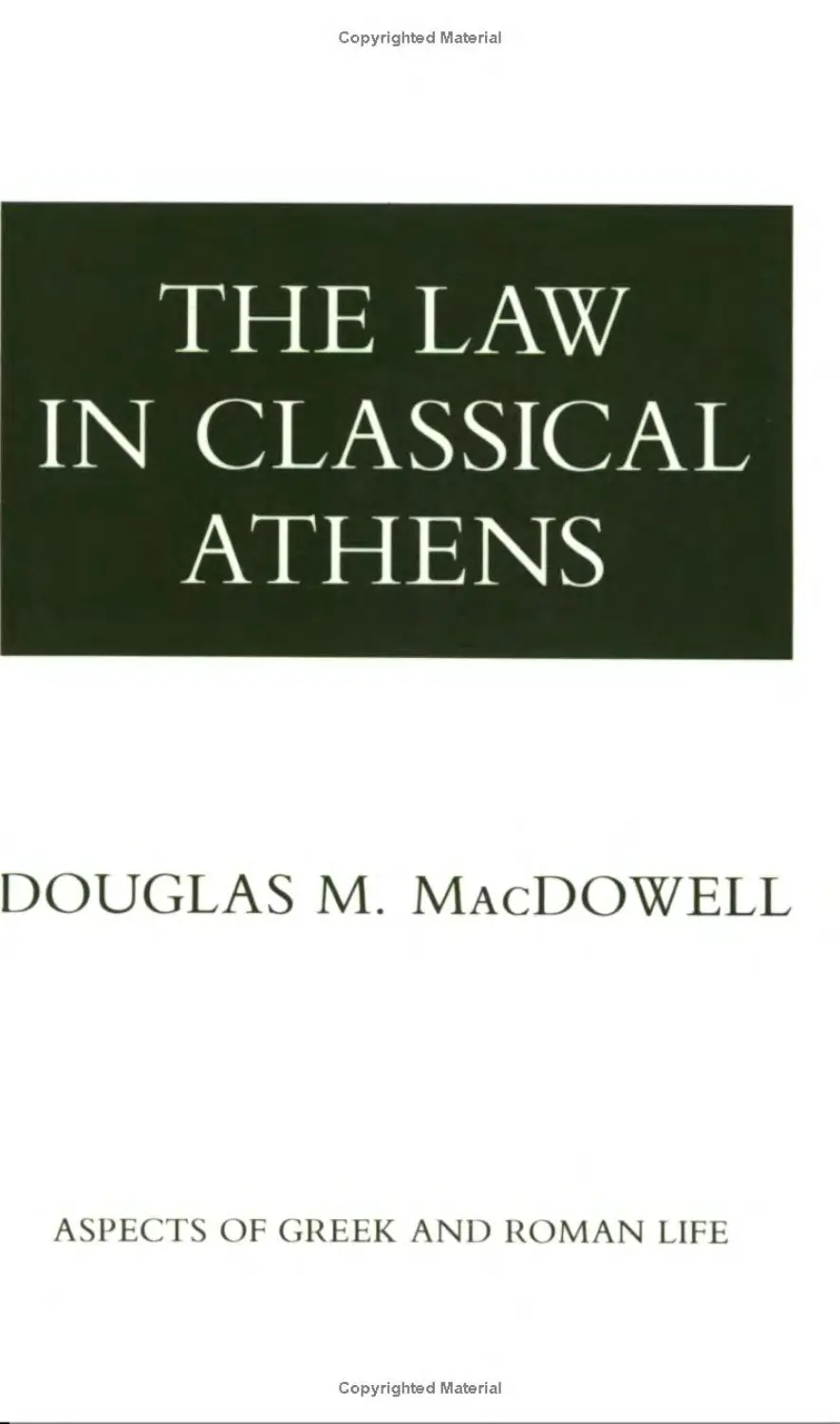


Author: MacDowell D.M.
Tags: history politics law athenian democracy history of athens
ISBN: 0-8014-1198-х
Year: 1978



Text
                    Copyrighted Material
THE LAW
IN CLASSICAL
ATHENS
DOUGLAS M. MacDOWELL
ASPECTS OF GREEK AND ROMAN LIFE
Copyrighted Material
Copyrighted Material
© 1978 Thames and Hudson Ltd. London
All rights reserved. Except for brief quotations in a review, this
book, or parts thereof, must not be reproduced in any form with-
out permission in writing from the publisher. For information,
address Cornell University Press, Sage House, 512 East State Street,
Ithaca, New York 14850.
First published 1978 by Cornell University Press
First printing, Cornell Paperbacks, 1986
Library of Congress Cataloging in Publication Data
(For library cataloging purposes only)
MacDowell, Douglas Maurice.
The law in classical Athens.
(Aspects of Greek and Roman life)
Includes bibliographical references and index.
1. Law. Greek. 2. Law—Greece—Athens.
I. Title. II. Senes.
LAW	340.5*5'3’85	78-$4i4i
isbn 0-8014-1198-х (cloth)
isbn 0-8014-9365-x (paper)
Printed in the United States of America
Cornell University Press strives to use environmentally responsible
suppliers and materials to the fullest extent possible in the publish-
ing of its books. Such materials include vegetable-based, low-VOC
inks and acid-free papers that arc recycled, totally chlorine-free, or
partly composed of nonwood fibers.
Paperback printing 10 9 8 7 6
Copyrighted Material
Copyrighted Material
CONTENTS
PREFACE 8
Part One The Growth of a Legal System
I JUDGEMENTS IN EARLY GREECE
Introduction io Primitive disputes n Kings 13
Elders and people 16 The trial on the shield of Achilles 18
Public opinion 21
II MAGISTRATES AND JURIES
Kings and arkhons 24 The Areopagos 27 The
Eliaia 29 Democratic juries 33 The allotment of
jurors to courts 35
III THE CODE OF LAWS
Drakon and Solon 41 Laws and decrees 43
The reinscription of the laws 46 Legislation by
nomothetai 48 Graphe paranomon 50
IV	PROSECUTORS AND CASES
Volunteer prosecutors 53 What the laws specified 54
Types of case 57 Public prosecutors 61 Sycophants 62
Part Two The Scope о/ the Law
V	PERSONAL STATUS
Citizens by birth 67 Citizenship conferred on
aliens 70 Outlawry and disfranchisement (atimia) 73
Aliens 75 Resident aliens (mctics) 76 Privileged
aliens 78 Slaves 79 Freedmen 82 Public slaves 83
VI	THE FAMILY
Control of dependants and of an oikos 84
Marriage 86 Concubinage 89 Children 91
Copyrighted Material
Copyrighted Material
Succession by legitimate sons 92 Heiresses 95
Intestate succession by other relatives 98 Adoption
and wills 99 Claiming an inheritance 102
VII	DEATH
The funeral 109 Homicide and the family 109
Kinds of homicide 113 Procedure in homicide cases 118
The use of apagoge for homicide 120
VIII	ASSAULT AND ABUSE
Battery and deliberate wounding 123
Sexual offences 124 Restriction of liberty 126
Slander 126 Hybris 129
IX	PROPERTY
Property and owners 133 Land and buildings 134
Mines 137 Sale 138 Lease 140 Loansand
security 142 Procedures for claiming property 145
Theft 147 Damage 148 Enforcement of property
rights 153
X	LIFE IN THE COMMUNITY
Work 155 Trade 155 Town regulations 159
Military service 159 Liturgies 161 Debt to the
state 164 Public officials: dokimasia 167 Public
officials: apokheirotonia and eisatigelia 169 Public
officials: euthyna 170 Corruption and improper
participation in public business 172
XI	TREASON
Tyranny and subversion of democracy 175 Betrayal 176
Misleading the people 179 Informing (tnenysis) 181
Eisatigelia 183 The trial of the Arginousai generals 186
Copyrighted Material
Copyrighted Material
Execution ordered by the Boule 189 Report
(apophasis) from the Areopagos 190
XII	RELIGION
Sacred law 192 Festivals 194 Impiety 197
Atheism 200
Part Three Legal Proceedings
XIII	ARBITRATION
Private arbitration 203 Deme and tribe judges 206
Public arbitration 207 Appeal and annulment of public
arbitration 209
XIV	BARRING LEGAL ACTION
Dianiartyria 212 Paragraphe 214 Dianiartyria in
the fourth century 217 Paragraphe and the role of
the jury 219
XV FOREIGNERS, MERCHANTS, AND THE LEGAL CALENDAR
Treaty cases (dikai apo symbolon) 220 The polemarch
and the xenodikai 221 The Athenian Empire 224
The legal calendar and the nautodikai 228 The
mercantile laws and monthly cases 231
XVI TRIAL AND PUNISHMENT
Initiation by a magistrate 235 Initiation by a
private individual 237 Preliminary proceedings 240
Evidence 242 The trial 247 Penalties 254
Pardon and amnesty 258
notes 260
INDEX 276
Copyrighted Material
Copyrighted Material
PREFACE
Ancient Greek law is a fragmented and elusive subject for study. Every
city-state had its own laws; no doubt there were similarities and some
states copied laws from others, but we should never assume without
evidence that any particular rule was shared by two different states. And
often the evidence is lacking. Even for Athens, the state about which
we know most, we have only a limited number of texts of actual laws.
Our chief source of information is the texts of about a hundred law-
court speeches, in all of which the speakers arc arguing on one side of a
case, so that their statements about the law are tendentious and incom-
plete. These have to be supplemented by allusions in comedy, history,
philosophy, and other literature, which have their own difficulties of
interpretation.
Yet the attempt to understand the subject is worth making. Law is
the formal expression of a people’s beliefs about right and wrong con-
duct, and no people in the world has had more interesting and original
beliefs about conduct than the ancient Greeks. Besides, the Athenians’
legal system, though less coherent than the Romans’ a few centuries
later, was probably the most comprehensive that any people had yet
devised, and was certainly the first to be established on a democratic
basis. So it has a special importance for students of society and morality
as well as for readers of Greek literature.
Many specialized books exist in which topics of Greek law are dis-
cussed in detail, most often in German, but it is hard to find any book
in English which gives a satisfactory introduction to the subject. This
is what I have tried to provide: a book which can be read by anyone
interested in the Greeks, even if he has no previous knowledge of their
law. Such a book cannot include everything, and my principles of selec-
tion and arrangement are practical rather than logical. I have concen-
trated on Athens in the period from Perikles to Demosthenes (approxi-
mately 435 to 322 вс) because that is the period about which the Attic
orators tell us; but I have also included an opening chapter on trial
procedures in Homer and Hesiod, because those poets are read by most
students of Greek literature and they offer a base from which to
measure the Athenian achievement; and I have occasionally used evi-
dence from authors such as Menander who wrote in and about a
Copyrighted Material
Copyrighted Material
PREFACE	9
period slightly later than Demosthenes. Constitutional law, sacred law,
and the rules of hereditary and local groups, such as phratries and demes,
are largely or entirely omitted; so also are jurisprudence and philo-
sophical discussion of law. The first part of the book is mainly about the
chronological development of the legal system, the second about the
kinds of conduct regulated by law, and the third about legal procedures
in the fourth century. But such a division cannot always be maintained;
and my aim has been not to construct a strictly logical scheme, but to
produce a book which can be read straight through and understood by
a reader to whom the subject is new.
By profession I am a classicist, not a lawyer, and any lawyers who
read this book may find my discussion of law unsophisticated. But I
do not regard this as a serious handicap, since the Athenians themselves
were not professional law-makers and had no knowledge of Roman or
modern jurisprudence. More serious, perhaps, is the fact that, although
I have read a good deal of modern work on Athenian law, I cannot
claim familiarity with everything which has been written on it. Never-
theless I doubt whether I have missed anything of major importance;
and the references in the notes at the end of the book, though very
selective, should give a sufficient lead to those readers who wish to in-
vestigate a particular topic further. Even for specialists, I hope that the
book will be of some use as a summary of the present state of knowledge
of the subject; and they will find that it also incorporates some new
suggestions of my own. It was completed in the summer of 1977» and
docs not take account of any publication which had not reached me by
then.
All three-figure dates in the book are вс; a date with a diagonal
stroke, such as 403/2, means one Athenian year, from midsummer to
midsummer. I refer to Attic speeches by the names of the orators to
whom they are traditionally attributed; that should not be taken as
implying necessarily that I think the attribution correct in any par-
ticular instance. Finally I should like to record here my thanks to my
colleague Dr R. A. Knox, whose constructive comments have helped
me to make a number of corrections and improvements.
Glasgow	D. M. MacDowell
Copyrighted Material
Part One: The Growth of a Legal System
i JUDGEMENTS IN
EARLY GREECE
INTRODUCTION
Quarrels and disputes are as old as mankind, or older. Two men may
each claim to possess some desirable object or property, or a man may
complain at another’s behaviour and demand compensation or
atonement.
The most primitive method of settling a dispute is for one of the
disputants to overpower the other by force or intimidation. The civil-
ized method is to refer the dispute to a third party, whose decision both
disputants are required to accept. In some cases they do this willingly:
both agree to submit the dispute to a judge (or judges) and undertake
to accept his decision. In other cases one of the disputants is unwilling:
he wishes to stay as he is, or to keep what he has, and only under
compulsion will he submit to judgement.
Therefore, if judgement is to be effective in all cases, and not only
in cases where both disputants accept it willingly, it must be backed up
by power which extends over them both; that is, by the authority of
the state or community to which they both belong. The simplest means
of achieving this is for the judge and the ruler to be the same person. In
an elementary society one man rules the others, and he also judges
their disputes. Just as two squabbling children appeal to an adult to
decide who shall have the toy train to play with, so in a simple society a
man who believes himself wronged appeals to the king, and the king,
like a fair but firm father, decides.
But some kings arc not firm, and some are not fair; and who is to
judge the king? A difference (some might say, the difference) between
a simple and an advanced society is that in an advanced society judge-
ments on individuals are not just made by another individual but are the
judgements of the community, to which every individual is subject.
The problem then is to select judges who can be taken to represent the
whole population, and whose judgement may be regarded as that of
the community.
Material chroniony prawem autorskim
PRIMITIVE DISPUTES
II
The Athenians in the sixth, fifth, and fourth centuries вс developed
for this purpose an elaborate system of trial by jury. It was one of the
most democratic systems which have ever existed, and it was one of
their greatest achievements in the organization of society. But, in order
to appreciate the significance of what the Athenians did to improve
methods of settling disputes, we need to know what methods were
already in use before they got to work.
The evidence for judicial procedures in Greece before the end of the
seventh century вс is not very satisfactory; for it consists simply of the
poems of Homer and Hesiod. It is no use expecting to find in these
poems a systematic account of judicial procedures. They are intended
to be talcs of gods and heroes (or, in the case of Hesiod’s Works and
Days, fraternal advice about farming and other matters), not legal or
sociological treatises. Nevertheless, they do reveal incidentally a great
deal of information about early Greek society and institutions, and they
do contain allusions to disputes of various kinds. So it is reasonable to
enquire what happens in Homer or Hesiod when a dispute arises: how
is it conducted and resolved?
The answers are not consistent throughout the Iliad and Odyssey, the
Theogony and Works and Days; in various disputes the characters con-
duct themselves in different ways. This may be because different poems
(or even different parts of the same poem) were composed by different
poets, at different times or in different places; but it is also possible for
one person to observe and describe different procedures which are all
in contemporary use. This is not the occasion to discuss how the
Homeric poems were composed. Probably everyone would agree that
the various kinds of dispute-procedure mentioned in the Homeric and
Hesiodic poems all existed in early Greece, even if not all in the same
place at die same time; and that is enough for the present purpose.
PRIMITIVE DISPUTES
In what different ways, then, are disputes settled in Homer? One
method is for the two men who quarrel just to fight until one of them
wins. In one passage in the Odyssey it is regarded as normal and
acceptable for a man to get hit while fighting to keep possession of his
cattle.
‘Indeed, there is no sorrow or grief in a man’s heart when he is hit
while fighting for his own possessions, for cattle or white sheep;
whereas ...’ (Odyssey 17. 470-3)
Material chroniony prawem autorskirr
12
JUDGEMENTS IN EARLY GREECE
And in the Iliad two men fighting to decide the boundary between
their allotments of land are such a common sight that they are used in a
simile to illustrate the fighting of soldiers at Troy.
Just as two men contend about boundaries, with measuring-rods in
their hands, in a common field, and fight about equal shares in a
small piece of ground, so ..{Iliad 12. 421-4)
The matter-of-fact manner in which these fights are mentioned inci-
dentally in order to provide a comparison or contrast implies that
fighting is a regular way of settling a dispute.
A fight sometimes involves a whole family; for in the ancient world
the family (in the wider sense of the word, including cousins) long re-
tained great solidarity, and injury to the property or person of one of
its members might be resented by them all. Thus in the Odyssey, if
Telemakhos had had brothers, they could have been expected to help
him in a fight against the wooers who were ruining the household.
Above all, if a man is killed, his family is expected to exact vengeance
from the killer. So Orestes kills his father’s murderer Aigisthos, and
this action is regarded as highly meritorious and honourable.1
But not everyone likes fighting, even in Homer. Some people prefer
talking. In particular, talking may seem a better way of settling a dis-
pute if one’s opponent is stronger than oneself - though in this case the
opponent may prefer fighting. So Iphitos found when Herakles took
his marcs; he went to Herakles’s house, and Herakles entertained him
as a guest, but when he asked for the marcs Herakles killed him and
kept the mares. But in other cases verbal negotiation may have been
more successful; perhaps it proved so when Odysseus in his youth
went to Messene to claim compensation for three hundred sheep.2 The
cases in which talk would be most likely to lead to a settlement would
be those in which each of the parties was willing to compromise to
some extent: ‘Look here: if you’ll agree to ..., I’ll agree to ...’
Although no instance of this kind of bargaining is described in detail in
Homer, probably this was the procedure which led to the acceptance
of payment (in property or precious metal) for homicide: the killed
man’s relatives, instead of killing the killer or chasing him into exile,
agree to accept recompense (poine) in settlement of the dispute. In the
Iliad Aias son of Telamon alludes to this when criticizing the stubborn-
ness of Achilles.
Material chroniony prawem autorskim
KINGS
13
‘A man accepts recompense from the killer for his brother or his
son who is dead; and so the one remains in his own country after pay-
ing a great amount, and the other’s spirit and pride are appeased
when he has received recompense. But you ...’ (Iliad 9. 632-6)
This means that the killer agrees to make a substantial payment, and the
killed man’s relative agrees not to seek further vengeance. Verbal
negotiation leads to a bargain. Aias clearly regards this as a right and
proper way to settle a dispute, since he contrasts it with Achilles’s
obstinate refusal to make a concession.
KINGS
In the examples mentioned so far the settlement of the dispute, whether
by blows or by words, is conducted entirely by the disputants them-
selves, without any participation by outsiders. But of course it often
happens that disputants, who do not wish to fight, are yet unable to
reach agreement by talking to each other; and so they appeal to some
other person to judge between them. This appeal to an outsider,
thought to be impartial, is the origin of judicial procedure.
During the chariot-race in the Iliad, held at the funeral games in
honour of Patroklos, two of the spectators watching from a distance
disagree about which chariot is in the lead. Idomeneus maintains that
Diomedes is leading, Aias son of Oileus that Eumelos is. Idomeneus
proposes a bet.
‘Come on, let us wager a tripod or a cauldron, and let us both make
Agamemnon son of Atreus the judge of which mares are leading, so
that you may learn and pay up.’ (Iliad 23. 485-7)
The word istor, which I have here translated judge’, literally means
‘knower’; it means a man who knows better than others what is true,
or what is right. Idomeneus’s proposal for settling the dispute is that he
and Aias should both agree to accept the decision of a man who knows
better than they do. In this particular case the proposal is probably
stupid, since to see the distant chariots what is required is keen eyesight
rather than good judgement, and there is no reason to suppose that
Agamemnon’s eyes are any better than those of Idomeneus or Aias;
and in fact Aias sensibly refuses to take the bet. But for our purpose it
is most significant that Idomeneus suggests Agamemnon as the judge.
aterial chroniony prawem autorsk
14
JUDGEMENTS IN EARLY GREECE
Agamemnon is the Greeks’ leader, the chief of the kings. Idomeneus’s
assumption is that the right person to judge any dispute is the king.
This is a regular assumption in Homer. A number of passages show
that judging disputes is regarded as one of the functions of a king. In the
Odyssey Nestor ‘knows judgements’ more than other men because he
has been king for three generations, and in the Iliad it is twice said that
Zeus gives to a king the sceptre and the rules of judgement (themistes)3
This probably means that a king was believed to enjoy divine inspira-
tion; that is what would make him better than other men as a ‘knower’
of what is right. But it is not the only possible reason why a king was
regarded as a good person to judge disputes. Another likely reason is
his power. A disputant whose claim was rejected by a judge might just
ignore the decision if the judge was merely an ordinary person, one of
his own equals, but he would be afraid to ignore the king. So a king’s
judgement would be effective.
Hesiod’s Theogony begins with an elaborate hymn to the nine Muses,
daughters of Zeus, who among other activities watch over good kings.
‘Whenever the daughters of great Zeus honour and watch over at
birth one of the god-fostered kings, on his tongue they pour sweet
dew, and out of his mouth flow gentle words. All the people look to
him as he decides rights by straight judgements. Speaking surely, he
skilfully ends at once even a grave dispute. This is the function of
prudent kings: for people who are harmed in their dealings, they
bring about restitution easily, talking men over with soft words.’
(Theogony 81-90)
This is the ideal of the king in a simple society, treating his subjects
as a kindly father treats his children. When they quarrel, they appeal to
him, and he decides what is fair. His decisions command instant assent,
not just because he is the king, but also because he is a skilful and per-
suasive speaker, whose honeyed words reconcile his quarrelling subjects.
The picture is too good to be generally true, as Hesiod himself dis-
covered. In his later poem Works and Days he urges his brother Perses
to reach agreement with him privately and not seek justice from
kings; disputes waste time which should be devoted to farming.
‘When you have plenty of that [sc. agricultural produce], you can
raise up disputes and strife for other men’s property. But in your
case, you will have no second chance to behave in this way; but let
Material chroniony prawem autorskim
KINGS
15
us decide our dispute here and now, by straight judgements, the best
that Zeus sends. Previously we divided our inheritance, and you
seized a great deal else and tried to carry it off by great flattery of
gift-devouring kings, who are willing to give this kind ofjudgement.’
(Works and Days 33-9)
Further on in the poem he describes how the gods, and especially the
virgin daughter of Zeus named Dike (which should be translated
judgement’ or ‘law’ rather than ‘justice’),4 observe the behaviour of
men, to reward the just and punish the unjust.
‘And whenever anyone scorns and thwarts her crookedly, at once
she sits by her father Zeus, son of Kronos, and relates the lawless
men’s intent, that the people may pay for the wickedness of the kings,
who with evil intent turn judgements aside by stating them crook-
edly. Beware of this, О gift-devouring kings; make your speeches
straight, and forget crooked judgements altogether!’ (Works and Days
258-64)
Since the Theogony, Hesiod’s view of kings has turned sour; he has
found that they may be unfair as well as fair. Probably this was the
result of his quarrel with Perses over their inheritance from their father.
Perhaps what happened was that Perses claimed that Hesiod had taken
more than his share, appealed to the king, and persuaded the king (by
flattery or bribery, Hesiod suggests; but we should bear in mind that it
may have been generally regarded as normal and proper for kings to
receive gifts)5 to decide in favour of Perses; and now, when a further
dispute had arisen, Perses wished to appeal to the king again. Since we
have only Hesiod’s prejudiced statements, we cannot tell who was in
the right in this particular case. But we can accept the picture which it
gives of the judicial procedure in Boiotia around 700 вс. The pro-
cedure is as simple as it could be: a man who considers himself un-
fairly treated by another can appeal to the king, and the king gives his
decision.
The ‘king’ in Hesiod’s case will be the local ruler; this probably
means the ruler of Thespiai, the Boiotian city in whose territory
Hesiod’s village of Askra lay. The plural ‘gift-devouring kings’ in the
Works and Days passages might seem to imply that several rulers ruled
and judged jointly; but in the Theogony passage judgements are given
by one king, and so the plural in Works and Days may be just scornful
Material chroniony prawem autorskirr
l6	JUDGEMENTS IN EARLY GREECE
rhetoric, and it may be incautious to rely on it, as some modem
scholars do, as evidence that more than one king ruled at a time. The
king had sole authority and responsibility. Clearly Hesiod was reluc-
tant to accept the king’s first decision, and reluctant to have the second
dispute submitted to the king; yet there is no suggestion that he might
refuse to accept the king’s judgement. If Perscs appealed to the king,
Hesiod could not stop him; if the king decided against Hesiod, Hesiod
could not ignore the decision. This shows that the king had authority
over Hesiod and Perses. But it does not mean that there was a legal
rule (still less a written law) establishing the king’s jurisdiction; his
actual power would be enough to cause his decisions to be accepted.®
ELDERS AND PEOPLE
But kings are not the only persons to judge disputes in Homer. True,
in discussing judges other than kings one might be tempted to dis-
count queen Arete, who settles disputes among the Phaiakians, since
she is stated to be quite exceptional; and when Telcmakhos is called ‘a
giver of judgements’ (dikaspolos) in Ithaka, that might possibly mean
that he deputizes for the absent king Odysseus, although he certainly is
not regarded as actually being king.7 But when Achilles before Troy
swears an oath by the sceptre which ‘the sons of the Akhaians hold in
their hands, the givers of judgements, who guard the rules of justice
received from Zeus’ (Iliad i. 237-9), then it seems quite clear that
judgements are given not by one king alone but by a number of lead-
ing men; and in a scene represented on the shield of Achilles ‘the
elders’ are said to be giving judgement (sec page 19). So we must
accept that in a Homeric community others besides the monarch
might be ‘givers of judgements’, and in other passages where a judge is
mentioned we need not insist that a king is meant. The man who ‘rises
from the assembly for his supper, who decides many disputes of young
men who seek judgement’ (Odyssey 12. 439-40) is probably not a king
but one of a number of elders or leading men who have spent a large
part of the day in session to judge disputes.
This last passage suggests that more or less regular sittings of the
chiefs or ciders might be held to judge, in the course of a day, whatever
disputes were brought before them.8 It also shows that the place where
such sittings were held was the assembly place (the Agora). Several
other passages also mention the assembly place as the place where
judgements are given.9 Judgement may be given by one man or by a
small number of men, but it is given in the presence of the people.
ial chroniony praw
ELDERS AND PEOPLE
17
The presence of the people is not, I think, just incidental; it is an
essential concomitant of judicial procedure in Homer. Some light is
thrown on its purpose by another episode in the funeral games in the
Iliad. Before the chariot-race begins Achilles sets out the various prizes,
and at the end of the race each competitor claims the prize which is his
due. Antilokhos claims the second prize, a mare, but then Menelaos
indignantly objects that Antilokhos beat him by unfair means.
‘Menelaos stood up in great vexation, implacably angry with
Antilokhos. The herald put the staff in his hand and ordered the
Argives to be silent, and then the godlike man spoke among them.
‘ “Antilokhos, you used to be wise; now what have you done!
You spoiled my reputation and obstructed my horses by thrusting
your own, which were far inferior, in front. Come, leaders and
rulers of the Argives; judge between the two of us impartially, so
that no Akhaian soldier may ever say, ‘Menelaos overcame Antilok-
hos by lies and went off with the mare, because, though his horses
were far inferior, he himself was superior in rank and power.’ Well,
I myself will give a judgement; and I declare no other Danaan will
find fault with me, for it shall be fair. Noble Antilokhos, stand here,
as is right, before your horses and chariot, hold in your hands the
pliant whip, which you have driven with before, put your hand on
the horses, and swear by the god who moves and shakes the earth
that you did not intentionally hinder my chariot by a trick.”
‘The wise Antilokhos replied, “Be patient now; I am much
younger than you, king Menelaos, and you arc my superior. You
know how a young man transgresses. His mind is hasty and his
prudence slight. So be forbearing, and I will myself give you the
mare which I have taken. And if you should also ask for something
more from my house, I should be willing to give it to you at once,
rather than fall for ever from your favour and be a sinner against the
gods.” ’ (Iliad 23. 566-95)
So Antilokhos hands over the marc to Menelaos, and Menelaos is so
pleased that he forgives Antilokhos and gives the mare back to him.
This argument is not only a contest of honour but also a dispute
over the ownership of a piece of property.10 Mcnelaos’s method of
settling it is to make a speech in the hearing of the other Greeks; he
suggests that the leaders and rulers should judge the dispute, but then
instead, before they have a chance to do so, he challenges Antilokhos
aterial chroniony prawem autorsk
18	JUDGEMENTS IN EARLY GREECE
to swear an oath that he raced fairly. The idea is that Antilokhos will be
afraid to peijure himself, for fear of punishment by the gods; so if he
swears everyone will believe him, and if he refuses to swear everyone
will conclude that he did commit a foul. If the onlookers are thus
convinced that Menelaos is telling the truth, presumably they will
compel Antilokhos to hand over the mare. Menelaos’s whole speech,
though addressed to Antilokhos, is not intended merely to convince
Antilokhos (who already knows whether he committed a foul or not);
it is intended to convince the bystanders. He is trying to bring to bear
on Antilokhos the pressure of public opinion.
Appealing to public opinion is something different from appealing
to the king. A king may have special expertise as a judge, from talent
or experience or divine inspiration. The general public can hardly be
said to have special expertise. But what they do have, if they care to
use it, is power. It is hard for an individual to defy the king, but it is
even harder to defy the whole population. Judgement by the people,
therefore, may be even more effective than judgement by the king or
the elders. But the trouble is, in Homeric society, that the people arc
often inarticulate and an assembly indecisive.
There is one clear example in the Odyssey of a dispute being brought
before the assembly of the people of Ithaka in the king’s absence
(besides one or two others where the possibility of such a complaint is
suggested but it is not actually carried out). It occupies much of the
second book, before Odysseus’s return home. His son Telemakhos
wishes to complain about the behaviour of the wooers and their
spoliation of his property. He would defend himself and the household
by force if he could, but he is too weak to do so. He cannot appeal to
the king, because Odysseus is away; so what he does is to call an
assembly of the people and lay Inis complaint before them. Speeches
are made for and against, but in the end the meeting breaks up without
making any decision.
THE TRIAL ON THE SHIELD OF ACHILLES
Thus a Homeric assembly is sometimes ineffective without leadership.
The most effective decision is one in which public opinion is crystallized
and expressed by the king or elders. The reason why judgements are
given in the Agora is that they are given in accordance with the senti-
ments of the people assembled there. This is confirmed by the most
important of all the Homeric passages referring to judicial proceedings.
ial chron
raw
THE TRIAL ON THE SHIELD OF ACHILLES	19
This passage is not easy to interpret in detail, and some points in it
remain doubtful and disputed. It occurs in the eighteenth book of the
Iliad, where there is a long description of the marvellous shield of
Achilles and the elaborate scenes pictured on it. Among the rest there
is a city at peace, in which the following activity is in progress in the
Agora.
‘In the assembly place were people gathered. There a dispute had
arisen: two men were disputing about the recompense for a dead
man. The one was claiming to have paid it in full, making his
statement to the people, but the other was refusing to receive any-
thing; both wished to obtain trial at the hands of a judge. The people
were cheering them both on, supporting both sides; and heralds
quietened the people. The elders sat on polished stones in a sacred
circle, and held in their hands sceptres from the loud-voiced heralds;
with these they were then hurrying forward and giving their
judgements in turn. And in the middle lay two talents of gold, to
give to the one who delivered judgement most rightly among them.’
(Iliad 18. 497-508)
This passage has been discussed at great length by specialists in
ancient law,11 and it would be out of place to discuss here every con-
troversial detail. It is clear that the object of dispute is the payment of
recompense (poine) for the killing of a man. In early times, if a man was
killed, the usual consequence was that his family thought it their duty
to kill the killer in revenge. The killer would be unlikely to escape
death unless he left the country and became an exile; and, if he was in
fact killed, his family in turn would seek to kill his killer, so that an
unending blood-feud between the two families resulted. To avoid this,
a killed man’s family might accept an amount of gold or other pro-
perty as recompense for the killing, after which the affair was closed.
In our passage the wording of the third sentence is ambiguous, and it
could be translated: ‘The one was claiming to have paid it in full..
but the other was denying that he had received anything.’ Some schol-
ars therefore take die view that the dispute is simply about the factual
question whether the killer has already paid recompense or not. But
the alternative view is preferable: the question is whether recompense
is to be accepted or a blood-feud to continue. The killer, who admits
that he committed the homicide, has publicly put down some payment
and claims that nothing more is required of him, but the killed man’s
20	JUDGEMENTS IN EARLY GREECE
relative refuses to take it and insists that the feud between them shall
continue. The dispute is not just about payment of a debt, but about the
lengths to which revenge may be taken - a question closely related to
the basic theme of the Iliad.
But the most important problem in this passage is: who will actually
decide the case? It is clear that opinions are delivered by an unspecified
number of elders. Each of them holds a sceptre as a symbol of his
judicial function (the words ‘they held sceptres in their hands’ are
clearly plural, so that it is not the case here, as elsewhere in the Iliad,
that there is only one sceptre, held by each man in turn as he speaks),
and each in turn gives his judgement. But their judgements may not all
be identical; how will it be decided which one shall be accepted? The
poet says that the disputants ‘both wished to obtain trial at the hands of
a judge’. The word for ‘judge’ (istor, ‘knower’) is singular.Who is this
judge who will settle the dispute?
Various solutions have been proposed, among which three seem to
deserve particular consideration.
(d) The judge is the chairman of the proceedings: cither the king, or
an elder who presides over the others. The other elders arc just asses-
sors; after hearing their opinions, he alone makes the final decision.
(b) The judge is the elder whose opinion is considered by the people to
be the best. After each elder speaks the crowd, if it approves, applauds
or cheers; the opinion which receives the most applause is the one which
is accepted.
(c) ‘At the hands of a judge* just means ‘by arbitration’ and refers to
all the elders. The view of the majority of the elders prevails.
Each of these solutions is, in my opinion, possible; none can be
definitely disproved. The trouble is that the poet describes the trial
in progress, and simply does not tell us what will happen at the end of
it. Nevertheless several considerations seem to tell in favour of b. With
c, the use of the singular ‘judge’ for all the elders is really very awk-
ward. It is also doubtful whether the notion of counting votes and
accepting a numerical majority as decisive existed in Homeric times.
With a, it is somewhat surprising that the king or chairman is not men-
tioned with a description of his activity, as the disputants, people,
heralds, and elders all are. In favour of b it has been argued that the two
gold talents mentioned in the last sentence of the passage (one talent
contributed by each disputant) are a reward for the elder who gives the
best judgement, so that some procedure for selecting the best individual
judgement must have been followed. (The alternative translation of
ial chroniony prav\
PUBLIC OPINION
21
this sentence ‘to give to the one who pleaded his case most rightly
among them’, meaning that the two talents were to be awarded to the
successful disputant, is probably wrong, because there are only two
disputants but ‘most rightly’ is superlative, not comparative.) Another
argument in favour of b may be drawn from the sentence about the
disputants’ speeches, ‘The one was claiming to have paid it in full,
making his statement to the people ..with h the speakers naturally
address the people because it is the people who will decide which elder's
judgement is to be accepted, whereas with a and c there is no particular
reason why they should address the people rather than the elders.
If b is right, the most significant feature of this trial is the participa-
tion of the people. The two disputants come to the assembly, and each
makes his speech to the people. As they speak, the crowd (or various
individuals or groups within it) cheer or boo to show which statements
they find convincing. When the two speeches are finished, the heralds
quieten the crowd and call on the elders to give their judgements. The
elders are men who are supposed to be good ‘knowers’ because of their
age and experience. Each elder tries in turn to express in words the
view of the case which he thinks the people take, or ought to take.
The people cheer or applaud a judgement which they think good, and
the heralds (presumably) have to decide which elder’s judgement has
received the most applause. This elder is the ‘knower’ whose verdict
decides the case, and he receives the award of two talents for giving the
best judgement. But the decision is, effectively, the people’s.
PUBLIC OPINION
So in Homer the origin of democratic judgements can already be seen.
Though verdicts may be delivered by a king or by elders, they are
influenced and guided by public opinion. The speakers haranguing the
crowd on the shield of Achilles, and Menelaos publicly challenging
Antilokhos to an oath, are forerunners of the orators who addressed
Athenian juries. The trial on the shield is far more civilized, and marks
a far more advanced stage of judicial development, than the fights and
arguments in some of the other passages from Homer which I have
quoted.
But how typical is it? The case is an imaginary one, which a poet
describes as being pictured by a god on a hero’s shield. But similar
trials must have been held in historical fact. Clearly the procedure is
not imaginary, but one which the poet lias actually seen in operation;
aterial chroniony prawem autorsk
22
JUDGEMENTS IN EARLY GREECE
and it is not a special procedure devised for a single case, but a settled
and regular one. But this does not mean (as modem readers sometimes
assume) that it was the normal procedure in every Greek city at the
time of the composition of the Iliad. All that we can legitimately infer
is that this procedure was employed in at least one Greek community
at a date not later than the time when this particular passage of the
Iliad was composed. Some scholars believe the description of the shield
of Achilles to have been composed at a later period than other parts of
the Iliad, and in any case it cannot be dated with any precision.
Even in the place or places in which this procedure was established, it
was probably not used for every dispute. The disputants on the shield
come to trial voluntarily: ‘both wished to obtain trial at the hands of a
judge’. What would have happened if one of them had not so wished?
There is nothing to show that he would have been compelled to attend
the trial or to accept the judgement. Even when a formal judicial
procedure was available, some men might prefer a fight. Still, if one
disputant appealed to the king or elders and to the assembly, it would
not be easy for his opponent to ignore their decision; and the more
organized the community became, the harder it would be for an
individual to defy formal public judgements. It was clearly in the
public interest that disputes should be settled by judicial procedure
rather than by fighting. No doubt there were some occasions when the
king took the initiative, stepping in to break up a fight and impose his
judgement even though neither disputant had asked him to do so. But
‘When did the use of judicial procedure become obligatory?’ is a bad
question; the change must have been gradual, and some places in
Greece doubtless lagged far behind others.
Almost no clear and precise conclusions can be drawn from the
evidence which has been surveyed in this chapter. In individual passages
of Homer and Hesiod it is hard to distinguish historical fact from poetic
colouring or idealization. Even where we feel confident that the poetic
narrative does indicate that some particular type of judicial procedure
was used in real life, we usually cannot tell in what part of Greece it
was used, or at what date. For any specific place in Greece at any date
before the seventh century вс (with the sole possible exception of
Hesiod’s district of Boiotia) our answer to the question ‘What kind of
judicial procedure was used in this place at this date?’ must be, on our
present evidence, that we do not know. Nevertheless, the evidence
does show that there were three features of the judging of disputes
which did exist somewhere in the Greek world in this early period, so
PUBLIC OPINION
23
that we must beware of saying that any of these originated in classical
Athens. They are:
(1)	Judging by an individual man, who has authority to decide a
dispute because of the office which he holds (e.g. as king).
(2)	Judging by a group of men, who because of birth or experience
or other qualifications are considered to be particularly well fitted to
perform this function.
(3)	Influencing of a verdict by a crowd of ordinary men, who have
no special qualifications forjudging, but whose opinion must still be
taken into account by the man or men who are to pronounce the
verdict.
Monarchy, aristocracy, democracy: these are the three approaches
to the problem of judging, as to other problems of society. The next
chapter will indicate the part played by each of them injudicial pro-
cedures in classical Athens, and the way in which the third came to
dominate the other two.
Material chroniony prawem autorskim
и MAGISTRATES AND JURIES
KINGS AND ARKHONS
According to legend Athens was once ruled by kings, such as Aigeus
and Theseus. By the seventh century вс the hereditary monarchy had
already ceased to exist; yet there remained throughout the classical
period an official called ‘the king’. To distinguish him from kings
in the ordinary English sense, it is convenient to use the Greek word
‘basileus’. His duties were largely, though not entirely, confined to
religious matters. Some of them were just ceremony and formality.
Little is recorded of the transition from the hereditary absolute mon-
archs of the legendary period to the officials of the same title in the
historical period. The fullest account is given in the third chapter of the
Athenaion Politeia (the book on the Athenian constitution doubtfully
attributed to Aristotle, which I shall refer to as AP), but some modem
scholars reject much of it, on the ground that no adequate evidence
about prehistoric Athens can have been available in Aristotle’s time, so
that the account must be largely guesswork.12 But in any case it is fair
to conjecture that the kings gradually lost various functions, when they
had performed those functions unsatisfactorily and agreed or were
compelled to hand them over to other men; and that the kingship
ceased to be hereditary at some date when a king died leaving either
no son at all or no son fit to rule; so that the title and functions of the
basileus in classical Athens were, more or less, what die king had left
when everything else had been taken away from him.
The most significant diminution in the powers of the king may well
have occurred at the time (whenever it was) when the official called
‘arkhon’ was first created; for in classical times the arkhon seems to
have been regarded as superior to the basileus, and the word itself,
which just means ‘leader’ or ‘ruler’, implies that this official was in-
tended to take precedence over all others. But some of the king’s
powers were doubtless transferred at different times to other officials
whom we know to have existed later. There was the polemarch, whose
name means ‘commanding in war’; and there were the thesmothetai,
whose name means something like ‘laying down law’ or ‘stating rules’.13
Material chroniony prawem autorsk
KINGS AND ARKHONS
25
The arkhon, the basileus, the polemarch, and the six thesmothetai
came to be known as ‘the nine arkhons’, but by the fifth century many
other types of official also existed, any of which could be called an
arkhe (‘rule’ or ‘office’ or ‘magistracy’): generals, market controllers,
and so on.
At an early period the arkhon, the basileus, and the polemarch are
said to have held office for ten years, and at an even earlier period for
life; but some modem scholars reject this statement, perhaps rightly.
Anyway, from 682 onwards they held office for one year only, and so
did the holders of almost all the other offices created subsequently.
Until 487 the normal method of appointment seems to have been
election. In №16 the system of appointing the nine arkhons was
changed, and they were picked by lot out of a number of candidates
previously selected; and at some later date (not earlier than 457) the
system was changed again, and they were henceforth appointed en-
tirely by lot. Lot was also used for appointment to most other offices
in classical Athens; the only important exceptions were the strategoi
(generals) and other military officials, who continued to be elected. The
widespread use of lot meant that in democratic Athens an arkhon could
not be expected to have any particular ability, knowledge, or other
qualifications; he was a layman, not a specialist. A fourth-century
speaker remarks that when one Theogenes became basileus he was
‘inexperienced in affairs’ (Demosthenes 59. 72).
If we had only the names to go by, we should probably think that
among these numerous officials the thesmothetai were the ones respon-
sible for giving rulings in disputes. In fact, though the thesmothetai dealt
with more legal cases than the other officials, many of the others had re-
sponsibility for legal cases too. An account is given in AP 56-9 of the
duties of the nine arkhons in the fourth century: the arkhon introduced
into court various kinds of case concerning property and family
matters (inheritance, guardianship, and so on), the basileus introduced
cases connected with religion (impiety, disputes about the duty to
perform a sacrifice or the right to claim a priesthood) and also cases of
homicide and deliberate wounding, and the polemarch introduced
various kinds of case involving persons who were not Athenian citizens.
There is then a long list of different types of case for the thesmothetai.
But this does not mean that the thesmothetai had all cases which
were not the responsibility of the arkhon, the basileus, or the pole-
march; for we know from individual references elsewhere that other
officials introduced certain types of case connected with their spheres of
2б
MAGISTRATES AND JURIES
activity. For example, military officers (strategoi, taxiarclis, and hip-
parchs) introduced cases of desertion and evasion of military service,
and market officials (agoranomoi and sitophylakcs) introduced cases of
overcharging and other misconduct in the market.
In the fourth century, introducing a case usually (for details and
exceptions see chapter XVI) meant arranging for a trial by jury. But in
the seventh century the popular juries of Aristotle’s time did not yet
exist. How then did a seventh-century arkhon proceed when a dispute
was brought to him? The obvious presumption is that he simply
decided the case himself; and indeed AP 3.5 says this was so, though it
is doubtful whether the statement is based on evidence or is no more
than a presumption. The arkhons had replaced the king of legendary
times. Judging was probably a function of the king in early Athens
as in Hesiod’s Boiotia, and when the hereditary monarchy ceased
the arkhons took over this function. One may imagine the following
sequence of development (but it must be remembered that it is almost
entirely conjectural):
(1)	The king was the sole ruler and judge. When two Athenians had a
dispute which they could not settle between themselves, they (or one
of them) appealed to the king and he decided it.
(2)	The office of arkhon was created to take over various functions
from the king. It became the rule that certain types of dispute (about
property and family matters, and perhaps others) should now be
decided by the arkhon. Other types (disputes about religious matters,
accusations of homicide, and perhaps others) continued to be decided
by the king. It may have been at the same time or later that the king
(basileus) ceased to be hereditary.
(3)	The office of polcmarch was created (not necessarily later than the
office of arkhon) to take over the function of commanding military
expeditions. It was when Athenians left Athens for military expeditions
that they were most liable to come into contact and dispute with
individual non-Athenians; and so it became the rule that the polemarch,
rather than the arkhon or basileus, was the official to whom an Athen-
ian appealed in any dispute with a non-Athenian, even when the dis-
pute arose in Athens.
(4)	Disputes became too numerous for the arkhon, the basileus, and
the polemarch to deal with all of them. So the office of thesmothetes
was created to relieve the other officials of some judicial functions.
Certain types of dispute were reserved for the arkhon, the basileus, or
the polemarch; all the rest were decided by the six thesmothetai.
ial chroniony prav\
THE AREOPAGOS	27
(5)	From time to time other officials were created to supervise parti-
cular matters; and, at least in some cases, such officials had authority to
decide disputes within the fields of activity of which they had charge.
(6)	The onset of democratic ideas and feelings caused various kinds
of limitations and checks to be placed on the individual official’s power
of decision. The two main kinds were written laws, to which the
official’s judgements had to conform, and juries, whose verdicts the
official had to accept. The result was that officials’ freedom of judge-
ment eventually dwindled almost to nothing. This change, which
occurred gradually between the seventh and the fourth century, forms
the main theme of the rest of this chapter.
THE AREOPAGOS
The Areopagos was a council so called because it met on the hill of
Ares, west of the Akropolis. There is no reliable evidence about its
origin and early history (Aiskhylos in Eutnenides has Athena institute it),
but it is reasonable to guess that it began as a group of leading men who
advised the king about important or difficult decisions, either at his
request or (more likely) because they were strong enough to compel
him to attend to their views. Membership may well have been heredi-
tary, like the kingship; thus the council would represent the aristocracy.
AP conveys the impression that in the seventh century the judicial
powers of the Areopagos were virtually unlimited: ‘The council of the
Areopagites had the function of guarding the laws, and it managed the
most numerous and important affairs in the state, with authority to
punish and fine all offenders’ {AP 3.6). However, this should not be
taken as meaning that the Areopagos ever did in practice try all
offenders. Many disputes must have been decided by the arkhons
without reference to it. But evidently the Areopagos held trials for
certain particularly serious offences.
What offences were these? They surely must have included those
offences for which the Areopagos held trials under the presidency of the
basileus in later times (when it was not hereditary, but consisted of
ex-arkhons). Those were intentional homicide and wounding, arson,
and destruction of sacred olive trees.14 Other cases of homicide were
tried in later times by the ephetai, who in the fifth and fourth centuries
were fifty-one men chosen by lot (see page 117). But Polydeukcs (often
called by the Latin form of his name, Pollux), writing in the second
century ad, says that Drakon instituted them and that they were
Material chroi
>rawe
28
MAGISTRATES AND JURIES
appointed according to rank.16 It is doubtful whether Polydeukes had
reliable evidence about Drakon. But it is quite credible that the ephetai
existed in the seventh century вс, and that they were originally chosen
according to rank, which would probably mean that they were all
members of the Areopagos. If this is right, all kinds of homicide cases
were judged at this period by members of the aristocratic council.
Another offence which appears to have been allocated to the
Areopagos for trial in early times was ‘tyranny’. In the 630s or 620s a
man named Kylon attempted with some supporters to make himself
ruler of Athens. They occupied the Akropolis, but were besieged
there; and, after Kylon and his brother had escaped, the rest gave in
and were persuaded to leave sanctuary on the Akropolis on the under-
standing that their lives would be spared but they would submit to a
trial, which was to be held (according to an Aristophanic scholiast) by
the Areopagos. But Megakles, who was the arkhon, put them to
death. Some years later the family of Megakles (the Alkmeonids; he
himself was dead by then) were accused of being ‘accursed’ or ‘pol-
luted’ by this sacrilege, and were tried by three hundred men appointed
according to rank. They were condemned, those alive were exiled,
and the bones of those dead were dug up and cast out of Attika.10
Each of these two cases was unique. The trial of Kylon’s supporters
by the Areopagos for attempting to set up a tyranny did not in the
event take place at all. The trial of the Alkmeonids appears to have
been a trial by the aristocracy of one of its own leading families. The
jury of three hundred may perhaps be regarded as a special meeting of
the Areopagos, strengthened for the occasion by some aristocrats who
were not regular members, to try a special case of homicide. But there
may have been other cases besides these. Plutarch quotes a law of
Solon extending amnesty to men who had been outlawed before
Solon became arkhon ‘except those condemned by the Areopagos or
by the ephetai or at the Prytaneion for homicide or bloodshed or for
tyranny’. This is good evidence that before 594 the Areopagos held
trials for tyranny and imposed outlawry (atitnia) on those found guilty.
AP states that Solon made a law under which the Areopagos judged
men conspiring ‘for subversion of the people’, and in another passage
that there was a lenient law imposing atimia on anyone setting up a
tyranny.17 There are errors of anachronism here, since in Solon’s time,
when democracy did not yet exist, the expression ‘subversion of the
people’ is unlikely to have been used, and atimia still had its severe
sense of ‘outlawry’ and had not yet come to mean the more lenient
THE ELIAIA	29
penalty of disfranchisement (see page 73). But we can accept that in the
late seventh and early sixth century anyone accused of setting up a
tyranny was subject to trial by the Areopagos.
This, then, was an early limitation of the judicial power of the king
or the arkhons in Athens: certain offenders, most notably those accused
of homicide or of attempting to seize control of the state, were referred
to the aristocratic council.
THE ELIAIA
It is likely that the arkhons and the Areopagos in the seventh century
took some account of popular opinion informally when giving their
verdicts, but it was not until the sixth century that formal authority to
judge was for the first time extended to non-aristocrats. Solon is
traditionally supposed to have introduced his reforms in the year 594/3
when he was arkhon. Several scholars have argued that a later date is
more likely, but anyway it cannot be later than the middle of the sixth
century. The accounts which we have (especially those in AP and
Plutarch) concentrate mainly on his economic reforms, above all on his
relief of poor farmers from debt and consequent enslavement. The
economic and political reforms arc outside the scope of this book; yet
they are not altogether separate from his legal innovations, for the
same principal motive prompted them. The ordinary people of Athens
had come to resent the rule of the aristocracy, whom they thought
selfish and oppressive. Economically, aristocrats controlled the land;
politically, aristocrats were the governing officials and council; judi-
cially, aristocrats administered justice. The non-aristocrats demanded
a fairer share in all three fields, and the aristocrats, presumably in fear of
revolution, agreed to accept reforms proposed by Solon.
‘The most democratic parts of Solon’s constitution seem to be
these three: first and most important, stopping loans on the person;
secondly, enabling the volunteer to avenge the wronged ; and thirdly,
the thing which they say has most strengthened the masses, appeal to
the law-court. For when the people controls the vote, it controls
the constitution; besides, because the laws are not worded simply and
clearly, but like the one about inheritances and heiresses, it is inevi-
table that many disputes occur, and the law-court adjudicates every-
thing, both public and private.’ (AP 9)
With regard to the third item in this list, ‘appeal to the law-court’,
it is clear that AP is telling us that in some way Solon gave the people
Material chroniony prav
torskirr
30	MAGISTRATES AND JURIES
authority to make judicial decisions. This phrase is the record of the
most decisive single step towards democratic justice. Unfortunately, it
is so compressed that modem scholars are not agreed about its interpre-
tation.
What is ‘the law-court’? Athens later had many law-courts, but it
seems unlikely that Solon set up a whole lot of courts. It may be
significant that another word for ‘law-court’, known to have been
used in an archaic Athenian law,18 is Eliaia (often written heliaia, but
inscriptions19 indicate that the form without h is correct), which seems
etymologically to mean ‘assembly’. On this (admittedly tenuous)
ground it is now generally assumed that Solon’s law-court was simply
the assembly of Athenian citizens, the Ekklesia; for some reason not
known to us it was conventional to call the assembly the Eliaia instead
of the Ekklesia when the purpose of its meeting was judicial.20
‘Appeal’ is the usual translation of the Greek word ephesis, but not
all scholars are agreed that it is correct here. Two fundamentally differ-
ent interpretations have been offered.
(a)	If a disputant was dissatisfied with the magistrate’s judgement, he
could appeal against it to the Eliaia. The Eliaia heard the case afresh
and gave its own judgement, which overrode the magistrate’s.21
(b)	Solon limited by law the penalties which a magistrate could
impose on his own authority. As long as the magistrate kept within
this limit, his judgement was final; but if he wished to exceed it he had
to refer the case to the Eliaia, which could confirm or reject the higher
penalty.22
One fact which might be regarded as evidence in favour of b is that
in the fourth century there existed several laws which gave a magistrate
authority, for a specified offence, to impose a fine up to a certain limit,
but required him to refer to a court cases in which he thought a severer
penalty was required (see pages 235-7). The wording of these laws
implies that, as long as the magistrate kept the penalty within the limit,
no appeal was allowed against it. Since the power of magistrates to
make decisions on their own authority diminished as Athens became
more democratic, especially after most of them came to be appointed
by lot, it is most unlikely that the authority to impose penalties without
appeal would have been restored to them later if Solon had deprived
them of it. It should therefore be accepted (even though AP does not
mention exceptions) that Solon did not make all judgements by magis-
trates subject to appeal; there were at least some minor kinds of case in
which the magistrate’s judgement was final.
Material chror
autorskim
THE ELIAIA
31
But this does not yet enable us to choose between a and b. Granted
that in certain minor cases the magistrate’s judgement was final, the
question still remains about all other cases: were cases heard by the
Eliaia only if one of the disputants objected to the magistrate’s judge-
ment, or was the magistrate required to refer cases to the Eliaia even if
neither disputant objected?
Some scholars have maintained that this question is decided in
favour of a by the usage of the word ephesis. It is alleged that in
judicial contexts this noun and its related verb and adjective are used
only when the initiative for a second hearing is taken by a dissatisfied
party in the case; that is, that they can only mean ‘appeal’.23 But it is
not certain that this is correct. There is an instance in a fifth-century
Attic inscription (the well-known decree regulating relations between
Athens and Khalkis) where the word ephesis appears, on the more
natural interpretation, to be used for compulsory reference of cases to
another court when serious penalties were involved, not depending on
objection by a dissatisfied party.24 Therefore, so far as linguistic usage is
concerned, is seems possible that ephesis might mean either a or b.
But there is one other piece of evidence which tells in favour of a.
Plutarch’s account of Solon’s work includes the sentence: ‘Even in the
case of matters which he allotted to the officials to judge, he likewise
granted appeals (epheseis) to the law-court about them to those who
wished’ {Solon 18.3). The last words of this sentence show beyond
doubt that Plutarch thought a, not b, was what Solon did; reference of a
case to the Eliaia took place only when one of the disputants wished it.
Can we trust this account, written nearly seven centuries after Solon’s
time? A good deal in this chapter of Plutarch’s Solon closely resembles
the very chapter of AP which I have been trying to interpret; and it has
been suggested that Plutarch has simply read this chapter of AP and
added his own comments, so that anything which is in Plutarch and not
in AP would have to be regarded just as a conjecture, not as independent
evidence. But I think that is too sceptical. Plutarch’s account does
contain several points of detail which are not in AP, and we know that
he did make considerable use of a number of fourth-century historical
works which have not survived for us to read. So the probability is, I
think, that his phrase ‘to those who wished’ docs come from a good
source, and it should be believed as long as no better evidence is found
which contradicts it.
My conclusion, then, is that a is essentially correct: Solon laid down
that the Eliaia should judge a case if, but only if, one of the disputants
32
MAGISTRATES AND JURIES
wished to appeal against the judgement already given by a magistrate.
But with this I would incorporate from b the proviso that there were
some kinds of case in which the magistrate’s judgement remained final,
not open to appeal, as long as the penalty was kept within a specified
limit. Despite these exceptions it is obvious that Solon’s innovation
gave the Athenian people a degree of control such as they had never
had before over the judicial actions of the aristocratic arkhons.
It may well be that at first some people were diffident about exer-
cising their right of appeal to the Eliaia, and the magistrates’ verdicts
continued to be accepted in many cases. But in the course of time such
diffidence would naturally diminish. It is obvious that in nearly all
disputes the disputant against whom the magistrate decided would be
dissatisfied with the magistrate’s verdict, and would welcome any
opportunity to get the case reopened, unless he was inhibited by some
other consideration. In archaic Athens men may have been inhibited
by awe of the aristocracy from objecting to the verdicts of aristocratic
officials, but this kind of inhibition must have waned as Athens became
more democratic. In modem times people are inhibited from legal
appeals chiefly by the financial expense, but no expense was involved
in appealing to the Eliaia. So before long Athenians must have come to
realize that, if a magistrate decided against one, one had nothing to lose
by appealing.
The result in the end was that (except in the cases involving penalties
below certain limits, in which the magistrate’s verdict was final and no
appeal was allowed) magistrates ceased bothering to give verdicts at all.
Before the end of the fifth century we find that a magistrate’s hearing
(anakrisis: see pages 240-2) was just an occasion when the disputants
explained to him what their dispute was about; as soon as he was satis-
fied that the dispute was a serious one, in winch he could not give a
final verdict himself, he did not waste time trying to reach a decision (to
which one or other of the disputants would be sure to object), but
proceeded to make arrangements for a trial by the Eliaia - or rather
(since a number of courts had by then succeeded the Eliaia) by the
court appropriate to the type of case. He presided over the trial, but he
made no attempt to influence the verdict; and when he ‘gave judge-
ment’ (the Greek verb is dikazein) at the end of the trial, that means
only that he formally stated the verdict which the jury had reached.
This is the logical conclusion of the practice which we saw in a more
primitive form in Homer, where the disputants make their speeches in
front of a crowd of onlookers, and the king or other judges try to give a
DEMOCRATIC JURIES
33
decision in accord with the applause or other indications of popular
opinion (pages 16-23).
There is no evidence to show exactly when magistrates ceased to give
their own verdicts in such cases. An attempt has been made to show
that they still gave verdicts in the 490s, on the basis of a story in
Plutarch that Themistokles said he would use his powers as arkhon to
help his friends; but, even if the story is true, the attempt fails, because
at that date an unscrupulous arkhon would anyway have had other
ways of helping his friends, quite apart from judicial verdicts.25 The
attempt to show that they still gave verdicts in the 460s, on the basis of
certain words in the decree regulating Athenian relations with Phaselis,
also fails, because those words may mean merely that the magistrate
presided at the trial and formally announced the verdict, not that he
decided the verdict.26
Many scholars have, nevertheless, assumed that there must have been
a particular occasion when magistrates were formally forbidden by law
to give verdicts. Although it is possible that this was done, there is no
evidence for it and no special reason to believe it. It is equally possible,
perhaps likelier, that the practice of giving a verdict at the magistrate’s
hearing simply fell into disuse, because it was pointless when appeal to
the Eliaia was sure to follow. One might compare the royal assent
given to British acts of parliament. It is well known that in practice
the monarch no longer has power to reject bills. But if one asks ‘On
what occasion did the monarch lose this power?’ the question is un-
answerable, the power never having been abolished by law. One can
say that the last monarch who actually vetoed a bill was Queen Anne,
but who can say wliich later monarchs might have used the veto
successfully if they had tried? Likewise, some Athenian magistrate must
have been the last to give a verdict (in a type of case in which reference
to the Eliaia or to a jury was allowed); but there may have been no
specific occasion which was the last time a magistrate could have given
a verdict if he had wanted to. All we can say is that by the end of the
fifth century none still did.
DEMOCRATIC JURIES
As it became more and more usual to appeal to the Eliaia against
magistrates’ verdicts, it must have become necessary for the Eliaia to
meet more often to hear the appeals. Other factors also will have
caused the number of trials to increase: the population of Athens was
Material chroniony prawe
34
MAGISTRATES AND JURIES
growing, and ordinary Athenians were becoming readier to stand up
and speak up for what they believed to be their rights. Yet the amount
of time which the assembly of citizens could spend hearing cases was
not unlimited; they had to make a living too. How could the right of
appeal to the people be preserved without bringing the work and other
activities of the people to a standstill?
The solution found to this problem was brilliant, one of the greatest
contributions ever made to democracy and the administration of
justice. It was to regard a limited number of ordinary citizens as
representing all the citizens: a part of the community stood for the
whole, and the decisions of the part counted as decisions of the whole.
The right to trial by a jury of ordinary citizens (not persons having any
special position or expertise) is commonly regarded in modern states as
a fundamental part of democracy. It was in Athens that it was invented.
It is a pity that we do not know who was the man who first thought
of it, or when. The earliest time at which there is firm evidence that
democratic juries existed is in the middle of the fifth century, when, on
the proposal of Pcrikles, pay for jurors was introduced.27 But there is
no particular reason to believe that this was when juries were first
instituted.
To be a juror a man had to be aged thirty or more and in possession
of full citizen rights. From those who volunteered, 6000 were chosen
by lot to be jurors for the year (possibly 600 from each of the ten tribes,
though there is no proof of this).28 Juries for the various courts were
made up out of this list of 6000. The courts did not all sit every day, and
no courts sat on festival days and days when the Ekklesia met; so not
all the jurors were needed every day, and each juror received pay only
on a day when he actually sat to try a case.29 For some time the pay was
two obols a day; it was raised to three obols a day on the proposal of
Kleon, probably in 425.30
The principal purpose of introducing pay may have been to obtain a
fair representation of the poorer classes on the juries. Without pay a
poor man would be unlikely to volunteer for jury service, since he
could not afford to lose the money or produce which he would other-
wise make by his normal work. However, two or three obols a day was
not a high rate. An able-bodied man would normally be able to earn
more by work of other kinds. Probably it was never intended that
judging cases should be regarded as work, or the office ofjuror as a full-
time occupation; perhaps it was expected that many men would be
glad to perform this service for the community, provided only that
rial chroniony prawem autorsk
THE ALLOTMENT OF JURORS TO COURTS
35
they did not have to starve while doing it. But what happened in
practice was that relatively few able-bodied men volunteered; many
of the volunteers were old men who were no longer fit for ordinary
work and could not earn money by other means. Thus the juror’s pay
could serve the purpose of an old age pension; and although the device
of paying jurors succeeded in producing a fair (perhaps more than fair)
representation of poor citizens, it did not produce fair representation of
different age-groups. This is the state of affairs which Aristophanes
presents comically in his Wasps (performed in 422). The chorus of that
play consists of destitute old men whose only livelihood is the pay
they get as jurors. Their poverty is shown in a half-comic, half-pathetic
song by the chorus-leader and his young son who is escorting him to
the court in the early morning.
Boy: Will you give me something, father, if I ask you?
Father: Certainly, my boy. Tell me, what nice thing do you want
me to buy? You’ll say knucklebones [a cheap toy], I expect!
Boy: No, dried figs, daddy. It’s nicer -
Father: Hang me if I will!
Boy: Well, I’m not coming with you any more, then!
Father: Out of this measly pay I have to get meal and firewood and
meat for three of us - and you ask me for figs!
Boy: Tell me, father: if the court doesn’t sit today, how shall we
buy lunch? Have you got any good prospect for us .. .?
Father: I really don’t know where our dinner will come from.
(Aristophanes Wasps 291-311)
THE ALLOTMENT OF JURORS TO COURTS
Each of the magistrates responsible for introducing cases sat always in
the same court.31 The court mentioned most often is ‘the Eliaia of the
thesmothetai’. This was the court for many important types of case,
some of which required particularly large juries (1000 jurors or more),
and it must have had a larger building than the other courts (perhaps
the building known as the Metiokheion).32 That may be why this
court took over the title ‘Eliaia’, which in earlier times had meant the
full Athenian assembly (see page 30). The Odcion, a building originally
erected for musical performances (as the name indicates), was also used
as a law-court, and so was the Stoa Poikile.83 Other courts used in the
fifth or fourth century were called the New Court, the Inserted Court,
aterial chroniony prawem autorsk
MAGISTRATES AND JURIES
Зб
the Court at Lykos, the Kailion, the Triangular Court, the Greater
Court, and the Middle Court.34 Attempts have been made to identify
the remains of various courts in the Agora excavations, but most of the
identifications are uncertain.35
In the fifth century each juror was allocated to one court for the
year,36 but it is not known how many jurors were allocated to each
court, nor whether every court had the same number. We know of
occasions when the Ekklesia voted for the setting up of a special court
with 1000, 1500 or 2000 jurors.37 The regular courts may well have had
fewer jurors than these special ones, but it is not known whether 500, a
usual number in the fourth century, was already usual in the fifth. The
prosecution (graphe paranomon) of Speusippos by Leogoras in 415 is
said (in Andokides 1. 17) to have been tried by 6000 jurors. If the figure
there is right (and it has been doubted), this must have been a very
unusual case; the Ekklesia, because of its alarm over the profanation of
the Eleusinian Mysteries and the mutilation of the Hermai, must have
set up a special court in which the jurors from all the ordinary courts
came together to try an exceptionally important case. Otherwise there
is only one fifth-century case for which the number of jurors is
recorded: a case mentioned in a speech of Isokrates, which was tried
by 700 jurors. Some editors emend the figure to 500, but we know so
little about the sizes of fifth-century juries that we cannot be sure that
700 is not correct. The date of the case is not known; it cannot be later
than the date of the speech in which it is mentioned (which is probably
400), but it could be some years earlier.38
Towards the end of the fifth century there seems to have been some
trouble with corruption of juries: Anytos, the man who later accused
Sokrates, is alleged to have invented a method of bribery called
dekazein39 That is probably why we find that early in the fourth cen-
tury a different system of allocating jurors to courts was in operation.
The best evidence for it is a passage of comic parody in Aristophanes’s
Ekklesiazousai. Praxagora and the other women in Athens are institut-
ing a ‘communist’ state in which there will be no private property.
Meals will be provided for everyone by the state. When everyone
owns everything there will be no theft, so that the law-courts can be
abolished and their equipment put to better uses.
Blepyros: And what will you do with the allotment machines?
Praxagora: I’ll put them in the Agora. I’ll set them up beside Harmod-
ios and draw the lots for everyone, so that the man whose lot comes
Material chroniony prawer
THE ALLOTMENT OF JURORS TO COURTS
37
out will go off happily knowing what letter he’s dining in. The
herald will proclaim that the men from beta are to proceed to the
Stoa Basileios for dinner, theta to the Stoa next to it, and the men
from kappa are to go to the Stoa Alphitopolis.
Blepyros: With a hearty kappetite?
Praxagora: No, no, but to dine there.
Blepyros: And anyone whose letter for dining isn’t drawn out will be
sent away by the rest?
Praxagora: No, that won’t happen with us. We’ll provide plenty of
everything for everyone. (Aristophanes Ekklesiazousai 681-90)
From this parody the actual procedure for the allocation of jurors at
this period can be inferred. At the beginning of the year, instead of
being allocated to courts for the year, the jurors were divided into a
number of panels of equal size, each denoted by a letter of the alphabet.
Perhaps there were ten panels, lettered from alpha to kappa (as we know
was the case later in the fourth century). Each morning all the jurors,
except those absent for illness or other reasons, assembled in one place.
A letter of the alphabet (perhaps from lambda onwards, as later) was
allocated to each court which was to be used that day. Then lots were
drawn from two containers (one for the panels of jurors, one for the
courts); the first panel of jurors to be drawn went to sit in the first
court to be drawn, and so on. If the number of courts to be used on a
particular day was fewer than ten, there would be some panels of
jurors left without courts; they would have to go home without pay
that day. (In Aristophanes’s Wealth 1166-7 there is an allusion to
jurors who try to get themselves registered in several ‘letters’, so as to
reduce their chances of getting left out; this of course must have been
illegal.)
Praxagora’s words make clear that all jurors who had the same letter
(beta, for example) went to the same court; so the later system by which
lots were drawn for individual jurors was not yet in use at the time of
Ekklesiazousai, and lots were drawn only for complete panels. The
panels, to be interchangeable, must all have been the same size. If there
were 6000 jurors altogether (as in the fifth century; but there is no
evidence for this total later than the year 415) and ten panels (as later in
the fourth century),40 then each jury had 600 jurors or (if two or more
panels were put together for an important case) 1200 or 1800 or a
higher multiple. But in fact the only jury whose size we happen to
know at about this date was 500.41 So either the total number of jurors
Material chroniony prawem autorskim
38	MAGISTRATES AND JURIES
was now 5000 (not 6000), or there were twelve panels (not ten), or
else a jury formed from a panel of 600 was called ‘five hundred’ because
each panel was likely to have up to 100 absentees on any one day: there
is no way of telling which of these alternatives is right.
There is also no information about the exact date when this system
was introduced. Aristophanes’s references show simply that it was in
use at the time of Ekklesiazousai (performed in 393 or 392) and Wealth
(388). Its purpose must have been to prevent bribery by making it
impossible to know before the day of the trial which panel of jurors
would try a particular case. Yet it must have been found unsatisfactory
in some way, for soon afterwards the system was changed again.
The new system was extremely complicated. It is described in detail
in ЛР 63-5; here a summary must suffice. Each man registered as a
juror for the year was issued with a pinakion, which was a bronze or
wooden ‘ticket’ or ‘name-plate’ inscribed with his name and one of the
first ten letters of the alphabet {alpha to kappa); within each of the ten
tribes (phylai) there was approximately the same number of jurors with
each letter. Every morning the jurors of each tribe assembled separately,
beside one of the ten entrances to an enclosure which gave access to all
the courts. The nine arkhons and the secretary of the thesmothetai were
in charge of the allotment, one of these officials for each tribe. Each
juror on arrival put his pinakion into a box marked with his letter. The
arkhon (or secretary) picked one name at random out of each box; the
juror so picked became for that day the ‘plugger’ for the jurors with
that letter. He plugged the other pinakia from his box into one of the
vertical rows (columns) of slots on the front of one of the allotment
machines (kleroteria). There were two allotment machines for the tribe,
each having five vertical rows of slots for pinakia, making ten vertical
rows in all; one vertical row would contain all the pinakia marked
alpha, one those marked beta, and so on, so that each horizontal row
contained pinakia all marked with different letters. Into the allotment
machines the arkhon (or secretary) next put some small white and
black cubes (or balls), a white one for each five jurors required from
that tribe that day, a black one for each five men who would be left
over; for example, if 300 jurors were required from the tribe and there
were 400 applicants, he would put thirty white cubes and ten black
cubes into each of the two allotment machines. He then drew the
cubes out one by one. If the first cube was white, the five men whose
pinakia were in the top horizontal row of slots on that allotment
machine were picked for jury service that day; if it was black, they
aterial chroniony prawem autorsk
THE ALLOTMENT OF JURORS TO COURTS	39
were not. The second cube decided the fate of the second row, and so
on. Each juror picked for service in this way then drew from an urn an
‘acorn’ or ball marked with a letter (from lambda onwards; these
letters were allocated by lot earlier in the morning to the courts which
were to be used that day) to decide which court he was to go to. He was
then given a coloured stick which entitled him to enter that court (each
court had a different colour), and immediately (before anyone had a
chance to bribe him) entered the enclosure leading to the courts. That
is a condensed summary of the procedure; readers who wish to know
more details should turn to AP’s account and Sterling Dow’s meticul-
ous interpretation of it, with J. H. Kroll’s definitive study of the
surviving pinakia.42
When AP was written, jurors’ pinakia were made of box-wood, but
many bronze pinakia have been found, which, as Dow and Kroll have
shown, belong to the second quarter of the fourth century; Kroll
believes 378/7 to be the most likely year for their introduction. (Jurors’
bronze pinakia are stamped with the facing owl design of the reverse of
a triobol coin, symbolizing their entitlement to the daily pay of three
obols. They are distinct from bronze pinakia without this stamp, which
were used by citizens not registered as jurors, from about 370 to 322
according to Kroll’s dating, for the annual allotment of arkhonships and
other offices.) So these pinakia show that this system of allotment had
been introduced well before the middle of the century. Other evidence
pointing the same way is a reference in the Demosthenic speech
Against Timokrates (belonging probably to the year 353) to a decree
ordering a trial by ‘two jury-panels (dikasteria), amounting to 1001
men’.43 The purpose of the odd number is to avoid a tic in the voting;
but there would be no point in specifying an odd number unless the
attendance of the exact number specified could be ensured. Now,
under the previous system of allotment, whether the size of a panel of
jurors was 600 or 500, a panel would seldom or never be complete, for
on any one day there were likely to be some absentees. So, when a
decree was passed requiring a jury of 1001, the system of allotment then
in use must have been one in which a jury was not composed of a whole
panel en bloc, but was made up out of the individuals known to be
present on the day of the trial. So the system of allotment of jurors
individually, as described in AP, must have been introduced before the
date of Against Timokrates, and the desire to have a precise number of
jurors for each case may have been the reason, or one of the reasons, for
introducing it.44
Material chn
prawe
40
MAGISTRATES AND JURIES
The reference to ‘two jury-panels, amounting to 1001 men’ implies
that 500 or 501 jurors were regarded as one panel or section. There arc a
few other allusions in the second half of the fourth century to juries of
1000 or 1500 or 2500; these may be loose allusions to juries which really
numbered 1001 or 1501 or 2501 and consisted of two or three or five
panels.45 But there are also mentions of juries of 201 (loosely called
200) and 401 ;4e so juries were not necessarily multiples of 500. Possibly,
for a jury of 201 or 401, 500 jurors were first picked by the usual
allotment procedure, and then the surplus was excluded by a further
drawing of lots.47 But we have not enough evidence to be certain about
such details. Nor do we know how, when a jury of (say) 500 was made
up by picking five jurors from each of the ten ‘letters’ in each of the ten
tribes, one further juror was selected to give a total of 501.
One more refinement was added to the system in the second half of
the fourth century. Until then each magistrate responsible for bringing
a certain type of case to court had always used the same court. This was
still true around 340, when there is a reference in the speech Again*.
Neaira to a type of case tried always in the Odcion. But soon afterwards,
before AP was written, the practice began of allocating courts to
magistrates by lot each day.48
The whole system of allotment of jurors, as it was developed in the
fourth century, shows the Athenians’ quite exceptional faith in lottery
as a means of ensuring fairness and preventing corruption. The length-
iness of the allotment procedure and the huge numbers of men included
in each jury (in die fifth century as well as the fourth) also show diat
they thought it worth while to devote an enormous amount of time to
jury service. In proportion to their population, the Athenians must have
spent more man-hours in judging than any other people in history. Not
for nothing did the juror become a symbol of Athens in comic cross-
talk. In Aristophanes’s Clouds, for example: ‘Look, this is Athens.’
‘What? I don’t believe it; I can’t see any jurors sitting.’ And in Birds:
‘What country are you from?’ ‘From the country of the fine ships.’
‘You’re not jurors, are you?’49 And so on.
All this made it easy to identify a jury with the whole population. An
Athenian jury was the Athenian people. When a speaker addressing a
jury wishes to refer to the Athenian state, his word for it is the pronoun
‘you’.50 And since in democratic Athens the people was supreme, a
decision by a jury was final. There could be no appeal.
ial chroniony prav\
in THE CODE OF LAWS
DRAKON AND SOLON
In a primitive society, when a dispute was taken to the king or any
other judge, he would simply use his discretion in making his judge-
ment. Of course he would usually be guided by the ideas current in the
community about right and wrong, and by previous decisions in
similar cases; and expressions of opinion by other people present at the
hearing, including the crowd of spectators (as in the scene on the shield
of Achilles), would help him to assess the disputants’ claims. But public
opinion can be discordant or vague. A conscientious judge would often
find its guidance inadequate. A selfish judge would often have scope to
make a judgement favourable to himself. An individual citizen too
would sometimes find it hard to know whether he could take some
particular action without fear of punishment.
One function of rules or laws is to reduce such doubts. If it is agreed
and authoritatively stated that a certain kind of behaviour is wrong,
and perhaps that it will incur a specified punishment, that gives
guidance to individuals about their conduct. It also helps the com-
munity to control its judges, since each judgement has to conform to
the law previously laid down. Even in an absolute monarchy, where the
king who made the laws could also change them or break them virtually
with impunity, a king who laid down a law and then gave judgements
which did not conform to it would at least incur resentment. Another
function of laws is to help a government to insist that disputes should
be submitted to judgement by duly appointed judges, not decided by
the private use of force. A man who has suffered wrong at another’s
hands is more likely to be willing to refrain from retaliation, and to
refer the case to a judge and accept his verdict, if he knows that the
judge will give a verdict according to a stated rule.
The earliest laws were oral. But oral laws are generally unsatisfac-
tory: when a dispute arises, people can too easily disagree about what
the law is. So all civilized communities put their laws in writing.
Nowadays copies are printed for all who wish to read them. In ancient
Greece, though people might make copies of it, a law itself was a
Material chrc
autorskim
THE CODE OF LAWS
single document, kept in an official archive or (especially in democratic
Athens) exhibited in a public place for all to see, inscribed usually on
wood or stone to make surreptitious alteration difficult. A classical
Greek could think of a law as a physical object.
In Athens the first written laws were Drakon’s. The traditional date
of Drakon’s legislation is 621/0 вс; the evidence for this date is thin,
but still no evidence proves it wrong. It is not known what office he
held, if any, nor what circumstances caused the rulers of Athens to
wish, or at least to accept, that laws should be put in writing at this
particular time.61 Plutarch preserves the tradition, which has given
rise to our word ‘draconian’, that the penalties laid down in them were
very severe.
‘One penalty was specified for nearly all offenders, death; so that
those convicted of idleness were put to death, and those who stole
vegetables or fruit were punished in the same way as temple-robbers
or killers. Consequently Denudes in later times was a hit when he
said that Drakon wrote his laws in blood, not in ink. Drakon himself,
they say, when asked why he fixed death as the penalty for most
offences, answered that he thought small offences deserved it, and he
knew no greater penalty for great ones.’ (Plutarch Solon 17. 2-4)
We have no reliable account of Drakon’s laws. (The account in AP 4
is generally regarded as spurious.) There are scattered allusions to
various individual laws, especially those on theft and idleness, which
evidently were notorious in later times (as Plutarch’s passage indicates);
but some of these allusions are probably inaccurate, for they were
written two centuries or more after Drakon’s laws were repealed by
Solon, when it is unlikely that the authentic texts still existed.52
But there may be an important exception. Drakon’s laws on homi-
cide arc said not to have been altered by Solon, and the Athenians of
the fifth and fourth centuries believed that the law on homicide then in
force was Drakon’s and had remained unaltered since his time.53 This
law was rcinscribcd on stone in 409/8. Much of the inscription is now
in the Epigraphical Museum in Athens, and R. S. Stroud has recently
studied it afresh and published a better text than was previously avail-
able.54 Some scholars, including Stroud, are prepared to accept it as an
accurate and unaltered copy of the seventh-century law. But it is
doubtful whether the Athenians in 409 would have had any means of
knowing if the old text, from which the new inscription was made,
ial chroniony prav\
LAWS AND DECREES	43
incorporated amendments made in the sixth or early fifth century; and
it may be safer to admit that they did not really know (and consequently
we do not know either) whether it was an unaltered text of Drakon’s
law or not.
Still, it can at any rate be taken as certain that Drakon did put in
writing laws about homicide and other offences, and that this was a very
important step forward towards two objectives: it helped the govern-
ment in Athens to check killing and other violent behaviour (especially
killing in revenge for killing) by specifying a judicial procedure which
must be followed; and it helped to check the arkhons and the Areo-
pagos from making wayward or inconsistent judgements, or imposing
inadequate penalties.
Solon, we are told, abolished all Drakon’s laws except those on
homicide, and made new ones. These laws, like Drakon’s, were
inscribed on four-faced wooden blocks called axones, which were set in
frames and could be turned round on axles to enable the four sides to be
read, and on kyrbeis, which were blocks with pointed tops and may have
contained mainly religious laws.55 Henceforth the laws of Drakon on
homicide and of Solon on other matters were the laws of Athens. Of
course additions and amendments had to be made from time to time,
and the wooden axones were eventually superseded by stone inscrip-
tions. But the name stuck: orators in the fourth century often refer to a
law existing in their day as ‘the law of Solon’, even when there is
actually no doubt that it does not go back to Solon’s time. Conse-
quently it is very hard for us to pick out genuine laws of Solon from
the laws we know to have been in force later. An attempt has been
made by E. Ruschenbusch to assemble what can be known of the
texts of Solon’s laws, but in many instances it remains uncertain whether
a particular law is really Solon’s.56 No attempt will be made here to list
Solon’s laws, but some account of his innovations in legal procedure is
given on pages 29-32 and 53-4, and individual laws attributed to
him are mentioned in later chapters where they are relevant.
LAWS AND DECREES
Once Drakon and Solon had provided Athens with a written code of
laws, magistrates were expected to conform to it; and so were juries,
when they were instituted. Although the decisions of juries were not
subject to any control or appeal, that does not mean that it was con-
sidered proper for jurors to give whatever verdicts they liked: the
Material chroniony prav
torskirr
44
THE CODE OF LAWS
juror should vote to condemn a person who had contravened the law,
and to acquit a person who had obeyed it. In the fourth century each
juror swore an oath at the beginning of the year (not at the start of each
trial); and, although the text of the oath as given in Demosthenes’s
speech Against Tiniokrates has been thought by modern scholars to
include a number of misquotations and spurious clauses,57 at any rate it
certainly included some such words as ‘I will judge according to the
laws and decrees of Athens, and matters about which there are no laws I
will decide by the justest opinion.’58 So the juror was not free to decide
for himself what kind of action should be regarded as right or wrong;
he had to decide in accordance with the law or the decree, if a relevant
one existed. What, for this purpose, constituted a valid law, and what
was the difference between a law and a decree?
The Greek word nonios has actually a wider meaning than the
English word ‘law’. It can mean ‘custom’ or ‘way of life’, besides
having other meanings which may be found in a lexicon and are not
relevant here; it is the term for a norm of action recognized by a society,
what is agreed to be the right thing to do.59 So the use of this word does
not necessarily mean that a particular rule has been written down.
Nevertheless, by the fourth century nonios was the normal word for a
statute, a law published in writing and validated by a political process.
In the days of Drakon and Solon, the word generally used for any of
their laws seems to have been not nonios but thesnios. Thesnios is a word
for a rule laid down or imposed by authority, whether by a king, or by
a law-maker such as Drakon, or by a council or assembly. It is there-
fore subtly different from notnos: a generally accepted rule of behaviour
(notnos) may have been originally laid down by some authority, but not
necessarily so; and a rule laid down by authority (thesnios) may not
invariably be generally accepted. So, when we find that the usual
Athenian word for a law was thesnios in the seventh and sixth centuries
but nonios in the fifth and fourth, that is significant. It marks the change
to a democratic attitude, and implies that the validity of a law depends
rather on its acceptance by the community than on the power of a
ruler. This change in terminology has been studied in detail by Martin
Ostwald. He suggests that the substitution of nonios for thesnios as the
official term for a statute was a deliberate act of policy by Kleisthenes
as part of the establishment of democracy in 507. This is a plausible
suggestion, though it cannot be proved.60
Once democracy was established, new laws were made by vote of
the Ekklesia, the assembly of all citizens. Business for a meeting of the
LAWS AND DECREES
45
Ekklesia was considered beforehand by the Boule (council); but any
citizen could submit a proposal to the Boule, and if the Boule approved
it and brought it before the Ekklesia it could be passed, with or without
amendment, by a majority vote of the citizens present at the meeting,
and so become law. Thus another word came into regular use,
psephistna. This word, usually translated ‘decree’, is more literally ‘a
voting’, and is used for a rule or decision made by the voting of the
Ekklesia. (In origin the word must have referred to voting by pebble,
psephos, but it came to be used also for decisions reached by show of
hands. Its use was not confined to decisions of the Ekklesia, but of
course a psephistna of some other meeting did not have the force of
law.) In the fifth century notnos and psephistna were overlapping terms:
any new law was made by vote of the Ekklesia and so could be called
either a notnos or a psephistna, though any law of Drakon or Solon still
in force had not been made by vote and so could only be called a
notnos or, if the speaker preferred to use an old term for an old law,
a thesntos. But, perhaps partly because the surviving laws of Drakon and
Solon, to which the term psephisnia was not applied, were the oldest and
most firmly established of Athenian laws, it was normally assumed that
a law (notnos) was something more fundamental and more permanent
than a decree (psephisnia). A law made a general rule about some activity,
a decree specified action to be taken in a particular case.61 But this
distinction was not a sharp one, and there was not, before the late fifth
century, any distinction at all between a law and a decree in the method
of enactment.
A new law intended to have permanent validity was inscribed on
wood or stone and set up in a public place for all to see. Such laws were
put in various places where it seemed likely that people might want to
refer to them. For example, the laws of Ephialtes and Arkhestratos about
the council of the Areopagos were placed on the Areopagos; a law
about the Eleusinion was placed in that temple; a law about a ritual in
honour of Dionysos was placed in the temple of Dionysos in the Mar-
shes.62 These, it must be remembered, were not merely copies of the
laws; they were the laws themselves, the official texts. It is doubtful
whether there existed, at any time before the last decade of the fifth
century, any central collection of laws. The most that seems likely is
that each arkhon may have had an official set of copies of the laws
relevant to his office.63 If any other Athenian wanted to know the law
about some matter, he would normally have had to find out where that
law was, and walk there.
Material chroniony prawem autorskirr
46
THE CODE OF LAWS
A further complication was that a speaker in a court would some-
times invoke an ‘unwritten law’, a rule or principle which, it could be
maintained, was generally accepted by the community, or was ordained
by the gods, even though it had never been put down in writing by
Solon or anyone else (‘Everyone knows it’s wrong to The
authority of Perikles could be quoted in court for the importance of
unwritten laws.64 All this made it increasingly difficult for an Athenian
to know what law a jury would, or should, apply in a particular case.
THE REINSCRIPTION OF THE LAWS
Towards the end of the fifth century substantial efforts were made to
improve this state of affairs. In 410 officials were appointed with the
title ‘anagrapheis’ (meaning ‘inscribers’). Their duty was to collect
copies of all ‘the laws of Solon’ and have them inscribed afresh on
stone. One of them was a man named Nikomakhos, who is attacked
in a speech of Lysias composed some years later.
‘When he was instructed to inscribe the laws of Solon in four
months, instead of Solon he appointed himself as law-maker, and
instead of four months he made the office last six years. While
getting paid by the day, he inserted some laws and deleted others.’
(Lysias 30. 2)
That is a prejudiced account of Nikomakhos’s activities. Since, as
Lysias goes on to say, he underwent the normal examination of his
conduct in office when he gave up his appointment in 404 and there is
no suggestion that he was found guilty of misconduct, we need not
believe that his activities were as improper as Lysias suggests. Probably
it was thought in 410 that four months would be long enough for
reinscribing ‘the laws of Solon’, but when the anagrapheis actually got
to work collecting the laws they discovered obscurities and incon-
sistencies. So their term of office was extended and they revised the
texts of the laws to remove these difficulties, though ‘inserted some
laws and deleted others’ is no doubt a gross exaggeration. In 409/8
they were also given the task of inscribing ‘the law of Drakon on
homicide’ on stone and setting it up in front of the Stoa Basileios (see
page 42). Besides the surviving parts of that inscription, fragments have
been found of stones which seem to have formed three walls at the
Stoa Basileios. They are inscribed on one side in the old Attic letters
Material chroniony prawem autorskim
THE REINSCRIPTION OF THE LAWS
47
used before 403 and on the other side in the Ionic letters used after that
date; and, though the fragments are too scanty to make certainty
possible, it is generally thought that the inscription in Attic letters is
the one which Nikomakhos and the other anagrapheis made in 410-404
of‘the laws of Solon’.65
If, as seems likely, the anagrapheis in 404 had completed their new
inscription of‘the laws of Solon and Drakon’, the Athenian legal code
was then in a more coherent and accessible state than it had been for a
century. Unfortunately a further disturbance occurred immediately:
in the same year the Athenians suffered final defeat in the Pelopon-
nesian War, the democratic constitution was suspended, and the
oligarchic regime of the Thirty assumed control. In 403, after a period
of civil war, democracy was restored, but the Athenians evidently felt
that they could not simply go on as if nothing had happened; the
events of 404/3 had shown that the old legal code was somehow inade-
quate, and some kind of fresh start must be made. At one meeting of
the Ekklesia, perhaps the first of the restored democracy, there was
talk of making new laws to replace ‘the laws of Solon and Drakon’.
But at a further meeting it was agreed, more sensibly, that the existing
legal code need not be abandoned; all that was needed was some
additions to it. On the proposal of a man named Teisamenos a decree
was passed, of which we have the text, laying down a procedure by
which ‘the laws of Solon and Drakon’ were reviewed to see which of
them needed supplementation, and any additions thought necessary
were prepared and scrutinized by two boards of men called ‘nomo-
thetai’ (meaning ‘law-makers’), together with the Boule. These addi-
tions, if approved, were then inscribed on the stone wall with the
existing laws.66
When this had been done, the Athenians declared this year, 403/2,
that of the arkhonship of Eukleides, to be the start of a new era, as far
as the legal code was concerned. No law passed before 403/2 was valid
henceforth unless it was included in the new inscriptions made in the
years from 410 to 403; no uninscribed law was to be enforced; no
decree could override a law; and no prosecution could be brought
henceforth for offences committed before 403/2Л7
Several other changes were made at the same time or soon after-
wards. One was the adoption of the Ionic alphabet for the inscription of
laws and other official documents; this change had no legal significance,
but it symbolized the determination to make a fresh start. Another was
the reinscription on stone of the official religious calendar of sacrifices.
aterial chroniony prawem autorsk
48
THE CODE OF LAWS
Nikomakhos, doubtless with other anagrapheis, was responsible for this
in the years 403-399, and the sacrificial calendar was inscribed on the
back of the same stone walls at the Stoa Basileios which had ‘the laws of
Solon’ on the front. It was not exactly part of the legal code, but the
decision to reinscribe it was evidently another result of the general
desire to have a clear and accessible statement of all official rules.68
Another innovation was the establishment of a central record office:
when a new chamber was constructed for the Boule (‘the New
Bouleuterion’), the old one became the Mother Goddess’s precinct
(Mctroon) and was used for keeping laws, decrees, and other official
documents, written on papyrus instead of stone.69 This must have made
a vast improvement in the use of public documents; for example, it
would now be easier to have the official text of a law brought into
court and read out to the jury.
LEGISLATION BY NOMOTHETAI
The other important change made in 403/2 or soon afterwards was a
change in the procedure for making or amending laws (nomoi).
Presumably it was felt that the old method, by which a simple majority
vote at one meeting of the Boule and one meeting of the Ekklesia was
enough to abolish any existing law, however fundamental, or to make
any new one, however drastic, was one of the things which had made
revolution easy in 404. What was needed was a more careful check on
legal changes before they took effect. This was arranged henceforth by
the device of having every proposed change in the laws submitted to a
meeting of nomothetai.
Details of the system are not entirely clear.70 At first, it seems, legal
changes could be proposed only at certain times of year. Anyone
wishing to propose a new law or an amendment of an existing law had
to submit his proposal in writing, and it was read out at several (prob-
ably three) meetings of the Ekklesia and also displayed in public for
people to read it for themselves. This gave people time to think about it
before it came to a vote. If, after this, the Ekklesia voted in favour of it,
it did not become law immediately, but was referred to a meeting of
nomothetai, some of the year’s jurors. Like the jury at a trial, they were
equivalent to the whole Athenian people. We know little about their
proceedings (except that they voted by show of hands, not by ballot
like a jury), but evidently they considered the proposed legal change in
detail, and especially whether it conflicted with other laws already in
Material chroniony prawem autorskim
LEGISLATION BY NOMOTHETAI
49
force. If the nomothetai voted in favour of the proposal it became valid
law.71
After a few years the procedure was streamlined in some respects,
presumably because it was found to be unnecessarily cumbersome and
time-consuming. By the middle of the fourth century it was permitted
to propose legal changes at any time of year, and the public reading and
display of proposals before the Ekklesia voted on them was waived.
But after the Ekklesia’s vote they still had to be submitted to a meeting
of the nomothetai, whose decision was the final one. Nomothetai
were now appointed afresh for each occasion by the Ekklesia and no
longer had necessarily to be jurors.72
There were also regular procedures for bringing to the attention of
nomothetai any inconsistencies or other faults which were found in the
existing laws. At the beginning of each year there was a review pro-
cedure called ‘voting on the laws’ in the Ekklesia; if the Ekklesia voted
that any of the four groups in which the laws were arranged was
unsatisfactory, that group was referred to nomothetai for correction.73
For a while special commissioners of some sort were elected to sort out
contradictions in the laws; from about the middle of the fourth century,
the thesmothetai were given the task of inspecting the laws every year
for inconsistencies and redundancies, which, if they were considered
sufficiently serious by the Ekklesia, were passed on to nomothetai to
be put right. 74
All this shows that there was much more concern in the fourth cen-
tury than in the fifth to ensure that the code of laws remained coherent
and consistent and was not subjected to ill-considered changes. Some
modem scholars have been surprised at the extent to which control of
legislation was handed over by the Ekklesia to nomothetai. But it may
seem less surprising if three important features of the system are kept in
mind. One is that the nomothetai did not take the initiative in pro-
posing any new laws themselves; proposals could be made by any
Athenian, as previously, and the nomothetai merely pronounced for or
against the proposals which were laid before them. A second is that no
proposal went to nomothetai unless the Ekklesia voted that it should:
the Ekklesia could always stop any proposed change. A third is that the
nomothetic system applied only to laws, intended to be permanent, not
to decrees. In practice most of the Athenians’ decisions were of a more
temporary or specific kind, and so were made by decree, which meant
a simple majority vote of the citizens present at one meeting of the
Ekklesia.
Material chroniony prawem autorskim
50
THE CODE OF LAWS
‘graphe paranomon’
Whether a new proposal was for a law or for a decree, the proposer
himself had a responsibility to make sure that it did not contravene any
existing law, either in form or in content. If it did, he could be prose-
cuted. As soon as the prosecutor made a sworn statement (hypomosia)
that he intended to bring a. graphe paranomon (‘prosecution for illegali-
ties'), the proposed law or decree, whether the Ekklesia had already
voted on it or not, was suspended until the trial had been held. If the
defendant was found guilty, he was punished, usually by a fine, and
his law or decree was annulled. If a man was convicted three times of
this type of offence, he suffered disfranchisement (atimia) in addition.75
The earliest known cases of a graphe paranomon are the prosecution
of Speusippos by Leogoras in 415 and a case involving Antiphon and
Demosthenes (the general, not the orator) at about the same time.76
How long before that the procedure was instituted, and who suggested
it, are unknown, and in the absence of evidence the various guesses
made by modern scholars need not be recounted; whoever suggested
it was no doubt a man who believed in the maintenance of law and the
existing constitution. Its constitutional significance lies outside the
scope of this book; readers interested in that topic should turn to
recent books by H. J. Wolff and M. H. Hansen.77
In the fourth century it was also possible to prosecute by graphe for
‘making an unsuitable law’ (потоп me epitedeion theinai). This charge
was in one way narrower than that of a graphe paranomon, since it was
concerned only with new laws, not with new decrees; in another way
it was wider, because ‘unsuitable’ is a vague term which might cover
other faults besides contravention of an existing law. There was a time-
limit: if proceedings were not instituted within one year, the proposer
of a new law could no longer be punished, but it was still possible to
proceed by graphe against his law, which was annulled if the prosecu-
tion was successful; and this in fact was the position when Demos-
thenes composed the surviving speech Against Leptines in 355/4 for a
graphe against Leptines’s law.78 On the other hand the speech Against
Timokrates (Demosthenes 24) was within the time-limit and demanded
punishment for Timokrates. The penalty in this kind of graphe was
assessed by the jury, and could be very severe; in 382/1 a man named
Eudemos was actually put to death.79
No fifth-century cases of prosecution for ‘making an unsuitable law’
are known, and the fact that this procedure applied only to laws
‘graphe paranomon’	51
suggests that it may have been instituted in the period after 403, when
the distinction between laws and decrees was precisely defined. Like
the system of legislation through nomothetai, it may have resulted
from the special anxiety at that period to preserve the code of laws from
undesirable changes. But decrees continued to be attacked by graphe
paranomon, which seems to have been much the commoner of the two
charges. It became a popular method of accusing prominent politicians
who made frequent proposals in the Ekklesia. Kcphalos, a politician at
the beginning of the fourth century, boasted that, though he had
proposed many decrees, he had never had a graphe.paranomon brought
against him; but die boast of Aristophon, who died in the 330s, was
that he had been acquitted in graphai paranomon seventy-five times.80
The best known of all graphai paranomon was a politically motivated
one, the case of Demosthenes’s crown. In 336 Ktesiphon proposed a
decree that die people of Athens should confer a gold crown on Demos-
thenes, and the herald proclaim it in the theatre at the Dionysiac festival,
in honour of his merit and virtue and ‘because he continues saying and
doing what is best for the people’.81 Aiskhines, Demosthenes’s old
political rival, stopped the decree by bringing a graphe paranomon
against Ktesiphon. The case came to trial in 330 (we do not know why
it was delayed for six years, but the reasons must have been political,
not legal), and Aiskhines’s speech Against Ktesiphon and Demosthenes’s
On the Crown, delivered in support of Ktesiphon, both survive, two
of the longest and most admired examples of ancient oratory. Ais-
khines gives three reasons for saying that Ktesiphon’s decree was illegal.
First, there was a law forbidding conferment of a crown on any office-
holder who had not yet undergone the examination of his conduct in
office (euthyna), and Demosthenes did hold office as a teikhopoios (in
charge of building and repair of the city walls) and as an official in
charge of the thcoric fund at the time when Ktesiphon made his
proposal. Secondly, he says, there was a law that a crown conferred by
the people should be proclaimed at a meeting of the Ekklesia and
nowhere else, whereas Ktesiphon’s proposal was for a proclamation in
the theatre at the Dionysia. Thirdly, it was illegal to include a false
statement in a decree, and it was false, according to Aiskhines, to say
that Demosthenes’s speeches and policies were good for Athens. The
third of these arguments is the one in which Aiskhines is really interes-
ted, and the greater part of his speech consists of criticism of Demos-
thenes’s whole political career; and Demosthenes in his reply gives a
detailed account of the political events, especially of the years 346-338,
52
THE CODE OF LAWS
with justification of his policy of resistance to Philip of Macedon. These
speeches are two of our most important sources of information about
the political history of Greece in that period, and they mark the
culmination of the fourth-century tendency to use a graphe paranomon
as a field for a political battle. Ktesiphon was acquitted, because of
Demosthenes’s popularity and rhetorical skill, despite the fact that
some at least of Aiskhines’s arguments seem to have been legally sound.
It was hard to persuade an Athenian jury to give more weight to the
rules of law than to the personalities involved in a case.
Material chroniony prawem autorskim
IV PROSECUTORS AND CASES
VOLUNTEER PROSECUTORS
For an offender to be tried and punished, it was necessary that someone
should tell a magistrate and court what he had done wrong. In early
times there were two ways in which that might happen. One was that
the person (or family) who was the victim of the offence or wrong
could accuse the offender. The other was that a magistrate who noticed
an offence, or had it drawn to his attention, might investigate it on his
own initiative. But eventually it was realized that these two ways were
not sufficient to bring all offenders to justice. Some kinds of wrong
affected an individual victim who was unable to proceed against the
offender; for example, an orphan deprived by relatives of property
which he ought to inherit. And, much commoner than that, there was
the kind of offence which was bad for the community generally rather
than for any individual in particular; for example, a citizen who avoided
his duty to perform military service when required. The arkhons
could not be expected to investigate every such offence for themselves.
This was presumably what Solon had in mind when he introduced
the second of what are called in AP (quoted on page 29) the most
democratic parts of his constitution: ‘enabling the volunteer to avenge
the wronged’. This phrase implies that until Solon’s time a prosecution
for an offence could be brought only by a person (or family) who was
the victim of it. In making it possible for any volunteer (ho houlomenos,
‘he who wishes’) to prosecute if he thought something wrong had
been done, Solon showed awareness that some wrong-doing was
harmful to the community as a whole. He said that it ought to be
everyone’s concern to see that the laws were obeyed and that people
behaved rightly.82 This is how a fourth-century orator emphasizes the
importance of prosecutors in die legal system:
‘There are three things above all which protect and preserve demo-
cracy and the prosperity of the state: first the code of laws, second
the vote of jurors, and diird the trial which deh vers offences over to
them. The law exists to state what should not be done, the prosecu-
Material chroniony prawem autorskim
54
PROSECUTORS AND CASES
tor to report those who are liable to penalties under the laws, and
the juror to punish those brought to his attention by both of these;
so that neither the law nor the vote of the jurors can take effect
without someone to deliver offenders over to them.’ (Lykourgos
Against Leokrates 3-4)
Of course it must always have been possible for anyone to draw a
magistrate’s attention informally to (for example) an evader of military
service, leaving it to the magistrate to decide whether to look into the
matter and do something about it; the novelty introduced by Solon
must have lain in allowing the informer to state the case for the prose-
cution at a trial. Moreover, we know that in the fourth century the
right of a volunteer to prosecute did not extend to all offences; and
since it is most unlikely that this right was reduced between the sixth
century and the fourth (a period in which the rights of ordinary Athen-
ians to participate in public affairs grew greater, not less), it is virtually
certain that Solon too limited it to certain types of offence. The reason
why the limitation is not mentioned in AP is that the account there is a
short summary of democratic features which were new when Solon
introduced them. It was a novelty that volunteers were allowed to
bring prosecutions, whereas there was nothing new in the fact that
there were prosecutions which volunteers could not bring. Presumably
the range of offences which Solon opened to volunteer prosecutors
was similar to the range which was dealt with in the fourth century by
public cases (as indicated later in this chapter). But the Athenian dis-
tinction between public and private cases was by no means the same as
the modem distinction between criminal and civil cases, and it is
probably more misleading than helpful to regard Solon as the founder
of criminal law in Athens, as G. M. Calhoun did in his book on the
subject.83
WHAT THE LAWS SPECIFIED
A would-be prosecutor needed to know what type of case he could
bring for the offence with which he was concerned, and to which
magistrate he should apply. This information was discoverable from
the law about that particular offence. But how specific were the laws
on these matters?
We have the texts of a number of laws (though only a small pro-
portion of the total which must have existed), either in the original
stone inscriptions or in quotations in surviving forensic speeches. Very
Material chroniony prawem autorskirr
WHAT THE LAWS SPECIFIED
55
few of these texts are complete. Most of the stones are fragmentary;
most of the quotations in speeches extend only to the clauses which are
more or less relevant to the orator’s case. And some of the quotations
are not genuine at all, but merely attempts by later students or forgers
to compose suitable-looking legal texts for insertion where they seemed
to be needed. Nevertheless, although so many individual laws are lost,
there is quite enough evidence to show what kind of thing was nor-
mally, or sometimes, included in the text of a law.
By the end of the fifth century (though this will not have been true
of earlier laws such as Solon’s) a law always began with a record of the
date and procedure by which it was made, known to modem scholars
as ‘the prescript’. This consisted of a number of set phrases or formulas,
naming the official bodies by whom the law was passed (the Boule and
the people in the fifth century, the nomothetai in the fourth), the
arkhon (whose name marked the year), the man who proposed the
law, and sometimes other particulars.
Apart from the prescript, there was no regular form of words or
order of topics. Athenian laws were not composed by professional
draftsmen, and it was up to the individual proposing a law to express
his proposal in the way he thought best. In these circumstances it is not
surprising that the main point of a law tended to come first, immedi-
ately after the prescript, whether or not that was the most logical place
for it. Commonly this was an instruction to do or not to do something
(expressed by a jussive infinitive or a third person imperative); or it
might be a conditional clause (‘If anyone .. .’) specifying some activity
or behaviour which was to incur a penalty; or it might be a ruling that
something was to have legal effect or validity. It was usually stated very
briefly and baldly, with no definition of terms or description of cir-
cumstances. One law (as we should call it) might list a number of activi-
ties which were prescribed or banned; the Athenians would then
commonly call it ‘laws’ in the plural.
When the purpose of the law was to specify duties or functions of
arkhons or other officials, or the rules of business in the Ekklesia or
Boule or courts (which it was the responsibility of the officials presiding
over those bodies to observe), nothing else needed to be in the text.
It could be assumed without being stated that an official who con-
travened the law was liable to accusation and penalty at the regular
examination of his conduct in office (euthy n a: seepage 170). Sometimes,
however, such a law did specify a penalty, such as a fine of a certain
amount, which was to be imposed on an official who contravened it.
5б
PROSECUTORS AND CASES
But when a law was about the activities of other people, who were
not officials subject to regular examination, the question naturally
arose what action was to be taken if the law was broken. So some laws,
at least, specified the magistrate to whom a complaint or prosecution
should be made, the category of person entitled to make it (for example,
any Athenian citizen who wished, or any person entitled to take legal
proceedings), the procedure by which it was to be made (for example,
graphe or phasis), and either the penalty incurred by the offender if he
was found guilty or a statement that the penalty was to be decided by
the jury in each case. Here is an example of a law containing all these
four items:
‘And if anyone gives away an alien woman in marriage to an
Athenian man, as if she were related to him, let him be disfranchised,
and let his property be forfeited to the state, and let a third part
of it belong to the successful prosecutor. Let a graphe be submitted
to the thesmothetai by those who are entitled, in the same way as
for simulating citizenship.’ (Law quoted by Demosthenes 59. 52)
In many of the surviving texts of laws some or all of these items are
missing, but it seems unlikely that any of them was left vague in fact.
In some cases, where the surviving text is incomplete, they may
actually have been stated in a part of the text which we do not have. In
other cases, where they were not explicitly stated, we should assume
that they were clear by implication.
That assumption is easy enough to make about the penalty: if the
law did not specify a penalty for some offence, it could be taken for
granted that the penalty was to be assessed by the jury. Likewise with
the persons entitled to prosecute: a private case could be initiated only
by a person who claimed that he personally had suffered some injury
or deprivation, whereas a public case could be initiated by any man
(except slaves and disfranchised citizens) unless explicitly restricted.
Thus, if the correct procedure of prosecution for a particular offence
was known, the category of person entitled to prosecute could be
deduced from that and did not need to be stated in the law (though this
was sometimes done all the same). The identity of the magistrate to
whom a prosecution should be brought may also, even when not ex-
plicitly stated, have been clear from the context in which a law was
placed. There is some evidence that, at least in the fourth century, laws
were arranged in order according to the magistrates responsible for
TYPES OF CASE	57
administering them.84 Thus an Athenian finding a law among (say) the
laws of the thesmothetai would know that the thesmothetai were the
magistrates to whom any prosecution for infringing it should be
brought, even if the thesmothetai were not mentioned in the text of
that particular law.
What is less easy for us to make out is whether every law prescribed
a specific legal procedure for use against persons who contravened it.
This raises the question whether legal procedure was restricted to
defined and named ‘actions’. How detailed was the classification of
cases?
TYPES OF CASE
Athenian cases are generally classified according to the procedure by
which they were initiated and brought to the stage of trial. The word
for a case is dike, and the broadest distinction is between a private case
(dike idia) and a public case (dike detnosia).
A public case concerned an offence or dispute which was regarded as
affecting the community as a whole, and consequently anyone who
wished was entitled to prosecute. The volunteer could be any free adult
male, except that some kinds of case could not be brought by a non-
citizen and none could be brought by a disfranchised citizen. The
offences for which public cases could be brought included those which
obviously affected the whole community equally, such as treason or
desertion from the army or embezzlement of public funds. But also
some offences against individuals came into this category, either be-
cause the individual victim of such an offence might be incapable of
taking legal action for himself, or just because such behaviour was re-
garded as so serious that it was offensive even to those who did not
suffer by it personally; among them were maltreatment of an orphan,
seduction of a free woman, certain kinds of theft, and hybris.
The most ordinary type of public case was graphe (meaning ‘writing’),
so called presumably because it had originally been the only type of
case in which the charge had to be put in writing, though by the fourth
century written charges had become the rule in other cases too. Because
Solon introduced prosecution by volunteers, it is commonly assumed
that it was he who introduced the name and procedure of graphe,
though there is no explicit evidence for that.
Different names were given to public cases having various distinctive
features. All these varieties will be mentioned in later chapters in con-
nection with the kinds of offence for which they were used, but it may
Material chroi
>rawc
58
PROSECUTORS AND CASES
be convenient to have a list of them here in summary form. All were
open to volunteer prosecutors, who in the fourth century spoke for the
prosecution in court; but most of them probably grew out of older and
more informal procedures (earlier than Solon’s reforms and the intro-
duction of graphe), in which someone had brought an offender to a
magistrate’s attention and the magistrate had exercised his own powers
to enforce the law.85 The distinctive feature of apagoge was that the
prosecutor began by arresting the defendant and taking him to the
public prison. In ephegesis the first step was that the accuser led a
magistrate to where the defendant was and told the magistrate to arrest
him. In endtixis the prosecutor, having delivered his charge to the
magistrate, could arrest the defendant if he wished but was not re-
quired to do so.86 In apographe the prosecutor submitted a list of
property which, he claimed, the defendant retained in his possession
although it ought to have been forfeited to the state; if he won the case,
the prosecutor was rewarded with three-quarters of the value of the
property. In phasis a successful prosecutor received half the amount
which the defendant was condemned to pay; whether there were other
procedural differences between phasis andgraphe is uncertain. The name
eisangelia was used for several distinct kinds of case: a case initiated by a
denunciation to the Ekklesia or Boule, a case for maltreatment of an
orphan or heiress, and a case in which a public arbitrator was accused of
misconducting an arbitration. Possibly the only distinguishing feature
shared by the various kinds of eisangelia was that a prosecutor suffered
no penalty if he dropped the case before trial or obtained only a few of
the jury’s votes (see page 64). In probole the case had a preliminary
hearing in the Ekklesia before going for trial in a court. The procedures
of dokimasia, for checking that a man was not disqualified to be a
citizen or to hold an office or to speak in the Ekklesia, and euthyna, to
check that a man had performed the duties of an office rightly, can also
be regarded as types of public case.
A private case, properly dike idia, was often called just dike. It con-
cerned a matter which was regarded as not affecting the community as
a whole but only the individuals involved. Only the person who
claimed that he suffered some wrong or deprivation could be the
prosecutor. A special kind of private case was diadikasia, used when a
right (for example, to claim an inheritance) or an obligation (for
example, to perform a trierarchy) was disputed between two or more
persons. Its distinctive feature was that there was no prosecutor or de-
fendant; all the claimants were on equal terms.
TYPES OF CASE	59
A homicide case (dike phonou) was anomalous. Since a man could not
be prosecuted for homicide by the person he had killed, the case could
not be a private one in the strict sense. The prosecutor would usually be
a relative of the dead person; whether a non-relative was allowed to be
the prosecutor is disputed (see page 111). Yet graphe and the other terms
for public cases were not used for homicide, probably because the
Athenians retained for homicide cases throughout the classical period the
procedure believed to have been instituted by Drakon or earlier,
before graphe was invented.
It is clear that many laws on various subjects specified the types of
case which were to be brought against anyone who infringed them.
Some kinds of offence could be regarded as coming under more than
one law, making more than one type of case possible. Examples are
given in the speech Against Androtion (Demosthenes 22. 26-7), where
wc arc told that for theft the laws permit four different procedures:
ephegesis, graphe, or a private case (dike klopes). But the im-
plication of this and other texts is clearly that it was not permitted to
use any other procedures than those specified in the relevant laws. In-
deed many modem scholars have believed that what is implied is some-
thing still more precise and systematic. The Athenian orators and later
writers quite often refer to a case by combining the name of the pro-
cedure with a genitive noun denoting the offence: dike aikeias (for
battery), graphe lipotaxiou (for desertion from the army), and so on. It
has been inferred that these phrases are the names of a comprehensive
set of ‘actions’, something like the actiones of Roman law, and that no
case could be brought unless it was a dike aikeias or a graphe lipotaxiou or
some other of the individually named ‘actions’ (possibly as many as a
hundred of them) prescribed by law.
But this goes too far. The Athenians knew nothing of Roman law,
and they were not so systematic. In the surviving texts of their laws
these two-word phrases, each consisting of the name of a procedure with
an offence in the genitive, are very seldom found; both the offence and
the procedure arc often expressed by verbs. Even in the orators some
offences seem to have no suitable nouns for putting in the genitive and
so arc expressed by long phrases (‘graphe that he was wrongly im-
prisoned as a seducer’ and the like). If a man prosecuted another for
hitting him, in contravention of the law which forbade hitting, it was
sometimes convenient to call that a case for battery (dike aikeias), but
we should not assume that the law gave it that name, nor that if the
name had not existed the case could not have been brought.87
6о
PROSECUTORS AND CASES
On the other hand we must not, in avoiding that error, fall into the
opposite error of believing that a case could be brought concerning a
sphere of conduct on which there was no law at all. We must not be
misled by the clause in the jurors’ oath which ran ‘I will judge according
to the laws and decrees of Athens, and matters about which there are no
laws I will decide by the justest opinion’ (see page 44). The ‘matters
about which there are no laws’ need be nothing more than specific
questions within the fields of activity covered by laws. For instance,
when Euthyphron’s father, according to Plato’s Euthyphron, left a man
bound in a ditch and death resulted, Euthyphron proposed to accuse
him of homicide. There was, we can assume, no law saying whether
leaving someone bound in a ditch did or did not count as homicide; so
the jury would have to decide that question ‘by the justest opinion’.
But that does not mean that there was no law forbidding homicide and
specifying a legal procedure for homicide cases.
A crucial example is the case of the first speech Against Boiotos
(Demosthenes 39). The speaker, Mantitheos, is accusing his own half-
brother. The ground of his complaint is that the brother, although
given the name Boiotos by their father (now deceased), has adopted the
name Mantitheos, with the result that the two of them are constantly
confused. Now it is certain that there was no law saying that a man
could not change his name, or that he must keep the name given him
by his father, or that he must not have the same name as his brother;
for, if there had been, Mantitheos would have quoted it. Was there
then no law on the matter at all? On the contrary:
‘Now, if he can point to a law which gives children authority over
their own names, you would be right to vote in favour of what
he is saying now. But if the law, which you all know as well as I do,
gives parents authority not only to give the name in the first place,
but also, if they wish, to annul it again and disown the child, and
if I have shown that our father, who had authority according to the
law, named him Boiotos and me Mantitheos, how can you vote in
favour of anything except what I say?’ (Demosthenes 39. 39)
Since Mantitheos avoids quoting the law to which he refers, we do
not know exactly what it said. Probably it was a law about minors, and
did not in truth say whether an adult was permitted to adopt a new
name or not. But it is not necessary to decide here whether Mantitheos’s
interpretation of the law was correct. The fact which is relevant here
Material chroniony prawem autorskim
PUBLIC PROSECUTORS	6l
is that a law about naming children did exist. Neither Mantitheos’s
case nor any other is known to have concerned a subject about which
there was no law at all. Nor would it have been practicable for anyone
to bring a case concerning a subject about which there was no law: he
would not have known which was the right magistrate to apply to, nor
whether the procedure should be a private dike or graphe or apagoge or
something else. Nor would the magistrates themselves have been able
to answer these questions; they did not have (as the Roman praetor had)
power to create new forms or causes of action.
The conclusion should therefore be that, although a law did not
specify a named ‘action’ like dike aikeias or graphe lipotaxiou, it did
always indicate which procedure, dike or graphe or another, was the
right one to use against anyone who contravened it, unless that was
clear without being stated (as in the case of laws about the functions of
officials who were subject to euthyna). And if no law existed on some
subject, so that no procedure was specified, then no legal proceedings
on that subject were possible. That may sound very restrictive. In
practice it was less restrictive than it sounds, because some of the
offences which were forbidden by law (for instance, damaging pro-
perty: see pages 149-53) were very widely interpreted. The vagueness
of Athenian laws left much to the discretion of the juries.
PUBLIC PROSECUTORS
There were certain cases in which the prosecutors were men acting in
an official capacity. Sometimes a magistrate himself noticed an offence
concerning his own sphere of responsibility; for example, a strategos
(general) might need to prosecute for desertion from the army, or an
agoranomos (market controller) for disorderly conduct in the Agora. If
the offence required a penalty greater than the magistrate could impose
on his own authority, he had to introduce the case into a court for
trial by a jury and act as prosecutor himself (see page 237).
A group of magistrates who had virtually no function except to
prosecute was the ten synegoroi (advocates) who presented the case
against any ex-magistrate who was being prosecuted on a financial
charge at his euthyna (see page 170). These synegoroi were ten citizens
selected by lot, and were paid one drachma a day.88
Another kind of synegoros (alternatively called kategoros) was a man
appointed by the Ekklesia or the Boule to speak for the prosecution in a
particular case. When the Ekklesia or the Boule passed a decree
aterial chioniony prawom autorskim
62
PROSECUTORS AND CASES
ordering that someone should be tried, either when accused by eisan-
gelia (see pages 170 and 183) or when the Areopagos had made a report
(sec page 190), the decree would state who was to prosecute at the trial.
In practice this would often be the man who had originally raised the
matter ; but it was quite possible for the Ekklesia or the Boule to appoint
other speakers for the prosecution, either instead or in addition. Ten
such prosecutors were appointed for the trial of Demosthenes and
others in 324/3.89
Thus it would not be true to say that publicly appointed prosecutors
did not exist in Athens. Nevertheless, most public cases were brought
by volunteers.
SYCOPHANTS
The device of encouraging volunteers to prosecute was an ingenious
one for getting offenders brought to justice in a community which had
virtually no police force. The kinds of case for which volunteers came
forward most readily must have been those in which the prosecutor
received a financial reward if he won the case. One of these was
phasis, used particularly for offences concerning trade; half the fine
paid by the offender was given to the successful prosecutor (see pages
158-9). Another was apographe, used to recover property which was
being withheld from the state; the successful prosecutor received three-
quarters of the amount which the state recovered (see page 166).
Another was a graphe in which an alien man was accused of cohabiting
with a female citizen, or in which a man was accused of giving an
alien woman in marriage to a male citizen; the offender’s property was
confiscated and one-third of it was given to the successful prosecutor.90
But there must also have been some men willing to undertake prosecu-
tions even for cases of the kind in which successful prosecutors received
no payment. They may simply have had an altruistic wish to see justice
done, or they may have hoped to gain a reputation as patriotic public
figures. Or again, they may have found this a convenient way to do
some harm to political or personal antagonists; to do harm to one’s
enemies was considered by most Greeks to be a perfectly proper aim.
But by the latter part of the fifth century the system had given rise
to a notorious nuisance. This was the man who made a practice of
prosecuting without justification, either because he hoped to get an
innocent defendant convicted and so obtain a payment due to a success-
ful prosecutor, or because he hoped to blackmail the defendant into
bribing him to drop the case. Such a man was called a 'sycophant’, a
SYCOPHANTS
63
word that has acquired a different meaning in modem English; the
Greek sykophantes is a vague disparaging word for an unjustified
accuser. Its origin is unknown, though many guesses have been made.91
To modem readers, sycophants are familiar mainly from Aristo-
phanes’s satire of them. There is a well-known scene in Akharnians, in
which a Megarian comes to the market to sell his daughters, disguised
as pigs, and a sycophant attempts to accuse him by phasis of selling
goods imported from an enemy state. ‘What an evil this is in Athens!’
comments the Megarian after the sycophant has been chased away.
Soon afterwards a Boiotian would like to have a characteristic Athenian
product which he cannot get at home in Boiotia; so a sycophant is
parcelled up for him to take away. Another sycophant appears in
Birds, and one of the lost plays apparently had an attack on sycophants
as its main theme.92 By the time of his last surviving play, Wealth,
Aristophanes’s view of sycophants seems to have mellowed a little,
since he allows a sycophant to defend his activities in the following
dialogue.
Sycophant: О Zeus and gods! Must I put up with being treated
ignominiously by these men? How distressing that I, a worthy,
patriotic man, should suffer this!
Good man: You, patriotic and worthy?
Sycophant: Yes, more than any man.
Good man: Tell me something, will you?
Sycophant: What?
Good man: Are you a farmer?
Sycophant: Do you think I’m crazy?
Good man: A merchant, then?
Sycophant: Oh yes; at least I give that excuse sometimes.
Good man: Well then, have you learned a craft?
Sycophant: Certainly not.
Good man: How do you get your living then, if you don’t do any-
thing?
Sycophant: I supervise all public and private affairs.
Good man: What makes you do that?
Sycophant: I volunteer.
Good man: How can you be a worthy man, you villain, if you make
enemies over matters that are not your business?
Sycophant: Isn’t it my business to serve my own city as far as I can,
you idiot?
64
PROSECUTORS AND CASES
Good man: To serve it? Do you mean to meddle with it?
Sycophant: No; to support the laws that have been made, and not to
allow anyone to do wrong.
Good man: Doesn’t the city appoint jurors for that purpose?
Sycophant: But who prosecutes?
Good man: The man who volunteers.
Sycophant: Well, that’s who I am. So the city’s affairs depend on me.
(Aristophanes Wealth 898-919)
The laws of Athens did indeed depend to a considerable extent on
the volunteer prosecutor for their enforcement, but it was necessary to
discourage him from pestering the innocent. So a penalty was intro-
duced for a prosecutor in a public case who obtained less than one-fifth
of the jury’s votes. The same penalty was imposed if he abandoned a
case after starting it, which was what a blackmailer would do if he
succeeded in getting a bribe from his victim. The penalty was a fine of
1000 drachmas. Some surviving texts mention only the fine, but others
mention disfranchisement too. It is possible that the rule was clianged
in die course of the fourth century. But on the whole die best interpre-
tation of the texts seems to be that the penalty was, in addition to the
fine, the loss of the right to bring in future cases of the type (graphe or
phasis or whatever it was) that he had brought on that occasion. This
ban on future prosecutions of the same type was a kind of partial
disfranchisement. But ifhe failed to pay the fine, he would automatically
suffer total disfranchisement as a debtor to the state (see page 165).98
However, some exceptions must be noticed. In one kind of public
case, eisangelia. until about 330, a prosecutor suffered no penalty if
he obtained less dian one-fifth of the votes; after that date he was
liable to a fine of 1000 drachmas, but not to restriction of his right to
bring cases in future. Presumably the kinds of offence for which
eisangelia was used were considered to be so serious that nothing should
be allowed to deter prosecutors from bringing the offenders to justice,
but unjustified cases of this type later became so common that some
deterrent was found to be necessary after all (see page 186).94 In another
kind of public case, probole, in which there was a preliminary hearing
by the Ekklesia, it was permitted for the prosecutor to abandon the case
after that hearing, without proceeding to the trial by jury (see page
195). bi cases tried by the Areopagos, it seems likely that a prosecutor
who abandoned a case did not suffer a penalty automatically but the
Areopagos could impose a fine if it thought fit.95
SYCOPHANTS
65
Even in the commonest kind of public case, graphe, we know of
several prosecutors who abandoned cases without apparently suffering
any penalty. Two texts seem to imply that, if slaves under torture
gave evidence favourable to the defendant, the prosecutor was allowed
to abandon the case.*® In several other instances we read that a prosecu-
tor withdrew his charge from the magistrate or got the magistrate to
delete it, but it is not clear why this was permitted.” On the other hand,
when a prosecutor and defendant agreed privately that the prosecutor
would apply for a postponement of the trial on the ground that he was
ill, and then never apply for a new date to be fixed, that was undoubt-
edly a devious means of abandoning a case in fact without formally
doing so, in order to avoid the penalty. And even when a prosecutor
who abandoned a case did suffer disfranchisement, he may sometimes
have been able to ignore it, since in practice he would be able to go on
exercising the rights which he had in theory lost, until someone else
took the trouble to prosecute him for doing so. Altogether, it is likely
that clever sycophants were often able to evade punishment when they
accepted a bribe to abandon a case.98
But another possibility was that a man could be prosecuted for the
offence of being a sycophant. This was done by probole: once a year in
the Ekklesia (at the principal meeting in the sixth prytany) any Athenian
could bring forward a charge that a man was a sycophant. The number
of men that could be denounced on this ground on one occasion was
limited to three citizens and three metics. (The fact that metics could be
sycophants is an indication that prosecutors did not have to be citizens
in every kind of case.) The procedure for a probole was that the hearing
in the Ekklesia was followed by a trial by jury. The penalty was fixed
by the jury; in the only recorded instance it was a fine of 10,000
drachmas."
It was also possible to prosecute a sycophant by graphe. At one
time eisangelia was another possibility, but that was probably excluded
when the law about eisangelia restricted the offences for which that
procedure could be used (see page 184). Yet another possibility was
opened up when the mercantile laws in the middle of the fourth cen-
tury authorized the use of endeixis and apagoge against a sycophant on
the ground drat he had prosecuted a ship-master or merchant without
justification.100
It is not known whether any law contained a definition of a syco-
phant to help the jurors to decide their verdict. It may well be that there
was no such definition, and the jurors had to make up their own minds
66
PROSECUTORS AND CASES
in each case whether the defendant’s activities amounted to sycophancy.
The most relevant evidence would probably be either that he had been
paid to prosecute someone, or that he had threatened that he would
prosecute someone if he were not paid, or that he had somehow
revealed that he himself did not believe in the truth of a charge which
he had made. It must often have been difficult to prove any of these
things; and this, combined with the fact that so many different types
of prosecution were permitted for this offence, suggests that the
Athenians had great difficulty in suppressing sycophancy.
Material chroniony prawem autors
Part Two: The Scope oj the Law
v PERSONAL STATUS
CITIZENS BY BIRTH
The rights of anyone in Athens, including his right to prosecute at
law, depended on his status, on whether he was a citizen (polites or
astos) or an alien (xenos) or a slave (doulos or oiketes).
Until the middle of the fifth century a person was a citizen if his
father was a citizen. It was not necessary for his mother to be a citizen
also, and some well-known Athenians did in fact have foreign mothers.
For example, in the first half of the sixth century Megakles, a leading
member of the Alkmconid family, married Agariste, daughter of
Kleisthenes, who was the ruler of Sikyon; their children included
Kleisthenes, the politician who reformed the Athenian constitution.
And towards the end of the sixth century Miltiades married a Thracian
princess; their son Kimon was the leading Athenian general in the
470s and 460s.
This was changed by a law proposed by Perikles in 451/0: hence-
forth a person was to be a citizen only if both his parents were citizens.
(The restriction probably applied only to persons bom after the law
was passed, and did not disfranchise existing citizens.) During the
latter part of the Peloponnesian War this law seems not to have been
enforced, but it was reaffirmed in 403/2 on the proposal of either
Aristophon or Nikomenes (with the proviso that it should not be
enforced against persons born before 403/2; thus Timotheos, son of
Konon and a Thracian woman, was able to hold office as a strategos in
the first half of the fourth century). The motive for the restriction is not
clear. AP says that it was ‘because of the large number of citizens’.
Modem scholars have speculated that Athenian citizens wished to
share their privileges with as few others as possible, or that they wished
to preserve their racial purity, or that they were afraid that, if many
Athenian men married foreign women, Athenian women might be
left without husbands. These suggestions seem to spring from the
interests and moral beliefs of those who make them, rather than from
any firm evidence; but the first, at least, accords with /IP’s comment.101
(On the other provision of Perikies’s law, invalidating marriage between
a citizen and an alien, see page 87).
Material chroniony prawem autorskim

68
PERSONAL STATUS
Some scholars have thought that a person could not be a citizen if
he was not of legitimate birth (that is, if his parents had not been married
with engye or epidikasia, as explained in chapter VI). But in my opinion
that is a mistake, resulting from confusion between citizenship and the
right to belong to a phratry (a hereditary religious organization) or to
inherit property. To establish his right to be a citizen, a man had to
show only that his parents were citizens, not that they were married.
This is indicated by three pieces of evidence: AP defines the legal
requirement for citizenship as birth from citizen parents on both
sides, without mentioning marriage; a decree of 411 disfranchises
descendants of Arkheptolemos and Antiphon ‘both bastard and
legitimate’, implying that bastard descendants might otherwise have
been citizens; and a speaker in the fourth century, at a time when
marriage between a citizen and a non-citizen was forbidden, refers to
the marriage of an illegitimate daughter of Pyrrhos to a citizen named
Xenokles.102
In early Athens the citizens were organized in four tribes (phylai),
of which membership was hereditary. But in 508/7 these four tribes
were replaced, for all political and legal purposes, by a new organization
on the proposal of Kleisthenes. Its basis was local. Each citizen was
a member of the ‘parish’ in which he lived. The Greek word is demos,
usually anglicized as ‘deme’; a deme might be a village with the sur-
rounding rural area, or it might be a district of the city of Athens.
There were about 150 demes. They were listed in ten groups, so ar-
ranged that each group included demes from different parts of Attika
(the city of Athens, the coastal area, and the inland plain) and had
approximately one-tenth of the total number of citizens. These ten
groups were called tribes (phylai); but they had no connection with the
old four tribes, and indeed one of the main motives of the reorganiza-
tion must have been to end the significance of the old tribes. But the
precise motives and details of the local divisions raise difficult and much
discussed problems, which need not be considered here.103
In 508/7 each citizen was a member of the deme in which he lived
(as in a modem parliamentary constituency). But from that date
onwards he always remained a member of the same deme, even if he
changed his place of residence (unlike a modem parliamentary con-
stituent). And a son belonged to the same deme as his father; thus,
though the initial organization was local, its continuation was heredi-
tary. Ancient Athenians changed their place of residence less often than
people in modem times, and many a family probably lived on the same
CITIZENS BY BIRTH
69
farm for centuries. But Athenians did move sometimes, and so the
membership of a deme tended gradually to become scattered. A
speaker in 346/5, when the new organization had been in force for
160 years, remarks that most members of the deme Halimous live in
the deme; this implies that there were some demes of which that
could no longer be said.104
The most important purpose for which this organization by tribes
and demes was used was the appointment of officials, either by lot or by
vote. For some offices each tribe provided one holder each year, mak-
ing ten in all. For the Boule (the council of five hundred) each deme
provided a number of councillors which was fixed in proportion to its
population. So each deme kept an ‘office-lot register’ (lexiarkhikon
grammateion) listing all the adult male members of the deme, to show
who was eligible for appointment to office. Every adult male citizen
was on the register of a deme, and the deme registers were the only
lists of citizens. There were no complete lists of women and children
of citizen status.
Each deme appointed each year by lot one of its members to be the
chief or chairman, the demarch.105 He presided at meetings of the
members of the deme, and had custody of the register between meet-
ings. Additions to the register were made at a meeting held at the begin-
ning of the year, in midsummer.106 When the son of a member had
reached (or, less probably, had completed) his eighteenth year,107 he
presented himself at this meeting, and the deme-members voted under
oath to decide whether he should be registered. First they had to
decide whether he had reached his eighteenth year, which (since
Athenians had no birth certificates) they had to judge from his physical
development or from the evidence of witnesses; if they thought he had
not, he had to ‘go back to the boys’. Secondly they had to decide
whether he was qualified by birth to be a member of the deme; if they
thought he was not, he had the right to appeal to a court, but if the
jury’s verdict there went against him he was punished by enslavement.
Only when they were satisfied on both counts did they register him.
To ensure that no one was registered before his eighteenth year, newly
registered youths were reviewed by the Boule. If the councillors
thought that any of them was under eighteen, they imposed a fine on
the members of the deme which had registered him; the deme-
members could appeal to a court against the fine, so that a jury had
then to judge his age.108 This process of review and registration
was called dokitnasia.
Material chroniony prawem autorskim
70
PERSONAL STATUS
All this may seem to suggest that the registers were kept meticulously,
but in fact some demes were probably careless. On one occasion, we
are told, the demarch of Halimous lost the register, so that the members
of the deme had to reconstruct it from their personal knowledge of one
another.109 In 346/5, on the proposal of Demophilos, the Athenians
decreed that the members of every deme should review their register,
deciding under oath whether each name was to be retained or excluded.
This shows that suspicion had arisen that some men not properly
qualified had got on to the registers. Any man excluded in this review
could appeal to a court; and in fact our information about the affairs
of Halimous comes from a speech (Demosthenes 57, Against Euboulides)
composed for delivery in court by a man appealing against his exclusion
from that deme on this occasion, in which he takes pains to prove by
the evidence of witnesses that his father and his mother both belonged
to Athenian citizen families.110
No other occasion is known on which all the deme registers were
reviewed systematically. But at any time a person alleged to be
masquerading as a citizen (by exercising any of the rights which only
citizens possessed) could be prosecuted by graphe for ‘being an alien’
(xenia). He was imprisoned until trial, and if found guilty he became
a slave and was sold by the state to anyone who would buy him.111
Apart from the demes and tribes, many Athenian citizens belonged
also to a phratry (phratria, ‘brotherhood’), and some prided themselves
on belonging to a particular genos (‘clan’), just as some Scotsmen are
proud of belonging to a particular clan; but membership of a genos or
of a phratry had almost no juristic significance, and so such bodies need
not be discussed in detail here. (The only known legal function of a
phratry was in pardoning a person found guilty of unintentional
homicide, if no close relatives of the killed person survived; see page
120.) But although membership of a genos or of a phratry did not itself
affect a man’s legal status, it could be useful as evidence if his legitimacy
or citizen status was questioned, since a genos or a phratry would not
accept a new member unless satisfied that he was of legitimate Athenian
birth (or an alien on whom citizenship had been conferred by decree);
this is why we find speakers in several cases taking trouble to show that
somebody was, or was not, accepted by a genos or by a phratry.112
CITIZENSHIP CONFERRED ON ALIENS
A person who was not entitled by birth to be a citizen could not
normally become one. There was no regular procedure of naturaliza-
Material chroniony prawem autorskim
CITIZENSHIP CONFERRED ON ALIENS
71
tion. However, there were certain exceptional cases in which citizen-
ship was conferred on aliens.
Solon is said by Plutarch to have introduced a law allowing Athenian
citizenship to be acquired by an alien if he was permanently exiled from
his own state, or if he brought his entire household to live in Athens to
practise a trade or profession.113 But there is no other information about
this law, and Plutarch’s statement may not be reliable. Certainly in the
fifth and fourth centuries such aliens did not normally become Athenian
citizens. Perhaps the law was soon repealed or fell into disuse; or
perhaps Plutarch has misreported a law which really only allowed such
aliens to become metics, not citizens.
When Kleisthenes in 508/7 introduced his new system of demes and
tribes, he is said by Aristotle to have included in them ‘many’ foreigners
and slaves who were resident in Athens.114 We are not told how many,
or by what criterion they were selected. Kleisthenes may have thought
that ihe government would be more democratic, and therefore
better, if as many as possible of the adult male population were entitled
to participate. He may also have thought that he himself was likely to
receive political support from citizens who owed their citizenship to
him.
The small city of Plataia made an alliance with Athens in 519 (some
scholars emend the text of Thucydides to give the date 509); and either
at the same time or afterwards (Thucydides does not make the date
clear, but it was before 429) the Plataians were declared citizens of
Athens.115 As long as they lived in Plataia, this honorary citizenship
probably had not much practical significance. But in 427, when
Plataia was captured by the Spartans and Thebans, the Athenians
allowed the Plataians to take refuge in Athens and passed a further
decree enabling them to be registered in demes and so exercise the
rights of citizenship. No Plataian was allowed to hold office in Athens
as a priest or as one of the nine arkhons (who had charge of some re-
ligious ceremonies), but their descendants were not subject to this
restriction, and otherwise Plataians had all the same political and legal
rights as native Athenians.116 The speech Against Pankleon (Lysias 23),
which will be discussed in chapter XIV, concerns the case of a man who
claimed that he was a Plataian and consequently had the status of an
Athenian citizen. In 421 some Plataians moved from Athens to Skione,
and after the King’s Peace was made in 387/6 some gave up their
Athenian citizenship and returned to Plataia, but others may have
stayed in Athens as citizens permanently. 117
72	PERSONAL STATUS
In 406 the Athenians became so desperate for men to man their ships
for the war against Sparta that they offered citizenship (on the same
terms as to the Plataians) to any man who would serve in the navy; and
a number of men, including some slaves, did thus obtain citizenship by
taking part in the battle of Arginousai.118
In gratitude to the people of Samos for their loyalty to Athens in
the closing stages of the Peloponnesian War, the Athenians decreed in
405 (and confirmed by another decree in 403/2) that the Samians should
be Athenian citizens, and that those Samians who were present in
Athens at the time should be allotted to demes forthwith.119 But a man
could not exercise the rights of citizenship until he was registered in a
deme, and it may well be that not many Samians actually came to
Athens to be registered.
In 403, when democracy was restored after the oligarchic regime of
the Thirty, the democratic leader Thrasyboulos proposed a decree
granting citizenship to all who had participated in the democrats’
occupation of Peiraieus, some of whom were slaves (and one of the
others was the orator Lysias); however, Arkhinos attacked this decree
by graphe paranomon (for this procedure see page 50) on the ground
that it had not been passed by the Boule, and so got it annulled.120 But
in 401/0 another decree was passed: the inscription is fragmentary and
the restoration doubtful, but this decree seems to have granted citizen-
ship to some men who had taken part in the democrats’ advance from
Phyle to Peiraieus, as a reward for their service to democracy.121
The small Peloponnesian city of Troizen was, like Plataia, an old
ally of Athens; and the Athenians gave citizenship to the Troizenians
who were expelled from their city in the 320s by a pro-Macedonian
ruler.122
Besides these grants to whole groups or categories, the Athenians
sometimes gave citizenship to an individual alien. This could be a
political gesture to cement an alliance with a foreign state, as when
Sadokos, son of the king of Thrace, was made an Athenian in 431 ;123 or
it could be a reward for services to Athens, as when in 409 Thrasy-
boulos of Kalydon and Apollodoros of Megara were granted Athenian
citizenship as a reward for killing Phrynikhos, a leading member of the
oligarchic regime of the Four Hundred, in 411.124
In the fourth century, around the year 370, a settled procedure for
granting citizenship to individual aliens was established by law. The
ground for conferring it was supposed to be ‘manly virtue’ (andragathia).
A decree granting citizenship to the alien in question was proposed in
rial chror
prawe
>rsk
OUTLAWRY AND DISFRANCHISEMENT (‘ATIMIA )	73
the Ekklesia. If passed, it did not take immediate effect; at the next
meeting of the Ekklesia there was a secret ballot, for which a quorum
of 6000 citizens was required, and the decree became effective only if
it obtained a majority in this ballot. Even after that it could still be
attacked by graphe paranomon (see page 50), in which the new citizen
lost his citizenship if the jury voted against it. There was also a law
forbidding anyone who was a citizen by decree, not by birth, to hold
an Athenian priesthood or be one of the nine arkhons.125
From this period we have inscriptions of a number of decrees grant-
ing citizenship to various individual aliens. Some of them were rulers of
foreign states, such as Dionysios, tyrant of Syracuse, to whom the
grant of Athenian citizenship cannot have been much more than a
compliment.126 Others were men who had come to live in Athens
because their friendship to the Athenians had caused them to be exiled
from their own states, such as Phormion and Karphinas, two Akamani-
ans who fought with the Athenians at the battle of Khaironeia.127 The
fact that a special decree was drafted, passed, voted on by ballot, and
inscribed on stone for each case shows that the conferment of citizen-
ship on an alien never became a routine matter. And the fact that the
official wording in every decree was not ‘citizenship is to be given to
X’ but ‘X is to be Athenian’ (even in the case of Dionysios) shows that
it was thought of not just as an honour, but as a real assumption of a
new nationality.
OUTLAWRY AND DISFRANCHISEMENT (‘ATIMIA*)
A citizen’s status could be affected by atirnia, which was imposed as
a penalty for various offences. This meant that he forfeited rights and
privileges, but it is not easy to define exactly what that meant in
practice. Modem discussions of the subject have not been entirely
satisfactory. A recent account by M. H. Hansen is the best given so far,
but some problems are still unsolved.128
In the sixth and early fifth centuries atirnia was outlawry: if a man
was atimos, anyone could kill or otherwise maltreat him or plunder his
property without becoming liable to prosecution or penalty. This
would make it virtually impossible for him to remain in Athenian
territory. Such atirnia was roughly equivalent to expulsion from Attika,
and it could be imposed on aliens as well as Athenians. We have part of
the text of a decree, probably proposed by Kimon at some time
between 477 and 450, imposing atirnia on a foreigner (from Zeleia in
Material chroniony prawem autorskim
74
PERSONAL STATUS
Asia Minor) named Arthmios, because he had bribed people in the
Peloponnese to support the Persians; this was in effect a measure
prohibiting him from entering Attika.129
By the late fifth century a different form of words (‘Let him die with
impunity’) was used for outlawry, and atimia had come to mean less
than this. Roughly, it meant exclusion from the privileges of Athenian
public life, and it was a penalty imposed only on citizens, not applicable
to aliens. It is convenient to translate it ‘disfranchisement’. However,
it involved loss of more than just the right to vote. A disfranchised
citizen was not allowed to enter temples or the Agora. He could not
hold any public office, nor be a member of the Boule or a juror. He
could not speak in the Ekklesia or in a law-court (though he could be
present in a court without speaking). But it is not clear that he lost any
of the other rights and duties of a citizen; probably he could still marry
an Athenian wife and own land in Attika, and was still liable to pay
taxes and perform military service. A disfranchised citizen was not
equivalent to an alien. In some respects he was better off than an alien,
but in others worse; for example, an alien could not marry an Athenian
woman, but he could trade in the Agora and speak in a law-court. The
ban on speaking in court may well have been in practice the most
irksome part of disfranchisement: a disfranchised citizen may have had
to endure many personal injuries and insults because he was not able to
prosecute. But if he was the victim of some kind of maltreatment for
which a public case could be brought by anyone who wished (for
example, a graphe for hybris: see page 129), he might be able to get a
friend to bring one; and if he was killed, there was nothing to prevent
his relatives from bringing a case for homicide. Thus atimia in its
fourth-century sense of disfranchisement, though a serious handicap,
was much less serious than atimia in its sixth-century sense of outlawry.
Disfranchisement was normally for life. It could be made hereditary,
applying also to the offender’s descendants; more often it was imposed
only on the offender himself. But state debtors were in a rather
different position: a man who owed money to the state (for example, a
man sentenced to pay a fine, or a tax-farmer who failed to pay the
price fixed for his tax-collecting privilege on the date when it fell due)
was regarded as disfranchised from the moment when he incurred the
debt until the moment when he paid it, and if he died before paying it
his heir inherited not only the debt but also the disfranchisement; but as
soon as the debt was paid the disfranchisement automatically ended.
Partial disfranchisement was also possible: a citizen could be deprived
rav
ALIENS	75
of one or two specific rights. Thus citizens who performed military
service for the oligarchic regime of the Four Hundred in 411 were
(when democracy was restored) forbidden to speak in the Ekklesia
or be members of the Boule; those who served in the cavalry for the
Thirty in 404/3 were likewise forbidden to be members of the Boule.
Other examples are given by Andokides in his account of atimia, and
probably any of the rights which were forfeited collectively in total
disfranchisement could also be forfeited individually.130
If a disfranchised man was seen to be in any of the places, or to be
performing any of the functions, which were forbidden to him, anyone
who wished could use the procedure of endeixis against him. Endeixis
literally means ‘pointing out’, and in origin no doubt it meant drawing
attention to a culprit who could be seen. But by the fourth century the
first step, as in other kinds of public case, was simply to give a charge
in writing to the appropriate magistrates, who for endeixis were
generally the thesmothetai; and the most important distinguishing
feature of endeixis was that after delivering the charge to the magis-
trates the prosecutor could, if he wished, arrest the defendant and take
him to the public prison to be kept in custody until the trial.131 However,
some variations in the procedure occurred: sometimes the defendant
was not imprisoned nor even required to produce sureties; sometimes
he was arrested without having first been denounced to a magistrate
(this was the procedure called apagoge); sometimes the magistrates
who received the charge and took the case into court for trial were not
the thesmothetai but the Eleven (the officials who controlled the prison)
or even the basileus (in a case in which the defendant, Andokides, was
being prosecuted for attending a religious festival when banned from
doing so).132 The penalty also varied: for some offenders (for example,
a man who held a public office while owing money to the state) the
death penalty was required by law, while for others the penalty was
left to the jury to decide.133 The rules governing these variations in the
procedure and the penalty have not yet been clearly explained;
atimia remains one of the most difficult topics in the study of Athenian
law.
ALIENS
It goes without saying that an alien could not hold any public office
in Athens, nor be a juror or a member of the Boule or Ekklesia (though
a foreigner such as an ambassador could be invited to attend and address
the Boule or Ekklesia on a particular occasion). He was also not allowed
Material chroi
irawe
76	PERSONAL STATUS
to own land or houses in Attika, nor (after 451/0: see page 87) to
marry an Athenian woman. If he wished to trade in the Agora, he had
to pay a special aliens’ tax (xenika).134
An alien was allowed to speak in an Athenian law-court, whether as
the prosecutor or as the defendant or as a witness (and in this respect
was better off than a disfranchised citizen). There were, however,
three ways in which his rights in legal cases were less than the rights
of a citizen. First, there were some types of public case which an alien
could not bring, because the laws specifying the procedure for those
cases laid down that the prosecutor must be an Athenian.135 Yet there
were also some types of public case which could be brought by an
alien: there is one clear instance in which an Andrian named Epainetos
prosecuted Stephanos, a citizen, by graphe before the thesmothetai for
wrongfully confining him.138 It is not known why aliens were allowed
to bring some public cases and not others.
Secondly, when an alien was prosecuted (certainly in some types of
case, and very likely in all), the prosecutor could demand sureties
(engyetai) for his appearance in court. Naturally there was a greater
risk that an alien might evade trial by leaving Attika than that an
Athenian might do so. The procedure was that the prosecutor, taking
the defendant alien with him if possible, applied to the polemarch, and
the defendant had to produce some friends who undertook to pay up if
he himself failed to appear for trial. Presumably the amount which they
undertook to pay was the value of the matter in dispute. If the defend-
ant failed to produce such sureties, he was imprisoned until the trial.137
Thirdly, in many types of case the magistrate responsible for
bringing a case to court was not the same one when it involved an
alien as when it involved citizens only. The arrangement did not re-
main the same throughout the classical period, and it was affected by
the existence of treaties governing legal proceedings between Athen-
ians and foreigners, and also by the mercantile laws introduced in the
fourth century; and so it is discussed along with those topics in
chapter XV.
RESIDENT ALIENS (METICs)
Some aliens settled in Attika with the status of ‘resident alien’; the
Greek term is xenos metoikos or just metoikos, usually anglicized as
‘metic’. A metic was not a citizen, and had no more political rights
than any other alien, but he was accepted as a member of the com-
munity. He was liable to taxation, including a special metics’ tax
aterial chrc
autorskim
RESIDENT ALIENS (METICS)	77
(metoikion) of 12 drachmas a year for a man, 6 for a woman, and was
liable to enslavement if lie did not pay it; this in fact happened to the
philosopher Xenokrates, but Demetrios of Phaleron purchased him
and set him free.138 A metic had also to serve when required in the
Athenian army or navy. If he tried to avoid service by going to live
elsewhere when war broke out, he was not allowed ever to return to
Athens.139
Whether the status of metic was held by all aliens (other than slaves)
who resided in Attika, or only by some of them, has been a disputed
question. Many scholars have thought that there were aliens who lived
in Attika but were not inetics. But there is no clear evidence for that,
since references in various texts to aliens in Attika can all be explained
as meaning either inetics (who were one kind of aliens) or aliens who
were not residents. The counter-argument is stronger: if aliens had
been allowed to live permanently in Athens without becoming metics,
none of them would have been likely to choose metic status. Paying
taxes and performing military service were liabilities, not privileges.
All resident aliens must have been subject to them; why should the
Athenians let a foreigner enjoy the advantage of living in their city
without contributing to their revenues and defence? So we may take it
that every free alien residing permanently in Attika was a metic; the
question is how a permanent resident was distinguished from a visitor.
There must have been a legal definition, but unfortunately no preserved
Athenian text gives it. One possibility is that an alien staying with an
Athenian or at an inn counted as a visitor, while an alien who set up his
own household was a metic. Another possibility is that there was a
time-limit: an alien ceased to be reckoned a visitor and became a
metic when he had been in Attika for some specified length of time.
Aristophanes of Byzantion in the second century вс defined a metic
like this: ‘A metic is when a man comes from abroad and resides in the
state, paying tax for some fixed requirements of the state; up to a
certain number of days he is called a visitor and is free from taxation,
but if he exceeds the limited period he then becomes a metic and subject
to taxation.’ But it is not certain that he was referring to classical
Athens.140
An alien wishing to take up permanent residence had to apply for
registration as a metic in a particular deme, if that is a fair inference
from the fact that official documents usually designate a metic as
resident in a particular deme.141 He had to have an Athenian citizen as
his sponsor or patron (prostates), and probably he had at the same time
aterial chi oniony prawem autorskim
78	PERSONAL STATUS
to make his first payment of the metics’ tax, but there is no evidence
that any other qualification or action was required; as long as he
paid the tax and produced a sponsor, registration was presumably
automatic.
The exact function of a metic’s sponsor is not explained for us by
any ancient author. It seems safe to guess that he certified in some way
that the alien was a suitable person to be accepted as a permanent
resident in Athens. Once the alien was registered as a metic, there is no
clear evidence that the sponsor had any further responsibility. Some
scholars have thought that when a metic was involved in a legal case
his sponsor had to speak for him, but this is a mistake (based on a false
analogy with the Roman patronus); for we know of several cases in
which aliens spoke for themselves but none in which a metic remained
silent while his sponsor spoke for him. Prosecution for not having a
sponsor (graphe aprostasiou) was possible, with enslavement as the pen-
alty, but scholars have had difficulty in imagining what circumstances
might give rise to it. Probably this form of words simply means
prosecution for residing in Attika without having been registered as a
metic.142
Otherwise, all that has been said about aliens on pages 75-6 applies
equally to metics (though for some legal cases metics had a different
magistrate from other aliens for bringing the case to court: see pages
221-4).
PRIVILEGED ALIENS
Apart from metic status, other privileges were sometimes given to an
alien as a favour or a reward for services to Athens. Some were given
only to metics, others could be given to any alien.
(1) Enktesis, which could be ‘of land and a house* or just ‘of a house’,
was the right to acquire ownership of land and buildings in Attika.143
(2) A metic could be given isoteleia, which was the privilege of paying
the same taxes as a citizen, instead of the higher taxes paid by metics; or
he could be given exemption from the metics’ tax (metoikiori) only. An
alien could even be given complete exemption from all Athenian
taxation (ateleia), but it was probably very rare for this to be given to
an alien permanently resident in Athens.
(3)	A metic, who had to serve in the Athenian army or navy when
required, could be given the privilege of serving alongside citizens,
instead of in the separate metics’ division.
(4)	Asylia was immunity from attack or plunder by Athenians abroad.
Material chroniony prawem autorskim
SLAVES
79
An alien could be placed under the protection of the Athenian strategoi.
(5)	An alien in Athens could be placed under the protection of the
Athenian Boule. He could also be given the right to present complaints
or petitions to the Boule or Ekklesia at the beginning of a meeting.
(6)	An alien who was not a metic could be given the same right of
trial before the polcmarch as a metic had (see pages 221-4).
(7)	An alien could be granted the privilege that, if anyone killed him,
the killer was to suffer the same penalty as a killer of an Athenian
citizen, or was to be exiled from Athens and all other cities in the
Athenian alliance.144
The titles proxenos and euergetes (‘benefactor of Athens’) seem to have
been honours which did not by themselves give the recipient any
specific right or privilege (except probably no. 6), but a man who was
given these titles was generally given privileges at the same time. We
possess many fragmentary inscriptions of fourth-century decrees
conferring one or other of these privileges, and often several of them
together, as in this example.
*. . . is to be proxenos and euergetes of the people of Athens, both
himself and his descendants, and isoteleia is to be given to them while
living in Athens, and they are to contribute eisphorai and pay taxes
like the Athenians, and to serve on campaigns with the Athenians.
They are to have enktesis of land and a house. The Boule in office
at any time and the strategoi are to see that no offence is committed
against them by anyone. The secretary of the Boule is to inscribe
this decree on a block of stone and set it up on the Akropolis...’
(IG ii2 287)
SLAVES
Many books have been written about slavery in ancient Greece,
especially about its moral and its economic significance. Here the
purpose is only to define the legal status of a slave in classical Athens.
Most slaves were foreign captives or their descendants. It was the
accepted practice in Greece for a person captured by an enemy in war
to be the slave of his captors, unless his relatives or friends paid a ransom
to get him freed. There were also some other ways in which a free
person might become a slave in Athens: enslavement could be imposed
as a penalty for an offence (see page 256); a man who had been captured
in war and then ransomed was required to repay the amount of the
ransom to his ransomer, and if he did not he became the ransomer’s
Material chroniony prawem autorskim
8о
PERSONAL STATUS
slave.145 In some Greek states a debtor who could not repay his debt
became the slave of his creditor, but in Athens enslavement for debt
was abolished by Solon in the sixth century. Plutarch says in his Life of
Solon (13.5) that previously some Athenians had sold their children as
slaves, and (23.2) that Solon made a law forbidding this, except for
girls who had committed fornication before marriage. But it seems
unlikely that Athenian fathers still sold even their naughtiest daughters
in the fifth and fourth centuries.
A person whose parents were both slaves was himself a slave from
birth. No ancient author tells us explicitly what happened in classical
Athens if one parent was a slave and the other not, but it seems possible
that a person was a slave if his mother was a slave, and free if his mother
was free.146
Anyone who tried to enslave a free person was liable to arrest
(apagoge: see page 148) as an enslaver.147 Alternatively the person being
wrongly enslaved might get a friend formally to ‘remove him to
freedom’.146 If the man who claimed to own him as a slave still wished
to maintain his claim, he could then prosecute the friend, who had
to provide sureties before the polemarch to guarantee the appearance
of the alleged slave for the trial. The jury’s verdict decided whether the
alleged slave was really the slave of the man who claimed him; if
so, the friend had not only to hand over the slave or die slave’s value in
money (or perhaps both) but also to pay an equal amount as a fine to
the state.149
Like other items of property, a slave could be bought, sold, hired,
bequeathed, or given away. A law required a person selling a slave to
declare any physical defect in him; if the buyer discovered a defect
which had not been declared, he could return the slave and demand his
money back.150 A slave could not himself own anything: die owner,
besides providing food and clothes, might give his slave pocket money
and other things, or allow him to keep part of any money which he
earned by his labours,151 but these items would remain legally die
owner’s property, like the slave himself.
It seems (though the evidence is not quite conclusive) that an owner
was not allowed to kill a slave,158 but otherwise he could beat or
maltreat him as he liked. Slaves afraid of getting a beating from their
owner are common in Greek comedy, and it is a joke that a young
man who lias recently come into property does not restrain himself
from beating his slaves, because he has not yet learned to treat his
possessions carefully.153 But a slave did have one protection against
SLAVES
8l
maltreatment by his owner: he could take asylum in the Theseion and
ask to be sold to someone else. It was illegal to punish a slave for
doing this, but it is not clear what happened next if no purchaser came
forward offering a price which the owner was willing to accept.154
In Athens (unlike some other Greek cities) persons other than the
slave’s owner were not allowed to strike him, though an exception to
this was that a farmer was allowed to beat a slave whom he caught
stealing his produce.155 But a slave could not himself take legal action
against an offender; any case had to be brought by his owner, and if
his owner took no action, there was nothing that the slave could do
about it. (If the offence was one, such as hybris, for which a public case
was appropriate, of course any citizen was entitled to prosecute, but
probably few or none would take the trouble to bring a case for the
benefit of someone else’s slave.) Likewise if a slave was killed, it was
for his owner to take action against the killer.154
If a slave committed an offence against another person, the legal
procedure depended on whether he was acting on his owner’s orders.
If he was, the correct procedure was simply to prosecute the owner. If
he was not, the accusation was made against the slave, but any damages
or fme imposed had to be paid by tire owner.157 Presumably, though no
ancient author actually tells us this, the procedure and the magistrate
introducing the case were the same as if the owner were himself being
prosecuted, whether he was a citizen or a metic or other alien; and
the owner, not the slave, spoke for the defence.
Evidently this arrangement was based on the assumption that a slave
was normally under his owner’s supervision and control. By the
fourth century the assumption had become unrealistic in some cases. Of
course there remained many slaves who lived and worked under their
owner’s eye in his house or farm or workshop; but it was also common
for trusted slaves to live and work on their own, carrying on some trade
or business and seldom seeing their owner except to deliver a payment
(apophora), which might be a proportion of the profits of the trade or
just a fixed amount, payable once a month or even less often. In Menan-
der’s Arbitration there is a simple example: one of the characters is
Syriskos, a slave of Khairestratos; Syriskos lives with his wife in the
country and works as a charcoal-burner, and on the day on which the
action of the play takes place he comes to Khairestratos’s house to pay
his apophora.15* In real life, Timarkhos is said to have owned nine or ten
leather-workers; the one in charge paid him apophora of three obols a
day and die others two obols each, keeping the rest of their proceeds
82
PERSONAL STATUS
for themselves.169 Then there was Midas, a slave of Athenogenes.
Athenogcncs owned three perfume-shops. Midas was in charge of one
of them, and got the business into debt; and Athenogenes would have
been liable to pay the debts, if he had not sold the shop and Midas to a
purchaser who unsuspectingly agreed to take responsibility for any
debts without realizing how large the debts were.180 This case shows
that even as late as the 320s it remained the law that the owner was
responsible for debts incurred by his slave. The only exception to this
seems to have been that the mercantile laws introduced in the middle of
the fourth century (see pages 231-4) treated all merchants and ship-
masters equally, as independent persons, regardless of their civic
status, and we do know of one ship-master who was a slave. Apart
from mercantile cases, there is no satisfactory evidence that a slave
belonging to an individual owner could take independent legal action.
In this matter Athenian law was conservative.161
FREEDMEN
The owner could, if he wished, liberate a slave; this made the slave a
freedman (apeleutheros). No formal procedure was legally required for
doing this. A slave of foreign origin might well return to his homeland
when freed. If he stayed in Athens, he was registered as a metic, with
his former owner as his sponsor (prostates). The law forbade a freedman
to have anyone else as his sponsor; thus the owner could, if he wished,
prevent his freedman from becoming a metic. The law also imposed
on a freedman other duties towards his former owner. It is not known
what these were, but they probably included the duty to fulfil con-
ditions which the former owner imposed as the price of freedom; he
might, for example, demand to be paid a sum of money, which
the freedman, since he could not have owned anything legally while a
slave, would probably have to borrow from friends until he earned
enough to repay it. If the freedman failed to fulfil his obligations to his
former owner, or got himself registered as a metic with someone else as
his sponsor, his former owner could bring a case for ‘departure’ (dike
apostasiou)\ if the freedman was found guilty, he became a slave
again.182 Since the case was a private one, he surely became once again
the property of his former owner; when we read in Demosthenes 25.65
that the state sold a woman convicted apostasiou, we should take that as
a mistake for aprostasiou.1*2
The liberation of a slave could be included in the owner’s will, taking
effect only on his death. It is not known whether, in this case, the
rial chroniony prawem autorskim
PUBLIC SLAVES
83
freedman had to perform any duties towards his former owner’s
heir, nor whether he had to have the heir as his sponsor for registration
as a metic. When an owner who was himself a metic liberated a slave,
he cannot have been his freedman’s sponsor for registration as a metic,
since a sponsor had to be a citizen.
In certain circumstances the state liberated a slave without his
owner’s consent. A slave who gave information that his owner had
committed sacrilege, if the information was found to be true, was
liberated; it is possible, but not certain, that the same reward was given
for information about some other offences.164 In 406 slaves who fought
for Athens at Arginousai were given not only freedom but citizenship
too (see page 72).
PUBLIC SLAVES
Some slaves belonged not to individual masters but to the state;
for example, caretakers of public buildings, the public coin-tester (see
page 158), and the archers who carried out police duties under the
orders of the Eleven or other officials.
The only public slave about whom we have much information is
Pittalakos, of whom Aiskhines speaks in his speech Against Timarkhos.
He is described as ‘well off for money’. At one stage in his quarrel with
Hegesandros and Timarkhos he began legal proceedings against them;
then Hegesandros claimed that Pittalakos belonged to him, and tried to
take him into slavery, but Glaukon ‘removed him to freedom’ in the
way described on page 80. From all this it is clear that the legal posi-
tion of a public slave was quite different from that of a slave belonging
to an individual owner; it could even be called ‘freedom’. It may have
been something like the status of a metic.165
Material chroniony prawem autorskim
VI THE FAMILY
CONTROL OF DEPENDANTS AND OF AN ‘OIKOS*
The last chapter was about the status of the individual person in relation
to the state. But equally important was the relationship of the individual
to other individuals, by birth or by marriage. There were two ways in
which the law took account of such relationships.
First, it was realized that children and women could not be expected
to act independently, but were generally protected and controlled by
men; and so the law recognized the position of a man who was kyrios
(‘lord’, ‘controller’) of another person. The kyrios of a child or woman
had authority over, and responsibility for, the dependant. He was
expected to sec that his dependant was housed and fed, and the depend-
ant was expected to obey him. He had charge of any property which
belonged to the dependant; and if the dependant was involved in legal
proceedings, he had to speak for the dependant in court. A child’s
kyrios was normally his father; when the father was dead, the kyrios
could be an adult brother or paternal grandfather, but if neither of these
existed a guardian had to be appointed. A woman’s kyrios was normally
her father until she was married, her husband thereafter. If her father
died before she was married, his heir became her kyrios. If her husband
died, she might either remain in her husband’s family with his heir as
kyrios (especially when the heir was her own son), or she might return
to her father’s family and have her father or his heir as kyrios. If a woman’s
kyrios was going to travel abroad and expected to be away a long time,
he could appoint someone else (probably his nearest adult male
relative) to act as her kyrios during his absence.1M An Athenian woman
seems never to have been independent, with no kyrios. But a metic
woman might have no male relatives in Athens and so be ‘kyrios of
herself’ (Demosthenes 59. 46), though, as a metic, she would have a
sponsor (prostates) who might speak for her in legal affairs.
Secondly, the law recognized that Athenian society consisted not
just of individuals but of oikoi. Oikos literally means ‘house’, and is
the term used for members of a family living together in one house.
The oikos was particularly significant in two ways: the family property
X
CONTROL OF DEPENDANTS AND OF AN ‘OIKOS*	85
(which in many cases would include the farmland which supported the
family, as well as the house itself) was in the hands of the man who was
kyrios of the oikos, so that the other members of it relied more or less
on him for their subsistence; and the oikos had its hearth and religious
ceremonies, including observances in honour of its dead members.
Consequently an Athenian (or indeed any other ancient Greek)
attached great importance to the preservation of his oikos, and to its
continuation after the death of its present kyrios.
Servants, concubines, and illegitimate children, though they might
live in the house and take part in its religious observances, were not
members of the oikos, which was confined to the legitimate relatives of
the man who was its kyrios. Besides his own wife and children it
might include his widowed mother, his unmarried sisters, and other
dependants. If his daughters or sisters were married, they left the oikos
and passed into the oikoi of their husbands; conversely, if his sons mar-
ried, they could bring their wives into the oikos, which in due course
might include his grandchildren and even great-grandchildren. When
he died, his son became kyrios of the oikos. If he left more than one son,
each son might be kyrios of an oikos, so that two or more oikoi replaced
the previous one. (In Demosthenes 43. 19, for example, the speaker
relates that Bouselos had five sons, who divided the property among
them, and each had a wife and children, so that five oikoi came into
being out of one.) If he left no son, a problem of succession arose. It was
thought deplorable for an oikos to become extinct; though the pro-
perty and the surviving female dependants could be taken over by
another oikos, the religious observances of the oikos would be neglected
if it had no heir.
Care must be taken to distinguish control of an oikos (which means
primarily the ownership of the family property and the responsibility
for the family’s religious ceremonies) from control of a woman or
child, even though the same word kyrios is used for a controller of either
sort. Of course it often happened that one man was at the same time
kyrios of an oikos and kyrios of all the other persons in that oikos. But it
was not necessarily so: for example, when an oikos contained a father
and his adult son, the father was kyrios of the oikos, but he was not kyrios
of his son; and if the son married, the son, not the father, was kyrios of
the son’s wife.
The nature of the oikos and other aspects of family life are fully
and well described by W. K. Lacey in another book in this series, The
Family in Classical Greece. The purpose of the present chapter is not to
86
THE FAMILY
go over all the same ground again, but only to explain how Athenian
law regulated the ways in which a person became kyrios of another, or
became a member or the kyrios of an oikos, and the legal rights which
that person obtained.
MARRIAGE
In some ancient states financial or other penalties were imposed on a
man who did not marry and have children, but it is not certain that this
was ever so in Athens. A few texts say or imply that a man who did not
marry could be prosecuted by graphe, and the orator Deinarkhos de-
clares that a man without legitimate children was forbidden by law to
be an orator or a strategos.167 But these rules, if they ever existed, seem
not to have been enforced in the fourth century, when it was certainly
possible for a man to choose not to marry.168
If he wished to marry, he had to come to an agreement with the
father or other kyrios of a suitable woman, because a marriage was
legally valid only if it was preceded by the act called engye. (The only
exception was that, when a woman’s father had died, epidtkasia could be
a substitute for engye: see page 103). Engye was the giving of a woman
to the prospective husband by her kyrios, and it simply consisted in the
kyrios's saying formally ‘I grant (engyo) my daughter (or sister, etc.)
to you’. It was not legally necessary for the woman to be present
or to consent or even to know that she was to be married.169 The actual
marriage (gamos), when the woman moved into her husband’s house,
took place later, whenever it was mutually convenient. The legal
difference between engye and gamos was, roughly, that engye was mak-
ing a contract and gamos was carrying it out.170
In some scenes of New Comedy we find a son asking his father to
consent to his marriage, or even a father arranging a marriage for his
son. Presumably this means that, as long as his father was kyrios of
the oikos, it was difficult in practice for a son to go against his father’s
wishes. But this was rather a question of domestic practicality than of
law; there is no evidence that a marriage made by a son without his
father’s consent was invalid legally.171
A woman could not be legally married to a direct ascendant or
descendant (grandfather, father, son, grandson), nor to her brother or
half-brother by the same mother. But she could be married to her
half-brother by the same father, to her brother by adoption, or to her
uncle, cousin, or more distant relative, or of course to a man who was
not a relative at all.17*
)ГТ
MARRIAGE
87
In early times an Athenian citizen could marry an alien woman;
thus for example Kleisthenes, tyrant of Sikyon, could say ‘I grant
(eflijyi’) my daughter Agariste to Megakles, son of Alkmeon, in accord-
ance with Athenian law’ (Herodotos 6. 130.2). After the middle of the
fifth century this was no longer legal: Aristophanes in Birds 1650-2 (in
the year 414) comically makes Peisthetairos apply Athenian law to the
gods and tell Herakles that he is a bastard, not a legitimate son of Zeus,
because his mother was an alien. The law that a citizen could not marry
an alien was part of the same enactment as the law that a child of a
citizen and an alien was not to be a citizen, proposed by Perikles in
451/0 (see page 67).173 It is not known whether the fifth-century law
merely declared marriages between a citizen and an alien invalid or
also imposed penalties, but by the middle of the fourth century there
were certainly penalties. At that time an alien who joined the oikos of
a citizen as husband or wife (the word synoikein implies a purported
marriage, not mere concubinage) could be prosecuted by graphe and, if
found guilty, was sold as a slave; the citizen man who thus received an
alien woman into his oikos as his wife was fined 1000 draclunas. A man
who, acting as her kyrios, gave an alien woman to a citizen for marriage
could also be prosecuted by graphe, and if he was found guilty he was
disfranchised and his property was confiscated.174
A bride’s father (or whoever was her kyrios before the marriage)
was not legally required to give a dowry with her, but it was usual
to do so. A dowry was a contribution towards the expense of main-
taining the wife and her prospective children. It was regarded as capital,
rather than income; the husband was expected to make use of it and
devote the proceeds to supporting them, but not to spend the capital
amount, which might have to be returned to its original donor if the
marriage came to an end. The amount of the dowry, which must
sometimes have been the subject of bargaining between a prospective
husband who wanted a large dowry and a father who offered a small
one, was usually agreed and stated by the bride’s kyrios at the engye: 'I
grant my daughter to you, and I give three talents as a dowry for her’,
for example.175 It might consist of money only, or it might be, or
include, some land or other property (which was valued, in case
dissolution of the marriage later made it necessary for its value to be
repaid). It might be handed over at the time of the engye, or later. It
might be paid by instalments. If it was not all handed over at once, the
bride’s kyrios might make a formal agreement specifying what was to
be paid later; he might agree to pay interest in the meantime; he might
88
THE FAMILY
provide security for the amount promised.174 If he failed to carry out
die agreement, the husband could prosecute him (or his heir) for
infringement of die agreement. But, since a dowry was not a legal
requirement, a bride’s kyrios could not be prosecuted for failing to
provide one if he had not formally agreed to do so.177
A husband was not required to be sexually faithful to his wife, but a
wife was required to be so to her husband. A husband who detected
his wife in adultery was required by law to divorce her,178 and the
seducer could be severely punished (see page 124). Divorce was simple,
at least for the husband: if he wished, he could just send his wife away,
and that terminated the marriage without further formality. Likewise
the wife’s father had the right to take her away from her husband
(though it has been suggested that this right lapsed when there was a
child of the marriage).179 For a wife wishing to divorce her husband the
procedure may have been more difficult. It was not enough just to
leave him; the divorce was valid only when she went to the arkhon’s
office and gave in written notice of it.180 It is not clear how much of an
obstacle this was. Some scholars dismiss it as a mere formality, and
conclude that divorce was as easy for a wife to obtain as for a husband.
But it seems more likely that the proceedings before the arkhon gave
the husband some opportunity to intervene, if he wished. Plutarch at
any rate believed that the purpose of the rule was to give the husband a
chance to get hold of his wife and take her home again.181 Possibly the
arkhon would not accept notice of divorce from a wife if her husband
entered an objection to it; if so, a wife could not obtain a divorce
without her husband’s acquiescence.
If a marriage was terminated by divorce, for whatever reason, the
dowry had to be returned with the woman to her original kyrios (or his
heir). In some cases the prospect of having to return the dowry must
have been the chief thing which deterred a husband from divorcing his
wife, and this was one strong incentive for a bride’s kyrios to provide
a dowry in the first place: it was a safeguard for the woman and her
relatives against divorce.189
If a wife died leaving no children, her dowry had likewise to be
returned to her original kyrios (or his heir); but if she left children, they
inherited it.183 If a husband died leaving a widow without children, she
had to return to her original oikos-, in this case her husband’s heir had to
return the dowry.184 But if she had children (or was pregnant), she
could remain with them in her husband’s oikos; then they (or their
guardian) kept her dowry.184 The situation of a widow with children
CONCUBINAGE
89
had this striking exceptional feature: it was perhaps the only situation
in which an Athenian woman could choose for herself between alter-
native oikoi and kyrioi.1M
In every case the rule was maintained that whoever had control of
a woman’s dowry was responsible for her maintenance. A man who
kept a woman’s dowry when no longer entitled to keep it was liable to
prosecution for it (dike proikos) by the person who claimed it. If he
was unable or unwilling to pay the whole amount at once, he could
meanwhile pay interest on it at the rather high rate of ij per cent per
month for the maintenance of the woman or (if she was dead) of her
children; if he failed to pay this, he was liable to prosecution for
maintenance (dike sitou).161 To guard against this possibility, a husband
sometimes, at the time of his marriage, provided security for the
repayment of the dowry if that should eventually be required (apoti-
mema: see pages 144-5).
A woman who was cither widowed or divorced could be married
again. If she had returned to her original oikos, her kyrios could give her
to a new husband by engye in the ordinary way, with the dowry
recovered from her first husband.188 Alternatively her first husband on
his deathbed or in his will could give his widow, with dowry, to a new
husband.189
CONCUBINAGE
A man could not legally be married to more than one wife at a time
(nor a woman to more than one husband). But there was no legal
objection to his having a concubine in addition, or instead. I use
‘concubine’ to translate the Greek word pallake; it means a woman who
resides in a man’s house and has sexual relations with him but is not
formally married to him. (Two other words should be distinguished
from pallake: hetaira is a more general word, not necessarily implying
that the woman lives with the man on a long-term basis; and pome
means a prostitute, whose sexual services arc available for purchase by
any man.)
The law distinguished concubines kept ‘with a view to free children’
from other concubines.190 A concubine who was not kept ‘with a view
to free children’ must normally, perhaps always, have been a slave of the
man who kept her. Her children will then have been his slaves also,
and her legal position the same as any other slave’s.
A concubine who was kept ‘with a view to free children’ might be
an alien woman, of free but not citizen birth. One well-known example
)ГТ
90
THE FAMILY
was Aspasia, a talented woman from Miletos who lived with Pcrikles
for many years. As a special concession to Pcrikles a decree was passed
conferring legitimacy and citizenship on their son, also named Pcrikles,
who otherwise would have been excluded by the law, which Pcrikles
himself had proposed, laying down tliat there could be no valid mar-
riage between a citizen and an alien and that a person was to be a
citizen only if both his parents were citizens (see pages 67 and 87).191
Alternatively a concubine kept 'with a view to free children’ could
be the daughter of an Athenian citizen. Isaios 3. 39 refers specifically to
citizens who give ‘their own’ women for concubinage, with gifts of an
agreed amount, like a dowry. And a seducer of a concubine of this
kind was liable to the same penalties as the seducer of a wife.192 Thus
this kind of concubinage may have been much like marriage, except
that there was no engye. One may guess that a father would prefer to
give his legitimate daughters for marriage, and would give only
bastard daughters for concubinage; but there is no evidence that it was
actually illegal to give a legitimate daughter for concubinage.
Several late authorities mention in connection with Sokrates or
Euripides that because of a shortage of population the Athenians passed
a decree allowing any citizen ‘to marry one citizen woman and pro-
create children also from another’.193 Although some modem scholars
have doubted the truth of this statement, there is no strong reason for
rejecting it. During the Peloponnesian War the Athenians may well
have become worried at the number of citizens who were killed in
battle or died from the plague, and there may have been many Athenian
girls for whom no unmarried men were available as husbands; so the
motives of the decree would have been to encourage citizens to have
more children and to reduce the number of Athenian women who were
left to become old maids. If its existence is accepted, what the decree
must have said is not just that a citizen could have a concubine as well as
a wife (since that was permitted already) but that his children by the
concubine, provided that she was a citizen, would be regarded as
legitimate, like those by the wife. The marital circumstances of Sok-
rates may then have been that Myrto was his wife and Xanthippe his
concubine, but his son by Xanthippe (named Lamprokles) was, never-
theless, legitimate; however, the evidence about Sokratcs’s marriage is
so confused that we cannot be certain about this.194 The decree making
a concubine’s children legitimate, if it did exist, must have been an-
nulled at the end of the fifth century; in fourth-century speeches it is
clear that only the children of a duly married wife were legitimate.
91
CHILDREN
When an Athenian woman bore a child, it was normal for the father
to make a formal acknowledgement that the child was his. This was
usually done at the dekate, a family gathering on the tenth day after
the birth, when the child was named.195 The dekate was a religious
celebration rather than a legal requirement, but legally it was important
to the child that his paternity should be acknowledged, for on it
depended both his membership of the oikos and his citizen status.
A father who failed to acknowledge paternity of a child who was in
fact his could be compelled to do so by legal proceedings: there is the
notorious case of Boiotos, who prosecuted Mantias for failing to
acknowledge paternity of Boiotos and so depriving him of citizen-
ship.198 It was also possible for a father who had acknowledged paternity
to withdraw this acknowledgement later by a formal rejection
(apokeryxis) if he found reasons to believe that the child was not his
after all.197 (Some scholars have taken apokeryxis to mean ‘disinherison’;
but the Athenian evidence is against the view that it was legally per-
mitted for a father to disinherit one who was in fact his son, except by
having him adopted by someone else. So it is preferable to take
apokeryxis as denial of the fact of paternity.)
A child was legitimate if his parents were married with engye (see
page 86) or epidikasia (see page 103). Otherwise, apart from the
temporary change which may have been made during the Pelopon-
nesian War (sec page 90), the child was a bastard (nothos).
Parents were under no legal obligation to rear a child, as we see from
the plays of New Comedy, in which the exposure of an infant is often
an essential part of the plot. Although an Athenian father (unlike a
Roman father) did not have the right to put his child to death, simply
leaving a living child did not count as homicide.
A father remained kyrios of his daughter until he gave her away in
marriage. He was kyrios of his son only until the son became adult;
this was in his eighteenth year, when, provided that he was of citizen
birth, he was registered in his deme (see page 69). After tint the son
was legally independent of his father; but he remained a member of the
oikos of which his father was kyrios.
If a father was getting old and had an adult son, he could retire,
handing over control of the oikos to his son; so in Aristophanes's Wasps,
for example, Bdclykleon has taken over control of the household
from his father Philokleon. If he had more than one son, they could
92
ТПВ FAMILY
take over control jointly, or they could divide the property between
them.
There is an example in the speech Against Euergos and Mnesiboulos.
The speaker, wanting to find Theophemos, questioned his brother,
Euergos: ‘I asked him whether he had made a division with his brother
or they held their property jointly. Euergos answered me that he had
made a division, and Theophemos lived separately, while he himself
lived with their father’ (Demosthenes 47. 34-5). Evidently the father
had retired and handed over his property to his two sons, who had
chosen to divide it. Normally a father’s retirement will have been
voluntary; but if he had not retired and senility or insanity made him
incapable of managing the oikos, his son could prosecute him for in-
sanity (paranoia) and so, if he won the case, get legal control.198
Under a law attributed to Solon a son was liable to prosecution for
maltreatment of parents (kakosis goneon) if he failed to provide his
parents or grandparents with food and housing, used physical violence
against them, or failed to provide proper funeral rites when they died.
(The requirement to provide food and housing presumably did not
apply until die parents became elderly or incapacitated.) The penalty
was disfranchisement. The procedure for such a prosecution was
probably eisangelia, as for maltreatment of orphans (sec page 94),
though die evidence for it is not entirely clear.199 But Solon’s law
excused a son from the duty of supporting his father if his father had
failed to teach him a trade or craft, or had prostituted him, or if his
birth was not legitimate; for in these cases his father was at fault.200
SUCCESSION BY LEGITIMATE SONS
If a man died leaving one legitimate son, diat son inherited all his
property (including any debts owed to him, and also liability for any
debts owed by him): and if die dead man had been kyrios of an oikos,
his son became kyrios of it.
If a man died leaving more than one legitimate son, those sons
inherited all his property equally; the eldest son had no advantage
over the others. They could agree to hold the property or some part of
it (such as the house in which they lived) joindy; but the usual practice
was to divide it into shares of equal value, and if the dead man had been
kyrios of an oikos, several oikoi replaced the previous one (sec page 85).
If a legitimate son had predeceased his father leaving legitimate sons of
his own, those sons were entided to their father’s share of their grand-
father’s estate; and so on. When property was to be divided, the normal
SUCCESSION BY LEGITIMATE SONS
93
practice seems to have been first of all to agree what the shares were to
be. and only then to decide who was to have which share. This decision
could be made by drawing lots; an alternative method, when there
were two heirs only, was for one to define the shares and let the other
choose between them.201
As long as there were living legitimate sons or their direct descen-
dants, no other relative had any right to any part of the property. The
sons just took possession of it without legal formality, and any attempt
by any other person to claim it could be blocked by testimony
(diamartyria) that legitimate sons existed (see pages 102 and 217-18).
But a problem arose if a son was not yet adult when his father died:
one or more guardians had to be appointed to assume responsibility
both for the child and for his property while he was a minor. The law
required the arkhon to ‘look after’ orphans;202 this must mean that he
had to see that an orphan had a guardian. (I use ‘orphan* to translate
orphanos; the Greek word here means ‘fatherless’, not necessarily
implying that the child had lost his mother too.) Presumably there
were some occasions when no one came forward for appointment as
guardian and the arkhon imposed the duty compulsorily on someone,
and other occasions when there was competition for the appointment
(for example, if the orphan had extensive property) and the arkhon
chose between the competitors. On what principles the arkhon made
his choice, we do not know. But in each of the cases about which we
liave clear information the father before dying named one or more
guardians for his children, and when this happened probably the arkhon
just formally ratified the appointment of the father’s nominees. The
best-known case is that of Demosthenes, described later by himself in
his speeches Against Aphobos and Against Onetor. He was seven and his
sister was five when their father, also named Demosthenes, died. On
his deathbed the elder Demosthenes gave his wife (by engye: see page
86) with a dowry to be married to his nephew Aphobos; he gave his
daughter with a dowry to be married to his nephew Demophon (when
she was old enough: this must have meant a remarkably long interval
between engye and marriage); and he appointed Aphobos, Demophon,
and a friend named Therippides, who was not a relative, to be jointly
guardians of the young Demosthenes and his property. Thus we see
that an orphan could have several guardians, and that a guardian did not
have to be a member of the family.
A guardian provided his ward with housing, food, clothing, and
education, and represented him (as his kyrios) in any official or legal
94
THE FAMILY
business in which the ward or his property became involved. He also
had to see that the ward’s property was properly kept and employed;
for example, if the property included some agricultural land, the
guardian would have either to farm it or to let it to a farmer. The
income from the property was available for paying the expenses of
maintaining the ward. When the ward came of age in his eighteenth
year, the guardian had not only to hand over the property but also to
provide accounts, showing that the property now being handed over
was equal to the property left by the ward’s father, plus the accumulated
income from it, minus the expenses incurred in maintaining the ward.
A common practice was for the guardian to take the ward to live with
him in his own house and let the whole of the ward’s property to a
tenant; this made it easy not only for the guardian to keep a fatherly
eye on the ward, but also to calculate the income received from the
ward’s property, which was simply the total amount of rent paid by the
tenant.
Lease of estate (misthosis oikou) for an orphan had to follow a special
procedure, to prevent an unscrupulous guardian from exploiting it:
the guardian applied to the arkhon, and the arkhon held an auction in
the presence of a jury in a law-court, awarding the lease to the liighest
bidder, who had also to offer property of his own as security (sec
page 144).203 If a guardian did not let his ward’s property, anyone
who wished could prosecute him by the procedure called phasis, but he
could defend himself by showing that it was a satisfactory arrangement
for him to occupy and manage the estate himself.204
Maltreatment (kakosis) of an orphan was another offence for which
a public prosecution could be brought, though it is not known what
kinds of act or neglect counted as maltreatment. The procedure for
this was called eisangelia; but it must not be confused with the other
kinds of eisangelia (see pages 170, 183, 210). It is likely that originally
eisangelia for maltreating an orphan simply consisted of reporting the
offence to the arkhon, and it was then the arkhon’s duty, not the in-
former’s, to take further action. By the fourth century this was no longer
true; a normal trial was held, at which the informer was the prosecutor,
just as for an ordinary graphe, and sometimes the case was even referred
to loosely as a graphe. But one important difference remained: the
prosecutor in an eisangelia for maltreatment of an orphan paid no fee
or penalty, even if he failed to obtain one-fifth of the votes.205
The fact that such offences were made subject not merely to prosecu-
tion by any volunteer but to eisangelia (in which the prosecutor ran no
HEIRESSES
95
risk) or phasis (in which he stood to gain a reward) marks the Athenians’
keenness to protect orphans against bad guardians. An orphan child was
par excellence the kind of person who needed the community’s pro-
tection.
When an orphan came of age, he could at any time within the next
five years bring a private ‘guardianship case’ {dike epitropes) against
his guardian if he claimed that the guardian had not handed over the
right amount of property - as Demosthenes did against Aphobos.206
HEIRESSES
If a man died leaving no legitimate son (or grandson or great-grandson),
he might nevertheless leave a daughter (or granddaughter or great-
granddaughter). In this case there was the prospect that she might
eventually produce a son to inherit the property and continue the
oikos \ all that was required, therefore, was a man to be her husband and
look after the property until her son came of age. By the latter part
of the fifth century it became common for a father to arrange this
before his death by means of adoption during his lifetime or by will.
That procedure is discussed later in this chapter; in the present section
I refer only to cases in which the father had died without making any
such arrangement.
A woman or girl left in this position was called epikleros. The only
possible English translation of this word is ‘heiress’, but if this transla-
tion is used it is important to be clear that she did not really own the
property herself in the sense of being able to dispose of it as she wished;
it just remained with her until her son was ready to inherit.207
Still less did the husband of an epikleros own the property. Neverthe-
less he had the control and use of it until her son came of age. If it was
at all substantial, this might be an attractive proposition, and conse-
quently there might be a number of competitors for the hand of an
epikleros. The rule was then that the nearest surviving male relative
of her deceased father was entitled to claim her in marriage. If he did
not wish to, the next nearest relative could claim her, and so on.
(What relationship counted as die nearest, in other words the order of
succession, is explained on pages 98-9.) If there were several men of
equally close relationship (several paternal uncles, say), the eldest had
preference.208 If there were two or more daughters who were all
jointly epikleroi (that is, each was ‘heiress’ of an equal share of the
estate), the two or more nearest relatives could claim one each. If an
Material chroniony prawem autorskim
9б
THE FAMILY
epikleros happened to be married already, that was no obstacle; her
father’s nearest relative could still claim her in marriage, so that
she was divorced from her previous husband.209 (But this could only
happen if she had no son; if she had a son, he was the heir, being the
deceased man’s grandson, and she was not an epikleros.) If the nearest
relative was himself married already, he had to divorce his wife, or
else forgo his claim. He could not obtain control of the epikleros and
the property that went with her unless he married her; for the chief
aim was to get a male heir in direct descent from her father.
But if the deceased man left little or no property, there might be no
claimant for the epikleros. To obviate the possibility that she might be
left without a husband, so that the oikos would become extinct, the law
laid down that, if an epikleros belonged to the lowest property-class
(thetes), the arkhon was to compel her father’s nearest male relative
either to marry her himself or to give her in marriage to someone else;
if he chose to give her in marriage to someone else, he had to provide a
dowry for her out of his own property unless he himself belonged to
the lowest property-class too.210 It was considered creditable to marry a
poor epikleros, as Andokides indicates in the following passage.211
‘Epilykos, son of Tcisandros, was my uncle, my mother’s brother.
He died in Sicily without male offspring, but leaving two daughters,
who were to pass to Leagros and me. The family’s affairs were in a
bad way: the visible property which he left amounted to less than
two talents, but the debts were over five talents. Still, I invited
Leagros to meet me in the presence of members of the family, and
said to him that to behave like relatives in such a situation was the
thing for good men to do. “It’s not right for us to prefer another
estate or a successful man, and look down on Epilykos’s daughters.
After all, if Epilykos were alive, or had left a large amount of money
when he died, we should expect to have the girls, because we’re the
nearest relatives. So, whereas in that case we should have done so
because of Epilykos or because of his money, as tilings are we’ll do
it because of our good character. So you put in a claim for one, and I
will for the other.” ’ (Andokides I. 117-19)
The fact that the chief aim was to enable the epikleros to produce
a male heir is illustrated by the law, attributed to Solon, requiring
the husband of an epikleros to have sexual intercourse with her three
times a month; if he was unable to do so, he had to allow her to be
Material chroniony prawem autorskim
HEIRESSES
97
chimed (probably in marriage rather than, as Plutarch thought, for
sexual intercourse without marriage) by the next nearest relative.*18
What is astonishing, to modem eyes, is that the law gave the woman
herself no choice in the matter. The object was die welfare of the
family as a whole and the transmission of its property to the next
generation, not the gratification of a woman’s personal preference.
Andokides, in the passage just quoted (written at the beginning of the
fourth century), gives various reasons for marrying the epikleroi or
not marrying them, but there is no indication that it ever occurred to
him to ask die girls whether they wanted to be married to himself and
Leagros. Love is not mentioned in this context; nor is it considered
whedicr the prospective husband and wife are suitably matched in age
or in temperament.
But at the end of the fourth century there is evidence of a different
attitude to this matter. One of the most recent finds of Greek literature
is part of Menander’s comedy Aspis (meaning The Shield), first published
in 1969. At the beginning of the play Klcostratos is believed to have
died in battle, leaving his sister as epikleros of their father’s estate.
Previously she was to have been married to Khaireas, stepson of her
uncle Khairestratos; but now her elder uncle Smikrines, a miserly old
man, proposes to exercise his right to claim her in marriage, since she is
an epikleros and he is the nearest relative.
Khairestratos: Arc you intending to marry a girl, at your age?
Smikrines: What age?
Khairestratos: You seem to me quite old.
Smikrines: Am I the only old man who has ever got married?
Khairestratos: Please, Smikrines, do be humane about it. Khaireas
here, who’s intending to marry her, has been brought up with her.
What can I say? You needn’t lose. This property, such as it is, have
it all, take charge of it, we give it to you; but let the girl, on her own,
have a husband suitable to her age. 1’11 provide a dowry of two talents
from my own money.
Smikrines: Good heavens, do you think you’re talking to Melitides!
What’s this! Am I to take the property and let him have the girl, so
that, if a cliild is born, I may be prosecuted for having his property?
(Menander Aspis 258-73)
A few lines later (288) Khaireas speaks of his love for the girl.
Afterwards Smikrines is tricked into believing tliat Khairestratos too
)Л'
98
THE FAMILY
has died, leaving his daughter as a much richer epikleros for Smikrines
to claim if he abandons his claim to the sister of Kleostratos; but even-
tually (we can assume, though the end of the play is lost) he gets neither
epikleros, because it turns out that both Kleostratos and Khairestratos
are really still alive. Throughout the play Smikrines is only trying to
exercise his legal rights; yet he is presented as the villain of the piece,
because he prevents die marriage of two young lovers. Menander tells
the story in such a way as to imply that the law about claiming heiresses
is unsatisfactory, and it is right to go against it. To attach so much
importance to love in arranging a marriage was probably a novelty in
Menander’s time; the law made no allowance for it.
The arkhon was required by law to ‘look after’ epikleroi, just as he
was required to ‘look after’ male orphans (see page 93); this meant
primarily that he had to award them to husbands (by the procedure
described on pages 102-3). A public prosecution for maltreatment of an
epikleros, as for maltreatment of male orphans (see page 94), could be
brought by eisangelia.213
What happened if an epikleros was still a child when her father died
is not clear. It seems possible that a guardian was appointed for her and
‘her’ property in the same way as for a male orphan, and then the
award to a husband was made in her fourteenth year (the age of
puberty); this is suggested by the fact that AP 56. 7 mentions the lease
of estates of epikleroi until their fourtccntli year.
If a man died leaving his wife pregnant, the arkhon had to see that
she was looked after, presumably by appointing some kind of tem-
porary guardian.214 Although no instance is known, we may infer that
the child bom posthumously became an heir (if male) or epikleros (if
female and without brothers) on birth.
INTESTATE SUCCESSION BY OTHER RELATIVES
If a person left no legitimate descendants, the nearest relative could
claim the property. For the purpose of deciding who was the nearest
relative, the following was the order of precedence:215 brother (or half-
brother by the same father), and his descendants; sister (or half-sister
by the same father), and her descendants; other relatives on the father’s
side ‘as far as children of cousins’; half-brother (by the same mother),
and his descendants; half-sister (by the same mother), and her descend-
ants; other relatives on the mother’s side ‘as far as children of cousins’.
The precise limit denoted by the expression ‘as far as children of
ADOPTION AND WILLS	99
cousins’ is not quite clear, and is discussed later (pages 106-7). These were
the ‘close relatives’ (ankhisteis). If there were no relatives within these
limits, more distant relatives on the father’s side could claim. Males
took precedence over females in the same degree of relationship, but
otherwise, if there were two or more claimants in the same degree of
relationship, they shared the property equally.
The deceased man’s wife had no right of inheritance and could not
become epikleros of his property. It seems probable that his ascendants
(father, mother, grandfather, grandmother) were also excluded,
though this point has been disputed.216 If the nearest relative was a
sister (there being no brother nor descendant of a brother), the death
of her brother might have the effect of making her epikleros to their
father’s estate, so that she could then be claimed in marriage by die
nearest male relative.217 But otherwise a female relative did not become
epikleros but became the owner of inherited property in her own right.
Whether bastards had any right to inherit property from their
father (when he left no legitimate children and no will) is not clear. A
law of the year 403/2 excluded bastards from the ‘close relatives’;2ls
that may mean that they had first claim if no close relatives existed,
but such cases were probably rare. For the position before 403/2 we
have no evidence except the comic scene in Aristophanes’s Birds in
which Peisthctairos tells Herakles that he is a bastard and cannot in-
herit Zeus's property, because his mother was an alien. The wording of
the ‘law of Solon’ which Peisthctairos quotes may mean that, when
there were no legitimate sons or daughters, bastards could share the
property with the next nearest relatives. But we cannot be certain that
this is an accurate reproduction of the wording of die real law.219
ADOPTION AND WILLS
In prehistoric times probably the order of succession described in the
preceding paragraphs was invariable, and a man could not choose who
would inherit his property. But evidently the normal order of suc-
cession came to be felt not entirely satisfactory in cases where a nun
had no direct descendants. If his heir was only an uncle or nephew or
cousin, and his property thus became absorbed into the property of
another branch of the family, that meant that his oikos was extinct;
religious observances in his honour would probably be neglected, since
the heir would be more concerned with religious observances for his
own oikos and ancestors.
)ГТ
IOO
THE FAMILY
To avoid this misfortune, it became possible (at some period too
early for us to identify it) for a man without sons to adopt a son during
his lifetime. The adoptee would usually be a young man with at least
one brother, so that his departure from his own family would not lead
to the extinction of that oikos. By his adoption he entirely lost his
membership and right of succession in his own family and became in
all legal respects the son of his adopter. When his adoptive father died,
he could take possession of the property without any legal formality,
just like an ordinary son.
Solon, in the first half of the sixth century, was responsible for the
next stage of development. He introduced a law permitting a man
without sons to adopt a son by will, so that the adoption took effect
only after his death. The most significant feature of this innovation was
that it gave the wishes of the deceased individual, as expressed in a
written document, precedence over the rights of other members of the
family.220
So adoption was the means by which an individual could choose his
own heir. But it was open only to a man who had no son; a son could
not be disinherited. Nor could a daughter be deprived of her position
as epikleros: a man who had a daughter could adopt a son, but in this
case the adopted son had either to marry the daughter himself or give
her in marriage to another man with half her father’s property as
dowry, and when she eventually had children they could claim the
whole of her deceased father’s property.*21 There were also other rules
limiting the possibilities of adoption; but some of the details are dis-
puted, and they need not be discussed here.222 And in practice the
adopted son was usually a relative; sometimes he was actually the
nearest relative, who would have inherited the property anyway. ‘It
has happened’, says one fourth-century speaker, ‘that men who were
not on good terms with their families have preferred [sc. as heirs] un-
related friends to close relatives’ (Isaios 4. 18); but he clearly means to
imply that this was exceptional, not usual.
We generally think of adoption as being primarily intended for the
benefit of the adopted child, to provide parental care for a child who
would otherwise lack it. That was not how die Athenians saw it. To
them, adoption was a means of obtaining an heir, to support one in
one’s old age and continue one’s oikos after one’s death. Consequently
there was no need for the adoptee to be a child; adults were often
adopted. On the other hand, it was not so common (though it was
possible) to adopt a girl or a woman, who would become epikleros
ADOPTION AND WILLS
IOI
when her adoptive father died;223 to obtain a male heir, it was ob-
viously more efficient to adopt a male at once than to adopt a female
and hope that she would produce a son eventually.
Because a man would not usually adopt a son while he still had
hopes of begetting one, an adopter was often old and might be weak in
body or in mind. So, to protect the interests of other members of the
family, a law laid down that an adoption was not valid if the adopter
made it ‘when out of his mind because of madness or old age or drugs
or sickness, or under the influence of a woman, or compelled by force
or restriction of liberty’. This applied both to an adoption taking effect
during the adopter’s lifetime and to one made by will.224
A further development was posthumous adoption. If a man died
leaving no son, his heir, or one of his heirs, could become his adoptive
son even though he had left no will to that effect. This device must
have been useful chiefly when two (or more) brothers would otherwise
have been joint heirs. For example, suppose that two brothers were the
heirs of their father and also of their maternal grandfather, and that
their father’s property was a farm on one side of Attika and their
maternal grandfather’s a farm on die other side of Attika. It would
have been highly inconvenient for each brother to own lialf qf each
farm; much better for one brother to become the adopted son of their
grandfather, so that he would have the whole of their grandfather’s
farm, leaving his brother as sole heir of their father’s farm. And from
the religious point of view this meant that their grandfather’s oikos
continued, and was not merged in their father’s. It must have been to
achieve this kind of convenient arrangement that the members of a
family sometimes carried out a posthumous adoption; but details of the
procedure are obscure.225
Apart from adoption, there was not much scope for a will. A man
could not use a will to bequeath his property as a whole to anyone
except by adopting him as a son. There was a law permitting a man to
make a bequest to a bastard son, provided that it did not exceed a
fairly small amount (it is uncertain whether it was five mnai or ten
mnai) ;22e and in the fourth century we know of a few cases in which a
man who had sons made a will to give instructions about the sharing of
his property between the sons, or to make small bequests to his widow
or other close relatives or for a dedication to a god;227 but that is all.
It was not until after the end of the classical period that it became
possible for an Athenian to use a will freely to bequeath all his property
to anyone he wished.
102
THE FAMILY
CLAIMING AN INHERITANCE
Legitimate sons or grandsons of a deceased man (including a son
adopted during his lifetime) could just take possession of his property
without formality, but anyone else wishing to claim an inheritance had
to follow a legal procedure before the arkhon. (If the deceased was a
metic, the polemarch acted instead of the arkhon.) He had to maintain
cither that the deceased had left a will adopting him as a son, or that he
was the nearest relative of the deceased; or he might maintain that, the
deceased’s nearest relative being a daughter and therefore epikleros, he
himself was the nearest male relative and so was entitled to marry her and
assume control of the property.
If he claimed as the nearest relative, he might fmd that other claim-
ants disputed his legitimacy, or disputed the relationship which he
claimed to the deceased; since Athenians had no birth certificates or
marriage certificates, he might fmd it hard to prove that he was (for
example) the son, by a second husband, of a daughter of the deceased’s
mother’s sister, all of these intermediate relatives now being dead. If
on the other hand he produced a document which he claimed was the
deceased’s will adopting him as a son, other claimants might say that it
was a forgery (ancient seals were less reliable than modern signatures for
guaranteeing the genuineness of a document) or that it was legally in-
valid because the deceased made it ‘when out of his mind because of
madness or old age or drugs or sickness, or under the influence of a
woman, or compelled by force or restriction of liberty’ (see page
ioi).
To make his claim, the claimant had to make a written application
to the arkhon. The claim was read out at a meeting of the Ekklesia, to
alert any other citizens who might wish to dispute it.228 After that,
there were three possibilities:
(d) If no one disputed the claim, the arkhon formally awarded the in-
heritance to the claimant.
(b) Someone might come forward and declare that the inheritance was
‘not awardable’, because one or more living legitimate sons of the de-
ceased existed (or a son adopted by the deceased during his lifetime). If
testimony (diamartyria) to this effect was produced, no other claim could
then be admitted unless someone challenged the truth of the testimony
(maintaining, for example, that the sons were not legitimate) by bring-
ing a prosecution for false witness (see pages 217-18).
(r) One or more other persons might make claims to the inheritance.
Material chroniony prawem autorskim
CLAIMING AN INHERITANCE	103
Then the arkhon had to arrange for a trial by jury, in which each
claimant presented his claim and the jury’s verdict decided the case.
The procedure of claim and award was called epidikasia, If the claim
was disputed, the term diadikasia was generally used instead. Whereas
an ordinary trial had two disputants (prosecutor and defendant), the
peculiarity of a diadikasia was that there could be any number of
claimants, all on an equal footing; apart from this, it was an ordinary
private case. When the claim was for an epikleros, the procedure was
exactly the same as when it was simply a claim for an inheritance; and
the award (epidikasia) of an epikleros to a man was equivalent to engye
for the purpose of making the marriage valid and the children of it
legitimate.
Even after the arkhon awarded an inheritance to a claimant, it was
still possible for a new claimant to come forward at any time during
the life of the first heir or not more than five years after the first heir’s
death. The new claimant issued a summons to the first heir to appear
before the arkhon, and another diadikasia was held.229
A number of surviving speeches were composed for inheritance
cases. The orator Isaios, in the first half of the fourth century, seems to
have specialized in the intricacies of Athenian inheritance law, and all
his complete surviving speeches were composed for delivery by various
speakers in cases connected with inheritances. Some of them are very
complicated. One of the best-known and most interesting concerns the
property left by Hagnias. This is the subject not only of Isaios и (On
the estate of Hagnias) but also of Demosthenes 43 (Against Makartatos),
and these two speeches well illustrate the complexity of Athenian
inheritance procedure.230
Hagnias, son of Polemon, was killed by the Spartans in 396, leaving
substantial property. He is shown in capital letters in the family tree on
page 104. f marks a relative whom we may presume to have died
before him. M or F denotes a male or female relative whose name is not
known. The dotted line marks a disputed relationship. For simplicity
some relatives not involved in the events to be described have been
omitted from the diagram.
Material chroniony prawem autorskim
Ю4
THE FAMILY
Bouselosf
Euboulidesf	Hagniasf	Stratiosf
I
I
Philagrosf = Phylomakhef
I
Phanostratosj* KhariJemosf
_________i
I
Stratios
Kallistratosf
Euboulides
Polemonf = F = Glauketesf
I I-------------------I
HAGNIAS Glaukos Glaukon
Sositheos = Phylomakhe
I
I i	I ।
M Euboulides	M	M
F?
Theopompos Stratokies
Makartatos M
Hagnias had no sons or daughters, but he left a will adopting his niece
(perhaps, though not certainly, a daughter of his half-brother Glaukos).
So on his death she became epikleros: when she was married, her
husband would take possession of Hagnias’s property, and eventually
her son would inherit it. Whether she ever was married is not known,
but anyway she died childless some years later. Who was to inherit
Hagnias’s property now?
Hagnias’s half-brothers Glaukos and Glaukon (sons of his mother by
her second husband Glauketes) produced a document which they said
was Hagnias’s will. This document specified that, if Hagnias’s adopted
daughter died childless, his property was to go to Glaukon (who would
thus become Hagnias’s posthumously adopted son). Glaukon put in a
claim to the arkhon. But this claim was disputed by Phylomakhe,
daughter of Euboulides. (Euboulides himself, son of Philagros, had
died by now.) Phylomakhe’s case will have been conducted on her
behalf by her husband, Sositheos (who, being her second cousin, had
claimed her when she became epikleros of her father’s estate). They
claimed that the alleged will was a forgery, that Hagnias had left no
Material chroniony prawem autorskim
CLAIMING AN INHERITANCE
105
will, and that liis property should pass to Phyloinakhe as his nearest
surviving relative; for she claimed to be Hagnias’s first cousin once
removed on liis father’s side, whereas Glaukon was Hagnias’s brother
only on his mother’s side, and relatives on the father’s side took pre-
cedence over relatives on the mother’s side. The case came to trial
(diadikasia), and the jury voted for Phylomakhc. A document pre-
served in Demosthenes 43. 31 records this verdict and dates it to 361/0;
if the date is right, thirty-five years had already passed since Hagnias’s
death.
But Phylomakhc and Sositheos did not keep the property long. Once
the will had been rejected as a forgery, other relatives began to take an
interest. Hagnias’s second cousins Stratios (son of Phanostratos), Theo-
pompos, and Stratoklcs all considered putting in claims. Stratios and
Stratokies both died before taking any action, but Theopompos sub-
mitted a claim to the arkhon. Since his claim had not been considered
at the previous diadikasia, a fresh diadikasia had to be held. This time
there were the following claimants:
(a)	Theopompos, who was Hagnias’s second cousin.
(b)	Phylomakhc, who claimed to be Hagnias’s first cousin once re-
moved.
(c)	Glaukos and Glaukon. It is not clear whether they based their claim
this time on die assertion that the ‘will’ was genuine, or merely on their
relationship to Hagnias, which was close through his mother but only
distant through his father.
(d)	Hagnias’s mother. She, we are told, did not base her claim on the
fact that she was her own son’s second cousin, since Theopompos was
also a second cousin and it was the rule that males took precedence over
females in the same degree of relationship; she simply pointed out that
she was Hagnias’s mother. To a modem reader maternity seems a
close relationship, but actually Athenian law gave priority to relatives
on the father’s side ‘as far as children of cousins’, and seems not to have
given the mother any place at all in the order of succession. A man
named Eupolcmos, who is mentioned in connection with this diadi-
kasia, was probably not a separate claimant but a relative who con-
ducted Hagnias’s modier’s case for her, possibly her third husband.
Phylomakhe claimed to be the granddaughter of an elder Phylo-
rnakhe, who was Hagnias’s aunt. Theopompos undermined her case by
declaring that the elder Phylomakhe was not in fact a legitimate sister
of Polemon, so that the younger Phylomakhe’s only relationship to
Hagnias was as second cousin once removed (through her great-
I об
THE FAMILY
grandfather Euboulides). The jury accepted this argument and awarded
Hagnias’s estate to Thcopompos.
But the dispute still had a long future before it. The next thing that
happened was that Thcopompos was prosecuted for not giving half of
the estate to his nephew, the son of Stratokies. This boy, after the
death of Stratokies, was under the joint guardianship of Thcopompos
and some other relative (possibly a brother of Stratoklcs’s wife). The
other guardian declared that, since Thcopompos and Stratokies were
brothers, equally related to Hagnias, Stratokies’s heir had the right to
share the estate with Thcopompos; when Thcopompos refused to
hand over half, the other guardian, acting on the boy’s behalf, brought
against Thcopompos a prosecution by eisangelia for maltreatment of
an orphan (see page 94). Theopompos’s speech in his own defence in
this case is the speech On the estate of Hagnias which we have (Isaios 11).
The most important point which he makes in it concerns the definition
of‘close relatives’ (ankhisteis). According to the law close relatives were
relatives ‘as far as children of cousins’, so that the order of precedence
for inheritance was: first, relatives on the father’s side ‘as far as children
of cousins’; secondly, relatives on the mother’s side ‘as far as children
of cousins’; thirdly, more distant relatives on the father’s side. In the
Greek phrase ‘cousin’ should probably (though this has been disputed)
be taken to mean ‘first cousin’, and ‘as far as’ means ‘down to and in-
cluding, but not beyond’. Thcopompos explains that Polemon (father
of Hagnias) and Kharidemos (father of Thcopompos and Stratokies)
were cousins; therefore Hagnias and Thcopompos were within the
category’ ‘as far as children of cousins’, but the son of Stratokies be-
longed to the next generation and thus was outside that category. The
jury presumably accepted this argument, for Thcopompos kept the
estate until his death.
When Thcopompos died, the estate passed to his son Makartatos.
Sositheos and Phylomakhc now decided to make a further attempt to
recover it, by an ingenious use of the Athenian practice of posthumous
adoption. Phylomakhc had been the only child of her father Eubou-
lides; thus on his death she was epikleros, and her son would be his
eventual heir. By now she had four sons, and she and her husband
proceeded to make one of them, also named Euboulides, Euboulidcs’s
adopted son and heir. When this formality was completed, the boy
Euboulides was legally the son, not the grandson, of Phylomakhe’s
father Euboulides. On the assumption that the latter was the son of
Polemon’s sister (as Sositheos and Phylomakhc had maintained all
CLAIMING AN INHERITANCE
107
along), the boy Euboulides was now legally a first cousin once removed
of Hagnias. On his behalf a claim for Hagnias’s estate was submitted to
the arkhon. Makartatos opposed it, and another diadikasia was held.
Sositheos’s speech presenting the claim of die young Euboulides is the
speech Against Markartatos which we have (Demosthenes 43). In meticu-
lous detail he describes the genealogy of the descendants of Bouselos,
and he calls witnesses to confirm relationships which he alleges. Apart
from his insistence that the elder Phylomakhe was Polemon’s sister, his
most significant point is his interpretation of the legal phrase ‘as far as
children of cousins’. Euboulides (son of the elder Phylomakhe) was
Hagnias’s cousin; therefore the young Euboulides, posthumously
adopted, is the child of Hagnias’s cousin and comes into the category
of ‘close relatives’. But Kharidemos (father of Theopompos) was the
cousin not of Hagnias, but of Polemon; therefore Theopompos was
not the child of Hagnias’s cousin, and was outside that category. In
effect, Sositheos maintains that ‘as far as children of cousins’ means
that the limit of ‘close relatives’ is first cousin once removed, whereas
Theopompos in the earlier speech (Isaios 11) maintains that it is second
cousin.
We do not know what verdict was given in this diadikasia, and we
do not know whether the jury accepted Sositheos’s interpretation of
the law or not. On the face of it, it seems a more reasonable interpreta-
tion of the Greek words than Theopompos’s, which the earlier jury
accepted. Modem scholars have expressed contrary opinions: on the
one side, that Sositheos’s interpretation was right and Theopompos
hoodwinked the jury into giving a wrong verdict;231 on the other side,
that Theopompos could not have hoodwinked a jury on such a point,
and so his interpretation should be accepted.232 Neither of these alterna-
tives seems quite correct. The truth is that ‘as far as cliildren of cousins’
is an ambiguous phrase. The fact that Theopompos and Sositheos
could propound different interpretations, each with some hope of
convincing a jury that his interpretation was right, indicates that its
meaning was obscure to the Athenians, as to us, and both interpreta-
tions had some plausibility. The original drafters of the law must have
known wliat they meant, but they failed to express their meaning
clearly.
The date of this last diadikasia is not known, but it appears to have
been some years after the one in which the estate was awarded to
Phylomakhe; if that one was correctly dated to 361/0, this one was
about half a century after Hagnias’s death. Probably none of the
io8	THE FAMILY
participants in it had known Hagnias. Yet there is no suggestion that
there was any particular difficulty in identifying the property of which
the ownership was in dispute. How could Hagnias’s estate remain
clearly defined for so long? The explanation is that in ancient Greece an
inheritance was primarily real, rather than financial. A modem in-
heritance is usually thought of in terms of money, which can easily be
spent or dispersed. But the most significant part of Hagnias’s estate will
have been a piece of land with a house; long after his death the other
members of his family would still know which piece of land was
Hagnias’s.
This long and involved dispute has been worth recounting in full
because it illustrates six most important features of Athenian inheri-
tance: the real (rather than financial) character of an estate; the role of
an epikleros in securing succession to a man who left no son; the use of
adoption to provide an heir when a man had no children; the compara-
tive uselessness of a written will, because documents could be forged
easily; the difficulty of proving relationships, in the absence of official
birth certificates; and the ambiguity of the law, due to incompetent
drafting.
Material chroniony prawem autorskim
VII DEATH
THE FUNERAL
Death was an event which concerned primarily the other members of
the dead person’s family. It was customary for the women of the
family to wash, dress, and lay out the body in the house, where
lamentation took place. Then it was carried out in a family funeral
procession for burial. There was, however, a law regulating these
matters: the funeral had to be on the next day after the laying out (not
later than the sunrise of the third day); the men had to walk first in the
procession, and the women behind; no women who were not mem-
bers of the family (the ankhisteis: see pages 98-9) might participate,
except for women over sixty years old; if the funeral was at night,
women had to travel in a waggon with a lamp; sacrifice of an ox was
forbidden; there were limits to the amount of clothing, food, and
drink which might be taken for burial with the dead; and disorderly
lamentation was not allowed. The main purpose of these rules appears
to have been to ensure that a funeral was a discreet family event, not an
occasion for extravagant displays of feminine grief to disturb the
general public.233
Another law provided for a person who died away from home,
when no members of his family were there to take up the body. In
these circumstances the demarch of the deme (district) in which the
death occurred was required to notify the dead person’s family (or the
owner of a dead slave) and tell them to take up the body for burial. If
they failed to do so, the demarch was to hire persons to bury it as
cheaply as possible, and exact twice the cost from the family or pay it
himself; the purpose of this rule was evidently to get the family to do
their duty. In any case, the law insisted that the body must be removed
on the day of death, whether by the family or by the demarch, and the
deme must be ‘cleansed’; this word’s implications are religious rather
than hygienic.234
HOMICIDE AND THE FAMILY
Further duties fell upon the family if there were grounds for believing
that a person had not died from natural causes or from suicide, but had
Material chroniony prawem autorskim
ио
DEATH
been killed, whether deliberately or accidentally, by another person or
by external circumstances. The steps which had then to be taken appear
to have had three distinct purposes. One was, of course, to deter people
from homicide, but there were also two others: vengeance and
purification.235
Vengeance was required by the deceased himself. He had suffered
unjustly by being made to die before the due time, and the only way in
which he could be compensated was by punishment of the killer. If
with his dying breath he forgave his killer, that gave the killer legal
immunity from prosecution and punishment; but no one else had
authority to forgive a killer on the victim’s behalf.236 Here we sec a
difference between classical Athens and some other communities. In
the Homeric society depicted on the shield of Achilles, for example, a
killer atones for his act by paying compensation to the victim’s family
(see page 19); but in Athens there was no payment of ‘blood-money’
because it was the victim himself, rather than his family, who required
compensation.
Purification was required because killing was believed to cause pol-
lution (miasma). Pollution was a kind of supernatural infection, which
was liable to spread from the killer to others who consorted with him,
and to the whole community, unless they took steps to bring him to
justice. A polluted person was considered likely to suffer disease, ship-
wreck, or other disasters sent by the gods. The Athenians’ belief in
pollution is reflected in one of the best-known situations in their
drama: at the beginning of Sophokles’s Oidipous Tyrannos a plague
afflicts the citizens because a killer is living among them unpunished.
So it was considered very important, for practical religious reasons,
that legal action should be taken against anyone believed to be guilty
of homicide. Yet even for this most serious offence there were no public
officials to prosecute; the duty of prosecution was laid upon the
victim’s family.
The law laying down the procedure for cases of homicide was
probably the oldest law still in force in Athens in the fourth century. It
was believed to be the only law made by Drakon which had not been
superseded by the laws of Solon, and part of the reinscription made in
409/8 survives (see page 42); but much of it is lost or damaged, and
we still have to use surviving speeches, especially those of Antiphon
and the Demosthenic corpus, to reconstruct the law. Two sentences
partly preserved in the inscription, supplemented from oratorical
evidence, specify which relatives were to take action.
Material chroniony prawem autorskim
HOMICIDE AND THE FAMILY	III
‘Relatives as far as cousinhood [this may mean “children of cousins”;
cf. pages 106-7] and cousin are to make proclamation to the killer in
the Agora. The prosecution is to be shared by cousins, children of
cousins, sons-in-law, fathers-in-law, and members of the phratry.’
(IG i2 115. 20-3)
Thus a very wide circle of the victim’s relatives had responsibility for
taking steps against a killer, though in practice probably the closest
adult male relative would take the initiative and the others would just
give support if it was needed. If the victim was a slave, it fell to the
owner to take action. It is less clear what happened if the victim was
free but had no relatives in Athens, as could be the situation of a former
slave who had been freed. One such case is described in the speech
Against Euergos and Mnesiboulos and another in Plato’s Euthyphron. I
have elsewhere argued from those texts that the law did not forbid,
though it did not require, non-relativcs to bring a case of homicide. My
interpretation has been both disputed and supported, and tliis remains
one of the most controversial questions in the study of Athenian law.237
The first thing which the relatives were legally required to do was
to make a proclamation in the Agora. (Another proclamation made at
the funeral was a religious act rather than a legal one.) The proclama-
tion instructed the killer ‘to keep away from the things laid down by
law’. They then went to the basileus (the arkhon particularly con-
cerned with religious matters) and presented to him their charge
against the killer. The basileus too is said in AP $7. 2 to have made a
proclamation ordering the accused person ‘to keep away from the
things laid down by law’; it is not clear whether this was additional to
the family’s proclamation or replaced it at some date in the fourth
century. Although no complete list is preserved of‘the things laid down
by law’, they certainly included all temples and public religious
ceremonies, the Agora, and law-courts (except of course for his own
trial), and presumably public meetings of all kinds. In effect, the
accused man suffered temporary disfranchisement (what was called
atirnia in the fourth century, though not in Drakon’s time: see page
74). The purpose may have been to protect other people from being
polluted by contact with a killer, or it may have been just that the
prospect of exclusion from public life was thought likely to deter
prospective killers.238
These proceedings are exemplified in Antiphon’s speech On the
Chorister. The case concerns a boy named Diodotos, a member of a
rial
•rawe
112
DEATH
chorus rehearsing for the festival of the Thargelia, who died after being
given a drink which was presumably intended to improve his voice.
The surviving speech is composed for delivery by the khoregos
(manager of the chorus), who is accused of being responsible for causing
the boy’s death. The leading prosecutor is Philokratcs, elder brother of
Diodotos. In his defence the khoregos impugns the sincerity of
Philokrates. At the time of Diodotos’s death, he says, he himself had
begun taking steps to prosecute certain other men, including two
named Aristion and Philinos, for embezzlement; and these men bribed
Philokrates to bring a homicide charge against him because the proc-
lamation made against a killer would prevent him from entering a
court to prosecute in the embezzlement case. Subsequently, the homi-
cide charge was dropped, but some months later Philokrates brought it
forward again for the same purpose, the khoregos alleges, at the re-
quest of another group of men whom the khoregos was to prosecute;
Philokrates and the other members of Diodotos’s family are alleged to
have proceeded with the homicide charge or abandoned it whenever
they received or did not receive bribes from men who wanted the
khoregos kept away from law-courts.
‘On the first day, when the boy died, and on the next day, when he
was laid out, even they did not sec fit to accuse me or do me any
injustice in this matter, but they met me and conversed with me.
But on the third day, when the boy’s funeral was held, they were
corrupted by my enemies, and took steps to accuse me and to pro-
claim to me to keep away from the things laid down by law. . . .
When they [Aristion and others] persuaded these men to charge me
and make a proclamation to me to keep away from the things laid
down by law, they thought that this would be their salvation and
escape from all their troubles. For the law goes like this: “When-
ever anyone is charged with homicide, he is to keep away from the
things laid down by law.” I should not be able to proceed against
them while keeping away from the tilings laid down by law.’
(Antiphon 6. 34-6)
It was thought improper for the dead person’s family to associate in
any friendly manner with the person whom they accused of being the
killer. Philokrates and the other members of Diodotos’s family re-
vealed their insincerity by their social behaviour towards the khoregos.
Material chroniony prawem autorskim
KINDS OF HOMICIDE
ИЗ
‘They met me and conversed with me in the temples, in the Agora,
in my house, in theirs, and everywhere else. Why, Zeus and all
gods! this man Philokrates himself stood with me on the platform
in the Bouleuterion, with the Boule looking on; he touched me and
talked with me, he addressing me by name and I him. So the Boule
thought it extraordinary when they heard that a proclamation had
been made to me to keep away from the things laid down by law,
by people whom they saw meeting me and conversing with me on
the previous day.* (Antiphon 6. 39-40)
If, after the proclamation had been made, the accused man was
found in the Agora or any of the other places from which he was
ordered to keep away, anyone could arrest him and deliver him to the
Eleven, who kept him in prison until he was tried (the procedure called
apagage). This trial for infringement of the proclamation was quite
distinct from the trial for homicide; it was held in an ordinary court,
and the penalty was fixed at the discretion of the jury.239 But as long as
the accused man kept away from the forbidden places, he was not
imprisoned and presumably could go about his ordinary private
business until his trial was due. There was no anxiety that he might
evade trial and punishment: as long as he stayed in Attika it would not
be too difficult to find him; and if he left Attika, that would mean that
he voluntarily underwent exile (which Athenians regarded as a severe
penalty) and thus freed Attika from the pollution caused by the homi-
cide. But it was a different matter if an Athenian was killed by a
foreigner, since a foreigner who stayed in his own city and refused to
come to Athens for trial would not be suffering the penalty of exile. In
such a case Athenian law permitted the victim’s relatives to make a
seizure (androlepsia) of any three citizens of the city where the alleged
killer was, and hold them until that city either extradited the killer to
Athens or proved that they were not harbouring him.210
KINDS OF HOMICIDE
Some kinds of killing were lawful and incurred no penalty. In an
athletic contest, such as boxing or wrestling, a man who accidentally
killed his opponent was not liable to punishment; neither was a man
who, in war, killed another by mistake for an enemy. If a patient died
while under the care of a doctor, the doctor was not liable to punish-
aterial chroniony prawem autorsk
114	DEATH
ment. A man who was attacked by another and in the course of de-
fending himself killed his assailant incurred no penalty, but to prove his
innocence he had to show that the other had struck the first blow. It
was permitted to kill a highwayman who waylaid one on a road, a
brigand who was using force to seize one’s property, or anyone caught
stealing anything at night. A man was allowed to kill a man whom he
caught in sexual intercourse with his wife, mother, sister, daughter, or
concubine kept ‘with a view to free children’ (see page 89). If a man
who had been sentenced to exile for homicide was found within
Athenian territory, he could be killed with impunity; so could anyone
attempting to set up a tyranny or overthrow the democracy.241
This range of situations in which homicide was lawful is wide, by
modem standards. Under modern legal codes the killing of a nocturnal
thief or an adulterer, for example, would not be condoned. But in
Athens in the fifth and fourth centuries there was a much more recent
tradition of self-help. It seemed natural that a man who stole one’s
property or one’s wife should be resisted by an immediate use of force,
instead of being calmly referred to some higher authority for trial, and
there had probably never been a period when killing in such circum-
stances was not permitted. The usual direction of development for a
society is from habits of self-help towards the use of legal trials; so the
fact that an Athenian was still permitted in the fourth century to kill a
nocturnal thief or an adulterer for himself instead of taking him to
court shows that Athenian society in this respect remained primitive,
while the existence of laws restricting such ‘private executions’, and of
a court to examine claims that they were justified (at the Dclphinion:
see page 117), was a sign of progress.
Among killings which were not lawful, the most important distinc-
tion was between intentional and unintentional homicide. Aristotle
discusses this distinction, and gives an example of unintentional
homicide.
‘Whenever a person hits another or kills him or does anything of that
sort with no previous deliberation, we say that he did it unintention-
ally, on the ground that intention lies in deliberation. For instance,
it is said that on one occasion a woman gave a man a philtre to drink,
and afterwards he died from the philtre, but she was acquitted on the
Areopagos, where they let off the accused woman for no other
reason than that she did not do it deliberately. For she gave it to him
for love, but she failed to achieve this aim; so they decided it was not
Material chroniony prawem autorsk
KINDS OF HOMICIDE	11$
intentional, because she did not give him the philtre with the thought
of killing him. So here the intentional is classed with the deliberate.’
(Aristotle Ethika Megala 1188b 29-38)
In other areas of law (and of religion too) it often strikes a modem
reader that the Athenians seem to take notice only of actions, dis-
regarding the intentions which gave rise to them. This makes it all the
more interesting that intention plays such a crucial part in their law on
homicide, one of the oldest parts of their legal code. But their distinc-
tion between intentional and unintentional homicide remained crude,
by our standards. We should distinguish between an act planned in ad-
vance and an act committed in a moment of anger without premedita-
tion; and so indeed did Aristotle.242 But in their law the Athenians,
though they had a phrase which we may translate ‘deliberate’ or ‘with
premeditation’ (ek pronoias), did not employ it to make a distinction
but treated it as a mere synonym of‘intentional’ (hekon or hekousios) 243
There is also some evidence that an act was counted as intentional
homicide if the offender intended to harm his victim and death in fact
resulted, even if he did not intend to kill. In the speech Against Konon
Ariston claims that Konon assaulted and injured him. He recovered,
but he says that if he had died from the injuries Konon would have
been liable to be prosecuted for homicide on the Areopagos. Since
cases of unintentional homicide were not tried on the Areopagos (see
page 117), this means that the charge would have been one of inten-
tional homicide. Yet, though Ariston (or Demosthenes) does not mince
his words about Konon, nowhere in the speech does he allege that
Konon actually intended to kill him. So it seems that the Athenians
classed as intentional homicide any act which, at the moment of com-
mitting it, was intended by the doer to harm the victim and which in
fact caused the victim’s death.244
A distinction was also made between ‘planning’ (Ьпм/емш) and killing
with one’s own hand. A person was guilty of bouleusis of homicide if
he had planned or was responsible for an act of killing performed by
someone else. Good examples are provided by two speeches of
Antiphon, both concerned with cases of poisoning.
In Antiphon 1 {Against the Stepmother) the speaker is the dead man’s
illegitimate son. He is prosecuting the dead man’s wife, his own step-
mother, who is defended by her sons, the prosecutor’s half-brothers.
His father had a friend named Philoneos, and Philoneos had a concu-
bine, of whom he was tiring. His father’s wife (alleges the prosecutor)
Material chroi
>rawe
DEATH
Il6
told the girl that she possessed a love-potion which would increase the
two men’s affection for the girl and herself, and they made a plan by
which the speaker’s stepmother was to provide the philtre and the girl
was to put it in the wine when the two men were drinking together.
An opportunity was found when Philoncos was entertaining the
speaker’s father at his house in Peiraieus. The girl put the potion in the
wine, inserting a rather larger share in Philoneos’s cup. Philoneos died
at once. The speaker’s father fell ill, and died some twenty days later.
The girl was executed. Now, some years afterwards, the speaker
prosecutes his father’s wife for killing his father. He claims that she
caused his death deliberately; the charge is one of bouleusis of inten-
tional homicide.
Antiphon 6 (On the Chorister, already mentioned on pages 111-13) is
a speech for the defence. The speaker was the khoregos for a boys’
chorus at the festival of the Thargelia. In the course of the rehearsals
one of the boys took some kind of drink, and soon afterwards died;
and the speaker is accused of causing his death by poison. His defence
is that he did not attend the rehearsals himself, owing to pressure of
other business, but appointed four men, including his own son-in-law,
to act as his deputies and manage the chorus; so far from giving the
boy the drink or ordering him to take it, he was not even present at the
time. The prosecutors themselves agreed that he was not present and
that the boy’s death was not caused deliberately. So the offence alleged
was responsibility for an act which resulted in death although no harm
was intended; the charge was one of bouleusis of unintentional homicide.
Yet another distinction depended on the status of the victim: killing
an Athenian citizen was more serious than killing an alien or a slave.
It was these distinctions which decided which court was to try a
particular case. In the fifth and fourth centuries homicide cases were
still tried by the Areopagos or the ephetai (see page 27 for their
earlier history). The Areopagos now consisted entirely of ex-arkhons.
Each year the nine men who had held the arkhonships automatically
became members of the Areopagos for the rest of their lives. This will
have made a body of between a hundred and two hundred men at any
one time. It had lost almost all its political functions, so that its main
function now was its judicial one: it tried cases on the three days
preceding the last day of each month. Every member had some legal
experience, because he had presided over trials as an arkhon, and this
was enhanced by the continuity of membership of the Areopagos.
Consequently the Areopagos was a good jury, and widely respected.245
KINDS OF HOMICIDE
117
‘This court alone neither tyrant nor oligarchy nor democracy has
dared to deprive of homicide trials, but all believe that their own
verdicts in these cases would be inferior to the verdicts of these men.
That is remarkable enough; but in addition this is the only court
where no defendant who was condemned or prosecutor who lost liis
case ever proved that the verdict was unjust.’ (Demosthenes 23. 66)
The ephetai were fifty-one men over fifty years of age, chosen by lot
(perhaps from the members of the Areopagos, though there is no clear
evidence for this).246 Their trials were held in different places, according
to the nature of the case.
The rules for allocating homicide cases to courts were as follows.
If a person accused of killing put forward as his defence that the killing
was lawful, the case was tried by the ephetai at the Delphinion (a
temple of Apollon Delphinios and Artemis Delphinia, situated in
south-east Athens, near the Olympieion). Otherwise, any person
accused of killing an Athenian citizen intentionally with his own hand
was tried by the Areopagos. A person accused of unintentional
homicide, or of bouleusis of homicide, or of homicide of an alien or a
slave, was tried by the ephetai at the Palladion (a temple of Pallas
Athena just outside Athens). If someone already exiled for uninten-
tional homicide was accused of committing another homicide inten-
tionally, he could not enter Attika for trial, but he was allowed to
make his defence from a boat offshore at a place called Phreatto (per-
haps at Zea, on the east side of Peiraieus), while the ephetai sat on the
beach.247
Finally, there was a separate court for homicide alleged to have been
committed by an unknown person, or by an animal or inanimate
object. Such cases were heard at the Prytaneion, a building on the
northern side of the Akropolis. Here the basileus, who presided over all
homicide cases, sat with the four phylobasileis (the heads of the four
ancient Athenian tribes, who by the fifth century had otherwise only
religious functions), probably without the ephetai. If they decided that
homicide had been committed by an unknown person, they proclaimed
that he (‘the person who killed so-and-so’) was to go into exile from
Attika. An animal found guilty of homicide was presumably put to
death or driven out of Attika. An inanimate object, such as a stone or a
tree which had fallen on a person and killed him, was cast beyond the
frontiers of Attika by the phylobasileis. At first sight this may seem to a
modem reader to have been a pointless ritual, but it was not. If somc-
rial chroniony prawem autorsk
DEATH
Il8
one was killed by an object, an animal, or an unknown person, it was
desirable that the state should take note of the manner of his death, and
take any steps that were practicable to see that no one else died in the
same way in future. This court served some of the purposes of a
modem coroner’s court.248
PROCEDURE IN HOMICIDE CASES
The trial procedure for homicide was more elaborate than for other
offences, either because it was considered more serious or just because
of religious tradition. When the basileus received a charge of homicide
from the victim’s family and a proclamation against the alleged killer
had been made, his next duty was to hold three pre-trials (prodikasiai).
These had to be held in three separate months, and the trial itself in a
fourth month. Since all these had to be conducted by the same basileus,
one effect was that no homicide prosecution could be begun in the last
three months of the year, when the basileus no longer had time to com-
plete all the proceedings before he demined office. We learn this from
the case of the chorister, already mentioned, in which the khoregos
maintains that the basileus of the preceding year acted quite properly
in refusing to accept the homicide charge.
‘After accepting the charge, the basileus had to hold three prodikasiai
in three months and bring the case to trial in a fourth month (as has
now been done). But only two months of his term of office re-
mained, Thargelion and Skirophorion. So you see he could not have
brought it to trial in his own term of office; and it is not permitted to
pass on a case of homicide to a successor, nor has any basileus in this
country ever done so. Since therefore he was permitted neither to
bring it to trial nor to pass it on, he decided not to accept the charge
at all in contravention of the laws of Athens.’ (Antiphon 6. 42)
We know nothing of what happened at these pre-trials, except that
speeches were made on both sides of the case. One purpose must have
been to enable the basileus to decide which court was to try the case, in
accordance with the rules already mentioned. But that could surely
have been done after a single pre-trial; why were there three? Perhaps
ust to compel the parties to take plenty of time to calm down and
reflect whether they really needed to proceed to a full trial for
homicide.
Material chroniony prawem autorskim
PROCEDURE IN HOMICIDE CASES	119
All homicide trials were held in the open air; if other people shared a
roof with a killer, that would be a mark of friendship and might
pollute them. So a trial at the Palladion, for instance, must have been
outside the temple, not in it.249
Oaths were particularly elaborate at homicide trials. At the beginning
the prosecutor swore that the defendant had committed the homicide,
the defendant (except of course at the Dclphinion) that he had not;
at the end the winner swore again that he had told the truth and that the
jurors’ decision was the right one. Witnesses too had to swear, not just
that their evidence was true, but that the defendant committed the
homicide, or that he did not commit it. There are some grounds for
thinking that in homicide cases witnesses gave their evidence orally,
even when this had ceased to be the practice in other cases (see pages
242-3), and also that women, children, and slaves were allowed to
appear as witnesses; even though the information which we have does
not allow certainty on these points, it does seem that in these cases it was
thought appropriate to take extra trouble to check the allegations.250
Each side made two speeches (in the order: prosecutor, defendant,
prosecutor, defendant). At die end of his first speech the defendant was
permitted to leave the court and go into exile if he wished.251 In this
way a man who expected to be condemned to death for intentional
homicide could avoid execution by condemning himself to banishment
for the rest of his life. This may appear a humane rule, especially to
modern opponents of capital punishment. But in practice the choice
must often have been agonizing, because it had to be made before the
court gave its verdict. To be sure of avoiding death, a man had to go
into exile without waiting to see whether the jury would acquit him.
If he waited for the verdict at the end of the trial and then was con-
victed, it was too late to go into exile. But if he went into exile before
the end of the trial, the jurors would probably take his flight as a sign
that he had a guilty conscience and expected to be convicted, and so
they would be more inclined to convict him than if he had stayed.
Thus a gamble was involved. This suggests that the rule originated not
from a humane belief that a guilty man should be allowed to choose
exile instead of death, but from the fact that it was not practicable in
early times to pursue a man beyond the boundaries of the state, perhaps
combined with a belief that the state was not polluted by a man who
had left it.
At the end of the speeches the jury (the Areopagos or the ephetai)
voted and the basileus formally pronounced the verdict. The penalty
Material chroi
>rawe
120
DEATH
for a person found guilty of intentional homicide was death, and his
property was confiscated. For unintentional homicide the penalty was
exile: the offender had to keep out of Attika and also to avoid the great
religious festivals and games attended by people from all parts of
Greece, but he could retain his property and live a free life abroad. If
he was found in Attika, whoever found him could cither kill him at
once or arrest him and take him to the thesmothetai, or simply point
him out to the thesmothetai, for execution without any further trial;
and anyone harbouring him was liable to the same penalty. His exile
lasted for life, unless he obtained pardon (aidesis) from the family of the
person whom he had killed. Pardon for unintentional homicide could
be granted by the victim’s father, brothers, and sons, if they were
unanimous; if none of these survived, it could be granted by the other
relatives; if not even these existed, the ephetai could select ten members
of the victim’s phratry to decide whether the unintentional killer
should be pardoned. Pardon, once granted, could not be revoked.252
The penalty for bouleusis of intentional or unintentional homicide
was the same as for committing it with one’s own hand. The penalty
for killing an alien or a slave appears not to have been fixed by law but
to have been assessed by the jury in each case, and it must usually have
been less severe than for killing an Athenian citizen.253
THE USE OF ‘APAGOGE’ FOR HOMICIDE
The homicide law attributed to Drakon and the courts of the Areo-
pagos and the ephetai, as described so far in this chapter, apparently had
by the fourth century existed with little change for more than two
hundred years, and represented one of the most antique and con-
servative parts of the Athenian legal system. But by that time another
way existed of bringing a killer to justice, which did not involve those
courts at all. This was by using apagoge, which meant that the prosecu-
tor himself arrested the defendant and took him to the Eleven, who had
charge of the prison, and a trial was held before an ordinary jury. I
have already mentioned that this procedure could be used against a
person who was found in a sacred or public place after a proclamation
had been made against him as a person to be tried for homicide, and
that a person sentenced to exile for homicide was subject to apagoge if
he was found in Attika. But those were persons against whom other
steps had already been taken. What we have now to consider is the
Material chroniony prawem autorsh
THE USE OF ‘aPAGOGE FOR HOMICIDE	121
possibility of walking up to a person and seizing him as an alleged
killer without any previous legal proceedings at all. Demosthenes, after
describing the courts of the Areopagos and the ephetai, mentions this
alternative possibility.
‘If one is ignorant of all these methods, or the various times for
employing them are past, or for any other reason one does not wish
to proceed in these ways, and one sees the killer going around in
sacred places and in the Agora, one is permitted to arrest him and
take him to the prison ... When arrested, he will suffer no penalty
at all until he is tried, but if he is convicted, he will be punished by
death/ (Demosthenes 23. 80)
The mention of sacred places and the Agora is significant. The
offence which justified this procedure was not just killing, but mixing
with the general public afterwards, because this might pollute other
people. We can conjecture how this procedure came to be introduced.
There must have been some occasions when a person, generally be-
lieved to have killed somebody, was not immediately prosecuted,
either because the killing was done in the last three months of the year
when homicide proceedings could not be started (see page 118) or be-
cause the killed man had no relatives or the relatives failed to act.
Other people thought it objectionable, and indeed dangerous because
of the risk of pollution, if the killer rubbed shoulders with them in the
Agora. So the new procedure by apagoge was instituted, wliich could
be used by any citizen at any time to get rid of a killer from a sacred or
public place.
The case of Agoratos was one in which this procedure was used. We
have a speech Against Agoratos (Lysias 13), written to be delivered for
the prosecution in this case. Agoratos was alleged to have caused the
death of Dionysodoros in 404/3 by denouncing him to the oligarchic
regime of the Thirty, who executed him. Several years later, when
democracy was restored, Dionysodoros’s brother Dionysios wanted to
avenge his brother by bringing Agoratos to justice. But in 403 an
amnesty had been declared, exempting from prosecution all offences
committed before the restoration of democracy in that year (with
certain exceptions, not relevant to Agoratos). This meant that Dionysios
could not accuse Agoratos of bouleusis of intentional homicide before
the ephetai at the Palladion. So instead he arrested him; the ground for
Material chroniony prawem autorskim
122
DEATH
the arrest, though not clearly stated in the speech which we have, can
only have been that Agoratos had since 403 (in the period not covered
by the amnesty) frequented sacred and public places although guilty of
homicide. Thus, in this case, for the purpose of circumventing the
amnesty, the apagoge procedure was used by the victim’s family simply
as a substitute for a homicide prosecution of the traditional kind.254
Material chroniony prawem autorskim
VIII ASSAULT AND ABUSE
BATTERY AND DELIBERATE WOUNDING
It was an offence to strike a blow at another person, and an ordinary
private case of battery (dike aikeias) could be brought for it. If two men
had a fight in which each hit the other, only the one who struck the
first blow was guilty. Probably it often happened that each alleged that
the other had struck first, and we know of one instance in which two
men each prosecuted the other as a result of the same fight. The
penalty seems normally to have been payment to the victim of a sum
of money assessed by the jury.255
If the person struck was the offender’s parent or grandparent, a
prosecution for maltreatment of parents could be brought (see page
92). The penalty for this was disfranchisement.
A more serious charge was deliberate wounding (trauma ek pronoias).
The distinction between this and battery appears not to have been
defined by law. One speaker accused of deliberate wounding argues
that condemnation on this charge should be limited to attempted
homicide, to persons who intended to kill but failed; but he is trying to
avoid condemnation himself, and his words are not an impartial inter-
pretation of the law.256 A better guide is a passage of the speech
Against Konon which ranges several offences in an order of escalation.
‘For instance, there are cases of slander; these, they say, were insti-
tuted in order that men who are abused should not be induced to hit
one another. Next there are cases of battery; these, I am told, exist
in order that no one, when losing, should defend himself with a stone
or anything of that sort, but he should await the legal case. Next
there arc graphai for wounding, to prevent homicide being com-
mitted when people are wounded. The most trivial offence, I sup-
pose, that of abuse, has been provided for to guard against the last
and most serious, so that homicide should not be committed, and one
should not be gradually led on from abuse to blows, and from blows
to wounds, and from wounds to death, but there should be a legal
case for each of these, and they should not be decided by the in-
dividual’s anger or whim.’ (Demosthenes 54.17-19)
Material chroniony prawem autorskim
124
ASSAULT AND ABUSE
This passage, besides showing how the possibility of legal proceed-
ings could deter the victim of one offence from committing a worse
offence in retaliation, indicates that, as a fight got worse, the stage at
which the men were liable to graphe for wounding came before the
stage at which they tried to kill one another. So deliberate wounding
was not necessarily attempted homicide. Instead, this passage and one
other (Lysias 4. 6) suggests that in practice a blow with a stone or other
weapon was generally regarded as deliberate wounding, whereas a blow
without a weapon was just battery.
Several features of the procedure show how much more seriously the
Athenians took a case of deliberate wounding than mere battery. First,
it was tried by the Areopagos, like a case of intentional homicide.257
Secondly, it was a graphe,26* which meant that it need not be brought
by the victim himself; if the victim was too seriously hurt to take legal
proceedings, the offender could still be brought to justice by someone
else. Thirdly, the penalty was exile and confiscation of property.259
SEXUAL OFFENCES
It seems strange to us that the Athenians thought that sexual intercourse
outside marriage was a more serious offence if the woman consented
than if she did not. Seduction was worse than rape, because it implied
corruption not only of the woman’s body but also of her mind; a raped
wife had not ceased to be loyal to her husband.260
The penalty for rape of a free woman was only financial. Solon’s law
fixed it at 100 drachmas. By the beginning of the fourth century the
amount was assessed by the jury for each case; the offender had to pay
this amount to the woman’s husband or other kyrios, and the same
amount again to the state. The prosecution was called ‘a case for
violence’ (dike biaion),just as for violent theft of property; since it was a
dike, not a graphe, it could be brought only by the woman and her
kyrios261
A seducer was liable to much more severe treatment. A man who
caught a seducer in the sexual act with his wife, mother, sister, daughter,
or concubine kept ‘with a view to free children’ (see page 89), could
kill him immediately, and if accused of murder could defend himself by
pleading that the homicide was lawful.262 Or he could maltreat him;
favourite kinds of treatment for a seducer were to push radishes up his
anus and to pull out his pubic hair.263 Or he could demand a sum of
money in compensation, and keep the seducer imprisoned until he paid
rial chroniony prawem autorsk
SEXUAL OFFENCES
125
or provided sureties to guarantee payment. If the alleged seducer pro-
tested his innocence, he or a friend could counter this by bringing a
graphe for wrongful confinement as a seducer. If he won this case, he
and his sureties were released from the obligation to pay the money;
but if the jury decided that he was indeed a seducer, his opponent
could, besides exacting the money, subject him in the presence of the
court to any treatment he wished, short of bloodshed.2*4 Yet another
possibility, perhaps the only procedure permitted if the seducer was not
caught in the act, was that anyone could bring a prosecution for seduc-
tion {graphe moikheias); it is not known whether the penalty for this was
fixed by law or assessed by the jury.285
The seduced woman was also punished, though less severely. If she
was married, her husband had to divorce her. She was forbidden to
attend public religious ceremonies and to wear any kind of ornament,
presumably to reduce the chances of her attracting other men. Anyone
who saw her infringing this rule could pull off her clothes and orna-
ments and slap her.288 In Solon’s time an unmarried daughter who
committed fornication could be sold as a slave, but probably that was
no longer done in later times (see page 80).
Procuring a free woman for seduction (accepting payment for bring-
ing a man and a woman together) was also an offence for which a
prosecution {graphe proagogeias) could be brought against cither a man
or a woman. The penalty for this in Solon’s law was a fine of 20
drachmas, but in the fourth century it was death.287 It is not known
when or why the Athenians thought it necessary to change the penalty
so drastically. But prostitution of women was not illegal: if a woman
was an inmate of a brothel or an open street-walker, intercourse with
her did not count as seduction.288 Thus the proprietor of a brothel
would not be guilty of procuring.
These laws about rape and seduction applied to free women, whether
they were of citizen birth or not. There was no law against a man’s
having sexual intercourse with a slave. However, slaves were mentioned
in the law about hybris (see page 129).
Homosexual conduct as such was not illegal. But rape and procuring
of free males were subject to the same laws as rape and procuring of
free females, with the possibility of a dike biaion or a graphe proagog-
eias. 289 And the organization of boys’ schools and boys’ choruses at
festivals was controlled by legislation to discourage homosexual affairs:
a school could only be open during daylight hours, the khoregos of a
boys’ chorus must be over forty years old, and so on.270
116	ASSAULT AND ABUSE
Male prostitution was not forbidden, but in law it was incompatible
with the status of an Athenian citizen. Thus an Athenian man who was
or had ever been a prostitute was required to observe the restrictions of
disfranchisement (see page 74); if he infringed them, but only then, he
was liable to a prosecution for prostitution (graphe hetaireseos), for
which the penalty was death. The same kind ofgraphe and penalty were
incurred by a man who caused a citizen man or boy to become a
prostitute and so to disfranchise himself: that is, a man who hired him,
or one (a boy’s father or other kyrios) who let him out for hire.271 The
penalty seems remarkably heavy, but perhaps cases were rare. No in-
stances are recorded; and the existence of a law that, if a man let out his
son for hire as a prostitute, the son was not required to support him in
his old age (see page 92), and of a law that a prostitute who spoke in
the Ekklesia could be accused by dokimasia, leading to disfranchisement
only (see page 174), implies that 2 graphe for prostitution was not always
brought when it could have been.
RESTRICTION OF LIBERTY
In certain circumstances one man could arrest another. A seducer
caught in the act could be held (see page 124), and some kinds of
offender could be arrested and taken to the Eleven for imprisonment
(apagoge: see page 148). The Ekklesia or the Boule could authorize
someone’s imprisonment, or it could be imposed by a court as a
penalty. But otherwise, as a fourth-century inscription indicates, it was
against the law to confine an Athenian citizen. A case for confinement
(dike heirgmou), mentioned by two late lexicographers, would pre-
sumably have been brought for this offence, but nothing else is known
about that kind of prosecution.272
If a man, whether citizen or alien, was confined because he was
accused of being a seducer caught in the act and he denied it, a graphe
for wrongful confinement as a seducer could be brought.273 The pen-
alty for wrongful confinement was presumably assessed by the jury in
each case, but no instance is known.
SLANDER
Personal attacks can be made verbally as well as physically, and the
Athenians had several laws prohibiting slander and abusive language.
Solon made it illegal to speak ill of the dead at all, or of the living in
Material chroniony prawem autorskim
SLANDER
127
temples, at legal trials, in public offices, or at festival contests; the
penalty for speaking ill of the living was a payment of 3 drachmas
to the person slandered and 2 to the public treasury. The first of these
laws, about speaking ill of the dead, was still in force in the fourth century;
and another law had been added, presumably at the end of the sixth cent-
ury, specifically forbidding anyone to speak ill of the tyrant-slayers
Harmodios and Aristogeiton or to sing disparaging songs about them.874
Whether Solon’s law about speaking ill of the living remained in force is
uncertain. Probably it was abolished at die time when another law,
forbidding certain specified slanders, was introduced.
This more specific law was in force in 384/3, when the speech
Against Theomncstos (Lysias 10) was written. The speaker is bringing a
case for slander (dike kakegorias) against Theomncstos (who was alleg-
edly a coward who had thrown away his shield to flee fiom a battle)
for saying diat he had killed his own father in the time of die Thirty,
twenty years before. From part of the speech it is clear that the law
listed a number of expressions which were forbidden. The speaker
argues that its intention is to ban not just those particular words but
any statement having the same meaning.
‘Perhaps he will say . . . that it is not one of the forbidden words if
one says someone has killed his father, because the law does not
forbid that, but prohibits calling him a murderer. But surely, men
of the jury, you should go not by die words but by their sense, and
you all know that those who have killed people are murderers and
those who are murderers have killed people. It would have been a
long business for the law-maker to write out all the words which
have the same meaning; by mentioning one he indicates them all.
You would not, I suppose, Theomncstos, demand legal satisfaction
from someone who called you a father-beater or a mother-beater
and yet, if someone said diat you hit your female parent or your male
parent, diink he should go unpunished because he had not said any
of the forbidden words. I should like you to tell me tliis, since you
are an expert on this subject and have made a practical and theoretical
study of it: if someone said you had flung away your shield (when
the law says “if anyone alleges that he has thrown it away, he is to
be liable to penalty”), would you refrain from bringing a case
against him and be content to have flung away your shield, saying
that it did not matter to you, because flinging is not the same as
throwing?’ (Lysias 10. 6-9)
128
ASSAULT AND ABUSE
We can infer from this that it was illegal to say that a man was a
murderer, a father-beater, or a mother-beater, or had thrown away his
shield, and that the law did not say explicitly that other expressions
having die same meaning were also banned, though no doubt the
speaker was right to maintain that tliis was its intention. Presumably
the list of forbidden slanders included otlicrs not mentioned here, and
one other is in fact mentioned in Demostlienes 57. 30: it was forbidden
to disparage the work in the Agora of any male or female citizen.
(Perhaps the purpose of this was to prevent remarks like the fiftli-
century jokes against Euripides’s mother for being a greengrocer.) But
a person was guilty of slander only if what he had said was false; if he
could show that he had merely spoken the truth, that was sufficient
defence.275 The penalty on conviction for any of the slanders specified
in the law was a payment of 500 drachmas.27* Inflation had made it
necessary to raise the figure since Solon fixed it at three drachmas paid
to the person slandered and two to the state; it is not known whether
the payment continued to be divided in the same proportions or now
went entirely to the person slandered.
There was also a separate law, or laws, about abuse of magistrates.
A law authorized a magistrate to fine anyone who abused him in a
public office or meeting. The same or another law specified disfran-
chisement as the penalty for anyone who assaulted or abused one of the
nine arkhons when he was performing his official functions.277
There seems to have been no separate law about libel (defamation in
published writing), but presumably reading a defamatory statement
aloud would have come under the law of slander.
Comedies performed at public festivals appear, at least at some
periods, to have been exempt. But a decree wliich in some way limited
or forbade satire of individuals in comedy was passed in 440/39 and
annulled in 437/6, and there is also some less clear evidence that a
politician named Syrakosios got a decree passed to restrict it again
shortly before 4I4.278 The surviving plays of Aristophanes composed
before 414 are full of rude personal remarks, some of which would
surely have fallen foul of the law of slander if it had been applicable to
them; for example, the politician Kleonymos is often said in those
plays to have thrown away his shield, and this allegation was probably
false, or at least exaggerated.272 But in Birds (performed in 414) the two
references to Kleonymos and his shield are oblique, and in general the
later plays, though they contain many jokes against individuals, seem
not to contain statements contravening the law of slander as far as we
‘hybris’	129
know it from the speech Against Theomnestos. This suggests, though it
does not prove, that what the decree of Syrakosios did was to make
comedy subject to the law of slander.
‘hybris’
Another way of dealing with assault or abuse was available if the
offence was an act of hybris. Hybris, though a fairly common word, is
difficult to define or translate. Modem writers often use it to mean
‘arrogance’, but that does not represent the range of the Greek word
adequately. Study of its use by Greek authors indicates tliat a funda-
mental element of it is having energy or power and misusing it self-
indulgcntly. Characteristically its driving force is the energy of a
young man who has had plenty to eat and drink and behaves like a
frisky horse, and it is often found in men who have wealth and political
power; but it is not necessarily confined to the young or the wealthy.
Its characteristic manifestations are further eating and drinking, sexual
activity, larking about, hitting and killing, taking other people’s
property and privileges, jeering at people and disobeying authority
both human and divine. A person shows hybris by indulging in conduct
which is bad, or at best useless, because it is what he wants to do,
having no regard for the wishes or rights of other people.280
The text of the law about hybris is preserved as follows.
‘If anyone treats with hybris any person, either child or woman or
man, free or slave, or does anything illegal against any of these, let
anyone who wishes, of those Athenians who are entitled, submit a
graphe to the thesmothetai. Let the thesmothetai bring tire case to the
Eliaia within thirty days of the submission of the graphe, if no public
business prevents it, or otherwise as soon as possible. Whoever the
Eliaia finds guilty, let it immediately assess whatever penalty seems
right for him to suffer or pay. Of those who submit private graphai
according to the law, if anyone does not proceed, or when pro-
ceeding does not get one-fifth of the votes, let him pay 1000 drach-
mas to the public treasury. If a money penalty is assessed for the
hybris, let the person be imprisoned, if the hybris is against a free
person, until he pays it.’ (Law quoted by Demosthenes 21. 47)
Most of this law describes the normal procedure for trial and punish-
ment in a graphe. (The odd phrase ‘private graphai’ may mean merely
40
ASSAULT AND ABUSE
'graphai for offences committed against themselves’, not referring to a
different procedure.) Only the first sentence is concerned with de-
fining the offence, and there is no attempt at all to define hybris itself.
That shows that the word does not have any special legal meaning but
is just being used in its ordinary sense with which all readers of the law
are assumed to be familiar. But the law does not refer to all hybris, only
to acts of hybris against any child or woman or man. It is limited to
behaviour involving a victim; if a man is full of energy and wastes it on
some useless activity, that may be hybris, but as long as he does no harm
to anyone else it is not contrary to the law. Another limitation is that
acts of hybris against a god, for instance disobeying a god’s command or
denying his existence, such as are sometimes mentioned in tragedies,
are not forbidden by this law. But slaves are specifically protected. As
long as the act of hybris is directed against another human being, there
is no further limitation on die kind of behaviour that can be punished
under this law. The law allows a man to prosecute another for hitting,
killing, rape, disobeying authority, jeering at someone, depriving him
of a privilege or indeed any kind of misbehaviour whatever towards
another person, if he thinks that he can convince a jury that the act
was an act of hybris.
Clearly there is a considerable overlap between the scope of a graphe
for hybris and the scope of a dike for battery, violence, slander, and so
on. But the Athenians, with their concern for personal honour and
their resentment towards anyone who diminished it, may well have
felt that the difference between them was more important. The differ-
ence lay in the motive and state of mind of the offender. If, for example,
a man hit someone because he lost his temper, or even by accident,
that was just battery (aikeia). But if he hit him because he considered
himself and his own wishes more important than the rights and esteem
of his victim, that was hybris, a much more serious offence.
‘If one hits, one does not in all cases commit hybris, but only if it is
for a purpose, such as dishonouring die man or enjoying oneself.’
(Aristotle Rhetoric 1374a 13-15)
‘Hybris is doing and saying things at which the victim incurs dis-
honour, not in order to get for oneself anything which one did not
get before, but so as to have pleasure.’ (Aristotle Rhetoric 1378b
23-5)
‘hybris’	131
So a graphe for hybris is not to be regarded as duplicating the other
legal procedures for assault and abuse, and the suggestion that it was
intended to supersede them is not correct.281 It existed alongside them
in the fourth century; being a graphe, it was a more serious kind of
prosecution, which could be brought if necessary by any Athenian
against a man whose behaviour was an offence to the whole
community.
‘So for hybris too the legislator allowed graphai to everyone who
wishes, and made the penalty entirely payable to the state. He con-
sidered that a man who attempts to act with hybris wrongs the state,
not just the victim; and that vengeance is sufficient compensation
for the victim, and he ought not to take money for himself for such
offences. And he went so far as to allow a graphe even for a slave, if
anyone treats one with hybris. For he thought that what mattered
was not the identity of the victim but the nature of the act; and since
he found the act inexpedient, he did not allow it to be permitted
either against a slave or at all. Nothing, men of Athens, nothing is
more intolerable than hybris, or more deserving of your anger.’
(Demosthenes 21. 45-6)
But although the surviving speeches often contain complaints
about an opponent’s hybris, actual prosecutions for hybris appear to
have been rare. One reason for this may have been the difficulty of
producing proof of it. In a court it is difficult to establish a state of
mind. It may be fairly easy to prove that someone hit you, but much
harder to prove that what made him hit you was self-indulgent egotism
and not some other motive or accident. Demosthenes points out how
one may feel sure that hybris was the motive and yet be unable to
explain it.
‘There are many things which the hitter might do, some of which
the victim might not even be able to report to someone else, in his
stance, his look, his voice ...’ (Demosthenes 21. 72)
A look or a voice may be hard to describe, and so one would think
that Ariston was lucky to have such clear evidence of Konon’s hybris.
In his speech (Demosthenes 54) he describes how he and his friend,
Phanostratos, while walking in the Agora one evening, were set upon
by Konon and several other men.
Material chroniony prawem autorskim
132
ASSAULT AND ABUSE
‘When we came up to them, one of them, whom I did not know,
fell upon Phanostratos and held him down, while this man Konon
and his son and Andromenes’s son fell upon me. First they pulled off
my cloak, and then they tripped me up and pushed me into the mud,
and they put me in such a state, by jumping on me and treating me
with hybris, that my lip was cut and my eyes closed. They left me
in such a bad condition that I could not stand up or speak. And
while I was lying there I heard them saying a lot of dreadful things.
Most of them were scurrilous, and some I should not like to repeat
in front of you. But the thing which shows Konon’s hybris, and in-
dicates that he was the ring-leader, I will tell you: he crowed in
imitation of cocks that have won fights, and the others suggested he
should beat his sides with his elbows like wings.’ (Demosthenes
54- 8-9)
To show that Konon committed not just battery but hybris, Ariston
needed to show what was Konon’s motive and state of mind at the
time. And since it is characteristic of hybris to feel pleased with oneself
and to crow over other people, there could hardly be any sound re-
vealing hybris more clearly than the one which Ariston describes Konon
as uttering. Why then did he not bring a graphe hybreos against Konon,
but only a dike aikeias? One reason may be that it was easy to prove
that he received blows, because many people saw him in his injured
state, but he may have had no witness able and willing to testify to the
crowing. Another may be that he did not think that vengeance alone
was sufficient (as Demosthenes maintained in 21. 45, already quoted)
but wanted financial compensation, which he could not get by a
graphe. Athenians thought honour and reputation important, but that
does not mean that they ignored opportunities for material profits.
Hybris was a fine subject for rhetorical denunciation, but for the
practical purposes of the courts the other procedures for dealing with
assault and abuse were more precise and more profitable.
Material chroniony prawem autorskim
IX PROPERTY
PROPERTY AND OWNERS
The Athenian laws concerning property were on the whole simple and
primitive by comparison with the elaborate property laws of Roman
and later systems. There was, for example, no Greek noun for owner-
ship, as distinct from possession; and other concepts and principles
which are precisely defined in modem law were left undefined by the
Athenians, who just took their own customs for granted in an un-
sophisticated manner. Some modem scholars, especially in Germany,
have applied their own juristic expertise and subtlety to the analysis of
Athenian laws about property, often in terms of Roman law or of
modem civil law. No such analysis will be attempted here; my aim is
rather to present a summary of the subject as the Athenians themselves
saw it. Readers wanting more detail should turn to A. Kranzlein’s
Eigentum und Besitz itn griechischen Recht and A. R. W. Harrison’s The
Law of Athens i.
The most obvious and important kind of property, especially before
the invention of money, was land. With land went any buildings
erected on it and crops growing on it. Another valuable kind of
property was slaves. It was also possible to own animals, ships and
other vehicles, furniture, clothes, jewellery, and so on. And there were
gold, silver, and other metals; and, from about the beginning of the
sixth century, there was coined money, which made transfer of
property easier.
An alien could not own land or buildings in Attika, unless specific-
ally given the right of enktesis (see page 78), and a privately owned
slave could not legally own anything (see page 80); but otherwise any
individual could own any of these kinds of property. It was also
possible for two or more individuals to own property jointly: thus
brothers might jointly own land inherited from their father, or com-
mercial partners might jointly own a ship or a workshop. Property
could also be owned by a corporate body such as a deme or a phratry
or a religious group; or it could be owned by the state of Athens
itself.282
One common way of acquiring ownership of property was in-
heritance, which has already been described in chapter VI. Other
Material chroniony prawem autorskim
В4
PROPERTY
methods of transfer of ownership were sale and gift; and the state could,
through its magistrates and courts, confiscate property as a penalty. By
lease or loan the use of property could be transferred without transfer
of ownership.
Although in general an owner was entitled to dispose of his property
as he wished, there were some exceptions: the right to bequeath
property on death was strictly limited (see page ioi) ; a minor could not
dispose of his property, which was under the control of a guardian (see
page 94); neither could a woman dispose of her property, except for
small items (no more than the value of one medimnos of barley).283 A
man who held office was subject to restrictions on the disposal of his
property until he had undergone his euthyna (see page 170), in case he
was found to have misappropriated money belonging to the state.284
Property owned jointly could not be disposed of unless both or all the
owners agreed; but if there was disagreement, one of the owners could
demand a division of the property to enable him to do as he liked with
his own share, and could bring a legal case against a co-owner for
appointment of liquidators.285
LAND AND BUILDINGS
In early times it was customary for the same family to remain in
possession of a farm for many generations, and it is possible that land
was then regarded as belonging to a family rather than an individual,
so that no individual had power to dispose of it, and it was practically
inalienable, except for changes arising when two families intermarried
or a family died out. However, there is no clear evidence that this was
ever a rule of law in Athens, and certainly by the fifth century sale of
land was permitted.288
Though we have no evidence of an explicit law to this effect, prob-
ably the Athenians took it for granted that ownership of a piece of
land implied ownership of any trees, crops, water, or other natural
produce of it, and also of any buildings on it. (When an alien was given
enktesis ‘of a house* but not ‘of land and a house’, does that mean that
he could own a house without owning the land on which it stood, so
that he would have to pay rent or feu duty to an Athenian citizen for
the site? I think it is more likely that enktesis ‘of a house’ implies the
right to own enough land for a house to stand on, but not land for
farming; I doubt whether it occurred to the Athenians that ownership
Material chroniony prawem autorskim
LAND AND BUILDINGS
135
of land underneath someone else’s house could have any use or mean-
ing.) And it would also be taken for granted that ownership implied
the right to do what one liked with one’s own, so that on one’s own
land one could build or demolish a house, cut down trees, and so on,
without asking anyone’s permission. However, there were several
laws which restricted a landowner’s rights in certain respects.
One subject of restriction was olive-trees. Olive-trees were one of
the commonest kinds of fruit-tree in Attika; they were associated with
the goddess Athena, and also olive-oil was a most important product
for domestic food and lighting and for export. Certain olive-trees were
regarded as sacred ones (moriai), belonging to Athena and Athens;
these included trees growing in sacred precincts, but also some on
privately owned land. The fruit of these trees belonged to the state (the
state offered it for sale), and if anyone felled any of them, a law pre-
scribed trial before the Areopagos, with death as the penalty. This law
was still in force at the beginning of the fourth century, when we have
the text of a speech (Lysias 7) delivered before the Areopagos by a man
accused of destroying the old stump of a sacred olive-tree (not even a
live tree) on his own land. But by Aristotle’s time the law, though not
formally repealed, was no longer enforced, and the owner of land on
which sacred olive-trees stood was allowed to keep the fruit on pay-
ment to the state of i-J kotylai (less than three-quarters of a pint) of
olive-oil per tree per year. (It was distributed to the winners of the
gymnastic and horse-racing competitions at the Panathenaia.) Other
olive-trees were not sacred and belonged to the landowner. But even
with these he could not do just what he liked; a law forbade any one
man to fell more than two olive-trees per year for his own use, on pain
of a fine of 100 drachmas per tree, though felling for a public religious
ceremony or a funeral pyre was permitted without limit.287
Another kind of restriction on an owner’s use of his land was that
which forbade him to plant trees or dig ditches so near the edge of it
as to interfere with his neighbour’s farming. Laws on this subject, and
also on the circumstances in which one must allow a neighbour on to
one’s land to draw water, are attributed by Plutarch in the following
passage to the wisdom of Solon; though other evidence is lacking, they
may well have remained unaltered throughout the classical period.
‘Since the country is not adequately provided with water either by
ever-flowing rivers or by any lakes or by copious springs, but most
people used artificial wells, he made a law that, where there was a
13б
PROPERTY
public well within horse-distance, people must use it. (Horse-
distance was four stades [800 yards].) Where it was farther off, they
must try to get a private water supply. But if after digging a depth
of ten orguiai [60 feet: the figure seems high and may be an error]
on their own land they did not find any water, then they were to
take it from their neighbour, filling a six-khous jar [4^ gallons] twice
a day; for he thought it right to help those in need, not to provide
for the idle. He also laid down limits for planting, in a very expert
manner: he ordered those planting any other tree in a field to keep
five feet away from their neighbour’s, but those planting a fig-tree
or an olive-tree, nine feet, because these spread further with their
roots and injure some trees if they are next to them, taking away
nourishment and emitting an exhalation which is harmful to several.
As for pits and ditches, he ordered that anyone wishing to dig them
should keep them the same distance away from anyone else’s land as
their own depth; and beehives were to be set up three hundred feet
away from ones already installed by anyone else.’ (Plutarch
Solon 23)
Water is not a plentiful commodity in Attika, especially in summer,
and laws existed to control interference with it. A good surviving
example is a law of about 420 which laid down that no one was ‘to
soak skins in the Ilissos above the precinct of Herakles, nor to dress
hides, nor to [throw rubbish?] into the river’.288
There seems also to have been some restriction on building walls.
The speech Against Kallikles (Demosthenes 55) is not easy to interpret
in detail, but it is clear that the speaker’s farm and Kallikles’s both lay
on a hillside, and in wet weather a stream of water ran down the hill
between them. For the rest of the year the watercourse was dry and
was used as a track or path. Because the stream tended after heavy rain
to run over his land, the speaker maintained a wall, which he says his
father had built, to keep the water out. Now, after one severe storm,
the water, excluded from the speaker’s farm by the wall, has flooded
Kallikles’s farm and caused some damage. So Kallikles brings a case for
damage (dike blabes) against the speaker, claiming to have suffered losses
due to the speaker’s wall. From the speech we gather that the speaker
will have to pay 1000 drachmas if found guilty, but also that Kallikles
has some hope of getting hold of the speaker’s land. The best explana-
tion of this seems to be Wolff’s, that there must have been a law
penalizing anyone responsible for a man-made obstruction to a natural
aterial chroniony prawem autorsk
MINES	137
flow of water, which caused the water to damage someone else’s
property; he had to pay the injured party 1000 drachmas or else
forfeit the land to him (surely not his entire farm, as Wolff supposes,
but merely the land on which the obstruction stood).283
There may have been other similar laws restricting the right of a
landowner to do as he wished with his own land; but those already
mentioned are the only ones for which we have Athenian evidence,
apart from the special circumstances of the owner of land under which
a mine was situated.
MINES
Some of the richest silver mines in Greece were situated in Attika,
mainly in the area of Laureion. The exact legal status of the mines has
been a matter of much doubt and dispute among scholars, but it now
seems to be generally agreed that at least the underground area of a
mine was always the property of the state. Anyone wishing to open up
or work a mine had to register it with the poletai (the sellers of state
property); it was an offence to work an unregistered mine. He had
then to buy from them a lease of the mine for a period of years. Be-
sides brief references in literary texts to the purchase of mine leases,
fragments have been found of stone inscriptions of the poletai’s ac-
counts which record such leases, giving the name of the mine, its
location, the name of die purchaser, and the price. Three years is the
period of a lease for a mine in current operation, but a longer lease
appears to have been given for a new mine or one transferred to a new
lessee.290
What is not so clear is the legal position of the land surface above a
mine. Although some mines may have been under mountainous or
rocky ground which was not owned by anybody, there were certainly
some which were situated under land owned by private individuals,
for the polctai’s accounts sometimes identify a mine as being ‘in X’s
estate*. The sinking of a mine would inevitably interfere with agri-
cultural operations on the surface, and one would suppose that some
payment was made to the farmer on this account, but no evidence
shows whether this was done. Possibly the state bought from the in-
dividual owner the land immediately around a mine shaft, so that it
became state property like the underground part of the mine; or
possibly the farmer retained ownership of the land surface and received
from the poletai some part of the rent paid for the mine by the lessee.
References to workshops for ore-crushing and other operations,
Material chroniony prawem autorskim
I38	PROPERTY
situated on the surface near a mine, show that they were owned by
individuals, like other buildings, and were not state property.
There was a ‘mining law’ (nomos metallikos) which made it an
offence ‘if anyone excludes anyone from operation’; no doubt this
would apply especially to the farmer of surrounding land who ob-
structed the lessee of a mine from access to the mine. It also forbade
‘any other offence concerning the mines’, apparently without de-
fining such offences. Cases brought under this law (dikai metallikai)
came before the thesmothetai, and in the fourth century they were one
of the types of case accepted every month (see page 233). The phasis pro-
cedure (see pages 158-9) could be used by any citizen for at least some
kinds of mining case, particularly prosecution for operating an un-
registered mine.2®1
SALE
Sale developed out of barter. Before the invention of coinage, we find
in the Homeric poems that exchange is a normal way of acquiring
property. Indeed the ox is treated almost as a unit of currency: modem
readers find striking the passage of the Iliad where Achilles provides
prizes for the wrestling match, a cauldron worth twelve oxen for the
winner and a woman worth four oxen for the loser; and there are many
other examples.292 It is the essence of the exchanges that the owner-
ship of the two items exchanged changes at the time when the exchange
occurs. This principle remained unaltered after coinage was invented.
Then money was normally one of the items exchanged, and the ex-
change can be called sale, but it remained a cash sale: legal ownership
of the property sold changed when, and only when, the money was
paid. Apparent exceptions are the allocations by the state to individuals
of the right to work mines or to collect taxes; the verbs ‘buy’ and
‘sell’ were used for these, even though the money was not paid when
the allocation was made. But these are special cases, not affecting the
general rule. That the principle of the cash sale prevailed throughout
Greece and in Hellenistic Egypt is one of the main themes of Fritz
Pringsheim’s exhaustive study The Greek Laiu of Sale, and has been
generally accepted.
Thus sale on credit was not recognized in Athenian law; until the
buyer paid, the sale had not legally been made and the land or goods
remained the property of the seller. If the buyer did not have sufficient
cash available, he had to borrow it in order to make the purchase. But
we hear of one case in Athens in which the buyer seems to have solved
aterial chroniony prawem autorskim
SALE
139
this problem by borrowing the required sum from the man who was
selling him the slaves he wanted to buy. If this practice was common,
it must have been much the same in effect as a system of sale on credit,
even though formally the sale and the financial loan were separate.293
A prospective buyer who did not yet have enough cash to make the
purchase and wanted to secure an option (to prevent the property from
being sold to someone else in the meantime) could offer part of the
purchase money in advance, as a deposit (arrabon). Although this device
is mentioned only once in surviving Athenian texts, it occurs several
times in comedies of Plautus which are based on Athenian plays and
probably follow Athenian law. In Mostellaria Tranio says that Philo-
laches has arranged to buy a house for 2 talents and has paid a deposit of
40 mnai (one-third of the price). In Pseudolus Ballio has agreed to sell a
slave-girl to Harpax for 20 mnai; 15 have already been paid and the
day when the action of the play takes place is the date fixed for payment
of the other 5. In Riidens Plesidippus wants to buy a girl from Labrax
for 30 mnai, and has paid a deposit; when Labrax fails to produce her
on the appointed date, Plesidippus prosecutes him and wins the case.
These examples show that a seller who accepted a deposit was legally
required to keep the property available for the prospective buyer until
a certain date. They do not show whether the law laid down any rules
about the amount of the deposit and the length of time allowed for
payment of the balance, or left these matters to be mutually agreed by
the seller and buyer.294
As a safeguard for buyers against sellers who might misrepresent the
qualities of their merchandise, there was a law forbidding false state-
ments in the Agora.295 There were also some special rules about the
sale of land or slaves. If land was to be sold, some precaution was
needed to check that the seller was entitled to sell it. In Athens there
was no land register (though some other Greek states had one).
Boundary stones (horoi) with or without the owner’s name were some-
times set up to mark the boundary of a farm, but they were not
documents having legal validity. So there was a law that sixty days’
notice of any sale of land had to be given in writing to the appropriate
authority (presumably the arkhon). This public notice gave time for
objection by anyone who claimed to own the land concerned or to
have a loan secured on it.296 When a slave was sold, the seller was re-
quired by law to say if he had any physical defect; if the buyer dis-
covered a defect which had not been declared, he could return the
slave and demand his money back.297
140	PROPERTY
There is an interesting account of the sale of some slaves in the speech
of Hypcreides Against Athenogenes. Athenogenes, a metic resident in
Athens, owned several perfume-shops, one of which was managed by
a slave named Midas with two sons. The speaker of the surviving (but
incomplete) speech, whose name may be rightly restored as Epikrates,
took a fancy to one of the boys and wanted to buy him, but Atheno-
genes was unwilling to sell the one boy separately and persuaded
Epikrates to buy all three slaves with the perfume-shop and its con-
tents for 40 mnai. He drew up a written agreement (synthekai) by
which Epikrates was to be responsible for any debts owed by the
perfume business, saying that the stocks of perfumes in the shop were
more than enough to cover all outstanding debts. Epikrates, in haste to
get possession of the boy, agreed to this and paid over the money to
make the purchase. Later it turned out that the debts incurred by the
perfume business amounted to the huge total of five talents. Atheno-
genes had doubtless known this all along, and had tricked Epikrates
into buying the whole perfume business for the very purpose of
evading his debtors. The speech which we have is delivered in court by
Epikrates in an attempt to persuade the jury to declare Athenogenes
responsible for the debts.
Had Epikrates a sound case? It depends on the validity of the written
agreement. If there had been no agreement, Athenogenes would cer-
tainly have been liable for the debts, because the slaves and shop be-
longed to him when they were incurred. But there was a law saying
that any agreement made voluntarily by one man with another before
witnesses was valid, provided that the thing agreed was not unjust.298
Epikrates could not argue convincingly that he agreed under compul-
sion or without witnesses; so his only hope was to persuade the jury
that the agreement was unjust. We do not know whether he succeeded.
But the case shows how sale in Athens, though it did not require a
written contract, could be accompanied by one.
LEASE
By lease it was possible to obtain use of property without acquiring
ownership of it. The word for lease or rent is misthosis, and the connec-
tion of that word with misthos (Tee’, ‘wages’) suggests the following
course of development. A landowner might employ a man to work a
piece of his land, giving him a fixed amount of the produce each year
[misthos) and keeping the rest himself. Then, to encourage the labourer
aterial chroniony prawem autorsk
LEASE	141
to work hard, the landowner might agree to take only a fixed amount
of the produce each year, allowing the labourer to keep the rest; in
practical effect, this would mean that the labourer had a lease of the
piece of land and paid a fixed rent for it. Since the division of the
produce between the landowner and the labourer could not be made
until it was harvested, this account of the historical development ex-
plains why, unlike a purchaser who had to pay up before taking
possession, a lessee normally paid his rent not in advance, but in
arrears. But it is quite conjectural.29®
By the fifth century rent was normally paid in cash, not in produce,
and houses as well as agricultural land could be leased. The essential
feature of a lease was simply that the owner of the property concerned
(the lessor) allowed a tenant (the lessee) to occupy and use the property
for a number of years in return for rent. It was possible to add more
detailed conditions: for instance, dates might be fixed for the payment
of the rent, once or twice in each year; a lessee might be required to
grow certain types of crop on land which was leased, or to leave a part
of it fallow each year; he might be required to preserve certain features
of the estate, such as trees; and so on.300 If the conditions were at all
complicated, it would be convenient to have them in writing. But a
written agreement was not legally required in order to make a lease
valid.
When the lessor was the state, or a public body such as a deme, the
conditions of the lease were sometimes recorded on stone. Surviving
remains of such inscriptions are the subject of a recent study by D.
Behrend entitled Attische Pachturkunden, and they give us more in-
formation about leases granted by public bodies than is available about
leases granted by private owners. The following example, belonging to
the late fourth century, is virtually complete. It records a lease granted
by a body of orgeones (a religious group) allowing a man named
Diognetos to use the shrine of their hero Egretes. (The word ‘shrine’,
hieron, is used both for the sacred precinct and for the sanctum inside
one of the buildings in the precinct.) It shows how quite complicated
conditions could be included in a lease.
‘The orgeones leased the shrine of Egretes to Diognetos son of
Arkesilas of Melite for ten years for 200 drachmas a year, to use the
shrine and the houses built there as a shrine. Diognetos shall also
whitewash those of the walls which need it, and he shall build and
carry out other works also, whenever Diognetos wishes. When his
Material chroniony prav
torskirr
142	PROPERTY
ten-year period expires, he shall take away with him the woodwork
and tiles and doors but shall not disturb anything else. He shall also
take care of the trees planted in the shrine, and if any dies he shall
replace it and hand on the same number. Diognetos shall pay the
rent to the treasurer of the orgeones each year, one half, 100 drachmas,
on Boedromion ist and the remainder, 100 drachmas, on Ela-
phebolion ist. When the orgeones sacrifice to the hero in Boedro-
mion, Diognetos is to make available the house where the shrine is,
open, with a roof and the kitchen and couches and tables for two
three-couch rooms. If Diognetos does not pay the rent at the times
stated or does not do the other things stated in the lease, his lease
shall be invalid and he shall lose the woodwork and tiles and doors,
and the orgeones shall be allowed to grant a lease to whoever they
wish. If any capital levy (eisphord) is made, it is to be deducted from
the payment to the orgeones. Diognetos is to inscribe this lease on the
stone which is in the shrine. The date when the lease begins is the
next arkhon after Koroibos.’ (ZG ii2 2499)
If a lessee of property owned by the state failed to pay the rent,
there were laws specifying a procedure for making him pay; in some
cases at least he was disfranchised until he paid.301 This sanction was not
available to a private lessor whose lessee defaulted on the rent. But he
could bring a private case against the lessee, a case for house-rent (dike
enoikiou) or a case for produce (dike karpou; the name indicates that
rent for land was at one time paid in kind), or, if he still failed to get his
rent, a case for recovery of his property, as described later in this
chapter.
LOANS AND SECURITY
A man could lend money to another and, if he thought fit, require
interest to be paid on the loan. A usual rate of interest was one per cent
per month, but the rate of interest and the duration of the loan were
not fixed by law but were matters for mutual agreement between the
lender and the borrower.
In early times, if a man borrowed money (or, before the invention of
money, grain or some other commodity) and failed to repay it, the
creditor might take possession of his property or his person (as a slave)
in payment of the debt. Enslavement for debt was abolished in Athens
by Solon early in the sixth century, but a debtor’s property continued
to be subject to forfeiture if his debt was not paid. To avoid the risk of
Material chroniony prawem autorskim
Copyrighted Material
LOANS AND SECURITY	143
having all his property seized, or any part picked at random, it was
convenient for a borrower to earmark a particular piece of his property
which should become the creditor’s if he could not pay his debt. To
have a specific item pledged in this way was also an encouragement to
the creditor to make the loan, since it assured him that if he did not
recover his money property of sufficient value was available to com-
pensate him. So it became customary for property to be offered as
security for any substantial loan.
The simplest form of security was the pawn: an object at least as
valuable as the amount of money lent, which the borrower put into the
hands of the lender when he borrowed the money and recovered when
he paid the money back. Thus Demos, wishing co borrow the sum of
16 mnai from a man named Aristophanes (not the dramatist), offered to
deposit a gold cup with him, which he would redeem later by paying
20 mnai; this meant that Aristophanes would obtain interest of 4 mnai
on the loan. The father of Demosthenes lent 40 mnai to Moiriadcs and
received as security twenty slaves, who were carpenters making beds;
the work done by these slaves served as his interest on the loan. Diffi-
culties arose in another case, when Polykles borrowed 12 mnai, giving
his horse as security, and the horse died before he paid the money
back.302
Land and houses were more reliable as security, because they were
not so subject to death or disappearance. If a borrower offered a piece
of land or a house as security for a loan, it was generally (though a few
exceptions are known) considered unnecessary for the creditor to take
it into his keeping, and the debtor was allowed to remain in possession
of it unless he defaulted in the payment of interest or repayment of
capital when it was due. But he was not free to sell it or give it away
without the creditor’s consent, and to warn off any prospective buyers
it was customary for the creditor to place on the land a stone inscribed
with brief particulars of the loan for which it was security. (The same
Greek word, horos, is used for a stone marking a financial encumbrance
as for a stone marking a boundary.) Many such stones have been
found, and they arc discussed in detail in two books, J. V. A. Fine’s
Horoi and M. I. Finley’s Studies in Land and Credit in Ancient Athens. One
important feature is that most of the stones describe the land to which
they were affixed as ‘sold with right of redemption’ (pepramenon epi
lysei). The most obvious interpretation of this expression is that legally
the ‘loan’ was regarded as purchase money and the ‘lender’ as the buyer
of the land; but the ‘borrower’ remained in occupation of it, making
Copyrighted Material
144
PROPERTY
regular payments which may be regarded either as interest or as rent,
and retained the right to recover full ownership by paying back the
money which he had received. This arrangement would be much the
same as a modern mortgage. The stones which do not use the phrase
‘sold with right of redemption’ might indicate a legally different ar-
rangement, by which the borrower remained the owner of the land
unless he defaulted. However, this account of ‘sale with right of re-
demption’ is almost certainly too simple, and several problems remain
unsolved. For instance, there is evidence that a man could use one
building to raise money from two different sources by this method;
but, if it was a kind of sale, how was it legally possible to sell the same
house twice? Was each creditor regarded as owning part of the house;
or is it, after all, wrong to regard this transaction as a sale at all? The
best evidence for answering this and other questions is the case de-
scribed in the speech Against Pantainetos (Demosthenes 37), but it is too
complicated to be adequately discussed here, and readers wishing to
investigate the subject further had better turn to the discussions of this
and other evidence by Finley, Fine, and Harrison.303
The word apotimema, meaning ‘valuation’ or more precisely ‘prop-
erty valued and set apart’, was used especially for two particular types
of security, in which a monetary value was attached to land and build-
ings. One of these was connected with the lease of an estate belonging
to an orphan. When the arkhon awarded the lease of an orphan’s
estate (see page 94), the lessee was required to offer property of his own
as security for the return of the estate, with the rent payable for it, when
the orphan came of age. It is possible that the security had to be land
or buildings, and that it was required only for that part of the orphan’s
property which was not land or buildings, though the evidence is not
sufficient to make this clear. The arkhon had both the estate and the
security valued, to check that the security was as valuable as the estate,
and some stones (horoi) have been found which marked the land to
which they were affixed as security of this type, calling it ‘valuation
(apotimema) for the child of ...’. During the lease the lessee would
retain possession of the land he had offered as security but he would
forfeit it to the orphan if he failed to restore the orphan’s estate to him
when the orphan came of age and the lease expired.304
Security for the return of a dowry was also called apotimema. If a
father gave a large sum of money as a dowry for his daughter (see pages
87-9), he might feel apprehensive that, if the marriage was ended by
divorce or death, the husband might be discovered to have spent the
Material chroniony prawem autor*
Copyrighted Material
PROCEDURES FOR CLAIMING PROPERTY	145
money so that it could not be repaid. So a husband could, at the time
of the marriage, offer a piece of his land as security, which would not
meanwhile be sold and would be handed over to the wife’s family if
she was divorced or died or was widowed without children and the
dowry could not be repaid otherwise. There is a disputed instance of
this in the speeches of Demosthenes Against Onetor: Onetor maintained
that he had given his sister to Aphobos in marriage with a dowry, that
Aphobos had offered a piece of land as apotimema for return of the
dowry if required, and that Aphobos had subsequently divorced
Onetor’s sister and not returned the dowry, so that the piece of land
now belonged to Onetor; Demosthenes rejects most of these allega-
tions and claims that the piece of land is part of his own inheritance and
never belonged to Aphobos. There are also some stones which marked
an apotimema of this kind. One, for example, reads:
‘Mark (horos) of land and house, valuation {apotimema) of dowry for
Timodike daughter of Philippos of Anagyrous, 4500 (drachmas).’
{IG ii2 2662)
But it was not a legal requirement to provide security for the return of
a dowry; and the detailed working of this kind of apotimema, and of
other types of security also called apotimema, remains doubtful for lack
of evidence.305
One other important type of loan and security was bottomry, in
which a ship-master or merchant borrowed money on the security of a
ship and its cargo. This came under the Athenian mercantile laws,
described in chapter XV.
PROCEDURES FOR CLAIMING PROPERTY
If a dispute arose about ownership, and one man claimed that another
ought to hand over a house, for example, or that he owed him a sum
of money, what legal procedures were available for deciding who was
the owner or whether the,debt was indeed owed?
One procedure for settling disputes about property was diadikasia,
already mentioned in chapter VI in connection with inheritance. When
there was a dispute about the right to inherit an estate, a claimant
could apply to the arkhon, and the arkhon arranged a trial by jury. The
feature which distinguished diadikasia from other trials was that no one
was the prosecutor or the defendant; there could be any number of
Copyrighted Material
146
PROPERTY
claimants, each of whom stated the grounds of his own claim to the
property. Besides inheritance cases, a late lexicographer tells us that
diadikasia was the procedure used when a man’s property was con-
fiscated by the state and others claimed that debts owed to them were
payable out of the property now under state control; obviously pro-
secution would have been inappropriate in this case.806 But there is no
evidence that diadikasia was used for other kinds of dispute about
ownership. Nearly a century ago Leist put forward a theory that all
questions of ownership were decided by diadikasia, but in the absence of
supporting evidence this view should be rejected.307
For there is sufficient evidence that an ordinary dike could be
brought by a person who claimed that land, money, or other property
at present held by someone else belonged to himself. In various texts
there is mention of a case for property (dike ousias), a case for house-
rent (dike enoikiou), a case for produce (dike karpou), a case for cash
(dike argyriou), a case for debt (dike khreos), and cases for slaves and
animals.308 Hitherto (from Roman times onwards) scholars who have
believed that each of these phrases was the name of a different ‘action’
(see page 59) have found it a problem to distinguish one from another;
what, for instance, was the difference between a case for cash and a case
for debt? The problem disappears when it is realized that there is no
adequate ground for believing that these cases were separately defined
in law. The legal position was simply that a dike could be brought to
claim property of any kind from another person. If it was called ‘a case
for X’, specifying a particular type of property, that was just an in-
formal name, not a legal definition; and the informal names were
vague, overlapping, and to some extent interchangeable.
However, there was one legal distinction which was introduced
during the fourth century. After monthly cases were instituted (see
page 233), certain kinds of claim for money or other property were
included among the types of case which were accepted every month.
In this category AP 52. 2 mentions claims for repayment of money lent
at the standard interest rate of one per cent per month or lent as
capital for starting a business, and claims for slaves and draught animals.
At the ploughing season, for example, it would be a serious handicap
to a farmer to be unable to recover his pair of oxen promptly.
If the property claimed was a movable object, the prosecutor could
demand that the defendant, who had the disputed item in his posses-
sion, should produce it in court for the jury to sec (emphanon katastasis,
‘production of items in the open’). If he did not produce it, it seems (if
Material chroniony prawem autor*
THEFT
147
an obscure passage in Demosthenes 53. 14 is rightly interpreted) that
he not only forfeited ownership of the property concerned but also had
to pay a fme equal to its value. We hear of one case in which a man by
this procedure summoned a banker to produce the will which he him-
self had deposited with him some time before, but he abandoned the
case before it came to trial.309 In another case, when a man, whose
brother had lately died, summoned someone to produce some property
which he claimed had belonged to his brother and so was now liis by
inheritance, the defendant blocked the prosecution (by paragraphe, a
procedure described in chapter XIV) by saying that he himself was the
heir, because the deceased man had left him the property by will; this
meant that the correct legal procedure was not a dike but a diadikasia
before the arkhon.310
One possible line of defence for a man accused of having property
belonging to someone else would be to say that he had bought it from
some other person, so that, if the prosecutor was in fact the true owner,
it was that other person and not he himself who had misappropriated
it. Probably a man wishing to defend himself in this way could compel
the seller to come to court to state what right he had to sell it, and to
refund the purchase money to him if he lost the case. Two lexicogra-
phers mention a ‘case of confirmation’ {dike bebaioseos) for doing this,
but there is no Athenian evidence for it.311
When the item of property claimed was a human being, alleged to
be a slave, there was a further possibility: the alleged slave might be
not in anyone else’s possession, but living and going around in-
dependently, as a free person. If so, the man who claimed ownership
of him had no need to bring a dike against anyone else; all he had to
do was to catch the slave and take him away. But if he seized in this
way someone who was not in fact his slave but a free person, he might
be arrested as an enslaver, or the alleged slave might be ‘removed to
freedom’ (see page 80).
Such were the procedures for simply claiming ownership of an item
of property which another person had in his possession, when the
claimant had no object beyond recovering it. We now turn to pro-
cedures used when there was some further object, to make the de-
fendant pay damages or a fine or other penalty.
THEFT
A person who deliberately took away someone else’s property was a
thief, deserving not just to be deprived of the property concerned but
Material chroniony prawem autorskim
Copyrighted Material
I48	PROPERTY
also to be punished. So we find that eases of theft, unlike the cases
described in the previous section, involved penalties.
A person who suspected another of having stolen something of his
might demand admission to his house to search it. A law laid down
conditions on which this might be done, but we know no details except
that the searcher was required to be ‘undressed’ (this may mean wearing
only a tunic, with no cloak) to ensure that he did not smuggle in under
his cloak the allegedly stolen object, plant it in the house, and then
accuse the householder of theft.312 Once he believed he had detected the
thief, he could bring a case for theft {dike klopes). If the defendant was
found guilty, besides returning the stolen object or paying compensa-
tion, he had to pay to the prosecutor a sum of money equal to twice the
object’s value, and the jury could if they thought fit impose an addi-
tional penalty of confinement in the stocks in a public place for five
days and nights. An accomplice or accessory was liable to the same
penalty.813
If the owner alleged that his property had been taken away by force,
he could bring a case for violence {dike biaion). In this case a defendant
found guilty, besides paying to the prosecutor an amount assessed by
the jury, had to pay the same amount again as a fine to the state.314
But certain sorts of theft were felt to need severer treatment than
this, either because they were so serious or because they were so easy.
The stricter procedure could be used against ‘wrongdoers' {kakourgoi).
Though we do not have the actual text of the law, it seems likely that it
specifically mentioned thieves, enslavers (stealers of human beings), and
clothes-stealers (who would operate especially at gymnasiums and
baths), and was not intended to be used for other kinds of offender
(even though attempts to use it against others were sometimes made).
Thieves came into this category only if they stole at night, or stole from
a gymnasium or other place of athletic exercise (the Lykeion, Aka-
demeia, and Kynosarges are mentioned), or stole more than 10
drachmas from a harbour or more than 50 drachmas from anywhere
else. Anyone catching such a thief could arrest him and take him to the
officials called the Eleven (this was the procedure called apagoge), or
alternatively fetch the Eleven and tell them to make the arrest (this was
the procedure called ephegesis). If the thief was caught red-handed {ep'
autophoroi: this expression is not clearly defined, but it probably covers
not only men seen in the act of stealing but also those found with the
stolen goods in their possession) and admitted his guilt, the Eleven had
him executed without trial. If he denied his guilt, they kept him in
Copyrighted Material
DAMAGE
149
the prison until he was tried, and if found guilty he was executed.315
One passage of Demosthenes (22. 26) implies that the procedure of
graphe could be used against thieves. But elsewhere we hear of graphe
for theft only in cases of theft or embezzlement of public money by
public officials (see page 171) or theft of sacred money or property. If
graphe could be used for any other kinds of theft, we do not know
what kinds.
There are two passages referring to graphe for theft or embezzlement
of money belonging to a sacred treasury.316 Distinct from this, though
we do not know the exact terms of the distinction, was the more serious
offence of temple-robbery (hierosylia), for which the penalty was death,
with exclusion from burial in Attika and confiscation of property.317
This may have been the charge brought against Pheidias the sculptor.
The evidence about his trial is late and inconsistent. It seems probable
that he was accused in 438/7 of stealing some part of the precious
materials (gold and ivory) entrusted to him for making the great statue
of Athena for the Parthenon, and possibly also of the impiety of in-
cluding representations of himself and Perikles among the figures on
Athena’s shield. He fled to Elis, and subsequently made his other great
chryselephantine figure, the statue of Zeus at Olympia. But it is not
clear whether he fled to avoid execution or because exile was imposed
on him as a penalty, nor whether he was prosecuted for impiety or
temple-robbery or both, nor which legal procedure was used.318
DAMAGE
A case for damage to property (dike blabes) was one of the commonest
kinds of case, because the Athenians used ‘damage’ in a very wide sense,
covering what we should regard as several distinct kinds of offence.
We have no chronological information about how the legal senses of
‘damage’ developed, but presumably the earliest was physical damage to
a piece of property, such as to destroy it or make it useless or less
valuable than before, but without taking it away (which would be
theft). Thus Kallikles brought a case for damage when he said that a
wall on his neighbour’s farm caused his own farm to be damaged by
flooding, as described earlier in this chapter (page 136). And when
Meidias, as Demosthenes alleges, entered the goldsmith’s house at night
and partly destroyed the gold crowns and clothing which Demosthenes
had ordered for his chorus to wear at the forthcoming festival, Demos-
thenes could have brought a case for damage against him, though in
Material chroniony prav
torskirr
150	PROPERTY
fact he decided not to.319 (But one kind of physical damage to property
was dealt with differently: cases of arson were tried by the Areopagos.
These may have been graphai, but we have hardly any information
about them. A conjecture that they went to the Areopagos only when
a fire caused loss of life is not supported by any evidence, and a con-
jecture that the penalty was death is based only on a rhetorical question
in Euripides.320)
From this, ‘damage’ was extended to cover any action which caused
someone to lose property, particularly money. When the deme of
Aixone granted a lease of a piece of land to Autokies and Auteas for
forty years, it was specifically stated that anyone who proposed any
deviation from the conditions of the lease before the forty years were up
could be prosecuted by the lessees for damage; that is, for causing them
loss of produce.321 When Apollodoros prosecuted Timotheos for debt,
he needed Antiphanes, who was present when the money was lent, as a
witness; Antiphanes failed to attend and testify, with the result that
Apollodoros lost the case before the arbitrator; Apollodoros therefore
brought a case for damage against Antiphanes, alleging that Antiphanes
had caused him to lose the money which he ought to have recovered
from Timotheos.322 Pantainetos brought a case for damage against
Nikoboulos;he said that Nikobouloshad caused Pantainetos’s payment
to the state for the lease of a mine to be made late, so that he incurred
double payment as a penalty for lateness. We have the text of his
charge, the first part of which is as follows:
‘I was damaged by Nikoboulos scheming against me and my prop-
erty, ordering his slave Antigenes to take away from my slave the
money which he was taking as payment to the state for the mine
which I had bought for 90 mnai, and being responsible for my
being put down to pay double to the treasury ..(Quoted by
Demosthenes 37. 22)
And finally we find instances in which the alleged ‘damage’ was
simply that the defendant had failed to pay the prosecutor a sum of
money. Nausimakhos and Xenopeithes brought a case for damage
against the sons of their former guardian, now deceased, for not paying
over money of theirs which their guardian had had.323 The speech
(Demosthenes 48) in which Kallistratos accuses Olympiodoros of failing
to give him a half-share of the money and other property left by
Komon, according to a private agreement which they had made bc-
Material chroniony prawem autorskim
DAMAGE	151
tween themselves, is entitled Against Olympiodoros for damage. Kallippos
brought a case for damage against Pasion the banker, on the ground
that Pasion had paid out to Kephisiades instead of to himself some
money which Lykon had deposited in Pasion’s bank.324 Cases for
damage on the ground of failure to repay a loan were brought by
Pamphilos and Dareios against Dionysodoros, and by Apollodoros
against several men to whom money had been lent by his late father
Pasion.325
How do these cases differ from an ordinary dike to claim money (see
page 146)? The crucial difference is in the penalty to which the de-
fendant was subject if he lost the case. If he lost a dike for debt he had
only to pay the amount of money which the prosecutor claimed was
his. But the laws about damage prescribed payment of double the
amount of the damage if it was committed intentionally, or of the
simple amount if it was committed unintentionally.326 Any creditor,
then, who thought he could convince a jury that his debtor was with-
holding payment deliberately, and not from inadvertence or from
genuine belief that the money was not due, would be sure to bring a
case for damage rather than for debt, because he stood to gain twice as
much money if he won. That must be the reason why we seldom hear
of a dike argyriou and much more often of a dike blabes.
The use of a case for damage in the hope of recovering twice the
amount lost is exemplified by the charge brought by the aged orator
Deinarkhos against Proxenos, at whose house he stayed after his return
to Athens from Khalkis. The old man lost some money and silver plate,
and alleged that Proxenos was to blame.
‘Deinarkhos son of Sostratos of Corinth against Proxenos, with
whom I live, for damage; assessed at 2 talents. I was damaged by
Proxenos receiving into his house in the country, at the time when,
after exile from Athens, I returned from Khalkis, 285 gold staters,
which, as Proxenos knew, I conveyed from Khalkis and brought into
his house, and silver plate worth not less than 20 mnai, scheming
against these.’ (Quoted by Dionysios of Halikamassos Deinarkhos 3)
Although we do not know the exact rate of exchange between gold
staters and Athenian currency, probably the total value of what
Deinarkhos claimed to have lost was a little over 1 talent. The figure of
2 talents, then, is not the amount of the loss but the double amount
which he claimed Proxenos should pay for causing the loss intention-
laterial chroniony prawem autorsk
152
PROPERTY
ally, and the word ‘scheming’ (epibouleusas), which we find in Pan-
tainetos’s charge too, may have been regularly used to allege that
damage was intentional. Yet Deinarkhos does not appear to have said
that Proxenos stole his property, but only that he deliberately took
some action which caused its loss.
Some cases for damage were based on the allegation that the de-
fendant had broken a specific law. Wolff’s suggestion that there was a
specific law about obstruction of a flow of water, which Kallikles
accused his neighbour of breaking, has already been mentioned (see
page 136). Another law sometimes quoted in cases for damage is the
one saying that any agreement made voluntarily before witnesses was
valid, already mentioned in connection with Athenogenes and the
perfume-shop (see page 140). The case in which Kallistratos prosecuted
Olympiodoros for failing to give him a half-share of the property left
by Komon, in accordance with a written agreement which the two of
them had made, appears to have been based on this law.327 Without
this agreement, Kallistratos could hardly have argued that Olympio-
doros, by keeping property awarded to him in a diadikasia, was guilty
of damaging Kallistratos’s interests. The law did not specify that an
agreement must be written. If there was a written document, that
would of course be useful evidence of what had been agreed if the
details were later disputed. But an agreement made orally had no less
legal validity than one recorded in writing; it was only in the mercan-
tile laws of the mid fourth century that special authority was given to a
written contract (see pages 232-3). When Kallippos brought a case for
damage against Pasion the banker, his accusation was that Pasion, after
agreeing not to pay out a certain sum of money without Kallippos’s
consent, had in fact handed it over to Kephisiadcs; but whatever
agreement had been made (unless the account given by Apollodoros is
grossly misleading) had not been made in writing but in conversa-
tion.328
Thus ‘damage’ covered some acts which in modem law would rather
be regarded as breach of contract. The law saying that any agreement
made voluntarily before witnesses was valid was (apart from the
mercantile laws) the only law of contract which the Athenians had,
and the legal proceedings for infringement of it were no different from
the proceedings for other kinds of damage to property.329
Other cases for damage were not based on the infringement of any
specific rule. When Pantainetos accused Nikoboulos of causing delay
to his payment for his mine-lease (see page 150), or when Deinarkhos
Material chroniony prawem autorskii
ENFORCEMENT OF PROPERTY RIGHTS	153
alleged that Proxenos had caused the loss of his gold staters and silver
plate (see page 151), there is no suggestion, and no likelihood, that there
was some particular law on either of these subjects which Nikoboulos
or Proxenos had broken. We should therefore assume (though the
point has been disputed) that, in addition to some specific laws, there
was also a quite general one saying something like ‘If anyone wrongly
causes damage to anyone else intentionally, let him pay double the
amount of it; if unintentionally, the simple amount.’330 This would be
the law under which Pantainetos and Deinarkhos prosecuted, and the
jury in each case must have had the task of deciding whether the con-
duct of Nikoboulos or of Proxenos could justly be called ‘damage’.
ENFORCEMENT OF PROPERTY RIGHTS
What if a court had decided the ownership of some property, whether
land or money or anything else, and the man who had it in his pos-
session still refused to hand it over? If this happened, the owner could
bring against him a case for ejectment (dike exoules). To win this case
he had to prove two things: first, that he already had legal authority to
take possession; secondly, that the defendant had sent him away
(exagein) when he attempted to do so. The clearest kind of legal author-
ity to take possession was a previous decision by a jury or arbitrator
that he was the owner. A person who, on winning another case, had
been awarded damages, but had not received payment of the damages
from his opponent within the time allowed for it, could likewise bring
a dike exoules against him.331 There were also some other circumstances
which counted as legal authority to take possession, even without a
decision by a jury or arbitrator. The legitimate or adopted son or
grandson of a deceased man could take possession of his father’s or
grandfather’s property without awaiting a decision by a jury or the
arkhon (see page 102). If a man had lent money, for which land or
other property was offered as security (see page 143) and the money
was not repaid by the date when it was due, he could take possession of
the security forthwith, and could bring a dike exoules against anyone
who excluded him from it.332 If the state treasury sold property to a
man, that seems to have been legally as good as a court award,
though no actual instance is known of a dike exoules brought on this
ground.333
A defendant who lost a dike exoules was required to pay as a fine to
the state an amount equal in value to the property concerned.334 His
Materia chroniony prawem autorski
154
PROPERTY
name was recorded in some public list (perhaps of persons who did not
deserve the protection of friends and neighbours against eviction),335
and the successful prosecutor was entitled to eject (exeillein) him; that
is, to seize the property due to him, or other property of equal value.
Athens had no public officials to execute judgements of this sort. The
dike exoules was a procedure for authorizing self-help, for permitting a
man to use force to recover his property when peaceful methods had
failed.336
Material chroniony prawem autorskim
x LIFE IN THE COMMUNITY
WORK
The first duty of an Athenian man was to support himself and his
family, whether by producing food on their own farm or by some
other means. There was in fact a law against idleness. According to
Herodotos, who says that the law was still in force in his own time,
Solon got the idea from Egypt, where every year each man had to
state the source of his livelihood and anyone failing to show that he
had an honest source was condemned to death. According to Lysias,
Drakon had made a law on the subject, in which the penalty was
death, and Solon lightened the penalty to a fine of 100 drachmas for a
first or second offence and outlawry (atimia) for a third.337 In the fourth
century there was still a law about idleness, but it is not known whether
it was the same as in Solon’s time.338 There is some evidence that
offenders against Solon’s law were punished by the Areopagos; if so,
that at least had been changed by the fourth century.339
Normally, of course, an Athenian was free to choose his own
method of making a living, provided that it was an honest one. But we
do hear of one exception. There was a law about the ferrymen who
plied between Salamis and the mainland: any of them who uninten-
tionally overturned his boat in the strait was not allowed to be a
ferryman any more.340 No doubt this law was made after some inci-
dent in which passengers were drowned. It is interesting as an instance
of a law made to protect the general public against a man practising his
profession incompetently. Doctors were treated more favourably than
ferrymen: if a patient died, the doctor could not be prosecuted for
causing the death by his negligence.841
TRADE
Far the commonest way of earning a living in the community was by
growing or making some product and offering it for sale. The sale of
substantial property has been described in chapter IX, but the present
chapter is a suitable place to consider retail and wholesale trade.
Material chroniony prawem autorskim
i$6
LIFE IN THE COMMUNITY
Most trade was retail trade: a man who made shoes (or who owned
slaves who made shoes) sold them directly to the customers who would
wear them. This kind of trading was done in the Agora in the centre
of Athens. There was another Agora in Peiraieus, and possibly other
towns and villages had small markets too, but we know nothing about
them, and it seems clear that the Agora in Athens was the principal
market for the whole of Attika. It was also a focal point for the life of
the community generally, where people would meet and talk and
lounge even if they had no buying or selling to do. A man who was
excluded from it (for example, a man accused of homicide: see page
in) was cut off not only from the market but from a substantial part
of ordinary social intercourse and public life.
The privilege of trading in the Agora was sometimes denied to
aliens, but the extent of the restrictions is not entirely clear. It is stated
in Demosthenes 57. 31-2 that a ‘law of Solon’ forbade an alien to do
business in the Agora, and that later this law was re-enacted on the
proposal of Aristophon. (Perhaps this was done in 403/2, when Aristo-
phon may have been responsible for the re-enactment of Perikies’s law
on citizenship: see page 67). But a few sentences later (57. 34) there is
mention of an aliens’ tax (xenika) paid by aliens selling goods in the
Agora. The best explanation of this seems to be that the law forbade
aliens to trade in the Agora unless they paid a tax for the privilege of
doing so, but there was a period in the fifth century when the law
lapsed and aliens were able to use the Agora without paying tax.
However, at the time of the Peloponnesian War (and the same may
well have been true during other wars), when men from neighbouring
enemy states were naturally forbidden to enter Attika to sell their
goods, there was also a ban on goods imported from enemy states,
whoever was selling them.342 It is worth noticing that laws of this sort
favoured Athenian producers, who thereby had less competition to
face, rather than Athenian consumers, who might have benefited from
having more goods available for purchase.
There was also the decree excluding Mcgarians from the use of the
Athenian Agora (and from harbours in the Athenian empire), which
was passed about 433 and came to be regarded as one of the principal
causes of the Peloponnesian War.343 G. E. M. de Ste Croix has recently
argued that this decree was not intended to prevent Mcgarians from
trading in Athens, since it excluded them only from ‘the civic
Agora’.344 But I think that his attempt to distinguish the market from
the civic centre is mistaken. The Athenians used the same word for
Material chroniony prawem autorsk
TRADE
157
both; de Ste Croix writes of ‘the agora’ and ‘the Agora’, but the
Athenians do not appear to have felt any need to use two different
expressions. Admittedly, there is some vagueness about the boundaries
of the Agora. There were boundary stones, two of which, dating from
about 600, have been found in situ, but these seem to have become
covered over, perhaps by the fourth century, and there is little doubt
that by then the area of the market extended beyond them.345 Possibly
new and more extensive boundaries were then drawn; more likely the
Athenians just called the whole civic centre and market area ‘the
Agora’ without worrying that its boundaries were not defined exactly.
Activities in the Agora were under the supervision of the agoranomoi
(controllers of the market). These officials, five for the Agora in
Athens and five for that in Peiraieus, were appointed annually by lot.
Accusations were made to them if any trader lied about his goods or
sold goods which were adulterated.348 Fishmongers were not allowed
to sprinkle water over their stock to make it look fresher than it was.347
There may have been some regulation of prices too; one scholiast says
that prices of fish, including eels, were fixed by law.348 The agoranomoi
also supervised public order in the Agora. Thus in Aristophanes’s Wasps
a woman bread-seller, whose loaves Philokleon has knocked out of her
basket on to the ground, proceeds to summon him to appear before the
agoranomoi for damaging her goods.349
Grain and flour were sold in a special part of the Agora, which in the
fourth century was supervised not by the agoranomoi but by the
sitophylakes (guardians of grain). They too for some time numbered
five in Athens and five in Peiraieus, but by Aristotle’s time the numbers
had been increased to twenty and fifteen respectively. They enforced a
law which forbade excessive prices for unmilled grain, for meal, and
for bread. Another law, a breach of which is the subject of the speech
Against the Grain-dealers (Lysias 22), forbade dealers to accumulate
more than 50 phormoi of grain at one time. The purpose of this law
must have been to prevent dealers from hoarding grain in the hope of
selling it later at a higher price. In the one case known to us the steps
to enforce it were taken not by the sitophylakes but by the Boule, in
much the same way as the Boule acted against officials for maladmini-
stration (see pages 169-70).350
That was the retail trade; separate again was the wholesale trade in
grain, by which merchants importing grain to Peiraieus from overseas
sold it to the grain-dealers. This trading was not done in the Agora but
in the emporion, which had its own ten supervisors (epimeletai tou
rial chroniony prawem autorsk
Copyrighted Material
158	LIFE IN THE COMMUNITY
eniporion). The eniporion was an area whose limits were marked by
signs of some kind; it is not known how far it extended, but it must
have included the whole harbour of Peiraieus.351 In the second half of
the fourth century there were several laws which must have been
introduced at some time when there was a scarcity of grain in Athens:
one law required merchants to transport to the city of Athens two-
thirds of any cargo of grain which they imported to the Athenian
emporion*, other laws forbade Athenian citizens and metics to import
grain to any market except Athens, or to lend money to finance the
importation of grain to any market except Athens. Prosecutions for
infringement of any of these laws were brought before the supervisors
of the eniporion. The penalty, at least in some cases, was an ‘extreme’
one; that may mean death with confiscation of property.352
Yet another board of officials was the metronomoi (controllers of
measures), five for Athens and five for Peiraieus, who inspected the
measures and weights used by traders.353 It is possible that they had
judicial competence like the agoranomoi, sitophylakcs, and supervisors
of the eniporion, and thus would receive accusations of use of false
measures or weights and take cases into court for trial, though no such
case is actually recorded.
False coins were another hazard of Athenian trading. A law pre-
scribed death as the penalty for producing counterfeit coins.354 There
was an official coin-tester, a state-owned slave who sat in the Agora and
tested for genuineness any coin brought to him for that purpose. A law
proposed by Nikophon in 375/4, which has recently been discovered in
the Agora excavations, provided for the appointment of another coin-
tester for Peiraieus and laid down that any seller who refused to accept
a coin passed by the tester was liable to prosecution before the officials
called ‘collectors of the people’ (syllogeis ton demon), or before the sito-
phylakcs or the supervisors of the eniporion if the offence was committed
in their areas. The penalty was confiscation of all the goods which the
offender was offering for sale in the market on that day, and if he was a
slave he was beaten fifty lashes with the whip.355
For some offences concerning trade the legal procedure called phasis
was available; it is attested in cases of selling goods imported from an
enemy state, of importation of grain to a market other than Athens,
and of refusal to accept a coin passed as genuine by the coin-tester;356
and it may well have been used in other trading cases. A phasis, like a
graphe, could be brought by anyone who wished to prosecute, whether
or not he personally was affected by the offence. It is not known what
Copyrighted Material
MILITARY SERVICE
159
formal differences there were between the two procedures, but the
significant practical difference was that the prosecutor in a phasis, if he
won the case, received half of the fine which was imposed on the
offender.357 That was a strong incentive; presumably the Athenians had
found that without it offenders of this kind tended to escape un-
prosecuted.
The special arrangements made under the mercantile laws in the
middle of the fourth century for prompt trial of cases concerning con-
tracts made in the etnporion are discussed in chapter XV.
TOWN REGULATIONS
Besides the various market officials, AP tells us of ten astynomoi (con-
trollers of the town), five for Athens and five for Peiraieus, who en-
forced a number of miscellaneous regulations in the urban area.
‘They check that flute-girls, harp-girls, and lyre-girls are not hired
for more than two drachmas, and if several men want the same one
they draw lots and let her to the winner. They also see to it that no
dung-collector deposits dung within ten stades of the city wall; and
they stop anyone building over a street, extending railings [bal-
conies?] over a street, making gutters which discharge water into the
street from above, and opening windows [constructing shutters so
as to open?] into the street. Assisted by public slaves, they remove
those who die in the streets.’ (ЛР 50. 2)
There is no reason to suppose this list exhaustive; there were prob-
ably other town regulations of which we have no knowledge. Pre-
sumably the astynomoi, like other magistrates, could fine or take into
court for trial anyone accused of infringing them.
MILITARY SERVICE
Every man between his eighteenth and his sixtieth year, if he was an
Athenian citizen or metic resident in Attika, had to turn out for
military or naval service when required. He might serve in the cavalry
(providing his own horse and equipment) or as a hoplite (a fully armed
infantryman, providing his own armour) or as a soldier without full
armour (psilos) or as a sailor. Some men preferred to serve in the
cavalry, whether because it was less dangerous than the infantry or be-
Material chroniony prawem autorskim
l6o	LIFE IN THE COMMUNITY
cause it was more spectacular; some preferred not to serve in the
cavalry, because it was more expensive. Any dispute about whether a
man should be enrolled in the cavalry or not was decided by the
Boule, which held a review (dokimasia) to check whether a man was
sufficiently rich and physically fit; anyone who joined the cavalry with-
out first undergoing this review was liable to disfranchisement (the
same penalty as for desertion from the army).358 We do not hear of any
legal rule or procedure for deciding whether a man could be enrolled
as a hoplite. The modem suggestion that those in the property-class of
zeugitai became hoplites automatically is unsupported by evidence.
Possibly each individual was allowed to choose for himself whether to
serve as a hoplite or as a psilos or sailor, weighing the greater prestige of
hoplite status against the greater expense.
Calling up men for service when they were needed was done by the
ten strategoi (generals) assisted by the ten taxiarchs and other staff;
for the cavalry, it was done by the two hipparchs, assisted by the ten
phylarchs. Presumably illness or tenure of public office was legally
acceptable as an excuse for not serving. So was membership of a chorus
for a festival or responsibility for collecting a tax, and so also was
absence from Attika. A man named Polyainos complained when he
was called up only two months after returning to Athens from abroad,
but it is not clear whether this complaint had legal justification.359
A man who evaded military service was guilty of cowardice
(deilia). The law about cowardice seems to have mentioned three
offences: not performing military service (astrateia), leaving one’s post
(lipotaxion), and throwing away one’s shield (sc. to run away). But the
orators’ references show that distinctions between these were not
drawn precisely, and did not need to be, since the legal procedure and
penalty were the same for them all. The procedure was graphe, so that
the charge could be brought by any citizen, not only by the military
officers. The military officers were the magistrates who brought the
case into court; the jury consisted of soldiers who had served on the
campaign. The penalty was disfranchisement.380
For other offences on active service the strategoi (or the hipparchs
in the case of the cavalry) had authority to punish summarily. In the
fifth century they seem to have been able to put to death a man caught
communicating with the enemy.381 But they must have lost this power
by Aristotle’s time, when they had authority to place a man under
arrest, or to dismiss him with ignominy, or to impose a fine.382 If they
thought an offender deserved a more serious penalty than they had
Material chroniony prawem autorj
LITURGIES	l6l
authority to impose, they would have to bring him to trial in a court in
the ordinary way on their return to Athens. It is nowhere stated what
constituted an offence on active service, and we must assume that no
distinct code of military law existed. Presumably the strategoi could
decide for themselves what acts deserved punishment. But anyone who
considered that they had misused their authority would be free to make
an accusation against them at their euthyna at the end of the year. Since
they were democratically elected for a year at a time, they would think
twice before imposing a penalty likely to be unpopular.
LITURGIES
A liturgy (leitourgia) was a kind of public service required of the richest
men in Athens, both citizens and (for certain types of liturgy) metics.
It involved payment of money in support of some public activity;
usually it involved other duties too. Some liturgies were concerned
with public religious festivals, such as the Dionysia or the Panathenaia:
a man might be appointed a khoregos, to pay the expenses of one of the
choruses (tragic or comic or dithyrambic) and provide facilities for it,
or a gymnasiarch, to support a team of relay-runners for a torch-race,
or an arkhitheoros, to support the Athenian team of entrants for one of
the international festivals, such as the Olympic or the Pythian games.
The number of men needed to perform these festival liturgies was
around a hundred in each year.363 Another kind of liturgy was the
trierarchy. A trierarch had to pay and arrange for the maintenance of a
ship in the Athenian navy; he also was its captain if it was sent out to
sea, unless he preferred to pay someone else to perform that task for
him. From about 411 onwards a trierarchy was normally shared by two
men, and later by a larger number: there was a panel of 1200 trierarchs
during the years 357-40, and a panel of 300 thereafter.864 Yet another
kind of liturgy introduced in the fourth century was the proeisphora: a
man was appointed to pay to the state treasury the whole amount of
tax (eisphora) due from a number of taxpayers, and then proceeded to
recover as much of it as he could from those who were liable to pay it.
The number of men required to pay proeisphora was 300 on each
occasion (not every year) when the tax was levied.365
Each year men were appointed to all these liturgies by the ap-
propriate magistrates; the arkhon appointed khoregoi for the tragic
choruses at the Dionysia, the strategoi appointed trierarchs, and so on.
Sometimes a man keen to serve Athens or display his wealth would
aterial chroniony prawem autorski
1б2	LIFE IN THE COMMUNITY
volunteer for a liturgy. Otherwise the richest men available were ap-
pointed, but the law specified certain exemptions. Minors were exempt
from all liturgies until one year after coming of age. The nine arkhons
were certainly exempt from the trierarchy, and very likely from all
liturgies. The preserved clause of the law says ‘No one is to be exempt
from the triearchy except the nine arkhons’, but in practice it seems
clear that disabled men and cleruchs (residents in Athenian settlements
overseas) were not appointed. No one could be required to perform
two liturgies in the same or successive years, though after 357 member-
ship of the trierarchic panels did not count for this purpose. A law
saying that one man need not perform the same liturgy twice must
have applied only to festival liturgies, not to the trierarchy or proeis-
phora. There was also a rule that the khoregos of a boys’ chorus must
be over forty years old. A man who was appointed to a liturgy and
claimed exemption on any of these grounds made his excuse (skepsis)
to the appointing magistrate, who, if not disposed to accept it, brought
the case into court for decision by a jury.366
If a man appointed to a liturgy could not claim exemption on any of
these grounds, he might nevertheless seek to avoid service by claiming
that there was some richer man, not exempt, who should have been
appointed in preference to him. This was the occasion for the pro-
cedure called antidosis (‘exchange’). The procedure could be initiated
only on a day fixed each year for this purpose by the magistrate re-
sponsible for each kind of liturgy. On that day any man appointed to a
liturgy could challenge another to choose between two alternatives:
either (if he admitted being richer) to take over the liturgy from the
challenger, or (if he claimed to be poorer) to hand over the whole of liis
property in exchange for that of the challenger, who would then per-
form the liturgy himself. If the man challenged chose the second
alternative, to exchange property, each of them swore an oath (its
wording is not known, but presumably they swore to hand over all
their property and keep nothing back) and within three days each had
to produce an inventory of his own possessions, showing debts and
liabilities as well as assets. Each could also, if he wished, go with
witnesses to the other’s house or estate to observe what was there and
seal the doors of bams or store-rooms, to check that his opponent did
not remove any tiling surreptitiously. A law in force in the 320s
allowed property in the silver-mines to be excluded from the exchange,
but we are not told when or why this exception was introduced.367
The whole procedure is an astonishing example of Athenian logic.
LITURGIES	163
The idea that two men, who each claim that the other’s property is
superior, should exchange is perfectly rational. Yet it meant that a
family who had lived on the same farm for many generations might,
at a few days’ notice, leaving behind everything they had, move to a
farm in another part of Attika, or to a city house with a factory or
bank or other means of livelihood. Some modem scholars have found
this totally incredible. But their attempts to interpret the evidence
differently have not been very successful. Among the phrases which we
find in different speeches concerning antidosis are these: ‘they broke
down the doors of the rooms, as if they already belonged to them by
the antidosis9; ‘I am willing to surrender what I have in the mining
works too, besides my other property, if he hands over to me just his
hill farm without encumbrance’; ‘whether I have Phainippos’s prop-
erty or my own’; ‘the pair of oxen and the slaves and all that he got
from the country by the antidosis9:368 In the face of such expressions we
should accept that exchanges of property could actually occur.
Nevertheless, it seems unlikely that they occurred often. Probably
the more usual position was that the man challenged, though unwilling
to take on the liturgy, did not want to exchange property either. If the
challenger submitted to the magistrate a written statement that the man
challenged had neither taken on the liturgy nor given his property in
exchange, the magistrate arranged for a trial by a jury. The case was a
diadikasia: neither man was regarded as prosecutor or defendant, but
the jury had simply to decide which of them was to perform the
liturgy.369 There is one surviving speech composed for such a case in
the 320s, the speech Against Phainippos (Demosthenes 42). The speaker
(whose name is not known) has been appointed by the strategoi to the
liturgy of proeisphora. He claims that he has lost much money recently,
and that Phainippos, a young farmer who has never performed any
liturgies, is much better off; and so he has challenged Phainippos to
antidosis. At first Phainippos seems to have agreed that he would ex-
change property. The speaker proceeded to inspect Phainippos’s farm
and seal the bams, and he also made out an inventory of his own
property. But then Phainippos unsealed the bams and neglected to
produce his inventory on time; so the speaker reported to the strategoi
that Phainippos was not carrying out an exchange of property in the
proper manner. Phainippos also made a counter-charge that the speaker
had not made out his inventory properly; and it may be that either
party, not just the original challenger, could demand a diadikasia if he
claimed that the exchange was not being correctly carried out. But that
Copyrighted Material
I64	LIFE IN THE COMMUNITY
does not mean that the jury had to regulate the details of an exchange:
when a diadikasia took place, the proposal to exchange property lapsed,
and the jury simply ordered one man or the other to perform the
liturgy. We do not know who was the loser in the Phainippos case.
After it was settled who was to perform a liturgy, one would expect
that there were some legal sanctions against a man who failed to per-
form it properly. For the trierarchy, it is clear that there were indeed
procedures for prosecution and punishment, at least in the fourth cen-
tury. At that time a trierarch, like a magistrate, was subject to eisangelia
before the Boule, and also to euthyna at the end of his year (as described
later in this chapter).370 Some detailed evidence exists for the period
after the reform of the trierarchy in 357, when we find references to the
apostoleis (dispatchers of ships) and the supervisors of the docks (epi-
nieletai ton neorion). These magistrates could imprison a trierarch who
failed to perform his duties. If a ship was damaged or destroyed,
whether by a storm or by enemy action or by a trierarch’s negligence,
or if some of its equipment disappeared, they brought into court a
diadikasia, in which the jury had to decide whether the cost of replace-
ment should be paid by the state treasury or by an individual trierarch
or by some other person.371 For the earlier period there is little evidence,
but a sentence of ‘the Old Oligarch* and several fragmentary inscrip-
tions show that the supervisors of the docks (for whom neoroi seems to
have been an alternative name at that time) existed before the end of the
fifth century, and that the procedure of diadikasia was already in use
then for ships’ equipment.372 There is also die speech Against Polykles
(Demosthenes 50), which shows how a negligent trierarch might have
a private case brought against him: Apollodoros was a trierarch in
362/1 and at the end of the year his successor Polykles did not present
himself punctually to take over the ship, and so Apollodoros con-
tinued as trierarch for several more months and afterwards prosecuted
Polykles to recover the extra expenses.
For the proeisphora, a man who was appointed to the liturgy and
failed to pay was certainly liable to prosecution, but nothing is known
about the procedure.373 There is nothing to show whether procedures
existed for enforcing the proper performance of festival liturgies.
DEBT TO THE STATE
The organization of public finance, with the various treasuries, financial
officials, and sources of revenue, is too large a subject to be discussed in
Copyrighted Material
DEBT TO THE STATE	165
detail here, but a few words may be said about the legal proceedings to
which a man became liable if he failed to pay money which he owed to
the state.
Debts could be incurred in various ways. One was lease of public
property (including mines: see page 137), for which rent fell due to be
paid once a year or at more frequent intervals. Another was taxation.
The normal system of securing collection of a tax was that the right to
collect it was sold by auction; the highest bidder obtained the right to
collect the tax for one year from those who were liable to pay it, and in
the course of the year he paid over to the state the amount of his bid,
keeping any surplus as his own profit. By this system only the man who
had bought the right to collect a tax incurred a debt to the state; the
persons who were liable to the tax owed their money not to the state
but to the tax-collector as an individual. Another way of incurring a
debt to the state was by being condemned to pay a fine for some
offence.
The Boule had one meeting in each of the ten prytanies of the year
at which payments due at regular intervals, such as rents and taxes,
were received by the apodektai (‘receivers’), who were also responsible
for bringing a case into court for trial if there was a dispute about
whether a payment was due. Payments falling due only once a year
mostly did so in the ninth prytany (early in the summer). Anyone fail-
ing to make a payment when it fell due was reported to the praktores
(‘exactors’), or to the treasurers of Athena and the other gods if a pay-
ment was owed to them, and these officials kept lists of the debtors. A
fine was payable from the moment when it was imposed by a magis-
trate or jury, and was reported to the praktores immediately.874
Legal safeguards were apparently found necessary to preserve the
accuracy of the lists of debtors, for we hear of prosecutions by graphe
before the thesmothetai when a name which should have been on a list
was not, or when a name which should not have been was. The
prosecutions were called graphe agraphiou or graphe pseudengraphes or
graphe bouleuseos; these phrases are not well defined in the texts which
we have, but probably a graphe could be brought both against the
official who falsified the record and against the person who induced
him to do so.375
Any citizen who was recorded as a debtor to the state was regarded
as disfranchised until he paid up, and so was liable to prosecution by
endeixis if he entered any of the places or performed any of the func-
tions from which disfranchised citizens were debarred (see pages 74-5).378
aterial chroniony prawem autorskirr
166
LIFE IN THE COMMUNITY
Further penalties ensued if the debtor had still not paid up by the ninth
prytany. His debt was then doubled; if due to the gods’ treasury, it was
multiplied by ten.377 (It is not clear whether payments which only fell
due in the ninth prytany, if they were not paid on the dot, were
doubled immediately or not until the ninth prytany of the following
year.) Moreover his property became liable to confiscation.
The procedure for confiscation was called apographe. As in other
public cases, any volunteer could prosecute. Anyone who considered
that some man had no excuse for failing to pay off a debt to the state,
since he possessed some property which could be used for paying it,
could propose that his property be confiscated to pay the debt. The
method of initiation was the same as for prosecution by graphe, except
that the written charge submitted by the prosecutor consisted of a list
(apographe) of the land, houses, slaves, and other property which he
proposed should be confiscated. The magistrates in charge of this kind
of case were the Eleven. Any such lists that they received were read out
at the principal (kyria) meeting of the Ekklesia in the next month, to
alert anyone else who might wish to claim that some item of property
proposed for confiscation belonged in fact to him. At the trial the de-
fendant might maintain that he did not owe any debt to the state, and
that his property was therefore not liable to confiscation; it was also
possible for anyone else to intervene with a counter-claim (enepiskep-
testhai) that the property or part of it was his, or that the defendant
owed money to him too. When there were several claimants the trial
was called a diadikasia, though we know little of how it was arranged,
except that each man intervening with a counter-claim had to pay a
deposit (parakatabole) of one-fifth of the value of his claim, which he
forfeited to the state if his claim failed. If the jury voted that the
property was to be confiscated to the state, it was handed over to the
poletai (the officials who sold state property) and they sold it by auc-
tion. The amount which it raised was set against the debt owed to the
state. If it was enough to pay off the whole debt, the debtor ceased to
be disfranchised and any surplus from the sale was returned to him; but
if it was not enough, his debt was merely reduced by that amount and
he remained disfranchised. The prosecutor was rewarded for his efforts
with three-quarters of the amount which the state recovered. It is not
clear why this kind of public case was considered to justify such a
remarkably high premium.378
It was also possible for a debtor to the state to be imprisoned.
Andokides tells us that before 403 the Boule had authority to imprison
ial chroniony prav\
Copyrighted Material
public officials: ‘dokimasia'	167
in the stocks any tax-collector who defaulted on his payments to the
state. Subsequently this law was modified in some way; it is not quite
clear how, but it seems probable that in the fourth century the debtor
could avoid imprisonment by paying double the original debt, whereas
in the fifth century the Boule could, if it thought fit, keep him im-
prisoned even after he had paid up, as a penalty for the lateness of his
payment.379 Also, when a person was condemned by a jury to pay a
fine for some offence, it was sometimes stipulated that he was to be
held in prison until he paid it (see page 257).
Some, perhaps all, of those who contracted to make payments to the
state at future dates, such as those who bought the right to collect a tax,
were required, when they made the agreement, to provide sureties
(engyetai), men who promised to pay the sum due if the debtor himself
did not. If in the event the debt was not paid either by the debtor him-
self or by his sureties, the sureties became liable to the same penalties of
confiscation and imprisonment as the debtor.380
It could, of course, happen that a debtor had too little property to
be worth confiscating, and that no one proposed to the Boule that he
should be imprisoned. In that case, provided that he observed the re-
strictions of disfranchisement, he might leave his debt unpaid in-
definitely.
PUBLIC officials: ‘dokimasia’
Any Athenian man of citizen status, if not disfranchised or incapacitated,
might be selected to hold some public office. This is not the place for
a complete account of the functions of public officials; for that readers
must turn to books on the Athenian constitution. Here I discuss only
the legal procedures involved.
The first such procedure was dokimasia, a review to check that a man
appointed to office was entitled to hold it. Public officials were ap-
pointed cither by lot or by election. In Solon’s time certain offices
were confined to members of certain property-classes, but by the fourth
century such limitations had mostly been annulled, and those which
theoretically remained were not enforced in practice.381 Any citizen
then might be selected by lot or election, but before entering upon the
office he had to undergo dokimasia by a jury in a court under the
presidency of the thesmothetai. Those selected by lot to be the nine
arkhons for the following year had also first to undergo dokimasia by
the Boule; at an earlier period rejection by the Boule was final, but by
Copyrighted Material
168
LIFE IN THE COMMUNITY
Aristotle’s time the jury always had the final decision, so that the
Boule’s decision must have been merely prejudicial, suggesting a verdict
to the jurors but not binding them. Men picked by lot for membership
of the next year’s Boule underwent dokimasia by the outgoing Boule
only, not by a jury (though a man rejected by the Boule may have had
the right to appeal to a jury if he wished).382
The form of the dokimasia was that each candidate was first asked
certain standard questions: the names of his father, mother, and both
grandfathers, and their demes; the location of his family tombs and
shrines of Apollon Patroos and Zeus Herkeios; whether he looked after
his parents, paid his taxes, and performed his military service. He had
to produce witnesses to confirm his answers. Then anyone who
wished was allowed to make an accusation, against which the candidate
could speak in his own defence. After that (or immediately, if no
accusations were made) the jury (or the Boule) voted to accept or re-
ject him.383 In strict law presumably the only kind of accusation
allowed was that the man was legally disqualified for the office for
which he had been selected, either because he was not an Athenian
citizen, or because he was disfranchised, or because he was not old
enough (for membership of the Boule, and probably for all offices, a
man had to be at least thirty), or because he had held the same office
before (only military officers could be re-elected without limit; mem-
bership of the Boule could be held twice only), or because his appoint-
ment infringed some other specific rule, such as the rule in force in the
390s that a man who had served in the cavalry under the Thirty (in
404/3) might not become a member of the Boule.384 But in practice, as
we see from several surviving speeches composed for dokimasia pro-
ceedings (Lysias 16, 25, 26, 31), the temptation to introduce extraneous
questions, and to argue not only whether the candidate was legally
qualified but whether he was a good and patriotic citizen, was often
not resisted.
The whole procedure of dokimasia, whether held in a court or in the
Boule, was much like an ordinary trial. There were, however, three
important differences. First, most of the candidates selected by lot or
election probably had no accusation made against them; nevertheless
they still had to appear before the jury or Boule, answer the standard
questions, and be voted on. Secondly, an accusation could be made on
the spot, without previous notice. Thirdly, if the vote went against a
man, he was not subject to punishment; he was merely excluded from
the office to which he had been appointed. In that sense it seems not to
ial chroniony prav\
public officials: ‘apokhbirotonia’ and eisangelia’ 169
have been regarded as an offence for a man to allow his name to go
forward for selection for an office which he was not actually entitled
to hold.
public officials: ‘apokhbirotonia’ and ‘eisangelia’
Once a man had entered upon a public office, legal procedures were
available for use against him if he misused his authority or neglected his
duties. One was a vote in the Ekklesia. At the principal (kyria) meeting
of the Ekklesia in each prytany - that is, once every thirty-six days or
so - there was a vote (epikheirotonia) on the question whether the holders
of public offices seemed to be performing their duties well. If the vote
went against anyone, he was deposed from his office; this was called
apokheirotonia. A trial normally followed; and indeed one passage of
AP, referring to the strategoi, says that a deposition led to a trial, and
acquittal in the trial led to reinstatement in the office.385 But it is not
certain that each of these consequences followed automatically by law.
A vote that an official did not perform his duties well seems too vague
to constitute, in itself, the charge in a trial. It may be better to suppose
that prosecution and trial required a separate initiative, which however
was virtually always taken; and presumably the prosecutor could use
whichever procedure (graphe or eisangelia or some other) was ap-
propriate to the charge which he wished to make. A decision to re-
instate a deposed official, or alternatively to appoint someone else in his
place, may also have been made separately, by a decree of the Ek-
klesia.386 The most notorious deposition was that of Perikles: in 430
he was removed from his position as a strategos and fined. Soon
afterwards he became a strategos again, but it is uncertain whether he
was reinstated in the same year by a decree of the Ekklesia or was
merely elected at the normal election for the following year.387 An-
other notorious instance, the deposition of the strategoi who com-
manded the Athenian fleet at the battle of Arginousai, will be examined
in a later chapter (see pages 186-9).
Another method of checking the misconduct of officials lay in the
hands of the Boule. The Boule’s duties included the supervision of
many administrative matters, and ten of its members acted as logistai
(auditors) to inspect officials’ accounts every prytany.388 With this went
the power to punish officials for maladministration. The initiative
would often be taken by the Boule’s own members, but any citizen
could make to the Boule an accusation that an official had transgressed
aterial chroniony prawem autorskim
170	LIFE IN THE COMMUNITY
the laws. Examples of both are found in the speech On the Chorister
(Antiphon 6): on two occasions the speaker of that speech brought
prosecutions for embezzlement before the Boule; at the time of the
second he was himself a member of the Boule, but the first was in the
previous year when he had not yet become a member. This kind of
prosecution was called eisangelia (at least when brought by a non-
member of the Boule; whether cases initiated by the Boule itself were
so called is uncertain). It must be distinguished from eisangelia for
treason (described on pages 183-6), where the Boule could not try the
case and decide the verdict unless it was authorized by the Ekklesia to
do so. In an eisangelia for an official’s misconduct the Boule did give a
verdict and could impose a fine of up to 500 drachmas, but the case had
to be referred to a court if the Boule considered that a heavier penalty
was required. There remain a number of uncertainties about the trial of
officials by the Boule, and the evidence is too complex to be discussed
here. Readers who are interested in it should consult the discussions by
P. J. Rhodes, who has shown that the Boule was concerned with a
wide variety of administrative cases, and M. H. Hansen, who has made
headway in distinguishing the different kinds of eisangelia.389
public officials: ‘euthyna’
The main investigation of a public official’s conduct was the one called
euthyna. This took place after he demitted office, which for most
officials was at the end of the year. A man continuing in office for more
than one year probably had to undergo it each year, though if he was
abroad on duty (for instance a military officer on a campaign) it would
naturally wait until he returned to Athens. It applied not only to the
arkhons and other magistrates, but to all who were appointed to per-
form public duties, including priests, ambassadors, trierarchs, members
of the Boule, and members of the Areopagos (but not jurors). Until it
was completed, the man under investigation was not allowed to leave
Attika, nor to take various other kinds of action which might dispose
of any money which he might be found to have misappropriated.390
The first part of the investigation was financial. It was conducted by
ten logistai (auditors) assisted by ten synegoroi (speakers). These were
selected from all the citizens by lot, and thus were distinct from the
logistai appointed by the Boule. They called upon each official to sub-
mit his accounts of the public money which he had received and spent
during his term of office. If he had not received any public money, he
Material chroniony prawem autorskii
public officials: ‘euthyna	171
still had to submit a written statement saying so, and even that did not
exempt him from the rest of the procedure; for it is obvious that even
a man whose duties did not involve public money might still be guilty
of accepting bribes, which was one of the offences falling within the
purview of the logistai. After inspecting the accounts they brought
each man into a court with a jury; it appears that the logistai presided
in the court and the synegoroi presented the case against any man whose
accounts appeared unsatisfactory. Even if no fault was found in the
accounts, a herald invited anyone who wished to make an accusation.
(Presumably only financial charges were admitted at this stage of the
euthyna.) The jury might find a man guilty of klope, which means theft
or embezzlement, deliberately appropriating public money to one’s
own use; or of dor a, accepting bribes; or of the vaguer and less serious
adikion, which probably means causing loss of public money by culp-
able neglect or inadvertence, as opposed to deliberate deception. For
the first two offences, a man found guilty had to repay ten times the
amount of money involved, and his descendants as well as himself
were disfranchised until he paid up. For adikion he only had to repay the
simple amount.391
When the financial part of the investigation was complete, the in-
vestigation of other kinds of misconduct in office followed. This was
conducted by ten euthynoi, who were members of the Boule, one
selected by lot from each of the ten tribes; each was assisted by two
paredroi (assessors), also selected by lot. They sat in the open Agora,
where anyone wishing to accuse any man whose investigation by the
logistai had recently been completed could hand his charge in writing
to the euthynos of the tribe to which the accused man belonged. Pre-
sumably the charge might be either of neglect of duty or of positive
misuse of power. The euthynos read it, and if he thought it well
founded he delivered a formal condemnation. In the fourth century, at
least, his condemnation was not final, but was passed on to the ap-
propriate magistrates for trial by their normal procedures: to the tribe
judges (see page 206) if the offence was a private one, to the thesmo-
thetai if it was public.392 This seems to have been the procedure used by
Demosthenes and Timarkhos to accuse Aiskhines of misconduct as an
ambassador in 346, leading eventually to the trial for which the sur-
viving speeches of Demosthenes and Aiskhines On the False Embassy
were composed.
In the fifth century the authority of the euthynoi may well have
been greater. Inscriptions show that at that period there were thirty
Material chro
prav
LIFE IN THE COMMUNITY
172
logistai, who were concerned with calculating sums payable to the
treasuries of Athena and the other gods, including the quota from the
tribute paid by the cities of the Athenian Empire; but there is also one
passage showing that the euthynoi then held sessions in the rooms called
logisteria. Perhaps the euthynoi had responsibility for the whole of the
euthyna of officials, with assistance from the logistai, and it was not until
the beginning of the fourth century that the financial part of it was
taken over entirely by the logistai, whose other functions had by then
been diminished by the ending of the Athenian Empire.393 There are
also several surviving decrees of the fifth century (and only one of the
fourth century) in which the amount of a fine to be imposed by a
euthynos and his paredroi (either mentioned specifically or implied
by the use of the verb euthyno) is stated; this suggests, though
it does not prove, that in some cases the verdicts of euthynoi may at
that time have been final.394 Certainly it would be in accord with the
general trend of development of Athenian legal institutions if powers
possessed by individual euthynoi in the fifth century were transferred
to juries in the fourth.
CORRUPTION AND IMPROPER PARTICIPATION
IN PUBLIC BUSINESS
Bribery seems to have been a serious problem in Athenian public life,
if we may judge from the number of references to it in surviving texts.
The possibility of conviction for accepting bribes was not limited to
officials undergoing euthyna. Any person who either offered or ac-
cepted a bribe, in connection with either public or private affairs, was
liable to prosecution by graphe. The penalty was a fine of ten times the
amount of the bribe, and the culprit and his descendants were dis-
franchised until he paid it; Deinarkhos says in one passage that al-
ternatively the death penalty could be imposed.395
However, the penalty differed from this in the most notorious of all
Athenian trials for bribery, the trial of Demosthenes in 324/3. Harpalos,
treasurer of Alexander the Great, fled to Athens bringing with him 700
talents. He was imprisoned, and his money was deposited on the
Akropolis; but when he later escaped, only 350 talents were found
there, and Demosthenes and others were suspected of receiving the rest
as bribes. Demosthenes himself proposed a decree that the council of
the Areopagos should be instructed to investigate, and that death
should be the penalty for anyone found guilty of taking a bribe from
Material chroniony prawem autorskim
CORRUPTION AND IMPROPER PARTICIPATION IN PUBLIC BUSINESS I73
Harpalos. The Areopagos made a report (apophasis: see page 190)
against Demosthenes and several others. They were tried in a court by
1500 jurors, but in the end Demosthenes, accused of accepting a bribe
of 20 talents, was only fined 50 talents. It seems clear that this case was
exceptional: the Ekklesia’s decree referring the case to a court must
have authorized the jury to decide the penalty on this occasion.396
One particularly serious kind of corruption was bribery of members
of the Ekklesia or the Boule or a jury to get them to vote for or against
something, especially bribery by a defendant to get jurors to acquit
him. It is difficult to bribe a large number of voters, but Anytos, when
on trial after his failure to prevent the loss of Pylos to the Spartans in
409, is said to have discovered a method of doing so, which was given
a special name, dekazein. The details of the method are obscure, but it
was made the subject of a separate law, with death as the penalty.397
We have the text of the law as it stood in the mid fourth century.
‘If anyone conspires or helps to dekazein the Eliaia or any of the law-
courts at Athens or the Boule, offering or accepting money for
bribery, or forms an association for subversion of the democracy,
or as a synegoros accepts money for private or public cases, there are
to be graphai of them before the thesmothetai.’ (Law quoted by
Demosthenes 46. 26)
In the courts another possible kind of corruption was the bribery of
witnesses. A man who gave false or illegal evidence was liable to
prosecution by dike for false witness (pseudomartyrion), and the man who
put him up to doing so could be prosecuted for kakotekhniai (see pages
244-5). The procedure of graphe, in which any volunteer could prose-
cute, was used for accusing a man of falsely testifying that a summons had
been delivered (pseudokleteia; see page 238). To us it would seem
natural to regard any kind of peijury by a witness as an offence against
the court, obstructing the jurors’ attempt to reach the right verdict. It
is remarkable that the Athenians apparently regarded it as being, as a
rule, an offence only against an individual affected by it and therefore
needing only a dike; and it is further remarkable that they regarded
false testimony about the delivery of a summons as an exception to that
rule. Why that in particular was thought to need the graphe procedure
is obscure; it is not clear that it harmed the community more than
other false testimony, or that an individual harmed by it was any more
in need of another person to initiate the prosecution for him.
aterial chrc
autorskim
174
LIFE IN THE COMMUNITY
Finally, there were the speakers in the Ekklesia itself. Telling lies in
the Ekklesia was ‘misleading the people’, and could lead to eisangelia, as
described in chapter XI. But it was also possible to take legal action
against a speaker not for what he said but for not being a suitable
person to speak at all. The law laid down that a citizen might not
address the people if he had maltreated his parents, had failed to per-
form military service when required or had ‘thrown away his shield’
(see page 160), had been a prostitute, or had wasted inherited property.
If such a person spoke in the Ekklesia, any other citizen could call on
him to undergo a dokimasia. The dokimasia took the form of an ordinary
trial in a court, and if the jury found that the orator’s life was indeed
disgraceful in any of the ways specified, he was disfranchised.398 The
surviving speech of Aiskhines Against Timarkhos belongs to such a case.
When Timarkhos was speaking in the Ekklesia in 346, Aiskhines de-
nounced him as a prostitute. At the dokimasia which followed Aiskhines
delivered his speech for the prosecution and the jury gave their verdict
against Timarkhos, who consequently was disfranchised and could not
proceed with his own prosecution of Aiskhines for misconduct as an
ambassador. The assumption underlying this law is striking.
‘The legislator considered it impossible for the same man to be bad
privately and good publicly, and thought that an orator ought not to
come to the platform if he had given previous attention to his speech
but not to his way of life. He believed that what was said by an
honourable man, even if very clumsily and simply spoken, was
useful to the hearers; but that what was said by a disgusting person,
who had abused his own body despicably and devoured his ancestral
property disgracefully, would not benefit the hearers even if it was
spoken very well.’ (Aiskhines 1. 30-1)
Material chroniony prawem autorskim
Copyrighted Material
XI TREASON
TYRANNY AND SUBVERSION OF DEMOCRACY
The most drastic kind of treason is to overthrow the existing govern-
ment and seize control of the state oneself. In Greek terms an absolute
ruler was a ‘tyrant’, and there is some evidence that in the seventh and
sixth centuries an attempt to set up a tyranny was an offence for which
trials were held by the Areopagos and the penalty was outlawry (see
pages 28-9).
In the time of the Peloponnesian War, when no tyrant had in fact
been in power in Athens for almost a century, the Athenians were still
afraid of tyranny. Aristophanes makes fun of their ungrounded fears of
it, especially at the time of the religious scandals in 415, when rewards
were offered for the capture or killing of men aiming at tyranny.899
But the revolution in 411 showed that oligarchy was a greater threat
than tyranny, and from then on ‘subversion of the people’ became the
commoner form of words, although ‘tyranny* did not disappear from
the law. In 410, when democracy had just been restored, the following
law was passed on the proposal of Demophantos.
‘If anyone subverts the democracy at Athens, or holds any office
when the democracy has been subverted, he shall be an enemy of the
Athenians and shall be killed with impunity, and his property shall
be confiscated and one-tenth of it shall belong to the Goddess; and
he who kills or helps to plan the killing of such a man shall be pure
and free from guilt. All Athenians shall swear over unblemished
sacrifices by tribes and by demes to kill such a man. The oath shall
be as follows: “I shall kill, by word and deed, by vote and by my
own hand, if I can, anyone who subverts the democracy at Athens,
and anyone who, when the democracy has been subverted, holds any
office thereafter, and anyone who sets himself up to be tyrant or
helps to set up the tyrant. .	’ (Law quoted by Andokides 1. 96-7)
Here the main emphasis is on subversion of the democracy, though
the setting up of a tyrant is mentioned too. The penalty is outlawry,
Copyrighted Material
176	TREASON
just as it had been in the sixth century. The oath was doubtless taken by
all Athenians in 410 only, not by later generations; but the law, in-
scribed on stone at the entrance to the Bouleuterion, where members of
the Boule would see it every time they came to a meeting, remained in
place in the fourth century, and there is no evidence that it was ever
annulled.400 But in 336 an additional law was passed on the proposal of
Eukrates. The inscribed text has been found in the excavations in the
Agora. After saying briefly that anyone who sets up a tyranny or sub-
verts the democracy may be killed with impunity (which is just a re-
capitulation of the law of Demophantos) it is mainly concerned with
the Areopagos: any Areopagite who attends a meeting when the
democracy has been subverted is to suffer disfranchisement (atimia) and
confiscation of property. Evidently there was in 336 some fear that the
democracy might be subverted with the connivance of members of the
Areopagos. But investigation of the reasons for that fear would require
an analysis of the political circumstances of the period which cannot be
attempted here.401
BETRAYAL
The English word ‘treason’ is vague: in Greek, overthrowing the
government and seizing control of one’s own country was one thing,
but betrayal (prodosia), giving away one’s own country or people to a
foreign enemy, was a different crime, the subject of a different law.
Betrayal was covered by the same law as theft of sacred property; it is
not clear why these two offences were combined in one law, and
possibly there was no reason except that the same penalty was con-
sidered appropriate for both. The law is reported for us by Xenophon.
‘. this law, which applies to temple-robbers and traitors: if any-
one cither betrays the state or steals the sacred property, he is to be
tried in a court and if he is condemned, he is not to be buried in
Attika, and his property is to be confiscated.’ (Xenophon Hellenika
1.7. 22)
The wording seems odd: it forbids burial in Attika, but it does not
say that the offender is to be put to death. For theft of sacred property
we know from other sources that the death penalty was required by
law (sec page 149). Possibly it was in fact specified in the law quoted by
Xenophon both for theft of sacred property and for betrayal, and
Xenophon has not troubled to mention it because he thought it ob-
Material chroniony prawem autorskim
Copyrighted Material
BETRAYAL	177
vious. But the case of Themistokles suggests otherwise. Themistokles
had already been ostracized from Athens and was living in Argos when,
about the year 467, information from Sparta brought him under sus-
picion of betraying Greek interests to the Persians. He eluded men sent
to arrest him, and a trial was held in Athens in his absence, at which he
was pronounced guilty of betrayal. Thucydides confirms that, in con-
sequence, it was not legal to bury him in Attika when he died some
years later; but Thucydides does not say that he was condemned to
death, and another historian, Idomeneus, stated explicitly that the pen-
alty imposed was perpetual exile for Themistokles himself and his
family, with confiscation of property. Plato too says that Themistokles
was condemned to exile.402 Plato and Idomeneus could have mistaken
the actual upshot for the legal sentence. But it is a better interpretation
to assume, in the absence of disproof, that Idomeneus and Plato are
correct. If so, the law quoted by Xenophon specified only the ban on
burial in Attika and the confiscation of property. Another law must
have specified that thieves of sacred property were to be executed; for
betrayal, however, there was no law requiring the death penalty, and
that left the court free to decide whether death or exile should be im-
posed. With this offence there must, after all, have been many cases in
which a man who had betrayed Athens to an enemy took refuge with
that enemy and it was not in practice possible for the Athenians to
execute him.
Another instance of this offence, perhaps contemporary with that of
Themistokles or perhaps earlier, was that of Hipparkhos (son of
Kharmos; in 487 he was the first man ever to be ostracized). He was
accused of betrayal, fled before trial, and was condemned to death in
his absence; and the Athenians melted down an image of him, making
a flat surface on which to inscribe the names of traitors. We are told no
details of his offence, but we can presume that the Persians were the
enemy to whom he was accused of betraying Athenian interests.403
Betrayal was also the charge brought against several members of the
oligarchic regime of the Four Hundred after that regime fell in 411.
One of them, Phrynikhos, had already been assassinated, but a decree
was passed that he should nevertheless be tried for betrayal. He was
found guilty, his bones were dug up and cast out of Attika, the property
which he had left was confiscated, his house was demolished, and the
verdict and penalties were inscribed on bronze.404 A separate trial was
held for two others, Antiphon the orator and Arkheptolemos (Ono-
makles was to have been tried at the same time, but seems to have
Copyrighted Material
178	TREASON
escaped), and the Life of Antiphon preserved among the works of
Plutarch gives us the text of the decree of the Boule making arrange-
ments for the trial, and also the text of the condemnation. The decree
instructed the thcsmothetai to arrange for the trial, and the strategoi
and others to produce the defendants in court and present the case
against them; the charge was to be betrayal, and the penalties, if they
were found guilty, were to be in accordance with the existing law
about traitors. And the condemnation did duly include prohibition of
burial in Attika and confiscation of property (the penalties which the
law, according to Xenophon, required), together with the penalties
(presumably decided by the jury) of execution, demolition of their
houses, and disfranchisement of their whole families. All this was to be
inscribed on bronze beside the decisions about Phrynikhos. It is notable
that these oligarchs were not prosecuted for subversion of the demo-
cracy. The text of the decree is clear (and must be preferred to Thucy-
dides’s vague phrase ‘accused of helping to set up [the regime of the
Four Hundred?]’): they were charged with betraya because they had
gone as envoys to Sparta to the detriment of Athens, they had travelled
on an enemy ship, and they had set foot in enemy-occupied Dekeleia.406
This confirms that, as far as the law was concerned, betrayal (prodosia)
meant betrayal to a foreign enemy, in this case Sparta, and was a
different offence from subversion of the Athenian constitution. The
reason why Antiphon and Arkheptolemos were not accused of sub-
version of the democracy may have been simply that their trial (in the
autumn of 411) was held under the regime of the Five Thousand, which
included other men who had equally been involved in establishing
oligarchic government. But another possible reason is that subversion
of the democracy may not have been explicitly forbidden before the
law of Demophantos was passed in 410 (see page 175): it may have
seemed doubtful whether the regime of the Four Hundred could be
called ‘tyranny’, which was what the older law forbade.
A general was liable to be prosecuted for betrayal if he was alleged
to have allowed a foreign power to win a battle or gain some ad-
vantage, and several cases of this kind are known. So, for example,
Anytos was prosecuted in 409 because he failed to prevent the Spartans
from recapturing Pylos, Timotheos in 373 because he did not sail round
the Peloponnese to stop the Spartan siege of Kerkyra, and Khabrias in
366 because he had allowed the Thebans to occupy Oropos.406
A supplement to the law about betrayal was made in 338. After the
battle of Khaironeia, when the Macedonians were expected to invade
rial chroniony prawem autorsk
MISLEADING THE PEOPLE
179
Attika, the Athenians passed a decree that anyone who fled from
Attika should be held guilty of betrayal (see page 185). One such
offender was summarily executed by the Areopagos (see page 191), but
there was also at least one man who underwent a normal prosecution
and trial on this charge: this was Leokrates, who seems actually to have
left Athens before the decree was passed, taking his family to Rhodes
and afterwards to Megara, where he stayed for some years. In 331/0 he
returned to Athens, and Lykourgos prosecuted him for betrayal. The
only surviving speech of Lykourgos is the one which he delivered in
this case, containing extravagant denunciations of the treachery of a
man who deserted his country in its hour of need. Aiskhines tells us the
result: the votes were equal on both sides, and so Leokrates was
acquitted. ‘If one vote had been changed, he would have been expelled
or put to death,’ says Aiskhines (3. 252).
If that text is right (emendation has been proposed),407 it confirms
that at this period, as in the fifth century, either death or exile could be
imposed as a penalty for betrayal. Deinarkhos too (1. 63) mentions a
man exiled for this offence. Alternatively a mere fine was now possible;
Demosthenes tells us (24. 127) that Melanopos, on conviction for be-
trayal, paid a fine of three talents. That shows that it was no longer a
legal requirement that a man found guilty of this offence should have
the whole of his property confiscated. The law about betrayal quoted
by Xenophon must have been amended or repealed.
MISLEADING THE PEOPLE
Another offence, distinct from betrayal and from subversion of the
democracy, was making a false promise to the Athenian people. The
law stated that anyone who, making a promise, deceived the people or
the Boule or a court was to be punished by death. ‘The people’ here
means the Ekklesia, as is shown by the mention of the Boule and the
courts as alternatives; the law was directed against those who caused a
public body to make a wrong decision, by leading it to think that some
benefit would result when in fact it would not. Demosthenes calls the
law an ancient one, and it was probably under this law, or an earlier
form of it, that Miltiadcs was prosecuted in 489. After the battle of
Marathon he had promised the Athenians that he would enrich them if
they put him in command of seventy ships. He took the ships to Paros,
but his siege failed and he himself was injured. On his return to
Athens he was prosecuted by Xanthippos for deceiving the Athenians.
aterial chroniony prawem autorsk
i8o
TREASON
He was too ill to make a speech, but he lay on a couch while his friends
spoke in his defence. The precise verdict is not clear: Herodotos says
that the people decided not to impose the death penalty but a fine of
50 talents; Plato says that the people did vote for the death penalty, but
the prytanis (chairman) prevented it. In the law as Demosthenes stated
it in the fourth century the penalty had to be death; either the law was
different in 489, or the people were somehow persuaded to break it in
this case. But it made little difference to Miltiades in the end, since he
died soon afterwards from his wound; his son Kimon paid the fine.408
Yet another distinct offence was that of a speaker in the Ekklesia who
said what he had been bribed by enemies of Athens to say. It was for-
bidden ‘being an orator, to say what is not the best for the Athenian
people, receiving money and gifts from the people’s opponents’. This
was the charge brought against Philokrates. In 346 he had spoken in
favour of making the peace (subsequently named after him) with
Philip, and proposed the decree to give effect to it; three years later
Hypereides prosecuted him for giving wrong advice to the Athenian
people because Philip had bribed him. He fled from Athens before the
trial and was condemned to death in his absence.409 A stranger case was
that for which Hypereides composed his speech For Euxenippos. A dis-
pute had arisen whether two of the Athenian tribes should be allowed
to retain possession of a hill at Oropos (on the borders of Attika and
Boiotia) which had formerly been sacred to the god Amphiaraos. The
Athenian people instructed three citizens, one of whom was an elderly
gentleman named Euxenippos, to sleep overnight in the god’s temple to
ascertain his will. They did so, and Euxenippos duly reported that he
had had a dream, which he recounted, though we are not told what it
was; probably it was able to be interpreted as meaning that the two
tribes should keep the piece of land. Subsequently Polyeuktos pros-
ecuted Euxenippos; the charge was that he had said what was not
the best for the Athenian people because he had been bribed by the
people’s opponents. From the surviving speech of Hypereides for the
defence it appears that Euxenippos was liable to be put to death if found
guilty, and it seems likely that the death penalty was required by law
for this offence. But the result of the case is not known.
An even vaguer offence was ‘wronging the people’. This was men-
tioned in the decree of Kannonos, as reported by Xenophon.
‘If anyone wrongs the Athenian people, he is to make his defence in
chains at a meeting of the people. If he is found guilty of doing
rial chror
•rawe
torsk
INFORMING (‘MBNYSIS’)	l8l
wrong, he is to die and be thrown into the pit [usually emended to
die by being thrown into the pit], and his property is to be con-
fiscated and one-tenth of it is to belong to the Goddess. ’ (Xenophon
Hellenika I. 7. 20)
References in Kratinos and Aristophanes indicate that it was in force
at least from the 420s until the 390s.410 But no case is known in which
anyone was prosecuted specifically under this decree, and there is
nothing to show what Kannonos meant by ‘wronging the people’.
INFORMING (‘MENYSIS’)
In cases of treason, especially subversion of the democratic constitution
and betrayal to an enemy, it was particularly important to detect the
crime before it was carried out, because afterwards no remedy was
likely to be practicable. That is why informants were encouraged to
report this kind of crime directly to the Ekklesia or the Boule without
going through any preliminaries with a magistrate which might cause
delay.
The simplest way to proceed was the one generally called menysis,
which just means ‘informing’. Any person, whether man or woman,
Athenian or foreigner, free or slave, could go to the Boule or the
Ekklesia to reveal the name of a traitor or other serious criminal; it was
then up to the Boule or the Ekklesia to decide what to do with the
information, and the informer was not required to be the prosecutor in
a trial or to take any other action. If, as might often be the situation in
such cases, the informer was one member of a conspiracy who had de-
cided to ‘turn state’s evidence’, he could ask to be granted impunity
(adeia) before he gave his information. A law existed in 415 that an in-
former was to have impunity if his information was true, but to be put
to death if it was false; but in 400 or 399 Andokides (1. 20) spoke of
that law as if it were no longer in force, and thereafter probably the
terms of impunity were fixed for each informer by the decree of the
Boule or the Ekklesia granting it. A slave who gave true information
against his own master was normally given his freedom, but this also
may have been not a legal requirement but a customary reward con-
ferred by decree in individual cases.411
A good example of informing is provided by the affair of Agoratos in
405/4, described in the surviving speech against him (Lysias 13). A man
named Theokritos went to a meeting of the Boule and gave informa-
aterial chroniony prawem autorskim
Copyrighted Material
l82	TREASON
tion that some men were forming a conspiracy, apparently to take
over the government; he would not give their names because he had
sworn an oath of loyalty to the conspiracy, but he indicated that
Agoratos would do so. The Boule sent some of its own members to
arrest Agoratos, and eventually he was brought before another meeting
of the Boule and gave a list of names. The men he named were ar-
rested, but at the next meeting of the Ekklesia one of them, Menestra-
tos, was brought into the meeting, was granted impunity by vote of the
Ekklesia, and gave further names. The Ekklesia decreed that all the men
denounced should be tried in a court with 2000 jurors, but in fact the
oligarchic revolution prevented that, and they were eventually tried
and condemned by the new oligarchic Boule.412
The fullest account of informers which we have is in the speech of
Andokides On the Mysteries. The profanation of the Mysteries and the
mutilation of the Hermai in 415 were religious offences and will there-
fore be considered in chapter XII (page 198), but in the present chapter
we can take evidence from that speech to give a more complete picture
of the use of informers. When the Hermai in Athens were found to
have been mutilated, the Athenians were very alarmed. The Ekklesia
authorized the Boule to take all necessary action to bring the offenders
to justice, a team of investigators (zetetai) was appointed, and rewards
were offered for information. Then a citizen named Pythonikos stood
up at a meeting of the Ekklesia and declared that a slave, if granted im-
punity, would give information about profanation of the Myteries.
The slave, named Andromakhos, was fetched; the Ekklesia voted im-
punity for him; and he declared that Alkibiades and nine other men,
whom he listed, had profaned the Mysteries in a private house. Sub-
sequently Teukros, a metic, asked the Boule for impunity, and when
he had been given it he listed some men who had profaned the Mysteries
and others who had mutilated the Hermai. Further lists were given
by a woman named Agariste, a slave named Lydos, a man named
Diokleidcs (his information turned out to be false and he was put to
death for it), and Andokides himself. Several people claimed the re-
wards offered for information; the Ekklesia decreed that a diadikasia
should be held in the court of tlie thesmothetai to decide between the
claimants, and the rewards were eventually given to Andromakhos
and Teukros.413
From all this we see how, if the Ekklesia was anxious to receive
information about any serious crime, it could by decree appoint
investigators and offer rewards, but it was equally possible without
Copyrighted Material
‘eisangelia’	183
these for anyone to offer information to the Ekklesia or to the Boule.
Other instances of informing are known, but they add nothing further
to our knowledge of the procedure.414
‘eisangelia’
When the Ekklesia or the Boule received information that someone had
committed treason or another serious crime, the meeting had to decide
what to do about it. They could, of course, decide to do nothing, if the
information seemed obviously false or trivial. But if it seemed serious,
several possibilities were open. The case could be referred to a court for
trial. Or the Boule could hold a trial; but the Boule was not allowed
to impose any heavier penalty than a fine of 500 drachmas, so that if it
found that a heavier penalty was required it had then to pass the case
on to a court or to the Ekklesia. The other possibility, adopted only
for the most serious cases, was that the Ekklesia might try the case
itself. The decision to follow one of these procedures was made by a
normal decree (psephistna) of the Boule and the Ekklesia. The decree
might also specify what penalty was to be imposed if the defendant was
found guilty.
If the informer was an Athenian citizen, it would be normal for the
same man to report that a crime had been committed, propose the
decree that a trial be held, and act as prosecutor at the trial. The whole
of this procedure, in a case initiated by giving information to the
Ekklesia or the Boule, was called eisangelia. The literal meaning of this
word, ‘reporting’, hardly differs from that of menysis, ‘informing’, and
sometimes the two words (or the verbs eisangellein and tnenyein) were
used as interchangeable synonyms for the act of giving information.416
But in some cases, for example when the informer was a woman or a
slave, the prosecutor was someone other than the informer; and then
eisangelia could mean the prosecution only, as distinct from the giving
of information. It is confusing that the Athenians also used the name
eisangelia for several other kinds of prosecution: accusing an official of
maladministration (see page 170), accusing a guardian of wronging an
orphan (see page 94), and accusing an arbitrator of misconducting an
arbitration (see page 210). Here we are concerned only with the kind of
eisangelia which was used for treason and other serious offences.
Which other serious offences? It is plausible to assume that in the
earlier period there was no legal restriction, and anyone could try
making to the Ekklesia or the Boule any accusation to which he
Material chroniony prawem autorsk
184	treason
thought they would listen; but in practice they would be unwilling to
listen unless the matter concerned the safety and welfare of the whole
community, and they would not accept any case for which the law
prescribed some other procedure. Some writers of later centuries, be-
ginning with the rhetorician Kaikilios in the first century вс, say that
eisangelia was a procedure used for new offences about which no law
existed.416 This may have been partly true in the fifth century, when it
was possible to accuse someone by eisangelia for doing something which
was clearly wrong, but which was not specifically forbidden by any
law because it had never occurred to anyone that such a crime might be
committed; the mutilation of the Hcrmai (see page 198) is an obvious
example. Yet it was not the whole truth even in the fifth century;
eisangelia was undoubtedly used for some offences about which laws
did exist. One example is betrayal; there was a law specifying penalties
for betrayal (see page 176), and yet eisangelia was the procedure always
used for it. And the decree of Diopeithes (see page 200) in one breath
laid down the law about atheism and made eisangelia the procedure for
enforcing it. So we may say, more accurately than Kaikilios, that in the
fifth century eisangelia was the procedure used, by law or by custom, to
prosecute for the various kinds of treason and (after Diopeithes) for
atheism, and could also be used for other offences not specified by law
if the Boule and Ekklesia considered them serious enough.
But in the fourth century its scope was defined more strictly. The
speech of Hypereides For Euxenippos quotes part of the law then in
force about eisangelia, listing the offences for which that procedure was
to be used.
‘If anyone subverts the Athenian people, or attends a meeting any-
where or forms a group for subversion of the people, or if anyone
betrays any city or ships or infantry or naval force, or, being an
orator, says what is not the best for the Athenian people, receiving
money and gifts from the people’s opponents ..(Law quoted by
Hypereides For Euxenippos 7-8, 29)
From this we see that by the second half of the fourth century the
three kinds of treason, described in the first three sections of this chapter
(subversion of the democracy, betrayal, misleading the people), were
listed together in one law which laid down that eisangelia was the legal
procedure to be used for them. The date of this law is not known. It
may well be that until the last decade of the fifth century there was no
Material chrc
autorskim
‘eisangelia’	185
inscribed law specifying any procedure of prosecution for treason and
it was just by custom that eisangelia was used, and that it was during the
revision and reinscription of the laws in 410-403 (after which no un-
inscribed law could be enforced: see page 47) that the custom was
turned into written law; but that cannot be proved.
Two further questions arise about the law as Hypereidcs preserves it.
First, has he given us a complete list of the offences mentioned in it?
His words imply that he has; in particular, he calls the clause about
orators ‘the last part of the law’, which appears to mean that no more
offences were listed after the ones which he mentions. However, we
know from Demosthenes 49. 67 that in the fourth century eisangelia
was the procedure prescribed by law if anyone making a promise de-
ceived the people. But this is hardly a significant conflict of evidence.
Anyone making a promise to the people would be likely to do so in a
speech, and so could be called an orator. So the best explanation is that
the clause about orators was indeed the last one, but Hypereides has not
quoted it in full; the whole of it will probably have been ‘... or, being
an orator, says what is not the best for the Athenian people, receiving
money and gifts from the people’s opponents, or making a promise
deceives the people or the Boule or a court..
Apart from this, wc should accept that Hypereides has given us a
complete list of the offences mentioned in the law about eisangelia.
There is no evidence in the orators that it mentioned any others. How-
ever, Theophrastos is reported to have said in his Laws, now lost, that
eisangelia was used also against anyone who went into the territory of
the enemy, took up residence there, or fought on the enemy’s side in
war. These are various kinds of betrayal. Probably Theophrastos got
them not from the law quoted by Hypereides but from the decree
passed in 3 3 8 (see pages 178-9), which extended the scope of eisangelia by
saying that anyone who fled from Attika should be held guilty of be-
trayal ; Theophrastos’s wording may well be a more accurate quotation
of that decree than Lykourgos’s ‘those fleeing from risk on behalf of
their country’.417
The other problem is: does the precision of the list of offences in the
law quoted by Hypereides, supplemented by the decree of 338, mean
that in the fourth century the eisangelia procedure could no longer be
used for any other offences than these? Or was it still possible, as in
earlier times, to use it for a new offence about which no law existed?
Modem scholars have given different answers to this question,418 but
my own view is that, once the law quoted by Hypereides was passed,
al chror
186
TREASON
the offences listed in it were the only ones for which eisangelia to the
Boule and Ekklesia was permitted. The main grounds for this view are
in the speeches of Hypereides. In the Euxenippos case Hypereides takes
pains to argue that, whereas the law says . being an orator, says
what is not the best for the Athenian people .. Euxenippos was not
an orator when he recounted his dream and therefore was not guilty of
the offence. This implies that in an eisangelia case a man was not guilty
unless he had done one of the things listed in the law about eisangelia.
No doubt it could be disputed whether Euxenippos was an orator or
not; but that would not have been worth disputing if it had been per-
missible to bring an eisangelia against Euxenippos even if his offence
was not one listed in the law. The speech of Hypereides For Lykophron
is more fragmentary and the details of the case are less clear, but it
appears that Lykophron was accused by Ariston by eisangelia of sub-
verting the democracy; it was alleged that he had seduced a married
woman and thus had undermined the marriage customs of Athens. It
seems strange to call such an act subversion of the democracy. The
reason for calling it so must have been that an eisangelia could not be
brought unless the charge was one of those listed in the law about
eisangelia. Thus Ariston, if he wanted to proceed by eisangelia, had to
exercise his ingenuity to fit Lykophron’s act under one of the heads of
the law.
So we may conclude that the purpose of the law quoted by Hyper-
eides was to restrict the use of eisangelia to treason. The cases of
Euxenippos and Lykophron illustrate the tendency of prosecutors to
attempt to use this procedure for bringing cases which were not really
cases of treason to the attention of the Ekklesia and Boule. By the time
of Aristotle there was a rule that the only meeting of the Ekklesia at
which an eisangelia could be initiated was the principal (kyria) meeting
in each prytany; and, at some date probably between 333 and 330,
prosecutors in eisangeliai were made subject to the fine (imposed in most
other kinds of public case: see page 64) of 1000 drachmas if they failed
to get one-fifth of the votes in the trial.419 All these changes should be
seen as attempts to prevent the waste of the time of the Ekklesia and
Boule on eisangeliai brought for trivial reasons.
THE TRIAL OF THE ARGINOUSAI GENERALS
One notorious trial was that of the strategoi who had commanded the
Athenian fleet at the battle of Arginousai in 406. It closely resembled an
Material chroniony prawem autorskim
THE TRIAL OF THE ARGINOUSAI GENERALS
I87
eisangelia for treason, but no ancient author actually calls it an eisangelia,
and a question arises whether the procedure followed was really legal
at all.
The Athenian force had won the battle, but twenty-five of their
ships had been lost. Most of the surviving sailors from those ships had
been left to drown, and a dispute arose whether that was the fault of
the strategoi commanding the fleet, or the fault of the trierarchs whom
die strategoi had instructed to rescue the men, or whether the rescue
had simply been made impossible by a storm.
The course of events after that is reasonably clear from Xenophon’s
account in Hellenika 1. 7. The first legal step taken was that die Athen-
ians dismissed the eight strategoi concerned; this must have been a vote
of deposition (apokheirotonia: see page 169) in the Ekklesia, and the fact
that other men were immediately appointed to fill two of the vacancies
shows that this deposition was not just a suspension which would end
if the men were acquitted in a trial. Two of the eight deposed strategoi
did not return to Athens at all, but the other six did; and the next legal
step was that one of them, Erasinides, was prosecuted by Arkhedemos
and tried in a court for embezzlement of public money which had come
into his hands in the Hellespont. The fact that this case came to trial
before anything more was done about the other strategoi tends to
support the view that prosecution was not an automatic consequence of
deposition. The court sent Erasinides to prison; this was a usual penalty
for not paying money owed to the state.
Next there was a meeting of the Boule at which the strategoi spoke
about the battle and the storm which followed it. The Boule had the
function of supervising administration (see pages 169-70), and although
it is difficult to find other clear instances it is likely that it had authority
to require officials to report to it on their actions. If it considered an
official guilty of maladministration, it could impose a fine (up to 500
drachmas) or refer him to a court for trial. But on this occasion it took
a step which was more unusual, but still legally proper: it resolved to
refer the matter to the Ekklesia. Meanwhile it sent to prison the other
five deposed strategoi who were in Athens (in addition to Erasinides,
who was in prison already); this presumably was not a penalty but
‘remand in custody’, a precaution to prevent flight from Athens.
When the Ekklesia met, the matter came before it as one placed on
the agenda by the Boule, arising out of the Boule’s supervision of
officials (not as an eisangelia to the Ekklesia by an individual on a charge
of treason). A large number of citizens spoke: some attacked the de-
il chronic
Copyrighted Material
l88	TREASON
posed strategoi for failure to rescue the sailors from the sunk ships; the
strategoi each spoke briefly in their own defence, blaming the storm;
others who had been at the battle spoke vouching for the severity of the
storm. All this was, legally, a debate in the Ekklesia rather than a trial.
Probably some specific proposition had been made, but we do not
know its terms, and the debate lasted so long that it became too dark to
count a show of hands. So the meeting agreed not to take a vote now,
but to defer the matter to a later meeting, at which the Boule was to
bring forward a proposal about how the men should be tried.
The next meeting was held some time later, after the Apatouria
festival. One member of the Boule, Kallixenos, persuaded the Boule
to accept the following proposal and put it before the Ekklesia.
‘Since they have heard the accusers of the strategoi and the strategoi’s
defence at the previous meeting, all the Athenians are to make a
decision by voting by tribes. Two urns are to be set up tor each tribe.
For each tribe a herald is to proclaim that anyone who considers that
the strategoi are guilty, in not having picked up the men victorious in
the sea-battle, is to cast his vote into the first urn; anyone who con-
siders that they arc not, into the second. If they arc found guilty, they
arc to be punished by death and handed over to the Eleven and their
property is to be confiscated and one-tenth of it is to belong to the
Goddess.’ (Quoted by Xenophon Hellenika I. 7. 9-10)
But when Kallixcnos’s proposal was put before the Ekklesia, Euryp-
tolemos and others stated their intention of bringing against him a
prosecution for making an illegal proposal (graphe paranomon: see page
50). The consequence of this would be that the proposal could not
take effect unless Kallixenos was first tried and acquitted on that
charge. Uproar followed. There were shouts that it would be intoler-
able if the people were not allowed to do what they wished. One
speaker suggested that Euryptoleinos and his supporters should be tried
by the same vote as the strategoi, and they felt compelled to withdraw
their threat of a graphe paranomon. Some of the prytaneis presiding at
the meeting (especially Sokrates, who by chance was one of them) still
demurred at putting an illegal proposal to the vote. But in the end,
after another speech by Euryptolcmos, a vote was taken to choose be-
tween two alternatives: a proposal by Euryptolcmos that the strategoi
should each be tried separately in accordance with the decree of
Kannonos, which laid down a procedure for those accused of‘wronging
Copyrighted Material
Copyrighted Material
EXECUTION ORDERED BY THE BOULE	189
the people’ (seepages 180-1), and the proposal by Kallixenos that a single
vote should be taken about them all. The proposal of Kallixenos was
passed after a recount. The people then voted, in accordance with the
procedure laid down by it, to condemn the eight deposed strategoi;
and the six who were present in Athens were executed.
The legal question arising from all this is whether the proposal of
Kallixenos was, as Euryptolemos and Sokratcs alleged, contrary to law.
Euryptolemos maintained that the strategoi ought to have a whole-day
trial, and he may have pointed out that at the previous meeting of the
Ekklesia the strategoi had not been able to make speeches of the length
permitted by law in whole-day trials;420 but it seems fairly clear, from
Plato as well as from Xenophon, that the thing which he mainly em-
phasized as being illegal was not the inadequacy of the hearing given to
the accused men, but the giving of a single verdict for them all instead
of a separate verdict for each.421 Was there in fact a law requiring a
separate vote for each defendant in a trial? We have no other evidence
that there was, and it is noticeable that Euryptolemos, in the speech
attributed to him by Xenophon, does not quote or refer to any written
law on the point. This silence is not conclusive, but it may well be that
the practice of voting separately about each defendant when several
were accused in one trial was simply the normal procedure and had
never been put down in writing. In 406 Euryptolemos could have
argued that even an unwritten law should be observed; it was not until
403/2 that the law was made that no unwritten law should be enforced.
Except for the shortness of the defendants’ speeches and the giving of
a collective verdict, there is no good reason to suppose that there was
any legal impropriety in the procedure followed in this case. The case
was unusual, in that an investigation by the Boule of the strategoi’s
performance of their duties led on to a hearing and condemnation by
the Ekklesia. But the Boule and Ekklesia undoubtedly had the right to
decide that the case was one in which it was appropriate for the
Ekklesia to give the verdict. The reason why they did so decide was
that the accusation was virtually one of treason.
EXECUTION ORDERED BY THE BOULE
A few cases are known in which the Boule ordered (or it was proposed
that the Boule should order) someone’s execution. These cases have
been found puzzling, because there is also evidence that the Boule, at
least by the fourth century, was not allowed to impose any penalty
Copyrighted Material
190
TREASON
more severe than a fine of 500 drachmas.422 One of them occurred
shortly after the amnesty of 403/2 (see page 47): a man attempted to
bring a prosecution for some offence committed before that date, and
Arkhinos persuaded the Boule to make an example of him by executing
him without trial.423 Other cases concerned aliens: a Kean was con-
demned to death by the Boule for killing the Athenian proxenos in
Keos; and some members of the Boule proposed execution without
trial for a Bosporan who had provided finance in Athens for a cargo on
a Delian ship, and for some metics accused of hoarding grain, though
in neither of these two cases was the proposal accepted.424
It is likely that in some of these cases the Boule did not really have
legal authority to order execution. But it seems unlikely that execution
could have been proposed if the Boule never had authority to give such
an order in any circumstances. Presumably it was possible to send a
man off for immediate execution if he was considered to be outside the
protection of Athenian law. It has been suggested by Hansen that the
Boule had authority to execute a ‘wrongdoer’ (kakourgos), but it may
be more accurate to say that a man could be put to death without trial
if he was an ‘enemy’ (polemics). Thus the law of Demophantos (quoted
on page 175) includes the words ‘. .. he shall be an enemy of the
Athenians and shall be killed with impunity’. So this may have been a
possible means of punishing a man for an act hostile to Athens, but the
examples which we have are not really sufficient to make the legal
basis clear.425
REPORT (‘APOPHASIs’) FROM THE AREOPAGOS
A further procedure was introduced by a law which must have been
made around the middle of the fourth century, though we have
neither its text nor its date. The council of the Areopagos, whose func-
tions had for the last hundred years been limited to homicide trials and
a very few others, was now enabled to investigate other offences. If
the Ekklesia considered that there was reason to think that some crime
had been committed but that there was not enough evidence for a trial,
the matter could be referred to the Areopagos for investigation. It was
also possible for the council of the Areopagos to decide on its own ini-
tiative to investigate some matter. In either case it made a report
(apophasis) of its findings to the Ekklesia. On the basis of this report the
Ekklesia decided whether any person should be prosecuted. If so, it
passed a decree about the details of the trial; it presumably specified the
charge which was to be made, the persons who were to act as prosecu-
Material chroniony prawem autorskim
REPORT fAPOPHASIs’) FROM THE AREOPAGOS	IQI
tors, the number of jurors, and (if these were not already clear from the
nature of the charge) the magistrate who was to bring the case into
court and the penalty which should be imposed if the defendant was
found guilty.428
The best-known instance of this procedure is the one which arose out
of the Harpalos affair: Demosthenes proposed in the Ekklesia a decree
that the disappearance of half of the money brought by Harpalos to
Athens should be investigated by the Areopagos, but the Areopagos
reported against himself, and he was then tried and found guilty of
taking a huge bribe (see pages 172-3). An earlier case concerned a man
named Antiphon - not the orator, but a man in Demosthenes’s time
who had for some reason been removed from the citizen roll. Either
aggrieved at this or because he was bribed, he promised Philip of
Macedon (or so Demosthenes alleges) that he would set fire to the
docks at Peiraieus. Demosthenes caught him and brought him into the
Ekklesia, but after debate the Ekklesia released him. The Areopagos
then investigated the matter and made a report to the Ekklesia, after
which Antiphon was tried and put to death. This evidently is a case in
which the Areopagos took its own decision to make an investigation
and report, not ordered by the Ekklesia.427
It is not known whether the law about apophasis specified particular
kinds of offence which the Areopagos could investigate. Some of the
offences reported by it to the Ekklesia were quite trivial ones com-
mitted by its own members; for example, there was the Areopagite
who cheated a ferryman of his fare.428 But perhaps there was a separate
law about Areopagites who committed offences, requiring them to be
expelled from the Areopagos. Otherwise we hear of apophasis only in
connection with serious offences against the state, including betrayal
and consorting with exiles in foreign territory as well as the offences of
Demosthenes and Antiphon already mentioned.429 It is likely that in
practice this procedure was used only for offences similar to treason,
and it thus became an alternative to eisangelia. But that does not
necessarily mean that the law forbade its use for other offences.
Quite distinct from the law about apophasis was a decree passed, on
the proposal of Demosthenes, at the time of the battle of Khaironeia in
338, empowering the Areopagos to punish lawbreakers. In accordance
with this the Areopagos arrested and executed at least one Athenian
who was attempting to leave the country. But this was an emergency
measure to prevent treason at a time when an enemy invasion was
expected, and it did not become part of the permanent code of laws.430
Material chro
>rawe
XII RELIGION
SACRED LAW
Athenian religion had many rules. Its emphasis was more on practice
than on conscience. The aim was to do the things which would please
the gods, in the hope of getting their help, and to avoid anything which
would annoy them and provoke their vengeance. And their likes and
dislikes were, apparently, quite complicated. They were formulated in
elaborate rules, mainly about sacrifices and other rituals which were to
be performed by certain persons in certain ways at certain times; de-
tails cannot be given here, but may be found in books on Athenian
religion.
These laws were believed to have been made by gods, not by men.
Sometimes new ones were obtained from sources thought to be divinely
inspired, especially the Delphic oracle. But most sacred laws had no
remembered origin and were just ancestral traditions (patria). Many of
them were inscribed on stone by the end of the fifth century, but even
then others remained unwritten, and comprehensive knowledge of
them was possessed only by a few experts, each of whom was supposed
to pass on the knowledge to his successor. One might have expected
any priest to be regarded as an expert on the cult whose rituals it was
his duty to perform, but it is not certain that this was true of all priests
and cults. For example, one of the most important Athenian cults was
that of the two Elcusinian goddesses, Demeter and Kore, which in-
cluded the secret ritual of the Mysteries. This cult was controlled by the
two aristocratic families named Eumolpidai and Kerykcs, who pro-
vided the two chief priests of it, the hierophant (‘shower of the sacred*)
and dadoukhos (‘torch-bearer’) respectively; but it was only the
Eumolpidai who gave authoritative statements of sacred law about it,
and on one occasion (in 400 or 399) an objection was made when
Kallias, who belonged to the Kerykes and was the dadoukhos, tried to
usurp this function.431
Probably the Eumolpidai expounded laws only about the Eleusinian
cult. But there also existed religious officials called exegetai (‘ex-
pounders’); perhaps they could expound all sacred laws, or perhaps
Material chroniony prawem autorsk
SACRED LAW
193
just those sacred laws which did not concern a particular priest or
temple. They are mentioned four times in the literature of the fourth
century. The earliest mention is this one in Plato, referring to the year
399 or a little earlier.
‘When we were farming in Naxos, he was a labourer on our farm
there. He got drunk, lost his temper with one of our slaves, and
killed him. So my father bound him hand and foot, threw him into
a ditch, and sent a man to Athens to ask the exegetes what should be
done.’ (Plato Euthyphron 4c)
In all the four passages what happens is that someone asks ‘the exegetes’
(singular in three of the instances; plural, ‘the exegetai’, in the other) to
state the correct religious procedure in an unusual situation concerning
death or purification.432 On the basis of this evidence we cannot say
when exegetai were first appointed, nor how they were appointed,
nor how many there were, nor how much of the sacred law they ex-
pounded in the fourth century; it is unsafe to use (as J. H. Oliver does
in his book on this subject) inscriptions of the Hellenistic Age as
evidence for the earlier period.433
There is no reason to think that either the Eumolpidai or the exegetai
had any powers of enforcement. Although one Demosthenic passage
(22. 27) indicates the possibility of requesting the Eumolpidai to judge
whether a person had acted impiously, that does not show they could
impose a penalty. Where private problems were concerned, the
question of enforcement would be unlikely to arise. A man who en-
quired of the exegetai about the proper ritual to be performed on some
occasion by himself in his own household would do so with the inten-
tion of following their instructions; or if he neglected them and risked
incurring the gods’ hostility, that was liis own affair. But it was a
different matter if an infringement concerned a public ceremony or
shrine; for then the gods, if offended, were drought likely to show
their hostility to die Athenian people generally, unless the people
placated the gods by punishing the offending individual.
For this reason a person could be brought to trial for a religious
offence. In such trials the Eumolpidai, exegetai, and other priests had
no standing; the trials were conducted by secular magistrates, usually
the basileus, with secular juries. (A minor exception is that, if a case
concerned the secret rituals of the Mysteries, men who had not been
initiated in the Mysteries were excluded from the jury.484) The jury
ial chroniony prawem autorsk
194
RELIGION
would need to take account of any relevant sacred law, and indeed on
some occasion in the middle of the fifth century Perikles told a jury
that they should enforce the unwritten laws expounded by the Eumol-
pidai.435 After 403/2 the law that no uninscribed law was to be en-
forced by the courts (see page 47) must have applied to sacred law
too, but perhaps by then most sacred law which was likely to concern
the courts had in fact been inscribed.
Some offences connected with religion have already been mentioned
in previous chapters: homicide, which was thought to give rise to
religious pollution (see page no); destruction of sacred olive-trees (see
page 135); theft from a temple (see page 149). In this chapter we are
concerned with offences concerning the performance of religious
ceremonies and the vaguer offence of impiety.
FESTIVALS
Offences in connection with certain festivals were dealt with by the
procedure called probole (a word which literally just means ‘putting
forward’, sc. to the Ekklesia). At least this was so in the fourth century:
our information comes from the speech Against Meidias (Demosthenes
21), composed in 347/6, and at one point Demosthenes remarks that
one of the relevant laws did not exist in the time of Alkibiades some
seventy years before, but we cannot say what the rules were in the
fifth century. Demosthenes mentions several laws and quotes two of
them (there is no sufficient reason to reject the genuineness of these
texts), from which we see that there were separate laws about different
festivals - possibly because different festivals had different rules, but
more probably because the scope of the probole procedure was only
gradually extended to the various festivals. By 347/6 it was in use for
at least the following festivals: the great Dionysia, the Dionysia at
Peiraieus, the Lenaia, the Thargelia, and the Eleusinian Mysteries.436
The procedure was that anyone wishing to prosecute for an offence
in connection with a festival notified the prytaneis (the fifty members
of the Boule responsible for arranging meetings of the Boule and the
Ekklesia), who had to place it on the agenda for the Boule and the
Ekklesia on the day after the festival. (One phrase in the first law
quoted by Demosthenes, ‘those which have not been paid’, implies that
a prosecution need not be brought to the Ekklesia if it was agreed in
the Boule that a small fine was sufficient penalty; but not all scholars
agree that the phrase is genuine.) In the Ekklesia the prosecutor and the
Material chroniony prawem autorski
FESTIVALS
195
defendant each made a speech, and the citizens voted for one or the
other. But - and this was the peculiarity of the procedure - this vote
had no effect, except that it was prejudicial (in the strict sense of that
word). If the prosecutor wished to take the matter further, there had
still to be a trial with an ordinary jury in the court of the thesmothetai.
Neither the prosecutor nor the jury was bound by the result of the
voting in the Ekklesia. But no doubt it did in practice carry much
weight with the prosecutor, in deciding whether to proceed to a trial,
and with the jurors, in reaching their verdict. Presumably the purpose
of the hearing in the Ekklesia was, in the absence of any public official
to decide whether a prosecution was worth while (like, for example,
the procurator-fiscal in Scotland), to enable the citizens generally to
express their approval of it.
Any ‘wrong action concerning the festival’ could be the subject of a
probole; this expression was not defined in the law, and it was for the
Ekklesia and subsequently the jury to decide whether the defendant’s
behaviour should be so described. In addition the law stated that at
certain festivals no one might seize money or other property from an-
other person, even if it was something (such as an overdue debt) which
he was otherwise legally entitled to seize; if he did so, he was subject to
probole. Presumably the Athenians had found by experience that
creditors would often hope to track down their debtors at a festival
which a large part of the population attended, and that their activities,
though they formed no part of the festival, were liable to disturb its
smooth conduct. (One can imagine the effect of a creditor scanning the
rows of the audience in the theatre, spotting his debtor, and challenging
him while the performance of a tragedy was going on.)
Demosthenes 21. 175-80 gives several examples of the use of probole.
In one case a Karian complained that a Thespian to whom he owed
money caught hold of him during the Eleusinian Mysteries. It is inter-
esting that both men involved in this probole were non-Athenians. In
another case a man complained that the arkhon’s paredros (‘assessor’)
had manhandled him in the theatre at the Dionysia. In a third case a
man named Ktesikles was riding in a procession at a festival and, catch-
ing sight of someone he did not like, struck him with his whip. The
man brought a probole against him. Ktesikles seems to have defended
himself by saying that he was drunk at the time, and perhaps it was
regarded as excusable to be drunk at a festival. But the jury decided
that he had acted ‘from hybris, not from wine,... treating free men as
slaves’, and he was condemned to death.
rav
196
RELIGION
But the case which we know most about is that of Demosthenes and
Meidias, for which the surviving speech was written. In the spring of
348 Demosthenes was a khoregos for a men’s dithyrambic chorus at the
Dionysia. Meidias, having a grudge against him, made various attempts
to obstruct the chorus’s preparation for the contest and prevent its
success, and finally on the day of the performance came up to Demos-
thenes in the theatre and punched him in the face. On the day after the
festival Demosthenes proceeded against Meidias by probole. Each spoke
in the Ekklesia, and the citizens voted against Meidias. Demosthenes
describes, perhaps with some exaggeration, the scene in the Ekklesia
when some of Meidias’s rich friends tried to persuade Demosthenes not
to take the case on to a trial.
4 You were all so furious and angry and indignant that, when Neop-
tolemos and Mnesarkhides and Philippides and one of those very
rich men started pleading with me and with you, you shouted out
not to let him go; and when Blepaios the banker came up to me, you
yelled “This is it!” so loudly, thinking I was going to accept money
from him, that in my fright at the noise you were making, and trying
to evade his grasp, I let my cloak fall off, and in my short tunic I was
nearly nude.* (Demosthenes 21. 215-16)
The speech which we have is the one composed by Demosthenes for
delivery at the ensuing trial of Meidias. In it he emphasizes tremend-
ously the awfulness of Meidias’s crime, declares that it would have been
appropriate to condemn Meidias for either hybris or impiety (which
incidentally shows us that a probole for an offence concerning a festival
was legally distinct from a prosecution for impiety or any other
offence), and prides himself that no threat or bribe has induced him to
give up the prosecution of wliich the Athenians in the Ekklesia showed
such overwhelming approval. The truth was different. The speech,
wliich remains in an unfinished condition, was never delivered. The
anticlimax of the affair is revealed to us by Aiskhines.
4 What need is there to mention now ... that business about Meidias,
and the punch which [Demosthenes] got in the orkhestra when he
was a khoregos, and how he sold for thirty mnai both the assault on
himself and the vote which the people gave against Meidias in the
precinct of Dionysos?* (Aiskhines 3. 51-2)
Material chroniony prawem autorsk
IMPIETY	197
The fact that the people had voted against Meidias in the Ekklesia
did not compel Demosthenes to take liis prosecution to a trial, and he
preferred to accept a substantial bribe and drop the case. The probole
procedure appears to be one of those procedures which were designed
to make up for a lack of public prosecutors by encouraging individuals
to prosecute for offences which concerned the general public; but the
case of Meidias shows that it did not always work.
IMPIETY
Whereas the procedure of probole for an offence against religion could
be used only in connection with certain festivals, the procedure of
graphe could be used for any impiety (asebeia) on any occasion.
We have brief information about several cases in the fourth century
which provide examples of behaviour regarded by juries as impiety.
Arkhias, who was the hierophant of the Eleusinian Mysteries, was con-
victed because on the day of the festival of the Haloa, as a personal
favour to a woman he knew, he carried out a sacrifice for her at
Eleusis. This was simply an infringement of two rules of sacred law:
die sacrifice ought to have been performed by the priestess, not by the
hierophant, and sacrifices were not allowed on the day of the Haloa.437
In a case in 376/5 several Delians were convicted of impiety because
they chased the Athenian administrators (Ainphiktyones) out of the
temple of Apollo at Delos and hit them; they were condemned to
exile and heavy fines (10,000 drachmas each). Since the Athenians con-
trolled Delos at that time, the case was probably tried in Athens under
Athenian law, and it shows that violent conduct in a temple or towards
officials performing religious duties could be regarded as impiety.433 In
a third case a Lemnian woman named Theoris was condemned to
death for impiety because she used magic (‘drugs and incantations’);
but we cannot tell whether she was convicted because she used magic
at all, or only because she used it for some particular impious purpose.*3’
Also condemned to death was a priestess named Ninos; she too is said
to have made potions, but her chief offence seems to have been an
attempt to form a new religious sect or a ritual in honour of a new
god.440 In another case a man was prosecuted by Androtion for impiety
because he had associated (by going into the same house) with his
nephew Diodoros, whom Androtion alleged to be a parricide (and
therefore polluted: see page no). The jurors acquitted him, but this
was probably because they did not believe tint Diodoros was a parri-
198	RELIGION
cide, and docs not make clear whether they thought that association
with a killer amounted to impiety.441
Earlier and more notorious than any of these cases were the religious
scandals of the year 415. Shortly before the Athenian expeditionary
force was due to sail for Sicily, a large number of the images of Hermes
which stood in streets and public places in Athens were found to have
been mutilated during the night. The perpetrators appear to have been
a group of men who wanted to stop the expedition; they evidently had
little religious respect themselves for the Hermai, but hoped that the
Athenian people generally would be afraid to undertake the expedition
if they thought that the god of travellers had been offended. There was
great public alarm, and while the matter was being investigated another
kind of irreligious behaviour came to light: a number of men, in-
cluding Alkibiades the general, were found to have been amusing
themselves and their friends on various occasions by performing
parodies of the Eleusinian Mysteries. The offence in this was not just
that parodying any religious ceremony implied contempt for it, but
that this particular ritual was a secret one and the frivolous perform-
ances had given the secrets away to some uninitiated people. Some of
the offenders were arrested and executed; others, including Alkibiades,
escaped by going into exile. Much of this is described by Andokides in
his speech On the Mysteries, and the charge brought against Alkibiades
is quoted by Plutarch in his Life of Alkibiades 22; from these it is clear
that the prosecutions for mutilation of the Hermai and for profanation
of the Mysteries were not brought by graphe but by eisangelia (see
page 184). But Andokides, who was implicated but escaped trial by
giving evidence against others, later found himself subjected to a
decree, proposed by Isotimides, excluding from holy places those who
had committed impiety and admitted it; and Andokides himself some
years later is said to have initiated a prosecution for impiety against
Arkhippos on the ground that he had mutilated one of the Hermai.442
This confirms that (as we could confidently have guessed anyway) the
mutilation and profanation were both regarded as instances of impiety.
But there are still several problems about the legal definition of
impiety and the procedure used for it. First there is the question of
intention: was a person guilty of impiety if he accidentally or in ig-
norance contravened a sacred law, or did the word asebeia necessarily
imply an attitude of mind which was contemptuous of the gods? In
this connection the story that Aiskhylos the tragic dramatist was tried
is interesting. He was accused of impiety because he revealed some
Copyrighted Material
IMPIETY	199
secrets of the Mysteries in one of his plays, but he was acquitted when
he pointed out that he had not been initiated in the Mysteries and there-
fore did not know that what he had put into his play resembled them.443
That suggests that an act was not impious if the doer was unaware that
he was breaking any religious rule; but just the opposite is suggested by
Andokidcs’s accusers’ allegation that he had incurred a penalty by
placing a suppliant-branch on the altar of the Eleusinion during the
Mysteries, not knowing that there was a law against it.444 On this
matter Andokides is a more reliable source than the anecdote about
Aiskhylos, and it is preferable to accept that in Athenian law an act
could be regarded as impious even if the doer did not know that it was
so when he committed it.
Then there is a problem about the type of prosecution used for
impiety. In the fourth century it was graphe, but there is no fifth-
century case of impiety in which the procedure is definitely known to
have been graphe. The procedure used against the profaners of the
Mysteries in 415 was eisangelia,which was also the procedure speci-
fied in the decree of Diopeithes about atheism (sec page 200). Docs that
mean that eisangelia was the only method of prosecution for impiety at
that period, and that the use ofgraphe for this offence was an innovation
made not long before 400? No; it is unlikely that until then every
minor case of impiety was allowed to take up the time of the Boule and
the Ekklesia. It is better to believe that^rap/ie was the normal procedure
for impiety in the fifth century as in the fourth, but eisangelia was also
possible for any offence which seemed to be specially serious until the
introduction of the law restricting the offences for which this procedure
could be used (see pages 184-6).
The final problem concerns the period after 403/2, when the law was
made that no uninscribcd law was to be enforced (see page 47). It has
been suggested that this meant that no one thereafter could be pros-
ecuted for impiety unless he was accused of breaking a law specifying
that some particular act or behaviour was required or was forbidden.4*16
But there is no proof that this was so, and it seems unlikely that the
Athenians would have considered that an act could not be impious if
no law-maker had thought of forbidding it. My guess is that the law
about impiety, which is not preserved, was probably similar to the law
about hybris (quoted on page 129) and said something like ‘If anyone
commits impiety, let anyone who wishes submit a graphe . . . ’ without
offering any definition of impiety. If the prosecutor could point to a
sacred law which had been contravened, that would be good evidence
Copyrighted Material
200
RELIGION
that impiety had been committed; otherwise it would be for the jury
to decide whether what the defendant had done was impiety or not.
ATHEISM
Because ordinary Athenians saw religion primarily as a matter of per-
forming the right acts and avoiding wrong acts, it is likely (though
evidence is lacking) that in earlier times it was only for irreligious
deeds, not words, that prosecutions for impiety were brought. A man
who thought and said something unorthodox about the gods may well
have been regarded as harmless, provided that his opinion did not lead
to unorthodox actions. (In this connection it is interesting that the
authors and actors of Old Comedy seem to have been able to say what
they liked about the gods without fear of the law, and even to bring
them on to the stage as comic characters behaving in stupid or cowardly
or other despicable ways. However, the satirical treatment of gods may
have been a tradition of comedy at dramatic festivals, and should not
be used as evidence that similar mockery of the gods would have been
acceptable on other occasions.)
A change occurred in the second half of the fifth century. This is not
the place to discuss the ‘enlightenment’ which reached Athens in the
age of Perikles, and on which other books have been written. For the
present purpose the essential point is that there was some decline in
traditional religious belief, and those who held to the traditional re-
ligion began to see atheism as a threat. In the law this development is
marked by the decree of Diopeithes. Its exact date is uncertain, but it
must be within the 430s. It laid down that those who did not believe in
the gods or gave instruction about astronomy should be subject to
eisangelia**7 The combination of these two offences looks bizarre to
modem eyes, but it is clear that the offenders whom Diopeithes had
primarily in mind were those like the philosopher-scientist Anaxagoras,
who declared that the sun, so far from being a god, was a hot stone.
This decree was the first attempt in Athens, as far as we know, to
extend the scope of legal action from impious behaviour to atheistic
speech and thought.
Anaxagoras is in fact said to have been prosecuted, but the details of
his trial are doubtful. According to one account, he was prosecuted by
Kleon and defended by Perikles, and was condemned to exile from
Athens and a fine of five talents. In another account he was prosecuted
by Thucydides (the politician, son of Melesias), fled from Athens to
Copyrighted Material
ATHEISM	201
avoid trial, and was condemned to death in liis absence; in another he
was present when condemned to death, and while he was being held in
prison awaiting execution Periklcs persuaded the Athenians to let him
off.448 Another philosopher said to have been prosecuted is Protagoras,
who wrote a book beginning ‘Concerning the gods I am unable to
know either that they exist or that they do not exist. . / The Athenians
condemned him to exile, and also collected up copies of liis book and
burned them in the Agora - the earliest recorded instance of official
book-burning.449 Although our evidence docs not make the legal pro-
cedure clear, and one cannot be quite sure that the trials were held at
all,450 I regard it as probable that both Anaxagoras and Protagoras
were prosecuted by eisangelia in accordance with the decree of Dio-
peithes. Then there was Diagoras of Melos, who is said to have
aroused hostility by disparaging talk about the Mysteries in 415/4 (soon
after their profanation by Alkibiades and his friends). He fled from
Athens, and the Athenians issued a proclamation offering a reward of
one talent to anyone who killed him, two talents to anyone who
brought him back alive. But there is no evidence that he was ever
caught or tried.451
The decree of Diopeithcs may have lapsed in 403 when the code of
laws had been reinscribed (see pages 46-7), and the prosecution of
Sokrates in 399 seems to have differed legally from the cases of Anaxa-
goras and Protagoras. It was not brought by eisangelia but by the ordin-
ary procedure ofgraphe for impiety. The charge was:
‘The following graphe was brought and the oath taken by Mcletos
son of Mcletos of Pithos against Sokrates son of Sophroniskos of
Alopckc: Sokrates is guilty of not recognizing the gods whom the
state recognizes and introducing other new divinities; he is also
guilty of corrupting the young/ (Quoted by Diogenes Lacr-
tios 2. 40)
Other books have been written about the trial of Sokrates, and it
needs only brief treatment here. After Meletos’s speech, supporting
speeches for the prosecution were made by the politicians Anytos and
Lykon. Sokrates replied in his own words, having rejected a speech
written for him by Lysias on the ground that it was ‘beautiful’ and
therefore inappropriate for him. (Plato and Xenophon have each
written for us an Apology of Sokrates which purports to be a record of
Sokrates’s speech. The two arc very different from each other, and
Copyrighted Material
202
RELIGION
therefore cannot both be accurate reports. Perhaps neither is even in-
tended to be an accurate report; they may rather be idealized versions,
giving what Plato and Xenophon thought Sokrates should or might
have said.) It is not known whether anyone spoke in support of
Sokrates; according to one anecdote the young Plato attempted to
speak but was shouted down by the jury. When the vote came,
Sokrates was found guilty; there is a discrepancy of testimony about
the numbers, but probably either 280 or 281 jurors (out of 500 or 501)
voted against him. Then came the assessment of the penalty. The
prosecutor proposed death. Sokrates facetiously suggested that he de-
served free meals for life in the Prytaneion, like other outstanding
benefactors of Athens, but his friends persuaded him to propose a
moderate fine; different authorities give different figures. The jury
voted for the heavier penalty, and thus he was condemned to death. In
the voting on the penalty the number of votes against Sokrates was
80 more than in the voting on the verdict.452
It is not known what evidence and arguments the prosecutors
brought forward in their speeches, but from all that we know of
Sokrates it seems unlikely that they can have adduced any impious
actions committed by him. They must have relied mainly on verbal
utterances, on what Sokrates had said to his young followers and to
other people. If so, this may have been the first case in which a graphe
for impiety was brought for impious thought and speech, rather than
impious behaviour. However, there were undoubtedly many Athen-
ians who thought that Sokratcs’s influence on Alkibiades, Kritias, and
others had been indirectly responsible for the political troubles of
recent years and especially the oligarchic regime in 404. If in fact the
reasons why the prosecutors brought the case, and many of the jurors
voted for conviction, were political, that was simply a misuse of the
procedure, and the case does not show us what the concept of impiety
normally meant in Athenian law.
Material chroniony prawem autorskim
Part Three: Legal Proceedings
xni ARBITRATION
PRIVATE ARBITRATION
In modem times it is notorious that people without large financial re-
sources are generally best advised to settle disputes out of court; even
if one is sure that right is on one’s side, the risk and expense involved
in legal proceedings are often too great to make them worth while.
Legal proceedings in ancient Athens were much less expensive, but the
procedure of trial by jury could still be troublesome and time-
consuming. Since the days when an individual king had simply given his
judgements, the administration of justice had been made more and
more elaborate in order to obtain just verdicts in the most important
and difficult cases. But simple cases might not need an elaborate pro-
cedure. If two men could just refer their dispute to a third man whom
both agreed to be impartial, and were both willing to abide by his
decision, that would often be enough.
Arbitration of this sort could be privately arranged; this must have
been common in Athens at all periods. One example, fictional but re-
vealing, is one of the best-known scenes in New Comedy. It is the
scene in Menander’s Arbitration from which the play as a whole takes
its name. Daos has found a baby, which he has handed over to Syriskos.
Now Syriskos claims that the ornaments found with the baby ought to
be handed over too.
Syriskos: You’re not doing what’s right!
Daos: Mind your own business, you wretch! You’ve no right to
keep what’s not yours!
Syriskos: We must get someone to arbitrate about it.
Daos: Certainly; let’s get a decision.
Syriskos: Well, who?
Daos: Anyone suits me. But it serves me right; why did I offer you
a share?
Syriskos: Will you agree to have that man as judge?
Daos: Just as you like.
Syriskos: Excuse me, sir. Could you spare us a few moments?
Material chroniony prawem autorskim
204
ARBITRATION
Smikrines: You? What for?
Syriskos: We’re having an argument about something.
Smikrines: What’s that got to do with me?
Syriskos: We’re looking for someone to decide it, a fair judge. If
you’re not busy, will you settle it for us?
Smikrines: You’ll come to a bad end! Walking around in leather
jackets, making law speeches!
Syriskos: Well, still, it’s quite a small matter, easy to understand. Do
us a favour, sir. Please don’t think it doesn’t matter. On every
occasion justice ought to prevail everywhere. That’s something
which every passer-by should see to. It’s a duty of life, common to
everyone.
Daos (aside): A fair orator I’ve got mixed up with! Why did I offer
him a share?
Smikrines: Well, tell me, will you abide by the judgement I give?
Syriskos: Certainly.
Smikrines: I’ll hear you; why shouldn’t I? (To Daos) You speak first,
you who’ve said nothing.
(Menander Epitrepontes 218-39)
In this case Smikrines eventually decides in favour of Syriskos, and
Daos, though annoyed at losing the ornaments, sulkily accepts the
decision. But obviously, in an arbitration arranged informally at a
moment’s notice, he might easily have refused to accept it; and what
could Syriskos or Smikrines have done about that? To avoid this abor-
tive result in arbitrations in real life, a law was made to regulate them,
laying down conditions which made an arbitrator’s judgement binding.
It is not known when the law was made, but there certainly were
legally binding arbitrations before 404.453 A surviving text which
purports to be the law about arbitration is probably not genuine.454
But it is clear from other evidence that, before an arbitration began,
there had to be an agreement (which could be in writing, though there
is no evidence that it had to be so) saying who was to arbitrate (it could
be either one man or more) and what the question was; and that the
arbitrator had to take an oath (presumably to the effect that he would
decide justly) before giving his judgement. If one of the disputants had
already initiated a prosecution of the other, the agreement to submit
the dispute to arbitration was notified to the appropriate magistrate,
who would accept it as sufficient reason for dropping the prosecu-
tion.455
Material chroniony prawem autorskim
PRIVATE ARBITRATION
205
But even a written agreement was sometimes not enough to make an
arbitration effective in practice. One such agreement is described in the
speech Against Apatourios (Demosthenes 33). A dispute about a loan
between two Byzantine merchants in Athens, named Apatourios and
Parmcnon, is described by an Athenian friend of Parmenon.
‘They were persuaded by the bysunders to go to arbitration, and
they entrusted the case, under a written agreement, to one arbi-
trator nominated by them both - Phokritos, a fellow-citizen of
theirs - and each of them nominated one other: Apatourios named
Aristokles of Oe, and Parmenon named me. In the agreement they
agreed that if the three of us were unanimous, that decision was
binding on them; otherwise they must abide by the decision of two.
On making this agreement, they provided sureties for each other:
Apatourios’s was Aristokles, Parmenon’s was Arkhippos of Myr-
rhinous. And at first they were going to deposit the agreement with
Phokritos, but then Phokritos told them to deposit it with someone
else, and so they deposited it with Aristokles....
‘When Apatourios saw that Phokritos and I were of the same
opinion, and realized we were going to give our decision against him,
he wanted to stop the arbitration, and he made an attempt to destroy
the agreement in collaboration with the man who held it. He pro-
ceeded to claim that as far as he was concerned Aristokles was die
arbitrator, and he said Phokritos and I had no authority to do any-
thing except conduct negotiations. Parmenon was very indignant at
this statement, and demanded that Aristokles should produce the
agreement; it was easy enough to prove, he said, if there was any
fiddling about with die document, since it was in his own slave’s
handwriting. But Aristokles, after consenting to produce the agree-
ment, has never produced it openly to this day, but on the day
which was fixed he turned up at the temple of Hephaistos and made
the excuse that his slave, while waiting for him, had fallen asleep and
lost the document. (The man who arranged that was Eryxias, the
physician from Peiraieus, who is a friend of Aristokles.) ...
‘So after that the arbitration was at a standstill, because the agree-
ment had disappeared and there was a dispute between the arbi-
trators; and when they tried to write a fresh agreement, they
quarrelled about that, Apatourios wanting Aristokles only, and
Parmenon all the three original arbitrators. And when a fresh
agreement had not been made, and the original one had disappeared,
Material chroniony prawem autorskirr
206
ARBITRATION
the man who had caused its disappearance was shameless enough to
say he would declare the result of the arbitration by himself! Par-
menon called witnesses and forbade Aristokles to declare the result
against him without his colleagues, contrary to the agreement . . .’
(Demosthenes 33.14-19)
From this and other instances we see that private arbitration was
sometimes less than satisfactory. A common stumbling-block was the
choice of an arbitrator. In a privately arranged arbitration the dis-
putants chose their arbitrators from among their own relatives or
friends; but if each disputant refused to accept an arbitrator suggested
by his opponent, the arbitration could not proceed. So there was a
need for ‘public’ arbitration, in which an arbitrator, having authority
to give a decision without the need to hold a full-scale trial by jury,
was appointed by state authority.
DEMB AND TRIBE JUDGES
The Athenian system of public arbitration developed out of a system of
district judges. Some deme judges (dikastai kata demous) had been
appointed by the tyrant Peisistratos in the middle of the sixth century,
to save farmers’ time by hearing their disputes in the districts where
they lived instead of requiring them to travel to the city; but these
appointments lapsed, we do not know when. In 453/2 deme judges
were appointed afresh. There were thirty of them, and they went on
circuit around Attika. It has been suggested that there was one for each
trittys or group of demes, but at this period there is no evidence about
the method of appointment, the organization of hearings, or the kinds
of dispute which they were authorized to hear.456
At the end of the fifth century (in 403/2 or very soon after) the
number of these judges was raised from thirty to forty, four picked by
lot from each of the ten tribes (phylai). Henceforth, they were often
just called the Forty; or each group of four was named after its tribe,
for example ‘the judges for Hippothontis’. Sometimes they were still
called deme judges, even though they no longer travelled around
Attika. I shall call them tribe judges.457
In the fourth century the tribe judges were the magistrates re-
sponsible for most private cases (dikai), excluding those private cases
which were dealt with by the arkhon (such as inheritance cases), the
thesmothetai (such as mercantile cases), or other magistrates. Anyone
Material chroniony prawem autorskim
PUBLIC ARBITRATION
207
who wished to bring a case which fell within the jurisdiction of the
tribe judges had to make application to the four judges for the tribe to
which the defendant belonged. (Or if the defendant was a metic or
proxenos and consequently did not belong to any of the tribes, he
made it to the polemarch, and the polemarch drew lots to distribute
such cases each to a tribe.) If the amount of money involved in the case
was not more than ten drachmas, the four tribe judges just decided it on
their own authority. Otherwise they passed it on to an arbitrator. This
was not a matter of choice either by the disputants or by the tribe
judges; reference to an arbitrator was automatic.458
PUBLIC ARBITRATION
Public arbitrators were instituted in 399, shortly after the forty tribe
judges superseded the thirty deme judges.459 They functioned only in
connection with the tribe judges. At one time many scholars thought
that some types of case which were brought into court by the arkhon,
the thesmothetai, or other magistrates were also subject to public
arbitration; but it is now generally accepted that public arbitrators
dealt with no cases except those for which the tribe judges were re-
sponsible. Two types of case which caused particular difficulty to
scholars were those concerning guardianship and registration in a deme.
Guardianship cases (see page 95) were submitted to public arbitration,
and yet, it used to be thought, the magistrate in charge must have been
the arkhon because inheritance was involved; but in fact there is no
evidence that the arkhon handled guardianship cases, and the references
to arbitrators should be taken as proof that the tribe judges were re-
sponsible.460 In registration cases, a distinction should be made between
a young man’s appeal against rejection at his dokimasia (see page 69),
which was brought into court by the thesmothetai and was not subject
to public arbitration, and prosecution of a deme for wrongful deletion
of a name from their existing list of members, for which the references
to public arbitration in the speech For Euphiletos (Isaios 12) should
probably be taken as evidence that the tribe judges were responsible
(though an alternative view is that they merely show the spuriousness
of that speech).481 So it seems best to maintain that it was only in the
tribe judges’ cases that a public arbitrator was appointed.
All male Athenian citizens served as arbitrators in their sixtieth year,
which was the year that marked the end of their liability for military
service. To be more exact, it was the forty-second year from a man’s
rial chroniony prawem autorsk
Copyrighted Material
2O8	ARBITRATION
registration in a deme as an adult citizen; if it is correct that liis registra-
tion took place at the beginning of the calendar year in which his
eighteenth birthday fell (see page 69), his year of service as an arbi-
trator was the calendar year in which his fifty-ninth birthday fell. The
only exceptions permitted were men who happened to hold some
public office for that year, or who were abroad. Apart from these, all
in the appropriate age-group had to attend regularly to have cases for
arbitration allocated to them by lot. A complete list of the names of the
arbitrators for the year 325/4 happens to be preserved in an inscription.
It contains 103 names. This is smaller than one might expect for the
total number of citizens in their sixtieth year. But the number would
inevitably vary from one year to another, and 103 does not seem im-
possibly small for a below-average year; so it may not be necessary to
resort to the hypothesis that citizens in the lowest property-class
(thetes) were excluded from service as arbitrators, as has been sug-
gested.462
Thus a public arbitrator, like arkhons and most other magistrates,
was an ordinary citizen of no special intelligence or ability, though of
course liis age meant that he did have some experience of life. When
prosecuting Meidias for slander, says Demosthenes (21. 83), ‘I got
Straton of Phaleron as arbitrator, a poor man, who took no interest in
public affairs, but in other respects not bad, in fact very respectable.’
Each arbitration was held in some public place, where anyone inter-
ested could watch and listen to the proceedings.463 The arbitrator
heard the arguments and evidence produced by the prosecutor and the
defendant, and tried if possible to bring about a reconciliation. This
could take a number of meetings on different days. If no reconciliation
was achieved, he fixed in advance a day on which he would give his
judgement. If either disputant wished the date to be postponed, he
could make a written objection to it (paragraphe; this is a different type
of paragraphe from the one described in chapter XIV) supported by an
oath that he could not attend (hypotnosia) because of illness or because
of absence from Attika. If the arbitrator accepted the objection, he
postponed the date; if he thought it unacceptable, he gave his judge-
ment on the date originally fixed, despite the absence of one of the
disputants. If a man had a weak case, it must have been tempting to
apply for postponement even when it was not really needed. In two
surviving speeches Meidias and Theophemos are alleged or implied by
their prosecutors to have done tliis because they had no confidence in
their own innocence; but perhaps prosecutors would say this anyway,
Copyrighted Material
APPEAL AND ANNULMENT OF PUBLIC ARBITRATION
209
even when the grounds for postponement were actually good.464
When the arbitrator gave his judgement, he immediately reported it
to the four tribe judges from whom the case had come. Normally this
completed his duties in the case. For his services he received from the
prosecutor a fee of one drachma (called parastasis). A disputant who
applied for postponement of the date of the arbitrator’s judgement, in
the way described in the last paragraph, had to pay the arbitrator
another drachma.466 The sum seems small, but is perhaps not grossly
out of proportion to the three obols (half a drachma) received by
a juror.
APPEAL AND ANNULMENT OF PUBLIC ARBITRATION
If both disputants accepted the arbitrator’s judgement, it was final.
But either could appeal against it. This was an important difference
between public and private arbitration. In private arbitration both
disputants agreed voluntarily to submit their dispute to an arbitrator
selected by themselves, and so it was reasonable that they were then
required by law to accept his judgement as final, having the same
validity as a jury’s verdict. In public arbitration they were compelled
by law to submit their case to an arbitrator who was not of their own
choosing, and they still retained the right to have a trial by jury
afterwards if they wanted one.
If either of them did appeal, the four tribe judges had to bring the
case into court. The statements of witnesses and other evidence pro-
duced at the arbitration were put into jars (one jar for the prosecutor,
one for the defendant) and sealed up until the day of the trial, and no
evidence could be produced at the trial which had not been produced
at the arbitration.466 The purpose of this rule was presumably to get
disputants to take the arbitration procedure seriously; otherwise, a
man might often have shirked the trouble of presenting his case
properly at the arbitration, believing that he could win his case anyway
on appeal to a jury, and so the object of reducing the number of trials
by jury might have been defeated.
Besides the possibility of appeal to a jury, two other methods of
getting an arbitrator’s judgement invalidated were available in cases to
which they were appropriate. If one of the disputants had applied for
postponement of the arbitrator’s judgement, in the way already de-
scribed, and the arbitrator had rejected the application in his absence
and had given judgement against him in the case as ‘deserted’ (er emos),
aterial chroniony prawem autorsk
210
ARBITRATION
he could within ten days make an application to the four tribe judges,
supported by another oath that his attendance had been prevented by
illness or absence from Attika. If this application was accepted, the case
was ‘non-existent’ (me ousa) and went afresh to arbitration.467
The other possibility was that the disputant against whom the arbi-
trator gave his judgement might claim that the arbitrator had treated
him unjustly by conducting the arbitration in an improper manner. In
this case he made his accusation (eisangelia) to the whole body of fifty-
nine-year-olds who were arbitrators that year, at any of the ordinary
meetings which they attended to have cases allotted to them for
arbitration. If they voted against the accused arbitrator, he could appeal
to a jury. The penalty for an arbitrator convicted of this offence was
the heavy one of total disfranchisement. Presumably the conviction
meant that the arbitrator’s judgement in the original case was in-
validated, and a new arbitrator would have to be appointed for it.468
All this is illustrated by Demosthenes’s account of his prosecution of
Meidias for slander, for which Straton was the arbitrator.
‘When the day for judgement arrived, and all the legal possibilities
were now exhausted, hypomosiai and paragraphai, and there was
nothing else left, Straton first asked me to agree to adjournment of the
arbitration, then to put it off to the following day; finally, since I
would not agree and Meidias did not appear, and it was getting late,
he gave judgement against him. Then, when it was already evening
and getting dark, Meidias arrived at the magistrates’ office, and found
the magistrates leaving and Straton already going away, having
handed in the deserted case, as I have been told by one of the people
who were there. At first he had some success in persuading him to
change his judgement from condemnation to acquittal, and the
magistrates to change the record; and he offered them fifty drach-
mas. But when they got annoyed with him, and he failed to persuade
either of them, he went away uttering threats and abuse, and - did
what? Notice the nasty way he behaved. In his application against
the existence of the arbitration he didn’t take the oath, but he let the
condemnation become final and was reported as having failed to
take the oath; and, wanting his intention to be overlooked, he
waited for the arbitrators’ last day,469 when some of the arbitrators
came and some didn’t; he persuaded the president to take a vote,
contrary to all the laws; and without putting down the name of a
single summons-witness, accusing in a deserted case, when nobody
srial
APPEAL AND ANNULMENT OF PUBLIC ARBITRATION	211
was there, he expelled and disfranchised the arbitrator. And now one
Athenian, just because Meidias was convicted in a deserted case, has
lost all his rights in the state and become completely disfranchised!
Prosecuting Meidias for an offence, or being an arbitrator for him,
or even walking down the same street, it seems, is not safe.’
(Demosthenes 21. 84-7)
Thus Demosthenes says that, when Straton gave judgement against
Meidias in his absence, Meidias could just have applied for ‘non-
existent case’; but instead he abandoned (by offering no hypomosia) the
application which he began for ‘non-existent case’, and followed the
other procedure, making an accusation against the arbitrator (on the
arbitrators’ last day in office, when attendance was slack), with much
direr consequences for Straton. No doubt Demosthenes’s account is
biased. Perhaps Straton really had transgressed the proper procedure
for an arbitration. The fact that Demosthenes does not mention an
appeal by Straton to a jury may be significant; perhaps Straton either
did not appeal because he was obviously guilty or, if he did appeal, was
found guilty by the jury. But in any case the account shows how an
arbitrator was subject to opposing pressures, and was liable to suffer
severely if he did the wrong thing. The appointment was no sinecure.
Material chroniony prawem autorskim
XIV BARRING LEGAL ACTION
‘diamartyria’
The more complex a state’s legal procedure becomes, the greater the
possibility that a prosecutor may try to follow the wrong procedure
for a particular case; perhaps just by mistake, or perhaps deliberately,
because he thinks that this procedure will give him some kind of ad-
vantage. So it becomes necessary to have some recognized method by
which a defendant can object before a trial is held if he claims that
there is something wrong with the way in which he is being prosecuted.
This is a different matter from claiming to be not guilty; it is a claim
that the question whether a person is guilty or not should be decided
only in the proper legal manner.
In Athens the first and most obvious way of objecting was simply to
make the objection to the magistrate to whom the prosecutor gave the
charge. Any charge or claim had to be made to a particular magistrate.
If it was made to the wrong magistrate or in the wrong way, the
magistrate (whether he noticed this for himself or had it pointed out to
him by the defendant) could simply refuse to accept it. However,
there were two reasons why this method of objection was sometimes
inadequate. The first was that the magistrate might himself get the
legal procedure wrong, either from ignorance or from favouritism to-
wards one of the disputants; for magistrates appointed by lot might
happen to be stupid or corrupt or both. The second was that the
correctness of the procedure might depend on some fact which was in
dispute. For example, certain types of charge had to be made to the
arkhon or the tribe judges if the defendant was an Athenian citizen but
to the polemarch if he was not; but if the defendant claimed to be a
citizen and the prosecutor denied it, how was the polcmarch to decide
whether he should accept the case?
Some attempts to get round this second type of difficulty were made
by a procedure called diamartyria. Diamartyria was a formal assertion of
a fact by a witness who was in a position to know it. The witness
might state, for example, that a man was a member of a certain deme,
or the legitimate son of a certain father; and this might enable the
Material chroniony prawem autorskim
‘diamartyria’	213
magistrate to decide whether he should accept the case or not. The
historical development of diamartyria is obscure, but it is less obscure
now than it used to be, thanks to a classic study by the most dis-
tinguished of all French students of Athenian law, the late Louis
Gemet.470 Gemet argues that, even though no surviving text mentions
diamartyria before the closing years of the fifth century, it was really a
much older procedure; it had archaic features which cannot have
originated as late as the age of the Attic orators and the democratic
juries. Some details of his inferences may be open to doubt, but he is
surely right to regard diamartyria as primitive. Formal assertion seems
out of tune with the dialectical age of Sokrates.
For an assertion, even if formal, may still be untrue. An opponent
who challenges it needs to have a recognized procedure for doing so.
A procedure did come into use (probably at a later stage of the histori-
cal development) for challenging a diamartyria: it consisted of pros-
ecuting the witness. When a disputant got a witness to make a
diamartyria in support of his claim before a magistrate, his opponent
could formally object (episkeptesthai) to the witness’s statement im-
mediately, and then proceed to bring against him an ordinary dike for
false witness (pseudomartyrion). On receiving the objection the magis-
trate would delay his decision about the admissibility of the original
case until the false witness case had been decided; but if the objector
failed to proceed with his prosecution for false witness (presumably
within a limited time, but we do not know how long), the magistrate
would assume that the diamartyria was true and act accordingly.
That is what happened in both the recorded cases in which dia-
martyria was used in the closing years of the fifth century. One is
described in the speech Against Pankleon (Lysias 23. 13-14). Aristodikos
wished to prosecute Pankleon for something (it is not known what).
Believing that Pankleon was not an Athenian citizen, he made his
application to the polemarch. Pankleon objected that he was a Plataian
(at this period Plataians were Athenian citizens: see page 71), so that
the case should not be accepted by the polemarch but by some other
magistrate. Aristodikos resorted to diamartyria: he produced a witness
who stated that Pankleon was not a Plataian. Pankleon challenged the
witness, but subsequently did not prosecute him; so the polemarch
accepted the case, and Aristodikos eventually won it. The other case is
mentioned in the speech Against Kallimakhos (Isokrates 18. 11). Kalli-
makhos wished to prosecute the speaker (whose name is not known)
for taking 10,000 drachmas from him unjustly. The speaker claimed
Copyrighted Material
214	BARRING LEGAL ACTION
that this dispute had already been settled by private arbitration, which
made it illegal to reopen it (see page 204); proceeding by diamartyria,
he produced a witness to state this. Kallimakhos did not attempt to
prosecute the witness, but dropped the case. These two examples show
that diamartyria could be used either by the prosecutor or by the de-
fendant, and that an assertion made in this way was accepted by the
magistrate as true unless the witness who made it was successfully
prosecuted for false witness.
‘paragraphe’
But the procedure of diamartyria, open to rebuttal by the device of
prosecuting the witness, though it may have worked effectively in
some cases, cannot have been always satisfactory. The ground of objec-
tion to a prosecution would not always be a question of fact, but
sometimes a question of legal procedure; and what is needed to settle
disagreement about legal procedure is usually a reasoned argument
rather than a formal assertion by a witness. So we find that at the end
of the fifth century a new procedure for objection began to be used,
called paragraphe. It too has been the subject of an important modern
study, this one by the most distinguished living German student of
Athenian law, H. J. Wolff, under the title Die attische Paragraphe.
By luck we possess the text of what the speaker says (and there is no
reason to disbelieve him) is the first speech ever delivered in a para-
jraphe case. It is the Isokratean speech already mentioned, Against
Kallimakhos, delivered in 400. It begins like this, with a reference to the
restoration of democracy by the counter-revolution based on Peiraieus
n 403 and the amnesty wliich followed.
‘If other people had already had a paragraphe trial of this sort, I should
begin my speech from the actual facts. But as it is, I must speak first
about the law governing our appearance in court, so that you may
understand the matters in dispute before you vote, and so that none
of you may wonder why I, who am the defendant, am speaking
before the prosecutor.
‘After your return to Athens from Peiraieus, when you saw that
some citizens were ready to make accusations for their own advant-
age and were trying to destroy the agreements, you wanted to stop
them, and to show everyone that the agreements were not made
under compulsion but because you thought them beneficial to the
state. So, on the proposal of Arkhinos, you made a law that, if any-
Copyrighted Material
‘paragraphe’
215
one brought a case in contravention of the oaths, the defendant was
to be permitted to bring a paragraphe; die magistrates were to bring
that to trial first; the first speaker was to be the man who brought the
paragraphe; and whichever side lost was to be liable to pay one obol
per drachma. Thus men who dared to recall past wrongs would not
only be shown to have broken their oaths and be liable to divine
punishment, but would also suffer an immediate penalty.’
(Isokrates 18.1-3)
In this passage ‘you’ means not just the present jury but the people
of Athens. When die civil war ended in 403, citizens of all parties
agreed not to take legal action against one another for offences com-
mitted in the civil war or under the oligarchic regime, and every
citizen swore an oath, ‘I shall not recall past wrongs further
oaths were sworn by the Boule and by jurors.471 It was to enforce this
agreement that Arkhinos proposed the paragraphe procedure.
Paragraphe probably means ‘prosecution in opposition’, ‘counter-
prosecution’ ; and the procedure was essentially a separate trial in which
the original prosecutor was himself prosecuted for bringing a pros-
ecution in a way forbidden by law. Thus it was logical that the order
in which the disputants spoke was now reversed, because the man who
was the defendant in the original case was the prosecutor in the
paragraphe trial. The original case was postponed until the paragraphe
case was decided; the result of the paragraphe trial settled whether the
original case should proceed or not. (If it did proceed, its trial was held
at a later date, not on the same day as the paragraphe trial; this is
indicated by Demosthenes 36. 2, where the speaker denies that the post-
ponement of the trial of the original case was his and Phormion’s
motive in bringing a paragraphe. The view formerly held by Paoli and
others, that the paragraphe and the original case were decided by a
single trial, has been decisively refuted by Wolff’s detailed study.472) In
addition, whoever lost the paragraphe case had to pay a penalty of
one-sixth of the amount of money or property in dispute (epobelia, one
obol per drachma). The magistrate to whom the original prosecution
was brought would also be responsible for bringing the paragraphe case
to court. (That seems to be implied by ‘the magistrates ..in the
passage just quoted from Isokrates.) Thus any of the magistrates who
held ordinary trials might have to hold a paragraphe trial; and if the
original case was of a type which went from the tribe judges to a public
arbitrator, the paragraphe case would likewise go to a public arbitrator,
Material chroniony prawem autorskim
2l6	BARRING LEGAL ACTION
from whose decision the loser could appeal to a jury in the usual way.473
The opening stages of the dispute between Kallimakhos and his
opponent have already been described (pages 213-14). When the
speaker of the surviving speech presented a diamartyria, claiming that
the dispute had already been settled by private arbitration, Kallimakhos
did not prosecute the witness, but dropped the case. Later, however, as
is related in section 12 of the speech, he made his accusation afresh.
Presumably he thought he now had, for some reason, a better prospect
than before of convincing a jury that the dispute had not been settled
by private arbitration; the reason for bringing a fresh prosecution in-
stead of proceeding with the old one by prosecuting the witness may
have been that meanwhile a new year (400/399) had begun. But this
time his opponent, instead of repeating the previous diamartyria, used
the new paragraphs procedure; he claimed that the occasion when he
was alleged to have taken money from Kallimakhos was before the end
of the civil war, so that prosecution for this offence contravened the
amnesty. The speech which we have is his speech in the paragraphs trial,
accusing Kallimakhos of illegal prosecution. This change in the pro-
cedure used by the speaker suggests that the paragraphs procedure was
instituted in 400, between Kallimakhos’s first and second attempts at
prosecution.
The speech Against Panklson (Lysias 23) is another early paragraphs
speech, also delivered in 400/399.474 The speaker wished to prosecute
Pankleon; for what offence is not known. Like Aristodikos (see page
213) he believed that Pankleon was not an Athenian citizen, and there-
fore made his application to the polcmarch. Pankleon claimed that he
was in fact a Plataian, so that the case was not within the competence
of the polemarch; and he brought a paragraphs accusing his opponent
of prosecuting him in the wrong way. The surviving speech is his
opponent’s defence in the paragraphs trial. It is interesting that the word
used in the speech to refer to the procedure is not paragraphs but anti-
graphs. This does not mean that antigraphs was a different procedure
from paragraphs; it just shows that, because the procedure was new,
there was not yet a consensus about what its precise name should be.475
In the previous case Aristodikos had used a diamartyria against
Pankleon. So here again, as in the speech Against Kallimakhos, we see
paragraphs being used in circumstances in which diamartyria had been
used earlier; the new procedure has superseded the old one. Yet
Panklcon’s case, unlike Kallimakhos’s, has nothing to do with the
amnesty for which the paragraphs procedure was originally instituted.
?rial ch
‘diamartyria’ in the fourth century	217
What appears to have happened is that within a few months of its
institution the new procedure was found to be so satisfactory that its
use was extended to other types of case. To this date presumably be-
longs a law mentioned in Demosthenes 37. 33, authorizing the use of
paragraphe against a prosecution submitted to a magistrate who was not
the right magistrate to bring that type of case into court. Pankleon must
have been one of the first to take advantage of that law.
The Demosthenic corpus includes a group of seven speeches (nos
32-38) written for paragraphe cases, which provide further examples of
circumstances in which paragraphe was used in the fourth century. In
three of these speeches (nos 36-38) the speaker is objecting by para-
graphe that a prosecution is inadmissible because the prosecutor has
previously absolved his opponent; a law is quoted saying that no cases
are to be admitted for offences which a person has ‘released or dis-
charged’.476 In one of them another ground of objection is that a law
prohibits cases arising from guardianship after five years have elapsed
since the guardianship ended.477 The other four speeches in the group
(nos 32-35) concern mercantile loans: the mercantile laws allowed
prosecution in Athens to recover a loan secured on cargo travelling to
or from the Athenian market, but not if the cargo had no such con-
nection with Athens, and not if there was no written agreement about
the loan (see page 232), so that in those circumstances an attempted
prosecution could be blocked by paragraphe. In one of these speeches,
Against Lakritos, the borrower has died and the lender is trying to re-
cover his money from the borrower’s brother, who is objecting to the
prosecution by paragraphe on the ground that he is not his brother’s heir.
Thus we see that paragraphe was used to block prosecution in a num-
ber of cases in which the defendant claimed cither that the case was of
a type not allowed by law, or that it was of a type for which a different
procedure was required, or that it was a case which had already been
decided by some other means (such as private arbitration, or absolution
by the prosecutor himself). After the original law instituting the pro-
cedure for use against prosecutions which contravened the amnesty of
403, there may have been several further laws at different dates author-
izing its use against prosecutions of other kinds.
‘diamartyria’ in the fourth century
Yet the old procedure of diamartyria did not disappear entirely. There
was one type of private case in which paragraphe could hardly be used,
Material chroniony prawem autorskim
Copyrighted Material
218	BARRING LEGAL ACTION
because there was no prosecution. This was a diadikasia in which there
were several claimants for an inheritance. The claimants were contend-
ing against one another; yet no one of them was the prosecutor or the
defendant. Now, the law was that, if a man died leaving one or more
legitimate living sons, the inheritance must go to the sons; no one else
could claim it, and so there could be no diadikasia. But suppose other
men did attempt to make claims: how should the sons stop them?
Paragraphe would have been an awkward weapon to use against several
separate persons, each possibly requiring a separate trial. What was
needed was simply a legal declaration that legitimate sons were living,
to settle once for all that no other claim was admissible. For this purpose
dianiartyria remained the more suitable procedure. The sons could get a
witness (usually a close relative) to testify that they were legitimate
sons of the deceased. Anyone who wished to challenge this statement
could prosecute for false witness; otherwise no further claim to the
inheritance was possible. Three surviving speeches of Isaios (nos 2, 3, 6)
were written for false witness trials arising out of dianiartyriai concern-
ing inheritances. So also was the speech Against Leokhares (Demosthenes
44) - an odd case, for Leokhares, claiming to be a legitimate son, made
his dianiartyria himself, as his own witness; it is surprising that that was
acceptable, but his opponent does seem to concede that it was legally
permitted.478
It is not clear to what extent dianiartyria continued in use in the fourth
century for any kind of case other than a diadikasia for an inheritance.
The lexicographer Harpokration in his entry under dianiartyria, re-
ferring to lost speeches of Isaios and Hypereides, mentions its use in
connection with cases concerning the status of a freedman or metic, a
dike apostasiou (see page 82) and a graphe aprostasiou (see page 78).
There is no other evidence that it was ever used for a graphe or any
other public case. On the other hand, there is no evidence at all that the
paragraphe procedure was ever used for a public case. One would
suppose that the Athenians would have found it useful in every kind of
case, public or private, to have a procedure, whether paragraphe or
dianiartyria, for objecting to a prosecution brought in the wrong way or
in circumstances in which prosecution was forbidden by law; and so
possibly the arrangement may have been that the paragraphe procedure,
after it was introduced in 400, was used for private cases other than
diadikasiai, while the dianiartyria procedure remained available for dia-
dikasiai and public cases. But the evidence is not sufficient to show that
the distinction was in fact so neat.479
Copyrighted Material
219
‘paragraphe’ and the role of the jury
Since diamartyria and paragraphe were both methods of preventing a
case from coming to trial, a man who used either of them could be
alleged by his opponent to have no confidence in the justice of his own
case. The speaker of Isaios 7. 3 tries to make a favourable impression on
a jury by saying that, though he could have employed diamartyria, he
has refrained from doing so, in order to give an opportunity for his
claim to be fairly considered by a jury. Surviving speeches for para-
graphe trials are never confined to legal argument about the admissi-
bility of a case; they all include discussion of the rights and wrongs of
the case itself, as the man bringing the paragraphe maintains that its
purpose is not, and his opponent that it is, merely to avoid trial of a
weak case.
But, despite the comments of speakers who happen to have their own
motives for disparaging paragraphe, there is no real evidence that it was
not an efficient procedure for deciding the kinds of dispute for which
it was used. And its introduction at the beginning of the fourth century
was a further important step in the development of democratic justice
in Athens. In the fifth century it had become normal for important
legal cases to be judged by juries of the Athenian people; it was
anomalous that the authority to admit or not to admit a case for trial
by a jury remained largely in the hands of magistrates. The institution
of paragraphe diminished this anomaly. It transferred to the democratic
juries the responsibility for deciding whether a prosecution was ad-
missible. Henceforth the Athenian people not only judged cases; they
also judged whether cases were to be judged.
Material chroniony prawem autorskim
XV FOREIGNERS, MERCHANTS,
AND THE LEGAL CALENDAR
TREATY CASES (‘DIKAI APO SYMBOLON’)
Greek cities were fairly self-contained, and many Athenians probably
never left Attika except on military or naval campaigns. Holidays
abroad were not yet fashionable, and even under the Athenian democ-
racy not many citizens went abroad as ambassadors or official rep-
resentatives. But traders, at least, visited other states frequently; so it
inevitably happened sometimes that a dispute arose between an
Athenian and a foreigner.
Suppose, for example, a dispute between an Athenian and a citizen
of Naxos: the Athenian has lent a sum of money to the Naxian; the
Naxian claims to have repaid all that he owed, but the Athenian claims
that he has not received the full amount; so the Athenian wishes to
prosecute the Naxian for debt. If they are both in Athens, naturally the
Athenian makes his accusation to the authorities in Athens; if they are
both in Naxos, naturally he makes it to the authorities in Naxos. If the
Athenian is in Athens but the Naxian has gone home to Naxos, it
would not be much use taking legal proceedings in Athens which the
Naxian might just ignore, and so naturally the Athenian goes to
Naxos and makes his accusation there. If the prosecution is brought in
Athens, the Athenian magistrates and jury try the case according to
Athenian law and procedure, for they can hardly be expected to be
familiar with Naxian law; conversely Naxian law and procedure arc
naturally followed if the case is tried in Naxos.
But this arrangement may seem unsatisfactory if on some relevant
point there is a substantial difference between Athenian law and Naxian
law; if, for example, circumstances have arisen which excuse the
debtor from payment under Naxian law but not under Athenian law,
the Naxian will feel cheated if the case is tried under Athenian law and
the Athenian will feel cheated if it is tried under Naxian law. To meet
this difficulty it was common for a state to make a formal treaty (the
neuter plural noun synibola) with another state, laying down the law
and procedure to be followed in legal cases between citizens of the two
Material chroniony prawem autorskim
Copyrighted Material
THE POLEMARCH AND THE XENODIKAI	221
states. This treaty would become part of the law of both states. Frag-
ments survive of several fourth-century treaties of this sort, inscribed on
stone, including one between Athens and Troizen and another between
Athens and Stymphalos.480 The offences mentioned include homicide
and physical injury, though the fragments are too small to make clear
any of the rules or procedures laid down; presumably they were some
sort of compromise between the existing laws of Athens and of the
other state concerned. Other inscriptions, including some fifth-
century ones, contain references to a treaty, or to cases arising under
treaties, using the feminine plural noun symbolai.481 All the evidence
has recently been discussed by P. Gauthier in his book entitled Sytnbola.
He suggests that symbolai is the word for an agreement admitting aliens
to an Athenian court, where Athenian law was applied, whereas sym-
hola means a treaty specifying different legal procedures and penalties;
but the scantiness of the inscriptions and literary references leave this
and other points doubtful.
No doubt Athens had such treaties with many states. But not with
all; there was none between Athens and Macedon, for example, before
Philip proposed one in the middle of the fourth century, and then
Hegesippos in the speech On Halonnesos opposed it, saying that
Athenians and Macedonians in the past had always prosecuted one an-
other quite satisfactorily without it. This passage proves that the lack of
a treaty did not prevent legal proceedings between citizens of different
states.482
THE POLEMARCH AND THE XENODIKAI
Some aspects of the position of aliens in Athenian courts have already
been mentioned, including the fact that an alien defendant could be
required to provide, in the presence of the polemarch, sureties to
guarantee his appearance for trial (see page 76). It is clear that the
polemarch had special responsibilities in connection with aliens, and it
seems likely (though there is no explicit evidence on the point) that in
early times he was the magistrate responsible for bringing to court any
case brought in Athens in which either the prosecutor or the defendant
was not Athenian. It is possible that homicide cases were an exception
to this rule: in the fourth century prosecutions for the killing of an
alien (which would normally be brought by the deceased’s family, who
would naturally be aliens too) were held at the Palladion under the
presidency of the basileus (see page 117); and although there is no
evidence for this at any earlier period, the Athenians were conservative
Copyrighted Material
Copyrighted Material
222	FOREIGNERS, MERCHANTS, AND THE LEGAL CALENDAR
about their homicide law and it may well be that the basileus had
always conducted homicide trials for aliens as well as for citizens. Apart
from this, however, it seems reasonable to accept that at one period the
polemarch took all aliens’ cases.
But by the middle of the fifth century this was no longer so. There
are several surviving fifth-century decrees which confer on foreigners
the right of bringing cases to the polemarch - generally on individual
foreigners who arc being honoured for services to Athens,483 but there
is also a well-known inscription of an Athenian decree which confers
this right on all citizens of Phaselis (for disputes with Athenians arising
at Athens) and mentions in passing that the citizens of KJiios already
have it.484 The fact that the right of bringing cases to the polemarch
was conferred on some aliens as a privilege proves that aliens generally,
if they wished to bring a prosecution in Athens, had to go to some
other magistrate. This can hardly have been any of the magistrates who
dealt with Athenian citizens’ cases (for it is unlikely that citizens and un-
privileged aliens would be treated alike, when privileged aliens were
distinguished from them), but some other magistrate or magistrates;
and in fact we know that there did exist magistrates called xenodikai
(judges of aliens’). They are the magistrates who appear in the sur-
viving fragments of fourth-century legal treaties between Athens and
other states, and two other inscriptions prove that they already existed
in the 440S.485 Although there is no other evidence about them, it is
plausible to suppose that at some time in the first half of the fifth
century, when the growth of the Athenian navy and trade brought
Athenians into more frequent contact with foreigners, prosecutions by
and of aliens in Athens became too numerous for the polemarch to
deal with them all, and so it was decided that he should deal only with
certain aliens’ cases, while new magistrates called xenodikai were cre-
ated to deal with the rest. The cases kept by the polemarch doubtless
included all those in which a metic or a proxenos (see page 79) was
either the prosecutor or the defendant (for we know that he still dealt
with some cases for metics and proxenoi in the fourth century), as well
as those involving foreigners who had been given the right of bringing
cases to him by special decree - in fact, all cases involving an alien who
had any kind of special status in Athens. For some reason trial before
the polemarch was preferable, but we do not know why.
The fifth-century decrees giving to certain aliens the privilege of
trial before the polemarch clearly imply that the privilege extended to
all cases in which those aliens were involved, whether as prosecutors or
Copyrighted Material
THE POLEMARCH AND THE XENODIKAI
223
as defendants. But later evidence shows some cases involving aliens
coming before magistrates other than the polemarch and the xenodikai,
and it is clear that the scope of these magistrates’jurisdiction was sub-
jected to further limitations.
First, a well-known decree laying down regulations for Khalkis in
the Athenian Empire orders that the most serious legal cases involving
Khalkidians should be referred to the Eliaia of the thesmothetai in
Athens. This piece of evidence is discussed on page 226; here it is
enough to say that it proves that some trials involving aliens went to
the thesmothetai in the second half of the fifth century. But it is
possible that this was an exceptional rule, applying to Khalkidians only,
because the Athenians were particularly concerned to exercise close
control over Khalkis.
By the fourth century, however, this tendency had gone further.
Several instances are known of г graphe in which an alien was involved,
either as the prosecutor or as the defendant, going to the thesmothetai,
just as if it had involved citizens only.486 And Aiskhines mentions
(1. 158) that an alien accused of failing to pay a sum of money owed to
an orphan was brought before the arkhon, which was the normal
procedure for eisangelia for maltreatment of an orphan. Probably, then,
all public cases involving aliens followed the same procedure as public
cases involving citizens. Yet the fifth-century decrees giving privileged
aliens the right of trial before the polemarch do not make any excep-
tion for public cases, but seems to mean all cases, whether public or
private. So probably a change was made late in the fifth century or
early in the fourth: public cases involving aliens were taken out of the
hands of the polemarch and the xenodikai, and henceforth followed
the same procedure as public cases involving citizens. Perhaps the
Athenians decided that an offence against the community (which was
the subject of a public case) was equally serious whoever had com-
mitted it. Only one kind of public case remained the responsibility of
the polemarch: this was agraphe aprostasiou (see page 78), in which the
defendant was invariably an alien.487
The arrangements for private cases for aliens in the fourth century
are more obscure. From AP 58 we learn that the polemarch drew lots
to allocate to the tribe judges of a particular tribe a private case in which
the defendant was a metic or proxenos, not belonging to any tribe (see
page 207). So the tribe judges, not the polemarch, were then the
magistrates responsible for cases in which the defendant was a metic -
and perhaps we may assume also those in which the prosecutor was a
224	FOREIGNERS, MERCHANTS, AND THE LEGAL CALENDAR
metic, though AP does not say that explicitly - if they were cases of
the kinds for which the tribe judges were responsible when they in-
volved citizens only. AP goes on to say that the polemarch brought
into court for metics the kinds of case which the arkhon brought into
court for citizens (that means family and inheritance cases), and also
cases concerning the status of metics and freedmen (apostdsiou and
aprostasiou: see pages 78 and 82). That leaves an unexplained residue,
since there were some private cases which, when they involved citizens,
went to the thesmothetai (such as cases concerning mines), the agorano-
moi (cases for damage to goods in the Agora), or other magistrates.
My guess is, though there is no evidence to prove it, that by Aristotle’s
time all such cases involving metics went to the same magistrates as
when they involved citizens, and that AP's list of the polemarch’s cases
is a complete one for that period. If that is right, the decrease in the
polemarch’s functions since the fifth century is a mark of the decrease
in distinctions made between citizens and metics.
The mention of the xenodikai in the fragments of legal treaties of the
first half of the fourth century indicates that they still existed and took
some part in treaty cases at that time.488 Presumably they continued to
be responsible for private cases involving aliens who were not metics or
proxenoi, until the system was changed in the middle of the century
by the introduction of the mercantile laws (discussed later in this
chapter).
THE ATHENIAN EMPIRE
The sharpest increase in die number of trials in Athens involving non-
Athenians, leading to the institution of the xenodikai, may have been
due to the transformation of the Delian League into the Athenian
Empire in the middle of the fifth century. When ‘the allies’ became
‘the cities which the Athenians rule’, one of the results was that
citizens of the allied cities were sometimes required to travel to Athens
for trials. Not for all trials: many treaty cases continued as before,489
even though this sometimes meant that an Athenian was prosecuted in
a subject-ally city where resentment of Athenian imperialism might
prejudice the judges or jurors against him. Thucydides makes the
Athenians boast rather indignantly of their moderation in this respect,
in a difficult sentence of which the correct interpretation must be some-
thing like: ‘Although we submit to being at some disadvantage in
treaty cases with the allies, while making die laws impartial for trials
held in Athens, yet we are regarded as litigious!’490 All the same, it was
Material chrc
utorskirr
Copyrighted Material
THE ATHENIAN EMPIRE	225
notorious that the Athenians compelled a considerable number of trials
to be held in Athens.491
Such trials were of several types. First, cases concerning the tribute
which the subject-allies were compelled to pay to Athens were naturally
tried in Athens. A decree proposed by Kleinias to improve the system
of collecting tribute includes clauses laying down a legal procedure for
prosecution of any Athenian or ally alleged to have committed an
offence concerning the tribute; if the lost parts of the inscription have
been restored correctly, any Athenian or ally who wished could make
such an accusation by graphe to the Boule, which, if it thought the
accusation true, passed the case on to the Eliaia for trial.492 Another
decree, dated to 426, provides for the appointment of epimelctai
(‘supervisors’) to bring to court prosecutions by graphe of anyone
accused of interfering with the collection of tribute.493 On at least two
of the occasions when the amounts of tribute payable by various cities
were reassessed, Athenian juries of 1000 or 1500 jurors were convened
to try appeals against assessments, and eisagogeis (‘introducers’, not to
be confused with the fourth-century magistrates of the same name,
mentioned on page 233) were appointed to deal with them.494 Those
who disapprove of imperialism will of course believe that the Athen-
ians were wrong to compel tribute to be paid to them at all. But, if it
is once accepted that they did demand tribute, it is natural that they
did not allow the allies to decide for themselves how much they
should pay; what is remarkable is that complaints and disputes were
not just rejected or suppressed by force or by imperial command, but
were submitted to the consideration of a jury.
Secondly, if an Athenian wished to prosecute a citizen of a subject-
ally city by graphe (perhaps only for certain offences; our evidence is
too scanty to show how far the rule extended), the trial was held in
Athens. The defendant had to travel to Athens, and if he was found
guilty the Athenian judgement could then be enforced against him in
his own city. In Aristophanes’s Birds one of the characters is a pompous
government inspector, who comes from Athens to inspect the new
city of Cloudcuckooland, which is comically treated throughout the
scene as if it were a subject-ally of Athens. Pcisthetairos hits him, and
he yells ‘I summon Peisthetairos for hybris, to appear in the month of
Mounikhion!’ {Birds 1046-7). The procedure for prosecution for hybris
was graphe, and it appears tliat Peisthetairos is required to travel to
Athens for trial. Later in the play a sycophant appears. He is keen to
have wings, which will be a great advantage to him in his prosecu-
Copyrighted Material
226	FOREIGNERS, MERCHANTS, AND THE LEGAL CALENDAR
tions (which would commonly be graphai, since private cases were not
open to volunteer prosecutors): he will be able to deliver a summons to
a non-Athenian in one of the islands, then fly to Athens to get a trial
and conviction before the defendant can reach Athens to defend him-
self, and then fly back to the island to execute the judgement by con-
fiscating the convicted man’s property before he can return from
Athens.496 The scene culminates in slapstick farce; but the comic effect
would be largely lost if it were not true in fact that non-Athenians in
the islands were required to travel to Athens when they were prosecuted
by Athenians by graphe.
Even when a citizen of a subject-ally city was being prosecuted by
one of his own fellow-citizens, the Athenians sometimes insisted on
having some control over the trial. The earliest hint of this is in an
Athenian decree of perhaps the year 453/2, laying down regulations for
the city of Erythrai on the coast of Asia Minor. Part of the decree
specifies penalties for homicide and other offences, apparently implying
that trials for these offences will be held in Erythrai; but at one point
the members of the Boule of Erythrai are required to swear an oath
wliich includes the words ‘I shall not receive back any of the exiles ...
who have taken refuge with the Medes, without the concurrence of the
Athenian Boule and people, nor shall I expel any of those who remain,
without the concurrence of the Athenian Boule and people.’496 This
seems to mean that there had been a pro-Persian revolution in Ery-
thrai, which the Athenians had suppressed; and now the Athenians
reserved the right to insist on punishment of any of the revolutionaries
who tried to return to Erythrai, and to veto any attempt to impose the
penalty of exile on Erythraians who had supported Athens. Thus the
purpose of interfering with Erythraian jurisdiction was political, to
support the pro-Athenian regime.
Later, in the decree laying down regulations for Khalkis in Euboia,
the Athenians went further: ‘Trials [euthynai, probably not here re-
stricted to trials of ex-magistrates] for Khalkidians against Khalkidians
are to be held in Khalkis, just as in Athens for Athenians, except for
exile and death and disfranchisement; concerning these there is to be
reference to Athens, to the Eliaia of the thesmothetai.’497 This means
that a court in Khalkis was not permitted to impose any of the three
most severe penalties; if any of these penalties was thought necessary,
the case had to be referred to Athens, where it was heard afresh - and
not just in the court of the xenodikai, where a petty dispute between an
Athenian and a foreigner would be heard at this period, but in the court
terial chroniony prawem autorskim
Copyrighted Material
THE ATHENIAN EMPIRE	227
of die thesmothetai, which was die court for many of the most im-
portant types of case. It probably means that die Athenians wished to
have control over all cases which might have serious political implica-
tions; perhaps one might even say, to ensure the acquittal of Khalkidians
who supported Athens and the condemnation of Khalkidians who
opposed Athens.
This rule may well have become general throughout the Athenian
Empire. Decrees about Miletos and Samos seem also to have specified
that certain Milesian or Samian offenders were to go to Athens for
trial and were liable to the penalty of death or exile or disfranchisement
with confiscation of property, though die inscriptions of both these
decrees arc fragmentary and the details arc uncertain.498 The anony-
mous writer nicknamed ‘the Old Oligarch’ says that the Athenians
‘disfranchise and confiscate their property and exile and execute’ the
kind of people likely to oppose them in the subject-ally cities.499 And
a speaker in about 415 remarks ‘Not even a city is permitted to punish
anyone by death without the concurrence of the Athenians’; ‘a city’ is
vague, but it probably means that the rule applied to all or most cities
in the Athenian Empire.500 A few individuals, presumably champions
of Athens in their own cities, were given a specially privileged position:
without the concurrence of the Athenian people no penalty of any sort
could be imposed on them.501 These obstacles to punishing pro-
Athenians in the subject-ally cities by legal methods might have goaded
the more fanatical anti-Athenians to take the law into their own hands
by surreptitious murder; and so there was also a rule that, if an Athenian
or any of certain named non-Athenians (supporters of Athens, clearly)
was killed and the killer was not brought to justice (or perhaps even if
he was brought to justice; details of the rule are uncertain), the city
where the murder occurred had itself to pay to Athens a fine of five
talents, a very large sum.502
All this indicates that in the second half of the fifth century the
Athenians did interfere a good deal in the jurisdiction of cities in the
Athenian Empire. The primary motive was no doubt to keep political
control over them. But ‘the Old Oligarch’, in the longest surviving
contemporary comment on the matter, suggests that there were
economic and social motives too.
‘Another respect in which the Athenian people are regarded as ill-
advised is their practice of compelling the allies to travel to Athens
for trials. But others reply to this criticism by calculating the benefits
Copyrighted Material
Copyrighted Material
228	FOREIGNERS, MERCHANTS, AND THE LEGAL CALENDAR
which the Athenian people gain by this: first, obtaining pay through-
out the year from court fees; secondly, while staying at home,
without any sea-voyaging, they control the allied cities, acquitting
the democrats and condemning their opponents in the law-courts;
whereas, if each state held its trials at home, hostility to Athens
would have made them condemn those of their own citizens who
were friendliest to the Athenian people. Besides, the Athenian people
get the following gains from having trials at Athens for the allies.
First, the state gets more from the one-per-cent tax at Peiraieus; next,
anyone who keeps lodgings does better; next, so docs anyone who
has a vehicle or a slave for hire; next, heralds do better as a result of
the allies’ visits. Besides, if the allies did not come for trials, they
would respect only those Athenians who travel, the strategoi and
trierarchs and ambassadors; but as it is, every one of the allies is
compelled to be subservient to the Athenian people, realizing that
when he comes to Athens the judges before whom he must prosecute
and be prosecuted are none other than the people, because that is the
law at Athens; and he is compelled to plead in the law-courts, and
shake the hand of any juror going in. This makes the allies more the
slaves of the Athenian people.’ ([Xenophon] Athenaion Politeia
1. 16-18)
The Athenian Empire came to an end in 405. In 378/7 the Athenians
formed a new league, generally known now as the Second Athenian
Confederacy, but it may not have involved as much variation from
normal judicial practice as the earlier Empire did. It did involve some:
the decree which formally established it makes reference to trials held
by the congress of the Confederacy (or, less probably, by a separate
court set up by the Confederacy) ;W3 and another decree, if the frag-
ments are correctly restored, indicates that an Athenian prosecuted in
any of the cities on the island of Keos for any matter involving more
than a sum of 100 drachmas had the right to be tried in an Athenian
court.604 But there is not enough evidence to show how extensive this
kind of control was in the Second Athenian Confederacy.
THE LEGAL CALENDAR AND THE NAUTODIKAI
It is in connection with cases arising in the Athenian Empire in the
second half of the fifth century that we see the first signs of an attempt
to construct a legal calendar. The fragmentary decree laying down
Copyrighted Material
THE LEGAL CALENDAR AND THE NAUTODIKAI
229
regulations for Miletos seems clearly to have specified not only that
certain trials should be held in Athens, but also that they should be in
certain months: Anthesterion and Elaphebolion (approximately Febru-
ary and March) are named, and the name of another month may have
been lost before these two.506 The decree proposed by Kleinias about
the collection of tribute refers at one point to the possibility of prosecu-
tion by graphe in a month ending in -lion, but the first letters are lost:
it may. have been Gamelion or Elaphebolion or Thargelion.506 An-
other inscription is also relevant, though it refers not to a subject-ally
but to a cleruchy (an overseas settlement of Athenian citizens) at
Hestiaia (in northern Euboia) in 445 or soon after. It gives the decree
laying down the organization of trials in the new settlement. The
cleruchs were to have their own courts in Hestiaia for some kinds of
case, but other kinds (the part of the inscription saying which kinds is
not preserved, but presumably they were the most serious) were to be
referred to Athens and brought to court by the nautodikai in a certain
month; the name of the month is not preserved.507
Two passages of Aristophanes parody the practice of holding trials
in a particular month. One is the scene of Birds already quoted, in
which the inspector from Athens, visiting Cloudcuckooland, sum-
mons Peisthetairos for hybris, to appear in the month of Mounikhion.
The other is a fragment referring to a case between the Dead and the
Living: it is a treaty case (apo symbolon), and the month for such cases,
both dikai and graphai, is Maimakterion. If it is true that treaty cases
were regularly tried in Maimakterion, that may be why another comic
dramatist called that month ‘a judicial month’.508
This evidence is not enough to make clear how the Athenians chose
the month or months for particular classes of trial. But all the cases
concerned are ones which involve people travelling to Athens from
overseas. They are die people for whom it would be a hardship to have
to wait in Athens for a long time for their cases to come on. Possibly
the Athenians allotted different months to different cities, or to different
types of city (cleruchies, subject-allies, cities having treaties with
Athens), so that the citizens of each place, if involved in disputes with
Athenians, knew at what time of year they must arrange to be in
Athens.
The decree about Hestiaia is the earliest evidence for the existence of
the magistrates called nautodikai. The word means judges of sailors’,
and their primary function was presumably to bring to court cases in-
volving Athenians who travelled by sea, either because they lived
rial chror
prawe
torsk
230	FOREIGNERS, MERCHANTS, AND THE LEGAL CALENDAR
overseas (in a cleruchy such as Hestiaia) or because they travelled as
mariners or merchants.509 One piece of evidence connecting the
nautodikai with merchants is a difficult sentence in a speech of the 390s
(Lysias 17). The speaker relates that he tried to bring against some other
Athenians in the ordinary way a case for recovery of some land and a
house which he claimed to be his; they objected by paragraphe that they
were merchants, and this meant that he could not continue with his
original prosecution. Instead he brought a fresh case before the nauto-
dikai in Gamelion of the following year; at the time of the text which
we have, the nautodikai had not yet pronounced a verdict. This seems
to confirm that if a case involved merchants it was the nautodikai, in-
stead of other magistrates, who received it. But does the reference to
Gamelion mean that they received merchants’ cases in that month
only; was it a legal requirement or merely his own procrastination
which caused the prosecutor to wait until that month? And does the
word which I have translated ‘pronounced a verdict’ mean that the
nautodikai themselves decided cases without reference to a jury (which
might make for quicker trials), or only that they presided over a court
and formally announced the jury’s verdict? Our information is not
sufficient to answer these questions.510
There is also some evidence that in the fifth century the nautodikai
brought to court cases in which a man was prosecuted for masquerading
as an Athenian citizen (xenia: see page 70), but the interpretation of
the evidence is disputed, and it is not clear how this activity fitted in
with the nautodikai’s other functions.511
Although the surviving evidence about the nautodikai and the xeno-
dikai is scanty, that does not prove that they were unimportant (be-
cause fifth-century evidence about legal procedure is so sparse anyway).
It seems reasonable to conjecture that both were brought into existence
because in the fifth century the growth of Athenian maritime enterprise
and of the Athenian Empire caused a big increase in the number of trials
in Athens involving either non-Athenians or Athenians who spent
much of their time away from Athens; and these kinds of person
needed courts and magistrates who worked in accordance with some
kind of calendar, so that prosecutors and defendants knew when to
arrange to be in Athens for their trials. But the nautodikai and the
xenodikai were not just instruments of imperialism: that they were
found to be useful for other purposes is proved by the fact that, though
the Empire disintegrated in 405, they continued in existence into the
fourth century.
Material chroniony prawem autorskim
Copyrighted Material
231
THE MERCANTILE LAWS AND MONTHLY CASES
But in the first half of the fourth century there are signs of dissatisfac-
tion with the nautodikai. In the 390s there is the speaker already
mentioned (Lysias 17. 5) who complained that the nautodikai had not
yet pronounced a verdict in his case. Some forty years later we find
Xenophon, in his treatise on Athenian revenues (Poroi 3. 3), saying that
Athens is an excellent city for commerce, except in one respect: ‘If only
someone offered prizes to the magistrates of the market, for the man
who settled disputes the most justly and the most quickly, so that a
merchant wishing to sail away was not prevented from doing so, that
would make trading far more popular and pleasant.’ This is probably
a reference to the nautodikai; perhaps to the xenodikai too, since
Xenophon is referring to non-Athcnian merchants as well as Athenian
ones. An increasing demand by business men for speed and efficiency
may have been the chief reason for a drastic reform which was made in
the middle of the fourth century. The date of the change must be
between 355, which is the earliest date when Xenophon’s treatise can
have been written, and 342, when the new system is mentioned in the
speech On Halonnesos (Demosthenes 7. 12).
The nautodikai and the xenodikai were swept away. Legal treaties
between Athens and other states, and cases arising from them, became
a responsibility of the thesmothetai.512 But cases involving foreign
merchants and ship-masters (and these must have been the great
majority of cases arising between Athenians and foreigners) were now
classed with cases involving Athenian merchants and ship-masters as
‘mercantile cases’ (dikai eniporikai). ‘Ship-master’ (nankleros) means a
man commanding a merchant ship; he might own it himself, or he
might be the owner’s employee or servant. ‘Merchant’ (emporos) means
a man who buys goods in one city to sell in another; he would usually
travel as a passenger on the ship transporting his goods. Or a man
could convey his own goods on his own ship, being ship-master and
merchant simultaneously. A merchant would often borrow capital to
enable him to buy larger quantities of goods, using the goods as
security for the loan. To judge from our limited evidence, it was this
kind of loan which most often gave rise to disputes.
Under the new legislation, called ‘the mercantile laws’, cases in-
volving merchants and ship-masters were brought before the thesmo-
thetai.513 The cases were monthly (etnmenoi) from Boedromion to
Mounikhion (approximately September to April), as we are told by
Copyrighted Material
Copyrighted Material
232	FOREIGNERS, MERCHANTS, AND THE LEGAL CALENDAR
Demosthenes 33. 23, but the interpretation of this passage has given
modem scholars some difficulty. It used to be thought that ‘monthly’
meant that judgement was given within one month from the bringing
of the case, but an American lawyer and scholar, Edward E. Cohen, has
shown in his book Ancient Athenian Maritime Courts that the correct
interpretation is that applications to bring cases were accepted every
month. We may infer that previously a cause of complaint had been
that merchants and ship-masters often had to wait in Athens for more
than a month before they could begin legal proceedings. This would be
particularly annoying to them during the summer, and the reason for
not holding their cases in the four summer months must be that at that
time of year they would want to make the most of the good sailing
weather and not be detained in Athens by a prosecutor. That the
passage does mean that outside the specified months there were no
trials of mercantile cases at all, not that there were trials but they were
not mon tidy, is shown by a reference later in the speech (33. 26) to the
time ‘when trials were on’. Some scholars have gone so far as to emend
the text in 33. 23 to read ‘from Mounikhion to Boedromion’, but that
is wrong, because there is no reason why mercantile cases should have
been completely banned throughout the winter.514
For a case to be brought by this procedure, the ground of prosecution
had to be that an agreement, embodied in a written contract, existed
between the disputants which, the prosecutor alleged, the defendant
had failed to fulfil. The agreement must either have been made in the
Athenian market (emporion: see pages 157-8) or concern a voyage to or
from the Athenian market.515 A particular penalty (though we do not
know what it was) was specified for a ship-master or merchant who in
an agreement undertook to sail to a particular port and then did not do
so.516 If the court decided in a case brought by this procedure that a
man should pay some amount, he could be imprisoned until he paid
it.517 But if a man was considered to have prosecuted a ship-master or
merchant without justification, he could himself be prosecuted as a
sycophant by endeixis and apagoge516
The chief purpose of these arrangements must have been to enable
merchants and ship-masters to obtain justice promptly, without being
deprived of their livelihood for months at a time by having to wait in
Athens for a trial. The idea of accepting cases every month (very
likely on the same day each month) seems to have been a success, for it
was extended to other types of case. Not that it was a completely new
idea: when Strepsiades in Aristophanes’s Clouds is afraid of being
Copyrighted Material
THE MERCANTILE LAWS AND MONTHLY CASES	233
prosecuted by his creditors on the last day of the month, that may well
indicate that even in the fifth century cases for debt were accepted on
that day every month; and the law that the arkhon must accept claims
for inheritances in every month except Skirophorion may also be an
early one.519 But it is in the second half of the fourth century that we
find a whole group of cases organized on this basis. Cases concerning
the purchase of tax-collecting rights, for which the apodektai were the
magistrates responsible, and cases concerning mines (dikai metallikai),
which were brought before the thesmothetai, were made ‘monthly’ in
this sense.620 About this time (perhaps not until the 330s) five new
magistrates, the eisagogeis (‘introducers’, not to be confused with the
fifth-century magistrates of the same name, mentioned on page 225)
were instituted to take over most other financial cases and bring them
to court every month, including banking and trierarchic cases and
various kinds of claim for payment of a loan or of a dowry. Evidently
it was in financial matters that speedy justice was thought to be particu-
larly desirable. But cases of battery and claims for slaves and draught
animals were also included among the monthly cases of the eisa-
gogeis.621
One interesting feature of the mercantile laws is the insistence on
written contracts. It is a sign that the use of written documents had by
now become normal in commercial affairs.622 And the information
which we find in speeches in the Demosthenic corpus about particular
mercantile loans shows that the conditions of such loans were often so
complicated that a written statement of them was really necessary. A
loan could be secured on a ship, or on the slaves who formed its crew,
or on the cargo, or on some part of the cargo; the borrower could be
required to purchase certain kinds of goods in a certain port, take them
to a certain other port, or to any of several specified ports, sell the
goods there, use the money to buy certain other kinds of goods, and so
on, before finally repaying the loan with interest; and there would be
special clauses to say what repayment, if any, should be made if the ship
was wrecked (all the contracts about which we have information
specified that no repayment was required in this case; thus a loan could
serve as a kind of insurance for the merchant) or if part of the cargo
was thrown overboard to lighten the ship in a storm.623 When a dis-
pute arose about a loan of this sort, it would have taken a very long
time to sort out the rights and wrongs of the case if the only available
evidence had been people’s recollections (or fabrications) of what had
been orally agreed several months before. Producing a written docu-
rial chroniony prawem autorsk
234
FOREIGNERS, MERCHANTS, AND THE LEGAL CALENDAR
meat could cut short a long argument, and so the insistence on written
contracts in the new mercantile laws should be seen as one of the
means by which trials were speeded up. The purpose of the rule
allowing a man to be imprisoned until he paid what he owed was also,
of course, speed; it would not have been much use to a merchant or
ship-master to get a prompt trial and verdict in his favour if he had
then had to wait a long time in Athens for his opponent to pay up, and
so he needed a means of inducing the debtor to pay quickly.
But the most remarkable thing in the new mercantile laws is that
there was no distinction between Athenians and aliens. ‘Aren’t the laws
and justice concerning mercantile cases the same for all of us?’ asks
rhetorically the speaker of the speech Against Lakritos (Demosthenes
35. 45). He is an Athenian; his opponent is a Phaselite. He makes some
very rude remarks about the dishonesty of Phaselites, rather as the
English sometimes say rude things about the Welsh or vice versa. But
he never suggests that Phaselites should be subject to some different
legal procedure; on the contrary, he implies that they should be treated
just like Athenians. In the course of this speech (35. 10-13) a contract is
quoted, giving the detailed conditions of a loan made by one Athenian
and one Karystian to two Phaselites; the witnesses to the document are
two Athenians and one Boiotian. In the speech Against Phormion one
of the persons involved is a ship-master named Lampis, who is said to
be a slave of Dion; yet he makes loans and gives evidence before an
arbitrator, and there is no suggestion that his legal rights in the affair
are less than those of the other men concerned.624 ‘Travelling about the
world and spending my time in the market have made me familiar
with most of the men who sail the sea,’ says another speaker (Demos-
thenes 33. 5). Greek merchants in the fourth century were becoming a
cosmopolitan community, in which the old distinctions of citizenship
and nationality were unimportant. The new Athenian mercantile laws
recognized this fact, and were an important step towards the unity of
the Greek world.
Material chroniony prawem autorskim
XVI TRIAL AND PUNISHMENT
INITIATION BY A MAGISTRATE
In this final chapter a number of points mentioned separately in earlier
chapters arc brought together with other information to give a general
account of the procedure used in the time of Demosthenes to decide a
case. Before coming to the more usual kind of case in which the
initiative of accusing someone else was taken by an individual in his
personal capacity, we may first look at cases in which a magistrate
took action officially.
A magistrate had authority to impose a fine for various kinds of
minor offence connected with his own sphere of activity. Demosthenes
mentions (21. 179) that the arkhon and his paredroi (‘assessors’), who
had the responsibility for organizing the festival of the Dionysia, could
impose fines on persons who behaved in an improper or disorderly
manner at the festival; and we have the text of a law of the year 421/0,
quoted in the next paragraph, giving similar authority to the hieropoioi
(‘sacrificcrs’) to impose a fine for disorderly behaviour at the procession
for the festival of the Hcphaistia. Doubtless all officials responsible for
organizing festivals were given this authority. Another law (probably
genuine, even though it may be misplaced in the text of Aiskhines 1.35)
lays down that the proedroi (‘chairmen’), who were the officials who
presided over meetings of the Boule and Ekklesia in the fourth century,
may impose a fine on a speaker who speaks irrelevantly or abusively or
disrupts the proceedings in other specified ways. There was also a law
authorizing any official to fine anyone who abused him in his office;625
and Aiskhines remarks (3. 27) that Demosthenes, while holding the
office of teikhopoios (‘wall builder’), imposed fines ‘like the other
magistrates*. So it is clear enough that the authority of magistrates to
impose fines was not something exceptional, granted only to a few
magistrates in particular circumstances. It was a general principle that
a man appointed to an office was not only required to perform various
functions but was also entitled to punish anyone who hindered him
from performing them.
Material chroniony prawem autorskim
TRIAL AND PUNISHMENT
236
The relevant part of the law about the Hephaistia specifies a limit
to the fine which the hieropoioi may impose on their own authority.
‘The hieropoioi are to see to it that the procession is conducted as well
as possible; and if anyone does anything disorderly, they are to have
authority themselves to impose a penalty up to fifty drachmas and
delete him from the procession list. If anyone deserves a greater
penalty, they are to impose as high a fine as they think fit and bring
him to the arkhons court.’ (IG i2 84. 26-30)
Likewise, the law about order at meetings of the Boule and Ekklesia
authorizes the chairmen to impose a fine up to fifty drachmas, but
requires them to bring to trial in the Boule or Ekklesia anyone who
deserves a greater penalty; and a law about orphans and heiresses
authorizes the arkhon to impose a fine ‘according to the fixed rate’,
but requires him to bring to the Eliaia anyone who deserves a greater
penalty.526 It is probably safe to infer that all fines imposed by officials
on their own authority were limited to fifty drachmas. In such a case
no trial would be held. However, if the man on whom the fine was
imposed considered himself unjustly treated, he still had two ways of
getting his case heard: he could fail to pay the fine and then state his
case if prosecuted by endeixis or apographe as a debtor to the state (see
pages 165-6), or he could make a complaint at the magistrate’s euthyna
(see page 171).
One type of magistrates could impose on their own authority other
types of penalty besides fines: strategoi (generals) in the field.
‘When they are in command, they have authority to imprison a
man guilty of indiscipline and to proclaim him and to impose a fine;
but they do not often impose a fine.’ (AP 61. 2)
In this passage the reading and interpretation of the word here trans-
lated ‘proclaim’ are doubtful, but the main point is clear: to maintain
discipline in the face of the enemy the threat of a fine is unsuitable and
inadequate. Naturally military commanders have powers of close ar-
rest. Civilian officials (including strategoi, when not on military ex-
peditions) were limited to fines. Their power to punish was, all the
same, considerable. Fifty drachmas was a substantial sum. The power of
an Athenian official to impose a penalty was much more than the
authority of a modern policeman or traffic warden to impose spot fines
for infringements of car-parking regulations.
Material chroniony prawem autorsk
INITIATION BY A PRIVATE INDIVIDUAL	237
Even so, there must have been some cases in which a magistrate
wished to impose a heavier penalty than a fine of fifty drachmas. It is
clear that he then had to have the case tried in a court by a jury, and we
can assume that the trial procedure was much the same as in a case in
which the prosecutor was a private individual (as described later in this
chapter). The only puzzle arises from the fact that, at least in some
cases, the magistrates bringing the prosecution must have been the same
as the magistrates presiding over the court. Lysias 14. 21 implies that
the strategoi, who were the magistrates presiding over trials for deser-
tion from the army, were free to speak either for or against the de-
fendant. Possibly the procedure was that one strategos presided while
another strategos spoke for the prosecution or defence. But it is also
possible that the Athenians did not sec a need to keep the two functions
арап, and allowed the same magistrate to be both chairman and
prosecutor.
INITIATION BY A PRIVATE INDIVIDUAL
More often a case was initiated not by a magistrate but by a private
individual, who had to start by getting his opponent to appear before
the appropriate magistrate so that he could make his complaint or
accusation. If he did not know which magistrate was the right one, he
had to consult cither the inscribed texts of the laws or a more know-
ledgeable person (such as a speech-writer) who could advise him.
In the time of Demosthenes and Aristotle the main categories were
these. The arkhon took cases concerning relationships between mem-
bers of Athenian families, including disputes about inheritance, and
also cases concerning certain religious festivals, including the Dionysia.
The basileus took most cases concerning religion or homicide. The
polemarch took cases concerning the status or families of metics. The
thesmothetai took a wide range of cases, including many kinds of
public case, mercantile cases, and cases coming under legal treaties with
other states (dikm apo symbolon). The Eleven took most cases of‘wrong-
doers’ (kakourgoi) and others who were arrested and held in prison be-
fore trial. Military, financial, and market officials took cases concerning
the activities for which they were responsible. The eisagogeis took var-
ious kinds of monthly case. Other kinds of private case were taken by
the forty tribe judges.627
Charges would not be accepted by all these magistrates every day.
Various dates were appointed for the reception of various kinds of
Material chroni'
prawem autorskim
23 8
TRIAL AND PUNISHMENT
charge, though few of the dates arc known to us. For some kinds of
charge there was a day in every month (see pages 231-3), but for other
kinds the days for charges must have been less frequent than that. A
homicide case could not be initiated at any time in the last three
months of the year (sec page 118); an antidosis could be initiated on only
one day of the year (see page 162). At the other extreme, it must have
been possible to arrest a kakourgos and deliver him over to the Eleven,
thus initiating an apagoge case, on any day of the year.
Once the prosecutor knew which magistrate would accept the kind
of charge he wished to make, and on what day, his next task was
usually to get his opponent to appear before the magistrate on that day.
This meant issuing a summons. A summons was oral, not written, and
it was delivered by the prosecutor himself, not by any public official.
He simply went to his opponent and said ‘I summon you to appear
before magistrate X on day Y for the offence Z’. But his summons, to
be valid, had to be witnessed; otherwise a defendant might have
failed to appear before the magistrate and then have claimed that he had
never been summoned. One summons witness (kleter) seems to have
been enough in the 420s,528 but in the late fifth century and in the
fourth two were required.529 So a man going to issue a summons
would take with him one or two friends who would be able to testify,
if necessary, that the summons had been issued. Testifying falsely to a
summons (pseudokleteia) was an offence for which the offender could be
prosecuted by graphe before the thesmothetai; the penalty was fixed by
the jury, but if a man was convicted of this offence three times he was
disfranchised automatically.530
Although in most legal matters in wliich a child or a woman was
involved the kyrios (see page 84) acted on his or her behalf, it was
possible for a woman to issue a summons herself.531
There were some kinds of case for which a summons was not
necessary. In cases of apagoge or ephegesis (see page 148) the defendant,
instead of being merely summoned, was arrested and put in prison.
Endeixis could also involve arrest and imprisonment (see page 75);
there seems to be no evidence to show whether a prosecutor by
endeixis who decided that arrest was not needed had to issue a summons
instead. An eisangelia could be initiated in the Ekklesia or the Boule
without any previous summons, though the prytaneis who had charge
of the meeting, if they knew of the eisangelia in advance, might take
steps to see that the man to be accused was present. No summons
would be needed for accusing an arbitrator by eisangelia at a meeting
INITIATION BY A PRIVATE INDIVIDUAL
239
of arbitrators (see page 210) or for accusing an official at his dokimasia
(see pages 167-9), since on those occasions the accused man was expected
to be present anyway. In a homicide case the first step was a proclama-
tion ordering the defendant ‘to keep away from the things laid down
by law’ (see page in) and there is no evidence to show whether a
summons was needed in addition. In a claim for an inheritance there
was no defendant and therefore no summons (except when a new
claimant came forward to challenge an heir to whom the inheritance
had already been awarded), but at the principal (kyria) meeting of the
Ekklesia each month all such claims which had been made were read
out, to alert anyone who might wish to make a counter-claim (see
page 102).
When the appropriate day arrived, the prosecutor or claimant gave
the magistrate a statement of his charge or claim. By the time of
Demosthenes it was always submitted in writing, not only in a graphe
but in private cases too. Some examples of charges have already been
quoted (pages 150-1 and 201).
Besides giving in his charge the prosecutor had also, in many cases,
to pay a fee. In some kinds of case in which the prosecutor claimed
money from his opponent, he had to pay a fee called prytaneia (3
drachmas if the sum claimed was over 100 and not more than 1000
drachmas, 30 drachmas if the sum claimed was over 1000 drachmas);
but if he won the case, his convicted opponent had to refund to him the
amount he had paid in prytaneia, besides paying the debt or other
money owed.532 In some other cases, both private and public, he paid
a fee called parastasis, the amount of which is not known.533 In a case
which went to a public arbitrator the prosecutor had to pay a fee of one
drachma, also called parastasis, to the arbitrator (see page 209). In other
kinds of case no fee was payable.534 But we are not in a position to say
why fees were charged in some cases and not in others.
If the defendant was an alien, he could be required to provide
sureties to guarantee that he would remain in Athens for trial; that is,
men (they probably had to be Athenians) who undertook to pay an
agreed amount if he did not appear for trial. If he could not provide
sureties, he was liable to be kept in prison until the trial.535
In most cases the chief duty of a magistrate receiving a charge,
before taking it to a court for trial, was to hold a preliminary inquiry,
called anakrisis. So, on a day when charges were submitted and the
prosecutor and defendant in each case appeared before him for the first
time, he had to fix a date for an anakrisis for each case. He probably
rial chroniony prawem autorsk
240
TRIAL AND PUNISHMENT
used lot to allocate die various dates to the individual cases; at least,
that seems the most plausible explanation of the fact that a phrase
commonly used to refer to the initiation of a case is one which literally
means ‘get a case by lot’ (lankhanein diken). If the magistrate allotted to
you a date for anakrisis, that meant that you had successfully initiated
proceedings.
PRELIMINARY PROCEEDINGS
When a magistrate had received a charge, it was posted on a notice-
board in the Agora, near the statues of the eponymous heroes of the ten
tribes.53® If it was a charge of homicide, the basileus made a proclama-
tion ordering the defendant ‘to keep away from the things laid down
by law’ (sec page in).
Then came the magistrate’s preliminary inquiry, the anakrisis.
Historically this occasion was probably the direct descendant of the
hearing at wliich in earlier centuries the king or arkhon had decided
the case. Even in the fourth century it was still possible in certain cases
for the magistrate to give a verdict at this stage. It is known that the
forty tribe judges and the apodektai had authority to decide disputes
about small sums of money, not exceeding ten drachmas,537 and per-
haps this authority was possessed by all magistrates who dealt with
financial cases. But with these minor exceptions magistrates no longer
gave verdicts in the fourth century.
What then did happen at the anakrisis? The proceedings must have
begun with the reading out of the charge which the prosecutor had
submitted to the magistrate. The defendant would be asked whether
he admitted it, and if he denied it he would submit a formal statement
to that effect.538 If the case was a claim for an inheritance, any number
of rival claimants might present themselves at the anakrisis, having seen
the notice in the Agora or heard in the Ekklesia that the inheritance
was to be adjudicated; each of them had to submit a statement of die
grounds of his claim and, in some cases at least, he had also to pay as a
deposit (parakatabole) a sum equal to one-tenth of the value of the
property which he claimed.539 Then each disputant or claimant swore
an oath (generally called antomosia) that the charge or denial or claim
which he had submitted was true.540 But when an heir was being
prosecuted for a debt allegedly owed by his deceased relative, he had
only to swear that it did not seem (dokein) to him to be owed.541
An alternative possibility was that the defendant might claim that
the case was inadmissible because it was of a type wliich was not
rial chroniony prawem autorsk
Copyrighted Material
PRELIMINARY PROCEEDINGS	24I
allowed by law or for which a different procedure was required, or that
it was a case which had already been decided. A claim of this sort was
a paragraphe, and it prevented the case from proceeding until the
paragraphe had been decided (sec pages 214-17). Likewise in an in-
heritance case, if one claimant submitted a dianiartyria asserting that he
was the legitimate son of the deceased man, no other claims could be
admitted by the magistrate; a diamartyria could be set aside only if the
witness who gave it was successfully prosecuted for false witness (see
pages 212-14 and 217-18).
The main part of the anakrisis was interrogation: the magistrate put
questions to the disputants or claimants, and they could also put
questions to each other. This would give each of them a clearer idea of
what the other was alleging and what were the exact points in dispute,
and it would help them to decide how it would be best to present their
arguments in the trial and what supporting evidence would be needed.
We have in a speech of Isaios some account of an anakrisis held by
the arkhon. The case was a claim to inherit the estate left by Euktemon,
whose sons were all believed to be dead, but at the inquiry some
relatives came forward with a diamartyria asserting that two boys were
legitimate sons of Euktemon by a second wife. The account, besides
giving instances of questions asked at an anakrisis, shows that a dia-
martyria did not stop the proceedings until questions had been asked to
check its validity, that there was a law requiring that questions should
be answered, and that if necessary the inquiry could be adjourned to
give time for the answers to be ascertained.
‘When the inquiries were held before the arkhon, and they paid a
deposit on behalf of these boys, as being legitimate sons of Euktemon,
on being asked by us who was their mother and whose daughter she
was, they were not able to say, although we protested and the arkhon
told them to answer in accordance with the law. To think, gentle-
men, that they made a claim and diamartyria as on behalf of legitimate
sons, and yet were not able to say who was the mother or any of the
relatives! Well, on that day they made the excuse that she was a
Lemnian, and procured a postponement. Later, on arriving for the
inquiry, before even being asked, they immediately said that the
mother was Kallippe, and that she was the daughter of Pistoxenos,
as if it were enough just to produce the name of Pistoxenos. When
we asked who he was, and whether he was living or not, they said
he had died in Sicily on military service . .(Isaios 6. 12-13)
Copyrighted Material
242	TRIAL AND PUNISHMENT
When the anakrisis was finished and the issues in dispute were clear,
a date for the trial would be fixed. But there were some kinds of case
in which the procedure was different. Cases which came before the
tribe judges were passed on to a public arbitrator (see page 207); this
may mean that the tribe judges held only a brief anakrisis and left most
of the investigation to the arbitrator. In homicide cases the basileus,
instead of an anakrisis, held three prodikasiai in separate months (see
page 118); it is not clear whether a prodikasia differed very much from
an anakrisis. There is no evidence that any anakrisis was held for a
probole or an eisangelia which came before the Ekklesia or the Boule,
and it may be that in these procedures the preliminary consideration of
the case by the Ekklesia or the Boule was felt to make it unnecessary.
EVIDENCE
Before the trial came on, each litigant had to get together the evidence
which he wished to present to the jury. If the case was one which
went to a public arbitrator, all evidence had to be presented at the
arbitration and none could be added at a later stage (see page 209).
Otherwise it was enough to have the evidence ready in time for the
trial.
One important kind of evidence was laws, which were evidence of
what conduct was right or wrong. If a litigant wished to adduce the
text of a law or decree, it was he himself, not any court official, who
was responsible for obtaining a copy of it and taking it to the court. We
do not hear of any procedure for checking that the text which he
brought was accurate, but a law prescribed death as the penalty for
anyone found to have presented a non-existent law.542 (In a graphe
paranomon the allegedly illegal decree and the laws with which it
allegedly conflicted were written out on a board.543 But in this case
perhaps those documents were regarded as adjuncts to the charge, not
merely as supporting evidence.) Other kinds of documentary evidence
could also be produced, such as a will or a contract.
Evidence of facts was provided mainly by witnesses who stated what
they knew. In the earlier period a witness gave evidence orally in court:
the speaker who called him would put questions to him, or invite him
to say what he knew of the matter or to confirm what the speaker had
said.544 But in the fourth century it became the rule that a written
statement of a witness’s evidence, made out in advance, was read out to
the court by the clerk, and the witness simply confirmed that the state-
Material chrc
autorskim
Copyrighted Material
EVIDENCE	243
mcnt read out was correct. (The verbal formula used for this con-
firmation is unknown; it may or may not have included an oath.) The
reason for the change is not known; it may have been to save time, or
to make the evidence easier to follow. The date is not known either;
Calhoun argues that 378/7 was the year in which written statements
were made compulsory, both for a charge and for a witness’s testimony,
but this cannot be proved.545
Certain kinds of evidence were not admissible. First, a litigant could
not be his own witness; that is, he could not submit a written statement
of what he himself had seen and have it read out as evidence. Secondly,
hearsay evidence (testimony that someone had heard someone else say
that a fact was so) was not allowed, except that it was allowed to
report what had been said by a person now dead. If a witness was ill or
abroad, his written statement could still be used if other people were
able to testify that he had confirmed it.54e The evidence of a dis-
franchised citizen could not be used, even though he might be present
in the court.547 Women and children seem never to have given
evidence, though it is not clear whether that was because a law forbade
them to do so or just because it was considered socially improper for
them to speak in a public court. There must in practice have been some
cases in which the testimony of a disfranchised citizen or a woman or a
child would have made all the difference; it is remarkable that the
Athenians were prepared to deprive litigants and juries of relevant
evidence, rather than have evidence given by a person whom they
considered, for reasons quite unconnected with the case, to be an un-
suitable person to speak in court.
But provided that a man was not disqualified from appearing as a
witness, a litigant was legally entitled to insist that he should do so. He
could summon a man to appear as a witness, whether at a trial or at a
public arbitration, and if the man did not turn up at the right time and
place he could prosecute him for failure to testify (lipotnartyriori)™9
If he did turn up, the litigant could produce a statement of evidence
(tnartyria) written by himself, which he wished the witness to confirm,
and insist that the witness should cither confirm it or take an oath to
the contrary; presumably this oath to the contrary could be either that
the facts were not as stated or simply that he knew nothing about the
matter. If he would neither confirm the statement nor take the oath to
the contrary, the litigant could make a formal pronouncement of
summons (kleteuein); the details are not known, but the consequence
seems to have been that the recalcitrant witness had to pay a fine of
Copyrighted Material
Copyrighted Material
244	TRIAL AND PUNISHMENT
1000 drachmas.649 Another possible course was die one followed by
Apollodoros: he brought a case for damage against Antiphancs,
alleging that by his failure to testify he had caused Apollodoros to lose
die money which he ought to have recovered from Timotheos (see
page 150).
If a witness did testify as requested by a litigant, the opposing litigant
might maintain that the evidence was false. He could then bring a case
for false witness (pseudomartyrion). Andokides remarked that sometimes
men had given evidence which led to the execution of defendants, and
then had been convicted of false witness when it was too late to be any
use to the victims.660 That seems to imply that a case could be brought
by someone other than the victim, and thus that the procedure used
was graphe, and could be initiated some time after the end of the trial
in which the allegedly false evidence was given. Possibly Andokides
had in mind an occasion in the middle of die fifth century when the
Hellenotamiai (treasurers of the Athenian Empire) were condemned to
death for embezzlement; after all but one, named Sosias, had been
executed, fresh evidence came to light showing diat they were innocent,
and so Sosias alone was saved.651
But by the time of Demosthenes a different procedure was used: the
opposing litigant himself had to make a formal objection (episkeptes-
thai), signifying his intention to bring a dike for false witness, before the
jury voted in the trial.652 The jury then proceeded to vote for the
verdict and (when required) the penalty; but die procedure after that
is not entirely clear, and seems to have differed in different cases. If the
penalty imposed was merely a payment of money, the defendant ap-
parently had to pay it; and if in due course he succeeded in winning his
prosecution for false witness, the convicted witness would be required
to compensate him. But if the penalty imposed in the original case was
death (or, one may guess, anything else but a financial payment), it was
not carried out until the trial for false witness had been held; if the wit-
ness was found guilty of giving false evidence, the verdict and penalty in
the original case presumably lapsed. Sometimes a new trial of the
original case was then held. That certainly happened when the case was
a diadikasia for claiming an inheritance. If we can trust a scholiast’s
citation from Theophrastos, a new trial was allowed only when the
original case had been about an inheritance, or masquerading as a
citizen (xenia), or another case of false witness; but it is not known
whether a new trial was always held in such cases, nor why it was not
allowed in other cases.663
Copyrighted Material
EVIDENCE
245
A case of false witness could also be brought against anyone who
gave evidence of a kind which was not allowed, such as hearsay evi-
dence.554 A man who was found guilty of false witness on three
different occasions was automatically disfranchised; for this reason, a
man who had been found guilty of false witness twice was exempted
from the rule that a man could be compelled to testify - an interestingly
humane exemption.555 A litigant who brought forward a witness to
give false or illegal evidence was also liable to prosecution; his offence
was called kakotekhniai.55*
A special rule governed the testimony of slaves: they could not
appear in court, but a statement which a slave, male or female, had made
under torture (basanos) could be produced in court as evidence. The
reason for this rule must have been that a slave who knew anything
material would frequently belong to one of the litigants, and so would
be afraid to say anything contrary to his owner’s interests, unless the
pressure put on him to reveal the truth was even greater than the
punishment for revealing it which he could expect from his owner.
But a slave was a valuable piece of property, which might be damaged
by torture, and so could not be tortured without the owner’s consent.
Consequently we often find challenges on this subject in forensic
speeches: one speaker challenges his opponent to allow his slave to be
tortured, and interprets a refusal as an indication that the opponent
knows that his slave’s evidence would be against him; another speaker
offers his own slave to his opponent for torture, and interprets a failure
to take up the offer as an indication that the opponent knows that the
slave’s evidence would be in the speaker’s favour.
‘Since I knew, men of the jury, that immediately after the trial
Onetor had received the goods from Aphobos’s house and taken
over all his and my property, and since I was well aware that the
woman was living with Aphobos, I asked Onetor to hand over three
slave-women, who knew that the woman was living with Aphobos
and that the goods were in their hands, so that there might be not
only allegations but basanoi on the subject. But when I made that
challenge, and everyone present declared that what I said was right,
he refused to have recourse to that test. As if there were any clearer
proof on such subjects than basanoi and witnesses’ statements, he
neither produced witnesses that he had paid over the dowry, nor
handed over for basanos the women who knew the truth, to show
that liis sister was not living with Aphobos; and, because I made this
rial chroniony prawem autorsk
246	TRIAL AND PUNISHMENT
request, in a very overbearing and abusive manner he refused to let
me talk to him. Could anyone be more obstinate than that, or more
deliberately pretend not to know the right thing to do? (To the clerk
of the court) Take the actual challenge and read it out. (The challenge is
read.) Now, you consider basanos the most reliable of all tests both in
private and in public affairs. Wherever slaves and free men are present
and facts have to be found, you do not use the statements of the free
witnesses, but you seek to discover the truth by applying basanos to
the slaves. Quite properly, men of the jury, since witnesses have
sometimes been found not to have given true evidence, whereas no
statements made as a result of basanos have ever been proved to be
untrue.’ (Demosthenes 30. 35-7)
This passage is one of many in which orators praise a practice wliich
is one of the most startling features of Athenian life and society. To
torture a person as a punishment for an offence is logical, even if un-
desirable; to torture a person to make him confess an offence of his own
or of an accomplice is understandable, though deplorable; but to
torture an innocent man or woman in order to check the truth of
information about someone else’s offence appears to us an act of
wanton and purposeless barbarity. It conflicts with the humanity wliich
we are accustomed to regard as characteristic of the Athenians. And it
is not even an effective way of discovering facts, since it induces the
witness to say what the torturer desires rather than what is actually
the truth.657
The challenger could make liis challenge orally in front of witnesses,
but perhaps more often it was put in writing. It would state which
slaves he wished to be questioned and what they were to be asked; it
could also state what method of torture would be used and who was to
inflict it, and it could include an undertaking to pay the owner for any
permanent damage to the slave.568 Often the challenge was refused.
But we should not assume that it was never accepted. The statement
made by some modem scholars that no instance is known in which a
slave was in fact tortured is misleading, since there arc three fairly clear
cases in which an investigation authorized by the Boule or the Ekklesia
involved the torture of witnesses.659 (These were probably all slaves.
There is some evidence that free aliens could also be tortured as wit-
nesses, but it is not clear in what circumstances this was possible;560
more often aliens appeared as ordinary witnesses, without torture.661
Cases are also known in which an alien accused of a serious offence was
Copyrighted Material
THE TRIAL	247
tortured, whether to extract a confession or as a punishment.562 But
torture of Athenian citizens was forbidden by law.563)
If a slave was questioned under torture, presumably what he said was
written down and could then be read out in court like the evidence of
any other witness, except that others who had been present at the
questioning, not the slave himself, would attend at the trial to confirm
that the document read out was an accurate record of what he had
said. But if a challenge to use a slave’s evidence obtained under torture
had been rejected, the challenger might have the text of his challenge
read out in court as evidence in his own favour, as in the passage of
Demosthenes already quoted.
Another kind of challenge which could be used as evidence was a
challenge to take an oath. A litigant would propose that he and his
opponent should each take a solemn oath in a temple that his own
statement, on some point which was in dispute, was true. If the op-
ponent did not agree to do this, the challenger could have the terms of
his challenge read out at the trial as evidence that his opponent did not
really believe in his own case.564
Finally, there was the possibility of producing real evidence, an
object for the jury to see with their own eyes. The real evidence could
even be a person. When Pantainetos complained of the violent activi-
ties of Nikoboulos’s slave, Nikoboulos produced the slave in court to
let the jurors see what a feeble creature he was.565 A more spectacular
instance occurred in a homicide trial described in Isokrates 18. 52-4.
Kallimakhos and his brother-in-law had a dispute with Kratinos over
the ownership of a piece ot land. The quarrel led to blows, and after-
wards Kallimakhos and his brother-in-law declared that a slave-woman
of theirs had died from wounds inflicted by Kratinos. They prosecuted
him for homicide. Kratinos produced in court the best possible item of
evidence in his defence: the slave herself, alive, whom Kallimakhos and
his brother-in-law had secretly hidden away.
THE TRIAL
When a trial was held by the Ekklesia or the Boule for a case brought
by eisangelia or probole, no doubt those bodies followed their own
normal procedures. The Areopagos and the other homicide courts also
had special features of procedure (see pages 118-20). Here I describe
only the trial procedure of the ordinary courts; a list of their known
names has already been given (sec pages 35-6).
Copyrighted Material
248
TRIAL AND PUNISHMENT
On the day fixed for the trial the litigants, with their witnesses and
supporters, went to the court of the magistrate who had received the
case. The general public could stand round the outside of the enclosure
which formed the court proper, to listen.566 The magistrate presided,
and the jury was in attendance, selected as already described (see pages
35-40). The jurors did not need to take an oath, since they had taken
one at the beginning of the year (see page 44), but the magistrate
selected by lot one juror to supervise the water-clock, four to supervise
the voting, and five to supervise the payment of the jury at the end of
the day.567 The case (or the first case, if several were due for trial in one
court on the same day) was then called, and the charge was read out by
the clerk of the court.668
If either of the litigants was unable to attend because of illness or
absence abroad, he could send a friend to swear an oath (hypotnosia) to
that effect; if the other litigant opposed postponement, the jury voted
to decide whether to postpone the case or to give a verdict in favour of
the litigant who was present.669 It is interesting that postponement was
not regarded as a merely administrative matter, to be decided by the
magistrate, but as a question for the jury, because it would favour one
litigant or the other; a man with a weak case might try making
excuses to get it put off as long as possible.
‘The comic dramatists call a rough case “a Skyrian case”, because
men evading a trial used to make the excuse that they were away in
Skyros or Lemnos.’ (Polydeukes 8. 81)
If the jury decided that the excuse given for absence was unaccept-
able, or if no excuse was offered, the case was automatically decided
against the litigant who was absent; and if he was the defendant, the
penalty required by law or proposed by the prosecutor was auto-
matically imposed. If the absent litigant was the prosecutor and the
case was a public one, he became liable to a fine of 1000 drachmas and
he forfeited the right to bring prosecutions of the same type in future,
unless the case was an eisangelia (see page 64). A case decided against
either litigant in his absence was said to be ‘deserted’ (eremos); and if
within two months he showed that he had had a good reason for
absence, a fresh trial was held.670 But more often the reason for absence
will have been that the litigant knew he would lose the case anyway. A
man who expected to be condemned to death would naturally prefer
to flee from Athens before the trial, as did, for example, Alkibiades and
?rial
THE TRIAL
249
others accused of profanation of the Mysteries or mutilation of the
Hermai (sec page 198).
If the litigants were present, the case proceeded at once with the
speeches. As in homicide cases (sec page 119), there were several
kinds of private case in which there is evidence that each litigant made
two speeches (in the order: prosecutor, defendant, prosecutor, de-
fendant), and it may be that this was the rule in all private cases.571 This
arrangement gave the prosecutor a chance to answer in his second
speech some of the arguments put forward by the defendant, while
still leaving the defendant with the last word. But Demosthenes in his
speech On the False Embassy (19. 213) mentions that he will have no
second speech in that trial, and it seems likely that in public cases, in
which the speeches could be longer (see next paragraph), only one
speech on each side was allowed. In a claim for an inheritance each
claimant spoke twice, according to Demosthenes 43. 8; yet AP 67. 2
mentions diadikasiai for which there was no second speech. Either the
rule about this was changed during the fourth century, or it was
different for different sorts of claim.
The speeches were limited to a certain length of time, the same for
both sides, measured by a water-clock (klepsydra). This was a large pot
or pail, having at the bottom a small hole which could be plugged. It
was filled with water, and when a speech began the plug was removed;
the speaker liad to stop when the water had all run out. The pot (or
another of the same size) was then filled for the opposing speaker. Pots
of different sizes were used to give different lengths of speech for
different kinds of case. For private cases AP 67 gives some figures: if
the sum at issue was more than 5000 drachmas, the amount of water
allowed was 10 khocs for the first speech and 3 khoes for the second; if
between 5000 and 1000 drachmas, 7 khoes and 2 khoes; if less than
1000 drachmas, 5 khoes and 2 khoes; in a diadikasia in which there was
no second speech, 6 khoes were allowed for the one speech. Elsewhere
we read that each claimant for an inheritance had 1 amphoreus (12
khoes) for his first speech and 3 khoes for his second. AP says (if the
reading of the papyrus is correct) that four private cases were tried in
one court in one day, and that the speakers took an oath to keep to the
point. Only one public case was tried in one court on one day; a total
of 11 amphoreis was allowed, of which one-third (44 khocs) was for
the prosecutor, one-third was for the defendant, and one-third for the
speeches about the assessment of the penalty if the defendant was found
guilty. This was called a ‘measured through* (diamemetremene) day.572
ial chroniony prav\
250
TRIAL AND PUNISHMENT
One water-clock has been found in the Agora excavations; it holds 2
khoes and the water takes 6 minutes to run out. Thus one may convert
AP's amounts of water to modem measurements of time by allowing
3 minutes for 1 khous. However, this equation may be unreliable. It all
depends on the exact size of the plug-hole. The surviving water-clock
seems, from its inscription, to have belonged to the Antiokhis tribe,
and it may be unsafe to take for granted that the ones belonging to the
law-courts had plug-holes of the same size.673
Evidence was presented in the course of a speech. The laws, wit-
nesses’ statements, and other documents which the speaker wished the
jury to hear were read out by the clerk of the court. In private cases
die water-clock was plugged while the clerk was speaking, so diat the
documents did not count against the speaker’s allowance of time, but
they did so count in a ‘measured through’ day.574 A speaker could put
questions to his opponent, and the opponent was required to answer,
but there is no reason to suppose that the water was stopped for that.575
Each litigant had to speak for himself: he could not, as in a modem
court, sit through the case in silence while a lawyer spoke for him. It
was not that any inscribed law existed requiring him to speak, but
rather diat no Athenian jury would have voted for a man who said
nothing. However, if he had little confidence in his own legal know-
ledge or oratorical ability, he could get someone else to compose his
speech. It is clear that it was a common practice in the fourth century
to get a speech written by a speech-writer (logographos), and a recent
suggestion that speech-writers did not usually write complete speeches
but merely acted as consultants is not altogether convincing.576 Many
of the surviving speeches attributed to Antiphon, Lysias, Isokrates,
Isaios, and Demosthenes are written for delivery by someone else. It
is not known for certain whether speeches were read out in court, or
were learned by heart and recited from memory, but the latter is more
likely. Probably it made a much more favourable impression on a jury
if a speaker gave the appearance of saying simply what he himself
knew about the case, without any elaborate preparation or assistance.
No doubt some speakers diverged from their written text, either
accidentally or deliberately, and some texts were altered for the benefit
of readers after the trial was over. So we can never be sure that a text
which we have is an exact record of the speech which was actually
delivered. But since the composition and delivery of speeches was not
the subject of any law, it need not be discussed further here. Readers
may consult M. Lavency’s Aspects de la logographie judiciaire attique.
THE TRIAL
251
Another possible source of assistance was a supporting speaker. A
litigant could stop speaking before his time-limit was up and ask some-
one eke, or several others, to speak in liis support, within the time
allowed him by the water-clock. In certain cases it was appropriate even
to give the greater part of the time to a supporting speaker. Thus, when
Aiskhines prosecuted Ktesiphon for proposing an illegal decree about
Demosthenes (see page 51), most of what he said was really an attack
on Demosthenes rather than on Ktesiphon, and it was quite suitable for
Ktesiphon in defence to speak only briefly himself and leave most of liis
time for Demosthenes’s supporting speech (viz. the speech On the
Crown, though the actual speech in court cannot have been as long as
the preserved written text). The most extreme instance known to us is
the speech For Phormion. Phormion had started life as a slave, and al-
though he became a banker and an Athenian citizen he seems to have
been virtually incapable of making a speech to an Athenian jury. He
must have uttered only a few words and then called on his supporting
speaker, since the preserved text begins as follows.
‘Phormion’s inexperience of speaking, and his inability, you have all
seen for yourselves, men of Athens. It is necessary for us, his friends,
to say and explain to you what he lias repeatedly told us ..
(Demosthenes 36.1)
But supporting speakers were expected to be relatives or friends who
spoke because of their personal connection with the litigant. To speak
in court for a fee, like a modern lawyer, was not merely disreputable
but an offence, for which a prosecution by graphe could be brought.577
There could be supporting speakers for the prosecution as well as
for the defence; and in an eisangelia, when the Boule and the Ekklesia
decreed that a trial should be held, they often appointed a number of
men to speak for the prosecution, sometimes as many as ten.578 Like-
wise there were ten men to present the case against a magistrate whose
accounts were unsatisfactory (seepages 170-1). The same name, synegoros
(literally ‘joint speaker’), was used for all these kinds of speaker.579
Besides supporting speakers, a litigant could have with him in court
supporters who did not speak. These could even include liis own
children; it became notorious, and a subject of Aristophanic satire,
that a guilty man was sometimes let off* by soft-hearted jurors for the
sake of liis weeping children.580
When the speeches were finished the jury proceeded to vote im-
mediately. One of the most important differences between an Athenian
ial chroniony prav\
TRIAL AND PUNISHMENT
252
trial and most modem trials is that in Athens no judge or other neutral
person gave any directions or advice or summing-up to the jury, nor
did the jury hold any formal discussion. Every juror had to make up his
own mind, not only on the facts but also on questions of law and
equity, solely from the speeches and evidence presented by the rival
litigants.
In the fifth century each juror had one vote. It was a pebble (psephos)
or a mussel-shell which he brought with him to the court. There were
two urns, one for condemnation and one for acquittal; die jurors filed
past them, passing the urn for condemnation first and the urn for
acquittal second. Each urn had a wicker-work funnel to assist secrecy;
die juror could put his clenched hand into the funnel of each urn, so
that no one could see into which one he dropped his vote.681
In the fourth century bronze votes were used. They are described in
AP 68, and some have been found in the Agora excavations. Each was
a disc with a shaft or tube through the middle; a hollow tube indicated
a vote for the prosecution, a solid tube for the defence. The juror no
longer provided liis own vote, as in the fifth century, but at the end of
the speeches in the trial he was given one vote with a hollow tube and
one with a solid tube. There were two urns, a bronze urn for valid
votes and a wooden urn for invalid votes. Each juror put one of his
votes into each urn; by holding the votes with his fingers over the ends
of the tubes he could conceal from onlookers which vote he put into
which urn. When all had voted, the votes in the bronze urn were
counted. The majority of votes decided the verdict; an equal number
of votes for each side meant acquittal.682 In a diadikasia for an in-
heritance, when there might be more than two claimants, there was a
separate urn for each competing claim, though two persons who
claimed to share an inheritance (because they both had the same re-
lationship to the deceased) shared an urn; each juror just placed a vote
in one urn.683
In a public case, if the prosecutor obtained less than one-fifth of the
votes, he had to pay a fine of 1000 drachmas and he forfeited the right
to bring prosecutions of the same type in future, unless the case was an
eisangelia (see page 64). In some private cases in which the prosecutor
had claimed a sum of money from the defendant, on losing the case he
had to pay to the defendant one-sixth of the amount which he had
claimed (epobelia, one obol per drachma). Demosthenes faced this risk
when he prosecuted his guardian Aphobos in 364/3 for making away
with his inheritance, but Kallimakhos did not when he claimed 10,000
Copyrighted Material
THE TRIAL	253
drachmas in 400/399, even though epohelia was payable in a diamartyria
or a paragraphe at that period. Either the law was changed between
those dates or epohelia was payable only on some financial claims and
not all. It is also uncertain whether it was payable on every acquittal or
only when the prosecutor failed to get one-fifth of the votes. (We
cannot assume that the rule about this in a financial claim was the same
as for epohelia in a diamartyria or a paragraphe.) The latter seems more
reasonable, since the purpose of imposing fines on an unsuccessful
prosecutor must have been to discourage prosecutions which had no
hope of succeeding and which would waste the court’s and the de-
fendant’s time.584
These fines automatically became payable by the unsuccessful pros-
ecutor and did not require further proceedings at the trial. But if the
jury’s verdict was in favour of the prosecution, the question of im-
posing a penalty on the defendant or an award to the prosecutor arose.
In some public cases the penalty for the offence was fixed by law, but in
others the jury had to decide it. Likewise, in some private cases a verdict
for the prosecution meant simply that, for example, an item of property
of which the ownership had been disputed was now awarded to the
prosecutor, while in other private cases, such as a case of battery, the
jury had to decide the amount of damages or compensation to be paid
to the victim. In a modem trial, even when the verdict is given by a
jury, the penalty is generally decided by a professional judge; so here
is another respect in which the Athenians gave to ordinary citizens a
task which we give to experts.
The large Athenian jury could not discuss a range of possible penal-
ties; it could merely vote to choose between alternatives which had
been proposed. The procedure, therefore, was, in any trial in which
assessment {timesis) of a penalty or compensation was required, that the
successful prosecutor proposed a penalty, the unsuccessful defendant
proposed another (naturally a lighter) penalty, and the jurors voted for
one or the other; no compromise between the proposals was possible.
It must often have been very hard to judge how severe a proposal to
make, and especially worrying for the defendant; he would want the
penalty to be as light as possible, but if the proposal which he made was
too lenient the jury would vote for the prosecutor’s proposal instead.
When Sokrates was found guilty of impiety (see page 202), one reason
why so many jurors voted for the death penalty may well have been
that they thought that Sokrates, in making his alternative proposal, did
not take a sufficiently serious view of his offence.
Copyrighted Material
254
TRIAL AND PUNISHMENT
The prosecutor and the defendant each made another speech putting
forward his proposed penalty or compensation. AP 69. 2 says that the
limit for each of these speeches was half a khous of water, though in
public cases the statement of Aiskhines 3. 197 that one-third of the day
was used for assessing the penalty seems to imply a much longer time.
As in the earlier part of the trial, at this stage too a litigant could if he
wished give part of his time to a supporting speaker.585 In the fifth
century each juror had a tablet smeared with wax; a long line drawn in
the wax was a vote for the heavier penalty and a short line for the
lighter. In the fourth century this cumbrous method was abandoned
and voting on the penalty was conducted in the same way as voting on
the verdict. When the result of the voting had been announced, the
trial was complete; and when all the day’s trials in their court were
finished, the jurors were paid for their day’s work.588
PENALTIES
For some offences the penalty was fixed by law, but otherwise there
seem to have been no limits; a litigant was free to propose any penalty
he thought suitable, however unusual. When Sokrates suggested that
he deserved free meals for life (see page 202), no doubt it would have
been silly to put that forward as his proposed penalty, but it would not
have been illegal. However, in practice only certain kinds of penalty
were imposed.
The severest was death. Execution was supervised by the Eleven and
carried out by a professional executioner, who was known euphem-
istically as ‘the public man’ (demios, not necessarily meaning that he was
a publicly owned slave). Normally it was carried out immediately after
the trial. But there were no executions during the annual voyage of the
sacred ship from Athens to Delos; this was the reason why Sokrates
had a period in prison between condemnation and execution, since his
trial happened to be held at just that time and the return of the ship to
Athens had to be awaited.587
Three methods of execution are known. First there was the chasm or
pit, into which condemned men were thrown. In early times they were
probably thrown down alive, so as to be killed by the fall or left to die
at the bottom. That seems to be what happened to the envoys from the
Persian king Dareios in 490. But at a later period it may have become
customary to put the criminal to death first by some other means and
use the pit merely as an ignominious place of burial; that is what
Material chroniony prawem autorsk
Copyrighted Material
PENALTIES	255
Xenophon’s text implies, if not emended (see page 181). The fifth-
century word was barathron, which probably means a natural chasm,
though its location is uncertain. In the fourth century we find orygma,
which should mean an excavated pit. It should not be assumed that
both words refer to the same cavity, and the orygnia may never have
been anything other than a receptacle for the dead bodies of criminals.
It docs not seem likely that precipitation was still used as a method of
execution in the fourth century.588
A second method was the board (tympanori): the condemned man
was fastened to an upright wooden board by five iron bands around his
neck, wrists, and ankles secured by nails. .He either died from exposure
and starvation or perhaps was strangled by the iron collar. This method
was used for persons condemned to death for homicide, and also for
traitors and thieves.589 A third method was poisoning by a drink of
hemlock. The death of Sokrates in this way is well known from one
of the most famous descriptive passages in Greek literature, the end of
Plato’s Phaidon, though Plato was not an eyewitness and his account
may be largely due to artistic imagination.590 The Thirty in 404/3
ordered a number of men to drink hemlock,591 but there is not much
evidence for its use for execution (as distinct from suicide). It is still not
clear when it came into use and to what extent it superseded other
methods. It is remarkable that neither hanging nor decapitation seems
to have been used.
Exile was another severe penalty, since a man arriving without re-
sources in a strange city might find it hard to be accepted there. This
penalty was imposed for unintentional homicide (see page 120) and
sometimes for treason (see pages 176-9), but we do not hear of its
use for other offences. (Ostracism, wliich meant banishment for ten
years only, was not a penalty for an offence and is not relevant here.)
Condemnation of an absent man to death (see page 119) or outlawry
(sec page 73) must have been similar in effect to exile, since a man who
had suffered any of these was liable to be put to death if he showed him-
self in Attika. But one difference was that, as long as he remained
outside Attika, an exile retained some protection under Athenian law,
whereas an outlaw did not; thus anyone who killed or harassed an
Athenian exile outside Attika and then came into Attika himself could
be prosecuted in Athens for that offence.592
The penalties of death, outlawry, and exile could be augmented by
one or more of several additional penalties: confiscation of one’s
property, demolition of one’s house, loss of the right to be buried in
Copyrighted Material
256	TRIAL AND PUNISHMENT
Attika on death, and disfranchisement of one’s descendants. Cases of
betrayal provide some instances (see pages 176-9). The procedure by
which confiscation of property was carried out in such cases was a
variety of apographe (see page 166). The demarch of the condemned
man’s deme was required to produce a list of his property.593 If anyone
else intervened with a counter-claim to some part of the property,
there was a trial (a diadikasia); and then the property which was
adjudged to the state was offered for sale by the poletai. In such cases it
sometimes happened that relatives or friends of the condemned man
surreptitiously took possession of some of his property to save it from
confiscation and keep it for themselves. If this was discovered, anyone
who wished could proceed against them by apographe, listing the items
of property which he alleged were being wrongfully withheld from
the state. For example, when Ergokles the general was condemned to
death and confiscation of property, he was believed to possess more
than 30 talents, but after his execution this money could not be found.
So someone alleged that Philokrates, who had served as Ergokles’s
treasurer, had it, and proceeded by apographe to demand the confisca-
tion of Philokrates’s property; the surviving speech Against Philokrates
(Lysias 29) was composed for that trial.
Enslavement was a penalty imposed on an alien who resided in
Athens without being registered as a metic or paying the metics’ tax
(see pages 76-8), and on an alien, whether he was a metic or not,
who exercised any of tlie privileges of a citizen (see page 70) or co-
habited with a citizen as husband or wife (see page 87). In these cases
the method of carrying out the penalty was that the poletai offered the
offender for sale. Slightly different was the case of the freedman who
failed to fulfil his obligations to his former owner; he simply became
the slave of his former owner again (see page 82). A man captured in
war became his ransomer’s slave unless he repaid the amount of the
ransom; but, with that exception, we never hear of an Athenian en-
slaved in Athens in the fifth and fourth centuries, though it had been
commoner in earlier times (see pages 79-80).594
Citizens, however, could suffer the rather less serious penalty of dis-
franchisement (atirnia), meaning loss of the privileges of Athenian
public life, or of some of them (see pages 74-5). This penalty too was
sometimes, though not always, accompanied by confiscation of
property.
Imprisonment was less often used as a penalty than in modem times.
The Eleven had charge of the prison, and they kept there men who were
1ГОГ
Copyrighted Material
PENALTIES	257
being held under arrest until trial (by the procedures of apagoge, ephegesis
and endeixis: see pages 75, 120, 148) and men who had been condemned
to death or enslavement and were awaiting execution or sale (such as
Sokrates before the return of the sacred ship from Delos); but that was
a different matter from imprisonment imposed by a court as the
penalty for an offence. Different again was the requirement that a man
condemned to pay a fine should be kept in prison until he paid it. That
was the rule when a fine was imposed for hybris, or for failing to
observe the restrictions of disfranchisement, or in a mercantile case;
and in any case in which the litigants proposed penalties a proposal for
a fine could include that stipulation.595 The Boule also had some power
to imprison a man who had not paid a debt owed to the state (see pages
166-7). One must also distinguish the period of five days’ confinement in
the stocks which could be imposed for theft (see page 148), since
Demosthenes 24. 114 indicates that that took place not in the prison
but in some open place where everyone could see the offender. None
of those tilings is quite like the modem use of a term of imprisonment
as, in itself, the entire penalty for an offence. But, despite a dearth of
known instances, it is clear from general statements that imprisonment
was one of the forms of punishment which a litigant could propose.596
Although slaves were beaten by their owners, there is no evidence
that flogging or other physical maltreatment was ever imposed as a
legal penalty on free men, apart from the rule that a man could do
whatever he wished to a seducer of one of the women in his family
(see pages 124-5). When orators speak of a penalty inflicted on the body
{soma), they do not generally mean what we call corporal punishment,
but death or exile or disfranchisement, contrasted with a financial
penalty.
Financial penalties must in practice have been much the commonest.
In public cases any fine which was imposed went to the state, except
that half of the fine in a phasis (see page 159) and three-quarters of the
amount confiscated in an apographe (see page 166) went to the successful
prosecutor. If a man sentenced to pay a fine to the state did not pay it,
he was liable to the various penalties which fell upon debtors to the
state (see page 166). In a private case a losing defendant would usually
be required to pay a sum of money to the successful prosecutor; in
English we call this damages or compensation rather than a fine,
though there is no distinct word for it in Greek. In a case of violence,
the losing defendant had to pay compensation to the prosecutor and a
fine to the state as well (see pages 124,148). In a case of disputed owner-
Copyrighted Material
258
TRIAL AND PUNISHMENT
ship of money or property, die penalty for the loser of course was
that he had to hand over the item in dispute. If the loser of a case failed
to hand over the money or property which was awarded to his opponent,
he could have a dike exoules brought against him (see page 153); and in
mercantile cases he could be kept in prison until he paid (see page 232).
PARDON AND AMNESTY
A verdict and penalty imposed by a jury were normally final, except
when a litigant was able to request a new trial on the ground that he
had been unavoidably absent from die previous trial (see page 248) or
tliat he had shown that false evidence was given at it (see page 244). A
person exiled for unintentional homicide could be pardoned by die
family of the person whom he had killed (see page 120). Otherwise
retrials and appeals against a jury’s decision (as distinct from appeals to
a jury against the decision of a public arbitrator) were not allowed.597
But there was one body which had the power, if it wished, to annul
a decision of a jury of the Athenian people: the Athenian people itself.
In 403 the Ekklesia made laws saying that any verdict given under die
regime of the Thirty was invalid, but that those given in the time of
the democracy were valid; this shows that it considered that it, as die
sovereign body, had authority to pronounce on the validity or in-
validity of juries’ verdicts.598 Towards the end of the Peloponnesian
War, at a time when efforts were being made to set aside past quarrels
and unite the Athenians and any possible allies against Spana, there
were several occasions when the Ekklesia passed decrees to annul
verdicts or penalties. Possibly we should discount die decree passed in
411 diat Alkibiades and others, who had been condemned to death in
their absence in 415 for profanation of the Mysteries and mutilation of
the Hcrmai (see page 198), should be allowed to return to Athens; for
at that time the regime of the Five Thousand was in control, and
regular democratic procedures may not have been followed.599 But
full democracy had been restored by the time when Doricus, a Rhodian
adiletc who had been condemned to death in Athens in his absence,
apparently for some kind of opposition to the pro-Athenian regime in
Rhodes, and had fled to Thourioi in Italy, was captured while in
command of two Thourian ships; he was brought to Athens, but the
Ekklesia on seeing him thought it a pity that a man of such athletic
prowess should be brought so low, and released him.600 In 405 there
was a much wider amnesty: the decree of Patrokleides annulled all
disfranchisement and overdue debts to the state.601
rial chroniony prawem autorsk
PARDON AND AMNESTY
259
But after 403 the Athenians seem deliberately to have made the
annulment of juries’ decisions more difficult. This was the time when a
clear distinction was made between laws and decrees (see pages 46-9).
Thus the law that verdicts given under democratic rule were valid
could not be overruled by a decree, but only by a new law. Other laws
laid down that no law could be made about an individual, nor about
releasing persons from disfranchisement or from payments owed to the
state, unless six thousand Athenians voted in favour in a secret ballot.602
(This form of words is ambiguous, but it probably means that at least
six thousand votes had to be cast, the majority being in favour, rather
than that there had to be six thousand favourable votes.) So a jury’s
verdict could be set aside only if a large number of Athenians went
through a special voting procedure for that purpose. A few cases are
known in which that may have been done, but not one in which it
certainly was.603 It is reasonable to infer that in the fourth century the
Athenians felt a high degree of satisfaction with the working of their
legal system.
Material chroniony prawem autorskim
NOTES
ABBREVIATIONS
Ais. And.	Aiskhines Andokides	Lex. Cant.	Lexicon Rhetoricum Canta- brigiense
Ant. AP Ar.	Antiphon The Athenaion Politeia at- tributed to Aristotle Aristophanes	Lex. Rhet. Lyk. Leo.	Lexeis Rhetorikai (in Bekker’s Anecdota Graeca i) Lykourgos Against Leo- krates
Arist. ATL	Aristotle The Athenian Tribute Lists by Meritt, Wade-Gery, and McGregor	Men. ML	Menander (with Sand- bach’s numbering of lines) Greek Historical Inscriptions by Meiggs and Lewis
BSA	Annual of the British School at Athens	Plu. Pol.	Plutarch Polydeukes (Pollux)
CP CQ CR	Classical Philology Classical Quarterly Classical Review	RE	Paulys Real-Encyclopddie der classischen Altertums- wissenschaft
Dein. Dem. DH	Deinarkhos Demosthenes Dionysios of Halikamassos	RIDA	Revue Internationale des Droits de Г Antiquity (3 е sdrie)
DL FGrH	Diogenes Laertios Die Fragmente der griechi- schen Historiker by F. Jacoby	SEG ТАРА	Suppiementum Epigraphi- cum Graccum Transactions of the American Philological Association
GRBS Harp.	Greek, Roman and Byzan- tine Studies Harpokration	Th. Tod	Thucydides Greek Historical Inscriptions by M. N. Tod
Hdt. HSCP Hyp.	Herodotos Harvard Studies in Classical Philology Hypereides	Xen. Apom. Xenophon Apomnemoneu- mata (Memorabilia) [Xen.] Ath. The Athenaion Politeia at- tributed to Xenophon
IG Isok. JHS	Inscriptions Graecae Isokrates Journal of Hellenic Studies	ZSSR	Zeitschrift der Savigny- Stiftung fur Rechtsgeschichte Romanistische Abteilung)
Material chroniony prawem autorskim
Copyrighted Material
NOTES	26l
The following books are referred to by the author’s surname and one or two
significant words of the title.
Bonner, R. J. and Smith, G. The Administration of Justice from Homer to Aristotle
(1930-8)
Cohen, E. E. Ancient Athenian Maritime Courts (1973)
Finley, M. I. Studies in Land and Credit in Ancient Athens (1951)
Gauthier, P. Symbola (1972)
Gemet, L. Droit et socM dans la Grtce ancienne (1955)
Gomme, A. W. with Andrewes, A. and Dover, K. J. A Historical Commentary
on Thucydides (1945-70)
Hansen, M. H. Apagoge, Endeixis and Ephegesis against Kakourgoi, Atinioi and
Pheugontes (1976)
—Eisangelia (1975)
Harrison, A. R. W. The Law of Athens (1968-71)
Hignett, C. A History of the Athenian Constitution (1952)
Kranzlein, A. Eigentum und Besitz ini griechischen Recht (1963)
Lacey, W. K. The Family in Classical Greece (1968)
Lipsius, J. H. Das attische Recht und Rechtsverfahren (1905-15)
MacDowell, D. M. Andokides: On the Mysteries (1962)
—Aristophanes: Wasps (1971)
—Athenian Homicide Law (1963)
Meiggs, R. The Athenian Empire (1972)
Ostwald, M. Notnos and the Beginnings of the Athenian Democracy (1969)
Paoli, U. E. Altri studi di diritto greco e romano (1976)
Rhodes, P. J. The Athenian Boule (1972)
Ruschenbusch, E. Untersuchungen zur Geschichte des athenischen Strafrechts (1968)
Stroud, R. S. Drakon s Law on Homicide (1968)
Thompson, H. A. and Wycherley, R. E. The Agora of Athens (The Athenian
Agora xiv, 1972)
Wadc-Gery, H. T. Essays in Greek History (1958)
Wilamowitz-Moellendorff, U. von. Aristoteles und Athen (1893)
Wolff, H. J. Die attische Paragraphe (1966)
Wyse, W. The Speeches of Isaeus (1904)
Copyrighted Material
Copyrighted Material
262
NOTES
CHAPTER I
I Odyssey 16.97-8, 1.298-300.
2	Odyssey 21.15-30.
3	Odyssey 3.244-5, Iliad 2.205-6, 9.
98-9 ; cf. H. Lloyd-Jones The Justice of
Zeus (1971) 6-7.
4	Cf. M. Gagarin in CP 68 (1973) 81-
94-
5	Cf. P. Walcot Greek Peasants (1970)
100-5.
6	Cf. H. J. Wolff in Traditio 4 (1946)
59-62.
7	Odyssey 7.66-74, 11.186.
8	Cf. Bonner and Smith Administra-
tion i 42.
9	Iliad 11.807, 16.387, 18.497.
10	Cf. Gemet Droit 9-18.
11	Bonner and Smith Administration i
31-41, H. J. Wolff in Traditio 4 (1946)
34-49, H. Hommel in Politeia und Res
Publica (ed. P. Steinmetz, 1969) n-38,
A. Primmer in Wiener Studien 4 (1970)
5-13, 0. Andersen in Symbolae Oslo-
enses 51 (1976) 11-16, etc.
CHAPTER II
12	Cf. Hignett Constitution 38-46.
13	Cf. Ostwald Notnos 174-5.
14	AP 57.3, 60.2.
15	Pol. 8.125.
16	Hdt. 5.71, Th. 1.126, AP 1, Pin.
Solon 12, schol. on Ar. Knights 445.
17	Plu. Solon 19.4, AP 8.4, 16.10.
18	Lysias 10.16, Dem. 24.105.
19	IG ia 39 (ML 52) 75, 63.14, ATL
D14.IL7.
20	Bonner and Smith Administration i
152-7, Wade-Gcry Essays 173-4, Hig-
nett Constitution 97.
21	Bonner and Smith Administration i
159, ii 232-5, Wade-Gcry Essays 173;
cf. Harrison Law ii 72-4.
22 Wilamowitz Aristoteles i 60, Hig-
nett Constitution 97-8, E. Ruschcn-
busch in Historia 14 (1965) 381-4.
23 Wade-Gery Essays 192-5.
24 IG i2 39 (ML 52) 74; cf. Bonner
and Smith Administration ii 246-53,
Mciggs Empire 224-5.
25 Plu. Aristeides 2.5; cf. Wade-Gcry
Essays 176-8.
26 IG i2 16 (ML 31); cf. Wade-Gcry
Essays 182-6, R. Sealey in CP 59 (1964)
17, Stroud Drakon 42-5.
27 Arist. Politics 1274a 8-9, AP 27.
3-4, Plu. Perikles 9.3-5; cf. Wade-
Gery Essays 235-8, Hignett Constitution
342-3.
28 Ar.PPosp 662, AP 24.3, 27.4, 63.3.
29 Ar. Wasps 303-11, [Xcn.] Ath.
3. 8, Dem. 24. 80.
30 Ar. Knights 51, 800, schol. on
IVasps 88, 300; cf. J. J. Buchanan
Theorika (1962) 14-21.
31 Ar. Wasps 1108-9, Ant. fr. 42,
Dem. 59.52, etc.
32 IG ia 39 (ML 52) 75, Ant. 6.21,
etc.; cf. MacDowell Wasps 273-5.
33 Ar. Wasps 1109, Dem. 59.52, IG
ii2 1641. 28-30.
34 Ar. Wasps 120, 389, Ant. fr. 42,
FGrH 324 F 59, Pausanias 1.28.8, Pol.
8.121, etc.; cf. Jacoby’s commentary
on FGrH 324 F 59, MacDowell Wasps
274-5.
35 Thompson and Wycherley Agora
56-72.
36 Ar. Wasps 242-4, 303-5.
37 ATL List 25.60-1 and A9.16,
Lysias 13.35, Plu. Perikles 32.4.
38 Isok. 18.54 ; cf. MacDowell Homi-
cide 53-4 and in RIDA 18 (1971) 267-
73.
39 AP 27.5; cf. page 173.
40 Ar. Wasps 662, And. 1.17, AP
24.З. 63-4-
41 Isaios 5.20.
42 Kleroteria are described with dia-
grams by S. Dow in Hesperia Supp. I
(1937) 198-215 and HSCP 50 (1939)
1-34; some modifications and additions
arc made by J. D. Bishop in JHS 90
(1970) 1-14. Pinakia are described by S.
Copyrighted Material
NOTES
2бЗ
Dow in Bulletin de Correspondance
HelMnique 87 (1963) 653-87, and fully
catalogued with photographs and dis-
cussion by J. H. Kroll Athenian Bronze
Allotment Plates (1972).
43 Dem. 24. 9; cf. 24. 27.
44 Cf. G. M. Calhoun in ТАРА 50
(1919) 191-2, Kroll Athenian Bronze
Allotment Plates 5-7, 62-8, 87-90.
45 Dem. 21.223, Dein. 1.52, 1.107;
cf. Pol. 8.53, 8.123.
46 Dem. 21.223, AP 53.3.
47 Dem. 25.27; cf. Lipsius Recht 142.
48 Dem. 59.52, AP 66.1.
49 Ar. Clouds 206-8, Birds 108-9.
50 And. 1.66, Lysias 13.10, Isaios 4.17,
Dem. 43.72, etc.; cf. Ar. Wasps 917.
CHAPTER III
51	Cf. Stroud Drakon 65-75.
52	Lysias £r. 10 (Thalheim), Xen.
Oikonomikos 14.4-5, and later authors;
cf. Stroud Drakon 75-82.
53	Ant. 6.2, And. 1.81-3, Dem. 20.
158, 23.51, AP 7.1
54	Stroud Drakon (ML 86).
55	AP 7.1, Plu. Solon 25.1; cf. A.
Andrewes in форо$“, Tribute to B. D.
Meritt (1974) 21-8, H. Hansen and W.
F. Wyatt in Philologus 119 (1975) 39-47.
56	E. Ruschenbusch EdAcuvos* vofioi
(1966).
57	Dem. 24.149-51; cf. Bonner and
Smith Administration ii 152-5.
58	Dem. 20.118, 23.96, 39-40. 57*63,
Ais. 3.6.
59	Cf. Ostwald Nomos 20-54.
60	Ostwald Nomos 137-73.
61	Cf. F. Quass Nomos und Psephisma
(i97i) 30-9*
62	AP 35.2, And. 1.116, Dem. 59.76.
63	Cf. Stroud Drakon 28-9.
64	Lysias 6.10.
65 SEG xv 114; cf. S. Dow in Pro-
ceedings of the Massachusetts Historical
Society 71 (1953-7) 3-36, Historia 9
(i960) 270-93, Hesperia 30 (1961) 58-
73, Stroud Drakon 26.
66 And. 1.81-5; cf. MacDowcll
Mysteries 194-9.
67 And. 1. 85-7.
68 Lysias 304-5, 30.17-21; cf. S.
Dow in Historia 9 (i960) 270-93,
Hesperia 30 (1961) 58-73, MacDowcll
Mysteries 197-8.
69 Dem. 19.129, Ais. 3.187, etc.; cf.
H. A. Thompson in Hesperia 6 (1937)
203-17, U. Kahrstedt in Klio 31 (1938)
25-32, A. R. W. Harrison in JHS 75
(1955) 27-9, Rhodes Boule 31.
70 For detailed discussion see Mac-
Dowell in JHS 95 (1975) 62-74.
71 Dem. 20.89-96.
72 Dem. 3.10, 20.91, 24.33.
73 Dem. 24.20-3.
74 Dem. 20.91, Ais. 3.38-9.
75 Antiphanes 196, Hyp. Pltilippides
11-12, Dem. 51.12, Plu. Phokion 26.3;
cf. Harrison Law ii 176.
76 And. 1.17, Plu. Ethika 833d, Ant.
fr. 8-14.
77 H. J. Wolff ‘Normenkontrolle' und
Gesetzesbegriff in der attischen Demo-
kratie (Sitzungsberichte der Heidel-
berger Akademie der Wisscnschaftcn,
Philosophisch-historische Klasse, 1970),
M. H. Hansen The Sovereignty of the
People's Court in Athens in the Fourth
Century B.C. and the Public Action
against Unconstitutional Proposals (1974).
78 AP 59.2, Dem. 20.144 (with
hypothesis 2.3).
79 Dem. 24.138.
80 Ais. 3.194, Dem. 18.251. ‘Seventy-
five’ must be an exaggeration; cf. S.I.
Oost in CP 72 (1977) 238-40.
81 Ais. 3.49.
CHAPTER IV
82 Plu. Solon 18.7.
83 G. M. Calhoun The Growth of
Material chroniony prawem autorskim
2б4
NOTBS
Criminal Law in Ancient Greece (1927) 6.
84 Dem. 24.20; cf. MacDowell in
JHS 95 (1975) 66-7.
85 Cf. Ruschenbusch Strafrecht 53-
64.
86 Cf. Hansen Apagoge 9-28.
87 Cf. H. Mummenthey Zur Ge-
schichte des Begriffs /dAdffy im attischen
Recht (Dissertation, Freiburg im Breis-
gau, 1971) 3-34.
88 Ar. Wasps 691, AP 54.2.
89 Hyp. Demosthenes 38, Dein. 2.6,
Plu. Ethika 833 f.
90 Dem. 59.16, 59-52.
91 Cf. J. O. Lofberg Sycophancy in
Athens (1917) pp. vii-viii.
92 Ar. Akhamians 818-29, 899-958,
Birds 1410-68, Wasps 1037-42.
93 And. 1.33, 1.76, Hyp. Euxenippos
34, Dem. 21.47, 26.9, 58.6, etc.; cf.
Bonner and Smith Administration ii 56-
7, Harrison Law ii 83, Hansen Apagoge
63-5-
94 Isaios 3.47, Hyp. Lykophron 12,
Dem. 18.250, Pol. 8.53; cf. Harrison
Law ii 51.
95 Ais. 2.93.
96 Lysias 7.37, Dem. 59. 121.
97 Dem. 20.145, 59-53» 59-68.
98 Dem. 58.43; cf. Bonner and
Smith Administration ii 58-63.
99 Lysias 13.65, Ais. 2.145, AP 43.5.
100 Isok. 15.314, AP 59.3, Dem. 58.
11.
CHAPTER V
101 AP 26.4, Isaios 8.43, Dem. 57.
30, schol. on Ais. 1.39 (FGrH 77 F 2),
Plu. Perikles 37, Athenaios 577a-b; cf.
Hignett Constitution 343-7, Harrison
Law i 25-6, Lacey Family 100-5.
102 AP 42.1, Plu. Ethika 834b, Isaios
3.45; cf. MacDowell in CQ 26 (1976)
88-91.
103 Cf. D. M. Lewis in Historia 12
(1963) 22-40, J. S. Traill The Political
Organization of Attica (Hesperia Sup-
plement 14, 1975).
104 Dem. 57.10.
105 IG iP 1194.3.
106 Lysias 21. 1, Dem. 30. 15.
107 Dem. 27.63, AP 42.1; cf. R.
Sealey in CR 7 (1957) 195-7» Rhodes
Boule 172.
108 Ar. Wasps 578, AP 42. 1-2; cf.
Lacey Family 94-5, MacDowell Wasps
210.
109 Dem. 57.26.
no Dem. 57 (with hypothesis), Ais.
1. 77 (with schol.), 1. 86, FGrH 324 F
52, DH Isaios 16, Deinarkhos n; cf.
A. W. Gomme Essays in Greek History
and Literature (1937) 67-86.
in Dem. 24.131 (with schol.), Epistles
3.29.
112 E.g. Dem. 57.54, 59.59; cf.
Harrison Law i 64-5.
113 Plu. Solon 24.4.
114 Arist. Politics 1275b 36-7, AP 21.
4; cf. D. Kagan in Historia 12 (1963)
41-6.
115 Th. 3.55.3, 63.2, 68.5; cf. M.
Amit Great and Small Poleis (1973) 75-
8, W. Gawantka Isopolitie (1975) 174-8.
116 Dem. 59.104-6, Isok. 12.94.
117 Th. 5.32.1, Pausanias 9.1.4.
118 Ar. Frogs 693-4 (cf- 33-4. 191).
Hellanikos (FGrH 323a) F 25.
119 IG ii1 1 (Tod 96-7, ML 94); cf.
W. Gawantka Isopolitie (1975) 178-97.
120 AP 40.2, Ais. 3.195, Plu. Ethika
835^-8362.
121 IG ii1 10 (Tod 100).
122 Hyp. Athenogenes 32.
123 Th. 2.29.5, 67.2, Ar. Akhamians
145.
124 IG i1 no (ML 85), Lysias 13. 72.
125 Dem. 59.88-92; cf. M. J. Os-
borne in BSA 67 (1972) 129-58.
126 IG ii1 103 (Tod 133).
127 IG ii1 237 (Tod 178).
128 Hansen Apagoge 54-98.
129 Dem. 941-5; cf. Meiggs Empire
508-12.
Material chroniony prawem autorskim
NOTES
265
130 And. 1.75-6, Lysias 16.3, 26.10.
131 Dem. 20.156, 24.22, 53.14; cf.
Hansen Apagoge II-17.
132 And. 1.2, тли, Dem. 24.105,
AP 52.1; cf. Hansen Apagoge 20-1,
94-6.
133 Dem. 20.156, 24.105, 25.92,
AP63.3, etc.; cf. Hansen Apagoge96-8.
134 Dem. 57JI-4.
135 Dem. 21.47, 59.i6, etc.
136 Dem. 59.66; cf. Harrison Law i
195 n. I.
137 Ar. Wasps 1042, Isok. 17.12,
Dem. 32.9.
138 Dem. 25.57, DL 4.14, Harp,
under ptcrouaov.
139 Hyp. Athenogenes 29, 33.
140 Ar. Byz. Lexeis fr. 38 (Nauck p.
193); cf E. Stelzer Untersuchungen zur
Enktesis im attischen Recht (Dissertation,
Munchen, 1971) 109-41» Gauthier
Symbola 107-26.
141 E.g. ML 79.33.
142 Cf. Gauthier Symbola 126-36.
143 Cf. J. PeHrka The Formula for the
Grant of Enktesis in Attic Inscriptions
(1966), E. Stelzer Untersuchungen zur
Enktesis im attischen Recht (Dissertation,
Munchen, 1971).
144 Cf. MacDowell Homicide 126.
145 Dem. 53.11.
146 C£ Harrison Law i 164.
147 AP 52. 1, Isok. 15.90.
148 Lysias 23.9-12, Ais. 1.62, Dem.
58. 19, etc.
149 Lysias 23.9-12. Isok. 17.14,
Dem. 58.2 т, 59.40, Harp, under
ffaipZcrccuy cf. Harrison Law i
178-9. 221.
150 Hyp. Athenogenes 15.
151 Ar. Wasps 52, [Xen.] Ath. 1.11.
152 Cf. MacDowell Homicide 21-2,
Harrison Law i 171-2.
153 Ar. Wasps 1309.
154 Ar. fr. 567, schol. on Ais. 3. 13.
155 [Xen.] Ath. 1. 10, Dem. 53. 16.
156 Plato Gorgias 483b, Dem. 47.70,
53.20; cf. MacDowell Homicide 20-x.
157 Dem. 37.21, 37.51, 53.20, 55-
31-2, Hyp. Athenogenes 22; cf. Harri-
son Law i 173-4.
158 Men. Epitrepontes 380.
159 Ais. 1.97.
160 Hyp. Athenogenes; cf. Gemet
Droit 161-2.
161 Dem. 34.5; cf. Gemet Droit 159-
64, Harrison Law i 174-6 (but I doubt
their interpretation of Dem. 36.14).
162 Harp, under атгоотааюи, PoL
3.83; cf. Gemet Droit 168-72, Harri-
son Law i 182-6.
163 Cf. Lipsius Recht 625.
164 Lysias 5.3-5, 7.16, And. 1.28
(the award of money to Andromakhos
implies that he was no longer a slave).
In Ant. 2С4, 5.34 it is not dear
whether liberation for information
about homicide was a legal require-
ment.
165 Ais. 1.54, 1.62; cf. Harrison Law
i 177-8.
CHAPTER VI
166 Men. Aspis 127-w; cf. Plautus
Trinummus 573, 1156-8, E. Karabelias
in Revue Historique de Droit Fran^ais et
Stranger 48 (1970) 366-8.
167 Plato Symposium 192b, Dein. 1.
71, Plu. Ethika 493c, Pol. 8.40.
168 Dem. 44.10, 47.38; c£ Lipsius
Recht 341-2, Harrison Law i 19.
169 E.g. Men. Dyskolos 762, 842.
170 Cf. Harrison Law i 3-9.
171 Men. Dyskolos 784-7, Georgos
7-8, Dem. 40.4; c£ Harrison Law i 18.
172 Cf. Harrison Law i 21-4.
173 Plu. Perikles 37.
174 Dem. 59.16, 59.52; cf. Harrison
Law i 26-8.
175 Men. Dyskolos 842-4, Perikeiro-
mene 1013-15.
176 Dem. 30.7, 41.5-6.
177 On dowries c£ H. J. Wolff in
RE under irpolg (1957), P. D. Dimakis
2 66
NOTES
*O 0cap,6$ rrjs irpoucos ката то
apxaiov сХХтрнкоу Ыколоу (1959),
Harrison Law i 45-60, Lacey Family
109-10.
178 Dem. 59.87.
179 Dem. 41.4, Men. Epitrepontes
657-8, Didot Papyrus 1 (Menander, ed.
Sandbach, pp. 328-30); cf. Paoli Altri
studi 385-91.
180 Isaios 3.78, Dem. 30.17, 30.26,
And. 4. 14, Plu. Alkibiades 8.5.
181 Plu. Alkibiades 8.6.
182 Isaios 2.9, 3.35-6, Dem. 59.52.
183 Isaios 3.36, Dem. 40.14, 40.50.
184 Isaios 3.8-9, 3.78, 8.8.
185 Dem. 42.27, 43.75.
186 Dem. 40.6; cf. H. L. Levy in
Mediterranean Countrymen (ed. J. Pitt-
Rivers, 1963) 142.
187 Isaios 3.8-9, 3.78, Dem. 27.17,
59. 52.
188 Isaios 8.8, Dem. 40.6-7.
189 Dem. 27.5, 45.28.
190 Dem. 23.53.
191 Eupolis 98 Kock (114 Edmonds),
Plu. Perikles 24, 37.
192 Lysias 1.31-2, Dem. 23.53.
193 DL 2.26, Athenaios 556a, Gel-
lius 15.20.6; cf. Harrison Law i 16-17.
194 Aristoxenos fr. 54a-b (Wehrli),
DL 2.26, Plu. Aristeides 27.3-4,
Athenaios 555d-556b; cf. J. W. Fitton
in CQ 20 (1970) 55-66, L. Woodbury
in Phoenix 27 (1973) 7-25.
195 Ar. Birds 922-3, Isaios 3.30, Dem.
39.22.
196 Dem. 39.2; cf. J. Rudhardt in
Museum Helveticum 19 (1962) 39-64.
197 Dem. 39.39; cf. Harrison Law i
75-7.
198 Ar. Clouds 845, Xen. Apom. 1.2.
49, Ais. 3.251, AP 56.6; cf. Harrison
Law i 80-1.
199 Lysias 13.91» Ais. 1.28, Dem. 24.
103-7, AP $6.6, Harp, under ciaay-
ycAZa.
200 Ais. 1.13, Plu. Solon 22.
201 Dem. 36.11, 48.12-13; cf. Har-
rison Law i 130-2, H. L. Levy in ТАРА
87 (i956) 42-6, P. Walcot Greek
Peasants (1970) 49-50.
202 Dem. 43.75, Ais. 1.158, etc.
203 Lysias 32, Dem. 27, Isaios 6. 36-7,
AP 56.7; cf. Finley Land 38-44, Har-
rison Law i 104-8.
204 Dem. 38.23, Harp, under фасл.$}
cf. Harrison Law i 115-17.
205 Isaios 11.6 (cf. 3.46-7), Harp,
under ecaayycAta; cf. Harrison Law i
117-19, Ruschenbusch Strafrecht 54-5.
206 Dem. 27-9, Lysias 32, etc.; cf.
Harrison Law i 119-21, D. Becker in
ZSSR 85 (1968) 30-93.
207 On epikleroi cf. Harrison Law i
132-8, Lacey Family 139-45, J. E.
Kamezis *H €ттскХт)ро$ (1972), E.
Karabelias in Symposion 1971 (ed. H. J.
Wolff, 1975) 215-54, D. Schaps in CQ
25 (1975) 53-7.
208 Men. Aspis 141-3, 185-7, 254-5.
209 Isaios 3.64, 10.19.
210 Isaios 1.39, Dem. 43.54, Terence
Phormio 295-7, 407-10.
211 Cf. MacDowell in Mnemosyne 16
(1963) 131-3, A. W. H. Adkins in CQ
25 (1975) 217-18.
212 Plu. Solon 20.2-5; of* Lipsius
Recht 349 n. 35.
213 Isaios 3.46-7, Dem. 37.46.
214 Dem. 43.75.
215 For more detailed discussion of
the order of succession see Harrison
Law i 143-9.
216 Cf. Harrison Law i 138-42.
217 Men. Aspis 141.
218 Isaios 6.47, Dem. 43.51.
219 Ar. Birds 1649-68; cf. Harrison
Law i 66-7.
220 Cf. Gemet Droit 121-49.
221 Isaios 3.45-51, Men. Dyskolos
729-39; cf. Paoli Altri studi 559-70.
222 Cf. Harrison Law i 82-96, Lacey
Family 145-6.
223 Isaios 7.9, 11.8, 1141.
224 Isaios 2.19, Dem. 46.14, 48.56.
225 Isaios 7.31, 11.49, Dem. 43.11-
aterial chroniony prawem autorskim
Copyrighted Material
NOTES
15, 44.43; cf. Harrison Law i 90-3.
226 Harp, under voOeia, schol. on
Ar. Birds 1656; cf. Harrison Law i 67.
227 Lysias 19.39-41, Dem. 27.44-5,
36.7-8, 45.28; cf. Harrison Law i
151-2, Lacey Family 131-7, G.E.M. de
Ste Croix in CR 20 (1970) 389-90.
228 ЛР43.4.
229 Isaios 3.58, Dem. 43.16.
230 Cf. Wyse Isaeus 671-713, M.
Broadbent Studies in Greek Genealogy
(1968) 61-112, J. K. Davies Athenian
Propertied Families (1971) 77-89, W. E.
Thompson De Hagniae Hereditate
(1976).
231 Wyse Isaeus 673, Davies Athenian
Propertied Families 79.
232 Harrison Law i 143 n. 1 and in
CR 61 (1947) 41-3; cf. J. C. Miles in
Hermathena 7$ (1950) 71-2, W. E.
Thompson in Glotta 48 (1970) 76-9.
CHAPTER VII
233 Dem. 43.62, Plu. Solon 21; cf.
D. C. Kurtz and J. Boardman Greek
Burial Customs (1971) 142-6, M. Alex-
iou The Ritual Lament in Greek Tradi-
tion (1974) I4-23*
234 Dem. 43*57-8.
235 Cf. MacDowell Homicide 1-5,
141-50.
236 Dem. 37.59.
237 Plato Euthyphron 4a-e, Dem. 47.
68-73; cf. MacDowell Homicide 12-19,
94-6, H. D. Evjcn in RIDA 18 (1971)
255-65, S. Panagiotou in Fiennes 102
(1974) 419-37, E. Grace in Eirene 13
(1975) 5-i8.
238 Ant. 6.35, Dem. 20.157-8, 47.
69, AP 57. 2; cf. MacDowell Homicide
22-6, 144-5, M. Pierart in L'Antiquity
Classique 42 (1973) 427-35-
239 Dem. 24.105.
240 Dem. 23.82-5, Pol. 8.50-1, Lex.
Rhct. 213.30-214.2; cf. MacDowell
Homicide 27-31.
267
241 Dem. 23.53, AP 57.3, etc.; cf.
MacDowell Homicide 73-9.
242 Arist. Ethika Nikomakheia nub
18-19.
243 Dem. 21.43, 23.50, Arist. Ethika
Megala 1188b 29-38.
244 Dem. 54.25, 54.28; cf. W.T.
Loomis in JHS 92 (1972) 86-95.
245 Xcn. Apom. 3.5.20, Ais. 1.92,
Lyk. Leo. 12, etc.
246 Cf. MacDowell Homicide 48-57,
Stroud Drakon 48-9.
247 Dem. 23.65-79, AP 57-3-4; cf.
MacDowell Homicide 58-84.
248 Dem. 23.76 (with Patmos schol.),
AP 57.4, Pol. 8. 120; cf. MacDowell
Homicide 85-9.
249 Ant. 5.11, AP 57.4.
250 Cf. MacDowell Homicide 90-109.
251 Ant. 5.13, Dem. 23.69; cf. Ant.
2b. 9, 4d. 1.
252 IG i2 115 (ML 86) 11-32, Dem.
23.28-52, 23.72, 37.59, 43.57, 50.59;
cf. MacDowell Homicide 117-25,
Stroud Drakon 50-4.
253 And. 1.94, Dem. 59.10, Lyk.
Leo. 65; cf. MacDowell Homicide 125-
7*
254 Cf. MacDowell Homicide 130-40;
different views on certain points are
taken by Hansen Apagoge 99-108, H.
D. Evjen in Tijdschrift voor Rechts-
geschiedenis 38 (1970) 403-15.
CHAPTER VIII
255 Dem. 47.45-7, 47.64, Isok. 20.19.
256 Lysias 3.41-2.
257 Lysias 6.15, Dem. 23.22, 40.32,
AP 57-3*
258 Ais. 2.93, 3.51, 3.212, Dem.
54.18; cf. Hansen Apagoge 108-10.
259 Lysias 3.38-48, 4.18, 6.15, Dem.
40.32.
260 Lysias 1.33.
261 Plu. Solon 23.1, Lysias 1.32,
Lex. Cant, under /Juxauv Ыкт).
Copyrighted Material
268
NOTES
262 Dem. 23. 53.
263 Lysias 1.49, Ar. Clouds 1083,
Wealth 168; cf. K. J. Dover Aristo-
phanes: Clouds (1968) 227.
264 Lysias 1.25, Dem. 59.65-6.
265 AP 59. 3; cf. Lipsius Recht 432.
266 Dem. 59. 87, Ais. 1. 183.
267 Ais. 1.14,1.184, Plu. Solon 23.1.
268 Dem. 59.67, Lysias 10.19, Plu.
Solon 23.1.
269 Lysias 1.32, Ais. 1.14, Lex Cant.
under pLatajv 81ю).
270 Ais. 1.9-12.
271 Ais. 1.13, 1.19-20, 1.87, 1.195,
And 1.100; c£ Harrison Law i 37-8,
K. J. Dover Greek Popular Morality
(1974) 213-16.
272 IG ii* 32-9-14, Pol- 6.153, Lex.
Cant, under eipyptou Ыкт).
273 Dem. 59.64-6.
274 Plu. Solon 21.1-2, Dem. 20.104,
40.49, Hyp. Philippides 3, Lex. Cant.
under KCLKryyoplas Ыкг].
275 Lysias 10.30, Dem. 23.50.
276 Isok. 20.3, Lysias 10.12, Dem.
21.88 (1000 drachmas, presumably for
slandering two persons; cf. Lipsius
Recht 651 n. 56).
277 Lysias 9.6-10, Dem. 21.32-3.
278 Schol. on Ar. Akhamians 67 and
Birds 1297.
279 Ar. Clouds 353, Wasps 592, Peace
678, etc.; cf. MacDowell Wasps 130.
Contrast Ar. Birds 290, 1473-81.
280 Cf. MacDowell in Greece and
Rome 23 (1976) 14-31; for slightly
different views, J. T. Hooker in Archiv
fiir Begriffsgeschichte 19 (1975) 125-37,
N. R. E. Fisher in Greece and Rome 23
(1976) 177-93-
281 Cf. E. Ruschenbusch in ZSSR
82 (1965) 302-9, MacDowell in Greece
and Rome 23 (1976) 26-7.
CHAPTER DC
282 Cf. Kranzlein Eigentum 130-7,
Harrison Law i 236-43.
283 Isaios 10. 10, Ar. Ekklesiazousai
1024-5.
284 Ais. 3.21.
285 AP 56.6, Plautus Mercator 451-7,
Harp, under SareiaOcu, Lex. Cant.
under ci j Ьяттугши atpeaiv.
286 Cf. E. Ruschenbusch in Historia
21 (1972) 753-5» M. I. Finley The Use
and Abuse of History (1975) 153-60.
287 AP 60, Dem. 43.71; cf. Kranz-
lein Eigentum 56-7.
288 SEG iii 18; cf. R. Koerner in
Archiv fiir Papyrusforschung 22 (1973)
182.
289 H. J. Wolff in American Journal of
Philology 64 (1943) 316-24.
290 AP 47.2, Hyp. Euxenippos 34-6,
Dem. 37-22, 40.52, etc.; cf M. Crosby
in Hesperia 19 (1950) 189-312, R. J.
Hopper in В5Л 48 (1953) 200-54,
Harrison Law i 202-3, 315.
291 Dem. 37-2, 37-35-6, Hyp.
Euxenippos 34-5, AP 59.5, Pol. 8.47,
Souda a 345.
292 Iliad 23.702-5; cf. 7.472-5,
Odyssey 1.431, etc.
293 Lyk. Leo. 23; cf. F. Pringsheim
The Greek Law of Sale (1950) 245-6.
294 Isaios 8.23, Plautus Mostellaria
637-48, Pseudolus 342-6, 373-4, Rudens
45-6, 860-2, 1281-3.
295 Hyp. Athenogenes 14.
296 Theophrastos Laws fr. xcvii x
(Wimmer); cf. Harrison Law i 305-8.
297 Hyp. Athenogenes 15.
298 Hyp. Athenogenes 13, Dem. 42.
12, 47-77» 56.2, Dein. 3.4, Plato
Symposium 196c.
299 C£ D. Behrend Attische Pacht-
urkunden (1970) 40-9.
300 Examples in IG ii* 2490-2504.
301 Dem. 24.40, 43.58.
302 Lysias 8.10,19.25-6, Dem. 27.24;
cf. Harrison Law i 260-2.
303 Cf. Finley Land 28-37, 107-17,
Fine Horoi 142-66, Harrison Law i
262-93, A. Biscardi in ZSSR 86 (1969)
146-68.
Material chroniony prawem autorskim
NOTES
269
304 Isaios 6.36, AP 56.7, Harp, un-
der а7тотср,7]тас; c£ Fine Horoi 96-115,
Finley Land 38-44, Harrison Law i
293-6.
305 Dem. 30, 31, 4x.5-ю, Harp,
under aTroTt/njTcu; cf. Finley Land 44-
52, Wolff in RE under irpotfc (1957)
159-62, Harrison Law i 296-303, L. R.
F. Germain in Symposion 1971 (ed.
H. J. Wolff, 1975) ЗЗЗ-46.
306 Lex. Rhet. 236.16-21.
307 Leist’s view is presented and in
large part accepted by Harrison Law i
214-17, rqected by Kranzlein Eigentum
141.
308 Dem. 39.25, 48.45» 52.14»
Lysias fr. 1 and 27 (Thalheim), AP 52.
2, Lex. Rhet. 285.33-286.10.
309 Isaios 6.31.
310 DH Isaios 15.
311 Harp, under /te/Jaouaews, Pol. 8.
34; cf. Harrison Law i 210-14.
312 Ar. Clouds 499 (with schol.),
Isaios 6. 42; cf. Wyse Isaeus 528-30.
313 Dem. 24.105, 24.114, Lysias 29.
11.
314 Dem. 21.44.
315 Ant. 5.9, Lysias 10.10, Isaios 4.28,
Isok. 15.90, Ais. 1.91, Dem. 22.26, 24.
113-14, 3547» AP 52.1; cf. Hansen
Армаде 36-53.
316 Ant. 2a. 6, Dem. 19.293.
317 Xen. Hellenika 1.7.22, Apom.
1.2.62, Isok. 20.6, Lyk. Leo. 65.
318 Philokhoros (FGrH 328) F 121,
Diodoros 12. 39. 1-2, Plu. Perikles 31;
c£ G. Donnay in L'Antiquity Classique
37 (1968) 19-36.
319 Dem. 21.25.
320 Dem. 23.22, AP 57.3, Pol. 8.
40, Euripides Andromakhe 388-90; cf.
Lipsius Recht 984.
321 IG ii1 2492.29-31.
322 • Dem. 49.20.
323 Dem. 38.2.
324 Dem. 42.14.
325 Dem. 56 (if the title is trust-
worthy), 36.20.
326 Dem. 2143.
327 Dem. 48.32.
328 Dem. 52.8-14.
329 Cf. Gemet Droit 216-22, Wolff
in ZSSR 74 (1957) 26-72.
330 Dem. 21.35, 21.43, 23.50; cf.
E. Ruschenbusch in ZSSR 82 (1965)
306, opposed by H. Mummenthey Zur
Geschichte des Begriffs ftXdflr] im attischen
Recht (Dissertation, Freiburg im Breis-
gau, 1971) 34-41-
331 Dem. 21.81, 52.16, Harp, under
cfouAr/s.
332 Isaios 5.22-4.
333 Dem. 24.54, 37.19.
334 Oxyrhynchus Papyri 221 col. xiv
10-15, And. 1.73, Isaios 5.22-4, Dem.
21. 44.
335 Dem. 39-15-
336 Harrison Law i 217-20 gives ref-
erences to many other discussions of
the dike exoules.
CHAPTER X
337 Hdt. 2.177.2, Lysias fr. 10
(Thalheim); cf. Stroud Drakon 79-80.
338 Dem. 57. 32.
339 Isok. 7.46, Plu. Solon 22.3,
Athenaios 168a.
340 Ais. 3.158.
341 Ant. 4C.5.
342 Ar. Akhamians 819-20, 910-17.
343 Th. 1.674» I.I39-I.
344 G. E. M. de Ste Croix The
Origins of the Peloponnesian War (1972)
267-84.
345 Cf. Thompson and Wycherley
Agora 117-19.
346 AP 51.1» Dem. 20.9, Hyp.
Athenogenes 14, Harp, under ката туи
ayopav aifjtvbciv.
347 Xenarkhos 7.
348 Schol. on Iliad 21.203.
349 Ar. Wasps 1406-7, Akhamians
723-4.
350 AP 51.3, Lysias 22.1-5, 22.16;
Material chroniony prawem autorskim
NOTES
270
cf. R. Seager in Historia 15 (1966)
172-84.
351 Dem. 35.28.
352 AP 51.4, Dem. 34.37, 35.50-1,
Lyk. Leo. 27.
353 ЛР51.2.
354 Dem. 20.167, 24.212.
355 Cf. R. S. Stroud in Hesperia 43
(1974) 157-88.
356 Ar. Akhamians 819-27, 910-17,
Dem. 35.5b 58.5-13, Hesperia 43
(1974) 158 lines 18-29.
357 IG iia 412. 7-9, Hesperia 43 (1974)
158 line 29, Dem. 58.13.
358 AP 49.2, Lysias 14.8, 16.13,
Xen. Oikonomikos 9.15; cf. Rhodes
Boule 174-5.
359 Dem. 39.16, 59.27, Lysias 9.4.
360 Lysias 14.5-6, And. 1.74, Ais.
1.29, 3.175-6, Dem. 15.32, 21.103,
39.16-17, 59.27, etc.
361 Lysias 13.67, Xen. Hellenika 1.1.
15.
362 AP 61.2, Lysias 3.45, 9.5, Dem.
50.51.
363 Cf. J. K. Davies in JHS 87 (1967)
33-40.
364 Cf. B. Jordan The Athenian Navy
in the Classical Period (1975) 61-93.
365 Cf. R. Thomsen Eisphora (1964)
206-26.
366 Lysias 32.24, Dem. 14.16, 20.8,
20.27, 21.155, 50.9, AP 56.3, 61.1,
IG iia 1629 (Tod 200) 204-17.
367 Dem. 42; cf. W. A. Goligher in
Hennathena 14 (1907) 481-515, Harri-
son Law ii 236-8.
368 Dem. 21.79, 42.19, 42.27, Lysias
4.1.
369 [Xen.] Ath. 3.4, Dem. 28.17,
Isok. 15.5.
370 Dem. 47.41-4, Ais. 3.19.
371 Dem. 18.107, 47.26, IG iia 1629
(Tod 200) 251-8, 1613.202-6, 1631.
343-6, etc.; cf. Harrison Law ii 235-6,
Rhodes Boule 153-8.
372 [Xen.] Ath. 3.4, IG i* 73.19,
74, ii2 1 (ML 94) 28-32, Hesperia 4
(T935) 5-19 no. 1; cf. B. Jordan The
Athenian Navy in the Classical Period
(1975) ЗО-46.
373 Dem. 37.37.
374 AP 47.3-48.1, 52.3, And. 1.77,
Dem. 43.71, 58.48.
375 AP 59.3, Dem. 25.71-3, 58.
51-2, IG iia 1631.394-5; cf. Lipsius
Recht 410-12, 443-6.
376 And. 1.73, Dem. 58.48-9; cf.
Harrison Law ii 172-5.
377 And. 1.73, Dem. 24.82, 59.7.
378 AP 43.4, 52.1, Dem. 40.20-2,
49.45-7, 53.1-2, 59-7, Lysias 17, Hyp.
Euxenippos 34; cf. Harrison Law ii 180-
1, 211-17.
379 And. 1.92-3, Dem. 24.135, 24.
144, AP48.1; cf. Rhodes Boule 150-1.
380 And. 1.134, Dem. 24.40, 24,
144, Hesperia 5 (1936) 401-2 lines 118-
53.
381 AP 7.4, 47.1.
382 AP 45.3, 55.2, Dem. 20.90; cf.
Hignett Constitution 205-8, Harrison
Law ii 201-3, Rhodes Boule 176-8.
383 AP 55.3-4, Dein. 2.17-18.
384 Xen. Apom. 1.2.35, AP 62.3,
Lysias 26. 10.
385 AP 43.4, 61.2; cf. Hansen
Eisangelia 41-4.
386 Xen. Hellenika 1.7.1, Dem. 58.27.
387 Th. 2.65.3-4, Plu. Perikles 35.
4-5; cf. Gomme Commentary on Thucy-
dides ii 183.
388 AP 48.3, Lysias 30.5.
389 AP 45.2, Ant. 6.35, 6.49, Dem.
47.41-3; cf. Rhodes Boule 147-62,
Hansen Eisangelia 21-8, 49-50.
390 Ais. 3.14-21.
391 AP 54.2, Ais. 3.22-3, And. 1.74.
Dem. 24.112, 24.127, etc.
392 AP 48.4-5, 59.2.
393 IG i* 91 (ML 58A) 7-9, 324 (ML
72) 1, ATL List 1.2, etc., And. 1.78;
cf. M. Pidrart in L'Antiquitd Classique
40 (1971) 526-73.
394 IG ia 57 (ML 65) 38, 63 (ML 69)
15, 76 (ML 73) 20, etc., and especially
Mate? 1 ial chroniony prawem autorskim
NOTES
i1 127.18-20, ii1 1629 (Tod 200) 233-
42.
395 And. 1.74, Dem. 21.113, Ais.
3.232, AP 54.2, Dein. 1.60, 2.17.
396 Hyp. Demosthenes, Dein. 1, Plu.
Demosthenes 26, 1-2.
397 AP 27.5, Isok. 8.50, Ais. 1.86-7.
398 Ais. 1.27-32, Dem. 19.283-7;
cf. Harrison Law ii 204-5.
CHAPTER XI
399 Ar. Wasps 463-507, Birds 1072-
5, Th. 6.53.3, etc.
400 And. 1.95, Dem. 20.159, Lyk.
Leo. 124-7.
401 SEC xii 87; cf. B. D. Meritt in
Hesperia 21 (1952) 355~9, M. Ostwald
in ТАРА 86 (1955) 103-28.
402 Th. 1.138.6, Idomeneus (FGrH
338) F 1, Plato Gorgias 5i6d.
403 Lyk. Leo. 117.
404 Lyk. Leo. 113-15, Krateros
(FGrH 342) F 17, Plu. Ethika 834b; cf.
Hansen Eisangelia 82-3.
405 Plu. Ethika 833d-834b, Th. 8.68.
2.
406 Dem. 21.64 (with schol.), 49.9
Diodoros 13.64.6, Plu. Coriolanus 14.
6, Ethika 83 6d.
407 Cf. Hansen Eisangelia 35.
408 Dem. 20.100, 20.135, Hdt. 6.
136, Plato Gorgias 5i6d-c.
409 Hyp. Euxenippos 29-30, Dem. 19.
116, Ais. 2.6.
410 Ar. Ekklcsiazousai 1089-90 (with
schol.).
411 Ant. 5.34, Lysias 5.5, 7.16.
412 Lysias 13.21-3, 13.30-5» 13.55-6.
413 And. 1.11-68.
414 Dem. 24.11, Dein. 1.95, Plu.
Perikles 31.2.
415 And. 1.42-3, Lysias 13.56.
416 Harp, and Lex. Cant, under
eiaayyeXia.
417 Lyk. Leo. 53, Pol. 8.52, Lex
Cant, under eicrayyeXia.
271
418 Hansen Eisangelia 12-20 sum-
marizes other views.
419 AP 43. 4, Hyp. Lykophron 12,
Dem. 18.250, Pol. 8.53; cf. G. Colin
Hyp tri de: Discours (1946) 120-5, Han-
sen Eisangelia 29-31.
420 Xen. Hellenika 1.7.5.
421 Xen. Hellenika 1.7.34, Plato
Apology 32b.
422 Dem. 47.4З.
423 AP 40.2.
424 IG ii’ in (Tod 142) 37-9, Isok.
17. 42, Lysias 22.2.
425 Cf. R. Bogaert in RIDA 9 (1962)
157-67, Rhodes Boule 180, Hansen
Apogee 30-5.
426 Dein. 1.50-8; cf. Hansen Eisan-
gelia 39-40.
427 Dem. 18.132-3, Dein. 1.63.
428 Dein. 1.56.
429 Dein. 1.58, 1.63.
430 Dein. 1.62, Ais. 3.252, Lyk. Leo.
52.
CHAPTER XII
431 Lysias 6.10, And. 1.115-16.
432 Plato Euthyphron 4c, Isaios 8.39,
Dem. 47.68-71, Theophrastos Charac-
ters 16.6.
433 J- H. Oliver The Athenian Ex-
pounders of the Sacred and Ancestral Law
(1950).
434 And. 1.28-9.
435 Lysias 6.10.
436 Dem. 21.8-11, 21.147, 21.175.
437 Dem. 59.116.
438 IG ii* 1635 (Tod 125) 134-40.
439 Dem. 25.79-80, Philokhoros
(FGrH 328) F 60.
440 Dem. 19.281 (with schol.).
441 Dem. 22.2.
442 And. 1.71, Lysias 6.9-12.
443 Arist. Ethika Nikomakheia 1111a
9-10, Clement of Alexandria Stromateis
2.60.3, Aelian Poikile Historia 5.19.
444 And. 1.1x3.
Material chroniony prawem autorskim
272
NOTES
445 And. 1.11-12, Plu Alkibiades 22.4.
446 Cf. J. Rudhardt in Museum Hel-
veticum 17 (i960) 87-105.
447 Plu. Perikles 32.2.
448 Plu. Nikias 234, DL 2.12-14.
449 Arist. fr. 67 (Rose), Plu. Nikias
23.4, DL 9.52.
450 Cf. K. J. Dover in Taianta 7
(1976) 24-54.
451 Ar. Birds 1073 (with schol.),
Diodoros 13.6.7; cf. L. Woodbury in
Phoenix 19 (1965) 178-211.
452 DL 2.40-2, Plato Apology 35c-
38b; cf. S. Erasmus in Gymnasium 71
(1964) 40-2.
CHAPTER. XIII
453 And. 1.87-8.
454 Dem. 21.94; cf. Gemet Droit 104
n. 7.
455 Isaios 5.31-2, Dem. 34.18, 52.
30; cf. Harrison Law ii 66 n. 2.
456 AP 16.5, 26.3, 53.1; cf.Wilamo-
witz Aristoteles ii 168.
457 AP 48.5, 53.1, Lysias 23.2, etc.
458 AP 53.2, 58.2.
459 Cf. MacDowell in RIDA 18
(1971) 267-73.
460 Dem. 27.49-5З» 29.58; cf. R. J.
Bonner in CP 2 (1907) 4*3-I5» Bonner
and Smith Administration ii 102-7,
Harrison Law ii 20.
461 AP 59.4, Isaios 12.9-12; cf.
Bonner and Smith Administration ii
111-14, Gemet in Melanges offerts d
A.-M. Desrousseaux (1937) 171-80.
462 AP 53-4—5» ГС ii2 1926; cf. D. M.
Lewis in BSA 50 (i955) 28-9.
463 Dem. 40.11, 47.12, etc.
464 Dem. 21.84, 4745» Pol. 8.60;
cf. Wolff Paragraphe 8 n. 5.
465 Harp, under ттараотаогг, Pol.
8.39, 8.127, Lex. Rhet. 290.19-22.
466 AP 53.2-3» Dem. 39.П» 45-57-8,
etc.
467 Lysias 32.2, Dem. 21.90, 39-38,
Pol. 8.60; cf. H. C. Harrell Public
Arbitration in Athenian Law (University
of Missouri Studies 11.1, 1936) 33-4.
468 AP 53.6, Dem. 21.86-7; cf.
Harrell Public Arbitration 18.
469 For the deletion of a gloss here,
cf. Lipsius Recht 232 n. 46.
CHAPTER XIV
470 Gemet Droit 83-102, originally
published in Revue Historique de Droit
Fran fais et Ёtranger in 1927.
471 And. 1.90-1.
472 Cf. U. E. Paoli Studi sul processo
attico (19ЗЗ) 75-173, Wolff Paragraphe
17-86, Harrison Law ii 108-19.
473 Dem. 45.57-8; cf. Bonner and
Smith Administration ii 93.
474 Cf. MacDowell in RIDA 18
(1971) 267-73.
475 Lysias 23.10; cf. Wolff Para-
graphe 112.
476 Dem. 36.25, 37.1, etc.; cf. S.
Isager and M. H. Hansen Aspects of
Athenian Society in the Fourth Century
B.C. (1975) 228-37.
477 Dem. 38.17-18.
478 Dem. 44.58; cf. Gemet Droit 87
n. 1.
479 Cf. G. M. Calhoun in CP 13
(1918) 179-85, Bonner and Smith Ad-
ministration ii 80-4.
CHAPTER XV
480 IG ii2 46, 144; cf. A. G. Wood-
head in Hesperia 26 (1957) 221-33,
D. M. Lewis in Hesperia 28 (1959)
248-50, G. E. M. de Ste Croix in CQ
11 (1961) 109.
481 IG i2 16 (ML 31) 12-14, 60. 8-9,
116 (ML 87) 26, ii2 1 (ML 94) 18, SEG
x 6.41-3; cf. Th. 1. 77.1, Ant. 5.78.
482 Dem. 7.9-13; cf. Harrison in
CQ 10 (i960) 248-52, de Ste Croix in
CQ 11 (1961) in, opposed by Meiggs
Empire 433.
Material chroniony prawem autorskim
NOTES
483 IG i1 55.7» I5M-5. 153.5-9.
SEG x 23.5, 108.23; cf. de Ste Croix
in CQ 11 (1961) 273-4.
484 IG ia 16 (ML 31); cf. de Ste Croix
in CQ 11 (1961) 100-8, R. Seagcr in
Historia 15 (1966) 509-10, Meiggs
Empire 231-2.
485 IG i1 342.38, 343.89; cf- Jacoby
FGrH Illb (Supp.) ii 380-1 n. 29,
Cohen Maritime Courts 166-76.
486 Dem. 45.4, 59.16, 59.66.
487 AP 58.3; cf. Lipsius Recht 65 n.
48, with correction on page 979.
488 IG ii1 46, 144.
489 IG i1 60. 8-9, 116 (ML 87) 26, ii1
1 (ML 94) 18.
490 Th. 1.77.1; cf. E. G. Turner in
CR 60 (1946) 5-7, de Ste Croix in CQ
11 (1961) 96-100, Gauthier Sytnbola
163-4, Meiggs Empire 228-33.
491 [Xen.] Ath. 1.16, Isok. 4.113,
12.63-6.
492 SEG x 31 (ML 46) 31-43.
493 IG i1 65 (ML 68) 37-51.
494 ATL List 25.60-1 and A9 (ML
69) 7-16.
495 Ar. Birds 1454-60; cf. de Ste
Croix in CQ 11 (1961) 279-80.
496 IG ia 10 (ML 40) 26-9.
497 IG ia 39 (ML 52) 71-6; cf. de
Ste Croix in CQ 11 (1961) 271-2,
Meiggs Empire 224-5.
498 Miletos: IG ia 22. 27-33; cf.
D. W. Bradeen and M. F. McGregor
Studies in Fifth-century Attic Epigraphy
(1973) 24-70. Samos: IG ia 101.7-9;
cf. D. M. Lewis in BSA 49 (1954) 29-
31, de Ste Croix in CQ 11 (1961) 272.
499 [Xen.] Ath. 1.14.
500 Ant. 5.47; cf. de Ste Croix in
CQ 11 (1961) 271, Meiggs Empire
224-6.
501 IG ia 59.20-2, SEG x 76.5-6.
502 SEG x 23.7-13, 99.1-З, Ar.
Peace 164-72; cf. Meiggs in CR 63
(1949) 9-12, de Ste Croix in CQ 11
(1961) 268, MacDowcll Homicide 127-
8, Meiggs Empire 227-8.
273
503 IG iia 43 (Tod 123) 41-6 and 57-
63; cf. J. A. O. Larsen Representative
Government in Greek and Roman History
(i955) 61-4.
504 IG ii* in (Tod 142) 73-5.
505 IG i* 22.34-5.
506 SEG x 31 (ML 46) 67-8.
507 IG i* 41.1-6.
508 Ar. Birds 1046-7, fr. 278, Philc-
tairos 12.
509 Lex. Rhet. 283.3-4.
510 Lysias 17.5; cf. Cohen Marutime
Courts 164 n. 14.
511 Harp, and Hesykhios under
гаитоЫкас, Pol. 8.126; cf. A. W.
Gomme Essays in Greek History and
Literature (1937) 82 n. 1, U. Kahrstedt
in Klio 32 (1939) 151-2, Jacoby’s com-
mentary on FGrH 342 F 4, A. An-
drewes in JHS 81 (1961) 13, Cohen
Maritime Courts 162-84.
512 AP 59.6.
513 Dem. 33.1, AP 59.5.
514 Cf. Cohen Maritime Courts 23-
59.
515 Dem. 32.1, 33.1-З» 34.3-4, 34.42;
cf. Cohen Maritime Courts 100-14.
516 Dem. 56.10.
517 Dem. 33.1, 35.46-7, 564.
518 Dem. 58.11.
519 Ar. Clouds 1131-6, 1179-80,
1222, Dem. 46.22; cf. IG ia 65 (ML
68) 47.
520 AP 52.3, Dem. 37.2.
521 AP 52. 2; cf. Gemet Droir 173-9.
522 Cf. Gemet Droit 189-200.
523 E.g. Dem. 35.10-13; cf. G. E.
M. de Ste Croix in Debts, Credits,
Finance and Profits (cd. H. Edey and
B. S. Yamey, 1974) 41-59.
524 Dem. 34.5; cf. U. E. Paoli
Studi di diritto attico (1930) 105-9, Gar-
net Droit 162-3.
CHAPTER XVI
525 Lysias 9. 6-9.
526 Ais. 1.35, Dem. 43.75.
Material chroniony prawem autorskim
274
NOTES
527 Cf. Harrison Law ii 7-36.
528 Ar. Clouds 1218, Wasps 1408,
1416.
529 Hesperia 4 (193 5) 15 no. 1 line 5,
Dem. 40.28, 53.14.
530 Dem. 53.i5“i8, And. 1.74, AP
59.3.
531 Ar. Wasps 1406-8.
532 Ar. Clouds 1131-1200, Dem. 47.
64, Pol. 8.38, etc.
533 And. 1.120, AP 59.3.
534 Isok. 20. 2, Isaios 3. 47.
535 Isok. 17.12, Dem. 32.29.
536 Ar. Clouds 770, Wasps 349, Isok.
15.237, Dem. 21.103.
537 AP 52.3, 53.2.
538 Dem. 45.46.
539 Cf. Harrison Law ii 179-83.
540 Isok. 16.2, Isaios 3.6-7, 5.1-2,
9.1, Dem. 43.3; cf. Harrison Law ii
99-100.
541 Dem. 52.17-18.
542 Lysias 30.3, Dem. 26.24.
543 Ais. 3.200, Dem. 18.111.
544 Ar. Wasps 963-6, And. 1.14, 1.18,
1.69, etc.
545 Dem. 45.44; cf. G. M. Calhoun
in ТАРА 50 (1919) 177-93» Bonner
and Smith Administration i 353-62.
546 Dem. 46.6-9, 57.4, Isaios 3.18-
21, Ais. 2.19.
547 Dem. 21.95, 59.26-7.
548 Dem. 49.19; cf. Harrison Law ii
141-2.
549 Ais. 1.46-7, 1.67-9, Lyk. Leo.
20, Dem. 59.28, etc.; cf. Harrison Law
ii 140.
550 And. 1.7, Lysias 19.4.
551 Ant. 5. 69-71.
552 AP 68.4, Dem. 48.45; cf.
Harrison Law ii 192-3.
553 Dem. 24.131, 47-49» Isaios 11.
46, schol. on Plato Laws 93 7d; cf. D.
Behrend in Symposion 1971 (ed. H. J.
Wolff, 1975) 131-56.
554 Dem. 46.10.
555 Ant. 2d.7, And. 1.74, Hyp.
Philippides 12.
556 Dem. 46.10, 47.1, 49.56.
557 Ant. 5.32, Arist. Rhetoric 1377a
1-5; cf. R. Turasiewicz De servis testi-
bus in Atheniensium iudiciis saec. V et IV
a. Chr. n. per tormenta cruciatis (1963).
558 Ar. Frogs 615-25, Ant. 1.10,
Isok. 17.15, Dem. 37.40, 45.61, 59.124.
559 And. 1.64, Lyk. Leo. 112, Oxy-
rhynchus Papyri 2686.
560 Lysias 3.33; cf. E. W. Bushala
in GRBS 9 (1968) 61-8, C. Lacombrade
in Pallas 20 (1973) 19-23. Ant. 5.49
refers to torture in Mytilene, where
Athenian law may not have been ob-
served.
561 Ais. 2.155, Hyp. Athenogenes 33,
Dem. 19.146, 25.62, 35.14» etc.; cf.
Isok. 17.14.
562 Ant. 1.20, Ais. 3.224, Dem.
18. 133, Plu. Nikias 30. 3, Ethika 509b.
563 And. 1.43, Lysias 13.27, 13-59.
564 Dem. 49.65, 54.40» 55.27.
565 Dem. 37.44.
566 Dem. 20.165, 54.41.
567 AP 66.2-3, Hesperia 37 (1968)
370 lines 15-19.
568 Ar. Wasps 894, Ais. 1.2.
569 Dem. 48.25-6, 58.43, Hyp. fr.
202.
570 Dem. 32.27, Pol. 8.61.
571 Dem. 27-8, 30-1, 48.51, AP
67.2.
572 AP 67, Dem. 43.8, 53-17» Ais.
2.126, 3.197.
573 Cf. S. Young in Hesperia 8
(1939) 274-84, Thompson and Wy-
cherley Agora 55.
574 ЛР67.3.
575 Plato Apology 25c-d, Lysias 12.
25, 13.30-2, 22.5, Isaios 11.5, Dem.
46.10.
576 K. J. Dover Lysias and the Corpus
Lysiacum (1968) 148-74, opposed by S.
Usher in GRBS 17 (1976) 31-40.
577 Dem. 46.26.
578 Plu. Ethika 833f, Dein. 2.6.
579 Cf. MacDowell Wasps 198-9.
580 Ar. Wasps 568-74, 976-8, Plato
Material chroniony prawem autorskim
NOTES
Apology 34c, Lysias 20.34, Dem. 21.99,
21.186-8.
581 Ar. Wasps 94-9, 349, 987-92,
etc.; cf. MacDowell Wasps 142-3.
582 AP 68-9; cf. A. L. Boegehold in
Hesperia 32 (1963) 366-74, E. S.
Staveley Greek and Roman Voting and
Elections (1972) 95-100, Thompson and
Wycherley Agora 56.
583 Dem. 43.10.
584 Dem. 27.67, 28.18, 56.4, Isok.
18.12; cf. Harrison Law ii 183-5.
585 Dem. 19.290.
586 Ar. Wasps 106-8, 167, AP 69.2.
587 Plato Phaidon 582-е.
588 Hdt. 7.133.1, Xen. Hellenika
1.7.20, Plato Gorgias 5i6d, Lyk. Leo.
121, Dein. 1.62; cf. E. Bemeker in
Studi in onore di E. Volterra (1971) i
87-97.
589 Lysias 13.56, 13.67-8, Dem. 8.
61, 19.137, 21.105; cf. Bonner and
Smith Administration ii 279-87, Mac-
Dowell Homicide 111-13.
275
590 Cf. C. Gill in CQ 23 (1973) 25-8.
591 Lysias 12.17, 18.24, And. 3.10,
Xen. Hellenika 2.3.56.
592 Dem. 23.37, 23.44.
593 Plu. Ethika 834a, Lex. Rhet. 199.
4-8, 237.10-11; cf. Harrison Law ii
212-13.
594 Cf. G. D. Rocchi in Acme 28
(1975) 257-79.
595 Dem. 21.47, 24.105, 33-i, 35-
46-7, 56.4, Plato Apology 37c.
596 Dem. 24.92,24.146, Plato Apology
37b-c, And. 4.4; cf. I. Barkan in CP 31
(1936) ЗЗ8-41.
597 Dem. 20.147, 24.54.
598 And. 1.87, Dem. 24.56.
599 Th. 8.97.З.
600 Xen. Hellenika 1.5.19, Pausanias
6.7.4-5.
601 And. 1.73-80.
602 And. 1.87, Dem. 24.45, 24.59.
603 Plu. Demosthenes 27.6, Ethika
842c, Nepos Tiinotheus 4.1.
Material chroniony prawem autorskim
Copyrighted Material
INDEX
adoption: 99-108
adultery: 88, 114, 124-5
Agaristc: 67, 87
Agora: 74, in, 121, 128,
139» 156-8, 240
in Homer: 16, 19
agoranomoi: 26, 157-8
Agoratos: 121-2, 181-2
Aiskhines 1 (Timarkhos): 83,
174
2 (Embassy): 171
3 (Ktesiphon): 51-2, 179,
196, 251
Aiskhylos: 27, 198-9
alien: 70-3, 75-9, 87, 156,
220-34, 239, 246
Alkibiades: 181, 198, 201-2,
258
Alkmconids: 28, 67
amnesty: 121-2,190, 213-17,
258-9
anakrisis: 32, 239-42
Anaxagoras: 200-1
Andokides: 75,96-7,181-2,
198-9, 244
androlepsia: 113
Androtion: 197
animals: 117-18, 146, 233
antidosis: 162-4
Antiphanes: 150, 244
Antiphon: 50, 68, 177-8
1 (Stepmother): 115-16
6 (Chorister): 111-13,116,
118, 170
Anytos: 36, 173, 178, 201
apagoge: 120-2, 148, 238
Apatourios: 205-6
Aphobos: 93, 95, 145, 252
apodektai: 165, 233, 240
apographe: 58, 62, 166, 256
apokeryxis: 91
apokheirotonia: 169, 187
Apollodoros: 150-1, Г64, 244
Apollodoros of Megara: 72
apophasis: 190-1
apostoleis: 164
apotimenia: 144-5
appeal: 30-3
arbitration: 203-11
Areopagos: 27-9,64, 116-20,
124, 135, 150, 155, 172-3,
176, 179, 190-1
Arginousai, battle of: 72, 186
Aristion: 112
aristocracy: 27-9
Aristodikos: 213, 216
Aristogeiton: 127
Ariston: 115, 131-2
Aristophanes: 128
Akhamians: 63
Birds: 40, 87, 99, 225, 229
Clouds: 40, 232
Bkklesiazousai: 36-8, 181
Wasps: 35, 91, 157
Wealth: 37-8, 63-4
Aristophon: 51, 67, 156
Aristotle AP: 24, 29, 38-9,
53-4, 67-8, 159, 223-4,
249-50, 252
Ethika Megala: 114-15
Rhetoric: 130
Arkhedemos: 187
Arkheptolemos: 68, 177-8
Arkhias: 197
Arkhinos: 72, 190, 215
Arkhippos: 198
arkhitheoros: 161
arkhon: 24-6, 71, 73, 93-4,
98, 102-3, 116, 144, 162,
207, 235-7
arrest: see androlepsia, apagoge
arson: 150
Arthmios: 74
Aspasia: 90
assault: 123-32
astynomoi: 159
asylia: 78
atheism: 184, 200-2
Athcnogcnes: 81, 140
athletic contests: 113, 161
atimia: see disfranchisement,
outlawry
axones: 43
banking: 233
basileus: 24-9, 75, in, 117-
18, 237
bastard: 68, 87, 90-1, 101
battery: 123, 130, 233
beehive: 136
betrayal: 176-9, 184-5
Boiotos: 60, 91
Boule: 45-8, 61-2, 69, 79,
157, 160, 164-73, 178-90,
Copyrighted Material
Copyrighted Material
INDEX
194, 225-6, 235-6, 246,
251
bouleusis: 115-22
Bouselos: 85, 104, 107
bribery: 36, 64-6, 171-3, 180
burial in Attika forbidden:
176-8, 255-6
calendar: 228-30
cavalry: 75, 159-60
challenge: 245-7
child: 59-60, 80, 84-108, 119,
251
chorus: 112, 116, 125, 160-2,
196-7
citizenship: 67-75, 230
cleruchy: 229
coin-tester: 158
comedy: 128-9
concubine: 89-90
confiscation of property:
255-6
contract: 140, 152, 232-4
court buildings: 35-6
crops: 134, 141
damage: 136, 149—53
death penalty: see execution
debt: 80, 140-54, 164-7, 233
Deinarkhos: 151-3
dejate: 91
Delos: 197
Delphinion: 117
demarch: 69, 109, 256
deme: 68-70, 77, 133, 150,
207
deme judges: 206
Demophantos: 175-6, 178,
190
Demophilos: 70
Demosthenes: 62, 93, 95,
172-3, 191, 217, 252
7 (Halonnesos): 221, 231
18 (Crouw): 51-2, 251
19(Embassy): 171, 249
20 (Leptines): 50
21 (Meidias): 129-32, 149,
194-7, 208-11
24 (Timokrates): 50
27-9 (Aphobos): 93
30-1 (Onetor): 93, 145,
245-6
33 (Apatourios): 205-6,
232, 234
34 (Against Phormion): 234
35 (Lakritos): 217, 234
36 (For Phormion): 251
37 (Pantainetos): 144, 150,
217
39 (Boiotos): 60
42 (Phainippos): 163
43 (Makartatos): 103-8
44 (Leokhares): 218
47 (Euergos): 92
48 (Olympiodoros): 150-1
50 (Polykles): 164
54 (Konon): 115, 123-4,
131-2
55 (Kallikles): 136
57 (Euboulides): 70
Demosthenes (general): 50
diadikasia: 58, 103-8, 145-7,
163-4, 166, 218, 249
Diagoras: 201
diamartyria: 102, 212-19, 241
dike: 57-61, 146-7
dike apo symbolon: 220-1, 229
dike eniporike: 231-4
Diodoros: 197
Diodotos: 111-12
Diognetos: 141-2
Dionysia: 51, 161, 194-7,
235, 237
Dionysios (Lysias 13): 121
Dionysios of Syracuse: 73
Dionysodoros (Lysias 13):
121
Diopeithes: 184, 199-201
disfranchisement: 64-5,
74-5, in
divorce: 88
doctor: 113, 155
dokimasia: 58, 69, 160, 167-9,
174, 207
Dorieus: 258
dowry: 87-9, 144-5, 233
Drakon: 27-8,42-7, 59, 110-
n, 155
dung-collector: 159
eisangelia: 58, 64, 238, 251
against arbitrators: 210
against officials: 164, 170
against sycophants: 65
277
for atheism and impiety:
198-201
for new offences: 184
for orphans and parents:
92, 94, 98, 106, 223
for treason: 183-6
cisagogeis: 225, 233
ejectment: 153-4
Ekklesia: 173-4, 179-91,
235-6, 258, and see
apokheirotonia, eisangelia,
legislation, probole
elders: 16-21
Eleusinian Mysteries: 36,181,
192-201
Eleven: 75, 83, 113, 120, 148,
166, 237-8, 256
Eliaia: 29-35, 223-6, 236
Empire, Athenian: 224-8
emporion: 157-8, 232
endeixis: 58, 65, 75, 165, 238
engye: 86-7
enktesis: 78
enslavement (offence): 80,
148
enslavement (penalty): 256
Epainetos: 76
ephegesis: 58-9, 148
ephesis: 30-1
ephetai: 27-8, 116-21
epidikasia: 103
epikleros: 95-108
Epilykos: 96
epobelia: 215, 252-3
Erasinides: 187
Ergoklcs: 256
Erythrai: 226
Euergos: 92
Eukrates: 176
Euktemon: 241
Eumolpidai: 192-4
Euripides: 90, 128
Euryptolemos: 188-9
euthyna: 51, 55, 58, 61, 161,
164, 170-2
Euxenippos: 180, 186
evidence: 209, 242-7, 250
execution: 42, 119, 189-90,
254-5
exegetai: 192-3
exile: 113-20, 255
family: 12, 84-113
Copyrighted Material
Copyrighted Material
278
fee: see parakatabole, paras as}s,
prytaneia
ferryman: 155, 191
fine: 64, 235-7, 252-3, 257-8
fish: 157
Five Thousand: 258
flute-girls: 159
Forty: see tribe judges
Four Hundred: 75, 177-8
freedman: 82-3, 218, 224,
256
funeral: 109
genos: 70
grain: 157-8
graphe: 56-65
graphe paranomon: 50-2, 188,
242
guardian: 93-5
gymnasiarch: 161
Hagnias: 103-8
Halimous: 69-70
Haloa: 197
Hannodios: 127
Harpalos: 172-3, 191
Hegesandros: 83
Hegesippos: 221
heir: see inheritance
Hellcnotamiai: 244
hemlock: 525
Hephaistia: 235-6
Hcrmai(mutilation): 36, 181,
184, 198
Hesiod: 11, 14-16, 22
Hestiaia: 229
hieropoioi: 235-6
hipparchs: 26, 160
Hipparkhos: 177
Homer: 11-23, 138
homicide: 12,19,27-8, 42-3,
59, 60, 79, 91, 109-24, 221,
227
homosexuality: 125-6
horos: 139, 143-5
house: 78, 134-5, 255
hybris: 129-32, 195-6, 257
Hypereides: 180
Against Athenogenes: 82,
140
For Euxenippos: 180,
184-6
For Lykophron: 186
dleness: 42, 155
impiety: 197-202
imprisonment: 75, 126,
166-7, 256-7
informing: 181-3
inheritance: 92-108, 218,
233, 244
insanity: 92, 101
Isaios: 103
6 (Philoktemon): 241
11 (Hagnias): 103-8
12 (Euphiletos): 207
Isokrates 18 (Kallimakhos):
213-16, 247
isoteleia: 78
Isotimides: 198
istor: 13, 20
jury, allotment: 35-40
oath: 44, 60
pay:34-5
size: 36-40
Kallias: 192
Kalliklcs: 136, 149, 152
Kallimakhos: 213-16, 247,
252
Kallippos: 151-2
Kallistratos: 150-2
Kallixenos: 188
Kannonos: 180-1, 188
Keos: 228
Kephalos: 51
Kcrykes: 192
Khabrias: 178
Khalkis: 31, 223, 226-7
Khios: 222
khoregos: 112, 116, 125,
161-2, 196-7
Kimon: 67, 73, 180
king: 10, 13-16, 24-6
Klcinias: 225, 229
Kleisthenes: 44, 67-8, 71
Klcon: 34, 200
Kleonymos: 128
klcpsydra: 249
Konon (Demosthenes 54):
115, 131-2
Konon (general): 67
Kratinos: 181
Kratinos (Isokrates 18): 247
Ktcsikles: 195
Ktesiphon: 51-2, 251
INDEX
Kylon: 28
kyrbeis: 43
kyrios: 84-92
land: 78, 133-45
Leagros: 96-7
lease: 94, 137-8, 140-2
legislation: 41-52
Lenaia: 194
Leogoras: 36, 50
Leokrates: 179
Leptines: 50
libel: 128
liturgy: 161-4
loan: 142-6, 217, 231-4
logistai: 170-2
Lykon:201
Lykourgos: 53-4, 179
Lysias: 72, 168, 201
10 (Theomnestos): 127-9
13 (Agoratos): 121-2,
181-2
17 (title uncertain):
230-1
22 (Grain-dealers): 157
23 (Pankleon): 71, 213,
216
29 (Philokrates): 256
30 (Nikomakhos): 46
Macedon: 221
magic: 197
Makartatos: 104-7
Mantias: 91
Mantitheos: 60-1
marriage: 84-108
measures and weights: 158
Megakles (the elder): 28
Megakles (the younger): 67,
87
Megarian decree: 156
Meidias: 149, 194-7, 208-11
Mclanopos: 179
Meletos: 201
Menander Arbitration: 81,
203-4
Shield: 97-8
mercantile laws: 231-4
merchant: 229-34
metic: 76-8, 82-4, 222-4
Metiokheion: 3 5
metronomoi: 158
Metroon: 48
Copyrighted Material
Copyrighted Material
NDEX
\4iletos: 227, 229
nilitary service: 159-61
Miltiades: 67, 179-80
nine: 137-8, 233
nonthly cases: 146, 231-3
laming children: 59-60
lautodikai: 229-31
Mikoboulos: 150-3, 247
Mikoinakhos: 46-8
Mikomenes: 67
Mikophon: 158
Minos: 197
tonios: 44-5
lomothetai: 48-9
lath: 44, 119, 204, 208-10,
240, 247-8
□dcion: 35, 40
rikos: 84-108
□Id Oligarch: 164, 227-8
ilivc-trecs: 135
□lyinpiodoros: 150-2
□netor: 145
irgeones: 141-2
irphan: 93-8, 144
outlawry: 28, 73-4, 255
Palladion: 117, 121, 221
Panathenaia: 135, 161
Pankleon: 213, 216-17
Pantainetos: 150-3, 247
jaragraphe: 208, 214-19
larakatabole: 240
jarastasis: 209, 239
lardon: 120, 258-9
laredroi: 171, 195, 235
parents maltreated: 92, 174
Parmenon: 205-6
Pasion: 151-2
Patroklcidcs: 258
Peisistratos: 206
icnalty: 253-8
Perikles: 34, 46, 67, 87, 90,
149, 194, 200-1
Phainippos: 163
Phaselis: 33, 222, 234
ihasis: 62-3, 94-5, 138,158-9
Pheidias: 149
Philinos: 112
Philokrates: 180
Philokrates (Antiphon 6):
112-13
Philokrates (Lysias 29): 256
Philoncos: 115-16
Phormion: 215, 251
phratry: 70, 120, 133
Phreatto: 117
Phrynikhos: 72, 177-8
phylobasileis: 117
Phylomakhe: 104-7
pinakion: 3 8-9
Pittalakos: 83
Plataians: 71-2, 213, 216
Plato Apology: 201-2
Euthyphron: 60, 193
Phaidon: 255
Plautus: 139
Plutarch Alkibiades: 198
Solon: 31, 42, 71, 80,
135-6
poine: 12, 19, no
polemarch: 24-6, 76, 79, 80,
102, 207, 216, 221-4, 237
poletai: 137, 166, 256
Polydcukes (Pollux): 27-8,
248
Polyeuktos: 180
Polykles: 64
priest: 71, 73, 170, 192, 197
probole: 194-7
prodikasia: 118, 242
procdroi: 235
proeisphora: 161-4
property: 133-54, and see
inheritance
prosecutor: 53-66
prostitution: 125-6, 174
Protagoras: 201
proxenos: 79, 207, 222-4
Proxcnos: 151-3
prytaneia: 239
Prytaneion: 117, 202
psephistna: 45
Pyrrhos: 68
ransom: 79
rape: 124-5, 130
retirement: 91-2
sacred law: 192-4
Sadokos: 72
sale: 138-40, 147
Samos: 72, 227
security: 142-5
279
shield thrown away: 127-8,
160, 174
ship-master: 231-4
sitophylakes: 26, 157-8
slander: 126-30
slave: 79-83, in, 119-20,
129-31, 139-40, 146-7,
233, 245-7, 256
Sokrates: 90, 188-9, 201-2,
253-7
Solon: 28-32, 42-7, 53-8,
71, 80, 92, 100, 126-8, 135,
155, 167
Sosias: 244
Sositheos: 104-7
speech: 249-51, 254
speech-writer: 250
Speusippos: 36, 50
Stephanos: 76
Stoa Basileios: 46, 48
Stoa Poikile: 35
strategoi: 25-6, 79, 160-1,
169, 178, 186-9, 236-7
Straton: 208, 210-n
street: 159
Stymphalos: 221
subversion of democracy:
28, 175-6, 184-6
summons: 173, 238-9
supervisors of docks: 164
supervisors of markets: 157-8
surety: 75-6, 80, 167, 239
sycophant: 62-6, 225, 232
syllogeis ton demon: 158
synegoros: 61-2, 170-1, 251
Syrakosios: 128-9
tax: 76-8, 156, 165, 233, and
see liturgy
taxiarchs: 26, 160
teikhopoios: 235
Teisaincnos: 47
temple-robbery: 149, 176
Thargelia: 112, 116, 194
theft: 42, 59,114, 147-9,17h
176
Themistokles: 33, 177
Theophemos: 92, 208
Theophrastos Laius: 185, 24л
Theopompos (Isaios n):
104-7
Theoris: 197
thestnos: 44-5
Copyrighted Material
Copyrighted Material
28O
thesmothetai: 24-6, 49, 75,
120, 223, 226, 237
Thirty: 75, 121, 255, 258
Thrasyboulos: 72
Thrasyboulos of Kalydon: 72
Thucydides: 71, 224
Thucydides (son of Melesias) :
200
Timarkhos: 81, 83, 174
Timokrates: 50
Timothcos: 67, 150, 178, 244
torture: 245-7
trade: 155-9, 230-4
treason: 175-91
treaty cases: 220-1, 229, 231
trees: 134-6
trierarch: 161-4, 170, 233
Troizcn: 72, 221
tribe judges: 206-10, 223,
240, 242
tyranny: 28-9, 175-6
unwritten law: 46
votes: 252, 254
failure to obtain one-fifth:
64, 186, 252-3
wall: 136-7
war: 113, 156
water: 135-7» 152
water-clock: 248-50
INDEX
will: 100-5, 147
witness: 119, 173, 212-18,
242-7
women: 84-108
Xanthippos: 179
xenodikai: 222-4, 230-1
Xenokratcs: 77
Xenophon Apology: 201-2
Ath. Pol.: see Old
Oligarch
Hellenika: 175, 180-1, 187-^
Poroi: 231
zetetai: 182
Copyrighted Material
Copyrighted Material
Ancient I hstory/l .iw
THE LAW IN
CLASSICAL ATHENS
Douglas M. MacDowell
“|MacDowell| has written a really excellent genera) survey of
Athenian law. 1 he first section outlines the growth of the ju-
dicial system and stresses the importance ot the appearance of
the jury; the second discusses the regulations governing per-
sonal. property, and religious issues; the third takes up pro-
cedure. . . . His study is well organized, and the thesis of each
chapter directly stated; he has not been afraid to write in a clear,
even simple style.”—Classical Outlook
“MacDowclPs book is an excellent starting point for the ex-
amination of Athenian law. It brings together the most impor-
tant evidence on the subject in a very readable form. It should
be welcomed by students and specialists alike. ”—Criminal Jus-
tice History
“The great merits of this book lie in its clarity and simplicity.
. . . It makes easy reading of a difficult subject, and even a
lawyer who picks up the book tor casual reading will be re-
warded by insights into law and into the great gulf in legal
thinking between the Athenians on the one hand and Roman
lawyers and the inheritors of their tradition on the other.”—
Journal of Legal History
“In this excellent book the foremost authority on Greek law
in Britain today provides a thorough, useful, and very readable
account of the development and the workings of the Athenian
legal system in the classical period. ”—Classical Journal
Douglas M. Mac Down i has been Professor of Greek at the
University of Glasgow since 1971.
isbn о-аоъч-пзьБ-х
Cornell Paperbacks
Cornell University Press
0 0 0
Copyrighted Material