/





















Text
                    UNCIASSI

USX 'O3SC fu5vw*0*w kaN
MAR22'97C
ноях*
po ttGism—
UNITED STATES ARMY TRAINING AND DOCTRINE COMMAND
TRADOC/1
toiif Г'ЖМрпт "I"
i ЖЖ wJ ЖлЖл^ы Ж Ж JWi.
I	’	*	.	t	•
COUNTERMEASURES
• WEAPONS
• TACTICS
• TRAINING
SOVIET ZSU-23-4:
CAPABILITIES AND
GM Ci
 а ь. 11 1 * rw у ч » REGRADED.
JANUARY 1976 ry authority of ('^ D-S
20010803 046
ON / 1^2^33______________________
Classified by HQ TRADOC, DCST
Subject to General Declassification Schedule of
Executive Order 11652
Automatically downgraded at 2 year intervals
DECLASSIFY ON December 31.1981
* < i i
REPORT DOCUMENTATION PAGE			Form Approved 0MB No. 0704-0188
Public reporting burden for this collection of Information is estimated to average 1 hour per response, including the time for reviewing instructions, searching existing data sources, gathering and maintaining the data needed, and completing and reviewing the collection of information Send comments regarding this burden estimate or any other aspect of this collection of information, including suggestions for reducing this burden, to Washington Headquarters Services, Directorate for Information Operations and Reports, 1215 Jefferson Davis Highway, Suite 1204, Arlington, VA 22202-4302, and to the Office of Management and Budget, Paperwork Reduction Project (0704-0188}, Washington, DC 20503.
1, AGENCY USE ONLY (Leave blank)	2. REPORT DATE	3. REPORT TYPE AND DATES COVERED JANUARY 1976	FINAL
4. TITLE AND SUBTITLE TRADOC BULLETIN 4. SOVIET ZSU-23-4: CAPABILITIES AND COUNTERMEASURES			5. FUNDING NUMBERS
6. AUTHOR(S)
7, PERFORMING ORGANIZATION NAME(S) AND ADDRESS(ES) HQ U.S. ARMY TRAINING AND DOCTRINE COMMAND ATTN: ATTNG-CON FORT MONROE VIRGINIA 23651			8. PERFORMING ORGANIZATION REPORT NUMBER
9. SPONSORING 1 MONITORING AGENCY NAME(S) AND ADDRESS(ES)			10. SPONSORING 1 MONITORING AGENCY REPORT NUMBER
11. SUPPLEMENTARY NOTES See TRADOC Bulletin 3 dated November 1976
12a. DISTRIBUTION / AVAILABILITY STATEMENT APPROVED FOR PUBLIC RELEASE; DISTRIBUTION IS UNLIMITED.			12b. DISTRIBUTION CODE
13. ABSTRACT (Maximum 200 words)
14. SUBJECT TERMS				15. NUMBER OF PAGES 44
				16. PRICE CODE
17. SECURITY CLASSIFICATION OF REPORT UNCLASSIFIED	18. SECURITY CLASSIFICATION OF THIS PAGE UNCLASSIFIED	19. SECURITY CLASSIFICATION OF ABSTRACT UNCLASSIFIED		20. LIMITATION OF ABSTRACT UNLIMITED
NSN 7540-01-280-5500
Standard Form 298 (Rev. 2-89}
Prescribed by ANSI Std. 239-18 298-102
USAPPC V1.00
*Army Training and Evaluation Program
UNCLASSIFIED
UNITED STATES ARMY
TRAINING AND DOCTRINE COMMAND
BULLETIN NO. 4
SOVIET ZSU-23-4:
REGRADED ?! N Г,
BY AUTHORITY Ol
CAPABILITIES AND
COUNTERMEASURES
Page
I.	Air Defense on the Modern Battlefield.................................... 2
II.	ZSU-23-4 Self Propelled Antiaircraft Gun................................. 7
III.	Countermeasures: Tactical and Training	Implications......................21
IV.	Obtaining TRADOC Bulletins.............................................  36
This TRADOC Bulletin is intended to provide to commanders, and others concerned
with military training, timely technical information on weapons, tactics, and training.
It is not intended to supplant doctrinal publications, but to supplement material on
"how to fight" with data derived from tests, recent intelligence, or other sources,
which probe "why."
TRAINERS' NOTE: The format of this bulletin is designed to help trainers identify and
extract needed information. Charts, illustrations, and other key data which are
unclassified, are clearly marked and boxed-in by a bold line.
Comment or criticism is welcome, and should be directed to:
Commander
US Army Training and Doctrine Command	-
ATTN: ATTNG-CON (TEL: AUTOVON 680-2972/3153)	ТЛ ДЛ 0
Fort Monroe, Virginia 23651	CLASSIC
SUBJECT™	- b-,52 _
SCb.1'-.*• '	...	J
1
UNCLASSIFIED
I
AIR DEFENSE
on the Modern Battlefield
Since World War 11, the range, accuracy and lethality of air defense weapons have increased
dramatically. The antiaircraft weapons of 1945 were guns, some radar controlled, but all limited
in range to about 10 km. In contrast, today an air defense complex in a forward divisional area
is made up of gun and missile systems covering the battle area forward and behind the area of
conta ’t for as much as 40 kilometers (an increase of 36 times as much volume of air space
controlled). Moreover, these weapons are mobile, capable of moving with maneuver units, and
providing a continuous air umbrella.
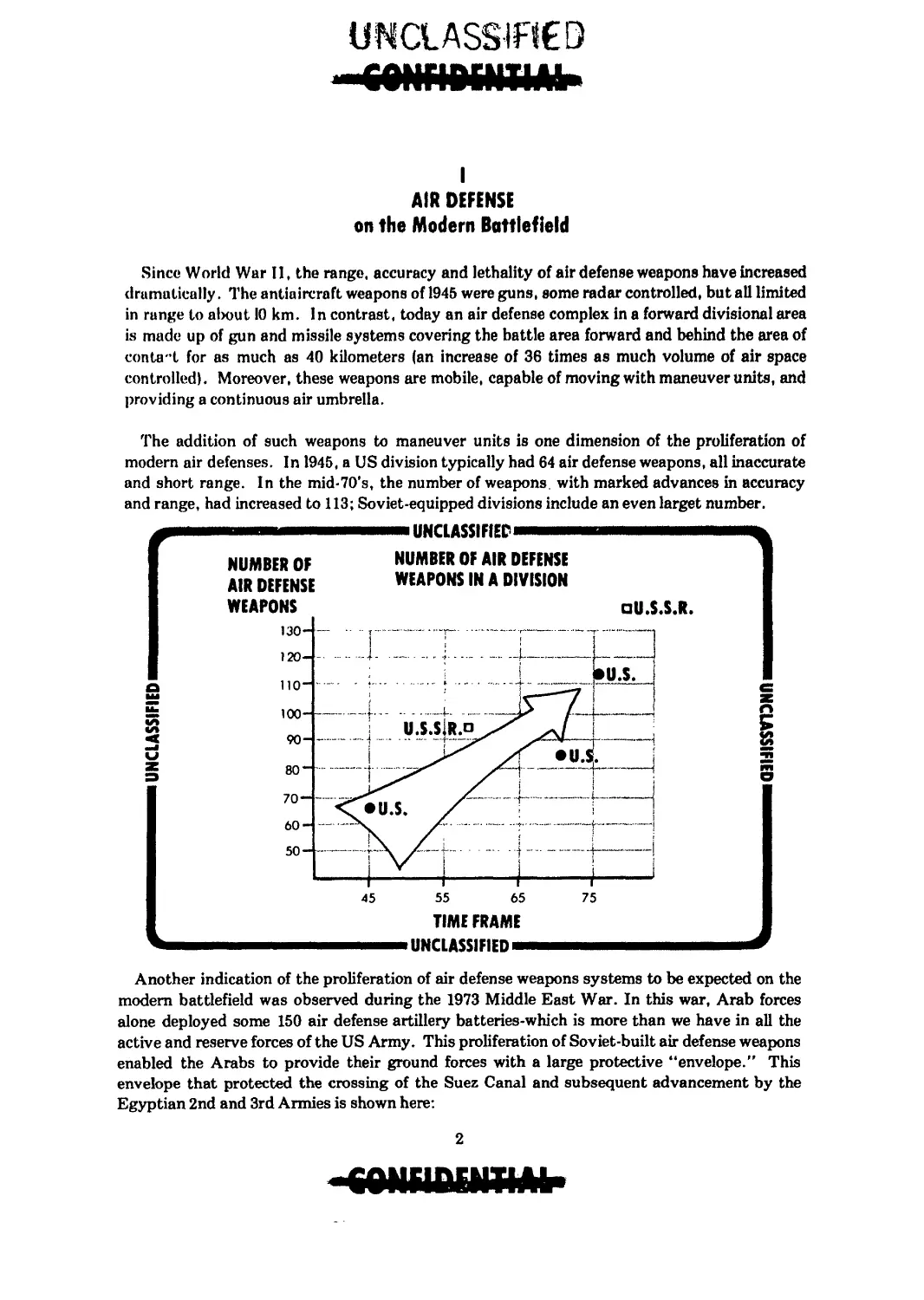
The addition of such weapons to maneuver units is one dimension of the proliferation of
modern air defenses. In 1945, a US division typically had 64 air defense weapons, all inaccurate
and short range. In the mid-70*s, the number of weapons, with marked advances in accuracy
and range, had increased to 113; Soviet-equipped divisions include an even larget number.
Another indication of the proliferation of air defense weapons systems to be expected on the
modem battlefield was observed during the 1973 Middle East War. In this war, Arab forces
alone deployed some 150 air defense artillery batteries-which is more than we have in all the
active and reserve forces of the US Army. This proliferation of Soviet-built air defense weapons
enabled the Arabs to provide their ground forces with a large protective “envelope.” This
envelope that protected the crossing of the Suez Canal and subsequent advancement by the
Egyptian 2nd and 3rd Armies is shown here:
2
UNCLASSIFIED
TRADOC BULLETIN NO. 4
CHAPTfR I
The result of this thick and lethal air defense environment was, particularly at the beginning
of the war, to deny the Israeli Army the close air support they wanted. In fact, 90% of the
Israeli air sorties were flown more than 5 km behind the area of intensive air defense. That
means that not more than 10% of the air sorties could have been what we would term “close air
support” of ground elements in contact with the enemy. The results also showed that ground
3
UNCLASSIFIED
chapter i ____________
TRADOC BULLETIN NO. 4
air defenses were a far greater problem than Arab air forces. As this breakout shows, 73% of
IDF air losses were attributable to ground systems:
ISRAELI AIR LOSSES
GROUND SYSTEMS
SURFACE TO AIR MISSILES	41 %
GROUND GUN SYSTEMS	26%
UNDERTERMINED	6%
73%
AIR TO AIR COMBAT	w
и TO
OTHER (TECHNICAL, UNKNOWN)	24%
___________________________/
§ THE PROLIFERATION AND LETHALITY OF SOVIET-BUILT AIR DEFENSE WEAPONS
w SYSTEMS IS A MAJOR LESSON TO BE LEARNED FROM THE 1973 MIDDLE EAST
= WAR.
^mmmmmhmmmmmmUNCLASSIFIED«mmmmmmmmmmmi
“The equipping of the air defense troops with modem armament permits organizing an
antiaircraft defense which is capable of assuring the attacking troops freedom of maneuver and
combat action and repelling enemy air strikes and thereby creating the necessary conditions for
the successful conduct of the offensive. ”
A. A. Sidorenko
Moscow 1970
The above quotation from THE OFFENSIVE typifies Soviet military thought and indicates
their determination to provide an effective air defense which, in turn, will insure their freedom
of maneu ver on the battlefield. Soviet air defense forces are equipped with a sophisticated array
of missile and gun systems. They not only provide extensive coverage; but are highly mobile
and are deployed with maneuver units to provide continuous protection for attacking troops. A
4
i IkiZM
л Г» rv i i
TRADOC BULLETIN NO. 4
CHAPTER I
typical Soviet air defense system would include the following weapons, which would provide
these overlapping envelojies:
UNCLASSIFIED
WEAPONS/LAUNCHERS
300 SA-7
242 ZSU-23
36 ZSU-57-2
100 5-60(57)
15 SA-6
27 SA-4
THE AIR DEFENSE OF
A TYPICAL SOVIET ARMY
4Л
(3-4 DIVISIONS)
(50 KM WIDE, 100 KM DEEP)
40
60
100
F
E
E
4—
80
-4-
60
SOURCE INTERNATIONAL DEFENSE REVIEW
APRIL 75
UNCLASSIFIED
20	0	20
KILOMETERS
UNCLASSIFIED
From the vast array of sophisticated air defense weaponry available to Soviet forces and from
the demonstrated performance of these weapons systems in the October 1973 War, we can
conclude that in the air above the battlefield, as on the battlefield itself...
ПМГ1 AQQIFirn
CHAPTER I
TRADOC BULLETIN NO. 4
UNCLMbSiHEQ
While air defense radar can detect at distances well beyond the capability of the human eye,
within eye-range, most gun systems are lethal.
One of the most numerous air defense weapons found in the forward echelons, and therefore
most likely to be encountered by US Army aviation units, is the ZSU-23-4 Self-Propelled
Antiaircraft Gun. The purpose of this bulletin, therefore, is to examine this system to show
how it operates, how it is employed, how effective it is, and, perhaps most importantly, to point
out some important tactical implications for US Army aviation units.
Data in this bulletin is from the Defense Intelligence Agency, various reports on the 1973
Middle East War, tests conducted by CDEC and MASSTER, and from US Army Material
Systems Analysis Activity. Effectiveness data presented in the following charts are derived
either from actual tests conducted or from computer model simulations conducted by
USCALDA, based on actual tests and accepted data. The US Army Aviation School and US
Army Air Defense School also made valuable contribution in the preparation of this bulletin.
^NCl/sSIHE'D
6
UNCLASSIHEB
II
THE SOVIET ZSU-23-4 SELF-PROPELLED
ANTIAIRCRAFT GUN
The Z8U*23»4 A A weapons system consists of four 23mm automatic weapons and fire control
radar mounted on a lightly armored, full tracked vehicle. The weapons are mounted parallel, In
two pairs, in an enclosed turret with the barrels protruding from a cutaway portion to allow for
gun elevation. Both turret traverse and gun elevation are accomplished by power, with a
manual control for emergency. The gun barrels are liquid cooled and expended cartridge cases
are ejected outside the turret by chutes. Fire control is provided by the on-carriage radar or by
optical sights.
7
CHAPTER II
TRADOC BULLETIN NO. 4
л	Л g
	CHARACTERISTICS
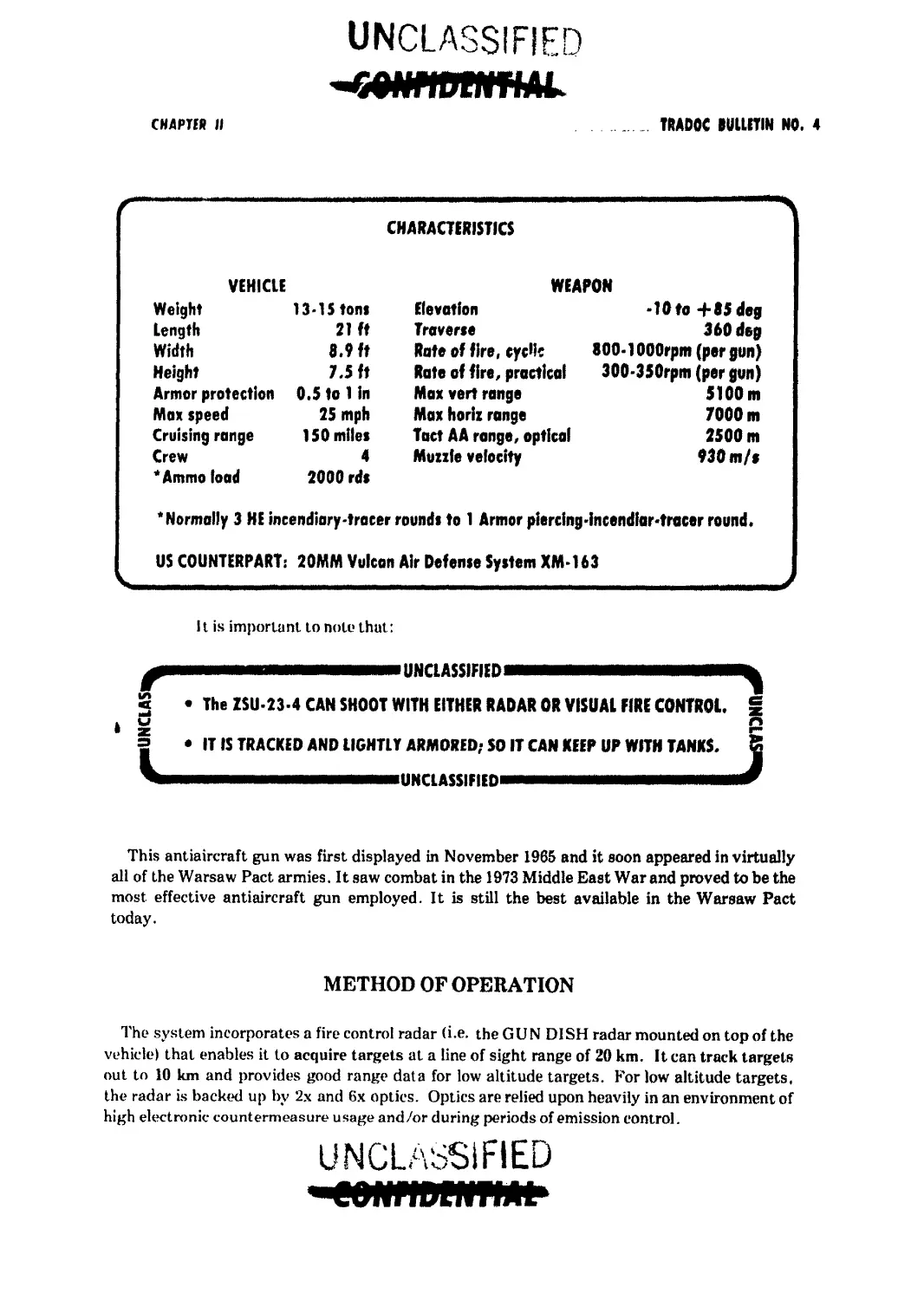
VEHICLE Weight	13*15 tons Length	21	ft Width	ал	ft Height	7.5	ft Armor protection 0.5 to 1 in Max speed	25 mph Cruising range	150 miles Crew	4 * Ammo load	2000 rds	WEAPON Elevation	-10 to -M5 deg Traverse	360 deg Rote of fire, cyclic 800-10OOrpm (per gun) Rate of fire, practical 300*350rpm (per gun) Max vert range	5100 m Max horiz range	7000 m Tact A A range, optical	2500 m Muzzle velocity	930 m/s
* Normally 3 НС incendiory-trocer rounds to 1 Armor plercing-lncendlar-tracer round.
US COUNTERPART: 20MM Vulcan Air Defense System XM-163
It is important to note» that:
UNCUS$IFIED«MMMMMMMMMHH«^
«	• The ZSU-23-4 CAN SHOOT WITH EITHER RADAR OR VISUAL FIRE CONTROL. S
I w	p
I • IT IS TRACKED AND LIGHTLY ARMORED; SO IT CAN KEEP UP WITH TANKS. &
This antiaircraft gun was first displayed in November 1965 and it soon appeared in virtually
all of the Warsaw Pact armies. It saw combat in the 1973 Middle East War and proved to be the
most effective antiaircraft gun employed. It is still the best available in the Warsaw Pact
today.
METHOD OF OPERATION
The system incorporates a fire control radar (i.e. the GUN DISH radar mounted on top of the
vehicle) that enables it to acquire targets at a line of sight range of 20 km. It can track targets
out to 10 km and provides good range data for low altitude targets. For low altitude targets,
the radar is backed up by 2x and 6x optics. Optics are relied upon heavily in an environment of
high electronic countermeasure usage and/or during periods of emission control.
ftSSiFIED
TRADOC BULLETIN NO. 4
CHAPTIR II „
UNCL-iS!£!ED
Target information is pro\ ided to a computer, which receives corrections from its three plane
stabilization system, calculates the intercept point and lead angle, and points the guns. This
gives the system this important capability:
UNCLASSIFIED
The ZSU-23-4 can fire...
V>
...while stationary
...on the move (up to 25 km/hr)
...on a 10° degree slope
UNCLASSIFIED
FIRING MODES
There are five options or modes for firing the ZSU-23-4:
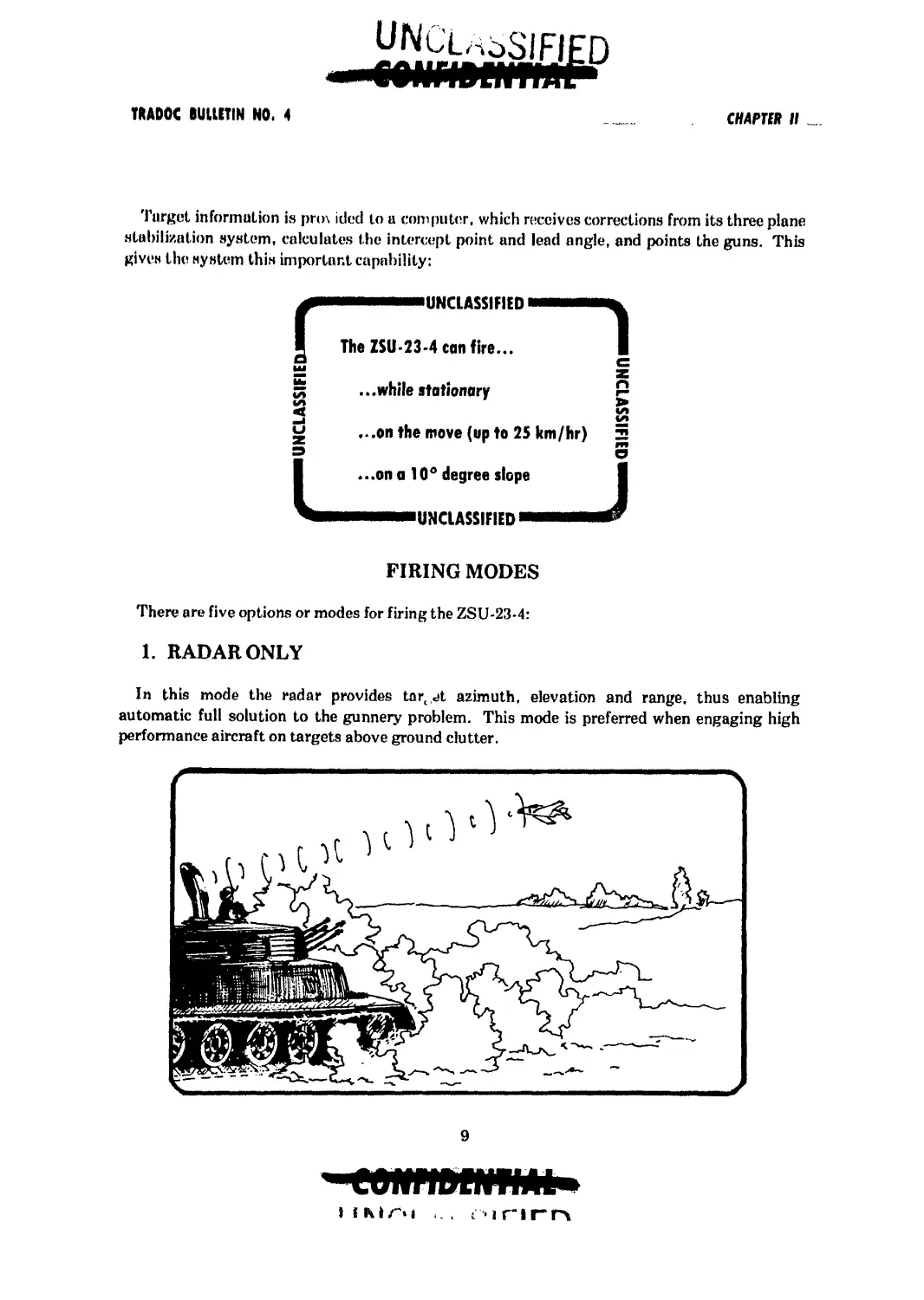
1.	RADAR ONLY
In this mode the radar provides target azimuth, elevation and range, thus enabling
automatic full solution to the gunnery problem. This mode is preferred when engaging high
performance aircraft on targets above ground clutter.
J t hiI ... t ' i r-ir“r\
9
CNAPTfR II
.. TRADOC BUILWIN NO. 4
unclassified
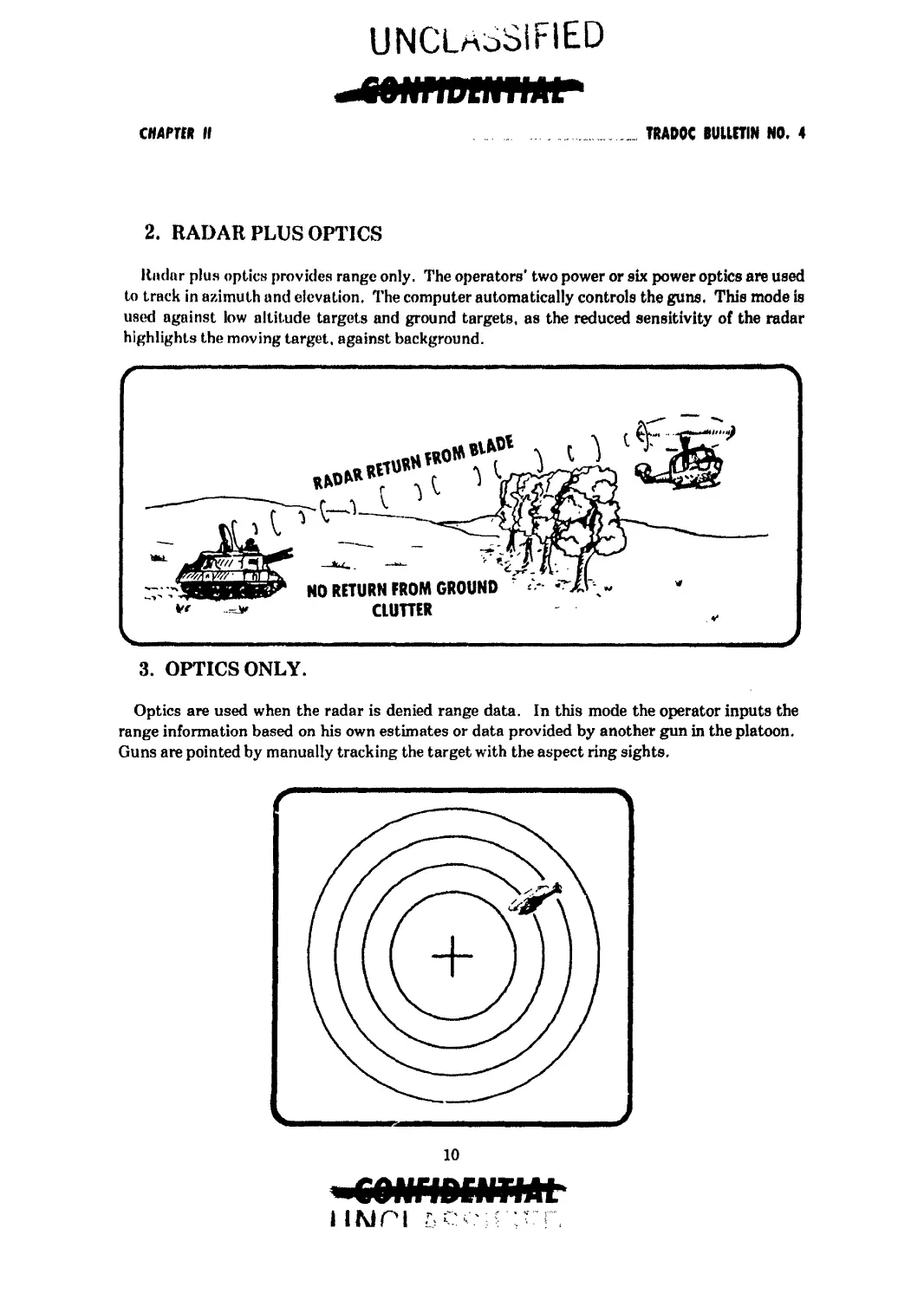
2.	RADAR PLUS OPTICS
Radar plus optics provides range only. The operators* two power or six power optics are used
to track in azimuth and elevation. The computer automatically controls the guns. This mode is
used against low altitude targets and ground targets, as the reduced sensitivity of the radar
highlights the moving target, against background.
3.	OPTICS ONLY.
Optics are used when the radar is denied range data. In this mode the operator inputs the
range information based on his own estimates or data provided by another gun in the platoon.
Guns are pointed by manually tracking the target with the aspect ring sights.
I IWC'I и
UNCLASSIFIED
TRADOC BULLETIN NO. 4
СНАРПЙ II
4,	MEMORY
Memory provides steering data to the guns for 8*10 seconds based on the last computed
tracking rate. Memory is used with modes 1 and 2 and is used when targets fly behind some
mask.
MEMORY MODE
11
UNCLASSIFIED
CHAPTHI II
_____ TRADOC BULLETIN NO* 4
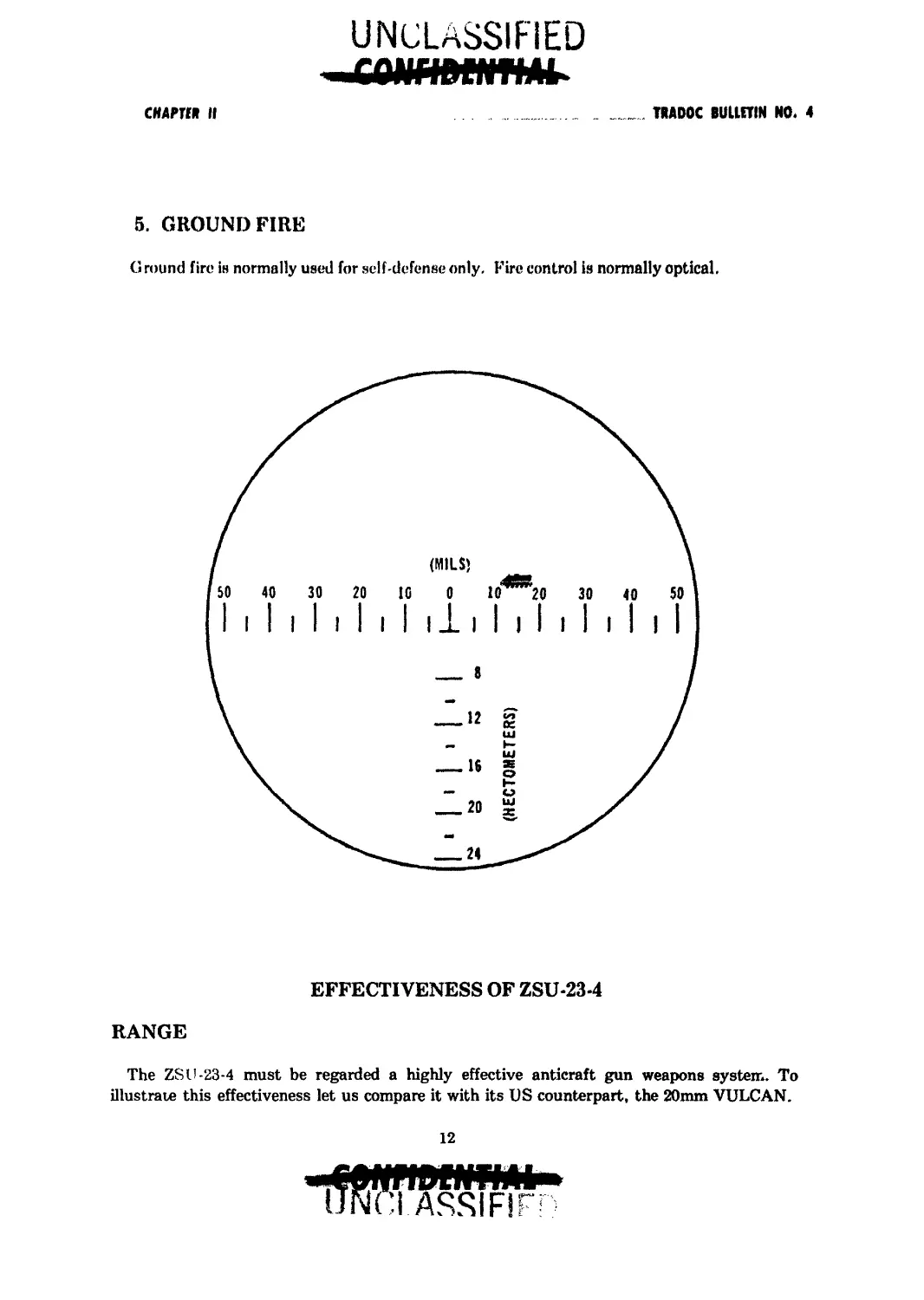
5.	GROUND FIRE
Ground fire is normally used for self-defense only. Fire control is normally optical.
EFFECTIVENESS OF ZSU-23-4
RANGE
The ZSU-23-4 must be regarded a highly effective anticraft gun weapons system. To
illustrate this effectiveness let us compare it with its US counterpart, the 20mm VULCAN.
CLASSI FIF
12
UNCLASSIFIED
TRADOC BULLETIN NO. 4
CHAPTfR II
The churl below shows the maximum altitude and range of VULCAN engagements compared
to the ZSU-23-4.
This chart shows the “horizontal” range of the ZSU-23-4 out to 2500m. The Soviets feel that
accuracy drops off so sharply beyond 2500 meters that the gunner should not engage beyond
that range except in self defense.
LETHALITY
The next chart compares the lethality of the ZSU-23-4 to that of the VULCAN. It shows the
probability of an "A-Kill” given a burst (Shown as Pk/B and meaning that the aircraft will be a
loss within five minutes). In this example, an F-4 jet aircraft is flying straight and level at500
meters altitude; at 400 kts and does not maneuver. Thus, if the ZSU-23-4 fires a 40 round burst
from its four automatic cannons, and if it fired at the F-4 at a range of 1 km using optics only.
13
CHAPTER II
TRADOC BULLETIN NO. 4
the ZSU-23-4 has a probability of kill per burst of approximately .13; whereas, the VULCAN
firing at a MIG-21 with a 60 round burst under the same conditions and using its range only
radar has a probability of kill per burst of only .08.
SINGLE BURST PROBABILITY OF A-KILL
Thus, by way of comparison, we can say that
a
UNCLASSIFIED
COMPARED TO THE VULCAN...
THE ZSU-23-4 has..
...2/3 more range
..greater than 50% more accuracy
UNCLASSIFIED
14
UNCLASSIFIED
TRADOC BULLETIN NO. 4
CHAPTiR II _
LETHALITY AGAINST THE HELICOPTER
The following chart depicts the probability of kill (Pk) vs. range of a single 40 round burst of
a ZSU-23-4 firing at an AH-1 helicopter shooting a TOW, both while it is at hover, and while it
is maneuvering laterally. Maneuver is that limited to the maximum “G” force (.35) the
helicopter can use and still control the TOW missile.
The chart shows a high probability of kill at the shorter ranges but dropping off for a
hovering AH-1 to .1 at 3,000 meters. However, if the helicopter is maneuvering laterally, it
improves its chance of survival. At 2000m the Pk is .25 while hovering, but when maneuvering
Pk falls to .15—a 40% increase in the chances of survival at that range.
1..	-- .-.—-----—------...-..--------

LETHALITY AS A FUNCTION OF RANGE AND EXPOSURE TIME
This next chart displays the probability of kill vs exposure time at three selected ranges—
1000, 2000, and 3000 meters. In this case, a ZSU-23-4 fires two 48 round bursts against a
hovering AH-1 COBRA, frontal aspect. This data is restricted by the use of two 48 round
bursts because the analysis is based on the practical consideration that two bursts would alert a
pilot in an attack helicopter, and he would attempt to break away before the arrival of the
projectiles from a third firing. This chart shows that cutting exposure time reduces the lethality
of the ZSU-23-4 and that it also decreases rapidly as the range increases.
15
CHAPTER »
____TRADOC BULLETIN HO. 4
Pk/D
EXPOSURE TIME (SECONDS)
ZSU-23-4 ENGAGEMENT TIME
To further illustrate the interrelationship between the probability of kill of the ZSU-23-4, and
the range and exposure time of the target aircraft, the following sketch and chart depict the
dynamics of an attack helicopter vs. ZSU-23-4 engagement on the battlefield. The sketch
depicts the situation in which the helicopter unmasks, acquires his target ZSU-23-4, prepares
to fire, fires, tracks his TOW missile to the target, and remasks. Recent tests have shown that
some pilots took 63 to 82 seconds for these actions. At the same time, the ZSU-23-4 ceui locate
the attacking helicopter lock on, fire, and rounds can travel to the target, in as little as 25
16
UNCLASSIFIED
TRADOC BULLETIN NO. 4
_ CHAPTIR II _
seconds. The sketch below shows this sequence for an engagement range of 2000 meters. Note:
These are some actual performance times based on tests.
TOTAL TIME TAKEN TO HIT TARGET
ZSU-23-4: 25 SEC vs ДН-1: 63-32 SEC
ZSU-23-4 TIME TO	AVERAGE
LOCATE, LOCK ON AND FIRE -	TIMES
21 SECS	TO UNMASK, ACQUIRE, FIRE,
I	v
The chart below illustrates the above situation at ranges of 2000 and 3000 meters. You can
see that it takes slightly longer for the ZSU-23-4 to acquire his target when the AH-1 is partially
concealed by having terrain, or foliage, in the background.
17
UNCLASSIFIED
СИЛРТСЙ It
TRADOC BULLETIN NO. 4
The importiiiii point to note from the above chart is that in some tests our helicopters
remained unmaaked too long! If you add 6 seconds time of flight for the 23mm round at 3000
meters, you can жч» that, even when partially concealed, the maximum time available to the
attack helicopter pilot is about 35-40 seconds. Fortunately, a later test showed that some crews
were able to complete the engagement within <37 seconds!
From the fm ’going data we should begin to conclude the following important facts about the
ZSU-23-4:
ZSU-23-4 EFFECTIVENESS
•	THE ZSU-23-4 IS A HIGHLY LETHAL WEAPON
•	ITS EFFECTIVENESS FALLS OFF SHARPLY 8EY0ND 2500 METERS
•	THE ZSU-23-4 CAN ACQUIRE, LOCK ON, ANO FIRE AT A TARGET IN
APPROXIMATELY 20-30 SECONDS
•	THE ZSU-23-4 IS LESS EFFECTIVE AGAINST A MANEUVERING HELICOPTER
THAN A HOVERING ONE
•	THE ZSU-23-4 EFFECTIVENESS IS REDUCED AS THE TARGET'S EXPOSURE TIME IS
DECREASED
mwmmmmmmmmUNCLASSIFHDmmmm^
These facts suggest the following training standards for US Army aviators:
ГишшввижмишвиишиинС1А$$1Е1Е0ивви»»и«жмвивв^
•	KNOW THE CAPABILITIES OF THE ZSU-23-4 IN ORDER TO SURVIVE ON THE J
|	BATTLEFIELD	x
§ • REMAIN UNMASKED NO LONGER THAN 30-35 SECONDS	8
z	£
।	•	ENGAGE WITH TOW - BEYOND 2500 METERS	S
TACTICAL DEPLOYMENT
ATTACK
The ZSU-23-4 is found at regimental level. The regimental air defense battery consists of one
platoon of four ZSU-23-4 self-propelled guns and one platoon of four BRDM-2A’s mounting the
SA-9 SAM missile. The ZSU-23-4's normally operate in pairs within the combat formations of
tank or motorized rifle units. One section of two guns is usually attached to each first echelon
attacking battalion. Thus, in the attacking first echelon of the regiment, look for four guns
operating in two pairs.
18
TRADOC BULLETIN NO. 4
CHAPTER II

When н battalion deploy» for combat the ZSU-23-4’s will follow the assaulting tanks or
BMPs at a distance of 400-500 meters. They normally keep 200 meters between guns and fire
either on the move or from the short halt. Their location within an attacking battalion's
formation would look something like this:
DEFENSE
In the defense the ZSU-23-4 platoon will establish primary defensive positions some 1000-
1500 meters behind the supported battalions main defensive positions. Prior to the expected
attack, the gun sections will occupy positions forward of prepared defenses from which they will
attempt to ambush helicopters and conceal their primary defensive positions.
UNCLASSIFIED
chapter it
TRADOC BULLETIN NO. 4
ROAD MARCH
In convoy the ZSU-23-4’s normally move with their supported battalion. In order to provide
adequate fields of fire, an interval of 30-50 meters is maintained between the guns and other
vehicles, i n the example below, the platoon of four guns is moving with one tank battalion.
From the normal tactical deployment of ZSU-23-4 we should remember several important
points:
I • ZSU-23-4i ARE FOUND IN PAIRS ABOUT 200 METERS APART.
I • LOOK FOR TWO PAIRS. THERE ARE FOUR TO A REGIMENT. LOOK FOR TWO
I PAIR OVER A 2-4 Km SECTOR.
о
= • THEY ARE DEPLOYED CLOSE BEHIND TANKS AND BMPs. THEY WILL BE IN THE
Я FIRST ECHELON.
| «IN THE ATTACK, THEY ARE FOUND 400-500 M TO THE REAR OF ATTACKING
| TANKS AND BMPs.
I • IN THE DEFENSE, THEY ARE USUALLY 1-1.5 KM BEHIND THE MAIN DEFENSIVE
I POSITIONS; BUT, THEY MAY COME FORWARD OF THE MAIN DEFENSIVE
I POSITIONS TO AMBUSH ATTACKING AIRCRAFT.
Чимямвиишиии UNCLASSIFIEDhommhm
20
iiKiri assiFIF.D
UNCLASSIFIED
III
COUNTERMEASURES:
TACTICAL AND TRAINING IMPLICATIONS
Let's examine the ZSU-23-4 antiaircraft weapons system to determine its vulnerabilities.
There are three essential functions that must be performed in order to complete a successful
engagement. First is acquisition— the target aircraft is acquired either visually or by radar.
Next is the internal guidance and control— the range, deflection, and altitude data for the
target aircraft is fed to the computer, which then correctly aims the guns. Finally, there is the
flring and interception— the guns are fired and the rounds intercept the target.
Since there is no practical method of interfering with the ZSU-23-4's guidance and control
system, we must break this chain of events by destroying the other two links. We must
prevent the ZSU-23-4 from effectively acquiring targets and we must degrade the effectiveness
of his fire.
UNCLASSIFIED мммшм
§ We do this in two important ways:
§	• REDUCING EXPOSURE TIME
w
э • STAYING OUT OF EFFECTIVE ZSU-23-4 RANGE
Veeeeee UNCLASSIFIED "вмаш1нашм
RANGE
Because of the attack helicopter’s mobility and firepower, it is a valuable antitank asset
available to the commander. It must, therefore, be employed primarily to destroy enemy
armor; however, it must first survive to do that. Often it will be necessary to destroy or
suppress enemy antiaircraft weapons before being able to do its primary job of killing tanks. In
its battle with the ZSU-23-4, the attack helicopter has one enormous advantage—a greater
effective range!
21
I INTI AQQIFICn
CHAPTIR III
TRADOC BUtttTIN NO. 4
UWASWED
To illustrate, the chart below depicts the probability of hit of the COBRA-TOW and the UH*
IB TOW vs. range. In teats conducted at Fort Hood. 103 TOW missiles were launched at an M-
48 target moving 3-14 mph. Firings were conducted at ranges between 1744 — 3030 and also at
3500 and 3600 meters. In Vietnam. 133 missiles were fired and the targets were almost all
stationary. Pilots were considered well trained and fired from a forward flight tactic on a
descending angle toward the targets.
As this chart indicates, the TOW has a high probability of hit. nearly 80% and it does not
decrease with range. Thus, the attack helicopter with an 80% probability of hit at 3000 meters
has an enormous advantage over the ZSU-23-4 with a probability of kill of only 10% at that
same range.
We should remember to
TAKE ADVANTAGE OF STAND-OFF RANGE WITH THE COBRA-TOW. ENGAGE
BETWEEN 3000 AND 3750 METERS (MAX RANGE).
Since the attack helicopter will face more than just the ZSU-23-4 on the battlefield, the next
chart further illustrates the advantage of employing standoff range. This graph shows the
targets killed per helicopter loss as a function of range against a mixed air defense of SA-7, SA-
8. and ZSU-23-4.
II MPI Л 0^1	г гч
22
UNCLASSIFIED
TRADOC BULLETIN MO. 4
______________CHAPTER III _
Thia example shows an exchange ratio curve of slightly more than 2:1 at 2000 meters,
increasing to 7:1 at 3000, further increasing to 12.5:1 at 3750 meters (max range).
TARGETS KILLED PER HELICOPTER LOSS
COBRA TOW (XR) VS MIXED AIR DEFENSE

✓
This chart reinforces the idea that
^MHMMMMMMyNCUSSIFIEDaMHOM»^
2 THE FURTHER AWAT THE ATTACK HELICOPTER 1$ ABLE TO ENGAGE, THE HIGHER f
z HIS EXCHANGE RATIO WILL BE.	E
UNCLASSIFIEDi
Scouts must also pay attention to the ranges at which they operate from enemy air defense
weapons. This simulation demonstrates the survivability of aero scouts white attempting to
acquire targets against a mixed air defense of ZSU-23-4, SA-7, and SA-8. This suggests to us
that survivability while scouting, like survivability while engaging, it also dependent on range.
23
UNCLASSIFIED
UNCLASSIFIED
CHAPTU HI
TRADOC BULLETIN NO. 4
SCOUT HELICOPTER LOST PER TARGET ACQUIRED
MIXED AIR DEFENSE (7SU-23-4, SA-7, SA-8)
Thus, we should teach our scout pilots the following:
mmmmmmhUNCLASSIFIEDMMMBH
Do your scouting beyond 2500m, if possible
The closer you get, the HIGHER your chances of being hit &
MKmMUNCLASSIFIEDHMMMMMMMHBMF
This next chart indicates that the type of aircraft being flown has very little effect on the
probability of surviving a single engagement against a mixed air defense. The AH-1 and the
OH-58 are relatively equal in survivability. Once again, the most significant factor is range.
Beyond 2500 meters, you have almost a 100^. chance of surviving a single engagement.
PROBABILITY OF SURVIVAL, SINGLE ENGAGEMENT
HELICOPTERS VS MIXED AIR DEFENSE

11МГ1 fiQQlFIFD
24
TRADOC BULLETIN NO. 4
СНАРГ1И III
EXPOSURE
The second genera) category of countermeasures is designed to break the chain of events
Ixjfore they really begin. The objective is to disrupt the enemy’s ability to acquire you. You can
accomplish this by having someone else fire suppression—for example, artillery—or you can,
reduce your exposure to the enemy.
1>.чрИ? all attempts to remain covered and concealed, there are occasions when you must be
exposed (v.g. when firing). As noted earlier, actual tests have shown that pilots remained
exposed at median I imes of 63 to H2 seconds while engaging targets. Remembering the ZSU-23-
1 can engage and the rounds arrive at .3000 meters within 28 seconds, pilots with thoseexposure
times ran unnecessarily high risks. Therefore, every effort must be made to reduce our exposure
time!
Let us examine what happens during a firing sequence to determine where we can best cut
our time. The chart below illustrates a chronological sequence of events and the average times
required to perform them as determined during an actual test.
F		 60* 50- 40- TIME (ЯС.) 30- 20* io-	THE Fl
	RANG

IRING SEQUENCE
2 4	- RE-MASK
SEC
21 SEC	- MISSILE FLIGHT TIME
4 sec	“ PREFARE TO FIRE
24 SEC	~ ACQUIRE TARGET
TT TK	.„^unmask
3750
GE (METERS)

From this chart we can see that the only function that can be significantly reduced is that of
target acquisition. All other functions require a relatively fixed amount of time.
This next graph illustrates total exposure times from two different tests at ranges of 2000
and 3750 meters. As the curved line Pa (probability of being acquired) indicates, it is highly
likely that an engaging aircraft will be acquired by the ZSU-23-4. On the other hand, as the two
Pk (probability of being killed) lines indicate, at ranges beyond 3000 meters the probability of
being killed with two 48 round burets is small. We must remember, though, that although the
ZSU-23-4 loses accuracy, the rounds can still travel out past three and four thousand meters.
So on occasion, we should expect some incoming fire even at extended ranges.
25
। iKiru л ecicicn
CHAPTER III
TRADOC BULLETIN NO. 4

EXPOSURE TIME VS PROBABILITY OF BEING ACQUIRED (Pa)
OR BEING KILLED (Pk) (ZSU-23-4, TWO 48 rd BURSTS)
t-J--------1----—	.......“-i>
/	<	4	S
RANG* (RM)
Thus, we ought to expect that:
—	.......UNCLASSIFIED———————иои^
• Even at 3500 meters the attack helicopter will most likely be acquired. I
oi
g • At that range it can receive incoming 23mm fire	ж
5	• The probability of being killed is small	Ц
3E	<32
J • Even at extended ranges, t* longer exposure time increases the probability of §
I	being hit,	I
\^ииижмииивиииишм1 UNCLASSIFIEDBMMMMHMMMaMMHHr
Since we must reduce our total exposure time even at extended ranges and since the only way
to significantly reduce it is by reducing target acquisition time, let us look at some test results
that do show reduced exposure. The two examples below show tests results in which the attack
helicopters were assisted by scouts in acquiring their targets. Each scout found the target and
then while unmasked, “talked" the attack helicopter into acquiring it. Asa result of this "hand
off", target acquisition times were cut to an average of 3 seconds. But even with this reduction,
the ZSU-23-4 still has enough time for a 90% probability of acquiring the attack helicopter
before the AH can kill the ZSU-23-4.
26
IINr.l ASSIFIED
UNCLASSIFIED
TRADOC BULLETIN MO. 4
CHAPTIP III
'	.... ..... -.................. “A
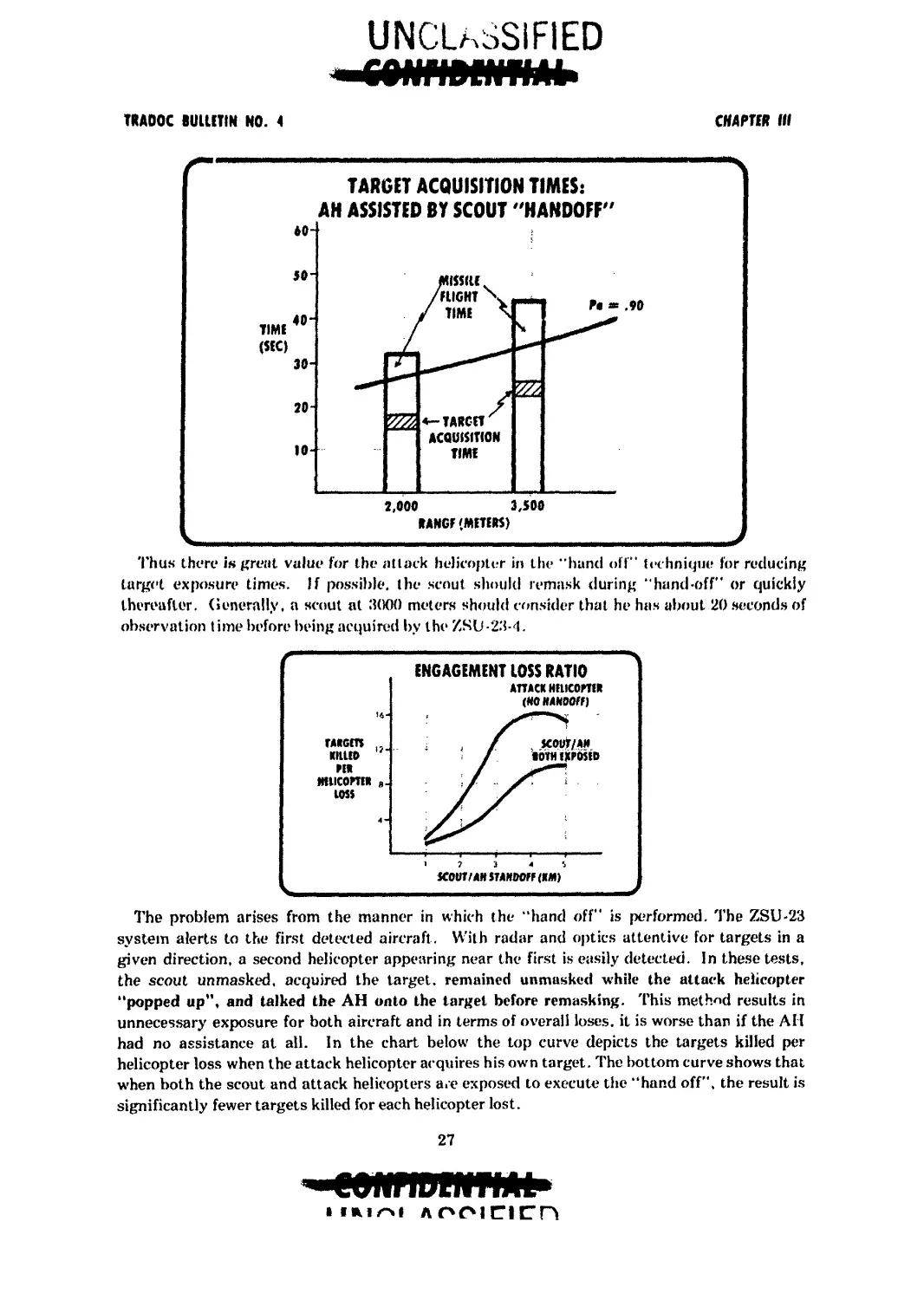
TARGET ACQUISITION TIMES:
JtANGF (METERS)
Thus there is great value for the attack helicopter in the "hand off* technique for reducing
target exposure times. If possible, the scout should remask during “hand-off” or quickly
thereafter. Generally, a scout at 3000 meters should consider that he has about 20 seconds of
observation time before being acquired by the ZSU-23-4.

TAIGtH ,,
MILLID 7
HI
WHIC0FH1 й
LOSS
ENGAGEMENT LOSS RATIO
ABACK HHICOFTER
SCOUT/ДИ STANDOFF (KM)
The problem arises from the manner in which the “hand off" is performed. The ZSU-23
system alerts to the first detected aircraft . With radar and optics attentive for targets in a
given direction, a second helicopter appearing near the first is easily detected. In these tests,
the scout unmasked, acquired the target, remained unmasked while the attack helicopter
“popped up’’, and talked the AH onto the target before remasking. This method results in
unnecessary exposure for both aircraft and in terms of overall loses, it is worse than if the AH
had no assistance at all. In the chart below the top curve depicts the targets killed per
helicopter loss when the attack helicopter acquires his own target. The bottom curve shows that
when both the scout and attack helicopters a.e exposed to execute the “hand off", the result is
significantly fewer targets killed for each helicopter lost.

27
UNCLASSIFIED
смети III
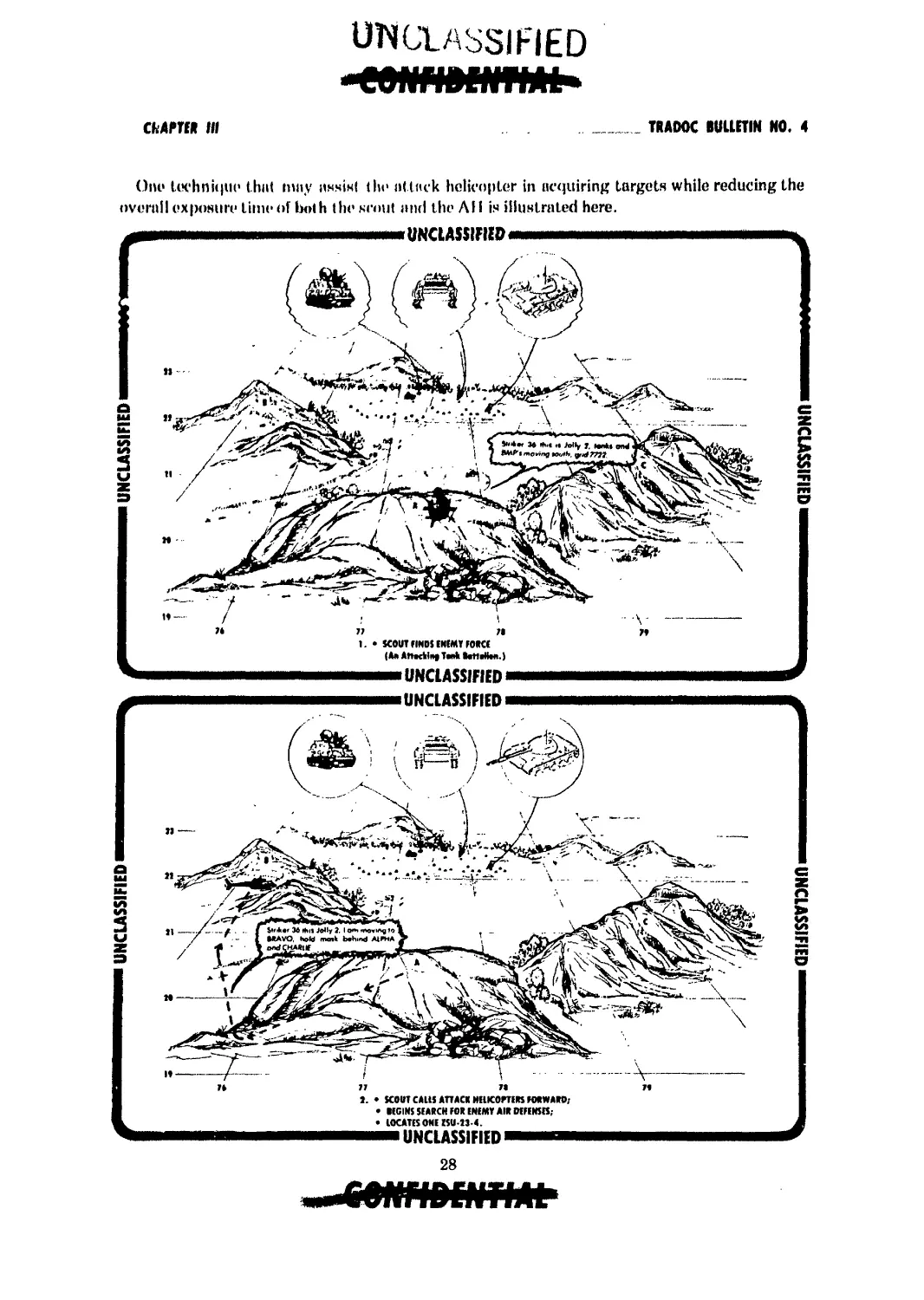
TRADOC BULLETIN NO. 4
One technique that may assist <h<* nttnck helicopter in acquiring targets while reducing the
overall exposure time of both the scout and the AH is illustrated here.
UNCLASSIFIED
UNCLASSIFIED
• SCOUT CALLS ATTACK HELICOPTERS FORWARD;
• BEGINS SEARCH FOR ENEMY AIR DEFENSES;
• LOCATES ONE ZSU43-4.
" UNCLASSIFIED
UNCLASSIFIED	... UNCLASSIFIED
28
UNCLASSIFIED
• SCOUT CONTINUES SEARCH AND LOCATES
H4ZSU-1J-4; PASSES TARGET LOCATION
(COORDINATES, AZIMUTH, A RANGE) AND
DESCRIPTION Of TARGET POSITION TO
THE ATTACK HELICOPTERS, WHICH AM
STILL MASKED.
UNCLASSIFIED мм
ATTACK HELICOPTERS UNMASK
AND ENGAGE THE 1SU-EJ.4,
and tanks suwiwttoimr.
UNCLASSIFIED»
29
CHAPTER III
TRADOC BULLETIN NO. 4
In training, therefore, wo must remember:
^«виашив UNCLASSIFIED
I • Cut exposure of scouts during target "hand-off" to AH. Put as much I
I separation between scout and AH as you can.	I
I	• Use techniques that reduce overall exposure	I
a	c
~	(1) Train using efficient visual search techniques
♦л	E
«л	5*
2	(2) Use scouts to find the enemy force	v*
v	-n
Z	m
।	Pass target information to the AH by coordinates or azimuth and range -
I	Add verbal description of the target location	I
I (4) Request assistance in target designation from ground troops	I
UNCLASSIFIED
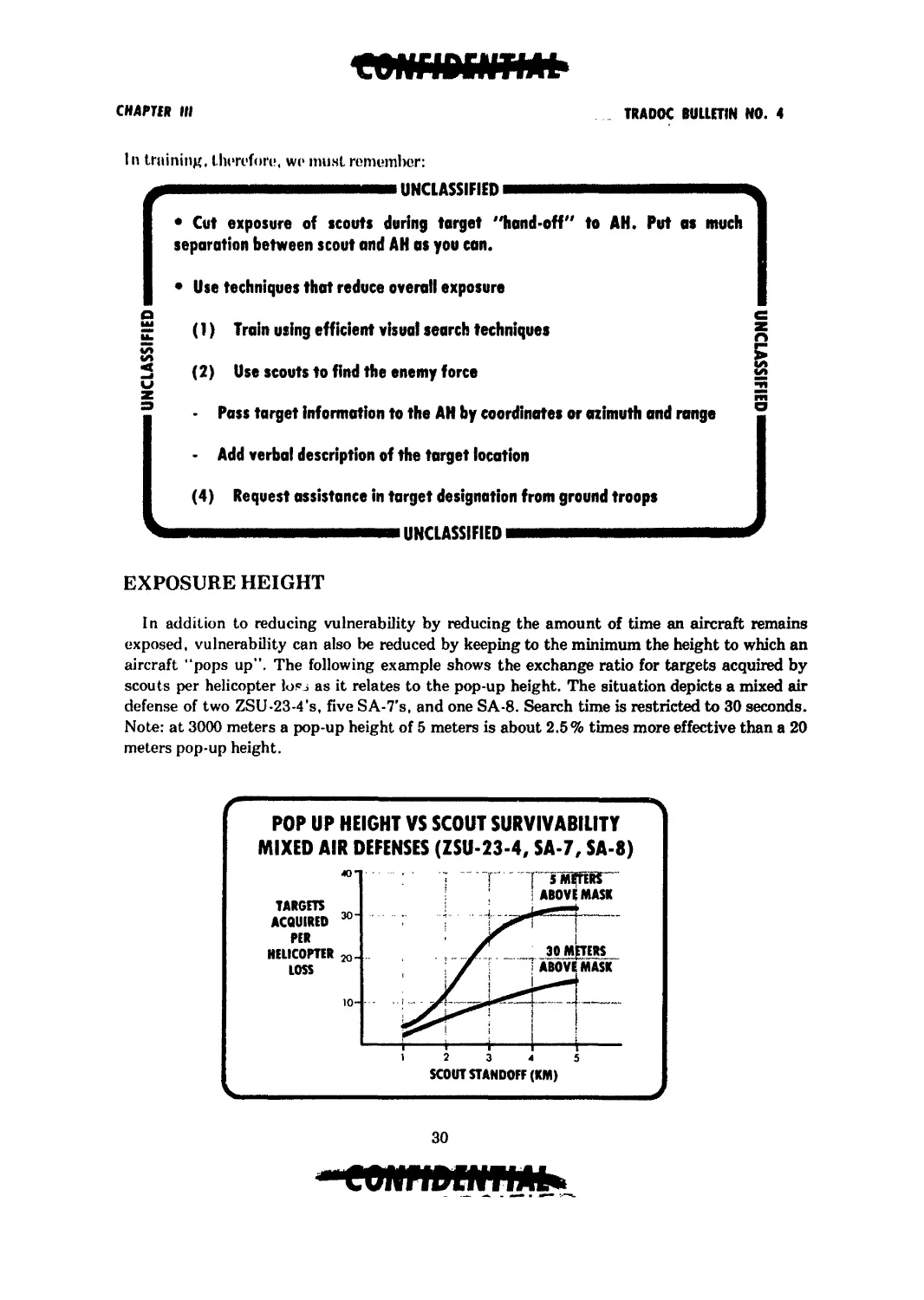
EXPOSURE HEIGHT
In addition to reducing vulnerability by reducing the amount of time an aircraft remains
exposed, vulnerability can also be reduced by keeping to the minimum the height to which an
aircraft “pops up”. The following example shows the exchange ratio for targets acquired by
scouts per helicopter loss as it relates to the pop-up height. The situation depicts a mixed air
defense of two ZSU-23-4’s, five SA-7’s, and one SA-8. Search time is restricted to 30 seconds.
Note: at 3000 meters a pop-up height of 5 meters is about 2.5% times more effective than a 20
meters pop-up height.
POP UP HEIGHT VS SCOUT SURVIVABILITY
MIXED AIR DEFENSES (ZSU-23-4, SA-7, SA-8)
4...............      z
30
TRADOC BULLETIN NO. 4
CHAPTER III _
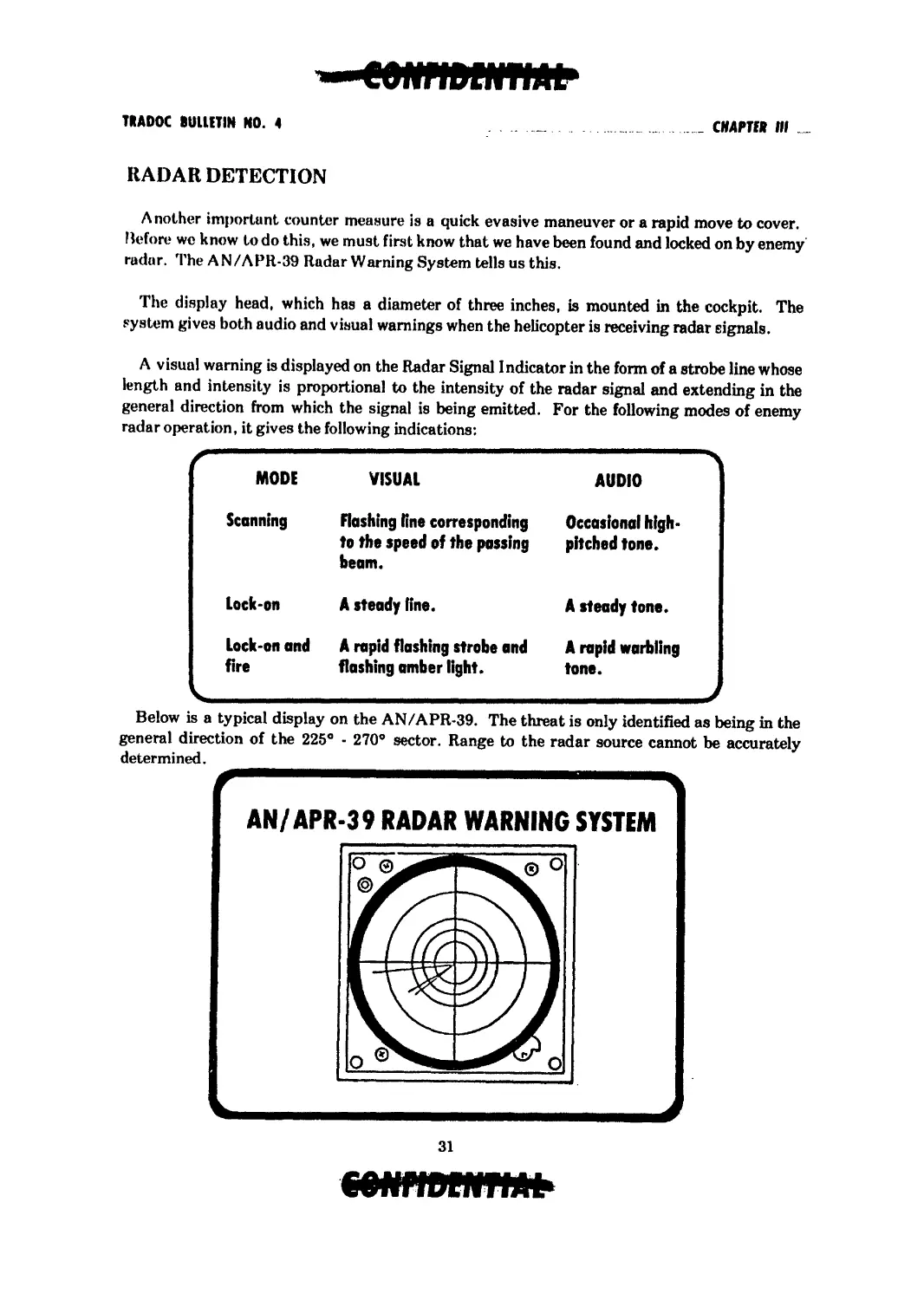
RADAR DETECTION
Another important counter measure is a quick evasive maneuver or a rapid move to cover.
Before we know to do this, we must first know that we have been found and locked on by enemy
radar. The AN/APR-39 Radar Warning System tells us this.
The display head, which has a diameter of three inches, is mounted in the cockpit. The
system gives both audio and visual warnings when the helicopter is receiving radar signals.
A visual warning is displayed on the Radar Signal Indicator in the form of a strobe line whose
length and intensity is proportional to the intensity of the radar signal and extending in the
general direction from which the signal is being emitted. For the following modes of enemy
radar operation, it gives the following indications:
MODE	VISUAL	AUDIO
Scanning	Flashing line corresponding Occasional high- to the speed of the passing pitched tone, beam.
Lock-on	A steady fine.	A steady tone.
Lock-on and fire	A rapid flashing strobe and A rapid warbling flashing amber light.	tone.
Below is a typical display on the AN/APR-39. The threat is only identified as being in the
general direction of the 225° - 270° sector. Range to the radar source cannot be accurately
determined.
AN/APR-39 RADAR WARNING SYSTEM
31
СМАРТ» III
TRADOC BULLETIN NO. 4
GENERAL TACTICS & TECHNIQUES
In addition to the specific techniques to counter the ZSU-23-4 already discussed, there are
certain general tactics that increase the survivability of Army aviation in this highly lethal
enemy air defense environment.
ARMY
Tanks (M-60/A1/A2)
Anti-Tank Guided Missiles
Field Artillery
Attack Helicopter (AH-1G)
SUPPRESSION
Army aviation is not alone in its battle against the enemy air defense. The US Air Force is
waging the same battle. Additionally, the actions of ground elements of the combined arms
team can also degrade the effectiveness of enemy air defenses. To obtain close air support from
the Air Force, we must be able to suppress enemy air defenses. To do this will require a high
order of intelligence, reconnaissance and surveillance. Both the Army and the Air Force
possess various means to suppress enemy air defenses. For example, the following means are,
or will be, available to assist in our suppression effort.
SUPPRESSORS	1
AIR FORCE
A-7
M
F-lll
Munitions
Electro/Optical
Laser Guided
General Purpose
Anti-radiation missiles
Wild Weasel (F4C, Fl05)
A-10
Wild Weasel (F4E)
EF111
F-16
Improved Munitions
Guidance
Fuzing
ECM
V___________________________________________________________________________/
Improved Conventional
Munitions
ECM
AH-1Q/
Obviously, to employ these suppressors effectively will require careful Army-Air Force
coordination and cooperation, particularly at the corps/division level.
Assistance m suppressing enemy air defenses can and must come from our ground forces.
Teamwork and correct employment of the combined arms team is the key. For example,
artillery can be used to suppress the ZSU-23-4. By knowing where the ZSU-23-4’s are normally
found, that area can be suppressed with high explosives (to destroy or damage his GUN DISH
radar) while his optical capability can be degraded by the use of smoke.
32
TRADOC BULLETIN НО. 4	_________________________________ СНАРПК HI _
TERRAIN FLYING
Battlefield survivability for the aviator depends to a large extent on how he flies around the
battlefield. While it is generally true that reasonable altitude is desired for flight safety
considerations, for operational considerations, flight at altitude may well be lethal. Enemy
detection and engagement capabilities may dictate combinations of low level, contour, and nap-
of-the-earth flight as well as hover, pop-up, sideslip, dash, quick-stop and land. Regardless of
whether the aviator is performing NOE, contour, or low level flight, he must use the terrain to
his advantage if he is to survive and complete his mission. This is the concept of terrain flying.
This is what the aviator must learn and practice.
(See EM 1-1, Terrcun Flying, for a full discussion J
NIGHT OPERATIONS
With the introduction of the "cav nav” goggles our helicopters will soon have the capability
to engage targets at night. In night operations the ZSU-23-4’s optical capability is degraded,
offering the goggle-equipped AH some advantage.
DESTRUCTION
Obviously, the best countermeasure to any air defense weapon is simply to destroy it.
Destruction of enemy air defense requires many skills of the Army aviator but one skill is
absolutely essential- good gunnery. Good gunnery, with the TOW missile, for example,
requires practice. Even with practice, there will still probably be some people who simply lack
the necessary psycho-motor aptitude to be a good gunner. Flying ability does not necessarily
equate to gunnery ability!
0*... UNCLASSIFIED"'»
< «=
2 ACCURACY DEPENDS ON *
z TRACKING ABILITY £
V UNCLASSIFIED
We must improve the tracking ability of poor gunners. This improvement can only result
from training and practice. Aerial TOW gunners should improve their missile tracking skills on
the M70 TOW trainer.
Those who simply cannot demonstrate the necessary hand-eye coordination to consistently
maintain at least an 80% probability of hitting the target at 3000 meters should not be selected
as a COBRA TOW gunner. To survive in battle, we need our best gunners firing the missile.
^mmmhhmmUNCLASSIFIEDmmmh
3 • Train to improve and maintain gunnery skills
In short, we must:
Select only the best qualified to be YOW gunners
MMHi UNCLASSIFIE
33
CHAPTER III _
TRADOC BULLETIN NO. 4
To illustrate the value of training in order to increase our ability to destroy the enemy, the
graph below portrays three tests conducted by TOE aviation units. All three tests were
conducted under similar conditions and the bar graphs represent the aggregate scores of each
unit firing *,he COBRA TOW at moving targets at ranges of 1700-3000 meters. The unit on the
left had received little training; the two tests on the right were conducted by the same unit. The
improved score on the right is the result of more tracking practice and more time devoted to all
aspects of training.
Tests have also shown that with training, helicopter units can reduce their average exposure
time for target engagements. The chart below shows that. Test A, in which the average
exposure times were 83 seconds, was done by a unit that had received little training. Later,
after more practice, a better awareness of the nature of the threat, and by using improved
search techniques to reduce target acquisition time, the same unit in Test C has an average
exposure time of only 37 seconds! The unit in Test В had received more training than the unit
conducting Test A.
UNCLASSIFIED
Thus, we must conclude that
TRAINING MAKES THE DIFFERENCE
UNCLASSIFIED
34
UNCLASSIFIED
TRADOC BULLETIN NO. 4
________________CHAPTER III

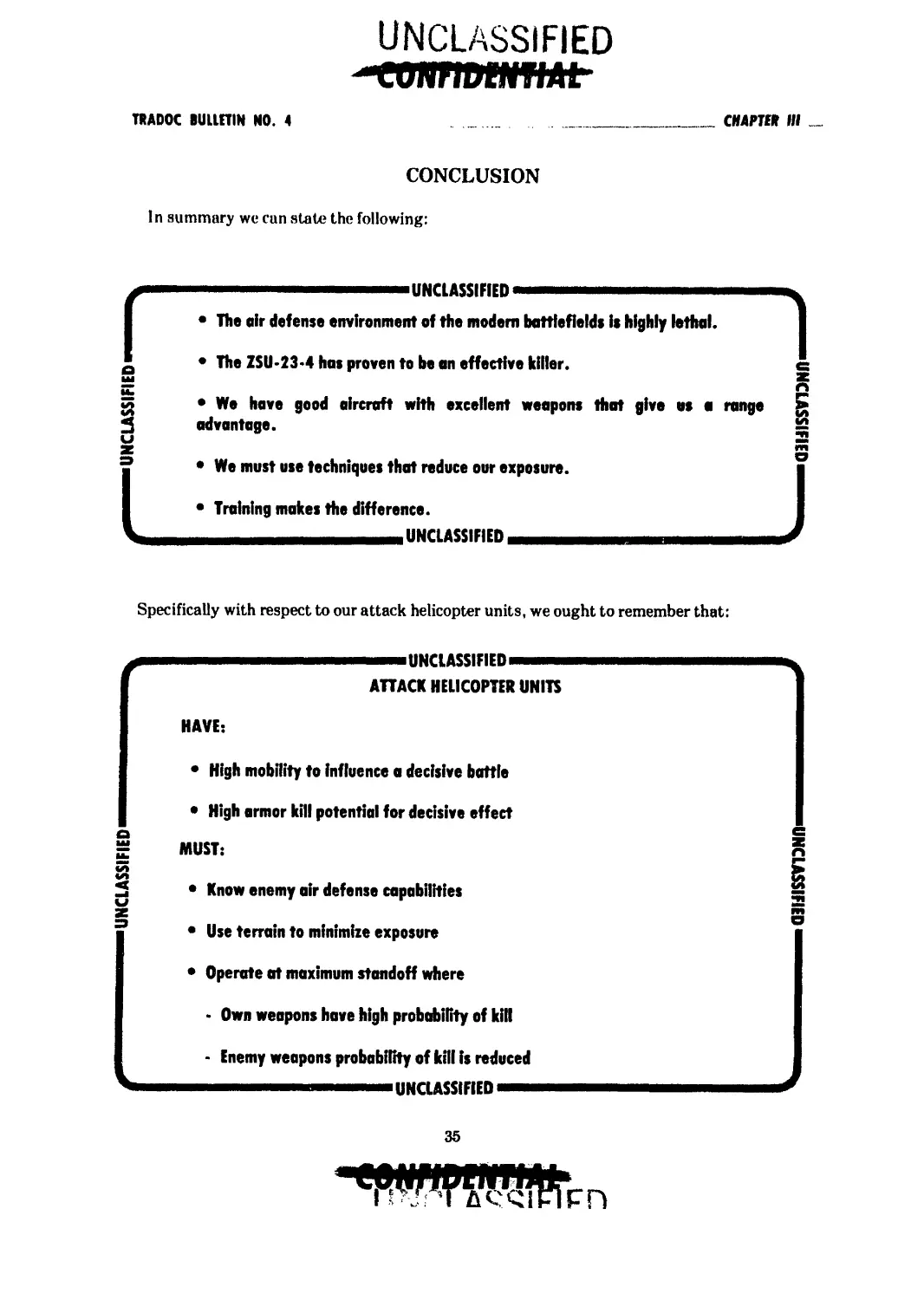
CONCLUSION
In summary we can state the following:
	 ......I...   I. UNCLASSIFIED      ............ «
•	The air defense environment of the modem battlefields Is highly lethal.
•	The ZSU>23>4 has proven to be an effective killer.
•	We have good aircraft with excellent weapons that give as a range
advantage.
•	We must use techniques that reduce our exposure.
•	Training makes the difference.
UNCLASSIFIED мннмяимнянммнн
Specifically with respect to our attack helicopter units, we ought to remember that:
UNCLASSIFIED
g । .......................     UNCLASSIFIED	........ .......——
ATTACK HELICOPTER UNITS
HAVE:
•	High mobility to influence a decisive battle
•	High armor kill potential for decisive effect
c
MUST:	Я
E
•	Know enemy air defense capabilities	~
5
•	Use terrain to minimize exposure
•	Operate at maximum standoff where
»	Own weapons have high probability of kill
-	Enemy weapons probability of kill is reduced
...........—...................   UNCLASSIFIED

35
UNCLASSIFIED
IV
OBTAINING TRADOC BULLETINS
Purpose. A series of TRADOC Bulletins are being published by HQ TRADOC to provide
commanders timely technical information on weapons, tactics and training technique. It is not
intended to supplant doctrinal publications, but to supplement material on "How to fight'* with
data derived from tests, recent intelligence, or other sources, which probe “why?"
Applicability. TRADOC Bulletins are developed by Headquarters, TRADOC using the most
comprehensive and current military and civilian data available. Army Trainingand Evaluation
Programs (ARTEPI, Field Manuals |FM) and Training Circulars (TC) will continue to be the
primary training references. TRADOC Bulletins will supplement them with an explanation of
why we are training in a given manner. TRADOC Bulletins should enable commanders to
better stimulate and motivate subordinates to understand why we train the way we do.
Index of Series. TRADOC Bulletins are cataloged in DA Pamphlet 310-3, “Index of Doctrinal,
Training and Organizational Publications.” The series are numbered consecutively and each
TRADOC Bulletin is announced at time of printing in the information bulletin distributed to all
pinpoint account holders by the US Army AG Publications Center.
Additional Copies. Submit DA Form 17 to order more copies of this TRADOC Bulletin.
Permanent Distribution. Pinpoint account holders receiving TRADOC Bulletin Number 1 from
Baltimore will automatically receive two copies of all subsequent issues unless a DA Form 12-
11B is submitted to change that quantity. Others desiring to be added to the permanent
distribution list for TRADOC Bulletins must submit a DA Form 12-1 IB. Units which are
required to submit publication requests through another headquarters should send the
completed excerpt through proper authority.
Reference for Distribution Procedures. DA Pamphlet 310-10 explains the pinpoint distribution
system and how to establish or update an existing account at the US Army AG Publications
Center. TC 21-6-1, “Use Your Training Publications,” will be helpful also in understanding the
pinpoint system.
36
UNCLASSIFIED
Enter pinpoint account number
established with USA AG Pub Cen.
Baltimore. MD.
REQUISITION FOR PUBLICATIONS AND BLANK FORMS (AR3iG-i)	P AGE NO 1	NO OF p ages	DATE OF T row	R EQU1SI-	AC COUN T	NUMB E“
NAME OF REQUISITIONING AGENCY IF DIFFERENT f	‘ROM '•Ship	TO" ADDRESS
REQUISITION
О SPECIAL
4. IT EMS requested hereon
I SENSl
!_} US AR	/ > GRI
SCHOOL REQUIREMENTS
SHIP TOt fCompfere address. include ZIP Code)
UNCLASSIFIED
Commanding Off icer
USA AG Publications Center
2800 Eastern Boulevard
Baltimore, Maryland 21220
UNCLASSIFIED
REQUIREMENTS
SUPPLY ACTION by SOURCE OTHER THAN USAAGPC
CT ION
NUMERICAL DESIGNATION of REQUISITIONED ITEM
b
TRADOC BULLETIN 4
( Form*
Only)
TOr
(Include
ZIP Code)
SIGNATURE
PREVIOUS EDITIONS WILL %£ USED.
	It CARTONS I Number)	12 BOXES ^Number)	13 WEIGHT	1 *	DATE ship PED
	1$ B-L OR REGISTRY NUM8ERISI
	ISA. EDITED BY	b. DATE	17* FILLED BY	b.	date
DA,:°™„17
To obtain additional copies of this bulletin, complete ait checked items, fold, and mail.
UNCLASSIFIED
DEPARTMENT OF THE ARMY
OFFICIAL BUSINESS
penalty for private use ijoo
postage ano fees paid
department of the arm*
ix)i>-:m4
Commander	«
US Army AG Publications Center	J
2800 Eastern Boulevard
Baltimore. Maryland 21220	I
C
u
T
H
I Hold and mail to above)
E
R
E
UNCLASSIFIED
38
UNCLASSIFIED
UNCLASSIFIED
(Signature of Reviewing Authority)
(Signature of Reauisitioner)
UNCLASSIFIED
OEFARTMEHT OF THE ARMY
OFFICIAL »U5JNK81
FCNAUTY FOR PAIVATK USF UOO
Commander
US Army AG Publications Center
2800 Eastern Boulevard
Baltimore. Maryland 21220
ro>T*oe AHO PECS PAID
ОСРААТМенТ OF THt ЛЯМУ
DOO-314
I
I
I
I
I
I
I
I
I
I
I
I
I
I
c
и
T
H
(Fo'.» j and mail to above)	।
R
E
40
UNCLASSIFIED
IHKIMSIHtD
41
UNCLASSIFIED
TRADOC Bulletin 4
12 January 1976
W. E. DePUY
General, United States Army
Commanding
DISTRIBUTION:
Active Army. ARNG, USAR: To be distributed in accordance with DA Form 12-11A
requirements for Avn Co, Bn, Gp and BdefQty rqr block no. 3); Attack Helicopter Gunnery (Qty
rqr block no. 4); Army Avn Techniques and Procedures (Qty rqr block no. 8); FA Bn, Aerial FA
(Qty rqr block no. 65); Divisional Armored and Air Cav Units (Qty rqr block no. 131);Air Cavalry
Sqd(Qty rqr block no. 132); DA Form 12-11В requirements for Aerial Survl-Recon, Field Army
(Qty rqr block no. 283); USA Air Def Arty Operations (Qty rqr block no. 350); TRADOC Bulletins
(Qty rqr block no. 430). Additional copies can be requisitioned (DA Form 17)from the US Army
Adjutant General Publications Center, 2800 Eastern Boulevard, Baltimore, MD 21220.