/





















Author: Davies J.
Tags: history of england middle ages medieval history tudor history tudors
ISBN: 978-1-913336-41-7
Year: 2021
Similar

Text
From Retinue to Regiment series
Warfare c.1453-1618
https:llwww.helion.co.uklseries/from-retinue-to-regiment-1453-1618.php
The period 1453 to 1618 connects the High Medieval Period to the Early
Modern Era. Commonly known as the Renaissance, it saw technological
advances and significant social and cultural change. Catholic dominance
was challenged by the rise of the new Protestant religions, and Western
Europe was itself challenged by the rise of the Ottoman Empire. The New
World was discovered and greater links with the East were created. This
period saw the fall of Constantinople to the Turks and the last major
battle of the Hundred Years War, both in 1453. The use of gunpowder and artillery played an
ever-increasing role in war, and this was coupled with the rise of the professional soldier. The
condotierri, landsknecht and janissary were all to march across the battlefields of Europe and
beyond. Army organisation also changed The mid to late 15th century still saw armies based
around the' lance fournie' or 'retinue' of the High Medieval Era, formations based around a lord
and his immediate men-at-arms and other supporters. By the mid 16th century Italian officers
were fielding their troops in formations known as 'battagliones', and by the end of the century
the French term 'regiment' was in common usage. 'From Retinue to Regiment 1453-1618'
examines this period in a broad sweep. It examines the wars and battles through narrative,
as well as looking at the equipment, clothing and logisticS involved.
About the author
Jonathan Davies
was
a scholar of Sidney Sussex College Cambridge where he read history. before progressing to a
career in teaching. He has spent the last forty years mostly teaching medieval and Tudor history as well as leading a
medievaUTudor re-enactment group. He has written extensively on a wide range of historical subjects both civilian
and military. including a book on the navy in the reign of Henry VIII. Most recently he completed a title for Osprey.
The Medieval Cannon 1326-1494. He has extensive first -hand experience in the handling of weapons from slings to
swords. pikes to trebuchets and bronze cannons to crossbows. His latest project involved the design and casting of
an octagonal bronze cannon barrel fitted with a matching field carriage, for his re-enactment group. He has written
about, conducted workshops and lectured on the understanding of the past through practical experience. He has
followed the route of the First Crusade in an ancient ex-ambulance and has most recently completed a pilgrimage to
Santiago de Compostela on foot. He brings a lifetime of practical and academic experience to the subject, providing
new insights into a topic which has often been little regarded..
About the artists
Patrice Courcelle was born in 1950 in northern France. He has been a professional illustrator for over 20 years.
Entirely self-taught, he has illustrated many books and magazine articles. Patrice now lives in the town of Waterloo
close to the famous battlefield..
Netherlands-based Mats Elzinga is a design director and illustrator. He has illustrated for leading publishers of
military history and wargaming such as Helion & Company, Osprey Publishing and Games Workshop. He researches
military flags and visually reconstructs them for museums and private collectors around the world.. In his spare time,
Mats enjoys family life, cooking, wargaming, collecting art, listening to music and walking in the countryside.
Submissions
The publishers would be pleased to receive submissions for this series. Please contact series editor Charles Singleton via
email (charlessingleton@helion.co.uk), or in writing to Helion & Company Limited, Unit 8, Amherst Business Centre,
Budbrooke Road, Warwick, Warwickshire, CV34 5WE.
THE TUDOR ARTE OF WARRE
VOLUME 1
The Conduct of War from Henry VII to Mary I, 14851558
Jonathan Davies
Helion & Company
Helion & Company Limited
Unit 8 Amherst Business Centre
Budbrooke Road
Warwick
CV345WE
England
Tel. 01926 499 619
Email:info@helion.co.uk
Website:www.helion.co.uk
Twitter:@helionbooks
Vsi it
Published by Helion & Company 2021
Designed and typeset by Serena Jones
Cover designed by Paul Hewitt.Battlefield Design (www.battlefield-design.co.uk)
Text © Jonathan Davies 2021
Black and white images ©as individually credited
Colour photographs by Chantal Lashmar and Jane Bennett © Helion & Company 2021
Colour figure on front cover by Patrice Courcelle © Helion & Company 2021
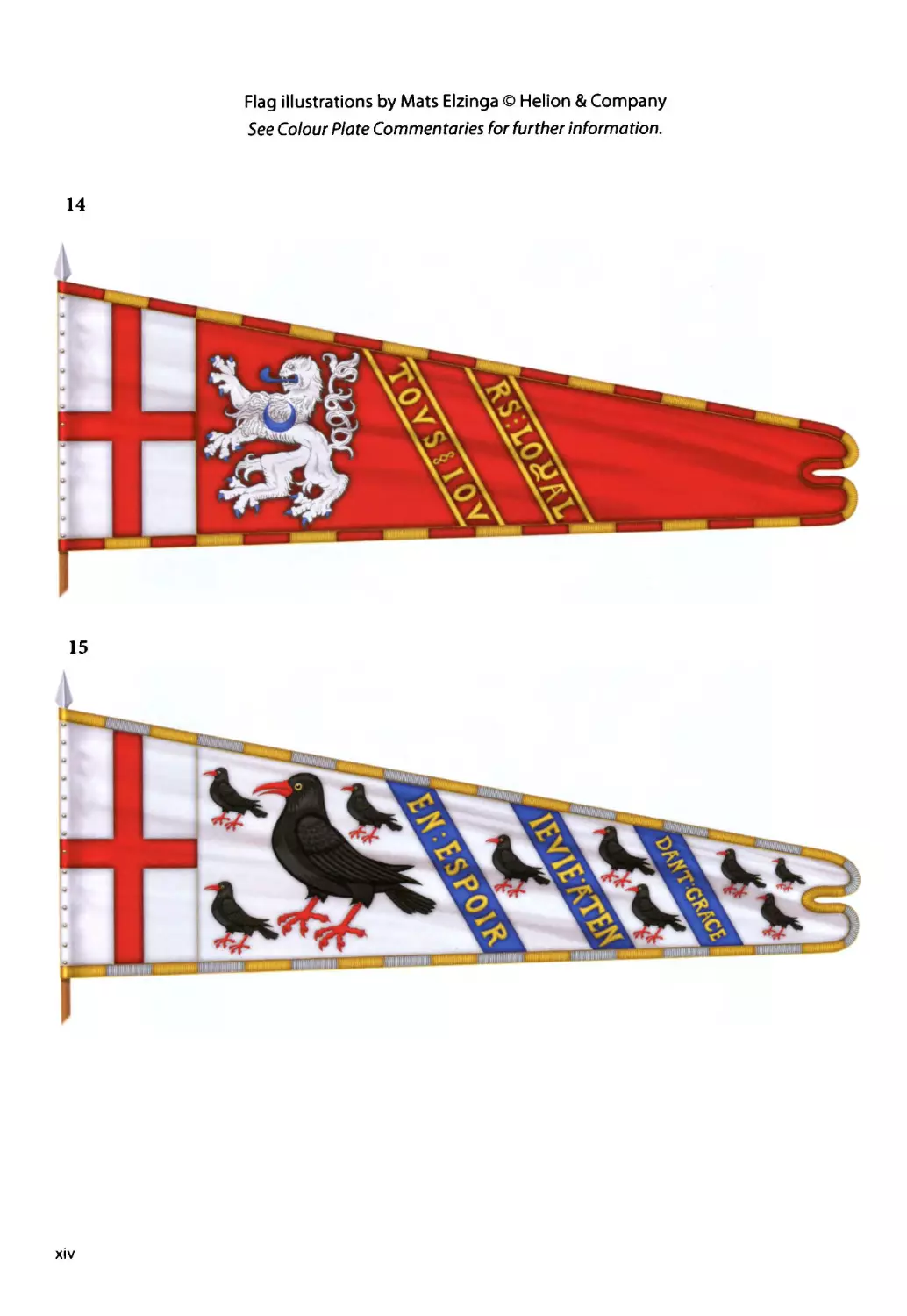
Flag artwork by Mats Elzinga © Helion & Company 2021
Maps by George Anderson CO Helion & Company 2021
Every reasonable effort has been made to trace copyright holders and to obtain their permission for the
use of copyright material. The author and publisher apologise for any errors or omissions in this work.and
would begrateful if notified of any corrections that should be incorporated in future reprints or editions of
this book.
ISBN 978-1-913336-41-7
British Library Cataloguing-in-Publication Data.
A catalogue record for this book is available from the British Library.
All rights reserved. No part of this publication may be reproduced.stored in a retrieval system.or
transmitted. in any form.or by any means.electronic.mechanical.photocopying.recording or otherwise.
without the express written consent of Helion & Company Limited.
For details of other military history titles published by Helion & Company
Limited.
We always welcome receiving book proposals from prospective authors.
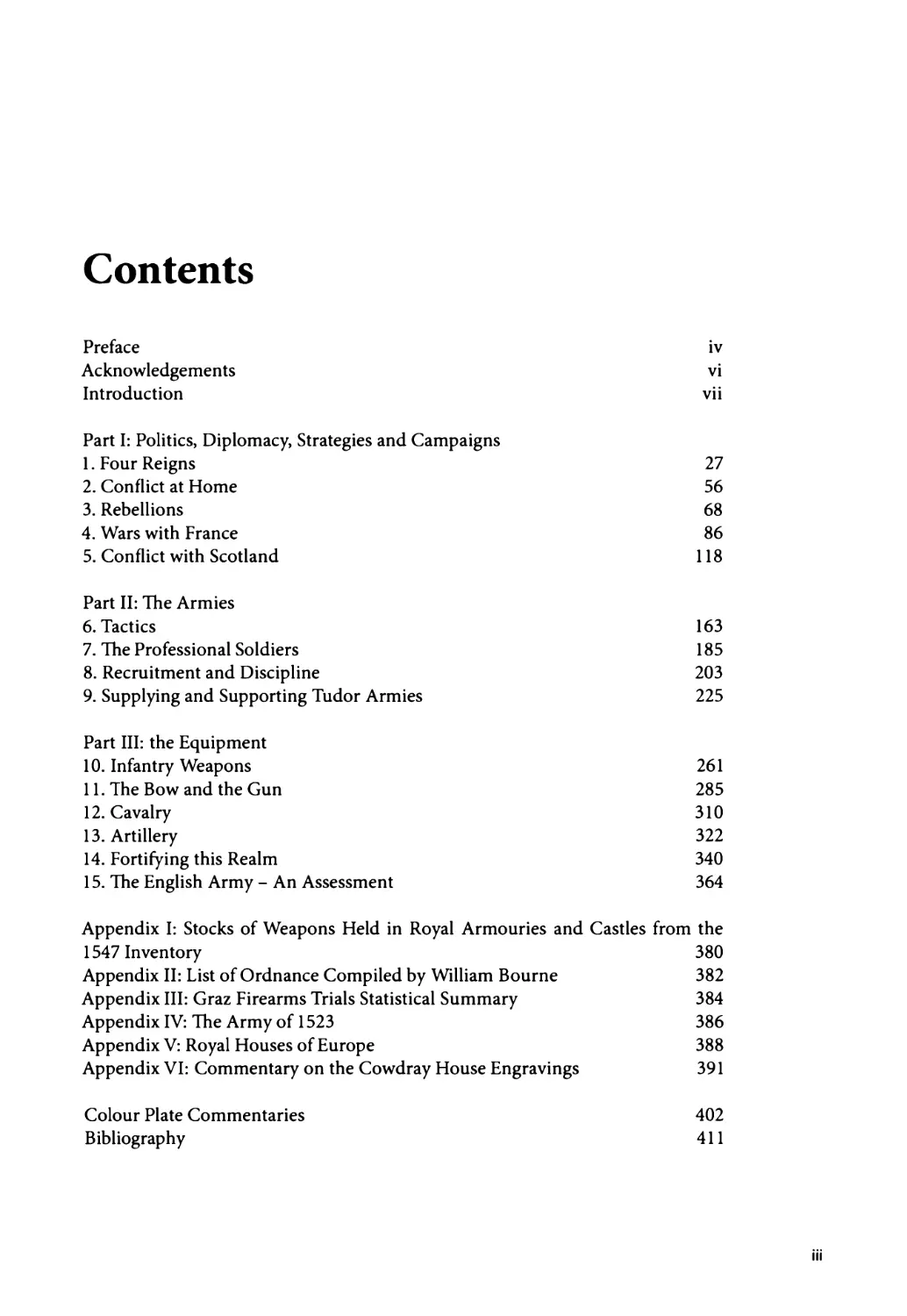
Contents
Preface
iv
Acknowledgements
vi
Introduction
Part I: Politics, Diplomacy, Strategies and Campaigns
1. Four Reigns
2. Conflict at Home
3. Rebellions
4. Wars with France
5. Conflict with Scotland
Part 11: The Armies
6. Tactics
7. The Professional Soldiers
8. Recruitment and Discipline
9. Supplying and Supporting Tudor Armies
Part Ill: the Equipment
10. Infantry Weapons
11. The Bow and the Gun
12. Cavalry
13. Artillery
14. Fortifying this Realm
15. The English Army - An Assessment
vii
27
56
68
86
118
163
185
203
225
261
285
310
322
340
364
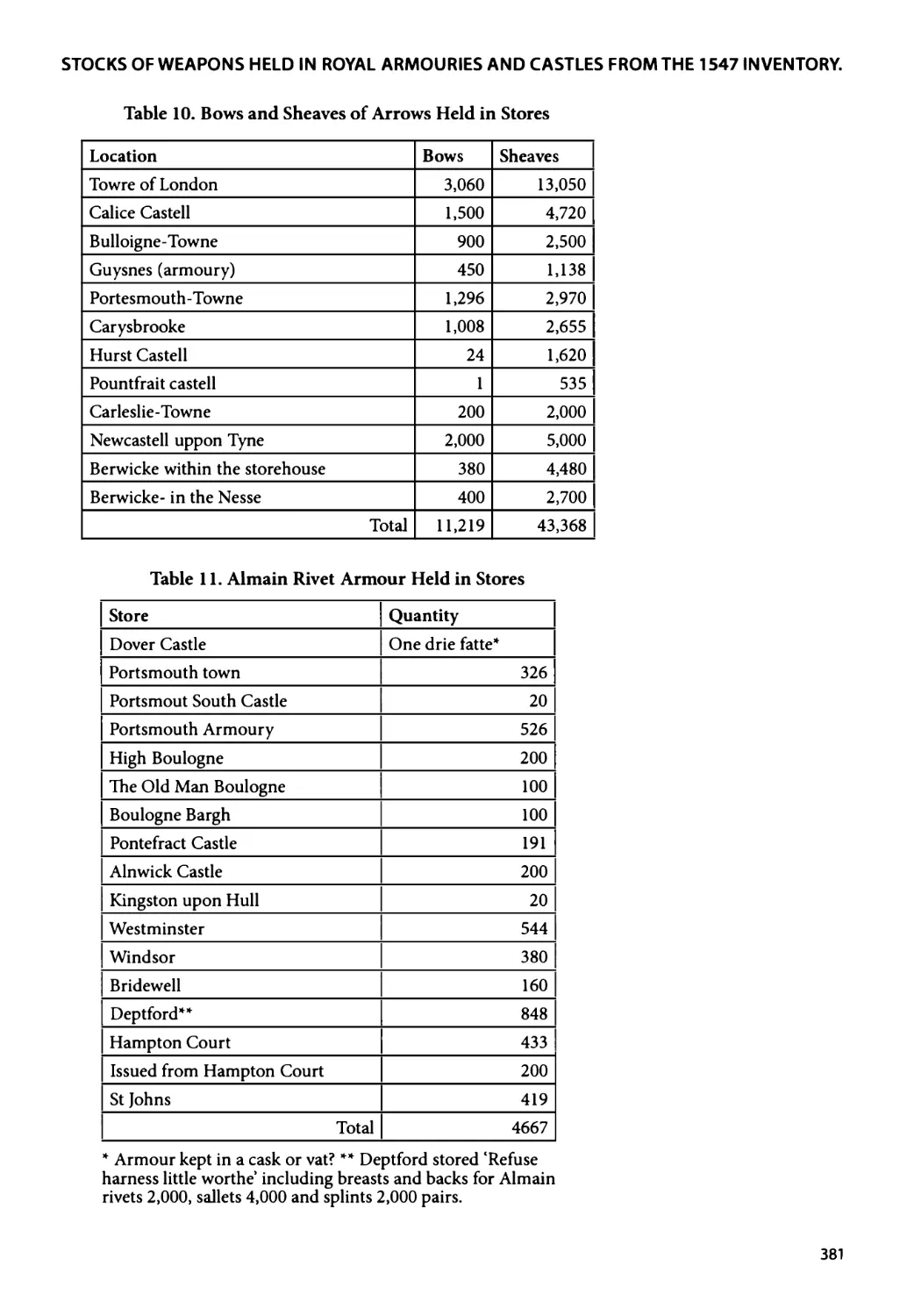
Appendix I: Stocks of Weapons Held in Royal Armouries and Castles from the
1547 Inventory
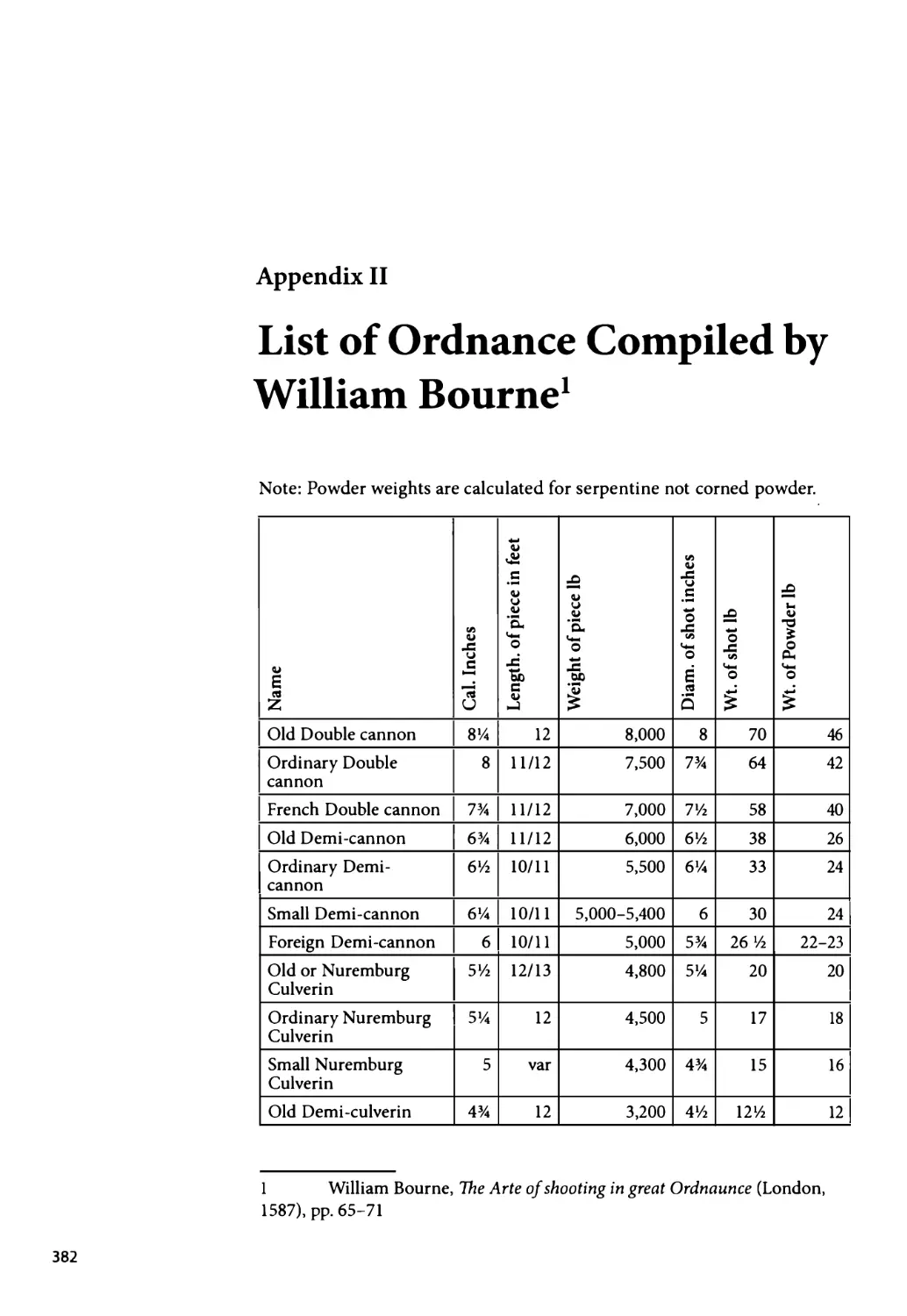
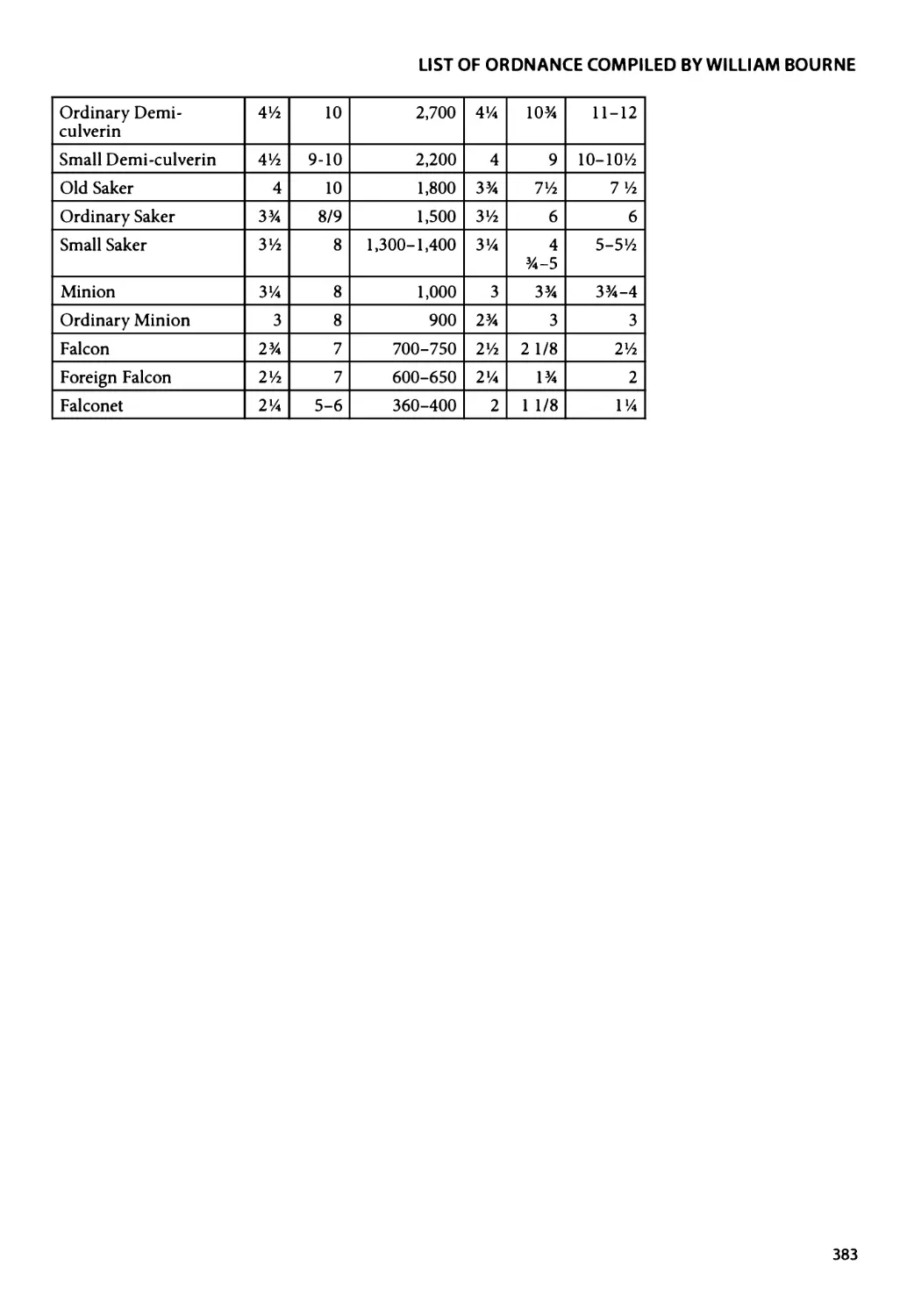
Appendix 11: List of Ordnance Compiled by William Bourne
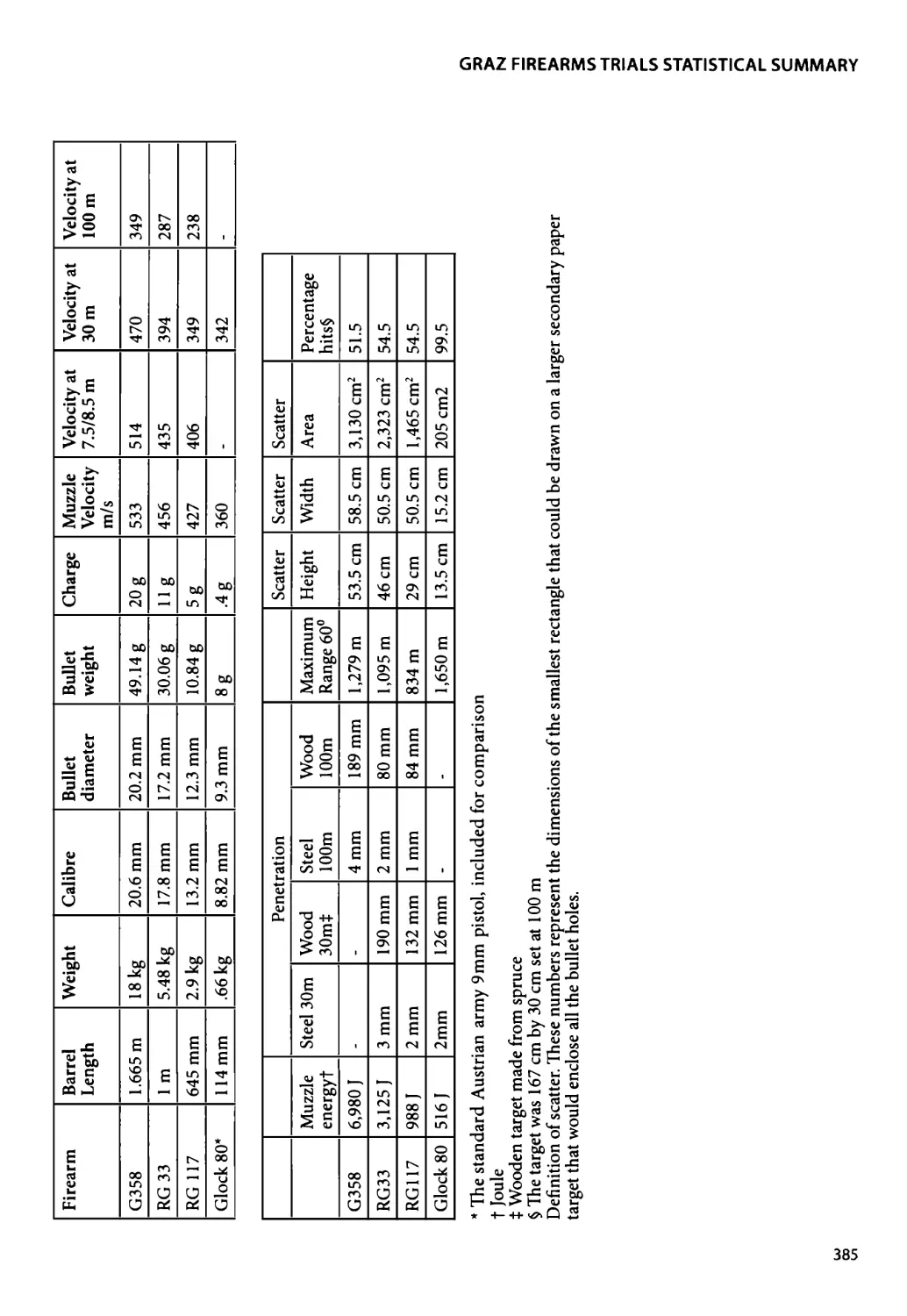
Appendix Ill: Graz Firearms Trials Statistical Summary
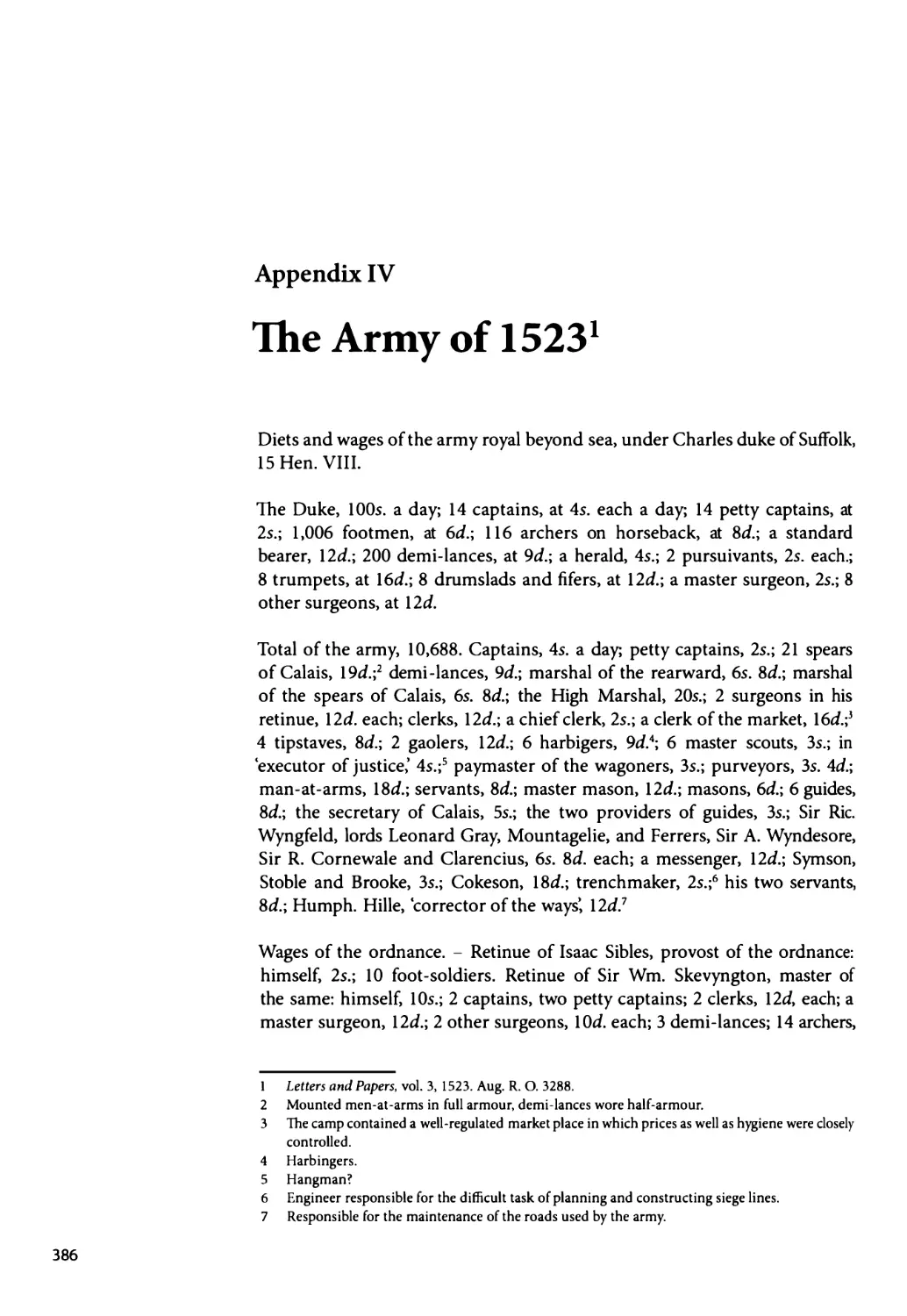
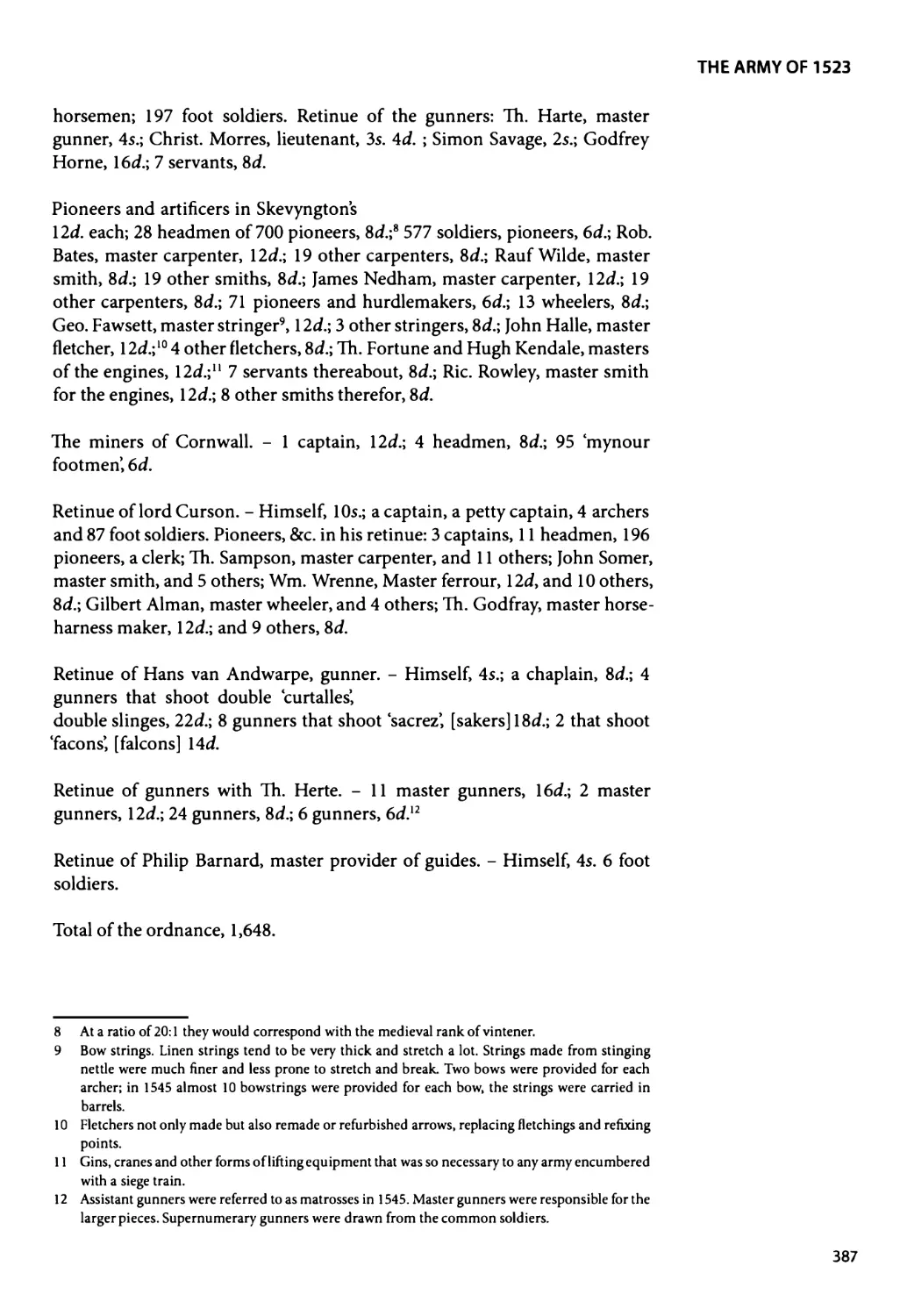
Appendix IV: The Army of 1523
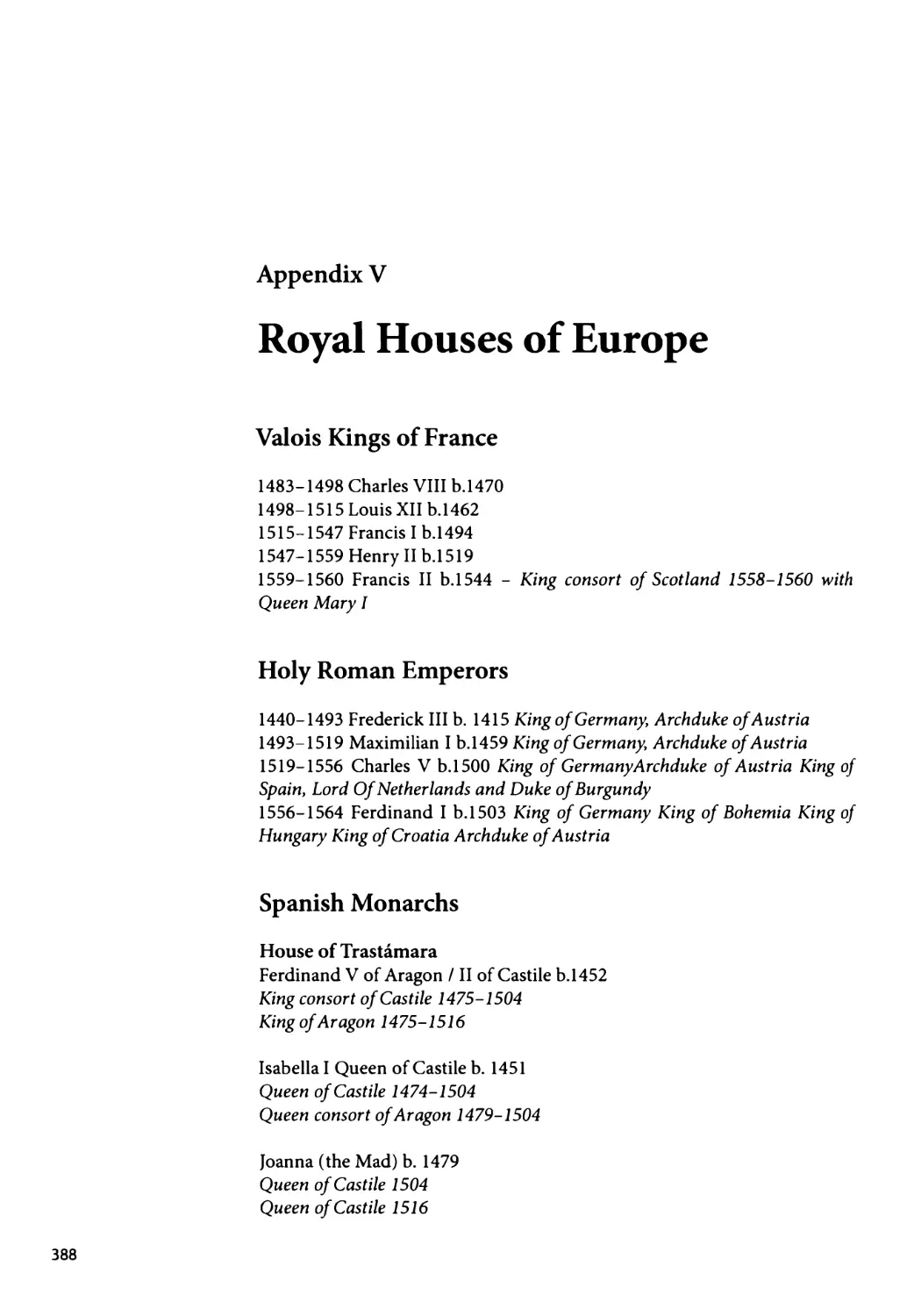
Appendix V: Royal Houses of Europe
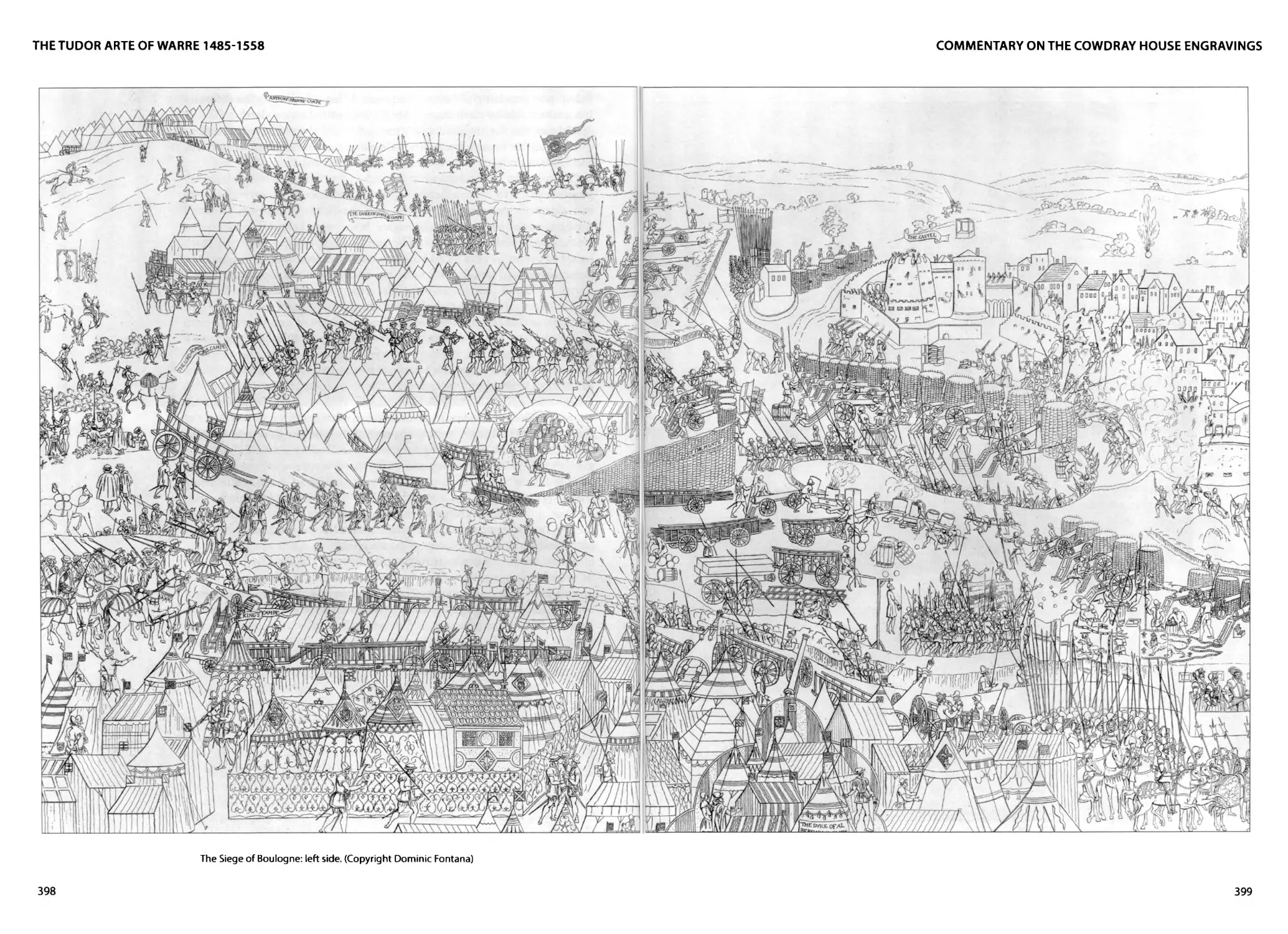
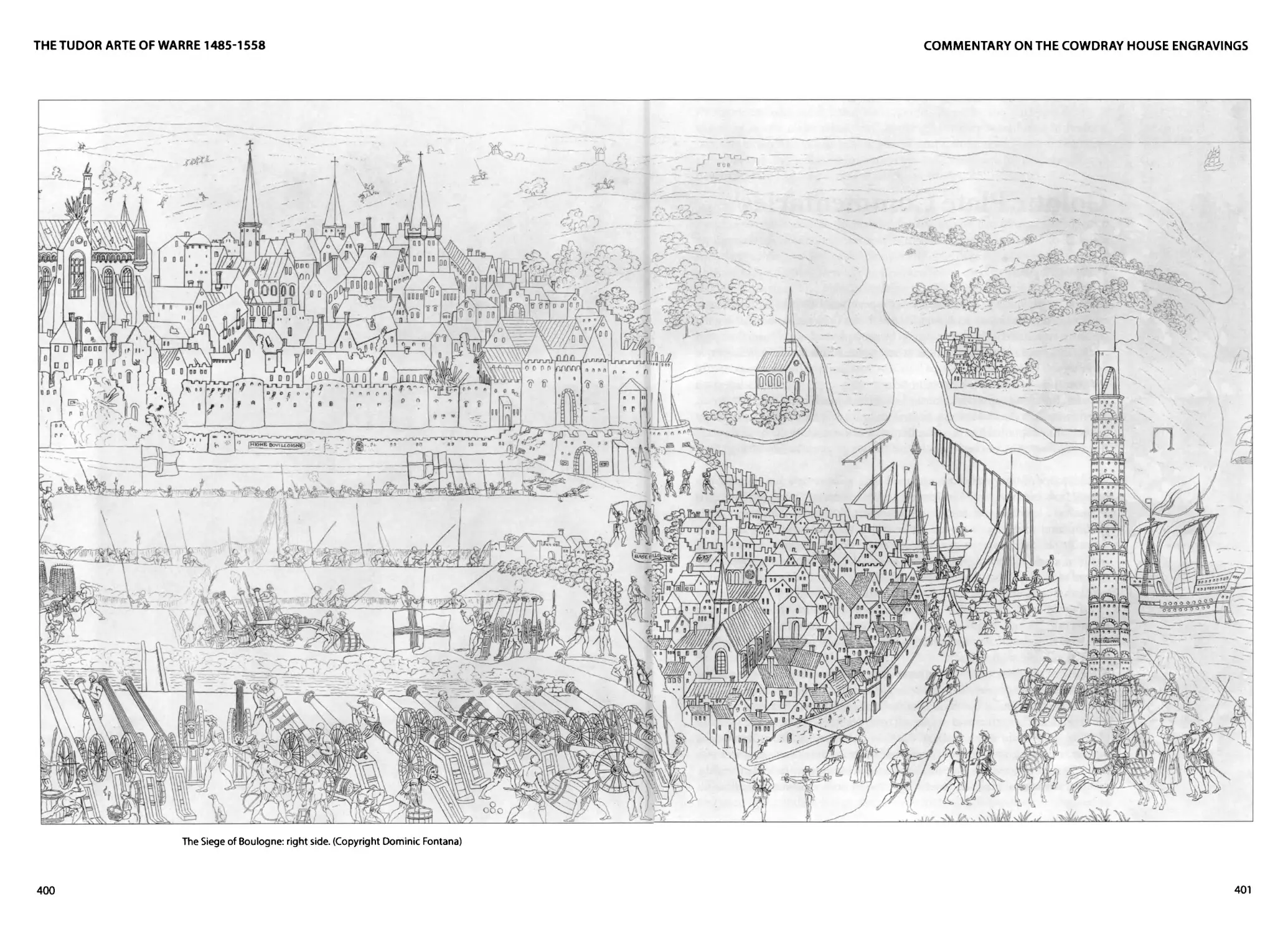
Appendix VI: Commentary on the Cowdray House Engravings
Colour Plate Commentaries
Bibliography
380
382
384
386
388
391
402
411
iii
Preface
This book has taken a very long time to write. For almost forty years I have
been reading, teaching, writing and re-enacting medieval and Tudor history
and this book is the unexpected consequence. It reflects my knowledge,
enthusiasms, pet loves and hates. I have always written on subjects about
which I wanted to know more and to address the questions that arose. The
purpose of this book is to help answer some of those questions.
In the introduction I have endeavoured to put England firmly into
its place, or rather context, in Europe. England would be competing on
European battlefields and would be compared by contemporary opinion
with European armies for efficacy and modernity. The first part of the book
provides a narrative of events to explain the context in which decisions of war
and peace were made, and then analyses the campaigns and battles that were
the consequence. The second part deals with how the armies were raised
and supported and how their tactics developed. The third part deals with the
military hardware. I try at the same time to enliven and engage in the debates
surrounding these subjects. I have concluded with an assessment of England's
military performance in the light of the current 'military revolution' debate.
I have tried to provide as broad a narrative and as extensive an analysis
as possible, relying very heavily on the work of others. I hopefully fully
acknowledge and recognise their efforts in my own analyses. I have spent
considerable time on some issues that may appear of marginal importance
but which were central in the conduct of campaigns and in the lives of those
who participated in them. The issue of logistics and planning which are too
often ignored were of vital importance. It is clear that a campaign's success
depended to a great extent upon the availability of coin, bread, beef and
ale. Boulogne was besieged in
1544
because it was an objective that could
be achieved with the resources at hand. Pinkie was won by the brilliant
management of the army 's logistical support as well as by the sacrifice of the
Bulleners and Gentlemen Pensioners. Campaigns collapsed in Spain in
1512
and France in 1523 because of failures of leadership and provisions. Flodden
was fought, at least in part, because the English army had run out of ale.
An army is only as good as the officers and men it recruits. There were
a small number of 'professional' soldiers in the realm, too few to constitute
a viable force of their own. The Army Royal was recruited from gentlemen
at-arms and the 'commons-in-arms: This was at a time when Continental
armies were becoming professionalised by long periods of war and the
widespread use of mercenaries; the difference between the English way of
iv
PREFACE
war and that of Europe should be acknowledged. I have also devoted some
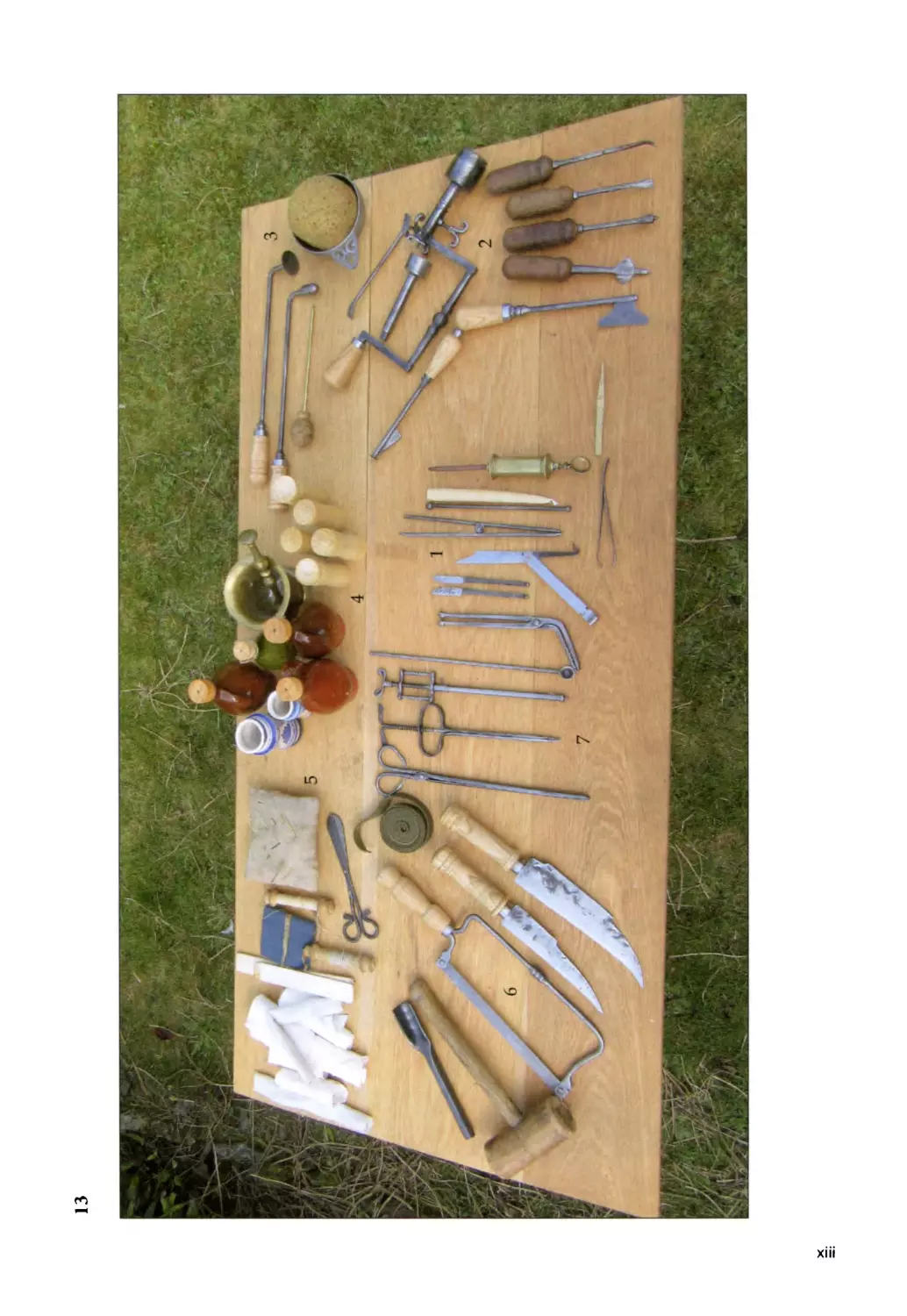
space to the provision of medical services. The widespread use of firearms
caused new suffering, both from the injuries they caused and the treatment
that was prescribed.
I have devoted considerable space to the arms and equipment but I
have tried to focus on two areas of contention. Firstly the bow versus gun
debate, which was both one fiercely contested among contemporaries and
which even today has its protagonists. The second discussion concerns the
modernity and efficacy of the 'Device forts' which have been subject to much
ill-considered criticism. I have concluded with an analysis of the concept
of the 'military revolution: as it relates to England in this period. In this
I am pleased to say I am at least swimming with the tide, as the outright
condemnation of England's backwardness, which was once common, is now
tempered by more balanced opinions.
The horrors of war are often forgotten when discussing matters of strategy,
tactics and equipment. This is why I have included a section on Disease and
Want, which I hope highlights the unnecessary suffering of the English
soldiers and unfortunate civilians.
I beg the reader to forgive my sins whether of omission or commission.
It is a book that is both too long and too short. I have found the task of
assembling the material and ideas not an easy one, especially in these plague
years. I hope that the reader will find something of interest both of fact and
argument and will find much to appreciate as well as to condemn in the lives
and actions of our forebears.
v
Acknowledgetnents
Many people have helped me directly and indirectly in the preparation of
this book. I would like to thank Jonathan Cooper and Or Edward Fox in
generously sharing their research, allowing me thereby to amend some errors
and reappraise some of my conclusions. Pauline Asher and Or Catharine
Oavies have contributed their helpful comments and expertise. Charles
Singleton of Helion has proved an editor with a light but deft touch, who has
guided me through the labyrinthine processes of publishing. I must thank
Thomas Oavies, whose trenchant comments on many different aspects of the
subject have helped temper my own opinions. I would like to thank Or Tobias
Capwell for providing a fascinating tour of some of the key exhibits in the
Wall ace collection. I gratefully acknowledge the generous assistance of the
Society for Army Historical Research whose grant enabled me to embellish
these pages with suitable illustrations. I must mention the generous assistance
of Or Bastian Asmus in sharing his insights in the area of archaeometallurgy,
and Or Oominic Fontana, who has provided such excellent images of the
Cowdray engravings. I would also like to thank Or Edward Fox and the
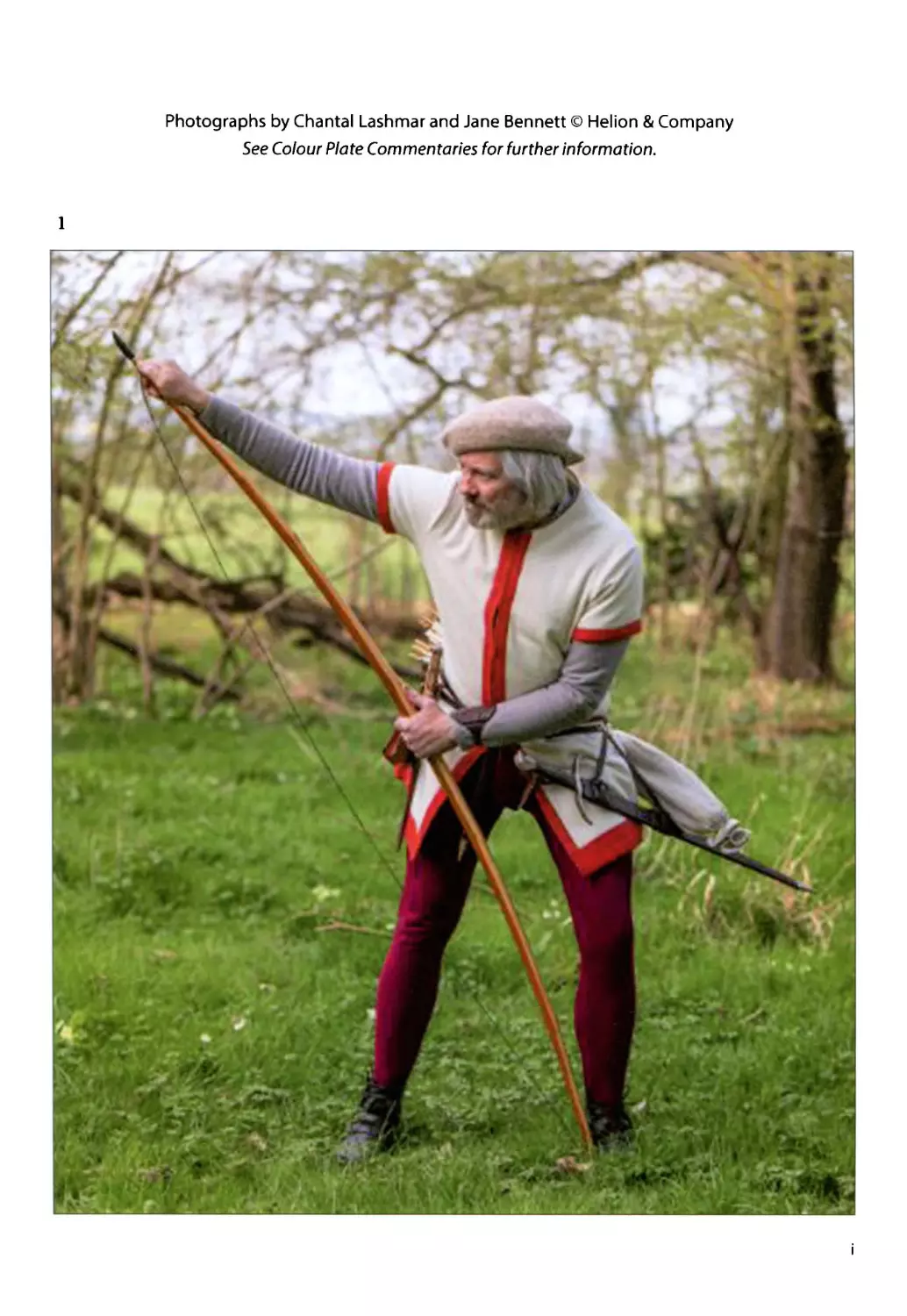
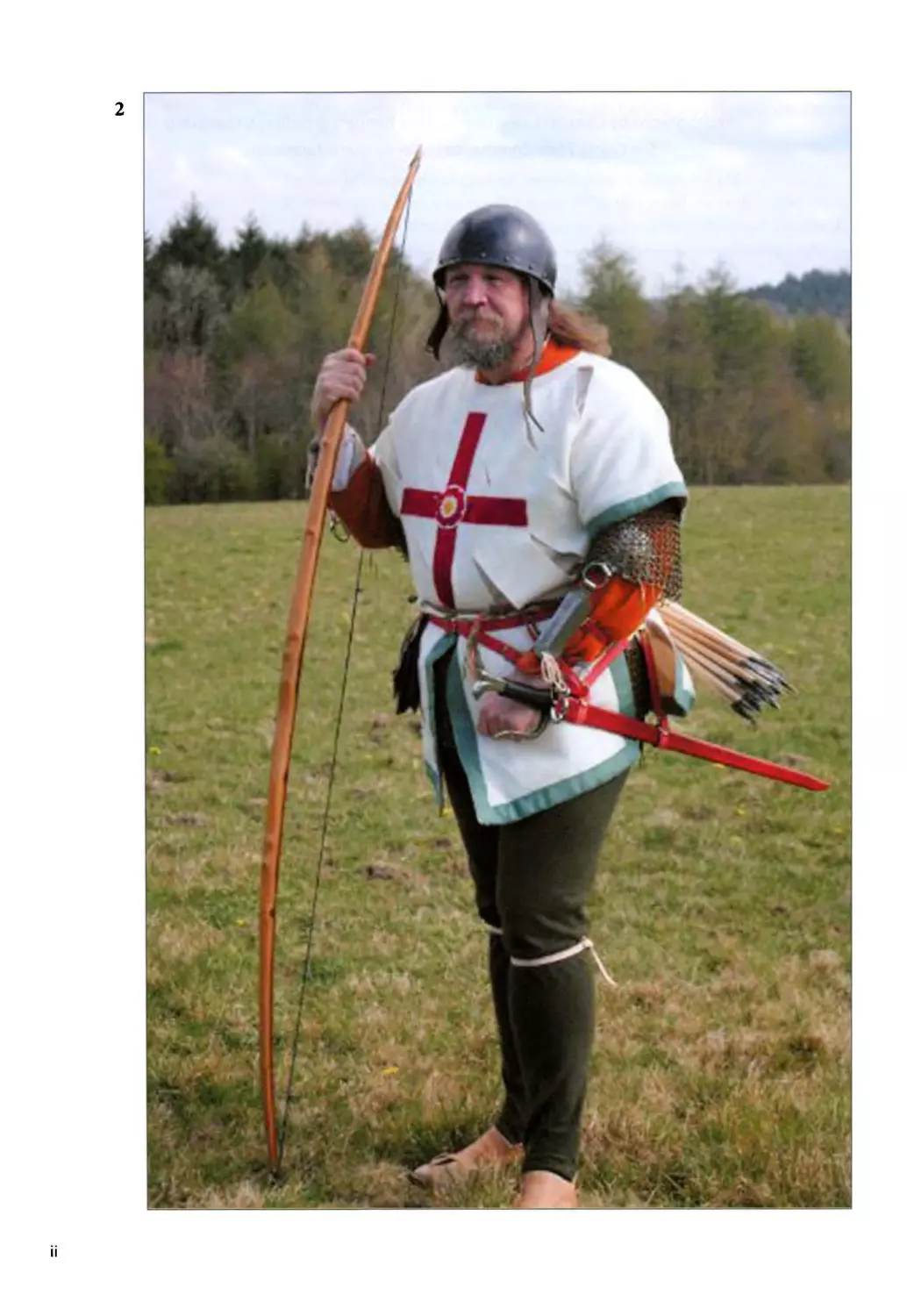
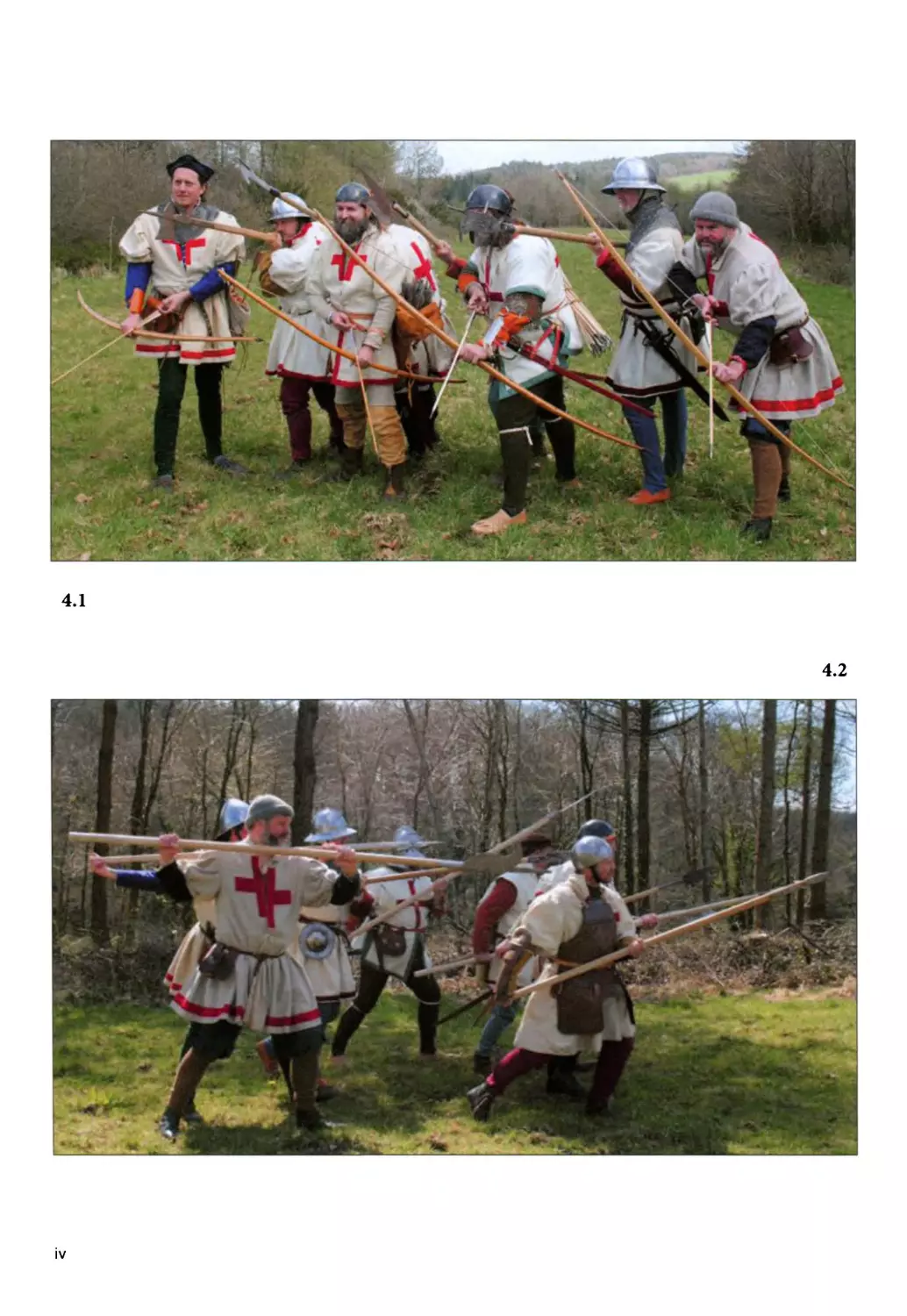
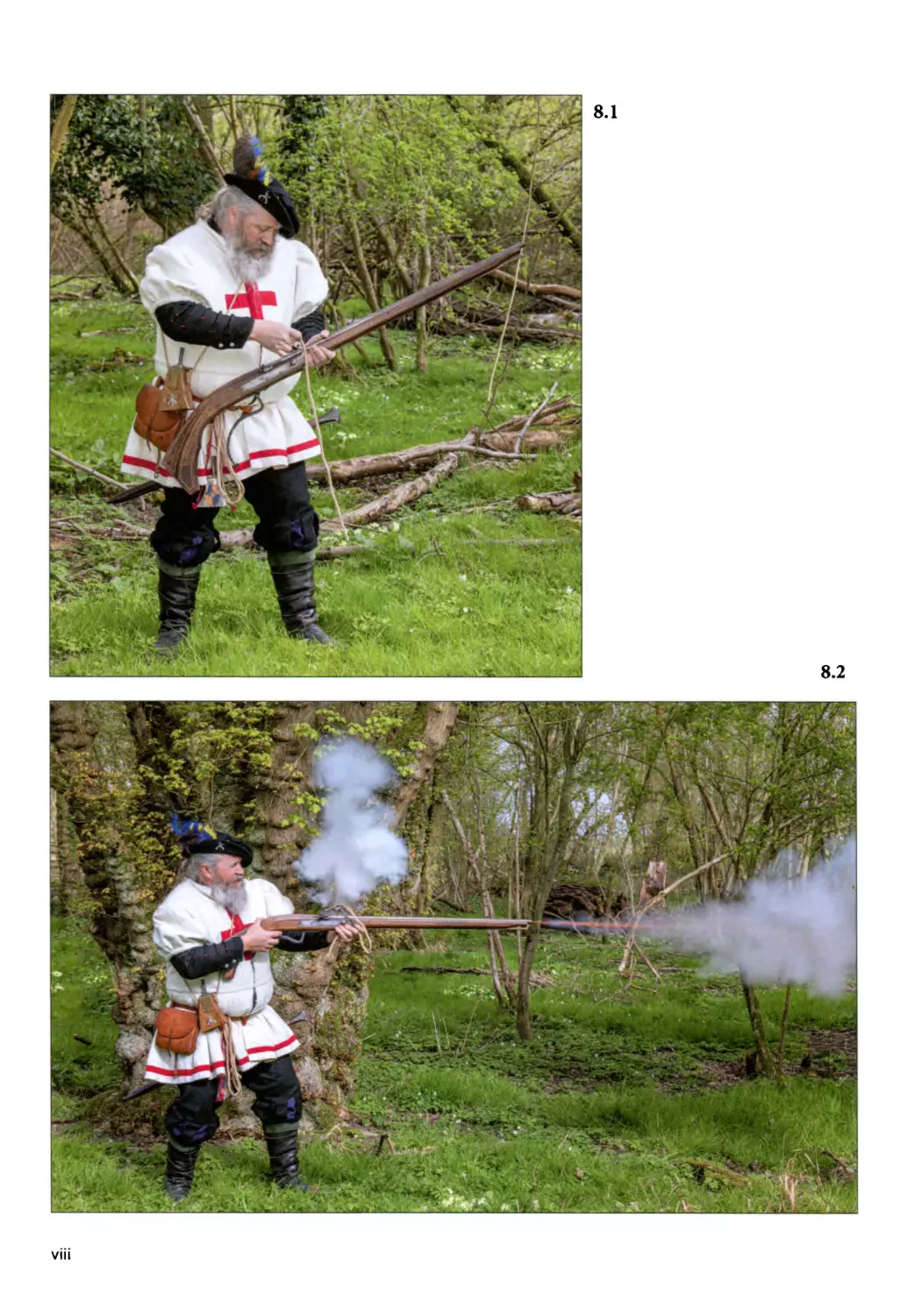
members of Commotion Times, who have generously provided me with the
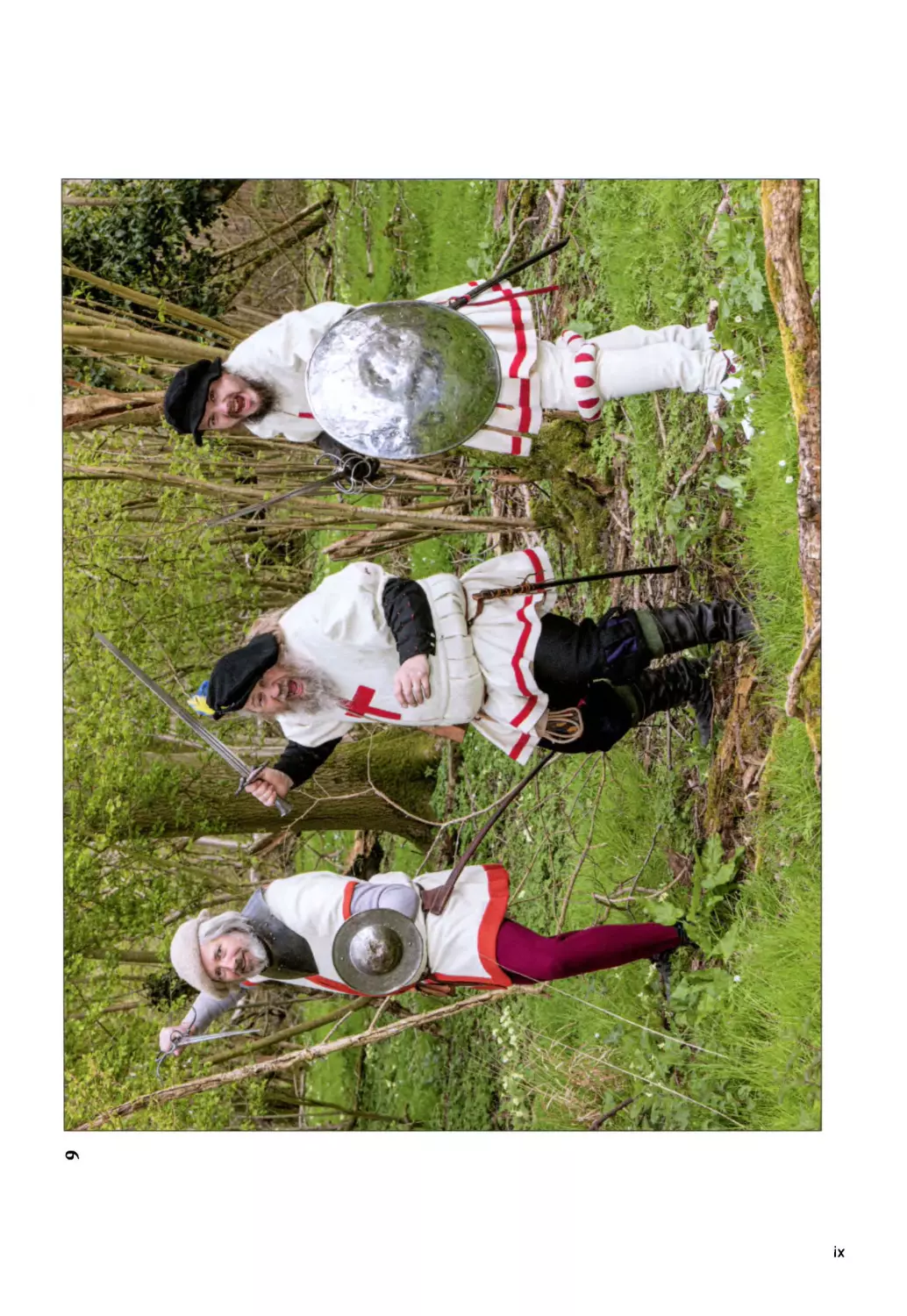
splendid photographs based on their meticulous research of Tudor soldiers.
I should conclude by thanking my many, many former pupils, who in their
own way taught me far more history than I taught them.
vi
Introduction
If there is in the affairs of mortal men any one thing which it is proper uniformly
to explode, and incumbent on every man by every lawful means to avoid, to
deprecate, to oppose, that one thing is doubtless war.
There is nothing more unnaturally wicked, more productive of misery, more
extensively destructive, more obstinate in mischief, more unworthy of man, as
formed by nature, much more of man professing Christianity. Yet, wonderful to
relate! war is undertaken, and cruelly, savagely conducted, not only by unbelievers,
but by Christians.
Nor are there ever wanting men learned in the law, and even divines, who
are ready to furnish firebrands for the nefarious work and to fan the latent sparks
into a flame. Hence, war is considered so much a thing of course, that the wonder
is how any man can disapprove of it - so much sanctioned by authority and
custom that it is deemed impious to have borne testimony against a practice in its
principle most profligate, and in its effects pregnant with every kind of calamity.l
Although many contemporaries would have agreed with Erasmus when he
condemned war (between Christians), war was certainly one of the principal
preoccupations of European monarchies in this period. War defined and
legitimised them, especially in the eyes of their nobility. War was 'sanctioned
by authority and custom: so that Henry VIII might self-consciously and
publicly ape the actions if not the achievements of Henry V of Agincourt
fame. Henry VIII may compare himself to his illustrious predecessors, but
he would be judged against his European brethren: James IV, Ferdinand and
Isabella, Francis I and Louis XII and the emperors Maximilian and Charles.
He was, to use J.R. Hale's memorable phrase, a fully paid-up member of the
'College of militant monarchs:2 Waging war was the prerogative of princes in
pursuit of their princely priorities - dynastic security, defence of their lands
or 'legitimate' claims to another's and religious obligation - but above all
glory and the defence of their honour.
2
Desiderius Erasmus, Vicesimus Knox, The Works of Vicesimus Knox. vo!. 5 (subject matter:
Personal Nobility. Spirit of Despotism. Antipolemus) (London: Mawman. 1824). Full text
available online, see bibliography for URL.
J.R. Hale. Renaissance War Studies (London: Hambledon Press. 1 983) p 88
,
.
.
vii
THE TUDOR ARTE OF WARRE 1485-1558
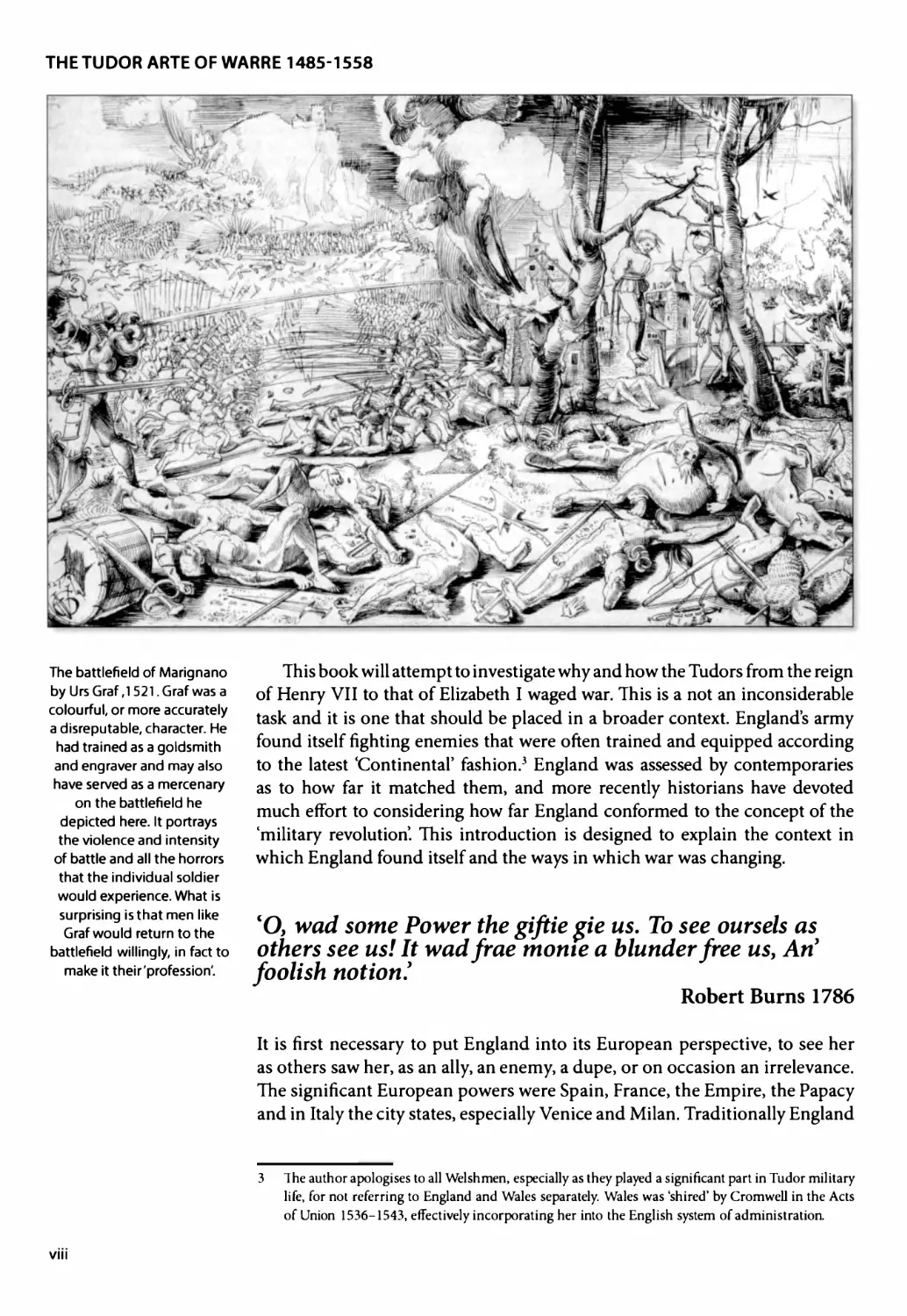
The battlefield of Marignano
This book will attempt to investigate why and how the Tudors from the reign
by Urs Graf ,1521. Graf was a
of Henry VII to that of Elizabeth I waged war. This is a not an inconsiderable
colourful, or more accurately
a disreputable, character. He
had trained as a goldsmith
task and it is one that should be placed in a broader context. England's army
found itself fighting enemies that were often trained and equipped according
and engraver and may also
to the latest 'Continental' fashion.3 England was assessed by contemporaries
have served as a mercenary
as to how far it matched them, and more recently historians have devoted
on the battlefield he
depicted here. It portrays
the violence and intensity
of battle and all the horrors
much effort to considering how far England conformed to the concept of the
'military revolution: This introduction is designed to explain the context in
which England found itself and the ways in which war was changing.
that the individual soldier
would experience. What is
surprising is that men like
Graf would return to the
battlefield willingly, in fact to
make it their 'profession'.
'0, wad some Power the giftie gie us. To see oursels as
others see us! It wad frae monte a blunder free us, An'
foolish notion.'
Robert Burns 1786
It is first necessary to put England into its European perspective, to see her
as others saw her, as an ally, an enemy, a dupe, or on occasion an irrelevance.
The significant European powers were Spain, France, the Empire, the Papacy
and in Italy the city states, especially Venice and Milan. Traditionally England
3
viii
The author apologises to all Welshmen, especially as they played a Significant part in Tudor military
life, for not referring to England and Wales separately. Wales was 'shired' by Cromwell in the Acts
of Union 1536-1543, effectively incorporating her into the English system of administration.
INTRODUCTION
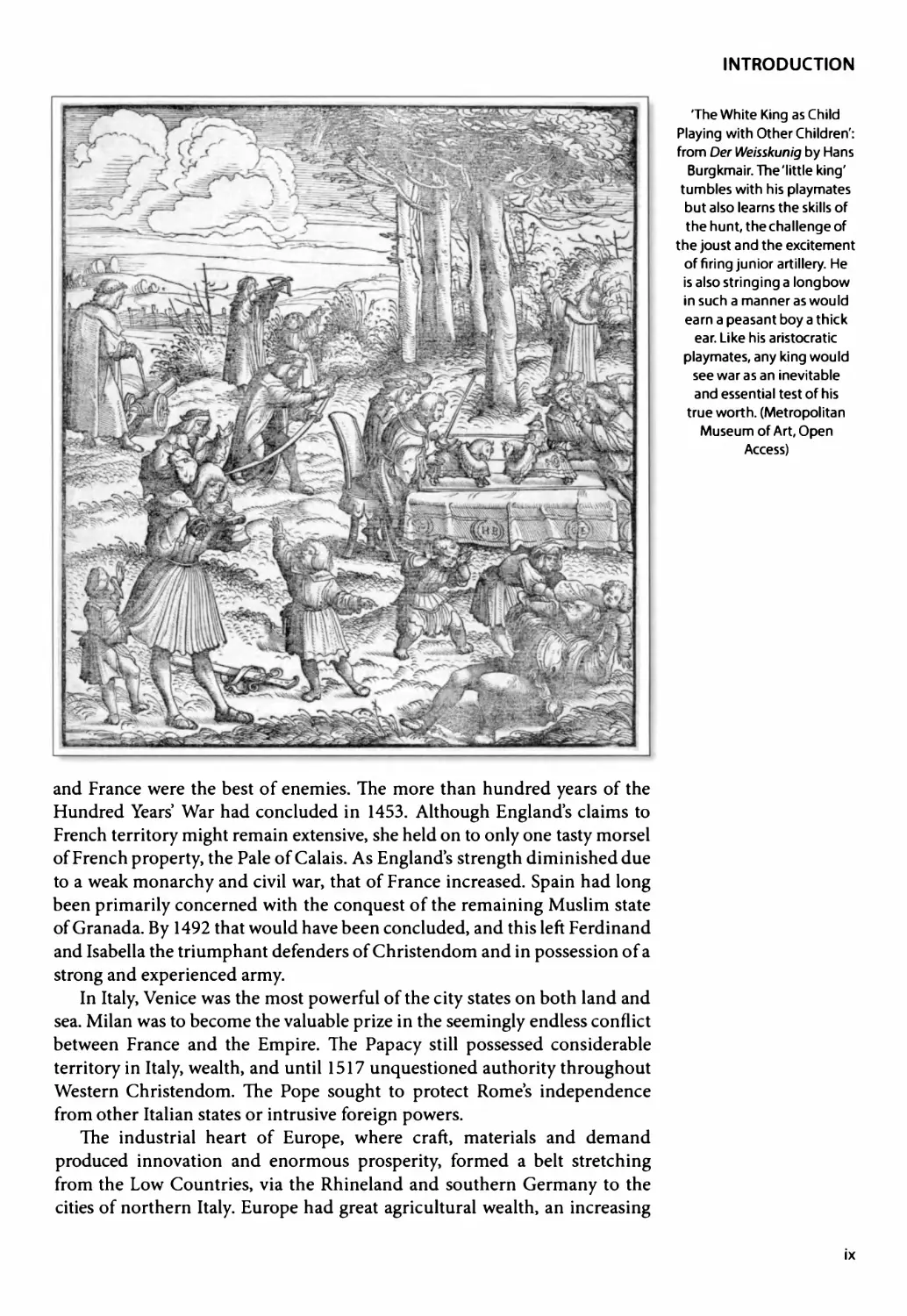
'The White King as Child
Playing with Other Children':
from Der Weisskunig by Hans
Burgkmair. The 'little king'
tumbles with his playmates
but also learns the skills of
the hunt, the challenge of
the joust and the excitement
of firing junior artillery. He
is also stringing a longbow
in such a manner as would
earn a peasant boy a thick
ear. Like his aristocratic
playmates, any king would
see war as an inevitable
and essential test of his
true worth. (Metropolitan
Museum of Art, Open
Access)
and France were the best of enemies. The more than hundred years of the
Hundred Years' War had concluded in
1453.
Although England's claims to
French territory might remain extensive, she held on to only one tasty morsel
of French property, the Pale of Calais. As England's strength diminished due
to a weak monarchy and civil war, that of France increased. Spain had long
been primarily concerned with the conquest of the remaining Muslim state
of Granada. By 1492 that would have been concluded, and this left Ferdinand
and Isabella the triumphant defenders of Christendom and in possession of a
strong and experienced army.
In Italy, Venice was the most powerful of the city states on both land and
sea. Milan was to become the valuable prize in the seemingly endless conflict
between France and the Empire. The Papacy still possessed considerable
territory in Italy, wealth, and until 1517 unquestioned authority throughout
Western Christendom. The Pope sought to protect Rome's independence
from other Italian states or intrusive foreign powers.
The industrial heart of Europe, where craft, materials and demand
produced innovation and enormous prosperity, formed a belt stretching
from the Low Countries, via the Rhineland and southern Germany to the
cities of northern Italy. Europe had great agricultural wealth, an increasing
ix
THE TUDOR ARTE OF WARRE 1485-1558
population and burgeoning industry that would
provide enormous prosperity for its people. It
also enabled its leaders to equip and conduct
wars on an unprecedented scale.
It was the action of Charles VIII of France
in 1494, invading Italy and seizing the throne of
Naples, that would set Europe on its head. The
reaction to this onslaught was the formation
of the Holy League, established in
1495
by the
Papacy to defend its independence. This alliance
included the other Italian city states and Spain.
The conflict between France and Spain (later
the Empire) in Italy would come to dominate
the following decades. In
1500 it would now be
Louis XII who would capture Naples for France
and restart the conflict. This led to a French
defeat at the hands of Ferdinand I, the king not
only of Spain but of Sicily and Sardinia. This
was not, however, the end to French ambition.
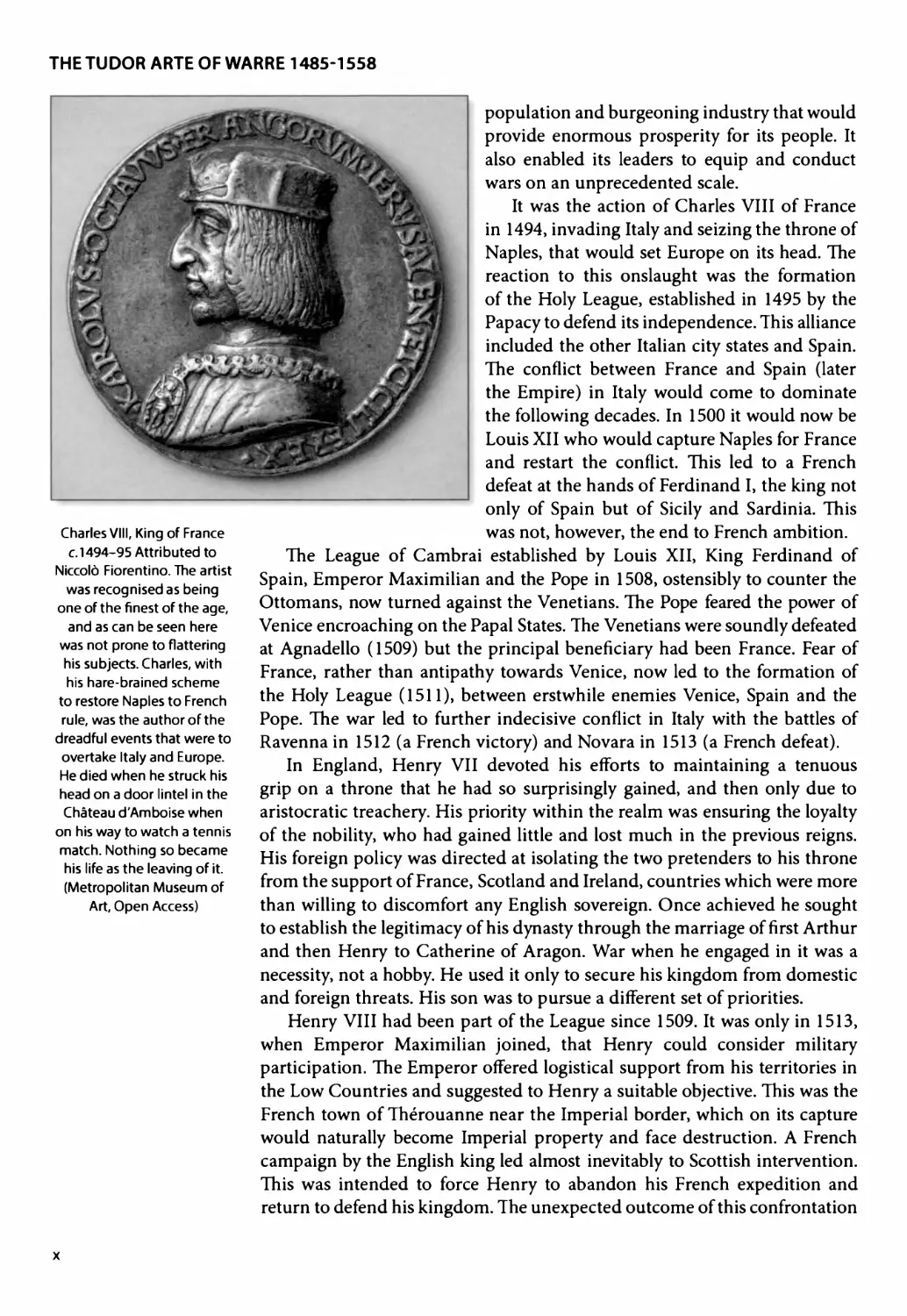
Charles VIII, King of France
c.1494-95 Attributed to
Niccolo Fiorentino. The artist
was recognised as being
The League of Cambrai established by Louis XII, King Ferdinand of
Spain, Emperor Maximilian and the Pope in
1508, ostensibly to counter the
one of the finest of the age,
Ottomans, now turned against the Venetians. The Pope feared the power of
and as can be seen here
Venice encroaching on the Papal States. The Venetians were soundly defeated
was not prone to flattering
his subjects. Charles, with
his hare-brained scheme
at Agnadello C1509) but the principal benefiCiary had been France. Fear of
France, rather than antipathy towards Venice, now led to the formation of
(1511),
to restore Naples to French
the Holy League
rule, was the author of the
Pope. The war led to further indecisive conflict in Italy with the battles of
dreadful events that were to
overtake Italy and Europe.
He died when he struck his
Ravenna in
1512
between erstwhile enemies Venice, Spain and the
Ca French victory) and Novara in
1513
(a French defeat).
In England, Henry VII devoted his efforts to maintaining a tenuous
head on a door lintel in the
grip on a throne that he had so surprisingly gained, and then only due to
Chateau d'Amboise when
aristocratic treachery. His priority within the realm was ensuring the loyalty
on his way to watch a tennis
of the nobility, who had gained little and lost much in the previous reigns.
match. Nothing so became
his life as the leaving of it.
His foreign policy was directed at isolating the two pretenders to his throne
(Metropolitan Museum of
from the support of France, Scotland and Ireland, countries which were more
Art, Open Access)
than willing to discomfort any English sovereign. Once achieved he sought
to establish the legitimacy of his dynasty through the marriage of first Arthur
and then Henry to Catherine of Aragon. War when he engaged in it was a
necessity, not a hobby. He used it only to secure his kingdom from domestic
and foreign threats. His son was to pursue a different set of priorities.
Henry VIII had been part of the League since
1509. It was only in 1513,
when Emperor Maximilian joined, that Henry could consider military
participation. The Emperor offered logistical support from his territories in
the Low Countries and suggested to Henry a suitable objective. This was the
French town of Therouanne near the Imperial border, which on its capture
would naturally become Imperial property and face destruction. A French
campaign by the English king led almost inevitably to Scottish intervention.
This was intended to force Henry to abandon his French expedition and
return to defend his kingdom. The unexpected outcome of this confrontation
x
INTRODUCTION
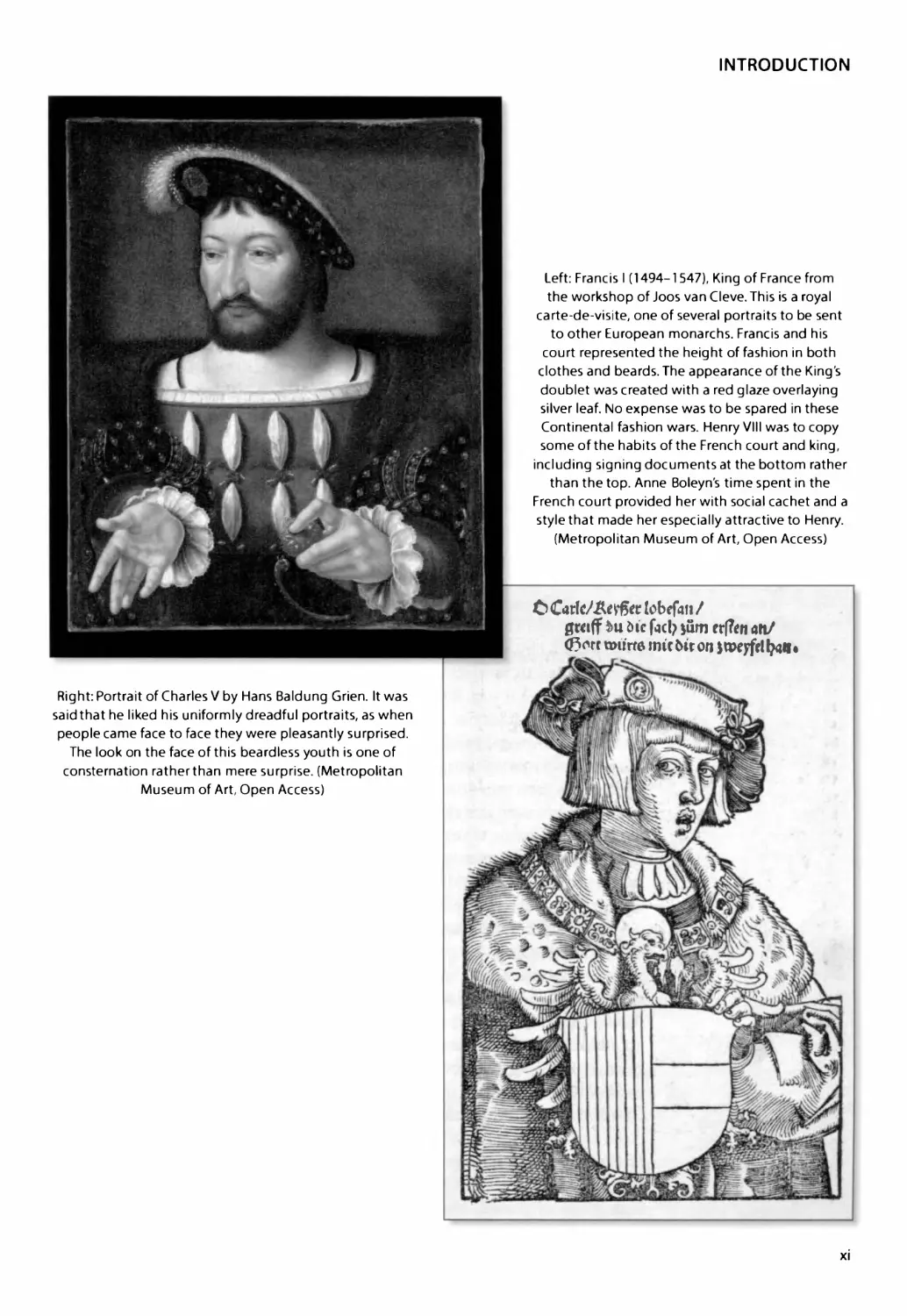
Left: Francis I (1 494-1547), King of France from
the workshop of Joos van Cleve. This is a royal
carte-de-visite, one of several portraits to be sent
to other European monarchs. Francis and his
court represented the height of fashion in both
clothes and beards. The appearance of the King's
doublet was created with a red glaze overlaying
silver leaf. No expense was to be spared in these
Continental fashion wars. HenryVIII was to copy
some of the habits of the French court and king,
including signing documents at the bottom rather
than the top. Anne Boleyn's time spent in the
French court provided her with social cachet and a
style that made her especially attractive to Henry.
(Metropolitan Museum of Art, Open Access)
(:) Carftl1{tr6tt lobtfafll
""lff U bit f"cl, �um trf1tn 4nJ
Q34'tt \l)tine mic bi� on $t\)tyfdl14'"
Right: Portrait of CharlesV by Hans Baldung Grien. It was
said that he liked his uniformly dreadful portraits, as when
people came face to face they were pleasantly surprised.
The look on the face of this beardless youth is one of
consternation rather than mere surprise. (Metropolitan
Museum of Art, Open Access)
xi
THE TUDOR ARTE OF WARRE 1485-1558
on the border was the total defeat of the Scottish army and the death of James
IV at Flodden. King Louis of France had meanwhile effectively negotiated
a separate peace with the Emperor. This left Henry once more alone, with
the indefensible city of Tournai as the sole prize for all his efforts. In
1515
the young King Francis I had, by defeating the Imperial army at Marignano,
regained control of Milan but this would soon be contested by a new and
vigorous emperor.
Henry had by now exhausted his financial resources, and with the
able Cardinal Wolsey attempted diplomatic initiatives. This gave England
the appearance of a great power without actually being one. The Treaty of
London in
1518
and the Field of the Cloth of Gold
(l520)
would be of little
importance compared to the massive shift in power that was taking place in
Europe. As part of the Holy League of 1495, the son of Emperor Maximilian
had married the daughter of the King and Queen of Spain. It was Charles
V, the product of this union, who would now unite Spain and the Habsburg
Empire to form a European superstate. France now found herself surrounded
by an Empire on both her eastern and western borders, as well as facing the
continuing threat posed by England. Francis and Charles were bound to
clash in Italy once more and also in the north-east of France, where Imperial
territories now bordered those of France.
This new confrontation provided an opportunity for Henry to once more
play a significant part in Europe, but only as the ally of the Emperor. The
expedition of
1523, which should have seen an Anglo-Imperial march upon
Paris assisted by a renegade French prince, came to nothing. Once again, the
Empire failed to fulfil its part of the bargain and there was little enthusiasm
in France for civil war. If this front was to prove a disappointment to Charles
V, in Italy the victory at Pavia in
1525
appeared decisive. The French King
became an Imperial captive in Madrid, and France was now at the mercy of
the Empire. Henry's entreaty that his victorious ally should share some of the
fruits of victory was dismissed with contempt. This should have made him
aware of his true status in the 'special' Anglo-Spanish-Imperial relationship.
Henry's divorce from Catherine of Aragon now placed his relationship
with Charles in jeopardy, as the Queen was the aunt of the Emperor. The
capture of the Pope and the 'accidental' sack of Rome by Imperial troops
in
1527,
meant that any hope that Henry might have had of gaining Papal
permission for the divorce was lost. Cromwell pursued the highly original
but somewhat dubious policy that would divorce the Queen and make the
King supreme head of the Church.
England was in no position to actively participate in European affairs. In
the face of Imperial intransigence even Francis had appeared attractive as
an ally for a while. France and Spain had inevitably renewed their conflict
from
1536-1538,
until both were so exhausted that peace was forced upon
them. The Pope had excommunicated Henry VIII in
1538 and the next year
coordinated an anti-Henry alliance with Francis and Charles. Henry now
faced the possibility of invasion, and began the construction of the 'Device
forts: Under the tutelage of Cromwell he dallied with the possibility of an
alliance with Protestant German princes and made a disastrous marriage
with Anne of Cleves. Henry's latest queen was ' wafted' across the channel
xii
INTRODUCTION
accompanied by
50
vessels and a ISO-gun salute
from the Lion and the Sweepstake, the celebrations
costing about
£2,000.
Franco-Imperial
in
1543
unity
was
short-lived and
war broke out once more. France had
acquired a new ally, the Ottoman Turk, which it
might be thought would have put France beyond
the pale in Europe. Francis made no headway in
Italy and Charles V sought to launch an Anglo
Imperial onslaught on Paris in
1544.
The grand
strategy faltered as the Emperor besieged St Dizier
and Henry determined that his best option was to
besiege Boulogne, while a covering force was sent
to sit outside Montreuil. Henry now suffered his
greatest and final humiliation, for as he entered
Boulogne in triumph he learnt that his ally the
Emperor had made a separate peace with Francis.
The English force besieging Montreuil was forced
Testoon of Henry VIII (third coinage). The portrait of the King
here was derived from Holbein's famous portrait of him
to flee ignominiously in the face of a French relief
force led by the Dauphin. Boulogne was only barely
saved, through luck and bad weather, from being
recaptured by a French night attack. In Piedmont
the French achieved a victory over the Imperial
forces at Ceresole but failed to gain the prize of
Milan.
standing in his aggressive four-square posture. What Henry
considered a manly and heroic pose was considered in foreign
courts as rather vulgar. David Starkey has described the
Holbein portrait as one of a 'hulking tyrant with the face of a
Humpty Dumpty of nightmare: and it is difficult to disagree.
The testoon was a heavily debased coin and this devaluation
contrasts with the impression that this portrait was intended
to give. (Metropolitan Museum of Art, Open Access)
It was England, alone once more, who was
now on the defensive. The French fleet, with a
substantial military force and a superiority in war galleys, now descended on
England. July 1545 brought the confrontation between the two navies on the
Solent. This led to the accidental loss of major warships on both sides and a
short-lived invasion of the Isle of Wight, before the French withdrew. In 1546
Henry had to abandon any future campaigns. He was old, diseased, and short
of money and allies. Peace was agreed and it was arranged that Boulogne
would be returned for cash and a recognition by the French of his spurious
titles. The death of Henry V III and Francis I in
1547
brought a temporary
end to one prolonged conflict but not to Anglo-Scottish differences.
France had long been the ally of Scotland. James IV had been wooed by the
French queen into declaring war in
1513
and James V had married not one
but two French princesses, admittedly on separate occasions. Scotland saw an
alliance with France as the only means of countering English ambitions, which
included the assertion of England's sovereignty extending to the possible union
of the two kingdoms. Scotland also faced deep political and religious division,
something which England could exploit. Edward VI, or rather the Lord
Protector his uncle, had inherited the policy of the 'Rough Wooing' which had
begun in 1544. This was an attempt to force the Scots to fulfil their promise to
marry their young queen to King Edward. This was an agreement forced out
of them after the disastrous defeat at Solway Moss
(1542). This also meant that
England could concentrate her military efforts against France, for as Thomas
xiii
THE TUDOR ARTE OF WARRE 1485-1558
Cromwell had so wisely pronounced, quoting a common saying: 'Who that
intendeth France to win, with Scotland let him begin:4
Somersefs policy of roundly defeating the Scots in battle succeeded at
Pinkie (1547) but then the creation of an English Pale proved an expensive
failure. It also inevitably drew in French support to such an extent that
war with France was declared in August 1549. Somersefs fall saw the
final collapse of English forces in Scotland and the humiliating treaty that
followed. Boulogne, the sole prize gained by Henry V III, was returned to
King Henri 11, who had failed to recover it when he was the dauphin. Because
of English bankruptcy and her abandonment of any aggressive ambitions
towards France or Scotland, relations between England and France became
far more cordial, so that the monarchs granted to each other their highest
orders of chivalry.
Franco-Imperial relations remained as fraught as always, and Henri now
allied France to the German Protestant princes in January 1552. He then
proceeded to capture the key Imperial cities of Metz, Toul and Verdun and
later Therouanne. Charles V, exhausted by years of strain and disappointment,
abdicated (1554-1556) and divided his empire. The Habsburg portion was
left to Ferdinand I and the Spanish portion and the Netherlands passed to
Philip 11 the king of Spain, who was also joint sovereign of England through
his marriage to Queen Mary. The treaty of Vaucelles in February 1556 was
only a pause in the conflict between France and Spain, which reopened in
1557 with the Imperial siege of St Quentin. Henri had also forced England
into the war by supporting a foolish attempt to raise rebellion in England. A
French attempt to relieve the siege of St Quentin led to a disastrous defeat
which should have brought the war to an end: Henri, it was assumed, had no
more resources to continue the fight. However in a brilliant coup de maftre,
he deceived both the English and the Spanish as to his objective and beSieged
and captured Calais. England's last stronghold in France was lost and so
ended the more than Hundred Years War. This was a humiliation that Queen
Mary suffered and in which all England and her successor Elizabeth shared.
France and Spain were both bankrupted by war and defaulted on their
massive loans. France and the Empire also now faced the problem of
increasing religious division.NeitherPhilip nor Ferdinand were willing to be
involved in the conflict in Italy, which had begun the slaughter in 1494. The
Treaty of Cateau-Cambresis (1559) ended the Habsburg-Valois wars which
had for over half a century poisoned Europe. Elizabeth I was a signatory, and
although she felt the loss of Calais deeply, she had few resources and nothing
to gain personally from further war.
In this long and bloody history England played but a small part. Matters of
war and peace were decided by the big players, and England under Henry V III
was little more than a makeweight. Henry V II had never seen foreign policy
as anything more than a means to furthering his principal end, the securing of
his throne and dynasty. Henry V III sought glory, and although he may have
4
xiv
Charles Carlton, 111is Seat of Mars: War and the British Isles, 1485-1746 (Newhaven, Ct.: Yale
University Press, 2011), poll; JoSo Brewer (edo), Letters and Papers, Foreign and Domestic, of the
Reign of Henry VIII, vol. 3, 2598 (Vaduz: Kraus reprint, 1965), po149o
INTRODUCTION
felt his conquests justifiable it is difficult not to see him as anything more than
a 'patsy: who was exploited and then abandoned by successive 'allies: Somerset
inherited the Rough Wooing and felt obliged to support his nephew's claims,
however difficult that may have been. Northumberland and Mary for different
religious reasons sought domestic calm and wished to avoid costly foreign
involvements.
It was great pity, so it was,
That villanous saltpetre should be digg'd
Out of the bowels of the harmless eaffh,
Which many a gooa tall fellow had destroy'd
So cowardly; and but for these vile Guns
He would himself have been a sold,er.
William Shakespeare Henry IV Part 1
Although Shakespeare's Henry IV is set at the beginning of the fifteenth
century, the sentiments expressed by Hotspur in the quotation above
are those that any Tudor or Elizabethan might have felt. Gunpowder had
apparently taken all the 'fun' out of war! Blaise de Monluc provided a very
personal condemnation of the 'fierie weapon':
Would to heaven that this accursed engine had never been invented, I had not
received these wounds which I now languish under, neither had so many valiant
men been slain for the most part by the most pitiful fellows and the greatest
cowards; poltroons that had not dared look those men in the face at hand, which
at distance they laid dead with their confounded bullets. But it was the devil's
intention to make us murder one another.5
There is a reasonable assumption that gunpowder transformed or
revolutionised warfare. It is a conclusion easily drawn, as for at least 400
years firearms have been employed as the principal weapon of all European
armies. The chronology of this technology would suggest that the popular
narrative requires reconsideration. The first useable recipes for gunpowder
appeared in 1267 and the first cannon was represented in a manuscript
in l326. The first recorded appearance of cannon was on the battlefield at
Crecy in 1346.6 Although European armies adopted firearms in the fifteenth
century in some numbers, the cannon had still not come to dominate the
battlefield after more than a century of its presence there. The bombard in its
various forms had mostly replaced the trebuchet by the end of the fourteenth
century, but it was just a better 'stone-thrower: Its impact was not as profound
militarily, architecturally or psychologically as might have been expected.
5
6
Blaise de Monluc, ed. ran Roy, The Habsburg- Valois Wars and the French Wars of Religion
(London: Longman, 1971), pAl.
Jonathan Davies, J. Shumate, A. Hook, S. Walsh, The Medieval Cannon, 1326-1494 (Oxford:
Osprey, 2019), p.6.
xv
THE TUDOR ARTE OF WARRE 1485-1558
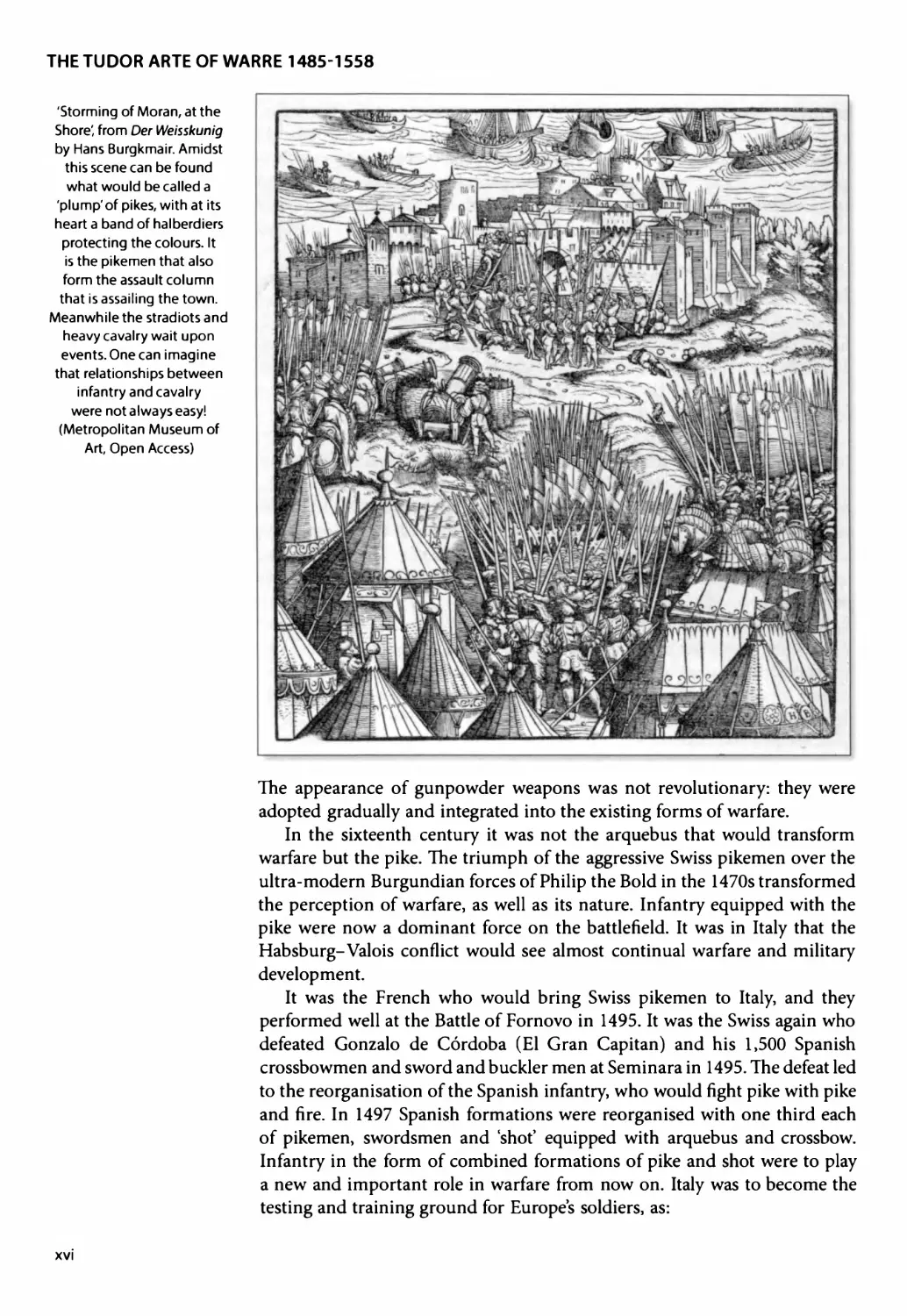
'Storming of Moran, at the
Shore: from Der Weisskunig
by Hans Burgkmair. Amidst
this scene can be found
what would be called a
'plump' of pikes, with at its
heart a band of halberdiers
protecting the colours. It
is the pikemen that also
form the assault column
that is assailing the town.
Meanwhile the stradiots and
heavy cavalry wait upon
events. One can imagine
that relationships between
infantry and cavalry
were not always easy!
(Metropolitan Museum of
Art, Open Access)
The appearance of gunpowder weapons was not revolutionary: they were
adopted gradually and integrated into the existing forms of warfare.
In the sixteenth century it was not the arquebus that would transform
warfare but the pike. The triumph of the aggressive Swiss pikemen over the
ultra-modern Burgundian forces ofPhilip the Bold in the 1470s transformed
the perception of warfare, as well as its nature. Infantry equipped with the
pike were now a dominant force on the battlefield. It was in Italy that the
Habsburg-Valois conflict would see almost continual warfare and military
development.
It was the French who would bring Swiss pikemen to Italy, and they
performed well at the Battle of Fornovo in 1495. It was the Swiss again who
defeated Gonzalo de Cordoba (El Gran Capitan) and his 1,500 Spanish
crossbowmen and sword and buckler men at Seminara in 1495. The defeat led
to the reorganisation of the Spanish infantry, who would fight pike with pike
and fire. In 1497 Spanish formations were reorganised with one third each
of pikemen, swordsmen and 'shot' equipped with arquebus and crossbow.
Infantry in the form of combined formations of pike and shot were to play
a new and important role in warfare from now on. Italy was to become the
testing and training ground for Europe's soldiers, as:
xvi
INTRODUCTION
coping throughout the first twenty years of the Italian Wars the powers involved all
ended up struggling to learn the extent of the offensive and defensive capabilities
of their new tools and with their administrative and Strategic implications
(mostly by an empirical process of trial and error, passing with disturbing ease
from victory to defeat and vice versa).7
The main trends in warfare and the lessons learnt can be readily
summarised. Firstly, the increased importance of infantry. In 1494 in the
fighting in Italy there was roughly parity in the ratio of infantry to cavalry,
but by 1525 it had become six to one. Infantry was now a powerful force on
the battlefield and essential in the Italian wars, which were of conquest, siege
and occupation. The pikemen and arquebusier were also far cheaper to pay
and equip than mounted troops, especially the men-at-arms. There was at the
same time a considerable addition to the cavalry arm with the increased use
of light cavalry. In 1493, of the 25 Spanish cavalry companies raised, only five
were the light cavalry type known as genitors but by the turn of the century
there were 10 companies of heavy cavalry to 26 of genitors. Light cavalry
performed many roles unsuited to men-at-arms, such as reconnaissance and
convoy escort, but they were also now to be found on the battlefield as well.
Other mounted formations such as those of crossbowmen, arquebusiers and
pistoleers were developed, offering greater mobility and firepower to their
commanders. Artillery which had long dominated siege warfare was also to
appear increasingly as a force on the battlefield.
The Swiss pikemen were indomitable in attack, advancing at speed
in echelon to overwhelm their enemy. This they had achieved against the
Burgundians and later at the Battle ofNovara in 1515, where they smashed an
unprepared French army. They were defeated with heavy losses at Cerignola
in 1503 and Bicocca in 1522. On both occasions their headlong attack,
unaccompanied by artillery or cavalry, foundered when it smashed itself on
defences too deep and broad for their long pikes and incomparable bravery
to have any effect. At Marignano in 1515 they almost succeeded against the
army of King Francis I. Powerful artillery, cavalry charges and determined
Landsknecht formations slowed and then flung back the Swiss pike columns,
but only after two days of slaughter. It was then Francis who would suffer
disaster, this time at Pavia in 1525. His brave gendarmes were massacred
by arquebusiers and pikemen in a confused melee, while his magnificent
artillery was unable to play a significant part.
The pike, even when wielded by the Swiss, could not on its own be expected
to carry all before it on every occasion. Infantry formations were undergoing
a transformation as the combination of pike and shot became the norm. The
pike were the assault element but could also protect from cavalry, and the shot
could assist the pikemen in their assault and be protected by the pike. Sword and
buckler men, halberdiers and bearers of the great Zweihiinder schlachtschwerter
(two-handed slaughter sword) would be included in the formation, to be used
7
Maurizio Arfaioli, The Black Bands of Giovanni: Infantry and Diplomacy during the Italian Wars
(1526-1528) (Pisa: Edizioni Plus - Pisa University Press, 2005), p.4.
xvii
THE TUDOR ARTE OF WARRE 1485-1558
in hand-to-hand fighting. The Landsknecht formation known as the Black
Band of Guelders, which fought at Marignano, was a balanced force made up of
12,000 pikemen, 2,000 arquebusiers, 2,000 swordsmen and 1,000 halberdiers.
Each weapon contributed to the strength of attack or defence.
Artillery pieces cast from bronze and mounted on resilient field carriages
provided a mobile source of firepower, which would remain technically
unaltered in principle until the mid nineteenth century. The French artillery
was overrun at Novara but the grand battery of 72 French guns at Marignano
caused massive casualties to the advancing Swiss. At Ravenna in 1512 there
were 84 guns engaged in a deadly two-hour bombardment, often cited as
the first of its kind in war. It was this bombardment that forced the Spanish
relieving force to abandon its strong positions, upon which it had hoped
to lure and destroy the French army. In a sense this battle became a siege
where both sides were not pounding walls of stone but flesh and blood.
Jacopo Guicciardini recorded the slaughter in horror: 'It was a horrible and
terrible thing to see how every shot of the artillery made a lane through those
men-at-arms, and how helmets with the heads inside them, scattered limbs,
halves of men, in vast quantity, were sent flying through the air:s This was
a scene to be repeated for centuries to come. Artillery could prove itself a
powerful force as at Ravenna and Marignano, but could also prove almost
completely ineffectual as at Novara and Pavia. All these battles could be used
to prove the triumph or failure of one arm or another. In practice success or
8
xviii
Michael Mallett and Christine Shaw, Tile it(liian Wars 1494-1559 (London: Routledge, 2014),
p.183.
INTRODUCTION
failure depended on so many different factors that a simple
appeal to supposed technological superiority, of one or other
weapon, is unjustifiable.
The high-velocity iron shot fired by the bronze artillery
would have a profound effect on the design of fortifications.
Tall walls and towers were lowered and emplacements
provided for artillery. Angled bastions were to be employed
to provide flanking fire on an enemy assaulting the walls, and
the traditional thick stone wall would give way to earthen
structures better able to absorb the impact of stone shot. This
would ultimately produce the trace italienne, the star-shaped
forts which would soon spread across much of Europe and
would accompany Europeans on their conquests around the
world. The effectiveness of fortification in defence was as
impressive as the power of the attack. The IS-year siege of
Pisa by the Florentines and the nine-month siege of Siena by
French and Florentine troops in 1554-5 demonstrated the
strength of defences, even in the face of the most powerful
weapons and sophisticated tactics. Success or failure in a siege
did not by any means depend solely on the fortifications,
equipment and tactics employed. Many more factors than
those should be included into the complex equation that
explained the outcome of a siege.
The inevitable consequence of a near perpetual state of war
was the development of permanent military establishments.
The campaign season from April to October would be
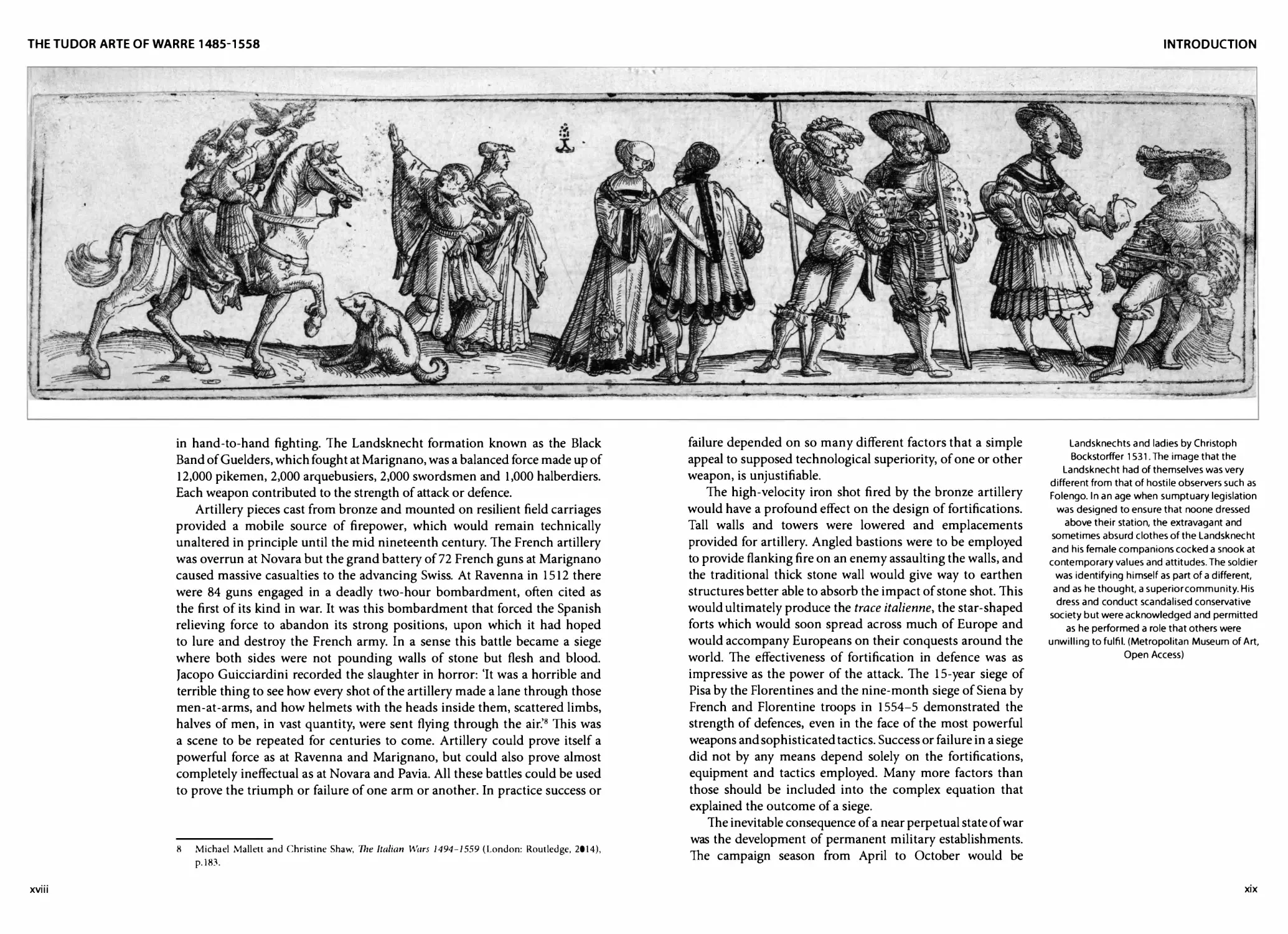
Landsknechts and ladies by Christoph
Bockstorffer 1531. The image that the
Landsknecht had of themselves was very
different from that of hostile observers such as
Folengo. In an age when sumptuary legislation
was designed to ensure that noone dressed
above their station, the extravagant and
sometimes absurd clothes of the Landsknecht
and his female companions cocked a snook at
contemporary values and attitudes. The soldier
was identifying himself as part of a different,
and as he thought, a superior community. His
dress and conduct scandalised conservative
society but were acknowledged and permitted
as he performed a role that others were
unwilling to fulfil. (Metropolitan Museum of Art,
Open Access)
xix
THE TUDOR ARTE OF WARRE 1485-1558
concluded with troops either being paid off like the Swiss, to return in the
spring like malignant swooping swifts, or kept in garrison towns. The wealth
of Italy and the superpowers that were France, Spain and the Empire could
afford to maintain and sustain very large armies and to require their use not
for a season or a year but for decades. The Swiss pikemen, Italian hackbutters,
Landsknechts, Gascon crossbowmen, Schwarz Reiters and the rest of the
'professionals: developed into a 'society of soldiers' that 'put themselves outside
of the community:9 As J.R. Hale records, in Europe:
There emerged, then, a mental frontier between man of peace and man of war
different in kind from the observation that had watched the peasant that had
become the temporary bowman, the landlord replace for a while the falcon glove
for the gauntlet ... Infantrymen, wrote Claude de Seyssel, in 1515 are so 'out of
key with everything that they can hardly believe themselves to be thought men
of experience and courage unless they blaspheme the names of God, the Virgin
and the saints: 10
For the soldier, the disregard or contempt felt for social norms was
expressed in their language, their dress, even their hairstyles, as they flouted
the ties and conventions that so bound the timorous civilian to his lot in
life. The demand that mercenaries either avoided pioneer duties or were
paid extra for this demeaning service was not simple bloody-mindedness
on their part, but to force those in command to recognise that the 'soldier'
had escaped the labouring life of the despised commons and formed a
separate more honourable warrior caste. The civilian population responded
to mercenaries and their pretensions with a mixture of fear and contempt,
expressed in these lines by the Italian poet Teofilo Folengo
(1491-1544):
... a terrible noise springs out among the stars
and the tops of the highest mountains rumble.
Could it be the Swiss? Could it be the Gascon canaille?11
Could it be the Italians, with their bold words?
Is that the German rabble fit for the tankard?
Or could it be Spain sending her tramps?12
What was true of the common soldiers was true of their officers. The
aristocracy, always used to obedience from their inferiors, developed a new
professionalism as commanders. Whereas the tournament had been the training
ground in skill at arms, now the battle ground that was Italy would educate them
in the complete art of war. Successful commanders would understand not just
how to use the lance and the sword but how to maintain and sustain an anny
in the field, to choose ground well, to manage cavalry, infantry and artillery in
effective cooperation, to exploit their strengths and mask their weaknesses.
xx
War and Society in Renaissance Europe 1450-1620
War and Society, p.129.
9
J.R. Hale,
10
Hale,
(Stroud: Sutton, 1998), p.127.
11
From the French for a pack of dogs, otherwise a rabble or 'scum of the earth:
12
Teofilo Folengo, T.H. Moschaea, w 39-44, preface to Arfaioli,
The Black Bands o!Giovanni.
INTRODUCTION
This did not mean that they no longer inhabited the world of chivalry and
the necessity of demonstrating personal bravery. Gaston de Foix at Ravenna
and James IV at Flodden both died performing the role allotted to them, as did
many more subordinate commanders. When Monluc was governor of Siena
he received generous gifts of food and drink from the enemy commander,
the Marquis of Marignano. His explanation for fraternisation with the enemy
explained how far contemporary attitudes to an enemy were from our own
times: 'Such little civilities as these are very gentle and commendable, even
betwixt the greatest enemies; ... He served his master, and I served mine. He
attacked me for his honour, and I defended myself for mine. He had a mind
to acquire reputation, and so had 1:13 What the gentleman-officer fought for
was honour and repute, and if he achieved those then he would be rewarded
with advances in both rank and wealth.
In 1505 Ferdinand I appointed the first cabo de colunela or commander
of a column, a title shortened in 1508 to colunela or colonel. The 20 colonels
appointed by Ferdinand in 1505 began the establishment of well-defined mixed
armed units. The bandera was the basis of the Spanish system, equivalent to a
company varying in size but ostensibly about 250 in strength.The tercio emerged
in 1534 as a formal unit of approximately 3,000 men, initially drawn as its Italian
name suggests from Spanish-controlled regions of Italy. Thomas Audley refers to
the rank of colonel in his treatise on the art of war written at the end of Henry
VIII's reign, but in practice only mercenary commanders were granted this title.
In England the sole rank was that of captain, usually of a company of 100, with
subordinate officers including a lieutenant and ensign to assist.
The armies that faced each other at Ceresole in 1544 demonstrated
what changes had taken place in the structure and tactics of armies in the
preceding half century. The armies were led by commanders who had been
bred to war, men such as Blaise de Monluc, Monsieur de Taix and Raman de
Cardona. Infantry combining pike and shot actively skirmished prior to the
main engagement and then fought bitterly in massive blocks of pike and shot.
Artillery was brought forward on the battlefield to provide direct support.
Meanwhile cavalry both light and heavy manoeuvred on the battlefield to
protect the flanks of infantry, while seeking an opportunity to intervene
decisively. The armies were now organised as mixed-arm formations, flexible
and formidable. The armies of Europe had come a long way, but at what cost?
There is a supposition that all of Europe should have adopted new
weapons, tactics and equipment at the same pace, or face the accusation of
'backwardness: This has led to a catechism against which a nation can be
tested. When were firearms widely introduced, what was the first fortification
built on the principle of the trace italienne, what constitutes professionalism,
how many volumes on martial practice were published and when? These are
the questions which are asked by historians. Whether they are the best or
even the right ones when considering the development of a military sy stem,
is something which hopefully this book will help to investigate.
13
Monluc, The Habsburg- Valois Wars, p.139.
xxi
Part I
Politics, Diplotnacy, Strategies
and Catnpaigns
1
Four Reigns
Henry VII
-
Guarding his Kingdom
Henry Tudor had been an importunate exile in Brittany and France, from the
age of 14 in 1471 until his return in 1485. He was threatened with betrayal
and return to certain death on several occasions. It is unsurprising that on his
accession he was aware of the danger posed by pretenders and determined to
establish the security of his throne and dynasty.
In 1483 the Yorkist King Edward was in an apparently unassailable
position. The King was only 40 years old and had an heir and a spare and
the means and thirst to make more. Edward's death, on 4 April of that year,
created a crisis within the ruling family. Richard's actions in bastardising
and probably murdering his nephews, in order to secure his position against
what he saw as a potential Woodville coup, made him few friends and many
enemies. Henry's claim to the throne was tenuous to say the least: it was
Richard Ill's own actions which made him, for the first time, appear to be
a viable candidate. Supported by the Duke of Burgundy, Henry's inept and
foolhardy attempt at invasion in October fortunately failed and led to his
return to the safety of exile. This was to be found first in Brittany and later
in France, after Edward had suborned some Breton nobles to aid him in
capturing a man who clearly now could be the king. His promise to marry
Elizabeth, Edward IV's surviving heir, increased his appeal to potential
supporters. It was French support which gave him the wherewithal to launch
his successful claim to the throne in 1485.
Henry's victory at Bosworth was more a martial political assassination
than a proper battle, as loyalties on all sides were tested and treachery
determined the outcome. Henry came to the throne because of the Stanley
family's betrayal of Richard and Northumberland's inaction. He was
determined that he would not rely on the 'loyalty' of the nobility but on their
fear of his disfavour, by execution when necessary and more worryingly
by threatening to cripple their families economically. The challenge to his
throne would come from two pretenders to the throne who would find
support from England's natural enemies: France, Scotland and Ireland.
Henry's foreign policy was first to isolate and defeat the pretenders to secure
27
THE TUDOR ARTE OF WARRE 1485-1558
his throne and then to make alliances with neighbouring monarchies which
would secure his dynasty.
In previous decades the Yorkists had had more of a free rein in matters
of policy, although many of the same issues were to arise. In 1475 Edward
IV had united the divided kingdom with his planned invasion of France
in support of Charles the Bold of Burgundy. His strategic intention was to
recover lost territory, but as the Burgundians were unable to make headway
after becoming embroiled in the siege of Neuss this plan was foiled. Edward
now felt obliged to reach a diplomatic and financial agreement with Louis XI.
This gave him an excellent dynastic marriage, proposed between his daughter
and the Dauphin, as well as some much-needed cash. In Scotland Richard
Duke of Gloucester recovered Berwick in 1482 and for a time occupied
Edinburgh in a war from 1481-4. Securing the border with Scotland and
engaging in campaigns in France, as part of a powerful alliance, was a pattern
that would be repeated under the Tudors.
Henry's return from exile in 1485 occurred when Richard III was at
his weakest. Richard III had (quite literally) lost the Crown at the Battle of
Bosworth; in future years it would be Henry VII's onerous responsibility
to keep it, and challenges would come soon. The rebellion of the Stafford
brothers had failed disastrously in 1486 but it created the opportunity for a
new pretender to be promoted, under the aegis of Richard's former henchman
Lovell. Lambert Simnel claimed to be the son of the Duke of Clarence, the
brother of Edward IV, who was in fact a prisoner of Henry's in the Tower.
The danger, posed by this most unlikely challenger to the throne, made it
apparent how insecure the 'usurper' Henry VII in fact was.
Henry had made the serious error of alienating Margaret of Burgundy,
the sister of Edward IV, who would quite naturally espouse and legitimise
pretenders to the throne of England. Margaret recognised Simnel and
provided him with a force of 2,000 Landsknechts, the core of his invasion
force. From Burgundy Simnel travelled to Dublin, where he was crowned
and collected around himself a substantial army of Irish, Landsknechts
commanded by Schwarz, other mercenaries and English renegades. Simnel's
not insubstantial force of some 8,000, far greater than Henry's in June 1485,
landed in Yorkshire where support for the Yorkist Richard had been strong,
but not unfortunately for Simnel. The Yorkists' advance was at first speedy
and successful but was delayed by heavy skirmishing around Nottingham.
On the 16th the royal forces met the pretender's army at East Stoke near
Newark, where they were soundly defeated, with few allowed to live. Schwarz,
who may have come from Nuremburg and whose former profession may
have been shoemaking, was, like the other leaders, killed. Simnel was placed
in the royal kitchens while Lovell, the principal supporter of the pretender
among the English nobility, fled and was never heard of again.
Henry had been granted sanctuary and given military assistance by
Brittany and France when in exile, so he knew what evil could come from
abroad. France remained something of a quandary, having assisted him
to the throne but remaining a potential enemy. In 1487 French troops
occupied the Duchy of Brittany, to stop a marriage between the child Anne,
heir to the dukedom, and Emperor Maximilian. France had provided both
28
FOUR REIGNS
sanctuary and troops to the pretender Henry
in his last years of exile. Whatever debt he may
have owed the French crown, it was still in
Henry's interest to maintain the independence
of Brittany, in case of renewed French enmity.
Henry attempted to act as an honest broker
between the French and the Bretons. The defeat
of the Breton army in 1488, the accession to the
ducal throne of the 12-year-old Anne, and the
likelihood of her marriage to Charles VIII of
France, made it impossible for Henry to remain
neutral. He gained the political and financial
consent of Parliament for war and alliances
with both Burgundy and Spain in 1489.
In 1489 the treaty of Medina del Campo
with King Ferdinand Aragon and Queen
Isabella of Castile was arranged. Although
it gave Henry little material advantage and
bound him to war with France, it did result
in the tacit understanding that Catherine and
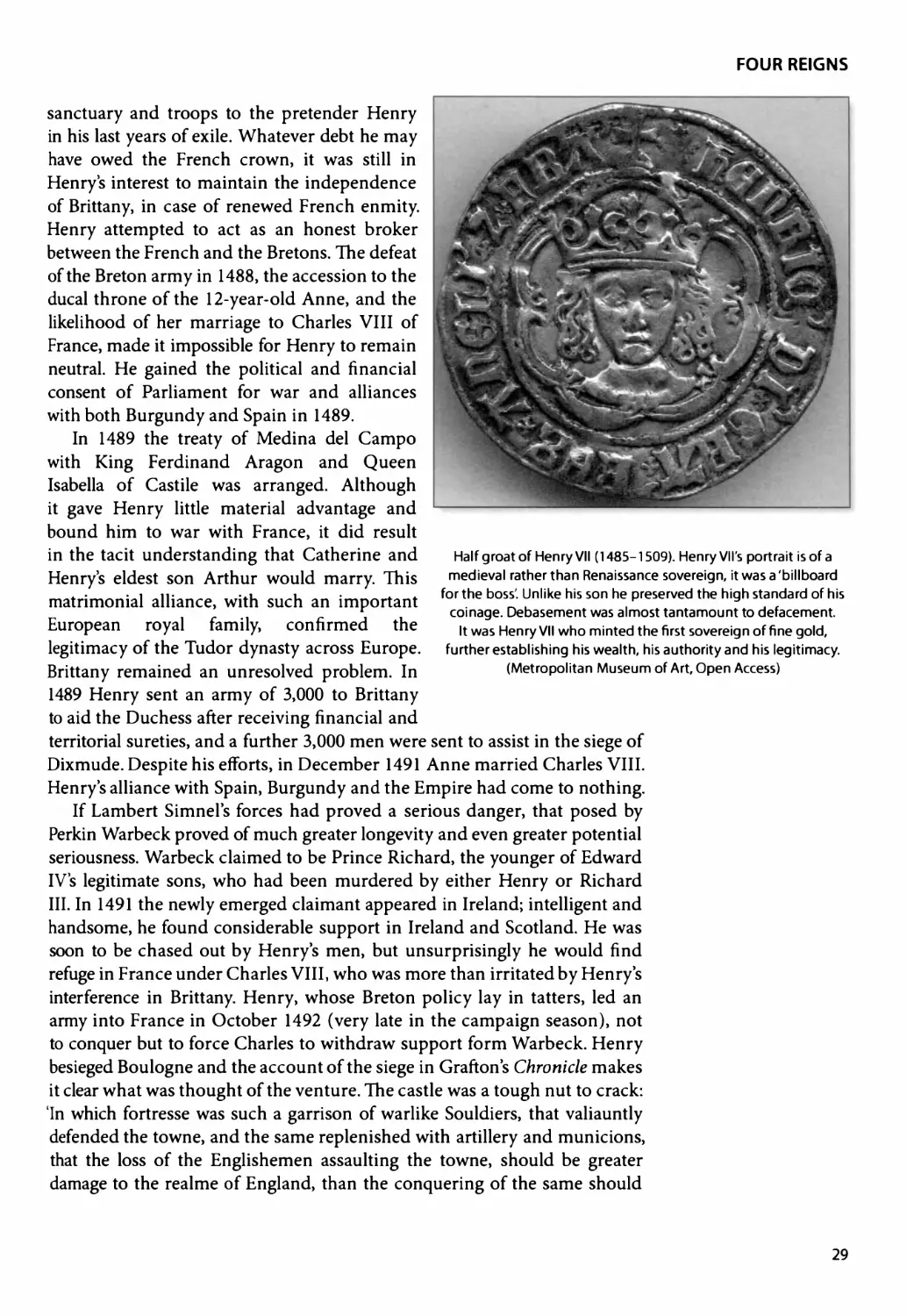
Half groat of Henry VII (1485-1509). Henry VII's portrait is of a
medieval rather than Renaissance sovereign, it was a 'billboard
Henry's eldest son Arthur would marry. This
for the boss'. Unlike his son he preserved the high standard of his
matrimonial alliance, with such an important
coinage. Debasement was almost tantamount to defacement.
European
royal
family,
confirmed
the
It was Henry VII who minted the first sovereign of fine gold,
legitimacy of the Tudor dynasty across Europe.
further establishing his wealth, his authority and his legitimacy.
(Metropolitan Museum of Art, Open Access)
Brittany remained an unresolved problem. In
1489 Henry sent an army of 3,000 to Brittany
to aid the Duchess after receiving financial and
territorial sureties, and a further 3,000 men were sent to assist in the siege of
Dixmude. Despite his efforts, in December 1491 Anne married Charles VIII.
Henry's alliance with Spain, Burgundy and the Empire had come to nothing.
If Lambert Simnel's forces had proved a serious danger, that posed by
Perkin Warbeck proved of much greater longevity and even greater potential
seriousness. Warbeck claimed to be Prince Richard, the younger of Edward
IV's legitimate sons, who had been murdered by either Henry or Richard
Ill. In 1491 the newly emerged claimant appeared in Ireland; intelligent and
handsome, he found considerable support in Ireland and Scotland. He was
soon to be chased out by Henry's men, but unsurprisingly he would find
refuge in France under Charles VIII, who was more than irritated by Henry's
interference in Brittany. Henry, whose Breton policy lay in tatters, led an
army into France in October 1492 (very late in the campaign season), not
to conquer but to force Charles to withdraw support form Warbeck. Henry
besieged Boulogne and the account of the siege in Grafton's Chronicle makes
it clear what was thought of the venture. The castle was a tough nut to crack:
'In which fortresse was such a garrison of warlike Souldiers, that valiauntly
defended the towne, and the same replenished with artillery and municions,
that the loss of the Englishemen assaulting the towne, should be greater
damage to the realme of England, than the conquering of the same should
29
THE TUDOR ARTE OF WARRE 1485-1558
be gaine or profit:l Such sound calculation of profit against loss, would not
unfortunately be found in his son's reign.
Charles of France, who now had eyes only for his Italian campaign
which was planned to take place in 1494, was eager to dispose of Warbeck
and agreed at the Treaty of Etaples to abandon Yorkist pretenders. He also
granted Henry VII the fabulous sum of £159,000 (745,000 Crowns), in part
to defray the cost of Henry's Breton expeditions. The money raised by Henry
from Parliament and other sources from 1489-91 totalled £181,500, almost
four times as much as the cost of the King's invasion. Henry VII was clearly
keen to turn a profit, diplomatic or financial, from foreign involvements.
If Charles had lost interest in discomforting England, it would henceforth
be Maximilian who would support Warbeck, in response to Henry's perceived
failure as an ally. Warbeck made a pathetic attempt at invading Deal in July
1495 and subsequently fled to Ireland. Edward Poynings was sent with an
expedition there and in 1495-6 re-established royal authority. Henry had
done his best to undermine the Scottish crown during a period of turbulence
following the death of James III in 1488, and it was hardly surprising that
when the new king, James IV, came of age he would seek to undermine the
position of the English king. James therefore supported Warbeck and greatly
added to the credibility of the pretender by his marriage to his own cousin,
Lady Catherine Gordon. For Warbeck, having been driven from France and
Ireland, James was his only support. Warbeck now was put in command of
an army of some 1,400. On reaching the border in September 1496 these few
'supporters' fled fled once more to Ireland.
Henry had meanwhile prepared an expedition against Scotland in 1497.
This campaign was abandoned, as the taxation that was necessary for the war
led to rebellion in Cornwall, which resulted in a Cornish army marching on
London. Henry used the army that he was planning to use against the Scots
against the rebels at Blackheath on 22 June, and after their bloody defeat he
advanced to Cornwall. James of Scotland was still determined to twist the
lion's tail, and in July 1497 besieged Norham castle, forcing Henry to send a
force north to the relief of what was one of his principal northern fortresses.
In September the truce was agreed at Ayton recognising the real desire of
both sovereigns to avoid further conflict, confirmed by treaty in 1502 and
the betrothal of Princess Margaret to King James.
Warbeck, having been driven from Ireland as by now the Irish had
discovered that he lacked any support from his erstwhile allies, was forced
to sail to Cornwall in September 1497. The recently chastened rebels in this
county rejected him and a royal army chased him into sanctuary at Beaulieu
Abbey and later into captivity. Warbeck had ceased to be a threat, but his
fate was sealed in 1501 when the marriage between Arthur and Catherine of
Aragon was imminent. No living pretender could be permitted to mar this
happy union, and Warbeck and the unfortunate 'real' Earl of Warwick were
despatched, as their status determined, by the rope and axe respectively.
Richard Grafton, Grafton's Chronicle: or, History of England. To which is added his table of the
bailiffs, sheriffs, and mayors, of the city of London. From the year 1189 to 1558, inclusive. Vol. 11
(London: Printed for J. Johnson, 1809), p.190.
30
FOUR REIGNS
Henry VII's position now appeared secure, with the removal of actual and
real potential pretenders, but his final years were to prove catastrophic for
his hopes of a secure dynasty. Pedro de Ayala considered that 'his crown is ...
undisputed and his government strong in all respects:2 This happy situation
would not last. In 1501 Edmund de la Pole, the Earl of Suffolk, who had a
strong claim to the throne, fled to the court of Maximilian. In 1500 Henry VII's
son Prince Edmund died and in 1502 so did Prince Arthur, leaving a grieving
widow and little eight-year-old Prince Henry as the new Prince of Wales. In
1503 Elizabeth his wife and the daughter of Edward IV died, which was both
a personal and political tragedy. Henry was very much alone and his position
as a successful usurper led him to pursue enemies both real and imagined.
A secret report of a conversation between 'many great personages' in Calais,
concerning the succession, recorded that: 'some of them spake of my lord of
Buckingham, saying that he was a noble man and would be a royal ruler. Other
there were that spake in like wise of your traitor, Edmund de la Pole, but none
of them spake of my lord prince [Henry]:3 In 1506 Henry was still looking and
failing to find a new queen, but he did arrange for the marriage of Princess
Mary to Charles, the eldest son of Ferdinand and Isabella, and of course of
Henry to Catherine their daughter. Up to the very end of his reign. it was clear
that war and diplomacy were there to produce domestic and dynastic security.
Polydore Vergil, writing of Henry's reign, concluded with some justice that:
'leagues and confederacies he had with all Christian princes, his mighty power
was dreaded everywhere, not only within his realm but without also:4
Henry VIII
-
Guarding His Honour
There is no doubt that Henry and his personality 'filled a room and turned heads'
as tends to be the case if the 'personality' can have those self-same heads cut
off. His relationships with those he admired, and even loved, could become
dismissive and even murderous. His ego was expressed through his ambition,
which found its greatest expression in his replacement of the Pope as head of the
Church with himself. He had above all the chivalric concept of honour to uphold
In 1544 he declared of his honour, that 'we have hitherto guarded and will not
have stained in our old age.s This sentiment was not uncommon amongst those
who were of a high enough status to possess such a precious commodity. Francis
I, after having been defeated and captured at the Battle of Pavia in 1525, wrote
to his mother: 'De toutes choses ne mest demeure que l'honneur et la vie qui est
saulve':6 'Of all I had, only honour and life have been spared:
2
3
4
5
6
David Loades. The Fighting Tudors (Kew. Richmond UK: National Archives. 2009). p.30.
G.R. Elton, The Tudor Constitution (Cambridge: Cambridge University Press, 2nd edn, 1982),
pp.5-6.
Loades, The Fighting Tudors, p.36.
Betteridge, Thomas, Lipscomb, Suzannah (eds), Henry VIII and the Court: Art, Politics and
Performance (Farnham: Ashgate Publishing Ltd, 2013). p.300.
Susan Ratclilfe, The Concise Oxford Dictionary of Quotations (Oxford: Oxford University Press.
2011), p.155; Collection des Documents Inedits sur I'Histoire de France (France, Ministere de
l'education nationale 1847), vol. 1.
31
THE TUDOR ARTE OF WARRE 1485-1558
It is impossible to like Henry VIII. Whatever
the role of the present author, it is not to pass
moral or personal judgement on people who
are a lot less alive and a lot more important.
Historians tend to admire 'busy' bureaucrats
such as Thomas Cromwell, who leave a trail of
paperwork behind them, although they rather
suspect Cardinal Wolsey, who they feel should
have spent more time in the chapel and less time
in the court. They approve of a balanced budget
and large national infrastructure projects. On
the other hand, it has been said that a prince
is not brought up to be a bookkeeper and in
fact Henry did promote massive infrastructure
projects, such as the Device forts and his
'knockout' palaces such as Nonsuch. To
comment on his actions, it is important to
appreciate what he thought was valuable, even
though his judgements may appear to a modern
audience to be perverse.
Groat of Henry VIII (first coinage). Henry VIII's first coinage used the
image of his father, just as he used or rather squandered on war all
His foreign policy was an expression of
the coins his father had carefully accumulated. Claiming his titles
his ego. It was, he felt, quite reasonable that
to France, England and Ireland on this coin, he would spend his
he should present himself as a candidate to
reign attempting to give his French and Irish claims some reality.
the Imperial throne in 1519, he had after all
(Metropolitan Museum of Art, Open Access)
been encouraged in this delusion by Emperor
Maximilian himself. It was also therefore equally
reasonable that he should promote his pet Cardinal for appointment to the
papacy, not once but twice, in 1521 and 1523. Henry VIII was Rex Imperator
in his combined realm of England, Ireland and occasionally Scotland
and France as well. He was Fidei Defensor, (Defender of the Faith) a title
granted by the Pope for his authorship of Assertio Septem Sacramentorum,
a denunciation of Lutheran heresy, a nonsensical title he chose to keep after
he had separated his Church of England from the Church of Rome. Henry
was never a Lutheran, let alone a Protestant. Even so, the consequences of
his divorce led him to contemplate alliances with such heretics. Francis I
had gone much further by allying himself with the Turk! Henry was more
interested in titles than territory, he wanted the appearance of greatness,
despite the fact that he was not and never could be anything much more
than an extra on a stage dominated by a few superstars.
England was relatively small: in area it may be over six times the size of
Wales but only a quarter the size of what is currently metropolitan France
or Spain. Her population even including that of Wales was certainly less
than three million, roughly half what it had been under Rome and before
the catastrophe of the fourteenth century. She boasted only one European
sized city, which was of course London. Henry's income at the beginning of
his reign was about £90,000 per annum and his war chest, inherited form
his father, amounted to £350,000. In France he controlled Calais and its
environs and nothing more. The era when the king of England could boast of
32
FOUR REIGNS
possessing more territory in France than the French King was long gone. The
disastrous reign of Henry VI had seen the loss of Normandy in a firestorm of
French artillery and Henry VII had failed even to protect the independence
of Brittany.
France had a population of 16 million and the French monarch in the
1520s had a reliable income equivalent to £350,000 per annum. Spain had a
population of 7.5 million and when united with the territories of Maximilian
in 1519, at least double. The revenue of Charles V was an impressive £540,000,
six times that of Henry VIII. Of course, their massive revenues did not save
either of these super-sovereigns from becoming bankrupt. In a modern
comparison, by wealth and population England would be equivalent to
modern day Belgium while sixteenth-century France and Spain would be
France and Germany. At the beginning of Henry's reign Ferdinand of Aragon,
Louis XII of France and Emperor Maximilian commanded the armies, wealth
and respect of much of Europe. Charles V would succeed to the thrones
of Spain in 1516 and the Empire in 1519 and Louis XII would be replaced
by the princely superstar Francis I in 1515. These were the characters who
would control European affairs. The focus of the conflict would be on the
borders of their territories, and even more importantly in the true cockpit
of Europe, Italy.
Under these circumstances, Henry's strategy was to take advantage of
whatever opportunities presented themselves, military or diplomatic. Grander
strategies have been suggested A.F. Pollard considered that Henry's intention
was to pursue a strategy of conquest, completing the integration of Ireland
and fulfilling his historical claims to France and Scotland. Undoubtedly, on
occasion he made such claims to other thrones but only when it suited him, or
in a fit of pique; both objectives were realistically quite beyond him.
1509-13 Preparation for War, and War with France and Scotland
On his accession in 1509, Henry's judicial murder of his father's most capable
and loyal servants, Empson and Dudley, indicated that the son was not going
to pursue the policies or style of the father. Henry VII's priority had always
been the security of the kingdom from pretenders, and through treaty and
marriage to secure the future of his dynasty. These objectives he had achieved,
and through the careful exploitation of his resources and had amassed a
large sum of cash. Henry VIII's priority was to spend what his father had so
aSSiduously collected, on war.
Henry was a little shy of 18 years old when he came to the throne. His
father had never allowed him into the tournament lists but only permitted
him to run at the ring and the quintain. He first appeared at a tournament
'properly' in 1510, after the pregnancy of his queen was announced. He
remained an enthusiastic participant for the next 17 years. As king he was
determined and encouraged to take part in tournaments at home and far
more bloody engagements abroad. War was the stage which would give him
the opportunity to appear as a true Renaissance prince. Machiavelli had
asserted that 'Nothing brings a prince more prestige than great campaigns
33
THE TUDOR ARTE OF WARRE 1485-1558
and striking demonstrations of his personal abilities:7 and although this was
written in 1514 and would not be translated into English until Elizabeth's
reign, it would certainly serve to explain Henry's enthusiasm for war. Henry
began participation in martial events with some caution. He sent a force
of 1,500 archers to join his father-in-law Ferdinand in a campaign against
the Moors in Barberry and a similar force under Sir Edward Poynings to
aid Margaret of Savoy, the daughter of the Emperor, against the Duke of
Guelders. Neither were substantial commitments but were designed to make
useful friends in a future war against the French.
Although in 1509 he had sworn to revive the war with France, he had
instead, on the advice of his counsellors, renewed the Treaty of Etaples in
1510 and received the pension that his father had negotiated. The French
were in an alliance with his father-in-law Ferdinand of Aragon, Maximilian,
and Pope Julius 11 all of whom combined in the League of Cambrai against
Venice. This political initiative had begun in 1505 with the marriage of
Ferdinand to Louis XII's niece Germaine de Foix (Ferdinand's second wife
after the death of Isabella). Henry VII was not invited to take part in this
Spanish-Imperial rapprochement, and it is unlikely that he would have seen
any advantage in doing so. In 1510 Louis abandoned the League, and Pope
Julius allied the Papacy with the Venetians against the French. Now it was the
turn of France to be the enemy of the Papacy, which had formed the Holy
League, consisting of Spain, the Empire and finally England. On the coat tails
of a much larger conflict, Henry could now with religious justification go to
war against the French and establish his Plantagenet claim to Gascony. He
began this project by sending a large force of infantry under Dorset to Spain.
The expedition by the Marquis of Dorset in 1512 should have taught him
a lesson about the fickleness of allies. Acting in support of Henry's father-in
law King Ferdinand, Dorset's force of infantry wasted its limited resources
drawing away the French force at Bayonne, so that Ferdinand could invade
Navarre unmolested. It was not an inconsiderable force, 7,108 strong,
provided primarily from noble and ecclesiastical retinues supplemented
with Spanish infantry and cavalry. The invasion of Navarre may have been
planned as the prelude to the English conquest of Guienne as was suggested
at the time, but came to nothing. Without draught horses or cavalry, both of
which were promised but not provided by Ferdinand (although 200 mules
were supplied), the English force was immobile and ineffectual and collapsed
through sickness and mutiny. This futile war drew France and Scotland closer
together, which would have very significant implications the following year.
The mobilisation of men and resources in 1511-12 was however a useful
rehearsal for Henry's larger enterprise of 1513, one that would be managed
far better.
Despite the fiasco in Spain and a disaster at sea, with the loss of the royal
warship Regent in action against the French fleet, Henry was determined to
commit an army to an invasion. The object of his efforts would be Therouanne
and Tournai in Artois. These had no strategic or tactical significance for
7
34
Niccoio Machiavelli, The Prince, trans!' George Bull (London: Penguin Books, \961), p.70.
FOUR REIGNS
Maximilian's alliance with Henry VIII; from The Arch of Honour, 1515, by Albrecht Durer. The besieged towns and
the cavalry combat in this engraving record the sieges ofTherouanne and Tournai and the Battle of the Spurs.
Although apparently representing a meeting of equals, the balance of the engraving, as in life, is clearly in favour of
the Emperor, placed in the foreground. It is interesting to note the close formation of the charging cavalry, with the
lance point only dropped just before the strike. Using a lance effectively was a great skill, and if not initially lethal
this unwieldy weapon would have to be discarded and other weapons employed. The painting of the Battle of San
Romano by Paolo Uccello shows a battlefield littered with broken lances, a detail often overlooked.
(Metropolitan Museum of Art, Open Access)
35
THE TUDOR ARTE OF WARRE 1485-1558
Design for tents for the
Henry but they did for the Emperor upon whose territory they impinged. In
Field of the Cloth of
August 1513 Maximilian and Henry met as equals, in a tent made of cloth
Gold. Although perhaps
not adhering to the full
of gold, in miserable weather. The Emperor deigned to wear the English
rules of perspective,
red cross, pandering to Henry's vanity, while Henry in turn willingly spent
this conglomeration of
money and lives on behalf of the Emperor. Soon after the meeting a French
tents is truly impressive.
There are three large
circular pavilions and two
attempt to relieve Therouanne was routed, in what came to be known as the
Battle of the Spurs, a name that appealed to Henry's conceit but was in fact
rectangular halls joined by
little more than a skirmish. No longer with any hope of relief, Therouanne
galleries or passageways.
surrendered and Henry turned his attention to the city of Tournai. Its
The decoration is in the
grotesque style which
emerged in Italy in the late
fourteenth century when
surrender was inevitable, as it was almost indefensible and again no relief
force was available.
Two major events had occurred during this time which were of far greater
the lavishly decorated rooms
significance than Henry's 'conquests: The inevitable Scottish attack, designed
of Nero's Golden palace
to reduce the pressure on her ally France, led to the Battle of Flodden which
were discovered. (Courtesy
of the British Library, Cotton
Augustus l.ii.76)
resulted in the slaughter of the Scottish king surrounded by his nobility
and thereby transformed Anglo-Scottish relations. Of greater European
significance was the defeat of the French on 6 June at Novara, which meant
that the French were driven from Italy, for the moment. This explained the
Emperor's short-lived enthusiasm for war with France, which had prompted
Henry to pursue his campaign in Artois as the gull of the Emperor rather
than his equal.
36
FOUR REIGNS
Henry was more than satisfied with his accomplishments. He had been
treated as an equal by the Emperor, he had fought his first battle - admittedly
safely surrounded by Imperial infantry - and he had destroyed Therouanne
and kept Tournai. Abandoned now by his allies and prompted by the Pope to
choose peace, even then it still required Louis to offer a generous settlement
for Henry to accept. He would keep Tournai from which he gained financially
and it was also agreed that his favourite sister Mary would marry the French
king, bringing to an end, it was hoped, the enmity between the kingdoms. So
pleased was he with the architect of this campaign, Thomas Wolsey, that he
made him Bishop of Tournai. This was a post he would hold only until 1518,
when the city was handed back to the French by the Treaty of London.
1513-22 Diplomatic Triumph and Defeat
Having exhausted his treasury and glutted his martial appetites, Henry found
himself again without allies or enemies. If he could not gain glory through
warfare, perhaps Wolsey could gain it through diplomacy? Henry did not control
events in Europe, but events in Europe, along with the state of his finances,
could detennine what Henry could do. The death of Louis XII in January 1515,
according to prurient rumour exhausted in bed by his 18-year-old bride Mary
(Henry's sister), led to the return of the unhappy girl into the welcoming arms
ofCharles Brandon, Henry's closest friend It also led to the appearance of a new,
younger, more handsome and wealthier prince on the European stage: Francis
I. Just like Henry, Francis was determined to cut a dash at home and abroad.
He also had three practical objectives to achieve: the recovery of Tournai from
Henry, Navarre from Spain and Milan from the Empire.
Henry felt he had to appear a significant figure in Europe, and conducted
a diplomatic offensive under Cardinal Wolsey to make himself appear as
the arbiter of Europe. Pope Leo X was promoting a crusade and a universal
peace amongst Christian kingdoms, and Henry was willing to countenance
participation in a universal peace, as well as a treaty with France. The Treaty
of London in October 1518 returned Tournai to France for the fabulous sum
of 600,000 gold ecus and Henry's infant daughter Mary was affianced to the
Dauphin. Spain and the Empire and more than 20 minor powers now made
a pact of perpetual peace with England, all agreeing to ally against any that
broke it. Wolsey had put Henry triumphantly at the heart of Europe.
The death of Ferdinand of Spain in 1516 led to the accession of Charles,
the son of Philip the Fair of Burgundy and Joanna the Mad (daughter of
Ferdinand and Isabella). In 1519 Charles further succeeded to the throne of
Emperor Maximilian, becoming Emperor Charles V at the age of 19. Francis,
who had once faced two enemies in Ferdinand and Maximilian, now faced
a single implacable opponent, who commanded the combined and massive
resources of both. This new reality was what would determine the future of
Europe. In June 1520 Francis and Henry now participated in one of the most
extraordinary diplomatic initiatives of any period: the meeting at the Field of
the Cloth of Gold, so called because of this massively expensive fabric being
used for tentage. Held at a spot equidistant between Guines in the English
Calais Pale and the French town of Ardres, it combined a diplomatic summit
with a royal sports day and provided an opportunity for ostentatious display.
37
T H E TUDOR ARTE OF WAR R E 1 485- 1 558
In Greenwich the armourers had to rush to produce the special 'ton le! '
armour which had been specified for the foot combat, in which both
sovereigns were keen to take part as allies and not enemies. The logistics of
this event were masterfully directed by Cardinal Wolsey and the whole show
was brilliantly choreographed, except for the spontaneous wrestling match
between the two monarchs which Henry lost, leaving him 'bitter and heavy
hearted: The Breton wrestlers also defeated their Cornish counterparts, and
to Henry's chagrin the French court was also considered more fashionable.
The Venetian ambassador tartly observed: 'these sovereigns are not at peace
. .. they hate each other cordially.'s The practical results of this vast expenditure
were to further strengthen the position of Wolsey and increase Henry's
dislike of Francis. The extravagance of Wolsey, in having a prefabricated
palace built for the King, complete with a fountain spouting three different
vintages of wine, was later to be cited against him in the trial that he faced on
his fall from the King's grace.
Henry now attempted to act as an honest broker between the two principal
European contestants for predominance: Charles V and Francis I. It was
unfortunately clear to all that England had always been an enemy of France,
and had always benefited from her alliance with Spain and later the Empire
against France. Events were decided for Henry when in May 1521 Francis
invaded and reconquered Navarre and attacked the Duchy of Luxembourg.
By doing so Francis had broken the Treaty of London, and Henry's response
in May 1522 was to declare war on France.
1522-29 War, Peace and the King's 'Great Matter'
England was unable to make a significant contribution to the war at that
point, as she simply lacked the resources to do so. This partly explains why
in August 1522 the General Proscription was ordered, to assess the military
and financial resources of the population. Wolsey had agreed in 1521 to a
significantly larger invasion in 1523, but in 1522 a raid from Calais around
Picardy was led by the Earl of Surrey, with a force of 7,000.
If England intended mayhem in France, it was inevitable that Scotland
would choose to threaten the northern border, as the Regent Albany chose
to do in 1523. The usual English response came in the form of two large
raids led by Thomas Howard, who had now succeeded to his father's title as
Earl of Surrey. With only enough artillery to destroy a bastle house all went
well, until the siege of Cessford Castle. The castle's walls were reinforced with
earth in the latest manner, which negated Surrey's artillery. The second raid
led to the usual inconclusive skirmishes and opportunistic arson. In October
Albany lead a Franco-Scottish army south to besiege Wark, but the Scots
refused to cross the Tweed. Albany now settled before Wark and with only
3,000 men faced Surrey's 5,000. Surrey did his best to initiate the engagement
by threatening to 'strike off his [Albany's] head and send it to the King of
England:9 Albany did not take the bait and Surrey complained that it was '[a]
8
9
38
,., Scarisbrick, Henry VIII (Berkeley: University of California Press, 1 970), p.79.
Edward Hall, Chronicle, vol. 1 , p.304. Quoted from Gervase Philips, TIle Anglo-Scots Wars 15131550 (Boydell Press, 1 999), p.144.
.
FOUR REIGNS
grete pitie it were that the King is Highnes shuld spend thus moche money
withoute batayle: 10 Henry agreed, and Surrey returned to London if not in
disgrace then at least in bad odour. Albany was also humiliated and fled for
France. Henry supported a new Scottish regent, Archibald Angus, who offered
to provide a peaceful border. Lord Dacre was relieved of his wardenships
in the North as Henry felt such a powerful figure was a potential problem,
especially when the threat from Scotland had significantly diminished.
In the new European situation what was lacking was a strategic plan
which would combine the efforts of King Henry and the Emperor. What
again decided Henry's actions were events in Europe or specifically France,
with the treason of Charles de Bourbon the Constable of France. With France
divided, the Constable, Charles V and Henry agreed on an invasion in July
1523. Henry would provide the majority of the manpower, and Margaret of
Burgundy the artillery and supplies. Charles promised to launch an attack,
as did Bourbon. The English army taken to France in 1523 was made up of
some 2,000 men from Suffolk's own lordship, principally in North Wales and
the Marches, 1,000 volunteers, 1,600 men from the Calais garrison and the
remainder drawn from the county militias. In total Henry disposed some
16,500 men including 3,500 mercenaries.
Suffolk's forces had some success, capturing eight towns, which now
acknowledged Henry as sovereign. However Bourbon's attack on Paris
failed to materialise, as did the invasion of France by Charles from Spain. He
provided no reinforcements for Suffolk's forces and less than half the money
promised, about £16,000. Suffolk was forced to withdraw; his army, suffering
from the plague and dreadfully cold weather, had effectively disintegrated. The
cost of the two years of futile campaigning was about £400,000. The overall
cost of England's military efforts was calculated by Wolsey to add up to some
£800,000. Parliament had granted some £300,000 and a forced loan had raised
a further £352,000. Patience amongst those who had to pay for these wars was
running thin. The words of Thomas Cromwell best sum up what many have
felt when considering Henry's regular calls for war and the money to pay for it,
when he condemned the expense associated with the capture of Therouanne,
'which cost his highness more than twenty such ungracious dogholes could be
worth:11 Henry was deeply disillusioned by the abject failure of the Emperor to
fulfil his obligations, and relations between them, like the weather, were frosty.
Steven Gunn considered the expedition of 1523 to be the 'last campaign
of the Hundred Years War:12 He provides this analysis which puts Henry's
ambition in the broader European context:
10 Henry Ellis, Original Letters Illustrative of English History: Including Numerous Royal Letters;
from Autographs in the British Museum, the State Paper Office, and One Or Two Other Collections,
vo!. 1 (London: Richard Bentley, 1846), p.23 1.
Diarmaid MacCuUoch (ed.), The Reign of Henry VIII: Politics, Policy and Piety (Palgrave
Macmillan, 1995), p.l09.
12 S.T. Gunn, 'The Duke of Suffolk's March on Paris in 1 523', in English Historical Review, vo!. 1 01,
no. 401 (Oct. 1 986), p.629.
11
39
THE TUDOR A RTE OF WA R R E 1485-1558
Henry VIII had pursued the traditional English offensive strategy of the previous
three centuries, but he could not make: 'semblable warr against the Frenchmen.' l)
Most French peers would not now desert or stand aside, none had the military
resources of a John the Fearless, and the loyal standing army and arrangement
with the Swiss gave the French Crown flexible military strength. Charles V, with
his commitments from Italy to Friesland and his readiness to promise what
Margaret in the Netherlands could never provide, had proved both too powerful
and too unreliable to be an effective ally in England's Continental ambitions.11
The Battle of Pavia on 14 February 1525, which saw the French army
crushed and Francis captured, changed the game once more. This should
have provided a golden opportunity for Henry, who was still intent on
making his claim to portions of France a reality. He asked his imperial ally for
Normandy, Picardy and Boulogne, in return for his help in the dismantling of
France. Henry attempted to drum up support for another invasion amongst
the population, providing bonfires and limitless supplies of cheap drink for
Londoners. Unfortunately the 'Amicable Grant' proposed by Wolsey to pay
for yet another foreign expedition was met with outright hostility, and worse,
refusal to pay up. In addition the Emperor also rejected Henry's proposal, and
to add insult to injury repudiated the previous marriage offer to princess Mary.
Henry and Wolsey now reversed their pro-Imperial anti-French policy,
signing the Treaty of the More with France in August 1525 and encouraging
the anti - Imperial League of Cognac. What determined Henry's foreign policy
for the indefinite future was the 'King's matter: This was the promotion of
his divorce from Queen Catherine, who was also of course the aunt of the
Emperor. Henry had begun his affair with Anne Boleyn in 1526 and the issue
of the divorce was placed in Wolsey's supposedly capable hands in 1527. This
was also the year in which Henry stopped participating in the joust, perhaps
a recognition of his age and his own mortality. Queen Catherine naturally
sought the intervention of her nephew, Emperor Charles V, with the Papacy.
Charles was in a strong position to put pressure on Pope Clement VII, as
Clement had become his prisoner in 1527 after the Sack of Rome. This event
was not intended by Charles, but was a spontaneous and very violent act
by his Protestant Landsknecht mercenaries. It was said that after this the
Emperor never again smiled. The Pope un surprisingly declared his undying
support for Charles after the decisive defeat of the French by Imperial forces
at Landriano in 1528, a position confirmed with the Treaty of Barcelona in
1529. The Peace of Cambrai, between France and the Empire in August of the
same year, left England isolated and without a clear future course.
Divorce, Reformation and Isolation 1529-39
Henry's prime concerns were now domestic rather than foreign. Wolsey's
failure to gain the impossible divorce led to his humiliation and trial and
his ultimate replacement with Thomas Cromwell, whose role in Henry's
13
14
40
Tito Livio dei Frulovisi, ed. C L. Kingsford, The First English Life of King Henry V (Oxford:
Clarendon Press, 1911), p.190.
Gunn, 'Suffolk's March', p.630.
FOU R R E I G N S
reign has been long mulled over. The divorce process led ultimately to
the Reformation in England, which again placed England in a perilous
relationship with a predominantly Catholic Europe. The dissolution of
the monasteries 1536-1541 and the effective submission of the Church in
England to royal control did give Henry access to enormous wealth, some
of which was used to effectively bribe the nobility and gentry to support
him. The Dissolution also led to the Pilgrimage of Grace in 1536, a mass
movement in the North determined to save what they knew and loved from
further despoliation. Henry defeated it with guile and cruelty. He recognised
that he did not have the military resources to crush it in the way his father
had crushed the Cornish rebels in 1497.
The death of his first wife, the much-wronged Catherine of Aragon, and
execution of his second wife, the unpopular Anne Boleyn, both in 1536,
made Henry somewhat less of a European pariah. Those who served him,
in particular the Archbishop of Canterbury Thomas Cranmer and Thomas
Cromwell, may well have preferred a more radical religious settlement
than Henry but remained his servants in such matters. Edward Fox was
despatched on an embassy to Germany and the Schmalkaldic League in
1535-6 to consider the religious and diplomatic future of the kingdom, an
initiative deeply opposed by the conservative Bishop Gardiner.
While Francis and Charles were engaged in their efforts to control Italy
and defend their borders from each other, England was secure from any
threat. On 18 June 1538, after the latest outbreak of fighting in Italy had
come to an end, the two mortal enemies signed the Truce of Nice, which
had been promoted by Pope Paul Ill. This settled some of their outstanding
territorial disputes and was designed not to ensure peace in perpetuity but
for a decade (equally unlikely). The negotiations between the two, conducted
by the Pope, took place in separate rooms as the two sovereigns refused to
be seated together, an indication of the real state of relations between these
obstreperous rulers. Henry had hoped that Franco- Imperial hostility would
ensure the safety of his realm, and in fact relations with the Empire had
improved after the death of (Queen) Catherine. The recent truce brokered
by the Pope, who had excommunicated Henry in December 1538, made
the possibility of a combined European 'crusade' against Henry appear
feasible. On 12 January Charles and Francis signed the Treaty of Toledo,
whereby they agreed not to ally with England but to stand against this
excommunicate monarch. Henry responded by the massive programme of
defensive constructions which were known as the Device forts. Foreign ships
were detained in English harbours and a chain of warning beacons prepared
between March and April 1539. On 3 May a parade of 16,500 men took place
before the King in London, indicative of the seriousness of the situation.
However the unity between Francis I, James V and Charles V could not last,
and as the London militia marched past the King the threat had receded.
The obvious allies of the embattled sovereign were Europe's Protestant
princes, which of course explains the unsuccessful marriage to Anne of Cleves
(January-July 1540). Henry was never attracted by Protestant beliefs, although
he greatly enjoyed the power and prestige he had gained in his dominions
from usurping the authority of the Pope. Cromwell's fall in 1540, in part due
41
T H E TUDOR A RTE OF WA R R E 1 485- 1 558
to the Cleves match, led to the rise of aggressive noble factions, less competent
than Cromwell but determined to serve the King in peace but preferably war.
Another Scottish Interlude - the 'Rough Wooing' Begins
Henry's relations with Scotland now also presented difficulties. After Flodden
Scotland had ceased to pose a serious military threat to England. Scotland
would never be reconciled to a subservient position and within a decade
would threaten disturbance along the border. James V succeeded to the
throne on the death of his father James IV, who had been killed at Flodden,
but he was of course also the son of Margaret Tudor. He was thus Henry's
nephew and Henry expected him to prostrate himself before his wealthier
and more powerful elder relative.
This state of affairs did not appeal to the young king, who had seized the
throne from Archibald Douglas 6th Earl of Angus in 1528, at the age of 16.
Between 1532 and 1534 there was low level conflict between the two nations
especially in the Debatable Lands, resolved in a settlement negotiated by
France. The serious diplomatic problem facing England was posed by the
Scots king's clear intention of seeking a close alliance with France. His second
French marriage was to Mary of Guise in 1540, a woman who had already
wisely rejected Henry's advances. Francis I offered a dowry that would match
that of a royal princess, which indicates the importance he gave to the match.
James's failure to meet Henry at York in 1541 was considered by the King as a
calculated insult: 'we be in dedes so injured, contemped and despised, as we
ought not with sufferaunce to pretermitte and passe over:15 Henry insisted on
a humiliating climbdown by James, and a declaration of amity or neutrality
in case of a war with France. He threatened to attack Scotland if James did not
give way. The young and seriously ill Scottish monarch, instead of submitting
to renewed English claims to the overlordship of Scotland, invaded England
at the end of November 1542.
His army was humiliatingly defeated at Solway Moss, as a consequence of
the collapse of leadership and morale in the face of a small but aggressive and
well-led English force. The Scottish losses were few, but an Earl, five barons,
hundreds of gentlemen and the King's favourite were all captured. They
were taken to London in December 1542, where the majority were treated
as honoured guests and swore to accept Henry as his 'assured' subjects.
Those who did not, remained as less honoured prisoners of the English until
1551. What Henry's intentions were in what he referred to as: 'Our greate
afayre of Scotland: are difficult to fathom. Marcus Merriman suggests that
he was utterly pragmatic and considered four possible solutions to the
issue of Scotland: 'sovereignty itself, union by marriage, control of the area
south of the Forth-Clyde line, or at least influence over whatever Scottish
government emerged in 1543:16 The union of Prince Edward with Princess
Mary of Scotland was the most attractive option. It would secure the Tudor
15
Susan Ooran, England and Europe in the Sixteenth Century (Basingstoke: Macmillan International
Higher Education, 1998), p.1 3.
16 Marcus Merriman, The Rough Wooings: Mary Queen o/Scots, 1542-1551 (East Linton: Tuckwell
Press, 2000), p.11 3.
42
FOU R REIG N S
dynasty, it would gratify Henry's Imperial pretensions, it would once and
for all separate Scotland from France and thereby secure England's northern
border, thereby saving a fortune in defensive measures.
The unfortunate Scottish king died in despair on 15 December, leaving
the infant Mary under the supervision of his wife, the French princess. In
July 1543 at Greenwich the Scots lords, led by the Earl of Arran, agreed to
first a peace treaty and then the betrothal of Edward and Mary. This joyful
arrangement did not last. Arran, having returned to Scotland, formally
repudiated the treaties in December 1543 and sided with the pro-French
party led by Cardinal Beaton. Scotland was as weak as she had ever been,
with political, religious and clan rivalries creating ideal conditions for English
intervention. The French diplomat Jacques de la Brosse reported that:
the whole country was under arms, not for national defence but because all the
friends of one faction mistrust all those of the other faction. So much so that not
merely is the nobility in arms, but churchmen, friars and the country people only
travel through the countryside in large companies all armed with pikes, swords
and bucklers and a half pike in their hands.17
Henry's response to Arran's treachery was cruel and simple; his orders to
Edward Seymour Earl of Hertford in May 1543 were to:
Put all to fire and sword, burn Edinburgh town and as many towns and villages
about Edinburgh as ye may conveniently, sack Leith and burn and subvert it and
all the rest, putting man, woman and child to fire and sword, without exception
where any resistance shall be made against you"s
Thus began the Rough Wooing, intended to force the union of the two
crowns in the persons of King Edward and Queen Mary. This was a phrase
derived from the supposed response by the captured Earl of Huntly on the
field at Pinkie after the Scottish defeat. When asked about the marriage
proposal he replied: 'I wade it sud gea furth [should go forth], and haud will
with the marriage, but I lyke not thys wooing:19
After considerable preparation, including the collection of a large fleet
to support the army, Hertford with about 15,000 men landed in Scotland
on 2 May. Scottish resistance to the English invasion, at least at first, was
not impressive. A force of 6,000 Scots barring the way to Edinburgh was
easily thrust aside, only causing two English casualties. It was said that
Cardinal Beaton was the first to seek safety in flight. On 8 May the city of
Edinburgh was taken but the castle successfully resisted, mainly because of
its impregnable position and the accurate fire of its artillery. Further raids
17 G. Dickinson (ed.), Two Missions of /acques de la Brosse (Edinburgh: Scottish History Society
Third Series, vol. 36, 1 942), p.23.
18 Joseph Bain (ed.), The Hamilton Papers: Letters and Papers Illustrating the Political Relations of
England and Scotland in the XVIth century, formerly in the possession of the dukes of Hamilton,
now in the British Museum. vol. I (Edinburgh: H.M. General Register House, 1890), p.207.
19 Merriman, The Rough Wooings, p.8.
43
T H E TUDOR A RTE OF WA R R E 1485-1558
caused much damage and did nothing to make the Scots accept Henry's offer.
In military terms Hertford did display remarkable originality in the use of a
balanced mobile force, landed and sustained by sea wherever possible. It also
established in his mind the possibility of a new strategy, the creation of an
English Pale. The Scottish, outraged by the wanton destruction, discovered a
degree of unity. Beaton and Arran were joined by the Earls of Moray, Huntly
and Argyll acting in support of the French Dowager Queen. The Scots now
turned on the English and a large raiding force was defeated with heavy loss
by a much smaller Scottish force at Ancrum Moor, on 27 February 1545.
1544 The Enterprise of Paris (Boulogne)
In Europe Pope Paul III was busy dealing with domestic problems caused by
heavy taxation of his flock and the promotion of his family members. The
peace between Charles and Francis was very short-lived, with war breaking
out yet again in 1542. Henry's concern towards the end of his reign were
matrimonial, as well as martial. His disastrous marriage to Catherine
Howard had ended in his humiliation and her execution in February 1542.
He married Catherine Parr in July 1543, who was to prove far more politic
than her flighty predecessor. Henry established her as regent in 1544 during
his absence on campaign in France. War at this point for Henry was an
attractive project, he now had a son by the short-lived Jane Seymour and
two daughters for the succession, a new reliable and competent wife, an
enthusiastic nobility, full coffers and no threat posed from Scotland; he also
had a powerful ally and a worthy opponent. What he lacked was a plan.
Henry had been negotiating with Charles from 1540 but a treaty of
mutual aid was not signed until February 1543. It was too late to plan a major
expedition but Sir John Wallop was sent with 5,000 men, including some 400
highly valued border horse, to support the Emperor in the Low countries at
the (unsuccessful) siege of Landrecies. The infantry was drawn equally from
county militia and trusted gentlemen's retinues.
The 1523 French expedition was supposed to have been part of a pincer
movement on Paris. With France divided and with the Emperor as a
powerful ally anything seemed possible, including the capture of Paris and
the coronation of Henry as King of France. In 1544, as in 1513, although
there was to be an invasion it was not certain what it was for or what it
could achieve. It was to be named the 'Enterprise of Paris' and agreed to in
December 1543. Henry had a sizeable army made up of Englishmen and
mercenaries but he could still not hope to conquer France. His alliance
with the Emperor was agreed upon the basis of an attack on Paris. From
the beginning the distrust between the allies was exploited by the French,
which made determined coordinated action between Charles and Henry
nearly impossible and both were permitted to pursue their own plans, 'as
strategy, victuals and the enemy shall permit:20 Henry had been 'stood up'
by his Imperial ally once too often and he therefore chose instead to pursue
20 Paul Hammer, Elizabeth's Wars: War, Government and Society in Tudor England, 1544-1604
(Basingstoke: Palgrave Macmillan, 2003), p.1 7.
44
FOU R R E I G N S
a more modest target. Combining realism with bombast he considered that
'it would be better to take two or three frontier places than to have burnt
Paris:21 The Duke of Norfolk suggested the capture of Montreuil, while Sir
John Russell recommended Boulogne. Henry chose both. It was Boulogne
which his father had besieged in 1497 and had been the probable objective of
the 1523 campaign. Henry, at the end of his reign, was attempting to achieve
what he and his father had previously failed to.
The invasion was on an even more massive scale than that of 1513, and
achieved its objective. Henry entered Boulogne in triumph on 18 June. It
is doubtful on the other hand whether it was ever intended that Montreuil
would also be seriously besieged. The army at Montreuil was there mainly
to act as a diversion for the Boulogne siege, which is where Henry devoted
his main efforts. The defence of Boulogne was extraordinarily stoic in the
face of a bombardment of more than 100,000 cannonballs. It was not this
bombardment but the failure of a relief force which forced it to surrender.
On the day that Boulogne was captured Charles and Francis signed
the Treaty of Crt!py. Henry had once again been betrayed by the Emperor.
Meanwhile at Montreuil the army was now threatened with attack by the
French army and fled with its tail between its legs. The cost of Boulogne's
conquest and the additional costs of rebuilding its walls and garrisoning were
immense. It was calculated at over £1,000,000, not including the unfortunate
loss of many lives. Once he had captured Boulogne Henry was not going to
abandon it, as he had done with Tournai.
In 1545 the King now faced a determined and aggressive France, without
an ally. Francis now sought to discomfort Henry by supporting the Scots
on Henry's northern border, renewing the siege of Boulogne, making large
incursions into the Calais Pale and launching a seaborne attack on the south
coast. The strain on England's resources was great, and for the first time
England faced a strong enemy fleet in the Solent and even invasion, if only of
the Isle of Wight. The outcome was neither a disaster for Francis or triumph
for Henry but meant further expense and pOintless bloodshed. Stephen
Gardiner, the Bishop of Winchester, closely involved in the management of
Henry's policy, was at his wits end:
We are at war with France and Scotland, we have enmity with the Bishop of Rome
[the Pope]; we have no assured friendship here with the Emperor and we have
received from the Landgrave, chief captain of the Protestants, such displeasure
that he has cause to think us angry with him . . . Our war is noisome to our realm
and to all our merchants that traffic through the Narrow Seas . .. We are in a
World where reason and learning prevail not and covenants are little regarded.22
What better critique of Henry's action could there be, coming from one
of his most stalwart supporters and competent servants.
21 Hammer. Elizabeth's Wars. p.17.
22 John Julius Norwich. Four Princes: Henry VIII. Francis I. Charles V. Suleiman the Magnificent
and the Obsessions that Forged Modern Europe (Kindle Edition.2020).loc. 2441-2448.
45
T H E TUDOR A RTE OF WA R R E 1 485- 1 558
Henry quite unrealistically prepared for a further French expedition
in 1546. The county militias were mustered and a force of 16,000 English
infantry and 14,000 mercenaries was proposed. Hertford was sent to Calais
in March to prepare for this new army. The initial objective was to establish
a fort at Ambleteuse, to ensure the line of communication between Calais
and Boulogne. After some skirmishing around Boulogneberg both sides
abandoned further aggressive action.
In practice the cost and dangers of continued conflict made a settlement
essential. On 7 June 1546 Hertford found himself negotiating the Treaty
of Camp (or to the French, the Treaty of Ardres), not leading an army on
campaign. Henry finally agreed to the return of Boulogne to take place in
1554 after the payment of two million crowns (£600,000), the arrears of his
French pension. As important to Henry as the money, if not more so, was the
recognition by Francis of Henry's titles as Defender of the Faith and Supreme
Head of the Church. Henry was always more interested in titles than territory.
The Costs of War
War was always expensive and never in Henry's reign profitable. The first
French campaign of 1512-1514 cost the stupendous sum of £1,000,000
and the more modest excursions between 1522 and 1524 emptied the royal
coffers to the tune of £400,000. In his definitive study of the Anglo-French
War David Potter summarised the appalling cost of the French and Scottish
wars between 1538 and 1547.23
Table 1. The Cost of Henry's Wars
Landrecies Campaign 1543
£36,500
Boulogne (siege) 1544
£ 586,718.2s.4d
War and fortifications at Boulogne £ 426,306. 19s.5d
(of which £318,884.3s.4d in wages)
Fortification and garrison costs at
Calais 1538-1547
£276,765.9s.7d
The Scottish wars 1542-1547
£350,243.2s.2d
Naval expenditure
£265,024.4s.3d
Device fortifications 1538-1547
£203,205.13s.0
Total £2,126,763 IOs 9d
The non-Parliamentary revenues that the King could call on amounted to
only £90,000 per annum, about four percent of the costs of his late conflicts. New
sources of revenue came from Henry's status as Supreme Governor of the Church.
Hale summarised the new relationship between Church and state nicely, when he
wrote 'Peter with the keys was robbed to pay Paul with the sword'24 The retention
in England of Peter's Pence (the tithe payable to Rome) and clerical taxation
23 David Linley Potter, Henry VIII and Francis I (Leiden: Brill, 20ll), pp.243-255.
24 Hale, Renaissance War Studies, p.7!.
46
FOU R R E I G N S
through the Court of First Fruits and Tenths produced £42,000 per annum in
1535. The income from property seized as a consequence of the Dissolution of
the Monasteries, and administered through the Court of Augmentations added
between £25,000 and £50,000 per annum. The sales of monastic land, mostly
as a means of paying for the Device forts, made a substantial sum of £66,000
per annum between 1539 and 1542. The sale of monastic property accelerated
as demand increased, with £900,000 raised between 1542 and 1551. The family
silver, or rather in practice the lead off the monastic roofs, was up for sale, to
pay for the consequences of Henry's ambition. The actual quantity of lead was
phenomenal, some 12.5 million kilogrammes, an amount so great in fact that
its sale would have flooded the market. The entire stock was eventually sold for
£58,000 which was less than half its normal value.
Parliament had an important part to play in raising funds from what was
an unenthusiastic country. Between 1543-1545 Parliamentary loans, grant
subsidies and the delightfully named Benevolences raised £712,382, while
clerical subsidies from the nationalised Church added a further £84,000. The
money raised from the sale of stolen goods and taxation of Church and people
was still not enough. Wriotheseley, a character who on this rare occasion it is
difficult not to have sympathy for, wrote to the council in some despair:
his subsidy and benevolence ministring skant thre hundrethe thousand therof as
I muste sustyene where the rest being so greate a summe hathe been gotten soo
the landes being consumede, the plate of the realme molten and coyned, wherof
moche hathe assay, I sorowe and lament the daunger of the tyme to com.2S
The coinage was the last victim of Henry's desperate search for more
cash. The English silver coinage at 92.5 percent purity was universally
acknowledged as a source of confidence and pride. The addition of base
metal began in May 1544, with the silver content reduced to 50 percent and
later to as low as 25 percent. Gold coins were also reduced from 23 carat to
20. The most embarrassing product of this policy was the Testoon or shilling
02d) which had a thin layer of silver over copper. The silver overlying the
most prominent royal feature was soon worn off in circulation and Henry
became known as 'Old Coppernose: For a monarch deeply sensitive to a slight
of any sort this must have been hurtful, but it also must have profoundly
damaged the respect the people had for the image of the King in every sense.
In fact it was Francis I, Henry's great rival, who was the proud owner of the
monarchical mega-nose, known to his people as 'le roi grand-nez:
The debasement of the coinage was a profound blow to the prestige of
England and the King. It was however extremely profitable and a source of
revenue to Henry and his immediate successors. Between 1544 and 1551
an enormous sum £1,270,000 was derived from this source, about half in
Henry's reign. To further deepen royal indebtedness substantial loans
of £lm were made on the Antwerp market at the ruinous rate of 12 to 14
25 Potter, Henry VIII and Francis I, p.249. Wriothesley to Council, 14 Sept. 1 544, NA SP 1 1207,
f.172 (174); (Letters and Papers, XX, ii, 366).
47
T H E TUDOR A RTE OF WA R R E 1485-1558
percent per annum. The inevitable consequence of debasement and wild
government expenditure was of course serious inflation. In five years landed
incomes based on rents and fines halved, causing increased tensions between
landlords and tenants as well as disdain for the Crown.
The Final Act
Scotland should not be forgotten during this period, although after 1542 it
no longer posed a serious threat to the North. Hertford led a new raid into
Scotland in August 1545, and although it achieved little he began to develop
his idea of establishing garrisons in Scotland, suggesting Leith and then
Kelso as potential bases. Henry seemed enthusiastic at first but numerous
objections were raised and the project was abandoned. In Scotland the
conflict between Catholicism and Protestantism was creating a major crisis
which concluded with the murder of Cardinal Beaton (1546) who had turned
Arran from an English ally into her enemy. Henry died in January 1547
and King Francis in March, and the issue of Boulogne became important
again. Henri 11 of France immediately reneged on the treaty and intended
to recapture Boulogne. England, facing a potentially difficult regency for the
young King Edward, agreed to the return of Boulogne in return for less than
a quarter of the agreed amount. England needed the cash; she did not need
another expensive and futile war. Henry's sole territorial gain, and his son's
inheritance, was abandoned in 1550.
Henry, described by Sir John Russell as 'the father of all Europe in this
world: 26 was of course nothing of the sort. The big players were Ferdinand,
Maximilian, Francis and Charles; Henry's actions very much depended
upon what they had done or wanted to do. His policies were pragmatic
and opportunistic, as he lacked the wealth and the power to match those
he considered his equals. It is difficult to argue that any of his wars were in
any sense necessary for England's defence. The only 'invasion' of England by
the Scots in 1513 was in response to his invasion of France and was never
aimed at conquest. Only twice did England face the possibility of invasion
1538-9 and 1545, and on both occasions this was as the consequence of his
own actions. At ruinous expense and the loss of many lives he had no doubt
maintained his 'honour' but had failed in everything he had ostensibly set
out to achieve.
An Irish Interlude
Ireland was on the fringe of Henry's realm, and although he claimed
sovereignty, in practice he controlled little more than the English Pale around
Dublin and sometimes not even that. In 1520 Surrey was sent there with a
small force to discover how to restore the people to 'obedience: Surrey argued
that only a harsh policy enforced by an army of 6,000 could achieve anything
and only then if English colonists were settled as well. Henry considered
Surrey's mission a vain consumption of royal treasure. Throughout his reign
26 Jeremiah Holmes Wilfen, Historical Memoirs of the House of Russell, vol. 1 , part 1 (London:
Longman, Rees, Orme, Brown, Green, and Longman, 1 833), p.344.
48
FOU R R E I G N S
his lordship of Ireland cost him £4,000 per annum. For much of this time
government alternated between the families of Kildare and Ormond; on
occasion Ormond might be held as a prisoner in England before returning
to govern in Ireland on the King's behalf. In 1534 Sir William Skeffington
was sent with a small force to prop up what was left of English authority, but
this attempt to assert control ended with the invasion of the Pale in 1539.
A change in policy was needed and it proved remarkably successful.
Ireland was now deemed a separate kingdom and not part of England. The
rival families and clans were encouraged to 'surrender' to the Crown, on
the understanding that their property and power would be regranted. Thus,
O'Neill and O'Brian were now awarded the titles of the Earl of Tyrone and
Thormond respectively. This splendid fiction did bring about a remarkable
change, so that in 1544-5 Irish troops served in Scotland and France rather
than opposing English rule in Ireland.
Ireland would continue to present an almost insuperable problem for
successive English sovereigns. Catholic Ireland presented a challenge to
England after the religious changes of Henry VIII and even after the accession
of Philip and Mary there was little trust in the loyalty of their Irish subjects. To
enforce English rule would require endless expense, and in the environment
of Ireland a definitive military outcome was unlikely. The establishment of
English settlements had and would in future provide a constant source of
dispute and hostages to fortune.
Edward VI
Henry's death was shrouded in self-interested shenanigans. In the last
months of his reign final political battles were being fought to establish
whether there would be a conservative Catholic or a reformist Protestant
regency. His death was first hidden and then managed brilliantly, and it was
the conservatives who found themselves either in prison or in exile from
the court. The Duke of Norfolk was to be found not in power but in the
Tower, awaiting execution, which was suspended on the old king's death. The
Council, which had been well rewarded with the 'undisclosed gifts' clause
in Henry's 'will: agreed to the promotion of one of their number, the young
king's uncle, Edward Seymour the Earl of Hertford and newly created Duke
of Somerset, to the fine new title of Lord Protector of the Realm.
There was no question that the war with France would be reopened. The
kingdom had been impoverished by wars that had resulted in heavy taxation,
domestic unrest and disastrous debasement of the coinage. It was clear that
the religious settlement would tend towards the Protestant, which would
certainly please the young king; peace at home and abroad was desirable
but the question of Scotland remained. Edward and Queen Mary had been
contracted in marriage in 1543 and Edward's father had gone so far as to
claim the Scottish throne. Somerset, who had devoted so much effort to the
pursuit of Henry's Scottish policy, the Rough Wooing, was hardly likely to
abandon what (little) had been gained at such a great cost.
49
THE TUDOR ARTE OF WARRE 1485-1558
The policy that he pursued appeared at first to
be a great success. The shock and awe achieved
by his victory at Pinkie on 10 September
1547 was followed up by a coherent political,
diplomatic and military strategy to create an
English Pale, to seduce or subdue the Scots and
revive the hopes of marriage. In practice the
policy fell apart as the Scots resented the English
invasion, regained a degree of political unity and
sought French assistance. The cost of garrisons
increased and the flight of Mary to France
in August 1549 made the ultimate objective
unachievable.
Conflict
with
France
became
inevitable with Henri II declaring war in August .
Somerset's reputation as the 'Good Duke',
as a social reformer and the friend of the
commons, was not well deserved. The religious
and economic tensions that were building
Edward VI (1537-1553), When Duke of Cornwall c.1545; reworked
up finally exploded in the summer of 1549
in 1547 or later from the workshop of Hans Holbein the Younger.
with major armed rebellions in East Anglia
Edward may have been only a boy during his short reign but
his person and his personality were not to be ignored. He was
and the South West. Somerset's response was
an intelligent and active child who wanted a more Protestant
confusing, dilatory and ineffectual. The crisis
settlement than his father would have considered. Until his final
also led to any military resources available now
illness he was a healthy youngster, and like his father enjoyed
being devoted to saving the realm from chaos.
archery and other manly sports. (Metropolitan Museum of Art,
Open Access)
Somerset's abject failure in Scotland and the
blame attributed to him for the rebellions led
the Council to seek another leader. He was
overthrown by consent of the Council, which put in place a new regent, the
Duke of Northumberland, who had suppressed the East Anglian rebels with
an admirable combination of ruthlessness and lenity.
Northumberland realised the impossibility of carrying on war of any sort
on any front. His attempt to negotiate with France over the return of Boulogne
and a Scottish settlement was from a very weak position. In practiceScotland
was left in the French sphere of influence and Boulogne would be returned,
with at least a monetary sweetener. Anglo-French relations now verged on the
cordial, with Henri II made a Knight of the Garter and Edward admitted, in
absentia, to the order ofSt Michael. Northumberland concentrated on creating
religious, political and economic stability. When the question of his marriage
to the Scottish Queen arose once more, Edward replied with considerable
maturity and sagacity: 'they had taken too much pain and spent too many
lives for her: 27 Restoring the currency, establishing a determinedly Protestant
settlement and maintaining domestic peace, meant that antagonising foreign
powers and engaging in ruinously expensive war was inconceivable. Even
the companies of 850 gendarmes which he had established in February 155 1
27 W.K. Jordan, The Chrollicle lIlId Poiitiwi Papers of Killg EdwlIrd VI (London: George Alien and
Unwin, 1966), p.68.
50
FOU R REIGNS
to protect the King and for 'the staie of the unquiet subjectes, and for other
services in all eventes:28 were disbanded in the Autumn of 1552 to save cash.
This was a mistake that he might well have rued.
Mary and Philip
King Edward died on 6 July 1553, but his death was not announced until
the 8th; the Tower of London was put into a state of defence and on the 10th
Lady Jane Grey was brought thence and proclaimed queen. Princess Mary
was at Kenninghall Castle, supported by Sir Thomas Wharton and numerous
local gentry. Northumberland had failed to secure the person of Mary but
he feared that her most likely course would be to escape the kingdom rather
than raise rebellion. Emperor Charles had previously planned a cloak-and
dagger escape for Mary organised by two Spanish agents posing as corn
merchants. This dusty pair would take the incognito Queen aboard a boat in
Maldon and rendezvous with a Spanish warship off the coast.
Mary was the daughter of Henry VIII and Catherine of Aragon, and
thus in the eyes of many the legitimate claimant to the throne. Her mother's
popularity, enhanced by her father's mistreatment of her, was inherited by
Mary. Northumberland's machinations in putting his daughter-in-law on
the throne, a girl with small claim to it, was clearly a coup that would gain
little support except from those few Protestants who sought to maintain the
religious settlement of Edward VI. Mary was a Tudor and would not run.
The Duke of Northumberland now set out to bring Mary to heel. He
claimed the right to lead the expedition against her, as he was the 'best man
of warre in the realme:29 and in addition as had already triumphed once in
Norfolk over Ketfs rebellion he was 'so feared, that none durst once lift up their
weapon against him:30 At Durham House he collected men and ordnance for
the field. On 12 July in Norwich Mary was proclaimed queen, after some delay,
as the Corporation ascertained that the King was truly dead. Mary had wisely
avoided any association with Kett's rebels or the authors of their repression,
avoiding potential hostility from the common people. Six royal ships had been
sent to Yarmouth to capture Mary if she had tried to flee, but they declared
their support for her instead. The reinforcements that she received in both
men and ordnance from the fleet was an indicator of how the wind blew. In
the Tower our anonymous observer recalled that 'Then eche man then began
to pluck his hornes';31 what came as a particularly shocking blow was that it
was reported that 'the noblemen's tenants refused to serve their lords against
queen Mary:32 On 19 July Mary was proclaimed queen in London, and on
hearing this Northumberland abandoned his doomed project and proclaimed
28 Hammer, Elizabeth's Wars, p.4s.
29 Anon., The Chronicle of Queen lane by a resident of the Tower of London from luly 53-October 54
(London: Camden Society, 1 850), p.8.
30 Anon., The Chronicle of Queen lane, p.8.
31 Anon., The Chronicle of Queen lane, p.9.
32 Anon., The Chronicle of Queen lane, p.9.
51
T H E TUDOR A RTE OF WA R R E 1 485- 1 558
her queen himself. Having been arrested by the
Mayor of Cambridge, he could do little more
than throw himself on the new queen's mercy.
Mary succeeded not because of her military
superiority.
Northumberland
had
been
abandoned by his allies and the Privy Council
in London, the people rallied to her cause, as
she and not the Lady Jane was obviously the
legitimate heir to the throne. If Northumberland
had not disbanded the gendarmes then he
might have had a reliable force that would
have nipped her rebellion in the bud and taken
her prisoner. It was the loyalty of the local
nobility and gentry and their men assembled
at Framlingham castle, along with the sailors
from the fleet, that gave her the appearance of
strength, while Northumberland's force slowly
melted away on the road from London.
Mary came to the throne amidst public
Shilling of Philip and Mary 1554. Two sovereigns are represented
here, if not cheek to cheek then face to face, in amity if not great
jubilation. Bonfires were set throughout London
mutual affection. Although absent from England for most of the
to welcome her accession, other bonfires made
reign, Philip was clearly presented as co-ruler. The early coins
of more than brushwood would colour the
combined the titles King and Queen ofEngland, France and Naples,
Prince and Princess of 5pain, despite Philip having been deprived of later reputation of her name. Initially she did
an actual coronation by Parliament. The shilling (1/20 of a pound)
not seek to persecute those with a Protestant
was a new coin, in part intended to deal with the consequences of
leaning, nor did she ever permit the Holy
inflation, requiring higher denomination coins, brought about by
Inquisition
to operate in her Kingdom. She was
successive disastrous debasements. (Metropolitan Museum of Art,
determined to restore Catholicism in England,
Open Access)
not an unreasonable objective, as Protestantism
had hardly gained a hold on the majority, but it
would take time. What had been the priority of her father was now hers, the
provision of an heir and therefore for her the acquisition of a husband.
During her unhappy life after her parents' divorce, she had sought and
received unquestioned support from her Spanish 'family: It was this connection
that would lead her to marriage with Philip 11 of Spain. Queen Catherine, the
wife of Henry VIII, was Charles V's aunt and he would always side with her
and her daughter in disputes with Henry VIII and Edward VI. The proposed
match between Charles's son Philip 11 and Queen Mary of England made
excellent sense for many reasons. Mary had long relied on the emotional
support provided by Emperor Charles and the Imperial ambassador. This had
enabled her to continue worshipping in the traditional Catholic manner. Such
support was especially important during the accelerating religious changes
that occurred in her brother's reign, changes she never accepted.
Mary had first considered the Emperor himself as a marriage partner, to
whom she had been affianced twice already, or Edward Courtnay, a loyal
Catholic courtier but an unattractive personality as she soon discovered.
Imperial ambassador Simon Renard pressed strongly for the suit of King
Philip. England by this marriage would now be allied with the devotedly
Catholic European superpower. Spain was also an important trading partner
52
FOU R R E I G N S
and the traditional enemy of England's greatest enemy, France. After only
a few months Mary made clear her intention of marrying her young (and
handsome, for a Habsburg) cousin, Phi lip.
The marriage was clearly a matter of public disquiet, as it led to a rebellion
that may have had strong elements of farce but was in many ways a substantial
threat. Wyatt's rising, which took place from 22 January to 3 February 1555,
originated in Kent but should have taken place in at least three other counties,
if plans had come to fruition and the nerves of the other conspirators held.
There was also the possibility of an alternative candidate to the throne, the
young Princess Elizabeth, who wisely had nothing to do with the rebellion.
Although the rebel forces were small and ill-equipped, the failure of the
rebellion to be swiftly suppressed, the defection ofloyal forces and the fact that
the rebels made it to the very gates of the City of London, made it appear a very
real danger to Mary. It was again only her determination and character that
rallied the City and royal forces. Once the rebels realised that the regime was
not about to collapse and that they faced a serious fight, they withered away.
Although the marriage suited Mary politically, diplomatically and emotionally
it was by no means popular outside the court, as it was quite clear that in this
match England was to be the junior partner. Philip's retainers had not helped
by establishing such a reputation for being quarrelsome with their English hosts
that he had to order them to go unarmed in London. The penalty for drawing a
weapon was to lose a hand or even hanging. Philip was made co-ruler with Mary,
both their heads appeared on the new coins and Parliament was called in both
their names. While their marriage continued, Philip would share in detennining
the direction that England took. One provision made by Parliament, which was
of great significance and importance, was that England would not be drawn into
a war with France as an ally of Spain. So concerned were the English that in the
marriage treaty Spanish troops were even forbidden to serve in English garrisons.
Mary naturally persevered with some success to re-establish Catholicism.
Her attempt to have the monasteries restored and their property returned
failed dismally, although at parish level it was easier to restore Catholic
practices. The inevitable attempt to suppress Protestantism led some to
choose exile, others martyrdom and many more to wait out events in hope.
The persecution of Protestants that took place in her reign was on a totally
different scale to the religious persecutions of earlier reigns and again did
little to enamour her Anglo-Spanish regime with the population. It also
led to the association of Spain with Catholicism and the burnings, which
became an important feature of Elizabethan propaganda.
Her reign did contain positive achievements especially in the military field
The navy was significantly enlarged and its administration improved, after
Northumberland's government had allowed it - admittedly for sound budgetary
reasons - to decline. It would be this force which Elizabeth would inherit and use
against the Scots in 1 560. There were two key pieces of legislation in 1 558 which
would confinn the changes that had already been taking place, and produce, for
the first time, what would become in time an efficient national militia.
War between Spain and France was a regular event and on Philip's marriage
to Mary the latest war was still in progress. Although it was ended by the
treaty of Vaucelles in February 1 556, it soon restarted after the separation of
53
T H E TUDOR ARTE OF WA R R E 1 485-1 558
the Habsburg Empire between Philip 11 and Ferdinand I. The renewed focus
of the conflict would be Flanders rather than Italy. Philip naturally sought
Mary's assistance in the conflict, which was not forthcoming. Neither Mary
or her Council, not even such conservative stalwarts as Cardinal Pole and the
Bishop of Winchester, supported any new French exploits. Domestic issues
took priority and fear of the inevitable border war with Scotland as well as the
ruinous cost made it unappealing. In March 1557 Philip returned to England,
for the second and last time, seeking to persuade Mary to change her mind. In
April the Council presented a list of reasons why England ought not and could
not declare war. Mary attempted to assure Henri 11 of England's neutrality and
to act as an honest broker in negotiations between Henri and Philip.
Henri 11 was convinced that Mary would support her husband, and
therefore as all his predecessors had done, moved to discomfort England
through diplomatic and military support for Scotland. He also reinforced
the defences of Ardres on the border of the English Pale. France had
undoubtedly consolidated its influence in the Scotland of Mary of Guise.
This led to disquiet among the Scottish nobility, who did not want to be the
cats paws of France, any more than their English counterparts wished to
be seen as servants of Spain. Philip had argued that France had broken the
peace in the Netherlands, against the treaties of 1542 and 1546, for which
England was a guarantor. It was not this, however, that led to war but a most
unlikely event: the invasion of Scarborough.
Sir Thomas Stafford had a very distant claim to the throne as a member
of the Pole family. He had taken part in Wyatt's rebellion, been imprisoned
and then fled to France. Stafford was one of a number of English exiles at the
court of Henri. He was opposed to the marriage with Philip and promoted
an English candidate to the throne. Claiming an importance for himself that
he did not possess, he received support in the shape of just two ships for his
'invasion: accompanied by between 32 and 100 exiles and 'venturers: The
castle at Scarborough was in a state of disrepair, and the garrison of a dozen
men surrendered on 23 April without a shot being fired. Unsurprisingly no
one rose in support of this hare-brained scheme. The Earl of Westmorland,
with the militia force that he had raised for service on the border, retook the
castle and captured the rebel 'army' on the 28th. Under these circumstances,
that of a foreign prince encouraging an invasion of England (however risible),
it was impossible for England to do anything but declare war. War had some
advantages for the nobility, at least as Surian the Venetian ambassador
recorded on 13 May, as: 'A great part of the nobility of the kingdom are
preparing, some from a longing for novelty . . . some from rivalry and a desire
of glory, some to obtain grace and favour with his Majesty and the Queen:33
The remaining family of the traitorous Duke of Northumberland - Robert,
Ambrose and Henry Dudley - all joined the Army Royal.
The border with Scotland was of course in these circumstances a source
of concern, but Mary had no desire for war and confirmed the treaty of
33 Calendar of State Papers Relating to English Affairs in the Archives of Venice (200
Venice), vol. 6, 1 555-1558, ed. Rawdon Brown (London: HMSO, 1 877), pp. 1 085-7.
54
FOUR REI G N S
peace with Scotland in July 1557. The Scots were little more enthusiastic
about another confrontation than the English. There was no strong French
force available to act as the core of an invasion force, as the numbers of their
soldiers in Scotland only increased from some 700-1,000 men. The Scots
lords refused to be summoned for a large-scale invasion of their southern
neighbour. Mary sought assistance from Philip in case of attack. Help, which
he signally failed to offer, was fortunately not needed.
The principal area of operations was in Flanders. Philip departed England
with a force of 10,000 under the Earl of Pembroke for the Siege of St Quentin,
a force that proved too many to be of use. Seven hundred men from this
force were sent to reinforce the Calais garrison, while some were even sent
back to England as being superfluous to operations. The main battle, which
was fought to defeat the relieving force, took place on 10 August before
the English arrived. The English troops later did take part in the final stage
of the siege, with St Quentin surrendering on 27 August. Juan de Pinedo
reported on the annoying tardiness and continual complaints of the English
contingent, but concluded that 'both sides fought very choicely . . . and the
English best of all?4 The job done the English force was disbanded and most
men had returned to England by late October.
Mary's marriage to Philip had drawn England into a war with France that
England did not want. It was caused by Henri II's failure to appreciate how
unwilling England was to engage in yet another expensive and futile war. Henri
expected and welcomed war, as he was determined to take Calais as he had
previously recovered Boulogne. Having been defeated at St Quentin and with
winter coming on, the assumption that Calais was safe was one easily made.
With considerable skill Henri collected his forces together without arousing
Spanish or English fears. Between 1 and 8 January the English, outnumbered,
outmanoeuvred and outgunned, lost Calais, their impregnable and invaluable
foothold on the Continent. Mary cannot be blamed directly and it was a
national as well as a personal humiliation. Its loss may also be considered
in the long term to have been a good thing, as it made further expensive
invasions and expeditions impossible. What is perhaps surprising is the lack
of enthusiasm in England for an expedition to recover Calais, partly due to the
cost but perhaps also a deep pessimism and disenchantment with war.
What was perhaps of greater military significance in the long run
were the Acts of Parliament that properly modernised the militia. It was
now acknowledged that the army was to be a national force, recruited in
the counties, even if still for obvious reasons officered by the gentry and
commanded by the nobility. If Calais was lost, the means to fight wars,
offensive and defensive, were still considerable. The Device forts and the
great quantity of munitions of all sorts but especially artillery, together with
an army great in number and with many soldiers rich in experience, was the
inheritance of the greatest of all Tudor sovereigns: Queen Elizabeth.
34 Calendar of State Papers Spain (CSP Spain), vol. 1 3, 1 554-1 558, ed. Royall Tyler (London:
HMSO, 1 954), 27 August 1 557, p.339. Available online (see bibliography for URL).
55
2
Conflict at Hotne
Bosworth
The Wars of the Roses was not a war, but a sequence of battles, campaigns and
political coups that dramatically affected English history for nearly 40 years.
Its causes have been long debated but in essence the conflict arose between
a weak and unsuccessful monarch and powerful, passionate nobility. The
collapse of the English empire in France in 1453 left the nobility equipped
and talented for war, but with a monarch quite unable and unwilling to
command or control them. Blame could be laid at the feet of the inadequate
Henry VI and his ambitious wife Margaret, and the personalities and families
that were to engage in a bloody fratricidal conflict that turned victors into
victims and made treachery the cold accompaniment to hot-blooded valour.
It is not a glorious part of English history but it is certainly memorable.
The course of the war in its various phases is long and complex. The first
notable clash between the nobility occurred on 22 May 1455 at St Albans.
Henry remained king, and due to the efforts of Margaret the Yorkists were
eventually forced to flee. The Yorkists were to invade and triumph in 1461
at the Battle of Towton, certainly the bloodiest battle fought on English soil.
Edward was crowned king and governed uneasily for the next eight years
until in 1469 the envious Warwick, of 'Kingmaker' fame, effectively deposed
him. Warwick's star was not in the ascendant for long and soon he fled to the
exiled Lancastrian party. Warwick orchestrated a further coup and restored
Henry to the throne for a final time in 1470-7 l . Edward returned in an
attempt to wrest control of the kingdom from Henry and Queen Margaret.
The Lancastrian cause was finally defeated with the Yorkist victories at
Barnet and Tewkesbury in 147 l . The murders of Henry VI and his son and
the ignominious capture and imprisonment of Queen Margaret saw the end
of all Lancastrian hopes. Only the insignificant child, Henry Tudor Earl of
Richmond, had a distant and discredited claim to the throne. He was to spend
the next 14 years in perilous and penniless exile in Brittany and France. His
continued freedom was a very slender hope indeed for those who adhered to
the Lancastrian cause. Kept as a pawn in diplomatic relations, he only began
to appear as a realistic claimant to the throne when Edward IV died in 1483.
56
CON F LICT AT HOME
What occurred now was a mafia-style falling-out, with bloody and
destabilising consequences. Edward IV's marriage to Elizabeth Woodville
may have slaked his monumental sexual appetite and provided him with an
heir and a spare (the princes Edward and Richard), as well as an apparently
superfluous daughter, but it also led to inevitable conflict with his brother
Richard of Gloucester. Richard was not about to allow the gains, so hard
won in the bloody victories of the War of the Roses, to pass to the Woodville
family and their brats. Richard had fought hard for the Yorkist cause. The
Woodvilles were the cuckoos in the regal nest, a family of massive ambition
but little power, who now saw the crown coming to them. Richard naturally
sought to retain the crown for his family and his son; thus he first delayed
Prince Edward's coronation and then abandoned it after bastardising his
nephews on a legal technicality, and had himself declared king.
The Woodvilles were obviously intent on placing themselves in a dominant
position in the realm and the old Yorkists were happy to see their destruction.
However in Autumn 1483, after Richard's coronation, the realm once again
erupted The old Yorkist families in the Home Counties and from Dorset to Kent
rose against him, under the leadership of the Duke of Buckingham. It is easy to see
why those formerly loyal to Edward and his progeny might have risen against the
usurper of his sods throne. Removing the Woodvilles was one thing, removing
Edward's sons quite another. Buckingham, who had orchestrated Richard's
triumph over the Woodvilles, was seeking merely to join what he thought would
be the winning side. This disorganised rebellion was soon crushed by Richard
and his Northern allies. Buckingham was captured and executed Henry Tudor
nearly fell into Richard's hands when he prepared to land on a hostile shore
but returned to a further period of exile. Richard felt obliged to strengthen his
position further by generous grants of southern land to those Northern Yorkists
who had stood by him. His power base was further narrowed by these events and
he depended more and more on a triumvirate consisting of Norfolk, Stanley and
Northumberland, their energy and loyalty would detennine his fate.
Richard's actions, ironically, dramatically changed the fortunes of Henry
Tudor. Henry's claim was not only distant but disallowed by law, and his
becoming a realistic claimant occurred because Richard disposed of the
legitimate male claimants to the throne (the Princes in the Tower) and, it was
rumoured, propose marriage to his own niece, Edward IV's daughter. His
behaviour, despicable although explicable, was difficult even for an elite inured
to bloody internecine warfare to stomach. Richard alienated his potential
supporters and thereby prepared a (lukewarm) welcome for Henry. The death
of Richard's wife and son in early 1485 added to the insecurity surrounding his
government. Philip de Cornmines was clear about Henry's weak position: 'God
on a sudden raised up an enemy [to King Richard] , without power, without
money, without right to the crown of England, and without any reputation but
his person and deportment: ! It was only a matter of time before Henry Tudor
1
Philip de Commines, The memoirs of Philip de Commines, Lord of Argenton: containing the
histories of Louis XI and Charles VIII. Kings of France and of Charles the Bold, Duke of Burgundy.
To which is added, The scandalous chronicle, or Secret history of Louis XI, by Jean de Troyes, ed.
Andrew R. Scoble (London: Henry G. Bohn, 1 856), p.64.
57
THE TUDOR ARTE OF WAR R E 1 485-1 5 58
would challenge him for the throne, the real question was who would rally to
the two claimants and for how long would they remain loyal?
There was little enthusiasm for either party in the kingdom. Despite
Richard's preparations and proclamations his potential support was in
reality far less than it appeared. Northumberland was to show himself at
best indifferent to Richard's cause if not an outright traitor, and Norfolk
was driven much by a desire to keep what he had gained, from Oxford
particularly, rather than rally in defence of Richard. The Stanleys rewarded
for their loyalty could not be trusted if their own interests differed from
Richard's. Although ostensibly a strong king, supreme in his realm, there was
no room for complacency. Richard knew that he would have to beat Henry
quickly and decisively if he was to survive.
The journey to Bosworth began on 1 August when Henry's small flotilla
left the Seine estuary, and concluded three weeks later with the battle itself.
Henry's expedition was the second he had made, the first, in 1483, almost
ending in his landing and arrest. This was probably his last chance to affect
a successful landing. The longer Richard held the throne the more likely he
was to strengthen his grip on a kingdom that surveyed recent events with a
mixture of horror, disbelief and fear. Richard knew that Henry would make
another attempt on the throne, and soon. He chose his base well. Nottingham
Castle was an old favourite of his and he was able to mobilise his forces
throughout the realm in a few days. His loyal subordinates would have met a
landing on the south coast, and from Nottingham he could survey his realm
and coordinate his counter-attack.
Henry came ashore with a small force of French mercenaries and renegade
Lancastrians including his uncle Jasper, the constant companion of his years
in exile, and John de Vere the Earl of Oxford, a man with some experience
and success in battle and Henry's military adviser. Where he landed requires
some explanation. Milford Haven is a magnificent natural harbour but
that in itself was not the most important point. Henry had not landed with
an army sufficient to confront Richard's. Wales was his natural recruiting
ground: his father was Welsh, although his claim to the throne came from
his mother, Lady Margaret Beaufort. His name would rally Welshmen to
his cause but not many Englishmen. He would spend over a week in Wales
before entering England on a march towards London. The Stanleys were to
join him, his stepfather Thomas, and William Stanley leaving their estates
on the day Henry arrived at Shrewsbury after refusing Richard's call to arms.
The treachery of William was revealed to Richard, but Thomas maintained
a separation from William until the 20th and appeared to be shadowing
Henry's forces, rather than coordinating with them.
Richard, benefiting from a sophisticated messenger system, learnt about
Henry's landing which took place on 7 August. On the 11th he summoned
the Duke of Norfolk, the earls of Surrey and Northumberland, and Sir Robert
Brackenbury, Keeper of the Tower of London, to meet him at Leicester where
the royal army met on the 20th.
Henry's advance was not without its difficulties. Invading with a Franco
Welsh army would not make him popular in England, and the numbers that
rallied to him were few after leaving Wales. He was entirely dependent upon
58
CON F LICT AT HOME
the Stanleys ifhe was to have any chance of meeting Richard with any hope of
success. With staggering incompetence Henry actually lost contact with his
own army on the night of the 19th. Polydore Vergil explained that Henry had
to explain to his now demoralised army that, 'excusing himselfe that he was
not deceavyd in the way, but had withdrawen from the camp of set purpose
to receave soome goode newys of certane his secret frindes:2 a necessary lie.
He was, however, soon to meet with his potential saviours at Atherstone:
Here Henry dyd mete with thomas and W illiam, wher taking one an other by
thand, and yealding mutuall salutation, eche man was glad for the good state of
thothers, and all ther myndes wer movyd to great joy. After that, they enteryd
in cownsaylle in what sort to darraigne battayll with king Rycherd, yf the matter
showld coome to strokes, whom they herd to be not farre oC
It seems impossible that the challenge to Henry should not end in battle.
Henry must have been disappointed on the 22nd when the Stanleys held
aloof from him, when they were an intrinsic part of his agreed battle plan.
Most sources agree that the King's army set out from Leicester on the day
before the battle. However, the precise site of his encampment is not clear. The
Crowland Chronicle reports that Richard encamped by the Abbey of Mirival
(now Merevale). Polydore Vergil, however, places Richard's encampment in
the town of Bosworth. He encamps the Stanleys in Atherton, and Henry's
forces in or near Tamworth. All these locations would make sense considering
that all of them are within a few miles of the battlefield. As to the conflicting
locations of Richard's army, it seems more likely that Richard was encamped
in Bosworth, as this would mean that he would be in place before the arrival of
Henry, which fits with most sources' accounts of the battle.
Bosworth was probably the single most important battle in English history
after Hastings, and yet its actual position was unknown and the subject ofdebate
and dispute until recently. The 'Bosworth Battlefield Project' interdisciplinary
team, led by Glenn Foard, unearthed the battlefield in a complex campaign
between 2005 and 2010, when it was able to publicly identify the actual site.
Mike Ingram provides an excellent description of the field:
The ... battlefield [ was found] at the junction of the boundaries of the medieval
villages of Dadlington, Stoke Golding, Upton and Shenton. I t was
2.5 miles ( 3.6
km) south-west of Ambion Hill, the traditional site of the battlefield and the
location of the visitor centre.
The area where the two sides met was centred on a flat plain, mainly
comprising of fenland which was crossed by streams, with an area of peat marsh,
known as Fen Hole, on the eastern side, south of the road. South of this marsh
the ground gently rises
20 metres (65 ft) to a ridge, that overlooks the road. On
the top of the ridge to the east is the village of Stoke Golding and approximately
650 yards (600 metres) further north east is the village of Dadlington. The ridge
Polydore Vergil, Anglica Historia, book 25 (London: J. B. Nichols, 1846), p.2 1 .
Vergil, Anglica Historia, p.2 1 .
59
TH E TUDOR ARTE OF WA R R E 1 485- 1 55 8
continues north-east towards Sutton Cheney with a westerly facing spur now
known
as
Ambion Hill creating a shallow valley enclosed on three sides, before
falling 98 feet
(30 metres) back into the plain and the battlefield.�
The numbers of the forces reported vary wildly, and a definitive answer
will never be found. Diego de Valera reports that the King came to the field
with 70,000 men. This is clearly very unlikely, Jean de Molinet suggests 60,000,
an equally absurd number, although he more realistically numbers Henry's
slender host as consisting of 2,000 French mercenaries and 3,000 renegade
English and Welsh. Philippe de Commines wrote that: 'The King of France
having supplied him with some money, with about three thousand Normans,
the loosest and most profligate persons in all that country, he passed into
Wales, where his father-in-law, the Lord Stanley, joined him with 25,000 men:s
It seems more likely that, as Polydore Vergil says, that the number of Henry's
soldiers 'was scarce, 5000 besides the Stanleyans, whereof about 3000 were at
the battle. The King's forces were twice so many and more:6 Mike Ingram in
his account of events suggests a figure for Richard's forces from 10,000-15,000,
which would be a reasonable figure. The figures he gives for Henry's force
suggest 5,500-8,000 with the two Stanleys disposing up to 5,000.7
One aspect of the events prior to the battle is the contentious nature of
what occurred in the King's camp. Shakespeare recorded the supposed events
of that fatal night as Richard was haunted by his misdeeds, and although this
was certainly a magnificent example of Tudor 'black' propaganda, it might
have had some element of truth to it. Richard's camp was not a comfortable
place to be, treachery was suspected and feared. Polydore Vergil's account
recorded treachery before the battle:
A lyttle before thevening of the same day, John Savage, Bryan Sanfoord, Symon
digby, and many others, revolting from king Richard, came to Henry with a
choyse bande of armyd men, which matter both augmentyd the forces of erle
Henry, and greatly replenyshyd him with good hope.H
In the Crowland Chronicle it was reported that: 'At day-break, on the
Monday following there were no chaplains present to perform Divine service
on behalf of king Richard, nor any breakfast prepared to refresh the flagging
spirits of the king:9 Perhaps most significantly of all the King's writ did not
run even in his own camp, as again the Crowland Chronicle reported:
At length, the prince and knights on the opposite side now advancing at a
moderate pace against the royal army, the king gave orders that the lord Strange
before-mentioned should be instantly beheaded. The persons, however, to whom
4
5
6
7
8
9
60
Mike Ingram, Richard III and The Battle ofBosworth (Warwick: Helion & Company, 2019), p.222.
Commines, The Memoirs, p.64.
Vergil, Anglica Historia, p.223.
Ingram, Richard III, pp.22 1 -222.
Vergil, Anglica Historia, p.22 I .
Michael Bennett, TIle Battle of Bosworth (Thrupp: Sutton Publishing Ltd, 2000), p. 1 34.
THE TUDOR ARTE OF WARRE 1485-1558
this duty was entrusted, seeing that the issue was doubtful in the extreme, and that
matter of more importance than the destruction of one individual were about to
be decided, delayed the performance of this cruel order of the king, leaving the
man to his own disposal, returned to the thickest of the fight.IO
It is clear from Polydore Vergil, who may have received the information
directly from Henry VII, that the Earl's forces were arrayed with a vanguard
made up of Oxford in the centre, John Savage on the left flank and Gilbert
Talbot on the right. Following the vanguard with a larger body of troops was
Henry himself. The disposition of Richard's forces is also seemingly clear.
Vergil reports the army as being arrayed with the vanguard commanded by
Norfolk, followed by the King in the main battle with Northumberland in the
rear; his detailed account accentuates the size and strength of Richard's force:
The next day after King Richard, furnished thoroughly with all manner of things,
drew his whole host out of their tents, and arrayeth his vanward, stretching it
forth of a wonderful length, so full replenished both with footmen and horsemen
that to the beholders afar off it gave a terror for the multitude, and in the front
were placed his archers, like a most strong trench and bulwark; of these archers
he made leader John Duke of Norfolk. To the rear of this long battle-line followed
the king himself, with a select force of soldiers. I I
Richard's intention was to command the high ground and force Henry
to attack him, facing the withering fire of his superior artillery and archers.
Mike Ingram has suggested that Richard arranged three lines of battle: the
vanguard led by Norfolk, the rearguard by Northumberland and in the centre
Richard's own royal and household troops. He also places Richard's sizeable
train of artillery on the flank to provide enfilading fire. The alternative
disposition is to place Richard's army in a single line with Norfolk on the
right flank and Northumberland on the left. This would have enabled the
whole of Richard's army to engage.12
The position of the Stanleys is much less clear. It is reported by Vergil that
(Henry) '... sending withal to Thomas Stanley ... as in the midway betwixt
the two battles:13 It seems likely that the Stanley armies would have worked
together, and they would gain nothing from splitting; this provided them
with an excellent view of any fighting, so the Stanleys would know when,
and on whose side, to intervene. Richard would have had to assume that the
Stanleys would join Henry. This was made clear by his decision to have Lord
Strange executed prior to the battle. William Stanley was already attainted
for treason; his brother Thomas was now his confederate. Richard must have
assumed that there would be little aid from that quarter, but whether they
would be committed to Henry's cause was a question that no-one, not even
Henry could be certain of. The duplicity of the Stanleys was legendary; the
62
10
Bennett, Bosworth, p.135.
II
Bennett, Bosworth, p.144.
12
Ingram, Richard Ill, p p.224-27.
13
Bennett, Bosworth, p.144.
CONFLICT AT HOME
chilling reality of their unreliability was made clear in the communication
between Thomas and Henry, recorded by Vergil:
In this mean time Henry well early in the morning commanded the soldiers to
arm themselves, sending withal, to Thomas Stanley, who was now approached
the place of fight, as in the mid way betwixt the two battles, that he could come
to with his forces, to set the soldiers in array. He answered that the earl should
set his own folks in order, while that he should come to him with his army well
appointed. With which answer, given contrary to that was looked for, and to that
which thopportunity of time and weight of cause required, though Henry were
no little vexed, and began to be somewhat appalled, yet without lingering he of
necessity ordered his men in this sort.14
Henry could have faced battle with little confidence in Stanley support,
when everyone must have realised that without it, Henry was doomed. Mike
Ingram has suggested a more generous interpretation, that the Stanleys were
committed to Henry and their reply was an encouragement to Henry and
he needed a lot of that. IS Henry's own forces made a very poor showing in
comparison to Richard's, as Vergil records:
He made a slender vanward for the small number of his people; before the same
he placed archers, of whom he made captain John Earl of Oxford; in the right
wing of the vanward he placed Gilbert Talbot to defend the same; in the left
verily he sat John Savage; and himself, trusting to th'aid of Thomas Stanley, with
one troop of horsemen, and a few footmen did follow; for the number of all his
soldiers, all manner of ways, was scarce, 5,000 besides the Stanleyans, whereof
about 3,000 were at the battle, under the conduct of William. The king's forces
were twice so many and more.16
The first, brief engagement seems to have lasted from the cannon opening
fire, until Richard's front fired upon the Earl's men as they approached from
the south-west, which led them to skirt marshland. The large number of lead
projectiles that have been unearthed on the battlefield are an indication of its
ferocity. This bombardment seems to have been one of the most significant
events in the battle. Jean de Molinet recorded the event as follows:
The King had the artillery of his army fire on the Earl of Richmond, and so the
French [Henry's army], knowing by the King's shot the lie of the land and the
order of his battle resolved, in order to avoid the fire, to mass their troops against
the flank rather than the front of the King's battle. Thus they obtained the mastery
of his vanguard. 17
14 Bennett, Bosworth, p.144.
15 Ingram, Richard lIl, p.2IS.
16
Bennett, Bosworth, p.144.
17
Bennett, Bosworth, p.139.
63
THE TUDOR ARTE OF WARRE 1485-1558
Together with the report of Polydore Vergil this gives us a very good idea
of the position of Henry's forces. ' There was a marsh betwixt both hosts,
which Henry of purpose left in the right hand that it might serve his men
instead of a fortress, by the doing thereof also he left the sun upon his back: 18
Henry's line of battle now had the marsh protecting its right flank.
As to whether Henry's choice of ground was part of a plan of battle, or
was serendipitous, we can only conjecture. Scouts who provided a well-defined
intelligence and reconnaissance role invariably preceded armies of the period,
but it seems that Henry only knew of the disposition of Richard's forces when
his vanguard came under fire. Therefore, it seems most likely that his choice
of position was good tactical thinking after a disastrous start. It is worth
noting that the near defeat of the Tudor forces at Stoke took place because of
another failure to reconnoitre. Yet again the day was won by a Single decision
by the leader of the vanguard, the Duke of Oxford, to stand and fight even at a
disadvantage and wait for Henry's main battle to save the day.
It has been suggested that Henry's original intention was to move to join
up with the Stanleys. He seems to have been fairly sure of their support, and
so this may be considered to have been his original strategy. However, to do
this in his current situation would have been tantamount to suicide. It would
have involved moving in a vulnerable line across the field of fire in order to
rendezvous with allies whose loyalty was now extremely dubious, and who
could have pounced upon such an opportunity to prove their loyalty to the
current King.
At first glance Norfolk's attack on Oxford seems foolhardy. Why could
he have not waited for Oxford to charge at him, rather than risking the
difficult terrain and charging at a prepared force? After realising that his
archers were not having much success due to the terrain, Norfolk would have
realised that he had to make a move for two reasons. Firstly, Richard had to
be seen by the Stanleys to be winning decisively if they were to intervene
on his behalf. The Stanleys may well have been naturally 'more loyal' to the
Tudor cause by ties of blood, and therefore more inclined to intervene on
the side of the Earl in any case. Secondly, the loyalty of the Yorkist force to
the King was undoubtedly suspect: Polydore Vergil, among others, reports
desertions including that of John Savage, Brian Sandford, Simon Digby, and
many others. The fact that Norfolk was killed and his son seriously wounded,
leading by example, reinforces the desperate lengths he was forced to resort
to in order to keep his men's loyalty.
The response of Oxford to the charge is reported best by Polydore Vergil,
and is similarly recorded by other sources:
In the mean time the earl of Oxford, afraid that in the fighting his men would
be surrounded by the multitude, gave out the order through the ranks that no
soldier should go more than ten feet from the standards. When in response to the
command all the men massed together and drew back a little from the fray, their
opponents, suspecting a trick, took fright and broke off from the fighting for a
18
64
Bennett. Bosworth, p. 144.
CONFLICT AT HOME
while. In truth many, who wished the king damned rather than saved, were not
reluctant to do so, and for that reason fought less stoutly. Then the earl of Oxford
on the one part, with tightly grouped units, attacked the enemy afresh, and the
others in the other part pressing together in wedge formation renewed the battle.19
This situation should not have occurred. Oxford, by withdrawing his men
into a passive and defensive formation rather than meeting Norfolk's men
head on, sowed confusion and the suggestion of treachery that was always in
the back of mens' minds. Norfolk's soldiers lacked the commitment to press
home a charge that should have broken Oxford's vanguard with ease. The
Earl's forces were now having unexpected success. In this lull in the battle
Mike Ingram now introduces the French forces which he places on the left of
Henry's battle. These now launched an attack on Richard's right flank, with
pikes, halberds and swords causing mayhem. 2 0
It has been said that Henry, accompanied by a small force of mounted
men-at-arms, set out to request the aid of the Stanleys. From the source
it seems unlikely that this took place at all. All that is mentioned is that,
'Richard learnt, first from spies, that Henry was some way off with a few
armed men as his retinue, and then, as the latter drew nearer, recognised him
more certainly from his standards. Inflamed with anger, he spurred his horse,
and road against him from the other side, beyond the battle line?l Henry
attempting to reach the Stanleys personally would have been extremely
foolhardy. Not only would it remove the leader of the army from his main
forces, which would cause a crisis of morale in his army, it would also place
him in danger of attack by the Stanleys and by Richard.
Mike Ingram suggests that it was Richard who was facing defeat.
Norfolk's vanguard was crumbling in the face of the French intervention and
Northumberland's men were beginning to slip away.2 2 Richard, when he was
made aware of Henry's own isolation, sought to stave off defeat by leading a
final charge against his opponent. Richard took advantage of the vulnerability
of Henry, detached from his main body (an assertion only made by Polydore
Vergil) and chose to charge, with his knights, the leader of his adversaries.
This was a fairly desperate action, as Richard must have realised the danger it
placed him in from attack in the flank by the Stanleys. Richard was desperate
to swing the battle his way in a single dramatic act. It was the act of a brave
and desperate commander who had seen his careful plans come to naught
and his chance of a quick victory disappearing.
How many accompanied him it is impossible to say. It took considerable
skill and space to conduct an effective charge and it could easily leave its
participants disorganised and separated. The charge had considerable
momentum and almost succeeded. As Polydore Vergil recorded:
19
Bennett, Bosworth. p p. 144-145.
20
Ingram. Richard Ill. p.234.
21
Bennett, Bosworth. p. 145.
22
Ingram. Richard Ill. p.235.
65
THE TUDOR ARTE OF WARRE 1485-1558
King Richard at the first brunt killed certain, overthrew Henry;s standard, together
with William Brandon the standard bearer, and matched also with John Cheney
a man of much fortitude, far exceeding the common sort, who encountered with
him as he came, but the king with great force drove him to the ground, making
way with weapon on every side.23
William Stanley in turn attacked the now exposed King Richard. The
Stanleys may have chosen to fight against the King for several reasons.
Firstly the Stanleys, even if they were to throw in their lot with Richard,
were unlikely to benefit for long under a king who had suffered from their
treachery. Secondly, this offered an unrivalled opportunity to be rid of him
and gain much favour with the new king. Thirdly, Norfolk had faltered, and
the Lancastrians were fighting unexpectedly well. Their decision made them
'kingmakers' and they expected to be treated as such in the new reign. William
was to be sadly disillusioned in 1495 when he was executed for considering
treason with a Yorkist pretender.
Their intervention was decisive as Vergil records:
Nevertheless Henry held out against the attack longer than his troops, who now
almost despaired of victory, had thought likely. Then, behold, William Stanley came
in support with 3,000 men. Indeed it was at this point that, with the rest of his men
taking to their heels, Richard was slain fighting in the thickest of the press.24
All sources agree that, whatever his faults, Richard died 'fighting manfully:
The most detailed account of his death comes from Jean de Molinet:
The king bore himself valiantly according to his destiny, and wore the crown on
his head; but when he saw this discomforture and found himself alone on the
field he thought to run after the others. His horse leapt into a march from which
it could not retrieve itself. One of the Welshmen then came after him, and struck
him dead with a halberd, and another took his body and put it before him on his
horse and carried it, hair hanging as one would bear a sheep.25
William Stanley upon 'discovering' the crown in a thorn bush placed it
on Henry's head in a political coronation. This established what the Stanleys
thought would be their new role, as kingmakers.
The disposition and manoeuvres on the field were as much political as
military. It seems very probable that Richard only risked himself so recklessly
because of the desperate situation he was in. He was concerned about the
loyalty of both his own troops and the Stanleys. He needed to end the battle
decisively as it is clear that his forces were less than devoted. His direct order
to execute Lord Strange was disobeyed and Norfolk's troops had expected
treachery when Oxford's troops failed to engage fully, both examples show
how everyone was waiting on a decisive event to decide their true loyalty.
66
23
Bennett, Bosworth, p.145.
24
Bennett, Bosworth, p.145.
25
Bennett, Bosworth, p.139.
CONFLICT AT HOME
As to the loyalty of Northumberland there is much debate. Certainly,
his murder in an affray in 1498 appeared to be a reward for his treachery.
The accounts certainly condemn his inaction as a betrayal. Jean de Molinet
reported his apparent treachery:
The earl of Northumberland, who was on the king's side with 10,000 men, ought
to have charged the French, but did nothing except to flee, both he and his
company, to abandon his King Richard, for he had
an
undertaking with the earl
of Richmond, as had some others who deserted him in his need.26
Diego de Valera reinforced this, and the Crowland Chronicle reported
adversely on his inaction: 'In the place where the earl of Northumberland
was posted, with a large company of reasonably good men, no engagement
could be discerned, and no battle blows given or received?7
A more charitable interpretation would be that his forces were unable to
deploy themselves to reach the fighting. It seems probable that he left the
battlefield as soon as he saw the matter decided, out of a desire merely to save
himself. Vergil realistically reported on the morale of many on Richard's side:
'But many more forbare to fight, who came to the field with King Richard
for awe, and for no goodwill, and departed without any danger, as men who
desired not the safety but destruction of that prince whom they hated:28
The battle in the end was decided on by the discovery of a safe ground for
Oxford's vanguard and by the loyalties of the men involved, rather than any
extraordinary tactical achievement. The small losses reflected the peculiar
nature of the battle, with Vergil reporting 1,000 killed although they included
some executed after the battle such as Richard's henchmen, including the
obnoxious Ratcliffe.
So ended one of the most important battles in English history. It was
decisive but not final, the Battle of Stoke was the last battle of the Wars of
the Roses, and it was a much bloodier event. Bosworth was, like so many of
the battles, decided by treachery rather than military skill. Richard was the
better commander with the best troops, more artillery, more men and the
best position. He was braver and more experienced than his rival, but wrong
footed by Oxford's decision to turn Richard's flank, an act of desperation
rather than policy, he became the victim of his own insecurity and others'
treachery. Henry did not deserve to win the battle but neither did Richard.
Henry VII came to the throne as a pretender and continued to govern as
one, determined to assert his kingship in a way that his predecessors had not
felt obliged to. Bosworth gave him the throne; he was to spend the rest of his
reign grimly hanging on to it.
26 Bennett, Bosworth, p.139.
27 Bennett, Bosworth, p.135.
28 Vergil, Anglica Historia. p.224.
67
3
Rebellions
It might seem somewhat perverse to consider the numerous rebellions that
England faced between 1536 and 1554 in this study but all of them resulted in
military preparations and some turned into bloody confrontations. It would
seem unreasonable to ignore them even if, as in the case of the Pilgrimage of
Grace, only one person appears to have been killed by the rebels (although
many more were executed in its aftermath) . There is no need to consider at
length the causes espoused by the rebels or analyse the demands they made
of the government. The events themselves provide a fascinating insight into
the capabilities and tactics of rebel and royal forces.
The Pilgrimage of Grace
The Pilgrimage itself was a popular reaction to the dissolution of the
monasteries in the North of England, where they played an important part in
the social, economic and religious life of their communities. The North was
also a long way from London and the court and distrusted a policy which
challenged their sense of what was right. It was the North that had faced
and defeated the Scots in 15 13 and it was ready to do the same again, having
faced an increasingly bellicose Scotland under James V. It felt itself to be
militarily and politically powerful and able to challenge a policy that it felt
was profoundly damaging to it.
The Pilgrimage was doomed from the start.The Pilgrims failed to recognise
that in Henry VIII they faced an implacable opponent, who once challenged
would use every resource to destroy those who opposed him. Whatever
honeyed words or generous acts he may employ he would be ruthless in
pursuing his revenge. The only way the Pilgrims could have achieved their
objective would have been to replace Henry with an alternative English, and
Catholic, claimant to the throne. That was clearly impossible as Henry and
his father had been ruthless in removing any potential challengers.
The Pilgrimage displayed all the weaknesses of the English military
system as far as Henry was concerned. Whether raised by the commissioners
of array or by the nobility, the numerical power lay with the commons. The
Army Royal was the commons-in-arms, and if the commons chose the
68
REBELLIONS
cause of the Pilgrims and were assisted by the gentry, there were few other
military resources that the Crown could call upon. The role of the nobility
and gentry was as always somewhat ambivalent. Often sharing the opinions
of the commons, they feared their wrath if they did not take their side and
the King's wrath if they did. Afterwards they could always claim that it was
better that they commanded the commons and avoided bloodshed than if
they had let the rabble have their way.
The scale of the Pilgrimage was massive: the whole of the North either rose
or sympathised with those who had. The raising of an 'army' of Pilgrims in
October 1536 which marched upon and entered first Lincoln and then York,
was an impressive and spontaneous response to what was seen as southern
interference in their world. The response of Henry was to send north forces
under the Duke of Norfolk and the Earl of Shrewsbury. They intended to set
up a line of defence on the banks of the River Trent, the military dividing line
of England between North and South. Henry mistakenly ordered the Earl
forward towards Pontefract and Norfolk was left alone to face a Northern
force of tens of thousands. With royal forces now divided and massively
outnumbered and unsure of the loyalty of his own men, Norfolk was forced
to temporise and then compromise. Henry, whose instinct was to act with
speed and brutality, realised that the forces available to him were too few
and followed a conciliatory policy that led to the rebels withdrawing. Having
granted a pardon to the rebels in December, he avoided considering their
demands and when in frustration in January 1537 new disturbance broke
out, he chose that point to intervene.
The gentry who had led or at least participated in the first outbreak now
withdrew and Henry was free to pursue the leaders of the rebellion. Around
150 were executed, including a royal servant negotiating with the rebels. This
unfortunate gentleman was Thomas Miller the Lincoln Herald, his treason was
to admit, when speaking to the rebels, that the forces of the King were too few,
thereby encouraging them and acting as a traitor! What was surprising and
terrifying was the speed with which the rebel army was mustered, its size, and
its good order. It was certainly no rabble and a match for Henry's forces, many
men of which were sympathetic to their cause. The rebellion pointed to the
reality that the King had no army as such but was dependent on the loyalty of
his subjects.
The Western Rebellion
The Western or Prayer Book rebellion of 1549 was a bloody conflict that saw
the commons set against a mercenary force let loose on them by a vengeful
government, with the direst consequences for thousands. The rebellion was
specifically against the introduction of the new Protestant Prayer Book.
It was also a general rejection of the damage done to the Church as the
consequence of the English Reformation, a process that had of course begun
under Henry VIII over a decade before. There was also serious discontent
with the role that the gentry were playing in their communities, using their
position to advance their wealth at the cost of the commons. The 'articles'
69
THE TUDOR ARTE OF WARRE 1485-1558
of the rebels were very diverse, combining religious, social and economic
grievances. One of their demands, for example, was the repealing of the
legislation relating to firearms.
William Body, a fairly repellent profiteer from the Reformation, had
been murdered in 1548 indicating the hostility felt towards the religious
changes. The authorities responded with the usual combination of coercion
and compromise. There was a general pardon but 10 of the ringleaders were
hanged. The rebellion proper began as a resistance to the introduction of
the Prayer Book on Whitsunday 1549 (9 June) and by 6 July a large camp of
rebels led by Henry Arundell, a local gentleman, was established at Bodmin.
Sir Peter Carew tried to negotiate with the rebels but his efforts only further
increased the tension between the commons and the gentry. His assumption
of political and social superiority and his personal arrogance had further
inflamed the rebels.
The absence of gentry support meant that the rebels lacked any effective
cavalry, although as a militia force they were adequately armed, especially
with bows. They lacked the quantity and quality of armour employed by the
mercenaries, and royal troops sent against them. The rebels had few firearms,
a disadvantage when facing the mercenary forces, but they were to assemble
some artillery from ships, forts, and town and parish stocks. The thousands
who rallied to the cause were a formidable force, fighting on their own
ground, alongside their neighbours, and inspired by their faith.
In 1497 the Cornish rebels had marched to London and been slaughtered
at Small Heath; they did not intend to make the same mistake again. With
their numbers swollen with recruits from Devonshire, they captured
Plymouth and focused their efforts on blockading and then besieging Exeter.
They focused on seizing the local 'capital: just as Kett's rebels had captured
Norwich. It is difficult to establish what their intention was, even if they
had captured the city. It is doubtful whether this would have improved their
situation one whit with the Privy Council, or moved their cause further in
the country. The rebels of 1497 had a much better idea of where power really
lay.
Protector Somerset and the Privy Council were facing counties across
the southern half of England in rebellion, which were motivated by very
different causes and posed very different degrees of threat. Communications
were poor and it was difficult to establish the extent of the danger. The other
major problem that the authorities faced was the absence of a substantial
standing army. With many troops already heavily engaged in Somerset's
Scottish campaign, those few reliable soldiers who were available were
needed to protect London and the King. It soon became apparent that the
Wiltshire and Somerset militias were unenthusiastic about suppressing their
neighbours. In these circumstances Lord Russell the Lord Privy Seal and
a principal landowner in the West, who was sent to deal with the uprising,
found himself unable to act. He was short of troops, stores and money and
he was left as an impotent observer. The Council complained that it would
be very hard to '[send] in a short time such a number of footmen as with
70
THE TUDOR ARTE OF WARRE 1485-1558
plain force might be able to meet with the rebels: 1 Even when they were
able to reinforce Russell, the Landsknechts could not be sent: 'for that they
be odious to our people abroad in so much as we can hardly move them to
receive them without quarrel here at hand:2
The dramatic history of the siege of Exeter deserves a chapter of its own. The
city was deeply divided on religious grounds, it was only the determination and
common sense of John Blackaller the Mayor which maintained its opposition
to the rebels. The blockade had caused much distress to the poorest and he set
about ensuring that what food there was, was shared fairly, maintaining their
loyalty. The Cornish, whose expertise in mining had often been employed
by the Crown, now used their skills to dig beneath the walls of loyal Exeter.
Newcombe, a skilled miner in Exeter, found the tunnel by placing pans of
water around the possible site and through observing the vibrations on the
surface discovered where it was. As the tunnel was at the bottom of the hill, he
arranged for all the residents upstream to simultaneously pour hogsheads and
pannikins of water into the street guttering, which was then diverted into the
mine, effectively flooding it.
When the gates were assaulted the defenders used port-pieces, large
calibre wrought iron guns, to blast them out of the way: '[they] were
charged with bags of flint stones and hail shot and as they [the rebels] were
approaching unto the gate the gate should be secretly opened and the said
port pieces discharged and so they were spoiled divers of them: 3 In return the
frustrated rebels did their best to discomfort the garrison. They organised
'[a] cart laden with old hay and driving the wheels before them would come
to the gate without danger and so set fire in the gate: notwithstanding they
scaped not scot free for both at the Westgate and at the Southgate their
coming being perceived:4 The rebels without the heavy artillery necessary
to create a breach in the walls attempted to exhaust the will of the defenders
with regular alarms and sniping.
Russell had established his headquarters at Honiton on 10 July and was
waiting for reinforcements. Harassed by the Council, he fell to complaining
of ill-fitting ammunition: 'shot as fit as a shoe for a man's hand:s The Privy
Council disobligingly replied: 'As for arrows, the less he uses them the
better, unless he takes greater care, for he only furnishes the enemy with
ammunition, as they hear, for in a recent skirmish his own arrows were used
against him:6 Lord Herbert was meanwhile putting the rebels to the sword
in approved fashion in Buckinghamshire and Oxfordshire, where their
proximity to the Privy Council had caused much distress. It was only at the
end of July that Russell felt able to advance. Lord Grey had arrived with some
Frances Rose-Troup, The Western Rebellion of 1549 an Account of the Insurections in Devonshire
and Cornnwall against Religious Innovations in the Reign of Edward VI (London: Smith & Elder
& Co., 1913), p.234.
2
Rose-Troup, The Western Rebellion, p.234.
3
John Hooker, The ancient history and description of the city of Exeter (Exeter: Andrews and
Trewman, 1765), p.70.
72
4
Hooker, Exeter, p.69.
5
Rose-Troup, TIle Western Rebellion, p.254.
6
Rose-Troup, The Western Rebellion, p.254.
REBELLIONS
250 horse, while William Grey soon joined with 200 more men. A large
mercenary force would eventually serve to defeat the rebels. This included
400 'horsemen strangers' made up of Stradiots, Germans and Italians under
the command of Jacques Jermigny and Pietro Sanga.
The first major battle was at the crossing at Ferrybridge on 28 July where
the rebels made a determined stand but were driven off by the mercenaries'
greater discipline. Their victory was marred by a counter-attack which
found the 'victors' enjoying the spoils and unaware of their presence: the
royal troops, 'being in the middle of their game [looting the dead] , and
they nothing thinking of any more enemies to be coming towards:? The
consequence of this setback and the fear of another counter attack was
Russell's withdrawal to Honiton, having suffered some 300 casualties and
inflicting a similar number on the rebels. He was soon to advance again,
having been substantially reinforced with Paolo Baptista Spinola's 150 or 160
mounted arquebusiers and Lord Grey's company from Gloucester.
Leaving Honiton on 3 August his augmented army camped at Cary's
Windmill after marching 12 miles without interference from the rebels until
that evening. Russell's force now made their way uphill from the valley of
the River Otter and camped by Gregory Cary's windmill. Here they were
attacked once more, and although the first attempt at surprise failed, the
attacks continued but were eventually rebuffed: 'notwithstanding they were
of very stout stomachs and very valiantly did stand to their tackles, yet in
the end they were overthrown and the most part of them slain'.8 Even then
the battle was not over, for as the royal army was being led in prayer for
its victory it was attacked once more. To stop any further advance towards
Exeter the rebels now sought to rally all their local forces at Clyst Bridge, in
the village of Bishop's Clyst. The rebels, with perhaps 4,000 men, organised
into four companies, barred the way having dug entrenchments, and on
4 August placed a company in ambush in the hedges beside the road at
Woodbury Common.
Russell's force was divided into three, each to advance into the village on
one of the roads. Each road was protected by earth ramparts, and although
strongly held one was breached. The 'forts' constructed by the rebels were
forced, using Spinola's arquebusiers to provide suppressive fire. The weight
and numbers started to force the rebels from their positions. The army
advanced, only to be panicked into a retreat all the way back to Cary's
Windmill. This was caused by the sound of a drum and trumpet to their rear,
ostensibly passing orders to a phantom rebel force. This was the fiendish
ruse of Sir Thomas Pomeroy who had hidden his small musical duo in the
rear. The chaos and panic caused led to the abandonment of the artillery and
wagons in the narrow lanes, and the rebels took the artillery to reinforce their
positions. Pomeroy the cheeky rebel captain was captured after the relief of
Exeter and very surprisingly Russell appealed for clemency on his behalf to
7
8
Rose-Troup, The Western Rebellion, p.259.
Hooker, Exeter, p.85.
73
THE TUDOR ARTE OF WARRE 1485-1558
the Privy Council. This was agreed upon as long as he now assisted Russell
in the capture of ringleaders.
After rallying his humiliated forces Russell once more attacked, but while
most of his forces assaulted the rebels' positions a third force under Sir
William Francis advanced along a sunken lane. This was an ideal ambush site
and the rebels who had been waiting for such an attack slaughtered the royal
force with arrows and rocks. The unlucky Sir William had his helmet staved
in so hard that it could not be removed. Fortunately for the attackers, one of
the ramparts was forced by dismounted and probably armoured cavalrymen
and the village was entered. The village had been fortified and the royal
troops now faced bloody house-to-house fighting against a determined
enemy. Russell's response was simple and brutal: the town was set ablaze,
driving the rebels out.
The rebels set up a further barrier to the royal advance, using earth and
tree trunks and supported by guns commanded by John Hamon, a skillful
(and an alien or 'stranger') gunner. After an unsuccessful frontal assault, a
small party of cavalry crossed at a ford and took the position in the rear. The
fighting had lasted all day and perhaps 1,000 rebels had died, whilst only a
score of fatalities were suffered by the royal forces. The road to Exeter was
now open.
The royal forces, their numbers swelled by hundreds of captives, now
prepared to camp on Clyst Heath about a mile away, when Lord Grey
mistakenly thought he saw a rebel force to their rear. Russell responded
by ordering the murder of the prisoners, an event which was especially
distressing and which was later blamed upon the mercenaries. This atrocity
was made remarkably little of at the time and it was indicative of the insecurity
rather than the confidence of the royal forces.
On Clyst Heath on 6 August the royal forces were encamped ready for the
final advance on Exeter, when they were themselves assaulted by the rebels,
supported by artillery brought from the siege. Russell quickly formed his
forces into three battles, and after sending pioneers to break some hedges and
fill ditches, was able to send a force round to the rear of the rebels, cutting off
their line of retreat. The fighting was vicious, and Hooker records that 'Thus
thrown into confusion, finding themselves entrapped, attacked both in front
and rear, confined much between the hedges, the rebels turned at bay: When
called upon to yield, they boldly refused:
rather would they fight to the death. Valiantly and stoutly they [the rebels1 stood
to their tackle, and would not give over
as
long as life or limb lasted, yet in the
end they were all overthrown and few or none left alive Great was the slaughter
and cruel was the fight and such was the valour and stoutness of these men that
the Lord Grey reported himself that 'he never in all the wars he had been did
know the like'.9
9
74
Rose- Troup, Western Rebellion, p.276.
REBELLIONS
The rebels having now lost some thousands of their number and their
artillery, quietly abandoned the siege of Exeter. Meanwhile the royal forces
were further reinforced with men from Bristol and Wales led by Lord Herbert.
The relief of Exeter took place on 6 August and the city was provided with
victuals, courtesy of the relief force, who had pillaged the countryside around
and now sold their loot at a good profit. Russell spent almost a fortnight
rounding up and executing rebels, and distributing property that had been
seized to those deemed worthy of reward. He was following the injunction
sent to him by the Lord Protector that: 'So we pray you that sparing the
common and mean men ye execute the head and chief stirrers of the
rebellion: And that in so diverse places as ye may to the more terror of the
unruly: 10 The Privy Council added the warning that he should act decisively
after his victory: 'for if you shall suffer those rebels to breathe, to catch a
pride by your somewhat forebearing to follow them, and winning time so to
gather strong upon you, you shall not do that with a great number that taken
in time you might have done with a much fewer: II
Those rebels not captured killed or fled rallied at Sampford Courtney,
where the rebellion had broken out and where they were assailed on 16 August.
The rebels were once again strongly entrenched outside the town, and Russell
again employed his pioneers to make a route for his force in the maze of
hedges. Lord Herbert led the vanguard and the rebels were displaced from
their defences, again with the effective use of Spinola's arquebusiers. At this
point Humphrey Arundell, the leader of the rebels, led an attack on the rear
of Russell's forces which were now forced to face about to meet it. Arundell
was eventually obliged to retire and those forces that were left made their last
stand: 'they would not yield to no persuasions nor did, but most manfully
did abide the fight: and never gave over until that both in the town and in
the field they were all for the most part taken or slain:12 Well over 1,000 were
killed on this day. Arundell and the remnants of his forces made their way
to Launceston, where he was captured having failed to raise support for his
cause within the town. Fleeing rebels were hunted down as they sought to
escape from the county, and at King's Weston in Somerset over 100 more
were killed. After the end of the main fighting the royal army continued to
hunt down rebels; in total perhaps 7,000 in all were killed, in battle, massacre
and lynchings.
The rebellion was doomed from the start because it was isolated and
lacked a serious attainable political objective. The siege of Exeter had no
value in itself and showed how little the rebels understood the national
scene. The Lord Protector and the Privy Council were initially overwhelmed
by the scale of the crisis but were able to manage their resources well, finally
sending overwhelming force against the commons. What is surprising is how
sophisticated the rebels were in their tactics, producing well-placed and well
constructed defences, launching ambushes and surprise attacks which wrong
footed their opponents again and again. The strong mercenary force is what
10 Rose- Troup, Western Rebellion, p.294.
II Rose-Troup, Western Rebellion, p.296. See Pet. MSS. 453 d, Pk. p.57.
12 Hooker, Exeter, p.94.
75
THE TUDOR ARTE OF WARRE 1485-1558
finally overwhelmed the rebels, superior in equipment and discipline, able to
drive the rebels from their positions with arquebuses and pikes. It was hardly
surprising that Northumberland planned in the future to rely upon companies
of mercenaries placed strategically around the country. If he had not disbanded
them, perhaps he could have dealt with Princess Mary more successfully when
the young King Edward died.
Kett's Rebellion
The Rebellion in East Anglia, known as Ketfs Rebellion, was a horrible and
bloody event that is too often ignored. It was brought about by the deep
divisions within society between the gentry who had benefited from the
enclosure of land, and the commons who had been the principal losers.
Somerset, who had the undeserved reputation of being a friend of the
people, had established enclosure commissions, which aroused expectations
amongst the poor and fear amongst the gentry. The poor thought that the
'Good' Duke of Somerset and the young king were their allies, giving them
the authority to act against those who opposed them in the King's name. On
7 and 8 July (Sunday/Monday) there was a large meeting at Wymondham,
which became a demonstration against enclosure. On the 10th Sir William
Windham, High Sheriff of Norfolk, arrived and ordered those assembled to
disperse. He was almost dragged off his horse for his pains and forced to
flee. In Norwich the Mayor Thomas Codd and the aldermen, as well as the
principal citizens, assembled and sent to London and Windsor to inform the
King of 'the rising of the people:
The Rebels were now led by Robert Kett, a landowner who had taken
up their cause. He decided to move the rebel camp to Mousehold Heath
which overlooked the city. Attempts to conciliate the rebels by providing
beer and provisions had little effect. Somerset and the Privy Council were
overwhelmed by the scale of the civil dissent, not only in Norfolk, Suffolk and
Cambridgeshire but closer to the capital in Oxfordshire and Buckinghamshire.
There were also disturbances in the South East and of course the Prayer
Book Rebellion in the South West. With too few troops and too little hard
information Somerset's response was bound to be inadequate.
Mousehold Heath Camp was established by 12 July and the rebels soon
numbered about 16,000. They collected food and war stores from the
surrounding district, including raiding Old Paston Hall. They also still had
access to the markets in the city, with the agreement, for the moment, of the
city authorities. Somerset responded to the crisis by sending the York herald,
one Bartholomew Butler, to Norwich on 2 1 July. The herald's message was as
might be expected: he offered a pardon if the rebels immediately dispersed,
and threatened severe consequences if they did not. Kett replied that 'Kings
are wont to pardon wicked persons, not innocent and just men; they for their
part had deserved nothing [in the way of punishment] and were guilty to
themselves of no crime; and therefore despised such speeches as idle and
unprofitable to their businesse: It was hardly a meeting of minds: the rebels
thought of themselves as defending the right order of society rather than
76
REBELLIONS
challenging it, and were frustrated by the failure of those in authority to
understand their case.
The mayor now put Norwich into a state of defence. He purchased brown
paper for cartridges, slow match, lead for shot and lambskins for sponges. As
the city had purchased six falconets five years earlier it seems strange that
they had not already bought the necessary accoutrements. The mayor now
refused the rebels access to the city, 'in order that the minds of the rebels
be strooken through want, and weary of the warres, might faint at length: 13
Ten guns were set up at the castle but the range was too great and they were
moved to the hospital meadows. From the castle to the Bishop's Bridge is
about 1,000 yards and to Mousehold Heath 2,500, while a falcon had an
effective range of only a few hundred yards. The city artillery now engaged
the rebel guns, and 'the whole night was spent in feareful shot on both sides: 14
although with little apparent effect on either. On 22 July the rebel artillery
was brought down off the hill in preparation for an assault.
The rebel attack the next day was met with a vigorous response by the
city archers, but the result was not what was expected: 'Their vagabond boys
came among the thickest of the arrows and gathered them up, when some
of the said arrows stuck fast in their legs and other parts: 15 which they drew
out dripping with blood and gave them to others to shoot back; a response,
which 'so dismayed the [city] archers that it took theyr hart from them: 16 At
10:00 or 1 1:00 a.m. there was a massed attack on the Bishop's Bridge gate,
across the river Wensum. The rebels' assault was impossible to halt: '[They]
came running down the hill and took the river most desperately marvellous
to the beholders, as so suddenly abashed them, that the Gunner feared to
shoot there was so great a number about him: so he left his ordnance and fled.
And the rest that watched, seeing themselves nothing to resist:17 Kett and
the rebels were now in complete control of Norwich and continued to seize
ar ms and equipment and ordered the arrest of Codd and other aldermen
who were to be held in Surrey Place. They were fettered and chained and
remained prisoners until the end of the rebellion.
William Parr the Marquis of Northampton,
Lord Sheffield, Lord
Wadsworth, Sir Thomas Paston, Sir Thomas Cornwall and numerous other
knights were delegated to lead the royal forces, which numbered only 1,2001,400 although including Italian mercenaries. On 31 July Parr entered the
city by St Stephen's gate, preceded by a sword bearer, and made his way to
the council chamber where he drank a cup of wine. Watch and ward were
established and then Parr and his gentlemen settled in the Steward's House
on cushions and pillows, although remaining in arms. The rebels were still in
the city and were singularly unimpressed by the arrival of the city's 'saviours'.
The Italian mercenaries skirmished with the rebels, and one in especially fine
13
Russell, Kett's Rebellion, p.75.
14 Russell, Kett's Rebellion, p.78.
15
Russell, Kett's Rebellion, p.80.
16 RusseU, Kett's Rebellion, p.80.
17 Russell, Kett's Rebellion, p.81.
77
REBELLIONS
armour was captured and then hanged on Mount Surrey, one of the very few
examples of summary 'justice' by the rebels.
When the relief forces were comfortably settled for the night the rebels
launched an attack preceded by artillery. The rebels' attitude is best expressed
by the account reported by Nicholas Sotherton of a confrontation between a
royal herald and one Flotman, who was apparently 'an outrageous and busie
fellow': 18
With regard to the Marquis of Northampton, I think nothing of him, being as he
was, a man neither of courage, counsel, nor good fortune; I despise and mortally
hate him ... as infamous, worthless, always standing in need of others' help, and
guilty of all disloyalty and treason. We for our parts have always been earnest
defenders of the king's safety and dignity. They had taken arms, not against the
king, but for those things which they hoped would be hereafter for his welfare and
their own. For what is it they are desirous of doing? Is it not to defend the king's
name and dignity; to provide for the common safety; to defend the rights of law
and liberty; to preserve themselves, their wives, children and goods, and finally
to deliver the Commonwealth vexed in many ways unjustly, from the detest�ble
pride and cruelty of their enemies? The commonwealth is now almost utterly
overthrown through the insolence of the gentlemen, our intention is to restore it
to its former dignity: and either we will accomplish this, by our present course of
action; or else as becomes brave and high-spirited men, we will fight boldly, risk
our lives, and, if it be so persists on the battlefield. Liberty may suffer much at the
hands of oppressors, but never shall her sacred cause be betrayed by
19
US.
The rebels attacked with much enthusiasm but limited tactical sense, crossing
the river, scaling walls and breaches, but were:
drowned in their own and other men's blood, even to the last gasp, furiously
withstood our men [the royal forces]. Yea, many also stroken through their
breasts with swords, and the sinews of their legs cut asunder. I tremble to rehearse
it, yet creeping on their knees, were moved with such fury, as they wounded our
soldiers, lying amongst the slain almost without life.20
Three hundred rebels were killed and the remainder forced to withdraw.
The rebels now broke into the hospital meadows while the herald, realising
perhaps that his message had not been met with popular enthusiasm, left. The
rebels were fighting with the Bishop's soldiers on the flat ground before the
palace gate, while Northampton's main force was in the marketplace. As the
attack developed, he fed men through the streets into a growing and vicious
street battle across the whole eastern area of the city. Seeing things going
the rebels' way, Sheffield took command of a body of cavalry and charged
the rebels across the cathedral precinct, past St Martin at Place Church and
into Bishopsgate Street. Outside the Great Hospital in Bishopsgate Street,
18 Russell, Kett's Rebellion, p.95.
19 Russell, Kett's Rebellion, p.95.
20 Russell, Kett's Rebellion, p.94.
79
THE TUDOR ARTE OF WARRE 1485-1558
Sheffield fell from his horse into a ditch. Expecting to be captured and
ran so med, as was the custom, he removed his helmet, only to be hacked to
death by a butcher named Fulke. The morale of the royal troops collapsed
at this point and they fled the city. Norwich was once again in the hands of
the rebels. In the rain, the victorious rebels camped in the cathedral church
(Christ's Church).
On 10 August John Dudley, Earl of Warwick, was appointed to command
the new royal forces and by the 2 1st this new army found itself only three
miles from Norwich. Warwick was told that many in the city would seek and
accept their pardon, '[so] that this flame so dangerous and dreadful might be
quenched without slaughter or bloodshed:21 On the 24th another herald was
sent to the rebels, but his message was uncompromising and the response
was a disaster. A boy dropped his breeches and mooned at the herald and
his escort and was promptly shot, starting a general panic. Warwick's forces
had entered the city and the baggage train made its way through Tombland
to Bishop's Gate. The rebels assembled in three companies in Tombland.
Warwick's men advanced from the Market Place through St John's
Maddermarket, where the rebel archers '[ shot] a mighty force of arrows, as
flakes of snow in a tempest'.22 Captain Drury, who commanded a company of
arquebusiers, 'paid them [the rebels] home again with such a terrible volley
of shot, as if it had been a storm of hail, and put them all to flight, as in a
moment trembling: 23 The rebels were clearly facing a more determined and
competent foe than William Parr and his gentry allies.
Warwick began to establish the security of the city. The entrance of
Warwick's forces into an unknown city created some problems, as Myles, the
rebels' master gunner, spotted several carriages and carts only protected by
a few Welshmen. He promptly led a raiding force to seize them, driving off
the few defenders and capturing the plunder. It was reported that the rebels
had seized 'Campe Carts laden with gunnes, gunpowder, and all kinds of
instruments of warre:24 of which the ever-active Captain Drury recovered
some. Sir John Smythe reports that of the 24 pieces of artillery, 18 were taken.
The rebels then used their guns against Bishop's Gate, where they '[did] shoot
down a Tower, which slew many that there guarded?5
Warwick, after this bloody and confusing fracas, confirmed that unlike
his predecessor he would not abandon the city to the rebels again. The royal
forces garrisoned the town and were billeted with the mostly welcoming
citizens, who were increasingly concerned for their safety and that of their
property. On 26 August some 1, 100 Landsknechts arrived as reinforcements,
discharging their pieces in a noisy flourish to announce their arrival and
initially causing some panic. Kett decided at this point, with Norwich now
securely in the hands of a determined opponent, to leave Mousehold Heath
and prepare for the final confrontation at nearby Dussindale. There is some
21
22
23
24
25
80
Russell. Kett's Rebellion. p.125.
Russell. Kett's Rebellion. p.135.
Russell. Kett's Rebellion. p.l35.
Russell. Kett's Rebellion. p.134.
Russell. Kett's Rebellion. p.137.
REBELLIONS
doubt concerning the site of the final battle; Magdalen Hill, much closer to
the city, has been identified but any definitive answer will depend on the
emergence of further archaeological evidence.26 There Kett made impressive
preparations. The rebels 'devised trenches and stakes wherein they and theirs
were intrenched, and set up great bulwarks of defence before and about,
placed their ordnance all about them, dug a ditch across the highway and cut
off all passage, pitching their javelins and stakes in the ground before them: 27
On 27 August Warwick led his 1,000 'Almains' and all his horse out of
the city, leaving the English footmen and Captain Drury's badly mauled
company in the town. A final envoy was sent to the rebels but to no avail.
The battle started with an exchange of gunfire. Myles, the rebels' master of
ordnance, opened fire and his first shot passed through the shoulder of the
royal standard bearer's horse and then the thigh of its rider, bringing the
standard down. Warwick's men fired a volley, despite the captured gentlemen
having been chained together before the rebel line. They seem to have broken
free as soon as they could and made themselves scarce as it seems that only
two captive gentlemen were killed. Sotherton recorded the response of the
rebels: some fled in panic whilst others were determined to make a last stand:
instead of abiding the encounter, they like sheep confusedly ran away headlong,
as
quickly as they could. But others with deadly obstinacy withstood our men a
little while; such however was the force of the shot and the eagerness of the Royal
forces to rush open them that Kett's army being beaten down, and overthrown
one every side with hot assault were with almost no labour driven from their
standing. The Rebels feeling hope of pardon to be utterly taken away with
obstinate courage presently recovered themselves by companies from their flight
and showed plainly they intended to renew the battle, affirming that they would
rather die manfully in fight, than flying, to be slain like sheep. They furnished
themselves with swords and other weapons that lay upon the ground, everywhere
among the heaps of the dead bodies; and so arranged their carts and carriages as
to form a secure and excellent barricade; they swore either to the other, to spend
in that place their lives manfully, or else at the length to get victory.28
Warwick sent a herald, entreating them to lay down their weapons, which
if they would yet do, they should escape unpunished; if otherwise, they
should all of them, even to the last man, perish. They answered that:
they would willingly lay down their weapons, if they were persuaded that the
promise of impunity would prove for their safety; but they had had already
experience of their cruelty upon their companions and perceived that this pardon
to be nothing else but a cask full of ropes and halters. And therefore die they
would.29
26
27
28
29
Leo R. Jary. Kett
-
1549. Rewriting the Rebellion (Lowestoft: Poppyland Publishing. 2018).
Russell. Kett's Rebellion. p.l37.
Russell. Kett's Rebellion. p 146.
.
Russell. Kett's Rebellion. p.147.
81
THE TUDOR ARTE OF WARRE 1485-1558
Warwick went to them and had the Herald read his commission again
and by this action these rebels lay down their weapons, crying 'God save
King Edward: 30
The battle ended at about 4:00 p.m. On 28 August the hangings began,
with nine hanged at the Oak of Reformation at the heart of the old rebel camp.
Kett was captured at the village of Swannington the night after the battle and
taken together with his brother William to the Tower of London, to await
trial for treason. Found guilty, the brothers were returned to Norwich at the
beginning of December. Kett was hanged from the walls of Norwich Castle
on 7 December 1549; on the same day William was hanged from the west
tower of Wymondham Abbey.
The gentlemen wanted condign punishment for the rebels, but Warwick
had more sense. As he pointed out:
There must be measure kept, and above all things in punishment men must
not exceed. He knew their wickedness to be such as deserved to be grievously
punished, and with the severest judgement that might be. But how far would they
go? Would they show themselves discontented and never pleased? Would they
leave no place for humble petition? None for pardon and mercy? Would they be
plowmen themselves, and harrow their own lands. 31
Seymour wrote to a friend in Italy:
Kett fled, and the rest of the rebels, casting away their weapons and armour and
asking pardon on their knees .. . were sent home without injury and pardoned ...
Kett, with three other chief captains, all vile persons ... are still held to receive
that which they have deserved . . . We trust, truly, that these rebellions are now
at an end.32
They were, and he had shown himself to be the strong man of the
Protectorate and one suited to be the replacement for the unfortunate
Somerset. The rebels had shown remarkable bravery and discipline, they were
well-organised and handled their weapons, even artillery, with impressive skill.
They were defeated by a superior force of mercenaries, whose skill-at-arms and
aggressiveness proved overwhelming when led by a capable commander.
Mary had successfully pursued her claim to the throne against the challenge
of Northumberland and the unfortunate Lady Jane Grey. She was soon to
face a further and potentially far more serious threat, that resulted in chaos
and bloodshed. The marriage to Philip and the suppression of Protestantism
was an unappealing prospect to many. In addition, there were two further
30 Russell, Kett's Rebellion, p.148.
31 Russell, Kett's Rebellion, p.1Sl.
32 Russell, Kett's Rebellion, p.214.
82
REBELLIONS
claimants to the throne who together might have posed a serious alternative
to the Catholic Queen Mary. One was the little-known Edward Courtenay, the
Earl of Devon (who had been proposed as an acceptable English consort for
Mary by Parliament); the other was his prospective bride, Princess Elizabeth,
Mary's half-sister. In the rebellions of 1536 and 1549 there had been no
attempt to produce a rival for the throne and Northumberland's efforts with
Lady Jane had failed dismally. Devon was personally very unattractive and
Elizabeth was above all loyal to her sovereign sister; they were both far more
to the taste of the English people than Spanish Philip.
A group of four principal conspirators, Sir Thomas Wyatt, Sir James Croft,
Sir Peter Carew and Henry Grey (Duke of Suffolk and father of Lady Jane
Grey), planned to raise forces in their own counties in support of the Earl of
Devon. With considerable potential support and with the assistance of the
French ambassador Antoine de Noailles, whose sovereign would provide a
fleet of 80 ships to keep Spain away the plotters, the plot posed a real threat
to Mary. The plan was hatched in late November of 1553 and was meant to
come to fruition in May 1554. Imperial ambassador Simon Renard revealed
the plan to Stephen Gardiner, who upon interrogating the Earl of Devon
discovered the extent of the plot.
Facing discovery, the plotters moved prematurely in January. Peter
and Gawen Carew seized Exeter but failed to raise any significant force in
Cornwall, which had a predominantly Catholic population which Peter
Carew had fought against in 1549. Croft abandoned the plot; Grey raised
a force a little over 100 strong in Leicestershire but was refused entry into
Coventry and surrendered. In Kent Wyatt found much greater support from
a population that had imbibed Protestantism more deeply, with Cranmer
having been busy proselytizing when Archbishop of Canterbury. On 22
January Wyatt raised not so much a rebellion as an armed protest against the
Spanish marriage at Allington castle, where a few local gentry and relatives
rallied to the cause. On the 25th he issued a proclamation addressed to 'our
neighbors, because you be our frandes, and because you be Englishmen:
announcing a Spanish invasion and denouncing the marriage.
Wyatt assembled a small but well-equipped force in Maidstone, but
formally raised his flag in defence of the kingdom at Rochester where his
army now numbered 5,000. Even in Kent opposition to the rebels was
already growing in Tonbridge, Malling and even Canterbury. In skirmishes
Lord Abergavenny and Sir Robert Southwell, the Sheriff of Kent, put some
of the rebels to flight. The Council at first offered a pardon to those who
abandoned the rebellion and then organised a counter-attack. The ancient
Duke of Norfolk was to lead a force made up of Kentish militia under the
Sheriff, 500 London militia under Captain Bret and some Yeomen of the
Guard. Outnumbered by the rebels, the morale of the royal forces collapsed
when faced with Wyatt's army. Bret and his Londoners seem to have gone
over to the rebels' cause, crying out: 'A Wyatt a Wyatt, we are all Englishmen:
Not only the Londoners but some of the yeomen went turncoat, and Norfolk
fled leaving behind his baggage and eight pieces of ordnance. John Mychell,
a Canterbury printer, reported the event: 'The .xxx . day of the same moneth,
the duke of Norfolke came to his artillary agaynst Wyat in Rochester, but the
83
THE TUDOR ARTE OF WARRE 1485-1558
Londoners with Bryan Fytzwillyams & Bret, who came with the duke against
Wyat fled from the duke to Wyat, and the duke hardely escaped?3
Wyatt very foolishly did not take advantage of this 'triumph' and did not
immediately march on London, which by now was in a state of panic. He
indulged in a siege of Cowling Castle and then was further delayed at Dartford
where, to gain time, royal messengers engaged him in negotiations. Meanwhile
the Duke of Suffolk's rebellion had come to nothing with the traitorous Duke
soon captured, found hiding in a hollow tree. The Queen now demonstrated
that she was indeed a Tudor and rallied the City of London to her defence in
a rousing speech in the Guildhall on 1 February. London Bridge was closed to
the Rebels, a volunteer force of 20,000 was raised and Wyatt, now declared a
traitor, had a bounty of £ 100 placed on his head
At Southwark Wyatt's forces were welcomed by the disreputable inhabitants
but bombarded from the Tower of London, although with little effect. Wyatt
now faced a long march to cross the Thames with bridges systematically
destroyed to delay his journey. Crossing the Thames at Kingston he hoped
to take St James's Palace and enter the City at Ludgate. The roads were bad,
his men were dispirited and deserting and his plan betrayed. The rain had
stopped, and on a bright cold day Wyatt brought his men to Hyde Park
Corner while the royal army awaited them at Charing Cross. The Earl of
Pembroke in command of the loyal forces used his men to cut off the line of
retreat of Wyatt's men as they advanced along Fleet Street, and then used his
cavalry to break the rebel column in two. The rear was now attacked by royal
archers and retreated in panic while the leading part progressed to Ludgate.
Wyatt reached Ludgate and actually knocked on the gate but unsurprisingly
was not admitted. The Londoners had risen in favour of the Queen. Mychell
described the events, although with little drama: 'On As[h] wednisday the.
vii. of Februarye, he and hys complices were overronne and taken about
charing Crosse & Fletestrete, but Wyat with certayn with hym, had before
knocked at Ludgate, sayinge: he hadde kept promise?4 Wyatt retreated with
a few score men and was brought to a final fight at Temple Bar, where after
an hour he and the remainder of the leaders surrendered and were taken
first to the Council and then to the Tower. The captured rebel soldiers were
imprisoned in the Marshalsea and then, as the numbers were too many, in
London churches.
Wyatt was beheaded and quartered on 11 April. Hundreds had by that time
been executed with varying degrees of barbarity, including Jane Grey and her
husband Wyatt was racked to make him confess that Princess Elizabeth had
been privy to the plot but denied it and declared as much on the scaffold. The
plot seems to have had little chance of real success. It was too complicated,
too big and required a degree of determination and competence that all but
Wyatt lacked. From the point of view of the Queen and Bishop Gardiner, the
rebellion increased their sense of insecurity as they attempted to establish a
Catholic sovereign on the throne of a heretical kingdom.
33
Williarn H. Wiau, 'The Lost History of Wyau's R ebellion', in Renaissance News, vol. 15, no. 2
34
WiaU, 'The Lost History', p.130.
(Summer 1962), p.130.
84
REBELLIONS
Conclusions
The Army Royal, either in the form of the county militia or gentry retinue,
was the 'commons-in-arms': they could constitute an impressively numerous
and well-armed force. In the case of the three principal rebellions they could
dominate their area of operations until the arrival of 'loyal' reinforcements.
The rebels could demonstrate a remarkable degree of competence in the
handling of weapons, including artillery. Both the gunner Myles in Norfolk
and the 'stranger' gunner in Exeter were experts in their craft, and artillery
was used extensively in both rebellions, showing that there must have been
reasonably widespread knowledge of the art. Handling of bows and hand
weapons also seems to have been of a high standard, causing heavy casualties
even amongst professional opponents. There is nothing to suggest that the
preponderance of bows in the hands of the rebels was a distinct disadvantage.
The Cornish and Norfolk rebels showed a remarkable facility for, and sagacity
in, the erection of extensive field fortifications. Tactically the Cornish rebels
had a habit of outwitting or surprising their opponents, causing near disaster
on occasion had they been in a position to exploit it. Kett's rebels also found
that using their knowledge of the city that they could ambush and drive out
'foreign' troops.
The bravery of the rebels was remarked upon by their opponents and not
merely to make their own successes more commendable. The rebels seem to
have been willing to fight and die for their causes, which made the attempts
by their opponents to blacken their name as mere criminals unsuccessful.
The rebels were extraordinarily disciplined and were rarely accused of
atrocities. Only one person was killed during the Pilgrimage of Grace, and
during Kett's rebellion only one Italian mercenary, who was captured during
a brawl, was hanged out of hand. This compares with the mass slaughter of
Cornish rebel prisoners after the Battle of Clyst.
The defeat of the 1549 rebels was only achieved through the extensive
use of mercenary troops, specifically Landsknechts and Spanish and Italian
arquebusiers. The only comparable English formation was Captain Drury's
company of 180 arquebusiers, which suffered heavy casualties in Norfolk.
The strict discipline of mercenaries under fire was widely acknowledged and
applauded and of course their political reliability was vital. It is notable that
the royal forces committed at the Battle of Dussindale consisted almost solely
of mercenaries.
The rebellions were a tragic part of England's history. They showed that
the English forces that existed were formidable in number and fighting
ability even when facing 'professional' troops. Their failures were the result
of as much political as military miscalculations, as they faced implacable
opposition from the Crown and its cohorts and stood little chance of success.
85
4
Wars with France
The Invasion of France 1513
The Invasion of 15 13 is something of a misnomer, as of course the
disembarkation was made in the English port of Calais, a possession of the
English Crown since the port's capture in 1337. The objective also hardly
constituted an invasion of France bent on conquest. Its intention was to
defend the borders of the Holy Roman Empire by besieging and destroying
the town of Therouanne in Artois. Henry also made it clear that he was
reconquering what he claimed as English territory, by capturing the cathedral
town of Tournai.
Henry VII had assiduously avoided any overseas commitment that did
not contribute in one way or another to increasing the security of his throne
and dynasty. Henry VIII wished to make it clear that times had changed and
that England was to regain its position as a European power. Opposition to
the war in Council was easily swept aside, as were attempts to keep Henry
from the field of battle, where death in combat or more likely disease would
leave the throne without an heir. One little problem to be resolved was that
of potential claimant to the throne Edmund de La Pole, who was a prisoner
in the Tower. Henry had him executed, tying up that particular loose end
before departing. Henry was now free to create 'such a fine opinion about his
valour among all men that they may clearly understand that his ambition was
not merely to equal but indeed to exceed the glorious deeds of his ancestors'.l
This explained the real purpose of the expedition.
His actual presence would have considerable benefits for the expedition.
It was essential that the King's army should be well provided for, or other
heads might roll. The presence of the commander-in-chief meant that
decisions could be made on site, without the delay of days or even weeks that
would ensue if the King remained in England. His army was something of a
hybrid formation: some 2,000 men were raised from the Royal Household,
while the rest were raised through the nobility by commissions of array. The
e.G. Cruickshank, Army Royal: Henry VIII's Invasion of France (Oxford: Clarendon Press, 1969),
p.8.
86
THE TUDOR ARTE OF WARRE 1485-1558
contributions of the Privy Chamber were especially valuable in quality and
quantity, constituting almost an 'army- within-an-army? There were 12,000
men in the fore ward, 16,000 in the main ward and 7,500 in the rear ward.
The army was transported, as it was organised, in three waves: van, rear
and main wards, all arriving in France before the King. George Talbot Earl
of Shrewsbury sailed with the fore ward on 6 June and Charles Somerset 1st
Earl of Worcester with the rear ward embarked on the 10th, with the King
arriving in Calais on the 30th. The van and rear left Calais on the 13th and
16th, and appeared to take the route towards Boulogne, before inexplicably
changing course for Therouanne. Meanwhile Henry remained in Calais for
three weeks leaving his forces divided and without direction.
The siege, as the code of chivalry required, began formally with a
challenge delivered on 25 June by the Bluemantle Pursuivant to the French
commander, Antoine de Crequy. The military resources assembled outside
the town were creditable by any European standard. Each of the three wards
had 60 guns not including small multi-barrelled weapons. The army carried
a little over 500 tons of gunpowder, which would provide for 16 days of
constant bombardment. However, the siege did not progress with any great
speed or enthusiasm. The town was well provisioned and well provided with
artillery. This was illustrated rather pointedly when one round fired from
the besieged town killed Sir Edmund Carew while he sat at table in the army
council, in Lord Herbert's own tent. This was a mile from the town, which
meant that the unfortunate knight was the victim of a very lucky, or rather
unlucky, shot.
The town was 'strongly fortified with walls, ramparts, bulwarks, with
divers fortresses in the ditches which were so broad and so plumb steep it
was a wonder to behold'.3 To this must be added quickset hedges, trenches,
and a wood and earth rampart set within the defences, as well as deep pits
in which to trap the invaders. According to Hall's Chronicle, there were some
600 horse and 2,500 Landsknechts in the town,4 a formidable but hungry
force. The weather was vile, the supply line from Calais tenuous, and Henry
and the main ward had still not arrived. The English had, after a month,
failed to create a breach in the defences, launch an assault or even stop
reinforcements arriving.
Although the siege had formally begun on 25 June, Henry only left Calais on
21 July having left the beSiegers to effectively twiddle their thumbs. The advance
of the main ward was well organised, the force divided into three wards, 5,000
in the van and rear and 6,700 in the main battle. Well provided with cavalry
and artillery and a force of Landsknechts, its progress was accompanied by
2
Potter, Henry VlII and Francis 1, p.214; D. Starkey, 'Intimacy and Innovation: the rise of the Privy
Chamber 1485-1547', in Starkey et aI., The English Court from the Wars of the Roses to the English
Civil War (1990), p.90.
3
Edward Hall, Chronicle: containing the history of England, during the reign of Henry the fourth.
and the recceding monarchs to the end of the reign of Henry the eighth (etc.) (London: Johnson
(etc.), 1809), p.358.
4
88
Hall, Chronicle, p.62.
WARS WITH FRANCE
The Battle of the Spurs, from Der Weisskunig by Hans Burgkmair. This is a somewhat more melodramatic depiction than the actual
events deserved. The Landsknechts who screened Henry from any danger are well represented, as are the English archers and
artillery that surprised the attempt at reinforcing Therouanne. The heavy cavalry on both sides are fully barded, and it was this
barding which slowed the French in their retreat and had to be cut free. Archers are rarely represented and the bows in use here
appear to have tips that are slightly recurved. This would certainly have been more efficient but there is little evidence from
the Mory Rose examples for its use in English longbows of the period although often represented in Continental illustrations.
(Metropolitan Museum of Art, Open Access)
89
THE TUDOR ARTE OF WARRE 1485-1558
an unseemly stampede by some of the horse. After considerable effort only a
distance of three miles was accomplished on that day.
Attacked by a large French force, the main ward closed its ranks and
increased its speed of progress. At this point one of the large guns known as
the Apostles
(St John)
fell into a stream. To lose such a gun was inexcusable;
the master carpenter of Calais stayed behind with 100 men to recover it.
Without proper support this small party was ambushed and all men either
killed or captured, an unimpressive performance. The immobile weapon was
finally recovered by a larger force, the French having found it equally difficult
to shift, although a second piece, 'the red gun' (probably a wrought iron
bombard, as wrought iron guns seem to have had layers of red varnish or
paint) was lost. Henry had finally arrived on 1 August and a proper attempt
would now be made to blockade the city and reduce it by a prolonged siege.
The English siege lines were within a 'birdbolt' (about 20 yards) of the
walls but even so failed to make a breach. The sallies by French stradiots
(light cavalry) and Landsknechts caused few casualties but more disruption
to the besiegers, even if the French losses were high. The response of the
English to their slow progress was to order Sir Alexander Baynham, captain
of pioneers of the rear ward, to construct a mine and lay a gunpowder charge
beneath the defences. The French dug a countermine, which when exploded
on 18 July destroyed the English mine and its poor miners.
The French king was also collecting his forces, and with those of the Duke
of Guelders could muster 25,000 men. This force was numerous enough
to seriously discomfort the English besiegers and possibly defeat them in
battle. In the town, fodder and food were running short at a faster rate than
expected and the date when resistance would have to end had altered from
1 November to the beginning of September. The arrival of the Emperor at the
siege on 10 August brightened the scene for the moment for the English, but
the foul weather spoiled the event for all concerned. On the 13th a further
meeting took place, in a slightly drier tent, and Henry and the Emperor
got along famously. In England matters were less rosy, as Queen Catherine
had had to deal with the Scottish invasion which was an almost inevitable
accompaniment to an English expedition to France.
To seal off the southern approaches to Therouanne the English main
ward crossed the River Lys, which it was hoped would be a barrier to
reinforcements on its own. In one night five wooden bridges were built, to
allow the passage of the English forces to complete the encirclement of the
town. This was a most impressive achievement and one rarely commented
upon. On 16 August, during the advance, scouts captured a prisoner who
revealed that a large French force was approaching from Blangy further
south, while a smaller force was advancing from the north to relieve the
town. Henry insisted that if a battle was likely, he had to have all his 'rich'
tents moved and set up! Taking Maximilian's advice, he set up an artillery
battery on a low hill to provide covering fire and the allied cavalry advanced,
supported by infantry (and Henry) about a mile behind.
The French force advancing from the south was commanded by
de Piennes, carrying quantities of ham for the hungry garrison. In the face
of the advancing English they discovered that this task was hopeless. The
90
WARS WITH FRANCE
French now came under fire from the artillery and from English archers
who were hidden behind a hedge. The Albanian stradiots, who provided the
light cavalry for the French, were the first to panic in the face of artillery
fire. The rest of the relief force, following the example of the stradiots, was
routed, with their horses galled with English arrows. The famous Chevalier
de Bayard conducted a fighting retreat, while others cut the bards from their
horses and fled at a gallop. It was the Burgundians who now committed
themselves to the fray, in order to capture as many rich prisoners as possible.
Rhys ap Thomas and his light cavalry skirmished with the small French force
in the north and an attempt by the garrison to sally out was also successfully
countered. The Battle of the Spurs, as it became known, because of the speed
of the French retreat, was hardly more than a skirmish. De Bayard, whose
heroic defence of a very small bridge was the only military highpoint, was
captured for his pains. Henry on the other hand claimed a 'famous victory:
Queen Catherine wrote to her cardinal: 'the victory hath been so great and
I think none such hathe been seen before. All England hath cause to thank
God for it, and I specially, seeing that the king beginneth so welI:s This
response would suggest that she was either blinded by love and admiration
or had an excellent understanding of her husband's flawed character, or both.
Rhys ap Thomas was also eulogised, with perhaps greater justification, by the
Welsh poet Tudur Aled, in the following lines:
Next after God and the King that day,
Rhys and his ravens did bear the sway.6
Therouanne, having lost all hope of relief, surrendered on 23 August
and the garrison marched out with all its military equipment. Henry and
Maximilian agreed to slight the town and its defences, which they did with
impressive thoroughness. They agreed on this course because they could
not agree on who would otherwise have control of it. The cost of rebuilding,
provisioning and maintaining a garrison in such a difficult and provocative
position would probably have been beyond Henry anyway.
With a successful siege and battle beneath his belt, Henry should now
have directed his efforts to a worthy target that could have furthered his
interests in France. Boulogne, St Quentin and Montreuil would all have
usefully added to his domain, but instead he chose Tournai. The city was a
target of no strategic significance to Henry but again it was of great interest to
M aximilian and Margaret of Savoy, sited as it was adjacent to their territory.
Tournai was effectively defenceless and was without a French garrison.
By agreement it was economically tied to trade with Imperial territories,
operating as something akin to a free port. With much decayed walls and
an unenthusiastic population, it was bound to fall into Henry's hands should
he choose to attack it. The good burghers of the city hoped to maintain their
neutrality with Margaret of Savoy, but Louis XII insisted on a demonstration
5
6
Cruickshank, Army Royal, p.107; British Library Cottonian MS Caligula D vi, f.94.
Glanmor Williams, Renewal and Reformation: Wales c.1415-1642 (Oxford: Oxford University
Press, 1993), p.248.
91
THE TUDOR ARTE OF WARRE 1485-1558
of their loyalty. The townspeople, keen to maintain good relations with all
sides, found themselves facing an attack by Henry's army and as a gesture
made some efforts to burn the outlying suburbs. Margaret of Savoy now
found herself in the strange position of pleading for French subjects against
the martial plans of her father Maximilian and his ally the King of England.
Henry considered the population to be incorrigible for lampooning him, a
crime that a man of his enormous vanity could not ignore. If Queen Catherine
was determined to defend the King's
amour propre,
the Tournaisiens were
clearly not above cocking a snook. The town was now divided between those
few who had a lot to lose (the rich) and those many who had nothing (the
poor); the majority chose loyalty to Louis, thereby satisfying Henry's need
for further bloodshed and glory.
The bombardment began on 16 September, while the city was unable to
defend itself and faced an internal revolt as the poor and displaced forced
the wealthy to provide for their needs. Henry was meanwhile personally
encouraging his artillery and specifically the crew of one of the apostles,
Bartholomew by
St
name, to use the towers of the Cathedral of Notre Dame as
their aiming point. Amongst the many collateral casualties were a couple who
were killed in their marital bed and an apothecary's maid who had her foot
shattered by a cannonball. Such is the wrath and majesty of kings. By the 22nd
negotiations began for the surrender of the town, but as formerly subjects of
the 'false king' Louis, they would now have to change their allegiance not to
the Emperor but their 'true king' Henry. Henry, specifically excluding any
Imperial participation, entered the city in triumph on the 25th and remained
until 13 October, indulging in a positive orgy of festivities. Tournai became
part of Henry's 'French kingdom' and had the pleasure of paying him an
indemnity of £2,000 per annurn, as well as £ 10,000 towards the cost of the siege.
Brian Tuke noted with satisfaction that, 'We now have the city of Therouanne,
which was called la chamber du roi; and Tournai, on whose walls was inscribed
"'La pucelle sans reproche" that is "the unsullied maiden': The chamber du roi
is burned, and this maiden has lost her maidenhood:7 Rape and destruction
had satisfied Henry's need for glory, for the moment. Cardinal Wolsey, who
had managed the logistics of the campaign so well, was rewarded with the
bishopric of the city. The Cardinal held this title until 15 18 when the city was
returned to the French by the Treaty of London.
The 1523 French Campaign of the Duke of Suffolk
This 'most ill-conceived and ill-managed war:s as C.W Oman, the great man
of Renaissance warfare, described it, would have no purpose other than to
place Henry in the European diplomatic spotlight to satisfy his appalling
vanity. Emperor Charles on the other hand saw English participation as a
useful aid in diverting the French effort from Italy, which was where the real
7
8
Cruickshank, Army Royal, p.133; CSP Venice, 1202-1603 (London: 1864-1898), ii, no. 316.
Charles Oman, A History of the Art of War in the Sixteenth Century (London: Greenhill Books,
1987), p.322.
92
WARS WITH FRANCE
prize was to be fought for.
The cause of this war was not to be found in England or in the Empire
but in France. The Duc de Bourbon, the Constable of France, had raised the
flag of revolt against the French king and his mother. who had threatened
his lands and status. Bourbon, it was expected, could call on the loyalty of at
least five leading nobles, although only one (Ponthievre) responded, others
such as Lautrec and Navarre were hostile to Francis but only sympathetic to
the Constable. This supposed defection to the Empire by the nobility was
to be exploited to the full, in what was potentially a plan to capture Paris
and then to divide the kingdom. This grand strategy did not at first have
the full confidence of Henry. He was still wedded to a more modest and
possibly realistic strategy of gnawing away at French territory contiguous to
his possession of Calais, Boulogne being the next obvious target.
Charles V may have had control of the strategy but it was Margaret of
Austria, his regent in the Netherlands, who was presented with numerous
practical issues. She was already faced with the problems of a war with the
Duchy of Guelders, which broke out in May 1523 and rapidly absorbed both
her men and money. She faced the task of browbeating the uncooperative
estates into aiding her martial plans. Her objective was to force bellicose
France to negotiate a realistic peace, ensuring her borders. As an ally in a
grand plan of aggressive conquest she was of little use.
English efforts had begun in 1522, when the Duke of Surrey was placed
in command of an army that, numbering only 7,000, was a mere shadow of
the King's army of 15 13. After conducting a few raids in Picardy and Artois,
he attempted a siege of Hesdin which had to be abandoned due to the lack
of artillery. Charles Brandon, the Duke of Suffolk and Henry's brother-in
law, succeeded to command in July 1523 and provided a large force from his
own possessions in North Wales and the Marches. He demonstrated more
determination and had greater resources at his disposal; he also benefited
from the advice of his second in command William Lord Sandys, a respected
soldier. Henry VIII had become enamoured once more with a grand vision
of himself as the king of France. He ordered that his 'French subjects' were
to be treated by his army with generosity and not to experience a scorched
earth policy that would at least have kept his soldiers fed. In addition Henry
engineered the acceptance, by the renegade Duc de Bourbon, of his title as
King of France. Charles V had convinced Henry that the bulk of the Imperial
army, under the treacherous duke, would combine with him on an attack on
Paris itself. This pincer movement would conclude with the capture of Paris
and the dismemberment of France.
The invading English army consisted of 10,668 horse and foot, which
together with some men from the Calais and Guines garrisons probably
totalled some 13,000 men. Sir John Wallop led 1,000 or so 'adventurers'
known as Krakers. Primarily raised and equipped according to medieval
practice, the royal army lacked pikemen, arquebusiers and heavy cavalry.
This lack was to be made up with mercenaries paid for by Henry, or
auxiliaries from Imperial territory. He had been reinforced by 500 heavy
cavalry and 3,000 Landsknecht infantry which added considerably to the
strength of his force. Serious efforts had also been made to provide necessary
93
WARS WITH FRANCE
support troops and artillery, whose absence from the 1522 expedition had
Irish auxiliaries driving
been sorely felt. Dutch and Italian gunners were hired and ordnance was
livestock into the English
supplied from Imperial stocks managed by John de Hesdin. In addition to
this force 200 Cornish miners were recruited. The best news was probably
camp at the siege of
Boulogne, a detail from the
Cowdray engraving. This
the appointment of Floris van Egmont, the Lord of Y sselstein and Count of
bare-legged Irish troop
Buren and Leerdman, as an ally. He was as staunch a supporter of the English
together with their bagpiper
cause as his master was fickle.
Suffolk remained in Calais, delayed by smallpox, desertion and the usual
was a novel addition to the
English forces. Although
few in number, the men
problem of a shortage of transport, especially heavy wagons for munitions.
were hardy and well-trained
Margaret cooperated as fully as the uncooperative Estates and unenthusiastic
in the practices of raiding
population permitted, but the change in objective from Boulogne to Paris
seriously wrong-footed her arrangements. Thus, very late in the campaign
season as October approached, the English army made its way from Calais, past
and foraging, which were
features of all campaigns. (Or
Dominic Fontana, with kind
permission)
first Boulogne and Abbeville, then Hesdin and Montreuil. Bray was captured
and Roye surrendered. The high point of the campaign was the capture of
Montdidier and the surrender of its garrison of 2,000. The expedition was
now almost halfway to Paris. At this point Suffolk, who had been waiting for
news of Bourbon, learnt that his Landsknechts, commanded by Graf Felix von
Werdenberg, had mutinied and that the Duke himself had withdrawn. This of
course meant that the fundamental premise upon which the plan depended
collapsed. There would be no joint campaign or march on Paris.
Suffolk was intelligent enough to understand the futility of continuing
the operation, but was unwilling to act on his own initiative. He referred the
future strategy to his irascible brother-in-law, the King. As October became
November, Suffolk continued making raids into Santerre and Vermandois and
captured Nesle and Bourchain. With his army facing a cold winter without
adequate supplies, he ordered a retreat to Valenciennes in Hainault and the
security of Imperial territory. Henry, from the warmth and comfort of his
court, rejected the possibility of defeat and ordered Suffolk to remain in
the field. Unfortunately his anny had already begun to disintegrate, seeking
passage back to England from Antwerp, Sluys and Nieuport. Suffolk bowed to
the inevitable and disbanded what was left of it. When he reached Calais on
15 December he received another of Henry's furious missives denouncing his
conduct; fortunately, as his brother-in-law and one of his closest companions
Suffolk survived with his neck and reputation intact. The military performance
95
THE TUDOR ARTE OF WARRE 1485-1558
of the army had not been unimpressive and it had certainly seriously worried
the Parisians, but tactical successes could not make up for strategic failure.
The Enterprise of Paris (Boulogne)
1544
The next great strategic plan of Henry and Charles V was not dissimilar to that
of 1523. It involved the advance of an Imperial force through Champagne to
Soissons and Meaux, combined with an English force advancing through
Picardy, rendezvousing on the Marne with a massive army of 80,000 or more
before an assault on Paris. Meanwhile in Piedmont, Del Vasto would tie
down a strong force of French gendarmes and their invaluable Swiss infantry.
By 7 July when his expedition had already embarked, Henry declared
himself secretly in favour of an attack on Boulogne, which he thought worth
'ten Parises: He might have chosen other more valuable targets such as the
defensible port of Etaples which was far superior to Boulogne. Montreuil
was of much greater strategic significance as the chief marshalling ground
of western Picardy, and its possession would have helped reduce pressure on
the permanently beleaguered Calais. Boulogne was chosen as the objective,
firstly because of its proximity to the bolthole of Calais, secondly because
with a limited budget it was affordable, and thirdly because as a weakly
defended town its capture was achievable.
Boulogne was not a very tough nut to crack. The principal defences were
medieval with some additions and modernisations to take account of the
importance of gunpowder weapons. Its medieval defences had been added to
in the early sixteenth century with two new circular bastions and a horseshoe
shaped artillery emplacement or eperon. In addition, a fausse-braye or low
wall and ditch was added to the exterior. It was still not in any sense a state
of-the-art fortification. The French Governor Jacques de Coucy, Sieur de
Vervins, had a substantial force of almost 2,000 men of which approximately
800 were Italian arquebusiers. Boulogne had been unsuccessfully besieged by
Henry's father in 1492; it was Henry's first thought in the campaigns of 1513
and 1523 and it was one of his demands in 1525 of the Emperor if he took
part in a further French campaign. It was now certainly the last opportunity
he would have to make this elusive objective his.
The Imperial advance upon which so much depended was meanwhile
fatally delayed firstly at Luxemburg and then at St Dizier. The Imperial army,
lacking both victuals and the means to purchase them, now engaged on ill
disciplined forays into French territory of no military significance. Henry's
tardy appearance on the Continent, his natural conservatism, a shortage
of transport, and the failure of his allies, made the capture of Boulogne his
obsession.
Land transport, or the lack of it, was the key to his plan. The wagons
were to be locally hired from Imperial territory, and despite being rated for
30 or 40 cwt could barely carry a ton. The poor quality of the transport and
above all its scarcity was a constant problem for Henry when sustaining his
two sieges. The Kynges battell included 50 wagons for brewhouses as well
as wagons for bakers and cartwrights, the total for victualling alone being
96
WARS WITH FRANCE
Detail of the English guns at Boulogne taken from the Cowdray engraving. A hot day in the battery. One of the guns has a
large wooden barrel with a 'real' barrel superimposed. The other guns all appear to be cast pieces, almost certainly of bronze.
Observing the action from the 'royal box' is King Henry, while a company of horse provide his escort. As in so many illustrations
there is a dog keeping watch on her human masters. (Dr Dominic Fontana, with kind permission)
724 carriages and 2,328 people. For the fore ward a total of 225 carriages
were required for the carriage of artillery and war stores: one carriage carried
300,000 'Horse shewe Nailes: while 16 were required to carry 1,600 sheaves
of arrows. The numbers of carriages required for the main ward must have
numbered well over 1,000, or one for every 16 men in the force. It was not
just the transport of stores but the ability to sustain an army some distance
from its main supply base which presented problems. The convoys were
inevitably liable to attacks from French cavalry.
The 'English' army numbered in total about 43,000. Of the 31,955 'English:
28,271 were foot and 3,684 horse. The remainder of the army was made up
of mercenaries (2,000 mounted men-at-arms, and 8,000 foot including 1,400
Landsknechts). A further 4,000 served as Imperial auxiliaries under Egmont
Count von Buren. One unique feature of this English force was the addition of
1,154 Irish Kerne together with 234 boys under the command of Lord Power.
Their appearance signified the new loyalty of the Irish to the Crown as well as
a desire to bulk up the numbers. The English forces were primarily equipped
with bills and bows. Only seven percent were equipped with firearms and
15 percent with pikes. German pikemen, Italian and Spanish arquebusiers,
German pistoleers and Burgundian heavy cavalry could fill the obvious
gaps in the army's structure. The fore ward was commanded by the Duke of
Norfolk, the rear by Lord Russell, both commanded about 13,000 men. The
van and rearguards were made up of men provided by county landowners in
the traditional semi-feudal manner, the main battle was assembled from the
military resources of the Crown and his court. The recruitment of the army
created organisational problems. The ideal would have been companies
97
WARS WITH FRANCE
of horse and foot organised on the same basis as suggested by Audley. In
practice there was great difference between what the magnates in the Privy
Council could provide organised in companies of 100 men each, and the
military resources offered by the gentlemen of Shropshire.
The siege of Boulogne demanded an additional tactical ploy or diversion.
This was the investment of Montreuil, which was a means of drawing off
the French field forces from interfering with the siege of Boulogne. Norfolk
faced many problems, uncertain initially as to the strategic objective of
the campaign and fearful because of the dangers to his extended supply
lines;even so the siege of Montreuil, although arguably necessary, was
badly handled. The city was not even properly encircled by an army that
included the 26,000 men of Norfolk's and Russell's van and rearguard, as well
as most of the mercenary and auxiliary troops. Marshal de Biez garrisoned
Montreuil with a force of 7,000, making it almost impregnable, even if a
serious siege had been prosecuted. The Count of Vendome with 500 lances
and 10,000 foot provided an additional field force ready to threaten the
besieging forces, their lines of communication and the Calais Pale. Audley
would have applauded this French strategy: he preferred 'witti skirmyshs' to
dangerous main engagements for as he declared, 'the honor remaineth to
him that driveth awaie the ennemyes',9 this was clearly the French policy. Elis
ap Gruffydd, the sagacious and thoughtful old soldier, recognised the true
nature of this sham siege:
To return to the camps that were laying a half siege to Montreuil for indeed sixty
thousand fighting men were not enough to keep it so diligently that no one could
either go out from inside to the country or come in from the country to the town,
and no such diligence was shown during this siege, during which if the truth be
told, there was no effort to perform one praisewor thy deed.lO
The two commanders fell out, as Lord Russell was frustrated by the lack of
serious progress made by the Duke of Norfolk. Their rivalry had blighted the
siege from the start with childish bickering between them, for example who
was to fire the first shot. The French commander treated the Duke of Norfolk
with contempt, pointing to the futility of his task:
let it be known to him that I will keep this town as well as I kept the castle of
Hesdin against him. Therefore he can take his pleasure in hunting with hawks
and hounds about the country while the weather is fine and mild and by winter,
according to the old English custom, you will go home to your kinsmen.··
At Boulogne, a reconnaissance was made on 18 July and the town formally
invested on the 19th. The Lower Town with its single inadequate wall was
9
Thomas Audley, 'A Treatise on the Art of War', Journal of the Society for Army Historical Research,
vo\. 6, no. 24 (April-June,1927), p.77.
10 Jonathan Davies (text transcribed by M. Bryn Davies), Elis Gruffydd and the 1544 'Enterprises' of
Paris and Boulogne (Sunderland: Pike and Shot Society, 2006), p.20.
11
Hammer, Elizabeth's Wars, p.20.
99
THE TUDOR ARTE OF WARRE 1485-1558
WARS WITH FRANCE
captured on the 21st with little loss, although the French tried to fire it, but the
Above: The English battery at the siege
Overleaf: Field armour of King Henry VIII of
Higher Town proved a much harder nut to crack. The old 12-storied Roman
of Boulogne referred to as the Monte.
England c.1544, Italian, from Milan or Brescia.
Detail from the Cowdray engraving.
This is probably the armour that Henry VIII
The IS-strong garrison surrendered as soon as artillery was brought up, and
At Boulogne the full force of England's
wore in the French campaign of 1544. Of Italian
artillery was to be directed at what was
origin it was possibly supplied by the Milanese
it was garrisoned by the Duke of Suffolk with two demi-culverins and four
a rather miserable and mostly medieval
merchant known in England as Francis Albert.
sakers. The siege was to be won with firepower rather than taken by storm, in
town. The bombardment was certainly
It was made for Henry when his obesity and
impressive and the preparations were
gout had made personal conflict with anyone
lighthouse, or pharos, referred to as 'the Old Man: was captured on the 22nd.
a demonstration of Tudor 'shock and awe', as the order was given:
monumental, as suggested by this detail
other than his remaining wives impossible.
from the engraving. Vast quantities of
The breast and back plates were made from
To make mountes in places without to shote from in to the town and, the housing
powder and shot had to be transported,
overlapping plates made flexible with rivets
standing thick and nere unto the walles, to bear them down and the shoote over in
magazines for the storing of powder built
and leather straps. The decoration is in the
and even the earth for the 'Monte' had to
grotesque style, one which suited the owner as
excavated and moved from elsewhere.
well as the armour. Weight 50 Ib 8 oz (22.91 kg).
Masons can be seen finishing stone balls
(Metropolitan Museum of Art, Open Access)
to the towne and with contynuall shot of his ordynance and of his mortars, the town
being very little within to mak any succour or defence against the same to make
. .. terrible frayes unto them and with the terror and trouble therof so to astonne
for the cannon perriers and bombards.
[astonish] and torment them that they shuld be fayn to fall to composition.12
Unlike iron projectiles these could not be
Henry had arrived in Calais on 15 July, three weeks after the arrival of the
war stores were the myriad items needed
recovered but were inevitably smashed
to pieces on impact. In addition to the
Duke of Norfolk and the vanguard, which had by then departed to beSiege
by the ordnance, from wheelbarrows to
Montreuil. Henry still did not leave Calais until the 25th, arriving before
buckets, scythes, sickles, paper, parchment
and packneedles. (Dr Dominic Fontana,
with kind permission)
12
100
Potter, Henry VIII and Francis I, p.185; Paget to Suffolk, Gravesend, 12 July 1544, The National
Archives (TNA) SP 11190, tf.23-24 (289) (Letters and Papers, XIX, i, 903).
101
THE TUDOR ARTE OF WARRE 1485-1558
102
WARS WITH FRANCE
Boulogne at the camp at Marquison on the 26th. The first day of August was a
night of heavy rain and thunder and there was much disarray within the camp,
as illustrated in the Cowdray engraving, with several of the tents and halls
being blown down. The weather throughout the campaign was noticeably foul,
wet, windy and cold, causing heavy casualties amongst the besiegers.
The siege proper did not begin until the 27th after the arrival of the King,
and the serious bombardment only opened on 3 August. While there was
substantial damage to the town proper, there was little progress in the slow
advance of the trenches towards the town walls. The English siege lines can
be seen in the engraving snaking towards the High Town, barely shoulder
deep and lacking the sophistication of later sieges. The ground was hard and
the soil nine feet deep at the most. The first great obstacle was the Fausse
Braye or wall and ditch placed before the remainder of the medieval defences.
Audley with his usual conservative approach saw the trenches as defences
against an enemy sortie rather than a form of attack. Fortunately the small
French garrison concentrated on defending itself behind its stout medieval
w alls, sallying forth only once, on the day before the siege began.
To fully exploit the large artillery train an artificial mound called the
Monte was constructed, which enabled gunfire to be directed into the town.
Firing commenced on 3 August, the collection of enough earth having proved
very difficult on such hard and thin soil. Letters and Papers records only
three main batteries: those of the Lord Lieutenant, the Master of Ordnance
and the Lord Admiral. That of the Lord Admiral consisted of three cannons,
three demi-cannons, three culverins, two demi-culverins and three sakers
crewed by 500 pioneers. One could assume that the battery placed in front
of the Monte and carefully sited behind gabions also employed some of the
Lord Admiral's guns. One man, presumably a pioneer, can be seen in the
engraving pushing an empty wheelbarrow which was probably used for the
carriage of shot as were the three 'little cartes with iii wheeles apece to carry
shott: 13 to be found with each artillery train.
The demand for powder and shot was immense: it was calculated that
100,000 shot were expended in the siege in total. In the artillery train each
cannon was provided with 360 rounds, requiring 12 carriages for powder
and 21 for shot, and similar provision was made for the other pieces. To the
right of the King in the Cowdray engraving can be seen the most substantial
battery of artillery with 14 pieces and two dummy guns made of wood with
two smaller barrels lashed above to provide smoke and flame. Why two such
'weapons' were necessary is not clear, although there are references to them in
the Tower in 1547 which suggests that they were considered of some [perhaps
novelty] value. Henry's siege train consisted of 10 cannons, 11 demi-cannons,
21 culverins, 14 demi-culverins, 20 sakers, 13 falcons, five bombards, a
canon perryer and 50 mortars. The mortars fired explosive shells, used for
the first time by the English. These were invented by two foreign gunmakers
in royal service, Peter Baude and Peter of Cologne. Ironically the Frenchman
Bernardine de Valois commanded the mortar battery of the Duke of Suffolk.
13 Letters and Papers, vol. 19, part 1, March 1544, R.O.13.
103
THE TUDOR ARTE OF WARRE 1485-1558
There is surprisingly little evidence of barrel cooling, commonly
employing sheepskins soaked in brine or vinegar, which was essential to
maintain the life of the pieces. Estimates for powder and shot expenditure
were calculated based on a conservative 20 shots a day, while the maximum
number referred to is 35. Twenty shots per day would still produce an
impressive bombardment of over 1,000 rounds, excluding the mortar fire.
Whilst the smaller portion of the army could be sustained from Calais,
most of the force besieging Montreuil had to be supported from Flanders,
which was Imperial territory, with St Omer some 40 miles away, as the main
supply and distribution base. The route from St Omer would be under threat
from the French garrison of Therouanne which posed a major threat to the
line of supply. If the port of Etaples at the mouth of the River Canches and
only some half a dozen miles away had been used to supply Montreuil, then
the problem of supporting the siege would have been solved. Ellis recorded
the arguments and the outcome surrounding this proposal:
traffickers in food made a great suit ... to get the King's command for one or two
of the ships to raise anchor and put to sea from Beauvais in safety from the French
until they entered the river of Etaples, so that they could supply the shortage and
want among the soldiers before Montreuil, where there was great need. To these
[they] replied 'If you wish to venture your bodies and your wealth ... sail under
God's protection because in truth I shall not open my mouth to order one of the
ships to weigh anchor to go to guard you from here to Etaples, because I know
that in the camp before Montreuil there is more victual than they can use while
it is good:14
At Boulogne the key defence, the Fausse Braye, was only captured on
1 September. This was followed by an unsuccessful assault on the walls the
day after. Cornish and Devonshire miners who had been withdrawn from
the siege of Montreuil dug two mines, which were exploded on the 4th and
11th, one killing Jerome de Trevisi the unfortunate (probable) artist of the
sketches upon which the Cowdray engravings were based. Although the
mining was not decisive it was clear that the end was near for the defenders.
The governor, short of powder but not of supplies, having experienced
a bombardment of up to 140,000 shots and shells and facing certain defeat,
negotiated surrender on 13 October. The mayor and corporation were
opposed, an event graphically portrayed in a magnificent oil painting in
the present Mairie. The garrison and those townspeople able and willing to
leave did so, under arms and carrying whatever property they could. Henry
entered the ruinous town on the 18th, at which point his part in these events
had almost come to an end. Jacques de Coucy had held out for eight weeks,
two more than his master King Francis had required, but his surrender and
obeisance to Henry, added to the complaints of the mayor, led to his later trial
and beheading. Less public were the heavy losses amongst the unfortunate
citizens who succumbed to the wet and cold in their march to 'safety:
14
104
Davies. Enterprises. p.24.
THE TUDOR ARTE OF WARRE 1485-1558
At almost the same time that Boulogne fell, the Emperor signed the Peace
of Crepy with Francis. Henry had been aware of the negotiations and had
also entered discussions concerning the possible return to the status quo
ante, with some suitable sweeteners. The collapse of the alliance between
Henry and the Emperor led to the urgent necessity of withdrawing the forces
around Montreuil. Francis made it clear that he now had an opportunity
to see off the English after the rapprochement with the Emperor had been
concluded:
Considering that the English might make some difficulty over the conditions of
peace and that in this case I am determined to succour my towns of Boulogne and
Montreuil, I inform you that I write presently to my son the Dauphin to march
straight to Montreuil with my army ... for my army is easily sufficient to dislodge
the English and give them a drubbing.ls
The commander of the Imperial auxiliary troops, Maximilian Van Buren,
continued to deploy his men with Henry 's, against both the spirit and letter
of Imperial orders, until the English forces were in the comparative safety
of the environs of Boulogne. Henry, fearful of the French advance, planned
a rapid retreat first to Calais and then to England. The Dauphin's forces
advanced more slowly than expected and Henry was able to leave France on
30 September escorted by a large English fleet.
At Montreuil the shortage of draught animals had led to the abandonment
of quantities of stores and the sick and wounded, although the artillery was
saved. On 3 October the mutinous mercenaries and the exhausted English
army streamed back to Calais for evacuation or repatriation. This situation
might have easily been predicted, as it was by the Flemings, who knew that
the end of Imperial support would fatally compromise the English forces.
Contrary to contemporary good practice concerning order and security
on the march, the retreat from Montreuil lacked either a covering force to
protect its flanks or rear or any internal cohesion. Plague and dysentery allied
to the wettest and coldest weather experienced for many years took its toll on
the men, and even more on the poor draught animals and the cavalry. The
retreat became a contemptible rout as a result of incompetence and cowardice.
The complete breakdown in discipline led to the shameful chaos recorded by
Gruffydd The indifference of the commanders to the fate of their men is to
be found in numerous instances of individual selfishness. Boulogne was left
with a garrison of 3,300 under the command of John Dudley, but the defences
remained in a ruinous state. The departure of Henry V III, after his safe passage
could be ensured on the 30th, left the Duke of Norfolk as his lieutenant in
France with John Dudley Viscount Lisle as commander in Boulogne.
15
106
Potter, Henry VIII and Francis I, p.199; Francis I to Vendome, 17 Sep t 1544, BnF, fr. 20521, f.75.
.
WARS WITH FRANCE
The Camisade of Boulogne
The Dauphin appeared with an army of
30,000 (rumoured to be 50,000) just
6 October Monsieur
as Henry and the English army were departing. On
de Taix with Blaise de Monluc reconnoitered the scene outside Boulogne,
finding pavilions and even the artillery in place and provided with only a
weak guard. On the 9th,
6,000
23
French and Italian companies, supported by
Swiss, launched a night assault or camisade (so named because the
attackers would don a white shirt or camise to aid identification). Blaise de
Monluc vividly describes the assault, which overwhelmed the unprepared
pioneer companies in the Lower Town, killing some
200
as they were
unarmed. They were wearing red and white and black and yellow liveries
according to Monluc. We also discover the English war cry from this source:
it was 'Quil, quil, quil!'
In the Italian companies, discipline collapsed after their easy entrance
and 'victory': the rumour that the breaches through which they had entered
were recaptured caused a panic and retreat. This allowed the English, led
by Sir Thomas Poynings, to rally the English forces in the Upper Town and
eject the invaders with considerable loss. The inactivity of the Swiss infantry
when their intervention might have turned the tide of battle was remarked
upon with disgust, and noone came out of the engagement with credit. In the
French camp it ended in mutual recriminations among the captains who took
part, as well as the blaming of the rest of the force which had failed to come
to their aid. De Taix was free of blame as he was wounded with an arrow early
on, and Blaise de Monluc played his usual heroic role, being (he claimed) the
last captain to leave the lower city. The total failure of the English forces to
maintain their watch and ward would have horrified Audley, who carefully
detailed all the necessary security precautions that an army should take. As
Gruffydd records rather sardonically:
Well, this was a wonderful day because I did not hear either the French or the men
of England make any boast of their victory and indeed each of the two parties
lost many people, the Dauphin many of his cockerels and the King of England
many of his sheep. Indeed had not the ways of God been greater than the works
of men, the French would not have left one man of them alive, but the wetness of
the night and the darkness saved the life of many an Englishman though I did not
hear many giving thanks to God.16
The Dauphin himself was disappointed by this failure, declaring 'that the
English had made capons of his gentlemen cocks and that it would be futile
to send the chickens in their place: 17
The war in France continued with 'wittie' and 'vaine skirmyshs: involving
an
increasing number of mercenaries on the English side. Boulogne was
invested and both sides, following the pattern of the trace italienne, threw
16
Davies, Enterprises, pp.39-40.
17
Hammer, Elizabeth's Wars, pp.19-20.
107
THE TUDOR ARTE OF WARRE 1485-1558
up 'modern' earthworks. The French fortress was carelessly sited beyond
effective artillery range of Boulogne. The Italian architect paced out its
dimensions incorrectly and produced a ridiculously small fortification,
meant for 5,000 but accommodating only 500. Military incompetence or a
reliance on unreliable mercenaries were not solely English characteristics.
For approximately £ 1,000,000, four times the original expected cost,
an indefensible port had been captured which would prove a continual
additional strain on the national purse and which would in any case be given
back by negotiation in 1550, for the sum of 400,000 crowns. The siege of
Montreuil was an especially worthless project, for as Ellis sagely noted:
the King, indeed, could have placed the host against the town of Ardres or some
such place where they would have done better service, for indeed they could
not have done any less service there than they did and could have done within
forty days of their arrival, namely to plunder the country and take the town by
assault which, had it been done the first week or the first fortnight could have
been achieved with less loss than those who died or were killed around it from all
causes. But the King did not intend to capture Montreuil but only set them to lie
there so that he and his host might take their ease and sleep more easily in their
beds in the camp round Boulogne.11!
It is easy to see how the minutiae of the military preparations to be found
in the royal record could seduce the reader into thinking that the planning
and preparation was of a 'modern' standard. There is evidence that the siege
conducted outside Boulogne was well supplied; in the presence of the King
the greatest efforts would be made to ensure the continuation of military
operations, but outside Montreuil, where most of the army was to be found,
the situation was much more hand to mouth! Individual acquisitiveness
and greed were to be found amongst both officers and men as the system of
supply broke down. Nothing could excuse the lack of camp discipline that
led to the presence of dead beasts and offal poisoning both air and water
and causing disease. Such a danger was widely understood; the failure of
the master of the camp to control such indiscipline is yet another example
of official failure. The only comment that could be made in defence of the
English system of supply is that the French did even worse, operating over an
already devastated countryside with an even longer and more difficult line
of communication:
On this march along the road from Marquise to Tavarn there were many dead
bodies on the field, and if one can believe the people from Flanders who were
following the French host with victuals, their bodies were lying on the face of
the earth on the roads and at the edge of the roads throughout the country
everywhere from the land of Picardy from Calais to Montreuil and from there to
Abbeville without anybody taking the trouble to bury a Single one.19
108
18
Davies, Enterprises, pp.26-27.
19
Davies, Enterprises, pAO.
THE TUDOR ARTE OF WARRE 1485-1558
The Enterprise of England 1545
In 1545 the French mustered their full resources to meet the threat from
England and to prepare a counter-attack, a full-blown invasion. The fleet of
235 vessels with 30,000 men was assembled by July 1545, despite two pre
emptive strikes against them. Francis I had to wait for the Mediterranean
galleys to join the fleet at Le Havre, but by July he had assembled a force
of 150 carracks, 60 'fluits' - shallow-draught Dutch barges - and a very
powerful force of 25 galleys, commanded by men who had fought for years
in the desperate sea battles of the Mediterranean. Claude D'Annebault,
Baron de Retz Admiral of France, who proved himself a competent if not
brilliant commander, commanded this massive fleet. The operations of the
French fleet could have been combined with a land assault on Boulogne, but
an attack on Portsmouth and the south coast was more alluring, and a better
opportunity for repaying Henry for his insults to French soil.
Sixty English ships were assembled at Portsmouth with a further 40
rendezvousing there from the Thames and the West Country. The final
assemblage would total 104 vessels with 13,500 men. In addition, over
140,000 men (approximately one in 10 of the male population) were raised
for landward service. This consisted of some 30,000 on the Scottish border,
three armies of about 30,000 defending the south coast and 22,000 serving
in Calais and Boulogne. The French fleet was sighted on 18 July, when
Henry was aboard the flagship Great Harry. The Imperial ambassador
helpfully suggested that the French would willingly withdraw for the return
of Boulogne. The French had already suffered the loss of their flagship the
Carraquon to a fire caused by careless royal cooks, while the replacement La
Maistresse had been badly damaged by grounding on a bar as the fleet sailed
and was run on to the shoals beside the Isle of Wight before it sank. On the
19th the Mary Rose was lost under circumstances which are still not entirely
clear, but it is unlikely that the sinking was caused by enemy action. The
English fleet were very wary of venturing out, especially in light winds which
favoured the powerful force of French galleys.
The ever-resourceful D'Annebault proposed a new plan to force Henry to
send out his fleet, as explained fully by Du Bellay:
Our Admiral had news that the King of England had come to Portsmouth, and he
thought that if we made a landing on the isle of Wight and fired the countryside
in the sight of the King and killed his people only a handsbreadth from him then
the indignation he would feel at such an insult, the pity he would have for the
wounding of his subjects, and the spectacle of the wasting and burning of his
realm, would make him send his ships to the rescue, especially as they were barely
two cannon shot away. But if he did not act, then the displeasure of his subjects,
who would see themselves abandoned by their Prince, although he was present,
110
WARS WITH FRANCE
might produce sedition and mutiny. The Admiral ordered the invasion to take
place in three different areas simultaneously, so as to divide the enemy's forces.20
The plan, although in principle attractive, showed remarkably little
un derstanding of the real character of Henry.
The Isle of Wight had some 50 men garrisoned in forts, 234 more working
on new defences and a militia force on the Isle itself which numbered some
1,500. The French plan was initiated on the 21st with a landing at Bonchurch
and St Helen s where the attackers burnt a small port and captured a fort that
had been engaged in firing on the French galleys. At Sandown the French
landing was repelled with the loss of both captains Pierrebon and Marsay.
The third attack was clearly the largest, and directed towards capturing
Newport. Led by Seigneur De Taix, the colonel general of the infantry, and
the commander of all the galleys the Baron de la Garde, they landed without
hin drance until ambushed by archers who wounded their leader Tristan de
Moneins. The French force rallied and the militia withdrew to Bonchurch.
One casualty reported by Oglander, a militia officer, was Captain Fischer
of the Hampshire militia: ' being a fat gentleman and not able to make his
retreat up the hill (for they put our men to rout) , cried out "£100 for a horse";
but in that confusion no horse could be gotten for a kingdom:21 No trace was
later found of the poor man.
Oglander recorded Henry's order to his forces: 'Our King sent word to
us that we should retreat in order, seeking to draw all their strength ashore
far from their ships, hoping for a favourable opportunity to surprise their
fleet.'22 Henry did not send out his fleet but deployed militia reinforcements,
including 2,700 men from Hampshire and a further 900 from Wiltshire,
all under the command of Edward Bellingham. The French plan to force
Henry's fleet to come out and fight had turned into Henry's plan to place the
French at a disadvantage by forcing their galleys to ride offshore, in support
of an army that was now bogged down in vicious and indecisive fighting.
The system of beacons established earlier provided a simple but effective
fo rm of communication between the widely dispersed English forces.
The initial French force set about burning Yaverland on Bembridge and
Bo nchurch, while the remainder stayed on board. The sight of their comrades
burning and looting was too much for some of these and they disembarked
in disorder and landed, probably on Whitecliff Bay. The local militia, using
their wagon horses as extemporaneous cavalry, now attacked the surprised
and disorganised French raiding party. The result as reported at the time
was decisive: 'We killed many, took many prisoners and drove the rest down
as far as the ships, killing all the way:23 The French now counter-attacked
but the militia conducted a fighting retreat, drawing the French further on.
Di\nnebault now tried to restore the chaos by ordering De Taix to Bembridge
20
Percy G. Stone, 'The French Descent on the Isle of Wight, July, 1545: in The Antiquary, Oct 1908,
4, 10; ProQuest, p.370.
21 Stone, 'The French Descent: p.426.
22 Stone, 'The French Descent: p.427.
23
Stone, 'The French Descent: p.426.
111
THE TUDOR ARTE OF WARRE 1485-1558
to bring some order to the forces on the groun d
and re-embark them.
The French galleys were now in some danger, as
they could not abandon the forces that had been
landed or hope to fight the English with their
depleted crews. The strong winds blowing south
westerly on the 20th would have made it impossible
for the galleys to return to shore. Lord Lisle's
shipmasters declared that, 'If we come under sail
towards them they must loose anchor ... and once
loosed, they could not ... fetch the Wight again an d
would have much ado to escape the Owers [Bank]?4
Fortunately for the French the wind had died down
by the 21st but they still faced a worsening situation .
Their land forces were increasingly bogged down
on the Isle of Wight and the English were not to be
drawn out of their anchorage. There was a proposal
to sail into Portsmouth, but the pessimistic French
shipmasters considered that at most four warships
abreast
could enter Portsmouth. The soldiers
challenged their naval counterparts and insisted on
sending an army captain in each of the pilot's boats
sent to reconnoitre the entrance. The depressing
result was that the pilots now considered that only
one ship at a time could enter Portsmouth safely,
and then only if wind and tide were favourable.
Henry had shown himself willing to turn the Isle
The castles of Calais and Newnham Bridge, a detail from the
Cowdray engraving. Although there had been an attempt
to update the defences of the Calais Pale, the castle of Calais
was still a medieval structure. Newnham bridge, although
of Wight into a sixteenth -century Gallipoli, where
the French forces would become the besiegers
rather than the aggressors. He had reinforced the
modernised, was abandoned in haste, leading to the
Isle again and again and it now had a garrison
calamitous capture of Calais Castle. (Or Oominic Fontana, with
of some 8 ,000 men. The French considered the
kind permission)
possibility of establishing their own base on the Isle.
To hold the Bembridge Isle, which was connected
to the rest of the Island by a thin spit of land, they calculated that they would
need to build three forts to protect it and the St Helen's anchorage.This would
take a force of 6,000 pioneers some six months, with the necessary protection
of a similar number of infantry. This would all have to be completed as the
weather worsened, and no doubt under continuous attack from land and sea.
The only sensible option for the French was to conduct an evacuation, always
a difficult task when closely engaged with a determined opponent. During
this process the unfortunate galley commander Pierre de Blacas was killed
when trying to stop the retreat becoming a rout: first he was shot in the knee
by an arrow, then had his brains dashed out with a brown bill wielded by
24
David ChUds, The Warship Mary Rose: The Life and Times of King Henry VIIs Flagship.
(Havertown: Seaforth Publishing, 20 14), p.170.
1 12
WARS WITH FRANCE
A map of Guines castle. Only the motte of the castle survives today but this map shows a strong, recently and impressively
modernised fortification. The extensive use of moats was feasible in such low-lying countryside and was fully exploited. The
rectangular medieval castle with its round stone towers has been extensively extended. New circular cloverleaf gun towers built
in brick, redolent of the Device forts, can be seen extending and deepening the defences and in the latest style two new angled
bastions have been further added. In 1547 it was recorded that some 156 artillery pieces (mostly of small calibre) were mounted
on the bulwarks, towers and walls. There were large stocks of incendiary material stored, as well as 116 arquebuses, 462 bows and
27,600 arrows. (Courtesy of the British library. BL Cotton Augustus Lii.52)
's ome country fellow: 25 The commander's armour was especially fine and was
s e n t to Henry as a war trophy. It did not all go one way, and Leone Strozzi the
Prio r of Capua of the Order of St John (and brother of Piero) put up a stout
re sis tance at the evacuation, killing some 30 of the militia. By 24 July, after
le s s than a week, all the French strategies had failed and the fleet departed.
It had suffered serious losses on land and a humiliating moral defeat at sea.
The losses on the Isle of Wight amongst the militia had been heavy.
Oglander reported that 'there was not any family of account on the Island but
lo st a father, brother or uncle. Ower family lost two younger gentlemen, Hugh
Geo rge and Richard Oglander:26 Their deaths had achieved Henry's objective,
25 Stone, 'The French Descent: p.426.
26 Percy G. Stone, 'The French Descent on the Isle of Wight, July 1545' (French Account), in The
Antiquary, Oct 1908, p.428.
1 13
WARS WITH FRANCE
but whether he showed much pity for the wounding of his subjects, or the
spectacle of the wasting and burning of his realm is doubtful. The performance
of the militia, fighting in the most difficult circumstances, seems to have been
exemplary; what was also noted was the effectiveness of archery, especially
when in ambush or skirmish.
The Loss of Calais 1558
The loss of Calais in 1558 was as unthinkable as the fall of Singapore would
be in 1942. Calais had been an English possession since its capture by Edward
III in 1347. It was fully integrated into the kingdom in 1372 when it became a
parliamentary borough. As a staple town it became the principal port for the
English wool trade, which was itself the source of much of the wealth of the
kingdom and the Crown. Although by the middle of the sixteenth century
it had ceased to have the same economic importance it once had, it was still
strategically central to the plans of successive monarchs, especially Henry
VIII. Calais and the Pale were well defended. The walled town of Calais was
rectangular in shape, oriented east to west, with the castle in the north-west
corner. To the west was Newnham Bridge and to the south was Hammes Castle
and then Guines Castle. Between Hammes and Guines were six bulwarks,
in two lines of three, stretching east and west. To the east was Imperial
territory and to the south and west was France. The constant rebuilding and
improvement of fortifications meant that Calais and its defences were seen as
impregnable and there had been no serious attempt at reconquest since 1463.
The French had been defeated deciSively at the Battle of St Quentin in
1557. The English army had been disbanded giving an indication of the
negligible threat perceived from France. The campaign season was over and
a cold winter was now fast approaching, making further military action
unlikely. The French were still determined to recover Calais. Senarpont, the
governor of Boulogne, had visited Calais incognito and assessed the strength
of the defences during the short period of peace, and suggested an attempted
attack, but this plan was initially put to one side. It was Henri 11, who had
already managed the return of Boulogne, and the Duke de Guise who were
to achieve this task. The operation was a masterpiece of military deception.
Guise first sent a force to the Meuse and the Ardennes, to convince the
Spanish that further operations would take place there. He assembled the
French fleet at Boulogne and moved troops in small numbers to Abbeville
and Ardres, where an army of 25,000 had been assembled by 1 January,
without apparently arousing any concerns with the English until it was too
late. Piero Strozzi, the Italian mercenary colonel who had so incommoded
the English in Scotland, had conducted a detailed reconnaissance of the Pale
on 1 1 December and recognised how ill-prepared the English were.
The Governor Lord Wentworth disposed of some 500 men in Calais while
the garrison of all the three main forts and the bulwarks totalled about 1,000,
a fraction of what would be required to man them fully. In 1543 the garrison
had numbered 4,000 men but it had been reduced by sickness as well as
the need to economise. The hard frost and freezing weather discouraged
115
THE TUDOR ARTE OF WARRE 1485-1558
the aggressive reconnaissance that could have discovered the French intent.
Wentworth notified the Council of French troop and naval movements but
he had no idea of either the scale, the timetable or the real purpose of the
French deployments.
Guise advanced along the Boulogne road and prepared a battery to
bombard the castle at Newnham Bridge, the first shot of which decapitated
the gunner, one Master Horseley. On 3 January Wentworth, in the face of
what was a serious attack, withdrew the garrison of 100 men to reinforce
Calais itself. This was a disastrous mistake, as it gave him less time to receive
reinforcements and prepare for the inevitable assault. Fort Risbank was also
abandoned by its captain and garrison for similar reasons. What was worse
was that the speed of the attack, or rather retreat, gave the English no time
to open the dykes that would have flooded the landscape, making movement
impossible. If the outlying forts had not been abandoned and the ground
flooded then Calais might have stood a chance of reinforcement; as it was,
the rapid retreat, although understandable as a means of consolidating the
small garrison, merely aided the enemy.
On the same day as Newnham was invested a French column advanced
between Calais and Guines, thereby cutting it off, while a third force advanced
along Calais Sands commanded by Piero Strozzi. With its wall battered when
the sea ditch- which protected it was passable, Newnham was assaulted by
the French at low tide. Calais was now isolated from its outlying forts and
external help.
Guise now established two batteries: one on the dunes made up of five
double cannons and three culverins, to bombard the north wall of Calais
town by the Water Gate, and a second larger battery of 15 double cannons to
bombard the castle. The objective was to divert the garrison into preparing
for an attack from the north, whereas the real attack would take the castle.
The castle, although an impressive medieval structure, had received little in
the way of modernisation and after only two days of constant bombardment
was ready for assault. Low tide was again chosen as the time to attack, and
although English preparations had been made for the use of incendiar y
weapons to incinerate the enemy, they failed abysmally to ignite. With the
French in the castle two counter-attacks were launched and failed, with
considerable loss, including the death of Sir Anthony Agar the Marshal of
Calais. Wentworth had no options left and surrendered the town and castle
on 6 August. On the 8th a small English fleet with a few reinforcements
arrived offshore and recognised that all was lost; the French flag now flew over
Calais. Wentworth was allowed to march out, with drums beating and flags
flying. He was accompanied by some 4,200 Calaisiennes who were deprived
of all their property except for that valued at a groat (4d) an indication of the
rancour felt by Henri 11 for the English.
The French then turned on the castle at Guines, which had a garrison of
1,300 men having been reinforced from Gravelines by a Spanish company
of arquebusiers under Mondragon and by some Burgundians. On the 2 1 st,
after eight days of bombardment, Lord Grey surrendered, his defences in
ruins. He had little choice, as his men had threatened to throw him over the
battered walls of his own castle if he did not surrender. Thomas Churchyard,
116
WARS WITH FRANCE
a poor poet and something of a soldier of misfortune, was threatened with
having his throat cut by the garrison if he did not surrender; he was then
thrust out of the walls where he was rudely handled by the Almains. He went
on to explain the logic that lay behind the surrender. There was no hope of
relief and the castle was already partly occupied by the enemy, the garrison
was weakened and the casualties were the 'chiefest' soldiers. He should of
course have added that the decision was made for the commander by his
own men, who perhaps had a greater tactical grasp of the situation and an
appreciation of the likely outcome for them if the fort was taken by storm.
Guise accepted the surrender and allowed the garrison to leave, except
for Grey and his son and officers, and the castle was destroyed. Hammes
remained as the sole fortification in English hands, but not for long. Its
commander abandoned the castle, spiked the guns and fled with his men to
Gravelines. Thus, Calais and the English Pale were lost with barely a bang and
much whimpering. It could be argued that it was no great loss economically
and that it meant that no more foolish foreign endeavours could be so
readily undertaken. This was not how it was felt in England. Henry Machyn,
a London undertaker, declared the news of the loss of Calais as 'the hevest
tydyngs to London and to England that ever was hard [heard] of:27 Its loss
was a national humiliation and Mary herself felt it to be so personally.
27 Hammer, Elizabeth's Wars, p.50.
117
5
Conflict with Scotland
The Battle of Flodden
The Flower of Scotland's nobility, including their heroic monarch James IV,
died on Flodden Field and the memory of that slaughter still colours relations
between the two nations. In many respects the battle is a fascinating example
of the old coming into conflict with the new, with the Scottish army drilled
and equipped with the latest weapons and the English force a traditional
Northern army, equipped with bills and bows. It is also a fascinating study in
the psychology of the two leaders and the two armies.
The Political Background
James IV was married to Margaret Henry VIII's sister, the marriage designed
to ensure the security of the English realm from interference by Scotland.
Scotland was still tied to the 'auld alliance' with France, as they shared a
common enemy, England, and this was clearly the source of much potential
domestic strife. James was a Renaissance sovereign in the far north, able to
look at European models for his court and his country. He had come to the
throne in 1488 at the age of 15 in difficult circumstances. He had succeeded
in enforcing his authority throughout the kingdom after a campaign in the
Highlands and Islands from 1503-5, where his use of artillery in reducing
clan strongholds was notable. He was a mature and capable political and
military leader, determined to stamp his authority on the kingdom and
preserve its independence in the face of a more prosperous and powerful
southern monarchy.
Pedro de Aloya in 1498 described James IV thus:
The King is 25 years and some months old. He is of noble stature, neither tall nor
short, and as handsome in complexion and shape
as
a man can be. His address
is very agreeable. He speaks the following foreign languages; Latin, very well;
French, German, Flemish, Italian, and Spanish; Spanish as well as the Marquis,
but he pronounces it more distinctly. The King speaks, besides, the language
of the savages who live in some parts of Scotland and on the islands. It is as
different from Scotch as Biscayan is from Castilian. His knowledge of languages
is wonderful. He is well read in the Bible and in some other devout books. He
118
CONFLICT WITH SCOTLAND
is a good historian. He has read many Latin and French histories, and profited
by them, as he has a very good memory. He never cuts his hair or his beard. It
becomes him very well. I
The pen portrait and his actual portrait show him to be a figure very
much in the mould of the Renaissance prince, educated and sophisticated.
Aloya continues:
He gives alms liberally, but is a severe judge, especially in the case of murderers.
He has a great predilection for priests, and receives advice from them, especially
from the Friars Observant, with whom he confesses. Rarely, even in joking, a
word escapes him that is not the truth. He prides himself much upon it, and says
it does not seem to him well for Kings to swear their treaties as they do now. The
oath of a King should be his royal word, as was the case in bygone ages. He is
neither prodigal nor avaricious, but liberal when occasion requires ... His deeds
are as good as his words. For this reason, and because he is a very humane prince,
he is much loved. He is active, and works hard. When he is not at war he hunts in
the mountains. I tell your Highnesses the truth when I say that God has worked a
miracle in him, for I have never seen a man so temperate in eating and drinking
out of Spain. Indeed such a thing seems to be superhuman in these countries. He
lends a willing ear to his counsellors, and decides nothing without asking them;
but in great matters he acts according to his own judgment, and, in my opinion,
he generally makes a right decision.2
The question arises as to why such a paragon would lead himself and his
army to slaughter on 9 September 15 13?
Scotland had threatened England's borders on many previous occasions.
James had supported Lambert Simnel in his attempts to claim the crown in
1496-7, causing Henry VII no little distress and forcing him to send a sizeable
force of some 9,000 to face off against the pretender. What could have been
a tragic confrontation devolved into farce, but there was a lesson for both
kingdoms and monarchs. Twisting the leopard's tail could become a popular
diversion for the Scottish Lion King, who was now in his maturity. James
was ambitious and for once, as a Scottish monarch, he was unchallenged and
popular amongst all conditions of men from all parts of his diverse kingdom.
Henry's decision to launch an aggressive attack on France was almost
inevitable after he came to the throne. War with France would see him appear
for the first time as a significant European monarch. Despite the peace treaty
signed with France in 1509, the conflict between Louis and the League of
Cambrai led by the Papacy meant that Henry could now declare war on an
excommunicated French monarch. He now had God, or at least the Pope, on
his side. Preparations for war began in 15 12 with the intention of invading
France through Calais in the summer of 15 13.
CSP Spain, vol. 1, 1485-1509, 25 July.
CSP Spain, vol. 1, 1485-1509, 25 July.
119
CONFLICT WITH SCOTLAND
In these circumstances James IV had to
respond to English aggression against his vital
strategic ally. Despite the entreaties of his
English wife, it was inevitable that some action
had to be taken. Polydore Vergil considered
that James's aim was not to conquer England in
part or whole; in fact no effort was even taken
to besiege Berwick, a key point for England's
defences against invasion and a worthy prize.
His intention was simply to distract Henry
from his campaign in France, forcing him to
desist and return. Once achieved, the status quo
between the three kingdoms could be restored.
To achieve this, he first sent his not insubstantial
fleet, including the impressively large flagship
the Great Michael to France, via the western
route. If a ship can be a white elephant, the
Great Michael was. She was massive, with a
displacement of about 1,000 tons, twice the
displacement of the contemporary Mary Rose
and possibly the largest warship in Europe.
Only completed in 1512, she was sold in 1514
to the French at a knockdown price, as Scotland
Unicorn of James IV of Scotland 1488-1513. The unicorn was the
largest denomination in the coinage of James IV. It was worth
18 shillings Scots. Like all gold coins it represented the wealth
and power of the king; James IV gave 100 unicorns as a gift to
the English ambassador Lord Dacre in 1503. On the reverse is
lacked the means or the will to maintain such
the Latin legend EXVRGAT : DEVS T : DISIPENT : NIMICI which
a behemoth. This ship is indicative of the
can be translated as Let God arise and let His enemies be scattered
ambition of a Renaissance prince to achieve
glory at all costs. What remained for James,
rather ironic considering the outcome of the Battle of Flodden.
(Metropolitan Museum of Art, Open Access)
having sent his fleet to support his ally, was to
decide what his contribution on land should be.
His army was increasingly well prepared. One requirement for any
Renaissance monarch was to provide his army with a core of pikemen,
the 'super-soldiers' of the sixteenth century. In Italy on 6 June 1513, Swiss
pikemen had soundly defeated the French army at Novara, a testimony to
their tactical flexibility, discipline and ferocity. Throughout the winter of
1512-13 James had imported pikes through Zeeland, which was Imperial
territory. The Emperor could hardly intervene at a time of peace, and it was
within the Scottish king's right to arm his forces as he saw fit.
The Scottish spear had, in the formation known as the schiltron, done
much to diminish English haughtiness in previous centuries. As early as 1481
an attempt was made to establish a longer standard weapon at six ells or
18Y2 feet rather than the 12-14 feet of the Scottish spear, but little had been
achieved. King James determined to make the full-length pike the standard
weapon of the Scottish infantry. The pikes imported by James, known as
'Colin clouts: seem to have varied in length but what mattered was not so
much the length of the pike but the discipline and training that were necessary
for it to be used successfully. The pike was not a spear and its function was as
much offensive as defensive, its use in battle requiring training. This was to
be provided by some 50 French officers and 50 men-at-arms led by Captain
121
THE TUDOR ARTE OF WARRE 1485-1558
or Comte d�ussi, who divided his men into five divisions. In addition to the
pikes 1,000 handguns were also delivered to his Scots allies by the French
king, but they seem to have remained unused.
The other military requirement of a Renaissance prince was to possess
an artillery park, well-furnished with cast bronze pieces. Robert Borthwick,
the much-respected gunner and gun founder, was responsible for creating
the 'new artillery' for the King's forces. Casting of guns had been going on
in Scotland since 1508 but in 1511 26 French 'melters' or foundrymen came
to assist at the Edinburgh foundry. Large quantities of metal were imported,
in order to cast the 16 new cannon that were to constitute the King's grand
battery. A German expert, Wolf of Niirnberg, was employed to manufacture
gunpowder, and Dutchmen were employed to make small guns. As in England,
foreign expertise was needed to man the guns as well as make them; a motley
crew of Frenchmen, Germans, Flemings and a few native Scots were engaged.
They manned five 'great curtaIls: two 'gros culverins' known as the 'seven
sisters: four culverins (sakers), and six 'culverins moyanes' (serpentines).
The Scots still imported iron cannonballs, which they did not manufacture
themselves, from France, together with 15,000 lb of powder. Scotland could
also produce excellent blades, manufactured by Andrea de Ferrara, who was
as his name suggests perhaps not that Scottish!
The nobility was well provided for with plate armour that proved proof
against the English archery. For the remainder, in an Act of the Scottish
Parliament of 1491, it was established that all men worth more than £10:
shall have a helmet or salade, gorget or pisane, and mail for the limbs, a sword,
spear and dagger ... All other yeomen of the realm, betwixt sextie and sextene,
shall have sufficient bowes and sheaves, sword, buckler, knife, speare, or any gude
axe instead of bow ... Every man must be accoutered in white harness or good
jacks, with gloves of plate, and well- horsed 'correspondent to his lands and goods'.3
How far these standards were achieved is a moot point, but at least in
theory all those present at the battle should have been able to fight. When
it came to armour, the Lowland troops preferred a burgonet or Burgundian
sallet. The Highlanders wore long bascinets fitted with nasal guards, and
padded armour of linen reinforced with wax or pitch, over which was
a
deerskin, sometimes dyed the colour of heather. The Highland nobility wore
long mail shirts, a form of bascinet, and carried two-handed swords.
Tames had a united kingdom and a large and loyal army, which was
increasingly equipped with the most modern weapons of the age. He had
the capacity to intervene decisively, at the very least to force the English
King to abandon his French enterprise, and if the worst came to the worst
he could take on any English force sent against him and defeat it. On 22 May
Tames committed himself to a formal offensive and defensive alliance with
France. His commitment may have been to a traditional strategic alliance;
however, he had also received a gold and turquoise ring from Anne of
3
122
Informational page for Flodden available online (see bibliography for URL).
CONFLICT WITH SCOTLAND
Brittany, the feisty French queen, who called upon her 'true knight' to come
to the aid of her realm. Whether it was sound strategy or Renaissance courtly
romanticism that determined his course of action, James prepared for an
attack on England. His declaration of war was made on 16 July and was
presented by Lyon King-of-Arms to Henry VIII at his camp at Therouanne
on 11 August.
In Scotland the date and place for the army to rally was 13 August,
outside Edinburgh at Borough Muir. The summons to the army probably
took place around the date of the declaration of war, which gave little time for
the Highlanders to rally to the flag. The tradition was that every man should
provide himself with 40 days of supplies, and this quantity seems to have
been more than adequately supplemented by the Crown, as after the battle
the Scottish encampment was found to be well stocked.
The artillery which departed from Edinburgh on three successive days
from 18-20 August constituted the most powerful field and siege force ever
assembled by Scotland. The size of the Scottish army is open to debate and
interpretation. That it could be 100,000 strong is unlikely and the product of
nationalistic hyperbole. Pitscottie, who provides a wide range of numbers
over the campaign, suggests an army of 40,000, reduced after some weeks of
campaigning to 28,000 which is not an unreasonable number.
The Scots crossed the Tweed at Coldstream on 22 August, and reduced
Wark castle before advancing to Norham. After six days the impressive but
somewhat outdated defences succumbed to the Scottish bombardment and
assault, with its governor John Ainslie sent into comfortable imprisonment in
Falkland. Berwick would have been the most appropriate target for a Scottish
assault, but with the certainty of an English army being raised to counter the
Scots incursion, a different strategy had to be followed. An advance further
into England, threatening Newcastle or even York, would have led to a long
and vulnerable line of communication. Any gains could not match the risks
of being caught far from home. James decided to restrict himself to the siege
and destruction of three small castles: Etal, Ford and Chillingham.
He then established his camp, guarded by powerful artillery on Flodden
Edge and waited for the English army to arrive. The position chosen by
James was admirably suited to his purpose. It constituted a steep hill some
300 feet high, with a marsh on its right flank and the River Till protecting
its left: ' There was but one narrow field for any man to ascend up to the said
hill, and at the foot of that lay the king's ordnance:4 Recent excavation of an
artillery redoubt on Flodden Edge has shown a sizeable, well-constructed
fortification, capable of mounting perhaps half a dozen pieces of ordnance,
all mounted on wooden platforms to ensure a smooth recoil and easy
reloading of the guns.5
At this point James could be blamed for dithering, sitting comfortably
with his army in their tents, which covered a full mile along the crest of
4
5
Hall, Chronicle, p.S6 0
Tony Pollard and Neil Oliver, Two Men in a Trench: Battlefield Archaeology - the Key to Unlocking
the Past (London: Michael Joseph , 2002), pp.14S-1Sl. See also TV programme, Two Men in a
Trench: Battle of Flodden, BBC (2002-4), available online, see bibliography for URL.
.
123
THE TUDOR ARTE OF WARRE 1485-1558
the hill. He has been accused of a dalliance with Lady Heron of Ford, who
was busy negotiating the release of her husband and the safety of her castle
through a prisoner exchange. In fact, James need do nothing more than wait
for the expected English force to arrive and either see it turn tail in the face of
his impregnable position, or choose to attack him and face inevitable defeat.
He was safely ensconced on English territory faCing south, with a well
supplied camp which could easily return to Scotland as and when he wished.
Historians enjoy attributing blame to sovereigns. Mark Fissel roundly
criticised Henry VIII for leaving his kingdom with the better part of his army,
when Scotland could so easily invade from the north. Henry had left two
redoubtable figures who managed the business of defending the kingdom
well, his wife Catherine of Aragon and the septuagenarian commander of
his northern forces the Earl of Surrey, who was contemptuously called
'a
crooked old Earl in a cart:6 by the Scots king. Henry's advice to his new lord
lieutenant of the North was prescient and not neglected by its subject: 'My
Lord, I trust not the Scots, therefore I pray you be not negligent:7
In June 1513 it was still doubtful what part if any James would play
other than perhaps a threatening one, but by mid July it was apparent to
the English that James was determined to make more than an armed
demonstration across the border. Surrey moved fast, leaving London on
22 July and reaching Doncaster on 1 August with his 500 men. The Scots
began an aggressive campaign of raiding from the East March, led by Lord
Home. Seven villages were burnt but the Scots loaded down with booty were
themselves ambushed by Sir William Bulmer and soundly defeated, losing
400 killed and 200 captured in what would be called the 'Ill raid:
Surrey ordered the mustering of the Northern forces; those traditionally
in the area north of the River Trent were to assemble in Newcastle, where
Sir Nicholas Appleyard the master of ordnance was to establish an artillery
park. Surrey moved from Doncaster to York and then to Durham, which he
reached on the 30th, assembling the county and diocesan levies. At Durham
he received the banner of St Cuthbert, which gave his expedition additional
religious motivation: the defence of the church against an excommunicate
Scots king. By the time of Surrey's arrival in Newcastle on 1 September the
North had effectively mobilised its resources in its defence. At Alnwick,
the substantial contingent of the Earl of Northumberland joined the army,
which included contingents from as far away as Ely. What was perhaps more
surprising was the landing of a sizeable force of 1,000 men on the coast,
commanded by Surrey's son Thomas, Lord Admiral of England, whose help
his father had requested.
The size of the army that Surrey had at his command is unclear but
could have numbered as many as 26,000, although it was probably several
thousand fewer when in the field. Surrey sent a challenge to James, for what
6
Robert Lindsey of Pitscottie. The Historie and Cronicles of Scotland: from the slauchter of King
(Edinburgh: Blackwood
and Sons. 1899). p.268.
Arthur Collins. The Peerage ofEngland ... The third edition. corrected and enlarged in every family.
with memoirs, not hitherto printed. vol. 1 (London: H. Woodfall. etc., 1768), p.72.
lames the First to the ane thousande Fyve hundreith thrie scoir fyftein zeir
7
124
CONFLICT WITH SCOTLAND
he deemed a cowardly and unjustified assault on the peace of the realm. In
a letter, informed by the conventions of chivalry, he challenged James to
single combat. The Lord Admiral also sent a letter to the King via Rouge
Croix herald but this time calculated to insult, offering quarter to none but
the King in the future onslaught. The letters achieved the expected response:
James accepted battle on the 9th. Surrey, on discovering the impeccably
chosen site, in a further exchange of letters appealed to the Scots king's sense
of fair play, as Flodden was not in any sense a level playing field. He proposed
that: 'the king of his noble courage would descend the hill whereon he lay, for
the place is no indifferent ground for the armies to fight upon:a This chivalric
nonsense was disregarded by James, who thought, quite rightly, that Surrey
was attempting to escape from the mess that he found himself in. In the Scots
camp, though, not all was confidence and bravado. The army and nobility of
Scotland were now out on something of a limb, being some distance from
home. In a meeting of the Council, presided over by Lord Lindsay of the
Byres, they voiced their concerns. James intemperately threatened to hang
this noble earl at the entrance to his own castle, but it was the English army
that would slaughter the Scottish nobility.
Surrey was in a difficult position, having brought his forces far from
his main supply bases at Newcastle or Berwick. He had provided carts to
bring substantial supplies to his force, but these had been purloined on their
way north by larcenous Englishmen. His substantial army was sitting idle,
growing hungrier and thirstier by the day. Beer, normally allocated on a
ration of one gallon per head per diem, had run out by 6 September, which
for an army that received not only much of its courage but also its calories
from that wonderful beverage was a serious concern.
Oman considers that Surrey was 'driven by sheer pride and privation to
adopt the daring and risky - almost desperate - expedient of manoeuvring,
which was to bring him an outstanding victory:9 Surrey, born in 1443, had
fought his way through victory and defeat during the Wars of the Roses.
Wounded and captured at Bosworth, he was determined to demonstrate
loyalty to both Henry VII and now his son. His options were few and none
were attractive. Firstly, he could attempt an assault on the Scots position,
almost certainly disastrous. Secondly, he could attempt a withdrawal from
the field, a difficult manoeuvre which would put his whole army at risk and
see his personal humiliation. Thirdly, he could outflank the Scottish army and
force it to face about. This would see him, short of supplies, with the Scottish
army between his army and home. It would also place his army between
the Scots and their way home. This third option was less risky than the first
and less humiliating than the second; it would also for the first time put the
Scots at a disadvantage and also put him in the good favour of the King, if he
succeeded. With the appearance of the Bastard John Heron of Ford Castle, a
plan was devised to outflank the Scots using Heron's local knowledge.
8
9
Oman, A History of the Art of War, p.306.
Oman, A History of the Art of War, p.307.
125
CONFLICT WITH SCOTLAND
Surrey moved his army to Barmoor Wood at the furthest extent of
the Scots line on the 8th, and arranged for their future deployment. His
son would lead the vanguard with all the artillery north besides the Twill,
crossing at Twizel bridge; the main army would follow, crossing at Millford.
The Scottish army remained inert in the face of this peculiar manoeuvre with
only a little cannonading to mildly discomfort the English. James may have
assumed that the English army was abandoning its confrontation and aimed
to go to Berwick to resupply, or possibly engage in raiding along the Scottish
border. This may explain his inactivity, but not excuse it. Gervase Philips has
argued that James made a fatal error when he failed to make use of his own
light horse, who could have maintained contact with the English force and
provided him with essential intelligence as to their intentions.10
When the Lord Admiral's men crossed Twizel bridge and began to form
a
battle line, James had to review his own action, or rather inaction. Behind
Flodden Edge rose the equally precipitous Branxton Hill; if the English were
to seize it then that would place the Scots in the position that the English had
been before and at a grave disadvantage. It was therefore essential that the Scots
occupy Branxton Hill, as advised by the renegade Englishman Giles Musgrave.
James ordered the entire army to shift its position, artillery, infantry and even
the horse lines, pavilions and associated paraphernalia. What must have then
occurred was an almighty shambles as heavy guns had to be withdrawn from
positions, horses harnessed and tents and kitchens taken down and moved.
The army and its commander had lost the initiative; psychologically they were
now in a much weaker position, although in practice the balance of power had
not shifted greatly. The English forces were still smaller than the Scots and now
hungrier, they were still at the bottom of a hill in a marsh, and despite their best
efforts the main body of the army was lagging. The vanguard now found itself
in position but outflanked and outnumbered.
James IV had made few mistakes so far. His strategy and tactics had
proved sound. He had drawn the English forces to him and could have held
them there until they were forced to disperse. What Surrey's bold or reckless
manoeuvre had done was to completely disconcert James, as his strategy
appeared to unravel. Dom Pedro de Ayala, who as a Spanish emissary at
James's court came to know the King well in his early years, made some
trenchant comments on him which help explain his state of mind and the
outcome of the battle:
He is courageous, even more so than a king should be. I
am
a good witness of
it. I have seen him often undertake most dangerous things in the last wars. On
such occasions he does not take the least care of himself. He is not a good captain,
because he begins to fight before he has given his orders. He said to me that his
subjects serve him with their persons and goods, in just and unjust quarrels,
exactly as he likes, and that therefore he does not think it right to begin any
10 Gervase Philips, 'England; Scotland and the European "Military Revolution': 1480-1560: paper
delivered to the Richard III Foundation symposium, at the Dude Grammar School, Market
Bosworth in August 2013. Available online, see bibliography for URL.
127
THE TUDOR ARTE OF WARRE 1485-1558
warlike undertaking without being himself the first in danger. His deeds are as
good as his words. I I
His response to the arrival of the English army was immediate and
perfectly sensible. His army would descend on the Lord Admiral's men and
then destroy the remainder of the English army piecemeal. Noone would
expect him to sit by and not take advantage of what appeared to be a massive
blunder, and yet the alternative plan, that of doing nothing, was even more
attractive. Even when the English army had assembled, their position would
still be hopeless: with little food and only water to drink it would have to
choose to attack or flee. James chose to lose the advantage that he had on
Branxton Hill and descend on his opponents, something that he had wisely
refused to do earlier from Flodden.
The Lord Admiral found the Scottish army facing him, with their artillery
on Branxton Edge: 'Then the Lord Admiral perceived four great battles of
the Scots, all on foot with long spears like Moorish pikes:12 Any hope that he
might have had of surprising his enemy was lost, and finding himself in an
exposed position at the bottom of the hill in a 'little valley: with little chance of
immediate support. He sent his Agnus Dei medallion to his father as a parting
gift and a desperate entreaty for haste. Yet James did not seek to immediately
swoop down on the outnumbered vanguard. Supremely confident of victory,
Pitscottie records his words: 'I am determined to have them all in front of me
on one plain field and see what all of them can do against me:13
The two armies clashed at 4:00 p.m, the contest beginning with an unequal
cannonade. Holinshed reported that:
Then out burst the ordnance with fire, flame, and hideous noise, and the master
gunner of the English slew the master gunner of Scotland, and beat all his men
from their guns, so that the Scottish ordnance did no harm to the Englishmen,
but the Englishmen's artillery shot into the midst of the King's battle, and slew
many persons, which seeing, the King of Scots and his brave men made the more
haste to come to joining. 14
Why it was that the English artillery performed so well and the Scots so
badly is difficult to explain. It was reported by John Lesley that the Scottish
shot flew over the heads of English which he attributed to the difficulty of
shooting downhill. Perhaps a lack of experience with their new pieces, the
confusion as to where to place them and the estimation of the enemy range,
may have caused the Scots gunners problems, or it may have been the problem
associated with shooting a cannon downhill. The heavier Scots pieces would
have taken longer to load and re-lay than the English. They were no longer
placed upon the wooden planking in their Flodden emplacements but on a
CSP Spain, vo!. 1, 1485-1509,25 July 1498.
Hall, Chronicle, p.361.
13 Pitscottie, Cronicles, vo!. I, p. 227.
14 George Lillie Craik, Charles MacFarlane, The Pictorial History of England: Being a History of the
People. as Well as A History of the Kingdom (New York: Harper & Brothers, 1847), p.315.
11
12
128
CONFLlCT WITH SCOTLAND
muddy and inconvenient slope. Either way, the first great advantage that the
Scots possessed, their artillery, was wasted.
Lord Home's Borderers and Huntly's Highlanders launched themselves on
the advance guard led by Sir Edmund Howard Whether this was authorised or
planned by any commander, or simply the response of the Scots to the sight of
their victims beneath them is not known. The result was that Howard's forces
were broken and he barely escaped with his life, and although badly wounded
he was saved by a charge led by the Bastard Heron. The Highlanders went
on to loot and the Borderers seem to have played no more part in the battle,
having clearly 'done their bit: The main force of the army, including the royal
forces and those led by Montrose, Erroll and Crawford, charged down the hill,
to be joined by the forces of Bothwell and Comte D'Aussi. The only force not
now committed were the Highlanders of Argyll and Lennox, who remained on
the right flank upon the hill. James had been strongly advised to remain in a
position of command rather than take up a place of honour, in the line of battle.
As one might have expected considering his personality, he chose to ignore the
advice, perhaps one of his worst mistakes.
The Scots army now descended the hill; however, the ground was broken
and boggy and whatever order may have been present at the beginning of the
descent would have been lost by the time the pikemen arrived at the English
front line. The soaking ground would have become a quagmire under the
feet of the thousands of armed men. This is perhaps why it is recorded that
they removed their boots in the hope of gaining some purchase on the
ground with bare feet. Whether the pike was best suited for this combat is
questionable; the English bill was a heavy but a handy and short weapon that
was far superior to a pike when fighting at close quarters. The power and
near invulnerability of the pike square was when it was in close formation;
once the formation was broken the pike was a liability, not a decisive weapon.
Bishop Ruthal, who had played a part in organising the defence of the border,
commented that 'the bills disappointed the Scots of their long spears, on
which they relied: 15 Although the descent of the hill began in Almain fashion
in silence and good order, Brian Tuke, the secretary of Henry VIII and
Cardinal Wolsey, recorded that 'the English halberdiers decided the whole
affair, so that in the battle the bows and ordnance were of little use: 16
The fighting was ferocious but indecisive for the next two hours and Home
and Huntly, who might have been able to intervene on the flank, remained
curiously but decisively inactive. When faced with the defeat of the Scottish
army, Home was said to have declared: 'he does well that does for himself.
We have fought our vanguard already, let others do as well as we:17 On the
English side Lord Dacre protected the English right flank. He had suffered
heavy losses but it was suggested that he and the Scottish Borderers under
Home had reached an agreement to end the fighting.
15 Norman MacDougall, lames IV (Edinburgh: Tuckwell, 1997), pp.274-5.
16 Calendar of State Papers and Manuscripts, Relating to English Affairs: Existing in the Archives and
Collections of Venice, and in Other Libraries of Northern Italy (CSP Italy) vol. 2,1509-1519, ed.
Rawdon Brown (Cambridge: Cambridge University Press, 2013), p.134.
17 Oman, A History of the Art of War, p.312.
129
THE TUDOR ARTE OF WARRE 1485-1558
Sir Edward Stanley, whose late arrival in the line of battle was something
of a family tradition, set his archers against the ill-protected Highlanders,
outflanking them under covering fire; they fled, leaving their commanders
to perish. With the Scottish left inactive and the Highlanders defeated on
the right, Stanley could now reform and attack the rear of the main Scottish
force. At this point the fate of Tames and Scotland was decided. He had an
arrow shot through his jaw, his left hand was almost severed and finally he
had his throat cut. Almost all the nobility other than Home and Huntly were
to die alongside their sovereign; as the Lord Admiral had insisted in his letter,
no quarter was given. In addition to the nobility, two abbots, a bishop and
the Archbishop of St Andrews, who was the son of the King and a pupil of
Erasmus, were cut down as they fought.
The King was identified by his bloodied surcoat, which was presented to
Queen Catherine by Thomas Hawley, the Rouge Croix pursuivant. Catherine
sent this bloodied remnant to her loving husband in his camp outside
Therouanne. She would have sent the mangled body but that 'Englishmen's
hearts would not suffer it: 18 Henry was more gentle and generous than his
sweet wife, ensuring that Tames, although excommunicated, would be buried
in consecrated ground, a process that took some time to achieve.
The consequences for Scotland were catastrophic and it would be some
30 years before the kingdom would again fully challenge the English Crown.
Probably 10,000 Scots died that day and 4,000 English, and the political
consequences for the Scots were dire. Surrey triumphed and regained the title
of the Duke of Norfolk (lost to the family after their participation at Bosworth
alongside Richard) and his son became the Earl of Surrey. Politically Norfolk
was back in high favour but noticeably the 30 manors granted to him did not
constitute a power base in East Anglia. He might be a hero, but he was one
upon whom Henry would keep his beady eyes.
That an army equipped with bills and bows and old-fashioned artillery
should defeat an army of pikemen equipped with modern bronze artillery, may
come as a surprise. The Scottish army was not recruited from Landsknechts
or Switzers. Its structure and ethos was Scottish and its failure cannot be
attributed to its choice of weapons. James made the terrible mistake of not
knowing when to stop. His sole purpose had been to draw the English army
north; once that was achieved, he could have withdrawn. However, being at
the height of his powers and having assembled the full force of the realm he
felt obliged to use it, rather than run away. Surrey's outflanking manoeuvre
turned the tables psychologically, and true to his character Tames then failed
to effectively command his army. Victory might still have been his, if he had
been able to command Home and Huntly to reform and attack the weakened
English line, or if he had committed the Highlanders to the battle before the
archery of the Stanley force decimated and demoralised them. Success or
failure in a battle is down to a multitude of factors; on this occasion the battle
could have gone either way but it was Tames who lost it because he should
never have fought it in the first place.
18 Craik and MacFarlane,The Pictorial History of England, p.317.
130
CONFLICT WITH SCOTLAND
The Battles of Solway Moss and Ancrum Moor
Solway Moss and Ancrum Moor were both part of an Anglo-Scottish war that
could never be resolved without the unity of the crowns, something which
England hoped for. The marriage of Prince Edward to Princess Mary was an
outcome which the Scots would never easily or willingly accept. The Auld
Alliance made perfect sense for Scotland. Mary was in many ways a French
Princess, the pro-French party led by her mother, and Cardinal Beaton had
a strong argument supporting their position. Henry's attitude towards King
Tames V had started as one of condescension, developed into the hectoring
of an older and more senior relative, and then finally he threatened to assert
his territorial rights over Scotland.
Tames V had not had an easy life. His father had been killed at Flodden
and the kingdom was governed first by John Stuart Earl of Albany and in 1525
by Archibald Douglas 6th Earl of Angus, who had been in exile in England.
The young king finally asserted his right to rule independently in 1528 at the
age of 16. With the support of the Scottish lords, Angus was forced into exile
again, fleeing to Henry VIII's court. James would now devote his time in
Scotland to bringing the Highlanders to heel with his artillery and realigning
Scotland with France through his two marriages. The endemic border
conflict had occasionally almost become open warfare, but while Henry was
tied up in the King's Great Matter, peace with his northern neighbour made
sense. The Pilgrimage of Grace in 1536 also gave Henry reason to wish for
peace, as this domestic challenge was profoundly dangerous.
With the threat of a Franco-Imperial 'crusade' passed by 1540, Henry 's
policy of alliance with the Emperor against the French made the neutralisation
of Scotland essential. A large English raiding force had been soundly beaten
at Haddon Rig on 24 August 1542, with the Borderers fleeing with heavy
casualties. Norfolk was sent north to negotiate a humiliating settlement, which
demanded neutrality and the handing over of hostages for good behaviour, or
he was to launch another punitive raid. Unsurprisingly, Norfolk's diplomatic
initiative failed, as did his military expedition. The failure was principally
logistical. Berwick was unable to provide him with bread and beer and he
would have lacked the means of transporting it anyway. With only six days of
provisions, the campaign collapsed after the usual practice of burning some
villages. James had mustered 12,000 men at Fala Muir but the bad weather and
the withdrawal of Norfolk led to its disbandment.
James raised an army of 15,000- 18,000 in October from noble retinues,
with the intention of launching a sizeable series of raids into the West March,
and ultimately to advance on Carlisle. Although very late in the year, there
was every expectation that his well-provisioned force would prove successful.
Tames himself was seriously ill and was unable to take the prominent part
that might have been expected; the absence of the sovereign proved crucial.
The large Scots army crossed the border on 24 November and proceeded
to cause as much destruction as it could. Sir Thomas Wharton, the English
Warden of the West March, led a force of 3,000 Borderers, of which probably
a third were on horseback. He knew well that he was outnumbered but he
also knew the strength of his own forces and the problems of any large army
13 1
THE TUDOR ARTE OF WARRE 1485-1558
advancing over difficult country. Wharton's forces shadowed the two Scots
battles and carried out raids to their rear, north of the border. However, the
Scots army could not be held up by a series of skirmishes. On 24 November
Wharton rallied his forces on Hopesike Hill, where he was able to confer
with his commanders and gather his infantry in a defensive position. He had
identified the ground upon which to fight the numerically superior enemy:
the Scots were advancing in a pass with the River Esk and Solway Moss to
their right, and Sir William Musgrave was sent with 700 horse to hit the left
flank of the Scottish force. The Scottish army was struggling with its artillery
and baggage wagons in the boggy ground.
The appearance of the English infantry to their front and the attack on
the flank was disconcerting, but not a disaster. Robert Lord Maxwell, the
Warden of the West March, had commanded the army up to this point, when
he was challenged by Oliver Sinclair, the King's favourite, who chose this
moment to claim his right to command. King James may have distrusted
Maxwell and secretly appointed Sinclair to take command if he saw fit, but
this was definitely not the time for Sinclair to claim it. The Scots now had
two leaders but no orders. Wharton recorded that the tactics of the border
horse, constantly pricking the flanks of the army, proved successful: 'Our
prekers ... gatt theym in a shake all the waye:19 The Scottish force 'in a
shake' disintegrated and fled, abandoning all their heavy equipment. The
final rout took place when the Scots host was attempting to cross the Esk
at Sandyford, where the numbers drowned probably exceeded the numbers
killed in fighting. What was left of the rabble fled north through the territory
they had so recently despoiled, and where they received little mercy from
the inhabitants.
The losses in the battle on both sides were farcical. The English lost
seven killed and the Scots perhaps 20, as well as losing all their artillery.
This included four falconets, 12 bases, three demi-bases and 20 carts of war,
and well over 100 firearms. Some 1,200 Scotsmen were captured, including
both Oliver and Maxwell as well as an earl, five barons, 500 gentlemen and
more than 30 standards. James V died on 14 December, leaving a six-day
old Queen Mary to succeed and his nobility in the hands of the English.
Of course, the political machinations came to nothing and England and
Scotland continued in a futile but bloody conflict.
AncrumMoor
The Rough Wooing did not drive the Scots into the arms of the English. After
Hertford's major campaign north, which burnt the city of Edinburgh in May
1544, further raids were encouraged. A force of 5,000 was led into Teviotdale
by Sir Ralph Eure, Warden of the Middle March, and Sir Brian Layton,
captain of Norham Castle. Jedburgh, Kelso and Dryburgh were devastated
with fire and theft. Melrose Abbey, where many of the Douglas family were
buried, was desecrated, adding insult to injury. Archibald Douglas the 6th
Earl of Angus, who had been in exile in England and had some sympathy for
19
132
Philips,
The Anglo-Scots Wars, p.152.
CONFLICT WITH SCOTLAND
their cause, was outraged by the insult to his family; he rallied 300 men from
his retinue and rode south, adding about 1,000 more to his slender force
during his progress.
The English army consisted of 700 assured Scots led by Neill McNeill of
Gigha, 1,400 border horse and 3,000 German and Spanish mercenaries. After
its 'successes' this force was making its way to the border, having been offered
no resistance. Although there was some 'bickering' there had been nothing to
halt the raiders and the appearance of Angus and his tiny numbers, although
reinforced, was hardly a cause for great concern. Angus established his men
on a low hill overlooking the English camped on Ancrum Moor, five miles
from Jedburgh, on 27 February 1545.
Facing the Scottish force, the confident English placed their cavalry to
the fore and their infantry in one battle to the rear. They also assumed that
Scots morale would be low and they were already on the verge of breaking,
as they had done at Leith and at Solway Moss. The English cavalry advanced
confidently into the sun and chased the Scots horse over the brow of a hill, only
to find themselves facing hastily dug pits as well as a determined pike block
mixed with arquebusiers. The English cavalry was broken, and those who
skirted the pikes found themselves in a marsh where they were easily picked
off as they foundered helplessly. The Scottish horse now returned and attacked
the infantry in their flanks, while the victorious pikemen fell on them from the
front. The 'assured' Scots proved rather less than reliable and tore off their red
cross of St George and joined in the slaughter of their very recent allies.
Another interpretation suggests that there was no cavalry charge by the
English and the advance was of badly ordered footmen and driven back. The
outcome remained the same. Both English commanders were killed, as were
800 of their men and a further 1,000 were captured including 80 knights
and gentlemen; what happened to the thousands who fled is not recorded.
Scottish casualties were few: the figure of two dead is unbelievable but they
were certainly too few to be of any significance.There is one memorial named
Lilliard's Stone dedicated to a Scottish female casualty on the battlefield. The
inscription is worth repeating:
Fair Maid LilIiard
Lies under this stane
Little was her stature
But muckle was her fame
Upon the English loons
She laid monie thumps
And when her legs were cuttit off
She fought upon her stumps.
Solway Moss and Ancrum Moor show how important the quality of
leadership is to success, or rather failure. The Scots at Solway Moss and the
English at Ancrum Moor outnumbered their enemy by 5: 1 and 4: 1 respectively.
The winners were well led, chose their ground carefully and fought the battle
on their own terms. Underestimation of an enemy and divided leadership
were the undoing of the defeated parties.
133
THE TUDOR ARTE OF WARRE 1485-1558
The Battle of Pinkie
Edward Seymour, Duke of Somerset, Earl of Hertford and Lord Protector
of the Realm was proud, ambitious, pious and profoundly frustrated by the
Scots. His rise through Henry VIII's court provided him with invaluable
political, military and diplomatic experience. The marriage of his sister
to Henry VIII and the production of a male heir, gave him a considerable
leverage as the young King Edward's uncle after Henry's death. When it
came to the management of his nephew's regency his position was secure,
especially after the 'paying off ' of his staunch supporters thanks to the
generous nature of the old king's will. He was an experienced soldier who
understood the new warfare. He had been Captain of Boulogne at the time
of the camisade, achieving praise for his staunch defence of the town but
not apparently opprobrium for letting it happen in the first place. Once he
had established himself in power, he had to resolve the seemingly intractable
problem of ' what to do about the Scots'? He had already been deeply involved
in the attempt to intimidate the population through systematic destruction
of towns and villages, a policy known as the Rough Wooing. This was an
attempt to make the Scots accept the marriage of Mary to Edward VI agreed
to in 1542, an outcome that was most acceptable to the English but quite the
opposite to the Scots.
Somerset developed a more sophisticated strategy in Scotland. This was
to establish an English Pale: an area that recognised England's authority and
acted as a buffer to hostile Scottish incursions. Somerset offered peace and
security, on England's terms, as well as a Protestant religious settlement. At
the same time, he promoted anti-French and anti-Catholic sentiment in
favour of the idea of a greater Britain. Such ambitious religious, ideological
and territorial programmes had to be supported by military intervention.
Its purpose was to demonstrate the powerlessness of the government of
Scotland under Arran, who acted as Mary's regent. Scottish campaigns had
always presented the greatest logistical challenges to any English commander;
the hostile population, the distance from the closest English bases and the
dreadful poverty of the North, required realistically a short campaign of no
more than a month in duration.
Arran was aware of Somerset's plans from the reports of his London
agents. He prepared his defences as far as he was able and assembled,
according to William Patten the chronicler and participant in these events,
a sizeable field force of 26,000 pike, 4,000 Highland archers and some 1,500
light horse. The total is more likely to have been 23,000, a figure reported by
the Earl of Huntly and recorded in Edward VI's own journal. There were few
arquebusiers to be found in their ranks but the infantry were well provided
for. John Hayward recorded their equipment in some detail. The foot:
were well furnished with Jacke and skull, pike, dagger, bucklers made of boorde
[wood], and sliceing swords, broad, thinne and of ann excellent temper. Every
man had a large Kercheife folded twice or thrice about the necke, and many of
them had chaines of latten [brass] drawne three or four times along their hoses
and doublet sleeves, they also had to affright the enemies horses, big rattles
134
CONFLICT WITH SCOTLAND
covered with parchment or paper, and small stones within, put upon staves about
three ells long. But doubtles the ratling of shot might have done better service.20
There was also a powerful artillery train, most of which was later captured
on the field of battle. It consisted of one bronze demi-cannon, two culverins,
three sakers, nine falconets, and a robinet as well as 17 iron guns mounted on
carriages (probably of wrought iron rather than cast iron).
There were serious tensions within the Scottish army, religious as well as
ethnic. The Highland troops of the Earl of Argyll were feared by Lowlanders
as 'this irismen ... waist and destroyis all menis gudis quharever they cum'
[these Irishmen ... waste and destroy all mens' goods wherever they come] .21
Arran's forces were sympathetic to the Catholic cause and contained priests
within their number, while Angus commanding border and Lowland troops,
found his men tending towards the Protestant cause. The Earl of Angus
led the vanguard, Arran commanded the main battle and George Gordon,
Earl of Huntly, the rearguard. Angus and Huntly were capable commanders
but both had some sympathy for a peaceful settlement with England. The
army took a long time to assemble and many men had already served for a
fortnight of their 40 days military service, leaving Arran little time to bring
his opponent to battle. Arran had to move against Somerset's forces as soon
as he knew from which side of the border they were coming.
Somerset's main force did not follow the usual inland route, instead it
progressed close to the east coast. This was to remain under the protective
guns of the substantial English fleet, which could provide food as well as
additional firepower. To increase the difficulties of his enemy, a smaller force
of almost 3,000 was sent to Annandale under the Warden of the West March,
to divert efforts and add to the confusion, which it did admirably.
The main English army entered Scotland on 4 September, with 3,000
foot under John Dudley the Earl of Warwick in the vanguard; Lord Dacre
commanded the rearguard with a similar number and Somerset with 4,000
men led the mainguard. Spanish and Italian arquebusiers under Sir Peter
Mewtys provided a valuable addition to missile power. The majority of the
English infantry force was made up of the traditional combination of bill and
bow. The artillery train was well provided for, with some 15 'great guns' as
well as numerous smaller calibre weapons, all of which would play a key role
in the future battle. The army was an assembly of noble retinues and county
levies, many of whom had served in the successful Scots campaigns of 1544
and morale was high, especially as they were led by experienced commanders.
Accompanying
the
10,000
foot
was a powerful force of cavalry
commanded by Lord Grey of Wilton. Sir Francis Bryan commanded 2,000
light horse, mostly northerners, and Sir Ralph Vane commanded a powerful
force of 3,000 heavy cavalry, made up of men-at-arms and demi-Iancers,
20 John Hayward, The Life, and Raigne of King Edward the Sixt (Kent, Ohio: Kent State University
Press 1993), p.55.
2 1 William Patten, The expedicion into Scotla{nlde of the most woorthely fortunate Prince Edward,
Duke of Soomerset, in introduction by A.F. Pollard, Tudor Tracts 1532-1588 (Westminster:
Archibald Constable and Co. Ltd, 1903), p.l08.
135
CONFLICT WITH SCOTLAND
most of whom were mercenaries. The full might of England's heavy cavalry
contingents, the 'Bulleners' of the Boulogne garrison under Edward Shelley
and the Gentlemen Pensioners under the command of Sir Thomas Darcy,
were deployed. The famous mercenary Pedro de Gamboa commanded some
200 arquebusiers on horseback. These would play an important part in the
battle, combining as they did mobility and firepower. Somerset had one of
the most powerful, balanced and confident forces of cavalry in Europe, and
he was to use it well.
The advance of the English army continued unchecked, other than some
'bickering' with Scottish light horse. The army was preceded by 400 light
horse and was flanked on the landward side about two bowshots (about a
quarter mile) from the army by heavy cavalry supported by their own artillery.
Discipline and order predominated in what was a very heterogeneous
army. A deep ravine, difficult to pass, called the Peaths (Pease Bridge) now
presented a potentially serious obstacle if it was garrisoned by a determined
foe, but what few forces had been there had fled. Arran had expected an
attack to take a westward route, and when he discovered the true direction
of attack it was too late to deploy to the Peaths, as his army had already
taken too long to assemble at Fala Muir. Pioneers in the English army filled
in what little work had been done to slow progress, and the road north now
lay open. Somerset's policy was not to capture fortified places but to allow
the garrisons to surrender, and even showed mercy to some of those who
resisted. He also spared the civilian population, as his intention was to make
the creation of an English Pale feasible through popular support.
Dunbar castle was too strongly and aggressively held to be reduced
quickly. It was bypassed as it posed little threat to the advancing army, as
was Tantallon Castle. Time was of the essence, and little could be spared or
wasted on prolonged sieges that would be unnecessary if Somerset achieved
his primary objective, the destruction of the Scottish field army. The crossing
of Linton Bridge on 7 September presented the Scottish light horse with the
opportunity of causing confusion in the English rearguard. Discipline and
organisation succeeded, but in a thick fog Warwick faced capture or even
worse, when with his usual foolhardiness he chased after a party of Scots light
horse who turned out to be far more numerous than he thought. Bravery
was expected from noble commanders by their soldiers and even more so by
their social equals, even if it deprived the army of an essential commander,
as it had the Scots at Flodden.
The English fleet had not been idle and was now anchored off Leith. Its
ad miral, Lord Clinton, met with Somerset on the 8th and discussed future
deployments. Clinton had found Arran's army at Musselburgh and reported
that the Scots intended to hold a position overlooking the River Esk. The fleet
bombarded Leith as well as the Scottish camp; Clinton's supply ships and
smaller vessels were moored off the coast, in order to support the English
ar my as it advanced towards the Scots' field fortifications.
Arran's choice of battlefield was excellent. Positioned on Edmonston Ridge,
it was flanked by the Firth of Forth on the left and a marsh, the Shire Moss
on the right. At the bottom of the valley the River Esk presented a further
obstacle to an enemy. The naturally strong position was reinforced with field
137
THE TUDOR ARTE OF WARRE 1485-1558
fortifications with a turf wall constructed on the flank to protect the camp from
naval gunfire. The defences mounted artillery of all calibre including examples
of the arquebus a croc, a large-calibre wall-mounted form of the arquebus.
Prior to the battle there took place a most significant engagement that
tells us much about the armies and their commanders. For the preceding
days the Scottish light horse had been attempting to goad the English cavalry
into foolhardy charges. Warwick had, after all, been tempted into such an
attack. Lord Grey and his troopers, frustrated by their inaction, requested
permission from Warwick to accept the challenge. Somerset agreed but
reinforced the English light horse with men-at-arms and demi-Iancers, who
together advanced towards the hill of Fawside Brae. They were ordered only
to attack when the Scots cavalry had wheeled or turned and would thereby
be in a state of potential disorder. The charge took place at that exact time
and the Scots light horse were pursued three miles, almost to the Scots camp.
Some 1,300 were killed; their commander Lord Home was seriously injured,
falling from his horse and smashing his collarbone; his son, two priests and
six gentlemen were captured and the remainder fled. The Scots light horse
were to play no further active part in the battle.
On the top of Fawside Brae, Somerset now observed the strength of
the Scottish position. A frontal assault was the only possible option if the
army was not to retreat, and an attack would have carried a terrible cost.
An attempt to outflank the army would have posed a threat to his line of
communications and there was no feasible landing point for the soldiers in
the English fleet to land and attack the Scots in the rear. In the English camp
the fear of a Scottish night attack led to the laagering of the 'wagonborough:
and close watch and ward kept. All this was evidence of a well-disciplined
force. The embarrassment of the camisade at Boulogne was not to be
repeated. The alternative strategy to a frontal assault was to treat the battle as
a siege, as had been done at Ravenna. The fleet could bombard the east flank
of the enemy and Fawside Brae would provide space for some batteries, other
batteries could be placed on Carberry Hill on the west flank and further
pieces could be mounted on the hill at Pinkie Cleugh beside St Michael's
church at Inveresk. To achieve this there had to be a general advance towards
Inveresk by the army to occupy these positions.
The rules of chivalry demanded a formal challenge to personal combat
by Huntly to Somerset, which was naturally rejected out of hand, as was the
offer of combat between 20 of the finest men-at-arms on both sides. Somerset
presented a more politic and p acific suggestion, offering to withdraw the
English army and pay compensation for the damage already done, in return
for an agreement to the marriage of Mary and Edward. Arran could hardly
agree to this, and his military position seemed unassailable but only as long
as he was willing to face a vicious bombardment with equanimity.
On Saturday 10 September the English army began its movement towards
the Scots. Its advance had been preceded, to its amazement, by the rapid
approach of the Scottish army streaming down towards the Esk in battle
formation. It has been suggested that Arran somehow mistook Somerset's
advance as a retreat and that Arran sought to pursue a defeated enemy. How
he might have expected to defeat or pursue an enemy so well provided with
138
CONFLICT WITH SCOTLAND
Following page:
The Englische Victorie Agaynste the Schottes by Muske/broghe 7547 (the Battle of Pinkie). (National
Gallery of Scotland, with permission). This remarkable engraving includes many of the key
moments in the battle.
1.The English camp. Any expedition into Scotland was entirely dependent for its success on the
quantity and quality of its logistical support. Somerset used the merchant ships employed by
the fleet to provide a 'sea-train' supplying the army. Small boats can be seen transporting stores
to shore from larger vessels.
2. The Scottish camp. Although pictured during the defeat it does show the strong position of
the Scottish army overlooking the River Esk, well supported with artillery of all calibres. To leave
such a strong position would suggest an urgent necessity or extraordinary opportunity.
3. The English galleys provided effective gunfire support against the advancing Scottish left
wing. The galleys mounted their principal armament facing the bow which required no doubt
some fine management by their sailing masters and oarsmen. Galleys were powerful vessels
and with their large crews made useful additions to land power, as the French demonstrated in
Scotland.
4. The three Scottish battles have advanced rapidly and seriously discountenanced the English
commanders. The remarkable speed with which the Scottish artillery was brought up to support
their infantry is also worthy of comment. As usual the guns are seen in battery placed wheel to
wheel.
5. The church at I nveresk was the first objective of the Scots, from which as can be seen useful
artillery support could be given. The Scots' advance was not complete folly but a calculated risk.
6. This is the point at which the English heavy cavalry, the Pensioners and Bulleners, have
stopped the further advance of the Scots pike blocks. The Scots have already halted, perhaps to
consolidate their position and formation. The sacrifice of the cavalry held the Scots army long
enough for the next phase of the battle to develop.
7. The Lord Protector can be seen besides the guns he has brought forward to enfilade the
Scottish battles. A commander disposing of individual guns in a battle is usually the sign of a
general who has lost the plot. but not in the case of the Lord Protector. Somerset acted quickly
to bring his forces into line of battle and use their firepower to decimate the Scottish infantry.
8. Artillery and arquebusiers can be seen in action against the Scots. The arquebusiers are
clearly deploying and skirmishing forward, not a task that could be given to inexperienced or
unreliable troops. The superiority of firepower against infantry, however determined, was a
feature of Pinkie as well as successive battles in the troubled year of 1549. The battery that has
been brought into action, no doubt firing anti-personnel shot at the rate of two rounds per
minute per gun, can be seen to be causing havoc in the flank of the Scots battle.
9. The bloody pursuit begins. The horrors that took place are vividly described by Patten and
were brought to a premature conclusion after too much blood had already been spilled.
10. This scene shows the English camp on the march at the moment it was attacked by the Scots
horse. This was apparently the only part played in the battle by the light horse that had been
routed on the previous day. The formation above is labelled as being Carters, an indication that
even those in the logistics train were expected to be able to fight if necessary.
11. The Scottish light horse running away.
12. The position of the English camp after the battle. The military victory preceded a political
and religious initiative to create an English Pale and make Scotland subject to its neighbour. It
was a project that in the light of subsequent events seems doomed to failure.
139
CONFLICT WITH SCOTLAND
cavalry while his own had been so ignominiously bested, it is difficult to say.
It seems more probable that Arran had made a simple calculation. He was
unwilling to face a prolonged bombardment; he was also unable to retreat
without cavalry to screen his army against slaughter by the far superior
English force. The only alternative was to attack his enemy unexpectedly
and while it was still deployed in line of march, not in line of battle. If his
pike squares could advance fast enough, they could overwhelm the English
forces before they could employ the firepower necessary to stop them. It
was a Scots force of infantry and artillery that reached Inveresk first. There
was some confusion in the English army, as the infantry deployed and the
artillery sought to bring their guns into action, as the remainder of the army
sought to seize Fawside Brae. Patten's response to Arran's bold initiative,
written with the advantage of hindsight, was to repeat the common proverb
of the time: 'It is better to sit still, than rise up and fall:22
The fleet played a crucial role by bombarding the left flank of the Scottish
army as it advanced. The first shot killed the Master of Graham and more
than a score of his men. The Scottish left flank was thrown into disorder
and suffered heavy casualties, naturally turned inland and collided with the
main battle that was also descending the hill. Importantly the 4,000 Irish
archers commanded by the Earl of Argyle 'could never after be made to come
forward: 23 Somerset sought the advice of his lieutenants and realised that he
could only halt the Scottish advance with his vastly superior force of cavalry.
Patten describes the tactical decision made at this time:
Their device was thus. That my Lord Grey with his band of Boulogners, with my
Lord Protector's band, and my Lord Lieutenant's; all to the number of an eighteen
hundred men, on the East half: and Sir Ralf Vane, with Sir Thomas Darcy captain
of the Pensioners ... all to the number of sixteen hundred ... on the West half:
and thus all these together, afore, to encounter the enemy a front: whereby either
to break their array, and that way weaken their power by disorder; or, at the least,
to stop them of their gate, and force them to stay, while our Foreward [infantry
vanguard] might wholly have the hill's side, and our Battle and rearward be placed
in grounds next that in order, and best for advantage.21
Somerset had at his disposal the Bulleners and the Gentlemen Pensioners
but unfortunately they were not prepared for immediate action, as their
horses were not provided with the barding (armoured protection) which
would reduce their vulnerability. Lord Grey proposed the attack and chose
to lead it, a foolhardy but expected role for him to play. Somerset meanwhile
reinforced Fawside Brae with three pieces of artillery.
At this point the Scottish army stalled in its assault or at least paused.
Patten records that 'the enemy were all at a sudden stay, and stood still a good
while. The sight and cause hereof was marvellous to us all; but understandable
22 Patten, The expedicion into Scotlalnlde, p.IOS.
23 Patten, The expedicion into Scotlalnlde, p.108.
24 Patten, The expedicion into Scotlalnlde, p.109.
143
THE TUDOR ARTE OF WARRE 1485-1558
of none:25 Earlier their advance had been likened to that of cavalry rather
than infantry in speed, and it appeared that they could have achieved their
objective, which was to overwhelm the English army as it attempted to
deploy. Perhaps Arran, aware of the likelihood of an English counter-attack,
thought it necessary to restrain and reorder his forces to meet it. Some of the
Scottish artillery accompanied the advance but drawn by men rather than
draught horses. This was an exhausting process which placed these valuable
items in jeopardy, as it would be impossible to withdraw them to safety if the
battle was lost. Patten records that each of the three Scots battles had four
or five pieces of ordnance placed on their flanks. The Scots infantry jeered
the English, goading them to an attack, crying 'Come here lounds [rascals l!
Come here, tykes [dogs] ! Come here, heretics!'26
This pause prepared his troops for the next act in the drama but also
achieved exactly what his enemy wanted: a pause long enough for the
English army to deploy against him. The force available to Somerset was
considerable, but the conditions that the cavalry found were hardly ideal.
They faced a fallow field and a sizeable ditch, which some including Grey
chose to jump, and a deeply furrowed field which made it difficult either to
achieve the speed or maintain the disciplined formation that was ideal if the
attack was to achieve the desired result.
The Scots infantry equipped with the pike now set themselves in a
defensive position. Patten again provides a detailed description of how this
was done:
[The Scots] cloased and in a manner locked themselves together, shoulder
to shoulder, so neere as possible they could, their pikes they strained in both
hands and therewith their buckler in the left, the one end of the pike against the
right foote, the other breast high against the enemy. The fore ranke stooped so
low as they seemd to kneele, the second rank close at their backs, crossed their
pikes over their shoulders, and so did the third and the rest in their order, so as
they appeared like the thornie skin ne of a hedgehogge, and it might be thought
impossible to breake themY
The Scottish pike blocks did not break. The cavalrymen that arrived
found themselves hemmed in by colleagues behind and were despatched
bloodily with swords and axes. Casualties were heavy, and in the face of
Scottish determination the force had to withdraw. Some 'turned themselves,
and made a soft retire up towards the hill . . . to confess the truth, some of
the number made, of a sober advised retire, a hasty temerarious flight:28
Casualties among the leaders were heavy. Edward Shelley was killed and
his body was discovered after the battle, 'pitifully disfigured and mangled';29
Lord Grey 'with a pike through the mouth was rased a long from the tip
25
Patten, The expedicion into Scotla{nJde, p. l IO.
26 Patten, The expedicion into Scotla{nJde, p. 1 1 6.
27 Hayward, The Life, and Raigne, p.57.
28 Patten, The expedicion into Scotla{nJde, p. 1 1 7.
29 Patten, The expedicion into Scotla{nJde, p. 1 30.
144
CONFLICT WITH SCOTLAND
of the toong, and thrust that waie verie dangerouslie more than two inches
in the necke:30 Sir Thomas D�rcy was also injured, as 'a bullet from one o f
their field pieces . . . struck glancing wise o n the right side . . . and thereby his
body bruised with a bowing in of his harness, his sword hilt broken, and the
forefinger of his right hand beaten flat:31 Sir Andrew Flammack, carrying His
Majesty's standard, only just managed to keep hold of the flag itself, leaving
the lower end of the staff with the Scots. As Hayward wisely remarked:
'Assuredly albeit encounters betweene horsemen on the one side, and foot
on the other are seildome with the extremity of danger, because as horsemen
can hardly breake a battaile on foot, so men on foot cannot possibly chase
horsemen?2 Yet as he records, the disorder among the English cavalry was
such as to promote the possibility of a rout. This was only halted by Lord
Grey and the personal intervention of Hertford rallying their men.
The cannon on Fawside Brae were now unlimbered and ready to engage,
and Warwick's vanguard, which was well provided with archers and men-at
arms, was ready to outflank Angus. Its deployment had been delayed by the
'indiscreet gadlings: fleeing from the field. With the mainguard and rearward
also deployed, the mass of Scottish pikemen, in what was now a confused
single block, was enveloped or 'encompassed' on both flanks. The Scottish
artillery, which had tried to keep up with the advance, could not match the
English cannonade. The Highland archers who had suffered from the naval
bombardment had fled. The tattered remnants of the Scottish light cavalry
force now devoted itself to heroically threatening the English baggage train,
rather than attempting to take any productive part in the battle. When it
faced determined resistance, organised by one Parson Keble, it also departed
the battlefield. Sir Peter Mewtys brought his arquebusiers forward to play
upon the close- packed Scots, as did Pedro Gamboa. He brought his 200
hackbutters on horseback forward to pour their fire into what were now
defenceless formations. To this was added the archers, who 'pricked them
sharply with arrows as they stood:33 and the ordnance, which 'did gall with
hail shot and other [shot] out of the great ordnance directly from the hilltop
. . . and certain other gunners, with great puissance and vehemency?4
Arran's position was critical: to advance was now impossible, and to
conduct a fighting retreat when facing a committed enemy provided with
superior cavalry would have been difficult. Angus led a well-drilled column
and would have been able to stand against Somerset's vanguard, but his
column's deployment made it appear as if they were retreating and the
impact this had on Arran's force led to panic. Arran, now seeing his own
column breaking and sharing in the opinion that Angus rather than coming
to his aid was choosing to flee, cried 'Treason!' and took to his horse and left
the army to its fate. Angus had shown little enthusiasm for the advance from
30 Raphael Holinshed, Holinshed's Chronicles of England, Scotland, and Ireland, vol 3 (London:
31
Routledge, 20 1 3), p.879.
PaUen, The expedicion into Scotla{nlde, p. 1 20.
32 Hayward, The Life. and Raigne, p.58.
33 PaUen, The expedicion into Scotla{nlde, p. 1 23.
34 PaUen, The expedicion into Scotla{nlde, p. 1 23.
145
THE TUD OR ARTE OF WARRE 1485-1558
the very beginning of the battle, and had to be ordered to attack 'under pain
of treason'; his dubious political loyalty made Arran's interpretation of events
understandable but still inexcusable.
Angus now led his men towards Huntly's rearguard, which he had
managed to keep together. In the driving rain and with smoke obscuring the
view, the retiring Scots were interpreted as an English force and whatever
hope there might have been for a stout resistance was lost. The pikemen fled,
discarding their armour and their pikes so that 'the place they stood on like
a wood of staves strewed on the ground as rushes in a chamber; impassable
they lay so thick, for either horse or man?5 Unlike many of the poorly
dressed nobility and gentry, Huntly was captured, almost certainly because
of the gorgeously decorated armour he wore.
The slaughter now began, as the English cavalry that had suffered at
the hands of the pikes took a bloody revenge which sickened those who
witnessed it. The massacre was ended by Somerset, who saw nothing to gain
from such a bloody business. The slaughter included the gentry who might
have expected capture or ransom, as well as the commoners who expected
no mercy. This was attributed to the similarity of dress between rich and
poor, with the absence of gold chains, brooches or rich garments that would
have saved the lives of the wealthy for ransom.
Scots casualties amounted to between 6,000 and 1 6,000 with Patten
recording 1 3,000 in his account. English casualties were far fewer, the overall
figure was perhaps at most 1 ,000 but as earlier mentioned included some
of the important captains. The monetary cost of the expedition in soldiers'
wages was very precisely calculated at £26,299 7s Id. Payments were made
to Scottish guides, spies and bonuses paid to mercenaries, even the Scottish
herald was rewarded with 1 00 shillings, a chivalric courtesy.
It is easy to explain the English victory and the Scots defeat. It could be
attributed to so many factors, the indiscipline of one side compared to the
discipline of the other, superiority and modernity in weapons, unity among
the English commanders and disunity among the Scots. Somerset fought a
much better battle than Arran, whose behaviour at the end was contemptible.
Was it, as has been argued, the triumph of a 'modern' army over a 'medieval'
one? This is a much more difficult question to address; after all the Scots
were equipped with the puissant pike, not the spear, and their artillery was as
modern, although perhaps not as numerous as that of their enemies. Where
they differed most was in the matter of cavalry, where they lacked any heavy
horsemen, and in infantry firepower where they had few if any handguns.
Even so, the English Bulleners and Gentlemen Pensioners did not win the
battle, they only stopped it being lost. It was English firepower that swept the
Scots columns from the field but only because the Scots columns had paused
to reorder themselves. Could the Scots have won? If Angus had responded
immediately to the order to advance; if Huntly's men had taken more notice
of the danger of the English fleet; if Arran had not paused to receive the
English cavalry, then what might have happened? Without a doubt a superior
35
146
Patten, The expedicion into Scotla{nlde, p. 1 24.
CONFLICT WITH SCOTLAND
English force commanded by a better general won in the end but whether
this was the triumph of the new against the old is a moot point.
Somerset did not immediately take advantage of his remarkable victory.
His army was itself not undamaged, the heavy cavalry having suffered grievous
casualties. Yet, for some eight days his army remained inactive in Leith
which he made no effort to fortify, nor did he seek to besiege Edinburgh or
Stirling. The expedition cost far more than what had been budgeted for and
the campaign season was coming to an end. The expedition was posited on
achieving a quick victory within the capacity of its logistical supply, which had
been achieved. The strategy was not one of successive sieges and conquest but
occupation through garrisons and the support of the assured Scots. Having
decisively defeated and humiliated the Scots, the way now lay open for a new
strategy: the establishment of an English Pale.
Somerset and the 'Rough Wooing'
The defeat at Pinkie left Scotland desperately weak and enabled Somerset, ably
assisted by Grey of Wharton, to besiege and capture numerous strongholds
which unsurprisingly had put up little effective resistance. The use of
garrisons in the 'bowels' of the realm, to hold down territory and population,
was not new. Threave, Lochmaben and Caerlaverock had been garrisoned
by Thomas Wharton the Warden of the West March in 1 544, and Hertford
himself regretted the destruction of the blockhouse at Inchgarvy, which he
felt should have been fortified and held. The system of garrisons that was
established after the battle for the: 'preseruation of the countrie thereabouts
to the King of England's use:36 now controlled land containing thousands
of 'assured' Scotsmen who had sworn an oath of loyalty to the English
Crown. The policy that Somerset promoted, even though it might rely on a
system of hostage taking and coercion, was working, and peace reigned by
the year's end. The Scots benefited from English garrisons that paid them
for their meat and drink, while the Scots provided information and military
assistance. This process was assisted by the spread of Protestantism in the
south of the country.
Even before the invasion and the Battle of Pinkie, Somerset had
established a strategically placed bastioned fort at Eyemouth, only six miles
north of Berwick. Built across the narrow neck of a small peninsula, it
was provided with a trench 20 feet deep and a massive single bastion, well
provided for with artillery, and it set the pattern for his new fortifications.
Using earth and masonry, it was a strong fort that was abandoned in 1 550,
but extended and re-armed by the French from 1 557 until the treaty of
Cateau Cambresis of 1 559. Further garrisons were established at Dunglass,
Fast, Fernihurst, Hailes, Saltoun and Inchkeith. Somerset chose the sites of
his future garrisons carefully.
36 Holinshed,
Chronicles (201 3), p.552.
14 7
THE TUDOR ARTE OF WARRE 1485-1558
Plan of Fort Point, Eyemouth
Castle. Little evidence now
remains of Eyemouth castle,
which was in its time a
substantial fortification that
had been greatly extended
by the French. Set on a
small spit of land with near
vertical cliffs on three sides,
it needed only a short earth
wall to cut it off from the
mainland. The positioning of
artillery pieces pOinting out
to sea would suggest that
French naval g u nfi re was
more to be feared than any
landward Scots. (Courtesy of
the British Library. BL Cotton
Augustus I. i. 60)
148
The island of Inchcolm in the Firth of Forth could control the approach
to Leith some six miles away; its abbey provided first shelter and later
material for a new fortification. It was provided with a heavy armament
of one culverin, one demi -culverin, three iron sakers, one brass saker, two
iron falcons, three brass falcons, four fowlers, two port pieces; 14 bases, 90
arquebuses, two chests of bows, 50 pikes and 40 bills. It is little more than
half a mile offshore to the north and less than three miles to the nearest shore
to the south; the island provided fresh water for drinking and rabbits for
eating. With a garrison equipped with fast rowbarges, it held a strategically
valuable position which was unassailable.
Broughty Craig, also known as 'Bragyng Trowble: was an important
castle sited on the narrowest passage of the Firth of Tay, thereby controlling
access to Dundee. Dundee had early on become a centre for Scottish
Protestantism and therefore a potential source of allies. Broughty Craig
castle was surrendered to an English fleet after only three shots had been
fired and became a base for operations on the Tay. It was, however, in a poor
state and could only be readily supplied by sea. It was built not on a rocky
outcrop but on sand and pebbles and presented major problems for anyone
seeking to provide it with strong defences. The cost of refortifying it, under
the expertise of the Italian engineer Giovanni de Rossetti (John de Rosset),
was over £2,000 and by May 1 548 the cost of maintaining a garrison there
would add almost £ 1 7,000 more. Somerset's policy dearly was not as cheap
as he might have hoped.
CONFLICT WITH SCOTLAND
Somerset continued to collect Scottish castles, with Home Castle first
and soon after the medieval ruins of Roxburgh; Castlemilk, Cockpool and
Dumfries were also garrisoned. Roxburgh was in a strong natural position
but needed the modern fortifications that had been designed by Richard Lee.
Somerset himself worked on the fortifications for two hours a day, acting
as an inspiration to his officers, who followed his example with apparent
enthusiasm. Provided with stabling and barracks, the new fortification
included brewhouses, bakeries and store houses. Lord Grey of Wilton was
put in command and from there he controlled the English effort in the east,
while Warton was responsible for the west from Carlisle.
The euphoria and enthusiasm that had established these garrisons was
now tempered by the reality of a Scottish winter, which almost inevitably
began early. All suffered in the cold and wet but especially the horses, which
were essential if the garrisons were to act aggressively and maintain the
appearance of regional predominance. In October, of the 1 ,528 light horse
on paper only 840 were fit, there were 1 00 men unfit while the remainder
of the horses were described as 'evill: Their owners were 'Yorkshire men,
too poor to remount themselves'. 37 Grey wrote to Wilton in high dudgeon,
because of his failure to appreciate the pressures that constant operations
had on his horses and men:
Your grace may please consider they were never at rest, but ever travelling - what
with convoys from here to Haddington twice or thrice weekly - nightly scouting
- sending to the country for carriages - bringing victuals from Aberlady, biscuits
and faggots on horseback - and many other occasions that you know happen in
war - besides their evil fare [inadequate fodder] for long. So that there be as many
dead as £1000. Will not supplyPR
Grey's letter to Somerset of 27 October summarised the difficulties that
he faced that made further offensives impossible. He wrote that:
The device for invasion [A plan for an invasion by 6000 men, proposed by Lord
Douglas on October 20th. Somerset doubted his loyalty and advised Lord Grey
to treat him cautiously] lately sent to your grace must be given up this winter, for
there has since been and still is such an abundance of rain, the waters so high, and
the ground so rotten, as has not been for many years, that neither horsemen nor
carriage can pass. And unless your grace give orders for beerhouses at the new
erected peeces and reinforces us with horses, we cannot help them for the country
carriages are so utterly decayed and tired that they cannot serve us, or even bring
home their own corn, which yet lies in great quantity in the field, as they right
piteously lament and bewail,39
37 Calendar of the State Papers relating to Scotland and Mary. Queen of Scots (CSP Scotland). vol. 1 .
1 547- 1 563. ed. Joseph Bain (Edinburgh: H M General Register House. 1 898). p.30. 2 3 October.
Lord Grey to Somerset.
38 CSP Scotland. p. 1 22.
39 CSP Scotland. p 32.
.
149
THE TUDOR ARTE OF WARRE 1485-1558
The dreadful conditions did not seem to hinder the labourers and soldiers,
who had deserted their posts, from leaving.
At Inchcolm the island had in effect become a prison for the garrison, as
they could neither interdict the shipping entering Leith nor receive supplies
by sea. At Broughty the conditions for the garrison were vile: without decent
accommodation or supplies of fresh food, the troops were incapable of doing
anything more than defending themselves and mutiny was feared. A letter
from Sir Andrew Dudley to Somerset reveals the frustration, anger and
sense of impotence faced by those facing the task of establishing a garrison
far from home:
I am in great need, in the middle of enemies, in a weak house slenderly left, my
men tired with constant watch, many sick with the ague and more like to be.
There is neither wood, coal, nor candle, glass for windows, scant window to shut,
nor door, lock, nor bolt, latch nor nail. I have no workmen or artificers, other than
Mr John de Rosset the Italian Engineere, fallen sick with overwork. I have sent for
a smith's forge, but have not got it, and but three carpenters, one aged and sick and
another lame. Never man had so weak a company of soldiers given to eating and
drinking and slothfulness and I have not three gunners that can load or discharge
his piece, and I lack nine of the twenty I should have, and sixteen other soldiers
besides sick men.40
The dire conditions did not stop Dudley from defending his position
successfully, with the aid of 1 00 men from the ships Mary Hamborough and
the Phenix, from a Scottish force of 3,000 well supplied with ordnance. The
Scots had 'trenched' to the walls and battered the tower and had driven the
ships away, but even so they had been driven back and their ordnance almost
taken. It was Arran who eventually abandoned the siege on 9 December. Yet
Dudley had expended much of his munitions and his castle was ' [but] a weak
house beaten and shaken at the siege and all our work (no great matter) only
rotten sandy turf and shingle, falling down daily:41
It was felt that if only Dundee could be garrisoned it would have provided
a suitable base for operations but it would also be a hostage to misfortune. The
arrival of a small but efficient English fleet now permitted the long-sought
counter-attack, seizing Dundee by using naval gunfire and a small land force.
This included 70 arquebusiers as well as three mercenary captains: Tiberio,
Cattlyne and Pompey. Dundee was now ostensibly 'assured: Dudley was
still facing significant logistical problems both to provide for his expanded
garrison as well as for the needs of Dundee, which was now isolated from its
neighbours. On Christmas day 1 547 Arran received a present of 50 French
captains, who brought with them enough coin to pay for an army of 10,000
for a year. This largesse was supplemented with £5,000 from the Scottish
bishops. Arran now had the money and the impetus to besiege Broughty
Craig, which was still far from fully prepared.
40
41
150
CSP Scotland, p.24.
CSP Scotland, p.53.
CONFLICT WITH SCOTLAND
Dudley at Broughty faced many problems; a shortage of cash left his
mercenary force unhappy and his relations with Wyndham, the captain of
the small squadron of ships, were strained. Dudley described his men as 'idle
and vicious' and fell out with the men who had brought their 'Scottes quenes'
(wives) with them. Neither the sailors nor soldiers would set to the task of
refortification as they said they were not sent to be labourers. His own defences
were in a parlous state. Most stores, wet and dry, were transported in barrels:
to save shipping space on the return journey the barrels could be broken
down and fitted inside other barrels. This was possible because barrels were
held together with hazel withies, not iron bands. In the absence of building
materials on site, Dudley had filled the barrels with earth as a form of gabion,
without which his ramparts would have collapsed As no barrels were returned
to Berwick no stores were sent and instead the supplies were left to rot.
Somerset considered fortifying Dundee but this would require a larger
garrison, provided by the assured population. When Argyll approached the
town the 'loyal' Scots rediscovered their original loyalty, and the English
forces in the town were forced to retreat. Wyndham explained to Somerset
that 'Notwithstanding the promises of the men of Dundee, when they saw the
great power with Argyll, they have wholly left the town:42 Wyndham boasted
that 'with 500 men I would have held it against all Scotland, or died in it:43
The latter outcome seems most likely. Despite his protestations, the English
ordnance in the town was removed to the ships and the church steeple
burned. Wyndham carried out raids along the shore to divert Argyll from
his intended target, which was Broughty. The French brought with them the
latest military equipment and what became noticeable was the large number
of arquebusiers among the Scottish ranks. Argyll's bodyguard was made up
of 100 arquebusiers, and a mounted force of supposedly 1 ,000 arquebusiers
chased one of Wyndham's raiding parties back to their boats.
The second siege of Broughty, with Argyll having double the number of
troops of his previous effort as well as 1 2 cannons, was again unsuccessful,
this time lasting only 10 days. Broughty was now even more battered and
more useless a base. Inchcolm was abandoned in March as it had proved a
liability rather than an asset and its commander was sent to Dundee, which
he soon found could not be made defensible. The effort was now made to
secure Broughty with a new fortification at Balgillo some 600 yards to the
north-west of the castle. This was an excellent site for what would be a new
style of fort based on the principles of the trace italienne, designed by the
Italian engineer master, John de Rosset, who on its completion was appointed
master of ordnance. The outer ditch was 10 feet broad and six deep and went
down to the rock; a much happier site than that of Broughty which was built
on sand and shingle.
This new plan was fully supported by Lord Grey with men, money and
equipment, including prefabricated dwellings for the soldiers. Despite this
stronger position and Grey's support, Luttrell, the new commander first of
42
43
CSP Scotland, p.67.
CSP Scotland, p.67.
151
THE TUDOR ARTE OF WARRE 1485-1558
Balgillo and on 2 1 March of both fortifications, found himself isolated and
ill provided for. The men's pay was some 1 8 months in arrears. The soldiers
had been making match cord from their shirts for the past three months
when Luttrell reported to Somerset on 30 April. The fortifications required
continual repair, the diet of salt meat was damaging to the digestion and
morale, and rather than dominating the surrounding area he found himself
surrounded by a hostile population. He wrote to Somerset, in terms that
would not have endeared him to his commanders, that for the failure to
supply Broughty 'I cannot judge great fault in your grace's ministers and
commissioners in the north parts:44
Somerset wished to extend his control over Scotland before the French
arrived in numbers. To achieve that, in February 1 548 Wharton would
advance from the west and Grey from the east. Grey's advance was unimpeded,
but Wharton suffered a disaster at Drumlanrig. He was leading a mixed
force of English Borderers and assured Scots, and was met by a Scottish
force commanded by the wily Angus, victor of Ancrum Moor. Wharton
had divided his forces, and a large raiding party commanded by his son was
ambushed by Angus and betrayed by the 'assured' Maxwells who rode with
them. In W harton's force the majority of the assured Scots turned against
their English allies. Wharton's footmen proved staunch and he was able to
retire; with the Scots close on his heels at only a pike's length, the discipline
of the infantry in a fighting retreat in close contact with the enemy was most
commendable, as it could have become a rout and a rout a massacre. He was
only just saved from defeat when his son Henry arrived with the remnants of
his force, and surprised and broke the Scottish infantry that threatened his
father. Wharton had regained his son but lost his baggage train at Dumfries
as well as any confidence that he may have had in the assured Scots.
The English had lost the initiative, and although they still held numerous
garrisons, their policy of creating an English Pale had collapsed. The mutual
dislike that characterised Wharton and Grey's relationship now turned to
loathing. Grey had also fallen out with the mercenary captain Gamboa. He
concluded a letter to Somerset saying that Gamboa 'may act like a Spaniard,
but I have an english heart not dreadfull of Spanish Italian, nor other bragges,
will not take revenge after his country's manne:45 Grey now also had a personal
feud with the Maxwells and any hope for a political settlement was lost.
To ensure the line of communications across the border a new and very
sophisticated fort was built at Lauder, again employing soldiers rather than
pioneers. The use of earth rather than stone made the use of unskilled labour
possible; it also ensured that it was built quickly. The garrison consisted of a
lieutenant, ensign, drummer, two clerks, a surgeon, day and night watchmen,
six gunners, 1 0 light horse, 40 Spanish arquebusiers, 30 English billmen or
archers, three bakers, two millers, one brewer, one cooper, one slater and a
millwright.
44
CSP Scotland. p. l l 2 .
45 CSP Scotland. p. l s l .
152
CONFLICT WITH SCOTLAND
Somerset was now seeking to build fortifications to defend the route back
to England rather than to control Scotland, as he was aware that the spring of
1548 would bring French reinforcements and a reinvigorated Scottish army.
Dunbar would have been his first choice as a base but to capture it and then
refortify would have taken too long. Instead he decided on a new fortification
in the small town or burgh of Haddington, some 1 8 miles from Edinburgh
and supplied by sea from Aberlady five miles away. As Grey reported, the
place chosen was not ideal: 'the evil site overlooked by higher ground, the
infidelity of some expected friends, scarcity of victuals, and nearness of
the enemy, might have feared us, yet I doubt not with constant labour to
overcome these difficulties:46 Under the direction of Sir Thomas Palmer the
project continued, with Grey remaining there for two months.
The fort encompassing the town was an impressive structure, again made
of earth rather than stone, built on the latest principles with four angle
bastions, a fausse-braye and base court (an outer courtyard that was lightly
protected for the safe and secure protection of livestock) as well as what Grey
refers to as a tollbooth. This was a substantial multi -storied building, not what
one would normally consider a toll house to be. The fort was well provided
for with artillery, with one demi-cannon, two iron and three brass culverins,
one iron and four brass demi-culverins, three iron and two brass sakers,
six brass falcons, three double bases and 1 5 single bases; it could house a
garrison of 2,500. Surprisingly the work was not interrupted and in fact was
assisted by local labour. In April 1 548 its store contained 538 quarters of food
grains, 489 quarters of grain for ale, 1 30 tuns of beer and 14 tuns of sack and
Malmsey wines and 33 tuns of Gascony wine, 800 nolts (cows), 1 ,000 sheep
and 38 bullocks; an impressive quantity of food and drink.47 The Scots were
waiting on the arrival of the French and were incommoded by Somerset's
continued raiding. What Somerset failed to realise was that the building of
Lauder and Haddington was proof of the failure of his original strategy, as
the idea of collaboration gave way to coercion. James Henrisoun pointed
out the contradiction in Somerset's action, asking: 'whether it were better to
conquor hearts without charges [expense], or burn and build forts at great
charges, which will never conquer Scotland:48
Henri 11 of France was determined not to let Scotland fall into English hands.
The loss of Boulogne was a terrible shame and the French were determined to
do as much damage as possible to England's interests. The French fleet had
arrived in June, undisturbed as the English fleet had been withdrawn in March
for the sake of economy. The force that arrived was sizeable and well equipped
with some 1 0,000 infantry of which 2,000 were French and the remainder
German and Swiss, plus 1,200 gendarmes and 800 light horse. Just as important
were the commanders of these veteran troops, highly experienced in their own
right, including Piero Strozzi and 'The Rhinegrave' the Count of Salm, and the
commander of the Landsknechts. The English forces were now dispersed and
weakened by harsh weather and poor provisions and their pay was months in
46
CSP Scotland, p. l l l .
CSP Scotland, p. 1 1 3 .
4 8 CSP Scotland, p. 1 80.
47
153
THE TUDOR ARTE OF WARRE 1485-1558
arrears; above all there was little or no chance of reinforcement or replacement
and their horses were few and in a poor state. At Haddington for example the
force of 400 light horse had been reduced to 1 20, the remainder of the men
having fled. The mercenaries that were relied upon to provide the specialist
skills were on the verge of mutiny and many had already deserted Pedro de
Gamboa and his mounted arquebusiers were only mollified by doubling their
rate of pay to eight ducats a month, justified by 'considering our want of men
and his good service:49
It was not Haddington that was first attacked but Captain Luttrell at
Broughty on 1 6 June 1 548, when a French squadron of 1 6 galleys appeared
offshore and engaged the castle, not Balgillo fort, with artillery. Philips
suggests that this was because of the defensive strength of the earth defences
to artillery as opposed to the tall stone walls of Broughty Castle. The fort
was about a mile from the castle and some 40 metres higher up: it might
simply have been the limited elevation of the main armament of the galley
that determined its target. The contest between wooden ships and a stone
castle was unequal and the galleys were forced to withdraw because of the
accurate shooting from Balgillo and the current, which kept them from
facing the castles bow-on: the heavy armament of a galley was fitted to the
bow along the centreline of the craft, not as a broadside as on sailing vessels.
Luttrell continued his spirited defence with aggressive patrolling and raids.
In the absence of the horses and carts he had requested, he used two teams of
captured oxen and 1 6 horses to carry the material needed to strengthen his
fortifications. Whatever he achieved mattered little, as the main French and
Scottish forces now descended upon Haddington.
It was felt that the siege of Haddington would be the decisive moment
in the campaign, for as Thomas Palmer wrote to Somerset: 'Keeping
Haddington you win Scotland:so On 30 June the besieging army arrived, after
some bickering with Tiberio's infantry company. In front ofHaddington they
were met by a confident English garrison that had been given a holiday for
having completed their defences, leaving 'nothing left unperfected';sl morale
on both sides was high. The French commander, Sieur D'E sse, began the
slow business of conducting a siege. Emplacements were dug for the artillery,
one cannon, four 'moyennes' and eight falcons, together with their powder
magazines; trenches were dug. All was achieved with the assistance of 900
Scottish pioneers assisted later by 500 oarsmen (probably galley slaves).
Piero Strozzi was wounded by an arquebus shot in the leg which disabled
him for some time, much to the delight of the English who had hoped the
wound fatal.
The English defence was very active, engaging in sallies to disrupt the
French preparations. The earth fortifications brought down by artillery fire
during the day were rebuilt at night. Inside the fortifications the remaining
houses suffered heavily from French gunfire and the results were disastrous
for the garrison: �nd in the ende, our enemies did so beat the towne with
49 CSP Scotland, p. 1 22 .
50 CSP Scotland, p. 1 33.
51 CSP Scotland, p. 1 33.
1 54
CONFLICT WITH SCOTLAND
shott, that they lefte not one whole house for our men to put their heads in:
W hereby they were constrained to lye vnder the walles, (for other lodging
was there none):52 St Maris Church was used by the French to mount small
pieces of artillery called 'cuthroats' on the steeple but they were eventually
driven out through accurate English fire. Disappointed with the effect of his
gunnery, D'E sse moved a six-gun battery within 60 paces of the defensive
ditch and fired 200 rounds in one day to greater effect. The garrison's stout
defence surprised the French, who were also suffering heavily, especially the
pioneers on whom depended so much.
Haddington needed reinforcement if it was to survive, and this was soon
to arrive. Sir Thomas Palmer led 400 (some sources suggest 2 1 0 Englishmen
and 1 50 Spaniards under Pedro Negro) carrying a large supply of powder
and slow match, which was escorted by a large force of horse and foot. The
operation was planned and carried out with precision, speed and success
and gave new heart and much-needed supplies to the garrison. The horses
remained in Haddington and were killed, a terrible waste of expensive horses
for perhaps 1 Y2 tons of powder. The conditions for the besiegers worsened,
however. The French mines had been destroyed with countermines, French
artillery had been dismounted and their Scots allies now refused to take part
in any more assaults; even Argyll had departed although promising to return.
The utter collapse of Somerset's strategy occurred on 7 July within sight
of the Haddington garrison. The Scottish Parliament agreed in the Abbey
of Haddington to a marriage between Queen Mary and the Dauphin and
in return France would acquire permanent garrisons in Scotland Scotland
was now in effect a client state of France. Somerset's response, which was
to renew the unrealistic claim of the English king to the throne of Scotland,
could only be achieved with a new aggressive policy. This was at a time when
England's resources were stretched to the limit and her garrisons under attack.
Haddington's defences, especially Wylford's bastion, had by now suffered
considerable damage. One of the bastions had been 'beaten down to flatte
so that a man might ryde in and out at the breach: 53 Flanking fire made it
impossible to retain it and a further fortification was built behind it, a standard
procedure. The French had managed to drive a sap into the defensive wall and
the ditch was now filled with fascines; all that was required was a final assault.
Francis Talbot was now ordered to raise a royal army that would relieve
Haddington, which was possible, and to then conquer Scotland, which was
quite impossible. Lord Grey and Sir Thomas Palmer meanwhile brought
a substantial force of horse and foot to relieve the fort. This was on the
understanding that the French were about to abandon the siege and that
their watch would be as bad as it had been the first time they had relieved
the fort. In practice the French were waiting, and Palmer's impetuosity led
to the force becoming heavily engaged and being driven from the field, with
himself being captured.
52 Ulpian Fulwell,
The Flower of Fame (London: William Hoskins, 1 575) 5. From J.P. Cooper,
'Whitecoats and Rascals: p.23.
53 Fulwell,
The Flower of Fame, 5 1 . From J.P. Cooper, 'Whitecoats and Rascals', p.55.
155
THE TUDOR ARTE OF WARRE 1485-1558
When Talbot arrived in Scotland he found that the substantial cavalry
force that had accompanied Grey had been almost completely lost and
that the light cavalry had dispersed. In addition, the 2,000 Landsknechts
which he considered essential were still to arrive. The French had their own
problems. The siege of Haddington was maintained, but with little chance of
success. The English army would have to be met soon and the English fleet,
now substantially reinforced, threatened the French galleys. The galleys had
been stripped of their soldiers for the land campaign but if they were to face
the English fleet the soldiers would have to be re-embarked, leaving the land
campaign dead in the water. The galleys left, without their soldiers but with
the young queen. The English fleet led by Clinton could now blockade the
Scottish ports, leaving the French army facing similar difficulties of supply
and reinforcement as the English had suffered. Clinton fought off a small
French galley attack and drove the remainder of the French fleet away; he
conducted further raids and burnt 1 2 ships. Leith however remained in
French hands and was being transformed into a defended town, using the
trace italienne guided by the wounded but still vigorous Piero Strozzi, who
was carried about the town in a chair carried by four men. In 1 554 this
plucky Italian was made a Marshal of France and continued to serve loyally
and successfully until his death in action in 1 558.
On 18 August Shrewsbury's army began its advance from Berwick, with
1 1 ,4 1 2 foot including 1 ,200 arquebusiers, the much-awaited Landsknechts
and 1 ,800 horse. Organised into three battles of roughly equal size and one
of Landsknechts 2,020 strong, it was a powerful force and was now probably
double the size ofD'Esse's much-reduced army. Shrewsbury forced the French
to withdraw and entered Haddington on the 29th. Wylford and his garrison
were greatly praised for their conduct but both the commander and his men
were utterly exhausted. D'Esse was strongly fortified in Musselburgh now
with 1 5,000 Scottish reinforcements, and Shrewsbury was unwilling to risk a
battle without certainty of victory. Somerset was left railing at Shrewsbury's
timidity and the cost of the expedition.
After confronting the Franco- Scots army and burning Dunbar,
Shrewsbury withdrew, using his men as a covering force and constructed a
modern star-shaped fort at Dunglas. 1t was too far from Haddington to be of
much use and without a port it was of little value but great cost. In the East
March the warden led destructive raids in Teviotdale and Liddesdale against
those assured Scots whose loyalty had lapsed, a policy not bound to restore
their faith in or love for English government. Somerset had hoped for a more
decisive outcome from all this effort, but as it was, very little had changed.
It was the intention of D'Esse that the strategic situation should be
drastically altered and quickly: a victory was needed. His Landsknechts had
been involved in a violent riot in Edinburgh, treating their Scottish hosts as
enemies and receiving as good as they got. A quick victory was needed to
restore the confidence of his men and the support of his allies. IfHaddington
could not be taken by assault, then perhaps it could be by stealth. A camisade
was launched on 7 or 9 October (there is some disagreement over the precise
date). After overwhelming the few pickets, the French found themselves in
the base court. Here either a renegade mercenary Frenchman serving in the
1 56
CONFLlCT WITH SCOTLAND
garrison or Captain Tiberio fired a 'double cannon' ( not a double-barrelled
weapon but a cannon of the largest size) into their midst, just as they shouted
'victory, victory: The English garrison now rallied and drove them out at the
point of pike and bill killing several hundred, to the apparent satisfaction of
the much-wronged Edinburgh population who cheered the victory over their
loathed allies. There was also much disgust in the garrison that their Scottish
assured 'allies' had not warned them of the approach of 3,000, apparently
extremely stealthy, Frenchmen.
The assurance system had by now collapsed. The French were still
determined to continue the war and were harassing the English lines of
communication. Winter was coming and the walls of the earth forts were
collapsing. Luttrell in Broughty reported that: 'thennymye shall not need to
laye ony battery unto hytt for theye shall fynde hytt fallen downe redy to
ther handys:54 Despite this he continued to skirmish with the French and
drive them from his forts. He was short of money, bread and beer and there
were not even coals enough in the smithy to enable his horses to be shod.
Somerset offered him nothing but criticism, and 'for this tyme lie there as
you were ded for the while:ss The conditions in Haddington were equally
parlous. On 1 November Wylford, addressing Somerset, wrote that:
The state of this town pities me both to see and to write it; but ... I hope for relief.
Many are sick and a great number dead, most of the plague. On my faith there are
not here this day of horse, foot, and Italians, 1000 able to go to the walls, and more
like to be sick, than the sick to mend, who watch the walls every 5th night, yet the
walls are not manned, they lie in litter without beds, go in their single white coats,
for there is small provision of clothing. 56
The garrison was in a worse condition than when it had been besieged by
the French. Supplies were spoiling through lack of transport, reinforcements
had yet to arrive and the escort of convoys was exhausting what few cavalry
Wylford had left. Worse still, the gallant commander was captured when
escorting a convoy into Haddington, by French troops based in Dunbar.
Somerset was in no position to act aggressively in Scotland, and his order
to the English forces was now to do as little as was needed. Closer to home
he had been appalled by his brother's apparent treason in January 1 549 and
his preoccupation with domestic matters was hardly surprising. France
had declared war in August and there was likely to be a renewed attempt
to recover Boulogne. Grey, whose energy and sagacity had been essential
for the Scottish strategy, was utterly exhausted physically and financially. He
wrote to Somerset in August in a state close to despair:
Now we have Haddington out of peril . . . as I
am
quit of my last commission of
lieutenantship, I trust your grace will licence me to come home and live on my
small portion, while seeking to win back what is wrongfully kept from me. I have
54 Philips,
The Anglo-Scots Wars, p.243.
The Anglo-Scots Wars, p.244.
56 CSP Scotland, pp.165-166.
55 Philips,
157
THE TUDOR ARTE OF WARRE 1485-1558
often showed your grace that the great charges . . . have brought me in debt, and
now by my late great loss, I can endure no more. 57
While the English were despondent the Scottish party was now
reinvigorated by the return of Lord Huntly, who breaking his parole now
joined Arran and the Dowager Queen as the Chancellor. Using spies
and subtlety, first Home Castle was recovered and soon after Fast Castle,
where humble carters turned out to be Scottish commandos. The capture
of Ferniehurst Castle was less subtle, and involved a rapid assault that
overwhelmed the English skirmishers outside and then the use of firepower
to drive the defenders from the ramparts. It was only a matter of time before
the doors were broken open and the unpopular garrison surrendered. Those
who met with a Scot were dealt with swiftly and those who surrendered to a
Frenchman were then sold to a Scot, to end the same bloody way.
With a base in Jedburgh the Scots and French took part in savage
raids in England, burning farms and villages and stealing livestock from
Northumberland. De Biron led a force to the gates of Newcastle and D'Esse led
an attack on Ford Castle. Here the resistance was stout and his Scottish allies
fickle. After glutting themselves with the plunder of 10 villages and expecting
reprisals, they turned for home. D'Esse's army was now reduced to some
2,000 men, who were attempting to survive in winter in a ravaged country;
their only option was to follow the Scots north, facing no interference from
the equally exhausted English.
Still wedded to the idea of interdiction rather than occupation, Somerset
used the fleet to establish a garrison on Inchkeith island, a scant four miles
from Leith itself. D'Esse had been recently reinforced with some 300 horse
and 1 ,000 foot, under the command of Paul de la Barthe, Sieur de Thermes.
In June 1 549, some 1 6 days after they had landed on the island, the English
force including Derbyshire archers and Italian arquebusiers was defeated in
a fierce battle that saw the deaths of their commanders.
The summer of 1 549 was catastrophic for Somerset and his regime. In
England rebellions had broken out across the southern counties, most
seriously in East Anglia and the West Country. Within the regime political
opposition to the campaign was becoming more and more vocal. Sir Thomas
Smith informed Somerset that the coffers were empty and it would be October
before more money would be available. Overseas borrowing, principally in
the Antwerp money market, was also at a much higher rate of interest as
it was clear that England was in serious trouble. The formal declaration of
war by France at the beginning of August meant that a new front had to be
opened, with Boulogne and Calais reinforced. Paget made the position clear
to Somerset:
You have to mayntayne contynally during the warres great nombers of men against
Scotland, great garrison against fraunce both by land and sea and no small power
57 CSP Scotland. p. 1 63.
1 58
CONFLICT WITH SCOTLAND
thorough your Realme for the reducynge of the same to the kings obedience. All
which can not be furnished without great sommes of money. 58
Aberlady, the port for Haddington, was seized by the French, and despite
best efforts the supply and support of the English fortification was no longer
feasible. It had long outgrown any use it might once have had, and was
abandoned in September 1 549. As Hayward sagely commented, it 'could not
bee kept without danger, nor lost without dishonour: 59 It had cost £ 1 ,423 in
construction and £3 1 ,64 1 1 2s 4d in running repairs, cartage and munitions
(but not victuals). Eyemouth had cost £3,598 9s Id, Roxburgh £5,303 9s 1 0d
and Lauder £6,656 1 5s 3d.60 It is difficult to argue with the description of
Somerset's forts as 'sumptuous endles vayne Fortificacions:61
Somerset was replaced in a coup by the Earl of Warwick, who had
recently vanquished Kett's rebels, in October 1 549. Warwick realised that
the war with France and Scotland could not be continued and that a peace,
however humiliating it might be, was essential if there was to be social and
political stability in the realm. In February 1 550 Balgillo fort and soon after
Broughty Craig fell, already in practice abandoned by England, if not by
their brave garrisons and commander. Lauder was besieged by Thermes
and would have been taken, except that the end of the war came about by
treaty. Lauder and all the other forts still left in Scotland were abandoned.
The Treaty of Boulogne, signed in March 1 550, was effectively dictated by
France to England. Boulogne was to be returned immediately at a fraction
of the agreed price. Edward VI's claim to the Scottish throne and the hand of
Queen Mary was abandoned and his new bride would be a French princess,
Elizabeth de Valois. The humiliation was complete. Henri 11 could now write
in triumph to his Ottoman ally, the Grand Sultan, 'I have brought peace to
Scotland which I hold and possess with the same order and obedience that I
have in France:62
58 Merriman.
The Rough Wooings, p.344.
The Life, and Raigne, p.73.
60 Merriman, The Rough Wooings, p.3 1 6 .
6 1 Hale, Renaissance War Studies, p.95; Statutes ofthe Realm, vo!. iv (London, 1 8 1 9), p. 1 76.
62 Merriman, The Rough Wooings, p.298. From Guillaume Ribier, Lettres Et Memoires D'Estat Des
Rays. Princes, Ambassadeurs Et autres Ministres sous les Regnes de Franfois premier. Henri II &
Franfois IIvo!. 2 (Clouzier, 1 666). p. 1 88.
59 Hayward,
159
Part 11
The Artnies
6
Tactics
The Armies and Tactics at B osworth
The armies that faced each other at Bosworth with their bills and bows, men
at-arms and a few and often 'foreign' gunners, were inheritors of a long and
on the whole remarkable tradition of military success which had begun
over 1 50 years before. The Wars of the Roses, which began in 1 455, neatly
dovetailed with long war with France, which had ended in almost complete
defeat only two years before. The skills which had been of such use against
the French would now be used against fellow countrymen.
The men were drawn from the household of their masters as a
consequence of a system referred to as livery and maintenance. They wore
their lord's colours and badge and served him either as professional soldiers,
members of his household or his tenants or in some other binding social,
familial or economic relationship. Aged from their late teens to their early
forties, although some older and younger, they could be found in the camp
and sometimes the grave; they were, on the basis of archaeological evidence,
well grown, fit and healthy, although demonstrating the diseases of poverty
and the consequences of lives of back-breaking hard work.
The principal weapons of the infantry were the bow and the bill. The war
bow was capable of shooting a war shaft well over 200 yards with a velocity
of about 50 m/so A skilled archer could loose six to eight per minute. Able to
penetrate plate armour at short ranges and unprotected flesh at any range, it
was a fearsome weapon. The bill was a substantial polearm weapon derived
from the agricultural bill. Able to catch, cut, thrust and smash, it was thought
half a dozen blows would be enough to finish off any opponent.
Infantry such as these would be provided with iron caps or helmets, with
the salet most popular for archers. The linen jack, made up of many layers of
material, was the basic protection for the torso. This could be improved by
the addition of mail and plate armour, especially for the legs. Arm defences
could be improvised by the use of chains as well as plate armour, and further
plate in the form of plakart or breastplate would protect the stomach and
chest respectively. The heavy single-edged falchion was the soldier's sword.
A man cleaver, it was devastatingly effective particularly when used with the
buckler, a small shield used for deflecting and giving blows. Fighting knives
1 63
THE TUDOR ARTE OF WARRE 1485-1558
and daggers of varying forms would also be an essential accompaniment in
both camp and combat.
Well-equipped men-at- arms provided with full plate armour and armed
with sword, axe, mace and poleaxe would provide the real strength of the
formation. Strong, well trained and capable, they required the support of
billmen, but like a heavy rugby pack they could be the real powerhouses of
an army. Mounted men-at-arms would have made up only a small part of
either army. Unlike the French, the English elite were used to fighting on foot
surrounded by their own men, as Norfolk and Oxford were to demonstrate.
The war horse was a valued addition to their armoury, a highly specialised
and expensive addition it had been found of little use in the domestic
confrontations of this period. That is not to say it was not used or of little
value, it certainly played a part in the Yorkist victory at Tewkesbury. Richard's
final and fatal charge saw how effective it could be; it is, however, unlikely
that Richard could have mustered a large body of mounted men-at-arms,
certainly not the 1 ,000 or so suggested by some. Henry's army was not in the
business of charging anyone, it looked only for survival until something (like
the Stanleys) turned up.
The English and Welsh who fought at Bosworth would have conformed
to these types, but the French mercenaries may well have had different
weapons. In France the crossbow was preferred to the longbow. In addition,
the handgun was much more popular. Both crossbow and handgun shared
similar characteristics: they were designed to be used against armoured
targets, had a low rate of fire and short practical range. The other weapon
they could have been employed was the pike, a long spear of about 1 8 feet
in length, which was increasingly gaining favour in Europe as the weapon
of infantry. The pike may have been present at Bosworth and it was well
represented at Stoke Field two years later in the hands of Landsknecht
mercenaries.
The final accompaniment to any army was its artillery, and in this
Richard's forces seem to have been particularly well equipped. The guns
were constructed of wrought iron using a hoop and stave system. Bronze
guns were also commonly employed: the two damaged bronze barrels
found on the Towton battlefield are clearly evidence o f such weapons being
in use. The barrels were anything from one to six inches in diameter and
mounted on increasingly sophisticated carriages. They could fire stone shot
or anti-personnel hail shot. The lighter pieces could be reloaded twice in a
minute, perhaps more often with removable breeches, and could shoot their
projectiles several hundred yards with some degree of accuracy. Artillery
bombardments might be expected to precede a general engagement: at this
early stage in the tactical deployment of artillery difficulties in precise aiming,
ranging, consistency of powder and shot all made its operation a rather hit
or miss affair.
How the individual contingents, made up as they were of a combination
o f different men and equipment, were organised into a fighting force is
unclear. Armies were arranged in three battles or vans. The vanguard was
the strongest part of the army and led it on the march and onto the field of
battle. The main was commanded by the leader and was the heart of the army
1 64
TACTICS
while the rear formed the left wing and was deemed rather less crucial to the
army. At Bosworth the Duke of Norfolk, the more politically 'reliable' of the
two other commanders was placed in charge of the vanguard and the less
committed Northumberland in charge of the rear. Although Henry's army
ostensibly conformed to the same arrangement, its numbers were so few as
to make any distinction between van, main and rearguards irrelevant.
It was accepted practice that battles would begin with an exchange of
gunfire followed by the archers engaging in a duel. The missile barrage of all
sorts was designed to weaken the enemy and force him to attack. The choice
of ground was important and especially a strong defensive position. It was
assumed that an army goaded into an attack on a strong position would have
the worst of it, but in practice many other factors needed to be considered,
especially the morale of the troops and the possibility of betrayal.
The soldiers and commanders who faced each other at Bosworth were no
strangers to conflict. Some were veterans of a lifetime's campaigning, others
nervous novices, all were well equipped and able to do enormous harm to their
opponents. Bosworth was a battle that was less decided by hand strokes than
by treachery, and the small losses reflected the political nature of the battle; it
was not a Towton.
Mid-Tudor Armies and Tactics
It is well worth beginning this section with the description of the English
army provided by Barbaro the Venetian ambassador in 1 55 1 :
Of the English soldiers, some serve on foot, others on horse-back. Those who
are neither tall nor short but of agile frame, are mounted and are divided into
light-horse and men-at-arms, consisting mostly of gentlemen, as they are better
able to bear the expense and get good horses. Part of the light cavalry are armed
in the Albanian fashion, and the rest with a shirt of mail, a sallet and a light, long
spear, and use any sort of horse, as they charge only in flank: these are called
demi-Iances. The infantry consists of taller men, divided into four sorts. First,
the archers who abound in England, and are very excellent both by nature and
practice, so that the archers alone have routed armies of 30,000 men. Second, the
bill-men, armed with a short, thick staff with an iron like a peasant's hedging-bill,
but much thicker and heavier than the Venetians use. With this they strike so
violently that they unhorse the cavalry: it is made short, as they like close quarters.
Third, the harquebusiers, who are good for little, as few have had practise south
of the Channel, and these, together with the fourth, the pikemen, have been but
recently added to the ancient militia of England. The military commanders are
first, the captain general; second, the marshal, who in the general's absence takes
his place; and there is a provost of all the cavalry. There is a treasurer, a master
of the militia, a master of the ordnance, a colonel, and other inferior officers.
The infantry is divided into companies of a hundred men, each with its captain,
lieutenant, ensign, and serjeant. The cavalry is divided into squadrons of one
hundred, and similarly officered. The latter use trumpets, the infantry drums;
and legitimate war is announced by a herald. When the army takes the field the
1 65
THE TUDOR ARTE OF WARRE 1485-1558
camp is fortified with wagons and barricades, if near the enemy trenches, and
earthworks are made and artillery placed in suitable position. There are two sorts
of watchmen, the cavalry have scouts and the infantry have sentries. On notice of
the enemy's approach, the whole camp cries, "Bows! Bows!" which is the nation's
last hope, and all rush to a spacious place called the camp square, to await orders. I
It is also worth noting that the battle cry of the English as recorded
by Blaise de Monluc at Boulogne in 1 544 was not something heroic and
patriotic such as 'For Harry and St George' but 'quil, quil, quil: The army
that is described here was little different from that of a century before in
armament and structure. Arquebusiers and pikemen were a recent and
apparently not a successful introduction. This apparent 'backwardness'
compared to European practice is worth considering as it was an issue both
among contemporaries and historians. On the other hand, the presence of
archers who were 'very excellent both by nature and practice' is considered
an advantage.
The changes that occurred in the half century or so between Bosworth
and Boulogne were very considerable. Bows and bills there were aplenty but
pike and arquebus as well as the new artillery would seem to take pride of
place. The use of mercenaries led to the appearance on a large scale of the
weapons that were now dominating the Continental battlefields. The English
soldier was no longer the semi-professional retained in a household but
more likely a tenant or servant or even someone chosen by his parish to
muster for the county commissioners. However, armies were still organised
in three parts and the leadership still and inevitably lay with those of the
nobility favoured by the Crown.
There are three versions of an invaluable contemporary analysis of mid
Tudor military affairs written by Thomas Audley. Audley was an experienced
soldier who had been the Provost Marshal of Guines, the largest of the
'satellite' garrisons of Calais (responsible for the discipline of the garrison),
and later became the Lieutenant of the Lower Town of Boulogne after its
capture in 1 544. He was probably the brother of the more famous Sir Thomas
Audley, Chancellor of England, and rather un helpfully had two nephews also
called Thomas. A Thomas Audley, possibly our man, was 'a gentleman usher
of the chamber' in 1 545. He was one of the few men in England who was in
some senses a 'professional' soldier and he was to witness and participate in
the last of Henry VIII's campaigns against the French. At some point during
the reign of Edward VI ( 1 547- 1 553) he wrote what would now be described
as a 'briefing paper' on the art of war, for the benefit of the child-king.2 As
1
CSP Venice, vol. 5, 1 534- 1 554. May 1 55 1 , pp.338-362.
2
The transcription used here is that found in the Journal of Army Historical Research, vol. VI.
April-June, 1 92 7 contributed by Lieut-Colonel W S1. P. Bunbury, Royal Artillery. The BM. Add.
MSS. no. 2397 1 is a copy of the same document which was then in the possession of Bunbury
as part of the property of Barton Manor, which had previously belonged to the Audley family.
This is the second version of Audley' s work and according to JR Hale dates from 1 547, a third
copy was 'newly corrected' in the first year of the reign of Queen Mary 1 553. The first copy
was written at the end of the reign of Henry VIII. There is some difference of opinion as to the
Significance of the differences between the three copies.
1 66
TACTICS
such it is perhaps the first comprehensive Tudor document on warfare which
describes, with some authority, the way in which the early Tudor state made
war. The handwritten document was probably dictated and there were some
later attempts at revision. When reading this document, it is still possible to
hear the authentic, irascible and opinionated voice of the old Tudor soldier.
The document is addressed to the young king directly, and Audley
assumes that the monarch will command the army personally. After
conventional protestations as to his unworthiness to proffer advice, he very
sensibly and honestly encourages the king to seek advice from a number of
different sources, for he would: 'wishe that your Majestie should have divers
mens opinions, as well strangers as Englishmen:3 'For I never met with no
souldier but if he had knowledge in one thing or divers things yet he was
ignorant in some other things:4 His recommendation that 'strangers' or
foreigners' opinions should be sought may perhaps be a recognition of the
differences between English and Continental practice, which is so often cited
as English backwardness. Audley refers with some awe to the: 'AI mains . . .
who be compted among all nations the flower of the worlde for good order of
footmen and all Nacions have learned of them:s Henry VIII's extensive use
of German mercenaries, who made up for the English weakness in pikemen,
arquebusiers and heavy cavalry, had clearly left a great impression on Audley.
Audley confidently asserts what he thinks is of greatest importance in
organising an army:
I thinke in myne opinion the division [of] weapons and placing of them is the
chief strength of all batailes both on horseback and on foot for if you have to many
of one kynd of weapon and too few of one other kynde of weapone when you shall
come to setting out the battaile you shall fynd a great weakness by reason thereof.6
This concern was reflected in the list of issues to be 'ordered by the King's
Majesty' in the 1 544 campaign. The fifth item in the list of pressing decisions
to be made was 't'appoint how many of each other weapons shall be of every
hundred:7 Audley's ideal company would have 20 pikemen in corslets and
perhaps 20 more without corslets, 20 archers and 1 2 arquebusiers with the
remaining 28 as billmen. This was the ideal, the reality could be far different,
and overall the percentage of arquebusiers was likely to be much smaller than
his suggested figure. The intention to use what troop types were available, in
a sophisticated mixed formation is certainly worthy of note.
The army Henry raised displayed many of the fundamental problems
that Audley recognised. Although very large numerically it was made up of
a great number of contingents. There are two lists of retinues of foot which
3
All page references are to the transcript contained in Thomas Audley, 'A Treatise on the Art of
War: Journal of the Society for Army Historical Research, vol. 6, no. 24 (April- June, 1 927), p.64.
4
6
Audley, 'Treatise: p.66.
Audley, 'Treatise: p.67.
Audley, 'Treatise: p.66.
7
Letters and Papers, 1 544 No. 2 7 1 R.o. 2
5
1 67
THE TUDOR ARTE OF WARRE 1485-1558
give a detailed analysis of the forces raised by the Privy Chamber. 8 In the first
section there are 28 separate contingents and in the second 54. The largest
contingent in the first list belongs to the Earl of Essex and Sir Richard Long,
both with 300 men, but 14 of the smaller contingents have fewer than 50 men.
The second group has even more smaller contingents: 39 have fewer than 20
men and 1 9 have only three or less. John Rowland and his one billman had to
serve alongside Sir Richard Manours with his 20 archers and 60 billmen and
the Lord Chamberlain with 80 archers and 220 billmen. The total numbers
raised by the Privy Chamber were as follows:
250 assorted firearms ( arquebuses, demi-hakes etc.)
1 , 1 55 archers,
4 1 0 pikemen,
1 ,464 billmen.
Total 3,279 men
If they were organised into 33 companies there would be seven firearms,
36 archers, 1 3 pike and 45 billmen in each. This would leave each company
short of seven pikemen with too few firearms and too many archers. The
great shortage appears to be of pikemen and arquebusiers and the equivalent
superfluity of archers and billmen. What is not explained is how companies
were formed, and how a multitude of retinues were formed into companies
and then battles which would be able to manoeuvre with speed and flexibility.
It is quite clear that the massive forces that were raised and deployed were
organised into companies of 100, for the Calendar of State Papers refers to the
appointment and pay of 52 captains and petty captains for the 5,226 horse, and
337 captains and petty captains for the 33,693 foot. 9 The pay of a captain of foot
was four shillings per diem, that for a captain of horse six shillings, with petty
captains receiving half that amount. How this was achieved with a force that
consisted of a myriad different, large, small and tiny contingents provided by
different sources with different loyalties, no doubt containing petty jealousies
and conflicting ambitions is difficult to surmise. Ian Heath points out that
the distribution of captaincies was not as simple as the figures above would
suggest: 'because a number served in a staff capacity (one retinue of just 60
men, for instance, included four captains), while the King's mounted Yeoman
of the Guard had a captain each for their archers and arquebusiers even though
neither numbered more than 50 men:lO It was essential for the satisfactory
functioning of the army that such issues were resolved if the battles were to be
successfully deployed.
8
9
10
1 68
Letters and Papers, 1 544 No.275 R.O.4 i &ii
Letters and Papers, 1 544 No.273 R.o. 6
Ian Heath, Armies of the Sixteenth Century (St Peter Port: Foundry Books, 1 997), p.32.
TACTICS
Infantry
Audley insisted that each company should follow a single pattern: 'For let
every standard be like appointed to so many shott so many pykes so many
bylles, then shall all your army of footmen be in good order:1 1 He averred
that the first act of an �lmain' colonell and his 'expert men' was 'devysing
his men to necessarie weapons which is the chiefe poynt that belongeth to
a man of warre: 12 The rank of colonel, which Audley embraced fully, was
only applied to mercenary commanders in Henry's army. The ratio of shot
(including bows) to pike was the key issue, for he considered that 'for many
Tymes it hath bene sene that s hathe been gotten [won] by shott onlie,
without pushe [of pike] or strocke stricken: 13 He thought that the larger the
force, the smaller the proportion of shot required: 'For in a small nomber
you shall nede the thirde parte shott and in a bigger the iiiith part shote
& in a bigger the Vth parte shott and so upward: 14 Henry's army in the
1544 French campaign was certainly deficient in firearms, with only seven
percent of English troops equipped with the arquebus whilst the proportion
in France and Spain approached one third. The total numbers of shot were
made up with archers but in a much higher proportion than Audley would
have wished.
The shot should form several ranks surrounding the battle, the much
admired Almains 'three in a rank: while Audley suggested up to five. He
recognised that the armies of the time had to 'mingle Archards and
Hargabusseers: 15 and he recommend that if the ranks were even numbered
there should be an equal number of the two types of projectile weapon, and
if they were odd numbered then the bow should be preferred. He considered
that a morion or skull was the only armour required, considering further
armour an impediment to those who had to move rapidly about the battle
and skirmish with the enemy.
Protection of the weak flanks of the battle was one of their key functions.
Each flank should have a 'sIeve' of shot, and he later recommends that a single
rank of archers and one of arquebuses was sufficient. These sleeves should
always remain protecting the flanks, while the shot placed before the battle
would be expected to skirmish with the enemy. He explained the options
available to a commander thus:
some use to place them abrode before the forefront of the battell, and so thei
do advaunce themselves, somewhat beforre the Battell, and to shote off at their
enemyes as often as thei myght retyre to the sides or ever that the Battell did joyne
and then to greyve their ennemyes with shot to thuttermost of their powere as
long as the fight doth endure . . . [while 1 some at this daie to, sett within the first
Ranke of Pykes, one Ranke of harkebusses to shotte at every joyning of the Battell
II
Audley, 'Treatise', p.66.
12 Audley, 'Treatise', p.67.
1 3 Audley, 'Treatise: p.68.
14 Audley, 'Treatise: p.68.
15 Audley, 'Treatise', p.68.
1 69
THE TUDOR ARTE OF WARRE 1485-1558
and othere, some useth it not; also some useth to place the shot, that shall assail
there enymes Iyke two sIeves streight out at ii corners of the Battell,16
He added the proviso that they should not interfere with the deployment
of the artillery on the flanks of the battle nor be interfered with. Audley was
wary of having too many shot as he considered that the strength of the battle
lay in its block of pikemen; he did however encourage the presence of a small
surplus: 'to serve you for any nede or devise you might happen to have in
your Iourney:17 If there was a great superfluity, which there might be if one
considers the large reservoir of archers, then you might 'put them to other
weapons in the boddie of your Battaile: 18
'Thalmaynes trusteth much to the push ofpyke: 19 and so not unsurprisingly
did Audley. He recommend that 'of every hundrede of men XX corseletes for
the front of the battayle and to have them in whyte harness [polished plate
armour] is by cause white harnes is a terror in sight of your Enymie from
farre . . . everie man that should wear a corselett should be a man of strength
and of experience: 20 and should receive double pay and the respect of his
officers and comrades. The corslet of white (polished) armour was quite an
expensive item, which Audley recommended should be issued to the soldier
from a national armoury, another one of his pet enthusiasms, as we shall see:
'Those pikemen without full corslets should armour themselves: with such
armour as thei bring out of there Countrie [county] with them for somewhat
is better than nothing:21 Audley asserted that until England could put the
right proportion of men into good corslets, 'we shall never be strong in the
felde. And I feare me if it not be looked to in tyme, it will one daie put us in
great Danger:22 Under no circumstances should those with corslets be mixed
with those without: 'fir if thei be, farewell the strength of footmen?3 The
psychological importance of keeping this elite together was vital. If there
were enough corslets available, those who were surplus would be placed to
the rear of the battle, where they would protect the rear and keep the men
from flight.
Audley recommended five or six ranks of corslets in the front rank,
and then a rank of corslets equipped with bills where the ensigns would
be kept. Then there should be bills, then pikes, then bills or halberds, this
time encompassing the King's standard in their midst together with any
other ensigns. Then the ranks behind should mimic those in front of the
King's standard. The weakness of the flanks where bills or halberds were
placed would be reinforced by two or three ranks of pikes. It was generally
recognised that for the close-quarter fighting the double-handed sword, the
bill or halberd was far superior, as the events at Flodden proved in 1 5 1 3.
16
Audley, ' Treatise', p. 1 30.
17
Audley, 'Treatise', p.68.
18
19
Audley, 'Treatise', p.68.
Audley, 'Treatise: p.68.
20 Audley, 'Treatise', p.69.
21 Audley, 'Treatise', p.69.
22 Audley, 'Treatise', p.69.
23 Audley, ' Treatise', p. 1 29.
1 70
TACTICS
A shrympe with a clearly dejected soldier (probably after being told that he has to man it) at the siege of Boulogne, a detail from
the Cowdray engraving. Sh rympes accompan ied Henry to France but none saw action and after his departure their g u ns were
dismounted and a llocated to fortifications. I have crewed one reconstruction of this truly terrifying vehicle. It may have proved
of some use if the enemy were downhill and cooperating fully but in every other respect it was a useless burden which probably
explains its disarmament and disappearance. (Or Oominic Fontana, with kind permission)
The 'push' of pike was a very specialised form of assault and defence; once
the pike wall was breached then the pike became less of a weapon and more
of a liability. The Spanish used sword and buckler men to breach and then
decimate the pike block. The 'shrympe' was also an attempt to achieve the
same result but with firepower and mechanical intrusion. This was a two
wheeled vehicle, fitted with two small breech-loading guns mounted under a
protective snout-shaped coaming. The effective use of shot could also break
a pike formation, but if it did not, then the 'push of pike' had to be employed.
The company could be deployed so that the various weapons effectively
complemented each other. Gervase Philips in his excellent study of Anglo
Scottish warfare provides a detailed description of an independent company
of 308 men, commanded by an Italian mercenary named Tiberio. This force
consisted of mercenaries and English troops which might have altered the
normal proportions of weapons. The formation consisted of:24
For landing from the ships:
Skirmishers - 20 harquebusiers and 20 'bowes:
For the battle - 4 ranks of harquebusiers, 7 ranks of pikes, 4 ranks of bills.
For the wings of the battle - 40 archers, 20 swords and targets for 'wyffiers:
The whole number of Tiberio's company is 308.25
These figures produce a total of 60 archers, 76 arquebusiers, 98 pikemen,
48 billmen, 20 sword and buckler men. The total is 302, presumably a
24 CSP Scotland, p.84.
25 CSP Scotland, p. l 7 2 .
1 71
THE TUDOR ARTE OF WARRE 1485-1558
captain, petty-captain, ensign, whiffler, drummer and fifer would make up
the remaining six. The unusual proportion of missile weapon-equipped
soldiers (especially arquebusiers) was probably explained by the presence of
mercenaries. Sword and buckler men operated on the flanks of a formation
but could be used to break up formations of pikemen.
The organisation of this band was thoughtful and flexible. A score
of arquebusiers and an equal number of archers were thrown forward as
skirmishers. The main body consisted of seven ranks of pikemen and four
ranks of billmen, preceded by four ranks of arquebusiers and flanked by 40
archers and 20 sword and target wyfflers. Philips has suggested that the 20
'wyfflers' performed the role of 'proto-NCOs:26 or were the equivalent of the
Landsknecht Doppelsoldner or double-pay soldier which seems more likely
as they were performing the same high -risk skirmishing role.
Most intriguingly there is a reference to a document called The Rules
for Military Discipline, undated but probably from late 1 548.27 It considers
marching in two arrangements: in 'troup' when in action and when 'charge[dl
on a sudden: when the formation is 'dubbling the ranks to receive the enemy'
and marching in 'ordur: presumably when the more open formation is adopted
It conventionally refers to the shot marching on the wings or flanks of the
pikemen and it even refers to standardised words of command such as moving
to right, to left and right-about. It also contains an early reference to 'callivers'
and muskets as the shot to accompany the pikes. It is all very modern and
suggests the approach of a later date.
Cavalry
The English forces in the Tudor period had little in the way of heavy cavalry:
the mounted man -at-arms who had flourished in France and was to evolve
in Germany as the reiter was a rara avis in England. The 1 544 expedition to
France could boast only 1 96 fully equipped men-at-arms in two contingents,
one of 1 2 1 and the other of75. In the area oflight horse, the English were well
served by the northern border horse which had generations of experience in
skirmishing. In the first of Henry's expeditions to France they had proved
very successful against the French. Mercenary horse were to prove of great
importance in this period in providing both increased numbers and new
types of horsemen. In the 1 544 expedition, 2,000 German and Burgundian
cavalry served Henry, including in their ranks 500 reiters, the last word in
modernity.
In the opinion of Audley, 'ther is no army of so great a force unlesse thei
be thoroughly furnished with horsemen as with footmen:28 The proportion
of infantry to cavalry in the 1 544 expedition to France had been seven to
one in the army overall, but three to one in the King's battle. The favourable
ratio of three to one was achieved in the English army that defeated the Scots
26 Philips, The Anglo-Scots War, p.84.
27 CSP Scotland, p. 1 7 1 .
2 8 Audley, 'Treatise', p.67.
1 72
TACTICS
A mounted charge a deta il from The Arch of Honour, 1 5 1 5, by Wolf Traut. It is diffic u lt to imagine the c haos and slaug hter that
accompanied the clash of heavy cavalry. The heavy spear was by no mean s obsolete or i neffective if the user u nderstood their
business and had the time and space to choose his target. It was after all a form of warfare practised assiduously in the joust of
peace and for good reason. Once the first i m pact had fi n ished, lances broken or u n broken would be d iscarded, as seen here,
in favour of hand weapons. The horseman's hammer and mace would probably have been of more use than the sword as his
opponents were l i kely to be other well-armoured men. Against a pike square even a mou nted charge would be ineffectual, if the
infantry kept thei r nerve as at Pinkie. (Metropolitan Museum of Art, Open Access)
at Pinkie in 1 547, although only with the withdrawal of the Bulleners from
France and by employing mercenaries. The cavalry probably did more than
any other arm to achieve victory in that battle.
The mounted man-at-arms was the most powerful single element in the
cavalry, the organisational unit was called the spear or lance. The paucity
of such in England that there was only one permanent body of such men
the 'King's Spears' as they were known until 1 539 and then the 'King's
Honourable Band of Pensioners: They numbered originally 50 lances, but
the number eventually rose to 75. The lance may consist of two, three or
even five men including the man-at- arms (which was the case in France
at the time). Audley recommended that if three horses made up the unit
then one should be a man-at-arms the next a demi-Iance and the third a
'hargabusseere' or mounted arquebusier, equipped either with a arquebus,
or a 'bores spere and a Dage which is a short gonne, to hang at the Saddle
1 73
THE TUDOR ARTE OF WARRE 1485-1558
bow:29 Strangely Audley does not mention the reiter (a mounted armoured
pistoleer) which appeared in the 1 540s in Germany, although 500 of them
accompanied Henry's expedition in 1 544, and their importance grew as
that of the mounted men-at-arms diminished. In 1 544 the lance probably
numbered the man -at- arms and two 'harnessed' servants all mounted on
fully barded (armoured) war horses. If there were five mounted men in
a 'lance' Audley recommended that they should consist of a man-at-arms,
two demi-Iances, two mounted arquebusiers and finally a page to carry 'his
Masteres hed pece and his staffe:30
Audley argued that half of all the horse should be light cavalry capable
of reconnaissance, the escort of convoys, skirmishing and the pursuit of a
defeated enemy. Although some thought that a man-at-arms and his horse
should be fully armoured, Audley demurred. He drew attention to the French
experience where the shortage of light cavalry proved a particular weakness.
The fully armoured man-at arms with his horse fully barded (armoured) was
the exception, forming but a fourth part of the men-at-arms. Horse armour,
as Audley explained: 'bringeth his mastere from the danger of the fight:3l but
as at the Battle of the Spurs where many bards were found abandoned upon
the field, they could also act as an impediment to a prudent retreat!
It was above all essential that the men-at-arms maintained their battle
and did not lose their cohesion with futile gallops in support of their light
horse, as 'peradventure bothe light horsemen and men Atarrmes also might
be overthrown:32 Audley counselled a prudent approach: he 'would never
wish That a man Atarmes should follow fast in the chase But that all the men
Atarmes should follow softely in a Troup together keeping their horses in
breath:33 Without discipline in the field mutual support was impossible, and
as the Battle of Pavia had proved ( 1 525), even the best cavalry in Europe could
face annihilation at the hands of determined infantry.
Artillery
This is an area where Audley has little to say. He advises against confusing
or combining artillery and 'small shot' on the flanks of the battle, implying
that it is best deployed on the flanks of the army. His clearest statement on
the matter is a little gnomic to say the least: 'And the Artillerie to be newly ·
charged, and set in good order for doubt of any chance that might happen?4
Machiavelli gave little prominence to artillery in the field; there was a
general assumption that after a short bombardment the artillery would either
be overrun by the enemy or become irrelevant as friendly formations blocked
fields of fire. The evidence of Ravenna, Marignano and Bicocca and elsewhere,
29 Audley, 'Treatise: p.7 1 .
3 0 Audley, 'Treatise', p.7 1 .
31
32
Audley, 'Treatise: p.70.
Audley, 'Treatise: p.70.
33 Audley, 'Treatise', p.70.
34 Audley, 'Treatise', p.70.
1 74
TACTICS
and the use by Henry VIII of his magnificent train of artillery in the field as
well as during the sieges seems to have carried little weight with Audley. The
preoccupation with the siege, and the grave distrust of the field battle as an
attractive military option, led to the limitation of artillery to a fixed battery role.
Tactical Deployment
Thomas Audley only recommends two tactical formations for the battle, the
'just square' and the 'broad square: These eponymous formations described
either a formation where the numbers in front and flank were equal or where
the frontage contained twice the numbers in the flank. The space allotted
to a single foot soldier in formation was three feet by seven, thus a square
formation would appear rectangular with its face half the width of the length,
while the broad square would in fact appear more or less square! Audley
records that 'Thalmaynes' and the French used the broad square, 'but as the
bredethe of the ground will serve them:35 He also recommended the 'broad
square' as being very good for cavalry.
Although infantry could form a single great battle, he recommended that
cavalry should form 'dyvers and several bandes to thintent that if one Bande
were repulsed or disordered that then the other band might be readie to
reskew at hand'.36 He considered that it was essential to place the cavalry
on the flank of the main battle, as it would both protect its flank and give
opportunities to attack and disrupt the enemy. This was especially true if the
enemy cavalry failed to protect the flanks of its infantry battle, and then you
could use your own cavalry to attack their flanks.
At this point the army still consisted of three portions, the van, main
and rear battles, with the main battle often referred to simply as the battle.
If they were deployed in line then they provided mutual support for their
flanks, while the cavalry thrown out on their extreme flank protected the
outer flanks of the infantry in the rear and van battles. Any superiority in
cavalry over the opponent should be consolidated in new battles, and while
the main force of cavalry contended one with the other, the enemy flanks
may be attacked. Similar tactics could be employed by the cavalry against the
enemy infantry, where an attack upon their front accompanied by an attack
upon their flanks should overwhelm the opponent.
If the enemy were to 'demeane them selves: that is redeploy their army,
then their opponent must match their redeployment, so that the two armies
mirrored each other. The main blocks of infantry should face one another
and then cavalry on the flanks. Victory would therefore go to the army that
could muster the greatest force, especially cavalry, which would confront
and then envelop its opponent.
There is only one formation that Audley recommended for a small unit
action, where for example a company of a few hundred men on convoy duty
35 Audley, 'Treatise: p.68.
36 Audley, 'Treatise', p.68.
1 75
THE TUDOR ARTE OF WARRE 14S5-155S
Detail of English infantry squares at the Battle of Pinkie. To form such massive formations was a time-consuming task at the
best of times, to do so in action as at Pinkie is a testament to the competence and d iscipline of the army. The usual pattern was
to place the halberds and bills wit h i n the ranks of p i kemen, with the colours and d ru m s in the centre. Here can be seen the
'sleeves' of shot that were being brought forward to s ki rmish against the Scottish battles. The combination of pike and shot was
u ndergoing conti nual experimentation, as can be seen by the soph isticated organisation ofTiberio Perroni's company duri ng the
Rou g h Wooing.
was threatened by a superior force. He suggested that the three or more ranks
which were in line of march should form a circle with the ensigns protected by
billmen in the centre. The pike should form the outer carapace with a rank of
shot 'within the first Ranke of Pykes: and then ranks of bills and halberds. Any
shot remaining could be used for skirmishing This formation is very similar
to that described by Thomas Styward in his Pathwaie to Martiall Discipline
( 1 582). The alternative was to fight in line of march which gave little mutual
support and could easily be outflanked or overwhelmed
The Captain and His Company
The captain was the principal field officer. 'Colonel' was a Spanish title that
was gaining general favour in the rest of Europe and described a much more
senior commander who would have authority over a number of companies.
In England the company under its captain was the basic unit of the army.
He was in turn responsible to the commander of the battle of which he was
a part. Audley writes with some admiration about: 'Thalmaynes' and their
professional officers and staff, his 'expert men of warres' who would: 'counsel
with him [the colonel] in devysing his men to necessarie weapons . . . and to
1 76
TACTICS
make certaine constitucions necessarie for the souldier?7
Audley had a high opinion of the office of captain and a very low opinion
of its usual incumbents. The main fault was in the appointment of captains,
as 'captaynes be chosen in England by favor and not by worthynes: 38 He
considered that ' [The] good Captaine will traine his souldiers and make him
a mann o f warre mete to serve within a fortnight though he never saw warres
before with taking a little paynes?9 A fortnight was not an unreasonable
amount of time to teach the rudiments of drill, as pike and arquebus were
simple weapons compared to the bow and sword. Bert Hall writes about
the proletarianisation of the 'early modern' soldier, who was undoubtedly
less skilled than his late medieval counterpart. Audley attributed the poor
training of many soldiers to the failure of their captain, as many were in his
opinion made captains before they were fit to serve as a soldier.
Audley spoke from experience and from the heart when he wrote that
'I wyshe also that captaines would be as readie to take payns to traine their
men as thei be readie at the paie daie to take paynes to tell [count] mony, for
it is a grevouse payne to sett a battaill with untrayned men:40 The captain
should have a 'leutenanf or petty captain as his second in command, a
'standardbearer' for his ensign, and ' [a] Sergeant of the Band, four Vinteners,
which is XXV men to every vinten [previously of 20 men ] , one sergeant,
one drummer and a fife to call men to service:41 The vintener was a rank
associated with the medieval archer, and its continued use has been seen as
further evidence of 'backwardness: What such critics would make of such
arcane titles as fusilier, bombardier, grenadier and corporal of horse, in the
current British Army, it would be interesting to discover.
The musicians were essential, as 'Drummer & Fife is alwayes conted as the
mouth of the Captaine:42 The drummer was a senior and experienced soldier
who had to master not only all the commands for his own comp3:ny but be
able to recognise and sometimes simulate those of the enemy. Audley strongly
recommended that the captain be given command of 200, and the 'dead pay'
of the other captain would enable him to provide for his own comfort as well
as little comforts for his men such as improved food, and transport for the sick
and injured. 'Dead pay' was payment for 1 5 nonexistent soldiers in a company
and was permitted as a recognised 'perk' for the captain and his company. The
consequence of an underpaid captaincy was that 'no captains that hath but iiii
shillings by the day can be able to furnishe him selfe to his honestie and to the
help of his souldiers except he dothe both Robbe your majestie and also pole
[defraud] your soldiers:43 As similar recommendations and complaints were
being made at the end of the century it was clear that his words fell on deaf ears.
37 Audley, 'Treatise: p.67.
38 Audley, 'Treatise', p.69.
39 Audley, 'Treatise', p.69.
40 Audley, 'Treatise', p.69.
41 Audley, 'Treatise: p.72.
42 Audley, 'Treatise: p.72.
43 Audley, 'Treatise', p.72.
1 77
THE TUDOR ARTE OF WARRE 1485-1558
Administration
Much of the treatise concerns itself with the problems involved in raising
and maintaining an army. Again 'Thalmaynes' provided him with his
exemplar for the formation of units. The colonel authorised to form a band
would choose his senior officers, and with their assistance he would decide
on the force structure and the code of discipline which all must follow. He
then concerned himself with the movement of troops to collection and
embarkation points such as Newcastle and 'Callis' [Calais] where they would
be inspected by 'Lieutenants general!: He advocated that the 'Chyffest with
his counsail' should be responsible for the collection and transportation of all
foodstuffs and stores of war. He details minutely all the various stores that an
army could require, from 'Bows arrows and stringes' to 'wheles and axeltrees';
engineers' stores such as boats and gabions are included. In addition he lists
the craftsmen required to serve, such as the masons, fletchers, smiths and
'otherlyke: His preoccupations reflect those to be found in the official letters
and papers dealing with preparations for war.
He identified two key requirements for any army, ' [for] above all thynges
Provision ys chieflye to be forsene . . . for hunger overcomethe without strooke
of the enemyis. Another provision unto that is mony sufficient so that your
souldiers have monye, and be well pade and oftn. For mony gyve the life and
courage to a souldiour:44 If provisions were plenty and money plentiful the
army would not be leached away with desertion or racked with disorders.
Again, it was the wise captain who would make provision for failures in food
and transport by the main army.
March and Camp
The field army would pursue a line of march guided by scouts who possessed
local knowledge. Several guides or 'a sufficient nomber of the said countrie:
would be used: 'they must be examined severally apart every man by himselC45
and their information collated to provide a broader and more reliable source.
Several routes would be discussed with the guides, so that they might not
know which was the intended one. They should be well and promptly paid
but threatened with 'cruell punishments if they do not do well and trulie:46
The march should not be so much as to be 'over travailed and made wery
for weried men if thei be assailed in tyme of his weriness is half overcome:4i
Using the example of his illustrious predecessors, Audley declared that 'the
common distance of the waie that old warriors were wount to Lead there
army in a somers daie was V miles in iii hours:48 a figure not significantly
greater in the Napoleonic period.
44
Audley, 'Treatise: p.7 l .
4 5 Audley, 'Treatise', p.n.
46 Audley, 'Treatise', p. n.
1 78
47
Audley, 'Treatise', p.74.
48
Audley, 'Treatise: p.74.
TACTICS
The marshal before halting the army should choose the 'Lodgings of
tharmy' on the basis of the provision of three commodities, that is 'water,
wood and pasture, and in especial water nere at hand for it is a thing that
may in no wise be spare, nether of man nor beaste . . . [the water should
be] be sweete, and holesome:49 One camp for the whole force was preferred
unless a siege was to be conducted. If possible, the camp should be set on
the highest ground, 'so shall you be sure alwaies to have thadvantage of your
enemyes:50 as it would make an enemy attack more wearisome and a counter
attack more energetic, and artillery would be able to play its part in covering
the surrounding ground. The camp should have a large area set aside for the
artillery and as a rallying point in an emergency. Also, ' [The] artillerie of
every battell [should be pointed] towards such places as you thinke be most
dangerous where you thinke your enemies maie assaile yoU:51
Field fortifications should be dug if the army intended to remain for
any length of time. In line with contemporary judgement Audley deferred
to 'thopinion of olde auncient warriors' and recommended a trench 1 2 feet
deep by 1 5 feet broad, along which there would be bastions mounting small
cannon, each no further apart than an arquebus shot. Arquebusiers were
to 'flanke the trenches of the campe: 52 Self-consciously or otherwise he was
attempting to replicate the conditions that had led to the defeat and slaughter
of the Swiss at Bicocca. If the threat was deemed less, a trench of nine feet
by seven feet was deemed adequate. On the other hand, 'if you tarrie not in
a place but remove dailie and that the power of your enemyes liethe farre of,
then it shall suffice you to have your carriages about the camp'Y This method
of defence is well illustrated in the Cowdray House engraving of the English
camp outside Boulogne in 1 544 and at Pinkie in 1 547.
Audley goes into painstaking detail when recounting how the watch and
ward (guard) and watchword of the camp be organised and distributed He
also gives prominence to the 'Scoutes' and their master. He declares that 'I
would all good men of warre or other, marching towardes thir ennemies or
coming from their ennemyes, should appoint verye good and skilful Scoutes:54
In camp, scouts should seek the high ground and use that as a base for further
patrolling. The scouts should form a close protective ring around the camp;
'Thalmains and the Spaniards thei use their scoutes to be V in a companie: 55
only the leader of which would have the watchword.
49 Audley, 'Treatise: p.74.
50 Audley, 'Treatise', p.74.
51 Audley, 'Treatise', p.74.
52 Audley, 'Treatise', p. 74.
53 Audley, 'Treatise: p.75.
54 Audley, 'Treatise: p.75.
55 Audley, 'Treatise', p.76.
1 79
THE TUDOR ARTE OF WARRE 1485-1558
Battle and Siege
Very much in line with contemporary opinion, Audley approached the idea
of a battle with the greatest caution. He wrote that:
Many olde and auncient men of warr be of thopinion that it is not good for a
prince or leadre of an Army to be overhaste to give Bauel to his enemyes, unless it
be greatlie to his advantage, for it is a thing very weightie and ought very sagelye
to be foreseen, And also to be dreddyd for the wealth and honor of a King and his
realm liethe thereupon. 56
Tames Wood, in his detailed study of'The King's Army' in the French Wars
of Religion 1 562-76 summarised the situation extremely well when he wrote:
'The fact was that a battle was an extremely difficult event to arrange unless
both sides simultaneously sought one. Battles were also extremely risky and
chaotic events whose outcome was impossible to predict or controI:57 The
domestic and Continental examples of Flodden ( 1 5 1 3), Pavia ( 1 525) and
Ravenna ( 1 5 1 2) demonstrated how disastrous a major battle could be for at
least one of the protagonists.
Before battle was contemplated various calculations had to be made
concerning the strength of the enemy and one's own forces. Numerical
strength, equipment, experience, 'and chieflie to know what good will
thei have to fight: 58 He warned that an outnumbered enemy would fight
more valiantly, so that 'one man is worth two men'. On the other hand if
an army was prepared for battle and the soldiers 'give the onset stronglye
and manfullie and to be utterly determined to abyde the tyme of goode
fortune and victorie . . . one of these [your own] men is worth three others:s9
Numerical calculations based upon such opinions would be of doubtful
value, and as Audley admits: 'victorie is uncertain and God giveth it where
yt pleasethe him'.60
Audley recommended 'wittie skirmishes'61 that would reduce the
opponent's strength and sap his morale, although care should be taken to
avoid unnecessary losses in 'vayne skirmishes:62 A good captain would 'greve
his enemyes in the night by sodeyne alarmes:63 and prepare the way for an
unexpected attack when the enemy had become slothful. Even if the enemy
was suffering from a shortage of food there should be no precipitate attack
as they may have become desperate. His prisoners should be treated well, as
in a battle the enemy might prefer to die fighting than to be captured and
face torture and death. In truth Audley would prefer a war of attrition of
56 Audley, 'Treatise: p.76.
57 James B. Wood, The King's Army : Warfare, Soldiers, and Society During the Wars of Religion in
France, 1562- 1 576 (Cambridge: Cambridge University Press, 1 996), p. 1 84.
58 Audley, 'Treatise', p.77.
59 Audley, 'Treatise', p.77.
60 Audley, 'Treatise', p.77.
61 Audley, 'Treatise', p.77.
62 Audley, 'Treatise: p.77.
63 Audley, 'Treatise', p.77.
1 80
TACTICS
petty skirmishes and enemy desertion, for a victory could be gained without
having to risk battle. He approved of the general who 'shall not be so hastie
to hasard the Battell upon them [the enemy] but shall seke upon them daylie
to diminishe them by skirmishes, for the ennemies having thos lackes, ye
shalbe suere thei shall retyre with dishonor, and the honor remaineth to him
that driveth awaie the ennemyes:64
If the commander was either forced by his opponent to battle, or 'both
wisdom and his honor adviseth hym to gyve battelt:65 then he must show a
'cherefull and a manful countenaunce' and animate his men with a suitable
oration, also provided by Audley. The oration consisted of a conventional
appeal to the sense of duty, patriotism, the memory of glorious forbears and
self-interest of the soldiers, offering rewards in victory and promising an
ignominious death to cowards. There is a sense of hopelessness in all this,
as quite clearly Audley feared battle and could not have much confidence in
these lacklustre and formulaic phrases.
Audley is much happier when dealing with the siege as an element of
warfare, though even here his perspective is defensive rather than offensive.
The first purpose he gives for trenches and fortification is the defence of the
camp. He is more concerned that an enemy sortie should not disrupt the siege
and 'peg' (spike) the guns, than he is that the wall should be breached. Even
when the assault is proposed, he is concerned that the army should not be
surprised by a relieving force, and that several bands be made ready for the
assault if one be defeated.
Command Structure and the Organisation of the
Camp
Audley provides a good description of the command structure within the
battle and camp. The provost marshal was responsible for the discipline
in the camp, including the market, and responsible for the 'watch' which
provided camp security. He also lists the other principal officers who
reported directly to the high marshal. The captain of pioneers was important
in ensuring that the route identified by the 'high harbinger' was made safe for
the wagons controlled by the carriage master. The forge master would ensure
that the inevitable wear and tear on the wagons would be repaired, as well
as refurbishing the shovels, pickaxes and scythes that the pioneers would be
using for repairing roads and digging the field fortifications that defended
the camp. The high comptroller was responsible for the acquisition and
distribution of stores to provide the clerk of the market with something to
sell. The high treasurer would (hopefully) provide funds for the comptroller
and wages for the soldiery. If anyone failed in their duty, they would be
responsible to the king or his deputy the high marshal.
64 Audley, 'Treatise: p.77.
65 Audley, 'Treatise: p.78.
1 81
THE TUDOR ARTE OF WARRE 1485-1558
Henry Barrett
The first handbook designed for the putative captain and his novice company
was penned by Henry Barrett in 1 562. Barrett was a yeoman of the guard
possibly appointed as early as 1 549, and was identified in 1 568 as a lieutenant
guarding Queen Mary of Scotland after her flight. He was part of a very
small military elite and as he wrote in his preface appreciated the need for a
captain's handbook:
Consideringe how throughe mutacion of tymes and invencions of menns wittes
the practises of the warres dothe daylie alter and change to the greate perill of the
ignorante in suche behalfe, the zeale I beare unto my native contrie hathe moved
me to write of suche experience or knowledge as I have by my few yeares travaile
amongest dyvers nacions obteigned and gotten.66
What is unusual about Barrett's handbook is that there was 'No trace ofthe
classical fad' ;67 it appears to have been the product of experience, common
sense and common knowledge. He deals with the duties of the captain, the
structure of the company and then the equipment, training and tactics.
Although the largest formation he refers to is 1 ,500 strong, his advice is
meant for the captain of no more than 300. He is open in acknowledging the
necessity of the novice captain learning from the most experienced soldiers;
perhaps he had seen too many Ruperts (brand new officers) ignoring the
advice of their experienced soldiers:
the captayne chueseth a certayne [men 1 to accompany hym selfe whose experience
and counsaile he will sircumspectly examyne and trie, and sometymes use
accordinge to their devises. Suche be oftentymes for their experience appoynted
to assiste and geve orders in arraye with the sergentes.68
He displays the conventional concerns for arms and equipment and he
has some handy hints, such as: 'In rayne, mist or wynde, their peces charged
and prymed, cary their toucholles under their harmholes, their mache lighte
under or within the palme of their handes:69 He also suggests that the archers
should carry ' [ a] maule of leade with a pyke of five inches longe, well stieled,
sett in a staffe of fyve foote of lengthe with a hooke . . . [and] mayntayne
the fighte as oure elders have donn, by handye stroaks:70 He recognises and
stresses the importance of having the slope and the wind in your favour when
facing an enemy and concentrates almost exclusively on defensive tactics.
He explains and provides neatly labelled diagrams of formations, in
broad and 'true' squares, with 'shott', thrown out on the flanks or skirmishing,
or in triangular formation (shades of the elusive archers' hearse). Another
66 Hale, Renaissance War Studies, p.27 1 .
6 7 Hale, Renaissance War Studies, p.259.
68 Hale, Renaissance War Studies, p.278.
69 Hale, Renaissance War Studies, p.276.
70 Hale, Renaissance War Studies, p.277.
1 82
THE TUDOR ARTE OF WARRE 1485-1558
formation he included was similar to a capital S, where the arquebusiers
could seek shelter. He explains how a column of three could be 'augmented'
to five and then seven files. The column could form square and then move in
all directions (but without half-turns). Open and close order are described as
are formations for escort duties, and battle formations with 'shott' detached
on the flanks or skirmishing.
Arquebusiers and archers are considered as working in pairs or squads,
with one firing while the other was reloading and then 'reskewing' or relieving
the other. He also writes about arquebusiers advancing or 'wading' through
the formation, in order to face the greatest threat. In a defensive formation he
recommended that the shot retire behind the hedge of pike points to maintain
fire on the approaching foe. He considered that: 'The shott, which some call
the forlorne hope, needeth not that name amongeste the Englishmen, thear is
so ways provided for their safegarde?' Most intriguing of all he demonstrated
what Hale explained as "[a] curl-shaped" formation [which] is in fact his
notation for a column of shot wheeling rank by rank after firing, in order to
reload, a perfectly practical manoeuvre although one as he [Barrett] notes
was "not a common practice amongest Englishmen,,:n This is but the smallest
step away from the 'revolutionary' European countermarch proposed in a
letter by William of Nassau in 1594. This intelligent and sophisticated use of
firepower was something that might have been developing wherever a captain
was willing to experiment with his tactics. One wonders if William of Nassau's
eureka moment was quite as original as he may have thought. Blaise de Monluc
thought that his use of a rank of arquebusiers behind the pikes at Ceresole in
1544 was unique as well as devastating until he discovered that the enemy had
done the same.73
Conclusion
By the mid sixteenth century there was considerable and increasing
sophistication in the tactical deployment of English soldiers, mercenaries
and auxiliaries. Great thought had gone into the armament and structure
of formations, with the bow complementing the arquebus and the bill the
pike. Although there was not as yet a Tudor parade ground the belief in order,
discipline and skill-at-arms, was recognised and applauded. Of course, the
classical model reigned supreme and it was against this that a commander
was tested. When one of the Lord Protector's officers commented that 'if
Vegetius Frontinus were present, which wrote the stratigemes, Ordre and
Policies of Civill Warres, he could not have mended our proceedings: no
praise could have been greater.
72
Hale, Renaissance War Studies, p.257.
Hale, Renaissance War Studies, p.258.
73
Monluc, The Habsburg- Valois Wars, pp.11 0-111.
71
184
7
The Professional Soldiers
Introduction
The king required a guard of gentlemen and yeomen. Their numbers were few
except in time of war as their role was primarily ceremonial, although they
could be detached for civil and military service as the Crown saw fit. There
were only a few large garrisons that needed to be manned. Calais with its
numerous outlying forts would need a few thousand in times of peril. In the
capital the Tower was the home of what was in effect a corps of gunners that
would be increased by the use of mercenaries and the secondment of 'civilian'
gunners. Berwick and Carlisle stood guard in the North but principally as
logistical bases and their garrisons were small, numbering only about 40 at
Berwick. The Device forts would have required many thousands of men if
they were to be fully manned but there is little evidence that they ever were,
except perhaps in 1545 when the French fleet mobilised against the south
coast. As it was, their garrisons were barely enough to keep a regular watch
and maintain their own security.
There were few 'professional' soldiers in England, that is men trained
in arms who were paid full-time to perform their military role. The border
reiver, trained from boyhood in the dubious martial and criminal skills
of his forefathers, was not a 'professional' but may well have been the most
competent light cavalryman in the whole of Europe. A Warwickshire yeoman
who had learnt his skills with sword and bow from his father and uncles, tested
at the butts and in bruising combat with his fellows with quarter staff and
broadsword, was also not a 'professional' soldier. There was in England a large
body of men whose life and training would enable them to take up a soldier's
life but there were few actual professional soldiers, as they were not needed.
Mercenaries there were aplenty and much of Henry's pre-war and wartime
correspondence deals with their recruitment, disposition and maintenance.
Mercenaries were expensive to hire but their equipment and expertise were
difficult if not impossible to reproduce in England. If the cost of a mercenary
force was high, the expense of a standing army would have been impossible to
bear. That mercenaries were cost-effective and made sound financial, political
and military sense was an opinion that was widely shared across Europe.
185
THE TUDOR ARTE OF WARRE 1485-1558
The Commanders
Henry's commanders were not 'professionals' but nor were they 'amateurs'
in the pejorative sense. They were brought up to and expected to command
their family, their servants and tenants and when called upon to do so, their
military retinues. Although not in continual military service they could
between them boast vast experience in a great variety of roles and against all
of the king's enemies foreign and domestic. If they could not rank any really
great military commanders among their number, there were many who were
more than up to the tasks set them.
Luke MacMahon in his convincing defence of the English military
hierarchy points to the longevity and experience of many of Henry's
commanders. Perhaps the best example was Thomas Howard, 3rd Duke of
Norfolk, who:
enjoyed a military career that lasted almost fifty years. Before his final command
as one of the two generals entrusted with the Siege of Montreuil in 1544, he had
led campaigns in Ireland, Scotland and France which varied from punitive raids
to full scale invasions. In Henry's wars with France he had directed sieges and
led amphibious operations. Acting as a military governor he had defended the
Anglo-Scottish border and sought to bring order to Ireland. He fought with his
father at Flodden and ten years later directed the forces that halted the admittedly
somewhat timorous Duke of Albany in his plans to lead a Franco-Scottish army
into northern England.'
His military career stretching from Bosworth field, admittedly on the
wrong side, to Wyatt's rising, was unique in longevity but many others
served Henry VIII over decades. John Wallop served in Henry's wars against
France in 1512, 1513, 1522, and 1523 before commanding the expedition
to Landrecies in 1543. He also served in Ireland and held various posts in
the Calais Pale for over a decade. Commanding at sea in 1514 he attacked
shipping in the harbours of Treport and Etaples, as well as burning 21 coastal
villages. Another old warrior was George Talbot, 4th Earl of Shrewsbury
who had fought at Stoke in 1487 and later in the French expedition of 1492
before accompanying Henry in 1513 as lieutenant of the forward battle. He
was considered by Wolsey to be ' [As] active a captain as can be chosen within
your realme, mete convenable and necessary to be appointed for the ledinge
of an armye? It was men such as Talbot who mentored Henry's favourite,
Charles Brandon the Duke of Suffolk, who was given a grand title but little
responsibility in 1513 but who in 1544 would command at the siege of
Boulogne.
It was the Privy Chamber which provided Henry with valued companionship
and his most trusted commanders. The names of these men were to be found
Luke MacMahon, 'Military Professionalism in the early Tudor armies in Renaissance Europe:
a reassessment: in D.J. Trim (ed.), The Chivalric Ethos and the Development of Military
Professionalism (Leiden: Brill, 2003), p.l86.
2
186
MacMahon, 'Military Professionalism', p.l87.
THE PROFESSIONAL SOLDIERS
again and again as commanders, bringing both
military experience and often substantial retinues
with them. John Wallop has been mentioned
but there were many others, including Nicholas
Carew, Francis Bryan, Anthony Browne, Richard
Wingfield and Thomas Cheyne. MacMahon lists
some 33 long-serving officers who took part on
average in at least two or three of Henry's French
campaigns,3 although only John Wallop took
part in all six. Nine of the 33 served in Scottish
campaigns and two thirds had served in various
senior roles in the French and Scottish garrisons.
Some, such as Ralph Ellerker, spent most of their
service on the Scottish border, where there was
an almost continual state of undeclared war
and brigandage, although he also served time
as marshal of Calais and Boulogne. These men
provided a wealth of experience in a variety of
roles over decades.
These
were
also
'fighting
soldiers'
not
content to command from the comfort of their
tents. Thomas Palmer in 1523 led a force 60
strong against a stronger French force, killing
three and
capturing
25. The year before,
Richard W hetehill was ambushed while leading
Charles Brandon, Duke of Suffolk. Brandon had been brought up
with the young Prince Henry and was perhaps his best friend, even
surviving his treasonous marriage to Henry's sister, Princess Mary.
His failure as a military commander in the 1523 French expedition
his company and was wounded and captured.
was also not held against him. He was to play an important part in
Most surprisingly, the master of the king's tents
the 1544 invasion. He never lost the trust and affection of the King.
& revels Sir Thomas Cawarden, who might
although at best he wasa commander of mediocre ability.
be thought of as having a 'cushy number: was
seriously wounded at the siege of Boulogne and lost his leg. He was knighted
at Boulogne and continued a long and successful career, from a lowly start as
an apprentice mercer to become the lieutenant of the Tower.
Experience did not necessarily mean competence. In January 1545
Surrey failed to stop the reinforcement of the key French fortification facing
Boulogne at Outreau. In apparent despair he called upon his officers to
end his life. A common soldier passing by, who was seriously unimpressed
by his commander's histrionics, suggested that instead he should face the
French who 'would finish him off quickly enough'.4 In the aftermath of this
engagement where neither army covered themselves with glory, they both
first claimed victory and then sought to forget the whole sorry venture.
A suitable 'whitewash' job was done by the English and the report of the
Council of Boulogne found that 'ther was no defaulte in the rulers, nor lacke
of courage to be geven them, but an humour that sometyme raigneth in
Englisshe men:s
MacMahon, M il i tary Professionalism'.
'
Potter, Henry VIII Ilnd Frrlllcis I, p.288.
Potter, Henry VIII Ilnd FrclIlcis I, p.288.
187
THE TUDOR ARTE OF WARRE 1485-1558
The service of the nobility and gentry was not continuous for the simple
reason that neither was war. They were professional courtiers but that does
not mean that they were necessarily 'amateur' soldiers. They were expected to
command and shared with the king the same enthusiasm for war as a means
of displaying personal bravery and rising high in the estimation of their peers
and sovereign. This was especially apparent in the enthusiasm with which they
(the loyal and formerly disloyal) rallied around Queen Mary in the war with
France in 1557.
The King's Spears and Gentlemen
Pensioners
A gentleman pensioner. Dressed in full armour, this
gentleman is clearly 'on parade: His breastplate has the arret
de lance (the rest for the lance) attached but his poleaxe
would suggest that he is on foot rather than mounted
duty. The highly decorated cloth surcoat clearly dates this
painting to the early decades of the sixteenth century.
Costly decoration and the lavish use of expensive materials
all indicated the importance of this servant of the king,
thereby augmenting the status of his master. (Courtesy of
the British Library, Cotton Augustus Ill, f.25)
6
188
Ingram, Richard IJI, p.53.
The term 'pensioner: it should be said, is derived
from the French pensionnaire, that is someone
who ate at the king's table or at his expense and
(not like the present author) merely a grumpy
old man. The Gentlemen Pensioners were the
only really professional officers in royal service.
Pitifully few in number, the King's Spears - as
they were called from 1509-39 - provided a core
of heavy cavalry, a royal bodyguard and a training
school for those who wished to command
troops in action. They accompanied the King to
war and in peace were the regular participants
in his tournaments. The Spears were organised
as a standard Continental 'lance: with 'every
of them to have an archer, a demi-Iance and a
costrel [a mounted page, not a water bottle] , and
every spear to have three great horses:6 In 1509
there were 50 mounted men-at-arms supported
by 50 light horse and 100 mounted archers.
Their expertise meant that they were of use as
garrison commanders, responsible independent
contingents or even acting as sea captains. In
1515-16 this body was disbanded, according
to Hall because of the great cost of maintaining
them. They were remodelled to number 75 men
with five officers including a captain, lieutenant
and standard bearer. The captain was appointed
from the senior nobility while other officers rose
from the ranks. The pattern of service required
two thirds of them to be at court, later reduced
to half, in order to allow them to conduct family
and estate business. In 1540 they became the
THE PROFESSIONAL SOLDIERS
Gentlemen Pensioners numbering 50, with five
officers of which only three were on active service.
Their captain was not chosen from among their
number but was a prominent figure appointed
by the King in return for their loyal service. In
1548 he chose Sir Anthony Browne, master of the
King's horse and principal subject of the Cowdray
engravings.
They were not merely 'band box' soldiers. They
took part in the Battle of the Spurs in 1513 and
attended the King at the Field of the Cloth of Gold
in
1520.
Seventy-two pensioners accompanied
Henry to war in 1544 and an enlarged force of
some 200 gentlemen-at-arms formed the basis of
the Boulogne garrison after its capture. Their hour
of glory was of course at the Battle of Pinkie. The
Gentlemen Pensioners, commanded by Sir Thomas
Darcy, launched themselves without their horses'
protective barding against the Scots pike columns,
at considerable cost but gaining great honour.
One of those injured in service was Nicholas
Corothers, '''late one of our sperers". Grant[ed] for
life (in reward for services in wars in Scotland and
Ireland and the last wars in France, where he was
maimed) with 'the office or room of weyleyship
A gentleman pensioner, probably William Palmer, attributed
and nottleyshipp of and within our town of Penrith,
to Gerlach Flicke c.1539. This three-quarter portrait of a
Cumb[ria], which Hen[ry] Swynbur[ne] now holds
at a rent of 23s. 4d.; together with the said rent:;
By 1549 the numbers had been reduced to only
39, but in 1550 a further 60 were added from the
disbanded Boulogne garrison. On Edward's death
they divided almost evenly 29 to 25 between Mary
gentleman pensioner indicates the status of this select
company. He wears a double gold chain with a large
medallion and on his hat another, this time of 5t George
on horseback. He is carrying his weapon of office, a gilded
poleaxe, and at his side a basket hilted broadside, a practical
weapon rather than just a decorative item. He served from
1539 until at least 1553 when he attended the coronation of
Edward VI; he died in 1568. (Courtesy of the Royal Armouries)
and Northumberland. It was, however, to be a loyal
band of pensioners who rallied to the Queen in 1555,
as Wyatt's rebels approached the city of London.
The Yeomen of the Guard
Henry VII had founded the Yeoman of the Guard, 'the private guard of
faithful followers: in 1485. It was a personal bodyguard, similar to those
of other European sovereigns. The first evidence for them comes from one
of the very earliest warrants in the reign of Henry VII, one of which on
18 September 1485 mentioned 'William Browne, Yeoman of the King's Guard,
for good service that our humble and faithful servant hath heretofore done
Letters (/nd Papers, 1544 Volume 19 Part
I March 1544 R.o. 24.
189
THE TUDOR ARTE OF WARRE 1485-1558
unto us as well beyond the seas as at our late victoreuse journeye:s Henry
was following European custom in providing himself with a permanent
bodyguard. The Scottish archers of the French monarchy, the Compagnie
Ecossaise de la garde du Corps du Roi, was the closest European comparison
and competitor. The yeomen provided for Henry's close protection and an
impressive ceremonial body for state occasions; they also accompanied the
King on all his major campaigns and engagements: Stoke 1487, France 1492,
Blackheath 1497, Therouanne, Tournai and the Spurs in 1513, Morlaix in
1522 and Boulogne 1544 are examples of their 'battle honours'. They also
served as garrison troops in Tournai in 1513 and at Boulogne in 1544.
They were meant to impress with their bearing, dress and weapons.
According to the Venetian ambassador in 1515 they achieved that end:
we were conducted to the presence, through sundry chambers all hung with most
beautiful tapestry, figured in gold and silver and in silk, passing down the ranks
of the bodyguard, which consists of 300 halberdiers in silver breast-plates and
pikes in their hands; and, by God, they were all as big as giants, so that the display
was very grand.9
They were equipped with halberd, sword and buckler; plate armour
replaced brigandines in later years. They were: 'bold men, chosen and tried
out of every lord's house in England for their cunning and virtue: 10 They
were drawn from known loyalists and recommended for service from
established households, and their local knowledge and contacts were of value
in maintaining links between court and country. They came from across
the country, although in the early period the Welsh were well represented.
Physical appearance and athletic ability were highly prized and those chosen
should be 'either good wrestlers or casters of the bar, runners or tall men of
personage:11
The initial number seems to have been about 100, with the normal number
attending on the sovereign being 50 to 70. During the 1513 campaign its
numbers, swelled by the appointment of 'extraordinary yeomen: reached 600
which was the largest number attained. It was unsurprising that in 15 15 as
part of an economy drive some 170 were discharged with a generous retainer
of 4d a day, to be re-employed in case of need. At the Field of the Cloth
of Gold there were some 200 in attendance, demonstrating their wrestling
when the poor weather precluded the tournament taking place. At the King's
command some 24 demonstrated their skill with the bow. At a display for
the young King Edward they shot and penetrated one-inch thick seasoned
oak planks with their arrows. The strength of the Guard remained at about
8
Reginald Hennell, 'The King's body-guard of the yeomen of the guard, 1485-1920: in
Journal of the Society for Army Historical Research, vol. 4, no. 16 (April-June 1925), p.73.
9
CSP Venice, vol. 2, 1509-1519 i, p.85.
10
A.R. Myers, The Household of Edward I V: the Black Book and the Ordinance of 1478 (Manchester:
Manchester University Press, 1959), p.116.
Hale, Renaissance War Studies, p.253; Jordan, The Chronicle and Political Papers of King Edward
11
VI, p.73.
190
THE PROFESSIONAL SOLDIERS
Image of a yeoman of the guard. Detail from 'The New Treaty
between King Philip and Henry VII; from Der Weisskunig by
Hans Burgkmair, 15 14-1516. Images of the King's yeomen
carrying their bows are few and far between. His bow is a
good length and appears slightly recurved; a bow should be
as tall as the archer plus a few inches. The string is attached to
the upper nock, most likely it was side-nocked and the lower
string has a loop fitted. There is no handle to the bow and it
is cl early of heavy draw weight. Under his coat the yeoman is
wearing armour, including greaves and upper arm protection
which would not limit his ability to draw 'full; something the
present author knows from experience. His sword is fitted
with downturned crossguards and a substantial pommel
similar in form to that of the painting of the gentleman
pensioner and probably of a similar date. (Metropolitan
Museum of Art, Open Access)
19 1
THE TUDOR ARTE OF WARRE 1485-1558
180 until 1526. Then at Cardinal Wolsey's insistence as part of the Eltham
Ordinances they were reduced to only 80, with the remainder pensioned off
at the usual rate.
In 1540 Cromwell increased the number to 88 and then 130. The warlike
preparations of 1544 led to a further increase in their number to 500. With
the threat of invasion past, their number was reduced to 128 by 1546. The
crises of 1549 naturally led to their numbers increasing to 300 and an extra
100 were available at Mary's coronation and to face Wyatt's Rebellion in 1554.
The Yeomen could serve on land and sea as well as performing a training role
with the militia. Normally they would accompany the sovereign, although
individuals could be detached for service elsewhere. In 1515 a strong
company of 130 reinforced the garrison of Tournai where they remained
until 1519. In 1544 at B�ulogne a company of 185 were sent to serve as part
of the garrison, an indication of the importance of this task in the King's eyes.
In the early 1500s the majority of the yeomen were paid at 12d a day
(with a quarter paid at the lower rate of 8d a day), which placed them on the
same pay scale as a captain of a company. They were also provided with 40s,
annually given on the feast of Saint David on 1 March, a recognition of the
early preponderance of Welshmen in their ranks. Other monetary gifts and
annuities were granted as well as gifts of venison and payments of pensions
to widows and provision for the sick. As servants in the Royal Household
they were well looked after. The Order of the Garter feast conformed the
high status of the yeomen. They carried in the dishes, and 'none did service
in carving, bearing of cups and sewing under the degree of a Gentleman, but
the yeomen of the king's Guard:12
They were provided with several sets of clothes, as were all members of
the Household. In the reign of Henry VII and until 1526 their livery colours
were white and green, with the Tudor rose, rather than the cross of St George,
worn back and front. At the marriage of Catherine of Aragon and Arthur in
150 1 the yeomen in attendance wore:
large jackets of damask, white and green, goodly embroidered both on their
breasts before and also on their backs behind, with round garlands of vine
branches, beset before richly with spangles of silver and gilt, and in the middle
a red rose, beaten with goldsmiths' work, with bright halberds in their hands.13
In May 1519 they were provided with coats of scarlet, set with spangles
of silver and gilt. At the Field of the Cloth of Gold in the next year they were
issued with two outfits: one was a coat with a scarlet base, guarded with cloth
of gold, the other consisted of a white satin doublet, green velvet coat, with
crimson velvet arrow girdles and white kersey hose, all topped off with Milan
bonnets.
12
Anita Hewerdine. The Yeomen of the Guard and the Early Tudors: The Formation of a Royal
Bodyguard (London: Bloomsbury Publishing. 2012). p.70; College of Arms Ms. NSO. f.39v;
Anstis. i. App. p.xx.
13 Francis Grose. The Antiquarian Repertory: A Miscellany. Intended to Preserve and Illustrate
Several Valuable Remains of Old Times, vo!. ii (n.p., Forgotten Books. 2018). p.258.
192
THE PROFESSIONAL SOLDIERS
Their principal role was providing close security, which included checking
the royal apartments and even the royal bed. To do this they had to thrust
their daggers through the straw before placing the canvas and feather bed
on top, to ensure the 'that there be no untruth therein'. In later years this
formality was dispensed with and the fortunate yeoman now only had to 'leap
upon the bed' and roll up and down, 'before smoothing it down for future
royal use:14 They also had to ensure the provision of royal night-time snacks.
They would protect the King during public events and even separated unruly
participants during a tournament. On one occasion when the 'commons'
threatened to come too close, 'the king's Guard came suddenly and put the
people back, or else as it was supposed more inconvenience had ensued:15
They had many other roles, including escorting bullion convoys to pay
armies and taking inventories of property that Henry would acquire. They could
act as escorts or guards for courtiers. In 1521 Sir Henry Mamey the captain of
the Guard with a force of 100 yeomen arrested the Duke of Buckingham, an
indication of the importance of the task. Cardinal Wolsey was accompanied
by substantial numbers of yeomen when on diplomatic service and on his fall
from favour he was escorted by yeomen, chosen for having been in his service
in happier times and aware of his needs. The Yeomen were even responsible
for catching, arresting and imprisoning civilians including a pair of larcenous
Etonian schoolboys.
Gunners and Their Training
Gunners were part of a separate organisation from the rest of the army. In a
camp the provost of artillery could overrule the provost marshal in matters
relating to his gunners, creating something of a state within a state. This
distinction must have caused some confusion and friction. Gunners reported
directly to the Tower, bypassing the usual channels. The Office of Ordnance
was created by Henry VIII in 1544 and became the Board of Ordnance in 1597.
The numbers of gunners employed in Henry VII's reign increased
dramatically from 30 in 1497 to 200 in 1497, the majority raised from
overseas and in preparation for a war with Scotland. In 1508 there were only
12 gunners at the Tower, a number that had increased to 30 by 1526 and 110
by 1552. Also appointed were 'feeo gunners' who received a royal patent and
were lodged in the gunners' room in the Tower of London, some were clearly
given as sinecures for outstanding service as was John Falley after Flodden.
In some cases, and more likely in garrisons other than the Tower, the title
'feeo gunner' referred to a master gunner. Gunners were paid at the rate 10d
per diem (£15-4s-2d per annum) and were also supplied with bed and board
14 Anita Rosamund Hewerdine, 'The Yeomen of the King's Guard 1485-1547: unpublished
London School of Economics and Political Science PhD thesis 1998, p.52; British Library Add.
MS. 2 1, 116, ff. l6r and 20v; British Library Add. MS. 34,319, f.19r; British Library Harl. MS. 2210,
f.20v; The Royal Society MS. 6 1, f.17.
15 Hewerdine, The Yeomen of the Guard, p.50; Hall, Chronicle, p.519; H. Ellis, Original Letters
Illustrative of English History, 11 vols, series II ( 1827), i, p. 187.
193
THE TUDOR ARTE OF WARRE 1485-1558
at the rate of 6d per diem in 1509, rising to 12d by
1600, a recognition of inflationary pressures rather
more likely cleaning out the vent using a brass 'pricker: Vents
than a pay rise. The figures for payment often
could easily become clogged with poor powder producing
varied
depending on whether it was peacetime
a 'hang fire: that is delayed ignition or even no bang at
all. Another gun is being withdrawn, probably to avoid
or wartime and what 'perks' may be provided. In
overheating. Bronze guns could be weakened by too rapid
comparison a skilled worker such as a carpenter
firing, endangering the piece. One gunner holds a carefully
or plumber received 8d pd (£ 12 per annum) and
made powder scoop while two others load powder directly
it
was considered that £ 15 per annum, the pay of a
from a 'budge' barrel, perhaps not the safest of tasks in the
heat of the action. Thirty ells of canvas were provided for
clerk, was sufficient for the maintenance of a single
each battle for the manufacture of 'cartewyches' or cartridges.
man of 'modest carriage:
These may have been used for a stock of ready-to-use
A master gunner was appointed to oversee
ammunition, while for conducting a slow bombardment loose
gunners in garrisons or on board ships; his role
powder was used. Another gunner is using a linstock to set
off a charge, held sensibly at arm's length, as the rush of hot
was to oversee all the gunners, guns and equipment
gas out of the vent was very dangerous. (Or Oominic Fontana,
in a ship or garrison. Master gunners could be
with kind permission)
appointed and despatched as need arose. Gunners
were paid according to their level of responsibility:
in 15 13 those who commanded bombards received 2s per diem, one of the
Apostles 16d and falcons the standard rate of 8d. Their assistants would
receive 6d (the pay of a soldier).
Whatever number of gunners may have been trained domestically, war
required the recruitment of foreigners. Henry VII recruited Frenchmen and
his son Dutch, Germans and Italians. Christopher Morres, when master
gunner, declared that he 'had rather have one Englishman, as he is, than
five strangers: although this does not seem to have had an effect on their
A detail from the Siege of Boulogne from the Cowdray
engraving. At the far left a gunner is pricking a cartridge or
194
THE PROFESSIONAL SOLDIERS
continued employment. Some stranger gunners were granted the privilege
of denisation: Bernardyn de Valois, from Piedmont, who had entered royal
service in 1514, was granted this honour in 1541. As many as 38 gunners
from the Low Countries served in the 1513 expedition, 20 of whom were
considered 'master shooters: Bourne, writing much later, referred to the
preference that Henry VIII had for the recruitment of 'strangers' even at the
end of his reign.
Although there are gunner's notes made by individuals, there is no
evidence relating to the systematic training of gunners other than a
requirement for Tower gunners to practise weekly. There were certainly
difficulties in providing adequate numbers of trained gunners and those
who served were not necessarily always competent. At Berwick in 1545
Symon Sage, in a letter to the Secretary of the Ordnance Sir William Petre,
complained: 'ffirst there is in the side castell x gounners in wages and ther is
butt foure that can shoite: 16 It is uncertain how training would have taken
place at this time, other than by individual instruction and practice, in the
same way as all craft skills were transmitted. How and where powder and
shot could be expended in the quantity needed to ensure competence is
unclear; perhaps a lack of practise is the problem that Sage faced. There was
an appeal to Queen Elizabeth to licence gunners, and although a programme
was devised it was never pursued. There are several gunner's notebooks17
from the last quarter of the century and one can assume that the information
contained within them was common knowledge amongst them.
The only active firing range or artillery garden in this period was outside
Bishopsgate in the Spital Fields, referred to as the 'teasel field: A record from
the reign of James I, employed during a dispute between the Tower gunners
and the Honourable Artillery Company, claimed that the old 'Teasel Ground'
had been leased by the prior of the convent of St Mary Spital in 1537 for 297
years. It was significantly leased for the practise of great and small artillery,
clearly not only for archers and arquebusiers. In the Agas and Copperplate
maps of c.1553-9 and 1561 there can be seen next to Spitalfields an enclosed
space, where an arquebusier is practising shooting at a distant target set on
what appears to be an earth butt. What became the i\.rtillery Ground' was
granted in 1537, under Henry VIII, for the use of 'The Fraternity or Guild of
Artillery of Longbows, Crossbows and Handguns: The Honourable Artillery
Company developed from the Fraternity. There were four other artillery
gardens/yards, including Finsbury Field, set aside specifically for archery.
Only Bishopsgate seems to have been used for artillery training, with
clear references in 1571 to the movement of guns and shot for the 'goners
and skollers [scholars] ', suggesting that instruction was taking place. There
is an intriguing reference in 1491 to 'costes and charges late [had] abowte
the cariage and setting forth of owre great ordenaunces from owre towre of
16 Stephen Ashton Walton, 'The Art of Gunnery in Renaissance England: Unpublished Institute for
the History and Philosophy of Science and Technology University of Toronto PhD thesis, 1999,
p.22S.
17 Adrian B. Caruana, The Halberd and other European Polearms 1300-1650 (Bloom field: Museum
Restoration Service of Canada, 1998), pp.19-36.
195
THE TUDOR ARTE OF WARRE 1485-1558
London unto the Blak hathe and from thens unto the same towre agayne'.18
One can only assume that the purpose was to practise. It has been suggested
that gunners formed associations like the schools of fence, which were devoted
to skill-at-arms, supervising training of their members and maintaining
standards, but the evidence for this is slight. The references to artillery pieces
used in training, where they exist, are only to falcons and falconets, which
presumably were the only guns suitable for firing in what was a relatively
small enclosed space.
The master gunner, from at least 1537, was required to ensure that practise
was carried out once a month in winter and twice a month in summer. He
was to satisfy himself that all fee'd gunners were fully capable in all aspects
of the gunners' craft. Bourne recorded that 'Ordnance hath beene had into
the field [for range practise] both in maister Bromefields time when that he
was Liefetenant of the Ordnance [1558-1563], & at divers times since:19 This
practice seems to have fallen into disuse later as Thomas Smith recorded
that he 'never heard nor reade of any that hath as yet fully put the same
[that is, range firing] in practice:20 This tardiness in the development of an
artillery school is in contrast with practice overseas. The Scuola St Barbara
for gunners (St Barbara was the patron saint of gunners) was set up in Venice
in 1500 and other schools were established throughout her territories. Their
graduates were classified under three headings: capi (master), sotto cap;
(under-master) and Scolari (student). An artillery school had also been set
up in Spain in 1513 at Burgos.
Mercenaries and Auxiliaries
The military resources of the kingdom could be rapidly augmented by the
use of auxiliaries (an allied soldier serving under English command) and
mercenaries. Henry VII's army at Bosworth was perhaps a third French, led
by the poor adventurer Philibert de Chandee. Opinion as to their numbers
and quality vary. The general conclusion appears to be that they numbered
2,000-3,000 and that they were not quite the desperadoes that Philippe de
Commines considered them. The army that faced Henry VII at Stoke Field
was provided with a backbone of German mercenaries led by Martin Schwarz
and a large number of Irish, neither receiving quarter at the end of the bloody
battle. After Bosworth Henry seems to have relied on domestic forces at home
and abroad, except for a small number of gunners mostly from Germany and
the Low Countries, who were the acknowledged experts in their field.
The numbers of mercenaries employed by his son were prodigious and
their expense ruinous. Henry VIII benefited from the presence of auxiliaries
and mercenaries in almost all of his Continental exploits. It began modestly
enough with some 500 German mercenaries accompanying the Marquess of
IS
19
Public Records Office, E.404/So, bdle. 3, No. 69.
William Bourne, The Arte of Shooting in Great Ordnaunce (London: Thomas Woodcoke, 15S7),
preface p.l.
20 Smith, The Arte of Gunnerie (London, 1600), p.4S.
196
THE PROFESSIONAL SOLDIERS
Dorset's expedition in 1512. In 1513 Emperor Maximilian himself donned the
Cross of St George to humour his ally, who was admittedly using his English
forces to pursue Imperial strategic objectives. Out of a total of 24,000 men in
the army of 1513, there were 6,000 German pikemen and 1,000 Burgundian
heavy cavalry. Neither distinguished themselves, the cavalry hanging back
at the Battle of the Spurs. At the confrontation at Oye on 21 September,
near Calais, after the English cavalry charged the mercenary heavy cavalry
refused to join them, and engaged in what might be described as 'argy-bargy'
with the English infantry. Even worse was the serious riot that broke out
on Assumption Day 1513 between English troops and German mercenaries
which required the intervention of King Henry and the Emperor to subdue.
In the campaign of 1523, 6,000 of the 20,000 troops were foreign,
again mostly pikemen and cavalry. While in the massive force of 42,000
mobilised for the 'Journey of Paris' there were 4,836 mercenary horse and
5,392 foot which were mostly pike and shot. This force contained not only
the usual large bodies of Landsknechts, but 500 Dutch and Danish reiters,
armoured pistoleers. These were the very latest in military fashion, but
still a disappointment to Henry who preferred fully armoured lancers of
which Burgundy provided 724. Elis ap Gruffydd, an old campaigner in this
expedition, recorded with disgust the numerous foreign contingents:
there were so many depraved, brutish soldiers form all nations under the sun
- Welsh, English, Cornish, Irish, Manx, Scots, Spaniards, Gascons, Portingals.
Albanians, Greeks, Turks, Tartars, Almains, Germans, Burgundians, Flemings,
who had come there . . . to have a good time under the king of England, who by
nature was too hospitable to foreigners. 21
It is interesting to note his identifications of dearly national contingents,
five of which might reasonably be described as British, so much for a 'national'
army! One further crisis in this expedition was that when the Emperor
abandoned Henry, all those mercenaries who owed him allegiance as well as
the auxiliaries were ordered to withdraw, leaving Henry in a decidedly tricky
position. Some chose to remain with Henry, as English pennies bought their
loyalty, but soon the appalling conditions in Boulogne led them to abandon
his service. Despite this 'betrayal: mercenaries remained widely employed
by Henry and later Somerset in France, Scotland and England, by reason
of their availability and military competence. In 1546 Hertford's army in
France intended for continuance of the war contained 16,000 Englishmen
and 11,000 mercenaries, consisting of 2,000 Spanish, 2,000 Italians" 3,000
Landsknechts and 4,000 unidentified horsemen.
In the opinion of one contemporary observer there were good reasons
to employ mercenaries, for 'They render excellent service on a day of battle
... or when the camp is to be pitched near the enemy, or when the army is in
21 Gilbert John Millar, 'Mercenaries under Henry VIII 1544-46: in History Today, vol. 27, issue 3
(March 1977), p.145.
197
THE TUDOR ARTE OF WARRE 1485-1558
Three Soldiers with Muskets c.1511-15 by Hans Schaufelein. These swaggering arquebusiers are just the men to fill the gap in
Henry's force structure and to start a fight with English archers in the allied camp. Their weapons are probably snap matchlocks
using a push-button trigger, or perhaps without any trigger and merely touched off with match cord by hand, as shown in
contemporary illustrations. The arquebusier on the far right has a round powder flask slung on his chest, but there is no evidence
of the bandoliers provided with powder charges which were coming into use at this time. The stocks of their guns are very short
and could have been better shot from the hip rather than the shoulder. The middle soldier wears a breastplate and a bishop's
mantle of mail. All are provided with swords: probably the ubiquitous katzbalger. (Metropolitan Museum of Art, Open Access)
198
THE PROFESSIONAL SOLDIERS
retreat, as they are well-disciplined and obey their officers:n On the whole
and despite these qualities he was against their employment:
But such is their beastliness and arrogance that unless they are commanded by
a captain of their own nation whom they know to be generous and courageous,
and who holds a commission from the Emperor, they are rather a firebrand and a
source of trouble than any real advantage.23
The relations between mercenaries and what may be described as English
soldiers were always difficult, as disparities in pay and status were bound to
cause friction. To avoid conflict in the 1513 expedition it was laid down that:
no Englishman intermeddle or lodge himself within the ground assigned to the
Almains for their lodging, or to give them any reproach or unfitting language
or words by which the noise or debate might ensue, on pain of imprisonment
and further to be punished as the case shall require . .. And over that, the King's
highness commandeth that all Englishmen and other friendly and courteously do
treat the Almains after like said manner as though they were his proper subjects.21
Despite the efforts of the commanders, relations between the Almains
and the English descended into violence on 15 August. In the fighting many
were killed and the German pikemen seized some artillery in a face-off with
English archers. Although the outcome would have been interesting, officers
on both sides brought the domestic war to a precipitous end but only after
the arrival of Emperor Maximilian himself.
The cost of purchasing the expertise and equipment of a mercenary was
considerable. A Landsknecht pikeman was paid 8d a day compared to 6d
for his English counterpart. The discrepancy in the matter of horse was
greater, with the 8d of an English light horseman compared to the 1s 8d
of an Italian hackbutter on a horse. Two thousand German Landsknecht
and 500 Burgundian horse would cost about £3,000 a month, plus a month's
wages were paid for any major engagement fought. To add to this, at the
beginning and end of their employment they would be paid conduct money
for their journey. They were not averse to some sleight of hand when it came
to demand their wages. Grey complained in March 1548 that the Spanish
mercenaries in service in Scotland, to make up their numbers, would 'fill up
at muster days with boys and Englishmen'.25
Their cost may have been considerable but their political reliability
was undoubtedly useful. They played a large part in the suppression of the
1549 rebellions, where the Italian and Catholic horse and foot companies
of Jacques Jermigny and Paolo Baptista Spinola crushed the Prayer Book
Rebellion, while Conrad Pennink and his German mercenaries crushed
22
e.G. Cruickshank, Army Royal, p.33.
23 e.G. Cruickshank, Army Royal, p.33.
24 e.G. Cruickshank, Army Royal, p.33.
25
CSP Scotland, p.90.
199
THE TUDOR ARTE OF WARRE 1485-1558
Kett's (Protestant) Rebellion. Burnet wrote that when suppressing the Prayer
Book Rebellion:
the bulk of the people of England was still possessed with the old superstition
[Catholicism] to such a degree, that it was visible they could not be depended on,
in any matter that related to the alterations [of religion] that were made: whereas
the Germans were full of zeal on the other side [Protestantism] so that they might
well be trusted to.26
Although it was in the end the Italians who slaughtered their co
religionists.
The Privy Council considered, perhaps quite rightly as events proved,
that the English would 'most faintly fight' against the rebels. It was noticeable
that the leaders of royal forces in Cornwall and Norfolk relied heavily on the
skills of their mercenaries when confronting rebels in battle. At the Battle of
Dussindale Warwick left his domestic troops behind, relying on his 1,000
or so Almains and heavy horse. These blood-soaked mercenaries seem to
have possessed surprisingly tender consciousnesses in matters of their own
religion, and even sought absolution for fighting on the side of heretics. In
Augsburg in 1551 Richard Morysine wrote that during Lent, 'Many Spaniards
and Italians this Lent went to the Bishop of Rome's Nuncio to be absolved, for
that they had served in the wars the King of England:27
Mercenaries were not only a great expense to the Crown but the object of
fear and loathing to the people. In 1516 Giustiniani spoke of the 'inhumanity
of the Germans, who do not content themselves with plundering, but burn
and kill, filling every place with death and slaughter:28 Their brutality and
bloodthirstiness was only matched by the Swiss who boasted of 'irrigating
and inundating the earth with human gore:29 Hooker, who wrote an account
of the Prayer Book Rebellion from the government perspective describes
the 'Burgonians' as 'abhorred of the one side and nothing favoured of the
other:30 One other consequence of using mercenaries was to damage further
the reputation of what had once been the 'Good' Duke of Somerset, who had
now set the dogs of war upon the English people. Burnet made this point
very clearly when he wrote: 'Howsoever, this [use of mercenaries] had an
odious name put on it, and was called a ruling by strangers, so that it very
much shook the Duke of Somerset's popularity?l The use of mercenaries in
26 Rose- Troup, The Western Rebellion, p.237.
27 State Papers Foreign, Ed. VI . No. 144, 14 April, 1549.
28 Sebastian Giustiniani, 'Four years at the court of Henry VIII; selection of despatches written by
the Venetian ambassador, Sebastian Giustinian, and addressed to the Signory of Venice, Januar y
12th 1515, to July 26th 1519', trans\. by Rawdon Brown (Cambridge: Cambridge University Press.
2013), p.233.
29 Giustiniani, 'Four years at the court of Henry VIII', p.233.
30 Hooker, Exeter, p.96.
31 Gilbert Burnet, The third part of the History of the Reformation of the Church of England. A general
index to the History . . A collection of records, letters, and original papers with other instruments
.
referred to in the former History, ed. Edward Nares, 3 vols (Oxford: Oxford University Press.
1829), p.365.
200
T H E PROFESSIONAL SOLD I E RS
a war against the Scots or the French was one thing, using them against the
commons of England quite another.
Even when they did serve, as in Scotland, they expected special treatment
in terms of pay, accommodation and food. Wylford wrote to Somerset
complaining about his recently arrived Gennan mercenaries: 'Two "enseygnes"
[companies] of Almayns have come here, who are hard to please, for they
will only lie in houses, and "howsrome" [house room] is very scant here - yet
seeing the small number of English, I must have another "enseygne" of them?2
Mercenaries could also refuse to carry out the essential work of building and
maintaining fortifications. At the construction of the fortification at Lauder,
Grey reported that the Italians boasted they were men of war not 'artificers'
and refused to help. The final nail in the coffin of the Rough Wooing was the
refusal of mercenaries to serve any more in Scotland, as conditions were so
poor and the risks too great. Ironically not all mercenaries in Scotland were so
fickle. One of the stalwart captains in French service at Haddington and Leith,
and the man who was to play no small part in the loss of Calais, was the great
Italian mercenary captain and later marshal of France, Piero Strozzi.
Pedro de Gamboa exemplified the advantages and problems that
mercenaries could bring. He first served Henry VIII at Boulogne and then
at Portsmouth, and his 200 mounted arquebusiers proved of immense help
bringing the Scottish pike bocks to a halt at the Battle of Pinkie. He well knew
his value to Seymour, and he and his men insisted and received double their
rate of pay, now eight ducats a month, during further service in Scotland. He
was clearly not the easiest of characters and Lord Grey fell out with him. Grey,
purple with anger at some hurt, concluded a letter to Somerset condemning
the Spanish captain: 'Gamboa may act like a Spaniard, but I have an english
heart not dreadfull of Spanish Italian, nor other bragges, will not take revenge
after his country's manner:33 Gamboa was as popular with the King as he was
unpopular with Grey, being knighted and granted denisation together with
the lordship of Stanmer and 276 acres. He was to die, not in action but at the
hands of other Spaniards in the streets of London. He was ambushed by four
disgruntled compatriots who had served with him in Scotland and took their
revenge after their country's manner. They were arrested in Smithfield and
would follow him to the grave by way of the hangman's rope five days later.
T iberio Perroni was a less annoying mercenary captain than Gamboa
and perhaps more representative. He hailed from Calabria and commanded,
initially at least, a company of Italian arquebusiers; in April 1 546 he received
pay for himself and his company in Henry's service. Although he commanded
Italian arquebusiers there is also a reference to a large company of over 300
men, and a sophisticated mixture of different weapons. In June 1 547 during
the operations around the siege of Dalkeith he received high praise from Lord
Grey, who wrote: 'Tiberio, as he doth always, showed himself a valiant soldier
in the enterprise?4 In December 1 547 he was one of a number of mercenary
captains reinforcing Broughty Craig and then Dundee with his arquebusiers.
32 CSP Scotland, 1 1 Nov. 1 548, p.332.
33 CSP Scotland, p. 1 03.
34 CSP Scotland, vo\. 1, 1 547-63. 236. Grey of Wilton to Somerset. [June 4. 1 548. )
201
T H E TU DOR ARTE OF WA R R E 1 485- 1 55 8
In March 1 548 Perroni foiled a plot by some Spanish mercenaries
to murder the captain of Hume Castle and surrender it to the Scots. He
revealed the plan to Lord Grey and the plotters were eventually captured.
Their leader was hanged by other Spaniards, disgusted by his disloyalty and
perhaps because of the implications it had for their future employment, as
'This has had the effect of making them [Englishmen] less desirous than
formerly of having foreigners in their service?5 He was later posted to the
key fortification at Haddington where he, with his company of arquebusiers,
skirmished and slowed the advance of the French army as it advanced on
the fort at the end of June 1 548. During the siege he commanded one of the
bastions and may have been the man responsible for foiling the attempted
camisade on 9 October by firing a cannon into the approaching enemy. After
impressive service in Scotland, Perroni was sent to the garrison of Boulogne.
In November 1 548 together with a Flemish captain he led a sortie from the
town to enable ships loaded with provisions to get to Boulogne without
French interference.36 He seems to have remained in English service until his
death in around 1 566, when Antonio Bruschetto wrote to Cecil because of
a substantial debt of £300 'due to him by the late Captain Tiberio Perroni:37
One other mercenary colonel deserves to be remembered: he was Friedrich
von Reiffenberg who had had a personal interview with Henry VIII, who
subsequently chose to employ him. He was authorised to raise an army of
1 3,000 and to use it to divert the French from their efforts to retake Boulogne.
As required, he mustered his army at Koblenz and marched into France,
but accepted bribes from the French to withdraw from France, achieving
nothing to assist the English, having had already accepted the enormous sum
of £80,000 from Henry.
A body of about 800 mounted men known as gendarmes (gentilhomme
d'armes) were raised in February 1 55 1 by the Duke of Northumberland.
They were to provide a firefighting force against domestic disturbances in
the six most troublesome counties: Essex, Sussex, Dorset, Hampshire, Kent
and Suffolk. They were organised into 1 2 bands, each commanded by an
aristocrat including 1 0 from the Privy Council. This force was paraded
through London in December 1 55 1 and May 1 552 wearing 'ther cottes in
brodery of yche [each] lord's colors:38 Their cost, and domestic peace, led
to their premature disbandment in late 1 552. This may well have been
considered a false economy by Northumberland when he faced the forces
rallying to Queen Mary after Edward's death.
Mary and her successor avoided employing mercenaries; the limited
extent of warfare in Mary's reign and the long period of comparative peace
under Elizabeth made their use far less necessary. Even so, Mary would have
been better protected in 1 554 with mercenaries when Wyatt's rebels turned
the 'royal' forces sent against them, even including some yeomen of the guard.
35 CSP Spain, vol. 9, 1 547- 1 549, March 22 1 548.
36 CSP Spain, vol. 9, Nov. 1. Vienna Imp. Arch. f. 28. 1 549
37 Calendar ofState Papers Domestic: Edward VI, Mary and Elizabeth, vol. 1, 1 547-80, ed. Robert Lemon
(London: Longman, Brown, Green, Longmans & Roberts, 1 856), p.274. June 29 1 566, London.
38 Hammer, Elizabeth's Wars, p.4S.
202
8
RecruitInent and Discipline
The Medieval System
The feudal system, introduced into England by the Normans, whereby land
was held from a lord in return for specific military service, usually lasting
some 40 days, had long been superseded in England by a more practical and
effective method. The system of recruitment that had served England during
the Hundred Years War was based on a system of retaining. It was so-called
as the contract or indenture was written twice on the same document, it
was then indented to separate the two records with one part being 'retained'
between the king and the member of the nobility. This contract was to supply
a specific number of men for a period of time or campaign. This produced
what was in fact a semi-professional force, led by those who were i nterested
in and could gain by war, whether in wealth or power. The Black Book of
Edward IV had ostensibly limited the numbers that could be retained by a
member of the nobility, so that a duke could retain 240 men, an earl 1 40 and
a knight only 1 6, a pious hope as numbers and ambitions fluctuated. These
retainers could be within the actual household or more distant properties,
but still owing allegiance to their lord. Such allegiances could be multiple,
so that Sir John Paston owed allegiance to the Duke of Norfolk and Lord
Hastings. To serve your lord required the wearing of his livery (or heraldry
and colours), as was made clear to Sir John by Norfolk in 1 485, when he was
instructed to:
bring with you such company of tall men as ye may goodly make at my cost and
charge, besides that ye have promised I pray you ordain them jackets of my livery,
and I shall content you at your meeting with me.l
He did not obey this missive and avoided being on the losing side at
Bosworth.
James Gairdner (ed.), The Paston Letters, A.D. 1422-1509 (London: Chatto & Windus, 1 904), vol.
6, p.85.
20 3
TH E TUDOR ARTE OF WA R R E 1 485- 1 558
The king could order commissions of array to raise men for service in
the shires and towns. This 'national' system of recruitment operated with the
authority of commissions of array under the Great Seal. They would require
a group of gentlemen to levy troops from the hundreds and parishes in their
area. In the quasi-feudal system, under the authority of a signet letter (a letter
from the king authenticated by his signet or seal), gentlemen were required
to raise troops from their tenants, servants and dependents. The Statute of
Winchester of 1 285 had established the requirement of the male population
to own weapons, and was still active if not well enforced. This was a time
consuming and unreliable process in terms of both numbers and equipment,
and a commission of array also created problems when the authority or
authenticity of such a commission was questioned.
During the Wars of the Roses a noble's regional monopoly of power
meant that he could use his influence to raise troops from his household,
as well as his tenants and those who would serve for favour or through fear.
Mercenaries would be recruited because of their special skills, especially those
skilled in handling gunpowder weapons. Mercenaries could be provided by a
foreign monarch to assist a pretender, as was the case with Henry Tudor and
Lambert Simnel, when domestic recruitment was clearly impossible. There
was also still in operation the ancient principle, which could be traced back
to the Anglo-Saxon Fyrd and arriere ban, that all men aged between 1 6 and
60 could be called on to serve in time of need.
The large numbers of skilled and experienced soldiers, hardened by their
service in France, was something of a disservice to the realm when they were
called upon to fight each other during the Wars of the Roses. Richard Ill's
army at Bosworth consisted of the royal forces together with those of the
Duke of Norfolk and the Duke of Northumberland. The 'third force' consisted
of the army led by Lord William Stanley, whose treachery to Richard led
to Henry's victory. All these forces were retinues raised by the nobility for
their service, not for the Crown but in pursuit of their own interests. On
his accession Henry VII was naturally concerned that the presence of what
were in effect private armies would be a potential problem for him. He had
inherited both quasi-feudal and national systems and these were to work
together throughout this period, although the balance between them would
alter over time. By the end of Mary's reign it was to be the militia drawn from
the counties that would predominate, although their leaders would be drawn
from the nobility and gentry, reflecting the contemporary social order.
The first Tudor used whichever system seemed more appropriate,
dependent upon the degree of urgency. In 1 485 he demanded an oath of
loyalty from the nobility, reinforced by a legal j udgement in 1 486, which
restricted further the established limitations to personal retinues. Henry
established commissions of array in 1 488 consisting of a magnate, six
gentlemen and a sheriff in each county. Local gentry operating under the
commissions chose the most able to serve in Norfolk, Suffolk, and Essex to
counter Lincoln's rebellion. When Perkin Warbeck landed in the west and
there was no time to issue commissions of array, the King ordered Sir Peter
Edgecombe, sheriff of Cornwall, to simply 'raise the country: The armies sent
to Brittany in 1 488 and France in 1 492 were made up of indentured retinues.
204
R ECRU ITM ENT A N D D I SCIPLI N E
The Earl o f Oxford addressed the ever-loyal John Paston thus: 'Acording to
the Kyng our soverayne Lordis commaundemente late to me addressid, I
desire and pray you that ye will in all godely haste, upon the sighte hereof,
prepare youre selfe to be in a redinesse with as many personnes as ye herfore
grauntid to do the Kyng service? Henry VII was fearful of the nobility, even
if he was dependent upon them to a great extent both to lead and provide
his army. He relied upon the forces of Bedford, Oxford and Derby as well as
some North Midlands gentry and the Royal Household in 1 487 and 1 489.
Once the initial crises were over he was determined to impose strict limits
on the numbers of men that could be retained, which was the point made in
the last line of the command to Paston.
However, the militia was slow to muster. It was a bureaucratic system and
there was serious disquiet about serving in another shire let alone overseas.
The quasi-feudal system was therefore often preferred. Henry was able, after
the execution of Warbeck and Warwick in 1499, to increase his authority. Thus
in 1 504 he passed the first effective control on retaining the statute of liveries
(De Retentionibus Illicitis). This enforced retaining by placard or licence, which
limited both the number and the purpose of troops 'owned' by the nobility
who were now to serve only the interests of the monarch. The justification
for the system was that it was politic that in time of peace there should be
preparation for war, in order to provide a substantial number of captains
and able men as required for royal service. The fines for granting or wearing
unauthorised livery were massive, amounting to lOOs or 40s per month for the
granter and receiver. Under this legislation not only did the dubiously loyal
Lord Abergavenny suffer, but also the eminently loyal Earl of Oxford, who
had won the throne for Henry at Bosworth and retained it for him at Stoke:
both were fined Abergavenny was charged the phenomenal sum of £ 1 0,000,
for going beyond the new strict limit (a sum that was never paid in full but
served as a warning to others).
Henry VIII's Rei gn and the General Proscription of
1522
Jeremy Goring identifies 5 July 1 5 1 1 as the key date in the development of
the militia, as Henry VIII began to clearly define the responsibilities of all
subjects. It was established 'That every man have in his house armour for
kepyng of the peace accordyng to his havyour [wealth/status] and substaunce,
as they have been and shal be ordered by the commyssioners after the olde
assise? This was now also a very clear statement concerning where troops
could be recruited by the gentry:
Forseing alweyes that ye nether prepayre ne take any personnes for the warre
but oonly suche as bee your owne tenauntes or inhabitauntes within any office
2
John Jeremy Goring, 'The Military Obligations of the English People 1 5 1 1 -1 558 : unpublished
University of London PhD thesis, 1 955, p.ll; Gairdner, Paston Letters, vol. iii, p 353.
Goring, 'Military Obligations', p. I 5; Public Record Office. C6 /6 1 5 m.7d. (L. P.I, g 833(I 1 ».
.
3
.
20 5
T H E TU DOR ARTE OF WA R R E 1 485- 1 558
that ye have of oure graunt or of the graunt of any other person or personnes or
commynaltie, not being tenauntes or officers to any other person or personnes
havyng semblable commaundment.4
This meant that what had been in effect mercenary bands now became
contingents of household or estate servants and tenants. Although the larger
part of the royal forces that served abroad were drawn from private retinues,
these inevitably declined both as a proportion of the total forces and in military
professionalism. The Crown could also, by the granting of stewardships of
Crown estates to King's servants, create substantial contingents that could rival
those of the established nobility. Thus, Lord Darcy and Charles Brandon were
able to bring some of the largest contingents for service in France in 1 5 1 3.
The exigencies of war put great pressure on the resources of the Tudor
state. To satisfy Henry's bellicose ambitions required both cash and recruits.
The campaign of 1 5 1 1 - 1 3 had emptied the coffers, and the system of
recruitment that had been used was deemed increasingly inadequate for its
purpose. The muster rolls of 1 5 1 1 were unreliable, especially after the 'great
pestilence and dearth' of 1 520-2 1 . The monarch, or rather his trusted adviser
Thomas Wolsey, had little idea of the numbers and national wealth that
could be called upon. In the negotiations surrounding the secret Treaty of
Bruges, which committed England to action, Wolsey referred to the 'Mightie
power and puissant realme' of England, although neither could be accurately
assessed. This issue would be addressed, at least in part, in 1 522.
The General Proscription of that year was compared by some
contemporaries to the Doomsday Book in its extent and aspirations, others
considered it principally a military census rather than a fiscal survey. The
population were to be 'sworne of what substaunce and landes thei were of'. 5
Wolsey's or the King's intention was 'not oonly to vieu [view] hys people
[and] cause the same to be sett in sufliciente Arredinesse . . . but also to put
hymself with the [aid] of hys loving subjects in such state of substance and
treasour that he may be hable [to] contynew the warrys:6 The annual values
of land, cattle and property as well as details of lordship and administration
of property were all to be recorded. The numbers and status of aliens or
strangers were noted, as well as all those over the age of 1 6 able to bear arms.
As one might have expected of the Tudor Englishman, whose attitude
to governmental taxation was to say the least unenthusiastic, the original
returns were, as Wolsey complained, useless because of 'favour, affeccion and
other colourable driftes and practises:7 which guided the first commissioners.
The outcome was ultimately rosy, at least for Henry. Polydore Vergil wrote
that: 'When the assessment had been made the King could readily see that
his people were by no means poor and this greatly pleased him, since what
4
5
6
7
206
Goring, 'Military Obligations: p. 1 6, Historical Manuscripts Commission. Middleton, pp. 1 26-7.
Hall, Chronicle, p. 630.
In Jeremy Goring, 'The General Proscription of 1 522', in The English Historical Review, no.
CCCXLl ( 1 97 I), p.684; Letter to the English ambassadors from Charles V, 22 Mar. 1 522, British
Library Cotton, Galba B vii, fo. 280 (L.P. iii. 2 1 27).
Goring, 'The General Proscription', p.686; TNA SP II25, fo. }j (Letters and Papers iii. 2393).
R ECRU ITM ENT A N D D I SCI P LI N E
belongs t o a people belongs also t o their prince when there i s need t o use
their wealth for the benefit of the realm as a whole:s
The process of completing the Proscription began in March 1 523, and
Sir Henry Willoughby 'sat upon the muster' at Birmingham on the 29th of
that month. The military returns still proved more reliable than the fiscal.
That the records varied greatly, from those minutely detailed records of age,
occupation, ability and armament, to those which were simply a record
of numbers, makes a detailed assessment of the military condition of the
realm impossible. In the 28 counties for which there is evidence, there were
128,250 able-bodied men ready to serve, of which a third were archers. There
was, on occasion, an attempt to distinguish between the 'good' archers and
billmen and those of lesser strength and skill but there is no indication as
to how this was achieved. There was no systematic recording of tenants, or
those dependent upon the gentry, which meant that the Crown had no idea
about the 'power' of the gentry and nobility.
For a martial monarch the lack of military resources would have been
a matter of frustration and righteous indignation, although the overall
numbers appeared satisfactory. The commission provided a dismal picture
of military preparedness. In Rutland, of 36 residents with the 20 marks in
land that made them liable to provide military equipment, 1 7 had no harness
(a set of armour for billman or pikeman) of any sort and six had incomplete
sets. There was also very little evidence that at this time parish armouries
existed or would have contributed equipment for their parishioners.
There were various rates or scales relating to the provision of military
equipment. Edward Waldegrave in Sudbury provided 10 harnesses reflecting
his wealth which was calculated as being £200 in goods. This rate of £20 per
harness seems to have been quite common, those worth between £4 and £20
were assessed collectively. The most common problem was that able-bodied
men lacked equipment, whilst the infirm often had equipment that they could
not use. In March 1 523 this problem was clearly being addressed by a second set
of commissioners. In Hampshire John Morecoke, possessor of 'almon Ryvettes
Complete: had them assigned to Robert his son. The renewed attention of
commissioners in Hull 'caused every man of honesty. to bye [buy] harness
and weapon:9 though it is not recorded how many 'honest' men there were in
Hull. The reassignment of armour and weapons to those able, if not necessarily
willing, and the purchase of equipment to meet current expectations went
some way to addressing the problem of matching men and equipment.
Recruitment in Operation
The commissions of array were well established in English public life and the
commissions themselves were phrased in a standard way. The follOwing was
addressed to the county of Oxfordshire at the time of the invasion threat in 1 545:
8
9
Goring, 'The General Proscription: p.700.
Hall, Chronicle, p.277.
207
T H E TUDOR ARTE OF WAR R E 1485 - 1 558
1 . There were Lettres adressyd frome the kynges highnes most honorable Counsell
to the Commyssioners of . . . and for the mustres for to Levye the holl [whole]
force and power of the Countye of Oxford to convey theym with all possible
spede to Portesimowth for the repulse of enymyes than entendyng to envade in
those partyes; by reason wherof . . . being one of the Commyssioners appoyntyd
for the said Mustres and being Allottyd by Comen divysion with other gentymien
to certen hundredes, Assemblyd by for them the force and power of the said
hundredes to hym and other AIlottyd. 10
The commissioner would order men to be mustered at a specific place
and time; in Kent in the hundred of Codsheath, this was at the Muster Oak.
Parish constables were responsible for attendance and would assist the
commissioners in recording the men and their equipment. They would also
admonish those who failed to attend with the requisite arms and armour.
In 1 539 at Stanton St John (Oxfordshire) the following attended well-armed
and equipped:
KeIlam Rede, gentyllman, in londes [lands] - x Li.[£lO] a footman furnysshed
with hernes [harness] , byll, sword, and dagger.
Edward ffrenche, in goodes xxti markes [ £ 1 4] , a fotman furnysshed with hernes,
byIl, sword, and dagger. II
Those with less wealth would be expected to share the burden of
supporting a soldier: at Stanton St John in 1 544, 1 1 men worth in total 26
marks (£ 1 7 6s 8d) were ordered to equip an archer with arms and armour.
Towns and parishes were also required to find men and equipment. Thus in
1 535 in Newcastle-under-Lyme, the town was required to find four able men
with the harness consisting of two archers and two billmen. In 1 539 this was
reduced to two archers and a single bill man.
Commissioners were not free of accusations of bribery and favouritism,
the most glaring example of which occurred in Glamorganshire, where it
was claimed that 52 people who had been selected for service had paid from
3sAd. to 33s 4d to William Herbert, to avoid the hardship and cost of service.
In 1 545 one commissioner, a William Harford of Crayford, had recruited:
[ not the] 'most apte and liable men' [but] 'dyvers symple and weke persones . . .
levyng [leaving] dyvers and many o f his tenauntes and of their servauntes (being
apt, able, and strong men for the warres) at home, not onely at that tyme but
lykewise at dyvers other tymes when men were set forth to serve the kynges
majestie in his warres:12
Commissioners may have considered it part of their role to ascertain the
competence or level of training, but there is a lack of evidence other than an
10 Goring, 'Military Obligations: p.47; The National Archives, Sta. Cha. 212 f. 1 62.
II Goring, 'Military Obligations: p.3 1 ; The National Archives, E 3 6/28 f.21 b
1 2 Goring, 'Military Obligations: p.83; The National Archives, Sta. Cha. 2/33/52 f. 1 2.
208
R ECRU ITM ENT A N D D I SCI P L I N E
occasional distinction between 'good' archers and the others. The manorial
court on the other hand seems have taken a particular responsibility for
archery. On 20 April 1 532 in Methley (Yorkshire), all males had to bring their
bow and two arrows to the butts by the parish church between Nones and
Vespers on Ascension Day. Whether they were required to shoot their bows,
or display any skill in their use, is not recorded. This may also have been a
simple way for the manorial court to extort the 4d fines on those who failed
to present the right equipment. Thomas Wyatt, the enthusiastic military
reformer, recommended that commissioners should judge the quality of the
archers and not simply count the equipment: they 'must see suche as shoote
with there longe bowes, shoote before them one after another: 13 How many
did so is unknown.
There are few if any references to practise, whether individual or collective,
being carried out either at musters or at any other time. Archery legislation
required all men from the age of seven to 60 to practise at the butts, especially
on holy days, and in some villages this was no doubt valued as a long-held
tradition. In Bishopsteignton (Devon): 'a payre of buttes stonding upon . . .
Chapell grene: for 'the mayntenaunce and practyse of the feate of Artyllary'
(archery in this context), had been there since 'tyme owt of mynd of man: 14
They were maintained under the authority of the steward of the manor, rather
than the commissioners. In Shipham, 2s 2d were spent on bread and ale, 'at
the altering of the Butts: At North Elmham, the 'gravyng of the flaggs' and
the ditch digging cost 5s 8d, to which was added the cost of 1 7 loads of stone
for 4s 3d. Clearly archery butts were not simply small piles of earth.
As the century progressed, more military equipment was clearly being
purchased. In 1 542 the Statute of Winchester was repealed and the War
Horses Act began a new period of defining the military duties of the King's
subjects. The situation in 1 522 had been lamentable, with fewer than 1 00
harnesses in Oxfordshire with an able-bodied male population of over 2,000.
Farnham was in a worse state, with one harness for every 30 able men. In
Hertfordshire in 1 557 the situation had not greatly improved, as for 3,628
able men there were only 427 harnesses.
One of the innovations in Henry's reign was the appointment of a lord
lieutenant to mobilise the forces in his county, a move officially sanctioned by
Parliament in 1 549. In Edward's reign there were more frequent appointments
of such officers, partly no doubt as a response to widespread domestic unrest.
In Mary's reign they were appointed only during times of crisis, in order to
speed the process of mobilisation, as commissioners could take weeks or even
months to raise their forces. The rebellion led by Sir Thomas Wyatt in 1 554
was one such moment. The Lord Treasurer the Marquess of Winchester was
appointed to the lieutenancy of Hampshire, together with the Isle of Wight,
with 'power to levie all the subjects inhabiting within any the places aforsaid,
and then to arme, muster, and put in redynes and . . . to leade them as well
against enemies as rebelles:1s The new system was distrusted by some, as it
13 Goring, 'Military Obligations', p.78; British Library Loan 1 5, Wyatt 23 r.6b.
14 Goring, 'Military Obligations', p.42; The National Archives, C 1 / 1 1 0 1 , f.23.
15 Goring, 'Military Obligations', p.50; The National Archives, SP 1 5/7 f.20a.
209
T H E TUDOR ARTE OF WA R R E 1 485- 1 5 58
rode roughshod over local sensibilities. The commissioners of array, who
were often also commissioners of the peace, were invariably drawn from the
upper ranks of society and defended their duties and rights jealously. The city
of Norwich even took issue with the Duke of Norfolk being appointed to the
lieutenancy in 1 554, but eventually they withdrew their objections.
Recruitment and Geo graphy
The recruitment map of England was more or less coterminous with the
ecclesiastical division of the realm, between the archdioceses of Canterbury
and York, the dividing line being the River Trent. Thus, the nine northernmost
shires of England were invariably raised for defence against the Scots;
Lancashire, Cheshire, Gloucestershire, Somerset, and Devon were found
best for service in Ireland with the remaining southern counties serving
against the French. There were exceptions such as Shropshire, where the Earl
of Shrewsbury held sway. He was a member and sometimes president of the
Council of the North, thus Shropshire found itself sending men to the border.
Catherine of Aragon sent troops from Berkshire and Cambridgeshire against
the Scots in 1 5 1 3, so serious was the threat.
In 1 545 when reinforcements were sent to Boulogne, they came from the
southern inland counties in Bedfordshire, Cambridgeshire, Hertfordshire,
Huntingdonshire, Leicestershire, Norfolk, and Northamptonshire. The
southern most counties on the coast were mobilised to face the threat ofinvasion.
A similar principle was in operation when the Isle of Wight was reinforced
by men from the northern hundreds of Sussex, while the coastal hundreds
prepared to oppose invasion on the Sussex coast. These sound principles were
sometimes ignored, again in time of crisis. In 1 558 when Calais was threatened,
the militia from Suffolk, Essex, Kent, and Sussex made their way to Dover for
embarkation.
Problems Facin g Recruitment
Sometimes the number of men requested could not be raised. The
commissioners of the peace in Northamptonshire wrote to the Marquess of
Winchester, lord lieutenant of several Midlands shires in 1 558, that they were
unable to fulfil their quota of 1 ,000 men. This was not because of a shortage
of men, 'personages and boddyes we confesse to have in nombre', but because
too many were 'stopinge [stooping] and crockyd', and therefore 'unmete to
doo any servis in warres: 16 The sweating sickness had hit hard in the late
1 550s, and 'this mortality fell chiefely or rather on men, and those also of the
best age, as betweene 30 and 40 yeeres: 17 Again in 1 558, although Derbyshire
was expected to provide 1 ,500 footmen, the commissioners could only raise
1 6 Goring, 'Military Obligations', p.64.
17 Goring, 'Military Obligations: p.65.
210
R ECRU ITM ENT A N D D I S CI P L I N E
100; the reason was that sickness had carried off many able men.
This shortage of manpower on a national scale was perceived as a major
problem. One of the issues popularly associated with this problem was
the increase in sheep farming and the decline in arable, which had major
implications for society as a whole. The 'Doctor' in Smith's Discourse of
the Commonweal explained what many believed: 'then you know that a
few sheepmasters would serve for a whole shire; so in process of time the
multitude of the King's subjects would be worn away and none left but a
few shepherds, which were no number sufficient to serve the King at his
need or defend this realm from enemies: 18 In addition it was thought that
sturdy yeomen were far superior, as 'shepeherdes be but yll artchers: 19 This
was undoubtedly part of the general hostility to the apparently harmless
herbivore, as 'sheep that were wont to be so meek and tame, and so small
eaters, now, as I heard say, be become so great devourers and so wild, that
they eat up, and swallow down the very men themselves: 20 The conversion of
arable land for pasture led to depopulation and unemployment, constituting
a challenge to the social order.
The apparent decline in gentry households was also perceived as a
problem. In 1 544 A Supplycacion to . . . Henry the Eyght pointed to the decline
of households as being a serious issue, as 'Scarce a worshipful man's lands,
which in times past was wont to find and maintain twenty or thirty yeomen
. . . the same now is not sufficient and able to maintain the heir of the same
lands, his wife, her gentlewoman or maid, two yeomen and one lackey?l Sir
William Paget advised Somerset to raise his forces from 'trusty servants: as
they were both well fed and liable to be more loyal to their masters than
ploughmen or shepherds.
There were also problems with the quasi-feudal system, as tenants
increasingly refused to see military service as part of their duties to their
landlord. In 1 542 John Port had requested military service from his tenants.
They had proved obstinate and refused although he claimed that his request
was in line with 'ancient and laudable custom continued since and afore
time of mind . . . throughout the whole realm of England:22 His tenants
on the other hand thought 'it was not their duty: It was because of such
increasing opposition that the Act Against Unlawful Assemblies stated that
tenants refusing to provide military service should lose their lands. The cost
of equipping men also lay heavily on the nobility and gentry, who were not
always able to meet the cost of military service in straitened times and faced
18 A Discourse of the Commonweal of this Realm of England, attr. Thomas Smith, ed. M. Dewar
(Charlottesville: University Press of Virginia, 1 969), p.89.
19 Steven Gunn, David Grummitt, Hans Cools, War, State, and Society in England and the
Netherlands 1477-1559 (Oxford: Ouxford University Press, 2007), p.2 9 1 . Ref 1 84; Certayne
causes gathered together, wherin is shewed the decaye of England onely by the great multytude of
shepe (London: Hugh Syngelton, 1 552),
20 Thomas Moore, Utopia, Book I, in Henry Craik (ed.), English Prose (New York: The Macmillan
Company, 1 91 6) . Available online, see bibliography for URL.
2 1 John Jeremy G oring, 'Social change and military decline i n mid-Tudor England', i n History
(June 1 975), p. 1 90.
22 Goring, 'Social Change', p. 1 89; The National Archives, CI/ 1 053/48.
211
T H E TUDOR A RTE OF WA R R E 1 485-1 558
heavy financial losses. Fixed rents and debasement added to the ills of the
landed gentry at the end of this period, reducing substantially their real
wealth.
The pay available to the recruit, which had served well in attracting
and retaining soldiers at the beginning of Henry VIII's reign, had through
inflation by the end of his reign come to seem a poor reward. The 6d a day
was sometimes barely enough even to provide him with sustenance even when
food was available. The opportunities for acquiring wealth from booty also
diminished, especially for those serving in the North. In the 1 539 musters in
Lincolnshire and Nottinghamshire, it was the 'haveless, poor and needy' who
were willing to serve so that they 'may have the King's wages:23
Who Should Serve?
Those soldiers who were recruited should be 'able' or 'mete to serve in
the warres: which were rather general requirements. Barely more specific
were the requirements for the commissioners to 'have spetiall regard that
. . . the said nombers be taken of the most apte and hable men?4 The Earl
of Westmorland ordered the commissioners of Derbyshire to recruit only
'the most lustye, tallest, and servyceable personages . . . and most metest to
assault and defend thenemy?5 The majority of soldiers were in their 20s
and 30s although older men in their 60s were not unknown. Sir Thomas
Wyatt thought that 'suche as be unmarried' would make better soldiers. His
explanation is well worth recording in full:
They [married men] will, when they have a while endured the contynuall travaille
and perill that is to be suffered in an army, call righte lightly to remembraunce
the differrence of sleepinge under an hedge and, in a bedd which there wyves
weare wont to make; In somuche that they have wished themselfes to be at home
in there smoky houses and because suche holowe folke cannot well keepe owne
counsaille, they faile not to be the occasion that many another growe to be of the
same opynion; whereupon there failethe not to followe as well daungerous perill
to the Army as dyshonour and muche forlorne cost to the prynce. 26
Married men were clearly 'lacking in moral fibre' and likely to infect
others with their cowardice, to the detriment of the whole army. Wyatt's
contempt for those who preferred the comfort of a warm bed and a cheerful
wife in a smoky house, to the rigours and joys of the soldier's life, mirrors
Gruffydd's opinion of such whingeing 'civvies:
23
G. R. Elton, Policy and Police: the Enforcement of the Reformation in the Age of Thomas Cromwell
(Cambridge: Cambridge University Press, 1 972), p.330; The Papers of George Wyatt Esquire of
Boxley Abbey in the County of Kent, ed. D.M. Loades (London: Royal Historical Society, Carnden
Fourth Series, vol. 5, 1 968), 1 7 1 .23.
24 Goring, 'Military Obligations', p.72; The National Archives, SP 1 1 / 1 2 f. 1 8b. GT72
25 Goring, 'Military Obligations: p.73; H.C. Talbot, MS D I. 288a
26 Goring, 'Military Obligations: p.79; British Library Loan 1 5, Wyatt 23 f.3b.
212
R ECR U ITMENT A N D D I SCI PLI N E
There were two other categories of men who were recruited as soldiers,
not because of their energy, enthusiasm and skill but because they would be
better off out of the way. In 1 549 commissioners were encouraged to: 'have
special respect to take suche as be idle persons and will not labour:27 The term
'idle' included those masterless men, drunkards and petty thieves who were
responsible for causing so much disquiet and fear amongst the population,
especially the governing class. It could also include those who were not
engaged in agriculture. In 1 558 in Northamptonshire, those mustered should
be 'artificers and ydle persons and not of mowers, reapers, husbondmen, and
suchlike, by whose labours and travaill the common wealth of this realme
ys increased:28 The campaign season was the busiest time of the agricultural
year and to empty the fields of workers would have been disastrous. Small
tradesmen on the other hand could serve with less danger to the economy as
their labour was less essential for the survival of society.
The other group that it was felt would be better off in the army and under
martial discipline, were those Goring describes as 'troublemakers: One
surprising example was London Alderman Richard Reed, whose refusal to pay
the benevolence for the war in 1 545 led to him being sent post haste to serve
on the border. Kett's Rebellion provided many unwilling recruits for Henry's
wars. To provide reinforcements for the Boulogne garrison, commissioners
were ordered 'specially to pike out those that wer grettest doers and ringleaders
in the late sedition and commotion:29 Lord Gray went so far as to suggest to
Mary I that the garrison at Guines should be reinforced by 'soldyars, parte of
siche as were condempned to be hanged:30
Recruitment of Officers
Officers could only be recruited from the ranks of the gentry, that is
'gentlemen of ha viour: 'gentelmen ofinheritaunce, or their heires apparaunt:31
The English nobility were few in number compared to their Continental
counterparts and the gentry were not especially numerous. Mike Ingram
considers that at the time of Bosworth there were no more than 2,300 and
2,500 gentry families in England.32 To exclude those too old, too sick or too
busy, meant that the pool of candidates was relatively small. This, it is argued,
may be one of the reasons why company sizes grew from 1 00 in 1 544 to
200-250 in 1 548 or even 400. It was hoped those chosen would be 'experte:
'discreete and skilfull: Richard Barkhede had a low opinion of the current
generation of young gentlemen destined to lead raw recruits into battle:
27
28
29
30
Goring, 'Military Obligations', p.79; The National Archives, SP 1 0/9 f.87a.
Goring, 'Military Obligations', p.79; British Library, Add. MS. 25079 f. l Oa.
Goring, 'Military Obligations', p.80; The National Archives, SP 1 0/9 f.87a.
Goring, 'Military Obligations: p.8 I ; J.G. Nichols, The Chronicle of Queen lane (London: Cam.
Soc. 1 s t ser. xlviii, 1850), p.62.
31 Goring, 'Military Obligations: p.74; The National Archives, SP 1 1 /1 1 f.75a.
32 Ingram, Richard Ill, p.47.
213
T H E TUDOR ARTE OF WA R R E 1485 - 1 558
The moost part of gentlemen . . . ar and have ben of laite days brought up so
deyintely [daintily] and in such vanities that they can little skill of the service of
their countree
. . .
I cannot passe over with silence ( for the worlde doth se) what
tenderlinges the greatest part of our younge gentlemen be.33
On the border, where warfare was endemic, it was perhaps easier to find
captains who possessed the expected martial qualities, and it is possible to see
how the individual skills of a soldier such as horsemanship, marksmanship
and swordsmanship could be acquired. How an officer could learn the very
different role of the captain, without the opportunity to exercise his company,
is difficult to understand. The plethora of instructional manuals in the second
half of the century could indicate a renewed interest in martial disciplines
or more likely desperation in the face of possible invasion. Thomas Audley
wisely remarked in 1 550 that many a man 'was made a captain before he was
a soldier:34 Sir Richard Morison had noted with contempt that many of the
gentry summoned to serve against the Pilgrimage of Grace in 1 536 could not
even sit on their horses properly. There was an exceptional example, a captain
in the Dorset militia named Bartholomew Hussey, who had served under the
Grand Master of the Knightly order of the Hospital in Rhodes, on the front line
of the Crusades; he was known as 'Husey, late of the Rodes:
Proposals for Reform 1539 and 1550
There was an attempt by Thomas Cromwell to thoroughly reform the system
of recruitment, in a 1 539 document entitled 'Articles for the ordering of the
manred: This seems to have suggested a single system of recruitment, similar
to what was achieved by the legislation of 1 558. Three Kentish gentlemen,
Sir Thomas Wyatt the younger, Sir William Pickering and Sir James Wilford,
put forward a scheme to 'strengthen the Kings part with a power of the
choise of his most able and trusty Subjectes, which might be upon a ver y
short warninge in a reddines {wel armed and Ordered against al suddin
attemptes either at home or abrode):35 Each shire would be required to
provide a reserve of well-trained, well-equipped men, commanded by a paid,
professional, 'chief captain: None of the soldiers were to be married men or
to have a farm or land worth more than £ 1 . It even specified that those men
'booked for archers: had to be 'nimble shooters' and men of 'great corpulence'
(presumably of great strength rather than girth). The scheme was proposed
to the Lord Protector, who:
was with greate likinge approved and alowed of, but not concluded upon - either
for the newnes of the thinge, or for that it was not at that season thought so
33 Hale, Renaissance War Studies, p.248, Barkhede, A brief discourse 3i.
34 Audley, 'Treatise', p.69.
35 Goring, 'Military Obligations: p.302; British Library Loan 1 5 , Wyatt MSS. no. 1 7, see Agnes
Conway, 'The yatt MSS. in the Possession of the Earl of Romney' (British Institute for Historical
research, 75; 1 925).
21 4
R ECRU ITM ENT A N D D I SCIPLI N E
convenient t o have - the subjectes armed (whereof the greater numbers were evel
affected to the Religion then professed), or for that (sum divition then beinge
amongst thos that bore the sway) sum hindered that others liked of.36
Sir Thomas Audley strongly supported the establishment of a national
arsenal in his guidance to King Edward in 1 550. He cited European examples
by Charles V and from Venice, and recommended the permanent acquisition
and storage of 'harnes and weapons' for 4,000 horse and 4,000 corslets. He
considered the cost too great for the individual soldiers to bear and judged it
a much better investment for the Crown than plate or jewels.
Henry VIII had acquired a significant national armoury by the end of
his reign. Those weapons held in store in 1 547 amounted to at least 43,000
polearms, 1 1 ,000 bows and 1 0,000 firearms and 6,000 sets of Almain rivet.37
The quantities held privately would have also been considerable. By 1 547,
therefore, England had a substantial national armoury that even Audley
would have been proud of. It would, however, be in Mary's and Elizabeth's
reigns that a well-equipped and well-trained national militia would emerge, as
a consequence of threats from abroad rather than from a desire for conquest.
A National Militia, 1558
The demand for large numbers of men to be raised in 1 544-5 had led to
Henry relying upon the militia system more and more as the quasi-feudal
system could not respond adequately. The attempt to raise troops to retake
Calais was a fiasco and showed how little prepared the militia were; when
1,000 men were assembled at Dover and Sandwich, it was found that fewer
than 200 were provided with weapons and equipment.38 The crisis, brought
about by the loss of Calais in January 1 558, led to the Crown ordering the
shire commissioners to levy the tenants of nobility and gentlemen, a compete
break with the earlier principle of recruitment. This dramatic change was to
be advanced in the legislation that followed soon after: the i\ct for the Taking
of Musters' and the i\ct for the Having of Horse Armour and Weapons: both
enacted in 1 558, eight months before Mary's death. These extensive pieces
of legislation divided the population into 1 0 income groups, prescribing
precisely what equipment they should possess and maintain. It included all
males between 16 and 60, excluding from it only nobility of baronial rank
who were expected to raise their own contingents, and the clergy, who were
expected to make their own monetary contribution. Parliament, always
overstocked with members of the legal profession, considered including
lawyers as an excluded group, a motion that produced much merriment but
no action. The Acts failed to make provision for training or local armouries,
which significantly reduced its effectiveness.
36 Goring, 'Military Obligations: p. 302. British Library Loan 1 5, Wyatt MSS. no. 1 7 . see Agnes
Conway. 'The yatt MSS. in the Possession of the Earl of Romney' (B.I.H.R.i. 75; 1 925).
37 See Appendix I for details.
38 Hammer. Elizabeth's Wars. p.5 1 .
215
T H E TU DOR ARTE OF WA R R E 1 485 - 1 558
Corporate towns and cities were expected to raise their own militias
and provide a well-stocked armoury. As one might expect at this time,
the ancient liberties and corporate status of towns led to conflict with the
commissioners. Towns preferred to obey their own military hierarchy, rather
than having to muster at the command of the county, perhaps to a site some
distance away, adding to the time and trouble of the whole process. The
clerk of Liverpool smugly recorded that through the diligent labour of the
mayor and the council the town escaped any attendance at musters at all.
Both the universities of Oxford and Cambridge were exempted from the
city musters and Oxford city included itself in the exemption from musters
arranged by the commissioners; even the lord lieutenant could be defied,
though not always successfully. The Cinque Ports refused to attend musters
which were not authorised by their lord warden, and a happy fiction was
therefore created by which the lord lieutenant accompanied the lord warden
to musters of the Cinque Ports, saving the faces of all concerned. Less pliable
were the stannaries (the ancient courts of the Cornish tin miners) which
maintained a continual refusal to cooperate with the commissioners. The
Privy Council might have felt themselves constantly frustrated by these petty
rivalries and the counties had to provide the full number of men even if a
town failed to contribute.
By the end of Mary's reign England was beginning to develop a national
militia system, where although there might be local resistance, there was a clear
understanding of what was expected in terms of service and equipment. The
officers would be provided by the gentry and commanders almost exclusively
from the nobility: the correct social order had to be maintained. What was
lacking at this point was systematic training and universally accepted tactics
and orders. These would only develop in Elizabeth's reign, when Continental
commitments and the threat of invasion provided the impetus and the skilled
personnel required to create a fully equipped and trained militia.
Discipline, Disorder and Mutiny
A distinction should be made between discipline in battle and the general
issue of discipline in the camp, garrison and field, although it is easy to
confuse them. Discipline in battle requires the soldier to perform the role
allotted to him and not do what comes naturally when placed in danger:
flight. Thomas Audley made a nice distinction between a soldier's oath to do
his duty, and 'penal statutes' or regulations designed to maintain good order.
There is very little evidence to suggest that the English troops, whether in
France or Scotland, siege, skirmish or battle lacked courage or gave way to
panic. Of course, cowardice in the face of the enemy and desertion would be
included in the disciplinary codes both formal and informal but this work
will deal with the more general issue of discipline, or rather indiscipline.
The Tudor soldier was in the main not a professional but a 'common
man in arms' and his officer a 'gentleman in arms: Service in the army did
not preclude the Tudor soldier from displaying dissent and negotiating
with his superiors over conditions, or even the future of a campaign. The
216
R ECRU ITM E NT A N D D I S CI P L I N E
social relationship that existed in civilian life was transferred to a military
context. The officers were from the gentry and they could expect deference
and obedience from the common soldier, but in return he might expect
fairness and competence. If the officer failed in his duty, then he could expect
to be challenged in what would be considered to be a mutiny, a refusal to
obey orders. The complaint of Ketfs rebels in 1 549 was that the gentry were
exploiting their position to the detriment of the commons, that the gentry
were in fact failing in their duty towards them and that their rebellion was
also in a sense a social mutiny! This is certainly how it appeared to the gentry.
The rebels, though willing to damage and seize property, did not exact
physical revenge on the gentry or their families. There were strict boundaries
of acceptable conduct.
'Mutinie' would occur when the common soldier felt that he was being
mistreated or mismanaged. In the Gascon expedition of 1 5 1 2 the Spanish
king failed to provide either the food or the transport needed by the
small English force, who were dependent upon the local population for
sustenance. Suffering from the hot summer weather, dysentery, an absence
of accommodation and high prices, they sought an increase in their pay
from 6d to 8d. This led to a mutiny that concluded with arrests and at least
one execution. The failure here was of the commanders and allies, who did
not fulfil their responsibilities and kept the men in idleness. Thomas Grey,
the commander, deserves some blame. He was inexperienced in command,
and neglected to maintain a regime of training and inspection which would
have given his troops some purpose.
In February 1 5 1 5 there was a mutiny in the garrison in Tournai because
the soldiers were now to be paid at the end of the month rather than the
beginning, as was common practice. This would have meant that they had
to rely upon expensive credit from a hostile population to see them through.
What was surprising was that the 'mutiny' included some of the Yeomen of
the Guard, whose discipline was thought to be better. The mutineers' cry
was simply 'Money! Money! Money!' They refused to allow the gates of the
city to be opened but made no further threats. The garrison commander
gave in, and the provost marshal Sir Sampson Norton provided a useful
scapegoat and was dismissed. A second mutiny occurred in October, again
about pay and service conditions. This was far more serious, as some of the
men appeared in arms. This time the treatment was much harsher and five
were executed and others banished. The distinction that was made between
the two mutinies and the individuals involved demonstrates how the issue
of military discipline was not a clear cut one at this time. All depended upon
context and the role of individuals, both those demonstrating and those in
authority.
The miserable conditions during the Rough Wooing on land and sea,
added to by the abject failure of the logistical system to provide adequately
for garrisons and crews, caused much distress. Wyndham, writing about the
conditions in Broughty Craig in February 1 548, stressed the need to provide
the 'soldiers and mariners: with their pay in order to 'get clothing as they
die every day for the lack in the extreme cold and my lord Clinton and the
Admiral promised a groat a day above their wages to the men that laboured
217
T H E TUDOR ARTE OF WA R R E 1 485- 1 558
night and day at the fort, which unless paid will cause a mutiny:39 The
dreadful conditions in November led to a further cri de coeur from Dudley, a
capable officer. He complained that:
I am in a weak house with a raw company, and have only got three months' victual,
but such rotten biscuit and sour beer as was never had! I am in as much danger of
my men
as
of the Scots - they cry out of the bad victuals, and have neither shirt
nor hose, and many fall sick daily. There is much to do and few to do it. "Master
John" the Italian is very sickly, but does what he can. I have but 2 ship-carpenters
- one 'stark lame: the other sick of ague. I have not a plank, or place to store victual
in but one of the ships. My men lie together like swine
as
wet as in the field, and
I can scant lie dry myself.40
Despite this miserable existence there was no large-scale mutiny and many
examples of remarkable resilience and collective bravery, as exemplified by
the siege of Haddington. On the other hand, if large-scale collective mutiny
did not take place it was common, especially for those northerners close to
home, for soldiers to simply slip away.
In the French campaign of 1 523 the mutiny was far more damaging to the
army, as it forced its commanders to abandon operations. This was perhaps
something that they would have done before, if they had not feared the wrath
of the King. The campaign tool place late in the season and it was soon clear
that it had little strategic purpose. At the siege of Bray there was considerable
dissent among the infantry after the town was captured, as they waited not
very patiently outside, as Gruffydd recalled:
During this time the footmen of the rearward were standing in front of the town
on the slope of a watery hill where many men had water in their boots, and for
this reason everybody was complaining because they could see night coming and
the weather wet and they likely to stand in their ranks through the greater part of
the night unless they crossed the river, or so the story went among those in the
field . . . Some Welshmen from South Wales who were under Lord Ferrers, among
whom were many unruly men, heard this and these took the matter so seriously
that they sent round word to cry all together 'On to the town' 'On to the town'
which they all did, while beginning to turn back.11
The troops were cold, wet and miserable and they saw no reason why they
should suffer in silence. They did not resist their officers; they did not refuse
to face the enemy; they were simply fed up. This was perhaps the. inevitable
consequence of having an army of civilians who were unwilling to put up
with what they saw as unnecessarily harsh conditions.
3 9 CSP Scotland, no. 1 73, Feb. 1 548, p.85.
40 CSP Scotland, no. 74, Nov. 1. 1 547, p.35.
41 Jonathan P. Davies (text transcribed by M. Bryn Davies), itn ill jurney for the Englshemen': Elis
Gruffydd and the 1523 French Campaign of the Duke of Suffolk (Sunderland: Pike and Shot
Society, 2006), p.9.
218
R ECRU IT M E NT A N D D ISCIP L I N E
When news of reinforcements reached the army, the response was very
varied. The news:
was well received by the gentlemen of England and those men of the common
soldiers who had set their mind on being men of war, but those who were
thinking of their wives and children and husbandry and those cowardly men
with base hearts who would rather go home to their mothers and fathers, some to
plough and thresh, others to follow the cart and hedge and dig and live niggardly,
these were unwilling and were angry with anyone who talked about staying there
during the winter.4 2
The worsening of conditions also led to greater discontent:
During this time grey bearded winter began to show his face in black cold frost
wind and short days and long nights which caused the decrepit shivering soldiers
to complain and groan to each other. Some said it was too much for them to be
there lying on the earth under hedges and bushes dying of cold, another said that
he wanted to be home, in bed with his wife which was a more comfortable place
for his head than here. This complaint many of the English and the Welsh made
with great weeping and wailing.43
Gruffydd's attitude and response was that of the old soldier who despised
these lily-livered grumblers; he despised them above all as 'civvies' who were
'cowardly men with base hearts' who had chosen to 'live niggardly: they were
not 'men of war' as he would have thought of himself. The discontent grew,
and reached a point at which the expedition was endangered. The response
of the commanders was swift and decisive: it was not to hang the 'mutineers'
but to flee with their own booty.
It is certain that the Duke and all the captains who had any sense were amazed
at this shouting, not only from shame that the foreigners from Burgundy should
see the: shiftlessness, the weakness and the unruliness of the English soldiers, but
also for fear lest the enemy should get to know of this tumult and fall suddenly
upon them. So the sensible men got up and went each to his company to pacify
the unruly ones with fair words and promises that they should take their journey
back to England the next morning . . . the Duke and his captains went into council
to decide which way they should next take with their goods in safety.44
It was similarly the refusal of the soldiers to carry on that led to the
collapse of the Gascon expedition of 1 5 1 2, despite the wishes of the King for
them to remain.
The contempt that Elis felt for these soldiers and their officers is palpable.
However there was nothing to suggest that the troops in this expedition had
failed in 'action: they wanted to return home as they could see no point in
42 Davies, III Jurney, pp. 1 2- 1 3.
43 Davies, III Jurney, p. 1 3.
44 Davies, III Jurney, p. 14.
219
T H E TUDOR ARTE OF WA R R E 1 485 - 1 558
remaining under such harsh conditions, with no clear purpose, an analysis of
the situation which was objectively correct. What Elis points to is the failure
of leadership and the weakness of an army that was made up of civilians, not
'warriors:
The troops could take a lead from their officers. Captain Luttrell at
Broughty Craig continued to carry on an aggressive campaign against the
Scots with his loyal garrison despite the misery of their conditions. Somerset
chose to dig in the trenches himself for two hours every day to encourage his
officers and men to complete the important task of building defences. Other
officers showed themselves concerned only with their selfish interests: for
example in 1 544 some captains sought to benefit from the shortage of rations
at Montreuil by setting themselves up as sutlers, profiting from the shortages.
The ever-eloquent Elis ap Gruffydd recorded that at Calais:
all the captains desired wealth quite shamelessly without bothering where it came
from. And
as
far as taking pain and trouble in the service of the king went, the
only pain they took was to lie with whores in their beds at Calais until dinner
time which they took at the table of the Deputy or one of the Council of Calais
while the common soldiers were compelled to lie in the low country where there
was great shortage of bread and drink. When they did come to Calais to fetch
provisions and ask for help and advice the captains drove them out of the town
with foul words.45
The keys to the discipline and military efficiency of a force were the system
of recruitment employed and the quality of the officers who commanded.
The quasi-feudal system of recruitment, although less important now than
it had been, encouraged a sense of loyalty and duty among the group, partly
enforced by social opprobrium or economic sanctions if the individual failed.
The raising of the county militia from its parish structure also encouraged a
degree of homogeneity, especially as the individuals were 'chosen' from their
communities to serve. Collective loyalty was important in maintaining unit
cohesion, but it could also result in collective disobedience. Tudor soldiers
were not the sweepings of the gutter and the prison: that was a pattern
associated with the later Elizabethan campaigns. An army of citizen soldiers
does demand more careful handling by those in charge than a disparate band
held together by harsh discipline. The commons expected to be treated with a
degree of consideration and expected competence from those who led them,
unlike in Europe, where the experience of war had produced a military caste
that was separate from and often quite inimical to the civilian population. The
English army was quite simply the commons-in-arms.
45
220
Davies, Enterprises, p. l S.
R ECRU ITM ENT A N D D I S CI P L I N E
Lawes and Ordinances
The Tudor equivalent of the Queen's Regulation was the 'lawes and ordinances:
There are surviving ordinances dateable to 1 385, 1 4 1 5, 1 4 1 7, 1 4 1 9/2 1 , 1 5 1 3
and possibly 1 475. They were proclaimed at the beginning of a campaign and
should have been read by the captain to his company twice a week. This had a
long historical precedence, and the ordinances proclaimed in 1 5 1 3 at Calais
were an enlargement of those used by Henry's predecessors, suggesting a
remarkable degree of institutional continuity. Henry V had 43 clauses in his
'Lawes' of 1 4 1 5, whereas Henry VIII had some 60, which perhaps reflects
the increased scale of the new Tudor bureaucracy. In fundamentals both
remained the same as those issued by Richard 11 in 1 385. The significant
differences occur much later in the century with the concept of conscription
and allegiance to the state.
The details relating to the mustering of companies were more extensive
in the 1 5 1 3 Ordinances than in the previous examples. They also related to
the usual supervision of the men and their equipment, including ensuring
that the weapons and armour provided by soldiers was their own and not
borrowed. In addition, it required that all deaths (of soldiers in the company)
must be certified, to avoid fraudulent claims for pay. This should not be
confused with 'dead pays' which were legitimately added as a form of bonus
payment. Captains were also required to pay their soldiers' wages in full when
they received them. Wages seem to have been paid at the beginning of the
month; on occasion they were paid by the day, as a form of encouragement
to remain, rather than desert with a month's wages!
One of the surprising inclusions in the Ordinances is the regulations
relating to ransoms and booty; there are more clauses relating to prisoner
taking in the 1 5 1 3 Ordinances than those of 1 385. The Ordinances recognised
the legitimacy of such activity and were an attempt to control individual
profiteering as opposed to collective sharing, especially as the captain and
the Crown might expect the lion's share. Henry VIII unsurprisingly repeated
the clauses in Henry V's Ordinances relating to the protection of the French
population, as both sought legitimacy as kings of France and this requirement
seems to have been generally observed. The protection of non-combatants
including women and children, and especially the Church, its property and
personnel was also stressed. None of this protected the population from the
exigencies of war, fire, siege, disease, individual cruelty and displacement.
Even Elis ap Gruffydd felt sympathy for the French population driven from
their homes in 1 544 in desperate conditions. Every expedition involved the
pillaging of villages and towns, sometimes as policy if not as an inevitable
consequence of war. In 1 5 1 2 in the Gascony expedition the English army
went so far as to pillage Santa Mafia, which belonged to their Spanish allies,
where they 'slew and robbed the people without mercy:46
46 Robert Hutchinson, Young Henry: The Rise of Henry VIII (London: Wiedenfeld & Nicholson,
201 l ), p. 1 62 .
221
T H E TU D O R ARTE OF WA R R E 1 485- 1 5 58
Military discipline in the face of the enemy was stressed, and desertion
ostensibly punished harshly. Anyone who cried 'havoc' without authority
was subject to the death penalty. The cry of 'havoc' meant that the soldiers
were released from discipline to pursue private booty. One example of formal
discipline being applied, was that of a soldier hanged after the camisade of
Boulogne for failing in his duty as sentry, although his equally unobservant
commanders were free of censure let alone punishment. One prohibition
which should not really surprise in an army drawn from so many nations,
was that any disputes driven by national sentiment, whether French, English,
Northern, Welsh or Irish would be punished severely.
The Ordinances required that 'every lord, captain, and petty captain,
having any retinue great or small, see for the good rule and guiding of his
people at his parcel and charge, as he will answer for them to the King'Y The
injunction that captains should visit the lodgings of their soldiers, to ensure
that they were living a 'Catholicke and Christian life', was no doubt more
honoured in the breach than in the observance. There was a concern for the
moral wellbeing of soldiers on campaign. In 1 5 1 3 women were completely
banned from the camp, a policy which, according to a Venetian observer,
seems surprisingly to have been fully applied. Any woman found would.
on the orders of the marshal, be branded on one cheek. The English camp
in 1 544 was far different and seems to have had a large number of women
present, if the Cowdray engraving is accurate. This change in policy might
have simply been a practical and pragmatic recognition that women in the
camp could perform many useful and perfectly legitimate roles, and need
not pose a great threat to camp discipline. It was not surprising that dice,
cards and other games were banned (with no doubt little success), as they
were a cause of dissent and distracted the men from their duty. Excessive
drinking was also discouraged for the same reasons.
The administration of the Tudor army in the field included the post of
treasurer, responsible for paying soldiers on the advice of commissioners,
as well as supervising the sales of booty. The marshal was responsible for
the supervision of prisoners and commanded a provost company to keep
discipline amongst the soldiers. The provost marshal, sometimes called the
under-marshal, was a regular appointment in Henry VIII's reign made for
specific campaigns. His role was to suppress dissent and impose discipline.
Lord Darcy appointed Henry Guilford as provost in the 1 5 1 1 expedition
against the Moors, and presumably he was called upon to suppress disorder
when the expedition was disembarked in Cadiz, as Hall's Chronicle records
there was trouble:
The Englishmen which went a lande, fell to drinking of hote wynes and were
scarce masters of theim selfes, some ran ne to the stews, some brake hegges, and
spoyled orchardes and vyneyardes, and orynges before they were ripe, and did
many other outragious deedes: wherfore ye chefe of the toune of Cadys [Cadiz],
47 Matthew Hale, Historia Placitorum Coronre, The History of the Pleas of the Crown . . . In Two
Volumes, vol. I (London: E. Rider, 1 800), no. 673 pp.67 1 -672.
222
R ECRU ITM ENT A N D D I SCIPLI N E
came t o complaine t o the lorde Darcie i n hys shippe, which sent forth h i s Provost
Marshal which scarclie with peyne refrayned the yomen archers, they were so
hote and wilfull, yet by comaundement and policie, they were all brought on
borde on their shippes.48
A provost marshal was appointed for the 1 5 1 3 and subsequent
expeditions, and one was of course appointed in Tournai and had to face
disaffected soldiery. He would hold a court three times a week, when cases
and complaints could be brought to him.
Punishments were intended to match the seriousness of the crime. If a
soldier sounded the general alarm without cause it would result in the death
penalty, but if he left his post he would only forfeit his equipment. Keeping a
woman in the camp would incur the loss of a month's wages and imprisonment.
If he was caught gambling, the wagers and winnings were forfeited and he
would be imprisoned for eight days. Those who served under the master of
the ordnance fell under a separate disciplinary procedure, although no doubt
no less demanding. This was an anomaly that lasted for centuries and which
reflected Continental practice, where the guns of the ordnance could act as a
place of sanctuary from army discipline.
Provosts were appointed in the wake of the 1 536 and 1 549 rebellions and
to accompany the expeditions to Scotland and Ireland. For obvious reasons
they do not seem to have been much loved, and the stories surrounding them
suggest that they had a peculiar sense of humour. Sir Anthony Kingston,
appointed 'provost marshal in the field' during the suppression of the Cornish
rebels in 1 549. Kingston, it was said, made the mayor of Bodmin erect gallows
and then dined with him as the work was carried on. After what must have
been a difficult lunch for one of them, the mayor was invited to first test the
strength of the gallows before being hanged on them.
Conclusion
Henry VIII's army was described by Brian Downing as 'little more than a
rapidly put together collection of freebooters and dregs, augmented by a few
thousand Landsknecht:49 and Neil Murphy declares that 'Poor diScipline and
disorder were endemic among English armies during the early sixteenth
century:50 These views do not do justice either to the army or the men who
served in it. The 'commons-in -arms' served well, often in very difficult
circumstances, but they were unwilling to experience ill-treatment or
incompetence that would cause pointless suffering. Warfare was a joint effort
by the whole of Tudor society and this created limitations as to what could
be sustained or achieved. Thomas Audley outlined the consensus that was to
48 Hall, Chronicle, p.52 1 .
4 9 Brian Downing, Th e Military Revolution and Political Change (Princeton, N.J.: Princeton
University Press, 1 992), p. I 64.
50 Neil Murphy, 'Henry V I II's First Invasion of France: The Gascon Expedicion of 1 5 1 2', in English
Historical Review, vol. CXXX, no. 542 (Oxford: Oxford University Press, 2 0 1 5), p.44.
223
T H E TUDOR ARTE OF WA R R E 1 485- 1 55 8
be achieved between commons and gentry:
And all the saide souldiers to be swarne to their Standarde and to obeye those
constitucions which made by the colonell and worthiest expert men of warre
which constitucions or ever thei be admitted
as
a lawe be first redd unto the
Souldiers And if thei thynke them reasonable they will consent to them and hold
up their hands which signifieth agreement.SI
51
224
Audley, 'Treatise: p.67.
9
Supplying and Supporting
Tudor Artnies
Above all thynges Provision ys chieflye to be forsene . . . for hunger overcomethe
without strooke of the enemyis. !
Introduction
The logistical problems facing any military exercise or expedition are and have
always been considerable. In the expedition of 1 544, some 48,000 men and
20,000 horses were transported to France and sustained there for a prolonged
period. The Museum of London figures suggest that the capital's population in
1500 numbered 50,000 people, therefore a population of 60,000 in 1 540 is not
unreasonable. The figures for the population of England and Wales suggest
something over two million at the beginning of this period and a little less than
three million at the end. The size of the 1 544 army was therefore not much
less than that of London, by far the largest city in the realm and four times the
size of the population of Bristol and Norwich, two of England's other biggest
cities. The scale of the equivalent effort today would be of supporting a force
of almost seven million men, a truly staggering figure. With a road system that
was at best slow and unsuited to mass transportation, carts of limited capacity,
speed and roadworthiness, and ships that could be delayed for weeks if not
months by bad weather, the problems facing the logisticians responsible for
the management of any campaign were horrendous.
Small expeditions of a few thousand may have relied on their own resources,
or those of the land they advanced through. Larger expeditions to Scotland
and France required considerable preparation and massive expense, although
in France the Imperial territories could provide some support. The individual
soldier could be expected to carry a few days rations when called upon for service.
When making their way to a rallying point from their home counties, the men
I
Jonathan Davies (text transcribed by M. Bryn Davies), Thomas Audley and the Tudor i\rte of
Warre' (Sunderland: Pike and Shot Society, 2002), pp. 1 9-20.
225
T H E TU D O R ARTE OF WAR R E 1 485- 1 5 58
would rely on local civilian stocks of food and drink to support them; after that,
much depended on the competence and concern of their lords and masters.
When planning a sizeable incursion everything from horseshoe nails to
lanterns, beer to candles and even firewood had to be provided. One other
factor that loomed large was the time of year and the weather. With an army
and a logistical system dependent upon horses the availability of fodder was
crucial. When preparing for a Scottish campaign in 1 523, the Earl of Surrey
commented on 'the bad plight of their horses . . . the impossibility of finding
forage in Northumberland, and the necessity of dispersing his horsemen . . .
[thus] No inroad can b e made into Scotland, and remain there all night, for
lack of fodder:2 In further correspondence with Wolsey he commented on
the abysmal conditions and the inadequacy of his draught stock:
Philip Dacre, sheriff of the shire, who told him "cattle was so poor': twelve
oxen could not draw one pipe3 of beer ten miles a day; which their appearance
confirmed . . . [ I ] Will send to Yorkswold to hire ninety draught horses, and
proceed on the expedition as soon as possible; but the ground is so wet with rain
that no great ordnance can be carried till better weather.4
In 1 522 even King Henry had to admit defeat by the weather when
considering a siege of Boulogne, as 'the wetness of the cuntre upon the rivers
side shall not suffre his army to march with artillery, either grosse enough for
battery or sufficient for the field:s
Administration
The only institutions used to the regular employment oflarge numbers of people,
the purchase, storage, distribution of stores and then the accounting ofeverything
to the last penny, were ofcourse the Royal Household and the Church. It was these
organisations, mobilised and expanded for wartime service, which provided the
basis for the logistical organisation that provided for the army. The expeditions of
1 5 1 3 took place under the supervision of Hateyclyff, the clerk of the Green Cloth,
who was responsible for organising royal journeys and the administration of the
Household The other key figure whose title did not represent his actual role
was the master ahnoner, Thomas Wolsey. In total some 2,000 officials from the
court accompanied the King to France. The 1 522/23 expeditions were Wolsey's
sole responsibility, assisted by Bishop Fox of Winchester, emplOying two royal
custom officials from Southampton, John Dawtrey and Richard Palshide who
supervised the provisions sent to Portsmouth.
2
3
4
5
226
Letters and Papers, vol. 3 1 5 1 9- 1 523, British Library Cotton Calig. B. VI. 238, no. 2995, May 1 523.
126 imp gallons as established in 1 Richard I I I , chapter 1 3 ( 1 483- 1 484). Cask weight 300 lb.
Total weight 1 ,350 lb.
Letters and Papers, vol. 3, 1 523, April; British Library, Calig. B. 11. 1 5 1 .
Charles Ffoulkes, The Gun-Founders ofEngland (Cambridge: Cambridge University Press, 20 10),
p. l 0 1 .
S U P P LY I N G A N D S U P PO RTI NG T U DO R ARMIES
Left: Portrait of a Man i n a Red Cap, c. 1 532-35 b y Hans
Holbein the Younger. This yo ung man is clearly a mem ber
of Henry VIII's cou rt, as his red cap and coat embroidered
with HR (Henricus Rex) demonstrates. Whatever office
he held at court he may also have been expected to play
an ad m i nistrative and even martial role in war. At the
siege of Bou logne, the Master of the Kings Tents & Revels
fought, was wounded and then rewarded, for his service.
(Metropolitan M useum of Art, Open Access)
Below: I mage from the masters of virtue 1 5 3 1 engraving
by Hans Burgkma ir. Commanders might command and
soldiers fight but without the com pany of clerks no
a rmy could form or function. The orders to assem ble,
the management of pu rveyancing, the payment of the
troops and the dispositions in the ca m p all had to be
com mu n icated by clerks. Each com pany and garrison
req uired a clerk to manage its ad min istration and every
official whether in charge of bakehouse or brewhouse
needed his skil ls. Ignored by m i l itary h istorians and no
dou bt the subject of either soldiery ridicule or d isda in,
the skills of the h u m ble pen - pusher were essential for the
conduct of any martial endeavour. (Metropol itan Museum
of Art, Open Access)
227
T H E TUDOR ARTE OF WA R R E 1 485- 1 5 58
The King's 'great matter' would have a profound effect on both domestic
and foreign affairs. It would cause the dismissal of Wolsey and see the rise
of Thomas Cromwell, pursuing a new strategy. For a decade from 1 527
England lacked the resources to engage in large-scale conflict and was
crippled by domestic crises. The consequences of the King's divorce from
Catherine of Aragon forced Henry in the 1 530s and 1 540s both to defend the
kingdom against the possibility of invasion and to contemplate aggressive
policies abroad. It was the Privy Council and the Household which shared
responsibility for organising the resources needed to meet Henry's ambitions.
The key figure in the Privy Council was the deeply unlikeable Bishop Gardiner,
who together with William Paulet and Sir Robert Bowes was to supervise the
victualling supplies for the anny against Scotland in 1 542. Paulet had long
experience in administration within the Household from 1 532, and Bowes was
deputy warden of the East March. It would be Gardiner again, together with
Paulet the lord great master and head of the Royal Household, who would
organise the French expedition of 1 544. They were assisted by full-time royal
servants including Sir Edrnund Reckham, the clerk of the Green Cloth, Anthony
Harvey, an official of the Court of General Surveyors, and John Ryther, Prince
Edward's cofferer. In addition 47 Royal Household officials in the victualling train
accompanied the army. Gardiner complained that he was so closely associated
with victualling that amongst the common soldiery he was referred to, and not
with any affection, as 'Simon StockfislL
Table 1 . Estimate of men and wagons etc. required for victualling
the army, French expedition of 1 544
'Surveyors and expediters of victuals'
'Vaward' - Chief masters 2, clerks 2, for sale of bread 6, for sale
of drink 1 0, for sale of flesh and butchers 1 2, for conduct and
watch 20, herdmen and drivers 1 2, carters for 145 wagons 'after
2 men to every wagon, after the rate of 30 cwt to every wagon:
290, carters for 6 wagons tocarry necessaries ('exelltres: timber,
ropes, cart clowtes, nails, cartsaddles, mattokes, 'showvles', etc.)
1 0, coopers 2, cartwrights 2, smiths 2, labourers to lade and
unlade the victuals in store 1 2. Total persons 382, wagons 1 60.
'The rerward' - The same.
'The Kynges bayttell' - Chief masters of victuals 2, clerks 2, for
sale of bread 8, for sale of drink 1 6, for sale of flesh and butchers
1 6, the conduct and watch of victuals 80, herdmen and drivers
of cattle 1 6, carters for 234 wagons 468, carters for 6 wagons of
necessaries 1 2, coopers 3, cartwrights 3, smiths 8, labourers 20.
Total persons 599, wagons 240.
Source: Letters and Papers, Foreign and Domestic, Henry VIII,
vol. 1 9, Part 1 . 3 1 March R 0 4.
228
S U PPLYI N G A N D S U PPO RTING TUDOR ARM I ES
Bishop Gardiner was certainly subject to perhaps reasonable criticism for
providing a monotonous diet, and for his incompetence, complacency and
indifference to the sufferings of the men, as Gruffydd recalls apropos of the
Montreuil siege of 1 544:
At this time some ofthe traffickers in food made a great suit to Mr. Palette [ Pawlett]
the King's Chamberlain and to Steven Gardiner Bishop of Winchester who
controlled all the victuallers in the host and who were so learned in arithmetic
and geometry and making accounts that they could show by signs and figures
how many pieces of bread would suffice for all the people who were under the
King on that side of the sea, to ask these two worshipful lords to get the King's
command for one or two of the ships to raise anchor and put to sea from Beauvais
in safety from the French until they entered the river of Etaples, so that they could
supply the shortage and want among the soldiers before Montreuil, where there
was great need. To these the ungodly, I mean godly bishop replied 'If you wish to
venture your bodies and your wealth to get more for your victuals to your own
profit and advantage, it is better for you to arrange for one or two ships to guard
you while going and coming from Etaples which is not far from here, but if you
intend to go by yourselves, sail under God's protection because in truth I shall
not open my mouth to order one of the ships to weigh anchor to go to guard you
from here to Etaples, because
I
know that in the camp before Montreuil there is
more victual than they can use while it is good: which was perfectly true because
most of it was stinking before it came to the field. This answer had to satisfy the
victuallers, one of whom called Thomas Lane was living in Calais and told me
the story.6
Purveyancin g
To provide for large expeditions, the government of necessity engaged
in the compulsory purchase of provisions or purveyancing. This was an
inevitable source of friction and grievance between the population and the
state. Purveyors were granted commissions by privy councillors or 'Great
Men' for the compulsory purchase of stores on behalf of the Crown. Typical
of those purveying grain in 1544 was John Reppes, a landowner in Norfolk
and Cambridgeshire and subsequently a Cambridgeshire JP, while John
Launde, a prominent butcher, was active in purveying beef. In some cases
the quantity purchased was recorded, both by the parish constable and a
magistrate at the port of embarkation, and such documents were returned
to the Council. However unpopular it might have been, this system existed
within an acknowledged and accepted framework and could not be equated
with illegal seizure or theft.
6
Davies, Enterprises, p.30.
229
T H E TUDOR ARTE OF WA R R E 1 485- 1 5 58
Table 2. 1 523 French Expedition - Details of Purveyancing
Receipts from Edw. Weldon and Sir John Daunce, 7 Feb. 1 4
Hen.VIIL, 1 ,2331. 1 7s. 6d., spent a s follows:
For corn, at 8s. 2d. a qr., 6201. Ss. 9Y2d. For malt, at 3s. 1 0d.
a qr., 3641. 1 3s. 1 0d. Keelage between Reche and Lynne, at
2Y2d. a qr., 1 71. 6s. 6d. Carriage at Lynne, from the keels to the
granaries, and thence to the ships,ld, a qr., and for measuring
at Y2d. a qr., 91. 6s. 8d. Hire of granaries and a boulting house
at Ipswich, at 4d. and 8d. a week, and wages of men for
keeping the granaries, &c., 6d. a day, 71. 1 5s. 1 0d. Carriage
of corn from Ipswich to Haxsted, Haxston and Nacton mills,
and grinding at 6d. a qr., 1 51. 1 3s. 1 0d. Necessaries for the
mills: "filles:' 4d.; shovels, 1 6d.; pitch for marking the sacks,
3d. 2, 1 00 "hoping" nails, 2 1 d.; 3 pieces boulting cloth, 1 5s.;
80 quarter sacks, 52s. 4d. 8 ells hempen cloth at 6d.; for
making a boulting house, &c. 371. 1 8s. I d. Wages of bakers,
8d. and 7d. a day, 2 1 1. 1 5s. Freightage from Lynne to Calais at
1 0d, a qr. by various ships. John Smith, for 62 doz, mats for
putting over the corn, 1 0d. a doz., 1 2 1 1. Ss. 1 1 Y2d. Car-,riage
of corn from the ships to the granaries at Calais, 2Y2d. a qr.;
malt I d. a qr., and flour at Y2d. a barrel, 1 51. 1 6s. OY2d.
Delivered to Bryswood by the masters of the said ships, in
all, corn, 836 qrs. 2 bushels; malt, 1 ,833 qrs. 2 barrels ; flour,
985 barrels.
Source: Letters and Papers, Foreign and Domestic, Henry
VIII, vo1. 3 1 523, 7 Feb.
There were inevitably complaints that the prices paid were well below the
market. It was ironically the shortages created by purveyancing on a large scale
that were responsible in themselves for the rise in prices. That purveyancing
could lead to higher prices was a cause of complaint, from both those forced
to buy at the 'new' price and those who had been forced to sell at the 'old: The
inevitable rise in prices as a result of purveyancing caused the Crown to issue
proclamations to control prices of foodstuffs, which meant that the authorities
at least appreciated the problem and attempted to mitigate it. The purchase
price of goods offered by the purveyors seems to have been not wildly out of
kilter with market prices, despite complaints. When faced with the refusal of
Sir Humphrey Browne to sell wainscot (planks of wood) at the price offered by
the purveyors, the Council went so far as to offer to have the goods valued by
'indifferent men: at what they considered a fair price. The principal objection
to purveyancing was not so much the prices paid but the delay in payment. In
1 548-9 the Harwich purser purchased some £2,547 worth of provisions and
paid just £ 1 , 1 29, the remainder only finally being paid in 1 552. Sharp practice
230
S U P PLYI N G A N D S U PPORT I N G T U DOR ARM I ES
was not unknown amongst those selling to the Crown as well. Checks were
also made on the goods that had been supplied, to make sure that the contract
was fulfilled properly. Sometimes sharp practice was reported as in this case:
the King has been deceived; for the surveyor of victuals, Mr. Nevile, declares that,
after the rate delivered to him, every pipe of beef should contain 400 pieces of 2lb.
each, whereas every pipe contains from 40 to 1 40 pieces short of that number, and
none of the pieces weigh over l lb, and some not I lb.7
Selling off the surplus at the end of a campaign was an area where profits
could be made by the purveyor buying cheap and selling dear, and the
council were careful to see that any profits made were reasonable. This did
not preclude the government itself from making a profit. It was calculated
that it should make £500 profit out of the food sold off during the 1 544
Scottish expedition. There was some recognition in Mary's reign of 'the greate
deceypte' of the purveyors, which would be addressed by precise accounting.
Gruffydd recorded the indifference and cupidity of the purveyors during the
Enterprise of Boulogne:
During this time there was a great shortage of bread and drink among the three
hosts who were waiting for the people who had gone to get victuals from St. Omer.
The lack of bread was very unnecessary because a large amount of wheat had
been found in many houses in the country since the host had crossed the river
. . . indeed, if the wheat had been ground and baked, there would have been no
shortage of bread and also there would have been no lack of wheat to grind, if the
King's Purveyors had given sixpence and eight-pence for every peck [A unit of
dry capacity equal to eight quarts] of wheat that the soldiers who were scouring
the country brought to them. But they refused to do this because they set more
store by their own advantage than by doing a haporth [a half penny] of good to
the common soldiers."
Living off the country, which may have seemed an attractive choice, was
vexatious to the local population and unreliable as a source of sustained supply.
Gruffydd records in both his expeditions examples ofboth regular and irregular
troops (the Krakers) engaging in looting and mayhem. Troops that engaged in
this form of warfare could expect no mercy from the peasants if caught. The
English garrison at Haddington, near Edinburgh, was forced to seize supplies
from the local population which led to inevitable bitterness at a time when the
policy was to try to ensure a contented and compliant population.
7
8
Bain, The Hamilton Papers; British Library Add. MS.32,6S4, f. 1 4 1 ; British Library Hamilton
Papers, ii. no. 220.
Davies, Enterprises, p.22.
231
THE T U D O R ARTE OF WA R R E 1 485 - 1 558
The camp of C harles V at Laui ngen, 1 546, by Mathis Gerung, 1 55 1 . Bread and a le are for sale
i n the market. Plentiful provisions at a reasonable price would result in a contented soldiery.
Supplies for even a sma ll force of a few thousand was eq u ivalent to that requi red in peacetime
for a small town. As urgent as food for the troops was the provision of forage for horses. Each
horse requ i red fresh grass or 1 0-20 Ib of hay per day as well as a plentiful supply of good
water. The supply of fodder for men and beasts was the princi ple priority of any com petent
commander. (Heimathaus der Stadt Laui ngen (Donau). Photo: Hermann M u l ler. With kind
perm ission of the owner, Stadt Lau i ngen)
Rations
The English soldier and sailor were, at least in theory, provided with copious
quantities of victuals of all sorts. Figures vary, and much depended on what
was actually available, but a week's ration for a soldier could include 7- 1 0
gallons o f ale, a pound o f biscuit, four pounds o f beef, two pounds o f pork,
three quarters of a pound of salt fish, two pints of peas, 1 2 ounces of cheese,
and six ounces of butter. The rations for a sailor varied, but they usually
amounted to (in theory) a pound of biscuit or bread, one gallon of beer and
a pound of fresh beef or half a pound of salt beef or bacon each day. This
diet provided the 4,000-6,000 calories required to keep a soldier or sailor fit,
for the cold and often arduous duties he would be expected to perform. The
large quantities of salt fish provided on land and at sea was not only intended
to vary the diet: the eating of fish was prescribed by the Catholic Church
on three days a week, Wednesdays, Fridays and Saturdays. This practice
encouraged the sustaining of a healthy fishing industry and therefore
provided sailors for the fleet; unsurprisingly it was therefore continued and
reinforced during England's Protestant years.
The soldier was expected to pay for his own food and drink from his pay,
which was some 6d a day for the majority of the foot soldiers who made up
the bulk of any army. This would work satisfactorily only in times of peace
and relative plenty. The demands of war inevitably led to food shortages and
higher prices. In the Berwick garrison the cost of rations absorbed almost all
the soldier's pay, with 1 d allocated for breakfast and 4d for lunch and supper.
On rare occasions supplies were provided free, as once at Boulogne where
the hard-pressed pioneers were issued with free beer, and in 1 545 when the
232
S U PPLYI N G A N D S U PPORT I N G T U DO R ARM I ES
Council provided £ 1 00 1 1 s 4d of victuals for those engaged in fighting the
French on the Isle of Wight.
The captain of the company was responsible to his men for their provisions,
which would have been dispensed and accounted for by the company
victuallers. These men, often small merchants, yeomen or even minor gentry,
were appointed by the captains, which created an unhealthy and potentially
profitable relationship between them at a cost to the soldiery. The clerk of the
market was an important official in the garrison or on an expedition, as it was
his role to set 'fair' prices for both buyer and seller. There was some attempt to
control the profits of victuallers: some checks can be seen in the regulations
issued in Boulogne in 1 547. Victuallers were reminded that they were servants
to the Crown and not private traders; they were only permitted a fee or profit
of 2d on a shilling's worth of bread and similar profit on beer, otherwise they
were to sell at cost price, and the captain was to study the accounts.
Private victuallers could be English or be subjects of an ally, as in the case of
the Flemish victuallers and waggoners supporting Henry's campaigns in France.
In France it was also possible to encourage local merchants to sell their stock in
the English camp. In Calais, merchants who were 'protected' from prosecution
for debt were expected as their part of the bargain to provide victuals for the
royal forces. Government victualling could be delivered through contracts
with large merchants, as it would be in Elizabeth's reign.
Sources of Food and Drink
For campaigns in France, armies could be supplied from England and from
the nearby Imperial territories, and even on occasion from French merchants
as well. For French expeditions, provisions passed almost exclusively through
Calais. Grain came again from Norfolk and Hampshire, and Suffolk provided
most of the dairy products supplemented by supplies from Essex. Fish was
provided from stocks supplied from Norfolk and Hampshire.
Provisioning of the Scottish garrisons in the period 1 548-50 created a
particular set of problems. On the whole they had to be sustained with English
money and provisions, for both food security and because it would be difficult
and unpopular to draw on very limited local resources. Food came from quite
specific localities, thus grain, almost exclusively wheat but with some barley for
brewing, came primarily from East Anglia, with butter and cheese provided by
Suffolk. The grain was shipped down the Ouse from Huntingdon, Cambridge
and Bedford to Bishop's Lynn; almost all the stores were transported in barrels
by ship, to Scotland. The thriving East Coast ports such as Boston and Bishop's
Lynn (from 1 537 known as King's Lynn) were well provided with storage,
wharves and cranes to move large quantities of cargo. The principal supply
of beef was from the Midlands, whose drovers had on occasion to drive their
cattle to slaughter all the way to Berwick.
233
T H E TU DOR ARTE OF WA R R E 1 485- 1 558
Cookin g and Brewin g
It is difficult to establish how such large quantities of food were cooked. Ovens
had a multitude of purposes other than bread making: meat could be roasted,
the bread baked and pies and custards would be warmed in the oven, with
the residual heat used to dry the faggots for the next day's cooking. Using this
system, no heat or precious firewood would have been wasted. Ovens could
be requisitioned from the civilian population, or in the case of the Field
of the Cloth of Gold, transported and built on site. Berwick, Portsmouth,
Boulogne and Calais were all provided with bakeries, mills and brewhouses,
although they were not always in good order. For the 1 542 raid on Scotland
only two of the three bakeries in Berwick were in operation and this was one
of the reasons for its abject failure. For the 1 544 French invasion, more than
adequate provision was made in this area by the simple expedient of building
ovens and mills on site. The extraordinary attention to necessary detail, as
found in contemporary documentation, indicates an efficient bureaucracy
that was able to organise and sustain a prodigious logistical effort.
Table 3. Baking and brewing company establishment for the siege of
Boulogne
Sir Clement Hurleston charge for baking. Wagons for ovens
33, carters for them 66, wagons for 1 00 mills 50, carters for
them 1 00, wagons for tents and hales 1 0, carters for them
20, bakers 1 00, millers 1 00, millwrights 1 0, cartwrights 1 0,
bricklayers 6, pioneers to them 6, mortar makers 2, Mr.
Harleston's soldiers 30, clerks 2, one priest, one surgeon,
three drums, petty captains 3, captains 3.
Total persons 463, wagons 93. 'Necessaries for the same'
- Axes 200, crows of iron 1 00, mattocks 12, shovels 20,
wedges 20, sacks 200, bags for iron pins 1 00:
'For the brewers' - Wagons for 50 brewhouses 50, carters
for the same 1 00, master brewers to every house 50,
underbrewers to them 50, labourers to them 1 00, petty
captains 3, drums 3, surgeon 1 , captains 3. Total persons
3 1 0, wagons 50. 'Necessaries' - Axes 50, wedges of iron 20,
mattocks 50, shovels 1 00, sacks 1 00
Source: Letters and Papers, Foreign and Domestic, Henry
VIII, vol. 1 9, Part 1 , March 3 1 1 544.
London played an important part, as with a large domestic population it
had developed a large brewing industry which could be mobilised to support
an army overseas. For the 1 544 expedition the London brewers offered a five
month guarantee on the 1 ,000 tons of beer they were contracted to brew, and
234
S U P P LY I N G A N D S U P PORTING TUDOR ARM I ES
The camp of Cha rles V at Lauingen 1 546, by Mathis Gerun, 1 55 1 . Everyday life in the ca m p would have been pretty s i m i lar across
Europe. Women play thei r essential roles and food; drink and good cheer are in full flow. The extemporised nature of the tents
indicates that this is not an 'officia l ' part of the camp. ( Heimathaus der Stadt Lauingen (Donau). Photo: Hermann Mul ler. With kind
perm ission of the owner, Stadt Lau i ngen).
the London coopers provided 1 ,000 costrels (a costrel was a measure of two
quarts or four pints, which equates to half a gallon) for carrying wine. Even
so, the Lord Mayor sought even more casks, to contain the mountains of food
and drink needed for the princely quantity of provisions ordered. The beer
provided in such copious quantities was probably 'small beer' with about
two percent alcohol. It would last in the cask from 1 2- 1 5 weeks, which was
the maximum time that a ship might be expected to remain at sea without
revictualling. Hops had only recently been introduced for beer making, and
one of the alternatives, nettles, could not ensure the longevity of the brew.
On campaign the companies must often have had to make their own
preparations and the sight of iron and brass cookware hanging over the
campfire, as found in contemporary European illustrations, must have been
common. At sea, cooking took place in a large brass cauldron which was set
with lead into a substantial brick oven. The royal vessel Sovereign required 6,500
bricks and 600 paving stones for its kitchen. The floor appears to have been
salted to insulate it from heat, and arrangements were made for a chimney. For
large ships the oven would be sited midships for the sake of stability. It is worth
noting that careless French royal cooks were probably responsible for the loss
of their flagship the Carraquon in 1 545 to fire. The practical tests of the Mary
Rose kitchen have proved that a wide range of meals in considerable quantities
could be produced in a single large cauldron. Meals for the crew were probably
taken on deck with the crew messing together, as they would on shore, in
groups of four. There are a few references to trestle tables, but none to benches
235
THE TUDOR A RTE OF WA R R E 1 485 - 1 558
or stools for the crew. Each man might be expected
to have his own knife and spoon, again current
practice on land. Much valuable pewter ware has
been found with the Mary Rose; its quality and value
made it the prerogative of the high-ranking officers,
and the crew would have relied on turned wooden
bowls for both eating and drinking. Wooden bowls
are far superior to pewter for everyday use as they
retain the heat of the food, and can be held more
easily in the hand when eating, which was common
practice.
Preservation and Stora ge
Food could be preserved by salting, air-drying and
smoking. The butchering and salting of beef was
a well-practised art and could, if properly carried
out, preserve food for a great length of time. When
salting food, the ratio of salt to herring was 1 :3
by weight; two ounces of saltpetre and the same
amount of salt was used to preserve a pound of beef.
Meat pies in a heavily salted crust or 'coffin' could
Quite compl icated and delicious meals can be provided in
remain perfectly edible for several weeks. The crust
relatively sim ple facilities. In this case under a small damp
acted as a barrier to bacteria, furthermore some
awn ing on a cold Dutch day. Th is Su nday dinner consisted of
spices, especially cinnamon, have anti-bacterial
goose pie, boi led capon in white sauce, roast beef, quaking
properties.
pudding and sausages in red wi ne, and bread, cheeses and
fruits. It was delicious, especially the beef, but obviously a
As well as food and drink, salted butter, pitch, soap,
captai n's fare. (Historic Dining Group. G rolle 20 1 9)
gunpowder, small cannon shot and even bowstrings
were stored in barrels, usually made with oak staves
and bound with split co pp iced hazel. These universal containers were stored
longitudinally bow to stern aboard ship and could be broken down and stored
in pieces to conserve space. The Lord Mayor of London was required to collect
casks, and the citizens were required to offer their casks to the King's purveyors
for purchase. London coopers were conscripted for service in Berwick, to make
and remake casks. Barrels were essential for transport but they were easily
damaged on the poor roads of the North, and a surprising quantity of beer
was lost from barrels in transit apparently due to 'leakage: Such wastage was
included in logistical calculations but clearly depended upon the roughness
of the roads and the thirst of the carter. The Duke of Suffolk recommended
that to deal with the problem of insufficient transport in a Scottish campaign,
mounted troops should carry two small beer barrels on their steeds, an idea
that was treated with unseemly levity.
236
S U P P LY I N G A N D S U P PO RT I N G T U D O R ARMIES
Transport
The problems of transporting food and drink over even a short distance were
highlighted by Gruffydd during the siege of Montreuil:
bread and drink . . . had all to be fetched from St. Omer which indeed was a
terrific amount, nevertheless the men who went to fetch it consumed the third
part of the food and drink, and a lot was lost on the way through the leaking of
the barrels in the carts. Sometimes the wagons overturned and beer and barrels
were lost so that it did not last four whole days in the camp.9
The condition of the roads was crucial if anything other than a raiding
force needed to be sustained. In the Boulogne expedition of 1 544, there
was one wagon provided for every 1 6 soldiers; the provision of horses and
wagons was key to the success of any operation and bad weather could even
then make transport impossible. This point was made very clear by Lord
Grey to Somerset in October 1 547:
The device for invasion lately sent to your grace must be given up this winter,
for there has since been and still is such abundance of rain, the waters so high,
and the ground so rotten, as has not been for many years, that neither horseman
nor carriage can pass. And unless your grace give orders for beerhouses at the
new erected 'peeces: and reenforce us with horses, we cannot help them, for the
country carriages are 'so utterly decayed and tyred' that they cannot serve us, or
even bring home their corn, which yet lies in great quantity in the field, as 'right
pytiously lament and bewayle'. lO
In the Gascon expedition of 1 5 1 2 the English ambassador to Spain
provided 200 mules for the army, but they were unable to provide the
necessary transport capacity.
Seven horses or 1 0 oxen were required to draw a wagon, but in Flanders
the wagons were usually drawn by three mares, or four if in Imperial service,
drawing 2,500 lb or 3,000 lb respectively. In 1 544 confusion over whether
seven-horse or four-horse carriages were to be provided from Flanders was
a cause of both friction between the countries and supply problems for the
army. The cost of a carriage complete with harnesses etc. was £ 1 0 in 1 5 1 3
and the price of a limner (horse) £2. The demand for these vehicles could be
massive: in the case of the 1 544 expedition 392 carriages were required each
for the van and rear battles and a further 598 for the main battle. In 1 544 a
request was made for Imperial resources in Flanders for 2,556 horses to draw
artillery, and 2,260 four-horse waggons with their horses for the munitions
and baggage of the King's army and pioneer stores. It was reported that the
most that could be provided without making it impossible for farming to
continue was only some 4,000 of the 1 1 ,596 horses. Frantic calculations were
9 Davies, Enterprise, p.24.
1 0 CSP Scotland, no. 70, Oct. 27 1 547, p.32.
237
THE T U D O R ARTE OF WA R R E 1 485- 1 5 58
Rig ht: Waggoner, from the Dance of Death
after Hans Holbein the Younger. The disaster
that has overtaken this waggoner would
have been wel l understood at the ti me.
Spare axletrees as well as carpenters and
wheelwrights accompa n ied the Tudor army
for a good reason. A skeleton is loosening
the stick that tig htens the with ies that hold
the staves of the barrel together. It is hardly
surprising that much liquid was lost during
travel and not only to the th ievery of thirsty
carters. (Metropolitan Muse u m of Art, Open
Access)
Below: An 'ale' wagon, a detai l fom the
Cowdray engraving. The s i m ple bow sided
four-wheeled wagon was as essential for the
Tudor army as the 'deuce and a half' trucks
for the Allied armies i n 1 944-5. Carrying
everything from g u n powder to horseshoes,
a le and arrows, their wooden construction
req u i red constant attention and they needed
a good supply of strong horses to draw them.
These splendid ani mals needed to be fed even
when not in harness. (Or Dominic Fontana,
with kind permission)
2 38
S U P P LYI N G A N D S U PPORT I N G TUDOR ARM I E S
made in 1 544 to establish the cost effectiveness of using carriages taken from
England:
Seven horses at 33s. 4d. for each carriage, with 33s. 4d. for harness, collars and
other necessaries, make for 600 carriages 8,0001. (sic). Ten oxen at 23s. for each
carriage, and yokes, chains, etc, 30s, make for 600 carriages 7,8001. And 1 ,200
wagons at 41. cost 4,8001. Total 20,6001.
Whereas 1 ,200 wagons hired in Flanders at 3s. 4d. the day, counting 30 days
in a month, cost in five months 30,0001. Wages of 2,400 carters to attend upon the
said carriages at 6d. a day, are in five months 9,0001, so that ultimately 4001. less is
spent and all remain to the King's use. 1 1
Wagons and their teams would b e requisitioned from the English
counties for military service. In the 1 544 Enterprise of Boulogne for
example, Buckinghamshire had to provide 43 carriages, Cambridgeshire 26,
Huntingdonshire 30 and Essex 42. A standardised form was used to request
each county to provide 'horses, mares, geldings and oxen, meet for draught
and carriage, to be employed in our service of the wars against France: 12
Horses and carriages were to be provided with all the necessary harness and
equipment. There was an important caveat that the number taken should
only be 'as might be conveniently spared without disfurniture of necessary
tillage and husbandry of any man: 13
Horses, men and their equipment had to be carried overseas using
the standard commercial transport: 'playtes' (small vessels used for river
and coastal trade) and 'hoyes' (small single-masted vessels of 25-80 tons,
originating in Flanders and also used for coastal trade). Transport was mostly
provided by vessels from the Low Countries. There was great concern that
the horse transports should not damage their precious cargo. In the Duke
of Norfolk's own hand, indicating the importance of these apparently small
details, it was stated:
That the hoyes be so chosen that they may carry horses on both sides. Item, to get
as many playtes as may be, for they be better to convey horses than hoyes. Item,
to have a sure regard that when the ships be ballasted they may have their beams
so high that the horses may stand under them; for if they be too low the horses'
backs shall be marred.14
One other issue arose, this time from those ships taken up from the fishing
fleet which were found to be unacceptable, because ' [They] stynke so sore of
the saied fisshe that no man being not used to the same can endure it:1S
11
12
13
14
15
Letters and Papers, 1 544, R.O. 1 2 3 1 March.
Letters and Papers, 1 544, R.O. 9 3 1 March.
Letters and Papers, 1 544 R.O. 9 3 1 March.
Letters and Papers, 1 544 R.O. 9 3 1 March.
Potter, Henry VIII and Francis I, p.220; Norfolk to the Council, 7 Sept. 1 542, Bain, Hamilton
Papers, I. no. 1 5 1 , p. 1 86.
239
TH E TU D O R ARTE OF WA R R E 1 485 - 1 558
The Soldiers' 'Cote'
There was little that was uniform about the uniform of the Tudor soldier.
The civilian clothes of the time were more than adequate for the vigorous
outdoor life that was required of him. Tudor clothing was well-designed,
comfortable and suitable for all weathers when in good condition and well
fitting. What was required of 'uniform' was not that it gave protection from
the elements, but it distinguished friend from enemy and was an adornment
to the commander. Throughout this period the only item that might be
considered uniform of any sort, was the 'sodyers cote' or coat. This item
was issued to the soldier when he was mustered and paid for with coat and
conduct money. The soldier was paid conduct money at the rate of 1 12 d
a mile from his mustering point to the assembly point for the army. This
was the sum necessary to provide the soldier with his coat and the amount
needed to pay for his needs on the way to the muster.
The soldiers' coats were traditionally white, and made from kersey. In
1 558 it was insisted that they should be of white 'after the old manner'; in
earlier periods they had sometimes been made of different colours. The Duke
of Somerset, when preparing for the invasion of Scotland that concluded
with the Battle of Pinkie Clough, had noted and disliked this confusion of
different coloured coats, 'beycause much diversitie in the cotes of suche men
as shal be sent at such present [time] wolde appeare verie unseemly we have
resolved to have all their cotes all of redde: 16
Henry VIII's invasion of France in 1 544 was a most colourful expedition.
The main guard wore coats of red guarded with yellow, the vanguard wore
coats of blue, welted or guarded with red, whilst the rearguard wore blue coats
guarded with yellow. To add to the general gaiety, the men of the vanguard
word red and blue caps with red hose on the right foot and blue on the left.
The main ward wore blue and yellow caps and hose of a similar hue and
similar order. An Essex gentleman whose company was in the vanguard was
ordered to ensure that his soldiers had their coats 'after suche ffashion as all
footemens cotes be made here at London: 17 The left sleeve could be trimmed
using the captain's own colours but no badge was permitted; the men were
expected to provide their own parti-coloured hose with a wide stripe of red
on the left leg. They were also to have a cap which would be worn under their
helmets, of a pattern made by William the Capper of Ludgate, which cost
the not inconsiderable sum of 8d each. Somerset in his cruel suppression
of Kett's rebels in 1 549 had his men wearing coats of yellow, while the royal
infantry putting down the Prayer Book Rebellion wore coats of blue 'guarded'
with red, the right leg of their hose was red and the left blue. One may assume
that these were coats and hose left over from the 1 545 campaign.
Whatever the colour of the coat, it was accompanied front and rear with
the red cross of St George. This was not the only device to be found: Henry
VIII when ordering coats for his army demanded that they be provided with
16
Jeremy Goring, 'The Dress of the English Soldier in the Early Tudor Period: Journal of the Society
for Army Historical Research, vol. 33, no. 1 35 (Autumn, 1 955), p. 1 36; PRO, 1 1 / 1 2, f. 1 1 3a.
17 Potter, Henry VIII and Francis /, pp.262-263.
240
S U PPLYI N G A N D S U PPORTING TUDOR ARMIES
'A jaquet of our colours with our cognisance and yours: 18 In the case of the
city of Canterbury in 1 5 1 3, for men in sea service, these were sea choughs
and for the horsemen from Coventry in 1 542 this meant 'conysaunces of the
elifant: 19 In 1 545 the Lord Mayor of London ordered the livery companies
not to put the City arms on their coats. In 1 549 the troops serving the Carews,
in the suppression of the Prayer Book Rebellion, wore their livery colours of
black and yellow.
The style or 'fasyon' of soldiers' coats is unknown and it is difficult to draw
conclusions as to their structure, even on what purport to be contemporary
images. In 1 544 George Smyth did provide the Cambridge University tailors
with a pattern garment but unfortunately this has not survived. On occasion
coats were not issued because of haste or a shortage of cloth. This proved to be
the case in 1 558, during the crisis caused by the siege and then loss of Calais.
Kentish levies were ordered to 'Departe furthewith in what garmentes they
have:20 and in January 1 558 soldiers were sent without coats because of the
absence of the white kersey from which they were traditionally made. The
coat was not an inexpensive item: in the 1 523 French campaigns thousands
were purchased at either 2s 4d or 3s 4d. each, for a total cost of £ 1 ,349 1 2s 4d.
Unsurprisingly, of the thousands issued only 93 were eventually returned to
the King's use.
One other item of clothing was issued to the Yeomen in 1 5 1 3, when the
King was accompanied from Greenwich by 600 yeomen: they were provided
with 'white gabberdines and cappes: The gaberdine was a long, loose gown
fitted with sleeves and ideal for wet weather. It had been a high-status item in
earlier generations but was clearly now appreciated for its practicality.
Accommodation
Accommodation for the army in the field would never be provided for
the vast majority of the soldiery. Transport was always limited, especially
in Scottish campaigns, and could only be provided for essential logistical
support, principally food and munitions. The only exceptions would be
for senior officers and especially the King, where lavish provision for their
housing was made. In the 1 5 1 3 French invasion Henry was provided with
an entire prefabricated wooden building, with an exterior painted like
brickwork. One room was 27 feet by 14 feet, with eight-foot high walls, and
windows made oflantern horn. The fireplace was fitted with an iron chimney
and the interior was hung with cloth of gold.
If this was not enough, he also had large gaudily painted canvas pavilions
surmounted by royal beasts. These magnificent buildings were called the
Lion, Dragon, Greyhound, Antelope, and the Dun Cow. Other pavilions were
18 Goring, 'The Dress of the English Soldier', p. 1 36; The National Archives, E 1 0 1 /59/5.
19 Goring, 'The Dress of the English Soldier', pp. 1 36- 1 37; Coventry City Muniments A.9. p.8.
20 Goring, 'The Dress of the English Soldier: p. 1 37; F. Grose, Military Antiquities Respecting a
History of the English Army, from the Conquest to the Present Time. vol. I (London: L. Stockdale,
1 80 1 ), pp.3 I O- 3 1 1 .
241
T H E TUDOR A RTE OF WA R R E 1 4S5 - 1 55S
Design for a royal pavilion. There could be no doubt as to who the owner of this magnificent pavil ion was. The rich colour and
grotesq ue decoration spoke of wealth and good taste and the heraldry identified royalty. The i m posing beasts were the White
Greyhound of Rich mond and the Red Dragon of Cadwaladr, whic h were both associated with Henry VII. The strange creatu re, the
Beaufort yale, referenced Henry VII I's g rand mother the Lady Margaret. The Lion of Eng land in Gold was easily identifiable but the
antelope or stag is something of a mystery (to me at least). The sma l l flags appear to have the fleu r-de-lys, the Beaufort portcullis,
a Tudor Rose and the arms of England painted on them and above them all a crown.(Cou rtesy of the British Li brary. BL Cotton
Aug ustus I l l, f. 1 8)
named after colours, or given the names normally associated with inns,
such as the Wheat Sheaf and were provided with the equivalent of inn signs
to help identify them. The tent allocated to the carpenters was called the
Hammer and the armoury tent was the Gauntlet. Wolsey's tent was given
the impressive name of the Inflamed House and covered 1 ,700 square feet,
while that of Lord Lisle the second in command only covered two thirds
of that area, an indication of their relative political importance. Of course,
all this tentage paled into insignificance before the Great Tent made of
cloth of gold. This was illustrated in the painting of the meeting between
Henry and Maximilian during the siege of Therouanne. The Great Tent was
connected to his wooden house by a gallery. Less impressive but no doubt
very welcome was a small canvas room, 25 feet square, for his close stool,
true luxury in a crowded and insanitary encampment. These tents were
under the supervision of Master of the King's Tents Sir Thomas Cawarden,
who was paid at the phenomenal rate of 20s a day. He was responsible for the
refurbishment of the 1 5 1 3 tents in 1 523, when a detailed account of the tents
and their condition was made.
In 1 544 the provision for Henry was as extravagant as it had ever been.
The 'Officers, artificers and soldiers appertaining to the King's Majesty's
tents, hales and pavilions' numbered 574, including three surgeons and two
chaplains, one assumes for the physical and spiritual wellbeing of the others.
There were all the associated craftsmen including 89 tailors, 30 carpenters, 26
joiners, 1 2 painters and a single mat maker. These skilled men were recruited
from the Office of the Revels, where their skills in creating sumptuous sets
242
SU PPLYI N G A N D S U PPORT I N G TUDOR ARMIES
The Cowdray engraving shows 'The Kinges lodging ofTymber for t h e warres', w h i c h h a d been u nder construction since 1 543. I t
was 'all o f ffyrre paynted and gylded' with a tower a t e a c h corner and 'covered w i t h whyte plate (bullnose tiles o f steel or t i n ) . . .
sylyd withyn with paste worke [plaster], paynted, wyndowes of horne: Potter, Henry VIII and Francis I, p.26 1 ; Surrey History Centre,
2 Folger SL, Loseley MSS, Lb. 3). On the roof were seven hera ldic beasts fitted with small painted metal flags and the coats of
arms of Henry and Edward the Prince of Wales, were set over the main entrance. All was in the antique or Ita l ianate style, very a la
mode. In all there was Crown provision made for 2,696 men in 'ronde howses' and 'ruffes' as wel l as 'hales' which were apparently
awnings, mostly used for the stabling of horses. (Dr Dominic Fontana, with kind permission)
for the royal masques could be put to more martial use. Sir Thomas was a
fighting soldier as well as an erector of tents and halls, and was to lose his leg
in the siege of Boulogne when commanding a company of light horse. He
was appointed master of the revels in 1 545.
The most common type of tents were bell tents, 1 8-20 feet in diameter, and
pavilions of a similar size but square, supported at each corner and with a
central pole supporting the roof. There were larger 'hales' or marquees with
walls six feet high, provided with either square or round ends and numerous
central poles to support the ceiling. Tents seem to have been made to standard
sizes: 24x 1 2 feet, 30x 1 5 feet and 50x20 feet. These larger tents could sometimes
be fitted with an inner tent to provide a degree of insulation. To connect large
pavilions, 'tressans' or galleries were used. Guy ropes were sewn into the canvas
in threes, in what was known as 'crowfoot tackling: and held in the ground
with pins of iron. The finest tents could be made from damask and say cloth,
but were usually of linen or canvas. England was principally dependent upon
Brittany and southwestern France for her best canvas.
Of course, for the common soldiers no provision was made. During the
Gascon expedition of 1 5 1 2 the soldiers were forced to 'lie nightly under the
243
THE TUDOR A RTE OF WA R R E 1 485 - 1 558
Deta il from The Camp of Charles V a t Lauingen 1546, by Math is Gerung, 1 55 1 . Th is is the heart of the camp, carefu lly encircled
for security and privacy. The royal court was peripatetic in peace and its transformation to a court at war was not traumatic. The
commander's comfort cou ld be ensured, as he was insu lated from the misery that the commoners would often suffer. On the far
right can be seen a messenger a bout to set off with his scrip and staff. (Heimatha us der Stadt La uingen (Donau). Photo: Hermann
Mul ler. With kind permission of the owner, the City of La uingen)
bushes:2 1 In 1 544 it was agreed formally in Council that: 'No man [captain]
shall carry tents or hales for his soldiers footmen, who shall make their
lodgings as men of war of other nations do:22 The captain of a company of 1 00
men was allowed a single carriage, although this would hardly be sufficient
for the day-to-day needs of himself and his company, let alone tentage for all.
Audley listed what the captain should take with him: 'Tents, Cofers [coffers or
chests], & bedding besides other necessaries for his kitchine'; he hoped that
'Also all good Captaines will make provision of carriage for some Victualles
for his men And also for the carriage of sicke & hurt men?3
The expectation that a good soldier could take care of himself was made
clear by one of Henry's old sweats, Elis ap Gruffydd, when he castigated
those unable to look after themselves in the disastrous campaign of 1 523:
F o r there w a s no lack of food or d rink or wood for fi r e o r m aking huts, a n d plenty
of straw to roof them and to lie on if they had only fe tched it. But there was many
a man weak in body who p referred from sheer laziness to lie under the hedge
rather than take the trouble to make a snug warm hut to keep him from the frost
wind and the snow, and they preferred to shiver with cold rather than take the
trouble to l ight a fi re, which was all very well known to me.2 1
22
Grafton's Chroniele, p.245.
Letters and Papers, 1 544 31 st M a rch.
23
Audley, 'Treatise: p.72.
24
Davies, III junzey, pp. 5 - 6.
21
244
Grafton,
S U P PLYI N G A N D S U PPORT I N G TUDOR ARM I ES
A good soldier should be able to scrounge straw or gather ferns, as well as
cut branches to support a canvas tilt; forests were far better managed than they
are nowadays and coppicing and pollarding would provide ideal material for
the camp. There is a detailed description of soldiers' tents provided by Patten,
when he investigated the Scottish camp, after the Battle of Pinkie:
These white ridges, as I called them, that, as we stood on Fauxside Bray, did make
so great a muster towards us, which I did take then to be a number of tents: when
we came, we found them to be a linen drapery, of the coarser camerick [cambric 1
indeed, for it was all of canvas sheets. They were the tentacles or rather the cabins
and couches of their soldiers: which much after the common building of their
country besides they had framed of four sticks, about an ell long a piece; whereof
two fastened at one end together aloft, and the two ends beneath stuck in the
ground an ell asunder, standing in fashion like the bow of a sow's yoke. Over
two such bow, one, as it were, at the head, the other at their feet, they stretched
a sheet down on both sides whereby their cabins became roofed like a ridge, but
scant shut at both ends; and not very close beneath, on the sides, unless their
sticks were the shorter, or their wives the more liberal to lend them larger napery.
Howbeit within they had lined them, and stuffed them so thick with straw, that
as the weather was not very cold, when they were couched, they were as warm as
[ if] they had been wrapped in horsedung.25
During the Scottish campaign under Somerset ( 1 547- 1 550) the provision
for the soldiers in the newly built forts was often poor, as the priority was to
build the defences first. The abysmal weather and poor diet were at least in
part responsible for the high rates of sickness and desertion. The mercenaries
refused to live in the primitive huts made from branches and turves that
provided the accommodation for so many. At Broughty Craig prefabricated
huts were eventually provided, but for the majority it seems they had to simply
make do with whatever shelter was available.
Medical Provision
There were three principal ranks in the medical 'profession': physicians,
barber-surgeons and apothecaries. Physicians were university educated
and dealt with the 'internals' or illnesses. The barber-surgeons - who were
craftsmen, having undergone an apprenticeship - dealt with the 'externals'
or bodily injuries. Apothecaries provided the medicaments used by the
physicians and surgeons as well as providing remedies for patients. There
was a degree of crossover between these roles, so that the surgeon might
apply and prescribe post-operative treatment and the apothecary would
often be the first port of call for most accidents and illnesses. The principal
provider of medical care was still, of course, the housewife, with the contents
of kitchen and still room at her command and lifetimes of shared experience.
25 Patten, The expedicion into Scotla{nlde, p. 1 29.
245
T H E T U D O R ARTE OF WA R R E 1 485- 1 55 8
There were some female surgeons or surgeresses and apothecaries but they
were increasingly facing the hostility of what was a predominantly male
profession, and there is no record of them serving in a military capacity.
There were specialist practitioners such as bonesetters, often again female,
and surgeons who specialised in the couching of cataracts and cutting for
the stone (lithotomy).
Surgeons were provided for the army but there are no references to
other medical personnel. The Act of 1 540 amalgamated the Fellowship
of Surgeons and the United Company of Barbers. Their new status was
granted by Henry VIII himself and memorialised in a painting by Holbein.
Apprentices were admitted to the craft after assurance of their health, literacy
and the possession of a smattering of Latin. A female surgeon could have
three apprentices, but the usual number was four. When apprenticed to a
qualified surgeon, where their education would be primarily practical, they
were also expected to attend lectures and dissections at Surgeon's Hall. The
large number of apprentices would mean that if managed well, the surgeon
would always have at least one competent assistant and others able to carry
out the necessary business of dressing wounds, preparing poultices and
pledgets etc. The apprentices would be examined at Barber-Surgeons' Hall
after seven years; if successful they would be granted the First Preferment
which was a licence to practice. Further examination and years of experience
would lead to the title of master of anatomy and surgery and finally the grant
of a Bishop of London's Licence or Great Diploma. Training was highly
practical and demanded an excellent knowledge of human anatomy. The
Fellowship of Surgeons in London was clearly considered to be the creme de
la creme. According to the statute of 1 540 which created the Barber-Surgeons'
Company, their members were exempted from 'Bearing arms or being called
up for watches and inquests:26 It was agreed with the City authorities in 1 556
that in return for the Company providing medical services, no member of
the Company would be conscripted as a private soldier. There were 26 other
towns and cities in England that also had barber-surgeons' companies, but
none were as prestigious as that of the capital.
Surgical provision for his armed forces was clearly a matter of importance
to Henry VII, who granted a cognizance to the fellowship of surgeons, as a
reward for organising the medical services for the French expedition of 1492.
In the French expedition of 1 5 1 3 Henry provided himself with 3 1 physicians,
surgeons, apothecaries and their assistants. The navy was perhaps best
provided for in that year, with the Barber-Surgeons' Company having sole
and special responsibility for their appointment. This might be because of
the relatively small number of 'capital' ships which required the services of
a surgeon and because of the high status of the officers on board. There are
even hints at some form of rank structure in naval service. In 1 5 1 3 there are
accounts for payments to a chief surgeon, 'other surgions being most expert'
and junior surgeons,27 for service with the fleet. The naval surgeons in that
26 Rory W McCreadie, The Barber Surgeons Mate of the 1 7th Century (Upton: Gosling Press, 1 997).
27 James Watt, 'Surgeons of the Mary Rose: The practice of surgery in Tudor England', in The
Mariners Mirror, 69: 1 , ( 1 983), p.5.; British Library, Cotton MSS, Galba, B, Ill, f. 1 54 (formerly
246
S U PPLYI N G A N D S U PPORTING TUDOR ARM I ES
campaign served under four masters and a chief surgeon. Robert Sympson
appears to have been the surgeon in the Mary Rose, assisted by Henry Yonge.28
The problems faced in providing medical staff when a large force was sent
on campaign was well illustrated by the problems in the French campaign
of 1 544. Thomas Gale, author of Certain works of Chirugerie, served at
Montreuil in 1 544 and later with Philip 11 at St Quentin in 1 557. He was an
able and well-respected surgeon. The Duke of Norfolk at Montreuil asked
Gale to assess the quality of the other medical staff; he was empowered to
drive those he thought 'dogge leeches' out of the camp. Gale judged most
of those who claimed any medical expertise as a 'great rabblement:29 little
better than sowgelders, tinkers and cobblers, whose favourite potion was a
mixture of grease for horses' feet, shoemaker's wax and rust. It was reported
that soldiers with even minor wounds were succumbing to infection because
of the abysmal quality of their treatment. 1 547 Lord Grey complained that
the only surgeon in Berwick was 'base and symple' and requested that a
more capable man should be sent. The senior nobility might be expected to
provide their own medical men to ensure competent and timely treatment.
Sir Andrew Dudley was accompanied by Or Derham when he first landed
at Broughty Craig in September 1 547, the good doctor would be presented
with many problems in the future. In 1 557 the army sent to assist the Spanish
at St Quentin was well provided for: the City of London Barber-Surgeons
provided 57 surgeons, seven were allocated to the senior officers and the
remainder to the infantry at the rate of one per company.
The status of the ordinary army surgeon was not high, something which
was reflected in his pay. Two surgeons attended Norfolk at Plodden, at the
miserly rate of 8d a day. In the 1 523 French campaign in the ducal contingent
the master surgeon received the rate of 2s a day, the same as that of a petty
captain, while the eight additional surgeons were paid at the rate of 1 2d. In
other contingents the ordinary surgeon was paid at 1 0d a day with a master
surgeon receiving 1 2d. The daily rate for a carpenter was 8d, masons 6d and
servants and chaplains 8d. Master craftsmen were all paid at the rate of 1 2d a
day. Therefore the surgeons were considered superior craftsmen , in pay and
status, although in the case of those attached to the principal commanders
they were seen as gentlemen, of sorts. In 1 544 two surgeons in Henry's army
were paid the same daily rate as the drummers and chaplains at 1 s 6d. The
rewards from treating the wounded could be considerable: Captain Drury,
who commanded the professional English arquebusiers during the bitter
fighting in Norwich, paid local surgeon John Porter 33s 4d for treating his
wounded; a third of his company of 1 80 were killed during the rebellion.
Civilian surgeons could be of great use when treating English casualties.
Those hurt when bringing supplies to the siege of Montreuil were treated by
Imperial citizens, as Gruffydd reported: 'There I saw Dutch doctors taking a great
deal of trouble over attending the wounded, most of whom had their wounds in
1 36), British Library, 1 5 1 2 or 1 5 1 3.
28 Watt, 'Surgeons of the Mary Rose: p.5, Exchequer Accounts, 5 6 ( l a), 1 5 1 3.
29 Watt, 'Surgeons of the Mary Rose', p.5; T. Gale, The Office ala Chirurgion (London, 1 586).
247
T H E T U D O R ARTE OF WA R R E 1 485 - 1 558
their heads, where those men who died got their death wounds?O It would be
a fortunate soldier indeed who found himself in the hands of a well-qualified
London surgeon. Care at the hands of camp followers or other soldiers was all
that might be expected for many. Pare recalls a 'shee friend' in 'boyes apparell'
who solicited his assistance for her companion. The bandaging of wounds and
the provision of herbal remedies would be the best that might be expected in such
cases, and which might be sufficient in most. There was no fonnal provision for
hospitals, and at Montreuil in 1 544 the wounded were abandoned in the camp,
left to fend for themselves when the anny retreated to Calais.
Distribution of Wounds
The majority of wounds on the battlefield could be categorised under three
headings. Sharp-force, caused by bladed weapons, blunt-force crushing
injuries, and penetrative wounds caused by swords, daggers, arrows, bolts and
- increasingly - gunpowder weapons. It is difficult to analyse the distribution
and nature of wounding in this period The much-copied illustration of
a 'wound-man' displays a wide range of injuries across his anatomy from a
variety of weapons and projectiles. The analysis of mass graves from Towton
1 46 1 3 1 and Liitzen 1 632 shows which wounds were not survivable. At Towton,
the sharp force injuries were considerably greater in number than blunt force
and the head and arms suffered most, with fewer injuries to the lower limbs.
At Liitzen fatal pistol wounds to the face were frequent and reflected current
cavalry tactics against infantry. These poor souls were clearly killed in a specific
context and may not reflect the distribution on a different battlefield or even
a different place on the same battlefield. Sieges would also produce a different
distribution. In an analysis of wounds received by the surviving members of a
French infantry company in 1 567 there were 224 recorded injuries. Of these,
some 43 percent were to the head face and neck, 27 percent to the upper limbs
and hands, six percent to the trunk and 14 percent to the lower limbs.32 These
results may reflect the proportion of injuries received or perhaps, as in the case
of wounds to the trunk, few would have survived those.
Treatment of Gunshot Wounds
Bullet wounds were penetrating wounds and could be treated similarly to
those caused by arrows, with the wound being irrigated and searched before
closing. They did present additional problems for the surgeon, as the large
diameter, high velocity spherical projectile, produced a ragged wound with
severe contusion. The wounds would be trumpet shaped as the spherical
projectile quickly lost energy in the body and the wound track would close
30 Davies, Enterprise, p.28.
31 Veronica Fiorato, Anthea Boylston, Christopher Knusel (eds), Blood Red Roses: The Archaeology
of a Mass Grave from the Battle of Towton AD 1461 (Oxford: Oxbow Books, 2000)
32 Wood, The King's Army, p. 1 1 4.
248
SUPPLYING AND SUPPORTING TUDOR ARMIES
rapidly. The ball could exit the body easily at
short range, or if it was travelling at 100 m/ s
or less it might even 'rebound' inside the body,
making it especially difficult to find. Clothing
could be carried into the wound and would
need to be removed with care. Splinters from
bone, armour and fragments of the ball might
also be driven deep into the body.
The appearance of the handgun on the
battlefields was reflected in the increasing
preoccupation of the surgeon in the treatment
of the wounds they inflicted. In 1460 Heinrich
von Pfolspeundt, a Bavarian surgeon, described
in full the treatment of arrow wounds, while
only referring in passing to the recent novelty
of bullet wounds. By 1497 Jerome of Brunswick
in his manual dealt with both in detail, and
Hans von Gersdorffproduced a further surgical
manual dealing with the problems provided by
both projectiles in 1517. Ambroise Pare, who
had to deal with both the gunshot and arrow
wounds caused by Henry VIII's invasion of
France,
produced his brilliant
treatise on
military surgery in 1545.
The wound would first be cleaned with
oxycrate (vinegar diluted with water) and then
probed to find the extent of the injury. If this
was not possible then a metal probe or 'sound'
would be used, preferably made from 2-3 mm
silver wire and preferably round headed, as
this shape passed more easily down the wound
track and caused less pain. The probe could
Wound-man from Hans von Gersdorff's Feldtbuch der Wundartzney
(Strasburg, 1519). Clearly this is a very unlucky man. It does
illustrate something of the range of weapons and consequent
injuries that could be expected on the battlefield as well as the
also be dipped into oil of roses, which had
rough and tumble of everyday life! Often copied, it is interesting
some antiseptic qualities and which would also
to note that it does not seem to show small-calibre bullet wounds.
lubricate the probe's passage into the wound.
Many but not all of these wounds would be potentially survivable.
Wounds could contain not only the filth of the
battlefield but clothing and fragments of armour.
At the attack on Boulogneberg, for example, 'Captain Warren ... received two
shots in his corselet and one of them drove two or three links of his chaine
into his necke:33 A dilator could be inserted to open the wound further and
the ball removed, either with the fingers or one of a range of beaked tools.
Fingers were preferred for this operation as they were far superior in finding
and grasping the ball. If the ball was embedded in the bone a terebra was used.
This was a corkscrew device within a cannula, that could be screwed into the
33 Raphael Holinshed, Holinshed's Chronicles of England, Scotland, and Ireland, vo!. 3 (London,
1808), p.908.
249
THE TUDOR ARTE OF WARRE 1485-1558
ball. Pare pioneered the technique of placing
the victim in the position he was shot, and then
plotting the path of the projectile from its point
of entry. At Perpignan in 1542 the master of the
artillery, de Brissac, was wounded by a musket
ball which the surgeons were unable to find.
Pare placed him in the position he was shot and
with his sensitive touch found the ball nestling
beneath the scapula.
The
treatment of gunshot wounds was
until the early sixteenth century the same as
that used for other penetrative wounds, with
the necessity of cleaning the wound before
closure being stressed. John of Vigo, surgeon
to Pope Julius 11, changed the management of
such wounds dramatically and for the worse.
He established what rapidly became current
orthodoxy in the treatment of gunshot wounds;
his textbook of surgery was printed in 1514 and
soon went through 40 editions in five languages.
He assumed that gunshot wounds were
particularly life threatening, as the wounds were
'envenomed' by the gunpowder. The venom
Portrait of Ambroise Pare, the King's surgeon, 1582, by Etienne
would be dealt with by the dilation (opening)
Delaune. Pare was a most remarkable man as well as an expert
of the wound and the introduction or injection
surgeon, and he understood the importance of treating the
patient as well as his injury. He was prepared to learn both from
into it of'burnyng' (scalding hot) oil (oil of elders
the knowledge of other surgeons and the wisdom of peasants.
mixed with treacle), or by the application of red
Military surgeons could expect to gain much practical experience
hot cauterising irons. Sometimes a rag would
in a short time; in addition, their patients would not prove as
be soaked in the boiling liquid and then drawn
litigious as those in civilian practice. (Metropolitan Museum of Art,
Open Access)
through the wound. The wound would then be
'cured' using melted butter, or if the wound was in
the sinews with a mixture of melted butter, barley
water with earthworms, hollyhock, and red sugar. It would be then bandaged
with a 'digestive' made of egg yolks, oil of roses and turpentine in the form
of a plaster. Although the bullet should be removed there was no attempt to
remove the other fragments that might well be present!
Ambroise Pare, the most famous surgeon of the age, used this conventional
method proposed by John of Vigo when serving at the siege of Turin in 1536,
until he ran out of oil. Now, after searching for and removing the ball, he
applied a harmless mixture which consisted of yolks of eggs, oil of roses
and turpentine, the 'digestive' suggested by Vigo. After a sleepless night
worrying about his patients, he found that the wounds which he had treated
in this way were ' without inflammation and tumour: Those unfortunates
who were treated using the conventional approach were feverish, in great
pain and showing signs of inflammation. Pare went on to acquire an even
more efficacious ointment made of 4 lb of violet oil, a pound of earthworms
and two new-born puppies boiled until their bones dissolved! One assumes
that this somehow worked, as he had an enviable reputation in assisting his
250
SUPPLYING AND SUPPORTING TUDOR ARMIES
patients to recovery, but as he modestly said of his own work 'I dressed him,
and God healed him.' Pare's other major contribution to military surgery was
the use of ligatures to tie off the main blood vessels when carrying out an
amputation, rather than using cauterising irons.
How widely the enlightened techniques of Pare were employed it is
impossible to say, with cauterisation remaining a common practice. What is
apparent was the failure to adequately search and clean wounds. In 1578 Don
Juan de Silva, a Toledan nobleman, was shot in the left arm by an arquebus.
He reported that:
I have seven wounds that the surgeons have had to make in my arm because each
one festered as a result of the problems and bad treatment I had in the first 40
days. Four of these wounds have now been covered with cloth and balm and have
almost healed over; three are in the very joint of my elbow and are so stubborn,
and the two very small ones, so resistant to the medicine that for two months
nothing has been able to heal.34
He was in considerable pain and feared that the wounds would have to
cauterised. Some six and a half months after the original injury nature
fortunately took its own course:
When I was about to leave at 8 oClock ... they found a bone that was sticking out
of that small wound they had tried to close. There wasn't room even for a lentil
to fit, and the bone was so big that it looked as though it would not fit through
anything but a big hole. When the surgeon tried the next day to widen the wound
with sponges and other devices, it was so difficult, but he started to pull the bone
out with his hand and made room for it till it came out. The bone is an inch thick,
and the length of three fingers; it was God's great favour to reveal it and remove
it with so little damage though with a lot of pain. That same day, from another
wound that I have on the inside of my elbow, another bone came out without any
pain, though it left a large wound in my elbow that has now closed up these last
few days, and seems to be healing. I was doubtful and very unconcerned about
finding the shot, and when one day I went to take my pulse, I found it in that
very spot, on the inside of my arm between the muscles, about a finger's length
from where my hand joint is. It is amazing that it had travelled from alongside
my shoulder to reach this spot, without me having felt it set off, move or stop.35
This injury highlighted the importance of thorough searching and
cleansing of the wound. If a Spanish nobleman and an ambassador of
Phillip 11 to the Portuguese court suffered such abysmal treatment, then what
hope for the common soldier?
34 Lorraine White, 'The Experience of Spain's Early Modern Soldiers: Combat, Welfare and
Violence: in War In History, vol. 9, issue I (January 2002), p.23; Colecci6n de documentos in
editos para la historia de Espana (CODOIN), 113 vols (Madrid, 1845-95).
CODOIN xl, pp.99-100, cited in Bouza Alvarez, 'Corte es decepci6n', p.473.
35 White, 'Combat, Welfare and Violence: p.24; letter written on 16 Feb. 1579, CODOIN xl, pp.99lOO, cited in Bouza Alvarez, 'Corte es decepcio'n', p.474.
251
THE TUDOR ARTE OF WARRE 1485-1558
One can only wonder at the resilience of
the human body, exemplified by the history of
Gabriele Tadino di Martinengo, the brilliant
military engineer responsible for the defence of
Rhodes in 1522. While peering out at the enemy
he was shot through the right eye, the ball exiting
the side of his head by the ear. In only six weeks
he returned to the fray, this time leading a raid
against the Turkish sappers. This time he suffered
a bad wound from a scimitar on his knee. He
survived until 1543, after two decades of service
as military engineer and captain of artillery.
Amputation
Amputation was not the operation of first resort,
it was only considered when either the limb was
so badly damaged as to be irrecoverable, it had
already been partially amputated, or when the
development of gangrene made removal of the
limb essential to save the life. It was an operation
that was well understood and was conducted
as soon as the injury was suffered, when the
patient was full of adrenaline. The operation
was conducted as quickly as possible to reduce
blood loss, which with infection would be the
most likely cause of post-operative death.
Amputation scene, woodcut, sixteenth century. The patient
is sitting up, the usual position then for an operation, as to lie
the patient down would be to simulate death. With the patient
upright, he may also faint due to blood loss, which would be
a mercy. He is remarkably stoic and only a team of two rather
Hans von Gersdorff provided an excellent
description of an operation that he must have
conducted frequently. Although various forms
of analgesic and anaesthetic may have been
than the usual four or five seems necessary on this occasion. The
available and were referred to, their use was
surgeon has used the tourniquets as suggested by von Gersdorff
considered very dangerous and they do not
and the sharp knife in the picture has separated the flesh from the
bone. The saw only cuts in one direction and would take some
seem to have been employed.
time. His assistant is holding the leg to ensure that the bone will
be cleanly sawn. Severed limbs are surprisingly heavy, I have been
told. The onlooker has lost his left hand and the stump has been
provided with careful protection from further damage. This is
not an image of horror but of competent craftsmen saving a life.
(Wellcome Collection. Attribution 4.0 International (CC BY 4.0))
Before you operate you should have all your
instruments and preparations in order, such
as
razor, saw tourniquet, bandages, lint, eggs, and
whatever else is needed. Arrange them in the order
you will need them after the incision is made. When
you are about to cut have someone draw the skin firmly back, and tightly bind
the skin with a constricting band, and then tie a cord near the constricting band,
leaving a space about a fingers breadth between the two, in which the incision
can be made, so that the cut will be correct and even and make a good stump,
when you have made the incision (through the flesh) take a saw and cut the bone.
Afterwards remove the constriction and have someone draw the skin and flesh
down over the bone and pull firmly forward. Then take a bandage, which has
252
SUPPLYING AND SUPPORTING TUDOR ARMIES
been thoroughly moistened until wet, and bind the limb down to the incision to
keep the flesh over the wound and bind it so, afterwards apply the haemostyptic
over it and a good thick compress. Afterwards take the bladder of a hog, bull or
ox cut so that it will go over the stump and dressing and moistened, draw it over
and bind it with a cord and you will not have to worry that the stump will bleed?6
There is no reliable contemporary data relating to survival rates, but if the
limb was not amputated then the mortality rate would have been 100 percent!
In the Peninsular War in the British Army where conditions on the battlefield,
the sharpness of the knives and the skills of the surgeon were little different
from those 250 years before, survival rates were surprisingly high. One man
in 20 died after the amputation of a forearm but over one third died from the
amputation above the thigh.
Disease and Want
It was not battle casualties that would seriously diminish an army but disease
and desertion. It was generally considered that an army would lose half its
strength within six months of being raised37 The situation could be far worse,
as it was amongst the 1,200 pioneers who were rebuilding the harbour defences
of Boulogne in January 1545: by June their numbers had been reduced to 300
by death and sickness and to only 100 by the next month. Diseases, whether
'sweating sickness' (a fatal disease with flu-like symptoms), 'bloody flux'
(dysentery), or typhus (spread by human lice, and generally known as 'camp'
or 'gaol' fever or plague), would thrive in the insanitary conditions associated
with a military camp, especially in warm weather. Their impact would be far
worse if the soldiery had already been weakened by poor diet and inadequate
clothing and shelter, allied to the exhausting business of everyday soldiering.
When the campaign was short or when provisioning was adequate, then the
army could be protected from its worst ravages.
In theory the quantity of provisions provided by the system of
purveyancing should have been more than adequate in calories to sustain the
health and strength of any man, with generous amounts of beer, bread and
beef. A Tudor soldier's clothes and issue coat would have been adequate in
most conditions for the duration of a short campaign. In Scotland, however,
where conditions were especially harsh, there were frequent complaints
about the abysmal state of the soldiers' clothing, caused by the lack of any
new issues. This was hardly assisted by the shortage of match cord, the
soldiers being forced to use their own shirts to make a substitute.
Common soldiers were not provided with tents as a matter of principle. They
were 'expected to make their lodgings as men of war of other nations do:38 that
36 Julie Gardiner with Michael J. Allen (eds), Before the mast: life and death aboard the Mary Rose
(Portsmouth: Mary Rose Trust, 200S), p.179; from I. Zimrnerman and L.M. Veith, Great Ideas in
the History of Surgery (Baltimore: The Williams & Wilkins Company, 1961), pp.2IS-17.
37 Hammer, Elizabeth's Wars, p.26.
38 Letters and Papers, 1544 31 March.
253
THE TUDOR ARTE OF WARRE 1485-1558
is to bivouac using what materials they could glean
from the countryside. Most campaigning would
take place during a fairly well-defined season from
spring to autumn, the precise date very dependent
upon latitude. In good weather and' with soldierly
ingenuity it may have been possible to establish
a degree of comfort; the greatest hardship was
probably experienced by those troops garrisoning
Scottish forts in autumn and winter.
When provision was inadequate conditions
could rapidly worsen, and even bring the
expedition to a disastrous conclusion. The
Guienne campaign of 15 12 suffered through the
failure of King Ferdinand to provide adequate
food supplies or the means of transporting
them. The indiscipline of the men, the failure
of their officers, poor hygiene, the climate and
the unusual diet led to the physical collapse
of the army, succumbing to the inevitable
combinations of dysentery and typhus. If heat
and bad diet was to bring disaster in 15 12, it
was cold and incompetence which led to the
collapse of the French expedition of 1523. Food
there was aplenty, if Elis ap Gruffydd is to be
believed, but once again the failures of command
The Four Horsemen of the Apocalypse c.1497/1498, by Albrecht
led to empty bellies. The combination of cold,
Durer. A vision from the Book of Revelations, the four horsemen
inadequate clothing and poor accommodation
represented war, famine, pestilence and death. It was an image
that was both well known and oft experienced. It was war that so
often brought the other three to pass, not only to the armies but
the civilians caught up in conflict. Again and again Tudor armies
were laid low not by an enemy force but by sickness and want,
which was partly the inevitable consequence of large numbers
congregating together in unhygienic conditions and partly the
produced
a sick and mutinous army that
eventually forced the commanders to admit
failure and return home. The severely cold
weather in 1523 caused great suffering:
systemic failure of commanders and bureaucracies, unable or
This day if people can be believed many men on
unwilling to adequately support their own army. (Metropolitan
horse and on foot died from sheer cold. Others said
Museum of Art, Open Access)
that some had lost the use of their limbs from the
force of the frost wind. And others said that they
had lost the use of their waterpipes and could not
pass any water that way until they had got fire and
warm water to thaw them.39
Sir John Wallop, reporting on the condition of his troops during the siege
of Landrecies at the end of the campaign season in October 1543, said the
men were 'veray poore and few or none of theym have any greate store of
money, victualz be dere, clothes wax thyn, and cold wether encreseath:4o In
39 Davies, Ill/urney, pp.5-6.
40 Potter, Henry VIII and Francis I, p.148; Wallop et al. to Council, 10 Oct. 1543, National Archives,
SP 1/182, 1f.11-13 (Letters and Papers, XVIII, ii, 267)
254
SUPPLYING AND SUPPORTING TUDOR ARMIES
1522 a similar extension of the campaign season into October had brought
misery and death as Surrey reported to Wolsey from France:
Since writing the above last night, at midnight, the weather has been so wet
and cold that there are a great many men dead, and so many sick that he must
lead them to some good town to refresh them. The Spaniards and Almains have
departed in great numbers without Iicence.41
Those serving at sea was no less prone to hardship, as John Lisle,
commander of the Harry, reported on 28 August 1545: 'You shall understand
that the men in this army [Navy] decay very sore, and those that be whole be
very unsightly having not a rag to hang on their backs:42
Lisle reported to the Duke of Suffolk that:
There is a great disease fallen amongst the soldiers and mariners almost in every
ship, in such sort that if the same should continue, which God forbid, we should
have need to be newly refreshed with men. The disease is swelling in their heads
and faces and in their legs, and divers of them with the bloody flux.
The explanation was simple, it was caused by 'the heat and the corruption
of their victual by reason of the disorder in the provision, and the straight
and warm lying in the ships:43
If provisions and discipline had been adequate at Therouanne in 15 13 and
Boulogne in 1544 it was because of the presence of the King. At Montreuil,
the diversionary siege, provisioning was poor, worsened by the cupidity of
captains who saw the possibility of profiting from the desperate condition of
their men. As Gruffydd reported: 'Then there was the stink of the carrion of
the mares and horses that died among the host, which were left to rot on the
ground for want of anyone to bury them as the discipline of a host demands:44
The location of the 'shambles: or area designated for butchering and disposal
of offal, should have been strictly laid down in the standing orders of the
camp master. The failure to apply such rules, which were commonplace in
this period, reflects badly on the leadership of the army. Gruffydd recalled
how 'this stench struck within and filled the vital senses and spirits with
rotten air which made great havoc with the heart and the mind and for all
these reasons as well as the displeasure of God there fell a great pestilence'.45
An outbreak of dysentery in the crowded camp meant that morale and
discipline was at its lowest when the order came to retreat. The sick, and
those drunk on the stocks of wine, were abandoned and the French 'killed all,
both sick and sound, whom they could find there, among whom there were
many feeble men pining from lack of warm food to heat their bowels which
were full of the cold phlegm which bred in the vessels of their bodies from
41 Letters and Papers, vo!. 3, 1522 4 Oct. R. 0. 2952.
42 Gardiner and AlIen, Before the Mast, p.174.
43 Gardiner and AlIen, Before the Mast, p.174.
44 Davies, Enterprises, p.18.
45 Davies, Enterprises, p.20.
255
THE TUDOR ARTE OF WARRE 1485-1558
the diseased food which they had during the Summer:46 Those who made
the journey from Montreuil to Calais found little comfort there. Gru ffydd,
who was an experienced and hardy soldier, reported that:
The dwelling houses. which were not enough to lodge half the people who were
inside the town. were full. so the warehouses for skins and wool were thrown
open and also the two churches. one of which. that of St. Nicholas was full of wool.
But as soon as the sick men came to have a little warmth and ease they fell sicker
than ever. Those who were sound also fell sick. some from the filthiness of the
smell of the skins and wool. some from heart disease. some from ague and some
from the pestilence . . . Others had fallen ill of hot fevers which were so fierce that
they took away people's memory and senses. I myself suffered from this disease
and I lay ill for more than three months and would have died or lost my senses if
I had not had the advice of my physician and the help of the doctor to let blood:47
Those troops who returned to England from France in 1544 were not hale
and hearty and brought their diseases with them:
the soldiers coming from Calais and Boulogne were dying along the road from
Dover to London. and along the roads from London to every quarter of the
kingdom. while trying to go home. After they had come home those who were
well fell sick and those who were sick got worse. and from this sickness and
feebleness and pest they died in every part of England. 4s
Sometimes it was the quality of the food and drink that was provided
which was the root of the problem. The ever-watchful Gruffydd analysed the
issue thus:
they brought much victual especially sour bread made from wheat which had
never been put through a mill but was beaten in a mortar with pestles and slipped
through the fundaments of the people who ate it like filthy excrement. which with
the coldness of the water [water was seen as an inferior drink to ale as it provoked
cold humours. being of its nature moist and wet) which was the greatest part of
the drink of the common soldiers. and the damp which chilled the bodies and
hearts of the people. threw them into the sickness called by physicians Lienttria
[diarrhoea). which means sluggishness and cold in the temper and lack of heat in
the liver to effervesce the bowels so as to function naturally. 49
The English garrisons in Scotland during the Rough Wooing seem to
have been places of particular hardship. Poor diet, inadequate clothing and
shelter and a dreadful climate all added to the misery that reduced the men
and their animals to a pitiable condition. The English fleet supporting the
army was in a poor state as well. In February 1548 Wyndham reported that
Davies, Enterprises, p.34.
Davies, Enterprises, pp.36-37.
48 Hammer, Elizabeth's wars, p.27.
49 Davies, Enterprises, p.25.
46
47
256
SUPPLYING AND SUPPORTING TUDOR ARMIES
the manning of the fleet required 6 10 men and boys but were some 140
short, and of those on board 120 or almost a quarter were sick. 50 Wylford,
commanding at Haddington, faced similar problems as he recounted when
informing Somerset about the dreadful state of his men:
Many are sick and a great number dead, most of the plague. On my faith there are
not here this day of horse, foot, and Italians, 1000 able to go to the walls, and more
like to be sick, than the sick to mend, who watch the walls every 5th night, yet the
walls are not manned, they lie in litter without beds, go in their single white coats,
for there is small provision of clothing.51
Rutland pleaded with London to prioritise supply to Scotland, where the
English soldiers now fled their posts in droves and where it was impossible to
persuade mercenaries to take their places.
Conclusion
There are two very conflicting views of logistical competence. Mark Fissel
writes that, 'The English mastered logistics well, fielded large numbers of
men in spite of a hybrid recruitment system.'52 However, Clifford Davies in
his article on the provisions for armies in the period 1509-1550 declares that:
the failures of the period point to something more than [the general absence
of professionalism and continuity], to a fundamental lack of seriousness and
concern for their people on the part of their rulers. On the one hand, war was
a readily used instrument of policy, in many cases pandering to nothing more
than the vanity, the desire for glory on the part of the monarch. On the other
hand, little thought was taken for the fates of those who suffered, whether the
king's own soldiers or the enemy peasantry . . . The provisioning of armies was
no easy task, but it could have been done more successfully. Had the sufferings
of the [common soldiers] seriously disturbed the lives of those at Greenwich and
Hampton Court it would have been.'53
There is little evidence to suggest that much if any 'thought was taken
for the fates of those who suffered'; there is, however, often a great deal of
evidence of thought when it came to the provision for armies. In practice
the bureaucracy and technology available to the Tudor state was simply
not up to the job if, as always seemed the case, what is often referred to as
'friction' entered the system. The point that Davies makes so well is that war
pandered to the vanity and the desire for glory on the part of the monarch:
the sufferings of the soldiers did not therefore enter into his calculations.
50
51
52
53
CSP Scotland, no.I72, p.84.
CSP Scotland, no 329, pp.165-166.
Mark Charles Fissell, English Warfare 1511-1642 (London: Routledge, 2001), p.47.
C.S.L. Davies, 'Provisions for Armies, 1509-50; A Study in the Effectiveness of Early Tudor
Government: in The Economic History Review, New Series, vol. 17, no. 2 (1964), p.248.
257
THE TUDOR ARTE OF WARRE 1485-1558
Perhaps the last word in bureaucratic arrogance and indifference to the
humble soldier was the boastful report of the Council of Boulogne recording
its management, or rather mismanagement, of its stocks and the dire
consequences:
ill meals [grains, probably wheat] sent hither in hering barelles and lost by ill
packing and taking of wete in the carriage . . . and also the corrupt lothesomeness
of a great quantetie of bareld beif [beef in barrels] happening by myxture of the
filthyness of a great nombre of coles [coal] laded in the vesselles upon the same .. .
never the lesse we vsed soche pollice in mingling that ill wheate and meals with
other come of better sorts and by washing and clensing the beife after soche a
facion, That asmoche
as
may in any wise serve of every kinds of those victuales
are put in dayly vse to the victualing of this garison
. .
. 5-1 we thinks surely that
meny people have dide amongst vs in their sikeines for lacks of socour of freshe
meates being driven to take vnely [only] of the provision or the store by the Want
of money to bye other victuales withall.55
54 Davies, Provisions for Armies, p.242; National Archives, SP 1/203, f.l05r (L.P.xx 1 1123).
55 Davies, Provisions for Armies, p.242; National Archives, SP 11203, f.106r (L.P.xx 1 1123).
258
Part III
The Equiptnent
10
Infantry Weapons
The Puissant Pike
For anyone who has had the misfortune to handle the pike, or morris pike,
as it was usually called in England, what is apparent is that it is ill-balanced
and cumbersome. The appellation 'morris' or 'Moorish' was ostensibly used
because it was an Ottoman weapon, which no doubt added to its attraction
as something exotic. On his own, a pikeman is incapable of either defence
or offence, it is only when he is working alongside others that the purpose of
the pike becomes clear. As a weapon of defence against cavalry its length will
keep horses away from the formation, and as a weapon of offence, used at a
brisk pace it will face a less well provided for opponent with an overwhelming
hedge of steel points.
The pike was far more than just a long spear. The spear was not to be despised:
it was an ancient and most efficient weapon; it was the preferred weapon of the
medieval soldiers of North Wales and of course the Scots. Light, flexible and
lethal it gave considerable punch while keeping an enemy at a distance. It was
also cheap, an important factor amongst the impoverished Celtic fringe. In
the hands of the Scots en masse it composed the schiltron (or moving thicket)
which laid waste the chivalry of England at Bannockburn in 13 14.
The pike was developed not in Scotland but in Switzerland. This was a
Similarly mountainous and impoverished region and was also facing the
imposition of an alien feudal host. The Battle of Sempach in 1386 saw the
triumph of the infantry forces of the confederation over a Habsburg army
dominated by men-at-arms. Fought on foot, the battle saw the defeat of the
Habsburgs not with the pike but the halberd, effectively a long-handled axe,
with their opponents using cut-down lances. The battle demonstrated the
power of determined infantry who could come close to a hated and despised
foe. The pike emerged principally to keep the armoured knight on horseback
at a safe distance from the ill-armoured or unarmoured infantry that faced
him. The gradual addition of the pike to the Swiss infantry formations was
a recognition of its principal purpose; the halberd remained a weapon for
closer-quarter combat. The Swiss genius was to transform the pike from a
weapon of defence into one of offence. This could only be achieved if a large
formation could move with discipline and speed towards its objective, as was
261
THE TUDOR ARTE OF WARRE 1485-1558
'The Battle Near Naples; from Der Weisskunig by Hans Burgkmair. All the pikes are being held overarm and not at their full
extent, which would make them more manageable as well as providing the opportunity if need be to extend them further,
thrusting into the faces and upper body of an unwary foe. The vicious and highly effective halberd is also brought forward in
close-quarter fighting. Accompanying the advancing Imperial forces a drummer and fifer provide encouragement as well as
orders. On the ground can be seen an unfortunate arquebusier and a wounded swordsman. It is surprising how few appear to
be wearing armour, especially helmets, although simple metal 'skulls' may have been worn beneath their flamboyant headgear.
(Metropolitan Museum of Art, Open Access)
262
INFAN TRY WEAPON S
achieved so successfully against the Burgundians in successive battles. Such
tactics were only possible if those in the formation were well trained and
committed to their collective action.
Elsewhere in Christendom there were significant differences in military
commitment and equipment. South Wales, specifically Glamorgan,
produced excellent archers, however North Wales, economically and
politically different from the south, provided agile spearmen. Poverty and
social homogeneity explain the equipment of the Scots and the Swiss and
their effectiveness on the battlefield. Neither Scottish nor Swiss society could
afford to produce cavalry in any numbers; the hardship and communal
nature of their lives created physical strength and social homogeneity and
the absence of expensive body armour led to a necessary aggressiveness to
overcome their vulnerability in the face of archers or mounted attacks.
The weapon of the poor, the spear or pike gave them the ability to defend
themselves against cavalry. The bow and crossbow provided the wherewithal
to defend the pikemen. If to this was added the choice of a naturally defensible
position, then as long as they maintained discipline they would triumph. This
was nothing new: the army of Frederick Barbarossa was held by determined
Milanese pikemen in a phalanx formation at Legnano in 1 1 76. Although
Frederick's forces were finally defeated by a desperate cavalry attack, it was
the resilience of the infantry in the face of constant assaults which was most
impressive. Where discipline failed or where the formations were weakened,
then infantry would succumb to aggressive mounted forces as the Flemings did
at Mons-en-Pevel in 1 304 and Cassel in 1 328. The pike was suitable equipment
for a Swiss, just as it had, in the form of the sarissa, suited the hoplite in the
ranks of Alexander the Great. The Renaissance with its admiration for all things
classical, not merely the aesthetic but the moral and military, saw in the Swiss
pikemen the shade of the Macedonian phalanx. This made the adoption of this
otherwise outlandish weapon acceptable. It was not so much its modernity as
its antiquity that made it the weapon of the age.
The battles that brought the pike to general notice were the three grand
defeats of the Burgundian armies led by Charles the Bold: Grandson
and Murten in 1476 and finally and fatally for the Duke, Nancy in 1 477.
Burgundy, although territorially small, was enormously wealthy and much
of that wealth had been devoted to war. Charles the Bold had created what
was in many ways the most 'modern' army in Christendom, based around
the professional Compagnies d'Ordonnance which provided a 'lance'
consisting of mounted men-at-arms, light cavalry and mounted infantry. To
this powerful force were added crossbowmen, pikemen and hand gunners,
and English archers added to this comprehensive 'force mix: Charles also
possessed perhaps the most extensive and sophisticated artillery park of
both field and siege artillery. This was a force subject to strict rules relating
to attendance and training.
The three defeats he suffered at the hands of the pike-wielding Swiss can
be readily explained. At Grandson in 1 476 he lost after his army's feigned
retreat turned into a rout. At Murten in the same year the failure of the Swiss
to attack when expected led him to allow his army to return to its tents, and
when the Swiss appeared, despite a brave attempt by English archers to hold
263
THE TUDOR ARTE OF WARRE 1485-1558
Pike head c.1500 from Germany. The pike had a lethal thrusting point; its target was the face and l i mbs of an enemy against
which it could cause horrible injuries. As a defence against cavalry it provided a veritable hedge of steel. Varying in length and
weight the pike was always heavy and unwieldy, though it could be carried on wagons if available and if the enemy was not near.
This example has protective strips of metal known as langets (possibly in this case broken off short), to protect the shaft from
being shattered. With such a weapon a peasant could defy a prince. The point itself weighs only two ounces (57 g).
(Courtesy of the Royal Armou ries)
the line, the gun line was overwhelmed. At Nancy in 1 477 he lost his life
as well as his army, when his opponents outflanked his carefully prepared
positions. It was the relentless advance of the Swiss rather than what they
were carrying which mattered. The Duke made serious tactical errors on all
three occasions, as well as underestimating his enemy and overestimating
the quality and capabilities of his own forces.
The impact of the defeat of the most modern army in Europe by simple
mountain folk could not easily be attributed to the people themselves but
rather to the pike they shouldered. For almost half a century the Swiss
would remain the mercenaries of choice for European rulers, leading to
the expression 'pas de monnaie, pas de Suisse' (no money, no Swiss) and
of course the continuing presence of the Swiss Guard in the Vatican. If the
Swiss could not be bought or were not available, then surely the addition of
the pike to the burden of the poor infantry would somehow make him the
Renaissance super-soldier? This was certainly the hope of James IV when he
purchased pikes to equip his soldiers in the struggle against their 'backward'
foes. In 1 523 the English were equally convinced of the value of this weapon
and those who wielded it. When Surrey faced the possibility of another
struggle with the Scots, he sought to hire 4,000 Landsknechts to train his
men, for 'the English are not accustomed, but will easily learn when they see
the order of the Almaynes'.!
The assumption that the new pike formations were the strength of an
army gave to the weapon a social and political significance which changed
the status of the soldiers who carried it. Emperor Maximilian I chose to
march in the front rank of the pike-carrying infantry into Cologne in 1 505,
symbolising the new importance of the infantry. Blaise de Monluc at the
Battle of Ceresole dismounted and joined his men with a pike, assuring them
Letters and Papers, vol. 3 1 5 1 9- 1 523, British Library 1 Calig. B. VI. 238, no. 2995, May 1 st,
p. 1 265.
264
IN FANTRY WE APONS
that 'I could not die in a more honourable place than in their company, with
my pike in my hand? In the English Civil War the front rank of the pike was
a post of honour for officers, not the front rank of musketeers. The pike was
to be the dominant arm of the infantry, socially and militarily, whilst the
arquebus was to be its servant.
Patten described the manner in which the Scottish pikemen managed
their weapons at the Battle of Pinkie in 1 547:
Hereto every man his pike; and a great kercher wrapped twice or thrice about
his neck; not for cold but for cutting. In their army towards the joining with
the enemy, they cling and thrust so near in the fore rank, shoulder to shoulder
together, with their pikes in both hands straight afore them; and their followers in
that order so hard at their backs, laying their pikes over their forgoers' shoulders;
that if they do assail undissevered, no force can well withstand them.
Standing at defence, they thrust shoulders likewise so nigh together, the
fore rank, well nigh to kneeling, stoop low before their fellows behind holding
their pikes in both hands and therewith on their left[arm] their bucklers; the one
end of the pike against their foot, the other against the enemy breast high; their
followers crossing their pike points with them foreward; and thus, each with the
other, so nigh as place and space will suffer, through the whole Ward so thick, that
as easily shall a bare finger pierce through the skin of an angry hedgehog, as any
encounter the front of their pikes. 3
Much later Humphrey Barrett described the manner in which pikemen
should be arranged in battle:
Five ranks will couch, cross and defend as followeth. Two ranks crosseth by the
mid pike, the third rank coucheth forth right betwixt the two aforesaid, holding
their pikes fast with both hands, stay the same against their left knee, kneel on the
same with right knee firmly. The other two ranks beareth their pikes above hand,
.
ready to push with the right hand at the whole length of the pike.1
Pikemen always formed the outer carapace of the block of bills and pikes.
They were the core of any formation, for as Barnabe Rich asserted, 'the very
strength and bulwarke in the field, is the stand of pykes, which being impald
and trouped with shot orderly, are defensible against both against horse and
shof5 The great reach of their weapons ( up to 18 or even 20 feet rather than
the 6-8 feet of the bill) enabled them to keep cavalry and infantry a 'safe'
distance away. The pikemen in his corslet of armour, his morion, cabasset
or burgonet upon his head and short sword and dagger, provided the storm
troops of the band. Barnabe Rich, in line with current thinking, asserted that
'the stronger your pikes are together in number, the battaile is accounted to
4
5
Monluc, Memoirs, p.l09.
Patten, The expedicion into Scotla[nJde, p. 1 1 2.
Henry Barrett, Handbook, ff. l Or- l Ov.
Barnabe Rich, A Pathway to Military Practise (London, 1 587). Available online (see bibliography
for URL).
265
THE TUDOR ARTE OF WARRE 1485-1558
be the most forceable, but the shot to be devided into manie troupes, are the
better to maintaine fight, and the apter for service:6 The pike could be held
overarm and at about their point of balance or at full length. The former
method achieved greater offensive potential and avoided the pike naturally
rising up uselessly in the press of battle, while the latter exploited the length
of the weapon to the full.
Training in handling the pike for an individual was relatively simple (in
the present author's case it took about 1 5 minutes); what took longer was
to drill a block of pikemen so that they responded as one to the commands
of their officer. These would be passed on usually by the drummer, a senior
and respected soldier or by 'signs' or arm gestures. Barrett describes such
training later in the century:
Such must instruct soldiers as well by signs . . . as by words and deeds how to train,
march and use themselves in all points . . . laying the [ pike] staff on his shoulder
[ the sergeant] march[es] forth, the company doing the like, sometimes he traileth
the same on the ground, sometimes coucheth the same as it were to encounter
enemies, sometimes retireth so couched, still his face toward the enemies,
sometimes standeth still advancing his staff on high, the company standing still
giveth silence, and according to every sign by him framed they do the like.7
The assumption that putting a pike into the hands of a foot soldier
somehow made him unbeatable led to the tragedy of Flodden, and the
failures that attended the Italians when seeking to mimic the achievements
of what they called the Swiss or montani besdales (bestial mountaineers),8
with what they called the regina dell'a'rme (queen of arms). The reason for
this failure was explained by Arfaioli Maurizio:
pike fighting required a very specific and taxing type of training: one that could
only be effectively exploited by homogeneous ensembles of troops already united
by a sense of cohesion - a cohesion that found in battle its proof of worth, not its
origin, and whose need increased more than proportionately with the growth in
size of the square one wished to array. 9
In Italy the introduction of a mechanism similar to that of the Swiss, which
permitted a large number of good infantrymen to be gathered from a relatively
small population like that of the Helvetic Confederation, was impossible. The
Italian socioeconomic structure was too different from that of the areas where
the new tactic of pike fighting was first practised successfully en masse, and the
Italian powers could not count on a successful incorporation of the new tactics. IO
6
7
8
9
10
266
Rich, A Pathway to Military Practise.
Barrett, Handbook, f. Sr.
Arfaioli, The Black Bands of Giovanni, p.S.
Arfaioli, The Black Bands ofGiovanni, pp.6-7.
Arfaioli, The Black Bands ofGiovanni, p.7.
INFANTRY WEAPONS
Above: English bill, early sixteenth century. Not a sophisticated or
elegant weapon, the English bill is similar to the halberd in that it has a
thrusting spear point, a heavy curved blade and a sharp beak or fluke
for penetrating armour. The finish is rough and the socket is not a work
of art but good enough. The billman was a poor substitute for a trained
man-at-arms but fought well when facing foreign mercenaries in the
dreadful year of 1549. Heavier and less handy than a halberd, the bill
was still lethal in the hands of a sturdy countryman. Overall length
2.763 m (108 3/4 in.), head length 683 mm (26 7/8 in). (Courtesy of the
Royal Armouries)
Right: Halberd from the late fifteenth or perhaps early sixteenth
century, of German origin. The name halberd was derived from the
German word for axe (barte) and long shaft (halm). Unlike the pike
this weapon could be wielded effectively by a soldier on his own and
could be devastating against even a man in armour. It is thought that
Richard III was killed by a Welsh halberdier.length 81 3/8 in (206.6 cm),
length of head 16 in (40.6 cm), width 8 3/4 in (22.2 cm), weight 41b
12 oz (2,154.6 g). (Metropolitan Museum of Art, Open Access)
The Humble Bill
The halberd and the bill, or black or brown bill as it was
sometime known, still had their uses, but not as frontline
weapons, as '[the] ranks of Billmen in order of Battle are
always environed and compassed about with pikemen: 11
A mixture of pikes and bills was disliked because of the
'unseemely shew'
they
made,
although
such
practice
appeared common in the 1540s as is apparent when studying
the Cowdray House engravings. The purpose of the billmen
was to 'serve specially for execution if the Enemy in Battle
be overthrown ... and there must be reserved a few armed
billmen or armed halberds to guard the ranks wherein the
ensigns and drums etc, are placed in the order of battle:12 It
11 Robert Barret. The Theorike and Practike ofMocierne Warres (London. 1598). p.47.
12 British Library. Harl. MSS 168. f.ll0. November 1587.
267
THE TUDOR ARTE OF WARRE 1485-1558
was felt important not to have them facing any of the flanks, as the short reach
of their weapons would create a weak spot that the enemy could exploit. 13
The halberd was similar to the bill, although lacking the curved beak of
the latter. Of Swiss/German origin, it was often rather finer than its more
'agricultural' English equivalent. It could perform a more ceremonial role
because of its appearance and eventually became a more decorative and
symbolic weapon. Similar to the halberd were the Jedburgh stave and
Lochaber axe, used south and north of the Scottish border respectively.
One other staff weapon requires notice, if only because it loomed large in
the report of the Venetian ambassador in 1 557, and that is the 'holly water
sprinkle: He noted that:
among their offensive weapons in those parts they use certain long poles of the
height of a man, thick, and armed with certain iron spikes at the head, three inches
in length, issuing from all parts, which are very perilous weapons, calculated to
smash and break the hardest substances.'4
The relative importance of bill, halberd and sprinkle can be gauged by the
stocks of each held in the Tower. There were 6 1 0 sprinkles, 306 halberds, 6,700
'Blake Billes: and 20, 1 00 'morrispickes: counted in the inventory of 1 547.
Swords, Shields and Daggers
The armies that fought for Henry VII at Stoke Field and accompanied his son
Henry VIII to France in 1 5 1 3 and 1 545 were equipped with broadswords and
bucklers, as the contemporary illustrations in the Cowdray House engravings
and the Field of the Cloth of Gold painting attest. The swords shown were
simple broadswords, sometimes with a plain crossguard, although this could
develop into a characteristic L or horizontal S-shaped guard that acted to
protect the knuckle. The fully developed guards which are associated with
the rapier could also be applied to cut and thrust sword blades in the form
of what has been described as the 'sword-rapier: In the North the basket hilt
associated with Scottish swords (but referred to as an Irish hilt) was used
with a broadsword blade.
The term 'broadsword' refers to the blade and not the guard. This weapon
possessed a relatively heavy and short blade of no more than a yard in length
(and usually less) designed principally for cutting strokes. The broadsword
remained the primary weapon of almost all soldiers throughout the period.
Natural conservatism allied to common sense and practical experience
meant that it would reign supreme on the battlefield if not at court. The need
to penetrate armoured opponents and to counter pike and halberd meant
that the narrow thrusting blade of the rapier was worse than useless. The
mace, war hammer and poleaxe were designed specifically to deal with
1 3 Rich, A Pathway to Military Practise.
14 CSP Venice. vol. 6, 1 555-1 558. May 1 3. MS. penes me. May 1 557.
268
IN FANTRY WEAPON S
�f':'
�"!"�
.
--." �,...,..,....,,, �� ..
� " �....=
Basket-hilted sword, English, about 1560, blade possibly German. Thi s is a very workmanlike sword. The large pommel is hollow
and the guard is made from rectangular section iron, the grip is made from wood bound with copper wire. The blade is single
edged with a ricasso and a rather narrow central f u l le r. A very similar weapon was fou nd on the Mary Rose. Overal l length
1,028 mm (40 112 in), blade length 888 mm (35 in), weight 1,195 g (2 Ib 9 1/2 oz). (Courtesy of the Royal Armouries)
armour which would resist a simple sword cut. Only the estoc or tuck (as
it was known in its anglicised form) was designed to perforate plate. The
press of men caused by two formations of polearms coming together made
it difficult to wield any sort of weapon. Robert Barret considered that even
short swords 'will hardly have rome at that instant either to thrust or to
strike: 15 and recommended daggers. Sir John Smythe preferred daggers
without hilts or with little crosshilts, and of 9- 1 0 inches in blade length, and
short arming swords with blades less than 27 inches.
In the early years of the sixteenth century it was the Spanish sword and
buckler men who reigned supreme on the battlefield, able as they were to
break Landsknecht pike blocks by closing with their opponents by rolling
beneath their points. Machiavelli records how at Cerignola ( 1 503) Spanish
sword and buckler men swooped beneath their enemy's pikes:
15 Barret, The Theorike and Practike, p.47.
269
TH E TUDOR ARTE OF WARRE 1485-1558
Hand-and-a-half sword, possibly British, c.1500. The hand and a half sword was a very elegant and sophisticated weapon capable
of inflicting a heavy cut and a devastating thrust. Such a sword was and still is used as a training weapon for anyone wishing to
learn the skills of the swordsman. The blade is d iamond shaped and has no f u l ler; it looks wonderfu l ly well balanced. The simple
S-shaped crossguard would clearly requ i re the user to wear a glove or more likely gauntlet if he was to spare his hand from
dissection.Overa ll length 43 3/4 in. (116.2 cm), blade length 34 1/16 in (86.5 cm), width 8 1/2 in. (21.6 cm), weight 21b 10 oz.
( 1,190.7 g). (Metropolitan M useu m of Art, Open Access)
Two-handed sword c.1570 Italian, Venice. Although appearing clumsy and heavy such swords were well-balanced and lethal
in the hands of a com petent swordsman. Capable of inflicting devastating cuts at speed, they could also be used as thrusting
weapons, especially if a gauntleted hand was placed between the crossguard and the f l u kes. The present author has handled
a similar weapon and the blade although strong was light and flexed visi bly when lifted. Overall length 63 in (160 cm), blade
length 45% in ( 114.6 cm), width 17% in (45.1 cm), weight 6 I b 5 oz (2,863 g). (Metropolitan Museum of Art, Open Access)
Rapier of E m peror Charles V, c.154O, handle by Francesco Negroli. The Milanese Negroli were one of the most famous families of
Renaissance armou rers. The hilt is not as complex as the English basket-hilted broadsword but the arms of the hilt and lower side
ring beneath the qui lions would protect a finger placed around the ricasso to enable it to be used better for thrusting. The large
pommel would hel p counterbalance the long blade. The blade is probably a German import, as bladesmithing is a very different
craft from hiltmaking. Overall length 421f.1 in (107.3 cm), blade length 36% in (93 cm), width 6% in (16.5 cm), weight 21b 11 oz
(1,219 g). (Metropolitan Muse u m of Art, Open Access)
270
IN FANTRY W E APON S
With their pikes low, [ the Swiss] opened up the Spanish infantries. But the latter,
helped by their bucklers and by the agility of their bodies, so mixed themselves
with the [Swiss] that they were able to join them with their swords. From this
arose the death of almost all and the victory of the Spanish:16
The heavy single-edged falchion also continued in use throughout the
period. The weight of the blade was at the tip which could also be provided
with a curved point. Short and well balanced, it was the military equivalent
of the butcher's cleaver. In the late fifteenth century it gained the patronage of
the nobility who prettified it for parade wear. Its guard remained limited to a
crossguard and knuckle guard of the L or horizontal S form, although there
were slight variations to this.
The hand-and-a-half, or bastard sword was widely used throughout this
period and was probably a development of the 'sword of war' that was so
popular with mounted men- at-arms. With a long sturdy blade and extended
handle, it gave the horseman extra length and the dismounted man greater
leverage and striking power. It is interesting to note that it was one of the
weapons that the Tudor swordsman training in the art had to offer when
presenting himself for his prize. As the century progressed the blade tended
to narrow, producing a finely balanced weapon suitable for thrusting. The
present author has used an interpretation of Wall ace Collection A 1 492 which
is both sturdy and swift. The development of the guard followed the accepted
pattern of increasing complexity, although up to 1 520 a simple crossguard
seems to have been universal. Popular throughout most of Europe except
for Italy, it seems to have developed stylistically at the hands of the German,
Swiss and Spanish.
The double-handed sword was used as an assault weapon in the
destruction of pike blocks and as a 'ceremonial' one in English companies
for protecting the ensign, where it was known as a 'slaughter sword': a term
derived from the German Schlachtschwerter or battle sword, or Zweihander.
It was sparingly issued, 'because its weight and bigness require great strength,
therefore these only are allotted to the handling thereof which are mighty
and big to behold, great and strong in body and of stout and valiant courage: 17
As with most battle swords, blades, quillons and pommel could all be
used offensively and defensively. The cross guard or quillons in German
swords often seem to have taken the form of an enlarged S shape similar to
the Katzbalger or cat-gutter. Hans Holbein illustrates one in action in the
midst of a press of pikes in Schweizerschlacht, although a plain crossguard
was also common. The scalloped or flambard blade is particularly associated
with the double-handed sword. The edge of the scallop increased the cutting
angle and length of blade in the same way as a bread knife, which achieves a
similar but rather more pacific slicing action.
16 Niccolo Machiavelli, The Art of War, in Machiavelli: The Chief Works and Others, vot. 11, ed. Allan
Gilbert (Durham, N.C.:Duke University Press, 1 989), book 2, 64-6, p.39.
17 Ewart R. Oakeshott, European Weapons and Armour: From the Renaissance to the Industrial
Revolution (Woodbridge: Boydell Press, 2000), p. 148.
271
THE TUDOR ARTE OF WARRE 1485-1558
The estoc was another very specialised weapon, derived from similar late
medieval weapons with the same proportions as the hand-and-a-half sword,
with a triangular cross-sectioned blade only suitable for thrusting. The blade
underwent small changes from triangular to square section during the
century. It remained a short-bladed weapon (about a yard in length) with a
short hilt designed for the difficult task of thrusting through plate armour. It
emerged at the end of the century as a specialist weapon of central European
cavalry. The tuck as a thrusting weapon is sometimes confusingly seen as the
progenitor of the rapier. There seems little doubt that the rapier came from
very different stock.
The rapier was the real innovation in this period, as development in
other areas was entirely evolutionary. Its name almost certainly derives from
the Spanish words espada ropera or sword of the robe, that is a weapon for
civilian use; this in turn became the French rapiere. The Spanish, it appears,
adopted the custom of the wearing of swords by civilians much earlier and
more widely than the rest of Europe, where it was the custom to carry a
dagger. These were themselves formidable weapons, some over a foot in
length, carried by all men, prudent travellers and even women and clerics
in such lawless lands as the Scottish borders. In Germany the Baselard, a
sword with a short blade of about 24 inches, was popular, but this was really
an enlarged version of the Holbein dagger, using the same design of grip and
an elongated blade.
The broadsword was heavy and a military weapon not worn with civilian
dress, but in Spain in the latter part of the fifteenth century they developed
a lighter version, with a narrower blade suited for thrusting rather than
for cutting. The wearing of swords with a developed hilt by a civilian in
Continental Europe is first illustrated in 1 506 and appears commonly in the
1 520s. By the 1 530s the practice had become almost universal. The earliest
references to the rapier are dated to 1 468 in Spain, 1474 in France while in
England in 1 532 there is found a reference to 'the spannyshe sword', possibly
a rapier. Henry VIII certainly owned a rapier, referred to in the inventory of
1 547. The arrival in England in 1 554 of King Philip, the husband of Queen
Mary, and his entourage would have seen the appearance of the rapier in
London streets on a large scale. The rumour was that one Spaniard a week
was killed in London during his visit. It has been argued that only in 1 570 did
the rapier supersede the broadsword as the most popular weapon amongst
the highest ranks in society, but legislation controlling the rapier had been
put in place as early as 1 557.
The blades of swords were manufactured across Europe, but the best
blades were made in Spain (Toledo and Valencia), France (Bordeaux), Italy
(Milan and Brescia), and Germany (Solingen, Cologne and Passau). Blades
were exported throughout Europe and the hilts fitted locally, although these
could also be made to 'foreign patterns: The name of individual bladesmiths
could become a byword for high quality and could be used by other (often
German) bladesmiths to denote quality as well as to gull the unwary. Some
of the most famous were Antonio Piccinino of Milan or Alonso de Sahagun.
The name of Toledo bladesmith Tomas de Ayala became in effect a trade
272
INFANTRY WEAPONS
Buckler Sh ield c.1500, B ritish.
An invaluable weapon, the
buckler shield's purpose was
not solely defensive althoug h it
could deflect an attack and put
an opponent off balance. Sword
and buckler work had been a
feature of warfare for centuries
and was a popular exercise
among the Tudor young and
foolhardy. Iron, pigskin, brass,
wood, fibre (flax), linen. Diameter
141/4 in (36.2 cm), weight 5 Ib
(2.27 kg ). (Metropolitan Museum
of Art, Open Access).
273
THE TUDOR ARTE OF WARRE 1485-1558
name, and was used into the eighteenth century. One swordsmith, Diego de
Cayas, served both Francis I and Henry VIII.
It was essential that the rapier guard was more complex to protect the
hand from blows. It was quite common for mail or plate gauntlets to be used
in combat with the rapier but only of course if preparations could be made
beforehand. One of the complaints that led to the legislation of 1 557 was
the wearing of gauntlets, vambraces, and bucklers with long pikes in them,
contrary to the ancient use of the realm. The wearing or carrying of such
items was clearly preparatory to a Tudor 'rumble'.
The hilt of the rapier was very distinctive, but it was the product of a process
of evolution, and even sword blades could have developed hilts. One feature
of a thrusting blade is the ricasso or blunted squared-off section immediately
below the grip which would be encircled by the thumb and forefinger to
better direct the blade. The cross hilt of the broadsword gave little protection
to the hand. A ring was placed in front of the blade to protect the forefinger
placed over the crossguard or quillon (c. 1 400), while a second ring appeared
on the other side later (c. 1450); a side ring joined these two at the blade
(c. 1 450) . Developing from the S-shaped crossguard was the knuckle guard
which appeared about 1 530. Counterguards would complement the knuckle
guards to give complete protection to the hand.
The major accompaniments to the sword were the dagger, the buckler and
the target. The cloak was an essential civil accompaniment and the limited
cutting power of the rapier made the cloak a valuable addition. It could be as
useful as, if not more useful, than the dagger: it could envelop a thrust and
could be snapped (in the same way as a towel) to entrap a blade or thrown
over an opponent to enable the fighter to close with him. Furled over the arm
it could protect from cut or blow in the manner of a shield.
The buckler was the traditional accompaniment to the sword and is
widely illustrated in contemporary engravings. It could be made of wood or
iron, and its small size led to it being carried alongside the sword. It varied
from 8- 1 5 inches in diameter, and could take a large number of profiles:
convex, concave rimmed or flat with a raised boss. It was sometimes fitted
with a spike several inches in length; the normal length of these was four
to five inches, but by the late 1 550s they had grown to 1 0 or 1 2 (which the
legislation of 1 557/ 1 562 reduced to 2 inches). Alternatively it could be
equipped with a horizontal bar with which to catch and perhaps break a
blade. It was carried with the sword and because it 'swashed' or rattled it gave
the name 'swash buckler' to its (disreputable) owner. It was not a defensive
shield: it was too small for that purpose. It was used to deflect a thrust or cut,
and then to react with a punch with the boss, or a cut with its edge. Like all
successful weapons it could play an effective offensive as well as defensive role.
It was not just a weapon for the common man: a splendid concave example
of wood with gilded brass decoration, similar to an early-sixteenth-century
example in the Royal Armouriesl8 (known as a Wrexham type) is associated
with Henry VIII. Found in the armoury of the Chateau de Chantilly, it has
18
274
Royal Armouries V 1 08 & 1 09, illustrated in Fiorato et aI., Blood Red Roses, p. 1 46.
IN FANTRY WEAPON S
a pomegranate-shaped centrepiece topped by a flattened spike, and has the
usual portcullis and Tudor Rose decoration. It is thought that it was given by
Henry to Anne de Montmorency. the Constable of France, at the Field of the
Cloth of Gold in 1 520.
The 'target: sometimes known as the targe or rondash, was a distinctive
form of shield much larger than the well-known b uckler. The target was
a large shield of between 20 and 30 inches in diameter. There were clearly
three different types of target: the 'parade' target of metal, splendidly inlaid
and etched and of little military use; a heavy iron 'target of proof' used by
engineers and assault troops when conducting sieges; and a swordsman's
target to be found in the schools of fence and on the battlefield. In the
Cowdray House engraving of the Boulogne expedition ( 1 545) it is also
illustrated as part of the equipment of pikemen. Wooden targets for obvious
reason are far less commonly found these days, and it is surprising to see them
so well and frequently illustrated in contemporary engravings of military
engagements. The swordsman's target was of necessity lighter than the target
of proof, although it was sometimes of such a weight that it (together with
other items of armour), was often 'lost' by those deputed to bear it. Roger
Williams in 1 590 complained that such shields, weighing probably about
eight pounds, were very cumbersome and so heavy that few men would be
prepared to carry them for an hour. The target of proof was very heavy, the
heaviest example in the Wallace Collection weighs 12 lb 4 oz and is s 22.25
inches in diameter.
The target was popular equipment in the Elizabethan 'schools of
fence: both with native and Italian fencing masters. In the textbook of
swordsmanship by De Grassi ( 1 560) a target is well illustrated in use, and
it appears in fencing manuals from 1 530. It is often referred to, with the
buckler, as a useful piece of sparring equipment. Though its size precluded
it from being carried by civilians, unlike the dagger and cloak, it was prized
by some soldiers. Targeteers were a regular addition to most bands or
companies throughout the period, and they can be seen in contemporary
illustrations usually preceding the assault by pike and arquebus formations.
This enthusiasm for the targeteer was perhaps fuelled by a dedication to all
things Roman, best expressed by Niccolo Machiavelli in The Art of War.
Wooden target
1 7-2 1 in
3 lb 6 oz
Steel targets
2 1 -24 in
7IAIb-9 1/4Ib
Leather targets (parade)
22 in
SY2lb
Wooden pageant shield
18-22 in
3Ib 1 0 oz-4Ib 6 oz
Pageant shields
2 1 -24 in
7-91b
Table 4. Examples of Targets from the Mid to Late Sixteenth Century,
Held in the Wallace Collection
275
THE TUDOR ARTE OF WARRE 1485-1558
Above: Bollock dagger excavated from the Thames, dateable to the sixteenth century. The wooden hilt is characteristic of the
type and quite modest and unassuming compared to others which are more anatomically correct or boastfu l! It is a very effective
weapon and practical working tool. It is very similar to some 65 MDry Rose examples but of course with its blade intact. The blade is
really very long and is single edged with the back edge having a shallow central ridge. All but one of the MDry Rose examples was
single edged. It is worth noting the damaged blade, indicating that it was probably used in action, most likely in a tavern brawl than
some great triumph of arms. Overall length 429 mm (16.9 in), blade length 305mm (12 in), overall weight 284 g (10 oz). (Courtesy of
the Royal Armouries, RA X.1479)
Rig ht: A rondel dagger c.1400-1499. Th is
weapon has a th rusting lozenge-shaped
blade long enough to easily cause a fatal
i nju ry, and well-suited to finding a gap in
armour or to th rust through mail. It would
have no pu rpose in the civi lian world,
although the present author has seen one
museum example labelled as a h u nting
weapon. This example is very modest in its
lack of decoration. Overall length 351 mm
(12.4 in), blade length 211 mm (8.4 in),
overall weight 240 g (8.47 oz). (Courtesy of
the Royal Armouries).
The dagger was a weapon that could be worn by all English adult males
throughout this period, if we disregard such European specialities and
oddities as the Cinqueda, the knuckle-guard dagger and eared dagger as well
as Landsknecht and Holbein daggers. The eared dagger had a handle that
divided into two arms to which were affixed a circular plate at an angle of
45 degrees; it gained some popularity among the wealthy and stylish in the
mid century and is the dagger seen in some of the portraits of Edward VI.
Its appeal was aesthetic rather than functional. There are examples of near
identical daggers from the pre-classical civilizations of the Near East on
display in the British Museum. One can only presume that an ancient
example awakened the imagination of Renaissance Italy.
An Englishman may be expected to carry the following types. Throughout
the early period the bollock and rondel daggers would have remained common.
Similar in design to their medieval predecessors, during the early sixteenth
century the bollock daggers tended to become longer in the handle, while the
rondels became finer in profile, tending to lose the lower rondel. The quillon
dagger is especially associated with this period in the form of the main gauche
or left-handed dagger, the invaluable accompaniment to sword or rapier. The
cross-guard or quillon as it may now be called was essential to protect the hand,
but the addition of a thumb ring gave the knuckle some degree of protection.
The main-gauche became widespread in about 1 550, although earlier examples
have been identified. The first reference to a duel using sword and dagger is
276
INFANTRY WEAPON S
dated to 1 5 1 2, and illustrations of it are contained in the Opera Nova di Achille
Marozzo of 1 536. The quillons were of necessity stout and often downturned
in order to entrap an opponent's sword blade. The side ring appears on quillon
daggers after 1 560 in increasing numbers. A quillon dagger with side-ring
dated to about 1 550 is displayed in the Fitzwilliam Museum. The present
author uses a copy of it with a companion rapier; it is remarkably effective in
its role as well as being exceptionally elegant. The blades were mostly straight
and double edged. The finer blades had fullers that were ridged, grooved and
pierced, as some rapier blades were. The quillon daggers referred to as Saxon
daggers had three short quillons, usually turning down towards the blade, with
spherical or plate finials for decoration.
The bollock and rondel dagger could be worn vertically over the right
thigh (preferred in the period up to the mid century), but the quillon dagger
was usually worn behind the back. The handle was logically pointing to the
left if it was to be drawn by the left hand (while the right drew the sword),
however illustrations of soldiers invariably show them being worn to the right,
no doubt for first and emergency use, in preference to the slower draw of the
more cumbersome sword.
Sword Training
In early Tudor England the sword and buckler were the preferred weapons
of gallants and apprentices alike. These 'swashbucklers' mostly fought in well
specified areas such as West Smithfield (known as Ruffian Hall), sometimes
in gangs of up to 40. There were few fatalities, it was thought cowardly to
strike below the belt and cutting wounds were less fatal than thrusting ones.
The acquisition of some scars was apparently essential to prove manhood
amongst the swashbuckling community. There were well established places
of practise including Hampton Court, Bridewell, the Artillery Gardens, the
Clink, Grey Friars within Newgate, and Blackfriars (which was excluded
from London's jurisdiction and was therefore a popular resort of the duellist
and brawler). Inns such as the Bull in Bishopsgate Street, the Bell Savage on
Ludgate Hill and the Curtain in Holywell were also used for more legitimate
bouts which could be well observed and the participants rewarded with
public approbation.
In 1 540 Henry VII I established in London a company of 'Professors in
the Noble Science of Defence' which was part of his general encouragement
of the English to martial practice. The title lapsed in 1 547 with the death of
the King and was not renewed, but the guild remained in being. The ranks
and titles of those who joined the guild were scholars, free scholars, provosts
and masters. The fencing schools that proliferated were described as 'the
Third University in England: and they attracted a similar and probably more
attentive clientele. By 1 545 the famous toxophilite Roger Ascham reckoned
that every town had its school of fence.
The scholar who wished to rise through the ranks had first to defeat six
of his brethren with long-sword and back-sword, and then to fight all 'free
scholars' who chose to attend a formal prize to claim the title of 'free scholar:
277
THE TUDOR ARTE OF WARRE 1485-1558
Practise sword c.1575 by Ulrich Diefstetter. Much more rarely found than l ive blades, with flat edges and neatly rounded point,
the practise sword would save the scholar f rom i njury and a sharp sword from u n necessary damage. The ability to use such a
sword was a matter of both necessity and status for some classes. This is obviously a weapon for training the gentry or nobility.
Overall length 50% in. (128.5 cm); length of blade 40% in (103.5 cm); width 87/8 in (22.5 cm), weight 21b. 15 oz (1,332.4 g).
(Metropolitan Museum of Art, Open Access)
Seven years of training were required to prepare for the transition to the ranks
of provost and seven more to become a master. The tests involved in 'fighting
a prize' were exhaustive, involving the candidate matching in skill any number
of his superiors who chose to attend, using a range of weapons over a two- to
three-day period The weapons used for practise and for tests were staff, sword,
sword and buckler, sword and dagger, bastard and great sword, battle axe,
halberd and pike.
Wearing a Sword
In England the sword belt was little modified from its medieval origins
until 1 560. A.V.B. Norman provides an excellent succinct explanation when
he explains that the sword was suspended from a waist belt by three narrow
slings:
Two of the slings were attached to the scabbard at the mouth and the third about a
foot below the mouth. This last, and one of those attached at the mouth, were then
carried round to join at the waist-belt at the centre of the back. The remaining
sling was carried forward and attached to the waist belt at a point some four to six
inches to the left of the centre of the wearer's waist.19
The rapier had to hang at an angle of 450 because of its great length, whilst
in the painting of the Field of the Cloth of Gold (the painting is dated to 1545,
the event itself 1 520) the swords hang almost vertically. In Northern Europe
after 1 540 the diagonal front sling or side piece attached to the waist belt
was moved to the right hip. In addition, it was attached with a hook which
applied to the other straps, allowed the sword to be removed completely.
In this period four separate slings could be buckled around the scabbard,
possibly grouped in pairs.
19
278
A. v.B. Norman, The Rapier and Small-sword: 1460-1820 (London: Arms & Armour Press, 1 980),
pp.293-303. All the information in this section is derived from this excellent source.
IN FAN TRY W E APON S
Scabbards were invariably made from beech wood covered with leather,
which could be decorated, or in turn covered with linen or velvet. Scabbards
could be decorated to match a particular suit of clothes, so that for example in
1 547 there is a record of a new rapier for Prince Edward provided with three
scabbards. A chape was fitted to the end of the scabbard, while in Germany
from the 1 540s the mouth could be protected by a metal 'locket: Dagger
scabbards were of a similar construction and were attached to the belt either
by a D-ring, or with cords or chains to two rings each side of the scabbard. The
ricasso could also be covered with a metal sleeve to protect it from rust. Most
swords and daggers up to the last quarter of the sixteenth century had byknives
(eating knives) and bodkins (probably for making holes in fabric) fitted in their
scabbards. To avoid losing the sword in action a sword knot or long thin cord
was used to attach the sword to the wrist. It appears first in a painting in 1 530
attached to the pommel, but it was more usually attached to the grip.
Armour
The introduction of firearms did not make armour obsolete. The Graz
firearm experiments have proved that armour could provide a fair degree
of protection from contemporary weapons. Arrows, swords, war hammers,
daggers and pikes there were aplenty on the battlefield and armour was
invaluable in protecting from, and mitigating the impact, of such weapons.
Although London boasted a guild of armourers, England was never a major
producer either in quantity or quality; she did not possess a great store of
armour prior to the reign of Henry VIII and as recorded in the chapter on
recruitment, there was no great store held by individuals. Henry's reign
was to see very significant changes, brought about by purchase and by the
establishment, for Henry VIII and his court, of an armoury for making
supreme examples of the craft.
The role of the soldier and his personal wealth would determine what
protection he might have. Padded armour was almost universal, either in
the form of the jack or the arming doublet worn under plate. Its layers of
linen were designed to absorb the impact of a blow that would otherwise
break limbs, even if the weapon did not penetrate. The simple jack could
be reinforced with plates of metal, mail or horn to add to its strength. The
brigandine, made of large numbers of small metal plates riveted to a fabric
doublet, gave considerable protection while not compromising flexibility
and movement, as plate armour might. One peculiar item was the eyelet
doublet, where a short fustian jacket was sewn with round holes in button
stitch. It was a defence considered suitable for archers and it was thought
rather optimistically that it should resist a sword thrust. Mail was used
extensively, either as full shirts or in sections sewn on to padded clothing.
The Mary Rose was equipped with 200 mail standards or collars, useful for
protecting the neck.
The introduction of the pikeman in large numbers required the
development of armour that was practical and inexpensive: Almain rivet.
This consisted of a metal collar, to which was attached riveted metal arm
279
THE TUDOR ARTE OF WARRE 1485-1558
Brigandine c.1540-15 50 from the O ld Tower Collection, 111.47. A sleeveless brigandine with an upstanding collar but missing the
tassets that would cover the thighs. The base is canvas and it is covered in cri mson velvet, the rivets would have been gilded to
add to the luxurious appearance. The great advantages of the brigandine were comfort and appearance as wel l as an excellent
deg ree of protection. The flexibil ity of the large n u m ber of plates was enough to diminish the impact of blows. The jack of plates
was a much inferior equivalent designed to protect the poor bill man or archer. Plate armour worn thin through cleaning could
be cut up and used in brigandines and jacks. Height 635 mm (25 in), width 1.025 m (40.5 in), waist circumference 990 mm (39 in).
(Courtesy of the Royal Armouries)
280
INFANTRY WEAPONS
Almain rivet armour, c.1520. It comprises a globose (rounded) breastplate with lamed fauld (layered flexible plates), a backplate
with two lower slotted splints (flexible metal plates attached to back of back plate), two couters (elbow protectors), two five lame
tassets (hip and thig h protectors), spaudlers (laminated shou lder protectors) and hand lames. This example may have belonged
to the Winchester town guard. One can assume that such armour came like most m i l itary issued items in two sizes: too large and
too small. Armour which does not fit is not only uncomfortable but dangerous to the user, impeding h is freedom of movement.
One of the purposes of armour is to inc rease the confidence of the poor infantryman. W hether t h is armour would have done so is
questionable. (P hoto
©
Winchester City Council. Provided by the Hamps h i re Cultural Trust)
281
THE TUDOR ARTE OF WARRE 1485-1558
defences that almost reached the elbow. To this
simple defence could be added breastplates and
backplates, tassets to protect the thighs and
splints protecting the arms, using sliding rivets
and internal leathers to achieve articulation.
In 1 5 1 2 Guido Portinari sold 2,000 sets of
Almain rivets, consisting of breastplates and
backplates, gorget, salet and a pair of splints
at 1 6s a pair. Richard Jerningham, acting on
behalf of Henry, purchased a further 5,000 sets
in Milan in 1 5 1 3. In 1 539 Henry purchased
1 ,200 complete harnesses (with additional
leg armour) at Cologne for £454 (7s 6d a set)
and a further 2,700 from Antwerp for the very
low cost of £630 (4s 8d) . The Duke of Norfolk
complained that gentlemen seeking to purchase
corselets in East Anglia were being charged the
much higher price of 20s a set.20 In comparison
to this 'bog-standard' armour the price of a foot
armour from the royal armoury at Greenwich
was £8 and a full garniture some £ 1 0- 1 2.
Gun shield. The present author once owned what was at least i n
part an original g u n sh ield, which had a matchlock pistol refitted
The usual type of helmet referred to was the
in the n i neteenth century. The short-barrelled breech-loaded
salet, which was the form that would have been
gun could be sighted through the g rille provided but in practice
worn at Bosworth. The morion appears almost
it would have been easier and more practical to have thrown the
thing at an enemy. They appear to have been a u n iquely English
exclusively in the Cowdray engraving but this
product, for obvious reasons! (Courtesy of the Royal Armouries)
may have been for artistic simplicity rather than
veracity. The burgonet was beginning to appear,
providing additional protection to descending
blows that would remove the nose and chin of a man wearing a salet. A
simple 'skull' or metal cap could be worn hidden beneath headgear and no
doubt the kettle hat was also in use.
One other type of hybrid gun/armour deserves something more than a
footnote and that is the gun-shield This was a simple wooden shield with a
thin sheathing of iron plate. A breech-loading matchlock pistol was then fitted
either on or just above the centre of the boss. Some decorated, others left plain,
they were ill-balanced, clumsy and utterly impractical. They may have been
used for close protection of the sovereign but as some were discovered on the
Mary Rose they may have actually been intended for use in battle.
Henry VIII and the Woolwich Armoury
Henry VIII's particular enthusiasm was for war and the apogee of the
craftsman's art in this field was in the manufacture of armour. In neither
field did England excel, the magnificent gift of armour to Henry from
20 Potter, Henry VIII (md Francis I, p.2 1 7.
282
IN FANTRY WEAPON S
Emperor Maximilian in 1 5 1 1 only highlighted England's backwardness.
Henry privately commissioned further armour from Konrad Seusenhofer,
Maximilian's court armourer, but in the future he was determined to match
the quality with semi-domestic manufacture. Henry recognised that English
armourers lacked the skill of their Continental counterparts and he began
by employing two Italian armourers from Milan in 1 5 1 1 , at a combined and
very considerable cost of £80.
Established in Southwark, they were soon joined in England by two
armourers from Brussels, this time at Greenwich where the royal armoury
finally settled, in the Tiltyard, in 1 5 1 5. By then Henry had 1 1 German and
Flemish armourers working as part of the Royal Household, in what was now
called the 'Almain Armoury: under the management of Martin van Royne. It
was this armoury that produced the magnificent armour for the foot combat
at the Field of the Cloth of Gold in 1 520. As one might expect, the style
of armour tended towards the German and Italian but was more highly
decorated in the French fashion, benefiting from the designs of the court
artist Hans Holbein. The Greenwich armoury was never a large organisation:
in 1 544 it consisted of five armourers, a gilder and two locksmiths, a millman
and an apprentice, although a proposal was made to double it in size. The
armoury continued to maintain the highest standards of workmanship even
after it had been completely staffed by English craftsmen, finally closing in
1649. Henry also employed a Spanish swordsmith, Diego de Cayas, from
1540- 1 547, who made a wide range of blades, including one celebrating the
capture of Boulogne with the inscription: 'Rejoice Boulogne in the reign of
Henry VIII:21
Continental Europe produced armour and arms in staggering quantity
and some in exquisite quality. Milan was at the heart of Italian armour
production, with such famous armourers as the Missaglia dynasty and later
the famous Filippo Negroli. Brescia was also a centre of production for armour
and firearms. In northern Germany production was concentrated in the
Imperial cities: in Augsburg the Helmschmieds family was the most famous
maker, in Landshut the armourer Wolfgang Grosschedel was patronised by
Philip 11, and in Nuremberg Kunz Lochner made the armour for Charles V.
The court workshop of the Holy Roman Emperors was in Innsbruck under
the management of the Seusenhofer family. France was a significant importer
of Italian and German armour, although it had armourers' guilds in Paris,
Beauvais and Chartres as well as Tours and Lyon which also employed Italian
craftsmen. The Low Countries and Spain also had busy armourers' guilds.
European production was the consequence of generations of development
with continuous and considerable demand. The armourers' guild of London,
on the other hand, could not hope to match either the quality of Innsbruck
or the quantity production of Milan.
The manufacture of high-quality blades was a special and separate skill,
as already mentioned, with Toledo and Passau perhaps producing the finest
blades which were highly sought after across Europe. The 'running wolf
21 Thorn Richardson, The Armour and Arms of Henry VIII (Leeds: Royal Armouries, 20 1 9), p.6 1 .
283
THE TUDOR ARTE OF WARRE 1485-1558
trademark of Passau was copied by Solingen bladesmiths and seems to have
been used by even less scrupulous producers. Nuremburg was the centre of
fine clock manufacture and used the same techniques and material for wheel
lock mechanisms. England could not hope to match European standards or
quantity, although domestic manufacture seems to have sufficed, possibly
with the use of imported blades fitted with English handles. Both Henry VIII
and James IV employed European bladesmiths, for their skill exceeded that
of domestic producers.
284
11
The Bow and the Gun
Introduction
From its meagre beginnings in the fourteenth and fifteenth centuries developed
a force so effective that almost all other mediaeval military technological
innovations disappeared from use. Arms such as the bow, sword, spear, and lance,
were quickly replaced. Armour, even the heavy plate armour of the fifteenth
century, provided little protection. I
It is easy to see how historians have been seduced by the appeal of
gunpowder weapons and to assume that their development led to the rapid
obsolescence of 'medieval weapons: The assumed superiority of firearms
made the retention of obsolete weapons explicable only in terms of poverty
or perversity. Gervase Phillips has written with his usual sagacity that:
Less attention has been paid [by historians] to the complex interplay of factors
beyond technical performance that have governed the choices surrounding
the adoption of particular weapons. A people's chosen tools of war can be
a manifestation of economic, political, cultural, and social circumstances,
circumstances that defy the simple logic of a new technology displacing an 01d.2
W hen considering the history of the longbow and the arquebus in English
military service, it is vital to appreciate the whole picture and not rely solely
on a technical comparison of the two weapons, although that in itself can be
very revealing. In England throughout this period the bow was far more than
simply a weapon. Archery was the chief defence of the realm, a gift from God
to the English, a source of collective pride and a regular recourse for recreation
and competition.
Kelly De Vries, and Robert D. Smith, Medieval Military Technology (Toronto: University of
Toronto Press, 2nd Revised ed. edition ( 30 April 201 2)), p. 1 63.
Gervase Phillips, 'Longbow and Hackbutt: Weapons Technology and Technology Transfer in
Early Modern England: Technology and Culture, vol. 40. no. 3 (July 1 999). p.576.
285
THE TUDOR ARTE OF WARRE 1485-1558
The Importance of the Bow in
Englisli Society
The retention of the bow was not a matter of sentiment
but of success. The English triumph over the Scots at
the Battle of F10dden ( 1 5 1 3) was, in part, due to the
longbow. The bow's performance in a very different
Continental context, at the Battle of the Spurs was
also impressive. In subsequent expeditions in 1 522/3
the presence of longbows was not seen as a handicap.
There was certainly no shortage of seasoned archers
to use their bows: in 1 530 there had been a very
impressive demonstration of 3,000 archers in London,
who after marching from Merchant Taylors' Hall
assembled at Smithfield to shoot, a demonstration of
personal and civic pride. Archery received official, nay,
Royal encouragement: in 1 537 Henry V1II founded
the Guild of St George for the encouragement of
shooting of all sorts. In 1 545 towards the end of Henry
VIII's reign, in the final great expedition to France, the
archers remained the most prominent feature of his
army, with only seven percent of the English forces
equipped with firearms. As late as 1 588, of the 79,798
men of the Trained Bands 42 percent were equipped
with firearms and 18 percent were still equipped with
bows.3 The retention and enthusiasm for the bow,
especially under a sovereign obsessed with modernity
in all matters military, deserves explanation.
Bishop Latimer provides us with a valuable
insight into the significance of the bow, when in
1 549 he castigated the Justices before the King and
his Council in a public sermon, with the following
words on archery:
A yew long bow being drawn up fu l l. Drawing a heavy bow is
as m uch a matter of technique as strength. This archer stands
strong and i n control of the bow using both a rms to draw,
u n like the modern technique. The string arm rotates in the
shoulder com ing to a nat u ra l a nchor poi nt. The three-fi ngered
draw on the string was widely used at the ti me, as reported by
Ascham, the royal tutor and ardent toxoph i l ite. The long bow
drawn properly is both a joy to behold and to loose. It is l i kely
that most Tudor men employed (as their skeletons attest)
I desire you, my lordes, even
to very hard physical labour on a daily basis, would have
as
you love honoure,
found shooting their bows a pleasant not a painful pastime.
and glorye of God . . . let there be sent fourth some
(Photograph courtesy of Commotion Times)
proclimacion, to the Justices of Peace, for they do not
thyr dutie. Justices be now no Justices; ther be many
good actes made for thys matter already. Charge them
upon their allegiance, that this singular benefit of God
[archery] may be practised; and that it be not turned
into bollyng, and glossing, and horing, within the
townes; for they be negligente in executying these lawes
of shutynge.4
3
J. Tincey, The Armada Campaign, 1588 (London: Osprey, 1 996),
p 47.
A.E. Hodgkin, The Archers Craft (Felifach: Llanerch, 1 995), p.55.
.
4
286
TH E BOW AND THE GUN
The classical scholar Ascham, tutor to Edward VI and Princess Elizabeth
and keen toxophilite, waxed lyrical on the dangers of gambling and the
benefits of archery, as:
gaming [was] . . . a vain present pleasure; but there followeth loss of name, loss of
goods, and winning of an hundred gouty, dropsy, diseases, as every man can tell.
Shooting is a painful pastime, whereof followeth health of body, quickness of wit,
and ability to defend our country, as our enemies can bear record.s
He continued on the same theme, saying that: 'The art of shutynge hath been
in tymes past much esteemed in this realme, it is a gyft of God, that he hath
given us to excel all other nacions wythall. It hath bene Goddes instrumente,
whereby he hath given us manye victories against oure enemyes:6
To practise archery was to follow God's will, to protect the kingdom and
to avoid vice. In The Boke For A Justyce of Peace of 1 534 there were clear
instructions relating to who should practice the art and who, a very few, need
not:
Item whether the kynges subjectes, not lame nor havynge no lawfull impedment,
and beinge within the age of sixty yeres, except spirituall men, Justices, &c. and
barons of the escheker, use shotyng in longe bowes, and have a bowe continually in
his house, to use himself. And that fathers and governours of children teche them
to shote, and that bowes and arrows be bought for children under seventeene and
above seven yere, by hym that hath such a child in his howse, and the mayster
may stoppe it ageyne of his wages, and after that age he to provide them hymselfe:
and who that is founde in defaute, in not having bowes and arrows, by the space
of a moneth, to forfait twelve pence.7
This legislation is a repetition of a 1 5 1 2 Act and is perhaps the best
known injunction to fathers and 'governors' for the practising and teaching
of archery. The skill of the archer was passed from father to son, in the same
way that religious observance or a craft skill would be passed down. Latimer
described how he himself was taught:
In my tyme, my poore father was as diligent to teach me to shute, as to learn any
other thynge; and so I think did other menne dyd thyr children. He taught me
how to draw, howe to lay my bodye in my Bowe, and not to drawe with strength of
armes, as other nacions do, but with strength of bodye. I had my Bowes brought
me according to my age and strength, as I increased in them so my Bowes were
made bigger and bigger, for men shall never shute well, except they be brought
up in it.B
Roger Ascham, Toxophilus: The School ofSchooting (Manchester: The Simon Archery Foundation,
1 985), p.39.
Hodgkin, The Archers Craft, p.54.
Anon., The Boke For A /ustyce of Peace (London, 1 534), p.33.
Hodgkin, The Archers Craft, p.54.
287
TH E TUDOR ARTE OF WARRE 1485-1558
These are wise words still relevant today in the present author's experience,
when teaching young people. Roger Ascham records a more homely and
touching episode, that highlighted the importance of adult supervision
and encouragement, in a reminiscence of his own patron Sir Humphrey
Wingfield:
This worshipful man hathe ever loved and used to have many children brought up
in learninge in his house, amongst whom I myself was one. For whom at terme
time he would bring down from London both bowe and shaftes, and when they
should playe, he would go with the himselfe into the fielde, and see them shoote,
and he that shotte fairest, should have the best bowe and shaftes, and he that
shotte ill favouredly, should be mocked of his fellows, til he shot better.Y
The government specifically made 'fathers and governors' responsible for
providing both the equipment and the necessary coaching in the demanding
skill. Archery was socially inclusive and encouraged the participation of
both young and old. It formed a bond that tied society together. The central
role of archery in the lives of the English was noted by Giovanni Michiel of
the Venetian Embassy. He reported in 1 557 that:
But above all, their proper and natural weapons are the bow and arrow, of which
so great is the number, owing to the general use made of them by all sorts of
persons, without distinction of grade, age, or profession, that it exceeds all belief
. . . and such is their opinion of archery and their esteem for it, that they doubtless
prefer it to all sorts of arms, and to harquebuses, in which they trust less, feeling
more sure of their bows and arrows; contrary, however, to the judgment of the
captains and soldiers of other nations. They draw the bow with such force and
dexterity at the same time, that some are said to pierce corslets and body-armour;
and there are few among them, even those that are moderately practised, who will
not undertake at a convenient distance, either aiming point-blank, or in the air
(as they generally do, that the arrow may fly farther), to hit within an inch and a
half of the mark. 1 0
One may question the degree of precision that was achieved but not the
clear enthusiasm for the bow shared by all. It is also worth noting that the
Venetians continued to include bows in the equipment of the warships well
into the seventeenth century.
England and the Gun
The encouragement of archery and the discouragement of 'glossing, and
horing' were opposite sides of the same coin, but accompanying this was
an active discouragement of the general use of firearms. In England there
9
10
288
Ascham. Toxophilus, p. 1 35.
CSP Venice, no. 1 3. 1 557 MS. penes me.
TH E BOW AND THE GUN
was systematic legislation passed in the reign of Henry VIII in 1 5 1 5, 1 524
and 1 542. On each occasion, possession of firearms was limited to the
wealthy, the final legislation making it clear why only those with an income
of £ 1 00 per annum should possess such weapons. For the Act asserted
that crossbows, handguns and the little arquebus had been responsible
for murders, robberies, felonies, riots and routs which had imperilled the
King's subjects; whereas the longbow was the legitimate weapon of all honest
Englishmen, the firearm was the tool of the criminal. The dangers posed by
the careless use of firearms also led to a statute issued in Westminster in 1 540,
limiting the use of handguns and chastising arquebusiers for discharging
their weapons:
in cities, boroughs and towns, and other unmeet places, without having any
regard or respect where their pellets do fall . . . whereby sundry his grace's officers
and subjects, being in the high way, in the open street, or in their own houses,
chambers or gardens, have been put in great jeopardy of their lives. I I
England was not the only country where firearms in the hands of
the general population was something to be feared. In 1 5 1 7 Emperor
Maximilian I banned the manufacture of wheel lock guns and in 1 523 the
City of Ferrara banned the carrying of such weapons. The wheel lock was
deemed especially odious, as unlike the matchlock which required a smelly
and very hot match cord to be kept lit, the wheel lock could be concealed
and fired instantly and without further preparation. It was therefore the
ideal weapon for the assassin or criminal. In 1 542 the Venetian authorities
objected to any weapon small enough to be hidden in a sleeve.
In similar legislation in England in 1 537, all handguns had to have a stock
of at least two and a half feet in length, making them difficult to conceal. Even
in 1 572 the possession of pistols was prohibited except for gentlemen and their
servants, and then they were to be carried openly on their saddle bow of their
horses for their public protection. Guns were purchased in large numbers for
military service as we shall see but they did not need to be in the houses and
hands of the people. Training to use a firearm took little time and they did not
have to be readily available for that purpose, unlike the bow which requires
constant practise. Guns were considered socially dangerous and were never
perceived as possessing the legitimacy and moral value that the bow had in the
hands of the sturdy English yeoman.
The European Perspective
It is important to consider the pattern of European employment of weapons,
against which Tudor practice is often compared and condemned. In Europe,
although the longbow was widely used and employed, it was never exploited
11
P.L. Hughes and J. Larkin (eds), Tudor Royal Proclamations (New Haven: Yale University Press,
1 964), 1 : 1 94. From Gervase Phillips, 'Longbow and Hackbutt: p.584.
289
THE TUDOR ARTE OF WARRE 1 485- 1 558
as the principal provider of missile power. The
crossbow was preferred for its range, accuracy
and penetrative power, which by the end of the
sixteenth century clearly could match or exceed
even the most powerful longbow.
The
crossbow
was
an
expensive
and
sophisticated weapon, especially when using
a windlass or cranequin to load, and with a
steel prod (bow or lath) slow to load. It will
take about 45 seconds when using a wi ndlass,
although quicker with a game or goats-foot
lever. It was suited to the siege rather than the
field. The firearms of the early fifteenth century
were similar in
their slow rate of fire; the
present author's Tannenberg handgonne takes
about 4 5 seconds to load, but it would have
been cheaper to m ake and superior in armour
penetration to a crossbow. It was relatively
easy to fi rst supplement and then replace the
crossbow, without significant changes to tactics.
Th e famed Genoese crossbowman could be re
equipped with the h andgun without disturbing
Detail of a crossbowman from the paint i ng The Martyrdom of Saint
the social order or altering his role or tactics.
Sebastian by Hans Holbein the elder, c.1516. The crossbow is a
Both were urban weapons, slow i n reloading
frighteningly powerful and accurate weapon. This short-stocked
example has a steel prod or bow and is spanned using a German
and best used beh i nd some form of protection.
Small arms appeared in quite large numbers
cranequin. One example of a contemporary cranequin provided a
mechanical advantage of 145:1, enabling a 1,092 Ib draw weight
prod to be spanned easily. The cranequi n al lowed for a short
stock, which permitted the use of this design of c rossbow from
horseback. The crossbow was not as subject to the weather or
in
the
early
fi fteenth
century.
Although
employed in i ncreasing numbers it was not
until the early decades of the sixteenth century
liable to misfire as an arquebus and would take a bout the same
that they were recognised as superior to the
time to load. The steel prod and cranequin were however more
crossbow. In 1 4 1 1 John the Fearless, Duke of
expensive to produce. The crossbowman is hold ing a bolt between
Burgundy, had some 4,000 handgun ners in
his teeth, a posture the present author often finds hi mself in when
using these weapons. Clearly Holbein had observed crossbowmen
in action.
his service; in 1 430 in Nuremburg, a centre of
firearm production, handguns almost gained
numerical parity with crossbows in the City
council's i nventory of weapons. Even so, crossbows were still used in large
numbers in the sixteenth century. The sculptural celebration of the B attle of
Marignano 1 5 1 5 shows French crossbows being used and not arquebuses.
Blaise de Monluc began h is illustrious career in 1 52 3 with an infantry
company which was exclusively equipped with crossbows and he retained a
loath ing for the arquebus to the end of his life. It was only with the slaughter
of the French gendarmes, by pike- and arquebus- wielding i n fantry in 1 525 at
Pavia, that the superiority of the fi rearm became generally acknowledged. As
late as 1 570 a Spanish army to be raised in Aragon o f 3 2,724 soldiers, one in 10
was still to be equipped with the crossbow although two thirds had firearms
290
T H E BOW AND THE G U N
and the remainder the pike.12 In Venice the crossbow was replaced by the
arquebus in 1 5 1 8 on land but the bow remained as part of the armament of
galleys. Its reliability in wet weather and rate of fire were particularly valued.
In 1 6 1 7 the Venetian Senate complained about the continuing use of bows
which they, but not their sea captains saw as obsolete and superfluous.
The gun replaced the crossbow because it had better armour piercing
qualities, it was easier to use, it was cheaper to manufacture, and above all
it was better suited to pike warfare as the weapon itself was far handier in a
close formation than the crossbow. In addition, the gun gradually replaced
the crossbow, not because it was so different to the crossbow but because it
was so similar.
The Performance of Bow and Gun
There is a broad historical debate that rests very much on the perceived
performance of longbow and firearms. MichaeI Roberts In his 1 955 Belfast
lecture which began the current 'military revolution' debate, suggested that
'on the battlefield firearms represented a big step backward:13 He argued that,
'by a curious paradox, the coming of the hand-gun brought a steep decline
in firepower: the superiority of the longbow in speed, accuracy and mobility
were so marked that even in the late seventeenth century, military writers
were pleading for its reintroduction:14 David Eltis, in his recent reappraisal
of the Roberts thesis, argues conversely that the introduction of the firearm
actually increased the firepower of an army. This was probably true if the
arquebus replaced the crossbow, but in comparison to the bow it was
woefully inadequate.
David Eltis asserts that: 'The weakness of the crossbow and even more
of the longbow lay in their inability to perforate plate armour: 15 but he does
not help his case by citing a bow with a draw weight of 50 pounds, the sort
of bow that a sturdy adolescent girl can handle and perhaps half of the
average figure for a war bow. The Mary Rose bows varied in draw weight
from 65- 1 80 lb. David Eltis also claims a much greater armour piercing
capability for firearms: 'The arquebus and later the musket changed all that.
Able to penetrate even the best plate armour they dramatically increased the
firepower of the infantryman:16
The firearm shooting a lead ball would always achieve a much higher
velocity from its projectile than that produced by the bow. Armour penetration
by early modern firearms has been tested using original weapons from the
collection held in the Landzeughaus Graz. The 1 23 joules of energy achieved
12 Lorraine White, 'The Experience of Spain's Early Modern Soldiers: p.8.
13 Michael Roberts, The Military Revolution. 1560- 1 660: an Inaugural Lecture Delivered Before the
Queen's University of Belfast ( Belfast: Queen's University of Belfast, 1 955), p.5.
14 Geoffrey Parker, The Military Revolution: Military Innovation & the Rise of the West, 1 500- 1 800
(Cambridge: Cambridge University Press, 1 996), p.7.
15 David Eltis, The Military Revolution in Sixteenth Century Europe (London: 1.8. Tauris, 1 998), p. l l .
16 Eltis, The Military Revolution, p. 1 3.
291
THE TUDOR ARTE OF WARRE 1485-1558
by the bow is a small fraction of the energy produced by the firearms used in
the trials. The muzzle velocities of the guns averaged 452 metres per second,
almost nine times as fast, and the energy produced was between eight and
57 times greater.
Table 5. Muzzle Energy Figures from the Graz Trialsl7
Doppelhaken G 358
6,980J
Wheellock RG 33
3, 125J
Wheellock RG 1 17
988J
Even with soft lead balls these velocities could achieve penetration of at
least two millimetres of steel plate at short range (30 m). These figures show
clearly the advantage that guns had over bows. The Mary Rose reconstruction
of an arquebus with a 1 2.7 mm ball and a 5.S g charge achieved a velocity of
520 metres per second and easily penetrated four millimetres of steel plate,
at short range. IS Another Mary Rose-style arquebus with a 1 5.6 mm ball and
a 3.2 g charge achieved an average muzzle velocity of I SO metres per second
(an exceptionally low figure). 19
Shooting at fixed plates of modern steel is one means of establishing
the capability of early modern weapons, but a far better test is to use
contemporary armour. The Styrian State Armoury in Graz has a unique and
extraordinary collection of armour and was prepared to use some examples
for what have proved to be definitive trials. In these experiments, a musket
was fired at a breastplate manufactured in Augsburg in about 1 570, made
of cold-worked mild steel of 2.S-3.0 mm. The weapon was fired at the very
short range of eight and a half metres and penetrated the armour, potentially
causing a serious wound. However, the inherent inefficiency of a spherical
projectile had implications for longer-range shooting. Approximately half
its kinetic energy was lost after 1 00 metres of flight, this would make the
penetration of a three millimetre breastplate at anything over 1 00 metres by
a musket firing a 27 g ball an unlikely feat.
What was especially significant was that when fired against a piece of
contemporary armour the results were far poorer than when fired against a
fixed flat plate. The careful shaping of contemporary armour would provide
much better protection than a simple assessment of thickness would suggest.
In the opinion of the authors of the Graz study: 'Good-quality body armour
would offer significant protection to anyone who could afford it:20 Hall in
17
RG 33 was made in Augsburg c. 1 595, and RG 1 1 7 was manufactured in Suhl in 1 593. They were the
equivalent of a light and a heavy arquebus. G 358 was a 'doppelhacken: a heavy or 'Spanish' musket
made in Styria in the 1 580s. There were unfortunately no earlier weapons available for testing.
Alexzandra Hildred, Weapons of Warre: the armaments of the Mary Rose, vol. 3 (Exeter: Short
Run Press Ltd, 20 1 1 ), p.553.
19 Thorn Richardson, 'Ballistic Testing of Historical Weapons', in Royal Armouries Yearbook, vol. 3
( 1 998), pp.s0-5 1 .
2 0 P. Krenn, P. Kalaus, B . Hall ( 1 995). 'Material Culture and Military History: Test-Firing Early
Modern Small Arms: in Material Culture Review, 42( 1 ), 1 995. Available online, see bibliography..
18
292
TH E BOW AND THE G U N
his analysis of the trials concluded that: 'Unlike modern small arms, early
modern weapons have a very shallow zone generally measuring 1 00- 1 20
metres in which gunfire is likely to be lethal to the target?l He continues that
in the sixteenth century, 'when the opposing forces wore some sort of body
armour [this] might reduce the zone oflethal fire to as little as 25-30 metres?2
Bert Hall acknowledged the danger posed by early firearms, but concluded
that 'it was possible to purchase body armour that offered a reasonable
degree of protection from most, if not all, gunshot wounds:23 Munition
armour undoubtedly fell below the standard of the armour tested at Graz:
German steel was identified as being of outstanding quality. The Marquis of
Winchester ordered his officers not to buy English armour but arranged for a
contract with a Hamburg merchant. Sir Henry Lee's conclusion based upon
his experience is therefore not surprising, he considered that in future: 'the
worlde . . . is lykelye to use more [armour] hereafter than in tyme past:24
The armour penetration capability of the long bow has been the subject
of much, often ill-informed, debate. The long bodkin point could certainly
penetrate mail at almost any distance but penetration of plate armour
was quite another matter. In an appendix to the book Longbow by Robert
Hardy, Peter Jones considers in some detail the penetrative qualities of a
bodkin point against 1 .5 mm of mild-steel sheet. Penetration is all of course
dependent on the thickness and hardness of the armour and the angle of
strike of the arrow, its energy and the design of the head. Penetration was
achieved at up to 45 degrees, partial penetration at 60 degrees accompanied
by fracturing of the tip, while the arrow ricocheted at 70 degrees and above.
It seems probable that thin plate could be penetrated at 50 yards. Whether
this would cause a significant injury is another issue. Recent trials using a
good war bow archer and bow, representative arrows and a breastplate from
the era of Agincourt, proved that the armour was excellent protection.25 In
addition, armour was invariably worn over padded protection of some sort
and 'soft' armour consisting of multiple layers of fabric was commonly used.
Turning from modern experiments to actual practice, the record of the
bow is undoubtedly a mixed one. At Flodden, long-range arrow shooting was
clearly little more than an annoyance to those in full armour at the forefront
of the battle line, who 'abode the most dangerous shot of arrowes, which
sore them noyed, and yet [unless] it hit them in some bare place it dyd them
no hurt:26 On the other hand its use against the unarmoured Highlanders
proved most effective. In France in the same year Hall recorded that outside
Therouanne, 'the Frenchmen issued out of the toun and skirmished with the
Englishemen, but the archers shot so fast that they drove the Frenchmen
21
22
23
24
25
26
Bert S. Hall, Weapons and Warfare in Renaissance Europe ( Baltimore: The Johns Hopkins
University Press, 1 997), p. 1 38.
Hall, Weapons and Warfare, p. 1 38.
Hall, Weapons and Warfare, p. 1 47.
Hall, Weapons and Warfare, p. 1 47.
Available as an online video, 'ARROWS vs ARMOUR - Medieval Myth Busting: See bibliography
for URL.
Hall, Chronicle, p.562.
293
THE TUDOR ARTE OF WARRE 1485-1558
into the citie, and slew and tooke diverse of them'.27 An English participant
in the siege, an anonymous steward from Lydingetone, wrote about the use
of arquebuses and bows that put the French to flight: 'but our hagbussheres
and archeres shoyte so holy to gether that thei made them of the towen to
go backe and so persued them to the gates of bullayne and slue and toke
dyueres pesantes of the ffrencemen at the wyche Skyrmesse was slayen of our
men hagbussheres iii:28 The use of arquebus and bow together seems to have
combined the strengths of both weapons.
Blaise de Monluc who faced English archery at Boulogne was somewhat
contemptuous of the longbow: 'They [the English] all carried arms of little
reach and therefore were necessitated to come up close to us to loose their
arrows, which otherwise would do no execution: 29 which suggests that at the
very least they could cause casualties at short range. The tactic employed
by the archers was to approach the French pikemen at a trot, running on
until two or three pike lengths from their target and then loosing a 'cloud'
of arrows, before rapidly retreating in the face of a counter-attack.3D It is
worth noting that in the camisade on Boulogne the French were driven out
by English archers and whereas the heavy downpour negated the French
arquebusiers, it had no effect on the longbows. Furthermore, the French
leader of the attack was wounded by an arrow, and Monluc had three arrows
shot into his target and one shot through his mail sleeve.
Sir John Smythe, reporting on the basis of eyewitness testimony from
the 1 549 rebellions, asserted the value of the longbow in clashes with
arquebusiers and mercenaries.
And whereas the Duke [of Somerset] at his first assembling and forming of his
Armie, had chaunged many Archers into Harquebuziers (because he had no
opinion of the Long Bowe) he after that victorie [Dussindale] and suppression of
the Rebels, upon the experience that he in those actions had of the daunger and
the terror of arrowes, (his own horse being wounded under him at the battaile
with three or foure arrowes, whereof he died) did both then & many times after
openlie protest his error before Count Malatesta Baglion (an auncient and noble
soldier Italian) and other great Captaines Italians and Almans, saying, that from
that time forward he would hold the Bowe to be the onelie weapon of the World,
and so did all the notable Captaines both English and strangers affirme the same.
And this I have set downe almost verbatim, from the report of the aforesaid
Ambrose Earle of Warwicke that now is, who was present at that action and had
his horse also wounded under him with two or three arrowes.31
27 Hall, Chronicle (London, 1 904), vol. 1, p.62.
28 W.A.J. Archbold, 'A Diary of the Expedicion of 1 544: The English Historical Review, vol. 16, no.
63 (July 1 90 1 ), p.504.
29 Monluc, The Habsburg- Valois Wars, p. 1 29.
30 Monluc, The Habsburg- Valois Wars, pp. 1 29- 30.
31 Sir John Smythe, Certain discourses . . . Concerning theforce and effects of divers sorts of weapons
1590, reprinted in Bow versus Gun (East Ardsley, Wakefield: E.P. Publishing Ltd, 1973),
unpaginated.
294
THE BOW AND THE G U N
Smythe reports further that mercenary captains facing the Prayer Book
rebels were similarly discomforted and impressed.
French light horse, during an ambush of an English convoy making its
way to Montreuil in 1 544, came off decidedly worse when facing English
arrows. They had been led on to attack by the English light horse that had
feigned flight:
so
as
to lead the French within range of the bows and hand-guns which the
English host let fly as soon as they saw the French. who. as soon as they heard the
sound of arrows flying like a shower of snow. crippling some horses and killing
others. turned their horses heads towards the side of a hill and a large stream to
the west of the place where the host and the baggage train were standing.32
as
In practice the longbow appears to have been a successful weapon
it did not face very well-armoured opponents.
as
long
Accuracy of Firearms
If the impact of firearms was as impressive as discovered in the Graz trials,
their accuracy was not. With ill-bored barrels, uncertain ignition, ill-fitting
balls, poor powder, and careless loading it is surprising that even the one
round in 500 that was fired would hit its target, as suggested by Moritz
ThierbachY He concluded from his research in 1 886 on eighteenth-century
musketry, that: 'One could assume on average that only one bullet in 500
struck home?4 and this on a battlefield with mass formations firing at close
range to each other.
The Graz trials used a wide range of weapons covering 1 57 1 - 1 750 and
discovered no discernible improvement in performance across this period.
Charles Carlton in his analysis of the effectiveness of firearms in the English
Civil War drew some sobering conclusions:
One estimate for musket fire assumes a 1 0- 1 5 per cent chance of a hit at 1 00
yards. and at that range envisages no more than one man in 1 5 being hit. [This
is] assuming an equal number of men on both sides. a 50:50 ratio of musketeers
to pikemen. and a 33% misfire rate from each round of volley fire. With an equal
number of men on both sides Carlton envisages the same number of men on each
side being hit.35
Sir Henry Radecliff in his inspection of the hundred strong Portsmouth
garrison in 1 57 1 , found their preparedness and marksmanship poor. He
reported that they were 'untrained and unredi, for amonghtes three and
32
33
34
35
Davies. Enterprises, p.27.
Hall, Chronicle, pp. 1 38-9.
Hall, Chronicle, p. 1 39.
Charles Carlton, Going to the Wars: The Experience of the British Civil Wars 1 638-1651 (London:
Routledge, 1 994), p. 1 34, in White, 'Combat, Welfare and Violence: p. 1 8.
295
THE TUDOR ARTE OF WARRE 1485-1558
twenty which were alowed serviceable, not fyve of them shott within fyve
foot of a marke being sett within four score yards of them: At that distance a
good archer may still be expected to hit a man-sized target. Sir John Smythe,
drawing from his own experience, recorded that:
When horses and men that have been in three or foure skirmishes, do see that
they receive no hurt neither by the fire, smoke, nor noise, and that in manie
thousands of Harquebuze and mosquuet shot, there are not twentie en slaine nor
hurt; they grow after to be farre lesse in doubt of those weapons of fire, than of
Piques, Halberds, Launces & swords . . . Howbeit the volees of Archers arrowes
flying together in the ayre as thick as haile, do not only terrifie and amaze in most
terrible sort the eares, eyes and harts of both horses and men.36
The precision achievable, or lack thereof, of the arquebus was
highlighted by the size of the target that was thought suitable for its use. In
Northamptonshire, instructions for the range needed for the training of
arquebusiers ( 1 586) was quite explicit:
That for every corporall [commanding 25 men] theyr maye be a butt: of xxtie [20]
foote broade and sixteene foote highe erected in some convenient place remote
from the highe waye or other common frequented place and in the middest therof
to sett a rundell [roundel] of horde [planks] of a yard and a halfe [4.5 feet] broade
with certaine blacke rundells and a white in the middest against which the soldior
is to level his peece for his better ayme and reddye discha[r] ginge.37
The distance from the target was to be when the arquebus was 'level: that
is when the point of impact of the ball was the same as the point of aim, that
is without any ballistic drop. As it was described by contemporary experts:
l\ny peece is saide to lye Pointe blanke with any marke, when the Axis of her
Soule [that is, bore] directeth perfectly to the very middel or Center of that
marke?8 This would only be possible at short range, as was explained by Sir
John Smythe: 'a skillfull soldiour with a good harquebuze or with a currier
may from a steadye rest discharge his piece from sighte pointe, at blanke or
obiecte marke above 30 or 40 paces distant:39 He does go on to suggest that the
'skillfull soldiour' would 'hit the said blanke being not above the bredthe of a
Dollar, with great contentment and perfection of hittinge so small a marke:40
A Utrechtse Leicester-rijksdaalder of 1 596 has a diameter of 1 .7 inches.41 This
degree of accuracy at approximately 30 yards is comparable to what a trained
36 Smythe. Certain Discourses. unnumbered.
37 Hale. Renaissance War Studies. p.423; J. Wake. ed. Papers relating to musters . . . in the country of
Northampton. 1586-1 623 (Kettering: Northamptonshire Record Society. 1 926). p.7.
38 Hale. Renaissance War Studies. p.424; Leonard and Thomas Digges. A Geometricall Practise.
Named Pantometria. 2nd (extended) edition ( 1 59 1 ). p. I 77.
39 Hale. Renaissance War Studies. p.425; Sir John Smythe. An Answer to Contrary Opinions Military
(British Museum. Harl. MS 1 35. f. 1 9; the date is probably 1 5 9 1 )
4 0 Hale. Renaissance War Studies. p.425. Sir John Smyth e. A n Answer to Contrary Opinions Military
(British Museum. MS. Harleian 1 35. f. 1 9; the date is probably 1 59 1 )
4 1 Examples can b e viewed online - see bibliography for URL.
296
TH E BOW AND THE GUN
soldier can achieve with a modern high-velocity rifle. A modern expert
marksman using a reproduction late eighteenth-century musket achieved a
rectangular 'group' of five shots of 1 5.2 inches by 25.5 inches at 82 yards, which
would equate to a group size of 6.2 inches by 10.4 inches at 100 feet, rather
more than the 1 . 7 inches claimed by SmytheY The present author does not
believe the claims of Sir John for the precision of the arquebus any more than
those made by the Venetian Ambassador for the bow.
Whilst the maximum range of a musket against an unarmoured target
might have been 600 yards, as Sir Humfrey Barwick averred, Sir John
Smythe recommended an engagement range against cavalry of: 'eight, tenne
or twelve paces . . . and in that sort they may work verie good effect:43 Such a
short range was not unusual. During the English Civil war, Colonel Anthony
Thelwall's Royalists opened fire at a pike's length44 at the Second Battle of
Newbury, while at Cheriton the Royalist musketeers extended their range to
twO.45 Francyois La Noue in his contemporary military textbook considered
the optimum range of the reiter's pistol to be only three paces, or just outside
the reach of a pike.46
One of the reasons for this miserable performance had little to do with
the competence of the soldier. For ease of loading lead balls were hardly ever
tightly fitting, although providing a greased patch around the ball would help.
As the ball travels down the barrel it bounces from one side to the other, the
larger the windage or gap between the shot and the barrel, the greater the
bounce and the induced spin. This results in differentials in pressure around
the ball which then operates like an aerofoil, in what is known as the Magnus
effect, best exemplified by the sliced golf ball. So great is the effect that in a trial
where a musket barrel was bent four degrees to the left, the ball after 1 00 yards
had travelled not 1 7 feet to the left but 22 feet to the right! The effect is most
pronounced with light projectiles; artillery, especially when a small windage is
permitted, was far less affected.
The Performance of the Bow
It is almost impossible to determine the accuracy of the English war bow,
although as we have seen, the Venetian ambassador suggested a phenomenal
degree of precision. James Raymond in his study Henry VIII's Military
Revolution said that: �n archer could confidently expect to hit a single man
at a range of 1 80 to 220 yards, and was expected capable of releasing as many
as six arrows per minute:47 Modern war bow archers cannot achieve that
42 The trial is available as a video online, 'Practical accuracy of an original military flintlock rifle vs
the musket', see bibliography for URL.
43 Smythe, Certain Discourses.
44 B. Hall, Weapons and Warfare, p . 1 95 .
45 Stuart Peachey, The Mechanics of Infantry Combat in the First English Civil War (Bristol: Stuart
Press, 1 992)
46 B. Hall, Weapons and Warfare, p . 1 9 3.
47 James Raymond, Henry VIII's Military Revolution - The Armies of Sixteenth-Century Britain and
Europe (London: Tauris Academic Studies, 2007), p.5 1 .
297
THE TUDOR ARTE OF WARRE 1485-1558
accuracy but many would match the rate of shooting. Accuracy is dependent
upon three factors, the weapon, its ammunition and the person using it. In
the case of the weapon, bows of yew and wych elm, are of course subject to
the vagaries of temperature and humidity, as well as those of age. It is not
a consistent performer. The bow was the product of a craftsman and not a
production line, and like bows and bowyers today they have their individual
character. The 'sheaf' arrow, mass-produced from poplar or ash, fletched
with goose feather and with hand-forged arrowheads was a magnificent if
imprecise missile.
If the main material components were not consistent, the third
component, the archer, is an even more imponderable quantity. Ascham,
writing in 1 544, was highly critical of the various 'styles' employed by his
fellow archers, weaknesses that would not enable them to 'shoting straight
and keeping of a length':48
Some men draw too far, some draw too short, some too slowly, some too quickly;
some hold over-long, some let go over-soon. Some stamp forward, some leap
backward. All these faults being either in the drawing, or at the loose; with many
other mo [re], which you may easily perceive, and so go about to avoid them.4�
The same faults or habits can still be seen among longbow archers these
days.
Evidence for the accuracy of longbows comes from various sources.
Unfortunately, few are reliable. Pictorial sources invariably lack realistic
perspective, or if they are accurate then the archers in the Luttrell Psalter
could not hit a barn door at 50 paces! Where there are realistic representations
of archery ranges they are about 30 or 40 yards in length, although usually
depicted with crossbows being used. The one Flemish illustration of a
longbow practise, in the midst of a village street scene, The Fair at Hoboken,
has the targets placed about 30 yards apart. The targets appear not dissimilar
in size to those used today by archers at this range: roundels of 60-80 cm in
diameter.
There is a tremendous irony that the best account of medieval target
archery is from France. The Tir au Bersault was an archery practice established
in France in the late Middle Ages and still shot today. It was designed to
encourage the Francs Archers to match the achievements of their English
counterparts. The grounds, practise and target were very well defined. The
range was 50 yards and the target was 48 cm in diameter, possibly meant to
represent the chest of a man. The bull was 1 4.5 cm in diameter with an inner
bull of 4.2 cm. My conclusion is that if a medieval war bow archer could
hit a man in the face at 20 yards and the chest at 50, he could, at 1 00 yards,
seriously discomfort an individual.
The potential accuracy of the crossbow was impressive. In a shooting
competition held in Bavaria in 1 467 the target was 1 2 inches in diameter, the
48 Ascham, Toxophilus. p.87.
49 Ascham. Toxophilus. p. 1 42.
298
THE BOW AND THE G U N
distance 260 feet. In another competition the target was less than half of that
but probably at a shorter distance, some targets were placed at about 30 yards,
when the normal distance for competitions was between 80 and 1 00 yards.
This would suggest that the crossbow was rather more accurate than the war
bow in the hands of a capable arbalastier. Both were far more accurate than
any contemporary firearm.
An accurate assessment of the performance of the war bow has been
determined recently using beautifully made recreations of the bow, arrow and
string. The wonderful collection of archery equipment from the Mary Rose
has proved invaluable in inspiring bowyers, fletchers and archers to reproduce
the equipment and assess its performance. The members of the English War
Bow Society have been in the forefront of this work and the results have been
both illuminating and impressive. The numbers of bows and draw weights
investigated by the Mary Rose Trust are 1 2 of 65-80 lb, 1 1 of 90 lb, 24 of 1 00140 lb and 1 of 1 60 lb.50 The Mary Rose bow number 4 (a close approximation
to the original) achieved velocities from 55-64 m/s and ranges from 226-244
m with a variety of representative arrows. The Oregon yew used for the bow
had far fewer growth rings than the Mary Rose bows, which would suggest that
a heavier draw weight would have been achieved with the original high alpine
yew bows, although recent practical tests by Joe Gibbs suggest that this might
not be the case:51 in recent trials Gibbs, using a 160 lb (at a draw length of 30
inches) bow of Italian yew, achieved a velocity of 55.3 m/sec at 10 metres.52
With an arrow weighing 80 g fitted with a case-hardened arrowhead (25 g)
it produced 1 23 joules of energy; at 25 metres the velocity was 52. 1 m/ sec
producing 1 09 joules. The impact of the arrow would in itself be enough to
knock a man over.
Engagement Range
One of the critical issues that is hardly ever discussed is the effective
engagement range of a missile weapon. This is an important issue which
needs to take into consideration several key factors. These are the range at
which the chosen target can be hit with any certainty, the rate of reloading
and the speed at which the enemy force is advancing. If we consider that the
target for missile weapons in the line ofbattle will be either a pike block or the
equivalent cavalry formation, rather than an individual, then the importance
of precision declines. Based upon the present author's experience when
facing a large formation, it is difficult to identify an individual target in a
group of similarly dressed and equipped troops; aiming at a large flag or the
most ostentatiously dressed individual is the likely point of aim.
The speed with which a weapon can be reloaded is a critical factor. Based
upon the present author's personal observation, experience and conversation
with Mark Stretton, a war bow archer and founder of the English War Bow
50 Hildred, Weapons of Warre, p.6 1 7.
51 Joe Gibbs, 'Speed test of Mary Rose replica bows: online video, see bibiography for URL.
52 Video, 'ARROWS vs ARMOU R - Medieval Myth Busting', see bibliography for URL.
299
THE TUDOR ARTE OF WARRE 1485-1558
Society, a heavy bow can be shot six to eight times in one minute. It is
generally agreed from both contemporary opinion and current practice that
a matchlock arquebus can be loaded in approximately 40 seconds and fire
three rounds in two minutes. The evidence from the Mary Rose arquebuses
and similar weapons is that they used a snap matchlock. The spring-powered
serpentine was released using a trigger or button. In other match locks, the
spring resists the movement of the trigger holding the serpentine away from
the pan. Both serpentines use a match cord to ignite the priming powder in
the pan.
Using the conclusions drawn by the Graz tests, the work of Bert Hall
and numerous experiments using smoothbore weapons, the effective range
of an arquebus would be at most 1 00 metres ( 1 09 yards); the range at which
English archers were trained and expected to shoot is a 'bowshot' of one
eighth of a mile or 220 yards.
The rate at which an enemy could advance towards your formation is
dependent upon many factors: determination and discipline, the condition
of the ground and the slope, whether rising or falling are all important, as
was apparent at Flodden and Pinkie. If we assume flat and good ground, then
we may also rely upon some later but still relevant data. British Napoleonic
infantry marched at 75 paces or 57 metres (62 yards) per minute, unless
deploying into different formations. If we assume that close formations of
infantry in the earlier period would advance at no better rate, then if you
were to open fire at 1 00 yards then the enemy would cover the ground in
front of you in one and a half minutes, allowing your arquebusiers to fire
at most three rounds. If you wished to maximise the damage to the enemy,
then it would make sense to delay the final volley to the last possible moment,
which would mean opening fire with one round at 100 metres ( 1 09 yards)
and the second at perhaps 1 5 metres ( 1 6.5 yards). Whereas archers could
engage a target at 220 yards and in the three and a half minutes taken by the
enemy cover the ground, shoot almost a sheaf of 24 arrows.
Again, relying on Napoleonic statistics, a cavalry gallop was conducted
at 1 8 kilometres an hour or five metres per second (which is a similar to the
speed these days achieved by horses in cross-country competitions across
the sport)Y Thus the 200-yard gallop would be completed in 40 seconds;
if the arquebusiers fired at extreme range they may just have reloaded in
time as long as they kept their nerve. It would make far more sense for
them to wait and fire only when they saw the whites of the horses' eyes!
Archers on the other hand could still have usefully sent perhaps four or even
six arrows into the galloping host and a horse makes a very large target. If
shooting at an individual target, then as mark Stretton has demonstrated,
the rate would be much lower. Fire control would have been vital for the
effective use of the arquebus, as would be the ability to reload instinctively
while under considerable pressure. It is easy to see that these two weapons
could be considered as being complementary on the battlefield, with the bow
53
300
'Ordonnance provisoire sur l'exercice e les manoeuvres de la cavallerie redigee par order du ministre
de la guerre du ler Vendemiaire an XIII. '
TH E BOW AND THE GUN
producing a volume of fire over a longer range and the firearm providing
penetrative power over a short one.
One final factor is the provision of ammunition. Powder was initially
contained in large flasks or horns. The leather bandolier from which
individual capped charges were strung appeared around 1 500. The earliest
extant example has only eight tinned-iron flasks and a match-hider. The best
evidence for ammunition stocks for England comes from the fleet, where it
is clear that resupply at sea would be impossible. Information in the Anthony
Roll records that the Mary Rose carried only 20 lead shot for each of its 50
firearms. This is pretty much the case for the rest of the fleet, which averaged
20-25.54 Lorraine White in her analysis of combat conducted by Spain in the
sixteenth and seventeenth centuries also points to the small issue of powder
and shot, which varied from 20 rounds per man to a mere handful. 55
Such a paucity of shot, and the means of loading, would suggest that
the rapid rate of fire necessary to win a firefight would have been not only
discouraged but impossible. The archer would have been provided with a
sheaf of 24 arrows with a further sheaf in reserve, not a generous supply, but
one which was far more readily employed. Taking an arrow from the belt,
nocking and loo sing become instinctive after years of practise.
One factor that would dog the matchlock and later the flintlock was the
rate of misfires. Misfires can be caused by many things: damp powder, poor
match cord, failure to keep the pan clear of fouling and failing to clean the
weapon. Lorraine White drew the following conclusion considering the rates
suggested by historians:
. . . the performance of muskets and arquebuses deteriorated and the rate of
misfires increased as their barrels fouled up with combustion residues. Even with
regular cleaning. misfires might average between one in eight and one in six;
they increased to one in two as conditions deteriorated. In wet weather,
as
both
the match and the gunpowder were affected. small arms could not be fired, and
strong winds also impeded their use. 56
The present author has a very low misfire rate from his 'lightly oiled'
arquebus but that is when using modern powder and match in invariably
ideal conditions. Contemporary match cord was made from flax or hemp,
and in the Haddington garrison when besieged, the soldiers made cord
from their linen shirts. This would have added to the problems of the poor
arquebusier.
A reasonable conclusion would be that the firearms in the mid sixteenth
century would have been very effective at short range at armoured targets,
and at longer range at unarmoured targets. The longbow would be effective
at a much longer range at unarmoured targets and at very short range at
lightly armoured targets, and only if the archer achieved a lucky hit. Neither
bow nor firearm could assure penetration of contemporary armour at
54 Hildred. Weapons of Warre, p.543.
55 White, 'Combat, Welfare and Violence', pp. 1 1 - 1 2 .
5 6 White, 'Combat, Welfare and Violence', p. 1 7.
301
THE TUDOR ARTE OF WARRE 1485-1558
anything other than very short distances, certainly under 1 00 metres ( 109
yards) . Bert Hall considers that the musket ball would unhorse an opponent
at 1 00 metres, but not necessarily penetrate his armour. The conclusion of
the Graz trials is simple and radical and that is that:
The twin characteristics of musket fire . . . inaccuracy and lack of penetrating
power . . . helps explain why the European battlefield saw a shift in the balance of
power between traditional heavy cavalry (gens d'armes, 'knights in armour') and
infantry only late in the 1 6th century, long after the introduction of muskets. Early
guns simply were very ineffective weapons against properly armoured knights. 57
Manufacture, Cost and Storage
Bows and arrows were manufactured and stored in very large quantities.58
In 1 523 there appear to have been over 1 6,000 sheaves of livery arrows and
4,000 sheaves of nine-inch fletched arrows in the Tower (480,000 in total),
whilst at the end of Elizabeth's reign there were still 393,000 arrows ( 1 4, 125
sheaves) held there.59 Henry VIII's inventory of 1 547 records the vast quantity
of archery equipment in the King's army and navy: the ships of the fleet
carried 3,44 1 bows and 5, 1 9 1 sheaves of livery arrows (a sheaf contains 24
arrows) . On land in the castles, armouries and bulwarks in England, France
and Scotland were stored a further 1 5,072 bows and 50,260 sheaves. This
would produce a total of 1 8,5 1 3 bows and 1 ,330,824 arrows, an investment
of not only money but in the future utility of the bow.
Bows and arrows were stored in chests and strings in barrels; Anne Boleyn
was buried in an elm arrow chest. Its use for this purpose does at least suggest
that the chest was fairly deep. The four bow chests found in the Mary Rose
were on average 2.235 m by .38 1 m by .357 m made of boards simply nailed
together and fitted with rope handles.60 Bows and shafts packed closely, and
often in damp conditions, must have had a very limited storage life. In an
armoury in Ireland in 1 578, after only two years' storage most of the bows
broke when drawn and strings and arrows had been badly affected by damp.
There are numerous references to 'badde' or 'decaied' archery equipment,
although equipment could be refurbished and returned to service. There is
no evidence for a decline in the quality or quantity of archery equipment in
this period, although the best-quality yew wood imported from the Alps was
becoming scarcer and more expensive. Nor was there a significant decline in
the numbers of archers able to handle the war bow. The bow and the archer
were primarily a domestic product that could be relied upon.
57 P. Krenn, et aI., 'Material Culture and Military HistorY:
58 J.P. Davies, , "We do fynde in our countre great lack ofbowes and arrows": Tudor military archery
and the Inventory of King Henry VIII, in Journal of the Society of Army Historical Research, vol.
83, no. 333, Spring 2005.
59 John WaIler in Fiorato, Blood Red Roses, p. 1 34.
60 Hildred, Weapons of Warre, pp.64 1 -642.
302
THE BOW AND THE GUN
Firearms could, if properly cared for, be stored for an indefinite period
for later use and used regularly for practise without being damaged. This care
was not always apparent. In the example of the Irish armoury in 1 578, after
only two years' storage all the arquebuses were found to be unserviceable,
whilst many of the calivers and muskets were badly rusted. The Earl of
Essex, in correspondence with the Council, argued that privately held
weapons were more likely to be maintained properly,61 although for a rapidly
developing bureaucratic system, the storage of guns that could be counted
regularly and maintained if necessary was a great attraction. One arquebus
which had been stored in the Tower after the Boulogne campaign ( 1 544)
was discovered to be still loaded in 1 584 when it was being refurbished
(at the cost of four shillings). The armourer, unable to unload the weapon
conventionally, placed the dismounted breech in a fire and rested the muzzle
against his thigh: the consequences were dire!62 It was not uncommon for old
barrels to be re-stocked or fitted with new ignition systems, making the life
of the present-day collector difficult. In the Graz Landzeughaus one expert
has discovered that late Gothic barrels from 1 490- 1 530 had been treated
in such a manner for reuse in the 1 630s, a testimony to the quality of the
barrelmaker.63
One factor in the replacement of bows by guns was their costs. Good yew
bows were increasingly difficult to procure and their cost reflected it.64 In the
previous century the cost of imported bow staves rose from £2 to £ 1 2 per
hundred (from 5d to 2s 6d each). In 1 566 the best foreign yew bows were
priced at 6s 8d, and English at 2s. The cost of the bow was also regulated, so
that in 1 542 a bow suitable for a 1 4-year-old boy should cost no more than a
shilling, still a not inconsiderable amount. The cost of the best bow was set at
3s 4d; a bow of the 'second sort' 2s 6d; a sheaf of livery arrows 2s; a gross of
bowstrings 3s 4d; a leather case at 6d and a girdle at 2d. The total cost of two
bows, spare strings and three or four sheaves of arrows could not have been
less than 12 shillings. All these items were subject to wear and decay and could
not be expected to survive prolonged storage or practise. The caliver cost from
6-8s: John de Castro sold 80 handguns with powder flasks at 6s each in 1 5 1 3.
Four stolen in 1 573 from a church in Essex, together with powder flasks and
touch-boxes (containers of fine powder for priming the pan) were valued at
1 3s 4d each. Thus, the cost of firearms was at least comparable and possibly less
than the equipment needed for an archer; what is more, it had a much longer
'armoury life:
6 1 Cruickshank, Elizabeth's Army, p. l l l .
62 William Clowes, A profitable and necessarie Booke of observations for all those that are burned
with gun-powder, &c. and also for the curing of wounds made with musket and caliver shot, and
other weapons ofwarre ( London 1 596)
63 Online forum discussion, 'Ca. 1 520: One of the World's Oldest and Finest Matchlock Landsknecht
Arquebuses', see bibliography for URL.
64 Cruickshank, Elizabeth's Army, p. 1 04.
303
THE TUDOR ARTE OF WARRE 1485-1558
Snap matc hlock man ufactured in Gardone, Italy,
c.1540. This weapon is very similar to those found on
the Mary Rose. The stock is clearly designed to rest
in the shoulder and the tube rear sight and blade
foresight c learly expect the i nd ividual to demonstrate
a degree of marksmanship. Ramrods were also
provided, sometimes fitted with a wrought iron sleeve
to which a scourer or worm could be attached for
clea n i ng the bore or u n load ing a lead ball. The cock
or serpentine is highly decorated, which is perhaps
surprising for a mass-produced item. The pan cover is
missing from this example. Dimensions: overa ll length
51.2 in (1.3 m), barrel length 38 in (974 mm), weight
7.7 I b (3.5 kg). (Courtesy of the Royal Armou ries)
Manufacture
One of the problems facing those seeking to promote the adoption of the
arquebus was the lack of a domestic manufacturing base. There was a King's
handgun maker, one Alex Bandson, appointed in 1 543 and Cornelius
Johnson the King's smith provided 1 00 weapons for service in Ireland. The
vast majority were purchased from the Continent, some from German but
mostly from Italian merchants,65 including Peter Corse of Florence, Leonardo
Frescobaldi and Alexander della Fava. In 1 5 1 3 Sigesmund Foyte was paid £99
for 260 handguns (at 6s each), nine great arquebuses (at 23s 4d) and six smaller
arquebuses (at 1 5s). Peter Corsy was paid 9s each for 420 handguns with a
bottle and mould. There was a massive royal purchase of 9,000 arquebuses
in 1 545 from Cristopher Carcano, an order that fell foul of Imperial officials
and may only have been completed in 1 546. The Emperor once assisted
(although not personally) in a grand smuggling operation; as the Netherlands
was ostensibly neutral, the weapons were brought through the city of Antwerp
packed in barrels which should have been filled with sugar.
This number of weapons might seem excessive for a preindustrial
world but the quantities and quality of the weapons produced using craft
manufacturing were extraordinary. In the Mary Rose and the Royal
Armouries collections are two very similar arquebuses, both barrels have a
maker's crest with the letters GARDO. This indicates that they were made in
Gardone, a city under Venetian control, some 1 1 miles from Brescia in the
65 o. F.G. Hogg, The ROYIII Arsenal (Oxfo rd : Oxford University Press, 1 963), p.37.
304
THE BOW AND THE GUN
Trompia valley. In 1 544 Captain Marino Cavalli reported that 'a mountain of
guns are produced in Gardone, and they do it so easily that in two or three
workshops they make 400 barrels a day:66 In 1 562 it was reported by Paolo
Paruta that from the Trompia valley, 'every year the said Valley produces
XXV thousand guns that are fetched off by merchants into foreign lands:67
The arquebuses on the Mary Rose may well have been part of a contract
agreed by the Doge of Venice in June 1 544 to supply some 1 , 500 arquebuses
to Henry. In addition to the guns themselves were the ancillary items: bullet
moulds, flasks or horns for powder and pouches for bullets.
In the inventory of Henry's possessions in the Tower in 1 547 there
were 6,500 'Handgonnes complete:68 as well as a further 475 of various
types. There were 2,000 arquebuses held in the royal bulwarks, castles and
armouries. There were 357 in store in Portsmouth, almost half of which were
'broken' and on the isle of Wight there were a further 2 1 8. Newcastle had a
stock of some 200, some to be refurbished, and Blakeness Fort had 87. The
remainder were distributed in very small numbers to 87 forts and bulwarks,
with fewer than 1 ,000 between them. The navy disposed of but 99 in only
seven warships. The vast majority of serviceable weapons were therefore
held as part of a substantial national armoury.
Training
There are conflicting opinions and assumptions concerning the training in the
bow and the gun. To train someone in the use of a match lock musket takes
a few minutes; to train someone to stand, load and shoot his weapon at the
enemy, who one assumes would be shooting back, requires a very different sort
of training. As Barwicke commented, training would be necessary to avoid the
potential accidents that were so common: 'the fierie shot . . . being not in the
hands of the skilfull, may do unto themselves more hurt than good: wherefore
the same is often to be practised, that men may grow perfect and skilfull
therein:69 The 'shot: a term used to describe all those using the 'fierie weapon'
at the time of the Armada, took six days to be trained. For the first three days
'false fire' would be used, that is only using powder to prime the pan. This was
to train the embryonic marksmen to keep their eyes open: 'Without Winking,
the courage thereof being once gained, he will soon shoot off his piece charge
orderly Without Winking, and then he is half a good harquebussier?O That
this was the key skill needed for an arquebusier speaks volumes for the low
expectations that officers had of their men and their equipment.
66 Hildred, Weapons of Warre, p.540.
67 Hildred, Weapons of Warre, p.540.
68 David Starkey, The Inventory of King Henry VIII . . . the transcript ( London: Harvey Miller
Publishers, 1 998) p. l 03.
69 Barret, The Theorike and Practike, p.3.
70 John Tincey, Elizabeth's Army & the Armada (Leigh-on-Sea: Partizan Press, 1 988), p. 1 6; British
Library, Lansdown MSS 56 f.sO.
305
T H E TUDOR ARTE OF WARRE 1485-1558
To avoid the unpleasantness of firing from the shoulder it was not unusual
to shoot from the hip while touching off the powder with the match cord,
rather than placing it in the serpentine and using a trigger. This is to be seen
in numerous contemporary illustrations. One of the best descriptions of poor
weapon handling was of Spanish troops under training in 1 568: they were
unlikely to have been any better or worse than their English counterparts:
To fire their arquebuses they charge them to the mouth [of the gun] with powder;
they take hold of them half way along the barrel with their left hand and move
their arm as far away as they can, to prevent the fire from touching them (as they
are so afraid of it); and when they light it with the wick in their other hand they
turn their face away, just like those who are waiting for the bloodletter to open
a vein; and even when they fire they close their eyes and go pale, and shake like
an old house.71
The loading procedure for a matchlock musket was not that complicated.
•
Hold the arquebus in you left hand, at the point of balance, with the
glowing slow match held there as well.
•
Open the priming pan, fill it, close the cover and blow and shake off
any loose powder.
•
Cast the arquebus about and pour a charge of powder down the
barrel followed by a ball, and ram down. Replace ramrod (a mistake often
made was to shoot the ramrod towards the enemy, making the weapon
useless).
•
Place match in the jaws of the serpentine and adjust it so that it will
touch the pan when depressed.
•
Open the pan and operate the trigger (the trigger is never
pulled).
The business is straightforward and logical. The crucial thing is to
remember to keep your glowing match cord well separated from the powder
during the loading procedure! In the late sixteenth century, the military
reforms of Maurice and John of Nassau led to the production of formal drill
manuals. The most famous was Jacob de Gheyn's Manual for the exercise of
Musket and Pike, the Wapenhandelinghe van Roers Musquetten ende Spiessen,
published by Robbert de Baudous in 1 608 in Amsterdam. It contained 177
detailed illustrations, with 42 postures specifically for the musketeer.
That author has often wondered why it was felt necessary to analyse so
minutely what is a very simple process, and one which should rely primarily
on the common sense of the individual. This level of detailed training would
be necessary if you assumed that the individual concerned had no experience,
knowledge or perhaps interest in the business. It was also clearly a way of
71
306
White, 'Combat, Welfare and Violence', p. 1 8; from E. de Salazar, Carta al capitan Mon dragon,
BAE cxi i, p.289, cited by A. Rodriguez Sanchez, 'Guerra, Miseria y corrupcion en Extremadura,
1 640- 1 668: in Estudios dedicados a Carlos Callejo Serrano (Caceres: Servicios culturales de la
Excma: Diputacion Prov. de Caceres, 1 979), p.607.
THE BOW AND THE G U N
ensuring obedience to commands and focussing the mind of the soldier on
the performance of his duty. This was important when he might otherwise
have been considering the possibility of running away.
Lindsay Boynton has argued that:
One of the reasons that firearms superseded bows, it is suggested, is that they
could be mastered in a shorter time. Such an argument runs wholly counter
to the growing professionalisation of military affairs [ Elizabethan militia] .
Training, in particular, was becoming ever more comprehensive and the specious
argument that firearms required less, not more, training, bears all the marks of a
propagandist's sophistry.72
The present author has taught archery and what used to be called
'musketry: The principles and safe practise of both these weapons can be
taught quite quickly, certainly in days. Considering the inaccuracy of the
weapon and the cost of powder and shot, as long as the arquebusier could
load and fire safely at a reasonable rate, that is all that would be expected.
More training with such an inaccurate weapon would be pointless.
There is a vast difference between the use of a low draw weight longbow
and a heavy draw weight war bow. The 'average' Mary Rose bow was 6 feet
SY2 inches long, with a draw weight of 1 20- 1 30 lb at 30 inches.73 The physical
effort required to shoot a war bow is very great, with a draw weight at least
twice what is expected from today's strongest civilian archers. That does not
mean it would have been beyond a male population brought up to its use,
often engaging in hard manual work, as the bones of those found on the
Mary Rose have demonstrated.
There is also a great difference between the style used by modern archers
and war bow archers. Modern archery which has its origins in Victorian
'garden' archery, has concentrated on shooting for precision against a target,
consisting of a series of concentric rings that can be scored, set at a fixed
distance. A light draw weight bow provided with a light, thin arrow fitted
with small fletchings, could achieve great accuracy. The string would be
drawn to the side or front of the face to provide a fixed point to assist aiming,
and the tip of the arrow then used to aim in the same way that the foresight
of a rifle is used. Competition bows today can be fitted with mechanical sight
systems, spirit levels, stabilisers, clickers and all sorts of worthless gewgaws
that devalue the true art of archery.
The war bow uses a very different style. The string is drawn to the ear
or even lower to the collar bone and aiming is instinctive, in the same way
that throwing a stone is instinctive. The extra draw length produces a higher
velocity, as the string pushes the arrow over a longer distance. It is possible
to draw a heavier bow than one might expect, as the shoulder rotates and
finds rest in a comfortable position rather than being held next to the face. It
is a very efficient style that works with the archer's anatomy. It is a technique
72 Lindsay Boynton, The Elizabethan Militia (London: Routledge & Kegan Paul, 1 967), p. l 1 3.
73 Hildred, Weapons of Warre, p.629.
307
THE TUDOR ARTE OF WARRE 1485-1558
Archery practice at Moor fields from the Agas map. Although clearly a danger to washerwomen and livestock, archery was
enthusiastically pursued on the edge of urban London. One accident happened to Master Wishpole, a serving man shot in the
thigh, to whom William Clowes acted as surgeon and provided a very useful description of the contemporary Tudor arrowhead.
Roving practice was ideal preparation for any military-minded archer and was good sport, as it still is today. (By kind permission
of the City of London, London Metropolitan Archives)
that can be taught quickly but the development of the strength required to
draw the bow and the skill to shoot with any degree of fluency and precision
will take years. It is possible to teach a basic style of archery in a single day; it
takes years of dedication to master the heavy war bow.
If the technique was difficult to master, the practises were very different
from those used by the arquebusier. His target was, as we have seen, the
'bullseye: a black dot on a white circle, set at a fixed and relatively short
distance, effectively flat shooting. The archer would practise at the butts,
two large mounds of earth set opposite one another. The archer could also
flat shoot at short range targets, such as a willow wand, to test his ability to
shoot with precision. In the archery legislation of 33 Henry VIII c. 9 archers
were strongly discouraged from practising at fixed distances as it would be
a poor preparation for war. Roving, that is shooting to a series of marks, set
at different distances and directions was very popular and enjoyed, most
notably at Finsbury Fields in London. This practise, used in archery fields
and informally in the countryside, was the real test of the archer. This was
where he learned to judge distance, to shoot up and down hill and where he
had to consider wind and weather.
Clout shooting, at a small ground target made of white linen or similar
set at the effective maximum distance of the bow was excellent practice for
the archery that would be used against the Scottish army at Flodden and
the French cavalry at the Battle of the Spurs. None of this training would be
required of the arquebusier, whose job it was to simply level his piece at the
enemy, perhaps a few score yards away, and to keep reloading and firing. The
archer was a craftsman, the arquebusier a labourer.
308
THE BOW AND THE GUN
Conclusion
Hopefully it is evident that the continued use of the bow by the English was
not simply sentiment or perversity. To return to the statement by Gervase
Phillips: 'A people's chosen tools of war can be a manifestation of economic,
political, cultural, and social circumstances, circumstances that defy the
simple logic of a new technology displacing an old:74 The bow was clearly
still an effective weapon and complemented the qualities of contemporary
firearms. It was part of the fabric of English society and could be made,
maintained and used on a large scale, with success and pride. The archer
with regular practise could knock, draw and loose his arrows, judging
distance and wind with the skill that was the product of years of practise.
The arquebusier was a man who had been given a gun, the archer was a man
who had grown with his bow.
74 Phillips, 'Longbow and Hackbutt', p.576.
309
12
Cavalry
The other exploits ordered by your grace cannot be done so easily ... the horses
are so travailed, through the extremity of cold, frost, hail, rain and snow, that they
can bear no journey.
Grey to Somerset 6 April, 15481
Introduction
Military historians have tended to either exaggerate or denigrate the role
of cavalry. The much vaunted 'infantry revolution' of the fourteenth and
possibly fifteenth century was supposed to see them tumbling down, and
yet cavalry in its various forms continued to roam around the battlefield
unaware of its obsolescence or fatuity. Firearms in the hands of the infantry,
it is often thought, should have seen their disappearance, as seemed likely
after the drubbing the French gentilhomme d'armes suffered at Pavia in 1525.
Yet they continued to gallop around the battlefield, not for a few years but
for over 400. There is also the argument proposed by Michael Roberts that
the addition of firearms to the equipment of the cavalry trooper led to his
neglect of or outright rejection of the lance, making cavalry impotent on the
battlefield; a peculiar conclusion that gives little credit to the self-interest of
the soldiers and intelligence of their commanders.
The adherence of the French to the mounted man-at-arms as their most
valued single unit has sometimes been criticised, as has their lack of light
cavalry. The man-at-arms proved his worth at Fornovo, Ravenna, Pinkie
and Marignano although in the particular circumstances of Pavia he was
the victim rather than the vanquisher. Henry VIII certainly thought he
was at a disadvantage when facing the French gendarmes and paid for
mercenary men-at-arms to match them. It was also the French who came to
employ extensively the Balkan light cavalry, having discovered their mettle
as enemies when in the service of the Venetians. All the various forms of
cavalry continued to prove that for speed, surprise, shock and awe they were
CSP Scotland, p.l 08.
31 0
CAVALRY
invaluable if used well. As always, the way in which a nation waged war
reflected the way it lived in peace.
The advantages that a man on horseback has over the poor infantryman
are obvious. First there is the view he has over the battlefield, placing himself
in a superior position to judge the action. Secondly, he possesses the speed
to manoeuvre on the battlefield which is unmatched by infantry. Thirdly, if
he chooses to use it, he can convert that speed into devastating power when
charging into an enemy formation. Finally, his social origins, whether high
or low, as a Stradiot, border horseman or gentleman pensioner, added to
the advantages of height and speed, gave him a sense of superiority over the
infantry. Cavalry in all its various forms emerged from a particular portion of
society at a specific time. You could no more make a cavalry trooper by simply
putting a man on a horse, than you could make a man an archer by putting a
war bow in his hand.
Men-at-Arms
The mounted man-at-arms was the most important and expensive single
item in European warfare. Drawn from a social elite and equipped with full
plate armour, cap-a-pie, together with lance, sword, mace or war hammer,
he was set well apart from others. He was as it were, the tip of the 'lance: a
group of three to five other men, less well-equipped, sometimes all on horse
and sometimes on foot. The French 'lance' in the Compagnies d' Ordonance
established in 1445 was made up of the man-at -arms, a squire, a page and
two mounted infantrymen. This lance would be combined with 100 more
to constitute a company, a powerful mobile force, able to commit to the
battlefield or when dismounted as an assault group in a siege. The Burgundian
companies created after 1470 added a crossbowman, handgunner and a
pikeman, all dismounted, to the lance. The number of lances in the French
army under Louis XII was a little over 2,000 in peace, with the addition of
a further 1,000 in war. In 1523 France could mobilise some 3,752 lances, a
force that was without equal in Europe. The Burgundians under Charles the
Bold raised an impressive number of 1,200 lances which were, despite the
quality of their equipment and training, decimated in the battles against the
Swiss (1476-77).
The lance was a powerful force but it relied upon the availability of
expensive war horses known as destriers, as well as other breeds, and the
money to equip a fully armoured man-at-arms. It also required a large
number of individuals, drawn exclusively from the nobility and gentry, who
were willing and able to devote themselves to acquiring the skills required
to handle such horses and weapons. France and Burgundy possessed the
horseflesh, the nobility and wealth to support such a large force of gendarmes;
England did not. Spain, with its hotter and drier climate, produced a finer
breed of horse and the Spanish faced not heavily armed men-at-arms but
a fast opponent equipped with a light lance, bow and sword. It was not
therefore surprising that Spain produced an equivalent lightly equipped but
lethal cavalry in the form of the genitor.
31 1
THE TUDOR ARTE OF WARRE 1485-1558
The Two Armies at the Battle of Ravenna, probably c.1512/1513 by Master with the mousetrap. If you discount the field gun, the
mouse trap and the halberdier in the foreground the clear impression intended by the artist is that the real power of an army
was to be found in a mass of mounted men-at-arms. Most of the horses are unbarded except for the Frenchman on the far left
foreground. Ravenna was an example of cavalry suffering heavily from artillery fire and failing to be the decisive arm that would
be suggested in this portrayal. (National Gallery of America, with permission)
The man-at-arms required full plate armour for himself and barding for
his horse, in the form of plate or cuir bouilli (hardened leather), to which
mail could be added. His principal weapon was a heavy lance that could
be mounted on the arret de lance Ca bracket), which would take the weight
and absorb some of the impact of a strike. The holes, often seen on the left
of the breastplate, are where the arret would be mounted. The armour was
complex and heavy and would reduce the speed and mobility of the horse:
the example in the Wallace Collection, dated to 1480, weighs a little over
30 kg, rather more than the armour worn by the rider of a similar date and
weighing 27.6 kg. Barding was also time-consuming to fit, which explains
why the Bulleners and Gentlemen Pensioners who charged the advancing
Scots pike formation at Pinkie were without their barding. The French cavalry
at the Battle of the Spurs discarded their barding so that they could escape
more quickly. Francis I and his gendarmes at Pavia in 1525 were delayed in
their response to the camisade or night attack, by the time it took to put on
their armour for horse and rider.
312
CAVALRY
Although the pasture to be found in England was excellent, the nobility
were few and the gentry less enthusiastic about participating in war and
the preparations for war than perhaps they had been, inured as they were
to long periods of domestic peace. This was especially true after the loss of
France in 1453 and the internecine conflict of the Wars of the Roses. France
had a much larger population and a nobility on a much grander scale. The
Tudors still took the breeding of horses for war very seriously. Even with the
encouragement of the King there was a grave shortage of horses suited to
war in the kingdom. It was therefore unsurprising that Henry VIII employed
large numbers of mercenary men-at-arms for his overseas expeditions,
especially Burgundians and Germans. Some 500 served in the expedition
of 1512 and perhaps 6,000 in 1513. At the Battle of the Spurs the well-paid
1,000 Burgundians still only committed themselves to the chase rather than
to the battle.
In England the numbers of men-at-arms available on 'great horses' were
pitifully few. In 1519 the Venetian ambassador claimed that England could not
raise 100 in the whole kingdom. This hardly seems much of an exaggeration:
at Flodden the Earl of Surrey's contingent contained but one man-at-arms and
even the 'master of horse' brought a pitiful six and the army in total had only 196.
Although the numbers varied over time, the Gentlemen Pensioners provided
a body of well-trained and equipped heavy cavalry numbering between 100150. England could never match the mounted might of Continental Europe.
Pistoleers
There was one force of cavalry that was quite new and presaged great things.
These were the Schwartz Reiters (black riders), equipped with three-quarter
armour, swords, boar spears and most importantly handguns. In 1544
Henry VIII hired some 500 such men: Cleviots (from Cleves), Dutchmen,
Westphalians and Danes under Captain Lightmaker. They served before
Boulogne where they acted as part of the King's bodyguard. Wheel lock
firearms were a relatively recent innovation. A manuscript of 1505 from
Nuremberg has a drawing of a wheel lock mechanism, and Caspar or Gaspar
the Bohemian was sent by the Archbishop of Zagreb to buy a gun fired 'by a
stone' (iron pyrites) in 1507. The supposedly definitive and cruelly amusing
story that dates the wheel lock to 1515, comes from an account of how one Lax
pfister shot a prostitute in Constance, a negligent discharge for which he had
to pay through the nose as the woman had been shot through the chin. The
cost added up to over 80 florins together with a pension of 20 florins for life.
The wheel lock did not require a lit match cord but employed a simple
clockwork mechanism that turned a serrated wheel against iron pyrites
to produce a spark, igniting the powder in the pan. The mechanism was
expensive to make and tended to clog and misfire, while the loss of the key
to wind up the mechanism would be disastrous. By the middle years of
the sixteenth century the use of pistols from horseback had become quite
common, although still found worth commenting upon. In 1547 the Tower
armoury contained some 275 'short gonnes for horsemen with cases of lether
313
THE TUDOR ARTE OF WARRE 1485-1558
Wheel lock carbine, c.1540-50, German. The earliest depiction of firearm-equipped cavalry is to be found in the 1549 Conversion
of Paul by Lucas Cranach. The weapons depicted appear to vary in length from pistol to short carbine and are clearly wheel locks
with very similar butts. Only one weapon, attached to the pommel, is carried by each horseman. Sophisticated, expensive and
lethal, the 'short gonne' for horsemen was an important addition to their armament. This is a superbly decorated example in
chiselled steel, silver and gold, using high renaissance designs. Length 775 mm (30.5 in).
(Metropolitan Museum of Art, Open Access).
furnished with hornes and purse [powder horns and purses for shot]:2 so
clearly Henry was beginning to adopt the latest fashion in cavalry. In 1548
Christopher Ellerkar was shot in the neck by a French pistoleer at the siege
of Haddington. Ellerkar killed the unfortunate Frenchman with his lance
'under the harness:3 before his opponent had time to reload. No doubt
traditionalists would see this as a vindication!
The procedure for loading a matchlock was much more difficult to carry
out on horseback, although not impossible. Jean Jacques Wallhausen, in The
Military Art Mounted of 1616, illustrated and explained how it should be done:
When mounted, he holds the burning match and reins in his left hand
with the lighted end of the match between his fingers.
He has the smallest and cheapest horse possible so that if it is a question
of dismounting and abandoning it, the loss is not too great.
Let the musketeer accustom himself to fire his musket on horseback from
every side and in every way.
He will not be equipped with boots and spurs for they would do more
harm than good if he has to dismount.4
Mounted arquebusiers who may have fired their first round from horseback,
would almost certainly have had to dismount to continue the battle. They
would have operated far more like mounted infantry, bringing their firepower
to bear at short range. This was the role that they performed at Pinkie against
the Scots pike squares.
2
3
4
31 4
Starkey, Inventory, p.104. no. 3822.
CSP Scotland, 257, p.12S.
Richard Pearse, 'The lIse of the maLchlock when mounted', Journal of the Society for Army
Historical Research, vo!. 44, no. 180 (December 1966), p.203.
CAVALRY
The Demi-Lancer
The demi-Iancer may be considered the poor man's man-at-arms, and was
certainly being employed in the second rank behind men-at-arms by the
reign of Henry VII. In 1489 during the Breton expedition there were 19
demi-Iancers in the retinue of Sir Waiter Herbert. Their horses were ridden
without barding and the riders wore three-quarter or half armour (see
photo overleaf), which meant that the weight carried by the horse would be
significantly less. A far more readily available and cheaper type of horse, such
as a courser, would therefore be a suitable mount. Equipped with a lighter
lance, the demi-Iancer was still a potent weapon on the battlefield, especially
against light cavalry and infantry, as it proved before Pinkie. The 'master of
the horse' at Flodden could call upon 147 demi-Iancers compared to his six
men-at -arms. In the Militia Act of 1558 there was no requirement to provide
the equipment for men-at-arms but horses and equipment for demi-Iancers
were required from those with land of value over 1,000 marks. It was the
demi-Iancer who would provide the 'heavy' cavalry of the future.
Light Horse
Light horse had to skirmish against similar cavalry to carry out reconnaissance,
in order to find the strength and dispositions of the enemy as well as gauging
their morale and establish their intentions. They would counter enemy
scouts, as well as taking prisoners for interrogation. In 1513, as Hall records,
the border horse played an invaluable role:
The Kyng continually sent forth his light horse to seke the country and to see
yf anye appearance wer, and they ever brought tidings of such things
as
they
saw, so that always it was forsene that the Kyng nor his people should be taken
unprepared, nor the Frenchmen shoulde come on them sodainly.5
It was the light horse which apprised Henry of the movements of the
French cavalry before Therouanne, which culminated in the Battle of the Spurs.
Light cavalry performed picket or guard duty, some distance from the
camp, as they could provide a timely warning of attack. They were also
essential for escorting convoys, always a tedious but necessary duty, as well
as attempting to maintain some discipline amongst the carters. At the siege
of Haddington, a convoy of only two or three carts required an escort of
30 or 40 light horse. Demands on their service were great. The light horse
could be combined with arquebusiers and archers to provide a combined
force of some flexibility and considerable power, especially in Ireland and
on the Scottish borders, as was demonstrated convincingly at Solway Moss.
In England the border horse were recognised as the finest representatives
of their type but they were not unique. In Spain the horses, terrain and
Muslim enemy led to the development of their own light horse the genitors or
5
Hall. Chronicle (London: 1904). yol. 1. p.83.
31 5
THE TUDOR ARTE OF WARRE 1485-1558
Half armour of William Herbert 1st Earl of Pembroke. Northern Italian, modified in England, about 1550. A fine
imported half armour under which a mail shirt would have been worn. This armour would have given considerable
protection but also provided ease of movement. It uses sliding rivets but the overall quality and detail is far superior to
that of the Winchester Almain rivet. Suitable for a demi-Iancer, or if wished, easily and comfortably worn on foot. A full
set of field plate armour would have weighed over 23.5kg (52Ib) without the helmet, over three times the weight of
this armour. This may have been worn by the noble Earl when fighting the Prayer Book rebels at Sampford Courtenay.
Weight: Collar 1.050 kg (2.3 Ib); breastplate 3.320 kg (7.3 Ib); back 2.156 kg (4.75 Ib); vambraces 1.135 kg each (2.5Ib);
total 7.661 kg (16.85Ib). (Courtesy of the Royal Armouries)
316
CAVALRY
Above: Border horse entering the King's camp at
Boulogne, a detail from the Cowdray engraving. Inured
to the harsh conditions of the North they can be seen
protected by their short cloaks and brimmed hats. They
carry their short light spears suitable for spearing infantry
and keeping enemy light horse at a distance. Although
lacking the sartorial spectacle of the stradiot they
bested them in combat. (Dr Dominic Fontana, with kind
permission)
Right: Detail of stradiots and Landsknechts from 'The
Skill of the White King Dealing with Different Nations
in Wartime', from Der Weisskunig by Hans Burgkmair
c.1515. The Balkan stradiots were a useful addition to
those countries lacking a tradition of light cavalry. Like
the Northern horse they had learnt their skills in surprise
attacks and raiding. They were armed with curved swords,
double-headed lances and maces. Known and feared for
their brutality, when in Venetian service they received
one ducat for each enemy head they brought back from
battle. No doubt their 'outlandish' appearance added
to their appeal and mystique. The two Landsknechts
standing beside them seem distinctly unimpressed.
(Metropolitan Museum of Art, Open Access)
317
THE TUDOR ARTE OF WARRE 1485-1558
jinetes. The most exotic light cavalry were the Stradiots or Albanians. These
were recruited from the Balkans and were first employed by the Venetians
and later the French. They were present with the French at the Battle of the
Spurs. They were noted for their short stirrups, beaver hats, curved ' Turkish'
swords and small spears or javelins. Stradiots employed by the French were
roundly defeated by the border horse, when they attempted to infiltrate the
supply convoys in 1513. In February 1545 a large number came to offer their
service to Henry VIII, fleeing from French service. This led to the formation
of several companies and eventually the appointment of their own colonel,
'Cavalier' Thomaso Bua or Thomas of Argos. Although commended for
his loyal service by Hertford, when he left English service in 1546 Bua was
executed in Turin, for the desertion of his French employers.
Light horse could play a part in battle, as did Dacre's English border
lances which tackled Home's pikemen at Flodden after they had almost
overwhelmed Edmund Howard's forces. It was also a group of border horse
led by John (the Bastard) Heron that came to the rescue of Howard as he
was surrounded and faced capture or more likely death at the same battle.
After disengaging from the Scots, Dacre played no further part in the battle,
in which his men had suffered heavily with 160 men lost, which gave the
impression that they had come to a tacit agreement with Home's Borderers
to end this fratricidal conflict.
The reliability and trustworthiness of the Northern horse was sometimes
doubted. In a 1538 muster there were recorded some 391 reivers 'able with
horse and harness: they were called the ' Northe Tyndell Theiffs:6 Thieffs
or thieves they certainly were but they were good at their job. Henry was
informed of their prowess by Sir Henry Wotton, who declared that 'the
light horssemen of the North were with the foremost and best skyrmysshers
. . . puttyng theym in ordre of skrmysche, after the maner used upon your
Majesties were there? In 1543 at the siege of Landrecies Sir John Wallop
offered 200 light horse for Imperial service. Emperor Charles V 'saw them
hoorle up the hill so lightly, he said, Par ma foy, voyla de gens qui vont de
grand courraige, et ilz semblent tresbien les Alarbes d' Affrice:s There were
also two companies of 'border horse' employed by Henry in his French
campaign in 1544. These were 'picked and chosen men', from Redesdale and
Tynedale and they performed their roles well.
Light horse could not face men-at-arms or demi-Iancers in battle. This
was proved by the effective destruction of the Scottish light horse by the
English cavalry the day before the Battle of Pinkie. After suffering heavy
losses, the Scots paid no further part in the contest. Light cavalry had to stay
out of range of their heavier opponents and 'bicker' with the enemy, wearing
him down and causing him to make mistakes. Perhaps the greatest success
6
7
8
318
Professor Anthony Tuck (ed.), War and Border Societies in the Middle Ages (London: Routledge,
1985), p.5l.
Henry Howard, Earl of Surrey, The Works of Henry Howard. Earl of Surrey. and of Sir Thomas
Wyatt (London: Longman, MDCCCXV), vo!. 1, Appendix xliv.
Letters and Papers. vo!. 18, part 2. August-December 1543, 21 act. R. O. St. P, IX. 522. 291.
CAVALRY
of light horse was at Solway Moss in 1542, where a force outnumbered many
times by its enemy destroyed that enemy's cohesion and its will to fight.
The horses required for such duties were small and hardy, able to live and
thrive in conditions that their heavier and more expensive stable mates could
not. The principal weapon was a light thrusting lance. So skillful were the
Borderers with this that it was said they could stand their horses in a fast
flowing river or stream and use their lance as a fishing spear. The other weapons
were those that might be expected, such as swords, war hammers or maces.
Small crossbows known as latchets were popular on the border but from mid
century onward, they would be replaced by a wheel lock pistol known as a
dagg. Armour was minimal and light, jacks of plate, brigandines, mail and
simple helms, skulls or morions were popular. A shield could be carried on the
back to protect them from the rear; on the border this was made from wood
and leather and known as a targe. Estienne Perlin observed the border reivers'
horse and equipment critically: '[They are] bold and gallant enough, but are
not so well armed as the French, for they have very little well made, clean and
polished armour, but used jackets of mail . . . and have the custom of using
little ambling nags and small horses; their lances are small and narrow:9 It is
doubtful whether in the conditions on the border the task of keeping armour
c' lean and polished' would have been appreciated by a reiver, whose tactics and
success often depended on concealment rather than appearance.
The Supply of Horses
Although there is a tendency these days to assume that one horse is very
much like another, this view of the noble quadruped is not one which would
have been shared at the time. The horses that were available were as varied
as the motor vehicles we now use. Destriers were stallions, solely used as
mounts for men-at-arms and trained for war, they would not usually be
used for everyday riding. The courser or charger was a horse suitable for war
and the hunt; as it was valued for its endurance and speed, it would suit the
squire, or as a mount for the demi-Iancer. The ambler was much valued as
comfortable riding horse because of its gait which was faster than a walk but
slower than a canter. The hobelar was a rugged and hardy pony, useful for
campaigning when fodder may be difficult to find. It was the mount of the
hobelars, the mounted archers of the Hundred Years War. The rouncey was a
horse used for riding and as a pack animal, while the sumpter was only used
as a beast of burden.
William Harrison in his Description of England of 1577, summarised the
horseflesh available in the British Isles as follows:
Our horses, moreover, are high, and, although not commonly of such huge
greatness as in other places of the main, yet, if you respect the easiness of their
9
Peter Hume Brown (ed.), Early Travellers in Scotland (Edinburgh, David Douglas, 189 1), p.74.
Full text available online, see bibliography for URL.
31 9
THE TUDOR ARTE OF WARRE 1485-1558
pace, it is hard to say where their like are to be had. Such as serve for the saddle
are commonly gelded, and now grew to be very dear among us, especially if they
be well coloured, justly limbed, and have thereto an easy ambling pace ... [In
an ambling gait, three of the feet are always on the ground, this produces a very
smooth ride and a nice sound] it is moreover very pleasant and delectable in his
ears, in that the noise of their well-proportioned pace doth yield comfortable
sound as he travelleth by the way. Of such outlandish horses as are daily brought
over unto us I speak not, as the jennet of Spain, the courser of Naples, the hobby
of Ireland, the Flemish roile and the Scottish nag, because that further speech of
them cometh not within the compass of this treatise.lo
Henry VII blamed the shortage of horses in England on their sale abroad,
and in 1495 prohibited their export. His son was as concerned as his father
with the availability of good horseflesh and was responsible for extensive
legislation to encourage their breeding, as well as possessing his own stud
farms. James V of Scotland also felt the want of decent horseflesh in his realm
and purchased suitable beasts from Denmark. The Breed of Horses Act 1535
(27 Henry VIII, c. 6) aimed to redress 'the great decay of the generation and
breeding of good . . . strong Horses which heretofore have been bred in this
realm: as 'in most places of this Realm little horses and nags of small stature
and value be suffered to depasture and also to cover mares and fillies of
very small stature'. ll In the autumn, within 15 days of Michaelmas, the stock
should be rounded up and 'unprofitable beastes' culled. In wild and harsh
areas where large animals could not survive, small hardy ponies were at risk
from Henry's ire but sense seems to have prevailed despite Henry's strictures,
which explains the survival of hardy local breeds. The 1535 Act also required
every owner of an enclosed park to keep at least two breeding mares over
13 hands to be bred with stallions no less than 14 hands. The Venetian
ambassador was somewhat dismissive of the horses bred in England: '[they]
being weak and of bad wind, fed merely on grass, being like sheep and all
other cattle kept in the field or pasture at all seasons . . . they cannot stand
much work, nor are they held in much account:l2
In the Horses Act 1540 (32 Henry VIII, c.13) it was required that in 30
shires and districts where mares were kept, that the stallions should be no
less than 15 hands high and run with mares no less than 13 hands. This is
where the term 'shire horse' derives, although the modern shire horse is of
a very different breed and not a riding horse at all but much closer to the
Flanders mare, suited to heavy drawing work. One further Act of 1541-2
required 'trotting horses' to be kept, the numbers dependent upon wealth
and position. An archbishop or duke should keep seven horses, a marquess
five and anyone with an income of £ 100 per annum, or whose wife wore
clothes of silk or a French hood or bonnet of velvet, should keep one. The
10 William Harrison, Elizabethan England: From 1\ Description of England', by William Harrison
1577, Book Ill, chapter 8; 1587, Book Ill, chapter l.
320
11
William Ridgeway, The Origin and Influence of the Thoroughbred Horse (Cambridge University
P ress, 2015), p. 360.
12
CSP Venice, May 1557.
CAVALRY
Gentlemen Pensioners were expected to rear horses, and Sir Francis Knollys
was granted Caversham Manor and Caversham Park in Oxfordshire (now in
Berkshire), formerly in possession of Reading Abbey, for this use.
The greatest demand for war horses came from Italy, and here the best
examples were to be found. Henry VIII received horses as a gift from the
Dukes of Mantua and Ferrara as well as 25 beautiful Spanish horses from
Charles V. At the Field of the Cloth of Gold in 1520 he rode a Neapolitan
horse and Francis I a Mantuan one. Henry also employed Italians in his
stables: Alexander de Bologna in 1526 and Matthew de Mantua as a studman
in 1545, as well as employing one Master Hannibal, the farrier.
321
13
Artillery
Artillery in Action
By the end of the fourteenth century artillery had become essential in siege
warfare, first supplementing and then replacing that magnificent wooden
beast, the trebuchet. Guns had appeared on the battlefield in the mid
fourteenth century but it was only in the mid fifteenth century that they
began to play a significant part, as at Formigny (1450) and Castillon (1453).
By the beginning of the sixteenth century, artillery in all its varieties had
achieved the forms that, with some incremental improvements, it would
retain for the next 350 years. Artillery became a major source of pride, as
well as expense, to European monarchs. Henry VIII acquired a vast stock of
artillery during his reign, enough according to the Venetian ambassador to
conquer Hell itself, a bold if slightly blasphemous claim.
At Bosworth, Richard Ill 's clear numerical superiority in artillery played
a crucial role not in defeating Henry but in forcing his enemy to alter his line
of advance, beginning the confusion that would eventually end in Richard's
death. Unfortunately is known of the use of artillery at the crucial Battle of
Stoke. Henry VII certainly employed mercenary gunners, as was common
practice, and Henry Walker cast guns for the Crown, as well as calculating
the quantity of metal required for the King's magnificent renaissance tomb,
the work of Torrigiano. It was his son who would dramatically increase
the royal commitment to the acquisition and use of ordnance. Henry VIII
would play the part of a Renaissance prince, with palaces, ships and cannon
aplenty. The artillery park was as much a display of royal pretensions as of
military might. Great efforts were made to ensure that artillery pieces were
not only highly effective in their roles but that they also full conformed to the
contemporary aesthetic. This demonstrated their value not only as weapons
but as what Luke Syson and Dora Thornton refer to as 'objects of virtue'.l
Henry's ambitions were shared by his Scottish brother-in-law James IV,
who also hired foreign craftsmen to manufacture artillery and crew them.
Luke Syson and Dora Thornton, Objects of Virtue: Art in Renaissance Italy (Getty Trust
P ublications: J. Paul Getty Museum, 2002).
322
ARTILLERY
Detail from The Triumphal Arch of Maximilian I, 1517-18 by Albrecht Altdorfer. The early sixteenth century saw the emergence
of artillery as a major force in the field as well as being a necessity in the siege. This was a period of experimentation in
materials, design and methods, although older ordnance such as the bombard remained in use. This engraving shows some
of the innovations that would increase the efficiency and lethality of ordnance, including trunnions, a mortar and quadrant.
(Metropolitan Museum of Art, Open Access)
In his case, the new powerful and mobile artillery first played an important
part in bringing the Scottish nobility to heel. The confrontation between
England and Scotland at Flodden should have seen the triumph of modern
Scottish artillery, as the English army should have advanced uphill against
his well-emplaced cannons. The formidable strength of Scottish artillery was
to force the English commander to choose another strategy, and the Scots to
abandon their well-prepared gun emplacements.2 The poor performance of
the Scots artillery in the battle could be attributed to many factors: inadequate
preparation, poor gunnery, tactical misuse and the lie of the land. Whatever
the cause, the English artillery seem to have performed better. Flodden was
of course a success for English gunners over their Scots counterparts but it
cannot be said that they determined the course of the battle.
2
Video, 'Two Men in a Trench: Battle of Flodden: see bibliography for URL.
323
THE TUDOR ARTE OF WARRE 1485-1558
At the Battle of the Spurs artillery was used, as well as archery, to
'ambush' the French cavalry, in a role not often commented on but clear
from contemporary illustrations. Henry's 1513 French campaign was well
supplied with artillery and special mention has been made of his 1\postles'.
It was a gun of this type that Henry himself served, aiming Bartholomew
at the towers of the cathedral of Notre Dame in Tournai, hitting the bell
tower with the first shot. In the expedition of 1523, the artillery was handled
with professionalism and performed its limited role well, in what was also a
limited campaign. The Duke of Suffolk first assaulted Bray, where he 'planted
certain great guns which gave the fortress such a good day as to shatter gaps
in the wall so that men could scale them and assault the town, which the
English soldiers did very gallantly:3 At the siege of Montdidier the artillery
was also handled aggressively and succesfully:
And at vj. of the clocke in the nyght our gonners gave them a peall [volley] of
gonnes at rovers, and after that they had no more joy to shote. And by ij. of the
clocke in the mornyng our great ordynaunce was layd within xl. [40] foote of the
walles, and gave them iiij. goodly pealles [volleys] and brake downe the walles a
great bredith, hard by the myghtie stronge bolwerke, the strongist that evyr I saw,
and marvelowsly mad[e] with iiij. Flowers [floors]. And at vij. of the clocke in the
mornyng they were so ferde [afeard] of the sawte, [assault] ther trompet came to
the walles and blew a peace, and so our gonners shott no more.1
In the 1544 campaign Henry could boast a substantial siege train which
matched any in Europe. The success it achieved was only after a prolonged
and expensive bombardment but it was still an impressive demonstration of
royal firepower.
By the end of his reign Henry had an imposing collection of artillery
stored at the Tower, as well as hundreds of pieces in castles and fortifications
in England and France. There were also 2,071 pieces of all types and sizes
aboard royal ships.s Although there was a very large stock of ordnance in
the numerous defences of the kingdom, in 1547 only the Tower of London
held a small ready reserve available for land and sea service. If one includes
the captured French and Scottish ordnance kept there, for use as well as
for trophies, then there were six cannons, two demi-cannons, 10 culverins,
five demi -culverins, 12 sakers, and 12 minions and falcons. Although this
included a substantial number of heavy pieces, they were far fewer than the
numbers employed at the siege of Boulogne three years earlier. There were
also 20 falconets and robinets at the Tower, the smallest pieces of bronze
ordnance, almost all of which were trophy pieces. There were also 30 wrought
3
4
5
Davies, III /urney, p.9.
Davies, III /urney, p.37; Charles Trice Martin (ed.), 'Sir John Daunce's Accounts of Money
received from the Treasurer of the King's Chamber temp. Henry VIII', in Archaeologia, vol.
XLVII, p.25. Transcribed from British Library Add. MS. 10, lW, f.236.
R.D. Smith, Ships and guns of the Tudor Navy 1495-1603, pp.l09-Il2, in Carlo Beltrame and
Renato Ridella, Ships and Guns: The Sea Ordnance in Venice and Europe Between the 15th and
the 17th Centuries (Oxford: Oxbow Books, 2011).
324
ARTILLERY
The Tower of London from the Agas map. On the gun wharf of the tower can be seen dismounted barrels as well as field pieces
on their carriages. River and sea transport were obviously preferable to land transport for heavy ordnance, considering the
quality of contemporary roads. No doubt it was artillery pieces on the gun wharf that fired on Wyatt's rebels on the other side of
the Thames in 1554, to little apparent effect. The present author has fired artillery on the west moat of the Tower, and harbours
the ambition of firing from the gun wharf itself. (By kind permission of the City of London, London Metropolitan Archives)
iron port -pieces, suitable only for sea and fortress service, and 317 smaller
wrought iron pieces, most of which were breech -loading types.
In 1551 there was a programme to disarm and abandon those Henrician
fortifications which were considered unnecessary and to provide a sizeable
reserve, as 'the Kinges ordonance was so dispersed for the furnyture of them
that presently he hathe no ordonance for the felde:6 The provision of artillery
for field operations must therefore have been on an ad hoc basis, using the
Tower stocks and removing from garrisons additional guns, such as the two
sakers and four falcons 'mounted upon their Cariages:7 stored in the citadel
of Carlisle Castle.
The artillery that Somerset took to Scotland in 1547 indicates how far
this branch of the armed forces had come since Bosworth. The large battery
of 15 pieces accompanied the army at a good pace and was designed to play
an important part in the battle to come. This powerful battery was enough
to convince Arran that his first plan, to allow the English to attack his strong
defensive position, was unworkable. During the Scottish advance, naval
gunfire, which had been of enough concern for the Scots to have built a
turf wall protecting its camp, played upon their left flank causing casualties
and confusion. Both sides rapidly advanced their artillery, the Scots having
to manhandle their pieces. Under the personal direction of Hertford a few
guns, aided by the heavy cavalry, brought the advance of the Scots to a halt
and then assisted in their destruction. It was clear that field artillery could
Hale, Renaissance War Studies, p.96.
Starkey, Inventory, p.133. 6258/6259.
325
THE TUDOR ARTE OF WARRE 1485-1558
,
•
�
�,
GO
r J .
.
�
-�
. .."
_.
.
,
ARTILLERY
INGRE:sSVS BFJVH. PHAUS
CAROL! V IN A\ONACHlVM
ANNO DOM. I �"3 0
10 IVNII
,.
�
•
.
-� :' -
be employee flexibly and effectively if under a commander who appreciated
Entry of Charles V into Munich, June 70, 7530, by Sebald Beham.
their capabilities and their limitations.
One of the features of artillery highlighted by these engagements is the
This splendid testimony to Imperial power and contemporary firepower shows almost the full range of artillery and
role it played in changing the tactics of an enemy. The threat of the strong
accompanying technology of the time. (Metropolitan Museum of Art, Open Access)
Scottish artillery position at Flodden Edge forced the English to abandon a
1. The limber first appeared at the end of the fifteenth century and was crucial in developing the mobility of artillery. By adding
frontal attack, just as the threat of the strong English artillery forced the Scots
an additional pair of wheels joined to the trail with an iron pin, the unwieldy gun carriage became a handy four-wheeled cart.
to abandon their position at Pinkie. Artillery was clearly seen as a powerful
2. These large carts were used for carrying ammunition and also the essential ancillary equipment, including the large three- or
four-legged hoists which were indispensable if the gun barrel was to be dismounted. Carrying the barrel separately in a cart
force on the battlefield and could determine how battles would be fought, but
might not dictate the outcome.
would significantly reduce the wear and tear on the carriage.
3. These guns are firing a ceremonial salute from left to right. They are large siege pieces mounted on very similar carriages. The
closest gun appears to be unique in this battery as it is probably of wrought iron rather than cast bronze construction.
Ownership and Administration
4. Mortars are providing supporting fire for an assault on a fortress as part of a military demonstration. Mortars were able to
provide the high angle fire that the flat-shooting field pieces could not, and were therefore essential accompaniments to a siege
Artillery was not a royal monopoly during this period. Of course the
as was the case at Boulogne in 1544. In this capacity they replaced the trebuchet, which had previously supplied high-angle fire.
monarch had both the means and the need to possess a sizeable stock of
5. Two small multi-barrel guns are not taking part in the performance. Quite large in calibre, their individual barrels could be
weapons, but he did not have a monopoly. Artillery pieces could be in private
fired, or a train of powder could fire them all simultaneously. The trail is designed to allow one or two horses to draw them swiftly
hands, as was clear from the seizure by Kett's rebels of artillery pieces from
domestic armouries, including that of the Pastons. They could also be held by
about the battlefield. The author is always surprised that more use was not made of these weapons. Loading a number of closely
placed barrels today is a health and safety nightmare, for obvious reasons.
towns and cities for their own defence. In 1518 John Marshem the Mayor of
Norwich purchased at least one robinet from Flanders, and in 1544 the city
purchased six falconets from John Owen. These guns probably constituted
part of the city artillery used against Kett's rebels in 1549. One early bronze
gun of about the earlier date survives, in excellent condition, in the Great
Hospital in Norwich. Carisbrooke parish had a falcon cast specifically in
preparation for the defence of the island; made by the Owen brothers in
326
327
THE TUDOR ARTE OF WARRE 1485-1558
1549, it is at present in Carisbrooke Castle. There was also a large quantity of
'private' ordnance carried aboard civilian ships.
Prior to the establishment in 1415 of the Board of Ordnance, the purchase
of ordnance and powder was undertaken by the Privy Wardrobe. After this
date all royal artillery came under the control of the Board of Ordnance, which
had its headquarters at the Tower of London. The board was responsible for
all artillery and supplies. Initially this included all edged weapons, armour,
bows and sheaves of arrows etc. The Tower operated as a storehouse rather
than a manufactory, although maintenance and refurbishment was part of
its remit.
In 1509 the staff consisted of the master, clerk and yeoman. The role of
master of ordnance was not a sinecure or merely being a bookkeeper: he was
expected to be a master of his craft in war as well. He would accompany the
army on all its major campaigns as well as understand the requirements of
the varied garrisons. In 1513 the master, Sir Sampson Norton, served with the
army in France, while the yeoman of ordnance, one William Huxley, served
with the fleet. The master of ordnance had overall responsibility for the
artillery on campaign and was supported by a lieutenant who was responsible
for ensuring the serviceability of equipment and the supervision of gunners.
He was assisted by the surveyor (first appointed in 1538, responsible for
materials) while the roles of yeoman and clerk became sinecures. The
master gunner had the responsibility of supervising and appointing gunners,
ensuring their competence and supervising their training. The titles of the
master gunner included such variations as master gunner of the ordnance,
master gunner of the Tower and even master gunner of England.
Sir
Christopher
Morres
was master from 1537-1544, succeeding
Bernardin de Valois; his first appointment was to command a culverin in
the French invasion of 1513. He was gunner-quartermaster in Tournai in
1514 and again in the French expedition of 1522, where he was responsible
for using his guns to blow off the gates of Morlaix. In 1527 he was appointed
chief gunner, having been appointed lieutenant in 1523. From 1531-32
he travelled to Calais and then Carlisle, inspecting fortifications. In
1535 he recruited gunners in Denmark and Germany, while at the same
time he conducted some mild intelligence gathering. It was clear that his
appointment as master of ordnance in 1547 could be explained by his wealth
of varied experience, competence and loyalty. He continued in active service,
venturing to Scotland with Somerset as master gunner of England during the
Rough Wooing in 1542, and commanded the artillery at Leith and Edinburgh
but with mixed results.
In 1544 he was replaced as master by Sir Thomas Seymour, brother-in-law
to the King; clearly the status of the master had risen dramatically. Although
Seymour did on occasion play a practical role as master, the day-to-day
business devolved upon Morres who was made lieutenant general of the
ordnance for life. He was appointed at twice his previous salary, a demotion to
be welcomed! Morres's last campaign was in 1544, when he commanded the
artillery at the siege of Boulogne. His luck had run out and he was 'Hurt on
the Brest' by a handgun and later died of his wounds, ending what had been
a long and varied career. On his death Henry VIII seized all his goods, using
328
ARTILLERY
the excuse that he had the use of significant (undefined) funds during his life
which were not accounted for. It is clear that Henry would not nowadays be
considered a 'considerate employer:
Manufacture
Although the period is principally associated with the development of
cast bronze artillery, wrought iron pieces of traditional hoop and stave
construction were numerically far more important (as the work of Kay Smith
has clearly demonstrated). In addition, cast iron guns were beginning to
make an appearance in small but significant quantities. Wrought iron guns
were used and manufactured on a very large scale throughout this period.
The Ordnance Office in 1553-8 spent £3,707 53s 6d on 'fforged pieces:s a
remarkable figure over 20 times the amount spent on cast iron pieces and
over twice as much as that spent on bronze. In the 1546 inventory of ships
known as the Anthony Roll, wrought iron guns provided more than half of
the 'heavy' ordnance and made up almost all of the light guns.9
Table 6. Distribution of numbers of guns by material and type from
warships recorded in the Anthony Roll of 1546.
Bronze
Cast Iron
Wrought Iron
Heavy
13911-
20 demi-culverin
197 port-piece
Medium
110
14 saker
78 fowler
T'
1 falconet
1,505'"
256
35
1,780
Light
Total
•
Demi-culverin and above
••
Falconet and lesser
'''Bases, Hailshot pieces etc.
The King's smith, Cornelius Johnson, provided wrought iron guns in August
and September 1512 and 75 more in February 1513. The cost per gun was
between 1 Yld and 2d a pound or £15 to £18 13s 8d a ton. 10 In 1510 Humphrey
Walker was paid for 50 pieces of ordnance at 12s per 100 lb (less than 1 Yld per
lb) . That the value of wrought iron guns was calculated by the pound rather
than tons and hundredweight, would suggest that only small guns were being
bought. The cost was still almost twice that of cast guns.
There is no doubt that for field and siege service bronze came to
predominate, and that the qualities of power, accuracy and reliability
that bronze guns demonstrated led to their widespread use. This was
8
9
Ordnance Office records E 35 1/2614.
R.D. Smith, Ships and guns of the Tudor Navy 1495-1603, pp. 109-112, in Beltrame and Ridella,
Ships and Guns.
10 Hogg, The Royal Arsenal, p. 37.
329
THE TUDOR ARTE OF WARRE 1485-1558
accompanied by a gradual replacement of wrought iron pieces. There were
however still some 32 port pieces in service in 1592, three on land and 29 at
sea. In England there was a long tradition of casting bronze guns. In 1414,
William Woodward and Gerard Sprong cast guns from the pots and pans
in the King's own kitchens. Henry VI purchased 64 small artillery pieces in
1428 from two citizens and metal founders of London, Thomas Coston and
Robert Warner. This tradition was continued into the Tudor period. Master
Humphrey Walker, who made the railings for Henry VII's magnificent tomb,
also cast guns for Henry VIII and in 1509 was appointed his master gunner.
Humphrey Walker, Richard Shokledge and Harbard de la Pole were certainly
casting bronze falcons in 1513. Walker also cast a gun called Basilicus, which
might well have been the type of very long bronze gun, known as a basilisk.
Guns of a similar name associated with the siege of Rhodes were over five
metres in length with a bore of 20-25 cm, shooting a projectile of 45 kg. ll
In 1517 George Brown was paid for providing 475 iron shot for this gun,
confirming the Basilicus as a bronze piece.12 Walker may have cast guns
in the Tower, where a foundry is recorded as being active in 1514, but this
business seems to have been abandoned there, possibly because a bronze
foundry and a large powder store were unhappy neighbours.
W hatever the skills of Humphrey Walker, who had died in 1516, it was
quite clear that English manufacture was inadequate to provide the quantity
and possibly the quality of guns demanded by Henry VIII. Henry purchased
very large numbers of guns from Hans Poppenruyter of Malines in Flanders.
In 1509 Poppenruyter made an agreement with Spinelli, Wolsey's agent
in Flanders, to purchase 24 courtaulx and 24 serpentines. In 1512 he was
given a contract for 48 guns for ships, this time the weight of metal used
was an impressive 108,231 lb. Each gun would average a little over one ton
and would equate to a saker or small demi-culverin. In 1513 he was tasked
with removing damaged guns from Therouanne for recasting. Working for
Henry was not unfortunately as profitable as might have been expected: in
1515 Poppenruyter sought urgent payment from the Crown as he was 'in
great despair and danger: Despite his protestations of poverty, he was still
appointed royal gunfounder by Charles V in 1520. On his death in 1534, his
wife, a formidable woman by the name of Hedwige van den Nieuwenhuisen,
chose Remigy de Halu to succeed Hans in his foundry, the office and her bed.
His most famous guns were the magnificent '12 Apostles' of 1512; they
weighed in total 67,225 pounds and were paid for by the Exchequer at the
rate of £2 per 100 lb. The apostles formed two separate classes: Cruickshank
records that there were apostles of the 'greater' and 'smaller' sort, the greater
for 'battery of towns and fortresses' and the smaller 'for closing of the field: 13
He also records that 30 horses were supplied to draw the greater and 21
the smaller. Cruickshank considers that these were to pull their ancillary
equipment and stores, but they would also be an appropriate number for
Robert Douglas Smith and Kelly De Vries, Rhodes Besieged: A New History (Stroud: The History
Press, 201l), pp 101-105.
12 Ffoulkes, The Gun-Founders o fEngland, p. 108.
13 Cruickshank, Henry VIII and Francis J, p. 6 7.
II
330
ARTILLERY
New Inventions of Modern Times [Nova RepertaL The Invention of Gunpowder, Plate 3 c.1600, Jan Collaert I Netherlandish. This
illustration is of a cannon foundry with, inset above the furnace hearth, a rather melodramatic and inaccurate interpretation of
the manufacture of gunpowder. The furnace is being charged with broken pieces of guns, and the molten metal poured into
a vertical mould buried in the ground. The pour should be continuous and the temperature maintained throughout if the cast
is to be perfect. Gas, air and impurities should rise to the surface, although this was clearly not always the case. The gun was
cast breech down to ensure that the quality of the cast there should be of the highest. Originally guns were cast like bells, with
their muzzle downwards. The change from muzzle down to muzzle up casting took place around 1500. There should be about
10 percent more metal than required for the gun, to allow the process of shrinkage as the metal cools in the mould. A breech
portion of the mould can be seen on the ground near the feet of the well-dressed man. Two workmen are clearing up the
castings with cold chisels. The present author has used chisels and files to clean up a falconet, producing identical marks to those
on original guns. On the left can be seen a man in a wheel, probably turning a drill to clean the bore of a cannon.
(Metropolitan Museum of Art, Open Access)
331
THE TUDOR ARTE OF WARRE 1485-1558
drawing the guns themselves, in line with current practice. If we conclude
that the numbers of horses reflected the weight of the pieces, then the heavier
would weigh 6,722 lb and the lighter 4,481 lb, not unreasonable figures for
the heavier culverins. Both types of guns were provided with the same
carriages, costing £12 apiece.
It has been known for some time that the large apostles fired a ball of 20
lb, with a charge of 20 lb of powder, and with a firing restriction of 30 times
a day. Another reference to the apostles refers to '4 appostres [apostles] 2 of
which shoot stones of 20 lb and 2 of 14 lb: and also refers to 'une visse, equal
in power to the apostle: 14 A visse appears to be another word for a culverin,
as in the 1514 inventory of the Tower there is a reference to 'vice' pieces
otherwise called culverins. It seems therefore that the smaller apostle fired
a 14 lb shot and weighed something over 4,000 lb. This would put it in the
same class as a culverin, with a barrel of perhaps 14 feet. Each of the apostles
in the middle ward (Peter, Bartholomew, Simon, and lames the Less) had its
own gunner paid at the rate of 16d a day. Simon and lames required nine
and 10 carters respectively, while the other two only required eight. It seems
reasonable to assume that Simon and lames were of the greater sort. The
high pay for their gunners, when less exalted masters of the craft were paid
8d -1 Od, would suggest that they were the creme de la creme of their trade.
However, all the apostles seem to have been scrapped, as there is no reference
to them in the inventory of 1547.
Cast iron might seem an ideal choice for the production of guns, but this
was far from the case. It was difficult to find and process the right quality ore
and the finished product was more likely to shatter than bronze. The first
recorded blast furnace in England was probably built with royal patronage in
1496: a London goldsmith, Henry Fyner, built it at Newbridge in Ashdown
forest, where cannonballs but not cannon were cast. In England the first
reference to a gun cast from iron is in 1506, when three large chambered guns
were cast. In 1508 Pauncelett Symart of Newbridge ironworks manufactured
an iron gun, but it burst on firing, but in 1509-10 he successfully manufactured
three cast iron guns with seven iron chambers, which were sent to equip the
royal ship the Sovereign. This small-scale manufacture, dependent it seems
upon French expertise, does not seem to have resulted in the 'take-off ' of the
Weal den gun industry.
It appears likely that cast iron gun founding began again in 1543 at Buxted.
This was in response to the desperate demand for guns caused by increasing
hostility to Henry VIII from Europe, culminating in the threat of invasion
in 1545. Parson William Levett, his 'man' Ralph Hogge, who succeeded his
master as gunmaker to the Crown, and Peter Baude the famed gunfounder,
worked together to produce the first successful cast iron ordnance. In the
1547 inventory there are a number of references to cast iron guns including
three in the South Castle of Portsmouth:
14 Letters and Papers, vol. 1, 1509-1514. British Library, Cotton Calig. E. 1, 15 (151). 1530. [36 15.]
ARTILLERY.
332
ARTILLERY
4428 Demi Culveryne of yrone of petir bondes [Baude?] makinge oone
4429 Sacre of yron of parsone levettes making ij
4430 Fawcon of yron of parsone levettes making oone1S
One of Parson's products, a demi-culverin, was sent to Pevensey castle in
1547 where it remains, mounted on an impressive reconstruction of a field
carriage. Levett produced substantial numbers of guns, cast shot and carriages
between 1547 and 1550. Some 288 cast iron guns were manufactured, the
majority by Levett but this compares with 596 wrought iron pieces in the same
period.16 Three quarters of expenditure on ordnance was for bronze pieces, a
recognition of their superiority. Ralph Hogge became a stalwart of the Wealden
gunfounding industry until his death in 1585, becoming 'gonnestone maker'
for the Tower in 1559 and later the Queen's gunfounder of iron. These titles
did not signify a great increase in demand, as bronze ordnance was strongly
preferred for the reasons related above. In 1574 620 bronze guns were sent to
arm ships as opposed to only 46 cast iron pieces, and even these were smaller
pieces.
Varieties of Gun
Manufactured from three very different materials, the variety of pieces
available for use was mystifyingly large. William Bourne's list in Appendix
11 includes eight principal types of cast cannon in 21 varieties; even so he
fails to include the smallest classified type, the robinet. In 1547 there were in
addition to the cast guns, five principal types of wrought iron gun, again in
nine varieties, excluding the smallest anti-personnel types such as the haile
shotte and toppe pieces.
The most numerous weapons were those made from wrought iron,
almost all of which were breech-loading. The largest were the port-pieces
sometimes rather confusingly referred to as 'bumbardes' and in descending
size: fowlers, bases (double, single and demi), slings (hoole, double, demi and
quarter). Some more ancient types remained in use in 1547 such as the 'single
serpentine' in the Dover defences, the six serpentines at Sandgate Castle and
the jerfawcon (gyrfalcon) in the bulwark at Higham. At the Tower there were
a useful number of trophy guns, six French and 17 Scottish, unfortunately
there is no indication as to when or where they were captured. The massive
wrought iron bombard, of which the best extant example in Britain is Mons
Meg, was still in use. They were part of Henry VIII's siege battery in 1513
although by 1547 the three remaining were relegated to storage in the Tower.
One novelty that still resides in the Tower is the 'Brode Fawcon shoting iij
shotte' : the only remaining example of Peter Baude's work and a novelty
both then and now. Perhaps the greatest oddities were two wooden barrels,
15 Starkey, Inventory, p.112. Numerical references are numbers from the inventory.
16 Sarah Barter Bailey, 'Information relating to the operation of the early cast-iron gun industry
from a manuscript account in the collection of the Royal Armouries: Journal of the Ordnance
Society, vol. 3 (1991), pp.ll-I7.
333
THE TUDOR ARTE OF WARRE 1485-1558
which were mounted and fitted with a smaller piece to give the impression of
heavier guns, which can be seen in the Cowdray engravings.
The single most impressive piece in 1547 would have been the 'Basillischos
of brasse' at Dover. This was almost certainly the basilisk once known as
Queen Elizabeth's Pocket Pistol, still to be found on display in Dover Castle. It
is a magnificent culverin manufactured in 1544 in Utrecht as a gift for Henry
VIII, from Maximilian van Egmont the Count of Buren. It has a calibre of 4%
inches and fired a ball of 20 lb with a charge of 18 lb. It is a monumental 231h
feet in length and is beautifully cast with flamboyant decoration. In 1644 it
was used to breach the walls of the Royalist stronghold of Sheffield Castle, an
impressive performance for a centenarian. In The Gunners Glasse, published
in 1646, Eldred records that when fired in trials it hurled its projectile 1,200
yards at an elevation of two degrees.
The pieces held in garrisons were provided with their own supplies of
ammunition which would mean that the great variation in weapons did not
cause a major supply problem. However the wide variety of types, all with
different dimensions, could cause problems for anyone on campaign seeking
to be resupplied. This was a problem for Russell when facing the Prayer Book
rebels in 1549. He complained that the ammunition sent to him would 'fit
as
a
shoe for a man's hand: 17 The use of wooden patterns to ensure the correct size of
shot, well illustrated and surviving intact in large numbers with the Mary Rose,
was essential if a catastrophe was to be avoided for the gunners. The solution to
the problem was to standardise the types and designs of guns. Pattern models
for cannon, demi-cannon and culverin were brought from Westminster Palace
to the Tower of London as recorded in a survey of 1547. In the inventory of the
Tower there are several references to 'little gonnes of brasse . . . being patrons
[patterns] for Cannons: with other patterns for a demi -cannon and a culverin.18
Adrian Caruana concluded that the calibres for new royal artillery were
established either in 1537 with the issue of the Artillery Charter, or possibly
in 1543 with the foundation of the Ordnance Office. 19 This movement towards
standardisation was taking place across Europe. Charles V established fv
i e
patterns for artillery in 1544, while in France Henri 11 established the calibres
for his artillery in 1552.
Stranger Melters and English Apprentices
In the light of acknowledged foreign expertise in all matters relating to
artillery, it was not surprising that Henry should in 1514 employ a 'stranger:
the Frenchman Peter Baude, to cast cannon in England. Baude was to work
as a gunfounder in Salisbury Court off Fleet Street, and by 1528 he was so
well established that he was granted a daily pension of 16d as a Tower gunner.
He was especially active in the 1530s, receiving a contract in 1538 for £210
for guns and acquired metal and broken guns for recasting, and was so much
17 Troup, The Western Rebellion, p.25 4.
18 Starkey, Inventory, p.104. No. 3829.
19 Caruana, Tudor Artillery, p. 7.
334
ARTILLERY
Machines for boring guns. Vanoccio Biringuccio from De La Pirotecnica (1540). Guns were not cast solid but with an integral bore
produced by a core bar. The removal of the core bar did not necessarily produce a perfect finish. This required the use of the
machines illustrated above. One of the first responsibilities of a gunner when examining a piece was to establish the trueness
of the bore both for safety and for the purpose of aiming. It was not unusual for the core to slip, as it did with the first casting of
the author's gun, which is both infuriating and expensive. The core bar should be held in place by two iron chaplets or collars,
the lower of which would be incorporated into the cast. The upper would be above the muzzle and would be removed with the
surplus head of the casting, by being sawn off. Additional metal was allowed to the gunfounder to take account of this necessary
surplus when they were paid by the weight of the gun produced.
in favour that in 1542 he was rewarded with the granting of the status of a
denizen or full citizenship. The next year he was sent to Buxted to teach Ralph
Hogge the ironworker how to cast guns. In the same year he and a German,
Peter van Collen (Peter of Cologne), cast two shell-firing mortars of 11 inches
and 19 inches diameter, which would be used in the siege of Boulogne.
Baude was joined before 1523 by Francesco Degli Archani from Cesena
with his two sons, Archangelo and (probably later) Rafaello. Francesco
first appears as the 'master of the Mynes' in the French expedition of
1523. Francesco went on to build a gun foundry in Salisbury Place on the
south side of Fleet Street, and combined his skill at casting cannon with a
knowledge of fortifications. In 1532 he was sent to survey the defences of
Calais and in 1544 went to assess the defences on the Scottish border. His
career, combining expertise in so many related areas, was not unusual. His
son Archangelo received a valuable pension of 16d a day in 1536 and was
granted denizen status four years later. Francesco had died the year before in
1535, and Rafaello returned to Italy by 1543.
With the creation of a strong domestic manufacturing base, even if using
the skills of 'strangers: very little ordnance seems to have been purchased
from abroad after 1523. The exception to this was the purchase by Henry of
19 guns from Italian gunfounder Alessandro Gioardi. These were cast in Sicily
in 1528 for the Knights of St John and include a fine couleuvrine moyenne
335
THE TUDOR ARTE OF WARRE 1485-1558
The couleuvrine moyenne, probably cast by Alessandro Gioardi in Italy for the Order of St John, on the orders of King Henry VIII.
It is a fine long-barrelled piece useful on land or at sea. It bears the arms of Phillipe Villiers de I' Isle Adam, Grand Master 1521-34,
and the coat of arms of England. The vent became enlarged from use, then reamed and screwed to fit a replacement bronze
or possibly iron pierced screw bolt, known as a dado. The French expression 'Faire les quatre cents coups' was thought to be a
reference to the numbers of rounds that piece could be fired before wearing out the vent and barrel. It now means to raise hell
or sow one's wild oats! Overall length 108 1.25 in (2.775 m), length of muzzle to touch hole 100 in (2.55m), diameter of bore 3.15
in (80mm), diameter of projectile 3 in (76 mm; the normal windage for Italian pieces was 1/20 of the bore diameter). Weight of
projectile 3% Ib (1.7 kg); calibre 31.75. (Author's photograph)
now to be found in the museum of the Order in London, mistakenly, the
present author believes, attributed to Francesco Arcano.
Peter Baude did not establish a dynasty of gunfounders but he did train
the four Owen brothers (Robert and John, and John (junior) and Thomas) in
the craft, in the Houndsditch foundry. They may have started working with
him by the late 1520s and were certainly casting large-calibre guns by 153l.
The Owens were sent to Calais in 1536 to cast great cannons, where they fell
out with Master Gunner Johnson of Calais. He seems to have gone out of his
way to be obstructive, even going so far as to sabotage their guns' proofing.
They were, however, royal favourites: in 1540 they were granted the tenement
known as the Bellfounders House in Houndsditch, and in 1546 succeeded to
the role of master gunner after death of Peter Baude. In 1551 they cast a most
extraordinary and beautiful piece with a polygonal barley-twist barrel. In 1553
John (junior) drowned when a wherry attempting to pass though the arches
of London bridge capsized, the wherrymen being saved by their oars. His
companion was Ninion Saunders, another gunner from the Tower, and the
master of Gilbert Pot who for seditious and treasonous words against Queen
Jane had on the same day had his ears nailed and cropped.
336
ARTILLERY
Loading and aiming guns from the Pirotechnica of Vannocio Biringuccio (c.148O-c.1539). Powder barrels can be seen at the far left in
front of the guns, not perhaps the best place for them! The loading tools are long; they have to be to permit easy handling. On the
move they appear to have been tied over the barrel, a practical method that modern reenactors use. The gunner on the rear piece
is aiming along the line of the metal using his thumbs. A foresight would be fixed to the muzzle in line with the bore of the barrel
which might not be itself in line with the metal. Over the barrel can be seen a quadrant for measuring angles and a gunsight with
several peepholes drilled for different elevations. Steven Walton, when considering the attitude of gunners to their powder, thinks
that far from being a science, the gunners in the sixteenth and into the seventeenth century and later cared not so much for the
science of their ingredients but for the art of their mixture. Gunnery was something of a mystery. (Walton, 'Proto-scientific Revolution
or Cookbook Science? Early Gunnery Manuals in the Craft Treatise Tradition: in Ricardo Cordoba (ed.), Craft Treatises and Handbooks: the
Dissemination of Technical Knowledge in the Middle Ages (Turnhout: Brepols, 2014, De Diversis Artibus series, tome 91, (N.S. 54)), p.23S)
Gunpowder
The manufacture of gunpowder relied on the 'incorporation' of its three
constituents: sulphur, charcoal and saltpetre. Sulphur was found naturally
occurring in volcanic regions in Italy and Iceland. Charcoal was already
widely manufactured but saltpetre in a reasonably pure form could only
be found outside England; it was imported from India and was purchased
alongside other 'spices' from the East at a high price. As early as 1347,
Thomas de Rolleston purchased saltpetre for the King's Privy Wardrobe at 18
pence a pound, and sulphur at eight.
The 'incorporation' of the materials was a long, demanding and potentially
very dangerous process requiring the use of a rotary or stamping mill to
grind them. The final product was a very fine powder known as serpentine.
Gunpowder was not prone to the separation of its three constituents if
properly made, as some suggest, but was like all salts prone to absorbing
water; dampening the fine powder and forming it into cakes, which were
then dried, reduced the problem. When dampened cakes were pushed
through parchment sieves, granules of a specific size could be produced. It
was found that these granules of 'corned' powder produced a more powerful
337
THE TUDOR ARTE OF WARRE 1485-1558
propellant but one primarily suited to small arms. Finer 'corned' powder was
even easier to ignite and was used as a priming powder. However, serpentine
remained the powder for artillery throughout this period. As a light, loose,
dry powdery material it had to be loaded with care: if it was too lightly or
heavily compressed it would not burn properly and the shot would fall short.
Saltpetre was sometimes referred to as the 'master: as it was recognised as
the key ingredient. Sulphur reduced the temperature of ignition and charcoal
was universally available, although some wood such as willow was thought
of as preferable to others. Imported saltpetre was preferred, but the quantity
needed and the desire to reduce reliance on overseas purchase led to the
encouragement of domestic manufacture, with little success. Saltpetre could
be derived from the effiorescences or 'brushes' of nitrate crystals, which was
the product of the chemical decomposition of waste, either human or animal.
This valuable but unattractive material was to be found in dovecotes, stables,
latrines and cellars, and would have to be purified by reducing in copper
boilers. The 'Holy Grail' was to manufacture saltpetre in 'plantations' which
simulated and accelerated the natural process. This was a business that had
been mastered in Germany and Italy in the last quarter of the fourteenth
century, so that in France between 1380 and 1420 the price of saltpetre
halved. In 1545 von Haschenperg offered Henry VIII 'a way of making
saltpetre, otherwise called black vitriol, in one place without going about the
realm searching for it';20 it was only in 1561 that there was an attempt to build
a plantation, this time using a method purchased from the German Gerard
Honricke, but it seems to have been a failure.
Henry was desperate to increase domestic manufacture of saltpetre.
There is a reference to what may have been saltpetre production in England
by John Stanget of Ipswich, who 'for making saltpeter' was paid £20 in 1511.
A furnace 'for makyng of Salt peter in the Towne of wynborne mynster:21
was used by the Mayor of Poole, and Oliver Russell was described on one
occasion as a 'saltpetermaker: It is more likely that these men were 'ffynyng
Salt Pietyr in meell', a process designed to produce a purer product. The
saltpetre was washed through with a mixture of potash (wood ashes) and
quicklime which removed most of the remaining calcium and magnesium
nitrates. Or it could mean the refining of naturally occurring saltpetre
harvested from domestic sources. There were efforts by Hans Van Colen
(Hans Wolf) in 1515, commissioned by the Crown, to find a naturally
occurring deposits and 'to go from shire to shire to find a place where there
is stuff to make saltpetre of :22 He was also required to make restitution for
any damage that occurred when digging for the rare black earth that was
so eagerly sought. This was a commission on similar terms as that granted
to Thomas Lee in 1531. Antonio de Napoli set about finding sources rich
in saltpetre in Shrewsbury at St. Mary's Abbey, however the defilement of
sacred ground so outraged the local population that they ambushed his men
on the roads and forced them to abandon their efforts.
20 David Cressy, Saltpeter: The Mother of Gunpowder (Oxford: Oxford University Press, 2013), pAS.
21 Goring, 'Military Obligations: p.47.
22 Cressy, Saltpeter, p.43.
338
ARTILLERY
Henry VII had no great need of large stocks of gunpowder; his son, on the
other hand, required a mountain of saltpetre to fulfil his martial ambitions.
David Cressy refers to 'Henry VIII's gunpowder kingship', stressing the
young sovereign's need for that substance. For his sieges of Therouanne
and Tournai in 1513 he employed 250 guns supplied with 510 tons of
gunpowder.23 In preparation for the war 707 lb gunpowder and 2,906 lb
of saltpetre was bought at 3 Yld a pound and saltpetre at 4d a pound from
a Spanish merchant Francis de Errona. Large quantities were also bought
from the Italian merchants Thomas and John Cavalcanti and the German
Edmond Frende of the Steelyard, who imported a large quantity of other
war materials for the King. Some was purchased directly from merchants in
Germany, Spain and Italy, including from the merchants France de Bara and
Benedict Morovell from Lucca. Although mixed gunpowder was purchased,
the Ordnance officials preferred to buy the separate ingredients, so that in
15143 46,218 lb of saltpetre was bought at 6d a pound.
The royal gunpowder makers in this period were mostly again foreign
born, including Robert Fisher from 1521, who lost his post when he was
found guilty of murder in 1534. He was succeeded by Luke de la Arche and
Geoffrey Hughes, who were followed in turn by Antonio de Napoli and
William Parker. From 1543 the manufacturer of gunpowder remained solely
in the hands of Englishmen, although foreign workmen were still employed.
The quantity of gunpowder used was enormous. During the siege of
Boulogne in 1544 the battery of the lord admiral would have used almost
five tons of gunpowder every day, even at the conservative rate of 36 rounds
per day per gun. The full siege train would require well over 20 tons per
day. The reserve stockpile of powder, as well as its constituents, was held
in the Tower. The standard weight of powder was a barrel of 100 lb with
the barrel weighing an additional 12 lb (totalling one hundredweight or
112 lb). Twenty barrels weighed one ton and contained a 'last: or 2,000 lb of
powder. There were only 13 lasts of gunpowder in the Tower in 1523 after
eight had been sent to the North, although by 1536 there were 39 lasts and
11 barrels of gunpowder and four lasts of saltpetre in store. In the inventory
of 1547 there was a healthy stock of 40 lasts of gunpowder, 46 lasts of corned
powder and 140,000 lb of saltpetre and 20,000 lb of sulphur: an investment
of around £8,000 but only amounting to 150 tons of gunpowder, far less
than a third of the quantity taken to France in 1513. On Henry's death the
demand for gunpowder declined but still had to be met by foreign purchase.
In Edward VI's reign saltpetre was bought from the Netherlands at £3 a
hundredweight, while in Mary's reign Spanish sources were made more
readily available, as a consequence of her marriage to Phillip.
23 Cressy. Saltpeter. p.39.
339
14
Fortifying this Realtn
An Era of Change
The impact of gunpowder artillery on the development of fortifications has
been the subject of prolonged debate. The only effective pre-gunpowder heavy
'artillery' was the trebuchet. This could hurl a projectile weighing several
hundred pounds at over 120 mph with considerable precision. This weapon
appeared in England at the siege of Dover in 1217, and would only slowly be
replaced by gunpowder artillery in the last quarter of the fourteenth century.
Medieval fortifications were remarkably resilient in the face of both the
trebuchet and the bombard. At the siege of Harfleur in 1415 some 7,466
gunstones were shot, at the rate of 286 per day, yet the town surrendered
because of the failure to relieve it rather than because of the damage caused
by prolonged bombardment.
Large bronze artillery pieces had a significant impact on the development
of fortifications. Although the projectiles shot from even the heaviest
bronze cannon would be much lighter than those fired from a wrought iron
bombard, their velocity was much greater. As the kinetic energy of a projectile
is calculated using the formula K.E.= 'h MV2 (Kinetic Energy equals half
Mass multiplied by the Velocity squared), the key to increasing the energy
of a projectile is to increase its velocity. Thus, a culverin shooting a 30 lb
iron projectile at 1,500 feet a second could match in energy a wrought iron
bombard shooting a stone ball of around 100 lb. Bronze guns had a much
greater rate of fire than the bombard: cast iron was three times the density
of stone and was much less likely to shatter on impact, and projectiles could
also be recovered after or even during the siege. The accuracy of the bronze
gun, with a much smaller windage than the bombard, was also much greater.
Under these new conditions medieval fortifications, which were reliant
on tall masonry walls and towers, proved vulnerable. The response to
improvements in artillery had already included a new strategy designed to
negate the impact of projectiles by absorbing rather than repelling it. This
was already well understood in personal defence, where all 'hard' armour
also relied on padded protection to absorb the blow. At the siege of Harfleur
a circular exterior fortification was built from large tree trunks, reinforced on
the inside with earth and wood which proved easy to maintain in the face of
340
FORTIFYING THIS REALM
Durer proposed strong semi-circular and horseshoe-shaped stone fortifications of great strength. This vast stone-built circular
bastion was well-designed and the gun emplacements were provided with ventilation shafts, essential if the crews were not
to be rendered useless by the smoke and noise. Although not invulnerable, it was an infinitely better form of defence than the
flimsy earth-filled gabions the besiegers would be cowering behind. (Deutsche Fotothek, Saxon State Library)
bombardment. Inside the town the streets were covered with earth, clay and
dung to in order to absorb some of the impact of the English bombardment.
It was clear that earth defences could absorb the impact of high velocity
projectiles as long as they were deep enough; furthermore, they were readily
repairable using the displaced material.
The idea of an artillery tower designed to mount gunpowder weapons
was not new. In Norwich, Cow Tower had walls built with a brick facing on
a mortared flint rubble interior. Fifteen metres high and fitted with splayed
gunports as well as arrow loops, it was built in 1398-9 to defend the approach
to Bishop's Gate over the River Wensum. The Chateau de Castelnaud has a
most impressive late medieval gun tower integrated into its fortifications, as
well as several horseshoe-shaped blockhouses. The castle at Fougeres has a
magnificent horseshoe-shaped tower built in 1480, provided with six tiers
of guns, and the last gun tower in Italy was constructed in Assisi in 1535.
Albrecht Ourer produced a design for a massive gun tower with two lower gun
decks and a massive ditch, an illustration of which was published in 1527. It
has been assumed, with very little evidence, that Ourer was influential in the
English Device forts. Eltis goes so far as to say: 'It is clear, however, that their
[Device forts] inspiration was continental, reflecting design popularised by
341
THE TUDOR ARTE OF WARRE 1485-1558
TheTower of Italy at Rhodes: the Cornish castle of St Mawes in miniature? Only one of the six embrasures in the main battery
point directly outwards, the others provide flanking or seaward fire. The super-firing tower was a small fortress in its own right.
There were also embrasures set at ground level to sweep the deep moat, while the two upper gun levels could fire over the
counterscarp. It is easy to see how this example could have acted as an inspiration for military architects seeking to modernise
their defences across Christendom. (Courtesy ofTravel Architecture)
Albrecht Diirer:1 Gun towers had alway s been more popular in Germany
and Poland, and Diirer's drawings were showing what was becoming an
obsolescent form of defence. O'Neil in his study of early fortifications has
asserted that: 'The conclusion seems to be inescapable that the English works
are a product of English adaptation of Continental models?
Diirer's book Etliche Underricht zu Befestigung der Stett, Schloss und
Flecken (Treatise on the Fortification of City, Castle, and Places) was
reprinted in 1530 and 1538 and was influential, especially in Eastern Europe.
Diirer wrote at a time when the threat to Christendom from Ottoman Turkey
was at its height. Rhodes had been lost in 1523,3 and the disaster of Mohacs
horrified Christendom in 1526. His designs were intended to provide an
eastern wall against the Turk. His proposals involved massive stone-built
circular or horseshoe-shaped towers and low semi-circular earthen bastions.
One other unexpected source of inspiration may have been the Hospitaller
fortifications in Rhodes, which underwent considerable modernisation
in the decades between the siege of 1480 and the final siege of 1522. The
stories surrounding these epic sieges kept Christendom enthralled. The
improvements in Rhodes were deSigned to counter and take advantage of the
The Military Revolution, p.115.
Castles and Cannon: A Study of Early Artillery Fortifications in England
1
Eltis,
2
B.H.J. St J. O'Neil,
3
The Knights departed on 1 January 1523, but the year traditionally started on 25 March.
(Westport, Conn.: Greenwood Press, 1975), p.61.
342
FORTIFYING THIS REALM
new trend in powerful bronze artillery. Moats were broadened and a second
wall or tenaille of earth and stone was built, often using the existing glacis
and its counterscarp (which formed the inner face).4 Fortifications were
heightened and walls thickened, making a terreplein or wide platform upon
which large-calibre guns could be mounted and moved.
The existing towers were often transformed in both scale and purpose,
with a stress on the use of gunpowder weapons providing flanking fire along
the moat, as well as providing counter battery fire. Both the towers of Saint
George and the tower of Spain were reinforced with complex angular multi
faced bastions, for example. Most intriguing is the Tower of Italy, designed
by Basilio dalla Scuola di Vicenza, Emperor Maximilian's personal military
engineer, and constructed between 1515-17 at the order of the Grand
Master Fabrizio del Carretta.5 It was not an angular but a semi-circular
fortification 50 metres in diameter, which was integrated with an existing
tower, over 20 metres in diameter, which was heightened and strengthened.
The Hospitallers also built two semi-circular bastions in the two fortresses at
Antimacheia and Nerantzia on the nearby island of Kos.
Henry VIII had close connections with the Hospitaller Order, and
especially their Prior of England Thomas Docwra. The Prior was a trusted
servant of the Order and the Crown, acting regularly in England's interests
as an ambassador and attending the Field of the Cloth of Gold. On his death
in 1527 he was succeeded as prior by William Weston, who served until 1540.
He had been a senior commander in the Order, being appointed the admiral
of the fleet of the Knights in 1520 and wounded during the siege of Rhodes
in 1522. Henry was granted the title of 'Protector of the Order' and although
his relationship was often testy and exploitative he eventually purchased 19
bronze cannon and 1,023 cannonballs on the Order's behalf; one cannon is
now on display at St John's Clerkenwell. Henry's connections with the Order
were clearly close and he would have had the expertise of its prior to call
upon. The present author would not suggest that Henry 's Device forts were
based on a Hospitaller or Rhodesian model, only that experimentation in
military architecture was rife at the time and that there were many more
possible sources of inspiration than Durer's book.
Cathcart King, when considering the origin of Henry's Device forts,
declares that: 'it appears that the answer may be disappointing to those who
wish to trace a well-founded pedigree through every period; in fact, these
castles seem to have been evolved in the brains of Henry VIII and his officers:6
It is worth mentioning that the Tudor Rose, the best example of a monarchical
logo, shows some obvious similarities to Henry VIII's stone castles.
4
Smith and De Vries, Rhodes Besieged.
5
Smith and De Vries, Rhodes Besieged, p.176.
6
David James Cathcart King, The Castle in England and Wales: An Interpretative History (London:
Routledge, 1991), p.186.
343
THE TUDOR ARTE OF WARRE 1485-1558
The Trace Italienne
The shape of fortifications also underwent a transformation in order to
protect the wall with flanking fire. In the
1440s
the architect Leon Battista
Alberti had suggested that 'The wall should be flanked by towers acting as
buttresses every
50 cubits. They should be round, standing out from the wall,
and somewhat taller, so that anyone venturing too close would expose his
flank to missiles and be hit; thus the wall is protected by the towers and the
towers by each other:7 In addition, the towers were to be 'filled with a mixture
of clay and straw, and packed down. Thus, the softness of the clay will deaden
the force and impact of the engines:s Using these ideas medieval castles could
be 'modernised' by adopting some relatively simple measures. The medieval
castle at Tantallon was transformed by the building of a gun tower fitted with
wide-mouthed horizontal gun ports, towers and chambers in the curtain
wall were filled with rubble to help absorb the impact of shot, the remaining
towers were strengthened, and forward earthworks were constructed to keep
enemy artillery at a distance.9 The importance of flanking fire, the mounting
of artillery and the use of material to absorb the impact of shot was clearly
appreciated quite early on.
It was in the late fifteenth and early sixteenth centuries in Italy that the
full effect of the new artillery would be felt and a process of refortification
began. The initial response to the new dangers posed by artillery was to bury
the high walls of the castle in an even deeper moat and to simplify and modify
the corner towers to provide better fields of fire. The best example is Fort
Sarzanello, that was completed between
1493-1502
by Francesco Giamberti.
It was made up of two massive triangles, one of which had towers set into each
corner and set inside a deep ditch. The problem of providing fully integrated
flanking fire was being addressed in a number ofItalian fortifications, the Pogio
Imperiale
(1495-1513)
and the fortress of Nettuno
(1501-1503),
where the
gun chambers were carefully arranged to provide both crossfire and flanking
fire. The castle walls were still high, although the lower level had a pronounced
scarp which meant that the guns had to fire down on their attackers. This had
two disadvantages: firstly, that plunging fire meant that you would normally
have a lower point of aim and secondly that the balls were less likely to ricochet,
instead burying themselves in the ground.
These Italian developments ultimately produced the angled bastion, a
diamond-.shaped defence that replaced the round tower as it provided a better
mounting for artillery and a wider field of fire. It would provide flanking fire
along the walls between the bastions, from gun chambers or casemates that
were well protected from offensive fire. The tall stone walls still presented an
excellent target and would be replaced by much lower structures. Stone as a
material was excellent, but the cost of building massive stone-built structures
was enormous. The alternative material was of course earth, which would
absorb the impact of artillery projectiles rather than trying to resist them.
344
7
Leon Battista Alberti, On the Art of Building in Ten Books (M IT Press, 1988), p.l 04.
8
Alberti, On the Art of Building, p.l 04.
9
Statement of Significance. Tantallon Castle. Historic Environment Scotland. pp.15-16.
FORTIFYING THIS REALM
N
�------MI-----�
, L
\!tQI
Medieval and Early Modern fortificatons
A: Machicolations from which defenders could drop
objects on attackers at the base of the wall.
B: Cren els and Merlons. The gap between could be provided
with moveable wooden shutters.
M: Terreplein, gun platform.
N: Parapet.
0: Cordon, moulding dividing vertical and battered
portions of the rampart or bastion.
C: Curtain wall.
P: Scarp, battered section of rampart or bastion.
D: Ditch.
Q: Counterscarp.
E: Towers, hatching indicated dead ground, where
R: Covered way, for movement of infantry.
defensive fire could not reach attackers.
S: Glacis, gentle slope concealing all but the upper
F: Bastion.
most defensive works, providing no cover for
G: Face of the bastion.
an attacking force.
H: Flank of the bastion. From which flanking fire could
sweep the curtain wall between bastions.
T: Cavalier, raised gun platform in bastion.
U: Keyhole, early style of gunport.
J: Salient, the point of the bastion.
V: Letterbox gunport, usually found at low level.
K: Gorge or throat of the bastion.
W: Enceinte, the area enclosed by fortifications.
L: Rampart.
345
THE TUDOR ARTE OF WARRE 1485-1558
Speculum Romanae
Magnificentiae (The Mirror
of Roman Magnificence):
Castello Sant' Angelo 1557
The new system of fortification led to low earth ramparts that could be set
behind a deep and wide moat. As Lynn has pointed out: 'Thus in a sense,
architects preserved the high wall by simply sinking it into the ground:lO
In front of the new fortifications the ground would be cleared and a glacis or
by Giulio de Musi. The Papal
fortress demonstrates the
steps taken towards the full
trace italienne. Round towers
were added to Hadrian's
circular mausoleum in
sloping ground prepared, that would provide no cover for the attacking forces
and a clear field of fire for the defenders. As this system developed first in Italy,
where civic rivalries and the Habsburg-Valois contest made war endemic, it
was called the trace italienne. The labour required to build and maintain earth
1447. These were encased
fortifications on a scale large enough to encircle a town was still enormous
by octagonal gun towers
and the cost horrendous, as Somerset found when building Haddington and
in 1492-5 and all were
enclosed by Francesco
his other forts. The introduction of the 'new artillery' did not make medieval
laparelli's bastions between
fortifications obsolete, especially as with little effort they could be reinforced to
1561-5. (Metropolitan
deal with the new threat. Therouanne and Boulogne were primarily medieval
Museum of Art, Open
fortifications and resisted prolonged sieges, as did Metz, which held out
successfully against an army of 60,000-80,000 for over two months in 1552.11
Access)
10
John A. Lynn. 'The trace italienne and the Growth of Armies: The French Case: The Journal of
Military History, vol. 55. no. 3 (July 1991), p.302.
11 Lynn. 'The trace italienne: p.308.
346
FORTIFYING THIS REALM
The English Experience
On Henry VII's accession England was still a country of castles and defended
towns and cities, but it was also a country pretty much at peace with itself.
Although subject to the occasional French raid on the south coast, the only
area subject to endemic warfare was the Scottish border. The War of the
Roses
(1455-1487)
did not involve prolonged sieges but skirmishes and
battles. There was therefore very little necessity for the maintenance let alone
the growth of defences. The establishment of domestic peace by Henry VII
was enforced by financial penalties for ill-disposed nobility, rather than by
artillery. However this does not mean that walls and moats became irrelevant.
Of
249 charter towns, 109 still had substantial walls in the late Middle Ages
and walls could prove of use, as both Norwich and Exeter were besieged
1549. Even London
1554. In the north of England, the defences of castles and
and in the case of Norwich successfully assaulted in
was threatened in
towns were maintained and improved in the face of probable invasion. The
Calais Pale, the remaining English territory in France, also had to be secured
against the threat of attack.
Guns could be incorporated in existing defences. This required the
addition of small gunports to augment or replace arrow slits, such as at Kirby
Muxloe and the Canterbury City walls. The weapons employ ed would still
be comparatively small, as their purpose was to provide counter-battery fire
and target the wooden and earth defences of an attacker. The most significant
innovation in the history of the development of late medieval fortification in
England was the building of Dartmouth Castle, begun in
1481.
The Tower
structure was provided with a basement-level gun room with large openings
providing a wider field of fire for the seven large-calibre weapons that could
have been fired from them. The recognition of the power of offensive and
defensive fire led to the addition of similar gun ports and gun rooms at
Norham, Carlisle and Berwick castles. In the case of Norham substantial work
began as early as
1509,
with three heavy guns mounted in the curtain wall
while the round towers were modified into a semi-hexagonal pattern and
provided with ports for firearms and light guns. At Wark Castle on the River
Tweed, a polygonal four-storey tower fully equipped for artillery of all sizes
was constructed In Berwick was built the 'Lord's Mount: a massive round
tower 105 feet in diameter, with walls 16 feet thick, equipped with six gunports
with a large internal and external splay, permitting a wide field of fire. It must
have been a most impressive structure and could have been the starting point
for the later Device forts.
Earth Fortifications
Fortifications built of earth were far more extensively used than is generally
thought. Field fortifications were used successfully by the Cornish rebels on
several occasions, and were prepared at Dussindale by Kett's rebels in their
last stand. They played an important part in the King's 'Device' and were
central to Somerset's policy of establishing garrisons in Scotland.
347
THE TUDOR ARTE OF WARRE 1485-1558
Field fortifications could be constructed quickly and easily by a population
well supplied with spades, mattocks, barrows and baskets, scythes and axes.
A trench would provide the material for the rampart on the other side, and
stakes, brushwood and thorns placed in the bottom of the trench would
further discommode attackers. If a larger and more permanent structure was
required, then a very different task presented itself.
To resist the impact of a cannonball required a great thickness of earth,
and if the rampart was to have artillery mounted on top it had to be able
to bear a considerable weight as well. The impact of heavy artillery on any
structure was fearsome. In 1652 during trials at Woolwich, a 32 lb ball with
a 12 lb charge went through 19 inches of solid oak, flew 14 yards, then
through a further 19 inches of oak before finally embedding itself in an earth
backstopY In trials reported in 1861 a 6-pdr gun penetrated up to seven
feet and a 12-pdr up to 10 feet of earth. 13 The velocities achieved by artillery
in the early sixteenth century approximate those achieved centuries later.
Surprisingly, there was little difference found between loose and packed
earth. It was calculated that a well-packed earth wall, some 11 feet in height
and 23 feet in depth would be needed to resist serious siege artillery,14 while
one foot of well-packed earth was considered necessary to stop a musket
ball. There is a unique type of stone that has similar properties to earth when
struck by a cannonball. This is a sedimentary stone, formed from shells with
a loosely connected internal structure known as coquina. The Castillo de San
Marcos, a Spanish fortification in Florida, was constructed from coquina.
When bombarded by the English the cannonballs were 'swallowed', as the
material was compressed and displaced and did not shatter or crack.
To attempt to construct such a fortification with earth alone was likely
to end in disaster. The angle of repose, the steepest angle at which earth
can be stable, varies from 30-45 degrees. Water can play a crucial part in
the stability of a slope by significantly reducing the shear resistance of the
material, causing it to slide or slump. At Balgillo, an earthen castle which
protected Broughty Craig, the ramparts were collapsing under their own
sodden weight and Sir John Luttrell, the garrison commander, ordered loads
of lime to 'cement' his earthen walls. Scotland can be very wet! To construct
an earth fortification of any great size required considerable labour, a range
of tools and materials and engineering skill.
Giovanni Battista Beluzzi described in some detail the materials and
methods of making a strong earth structure. Firstly, it required substantial
foundations formed by piles driven deep into the ground and the gaps
between them filled with rubble. Heavy timber uprights would then be
positioned on a five-foot grid. A chain of lateral timber reinforcements
would then form a carpet every three or six feet. This would be filled with
2-3 inch layers of earth and twigs well rammed. All stones or pebbles had to
12
Stephen Bull, TIle Furie of the Ordnance: Artillery in the English Civil Wars (Wood bridge: The
13
E.L. Viele, Hand-book offield fortifications and artillery (Richmond, Va: J.w. Randolph, 1861),
14
Bull, The Furie of the Ordnance, p.87.
Boydell Press, 2008), p.26.
p.5.
348
FORTIFYING THIS REALM
o
H
This illustration in Durer's Treatise demonstrates how a feeble medieval town wall might be fronted with a massive earthwork
fortification. The earth is protected by a stone skin to secure it in place. The glacis is well sloped and would provide a glancing
surface against incoming fire. The wide rampart would permit guns to be withdrawn into dead ground to avoid unnecessary
exposure or moved easily to a better position. The moat has a small circular pillbox which would develop into the caponier at a
later date. What is impressive and daunting is the sheer volume of material that would need to be excavated. Such a fortification
was neither cheap nor quick to construct, as Siena discovered to its cost. (Courtesy of the Library of Congress)
be removed as they might create shrapnel if hit by a cannonball. The exterior
of the wall would be contained by fascines (bundles of twigs), which would
be tied to the internal timber structure. The outside could then be provided
with a turf wall laid horizontally, secured with vertical pegs. The deck could
be made from rammed clay and if necessary additional layers of clay could
be used to act as damp-proof courses. The parapet and gun emplacement
would then be provided for, using gabions (large wicker baskets), which
would be filled with well-rammed earth.
The equipment required was considerable and although the individual
skills themselves would have been well understood and often practised,
building such a large structure required men inured to hard work in the
field in all weathers and having the right tools for the job. It also required
an individual who had the civil engineering skills of a military architect to
manage the project. EmbarraSSing mistakes could be made, as was in the case
of the key fortification of Outreau outside Boulogne, which was intended by
the French to intimidate the English garrison. Antonio Mellone, the Italian
engineer, planned a fine pentagonal fort with grand bastions. He failed
to consider the slopes of the bastions and made them too small to mount
artillery. He also provided an internal space suitable for only 500-600 men,
not the 5,000 planned. In addition the water supply was problematic and to
add to his misery one of the bastions collapsed soon after construction.
With good design, some imagination and considerable labour an obsolete
fortification could become a tough nut to crack. The castle at Cessford was
'vawmewred with earth of the best sort: 15 and the barmkin or defensive
enclosure outside the castle also had an earthwork revetment added to it.
The consequence was that it easily coped with the bombardment by the Earl
of Surrey's troops when besieged in 1523. The castle was only taken by storm,
15
Letters and Papers, vol. 3, p.1276, 21 May.
349
THE TUDOR ARTE OF WARRE 1485-1558
after which Surrey remarked that: 'It might never have been taken had the
assailed been able to go on defending:16
Although a simple earth field fortification consisting of a ditch with a wall
constructed from the spoil would be both cheap and quick to build, a full
scale fortification along the lines of the trace italienne could prove enormously
expensive as it was meant to enclose a garrison or even a town. In the case of
the Republic Siena the cost of her new fortifications was so great that when war
was declared she lacked the resources to defend herself, and the city succumbed
to Florence after a long siege. The 'modern' earth and stone fortifications built
by Somerset in Scotland were often impressive but also ruinously expensive.
The Design of the Device Forts
The short-lived rapprochement between Francis I and Charles V in 1538
led to Henry fearing the threat of invasion.17 This seemed an unlikely
rapprochement: the relationship between the Empire and France had been
one of near unremitting hostility, focused on their rivalry over Italy (some
eight wars were fought in Italy during this period) not on hostility to England.
Even so Henry's response was extraordinary. Perhaps the vigour and extent
of Henry's building programme can be explained simply because he could
now afford to do it. Access to the wealth of the dissolved monasteries
provided Henry with the resources to fulfil his grandiose scheme, and grand
it was. Brian O'Neil described it as 'the only scheme of comprehensive
coastal defence ever attempted in England before modern times: 18 while Paul
Hammer considered it 'the most elaborate and expensive system of coastal
defences constructed in England since Roman times:
The description of these fortifications as the 'Device forts' comes from
the 'Device by the King for three new bulwarks to be made in the Downs
and in other places frontiers to the sea: of 1539.19 It was a scheme or 'device'
designed to protect the principal harbours and important anchorages that
would have been essential for an invading force. England had few problems
when invading France because it had access to the secure and well-defended
port of Calais. A raiding force, even one some thousands strong, could easily
land on the English coast, as one did on the Isle of Wight in 1545; however
to land an army and sustain it necessitated the control of a good ports and a
safe anchorages, and Henry was to deny these with his Device forts.
The defences were concentrated on a few key areas. The most extensive
and expensive fortifications defended the important anchorage known as
the Downs, where a long line of three massive stone and four turf bulwarks
were constructed. There were strong defences around Dover, where three
new bulwarks were completed. The Thames estuary was protected by
16
Francis Groome, Ordnance Gazetteer of Scotland: A Survey of Scottish Topography - Statistical,
Biographical and Historical, vol. I (Bristol: Thoemmes, 1882), p.258.
350
17
Hammer, Elizabeth's Wars, p.I3.
18
O'Neil, Castles and Cannon, p.43.
19
Peter Harrington, The Castles of Henry VIII (London: Osprey Publishing, 2007), p.II.
FORTIFYING THIS REALM
Artillery fort on the Kent coast. Part fairytale, part architect's drawing this gives an excellent
impression as to what the Device castles were intended to be, well fortified and ferocious. They
never mounted the numbers of guns shown but those that they did have would have had the
impressive fields of fire as represented here. The way in which the moat would have been swept
with gunfire is also highlighted. The wooden walkway would have been removed if it faced
a landward siege; the portcullises also added to its protection from assault (Courtesy of the
British Library. BL Cotton Augustus I. i. 20)
five blockhouses, including what would become the great fort at Tilbury.
Portsmouth, the Solent, Southampton Water and Cowes were provided
with eight castles. Plymouth and Falmouth were well defended and many
other ports including Poole, Fowey and Yarmouth also had castles built.
Anchorages other than the Downs were also defended including Camber
anchorage, Weymouth Bay and the Portland Roads. Harwich and Hull
received strong defences and three smaller earth forts were built to protect
the River Colne and the estuary. It is worth considering how well their
sites were chosen, which is why so many of these defences were modified,
modernised and found useful for over four centuries, until coastal defence
as a concept was abandoned.
There have been critics of the design of the Device forts, especially of
the stone castles that have been considered as obsolescent if not obsolete
at the time of their construction . Colin Platt has described them simply as
351
FORTIFYING THIS REALM
an 'upstanding fortification' and Or Duffy as a form of 'reinforced-castle
fortification: suggesting that they are hybrid structures and an evolutionary
dead-end, combining the medieval stone structures with artillery firepower.
Eltis goes further in his criticism: 'Though England was rapid enough in
appreciating the importance of artillery in defence, it was far too slow in
adapting the angle-bastion, which made the best possible use of defensive guns
within a fortification . . . [the Device forts] did not use the angle-bastion but
merely provided numerous openings for cannon in a relatively unsophisticated
medieval design: 20 Eltis quite rightly quotes William Bourne, who had served
in the Gravesend bulwark and later as the master gunner at Upnor Castle in
1574, who pointed out that Henry 's castles 'were rounds, or part of rounds,
which are of no force for that they cannot flancke the ditches:21
Gun towers, of which the Device forts might be considered an example,
could therefore be considered somewhat passe, as it was generally recognised
that the future of fortification was to be found in the geometry and resilience of
the trace italienne. This criticism is perhaps supported by the enthusiasm with
which this new style was adopted for many of the new fortifications built by
Somerset in Scotland, less than a decade later. Even some of the Device forts
such as Mersea, St Osyth and Brightlingsea which were simple 'bulwarkes of
earth and board: were built on the new design. On the other hand, the new
Italian system of fortification was only just emerging from Italy into more
northern climes the 1530s, a point that both Hale and Parker make.
The present author thinks that the criticisms that the stone Device forts
were obsolete and inadequate are unfair. These forts were designed to protect
anchorages from an enemy fleet and this they would have achieved. Their
design was outstandingly good. Only the firing platforms were visible and
the forts were set in deep forbidding moats. The numerous turrets provided
overlapping arcs of fire behind secure thick walls. The severe design and round
form would cause projectiles to ricochet and wherever possible 'shot traps'
such as machicolations were avoided. Their magazines were safe beneath a
mass of masonry, and their gun positions well aired and spacious enough
for the guns to be worked with efficiency. They satisfactorily performed the
role of stone battleships. They were well able to defend themselves from
the landward side and their entrances contained all the items of defence.
These include such features as a portcullis, drawbridge, murder holes and
numerous gunports to cover the entrance and sometimes a fighting gallery at
ditch level, to bring arquebus fire to bear on any intruders in their substantial
moats. It is important to stress their purpose, which was to sink enemy
vessels seeking to anchor off the coast or to seize a harbour. It was never
their purpose to host large garrisons, nor were they expected to undergo
a prolonged siege. It is unsurprising that 250 years later the Martello tower
was adopted to perform a similar role, in brick. An inexperienced observer
might easily have assumed that the Aldeburgh Martello in its quatrefoil form
(1808-1812) was a later addition to the Device forts.
20 Eltis, The Military Revolution, p.120.
21 William Bourne, Inventions or devises very necessaryfor all Generalles and Captaines, STC 3421
(1578), p.56.
353
THE TUDOR ARTE OF WARRE 1485-1558
Hale recognised the strengths of these impressive structures: 'The Device
fortresses were massively beautiful machines designed for the maximum
emission of balls and bullets?2 He also pointed to:
the structural weakness ofbastions, however thick their walls, that were fenestrated
with artillery apertures; the progressive masking of fire from platforms, tier by
tier, as an assault edged forwards; the unflanked dead ground presented by any
rounded surface that allowed miners to nestle against its snout and burrow down
and explode their barrels of gunpowder.23
Although, he also pointed out that 'close' sieges were unlikely to occur:
Coastal fortresses did not expect to be subjected to a formal siege and to the
laborious sap-work of miners. Why should an invading army bother about taking
places whose garrisons were too small to provide any serious harassment to their
advance? The fortresses' job was to make anchorages untenable and beat off
raiding parties.24
Which is precisely what they would have achieved.
Deal Castle is an excellent example of its type, with much of it buried in
a deep moat. The central circular keep is surrounded by six bastions forming
the outer structure with six smaller bastions superimposed upon those, to
produce the equivalent of the A and B turrets on a warship. In total there
are 66 firing positions for artillery. Only the gun decks would be visible to
an attacker. These gun positions, strong and stable, would have very little
trouble hitting large wooden ships at a considerable range, the accuracy of
their guns could be fully exploited as well as their hitting power. Enemy ships
on the other hand would have to approach close inshore to have any hope of
hitting what little of the forts that could be seen.
The criticism that can justifiably be made of the castles and bulwarks is
that they were underarmed. If we consider the three principal castles on the
Downs (in 1547) they had only some 20 pieces of artillery capable of doing
serious damage to an enemy vessel and 12 of those were older wrought iron
port-pieces. Although these could still do considerable damage to a wooden
hull, as the recent trials have shown, they were by no means as accurate as
a heavy bronze cannon. Their effective range would be measured in but a
few hundreds of metres. The analysis of artillery by Alexzandra Hildred
classifies the port-piece as being a medium range weapon with a point-blank
range of 200 m: approximately half that of the heavier bronze guns. 25 The
distance between St Mawes and Pendennis castles, protecting the Falmouth
anchorage, is about 2,000 yards which would suggest a minimum effective
range of 1,000 yards if the entrance was to be covered. John Sheriffe in his
22
354
Hale, Renaissance War Studies, p.73.
23
Hale, Renaissance War Studies, p.73.
24
Hale, Renaissance War Studies, p.77.
25
Hildred, Weapons of War re, p.923.
FORTIFYING THIS REALM
Deal Castle perspective. This image gives an excellent impression of the sophistication and
strength of a Device fort. They owed little if anything to a 'medieval' tradition. It should be
compared to Fort d'Ambleteuse on the Channel coast, designed by the greatest military
architect of over a century later, the Marquis de Vauban. Thick-walled artillery towers with a
good field of fire were more than a match for wooden ships that could be smashed to splinters.
(© J.R. Hale, 1983, Renaissance War Studies, Fig. 34. Hambledon Continuum, used by permission
of Bloomsbury Publishing PLC)
list of ordnance of 1590 suggests a point-blank range for heavy artillery of
between 300 and 400 yards and a maximum range of about a mile (1,760
yards). It was also common practice to 'skip' cannonballs towards a target, in
the same way that a flat spinning stone be skipped across the surface of the
water. This technique would be more likely to hit the enemy vessel than direct
fire. The recent trials of a recreated Vasa gun demonstrate that the point of
aim at 1,000 metres would have been well above the highest topmast of any
vessel. To achieve a hit would mean that either the rounds were 'skipped' at
the target or that ranges were carefully marked.
The allocation of ammunition to the heavier bronze pieces was
significantly greater than that for port-pieces. I would assume that the port
piece would only be shot at short range where it would have been effective,
355
THE TUDOR ARTE OF WARRE 1485-1558
while bronze pieces would be expected to engage at a much greater distance,
and probably therefore over a longer period of time and would require more
ammunition. The allocation of iron shot to heavy bronze guns in six castles
was 65 rounds per gun while the port-piece had only 27. The figures for
ammunition allocation aboard the Mary Rose are not dissimilar.
Table 7. Comparative Armament of Warships and Device Forts
·There were 14 smaller bronze and iron guns as well as 14 arquebuses.
t There were 39 firing positions for artillery. It was also equipped with 14 smaller pieces.
:j: Cannon Perrier fri ing
Walmer*
Cannon of Brass
Sandownt
1
Matthew
Henry
Deal
Lesser
Bark
2*
1
Demi -cannon
3
Culverin
1
2
1
Culverin
1
Demi-Culverin
1
1
5§
211
7
16
14
7
2
12
27
20
7
Demi-Culverin
Port Pieces
Total
2
§ There were also four port-pieces, 'broken alle in peices:
11 One of
which lacked its breech. There were also four unserviceable port-pieces.
Table 8. Armament ofWalmer Castle, 1547
Cannon of Brasse i
Demi-Culverin of brasse i
Falconets of brasse i
Sacres of Brasse i
Port pieces of yron v
Slynges of Yron vi
Serpentynes viii
Hagbusshes and Half-hakes[arquebuses] xiv
Bowes liii [53]
[Not all of the above were serviceable at the time of the survey]
356
2
FORTIFYING THIS REALM
If the armament of the Device forts seems surprisingly sparse, so does the
size of their permanent garrisons. Walmer castle in 1540 had a garrison of
one captain with two lieutenants, two porters, 10 gunners and three soldiers,
which cost in one year £ 174. This number was clearly inadequate to man
even a fraction of its armament. The full equipment of the garrison would
be seven pieces of heavy artillery, 14 lighter crewed pieces, 14 firearms and
over 50 bows. In the 1998 trials of a reconstructed port-piece by the Royal
Armouries a crew of at least five or six was needed; the crew for a large
bronze gun would have been similar in number, and these figures do not
take account of the additional crew members required to bring ammunition
to the gun etc. The garrison available in 1540 could on its own man only two
large pieces of artillery! To man all the guns and have some infantry able to
use the firearms would have required well over 100 men. The permanent
garrison would therefore have to be considerably reinforced if the castle was
to perform its duties fully. The preponderance of gunners in the permanent
garrison would suggest that they were assigned to captain individual guns,
which would have been crewed by the local militia. Walmer was not alone
in being badly undermanned. Camber Castle had a garrison of only 29
and West Tilbury blockhouse only nine. Portland Castle, which had four
large pieces of artillery and four smaller, was provided with a captain, four
gunners and 'two others:
There is little to suggest that other critically important defences, such as
those at Berwick, were fully manned and equipped. Symon Sage complained
to the Office of the Ordnance in March 1545 that of the 10 gunners there
only four were competent and that the captain was in serious dereliction of
his duty with but 30 men in the garrison. There were three 'portingall' bases
(probably breech-loading bronze pieces of small calibre), one brass falconet,
three falcons, three sakers, one demi-culverin, and seven 'hagebuthes that
standeth in a hause'.26 The store of shot was satisfactory and there were three
lasts of powder (6,000 Ib). The small garrison could clearly not even man
these weapons and only the three sakers and the single demi-culverin could
be considered powerful guns.
The stone forts, magnificent in themselves, were only part of a defensive
system that included small independent blockhouses, as well as massive earth
forts and ramparts. There were many more modest structures, some of which
were of an earlier date. One such was the horseshoe-shaped gun tower of St
Catherine's Castle, which was built with two stories, the lower gun deck of
which had six gunports. It may have been constructed as early as the 1520s,
as was Little Dennis Fort, although that has only a single gun deck. For many
years there was also a system of signal beacons on the south coast, similar to
the one that had been in use in the North of England, to warn of invasion. This
would be revived at the time of the Armada.
26
Walton. 'The Art of Gunnery'. p.22S.
357
THE TUDOR ARTE OF WARRE 1485-1558
Construction of the Device Forts
Henry initiated the first phase in the programme to meet the Franco-Imperial
invasion, and the second in 1544 to meet the expected French counter-attack
for the Boulogne expedition. The 1539 programme was the fullest, consisting
of major stone castles, small blockhouses and large earthworks. The castles
were unique to their sites but followed a generally concentric plan, with a
central tower surrounded by a series of semi-circular bastions, upon which
further semi -circular bastions could be mounted. The earth forts on the
Downs also seem to have been large circular constructions. Where only one
area needs to be covered by gunfire, as at Portland, the central keep is only
partly girdled with a round bastion.
The King undoubtedly took a considerable interest in the designs, as he
did in all military activity. Sir Edmund Knyvet declared that Southsea Castle
was 'of his Majesty's own device: and this may have some truth in it, though
the description of him as 'a perfect builder as well of fortresses as of pleasant
palaces'27 was probably a politic exaggeration. The majority of those involved
in the design seem to have been English, including Tames Nedeham and Sir
Christopher Morris. Stefan von Haschenperg, an Almain or German, was
certainly involved in the construction of the circular earth bulwarks on the
Downs and supervised work at Sandgate and Camber. He was qualified as a
surveyor, but his suggestion that Camber should be provided with a timber
roof covered with canvas, pitch and tar, would suggest a poor understanding
of military affairs or else that he was working for the enemy. Camber was
eventually roofed with lead and his services were dispensed with, for at the
very least incompetence. He was certainly not the European genius behind
these new fortifications as has sometimes been thought. The building
programme continued after the threat had evaporated, with the extensive
defences at Hull continuing into 1542.
The second programme of 1544 was on a much smaller scale and was
designed to fill the gaps left by the earlier work. Southsea Castle was built
to complement the existing fortification on the Solent; its purpose was to
protect the deep-water entry into Portsmouth that ran close to the shore.
Sandown Castle was built to protect Sandown Bay on the south coast of the
Isle of Wight and Yarmouth Castle on the north coast. Brownsea Castle, a
simple rectangular blockhouse, was built to protect Poole harbour and
Sharpenrode bulwark would defend the important Needles passage. Three
of the castles are significantly different from the earlier designs, as they are
far more angular structures, showing elements of the new Italianate style,
without actually fully embracing it or apparently necessarily understanding
it. Southsea, set into a deep ditch, had two triangular bastions and two
rectangular bastions around a central keep. The tall, thin, flat-faced walls of
Yarmouth Castle were built in a rectangular design, to which was attached a
small arrow-shaped tower. This would be far less effective than the concentric
and circular structures of the earlier period. The only example of what might
27
358
Harrington, The Castles of Henry VIII, p.lS.
FORTIFYING THIS REALM
be described as a properly Italianate fortification is Mersea earth fort and
presumably her two sister forts, now destroyed, which was triangular in form
with round towers at each apex, providing flanking fire as well as crossfire.
Some, but not all of this money came from the dissolution of the
monasteries, as did some of the materiaL Stone and lead was provided by
Beaulieu Abbey for Calshot Castle and East Cowes and West Cowes castles,
while St Margaret's Chantry was used to build East Tilbury Blockhouse. Milton
Chantry provided the land but not the materials for Milton Blockhouse. The
pace of construction at least in part explains the cost. Sandown Castle for
example had a veritable army of 630 men all working on it at once in 1540.
More than half of these were skilled men, carpenters and stonemasons who
were paid at 7d-8d per day, with the labourers at 4d. In June nine men were
jailed for their part in a strike to raise their rates of pay.
In the case of Sandown the local ragstone was used extensively, but for
the facing Caen stone - a much stronger material robbed from the dissolved
monastery - was used. Bricks and tiles were made in a dozen kilns, some
as distant as Rye and Canterbury, and lime kilns were built nearby to
manufacture the large amounts of mortar needed. The coal for the kilns
came from the North of England by ship, timber came from the Weald and
lead from the monasteries. The construction of these forts was an impressive
example of administrative competence.
It seems that fortifications operated on a care and maintenance basis,
rather than being expected to be fully operational at all times. Even so, with
such a large number of fortifications the total number of men receiving pay
was over 2,000. The cost of building the Device forts was enormous and has
been calculated at £376,000, a sum that was a significant portion of the total
costs of war in the last eight years of Henry's reign. The castles and bulwarks
on the Downs cost some £27,092. Portland Castle cost £4,964, which
considering its modest size made it enormously expensive for the time.
Some of Henry's defensive works were abandoned soon after construction.
The earth bulwarks on the Downs were 'defaced' and their armament
removed to the Tower in 1547; the bulwarks themselves were formally
decommissioned in 1550. The majority of the large stone forts remained
in commission, on and off, for centuries, sometimes remaining as armed
fortifications and others falling into decay or for civilian use. The reigns of
Mary and Elizabeth saw the completion of three magnificent fortifications
in the trace italienne fashion at Berwick, Pendennis and Carisbrooke castles.
If the building of fortifications was an expensive and labour-intensive
business, then maintenance was also a drain on resources. The failure to
provide regular maintenance could negate the considerable investment
made during a time of crisis. Berwick should have been a well-maintained
fortification, as it was the centre for offensive and defensive operations with
Scotland, however its captains still complained bitterly about the collapsing
walls and the refuse and middens set against them. In 1533, only 1 1 years
after a major construction programme, the defences of Berwick were in
a parlous state, even after £7,226 had been spent on repairs. Her gunners
were even wary of firing their pieces in fear of the towers in which they
were emplaced collapsing. Although £ 1,800 was spent on refortifying Wark
359
THE TUDOR ARTE OF WARRE 1485-1558
Castle in 1543, in the following year the Italian surveyor describes it as 'a
marvelouse greate ruyne . . . it rayneth almost into everie parte:28 Works
amounting to £3,000 had been spent but by 1550, 10 years later, the defences
were yet considered completely useless. Carlisle was in little better condition,
even after modernisation for firearm use between 1540-1543. By the end of
the century it was considered only fit for warfare 'in the Saxone manner of
the Pictys and Vandalls against spear and sheelds:29
England was still not a 'soft' target as was made clear in a conversation
reported by Lord Grey and Sir Thomas Palmer with a French officer in 1547:
We assure you that England is one of the most difficult realms to set foot on land
for a foreign prince ... for he cannot come to the shore without likelihood of great
loss in the landing, and when he is landed, he must come as to the sault the first
day; and after that, if he pass it, he must yet look to fight every day, and to have
battles offered to him without end. And as our fortifications are not so easy to
be beaten as you think, so though they were never so strong, it is not England's
profession to trust in lime and stone. And if there were want of anything when
you were there, be you assured, it hath been seen and redressed since; for your
sudden attempt in England, to be plain with you, warned us in some things; and
therefore we say to you as to our friend, England needeth at this day as little to
care as any other realm.30
George Rainsford in his Ritratto d'Inghtlterra, produced for Phillip 11 in
1556, pOinted to England's natural and man-made defences:
They fear no foreign power because the places where ships can land are well
fortified and guarded, and those that are not guarded are protected by high and
strong cliffs. In addition the kingdom is strong because of the provisions it makes
against unexpected attacks ... so in time of danger the whole country can quickly
take up arms.31
Fortifications in Scotland
The border had two principal bases for English operations: Carlisle and
Berwick. In addition, the great castle at Norham held a strategic position
overlooking the Tweed and the road into England. There were a large number
of smaller castles, of little sophistication, such as Ford, Chillingham and Etal,
unable to withstand a prolonged siege being little more than Pele towers (the
equivalent of defended manor houses). The new policy of Somerset towards
Scotland required a new strategy that was dependent upon fortification.
28 Merriman, Rough Wooing, p.68; H.M. Colvin, The History of the Kings Works, vol. Plans (HMSO
1963), iv. 614-6.
29 Merriman, Rough Wooing, p.68; Colvin, Kings Works, iv. 664.
30 Hale, Renaissance War Studies, p.91; Calendar of State Papers Foreign: Edward VI 1547-1553,
Calais Papers, April 18th1547, pp.333-5.
31 Hale, Renaissance War Studies, p.91; Camden Miscellany xxvii (1979), pp.! 04-5.
360
FORTIFYING THIS REALM
Lauder Castle was a technical success but a strategic failure. Very different in form from the Device forts, it
differed also in function: it was a supply base and barracks, not a sea fort. It demonstrated all the aspects of
the trace italienne, including the angled bastions and the provision for flanking fire to protect the walls. It also
took advantage of an inherently strong position. It indicates that England was in no sense backward in matters
military. (© J.R. Hale, 1983, Renaissance War Studies Fig. 66. Hambledon Continuum, used by permission of
Bloomsbury Publishing PLC)
361
THE TUDOR ARTE OF WARRE 1485-1558
There were specifically two roles to be fulfilled: firstly, to provide garrisons
to intimidate or to encourage the local population to declare their loyalty
to England or to become 'assured: The second role was to provide logistical
support for the dispersed garrisons. The examples of the first type would
be Broughty Craig, Inchcolm and especially Haddington and of the latter
Roxburgh, Lauder and Dunglas.
Existing fortifications could be modernised, as at Broughty Craig and
Roxburgh, or built entirely new as at Inchcolm and Balgillo. The style was
very different from the famous stone-built Device forts, as for the first
time the
trace italienne,
constructed from earth and timber, would be the
predominant style. This made perfect sense on grounds of economy, speed
of construction and size. Haddington is perhaps the best example of this
new type and was the only one to experience a prolonged close siege.32
This demonstrated the success of its design as well as the qualities of the
commander and its garrison. It was rectangular in shape and included much
of the Scots burgh of Haddington. The outer ditch was probably some 30
feet wide and 12 feet deep and would fill with water. The rampart was some
12 feet high and was topped with earth sods and reinforced with fascines
and rubble from the houses that had been demolished. The town gates were
included in the defences, but filled with earth to strengthen them. At each
corner was a strong, angled bastion equipped with six pieces of artillery.
The design included provision for the ever-important flanking fire. Each
of the bastions was named after its captain: Tiberio, Wyndham, Taylor and
Bowes. Inside the outer ramparts was another rectangular fortification based
around a strong stone structure known as the tollbooth, on which a gun
platform was built. The Protector showed the plans to the French ambassador,
Sieur De Bertville, who compared it to the impressive fortifications of
Turin. It was of considerable size, capable of containing a garrison of 2,500
including cavalry. There was also a form of outer bailey, providing space for
some thousands of cattle and sheep. It was never captured but was eventually
abandoned as it could not be supported logistically or politically.
Broughty Craig was an existing castle but was in a poor state, and it cost
some £2,000 to refortify it using the expertise of the Italian architect and
artillerist Giovanni de Rossetti: some four times the cost of a Device blockhouse.
The construction of an earth bulwark at Bargillo was an attempt to provide an
outlying fortification to shield Broughty Craig, a decision that pointed to the
weakness of the strategy, having to build a castle to defend a castle. Sir Andrew
Dudley helped with the construction of the castle himself, which points to the
shortage of pioneers; the other shortage was of timber or wicker to support
the earth structures, which led to the use of earth-filled barrels. This meant
that these barrels were not returned to Berwick, exacerbating the supply issues.
Supply by sea was problematic at both Broughty and Haddington, as both
the weather and French ships could disrupt essential supplies. The state of
the earth defences became so parlous that the new commander at Broughty,
32 I am most grateful to Jonathan Paul Cooper for making available to me his dissertation on the
defences of Haddington. 'Whitecoats and Rascals: In Search of the Fortifications and Siege
Works from the Siege of Haddington 1548-1549:
362
FORTIFYING THIS REALM
one Captain Luttrell, reported that no bombardment would be necessary to
capture it, 'for theye shall fynde hytt fallen downe redy to ther handys:33 He
reported his parlous condition to Somerset:
What commodity is found in raising and turfing bulwarks here when for lack
of masons they daily fall down and fill the dykes again-as even now the eastern
part of the North East bulwark is fallen with so much earth as 100 cannon could
not make a more perilous breach, yea or rather appeareth a thing utterly raised
[collapsed 1 ! 34
On the other hand, earth was surprisingly effective in negating the effect
of artillery fire. The French account of the siege of Haddington by Beaugue
reported that even the six cannons firing some 340 shot in one day failed to
make much of an impression on a part of the wall, as the balls were 'deadened
and drowned' in the earth. 35
Lauder required a considerable work force to construct made up of some
350 labourers, six carpenters including one sent from Calais, and 20 'waIlers:
Also required were 12 carts for tools and materials. The skilled workmen were
paid the rather miserly rate of 7d per day and the labourers 6d, the cost was
still a hefty £296 4s 8d. a month. The Spanish mercenaries characteristically
refused to help in the work or live in the 'cabons' (huts built from whatever
wood and earth sods were available).
The failure of Somerset's strategy and his own downfall led to the
abandonment of the fortification, of which little if anything survived. What
was built is of interest as it does show that England was abreast of the latest
trends in military architecture. The use of Italian engineers to direct the
construction was widespread, but even the French, who built new Italianate
fortifications at Edinburgh, Dunbar and Leith, employed Italian engineers
including Migliorino Ubaldini, known to the Scots as Captain Mellerin.
33 Annie I. Cameron (ed.), Scottish Correspondence ofMary ofLorraine.S HS (Edinburgh: Constable,
1927), 275-278, Luttrell to Somerset, November 1548.
34 CSP Scotland, April 30 p.112.
35 Cooper, 'Whitecoats and Rascals', p.43 (Miller 1884: 37).
363
15
The English Artny - An
Assesstnent
The Nature of War
The bullets, pellets and arrows flying each where so thick, and so uncertainly
lighting, that nowhere was there any surety of safety. Every man stricken with
a dreadful fear, not so much perchance of death as of hurt; which things though
but certain to some yet were doubted of all. Assured cruelty at the enemy's hands,
without hope of mercy. Death to fly, and danger to fight.l
Soon after this notable strewing of their footmen's weapons, began a pitiful
sight of the dead corpses lying dispersed abroad, some their legs off, some but
houghed [hamstrung], and left lying half-dead, some thrust quite through the
body, others the arms cut off, diverse their necks half asunder, many their heads
cloven, of sundry the brains pasht out, some others again their heads quite off,
with a thousand other kinds of killing. 2
Some others lay flat in a furrow as though they were dead, and thereby they
were passed by our men untouched; as I heard say, the Earl of Angus confessed
he couched till his horse happed to be brought to him. Other some, to stay in
the river, cowering down his body, his head under a root of a willow tree, with
scant his nose above the water for breath. A shift but no succour, it was to many
that had their skulls [helmets] on, at the stroke of the follower, to shrink their
head into their shoulders, like tortoise into its shell. Others again for their more
lightness, cast away shoes and doublets; and ran in their shirts. And some were
also seen in this race, to fall flat down all breathless, and to have run themselves
to death .. '
Thus, does Patten record the battle and slaughter on the field of Pinkie
Cleugh. It is very rare to find a detailed description of the horrors of war
from a contemporary observer. There are similar but shorter descriptions of
the bloodshed in Norwich and Cornwall but it is not something which is ever
1
2
3
364
Patten. The expedicion into Scotla{nlde. p.11 2 .
Patten. The expedicion into Scotla{nlde. pp.124-6.
Patten. The expedicion into Scotla{nlde. pp.124-6.
THE ENGLISH ARMY - AN ASSESSMENT
dwelt upon. The horrors of war, the fear and brutality of it are easily forgotten
when considering the courses of campaigns, the diplomatic background and
the logistical preparations. The misery of campaigning, whether in the heat
of Spain, the bitter cold at Valenciennes or the constant mist and rain of
Broughty Craig and Balgillo, are too easily ignored, when the perspective of
the historian is from the court and the commander's comforting campfire.
War was and is expensive in both money and lives, for those that fight and
for those civilians unfortunate enough to have it forced upon them. When
considering the criticism of the military capabilities of the Tudors it is worth
remembering that war is never a 'good thing: If we compare the history of
England to that of France, Spain, the Empire and what may be called Italy,
then England was extraordinarily fortunate.
The true horrors of war in Europe were exemplified in the south by the
sack of Rome in 1527 and in the north by the sack of Antwerp in 1576. Neither
event was planned; both were in practice the consequence of a continent that
had devoted itself for decades to the creation of armies and the conduct of
war. Italy, which was the cockpit of Europe during this period, experienced
19 years of 'not war' and 46 years of bloody conflict between 1494-1559.
In the second half of the century France would nearly destroy itself in the
Wars of Religion, while Spain became involved in the Eighty Years' War in
an attempt to bring the Netherlands to obedience, as well as having to fulfil
its role as a world power and defender of Christendom. War in Continental
Europe was endemic and a dreadful curse.
Military 'progress' tends to be lauded by historians. Large, successful
professional armies skilled in war come at a tremendous cost. The Allied armies
that emerged from conflict in 1945 were vastly superior in scale, equipment
and competence to those maintained in 1939; does this somehow make the
Second World War a 'good' thing? When looking at war it is worth arguing that
less war is a good thing and that the few potential 'advantages' that war brings
are far less important to society at large than the misery that accompanies
it. Thomas Cromwell may have been unwise but was perfectly correct when
he said that Therouanne, bought at such cost, was a worthless 'doghole: His
contempt for war and its petty victories was perhaps the product of his own
experience as a mercenary in Italy. This was unfortunately not an opinion
shared by many of those who 'mattered' in Tudor England and certainly not
by Henry V III.
Winning, or, Not Losing!
The important question when considering the military establishment of any
country is whether it fulfilled its purpose by, if not winning, then at least not
losing? If this is the test of the English military system, then it passed with
flying colours. There were pretenders and rebellions, incursions by the Scots,
quarrelsome Irishmen (in Ireland) and an attempt to continue the Hundred
Years' War (in France) but England was never trampled over by foreign
armies and although the Isle of Wight was invaded, it was only for four days.
365
THE TUDOR ARTE OF WARRE 1485-1558
If we consider the main campaigns and battles during this period, then
the balance sheet seems to be decidedly in the black. Henry VII won the
two battles that mattered, Bosworth and Stoke and committed himself as
little as possible to further military expeditions. His son, intent on cutting
a dash in Europe, captured Therouanne and Tournai and later Boulogne,
which however one may decry the costs of his achievement, were after all his
objectives. He 'won' the Battle of the Spurs and he (Surrey) definitely won
the Battle of Flodden. If the expeditions of 1512, 1522 and 1523 were not
triumphs, nor were they disasters. They had few implications for the realm,
although their cost was considerable.
To argue that Henry VIII's strategy or objectives were flawed seems
unreasonable. He was a Renaissance prince and he was simply attempting
to fulfil the roles that the age, fate and God gave him. Somerset in 1547 had
already hammered the Scots and his political and military objective, the
union of the Crowns, was inherited from his predecessor and appeared
achievable. He began with the victory at Pinkie and then pursued a credible
military strategy that inevitably ran into a refusal by the Scots to accept
subjection, and forced them into the arms of France. Mary was forced into
a war not of her choosing, and the loss of Calais could not be attributed to
her but to the determination and skulduggery of the French (who attacked
when the English were not ready). Arguably the loss of Calais stopped any
more English rulers considering the possibility of restoring their lost French
possessions. W hatever criticisms might be made in detail, the military
institutions of the Tudors in this period hardly ever failed, even if the strategy
that lay behind them was flawed.
The blindingly obvious is still occasionally worth stating. England is an
island. It was throughout this period effectively secure from the threat of
invasion and conquest. England on the other hand could chose when and
to a certain extent where to intervene. This was highlighted by the Venetian
ambassador's report in 1557. Calais provided her with a remarkable
opportunity to play a significant part in the politics of Christendom, as the
ambassador observed:
.. . by way of Calais . .. [they might] .. . carry over either troops or anything else for
warfare, offensive and defensive, besides causing jealousy and suspicion, as Calais
not being more than [ten] miles from Ardres, the frontier of the French, and the
same distance from Gravelines, the frontier of the Imperialists, they can promise
to join either the one or the other as they please, and to unite their forces to those
of him with whom they are at amity, in prejudice of the enemy. 4
Other nations may have wars forced upon them, England did not. This
was except for the inevitable intervention of the Scots whose 'invasions' were
never more than incursions. These were also invariably as a response to their
belligerent neighbour's actions and never intended to occupy but merely
cause a nuisance.
4
366
CSP Venice, May 1557.
THE ENGLISH ARMY - AN ASSESSMENT
What successive sovereigns realised was that what England needed above
all, was not a standing army but a professional navy. It was this force that
Henry VIII did much to create and his daughters to sustain. It was the navy,
not the army, that was to be managed with such efficiency, both in its creation,
maintenance and employment. Warships could not, unlike the county militia,
be raised in a few days in order to be sent to war. The real administrative and
long-term financial commitment of the Tudors was naturally devoted to the
Navy, by which the country could be protected and force projected. England's
defences lay in wooden walls, not stone walls, despite the Device forts, and
least of all in a professional army.
England and the 'Military Revolution'
Tudor England has become embroiled in the military revolution debate.
It is therefore important to understand the dispute, how it emerged and
developed in relation to England. Professor Roberts in his brilliant 1955
Belfast lecture posited the existence of the 'military revolution' in the late
sixteenth and early seventeenth centuries. His primary assumption was that
the introduction of gunpowder weapons actually reduced the missile power
of infantry and the shock power of cavalry. Conflicts were to be decided by 'a
form of close action dependent upon the impact and mass of heavy infantry.
The line of charging knights was smashed by the massed pikes of the Swiss
column:s He assumed, contrary to popular belief, that although firearms
battered down castles, 'on the battlefield firearms for long represented a big
step backward'. 6
How was this possible? His analysis considered that:
the effective combination of archers and men-at-arms, not uncommon in the
Middle Ages, reached its climax, perhaps at Agincourt: the follOWing generations,
turning increasingly to firearms, and abandoning the bow, groped in vain for a
tactical form that should take its place. For by a curious paradox the coming of
the hand-gun brought with it a steep decline in firepower: the superiority of the
longbow, in speed, accuracy and mobility, was so marked that even in the late
seventeenth century military writers were pleading for its reintroduction.7
Roberts argued that: ' The training of a bowman, schooled to be a dead
shot at a distance, would be wasted on so imperfect an instrument as an
arquebus or a wheel-lock pistoI:8 One reason why firearms drove out the
bow and the lance 'was . . . that they economised on training. Moreover deep
formations, whether of horse or foot, dispensed with the need for a large
trained corps of officers, and required a less high morale, since it is difficult
to run away with fifteen ranks behind you:9 The military skills required of
5
6
7
8
9
Roberts,
Roberts,
Roberts,
Roberts,
Roberts,
The Military Revolution, pp.4-S.
The Military Revolution, p.7.
The Military Revolution, p.S.
The Military Revolution, p.9.
The Military Revolution, p.9.
367
THE TUDOR ARTE OF WARRE 1485-1558
the sixteenth-century soldier were few, for 'if he inclined his pike in correct
alignment and leaned heavily on the man in front of him, he had done almost
all that could be required of him'. LO
Many of these assumptions are questionable. The argument that the
soldier became de-skilled would require careful qualification. The Swiss and
Landsknecht mercenaries possessed skill-at-arms, ferocity in battle, loyalty
to his comrades and the ability of a seasoned soldier to scrounge and survive.
The willingness to stand and fight outweighed the ability to handle a specific
weapon. The role of the non-commissioned officer, the vintener in English
service or the Landsknecht Rottmeister should not be underestimated as all
officers know that effective discipline and leadership in battle is dependent
upon their NCOs.
If infantry had become impotent, cavalry were emasculated by the
abandonment of the lance in favour of the pistol. What made this even
worse was the 'intricate but futile manoeuvre the caracole', which was an
equine version of firing by introduction. Cavalry, which had ruled the
battlefield, was now limited to popping away pathetically at unbreakable
infantry formations: there was no shock and certainly no awe to be found
in these tactics. Artillery which had at least had an important role in the
destruction of city and castle stone walls soon proved ineffectual against the
trace italienne,
a system of earthen star-shaped fortifications developed to
perfection by Dutch in the Eighty Years' War. The consequences of failed
tactics led to catastrophic consequences, as 'strategic thinking withered
away; war eternalized itself: LL Thus by the middle of the sixteenth century the
tactics associated with pike and shot working in collaboration had resulted
in unwieldy formations bumbling around the battlefield, whilst the cavalry
and artillery failed to make an impact, quite literally, on the enemy.
Robert's analysis here does not readily survive contact with the reality
of warfare. Cavalry could be very effective on the battlefield whether with
lance, sword or pistol. Infantry could be a dynamic force on the battlefield,
cooperating with cavalry and artillery as at Pinkie. Campaigns, even if
unsuccessful, could be based on grand strategy, and sieges and battles were
conducted with vigour and success. A cursory study of the Franco-Imperial
conflict in Italy gives the lie to Robert's simplistic assumptions.
The transformation of warfare was in Roberts's opinion the work of two
military revolutionaries, Maurice of Orange and Gustavus Adolphus. Their
revolution involved the use of linear tactics by the infantry, rather than
the mass blocks of the tercio. It was drawn from the examples provided by
classical authors such as Vegetius and Aelian and the muscular Christian
Pope Leo VI. It was inspired by the Roman examples of standard unit size and
an order of battle. What was now required was above all drill and discipline.
It was Aelian's description of Roman drill which inspired William Louis of
Nassau to describe the countermarch to his cousin Maurice, in a letter dated
8 December 1594. This was the drill manoeuvre whereby successive ranks
10
11
368
Roberts, The Military Revolution, po9o
Roberts, The Military Revolution, po7o
THE ENGLISH ARMY - AN ASSESSMENT
could fire upon the enemy and then retire through the ranks and reload,
providing thereby a continuous curtain of fire.
To support this new discipline, systematised drill manuals were
produced, providing 32 distinct positions or postures for pikemen and 42
for musketeers. The new formations were far more flexible and able to fully
exploit their firep ower, with the salvo replacing the countermarch. ' The
essential contribution of Gustavus Adolphus was, to demonstrate the ability
of linear formations to defeat mass, not only in defence, but in attack:1 2
Gustavus restored to cavalry its role as a shock force, substituting the sabre for
the pistol and the charge for the caracole. Speed and mobility were restored
not only to the infantry and cavalry but the artillery, with the introduction
of lightweight field artillery that could accompany and support the other
arms. The light regimental pieces and above all the legendary 'leather' guns,
exemplified this commitment to mobility and firepower.
With this new 'modern' army available, it was possible to pursue grand
strategic ideas with the development of strategic supply centres where arms,
food and equipment would be held ready for use. The border would become
the scene of conflict with both sides employing scorched earth policies. To
sustain this new effort the state grew further and took over the provision
and conduct of war, which had once been in the hands of the elite and the
merchant class. War now became a government monopoly, although of
necessity employing the ranks of society that had always fought and wished
to fight. Thus, the aristocracy and gentry continued to perform their principal
role but in the service of the state and often trained by it in specialist military
academies. The monarch was now portrayed as the commanding officer in
the uniform of his army. The seeds of the 1914 catastrophe were sown in the
late sixteenth and early seventeenth centuries, by a Swede and a Dutchman.
Geoffrey Parker developed the Roberts thesis by attributing its cause to the
new system of fortification which would have a profound implication for
warfare. Other historians have further developed the concept of the military
revolution with reference to its course and chronology.
The principal critic of Professor Roberts is David Eltis. He makes some
telling points. Firstly he argues, quite correctly, that the tactical combination
of bow and man-at-arms which Roberts so lauded was a uniquely English
phenomenon. Eltis goes on to argue that Roberts is quite wrong in his
fundamental assumption that firearms reduced firepower. He argues that the
key to understanding the effectiveness of the new weapons is to appreciate
that the effectiveness of firepower was judged by the ability to penetrate
armour. He argued that firearms could achieve this far better than either
crossbow or longbow.
Eltis does point to the successful combination of pike and shot on the
battlefield which together with increasingly effective field artillery and a cavalry
force augmented by the use of firearms, made battles frequent and bloody. Eltis
argues that battles did not take place because they were too dangerous and
Roberts argued that they did not take place because they became indecisive.
12
Roberts, The Military Revolution, p.8.
369
THE TUDOR ARTE OF WARRE 1485-1558
Even a cursory study of Renaissance battles will
show that the reason for battles taking place,
or not, is subject to so many variables as to not
be understood by any such simplistic analysis.
Battles had always been seen as 'high risk' and
sometimes that risk was taken, sometimes not.
The strategic conditions that appertained in the
Italian wars were utterly different from those of
the French wars of religion or the Dutch wars
and these can best explain commitment to battle
or otherwise. Battles were very sensibly, on the
whole, to be avoided unless victory was assured.
Neither Flodden or Pinkie need have taken place
and in both cases it is reasonable to suggest that
the other side could have won.
Commentators
on
the
Roberts-Parker
thesis have gradually modified, extended and
chipped away at the individual features of the
thesis, arguing strongly for an evolutionary
theory.
Maurice
and
Gustavus,
although
influential with contemporaries, have been
placed in a more balanced perspective, where
their 'innovations' can be seen as forming a
logical development of tactical experience, and
as a result in some cases of simple expediency.
The
underlying
irony
is
that
Professor
Roberts, author of the military revolution debate,
A musketeer in a red doublet. Surely Elis Gruffydd would have
approved of this fine, manly, soldierly arquebusier. Carrying a
argued strongly that firearms led to stagnation in
short-stocked 'brasse' barrelled matchlock, he is provided with
warfare, whereas those supporting the concept
a powder flask at his hip. The match cord is looped around his
have argued that it was the adoption of firearms
right arm and is aflame; match burns with an intense slow burn
which was revolutionary. In chapter 5 of
The
Military Revolution in Sixteenth Century Europe
that gives off an unmistakeable smell and glow, which would
alert an enemy to its presence. It also invariably leaves scorch
marks on clothing due to careless handling. His sword, which is
David Eltis advances his critique of England's
slung inconveniently low, is rather too fine bladed for a soldier
military backwardness. While acknowledging
and has a simple hilt with crossguard and knuckle bow. His coat
has been slashed in the best style, displaying the underlying and
that prolonged periods of peace before 1585 had
contrasting mail shirt, which has short dagged or jagged sleeves,
inevitably led to a slower rate of progress towards
finished off with brass links to add to the decorative effect. His
shoes are also slashed and he is displaying snow-white hose. How
long his finery would survive contact with the outdoors, let alone
the European model, 'England fell far behind
the leading powers of the Continent, in both
the enemy, is another question. (Courtesy of the Royal Armouries
training and experience, until the last decades
RA Cotton Augustus Ill, f.21)
of the century:J3 He asserts the importance
of skill transference, whether by mercenaries,
Englishmen serving under foreign colours or
the increasing use of military literature. What
particularly upsets him is the prolongation of the
life of the archer in the military order of battle.
13
370
Eltis, The Military Revolution, p.l 00.
THE ENGLISH ARMY - AN ASSESSMENT
English Backwardness?
In
his
great
survey
of
sixteenth-century
warfare
Oman
wrote
unenthusiastically about England's place in military history. Henry VIII's
record 'is not an inspiring one . .. He left his realm in a dire sate of exhaustion
- the direct result of his wilfully personal ambition:1 4 He is even less
complimentary about the period 1547-1603 where: 'The whole period is
singularly dull from the point of view of the historian of the [English] art of
war:IS Gilbert John Millar, writing about Henry VIII's army in 1543, asserts
that: 'In organization and armament the Tudor army had scarcely progressed
beyond the era of Agincourt. English field forces were unprofessional, while
on the Continent, the foundations of the first permanent armies had already
been laid: 16 Millar considered that the Tudor soldiers were 'as unskilled as
they were inexperienced in the arts of war . . . the conclusion that English
armies were inferior to their counterparts on the Continent can hardly be
escaped.'17 Helen Miller is no less scathing, concluding that: ' Fundamentally
the "army royal" was an old fashioned force, raised by quasi-feudal methods,
fighting with out-of-date weapons for an anachronistic cause:1 8 In Sheppard's
A Short History of the British Army
the author declares that �part from
certain isolated military episodes such as Flodden, the period of close on 200
years, from 1485 to 1642, must from the point of view of military history be
regarded as a fallow one:1 9 Clifford Davies is no more complimentary when
considering the state of the English army in 1557:
The English army was a somewhat archaic force compared with the highly
professional troops of France and Spain. hardened as they were by years of
service and stiffened with the large contingents of German mercenaries. Foreign
observers and English patriots alike lamented the shortage of the arquebus and
pike. the reliance on bill and bow, the lack of discipline in the English levies and
their reluctance to undergo hardship; above all their endemic amateurishness?O
David Trim summarises the historiographical position as follows:
Historians have traditionally seen the English and Welsh kingdom of the Tudors
as militarily stagnant. exempt from trends in early modern Europe as a whole,
14 Oman, Art of War, pp.287-288.
15 Oman, Art of War, p.368.
16 Millar, 'Mercenaries: p.173.
17 Luke MacMahon, 'Military Professionalism in the early Tudor armies in Renaissance Europe:
a reassessment: in D.J. Trim (ed.) The Chivalric Ethos and the Development of Military
Professionalism ( Leiden: Brill 2003), p.183; J.G. Millar, Tudor Mercenaries and Auxiliaries, 14851547 (Charlottesville, Virginia: 1980), pp.4-5.
18 MacMahon, 'Military Professionalism', p.183; H. Miller, Henry VIII and the English Nobility
(Oxford: Basil Blackwell, 1986), p.142.
19 E.W. Sheppard, A Short History of the British Army (London: Constable 1950), p.7.
20 C.S.L. Davies, 'England and the French War, 1557-9: in J. Loach and R. Tittler (eds), The Mid
Tudor Polity, c.1540-1560 (London: Macmillan, 1980), pp.163-164.
371
THE TUDOR ARTE OF WARRE 1485-1558
where developments in the theory and practice of the art of war were unparalleled,
perhaps even revolutionary.21
The most gnomic critique for the period 1485-1558 comes from Charles
Carlton who declared that: 'Early Tudor warfare was a little bit like the
Mary Rose,
whenever a wind blew up, particularly a French one, it tended
to capsize:22
Criticism of England's backwardness was shared by well-informed foreign
observers. As early as 15 12 King Ferdinand had provided an assessment of
the strengths and weaknesses of the force sent to assist him:
The English are strong, stout hearted, stand firm in battle and never think of
taking flight ... They are very excellent men and only want experience. England
has had no wars ... The English do not know how to behave in a campaign.
Unaccustomed as they are to warfare, they show a marked dislike to perform such
labours as are inevitably entailed on soldiers. They are inclined to self-indulgence
and idleness ... But their greatest fault is that in a combined action, they will
. never assist the [allied] troops, or act in concert with the commander of another
nation ... It would be as well to practice a portion of the men in the evolutions of
regular warfare.23
The Bishop of Arras, the Imperial ambassador in conversation with
Thomas Chaloner, courtier, poet and diplomat, made the following trenchant
criticisms in 1559:
But is it not strange, quoth he, that ye believe the world knoweth not nor seeth
not your weakness? I demand what present store either of expert captains or good
men of war ye have? What treasure? What other furniture for defence? Is there
one fortress or hold in all England that is able one day to endure the breath of a
cannon? Your men I confess are hardy and valiant; but what discipline have they
had this many years? Namely, where the art of war is now come to that issue that
men be fain to learn of new well nigh at every two years' end. But admit ye had
discipline, what should it avail in division, where one draweth one way, another
another?24
Perhaps most damning of all were the supposed comments of a foreign
ambassador that English warlike action 'is nothinge so nowe. I se neyther
harneyes, ne weapons, of manhood amonges them, they haue ben of good
hartes, coragyouse, bolde, valiant in marciall feates: But those Englyshe
men are deade:25 Even English commanders could recognise English
21 David J.B. Trim, 'The Context of War and Violence in Sixteenth-Century English Society', in
Journal of Early Modern History, vol. 3: issue 3 (1999), p.233.
22 Carlton, This Seat of Mars, p.18.
23 Hutchinson, Young Henry, p.165.
24 Calendar of State Papers Foreign: Elizabeth, vol. 2, December 1559, R.O. 8.
25 Potter, Henry VIII and Francis I, p.207; Richard Morison, An Exhortation to styrre all Englyshe
men to the defence of theyr countrye ( London, 1539).
372
THE ENGLISH ARMY - AN ASSESSMENT
'backwardness: Sir John Wallop commented on the 'learning experiences'
offered by service with Imperial troops at the siege of Landrecies in 1543:
In all the warres I have ben in, I have not sene suche another tyme for youghe
[youth] to lerne, first for our being before Landersey, and especyally sithen [since]
thEmperours commyng, who brought wyth Hym horssemen and footemen of all
nations,
as
Your Majesties men here might lerne and choose what faschyon they
lyeked best.26
There we have it: England's soldiery were boisterous, violent naughty
children, arrogant, ill-disciplined and backward in learning the lessons of
modern war.
There has been much work done recently by historians to restore the
reputation of the Tudors in arms. John Hale, David Potter, James Raymond,
Gervase Phillips, Paul Hammer, David Grummitt and Mark Charles Fissell
have done much to challenge the idea that England was a medieval military
backwater. This is a view that the present author has tried to represent here,
and reflects the balance of modern scholarship.
What were the principal charges laid against the English military
establishment and its failure to participate in the European 'military
revolution' ? Firstly, as a consequence of the parochialism caused by the loss
of her French possessions and the internecine Wars of the Roses, England
adhered to a 'medieval' military tradition, of bowmen and dismounted men
at-arms. England thus failed to adopt modern weapons, such as the pike and
especially firearms. This failure to 'modernise' her armament, or to develop a
sizeable permanent military establishment, led to the employment of a large
number of mercenaries. England also failed to develop a manufacturing
base to support a 'modern' army. Another criticism of English soldiers or
rather their officers is that they did not 'read', and the absence of military
textbooks or handbooks demonstrated a serious lack of professionalism.
Finally, England was nearly defenceless in face of invasion. The Device forts
were obsolete and she did not possess a single truly defensible city with
fortifications based upon the principles of the
trace italienne.
To answer each point in turn. England was a medieval nation and
employed bowmen, billmen and men-at-arms in her armies displaying an
unsurprising high degree of continuity. This was a system that seemed to work
rather well at Flodden and in France and was slowly undergOing a process
of 'modernisation' throughout this period. England was not in a constant
state of conflict but its participation was regular and often on a very large
scale. European societies' conduct of warfare reflected their social structure,
economic strength and strategic situation. England was no different in this
but was vastly more fortunate in not being the victim of powerful neighbours
forcing war upon it. Britain was unlike her neighbours in many respects and
it hardly surprising that was true in war as well as peace.
26 Potter, Henry VIII and Francis I, p.120, Wallop to Henry VIII, 14 Nov. 1 543,51. P, IX, pp.s50-552
(Letters and Papers, XVIII, ii, 384).
373
THE TUDOR ARTE OF WARRE 1485-1558
Eltis pronounces a guilty verdict on England for he argues that 'the first signs
of the military revolution in England was the appearance of the firearms:27 and
that conversely: 'The chief reason for this backwardness was continuing faith
in the merits of the longbow?8 England's retention of archery he sees as an act
of faith in the traditional defence of the realm, explained by the: 'romanticism
of the bow?9The failure to adopt modern weapons is a criticism amply justified
if you were to simply to take the low percentage of English arquebusiers in the
army of 1544 as your measuring point. As this work has attempted to explain,
the adoption or retention of a weapon depends far more than a simple analysis
of its technical performance, even if that is well understood, which it often
is not. England's retention of the bow made sense. The massive purchases
of firearms by Henry VIII, together with the widespread employment of
mercenaries did recognise that, especially in the European context, firearms
together with pike-equipped infantry were increasingly becoming the norm.
England in this matter was not as backward as Eltis suggests.
England's lack of a large and permanent military establishment, in effect a
standing army, was Millar's principal criticism. There are several good reasons
why she should and did not possess such a force. Firstly, a permanent military
establishment required a permanent or near permanent state of war, which
England fortunately avoided as she chose when to go to war rather than having
war thrust upon her. Secondly a military establishment of any size was ruinously
expensive. Even the 800 or so gendarmes employed by Northumberland
as
domestic security had to be abandoned for reasons of expense. It was calculated
that an army of 38,865 men would cost £44,843 per month to maintain at the
rate of 9d per person a day. At this rate, a standing army of only 6,500 men would
completely swallow all of the £90,000 of royal income raised each year.
War in the reign of Henry VIII was only sustained by exploiting the
wealth of the Church, selling monastic property, by levying heavy taxation,
borrowing at an exorbitant rate, and even worse, debaSing the coinage. Quite
simply England could not afford to maintain even the most modest permanent
military force. The Yeomen, Gentlemen Pensioners and profeSSional gunners
provided all the military establishment that the kingdom needed in time of
peace, and in time of war they could be quickly supplemented. If England
could not afford a small 'regular' army, she certainly could afford a sizeable
army when the commons were raised in arms.
England did, however, develop a large and permanent naval establishment,
which reflected her real priorities. Henry VIII was the real 'founder' of the
Navy Royal, not simply because of the number and type of ships built but
the essential infrastructure that underlay its existence. If anything, the
military establishment mirrored the development of the naval and certainly
developed significantly through Henry VIII's reign.
If England lacked a standing army she had a small but efficient permanent
military
establishment. There was continuity in personnel, especially
within the Ordnance at the Tower of London, as well as in the Yeomen
27 Eltis, The Military Revolution, p.1 0 I.
28 Eltis, The Military Revolution, p.1 0 I.
29 Eltis, The Military Revolution, p.1 02.
374
THE ENGLISH ARMY - AN ASSESSMENT
and the Gentlemen Pensioners, who were far more than merely parade
ground soldiers. The court and county elites provided the Tudors with the
captains and the commanders that successive monarchs employed for their
expeditions, whether at home or abroad. There was considerable experience
in military affairs to be found in the court and the counties. Elis ap Gruffydd
was highly critical of some (both captains and generals), although he also
recognised the professionalism of others. The Tudor officer and his soldiers
could on occasion demonstrate military competence, remarkable stoicism
and personal bravery. There were other occasions when they were what might
be described as a 'complete bloody shower: They were, after all, the commons
and gentry in arms and they reflected the strengths and weaknesses of such
an arrangement.
England's lack of a standing army led, it is argued, to the employment
of mercenaries. This has been cited as evidence of English 'backwardness:
although Gervase Phillips has argued that mercenary forces provided
principally Henry with the sheer numbers of men to match his enemies.
Mercenary forces were used across Europe, often in larger numbers and as
a higher proportion of national troops than in England. If the use of large
numbers is indicative of backwardness, then perhaps France was more guilty
than England. At the siege of Pavia in 1524/5 the French infantry, according
to Guicciardini, consisted of 10,000 Swiss, 4,000 Germans, 7,000 Italians and
only 5,000 Frenchmen, fewer than 20 percent of the total. In the French army
commanded by Montmorency in the Piedmont in 1537, there were some
14,500 German and 6,597 Italian mercenaries and only 9,263 French and
Gascon troops. The last figure is important not only for the small percentage
of native troops but the separate identification of Gascons from the French.
Why did such a populous nation as France employ so many mercenaries?
The French monarchy did not respect or trust the French people. Michele
Suriano, the Venetian ambassador, explained the situation in France thus:
If the common people were armed they would rebel against the nobility and
rulers (partly out of envy and partly for revenge for the oppression they suffer).
The judges would not be able to hold them back, and they would leave their jobs,
stop working the land, become robbers, throw the kingdom into wild confusion:'o
Claude de Seyssel summarised the position of the French crown, that
the people should not be granted 'too much freedom' and should be 'neither
excessively rich nor generally experienced in arms:31 In England and Wales,
of course, the Crown required the commons to bear arms and train in their
use: an interesting contrast with the insecurity of their French cousins. The
30 David Potter, Renaissance France at War: Armies, Culture and Society, c.1480-1560 (Wood bridge:
Boydell Press 2008), p.98; Suriano, in J.c. Davis, Pursuit of Power: the Venetian ambassadors'
reports to Spain, Turkey and France in the Age of Phillip 11 1560-1600 (New York: Harper & Row,
1970), p.186.
31 Potter, Renaissance France at War, p.98; Claude de Seysell, La Monarchie de France, ed. J. Poujol
( Paris: Societe des textes fran�ais modernes, 1961), part I, chapter 6, p.124.
375
THE TUDOR ARTE OF WARRE 1485-1558
difference between France and England was that whilst both nations employed
mercenaries, the French had to use them whilst the English chose to.
If one looks for weakness in a national military establishment then France,
rather than England, provides some good examples. Thefranc archers, the much
lauded 'professional' infantry force, were abolished by Louis XI as 'expensive to
the people and worthless to the public good:32 The French attempt to establish
legions of infantry as a national force in the mid 1530s failed, as they seem to
have taken on the worst features of a mercenary force, insubordinate, hostile
to the civilian population and quarrelsome to all. The system was abandoned
after 1547 and what was left was a territorial force of little practical worth. This
inability of the French to produce a 'national' infantry force is in great contrast
to what was achieved in England. The system of recruitment in England was
imperfect, training was often poor but very large numbers of troops were
mobilised. When they saw action, in most if not all cases, they acquitted
themselves well. When they were unsuccessful as in 1512 in Spain and 1523 in
France, it was due to their leaders' many mistakes. They failed to provide the
logistical support that was needed, or infected their own men with their fear, as
demonstrated by the chaotic retreat from Montreuil in 1544.
England has also been criticised for the lack of a military-industrial base.
It is true that she was in many respects backwards when it came to the supply
of military equipment. It is important, yet again, to put this into its European
perspective. The current assumption that 'great powers' have adhered to for
centuries, which is that the state should have a monopoly of, or a controlling
hand over, the manufacture of military equipment, is not one that would have
been recognised in the early modern period. Other than large naval facilities
such as the Venetian Arsenale or Portsmouth dockyard which were under the
direct control of the state, production of military equipment was undertaken
by private manufacturers. Military equipment both now and then was like
any technology, dependent upon the availability of the raw material, the skills,
and the geopolitical condition of a region. England did not possess a large
and sophisticated industrial manufacturing base, unlike Italy, Flanders and
Germany. Cornwall was important for the manufacture of tin and lead and the
Wealden iron industry would grow Significantly later in the century but there
was little else. There was historically no major arms industry, other than the
manufacture of war bows in England throughout the Middle Ages, and even
then the best bows would have been made with imported yew.
Gervase Phillips refers to 'the complex interplay of factors beyond technical
performance that have governed the choices surrounding the adoption of
particular weapons. A people's chosen tools of war can be a manifestation of
economic, political, cultural, and social circumstances:33 This was clearly
apparent across Europe although European manufacturing in this period was
'localised, artisanal and small scale'; 34 this did not preclude mass manufacture to
a high standard The Low Countries were at the heart of the copper, brass and
32 Potter, Renaissance France at War, p.1 05.
33 Phillips, 'Longbow and Hackbutt: p.576.
34 Frank Tallett, War and Society in Early Modern Europe, 1495-1715 (London: Routledge, 2016),
p.223.
376
THE ENGLISH ARMY - AN ASSESSMENT
bronze industries; Italy was also famous for the
production of cast bronze objects including of course
statuary. It was hardly surprising that these would
become the centres for cast bronze cannon production
as they had access to the materials, possessed the
skills and responded to the demand for wartime
and peacetime products. Iron and steel manufacture
as well as annour production was concentrated in
northern Italy and southern Germany. It was also in
Germany that the skills needed for the manufacture
of the wheel lock mechanism were to be found In the
manufacture of weapons and armour England clearly
lagged behind but like every other European power
she could buy what she needed on the open market as
and when necessary.
England had always purchased what it had
needed from European sources and from limited
domestic manufacture. Henry VIII had established
the Greenwich armoury, although this was principally
a vanity project to provide for himself and a few
favoured courtiers. Purchase of enormous quantities
of cheap armour from Germany and Italy using
existing sources and trusted merchants made far more
sense than attempting to manufacture such products
in England. Of greater strategic significance in the
long-term, was the replacement of large-scale orders
for cast bronze artillery with domestic manufacture,
using foreign craftsmen. These were working under
very generous terms and had established, by the
middle of the sixteenth century, domestic production
that could meet royal demands. Domestic gunpowder
manufacture was never adequate to meet demand but
foreign purchases sufficed and a shortage of powder
was never a significant issue.
England had always imported bow staves for war
Armour garniture, probably of King Henry VIII of England
bows. Spanish and Alpine yew grew very slowly and
dated 1527. This was produced in the Greenwich armoury
straight in its steep-sided valleys and produced, in
with the design of the decoration attributed to Hans Holbein
the Younger. It was intended for King Henry, who then
about 500 years, high quality staves suitable for the
presented it as a gift to the French ambassador Franc;ois de
best war bows. English conditions could not match
la Tour d'Auvergne in 1527. It was made with exchange and
the quality of foreign yew, with ash and wych elm
producing reliable but not first-rate bows. This
dependence on foreign production continued with
reinforcing pieces and could therefore be used for battle
and the different forms of the tournament. It matched the
standards of the best European armours of the time although
of course a product of Continental rather than English
the importation of firearms, purchased at very short
craftsmen. Henry abandoned the joust in this year as his age,
notice in very large numbers and at very low prices,
weight and injuries made his participation less appealing or
to meet a specific perceived need. It made far more
practical. (Metropolitan Museum of Art, Open Access)
sense to do this than to attempt to establish a large
scale domestic manufacturing programme. England
lacked the materials and a skilled workforce; she could
377
THE TUDOR ARTE OF WARRE 1485-1558
also not look forward to a substantial domestic or foreign market to sustain
such an industry.
Henry's approach to the problem that faced him when trying to equip
his armies was essentially pragmatic and in practice entirely successful.
He solved his problems by systematically recruiting expertise and when
necessary making massive purchases from overseas. The Scottish faced
similar problems and 'solved' them in a similar way. James IV employed
French 'melters' to cast his cannon and 'stranger' gunners to man them.
He purchased thousands of imported ash pikes and according to legend
personally tested each one, discarding not a few. England did not have a
domestic Nuremburg or a Brescia but it did not need one as long as the
European marketplace for weaponry was open to her.
As to the absence of military publications then the case is proven by the
evidence or absence of such, although there certainly were versions of the
military classics, such as Vegetius and Aelian in circulation. Between 1490 and
1560 only nine military books were printed, while between then and 1600 a
further 64 were added. 35 Of course, after 1585 and with the interminable war
with Spain and the development of the militia force, there was an increase in
domestic interest in such publications. The printing of military texts in Europe,
although greater in total number, more or less matched the rate of growth in
England. The real growth in the number of foreign texts also occurred after the
middle of the century. 36 Does this mean that European armies were 'backward'
in the early part of the century? It is unclear as to who was reading these books
and whether they actually helped The shiny new captain drilling his company,
accompanied by his boy trotting alongSide, holding his textbook open on the
right page, was an object of Elizabethan derision. Colin Martin presents a very
different perspective, arguing that in 1588 English gunners actually benefited
from a lack of printed gunnery manuals:
Most of this theoretical knowledge, however, we now know to have been
unnecessarily complicated, usually inaccurate, often spurious, and generally of
little practical help. Not to have easy access to or interest in such information may
have been one of the English gunners' greatest strengths.37
Stephen Walton in his study of early modern gunnery manuals develops
an important idea that is somewhat alien to those trained in an academic
world, which at best ignores practical skills and at worst derides them.
First, in the past, technical knowledge was more an art (techne) than a science
(scientia); that is, it was about doing rather than necessarily knowing for
knowing's sake. To put it another way, it was decidedly not philosophia naturalis
with its emphasis on causes but rather ars practica, with an emphasis on doing
35 English Military Books, 1480-1660 (compiled from M.J.D. Cockle [1 957]) in Walton, 'The Art of
Gunnery: fig. 3.1 p.117
36 English Military Books, in Walton, 'The Art of Gunnery: fig. 3.2 p.11 8.
37 Colin John Mackenzie Martin, The Equipment and Fighting Potential of the Spanish Armada. A
Thesis Submitted for the Degree of PhD at the University of St Andrews, 1 984, p.376.
378
THE ENGLISH ARMY - AN ASSESSMENT
and making. Second, practitioners of these arts tended to disseminate knowledge
from one generation to the next more or less directly through the apprenticeship
system rather than through written texts. What this means, on both counts, is that
in the Middle Ages and early modem period textbooks in the modem sense were
generally unavailable, irrelevant, and simply not needed. 3M
It was the Elizabethan Mathew Baker who was the first to put down
the design of a ship on paper: does this mean that before then no ships of
any worth were built? Crafts or mysteries were passed on through practical
apprenticeships, not by book learning. In our world where all education is
based upon textbooks and written tests, it is difficult to appreciate that this
is not how most skills were passed on. There is also only so much that can
'
be learnt from a book. It is understandable that historians should dwell on
the number and date of military publications; but I would suggest that an
increase in the readership of such volumes is not indicative of an increase of
professionalism but the absence of experience.
The argument that
England was backward in adopting modern
fortifications and therefore slow to adopt the
trace italienne
does not bear
close examination either. The Device forts were performing a very specific
coastal defensive role for which they were admirably suited. England was,
thank goodness, not a country at war and did not need to fortify its towns
and cities as was the case in Italy, France and the Netherlands. The Venetian
ambassador may mock England's preparedness by asking the rhetorical
question: 'Is there one fortress or hold in all England that is able one day to
endure the breath of a cannon? , 39 In practice the likelihood of such an event
made preparations of that sort mostly irrelevant. Where fortifications needed
to be updated to incorporate or to resist firearms, as with Calais, Berwick
and Carlisle, they were. The Scottish garrisons built as a consequence of
Somerset's new policies, such as Eyemouth and Lauder, were constructed
according to the most up-to-date Italian principles.
The structure of the early Tudor army was unsurprisingly medieval at the
end of what is now identified as the Middle Ages. As outlined in previous
chapters, it underwent a transformation over the next 60 years in terms of
recruitment, equipment and tactics. The army with which Somerset defeated
the Scots at Pinkie was dramatically different from the one that had fought
at Bosworth. The changes that took place were incremental and reflected
the changing nature of warfare and the ambitions of the monarch. England
was fortunate in being able to effectively choose when and who to fight. Like
all armies it reflected the state and its people. To expect it to be anything
other than that, is the same as criticising the tiny 'contemptible' British
Expeditionary Force of King George VI in 1914 for not being the massive
pickelhaube-wearing, goose-stepping Imperial German Army of Kaiser Bill.
38 Steven A Walton, 'Pro to-scientific Revolution or Cookbook Science? Early Gunnery Manuals
in the Craft Treatise Tradition', in Ricardo Cordoba (ed.), Craft Treatises and Handbooks: the
Dissemination of Technical Knowledge in the Middle Ages (Turnhout: Brepols, 2014, De Diversis
Artibus series, tome 91, (N.S. 54» , p.222.
39 Calendar of State Papers Foreign: Elizabeth, vo!. 2, December 1559 R.o. 8.
379
Appendix I
Stocks of Weapons Held in
Royal Artnouries and Castles
frotn the 1547 Inventory.1
This does not include 'parade' weapons, those held for garrison use, or weapons
and armour held by individuals or corporate bodies as required by law.
Table 9. Staff Weapons Held in Stores
T ype
Tower
Black Bills
Tower
Halberds
Tower
Pikes
Tower
Sprinkles 'great'
218
Tower
Sprinkles 'little'
392
Portsmouth
Black Bills
Portsmouth
Pikes
920
Carisbrooke
Pikes
500
Carisbrooke
Bills
750
Yarmouth
Bills
223
Berwick
Bills
4,600
Calais
Pikes
1,600
Boulogne
Pikes
3,550
Boulogne
Bills
Starkey, Inventory.
380
Q uantities
Store
6,700
306
20,100
1,864
1,260
Total pikes
26,670
Total halberds
306
Total bills
15,397
Total sprinkles
610
STOCKS OF WEAPONS HELD IN ROYAL ARMOURIES AND CASTLES FROM THE 1547 INVENTORY.
Table 10. Bows and Sheaves of Arrows Held in Stores
Location
Bows
Shea ves
Towre of London
3,060
13,050
Calice Castell
1,500
4,720
Bulloigne-Towne
900
2,500
Guysnes (armoury)
450
1,138
Portesmouth-Towne
1,296
2,970
Carysbrooke
1,008
2,655
Hurst Castell
24
1,620
Pountfrait castell
1
535
200
2,000
2,000
5,000
Berwicke within the storehouse
380
4,480
Berwicke- in the Nesse
400
2,700
11,219
43,368
Carleslie-Towne
Newcastell uppon Tyne
Total
Table 1 1. Almain Rivet Armour Held in Stores
Sto re
Quantity
Dover Castle
One drie fatte*
Portsmouth town
326
Portsmout South Castle
20
Portsmouth Armoury
526
High Boulogne
200
The Old Man Boulogne
100
Boulogne Bargh
100
Pontefract Castle
191
Alnwick Castle
200
Kingston upon Hull
20
Westminster
544
Windsor
380
Bridewell
160
Deptford**
848
Hampton Court
433
Issued from Hampton Court
200
St Johns
419
Total
4667
* Armour kept in a cask or vat? ** Deptford stored 'Refuse
harness little worthe' including breasts and backs for Almain
rivets 2,000, sallets 4,000 and splints 2,000 pairs.
381
AppendixII
List of Ordnance Cotnpiled by
Williatn Bourne1
Note: Powder weights are calculated for serpentine not corned powder.
-
�
�
.5
�
u
�
�
..5
S
..c
boO
-
0
0
"-
0
0
"-
IS
cu
CS
�
�
0
..c
Cl)
-
"-
�
�
12
8,000
8
70
46
8
11112
7,500
7%
64
42
French Double cannon
7%
1 1112
7,000
7V2
58
40
Old Demi-cannon
6%
11112
6,000
6V2
38
26
Ordinary Demicannon
6Yz
10111
5,500
614
33
24
Small Demi-cannon
6�
10111
5,000-5,400
6
30
24
6
101 1 1
5,000
5%
26 1h
22-23
Old or Nuremburg
Culverin
5Yz
12/13
4,800
514
20
20
Ordinary Nuremburg
Culverin
5�
12
4,500
5
17
18
5
var
4,300
4%
15
16
4%
12
3,200
4Yz
12V2
12
Foreign Demi-cannon
Small Nuremburg
Culverin
Old Demi-culverin
William Bourne,
1587), pp. 65-71
382
..c
bh
a..
�
""0
�
0
�
:9
8�
Ordinary Double
cannon
1
"-
�
u
Old Double cannon
"-
..c
Cl)
c
c;
cu
z
"s..
0
:9
.5
"0
�
u
�
.s..
Cl)
�
..c
u
Cl)
�
..c
u
:9
The Arte of shooting in great Ordnaunce (London,
LIST OF ORDNANCE COMPILED BY WILLlAM BOURNE
Ordinary Demiculverin
4Vz
10
2,700
Small Demi-culverin
4Vz
9-10
2,200
4
10
1,800
Ordinary Saker
3*
8/9
1,500
Small Saker
3Vz
8
Minion
314
414
10*
11-12
4
9
10-lOV2
3*
7Vz
7 Vz
3Vz
6
6
1,300-1,400
314
4
*-5
5-5V2
8
1,000
3
3*
3*-4
3
8
900
2*
3
3
Falcon
2*
7
700-750
2Vz
2 1/8
2Vz
Foreign Falcon
2Vz
7
600-650
214
1*
2
Falconet
214
5-6
360-400
2
1 1/8
114
Old Saker
Ordinary Minion
383
Appendix III
Graz Fireartns Trials Statistical
Sutnmary
384
12.3mm
9.3mm
13.2mm
8.82mm
2.9kg
.66kg
645mm
114mm
RG 117
Glock 80*
84mm
-
1,650 m
834m
1,0 95m
1,279m
Maximum
Range 60°
8g
10 .84g
30 .0 6g
49.14g
Bullet
weight
13.5cm
29cm
46cm
53.5cm
Height
Scatter
Ag
5g
11g
20 g
Charge
15.2cm
50.5cm
50.5cm
58.5cm
Width
Scatter
360
427
456
533
Muzzle
Velocity
m /s
20 5cm 2
1,465cm2
2,323cm2
3,130 cm2
Area
Scatter
-
40 6
435
514
Velocity at
7.5/8.5m
99.5
54.5
54.5
51.5
Percentage
hits§
342
349
394
47 0
Velocity at
30m
-
238
287
349
Velocity at
lOOm
* The standard Austrian army 9mm pistol, included for comparison
t Joule
=I: Wooden target made from spruce
§ The target was 167 cm by 30 cm set at 10 0 m
Definition of scatter. These numbers represent the dimensions of the smallest rectangle that could be drawn on a larger secondary paper
target that would enclose all the bullet holes .
Imm
-
132mm
126mm
2mm
2mm
988 J
516 J
80 mm
2mm
190 mm
3mm
RG117
3,125 J
RG33
189mm
4mm
-
-
Glock 80
6,980 J
G358
Wood
lOOm
Steel
lOOm
Wood
30m=l:
Penetration
17.2mm
17.8mm
5048kg
Im
RG 33
Steel 30m
20 .2mm
20 .6mm
18kg
1.665m
G358
Muzzle
energyt
Bullet
diameter
Calibre
Weight
Barrel
Length
Firearm
Appendix IV
The Army of 15231
Diets and wages of the army royal beyond sea, under Charles duke of Suffolk,
15 Hen. VIII.
The Duke,
1005. a day; 14 captains, at 45. each a day; 14 petty captains, at
25.; 1,006 footmen, at 6d.; 116 archers on horseback, at 8d.; a standard
bearer, 12d.; 200 demi-Iances, at 9d.; a herald, 45.; 2 pursuivants, 25. each.;
8 trumpets, at 16d.; 8 drumslads and fifers, at 12d.; a master surgeon, 25.; 8
other surgeons, at 12d.
Total of the army, 10,688. Captains, 45. a day; petty captains, 25.; 21 spears
of Calais, 19d.;2 demi -lances, 9d.; marshal of the rearward, 65. 8d.; marshal
of the spears of Calais, 65. 8d.; the High Marshal, 205.; 2 surgeons in his
retinue, 12d. each; clerks, 12d.; a chief clerk, 25.; a clerk of the market, 16d.;3
4 tipstaves, 8d.; 2 gaolers, 12d.; 6 harbigers, 9d.4; 6 master scouts, 35.; in
'executor of justice: 45.;5 paymaster of the wagoners, 35.; purveyors, 35. 4d.;
man-at-arms, 18d.; servants, 8d.; master mason, 12d.; masons, 6d.; 6 guides,
8d.; the secretary of Calais, 55.; the two providers of guides, 35.; Sir Ric.
Wyngfeld, lords Leonard Gray, Mountagelie, and Ferrers, Sir A. Wyndesore,
Sir R. Cornewale and Clarencius, 65. 8d. each; a messenger, 12d.; Symson,
Stoble and Brooke, 35.; Cokeson, 18d.; trenchmaker, 25.;6 his two servants,
8d.; Humph. Hille, 'corrector of the ways: 12d.7
Wages of the ordnance. - Retinue of Isaac Sibles, provost of the ordnance:
himself, 25.; 10 foot-soldiers. Retinue of Sir Wm. Skevyngton, master of
the same: himself, 105.; 2 captains, two petty captains; 2 clerks, 12d, each; a
master surgeon, 12d.; 2 other surgeons, 10d. each; 3 demi-Iances; 14 archers,
1
2
3
Letters and Papers, vol. 3, 1523. Aug. R. 0. 3288.
Mounted men-at-arms in full armour, demi-Iances wore half-armour.
The camp contained a well-regulated market place in which prices as well as hygiene were closely
controlled.
4
5
6
7
386
Harbingers.
Hangman?
Engineer responsible for the difficult task of planning and constructing siege lines.
Responsible for the maintenance of the roads used by the army.
THE ARMY OF 1523
horsemen; 197 foot soldiers. Retinue of the gunners: Th. Harte, master
gunner, 4s.; Christ. Morres, lieutenant, 3s. 4d. ; Simon Savage, 2s.; Godfrey
Horne, 16d.; 7 servants, 8d.
Pioneers and artificers in Skevyngton's
12d. each; 28 headmen of 700 pioneers, 8d.;8 577 soldiers, pioneers, 6d.; Rob.
Bates, master carpenter, 12d.; 19 other carpenters, 8d.; Rauf Wilde, master
smith, 8d.; 19 other smiths, 8d.; James Nedham, master carpenter, 12d.; 19
other carpenters, 8d.; 71 pioneers and hurdlemakers, 6d.; 13 wheelers, 8d.;
Geo. Fawsett, master stringer9, 12d.; 3 other stringers, 8d.; John Halle, master
fletcher, 12d.;lo 4 other fletchers, 8d.; Th. Fortune and Hugh Kendale, masters
of the engines, 12d.;1l 7 servants thereabout, 8d.; Ric. Rowley, master smith
for the engines, 12d.; 8 other smiths therefor, 8d.
The miners of Cornwall. - 1 captain, 12d.; 4 headmen, 8d.; 95 'mynour
footmen: 6d.
Retinue of lord Curson. - Himself, 10s.; a captain, a petty captain, 4 archers
and 87 foot soldiers. Pioneers, &c. in his retinue: 3 captains, 11 headmen, 196
pioneers, a clerk; Th. Sampson, master carpenter, and 11 others; John Somer,
master smith, and 5 others; Wm. Wrenne, Master ferrour, 12d, and 10 others,
8d.; Gilbert Alman, master wheeler, and 4 others; Th. Godfray, master horse
harness maker, 12d.; and 9 others, 8d.
Retinue of Hans van Andwarpe, gunner. - Himself, 4s.; a chaplain, 8d.; 4
gunners that shoot double 'curtalles',
double slinges, 22d.; 8 gunners that shoot 'sacrez: [sakers] 18d.; 2 that shoot
'facons: [falcons] 14d.
Retinue of gunners with Th. Herte. - 11 master gunners, 16d.; 2 master
gunners, 12d.; 24 gunners, 8d.; 6 gunners, 6d.12
Retinue of Philip Barnard, master provider of guides. - Himself, 4s. 6 foot
soldiers.
Total of the ordnance, 1,648.
8
9
At a ratio of 20: I they would correspond with the medieval rank of vintener.
Bow strings. Linen strings tend to be very thick and stretch a lot. Strings made from stinging
nettle were much finer and less prone to stretch and break. Two bows were provided for each
archer; in 1545 almost 10 bowstrings were provided for each bow, the strings were carried in
barrels.
10
Fletchers not only made but also remade or refurbished arrows, replacing fletchings and refuting
points.
11 Gins, cranes and other forms of lifting equipment that was so necessary to any army encumbered
with a siege train.
12
Assistant gunners were referred to as matrosses in 1545. Master gunners were responsible for the
larger pieces. Supernumerary gunners were drawn from the common soldiers.
387
Appendix V
Royal Houses of Europe
Valois Kings of France
1483-1498 Charles VIII b.1470
1498-1515 Louis XII b.1462
1515-1547 Frands I b.1494
1547-1559 Henry 11 b.1519
1559-1560 Frands 11 b.1544 -
Queen Mary
King consort of Scotland
1558-1560
with
I
Holy Roman Emperors
1440-1493 Frederick III b. 1415 King of Germany, Archduke ofAustria
1493-1519 Maximilian I b.1459 King of Germany, Archduke ofAustria
1519-1556 Charles V b.1500 King of GermanyArchduke of Austria King of
Spain, Lord Of Netherlands and Duke of Burgundy
King of Germany King of Bohemia King of
Hungary King of Croatia Archduke ofAustria
1556-1564 Ferdinand I b.1503
Spanish Monarchs
House of Trastamara
Ferdinand V of Aragon / 11 of Castile b.1452
King consort of Castile 1475-1504
King ofAragon 1475-1516
Isabella I Queen of Castile b. 1451
Queen of Castile 1474-1504
Queen consort ofAragon 1479-1504
Joanna (the Mad) b. 1479
Queen of Castile 1504
Queen of Castile 1516
388
ROYAL HOUSES OF EUROPE
Phillip I of Burgundy h 1478
King of Castile 1506
House of Habsburg
Emperor Charles V and King Carlos I of Spain h.1500 King of Spain 15161556
Phillip 11 h.1527 King of Spain 1556-1598 King of England 1554-1558 with
MaryI
The House of Tudor
Henry VII 1485-1 509 h. 1457
Henry VIII 1509-1547 h. 1491
Edward VI 1547-1553 h. 1537
Mary I 1553 Phillip I and Mary 1554-1558 h. 1516
Scottish Monarchy
James IV 1488-1513 h. 1473
James V 1513-1542 h. 1512
Mary I 1542-1567 h.1542
The Habsburg Succession
I
I
Margaret
.I
Phllip m Joanna of Castile
I
1500 Charles V
I
Katherine of Aragon
m Henry VIII
Mary m Louis of Hungary and Bohemia
I
Phitip 11 m Mary of England
389
Appendix VII
Cotnmentary on the Cowdray
House Engravings
The Cowdray House engravings are to the Tudor military historian what the
Bayeux tapestry is to a medievalist. The three engravings cover the events
surrounding the
Enterprise of Boulogne of 1544. The first depicts Henry's
departure from Calais to the camp outside Boulogne, the second depicts
scenes in the camp and the third the siege itself. The final painting is of less
importance to the military historian as it records the accession procession
into London of King Edward VI. Unfortunately, unlike the Bayeux tapestry
the original paintings no longer exist, having been destroyed by fire on
24 September 1793. However, they were recorded in a series of engravings
and paintings made by Sir Samuel Hieronymus Grimm in 1785 and James
Basire in 1788. In addition, there is a detailed description by Sir Joseph
Aylosse, Bart. which was published in Archaeologia vol. iii 1786.
Sir John considers that the paintings were possibly the work of Theodore
Bernardi, an inhabitant of Chichester, painted in oils onto stucco in the dining
parlour from sketches produced by Jerome de Trevisi [referred to as Geronimo
by the English] an engineer and painter who was killed during the siege of
Boulogne. Bernardi worked for Sir Anthony Browne. who lived at Cowdray
from 1542 until his death in 1548. Browne had been made master of horse in
1539 and later was appointed lieutenant of the Gentlemen Pensioners He was
a major participant in the events of the last years of Henry's reign. The picture
that these illustrations give of Tudor military organisation and life is unique in
its coverage and detail. The accuracy of the drawings seems excellent as when
they can be tested against other sources they never seem to be found wanting.
The Departure of King Henry VIII from Calais, 25 July
1544
Henry had arrived in Calais on 15 July, three weeks after the arrival of the
Duke of Norfolk and the vanguard, which had then departed to besiege
Montreuil. Even so, Henry did not leave Calais until the 25th, arriving before
Boulogne at the camp at Marquison on the 26th. In the left foreground can
391
THE TUDOR ARTE OF WARRE 1485-1558
be seen the Castle of Rise Bank, sometimes known as Risebane or Rysbrook
built by John Duke of Lancaster and known previously as the New Tower or
Lancaster's New Tower. The Town of Calais or Callis is well represented, as is
the castle still in its mostly medieval form. Above can be seen the Castle of
New Name Bridge, which is incorrect and should read Newhame or Newham
Castle. The bridge itself, over which the army is crossing corresponds with
written descriptions of it and crosses the River Hames.
The
troop
types represented are
billmen,
pikemen,
archers and
harquebusiers. The archers interestingly carry their weapons strung, which
would shorten the life of the bow and the string. It is so often represented that
one might assume that this was common, if bad, practice. Outside the Castle
of Callis can be seen men engaged in weapons practice, a billman charging
his weapon, and an interesting fight between a sword and buckler and a
sword and target man. The target is well represented in these engravings
and appears to have been much more frequently employed than is normally
considered the case. The proportion of weapon types is however misleading.
There were very few English harquebusiers and pikemen, with bill and
bow predominant. Mercenary harquebusiers provide four independent
companies, but these were probably involved in the investment of Montreuil
with the majority of the mercenary and auxiliary forces.
Advancing up the hill is the extensive baggage train of the Middle Ward.
The vehicles were locally hired from Imperial territory, and despite being
rated for 30 or 40 cwt could barely carry a ton. The poor quality of the
transport and above all its scarcity was a constant problem for Henry when
both transporting and then sustaining his two sieges. Some of the wagons
are covered, while others contain stores in barrels. The artillery appears to be
drawn with limbers, or in the case of the heavier weapons out of battery on
carriages. There is only evidence of one body of formed men, while there is
much evidence of light horse.
The principal subject of the painting is to be found in the top right-hand
corner 'The meetinge of the Kinge by Sir Antoni Browne upon the Hill
Betwene Callis and Marquison: somewhere between Escales and Penplinque.
Sir Anthony can be seen before a large force of mounted men-at-arms.
The Encampment of King Henry VIII at Marquison,
[26] July 1544
Henry camped eight miles from Calais at Marquison, the modern town of
Marquis, which was well beyond the range of the enemy guns in Boulogne.
Holinshed reported: 'The King arrived that night at Marquison, being a very
great tempestuous night of rain and thunder: There is much disarray within
the camp with several of the tents and halls in the process of being blown away.
The King's prefabricated wooden palace, with its glass windows and metal roof,
is well represented and will reappear in the next engraving. In the background
the town of Marquison can be seen on fire, apparently as the result of lightning
strikes. The weather throughout the campaign was noticeably foul, wet, windy
and cold, causing heavy casualties amongst the besiegers.
394
THE TUDOR ARTE OF WARRE 1485-1558
In the foreground can be seen a female sutler dispensing bread
unloaded from the wagon behind. Other wagons carry stores in casks and
baskets. Above these scenes can be seen a small artillery park of four pieces.
Throughout the camp are to be found 'shrympes' (war carts).
There is a remarkable degree of uniformity in the clothing represented
during the expedition. There are examples of civilian dress to be found, but
almost all men wear a uniform coat. Civilian headgear can sometimes be seen,
but in action every man appears to be wearing a narrow brimmed morion
irrespective of his primary weapon. The coats are cut to the thigh and all show
the cross of St George before and behind. The illustrations seem to suggest that
hooks and eyes were used to tie them together at the front rather than buttons,
tapes or buckles. With low collars and short sleeves, they seem eminently
practical garments.
The Siege of Boulogne by King Henry VIII
This is by far the largest and most complex of the engravings. In the bottom
right hand corner can be seen a couple embracing. One of the features of all
the engravings is the number of entwined couples. This indicated a change
in discipline from his first French expedition where camp followers were
strongly discouraged. Above them can be seen a group of light horsemen,
some of the 2,000 javelins, staves, or Northern horse raised for this campaign.
Above them can be seen a group of mercenary Irish or Scots as they were
generically referred to, led by a bagpiper and escorting cattle 'liberated' from
the surrounding countryside. It is thought that at least a company of such
men served in the army. Further up the page can be seen details of camp life
including a hanged man, a victim of the army's provost general.
At the top of the page can be seen Sir Arthur Browne's camp, with Sir
Arthur himself probably, emerging from the camp going towards Montreuil
with a retinue of horsemen. Above them flies an ensign described by Sir
Joseph as bearing the Dragon of Cadwallader in the centre with near to
the extremities the cross of St George. Also emerging from the camp is a
company of foot preceded by fifer and drummer and an ensign. Below that is
another body of foot, this time formed up and bearing pikes, while a similar
body is formed up further right. It was felt important for all pikes to be of
the same length for aesthetic as well as martial reasons. Beneath this group is
one of the best illustrations of a company of foot in order of march.
Beneath this company can be seen the Lord Admiral's Camp, to the right
of which can be seen a substantial powder store carefully protected from
counter-battery fire in an earth revetment. The Monte was an artificially
constructed mound that enabled fire to be directed inside the town itself.
This battery was lauded for the martial triumph of destroying the steeple of
the church of Notre Dame.
Below this can be seen the King's and the Duke of Alberkinny's
(Albuquerque's) camp, the Duke was Don Beltrande la Cueva the imperial
representative. The camps contain conventional tents and halls as well as
the King's lodging. The camp is encircled by wagons with shrympes and
396
COMMENTARY ON THE COWDRAY HOUSE ENGRAVINGS
field pieces providing additional firepower. What is lacking is the defensive
ditch which Audley recommends for any substantial stay, reflecting Henry's
confidence that the investment of Montreuil would absorb the martial efforts
of the available French forces. To the right of the encampment can be seen
the figure of the King surrounded by his men-at-arms.
To the right of the battery is the old 12-storied Roman lighthouse or
pharos referred to as the 'old man: captured on 22 July. The Lower Town with
its single inadequate wall was captured on the 21 st with little loss, although
the French tried to fire it, but the Higher Town proved a much harder nut to
crack. The English siege lines can be seen snaking towards the High Town,
barely shoulder deep and lacking the sophistication of later sieges. The
ground was hard and the soil thin. The first great obstacle was the Fausse
Braye or wall and ditch placed before the remainder of the medieval defences.
The main gate on the right has been modified to meet some of the new
demands of Renaissance warfare, a circular bastion or gun tower has been
built at the base of one tower which has been given additional strength with
wooden buttressing. A barbican pierced with gunports is also engaging
arquebusiers and archers who have foolishly, for two of their number, chosen
to skirmish in the open.
The main action is taking place to the left, where arquebusiers and archers
are maintaining a hot fire to protect their comrades who are making the
dangerous ascent into the breach. Meanwhile the Castle of Boulogne remains
untouched by the siege pouring fire onto the defenders. Below this action is
another well-gabioned battery and below that a company of foot is making
its way through the trenches with archers preceding. As an unfortunate
soldier is carried away on a stretcher, the mortars in their simple mounts
carry on a lively bombardment. The mortars fired explosive shells, used for
the first time by the English. Ironically the Frenchman Bernardine de Valois
commanded the mortar battery of the Duke of Suffolk.
While all this mayhem is in progress beyond the city light horse can
be seen fulfilling its duty of reconnaissance and in the harbour transports
unload horses. In the bottom right hand corner three demi-Iances patrol
while a cantiniere and a few soldiers stroll towards the encampment.
397
Colour Plate Cotntnentariesl
Photographs
1. There is only one way to string a bow properly and this is it. With the lower
nock placed in the instep and by pulling with the right hand and pushing the
tip down simultaneously, the string can be slipped comfortably into the upper
nock. This does not strain the bow at any point and it is safe, quick, simple
and elegant. If you cannot string a bow this way then the bow is too powerful
for you. This yew bow is a thing of beauty with a near perfect delineation
between heart and sap wood, and the bowyer has worked well with the wood.
Provided with a sheaf of arrows, bollock dagger and broadsword he is a sight
to please any captain. Note how the arrows can be drawn by the head through
the arrow bag to be nocked quickly and efficiently onto the bowstring.
2. An archer of the better sort equipped with a lesser yew bow, probably a
bough bow but still very serviceable and far superior to an ash bow. His
sword has a knuckle and ring guards to protect his hand and he has a simple
skull helmet to protect his head. Beneath his 'cote' he is wearing mail, just
extending below the sleeve, as well as one of the simplest form of arm defences
made of small plates linked together. Despite the simple and slightly archaic
nature of his equipment, defence for the head, torso and arms constituted
'whole harness: the complete set of equipment theoretically required of a
militia soldier. He does not possess an arrow bag, but has stuffed a sheaf of
arrows into his belt. In 1545 Roger Ascham repeated an old Scottish proverb,
that 'every Englysihe Archer beareth vnder his gyrdle xxiiii. Scottes'.2
3. 1 The archers seen here are stationed behind a row of stakes, essential as
a defence against cavalry. The Tudor archer's stake was quite a sophisticated
item. Richard Rowley provided 5,000 archers' stakes, 'ready garnished
with head, socket, ring and staple of iron: to Sir William Skevington in
1529. In 1547 there was a stock of 7,000 in Calais and 3,000 in Berwick as
well as thousands of caltrops. Clearly with limited stocks of arrows, it was
important to control the rate of shooting. Archers shoot to a rhythm, the
result of decades of practice, to interrupt this by volley shooting would seem
2
402
With many thanks to Or Edward Fox and Commotion Times for their generous assistance in the
preparation of the text and the provision of the photographs.
Ascham, Toxophilus (London, 1545), p.38.
COLOUR PLATE COMMENTARIES
unnecessary. Also, once fully drawn the bow must be loosed and not held
for too long, without it being endangered. To order the start and finish of
shooting would make sense, but shooting by volley would not. In realistic
trials an experienced war bow archer found that he could only shoot three
aimed arrows in the time it took for a horseman to reach his position. Strong
nerves and well-placed stakes would be needed.3
3.2 The bow is an ideal weapon for skirmishing through woodland and over
rough ground. It can be drawn and loosed in one action and nocked with
another arrow in seconds. Archers can work in pairs, ensuring their safety
by always having an arrow on the bow and able to shoot with great accuracy
at short range. Battles were very infrequent compared to the business of day
to-day soldiering. The bloody fighting on the Isle of Wight in 1545 and in
the rebellions of 1549 mostly involved ambushes and skirmishing through
woodland and hedgerows, where the bow often proved of inestimable value
against 'better' armed adversaries.
4. 1 Archers and billmen are here working together, one protecting the other.
Such formations are often perceived as static and defensive, but in practice
they are highly flexible aggressive formations, if trained well and led with
confidence. This was the uncomfortable experience of the incorrigible
Gascon Blaise de Monluc when he was chased out of Boulogne by the English
during the camisade.
4.2 Billmen learning their trade. Maintaining formation when advancing
over rough ground takes discipline and practice. The front rank have charged
their arms low, aiming at the chests and faces of their enemy. The second
rank have their arms charged high and fill the gaps in the front rank. Speed
and determination would be the key to sweeping away the enemy, often
even before they had come to 'handstrokes'. Intimidation of an enemy was
an important factor in battles. The Scottish use of 'big rattles' at Pinkie did
not produce the desired effect for as Hayward reported, '[ the] ratling of shot
might have done better service'.
5. Four worthy commoners practising with their different staff weapons.
From left to right we have a halberd with next an English bill. The halberd
was always deemed a higher status and worthier weapon, it was usually
lighter and of superior workmanship and would ultimately become a parade
weapon unsuited to battle. The third man wields a kriegsgertel, effectively
a heavy bill but without the spear point. He is wearing a 'bright' armour
consisting of breastplate, fauld and tassets. Thomas Audley was greatly in
favour of having the front rank of any formation equipped thus, in order to
make a manly show and scare the enemy. The last soldier carries an English
bill of later date with a more slender spear and beak but not yet matching the
elegance of the Italian bill or Roncone, which was like a rapier compared to
3
Author's conversation with Mark Stratton.
403
THE TUDOR ARTE OF WARRE 1485-1558
a broadsword. All four men are wearing the white coat which distinguished
English soldiers, so much that the phrase 'whitecoat' was synonymous with
'soldier' in the same way as 'redcoat' would be in later centuries. White coats
with red crosses were often issued by commanders, but in 1545 Lord Russell
reported that the whole militias of Cornwall, Devon, Dorset and Somerset
had equipped themselves with white coats at their own expense.
6.1 This billman wears a bishop's mantle of mail, a form of protection
often associated with the Landsknechts. He may have copied the practice
after serving alongside German mercenaries, as well as having acquired
the German katzbalger sword he carries at his waist. The bollock dagger is
characteristically English, as is his large-brimmed helmet. He would serve
well on guard duty but might be expected to wear more armour when in the
line of battle.
6.2 A well-armoured billmen guarding the entrance to Pendennis Castle. His
Almain rivet is not bright and shiny, as it was often treated with mutton fat
which darkened its colour and gave an unmistakable smell. Cleaning armour
with sand and vinegar would eventually wear it away, making it thin and
useless, and medieval armour so treated was sometimes cut up to provide
small plates for jacks and brigandines. This man's pot helmet has been blued
in the forge. Along with his bill he carries a falchion, heavy bladed and ideal
for close-quarter work.
7.1 Crossbows were not unknown in English service and they were used
widely for sport. In the Calais garrison there were 1 10 crossbows in store
with 20,000 ready-to-use bolts and more ready if needed. The drawings
by the Landsknecht Paul Dolnstein, show bolts driven into the faces and
through the thighs of his fellows by Swedish crossbowmen. The crossbow
was a very effective weapon and far handier than the longbow when in the
confines of a castle. Whilst white was the most common coat colour for most
of Henry VIII's reign, some troops employed directly by the Crown, such as
full- time garrisons, were issued coats in the royal livery colours of green and
white.
7.2 This billman has a soldier's 'cote' in blue guarded with yellow and slashed.
Slashing was stylish but it also allowed freedom of movement around the
shoulder, this is the case with the author's leather jerkin suited to an archer,
but they can also be a terrible nuisance! Shields were not common in English
armies of the period, but they were not unknown. Several billmen were
recorded owning shields in the 1522 military survey, such as William Peke
of Talland, Cornwall, who mustered with his 'bill and pavise: They are also
depicted in the Cowdray engravings. This one is painted with the Tudor Rose
and embellished with the initials HIS which is the Latinised version of the
Greek trJUOVC;, the name of Jesus. This was used widely as a sign of devotion
and appeal for divine assistance.
404
COLOUR PLATE COMMENTARIES
8.1 This arquebusier is in the process of fitting the match cord into the
serpentine, which can be a fiddly business. He has two powder flasks, one
for priming or 'fyne' powder the other 'grossecorne' for the main charge.
Corned powder revolutionised hand-held firearms, using a long barrel to
produce high velocity projectiles which were much more likely to penetrate
armour. He has a leather bag for his lead shot which he might well have made
himself to ensure a good fit, and thereby greater precision and consistent
performance. His riding boots would suggest that he was mounted. The
powerful combination of firepower and mobility was first exploited by Italian
mercenaries who served in Henry and Edward's reigns. This was a period
when there was experimentation in tactical forms combining the firepower
of the arquebus and the flexibility of the bow.
8.2 This arquebusier has closed his eyes on firing, just as the author does.
The flash from the priming is always unnerving especially when close to the
face. He is also firing from the hip, which was again a common practice,
especially when engaging a target en masse. To speed reloading, it was not
unknown to 'touch-off ' the powder with match cord held in the hand, rather
than fitting it into the serpentine. He has also avoided the common novice's
error of shooting his scouring stick (ramrod) at the enemy.
9. The sword was perhaps the most common and popular weapon and not
to be despised, especially in the hands of the skilful. The English preferred
the use of the sword and buckler together as demonstrated by the soldier on
the left, it was an aggressive style that was favoured by young swashbucklers.
The sword and target used by the gentleman on the right was favoured by
the Spanish, who used it with devastating effects against pikemen. The
combination of 'sword and shield' appealed to those enamoured with the
Roman ideal, but it was also wholly practical and very effective in the hands of
trained men, especially when skirmishing. A decorated target was sometimes
seen being carried by the captain's boy, when it acted as a badge of office. The
hand-and-a-half and double-handed sword were also still practised with and
used, both requiring great skill, training and stamina. Aggressiveness and
confidence were important when wielding a blade.
10. The pioneer is sometimes overlooked, considered rustic and expendable.
These men were also part of the fighting order of the army, as were the
carters, when occasion demanded. He is well provided for with a stout
leather cap, more practical and useful than a steel helmet, a leather cape,
warm and waterproof clothing. He is carrying the three tools which he was
expected to bear from the store issued to his company. The essential jobs
that the pioneers were expected to perform were myriad; they included the
preparation of roads and mending and making of bridges, digging mines
and ditches, recovering bogged down carriages and guns and constructing
field fortifications, including the making and filling of gabions. Devon and
Cornwall provided specialist miners who would prove essential at sieges
where artillery on its own proved ineffectual. Boulogne was won by mining,
not bombardment, in 1544.
405
THE TUDOR ARTE OF WARRE 1485-1558
11.1 The euphoniously named whiffier stands like his monarch, codpiece to
the fore and afeared of no man! His double-handed sword with flambard
blade was a symbol of his status but a lethal and flexible weapon. His finely
polished morion would be accompanied by equally well-polished Almain
rivet armour. Then, as now, the aggressive self-confidence and display of the
soldier was an essential part of his public face whether to a civilian or an
enemy. He may not display the extravagant clothing of the Landsknecht or
the outlandish garb of the Stradiot, but he was a professional soldier of which
that 'old contemptible' Elis ap Gruffydd would have approved.
11.2 The ensign and whiffier. This relatively modest silk flag combines the red
cross of St George with the green and white colours of the Tudors. The short
staff enabled it to be flourished and thrown in a style still used by Italian
sbandieratori or flag wavers. Thomas Styward, writing in Elizabeth's reign,
established the impressive qualities expected from this gentleman:
The Ensigne bearer must be a man skilfull, hardie, and couragious, of able courage
to advance &beare up the Ensigne, in all extremities secret, silent & zelous, able
often to comfort, animate, & encourage the companie to take in hand and
mainteine such enterprises as they are appointed vnto, never to retire ... in time
of approch, assault, or entering, imbrech he with his ensigne aduaunceth with the
formost, giuing occasion that souldiers the rather follow the same.4
12. An archer's kit:
1. A falchion. Swords were a desirable addition to any archer's kit. This
archer, evidently not a wealthy man, has equipped himself with a cheap
but sturdy blade, more useful for unskilled hacking at the enemy than any
fancy fencing.
2. A woollen jerkin, worn between the doublet and coat for warmth.
Soldiers experienced all weathers on campaign.
3. Doublet and hose, the basic clothing of any Tudor man.
4. This archer is evidently in the pay of the King himself, demonstrated by
his green and white livery.
5. Linen breeches (underpants)
6 & 7. A mug, bowl, knife, and spoon remind us of the love of all soldiers
for food and drink.
8. A simple 'skull' helmet. Skulls like this were common, largely because
they were cheap, but also because they provide a good amount of
protection without affecting the archer's vision or movement.
9. A linen shirt.
10. A stout pair of turned boots. Not particularly fashionable, but very
well suited to the rigours of campaign.
11. A pair of woollen tapes. They were intended for use as garters around
the archer's knees, but could also be used for many other purposes such as
4
406
Thomas Styward, The pathwaie to martiall discipline (London, 1582), pp.37-38.
COLOUR PLATE COMMENTARIES
bundling up his blanket, or replacing a broken belt.
12. A flint, steel, and tinderbox.
13. A wooden rosary. Although the use of prayer beads was discouraged
from the 1530s, several were recovered from the Mary Rose, and as late
as 1549 they were still in widespread use among religious conservatives.
14. Knitted woollen cap. The woollen cap was the ubiquitous head gear of
the lower orders, and not only provided protection against the cold, but
was also waterproof up to a point.
15. Spare bow string. Records suggest that as well as arrows archers were
issued several spare strings for their bow, and string-makers accompanied
Tudor armies on campaign. Eight to 10 strings and two sheaves of arrows
(48) were provided for archers on campaign.5 Bow strings have a limited
lifespan, and a bow without a string is a stick.
16. Apart from his helmet the mail standard, covering the neck and
shoulders, is this archer's only form of defence.
17. Woollen blanket. Although tents were provided for a number of
the major campaigns, in the smaller campaigns against domestic revolt
or invasion soldiers had no more shelter at night than the blanket they
huddled in.
18. Contrary to popular myth, Tudor men and women did not live in
filth. This archer carries a linen rubbing cloth to remove dirt and sweat
from his skin, and a cake of soap which could be used to clean his linen
underclothes.
19. A relatively 'modest' bollock dagger and pouch.
20. Archers' bracers were often made of leather, such as those recovered
from the Mary Rose, but horn or ivory bracers were also known. This
horn bracer served partly to protect the archer's left forearm from any
unfortunate strike from his bow string, and partly to keep any loose fabric
out of the path of the string.
2 1. Roger Ascham mentioned shooting gloves to protect the archers'
fingers from the abrasive action of the bow string, but no gloves or tabs
have survived from the Tudor period, suggesting that experienced archers
relied on the callouses they must have developed. This finger tab is copied
from a late-medieval example, possibly belonging to a child, excavated in
Coventry.
22. Beeswax. Both a lubricant and a waterproofing agent, beeswax was
ubiquitous and had myriad uses on campaign.
23. Sheaf of livery arrows bound up in a girdle. The arrows are self-nocked
with slivers of horn used for reinforcement. The fletchings are hand cut,
long and low, fixed with bluebell glue and protected with verdigris. The
shafts are probably poplar rather than ash.
24. Yew bow. Henry VIII introduced a statute in 1542 requiring bowyers
to make four 'mean' wood bows of ash, elm, hazel or wychelm for every
yew bow, in order to ensure a supply of affordable bows. The cost of the
5
I.P. Davies, '''We do fynde in our countre great lack ofbowes and arrows': Tudor Military archery
and the Inventory of King Henry VIII: Journal of the Society ofArmy Historical Research , vo!. 83,
no. 333, Spring 2005.
407
THE TUDOR ARTE OF WARRE 1485-1558
bow was also regulated so that in 1542 a bow suitable for a 14-year-old boy
should cost no more than a shilling, still a considerable amount. The cost
of the best bow was set at 3s 4d, a bow of the 'second sort' 2s 6d, a sheaf
of livery arrows 2s, a gross of bowstrings 3s 4d a leather case at 6d and a
girdle at 2d.6 The bows issued from royal armouries, however, appear to
have been the better yew bows.
13. A surgeon's equipment. By the mid sixteenth century the well-trained
and well-equipped military surgeon could treat many of the wounded that
were brought to him and often with some success.
1. These instruments were used to search and clean the wound the first
part of any treatment. Wine or vinegar, and urine if desperate, could be
used to irrigate the wound. Fresh urine, even if not completely sterile, has
the advantage of at least being at blood temperature.
2. Fractures and especially depressed fractures of the skull were common.
Wounds that penetrated to the brain were inevitably fatal. Removal of
bone fragments and drilling a hole to relieve pressure from bleeding in
the brain were practical and effective treatments.
3. Cauterising irons were used to stop bleeding and reduce infection. Their
application was painful and could lead to delayed healing.
4. Every surgeon would have his special preparation for the treatment
of wounds involving herbs, gums and oils, as well as mineral and plant
based treatments.
5. Brass needles, suture material, scissors, splints and a variety of different
bandages were essential for the closure and protection of wounds. Such
practical treatment was well understood and practised with skill.
6. Amputation was rarely employed, as the dangers of further blood loss
and infection were appreciated. The equipment necessary changed little
over the centuries. Sharp instruments, a strong and steady hard and speed
were of the essence.
7. Instruments for the removal of lead balls came in a variety of forms,
and the number of different types shown here attests to the wealth and
hopefully the skill of the surgeon.
Tudor Flags up to 1558
Heraldry was of great importance to the Tudors in establishing their new
dynasty. Their colours and devices appeared everywhere, on garments and
guns, castles and chapels. The great aristocratic families could not and would
not abandon their own displays but this had to be within the bounds of
common sense. Henry Howard displayed his pretensions to royal blood in
his coat of arms and was executed because of it in 1547. The aristocracy who
6
Jonathan Davies, 'Painful pastime versus present pleasure': Tudor Archery and the Law: Journal
of the Society for Army Historical Research, vol. 85, no. 343 (Autumn 2007), pp.224-236.
408
COLOUR PLATE COMMENTARIES
had dominated the political and military life of the kingdom until Bosworth
now found themselves again subjects to powerful kings. The balance of
recruitment in this period tipped from the aristocratic towards a national
system, this was reflected in the heraldry or lack of it on military flags and
standards. Much though was still made of aristocratic heraldry, so that the
Bear and Ragged Staff were well displayed in Norwich when the Earl of
Warwick suppressed Kett's rebels.
The green and white Tudor livery replaced murrey and blue the livery
colours of the house of York. This is most apparent in the painting of
Embarkation of Henry VIII at Dover
c.1520-40
The
(Hampton Court Palace;
painter unknown). The multitude of painted shields that decorate the ships
are either green and white with the rose and portcullis, or white with the
cross of St George. The rectangular flags in this scene, flourished gallantly
from boat and bulwark, display the cross of St George and alternating green
and white stripes.
Flags and banners were subject to legislation similar to the sumptuary laws
applied to dress. A royal standard would be eight or nine yards in length, a
duke's seven and a knight a mere four. Banners containing a full coat of arms
were five feet for a king, four for a duke and but three feet for a baron.
14. This was the standard of Edmund Howard. Never as favoured at Henry
VIII's court as his brothers Thomas and Edward, he still played his part in
tournament and battle. He was marshal of horse at Flodden and attended
Henry at The Field of the Cloth of Gold. His career, unlike his beard was
inglorious and he was considered a spendthrift and rather ineffectual. His
greatest disaster was his daughter, Catherine Howard. The personal rather
than family motto reads ' Tous Jours Loyal' (Always Loyal). The predominant
colour in Howard heraldry was red, the white lion with blue claws and
tongue may have been a reference to the Scottish lion, tamed at Flodden.
After the battle Henry VIII added an inescutcheon to the Howard heraldry.
This was in the form of the lion of Scotland with an arrow through its mouth,
recording rather tastelessly, one of the injuries suffered by James IV. To use
the Scottish lion in English heraldry added insult to injury.
15. Henry 7th Baron Scrope of Boulton also fought at Flodden in 15 13 and
continued to serve in the North as a loyal supporter of King Henry until his
death in 1533. He succeeded to the livery on the death of his father in 1506
and was made a knight banneret in 1509. As with all such flags there is a
cross of St George at the hoist. The Cornish chough has a red beak and feet
and is associated with Thomas Becket. The closest translation of the motto
the author has found is, 'In hope of joy awaiting grace:
16. A rectangular infantry flag from the Cowdray engravings. The red cross
of St George was at the centre of the new 'colours: so called because of the
variety of different colours used in their designs. Although the green and
white predominated in Tudor heraldry the colour of the soldiers' coats could
vary, as it did in the French expedition of 1544.
409
THE TUDOR ARTE OF WARRE 1485-1558
17. The rearguard in the Boulogne expedition was commanded by Lord
Russell and wore blue coats guarded with yellow. They were committed to
the futile siege of Montreuil, until retreating in disgraceful disorder to Calais.
Unfortunately, it is likely that few acts of heroism were performed beneath
this flag.
18. The addition of the Tudor livery colours to the cross of St George was a
simple means of combining national and Tudor heraldry. A flag such as the
one illustrated above was issued to a company of German mercenaries, hired
with the intention of recovering Calais in 1558.
19. Taken from the Cowdray engraving, this flag would have been associated
with the main guard or battle which accompanied the King to Boulogne in
1544 and wore coats of red guarded with yellow.
410
Bibliography
Official Documents
Calendar ofState Papers Domestic: Edward VI. Mary and Elizabeth. vol. 1. 1547-80. ed. Robert
Lemon (London: Longman. Brown. Green, Longman's & Roberts, 1856)
Calendar of State Papers and Manuscripts. Relating to English Affairs: Existing in the Archives and
Collections of Venice, and in Other Libraries ofNorthern Italy, vol. 2
Calendar of State Papers Relating to English Affairs in the Archives of Venice, vols 2, 5,6, 1509-1519,
1534-1554 and 1555-1558
Calendar of State Papers Spain, vols 1,2,13,for 1485-1509,1509-1525 and 1554-1558
Calendar ofState Papers Foreign: Elizabeth, vol. 2, December 1559-1560
Calendar of State Papers, Scotland: Volume 1,1547-63
State Papers Foreign. Ed. VI. 1549
Letters and Papers. Foreign and Domestic, Henry VIII, vols 19 and 20,1544 and 1545
Statutes of the Realm, vol. iv (London, 1819)
Theses and Dissertations
Cooper, Jonathan Paul, 'Whitecoats and Rascals: In Search of the Fortifications and Siege Works
from the Siege of Haddington 1548-1549: Submitted as part of the Mlitt in Battlefield and
Conflict Archaeology (8V7S) Department of Archaeology Faculty of Arts of the University of
Glasgow Submitted September 2008
Davies, C.S.L, 'Supply service of English Armed Force 1509-1550. Unpublished University of
Oxford Phd. thesis, 1963
Goring, John Jeremy, 'The Military Obligations of the English People 1511-1558: Unpublished
University of London Phd. thesis, 1955
Hodgkins, Alexander James, 'Rebellion and Warfare in the Tudor State: Military Organisation,
Weaponry, and Field Tactics in Mid-Sixteenth Century England:
Unpublished University of Leeds Institute for Medieval Studies Phd. thesis, 2013
Hewerdine, Anita Rosamund, 'The Yeomen of the King's Guard 1485-1547: Unpublished ondon
School of Economics and Political Science Phd. thesis, 1998
Martin, Colin John Mackenzie, 'The Equipment and Fighting Potential of the Spanish Armada: A
Thesis Submitted for the Degree of PhD at the University of St Andrews, 1984
Spencer, Daniel, ' The Development of Gunpowder Weapons in Late Medieval England'.
Unpublished University of Southampton Phd. thesis, 2016
Walton, Stephen Ashton, 'The Art of Gunnery in Renaissance England: Unpublished Institute for
the History and Philosophy of Science and Technology University of Toronto Phd. thesis, 1999
Printed Primary Sources
Alberti, Leon Battista, On the Art of Building in Ten Books (MIT Press, 1988)
411
THE TUDOR ARTE OF WARRE 1485-1558
Anon., Certayne causes gathered together, wherin is she wed the decaye ofEngland onely by the great
multytude of shepe (London: Hugh Syngelton, 1 552)
Anon., The Boke For A Justyce of Peace (London, 1 534)
Anon., The Compleat Gunner (London, 1 672)
Anon., Worke for Cutlers; or a merry dialogue betweene sword, rapier and dagger - Acted in a shew
in the famous Universitie of Cambridge (London, 1 6 1 5)
Ascham, Roger, Toxophilus: The School of Shooting (Manchester: The Simon Archery Foundation,
1 985)
Ayloffe, Joseph, A Description of some ancient historical paintings preserved at Cowdray in Sussex,
the seat of the Right Honourable Viscount Montague: representing, I. The March ofKing Henry
Vlll from Calais towards Boulogne: 1l. The encampment of the English Forces at Marquison:
and Ill. A view of the siege of Boulogne, in the year 1544 (London, 1 787) (ECCO Print Edition,
2020)
Bain, Joseph (ed.), The Hamilton Papers: Letters and Papers mustrating the Political Relations ofEngland
and Scotland in the XVlth Century, vol. I (Edinburgh: H.M. General Register House, 1890)
<https:llarchive.orgldetails/cu3 1 9240917860321page/n5/mode/2up>
Barret, Robert, The Theorike and Practike of Moderne Warres (London: 1 598) 1
Biringuccio, Vannoccio, The Pirotechnia (New York: Dover Publications Inc., 1 990)
Bourne, William, The Arte of Shooting in Great Ordnaunce (London: Thomas Woodcoke, 1 587)
Brown, Peter Hume (ed.), Early Travellers in Scotland (Edinburgh: David Douglas, 1 89 1 )
<https:llarchive.org/stream/earlytravellersiOObrowuoftlearlytravellersiOObrowuoft_djvu.txt>
Brown, Rawdon Lubbock (ed.), Calendar ofState Papers and Manuscripts, Relating to English
Affairs: Existing in the Archives and Collections of Venice, and in Other Libraries of Northern
Italy (Cambridge: Cambridge University Press, 201 3)
Burnet, Gilbert, The third part of the History of the Reformation of the Church ofEngland. A general
index to the History . .. A collection of records, letters, and original papers with other instruments
referred to in the former History, ed. Edward Nares, 3 vols (Oxford: Oxford University Press, 1829)
Bynnerman, Henrie, An arithmetical treatise, named Stratioticos (London, 1 579)
Cameron, Annie I. (ed.), Scottish Correspondence ofMary ofLorraine, SHS (Edinburgh: Constable,
1 927)
Clowes, William, A profitable and necessarie Booke of observations for all those that are burned with
gun-powder, &c. and also for the curing of wounds made with musket and caliver shot, and other
weapons of warre (London, 1 596)
Clowes, William, Selected writings of William Clowes 1544-1604, F.N.L. Poynter (ed.) ( London:
Harvey & Blythe Ltd, 1 958)
Commines, Phillipe, The memoirs of Philip de Commines, Lord ofArgenton: containing the histories
of Louis XI and Charles VI1l. Kings of France and of Charles the Bold, Duke of Burgundy. To
which is added, The scandalous chronicle, or Secret history of Louis Xl, by Jean de Troyes, ed.
Andrew R. Scoble (London: Henry G. Bohn, 1 856)
Corneweyle, Robert, The Maner of fortifications of cities, townes, castelles and other places ( 1 559)
Daunce, John, 'Sir John Daunce's Accounts of Money received from the Treasurer of the King's
Chamber temp. Henry VIII: Charles Trice Martin (ed.), Archaeologia, vol. XLVII, pp. I -42.
Davies, M.B. (ed.), 'The "enterprises" of Paris and Boulogne: Bulletin of the Faculty ofArts, Fouad I
University, 1 1 ( 1 949)
Dickinson, G. (ed.), Two Missions ofJacques de la Brosse (Edinburgh: Scottish History Society Third
Series, vo!. 36, 1 942)
Digges, Leonard and Thomas, A Geometricall Practise, Named Pantometria, 2nd (extended) edition
( 1 59 1 )
412
BI BLIOGRAPHY
Ellis, Henry, Original Letters Illustrative of English History: Including Numerous Royal Letters; from
Autographs in the British Museum, the State Paper Office, and One Or Two Other Collections,
Volume 1 (London: Richard Bentley, 1846)
Erasmus, Desiderius, and Vicesimus Knox, The Works of Vicesimus Knox, vol. 5 (Personal Nobility,
Spirit of Despotism, Antipolemus) (London: Mawman, 1 824)
<https:lloll.libertyfund.orgltitles/knox-the-works-of-vicesimus-knox-vol5#Knox_0254-05_ 1 1 98>
Frulovisi, Tito Livio dei, ed. c.L. Kingsford, The First English Life of King Henry V (Oxford:
Clarendon Press, 1 9 1 1 )
Fulwell, Ulpian, The Flower o f Fame: Containing the bright renowne, & moste fortunate raigne of
King Henry the viii. Wherein is mentioned of matters, by therest of our cronographers ouerpassed.
Compyled by Vlpian FulweU. Hereunto is annexed (by the aucthor) a short treatice of iii. noble
and virtuous queenes. And a discourse of the worthie seruice that was done at Hadington in
Scotlande, the seconde yere of the raigne of king Edward the sixt. (London: In Fleete streate, at
the Temple gate by William Hoskins, 1 575)
Gairdner, James (ed.), The Paston Letters. A.D. 1422-1509 (London: Chatto & Windus, 1 904)
Gale, T The Office of a Chirurgion (London, 1 586)
.•
Giustiniani, Sebastian. 'Four years at the court of Henry VIII; selection of despatches written by the
Venetian ambassadnr. Sebastian Giustinian. and addressed to the Signory of Venice. January 12th
1515. to July 26th 1519', translated by Rawdon Brown (Cambridge: Cambridge University Press.
20 1 3)
Grafton, Richard. Grafton's Chronicle: or. History of England. To which is added his table of the
bailiffs. sheriffs. and mayors. of the city of London. From the year 1189 to 1558. inclusive. vol. 11
(London: Printed for J. Johnson. 1809)
<https:llarchive.org/stream/graftonschronicl02grafuoft!graftonschronicl02grafuoft_djvu. txt>
Grose. Francis. Military Antiquities Respecting a History of the English Army. from the Conquest to
the Present Time. vol. I (London: L. Stockdale. 1 80 1 )
Grose. Francis, The Antiquarian Repertory: A Miscellany. Intended to Preserve and Illustrate Several
Valuable Remains of Old Times. vol. ii. (n.p., Forgotten Books, 20 1 8)
Hall, Edward, Chronicle: containing the history of England. during the reign of Henry the fourth. and
the preceding monarchs to the end of the reign of Henry the eighth (etc).
(London: Johnson, (etc.), 1809)
Harrison, William, Elizabethan England: From 1\ Description of England'. by William Harrison
(Good Press, 20 1 9)
Hooker, John. The Ancient History and Description of the City of Exeter (Exeter: Andrews and
Trewman, 1765)
Holinshed, Raphael, Holinshed's Chronicles of England. Scotland. and Ireland, vol. 3 (London: J.
Johnson. 1807)
Holinshed, Raphael, Holinshed's Chronicles of England. Scotland. and Ireland, 6 vols (London:
Routledge, 20 1 3)
Howard, Henry. Earl of Surrey, The Works of Henry Howard. Earl of Surrey. and of Sir Thomas
Wyatt (London: Longman, MDCCCXV), vol. 1
Hughes, P.L. and J. Larkin, Tudor Royal Proclamations (New Haven: Yale University Press, 1 964)
Jordan. WK., The Chronicle and Political Papers of King Edward VI (London: George Allen and
Unwin. 1 966)
Lindsey, Robert of Pitscottie. The Historie and Cronicles of Scotland (Edinburgh: Blackwood & Sons.
1899)
413
THE TUDOR ARTE OF WARRE 1485-1558
Lindsay, Robert of Pitscottie and Freebairn, Robert, (eds), The history of Scotland; from 21 February.
1436. to March. 1565. In which are contained accounts of many remarkable passages altogether
differing from our other historians; and many facts are related. either concealed by some. or
omitted by others. (Edinburgh: Baskett and Company. 1 728)
Machiavelli, Niccol6, transl. Allan Gilbert, The Art of War, in MachiaveUi: The Chief Works and
Others. vol. 11 (Durham, N.C.: Duke University Press. 1 989)
Machiavelli, Niccol6, The Art of War (New York: Da Capo Press, 200 1 )
Machiavelli, Niccol6, Th e Prince, transl. George Bull (London: Penguin Books, 1 96 1 )
Monluc, Blaise. Seigneur de, ed. Ian Roy, Th e Habsburg- Vaiois Wars and the French Wars o f Religion
(London: Longman, 1 97 1 )
Monluc, Blaise, Paul Courteault (ed.), Commentaires d e Blaise d e Monluc. marechal d e France.
Edition critique. publiee et annotee par Paul Courteault. T. Ill: 1563-1576. (Paris: Picard, 1 925)
Moore, Thomas, Utopia, Book I, in Henry Craik (ed.), English Prose (New York: The Macmillan
Company, 1 9 1 6), <https:llwww.bartleby.com1209/55.html>
Morison, Richard, An Exhortation to styrre aU Englyshe men to the defence of theyr countrye
(London, 1 539)
Nichols, J.G. (ed.), The Chronicle of Calais: In the Reigns of Henry Vll. and Henry VIII. to the Year
1540, vol. 35 (London: Camden Society, 1846)
Nichols, J.G. (ed.), The chronicle of Queen lane. and of two years of Queen Mary. and especiaUy of
the rebeUion of Thomas Wyat written by a resident in the Tower of London (London: Camden
Society, 1 850)
Patten, William, The expedicion into Scotla[nlde of the most woorthely fortunate Prince Edward,
Duke of Soomerset, in introduction by A.F. Pollard, Tudor Tracts 1532-1588 (Westminster:
Archibald Constable and Co. Ltd, 1 903), pp.53- 1 57
Pare, Ambroise, Life and times of Ambroise Pare 1510-1590. With a new translation of his Apology
and an account of his journeys in divers places (Memphis: General Books, 20 1 0)
Pare, Ambroise, Ten Books of Surgery (Athens: University of Georgia Press, 2010)
Parker, Geoffrey, The Military Revolution: Military Innovation & the Rise of the West. 1500-1800
(Cambridge: Cambridge University Press, 1 996)
Rich, Barnabe, A path-way to military practise Containinge offices, lawes. disciplines and orders to be
observed in an army. with sundry stratagems very beneficiaU for young gentlemen. or any other
that is desirous to have knowledge in martiaU exercises. Whereunto is annexed a kalender of the
imbattelinge of men: newlie written by Barnabe Rich souldiour, seruaunt to the right honorable Sir
Christopher Hatton Knight. Perused and allowed. (John Charlewood, for Robert Walley. 1587).
Available online at the Oxford Text Archive <ota.ox.ac.uk>
Russell, Frederic William. Kett's rebellion in Norfolk: being a history of the great civil commotion that
occurred at the time of the reformation. in the reign of Edward VI. founded on the "Commoyson
in Norfolk, 1549," by Nicholas Sotherton; and the "De furoribus Norfolciensium" of Nevylle: and
corroborated by extracts from the privy council register; documents preserved in the state paper
and other record offices; the Harleian and other mss.; and corporation. town and church records
(London: Longmans, Brown, Green, Longmans and Roberts (etc.), 1 859). Available online at
Internet Archive <https:llwww.archive.org>
Seysell, Claude de, La Monarchie de France, ed. J. Poujol (Paris: Societe des Textes Fran�ais
Modernes, 1 96 1 )
Smith, Thomas (attrib.), A Discourse o f the Commonweal o f this Realm o f England, ed. M . Dewar
(Charlottesville: University Press of Virginia, 1 969)
Smythe, John, Certain discourses. . . Concerning the force and effects of divers sorts of weapons 1590,
reprinted in: Bow versus Gun (East Ardsley Wakefield: E.P. Publishing Ltd, 1 973)
414
BIBLI OGRAPHY
Stone, Percy G., The French Descent on the Isle of Wight, July. 1545 (English Account), in The
Antiquary, Nov 1908, 4, 1 1 ; ProQuest pp.425-428.
Stone, Percy G, The French Descent on the Isle of Wight, /uly,1545 (French Account). The Antiquary;
Oct 1908; 4, 10; ProQuest pp.368-373.
Starkey, David, The Inventory of King Henry V1I1 . .. the transcript (London: Harvey Miller
Publishers, 1 998)
Styward, Thomas, Pathwaie to Martiall Discipline (London: 1 582)
Talhoffer, Hans, Medieval Combat, transl. and ed. Mark Rector (London: Greenhill Books, 2000)
Vergil, Polydore, Anglica Historia, book 25 (London: J.B. Nichols, 1846)
Vigo, Joannes de, The most excellent workes of chirurgerye (Amsterdam: Theatrum Orbis Terrarum;
New York : Da Capo Press, 1 968)
Wyatt, George, The papers of George Wyatt Esquire of Boxley Abbey in the county of Kent, ed. D.M.
Loades (London: Royal Historical Society, Camden Fourth Series, vol. 5, 1968)
Printed Sources
[No author] Collection des Documents Inedits sur I'Histoire de France (France: France, Ministere de
leducation nationale, 1 847)
Abulafia, David, The French Descent into Renaissance Italy, 1494-95: Antecedents and Effects
(London: Routledge, 20 1 6)
Adams, Nicholas and Pepper, Simon, Firearms & fortifications: military architecture and siege
warfare in sixteenth-century Siena (Chicago: University of Chicago Press, 1986)
Anglo, Sydney, The Martial Arts of Renaissance Europe (New Haven: Yale University Press, 2000)
Arfaioli, Maurizio, The Black Bands of Giovanni: Infantry and Diplomacy During the Italian Wars
(1526-1528) (Pisa: Edizioni Plus - Pisa University Press, 2005)
Arnold, Thomas, The Renaissance at War (London: Cassell and Co., 200 1 )
Aylward, J.D., Th e English Master o f Arms (London: Routledge Kegan Paul, 1 956)
Barr, Niall, Flodden (Stroud: Tempus Publishing Ltd, 2003)
Beer, Barrett, Rebellions and Riot: Popular Disorder in England During the Reign of Edward VI (Kent,
Ohio: Kent State University Press, 1 982)
Beltrame, Carlo and Renato Gianni Ridella, Ships and Guns: The Sea Ordnance in Venice and
Europe Between the 15th and the 17th Centuries (Oxford: Oxbow Books, 20 1 1 )
Bennett, Jim and Johnson, Stephen, The Geometry of War 1500-1750 (Oxford: Ashmolean Museum,
1 995)
Bennett, Michael, The Battle of Bosworth (Thrupp: Sutton Publishing Ltd, 2000)
Betteridge, Thomas and Suzannah Lipscomb (eds), Henry VIII and the Court: Art, Politics and
Performance (Farnham: Ashgate Publishing Ltd, 20 1 3)
Black. Jeremy, A Military Revolution? Military Change and European Society 1550-1800
(Basingstoke: Macmillan, 1 99 1 )
Black. Jeremy (ed.), European Warfare 1453-1815 (Basingstoke: Macmillan, 1 999)
Black. Jeremy, The Cambridge Illustrated Atlas of Warfare: Renaissance to Revolution, 1492-1792
(Cambridge: Cambridge University Press, 1 996)
Black. Jeremy, The Origins of War in Early Modern Europe (Edinburgh: John Donald, 1 987)
Blackmore, H.L., The Armouries of the Tower of London. volume 1, Ordnance (London: HMSO, 1976)
Boynton, Lindsay, The Elizabethan Militia (London: Routledge & Kegan Paul, 1967)
Braun, Anne, Historical Targets (London: Roydon Publishing Co, 1 983)
Brewer, J.S. (ed.), Letters and Papers, Foreign and Domestic, of the Reign of Henry VIII, vol. 3
(Vaduz: Kraus reprint, 1 965)
Brown, R.R. and R.D. Smith, Bombards - Mons Meg and Her Sisters (Leeds: Royal Armouries, 1989)
415
THE TUDOR ARTE OF WARRE 1485-1558
Bull, Stephen, The Furie of the Ordnance: Artillery in the English Civil Wars (Wood bridge: The
Boydell Press, 2008)
Bush, Michael, The Pilgrimage of Grace: A Study the Rebel Armies of October 1536 (Manchester:
Manchester University Press, 1 996)
Caraman, Philip, The Western Rising 1549: The Prayer Book Rebellion (Tiverton: Westcountry
Books, 1 994)
Carpenter, Austin C, Cannon: the Conservation, Reconstruction and Presentation of Historic
Artillery (Tiverton: Halsgrove Press, 1 993)
Carlton, Charles, Going to the Wars: The Experience of the British Civil Wars 1638-1651 (London:
Routledge, 1 994)
Carlton, Charles, This Seat of Mars: War and the British Isles, 1485-1746 (New Haven: Yale
University Press, 20 1 1 )
Caruana, Adrian B., The Halberd and other European Polearms 1300-1650 (Bloomfield: Museum
Restoration Service of Canada, 1 998)
Caruana, Adrian B., Tudor Artillery 1485-1603 (Bloomfield: Museum Restoration Service of
Canada, 1 992)
Cathcart King, D.J., The Castle in England and Wales: An Interpretative History (London: Routledge
Press, 1 99 1 )
Champion, Matthew, Ketts Rebellion 1549 (Reepham: Timescape Publishing, 1999)
Childs, David, The Warship Mary Rose: The Life and Times of King Henry VIIs Flagship (Havertown:
Seaforth Publishing, 20 1 4)
Clements, John, Renaissance Swordsmanship (Boulder: Paladin Press, 1997)
Collins, Arthur, The Peerage of England . . . The third edition, corrected and enlarged in every family,
with memoirs, not hitherto printed, vol. l (London: H. �oodfall, etc., 1 768)
Collinson, Patrick (ed.), The Sixteenth Century: 1485-1603 (Oxford: Oxford University Press, 1 998)
Colvin, H.M., The History of the Kings Works, vol. Plans (London: HMSO, 1 963)
Cornish, Paul, Henry VIIIs Army (London: Osprey, 1 996)
Craik, George Lillie, MacFarlane, Charles, The Pictorial History of England: Being a History of the
People, as Well as A History of the Kingdom (New York: Harper & Brothers, 1847)
Cressy, David, Saltpeter: The Mother of Gunpowder (Oxford: Oxford University Press, 20 1 3)
Cruickshank, CG Army Royal: Henry VIIIs Invasion of France (Oxford: Clarendon Press, 1 969)
.•
Cruickshank, CG., Elizabeths Army (Wotton-under-Edge: Clarendon Press, 1966)
Davies, Jonathan P. (text transcribed by M. Bryn Davies). l\n illjurney for the Englshemen': Elis Gruffydd
and the 1523 French Campaign of the Duke of Suffolk (Sunderland: Pike and Shot Society. 2(06)
Davies, Jonathan P. (text transcribed by M. Bryn Davies), Elis Gruffydd and the 1544 'Enterprises' of
Paris and Boulogne (Sunderland: Pike and Shot Society. 2006)
Davies, Jonathan P. , The Kings Ships: Henry VIII and the Birth of the Royal Navy (Leigh-on-Sea:
Caliver Press, 2005)
Davies, Jonathan P., J. Shumate. A. Hook. S. Walsh, The Medieval Cannon, 1326-1494 (Oxford:
Osprey, 20 1 9)
Davies. Jonathan P. (text transcribed by M. Bryn Davies), Thomas Audley and the Tudor I\rte of
Warre' (Sunderland: Pike and Shot Society, 2002)
Davis. J. C. Pursuit of Power: the Venetian ambassadors' reports to Spain, Turkey and France in the
Age of Phillip II 1560-1600 (New York: Harper & Row, 1970)
Davis. R.H . C, The Medieval Warhorse (London: Thames and Hudson, 1989)
De Vries. Kelly and Robert Douglas Smith. The Artillery of the Dukes of Burgundy (Woodbridge:
The Boydell Press, 2005)
416
BIBLIOGRAPHY
De Vries. Kelly. and Robert D. Smith. Medieval Military Technology {Toronto: University of Toronto
Press. 2nd Revised edition (30 April 2012»
Dickinson. G. (ed.). Two Missions of Jacques de la Brosse (Edinburgh. Scottish History Society Third
Series vol. 36. 1942)
Doran. Susan. England and Europe in the Sixteenth Century (Basingstoke: Macmillan International
Higher Education. 1 998)
Doran. Susan. Elizabeth I and Foreign Policy. 1558-1603 (London: Routledge.2002)
Downing. Brian. The Military Revolution and Political Change (Princeton. N.J.: Princeton
University Press. 1992)
Duffy. Christopher. Siege Warfare (London: Routledge Kegan Paul. 1 979)
Dufty. Arthur Richard. European Swords and daggers in the Tower of London (HMSO. 1974)
Edge. David and John Miles Paddock, Arms and Armour of the Medieval Knight (London: Saturn
Books Ltd. 1996)
Eltis. David. The Military Revolution in Sixteenth Century Europe (London: 1.8. Tauris. 1 998)
Elton. Policy and Police: the Enforcement of the Reformation in the Age of Thomas Cromwell
(Cambridge: Cambridge University Press. 1 972)
Elton. G.R The Tudor Constitution (Cambridge: Cambridge University Press. 2nd edn. 1 982)
.•
Embleton. G and D. Miller. The Landsknechts (London: Osprey. 1 976)
.•
Featherstone. Donald. Armies and Warfare in the Pike and Shot Era 1422-1700 (London: Constable.
1 998)
Ffoulkes. Charles. The Gun-Founders of England (Cambridge: Cambridge University Press. 2010)
Fiorato. Veronica. Anthea Boylston and Christopher Knusel (eds). Blood Red Roses: The
Archaeology of a Mass Grave from the Battle of Towton AD 1461: (Oxford: Oxbow Books. 2000)
Firth. Charles Harding. Cromwell's army : A History of the English soldier During the Civil Wars. the
Commonwealth and the Protectorate (London: Methuen and Co 1 902)
.•
Fissell. Mark Charles. English Warfare 1511-1642 (London: Routledge. 200 1 )
Fletcher. Anthony and Diarmaid MacCulloch. Tudor Rebellions (London: Routledge. 2004)
Fox. Edward. The Commotion Time: Tudor Rebellions of 1549 (Warwick: Helion & Company. 2020)
Gardiner. Julie with Michael J. Allen (eds). Before the mast: life and death aboard the Mary Rose
(Portsmouth: Mary Rose Trust. 2005)
Graves. M.A.R Henry VIII ( Harlow: Pearson Education Limited. 2003)
.•
Groome. Francis. Ordnance Gazetteer of Scotland: A Survey of Scottish Topography - Statistica�
Biographical and Historical. vol. 1 (Bristol: Thoemmes. 1 882)
Grummitt. David. The Calais Garrison. War and Military Service in England. 1436-1558
(Woodbridge: Boydell & Brewer. 2008)
Guilmartin. J.F.. Galleons and Galleys (London: Cassell and Co 2002)
.•
Guilmartin. J.F.. Gunpowder and Galley (Cambridge: Cambridge University Press. 1974)
Gunn. S.J Charles Brandon: Henry VIIl's closestfriend (Stroud: Amberley Publishing. 2016)
.•
Gunn. S.J Early Tudor Government. 1485-1558 (Basingstoke: Macmillan Press Ltd. 1 995)
.•
Gunn. S.J David Grummitt and Hans Cools. War, State. and Society in England and the
.•
Netherlands 1477-1559 (Oxford: Oxford University Press. 2007)
Hale. J.R Artists and Warfare in the Renaissance (New Haven: Yale University Press. 1990)
.•
Hale. J.R Renaissance Fortification. Art or Engineering? (London: Thames & Hudson. 1 977)
.•
Hale. J.R Renaissance War Studies (London: Hambledon Press. 1 983)
.•
Hale. J.R War and Society in Renaissance Europe 1450-1620 (Stroud: Sutton. 1998)
.•
Hale. Matthew. Historia Placitorum Corom;e. The History of the Pleas of the Crown ... In Two
Volumes ... In Two Volumes. vol. 1 (London: E. Rider. 1 800)
Hall. A.R.. Ballistics in the Seventeenth Century (Cambridge: Cambridge University Press. 1 965)
417
THE TUDOR ARTE OF WARRE 1485-1558
Hall, Bert S., Weapons and Warfare in Renaissance Europe (Baltimore: The Johns Hopkins
University Press, 1 997)
Hammer, Paul E.J., Elizabeths Wars: War; Government and Society in Tudor England, 1544-1604
( Basingstoke: Palgrave Macmillan, 2003)
Hardy, Robert and Matthew Strickland, The Great Warbow (Thrupp: Sutton Publishing Ltd, 2005)
Harrington, Peter, The Castles of Henry VIII (London: Osprey Publishing, 2007)
Hayward, John, The Life, and Raigne of King Edward the Sixt (Kent, Ohio: Kent State University
Press, 1 993)
Heath, lan, Armies of the Sixteenth Century (St Peter Port: Foundry Books, 1997)
Heath, lan, The Irish Wars 1485-1603 (London: Osprey, 1 993)
Hewerdine, Anita, The Yeomen of the Guard and the Early Tudors: The Formation of a Royal
Bodyguard (London: Bloomsbury Publishing, 20 1 2 )
Hildred, Alexzandra, Weapons of Warre: The Armaments of the Mary Rose, vol. 3 (Exeter: Short Run
Press Ltd, 20 1 1 )
Hodgkin, A.E., The Archers Craft (Felifach: Llanerch, 1 995)
Hogg, O.EG, Artillery: its origins, heyday and decline (London: C. Hurst and Co., 1 970)
Hogg, o.EG, Clubs to Cannon (London: Gerald Duckworth & Co. Ltd, 1968)
Hogg, O.EG, English Artillery (Woolwich: Royal Artillery Institution, 1 963)
Hogg, O.EG., The Royal Arsenal (Oxford: Oxford University Press, 1 963)
Hutchinson, Robert, Young Henry: The Rise of Henry VIII (London: Weidenfeld & Nicholson, 201 1 )
Ingram, Mike, Richard III and the Battle of Bosworth (Warwick: Helion & Company, 20 1 9)
Jary, Leo R., Kett - 1549. Rewriting the Rebellion (Lowestoft: Poppyland Publishing, 20 1 8)
Jordan, w.K., The Chronicle and Political papers of King Edward VI (London: George AlIen and
Unwin, 1966)
Kelly, Jack, Gunpowder (London: Atlantic Books, 2004)
Land, Stephen K., Ketts Rebellion (Woodbridge: Boydell Press Ltd, 1977)
Litwin, J (ed.), Baltic and beyond: Change and continuity in shipbuilding Gdansk 20 1 5. Proceedings of
the 14th International Symposium on Boat and Ship Archaeology, pp.22 1 -228. (Gdansk, 20 1 7)
Loach, J., and R. Tittler (eds), The Mid-Tudor Polity, c. 1 540- 1 560 (London: Macmillan, 1 980)
Loades, David, The Fighting Tudors (Kew: The National Archives, 2009)
Lockyer, Roger and Andrew Thrush, Henry VII (London: Routledge, 2014)
McCreadie, Rory W, The Barber Surgeons Mate of the 17th Century (Upton: Gosling Press, 1997)
MacCulloch, Diarmaid (ed.), The Reign of Henry VIII: Politics, Policy and Piety (Basingstoke:
Palgrave Macmillan, 1 995)
MacCulIoch, Diarmaid (ed.), The Reign of Henry VIII: Politics, Policy and Piety (Palgrave
Macmillan, 1 995)
MacDougall, Norman, lames IV (Edinburgh: TuckwelI, 1 997)
Macivor, lain, The Fortifications of Berwick-upon-Tweed (London: English Heritage, 1998)
Mallett, Michael, and Christine Shaw, The Italian Wars 1494-1559 (London: Routledge, 2014)
Martines, Lauro, Furies, War in Europe 1450-1700 (New York: Bloomsbury, 20 1 3)
Merriman, Marcus, The Rough Wooings: Mary Queen of Scots, 1542-1551 (East Linton: TuckwelI
Press, 2000)
Millar, Gilbert John, Tudor Mercenaries and Auxiliaries, 1485-1547 (Charlottesville: University of
Virginia Press, 1980)
Miller, Douglas and Gerry Embleton, The Landsknechts, Men-at-Arms 58 (London: Osprey, 1976)
Miller, H., Henry VIII and the English Nobility (Oxford: Basil Blackwell, 1 986)
Morley, B.M., Henry VIII and the Development of Coastal Defence (London: HMSO, 1 976)
418
BIB L I OGRAPHY
Myers. A.R The Household of Edward IV: the Black Book and the Ordinance of 1478 (Manchester:
.•
Manchester University Press. 1 959)
Norman. A.V.B The Rapier and Small-sword: 1460-1820 (London: Arms & Armour Press. 1980)
.•
Norwich. John Julius. Four Princes: Henry VIII, Francis I. Charles V, Suleiman the Magnificent and
the Obsessions that Forged Modern Europe (Kindle Edition. 2020)
Nosworthy. Brent. The Stradiots (Venture Miniatures. 2020)
Oman. Charles. A History of the Art of War in the Sixteenth Century (London: Greenhill Books.
1987; Methuen and Co. 1 937)
Oakeshott. Ewart R.. European Weapons and Armour: From the Renaissance to the Industrial
Revolution (Woodbridge: Boydell Press. 2000)
Oakeshott. Ewart R The Sword in the age of chivalry (London: Arms & Armour Press. 1 98 1 )
.•
O·Neil. Brian Hugh St. John. Castles and Cannon: A Study o f Early Artillery Fortifications in
England (Westport, Conn.: Greenwood Press. 1975)
O·Sullivan. Daniel. The Reluctant Ambassador: the life and Times of Sir Thomas Chaloner, Tudor
Diplomat (Stroud: Amberley Publishing. 2016)
Padfield. Peter. Guns at Sea (London: Hugh Evelyn. 1 979)
Partington. J.R.A History of Greek Fire and Gunpowder (Cambridge: W. Heffer & Sons. 1 966)
.•
Payne-Gallwey. Ralph. The Book of the Crossbow (London: Holland Press. 1 995)
Peachey. Stuart. The Mechanics of Infantry Combat in the First English Civil War (Bristol: Stuart
Press. 1 992)
Pegler. Martin. Powder and Ball Small Arms (Ramsbury: Crowood Press. 1 998)
Phillips. Gervase. The Anglo-Scots Wars 1513-1550: A Military History (Woodbridge: Boydell Press.
1999)
Pivka. Otto von. Armies of the Napoleonic Era (Newton Abbot: David & Charles. 1979)
Pollard. T. and N. Oliver. Two Men in a Trench: Battlefield Archaeology - the Key to Unlocking the
Past (London: Michael Joseph. 2002)
Ponting. Clive. Gunpowder (London: Chatto & Windus. 2005)
Potter. David Linley. Henry VIII and Francis I: The Final Conflict. 1540-47 (Leiden: Brill Academic
Publishers. 20 1 1 )
Potter. David. Renaissance France at War: Armies. Culture and Society. c.1480-1 560 (Boydell Press.
2008)
Prestwich. Michael. Armies and Warfare in the Middle Ages (New Haven: Yale University Press. 1996)
Randall . David. English Military news Pamphlets. 1513-1637 (Tempe: Arizona Center for Medieval
and Renaissance Studies. 20 1 1 )
Ratdiffe. Susan. The Concise Oxford Dictionary of Quotations (Oxford: Oxford University Press, .20 1 1 )
Raymond. James. Henry VIII 's Military Revolution - The Armies of Sixteenth-Century Britain and
Europe (London: Tauris Academic Studies. 2007)
Richardson. Thorn. The Armour and Arms of Henry VIII (Leeds: Royal Armouries. 2019)
Ridgeway. William. The Origin and Influence of the Thoroughbred Horse (Cambridge: Cambridge
University Press. 20 1 5)
Roberts. Michael, The Military Revolution. 1560-1660: An Inaugural Lecture Delivered Before the
Queens University of Belfast (Queen's University of Belfast. 1 955)
Rogers. H. CB.. Artillery Through the Ages (London: Seeley Service and Co. 1 97 1 )
Ronnby. Johan (ed.). O n war o n board; Archaeological and historical perspectives o n early modern
maritime violence and warfare (Stockholm: Sodertorns hogskola. 2019)
Rose-Troup. Frances. The Western Rebellion of 1549: An Account of the Insurrections in Devonshire
and Cornwall against Religious Innovations in the Reign of Edward VI {London: Smith & Elder
419
THE TUDOR ARTE OF WARRE 1 485- 1 558
& Co., 1 9 1 3)
<https:llarchive.org/stream/westernrebellionOOrose/westernrebellionOOrose_djvu.txt>
Ruff, J.R., Violence in Early Modern Europe 1500-1800 (Cambridge: Cambridge University Press, 200 1 )
Russell, Frederic William, Kett's RebeUion i n Norfolk (London: Longmans, Brown, Green,
Longmans and Roberts, 1 859)
Saunders, Andrew D., Fortress Britain: ArtiUery Fortifications in the British Isles and Ireland
(Liphook: Beaufort Publishing Ltd, 1 989)
Scarisbrick. J.J., Henry VIII (Berkeley: University of California Press, 1 970)
Shaw, Christine (ed.), Italy and the European Powers: The Impact of War, 1500-1530 (Leiden: Brill,
2006)
Sheppard, E.W., A Short History of the British Army (London: Constable 1 950)
Smith, Robert Douglas and Kelly De Vries, The Artillery of the Dukes of Burgundy (Woodbridge:
Boydell Press, 2005)
Smith, Robert Douglas and Kelly De Vries, Rhodes Besieged: A New History (Stroud: The History
Press, 20 1 1 )
Snook. George, The Halberd and other European Polearms 1300-1650 (Alexandria Bay, NY:
Museum Restoration Service, 1 988)
Soar, Hugh D.H., The Secrets of the English war Bow (Yardley: Westholme Publishing LLC, 2006)
Stewart, R.W., The English Ordnance Office (Woodbridge: Boydell Press, 1 996)
Starkey, David, The Reign of Henry VIII (London: Collins & Brown, 1 99 1 )
Syson, Luke and Thornton, Dora, Objects o f Virtue: Art i n Renaissance Italy (Getty Trust
Publications: J. Paul Getty Museum, 2002)
Tallett, Frank, War and Society in Early Modern Europe, 1495-1715 (London: Routledge, 20 1 6)
Taylor, EL., The Art of War in Italy 1 494- 1 529: Prince Consort Prize Essay 1 920 (Cambridge:
Cambridge University Press, 1 92 1 )
Teesdale, Edmund B., Gunfounding in the Weald in the Sixteenth Century (Leeds: Royal Armouries,
1 99 1 )
Tincey, John, Elizabeth's Army & the Armada (Leigh-on-Sea: Partizan Press, 1988)
Tincey, John, The Armada Campaign, 1588 (London: Osprey, 1 996)
Tuck. Anthony (ed.), War and Border Societies in the Middle Ages (London: Routledge, 1985)
Turnbull, Stephen, The Art of Renaissance Warfare (London: Greenhill Books, 2006)
Tyacke, S (ed.), English Map-Making 1500-1650: Historical Essays (London:.British Library, 1 983)
Valentine, Eric, Rapiers (London: Arms & Armour Press, 1 968)
Viele, E.L., Hand-book of Field Fortifications and ArtiUery (Richmond, Va: J.w. Randolph, 1 86 1 )
Watts, John, The End o f the Middle Ages? England i n the Fifteenth and Sixteenth centuries (Thrupp:
Sutton Publishing, 1 998)
Webb, Henry J., Elizabethan Science: the Books and the Practice (Madison: University of Wisconsin
Press, 1 965)
Wiffen, Jeremiah Holmes, Historical Memoirs of the House of Russell, vol. 1 , part 1 (London:
Longman, Rees, Orme, Brown, Green, and Longman, 1 833)
Williams, Glanmor, Renewal and Reformation: Wales c.1415-1642 (Oxford: Oxford University
Press, 1 993)
Wood, James B., The King's Army: Warfare, Soldiers, and Society During the Wars of Religion in
France, 1562-1576 (Cambridge: Cambridge University Press, 1 996)
Wood, Robin, The Wooden Bowl (Trowbridge: Stobart Davies Ltd, 2005)
Young, Alan, Tudor and Jacobean Tournaments (London: George Philip, 1 987)
Wallace CoUection Catalogue (William Clowes and Sons, 1 962)
420
BI BLI OGRAPHY
Zimmerman, I and L.M. Veith, Great Ideas in the History of Surgery (Baltimore: The Williams &
Wilkins Company, 1 96 1 )
Articles
Archbold, W.A.J., 'A Diary of the Expedition of 1 544: The English Historical Review, vol. 1 6, no. 63
(July 1 90 1 ), pp.503-507
Atkinson, C.T., 'The Art of war in the sixteenth century: Journal of the Society for Army Historical
Research, vol. 1 6, no. 63 (Autumn, 1 937), pp. 1 52 - 1 57
Audley, Thomas, 'A Treatise on the Art of War: Journal of the Society for Army Historical Research,
vol. 6, no. 24 {April-June, 1 927), pp.65-78
Awty, Brian G., 'The breakthrough of the 1 540s in the casting of iron ordnance', Journal of the
Ordnance Society, vol. 15 (2003), pp. 1 9-28
Bailey, Sarah Barter, 'Information relating to the operation of the early cast-iron gun industry from
a manuscript account in the collection of the Royal Armouries: Journal of the Ordnance Society,
vol. 3 ( 1 99 1 ), pp. 1 l - 1 7
Blair, Claud, 'King Henry VIII's chamber-pieces' , Royal Armouries Yearbook, vol. 5 (2002), pp.22-39
Brown, Ruth Rhynas, 'Troncks, rockets and fiery balls: Military fireworks of the early modern
period', Journal of the Ordnance Society, vol. 17 (2005), pp.25-38
Boynton, Lindsay, 'The Tudor Provost-Marshal: The English Historical Review, vol. 77, no. 304
( 1 962), pp.437-455
Caldwell, D.H., 'The Battle of Pinkie: in N. MacDougall (ed.), Scotland and War A. D. 79-1918
(Edinburgh: John Donald, 1 99 1 ), pp.61-94
Cassidy, Ben, 'Machiavelli and the Ideology of the Offensive: Gunpowder Weapons in "The Art of
War'� The Journal of Military History, vol. 67, no. 2 {April 2003), pp.381-404
Cressy, David, 'Saltpetre, state security and vexation in early modern England', Past and Present, no.
2 1 2 (August 20 1 1 ), pp.73- 1 1 1
Cruickshank. e.G., 'King Henry VIII' S Army, Part One: Camp', History Today (December 1 968),
pp.852-857
Cruickshank. e.G., 'King Henry VIII's Army, Part Two: Munitions: History Today (January 1 969),
pp.40-46
Currin, John M., 'The King's Army into the Partes of Bretaigne' : Henry VII and the Breton Wars,
1489- 149 1 : War in History, vol. 7, no. 4 (2000), pp.379-412
Davies, e.S.L., 'England and the French War, 1557-9: in J. Loach and R. T ittler (eds), The Mid
Tudor Polity c.1540-1560 (London: Macmillan, 1 980), pp. 1 59- 1 85
Davies, e.S.L.,"Henry VIII and Henry V: the Wars in France," in J.L.Watts (ed.), The End of the
Middle Ages? England in the Fifteenth and Sixteenth centuries (Thrupp: Sutton Publishing,
1 998), pp.247-8
Davies, e.S.L., 'Provisions for Armies, 1 509-50; A Study in the Effectiveness of Early Tudor
Government: The Economic History Review, New Series, vol. 1 7, no. 2 ( 1 964), pp.234-248
Davies, Jonathan, ''A combersome tying weapon in a throng of men" The decline of the longbow
in Elizabethan England: Journal of the Society for Army Historical Research, vol. 80, no. 32 1
(Spring 2002), pp. 16-31
Davies, Jonathan, "Henry VIII and his Twelve Apostles': Journal of the Ordnance Society, vol. 27
(2020), pp.67-68
Davies, Jonathan, "Painful pastime versus present pleasure": Tudor Archery and the Law:Journal of
the Society for Army Historical Research, vol. 85, no. 343 (Autumn 2007), pp.224-236
Davies, Jonathan, 'Some thoughts on Tudor military arrowheads: Journal of the Society of Archer
Antiquaries Symposium (2002), pp.38-39
421
THE TUDOR ARTE OF WARRE 1485-1558
Davies, Jonathan, "'We do fynde in our countre great lack ofbowes and arrows": Tudor military
archery and the Inventory of King Henry VIII: Journal of the Society for Army Historical
Research, vol. 83, no. 333 (Spring 2005), pp. I 1 -29
Davies, M. Bryn, 'The Enterprises' of Paris and Boulogne: Bulletin of the Faculty of Arts of Fouad I
University, vol. XI, part I (Cairo, May 1 949), pp. 1 -59
De Vries, Kelly, 'Catapults Are Not Atomic Bombs: Towards a Redefinition of "Effectiveness" in
Premodern Military Technology', War in History, vol. 4, no. 4 ( 1 997), pp.454-70
De Vries, Kelly, 'Gunpowder weaponry and the rise of the Early Modern State: War in History, vol.
5 no. 4 ( 1 998), pp. 1 27-45
De Vries, Kelly, 'Military Surgical Practice and the advent of gunpowder weaponry: Canadian
Bulletin of Medical History. I vol. 7 ( 1 990), pp. 1 3 1 - 1 46
Esper, Thomas, 'The Replacement of the Longbow by Firearms in the English Army', Technology
and Culture, vol. 6, no. 3 (Summer, 1 965), pp.382-393
Goring, John Jeremy, 'Social change and military decline in mid-Tudor England: History (June
1 975). pp.85- 1 97
Goring, n, 'The Dress of the English Soldier in the Early Tudor Period: Journal of the Society for
Army Historical Research, vol. 33, no. 1 35 (Autumn, 1 955), pp. 1 36- 1 38
Goring, Jeremy, 'The General Proscription of 1 522: The English Historical Review. no. CCCXLI
( 1 97 1 ) . pp.68 1 -705
Grummitt, David, 'The Defence of Calais and the Development of Gunpowder Weaponry in
England in the Late Fifteenth Century: War in History, vol. 4. no. 3 (2000), pp.253-272
Gunn. S.J 'The Duke of Suffolk's March on Paris in 1 523: English Historical Review, vol. 1 0 1 , no.
.•
40 1 (Oct. 1 986), pp.596-634
Gunn, S.J., 'The French Wars of Henry VIII: in The Origins of War in Early Modern Europe, ed.
Jeremy Black (Edinburgh: John Donald, 1 987), pp.28-5 1
Hale. J.R 'Men and Weapons: The Fighting Potential of Sixteenth-Century Venetian Galleys', War
.•
in History, vol. 5, no. 2 ( 1 998), pp.309-334
Hall, Nicholas, 'Building and firing a replica Mary Rose port piece: Royal Armouries Yearbook, vol. 3
( 1 998), pp.57-66
Hall, Nicholas, 'Casting and Firing a Mary Rose Culverin: Royal Armouries Yearbook. vol. 6 (200 1 )
.Harris, Valentine P., 'The Decline o f the Longbow: Journal of the Society o f Archer-Antiquaries, vol.
19 ( 1 976)
Hennell. Reginald, 'The King's bodyguard of the yeomen of the guard, 1 485- 1 920: Journal of the
Society for Army Historical Research, vol. 4, no. 16 (April-June 1 925), pp.71 -80
Heuser. Beatrice, 'Denial of Change: The Military Revolution as seen by Contemporaries:
International Bibliography of Military History. vol. 32 (20 1 2), pp.3-27
Hildred, Alexzandra and David Starley, Technological examination of a Mary Rose hailshot piece;
new evidence for early iron gun casting'. Royal Armouries Yearbook, vol. 5 (2002), pp. 1 39- 146
Hocker, Fred, 'Ships, shot and splinters: the effect of 1 7th-century naval ordnance on ship structure: in J.
Litwin (ed.), 'Baltic and beyond: Change and continuity in shipbuilding Gdansk 20 1 5: Proceedings
of the 14th International Symposium on Boat and Ship Archaeology, pp.22 1- 228. (Gdansk, 20 17)
Hocker, Fred, 'Understanding the Gundeck Experience: in Johan Ronnby (ed.), On war on board;
Archaeological and historical perspectives on early modern maritime violence and warfare
(Stockholm: Sodertorns hogskola, 20 1 9)
Hodgkinson. Jeremy S., 'Gunfounding in the Weald: Journal of the Ordnance Society. vol. 9 ( 1 997),
pp.3 1 -48
Hooker, James R., 'Notes on the Organization and Supply of the Tudor Military under Henry VII'.
Huntington Library Quarterly. vol. 23, no. 1 (November 1 959), pp. l 9- 3 1
422
BIBLIOGRAPHY
Kahanov, Tresman, Me-Bar, Cvikel, Hillman (eds), J\kko 1 shipwreck: the effect of cannon fire on
the wooden hull: Journal of Archaeological Science 39 (20 1 2), pp. 1993-2002
Krenn, P., P. Kalaus and B. Hall, 'Material Culture and Military History: Test-Firing Early Modern
Small Arms: in Material Culture Review, 42( 1 }, 1 995.
Retrieved from <https://journals.lib.unb.ca/index.php/MCR/article/view/ 1 7669>
Lankester, Philip J., 'A note on some partizans with the Tudor royal arms in the Royal Armouries',
Royal Armouries Yearbook, vol. 5 (2002), pp.40-45
Lankester, Philip J., 'Two Maces from Henry VIII's Arsenal?: Royal Armouries Yearbook, vol. 5
(2000), pp.27-43
Leslie, J.H., 'The Honorable the Board of the Ordnance 1 299- 1855: Journal of Army Historical
Research, vol. 4, no. 17 ( 1 925), pp. 100- 1 04
Lynn, John A., 'The trace italienne and the Growth of Armies: The French Case', The Journal of
Military History, vol. 55, no. 3 (July 1 99 1 ) , pp.297-330
McKee, Alexander, 'Henry VIII as military commander: History Today (June 1 99 I ), pp.22-36
MacMahon, Luke, 'Military Professionalism in the early Tudor armies in Renaissance Europe:
a reassessment: in D.J. Trim (ed.), The Chivalric Ethos and the Development of Military
Professionalism (Leiden: Brill 2003), pp. 1 83-2 1 2
Martinez, Andrew, 'Disciplinary Ordinances for English Armies and Military Change, 1 385- 1 5 1 3',
History (20 1 7), pp.362-385
Merrirnan, M., 'Italian Military Engineers in Britain in the 1 540s: in S. Tyacke (ed.), English Map
Making 1500-1650: Historical Essays (London: The British Library, 1 983), pp.57-67
Millar, Gilbert John, 'The Albanians: Sixteenth Century Mercenaries: History Today, vol. 26, issue 7
(July 1 976) pp.468-472
Millar, Gilbert John, 'Henry VIII's Colonels', Journal of the Society for Army Historical Research, vol.
57, no. 2 3 1 (Autumn 1 979), pp. 1 29- 1 36
Miller, David P., Derek Allsop and Debra J. Carr, 'The Ballistics of Seventeenth Century Musket
Balls: Journal of Conflict Archaeology, 1 4: 1 (20 1 9), pp.25-36
Millar, Gilbert John, 'Henry VIII's preliminary letter of retainer to Colonel Frederick Von
Reiffenberg for the raising of 1 500 men-at-arms: Journal of the Society for Army Historical
Research, vol. 67, no. 272 (Winter 1 989), pp.220-225
Millar, Gilbert John, 'Mercenaries under Henry VIII 1 544-46: History Today, vol. 27, issue 3
(March 1977), pp. 1 73- 1 82
Millar, Gilbert John, 'The Landsknecht: His Recruitment and Organization, With Some Reference
to the Reign of Henry VIII: Military Affairs, vol. 35, no. 3. (Oct. 1 97 I ), pp.95-99
Murphy, Neil, 'Henry VIII's First Invasion of France: The Gascon Expedition of 1 5 1 2: English
Historical Review, vol. CXXX no. 542 (20 15), pp.25-56
Pearse, Richard, 'The Use of the Matchlock When Mounted: Journal ofthe Society for Army
Historical Research, vol. 44, no. 1 80 (December 1 966), pp.20 1 -204
Pepper, Simon, 'Castles and Cannons in the Naples campaign 1494-5: in David Abulafia, The French
Descent into Renaissance Italy, 1494-95: Antecedents and Effects (London: Routledge, 20 1 6)
Pepper, Simon, 'The Face of the Siege: Fortification, Tactics and Strategy in the Early Italian Wars:
in Christine Shaw (ed.), Italy and the European Powers: The Impact of War. 1500-1530 (Leiden:
Brill, 2006)
Phillips, Gervase, 'England, Scotland and the European "Military Revolution': 1480- 1 560: delivered
to the Richard III Foundation symposium, at the Dixie Grammar School, Market Bosworth in
August 20 1 3.
<https://www.academia.edu/ 1 0405 1 87/England_Scotland_and_the_European_Military_
Revolution_ 1480- 1 560>
423
THE TUDOR ARTE OF WARRE 1485-1558
Phillips. Gervase. 'Henry VIII and Scotland: History Review (September 2006). pp. 1 5-20
Phillips, Gervase, 'In the shadow of Flodden: Tactics. Technology and Scottish Military Effectiveness.
1 5 1 3- 1 550: The Scottish Historical Review. vol LXXVII. 2: no. 204 (October 1998). pp. 162- 182
Phillips. Gervase. 'Longbow and Hackbutt: Weapons Technology and Technology Transfer in Early
Modern England: Technology and Culture. vol. 40. no. 3 (July 1 999). pp.576-593
Phillips. Gervase. 'Strategy and Its Limitations: The Anglo-Scots Wars. 1480- 1 550: War in History.
vol. 6 No. 4 ( 1 999). pp.396-416
Philips. Gervase. 'The Army of Henry VIII: a reassessment: Journal for the Society of Army
Historical Research. 75 ( 1 997). pp.8-22
Phillips. Gervase. 'To cry "Home! Home!": Mutiny. morale. and indiscipline in Tudor armies: The
Journal of Military History. 65 (200 1 ). pp. 3 1 3-32
Phillips. Gervase. 'Weapons Technology and Technology Transfer in Early Modern England'.
Technology and Culture. vol. 40. no. 3 (July 1 999). pp.576-593
Potter. David. 'Sir John Gage. Tudor Courtier and Soldier 1479- 1 556: English Historical Review.
cxvii. 474 (November 2002). pp. l l 09- 1 1 46
Raudzens. George. 'Firepower limitations in modern military history: Journal of the Society for
Army Historical Research. vol. 67. no. 271 (Autumn 1989). pp. 1 30- 1 5 3
Raudzens. George. 'War-Winning Weapons: Th e Measurement o f Technological Determinism in
Military History'. The Journal of Military History. vol. 54. no. 4 (October 1 990). pp.403-434
Richardson. Thom. 'Ballistic testing of Historical Weapons: Royal Armouries Yearbook. vol. 3 ( 1 998).
pp.50-52
Rogers, Clifford J 'The development of the longbow in late medieval England and "technological
.•
determinism.... Journal of Medieval History. 37:3 (20 1 1 ) . pp.32 1 -341
Rogers. Clifford J 'The Efficacy of the English Longbow: A Reply to Kelly De Vries: War in History.
.•
vol. 5. no. 2 ( 1 998). pp.233-42
Rogers. Clifford J 'The Military Revolution: Origins and First Tests Abroad: in Clifford J. Rogers
.•
(ed.) Readings on the Military Transformation of Early Modern Europe (Boulder: Westview
Press ( 1 995). pp.299-333
Roland. Alex. 'Science. Technology. and War'. Technology and Culture. vol. 36. no. 2 (April 1 995).
pp.S83- S 1 00
Scott. Douglas D Joel Bohy. Nathan Boor. Charles Haecker. William Rose. and Patrick Severts.
.•
Daniel M. Sivilich. Daniel T. Elliott. Colonial Era Firearm Bullet Performance: A Live Fire
Experimental Study for Archaeological Interpretation © 2017
<https:llwww.academia.edu/324 1 1 984/Colonial_Era_Firearm_BulleCPerformance_A_Live_
Fire_Experimental_Study_for_Archaeological_Interpretation?email_work_card=title>
Smart. W.R.E 'On the medical services of the navy and the Army from the accession of Henry
.•
VIII to the Restoration'. The British medical Journal ( 1 874). pp. 1 68-169
Smith. Robert D., 'All Manner of Peeces: Artillery in the Late Medieval Period', Royal Armouries
Yearbook. vol. 5 (2002). pp. 1 30- 1 38
Smith. Robert D The reconstruction and firing trials of a replica of a 14th-century cannon'. Royal
.•
Armouries Yearbook. vol. 4 ( 1 999). pp.86-94
Smith. Robert D. 'The technology of wrought-iron artillery', Royal Armouries Yearbook, vol. 5
(2000), pp.68-79
Sousa, Luis Costa. 'Between Castles and Bastions: Durer. Luther and the (Circular) Fortification',
in 'Martin Luther and Portugal, Dialogues. Tensions and Impacts'. ed. Alberto Martins (Lisbon.
Edic;oes Humus, CHAM & Universidade dos Ac;ores, 20 19), pp.335- 35 1
Starkey. D., 'Intimacy and Innovation: the Rise of the Privy Chamber 1485- 1 547: Starkey et al The
.•
English Courtfrom the Wars of the Roses to the English Civil War (London: Longman, 1 990). p.90
424
BI BLI OGRAPHY
Stewart, David, 'Military Surgeons in the Sixteenth and Seventeenth Centuries', Journal of the
Society for Army Historical Research, vol. 26, no. 1 08 (Winter 1 948), pp. 1 5 1 - 1 57
Stone, Percy G., 'The French Descent on the Isle of Wight, July1 545: {French Account}. The
Antiq uary, Oct 1 908; 4, 1 0; ProQuest pp.368-373
Stone, Percy G., 'The French Descent on the Isle of Wight, July 1 545:{English Account) The
Antiquary,Nov 1 908; 4, 1 1 ; ProQuest pp.425-428
Storr, Dr J., 'The Real Role of Small Arms in Combat: RUSI Defence Systems (June 2009), pp.44-46
Trim, David J.B., 'The Context of War and Violence in Sixteenth-Century English Society: Journal
of Early Modern History, vol. 3: issue 3 { 1 999}, pp.233-255
Walton, Stephen J., 'The Bishopsgate Artillery Garden and the First English Ordnance School:
Journal of the Ordnance Society, vol. 15 {2003}, pp.4 1 - 5 1
Ward, J.P., 'Prices o f Weapons and Munitions i n Early Sixteenth Century Holland During the
Guelders War: The Journal of European Economic History, 33 (3) {2004} 585-6 1 9
<http://james.wardware.com/J-Europ-Econ -Hist.pdf>
Waterhouse, Robert, 'Tudor bronze guns of the Channel Islands' (20 1 5), pp.82- 1 09
<http://www.christopherlong.co.uklaanna/papers/WaterhouseRl
TudorBronzeGunsOfIheChannelIslands. pdf>
Watt, James, 'Surgeons of the Mary Rose: The practice of surgery in Tudor England: The Mariners
Mirror, 69: 1 ( 1 983), pp.3- 1 9
Webb, Henry J., 'Elizabethan Field Artillery: Military Affairs, vol. 1 9, no. 4 ( 1 955), pp. 197-202
Webb, Henry J., 'The Science of Gunnery in Elizabethan England: Isis, The History of Science Society,
vol. 45, no. 1 {May 1 954}, pp. 1 0-2 1
White, Lorraine, 'The Experience of Spain's Early Modern Soldiers: Combat, Welfare and Violence:
War In History, vol. 9, issue 1 {January 2002}, pp. I -38
Wiatt, William H., 'The Lost History of Wyatt's Rebellion: in Renaissance News, vol. I S, no. 2
{Summer 1962}, pp. 1 29- 1 33
Wyrnan, A.L, 'The Surgeoness: the Female Practitioner of Surgery: Medical History, no. 28. ( 1 984)
pp.22-41
Online Videos (URLS as June 202 1 )
ARROWS vs ARMOUR - Medieval Myth Busting
<https:llwww.youtube.com/watch ?v=D BxdTkddHaE&t=27 s>
Practical accuracy of an original military flintlock rifle vs the musket
<https:llwww.youtube.com/watch?v=ZSjvBvCaOOO>
Speed test of Mary Rose replica bows
<https:llwww.youtube.com/watch?v=OyEc8tkG BJc>
Two Men in a Trench: Battle of Flodden
<https:l/www.youtube.com/watch?v= 1 Wwj077zht8>
Other Web Pages (URLS as June 202 1 )
The Battle of Flodden - informational page
<https://www.britishbattles.com/anglo-scottish-war/battle-of-floddenI>
A Utrechtse Leicester-rijksdaalder of 1 596
<https://www.centraalmuseum.nl/en/collection/5 35 5 -utrechtse-Ieicester-rijksdaalder>
Forum discussion: 'Ca. 1 520: One of the World's Oldest and Finest Matchlock Landsknecht
Arquebuses'
<http://www.vikingsword.com/vb/showthread.php?t= 1 8532&highlight=arquebus>
425
The Commotion Times, Living History Group
Commotion Times is a living history group based in the South of England
dedicated to high-quality portrayal of low-quality people. They specialise
in portraying rural militia, c.1544-1554, with a slight focus on the Western
Rebellion of 1549. As militia Commotion Times has a strong civilian element
and welcomes men, women, and families as members.
Other titles in this series:
No 1
No 2
Richard III and the Battle of Bosworth Mike Ingram
Tanaka 1587: Japans Greatest Unknown Samurai Battle
Stephen Turnbull
No 3
The Army of the Swabian League 1525 Doug Miller
No 4
The Italian Wars Volume 1: The Expedition of Charles VIII
into Italy and the Battle of Fornovo Massimo Predonzani
& Alberici Vincenzo. translated by Irene Maccolini
No 5
The Commotion Time: Tudor Rebellion in the West, 1549 E.T. Fox
No 6
The Italian Wars Volume 2: Agnadello 1509, Ravenna 1512,
Marignano 1515 Massimo Predonzani & Alberici Vincenzo.
translated by Rachele Tiso
No 7
The Tudor Arte of Warre Volume 1: The Conduct of War from
Henry VII to Mary I, 1485-1558 Jonathan Davies