/











































Tags: английский для детей
Text
I
\
J
-",,;:
,
..
:,:.,
...
...;-c. ., '_".' _
'!.:.
.:; .- ,.::- -,.
-'5'
:0.0""0
..<
.....-.
)-
c
=
': _,:'n- -?"
-...>
.......,..-
..f
, .
;';'
""<"'- """".'
--'''=<.._
" """'f "'..;;0.
<:1 :. : '::';':: '\." " ';:.
h'; ".'"
.,
r: .
o\,.
o Q
()
Ii:
"
ODO
o
o
==-
o
00
D
o
'-'
--=--=.::::-
o
I>
D
\
"
o.
--
Student's Book
I
-"'<---
-- ---
.......
.-;:'
. f
" "
. "'"-.<
. ..,;.
-
,.....';1
'-
..-".
.
" '
.
,
-.
....
,-
,
l
... . ...
( ;'i,:
-
V
'- J
....... '.
. -' > -".'
; "
.
"-
.
.
.
-' -
---.
-
.
.". '..
')
'."
,- ..
-,.
,E
.
::....,
.
L-
t- 7
..
.
.
..
.
.
.
.
.
;..:-.
..'it>"'"
,
. ";,M
'""'.
. . . _ t: '-
.<I'i:
.,
"
-
.....
"!A-
. . .
.
,
!!,.
:c':>.--.
. ...
.',,-
'-.
'-:-.,
". ,..
. -"
:1::.: ,;. ".
."
"',t", ...
. .
...
. ;
...-.
>
.,;.
. <
-?...,'i!--
. . :t.:
>->1.
-".::
.-,....
...rt£ 'i:
'"<'.r.
. .
.: . .v'?, ' i
)... . r?-<. 'ff
": ,5\."
--
"' '" -- -
--- - .
<4.;'- __
.....(
'O< ....
. .. .;:. f
... i. y' . ., - <..... _ I<
............ .
. .::-.. - . ..- ';. ": ; :.: .
........; - - ---,:,..::. . ......
......,-. ... ..:..7...r ........4'
.-...,:...::'.....;:...
"';0.' ,. _
-.........
...
.
--
_ r . - , : ..: -<-:...,;,- .:.'
'L , ..
"
'"
\-
-."'.
; ;'.:'"
....
,,
'. I-'.
"'. ."
\h
Y CJIOBHLIe 0603HaQeHHH
- 3a aHMe JIH
aY MpOBaHMH B KJIaCCe
r-
,.,
_.
=- .....::::j; ..'
-- ,0-1
.,
- 3arraHMe rrJIH qTeHMH
@ f-I. f-I.
-.J B KJIaCCe
.; ) 6
>: t - pa OTa B rrapax
'\
&0
D
.
D
.-
'v
'-'
- 3a aHMe rrOBbIllIeHHOM
TPY HOCTM
'-'
- eMCTBYlOI.I.J;ee JIMU;O
.
'-'
- .n;eMCTBYlOI.I.J;ee JIMU;O
S (3 JIMU;O, e . q.)
,.
l
- KaqeCTBO, 06'beKT
- r JIarOJI, o603Ha qalOI.I.J;MH
'-'
eMCTBMe, qYBCTBO,
COCTOHHMe
o
Q)
(j)
- r JIarOJI - rrOMOI.I.J;HMK
B 6Y YI.I.J;eM BpeMeHM
- rJIarOJI-CBH3Ka
&. - r JIarOJI - rrOMOI.I.J;HMK
- rrMCbMeHHoe
OMalliHee 3a aHMe
- rrpOBepb ce6H
- rrpoeKTHaH pa60Ta
- r JIarOJI, o603Ha-
'-'
qalOI.I.J;MM OTHOllIeHMe
'-'
K .n;eMCTBMlO
- r JIarOJI B rrpOllIe llIeM
BpeMeHM
'-'
- MeCTO eMCTBMH
'-'
- BpeMH eMCTBMH
- BorrpOCMTeJIbHOe
CJIOBO
"\
"
:
'--1
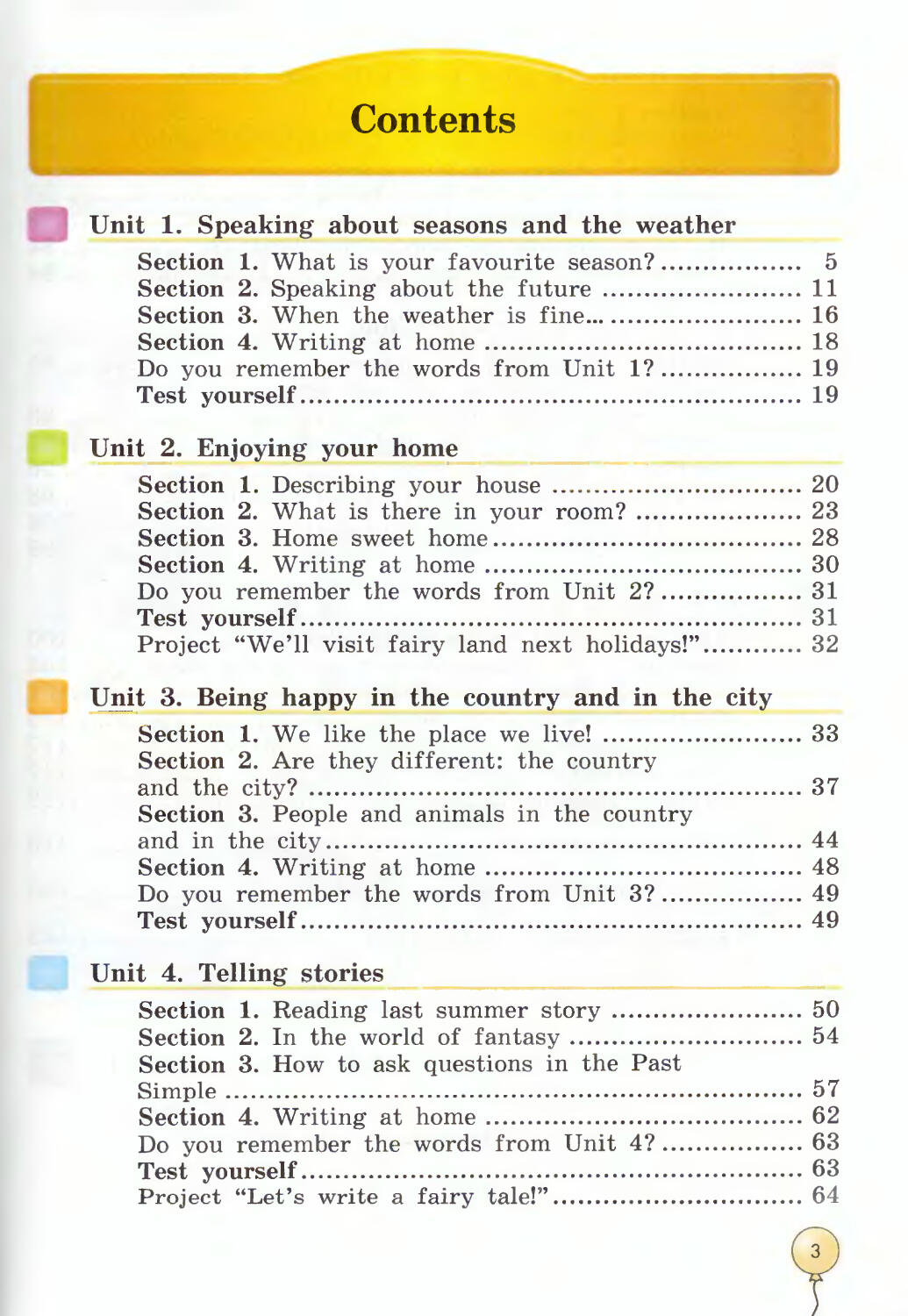
Contents
Unit 1. Speaking about seasons and the weather
Section 1. What is your favourite season? ................. 5
Section 2. Speaking about the future ........................ 11
Section 3. When the weather is fine... ....................... 16
Section 4. Writing at home ......................................18
Do you remember the words from Unit I?................. 19
Test yourself............................................................ 19
Unit 2. Enjoying your home
- --
Section 1. Describing your house .............................. 20
Section 2. What is there in your room? .................... 23
Section 3. Home sweet home..................................... 28
Section 4. Writing at home ...................................... 30
Do you remember the words from Unit 2? ................. 31
Test yourself............................................................ 31
Project "We'll visit fairy land next holidays!" ............ 32
Unit 3. Being happy in the country and in the city
Section 1. We like the place we live! ........................ 33
Section 2. Are they different: the country
and the city? ........................................................... 37
Section 3. People and animals in the country
and in the city .........................................................44
Section 4. W ri ting at home ...................................... 48
Do you remember the words from Unit 3? .................49
Test yourself............................................................ 49
Unit 4. Telling stories
Section 1. Reading last summer story ....................... 50
Section 2. In the world of fantasy............................ 54
Section 3. How to ask questions in the Past
Simple ..................................................................... 57
Section 4. Writing at home ...................................... 62
Do you remember the words from Unit 4? .................63
Test yourself............................................................ 63
Project "Let's write a fairy tale!" .............................. 64
Unit 5. Having a good time with your family
-
Section 1. Being happy together!............................... 65
Section 2. What do you do to help your famIly? ........ 70
Section 3. Answering phone calls .............................. 76
Section 4. Let us try to be polite ............................. 80
Section 5. Writing at home ...................................... 82
Do you remember the words from Unit 5? .................84
Test yourself............................................................ 84
Unit 6. Shopping for ever thin
Section 1. Shopping for clothes................................. 85
Section 2. There is no bad weather,
there are only bad clothes......................................... 90
Section 3. Shopping for food .................................... 92
Section 4. Writing at home ...................................... 96
Do you remember the words from Unit 6? ................. 98
Test yourself............................................................ 98
Project "MFM for Stars" .......................................... 99
Unit 7. School is fun
Section 1. What do we do at school? .......................100
Section 2. The things you can use in the lesson........ 103
Section 3. Reading for pleasure ...............................107
Section 4. Writing at home .....................................115
Do you remember the words from Unit 7? ................117
Test yourself........................................................... 11 7
Project "Diploma" ....................................................118
Grammar reference.................................................. 119
List of irregular verbs.............................................130
English - Russian vocabulary...................................... 132
Speaking about seasons
and the weather
.......
.1""'4
=
Section 1. What is your favourite season?
.
..
. .
.
o
. .
o
.. ..
..
..
D
.. .
.. ..
..
.
.. - t.. ,..
..
. ..
-
. .
..
.. .
.
- . 0
make
....-
.
.
..
"
..
.
.
...
. (Eo
--...
.. ..
.
,
.... . .,
..
. .
.. . -' ,)
.. ..
.
. .
.
.. .
.
.
. .
--
.
......
--
_ .. J J
.
ski
----
toboggan
play snowballs
a snowman
.....
I .
.r'"'1
,.
?" "\
I. f'.
I!
.
I
.. ......."..,
....... ....:::...:.
f)
J
"
play hockey
I skate I
I jump I
.r"'Ji-
"
-
I play football
.
I
dive
\
I play bad in ton I
-
..II ..
-'
ride a bike
",.
\ ..
.
eoo
'. ..
<
n
...
.....
,
I swim I
play
basketball
.'{ '. ' ,
>,'. .
h .....
play
volleyball
L
\
T\
.
--
...
o
play table
tennis
.. I. Look at the pictures. Listen and say what you can do.
2. Read and say.
1) What can you do in winter?
2) What can you do in summer?
3) What can you do any time (B JII060e BpeMH)?
1"""'1
..-4
=
3. a) Ask your classmates what they like to do in winter
and in summer.
Example:& D to e::>?
Do you like to ski in winter?
(f) & D to e::>?
What do you like to do in summer?
b) Now mark their answers in the table.
Nick Ann ...
to play hockey
= to toboggan ./
..-4
to skate
to ski ./
to play tennis
to swim
to dive
to ride a bike
Nick Ann ...
./
...
...
..:.
4. Say what one of your classmates likes to do in winter
and in summer.
Example: Nick likes to toboggan and ski in winter.
He likes to play tennis in summer.
5. Listen and say what Tiny and his friends like to do in
winter and in summer.
Example: Tiny likes to ski in winter.
He likes to play table tennis in summer.
I f
I I ....4
I . -
. ..
,\ ,. "' ,
\ .. ' ,
,
<""" I I --
r
',,) I I
. .:l
"'<":T
\
'.
.
,-
1
,
....
€;i:3 :
o
---
6. Listen and read:
[I] spring, winter, windy
[D] on, not, clock, frog, hot
[A] jump, duck, summer, sunny
[au] now, mouth, down, cloudy
[gu] don't, open, cold
"
t
1"""1
.
=
7. Look at the pictures. Guess (,n;ora,n;aiic.H) the meaning
of the words.
('
.'."'f
I sunny I
/
<:::: I
1 windy I
e.
-20
+35.
£ -
I snowy I
I cloudy I
I hot I cold
It is cold.= It's cold.- XOJIO,n;HO.
It is winter.= It's winter.- 3HMa.
@ 8. Read the story and answer the question: "What do the
children see in the sky?"
Two Ducks and the Frog
The Frog lives in the river. She is very kind. But she
likes to chat (60JITaTb) a lot. She can chat from morning
till night. She has got two good friends. They are big
ducks.
Autumn comes. It's cold, cloudy and windy. It's time
for the ducks to fly to Africa. They like summer
because it's hot and sunny. They don't like winter. It's
snowy and cold. The Frog likes summer too. She wants
to see Africa. She says, "My friends, take me
to Africa with you, please!"
"Good!" - say the ducks. "But you must
not speak! Don't open your mouth!"
So the Frog takes a stick in her mouth and
puts it in the middle (B cepe,n;HHe). Then one
duck takes one end of the stick, the other
duck takes the other end. They start to fly.
The children see the ducks in the sky.
"Look! What have the ducks got? What
is it?"
"It is a big clock!"
I "I am not a clock! 1 am a Frog!"
And flop! The Frog falls down from the sky
Look and learn!
cold [kguId] -
..
XOJIO.n;HbIH, XOJIO.n;HO
cloudy rklaudI] -
06JIaqHbIH, 06JIaqHO
\\ indy rWTndJ J -
..
BeTpeHbIH, BeTpeHO
hot [hut] - ropH-
..
'tHIH, mapKO
sunny ['SAJUJ -
..
COJIHeqHbIH, COJI-
HeqHO
snowy rSngUI] -
..
CHemHbIM, CHemHO
!'"""!
. ""'"
=
9. Put the pictures in
the right variant.
a) 3, 4, 2, 1
b) 4, 2, 3, 1
c) 4, 2, 1, 3
the correct order. Choose (BbI6epM)
You must not speak!
Don't open your mouth!
Look! What is it?
\.*
"
,
\J
0
.
I I
....
r
:...
,
, ..
,-
-, ,..j}
-
'......
....., t- .. .\
"
,
- .....,..,
- ,
-
-, .\.
f, It . big clock!
. IS a
1
.... ..... .
2
I am not a clock!
I am a Frog!
..
\,
It's time to
fly to Africa.
Take me with
\.
you, please.
\
....
.-,. ........
"'
\
' ..}twoJf
........
.
-,
,
01
.
:;
,
,
..
-
......
, \
.
,
\
-
./V"'
).
...... ,....... . .').
-- t;:' ..\_
- -( .It. " \
---C" =:-\ ' ,-
I &" I
.k -
+. -:ti .
\ :.., .
\..
-- "'
,
8)
--I}
,
-
. .
o
10. Answer the questions:
1) Who lives in the river?
2) What does the Frog like very much?
3) Do the ducks like winter? Why?
4) Why do the ducks take the Frog with them?
5) What do the birds say to the Frog?
6) What do the children see in the sky?
7) What season is it in the text? Do you like this
season? Why? Why not?
11. Read and act out.
-.-
I like winter because
it's white and snowy.
'\ '
t
Why do you
like win ter?
!
....
-
\ \
L
( . .
.'
,;t;- .
. .
O» '-
12. Say why you like / don't like summer (winter /
spring / autumn).
I like /
don't like
summer
.
sprIng
autumn
winter
...-
because it's .f11114
warm. =
it's cold and snowy.
it's hot.
it's green.
it's sunny and fine.
it's rainy and cloudy.
it's .
nIce.
it's snowy.
Look and learn!
warm [wJ:m] - TerrJIbIH, TerrJIO
rainy ['reInl] - .n;O.iK.n;JIMBbIH,
.n;O.iK.n;JIMBO
0..
13. Listen to Tiny's poem. Learn the poem.
In winter it's cold and snowy,
In summer it's sunny and fine,
In autumn it's cloudy and rainy,
In spring I can jump up to the sky.
14. Guess what the weather is like in summer in:
-
-
r
-
I
i
<
t ..
I
/ I '\
CD 0
. Antarctica. [
It's In
... ...
"
. .
.\ .
.
I
)---
_I! J
t/t .. . N
in Africa.
i
1
. -,..., \
A
"
-o
1\\"
What is the
weather like?
r
,
-
---">
.:-
-J
<. .
....'
r 1- (
"'tP'
, -
"
., .) )
...-- -\ t £'" . .
. ... . ,
/.:-.
"
I
I
. '1
".,....'\
-'
"VV'-
..." ........ .
"'""I
,
,
I
.
---
---=-
----
,
- '
-
o
'....5"-
:f -_. r" .. A,> '
,
L.._ _ _____
.
... In Russia.
,
I ... in Great Bri tain.1
.....
.111'4
=
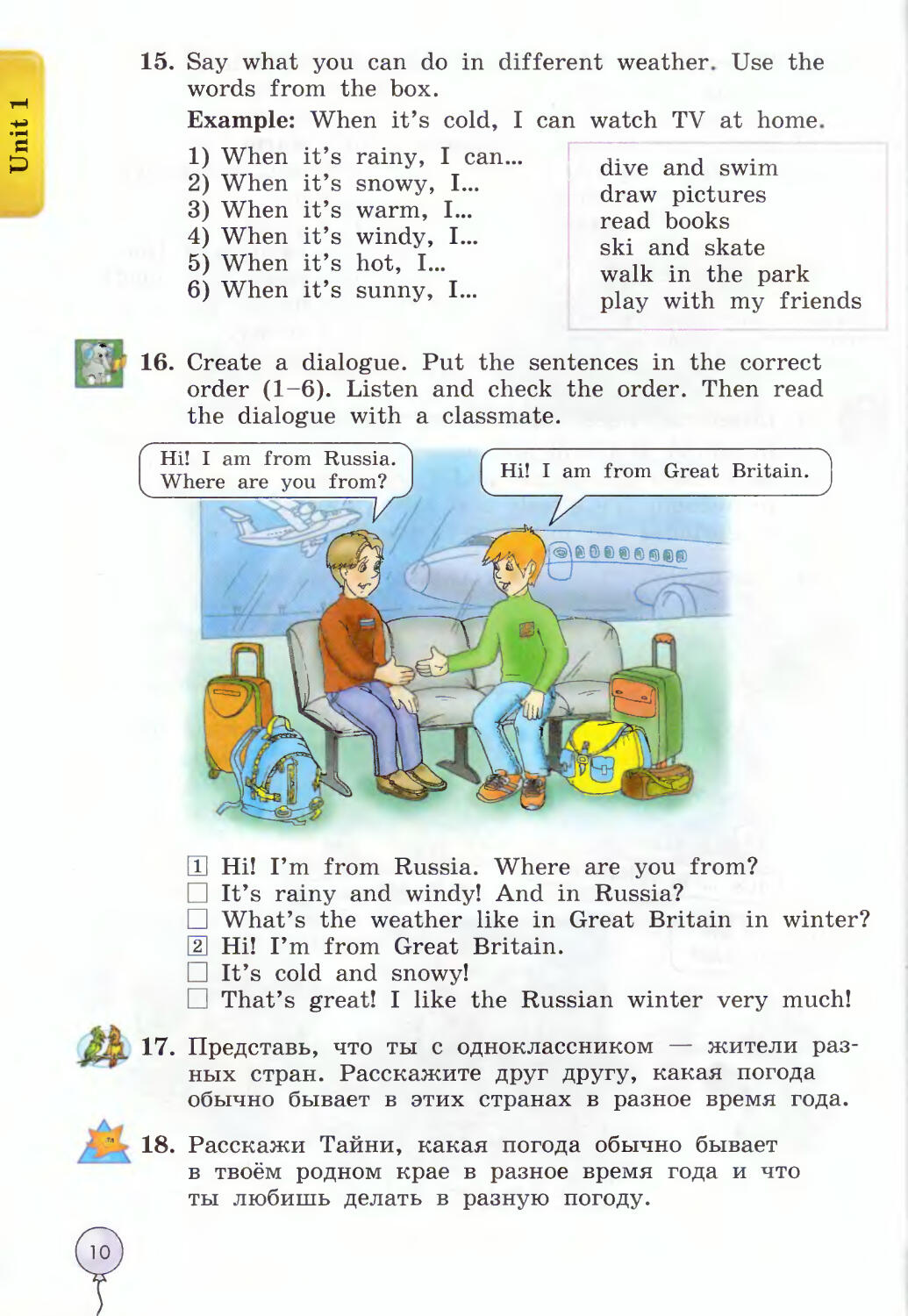
15. Say what you can do in different weather Use the
words from the box.
Example: When it's cold, I can watch TV at home
1) When it's rainy, I can...
2) When it's snowy, I...
3) When it's warm, I...
4) When it's windy, I...
5) When it's hot, I...
6) When it's sunny, I...
r
dive and swim
draw pictures
read books
ski and skate
walk in the park
play with my friends
..
..
16. Create a dialogue. Put the sentences in the correct
order (1-6). Listen and check the order. Then read
the dialogue with a classmate.
.....T
Hi! I am from Russia.
Where are you from?
Hi! I am from Great Britain.
.."
,..
f.J,
0"
..-
\ ."
I.
'\
-==--
rn Hi! I'm from Russia. Where are you from?
D It's rainy and windy! And in Russia?
D What's the weather like in Great Britain in winter?
[gJ Hi! I'm from Great Britain.
D It's cold and snowy!
D That's great! I like the Russian winter very much!
17. IIpe.n;cTaBb, qTO TbI C o.n;HOKJIaCCHMKOM - mMTeJIM pa3-
HbIX CTpaH. PaCCKamMTe .n;pyr .n;pyry, KaKaH IIoro.n;a
OOblqHO ObIBaeT B STMX CTpaHax B pa3Hoe BpeMH ro.n;a.
.."
18. PaCCKamM TaMHM, KaKaH IIoro.n;a 06bIQHO 6bIBaeT
..
B TBoeM pO.n;HOM Kpae B pa3Hoe BpeMH ro.n;a M QTO
TbI JII06MIIIb .n;eJIaTb B pa3HYlO IIoro.n;y.
Section 2. Speaking about the future
..
-.
-'(
19. Listen and say where Tiny is. What's the weather
like there?
?""4
......-
.....
=
{....
I will swim.- H 6y,lJ;Y nJIaBaTb.
You will swim.- BbI 6Y,lJ;eTe nJIaBaTb.
IIpaBMJIbHo rOBopMTb 0 .n;eMcTBMRX M C06bITMRX,
KOTopbIe 6y.n;YT rrpOMcxo.n;MTb B 6y.n;y eM, Te6e
rrOMomeT BcrroMOraTeJIbHbIM rJIarOJI will. OH
CTaBMTCR rrepe.n; OCHOBHbIM rJIarOJIOM (swim).
IIpocToe 6y.n;y ee BpeMR Ha3bIBaeTCR Future Simple.
'-
20. Read the story and answer the question: "Has the
Donkey got a favourite season?"
r-r,
"\..
"""""'\.
>
fY1-
.. , \
": '-
i
\
i..-"' -,.*
... "'\... ""4.I<
- I. r-
... "
...
....
_Jo._......,..
-
.
. ,
--
.... , -
)t.'- .. \
-,
...
'( 'i.
.
\
-
. ,
--......_"""\. I
1-.:- , "'-.........
..
"
-...L -..1
. "'= J#I
'\ IJ Cf \ .... \.t..
. " . w. .. '"\u£. \...::
c '.0 -
.' 2 - 't¥"'IJ.....
... ,...
\ . _.
.J! .t:.
\
,
.,..
)
...
. , -'So
" I
'I. ..
.. .,\
1 "..1'1
.J (
* ...
P t .
'.Ji .
..:t
.......Jr..
1M ..\.tt".
v..
& .
.....
.
... .;.
-
....._ '--
---
........
G)
")0.
. -f:;?
.. .
-. 1:1
The Donkey's Favourite Season
It's winter. It's cold and snowy. The Donkey is
sad. "I don't like winter because I haven't got any
green grass (TpaBa). I can't walk in the park. In
spring I will walk and play with children," says the
Donkey.
Spring comes. It's warm and sunny. Now the
Donkey is in the park. He has got a lot of green
grass to eat. But he is sad again.
"I don't like spring! The children are very noisy
(rnYMHbIe) in the park. In summer I will dive and
swim," says the Donkey.
-
..-
..
,..
:J
21.
Summer comes. It's hot. The children dive and
swim. They ride bikes and scooters, play badminton
and football. But the Donkey is sad again.
"I don't like summer because it's very hot. In
autumn I will eat apples and carrots," says the
Donkey.
Autumn comes. It's cloudy and rainy. Now the
Donkey has got a lot of apples and carrots to eat.
But he is sad again. "I don't like autumn because
it's cloudy, windy and rainy. In winter I will play
snowballs and toboggan."
Winter comes. But the Donkey is sad again...
Read and say: true or false.
1) The Donkey hasn't got any green grass in winter.
2) Spring comes. It's rainy and cloudy.
3) In summer the children dive and swim.
4) The Donkey likes summer because it's very hot.
5) In autumn the Donkey has got a lot of apples and
carrots to eat.
22. Look at the pictures (Ex. 20). Read the sentences in
the text to illustrate them.
/"
"
(1)
"
"
"
1
CrrYTHHKaMH Future Simple (6y.n;yrn;ero BpeMeHH) -qaCTO
HBJIHroTCH CJIOBa tomorrow (aaBTpa), next week
(Ha cJIe.n;yrorn;eH He.n;eJIe), next year (B CJIe.n;yrorn;eM
ro.n;y), in an hour (-qepea -qac).
23.
24.
Read and translate (rrepeBe.n;H).
1) I will do my homework in an hour.
2) We will play basketball tomorrow.
3) You will get a very nice birthday present tomorrow.
4) She (He) will send me a postcard next week.
5) It will be snowy next winter.
6) They will come to Russia next year.
Help the Donkey to find his favourite season Tell him
what you will do next year (next winter, next spring,
next summer, next autumn).
Example: I will make a funny snowman next winter.
--
.
25. Create two dialogues. Put the sentences in the correct
order (1-4).
D I'm sorry. I'm very busy.
rn Would you like to play football today?
D Tomorrow is fine.
D What about tomorrow morning?
.....-
.""",
=
***
D I think autumn.
D Because I like apples very much.
D Why autumn?
rn Which is your favourite season?
26. Now listen to the dialogues. Check the order. Read the
dialogues with a classmate.
27. Complete the sentences.
---
,
,
,
..
,
.J
, \
" ..
,
. ...
- d
,. \1
\ ;......::_I:)'
- '- /
,._ : :-"' \ 4 '\ _ c3'" ::.
. :' '. \ .::./...:::
-"- ..,....l -, .,,'\'
\ /.
.. ....
, .j.
.--..
,
\ \ .
, . '-'-...L';:: t\
-- '<I: ' t'
..
" -
,,' \
,,\. }
,
,
}
-.
JA
. . '.
r T
\ {'- .. ,\,. "'- .'
,
....
-
-
I t will be cold in winter.
I t will be ... today.
\
.
. .
"'-
'- "'{
:.,X,
.,V
-...;,:
/-{/
(D) }
,.. \ -::;;. . 'j V_if f
' (' 1 /17 \\ _-=- { o:" .
,.:-:!'- . \ \.. ' - :
- .... 1.::.' .:.:--- .'
, ..E-> ) 11" '''i) .
? ' !I\, I\" \,., '-
I rl'-\ c - i.."
-\s.. .._ .,,'"
. :--
---
,."\. 4
........ . -. ,"'-"",
'.
f
I
:\
-=.
I, .
\
-\\
\I
-
--
It will... ... today.
It ... ... ... today.
28. Make the weather forecast (npOI'H03 nOI'O,lI;bI) for winter
months. Use:
'\. windy, rainy, cloudy, sunny, snowy, cold, warm
. . :.. -':::
.
.
December January February
Example: I think December will be snowy.
"P""'4
.....-
. ....
= "'\
-
'.
I
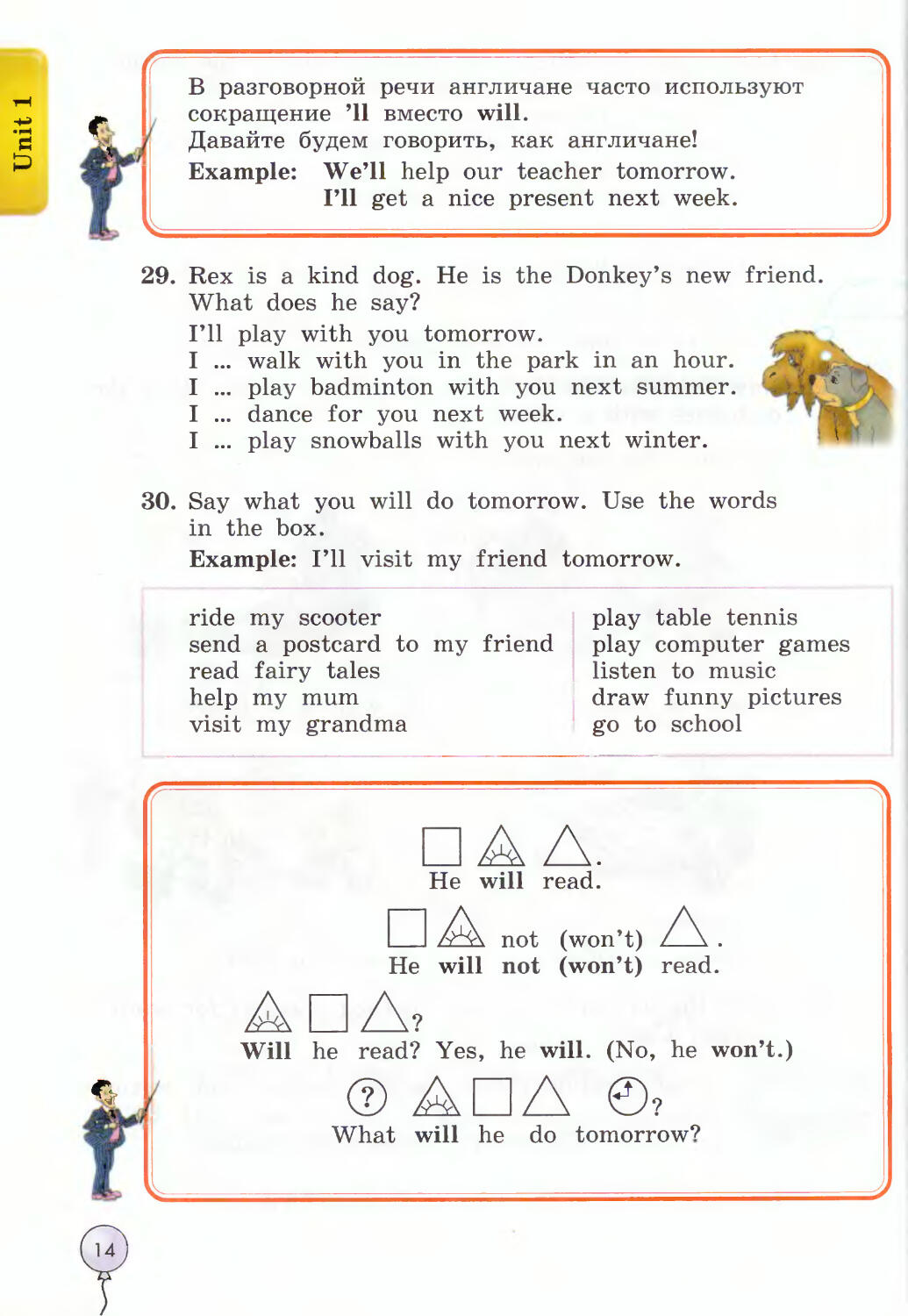
B pa3roBopHoM peqM aHr JIMqaHe qaCTO MCIIOJIb3YlOT
COKparn;eHMe '11 BMeCTO will.
,[I;aBaMTe 6y.n;eM rOBopMTb, KaK aHr JIMqaHe!
Example: We'll help our teacher tomorrow.
I'll get a nice present next week.
29.
Rex is a kind dog. He is the Donkey's new friend.
VVhat does he say?
I'll play with you tomorrow.
I ... walk with you in the park in an hour.
I"
I ... play badminton with you next summer.
I ... dance for you next week.
I ... play snowballs with you next winter.
:;
\ t2,:
\..
\
30. Say what you will do tomorrow. Use the words
in the box.
Example: I'll visit my friend tomorrow.
ride my scooter
send a postcard to my friend
read fairy tales
help my mum
visi t my grandma
play table tennis
play computer games
listen to music
I draw funny pictures
go to school
r, "
DAD.
He will read.
DA not (won't) D.
He will not (won't) read.
DD?
Will he read? Yes, he will. (No, he won't.)
(f) ADD <:9?
\
, VVhat will he do tomorrow?
I
1 ..'- /...
...
31. Ask your classmate what she / he will do tomorrow
Will you ... tomorrow?
Example: - Will you fly to Africa tomorrow?
. ": .f t'I
\ . ," ,.
-
,-4
. ....
=
.
, k...
--
b
-- _...-
,", ...........- --
"'-t.'.......... "'-
'--..-...... --
.........._-
...."
-
..
-..-
....
'
-
I
....
\ . .
,
l. .
"
. 1
I
'¥
,\
.1
.
- \,
....Ii. ..
" - f
I won't.!
"
,
Yes, I will. )
C No,
32. Read what Tiny will do next week. Do you think he
will do it?
Example: I think he won't build a new house on Monday.
Monday I'll visit my friend. I'll build (CTpOHTb)
a new house for him.
Tuesday I'll toboggan and ski. I'll write 10 new
fairy tales.
- -
I'll learn Russian and write a letter to
my Russian friends.
I'll send 200 postcards to my friends.
I'll clean my house and watch TV.
I'll visit my doctor.
I'll make ninety-nine big cakes.
Wednesday
Thursday
Friday
Saturday
Sunday
... 33. Ask Tiny about his plans (IIJIaHbI) for the next week.
- Use: will, where, why, when, what.
Will you write to me next week?
What will you do on Tuesday?
34. Tell about your plans for your winter and summer
holidays.
Example: I'll play hockey in winter.
I'll dive and swim in summer.
Section 3. When the weather is fine...
,..-4
..-
.""""
=
35. Look and guess what the weather will be tomorrow
Example: In Pskov it will be rainy tomorrow.
· Pskov · Tomsk · Yakutsk
+35
()()
· Moscow Kazan
-
.10 36. Listen to the weather forecast and check yourself.
. ..
. .j.
37. Say what the weather will be in your home place
tomorrow.
Example: I think the weather will be...
38. Read Jill's letter and answer the question:
"Does Jill like winter?"
,
':
ffh
..
""
I
/.
f1\
'\ "-
\.
_:'---:---
''''';.' '7' '<
.' ...r
, .
'\","" -.
-"
-
-
-
-
Look and learn!
holiday ('hDhdI] -
...
BbIXO.n;HOH, rrpaa.n;HMK
holidays ('hDhdlz] -
KaHMKYJIbI
to have a picnic -
BbIe3maTb Ha rrMKHMK
to fly a kite fkan] -
3arrYCKaTb B03.n;YIllHoro
3Me I
to play hide-and-seek
['haIdJn'si:k J - MrpaTb
B rrpHTKH
25 September
Dear Ann,
Thank you for your letter.
Today is Saturday. It's a holiday. I don't go to school
on Saturdays and Sundays.
It's rainy and cloudy today. But it isn't windy. It's
warm. I like autumn. It's my favourite season. When it's
rainy, I can listen to music and read a book. When it's
sunny and warm, we can have a picnic in the park
My dad says, "Tomorrow the weather will be fine.
We'll go to the park and have a picnic."
My dad and my brother Jim will fly a kite. My
mum, our dog Rex and I will play hide-and-seek
We'll have cheese and ham sandwiches and many tasty
cakes with tea.
But winter will come soon. You know I don't like
winter. We don't have picnics in winter.
Ann, what is your favourite season? What do you like
to do in this season?
What will you do next winter?
Write back. ,
. :
. - .
t
t
...
....-!
.JIIII4
=
.....
t
t
t
I
Yours,
Jill Brown
39. Choose the correct answer. Read it aloud.
1) What is the weather like on Saturday?
a) It's rainy and windy. b) It's rainy and cloudy.
2) What does Jill do in rainy weather?
a) She listens to music. b) She watches TV.
3) Will the weather be fine tomorrow?
a) Yes, it will. b) No, it won't.
4) What will they do in the park?
a) They'll read books. b) They'll have a picnic.
5) What is Jill's favourite season?
a) It's autumn. b) It's winter.
40. Complete the sentences.
Example: The Browns will have a picnic tomorrow.
1) Dad and Jim will...
2) Mum and Jill will...
3) They will...
41. Read Jill's letter again. Answer her questions.
42. Tomorrow you and your friends will have a picnic.
Say what you will do.
---=-': Section 4. Writing at home
,-.!
.....-
.8 1. OTBeTb Ha BorrpOCbI rrMCbMeHHO:
"What do you like to do in winter?"
Example: I like to toboggan in winter.
"What do you like to do in summer?"
Example: I like to dive in summer.
2. IIpoqMTaii TeKCT "Two Ducks and the Frog" ern;e pa3.
3aKOHQM rrpe,n;JIOmeHMH:
1) The Frog likes ... very much.
2) The ducks like summer because...
3) The ducks say to the Frog, "...1"
,
. .
.. . ..J r} 04 w "".....t.< . '
'¥) ...., '"'-* -
- -- C) CD-' -... - \" t
\ \. "," >.., '-- . 0" .. _
-- ' .,- -
\ - \\ r
. - -- :' ) :> ,..'."
- . . - --\: - \ '\"
C:N -- -: l
'- .--- . . "- , '. --:::..> ... \, ...
. ,"
\
\
3. OTBeTb Ha Borrpoc: "What season do you like and why?"
Example: I like winter because it's white and snowy.
I can ski in the park.
4. BbI6epM HymHblii rJIarOJI. 3arrMlliM rrpe,n;JIOmeHMH B TeTpa,n;b.
1) He'll draw / draws a funny picture for his sister
tomorrow.
2) I'll have / have breakfast at 8 am every day.
3) We'll help / help you in an hour.
4) It is / '11 be snowy and cold next winter.
5) They'll play / play computer games next week.
6) She'll listen / listens to music every Sunday.
5. HarrMIlIM, QTO TbI 6y,n;ellIb ,n;eJIaTb 3aBTpa, Ha cJIe,n;YIOrn;eii
He,n;eJIe. BOCrrOJIb3yiicH Mo,n;eJIblO:
DAD. tomorrow (next week).
Example: I'll help my mum tomorrow.
I'll visit my grandma next week.
6. BbI6epM: will MJIM won't.
1) The forest ... be green in spring.
2) The children ... skate and play hockey in summer.
3) Jill... have a picnic in winter.
4) Tomorrow it will be windy. Jim ... fly a kite.
5) Tiny will be busy. He ... play tennis tomorrow. He
will help Billy tomorrow.
?"""I
.J11114
=
t:J
7. OTBeTb Ha rrMCbMO mMJIJI BpaYH. PaCCKamM 0 CBoeM
JII06MMOM BpeMeHM ro a.
Do you remember the words from Unit 1?
hide-and -seek
holiday (holidays)
kite
. .
picniC
.
rain
snow
snowball
snowman
year
cold
cloudy
hot
.
rainy
snowy
I
sunny
warm
windy
dive
toboggan
fly a kite
have a picnic
make a snowman
play hide-and-seek
What's the weather like
today / in winter?
next (week, year)
tomorrow
I
'- Test yourself
Do the exercises in your workbook.
Mark your score.
27-30
Very good!
21-26
Good!
15-20
OK!
< 15
Try again!
Enjoying your home
Section 1. Describing your house
C\I
......-
....-1
=
A
.... . ...
o
\ 8
( 0
{;3
cg
[f)
.
- - -...
I t I£)I I I I
" '., '\ \. , ,,\,
',\, , '-
() - ,,(\ 7J ..,
C\.. /..- '\
l ../ 6
.....
KJ
.
.
"
\
D ",
--
o
./
"'-
lID .. Q)
!(() [gJ
I
[Q] . - ..
-
'.'::
4
...
11" _' ,
',/
--=
--- --
- - -
m /
001
- -
-
, a
.
(1.
,
2
. 0 G
@
{fJ @tJ
r:-J (""J 9
c::J ( J-
.....
n:'
" Q
o
. .,)
:..:..
...........
-
-. 1. Look at the house. Jim and Jill live . this house.
In
Listen and learn:
1 hall 6 bathroom
2 kitchen 7 toilet
3 pan try 8 window
4 living room 9 wall
5 bedroom 10 door
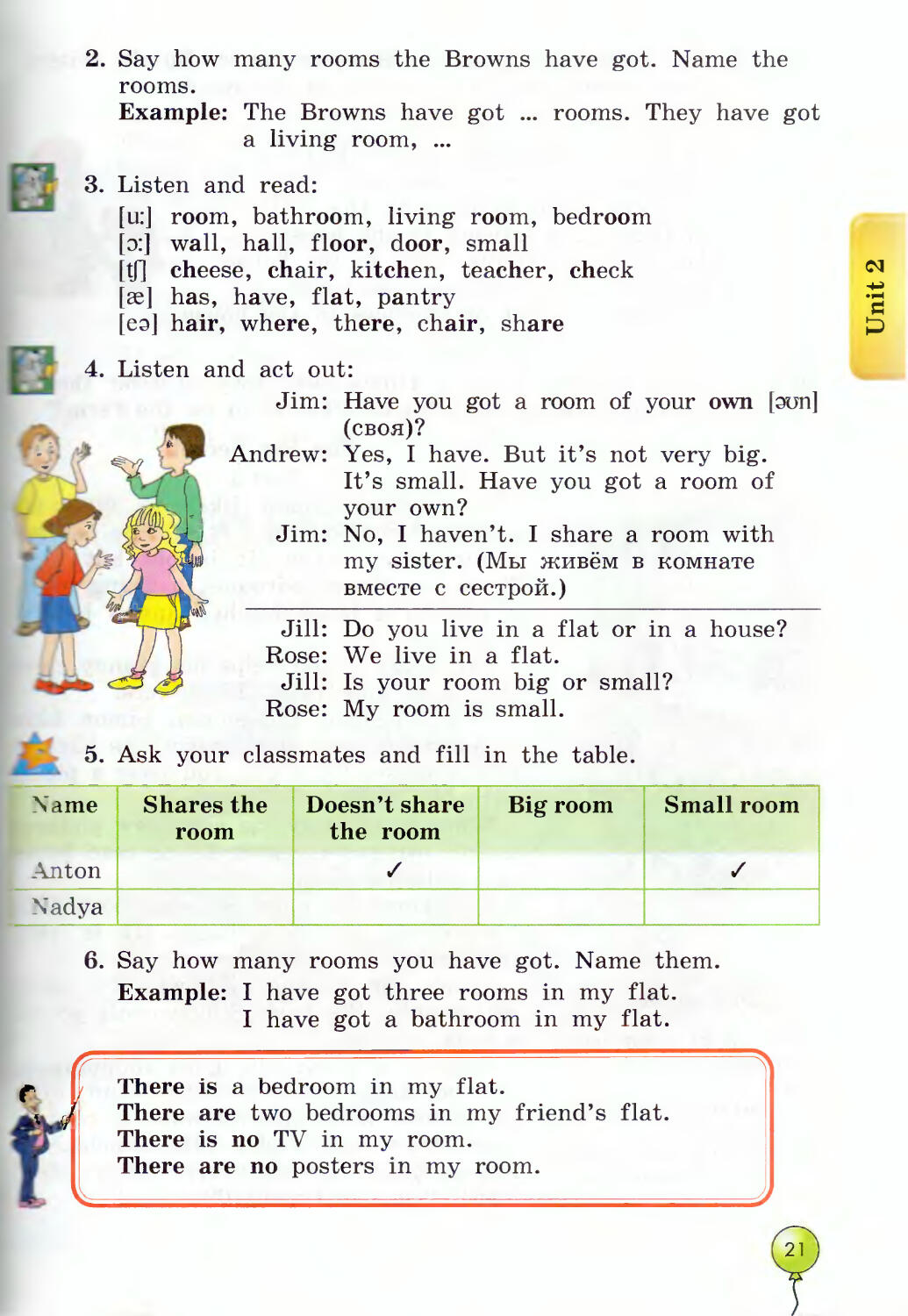
2. Say how many rooms the Browns have got. Name the
rooms.
Example: The Browns have got ... rooms. They have got
a living room, ...
.
3. Listen and read:
[u:] room, bathroom, living room, bedroom
[J:] wall, hall, floor, door, small
[ij] cheese, chair, kitchen, teacher, check
[ce] has, have, flat, pantry
red] hair, where, there, chair, share
C\I
..-4
=
...,
4. Listen and act out:
Jim: Have you got a room of your own [dun]
(CBOH)?
Andrew: Yes, I have. But it's not very big.
It's small. Have you got a room of
your own?
Jim: No, I haven't. I share a room with
my sister. (MbI JKHBeM B KOMHaTe
BMeCTe C cecTpoM.)
.
....
\ \
Jill: Do you live in a flat or in a house?
Rose: We live in a flat.
Jill: Is your room big or small?
Rose: My room is small.
5. Ask your classmates and fill in the table.
j
Same Shares the Doesn't share Big room Small room
room the room
_-\nton ,/ ,/
:\"adya
6. Say how many rooms you have got. Name them.
Example: I have got three rooms in my flat.
I have got a bathroom in my flat.
r/
"
,..
\ q
There is a bedroom in my flat.
There are two bedrooms in my friend's flat.
There is no TV in my room.
There are no posters in my room.
...'\..
/.
7. Rex tells Tiny about the Brown's house. But he misses
some words. Help Tiny to fill in the words.
1) There ... bedrooms in the house.
2) There ... doors in the hall.
3) There ... no windows in the hall.
4) There ... a kitchen in the house.
5) There ... a living room in the house.
6) There a pantry in the house.
. ..-4 ...
= 7) There a lot of windows in the house.
::J ...
- 8. Read the first part of Tiny's new story. Answer the
question: "What does Simon like to do on the farm?"
The Big Secret
Part 1
In summer Simon likes to visit his
granny. She lives on a farm. She has got
a big clean house. It is old but nice.
There are three bedrooms, a living room,
a pan try, a large kitchen and a hall in
the house.
Every day Simon helps his granny clean
the rooms and water the flowers.
When it's hot and sunny, Simon likes
to swim and dive in the river. He likes to
ride a horse, fly a kite and have a picnic
with his granny.
When it is rainy, he can draw pictures
in his own room, watch TV or read books
in the living room.
Sometimes he plays hide-and-seek with
his granny in their house. It is very
in teresting!
Today the weather is bad. It's rainy
and cloudy. It's cold. Simon can't go for
a walk.
Granny is busy. She goes shopping in
the morning. Simon is alone (O,ZJ;HH) now.
He is sad. Simon doesn't want to read or
draw. He wants to play with somebody (c
KeM-HH6Y,ZJ;b). But suddenly, "Mew! Mew!
Mew!" "Oh, what's this?"
,0
\
(
- "'"
J'""
\
',\ {
G:
/
J
.
c.
., I
.r
-
,
"""
Look and learn!
large [lo:45J - 60JIbllIOH
sometimes l'sAmtalmzl -
HHor .n;a
interesting ('lIltnstl1)] -
....
HHTepeCHbIM
go shopping [gJU JDPllJ] -
XO.n;MTb aa nOKynKaMH
"r
'.......
,<.)
1
9. Complete the sentences.
In summer Simon...
There are three bedrooms,...
When it is hot and sunny, Simon...
Today the weather...
He doesn't want...
10. Answer the questions. Read the correct answer from
the text.
1) How many rooms are there in granny's house? What
are they?
2) What does Simon do to help his granny?
3) Why is Simon sad?
4) What does he want to do?
5) What do you do to help your mum and granny?
C\I
.
=
Section 2. What is there in your room?
..
11. Look at the Browns' living room. Listen and find the
things in it. Say what things you have at home.
fireplace
,
:. ,..-
-....... ,
shelf
'L "
11
I armchair
I ..
I \:..
.
- '----'"
....
F£r
lamp
\. 0
-
picture
o.
'\ I I
sofa A_ /
- .........'
-I
,. J; '
"_____ . . -""-..,------ .7 -
. ,,- - -..::..;::::'
- /- :$:!& ....,..... -=-- ----- ---.::...:..
..... --- -- --- ----- ----
-- ... ....... . .J
.'<-. '- table .
.
pIano
<
..
- ._-:.- - --- -
't
II TV
.
,
-
------
,
I
.,.
.rr
I floor
I carpet I
;"'t
I
.
.
12. Listen and read:
[0:] bath, bathroom, carpet, arm, armchair
[re I lamp, pantry, black, flat
[:>: J floor, door
I 3IJ J fire, fireplace
....
'-
.,
C\1
......
=
{/.
\
,
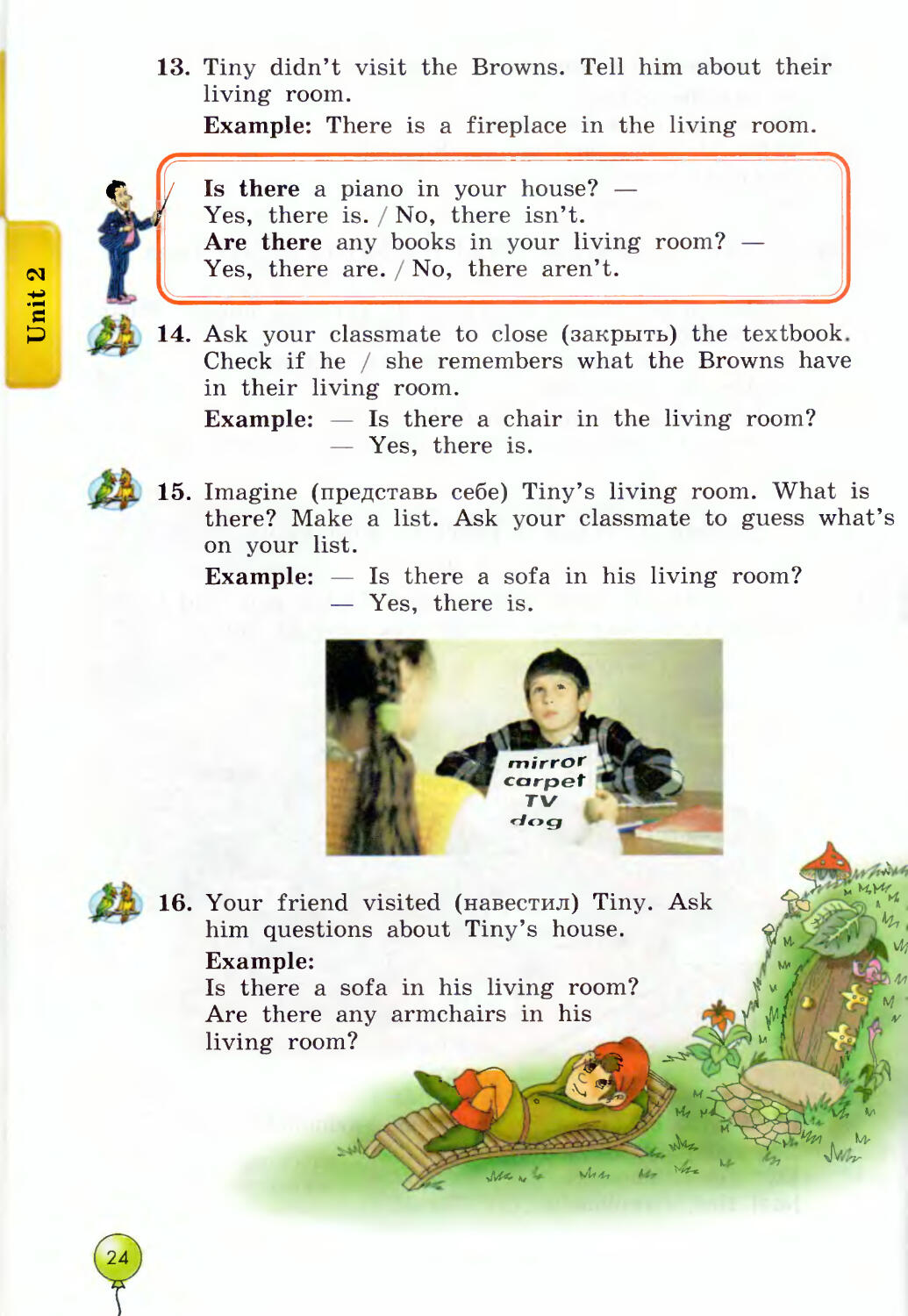
13. Tiny didn't visit the Browns. Tell him about their
living room.
Example: There is a fireplace in the living room.
Is there a piano in your house? -
Yes, there is. I No, there isn't.
Are there any books in your living room? -
Yes, there are. I No, there aren't.
14. Ask your classmate to close (3aKpbITb) the textbook
Check if he I she remembers what the Browns have
in their living room.
Example: Is there a chair in the living room?
- Yes, there is.
15. Imagine (npe,n;cTaBb ce6e) Tiny's living room. What is
there? Make a list. Ask your classmate to guess what's
on your list.
Example: Is there a sofa in his living room?
Yes, there is.
'..
...
';-. mirror
carpet
TV
rlc>g
"'
""'" ..
16.
Your friend visited (HaBeCTMJI) Tiny.
him questions about Tiny's house.
Example:
Is there a sofa in his living room?
Are there any armchairs in his
living room?
Ask
"-
if .....:... ..,.
toe Wt1
A
A.tr
t4 x
, \A1
ItH ) \41
1 v
00 M
f i'
.y
) / ;; x
r
I
,
....J"
f'l
"
"\
M
")t }I
o
"
-
)..
.J vtt 4-7 J 1VH-...
17. Listen to what Simon says about his room. Look at
the pictures. Guess where Simon's room is.
-
'CO
D
, : :--
.fOIII
=
:::>
v
o
. n o -:-;;, '1
o c!";:3 Q
.
-......
.r-
,..("'J, '" r':J..
1 <" ,-yjj W
J- r C
-r.J' Q
o
- !
!;
..
:t '..,.__ _ ...
-
18. Compare (cpaBHH) your room to Simon's room. Talk
about them.
Example: There are two armchairs in Simon's room.
There are no armchairs in my room.
Look and learn!
19. Read Tiny's story (Part 2). Answer the question:
"Who is Simon's new friend?"
The Big Secret
Part 2
"What's this? Who's saying 'Mew!'?"
Simon is in the living room. The
living room is nice. There is a round
table in the middle of the room. There
is a big armchair next to the fireplace.
When it's cold, Simon likes to read
interesting books in the armchair.
"Mew! Mew!"
Now he is looking for (Hm;eT) the sound:
under the table, behind the armchair,
between the sofa and the armchair.
"N othing!"
Simon is in his room. He is still
looking for the sound: on the floor,
under the bed, above the shelf, under
the carpet. "Nothing!"
- Ha.n;
in the middle [mldl1
of - B cepe.n;HHe
next to [nekst] -
pH.n;OM
under [IAndJ] - rro.n;
behind [bI'halnd] -
aa
between [bl'twi:n]
Me}K,D;Y
on - Ha
above [ lbAV]
....
Simon is in the pantry. And he is still
looking for the sound: in the left corner, in the
right corner . "Nothing!"
Simon is in his kitchen. In the middle of the
room there is a box. Simon is surprised (Y)J;I1B-
JIeH).
"Mew! Mew!" comes foom the box.
"What are you?" Simon says. "What is in
the box?"
It's a secret. Then he sees two black ears...,
two big green eyes... and a small pink nose!
"Oh! It's a kitten!" says Simon.
He is so happy! He has got a new friend.
They will play hide-and -seek together.
'{J
"
Look and learn!
C\I
.....-,
.""""
=
in the left corner
(left 'k=):n ] -
B JIeBOM yr JIY
in the right cor-
ner I ralt 'k:):n J -
B rrpaBOM yr JIY
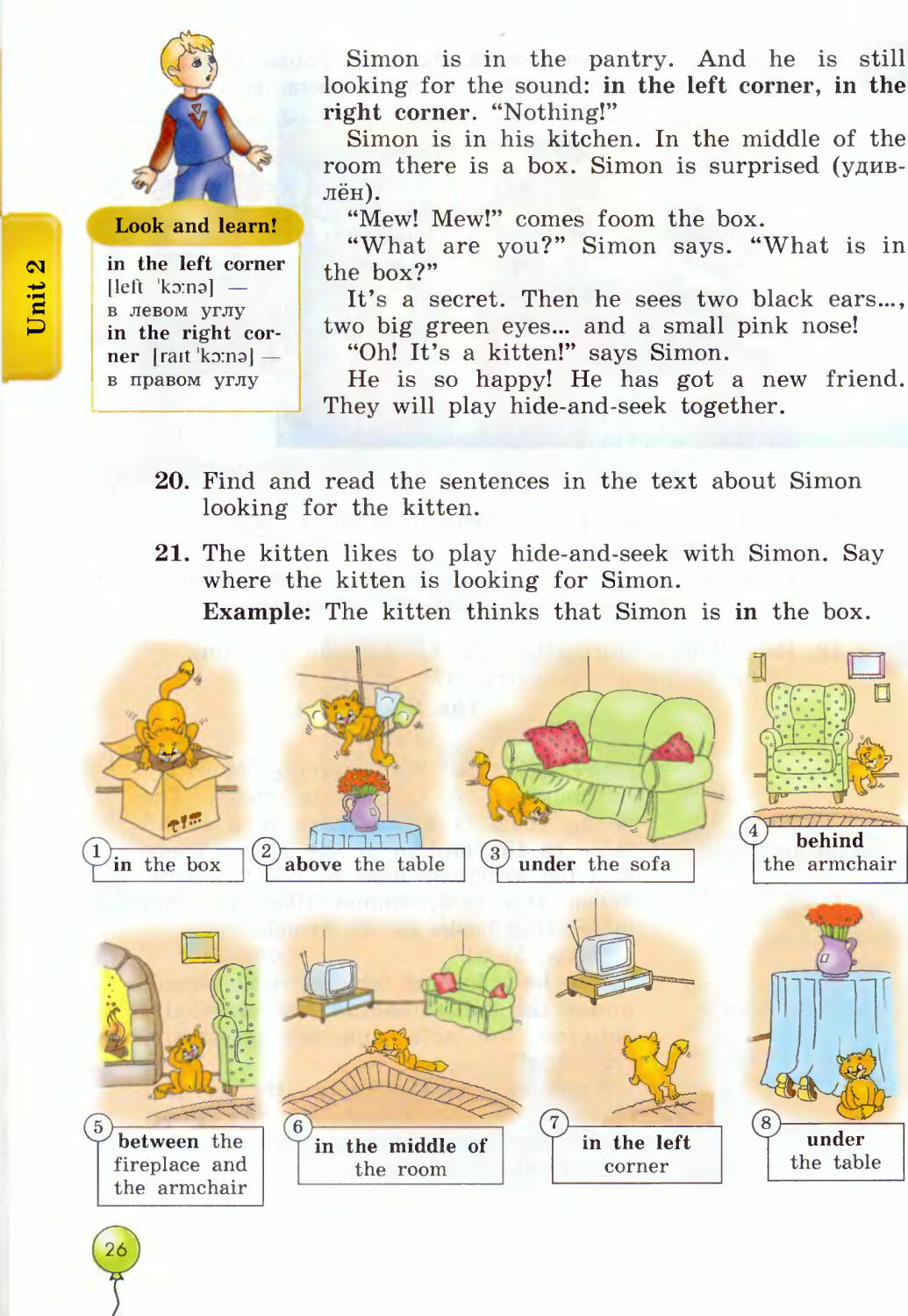
20. Find and read the sentences in the text about Simon
looking for the kitten.
21. The kitten likes to play hide-and-seek with Simon. Say
where the kitten is looking for Simon.
Example: The kitten thinks that Simon is in the box.
..)
]
./
°0 o. .
G. 0 0
o 0 .
0.0 GOO
00 0 .
..00 -.
D
IlJ
./
r..... ",
I. '""'I
". 0
r .
\
'J
/
,
in the box
\
:12
I \".
Ii-
,. {
...
4-f.. .
.!-
behind
the arn1chair
the table
under the sofa
[dJ
o 0 0 -0
. 0 1 r
. o 0
. o 0
.. , "
I
0
. 0
, .
0 0
0
0 0
0
"'
between the
fireplace and
the armchair
under
the table
in the middle of
the room
in the left
corner
22. Let's play "Hide-and-seek"!
above
. ;.-
..f . "
,-. .j.
... ..
...
. ."',
I
"
- ...'
. "'"
.. - \-
.:: y
. . }
_. -
. . -£. ': :. ';: . ." :.; ; .': .
. .-
, \
t
"::?.....
. ,J: :>
---.
.() ,
-0"
"b'"
'2>
...... G
'---'0
. .,
j . .""""-7.
I- .:t..o-i"
»1"
E "-:e,
-:"",J ;'
".
;.,.,.;.
: ':.-..
.,<
---"'-
04.> .::-
.:c.
-==:
C'1
....-
. ....
=
"
, .
,
........ '"
..
f
.. *"J<
r;:; ": . . . .
. .::'<.. ¥:,; .:;-:.... , ., .... -. . ---.
...
---
,.
between
in the
middle of
0)-,,0
?
:),0 UTJ
..>
'._ . 'A.:.:;,. .
"; '':' .,,,, .
; -
. ,-
....:-: '..-.
,>:...< >.-
t "
T
..
behind
<..r.>"'::. . ':;'.
{"f : ,:.,
y
.
, ..,..
..J
-
..\,
- .1
,.
"
.:-
< .
..;>. .<:.,
Ii .-
\
'.
. .
- - .-
..
. "''(\ \
\':>
e
. (\ f,. e
'\ GO
\
.
In the left
corner
/"
1) OTBepHllTecb C o,n;HOKJIaCCHllKOM ,n;pyr OT ,n;pyra. B03bMll-
Te no JIllCTKY 6YMarll, HapllcYHTe o,n;llHaKOBMe KBa,n;paTM,
KOTopble 6y,n;YT BaIIlllMll KOMHaTaMll.
2) PaCnOJIO.IKllTe B KOMHaTe: CTOJI, coq)y, KpeCJIO, KOBpllK,
KpOBaTb, KHll.IKHYIO nOJIKY. 06Be,n;llTe KPY.IKOqKOM TO Me-
CTO (rrpe,n;nOJIO.IKllM, 3a KpeCJIOM), r,n;e BbI CnpHTaJIllCb.
3) IIoBepHllTecb ,n;pyr K ,n;pyry. IIocTapaHcH BbIHCHllTb, r,n;e
...
CnpHTaJICH TBOM o,n;HOKJIaCCHllK.
Example: A: Are you under the armchair?
B: No, I am not. (I'm not.)
A: Are you behind the sofa?
B: No, I am not.
A: ...
23. Tell Simon about your room.
Section 3. Home sweet home
24. Look at the picture. Read the text. Complete
the sentences with is or are.
C\I
.....-
....c
=
--J
.----- . . i
J J! I
/ II
!
,
- ,
. J ' , -; --.
's; l - t"Q
_! --:?y-' -.
...;;)
'"'
.,. ; 'I
. -"
...
. \ J I,' ' 'V ' -:
! f \.j \.... -. ,,\ I _. t
- n \. 0
m 't . I
t:=1 °6
--. I
"Lo-
-
--
.oJ
.,..----
. ... __4-.
--
.
..
3.'. '-
.... ., )'\\
......
........ ,
7_....
.;
..,;;"" .
. ......,.
..J
-<
Look and learn!
,
-c.
a desk [desk] -
u
rrHCbMeHHbIH CTOJI
a wardrobe
r 'wJ:d fdub ] - IlIKaqJ
.n;JIH o.n;eJK.n;bI
,..
=---
J...
...
-
r
Our Room
Hi! I am Jill. I haven't got a room of my own. I share
it with my brother. Our room is nice and large. There ...
two desks next to the window. There ... a computer on
Jim's desk. I have my own player on my desk. There ... a
lamp between our desks. Of course, there ... two beds in
our room. We go to bed at 10 o'clock every night. But in
the morning we must go to school and our mum wakes us
up (6y.n;llT).
There ... a big warm carpet on the floor. There ... a lot
of books on the shelf. We like to sit on the carpet and
read interesting books. You can see many posters on the
wall. Jim collects them. I like teddy bears. You can see
them on the shelf, on the table and on the floor. There ...
a big wardrobe at the wall. You can see my teddy bear on
the wardrobe too.
We like our room very much.
!o
-t
25. Listen and check yourself.
26. Compare your room with Jim and Jill's room. Talk
about them.
Example: There are two beds in their room.
But there is one bed in my room.
. ...
27. Talk about your favourite room in your flat.
28. Help Miss Chatter to decorate her living room. Draw,
colour and label (rro.ZJ;rrlIllIlI) the things in it. Describe
the room. Use the words in the box.
_ .1
... .
w-
o
. .- o.
C\I
...-
.1""'14
=
-<
-0.
\
::: "',":::.P:' :
-
--.........
: " \..--1.. l
Qo, ..,.-
. . . . -- . \,.!O 'e' I
· -- :->=--", f;/: '- ;;:'''::"-.
i ..,.." :..Vi,;- ,. ..:.. '.' I
.... . i'-.
.. ';. .y --_... \ - ..;., ,':,
. >.;-......JJ: ./:' .......:{ .
. . -.;..: . : . .,'<;' ..... - .: .
.= -. _ " . ,0;: - .
... .:. ;",,-:!' , :1>-:;",:.",:'[:-_...:. ,
- .'1 . .;:. - . :0>,- - - _ '
, . -,,, ...,r.: -::' .} -_ ->.'>;. ' ::0 '. :\ "_:''''
\. '
- ,. .
..:..,.
..:-"
"
;,---
< i;' . :
""}",. - /--
- ..
. ',,,,, .
, :...
_ -'-;' -;;:Y'j.;..,<" -;. .: -;:jf _o:..-
,
,
.. "'.
-
". ":t".
, ...... . -,
. . .,.
-
Example: There is a sofa next to the fireplace.
on the wall
on the floor
on the shelf
at the wall
above the table
next to
in the room
in the middle of the room
in the left corner of the room
in the right corner of the room
between the armchairs
.1'
-);
29. Jim and Jill are in Simon's house. Listen and guess
which room Jim is in now.
o <I
. -------- -- .'
. I (
0&
I
o
o <>
--
I
() 0
.
L lUl.
c
j
-
-
...,-
",- --
0.00
30. Describe the room where Jill is in now
-
-- b"
C\I
...-
.1""'4
,...
..
Section 4. Writing at home
,
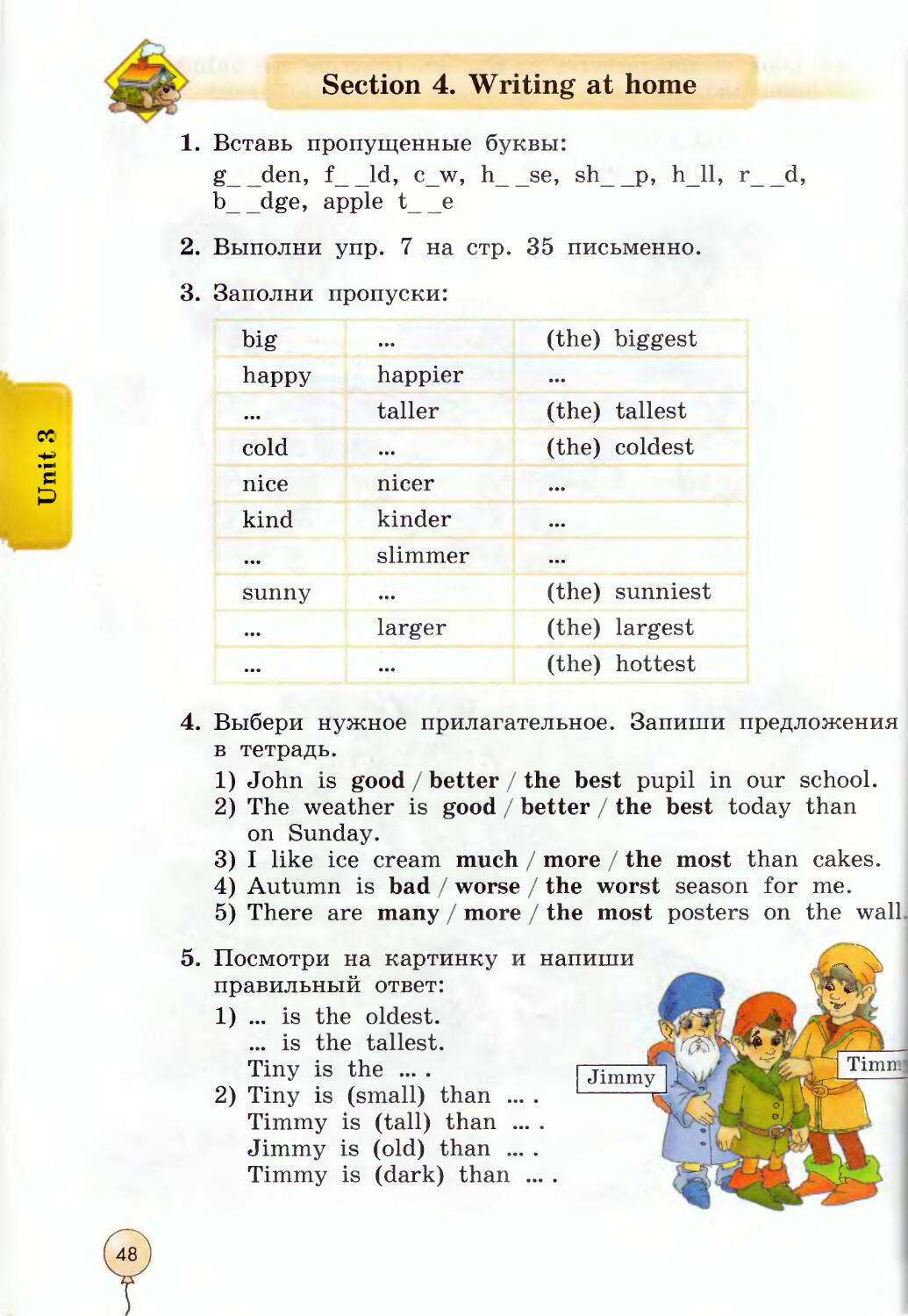
1. BCTaBb nponym;eHHbIe 6YKBbI. 3anHIIIH B TeTpa,n;b:
bedr__m, ki___en, ba__room, wind__,
d__r, h__l, l__ing room, to_let
2. BCTaBb nponym;eHHbIe is HJIH are.
1) There ... one window in the kitchen.
2) There ... no posters in my room.
3) There ... many doors in Jim's house.
4) There ... a big living room in the flat.
5) There ... two bathrooms in the house.
3. PaCCTaBb 6YKBbI B npaBHJIbHOM nopH,n;Ke H aanHIIIH
CJIOBa:
C, p, t, i, u, e, r
,
"(q5.-
a, c, p, r, t, e
*Jt *.
0, f, s, a
-
h, s, 1, e, f
,
1, c, C, 0, k
60
r, a, m, h, c, i, a, r
.
I
w, n, 0, i, d, w
a, p, m, 1
4. HanHIIIH BonpOCbI, Ha KOTopbIe ,n;aHbI 3TH oTBeTbI:
06pa3eu;: - Are there many boys in your school?
- Yes, there are many boys in our school.
Yes, there are two books in the bag.
No, there are no armchairs in the bedroom.
Yes, there is a clock on the wall.
No, there is no TV in our room.
Yes, there is a shelf next to the fireplace.
1) ...?
2) ...?
3) ...?
4) ...?
5 ) ...?
5. ITepeBe,n;H Ha aHrJIHHCKHH H3bIK.
· no,n; CTOJIOM · B npaBOM yr JIY
· aa KpeCJIOM · B cepe,n;HHe KOMHaTM
· Ha nOJIY · Ha,n; CTOJIOM
· B JIeBOM yrJIY · Mem,n;y KpOBaTHMH
6. BbI6epH HY.iKHbIH rrpep;JIor. 3arrHllIH rrpep;JIO.iKeHHH
B TeTpap;b.
06paaen;: There is a piano in / on / at the room.
1) There are two desks next to / in / on the window.
2) There is no pantry on / in / at his flat.
3) There is a nice carpet at / on / in the floor.
4) I share a large room of / from / with my brother.
5) There are many interesting books at / on / in
the shelf.
7 BbIrrOJIHH yrrp. 27 Ha CTp. 28 rrHCbMeHHO.
C\1
.....-
."""
=
Do you remember the words from Unit 2?
armchair living room sometimes
bathroom pan try
bed picture above
bedroom shelf behind
carpet sofa between
chair table in the (right / left) corner
desk toilet in the middle
door wall next to
fireplace wardrobe on
flat window under
floor
hall in teresting go shopping
kitchen large I share
lamp own there is (are)
Wi
\
Test yourself
Do the exercises in your workbook.
Mark your score.
27-30
Very good!
21-26
- -
Good! l
15-20
OK!
< 15
Try again!
.....;'" -
"--'
.
.
't. .
1 I
C\I
. P"4
=
Project: "We'll visit fairy land next holidays!"
1. aBaM npM,n;YMaeM BOJIIIIe6HYIO CTpaHY M OTnpaBMMCH
B nYTeIIIeCTBMe. 3anOJIHH Ta6JIM Y B pa60"tIeM TeTpa,n;M:
B RaRoe BpeMH ro,n;a (season) MbI ORameMCH B BOJIIIIe6-
HOM cTpaHe? B RaROM MeCH e (month)? KaRaH 6y,n;eT
noro,n;a (weather)? r,n;e 6y,n;eM mMTb? CROJIbRO M RaRMe
ROMHaTbI (rooms) 6y,n;YT B ,n;oMMRe? qTO M3 npe,n;MeTOB
Me6eJIM (things) HaM nOTpe6yeTCH?
Season
Month
Weather
Rooms
Things
2. IIpM,n;YMaM paCCRa3 0 npe,n;CTOHID;MX RaHMRYJIaX B BOJI-
IIIe6HoM CTpaHe. BOCnOJIb3YMCH nJIaHOM.
We will go to fairy land in ....
It will be .... We will live in ....
There will be a bedroom in our house. We will have
TV, ... in our room.
We will play.... Let's go to fairy land together!
3. PaCCRamM o,n;HORJIaCCHMRaM 0 npe,n;cTOHm;eM noe3,n;Re.
IIpHrJIacM MX npHHHTb y-qaCTMe B aTOM nYTeIIIeCTBMM.
"' f sf'IVV i)
--\ <r /1 \ . jV . .
. 'I r , .
!::-.. ' C .' ) f
'. 1. ;"'; '. $1\ I I
.:: _ > \. " r-J;;:"?,' >?' ,,-
. ' >- ...,. ,.,. '\
' ? . .
0. .' :-,, "<)\ .!"".
" ' ../!'2...", '\
, \ -, \ r , 't- 'I\
',\ '.
A \, ..' ":i J .h. .
\I - !' , , r. ;
.. r. ..\ .<,<, ,
. . ....:::o Q iff ".
Being happy in the country
and in the city
Section 1. We like the place we live!
r-
......,
'.
\
j
M... .Az.
I .,
._--
.11"'4
=
-- _. _ '\>:41
--__ --<-r-___
-- -- . -.
_ ----- 7
::.: ---- -.."
- --
- -- ----_ 7
L - -. ' -= ---- -_._
-----.
-- -_ ----r
,
9 . g/ - - -: l\\
. /1 I' = --_ .-=- . .\ \\\
, /' I. -= --- --- "7 1 .. \ i2) \\ ,
' ,-- --- -.,/ .,
I ('//,' ,--- - --------------
.. II' ',..7 ----=====--==-,-;::::--:--.---- --,. \ .... ......
o 0 .f{t,::>}\t O-L -' 1 + L= -- r',: >, l?//U'1J I.
v- } (': 1/'fi I 08 -1 I 'Jg .
o .L v )./ . I .lDO 1. ji= 00 - "I?i ....I/.A;
o * ,[ [ r 2 J. r 00 -L, J.1" : d _"O" ...
/. 0 .J.. I, I' L I k!<ff:;;; " -
DO 1. i! F ' ..Y :;w I);
A.' If" -..-90 T 00.!. Or-. 1 .# " "
Fr-. . tn l!;r ...J I [] i 0'-.1 "r :.. ?TI 0° "
"r .7 rIb... "V "I I 0_ ..... A r.?" 00
,,'---..,- ' 'Y - 0 V. .... 10" -, "...-( G .
. _ 'r' !f'"r?i Ii 0 !?"" ... O,.f 1,.",") , lri \ J-.. ' 0; ° .. to-
'\ '! 0 s; Qtlrl rti;;::: Q '" h CI. q r " J. r' tI"
r I J, . Jr OOO()o"o..: 7 tV 7f: \I II '4f{ .. 'lR:lr t5H I If:8/ c>
.... I 1 \iO \l 11 0 I"" oV \J.i I v. ::10°000 --::::::" cVo 1"" ......" v?
- -, \ }J, ('t\ =""'.... L. ';: 00" 0 0 % ,,;
'-- \ ........ tJ'!!<J ,IO /::- I o. --
v v OI\Oi\Oolr0..lr7' V"
r-...... An\. ... .t 1 \f{fM ... "" o lE;j lto<>lt'of ,.,.? £)0 0 0
( \.,:y/ f-.L II 1\ - >.4. 'rI4- :r: " -e Iv'--... '/ . ..
. -
I 1\ Ii 1"1) / <:> C> co 0
}., / .,;t-..
¥ .
..&11 .. J'
CD
10
gQ
-
J
:)
o
t.t'
.; ;, \\ \
8)
- . 1. Look at the picture. Read and repeat:
-
1 field 5 hill 8 sheep
2 cow 6 bridge 9 horse
3 road 7 apple tree 10 .
rIver
4 garden
I / "
but
a horse - horses a sheep - a lot of (many) sheep
'\ , a cow - cows a man - men
,
a city - cities a woman - women
1;
a town - towns
/.I
.. 2. Listen and read:
T
[a: ] [au] [A] [I]
car down funny big
large brown some live
farm how up bridge
garden now London hill
dark cow butter windy
...- farmer town country city
.JIIIIIII
=
"
3. Read Sveta's letter. Say what you can see
in the city and in the country.
Dear Pen Friend,
My name is Sveta. I am from Russia. It is a
large country There are many cities, towns
and farms in Russia. The capital of Russia is
Moscow. I live in Moscow. It's a big city. The streets are
wide and long in Moscow.
In the streets you can see a lot of people, cars, big and
tall houses.
Some people like to live in the country. In the country
you can see green fields and hills, long rivers and nice
green gardens with apple trees. There are a lot of cows,
horses and sheep on the farms. The houses in the country
are nice and small.
Our country is beautifull Come and see usl
Best wishes,
Sveta Belova
"-
\.
,
Look and learn!
country ('kAl1tn] - CTpaHa; CeJIbCK8H
I MeCTHOCTb (.n;epeBHH)
in the country -- 3a ropo.n;OM (B .n;epeBHe)
capital ['krepltll - CTOJIHn;a
city ['SltI J - ropo.n;
people r pi:pl] -- JIlO.n;H
4. Look at the pictures. Read the sentences from
the letter to describe the pictures.
. J '
. l.I-l "-
',.
.'I,,:\..
'. /.4".,,-
.... .......Ib .
....'J - ........
....... .{ _. , .,.. 7!. ....'
... -
-.;.... .
,.
I
.. .
i '. y;
.-.- --
.. .. '. . :. .;- :;.. < ;; :rf .' ,. <
... Y.".< :It>
. . .<". 'S:1. . "'io.>.c, -J"
.. ,., ..<j
.. '.'. . .. :" . 0, ..: . '. {. I
.. .,. ., . 1
.:. :;- f. :
. ". ".. .
...
-
'(
\
"
h
,
\ ,
'" .... '"
... .. t . '\
t.-- .", \ ..It...", "
- . .....
. . , ': "t . \a;
.', ._. , ... ',. :\ t C"
> "<" !II" . I .. r
-;'-, . ". ' t. ,.
-- -'. .... '. '.. . t. .
...... t . ..,. . . .: .. - !IlL-
.., ..,. It .l1li.-. ... . . " . ..... -.. .
, [., -,... i. ! :. _ _ I.. . _ t;. ... I .": - '. .. 'f /. --"'. .....
,. . \, ... '... .
: -- ,,!' -,.':: ,. \ .. . .. - ......- - - :-.". .-..- I': .. . J
..... '" . -.. - "'... ." - ..
- -,. ..... .' r... . -. . -.. - It' -' {"
, . I' . . _ -, .. .> ...... ....
. , <t"I" .. .} -.'t . :: _' ..... :.. :. .'_. "" _" -- ....'. ... -. "''':.-,-;-..
- ..; r
, ., fl' i", -''''l';'..
" ." ',' "1" -.
"-:.""'..' , . t - - .
.- ....."(.. .
>". ,. . , &f/
jf,.
. .
--
-:J. ,
.- "
.3
-
... .
..;.,
.,
.'
.....
." :......._.,....c;..
".
.J
;
. ;., .;it'!'._'"
......-
.
=
5. Find the words in plural (BO MHomeCTBeHHOM "tIHCJIe)
in Ex. 3. Read and translate them into Russian.
6. Listen, repeat and learn:
c::: .-/ 2_ co
c> -= The Country and the City
Some people live in the city
Where the houses are very tall.
Some people live in the country
Where the houses are very small.
But in the country where the houses are small,
The gardens are very big.
And in the cities where the houses are tall
There are no gardens at all (Boo6m;e).
---
. 0
.
o
IUD
-
, .
;0,-
, ,
o
.
o
... .
.
. '0
.
.
.
7. Make up sentences about the city and the country using
the poem.
Example: The houses are very tall in the city.
...in the country.
8. a) Choose the words for each picture. Read them.
new, nice, small, green, dirty, clean, large, red,
beautiful, English, wide, blue, old, Russian, dark,
big, tall
b) Make up word combinations (CJIOBOCO"LleTaHM.H) or
sentences with the words.
Example: a beautiful city
I live in a beautiful city.
1 :,.. :t.; <:<
1- IF :
, . .,.:{ .:; :'. ;1' ,)}.,,-:f.' ,:;-;:"t;/: - ",:-- . ':. ..'. _ :: ; : ;:.
.: -. 'l ----:.-: . :.: >"" '-r, :1;-,. -;' '0')-
. .. ".,. J
...": . '-. -- -. "\..-=.,::- -
.1""'4
=
'"
-. .
.. .
<,
,.
..... '.
, .
" "" .
.
.,
'"'
..j.
-..','.
,.... .-..-
", ..
....\
"iiO.,
,
"
. . ...
..... . fir....
I f -I-- . . .. .
- 11--. . A-.
_.
- ,.. '
;;t. --- ...Aa: -_. ..;;, :t..
." ........
- -' "'.'
--
. .. .-: - .
-
...-'-
,........
. ..
. .....
-
..
;.;" ","-
.:;: . . . .; :.
"'
::. ,".. ....
........ ........ -......
. :0- :. .
, ._ -..... :;z. L." t $''11" ".
. . . '.
."- ":: -.
city
, '.
-
co un try
-- ';\ I '
, I j
I " - ". .",
. :;...
. -..
. >,.
:"'.........'
.1;,
. ,>'
I If J ,1,
, .
. if ,Ii
_ 1:__
.."
'\-"':. ."
.. >w.
. ,
.. ,
.,
,y ".,'
.. ,
,
"
. ,
" ...
..
\
!
..
--,
!I
: .
....
[ town]
9. Read Alex's letter. Complete the text using am / is / are.
Dear Sveta,
Thank you for your letter. I am Alex. I ... from
Great Britain. My country... beautiful too! The capital
of Great Britain ... London. There ... many new and old
houses and bridges in London. There ... a lot of cars in
the streets. You can also see many interesting towns in
GB, like Oxford, Cambridge and others.
I live in Oxford. But I often visit my granny. She
lives in the country. There ... a green garden with
white, red, yellow and blue flowers next to her house.
There ... green fields and white sheep in the country.
I think Russia ... a beautiful country. So I want to
visit Russia next summer.
Your pen friend,
Alex Giggs
. ,-
,
>
1
I
Look and learn!
....... II'. 1"
. . · t .."
,..,
'of I! L., ' II' . .
J -. ..., _. . -.-...
.. . - .
y:;;: -:: JtZ:. -. .
...- ....
.. .
.(.:.
-,....< ..
,.A. .1.':" ..
Great Britain = GB
.'
,'" ... . .:l.'
..:... ....<
.;;.: ,T:.
.-"
,
...
, '.
,..",-- ':t
:,
--
-"... ..
111>: ' -"<>.
. :" <::.
,. .
,.,...
'-
0'-: .
.:<..
--
10. Say what you know about Great Britain now.
11. Ask your classmate. Make a list of places next to his /
her house.
Example: A: Is there a bridge next to your house?
(a field, a forest, a river, a park, a garden)
B: Yes, there is. (No, there isn't.)
12. Sveta and Alex are at the International Musical Festival
In Moscow. They meet a lot of new friends there. Listen
to one of the girls. Say what you remember about her.
.
..
......
.
r "
'/iA ,-
'-
-'
, ,
..." ,"
.....
....
......
\ ........ !: "0"
f<:. "
.= .
, .
r \
\ J'""
. ".." .
J; oc .
s:
...--
I-
.-;..
.,
y y - "".....
13. ImagIne that you are at the International Festival. Tell
your new friend about your town (city, country).
Section 2. Are they different: the country and the city?
..
14. Listen, read
and act out:
Hello!
Hello! Can I help you?
What is the weather like in Sochi?
It's warm but windy and cloudy.
What a pity! Bye-bye!
Bye-bye.
"
";' _" lIo.,
\'
0; ,
r,'<tJ",. ,
, .
Ii 'j
I
\ ::.....
, .'.
", '.oI ::
-:<c
e"
15.
Tiny asks about the weather in different cities. Answer
him. Work in pairs.
Example: What is the weather like in ...? - It's fine.
St Petersburg [s nt 'pi:t z,b3:g]
Rome [r um]
Berlin [b3:'hn]
London
Omsk
Krasnodar
Paris [Ipeens]
Moscow ['mDsk u]
It's
It's
It's
It's
It's
It's
It's
It's
+35 ....
16. Read
.......-
."""
=
It's not warm here.
I'd like a warmer
place. Africa is the
warmest place I know.
and explain.
I ( Hi! Welcome to our forest! 1
Isn't it a nice place?
- .
"'>, 3" .
.... 1'-" c
, " ' ,'..
' .. -- .
"L"
'>-,
,
,
,
') Q
"- \. J. :
-. ' ... -
. - ....
\' ' -""
I ,-1 ,_... .
. I " .. '1. . ,.' I
\ .' .ii . 1IJj \. \ ..\ ...<.iio(,
\
..
cloudy.
sunny.
windy.
cold.
warm.
hot.
.
raIny.
snowy.
')
"
\
I
I l
",I
,\
@ 17.
warm - warmer - (the) warmest
... U U.. '-"
TeIIJIbIM - TeIIJIee - caMbIM TeIIJIbIM
strong - stronger - (the) strongest
.., ..,..,
CMJIbHbIM - CMJIbHee - caMbIM CMJIbHbIM
cold - colder - (the) coldest
.., ..,..,
XOJIO,ZI;HbIM - XOJIO,ZI;Hee - caMbIM XOJIO,ZI;HbIM
Read the story "The Sun and the Wind". Answer
the question: "Which is stronger?"
I am strong!
I am stronger!
)
------==--
-
0-/
---
Look and learn!
Look at that man! Who
can take off his coat?
All right!
..
r ....
(" .....
:.-?
..,.
ke off Itelk Dt] -
HMMaTb
coat (kgutJ - rraJIbTO
.
.......
-J)
\::(
...........
\.
\
. -
-
o
-
.:..:;.
.. .
o
-
o
o
1- -
I can't take off
his coat...
I am stronger! I'll
take off his coat.
G)
."""
=
hoo! Whoo! I want your coat.
Oh! What a strong wind!
How cold it is! It's the
coldest day in April.
.1
....
(
f'
tj
.
.'
.
I
Aft I
I am glad that I've
got a warm coat.
Now it's warmer. It's not so
cold. It's not windy at all.
/"'\
\
\..
Well, Wind! You
see, I am stronger!
You are the
strongest in the
coun try and in
the city!
It's hot!
lit:::.
.... J'
-
..... {)'.
'-
l
(. v::--..., b
6 -
\
,
,
(J
"
\
\\ \' 0:
'\ -,
I
o
,
6
...
18. Read the story with your classmates. Act it out.
J r:/"
,
\
"
!T.
,I,
.
\..'--
-
-. 19.
:r
."",
=
Old
smaller
shorter than
taller
,-'
I
Listen, read and learn:
kind - kinder - (the) kindest
small - smaller - (the) smallest
short - shorter - (the) shortest
tall - taller - (the) tallest
clean - cleaner - (the) cleanest
i
--{!'4
t
20. What do you think? Answer the
questions. -£"'-
- II \
\
,
CD
Who is stronger?
8) -"- -
Who is
-.
it<J
,
2
o
Who is smaller?
Who is taller?
)
t!:J
@
Which is colder?
.J
.
,
.
o
Which
cleaner?
is shorter?
21. Listen, read and learn:
long - longer - (the) longest
big - bigger - (the) biggest
hot - hotter - (the) hottest
large - larger - (the) largest
wide - wider - (the) widest
dirty - dirtier - (the) dirtiest
happy - happier - (the) happiest
22. Complete the sentences.
Example: In the city gardens are smaller than
in the country (small).
1) In the city houses are ... than in the country. (tall)
2) In the city bridges are ... than in the country. (long)
3) In the city streets are ... than in the country. (wide)
4) In the ci ty rivers are ... than in the country. (dirty)
5) In the country houses are ... than in the city. (small)
6) In the coun try rivers are ... than in the city. (clean)
7) In the country gardens are ... than in the city. (big)
23. Compare and say.
..
..
1) big I small
,
. .
t
..",.
..
2) clean / dirty
.
1'\
.II1II4
=
. .
3) short / long
... \
}
"'='
- )
-'
4) happy / sad
Bob
Mary
Max
24. Tick the correct box and say:
a) Which is the biggest city?
[Z] Moscow D Berlin
D London D Paris
b) Which is the largest country?
D Great Britain D Russia
D The USA D France
c) Which is the warmest season?
D spring D summer
D winter D autumn
d) Which is the shortest month?
D May D February
D August D January
e) Which is the longest day?
D The 22nd of December D The 22nd of June
D The 20th of April D The 2nd of September
'/ "\
r 1/ good better ( the) best
bad worse ( the) worst
' "'
-, many / much
more ( the) most
I Ii ttle less (the) least
;1
/.
25. Answer the questions:
1) Who is the best pupil (singer / dancer / footballer /
swimmer) in your class?
2) What's the best day (month / season / weather / sport /
breakfast) for you?
3) What's the worst day (month / season / weather /
sport / breakfast) for you?
.""",
=
,
\
, @ 26. Read the story. Answer the question: "Who becomes
happy in the town?"
Look and learn!
The Green Garden
become [bl'kAm]
There is only one long street in a CTaHOBHTbCH
small town. The houses aren't tall and
the street isn't wide. But the people
aren't happy in this town. There are no trees and
flowers in the street. The little children haven't got
any place to play. They are sad and unhappy. Nobody
can help them.
In autumn Miss Chatter comes to visit the town.
She sees the sad children in the street. She wants to
help them. She says, "Dear children! Let's grow a nice
green garden together!" Miss Chatter and the children
dig the ground (KorralOT 3eMJIIO), put in the seeds
(celOT ceMeHa), plant the trees and water the flowers.
The weather becomes cold and windy. But they
continue to work.
Spring comes and the children play in the garden
every day. They like the green apple trees, the nice
flowers and the merry birds. In spring the days are
sunny and warm. Miss Chatter and the little children
fly kites and play hide-and-seek. The people of the
town like to have picnics in the garden. They say,
"Thank you!" to Miss Chatter and the little children.
Now all the people are happy in the town.
27. Put the sentences in the correct order.
[I] The little children haven't got any place to play.
D Miss Chatter and the little children fly kites and
play hide-and-seek.
D "Dear children! Let's grow a nice green garden
together!"
D In autumn Miss Chatter comes to visit the town.
D The people of the town like to have picnics in the
garden.
D The weather becomes cold and windy. But they
continue to work.
D Now all the people are happy in the town.
28. Read the sentences from the text to illustrate the
pictures.
.
=
-
1 '\ J QD
. "':" J f1 \
"' mm " 1\ \ ,.tD . 1\ A i= ..4
\ t I 0 0 0- ... 0
) J .-' ... - " _ 161' 'L.. :I': 0;'7
'J ., ., --
:.r,_ t _ \r,
'v . .
... ""\. v "'-:_.
". .'
<""\
')
J
7
.- ...
[
J
...
'\,......
_ v," . \
- .;::.--\. \
..c f v,.
rr"'.; ,T) ' r
.< .
v
o ODD
n n ,.., 0
c.
....
"'
t<
"",.........
Y,.,.
c. i-
,
., "i
'.'
I I
. · . rc::fJ.
I:)jJJ ..:
..(
..R
.
v,....
..
(y'
.4l'
......
.,-,4
=
29. Find the adjectives (npIiJIaraTeJIbHbIe) in the text
Change them.
Example: small - smaller - (the) smallest
30. Say what Miss Chatter and her friends can do in the
garden in winter and in summer.
Example: In summer they can play badminton.
In winter they can...
31. Work in pairs. Say what we can do to make our town
(country) better.
Example: We can plant trees.
Section 3. People and animals in the country
and in the city
32. Say which animals live:
a) on a farm b) in the zoo
c) in the forest
a fox, a hen, an elephant, a bear, a lion, a cockerel,
a wolf, a giraffe, a parrot, a pig, a monkey, a horse,
a sheep, a tiger, a rabbit, a kangaroo, a duck, a cow
33. Complete the text. Guess what animal it is.
I am from Africa.
Look and learn!
... ..1
I've got big .
carry ['keen J - rrepeHOCHTb,
HeCTH
thing [8(1)] - Be b
.
I am big and strong.
I like
.
and
I don't
Jrt .
z,-? . .j \1'
"'" ....c...
I
.
I can carry things, people and water the
>.
Come to the
and see me.
I am ....
j 34. Listen and read:
[i:] please, field, sea, eagle
[e] wea ther , elephant, desert
[gU J - cold, road, most, ocean
[auJ - town, flower, cloudy, mountain
[el] - game, today, change, favourite, whale
35. Help the animals to find their homes.
Example: The eagle lives in the mountains.
(-"I ,
'c/e Z f}J J
-I desert
-
-.
-'
" .
I ocean I
Ct:
......
....
eag Ie '\,.
. -
,:
<r\..
sea
,
\.
.
rl ver
dol phin
... mountains
"
. \\\\\ ' ,/ ' "rt!i' .
: \\h\ \'. \'L" '. . '" .. '
.. .. \',. tTt:I'-'.
,. ....,"'-.._... . .\\ -- !..... ." a.
... """-'",,\ """
. .-. :.... - .. - -.
t I;"..:.;.. a,_
\. III ".
-' \.- i '-. . - "" , -
...--+'. :.. -::- . t;;' . t ..... .' b-
"t:'. --- . _ 0_
,'r!t.c .,* ",..'fi...'" _ -. - tc1 ,....
......, ..._."l J'o'IL . ...
: - crocodile I. # .1.
o . <
,- .
- ,
.
"'" :a.
.. --;:
-...
.# .
- . ...
...
- .
\".
.'.
whale
snake
camel
36.
Match and read the dialogue.
1) Have you got a pet?
2) What's its name?
3) What does it like to eat?
4) What is it like?
5) What can it do?
a) Ashby.
b) Ashby is big, kind and strong.
c) Yes. I've got a camel.
d) Ashby helps my father to carry
e) Grass and apples.
-
)\
things.
"
37. Listen and check. Act out the dialogue.
38. Ask your classmate about his I her pet.
.
:s
T.
'¥'\
....
--
."""
...
-
\
o
-.......
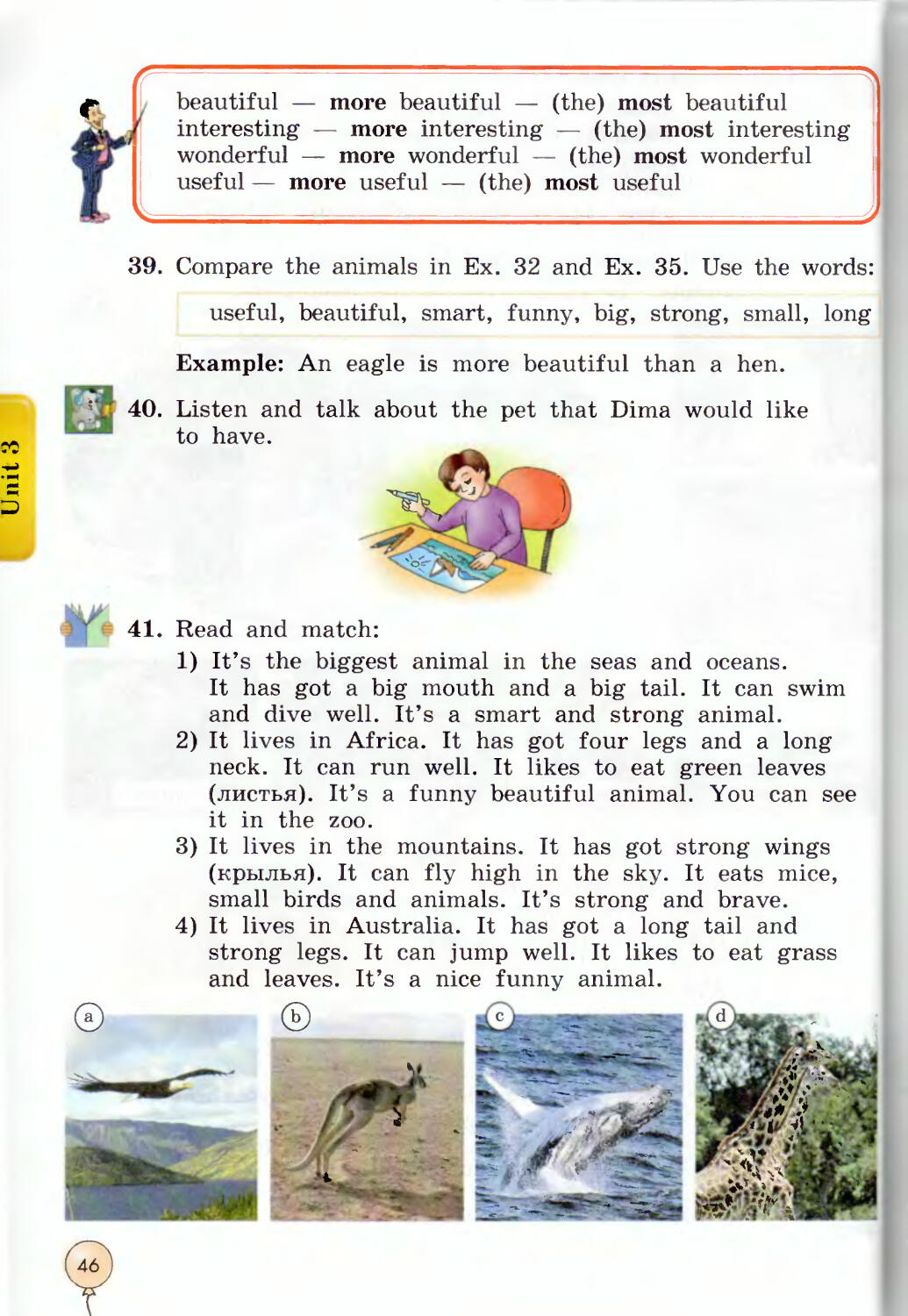
r beautiful - more beautiful - (the) most beautiful
interesting - more interesting - (the) most interesting I
wonderful - more wonderful - (the) most wonderful
useful- more useful - (the) most useful
,,
..\...
/.4
39. Compare the animals in Ex. 32 and Ex. 35. Use the words:
useful, beautiful, smart, funny, big, strong, small, long
Example: An eagle is more beautiful than a hen.
40. Listen and talk about the pet that Dima would like
to have.
r
.J
)
,\'" """
0':- '""
'-
41. Read and match:
1) It's the biggest animal in the seas and oceans.
It has got a big mouth and a big tail. It can swim
and dive well. It's a smart and strong animal.
2) It lives in Africa. It has got four legs and a long
neck. It can run well. It likes to eat green leaves
(JIIICTb.H). It's a funny beautiful animal. You can see
it in the zoo.
3) It lives in the mountains. It has got strong wings
(KpbIJIb.H). It can fly high in the sky. It eats mice,
small birds and animals. It's strong and brave.
4) It lives in Australia. It has got a long tail and
strong legs. It can jump well. It likes to eat grass
and leaves. It's a nice funny animal.
(0
d
c
.
, . ..
. -=
--
.
"
-' - - -- ---'" - - -
-- - --- - - - .:....
-- - -=-
- .........--, -- ....-
;
... z
, .. .: --
14. .;.. .
., '."
,t.. :,!!. ...
...' .....
,T.:. '.
."" .
f . s f . ..
. -
--
- """'&. -
- ,
--
- >0
-""Ii
. ..
.,
"f ..-
.'
._1
,
-
...- -
..
...
.
--
...
of .
, ..
.
-
. .
1I.
..... (.,1 \ " _
.... -\ '"S.
.' .
. .;,'w
.." .;: ...
"
...
-I. ,-: 0.1.. ..: ..0:--
_ C .
.' . --
to
.-- -... - . ---- ...
< ...-
---
--....- -
42. Look at the pictures in Ex. 35. Describe the animal
you like.
43. Say what animals and people do for each other.
a) What do animals do for people?
..
\
\
,
.
.
....
--
hel p people
,-
,,-
-....
I carry things / people
" W
'\ 0 0
- .."
..
"'
<.
t:==
.;'
, '.
\)
\)
"
.-
.
=
-'
,..
..
", .
,'.
........-.
,
\'
..........
give clothes and food
b) What do people do for animals?
Z '"
" ./ e
"
,.
make a house
.
"
.
J
J
take for a walk
00 .......
..
... .
... "
'-
.
.
\
.
0°,
feed / wash animals
..-
<:I
i ,; \:\
' :?* .
l . . . -0. I
'..-
,
. n. j1
..M4/rv" ",,,-
.co
=-
"
. .
:o.; ?
"'- "-...
.\
"
."
.." .
. J
.
"'.
-
----
-
44. Look at the pictures and say which animal is the most
useful. Why?
Example: I think...
-' .
i1
Section 4. Writing at home
1. BCTaBb nponYIIJ;eHHbIe 6YKBbI:
g_ _den, f_ _ld, c_w, h se, sh --p, h_ll, r d,
-- --
b _ _ dge, apple t__e
2. BbInOJIHH ynp. 7 Ha CTp. 35 nHCbMeHHO.
3. 3anOJIHH nponYCKH:
big ... (the) biggest
happy happier ...
... taller (the) tallest
er: cold (the) coldest
...
.
= . .
nIce nIcer
...
kind kinder ...
... slimmer ...
sunny ... (the) sunniest
... larger (the) largest
... ... (the) hottest
4. BbI6epH HymHoe npHJIaraTeJIbHoe. 3anHllIH npe)J;JIOmeHH.H
B TeTpa)J;b.
1) John is good / better / the best pupil in our school.
2) The weather is good / better / the best today than
on Sunday.
3) I like ice cream much / more / the most than cakes.
4) Autumn is bad / worse / the worst season for me.
5) There are many / more / the most posters on the wall
5. IIocMoTpH Ha KapTHHKY H HanHIlIH
....
npaBHJIbHbIH OTBeT:
1) ... is the oldest.
... is the tallest.
Tiny is the ....
2) Tiny is (small) than ....
Timmy is (tall) than ....
Jimmy is (old) than ....
Timmy is (dark) than ....
iO-.\
-1'i , I
.' ""-<I 7
. ,
, . . -
: -i','
., .. r I
". ({,RI \ ... ") J I
Jimmy 1):: :;:...- l" Timm
.. I.",. \ iD
. '--
- . II.. -)
.
)
V
6. BblrrOJIHM yrrp. 33 Ha CTp. 44 rrMCbMeHHO.
7. HarrMIliM 0 cBoeM JII06MMOM mMBOTHOM. BOCrrOJIb3YMCH
rrJIaHOM:
My favourite animal is ....
It lives in ....
It has got ....
It can ... well.
It likes to eat ....
It' s nice ....
Do you remember the words from Unit 3?
apple tree
bridge
camel
capital
coat
country
cow
desert
dolphin
eagle
field
garden
Great Britain (GB)
hill
horse
mountain
ocean
.
rIver
road
sea
sheep
whale
in the country
become
take off
useful
Test yourself
Do the exercises in your workbook.
Mark your score.
27-30
Very good!
21-26
Good!
15-20
OK!
< 15
Try again!
.....-
."",,
=
Telling stories
Section 1. Reading last summer story
r
!
--....;
-
.1-
l-
f
\ : , > 1\ .
'- II.llt
$}
{\ /11/\1.
'-
I I
I _
DO
(:, :>
J-
,...--.,
- --
,- .;;. I
i"f _ __
- -
---
" .....r
10
I
I
l.
-
.""",
=
10
'\
( b
o
-
, -
f'
c-<..
)
Q
lj
I
i I )
' )
-
. ,
. .c-
?
......
. .
.--
1.... ':
y
/t
,.j(-
Q.
'f
i5:'...
<
. -
B;
fr- ori
, .
+
....
?
:., -.< .
--
\. C»,
- ./
-
- I
) /;/
c-__
'-
",
I}?
(})
-'
--..->
r- .
.............. ':;....;>
r-4
-"V'"
-
--- --- ---'
1. Look at the pictures. Read the story. Arrange the
pictures in the correct order.
Last summer (rrpOIliJIbIM JIeToM) Jim and Jill went
(go) to the forest. The day was [WDZ] (be) fine. It
was (be) very hot and sunny. Jim and Jill walked
(walk) in the forest and then they sat (sit) down
under a big tree.
They talked (talk) and talked. Suddenly
they saw (see) a small bird. The bird had
fallen (yrraJIa) from the tree. Jim took
(take) the bird in his hands and the
children went (go) home.
They put [put] (put) the bird into the box. The
children liked (like) the bird very much. They gave
(give) the bird bread, apples, corn and water.
The bird lived (live) in their house for two weeks.
Then Jim and Jill took (take) the bird back to the
forest. The bird was (be) very happy.
Look and learn!
talk [tJ:k] -
pa3rOBapHBaTb
2. Choose the right order of the pictures.
a) 4, 2, 3, 1 b) 1, 3, 2, 4 c) 3, 1, 4, 2
3. CpaBHH rJIarOJIbI B Ta6JIHu;e. Pa3ra,n;aH ceKpeT, rrOqeMY
3HaKOMbIe Te6e rJIarOJIbI, 0603HaqaeMbIe 3HaQKOM 6,
B paCCKa3e TaK CHJIbHO H3MeHHJIHCb.
D
I qJopMa
(0 HaCTO.flm;eM)
II q)OpMa
,.,
;: (0 rrpOIlIJIOM)
.
=
rrpaBHJIbHbIe
walk
live
walked
lived
HerrpaBHJIbHbIe
go
take
went
took
'/
'\
ECJIH ,n;eHcTBHe, 0 KOTOpOM MbI paCCKa3bIBaeM,
rrpOH30IlIJIO B rrpOIlIJIOM, TO yrroTpe6JI.fleTC.fl BTOpa.fl
qJopMa r JIarOJIa.
BTOpa.fl cpopMa r JIarOJIa 06pa3yeTC.fl rro- pa3HOMY:
· K rrpaBHJIbHbIM r JIarOJIaM rrpH6aBJI.fleTC.fl -( e)d
D + -(e)d
J
· HerrpaBHJIbHbIe r JIarOJIbI H3MeH.flIOTC.fl,
HarrpHMep: go - went, see - saw
IIpocToe rrpOIlIe,n;IlIee BpeM.fl Ha3bIBaeTC.fl Past Simple.
-zj
\...
/.
.
,
4. Look, listen and read.
/'" .,
llpaBHJIbHbIe r JIarOJIbI .'1
D ., D .-'
L1! .,
.. /;
play ... play + -ed - played talk .. talked
walk .. walked like .. liked
"
want wanted live .. lived
...
.
'{ open ... opened
./
5. Haif,n;11, rrpo"tI11Taif 11 rrepeBe,n;11 Bce rrpaB11JIbHble r JIarOJIbI
B yrrp. 1.
T
6. Listen, read and remember:
.
_c
I t I
.-
=
watched
walked
talked
finished
liked
helped
[ d]
[Id]
played
laid (lay)
tried (try)
cried (cry)
smiled
studied (study)
lived
skated
wan ted
collected
pain ted (paint
pMCOBaTb, KpacMTb)
needed (need
Hym,n;a TbCH)
06pa TH BHHMaHHe Ha rrpaBOrr11CaH11e r JIarOJIOB lay, try,
cry, study B Past Simple.
7. Read with the
opened
cried
finished
smiled
skied
collected
wanted
washed
correct ending:
pushed [puft]
watched
helped
studied
jumped
danced
asked
worked
watered
answered
listened
liked
pain ted
invited
/ '"
HenpaBHJIbHbIe r JIarOJIbI
D .} D --..
A!
/_. -.
:.a II. \
see saw fall fell
go went do did
I have had take took
said [ sed] .
say gIve gave
fly flew l fl u: ] sit sat
8. HaH.n;II, rrpoqlITaH II rrepeBe.n;1I Bce HerrpaBIIJIbHbIe rJIaro-
JIbI B yrrp. 1.
9. HaH.n;1I B yrrp. 1 COOTBeTCTBII.H .n;aHHbIM CJIOBOCOqeTaHII.HM:
1) rYJI.HJIII B JIecy
2) 6bIJIO mapKO
3) ceJIII rro.n; .n;epeBOM
4) rOBOplIJIII II rOBOplIJIII
5) YBII.n;eJIII rrTlIqKY
6)
7)
8)
9)
10)
B3,flJI rrTlIqKY B PYKII
u
rrOIIlJIII .n;OMOII
.n;aJIII rrTlIqKe xJIe6a II BO.n;W
mlIJIa B .n;OMe .n;Be He.n;eJIII
6bIJIa CqaCT JIIIBa
+iI
.""",
=
10. IIpe.n;cTaBb, qTO 3Ta IICTOplI.H rrpOlI30IIlJIa C To6oH. Pac-
CKamlI ee o.n;HOKJIaCCHIIKaM. Y rrp. 9 IIcrroJIb3YH KaK rrJIaH
paCCKa3a. q TO TbI Mor 6bI 1I3MeHIITb B CBoeM paCCKa3e
IIJIM .n;o6aBIITb K HeMY?
11. Say what you did last summer.
Example: Last summer I went to the country.
12. Read Jill's funny story. Use the verbs (rJIarOJIbI) in
Past Simple.
Example: Once I (go) to a green-green garden.- Once I
went to a green-green garden.
I o.. (go) to a green-green garden. In the
green-green garden I .o. (see) a dark-dark
house. In the dark-dark house there o.. (live) a
big-big lion. The big-big lion .o. (have) yellow-
yellow eyes. His yellow-yellow eyes o.. (look)
like bright-bright suns.
I .o. (open) my eyes and ... (see) a bright-
bright sun in my window.
"Good morning, dear," o.. (say) my mum.
-
'-......
13. Think of your own funny story. Tell it to your
classmates.
Example: Once I went to a funny-funny zoo...
Section 2. In the world of fantasy
Ie
-'1:
.:'"\
14. Listen, read and learn a poem.
Look and learn!
The Whale
Part 1
One, two, three, four, five,
Last month I caught a whale alive.
Six, seven, eight, nine, ten,
Then I let it go (oTrrycTIIJI) again!
caught [kJ:t] -
...
rrOHMaJI
catch [kcetfJ
caught
-
--
,
......-
.1""'4
=
l '-
.,.
/ ,
I
CrrYTHIIKaMII Past Simple qaCTO HBJIHIOTCH CJIOBa: I
yesterday Bqepa
the day before yesterday rr03aBqepa
ten days ago eCHTb HeH TO MY Ha3a
a week ago He eJIIO TOMY Ha3a
a month ago MeCHD; TOMY Ha3a
last year B rrpOIlIJIOM ro y
last summer rrpOIliJIbIM JIeTOM
last night Bqepa BeqepOM
I
...
.,1
l
15. I1pOqIITan CJIOBa. BbI6epII Te, KOTopbIe MO.iRHO 0603HaQIITb
CIIMBOJIOM 6. Ha30BII CPOPMY rrpOllIe llIero BpeMeHII 3TIIX
r JIarOJIOB.
boy, like, my, do, why, say, May, put, play, you,
want, your, cry, yesterday, year, see, yellow, go,
give, story, ugly, take, Sunday, fly, try, many,
happy, dirty, ball, take, early, funny, have
16. Complete Jim's story with the right words.
y VVinter Fantasy
Yesterday I went (go) to the park. I ...
(meet) my best friend there. It was (be)
sunny and cold. We ... (ski) in the park. We
... (play) snowballs and ... (make) a funny
snowman. The snowman ... (look) at us and ...
(say), "Hello!" We ... (like) it very much.
When I ... (come) home, I ... (have) lunch.
At home I ... (do) my homework, ... (watch)
TV and ... (draw) a picture of my funny
snowman.
I ... (put) the picture on the wall. At 10 pm
I ... (go) to bed. The snowman ... (smile) and
... (say), "Good night!"
Look and learn!
ake - made
(is, am) - was
orne - came
draw - drew
meet - met
ut - put
r Present Simple Past Simple ')
I
am I was [WDZ] (6bIJI, 6bIJIa)
are you were [ W3: I (6bIJIM)
r . she / he / it
IS was ......
.-
are we were c
........
(6bIJIM) .......
are you were I
are they were
...'-
17. 3JIOll KOJI,n;YH rrpeBpaTMJI pa3HbIX .iKMBOTHbIX B JIHrYllieK.
IIoMorM ,n;06POll epee paCKOJI,n;OBaTb MX. CKa.iKM, KaKMMM
OHM 6bIJIM paHbllIe. I1crroJIb3yif CJIOBa:
crocodile, lion, elephant, mouse, fox, camel, whale,
giraffe, dolphin, eagle, sheep, wolf, monkey, snake
Example: The crocodile was green and strong.
grey
red
yellow
brown
blue
w hi te
funny
tall
small
· ,.,- "'v\.
. .......'\.. R - \
, \ I \' ' I . I
-? I \.
rf " '...
. \ ... I '. :*\. '
f:..1 .. :
tl (:\.t ,,: \
\ .
.
,>, I. .J.II
- -
. Jo... ..
.::J:!
T
short
big
.
nIce
happy
fat
smart
good
kind
strong
""\.
,
.".., -
t, -1\ ' I
I\.,.':'" '" ,
, . K';1-=- - ,I.
- . -'=\\ ."
, '/I ,\ f'oJ
I \", -' :\ . \.]
"",,,: ., ,
, 11 ,\ "\
H
.,
, .
\
.
, 18. TIpH,n;YMaM H aarrHlliH, r,n;e MeCHQ Haaa,n; Mor Haxo,n;HTbCH
TaMHH. Terrepb rrYCTb TBOM coce,n; yra,n;aeT, TO aarrHcaHO
y Te6H, a TbI - TO Y Hero.
Example: A: Was he in the park?
B: No, he was not (wasn't).
A: Was he in the mountains?
B: Yes, he was.
in Africa in Moscow at home
in the country in the garden at school
in London in Great Britain in the park
in the forest at the zoo in the desert
was - was not = wasn't
Lere - were not = weren't [w;}:nt]
.\
II
"
./
19. Complete the dialogue. Fill in was or were. "
A: Was it interesting at the party at school yesterday?
B: Yes, it .... There ... so many strange people there.
A: Who ... there?
B: Oh, there ... a lot of funny monsters, merry clowns,
brave supermen and kind fairy ladies.
A: Oh, really? A costume party!
B: And there ... two nice English hobbits.
A: It's a pity I ... not at this costume party.
20. Listen to the dialogue and check your answers. Act it out.
.,...
c:
Q
"'l
,\) "
,
.
""\
I clown I
.
1
..,
,
i1,_
....
'-
l
I superman I
P I
I
monster I hobbi t
fairy lady
21. Say what the children did at the
costume party. Use these words:
sing songs, dance, listen to music,
tell fantastic stories, play jokes,
draw funny pictures
Look and learn!
sing - sang
tell - told
Section 3. How to ask questions in the Past Simple
- 22. Listen, read and learn a poem.
The Whale
Part 2
Why did you let it go?
Because it bit my finger so!
What finger did it bite?
The little finger on the right!
Look and learn!
bite (bit)
1\. yca Tb I
l "
"' /
.\7.
\if -
\..
(....
,. - \.
23. Tell the boy's story.
Example: Last month he caught a whale alive. Then he...
KoI',n;a MbI 3a,n;aeM BorrpOCbI, YTOQH.H.H C06bITH.H, KOTopbIe
rrpOH3011IJIH B rrpOIlIJIOM, Ha,n;o rrOMHHTb CJIe,n;YIOrn;ee:
..
JII060rrbITHbIM 'I rrOKH,n;aeT OCHOBHOM r JIarOJI H "rrepe-
..,
CeJI.HeTC.H" BO BcrrOMOI'aTeJIbHbIM.
<I>opMa BcrrOMOraTeJIbHOrO I'JIarOJIa do, does H3MeH.HeTC.H
H CTaHOBHTC.H did. ITOp.H,ZJ;OK CJIOB B BorrpOCHTeJIbHOM
..
rrpe,n;JIO.iKeHHH OCTaeTC.H rrpe.iKHHM:
.......
.1"'11
=
00000000000
it D D 0
Did Tiny come to Russia
Yes, he did.
No, he did not (didn't).
r:
'.
e)?
last spring?
24. Read the
Example:
Look and learn!
!'ead - read I fed]
wri te - wrote [r ut]
sentences. Then ask the questions.
I came to Russia last spring.-
Did you come to Russia last spring?
1 ) We played badminton yesterday.
2) The children drew a nice picture last night.
3) Jim read [red] an interesting fairy tale last
Sunday.
4) Jill wrote a letter to Santa Claus last week.
5) They skied in the park yesterday.
6) Simon caught a big fish a month ago.
25. Create questions with the words:
Tiny wrote a new fairy tale yesterday.
What did Tiny write I yesterday?
When a new fairy tale?
Tiny met Santa Claus in the forest two days ago.
Where...
When...
26. Read the text and put the verbs into the correct form.
Say what good news the Cat knew.
......-
.1'""'4
=
The Smart Little Bird
There was a little smart Bird in a
tree. A big grey Cat ... (come) to the
tree. He ... (see) the little Bird and ...
(want) to eat her. "I'll have the bird
for my breakfast," ... (think) the Cat.
"Good morning, Miss Bird," ... (say) the Cat.
"Good morning, Mr Cat," ... (say) the Bird.
"Good news!" ... (say) the Cat.
"What news?" ... (ask) the Bird.
The Cat ... (say), "Very good news, my little Bird! All
animals are good friends now! We are friends: all cats,
dogs and birds. Come to me! I want to speak to you."
But the little Bird ... (be) very smart.
"Of course, you are my friend. But I see many dogs
and they are on their way to this tree."
"Oh, dogs! I must go home!" said the Cat.
"Oh, why, my dear friend? The dogs are
our friends, too," said the Bird.
"I think, they don't know the news,"
said the Cat and ... (run) away.
Look and learn!
think - thought
I 8J:t J
run - ran [rren I
.
o o
()
((... ..
,
"T
27. Answer the questions:
1) Did the Cat come to the tree?
2) Did the Cat see a little mouse?
3) Did the Cat say "good news"?
4) Was the Bird smart?
o
5) Did the Bird see the dogs? 0
6) Did the Cat run away?
o
o
,
o
"'-
{
.
o
o
-
c=-
--
....:..-
28. Make up the questions and answer them.
Example: the Cat, did, see, Who? - Who did the Cat
see?
1) did, think, the Cat, What?
2) the Cat, did, What, say?
3) ask, the Bird, did, What?
4) Why, run away, did, the Cat?
29. Find in the text and read the sentences: in Past Simple,
in Present Simple, in Future Simple.
30. Read and learn these words.
"/ "\
cut [kAt] . cut [kAt]
let .- let
make .- made
say . said [sed]
shout . shouted
can .- could [kud]
fall . fell
drink . drank
,
--
.)
l'
@ 31. Read the story. Ask: "Did the Wolf eat the Sheep?"
The Wolf and the Sheep
A Wolf saw a Sheep by a small river and
wanted to eat him. He shouted, "I can't drink
this dirty water! It is very dirty! You have
made (c.n;eJIaJI) the water dirty. You put your
dirty feet in to the water!"
"No, I didn't make it dirty," the Sheep
answered. "I didn't put my feet into the water.
I drink with my mouth and not with my feet.
Look! My feet are not in the water."
"OK. Then it was last year. You put your
feet into the water last year!" the Wolf shouted. "And
you made the water dirty."
"But I am only four months old," the Sheep said.
"How could I put my feet into the river a year ago?"
"If it was not you, then it was your brother or your
father," the Wolf shouted and jumped on the poor
(6e.n;HbIM) Sheep. But the Sheep ran away. And the Wolf
fell into the water.
0°
...4::
d.t.
dL '-
0
-Ii 0 0
....
32. Answer the questions:
1) Did the Wolf want to drink water?
2) Was the Wolf angry?
3) Did the Sheep make the water dirty?
4) Did the Sheep shout at the Wolf?
5) Was the Sheep brave?
33. Correct the sentences.
Example: The Wolf saw the Monkey.- The Wolf didn't
see the Monkey.
The Wolf drank the dirty water.
The Sheep made the water dirty.
The Wolf met the Sheep before.
The Sheep came to the river a year ago.
I
Q
. 0
p
.::
....-
.
=
34. Complete the questions. Answer them:
1) Who did the Wolf see?
2) ... did the Wolf meet the Sheep?
3) ... did they come to the river?
4) ... did the Wolf say to the Sheep?
5) ... did the Sheep answer?
6) ... old was the Sheep?
7) ... did the Wolf fall into the water?
PI 35. Look at the pictures and tell a new happy ending to
the story. Use these words:
How
Why (2)
Where
Who
What (2)
ran away
ran after him
saw the hunters (OXOTHMKM)
shouted
help me, please
came and helped
o
o .-:fJ..
o ____ Q 00
o 00 "V'
o
o
o
, I
.
o .
o 0
<fL 0
,
o
o 0
JIlL 0
o
"Ih
o
o
JlUo
/.
o
0 0 0
] _ ,/- ..-c 0 -- .,.,.,
/:::;.---- 0 /,..- ""...
'7'/ 0 0 />?-o 0-
// .-
-
o
/0
/"
.........- 0_
-- -
-=-
36. Look at the pictures and answer the question: "What
did Santa Claus do yesterday?"
I I. I
::\ "
-- .6 e ->- 7J
. ri ( r.0
. f
_ - !if )
:,;.... - \=--- \.:::/ \
- l ( .
I
2
------
.....
o
\
.
(
'I.
,
, .
o
()
r-
.--..... 0
,-
o
1;:'-
.- .
l- ,
-. \
-- .'
-
!:;
--
..... .
.
" ...----:::
- - ..
:::- 1
..---Q.
-....,- -
"
0, _
-""
I
0 1---
meet the postman I
have breakfast
@ '\ I
I l' d \ ;.\
11.1<
,I
--'
..
,
,,- L
.. )
AvJ ..
-
il
-li!lIt.
.
L \ ) . =
"
-..............
@III i ...:- 0"
......-:::- . ,,
. -, <06
..._--.
. . -; """-
':;;". .,-,...."..
'.} '\.. - :::::",.-?".,.
"-:-' -.l?t _.--..- --"'Y"'--.,tl
- , .
'\
,
<
.
.
.I .
;
-
.
..
..
000
\
I.t'
)., .
.. =-
.
f, i\
. -
au -\
-
li-
'\ \
.'",
. ,
'.
read the children's letters
put the Christmas presents
into the bag
.'
"Hello, Rudolf!"
@
'-A
.
'" I
.........
0
o
"-
--- -
.::;=t
- . . -
,
--
-=-- ,
., '
-,
o
o
I .
o
" '
"
'. -- "'"
.. .. :;')' J ./'
I:I/ . r \. - - .-
1. "' . .
\.. , .,I/ 't, . .
\ 1 5 r
. :.-
.-
o
"-
'"
o a ;:J C
o 000 oOc:: .0
o
Q'O 0 0
o 0
C . DO
00" " 0
00 "
D .
" C>
..
o 0
" .
() 7
"../,..------
, C}
,.
\ 0
"
o
o
-
.
I get into the sleigh [slel]
I
@
0 "
II "
0 0;:
0 /AI .LD LA:;
(.
0
.'
<>
--
. . fly . the sky
In
0 0
v
-.
(j)
\
\
o
o
.p-
1-
l
...... \. - .
)::' 'fO'- :< ,- '
'- .,\ ",va )it;;
,b,; I (t Q'.
." . i Ij .
> "
. 11
." ,
}1
<>
........4."- \)
.,,:.
-
...
o
I
..,
""<' .
.f.
.-:' ,; C! -
. II
> O
. .
',
...\..:: '.\l ,' <",...
.<
.".
'----'
- 0
'0
I t.. -".::" _ 4 \. -
.,.' afTI. ' - , .
11.:: 1" ,.
- ' ,
.I""....-
- ,{
"-..: -
.
I put the presents in to the
.r .-:. ', , :.
--
-,
-
J
o
....... A
. - "".
---..:::..
J
.. .... - . .
climb the chimney rijlmnl]
. ----
stockings I
'_. Section 4. Writing at home
, 1. HarrlIllIlI BTOPYIO q)OPMY r JIarOJIOB. TIpOqlITaM IIX
BCJIYX.
Example: work - worked
finish, ask, answer, listen, like, collect, walk, study,
ski, talk, look
2. 3arrOJIHII Ta6JIIIIJ;y rro 06pa3IJ;Y:
D -,.. D .1
..1
/:':\ /:
went .
go gIve . . .
walk walked come . . .
say . . . put . . .
see . . . like . . .
take . . . have . . .
3. BbIrrOJIHII yrrp. 11 Ha CTp. 53 rrIICbMeHHO.
.
= 4. TI pOqlITaM rrpe)J;JIOmeHIIH. BbI6epII rrpaBIIJIbHbIM r JIarOJI
B Present Simple (am, is, are) IIJIII Past Sinlple (was,
were) II 3arrlI1lI1I rrpe)J;JIOmeHIIH B TeTpa)J;b.
Example: My book is / are more interesting than
your film.
1) There is / are a lot of cows in the field.
2) The weather was / were rainy last summer.
3) Were / Was you In the country last Sunday?
4) My mum's eyes is / are blue.
5) Where was / were they a month ago?
6) We wasn't / weren't in the desert last year.
5. TIoMorlI BIIJIJIII HarrlIcaTb 0 TOM, qTO OH )J;eJIaJI Bqepa.
3arrOJIHII rrporrycKII. MCrrOJIb3YM Ta6JIIIIJ;y HerrpaBIIJIbH@X
rJIarOJIOB Ha CTp. 130.
I got up at 9 o'clock. In the bathroom I ... (wash) my
hands, face and ... (clean) my teeth.
I ... (have) jam and bread and ... (drink) milk for
breakfast. Then I ... (run) to school.
In the evening I ... (sit) in an armchair, ... (read)
Tiny's fairy tales and ... (watch) TV. At 10 o'clock I ...
(go) to bed.
6. IIocTaBb BorrpOCbI K rrpe,LI;JIO.iKeHM.HM. Ha1.JHM co CJIOB, KO-
TopbIe ,n;aIOTC.H B cKo6Kax.
1) Miss Chatter got a lot of postcards on her birthday.
(What)
2) Last year the winter was cold and snowy. (When)
3) Yesterday Tiny wrote a Christmas card to his friend
Billy. (Why)
4) Jill's cake was tasty and nice. (Was)
5) He ran very well the day before yesterday. (How)
6) They lived in a small house. (Did)
Do you remember the words from Unit 4?
yesterday
(a day, a week) ago
last (year, week)
be - was / were fly - flew
catch - caught give - gave
come - came go - went
cut - cut have - had
do - did let - let
draw - drew make - made
drink - drank meet - met
fall - fell put - put
run - ran
say - said
see - saw
sit - sat
take - took
think -
thought
write - wrote
.-
. ....
=
..
.-----
Test yourself
Do the exercises in your workbook.
Mark your score.
27-30
Very good!
21-26
Good!
15-20
OK!
< 15
Try again!
Project "Let's write a fairy tale!"
'1
ThI Y.iKe npOt.JIfTaJI MHOrO CKa30K Ha aHrJIIfMCKOM H3hI-
Ke. IIonpo6YM COt.JIfHIfTh C06CTBeHHYIO CKa3KY. IIpe JIo.iKIf
..
BYM MJIIf TpeM O HOKJIaCCHIfKaM C eJIaTh 3TO BMeCTe.
PIfCYHOK, CJIOBa If CJIOBOCOqeTaHIfH nOMOrYT Te6e.
\
a little monkey
wan ted to eat
friends
a green crocodile
was hungry
many hunters
yellow banana
" )
.-
=
,)
--L:.
Y CTpOMTe C O HOKJIaCCHIfKaMIf KOHKYpC If BhI6epIfTe
JIYt.JIIIYIO CKa3KY.
Having a good time
\\lith your family
Section 1. Being happy together!
watch the stars play
t3> computer
[jf 1 I>
./"'.-. games
f:1. father
'"
eo
play puzzles 1____
( daughter)
( sister )
I
\
n1ake a toy
brother
/"
t'\1l.
--
-;;:- -
-
mother
.9
...
,Q)
,
..0
\
]
"'\
.
3:. \
I
I
Look and learn!
take a photo of -
cpoTorpaclnlpoBaTb
.
1. Look at the picture. Listen to Mag's story. Say what
her family like to do on Saturday and Sunday.
2. Listen and read:
[a: J father, grandfather, grandpa, grandma, star
[A] mother, grandmother, brother, son, grandson, mUll1
[ I grandmother, grandfather, dad, grandma, grandpa,
family
[3:j daughter, granddaughter, for, draw, water
-.
I
3. Look at the picture in Ex. 1. Complete the text.
...
=
::J
My name is Mag. My surname is Black. I've got
a big family. I have got a father,... We like to be
together on Saturdays and Sundays. Yesterday I took
a funny photo of my family.
Look at my mother! She is beautiful. My younger
sister and I look like our mother. My mother likes to
... with my sister Becky. My grandfather likes to ...
for my brother. My father likes to .... My grand-
mother likes to .... My dog likes to ... and my cat
likes to ... . I love my family.
4. Look at the picture. Say who Bill (Mag) is for...
Example: Bill is a son for his mother.
Mag is a daughter for her mother.
...for his / her grandmother.
...for his / her father.
... for his / her sister.
...for his / her grandfather.
5. Look at the picture. Say what Mag's family did last
Sunday. Use these words:
played, took a photo of, watched, made, read [red]
I _ _ _
Example: Mag's grandfather made a toy last Sunday.
6. Play the game "Mime and guess!" Say what your
classmate did yesterday. Use these words:
have lunch, read a book, watch TV, do his / her
homework, draw the picture, ski in the park, play
chess, listen to music, play the piano, take photos,
play puzzles, make a toy .
-< ",-.
. .
...if
J
.
.. '""'\ '-
, >;:;o r-s:.
-, >.:-
o
'. -" .
.'. . . ..'...
.i\
:1>' ,-
..i
......
.>.
1
.<
"
" -
.,
."... o.,-':':i '
-}
>
- '- ;:. ,..
: . .
--"."f: . ;.;<o;.;, :.
A_ ' >'!>
:..(., . t"
- .
v._ >, < ,j,{ ;E
.,
'f
, .
,\.. .
.
,
,
. .
,.
:. '--
., ',
..,
'.
. "t .
<..
. ",-..;
....." 'Iil.
"'>>. y...... ...
--" -- -- -- - ..
<:t:.-...;; 'Jt:llllh.S' yy
do not = don't Idgunt)
does not = doesn't [dAznt)
cannot = can't [ka:nt]
will not = won't l wgunt)
have not = haven't ['hrevgnt]
has not = hasn't ['hceznt]
did not = didn't [dIdnt]
was not = wasn't I'wDznt]
were not = weren't [w3:nt)
.
7. Look at the picture in Ex. 1 on p. 65. Answer the
questions.
1) Has Mag got a small family?
2) Does Mag's brother like to watch stars?
3) Is Mag's dog white and black?
4) Have they got a parrot?
5) Do Mag's mother and sister Becky write letters on
Sundays?
6) Did Mag take a photo of the stars yesterday?
7) Can Bill read books?
; 8. Alex gave an interview (,n;aJI HHTepBblO) to Mag
yesterday. Listen and complete the sentences.
-.
\..,d
e>
Scnoo11s Fun..
-
-
Meet Aie>C. -
-' _ Gi99s! ---
-
-
--::;. -- -
- -
-
-
....-
.!111114
=
"--
-
--
--
-
-
-
-
{JJ
C/
Alex has got...
a) a mother, a father and a sister.
b) a mother, a father and a grandmother.
c) a mother, a father and a brother.
On Sundays Alex's family like to...
a) ride horses in the country.
b) ride bikes in the country.
c) ride scooters in the park.
9. Say what you like to do on Sundays Ask your
classmates. Use the words:
skate, play chess / tennis / piano, draw pictures,
make a snowman, watch TV / video, play puzzles,
ride (my) bike / scooter, play with (my) toys, read
books, write letters, listen to music, roller skate, I
take photos, fly a kite, have a picnic,
play hide-and-seek
Example: I like to play computer games. And you, Masha?
I like to walk in the park. And you, Sasha?
10. Say what you did last Sunday. Ask your classmates.
Example: I took photos of my family last Sunday. And
you, Dasha?
11. Read the text about Mag's neighbours (coce,n;M), Mr and
Mrs Wilson. Answer the question: "Who came to see
Mr and Mrs Wilson?"
\-
\ \
0 1 =c
:7
r u=
7 1IP'
,-\
... ....
. ., .
.
.- '\
... \
...
... rl\ -r-
:J \ .
----.:.::::::
'\ 1. .- Look and learn!
,I.. \:9
...
1 r gDt ]
-r- 0. get - got
buy - bought l bJ:q
On Saturday Mrs Wilson got up early in the morning.
She had a lot to do. She said to Mr Wilson, "It's time to
get up! We've got visitors later today."
After breakfast Mrs Wilson said to Mr Wilson, "Please
go shopping. Buy bananas, apples, sweets and some ice
cream. "
Mr Wilson bought a lot of bananas and sweets, red
apples and some ice cream.
Mrs Wilson came to the kitchen and took butter,
eggs and sugar. She made a big cake. Then she
cooked a tasty dinner.
Mrs Wilson put on (Ha.n;eJIa) her nicest dress.
Mr Wilson put on his best blue shirt.
"I think we are ready," said Mr Wilson. They saw
a car which stopped next to their house. They opened
the door.
And here was Jason and his mum and dad. Jason
was six years old. He came to the country to see his
grandma and grandpa. They were all happy.
,.
.....
"-
v
,,'
"
. .
,.
"
12. Put the sentences in the correct order. Read them.
D "Buy bananas, apples, sweets and some ice cream."
D They opened the door.
D "It's time to get up. We've got visitors later today."
D He put on his best blue shirt.
D Mrs Wilson made a big cake.
D He came to see his grandma and grandpa.
13. Say what Mr and Mrs Wilson did in the morning.
."""
=
14.
Complete the questions. Ask your classmate
to answer them.
Example: When did Mrs Wilson get up?
... did Mr and Mrs Wilson get up early?
... did the grandfather buy?
... did the grandmother make a cake?
... was six years old?
... people came to see the grandma
and the grandpa?
Who?
Why?
When?
What?
Where?
How many?
15. Say what little Jason and his family did on Saturday.
,
Section 2. What do you do to help your family?
16. Look at the pictures and say what Mag and Alex
usually do at home. What else can he / she do?
\
1
J'
.....
J.
'i>
,
" tI
.. ->
.
-
{ II
o
does her homework
goes shopping
makes his bed
,
..
°0
, .....
\>
'-
I
" "
o"
f:>: 't;::.o
°0 ...
. ()",o
" "'0
.> . o
.-
L
.,.,-1"..
; J, l 0
G" " "'
o I} .
-
:...
\'
lays the table does the washing up answers phone calls
-
\ . ) ..,/;:. I ,
-.'
<f
.,,!". -.-::-
"':
/ '\
.""", t
= . --'1:<:
""lit
- '., \ c,ta.
j 0 "
- ..........
"-
.>.... "IF ;'.>..._
....." W @
CD "
8
cleans his room feeds her pets waters the flowers
?
y. ,
. ,
@
. ,
'..... \.
,
,
,.
. ".
...."' ..-
: . ... y
' .G
--'I
11' -"
,.. ,.1 \""-
'7 ""..
<: -.,
.' .'. .. .... ...."."
." @<. ...
. "'-'. ,..<116-
'm }'
?
-
. t\
i :':\ '
.
,-
-",,>,,:11;.
"" .
. .,,">"Ii'"::.-
@
takes his pet for a walk
repairs his bike
What else...?
17. Say who in your family:
goes shopping, makes your bed, lays the table, answers
phones calls, makes cakes, cleans the rooms, feeds the
pets, waters the flowers, repairs the bike / scooter,
cooks breakfast and lunch, does the washing up
Example: My mother cooks breakfast. I water the flowers.
18. Listen, read and remember:
"
r
'
wash - washed
help - helped
repair - repaired
II clean - cleaned
answer - answered
water - watered
cook - cooked
do - did
go - went
make - made
lay - laid
feed - fed
say - said
take - took
...'-.
./..
19.
Complete the text. Say how Mag helped her mum.
Last Sunday Mag got (get) up at 9 am. She ...
(wash) her face and hands, ... (clean) her teeth.
Then she ... (make) her bed.
At half past nine Mag ... (help) her mother to
lay the table. She ... (have) breakfast with her
mum, dad and sister Becky. After breakfast Mag
... (water) the flowers and ... (feed) her pets.
.""",
=
;:J
o
.
@Gp
'---"'"
. ,
:
20. Say what you did at home last Sunday morning.
Did you help your mum or your dad? How?
; 21. Listen and read:
[ x] water, walk, call, draw, door, floor
[u] shopping, wash, clock, sock
[i:] clean, feed, meet, three
[eI] may, say, lay, make, table, today
[gu] phone, home, homework, photo, go
22. Read and act out.
Mum! May I help you
to lay the table?
Of course, dear . You
may put the cups and
spoons on the table.
,
_ J
'0
, ,
L-
----
Grandpa, can you help me to
draw this picture, please?
-
,di
.-
=
10
Granny, lnay I help you to do
the washing up today?
,
Thank you. That will be very
nice if you don't have too
much homework.
}
I
I
/ h
't/
I
J
o
-=-
,......
,..
-'
Yes. In a minute. We'll
draw it together.
23. Complete the sentences and say what Mag and her
family did yesterday.
Example: Mag didn't feed the bird, she fed the cat and
the dog.
1) Mag's father didn't watch TV, he ... the stars.
2) Her grandmother didn't play puzzles, she ...
computer games.
3) Her grandfather didn't go to the park, he ...
shopping.
4) Her mother didn't clean the kitchen, she ... the room.
5) Mag and her sister Becky didn't water the trees,
they... the flowers.
.
;.
I
24. Listen and match the correct day. Say what Alex did
on different days of the week.
Tuesday
Saturday
Wednesday
".
...J.-
..,.
-......;::.
Friday
...
.,
o
.. It, ."'"
.;J . --
': .. :SI:C
. ,
. .
, --- ---- , '
.l-0"
a
<1; tR j
, .
.:
\
.
...
Y.""A._
. '.
"A':}..' r
o
., .
-
.. "js..
. . : .1
.f. "
-...........-.'i .";,
. )
.
. <-'"- >,
:p</,,">: '
\
" ' 14.
,
--
.. -
-
\
tT
---
!;.- '"II
;
. .
. .
'''' ..'''':-
'\.
....
-:)
"'.
@
4'
25. Ask your classmates what they like to do at home.
Example: Do you like to take your pet for a walk?
Yes, I do. / No, I don't.
26. Say what you like (don't like) to do at home.
Example: I like to lay the table.
I don't like to do the washing up.
,
.....-
. ....
=
. .. 'II!ii: 1<":
iL
je
27. Listen to the poem. Read the sentences to illustrate the
pictures.
.
One Busy Housewife
One busy housewife to sweep up the floor.
Two busy housewives to polish the door.
Three busy housewives to wash all the socks.
Four busy housewives to wind up the clocks.
Five busy housewives to cook dinner too.
Six busy housewives with nothing left to do*.
. ?E.
-.
\\
)\.
\
.
f'
'"
. .
.
-
....; .
, -
{: ..' .. :?
. . ;: ;, ...'
m
........ .
-..d'"
<i:.
I. 'C",: f!'
. .'$
Ll
" .
,.
\
"
.
'"
.-
,
..
..)",. . 0.
\<
,
- '"'\::t . no
"
(])
. .
.' .
..... . .<'
eo y.>,,,:.>:
...... - 4:
-:-..:
.
1..')
'-
x.
.
-. .
CD
"J >:
! .
,
,
. >
,.
l!(/
.)..
.< ,.
,
,l - """ "
.. ...., 'C-: I
-
.....
""
\ ,\
\I
.rx
.
.., .. \: I
...
, --.
" - /,
.¥
.
,
___1
.'
;
\
-
.
"
....
'
,;
.
=
,
"'.
.
.\.
>-
..
,II>
.
'< :; . -..::.
.
. ::'?
,.--. .... . . .
-
',< ...
:Iii> "I:> -....
.
'. . .
. ......,0(
"L.
"-l)
t?\5 ..
\.V "
i'. .X
>
"
{}
o
o
:'f
c
, 28. a) Ask your classmate what he did two days ago.
Example: A: Did you do your homework two days ago?
B: Yes, I did.
A: Did you ski in the park two days ago?
B: No, I didn't.
b) Say what your classmate did (didn't) two days ago.
Example: Lena did her homework two days ago. But she
didn't ski in the park.
* with nothing left to do - HHqerO He OCTaBaJIOCb .n;eJIaTb
29. Read the story and say what Jane's answer was.
Jane and her mother lived in a small house. Every
day her mother cleaned the rooms, did the washing
up, cooked, fed the pets, and watered the trees and
the flowers in the garden. But Jane didn't help her.
She did not like to work. She was lazy.
One morning the girl's mother said, "Today is
Sunday. 1 want to make an apple pie."
Jane said, "That sounds good."
Then the girl's mother said, "Do you want to help
me? Go to the garden and bring back some apples for
our apple pie, please."
Jane said, "Not I. 1 don't want to."
The mother went to the green garden
and brought back some apples for the
apple pie. Then she said, "Jane, do
you want to help me? Go to the shop
and buy some sugar for the apple pie,
please. "
But the girl said, "Not I. 1 don't
want to." So the mother went to the
shop and bought some sugar for the
apple pie.
When the apple pie was ready (6bIJI
rOToB), the mother said, "The apple
pie is very good! Do you want to help
me, Jane." Jane said, "...!"
apple pie
Look and learn!
bring -
broug h t [brJ:tJ
....-
."",
=
30. Choose the best title for the story.
· Lazy Jane · The apple pie · "I don't want to."
31. Complete the sentence.
Jane didn't help her mother to make the apple pie
because...
a) she didn't like apple pies.
b) she was busy.
c) she was lazy.
32. Now Jane is not lazy. She helps her mother. Last
Sunday she made an apple pie. Say what she did.
Example: Jane went to the garden.
33. Say how you help your mother.
,
'"
(}
"
.-'"
Section 3. Answering phone calls
34.
Listen, read and act out. Learn how to answer
phone calls.
Mag: 325091.
Mr Wilson: Hello! This is John Wilson speaking
Can I speak to Mr Black?
Mag: I'm sorry, Mr Wilson. He isn't in.
(Ero HeT .n;oMa.)
Mr Wilson: What a pity!
Mag: Mr Wilson, can you phone back
(rro3BoHMTb eIIJ;e pa3) at 6 o'clock?
Mr Wilson: Of course, I can. Thank you. Bye.
Mag: Bye.
"
,
"b- -
()
J.p..
. ..
-
.
: 325091 - three two five oh [du] nine one
.-
=
Alex
/
35. Make up dialogues. Use:
Can I speak to...?
I'm sorry. He / She isn't in.
Can you phone back at...?
What a pity!
Of course,...
36. Phone Mag or Jim. He / She isn't at home. You speak
with her mum or Jill.
.
--
-
r
\ <j- -.
"- J
7 .
'\
\ \.
"- "d I
"'-./.
.
'\ Simon
Mag's mum
Jill
37. Say what you usually do at this time. Use the words below:
at 7.00 am at 2.00 pm
at 7.15 am at 4.10 pm
at 7.30 am at 5.30 pm
at 8.05 am at 7.10 pm
at 10.30 am at 9.05 pm
wash hands and face, have breakfast, go to school,
clean teeth, have lunch, get up, do homework, walk,
lay the table, answer phone calls, read a book,
watch TV, go to bed
What time is it?
It's a quarter to eleven.
It's ten (minutes) past three.
....
=
r
...
"
-=>
It's half past four.
l
'-
38. Look at the times in Ex. 37 and say what time it is.
Example: 7.15 - It's seven fifteen. /
It's a quarter past seven.
39. a) Help Becky. Say at what time she can watch her
favourite film about Tiny (a cartoon / Tricky's
programme).
)
,
...
0)
S
S
bJJl
o
>
,.,.J
.
J!) J j!
,
r
x
.
U I 'J\
. \ J
"\ /).y
\)-
r- K I J oj \\
V p
Q
/ /'
-
-
-
1-
9.15 - "Good morning, kids!"
11.30 - Film: "Tiny and his friends"
1.40 - Football: "Lions" and "Tigers"
2.50 - "Let's cook together!"
3.30 - "Sing and dance with Tricky!"
4.05 - Quiz: "When, Where, Why?"
6.10 - Cartoon: "Green School"
8.45 - "Good night, sleep tight!"
'"'
i'
"",
..
}' ,
I..f"s tooL.
fo1t th r!
-
-
b) Say which programme you would like to watch. At
what time can you watch it?
Example: I'd like to watch "Good morning, kids!" at
quarter past nine.
--.
40. Listen to the phone call. Say at what time Mag will
come home.
. T
.
=
41. Match the questions with the answers.
Read them.
at 7.30
at 1.45
at 2.00
at 3.00
at 7.00
Look and learn!
I
I begin - began
. Ibl'gren]
At what time did Mag get up yesterday?
At what time did Mag have breakfast yesterday?
At what time did Mag come home from school?
At what time did Mag have lunch?
At what time did Mag begin to do her homework?
@ 42.
Read one more story about the smart little Bird. .'.
Complete it with the correct forms of the verbs. - ., ;>:..,-
.. .. :- i
A smart little Bird flew (fly) to a house in the
country because she wanted to have breakfast. She ...
(run) from one room to another (B .n;pyrylO) and suddenly
she ... (see) a big grey Cat. The Cat ... (jump) and ...
(catch) the Bird. "Now I can have a nice breakfast," the
Cat ... (say).
"You can't have breakfast now," ... (say) the Bird.
"You must wash first. The farmer and his family always
(Bcer.n;a) wash their hands before breakfast. You live in
their house and you must do what they do."
"All right," the Cat ... (say). "I live with the farmer's
family and in their house, and I must do what they do."
And the Cat opened his mouth and ... (begin) to wash.
But when he ... (be) clean and ... (want) to begin his
breakfast, he did not find the bird. The smart little Bird
... (fly) away. She ... (be) in the garden in a tall tree. She
... (be) happy and ... (begin) to sing.
"Now I see," the cat ... (say). "I must wash, but I must
wash after dinner." And now all cats wash after dinner.
43. Choose the title for the story.
· All Is Well that Ends Well. (Bce XOpOIIIO,
"tJTO XOpOIIIO KOH"tJaeTcH.)
· Why Do Cats Wash after Dinner?
· The Smart Bird.
44. Find out who said:
1) "Now I can have breakfast."
2) "You can't have breakfast now."
3) "The farmer and his family always wash their hands
before breakfast."
4) "I live with the farmer's family and I must do what
they do."
5) "I must wash, but I must wash after dinner."
45. Answer the why-questions:
1) Why did the Bird fly to a house?
2) Why did the grey Cat catch the Bird?
3) Why did the grey Cat begin to wash?
4) Why didn't the grey Cat find the Bird?
5) Why did the grey Cat say, "I must wash after
dinner? "
."""
=
Section 4. Let us try to be polite
46. Look at the pictures. Read and follow Miss Chatter's
manners.
CD
Don't be late.
Come on time.
VVash your hands
before you eat.
./
..(
..
.
q,<a
..
......"-
..
\
a
o
"\\
l'
r
. ,-
. -
tj
If you want to visit
your friends, call up
before (3apaHee).
Don't talk with
your mouth full
( c IIOJIHbIM pTOM).
Say "thank you"
and "goodbye".
.-.. .
. - .
47. Say what Miss Chatter's manners you follow: always,
never, often or sometimes.
Example: I always (often) call up my friends before I
visit. I never talk with my mouth full.
48. Are you polite? Listen, read and act out.
.....-
....-4
=
- .1"
Miss Chatter, can I have some coffee?
Sorry. It's too late. You won't sleep well.
o
"\1) r.\
. 'f
Can I have some milk, then?
"
(
"
Yes, dear.
.." .,,:
'\0" .
'"
'"
f
j;-
<
". ...1"
49. Act out the dialogue with your classmate.
Use these words:
Would you like (some)
Help yourself.
Thank you.
You are welcome.
?
... .
50. Read the funny stories. Are Becky and Jason polite?
a) Miss Chatter gave Becky an apple.
"What will you say?" asked Miss Chatter.
"Give me one more (em;e O,D;HO), please," said Becky.
b) Miss Chatter: Here's a nice piece of bread and
butter for you, Jason.
Jason: Thank you, Miss Chatter.
Miss Chatter: You are welcome. I like when children
say "thank you".
Jason: I can say "thank you" again (em;e pa3)
Give me a big piece of cake, please.
r
r
I - my
he - his
she - her
it - its
we - our
you - your
they - their
,
- \
J
my
his
her
our
their
If:)
.......
.1""'4
51. Complete the sentences with the words from the box.
,
h
Last Saturday... sister Betsy and I had ... birthday
party. We got a lot of presents. Mum made a birthday
cake. ... cake was very tasty. Dad gave us flowers.
... flowers were beautiful. Grandma and grandpa sang "A
Birthday Song". ... song was merry . We had a good time.
-
Section 5. Writing at home
1. IIepenMIIlM CJIOBa. BCTaBb nponYlQeHHble 6YKBbI:
f_ther, m_ther, s_ster, br_ther, da_ghter, s_n,
gr_ndm_ther, gr_ndf_ther
2. CocTaBb npeAJIOmeHM.H M3 CJIOB.
Example: computer, Saturdays, on, games, My, plays,
sister.- My sister plays computer games on
Saturdays.
1) play, puzzles, didn't, Becky, yesterdayc
2) my, tomorrow, I, ride, will, bike.
3) got, grandma, My, two, letters, yesterday.
4) were, the, country, summer, in, They, last.
3. BcnOMHM M 3anMIIlM nO-aHrJIMMCKM, "t.J:TO AeJIaJIM B"t.J:epa
....
"t.J:JIeHbI TBoeM ceMbM.
4. HanMIIlM 0 CBOMX AOMaIIlHMX 06.H3aHHOCT.HX.
5. 3anOJIHM Ta6JIMIJ;y no 06pa3IJ;Y.
find
read
.1""4
=
look
draw
go
make
lay
do
feed
run
Present Simple Past Simple
yes not
found didn't find
I
I
f
I
6. BblnOJIHM ynp. 19 Ha CTp. 71 nMCbMeHHO.
7. BblnOJIHM ynp. 23 Ha CTp. 72 nMCbMeHHO.
8. CocTaBb M3 CJIOB rrpe)J;JIOmeHMH. 3arrMlliM MX.
Example: got, Jane, many, postcards, yesterday.-
Jane got many postcards yesterday.
1) cleaned, Jane's mother, rooms, the.
2) Jane, her, mother, Did, help?
3) didn't, like, She, work, to.
4) go, Why, Jane's, shopping, did, mother?
9. HarrMIliM BpeMH, KOTopoe rrOKaabIBaIOT qaCbI B CKaaOqHOM
JIecy.
Q(J
.12 ·
.;--.. ;
: r -
· 6 ·
o 2-
oJ...:.
.....', \ -
-.. .....\... :..:- .....::::=.....
.... ....... .
...;...:: .:--:::..-...
... = 0::.:.'
.
.-
-
0"
.
'i
- \
012 CD
0 e
9 3
CD -
- .
("\
\
<1):
.1)
.-
.-.
- .
CD
.
. .
o .
.....
. .
U
-..ft
10. IIoMorM AmeMcoHY HarrMcaTb COqMHeHMe 0 TOM, KaK OH
rrpOBeJI BOCKpeceHbe. AOrrOJIHM ero paccKaa He.n;ocTaIO M-
MM CJIOBaMM.
Last Sunday I got up at
. The weather
was fine. I made ./ and helped my
my I
mother to . After breakfast I watered .-
=
..
the . Then I fed my and bird. At
I went for a walk. I had lunch
. Then I drew and l)layed "
My
brother Steve repaired my
. Now I can
ride it. In the evening I watched
. I went
...
to bed at
. I liked my Sunday.
11. BCTaBb IIpoIIy eHHbIe CJIOBa.
Example: I live with my mum and dad. (I, my)
1) In the morning ... cleans ... teeth. (her, she)
2) ... likes to play with ... friends. (he, his)
3) Look at the dog! ... is black. But ... ears are white.
(its, it)
4) ... go for a walk with ... pets in the park. (our, we)
5) ... washed ... hands before lunch. (they, their)
Do you remember the words from Unit 5?
brother
buy
daughter
family
food
granddaughter
grandfather (grandpa)
grandmother (grandma)
grandson
phone
photo
sister
son
bring - brought
buy - bought
get - got
hear - heard
lay - laid
answer phone calls
cook
do hOlnework
lay the table
make the bed
play puzzles
repair the bike
take photos (of)
take a pet for a walk
do the washing up
be polite
.111"4
=
;:J
Test yourself
Do the exercises in your workbook.
Mark your score.
27-30
Very good!
21-26
Good!
15-20
OK!
< 15
Try again!
Shopping for everything
Section 1. Shopping for clothes
e 't
e ......
I
:-0, \ 1 ,
0\ I 1 I
I c
0
\ \
\
"-
0 kO --- 0...... yJ
0 . 0
\ 0
,
--
0 ,
.. .\ L.
, "
I
......
. :.J U I
, I
"' !
.....
. ........'
..
, e
0
r=-\
'"
- - - -
. """
1. Listen to the shop assistant. Look at the picture. Name =
. .
'(
';- the clothes she has in the shop.
got
. 2. Listen and read:
'.
I
[dul [ eI] If] [el [u:]
hope , shirt red
away room
'clothes play 'T - shirt help blue
show 'raincoat shoes dress boots
coat 'trainers shorts 'swea ter shoes
3. Look at the picture in Ex. 1. Help the shop
assistant to make a list of things in alphabetical order
(B aJIcpaBMTHoM IIOp.HJJ;Ke). Read the list.
Example: blouse, ..., cap...
<?,@Jaf? IMU tt&'W (Q) @ lf(YJ V -
4. Look at the picture. Say what:
a) Alice would like to buy for a party.
b) Tiny would like to buy for his winter visit to
Russia.
c) Tim would like to buy for sunny summer.
d) Tom would like to buy for rainy and cold autumn.
Example: Alice would like to buy...
., ...
5. Read and act out. Answer the question: "What did
Miss Chatter buy in the shop?"
1'- -
. -
I - =-
r
I would like
to try a T-shirt
and jeans?
Blue, please.
Can I
help you?
.J
.
I
\
'- If
J
I
t;. . -, I
,r 1
/ I
""J';
- \
Hello,
Madam!
What
colour?
'-
-
. f
i().1
"- '
. -
("
F
1\
--
-
1
2
3
I , ,
r .
.- -..--
.""",
=
Any problem,
Madam?
I'd like a
smaller size!
Does it suit me?
How much are
the jeans and
the T-shirt?
I
{
II
\
\
't
I
(25 pounds.'
,
';t ;.
...
I t looks good.
'-
I
;"
..
\ \
\
Ii
.,
.. .. \
I
1
-
-'
"\
CD
0)
--l
@
Here you are!
Goodbye.
What is it, Madam?
J
;-
Nothing. I'm
all right.
.o-
1 ;;,. \
"101"
\
\
(2) \
---
-
.
Thank you.
.1
Ii
"
.;
-d
.....
\
,;::.
'i
-..
..
'f
,
J
..;::;. l
6. Work in pairs. Make up a dialogue "In the shop".
Tiny would like to buy clothes:
for his birthday party.
- for a picnic.
CJIOBa trousers, jeans, shorts, clothes yrroTpe6JIHIOTCH
TOJIbKO BO MHomeCTBeHHOM qIICJIe.
My jeans are blue. How much are the trousers? His
shorts were dirty.
'? Jf
.., ,
,
/
7. Make up word combinations or sentences with these
words.
Example: new blue jeans / a new orange T-shirt.-
Yesterday Miss Chatter bought new blue Jeans
and a new orange T -shirt.
.""",
=
I
I
big brown blouse swea ter
short red boots trainers
.
small black cap T-shirt
long green coat shoes
. yellow dress trousers
nIce
new grey jacket clothes
dirty . raincoat
orange Jeans
clean pink mittens
f
,:
I
.1""'4
=
'.
. .:t.
,
8. Complete the dialogues between Tim, Torn and the shop
assistant. Listen and check:
Tim: Excuse me, can you ... the trousers?
Shop assistant: Yes, ....
Tim: How... ... they?
Shop assistant: ... ....
Tim: Here are you.
assistant: Thank you.
l .
<-..'.. I f.
. 71'
, \ t'
\\ . '. rr
'\ \--
\ \
C,,:' "- @t/
- . . -:--.
?:S'.
-.......
'. .. . - \
,.... -..... - --
"/ ...
)
l
'
,, / I
o<!J' 0
'--c
\ \
0
' l '
-'>
Shop
* * *
Shop
Here ... ....
Shop
Can I ... you?
Show me the jacket,
assistant:
Torn:
assistant:
Torn :
assistan t:
... ' ....
- - ...... -......,,-...
- 0'-....
Q' -. .
... .
Great! It's nice and warm!
Good, anything else?
(QTO-HI16Y,D;b e e?)
No, thank you. That's all.
Shop
Torn:
9. Act out the dialogues with your classmate.
I 10. Make up and act out the dialogue "In the shop".
Use:
Can I help you?
Here you are.
Anything else?
How much is it (are they)?
I'd like to ....
No, thank you. That's all.
I
'-J
- ; @ 11. Read a fairy tale. Answer the question: "What did
Father Elephant buy for his son in the shop?"
Baby Elephant and His New Clothes
Part 1
Father Elephant and Mother Elephant
lived in Africa and they had a little Baby
Elephant.
One day Father Elephant carne home
and saw that ("£I TO) his dear little Baby
Elephant was sad.
And Father Elephant asked, "Why are
you sad, my little Baby Elephant?"
Baby Elephant said, "Oh, Dad, I want
to play in our school football team. But
\
"
.
. t
: \
....
my socks, T-shirt and shorts are too small and 1 can't
put them on." "Don't worry, my dear!" said Father
Elephant. "I'll buy you nice new clothes."
They came to Mrs Lion's shop.
"Good morning, Mrs Lion," said Father Elephant.
"Good morning, Mr Elephant!" said Mrs Lion. "Can I
help you?"
"Have you got any nice socks for my little Baby
Elephant? 1 want to buy him some new socks," said
Father Elephant. "All our socks are too (CJIHlIIKOM) small
for your Baby Elephant. But wait (nO,lJ;Om,lJ;HTe) a little,
and my little Lions will make him new beautiful socks."
The little Lions made nice new yellow socks for Baby
Elephant.
Then Father Elephant paid (aaliJIaTHJI) for the socks and
put them on Baby Elephant.
Baby Elephant was very glad, and he said, "I like my
new socks very much, thank you." "Let's buy you a new
T-shirt and shorts now!" said Father Elephant. So they
went to Mrs Tiger's shop.
.
12. Complete the sentences.
Father Elephant and Mother Elephant lived in...
Father Elephant and Mother Elephant had...
One day Father Elephant saw...
Baby Elephant wanted new...
They went to...
Li ttle Lions made...
Baby Elephant liked...
13. Read and act out:
a) a talk (paaroBop) between Father Elephant and Baby
Elephant.
b) a talk between Father Elephant and Mrs Lion.
14. Answer the questions:
1) Why was Baby Elephant sad?
2) Why did they go to Mrs Lion's shop?
3) Why did Little Lions make new socks for Baby
Elephant?
4) Why was Baby Elephant very glad?
5) Why did they go to Mrs Tiger's shop?
I
I
(
.
15. Look at the picture. Help Mrs Lion to describe
the clothes in her shop.
Example: Welcome to my shop. I've got ... . Come,
choose and buy!
;>
t
-----,
,
\ . :'\
, \
. .'"\
We\come
to Mrs Lion' 5
snop\
Q
'"
--
Section 2. There is no bad weather,
there are only bad clothes
. 'it
. -,
16. Alice and Billy visited Baby Elephant yesterday.
and say what colour their clothes were.
Example: Alice had a ... dress on.
Billy had ... jeans on.
Listen
Look and learn!
'5w*
I
have on - 6bITb
o.n;eTbIM B
put on -- Ha.n;eBaTb
.....-
.JIIIII
=
(""
3 1
. .
';j
...
("'"'"i
'\..... _ --r-
-\(f : -:s-:.. _
'-cJtt _-.-
- " -;:J::"
..
.
[])
co
0
C> "" .,
. 0
"
.t ::..-
\ t
$,
(!j
@
GJ
o
(£j
o
o
Q .
,....
..
-0 C>
'it 17. Listen and read:
.
[all [c\)] [8] [ju: ] [au]
why . think pupil house
Jam
buy . thank 'beautiful brown
Jump
night 'jacket three . how
mUSIC
bright . 'anything suit 'trousers
Jeans
/
. I:" '"
'\
J ght = [t] light night
,
- .
i + ght [ aIt ] bright right
.J
18. Match:
a) [<t] ght b) [ eI] nights
[t] . [3: ] trainers
J
[f] t [gu] shirt
[ill th [aI] clothes
[8] ch [au] shoes
[0] sh [u:] trousers
19. Tell Baby Elephant what he may put on in different
weather.
Example: When it is sunny and hot, you may put on
a T-shirt and shorts.
1) When it is cold and rainy, you may put on...
2) When it's frosty and snowy, you may...
3) When it's warm and windy, you...
4) When it's cold and windy,...
@ 20. Read the text about Baby Elephant. Complete the
sentences.
-=
: '-
Baby Elephant and His New Clothes
Part 2
They... (come) to Mrs Tiger's shop.
There ... (be) a lot of T-shirts and shorts there.
"Good morning, Mrs Tiger," ... (say) Father Elephant.
"Good morning, Mr Elephant!" ... (say) Mrs Tiger.
"Have you got a T-shirt and shorts for my Baby
Elephant?" ... (ask) Father Elephant.
"We have very small T-shirts and shorts. But wait
a little, and my little Tigers will make him a nice big
T-shirt and shorts," ... (answer) Mrs Tiger.
The little Tigers ... (make) a nice new blue
T-shirt and white shorts for Baby Elephant.
Then Father Elephant ... (put) them on Baby Elephant.
Baby Elephant ... (be) very happy, and he ... (say), "I
lIke my new yellow socks, blue T-shirt and white shorts
and I thank you, Dad! Now I can play footbalU And 1
will play very welU"
toO
. ....
=
21. Complete the sentences.
1) Baby Elephant asked his father, "Buy me ..., please."
a) a new cap b) a new shirt c) a new T-shirt
2) They went to ... shop.
a) Mrs Lion's b) Mrs Monkey's c) Mrs Tiger's
3) The little Tigers made a new... T-shirt and shorts
for Baby Elephant.
a) green b) blue c) brown
4) When Baby Elephant saw his new T-shirt and
shorts, he was ....
a) sad b) happy c) angry
22. Make up questions. Answer them.
1) Baby Elephant, did, live, Where?
2) did, What, buy, Father Elephant?
3) did, buy, socks, new, Where, Baby Elephant?
4) Baby Elephant, Did, his, like, T-shirt, new?
23. Tell Baby Elephant what clothes he may put on
for playing tennis in summer.
- for autumn walks in the forest.
- for playing snowballs in a Russian winter.
Example: You may put on ....
Section 3. Shopping for food
, To
, :-x
24. Listen and say what Mother Elephant bought in the
shop yesterday and why.
-..-
.
....-
....-1
=
.
.
. jlA..
Fi -- . - . '.
f
I
. . _ J
j
---
_.
-
,
(
...
25. Listen, look at the pictures and learn how to say.
I
I \'\
I \'",0. , 'X.'
. \ I \.,
.
a bag of
sweets
,.
". . t\'"
n. "'Ir ... , . :
l "'-'" ';"\ ,...; ,
.' .",. .
-
, ''\.
"
a box of
chocolates
." -' ...
a cup of
tea
.. '. ..
8DIUOll'I
-
-,
'. --,
!. \-
..
tomof.3f11
.
a glass of
. .
JUIce
a bottle
of water
three pieces
of cake
the story with the words from the box.
Yesterday Baby Elephant had a birthday
party. He was six. His friends came to his
house. The little Tigers gave him six bags
of nice sweets. The little Lions brought a
big ... of chocolates. The little Monkeys
gave six yellow bananas. Baby Elephant
and his friends had a merry party.
They played puzzles, watched the stars,
took photos, danced and sang songs. They
also had a tasty birthday cake. Baby
Elephant ate six ... of cake and drank six
... of tea, six ... of juice, ... of water. He
was happy.
27. Guess and say what Baby Elephant did to help his
mother to prepare his birthday party. Use the words:
26. Complete
(\\
\
''I
b. j
NI
.'.:.
- -;) b
{ ags
box
glasses
cups
a bottle
.
pIeces
cleaned, bought, cooked, laid
28. Say what Baby Elephant will have for
his breakfast today.
..« '>.,
O
A
I
c:.c
..
.-
s:
..........
(
. .,
1-
-.
..
.
.,
,;"
I
..
.. .-="t
. :'(
G
"
I.
,.
..-1
=
29. a) Say what you usually have for breakfast (lunch /
dinner).
b) Say what you had for breakfast (dinner) yesterday.
30. Listen and say what Helen and Betsy like to do.
. . '<;. -:......
.,- ,
- " jjo
. i r.. '\
f - -4
.",
'--'- '-
'>( \\
\ (
""'"
(-' ---
('. f
t . \
Ir L '-'-,
I n.
-, . BY
,
-
Ll-"-
'--
tL
rr-
,jJ ----
L[
\
-:-: .. -:t
.
/ '\. ../1
\
\.
--
/
'\
some
There is some bread at home.
There are some sweets on the table.
Is the any bread?
There isn't any bread.
There is no bread.
But: Can I have some tea?
any
no
-!
31. Answer the questions:
Is there any juice in
the bottle?
Yes, there is some.
No, there is not any juice
in the bottle.
Are there any people
in the street?
Yes, ...
"I No, ... people in the street.
VVere there any caps
in the shop?
I Yes,...
a..-
No, ... in the shop.
Are there any shops
next to your house?
Yes, ...
No, ... next to my house.
32. Complete the dialogues. Use the words: some or any.
Act out the dialogues.
cJ1f.
\G
-
i=.
- 1
"
c.;
1Q
Mum: Mag, what would you like for breakfast?
Mag: ... cornflakes with milk.
Mum: I am sorry, there isn't ... milk today. I hope
you'll go and buy... .
Mag: Of course, Mum. But now I'd like a toast, ...
jam and a cup of tea.
.f?\
,
-c
"
- ,
el 0
@
e
j
"-
C' ,,;'
Mrs Wilson: Jason, is there ... jam in the jar?
Jason: I am afraid not, Granny. But there is ...
porridge on the plate.
, }
1) \
.00 -2
-
-- ..
({)
\\.
/4-
.1""'1
=
.
o
--
\
Father: Is there ... coffee?
Mother: No, there isn't ... coffee. There is ... tea.
Father: Then give me ... tea, please.
_ __ \,.!o>
-,\)1
,
.......-
.1"'11
=
33. Look at the pictures in Ex. 32. Ask: "What is there on
the table?"
Example: There is some cheese on the table.
There are four pieces of bread on the plate.
34. Say what English families usually (06bPIHO) have for
breakfast.
Section 4. Writing at home
1. IIoMorM TaMHM BbI6paTb o,n;em,n;y ,n;JI.H XOJIO,n;HOM ,n;om,n;JIM-
BOM II 0 ro,n; bI . BbIIIMlliM HymHbIe CJIOBa.
a dress, boots, a skirt, an umbrella, shoes,
a cap, a hat, a T-shirt, jeans, a jacket, a coat,
a raincoat, shorts, a suit, trousers, a scarf,
a shirt, mittens, a sweater, trainers
2. 3aKOHQM pa3rOBOp Mem,n;y IIOKYIIaTeJIeM (C)
M IIpo,n;aBU;OM (A).
A: Can I ... you?
C: Show me the ... , please.
A: Here ... ....
C: I like the .... How much ... ...?
A: ... pounds.
C: Thank you. Bye.
- -
-:;:7
---
.
--
.,-..-
-",:. .,.
A: ...
;:
3. IIocMoTpM Ha cpoTorpacpMM ,n;BYX ,n;eBOQeK-6JIM3HeU;OB
(Helen M Betsy). HaM,n;M QeTbIpe OT JIMQM.H B MX o,n;em,n;e.
3aIIMlliM MX.
Example: Betsy has a red T-shirt on. But Helen has ... on.
{/
"\ -.
...
J
-
(i:. \
;<
---"
-
<
, f " ....
,
---- Betsy
-
Helen (J --
\,
---.. \
4. TIepeBe.D;M Ha aHrJIMMCKMM .H3bIK:
· caMoe KpaCMBoe rrJIaTbe
· caMbIM 60JIbllIOM 30HT
· caMble .D;JIMHHble 6plOKM
· CaMa.H MaJIeHbKa.H cpYT60JIKa
... ...
· caMbIM XOpOIlIMM KOCTIOM
· caMble rp.H3Hble KpOCCOBKM
... ...
· caMbIM TOJICTbIM CBMTep
5. HaM.D;M B TeKCTe "Baby Elephant and His New Clothes"
(Part 1) rJIarOJIbI B Past Simple. HarrMIliM MX I cpOPMY.
Example: lived - live, had - have
6. TIocTaBb BorrpOCbI K BbI.D;eJIeHHbIM CJIOBaM.
1) Baby Elephant and his father went shopping
yesterday. (When?)
2) Baby Elephant will have a nice blue shirt on
tomorrow. (What?)
3) Father Elephant bought new socks for his son.
(Who?)
4) Baby Elephant was sad. (Why?)
5) They were in Mrs Tiger's shop yesterday. (Where?)
7. Complete the sentences. Use these words:
pieces, sweets, boxes, run, is, can't, bags
Billy is fat. He has cakes and chocolate for
breakfast. He has .o. and jam for lunch. Yesterday
Billy ate two o.. of chocolates, fifteen o.. of cake and
ten ... of sweets. He doesn't eat cabbage and carrots.
Billy doesn't like to .o. and jump. He o.. swim. Billy
... sad. Can you help my friend Billy?
...
....
8. 3arrOJIHM rrporrYCKM. llcrroJIb3YM: some / any / no.
1) Would you like ... milk? - Yes, I'd like o...
2) Betsy went shopping and bought ... bread.
3) Are there o.. letters from Miss Chatter? - Yes,
there are .o..
4) Were there .o. raincoats in the shop? - No, there
weren't o.. .
5) Can I have ... juice, Mum? - Sorry, but there is ...
juice in the bottle.
s:
10-
...
c.c
. ...c
=
::J
Do you remember the words from Unit 61
bag
blouse
boot / boots
bottle
clothes
coat
dress
glass
jacket
.
Jeans
mitten / mittens
piece (of cake)
pound
raincoat
scarf
shoe / shoes
suit
sweater
trainer / trainers
trousers
T-shirt
umbrella
any
some
have on
suit
How much is it / are they?
Can I help you?
Is there any
? ___ Yes there is some.
... .
-- No, there isn't any.
Test yourself
Do the exercises in your workbook.
Mark your score.
27-30
Very good!
21-26
Good!
15-20
OK!
< 15
Try again!
"-
.
Project "MFM for Stars"
,
HalliM .n;PY3b.H-apTMCTbI CTaJIM IIOIIYJI.HpHbIMM TeJIeBe.n;y-
ID;MMM. JI.H Toro "tITo6bI OHM XOpOIliO BblrJI.H.n;eJIM, MM HymHbI
TaJIaHTJIMBMe Mo.n;eJIbepM. C03.n;aMTe C o.n;HOKJIaCCHMKaMM
mypHaJI MO.n; .n;JI.H HallIMX TeJIe3Be3.n;: "Modern Fashion
Magazine for Stars" ("MFM for Stars").
BbI6epHTe o.n;Horo M3 apTHCTOB, IIpH.n;YMaMTe M HapMcYMTe
pa3JIM"tIHYIO o.n;em.n;y .n;JIH Toro, "tITo6bI OH Mor BeCTM:
YTpeHHlO1O IIepe.n;a"tIy .n;JIH .n;eTeM - "Good morning,
kids!"
CIIOPTMBHYIO IIepe.n;a"tIY - "Let's do sports!"
TeJIeBMKTopMHY .n;JI.H JII0603HaTeJIbHbIX - "When,
Where, Why?"
MY3bIKaJIbHO-pa3BJIeKaTeJIbHYIO IIepe.n;a"tIy - "Let's sing
and dance!"
IIepe.n;a"tIy 0 mMBOTHbIX - "Telling stories about pets".
o TOM, KaK c.n;eJIaTb STOT mypHaJI, BbI IIpO"tIMTaeTe
B pa60"tIeM TeTpa.n;M.
He 3a6y.n;bTe IIpM.n;YMaTb MHTepeCHYIO 06JIOmKY M HaliMcaTb
Ha3BaHMe: "MFM for Stars!"
Hodom '-' ....._ fer.... \\){ \' t\
"'Or!.... 'oMoon
.......... foo-_.
,"'7
for \1AR\
t\nct. ior ,t.af
t htO-n rn "
t\o4cf'l
\\\\ \' \\
-.- t...
-----
..............
\
t-
\
---
;(
-
"
"... "
. ..
..
...
\-
1\4
PORT\
...
""-
School is fun
Section 1. What do we do at school?
. 0
A BCD E F
GH IJ KL
MNOPQR
S
. x poster
.
.
II'
.0
\\\ '))
board
000
.
.
bookshelf
o
o
.
...
r lL.
o
;; .
..I
-
video
teacher's table
o
\. 1
, '\
,
.
- ..
..
b
-
( )
l
desk
u.
L
l
( 1
.0
o.
bag
goldfish
I classroonl
.
1. Look at the picture. Listen to what Jim told his mother
about his new classroom. Continue (rrpo.n;OJI:>KM) his story.
Example: There is a goldfish in the classroom. ...
2. Look at the picture again. Compare your classroom with
the classroom in the picture.
Example: There is a goldfish in Jim's classroom. But
there is no goldfish in our classroom. There is
a board in Jim's classroom. And there is a
board in our classroom too.
:t
1:-
...-
. ..-!
=
3. Read the words. Say what you usually do in
-
-.-
Look and learn!
,
translate f trrens'JeIt I (from...
into...) - nepeBo.n;IITb (c... Ha...) I
learn by heart - yqMTb
HaH3YCTb
break (brelk] - rrepeMeHa
i during ['djUJrlI) I - 80 BpeMH
dance, draw, clean, read h .
count, write, listen, play, jump,
speak, sing, learn, run, sit, stand.
ask questions, answer the questions.
discuss, tell, translate (from
English into Russian), watch, feed,
learn by heart, think
4. Match the words. Make
a) learn questions
speak songs
sing English
answer by heart
up your own sentences.
b) stand from...
translate down
coun t from...
sit up
to...
in to...
5. Say what you usually do in the lesson and during
the break.
Example: In the lesson we usually read, write and count.
During the break we usually play games.
6. Complete the sentences. Say what pupils must
or mustn't do in the lesson.
Example: Pupils must do what the teacher says. Pupils
mustn't draw on the desks.
take a pet to the lesson, do what the teacher
says, speak loudly in the classroom, sleep in
the classroom, draw on the desks, answer the
teacher's questions, say "Good morning!" to
the teacher, write notes (3aIIHcKH) to friends,
draw on the walls of the classroom, run and
jump between the desks, be polite to other
classmates
+
:
0"\ "'
)0.
c... I
'\,.-
- ....
c ::)
-
'-'
--
.
I
11
7. Ask your classmate and say what he likes (doesn't like)
to do in the lesson.
Example: Do you like to draw? - Yes, I do. / No, I don't.
Oleg / Dasha likes (doesn't like) to draw.
8. Say what you like to do. Compare your answers with
your classmates, answers.
Example: I like to count. Oleg / Dasha likes to count, too.
I like to ask questions. But Oleg / Dasha
doesn't like to ask questions.
- 9. Listen and read:
T
[I] listen, sing, window, video, picture
[i:] clean, read, speak, feed, teacher
[J:] draw, talk, board, small, tall, wardrobe
[a:] ask, answer, by heart, classroom, classmate
[eI] translate, table, break, classmate, wait
[au] count, down, loudly, house, now, cow, mouth
10. Say what your classmate must do to be a good pupil
Example: You must do your homework every day.
11. Arrange the sentences in the correct order.
\
<'
EBID
-
,
Tl
1:-.
."""
=
Jason and Becky at School
D They count pencils and play computer games.
rn Jason and Becky usually have three lessons.
D The first lesson is Maths (MaTeMaTMKa).
D In the second lesson Jason and Becky learn English
D In the third lesson they sing songs and draw
funny pictures.
D They speak English and write new words.
D Children have a good time at school.
.
12. Listen and check. Read the text "Jason and Becky
a t School".
13. Say what Jason and Becky did at school yesterday
14. Ask your classmates what they like best and what they
don't like to do in the English lesson.
Example: Do you like to read? - Yes, I do. / No, I don't.
Name
I Inga
I ...
to write
+
to read
+
to speak English
+
to sing
+
15. Look at the table. Say what your classmates like to do.
Example: My classmates like to sing in the English
lesson.
16. Say what you usually do in the English lesson.
Section 2. The things you can use in the lesson
17. Look and learn.
"
......
'\. ..,
..
\
.
-'
..;J
cassette
..
.
.
...........,
.....
I coloured pencils I
workbook
I rubber I
,
,
,"
s"P""
..
textbook
i . ruler
CD
.
I pencil
pencil box
.
I paints
pen
I pencil sharpener I
t-
-+
...
;..
dictionary
l-
I-
18. Read and match:
a) pen
b) pencil
c) paints
d) dictionary
e) rubber
f) cassette
g) textbook
h) pencil box
i) video
1) You can watch it in the lesson
and at hOll1e.
2) You can paint colourful pictures
using thell1.
3) You can read new texts and do
many exercises using it.
4) You can put your pens, pencils
and rubbers in it.
5) You can write your hOll1ework
using it.
6) You can draw pictures using it.
7) You can rub words and lines
using it.
8) You can translate new words
using it.
9) You can listen, repeat and learn
new words using it.
..
19. Listen and read:
[d] [e] [u:] [u]
'teacher 'pencil school book
com1puter desk ruler 'textbook
'sharpener lesson two 'workbook
answer question look
textbook put
t--
.-
....
=
20. Put sOll1ething (QTO-HH6y,lJ;b) into your bag. Let your
classll1ates guess what it is.
Example: Have you got a sharpener in your bag?
Yes, I have. / No, I haven't.
21. Arrange the sentences in the correct order.
Read and act out the dialogues.
1)
D Yes. Here you are.
D Could you give ll1e a red pencil,
D Thank you.
2)
D It's OK. I'll ask Dasha.
D I'm afraid I left it at home.
D Could you give me a rubber, l
please?
,
22. You left your pen (pencil, rubber...) at home. Ask your
friend to lend one (O.n;OJImnTh) to you.
23. Read the story. Answer the question: "Is the story
funny or sad?"
24. Match the sentences.
'"
v'; .-
, -. J.
"'--- ......,.' \ , '.:
. , - . ,'"
"""- -- ... -- '- " '
}:i ,) -_ -::- - . ,-.
- -- - 1-""""
..
--------
-.. ,,,
.
">-
-- $0''-
=?, , . .'C. ..= :.: .". ..
+.,..c. I
"."
:
........... '
.
:
- '-
The Best Time for Apples
The children were at a lesson at a country
school. The lesson was about the seasons of
the year.
"There are four seasons in a year," said the
teacher. "They are: spring, summer, autumn
and winter. In spring it's warm and the trees
are green.
In summer it's hot, and there are a lot of
flowers in the fields, in the parks and in the
gardens.
In autumn there are a lot of apples. They
are red and sweet and good to eat.
In winter it's cold and it snows..."
Suddenly the teacher stopped and looked
at John.
"John, stop talking (rrepecTaHh pa3roBapn-
BaTh)! Now, answer my question! When is the
best time for apples?"
"It's when the farmer isn't at home and
there is no dog in the garden," said John.
G
In spring
In summer
In autumn
In winter
it's hot, and there are a lot of flowers.
it's cold, and it snows.
it's warm and the trees are green.
there are a lot of red and sweet apples.
them.
25. Complete the questions. Try to answer
1) ... did John study (y nJICH)?
2) ... did the teacher tell her pupils?
3) ... did the teacher ask John?
4) ... did John answer?
5) ... is your favourite season?
6) ... do you like it?
Where?
Why? (2)
What? (3)
,.
\\.
I
t'-
.-
=
26. Look at the pictures. Guess which subjects (YQe6HbIe
rrpe)J;MeTbI) they are. Which subject do you like?
\ i)
'-"" -<f
(
I can
speak
English.
-\ '
..
-
Russian
Eng lish
Music
Reading
Maths
\@
--
..--
Art PE
Q
\
o
--
-
@
-
,."
@ .---'"
-
27. Say what you do in different lessons.
Example: We sing songs in our music lesson.
r
o JIIO)J;.HX MJIM rrpe)J;MeTax, ROTopbIe HaxO)J;.HTC.H p.H)J;OM,
CJIe)J;yeT rOBopMTb TaR: this boy, this textbook; these
girls, these pencils.
o Tex JIIO)J;.HX II rrpe)J;MeTax, ROTopbIe HaXO)J;.HTC.H
)J;aJIeRO, CJIe)J;yeT rOBopMTb TaR: that man, that pen;
those women, those cassettes. I
I
28. 3arrOJIHM rrporrYCRM:
Example: this ruler - these rulers
that workbook - those workbooks
... rubber - those rubbers
this dictionary - ... dictionaries
that textbook - ... textbooks
... com pu ter - these ...
that ... - ... desks
, .
r
.,' 29. Play
a guessing game with your classmates.
Instruction:
1) Write a list of 5 things you need at school.
Don't show the list to your classmate.
2) Find out what things your classmate has
on his / her list.
Example:
A: Have you got a pen?
, B: Yes, I have. Have you got a rubber?
\
A: No, I haven't. Have you got a ...?
3) If you find out all 5 things first, you are
the winner!
Section 3. Reading for pleasure
....
..
'.
30. Look at the picture. Listen and find Mike, Ann, Bob
and Tom in the picture. Describe them.
Example: Bob has a green T-shirt on and he likes to
play computer games.
Ann
Mike
.i.
.. "
Tom
.
.
Bob
r
.!\
ob
\" -
,
r-
;, 'f.
"'j-. \7
\ '
.
r.:: :
i.
. '
.<",
.
t-...
......
....
s:
...-.
31. Look at the picture. Describe the classroom.
Use: There is / are ... in the classroom.
32.
Write the words that are missing.
Example: write - wrote
1) ... - counted 5) ... - read [red]
2) ask - ... 6) ... - learned
3) ... - listened 7) draw
4) ... - spoke 8) tell - ...
...
.
33. Read funny stories about teachers and students. Choose
the story you like best. Act it out with your classmate.
Jason: Miss Chatter, my dad does not ..
.
know what a horse is. .'f
...s
Miss Chatter: Why do you think so, Jason? . 'A
Jason: Because I drew a horse yesterday
and showed it to my dad and he
asked me what it was.
..r:
- w. .
L.
-
. .!.- .
W .. W
r _"\. ," I
.'>
.0
'-
. :;;I!....
..
John:
Would you be angry (cep,n;MTbC.H)
with a student for something he didn't do?
Of course not.
That's good because I didn't do my homework.
,,, ..
,>- s
....
I.
,<"'"< -
Teacher:
John:
.. c.,.. .
;-,..
* * *
Teacher: Bob, why don't you wash your face? I can
see what you had for breakfast this
.
mornIng.
Bob: What was it?
Teacher: Eggs, I think.
Bob: No. That was yesterday!
..t.
".. ... "..
Becky: Simon, your father is a teacher but you
cannot read and write.
Simon: So your father is a dentist but your little
brother Bill still has no teeth.
10
. ..
34. Listen and say which subject Mag likes.
:" ...
t-.
."""
=
-< £;.9 :s.
.:t % .r
,:- , leq,..,.",
..;1' ."oc:.<' '7'1,p
. z:
'.
35. Listen to Mag's story once more (em;e paa) and complete
the sentence.
Mag likes her school because...
A: she can skip and jump very well.
B: she's got a lot of friends there.
C: she likes to read and draw.
36. Say which subject you like and why.
Example: I like Music because I like to sing songs.
37. Create sentences from the words. Say which subject
John likes. Answer John's question.
Example: live, the, I, in, country.- I live in the country.
1) is, big, school, My, not.
2) in, I, the, form, third, am.
3) got, four, every day, We, have, lessons.
4) PE, lesson, is, favourite, my.
5) can, run, swim, I, and, well, very.
6) you, school, like, your, Do?
-. @ 38. Do you remember that Mag's favourite subject is
Reading? Read a fairy tale from her texbook.
The King and the Cheese
Once upon a time in a faraway
(,n;aJIeKoM) country there Ii ved a king.
He lived in a beautiful palace. He had
everything he liked. He liked cheese
best of all. His cheese makers made
the best cheese in all the land (Ha BceM
aeMJIe) .
Everyone in the palace could smell
the cheese. Everyone in the town could
smell the cheese. Everyone in the
country could smell the cheese.
One day a little mouse smelled the cheese. He told
all his friends about the cheese. Soon, every mouse in
the country ran to the palace.
The mice were very happy. They lived in the palace and
ate the king's cheese. But the king was not happy. He
called his wise men (My,n;peU;bI) and asked them, "How can
I get rid of (lla6aBllTbC.H) these mice?" "That's easy," said
the wise men. "We know how to get rid of them."
- ;
h ':"
'2. -1J
- - -:'-;':" :. -
.-; , r .-...). -
<.' '. .,.(
... . .. .
'J .
tt < r<./ . /
':r . ...... ". ;;,; '.
: - oJ r-.:: }-
. .. I"-C... .-. '
,., " -,. ,-..
.'"": - r----
l ) :;,::( - ' .L
--..... t'" f' /-<)
.7 .cr- a."
.ot"" .? <' "".,
t
.1
1
1
l-
t-
And the wise men brought in cats: big cats, little
cats, fat cats, thin cats. The big cats, the little cats,
the fat cats and the thin cats all began to chase
(IIpeCJIe OBaTb) the mice. They did very good work.
Soon all the mice ran out of the palace.
39. Say these phrases in Russian.
1) once upon a time
2) the best cheese in all the land
3) everyone could smell the cheese
4) the king called the wise men
5) how to get rid of the mice
6) that's easy
40. Arrange the sentences in the correct order.
Choose the right variant.
D The mice lived in the palace and ate the king's cheese.
D Everyone in the country could smell that cheese.
D The king called his wise men to help him.
D "That's easy," the wise men answered.
D He lived in a beautiful palace and he liked cheese.
D Once upon a time there lived a king.
D He asked, "How can I get rid of these mice?"
. ....
=
41. Say to a classmate who said these words:
a) "How can I get rid of these mice?"
b) "We know how to get rid of them. That's easy."
42. Look at the pictures. Match the pictures with the text.
Read the text in the correct order.
D A The wise men brought in dogs: big dogs, little
dogs, white dogs, spotted dogs. The dogs chased
every cat out of the palace.
D B Now the cats were very happy. They liked to live
in the palace. But the king was not happy. He
didn't want to live with the cats.
D C Now the dogs were happy. They liked to live in
the palace. But the king was not happy, he didn't
want to live with the dogs.
D D The king called back his wise men. "How can
I get rid of these cats?" he asked them. "That's
easy," said the wise men. "We know how to get
rid of them."
D E Once again the king called in his wise men. "How
can I get rid of these dogs?" he asked them.
"That's easy," said the wise men. "We know how
to get rid of them."
_ _ -" I .. 1
CD-"R. ', /'; . . ,,' '. I.." t -
1 'r....:, , "\,..... Alj . .:' ': - / ' \ :-::_"'.g
- '\ . . . . ",,' .
, ." ...... '" ." 1 .. \ . -
;3.'.. :",--,.
.: ,'. \..,. , ( '.: ,.- , -.'
. \ " . --. .
...:..,.,/'\(.f. ,. ( -- - .If ., '--' .
'\ ... I . r ., "',. .."\;:."",-: I' _ . .
- -'" - '["" r.-oil', :. _
,Ji L.L,- .( J .1." c.. I "., ,.:.,
- ........../ J\.. ' :'
." "- ,. . '.
L . ,,;:--..., - -<;,.-.. '.
. ....... . -,:;:..., . - .
? -r' 1\ '.}:' " .... . -" >. : .
, , ? \----, -<'......"" ..:..:--'
., ."-V.n,' ,'I .'\, 'o:. ..., _...;.
. :-r- ,. .1 rJ ;( ,0.. -- ""." -
, / " ,. ..""_ :r.
',' ( . -,'. ." .. - '. .
...- . - ..;." " ' \) 1.1 "..;v,.
, .J.....
, -i:'fo ---t _ J px;
"--, ......, -
" ." '- '.....l
. , ).......' - :, " "
' >'- ' '
. " \; . ! . , \. t . ..,.
,.. ",' '-.. '
" t.,. -\{I r.t.r
." - '"
.-::-...-- .. , . "-.!':'"-:- fA!
-.' , . , ..'i. -..::::::::::z. r
-1'# ..
.! \.).,. --::-,..
.. : i'1 ,'\ '-}j .:::- ::"f;. f .,
2 .. ' ..; --:; ," . ; ,'( . "',2 .,,:.) fl:\
. . _..... ,,I"'. ......,. ":"'\,-'}.."{
/' . . , 2::.;.' "l Il', '\- , , '.'"\ .'
..... . J-.. t-"(.,J.... tfl(,'.-
. -,.. ' 'I' ' -: ".I(\ :: ',::
'. . .f'\'- .' ::::: "<.-::::.,, ..I't ' '....::< //-j './\
,':"tM 1').', . ,\. '.. :. 4',..... \: ' .\:: '"<:>:Jl .::J1fi, ...\.". \
- . . ' l """ . I ,....
.... \ ,'III """"""'"
. · . CQ>=', . ' .' , .t- )
" . .., - .. .t . . I
. " .... "\ ...;!
' ,"\ 4_.1" U <., . <$I :::;,L.." 1/\\ .,
, {' I. ' \.., " I 1-<1 ' ..
I ... .......'--i\- -.-, .A, I
.. .1 ......I)t'J... -.. . I .... . 1
'"" . .... , . I
. , I \)l . . (1 .
" ... - I' . .. '. ..
.... r ''';.- . .... }. I.- ..,
.:.: ::...';"" . ._' ..'-'
;i :., ., - Q >.<: " .
L -. '1)0 \ ..-
, -(.L . 'g."1 '--I
.'. ." ..;:.:o, 8
I I,l <lei: :;t':!"; ,,,,
- " 'i . J"tz.y'. ._t;p('(p r.; I,: 5'
3 ........ . 1:: ,... : 1 J...\.--¥ r,7. . - "
, JlJ"" _."k:v f. H
-'. I,.., .... - ,'" .1 I
. ;"'r, '0 -:-,., )
\ -.. ," I Ir
.\, '..,,;, I' I: "'.. -ft.? .A..C\..J
. \ . A"'" ,f{ .-" c;.,Vi Cl, . . . \.; l"
(- - " ...ft;'/, , '," J't' fl?1 ..'1'. H," . < < r y: c\". 1.
..('A I) "::I '}11 n ,.f. ' J,"'" . r\ L
. ,\y \.\ '.). ' 1, .\'1t'c!L . .'"; :' '.l'..
. 1"'::'---' .' ...."': - (f"'v l. £0 .,.
. - ( f) ( ;:.. - .. ,, . r .. .
i ,. .,- , . ;'f{.': 1. '!.:... . . . e 1 if
I 1 , ! \, -,., '. ' ,
. .[
I l' " [ .> ."' I:. .' ', .
Vi\.:='.\' '),
6.=.:.--;.::"Y b ./!. ' ___c:, \.- I \.i \
"'1'''<. .. .1..{ '1 ! ) '0-( ,
i ';;;11 ..r l:.t n} ;- - I./--:,_) Y_ <"
C \ . \IIU ';J .
..... ".. . - , . ... h!... \ J
[:C--- . . .r ... ..,::\ <'< - ,--
," .: .....""., - ::'\..') \..rj .'
....... . . _ \ '0..1 ..
- .> \ ,. - " ......j\. - .
. \ \\ .""" ,\ .';.:o . I", '\' .1..\ .! ,,' '_ '::. -........,..,
l' ' }. '. \ J,fJ li \. 1 - ':x,:\ "':'
4 .' i::! \. C.1." , -..... J: - SJ
,'- 1 "I- .J....,.
< ( '(. (' : ' .-j, 1( J - J -\ .
. '. f:) ': ;t r.- ,. . :.".
. t I I.; ,) ..
1'.,. , 'J.-'., £f-" '-{t:,;:>:- J.
f . I
... r
, q'. '. ....- ,I I,
\ -,., '- '
..' l. .... }'",-..""
. '; - t.t-
-., -"". .-.;
'- '::> --
. , - -,,-,. r
.. ,
, \ , .. . J ,.. '. :'\ " .
n':: . :. :::-x::;. (!#'-" ·
_ 'I < :-.' % 'Ii'
. . Ci::i i. ./.:".'>. )
(0-r; -.. ._ . . \\ - . .
. ,
.!" 1-
:.;.:,. - !, . . . \
. '. "" '"
.......
-.f:..'--.
'-- \.:-',
'. ..,.
5 r t;":\!f
., ., , . hJ, I (". . .
11'1 . ;11', . ,, . ; tJ: I
''1' ( , .. I' ;Jr. ·
, , . . \, - t. .' ': '.': - \ 'f
. , : I;, - '---=-: ;: .. .. ., ' , [\.) (f /
..,.. '- .:--.. .
'-, : . J:. . . ..;W . i l . .::::-..:
ii:$ . . ." .. .;:J) \.. \."-'--"'-"
... ... , ,:':f"\.1 .. ,-,'-..2 . \\)-'-, " '-4-
.. v.'---" '-"-. '\ .
.( ...L.:::' '- '"
"-==' . - ."..
£)... "'I,''''''' - __ I
43. Answer the questions:
1) What did the wise men say the first time?
2) What animals did the wise men take to the palace
the second time?
3) What do you think the wise men did then?
1:--
.....
.,.
s:
.-
44. Look at the pictures and tell the story.
.. '
. '... - '. .;. I
L',.- I _ I ..
"\ \.. '"i{:;:" ....
. . \ 'I
l 1\ \\ . Ir-;. .. .. . I
\ ; ,.\. II,'&\t1l
". . - .. -<' - \' l " .- I --- 4'\ /
.. ,. . A, «,. j..' _ do' 'r........\
,". ",. ':.=, ,&::;;g- \ .... -
, \ .: ' ' 1F 1"'<- "' ..
,\. " ... '... (I . ., I: .'. .. . - '
. .-: . . !J) ( , o.. " . ,
J .
=... .-
'..<.'. '--
- . -....
'-
"
,; -. -1 .' , ,.,' '1. . t-
_ _ \,; .. , .... . J .:..' .
.. _. .' "!. :,.. .. . ":> -i' . I
. . - ::1\. . . .. ..... "")i' . . -
, ...- . -." -'oo ) ",,:," 't' . - '" :). < \ . ,...
. _ . x \, ' - -t \.
\.. . . I -). >... \ __ c;,.::. , >1
, ;' . - ;.:', I:., . . --:. . i : '.l ..
_"'"\ . o.J .1' -- "" . , ."
. .. .. r .;\. .f l ,.- '<.,"' . \ '- :" 1 5 ..\.
. -. ...'" "':. :10, ',.. '<'p' .,y'C <V .' . f)...'
'> -,. . :'. ",<". - -. .... . -:\. . "'.
1 ., i . '.tl i .-' tlh: ' -:,;q . ' '.: ). ,
. . - 'A r' t' J <'"
I ....... . ,. . 'C", ' . '" t
IJ ",-) --...... .
.'. I f>..... .. .::\ r: (>\ :..
. . j ,".:C- )! ' ..:li> (. (.,' ,:
. . . )/: /.." -=-- .iL\ , '
--- ..' . ..r. ..0' ... . '-' 'II :' :<'1' .'I V..._:.,,-,: .. ' '. t-
o tl." '.o' ... . -.- ""0: . > .
I . .. . ---' -' --' ""t
. -...-... \. .,.....
, ..... ...... -, - ." ) .... .. ....
. . - . . ' .
'\1\ ,}i. .;:", r:
-Y) .?[ . , _ TT'ii f _ '\ r
"" J ""---\ } tf" ,. . "A. .
'''''"\- .)".
'- f;: . '. ' :.., ---- i ;.. >
t " ,\ ', . ...../ } ) (( - J
- Ir, . "..-1 L-" L'" .,
\ . .rl ., \.. ,/ _ ) J .
Aff/, r J/ IT
,"I'
..,.. .
<
< .. '..:.
.(
, .
.....', ..
" .
. ..... .
-- . ....
:- - :. , .,;. , :;. ,. .. . . ,\. .
_). , _ :;e .
I \' C.,'..... ,' '. ".!>. - ( 0 \.<
" ,;11\))" -...:......--....:-.. "" - . <;;;;;7 - J
'C\; ;" I. .-- -'- , -0 . ..
. \.:, . .... .' <-- .,
' ::5 ''- I' . . --7 'F"
, \ ' I} c- -..c,:') ) ) ;';.- i
- '\\:... ',\'.f', -. . : }:. .,;
.. .J f.: t"'\' \I ), - .:. .". .
-,-:.:.: . ' .,V' L- '-J -../'- -, . -. , ,.., ., .
i- l ..... '\. '-... . .. ,,>c;" ... :-..... '"' >-
(--..,.., ... 'il:: .J ',- . '1\ L"I-
tf. ".""'\ l:. ..... - ....... ... ..... '1\,..'" r
- . \. . \ ., r>'. ' ..\ : \' ri1t f
. /._. . 3- r_i; ,\<7 ' SWf1 ."" /A
"-;-.:"f;':> ,"'- -, ...', .., I I f, --...... , ;,' ,/,...,'/1 "''':''''''''
, .. ., ,< :--' 1 ' ... 'L/.. . / - / :';f." '
'. 1JW1\tI' ,_ _ J . ,
h,. 'f..
.'-'''.:.\. )/ S :. I 'Y"""", : -l nl: .;
\.- "",,, 'r\ - D' "-
_\. " - ... c.- \ "" "' --..".. _ . r. f
'. < - . ,. - ., \.. "'"'" :-<:::1
\.. f
't.., : -,
. ,
.'...-- - J! -' .
- .,..,' .
,
,
\ ..
.... ,.f
.1 '_:,
.
- >
1.....
;-
.J
-...........a
.: '
"
,. .. - : ..- .'. ,/.4' . il" . :' r _
c-,;-
, c...." '\. ...
1.t .v., '
lJ " J
: " tJ " L.' . ..
"';-.' -
.... .,. .
. L ( }ff"', . ?,,"
(tif /f "'
. \ . .,
. \.\. - .j--!:
-
': ({f :- \\1-' ..
:.'. !)
< )
" ,,,\.. .
...- """"- I
. .' ::
. -.\ '-' lAt
,
"i.,
,_ . . -r:':: l: v " .'
1 : =.
"
-0- ,';t-
;>; ,
'"
" 0'" I., .. ".
\. - t., . ..
" . ....::,.:; , ,
< ,.:' , . ..
:or '. ..:... J . -t -.: .r '.' .. "
'- . . L: '.,. .
. ".' .........
. . :. ..:. - .... ,""
,..<- - . -- .
. . .
----
,
.
- ".;:... - "
- .
0...
..
: r-
" -
.'
-
- -
>..
. .. .,-:,<; .
....- - .- ....<'-..... y.-
-: -o_""' ' _
""" /".'., . .
, . -) .," ..
.-
.,
.' ...
...
..
..
"
". ..
- :.-
_!V
\
r--
,.
:.. ::.I . ..-
'.
. ...;!
,..,.. -" -:.
.,.\
>
., ..,/, ')
... ,. . 1
c.. ..
. : ,") .. '. .:tf1
., ...c. .. '\' . . \,:'.. !. t \. I . £f'l.....
. . .,.0.' _* __. . , .......... .
_ "",,-" "_. . "".. , ".....,.r
,; .@ '.:i;-.:: -,
4<": " l: :- ':""C,\' ' .
: « . "'. ;.,%: \. ,.
I'---- < . ":'-.. r;;>: ." ........
.' ., ,.'.!.W - ;-. f1)
jjrr . .,;q-,d.
. --. , '
"-:.:... r;:. 0 .
c. .. -
.,/ -' .', '
, ., t)
.s.' - ,..--. :;.-', --..
- --.. - . ...
"
u_
'" ,'.- .
.... ..;. --,..
.,
, (. > .
.". .,1 ,. "".
. -. ,_,a
. .
"J.
. -'<'"
" - ..
"'-. of::. Ir . ...... _.-. . -
.....: '\"') L' .. :. _,. . <. .'1J<I;J)
. ... .
. "k}.4.... 1 : " ""
,..t, -1 ".'. "' .: ,. «::> ' \1!\ .:
.'j\x'-'L; Y.y :' . -j... -. \,....
'/\..1 f-: . -x fI,
--,-v -.,..;,.
. ?li . .. '. ' '.:- .
. '-- (/( '.:;:r ) .'i>;'/'>V:71.:.._ '
. . k.. ". '7' it:;?':, .:....1
1'\'it. I' . ... .......
,
II
..
.,
"'\ ' .
.. *"
\\
45.
Now read the end of the story. Answer the question:
"How did the king solve (peIIIMJI) his problem?"
t-...
....-
.
=
The mice chased every elephant out of the palace. But
now the poor king was right back where he started
(rrpMIIIeJI K TO MY , C -qero OR Ra-qaJI)! Mice! Mice! They
were everywhere! Mice! Mice! Eating his cheese!
"What can I do?" the king thought. For three long
days the king sat and asked himself that question. After
three days of thinking, he thought of the only answer.
The king called all the mice together. "Listen, mice,
let's make a deal (,n;aBai'rTe ,n;oroBOpIlMC.H)," said the king.
"I'll learn how to get along with you (Y.iKIlBaTbC.H c Ba-
Mil). And you'll learn how to get along with me."
From then on (c Tex nop), the king shared his cheese
with the mice and the mice learned to eat with very
.
nIce manners.
. ,.
"' t"...
.' - '.' .._' .'
'... .... .....
.v..
.....J .._\. '{ ,.
l' .__.. {' ,'"\ (a . . \ ,'I. I
-- J t) = ....... -I
I > '. '- 7 . > .." .
)' .-, . . 'I.''''': ___ '> .. ....,. ...,)
:£:< "'., '--_ \ - ..' ..j. II t '
{ _ _ ,__ ... ........
_ .. \.. -----r - . . r - _
- (, . , ..:. c ..
\1 . .... 'Q.
. ... , -r-
..."":-" L. .... ) __ . - ... .
...-:;:;-,
-
,
-
46. What is the main idea of the story? Choose and explain
these sentences:
a) It's very important to eat cheese with nice manners.
b) Even little mice can win the battle (BbIlirpaTb 6I1TBY)
wi th the king.
c) There is always a way to get along with each other.
't 47. Explain your reason for the main idea. Discuss it with
a classmate.
48. Would you like to visit Tiny and his friends in Great
Britain? Are you ready to speak English with them?
Make your choice.
1) Do you like English?
a) It's great.
b) It's OK.
c) No, I don't like it.
2) Do you usually do your homework in English?
a) I prefer (npe,n;nOtIIiTaro) to watch TV.
b) Yes, I do.
c) Sometimes I do.
3) How often do you get good
marks in English?
a) Every lesson.
b) Sometimes.
c) Not very often.
Look and learn!
get good (bad) marks
rrOJIyqaTb xopOIllMe
(rrJIOXMe) OTMeTKlI
-I
t--
.1""'4
=
4) Do you read English fairy tales at home?
a) Of course I do.
b) No, I never do.
c) I do if I have time.
5) Do you like to write letters in English?
a) I think so.
b) Yes, I do.
c) No, I don't.
6) Would you miss (rrporrycTHTb) an English lesson for
(H3-3a) a football match or an interesting film?
a) Never.
b) Maybe. (B03MomHo.)
c) Of course would.
-
, (i'
'">.
I .J
'--
'"-
r--
t-.o
-...;iI
.11'""4
=
r--
-
0' i Now mark your score: a) = 3 b) = 2 c) = 1
If your score is 13-16, you are ready to visit Tiny.
If your score is 10-12, you will soon be ready to
meet Tiny.
If your score is 8-9, you should (CJIe.n;yeT) work some
I more on your English.
49. Interview two classmates. Find out who is more ready to
meet Tiny and his friends.
50. Do you know your classmates well? Complete the form.
Name
Surname
Age
Favourite subject
Favourite season
Favourite food
Favourite sport
Favourite clothes
Pets
51. Now interview your classmate and find out if you were
right or wrong.
52. Make up a story about your classmate.
_0\
Section 4. Writing at home
1. HaplIcYM rrJIaH CBoeM KJIaCCHOM KOMHaTbI IIo,n;rr II III II
u ..
rrO-aHrJIIIIICKII Bce, "tJTO TaM eCTb.
0
I "- I
oD '" Do
teacher's
oD table Do
oD Do
oDI I I ,Do
0 0
2. IIepeBe,n;1I Ha aHrJIIIMCKIIM H3bIK:
· OTBe"tJa Tb Ha BorrpOCbI y"tJIITeJIH
· rrepeBo,n;IITb c... Ha...
· "tJIITa Tb CKa3KII
u
· pa3rOBaplIBaTb rro-aHr JIIIIICKII
· rrlIca Tb CJIOBa (words)
· rreTb rreCHII
. 3a,n;aBa Tb BorrpOCbI
. Y"tJIITb HalI3YCTb
3. IIpe,n;cTaBb, "tJTO TaMHII 6y,n;eT y"tJIITbCH B TBoeM KJIaCCe
B CJIe,n;YIOm;eM ytIe6HOM ro,n;y.
a) PaCCKamlI eMY, "tJeM OH 6y,n;eT 3aHIIMaTbCH Ha ypOKax.
You will read,...
b) IIocoBeTYM, KaK OH ,n;OJImeH BeCTII ce6H Ha ypOKax.
You must sit at the desk,... in the lesson.
You mustn't talk with your friends,...
4. BCTaBb rrporrym;eHHbIe CJIOBa.
Sasha is a Russian pupil. He likes
English. In the lessons he and his friends
... English, ... English songs, learn poems
... .
by heart
speak
wri tes
translate
.
sIng
Sometimes they play games. Sasha likes
to ... texts from English into Russian. He
... letters to his English pen friend John.
Next year Sasha will visit his pen friend in
5. BbIrrOJIHII yrrp. 10 Ha CTp. 102 rrIICbMeHHO.
London.
6. IIeperrlIIIIII, BCTaBJIHH rrporrym;eHHbIe 6YKBbI:
bo_rd, rul_r, penc_l, sh_ _pener, c_mputer, cas et e,
te_cher, dicti_nary, cl_ssroom, less_n, r_ _ber,
te_tbook, wo_kbook, pa_nts
7. IIocoBeTYM, "tJTO HymHo B3HTb C C060M B IIIKOJIY rrepBO-
KJIaCCHIIKY.
Example: Take coloured pencils, a blue pen,...
t'"
+
...
I:
...
8. HanMIIlM, KaKMe Y'le6Hble npeJJ:MeTbI TbI JII06MIIlb, 'lTO TbI
p;eJIaeIIlb Ha 3TMX ypOKax.
Example: I like Maths. I count, answer the teacher's
questions and write in the lesson.
9. 3aKOH'lM npep;JIOmeHM.H.
a) this / these
1) Look at ... picture!
2) Do you like ... poems?
3) ... pupils are from my school.
b) that / those
1) Give me ... book, please?
2) Take ... magazines and read them.
3) Do you like ... posters?
10. BCTaBb nponyrn;eHHble CJIOBa.
favourite, by heart, second, Maths, have, lessons
I have a friend. His name is Jason. He is only six.
But he goes to school. Every day he has three ....
The first lesson is .... Jason and his classmates count
pens and pencils. In the ... lesson they learn poems ....
Art is Jason's ... lesson. He can draw very well.
At 12 o'clock they... lunch.
11. IT pMp;YMaM M HanMIIlM pacnMcaHMe ypOKOB P;JI.H Y'la:rn;MXCH
.....
JIeCHOM IIlKOJIbI.
Example: Monday - PE, Art, Reading.
12. 3anOJIHM aHKeTY JJ:JI.H noe3JJ:KM B .H3bIKOBYIO JIeTHlO1O IIlKOJIY
B BeJIMK06pMTaHMIO.
.
=
" I(.olnt'
It) [11e1ish Sflntl11f'r Sehool!
Name:
Surname:
Age:
Country:
Favourite subjects:
Favourite food:
Favourite sport:
13. Complete the sentences:
1) Put ... books into the bag. (this / these)
2) How much is ... dictionary? (that / those)
3) Look at ... beautiful flowers! (that / those)
4) Do you like ... picture? (this / these)
5) Is ... your brother next to the board? (that / those)
14. HarrHIlIH TaMHH rrHCbMO 0 cBoeM IlIKOJIe: orrHIIIH CBOIO
KJIaCCHYIO KOMHaTY, paCCKa.iKH 0 JII06HMbIX npe.n;MeTax,
rrepet.IHCJIH, t.ITO TbI .n;eJIaellib Ha ypOKax.
Do you remember the words from Unit 7?
.
break
board
cassette
CD
classmate
classroom
desk
dictionary
goldfish
mark
Maths
pain ts
PE
pencil sharpener
Reading
ruler
Russian
tape recorder
video
Tha t' s easy!
learn by heart
translate from... into...
get along with
get a good (bad) mark
this / these
that / those
during
coloured (pencils)
-
"
Test yourself
Do the exercises in your workbook.
Mark your score.
27-30
Very good!
21-26
Good!
15-20
OK!
< 15
Try again!
I
.
I
I
'-
'1
..
"-
J.
..
..
.
.
...
J
Project "Diploma"
VJY 1D1\ 1r\
oporOH pyr!
MHCTep PYJI II BCe HalliH repOH, KOTO-
pbIe IIpOBeJIH C T060ii u;eJIbIX TPH ro,n;a,
IIpO aIOTC.H H meJIalOT Te6e YCIIeXOB
... ...
B ,n;aJIbHeHllIeM H3Y"tIeHHH aHr JIHHCKOrO
.H3bIKa. Ha IIaM.HTb 06 3TOM IIYTellIe-
CTBHH B MHp "Enjoy English" II OKOH"tIa-
v
HHH Ha"tIaJIbHOH IlIKOJIbI TbI Momellib IIO-
JIY"tIHTb ,n;HIIJIOM. KaK 3TO c,n;eJIaTb, TM
Y3Haellib H3 pa60"tIeii TeTpa,n;H. He 3a6y,n;b
BIIHcaTb B ,n;HIIJIOM cBoe HM.H, qJaMHJIHIO,
ropo,n; (ceJIo), r,n;e TbI mHBellIb, HOMep
IlIKOJIbI, r,n;e TbI Y"tIHllIbC.H, HM.H TBoero
...
Y"tIHTeJI.H IIO aHr JIHHCKOMY .H3bIKY.
Ao BCTpeqU B nHTOM KJIaCce!
.-...
een SCh
t;j< -...00.....
r--.
.
o
t'
'Q r1--.
"
. '
. r
u
v
1:..,
D \
0
>_ I
-
....
,
t
"
.J
i
'1} { 1 i()
'c\
t
l\ '
t
":J
. -
Grammar reference
KOK o6po3yeTcSI npMTSI>KOTel1bHbIM nOAe>K cy ecTBMTel1bHblx*
1. K cym;ecTBIITeJIbHbIM B e,n;MHCTBeHHOM "tJ:MCJIe IIpM6aBJIHeTCH
arrocTpoq) (') M 6YKBa s, KOTopaH MO.iKeT "tJ:MTaTbCH KaK [s],
[z], [iz]:
Kate's [s] dress - IIJIaTbe ReMT
father's [z] work - rraIIMHa pa60Ta
Rose's [IZ] balls - MH"tJ:MKM POY3
2. R cym;ecTBMTeJIbHbIM BO MHO.iKeCTBeHHOM "tJ:MCJIe rrpM6aBJIHeT-
CH arrocTpocp, eCJIM OHM OKaH"tJ:MBaIOTCH Ha s, M arrocTpoq) M
6YKBa s, eCJIII He OKaH"tJ:MBaIOTCH Ha s:
dolls' houses - ,n;OMIIKM KYKOJI
children's toys - MrpYllIKM ,n;eTeM
KOK M KorAO ynoTpe611S1eTcSI OpTMKJ1b
1. HeoIIpe,n;eJIeHHbIM apTIIKJIb (a MJIM an) yrroTpe6JIHeTCH TOJIbKO
C cym;ecTBMTeJIbHbIMM, KOTopbIe MO.iKHO COC"tJ:MTaTb, B e,n;MH-
CTBeHHOM "tJ:MCJIe, eCJIM JIMIJ,O MJIM rrpe,n;MeT, o603Ha"tJ:aeMble 3TII-
MM CJIOBaMM, BrrepBbIe yrroMIIHalOTCH B pa3rOBope (B TeKcTe):
I have got a house.
VVe have got a brave big dog.
ApTMKJIb a yrroTpe6JIHeTCH IIepe,n; CJIOBaMM, KOTopbIe
Ha"tJ:MHaIOTCH C COrJIaCHOrO 3BYKa:
a girl, a nice present
ApTMKJIb an yrroTpe6JIHeTCH IIepe,n; CJIOBaMM, KOTopbIe
Ha"tJ:MHaIOTCH C rJIaCHOro 3BYKa:
an apple, an English book
2. Orrpe,n;eJIeHHbIM apTIIKJIb the yrroTpe6JIHeTCH C cym;ecTBMTeJIb-
HbIMII KaK B e,n;MHCTBeHHOM, TaK M BO MHO.iKeCTBeHHOM "tJ:MCJIe,
eCJIM JIMIJ,O MJIM rrpe,n;MeT, o603Ha"tJ:aeMbIe 3TMM CJIOBOM, Y.iKe
3HaKOMbI:
Look at the picture of my house.
Do you like the animals in this zoo?
* Cyrn;ecTBHTeJIbHbIe B rrpHTHmaTeJIbHOM rra.n;eme OTBeqalOT
Ha Borrpocw: qeH? qbH? qbe? qbH?
3 Onpe.n;eJIeHHbIH a pTMKJIb the ynoTpe6JI.HeTC.H c:
- pa3JIMqHbIMM reorpaclJMqecKMMM Ha3BaHM.HMM (HanpMMep, peK,
MopeH): the Thames (TeM3a), the Black Sea (qepHoe Mope)
- Ha3BaHM.HMM HeKoTopbIX rocy.n;apCTB: the Russian
Federation (POccMHcKaH <I>e.n;epaIJ;M.H), the United Kingdom
(Coe.n;MHeHHoe KOpOJIeBCTBo), the USA (CIIlA - Coe.n;MHeH-
HbIe IIlTaTbI AMepMKM)
-Ha3BaHM.HMM CTOpOH CBeTa: the East, the West, the North,
the South
- nepe.n; cyru;eCTBMTeJIbHbIMll C nOp.H.n;KOBbIMll qllCJIMTeJIbHbIMM:
the first place, the fifth day
- nepe.n; cy:w;eCTBMTeJIbHbIMM C npMJIaraTeJIbHbIMM
B npeBocxo.n;HOH CTeneHll: the best season, the smallest town
ApTMKJIM He ynoTpe6JI.HIOTC.H C:
- llMeHaMM M cIJaMMJIM.HMII: Oleg Borisov, Jill Brown
-Ha3BaHM.HMM ropo.n;OB: Moscow, Boston, London
- Ha3BaHll.HMM YJIllIJ; M nJIo:w;a.n;eH: Arbat Street, Bond Street
- Ha3BaHM.HMM KOHTMHeHTOB: Africa, America
- Ha3BaHM.HMM 60JIbllIMHCTBa rocy.n;apCTB: Russia, Italy,
Great Britain
KOK 06p03YlOTCSI KOnM'IeCTBeHHble 'IMCnMTenbHble *
1. KOJIMqeCTBeHHbIe QMCJIMTeJIbHbIe OT 13 .n;o 19 06pa3YIOTC.H
nYTeM npM6aBJIeHM.H cyqJclJMKca -teen.
three - thirteen (oc060e npaBOTIMCaHMe)
four - fourteen
five - fifteen (oc060e npaBonMcaHMe)
six - sixteen
seven - seventeen
eight - eighteen (oc060e npaBOTIMCaHMe)
nine - nineteen
2. KOJIMqeCTBeHHble qMCJIllTeJIbHble, 0603HaQalO:W;Me .n;eC.HTKM
OT 20 ,n;o 90, 06pa3YIOTC.H C nOMO:W;blO cYCPclJMKca -ty.
two - twenty (oc060e npaBonMcaHMe)
three - thirty (oc060e npaBonMcaHMe)
four - forty (oc060e TIpaBOTIMCaHMe)
five - fifty (oc060e npaBonMcaHlle)
six - sixty
seven - seventy
eight - eighty (oc060e npaBonMcaHMe)
nine - ninety
* KOJIMqeCTBeHHble qMCJIIITeJIbHbIe OTBeqalOT Ha Borrpoc CKOJIbKO?
KaK 06pa3YlOTCSI nOpSiAKOBble '1MCnMTenbHble *
1. IIepBbIe TPM IIOpH,n;KOBbIe qMCJIMTeJIbHbIe o6paaYIOTcH OC06bIM
cIIoco6oM:
one - (the) first - IIepBbIll
two - (the) second - BTOpOll
three - (the) third - TpeTMll
2. Bce IIOpH,n;KOBbIe qMCJIMTeJIbHbIe, KpOMe IIepBbIX Tpex, o6paay-
IOTCH C IIOMO blO CYCPcpMKca -th, KOTOpbIll IIpM6aBJIHeTCH
K KOJIMqeCTBeHHOMY qMCJIMTeJIbHOMY:
four - (the) fourth - qeTBepTbIM
five - (the) fifth - IIHTbIll ( oco6oe IIpaBoIIMcaHMe)
six - (the) sixth - IIIeCTOll
seven - (the) seventh - ce,n;bMoll
eight - (the) eighth - BOCbMOM (oco6oe IIpaBoIIMcaHMe)
nine - (the) ninth - ,n;eBHTbIM (oco6oe IIpaBoIIMcaHMe)
ten - (the) tenth - ,n;ecHTbIM
eleven - (the) eleventh - o,n;MHHa,n;u;aTbIll
twelve - (the) twelfth - ,n;BeHMu;aTbIM (oco6oe IIpaBoIIMcaHMe)
thirteen - (the) thirteenth - TpMHa,n;u;aTbIM
fourteen - (the) fourteenth - qeTbIpHa,n;u;aTbIll
fifteen - (the) fifteenth - IIHTHa,n;u;a TbIll
sixteen - (the) sixteenth - IIIecTHa,n;u;aTbIM
seventeen - (the) seventeenth - ceMHa,n;u;aTbIll
eighteen - (the) eighteenth - BoceMHa,n;u;aTbIll
nineteen - (the) nineteenth - ,n;eBHTHa,n;u;a TbIM
twen ty -one - (the) twenty-first - ,n;Ba,n;u;a Tb IIepBbIM
...
...
...
twenty-four - (the) twenty-fourth - ,n;BMu;aTb qeTBepTbIll
...
...
...
...
COTbIM
3. B IIOpH,n;KOBbIX qMCJIMTeJIbHbIX, 060aHaqalO MX ,n;eCHTKM,
6YKBa Y MeHHeTCH Ha ie + th:
twenty - (the) twentieth - ,n;Ba,n;u;aTbIM
thirty - (the) thirtieth - TpM,n;u;aTbIll
hundred - (the) hundredth
...
...
...
ninety - (the) ninetieth - ,n;eBHHocTbIll
4. IIpM HaIIMcaHMM ,n;aT IIOpH,n;KOBbIe qMCJIMTeJIbHbIe MorYT BCTpe-
qaTbCH B ,n;BYX cpopMax: IIOJIHOM MJIM cOKpa eHHoll.
HaIIpMMep, BOCbMoe MapTa IIMllieTCH TaK:
B nOJIHOH «}>opMe: the eighth of March; March the eighth
B cOKpam;eHHoH «}>opMe: 8th March, March 8th, March 8
* rrOp.H KOBbIe qMCJIMTeJIbHbIe OTBeqalOT Ha Borrpoc KaKOH rro rrOp.H KY?
MeCTOMMeHMSI
nM'IHble MeCTOMMeHMR
E)J; 'InCJIO
KTO? qTO?
KOMY? 'IeMY?
KOrO? qero?
1 JIJIIJ.O I me
2 *
JIJIIJ.O you you
she her
3 JIJIIJ;O he him
it it
MH. 'InCJIO
1 JIJIIJ;O
2 JIJIIJ;O
3 JIJIIJ;O
we
you
they
us
you
them
npMTR>KaTenbHble MeCTOMMeHMR
qeH? qbH? qbe? qbn?
E)J;. 'InCJIO
MH. 'InCJIO
1 JIJIIJ.O
2 JIJIIJ.O
my (pen)
your (pen)
her (pen)
his (pen)
its
our (pens)
your (pens)
3 JIJIIJ;O
their (pens)
YK03aTenbHbie MeCTOMMeHMR
..
E)J;. 'InCJIO
MH. 'InCJIO
this (STOT, STa, STO)
that (TOT, Ta, TO)
these (STJI)
those (Te)
* 3arroMHHTe, qTO you MomeT COOTBeTCTBOBaTb B PYCCKOM H3bIKe
CJIOBaM TLI II BLI, HO Bcer.n;a yrroTpe6JIHeTCH C rJIarOJIaMH
BO MHomeCTBeHHOM qHCJIe.
KorAO M KOK ynoTpe6nSllOTCSI MeCTOMMeHMSI some Many
Some Many yrroTpe6JIHIOTCH )];JIH 0603HaqeHMH HeKoToporo
KOJIMQeCTBa JIIO)];eM, rrpe)];MeTOB, BeI.IJ;eCTBa, )];eHer M T.)];. OHM
u
3aMeHHIOT a pTMKJIM M He BCer)];a rrepeBO)];HTCH Ha PYCCKMM H3bIK
Some yrroTpe6JIHeTCH B BorrpOCMTeJIbHbIX rrpe)];JIOmeHMHX,
eCJIM Borrpoc He OTHOCMTCH K orrpe)];eJIHeMOMY MeCTOMMeHMeM
some CJIOBY:
Can I have some milk? - Yes, you can.
Is there any milk in your cup? - No, there isn't any.
BMeCTO not any MomHO yrroTpe6JIHTb no:
There aren't any people in the street.
There are no people there. - TaM HeT JIIO)];eM.
MeCTOJl1MeHJI1S1 some JI1 any
y TBep HTeJILHLIe
rrpe JIOmeHHH
(yrroTpe6JIHeTCH some*)
BorrpOCHTeJILHLIe
H oTpHn;a TeJILHLIe rrpe.IJ;JIOmeHHH
(yrr oTpe6JIHeTCH any**)
There are some people in
the streets.- Ha YJIMu;aX
eCTb JIIO)];M.
Are there any people in the
street? - Ha YJIMu;e eCTb JIIO)];M?
There aren't any people in the
street. - Ha YJIMu;e HeT JIIO)];eM.
Is there any snow in the
forest? - B JIecy eCTb cHer?
There is not any snow in the
forest. - B JIecy HeT CHera.
There is some tea in the
teapot.- B qaMHMKe (ecTb)
HeMHoro qaH.
*
Some yrroTpe6JIHeTCH B BorrpOCHTeJIbHbIX rrpe JIOmeHHHX, eCJIH Borrpoc
He OTHOCHTCH K orrpe eJIHeMoMY MeCTOHMeHHeM some CJIOBY:
- Can I have some milk? - Yes, you can.
- Is there any milk in your cup? - No, there isn't any.
**
BMeCTO not any MO.iKHO yrroTpe6JUITb no:
There are not any people in the street.
There are no people there.- TaM HeT JIlO eH.
KOK 06p03YlOTCSI npMnOrOTenbHble B CpOBHMTenbHOM
M npeBOCXOAHOM CTeneHM
1. K rrpMJIaraTeJIbHbIM B nOJIOmMTeJIbHOM CTeneHM, COCTOHIIJ;MM
M3 O Horo MJIM BYX CJIOrOB, npM6aBJIHeTCH B cpaBHMTeJIbHOM
CTeneHM -er M B npeBocxo HOM CTeneHM -est.
IIoJIomHTeJILHas
CTeneHL
CpaBHHTeJILHaS
CTeneHL
IIpeBocxO)];Has
CTeneHL
cold
long
colder (xOJIO Hee)
longer ( JIMHHee)
coldest (CaMbIM XOJIO HbIM)
longest (caMbIM JIMHHbIM)
2. B O HOCJIOmHbIX npMJIaraTeJIbHbIX C KpaTKMM rJIaCHbIM
3BYKOM + O Ha COrJIaCHaH 6YKBa (hot, big) 3Ta COrJIaCHaH
y BaMBaeTCH:
hot - hotter - (the) hottest
big - bigger - (the) biggest
BYKBa y Ha KOHn;e npMJIaraTeJIbHbIX nOCJIe COrJIaCHbIX
.
MeHHeTCH Ha I:
happy - happier - (the) happiest
BYKBa e Ha KOHn;e npMJIaraTeJIbHbIX BbIna aeT:
nice - nicer - (the) nicest
large - larger - (the) largest
3. K npMJIaraTeJIbHbIM, COCTOHIIJ;MM M3 Tpex M 60JIee CJIOrOB,
npM6aBJIHIOTCH B cpaBHMTeJIbHOM CTeneHM more M B npeBOC-
XO HOM CTeneHM most.
IIoJIojKHTeJILHas
CTeneHL
CpaBHHTeJILHaS
CTeneHL
II peBOCXOJ]Has
CTeneHL
beautiful
(KpacMBbIM)
in teresting
more beautiful
(6oJIee K pacMBbIM)
more interesting
(the) most beautiful
(caMbIM KpacMBbIM)
(the) most interesting
HCKJIIO'IeHHs:
good
bad
many jmuch
Ii ttle
better -
worse
more
less
(the) best
(the) worst
(the) most
( the) least
KorAO M KOK ynoTpe6nSllOTCSI nOBenMTenbHble npeAnO>KeHMSI
1. TIoBeJIHTeJIbHbIe npe.n;JIOmeHHH yrroTpe6JI.HIOTC.H .n;JI.H Bblpame-
HII.H rrpocb6bI, rrOmeJIaHII.H, rrplIKaaa.
2. TIoBeJIHTeJIbHbIe npe.n;JIOmeHHH Bcer.n;a Ha-qIIHaIOTC.H C 1 cpop-
MbI r JIarOJIa (6ea -qaCTIID;bI to):
Come to my birthday!
Help me, please!
Have a nice day! (JKeJIalO XOpOllIO rrpOBeCTII .n;eHb.)
Be happy! (JKeJIalO c-qacTb.H!)
Let's dance!
Do it now!
3. IIplI aarrpe:rn;eHIIII rrpe.n;JIOmeHII.H Ha-qIIHaIOTC.H C Don't,
.n;aJIee CJIe.n;yeT 1 cpopMa r JIarOJIa 6ea -qaCTIID;bI to:
Don't be late! (He orraa.n;bIBaH! He orraa.n;bIBaHTe!)
Don't cry! (He rrJIaqb!)
KorAO M KOK ynoTpe6nSllOTcSI rnoronbl
The Present Simple
I Present Simple (rrpocToe HaCTO.H:rn;ee BpeM.H) yrroTpe6JI.HeTC.H
B Tex CJIy-qa.HX, Kor.n;a orrlICbIBaeTC.H perYJI.HpHOe rrOBTOp.H- I
lO:rn;eec.H .n;eHcTBlIe (I go to school every day.) IIJIII rrOCTO.HH- I
HbIH rrplIaHaK rrpe.n;MeTa (My flat is very good.). I
"t.JacTbIMII crrYTHIIKaMII Present Simple CJIymaT CJIOBa:
every year (month, week, day), usually, always, never,
sometimes, often.
1. B YTBep.n;HTeJIbHbIX npe.n;JIOmeHHHX BO Bcex JIIID;ax IICrrOJIb-
ayeTC.H rJIarOJI B I cpopMe (6ea qaCTIID;bI to) II TOJIbKO
B TpeTbeM JIIID;e e.n;IIHCTBeHHoro qlICJIa K r JIarOJIY rrplI6aB-
JI.HeTC.H OKOHqaHlIe (-e)s. OKoH-qaHlIe (-e)s -qIITaeTC.H rro TeM
me rrpaBIIJIaM, -qTO II OKOH-qaHlIe MHomeCTBeHHoro -qIICJIa
IIMeH cy:rn;eCTBIITeJIbHbIX.
Present Simple: to read
1
you
he / she / it
read
read
reads
we
you
they
read
read
read
Sometimes 1 read poems.
My friend often reads fairy tales.
2. B BonpOCHTeJILHLIX H OTpHo;aTeJILHLIX npe,lJ;JIOmeHHHX MCrrOJIb-
3yeTC.H BcrrOMOraTeJIbHbIH rJIarOJI do [du:] BO Bcex JIMIJ;ax M
qMCJIaX, a B TpeTbeM JIMIJ;e e MHCTBeHHoro qHCJIa BMeCTO do
MCrrOJIb3yeTC.H does [dAZ] .
Do you speak English?
Does his brother play chess?
B OTpMIJ;aTeJIbHbIX rrpe JIO.iKeHM.HX do / does c OTpMIJ;aHMeM not
...
CTO.HT rrOCJIe rrO JIe.iKaI.IJ;ero, 3aTeM CJIe yeT OCHOBHOH rJIarOJI
(6e3 BC.HKMX OKOHqaHMH), HarrpMMep:
We do not play tennis every Sunday.
She does not like porridge.
Do M does C OTpMIJ;aHMeM not MorYT o6pa30BbIBaTb KpaTKMe
cpOpMbI:
do not = don't [dgunt]
does not = doesn't [dAznt]
B BorrpOCMTeJIbHbIX rrpe JIO.iKeHM.HX do / does Bcer a CTO.HT
...
rrepe rrO JIe.iKaI.IJ;MM, a OCHOBHOM rJIarOJI OCTaeTC.H rrOCJIe
rrO JIe.iKaI.IJ;ero (6e3 BC.HKMX OKOHqaHMH), HarrpHMep:
Do you play tennis?
- Yes, I do. / No, I don't.
- Yes, we do. / No, we don't.
Do they go to school on Saturdays?
- Yes, they do. / No, they don't.
Does he (she, it) like ice cream?
- Yes, he (she, it) does. / No, he (she, it) doesn't.
When do you usually play tennis?
Why do they go to school on Saturdays?
What does he (she, it) like?
CnpR>KeHMe rnarona to be
to be (6bITb, SlBI1S1TbCSI, HOXOAHTbCSI)
Singular (e,lJ;RHCTBeHHoe 'IRCJIO)
YTBep,lJ;RTeJIbHaH
<}>opMa
OTpR aTeJIbHaH <}>opMa
nOJIHaH
KpaTKaH
I
you
he/she/it
am
are
.
IS
am not
are not
is not
aren't [a:nt]
isn't (Iznt J
Plural (MHomecTBeHHoe 'IRCJIO)
we
you
they
are
are not
aren't
Is he brave? - Yes, he is. / No, he isn't.
Are you hungry? - Yes, I am. / No, I am not.
How old are you?
VVhere is she from?
The Past Simple
/
-"
Past Simple (rrpocToe rrpOllIe,l];llIee BpeMH) yrroTpe6JIHeTCH '\
...
)];JIH OIIHcaHHH O,l];HOKpaTHoro )];eHCTBHH HJIH rrOBTopHBllIero-
...
CH perYJIHpHOrO ,n;eHCTBMH, KOTopoe rrpOM30llIJIO B rrpOllIJIOM.
qacTbIMH crrYTHMKaMM Past Simple CJIymaT CJIOBa:
yesterday, a week ago, two hours ago, last year (month,
week).
l
'--
.A
1. B YTBep,lJ;HTeJIbHbIX npe,lJ;JIOmeHHHX BO Bcex JIMu;aX HCrrOJIb-
3yeTcH II q)OpMa rJIarOJIa.
II cpopMa npaBHJIbHbIX rJIarOJIOB o6pa3yeTcH C rrOMOIIJ;blO
OKOH"tlaHHH -ed, HarrpMMep:
play - played
jump jumped
want - wanted
OKOHqaHMe -ed qMTaeTC.H IIO- pa3HOMY B 3aBMCMMOCTM OT
IIOCJIe,n;Hero 3BYKa OCHOBbI r JIarOJIa:
[t] IIOCJIe rJIYXMX COrJIaCHbIX:
helped [helpt] worked [w3:kt]
-ed [d] IIOCJIe 3BOHKMX COrJIaCHbIX M rJIaCHbIX:
lived [hvd] played [pleId]
[Id] IIOCJIe [t], [d]:
skated ['skeltId] wanted ['wDntId]
06paTHTe BHHMaHHe Ha IIpaBOIIMcaHMe HeKOTopMX IIpaBMJIb-
HbIX r JIarOJIOB BO II cpopMe:
I opMa
stop
study
try
cry
II opMa
stowed
studied
tried
cried
HenpaBHJIbHbIe rJIarOJIbI MMeIOT CBOIO oco6yIO cpOPMY,
KOTOPYIO BbI HaM,n;eTe BO BTOpOM KOJIOHKe Ta6JIM:O;bI
HeIIpaBMJIbHbIX rJIarOJIOB.
2. B OTpHn;aTeJIbHbIX npe,lJ;JIOmeHHHX did C OTpM:o;aHMeM not
....
CTaBMTC.H IIOCJIe IIo,n;JIe.iKarn;ero, 3aTeM CJIe,n;yeT OCHOBHOM
rJIarOJI B I cpopMe:
My American friend did not come to Moscow last year.
. Did C OTpM:o;aHMeM not MO.iKeT o6pa30BbIBaTb KpaTKYIO OTpM-
:0; a TeJIbHYIO cpOPMY, KOTOpa.H B YCTHOM peqM YIIoTpe6JI.HeTC.H
qarn;e, qeM IIOJIHa.H:
I did not = didn't [dIdo!] I
I didn't see her at school yesterday.
3. BonpOCHTeJIbHaH opMa rJIarOJIa B Past Simple BO Bcex
JIM:o;ax o6pa3yeTC.H C IIOMOrn;bIO BCIIOMora TeJIbHOrO r JIarOJIa
did, KOTOpbIM CTOMT IIepe,n; IIo,n;JIe.iKarn;MM. OCHOBHOM rJIarOJI
IIPM 3TOM B03Bparn;aeTC.H M3 II B I cpOPMY M CTOMT IIOCJIe
II o,n;JI e.iKarn; e ro :
Did you go to Moscow yesterday?
Where did Mag go last summer?
Oco6ble cnY'IaM Past Simple
to be (6bITb, SlBllS1TbCSI, HOXOA.....TbCSI)
Singular (e,lI;HHCTBeHHoe "I:IHCJIO)
I
you
he/she/it
Y TBep,lI;HTeJILHaH
«}>opMa
was [WDZ] , [W'dz]
were [W3:], [W'd]
was
OTpH aTeJILHaH «}>opMa
nOJIHaH
KpaTKaH
wasn't [wDznt]
weren't [w3:nt]
wasn't
was not
were not
was not
Plural (MHomecTBeHHoe "I:IHCJIO)
we I
you l
they f
were
were not
weren't
The Future Simple
Future Simple (rrpocToe 6y,n;yrn;ee BpeM.H) yrroTpe6JI.HeTC.H
,n;JI.H BbIpameHII.H o,n;HOKpaTHoro IIJIII rrOCJIe,n;OBaTeJIbHbIX
,n;encTBlIn B 6y,n;yrn;eM, a TaKme ,n;JI.H 0603HaQeHII.H rrplI3HaKa
rrpe,n;MeTa B 6y,n;yrn;eM. qacTbIMII crrYTHIIKaMII Future Simple
CJIymaT CJIOBa: tomorrow, next year (month, week),
in a day (qepe3 ,n;eHb), in three days (qepe3 TPII ,n;H.H).
_J
1. B Future Simple rrepe,n; OCHOBHbIM rJIarOJIOM B I cpopMe CTa-
BIITC.H BcrroMOraTeJIbHbIn rJIarOJI will. Will yrroTpe6JI.HeTC.H (BO
Bcex JIIIu;ax) B e,n;IIHCTBeHHOM II MHomeCTBeHHOM qlICJIe.
Cenqac B aHr JIlInCKOn peqlI qarn;e IICrrOJIb3yeTC.H COKparn;eHHa.H
cpopMa '11 BO Bcex JIMu;ax:
We will help you to get your bags home next week.
They'll phone you tomorrow.
She'll invite her friends next Sunday.
2. B BonpOCHTeJILHOM npe,lI;JIOmeHHH rJIarOJI will CTaBIITC.H rrepe,n;
....
rro,n;JIemarn;MM, a OCHOBHOII r JIarOJI CTOIIT rrOCJIe rro,n;JIemarn;ero
B I cpopMe:
Will you go to the park tomorrow?
When will she write you a letter?
3. B OTpno;aTeJIbHbIX npe JIOjKeHnHX will C OTpnIJ;aHneM not CTO-
..,
HT IIOCJIe IIo,n;JIemaIIJ;ero, aaTeM CJIe,n;yeT OCHOBHon rJIarOJI
B I cpopMe:
I will not put my warm coat on.
They will not help me tomorrow.
Will C OTpnIJ;aHneM not MorYT o6paaoBbIBaTb KpaTKYIO cpOPMY:
I will not = won't [w unt] I
Will you take your little brother with you?
- No, I won't.
List of irregular verbs *
be
ea. 1l. was [WJz] /
MH. 1l. were (W3:]
began
broke
brought [brJ:t]
bought [bJ:t]
chose [qJuz]
begin
break [breIk]
bring
buy [bal]
choose [qu:z]
come [kAm]
cut [kAt)
do [du:]
draw [drJ:]
drink
eat
fall [fJ:I)
feed
find [farnd J
fly
forget
get
give [glvl
go
have [hrev)
came
cut
did
drew [dru:]
drank
ate let]
fell
fed
found [faund I
flew (tlu:)
forgot
got
gave
went
had
been
6bITb, HaXO)J;MTbCH
begun
broken
brought
bought
chosen
Ha qMH a Tb( CH)
JIOMaTb
rrpMHoCMTb
rroKyrraTb
BbI6MpaTb
rrpMXO)J;MTb, rrpMe3maTb
pe3aTb
eJIaTb
pMCOBaTb
rrMTb
COll1e
cut
done [dAn]
drawn [drJ:n)
drunk
eaten ['i:tJn]
fallen [fJ:IJn)
fed
found
flown [tlJunl
forgotten
got
given [glvn]
gone [gnn]
had
eCTb, RYllIaTb
rra aTb
KOpMMTb
HaXO MTb
JIeTaTb
3a6bIBaTb
rrOJIyqaTb
aBaTb
M TM, XO MTb, exaTb
MMeTb
* 06paTMTe BHMMaHMe Ha qTeHMe Tex cpOpM rJIarOJIOB, KOTopbIe
MorYT BbI3BaTb 3aTpY HeHMH.
hear [hIJ)
hurt [h3:t)
know [nJu]
lay
heard [h3:d)
hurt
knew [nju:]
laid
heard
hurt
known InJun]
laid
learn [13: n]
learned [13:nd]
or learnt
learned
or learnt
let
make
meet
let
made
met
paid
put
read l red!
let
made
met
paid
put
read [red]
pay
put [put]
read
run
ran
run
say
said [sed]
said [ sed]
see
send
show UJu]
saw [sJ:]
sent
showed [fJud]
sang
sat
slept
smel t
spoke [spJuk]
stood
swam [swrem)
took [tuk)
taught !tJ:t!
told [tJuld I
taken [telkJn 1
taught
told
.
sIng
sit
sleep
smell
speak [spi:k)
stand
seen [si:n]
sent
shown UJun)
sung
sat
slept
smelt
spoken
stood
.
sWIm
swunl
take
teach
tell
think
understand
wear [weJ ]
wri te [ralt]
thought (8J:t]
understood
wore [wJ: I
wrote [ rJut )
thought
understood
worn [wJ:n]
written [ntn)
CJIbIllIaTb
YIlIH6HTb, YlI1H6MTbCH
3HaTb
KJIaCTb, HaKpbIBaTb
(Ha CTOJI)
yqHTb (qTO-TO), Y3HaBaTb
rr03BOJIHTb
.n;eJIaTb, 3aCTaBJIHTb
BCTpeqaTb, BCTpeqaTbCH
rrJIaTHTb
KJIaCTb, CTaBHTb
qHTaTb
6emaTb, 6eraTb
rOBopHTb, CKa3aTb
(qTO-TO)
BH.n;eTb
rrOCbIJIaTb
rrOKa3bIBaTb
rreTb
CH.n;eTb
crra Tb
HlOxaTb, rraXHYTb
rOBopMTb,pa3rOBapHBaTb
CTOHTb
rrJIaBaTb
6paTb, B3HTb
yqHTb (Koro-To)
CKa3aTb (KOMY-TO
qTO-TO), paCCKa3aTb
.n;YMa Tb
rrOHHMaTb
HOCHTb (oAem.n;y)
rrHcaTb
English- Russian vocabulary
Aa
apple [repl] - H6JIOKO
April ['elpnl] - arrpeJIb
are [a:] (to be) - ZJlaZO.!l-C8.R3Ka
are not = aren't
armchair ['a:ITIye ] - KpeCJIO
arrange (the words) [ 'reIncB 1
paCCTaBJIHTb (CJIOBa)
art [a:t) - HCKYCCTBO
ask [a:sk) - crrpallillBaTb, rrpOCHTb
at [gtJ - Ha, 3a, B
at school - B IlIKOJIe
August rJ:g st I - aBrYCT
Australia [J:s'trellj ] - ABCTpaJIHH
autumn ['J:tJm 1 - oceHb
away [J'wel] - rrpOqb
go away - YXO.n;H
a [ J (an) - HeOnpeOeJleHHblU
apmUKJlb
about [J'b ut] - 0, OKOJIO
above [g'bA v] - Ha.n;
act [rektl - pa3bIrpbIBaTb
activity [cek'tIVItI] - .n;eHcTBlle
address [J'dres] - a.n;pec
advert ['redw3:t] - peKJIaMa,
06'bHBJIeHHe
afraid [g'freld] - HcrryraHHbIH
to be afraid of - 60HTbCH qero-
JIH60
Africa ['&fnkg] - A4>PllKa
after ['a:ft ] - rrOCJIe
again [J'gen] - orrHTb, CHOBa
age [eIcBJ - B03paCT
ago [g'g u] - Ha3a.n;
two days ago - .n;Ba .n;HH TOMY
Ha3a.n;
air [eg] - B03.n;yx
alive [g'laIv] - mHBoH
all [J:II] - BeCb, BCH, BCe, Bce
alone [J'I un] - O.n;HH
along [g'lol) 1 - B.n;OJIb, rro
alphabetical Lrelt 'betlk ll -
aJIq)aBHTHbIH
also ['J:ls u) - TaKme, Tome
always ['::>:lwlz] - Bcer a
am [Jm] (to be) - ZJlaZOJl-C8.R3Ka
I am = I'm
and [ ndl - H, a
angry ['rengn] - cep.n;HTbIH
animal ['renlm l) - mHBOTHoe
another [ 'nAod] - e e O.n;IlH,
...
.n;pyroH
answer ['a:nsg] - 1) OTBeqaTb;
2) OTBeT
Antarctica [rent'a:ktlkg] - AHTapKTHKa
any ['enl] - HeKOTopoe KOJIHqeCTBO,
JII060H
anything ['en18(1) I - qTO-HH6y.n;b
Bb
baby ['belbl] - pe6eHOK, MJIa.n;eHeu,
back [ba k) - Ha3a.n;
bad [bred I - rrJIOXOH
badminton ['bcedITIlntgn] - 6a.n;MHHToH
bag [breg I - CYMKa, rropTq)eJIb
banana [bd'na: n;) J - 6aHaH
basketball ['ba:skltbJ:I] - 6aCKeT60JI
ba throom ['ba: 8 rum J - BaHHaH
KOMHaTa
ba ttle [bretl] - 6HTBa, cpameHHe
be [bi:] (is, am, are) - 6bITb,
Haxo,n:MTbCH
bear [beg) - Me,n:Be.n;b
beautiful ['bju:tlfdl] - rrpeKpacHbIll
because [bl'kJ:z] - rrOTOMY qTO
become [bl'kAmJ (became, become) -
CTaHOBHTbCH
bed [bed] - KpOBaTb
bedroom ['bedruITI] - CrraJIbHH
bee [bi: 1 - rrqeJIa
before (bl'fJ:] - .n;o
begin [bl'gln] (began Ibl'gren I, begun
[bl'gAIl I) - HaqHHaTb
behind [bl'hal nd] - rr03a.n;H
bell [bel] - 3BOHOK
Berlin [b3:'hn) - BepJIIIH
best [best] - caMbIH JIyqllIIIH,
....
HalIJIyqllIlIM
Best wishes! - HalIJIyqllIlIe
rrOmeJIaHIIH!
better ['betgJ - JIyqllIe
between [bl'twi:n] - Mem y
big [big] - 60JIbllIOH
bike [balk] - BeJIOClIrre
bird [b3:d] - rrTIIIJ;a
birthday ['b3: edeI] - eHb pom eHIIH
Happy birthday! - C .n;HeM
pom eHIIH!
bite [bait] (bit [bIt], bitten [bltn])-
KycaTbcH
black [blrek] - qepHbIH
blouse [blauz] - 6JIY3Ka
blue [blu:] - CIIHIIH, rOJIy60H
board [bJ:d] - OCKa (B KJIaCce)
book [buk] - KHlIra
bookshelf ['bukJelf] - KHlImHaH
rrOJIKa
boot [bu:t) - 60TlIHOK
bottle [buH] - 6YTbIJIKa
box [bDks] - Kop06Ka
boy [bJI) - MaJIbqlIK
brave [breIv] - CMeJIbIH, xpa6pbIH
bread [bred] - xJIe6
break [brelk] (broke [brguk],
broken [brgukn]) - 1) JIOMaTb;
2) rrepeMeHa
breakfast ['brekfgst] - 3aBTpaK
for breakfast - Ha 3aBTpaK
have breakfast - 3aBTpaKaTb
bridge [br[(t] - MOCT
bright [braIt] - HPKIIM
bring [bnI)] (brought [brJ:t], brought
[brJ:t]) - rrplIHOCIITb
Britain [bntn] - BplITaHIIH
brother ['brAOg] - 6paT
build [bIld] (built [bIlt], built
[bIlt]) - CTpOIITb
busy ['blzl] - 3aHHToH
I'm busy. - .H 3aHHT.
but [bAt] - HO, a
butter ['bAtg] - MaCJIO
buy [baJ] (bought [bJ:tl, bought
[bJ:t]) - rroKyrraTb
bye-bye ['bal'bal] - o CBII aHIIH, rrOKa
Cc
cabbage ['krebIctJ - KarrYCTa
cake [kelk] - TOpT, rrlIpomHoe
calendar ['krehndg] - KaJIeH apb
call [kJ:l] - 1) 3BaTb, Ha3bIBaTb;
2) 30B, KplIK
Cambridge ['keImbnct] - K3M6plI m
camel ['kremgl) - Bep6JIlO
can [kren] - Mory, YMelO
cannot = can't [ka:nt]
cap [krep] - llIarrKa, KerrKa
capital ['krepltl] - CTOJIIIIJ;a
car [ka:] - JIerKOBaH MallilIHa
card [ka:d] - KapTOqKa
carpet ['ka:plt] - KOBep
carrot ['krergt] - MOpKOBb
carry ['kren J - HOCIITb, B03lITb
cartoon [ka:'tu:n] - MYJIbTcplIJIbM
cassette [kg'set] - KacceTa
ca t [kret] - KOT, KOIliKa
catch [kre (caught [kJ:t], caught
[kJ:t]) - JIOBIITb, rroHMaTb
CD [.si:'di:] - KOMrraKT- .n;IICK
chair [ifeg] - CTYJI
chase [tfels] - rrpeCJIe OBaTb
check [trek] - 1) rrpOBepHTb;
2) KOHTpOJIb, rrpOBepKa
cheese [ iji.:z] - CbIp
chess [tres] - llIaXMaTbI
child luaIld] - pe6eHOK
children [,tfIldrgn] - eTII
chimney ['tjimnl] - bIMOXO , Tpy6a
chocolate ['tfDkht] - 1lI0KOJIa
chocolates - 1lI0KOJIa HbIe
KOHcpeTbI
choose [tfu:z] (chose [tfguz], chosen
[ tjguzn]) - BbI6lIpa Tb
Christmas ['knsmJs] - Pom ecTBo
city ['SItI] - ropo (60JlbWOU)
class [kla:s] - KJIaCC
classma te ['kla:smeIt]
O HOKJIaCCHIIK
classroom ['kla:srum] - KJIaCCHaH
KOMHaTa, Ka6lIHeT B IlIKOJIe
clean [kli:n] - 1) qIICTIITb, y6lIpaTb;
2) qlICTbIH
climb [klaln1] - B36lIpaTbcH,
Kapa6KaTbcH
clock [kluk] - qaCbI
clothes [kl uoz] - o.n;em a
cloudy ['klaudl] - 06JIaqHbIM
clown [klaun] - KJIOYH
coat [k ut] - rraJIbTO, llIy6Ka
cockerel ['kDk r ll - rreTYX
coffee ['kDfl] - Kocpe
coin [kJln] - MOHeTa
cold [k uld) - XOJIO HbIM
colour ['kAIJ I - IJ;BeT
colourful ['k/d fl] - KpaCOqHbIM,
...
HpKMH
combinations LkDmbl'neIfn] -
COqeTaHHe
come [kAm ] (came [kelm], come
[kAm]) - rrpHXO HTb, rrpHe3maTb
compare [k m'pe ] - cpaBHnBaTb
complete [kJm'pl i:t 1 - 3aBepllIHTb,
3aKOHqHTb
computer [kJm'pju:t ] - KOMrrblOTep
continue [kgn'tInju:] - rrpO OJImHTb
cook [kuk] - rOTOBHTb
cookbook -- rrOBapeHHaH KHHra
corn [kJ:n] - 3epHO, KYKYPY3a
corner ['kJ:ng 1 - yrOJI
cornflakes ['kJ:nflelks] - KYKYPY3HbIe
XJIOrrbH
correct [k 'rekt] - rrpaBHJIbHbIM
count [kaunt] - CqHTaTb
country ['kl\ntn) - 1) CeJIbCKaH MeCT-
HOCTb; 2) CeJIbCKHH
in the country -- 3a ropO OM
(r e?)
to the country -- 3a ropo.n; (Ky a?)
cow [kau] - KopOBa
crocodile r'kmkgdall] - KpOKO HJI
cry [kral] - rrJIaKaTb, KpHqaTb
cup [kAp) - qallIKa
cut [kAt] (cut IkAt], cut [kAt]) -
pe3aTb
Dd
dad [dred] - rrarra (pa3z.)
dance [da:nsl - 1) TaHIJ;eBaTb;
2) TaHeu;
danger ['deln<tJ] - orraCHOCTb
dar k [da: k] - TeMHbIM
da ughter ['dJ:td] - Oqb
day [del] - eHb
deal [di:l] - HMeTb eJIO
dear r dl ] oporoM
December [dl'semb I - eKa6pb
deer [dl ] - OJIeHb
describe [dl'skralb] - orrHCbIBaTb
desert ['dez t] - rrycTbIHH
desk [desk] - rra pTa
dialogue ['daIJIDg) - HaJIOr
dictionary ['dIkf n n I - CJIOBapb
different ['dlf r nt) - pa3HbIH
dig [dIg) (dug (dl\gl, dug [dl\g]) -
KorraTb
dinner ['dln ] - 06e
for dinner - Ha 06e.n;
have dinner -- 06e.n;aTb
diploma [dl'plJunl I - HrrJIOM
dirty ['d3:tI] - rpH3HbIM
discuss [dl'skAs] - 06cym aTb
dive [dalv] - HbIpHTb
do Idu:] (did [dId], done [dAn])
eJIaTb
does [dl\z] - 1) eJIaeT; 2) ZJlaZOJl-
nOMOl4HU1i
don't [d unt) - fCpamfCa.R ompUl{a-
meJlbHa.R cjJopMa ZJlaZOJla do
doesn't - 1ipamfCa.R ompUl{a-
meJlbHa.R tjJopMa ZJlaZOJla does
do the washing up - MbITb
rrocy y
doctor ['dDkt ] - OKTOp
dog r dDg] - c06aKa
doll IdDI] - KYKJIa
dolphin ['dDlfIn] - .n;eJIbcpHH
donkey ['dDl)kl] -- OceJI
door [ dJ:] - Bepb
down (daun] - BHH3, BHH3Y
dragon ['drregJn] - paKOH
draw [drJ:] (drew [dru:], drawn
[dr:>:n]) - pHCOBaTb
dress [dres] - rrJIaTbe
drink [dnl)k] (drank [drrel)k], drunk
[drAI)k]) -- rrHTb
duck [dAk] - YTKa
during ['dju nI) I - Ha rrpOTHmeHHH,
BO BpeMH (Kor a?)
Ee
early ['3: II] - paHO
ear [Ig] - yxo
east r i:st] - BOCTOK
Ff
field [fi:ld) - rrOJIe
fifteen LfIfti:n] - rrHTHa,n;ll;aTb
fill [fIll - 3arrOJIHHTb (nponyclCu)
film [fIlnl) - cpHJIbM
find [falnd] (found [faund], found
[faund) - Haxo.n;HTb
fine [fain] - XOPOIlIHH, rrpeKpacHbIH
finger ['fllJgJ] - IIaJIell; (py leu)
finish ['fI n IJl - 3aKaHqHBaTb
fire [fa I J] - orOHb
fireplace ['faIJpleIs] - KaMHH
first [f3:st) - rrepBbIH
fish [fIJl - pbI6a
five [faIv) - rrHTb
flat [flret] - KBapTHpa
floor [flJ:] - rrOJI
flower ['flaug] - ll;BeTOK
fly [flail (flew [flu:), flown (flJun]) -
JIeTaTb
follow ['tbldU) - CJIe HTb, CJIe OBaTb
3a
food [fu:d] - e a, rrH a
football ['futbJ:l] - cpYT60JI
footballer ['futbJ:IJI - cpYT60JIHCT
for [fg] - JIH, B TeqeHHe (KaK
oJIro?)
forecast ['fJ:ka:st] - rrporH03 rrorO bI
forest ['fDfISt] - JIec
form [fJ:tn) - KJIaCC
four [fJ:) - qeTbIpe
fox [fDks) - JIHCa
France (fra: ns] - cI>paHll;HH
Friday ['fraIdl] - rrHTHHll;a
friend [f'rend] - pyr
frog [frog] - JIHrYIliKa
from [frJmj - H3
frosty ['frost I] - MOp03HbIH
full [full - rrOJIHbIH
fun [fAn] - BeCeJIbe, y OBOJIbCTBHe
have fun - BeCeJIHTbCH
funny ['fAnI] - cMelliHoH, 3a6aBHbIH
future [,fju:tfJ] - 6y y HH
easy ['i:ZI] - JIerKO, JIerKMH
eat [i:t] (ate [et], eaten [i:tn])
eCTb, KYllIaTb
egg leg] - HHll;O
eight [en] - BoceMb
elephant ['ehfJnt] - CJIOH
eleven [I'leven) - O HHHa ll;aTb
else leIs] - e e
end [end] - KOHell;
England ['n)glJnd] - AHrJIMH
English ['It)ghJl - aHrJIHHCKHM
enjoy [In'cBJIj - rrOJIyqaTb y OBOJIb-
CTBHe
even [i:vJn) - ame
evening ['i:vnlI)] - Beqep
every ['evfI] - Kam bIH
everyone ['evfIwAn] - Kam bIH
everything ['evfI8Ing] - BCe
everywhere ['evfIWeJ] - Be3.n;e
example [Ig'za:mpl] - rrpHMep
excuse [Ik'skju:z] - H3BHHHTb, rrpo aTb
exercise ['eksgsalz] - yrrpamHeHHe
explain [Ik'spleIn] - 06'bHCHHTb
eye [al] - rJIa3
face [fefs] - JIHll;O
fairy LfegfI) - CKa30qHbIH
fairy tale ('feJfItell] - CKa3Ka
fall [fJ:l] (fell [fel], fallen ['fJ:IJn])
rra aTb
false [fJ:ls] - HerrpaBHJIbHhIH
family ['freInJhj - ceMbH
fantastic [fren'trestIk] -
q)aHTaCTHqeCKHH
fantasy ['frentJSI] - cpaHTa3HH
faraway ['fa:rJWel] - aJIbHHH
arm [fa:m] - cpepMa
farmer ['fa:mJ] - Q)epMep
fashion ['frefJn] - Mo a
fat [fret] - TOJICTbIH, mHpHbIH
father ['fa:oJ] - OTell" rrarra
favourite ['feIVJfIt] - JII06HMbIH
February ['februJfI] - cpeBpaJIb
feed [fi:d] (fed [fed], fed [fed])
KOpMHTb
fe(kt [fi:t] - HorH
fell [fi:l] (felt [felt], felt [felt])
qYBCTBOBaTb
Gg
game [gclm] - Mrpa
garden (ga:dn] - ca,n;
get [get] (got [gut), got [gut»-
rrOJIyqaTb
get along - ymMBaTbCH
get rid of - M36aBJIHTbCH
get up - BCTaBaTb C rrOCTeJIM
giraffe [cBl1ra:f) - mMpacp
girl [g3:1] - eBOqKa
give [gTV J (gave [geIv], given [grvn j) -
aBaTb, rro aBaTb
glad [glred] - OBOJIbHbIll
I'm glad - H OBOJIeH (pa )
glass [gla:s] - CTaKaH
go [ggu] (went [wentJ, gone [gDn])
XO MTb, M TM, exaTb
go to bed - JIOmMTbCH crraTb
go for a walk - rrporYJIHTbCH
goldfish ('gguldlIJl - 30JIOTaH pbI6Ka
good [gud] - XOpOIliMll, 06pbIll
goodbye -- o CBM aHMH
good morning -- 06poe YTPO
Good luck! - Y aqM!
granddaughter ['grrendJ:tJ] - BHyqKa
grandfather ['grrendfa:oJ] - e YIlIKa
grandma ['grrendma:] - 6a6ynma (pa3z.)
grandmother ['grrendmAOg] -
6a6YllIKa
grandpa ['grrendpa:] - effi'IliKa (pa3z.)
grandson ['grrendsAn] - BHYK
granny ['grrenI] - 6a6YllIKa (pa3z.)
grass [gra:s] - TpaBa
great [greIt] - 3aMeqaTeJIbHO
green [ gri:n] - 3eJIeHbIll
grey [grel] - cepbIH, ce oll
ground [graund] - 3eMJIH
grow [ grgu] (grew [gru:], grown
[grgun]) - paCTM, BbIparu;MBaTb
guess [ges] - ora bIBaTbCH
Hh
half [ha:f) -rrOJIOBMHa
half past three - rrOJIOBMHa qeT-
BepToro
hall [hJ:J] - XOJIJI, 3aJI
ham [hrem) - BeTqMHa
hand [hrend] - PYKa (KMCTb)
ha ppy ['hrepl] - CqaCT JIMBbIll
ha t [hret] - IlIJIHrra
have [hrev] (had [hred], had [hredJ)-
MMeTb
have not = haven't
I have a hat on.- Ha MHe (Ha.n;eTa)
IlIJIHrra.
I have -- Y MeHH eCTb
has - MMeeT
he (she) has - Y Hero (Hee) eCTb
has not = hasn't
he [hi:] - OH
hear [hlg] (heard [h3:d], heard [h3:d])
- CJIbIllia Tb
heart [ha:t] - cep u;e
by heart -- HaM3YCTb
hello [hJ'lgu] - rrpMBeT
help [help] - 1) rrOMoraTb;
2) rrOMoru;b
Help yourself! - Yroru;allcH!
hen [hen] - KypMu;a
her [h3:] - ee, ell
here [hIJ] - 3 eCb, cJO a
here it is / here you are rroma-
....
JIYIICTa, BOT
Hi! [hal] - IIpMBeT! (pa3z.)
hide [hald] (hid [hid], hidden [hldnJ) -
rrpHTaTbCH
hide-and-seek - rrpHTKM (Mrpa)
high [haI] - BbICOKMll
hill [hll] - XOJIM
him [Ium] - eMY, ero (Koro?)
with him - C HMM
himself [hlm'self] - (OH) caM
his [hlz] - ero (qell?)
hobby ['hubl] - x066H, YBJIeqeHHe,
JII06MMOe 3aHHTMe
hockey ['hukl] - XOKKell
holiday ['huhdel] - rrpa3 HMK
holidays ['hDhdIZ] - KaHMKYJIbI
home [hJum] - OM, OMOll
at home - OMa
homework ['hgUmw3:k] - OMaIlIHHH
pa60Ta
honey ['hAnl] - Me
hope [hgup] - 1) Ha eHTbCH;
2) H8Aem.n;a
horse [hJ:s] - JIOllIa b
hot [hDt] - mapKO, rOpHqMll
hour [aug] - qac
house [haus] - OM
housewife ['hauswaIfl - OMaIlIHHH
....
X03HIIKa
how [hau] - KaK (8onpOCUmeJlbHOe
CJl080)
How many/much? - CKOJIbKO?
Ii
key (Id:] - KJIIOq
kid [kid] - pe6eHOK
kind [kalnd] - .n;06PbIH
king [kif)) - KOpOJIb
kitchen ['kltfllli - KYXHH
kite [kart] - B03.n;YIlIHbIH 3MeH
kitten ['kItn] - KOTeHOK
know [nJu] (knew [nju:], known
InJun]) - 3HaTb
Krasnodar Lkra:snJ'da:]
KpacHo.n;ap
How old are you? - CKOJlbKO BaM
(Te6e) JIeT?
hungry ['hAlJgn] - rOJIo.n;HbIH
I'm hungry.- H rOJIo.n;eH.
hunter ['hAntJ] - OXOTHHK
I [al] - H
ice [aIs] - JIe
ice cream ['alskrbn] MOpO:>KeHOe
idea [al'dIJ] - H.n;eH
if r If] - eCJIM, JIH
illustrate ['IlJstreIt) - HJIJIIOCTpHpO-
BaTb, rrOHCHHTb
important [lnl'pJ:tJnt) - Ba:>KHbIH
in [In] - B
information Llnf 'meIfJn]
HHcpopMalI,HH
ink [i l)k] - qepHHJIa
instruction [In'strAkfJn I
HHCTPYKlI,HH
interesting ['lntnstIl)] - MHTepecHbIH
interview ['I1ltJvju:) - HHTepBbIO
into ['lntJ] - BHYTPh
is (to be) - ZJlaZOJl-C8R.31Ca
is not = isn't
it [It) - 3TO, OHO; CJl080, 3aMeHRIOU{ee
Ha.38QHUfl npeOMem08, JlCU80mHblX
its (ItS 1 - ero, ee (c HeooyUl. cYu{.)
LI
Kk
lamb [lrem] - HrHeHOK
lamp [lcemp] - JIaMrra
land [lcend] - 3eMJIH
large [la:ct3J - 60JIbllIOH
last [la:st[ - rrOCJIe.n;HHH, rrpOIliJIbIH
at last - HaKOHelI,
late [len) - rr03.n;HO, rr03.n;HHH
lay llel] (laid [leld], laid [leld])
KJIaCTb, rrOJIO:>KMTb
lay the table - HaKpbIBaTb
Ha CTOJI
lazy ['lelzl] - JIeHHBbIH
learn [13:n) (learned [13:nt), learnt
[13:nt]) - yqHTb qTO-TO, Y3HaBaTb
leaf [Ii:f] (leaves) - JIHCT (JIHCTbH)
left [left] - JIeBbIH
leg [leg] - Hora (BCH)
lesson ['lesJn) - ypOK
let [let] us = let's - .n;aBaHTe
letter ['letg] - rrHCbMO, 6YKBa
light [Ialt] - CBeTJIbIH
like [Ialk) - JII06HTb, HpaBHTbCH
line [lain] - JIHHHH
lion [laIJn] - JIeB
list [ list I - crrHCOK
listen ['lIsJn] - CJIYllIaTb
little ['lIt I I - MaJIeHbKHH, MaJIO
live [llv] - :>KHTb
London ['IAndJn] - JIOH.n;OH
long (101)] - .n;JIHHHbIH
look [Iuk] - CMOTpeTb, BbIrJIH.n;eTb
look at -- CMOTpeTb Ha
look for -- HCKaTb
look like - 6bITb rrOXO:>KHM
look nice - BbIr JIH.n;eTb KpaCHBO
lot ['lDt] (a lot of) - MHoro
Ji
jacket [,ctreklt] - KypTKa, :>KaKeT
jam lct3rem] - BapeHbe
January ['c5renju n] - HHBapb
jdr [ct3a: I - 6aHKa
jeans I cti:nz 1 - .n;:>KHHCbI
joke [ct3 uk] - IlIYTKa
juice [ct5u:s] - COK
July [ct3u'lal] - HIOJIb
jump [ctAmp] - rrpbIraTb
June [Q)u:n] - HIOHb
just [cBAst] - TOJIbKO qTO
Kaluga IkJ'lu:gJ] - KaJIyra
kangaroo Lkce I)gglru:] - KeHryPY
Kara Kum Lka:ra: 'ku:nl]
KapaKYM (nycmblHR)
loudly ['laudh] - rpOMKO
love [IA v] - 1) JII06HTb; 2) JII060Bb
lunch [lAn1l1 - e a B cepe HHe HH
(o6e )
have lunch - o6e aTb
Mm
monster ['mDnst ] - MOHCTp,
qY OBH:rn;e
month [111An8] - MeCHU;
more [mJ:] - 60JIbllIe, 60JIee
morning ['mJ:nII)] - YTPO
Moscow ['mDsk u] - MocKBa
most [m ust] - caMbIH
mother ['111A0 ] - MaMa
mountain ['mauntln] - ropa
mouse [maus) - MbIllIb; MH. 1l. mice
[mals]
mouth [mau8] - pOT
Mr ['mlst ] - (coKpa:rn;. OT Mister)
MHCTep
Mrs ['mIslz] - (coKpa:rn;. OT Mistress)
MHCCHC
much [111A1I1 - MHoro
mum [111Am] - MaMa (pa3Z.)
mum = mother
music ['mju:zlk] 1) MY3bIKa;
2) MY3bIKaJIbHbIH
must [mAst], [m st] - OJImeH
my [mal] - MOH, MOH, MOe, MOH
madam ['mred m] - Ma aM
magazine Lmreg 'zi:n] - mypHaJI
make [meIk] (made [meld],
made [meld]) - eJIaTb,
H3rOTOBJIHTb, 3aCTaBJIHTb
make a bed - 3arrpaBJIHTb rrOCTeJIb
make friends - rro PymHTbcH
man [mren] - qeJIOBeK, MymqHHa;
MH. 1l. men [men]
manners ['mrendz] - MaHepbI,
rrOBe eHHe
many ['menI] - MHoro
March [ma:tl] - MapT
match lmre1l1 - rro 6MpaTb (B rrapy)
maths [mre8s] - MaTeMaTHKa
may [meI] - Mory, MomeT
May I? - MomHO MHe...?
May [mel) - MaH
maybe ['melbl] - MomeT 6bITb
me [mi:] - MHe, MeHH
meet [mi:t] (met [met], met [met])
BCTpeqaTb, rr03HaKOMHTbCH
men [men] - MymqHHbI
menu ['menju:] - MeHIO
merry ['men] - BeCeJIbIn
message ['meslcB] - coo6:rn;eHHe,
rrOCJIaHHe
mice [maIs] - MbIIliH
middle (midI] - cepe HHa
milk [mIlk] - MOJIOKO
mime [maim] - rrOKa3aTb meCTaMH
minute ['mlnlt] - MHHYTa
just a minute - rro om HTe MHHY-
TOqKY
in a minute - qepe3 MHHYTKY
Miss [mls) - o6pauteHUe K oe6YLUKe
mistake [mis'telk] - ollIH6Ka
mitten ['mItn] - PYKOBHu;a
model ['mDdl] - MO eJIb, o6pa3eu;
modern ['mDdn] - cOBpeMeHHbIH
Monday ['111Andl] - rrOHe eJIbHHK
monkey ['111AI)kI] - o6e3bHHa
Nn
name [nelm] - MMH
near [nl ) - pH OM, 6JIH3KO
neck [nek] - llIeH
need [ni:d] - Hym a TbCH
1 need - MHe HymHo
neighbour ['nelb ] - coce (Ka)
never ['nev ] - HHKor a
new [nju:] - HOBbIn
news [nju:z] - HOBOCTH
newspaper ['nju:s,pelp ] - ra3eTa
next [nekst] - CJIe YIO:rn;HH,
6JIHmaHIlIHH, 6y y:rn;HH
nice [nals] - KpacHBbIH, rrpHHTHbIH
night [nalt] - HOqb
at night - HOqbIO
Good night! - CrroKonHoH HOqH!
Nile [naIl] - HMJI (peKa)
nine [naln] - eBHTb
ninety ['nalntI] - eBHHOCTO
no [n u] - HeT
nobody ['n ub dI] - HHKTO
noisy ['nJlzl] - IlIYMHbIH
nose [n uz] - HOC
not [nDt] - He (ompUl{ameJlb1iaR
llacmUl{a)
note [ndut] - aaMeTKa, aarrHCb
nothing ['nA81I)] - HMqerO
now [nau] - Terrepb, CeHqaC
number ('nAmbg] - HOMep, qMCJIO,
U;Mcppa
00
part [pa:t] - qaCTb
partner ['pa:tnd] - rrapTHep
party ['pa:tI] - rrpMeM rocTeH,
BeqepMHKa
past [pa:st] - rrpollIe IlIMH
pen [pen] - pyqKa
pencil [pensl] - KapaH.n;allI
people [pi:pl] - JIIO.n;M
pet [pet) - rrMTOMen., .n;OMalliHee
mMBOTHoe
phone [fJun] - 1) aBOHMTb
rro TeJIecpoHY; 2) TeJIecpoH
photo ['fdUtdU] - cpoTorpacpMH
piano [pl'rendu) - rrllaHMHO
picnic ['plknlk) - rrMKHMK
picture ['plkifJ) - PMCYHOK, RapTMHa
pie [pal] - rrMpor
piece [pi:s) - KYCOK
pig [pig) - rrOpOCeHOK, CBMHbH
pink [pll)k) - poaoBbIH
pity ['PltI] - maJIOCTb
place [plels] - MeCTO
plant [pla:nt] - paCTeHMe
plate [plelt] - TapeJIKa
play [plel] - HrpaTb
play tennis (football) - MrpaTb
B TeHHMC (cpYT6oJI)
play the piano - MrpaTb
Ha rrMaHMHO
please [pli:z 1 - rrOmaJIYHcTa
pleasure rp1e3d) - y.n;OBOJIbCTBHe
poem ['pJulm] - CTMXOTBopeHMe
polish ['pDhJl - rrOJIllpOBaTb
polite [pd'laIt) - BemJIMBbIH
poor [pUd] - 6e HbIH
porridge ['pDnct) - Kallia (o6cRHaJl)
postcard ['pgustka:d] - OTKpbITKa
poster ['Pdustdl - rrJIaKaT
postman ['pdustmJn) - nOqTaJIbOH
pound ['paund] - cpYHT CTepJIMHrOB
(.n;eHemHaH e.n;MHMu;a)
prefer (pn'f3:] - rrpe.n;rrOqMTaTb
prepare [pn'peJ) - rOTOBMTb,
rro.n;rOTaBJIMBa Tb( CH)
present ['prezJnt] - rro.n;apOK,
...
HaCTOHll.\MH
price [Iprals] - u;eHa
problem ['probldm] - rrp06JIeMa
programme ['prJugrrem]
rrporpaMMa
observation LDbzd'velf n)
Ha6JIIO.n;eHMe
ocean [duJn] - OKeaH
October (Dk'tJubJ) - OKTH6pb
of [JV / DV] - npeOJl02 pooume Jlb1i020
naoeJlCa
often ['Dfdn] - qaCTO
OK (okay) [.du'kel] - XOpOIlIO, BCe
B rropH.n;Ke
old [duld) - cTapbIH
Omsk [Dm k] - OMCK
on [Dn] - Ha
once [WAns] - O Ham.n;bI
one [wAn) - O MH
one day - O.n; H a m.n; bI
only ['dunh] - TOJIbKO
open ['gupgn] - OTKpbIBaTb
or [J:] - MJIM
orange ['Dnnct] - arreJIbCMH,
...
opaHmeBbIM
order ['J:dJ 1 - rropH.n;OK
other ['AO;)] - .n;PyroH, MHOH
our [aug ) - Halli
out [aut] - BHe, aa, M3
over ['dUVd] - Ha
own [dun] - co6CTBeHHbIH
Oxford ['Dksfdd] - OKccl)op.n;
Pp
Pacific Ocean [pd'slfIk 'Jufn] (the) -
TMXMH OKeaH
paint [peltH] - pHCOBaTb (ICpacKaMu)
paints [pelnts] - KpaCKM
pair [peJ] - rrapa
palace ['pre 11 s ] - Bopeu;
pantry ['pc.entnJ - KJIa.n;OBaH
Paris ['prens] - IIapHm
park [pa:k] - rrapR
parrot ['prerdt] - rrorryraH
progress ['prgugres] - pa3BMTMe
Progress check - rrpOBepOqHbIe
3a aHMH
project ['prnct5ekt] - rrpoeKT
prove [pru:v] - OKa3bIBaTb
Pskov [pskJ:f] - IIcKoB
pupil ['pju:pl] - yqeHMK
put [put] (put [put], put [put]) -
KJIaCTb, CTaBMTb
put on - Ha eBaTb
puzzle [pAzl] - rOJIOBOJIOMKa
Russia ['rAJg] - POCCMH
Russian ['rAJgn] - 1) PYCCKMH H3bIK;
2) PYCCKMH, PYCCKaH
S5
Rr
.... ....
sad ( sred] - rpYCTHbIH, rreqaJIbHbIH
Sahara [sg'ha:rg] (the) - Caxapa
(nycmbUtR)
sale [sed] - pacrrpo ama
sandwich ['srendwlct5] - 6YTep6po
Santa Claus ['srentg kIJ:z] - CaHTa-
KJIayc
Saturday ['sretgdl] - cy660Ta
say [seI] (said [sed], said [sed])
rOBopMTb, CKa3aTb (qTO-TO)
scarf [ska:f] - llIapcp
school [sku:l] - llIKOJIa
at school - B llIKOJIe
to school - B llIKOJIY
score [skJ: J - CqeT (B Mrpe)
sea [si:) - Mope
season ['si:zgn) - BpeMH ro.n;a, ce30H
second ['sekgnd] - BTOpOH
secret ['si:kfIt] - ceKpeT
section ['sekJgn] - CeKIJ;MH
see [si:] (saw [sJ:], seen [si:n])
BM eTb
I see - rrOHMMaIO
seed [si:d] - ceMH
seeds - ceMeHa
send [send] (sent [sentJ,
sent [sent]) - rrOCbIJIaTb
sentence ['sent ns] - rrpe JIOmeHMe
September [sep'tembJ] - ceHTH6pb
seven ['sevgn I - ceMb
share Ue ] - .n;eJIMTbCH,
rrOJIb30BaTbCH BMeCTe
sharpener [Ja:pn J - TOqMJIKa
she [Ji:] - OHa
sheep (Ji:p] - OBIJ;a, OBIJ;bI
shelf [felf] - KHHmHaH rrOJIKa;
MH. 1l. shelves [felvz]
shirt [f3:tJ - Py6allIKa
shoes [f u:z J - TycpJIH
shop [fup] - Mara3MH
shop assistant - rrpO aBeIJ;
go shopping - XO MTb
3a rroKyrrKaMM
Qq
quarter ['kwJ:tg] - qeTBepTb
question ['kwestfn] - Borrpoc
quiz [kWIZ] - BMKTopMHa
rabbit ['rreblt] - KpOJIMK
rain [reIn] - om b
raincoat [reln'kgut] - rrJIaII.1;
rainy ['relnI] - Om JIMBbIH
read [ri:d] (read [red], read [red])
qMTa Tb
ready ['redI] - rOTOBbIH
really ['ngh] - pa3Be, eHCTBMTeJIbHO
red [red] - KpacHbIH
remember [n'membg] - rrOMHMTb
repair (nlpe ) qMHMTb
repeat [n'pi:t] - rrOBTopHTb
result [nlzAlt] - pe3YJIbTaT
rich [ntf] - 60raTbIH
ride [raId] (rode [rJud], ridden [ndn]) -
KaTaTbCH BepXOM
ride a bike - KaTaTbCH
Ha BeJIOCMrre e
....
righ t [raIt] - rrpaBbIH, rrpaBHJIbHbIH
ring [fIl)] - KOJIbIJ;O
river ['nvg] - peKa
road [rgud] - opora
Rome [r um] - PMM
room [ru:m] - KOMHaTa
round [raund] - Kpyr JIbIH
rubber ['rAb ] - JIaCTMK
rule [ru:l] - rrpaBMJIO
ruler ['ru:lg] - JIMHeHKa
run [rAn] (ran [rren], run [rAn]) -
6eraTb
short LfJ:t] - KOpOTKHH
shorts LfJ:ts] - rnopTbI
shout Lfaut] - KpHqaTb
sho\\- U JU] (showed Lf Jud J, shown
UJun]) - 1) rrOKa3bIBaTb;
2) rrpe.n;CTaBJIeHHey IlIOY
simple [simpl] - rrpocToH
sing [SII)) (sang [srel)], sung [SAI)) -
rreTb
sister ['SIStJ] - ceCTpa
sit [Sit] (sat [S&tj, sat [sret])
CH.n;eTb
si t down - Ca.n;HTbCH
six [slksl - rneCTb
size [salz] - pa3Mep
skate ['skelt] - KaTaTbCH Ha KOHbKax
roller skate - KaTaTbCH Ha POJII1-
KOBbIX KOHbKax
sha tes [skeIts] - KOHbKH
ski [ski: I - KaTaTbC.H Ha JIbImaX
ship [SkIp] - CKaKaTb (qepe3
rrpbIraJIKH)
sldrt [Sk3:tJ - I06Ka
sky [skall - He60
sleep [sli:p] (slept Islept), slept
[slept» - crraTb
sleigh [slel] - caHM
slim [shm] - xy.n;eHbKHH, CTPOHHbIH
small [smJ:I] - MaJIeHbKHH
smart [sma:t] - YMHbIH
smell [smel] (smelt [smelt], smelt
[smelt]) - HIOxaTb, rraXHYTb
smile [snlall] - 1) YJIbI6aTbcH;
2) YJIbI6Ka
SMS Les em les) - C006m;eHMe
snake [snelk] - 3MeH
snow [sngu] - CHer
snowball ['sndubJ:l] - CHemOK
snowman ['sn unlren] - CHerOBHK
snowy [sn uI] - CHemHbIH
so [SJu] - TaK, TaKoH, H rr03TOMY
Sochi ['SJ:ijI] - COqM
sock [sDk) - HOCOK
sofa ['s ufJ] - .n;HBaH
solve [sDlv] - pernaTb
some [sAm] - HeCKOJIbKO, HeKOTopoe
KOJIMqeCTBO
something [lsAmell)] - qTO-TO, qTO-
HM6y.n;b
sometimes ['sAmtc1lmz] - HHor.n;a
"on [sAn) - CbIH
song (SDIJ) - rreCHH
soon [su:n 1 - CKOpO
sorry ['sDn 1 - ll3BHHI1Te
I am sorry. - I13BHHHTe MeHH.
sound [saund] - 1) 3ByqaTb; 2) 3BYK
speak [spi:k] (spoke [spJuk], spoken
[spJuk n) - pa3rOBapHBaTb
spoon [spu:n) - JIOmKa
sport [spJ:t] - crropT
spring [spnl)J - BeCHa
St Petersburg I snt 'plt;Jzb3:g]
CaHKT- ITeTep6ypr
stand [strend] (stood [stud], stood
[stud]) - CTOHTb
Stand up! - BCTaHbTe!
star [sta: I - 3Be3.n;a
start [sta:t] - HaqHHaTb
stepmother Lstep'mAOJ] - MaqeXa
stick [stlk) - rraJIKa, TpOCTb
still [stIl) - BCe em;e, rrOKa em;e
stone [stJun] - KaMeHb
stop [stDp) - oCTaHaBJIHBaTb( CH)
story ['stJ:n] - I1CTOpMH
strange [stre1ncB I - cTpaHHbIH
street [stri:t] - YJIHu;a
strong [strolJ) - CHJIbHbIH, KperrKHH
study rstAdl] - H3yqaTb, yqMTbCH
subject rSAbcBlkt) yqe6HbIH
rrpe.n;MeT
suddenly r'sAdnlI] B.n;pyr
sugar [JugJ] - caxap
suit [sju:t) - 1) rro.n;xo.n;HTb
(06 ooe:Hroe); 2) KOCTIOM
summer r'sAmJ] - JIeTO
sun [sAn) - COJIHu;e
Sunday r'sAndl] - BOCKpeceHbe
on Sunday - B BOCKpeceHbe
sunny ['sAnl] - COJIHeqHbIH
superman ['su:pJ1mren] - cyrrepMeH
surname ['s3:nelm] - q)aMMJIMH
sweater ['swetJ] - CBHTep
sweep [swi:p) (swept [swept], swept
[swept]) - rro.n;MeTaTb rrOJI
sweet [swi:t] - KOHcpeTa
swim [swim] (swam [swreml, swum
[swAm» - rrJIaBaTb
swimmer ['SWIlllJ I - rrJIOBeu;
Tt
tiger ['tal gg ] - THrp
till [tll] - ,n;o, )];0 Tex rrop
time [talm] - BpeMH
in time - BOBpeMH
it's time - rropa
title [taltl] - 3arOJIOBOK
...
toast [tgust] - TOCT, rrO)];mapeHHbIH
KYCOK xJIe6a
toboggan [tJ'bDggn] - KaTaTbCH
Ha CaHHX
today [tJ'del] - CerO)];HH
together [tglgeog] - BMeCTe
toilet ['tJlht] - TyaJIeT
tomorrow [tg'mDrgu] - 3aBTpa
Tomsk [tDmsk) - TOMcK
too [tu:] - Tome, TaKme, CJIHIlIKOM,
OqeHb
town [taun] - ropo,n;
toy [tJI] - HrpYIliKa
trainer(s) ['trelnJ(z)] - KpOCCOBKM
translate [trrenz'lelt] - rrepeBO)];HTb
trea t [tri:t ] - JIeqHTb
tree [tri:] - )];epeBO
trousers ['trauzgz] - 6pIOKH
true [tru:] - BepHbIH
try [tral] - rrp060BaTb, rrbITaTbCH;
rrpMMepHTb (o)];em)];y)
T-shirt ['ti:f3:t] - cpYT60JIKa
Tuesday ['tjU:ZdI] - BTOpHHK
TV (television) ['teh,vI3gn] -
TeJIeBH)];eHHe
twenty ['twentl] - ,n;Ba)];u;aTb
two [tu:] - )];Ba
table [telbl] - CTOJI
tail [tell j - XBOCT
take [telk] (took [tuk], taken
[teIkn]) - 6paTb, B3HTb
talk [tJ:k] - 1) pa3rOBapHBaTb;
2) pa3rOBOp
tall [tJ:l] - BbICOKMH
tape [telp] - rrJIeHKa (MarHHTHaH)
tape recorder - MarHHTocpoH
tasty ['telstI] - BKYCHbIH
tea [ti:] - qaH
teacher ['ti:ijg] - yqHTeJIb
team [ti:m] - KOMaH)];a
teeth [ ti:e] - 3y6bI
tell [tel] (told [tguld], told [tguld])
paCCKa3bIBaTb, CKa3aTb KOMY-TO
qTO-TO
ten [ten] - ,n;eCHTb
tennis ['ten IS] - TeHHHC
test [test] -- 1) rrpOBepHTb; 2) TeCT,
rrpOBepOqHOe 3a)];aHMe
Test yourself.- IIpoBepb ce6H.
textbook ['tekstbuk] - yqe6HHK
text [tekst ] - TeKCT
than [oren] - qeM
thank [erel)k] - 6JIaro,n;apHTb
thank you -- crracH60
that [oret] - TOT, Ta
that's all right - Bce B rrOpH)];Ke
the [Og] - onpeiJeJlihiHblU apmUKJlb
their [oeg] - HX (qeH?)
them [oem] - MM, HX (Koro?)
then [ogn] - rrOTOM, 3aqeM
these [oi:z] - 3TH
they [oeI] - OHH
thick [elk] - TOJICTbIH
thin [eln] - TOHKHH
thing [ell)] - Be b
think [eIl)k] (thought [eJ:t], thought
[eJ:t]) - )];YMaTb
third [e3:d] - TpeTMH
this [ OIS] - 3TOT
those [Oguz] -- Te
though [Ogu] - XOTH, HeCMOTpH Ha
three [eri:] - TPM
Thursday ['e3:zdJ] - qeTBepr
tick [ok] - CTaBMTb raJIOqKY
Uu
...
ugly ['Agh] - HeKpaCHBbIH,
...
ypO)];JIHBbIH
umbrella [Am'brelg] - 30HT
under ['Andg] - rro)];
unit [Ju:nlt] - pa3)];eJI yqe6HHKa
up [Ap] - BBepx, KBepxy
us [AS] - HaM, Hac
USA Lju: les lei] (the) - CIIIA
use [ju:z] - HCrrOJIb30BaTb,
rrpMMeHHTb
useful [Ju:sfgl] - rrOJIe3HbIH
usually [JU:3Ugh] - 06bIqHO
Ww
wait (welt] - m aTb
walk [w xk] - 1) rYJIHTb, XO MTb
rreIliKOM; 2) rrporYJIKa
Walkman ['w xkmgn] - rrJIeep (rrepe-
HOCHOH)
wall [wJ:l] - CTeHa
want [wDnt] - XOTeTb
wardrobe ['wJ:dr ub) - rap.n;epo6,
IlIKacp
warm [wJ:m] - TerrJIO, TerrJIbIH
was [WDZ] - Past Simple OT to be,
ea. 1l. 6bIJI, 6bIJIa
wash [WDJl - MbITb, MbITbCH, YMbI-
BaTbCH, CTMpaTb
watch [WDtl] - 1) CMOTpeTb,
Ha6JIIO.n;aTb; 2) qaCbI HapyqHble
watch TV - CMOTpeTb TeJIeBH30p
water ['wJ:tg] - 1) rrOJIHBaTb;
2) Bo.n;a
we [wi:] - MbI
wea ther ['weoJ] - rroro.n;a
What is the weather like?
KaKaH rroro.n;a?
Wednesday ['wenzdl) - cpe.n;a
week [wi:k] - He.n;eJIH
welcome ['welkgm] - rrpMBeTCTBOBaTb
well [wel] - XOpOIliO
were (W3:] - Past Simple OT to be,
M H. 1l. 6bIJIM
west [west] - 3arra.n;
whale [well] - KMT
what [WDt] - qTO? KaKoH?
when [wen] - Ror.n;a
where [weg) - r.n;e? Ky.n;a?
which [WIY) - KOTOpbIH, KaKoH M3
whisper ['WISp ) - llIerrTaTb
white [walt] - 6eJIbIH
who [hu:] - KTO, KOTOpbIH
why [wal] - rrOqeMY
wide [wald] - IlIMpOKMH
will (wII) - BcnOMOZameJlbHblU
ZJlaZOJl 6yoy e2o BpeMeHu
win [win] (won [wAn], won [wAn])
BbIHrpbIBaTb
wind [wind] - BeTep
window ('wlndJu] - OKHO
windy ['wlndl] - BeTpeHO
wing [WII)] - KpbIJIO
winter ('wlntJ] - 3MMa
wish [WIJl - 1) meJIaTb; 2) meJIaHMe
witch [WIY) - Be.n;bMa, KOJI.n;YHbH
with [WIO) - C
wolf [wulf] - BOJIK
woman ['wumJn) - meH MHa; MH. It.
women ['wlmln]
wonderful ['wAndJfull - qy.n;ecHbIH
word (w3:d] - CJIOBO
work [w3:k] - 1) pa6oTaTb;
2) pa60Ta
workbook ['w3:kbuk] - pa60qaH
TeTpa.n;b
world ['w3:ld) - MHp
worse [W3:S) - xyme
worst [W3:St] - HaMxy.n;IIlMH
would [wud] you like...? - BbI 6bI
XOTeJIM.. ?
write [ralt] (wrote [rJut), written
[ntn I) - rrMcaTb
wrong [rol)] - HeBepHbIH, HeBepHo
Vv
very ['ven] - OqeHb
very well - OqeHb XOpOIliO
video ['vldIJU] - BH eo
visit ['VIZlt] - 1) rroce aTb,
HaBe aTb KOrO-JIM6o; 2) rrocern;eHMe
Volgograd ['vDlgggra:d] - BOJIrorpa.n;
Yy
Yakutsck [je'ku:tsk) HKYTCK
yard [ja:d] - .n;BOp
year lil ] - ro.n;
yellow [jelgu] - meJITbIH
yes [jes] - .n;a
yesterday [jest dI] - Bqepa
yet [jet I - e e
you liu:) - TbI, BbI, Te6e, BaM
your liJ:] - TBOH, Balli, TBOH, BalliM
yourself [jJ:1self) - caM, ce6H
Help yourself! - Yro aHcH!
Zz
zoo [zu:] - 300rrapK
The ABC
Aa [el] Nn [en]
Bb [b i:] 00 [dU]
Cc [ s i: ] Pp [ p i: ]
Dd [ d i:] Qq [ k j u: ]
Ee [i: ] Rr [a: ]
Ff [ ef] Ss [es]
Gg [ cB i:] Tt [ t i: ]
Hh [ eIif] Uu [j Ll: ]
Ii [aI] Vv [ vi:]
Jj [ cBe I] W \V ['dAb(d)ljLl:]
Kk [ke I] XX [eks]
LI [e I] Yy [war]
M m [em] Zz [zed]
"'0.
/
..,
3AaTenbCTBO "TL<tTyn" BblnYCKaeT eAMHYIO nMHMIO
y e6Ho-MeTO eCKMX KOMnneKTOB AnSI 2-11 Kl1aCCOB
"AHrnMMcKMM C YAoBonbcTBMeM" / "Enjoy English":
AJUI 2-4 Kl1aCCOB - Y'1e6H K "Enjoy English-1", "Enjoy English-2" (Part 1, Part 2). KH r
Anfl Y'1 Tenfl, npon c , pa6o'1 e TeTpaA , aYA OKacceTbl, C60pH K neceH "Game-Songs"
c aYA oKacceToLl1
AnSI 2-4 KnaCCOB (HoBafl peAaKL.J, f1 c IOHfI 2006 roAa) - Y'1e6H K , KH r Anfl Y'1 Tenfl,
pa60'1 eTeTPaA , aYA onp nQ)KeH e (aYA oKacceTbl. CD MP3). C60pH K neceH "Game-Songs"
c aYA oKacceToLl1
AnSI 5-6 Kl1aCCOB - Y'1e6H K, KH ra Anfl Y'1 Tenfl, KH ra Anfl '1TeH f1 Anfl 6 Knacca, pa6o'1afl
TeTPaAb, aYA onp nQ)KeH e (aYA oKacceTa, CD MP3), B AeOnp nO>KeH e
AnSI 7 Knacca - Y'1e6H K, KH ra Anfl Y'1 Tenfl, pa6o'1afl TeTpaAb, aYA onp nO>KeH e
(aYA oKacceTa, CD MP3), B AeOnp nO>KeH e
AnSI 8 Knacca - Y'1e6H K. KH ra Anfl Y'1 Tenfl, pa6o'1afl TeTpaAb, aYA onp nO>KeH e
(aYA oKacceTa, CD MP3). B AeOnp nO>KeH e
AnSI 9 Knacca - Y'1e6H K, KH ra Anfl Y'1 Tenfl, pa6o'1afl TeTpaAb NQ 1, pa6o'1afl TeTpaAb NQ 2
"KoHTponbHble pa6oTbl", aYA onp nO>KeH e (aYA oKacceTbl, CD MP3), B AeOnp nO>KeH e
AnSI 10 Knacca - Y'1e6H K, KH ra Anfl Y'1 Tenfl, pa6o'1afl TeTpaAb NQ 1, pa6o'1afl TeTpaAb NQ 2
"KoHTponbHble pa6oTbl", aYA onp nO>KeH e (aYA oKacceTbl, CD MP3)
AnSI 11 Kl1acca - Y'1e6H K, KH ra Anfl Y'1 Tenfl. pa6o'1afl TeTPaAb NQ 1, pa6o'1afl TeTPaAb NQ 2
"KoHTponbHble pa6oTbl", aYA onp nO>KeH e (aYA oKacceTbl, CD MP3)
ABTopcKaSi nporpaMMa Kypca
V1HTepHeT-nOAAep>KKa Y'1e6H KOB AononH TenbHble MaTep anbl
. Ha CaLl1Te www.titul.ru
. Ha HTepHeT-nopTane www.englishteachers.ru
no BonpocaM npLi106peTeHLi151 KHLi1r cneAyeT 06paw,aTbc51 B Li13AaTenbCTBO "TLi1Tyn":
249035, r. 06HLi1HCK KanY)f(CKO 06n., a/515055, Ten.: (48439) 9-10-09,
<paKc: (48439) 9-10-00. e-mail: pochta@titul.ru (KHLi1ra nOljTO ),
umk@titul.ru (omoBble nOKynaTenLi1).
rll
9 785868 663055 >
- ....'\.'\.- "'-.'k "" '\. "-
'Ni
-
1I13AaTenbCTBo "TLt1Tyn"
,'W . . '