/






Text
What’s Done in Darkness is a work of fiction. Names, characters, places, and
incidents are the product of the author’s imagination or are used fictitiously. Any
resemblance to actual events, locales, or persons, living or dead, is entirely
coincidental.
Copyright © 2021 by Laura McHugh
All rights reserved.
Published in the United States by Random House, an imprint and division of
Penguin Random House LLC, New York.
RANDOM HOUSE and the HOUSE colophon are registered trademarks of Penguin
Random House LLC.
Library of Congress Cataloging-in-Publication Data
Names: McHugh, Laura, author.
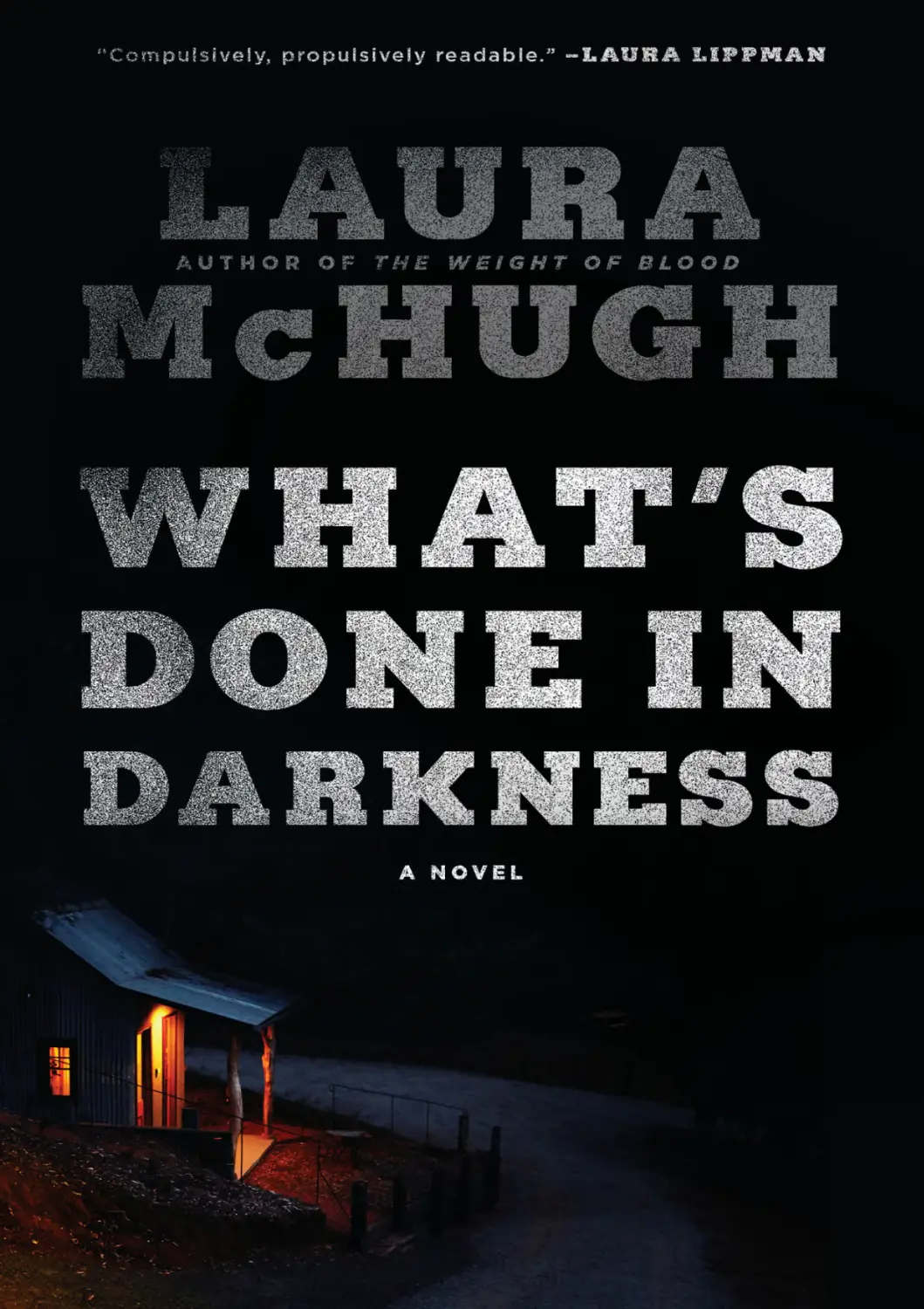
Title: What’s done in darkness: a novel / Laura McHugh.
Description: First Edition. | New York: Random House, 2021.
Identifiers: LCCN 2020036215 (print) | LCCN 2020036216 (ebook) | ISBN
9780399590313 (Hardcover) | ISBN 9780399590337 (Ebook)
Classification: LCC PS3613.C5334 W53 2021 (print) | LCC PS3613.C5334
(ebook) | DDC 813/.6—dc23
LC record available at https://lccn.loc.gov/2020036215
LC ebook record available at https://lccn.loc.gov/2020036216
Ebook ISBN 9780399590337
randomhousebooks.com
Cover design: Ella Laytham
Cover photograph: Colin Anderson/Stocksy
ep_prh_5.7.0_c0_r0
Contents
Cover
Title Page
Copyright
Sarabeth, That Day
Chapter 1: Sarah, Now
Chapter 2: Sarabeth, Then
Chapter 3: Sarah, Now
Chapter 4: Sarabeth, Then
Chapter 5: Sarah, Now
Chapter 6: Sarabeth, Then
Chapter 7: Sarah, Now
Chapter 8: Sarabeth, Then
Chapter 9: Sarah, Now
Chapter 10: Sarabeth, Then
Chapter 11: Sarah, Now
Chapter 12: Sarabeth, Then
Chapter 13: Sarah, Now
Chapter 14: Sarabeth, Then
Chapter 15: Sarah, Now
Chapter 16: Sarabeth, Then
Chapter 17: Sarah, Now
Chapter 18: Sarabeth, Then
Chapter 19: Sarah, Now
Chapter 20: Sarabeth, Then
Chapter 21: Sarah, Now
Chapter 22: Sarabeth, Then
Chapter 23: Sarah, Now
Chapter 24: Sarabeth, Then
Chapter 25: Sarah, Now
Chapter 26: Sarabeth, Then
Chapter 27: Sarah, Now
Chapter 28: Sarabeth, Then
Chapter 29: Sarah, Now
Chapter 30: Sarabeth, Then
Chapter 31: Sarah, Now
Dedication
Acknowledgments
By Laura McHugh
About the Author
SARABETH, THAT DAY
AGE 17
T
he blacktop road stretched empty in either direction, the
sky hazy and the air heavy as a sodden sponge. The heat
of the late-morning sun amplified the autumn scent of drying
cornstalks, the putrid sweetness of persimmons rotting in the
ditch. Insects swarmed the fermenting fruit, buzzing like an
unholy plague. Sarabeth brushed away a sweat bee. She had
walked the long, twisting path from the house to the roadside
stand alone, pulling a wagon with one bad wheel, her legs
sweating beneath her heavy ankle-length skirt.
Her little sister, Sylvie, sometimes worked the family’s
produce stand with her, but today she was home in bed with a
fever and a vicious sore throat. Their mother had spent the
early-morning hours praying over Sylvie and coaxing her to
swallow a concoction of garlic, cider vinegar, and honey.
Mama was piling more quilts on the bed when Sarabeth left,
aiming to sweat out the sickness, shushing Sylvie when she
cried that she was too hot. Mama said fever was nothing
compared to the fires of Hell, and maybe God liked to remind
us. She said it to Sylvie, but Sarabeth knew it was meant for
her.
She was glad to get away from the house, away from her
mother and preparations for Saturday’s dreaded birthday
dinner. Much as she hated to see Sylvie sick, she hoped her
sister’s illness might force them to cancel. She’d been
counting the days until her eighteenth birthday because her
father had promised that she could sign up for classes at the
community college, where her older brother, Eli, was studying
agriculture. She’d thought of it as her ticket out. Then, when
the course catalog she’d been waiting for finally arrived over
the summer, Mama chucked it into the trash. You’ll be too busy
taking care of your husband, she’d said.
But I don’t have a husband, Sarabeth had replied, and her
parents had exchanged measured looks. Her father cleared his
throat, a decisive rumble that swept aside all objections before
he even began to speak. The man they’d chosen for her would
be coming over for dinner on her birthday. She’d felt like
kicking and screaming but knew her father would dismiss her
as hysterical. You can’t make me, she’d whispered instead. I
won’t do it. Her mother’s eyes had gone round with shock and
then narrowed. Daddy had unbuckled his belt regretfully. He
didn’t enjoy whippings, though he felt they were necessary at
times, like when one of the children was disrespectful or
defiant. More often than not, that child was Sarabeth. Her flesh
was still tender from the last time. The belt made a hissing
sound as it slid out of the loops one by one.
She should have seen it coming. Mama had been grooming
her for this very thing for years, but she’d assumed that once
she became an adult, she could make her own decisions. She’d
move out, start a new life. She’d expected them to pressure her
to stay in the church, to continue living at home, but somehow
she hadn’t expected them to force her into an arranged
marriage against her will.
Eli was sympathetic but wouldn’t argue on her behalf. Her
best friend, Retta, couldn’t grasp why she was so upset. The
girls had been friends most of their lives because their mothers
were in a women’s prayer group together, and after her father’s
accident, Sarabeth’s family had left Church of Christ the
Redeemer to join Retta’s family at the more stringent Holy
Rock. They used to play with dolls on Saturday afternoons in
Retta’s basement while the women’s group met upstairs. Even
back then, Retta had liked to pair up the dolls and give them
weddings and babies, though she wasn’t allowed any boy
dolls. Sarabeth had cut the hair off one of the girl dolls and
stapled its skirt together between its legs to play the part of the
groom. Following the vows, Retta had laid the groom on top
of the bride, fully clothed, in a shoebox bed.
Retta had gotten engaged weeks ago, and in the time since,
she’d talked about almost nothing but marriage and her future
husband. She’d always been bubbly, her sentences punctuated
with giggles. Now she giggled while she said things like “I
wonder how Philip likes his eggs—boiled, scrambled, sunnyside up?” She’d twist her waist-length braid into elaborate
configurations on top of her head while musing how Philip
might want her to wear her hair.
Sarabeth couldn’t muster any interest in Philip’s choice of
eggs or hairstyles, even for Retta’s sake. While all the sermons
of faith and obedience and fruitfulness had effortlessly seeped
into Retta, they had sheeted right off Sarabeth. Her mother put
part of the blame on herself: They’d come late to Holy Rock,
her oldest daughter already irreparably damaged by basic
cable and public school; no amount of discipline or prayer or
physical labor had managed to reshape her imperfect soul.
Sarabeth had come to think of her time on the farm as a
sentence that she had to serve, one with an end date. Now it
seemed like she’d have to plan an escape.
She unloaded the wagon, set the cash box beneath the
folding table, and arranged what was left of the produce to
look as pleasing as possible. Most of the late-season tomatoes
had been ruined by hornworms. She dusted off the pumpkins
with the hem of her dress and sat down on the five-gallon
bucket that served as her chair. She wished she had a little
battery-powered radio, the kind their neighbor, Mr. Darling,
kept in his barn, but of course her parents wouldn’t have
allowed it. She had to settle for the ambient sounds of the
countryside: crows shrieking, cornstalks rustling, the far-off
hum of a combine reaping the fields.
There was nothing to do but wait. After a while, she got up
and walked to the edge of the road, then stepped to the chipped
yellow line at its center, turning in a circle to survey the
horizon. The fields gave way to forested ridges that faded to
blue in the distance. She wondered what would happen if she
picked a direction and started walking. How far would she
get? Would someone offer her a ride? Would she take it?
The humming grew louder—not a combine this time, but a
car, off to the west and moving closer. She tried to guess who
might be inside. Maybe it was the elderly woman from town
who would always buy a single tomato and slip Sylvie a piece
of stale candy (or, once, a fuzzy cough drop) from the bottom
of her purse. Maybe it was Jack, who’d been one of her best
friends back when she lived in town and attended Wisteria
Middle School. He and his buddies would stop sometimes, pile
out of his Jeep, rifle through the produce. They made dirty
gestures with the cucumbers and laughed at whispered jokes,
watching for her reaction while Jack channeled silent
apologies with his eyes. Jack had come alone once, not that
long ago, but she knew that wouldn’t happen again.
Sarabeth returned to her post behind the table and hiked up
her skirt to feel the breeze on her legs, wishing for the
millionth time that she could wear shorts like she used to, like
normal people did when it was hot. The vehicle popped up on
the crest of the far hill before dipping out of sight again, and
then it reappeared close enough for her to see that it was a
truck, gray or silver, or maybe beige or dirty white.
Unfamiliar. A tiny thrill sparked in her chest. It was rare to see
anyone new. Maybe they were city people, the type who
would ask whether everything was organic and then take
pictures of themselves standing in the corn to post on social
media. She wasn’t allowed to use social media—her parents
didn’t have internet access or even a computer—but Tom
Darling used to let her look at his Instagram. Tom kept his
account private, no followers, no selfies. His pictures were all
of roosters and weathervanes and spiderwebs, familiar things
that he managed to capture in unexpected ways. He had what
Mr. Darling called “an artistic eye,” though it didn’t sound like
a compliment the way he said it.
The truck rolled onto the gravel shoulder, no blinker, and
she stood up to play the role she’d been taught. Be pleasant
and helpful. Smile, but in a wholesome way that could not be
perceived as flirtatious. The smile was automatic now, even
when she felt like screaming.
The truck door opened, the engine still running, and a man
got out. He wore a baseball cap with the bill pulled down, and
with the sun behind him, it was hard to see his face, though it
looked a bit strange. She didn’t want to stare, to make him
uncomfortable if he had some sort of affliction or deformity.
“Good morning,” she said, her gaze partially lowered as he
approached. His skin appeared rubbery, melted, as though he’d
been burned in a fire. He was nearly within arm’s reach when
she realized he was wearing a mask.
It took a moment for the synapses to fire, for understanding
to flicker through the neural pathways and set off alarms. She
wondered if he meant to rob her, if she should offer him the
thin stack of bills from the cash box. It wasn’t until his gloved
hand shot out that she wheeled and ran. There was nowhere to
go but the field behind her or the long gravel road that led
home. She darted into the corn, the dry leaves clawing her
face, and felt herself wrenched backward as the man caught
hold of her dress. She screamed.
A glove clamped over her mouth and nose, the leather
reeking of sweat and sawdust. She bit, twisted, flung elbows,
choked on her own tongue. The man pressed her to his chest,
his breath seeping through her hair down to her scalp. His
hand let go for an instant to grab something from his pocket
and she cried out, the sound sharp and brief. There was a
flicker of shadows, the crows taking flight overhead, and then
nothing.
CHAPTER 1
SARAH, NOW
S
arabeth. Three syllables, hushed, like a secret whispered
in my ear, my skin prickling as though I had felt his
breath through the phone. The man was still talking, but it was
all static after Sarabeth. No one called me that anymore. It was
an old name. A dead name. I had been Sarah for nearly five
years, and those who knew my real name never had cause to
utter it, because they no longer spoke to me.
There was a pause while the man waited for me to respond.
“Hello?” he said. “Are you there?”
I pressed my free hand flat against the cool metal desktop
and tried to anchor myself in the present. My cluttered office
at the animal shelter. The brightly colored sticky notes framing
my monitor, reminding me of upcoming foster appointments.
The mournful wail of a bloodhound in the exam room down
the hall. I forced air into my constricted lungs, the stinging
scent of bleach and urine filtering in as the kennels were
sprayed down.
“I’m sorry,” I said, my voice snagging in my throat. “I
couldn’t hear you.”
“I’m Nick Farrow with the Missouri Highway Patrol,
Missing Persons Unit. I need to speak with you about your
case.”
I swallowed hard, my mouth suddenly dry. Why would the
Missouri state police be calling me now? I’d been found in
Missouri, not far from the Arkansas line, but the Clayton
County Sheriff’s Department back in Wisteria had been in
charge of the case, and after making a mess of it, they’d done
their best to bury it and move on.
“Did something happen?” I asked. “Has something new
come up?”
“Not exactly,” he said. “Not in regard to your case
specifically. But there’s a missing person case that bears some
resemblance to yours. I’d like to ask you a few questions.”
“I’m sorry,” I said. “It was a long time ago. I’ve already
given all the information I had.”
I sensed skepticism in his silence and wasn’t surprised. I
knew it was difficult to believe that I’d been held captive for
more than a week yet didn’t know who’d taken me or where
I’d been. People had their own ideas about what had happened
to Sarabeth Shepherd, the seventeen-year-old girl who’d
vanished from her family’s farm in rural Arkansas and
reappeared in a bloodstained slip along Highway 65, bound
and blindfolded, with a dubious story about how she ended up
there. I thought of that Sarabeth as a different person
altogether, the girl from the newspaper headlines.
“I understand,” Farrow said in a gentle Good Cop voice,
his tone implying I am on your side. I knew from experience
that if you didn’t give Good Cop what he wanted, it was only a
matter of time before Bad Cop stepped in. Did you run away,
Sarabeth? Did you cause these injuries yourself? Cut off your
own hair? Did you make it all up for attention?
“I still want to talk to you,” Farrow continued. “I know it’s
been a while, but some things have changed since then.”
The bloodhound’s cries grew louder as Melissa, my boss,
led him past my office toward the outdoor runs. The dog
twisted and squirmed, fighting the leash. We’d found him tied
to the fence when we arrived to open the shelter an hour ago,
his ears lumpy with ticks. It was all too common for people to
dump animals overnight, to avoid the intake fee or the
paperwork or the discomfort of looking someone in the eye
while they relinquished a pet. Last August, we’d found a litter
of twelve black kittens sealed in a plastic storage tub in the
parking lot. All but one had perished in the heat before we got
to them. Melissa named the survivor Sunny and bottle-fed her
around the clock for days, but she didn’t make it.
“What’s changed?” I asked.
“We’ve got new tools, technologically speaking,” he said.
“I’m sure you’ve seen it in the news. Software that can link
crimes. Genealogical databases that can help identify criminals
from cold cases. There’s a chance we could find the person
who took you.”
He dangled that vague possibility as though it would entice
me. I had left my old life behind on the farm, like the snakes
that shed their skins in the fields, a process necessary for
survival. A piece of me was still there in Arkansas, but I was
gone. No one in my new life knew who I was, what had
happened to me, and I wanted to keep it that way.
“You said this was about another case.”
“Yes,” he said. “A sixteen-year-old girl went missing from
a small town near the Bootheel. No trace of her since, no
sightings, nothing. I’m checking for any possible connection
to previous abductions, and I need your help. An hour of your
time.”
“Do you think she might have run away?”
There was a sound like paper shuffling. A muted sigh. I
wondered if he remembered the news coverage of my case, if
he’d been working in missing persons back then. Regardless,
he’d have read enough of the file to be aware of the lingering
suspicion that I was responsible for my own disappearance. I
wasn’t the only survivor in recent years to be accused of
pulling a real-life Gone Girl, to fail the purity test for girls
who come back alive. Sheriff Krieger had chuckled when I
said I couldn’t describe the suspect or the location because I’d
been blindfolded the entire time and kept in the dark. Is that
right, he said, his shoulders ratcheting up and down as he
laughed. Well, ain’t that convenient.
“We can’t rule it out,” Farrow said. “But no, I don’t think
she ran away.”
I stared at a neon-green Post-it: Helen, Dairy Queen, Worm
X. My most prolific volunteer would be arriving soon to get
her latest foster puppies dewormed. The Dairy Queen litter.
They’d been found in a dumpster behind the restaurant.
“What makes you think I can help?”
“She has some things in common with you, Sarabeth.”
“Sarah,” I said. “I go by Sarah now.” He knew that, no
doubt, and used my old name purposefully, in an attempt to
dredge up the past, to haul painful memories to the surface,
foul and dripping. I thought of my brothers playing at the
muddy edge of the farm pond one spring, poking hibernating
frogs to wake them. Leave them be! my little sister, Sylvie, had
piped. They’re dreaming. Sylvie wouldn’t be little like I
remembered her. She’d be sixteen now, my brothers grown
into men.
“Sarah,” he said, his voice softening. “You might have a
valuable piece of information without realizing it. Something
that could help us find her. You could bring her home.”
He stated it with conviction, as though it was a real
possibility, but he was wrong. I couldn’t save anyone. Five
years later, my own survival still seemed tenuous. I’d stopped
taking pills for anxiety and insomnia, not because I didn’t need
them anymore, but because I worried they made me less alert.
I had nightmares, the fear so visceral that I felt no relief even
when I woke in my own bed, the night-light burning brightly
enough to illuminate the familiar landscape of my bedroom.
“I wish I could help, I really do.”
“You can. All I’m asking—”
“Look, I’m at work,” I said. “It’s not a good time.”
“Wait,” he said. “Her name’s Abby Donnelly.”
“I’m sorry, I have to go.”
“Think about it,” he said. “Think about Abby. I’ll be in
touch.”
I hung up, chilled by the sweat that had dampened my skin
during the brief conversation. I didn’t know for sure whether
Farrow could compel me to talk to him, but I told myself that
he couldn’t. I pressed my palms to the desk, breathed in the
scent of disinfectant, clamped my tongue between my teeth.
You’re okay. You’re safe. Despite the rituals of reassurance, I
felt wobbly, like my bones had gone soft. I kept Sarabeth
buried as best I could, but the grave was shallow and easily
disturbed.
“Hey,” Melissa said, pushing the door open with her elbow,
an armful of crusty-eyed kittens clutched against her
substantial bosom. “I need somebody to drive a crate of baby
raccoons to the wildlife rehab. If we’re not there by five they
lose their spot.” She made kissy faces at the kittens,
murmuring baby talk. “And coccidia is spreading through the
holding room again. Think Helen’ll take another sick litter?”
I tried to wrench my attention back to where it needed to
be. Orphaned raccoons. Sick kittens. Problems I could actually
do something about.
Melissa glanced over at me and frowned, her foundation
creasing across the bridge of her nose. She was still wearing
her summer shade, a tawny beige applied liberally from
hairline to jawbone, though her neck and arms revealed the
paleness of early October. Her bleached hair was gelled back
into a banana clip, exposing the paw-print tattoo behind her
ear, and a purple fitness tracker cut into the flesh of her wrist.
The Fitbit had been a gift from her ex, a trainer who was
always nagging her about diet and exercise, and from what I
could tell, Melissa continued to wear it out of spite. Oh, look
at that, asshole! she’d mutter. Ten thousand freaking steps
before noon.
“You sick?” she asked. “You look awful.”
Melissa could be counted on to speak truthfully, if not
tactfully.
“Really? I feel fine.”
She arched an eyebrow and took a step back. “If you’re
sick, don’t spread it around.” Melissa had endless sympathy
and tolerance for sick animals but couldn’t stand to be ill
herself. She was still bitter about the time she caught swine flu
and missed both the holiday adoption rush and the end-of-year
office party.
“I’m good,” I said, almost convincingly. “Just one of those
days.”
“One of those days?” She studied my face, probably trying
to determine whether I was developing a contagious fever or
simply having a rough morning. Her expression softened.
“Why don’t you go check on the cat room,” she said. “The
volunteer didn’t show up.”
An excuse to play with the animals—Melissa’s version of
therapy. She had no formal medical training, but she had good
instincts and could sense when something wasn’t quite right,
like when a kitten was about to fade or an employee was on
the verge of a breakdown. She was a good boss, and I was
grateful that she’d taken a chance on me.
I’d shown up for my interview the same day an animal
hoarder’s house had caught fire, and intake was swamped with
cats and dogs in various states of neglect. Melissa had pulled
me into the back immediately and was impressed by my
stoicism during the onslaught of filth, wounds, and bared
teeth. I had grown up on a farm, had seen worse things.
I was nervous, at first, that someone at the shelter might
recognize me from the news, though by then more than two
years had passed since I’d been in the headlines, and I didn’t
particularly resemble the old photo that had been circulated
when I was found: teenage me at a church revival in an oldfashioned prairie dress, barefaced, sandy hair that hung all the
way to my hips. By the time I started my job, my hair had
grown out a bit from the drastic cut that had been necessary
after the uneven shearing I’d endured in captivity, but I never
let it get past my shoulders. I had dropped the extra syllable
from my first name and gotten rid of Shepherd altogether,
replacing it with my middle name.
I needn’t have worried. There were no sideways glances,
no whispers, no one telling me that I looked familiar. A few
months ago, a new vet tech named Karim had tilted his head
when I popped in for an update on a spaniel, his index finger
tapping his lips. He had the charismatic smile of a talk-show
host, and when he focused his attention on me, it gave me the
uneasy sensation of standing onstage in a blinding spotlight.
He turned his finger toward me, pointing. “Are you from the
Bootheel?” I’d frozen in place, and he mistook my fear for
confusion. “Your accent,” he said, grinning.
I shook my head, looking down at his sneakers to avoid his
smile. “Arkansas.”
“Oh, Little Rock?” I’d learned that Little Rock was the
only place in Arkansas anyone not from Arkansas had heard
of.
“No,” I said. “A small town. You wouldn’t know it.”
Karim started to reply, but I’d mumbled an excuse and
darted out. The next few times I saw him, he’d tried to engage
in friendly conversation, but I always cut it short. I was too
worried that he’d bring up Arkansas again, that he would
somehow connect invisible dots and guess my secret. He still
smiled at me, warmth and charm radiating from him like
cartoon sunbeams, but he spoke carefully now, in soft tones
and only about work, his movements slow and deliberate, as
though trying not to spook a skittish animal.
I hurried past the exam room to avoid running into Karim
or any of the other techs and let myself into the cat room.
Kitten season was still going strong thanks to the warm
weather, and most of the cages were full of adorable fluff balls
that would have no trouble getting adopted. The older cats
were a tougher sell. I knelt to check on a scrawny orange tabby
named Mr. Marmalade, who was yowling and digging at his
cage door. He was a stray from the Swan Lake trailer park,
used to roaming free. He tried to squeeze through the narrow
gap as I eased the door open, but I managed to catch him and
hoist him up, each knob of his spine protruding beneath his
fur.
“I get it,” I murmured. “It’s no fun being locked up.” He
tensed and drove his claws into my chest, ready to launch
himself out of my arms, and I hastily maneuvered him back
into his cage. “I’m sorry,” I said, clicking the latch. “I hope
you get out of here soon.”
I spotted a plump tortoiseshell kitten that reminded me of a
mama cat we’d had on the farm. Sylvie had liked to give her
milk in the fancy china saucer we’d rescued when Mama
threw out the last of our grandmother’s things. We watched the
cat birth a litter of kittens in our barn, the newborns squeaking
and trembling, eyes sealed shut, blind to the world.
I hadn’t wondered back then, but I did now—what it was
like when their eyes opened for the first time. If the light was
painful or frightening or if it felt like a miracle, like when I
emerged from days of darkness, my blindfold torn away to
reveal a pink sky over a trash-strewn highway rest stop. The
light had been soft and unbearably beautiful, and it made me
squint. I’d hoped that it was sunrise and not sunset, because I
couldn’t bear the thought of the dark returning so soon. As I
lay on the cold gravel, the sun grew brighter and brighter and
I’d thought of Pastor Rick’s sermons on the Resurrection and
figured this was as close as I’d ever get to being born again
and starting a new life. I had thought, in those first moments of
daylight, that I’d put the darkness behind me.
—
Helen swept in at eleven with a crate of freshly bathed
puppies, the air in my office filling with the luxurious scent of
her vetiver perfume. Helen’s dark corkscrew curls haloed her
face, a few threads of silver creeping in at the temples. Large
princess-cut diamonds gleamed on her earlobes. I’d begged
my mother to let me get my ears pierced when I turned
thirteen, but she’d insisted that it was a sin to defile the body
the Lord had given me.
I used to save the good jewelry for special occasions, just
like my mother did, Helen had told me once when she caught
me admiring the earrings. But now I figure waking up in the
morning is reason enough. She’d squeezed my arm and
laughed warmly.
Helen might have looked more glamorous than the typical
shelter volunteer, but her appearance didn’t get in the way of
her work. She was the one we turned to for the most
challenging cases. Helen would take the paralyzed terrier
whose bladder and bowels had to be manually expressed; the
Lab with such severe separation anxiety that he would tear
apart any closed door. Helen could handle the ringworm cases,
the amputees, the cats that needed Baytril injections or
ointment that had to be applied directly to the eye.
“Aren’t they just darling?” she said, reaching into the crate
to extract a sleek black pup not much bigger than her hand.
“Yes,” I said, stroking the smooth fur, noting the cushion of
fat beneath. “Much better shape than when they came in. So
what theme did you decide on?”
“Greek mythology,” Helen said, rising to add their names
to the list on the whiteboard. Dairy Queen litter: Ares,
Artemis, Athena, Persephone, Zeus, Apollo.
“I considered dairy-inspired names, given their
provenance, but I didn’t get very far down that road.” She
snapped the cap back on the marker. “Nothing wrong with
being aspirational.”
I eyed the running totals on the board. “You’re beating
Dave and Evelyn,” I said. “You’re a lock for most fosters
again this year.”
Helen smiled, perfect veneers gleaming. “Oh, it’s not a
competition, is it?”
“Evelyn thinks it is.”
She laughed. “Just give her the plaque. I don’t have room
on my wall for another one.”
That wasn’t true. I had seen bits of Helen’s home in the
photos she posted on the foster page, and from what I could
tell, she was not lacking in space. She bathed dogs in an
enormous farmhouse sink in an airy kitchen with endless,
uncluttered marble countertops. Cats lounged in a vaulted
sunroom filled with potted citrus trees and an elaborate
network of kitty condos. The buff leather interior of her
Mercedes appeared spotless in pictures despite numerous posts
about animals having accidents in the car when she took them
home. Poor Oscar had a rough ride—how can such a tiny
angel throw up so much?—but now he’s clean and dry and
napping by the fire! I envied the animals sometimes—what it
must be like to have Helen caring for them, their surroundings
safe and serene, any messes promptly tidied up and forgiven.
“So what’s new with you?” Helen asked as I got out the
Worm X, her brown eyes wide. She always asked how I was
doing, if I had fun plans for the weekend, always listened
attentively to my underwhelming responses, which were
usually “fine” and “no.” On the rare occasions that I revealed
something mildly personal, like a visit to the botanical gardens
for the orchid show, she would say “Oh, tell me more.” Helen
was the closest thing I had to a friend, though I would have
been embarrassed for her to know that.
The closeness was illusory. She texted me every day, but it
was mostly to share pictures and updates on her fosters. I
knew a lot about her, but nothing terribly personal. If I wrote it
all down, it would read like a breezy celebrity profile. She
liked Louis Vuitton bags, the bigger the better, and had a
weakness for peanut butter M&Ms. She was divorced, retired
from some sort of executive position, and was now involved in
philanthropy, serving on various boards and attending
countless charity galas.
“What’s new with me?” I did my best to smother Nick
Farrow’s voice in my head, to ignore the memories flaring up
like an outbreak of hives. I squirted Worm X into the puppies’
mouths, one after another. “Nothing, really.”
Helen tilted her head, concern welling in her eyes. “Are
you all right?”
I stared at her, my skin itching, and wondered if my
thoughts really had manifested in a rash, too virulent for my
body to suppress them.
She touched her clavicle, pointed to mine with a long,
lacquered fingernail. I’d never seen her without an impeccable
manicure, each nail filed into the shape of a tiny coffin.
“You’re bleeding,” Helen said.
I dabbed at the threads of dried blood where Mr.
Marmalade had clawed me. The punctures were tender to the
touch. “Oh—it’s nothing. I’m fine.” I forced a smile for her.
“Just a stray who wanted out of his cage.”
Helen immediately produced a wet wipe and a tube of
antibiotic ointment from her massive purse. “The poor thing,”
she murmured, shaking her head. “It’s traumatic, being locked
up, don’t you imagine? The stress and the fear. Changes a
creature, makes them do things they wouldn’t do in ordinary
circumstances.”
I couldn’t argue.
—
The sun blazed in the rearview mirror as I drove home on a
back road along pastures and cornfields. It felt deceptively like
the countryside, even if the silhouettes of outlet malls and
stadiums loomed in the distance. St. Agnes, with its quaint
brick streets and farmers markets, was less than twenty
minutes from downtown St. Louis. My neighborhood was
nestled on the west bank of the Missouri River, rows of small
but cozy Depression-era bungalows with covered porches and
shade trees.
My house was nearly identical to those tucked on either
side of it, except for the thicket of lilac bushes that kept it
hidden from the street. I liked the feeling of being surrounded
by people while remaining invisible. I’d bought the place with
a settlement from the Clayton County Sheriff’s Department,
which had treated me like a criminal from the beginning,
spreading baseless claims to the media that I’d faked my own
abduction. Meanwhile, they lost the one piece of evidence that
might have proven them wrong. I hadn’t wanted the lawsuit,
fearing it would only draw more attention, but the counselor
and the lawyer from the Midwest Victims Advocacy Network
had explained that it was in my best interest, given my limited
options and resources. They’d gotten me out of Arkansas and
into a temporary shelter, but I had no diploma, no job
experience aside from working on the farm, no one to provide
references or co-sign for a loan.
I’d spent most of my first two years in St. Agnes holed up
in the house taking online courses, earning my GED (as it
turned out, my homeschool certificate had not been legitimate)
and an associate’s degree, and learning how to do normal adult
things like drive a car and manage a bank account. After I
graduated, Casey, my counselor, had gently suggested that it
might be time to integrate myself into society—meet people,
make friends, get a job—not just because the settlement
money wouldn’t last forever, but because if I continued to
confine myself inside my own four walls, wasn’t I in a sense
still trapped? For years on my family’s farm, and then later in
that dark room, I had longed to be out in the world, living free,
but when given the chance, I’d voluntarily imprisoned myself.
There’s no one holding you back now, Casey had said, except
you.
My foster dog, Gypsy, a 120-pound mastiff, whined and
clawed at her crate when I walked in. I let her out into the
backyard and she ran the perimeter, sniffing along the privacy
fence, trampling what remained of the late-blooming zinnias in
the flower beds. She had arrived at the shelter with jagged
pink scars across her face, a milky eye, and a wariness of men,
but given time to warm up, she’d proven loyal and sweet. In
the three months I’d had her, no one had shown any interest in
adopting her. Her appearance was intimidating, the lingering
evidence of her secret trauma scaring people away. Her scars
didn’t bother me. I didn’t mind when people saw us coming
and cut a wide berth. I felt safer with her around.
The sun fell below the fence and the warmth vanished with
it. It would be harvest time back on the farm, the fields
glowing gold in the slanted light. I whistled for Gypsy to come
inside, and she lay with her head on my feet while I ate dinner
and watched TV. When it was time for bed, she curled up in
her crate and I began my nightly ritual, walking through the
house room by room, peering into closets and behind curtains,
turning off lights, checking each door and window to make
sure it was securely locked. The white walls were splotched
here and there with various shades of green paint from
seafoam to teal, as though the previous owners couldn’t decide
which color they liked best and gave up. The realtor had
breezily remarked that it would be easy to paint over, but I
hadn’t bothered. In the years that I’d lived here, the only
things I’d hung on the wall were a Humane Society calendar
from work and a chalkboard that I’d thought I would write
things on but never did. It remained a pristine black void, like
a window looking out on a perpetually starless night.
There were no framed pictures, no family photographs. For
the last several years that I lived at home, my family hadn’t
owned a camera. My mother insisted that photographs were
vain and unnecessary. To my knowledge, not a single picture
of my whole family—my three brothers, my sister, Sylvie, our
parents, and me—existed. I had a photo of Sylvie holding a
chicken at the Darlings’ farm when we were helping to gather
eggs. Tom Darling had taken it with his grandmother’s
Polaroid, and I kept the picture in a small album in my
nightstand, not daring to expose it to light, lest it fade.
I climbed into bed with my laptop and, in the safety of my
room, allowed myself to think about Farrow and the things he
had said. I avoided the news as much as possible, because it
tended to make me feel anxious and overwhelmed, so I hadn’t
heard anything about the missing girl he had mentioned. I
googled “Abby Donnelly Missouri,” trying different spellings
of the first and last names, and when nothing relevant came
up, I typed “Abby missing.” The top hits were for Abby
Hernandez, who had been held captive for nine months before
being released and leading police to her captor. The further I
scrolled, the more missing Abbys came up. Too many. But no
Abby Donnelly.
I put the laptop away and took the photo album from my
nightstand drawer. The picture of Sylvie was on the first page.
My sister’s long hair streamed loosely over her shoulder, dark
gold like molasses, hazel eyes squinting in the light, sunburn
pinking her cheeks and nose. Her mouth wide with laughter. I
tried to remember the sound of her laugh and couldn’t be sure
that I had it right.
I flipped through the rest of the pages, all of them blank,
until I found the envelope I’d stashed near the back,
postmarked Wisteria, Arkansas, the address penned in my
mother’s handwriting. I unfolded the single sheet of notebook
paper inside.
Dear Sarabeth,
Your sister Sylvia is engaged to be married, and it is
her wish to invite you to the wedding, to have her
family join together in celebrating this blessed
occasion.
I’d read the letter over and over in the days since I’d
received it, and each time my heart withered at the thought of
Sylvie getting married at sixteen. I’d thought I would bring her
to live with me someday, that I could rescue her, like I had
been rescued. Give her a chance to live her own life. Now I
was too late.
I’d wished so many times that I could call her, talk to her,
but our parents had gotten rid of the phone after I left. Too
many reporters calling. I wrote to them, but news from home
was rare and filtered through Mama, like the letter about the
engagement. We are overjoyed by the path God has chosen for
your sister. Of course Mama was overjoyed, but what about
Sylvie?
I blamed myself. Maybe if I had stayed and gotten married,
they wouldn’t be forcing this on her so soon. No way I could
sit in the audience at my sister’s wedding without screaming
objections and trying to drag her out of the church. I hadn’t
written back yet, hadn’t decided what I was going to do.
I returned the letter to its hiding place, put the album back
in the drawer, and switched off the lamp. No nightmares, I
whispered to myself. No nightmares, no nightmares, no
nightmares. I kept a night-light burning, just bright enough to
reveal the outlines of my dresser, chair, and bookcase, so that
I’d immediately know where I was if I woke up in the night. I
wasn’t afraid of the dark after what had happened. It wasn’t
the dark itself that threatened but the things hidden beneath its
shroud, and some of those things moved just as easily in
daylight.
CHAPTER 2
SARABETH, THEN
AGE 14
“I
made this for you.” Mama stepped into the bedroom I
shared with Sylvie and handed me a booklet covered
with flowered shelf paper. I opened it, noting the care she’d
taken with the booklet’s construction, how she’d folded the
sticky paper into sharp points at each corner and pasted a piece
of sturdy white paper inside the front cover. My name was
printed there in ballpoint pen. Sarabeth Shepherd.
The first page was filled with Mama’s slanted handwriting.
When I was younger, I’d watch her write out our weekly chore
chart and imagine that her slanted words were in a hurry,
hunched forward and walking purposefully, perhaps into a
strong wind. In the booklet, each line was perfectly spaced, as
though she’d placed a ruler beneath her pen as she wrote.
GUIDE FOR GODLY GIRLS
1. Daddy is the head of our household, and we will be
obedient and mindful of his headship at all times.
2. We will dress modestly and appropriately. Clothing must
provide proper coverage and not cling to the flesh.
3. We will wear our hair long and abstain from cutting it. 1
Corinthians 11:15: “But if a woman have long hair, it is a
glory to her: for her hair is given her for a covering.”
4. We will learn and practice the womanly arts of the home,
including cooking, sewing, cleaning, and childcare.
5. We will avoid unwholesome and unhealthy influences and
activities in all forms.
I flipped through, wondering if the entire book was filled
with rules, more than I’d be able to remember, let alone obey,
but most of the pages were blank.
“You can use it to take notes in Bible study, write down
prayers,” she said. “You know, like a journal. I made one for
Sylvie, too.”
“Thank you,” I said. I knew she had put a lot of effort into
trying to make it pretty, though I wasn’t sure why. Daddy was
always preaching about the beauty of keeping things plain and
simple, probably because we couldn’t afford anything fancy or
store-bought since he’d quit his job as a traveling salesman.
I’d been using a spiral-bound notebook for Sunday school, my
Bible study notes consisting mainly of doodles, expanding
geometric patterns like Eli and I used to make with the
Spirograph before Mama donated it, along with most of the
other toys, to the Salvation Army. I wouldn’t dare put my
prayers down on paper, because I didn’t doubt that my mother
would open up the little book and read them. Dear God, please
let us move back to town.
“I know you miss your friends from school,” she said,
squeezing my arm. “There have been lots of changes. But
you’ll understand one day, this is all for the best.” Her skin
was flushed with the excitement of her conviction, belief
humming through her like an electric current. I felt the energy
through the sleeve of my dress where her fingers gripped my
flesh.
“Yes, ma’am,” I said.
She nodded and released me, satisfied with my response.
When she left, I placed the booklet next to my Bible on the
otherwise-empty shelf. Mama had cleared out my Little House
books after deciding that Laura Ingalls, despite her long hair
and dresses, was impertinent, and then came back to confiscate
the Chronicles of Narnia, which she had recently realized were
fantasy books, despite my insistence that C. S. Lewis was a
Christian author.
Three months after moving to the farm, the slant-ceilinged
room still felt barren, uninviting. Two twin beds for me and
Sylvie, each neatly made with plain white sheets and yellow
polyester blankets. A shared dresser that had come with the
house, the musty drawers holding our socks and underwear
and the long dresses Mama had sewn for us, plus one that I’d
sewn myself, the pleats of the skirt gathered incorrectly, the
hem wildly uneven. The plank floor was covered with a
homemade rag rug. In our old house, in town, my bedroom
had baby-blue shag carpeting and puffy valances that looked
like clouds, and my bookshelf had been packed tight with
library books and board games.
We had been a fairly normal family. Mama was the
religious one, a preacher’s daughter. She stayed home with us
while Daddy worked. We went to church and Sunday school
and Bible study and Bible camp, but so did most everyone else
we knew. I was in seventh grade at Wisteria Middle School
when Daddy got into a terrible accident on the way home from
his route, his sedan pleated up like an accordion between two
semis, trapping him but miraculously leaving just enough
room for him to survive. He blacked out and woke to flames,
which he thought were the fires of Hell, and by the time the
firemen cut him out of the car and whisked him into an
ambulance, he’d had an epiphany.
He was a sinner, he said—he had actually lined us up on
the couch, even the younger kids, and confessed, to our great
discomfort and confusion, to lustful thoughts about a truckstop waitress in Fayetteville—but God had saved him for some
reason. It became clear to him, upon deep prayer and
reflection, that he had been given a second chance at life for
the sake of his family. He would rededicate himself to the
Lord and do everything he could to protect us from the evils of
the world and ensure that our souls were saved, so the next
time flames rose up and he was plucked from this earthly life,
it would be by God’s hand, and not the Devil’s pitchfork.
It seemed a bit extreme, and it made me wonder if Daddy
had done more than fantasize about the waitress, if it was
Mama rather than God who had forced his epiphany.
He sold our house in town and bought a small farm, where
we could live simply and raise modest crops to survive. We
joined Holy Rock, the church Retta’s family belonged to, and
Mama started homeschooling us. She replaced all my pants
and Sylvie’s with long skirts and dresses. The boys got to keep
their sneakers, but when they wore out, they’d be replaced
with ugly brown work boots.
In the beginning, it almost felt like an adventure, playing at
being pioneers, like the Ingalls family in my Little House
books. The novelty wore off quickly, like cheap varnish. I
missed my school friends, the roller rink, sleepovers. I even
missed things that had annoyed me before, like grocery
shopping. I remembered sitting in the car one day after school
while Mama ran into the Price Chopper for milk and cereal,
hunched down in the seat so no one would see me at the
cheaper of Wisteria’s two grocery stores. I’d flipped between
radio stations, wishing she’d hurry up, thinking that I couldn’t
possibly be more bored. Now I would have given anything to
go to the store and run into someone I knew, to buy a box of
Froot Loops and listen to the radio, to be surrounded by
familiar comforts and feel like I was part of the outside world.
At times the hunger for my old life flared into a desperate
animal need to escape, and one night I had snuck out to see if I
could walk to town, but it was so dark and we were so far from
anything that I finally gave up and turned around.
“Hey.” Eli leaned into the room, holding on to the
doorframe. Mama had buzzed his hair too short the night
before and it looked funny, his exposed scalp paler than his
face, but that sort of thing didn’t bother him. “Daddy said to
go over to the Darlings and help with the walnuts.”
We’d bought our land from Mr. and Mrs. Darling, whose
son had owned it before he died. Their much larger farm
bordered ours, and they were teaching us all the things we
didn’t know about homesteading, which was pretty much
everything. They had loaned us equipment, helped with
repairs, brought us food under the guise of Mrs. Darling
getting overly ambitious with her canning. Daddy didn’t like
to accept charity or feel indebted to anyone, so he’d made a
standing offer to help out whenever they needed an extra set of
hands.
Mr. and Mrs. Darling would invite us over for a few simple
chores and then find excuses for Eli and me to hang around. I
had the feeling they did it for Tom, their grandson. He was two
years younger than Eli and a year older than me, and he’d
moved in with his grandparents after his father’s arms were
severed in a hay baler. Tom told us that his dad had survived
the accident but later drowned himself in the pond because he
didn’t want to live without arms, unable to drive a tractor or
manage livestock or do any of the things a farmer needs to do.
Mr. Darling had said his son died from complications after the
accident, not that he’d killed himself. I didn’t know which
version of the story was true.
Eli and I walked up the Darlings’ gravel drive. Their
farmhouse was nicer and prettier than ours, with a wide front
porch and bay windows, the barn red with white trim and a
weathervane on top, like something out of a picture book.
Zinnias and sweet peas filled the flower beds on either side of
the steps. Mrs. Darling liked to pick them and put bouquets in
old pickle jars and perfume bottles all around the house, even
in the bathroom. The more you cut them, she had told me, the
more they bloom.
Tom was sitting on the steps waiting when we walked up.
He swiped his wheat-colored hair away from his forehead and
stood up to greet us, his gangly frame unfolding like the
jointed paper skeleton we used to hang on our front door back
when we still celebrated Halloween.
“Hey,” he said, grinning, his head swiveling back and forth
from me to Eli. “Grampa said we can take the Gator.”
Tom had told us he knew how to operate every bit of
machinery on the farm, including the combine and loader, but
since the baler accident, the Gator was the only thing Mr.
Darling would let him use. It resembled a golf cart, and while
riding around the farm with Tom wasn’t exactly like cruising
the Wisteria strip with friends, it was as close as Eli and I
would get.
We parked in a grove of walnut trees that bordered the
pond. Knee-high weeds and sticker bushes grew unchecked all
the way to the water’s edge. “Watch out,” Tom said. “It’s hard
to see the nuts in the grass. They’ll roll your ankle if you step
on ’em wrong.”
I found one with my foot and picked it up, the rotted husk
falling away from the shell, its odor pungent but not
unpleasant.
“You guys didn’t bring gloves?” Tom asked.
We shook our heads.
“Here,” he said, handing me the pair he’d brought for
himself. “Walnuts’ll stain your hands worse than shoe polish.”
“What about you?” I asked.
He shrugged. “Won’t bother me none. Usually we get ’em
in the fall, when the husks are still green. Grampa cracks ’em
and Gramma puts ’em in her Christmas fudge. But we didn’t
get around to it last year.”
I wondered if that was because of the pond, if Mr. and Mrs.
Darling couldn’t bear to go near the place where their son had
drowned, assuming Tom’s version of the story was true. It
would be hard to have that reminder of death so close to home.
Tom kept his back to the pond as we worked, collecting the
walnuts in a five-gallon bucket. He talked nonstop, like he’d
been saving up things to say for a long time and didn’t have
anyone else to tell them to—and maybe he didn’t. We’d
figured out that we knew some of the same kids from town,
but if he had friends other than Eli and me, he never
mentioned them.
Tom stopped talking long enough to rub sweat off his face,
leaving a dark smear across his forehead like a bruise, his nails
stained black. “You guys wanna get some sodas?”
Eli hesitated, but I was already stripping off my gloves.
“Sure,” I said. “Thank you.” Sodas were another relic of our
past, though I wasn’t certain if they’d been banished out of a
general sense of austerity or if sugar and caffeine had crowded
onto the list of sins.
We took the Gator back to the house and went in through
the kitchen door. The boys scrubbed their hands and then Tom
got Cokes out of the fridge. There were bouquets of flowers on
the table, the windowsill, and the sideboard, where a green
spider had strung a dainty web between a sweet pea blossom
and the handle of a teacup.
“Gramma,” Tom called into the sitting room. “The
Shepherd kids are here.”
There was creaking and shuffling as Mrs. Darling got up
from her armchair and hobbled in. She wore a housedress with
an embroidered apron over the top. “Sorry it took me a minute
to say a proper hello,” she said, rubbing her swollen knuckles.
“Must’ve nodded off watching my stories.” She glanced at the
sweating red can in Eli’s hand, and I instinctively moved to
hide mine in the folds of my skirt, worried that she would
snatch it away, that our mother had told her we weren’t
allowed.
“Tommy, are there any cookies left to put out for our
guests?”
“No, ma’am,” he said, his ears reddening.
She shook her head apologetically. “My arthritis has been
acting up,” she said. “Haven’t been able to keep up with the
baking. I swear we go through a loaf of bread and a dozen
cookies a day.”
Eli nudged his elbow into my arm. “Sarabeth is a great
baker,” he said. “If you’re needing some help.” I jabbed back
at him. Since we no longer had the luxury of going to the store
for a loaf of Wonder Bread, our mother had enlisted me to help
with the baking, a dull and endless chore that meant hours in a
sweltering kitchen under her constant scrutiny.
“Is that so?” Mrs. Darling asked.
Eli pressed his cold Coke against my back. I turned my
head just enough to glare at him inconspicuously. He widened
his eyes, dug the Coke into my kidney. Smiled. Put the can to
his lips and took a long, blissful sip.
I got the message. There were more Cokes in the fridge, a
whole row. I had seen them. Chocolate milk, too. And little
cups of Swiss Miss butterscotch pudding like the ones Mama
used to pack in our lunches in grade school. From the living
room came the familiar strains of The Young and the Restless
theme. Our grandma had watched it religiously. You could
almost imagine, in the Darlings’ kitchen, that life went on as
before, that we were normal kids who could do normal things.
I turned back to Mrs. Darling.
“I do love to bake,” I said in my sweetest, most virtuous
voice. “I’d be happy to help out, if you’d like.”
Our father would not say no. He had deemed the Darlings
Good Christian People, even if they did have a television, and
he’d do almost anything to repay their compassion and
generosity. I’d bake for them every day if it meant spending
time in their kitchen instead of ours, drinking soda and
listening to the TV, surrounded by reminders of the outside
world, and, best of all, no one standing over me, lecturing me
on all my failures, practical, spiritual, and otherwise.
Mrs. Darling’s soft face spread into a smile, and her liverspotted hand reached out to touch my cheek. “Oh, my child,
you are an angel.”
Tom beamed at Eli and me, his mouth stretched wide,
showing all his teeth.
CHAPTER 3
SARAH, NOW
G
ypsy and I had the riverfront trail to ourselves in the
early-morning hours before work. I walked with the
leash on my wrist, phone in one hand, Mace in the other. Fog
hung low over the river as the sun rose through the trees to
reveal a network of dew-spangled spiderwebs connecting the
branches. The dampness seeped into my clothing and turned
my skin clammy. Near the bridge, Gypsy pulled me to the
edge of the trail, where the earth had begun to give way in
muddy sloughs, sniffing at something I couldn’t see. Down
below, the brown water swirled and eddied along the bank,
sucking debris into foaming whirlpools.
We were nearly home when I spied a black SUV parked in
front of my house. The neighbor’s teenage daughter had an
endless stream of friends picking her up at the curb now that
they were old enough to drive, but most of them drove beater
cars plastered with bumper stickers, music blaring.
As we got closer, I noted details, just in case. Chevy Tahoe,
tinted windows, scratch on the right rear bumper. I was
considering snapping a picture of the license plate when
Gypsy began to growl, and as I turned to see what she was
growling at, a man in a black jacket emerged from the
walkway between the lilacs. I had rehearsed this scenario in
my head a thousand times, determined it wouldn’t play out
like it did in my nightmares, yet I stood paralyzed. Gypsy
lunged, yanking the slack out of the leash and knocking the
Mace and the phone from my hands. I scurried backward,
dragging her with me, a scream rising in my throat.
“Sarah?” the man said. “It’s Nick Farrow. I’m sorry—I
didn’t mean to startle you. I was just checking to see if you
were home.” He held up an ID. “We spoke on the phone?”
I steadied myself, my chest heaving, trying to catch my
breath. I told Gypsy to sit. A growl simmered in her throat, but
she obeyed. I examined the ID closely enough to be sure it was
real, compared the picture to the face in front of me. Over the
phone, I’d imagined him grizzled and paunchy like Sheriff
Krieger, but Farrow was closer to my age, maybe late
twenties, with the athletic bearing of a runner, all long limbs
and energy. He had dark hair and greenish eyes and an
apologetic half smile that might have been endearing if he
hadn’t just popped out of the bushes and scared the crap out of
me. He probably used the same expression on girls at bars and
had a bit of luck.
He bent down to retrieve my Mace and phone and gave
them back to me. “Hey, there,” he said to Gypsy, extending a
hand for her to sniff.
“She doesn’t like men.” The words were barely out of my
mouth before Gypsy went for his hand, but instead of biting,
she tentatively licked him.
Farrow smiled at me, a dimple piercing his cheek. I didn’t
smile back. We both knew he hadn’t come to make friends.
“You can’t just show up at my house,” I said. “I haven’t
done anything.”
“Of course,” he said. “I apologize. I was in the area, so I
thought I’d check in. See if you’d had a chance to consider my
request.” He took a square of paper from his pocket, unfolded
it, and handed it to me. “This is Abby,” he said.
The girl looked younger than sixteen, small and bird
boned, though maybe the picture wasn’t recent. She wore a
baggy white polo shirt and long navy skirt, her expression
blank, mouth clamped shut, hair forced into a tight bun. The
photo was poorly lit and slightly out of focus, not the sort of
image parents usually chose to represent a missing child.
Handwritten notes at the bottom stated that she had brown
hair, brown eyes, no identifying marks.
“I tried to look her up,” I said. “I couldn’t find anything.”
“Not every missing kid makes the news,” he said. “As I’m
sure you know. Some cases attract more media attention than
others.” He scanned the street, turned back to me. “Do you
have time to sit and talk for a minute? We could go to the
coffee shop down the block, if you’d be more comfortable.”
“Here’s fine,” I said. “But it has to be quick, I have to get
ready for work.”
He followed me through the lilac hedge and we sat on the
steps. Gypsy busied herself slurping all the water out of the
birdbath.
“I thought of you when I started looking for Abby,” he
said. “I remembered seeing you in the paper.”
“Yeah. You said on the phone that she’s like me. What did
you mean by that?”
“Well, on the surface, there are quite a few similarities.
She’s from a rural area, like you, a few hours from Wisteria.
Similar age at the time of disappearance. She’s homeschooled,
family’s deeply religious.”
“You said before that you were sure she was taken, even
though you couldn’t rule out the possibility that she ran away.
What makes you think so?”
He crossed his arms over his chest. His jacket bunched,
and I wondered if he had a gun concealed beneath it.
“Her parents thought she left on her own because they’d
been arguing over her behavior. She didn’t want to follow their
rules. They said she’d always been a difficult kid. Rebellious.
But she’s not equipped to manage on her own. No street
smarts. No money. No ID. No phone.”
“And? That’s
unprepared?”
it?
You
think
nobody
runs
away
He eyed me carefully. “She has other family out there.
People she could have turned to. She hasn’t been in contact
with anyone. I think if she took off on her own, she would
have gone to someone who could help her.”
“And you really think it could be the same guy, the one
who took me?”
“Yes. I think it’s a possibility.”
“Even though it’s been five years?” It was one of the things
the sheriff had mentioned in the paper, casting doubt on my
story. There would be other abductions. A guy who could do
something like this and get away with it, it wouldn’t be his first
time or his last. There’d be others and we haven’t seen any
indication that there are. My parents hadn’t brought any
newspapers into the house, though I’d read some of the articles
later, online. Have you ever seen anything like that, where
somebody was kidnapped and let go a week later? Sheriff
Krieger had said. In thirty-odd years of law enforcement, I can
tell you that I haven’t. Doesn’t pass the smell test, does it?
“Sheriff Krieger said…” I stopped myself, not wanting to
give voice to his other concerns.
“Sheriff Krieger isn’t what I would call an expert,” he said.
A jab at the sheriff. Nice touch. Nick Farrow had clearly
mastered the art of Good Cop. “There are plenty of reasons
why you wouldn’t see a person committing other crimes for a
period of time,” he continued. “The most obvious, they move
away, get sick or die, go to prison for something else. It’s
possible he might have needed some time to regroup, or he
was trying not to do it again. Or, how about this: What if it
hasn’t been five years? Maybe there were other disappearances
that didn’t get reported, or maybe they were reported but no
one noticed a pattern. Maybe he’s still taking girls, but he’s not
letting them go.”
Something flickered in my chest, and I tamped it down.
Farrow was merely speculating. He had no proof of anything.
“The way you were interrogated…I know it must have
been difficult. Your account was—”
“Unbelievable. That’s what they called it.” Over and over,
throughout hours of questioning in which my answers were
twisted and picked apart. There were accusations and
insinuations, a palpable disbelief of my version of events,
despite the marks on my body and the ghoulish,
unrecognizable reflection I saw in the bathroom mirror at the
station. By the end, the thing I wanted most was to get out of
there, away from them. It didn’t matter anymore what my
story was or whether they believed it.
“That’s not what I was going to say.”
Gypsy flopped down on the ground at my feet, her
dripping snout resting on my shoe, her eyes on Farrow.
“Sarah,” he said. “I believe you. And I believe that you can
help me—that you can help Abby. I know this can’t be easy
for you, but all I want is to hear your story from you, not
filtered through Sheriff Krieger or a tabloid reporter or anyone
else. That’s all. What do you think?”
“It’s not that I don’t want to help, but…if you believe me,
if you’ve been through the file, you know I don’t have any
idea who did this. I never saw his face, never saw where he
took me. I was blindfolded and kept in the dark the entire time.
That’s the truth. I told the detectives everything, and it didn’t
do any good.”
“Their minds were made up from the start. They could
have missed crucial details. You might remember something
that didn’t seem significant then but could make all the
difference now.”
I fidgeted with the piece of paper, a flimsy and inadequate
stand-in for a flesh-and-blood girl. My fingernails carved a
frame around Abby’s face. She was a phantom made of ink. I
could cover her with my palm and she would cease to exist.
“Look, you don’t know me. I know I’m asking a lot when I
ask you to trust me. I don’t blame you for not wanting to
revisit a horribly traumatic experience. But the person who did
this to you might still be out there, preying on other girls. I
want to find him and put him away, and I’ll do whatever it
takes. Even if I’m wrong and there’s no connection, I promise
that I’ll do everything I can to resolve your case, too, whether
you decide to help me or not. You didn’t have anyone fighting
for you then, but you do now. And I know you’d want the
same for Abby, for her to have all the help she can get.”
He was good at this. Passionate, persuasive, sincere. If
he’d been running for office, I would have voted for him. I
refolded the paper so I wouldn’t have to look at Abby’s face.
She was sixteen. Sylvie’s age. “I have to get ready for work.”
He turned to look at me dead-on. “Abby’s been missing for
twenty-four days. Sixteen more days than you. She could be
running out of time. Or maybe she already has. Either way, I
need to find her. All I want is to talk to you. Ask a few
questions. Fill in some gaps.”
He didn’t accuse me of being selfish or cowardly, not in so
many words. He was more subtle than Sheriff Krieger. He
remained calm, his voice steady, his hands perfectly still, but
as he held my gaze, his eyes revealed something else.
Desperation. How many dead ends had he reached to wind up
here with me? What mental contortions had been necessary to
convince himself that I possessed a hidden key, that if I would
just talk to him, he’d be able to unlock the mystery?
I tried to believe, for a moment, that he was right, that I
could help find this missing girl. What would happen if I
exhumed Sarabeth, crawled back inside her skin? The
interview room at the station in Wisteria flashed into my mind.
The fluorescent lights, the orange plastic chairs, the sickening
smell of Sheriff Krieger’s wintergreen chewing tobacco. My
throat constricted, threatening to choke me. I reminded myself
that I was safe, that I was not the one trapped in the dark. I
clamped my hands onto the edge of the concrete step, drew in
a breath for four counts, held it another four, blew it out.
“I’m sorry, I don’t think I can.”
He tried to keep the disappointment from showing on his
face. Or maybe it was anger. “I get it,” he said. “I do.” He
handed me a card with his phone number. “But please, at least
think about it. Sleep on it. Call me if you change your mind?”
“Sure.” The word wisped out, a ghost on my lips, already
threatening to haunt me. I wished I’d said no and been done
with it.
The girl’s face loomed in my mind as I showered and
dressed. I hoped that she was okay, that Farrow was wrong and
she was fine, because there was nothing I could do to help her.
I didn’t want to relive my abduction. Just talking to Farrow for
a few minutes had stirred everything up, and it felt like a
swarm of ants were chittering beneath my skin. I wished that I
hadn’t sworn off my anxiety pills, or that I’d at least been
smart enough to save an emergency stash for something like
this. I wanted to forget about Abby. I didn’t want to think of
her chained in that dark hole for twenty-four days. It was hard
enough living with Sarabeth’s ghost. I didn’t need Abby
Donnelly’s moving into my head with her.
CHAPTER 4
SARABETH, THEN
AGE 14
T
hursday became my favorite day, the day I baked for the
Darlings. I’d arrive after breakfast, the kitchen smelling
of bacon grease, coffee percolating on the stove. Mr. Darling
would take a few minutes to chat with me about the calves or
the weather before heading back out to the barn, while Mrs.
Darling cleaned the cast iron skillet and put away the breakfast
dishes. Mrs. Darling would then retire to the sitting room with
her Daily Guideposts devotional, turn on the TV, and drift into
a late-morning nap until The Young and the Restless came on.
When Tom was done with his chores, he’d sit at the
kitchen table with a stack of workbooks he was supposed to
complete so he wouldn’t fall behind over the summer like he
had the year before. He spent more time talking than working.
He confided that he’d failed nearly every subject after his dad
died, and he’d had to repeat eighth grade while his friends
moved on to high school and left him behind. I could
sympathize. I hated thinking of my old friends together,
without me, at Wisteria High.
The last Thursday in August, Tom was waiting for me at
the kitchen table, his arm buried up to the elbow in a box of
Cap’n Crunch. “I’m supposed to tell you sorry, Gramma forgot
to let you know they’d be gone.” He extracted a handful of
cereal, yellow sugar dust clinging to his skin.
“Gone?”
“They go to Springfield the last Thursday of the month to
see Gramma’s cousin in the nursing home. After that, they eat
lunch and go to Sam’s Club and the craft store and sometimes
Gramma’s arthritis doctor. They won’t be back till
suppertime.”
“Oh,” I said, trying not to sound disappointed. “I guess I
should go.”
“What?” he said. “Why?”
I was thinking that my parents wouldn’t want me hanging
around with a boy all day, unsupervised, even if it was Tom
Darling, but that obviously hadn’t occurred to him, and maybe
it hadn’t occurred to Mr. and Mrs. Darling either.
“Did your grandma say anything? Did she still want me to
work today?”
“Yeah. She asked if you could do half the oatmeal cookies
with raisins, half without.”
“Sure, whatever you want.” I opened the cabinet to get out
the flour and sugar.
“I already finished my chores,” Tom said, grinning. His
teeth were too big for his mouth, his lips barely able to close
over them. “I can help you with the baking, and then we’ll get
done quicker and have time to do other stuff before they get
back.”
I leaned against the counter. “What do you mean? What
other stuff?”
“I dunno. Whatever you want. Watch TV? Play
videogames? I’ve got a computer up in my room.”
I tried not to react, hoping my face didn’t reveal just how
badly I wanted to get on the internet. Maybe he was testing
me, trying to get me into trouble. “My parents have rules about
that kind of thing,” I said carefully.
“I know,” he said. “I won’t tell.”
“What makes you think I want to do those things?”
“Why wouldn’t you?” he said.
I stared at him, all teeth and gawky limbs. There were
cereal crumbs at the corners of his mouth. He was looking at
me funny not because I was dressed like a pioneer, but because
I had suggested that I didn’t want to watch TV. Somehow, he’d
seen right through the pretend me and glimpsed the real me
underneath. I started laughing, and his grin widened until he
was laughing, too.
We turned the TV up in the den so we could hear the
morning talk shows and Tom mixed cookie dough while I
made the bread. The first batch of cookies burned while we
were upstairs watching YouTube videos and didn’t hear the
timer go off. I panicked at the veil of smoke in the kitchen,
imagining what my mother would say if she found out I’d
been careless enough to set fire to the Darlings’ oven.
“No big deal,” Tom said, fanning at the smoke with a dish
towel. “We’ll just make more. But we should get rid of the
evidence.” He scraped the burnt cookies into a bag and we
took them out to the barn. Mr. Darling’s workbench sat in one
corner, and an assortment of old livestock tools hung from a
pegboard on the wall above it. He’d explained to Eli and me
what they were used for one day. There was a pair of longhandled castration pliers, a poultry hook, a metal syringe with
a pistol grip for administering vaccinations, an ear tagger that
resembled a hole punch, but with a sharp spike on one side to
pierce through flesh. Tom picked through oversized shears and
rusted clamps until he found what he was looking for: a
slingshot.
“My dad’s,” he said. “He used to hunt squirrels with it.
Tried to teach me, but I’m no good at moving targets. We’d go
down and launch rocks at the pond, see who could get one out
the farthest. He could shoot all the way across if he wanted,
never even hit the water. But he’d let me beat him sometimes.”
“So…we’re gonna slingshot the cookies into the pond?”
“Yeah,” he said. “I mean, we could just throw ’em away
but I thought this’d be more fun. We can take the Gator. Just
don’t tell Grampa I got it out when he wasn’t here.”
“Anything that happens on Secret Thursday stays between
us,” I said.
“The first rule of Secret Thursday is you don’t talk about
Secret Thursday.”
“Okay.”
“It’s from a movie,” he said. “Never mind. Let’s shake on
it.”
He squeezed my hand tight, and I instinctively looked
around to make sure no one was in the shadows of the barn to
see. Mama said that secrets were like bruises in an apple,
hidden beneath the skin, brown worm tracks tunneling down
to the core and rotting you from within. What’s done in
darkness, she warned, shall come to light, and she’d done her
best to prove it. She had ferreted out and disposed of the
Maybelline lip gloss I’d stashed in my mattress, the E. E.
Cummings poem I’d torn from a school library book and
folded into my Bible, an old valentine from Jack tucked into
the back of my underwear drawer. Each loss left me emptier
and stoked flames of resentment toward my mother. Secrets
were the only contraband I had left, and that made them all the
more exciting. On the scale of secrets, this one was small, but
it hummed with electric warmth, burning bright in the hidden
hollows of my heart.
CHAPTER 5
SARAH, NOW
I
woke to darkness, my pulse stabbing with the rapid
insistence of a sewing machine needle. The phone was
ringing, but lingering in my ears was the unmistakable sound
of scissors slicing through the dark, the metal blades grinding
against each other. A nightmare. I lay paralyzed, scanning the
room for unfamiliar shadows. Breathe in, one, two, three, four,
hold, one, two, three, four. Breathe out. I was surprised I’d
slept at all, Abby’s face appearing every time I closed my
eyes.
Downstairs, Gypsy started to bark. The phone was still
ringing, or had stopped and started again, an annoying jangly
tune reserved for calls, not alarms. Helen was the only one
who ever called, and she only called in the night if something
went wrong and she needed the emergency vet.
I swiped to answer and Farrow’s voice boomed in my ear.
“Sarah, it’s Nick Farrow.”
“Nick.” I said it aloud, the single syllable sticking in my
dry mouth.
“I apologize if I woke you, but something’s come up.
Another girl’s gone missing. From Lone Ridge, south of St.
Louis. We don’t know enough yet to be sure, but there are
definite similarities.”
Another girl? My throat was raw, like I’d been screaming
in my sleep. I tried to swallow.
“I wanted to do this on your terms,” he continued. “Give
you a chance to get used to the idea, let you come to the
decision on your own. And I think you would have, in time.
But right now we need to throw everything we’ve got at this
case. It can’t wait.”
“What are you saying? You’re going to force me to…do
what, exactly?”
“Not force,” he said. “I know you want to help—I could
tell when you saw Abby’s picture. I need to interview you
today. Now. I know you want to put this behind you for good,
and I don’t want to cause you any more grief, but if you won’t
talk to me, I’ll have to bring your case back into the spotlight.
Put it out to the media as the five-year anniversary of your
unsolved abduction, stir up interest, hopefully drum up some
witnesses, leads, suspects. Get everyone talking about it again.
People might find you, figure out who you are.” He paused to
let it sink in. “I don’t want that and I know you don’t either.
But I need some insight into your case, and I have to get it
somehow. I’d much rather get it straight from you.”
I was fully awake now. “This feels like a threat. Like
blackmail.”
“It’s a choice,” he said. “I’m doing my job, and these
missing girls are my number-one priority. I’ll do whatever it
takes to find them.”
He had me cornered and he knew it. Talk to him in private
or have reporters at my door. It wasn’t much of a choice.
“I’m not Sheriff Krieger,” he said. “This is different.
You’re afraid it won’t do anything but reopen old wounds.
That it won’t help. But what if it does?”
I hadn’t wanted to relive what had happened to me, but it
was already too late for that. The nightmares were back, my
anxiety flaring. He wasn’t going to give up. I could do it and
get it over with. Tell my side of the story. Haul Sarabeth out of
her shallow grave and then shovel her right back in again.
When Abby appeared in my dreams, I could tell her that I’d
tried.
“I don’t do interview rooms. None of those mirrored
windows or cameras or closed doors. No police stations.”
“No problem,” he said. “We can take a drive.”
“Why can’t we talk on the phone, like we’re doing now?” I
knew he wouldn’t settle for that. He wasn’t Sheriff Krieger,
but he was still a cop. He’d want to see if I’d pick at my
fingernails, if my eyes would dart. He’d read my expression
and body language and decide if I was telling the truth, if I had
something to hide. Sheriff Krieger had remarked, at various
points in my hours-long interview, how odd it was that I hadn’t
cried. Never seen anything like it. What you just went through,
not a single tear. I’ve seen girls bawl over a traffic ticket.
“I thought you could come with me to Lone Ridge,” he
said. “And just…observe. Look, listen, see if anything stands
out.”
I couldn’t believe what he was saying. “You want to take
me along to a crime scene? You’re really asking me that?”
“It’s not a crime scene. It’s a girl’s home. A girl like you.
Who’s gone missing. I want to get your perspective. That’s
all.”
“Is that even allowed? Because it doesn’t seem like it
would be. Did your boss sign off on it?”
“It’s unorthodox, maybe. But two girls are missing, there’s
not much to go on, and you might be our best chance to crack
this open.”
He’d slithered around my questions without a real answer.
“Let’s say you’re right, and the cases are connected. What
happens if he’s there? What if I don’t recognize him but he
recognizes me?”
“I’ll be with you the entire time. You’ll be surrounded by
law enforcement. If anyone’s acting strange, we’ll be right on
top of it.”
Every alarm in my body was going off, warning me that it
was a bad idea, that nothing good would come of it. But two
things kept me from saying no. One was the thought of the
girls, alone in the dark. The other was the feeling, five years
later, that I was still chained to that wall. Therapy and
medication hadn’t made it go away, and I didn’t know what
would. Farrow was right. You’re afraid it won’t help. But what
if it does? This was a chance to do something. Maybe it
wouldn’t make a difference, but maybe it would. I wanted to
try. Somewhere inside me, Sarabeth was clawing her way back
into the daylight.
“It’s one day, Sarah. That’s all I’m asking. I’ll have you
back tonight.”
I pulled the phone away to check the time. It was a quarter
to seven, not the middle of the night like I’d first thought.
Beyond the curtains, sunlight would be creeping up from the
horizon.
“I just woke up.”
“Coffee, then.” He was five steps ahead of me. “I’ll grab
some on the way to pick you up.”
“Wait. If I do this…if I tell you everything I know and do
everything I can to help today, and nothing comes of it, do you
swear that’ll be the end of it? You’ll stop calling and showing
up at my house and leave me alone?”
“Yes.” He paused. “You have my word.”
I got out of bed and switched on the light. “We’ll have to
drop off my dog on the way.”
“You got it,” he said. “Be there in ten.”
I felt light-headed, almost dizzy. I wondered if he was
already at the coffee shop down the street, the order placed
before I’d even agreed. He hadn’t bothered to ask what I
wanted. I half suspected that if I looked out the window, he’d
be at the curb, waiting.
—
Helen had answered my text right away, happy to keep Gypsy
for the day since I didn’t know what time I’d get back. She
glanced at Farrow waiting in the Tahoe, raised her eyebrows at
me. “No plans for the weekend, huh?”
“It…just came up,” I said, my ears burning. “Last minute.”
“Mm-hm.” She laughed and shook her head. “I’m just
messing with you. It’s none of my business. Though I am more
than willing to lend an ear if you want to tell me all about it
later.” She touched my arm and leaned in, like a girlfriend
would. “You have a good time.” Helen waved as we pulled
away, her fingers fluttering.
Though Gypsy had only been in the vehicle for a matter of
minutes, she’d managed to leave hair on the dash, the seats,
my clothes. I brushed it away as best I could, watched it float
through the air. Aside from the fur, Farrow’s car was
impeccably clean. The radio was tuned to a news station, but
he’d turned the volume down too low to make out the words.
“Thank you,” he said, not looking away from the road.
“For doing this.” I studied his profile, the tension in his jaw.
His hands clamped the steering wheel tight enough to squeeze
the blood from his fingers. He took the ramp onto the
interstate and continued to accelerate, slipping past a row of
semis.
“The girl from Lone Ridge,” I said. “What’s her name?”
“Destiny Jewell,” he said. “She’s fourteen. Lives on a farm
out in the boonies with her mom. Homeschooled. Been
missing for two days. They’re searching the woods and
surrounding area but haven’t found anything yet.”
We drove past the strip malls and fast-food restaurants of
the outer suburbs, the twisting spines of roller coasters at the
Six Flags amusement park rising out of the trees in the
distance. I liked living near the city, insulated by the trappings
of civilization, surrounded by strangers. It made me feel safe,
which was absurd; the murder rate in St. Louis was the worst
in the state, and I barely interacted with my neighbors. Still,
my stomach knotted with the knowledge that I was leaving the
protective cocoon I’d hidden inside for the past five years. I
wasn’t ready, but maybe I never would be.
It was unsettling how quickly signs of life faded away as
we sped south, businesses and apartment complexes replaced
first by fields and then rolling hills and then craggy cliffs
where the road had been blasted out of solid rock. The same
rugged, breathtaking scenery you’d see in a horror movie
before a young woman takes the wrong shortcut. So many
acres of isolation, of nothingness. There were still plenty of
places for people to disappear.
“So,” Farrow said, fingers tapping on the steering wheel.
“You like your job at the shelter?”
“You don’t have to do that,” I said. “Make small talk. Just
ask what you want to ask and get it over with. That’s why I’m
here.”
“All right,” he said, glancing in the rearview mirror and
then clicking on the cruise control. “So you were taken by a
man wearing a mask, and you woke up blindfolded. You were
blindfolded until he let you go and kept in the dark. You don’t
know how far you drove, you never saw anything inside or
outside the place you were held, and you never saw the face of
the person who kept you there.”
“Correct.”
“The medical exam revealed multiple injuries—bruising
and wounds consistent with restraints, a bloody nose,
contusions on the head and face, lacerations on your hands,
and another bleeding wound on your hip. Your hair had been
cut. But there was no exam for sexual assault. According to
your interview, you claimed you were not sexually assaulted
and declined to be examined. Is that correct?”
“Yes.” I thought of the nurse who tended to me, how she
wiped off the dried blood, kept my body covered as much as
she could with a paper sheet. She apologized for the bright
lights, avoided looking me in the eye.
“I told you that I believe you, and I do. I don’t want you to
take this as an attack on your credibility, I just want to make
sure that we have all the right information. Given the nature of
your family’s religious background…it would be
understandable if you didn’t feel comfortable discussing that
sort of thing with the detectives when they questioned you
back then. I’m aware of the stigma in certain communities,
how women are made to feel that they’re tainted somehow,
and they want to avoid that. If anything happened that you
were afraid for your parents or people in the community to
find out, you can tell me now—they don’t need to know. It
could be relevant to the case.”
“I wasn’t raped,” I said, the word ringing like a church
bell. That had been a difficult thing for the sheriff to believe—
if a man had abducted me, wouldn’t he have raped me? Why
else would someone want to steal a teenage girl? In the end it
didn’t matter what I said, people would think what they
wanted.
“Okay,” Farrow said. “Then let’s move on.” He swerved
around a shredded tire, the Tahoe vibrating as he crossed the
caution strip. “I’ve read through your file I don’t know how
many times, and the one thing I can’t figure out is probably the
most important part of the puzzle. The motive. If you want to
catch someone like this, it helps to know why they’re doing it,
what they want. Did you get any hint of what he wanted from
you? Some larger plan?”
“I don’t know. I mean, when I think about it now…it was
almost like I was being prepared for something that never
happened. Maybe he just hadn’t gotten around to whatever he
was going to do.”
“If that’s the case, what was he waiting for? It makes me
think you might have been the first, that he hadn’t quite
worked everything out yet. But I also wonder if there was a
personal connection…if he knew you, and that made him
reluctant to follow through.”
His phone buzzed and he checked the screen, sighed, put it
back down.
“All right, how about suspects. In your interview, you
mentioned some young men from town, former classmates.
This part’s a bit messy, but from what I could tell, they had
alibis for the day you went missing…supposedly they went to
a basketball game together. I don’t know how thoroughly that
was checked out. One of them claimed that you’d told him you
were going to run away, which Sheriff Krieger repeated in the
newspaper, though the guy later claimed he hadn’t spoken to
you. Do you think they might have been involved?”
“I don’t know,” I said. “They’d come by the farm stand
sometimes and make stupid jokes. Thought it was funny to
mess with me. But I don’t know if one of them could’ve pulled
off something like that.” I hadn’t given Jack’s name. Only the
others. I didn’t like to think of Jack having anything to do with
it.
“Maybe worth another look,” he said. “You used a
neighbor’s internet from time to time. Did you have any online
relationships you didn’t tell the police about?”
“I did a homeschool course online. My parents knew. I
wasn’t allowed to use social media or anything like that.”
“But did you?”
“No.” The instinct was still there, to deny anything my
parents would have disapproved of. “I mean, I looked at it.
Tom—the Darlings’ grandson, it was his computer—he had
accounts, but I never had one of my own. I’d look things up
sometimes, maybe things my parents wouldn’t have liked, but
I didn’t talk to anyone.”
“When you came back, did you notice anyone acting
strangely toward you? Anyone change their behavior?”
“I didn’t have a chance to notice anything, really. I was
kept at home after, until I left town. My family acted different
around me, but I couldn’t blame them. They were worried
about keeping reporters out, trying to pretend things would go
back to normal.”
Outside the window, the scenery was unfamiliar. I hadn’t
looked Lone Ridge up on the map. “How far south of St. Louis
are we going?” I asked.
“About four hours,” he said. “A hundred miles from
Wisteria.”
I gritted my teeth, feeling like I might puke. A hundred
miles from home. Farrow was using the same strategy my
counselor had employed to help me adjust to my new life.
Baby steps. Just talk to me, he’d said. In the car. On the way to
a crime scene. In the Ozarks. I didn’t want to guess what the
next step might be, but it was too late to turn back now.
Farrow kept on with his questions, trying to extract
something new out of the well-worn details of my file as we
drove deeper into the Ozarks and entered the Mark Twain
National Forest. He didn’t circle back to sex, didn’t obsess
over the parts the sheriff had, how I had been undressed,
bathed. I answered everything, keeping my eyes on the
scenery to ground myself in the present. We passed a mobile
home with a blue tarp on the roof and a yard full of battered
Christmas decorations, an abandoned gas station with a
Confederate flag hanging over the broken pumps. Buzzards
gathered for the plentiful roadkill, gorging until we were
nearly on top of them, their wide black wings swooping over
the windshield.
“I’m working on getting the blood evidence from the
nightgown retested,” Farrow said.
“They called it a nightgown in the news, but it was a slip,
actually. Not that it matters. You can’t retest it because the
sheriff’s office misplaced it. Or they threw it out when the
evidence room flooded. Or it got stolen when a tweaker broke
in to get his meth back. Those were some of the answers my
lawyer got.”
“Huh,” he said. “They might have lost the slip, but there
were extensive bloodstains, and multiple samples were cut out
to send to the lab. Those are still intact. I know you thought
there was a chance there might have been some of his blood
on you, and since some of the tests were inconclusive, I
thought it was worth checking, see if they missed something.”
“Inconclusive? What does that mean? I don’t remember
anybody saying that.”
“It might not have been mentioned if it wasn’t deemed
important. Could mean lots of things. Maybe the sample was
contaminated. Maybe not enough material to get an accurate
result. There might be some different methods we can try,
though.”
“Why didn’t anybody tell me we could redo the tests?
When they said the slip was gone, I thought there was nothing
left, nothing I could do.”
“I don’t know,” he said. “Miscommunication?
Incompetence? Omission? Whoever it was probably didn’t
know about the samples. Sometimes it seems like things are
swept under the rug, but usually it’s just simple human error. I
know that probably doesn’t make you feel any better about it.
It certainly doesn’t make it okay.”
The original analysis had identified no DNA but my own.
The slip was all I had; the nurse had rinsed the blood from my
hands without stopping to consider that it might be evidence.
I’d thought that if they found his blood, it would prove that I
was telling the truth. Sheriff Krieger hadn’t believed me when
I told him what happened the night I was dumped alongside
the highway. I was far from Wisteria when the results came
back, but I didn’t need to see him face-to-face to hear his
mocking voice in my head. All that blood, it’s all yours. You
can see why nobody believes you, Sarabeth. Your story just
doesn’t add up.
CHAPTER 6
SARABETH, THEN
AGE 16
T
here were footsteps overhead, muddled voices, but Retta
and I were alone in the church basement. We had
volunteered to stay and clean up after the youth group meeting
—or rather, Retta had volunteered us both. She hummed a
hymn as she wiped down the folding tables, a soft smile on her
face while she worked. She was the embodiment of everything
we were taught to be—obedient, pleasing, modest, devout—
but she still liked to gossip, unlike most of the other girls, who
chatted about things like homemade laundry detergent as
though it were actually interesting, even when their mothers
weren’t right there, listening. I could say things to Retta that I
couldn’t say to anyone else. We kept each other’s secrets.
“Pastor Rick was filled with the spirit tonight, wasn’t he?”
Retta said.
“I guess.”
I hadn’t heard anything the pastor said. I’d been too
focused on his son, Noah, who’d been seated at the boys’ table
because boys and girls weren’t allowed to sit together at youth
group. Noah had black hair that gleamed under the fluorescent
lights and eyes the faded blue of my favorite jean jacket, the
one my mother had given to the Salvation Army. He was built
like a bull, blocky and lumbering, but he had a quiet, gentle
manner and wore old-fashioned suspenders, which enhanced a
vague resemblance to my very first crush, Albert Ingalls from
Little House on the Prairie. In my fantasies, Noah was a
bookish football player who would take me on dates to Dairy
Queen or the skating rink and then make out with me in the
parking lot, in a car with the radio playing.
Apart from the fantasies, my relationship with Noah
consisted mostly of furtive glances and wistful stares. We
would gaze at each other, lips parting, blood rushing to stain
our cheeks. We were never completely alone—social
interactions between boys and girls were carefully monitored
and controlled by the adults at church—but whenever we were
allowed to mingle, we would gravitate toward each other. If he
saw me gathering hymnals or moving tables, he would come
help. One evening, while stacking chairs, his hand had touched
mine and lingered. We’d stood there breathless for a long
moment, the air crackling between us.
Tonight, he had stared at the table with a vacant expression
while his father railed about sin and salvation, and I wondered
if he tuned out Pastor Rick like I did, if he was thinking about
other things, like sex, or his father suffering a horrible accident
that would somehow sever his vocal cords and render him
mute. Noah had looked up and caught me watching him.
Neither of us looked away. Pink crept up his neck, above his
collar, and finally he looked back down at the table, at the
greasy bag of popcorn that had made the rounds and come to
him last. He hadn’t touched it. There was probably nothing left
but hard, unopened kernels in the bottom, what my father
called old maids.
“I saw you and Noah,” Retta giggle-whispered.
“What?” I knelt to scoop a piece of smashed popcorn off
the concrete floor.
“I saw the way he was looking at you. And he was
blushing.”
“He blushes all the time. At everything. He blushed when
his dad called on him.”
Pastor Rick had asked what it meant to be an evangelical at
Holy Rock and, ignoring the flurry of raised hands, called on
his son. We have to spread the word of God, of salvation, to
everyone we can, to save as many souls as possible, Noah
recited in his soft monotone. Or the burden of their lost souls
in Hell rests upon us.
“True,” Retta said. “But I’ve never seen him look at
anybody else like that. I think he really likes you.”
I tried not to smile. While Retta would never admit to
having a crush on anyone, herself—she wanted to save those
feelings for her future husband—she was always eager to talk
about courtship and marriage.
“Can you imagine, marrying a preacher’s son?” she
squealed. “That would be such a blessing for your family.”
I made a face. Marrying into the Blackburn family was not
part of my fantasy. I was fairly certain I would strangle Pastor
Rick if I had to spend any more time listening to him than I
already did. His wife, Minnie, was even more fanatical than he
was, if such a thing was possible. She was sturdy like Noah,
but her pale skin, large, unblinking eyes, and puckered mouth
made her look like a haunted Victorian doll. She had suffered a
series of miscarriages after Noah was born, but she fervently
believed that every single thing that happened, good or bad,
was God’s will, that all suffering had purpose. She endeavored
to make herself worthy through faith and prayer, and she left it
in His hands to one day reveal His plan.
I couldn’t imagine the purpose of such divine cruelty,
allowing her to conceive over and over but never bear a child,
especially as the wife of a pastor in a church full of children,
but her strength and steadfastness were admired by the entire
congregation. If Holy Rock allowed for saints or idols, they
would have erected a statue of Minnie Blackburn.
“It doesn’t matter if we like each other. Pastor Rick would
never approve.” I’d earned a permanent spot on the pastor’s
bad list soon after our arrival at Holy Rock. The youth group
was charged with cleaning up the graveyard at the edge of the
woods behind the church. Mama hadn’t yet sewn proper
dresses for me, so I was wearing someone else’s castoff. It was
too big and made of heavy wool, better suited for winter. I got
hot pulling weeds and scrubbing stones, so I snuck away to dip
my feet in the creek. I slipped on the rocks and drenched my
dress and decided to take it off to dry. I lay in the sun in the
tank top and shorts I’d been wearing in place of a slip, the
dress draped over a branch, while the other kids finished their
work. When I opened my eyes, Pastor Rick was casting a
shadow over me, the rest of the youth group behind him. Most
of the boys either tried to avoid looking at me or zeroed in on
the bits of exposed flesh like they’d never seen arms and legs
before. I knew I was in trouble, but the look on the pastor’s
face sent me into a fit of nervous laughter. It was the first time
I really noticed Noah. He was the only one looking me in the
eye, his face pink, trying not to laugh. I felt an instant kinship
with him, the two of us sharing a joke no one else found funny.
There were other incidents at church, early on—singing
inappropriate radio songs to the children when I helped out in
the preschool room, shouting a curse word when I stubbed my
toe on a pew, failing to complete my Sunday school lessons. I
was never intentionally bad, but my normal behavior didn’t
come close to meeting the Blackburns’ standards.
“You’ve changed,” Retta said. “Grown up.” It wasn’t so
much that I’d changed, but that I’d learned how to behave to
best avoid punishment. I had enough scars across the back of
my thighs from my father’s belt. “And you should give the
pastor some credit,” Retta
Understanding. Forgiving.”
continued.
“He’s
kind.
Retta idolized Pastor Rick. He had guided her through the
darkest time of her life, something that no one else knew about
aside from Retta’s family and me. She had whispered her story
one afternoon while we played dolls, as she laid them together
in the shoebox bed in their wedding clothes.
Retta had older half brothers, her father’s sons from his late
first wife. When she was little, one of the brothers, Leon,
would come into her room at night and wake her up to play.
She had liked the attention at first, the shared secret. But she
didn’t like some of the games or the way he made her play
them. She started to have a stomachache every day and would
burst into tears over little things. Her mother heard a noise one
night and went to check on her and caught Leon slipping out
of Retta’s room. The next morning at breakfast, there were two
empty seats at the table. Retta’s mother explained that her
father and stepbrother had left for a weekend prayer retreat,
and breakfast continued as usual.
Very little was said in the family about what had happened.
Leon confessed his sins and was forgiven. He married soon
after and moved to his wife’s family farm outside of town, but
the families still sat together at church like normal and
gathered every Sunday night for supper.
Retta’s parents never spoke of the incident again, and when
Retta grew sullen, they sent her to Pastor Rick for counseling.
He prayed with her, but no matter how much she prayed, she
couldn’t get rid of the unpleasant thoughts, so Pastor Rick
tried various other therapies. When she was hesitant to say
things aloud, he urged her to act them out or write them down.
She wrote her secrets on scraps of paper and stuffed them in a
canning jar under her bed, but they kept her awake at night,
and she feared her mother would find them. Pastor Rick had
suggested she burn them, but she thought it best to keep them
contained, hidden away where they couldn’t be found, so she
buried the jar in her backyard just outside the fence where the
sweet autumn clematis grew. One jar, and then another, until
she had emptied herself out and her secret garden was sown.
She said she no longer thought about the bad things that
had happened. But I did, sometimes. I’d see Leon at church
and imagine the secrets buried in the earth like seeds, waiting
to sprout and grow toward the light. I wondered what dark
flowers would bloom on the twisted vines.
Retta and I were almost done cleaning when we heard
footsteps coming down the stairs. Noah appeared, and Retta
made big eyes at me.
“Hello, Noah,” she said. “Can we help you with
something?”
“I just need to take a few chairs upstairs,” he said.
“I’ll help,” Retta said. “We were just finishing up.” She
gave my arm a quick squeeze, grabbed a folding chair from
the closet, and hurried up the stairs.
Noah and I stood staring at each other. We were alone,
though not for long. I inched toward him, closing the distance
between us, not sure what to say. I wanted to ask him a
thousand things, to hear the words that waited on his tongue,
unspoken, every time our eyes met across a room. I wanted to
know if he thought of me the same way that I thought about
him.
“You looked…distracted, earlier,” I said. “What were you
thinking about?”
“The salvation game,” he said.
“Oh,” I said, deflated. He’d been paying attention to the
lesson after all. Pastor Rick made us play the salvation game
each summer at Bible camp. One person was “it” and had to
chase the rest of us through the field behind the church,
tagging kids to “save” them, and the saved would in turn try to
tag others. Anyone who got tagged would go to Heaven, while
those who made it across the field were condemned to Hell. It
was a dumb game, but we were supposed to take it seriously, a
real-life battle for souls. My little sister, Sylvie, wept and
prayed for those she failed to save.
“Remember last time? When we were the only two left.”
“Yes,” I said. I remembered. Noah and I had been sprinting
toward the woods, racing, my long skirt gathered in my hands
to keep me from tripping. I’d glanced over my shoulder at
Sylvie, who was trailing behind us, and Noah had slowed
down to let her catch him.
“I was thinking,” he said. “What if we just kept running?”
“Sarabeth! Time to go!” Mama called from above, her
voice sharp as an axe. Noah gave me a mournful smile and
grabbed the chairs he’d come for. As we climbed the stairs
under my mother’s watchful eye, I imagined us running for the
woods, not stopping, never looking back.
CHAPTER 7
SARAH, NOW
I
had forgotten how steep the hills were, how the top of each
one looked like the end of the road because you couldn’t see
the drop on the other side. I clung to the armrest, my stomach
lurching as we plunged down into gullies and barreled around
hairpin curves. The homesteads we passed were scattered far
from any neighbors, decrepit trailers and motor homes,
sagging shacks with the roofs caved in, timeworn outhouses
clinging to the edges of ravines, skeletonized cars rusting
beneath shrouds of dead vines. Even the houses that appeared
uninhabitable showed evidence of life: mums planted in a
broken toilet in the front yard, laundry hanging out to dry. We
saw a few signs for towns that no longer existed, what Daddy
would call a wide spot in the road. Cell service evaporated and
we pulled over at the edge of a dry creek bed to check the
paper map.
“We must be right about here.” Farrow’s finger hovered
over an expanse of green. “We’ve crossed into the Irish
Wilderness but haven’t hit the Eleven Point River.” He steered
the Tahoe back onto the pavement and we rode in silence for a
few more miles. “I think this is it,” he said finally, flicking the
blinker as we approached an unmarked dirt road. The only
clue that anyone might live at the end of it was a mangled
mailbox lying in the ditch.
A tunnel of trees closed around us, blocking out the sun
and momentarily rendering us blind. The SUV lurched uphill
over rocks and potholes, brush scraping against the doors. Two
miles on we emerged back into the sunlight at a hilltop farm
consisting of a ragtag collection of weathered buildings with
rusted tin roofs, a dilapidated camper, and a graveyard of tires
and tractor parts. A bonfire burned in a stony field hemmed by
barbed wire.
We parked next to a police cruiser. The view through the
windshield was extraordinary—the earth falling away beyond
the fence into a wooded ravine, endless hills fading into the
distance like receding waves. The expansive vista somehow
made me feel claustrophobic, like the sky was closing in on
me. It looked so much like home.
Farrow reached into the backseat and offered me a black
baseball cap with a highway patrol logo.
“You didn’t tell anyone you were bringing me, did you? Is
that supposed to be a disguise?”
“It’s not a disguise,” he said. “It would be a crime to
impersonate an officer of the law, and I would never ask you
to do that. It’s just a hat to keep the sun out of your eyes. Up to
you if you want it.”
I put it on and checked the mirror. No one was going to
recognize me. No one would be thinking about Sarabeth
Shepherd. Everyone would be focused on finding Destiny
Jewell. That was the reason I’d come. For Destiny, and Abby.
“All good?” he said.
“Yeah.”
“Just follow my lead. I’ll handle most of the talking. All
you have to do is look, listen, observe. Pay attention to your
gut. You get a feeling about something, even if it doesn’t seem
important, let me know.”
We got out and I trailed behind him as he approached the
nearest man with a badge, the one who seemed to be in charge.
I’d worried about being out of place, drawing attention, but
there were plenty of other people milling around. A few were
clearly law enforcement, but most were in plainclothes.
Volunteers, maybe. Neighbors and friends who’d come to
help. The community turning out to do what they could.
Farrow introduced himself to the deputy, who launched
into an update of the situation, ignoring me. He gestured
toward the house, where a woman stood in the shade, smoking
a cigarette. The mother. She was rail thin, her long strawcolored hair parted in the middle and tucked tightly behind her
ears. She wore torn jeans and a long-sleeved shirt despite the
heat and could have passed as a teenager herself. Her hands
were in constant motion, one fidgeting with the cigarette and
flicking ash, the other pulling her hair behind her ears over and
over. I worried that she’d mix up her hands, run the cigarette
through her wispy hair, and light herself on fire. Farrow started
toward her and I followed.
“Ms. Jewell?” Nick said. “I’m Nick Farrow, highway
patrol.”
“Trina,” she said, blowing smoke out of the side of her
mouth. Up close, she appeared weathered, like the Barbie doll
Retta and I had accidentally left outside over the winter. Her
skin was prematurely creased and splotched, her fingers
knobbed with calluses, her hair fraying at the ends.
“Trina. I know you’ve already answered a lot of questions
this morning, but I just want to go over a few things. Would
that be all right?”
She nodded and kept nodding, her head cranking up and
down as though she couldn’t stop it once it got started.
“Want to sit down?” Farrow asked, gesturing to a pair of
ratty lawn chairs.
“No-I’m-fine,” she said. It all came out as one word.
“Okay. Can you tell me when you last saw Destiny?”
She flicked her cigarette with her thumb to knock off the
ash, not noticing that it had burned down to the filter and gone
out. “Wednesday night. The three of us ate supper together.
Roasted hot dogs and let Destiny do some marshmallows.”
Trina shook her head, a sad smile crimping her lips together.
“She liked ’em burnt, you know, let ’em catch fire and then
blow ’em out. After that, she went out to the trailer to do her
homework and Vance and me sat out here having a smoke till
he had to leave for work. I guess it would’ve been about eight
when I went in. I don’t know exactly. It was dark, anyways,
and the light was on in the trailer. That’s the last I can be
sure.”
“Vance. He’s your…?”
“Boyfriend. Yessir.”
“He live here with you?”
“Nah. Not, like, official. He lives with his mom in town,
but he stays over here some when he’s not working nights.”
“Okay,” Farrow said. “So you went inside. Did you hear
anything in the night, get woken up at all?”
“No.” Her head nicked to the side, like a horse shaking off
flies. “Took an Ambien. Slept like the dead.”
“What time does Destiny normally go to bed?”
She shrugged. “She stays up sometimes, reading, listening
to music. I don’t rightly know. Hard to tell with her out in the
trailer.”
We all turned to look at it. It was more of a camper than a
trailer, the kind you’d pull behind a truck on a family vacation,
though it didn’t look like it had been on any family vacations
in a long time, if ever. It appeared to have settled into the red
earth like a weary animal, never to heave up out of the dirt
again.
“So she sleeps out there.”
“Yeah. She was gettin’ twitchy in the house, wanted her
own bedroom. You know how teenagers are.” She rolled her
eyes. “Gotta have their privacy.” Trina pitched her cigarette
butt toward a rusted coffee can sitting between the lawn chairs
and missed, then pushed her hair back behind her ears with
both hands.
“When did you notice Destiny was missing?”
“Woke up Thursday, had my coffee. I saw maybe around
ten she hadn’t let the chickens out yet, went and banged on the
door and she didn’t answer. Thought I’d better pull her outta
bed, but she wasn’t there. I was pissed, at first, figured she’d
gone off without doing her chores.” Trina tugged at her shirt
collar. It was dark with sweat.
“Gone off? Where did you think she’d gone?”
“She likes to walk in the woods, spend the day outdoors,
visit her friend across the holler. Loses track of time.
Reckoned she’d be home in time for evening chores. When the
sun went down, I lit a big fire in case she was trying to walk
back in the dark. So she could find her way. I figured maybe
she’d stayed too late at Hailey’s house, decided to wait for
daylight to head back. She’s done that before.”
“Did you try to call her, text her?”
“No, she don’t have a phone anymore. Dropped it in the
pond a while back and that was that. Told her she’d have to
prove she’s responsible if she wants a new one.”
The sun pressed against my back, hot and insistent as an
iron. It still felt like summer here. Sweat greased the roots of
Trina’s pale hair and crept down to her forehead. She mopped
her face with her shirtsleeve.
“When did you realize something was wrong?” Farrow
asked.
“Friday morning when she still wasn’t back, I got ahold of
Hailey, but Destiny wasn’t with her. So I got on Facebook,
asked if anybody’d seen her. Nobody had, not since youth
group Wednesday afternoon. Neighbors offered to come over
and help look for her and one of ’em found her glasses in the
trailer. It’s her only pair, and she can’t see worth shit without
’em, so she wouldn’t take off and leave ’em behind.”
Farrow nodded. “Do you know if she might have been
communicating with someone online?”
“I don’t know how she would. No internet out here.
Sometimes she’d have to get online for school stuff. The
homeschool group had a deal with the community center in
town, the kids could go and use the Wi-Fi certain days.” Trina
squeezed her eyes shut and shook her head back and forth,
back and forth. “I tried to raise her right, keep her safe. Protect
her from all the horseshit out there.”
“Mm-hm.” Farrow paused for a moment while Trina took
in a deep shuddering breath and wiped away tears. “You
mentioned youth group. Which church?”
“Barren Branch,” Trina croaked. “Just down the road a
piece.”
Music blared out of nowhere and I jumped, startled,
knocking into Farrow’s arm. Trina dug her phone out of her
pocket and squinted at the screen while the chorus of “Don’t
Stop Believin’ ” played at top volume. “Gotta take this, sorry.”
We watched Trina disappear into the house, the phone pressed
to her ear.
“You all right?” he said.
“Yeah,” I said. “Fine.”
“Let’s check out the camper.”
We crossed the yard, but I hung back as he stepped up on
the cinder block that served as a step. “You sure it’s okay for
me to go in there?”
“It’s already been processed, and it was compromised
before that. Won’t hurt for you to look.”
We wedged ourselves into the doorway of the sweltering
camper. Broken mini blinds hung askew in the windows.
There was a narrow bunk against the wall and a shelf holding
a few textbooks and a small collection of neatly folded shirts,
underwear, and socks. A menagerie of well-worn stuffed
animals lay on the floor, including a corduroy pig with button
eyes and a grubby teddy bear that might have once been white.
A Taylor Swift poster was tacked to the wall. It had been torn
apart and taped back together. There was nothing on the bed,
just a bare, dingy mattress, and I wondered if the bedding had
been collected to check for evidence, if the stuffed toys had
been tossed to the floor of the otherwise tidy room. The space
had a musty, mothball odor and I felt the stagnant air pressing
against my skin, seeping into my hair and clothing. I didn’t
want to breathe it in.
“Not much to see,” I said, stepping down.
Farrow joined me, glancing at his phone. “I’d like to talk to
the friend. Let me get some information from the sheriff and
we can head out.”
I walked back toward the truck, passing a group of elderly
women who had set up a lunch station in the shade. “Hungry?”
one of the ladies asked, extending a palsied arm to offer a
sandwich on a paper plate. She wore a curly brown wig that
had seen better days. “It’s peanut butter with homemade jelly.”
“Thank you,” I said, accepting the wobbling plate before
the sandwich could slide off.
“Have some water, too. It’s awful hot out.” She handed me
a cup and I filled it from a cooler with a spigot. It was well
water, I could tell, drawn up from dark veins in the earth, cold
enough to crack your teeth. The woman eyed me as I wiped
my mouth and refilled the cup.
“This kind of thing doesn’t happen around here,” she said.
I nodded, knowing she was wrong.
“Whereabouts you from?”
“Uh, St. Louis.”
“Ah, you must be used to this kind of thing then, being
from the city,” she said. “Destiny was a country girl, through
and through. A good girl. Hard worker. Loved Jesus. We share
a table every week at the farmers market, her with her eggs
and me with my plum jelly. But nobody’ll be at the market
today, I bet. Everybody’s here, searching, praying. I’ll pray for
you, too, that you find her.”
I took a bite of the sandwich as I walked away. The jelly
was gritty and left an odd aftertaste. A group of men in Lone
Ridge Volunteer Fire Department shirts gathered in a circle
nearby, tightening their bootlaces and dousing themselves with
bug spray, preparing to head out into the woods. I wondered if
the man who took Destiny might be among the searchers,
playing along, pretending to help. I closed my eyes behind my
sunglasses, listened, like Farrow had said. There was the
familiar Ozark twang, the distinctive dialect you didn’t hear in
the city—cain’t instead of can’t, you’ns instead of you or y’all.
But no voice that I recognized.
“We’re gonna spread out and make our way down to the
base of the cliff,” one of them said. “Check the ravine.”
“Watch the trees, too. Me and my brother saw a deer go
right over the edge of a bluff once, when we was hunting.
Thought we’d find it down at the bottom, but it wasn’t there.
Couldn’t figure how it got away. Days later we smelled it. It’d
got stuck in a tree on the way down. It’s probably still up
there, skeleton hanging on a branch.”
They were quiet for a moment. No one said Destiny’s
name, though they had to be imagining, as I was, her body
broken on the rocks below or dangling from the trees. They
gathered up their things and headed toward the woods. I
breathed in deeply, checking for the scent of rot, but smelled
only fresh air and cedar and a hint of smoke from the bonfire.
“Anything strike a chord?” Farrow asked, joining me.
“No.”
“Well, let’s get going,” he said. “We’re interviewing
Destiny’s friend.”
As we made our way back to the main road, Farrow
checked the odometer. “Driveway’s more than two miles long.
Kids do get snatched out in the country, but more often than
not it’s a crime of opportunity—the perp’s driving around,
comes across a kid riding a bike, or getting off a school bus in
the middle of nowhere, all alone. How likely would it be that
someone would drive all the way out here in the middle of the
night, open up that camper, and randomly find a girl to take?”
“He knew she was there. He came for her.”
“Yeah.”
“So, what about me? I was alone, at the side of the road, in
the middle of nowhere. Perfect opportunity for anybody
driving by. That’s how you said it usually happens, right?”
“Yes. But that doesn’t mean it was random. Just that you
were easier to find. If this was someone who knew Destiny, or
knew where she lived, that’s a pretty narrow group. She’s
fairly isolated. Like you were. She’s got her mom, church,
homeschool, that’s about it.”
“One of the volunteers told me she sells eggs at the farmers
market.”
He shot me a look. “One more thing you have in
common.”
“But each girl went missing from a different place. We’re
spread out. If it’s someone I know, someone from Wisteria,
he’d stick out in some other small town.”
“That’s what we have to figure out,” he said. “There’s a
connection. One of those common threads ties the three of you
together and leads back to him. We just have to find it.”
CHAPTER 8
SARABETH, THEN
AGE 16
“S
o Eli’s not coming?” Tom asked. He was trying hard
to sound like he didn’t care one way or the other, but
he couldn’t keep the disappointment from showing on his face.
I felt a pinprick of guilt.
“He wanted to,” I said. “He had to help Daddy with the
tractor.”
That wasn’t quite a lie. Eli was helping Daddy, and he
probably would have wanted to come, had he known about the
invitation. He liked hanging out with Tom. But I looked
forward to Secret Thursday all month, and I wasn’t a hundred
percent sure that I could trust Eli not to ruin it. He still seemed
like his old self sometimes when our parents weren’t around,
but he’d started to take everything much more seriously,
including our father’s rules, and even though he’d accept the
occasional illicit soda from the Darlings, I didn’t think he’d
approve of how far Tom and I had taken things. I couldn’t risk
losing the one small bit of freedom I had left.
Tom and I had perfected our routine, working together to
get the baking done as quickly as possible and taking turns
picking what we’d do the rest of the day. Today I’d chosen TV.
Again.
“Do you want to maybe take the Gator out instead?” Tom
asked. That was unusual, because even though TV was
probably his last choice, he’d sometimes pick it for his own
turn just because he knew I liked it best. He shook his head
before I could respond. “Never mind. I’ll get the snacks.”
I covered the bread dough with a dishcloth and left it to
rise. Tom grabbed a bag of Doritos, a box of Froot Loops, and
two Cokes and carried them into the den. He closed the blinds
to make it darker and then slid the pocket door shut before
joining me on the couch. He seemed distracted, glancing at the
door as he clicked through the channel guide.
“Price Is Right or Little House on the Prairie?” he said.
“Let’s see which episode of Little House.”
“Oh, hey,” Tom said. “ ‘Sylvia.’ Like your sister. That a
good one?”
“Yeah,” I said. “Let’s watch it.” I vaguely remembered that
Sylvia was a girl Albert Ingalls had liked. Mainly I
remembered that it was one of the few episodes where Albert
got the main storyline. There weren’t near enough of those. I
was no longer ten years old and obsessed with the adventures
of the Ingalls family, but my first crush wouldn’t die.
Tom cracked open a Coke, and as he handed it to me I
caught a whiff of cologne or aftershave, musk with a bitter
edge of alcohol, like the old perfumes that had sat on my
grandma’s vanity for forty years and gone bad. I had never
noticed Tom wearing aftershave before. I liked it, even if it
was a little off. Perfume was something I associated with my
old life, before my mother saw it as a sign of vanity and
decadence. No one in my house ever smelled like anything but
sweat or lye soap or woodsmoke.
We hadn’t gotten very far into the episode before I realized
it wasn’t quite how I remembered it. Something very bad was
happening to Sylvia. I glanced at Tom, who sat completely
rigid, his hand submerged in the box of Froot Loops, his eyes
locked on the screen. I had been younger when I’d watched it
before, the darker tone lost on me amid my infatuation with
Albert, the hints of abuse just confusing enough for ten-yearold me to know there was a bad guy without understanding
exactly what he’d done. Now it made me think of Retta, how
she’d told me something awful had happened, but I hadn’t
fully grasped what it was. I tried to push all of that away and
focus instead on the romance between Sylvia and Albert. He
loved her. He wanted to rescue her. Warmth flooded my body
when their lips touched, when he kissed her in secret by the
creek. I imagined him kissing me.
I felt a feathery sensation, Tom’s fingers brushing against
mine. His eyes widened, as though he’d startled himself by
touching me. I leaned toward him before I could change my
mind, inhaling the scent of his expired aftershave. He
squeezed his eyes shut at the last second, like he was bracing
for a crash, and I kissed him.
Tom tasted sweet, like the sugared cereal he’d been eating.
I tried to pretend that it was Albert I was kissing, or Noah, or
Jack, trying each one out to see how it felt, but even with my
eyes closed, I couldn’t forget that it was Tom. I pulled away
and we wordlessly turned back to the TV, doing our best to
pretend that nothing had happened.
“I better put in the first batch of cookies,” I said.
“I can help.”
“I’ve got it,” I said. “Be right back. You can pick the next
show. Or we can do something else.”
I went down the hall to use the bathroom. After washing
my hands, I slid the vanity drawer open and carefully picked
through Mrs. Darling’s Avon lipstick samples, extracting a
pale frosted pink. I drew a stripe on my palm, then looked in
the mirror and dabbed the applicator to my lips. It was barely
noticeable, but I liked the way it sparkled. I added a bit to my
cheeks and rubbed it in, knowing I’d have to make sure every
speck of glitter was wiped away before I went home.
When I opened the door, there was a half-naked man
standing in the hall, blocking my way. He wore a thin flannel
robe and boxer shorts, his hair disheveled, face unshaven, like
he’d just woken up. The robe hung open, revealing a muscular
chest, tattooed flames consuming his rib cage. I froze.
“Hey, pretty girl,” the man said, his mouth stretching into a
suggestive grin. “Who are you?”
“I…work for the Darlings,” I said. The words came out
before it could occur to me to ask who he was, what he was
doing there in his underwear.
“Mm. So I guess that means you work for me?” He tucked
one hand into the waistband of his boxers and let his gaze roll
down my body and back up. I remembered the lipstick, the
sparkles, and felt my face redden.
“What?”
“I’m part of the family,” he said. “Probably the part they
don’t talk about. Ronnie Darling.” He took his hand out of his
pants and extended it.
I kept my arms at my sides. “I have to get back to work.”
He stepped closer, his bare feet toeing the threshold. “What
kind of work were you and Tommy doing in there with the
door shut, hm? What would your daddy think?”
“Excuse me.” I squeezed past him, scraping my arm on the
doorframe to avoid touching him.
“Nice to meet you.” He laughed but didn’t follow me. I
rushed down the hall and found Tom still in the den, the TV
tuned to Judge Judy.
“There’s a man,” I said, not sure how to explain it.
The expression on Tom’s face—horror and then shame—
told me that he knew, and he was sorry. “He’s some cousin of
my grandpa’s. He’s just…visiting. I didn’t think he’d come
down. He sleeps all day.”
“It just scared me for a second, I wasn’t expecting to see
anybody.” My hands were still shaking.
“He’s in the army. Grampa says he’ll be going back soon.
Did he say something to you?”
“Not much. He was…in a robe.”
“We just try to ignore him,” Tom said. “He mostly stays
upstairs, in the spare room.”
“Okay.”
“He’ll be gone soon,” he said for the second time, as
though saying it would make it true.
CHAPTER 9
SARAH, NOW
T
he Barneses’ house was set deep in the woods,
completely shrouded by oaks and cedars and snaking
vines. There was no yard to speak of, no separation between
the house and the forest. Scrub brush and saplings filled every
space between the trees and crowded against the narrow front
porch, reaching through the decaying spindles to scratch at our
legs as we stood knocking on the storm door. Wasps drifted
down from the eaves to drone about our heads. There was a
chain wrapped around the porch post, and a dried-up water
dish, but no dog in sight.
A face appeared behind the screen. Farrow held up his ID
and introduced us. “I believe the sheriff called to let you know
we were coming,” he said. “We’d like to speak with Hailey
Barnes.”
The girl looked us over before replying. She had black
chin-length hair that was swept dramatically to one side,
covering half her face. “That’s me,” she said.
The door creaked open and she ushered us in. It was dark
inside, and I imagined the house must be full of shadows at all
times, with the trees closing in outside and a single jaundiced
bulb dangling from the ceiling. On the coffee table, an oldfashioned oscillating fan rattled from side to side, its metal
cage offering scant protection from the whirling blades.
“You can sit if you want,” Hailey said, moving an
overflowing laundry basket and a half-eaten bowl of cereal off
the couch to make room. There was a long, sharp crack in the
vinyl cushion, and I could feel it through my pants when I sat
down, like a blade pressed to my skin.
Hailey straddled the arm of a recliner, careful not to disturb
the fluffy white cat curled on the seat. She was dressed in a
tank top, jean shorts, and army boots. She pushed her hair
behind her ear, revealing a port-wine birthmark that stained the
edge of her face from temple to jaw.
“Did you find her?” she said, looking stricken. “The sheriff
wouldn’t say, but I thought maybe, if they found her and she
was…”
“No. No news yet. That’s why we’re here. Destiny’s
mother said she was close with the youth group at Barren
Branch, and we think you all might be among the last people
to see her before she disappeared. Did you notice anything out
of the ordinary that day?”
Hailey picked at a ragged fingernail that had been chewed
to the quick. “No. There was only three of us there, and
Kenzie asked Pastor Brian for a one-on-one in the office, so
me and Destiny just hung out and talked.”
“Does the pastor often meet with you girls alone?”
Hailey caught the look on Farrow’s face and rolled her
eyes. “Oh, god, no. It’s not like that. He’s, like, the biggest
prude. Saving his first kiss for his wedding day. Kenzie’s just
messing with him. She’ll make up embarrassing stuff to talk
about, like sex stuff, and ask him for spiritual guidance. He
gets all nervous and sweaty. It’s hilarious. More fun than
listening to a sermon, you know?”
“Sure.” Farrow nodded. The cat got up and stretched, then
leapt to the floor to lick out the cereal bowl, the spoon
clanging against the dish with each swipe of its tongue. “So,
you and Destiny were alone. How did she seem? What did you
talk about?”
“I don’t know. She talked about Winter Meeting. She was
wanting to get a new dress to wear, and I said maybe my sister
could drive us to Jonesboro sometime so we could go
shopping. I mean, it probably wasn’t gonna happen, and it’s
not like we have any money to spend, but it was fun to think
about, like, which places we’d go. Thrift stores. The mall.
There’s no place to shop around here.”
“What’s Winter Meeting?”
“It’s a homeschool thing,” she said. “Like, a big meeting
for the home educators conference or whatever it’s called.
People come from all over the Ozarks. There’s social stuff,
too, some kind of dance, like a prom, I guess. If you’re a
homeschool kid, it’s maybe the one time a year you get to do
anything like that. It’s a big deal. She always got excited about
it.”
Farrow shot me a quick glance. “Anything else?”
Hailey shook her head, her hair falling back over her eye
and hiding the birthmark. “When Kenzie and Pastor Brian
came out of the office, we did the closing prayer and left. Des
texted me on her way home; that’s the last I heard from her. I
tried to get ahold of her when I found out she was missing, but
never did.”
“She texted you?” Farrow said the words slowly, and I
could practically hear the gears whirring in his head.
“Yeah?” The cat rubbed against Hailey’s legs, and she
scooped it up into her lap.
“Could I see the text?”
“I deleted it. It wasn’t anything important.”
“You never know,” Farrow said.
Hailey smirked, looking down at the threadbare carpet.
“She asked if I thought Pastor Brian was trying to hide a boner
when he came out of the office. He was walking kind of funny,
holding the Bible over his crotch, but he wears those pants that
are, like, pleated in front, so you can’t really tell.” Hailey
stroked the cat, white hairs collecting on her black shirt and
drifting into the air.
“Destiny’s mother said she doesn’t have a phone.”
Hailey’s hand froze midstroke. She glanced at me and then
back to Farrow. “Her mom doesn’t know. She hides it. It’s one
of those kind you get at the gas station.”
“Oh,” Farrow said. “Any particular reason she was hiding
it?”
“I don’t want to get her in trouble,” Hailey said. “It’s just
that her mom’s real strict about following rules, stuff like that.
She’d take her phone away if she talked back or didn’t do her
chores or whatever. One time Trina caught her texting some
guy and freaked out. There was nothing going on, it was just a
kid from town, but she wasn’t supposed to give her number to
anybody without asking first. Trina told Des she’d have to
crawl through the hog pen on her belly if she wanted her
phone back. So she did it—got covered in mud and pig shit—
and Trina told her to wash herself off in the pond. She got in
the water and then Trina threw the phone in after her. Said she
didn’t want her daughter sneaking around talking to boys
behind her back, and if she couldn’t follow the rules with her
phone, she couldn’t have one.”
“That sounds a bit over the top in terms of punishment.
Was there any indication that Destiny was being abused at
home?”
Hailey shrugged. “Trina never laid a hand on her that I
know of. Most everybody around here’s got strict parents. At
school, if you get in trouble, they bend you over the principal’s
desk and swat you with a big wooden paddle just like in the
old days. I mean, she used to complain about her mom
sometimes, but Trina’s kind of eased up since she started
seeing Vance.”
“Does Destiny get along all right with Vance?”
“Yeah, she likes him, I think. He convinced Trina to let her
move out to the trailer. She was really happy, having her own
space for the first time, her mom not being in her face 24/7.
Seemed like things were pretty good.”
“Destiny trusted you to keep her secret about the phone.
Did she share any other secrets with you, good or bad? A
relationship she might have wanted to keep hidden?”
“No.” Hailey chewed her lip. “I was kind of jealous,” she
said. “About the trailer. I share a room with my sister. My dad
sleeps on the couch with a shotgun by the door, and I always
thought it was so we couldn’t sneak out. I never worried
anybody’d try to sneak in. You know?”
Farrow nodded solemnly and handed Hailey a business
card. “One of the sheriff’s detectives will follow up with you.
In the meantime, if you think of anything else, give me a call
on my cell.”
We got back on the road, the sun blinding after the
enveloping darkness at the Barnes house. “The Winter
Meeting she was talking about,” Farrow said. “Are you
familiar with that?”
“Yeah. We went every year when I was in high school. My
mother was on a committee. She took me and my sister.”
“I wonder if Abby went,” he said. “I’ll have to check.”
“You think it could be somebody from the conference?”
“It’s a possible connection. It could be a coincidence that
you were all homeschooled, but if you all attended this same
event, were exposed to the same people—that might narrow it
a bit. It’s worth looking into.”
“What about the phone? Can you trace it or something?”
“Maybe. They could try to get call records, see if that turns
up any suspects. That’ll take time. Hailey said Destiny kept
the phone hidden, so if she was taken in the night, without her
glasses, I’m wondering if the phone’s still there, stowed away
someplace her mother wouldn’t know to look.”
“So what now?”
“Need to find a gas station, for starters, if we don’t want to
get stuck out here. I’m hoping there’s one up ahead, by the
river, so we don’t have to drive all the way back to town.”
As the road curled down into the river valley, a deep,
forested ravine opened up on the passenger side, the white line
crumbling into the chasm, no guardrail, no room for error. I
wanted to shut my eyes but didn’t dare. I dug my fingernails
into the upholstery and focused on Farrow’s hands, willing
them to stay steady on the wheel, as though my vigilance
alone might keep us from plunging over the edge. Just before
the bridge, the valley flattened out and a gas station appeared,
a rustic log cabin with two pumps out front and a sign that said
CASH ONLY. The windows were papered over with beer and
cigarette ads.
Farrow pumped gas, phone to his ear. I got out to throw
away our coffee cups and wandered to the edge of the lot to
look down at the river. A steep stone path led through the
weeds to a row of tiny tin-roofed cabins perched at the water’s
edge beneath a canopy of cottonwoods. Sparrows trilled in the
tall grass. The river frothed over shallow rapids and glittered
green where the sun struck. Despite the undeniable beauty of
the landscape, tension threaded through my body, urging my
heart to pump faster, the hills and hollers forever linked to my
old life and the thirst to escape it. I wondered if Destiny had
been content here, or if she felt that same longing to get out.
Farrow went inside to pay. When he came back, he had a
paper bag and two candy bars, and he offered one to me.
“There’s a prayer vigil tonight at the Jewells’ farm, starting
at dusk,” he said. “There’ll be a bonfire. All are welcome.”
“You think we should go,” I said. “And you’re trying to
bribe me with a Mr. Goodbar?”
“Sorry,” he said. “Slim pickings in there.” His brow
furrowed. “I promised I’d get you home tonight, and I will, if
that’s what you want. But I think we need a little more time
here. Need to see who shows up at the vigil, how they act. See
if we can find that phone. What do you think?”
“I think you never had any intention of going back tonight.
I think you only said that to get me here.”
He didn’t deny it. “It’s up to you,” he said. “I’m not going
to force you into anything.”
“Anything else, you mean.” As much as I wanted to be
done with this, he was right, we weren’t done. Abby and
Destiny still weren’t home. I had already come all this way,
and I would do everything I could. I sighed and took the candy
bar.
“Is that a yes?”
“You could have at least told me to bring a toothbrush.”
He shook the paper bag. “I’ve got you covered. And I went
ahead and booked two cabins, just in case. The clerk said not
to worry, they scrubbed them out ‘real good’ after the flood.”
“Great.”
We got back in the Tahoe and I texted Helen to ask how
Gypsy was doing. She sent a pic of the dog sprawled on a
leather sofa, belly up, sound asleep. I wished that I could trade
places with her, that I could sleep on Helen’s couch instead of
in a rickety cabin on a riverbank, not far from where Destiny
had gone missing.
I might be late, I typed. Can you keep her until tomorrow?
Of course! Everything okay?
I sent a thumbs-up. It felt like less of a lie than saying
everything was fine.
—
Nearly two dozen vehicles snaked up the dirt road and parked
in the Jewells’ field as dusk crept in. Farrow and I had spent
the afternoon assisting the deputies in a fruitless search for
Destiny’s phone. The bonfire snapped and roared, devouring
stacks of dry brush and sending sparks into the cool evening
air. Trina stood in the firelight with her boyfriend, Vance, at
her side and greeted each person in turn, like a receiving line
at a wedding or a funeral, while a plainclothes detective
looked on. The detective was not exactly undercover—
everyone from town knew who he was and called him by
name. Farrow and I stayed in the shadows, watching and
listening. Most of the people in attendance seemed to be
friends of the Jewells or to know them from church, though
there were several with no apparent connection: a man from
the Rotary club, prayer leaders from neighboring churches, a
mother grieving the loss of her own teenage daughter, who’d
drowned in the river on the Fourth of July. She had heard
about the vigil on Facebook. I studied the group from Barren
Branch and guessed which one was Pastor Brian: a slight
twenty-something in pleated khakis, a Bible jammed in his
armpit. He wore a stunned expression and a helmet of yellow
Ken-doll hair.
Trina wiped manically at her tears as Pastor Brian spoke to
her, and Vance wrapped his arm around her shoulders, holding
her close. Vance and Trina could have been brother and sister.
They had the same pale, scraggly hair, lanky build, and
weathered skin. He counterbalanced Trina’s fidgeting with
slow, deliberate motions, holding Brian’s hand rather than
pumping it, standing steady while Trina’s head bobbed up and
down, up and down.
When darkness had fully set in and the group gathered
together to clasp hands and pray, Farrow motioned for me to
join him and we slipped away from the fire, to the far side of
Destiny’s trailer.
“It would’ve been dark like this when he took her,” Farrow
said. “The only light’s coming from the porch at the front of
the house. If he wanted to stay out of sight, he would’ve come
this way, from behind the trailer. He could’ve kept his cover
all the way from the road and back.” He aimed his flashlight
into the brush, swept the beam back and forth. “If she dropped
her phone or anything else, it might be somewhere along
here.”
“We already looked back here. We looked everywhere.”
“Yeah, but it’d be easy to overlook something in all this
brush. I thought maybe a phone would catch the light. Reflect,
you know, like cats’ eyes.”
We walked in the direction of the road, watching the weeds
as the light moved over them, waiting for something shiny to
wink at us from the dark. Over in the field, the group began to
sing. Why should I feel discouraged? And why should the
shadows come? “His Eye Is on the Sparrow.” It was a hymn I
knew well, one my mother had often sung as a lullaby.
Farrow stopped, turned around, walked in a circle. Beyond
the trailer and the house, the fire whistled and cracked, orange
flames streaming upward into the night as the people sang. His
eye is on the little sparrow…He’s watching over you and me.
“Do you feel that?” Farrow said.
“What?”
“The ground. Most of it around here, it’s rock and clay. But
it feels a bit softer here. I didn’t notice anything different in
daylight, but now, you can tell it’s loose underfoot. Tilled up,
maybe. Could be a garden spot. Or something else.”
I turned my back to the fire and the farm. The night sky
was stunning, black and clear, the stars bright and piercing. I’d
learned nothing about astronomy in homeschool and had only
recently discovered, from watching the Discovery Channel,
that a number of the stars we saw were long dead, their light
just now reaching us from distant space.
“How do you know,” I said, “in situations like this, when
the families are isolated, the kids don’t go to school…where
it’s normal for no one outside the family to see them for days
on end…how can you really know what happened?”
Farrow nodded. “It complicates things,” he said. “But we
check the timeline we have, we talk to the family and people
who know them. We look at the evidence. And we cover our
bases.”
“How?”
“Cadaver dogs are coming in the morning,” he said. “Just
in case.”
CHAPTER 10
SARABETH, THEN
AGE 17
C
ousin Ronnie had not gone back to the army. Apparently,
an unfortunate misunderstanding had caused his early
discharge from the armed services. He had failed to mention
that when he showed up at the Darlings’ house, but when it
became clear that he wasn’t leaving, he confessed that he had
nowhere else to go. Mr. and Mrs. Darling were trying to help
him get back on track, as they put it. Mr. Darling said three
things were guaranteed to help a struggling soul: God, family,
and honest work. Mrs. Darling added home cooking to the list.
For months they’d been feeding him, taking him to church,
and paying him to help out on the farm. He had been a
mechanic in the army and was teaching Tom, and sometimes
Eli, how to work on the tractors and other bits of machinery.
Mr. and Mrs. Darling had convinced themselves that he was
truly making progress and bettering himself, because they
badly wanted to believe that he would one day move out of
their house.
It was supposed to be Secret Thursday, but Ronnie had
planted himself at the kitchen table while I baked, pretending
to read the Bible. He wore tight jeans and a camouflage T-shirt
with the sleeves cut off so his biceps were on display.
“You must know the Bible pretty well,” he said.
I shrugged, my hands buried in dough. I had to bake more
bread since Ronnie had come to stay. He would eat half a pan
of rolls before they even had time to cool, shoving them down
his throat one after another, like a snake swallowing eggs in
the henhouse.
“You know Song of Songs? I’m having trouble following.
Maybe you can explain it to me.” He got up from the table and
leaned against the counter next to me, holding the Bible up so
he could read aloud. “ ‘Your two breasts are like two fawns,
twins of a gazelle, that graze among the lilies.’ I mean, it’s
kinda dirty, right? What exactly is it supposed to teach me?”
I kept kneading the dough, hoping if I ignored him he
would get bored and leave me alone. He set the Bible down
and angled closer to me, his face inches from mine. His breath
warmed my cheek, but I didn’t want to give him the
satisfaction of shrinking away.
“What’s the matter, are you scared to talk to me? Look, I
know you’re not some holy roller. You’re stuck here
pretending to be something you’re not, just like me. What are
you, sixteen, seventeen? Wearing a fucking apron, baking
bread all day? Don’t tell me you don’t want to take off that
ugly old-lady dress and get out of here for a while, have some
fun. I could help you out with that. You ever want to go for a
ride, just say the word.”
Tom, who’d been in his room all morning, walked in and
saw us standing there, my face burning. “Oh,” he said. “I was
gonna see if you needed help.”
I wiped sweat off my forehead with my sleeve. “That’s
okay,” I said. “I’m almost done.” Tom glared at Ronnie and
stalked out of the kitchen. We heard a door slam.
“Now that is somebody who does not know how to have a
good time,” Ronnie said, smirking. “You know, I used to
figure him for queer, but it almost seems like he gets jealous
when I talk to you. Like he thinks there’s something going on
between us. Wonder why that is.”
I threw the dough in the bowl and he chuckled, brushing
against me on his way out the door. Through the window, I
watched him strut toward the barn. He stood in the sunshine
and stripped off his shirt, revealing a massive black scorpion
tattooed down his spine. He was ruining everything. The
Darlings’ house had felt different ever since he arrived. Tom
was irritable and barely left his room. Mr. and Mrs. Darling
were distracted, focusing all their energy and attention on
Ronnie. Still, my job provided a measure of freedom, a respite
from home, and I didn’t want to lose that. If I told my parents
about Ronnie’s behavior, they wouldn’t let me go to the
Darlings’ anymore. Mama would probably ask what I’d done
to encourage him, if I’d given him the wrong kind of smile.
Ronnie seemed to have figured out that I wasn’t going to
tell on him, that he could say anything he pleased and I would
stand there and take it. From what I’d seen so far, though, he
was mostly talk, and if I could tune out Pastor Rick’s sermons
and my mother’s constant lecturing, I could surely manage to
ignore him. I told myself he wouldn’t go so far as to lay a hand
on me, though I remembered Tom saying Ronnie would be
gone soon, repeating it over and over to convince himself, but
that hadn’t made it true. There was no telling what Ronnie
might do.
CHAPTER 11
SARAH, NOW
I
t was late when we left the Jewells’ farm and headed back
to our cabins for the night. There were no other cars on the
road. As we began our descent into the river valley, the
headlights reflected a dark stain, the blacktop gleaming with
fresh blood. It must have been a deer, or something of similar
size. There was no sign of a body. Maybe the animal had
managed to hobble away, or someone had taken it to salvage
the meat.
The gas station was closed when we arrived, all the lights
out. We drove down the hill and parked on the rocky shore.
Farrow reached into the paper bag and handed me a toothbrush
and a key attached to a chunk of antler. He watched as I
stepped onto my cabin’s tiny porch and unlocked the door,
making sure I got safely inside. I flicked the light on and
waved good night before locking the door behind me.
I kept my hand on the knob as I surveyed the low-ceilinged
room, which contained nothing but a bed and a nightstand, no
unnecessary comforts or frills. It smelled of mildew and decay,
the lingering dampness of a flood. The walls, floor, and ceiling
were all a mottled brown, perfect for hiding insects and stains.
The overhead light didn’t quite reach into the corners. I took
out my phone to shine the flashlight behind the bed. The space
glittered with an impressive network of spiderwebs. The
bedding was the color of dried blood, dusty to the touch, and I
wondered when it had last been washed, how long it had been
since someone stayed here in the off-season.
There were three windows, one by the front door, one
above the bed, and one directly across from it. Each had a
makeshift curtain that was too short to reach the sill, leaving a
gap for someone to see in, though I told myself there was no
one outside for miles, no one but Farrow. All the other cabins
were empty.
I stepped into the tiny bathroom and slung back the shower
curtain, revealing a large, leggy spider near the drain. I leaned
down and got close enough to make out the telltale fiddle on
its head: a brown recluse. Our house on the farm with its gaps
and drafts had harbored all manner of spiders and crawling
things, including scorpions and the occasional snake, but
recluses made me especially nervous. My brother Luke had
been bitten in bed, the venom inducing fever and infection,
rotting a hole the size of a silver dollar in his leg. I climbed
into the tub to smash the spider, but when I lifted my foot, it
jumped onto my shoe. I kicked and screamed until it
disappeared into the folds of the shower curtain. Moments
later, Farrow was pounding at my door and I hurried to open it.
“You okay? Thought I heard something.”
“Yeah,” I said, still breathless. “It was just…a spider. How
did you even hear me?”
“Uh, you were pretty loud. And I was sitting right outside.
Didn’t feel like going in quite yet.” He gestured toward a pair
of Adirondack chairs overlooking the river. “I’ve got some
warm Gatorade if you’d like to join me.”
“Sure,” I said, grateful for an excuse to get out of the
cabin. “No Gatorade. But I’ll hang out for a minute.” I pulled
the door shut behind me and Farrow and I sat side by side in
the darkness, listening to the water flow over the rocks. Across
the river, the woods formed a black abyss beneath the stars.
I liked being outside at night. Sometimes at home I’d sit on
the porch when I couldn’t sleep. It was true that certain kinds
of darkness made me uneasy. I didn’t like the way a
windowless room or a blindfold closed in on you. But there
was a difference between the dark of confinement and the dark
of night. The night sky felt open, expansive, full of promise. It
was never completely void of light, though it might come
awfully close in a place like this.
“I hope she’s okay,” I said.
“Me too.” He leaned back in the chair, looking up at the
sky. “I wish we’d made more progress today. The window’s so
small, and the longer someone’s missing…”
“We got here as quick as we could.”
“No. We came as soon as we heard. But we were already
behind. She’s been gone since Wednesday night.” He picked at
the splintered wood on the armrest and then turned toward me,
his face ashen in the moonlight. “Your parents never contacted
the police. Something I was thinking about…your father said
they assumed you’d taken off on your own, and they saw no
reason to get the law involved. They preferred to keep private
matters private. Why did they think you’d left?”
The chill in the air grew sharper as a breeze swept through
the river valley, and a light fog drifted up from the water. “It
was no secret I wanted to get out of there. I wanted to go to
college and they wanted to force me to marry a man I barely
knew. They didn’t like me pushing back. I got into some
trouble, right before. Said some things. I guess it made sense
to them that I’d leave.”
“Have you talked to them about it, now that some time has
passed?”
“No,” I said. “I don’t hear from them much. They don’t
have a phone, or email. My mother and I exchange letters
sometimes, but we don’t talk about any of that.”
“Do you miss them?”
A moth flitted along my bare arm, and I brushed it away.
“I’m not sure how that’s relevant to the case.”
“It’s not,” he said, his voice soft. “I just wondered.”
“Yeah. I miss my little sister. Sylvie. We were really close,
and I feel like I abandoned her. I worry sometimes that she’s
forgotten me, or my mother’s turned her against me. I got a
letter—” I stopped myself. I hadn’t told anyone, hadn’t had
anyone to tell.
Farrow nudged gently. “And?”
“My mother said Sylvie’s getting married. I don’t know if
it’s something she wants, or if they’re forcing it on her, like
they tried to with me. I feel like it’s all my fault, that it
wouldn’t have happened if I’d been there looking out for her,
protecting her.”
“You can’t blame yourself for leaving,” he said. “And it
might not have been any different if you were still there. But I
get it. I have a little sister. Or I did. Half sister.”
“Had? What happened to her?”
“Our family split up when we were kids. Lost touch.”
“Oh. Bad divorce?”
“No.”
I waited for him to continue, but he didn’t. “No? That’s it?
You’ve been quizzing me about my family all day, and I’ve
told you everything. You can’t tell me one thing about yours?”
“Okay,” he said. “You’re right. That’s fair. We lost touch
because we got taken away and put in foster care. Neither of
our dads was around. Our mom worked nights at a
convenience store and paid a woman in our building to sleep
over while she was gone. One night the sitter didn’t show, and
we were fine, so then Mom figured we didn’t need anybody
watching us. We were just sleeping, anyway. Save a few
bucks, and we didn’t have any to spare. Someone reported her
and family services got involved. Mom couldn’t keep it
together after that. She wanted to get us back, but she lost her
job, got evicted, moved in with her boyfriend, who was
running a meth house. She wound up in prison. DFS didn’t
want to separate us, but in the end, my sister and I got adopted
by different families.”
“I’m sorry,” I said. “So you haven’t seen her since then?”
“No. Her adoptive family moved around a lot. We used to
do birthday cards, phone calls, but that stopped after a while. I
wanted to reconnect, apologize. When I tracked down her
parents, they weren’t open to a reunion. She’s still a minor, so
there wasn’t much I could do.”
“What did you want to apologize for?”
“I was the reason our family split up,” he said. “I was
talking to a kid at school, bragging, how I had the place to
myself at night. Like I was partying or something while my
mom was at work. A teacher heard me, asked some questions.
I was twelve years old, scared of every noise, worried my baby
sister’d wake up and start crying and I wouldn’t know what to
do. Teachers are mandatory reporters. So.”
“You were a kid. It wasn’t your fault. Sounds like it was a
bad situation to begin with.”
“I know. But I wonder how things might’ve turned out if I
could have just held it together. She never did wake up crying.
Not once.”
“Well, you can tell her all that when you see her. I bet she
won’t hold it against you. Maybe her new life is really great.”
“Yeah.” Farrow stretched his shoulders, ticked his head
side to side to crack his neck. “I’m gonna get to bed. The
dogs’ll be at the farm first thing in the morning.” He pulled
himself out of the chair. “You staying up for a bit, or…?”
“I don’t think I can sleep in there,” I said.
“Oh. We can switch cabins if you want. Or I can come kill
the spider.”
“I’m not scared of spiders.” I didn’t know how to explain
that it wasn’t the cabin, or the bugs, or anything he could fix.
It was this place, so much like home, that made me uneasy—
the isolation, the yawning emptiness waiting to swallow me
up. I wanted to go back to St. Agnes, to my little house tucked
in among all the other houses, the city lighting up the horizon.
He was silent for a moment, and I could feel him watching
me. He dug his keys out of his pocket and handed them over.
“You can sleep in the truck if you’d like. Lock yourself in. I’ve
done it before. It’s not that comfortable, but there’s room to
stretch out in the back.”
“Thanks.”
“Call if you need me,” he said. “Or hit the horn. I’m a light
sleeper, and I’ll only be ten feet away.”
I found a jacket of Farrow’s to use as a pillow and lay
across the bench seat, watching the stars, listening to the
urgent whisper of the river. The jacket smelled like him, the
faint scent of fresh-cut grass lingering from his soap or
cologne. I performed my nighttime rituals, checking and
rechecking the windows and locks, counting slow, deep
breaths, reminding myself that I was safe, for the moment at
least. The light in Farrow’s cabin was still burning as I drifted
toward sleep, though he hadn’t gone inside. I could just make
out his dark silhouette on the shore, keeping watch.
CHAPTER 12
SARABETH, THEN
AGE 17
R
onnie had ruined Secret Thursdays, but I had found
something new to look forward to at the Darlings’ house.
I’d finished my homeschooling, and my parents wouldn’t let
me enroll in community college since they’d decided I should
get married instead, but I’d convinced Mama to allow me to
take an online class. The compromise was that she got to
choose the course. She claimed it was an introduction to
nursing, one of the few careers she deemed acceptable for me,
but it was offered through an educational group I’d never
heard of, not a real school, and by the second class, I realized
it was a thinly veiled attempt to train women in unlicensed
midwifery. I didn’t care. I had no interest in nursing, no desire
to usher babies into the world with the accompanying blood
and screams. All I cared about was the time it gave me away
from home.
Tom had agreed to let me use his laptop, and Mrs. Darling
had cleared off a tiny desk in her sewing room for me. She
tucked a bouquet of sweet peas in an old perfume bottle and
placed it on the windowsill where it would catch the light. The
room smelled like fabric softener, the name-brand kind my
grandma used to get, with the teddy bear on the box. I could sit
down and shut the door and everyone would leave me alone
for one blessed hour. I could feel my shoulders loosening on
the walk to their house.
On the day of my first exam, which I hadn’t bothered to
study for, Tom met me at the door before I could knock, his
face flushed. “You can’t use my computer today,” he said.
“Why not?”
He looked over his shoulder, into the house, and then
turned back to me. “Gramma took it away,” he whispered. “I
think she found…porn on it, or something, and I know it was
Ronnie, but she probably thinks it was me.”
My stomach knotted. I knew I should feel bad for Tom, but
I was more worried for myself, that Mrs. Darling might have
found out I’d been messing around on the internet and would
tell my parents. “Are you sure it was porn?” I said.
“No, but definitely something bad. What else could it be?”
“She has to know it was him,” I said. “Maybe she just took
it for evidence, and she’s going to confront him with it and
make him leave.”
“I wish,” he said. “I know you were supposed to do your
class stuff, but since you can’t, I think you should probably
leave.”
“If I go back home now, my mother’ll ask what’s going
on.”
“I don’t know, tell her we’re sick or something. Or the
internet’s down.”
“Tommy!” Mrs. Darling called out from somewhere inside
the house.
“Sorry,” he said, leaving me alone on the porch as the door
swung shut.
I walked up the road to the farm stand, not knowing where
else to go. I didn’t want to go home. I wanted to sneak up to
the Darlings’ window and eavesdrop, find out what was
happening. My mother had made a big deal about trusting me
online, and I’d tried to be careful, knowing she had likely
enlisted Mrs. Darling to keep an eye on me. Tom had shown
me how to erase the browser history. I’d turn on the class
lecture and let it play while I shopped for earrings and jeans
and makeup that I couldn’t buy or wear, logged in to Tom’s
Instagram to look up my old school friends, and googled
things my parents wouldn’t want me to google. The last time
I’d been on the computer, I’d started out searching for the
nearest bus station and ended up on a site for women who’d
escaped arranged marriages. Many of them had been raised in
polygamist sects. To get out, they’d had to take risks, trust
strangers, leave everything behind, start their lives over with
nothing.
I’d been so absorbed in their stories that I kept reading
long after my class finished and was startled when Mrs.
Darling knocked on the door to check on me. Now I couldn’t
remember whether I’d gone back and deleted my history. Mrs.
Darling was always kind and generous toward me, but she
wouldn’t want to betray my parents’ trust. If she saw what I’d
been looking at, there was a good chance that she would call
and tell them. Maybe she already had. Acid burned my throat.
Mama might never let me out of the house again.
I was too preoccupied to notice that a vehicle had pulled up
until I heard a door shut. It was Jack. I waited for his friends to
pile out of the Jeep, but he was alone. He’d never come alone
before.
“Hey,” he said, sheepish. He pushed his sun-streaked hair
out of his face and then stuffed his hands into the pockets of
his cargo shorts. He somehow managed to look like a surfer
despite being landlocked in the Bible Belt.
“Hi.”
“Here by yourself?”
“Yeah,” I said. “We’re not really open today. I was out for
a walk.”
“Oh,” he said. “I didn’t come to buy anything.”
“I know,” I said. “You never do.”
“Right.” He smiled, closemouthed. He’d smiled like that
since his front teeth came in crooked in grade school, and the
habit stuck even though he’d had braces since then. “I just
wanted to apologize,” he said. “For the other day. My friends
are jerks sometimes.” I assumed he was referring to the bare
ass hanging out the window of his Jeep when he drove by the
week before, one of them mooning me, though I wondered
why he was apologizing now, out of all the times his friends
had made crude jokes and gestures and he hadn’t said a word.
“It’s fine,” I said. “I’m used to it.”
He tilted his head. “If you’re not working…wanna go for a
ride?”
Heat spread across my chest. I had imagined something
like this, played out a dozen different ways—Jack and I
cruising downtown on a Saturday night, or going for ice cream
at the Dairy Queen, or playing basketball in his driveway like
we did when we were kids—though I’d given up hope that it
would ever happen. My parents wouldn’t allow me to go for a
ride with a boy from town, even if it was Jack, who had once
been my closest friend. I knew I should say no, but I didn’t
care anymore. What could they do that would make my life
worse than it already was? They were planning to marry me
off, and if they found out I was searching for ways to escape,
they might lock me in the house until the wedding. I might as
well take a ride with Jack while I had the chance.
“Sure,” I said. “I’ve got an hour or so before I have to get
home.”
“Oh.” He faltered for a moment, caught off guard, but
quickly recovered, his mouth again stretching into a tightlipped smile. “All right. Let’s go.”
We sped away from Wisteria, going too fast, riding the
center line on the curves. Jack tapped on his phone, one hand
on the wheel as he texted, the wind from the open windows
whipping our hair. He hadn’t looked at me once since we
started to drive, hadn’t spoken a word. I tried to enjoy the
fleeting rush of freedom, to forget what might await me at
home, but the harder I tried to relax, the tenser I grew. We
were miles from town when he cut off the main road, the Jeep
bouncing over deep ruts, following a faint path through the
woods and finally stopping in a glen filled with cottonwood
trees. I’d thought, somehow, that we’d keep driving in silence,
away from town and then back. It hadn’t occurred to me that
we would stop.
“It’s so pretty,” I said, the words coming out stilted.
“Where are we?”
“It’s my granddad’s land. There’s a creek, a swimming
hole just upstream. It’s spring fed, though, turn you blue right
quick.”
I imagined the two of us wading into the frigid water, the
breathless shock of biting cold on warm skin, Jack shirtless in
the sun. My last summer in town, Jack’s parents had set up a
flimsy aboveground pool and invited all the families on our
block over for a Fourth of July party. Daddy had stood around
the grill, laughing and drinking beer with all the other dads,
paying no attention as I played with my friends. Jack and I had
floated in the pool while darkness fell around us, and in the
moment of anticipation before the fireworks began to crack
overhead, he had kissed me on the cheek. I’d always wondered
if he meant to kiss me on the lips instead, if he’d miscalculated
or lost his courage.
“You still have that pool in your backyard?”
He let out a short laugh and then turned to look at me, a
warm flash of recognition in his eyes, as though the shared
memory had proven that I was really me, not an impostor in a
prairie dress. “Nah,” he said. “It got busted by the end of the
summer. I’d pretty much forgot about it. Fun while it lasted,
though.”
“I don’t think I’ve been swimming since then.”
“Really? Why not?”
“My mom threw away my swimsuit. She threw out most of
my stuff when we moved. Or took it to Salvation Army.”
Bitterness welled up at the thought of it. When I found her
emptying my closet, I’d tried to tear my things away from her.
I screamed that I hated her, and she slapped me so hard I spun
around and fell to my knees.
Jack shifted in his seat, rested his hand on the console
between us. “When you left,” he said, “it was weird. There
were all these garbage bags piled on your driveway, furniture,
your TV. I went and looked in the windows and the house was
empty. Nobody knew what happened—you just disappeared.
Kids at school said your family joined a cult. The first time I
drove out this way and saw you by the road—how long had it
been, two years? I wanted to talk to you, really talk to you, but
I didn’t know what to say. You looked different. And the
guys…”
“I know. It’s okay.”
He checked the time on the dashboard and glanced in the
rearview mirror. There was nothing to see but trees, dense
woods on all sides.
“I know it’s been a while,” I said. “But I still think of us as
friends. I like to see you, even if we don’t get to talk or hang
out like we used to. It makes me feel almost…normal. Or at
least, makes me remember what normal feels like.”
“So what’s the deal with your family, anyway? Do you live
on a commune or something?”
“No. It’s just a regular farm.”
“Your clothes…your hair?” He reached out and I imagined
him stroking my hair where it hung loose over my shoulder,
his fingertips gliding down my arm, but he barely brushed my
sleeve before he drew back.
I looked down at my dress, shapeless, utilitarian, ugly.
“The church we’re at now, it’s…old-fashioned. And really
strict. Women are supposed to act a certain way, dress a certain
way, basically do what they’re told.”
“Wow,” he said. “Sounds kinda creepy.”
“Yeah,” I said. “It is. I just have to go along with it till I
can leave.”
Jack chewed his lip. His appearance had changed subtly
since middle school, the boyish softness now gone from his
face, but his mannerisms were the same.
“Can I ask you something?” I said.
“Sure.”
“Could you help me get out? I was thinking of taking a
bus. But I don’t have any money or any way to get to the
station.”
He squinted, confused. “You…want me to take you to a
bus station and buy you a ticket? Where would you go?”
“I don’t know. Anywhere. I don’t have anyone else to ask.”
The rumble of an approaching engine reached the clearing,
and Jack nervously checked the mirror again. “Is somebody
coming?” I asked.
He rubbed his palm over his face. “Shit,” he said. “It was
stupid. A dare.”
“What are you talking about?”
“My friends. Everett. They wanted me to bring you out
here, and…”
“And what?”
He shook his head. “I’m sorry. I didn’t think you’d come.”
They were getting closer. I heard brush snapping under
tires, country music blaring. Anger flared inside me, burning
away any fear. I’d been stupid to think that he cared about me
after all this time, that someone who wouldn’t even speak to
me would suddenly decide to invite me for a ride.
“Jack.”
He threw the Jeep in gear and peeled out, kicking up dead
leaves. We swerved around the truck that barreled toward us,
Everett laying on the horn. Something smashed into the back
of the Jeep and I flinched. Behind us, in the mirror, a
punctured beer can danced over the rocks, spraying foam into
the air. Jack’s phone kept buzzing as we drove away, but he
didn’t answer it. “I wouldn’t have let anybody hurt you,” he
said. “It was supposed to be a joke.”
I didn’t say anything, didn’t look at him when he said,
Sarabeth, please, or when he let me out at the side of the road
and drove off. I started down my driveway and spied Tom
across the field, heading toward his house. I hollered his name,
but he kept walking, so I chased after him.
“Hey,” I said when I caught up.
“Hey. I was looking for you.” He pushed his shirtsleeves
up, but they immediately slid back down his skinny arms.
“You okay? Your face is all red.”
“Yeah, I was just…running. What did your grandma say?”
“She’s taking the computer in to get some kind of internet
controls installed so she can track every single thing anybody
does.”
“Did she call my mother?”
He shrugged. “She didn’t say anything about you. I didn’t
want to ask.”
I’d find out soon enough, when I got home.
“I saw you get out of that Jeep,” he said. “Was that Jack?”
“Yeah.”
“Where did you go?”
“Nowhere.” He knew I was lying, and his face pinched up
like I’d betrayed him somehow, but I didn’t want to tell him
what had happened. He took a couple of steps back and turned
around without a word, walking away, leaving me alone on the
hill.
CHAPTER 13
SARAH, NOW
T
here was a police cruiser parked in the yard when we
arrived at the Jewells’. The sheriff stood beneath a tree,
scrolling on his phone and frowning, and Farrow went to join
him. I crossed the yard, dew dampening my shoes. A fresh pile
of brush had been stacked in the firepit, low flames just
beginning to lick up through the branches. Trina stood at the
edge of the still-smoldering ashes, squinting at the rising sun,
sucking on a cigarette. She wore the same rumpled clothing
she’d had on the night before, just like me, and I wondered if
she’d gotten any sleep.
“Hey,” Trina said, nodding. She threw her spent cigarette
into the fire and cracked her knuckles, one after another,
working left to right and then back again. A dry laugh choked
out of her throat. “I got up thinking she’d overslept, that she
forgot to let the chickens out again. I was fixing to pull her
outta bed.”
“I’m so sorry,” I said. I wasn’t sure what else to say.
She twisted her hands like she was wringing out a dishrag.
A truck rumbled up the drive, but Trina didn’t bother to turn
around and look. The sheriff walked over and she didn’t look
at him either.
“Dogs are here,” he said.
“They didn’t find nothing yesterday,” Trina said.
He cleared his throat. “These are special dogs. Cadaver
dogs.”
“Cadaver?” Trina turned to face him.
“They can detect…remains.”
She stood perfectly still for a moment as the word sank in,
and then her face crumpled in anguish. “You’re saying…you
think she’s dead? You think my daughter is fucking dead?”
She doubled over, and the howl that ripped out of her mouth
reminded me of a tornado siren, a warning to take cover. The
sheriff reached out to her and she yelped and spun away,
stumbling into me and unexpectedly grasping me in a fierce
embrace, her arms stiff as wire hangers. She reeked of smoke
and sweat. I let her sob in my ear until her grip loosened and
then helped her to one of the lawn chairs so she could sit
down.
“Will you stay with me?” she said, her voice raw.
“Of course.”
She took out a cigarette but didn’t light it. I sat in the chair
next to her and we watched as the two dogs and their handlers
moved around the yard and through the field to the edge of the
woods. They went in and out of the trailer, the main house, the
barn and sheds, circled Trina’s truck.
Farrow watched, too, from the other side of the yard, his
phone to his ear much of the time. When the dogs finished up,
he and the sheriff conferred with the handlers and then finally
came to give us the news.
The sheriff shook his head. Trina sucked in a long breath
and blew it out through pursed lips.
“Nothing?” she said.
“No. We’ll wrap up here and head out. We’ve got some
leads to follow up on, and we’ll keep you posted. Hopefully
we’ll have some news real soon.”
Trina got up, lit her cigarette, and went in the house.
Farrow and the sheriff huddled for a minute, their voices low,
and then they shook hands and the sheriff walked away.
“What about that spot behind the trailer?” I asked. “The
loose soil?”
“They worked the dogs over that area pretty thoroughly,
and they didn’t mark anything. Looks like a garden patch,
most likely, not a fresh dig. Couldn’t push a stick more than a
few inches down. Not deep enough to bury a body.”
“So what now?”
“If she’s not here, she’s out there somewhere. Sheriff’s
department’s going to conduct more interviews, talk to people.
Put out a plea for security footage, deer cameras, doorbell
videos, anything from around the time she disappeared. I’ve
got some individuals to follow up on from the sex offender
registry. But first, I’m going to get you home like I promised.
I’d like to make a stop on the way back, though, if it’s okay
with you. It’s a bit of a detour.”
“Where?”
“Highway 65. Just south of Branson.”
He really was desperate. It wouldn’t help, but I had
promised him that I would do everything I could, and I knew
he wouldn’t give up until he had crossed off every last thing.
—
“Almost there,” Farrow said. “Try closing your eyes. Maybe
that’ll spark something.”
I tried, but all it did was make me carsick. I couldn’t tell if
the hills and curves felt familiar, couldn’t remember how long
we had traveled on the smooth four-lane road as opposed to
the two-lane blacktop. I didn’t know if we were on the same
route that my abductor had taken that night. I could barely
remember anything from that ride, because at the time, I’d
been terrified that I was about to die.
“This is it,” he said.
We exited the highway and pulled into the roadside rest
stop. It was empty. Farrow parked and we got out into the
glaring midday sun. The gravel lot was littered with cigarette
butts and the remnants of a shredded tire. A McDonald’s
wrapper fluttered in the weeds. It could have been any rest
stop along any highway. I felt nothing, no rush of emotion, no
connection to the surroundings. I wasn’t sure what I’d
expected—a plaque commemorating the spot where Sarabeth
Shepherd had been found alive? A rust-colored stain in the dirt
where I’d lain bleeding? I realized, then, why it didn’t look
familiar. I had never seen this place upright, in full daylight.
I’d been on the ground, looking up at the sunrise.
Farrow waited expectantly. “Sorry,” I said.
“Let’s sit with it a minute.” The rotting picnic table swayed
back and forth as Farrow sat down on the bench, and I perched
gingerly at the edge, watching semis struggle up the steep hill,
cars zipping past them. After a while, Farrow let out a sigh.
“Nothing?”
I shook my head.
“Hey, it’s okay. It was worth a shot.” He pointed to a
billboard in the distance that read, HEADS UP! LAMBERT’S CAFE,
HOME OF THROWED ROLLS. “You hungry?”
“Starving. The last thing I ate was that Mr. Goodbar.”
“Well, I guess I owe you a big lunch.”
“Yeah,” I said. “We’ll totally be even after that.” He shook
his head, a smile emerging, maybe the first real smile I’d seen
from him.
When we arrived at Lambert’s, there was already a line of
people waiting to get in. As soon as we were seated, Farrow
got a call and excused himself, leaving me alone to study the
menu. All the food was country homestyle. Chicken gizzards,
hog jowls, beans with fried bologna, black-eyed peas. The
warm, yeasty scent of baking bread took me right back to the
Darlings’ kitchen. I hadn’t been in touch with them since I’d
left. I wondered if Sylvie was baking for them now, if my
absence had forced my sister to take my place. I imagined
Sylvie doing all the things that I had done—smiling when she
didn’t feel like it, working the farm stand in a stifling,
cumbersome dress, scrubbing laundry until her fingers cracked
and bled, lying in our upstairs bedroom with its bare walls and
empty shelves, wracked with desperation, awaiting her
inevitable wedding. I remembered the suffocating feeling of
powerlessness when I realized that my life was not my own,
that someone else was pulling the strings, and that same
feeling, later, when I awoke to a blindfold.
I pulled up the map on my phone to see where we were,
scrolled across the wide green swaths of wilderness, the
crooked blue fingers of rivers and creeks and endless
unmarked acres that could swallow you whole. We weren’t far
from Wisteria.
Farrow returned in time for the waitress to take our orders,
and she brought our iced tea in enormous plastic mugs. A
teenage boy wheeled out a cart full of steaming rolls and
started chucking them at people. One whizzed past me,
bounced off the table, and fell to the floor.
“Seriously?” I said.
Farrow smirked. “Didn’t you read the sign? It’s the home
of throwed rolls.” He snatched one out of the air and handed it
to me. It was larger than my fist and slick with melted butter.
“That phone call,” he said. “I was able to confirm that
Abby’s mother was registered for last year’s Winter Meeting,
so I’m going to pursue that angle, see where it leads.”
“Great.”
“You looking forward to getting back? Sleeping in your
own bed?”
“Actually, I think I’m going to pack when I get home,” I
said. “I’ve decided to go to my sister’s wedding.”
“In Wisteria? What changed your mind?”
“I didn’t know if I could do it,” I said. “Go back there. But
I was thinking about Sylvie, and you and your sister. I don’t
know whether she wants my help, but I don’t want to regret
that I didn’t try.”
“Good luck,” he said. “However it turns out, I think you’ll
be glad you went.” The waitress deposited a tub of butter on
the table and Farrow pushed it toward me. “Go ahead. While
the roll’s still hot.”
“You want half?”
He started to say no, but I gave him half anyway.
“Thanks,” he said. “And…a word of advice. I know you pay
attention to your surroundings and take precautions, but just…
stay aware. I’m well acquainted with the Clayton County
offender map. So many red dots it looks like a case of the
measles.”
“I’ll keep my eyes and ears open,” I said. “If I come across
any useful information, I’ll let you know.”
“I’d appreciate it,” he said. “I know I promised I’d leave
you alone after this, but I’d like for you to stay in touch, if you
don’t mind, especially while you’re in Wisteria. You can call
me anytime if you need anything, if something comes up. I’ve
got contacts in the Arkansas Highway Patrol.”
Our food arrived, my tray heaped with meat loaf, mashed
potatoes and gravy, beans, sliced peaches, stewed tomatoes,
fried okra, more than a person could hope to eat in one sitting.
Farrow’s chicken-fried steak was served in an enormous
skillet, still sizzling, with a side of okra and a mound of
macaroni the size of a human brain. Hunger made my mouth
water, but my stomach felt off. It was the sort of meal my
family used to have on Sundays after church, a labor-intensive
bounty after a week of bread and beans. I never cooked food
like this now that I didn’t have to, now that I ate alone.
As I watched Farrow dig into his skillet, I realized that this
was the first time a man had taken me out to a restaurant. It
was one of the things at the top of my teenage wish list along
with getting my ears pierced at a mall. In all the times I had
fantasized about it, I’d imagined going to Dairy Queen with
Noah Blackburn, or eating at Olive Garden with Jack on our
way to prom. I never would have guessed that the first time
would be anything like this.
Farrow tore a paper towel from the roll we’d been given in
place of napkins and handed it to me before taking one for
himself. “What’s wrong?” he said.
“Nothing. It’s a dumb thing even to be thinking about right
now.”
“What is it?”
“Just—there’re lots of things I haven’t done. That I wasn’t
allowed to do, growing up. So I’d build up this idea of what it
would be like when I finally got to do it. Like going out to eat
with someone. I always thought it would be on a date.”
“Oh.” He grimaced. “So this is the first time?”
“Yeah. This is it.”
He put his hand over his mouth.
“Are you laughing?”
“No. It’s not funny.” He tried to maintain a sympathetic
expression but couldn’t keep a straight face. “Nothing’s funny
about this whole situation—I’m just thinking this must be your
nightmare version of a first date.”
“Not a total nightmare,” I said. “The food’s good, at least.”
“I’m so sorry.” He gave up trying to hold in his laughter,
and I rolled my eyes.
“It’s fine,” I said. “Nothing ever turns out quite like you
think.”
“Hey,” he said. “This doesn’t have to count. Just forget it
happened. You can have a do-over.”
My phone buzzed. A text from Helen, with a picture of her
hand holding Gypsy’s paw. Just checking in, she said. G & I
got manicures! Having a good time?
I snapped a picture of my overloaded plate and sent it to
her. Yes, I typed. So good, I’m not sure when I’ll be back.
Would you be able to keep Gypsy a while longer?
She answered right away. Of course! That food looks
divine. So glad you’re having fun! Can’t wait to hear all about
it! ;)
Thanks, I replied. I owe you.
A heart popped up, the one with sparkles, followed by a
paw print. Anything for a friend.
CHAPTER 14
SARABETH, THEN
AGE 17
F
or once I was grateful when Retta volunteered us to clean
up the church basement after Sunday school. Mama had
hovered over me all week, crackling with the apprehensive
energy of an aura preceding a migraine, busying me with extra
chores, like washing the curtains and ironing the boys’ work
overalls. I had told her, as soon as I got home from the
disastrous ride with Jack, that Mrs. Darling was taking the
computer to get fixed, so I wouldn’t be able to finish my class.
She hadn’t asked any questions, and she didn’t say anything
about Mrs. Darling calling, but that didn’t mean she hadn’t.
The dread of not knowing curdled in my gut, giving me a
constant stomachache.
Retta and I dragged the metal folding chairs to the storage
closet and stacked them, banging them around more than
necessary so the adults upstairs could tell we were hard at
work.
“I have some news,” Retta said, her voice somewhere
between a whisper and a squeal.
It was rare for anything to happen that truly qualified as
news, though certainly my standards had declined over time.
News, to Retta, usually meant a birth, death, or wedding, and
she wouldn’t be so giddy about a funeral.
“Somebody getting married?”
“Mm-hm.” Retta bobbed her head, a bright pink flush
spreading from her cheeks to the tips of her ears. “Guess
who?”
“I don’t know,” I said. “Give me a clue.”
“It’s me!” she said, flinging her arms around my neck and
screeching in my ear.
“Really?” I felt my jaw drop, like in a cartoon, mouth
gaping, and was glad she couldn’t see my face. I squeezed her
tight. There was no reason to be surprised—Retta was a year
older than me, and she’d been talking about getting married
forever—but still, none of the talk had felt real, not until now.
“I wanted to tell you before you heard it from anyone else.
It’s Philip Werner,” she said, pulling away and grabbing my
hands.
I tried to think of something to say, but all I could manage
was to repeat his name. “Philip Werner?”
Retta nodded, her eyes bright with tears. Philip was in his
twenties, and his first wife and baby had died in childbirth.
The most notable thing about him was his pallor—his hair was
a colorless blond, his fair skin tinged blue like skim milk. He
wasn’t unpleasant, though I couldn’t imagine Retta picking
him if given her choice in a lineup.
She burst into giggles and squeezed my hands. “Can you
believe it? It’s finally happening. I’m going to be married!”
“I’m so happy for you,” I said, knowing that was what she
wanted to hear.
“Don’t worry,” Retta said. “It’ll be your turn soon. Maybe
we’ll both have girls and they’ll play dolls together just like
we used to.”
“Yeah,” I said. “Maybe.”
“Okay, we’ll have plenty of time to talk about the wedding
later, so now I want to know what’s going on with you.”
“Me? Nothing.”
“Sarabeth,” she chided. “I know you better than that.
You’re jittery. I thought you were going to wear a hole in the
floor, the way you were tapping your foot during the sermon.”
“I don’t know. Restless, I guess. I’m done with school. I’ll
be eighteen soon. Trying to figure out what’s next.”
“I know what you mean,” she said. “That was me for the
last year, remember? Still lumped in with the children instead
of the women, because you’re not yet a wife. Just know there’s
a plan. Pray for patience and trust that God will provide. I was
actually thinking today when Pastor Rick gave you that
blessing, the way he looked at you, he might have you in his
heart for Noah.”
“That’s not quite what I mean, Retta…I don’t want to get
married, not now anyway. I’m worried—” There was a lull in
the chatter overhead, and Retta plugged in the vacuum and
switched it on, lest anyone upstairs start to think we were idle.
“What is it?”
“I’m thinking about leaving.”
She looked wounded, like I’d slapped her.
“Promise you won’t tell.”
“Of course not,” she said. I could barely hear her over the
vacuum. The excitement of her engagement had drained from
her face, and I felt guilty for ruining her happy day.
“You won’t miss me,” I said. “You’ll have Philip.” She
nodded, smiling unconvincingly. Despite her unquestioning
embrace of marriage and all it entailed, we both knew her
husband wouldn’t replace her best friend. She would honor
and obey him, hold her tongue and bow her head, cook his
meals and bear his children. If she was lucky, she might grow
to love him. But I doubted she would tell him all the things
she’d told me. She wouldn’t share the dark confessions she’d
buried in the jars. Retta might not want me to leave, but I
could trust her not to tell anyone. She knew how to keep a
secret.
CHAPTER 15
SARAH, NOW
M
elissa frowned when I stepped into her office Monday
morning to ask for the week off. I rarely took vacation
days, and never more than one at a time.
“Some kind of emergency?” she asked.
“No,” I said. “Everything’s fine. It’s…a wedding. A family
wedding.”
The frown deepened. “Last-minute wedding?”
“Well, no. It’s been planned for a while. I’m sorry I didn’t
give you more notice. I didn’t think I was going to go, but now
I really need to be there.”
She sighed. “I get it. Family’s family. Where you going?
One of those fancy destination deals?”
“No. Clayton County, Arkansas,” I said.
Her eyebrows jumped. “You do know they’ve got a dozen
of the worst puppy mills on the Humane Society’s Horrible
Hundred list, right? And probably more that aren’t even on the
radar?”
I nodded. That was exactly why I’d mentioned it. Melissa
was part of an activist group that fought to shut down puppy
mills. It was her number-one passion project on a long list of
animal-related passion projects—a topic guaranteed to distract
her from asking any more questions about my trip.
“Listen,” she said, digging through her desk drawer and
extracting a business card. “You know what to look for, right?
You see anything shady, you let me know. Night or day, call
me, or call the hotline.” She tapped the card and then handed it
to me. It said FURRY FRIENDS in bold letters across the top. “We
don’t have anybody in Clayton County—that place is like a
black hole, no offense to your family—but we got people on
the Missouri side. You come across one of these operations,
we’ll get somebody out there, scout it out, get ’em busted.”
“Okay,” I said, slipping the card into my phone case. “I’ll
keep my eye out.”
“Yeah,” she said. “Good. Take pictures if you can, any kind
of evidence. And get the coordinates. Some of those roads
down there aren’t on any kind of map. And keep a low profile
—don’t want to tip ’em off, or piss ’em off. Get yourself shot.”
“Right. Will do. Thanks, Melissa.”
“Mm-hm,” she said, her attention shifting back to her
computer. Her fingers flitted across the keyboard, already
moving on to other concerns—a motherless bunny, an
abandoned pig, a diabetic cat. Karim lifted his hand in a
friendly wave as I walked past the exam room, but I didn’t
stop to talk to him or anyone else on my way out. No different
from any other day.
—
I called the Darlings and left an awkward message, hoping it
was still the right number, asking them to tell my parents that I
was coming. Driving into the Ozarks wasn’t as overwhelming
as I’d thought it would be, having just made the trip with
Farrow, though I was still nervous about seeing my family,
Sylvie especially. I hoped she had forgiven me for leaving, that
she somehow understood. My mother had said in one of her
first letters that Sylvie was safer without me there, and I would
have done anything to protect my sister, even abandon her. It
hadn’t occurred to me that Mama might have meant something
else—that Sylvie would be safe not from my abductor, but
from my influence. In leaving, I had failed to protect her from
our mother, who wouldn’t repeat the mistakes she’d made
raising me.
It probably seemed normal to Sylvie, getting married at
sixteen. There were plenty of teenage brides at Holy Rock, and
she’d been so young when we switched churches and moved
to the farm that she barely remembered how things used to be.
I’d tried to give her a window into the outside world, retelling
my favorite Disney movies in place of bedtime stories, singing
her songs that I had memorized from the radio. I talked about
our visits to our grandmother’s house before Mama had cut off
all contact, how Grams would sip a gin and tonic while we
played with her makeup and tried to walk in her high heels.
Once, when Grams drained her drink, she’d fished out the
bitter wedge of lime and let me have a taste. I wondered if
Sylvie remembered any of it now, after five years with no one
to remind her.
The hills took on a well-worn familiarity as I crossed the
state line into Arkansas and drew close to Wisteria. I noticed
shadows moving across the road, quickening as I approached,
and my skin crawled as I realized what it was. Tarantulas.
Dozens of them. I’d managed to arrive in time for mating
season, when they emerged from hiding to wander in
unsettling hordes. I tried not to take it as an omen, a sign that I
should turn back, that I never should have come.
When I reached the farm, the driveway was blocked by a
new cattle gate, and I was forced to park the car and get out. I
stepped carefully, watching for spiders, trying to keep my
focus on the gate, but as I unwound the chain that held it
closed, my eyes were drawn to the farm stand. It was empty,
no produce laid out, no one sitting at the table. Behind it
stretched the field of withering corn, where I had run that day.
Where he’d caught me. I could feel the cornstalks closing in
around me, the man’s arms crushing me to his chest, and I
gasped like I was suffocating. I clutched the chain, counted the
links, measured my breaths. My legs threatened to buckle, my
will weakening. I had felt a bit braver after my trip with
Farrow, but I wasn’t sure that I could go through with this. It
was only the thought of Sylvie, the hope that I could save her,
take her away from all of this, that made me get back in the
car, drive through the gate, and secure the chain behind me.
As I came over the ridge, my old home appeared, tucked
into the holler, just as I’d left it. Same plain white farmhouse,
the door a dull black, the unadorned porch swept clean,
nothing in the yard to indicate a family lived inside. It felt
sterile and impersonal in comparison to my neighborhood in
St. Agnes, where all the houses displayed cheery fall wreaths
and early Halloween decorations, the driveways littered with
scooters and soccer balls.
I knocked on the front door and moments later it swung
wide and Sylvie let out a gleeful squeal. She grabbed my
hands and pulled me inside and we stood face-to-face, staring
at each other, breathless. So much changes between the ages of
eleven and sixteen, and I’d prepared myself not to recognize
her, but it was almost more startling to see that she still looked
very much like a child, small and slight, her frame not yet
softened with curves. Had she hugged me, I could’ve easily
tucked her under my chin. She wore a navy dress with a full
skirt falling to her ankles, her long brown hair spilling over her
shoulder in shining waves. A simple band on her ring finger
signified that she was spoken for. It looked out of place.
“You came,” she said, beaming.
“I wouldn’t miss a chance to see you,” I said. “I was…
surprised. By the letter. Mama inviting me.”
“I told her it was the only wedding present I wanted, to
have you here.”
She squeezed my fingers and let go, and I felt dizzy with
relief. She was happy to see me. I looked around, but no one
else was there. The house was silent.
“Where is everyone?”
“The boys are working,” she said. “Mama and Daddy are
at the Blackburns’. They’ll be back. Come on. Let me get you
something to drink.” She led me to the kitchen, turned on the
tap. The same faded yellow curtain hung in the window over
the sink, the wooden cross Eli made at Bible camp still
centered on the wall above the dining table. A bowl of
potatoes sat on the counter, scrubbed and ready to peel. Sylvie
handed me a glass of water. “They were already gone when
Tom dropped by this morning to say you were coming. They’ll
be so excited to see you!”
I wasn’t sure they’d be excited, but they would be
surprised, at least. “I don’t know where to start,” I said. “I
want to hear everything. How are you? How are you feeling
about the wedding?”
“I couldn’t be happier,” she said. “I’ve been busy getting
things ready. Planning the reception, figuring out the food,
working on my dress. And now—everything’s perfect.” She
clutched my arm, the way our mother used to do when she had
something important to say. “I’d love it if you’d stand up for
me at the ceremony, be my maid of honor.”
“Of course, Sylvie. Whatever you want.” I choked down
some water. “Tell me about…your fiancé.” I’d been
wondering what kind of man my parents had chosen for her, if
they had taken her preference into consideration at all, or if it
was someone she barely knew, like it had been for me.
“Oh, he’s wonderful,” she said. “I think you know him
from church—Noah Blackburn? Pastor Rick’s son?”
I nodded, breathing through the sudden sharp pain in my
chest, a cold blade sliding between my ribs.
“He’s quiet and thoughtful and hardworking. And I
couldn’t be blessed with better in-laws than the Blackburns.
Minnie’s been helping with everything. She’s a gifted
seamstress—I bet she can help whip up a dress for you to
wear!”
She sounded so much like Retta, so earnest, so
unrelentingly positive. Exactly how she’d been raised to be.
“What are your plans for after you’re married? Where will
you live?”
“On his family’s land, out past the old Drury Mill. They’ve
got more than a thousand acres now, and there’s a darling little
cabin for Noah and me. The front window looks out over the
creek, and there’s an apple tree. I’m going to put up
applesauce and apple butter, make our own cider. We’ll
probably have to build a proper house before too long, but the
cabin’s perfect until we start to outgrow it.”
“So you’re…planning for a family, then?”
“It’s in God’s hands, of course, but I pray for fruitfulness.”
Fruitfulness. What sixteen-year-old girl prayed for such a
thing? At Sylvie’s age, I had struggled not to roll my eyes
every time Minnie Blackburn opened her pursed mouth and
started preaching about the virtue of fertility to the youth
group girls.
“You seem so happy, Sylvie,” I said. “But you can be
completely honest with me. Is this really what you want?”
“Yes,” she said. “I’ve always wanted to be a wife, a
mother. Ever since I was little. You know that. I used to
pretend the kittens were my babies, remember?”
I remembered her playing at being a mommy, but I had
done the same thing at her age. I hadn’t thought it meant
anything. “What’s the rush? You’re so young still. You can
take your time. How well do you even know your husband-tobe?”
“I have faith, Sarabeth. I’m ready.”
She said it as though it were a matter of practicality, her
certainty clear in her eyes and her childlike voice. It was
unsettling. I remembered how it felt to be sixteen and have a
crush on a boy—on Noah. It was thrilling, consuming. I’d lie
in bed at night feverish with fantasies. Sylvie was talking
about apple butter and babies.
“Mama thought you might do this.” She patted my arm, her
touch soft with sympathy. “If you came here to talk me out of
it, it’s not going to work. I hope you can understand.”
I tried to smile, nod. I couldn’t bring myself to say yes. She
hugged me, her body curled against mine, allowing me, for a
moment, to feel close to her again, to pretend she was still the
little girl who’d crawl into my bed at night when a storm
rolled in and rain hammered the tin roof.
The front door creaked open, and the house filled with the
sounds of shuffling boots and hollered greetings before my
brothers burst into the kitchen. Eli swept me up in a bear hug
while Luke and Paul waited awkwardly and then politely
shook my hand. I’d never been close with my little brothers
like I was with Eli, maybe because they were younger when
things had changed, when the divide between the boys and
girls in our house grew more rigid.
“I knew it was you soon as I saw the car outside,” Eli said.
“I knew you’d come. It’s good to see you.”
“You, too,” I said. “I see you were finally able to grow a
beard.”
He laughed, stroking his chin. Luke and Paul had beards,
too, dark and thick as Eli’s. I wouldn’t have recognized my
younger brothers on the street, and they seemed uncomfortable
to be in the same room with me.
My parents walked in then, my father nodding hello, my
mother taking in my short hair, the bare skin exposed by my
summer dress. She stepped forward and gave me a stiff,
perfunctory embrace.
“What a lovely surprise,” she said. “I know we all want to
catch up, but for now, let’s scoot everyone out of the kitchen
so I can fix dinner. You too, Sylvie. Sarabeth can help me, and
we can have a bit of mother-daughter time.”
When they had all filed out, my mother handed me an
apron. “You still remember how to peel potatoes?”
“Of course,” I said. I tied the apron around my waist and
found the peeler in the same drawer it had been in the last time
I’d used it.
“I know I should have written back sooner, to let you know
I was coming. I called the Darlings to tell you.”
“I’m sure Sylvie was pleased to see you.”
“Thank you for letting me come.”
“This is your home,” she said. “We are your family. You’re
always welcome here.”
She got butter out of the fridge to soften. I noticed silver
hairs creeping up from the nape of her neck and thought of
Grams, how Mama had let her own mother die alone in a
nursing home because they had fought over our increasingly
uncompromising lifestyle.
“Do you mean that?”
She slapped the butter dish down on the counter.
“Do you know what happened when you left?” she hissed.
“A social worker came to the house. Someone from the
department of family services. They were concerned about our
children for some reason. They wanted to interview them
without us present. It was humiliating. Your sister was
terrified. She cried for a week.”
“I’m sorry. I didn’t know.”
“You didn’t know? Really? Why do you think they came?
Why do you think they suddenly wanted to investigate our
children’s well-being?”
I clutched the peeler, the dull blade biting into my palm.
She blamed me.
“Your father’s never gotten over it. Sylvie was
heartbroken. You didn’t even tell her goodbye.” She pushed up
her sleeves, washed her hands in cold water. “But despite all
that, yes, you are welcome here. You are one of our flock. We
pray for your soul every day. Especially your sister.”
I remembered the game we played at Bible camp, how
Sylvie would cry for every soul she failed to save. I had come
home in hopes of rescuing her, but she didn’t want my help. I
wondered if she’d invited me back because the fate of my soul
weighed on her, if she thought I was the one who needed
saving.
—
I felt like an unwelcome ghost at the dinner table, my parents
and younger brothers doing their best not to look at me. The
conversation was stilted at first, Daddy talking at length about
the weather. Finally Eli told a funny story about a
temperamental cow that had been found wandering the Price
Chopper parking lot, and everyone cracked up, even Mama.
When the laughter died down, they seemed more relaxed and
began to chat with one another about everyday things I had no
part of, as though they’d forgotten I was there. My family had
knitted back together without me, my absence a wound that
had healed over and left no visible scar.
Afterward, we gathered together in the living room to sing
hymns, a tradition Mama had started when we moved to the
farm. To me, it had served as a bitter reminder that we no
longer had a TV to watch or books to read. I hadn’t sung in
years, but the verses flowed out of me from memory,
unbidden. In life, in death, O Lord, abide with me! It was
disorienting, my mouth forming words I thought I’d forgotten.
The room grew steadily darker as the sun went down. I
watched them sing, their faces shadowed and unfamiliar in the
dying light. They were my blood, but they were strangers. It
felt wrong to be here. Beneath the joyful music, tension
threaded through me like a trip wire.
CHAPTER 16
SARABETH, THEN
AGE 17
M
y legs cramped as I attempted to get up from the floor.
I’d finally finished scrubbing all the cabinets and
baseboards in the kitchen. Mama had been finding all sorts of
indoor tasks to keep me busy and within her line of sight.
Anytime I left the house, she made sure Sylvie went with me.
“Retta’s wedding will be here before we know it,” Mama
said. She was seated at the kitchen table, flipping through her
prayer journal. “If you’re planning to sew a new dress, you’d
best get started.”
I couldn’t keep my eyes from rolling. I wasn’t about to sew
anything, even for Retta. It didn’t matter what I wore, whether
it was old or new. Every dress was the same: long skirt, long
sleeves, plain fabric, blah, blah, blah.
“No need to be fancy,” I said, wringing out my cleaning
rag in the sink. “I’ll just wear something I already have.” It
was exactly the kind of thing she would say herself, and I
figured she’d be pleased to think her humble practicality had
finally rubbed off on me. Pleased enough that she’d shut up
about sewing.
“But you want to look nice,” she said. “A wedding is a
special occasion. You should wear your hair down, maybe curl
it a little.”
“The day’s all about the bride,” I said, pouring on the
humility. “It doesn’t matter how I look.”
“It’s not all about the bride,” she said, a coy smile
emerging. “It’s a social event as well. You want to make a
good impression.” She smoothed her apron. “I was speaking to
Donna Hartzell this afternoon, and she said that Doug is
building a house on their land.”
Doug was several years older and worked at his father’s
sawmill. A while back, he had accidentally sawn off two of his
fingers. We had taken cinnamon rolls to his family at church,
and that was the only time I could remember speaking to him
directly. Sorry about your fingers, I’d said. My mother had
pinched the back of my arm, twisting the flesh tight until I
added that we were praying for him.
“That’s nice,” I said, edging toward the stairs. I wondered
if she’d believe me if I said I needed to go to my room and
work on a Sunday school assignment. Now that I’d finished
my homeschooling, it was getting harder to find excuses to be
left alone. Mama was constantly on alert for idleness.
“He’ll be looking for a wife soon, I imagine, once the
house is done.” She eyed me meaningfully. “He’ll make a
good husband for someone.”
“I’m sure he will.”
“He’d make a good husband for you.” She clasped her
hands over her heart and beamed at me, as though marrying an
eight-fingered stranger was the most wonderful thing she
could wish for me. I had almost made it to the staircase. I
could mumble something pleasant but noncommittal, nod
politely, escape to my room. It would only make things worse
if I argued with her, and things were bad enough already. Nod,
I told myself. Smile. But I couldn’t do it.
“What makes you think that?” I said. “I don’t even know
him. I know nothing about him except that he’s not very
careful with a saw.”
The joy drained from her face, replaced by a look of bitter
determination. “You ungrateful child,” she said. “I’m trying to
help you. You don’t understand what your father and I have
done for this family, what we’ve given you. Your father quit
his job, we moved to this farm, to create a better life for our
children. For you.”
“Really? I thought it was because Daddy screwed a
waitress.”
“Sarabeth.” Her low voice dripped venom.
“Do you think any of us believe we moved out here and
left our whole lives behind because he had impure thoughts?
How did you find out about her? Were there pictures on his
phone? Did he tell you what they did together?”
Her face reddened, her jaw clenching. It felt good to make
her angry. Like I was the one in control.
“That is enough, Sarabeth.”
“I can see why he did it,” I said. “I don’t blame him.”
She grabbed my arm and twisted. “You get down on your
knees and start praying.”
I thought of everything she had taken from me. My friends.
My books. My clothes. Music. Movies. Dancing. School. She
dictated every tiny piece of my life, made every decision for
me. And now she was telling me who to marry. I was sick of
her telling me what to do.
“You can fuck off,” I said.
She whipped her hand back to slap me, pausing for a
moment for dramatic effect, and I slapped her first, as hard as I
could.
She gaped at me with horror, one hand on her face and the
other clutching her belly, as though shocked that such a devil-
child could have sprung from her own womb. I turned to climb
the stairs and she didn’t try to stop me. I lay on my bed, my
heart thudding like I’d been running through the fields,
wondering how many lashes I’d earned, whether I could keep
from crying out when the belt split my skin. I might get
something worse than the belt this time, but I didn’t care.
My anger hadn’t subsided, even after the slap. The Guide
for Godly Girls that Mama had so carefully made for me sat
on my shelf, the flowered cover faded and coated with dust. I
opened it up to the first page and started scribbling over the
top of Mama’s perfect handwriting. I wrote 666, the number of
the Beast, and then I scrawled it again and again, filling lines,
margins, pages, the pen scratching through the paper, knowing
what it would do to my mother when she found it. When we
lived in town, she would cross the street to avoid walking by a
house with the Devil’s number.
Twenty minutes passed until Mama opened the door
without knocking.
“Pastor Rick is here to see you.”
“What for? An exorcism?”
The pastor emerged from behind my mother, filling up the
doorway. “Hello, Sarabeth.” I jolted to my feet. He came in
and shut the door behind him, leaving Mama in the hallway.
“It’s okay,” he said. “I’m just here to talk. Your family’s
worried about you.”
I didn’t say anything. He came closer, close enough that he
could have reached out and touched me, but he didn’t. Instead,
he sat down on Sylvie’s bed, facing me. “Have a seat,” he said.
I sat at the edge of my bed, my hands planted at my sides,
wishing I could push myself up off the yellow blanket and run
out the door.
“I hear you’ve been having some trouble lately,” he said,
leaning forward. “And I want you to know that I can help. We
can talk through some things, you and me.”
“I don’t need to talk,” I said. “I’m fine.”
“Your mother would disagree.” He smiled, his teeth
gleaming. “Look, I was a teenager once. There’s no need to be
embarrassed about anything. It’s a confusing time. So much is
changing, so many emotions. Sometimes it’s easier to talk to
someone aside from your parents. I know at church, I’m
usually the one doing all the talking, but if you give me a
chance, I think you’ll see I’m a really good listener.”
“Thank you for the offer,” I said, hoping that would be
sufficient to get him to leave. It wasn’t. We stared at each
other until I gave up and dropped my gaze. Dark chest hair
sprouted from the open collar of his shirt. He wore all black,
like a priest.
“I’ll let your mother know you didn’t feel like talking
today,” he said finally, smoothing his hand over Sylvie’s
blanket. He heaved himself up from the bed, leaving a dent in
the thin mattress, and clasped my shoulder, his hand like a
vise. “I’ll be waiting when you change your mind.”
CHAPTER 17
SARAH, NOW
I
had dreaded climbing into my childhood bed and sleeping
in the claustrophobic room under the eaves. I was grateful
that Sylvie fell asleep immediately, that she didn’t see me
checking and double-checking the window, panicking when I
remembered that the door didn’t have a lock. I had brought my
night-light but the only outlet was on Sylvie’s side, and I
couldn’t decide whether or not to plug it in. I fell asleep with it
in my hand, eyes on the door, counting my breaths. If I had
nightmares I didn’t remember them.
I spent my first full day on the farm helping Sylvie with
chores and wedding preparations while Mama worked to
finish the double wedding ring quilt she was making for Sylvie
and Noah. I recognized the fabric. She’d started piecing it
together before I left home. It had originally been meant for
me.
Sylvie praised the Lord for the beautiful weather, sang as
we mucked out the chicken coop, smiled serenely while
crafting handmade place cards with the same perfect
handwriting as our mother. I kept waiting for her to break
character, to say or do something that might hint at a different
Sylvie underneath, a slightly less agreeable one.
“Here you go,” she said, holding up the card she’d
carefully lettered with my name. Sarabeth. No one here called
me Sarah. Maybe I hadn’t told them, though I doubted it
would have mattered. I would always be Sarabeth here.
Something twisted inside of me every time I heard my old
name spoken aloud. “Let’s see yours,” Sylvie said.
She had let me do Eli’s, the one with the fewest letters. The
E started out fine, but the l and the i had looked too skinny, so
I’d tried to fatten them up and it got worse from there. Sylvie
tried not to grimace. “Sorry,” I said. “I’ll redo it.”
“It’s okay,” she said, giggling. “Eli won’t mind.” She
added it to the stack and started on the next card, Mama’s.
“Sylvie…I know you’re sure that you’re ready to get
married. But how do you know you’re sure? You’ve barely left
the farm. You haven’t had a chance to experience anything
else. Don’t you want to see what’s out there before you decide
what to do with the rest of your life?”
She folded her hands, tilted her head thoughtfully. “You
grew up here, too, and somehow you knew you wanted
something else, even though you’d never seen it.”
“That’s not really true. I had a glimpse of it, at least.
Before we moved, I had TV, books, the internet, friends from
school. You didn’t have any of that.”
“Yes, and I’m grateful to Mama and Daddy for keeping me
away from it. I like how simple things are here. I can focus on
my family and my faith, the things that are truly important. I
loved growing up on the farm, and I want to raise my children
the same way.” She reached out and took my hand. “You loved
the farm, too,” she said. “I know you did. Don’t you miss
home, at least a little?”
“I miss you,” I said. I could feel her slipping away from me
even as I held her hand. Her whole world was in Wisteria. She
didn’t want to leave. She smiled, and we got back to our work.
I was so focused on Sylvie that I had to remind myself she
wasn’t the only reason I was here. I’d promised Farrow that
I’d let him know if I came across anything that might connect
back to Abby and Destiny. The least I could do was ask
around, see what people were saying, and the one person I had
always counted on for gossip was Retta. When Sylvie and I
finished the place cards, I got Retta’s number from Mama, and
once I worked up the nerve to call, she invited me to stop by
for a visit after supper.
—
Retta and Philip’s property stood out from the others on the
long dirt road past Bethel Church. There were no rusting
appliances, roaming dogs, or NO TRESPASSING signs. The yard
was tidy, almost barren. A split-rail fence bordered the road,
and all vegetation had been scalped close to the dirt, except for
a pair of withered rosebushes on either side of the front step,
the leaves skeletonized by insects. The modest house was clad
in rustic Ozark field rock, the stones pieced together like a
puzzle, mortar crumbling in between. Retta whipped the door
open before I could finish knocking. She wore a long pink
dress buttoned up to the neck, her hair piled high on her head
in an old-fashioned Gibson Girl bun.
“Sarabeth!” She stood in the doorway for a moment,
blinking, and then scooted aside so I could pass through.
“Come in.”
The cramped living room was dated but well cared for, the
flowered curtains starched and ironed, shabby furniture draped
with pretty hand-knit afghans, the tired orange carpet bearing
fresh vacuum lines. There were no toys or sippy cups or any
other sign of children, and I wondered if there had been a
problem, because she had wanted to start having babies right
away. Or at least she had the last time I’d spoken to her.
“Philip’s at work,” she said, leading me to the couch to sit
down. “And the boys are already in bed, or I’d introduce
them.”
“Boys, plural?” I said. “Congratulations! How many?”
“Three, so far,” she said. “We’re so blessed. They’re all
healthy. All miniature Philips, blond and fair and serious, just
like him. You wouldn’t know I was involved, from looking at
them.” She pressed one hand to her belly, and I could see the
protrusion beneath her dress. “I’d love to have a little girl, if
God sees fit. Remember how much fun we used to have,
playing dolls? We thought our own daughters would play
together one day.”
“Yeah,” I said. “It doesn’t seem like that long ago.” We
were practically still playing with dolls when she got engaged.
And now she had three kids of her own, maybe another on the
way. This could have been my life, too, if I hadn’t been taken,
if that hadn’t changed everything. I didn’t like to think of my
abduction having a silver lining, but I wondered, if I had been
given a choice back then—to stay and get married, or endure
that horrific week with a promise of freedom—which one I
would have chosen.
“How are you?” I asked. “I feel like I’ve missed so much.
The wedding, the babies…I can’t believe you’re a mom!
What’s it like—married life, Philip, all of it?”
“It’s everything I prayed for,” she said. “Philip…I’m so
lucky. He’s a good man, Sarabeth, he really is. He’s kind. He’s
patient. He’s a good father. He always compliments my
cooking, even when it’s awful.” The giggle returned, the one
that used to punctuate every sentence when we were kids, and
a genuine smile warmed her face. She was still the Retta I
knew, still my friend, despite all that had changed.
“I’m happy for you.”
She shook her head. “I can’t believe it sometimes. I barely
get a moment’s rest with three little ones, but I wouldn’t have
it any other way.”
I hoped she truly was as happy as she was trying to make it
seem. My boss, Melissa, was always rolling her eyes at her
ex’s Facebook page, claiming that the people bragging about
how happy they are, the ones who really shove it in your face,
are all miserable on the inside, their smiles just for display.
“What’s it like for you?” Retta’s smile faded. “Out there?
I’ve thought of you so many times, prayed for you. I felt awful
that you had to leave all on your own.”
She made it sound like I’d been exiled to outer space. “I
wasn’t really alone,” I said. “I had people helping me. I have a
job now, a house. I’m doing fine.”
“But you’re not married yet?” She gestured to my ringless
hand. “Are you…dating someone?”
“No. I’m busy with work, and…other things.”
“Do you go roller-skating?”
“What?”
Retta looked down at her lap, embarrassed by my reaction.
“You always talked about how you missed it. How your
friends were probably skating without you on Friday nights
while you were stuck at home.”
“Oh, yeah. I think I’m too old now. It’d be weird, someone
my age going to a skating rink alone.”
“Of course,” she said. “Sorry, that was dumb. I guess I just
imagined you doing all the things you couldn’t do here—
getting your ears pierced, going to the movies.”
“It’s not dumb,” I said. “Things are just different than I
thought they’d be, I guess.”
She nodded, smoothing her skirt over her lap. “I thought of
you,” she said. “When I heard about Noah and Sylvie. I know
you cared for him. I worried it might be hard for you.”
“No. I mean…I didn’t expect that Sylvie would be getting
married so soon. And I didn’t expect it to be him. But Noah
and I were never going to end up together. Before I left, my
mother was trying to marry me off to Doug Hartzell. We got in
a huge fight over it.”
“I need to tell you something,” Retta blurted.
“What?”
“It was my fault, I think, that your mother was keeping
such a close eye on you, right before you went missing. That
she was in such a rush for you to marry Doug. I told her you
were planning to leave. I prayed on it, and I truly believed it
was the right thing to do. But then, everything that happened,
after…I felt like it was my fault in a way, like one thing led to
another. That maybe none of it would have gone like it did if I
hadn’t said anything.”
I wasn’t sure what to say. It had never occurred to me that
Retta would have told my parents anything. It probably hadn’t
made a difference, because my mother was upset about my
attitude anyway, but it might have helped explain why they
assumed I’d run away, why they hadn’t called the police when
I disappeared. Retta looked ready to cry, her face all crinkled
up.
“Forget it,” I said. “It doesn’t matter now.”
“It was selfish of me,” she said. “I didn’t want you to
leave. We always talked about the things we’d do together. I
wanted you to stay here with me, but nothing worked out the
way I thought it would. You left just the same.”
“I didn’t want to leave you, Retta, but you were happy here
—you were getting married, and that was all you ever wanted.
I didn’t want any of that. The only way out of it was to leave.
And then after what happened, I couldn’t stay.”
“I know,” Retta said. “And I’m so sorry. Please don’t hate
me.”
“I don’t hate you.” I reached out to squeeze her hand. “It
was a long time ago. I’m glad to see you, I really am. I’ve
missed you.”
A wan smile crossed her face. “I’ve missed you, too. You
have no idea. I have Philip, and my family, and the women’s
group…but no one took your place. There’s no one I can talk
to the way we used to.”
“I thought about writing to you,” I said. “But I didn’t know
if you’d want to hear from me. When I was home, after they
found me…you never called or came by.”
“I wanted to,” she said. “But my parents wouldn’t let me. I
helped my mother make meals to take to your family. I prayed
so hard. I couldn’t imagine what you’d been through. And I
actually did write you a letter,” she said. “Telling you all the
things I didn’t get to say. I buried it, so my mother wouldn’t
see. Old habits.”
“What did you think had happened?” I said. “What did
they tell you?”
“I didn’t know you’d been gone until you were back. Your
family wasn’t at church because Sylvie’d been so sick and I
figured you were sick, too, or helping take care of her. There
was no talk until after, and then people said you’d run away
and gotten yourself into trouble.”
“So no one believed my side of the story?”
She shrugged. “Maybe they didn’t even hear it. They don’t
trust the news. They make up their own minds. It doesn’t
matter what they think.”
“What about you?”
“You remember when I told you about what had happened
to me? About Leon? You never asked if I was making it up.
You didn’t ask me a bunch of questions to see if all the pieces
fit together, if they made sense. You just believed me. You
were my best friend. And I know you’re not a liar.”
I exhaled with relief. I hadn’t realized how badly I’d still
wanted—needed—Retta to believe me. “Do you ever wonder,
since they never figured out who did it, if he’s still out there?
That was another reason I wanted to leave. I worried that he’d
come back, or that he was here, right in front of us. Have you
noticed anything strange around Wisteria since I’ve been
gone? Anything out of the ordinary? Anyone acting
differently?”
Retta looked down at her chapped hands, and I imagined
the work they endured each day. Scrubbing diapers, washing
dishes, cleaning up every crumb and smear and fingerprint left
behind by three small children. An oppressive silence swelled
to fill the room. There were none of the sounds I’d grown used
to from living in town, no traffic, no neighbors. Not a whisper
of breath from her sleeping sons.
“Retta?”
She got up and went to the door, peeking through the
curtain as if to make certain no one was outside. It was getting
dark.
“Philip will be home soon,” she said.
“Do you want me to go? Would he not want me to be
here?”
“No,” she said, shaking her head. “It’s not that. He just…
doesn’t like gossip. He finds it unbecoming of a lady.” She sat
back down. “This might not be anything. There was a new girl
at church, younger than us…I didn’t know her very well,
except she helped out with the preschoolers quite a bit. My
nieces just adored her. But she tried to run away, for real. Took
her parents’ car. Didn’t make it out of the county, though—she
didn’t have a license, never learned how to drive. Wound up in
a ditch. I heard Pastor Rick helped her parents send her on a
mission trip somewhere, to get her straightened out.”
“And you think that might be connected somehow?”
“Well, not that part, but there was something else. A rumor.
That she was pregnant. Supposedly somebody who worked at
the clinic was there when she was brought in after the
accident, and they overheard the nurse. I don’t know if that
was true, or just talk. But I wondered, if she really was
pregnant, who had done that to her, and if it might have been
the same man. The one who took you.”
“Oh.” It was a stretch. Even if the rumor was true and the
girl was pregnant, it didn’t necessarily indicate a crime. It was
impossible to know without digging deeper, but Farrow had
said any piece of information could be important, that leads
might come from unexpected places. “What’s her name?”
“Eva Winters. A tiny little thing with dark hair and
freckles. She really took to missionary work. She’s not back
yet.” She looked up at me. “Do you think you’ll ever come
back? Not just for a visit, but for good?”
“I don’t think so,” I said. “But that doesn’t mean we can’t
stay in touch. We can write letters, talk on the phone. We don’t
have to let five more years go by.”
“If you change your mind,” she said, “it’s never too late to
come home.”
Retta promised, when I left, that I’d see her and Philip and
the boys at Sylvie’s wedding. It had grown dark outside,
darker than it ever got in St. Agnes, with its porch lights and
streetlights and the hazy glow of the city. I hurried to the car
and tried to text Farrow to tell him about the other girl, Eva
Winters, but the message wouldn’t go through, so I tried
calling instead. The phone rang and rang as I crossed the lowwater bridge and made my way out of the holler, my
headlights reflecting the glowing eyes of hidden creatures at
the edge of the woods. It didn’t seem like Farrow not to
answer right away. I left him a voicemail, wondering what he
was doing, what kept him away from the phone.
CHAPTER 18
SARABETH, THEN
AGE 17
I
sucked in a panicked breath and choked, the fear of
suffocation overwhelming as I woke to absolute darkness, a
cloth covering my face and sticking to my crusted mouth. I
coughed and struggled but could barely move. The last thing I
remembered was the sun spilling down through the corn, the
man in the mask holding me against his chest, covering my
mouth as I screamed. My heart clutched into a fist, squeezing
tighter and tighter until I thought it would burst, but minutes
passed and it continued to beat, just as air moved in and out of
my lungs, stale and humid and sustaining. Once I convinced
myself that I could breathe, that I would not die in that
moment or the next, my mind scurried to other fears, racing
into the darkest corners. I didn’t know where I was or what
was going to happen to me. I wasn’t sure how long I’d been
there, whether it was night or day. Beyond the blindfold, I
imagined the darkness pressing down on me, layer upon layer,
a windowless room buried underground beneath a black,
moonless sky, miles of emptiness void of electric light.
Amid the panic, one small mercy rose to the surface, and I
clung to it. Wherever I was, for the moment at least, I was
alone. I didn’t sense anyone else in the room. If I was going to
try to get out, I needed to do it before the man returned. My
back pressed against a stone or concrete wall, my arms spread
to either side crucifixion style, wrists bound to an unmoving
object, maybe a pipe, fingers half numb. I twisted my neck
from side to side, the muscles kinked and aching. I tried to rub
my face against my arm to loosen the blindfold, but it was
tight, entangled in my hair, and there was some sort of loose
sack over that, which seemed to be fastened at the neck. My
dress had ridden up and I could feel a rough blanket or canvas
tarp beneath my bare thighs. The space around me felt small
and enclosed and slightly damp. A cellar maybe, or a crawl
space. I stretched my legs out as far as I could without
wrenching my arms out of their sockets, my bare feet
encountering nothing but the blanket and the floor. My ankles
were shackled together, with some sort of bar between them.
I tested my voice, and it was hoarse. I had the feeling that
screaming wouldn’t help anyway. I scooted my bottom back
against the wall to relieve the strain in my neck and shoulders
and folded my legs beneath my dress as best I could. I was
alive. That didn’t mean he wouldn’t kill me, but I was alive for
now, for some reason, and that reason couldn’t be good.
I tried to remember him. Everything had happened so
quickly that some details were blurred. He wore a hat and
mask, but I couldn’t recall his clothing. He hadn’t spoken, or
shown his face, or reached for the cash box. He was strong,
had caught me easily and held me tight as I fought.
All I could do was wait in the dark, in the thick silence. My
instinct was to pray, though I hadn’t prayed in earnest, with the
hope that it would do any good, in years. None of my prayers
had ever been answered the way that I wanted. My mother
tried to explain the difference between wishing and praying,
and Pastor Rick preached about God’s divine wisdom
exceeding our human understanding, but I figured if God was
going to do what He wanted regardless, there was no point in
trying to sway Him.
I’d joined the church prayer circle in praying for the
Hannemeyers’ little boy when he got sick, and he’d gotten
worse and died. The Hannemeyers had accepted God’s will
that Josiah not live to see his second birthday, comforted by
faith that they would see him again in Heaven. I couldn’t
believe that in a Heaven already teeming with little boys, God
needed this particular one, Josiah Hannemeyer of Wisteria,
Arkansas, who had only recently learned to walk. Still, there
were flickers of uncertainty, that maybe I hadn’t prayed hard
enough, that I wasn’t doing it right, that I was failing some test
God had placed before me. If prayer did work, I had to believe
that my mother prayed more than enough to make up for my
lapses. She’d been praying overtime lately, trying to get me
back on what she felt was the right path, and she would surely
be praying when she discovered that I was missing. I hoped,
though, that my parents wouldn’t rely on God’s will to bring
me home, that they would also call the sheriff.
I rested my head against the wall and thought of Sylvie,
who had been so sick that she hadn’t said goodbye when I left
the house. Maybe her illness did serve a divine purpose, just as
Mama had said. Maybe God had spared her by keeping her
from going with me. And if God had protected Sylvie, I had to
consider that he was punishing me, for my sharp tongue or my
lack of faith or any number of sins and shortcomings, or
perhaps at the behest of my mother’s fervent prayers.
CHAPTER 19
SARAH, NOW
T
he morning after my visit with Retta, I woke at dawn to
feed the chickens with Sylvie and then excused myself to
take a walk while she and Mama did their Bible study. Mama
raised an eyebrow but didn’t say a word. It seemed like she’d
said all she wanted to say to me the night I arrived, and now
she was biting her tongue and silently counting the hours until
I was gone.
I walked up the hill through the dew-covered grass toward
the Darlings’ farm. The house came into view, and then the big
red barn, and out front a lone figure kneeling to examine a
tractor tire. I wasn’t sure that I intended to go closer until I did.
A coonhound emerged from the shade of the barn and
began to bark, his snout pitching upward. The man looked up,
and after a pause, his arm rose in an uncertain wave. He
adjusted his baseball cap and walked toward me. The dog
reached me first, and I bent down, palm outstretched for him
to sniff. He licked my hand, tail wagging.
“That you, Sarabeth?”
“Hi, Tom.” He looked almost rugged, which I never would
have imagined, his gangly frame filled out, his face deeply
tanned from working outdoors, his jaw bearing a hint of
stubble. “Good to see you.”
He smiled, the same warm smile that had always broken
out when Eli and I came over. “You look different,” he said.
“Good, I mean. Your hair…”
My hand instinctively went to my shoulder, where I
sometimes felt the weight of my missing hair, like a phantom
limb. “I feel lighter without it.”
He nodded. “Yeah. It suits you.”
“Looks like you kept growing after I left.”
He laughed. “That’s fair. Guess I did. Takes a bit of muscle
to keep this place going.”
“You’re…farming now?”
He pulled up his shirtsleeve to reveal the telltale line where
his skin turned from dark to light. “Got a real farmer’s tan and
everything.”
“You’re fully committed.”
“Yeah, well. What else was I gonna do. So…you’re back
for the wedding.”
“Mm-hm.”
“I bet Sylvie’s real happy you could make it.”
“I think so,” I said. “Not so sure about everybody else.”
“Ah.” He didn’t look surprised. “You got time to stay and
visit a minute? I could get you some coffee. Or a Coke, like
old times.”
“Coffee would be great, thanks. And I’d love to say hi to
your grandparents, if they’re home?”
“They’re not, unfortunately,” he said. “Gramma got a new
hip and had some complications from surgery, so she’s
recovering at a nursing home. She doesn’t like me to call it a
home, though, because she doesn’t plan to stay long. But
Grampa’s with her, so at least she’s not alone. They’ll be real
sorry they missed you.”
We walked to the house and went in through the kitchen
door, like I used to when I baked for Mrs. Darling. Tom made
coffee with the old percolator and we sat together at the
kitchen table, the dog at our feet.
“They worried about you,” Tom said. “We all did.
Wondered how you were doing. But your parents acted like
you fell off the face of the earth. We didn’t have any way to
reach you. Gramma kept hoping you’d write or call.”
“Yeah. It took me a long time before I could even write to
my family. I just wanted to leave everything behind, you
know? Start fresh.”
“I get it,” he said. “And I don’t blame you. I can’t imagine
what you went through. I hope things are better now? That
you’re doing all right? I don’t want to pry. I’m sure you’re
already sick of people asking you questions.”
“No, it’s fine. There’s not much to tell. The biggest change
is probably just all the little things. I can wear pants now.
Watch TV. Drive.”
“I remember us driving around in the Gator,” he said.
“Pretending we were out cruising like the cool kids.”
“That was fun,” I said. “Some of the best times I had here
were with you.”
“It’s hard, I bet, to be back.”
“Yeah,” I said. “It is. But it’s not all bad. I get to see my
family. Retta. You. What have you been up to?”
He gestured toward the window, the fields beyond. “Just…
this. The farm. I don’t get out much, and there’s nothing to do
anyway. Everybody our age is married or in jail or working,
trying to get by. I’m this close to turning into one of those
creepy old guys who buys beer for high school kids so they’ll
hang out with him.”
“I doubt that,” I said. “What about Jack? Is he still
around?”
“Jack? He went away to college, came back with a
pregnant girlfriend, now he’s assistant manager at Price
Chopper. Everett went to school with him but got in some
trouble and dropped out partway through. Works at his dad’s
car wash in town.”
“What kind of trouble?”
“I don’t know. All I heard was he got arrested.”
“Do you and Eli ever hang out? I’ve barely seen him since
I got back. Haven’t had a chance to catch up.”
He looked down at his coffee cup. “Nah. Haven’t seen
much of him since you left, really. Think it made him
uncomfortable, being here without you. He might’ve caught
on that I had a bit of a crush.”
“On Eli?”
“That bother you?”
“No, I just…I kissed you that time. When we were
watching Little House.”
He laughed. “I remember.”
“I’m sorry. I didn’t know. You could have told me.”
“No, I couldn’t,” he said. “You know what it’s like around
here. This isn’t the kind of place where you want to stand out.”
“There’s life outside Wisteria. You don’t have to stick
around here.”
“Not forever, maybe,” he said. “But till my grandparents
are gone. I wouldn’t trust Ronnie to look after them, or the
farm.”
“Ronnie’s still here?”
“Oh, yeah. I thought we’d be rid of him for a while when
he stole a car, but he claimed it was all a misunderstanding—
everything’s a misunderstanding with him. Spent less than a
year locked up and came out saved. Found Jesus at the
Clayton County Jail.”
“Really?”
“Yeah. Pastor Blackburn visits the inmates as part of his
ministry. Ronnie latched on to that, cleaned himself up, took
some computer classes, got a shortened sentence. Blackburn
gave him a job when he got out and everything. Not sure I buy
the act, but we’ll see how long he can keep it up.”
“When did he get out?”
“Seven, eight months ago.”
“Is he staying here?”
“Nah, Grampa didn’t want him in the house. Got him set
up in a trailer on Blackburn’s land.”
Tom laced his fingers together the way I used to do for
Sylvie when she was little. Here’s the church, here’s the
steeple, open the doors and see all the people.
“You know,” he said, “I always felt like things turned sour
after he showed up here. But I think I liked it better when he
wasn’t pretending to be something he’s not. You knew what to
expect. Now I’ve got no idea what he’s up to.” He sipped his
coffee, spooned in more sugar from the flowered sugar bowl at
the center of the table.
“What kind of work does Ronnie do for the Blackburns?”
“Website stuff, mostly, but he helps out at the kennels.
They sell hunting dogs now.” He peeked under the table at the
sleeping dog. “That’s where I got Ralph. He’s no good at
hunting, but that’s all right. Keeps me company.”
“Will you be at the wedding?”
“Nah.” He smiled wryly. “Be kind of awkward going
alone. But if you need a break from your family, come on over
and see me. We could resurrect Secret Thursday. Watch some
Little House on TV. Hell, I’d even let you kiss me for old
times’ sake.”
We laughed like we had as kids, when we would do stupid
things for fun, back before Ronnie showed up. I had felt at
home in this kitchen with Tom. We’d been there for each other
when each of us had been in desperate need of a friend. We’d
talked about the future, how different it would be, though
things hadn’t turned out quite like we’d expected. Both of us
were still on the outside of the lives we wanted to live, holding
back in our own ways, for our own reasons. He was stuck
here, partly out of obligation, maybe partly because he was
scared to leave.
“This house was a refuge to me,” I said. “And my house is
always open to you. I mean it.” I got up to hug him, squeezing
tight. “If you ever get out of Wisteria,” I said, “you come see
me.”
—
On the way home from Tom’s, I walked up the road until I got
cell service and called Farrow. This time, he picked up
immediately.
“Everything all right?”
“Yeah,” I said. I heard him exhale.
“Good,” he said. “What’s up?”
“Possible leads.” The words sounded ridiculous coming
out of my mouth, like I was playing at being a detective,
which I guess I was. “Ronnie Darling. Our neighbor’s cousin.
He lived with them for a while, back when I was working at
their house. Apparently he spent some time in jail after I left
and got out less than a year before Abby disappeared.”
“Got it. I’ll check it out. Anything else?”
“Maybe. The boys from town we talked about. One of
them…Everett Linley. He got into some trouble at college and
moved back home. I don’t know what he did, or how useful
that is, but I figured you might want to look into it.”
“No, that’s great. I really appreciate it. I’ll start digging.
You never know.” He sounded tired. Exhausted.
“How are you doing?”
“I’m fine,” he said. “Don’t worry about me. You feel safe
there? Things all right with your family?”
“Yeah. It’s good.”
“Glad to hear that,” he said.
“Any news on Destiny?”
“They’re sifting through hours of footage from hunting
cameras in the surrounding areas. Nothing but deer and
possums so far. I’ll let you know if anything changes. In the
meantime, keep in touch. I’ll take any leads you’ve got.”
“Wait—did you get my message from last night? About the
girl from Wisteria?”
“Oh, yeah. Thanks for that. I did a quick search and didn’t
come up with anything on Eva Winters. Literally nothing. But
that’s not unheard-of. Some of these more isolated families do
their best to stay off the grid—unregistered home births, never
enrolled in school, no vaccinations, no driver’s license. Makes
them hard to track. I’ll have to do a deeper dive. How much
longer will you be down there?”
“Few more days. Wedding’s Sunday afternoon. I’ll leave
that night.”
“I guess I might be joining you.”
“Joining me?” I had a fleeting vision of Farrow escorting
me to the wedding, meeting my parents, posing as my
boyfriend, everything going horribly awry, like a scene from a
romantic comedy.
“If any of these leads show promise, I might have to head
down there myself. I’ll let you know.”
—
When I got back to the house, I found Sylvie in our bedroom,
all the clothes from my bag spread out across her bed. I’d
packed the three most modest dresses I owned—frumpy handme-downs from my time at the women’s shelter—in an effort
to appease my family. “What are you doing, Syl?”
She smiled sweetly. “I’m unpacking for you! You can’t live
out of a bag. I was worried your things’d get wrinkled. Which
of these dresses were you planning to wear to the wedding?”
“The nice one.” I pointed to the dress with the longest
skirt, a loose flowered maxi that I’d never worn.
Sylvie twisted up her mouth. “I bet it looks so pretty on
you,” she said. “But it’s rather…bright. Would you consider
something closer to my colors, since you’re my maid of honor
now?” She clasped her hands together. “Minnie already
volunteered to make you one like hers.”
“That sounds like too much trouble. The wedding’s in four
days.”
“She already has the pattern and the fabric. Please, sis. I’d
feel rude saying no.”
“Uh…if it really means that much to you, I guess.”
“Thank you, Sarabeth!” she squealed. “We should head
over there now, so she can measure you and get started. Mama
already said it was okay for me to ride with you.”
In the car, Sylvie asked me to put on the gospel station, but
I couldn’t find it, so I turned the radio off. She navigated,
cheerily narrating the scenery along the way. This is the bridge
that got swept away in the spring flood. That’s what’s left of
the Hannemeyers’ place that burned down. There’s a tree
growing inside the old stone silo! See the leaves poking out the
top?
I didn’t care what I wore to the wedding. I’d only agreed to
the new dress to make Sylvie happy. I hadn’t been thinking
about what it would entail, the time I’d have to spend with
Minnie Blackburn. The farther we got from home, the deeper
we drove into the hills, the more I wanted to turn around.
CHAPTER 20
SARABETH, THEN
AGE 17
I
n my dream, a door opened, and I woke with a start,
gasping, still in the dark. Someone was in the room with
me, a presence looming in the small space. My heart seized up
and then began to beat with such force that my entire body
seemed to move with it, rocking forward and back. There was
rustling as things were set down on the floor, and then the bag
was untied and removed from my head. The blindfold
remained in place.
Something was pressed to my open mouth and I jerked
away, liquid spilling over my lips and down my chest. My
tongue darted to taste it and I was given another drink, the
water fresh and cold. A chunk of bread followed, and another,
alternating with sips of water, and it occurred to me that if he
planned to kill me right away, he wouldn’t bother to feed me.
It was a small comfort, because I knew nothing good would
happen to me in this room, but it allowed me to shove the fear
aside enough to think. He hadn’t killed me, and he hadn’t let
me see his face or hear his voice. He didn’t want me to be able
to identify him, which wouldn’t be a concern if I never made it
out alive. That left the possibility, however small, that he
might let me go.
There was a scraping sound, something dragging across the
floor, and then I felt my skirt being pulled up. I yelped as
hands touched my waist, one on either side, and began to
remove my underwear. I heard myself whimpering. Strong
arms lifted me up and shoved something beneath me, some
sort of bowl or bucket, and I understood. I cried, not wanting
to relieve myself in front of him, not wanting to know what
would happen next.
As soon as I was done, he moved the bucket, put the bag
back over my head, and left. The door closed softly, and my
sobs filled the room, echoing around me. He had not returned
my underwear. I thought of Tom’s father in the baler. I had
wondered if he’d prayed to survive or die quickly. If he had
prayed to survive in those first moments, he’d changed his
mind later, once he realized what he was in for. It wasn’t the
baler that had killed him.
I didn’t lack hope. Aside from the discomfort of being
restrained, he hadn’t gone out of his way to hurt me, and I told
myself he might not want to. I moved my legs, trying to feel
around for the bucket, but it was gone. Not that I could have
used it as a weapon anyhow. There wasn’t much I could do to
fight back as long as I was tethered to a wall. I’d have to think
of another way out.
CHAPTER 21
SARAH, NOW
T
he Blackburns’ driveway looked like any of the dozen
other dirt roads we’d passed, all of them disappearing into
the woods, but a few miles after the trees closed in behind us,
we faced an iron gate with an intercom. Sylvie had me press
the call button and moments later the gate beeped and slid
open.
It was another mile or two before we reached the
Blackburns’ compound in a broad clearing surrounded by
towering pines. The road forked in two with a house on either
side. To the right, a small white clapboard that must have been
a hundred years old, and to the left, a newer two-story red
cedar cabin with a pair of rocking chairs on the porch. Several
other buildings were scattered around the clearing: a machine
shed with a bright red International Harvester tractor parked
outside, a large barn with a gambrel roof, a garage, a rustic
outhouse that appeared to be for decorative purposes only. A
garden bright with pumpkins and gourds basked in the sun
between the houses. On the far side of the clearing, the two
roads continued into the woods in different directions.
Sylvie waved me to the left. “Leave your phone in the car,
if you don’t mind,” she said. “She doesn’t like them.”
Minnie leaned over the cabin’s porch railing and waved as
we parked and got out. “I hope you’re hungry,” she said. “I’m
fixing a little lunch.”
“Lucky us!” Sylvie said. Her enthusiasm was so over the
top it sounded fake. Either she was kissing up to her soon-to-
be mother-in-law, or she was a huge fan of Minnie Blackburn.
“It’s so lovely to have you here, Sarabeth,” Minnie said,
ushering us into the cool, dim entryway and down the hall to a
spacious kitchen. Everything was made of cedar—walls,
floors, cabinets, countertops, a harvest table large enough to
seat a dozen people. The window over the sink looked out to
the woods and a gushing creek, probably the same one Sylvie
could see from her and Noah’s cabin.
“Thank you for offering to help out,” I said.
“Oh, it’s my absolute pleasure. I love to sew.” She
smoothed her skirt, subtly drawing attention to the perfect
pleats and even stitching. “The fabric Sylvie chose is beautiful.
Pale blue—Noah’s favorite color.”
Sylvie beamed. “Can we help you with lunch? What needs
doing?”
Minnie had plates laid out on the counter, thick slices of
bread on each. “Well, let’s see, I have ham for sandwiches, and
pimento spread, but we could use a fresh jar of pickles if you
don’t mind running down to the root cellar.”
“Of course,” Sylvie said. “Anything else?”
“Oh, I don’t know, maybe a jar of peaches for dessert if
you two fancy it.”
“Be right back,” Sylvie said.
I started to follow her out of the kitchen, but Minnie
stopped me.
“Stay and visit,” she said. “Your sister can manage on her
own.” Minnie stepped closer and placed her hand on my
shoulder, and I resisted the urge to pull away. “I know you
probably still think of her as the girl she was when you left. I
can see it in the way you look at her. But she’s a capable
young woman now.”
“I guess she is.” Minnie’s hand dropped away, though I
could still feel where it had been.
“Your mother has raised her well. She’ll make a fine wife,
and a wonderful mother, too. You should see her with the
babies at the church nursery. And she’s the only one besides
me who can quiet my little Rachel when she’s crying.”
“You…have a baby?” Minnie’s entire existence, to my
recollection, had centered on the womb—the gift of fertility,
the recurrent miscarriages, her steadfast determination to trust
in God’s punishing, unrevealed plan.
“Yes.” Her large cowlike eyes glistened. “Did Sylvie not
tell you?”
“No, she didn’t. She must’ve thought I already knew.”
“It’s a miracle of faith,” she said. She wrapped her arms
around her middle and dropped her voice to a whisper. “And I
probably shouldn’t say…it’s early yet…but I think we might
have another on the way, praise the Lord.”
“Wow. Congratulations.” It was hard to picture Minnie
with a baby. I’d always thought of her as old, though she
couldn’t be much over forty. She had warned us in youth
group not to wait too long to have children, that the older we
grew, the less fertile we’d be. She’d had Noah when she was
seventeen.
“Thank you.” Minnie pulled a carving knife out of a
drawer and began to saw away at a glazed ham, thick pink
slices falling away from the blade. “Sylvie’ll be with me when
the new baby’s born,” she said. “So she can help, get some
firsthand experience. She wants to train as a midwife. Of
course, she’s eager to have a little one of her own. She’s been
praying.”
“Yeah, that’s what I’ve heard.”
Sylvie returned with a jar in each hand and I watched her
arrange pickles on a plate, spoon peaches into dainty dessert
bowls. I felt like I should be helping, but I wasn’t sure what to
do. Minnie said grace, and while we ate, she and Sylvie
chatted about the food for the wedding reception. I nodded and
smiled when necessary. After we had finished and cleaned up
the dishes, Minnie checked the clock.
“Sylvie, would you mind to wake Rachel from her nap and
feed her while I get Sarabeth’s measurements?”
“I’d be happy to,” she said. She opened the freezer and
took out a bag of frozen milk, like she’d done it plenty of
times before.
“Let’s go to my sewing room,” Minnie said, leading me
into the back hallway and down to the lower level. We passed
a sliding glass door, and I spied a concrete hump in the
backyard, the top of the root cellar sticking up out of the
ground, steps descending into the earth.
There were no windows in the sewing room, but the
fluorescent light overhead was painfully bright. “Here we go,”
she said, grabbing her measuring tape. “Hold your arms out to
your sides.” She reached around me to stretch the tape across
my back, pulling it together over my chest, between my
breasts. It felt uncomfortably intimate, and I focused on
holding still, wanting to get it over with. She moved the tape
to my armpit, running her fingers over my ribs, down to my
waist, her hair brushing against my face.
“You know,” she said, squatting to measure from my waist
to the floor, “my miracle was a long time coming. I had all but
given up hope that I would ever have another child. I prayed
and prayed, but it wasn’t until I truly submitted myself to
God’s will that things changed. I realized He had a different
plan for me—one I never could have imagined. My failure to
bear children didn’t mean I was useless. There was so much I
could do to help others through my faith.” She got to her feet,
reaching for my arm to steady herself. “There’s hope for
everyone, a purpose for everyone. Even those who’ve lost
their way.”
I didn’t want to listen to one of Minnie Blackburn’s
sermons. I eased backward, trying to put space between us,
and felt the wall behind me. The urge to escape was sudden
and fierce. I needed to get out of her sewing room, her
basement, her house. I took a breath, reminded myself that I
wasn’t trapped, that I could simply leave. “I’d better get
going,” I said, my voice artificially cheery.
Minnie led me back upstairs, where Sylvie sat in the
kitchen feeding Rachel. Minnie gently lifted the baby from
Sylvie’s arms. “We’ll talk more tomorrow,” she said to me.
“I’ll need you here in the evening to do your fitting.”
I was relieved to finally get back in the car, where I could
ground myself in familiar surroundings. I stuffed a piece of
Big Red chewing gum in my mouth and focused on the taste
and smell of cinnamon, the tingling sensation on my tongue—
a calming sensory trick my counselor had taught me.
“Wasn’t it a lovely visit?” Sylvie said. “I know I’ll miss
Mama, but it’ll be so nice to have Minnie right down the
lane.”
“Yeah,” I said. “How far’s your cabin from here?”
“I’ll show you. Just follow the road. It makes a loop
through the woods.”
The road dipped down into a wash alongside the creek, my
car nearly bottoming out on the rocks where spring floods had
eaten away the earth. We’d gone about a mile from the main
house when Sylvie’s cabin appeared. It was tiny, with a peaked
roof and a chimney and a stony yard sprouting patches of
tickseed. Golden-green light spilled down through the trees
along the creek, but the canopy above the cabin was
impenetrable, cloaking it in shadow.
“It’s beautiful,” I said.
“Noah’s been working hard to fix it up in time for the
wedding. He drives all the way out here every day after his
shift at the sawmill.”
“Where’s he living now?”
“He rents a trailer in town. He moved out a few years ago
when he started his job. Minnie’d been trying to get him to
move back for a while. The Blackburns have all this land out
here, this great ministry they’re building. They wanted him to
be a part of it. After Rachel was born, he finally realized it was
time to come home, settle down…take a wife.” She adjusted
her engagement ring, twisting it around her finger. “It took a
lot of work and prayer, but Minnie really wanted her family all
together. She can be very convincing.”
I tried to picture Sylvie living in the little cabin with Noah.
I remembered the way he and I used to look at each other, the
shy glances, flushed skin, the electric thrill that arced through
me when he touched my hand.
I turned to Sylvie. “Do you love him? Do you feel anything
for him?”
“Sarabeth,” she chided.
“You deserve to be in love with the person you marry.”
She tilted her head, her long hair swirling in the breeze
from the open windows. “Have you ever been in love?”
I hadn’t. I’d never even had a real boyfriend. Noah was as
close as I’d come, and I couldn’t tell her that.
“It doesn’t matter,” she said when I didn’t answer. “There’s
no greater love than God’s. He has a plan for each of us.”
Her voice was sweet and childlike, but the words sounded
like something that would come out of Minnie’s mouth. And
no wonder, considering how Sylvie looked up to her. I’d
thought at first that my sister had been brainwashed into
becoming a child bride, that I just needed to get through to her,
but I was starting to realize that the Sylvie I remembered
wasn’t real. I’d thought of her as being just like me, but in
reality, she’d always been more like Mama. I didn’t know
whether she’d turned out this way because it was her nature all
along or because of how Mama raised her. It was impossible to
separate the two, and it didn’t matter. The result was the same.
This was who she was. It wasn’t something I could talk her out
of.
“I just want the best for you, Syl.”
She squeezed my arm. “That’s what I want for you, too.
Now let’s get home. There’s so much to do.”
We continued through the woods, passing a metal livestock
barn and a trailer set back in the trees. I could make out a
figure at the edge of the barn, watching us go by. I
remembered what Tom had said about Ronnie living on the
property.
“Is that Ronnie Darling?”
“Yes,” she said. “He works here.”
“I always thought he was kind of creepy,” I said.
“You shouldn’t judge him. It’s amazing how he’s turned his
life around. Such a testament to the Blackburns’ ministry.”
“So he’s changed?”
“We’re all imperfect, Sarabeth. When you invest in the
soul, it pays dividends.”
I mostly tuned out Sylvie’s chatter on the way home. Once
we got back to an area that had cell service, my phone beeped
with notifications. I waited until we reached our driveway to
check them, Sylvie watching me. Helen had texted a picture of
Gypsy gnawing on an enormous bone from the butcher.
Farrow’s message was two words long: “Call me.”
“Can I let you out here so I can make a call?” I asked
Sylvie. “I don’t have service down at the house.”
“I’ll wait with you.”
“It’s sort of…private. If you don’t mind.”
She cocked her head to the side. “Who are you calling?”
“It’s just something for work.”
“All right. Don’t be long.”
I waited for the door to shut behind her and then dialed
Farrow.
“Hey,” he said. “Couple things.” He sounded wired, like
he’d been chugging coffee all day. “Update on the testing.
Most of the blood samples matched you and only you. But the
one that came back inconclusive last time…they wouldn’t say
on the record since they’re not finished, but I think they found
someone else’s blood mixed with yours. Hopefully there’s
enough material to extract at least a partial profile.”
“That’s great! Where does that get us?”
“Well, if there’s enough information, they can check for a
match in the system. If there’s no match, we can try the
genealogical databases, see if we can get some help with that,
narrow it down. There’s been some success with that route, but
it could take a while, unfortunately.”
“Can’t they speed things up?”
“They’re doing what they can. If we can come up with a
suspect to test against, that would help.” He cleared his throat.
“The other thing I wanted to tell you—I followed up on the
Winter Meeting. The person who chaired the social committee
last year lives in Bellwood. What is that, maybe ten miles from
Wisteria?”
“Yeah. It’s one of those wide spots in the road that used to
be a town.”
“Do you happen to know a Carlene Ford?”
“Carlene doesn’t sound familiar. But I know the last name.
There’re lots of Fords around here. I can ask a friend of mine;
she’s probably related somehow.”
“I’m thinking Carlene’s husband might be the one to look
at. Leon Ford. He was picked up on suspicion of committing a
lewd act with a minor a couple years back, but no charges
were filed.”
“Shit,” I said. “That’s Retta’s brother.”
“You know him?”
“Yeah. Sort of. He goes to my family’s church.”
“The same church Eva Winters belongs to?”
“Yes. Holy Rock. And Leon…he did something else, a
long time ago. There wouldn’t be any record of it.”
“What?”
“He did something to Retta, when they were younger. He’d
go into her room at night. I don’t know the details. Her family
kept it quiet, like it never happened.”
“Okay,” he said. “I’m going to take a closer look at him,
see what I can find out about his movements, if he could have
been in the right places at the right times. And I’d like to talk
to your friend, if you think she’d be willing.”
“I don’t know,” I said. “I doubt she’d talk to a stranger
about it, but I’ll see if she’ll talk to me.”
After we hung up, I sat in the car looking out at the farm
stand, the cornfield. I didn’t know Leon well, but I’d seen him
in church every week. He knew who I was, that I was Retta’s
friend. I tried to remember how the man in the mask had
looked walking toward me, the shape of his shoulders, the heft
of his body as he crushed me to his chest among the
cornstalks. I couldn’t have said if it was Leon, if it was his
blood that had mixed with mine on the slip. But maybe Retta
would know.
CHAPTER 22
SARABETH, THEN
AGE 17
I
drifted in and out, my head heavy and my mind fuzzed with
static, unable to track how much time passed before I was
able to think somewhat clearly. I wondered if he had put
something in my water, and why he would bother, since I
couldn’t get away. My stomach twisted with hunger or nausea
and I thought of the Olive Garden in Branson, where the
popular kids from Wisteria went to dinner before prom. Tom
had eaten there once with his grandparents on the way back
from picking out his father’s gravestone. He said it was the
nicest restaurant he’d ever been to aside from Red Lobster,
and I had desperately wanted to go there. It was a stupid,
stupid dream to have. Italian food wasn’t even my favorite.
But I wanted to go to a fancy sit-down restaurant in a strapless
prom dress and order a Coke with unlimited refills. I had never
gotten to go to Olive Garden, or Red Lobster, and now I never
would.
Mama would have been ashamed if she knew I was
thinking about such trivial things instead of praying. She had
tired herself out trying to mold me into an obedient, Godfearing girl, one who wore a pleasant expression and behaved
selflessly and worked hard without complaint. It did not come
naturally to me, but I learned how to fake it to avoid her biting
criticism, her sharp pinches, the extra chores, and occasional
whippings. I hated how it felt, smiling when I didn’t want to,
swallowing the words I couldn’t say. It became second nature,
and I hated that, too, but even when the behavior was
automatic, it wasn’t authentic. Underneath, I remained
unchanged. It had all been a waste of my mother’s time, a
waste of my life. The man in the mask had made a mistake if
he’d sought a girl like the one I pretended to be. The long hair
and frumpy dress were merely a costume. But if he thought I
was soft and submissive, maybe I could convince him that I
wasn’t a threat, that I would behave if he’d untie me.
I sang quietly to myself as I waited, a song from the Taylor
Swift Red CD that Tom used to play on repeat. He knew all
the words, but I could only remember the chorus, so I sang it
over and over. Taylor said everything would be all right. It was
close enough to a prayer.
Finally, the door made a gentle swooshing sound as it
swept open and closed, and the man was in the room with me
again.
“Hello?” I said, my voice shaky. “My name’s Sarabeth.”
There was no response. “Thank you for the food and water,” I
continued, trying to infuse each word with meekness and
gratitude.
He moved closer and I flinched as he grasped the restraint
at my wrist. For one breathless moment, I thought he meant to
unfasten it, but he only tugged to make sure it was secure. He
knelt down between my legs, his weight on the bar that both
bound them together and kept them apart.
“Please,” I said, the word squeaking out of my mouth.
“Please.”
His hand met my throat, warm fingers sliding inside the
collar of my dress and pulling it taut, and I heard the
unmistakable sound of scissors, the bright chirp of the blades
as they bit down on each mouthful of fabric, moving from my
neck to my chest to my stomach to my lap. He sliced the dress
all the way through the hem, leaving the slip beneath intact,
and moved on to the sleeves, the dull side of the blade gliding
along the flesh of my arms until the fabric dropped free, one
side and then the other.
The scissors clattered to the floor, and with both hands he
eased the slip up to my waist, and then, after a pause,
wrenched it up to my armpits and flung the fabric over my
face. He unclasped my bra without touching my breasts. There
was a slight softening of the darkness, and I knew, despite the
blindfold, that he’d turned on a small light. I imagined him
looking at me, exposed like a specimen on display.
“Please don’t,” I said. My voice was muffled, and he gave
no indication that he heard me. Goosebumps popped, tiny
hairs rose up. I tried to brace myself for unknown horrors, to
distance myself from my own body, but his touch, when it
came, was cursory, clinical. Almost like an exam. It made me
think of Mr. Darling with the livestock, inspecting a cow.
Something cold and wet brushed my skin and I squirmed. It
was a washrag. He swiped it back and forth across my body,
neck, armpit, downward. I heard it being rinsed and wrung out
as he went.
Finally he withdrew his hands and I couldn’t tell whether
he was done or just pausing before whatever would come next.
I shivered as the air chilled my damp skin. The dread
intensified with each heartbeat, building toward a crescendo
that wouldn’t come. I wanted to scream at him to get it over
with, because whatever it was, it would bring an end to the
unbearable agony of waiting.
A minute passed and I heard him breathing, making small,
soft noises in his throat. Finally I heard him pick up the
scissors and my entire body tensed, my teeth grinding together
as I imagined the gleaming blades inching closer. Cold metal
kissed my breastbone, traced down my rib cage, and then the
slip was pulled back into place, the pressure removed from my
ankles as he stood and backed away. I tried to drag my legs
beneath my slip like a snail shrinking into its shell. The door
closed and he was gone, and I was alone again in the dark.
CHAPTER 23
SARAH, NOW
O
n Thursday, Sylvie and I were busy making sheet cake
and cupcakes and frosting. She didn’t want her wedding
cake to be fancy, but she had been practicing piping simple
flower decorations with the buttercream. The boys worked on
tidying the shady side of the yard for the reception and then
went to help Daddy haul folding tables and chairs over from
the church. I didn’t get a chance to slip away and call Retta
until after dinner, when Sylvie shooed me out of the kitchen.
“Minnie’ll be expecting you for your fitting,” she said. “I
can’t wait to see how the dress looks.”
“You’re not coming with me?”
“I need to frost the cupcakes,” she said. “And do a hundred
other things.” She swooped in and kissed my cheek. “Say
hello to Minnie for me.”
I called Retta when I reached the top of the driveway.
There was a chorus of wailing in the background when she
answered.
“Is it not a good time?” I said.
“No, it’s fine. They didn’t nap this afternoon, so they’re
getting cranky.” One of the boys’ cries escalated into a
piercing scream.
“I’ll try to be quick,” I said. “You know how we were
talking about what happened to me…how I want to find out
who did it. I wanted to ask you about something. About
Leon.”
“Oh.”
“I know you don’t like to talk about it, but…I thought
maybe, if there were similarities…”
“You think it was my brother?”
“He’s shown that he’s capable of something like that.” I
heard a door shut on Retta’s end of the line, muting the boys’
cries.
“It’s completely different,” she hissed. “That was so long
ago, Sarabeth. We were kids. It’s over and done with. He was
married, with a family, when you disappeared. He’s got five
children now, including three little girls of his own. He never
did anything like that again.”
“Yes, he did,” I said. “Not that long ago. No charges were
filed, but he was suspected of committing lewd acts with a
minor.”
“What does that even mean? How would you know
something like that?”
“I’m just trying to figure this out. So it doesn’t happen to
anyone else. What you told me about Eva Winters…you said
your nieces loved her. Leon’s girls?”
“She watched the girls at church! Maybe sat for them a
couple of times at the house.”
“It could be more than a coincidence. There are other girls,
Retta, who are missing. You could help.”
“You sound crazy,” she said. “I don’t know anything about
any of this. And I’m not going to help you drag my family into
it. I’m sorry for what happened to you, I truly am, but
sometimes it’s best to let things go and move on.”
“Is that what you did? You buried it all and now you’re
fine? You never worry about your little nieces?”
“Leon would never,” she said, her breath whistling angrily
through the phone. “Is this why you came to see me? Is this
the whole reason you’re here?”
“Of course not!” I said. “I came for Sylvie. And I came to
see you because I missed my best friend. I didn’t mean to
upset you.”
“Well, you did. And you’re wrong. My brother’s got
nothing to do with this. And I’ve got nothing else to say to
you.” The line went silent, and when I called back, she didn’t
pick up.
—
When I arrived at the Blackburns’ place, Minnie led me
directly to the basement and the windowless sewing room.
“Go on and take off your dress so we can try this on and see if
I need to make any adjustments.”
I waited for her to leave the room, but she didn’t, so I
turned my back to her, unbuttoned my sundress, and stepped
out of it. She made a disdainful clucking noise, no doubt
appalled by my lack of a slip, and helped me into the maid of
honor dress. It draped oppressively over my body, covering
every bit of flesh but my hands and head. She tugged at the
powder blue fabric, pinned the hem. She pulled the collar tight
around my neck and then stood back to assess me, her tiny
mouth puckered up.
“Lovely,” she said. “It softens you.”
“Can I take it off now?”
“Let me help,” she said. “Don’t want to stick you with a
pin.” She lifted the dress up over my head, and for a moment
too long I was trapped in the voluminous fabric, arms caught,
face covered. Panic fluttered through me, and I thrashed like I
was drowning. “Hold still,” she said, pulling it free. “I’ve got
it.”
I measured my breaths, trying to calm myself, but I still
felt the grip of anxiety like a hand on my throat, even after I
was back in my own clothes and on my way upstairs. The
kitchen was growing dim in the fading light.
“Why don’t you sit down and I’ll get you a slice of banana
bread,” Minnie said. “The pastor will be home in a little while.
I know he’d love the chance to catch up with you.”
In the curio cabinet behind her, a dozen Precious Moments
figurines stared out through the glass, all white as ghosts, eyes
like black teardrops. “That’s so kind of you, but I need to help
Sylvie with the cake. She’s expecting me.”
“We’ve barely had a chance to talk,” she said. “And we’re
about to be family. Stay for a glass of tea, at least.”
She didn’t wait for an answer before fetching the nearly
empty pitcher. What was left in the bottom looked dark as tar.
She took an old-fashioned metal ice tray out of the freezer and
whacked it on the counter to loosen the cubes. Amid the
cracking ice, I heard something else. Footsteps coming down
the hall. I’d hoped to get out before Pastor Rick showed up. It
wasn’t the pastor, though, who appeared in the doorway. I
froze.
“Noah,” Minnie said. “I didn’t know you were coming by.”
He stared at me, his neck reddening below the beard that
covered much of his face. I wasn’t sure why I’d ever thought
he resembled Albert Ingalls. He looked nothing like Albert
aside from his suspenders and the dark mop of hair. He was
more of an Isaiah Edwards, burly and moonfaced, his blue
eyes brooding. Then his lips parted, and for a moment I was
back in the church basement, desperately trying to decipher
whatever wordless message he might be trying to send me. I
forced myself to look away. That was the distant past. Noah
was no longer a boy I had a crush on. He was a grown man
about to marry a sixteen-year-old girl—my little sister—and as
much as I hated that for Sylvie, I had no desire to trade places
with her.
“Where are your manners, son?” Minnie said.
He nodded at me. “Hello, Sarabeth.”
I nodded back.
“We were just about to sit down and have some tea. Your
father should be home soon. You could join us, if you’d like.”
“No thank you,” he said. He sounded agitated, almost
angry, and my stomach twisted. “I stopped by to talk to you
about something.”
Minnie pursed her lips, the ice tray dangling from her
hand. “Surely it can wait.”
“It’s all right,” I said, grateful for an excuse to escape. “I
need to get going anyway. Thank you again. It was…nice to
see you, Noah.”
Minnie hurried after me and caught me at the door. “You’ll
have to come back tomorrow night to pick up the dress,” she
said. “I’ll have it all pressed and you can try it on one last time
to make sure it’s just right.”
It was nearly dark as I walked to my car. Across the
garden, I saw what looked like a scarecrow in front of the old
farmhouse, dressed in a flannel shirt and straw hat. As I
opened my door, I heard a whistle and turned around. The
scarecrow had moved closer, almost to the edge of the garden.
I jumped as its arm rose up and a familiar voice called my
name.
“Sarabeth. Hey.” I kept my hand on the car door, bracing
myself as Ronnie Darling jogged over to me.
“I thought it was you,” he said. He took off the straw hat
and raked his hand through his hair. “Saw you drive by with
Sylvie the other day.”
“Yeah,” I said. “It’s me.”
“Been a while,” he said. The corner of his mouth turned up
in a coy smile, but he maintained eye contact, not dropping his
gaze to scan my body like he used to do. “How’ve you been?”
“Good. How about you? I heard you’re working for the
Blackburns now.”
“Yes, ma’am.” He nodded soberly. “Helping out with the
ministry. Finally found my calling.”
“That’s great,” I said. “What do you do, exactly? Tom said
you’re selling dogs.”
He chuckled. “That’s part of it, yeah.”
“Why dogs, though? How does that fit with the ministry?”
“Money,” he said matter-of-factly. “To keep the whole
operation running. Pastors don’t make much, and donations
only go so far. Gotta come from somewhere.”
It felt strange to be having a normal conversation with him.
I remembered what Tom had said, that Ronnie was putting on
an act, that he didn’t buy his transformation. It was too soon to
tell, but there was definitely something different about him.
Maybe it was partly because the dynamics had changed. I was
no longer at his mercy, enduring his taunts and innuendos. I
didn’t have to suffer quietly if he tried to intimidate me. I
could say something. I could leave. I was wary of him, but that
only made me more curious about what he was up to. If Sylvie
was going to be joining the Blackburn family, I wanted to
know what kind of business they were running.
“I love dogs,” I said. “I’ve been thinking of getting one.
Could I see them?”
“We don’t usually take people back to the kennels.”
“It’s just me,” I said sweetly. “Us.”
His eyes narrowed as he gauged whether I was flirting or
not. If he’d changed, he hadn’t changed that much. I looked up
at him, wide-eyed and expectant.
“All right,” he said. “Just for you.”
“Get in,” I said. “I’ll give you a ride.”
“Yes, ma’am,” he said, drawing out the words. He bit his
lip and I wondered if it was killing him not to make a dirty
joke. I knew how hard it was to keep up the appearance of
being something you’re not.
I could feel him watching me while I drove. “So what else
do you do here?” I asked. “You said the dogs are just one part
of it.”
“Lots of things. Take care of the property, handle the
guesthouse.”
“Guesthouse?”
“The old farmhouse.” He gestured behind us. “That was
their house up until a few years ago, when they built the new
one. Now it’s part of the ministry. People stay there
sometimes, folks the Blackburns are helping out.”
“So…the dog money paid for their new house?”
“I guess. But anyway, the main thing I do is the websites.
Separate ones for Holy Rock, the ministry, the dogs. Go on
and pull up by the trailer,” he said.
I parked next to his pickup and we got out. The air had
cooled off since dark set in, and my arms and legs prickled
with goosebumps. There were no lights on in his trailer, or
outside the buildings. Ventilation fans hummed, blowing air in
and out of the kennel. They weren’t loud enough to drown out
the barking.
“What kind of dog you thinking of?” Ronnie asked. “We
got some coonhounds we mostly sell to people around here for
hunting—blueticks, walkers, redbones—but we make more
money off the little prissy ones. Ship ’em all over.” He pulled
a key ring from his pocket and unlocked the door. The dogs
yipped and whined. When he flicked on the light, it revealed
rows of stacked wire cages, dogs of all sizes squirming inside.
I was used to animal smells from working at the shelter, but
even with the fans going, the stench was overpowering.
“There’s so many,” I said. “More than I thought.”
He seemed to take it as a compliment. “Business is
growing. Trying to keep up.” He stripped off his flannel shirt,
revealing a thin T-shirt underneath. He had a new tattoo since
I’d seen him last, a thorn-wrapped cross on his forearm. The
dogs whimpered and writhed and cried, rattling their cages,
and I wanted to cover my ears.
“How much for a little one?” I said.
“You can get a cripple for cheap—bad leg, whatnot.
Healthy ones go for a grand, maybe more. Depends which
breed.”
“Guess I’ll have to save up.”
“Let me know if you’re interested,” he said, moving closer.
“Maybe we can work out a deal.”
I didn’t flinch. I clenched my jaw and tried to smile just
right, not too much, not too little. “You’d do that for me?”
“I might.”
He was close enough that I could feel the heat from his
body. I wanted to bolt for the door. “I better get home for
now,” I said. “But I’ll be back.”
“You know where to find me,” he said.
My hands were shaking when I got in the car. I dug out the
card Melissa had given me, the one for the animal rescue
group. When I reached the gate, I texted the tip line and
dropped a location pin, hoping it would go through. Gated
property, road forks to the right, livestock barn full of caged
dogs. If animal control showed up, the Blackburns would
know it was me who’d turned them in, but I didn’t care. They
deserved to be shut down. I wondered if Sylvie had been
inside the kennel, if she thought the abuse was justified to
support the ministry. She always had a soft heart for animals
when she was little. Maybe that had changed. I couldn’t be
sure anymore.
I pulled up my notifications. There were seven missed
calls, all from Farrow, and one voicemail. I pressed play. As
usual, all he said was “Call me back,” but I could tell from his
voice that I didn’t want to hear what he had to say.
CHAPTER 24
SARABETH, THEN
AGE 18
M
y head buzzed, like my brain had been scoured with
sandpaper. I couldn’t begin to guess the day. Time had
stretched like taffy, folding over itself, melting back together.
He was in the room again, but something was different. A
sense of urgency. He did the bucket routine first, with less
patience than before, and I began to worry that whatever was
going to happen would happen soon. I was weak and
desperately thirsty, but I knew if he knocked me out again, any
hope of fighting back would be gone. He removed the bag
from my head and pressed the bottle to my cracked lips, and I
twisted away. He grabbed my jaw to force me to drink and I
let out a jagged scream, using all my strength to thrash my
body. It startled him and he jumped back. The bucket rattled
and the bottle dropped to the floor, and I felt something
soaking into the blanket beneath me, wetting my slip—water
or urine or both.
He made a grating sound in his throat and the blanket was
wrenched out from under me. Cold metal touched my wrist
and I heard a click. A searing pain blazed through my arms
and down my back as he released me from the wall and cuffed
my hands together in front of me.
He yanked me to my feet and I stumbled and fell, my
ankles still shackled and my legs weak and unaccustomed to
standing. He got me upright again, more carefully this time,
and half dragged, half carried me through the doorway. I tried
to scream again, but my throat was raw and all that came out
was a strangled wheeze.
He secured the handcuffs to something just above my head,
and then I heard water running, splashing, gurgling down a
drain. A bathtub, or a shower. There was a metallic scrape, the
sound of scissors opening, and he grabbed the back of my slip,
pulling the fabric taut like he had done when he cut me out of
my dress. As the blades closed together, they caught in my
hair and he sliced right through. I could feel a section come
loose. That seemed to anger him and he started chopping, the
soft weight of my hair falling away in hunks. I thought of how
Mama would line the three boys up outside for haircuts. My
little brothers would worry because Grams had told them if a
bird uses your hair to make a nest, you’ll get a headache.
Tears tracked down my cheeks. I didn’t care if he cut off
all my hair. It was heavy and hot and I wouldn’t miss it, but I
had dreamed of going to Cathy’s Corner Cuts in town like a
normal girl, putting on a plastic cape, sitting in front of the
lighted mirror, Cathy freeing me from my hair, releasing me
like an animal from a trap. It was one more reminder of the
life I wanted and couldn’t have, the life that had been stolen
from me because my father lusted over a truck-stop waitress
and my mother couldn’t bear it. I’d been waiting for years to
turn eighteen and reclaim my life, and I hadn’t come so close
just to die in this basement.
He was right behind me, holding on to my hair, and I did
the only thing I could think of. I gritted my teeth and whipped
my head back, my skull cracking against bone, and he gasped.
He clutched at me and we fell together, the force of it ripping
down the bar I’d been tethered to. The scissors clattered to the
floor. Bright stars of pain strobed in my head and I clawed at
my blindfold as I rolled off him, but it was taped too tightly
and there wasn’t time. I scrambled for the scissors before he
could get up, knowing it could be my last chance. I swept my
hands over the floor, and there they were. I looped my fingers
through the handles, and as he tried to snatch them away from
me, I held tight, blades closed, and stabbed blindly. He let out
a guttural wail and I stabbed him again and again until his fist
rocketed into my face.
CHAPTER 25
SARAH, NOW
I
was back on the road when I got through to Farrow.
“Where are you?” he said.
“Driving.”
“So am I. Heading your way, actually. Do you think you
could meet me at the Shell station in Lead Hill? I need to talk
to you in person.”
“Oh,” I said. “I guess so. It’ll take me at least twenty
minutes to get there.”
“That’s fine,” he said. “I’ll be waiting.”
He hung up before I could ask him any questions, and I
spent the drive searching for radio stations amid the static,
trying to keep myself from cataloging all the different kinds of
bad news he might bring. When I arrived, I found him in the
dark parking lot, leaning against the Tahoe. It was covered in
dust, as though he’d taken the back roads.
“Sarah,” he said. “I’m sorry.”
“What happened? Did the blood tests come back?”
“No. They found Destiny,” he said. “Or at least they think
so. Her remains. They haven’t been able to get a positive
identification.”
“What?” An icy numbness spread across my chest, down
my arms to my fingertips. I’d known all along it was a
possibility, that we wouldn’t find her in time, but I didn’t want
to believe it. “Where did they find…was it the same place?
The rest stop?”
“No.” He exhaled heavily, his breath shushing out through
his lips. “No. At the farm. She was never taken. She never left
home.”
“At the farm? But…the cadaver dogs were there. They
searched everywhere. The sheds, the fields, the woods. They
would’ve found her.”
“The dogs didn’t find anything because she…her remains
were so badly burned. There was barely anything left—bones,
teeth, nearly everything was broken down. They can’t even ID
her because there’s nothing to test, that’s why it hasn’t been
confirmed—burned too long and too hot for DNA. They found
a bit of molar, a few larger pieces of bone. All they can say for
sure is the remains belong to a human female, likely someone
in her teens.”
An old pickup pulled into the lot, jolting over potholes, its
headlights briefly blinding me before they shut off.
“How was she found, then? If there was nothing left?”
“Trina went to a clinic the next town over to see about a
skin infection. Remember how she was wearing long sleeves
in the heat? Her arm was blistered up. Told the nurse she got
burned using gasoline to get that big signal fire going for
Destiny. While she was there, she tried to get a refill on her
Ambien, but she’d just gotten it filled back home, the week
before. Nurse thought something was off and called in a tip,
and the sheriff decided to go back and sift through the ashes.
They found a metal button from a pair of jeans. Called in
forensics.”
“But…Trina—what did she say?”
“Not much. She hasn’t confessed to anything. Vance had
deleted texts on his phone from Destiny’s number. Doesn’t
appear to be anything inappropriate, but my guess is Trina
found out. Maybe she worried her daughter was getting to be
competition for her boyfriend, or maybe she was just pissed
that Destiny disobeyed her—that she was hiding a phone,
texting boys without permission. You remember what
Destiny’s friend said, what happened last time Trina got mad,
threw her phone in the pond. I don’t know. Sheriff didn’t find
any Ambien at the house. They’re speculating Trina drugged
her at dinner and put her in the firepit that night. The sleeping
pills wouldn’t have been enough to kill her.” Farrow looked
away, his face lost in shadow. “So she was likely still alive
when the fire started.”
“Oh, god. Trina said it was a signal fire. To light her way
home. The prayer vigil—”
“Yeah. She kept that fire going for days. Destiny was there
all along, right in front of us. People singing and praying while
her bones burned down to ash.” He cleared his throat. “For
now, they can’t prove it’s Destiny, but they have the
circumstantial evidence that could implicate Trina or Vance or
maybe both of them. I don’t know.”
“I can’t stop thinking of that camper. It was awful, but it
was her room, and she had her poster, and her stuffed animals.
She was looking forward to making a new dress for the dance.
She just wanted a phone to text her friends, like a normal kid.”
“I know,” he said. “I know. I’m sorry, Sarah. I never should
have gotten you involved. I pushed you into it for selfish
reasons, and I shouldn’t have. It was a mistake. The whole
thing was a mistake.”
“No,” I said. “I wanted to help. I still do. Abby’s still out
there.”
“I don’t know,” he said. “I was wrong. About the
connections. I was looking for things that weren’t there,
ignoring what I didn’t want to see.” He was silent for a
moment. “I haven’t been completely honest with you, but I
need you to understand why I did what I did.”
“What do you mean?”
“It’s…I’m not on Abby’s case. There is no case, not
officially.”
“I don’t get it. She’s not missing?” I remembered googling
missing girls with her name, not finding her.
“No, she is, but…I never had the authority to drag you into
this,” he said. “My motivations were personal, and I should
have told you, right from the start.”
“What motivations? Just tell me what’s going on.”
“You remember the story I told you, at the cabin? About
when I was a kid. About my baby sister.”
“Yes.”
“I didn’t tell you her name,” he said.
For a moment I wasn’t certain that he meant what I thought
he meant, that despite the look on his face, I might have
misunderstood. I had to say it out loud to be sure. “It’s Abby.”
“Yes.”
I thought back to what he’d said at the river, wondered
how I’d missed it. He’d wanted to find her and apologize to
her. He blamed himself for not taking better care of her, for
their family splitting up.
“When I found her adoptive parents, they didn’t want me
to see her. It took a while for me to figure out she wasn’t there.
They hadn’t reported her missing. When I finally got them to
talk to me, they said they figured she’d run away, but I didn’t
believe it. I was sure something had happened to her.”
“Why didn’t you just tell me?”
“Would you have talked to me if I showed up at your
house, some random guy asking for your help to find his longlost sister? I needed you to trust me, believe me. The badge,
the case—that gave me the credibility I needed. After we met,
I wanted to tell you, but you were skittish. You didn’t want to
get involved as it was. I really did think your case had some
connection to Abby. I believed it. I needed to. Because you
were let go. I wanted Abby to come back, too. I wanted to
believe that I could find her alive.” He looked down at the
pavement, at the weeds growing through the cracks.
“Maybe you will.”
“Yeah,” he said. “I hope so. I meant what I said about
helping with your case, too. But they have nothing to do with
each other. There’s no need for you to be involved. This was a
dead end.”
“How can you be so sure? What about the new leads?
Leon? Everett Linley? I talked to Retta, and she said Eva
Winters babysat Leon’s kids.”
“Everett got drunk and crashed his truck into a Piggly
Wiggly store, striking and injuring a cashier. Nothing close to
kidnapping. Suffered a brain injury in the accident, which he’s
still recovering from. We don’t have any evidence that Leon
did anything to anyone. No charges were ever filed against
him. I’ll track down the Winters girl, make sure she’s where
they say she is, see if she’s okay. If she’s not…if there’s any
evidence of a crime, it’ll be investigated. But right now any
similarities between your case and Abby’s are purely
coincidental. The church, the homeschooling—how many
families around here have that in common? Too many to
count. Destiny had that, too, and it didn’t mean anything. I’m
right back where I started, and I’m wondering if maybe instead
of chasing leads I should be searching Abby’s parents’ house,
digging up their backyard.”
I wanted to comfort him somehow, but I didn’t know what
to say. Maybe he was right.
He shoved his hands in his pockets and looked me in the
eye. “What you did…what you went through to help me…I
don’t think I really appreciated how hard that was for you. I’m
so sorry about all of this, the position I put you in, the
pressure. Misleading you. It wasn’t fair and it wasn’t right.
And I understand if you’re angry. If you never want to see my
face again. But if you ever need me—if you need anything, or
nothing—just call me, and I’m there.”
He watched me get back in my car, and I gripped the
steering wheel until I could no longer feel my hands. I sat
there and cried after Farrow pulled away. I was angry that he’d
manipulated me, that he hadn’t felt like he could tell me the
truth from the beginning, but I understood why he’d done it. If
my sister were missing—if it was Sylvie—I would do
anything. I didn’t regret getting involved. On our trip to Lone
Ridge, I’d begun to think that maybe I could actually do
something to help other girls like me. I had felt, however
briefly, that I wasn’t powerless. But Destiny was dead and
maybe Abby was, too, and I was busy making crafts and
baking cupcakes for my sister’s wedding, a wedding I had
naïvely thought I might be able to stop.
I’d been wrong about so many things, including Sylvie.
She didn’t want me to rescue her. She was going to marry
Noah Blackburn, and I couldn’t convince her otherwise. She
wasn’t like me. She was content with the choices she’d made.
There was nothing she wanted to change. I’d been given a
second chance at life, something Destiny would never have,
and I spent it in fear, afraid to let people know me, holding
myself back from the things I truly wanted. I was barely even
living.
CHAPTER 26
SARABETH, THEN
AGE 18
I
came to in a moving vehicle, a tarp covering me. I’d been
hog-tied, my wrists and ankles bound together so I could
barely move. Everything swirled when I tried to turn my head,
and a wave of nausea rolled over me. I smelled blood. I could
feel it beginning to dry on my face, down my chest. My slip
was cold and wet, my hands sticky. I wasn’t dead but maybe
he thought I was, and he was going to dump my body. That
might be the only option I had left, to lie still, pretend to be
lifeless.
The vehicle slowed and vibrated as it rolled onto gravel,
and then it came to a stop. I tried to keep my breathing quiet,
shallow, and when the door opened I stopped breathing
altogether. I stayed limp, but as he dragged me out, my hip
caught jagged metal and my skin tore. A sound escaped my
mouth and he paused and I feared it was the end.
He laid me down on my side, weeds and gravel scraping
my bare skin, and crouched over me, his hair brushing against
my face as he leaned close. I didn’t flinch. I imagined him
watching my chest, listening for my breath. I repeated one
word over and over in my head. It wasn’t a prayer. I was
begging. Please please please please please.
He got up. I heard his shoes crunching and a door slammed
and he was peeling away and then he was gone.
My body shuddered in relief. I gulped cool air. When my
breathing slowed, I listened, and heard traffic nearby. The
rumble of semis. I had to be close to a highway.
I struggled against my restraints but couldn’t work them
loose, so I painfully contorted myself until I could claw at my
blindfold with my fingernails. The duct tape had been tightly
wrapped around and around, melded to my hair and skin, but I
managed to peel it up enough to see the sky. It was nighttime.
There was pink light on the horizon, though I didn’t know
whether it was east or west, if the sun was rising or setting.
I couldn’t see much through the weeds, so I listened to the
traffic to figure out which way to go. I needed to get to the
road where I could be found. I couldn’t get up, but I could
scoot and roll, and that’s what I did until I saw headlights.
I dragged myself onto the shoulder of the highway, hoping
someone would notice me. Cars passed by and I wondered
what I must look like in the dark. Wreckage from an accident.
A wounded animal.
Finally, as the pink light began to turn yellow and spread
up into the sky, a car sped by and then screeched onto the
shoulder twenty yards down the road and began to back up. A
woman got out and ran toward me. She had silver hair and
wore an old-fashioned brooch on her jacket like my grandma
used to do. She gaped at me, horrified, shrugged off her jacket,
and draped it over me. She waited with me for the ambulance
and held my hand. It was covered in blood. Mine. Hopefully
his.
A Missouri state highway patrolman in a big hat asked me
questions while the paramedics examined me.
“What’s your name?”
“Sarabeth Shepherd.” My voice creaked like an old screen
door.
“And where are you from?”
“Wisteria. I was kidnapped.”
“When was that? Last night?”
“September twenty-fifth.”
The patrolman exchanged glances with one of the
paramedics. “You’re sure about that?”
“Yes. It was almost my birthday.”
“That was over a week ago.”
“A week?”
“Was that Wisteria, you said? Arkansas?”
“Yes.” It wasn’t often that anyone disappeared from
Wisteria. I figured law enforcement would be on the lookout.
“Huh,” he said. “There’s nobody been reported missing
from Wisteria. Or anywhere else around those parts.”
His words floated through my head like bits of dust, slowly
drifting down and finally settling. It didn’t make sense. Maybe
it was a mistake. Maybe he’d missed it somehow, being across
the state line in Missouri. I wanted to tell him that my family
was looking for me, that they’d miss me if I’d been gone for
an entire week. But now I wasn’t sure that was true. From the
look on his face, I wasn’t sure he’d believe me anyway.
CHAPTER 27
SARAH, NOW
F
riday morning I was still reeling. I’d barely slept, thinking
about Destiny and what her mother had done to her. I’d
begun to believe Farrow’s theory that she and Abby and I were
linked, that finding Destiny would lead us to Abby and
uncover the truth of what had happened to me. I hadn’t wanted
to dig into my own past until Farrow had convinced me that it
might help someone else. But we never had a chance to save
Destiny, and we were no closer to finding Abby than we had
been at the beginning.
The more I thought about it, though, the less I was
convinced that Farrow had been wrong about everything.
Maybe the person who’d taken me hadn’t hurt anyone else, but
what if he had? What if he was targeting girls like me? Like
Retta. And Eva Winters. Girls hidden away in the hills and
hollers, the only record of their existence a name scrawled
inside the cover of a family Bible. Girls who wouldn’t tell or
wouldn’t be believed. I couldn’t shake Leon from my head,
but Retta, who knew him best, was no longer speaking to me.
I was able to distract myself for a while by helping Luke
and Paul in the fields, harvesting pumpkins and gourds and
cornstalks to use as decorations for Sylvie’s reception. I was
surprised to find myself actually enjoying it. I’d never thought
I’d miss farmwork, but I liked the smell of the earth, being
outdoors, testing my strength. It felt different, too, now that no
one was standing over me. I was here by choice.
For a long time, when I thought of home, everything
snarled together in one ugly knot, but now that I was here, it
was easier to tease apart the tangled threads. I had never hated
the farm, the sweeping beauty of the land. What I had hated
was the loss of myself, the act I was forced to put on, the
suffocating dresses and submissive smile. I had loved sitting
alone in the sunlight, watching the cloud shadows move over
the distant hills, listening to the wind sift through the trees.
Those were the things that had grounded me. In the field, I
could breathe deeply without counting my breaths.
The sky grew overcast, the air humid and stagnant. The
boys worked quietly. There was no conversation, no joking
around, and I wondered if they were like that all the time, or
only because I was here. When we had what we needed, we
hauled everything back to the house and got washed up for
supper. I wasn’t hungry and didn’t feel like sitting through
another big family meal listening to everyone talk around me,
so I decided to skip out and go into town to buy Sylvie a
wedding present. I left a note in case anyone noticed my chair
was empty.
—
It was after five when I got to town, so the stoplights had
switched to flashing red. I’d forgotten about it being Friday
night, and the main strip was clogged with teenagers cruising
in a loop between Dairy Queen at one end and the Farm &
Home at the other.
As I passed the storefronts, most already dark, I realized
my options would be extremely limited. Not that I even knew
what I was looking for. I had no idea what Sylvie wanted or
needed for her little cabin and hadn’t been thoughtful enough
to ask. I’d been too busy hoping that the wedding wouldn’t
happen. I made the loop twice before turning on Third Street
and heading toward our old house.
I’d worried that it wouldn’t look the same, but the changes
were subtle. It looked nicer than when we lived there. The
dingy white siding had been painted yellow, the unwieldy
evergreen shrubs lining the front ripped out and replaced with
a bed of smooth river rocks. There was a basketball goal in the
driveway and a big green “W” painted on the concrete to let
everyone know that a Wisteria High Wildcat lived there. The
light was on in my bedroom window upstairs. I kept driving,
creeping past Jack’s house. The crabapple tree was still there,
a pink trike sitting in the grass beneath it. I stopped when I
came to Mulberry Drive. If I followed it to the edge of town,
I’d be at Retta’s parents’ house. I sat at the intersection, no
cars coming or going in either direction, trying to decide what
to do.
After a minute or two, I turned back toward Main and
pulled into the Price Chopper parking lot. There was a fall
display out front, with potted mums and bales of hay and
garden tools. I grabbed a crimson mum and a hand shovel and
went inside to find a card. The selection was limited, so I
picked a random congratulations card, not realizing until I got
in the checkout line that the message was more suited to a
graduation or promotion than a wedding. Congratulations! All
your hard work has paid off! It would be more fitting for
Mama, who’d probably worked harder than anyone to marry
her daughter to the pastor’s son.
As the clerk scanned my items, I looked up and saw a
familiar figure walking by. It was Jack. His hair was thinning,
though he still wore it long in front and swept to the side like
he had back in school. The name tag on his polo shirt read
ASSISTANT MANAGER. He nodded curtly in my direction as he
passed, his mouth pressed into a flat, closemouthed smile, the
sort of polite acknowledgment a manager might give any
customer in his store. I couldn’t tell if he was pretending not to
know who I was or truly didn’t recognize me. On my way out,
I was tempted to do something spiteful, arrange the produce in
vulgar anatomical vignettes, the way Everett and his other
friends used to do at the farm stand in an attempt to get a
reaction from me. I settled for bumping into a tower of
oranges and hearing them thump to the floor, one after another,
hoping Jack would have to pick them up. There wasn’t time
for anything else. I had something more important to do.
I had to be sure about Leon. I couldn’t let it go. If Retta
wouldn’t talk to me, I would dig up her secrets myself, pull
them out of the earth where they’d been festering and expose
them to the light.
I drove past Retta’s parents’ house at the northern edge of
town and parked behind the abandoned general store that had
been slowly rotting into the ground since we were kids. I crept
through the dark field that backed the house, carrying the hand
shovel I’d bought at Price Chopper. When I got close enough
that someone might have spied me from a rear window, I
dropped to my knees and crawled through the weeds.
I knew approximately where Retta had buried the jars, just
outside the fence at the edge of the backyard, behind her
mother’s flower garden. Heady clouds of sweet autumn
clematis climbed the wire fence, their white blossoms glowing
in the moonlight and shielding me from view. I leaned all my
weight on the shovel, trying to push the blade into the earth,
but the hard-packed clay would accept nothing more than the
tip. Somewhere down the road, a dog barked, and another one,
closer, barked back. I moved along the fencerow seeking
looser soil, finally finding it near the fence post.
I crouched and dug, prying out thick hunks of pasture grass
by the roots to get it out of the way, my hands blistering where
they gripped the shovel. It didn’t take long to hit something,
though the first thing I dug up was a jagged stone. When I
pulled it out, I felt something else in the void, something
smoother. I carefully worked it loose and brought it into the
moonlight. An old-fashioned canning jar, caked with dirt.
When I shook it, it made a faint sound like fluttering moths.
I kept going, unearthing more rocks, focused on my work.
A low growl came from behind, the sound like the first throatclearing pull on Daddy’s chain saw, the motor gurgling and
dying out. I slowly turned around. It was an enormous German
shepherd mix that could have passed for a wolf in the dark.
One of his ears was shredded, like he’d been in a fight. The
dog snarled. I held still, my arms at my sides, and spoke softly.
“It’s okay. Good boy. Go on home.” He started barking, and
the more I shushed him, the louder he barked. I tucked the
cold, filthy jar in the crook of my arm, held the shovel in front
of me, and edged away from the dog, into the field, until I was
far enough away to run.
When I got to the car, I found a half-empty bottle of water
under the seat and used wet napkins to wipe down the jar.
Metal ground against glass as I struggled to unscrew the
corroded lid, the blisters on my hands tearing open. Finally I
gave up and smashed the jar with a rock, collecting the paper
slips inside. Moisture had gotten in, and some of the messages
were too stained and degraded to read. I felt guilty sorting
through Retta’s secrets, looking for Leon’s name, and I felt
worse the more I read. She described dark feelings that
couldn’t be prayed away. She confessed to holding hate in her
heart for her brother, and for herself. She was filled with a
deep well of shame. It was heartbreaking.
Then I came to one that mentioned Pastor Rick. He was the
one who had counseled her, helped her heal. On the scrap of
paper, she’d written that she wasn’t sure at first that what he
was doing would help. But she trusted him. When she
wouldn’t tell him something that Leon had done, he asked her
to show him, but she was scared to. He said only a holy man
can make you pure again. One day I’ll have to lie with my
husband and if I’m not pure, he’ll know. Pastor Rick didn’t
touch her. He asked her to describe the things that had
happened to her, and how they made her feel. Once, he had her
close her eyes and lie naked on the floor.
I tried to call Retta on the way home. The first two times it
rang and rang, and the third time someone picked up and the
line immediately went dead.
—
I lay in bed thinking about Pastor Rick. I looked over at
Sylvie, her eyelids fluttering and her hair spilling over her
pillow down to the floor, and I remembered how the pastor
had sat on her bed when he came to see me. How he had
stroked the yellow blanket and told me that I could talk to him,
that he was a very good listener. I fell asleep at some point,
and when I woke, sunlight filtered in through the curtains and
dappled Sylvie’s neatly made bed. There were noises
downstairs, cabinets slamming, pans jangling. It was the day
before her wedding, and she was already down in the kitchen
with Mama, preparing the food for the reception.
I got myself ready and went down to help, dreading what
would likely be a full day of cooking and cleaning. They put
me to work grinding the meat for ham salad sandwiches, a
punishing chore for my blistered hands. I fed chunks of ham
into the grinder and turned the crank, watching the meat ooze
out of the little holes at the other end like pink worms, and
then stirred it together with homemade relish and mayonnaise.
Late in the afternoon, when we had finished making and
packing away the sandwiches and potato salad and beans and
coleslaw and washed the last of the dishes, I thought I’d be
able to slip away, but then Daddy came into the kitchen to
announce that we would all sit down together for our final
family supper. Tomorrow, Sylvie would become a Blackburn,
and I would be going home.
Mama had set aside some extra ham sandwiches for
supper, but she didn’t complain when Daddy shook his head
and said the occasion called for something heartier. After
hours of cooking, the last thing I wanted to think about was
preparing another meal, but Mama was already pulling out
dishes that were barely dry, peeling carrots and chopping
greens, heating up the leftover pork belly from the night
before. Daddy gave a lengthy blessing and spent most of the
meal recounting our family’s spiritual journey like it was
scripture, with the truck-stop waitress playing Delilah to his
Samson, indirectly leading him to a deeper relationship with
the Lord.
Mama kept her head bowed. I wondered how many times
he had told this story, if it pained her when he mentioned the
waitress, if it took effort not to wince. I’d placed much of the
blame for our upended lives on my mother. She was the
daughter of a tent revival preacher and had always been
intensely religious. Joining Holy Rock was like returning
home for her, and she’d probably been waiting for an excuse
to make it happen. But watching my father lord over the table,
mythologizing himself, it was clear that he had fully embraced
his role as the divinely appointed ruler of our family. I
remembered him wrapping his arms around me after a
whipping, telling me that he didn’t want to hurt me, but it was
his duty as my father to punish disobedience, to keep his flock
on the righteous path. As though none of this had been his
choice, his fault. I felt sorry now for blaming only my mother
all these years.
When the meal was over, Sylvie and I got up to clear the
table. “Sarabeth!” she said. “Don’t worry about the dishes.
You’d better go get your dress.”
“Right,” I said. “Big day tomorrow.”
“Yes it is,” Daddy said. “I’m giving away my little girl.”
He rose from his seat at the head of the table to embrace
my sister, and then, for the first time since I’d arrived, he held
his arms out to me. I didn’t step into them like I’d done
automatically all my life, even after a whipping. I didn’t move
at all. Mama cleared her throat and Daddy let his arms drop. I
had known it from the time I moved out, but I hadn’t truly felt
it till now. I’d had to come back home to believe it. My parents
—this place—no longer held power over me.
On the way to pick up the dress, I took a detour, stopping
in town to get a good-enough signal on my phone so I could
look up the Blackburns’ website. It took a bit of searching
because I couldn’t recall the exact name, but I finally landed
on Rock of Faith Family Ministries. It was difficult to navigate
on the small screen, but I wanted to see what kind of
assistance they provided for families and people in need.
Specifically, whether they offered counseling for children. It
was mentioned in a long list of services and resources. The
contact page didn’t include the Blackburns’ names, phone
number, or a physical address, only a form to fill out and
submit for more information.
I called Farrow and it went to voicemail. I figured he
would be back at work, trying to regroup after everything had
fallen apart. I wanted to run something by him before I went to
see Minnie, but I didn’t have time to wait. The wedding was
less than twenty-four hours away, and this was my final night
in Wisteria. I told him to check out the ministry, that I was
looking at Rick Blackburn rather than Leon. That it might not
have anything to do with Abby, but it might have something to
do with me. I filled up my tank so I wouldn’t run out of gas in
the hills at night and headed to the Blackburns’ place.
—
“There you are,” Minnie said. “I was beginning to wonder.”
I was worried she was going to take me down in the
basement again, but she had the dress hanging in the hall
closet. It was long and shapeless as a shower curtain. “Looks
beautiful,” I said.
“You can change in Rachel’s room right here,” she offered,
leading me in. A lamp burned on the nightstand next to the
crib, where the baby lay sprawled on her back, asleep, wisps
of dark hair framing her face. “All right,” Minnie said. “Let’s
have a look.”
I took off my dress and she traded me for the one she’d
made. I stepped into it and buttoned it up. It fell all the way to
my feet and cinched a bit too tight around the throat. It felt
stiff, like she’d starched and ironed it.
“Perfect,” she said. “What do you think?”
There was no mirror to see myself, but I didn’t need one.
“It’s…lovely,” I said. “I can’t thank you enough.”
She beamed. “Pleased to help. Now, I was just going to
have a glass of tea,” she said. “Join me.”
“I’d love to,” I said. “I’ll just change out of this so it
doesn’t get wrinkled.” I wasn’t sure how I’d wear it all day
tomorrow. It felt like it was suffocating me and I’d wanted to
rip it off my body within seconds of putting it on.
“Oh, no, it’d be best if you could wear it around a bit, get a
sense of whether you need any adjustments.”
“Okay.” I smiled. “Sure.” I followed her to the kitchen and
she busied herself getting out glasses and ice. “You know, I’ve
been thinking about those peaches we had the other day, with
Sylvie,” I said. “They were delicious.”
“Thank you,” she said. “They’re from our own trees.”
“I feel impolite asking,” I said. “But do you think we could
have some with our tea? If you have any left? I’ve never had
any quite that good.” I knew we had finished off the jar when I
was there before, because I’d watched Sylvie spoon out the
last of it when I asked for seconds, and Minnie was too
mannerly to deny a guest’s request for food.
“I have plenty,” she said. “I just need to fetch it from the
cellar.”
“I can do it,” I said. “I don’t mind. It’s out back, right? I’ll
let you stay here with the baby.”
She looked a little uncertain. “All right. If you don’t mind.
You’ll need the flashlight.” She fetched one from the kitchen
drawer. “You can go out thataway.”
I went out on the back deck and down the steps to the yard.
I had to put the flashlight in my armpit and yank open the
cellar’s wooden door with both hands. I wasn’t sure I wanted
to go in, but I didn’t have time to think about it. I stepped into
the dark, cool space and shined the light around. It didn’t seem
familiar. There were shelves of preserves and not much else. I
walked to the far end and squatted down with my back to the
wall and closed my eyes. It didn’t feel right. And there wasn’t
any kind of sink or faucet to account for the sound of running
water. This wasn’t the place where I’d been held.
I was trying to make sense of it, to get the pieces to fit
without forcing them together like Farrow and I had done
before. The man who held me captive could have raped or
killed me if he’d wanted to, but he didn’t. That was the part
Sheriff Krieger found so hard to believe. But maybe the man
had wanted something else.
Not long before I went missing, I had turned down Pastor
Rick’s offer of counseling. Now I wondered—if he was the
man in the mask—if the abduction had been a disturbing
attempt to fix me. Maybe he thought fear would make me
obedient, that he could transform me through trauma into the
sort of girl my parents wanted me to be. And maybe he had
satisfied his own perverted urges in the process, looking at my
naked body while I was blindfolded, the way he had looked at
Retta.
But things got out of hand. He’d grown angry when I
fought back, and when the scissors accidentally cut my hair.
We all knew the verse from Corinthians. Mama had inscribed
it in my prayer book: But if a woman have long hair, it is a
glory to her: for her hair is given her for a covering. He lost
control then, chopping it off, a fitting punishment for a
disobedient girl. When I stabbed him, maybe he decided I was
beyond saving and just wanted to be rid of me, and that’s why
he dumped me at the side of the road.
I’d been to the Blackburns’ three times now since I’d
returned to Wisteria, and I had yet to see Pastor Rick. Farrow
had said that Destiny’s mother hid her burns under long
sleeves. Maybe the pastor was hiding something from me. A
scar he didn’t want me to see, one that I had carved with the
scissors. He wouldn’t be able to hide it forever. If I didn’t see
him tonight, I’d see him at the wedding, standing before the
entire congregation, marrying my sister to his son.
I grabbed a jar of peaches, brushed off my dress, and
hurried back to the house, where Minnie had the tea waiting.
She scooped a generous portion of the fruit into a dessert bowl
for me and we sat across from each other at the table. The new
dress bunched uncomfortably around the middle when I sat
down. I looked around but didn’t see my old dress anywhere.
“Finally,” she said. “Everything’s ready for tomorrow and
we can relax and have a proper visit, you and me. Such a busy
week.”
“Yes,” I said. “I can’t imagine how you fit everything in—
preparing for a wedding, taking care of a baby, helping out
with youth group, running a ministry.”
I took a bite of peach, sweet and tart, like it had just been
plucked fresh from the tree. I hadn’t been lying when I
flattered her. I could eat the whole jar.
“Well, the ministry’s certainly a big undertaking, but it’s
truly our calling from God. All those years I was waiting for a
baby, praying for Him to reveal His plan, and one day it was
clear what we had to do. Once I dedicated myself to helping
other people’s children, along came one of my own. Each of us
are instruments of God, vessels—we must be willing to serve
His purpose, no matter how challenging, no matter what cost.”
Minnie took a long swallow of tea.
“Ronnie was telling me about the website. He’s really
proud of his work.”
“It’s a blessing to have him,” she said. “We’re not much
into technology, but a good ministry has to be able to get the
word out and reach the families who need our help. The
website was necessary for that. Now we can help troubled
children throughout the Ozarks and beyond.”
I wondered what she meant by “troubled.” Girls like me,
who talked back to their parents? Girls who refused arranged
marriages? Girls who wanted to get their ears pierced and
wear pants? Farrow had said the cases weren’t connected after
all, but there was something we all had in common. We were
“troubled,” or troublesome—or at least someone thought so.
Abby’s adoptive parents called her difficult. Eva Winters had
stolen and crashed her parents’ car. Destiny’s mother had been
strict, quick to dole out harsh punishment for the slightest
infraction.
Minnie said the ministry reached across the Ozarks and
beyond. How many girls would Pastor Rick “help”? I wasn’t
the first and I wouldn’t be the last. Parents frustrated with their
children would unknowingly subject them to torture. But it
didn’t quite make sense. Wouldn’t there be too great a risk of
someone finding out? Unless…the parents already knew. I
thought of Trina, Destiny’s mother, faking tears while she
stoked the fire. She’d known all along where her daughter
was. My mother had brought the pastor to talk to me and I’d
refused. What if Pastor Rick hadn’t snatched me on his own?
What if she’d asked him to? Eva’s parents said the pastor had
sent their daughter on a mission trip, but no one had heard
from her. No one was looking for her. The ministry offered
services for families who wanted to fix problem children, or
maybe just get rid of them.
I knew Minnie was genuinely passionate about ministering
to young girls, trying to mold them in her image and impart
the values of chastity and fertility, which she’d clearly
succeeded in doing with Sylvie. I believed she could be
involved, but surely she wasn’t aware of everything her
husband was doing. She would never approve of him having
sexual contact with underage girls. I had brought Retta’s slips
of paper to show her, in the pocket of my dress. The dress
Minnie had taken from me.
“How did you and the pastor choose Sylvie for Noah?” I
said.
She smiled and leaned forward in her seat. “After you left,
she was needing someone to look up to. I took her under my
wing. Such a good girl. She’s strong in her faith.” Minnie
tilted her head. “It must be hard for you. To see your little
sister getting married. But it’s not too late for you. You can
start a family, too, before you lose out on your best
childbearing years.”
I forced a polite half smile.
“You haven’t touched your tea,” she said. Down the hall,
the baby squawked and began to cry. “Every time I hear that
little cry, I’m reminded what a blessing she is.” Minnie craned
her neck toward Rachel’s room to listen, and just above her
collar, I saw a flash of pale, pearly skin. It was puckered like a
scar.
I stopped breathing. The baby quieted, and when Minnie
turned back to me, whatever I had seen was covered by the
collar. I thought of the struggle on the basement floor, when I
grabbed the scissors, tried to remember how I’d held them, the
angle of the blade as I slashed. Would the mark look like the
one on Minnie’s neck?
Minnie frowned. I couldn’t tell if she’d caught me staring,
if the look on my face gave me away. If Minnie was the one
I’d stabbed, she and Rick were in it together. He was the one
who’d grabbed me at the farm stand. Minnie was the one
who’d gotten angry, cut my hair, bashed me in the face hard
enough to knock me unconscious. Which one of them had let
me go?
“Where’s the pastor tonight?” I asked.
The baby’s cries grew louder. “Excuse me a moment,” she
said. “I need to get Rachel.”
Minnie disappeared down the back hall and I waited to be
sure she was out of sight and then raced as quickly and as
quietly as I could to the front door. I felt a rush of relief as I hit
the porch and eased the door shut behind me, but when I
reached the bottom of the steps and started to run for my car, I
realized that I was too late. My car wasn’t where I’d left it. It
was gone, and my phone along with it.
CHAPTER 28
SARABETH, THEN
AGE 18
M
y father brought me home from the station in the
middle of the night and Mama hurried me up to bed,
whispering so as not to wake anyone. Sylvie wasn’t there, and
Mama said she’d taken to sleeping in her and Daddy’s room. I
fell asleep almost immediately from sheer exhaustion but
woke at dawn, too anxious to stay in bed. Mama heard me on
the stairs and whisked me back into my room, insisting that I
needed to rest. She brought fresh biscuits and a glass of milk
and made sure the curtains were shut tight.
There was nothing to fill the time. I stared at the shelf
where my books had once been. All that remained was the
Guide for Godly Girls. I opened it up, but most of the pages
were missing. Mama had removed the ones I’d defaced,
probably worried that the number of the Beast would open a
door for the Devil. Sylvie had half a dozen of the homemade
journals stacked neatly on the dresser on her side of the room.
When the shelf paper ran out, Mama had started covering them
with remnants of Christmas wrapping. I had never peeked to
see how Sylvie filled all those pages, because I liked to
pretend we had some measure of privacy in our room, though
there was no doubt Mama would have read them. I picked up
the one at the top of the stack, recognizing the red-and-green
paper from the package of shelled walnuts the Darlings had
gifted us last Christmas.
The journal was filled with Sylvie’s careful handwriting,
and as I flipped through the pages, I spotted my name. Fissures
formed in my heart as I read her prayers. Dear Lord, please
help my sister Sarabeth to be good.
I could hear people from church as they came by with
offerings. They brought deer steaks and freshly plucked
chickens and cured ham. And guns: shotguns and rifles and
revolvers, enough for every member of the family to carry one
in each hand. That was what people did in difficult times,
provide prayer and sustenance and firepower. My father
accepted the meat with gratitude and politely declined the
weapons, explaining that he and Eli had hunting rifles and that
should be enough to protect the house.
His voice was strong and unwavering. He didn’t sound
worried that we were in any danger. You were let go, he’d said
matter-of-factly on the ride home, as though that meant the
ordeal was over. It felt like he was disappointed in me
somehow. Neither of my parents came right out and said they
didn’t believe me, like Sheriff Krieger had, but they seemed to
have their doubts.
When night came, I slept fitfully. I wished Sylvie could
have been there in the room with me, but Mama had insisted
that I needed peace and quiet to recover, even though the last
thing I wanted after a week of silent solitude was to be alone.
She acted as though my well-being was her foremost concern,
but it felt like an excuse to keep me isolated from my brothers
and sister, as though she feared my mere presence would
somehow taint them.
The next day, the reporters came. They descended on the
farm with their vans and cameras and antennas. They knocked
on the door. The phone rang and rang and rang until someone
unplugged it. I heard my mother praying for them to go away
and leave us in peace. There was another knock at the door,
one that my parents answered. I peeked out through the
curtains and saw a police cruiser. Later, when Mama brought
up a lukewarm bowl of bean soup for dinner, she told me that I
would have to go back to the police station in the morning,
that one of the deputies would come to fetch me.
I didn’t want to go to the police station and have Sheriff
Krieger ask me the same questions all over again, each one
punctuated by an irritable sigh. I couldn’t stay in my room
forever, nor could I imagine what would happen when they let
me out. Maybe my parents would move forward with the
arranged marriage as though nothing had changed, or maybe
no one would want to marry me now, whether they believed
my story or not. Maybe I would be a pariah in my own home.
Retta hadn’t called or come to check on me, and neither had
Tom, though both Retta’s mother and Mrs. Darling had
stopped by to bring us food. I didn’t know whether my friends
hadn’t wanted to come along or hadn’t been allowed.
I lay in bed thinking about how, years before, in our old
house in town, my family had watched reruns of The Waltons
together on television. On the show, at bedtime, the Walton
children would call out good night to one another until their
father told them to be quiet and go to bed. Eli and I had started
to do the same thing, as a joke. Good night, Eli! Good night,
Sarabeth! Good night, Mama! Good night, Daddy! We hadn’t
done that in a very long time. Sylvie didn’t even remember
The Waltons, nor did my little brothers.
“Good night, Eli,” I said to the darkness. “Good night,
Mama. Good night, Daddy.” No one answered.
CHAPTER 29
SARAH, NOW
P
anic tingled through my limbs and I tried to shake it off.
Minnie wouldn’t have had time to move my car while I
was in the root cellar, so the pastor was around here
somewhere. I couldn’t stay out in the open, so I ran for the
cover of the trees and hid among the pines. It was miles to the
main road from here, maybe twenty more to town, but there
must be houses down the other dirt roads, someplace I could
find a phone, if I could navigate the woods in the dark. If they
didn’t find me first.
Or there was Ronnie. I didn’t know if I could trust him—if
he was in on their plans, whatever they were—but he would
have a truck, and a phone, and maybe I could get to one or the
other. His trailer was only a half mile away.
I crept between the trees, feeling my way, barely any
moonlight making its way to the uneven ground. I wasn’t used
to the cumbersome skirt swishing against my legs, catching on
thorns and vines. I stopped to listen and didn’t hear anyone
following me, but as I got closer to Ronnie’s, I could hear the
dogs over the ventilation fans. They were barking and howling
and rattling the cages. It occurred to me that the kennel would
be a perfect place to hide someone—the animal noise would
mask any other sounds. I moved closer to the road so I could
get a look and saw a shadow moving around the side of the
building. Parked in front of Ronnie’s trailer were two vehicles:
his truck and my car. It had been a stupid risk. I’d wasted time
and now I had to go back the way I’d come.
I needed to avoid the road, where I might be spotted, and I
knew I’d get disoriented quickly if I slipped deeper into the
woods, but all that mattered to me now was that I get away.
There was little chance they’d find me in the acres of
wilderness, and I could hide until daylight and hike my way
out.
I spun around at the sound of my name. Someone was
calling for me. Not Sarah, but Sarabeth, drawing out the
syllables, hollering from a ways off, and I walked in what I
hoped was the opposite direction. I wondered if Sylvie would
be worried when I didn’t come home, or if Minnie or my
parents would tell her I’d left again without saying goodbye,
that I couldn’t stand to watch her marry Noah.
I tried to move as quietly as I could, biting my tongue
when branches caught my hair and clawed my face. A car
engine squealed and I couldn’t tell where it was coming from,
how close it was. I had angled away from Ronnie’s, heading
north, but apparently I hadn’t angled enough or hadn’t kept a
steady course, because the back of the old farmhouse appeared
through a break in the trees.
I turned away from it and heard a sharp crack, a stick
snapping. I held my breath, my eyes wide, waiting, watching.
There was a soft rustling and I saw something move. I ran
toward the old house, not knowing where else to go. It was
dark inside, no lights burning, so I tried the back door and it
squeaked open far enough to slip in.
I peeked out the window and didn’t see anyone coming
after me. Maybe it had been an animal moving in the woods, a
deer. I pushed a chair against the door and looked for a
landline phone but didn’t see one. There were a few pieces of
furniture and little else. This was the Blackburns’ old house,
the guesthouse that Ronnie said was used for the ministry. It
didn’t look like anyone was staying at the house now, but I
couldn’t hide out here. If there wasn’t anyone waiting for me
when I checked the rear window, I’d run back into the woods
and keep going.
I glanced around the room one last time to see if anything
might be useful as a weapon, and a door caught my attention.
I’d seen it when I first came in but hadn’t looked closely in the
dark. Now everything else fell away and it didn’t matter that
Minnie and Ronnie and the pastor might be circling the house
that very moment, blocking my escape. I didn’t know if the
door led to a closet or bathroom or a furnace or a set of stairs,
but it was locked from the outside with a sliding bar and a
deadbolt, and I knew that I couldn’t leave without opening it
and seeing what lay behind it.
I slid the bar, twisted the lock, and swung the door open. A
set of stairs led down into absolute darkness. I felt around for a
switch and found it but couldn’t risk anyone seeing the light
from outside. I stepped into the stairwell and shut the door
firmly behind me, sealing myself inside, unable to breathe
until I flicked on the light. I descended the plank steps, holding
tight to the rail, and the first thing I saw at the bottom was a
utility sink with a laundry bar hanging above it. My head
swam. I had never seen this room before, but I remembered it.
I bit down hard on my tongue to quell the rush of panic so I
could focus. To the right I spotted two doors, both locked from
the outside like the one upstairs. I staggered to the first one
and knocked. “Is anyone in there?” Something slammed into
the door from the other side.
“Let me the fuck out!”
I unlocked the door and a girl with long black hair and
freckles stared back at me. She eyed my dress suspiciously. It
was identical to the one she wore. “Who are you?”
“Sarah. Are you…Eva?”
“How do you know me?”
“I—”
“I don’t care.” She shook her shackled wrist in my face. “If
you’re here to help, hurry up. The key’s on a hook by the
sink.” I ran to get it while she pounded on the wall between
the two rooms. “Abby! Come on, we’re getting out.”
Abby. The name sent a shiver through my bones. I gave
Eva the key and hurried to open the other door. The girl inside
backed into the corner, eyes wide. I recognized her face from
the picture Farrow had given me the day we met. “Abby
Donnelly,” I said. “We’ve been looking for you.” Eva pushed
past me to remove Abby’s shackle and then we rushed up the
stairs, Eva dragging Abby behind her.
“Hold on to me,” I said. “I have to turn off the light before
we open the door.”
“Where’re we going?” Eva hissed.
“Out the back of the house to the woods. If it’s clear, we
run.”
I switched off the light and turned the knob. The door
creaked open and I blinked, my eyes still adjusting, straining
to map shapes in the darkness.
“Shit,” Eva whispered in my ear. “He with you?”
It was Noah. He blocked the back door, a rifle cradled in
his arms.
“Come on,” he said. “They’re looking for you.”
I didn’t move. Abby and Eva huddled behind me on the
stairs, holding tight to my dress, and I could feel them
breathing, the thud of their heartbeats moving through me.
“I’ll help you.”
“You trust him?” Eva murmured.
“I don’t know.”
“I got you out before,” Noah said.
“What?”
“Last time. It was me.”
My skin prickled. “How do I know you’re not lying?”
He moved closer. “I came back early from a prayer retreat
my dad sent me on, and the basement door was open, blood on
the steps. They were upstairs, yelling, didn’t hear me come in.
I found you hog-tied and got you to the truck. When I pulled
you out, I lost my grip and you got cut on the door. Here.” He
pressed his palm to his hip and I could feel it on my own body,
the outline of my scar. “I laid you down and made sure you
were breathing before I left.”
Noah. He was the one who’d set me free. He was the one
who’d leaned over me, listening for my breath, not to make
sure I was dead, but that I was still alive.
I stepped over the threshold, the girls squeezing through
the doorway with me. “Let’s go.”
“Stay close,” Noah said.
We followed him outside, to the corner of the house. As he
peered around the edge, a shot rang out. He flattened himself
against the wall and motioned for us to get down. Someone
ran toward us from the other side of the house and Noah
popped up and aimed the rifle.
The woman saw us girls first in our pale gowns and then
froze when she spotted Noah. I could tell she wasn’t with the
Blackburns. She was dressed in a dark hoodie and cargo pants,
a bandana over her hair. She held her hands up in front of her,
and I noticed they were perfectly steady, no tremors, despite
the gun in her face. She was close enough that I could make
out a mark on her wrist. A tattoo. It was a paw print, same as
Melissa’s, and I knew who she was. She’d gotten my tip about
the dogs, had come to scout it out, just like Melissa said.
“She can help us,” I said. “You’re with the animal rescue,
right? Melissa gave me your number. I sent you the map.” The
hard line of her mouth softened when she heard Melissa’s
name, and she blew out a pent-up breath and nodded.
“Where’s your car? We need to get out of here.”
The woman glanced at us in turn, Abby sobbing quietly,
Eva looking ready to tear someone’s throat out, Noah gripping
the rifle. “Just them,” Noah said. “Can you drive them out?”
“Yeah,” she said. Whatever she thought was going on, she
seemed okay with escaping first and asking questions later.
She fished a walkie-talkie out of her pocket and held it up.
“My partner’s in a van outside the gate.”
“I’ll get the gate open and keep them from coming after
you,” Noah said. “Stick to the woods till you’re sure it’s safe.”
He eased around the corner and waved for us to go, and we
ran. Moments later, there was another gunshot, and another.
Each one made my heart jump, but I didn’t look back. We had
just made it into the trees when Eva buckled and sank to the
ground.
“You hurt?” I bent to pull her up and saw a dark smear on
her dress. It looked like blood. “We’re almost there,” I
whispered. “Come on.”
“She okay?” the woman asked. “Wayne can help, he’s a
vet.” She clicked the walkie-talkie. “Gate should be opening, I
need you here now. I’ve got three kids with me. One of ’em’s
injured.”
We followed the edge of the woods until we neared the
driveway, then started running when we heard the van. Abby
and I dragged Eva between us. The van barreled toward us and
skidded to a stop in the gravel. The woman flung open the
sliding door.
“Gina! I heard shots.”
“Get in back!” she hollered at Wayne. “I’m driving.” He
gaped at us as we piled in. Gina shoved him. “Help her! I’ll
call 911.” Wayne scrambled into the back while Gina swung
the van around and sped down the road.
Eva was doubled over, clinging to Abby’s hand. “Here, can
you lie down?” Wayne said. He aimed the light from his
phone. Eva’s dress was stained with blood. “Where does it
hurt?”
“My stomach.”
“Somebody hold the light.” I grabbed the phone. He felt
along her abdomen, frantically seeking a wound, fighting to
pull up the voluminous skirt and get it out of the way. He
stopped suddenly, sucked in his lip. “Is there any chance
you’re pregnant?”
“Maybe,” Eva said, her jaw clenched.
“You might be having a miscarriage. We’ll have to get you
to a doctor.”
“Was it the pastor?” I asked.
Eva looked at me and spit her words through gritted teeth.
“That’s Ronnie’s job. Pastor’d do it himself if he could get it
up. He promised Minnie more babies.”
“But she has Rachel, and she just told me she thought she
had another on the way.”
“Another on the way?” Eva grimaced and glanced down,
her bloodstained hands pressed to her stomach. “She was
talking about me. My babies. Rachel’s mine.”
“Oh god…so your parents thought the Blackburns were
sending you on a mission trip, but really they were just…
keeping you here? For this?”
“No.” She struggled into a sitting position, leaning on
Abby. “My parents knew the mission trip was fake. That
whole thing was a cover. They brought me here when they
found out I was pregnant. They just wanted to get rid of me.
The Blackburns were nice at first, said they’d help me. They
were all about tough love, but Minnie was sweet to me. Talked
to me about giving the baby up for adoption—she always
wanted more kids of her own. But Rick started up with some
creepy shit, coming in my room at night to check on me.
Walked in one time when I was in the bathtub and put his hand
on my belly…said he needed to ‘examine’ me, see how far
along I was. I knew it’d only get worse from there. Later, I
told Minnie what happened, told her I had to leave, and she
poured me a glass of sweet tea so we could talk it over. Woke
up the next day in the basement. When Rachel was born,
Minnie took her for herself. Then she figured, if she could
have one, why not more? She said it was God’s will—that this
was my purpose. I was a vessel.”
So that was Minnie’s big revelation after years of faith and
prayer and steadfast struggle, the answer she’d been looking
for. I remembered her talking about each of us having a
purpose, being vessels. She’d found out what her husband was
doing with the girls he was “counseling”—it had been going
on for years, since Retta, at least, and maybe before. When
Eva threatened to leave, Minnie might have worried she would
tell. She couldn’t risk losing everything—her husband, the
church, the ministry, and definitely not the baby that was
finally within her reach. She must have convinced herself that
this was God’s plan, His wisdom at last revealed: that the girls
her husband brought into their home could serve a greater
purpose. If they could feed his fetish, they could give her what
she wanted, too. She’d suffered long enough as the barren wife
of the pastor and decided it was time to claim her due.
“How’d you get here, Abby?”
“My mother kept locks on everything.” Her voice was soft
and halting. “The refrigerator. My bedroom door. I snuck out
my window one night and she caught me stealing food from
our neighbor’s trash. Said she couldn’t handle me anymore
and she brought me here.”
“So who are you?” Eva asked me. “You said you were
looking for Abby. How did you know where to find us?”
“I was in that basement, too, before you.”
I almost said “same as you,” but that wasn’t quite true. I
hadn’t been subjected to the same horrors they had. Maybe the
Blackburns were still figuring things out when they took me,
thinking they were truly helping families—that they could
somehow transform me into the obedient daughter my parents
wanted me to be. It had felt like they were getting me ready
for something the night I escaped—maybe they were
preparing to take me home before I fought back and Noah
found me. But if they had returned me to my doorstep as
they’d likely planned, the police wouldn’t have been called.
My parents would have kept it quiet, a family secret. I
wouldn’t have ended up on the news. I wouldn’t have gotten
the help I needed to work through the trauma and start over
again on my own. I might never have left Wisteria.
The difference between me and Abby and Eva was that my
parents were expecting me back. Pastor Rick had been abusing
children for a long time, but at some point, as their ministry
grew, the Blackburns must have recognized that there were no
limits when it came to girls who would not be missed, girls
with no place else to go.
Eva had said she blacked out after drinking Minnie’s tea,
the same tea, perhaps, that Minnie had offered me tonight.
What would have happened if I’d taken a sip? Would I have
ended up back in the basement? She could have told my
family I’d returned to the city, and they would have believed
it. But back home, in St. Agnes, my absence would raise
alarms. I had people waiting for me. Helen and Melissa would
report me missing. Farrow would come looking, and he
wouldn’t give up until he found me.
“Ambulance’ll take an hour,” Gina hollered from the front.
“I can get us there quicker.”
Wayne, who’d been sitting in stunned silence, roused at the
sound of Gina’s voice. “You girls need to call somebody?” he
said.
Neither Eva nor Abby replied. “I do,” I said. I still had
Wayne’s phone in my hand. I didn’t know Farrow’s number by
heart, so I did a quick search and dialed the Missouri State
Highway Patrol.
CHAPTER 30
SARABETH, THEN
AGE 18
D
eputy Willis came to pick me up and my parents watched
me go, my mother handing me my Bible as I walked out
the door. I was grateful, at least, that I didn’t have to ride in a
car with Sheriff Krieger. His mocking voice twanged in my
head, sharp as a pinched nerve. Deputy Willis was quiet. He
said nothing on the way into town, his lips moving to an old
Hank Williams song on the radio. When we arrived at the
station, he escorted me inside. Two women were waiting. One
was a county social worker, a stout gray-haired woman in a
polyester pantsuit. The other, a younger woman with thick red
curls, introduced herself as a victim advocate from the
Midwest Victims Advocacy Network. They guided me into a
room and closed the door, leaving Deputy Willis out in the
hall. The three of us sat down.
“I’m sorry you were alone before,” the advocate said. Her
name was Leah, and she wore a denim dress and ankle boots.
“We should have been notified.”
Tears flooded down my face. It was the first time I’d cried
since opening my eyes at the rest stop. I realized that I hadn’t
teared up once during the hours of interrogation or exams, or
when I was reunited with my family.
The social worker opened her bag and handed me a packet
of tissues. She took out a clipboard and pen. As Leah
discussed the various services and resources available to me as
the victim of a violent crime, she spoke of decisions, plans. It
took me a while to realize that she wasn’t telling me what was
going to happen. She was asking me what I wanted to do.
“Now, I have a few standard questions that I need to ask,”
she said. “This is confidential. Do you feel safe at home?”
My mouth opened but no words came out. I was used to
smiling and cheerily replying that I was doing well, if anyone
asked, but this question caught me off guard. I’d expected her
to ask about the abuse I’d endured in captivity, or the
interrogation afterward. No one ever questioned what went on
behind closed doors in our home. Family matters were private,
and living as we did, there was no one to intervene.
“It’s okay,” she said. “Just answer truthfully.” Her warm
words were like a hand reaching out. All I had to do was grasp
it.
“No,” I said. “I don’t feel safe at home. Or in this police
station, or this town. I need to get out of here, but I don’t think
my parents will let me leave.”
My words filled the room, floating in the air, swelling up
like balloons ready to burst.
“You’re eighteen years old now,” the social worker said,
squinting at her paperwork. “You don’t need permission.”
My birthday had come and gone without mention,
forgotten in the chaos, but it hadn’t escaped the notice of this
woman with her forms. I’d looked forward to turning eighteen
for so long, thinking I’d finally be free, only to discover my
parents had something else in store for me. But outside of their
house, beyond their control, the number still had meaning.
Leah crossed her legs, the hem of her dress riding up above
her knees. Her bare skin was dotted with bright freckles. “If
you need a safe place to go,” she said, “we can help you.”
In the windowless room, I began to see a way out. It was a
dark tunnel, and I didn’t know what lay on the other side, but
all that mattered was that I’d end up someplace better. I
thought of my bedroom, the bare shelf, the blank walls. I
looked at these two women, both strangers, armed with
nothing but paperwork and tissues. Angels, of a sort. The kind
you could count on. I opened my Bible and removed the
picture of Sylvie that I’d tucked between the pages. I
wondered, when my mother handed the book to me, if she
knew I wouldn’t be back.
CHAPTER 31
SARAH, NOW
E
ach room in the house glowed with color. My kitchen was
the green of spring fields, my living room the blue of an
old canning jar, my bedroom a soft shade of peach called
Sunrise. When I had mentioned to Helen that I was finally
going to paint over all the splotches, she’d told Melissa, who
told everyone at work, and from there it turned into a painting
party, with pizza and beer and music playing. Karim had
come, and the other vet techs, and the girls from the front
desk. The house looked different when we were done, and it
felt different, too. Melissa couldn’t believe I didn’t have any
pictures to hang on the walls, so she made us take a group
selfie that she printed and framed for me. I’d hung it in the
kitchen next to the chalkboard, which was no longer pristine: I
had written down an appointment to do something very
important with Helen. It fell exactly one month after the day
that would have been Sylvie’s wedding.
Helen had offered to keep Gypsy when I returned from
Wisteria, not wanting me to be overwhelmed after everything
that had happened, but I missed her. She still hadn’t received
any applications for adoption. When I asked Melissa if she’d
allow me a foster fail, she said it was about time. She brought
a doggy cake to the office to celebrate Gypsy’s adoption and
sent us home with a new foster: Mr. Marmalade, the skinny
orange cat who hated being locked up in a cage. He was
gradually calming down with an entire house to roam through,
though he still ran for the door every time I opened it. I
couldn’t blame him.
Farrow and I talked or messaged nearly every day. He was
busy with Abby, making sure she got the help she needed,
working on a plan for what would come next. They were
getting to know each other again, as family. He was in touch
with Eva, too, who was in a temporary foster home along with
Rachel. He hoped that I would be able to connect with both of
them soon, that it might be helpful for the three of us to talk to
one another about what we had been through. Three invisible
girls whose families had never reported them missing, whose
disappearances went largely unnoticed until they were found.
Abby and Eva’s treatment in the news was kinder than
mine had been five years before. They had passed the test for
Girls Who Come Back, their unbelievable stories proven
beyond doubt by witnesses and evidence. Ronnie confessed to
assaulting Eva, though he claimed he’d only done it at the
direction of Pastor Rick, who told him it was a mission from
God. He hadn’t touched Abby; the pastor was saving her for
himself. I had evidence, too, finally, and belated vindication:
five years after Sheriff Krieger had accused me of lying, the
blood on my slip was matched to Minnie Blackburn.
I mourned the other invisible girls, the ones who remained
missing, their bones hidden in firepits and basements and
forests and farm ponds, betrayed by those who should have
protected them. I wished that Destiny had not been among
them. In her interrogation, Trina’s self-righteous rambling had
yielded a motive, if not a confession. That day comes when a
man’s eye slides past you and lands on your daughter. I had to
protect her from all of that. It’s a mother’s job. I didn’t buy
that she had killed Destiny to protect her. If she truly thought
her boyfriend was preying on her daughter—and there was no
indication that he was—it would have made more sense to kill
Vance. Whether Trina was jealous of Destiny for reasons real
or imagined, she had chosen her boyfriend over her flesh and
blood, and set her own child on fire. I could still picture her
singing hymns in the prayer circle, stoking the fire as it
burned.
—
Farrow and I finally got a chance to catch up in person, just
the two of us, a few weeks after he’d raced to meet Gina’s van
at the hospital in Branson. We greeted each other with a brief
hug when he walked into the coffee shop, and I remembered
how he’d swept me into his arms in the hallway at the hospital,
how we’d clung to each other beneath the fluorescent lights.
I’d thought about that moment a lot in the days since, the
warmth of him, the way he looked at me. He had whispered
that I was safe, and for once I believed it, felt it in my bones.
As we sipped our coffee and he filled me in on the progress
of the case, he paused and looked at me with the same
endearing half smile he’d flashed the first time I met him. “We
make a good team,” he said. There was a palpable energy
between us, and my breath grew shallow in anticipation.
“Have you ever considered a career in law enforcement?”
I stared at him for a moment, then burst out laughing.
“I’m not joking,” he said. “You’ve got the instincts for it.
You’d be a natural.”
“It’s not that,” I said. “I thought you were going to say
something else.”
“What?”
“Nothing. It’s embarrassing.”
He raised an eyebrow, waiting. “I hope you know by now
that you can tell me anything.”
“Fine,” I said. “I thought you were going to ask me out.”
He set down his cup. “Would you have laughed if I did?”
“No.”
“Would you have said yes?”
“I guess we’ll never know.”
He laughed into his hand. “Okay. We can be completely
honest with each other, right? I look forward to talking to you
every day. I save all your texts, like some kind of psychopath,
in case I want to go back and reread them. I couldn’t wait to
get here this morning to see you. And I would love to take you
out. It’s just that…I don’t know if that’s a line we should
cross. Considering how we met, and everything you’ve been
through…I don’t want to do anything to make you
uncomfortable, to pressure you. You deserve to have normal
relationships that don’t revolve around criminal investigations.
And you deserve to go on a real first date with someone you
care about. Maybe to a restaurant where rolls aren’t being
thrown at your head.”
“I didn’t mind the rolls,” I said. “They were good.”
“Yeah. They were.”
“I appreciate your concern,” I said. “And I think we should
go for it. You said I could have a do-over, remember? I kind of
feel like you owe me.”
The corner of his mouth turned up. “You sure about this?”
“It’s just a date,” I said. “It’s not like we’re getting married.
If it doesn’t feel right, we’ll go back to whatever we are now.”
“All right. Where do you want to go?”
“You can’t laugh,” I said.
“I won’t.”
“You laugh sometimes when it’s inappropriate.”
“I promise,” he said.
“I’ve always wanted to go to Olive Garden,” I said.
“Why did you think I’d laugh? Endless breadsticks are no
joke.”
“And…maybe roller skating after, if you’re up for it.”
“Sounds perfect,” he said.
—
Things remained unsettled with my family. My parents were
sorry but not in the ways I wanted them to be. They still
insisted that they’d done what they thought was best, fearing
my soul was in jeopardy, and their own souls if they couldn’t
save me. They had trusted the Blackburns to help me and had
no idea what torturous methods they would use. Pastor Rick
had called them the night I got away and fed them a story.
That I’d fought every effort they put forth, that I’d harmed
myself and threatened them and had to be restrained. That
Noah had stumbled in and misunderstood the situation, and I’d
suffered further injuries in my escape before ending up at the
side of a road in such dramatic fashion. My parents worried
that I was a lost cause, a danger to my own family. And that
was why they let me go, believing they’d tried everything and
failed. I wasn’t sure I could forgive them, but I buried their
apology like a seed in my heart, to give it time.
I hadn’t spoken to Sylvie, though I’d tried. Mama would
only say that she was distraught, and I didn’t know how much
of that was due to the cancellation of her wedding, and
whether she blamed me, somehow, for ruining her plans.
Sylvie had been so close to Minnie, so excited to become a
Blackburn. Part of me wondered just how much she knew
about their ministry, how deeply she’d been involved. I pushed
down a darker thought, that maybe she knew everything,
including what they’d done to me.
Noah had helped me escape not once, but twice, and I
would always be grateful, though I couldn’t help thinking how
different things would have been if he’d turned his parents in
the first time. In generous moments, I could understand why
he hadn’t. He’d taken a risk as it was, getting me out of that
house and setting me free, defying his parents. He’d been
grazed by a bullet and returned fire on his own family to
protect me and two girls he didn’t know. I understood now
why he’d seemed angry when he saw me in the kitchen with
Minnie. He knew what she’d done to me before and wouldn’t
let it happen again. He hadn’t known about the other girls;
Rick and Minnie had waited until he moved out to bring
another one home. Noah had always seemed an uneasy fit in
his family, uninterested in playing the role of the pastor’s son.
His parents had been trying to draw him back into the fold,
building him a home, pushing him to marry Sylvie, but now
that they were in custody, maybe he could finally be free of
their influence and expectation and live life on his own terms.
He deserved that as much as anyone.
I worried that things would be awkward at work now that
everyone knew who I was and what had happened, but my
first day back I realized it was actually easier to talk to people
when I wasn’t trying to hide a secret. It helped that Melissa
monopolized the conversation, focusing on the dogs that had
been rescued from the Blackburns’ puppy mill and taking
some of the spotlight off me. For the first time, I ate lunch in
the break room instead of my office, something my counselor,
Casey, had been recommending since I’d started working
there. Karim invited me to sit with him and the other techs,
and I only froze up for a moment before saying yes.
It was clear and sunny the morning Helen came to the
shelter to pick me up for our appointment. Her car was every
bit as glamorous as it appeared in foster photos, only instead
of a carsick Chihuahua in the front seat, I was there, only
slightly nauseated. I sank into the ivory leather, inhaling
Helen’s vetiver perfume.
“You sure you’re ready for this?” she said.
“I hope so.”
Everything in the store was candy colored, pink and
lavender and aqua. There were sparkly lip glosses, furry phone
cases, unicorn headbands. Melissa had argued that I should go
to a tattoo parlor downtown that had professional body
piercers, but Helen said it was more than okay to indulge my
childhood dream of going to a mall and sitting on a glittery
throne to get my ears pierced.
As I watched the two little girls going before me, I heard
my mother’s scornful voice, preaching about what kind of girl
would do such a thing. I tuned it out. The girls giggled,
grinning at each other. The young woman doing the piercing
smiled brightly and told them they were brave. She held the
gun with a steady hand. When my turn came, she gave me a
stuffed bear to squeeze.
“You got this,” Helen said, taking out her phone. “We’ll
get ice cream after.”
“Don’t tell me you’re taking pictures.”
“Come on, you know me better than that. This is a big
deal! You can’t not take pictures. This is going on the foster
page.”
I groaned and Helen laughed. At the last second, I
squeezed my eyes shut, braced for the pinch, but it was over
before I knew it.
“So?” Helen said. “How do you feel?”
“Different,” I said. My ears stung. I held up the mirror to
see. The silver studs were barely noticeable, but I felt changed.
Like I’d reclaimed a bit of my old self, the Sarabeth before the
farm, and glimpsed a new me that I didn’t fully recognize—
not quite the person I had been or the one I wanted to be, but
still in progress, somewhere in between.
I returned to work afterward, where Melissa examined my
earlobes and declared that the holes had been sufficiently
centered. I was typing an email when the phone rang, the
number unknown. I breathed in the scent of wet dogs and
disinfectant, pressed my palm to the desk, focused on the
enormous Lambert’s mug that Farrow had given me. It said
HEADS UP! in bold caps, and it made me smile to think of the
flying rolls. The mug was filled to the brim with cold water,
but I didn’t need it. My mouth hadn’t gone dry. I blew out my
breath and reached for the phone, unafraid of what might await
me at the other end of the line. There were no more secrets to
be dredged up out of the dark, no more skeletons resting
uneasily in shallow graves—only the same things everyone
fears, the ordinary monsters that might come for anyone in the
light of day.
For my sisters
ACKNOWLEDGMENTS
Thank you, as always, to my family—Harper, Piper, Brent,
and all my supportive relatives and in-laws—and my dear
friends. I love you all. I’m grateful to Lisa, Diane, Ellen, and
Mom for being early readers and encouraging me. Special
thanks to Elizabeth, Hilary, Angie, Amy, Emily, Sally, Liz, and
Adonica, and many thanks to Mark and Emma Beary, who
humor me when I text pictures of bones to ask if they are
human. (So far, no, but I always feel like I should check.)
Thank you, Mark, for generously sharing your knowledge of
forensics.
I’m lucky to have great writing friends, and it all started
with Jill Orr, Jen Gravley, Nina Furstenau, Ann Breidenbach,
and Allison Smythe. Thank you to Amy Engel, Karen Katchur,
Julia Dahl, and Jocelyn Cullity for always being willing to talk
writing with me.
Thank you to everyone at Random House who worked on
this book, especially my editor, Andrea Walker, Emma Caruso,
Allyson Lord, Colleen Nuccio, and Amy Ryan, and big thanks
to my agent, Sally Wofford-Girand.
Thank you to Lena Acton for surprising me at the library in
St. Louis and telling me one last time that you were proud of
me.
Special shout-out to reader Becky Sandusky, who had my
first book, The Weight of Blood, tattooed on her arm. As a
writer, nothing means more than knowing your work has
resonated with someone.
Finally, huge and heartfelt thanks to all the librarians,
booksellers, bloggers, and readers out there. None of this
happens without you and your love of books.
BY LAURA MCHUGH
The Weight of Blood
Arrowood
The Wolf Wants In
What’s Done in Darkness
ABOUT THE AUTHOR
Laura McHugh is the internationally bestselling author of The Weight of
Blood, winner of an International Thriller Writers Award and a Killer
Nashville Silver Falchion Award for best first novel; Arrowood, an
International Thriller Writers Award finalist for best novel; and The Wolf
Wants In. McHugh lives in Missouri with her husband and daughters.
Facebook.com/lauramchughauthor
Twitter: @LauraSMcHugh
Instagram: @lauramchughauthor
W
at’s next on
your reading list?
Discover your next
great read!
Get personalized book picks and up-to-date news
about this author.
Sign up now.