/


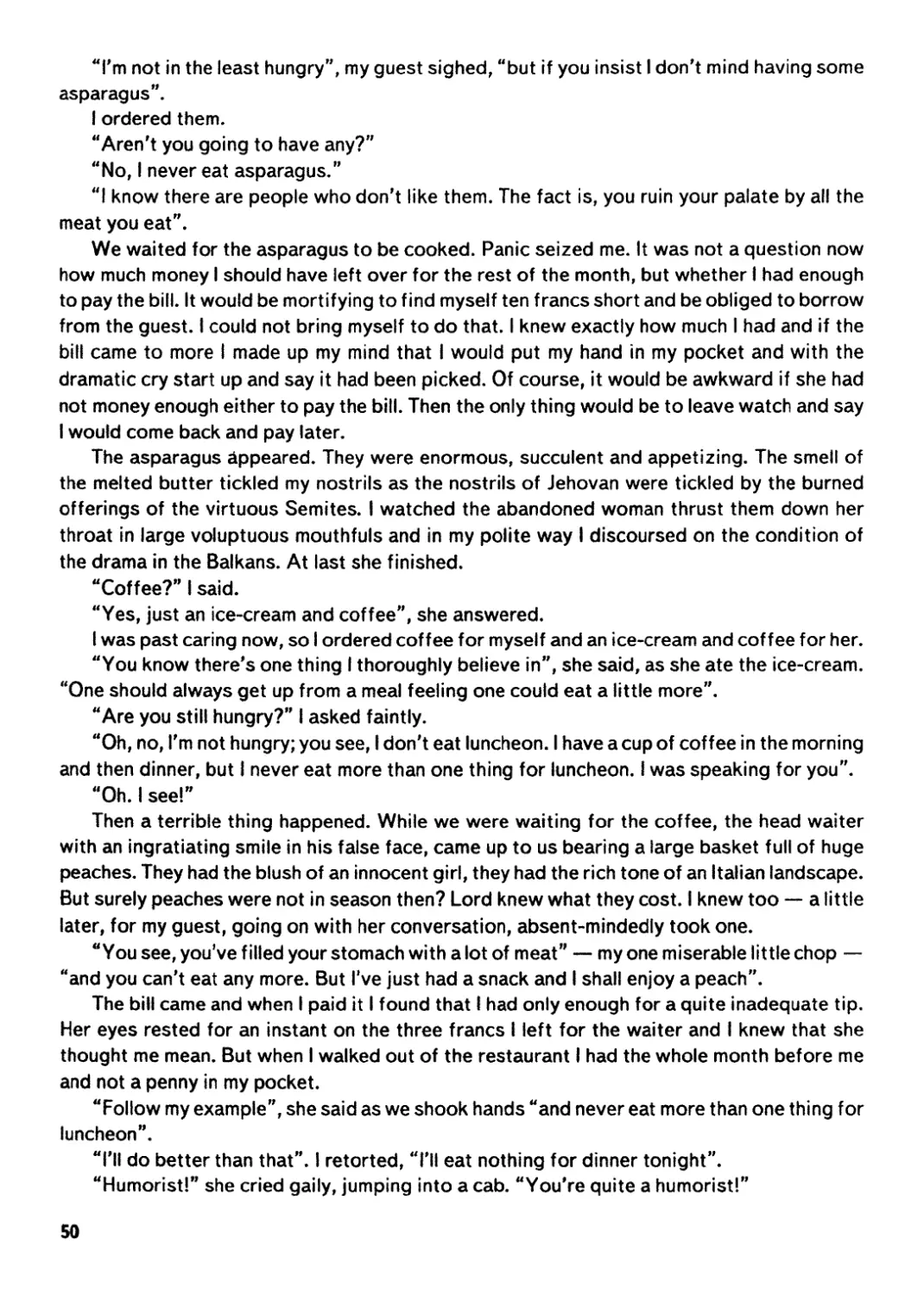





Text
M
HHCTepCTBO 06pa30BaH&;I
1-1 HaYK
POCCHHCKOH <PeAepa4J;tH
CeBepo-3anaAHblH HHCTHTyr ne4aTH cnrYT A '
METOAHLIECKJ.1E YKA3AHHSI H MATEPHAnbl
1J '"
aHrnMMCKMM R3blK
AnSI cTYAeHToB
HeSl3blKOBbiX BY30B
OCHOBHOii KYPC
BblnYCK II
CaHKT-neTep6ypr
V13AalellbCTBO «neTep6yprcKHH HHCTHfj'T ne4aT
»
2006
KAct>E.APA HOCTPAHHbtX 3bIKOB
ABTOpbl:
E 1/. A8epuHa, KaH.q. <p 11011. HaYK, 3aB. KacpeAPOH HHOCTpaHHblX SW3blKOB
M. fl. Monblwef3, CT. npenOAaBarellb KacpeAPbl HHocrpaHHblX SJ3blKOB
H. A. nempoBa (MozuneBa), CT. npenO,[taBaTeJ1b Kacpe.Qpbl HHocrpaHHblX }13bIKOB
Pe eH3eHTbl:
A. 3. KonenHH, 3as. Kacpe)J.po HHocrpaHHblX 5I3bIKOB cpaKYJ1bTeTa MeHeA>f(MeHTa
MapKeTJ.1Hra CeBepo-3ana.QHoi:1 perHoHanbHo nOJ1HTeXHHLfecKoH aKa.o.eMHH;
H. C. HUKoRbcKaR, Ao eHT CaHKT-neTep6yprcKoro YH BepC TeTa TeJ1eKOMMYHH-
Ka H 111M. M. A. 60H"I-5pyeBH4a
3AaHl1IeTpeTbefnepepa6oTaHHoe
ne4aTaeTC$1 B aSTopCKOH pe)J.aK Hj.1
51 XOTeJ1a 6bl OT BceH AYWH n06J1arOAapJHb MOHX APY3eH H KOJ1J1er, KOTopble OKa3aJ1H MHe 6oJ1bwylO nOMo b
B C03AaHHH :noro nocOOH": r poMOWHHCKyIO M. n. r y6HHY H. n., Kone.nJlH A. 3., nOHKpaTbe8Y H. 6., npoBoAeHKo E. III.,
T OKapeBY E. E.
TaK>Ke X04Y n06.naro.qapMTb Nicola Kean H Mark Bloomfield 3a npoBepKY aHrnOJl3bl"fHblX MaTepHanoB.
Oco6ylO 6narOAilPHoCTb npHHOWY MOeN}' MY>KY neTpoBY H. 6., KOTOpblH nOTpaTHJ1 Macey CHJ1 H 3HeprHH A/1" Taro,
"fT06bI3TO H3,qaHHe YBHAeno CBeT.
H. A. nempo8a
OcpopMJ1eHHe H. A AKcuHeHKo
BepCTKa II.. B.. ABepuH
1-13,narenbCTBO «neTep6yprcKHH HHCTHT)'T n aTH»
nOAnHcaHO B ne4aTb 05.10.2006.
Q>opMaT 60 x 84 '/'6" 06'beM 3,7 .-H3A. n.
THPa>K 500 3K3. 3aKa3 N!! 26.
Ome4aTaHO C opHntHan-MaKeTa
B H3AarenbcKo-nonHrpa<pH4ecKoM 4eHTpe C3 n en 6 rYT.o.
191180,CaHKT-neTep6ypr,nep.tbKaM6yna,13
Ten. (812) 315-91-32
@ C3J.1n Cn6rYT):\, 2006.
@ 3 aTel1bCTBo «neTep6yprcKHH Io1HCTHryT netofaTIo1», 2006.
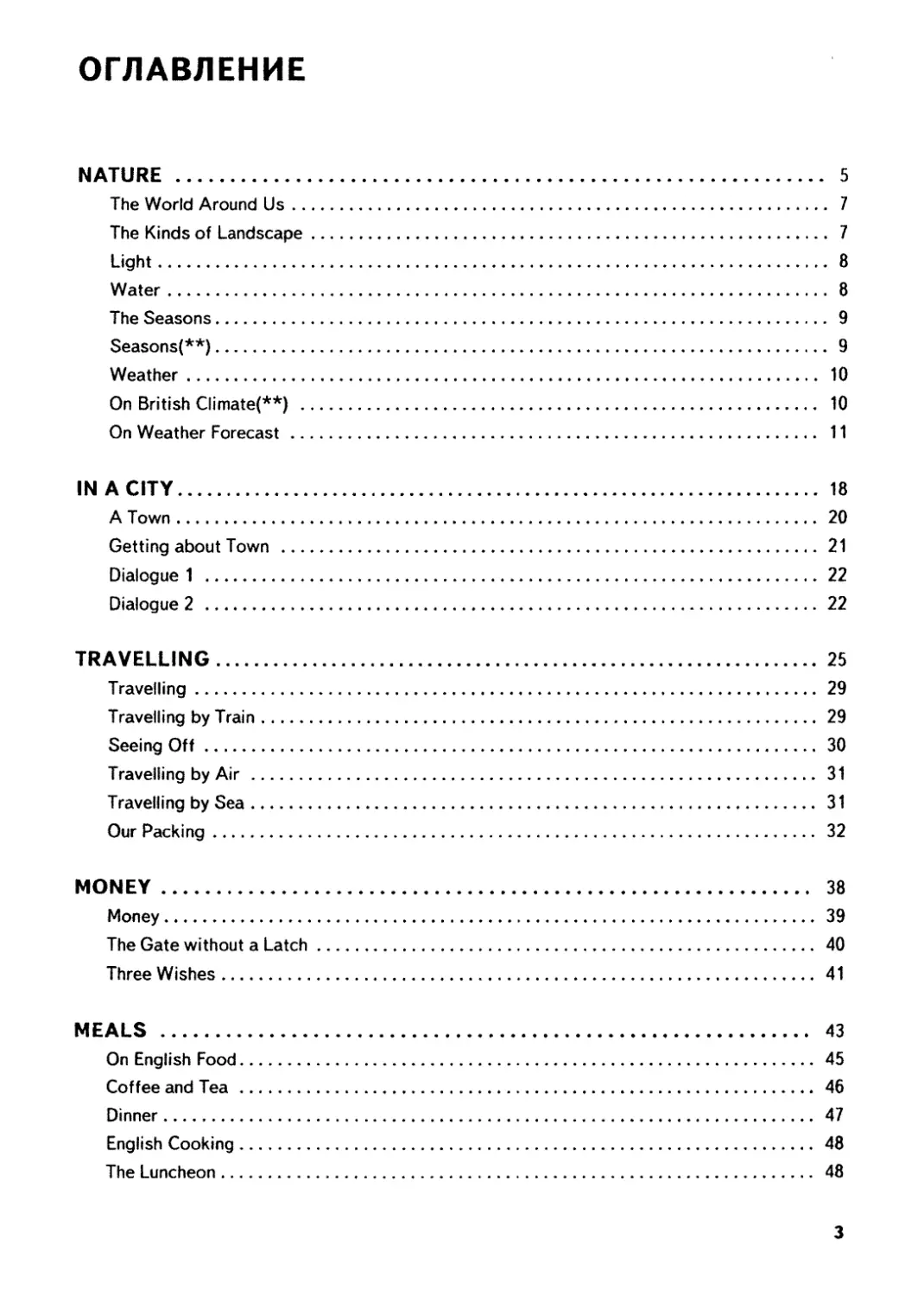
ornABnEHHE
NATURE ............................................................ 5
The World Around Us . . . . . . . . . . . . . . . . . . . . . . . . . . . . . . . . . . . . . . . . . . . . . . . . . . . . . . . .. 7
The Kinds of landscape . . . . . . . . . . . . . . . . . . . . . . . . . . . . . . . . . . . . . . . . . . . . . . . . . . . . . .. 7
l ig h t . . . . . . . . . . . . . . . . . . . . . . . . . . . . . . . . . . . . . . . . . . . . . . . . . . . . . . . . . . . . . . . . . . . . . .. 8
Wa t er . . . . . . . . . . . . . . . . . . . . . . . . . . . . . . . . . . . . . . . . . . . . . . . . . . . . . . . . . . . . . . . . . . . . .. 8
The Seasons. . . . . . . . . . . . . . . . . . . . . . . . . . . . . . . . . . . . . . . . . . . . . . . . . . . . . . . . . . . . . . . .. 9
Seasons(**) . . . . . . . . . . . . . . . . . . . . . . . . . . . . . . . . . . . . . . . . . . . . . . . . . . . . . . . . . . . . . . . .. 9
W ea ther . . . . . . . . . . . . . . . . . . . . . . . . . . . . . . . . . . . . . . . . . . . . . . . . . . . . . . . . . . . . . . . . . .. 10
On British Climate(**) ....................................................... 10
On Weather Forecast ........................................................ 11
I N A CITY . . . . . . . . . . . . . . . . . . . . . . . . . . . . . . . . . . . . . . . . . . . . . . . . . . . . . . . . . . . . . . . . . .. 18
A Town . . . . . . . . . . . . . . . . . . . . . . . . . . . . . . . . . . . . . . . . . . . . . . . . . . . . . . . . . . . . . . . . . . .. 20
Getting about Town ......................................................... 21
Dialogue 1 ................................................................. 22
Dialogue 2 ................................................................. 22
TRA VELLING . . . . . . . . . . . . . . . . . . . . . . . . . . . . . . . . . . . . . . . . . . . . . . . . . . . . . . . . . . . . . .. 25
Travelling . . . . . . . . . . . . . . . . . . . . . . . . . . . . . . . . . . . . . . . . . . . . . . . . . . . . . . . . . . . . . . . . .. 29
Travelling by Train. . . . . . . . . . . . . . . . . . . . . . . . . . . . . . . . . . . . . . . . . . . . . . . . . . . . . . . . . .. 29
Seei ng Off .. . . . . . . . . . . . . . . . . . . . . . . . . . . . . . . . . . . . . . . . . . . . . . . . . . . . . . . . . . . . . . .. 30
T ravelli ng by Ai r ............................................................ 31
Travelling by Sea . . . . . . . . . . . . . . . . . . . . . . . . . . . . . . . . . . . . . . . . . . . . . . . . . . . . . . . . . . .. 31
Our Pack i ng . . . . . . . . . . . . . . . . . . . . . . . . . . . . . . . . . . . . . . . . . . . . . . . . . . . . . . . . . . . . . . .. 32
M 0 N E Y ............................................................ 38
Money . . . . . . . . . . . . . . . . . . . . . . . . . . . . . . . . . . . . . . . . . . . . . . . . . . . . . . . . . . . . . . . . . . . .. 39
The Gate without a latch .... . . . . . . . . . . . . . . . . . . . . . . . . . . . . . . . . . . . . . . . . . . . . . . . .. 40
Three Wishes . . . . . . . . . . . . . . . . . . . . . . . . . . . . . . . . . . . . . . . . . . . . . . . . . . . . . . . . . . . . . .. 41
MEALS ............................................................ 43
On English Food. . . . . . . . . . . . . . . . . . . . . . . . . . . . . . . . . . . . . . . . . . . . . . . . . . . . . . . . . . . .. 45
Co f fee and Tea ............................................................. 46
Di nner . . . . . . . . . . . . . . . . . . . . . . . . . . . . . . . . . . . . . . . . . . . . . . . . . . . . . . . . . . . . . . . . . . . .. 47
English Cooking. . . . . . . . . . . . . . . . . . . . . . . . . . . . . . . . . . . . . . . . . . . . . . . . . . . . . . . . . . . .. 48
The Luncheon . . . . . . . . . . . . . . . . . . . . . . . . . . . . . . . . . . . . . . . . . . . . . . . . . . . . . . . . . . . . . .. 48
3
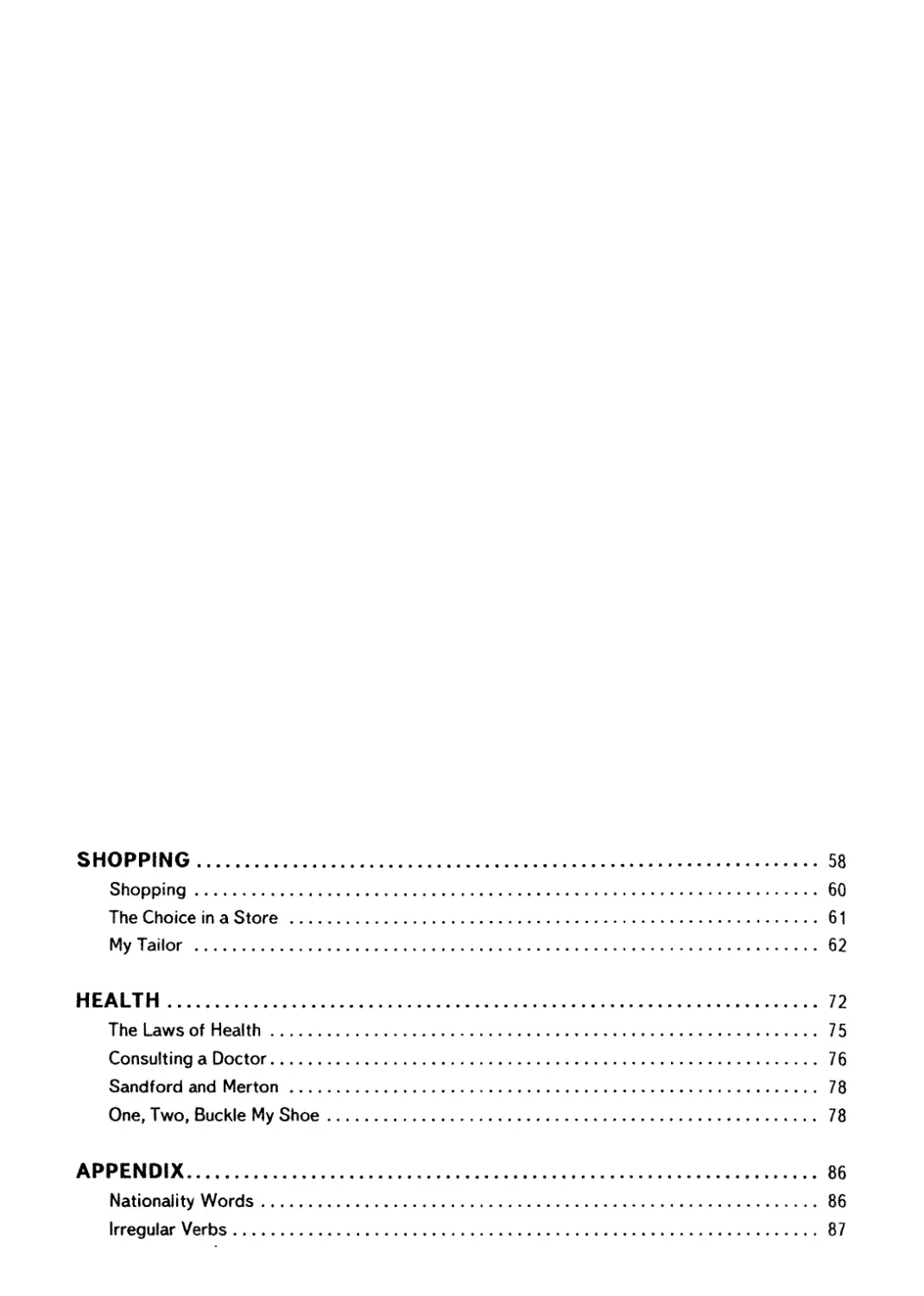
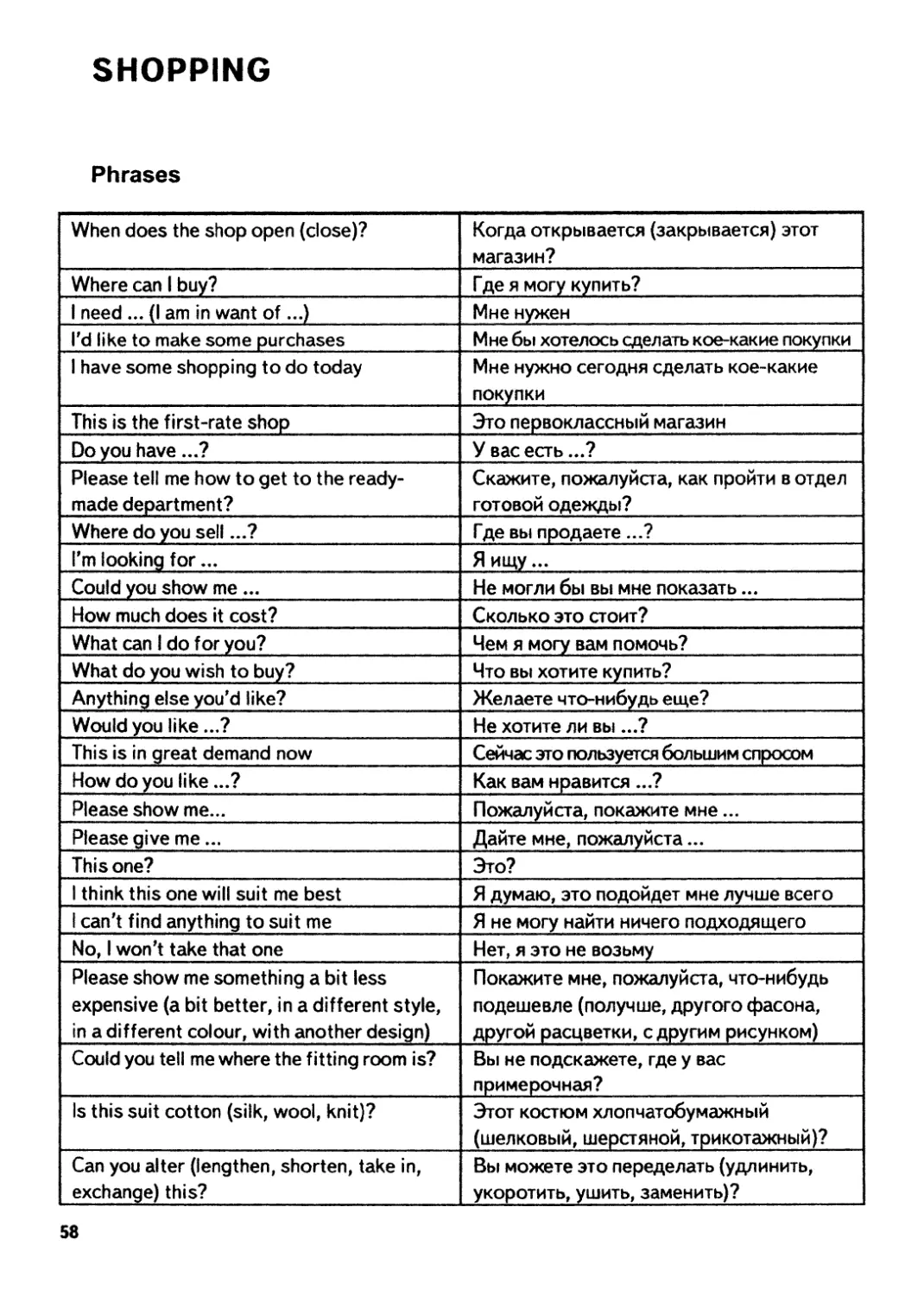
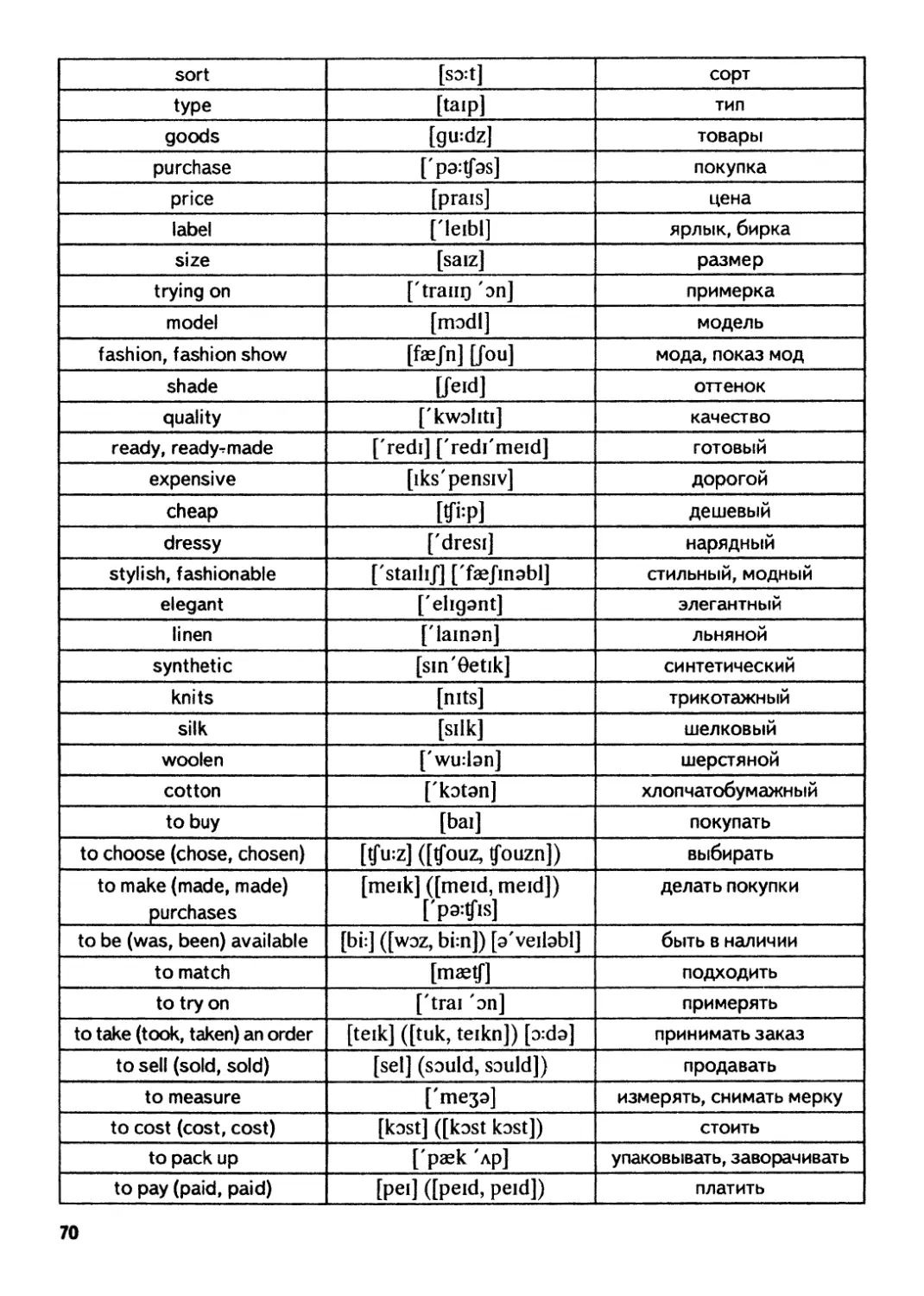
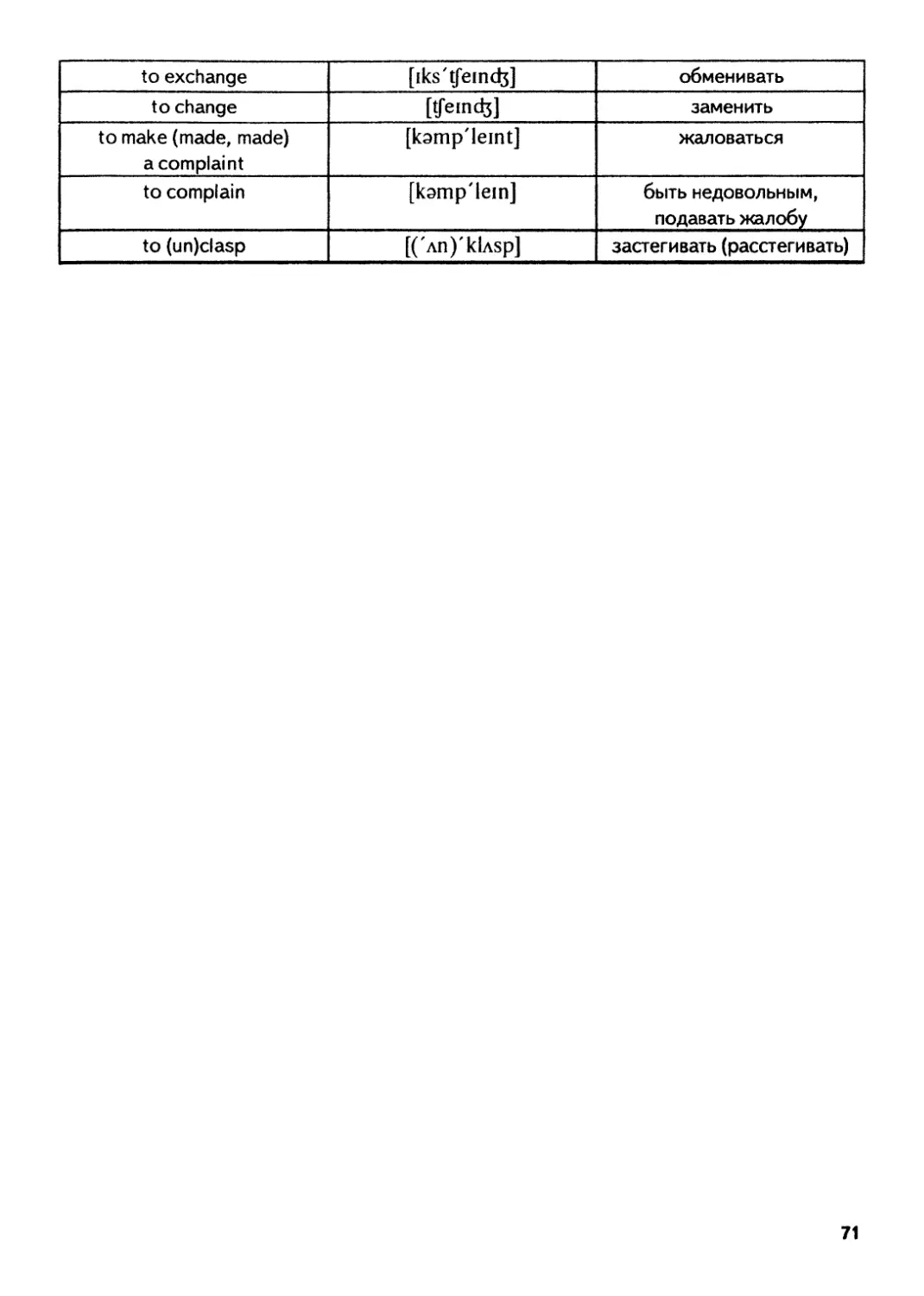
SHOPPING. . . . . . . . . . . . . . .. . . . . . . . . . . . . . . . . . . . . . . . . . . . . .. . . ., . . . . . . . . . . . . . . .. 58
Shoppi ng . . . . . . . . . . . . . . . . . . . . . . . . . . . . . . . . . . . . . . . . . . . . . . . . . . . . . . . . . . . . . . . . .. 60
The Choice in a Store ........................................................ 61
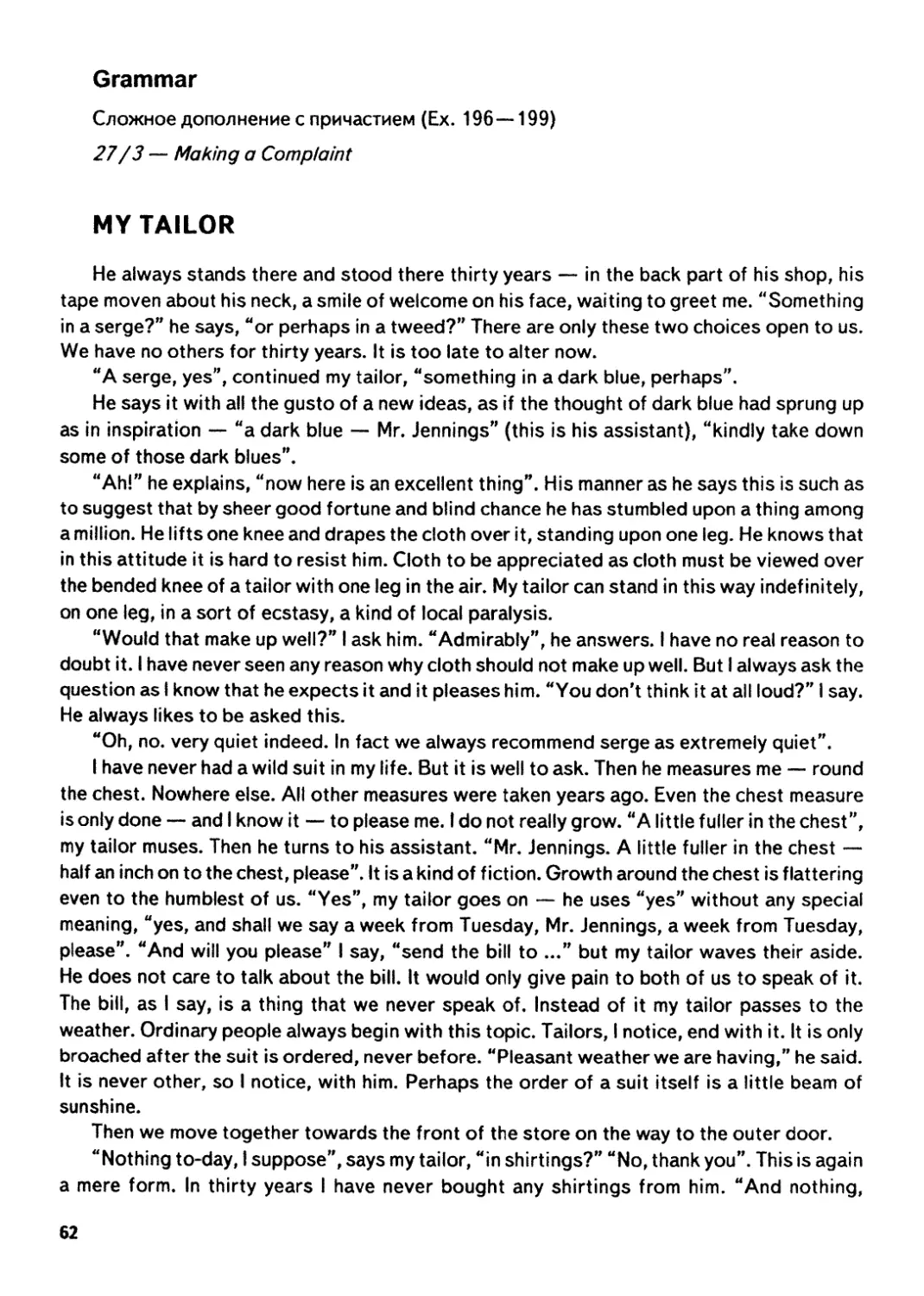
My Tailor .................................................................. 62
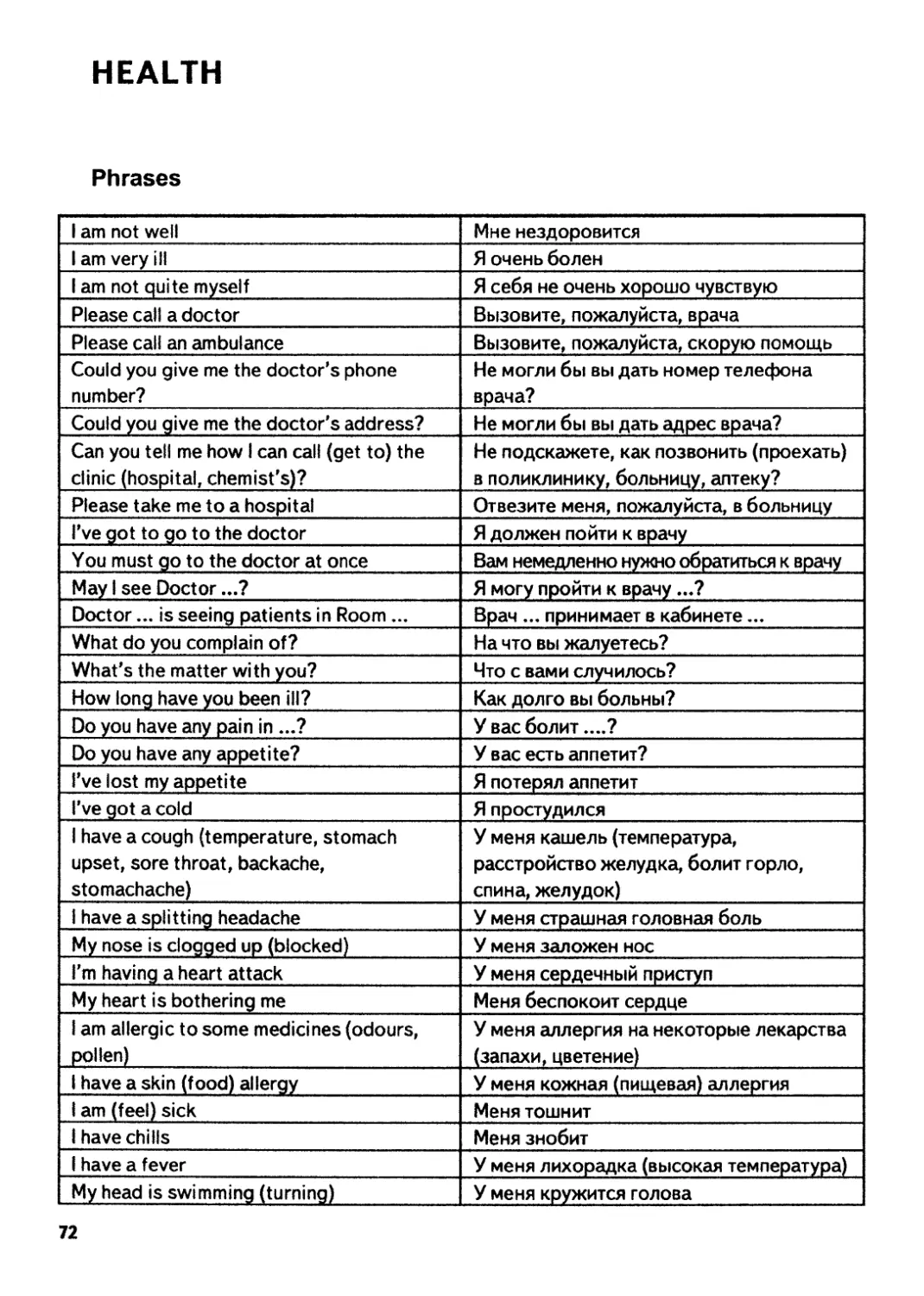
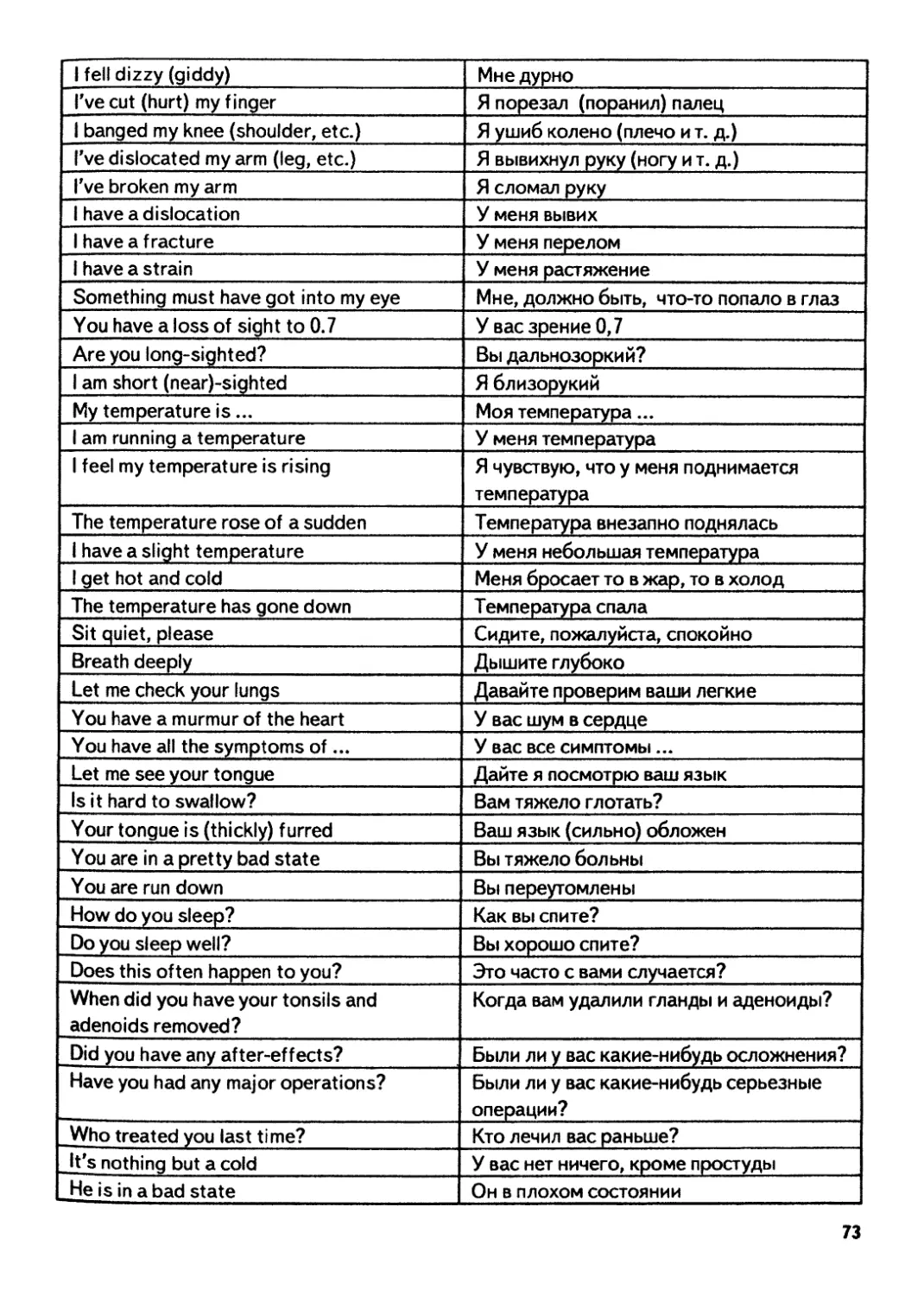
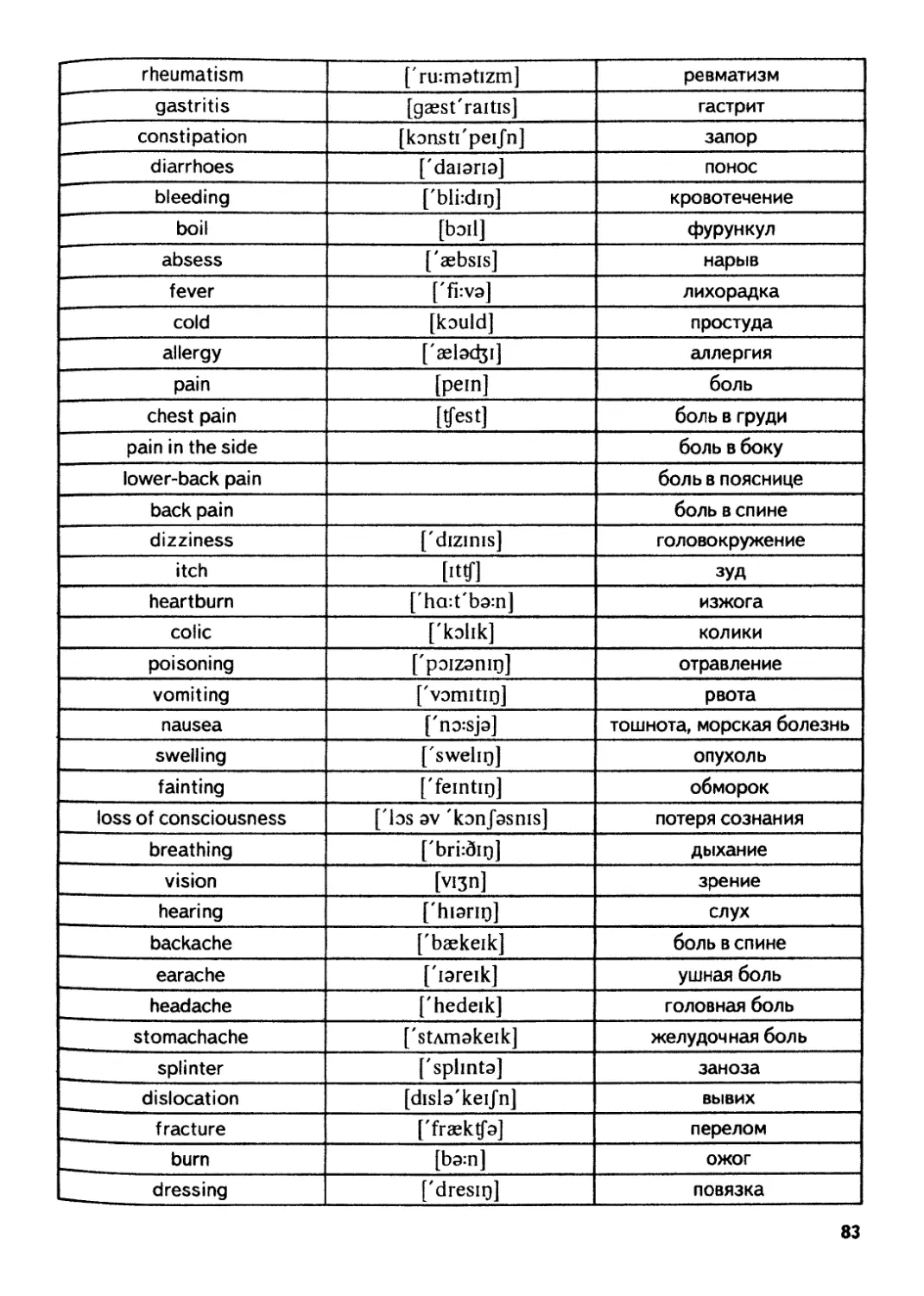
H EA L T H . . . . . . . . . . . . . . . . . . . . . . . . . . . . . . . . . . . . . . . . . . . . . . . . . . . . . . . . . . . . . . . . . . .. 72
The Laws of Heal th .. . . . . . . . . . . . . . . . . . . . . . . . . . . . . . . . . . . . . . . . . . . . . . . . . . . . . . . .. 75
Consulting a Doctor. . . . . . . . . . . . . . . . . . . . . . . . . . . . . . . . . . . . . . . . . . . . . . . . . . . . . . . . .. 76
Sandford and Merton ........................................................ 78
One, Two, Buckle My Shoe. . . . . . . . . . . . . . . . . . . . . . . . . . . . . . . . . . . . . . . . . . . . . . . . . . .. 78
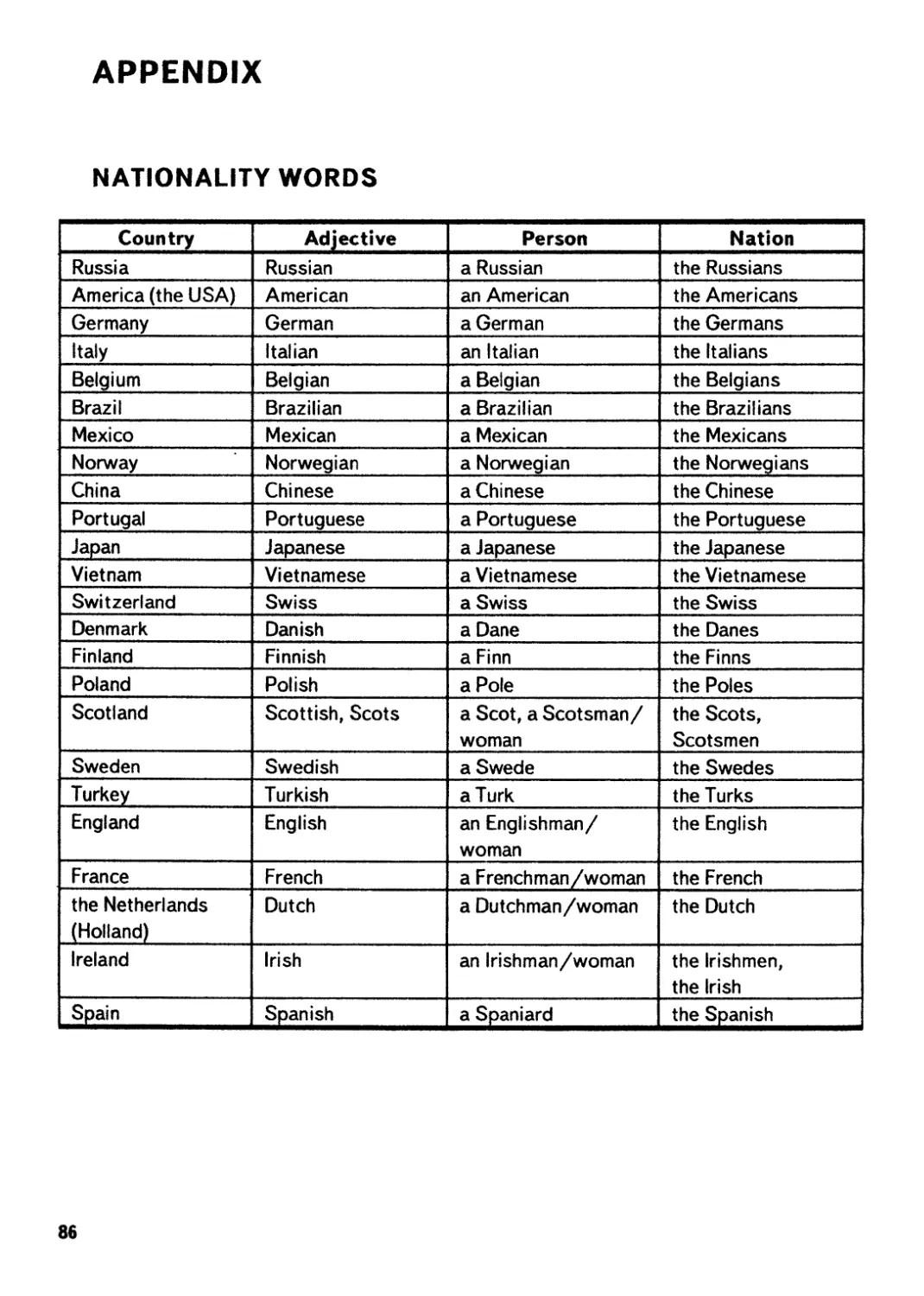
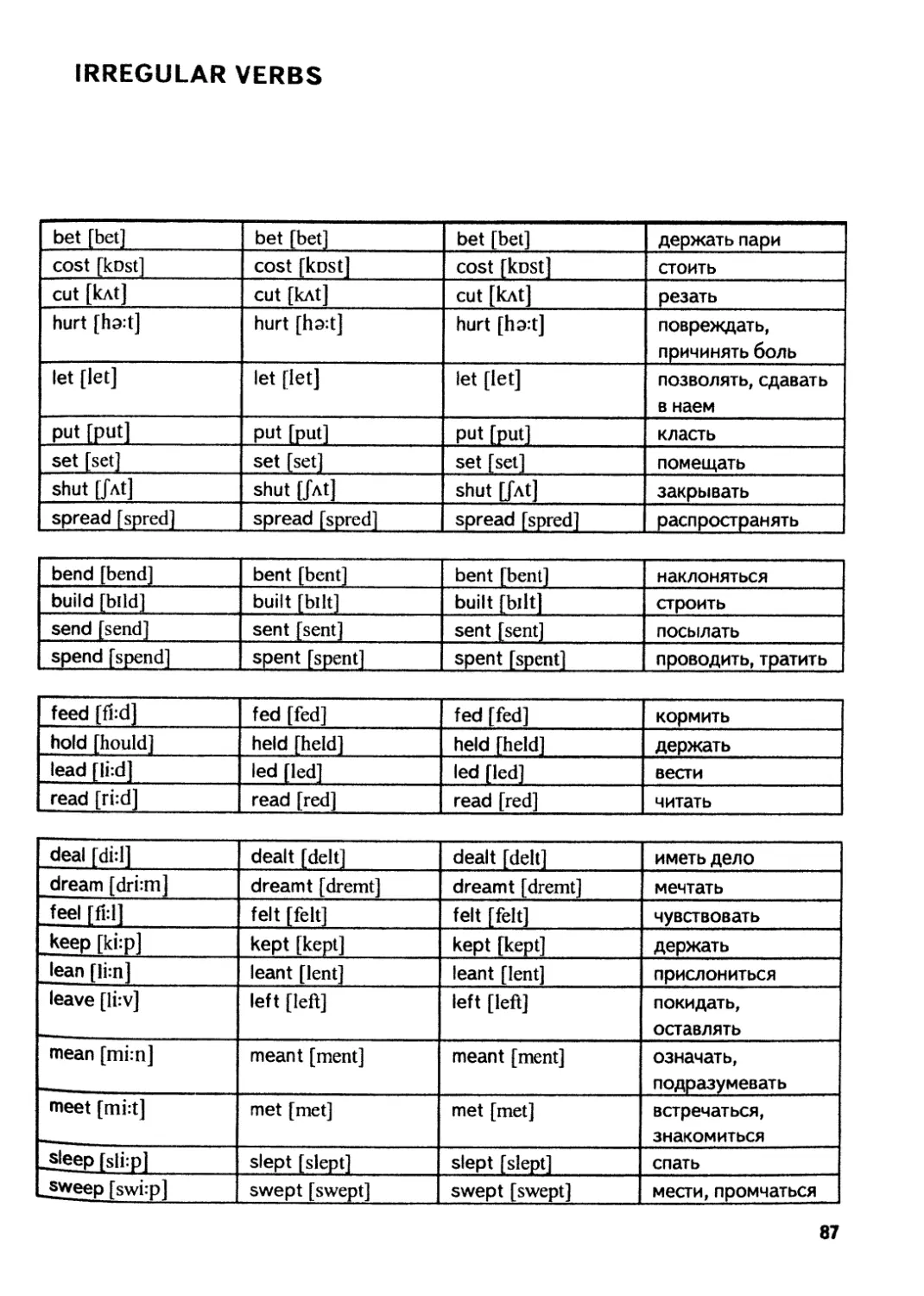
APPEN DIX. . . . . . . . . . . . . . . . . . . . . . . . II . . . . . . . . . . . . . . . . . . . . . .. . . . . . . . . . . . . . . . . . .. 86
Nationality Words. . . . . . . . . . . . . . . . . . . . . . . . . . . . . . . . . . . . . . . . . . . . . . . . . . . . . . . . . .. 86
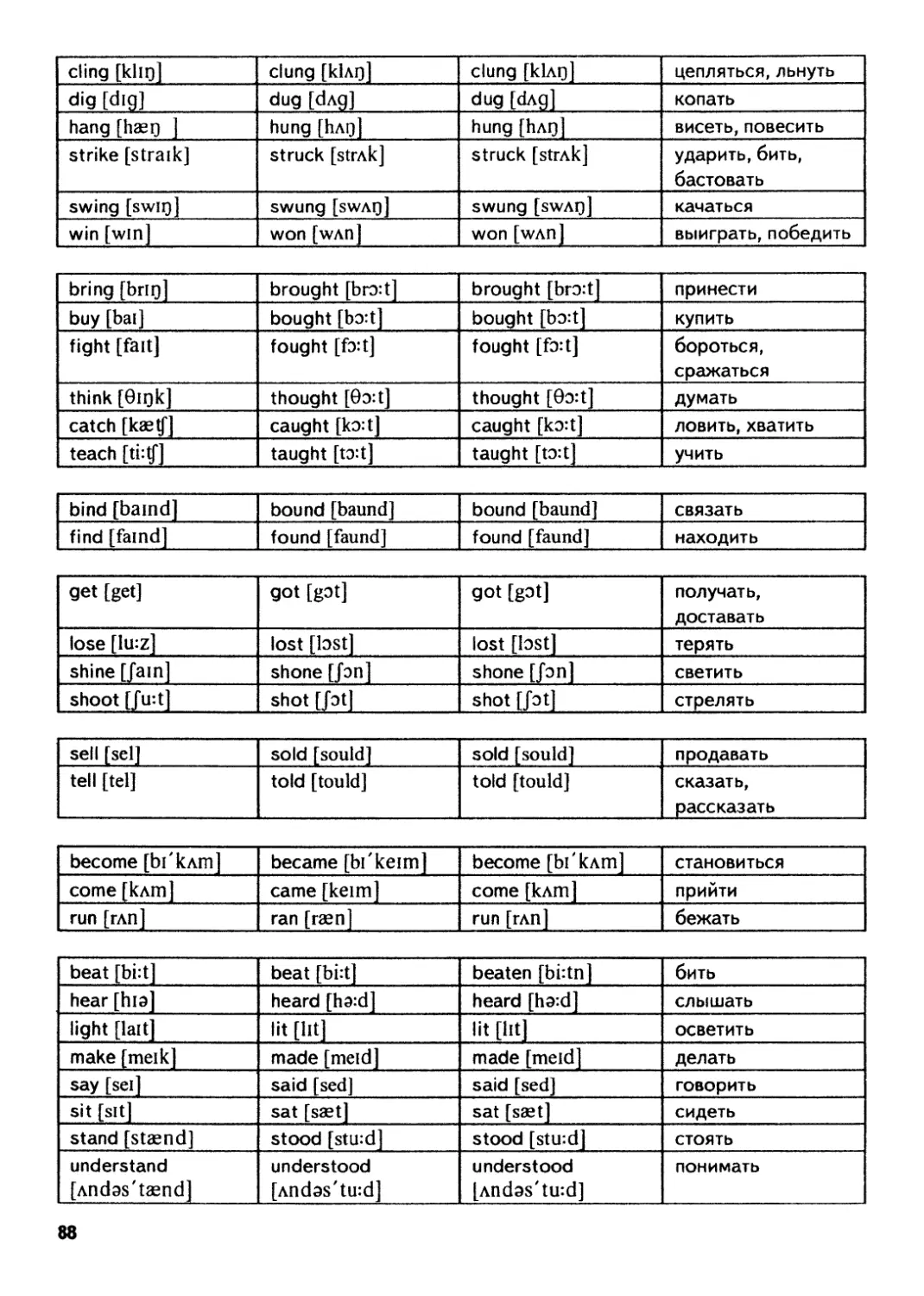
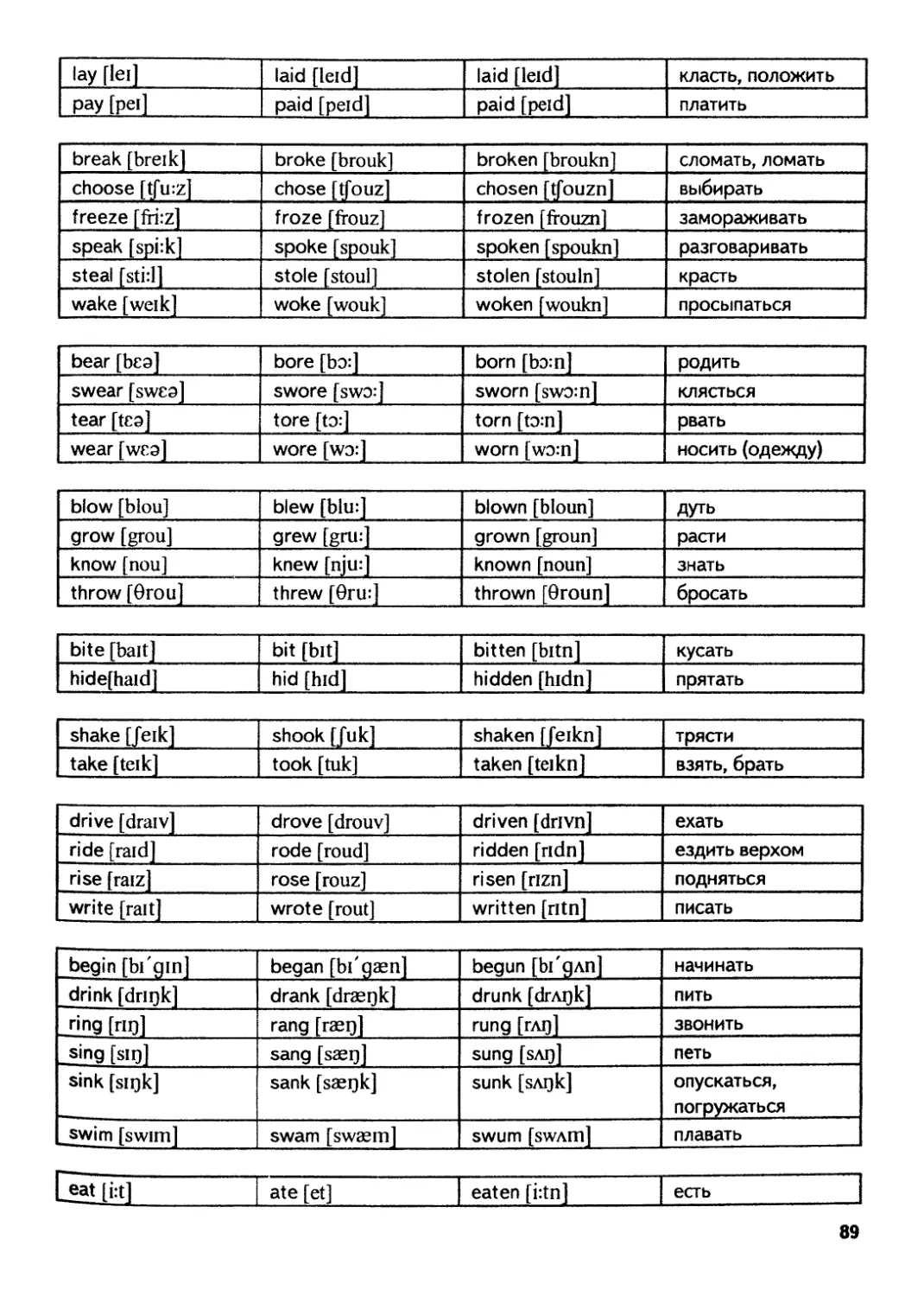
Irregular Verbs . . . . . . . . . . . . . . . . . . . . . . . . . . . . . . . . . . . . . . . . . . . . . . . . . . . . . . . . . . . . .. 87
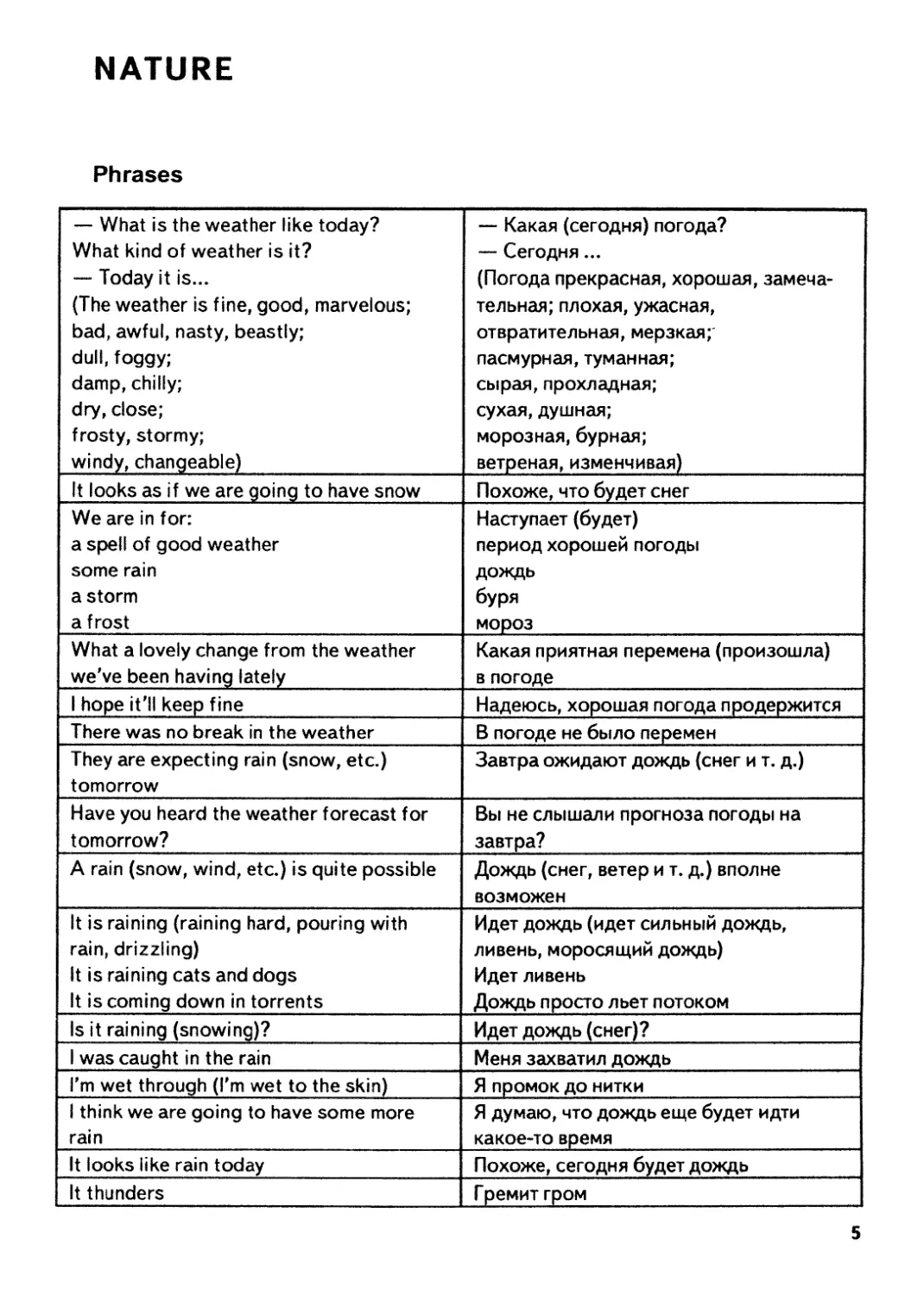
NATURE
Phrases
- What is the weather like today? -KaKa (ceroAH )noroAa?
What kind of weather is it? - CeroAH ...
- Today it is... (noroAa npeKpacHaSl, XOPOWaJI, 3aMe4a-
(The weather is fine, good, marvelous; TeJ1bH ; nJ10xa.R, Y>KaCHa.R,
bad, awful, nasty, beastly; oTBpaTHTeJ1bH , Mep3KCUI;-
dull, foggy; nacMypH ,TYMaHHaR;
damp, chilly; CblpCUt, npOXJ1ap.Ha ;
dry, close; cyxa , AYWHaR;
frosty, stormy; Mopo3HaJl,6YPHaH;
windy, changeable) BeTpeHa ,H3MeH4HBa.R)
It looks as if we are going to have snow nOXo>Ke, 4TO 6y,o.eT CHer
We are in for: HaCTynaeT (6y AeT)
a spell of good weather ...
nepHoA xopoweH norOAbl
some rain AO>t<p.b
a storm 6ypsw
a f ros t MOp03
What a lovely change from the weather KaKa npH THCUI nepeMeHa (npoH30WJ1a)
we've been having lately B norOAe
I hope it'll keep fine Ha.o.etOcb, xopowasw norOAa npOAep>KHTC.R
There was no break in the weather B noroAe He 6bfll0 nepeMeH
They are expecting rain (snow, etc.) 3asTpa O>KHAatOT AO>K)J.b (cHer H T. A.)
tomorrow
Have you heard the weather forecast for Bbl He CJ1bIWaI1H nporH03a noroAbl Ha
tomorrow? 3asTpa?
A rain (snow, wind, etc.) is quite possible AO>KJJ.b (cHer, BeTep H T. A.) SnOI1He
B03MO>KeH
It is raining (raining hard, pouring with l4,o.eT AO>t<p.b (HAeT CHJ1bHbIH AO>K)1.b,
rain, drizzling) J1HSeHb, MOpOa1l1.\HH AO)t(Ab)
It is raining cats and dogs I4Aer J1HBeHb
It is coming down in torrents AO>KAb npoCTO J1beT nOTOKOM
Is it raining (snowing)? AeT AO>KAb (cHer)?
I was caught in the rain MeHsw 3axsaTHJl ,o.O>KAb
I'm wet through (I'm wet to the skin) npOMOK AO HHTKH
I think we are going to have some more AYMatO, 4TO AO)f(Ab el1.\e 6YAeT HATH
rain KaKoe-TO speM
It looks like rain today nOXo>Ke, cerOAHSf 6YAer AO>fQJ.b
It thunders rpeMHTrpoM
5
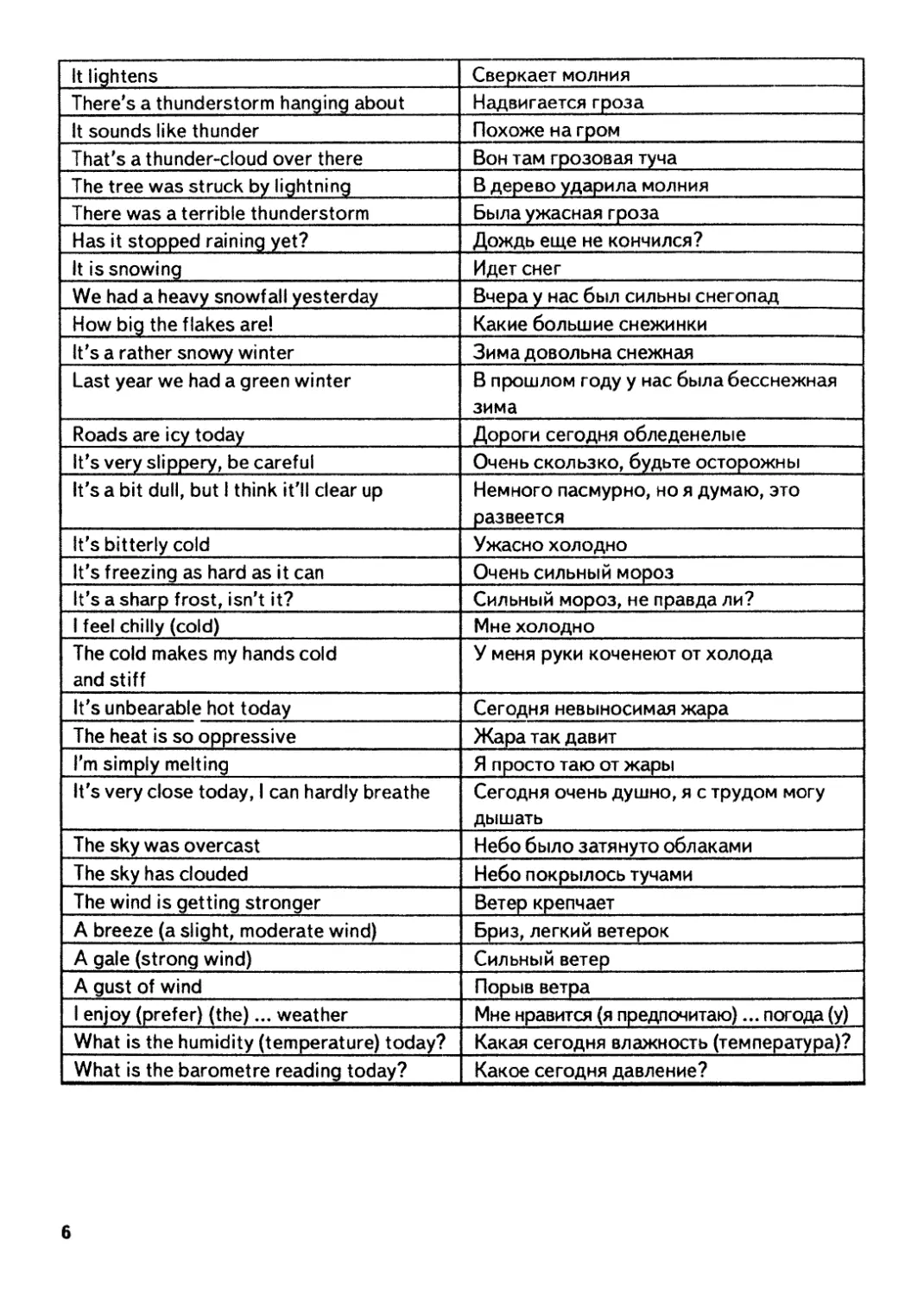
It lightens CBepKaeT MOJ1HHJt
There's a thunderstorm hanging about HMBHraeTc rp03a
It sounds like thunder noxo>Ke Ha rpOM
That's a thunder-cloud over there SOH TaM rp030saJt TY4a
The tree was struck by lightning B AepeBO YAap l1a MOJ1HH
There was a terrible thunderstorm 6bll1a Y>KaCHa.R rp03a
Has it stopped raining yet? AO>KAb ew.e He KOH4HI1CJI?
It is snowing It1Aer CHer
We had a heavy snowfall yes terday B4epa y Hac 6blll CHlIbHbl CHerona):\
How big the flakes are! KaKHe 60l1bWHe CHe>KHHKH
It's a rather snowy winter 3HMa AOBOl1bHa CHe>KHaH
Last year we had a green winter B npoWJ10M rOAY Y Hac 6blJ1a 6eCCHe>KHa
3HMa
Roads are icy today AoporH cerOAH$t 06l1eAeHeJ1ble
It's very slippery, be careful 04eHb CKOllb3KO, 6YAbTe OCTOpO>KHbl
It's a bit dull, but I think it'll clear up HeMHoro nacMypHo, HO AYMatO, 3TO
pa3BeeTC
It's bitterly cold Y>KaCHO XOl10AHO
It's freezing as hard as it can 04eHb CHl1bHblH MOp03
It's a sharp frost, isn't it? CJ.111bHbIH MOp03, He npaBAa J1 ?
I feel chilly (cold) MHe XOllOAHO
The cold makes my hands cold Y MeH.R PYKH K04eHefOT OT XOJ10Aa
and stiff
It's unbearable hot today CeroAHJI HeSblHOCHMaSI >Kapa
The heat is so oppressive >Kapa TaK AaBHT
I'm simply melting npocTo TatO OT >Kapbl
It's very close today, I can hardly breathe CeroAH 04eHb AYWHO, C TPYAOM Mory
AblwaTb
The sky was overcast He60 6bl110 3aT.RHYTO 06l1aKaMH
The sky has clouded He60 nOKpblJ10Cb TY4aMH
The wind is getting stronger Berep Kpen4aer
A breeze (a slight, moderate wind) 5pH3, J1erKHH BeTepOK
A gale (strong wind) C J1 bHbl BeTep
A gust of wind nOpblB Berpa
I enjoy (prefer) (the) ... weather MHe HpaSHTOt (H npeAnOYHTatO) ... noroAil (y)
What is the humidity (temperature) today? KaKa.R cerOAHSW BI1a>KHOCTb (TeMneparypa)?
What is the barometre reading today? KaKoe cerOAHSW AaBl1eHHe?
6
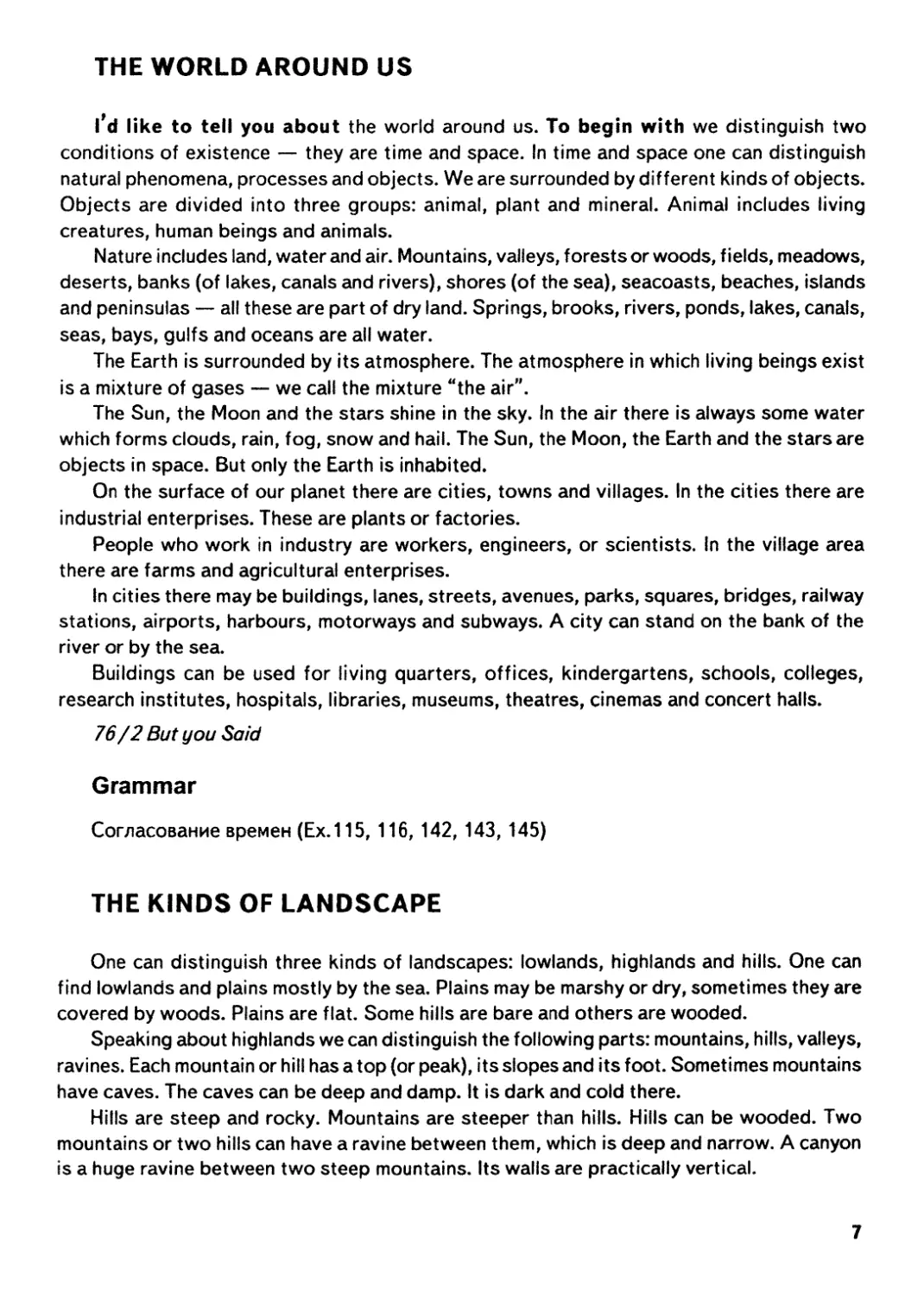
THE WORLD AROUND US
I'd like to tell you about the world around us. To begin with we distinguish two
conditions of existence - they are time and space. In time and space one can distinguish
natural phenomena, processes and objects. We are surrounded by different kinds of objects.
Objects are divided into three groups: animal, plant and mineral. Animal includes living
creatures, human beings and animals.
Nature includes land, water and air. Mountains, valleys, forests or woods, fields, meadows,
deserts, banks (of lakes, canals and rivers), shores (of the sea), seacoasts, beaches, islands
and peninsulas - all these are part of dry land. Springs, brooks, rivers, ponds, lakes, canals,
seas, bays, gulfs and oceans are all water.
The Earth is surrounded by its atmosphere. The atmosphere in which living beings exist
is a mixture of gases - we call the mixture "the air".
The Sun, the Moon and the stars shine in the sky. In the air there is always some water
which forms clouds, rain, fog, snow and hail. The Sun, the Moon, the Earth and the stars are
objects in space. But only the Earth is inhabited.
On the surface of our planet there are cities, towns and villages. In the cities there are
industrial enterprises. These are plants or factories.
People who work in industry are workers, engineers, or scientists. In the village area
there are farms and agricultural enterprises.
In cities there may be buildings, lanes, streets, avenues, parks, squares, bridges, railway
stations, airports, harbours, motorways and subways. A city can stand on the bank of the
river or by the sea.
Buildings can be used for living quarters, offices, kindergartens, schools, colleges,
research institutes, hospitals, libraries, museums, theatres, cinemas and concert halls.
76/2 But you Said
Grammar
CorllacoBaHHe BpeMeH (Ex.115, 116, 142, 143, 145)
THE KINDS OF LANDSCAPE
One can distinguish three kinds of landscapes: lowlands, highlands and hills. One can
find lowlands and plains mostly by the sea. Plains may be marshy or dry, sometimes they are
covered by woods. Plains are flat. Some hills are bare and others are wooded.
Speaking about highlands we can distinguish the following parts: mountains, hills, valleys,
ravines. Each mountain or hill has a top (or peak), its slopes and its foot. Sometimes mountains
have caves. The caves can be deep and damp. It is dark and cold there.
Hills are steep and rocky. Mountains are steeper than hills. Hills can be wooded. Two
mountains or two hills can have a ravine between them, which is deep and narrow. A canyon
is a huge ravine between two steep mountains. Its walls are practically vertical.
7
12/2 - A Science Fiction Story
Grammar
nOBeI1HTe/1bHOe HaKI10HeH e B KOCBeHHO pe4H (Ex.144)
LIGHT
In spring light is almost everywhere. The sun shines very often and its light is bright and
warm. Moonlight as well as light of the stars is on the contrary pale and cold.
At night street lamps are switched on to light up lanes, streets, avenues, squares, parks,
railway stations, airports and harbours.
In their houses people use candles, bulbs, different types of lamps (kitchen lamps, wall
lamps, table lamps, standing lamps) which also give light.
When a candle is lit it burns with a flame. The fire is hot and dangerous. If a person is not
careful the fire can burn up the place. Because of one match the whole wood may burn down.
It is a piece of tuck when fire fighters come in time to put the fire out.
WATER
We begin our story with the question (or riddle): "What can be found in spring first of
all?". Of course, a lot of water. In this season it is everywhere. Snow still covers the mountain
tops. But we know that snow is frozen water. Sometimes the mountain tops are covered
with ice which consists of water as well as snow. Due to sunbeams it thaws very quickly. As
a result snow and ice are converted into water. This water flows down the mountains and
falls into lakes, rivers, and seas. Some lakes in the highlands appear to be hot; in this case
there is a fog (or mist) over the lake. The fog is damp.
Sometimes water penetrates into the ground (or soil). Many water drops make a river or
a lake. Water can spout from the ground and a spring appears. Springs form the beginning
of brooks (or streams). In spring very small southern brooks become rivers. But it is clear:
water is coming from all the mountains, rocks and hills to the rivers. In spring it often rains.
When it rains it may be stormy. The waves are breaking at the seacoast. Now ships and
boats and yachts must remain in bays, as it is calm there even in a storm. After the rain has
stopped the sea becomes calm.
52/2 UFO
51/2 - Air-Sea Rescue
Grammar
1. KocBeHHa pe4b, KocBeHHbl Bonpoc (Ex. 146 - 149)
2. should KaK MOJ\al1bHbl rJ1arOJ1 (Ex. 259)
8
THE SEASONS
There are four seasons in the year: winter, spring, summer, autumn. Every season has its
own type of beauty. Let's take for instance, autumn. The ground is covered with red and
yellow leaves, the air is fresh but it is not cold yet. It is September. Writers call this time the
"Golden Autumn" or the "Indian Summer". One can find beautiful descriptions of the season
in literature.
October and November are usually cold rainy months. You cannot compare them with
September. If you look out of the window you see wet streets, wet roofs and the sky covered
with dark clouds. It often rains hard and people dressed in raincoats hurry along the streets.
Next season - winter is famous for its sunny frosty days. Everything around looks so
beautiful covered with snow and ice. All the rivers are frozen and the ice seldom melts earlier
than in March.
Winter is a good time for sport. You can skate, ski and play hockey. Children enjoy playing
snowballs and making snowmen.
Yet nobody is sorry when winter is over. Spring, too, is a pleasant season. The days
grow longer, the sun shines more brightly. But it is not so hot as it is in summer. Summer is
the hottest season of the year. Many people have their vacation in summer. It is not pleasant
to stay in town in summer and most people leave town. They go for long walks, bathe in the
river, lie in the sun, pick flowers in the fields and gather berries and mushrooms in the forests.
SEASONS(**)
There are four seasons in the year - spring, summer, autumn and winter.
Spring is the season of hope and happiness. It is the season when nature awakens from
her winter sleep - the ice is broken, the grass is beginning to grow, here buds are showing,
there the trees are already bursting into leaf, fresh, green and lovely. Spring has come!
Summer is the hottest season in the year. The bright sunshine scorches the earth. Not
a single cloud is in the sky. It is pleasant to get out of town where one is so oppressed by the
heat and ramble through woods, among hills and valleys, following winding paths that are
hardly visible in the thick green grass. The fields are green and shorn - here and there big
stacks of hay are seen. The days are long in summer.
But on moves the earth in its race around the sun. The days become shorter, the sun's
rays lose their glittering force - autumn is approaching. Beautiful nature has thanked the
laborious farmer for his toil in fields, meadows and orchards. The trees that not long ago
bloomed with flowers are laden with ripening fruit. But the beautiful "Indian summer" is
over - it is deep autumn now.
We no longer hear the sweet melody of birds in the forests - they have flown far away
to distant warm countries. Everything is beginning to take a different colour and garment in
the lonely quiet of the countryside - the trees look bare, for they have cast off their leaves,
the fragrant flowers have faded away. The sky is overcast with low, black, heavy clouds -
the period of rains has set in. It is unpleasant to be out in the drizzling piercing rain that is
accompanied by a cold wind.
9
December is approaching. There is a breath of winter in the autumn air. It is getting
colder day by day. The cold makes your hands cold and stiff. It is on a morning in December
that you get up and look out the window, and loL. the ground, the roofs of the houses are
thick with snow. In the woods the branches of the trees are also feathered with snow.
Everything around looks so beautiful! Winter has set in.
48/2 - The Weather Forecast
Grammar
1. may, might (Ex. 230 - 233, 244 - 246)
2. OTpHl\aTeJ1bHbl Bonpoc
WEA THER
When two English people meet, their first words will be: "How do you do?" or "How are
you?". And after the reply "Very well, thank you, how are you?" the next remark is almost
certainly to be about the weather: "It's a lovely morning, isn't it?" or "Isn't it hot today?" and
the other person will reply, "Yes, it's wonderful weather we are having. I hope it will keep
fine; it seems almost too good to last".
Or perhaps the day is dull; it is raining a little, the sky is grey and everyone is wearing
a raincoat or carrying an umbrella. As the cars and buses go along the street they splash
water and mud on the passers-by.
Gradually it gets darker; a thick fog spreads over London. The lamps are lit in the streets
and in the shops and offices, cars and buses turn on their lights and can only crawl along. As
one friend bumps into another, he says "Isn't it a beastly day?" "Yes", replies the other, "you
can hardly see a yard in front of you".
Then comes winter. There has been a good fall of snow and a hard frost. It is just the day for
a good country walk. Let us have a tramp down the country lanes. The ground is like iron and rings
under our feet, the frost sparkles on the branches and icicles hang from the houses. It is still
freezing hard and the ponds are frozen over. There are crowds of people on them sliding and
skating. It is very pleasant while the frost lasts; the unpleasant time comes when the thaws begin.
A few months have passed and it is a beautiful spring day. The rain fell heavily last night
but now soft white clouds are floating across the blue sky and the sun is shining brightly.
Raindrops and dewdrops shine on every small green leaf and every blade of young grass.
ON BRITISH CLIMA TE(**)
The climate of England is milder than that of other countries. English people are apt to
complain of it as being damp and rainy, and foreigners laugh at it and say, that the English
summer is made up of three fine days and a thunderstorm.
It is hard to say that England has typical weather because of the sudden changes that
occur - showers from what was only a few hours before a clear blue sky; sunshine that
10
makes you want to leave off most of your clothes followed by winds that set you wishing for
two overcoats.
The winter fogs of London are, indeed, awful, they suppress all imagination. In a fog the
air is hardly fit for breathing; it is grey, yeHow, of deep orange, and even black because of
the smoke of many thousand of chimneys.
The three things that chiefly determines the climate of England are: (1) the position of
the island in the temperature belts; (2) the fact that the prevailing winds blow from the west
and south-west; (3) the warm current - the Gulf Stream that flows from the Gulf of Mexico
along the western shores of England.
All this combined makes the cli mate more moderate - that is, the winters warmer and
the summers cooler. The winters are never cold enough to freeze the rivers and the summers
are seldom hot.
The plentiful rainfalls enable agriculture and the rearing of cows, sheep, etc., to be carried
on successfully whenever the soil is suitable. In wet, warm regions grass grows best and we
find most of the cattle-rearing and dairy-farming in the rich pastures of the plain lands of
south-west England, the cities of which are famous for their cheese, cream and butter.
Sheep can be reared where grass is not good enough for cattle and so we find them on
the steep hillsides of the west. Pigs are bred in most part of England, especially in the eastern
counties of England.
But while the moist lands of the west are most suitable for grass, the drier east with its
hot summers is better for the growing of cereals generally, and wheat in particular, which
needs a hot summer and dry autumn to ripen.
The principle cereal crop, however, is oats. Oats are used for feeding horses and for
making oatmeal for porridge. After cereal root and green crops are the most important
cultivated plants, the principal of which is potatoes. Large quantities, too, of turnips, carrots,
cabbages, etc., are grown, and a considerable sugar-beet industry has been developed,
especially in East Anglia and Scotland.
We must not forget, too, the growing of fruit. There are few lovelier sights than the cherry orchards
of Kent or the apple, pear and plum blossom of Hereford, Devon and Somerset in early spring. There
are, too, valuable quantities of "soft" fruits, raspberries, strawberries, etc., grown, and the jam-
making and fruit-preserving industries that have grown up in these districts are important.
Finally, in discussing the harvests of the country we must not forget "the silver harvest
of the sea" - its fisheries. The East coast fisheries are the most valuable, and three quarters
of the fish landed in England come from here.
ON WEATHER FORECAST
George took the newspaper and read us the weather forecast: "Rain, cold, wet to fine,
occasional local thunderstorms, east wind". I don't believe this weather forecast business. It
forecasts precisely what happened yesterday or the day before. And precisely the opposite
of what is going to happen today.
I remember how our plans were completely ruined one late autumn day. We had been
planning to go to the country for a picnic, but then we looked at the weather report in the
11
local newspaper. c, Heavy showers, with thunderstorms, may be expected today", it said, so
we gave up our picnic and stopped indoors all day, waiting for the rain. Many people passed
by our house in cars and coaches. It was clear that they were going to the country. The sun
was shining. And there was not a cloud in the sky. "Ah!" we said as we stood looking at them
through the window, "they will come home wet to the skin!".
And we smiled, thinking how wet they were going to get. By twelve o'clock, with the sun
pouring into the room, the heat became quite oppressive, and we wondered when those
heavy showers and occasional thunderstorms were going to begin. At one o'clock the landlady
came and asked if we weren't going out, as it seemed such a lovely day.
"No, no", we replied, "not we. We don't want to get wet through - no, no".
But not a drop of rain ever fell, and it was fine till late night.
The next morning we read that it was going to be a "warm fine day, much heat", and we
put on light clothes and went out and half an hour after we had started, it began to rain hard,
and a bitterly cold wind began to blow, and it lasted for the whole day, and we came home
with colds and rheumatism and went to bed.
Jerome K. Jerome
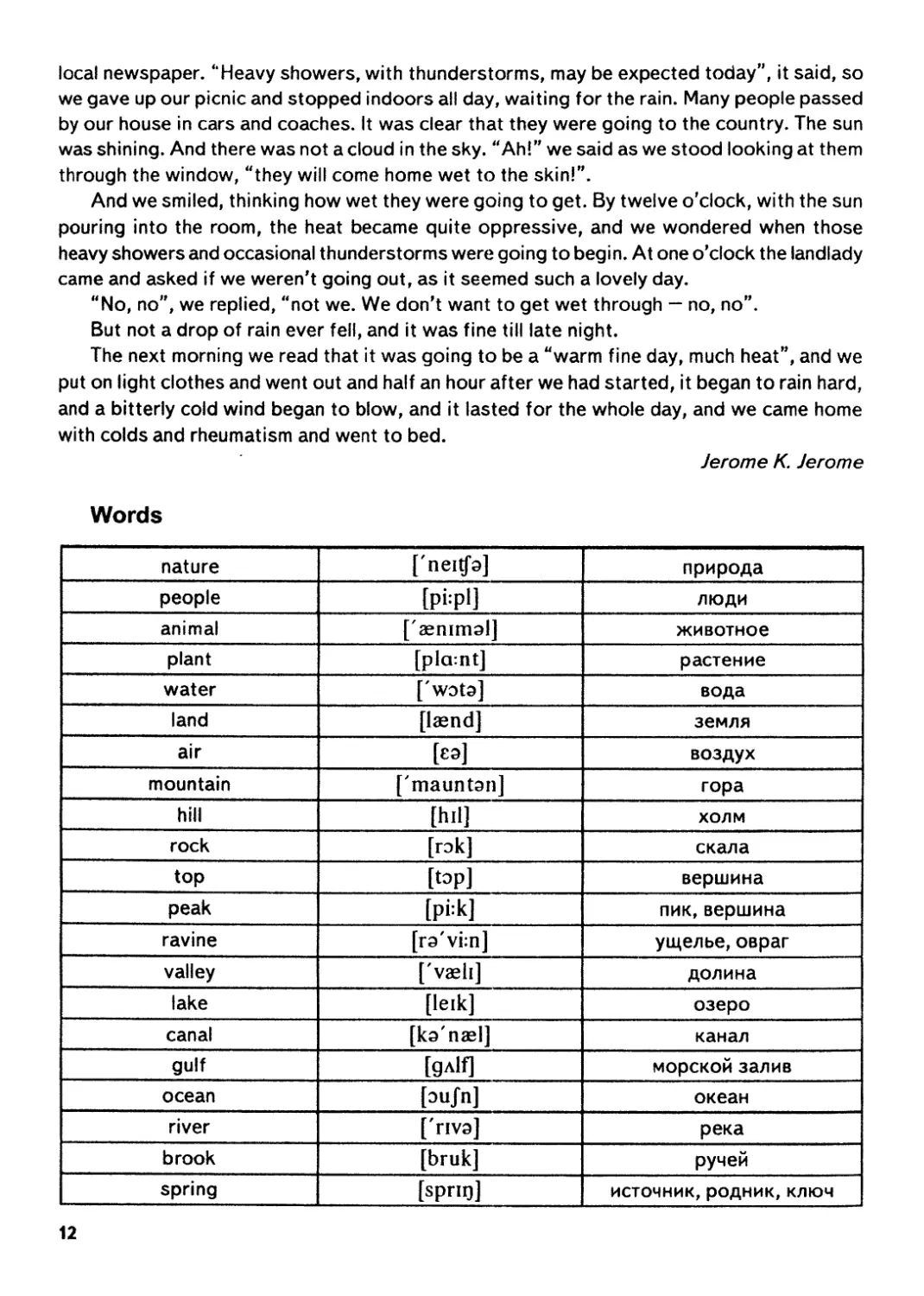
Words
nature ['neIif ] npHpoAa
people [pi:pl] JHOAH
animal [' renlm l] >KJ.1BOTHOe
plan t [plo:nt] paCTeHHe
water ['w t ] BOAa
land [trend] 3eMn
air [ca] B03AYX
mountain rmaunt n] ropa
hill [hIl] XOJ1M
rock [ f:J k ] CKaJ1 a
top [ tJ P ] 8epWHHa
peak [pi:k] nHK, BepWHHa
ravine [r ' vi:n] yw.eJlbe, oBpar
valley [' vreh] AOJ1HHa
lake [leIk] oaepo
canal [k ' nrel] KaHan
gulf [gAIf] MOpCKOH 3aJ1HB
ocean [ ufn ] OKeaH
river [' rlv ] peKa
brook [bruk] PY4e
spri ng [sprlI)] HCT04HHK,pOAHHK,KJ1 4
12
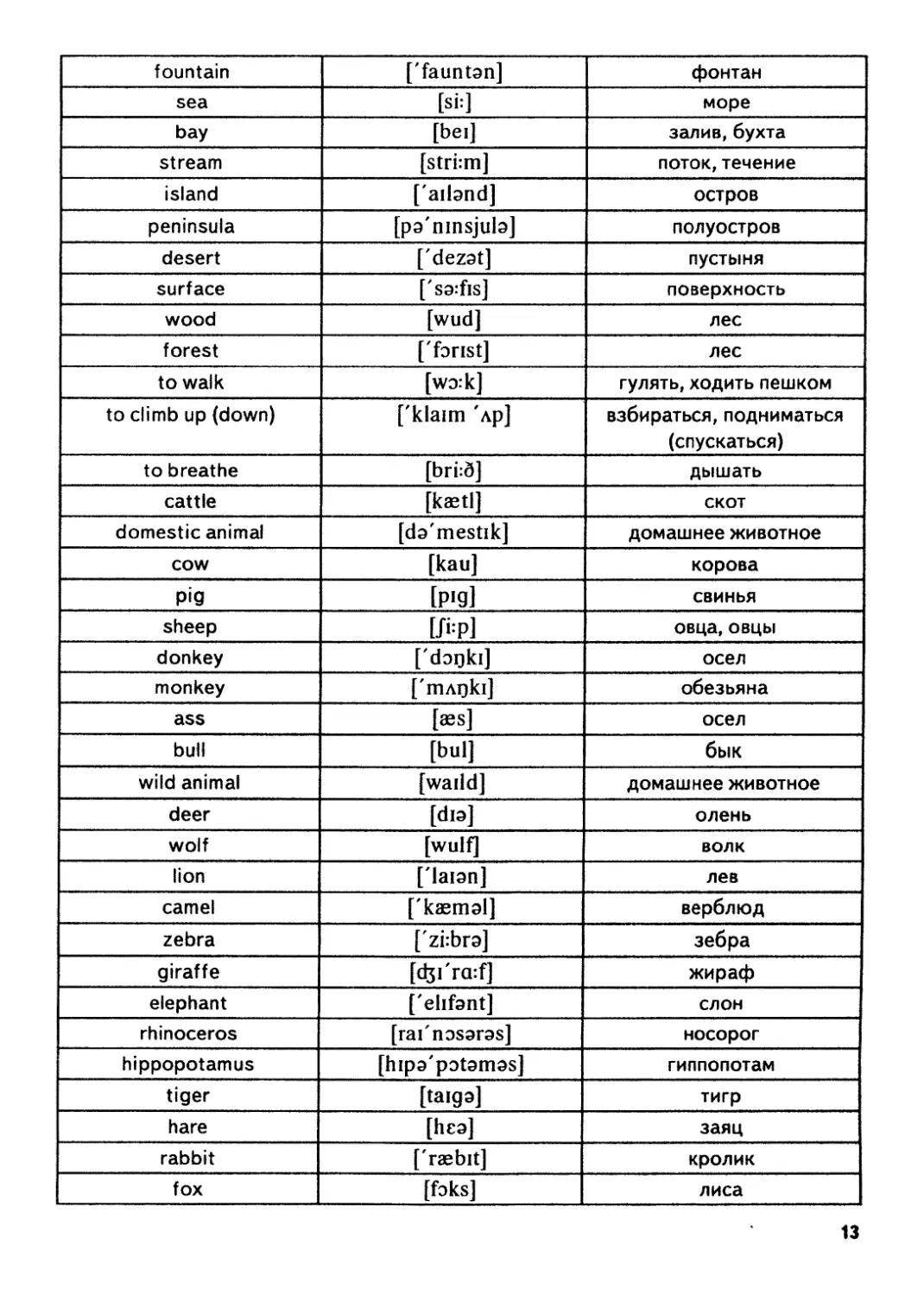
fountain [' faun tan] cpoHTaH
sea [si: ] Mope
bay [bel] 3al1HB,6yxTa
stream [stri:m] nOTOK,Te4eH e
i sl and [' aIl nd] OCTpOB
peninsula [pa' nlnsjula] nonyocTpoB
desert [' dezdt] nycTblH
surface [' Sd:fIS ] nosepXHOCTb
wood [ wud] nee
forest ['f:>rlst] nee
to wal k [ W : k] rynJlTb, XOAHTb neWKOM
to climb up (down) ['klalm 'Ap] B36 paTbC.ft, nOAH MaTbe
(cnycKaTbC.ft )
to breathe [bri:o] AblwaTb
ca t t Ie [kretl] CKOT
domestic animal [dd'mestlk] AOMaWHee >KHBOTHOe
cow [kau] Kopoaa
pig [pIg] CBHHb.ft
sheep [fi:p] OBLJ,a,OSl\bl
donkey [' dJl)kI] ocen
monkey ['mAl)kI] 06e3b.ftHa
ass [res] ocel1
bull [bull 6blK
wild animal [wadd] AOMaWHee >KHBOTHOe
deer [dIa] OJ1eHb
wolf [wulf] BonK
lion ['talan] neB
earn el [' kremal] sep611tOA
zebra [' zi:bra] 3e6pa
giraffe [dJl'ra:f] >KHpacp
elephant [' ehfant] cnOH
rhinoceros [ral' n sdrds] Hocopor
hippopotamus [hIpd'p tamas] rHnnonOTaM
tiger [ ta I 9 a] THrp
hare [hea] 3aAl\
rabbit [' rrebIt] KponHK
fox [fJks] I1Hea
13
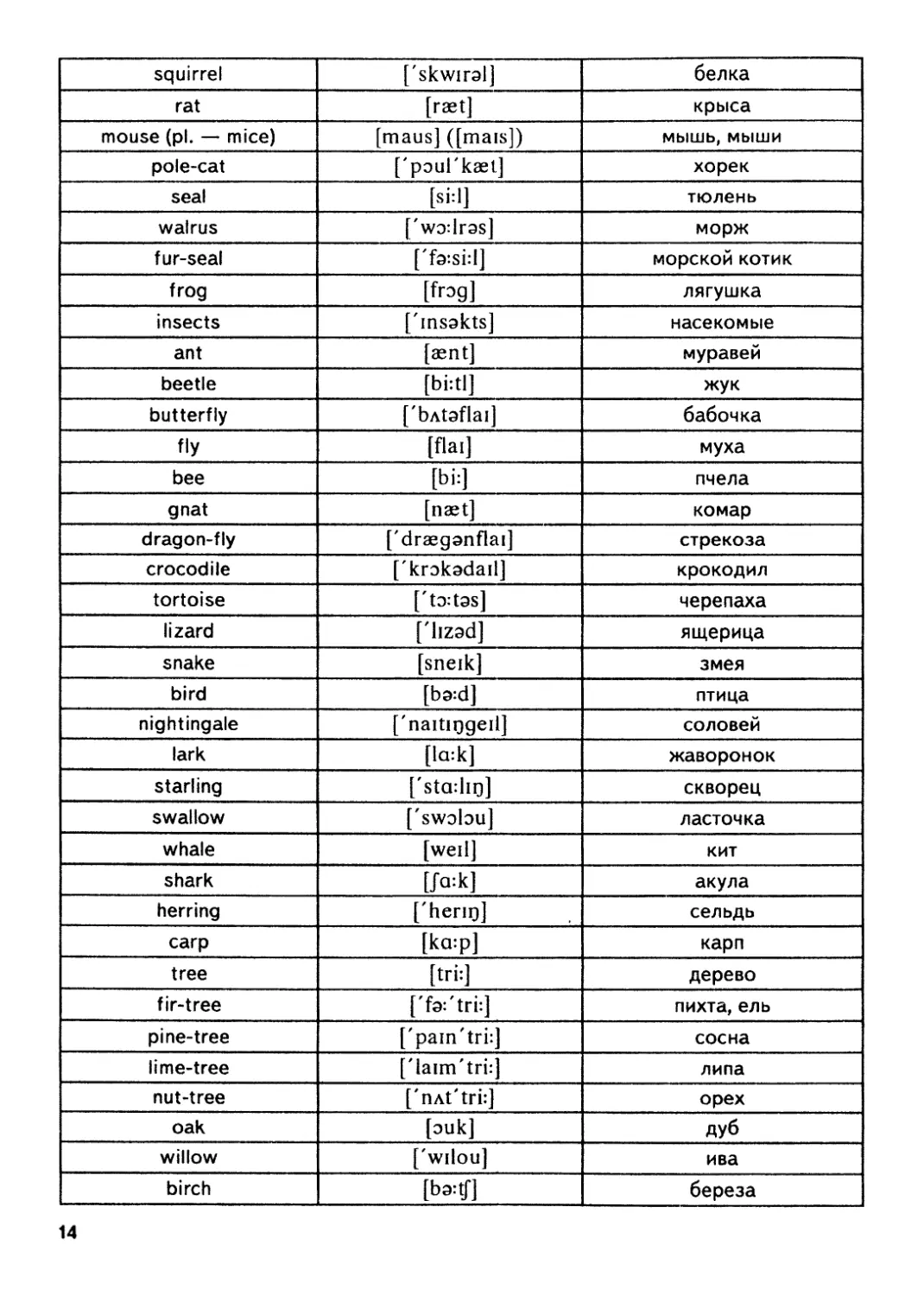
squirrel ['skwlrdl] 6ellKa
rat [rret] Kpblca
mouse (pI. - mice) [maus] ([ mals]) MblWb, MblWIo1
pole-cat r p:)ul' kret] xopeK
seal [si:l] TtOlleHb
w al ru s [' w:):lr s] MOp>K
fur-seal ['fd:si:l] MOpCKOH KOTHK
frog [ frJg] JlRrYWKa
insects ['Insdkts] HaceKOMble
ant [<en t] MypaBeH
beetle [bi:tl] >KYK
butterfly [' bAtdflaI ] 6a604Ka
fly [flaI] Myxa
bee [b i:] n4el1a
gnat [nret] KOMap
dragon-fly [' drregC}nflal] CTpeK03a
crocod i Ie [' krJkadaIl] KpOKOAHI1
tortoise ['tJ:tdS] 4epenaxa
lizard ['hzdd] JUJ,J.epHl\a
snake [ sneIk] 3Mesw
bird [ba:d] nT I-1L"a
nightingale [' naItI1)geIl] COJ10BeH
lark [la:k] >KaaOpOHOK
starling [' sta:hI)] CKBopeu
swallow [' sWJIJu] llaCT04Ka
whale [well] KHT
shark [f a: k ] aKYlla
herring ['herIIJ] CeJ1bAb
carp [ka:p] Kapn
tree [tri: ] AepeBo
fir-tree [' fa: ' tri:] nHXTa,eJ1b
pi ne-tree [' paIn' tri:] cacHa
lime-tree ['laIm'tri:] llHna
nut-tree ['nAt'tri:] opex
oak [Juk] Ay6
willow ['wIlou] HBa
bi rch [bd:tf] 6epe3a
14
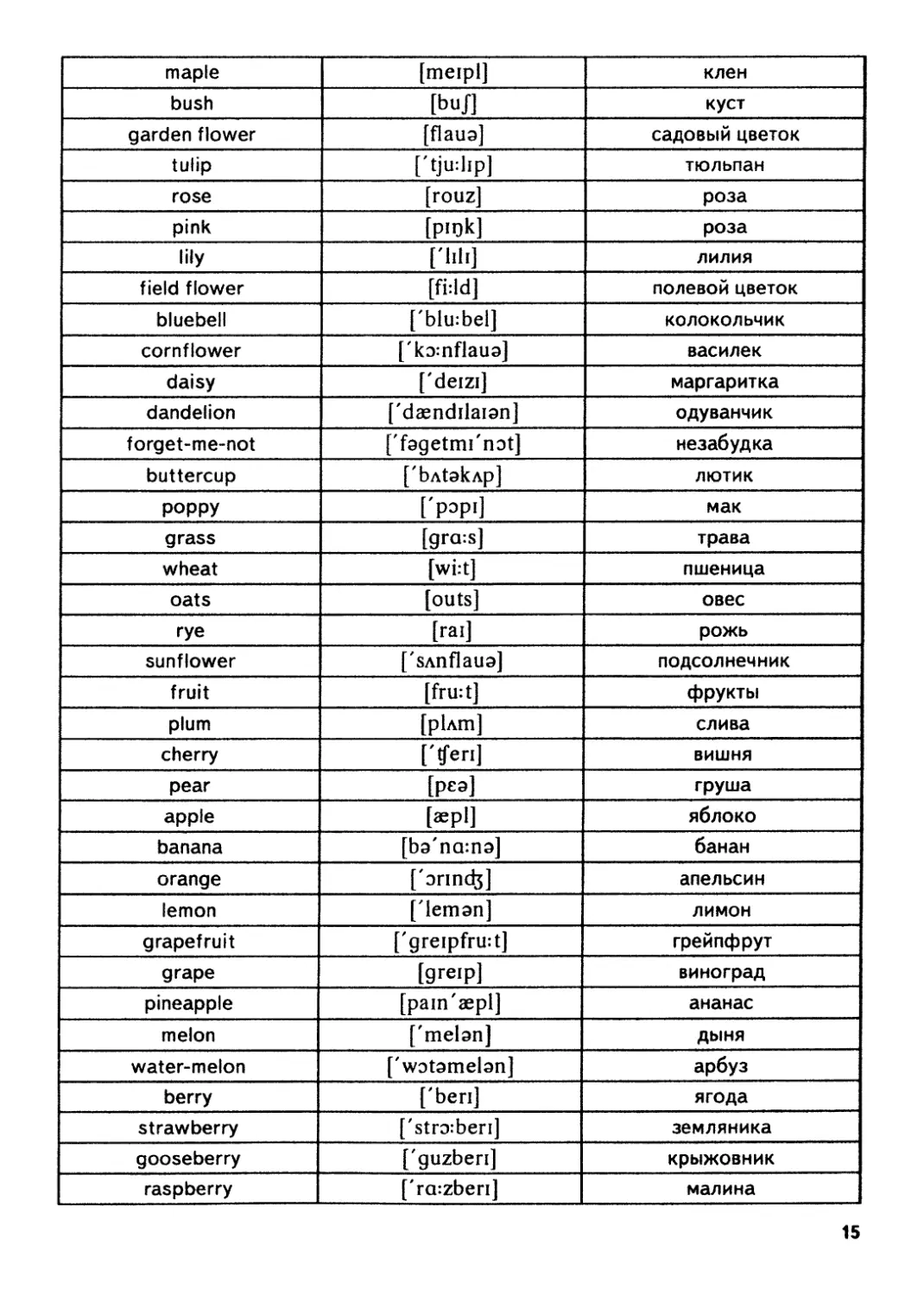
maple [ rnclpl] KneH
bush [buf] KYCT
garden flower [flaud] caAoBblH LtBeTOK
tulip ['tju:hp] TtO/lbnaH
rose [ rouz] p03a
pink [pll)k] p03a
lily [' hll] JUtnH$J
field flower [fi:ld] nOJleBOH u,BeTOK
bluebell ['blu:bel] KOl10KOl1b4HK
cornflower [' kJ:nflaua] BaCHl1eK
daisy [' delZI] MaprapJ.1TKa
dandelion [' drendI1aI n] °AYBaH4c..fK
forget-me-not [' fagetmI' n;Jt] Heaa6YAKa
buttercup [' bAtakAp ] /ltOTIo1K
poppy ['p p[] MaK
grass [gra:s] TpaBa
wheat [wi:t] nweHHu,a
oats [ou ts] osec
rye [ral] pO>Kb
sunflower [' sAnfiaud] nOAconHe4HHK
fruit [ fru: t] <PPYKTbl
plum [pIAm] cnHBa
cherry ['if en] BHWHJI
pear [pea] rpywa
apple [ repl] Jl6nOKO
banana [ba'na:na] 6aHaH
orange [' Jnn<tJ anenbCI;IH
lemon ['lernan] J1HMOH
grapefruit [' grelpfru:t] rpeHncpPYT
grape [grelp] BHHorpaA
pineapple [paIn'repl] aHaHac
melon [' rnclan] AblHJI
water-melon [' wJtamcldn] ap6Y3
berry ['ben] swrOAa
strawberry [' strJ: berI] 3eMJ1 HI;IKa
gooseberry [' guzben] Kpbl>KOBHHK
raspberry [' ra:zben] ManHHa
15
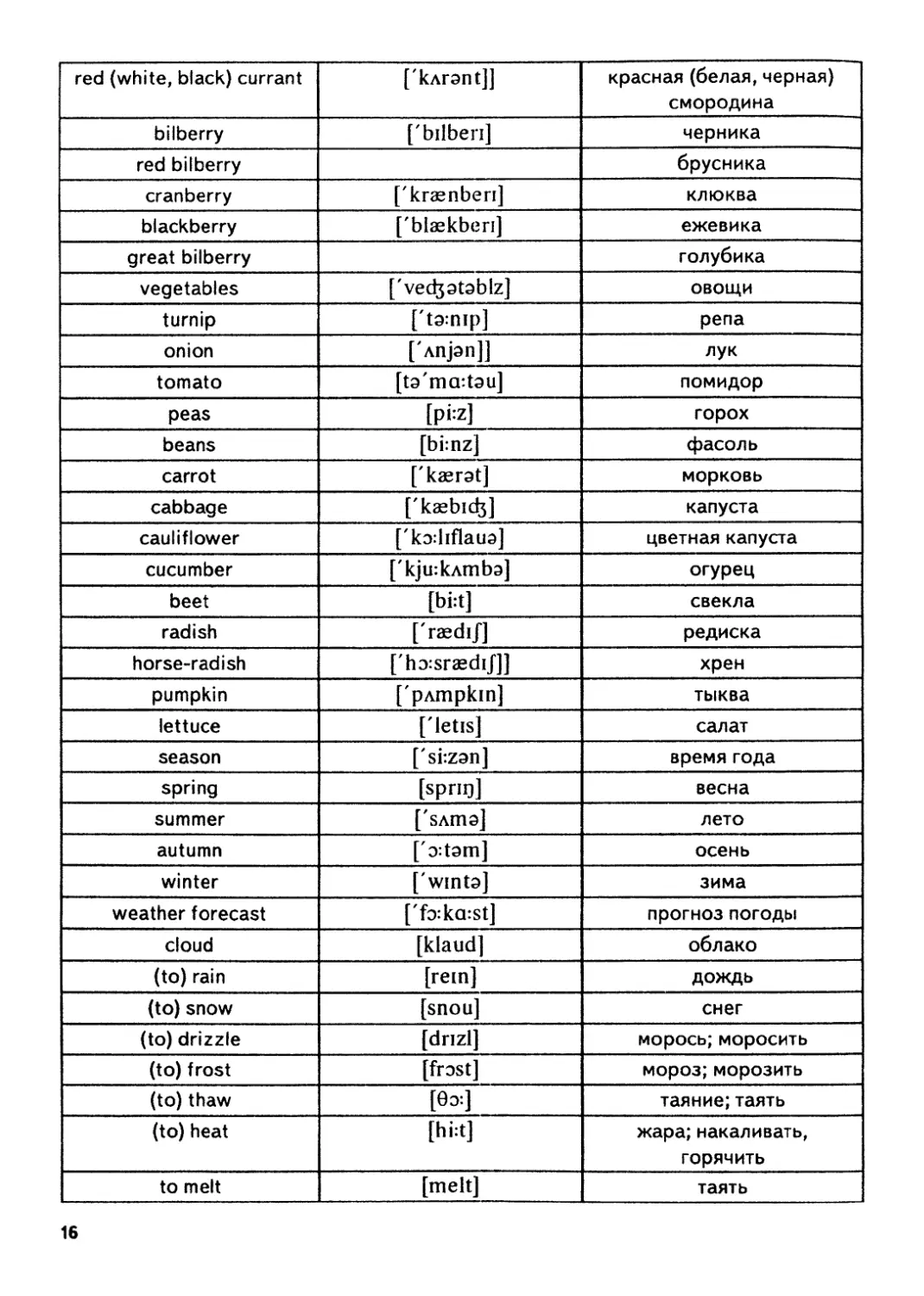
red (white, black) currant ['kAr nt]] KpaCHa (6eJlaJl,4epHasw)
CMopoAHHa
bilberry [' bIlben] 4epHHKa
red bilberry 6pycHHKa
cranberry [' krrenben] KJHOKBa
blackberry ['blrekbcn] e>KeBHKa
great bilberry rOJ1y6HKa
vegetables [' ved3atablz] OBOL4H
turnip ['t :nIp] pena
onion [' Anj n]] I1YK
tomato [ta'ma:tau] nOMHAOp
peas [pi:z] ropox
beans [bi:nz] cpaCOJ1b
carrot [' krerdt] MOpKOBb
cabbage [' krebIdJ] KanYCTa
cauliflower [' k:>:hflaud] 4BeTHa KanYCTa
cucumber [' kju: kAm bd] oryp e 4
beet (bi:t] CBeKlla
radish [' rredlf] peAHcKa
horse-radish [' h :srredlf]] xpeH
pu mpki n ['pAmpkln] TblKBa
lettuce [' letIs] call aT
season [' si:Zdn ] apeMSI rOAa
spring [spnI) ] seCHa
summer [' SAmd] J1eTO
autumn [' :t m] oceHb
winter [' win td ] 3HMa
weather forecast ['f:>:ka:st] nporH03 norOAbl
cloud [kla ud 1 06J1aKO
(to) rain [rein] AO>KAb
(to) snow [snou] CHer
(to) drizzle [ dnzl] MOpOCb; MOpOCHTb
(to) frost [fr:>st] MOp03; MOp03HTb
(to) thaw [eJ: ] TaJlHHe;Ta Tb
(to) heat [h i:t] >Kapa; HaKaJ1HBaTb,
rop 4HTb
to melt [melt] TaSlTb
16
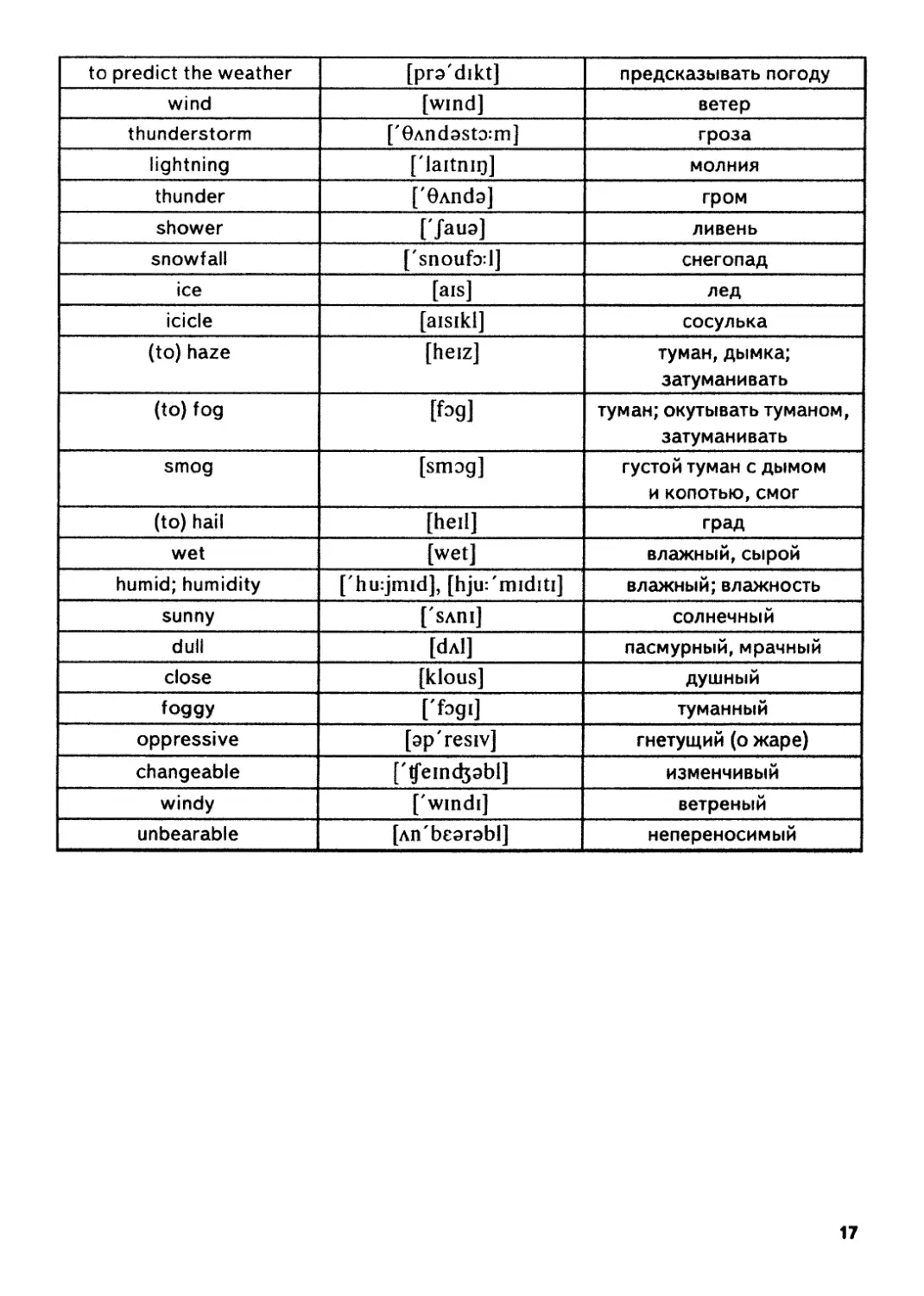
to predict the weather [pr ' dlkt] npeAcKa3blBaTb noroAY
wind [wInd] BeTep
thunderstorm [' eAndastJ:m] rpo3a
lightning [' laItnII)] MOllHHSI
thunder [' 8Andd] rpoM
shower [' faud] J1HBeHb
snowfall [' snoufJ:1] cHeronaA
Ice [aIs] lleA
icicle [ aIsIkl] COCYJ1bKa
(to) haze [helz] rYMaH, AbIMKa;
aaTYMaHHBaTb
(to) fog [fJg] TYMaH; OKYTblsaTb TYMaHoM,
aarYMaHHBaTb
smog [ sm=>g] rycToH TYMaH C AblMOM
H KonOTbtO, CMor
(to) hail [hell ] rpCiA
wet [wet] BJ1a>KHbIH, CblpOH
humid; humidity [' h u:jrnId], [hju:' mIdltl] BJ1a>KHbIH; BI1a>KHOCTb
sunny [' sAnl] COJ1HeYHbIH
dull [ dAl] nacMypHblH, Mpa4HblH
close [klous] AYWHblH
foggy [' fJg I] TYMaHHblH
oppressive [dp'reslv] rHeTYUJ.HH (0 >Kape)
changeable [' ifeIn<f3dbl] H3MeHYHBblH
windy ['wIndl] BeTpeHbu
unbearable [An'bcaTablj HenepeHocHMblH
17
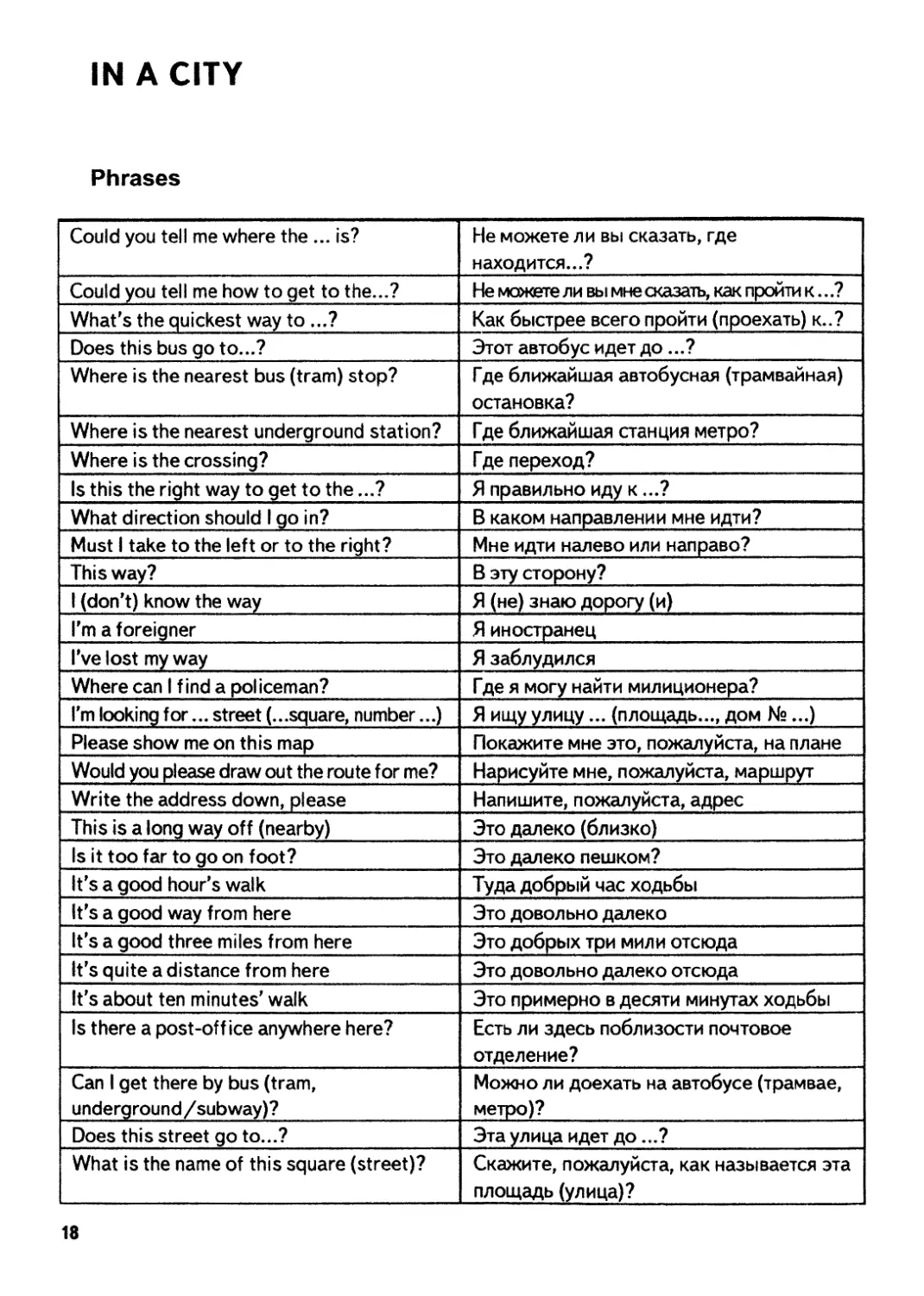
IN A CITY
Phrases
Could you tell me where the ... is? He MO>KeTe J1H Bbl CKa3aTb, r,o.e
HaXOAHTCSW... ?
Could you tell me how to get to the...? ?
MO>KeTe I1H Bbl MHe CKa3alb, Kat< npoHTH K ... .
What's the quickest way to ...? KaK 6blcTpee Bcero npoHTH (npoexaTb) K..?
Does this bus go to...? 310T aBTo6yc HAeT AO ...?
Where is the nearest bus (tram) stop? r Ae 6I1H>KaHwCUt aBT06ycHCUI (TpaMsaHHasw)
oCTaHoBKa?
Where is the nearest underground station? r lJ.e 6J1H>KaHW CTaH HfI MeTpo?
Where is the crossing? r Ae nepexoA?
Is this the right way to get to the ...? 51 npaBHJ1bHO HAY K ...?
What direction should I go in? B KaKOM HanpaBJ1eHHH MHe HATH?
Must I take to the left or to the right? MHe HATH HaJ1eBO HJ1H Hanpaso?
This way? B 31)' CTOPOHY?
I (don't) know the way 51 (He) 3HalO AOPOry (H)
I'm a foreigner 51 HHOCTpaHe
I've lost my way 51 3a6J1Y AHJ1C
Where can I find a policeman? r Ae $I Mory Ha TH MHnH HoHepa?
I'm looking for ... street (...square, number ...) 51 HUJ.Y ynH y ... (nJ1oUJ.aAbu., AOM N ...)
Please show me on this map nOKa>t<HTe MHe 3TO, nO>KanYHCTa, Ha nJ1aHe
Would you please draw out the route for me? HapHcYHTe MHe, nO>KaJIYHCTa, Mapwpyr
Write the address down, please HanHwHTe, nO>KaJ1YHcTa, aApec
This is a long way off (nearby) 3TO AaJ1eKO (6J1H3KO)
Is it too far to go on foot? 3TO AaJ1eKO newKoM?
It's a good hour's walk T YAa A06pblH 4ac XOAb6bl
It's a good way from here 3TO AOBOJ1bHO AalIeKO
It's a good three miles from here 3TO A06pblX TPH MHJ1H OTCIOAa
It's quite a distance from here 3TO .qOBOJ1bHO AaJ1eKO OTCIOAa
It's about ten minutes' walk 3ro npHMepHo B AeOlTJ.1 MJ.1Hyrax xO,lJ.b6bl
Is there a post-off ice anywhere here? ECTb J1H 3AeCb n06J11<ot3OCTH n04ToBoe
oT,qeJ1eHHe?
Can I get there by bus (tram, Mo>t<HO J1H AoexaTb Ha aSTo6yce (TpaMBae,
underground / subway)? Merpo )?
Does this street go to...? 3ra YJ1H HAeT AO ...?
What is the name of this square (street)? CKa>KHTe, nO>KalIYHCTa, KaK Ha3blBaeT 3Ta
nl10 Mb (YI1Hl.\a)?
18
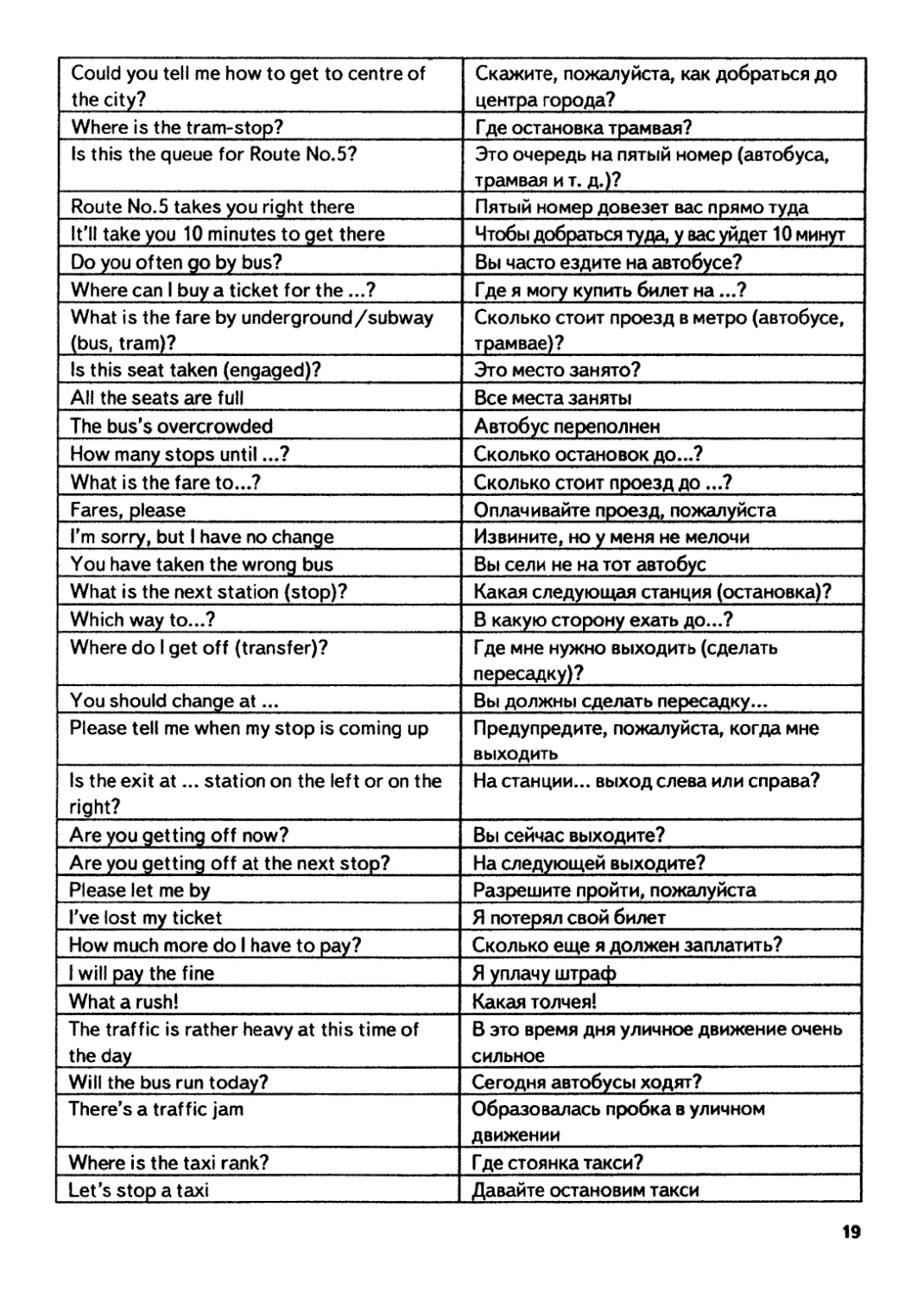
Could you tell me how to get to centre of CKa>t<HTe, nO>KaJ1YHcTa, KaK A06paTbc$I AO
the city? l\eHTpa ropoAa?
Where is the tram-stop? r Ae OCTaHOBKa TpaMBCUI?
Is this the queue for Route No.5? 3TO o4epeAb Ha nJlTblH HOMep (asT06yca,
TpaMBCUI H T. 11..)1
Route No.5 takes you right there n$lTblH HOMep AOBe3eT sac np MO TYAa
It'll take you 10 minutes to get there 4T06bl A06paTb TY M Y BaC yi:tAeT 10 MHHYT
Do you often go by bus? Bbl 4aCTO e3A&itTe Ha aBTo6yce?
Where can I buy a ticket for the ...? r Ae $I MOry KynHTb OOJ1eT Ha ...?
What is the fare by underground / subway CKOJ1bKO CTOHT npoe3A B MeTpo (aBT06yce,
(bus, tram)? TpaMBae)?
Is this seat taken (engaged)? 310 MeCTO 3aHRTo?
All the seats are full Bee Mecra 3aHRTbi
The bus's overcrowded ABT06yc nepenOI1HeH
How many stops until...? CKOJ1bKO oeTaHOBOK AO...?
What is the fare to...? CKOJ1bKO CTOHT npoe3A I1tO ...1
Fares, please Onl1a4HBaHTe npoe3A, nO>KaJ1YHcTa
I'm sorry, but I have no change J,13BHHIo1Te, HO y MeHR He Men04H
You have taken the wrong bus Bbf cel1 He Ha TOT aBTo6yc
What is the next station (stop)? KaKaSI Cl1eAYIOU¥iJI cTaH4HR (ocTaHoBKa) 1
Which way to...? B KaKYIO CTOpoHY exaTb AO...?
Where do I get off (transfer)? rAe MHe HY>KHO BblXOAHTb (cAenaTb
nepec Ky)1
You should change at ... Bbl AOJ1>KHbl CAenaTb nepeCaAKY...
Please tell me when my stop is coming up npeAynpeAHTe, nO>KaJ1YHcra, KorAA MHe
BblXOAIo1Tb
Is the exit at ... station on the left or on the Ha CTaH4MM... BblXOA CJ1esa MnH cnpasa?
right?
Are you getting off now? Bbl ceH4ac BbIXOA&itTe?
Are you getting off at the next stop1 Ha CJ1eAytO eH SblXOAHTe 1
Please let me by Pa3pewHTe npoHTH, nO>KaJ1YHcTa
I've lost my ticket nOTepRJ1 csoH 6HJ1eT
How much more do I have to pay? CKonbKo e e JI AOJ1>KeH JannaTHTb?
I will pay the fine ynna4Y wTpa<b
What a rush! KaKaJI TOJ14eJl!
The traffic is rather heavy at this time of B 3TO BpeMs:I AHs:I ynM"tHoe ABH>KeHMe O"teHb
the day CHnbHoe
Will the bus run today? CeroAHSI aST06ycbl XOART?
There's a traffic jam 06pa30BaJ1aCb npo6Ka B ynH4HoM
ABH>KeHHH
Where is the taxi rank? rAe CTOSlHKa TaKcH?
Let's stop a taxi ,lJ.aBaHTe OCTaHOBHM TaKCH
19
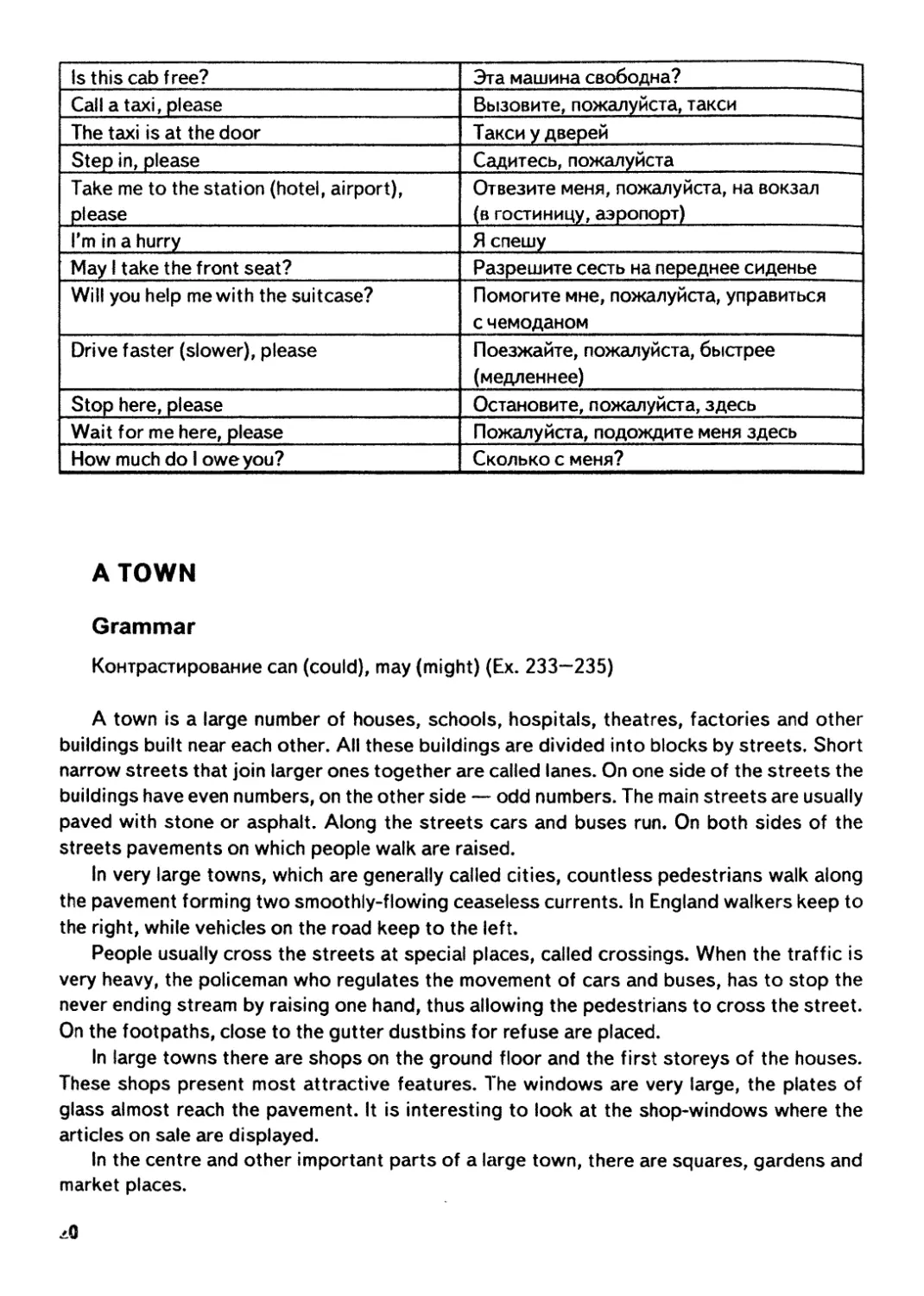
Is this cab free? 3Ta MaW Ha cB06oAHa?
Call a taxi, please BbI30BHTe, nO>KaJ1y cTa, TaKCH
The taxi is at the door T aKCH Y ABepeH
Step in, please Cap.HTecb, nO>KaJ1YHcTa
Take me to the station (hotel, airport), OT8e3 Te MeH , nO>KaJ1YHcTa, Ha BOK3aJl
pi ease (8 rOCTHHH4Y, a3ponopT)
I'm in a hurry cnewy
May I take the front seat? Pa3pewHTe ceCTb Ha nepeAHee CHAeHbe
Will you help me with the suitcase? nOMorHTe MHe, nO>KaI1YHCTa, ynpaBHTbcJI
C 4eMOAaHOM
Drive faster (slower), please nOe3>KaHTe, nO>KaJlYHcTa, 6blCTpee
(MeA/leHHee)
Stop here, please OCTaHoBHTe,no YHCTa,3Aecb
Wait for me here, please nO>KaJlYHCTa, nOAO>KAHTe MeHJI 3AeCb
How much do I owe you? CKOJ1bKO c MeHsw?
A TOWN
Grammar
KOHTpacTHpoaaHHe can (could), may (might) (Ex. 233-235)
A town is a large number of houses, schools, hospitals, theatres, factories and other
buildings built near each other. All these buildings are divided into blocks by streets. Short
narrow streets that join larger ones together are called lanes. On one side of the streets the
buildings have even numbers, on the other side - odd numbers. The main streets are usually
paved with stone or asphalt. Along the streets cars and buses run. On both sides of the
streets pavements on which people walk are raised.
In very large towns, which are generally called cities, countless pedestrians walk along
the pavement forming two smoothly-flowing ceaseless currents. In England walkers keep to
the right, while vehicles on the road keep to the left.
People usually cross the streets at special places, called crossings. When the traffic is
very heavy, the policeman who regulates the movement of cars and buses, has to stop the
never ending stream by raising one hand, thus allowing the pedestrians to cross the street.
On the footpaths, close to the gutter dustbins for refuse are placed.
In large towns there are shops on the ground floor and the first storeys of the houses.
These shops present most attractive features. The windows are very large, the plates of
glass almost reach the pavement. It is interesting to look at the shop-windows where the
articles on sale are displayed.
In the centre and other important parts of a large town, there are squares, gardens and
market places.
.to
A town is often situated near or on a river with bridges across it. In almost all towns
there are places of interest: monuments, cathedrals, museums and so on.
In England a town is governed by a council whose head is the mayor.
50/2 - Asking For Directions
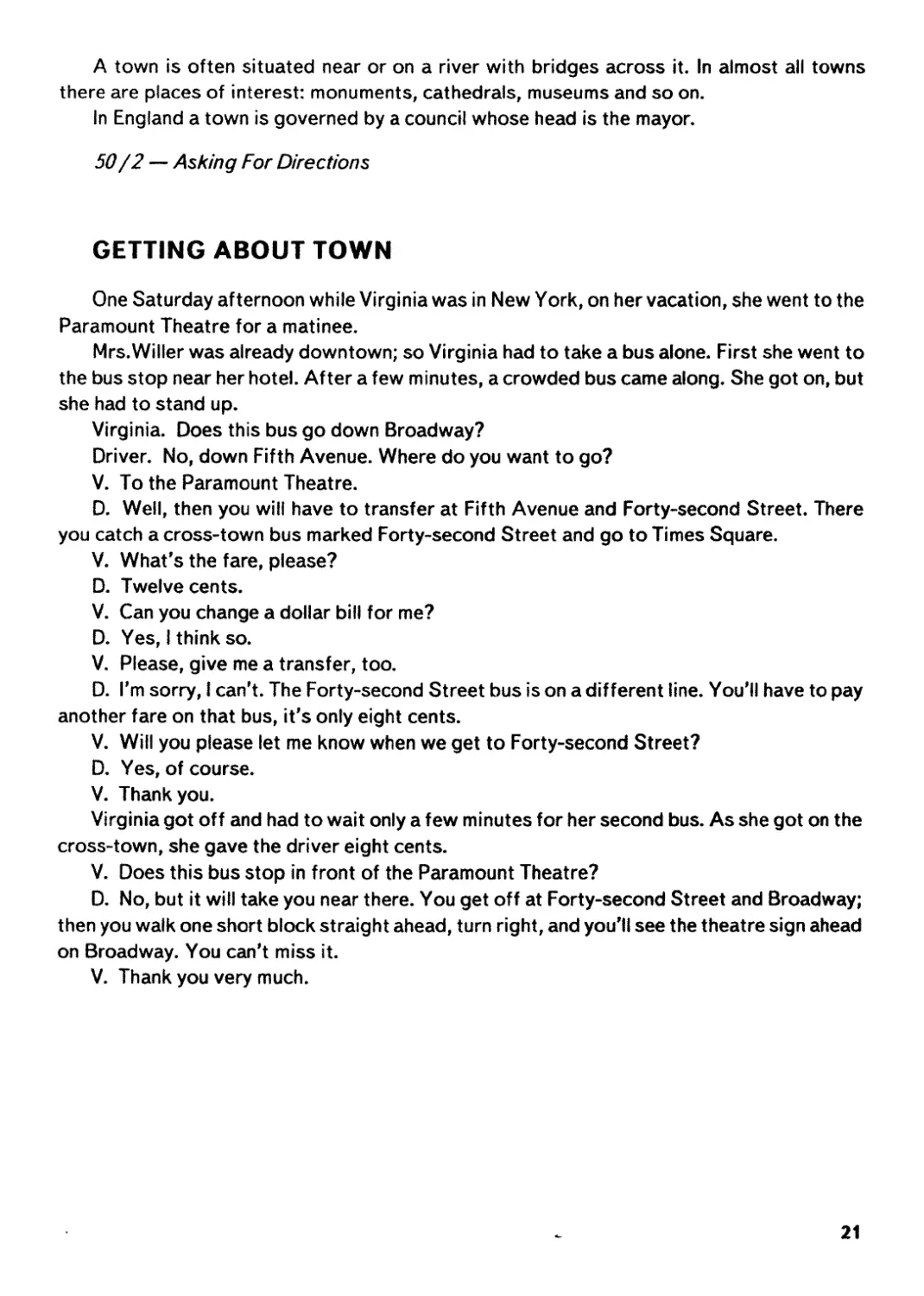
GETTING ABOUT TOWN
One Saturday afternoon while Virginia was in New York, on her vacation, she went to the
Paramount Theatre for a matinee.
Mrs. Willer was already downtown; so Virginia had to take a bus alone. First she went to
the bus stop near her hotel. After a few minutes, a crowded bus came along. She got on, but
she had to stand up.
Virginia. Does this bus go down Broadway?
Driver. No, down Fifth Avenue. Where do you want to go?
V. To the Paramount Theatre.
D. Well, then you will have to transfer at Fifth Avenue and Forty-second Street. There
you catch a cross-town bus marked Forty-second Street and go to Times Square.
V. What's the fare, please?
D. Twelve cents.
V. Can you change a dollar bill for me?
D. Yes, I think so.
V. Please, give me a transfer, too.
D. I'm sorry, I can't. The Forty-second Street bus is on a different line. You'll have to pay
another fare on that bus, it's only eight cents.
v. Will you please let me know when we get to Forty-second Street?
D. Yes, of course.
V. Thank you.
Virginia got off and had to wait only a few minutes for her second bus. As she got on the
cross-town, she gave the driver eight cents.
V. Does this bus stop in front of the Paramount Theatre?
O. No, but it will take you near there. You get off at Forty-second Street and Broadway;
then you walk one short block straight ahead, turn right, and you'll see the theatre sign ahead
on Broadway. You can't miss it.
V. Thank you very much.
21
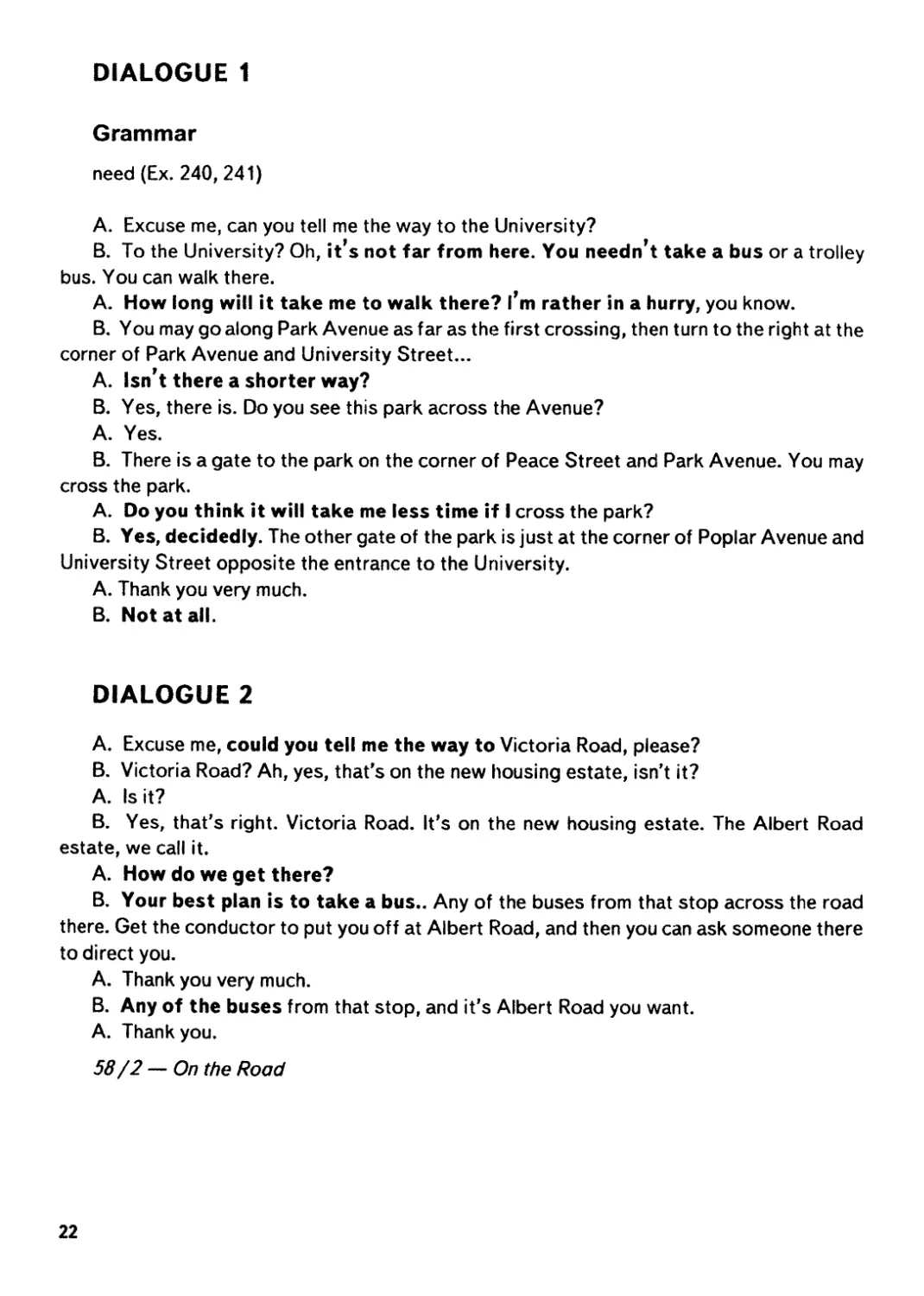
DIALOGUE 1
Grammar
need (Ex. 240,241)
A. Excuse me, can you tell me the way to the University?
B. To the University? Oh, it's not far from here. You needn't take a bus or a trolley
bus. You can walk there.
A. How long will it take me to walk there? I'm rather in a hurry, you know.
B. You may go along Park Avenue as far as the first crossing, then turn to the right at the
corner of Park Avenue and University Street...
,
A. Isn t there a shorter way?
B. Yes, there is. Do you see this park across the Avenue?
A. Yes.
B. There is a gate to the park on the corner of Peace Street and Park Avenue. You may
cross the park.
A. Do you think it will take me less time if I cross the park?
B. Yes, decidedly. The other gate of the park is just at the corner of Poplar Avenue and
University Street opposite the entrance to the University.
A. Thank you very much.
B. Not at all.
DIALOGUE 2
A. Excuse me, could you tell me the way to Victoria Road, please?
B. Victoria Road? Ah, yes, that's on the new housing estate, isn't it?
A. Is it?
B. Yes, that's right. Victoria Road. It's on the new housing estate. The Albert Road
estate, we call it.
A. How do we get there?
B. Your best plan is to take a bus.. Any of the buses from that stop across the road
there. Get the conductor to put you off at Albert Road, and then you can ask someone there
to direct you.
A. Thank you very much.
B. Any of the buses from that stop, and it's Albert Road you want.
A. Thank you.
58/2 - On the Rood
22
Words
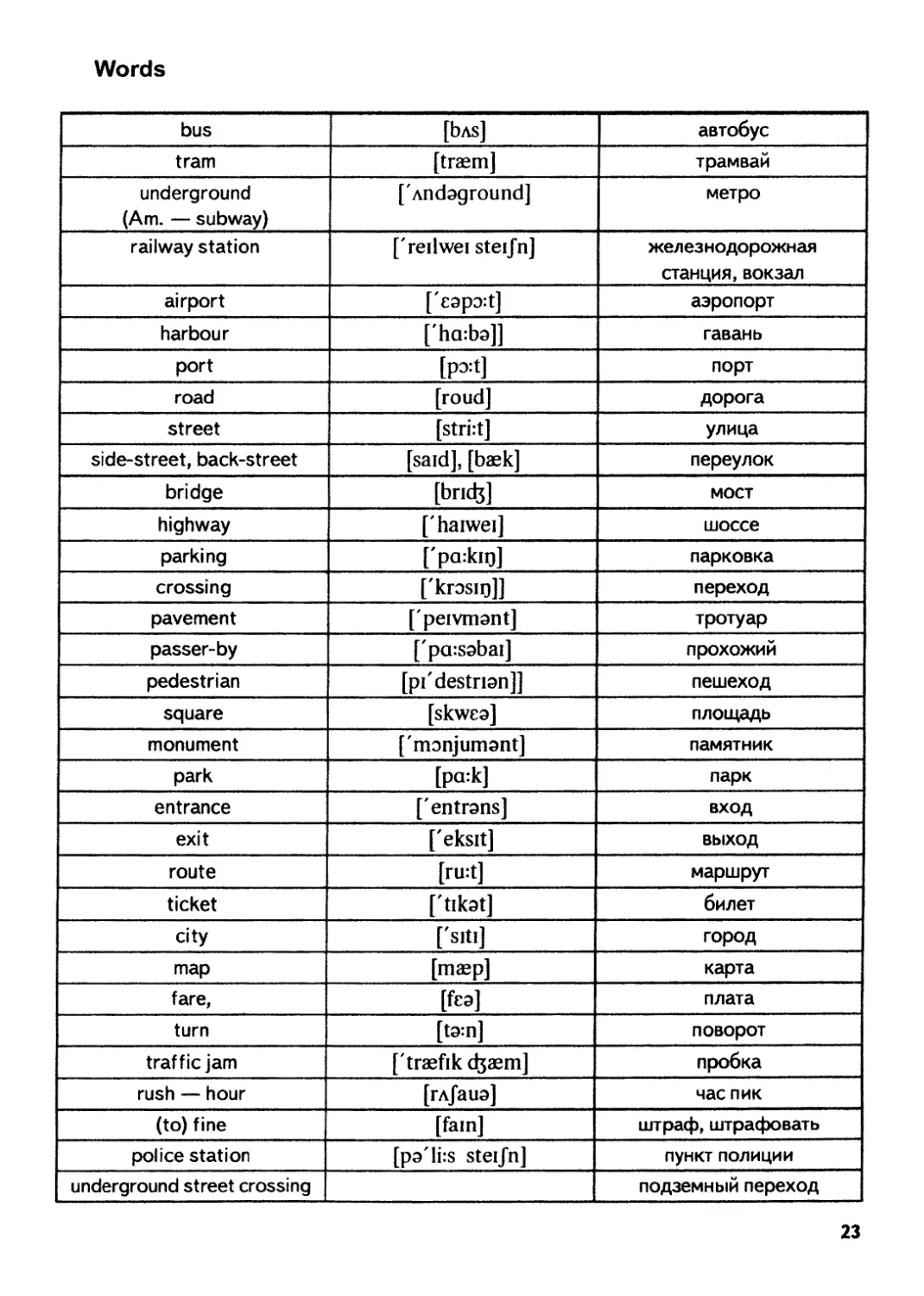
bus [bAS ] as T06yc
tram [trrem] TpaMBa
underground [' Anddground] MeTpo
(Am. - subway)
railway station [' reIlwel stelJn] >Kene3HOAOpO>KHasI
craHltHJ1, BOK3aJ1
ai rport [' c pJ:t] a3ponopT
harbou r ['ha:bd]] raBaHb
port [p::>:t] nopr
road [roud] Aopora
street [ stri:t ] ynHlta
side-street, back-street [saId], [brek] nepeYJ10K
bri dge [bnd3J MOCT
highway [' haIweI] wocce
parki ng [' pa:kII)] napKoBKa
crossing ['krJsIIJ]] nepeXO,D.
pavement ['pelvm nt] rpoT}'ap
passer-by [' pa:sdbal] npoxO>KHH
pedestrian [pI' destnc:>n ]] neweXOA
square [skwca] nnO b
monument ['mJnjum nt] naM THHK
park [pa:k] napK
entrance [' entr ns] BXOA
exit [' ekslt] BbtXOA
route [ru:t] Mapwpyr
ticket [' tIkat] 6HI1eT
city [' sItI] ropoA
map [mrep] KapTa
fare, [fe ] nnara
turn [ td: n] nOBopoT
traffic jam [' trreflk dJrem] npo6Ka
rush - hour [rAfaua] lfac n HK
(to) fine [fain] wrpacp, wTpacpoBaTb
pol ice station [pa'li:s stelJn] nYHKT nOJ1Hlt H H
underground street crossing nOA3eMHblH nepexoA
23
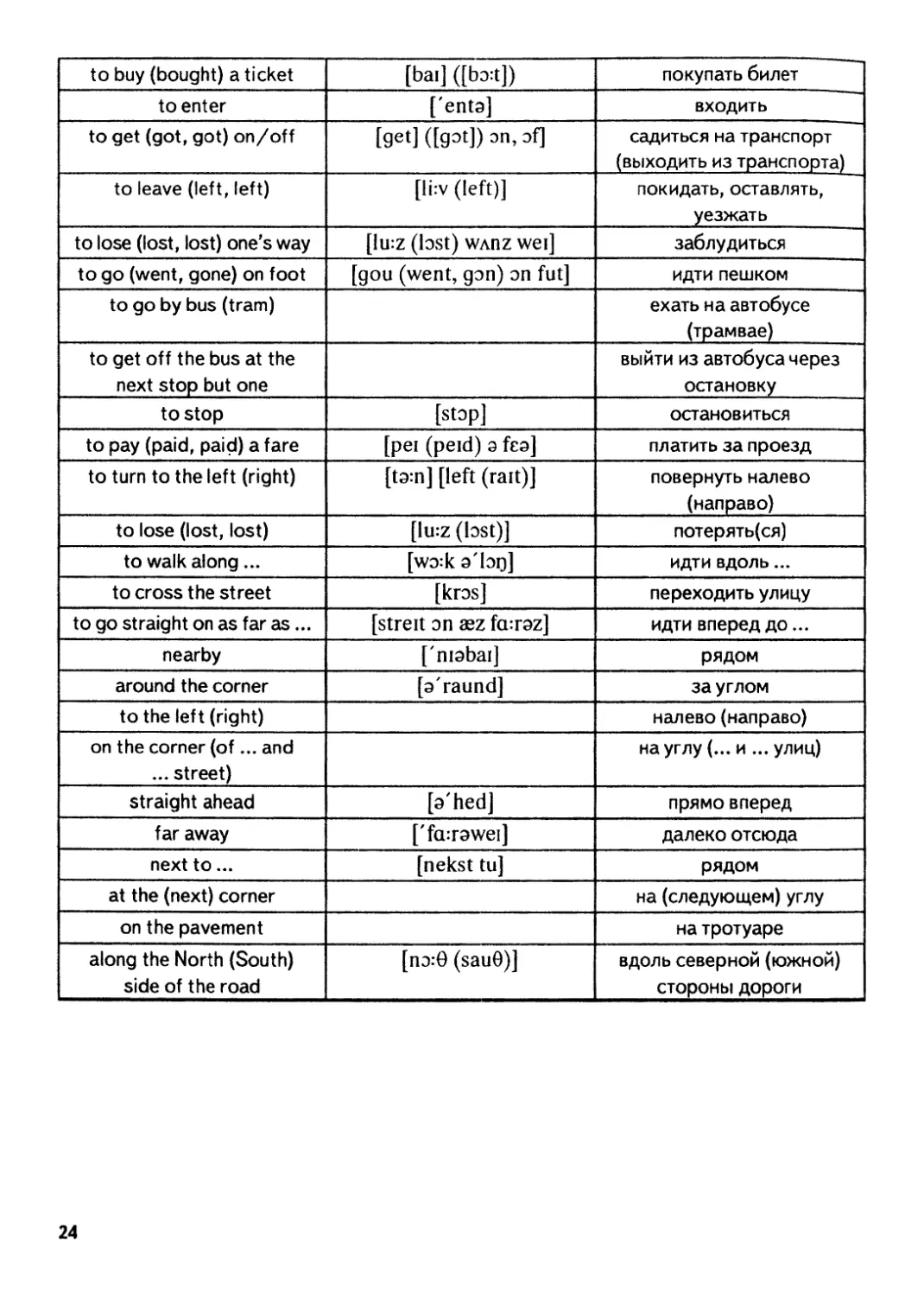
to buy (bought) a ticket [bal] ([bJ:t]) nOKynaTb 6HJ1eT -
to enter ['enta] BXOAHTb
to get (got, got) on/off [get] ([gJt]) :)n, JfJ CaAHTbCJf Ha TpaHcnopr
(BblXOAHTb H3 TpaHcnopTa)
to leave (left, left) [li:v (left)] nOKHAaTb,OCTaBJ1fJTb,
ye3>KaT b
to lose (lost, lost) one's way [lu:z (IJst) WAnz wel] aa6J1Y AHTbC.st
to go (went, gone) on foot [gau (went, 9::>n) ::>n fut] HATH neWKOM
to go by bus (tram) exaTb Ha aBT06yce
(TpaMBae)
to get off the bus at the Bbl n H3 aBTo6yca 4epe3
next stop but one ocraHoBKY
to stop [stJp] OCTaHOBHTbC
to pay (paid, pai ) a fare [pel (peId) d fea] nJ1aTHTb aa npoe3A
to turn to the left (right) [t :n] [left (TaIt)] nOBepHYTb HaJleBO
(Hanpaao)
to lose (lost, lost) [Iu:z (I:)st)] nOTepswTb( Cf4)
to walk along... [w:):k a'(JIJ] HATH BAOl1b ...
to cross the street [krJs] nepeXO,D.HTb YJ1H y
to go straight on as far as ... r streit In rez fa:rdz] HATH BnepeA AO ...
nearby [' nlabaI] pSWAOM
around the corner [d'raund] 3a yrJlOM
to the left (right) HaJ1eaO (HanpaBo)
on the corner (of ... and Ha yrJ1Y (... H ... YJ1Hld
... street)
straight ahead [a'hed] np Mo anepe,LJ.
far away [' fa:rdweI] AalleKO OTCtOAa
next to ... [nekst tu] PSlAOM
at the (next) corner Ha (cl1eAYtOlJ.J.eM) yr J1Y
on the pavement Ha TpoTyape
along the North (South) [nJ:8 (saue)] BAOJ1b ceaepHoi:t (IO>KHOH)
side of t he road CTOpOHbl AoporH
24
TRA YELLING
Phrases
- What do we take with use when we - 4TO Mbl 6epeM C c06o , KorAa
travel? OTn paBn eMCSI nyreweCTBoaaTb?
- We take only the first essentials - Mbl6epeM TOJ1bKO caMoe Heo6xo,D.HMOe
I like to travel light s:1l1t06J1tO nYTeweCTBOBaTb HanerKe
Please, be in a hurry! nocnewH, nO>KanYHCTa
Take it easy! We've got plenty of time He nepe>KHSaHTe! Y Hac Macca BpeMeHH
The suitcase is stuffed full 4eMoAaH Ha6HT AO OTKa3a
All was in a tumble Bce 6blJ10 Baepx AHOM
Could you tell me where the information CKa>KHTe nO>KanYHcTa, r fJ.e HaxOAHTCJl
office (the schedule of trains (time-table), cnpaB04Hoe 61Opo (pacnHcaHHe noe3AOB,
the ticket-office (booking-office), the 6HJ1eTHCi$I Kacca, 3aJ1 O>KHAaHH , 6tOpo
waiting-room, the Lost and Found, the duty HaxO)J.OK, Mara3HH 6eCnOWJ1HHHOH
free shop) is? ToproBnH)?
Where can I get a ticket for the train (boat, r Ae Mory KynHTb 6HneT Ha noe3A
plane) to ...? (TenI10XOA, CaMOJ1eT) ,0.0 ...?
How much does the ticket cost? CKOl1bKO CTOHT 6HJ1eT?
What is the regular fare to ..., please? CKOl1bKO CTOHT npoCToH 6HI1eT ,0.0 ...?
- How much is a child's ticket? - CKonbKo CTOHT AeTcKHH 6HneT?
- Children's tickets cost half (a quarter) - .D.eTcKHe 6HJ1eTbl CTO T nOJ10BHHY
the price (4eTBepTb)croHMocTH
I want two full tickets and two children's MHe H)?KHO ABa nOJ1HbIX 6HJ1era H ABa
tickets AeTCKJ.1X
- How many days is the ticket valid for? - B Te4eHHe CKOJ1bKHX cyrOK
- It is valid for use only once AeHCTB TeJ1eH 6Hl1eT?
- OH rOAeH AJI npoe3.qa TOl1bKO B OAHH
KOHe4
This ticket is invalid 3TOT 6HI1er HeAeHCTBHTeJleH
Train
Should I have my ticket punched? M He H}?KHO KOMnOCTHpOBaTb 6HJ1eT?
Please give me a ticket (a return/round- AaHTe, nO>KanYHCTa, 6HJ1er B MstrKHH sarOH
trip ticket) in the sleeping-car to ... ,0.0 ... (TYAa H 06paTHo)
Do you want a smoker or a non-smoker? Bbl XOTHTe Mecro B BarOHe AJ1 KypSWUJ.HX
HI1H AllSi HeKYPJlUJ.HX?
I would like a lower (upper) berth, please 6bl XOTen HH>KHee (BepxHee) MeCTO
I want a year-round (a season) ticket to ... MHe, nO>K.aJ1YHCTa, rOAoBoH (ce30HHbIH)
6HJ1eT AD ...
25
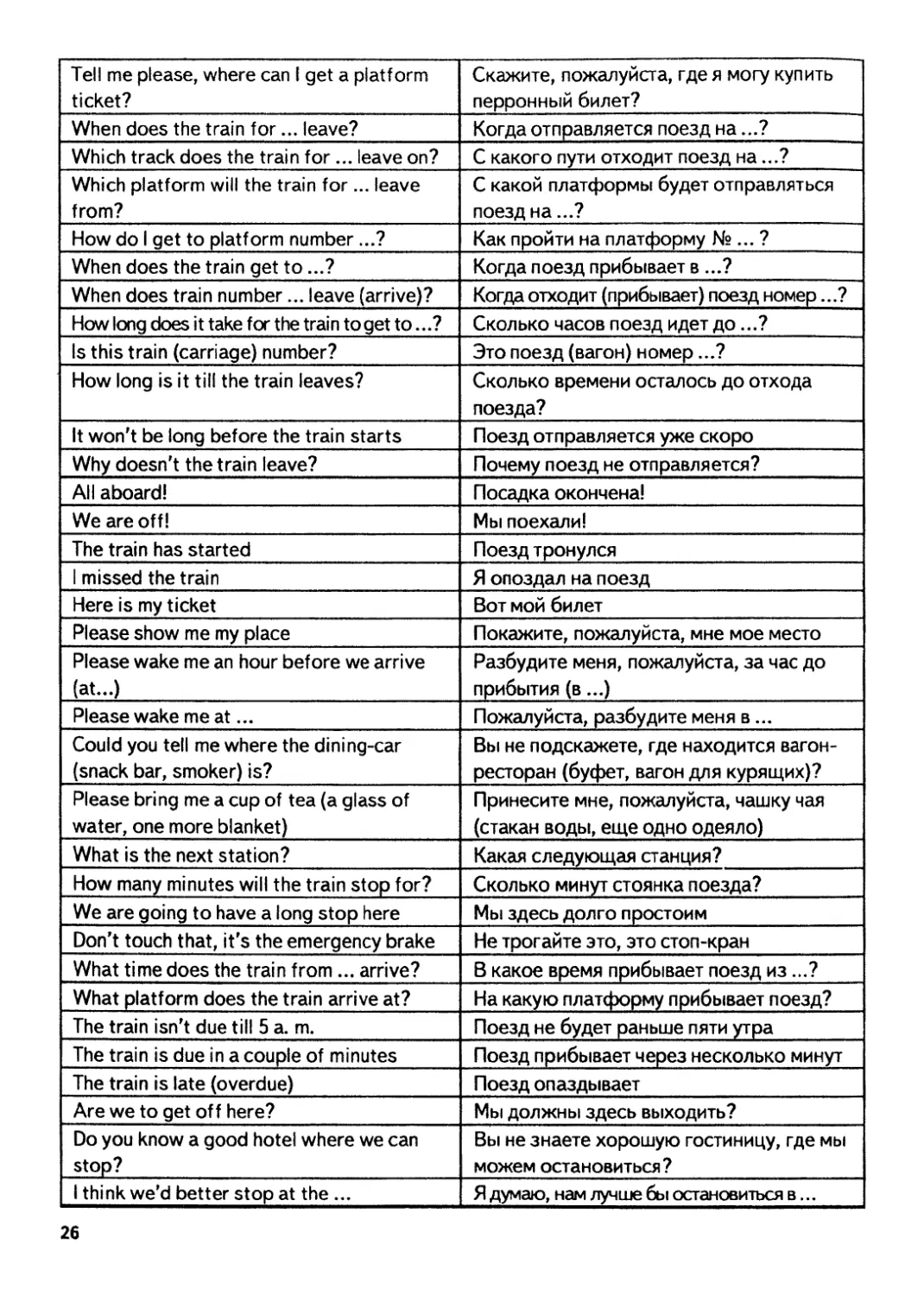
Tell me please, where can I get a platform CKa>KJ.1Te, nO>KallYHCTa, r Ae s:I MOry KynHTb
ticket? neppoHHbla:1 6HJ1er?
When does the train for ... leave? Kor,n.a OrnpaBJ1s:1erCSI noe3A Ha ...?
Which track does the train for ...Ieave on? C KaKoro nyn." OrXOAJ.1T noe3A Ha ...?
Which platform will the train for ... leave C KaKoH nJ1aTcpopMbl 6YAer OTnpaBI1 TbcSJ
from? noe3A Ha ...?
How do I get to platf orm number...? KaK npoHTH Ha nl1aTcpopMY N2 ... ?
When does the train get to ...? KorAa noe3)J. npH6blBaer B ...1
When does train number ... leave (arrive)? KorM OTXOAHT (npH6bIBaer) n0e3A HOMep ...?
How long does it take for the train to get to ...? CKOJlbKO 4aCOB noe3)J. H)J.eT AO ...?
Is this train (carriage) number? 3TO noe3A (BaroH) H oMep ...?
How long is it till the train leaves? CKOJ1bKO BpeMeHH OCTartOCb AO OTXOAa
noe3Aa?
It won't be long before the train starts noe3A ornpaBlls:lerCJI y>Ke CKOpO
Why doesn't the train leave? n04eMY noe3A He OTnpaBlls:lercSI?
All aboard! nOCilAKa oKoH4eHal
\Ve are off! Mbl noexaJlHI
The train has started noe3A TPOHYllCfI
I missed the train 51 On03AaJ1 Ha noe3A
Here is my ticket BOT MOH 6HI1eT
Please show me my place nOKa>KHTe, nO>KaJ1YHCTa, MHe Moe MeCTO
Please wake me an hour before we arrive Pa36YAHTe MeHfI, nO>KaJ1YHCTa, 3a 4ac AO
(at...) npH6b1TH (B ...)
Please wake me at ... nO>KanYHcTa, pa36y AHTe MeHSJ B ...
Could you tell me where the dining-car Bbl He nOACKa>Kere, r Ae HaxoAHrc BarOH-
(snack bar, smoker) is? pecropaH (6YQ:>eT, BarOH AJl KYP HX)?
Please bring me a cup of tea (a glass of npHHecHTe MHe, nO>KanYHCTa, 4awKY 4as1
water, one more blanket) (CTaKaH BOAbl, ew.e OAHO oAe l1o)
What is the next station? KaKM cl1eAytOLl\aJ1 CTaHl\HfI?
How many minutes will the train stop for? CKonbKo MHHyr CrOJlHKa noe3)J.a?
We are going to have a long stop here Mbl 3AeCb AOJ1rO npOCTOHM
Don't touch that, it's the emergency brake He Tpora.:1re 3TO, 3TO cron-KpaH
What time does the train from ... arrive? B KaKoe BpeM npH6blBaeT noe3A H3 ...?
What platform does the train arrive at? Ha KaKYtO nllaTQ>opMY npH6blsaer noe3A?
The train isn't due till 5 a. m. noe3A He 6YAeT paHbwe nSlTJ.1 yrpa
The train is due in a couple of minutes noe3A npH6blsaer 4epe3 HeCKOl1bKO MHHyr
The train is late (overdue) noe3A ona3AbisaeT
Are we to get of f here? Mbl AOI1>KHbl 3AeCb BbIXOA""Tb?
Do you know a good hotel where we can Bbl He 3Haere xopowytO rOCrHHHLJ.Y, r Ae Mbl
stop? Mo>t<eM oCTaHOBHTbal?
I think we'd better stop at the 'o. 51 .Q}'MaJO, HaM we 6,1 OCTaHOBHTb01 B ...
26
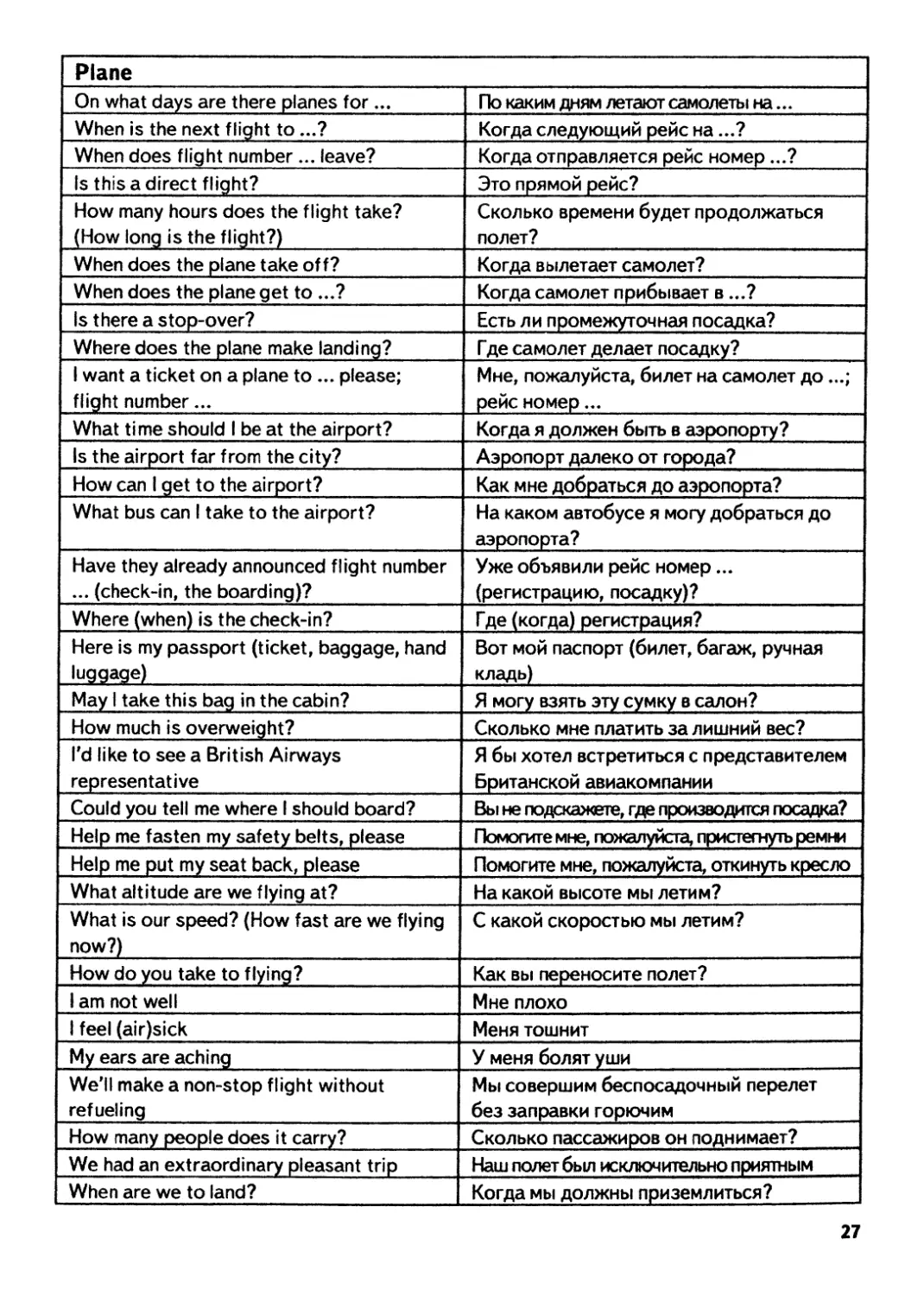
Plane
On what da s are there lanes for ...
When is the next fli ht to ...?
When does flight number ... leave?
Is this a direct fli ht?
How many hours does the flight take?
How Ion is the fli ht?
When does the lane take off?
When does the plane get to ...?
Is there a sto -over?
Where does the lane make landin ?
I want a ticket on a plane to ... please;
fl i ht number...
What ti me should I be at the air
Is the air ort far from the cit ?
How can I et to the air ort?
What bus can I take to the airport?
Have they already announced fl ight number
... (check-in, the boarding)?
Where when is the check-in?
Here is my passport (ticket, baggage, hand
lu a e
Ma I take this ba in the cabin?
How much is overwei ht?
I'd like to see a British Airways
re resentative
Could you tell me where I should board?
Hel me fasten m safet belts, lease
Hel me ut m seat back, lease
What altitude are we flying at?
What is our speed? (How fast are we flying
now?
How do ou take to fl in ?
I am not well
I feel (air)sick
M ears are achin
We'll make a non-stop flight without
refueling
How man Ie does it carr?
We had an extraordina
When are we to land?
no KaKHM AHRM lIeTaJOT caMOJ1eTbI Ha. ...
Kor Aa Cl1eA tO J.1H eHc Ha ...?
Kor Aa OTnpaBJ1S1eTCSl pe c HOMe ... ?
3TO n SlMOH eHc?
CKOJ1bKO BpeMeHH 6YAer npOAOJl>KaTbCS1
nOJ1eT?
KorAa BblJ1eTaeT CaMOJ1eT?
KorAa CaMOJ1eT npH6blsaeT a...?
ECTb J1H nOMe 04Hasf nOCattKa?
r Ae CaMOJ1er AeJ1aer nOCa)J.K ?
MHe, nO>KaJlYHCTa, 6HJ1eT Ha CaMOJ1er AO .o.;
et:1c HOMe ...
Kor Aa R AOJ1>KeH 6blTb B a3 no ?
A'3 ono T AaneKO OT ro Aa?
KaK MHe Ao6 aTbCSf AO a3 no Ta?
Ha KaKOM aSTo6yce SI MOry A06paTbcSI AO
a3 ono Ta?
Y>Ke 06'bftBHJ1H peHC HOMep ...
(perHcTpa4HIO, nocMKY)?
rAe KorAa erHCT a4HS1?
BOT MOH nacnopr (6HJ1eT, 6ara>K, PY4HaSI
KI1a.qb
.H Mor B3RTb'3 C MK B caJ10H?
CKOJ1bKO MHe nJ1aTHTb 3a J1HWHHH Bec?
6bl xOTenacrpeTHTbCR c npeACTaBHTeneM
6 HTaHcKoH aBHaKOMnaHHH
&. He no,qa<a>KeTe, rAe np0H380AKJOf f1OCaAKCl?
floMon..rre MHe, no>KaJ1 OJ n MHH
nOMOrHTe MHe, no Hera, OTKHH no
Ha KaKoH BblCOTe Mbl neTHM?
C KaKoH CKOpoCTblO Mbl J1eTHM?
KaK Bbl ne HOCHTe noneT?
MHe nnoxo
MeH TOWHHT
Y MeHS1 60J1S1T WH
Mbl COBepWHM 6ecnoca.qo4HbIH nepeJ1eT
6e3 3anpaBKH ro HM
CKonbKo naCCa>KH B OH nOAHHMaeT?
Haw noneT 6hV1 HCKI1I04HTeJ1bHO n ffi'HbiM
KorAa Mbl AOJ1>KHbl n H3eMJ1HTbc ?
27
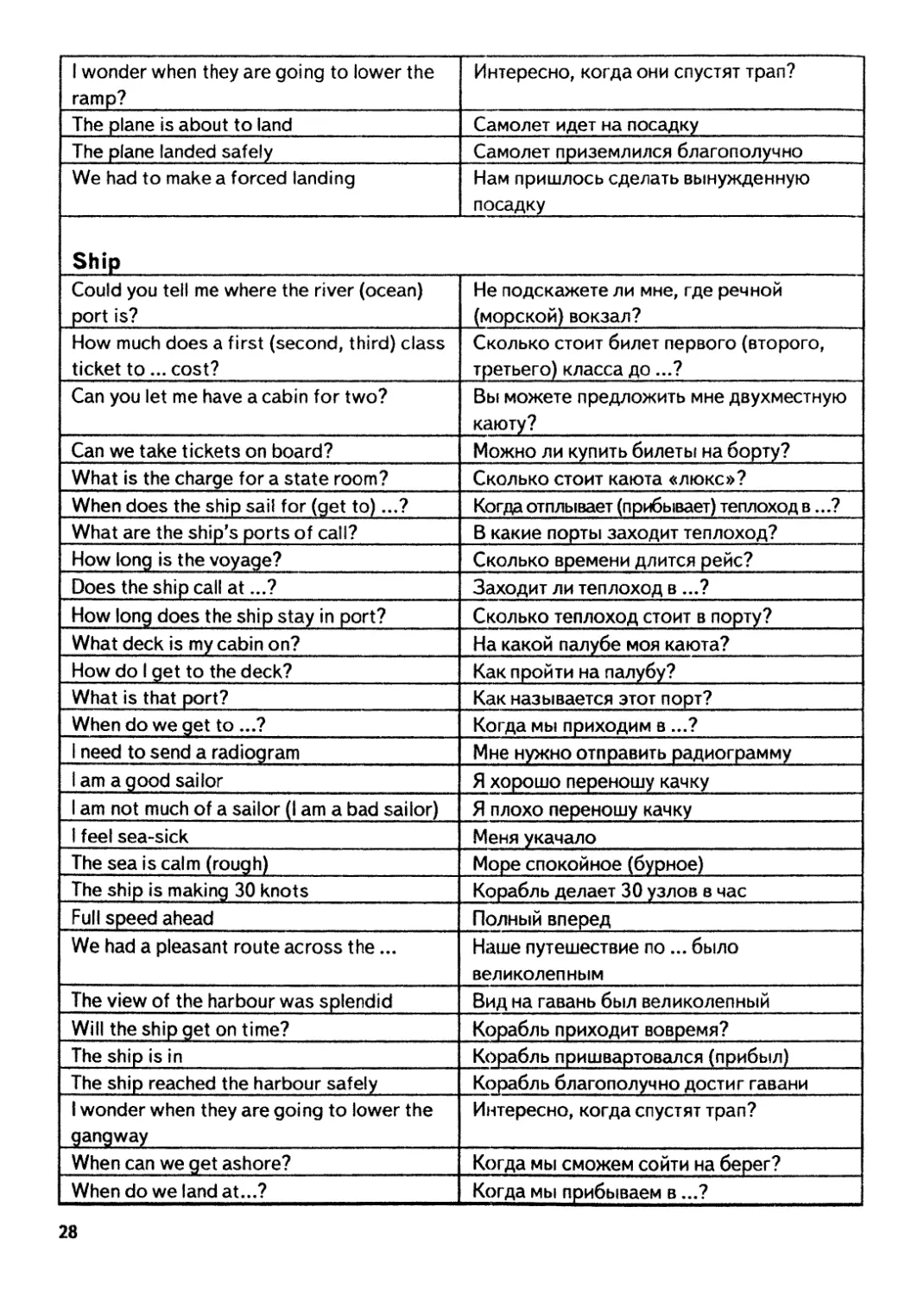
I wonder when they are going to lower the VlHTepecHo, KOf)J.a OHH cnycT T Tpan?
ramp?
The plane is about to land CaMOJ1eT AeT Ha nocap.KY
The plane landed safely CaMOJ1eT npH3eMJ1HnCH 611arOnOJ1Y4Ho
We had to make a forced landing HaM np WJ10Cb cAellaTb BbIHY>KP.eHHYtO
nocaAKY
Ship
Could you tell me where the river (ocean) He nOACKa>KeTe 11H MHe, r)J.e pe4Hoi:t
port is? {MOpCKO )BoK3al1?
How much does a first (second, third) class CKOJ1bKO CTOHT 6HJ1eT nepBoro (BToporo,
ticket to ... cost? TpeTbero) Kl1aCCa AO ...?
Can you let me have a cabin for two? Bbl MO>KeTe npeAl10>KHTb MHe )J.ByxMecTHYtO
KatOTY?
Can we take tickets on board? MO>KHO JtH Kynl-1Tb 6 l1eTbl Ha 60PTY?
What is the charge for a state room? CKOl1bKO CTOHT KalOTa «l1fOKC»?
When does the ship sail for (get to) ...? Kor.o.a OTnJ1blaaeT (npH6bIBaeT) TenJ10XOA B ...?
What are the ship's ports of call? B KaKa.1e nopTbl 3aXOAa.1T Tenl10xoA?
How long is the voyage? CKOJ1bKO BpeMeHH Af1HTCR peHc?
Does the ship call at ...? 3axoAHT nH Tenl10XO.o. B...?
How long does the ship stay in port? CKOJlbKO TennOXOA CTOHT B nopTY?
What deck is my cabin on? Ha KaKoH nally6e MOSI KalOTa?
How do I get to the deck? KaK npoi:tTH Ha naJ1y6y?
What is that port? KaK Ha3blBaeTCSI 3TOT nopT?
When do we get to ...? KorAa Mbl npHxoAHM B ...?
I need to send a radiogram MHe H}?t<HO ornpaBHTb paAHorpaMMY
I am a good sai lor 51 xOPOWO nepeHOWY Ka4KY
I am not much of a sailor (I am a bad sailor) 51 nnoxo nepeHOWY Ka4KY
I feel sea-sick MeH$I YKa4al10
The sea is calm (rough) Mope cnoKoi:1Hoe (6YPHoe)
The ship is making 30 knots Kopa6J1b Ael1aeT 30 Y3110B B 4ac
Full speed ahead nOJ1HblJ:1 BnepeA
We had a pleasant route across the ... Hawe nYTewecTB e no... 6blJlO
Bel1HKOl1en HblM
The view of the harbour was splendid BHA Ha raBaHb 6bll1 BeI1HKOJ1enHbIH
Will the ship get on time? Kopa6J1b npHXOAHT BOBpeMR?
The ship is in Kopa611b np WBapTOBaJ1CSI (npH6btJ1)
The ship reached the harbour safely K 6J1b 611aronon Y 4Ho AocTHr raBaHH
I wonder when they are goi ng to lower the lt1J.nepecHo, KorAa cnycTSIT Tpan?
gangway
When can we get ashore? KOf,lJ.a Mbl CMO>KeM co n Ha 6eper?
When do we land at...? Kor,lJ.a Mbl npH6blBaeM B...?
28
TRA VELLING
Grammar
HcpHHHT B. <t>OpMbl HHcp H THBa. YnoTpe6J1eHHe HHcpHHHTHBa. vtHcpt.1HHTHB c 41to" H 6ea
lito" (Ex. 164, 165)
People of our planet cannot live without travelling. Lots of people spend their holiday
travelling, other travel on business. They travel by fast, slow or express trains, which don't
stop at every station. At the railway stations there are waiting-rooms and restaurants,
a porter helps passengers to carry their luggage along the platform. Many passengers prefer
travelling by sea for pleasure. Travelling by sea is very comfortable. Voyages are made by
different kinds of ships, such as liners when travelling along the seacoast or river-boats and
motor-ships when travelling along the rivers.
A sea-voyage or sea-trip is very pleasant. If the weather is fine the passengers enjoy the
fresh air and the beauty of the sea or lie in the sun in the comfortable deck-chairs or have
a swim in the pool. But there is one unpleasant thing: if the sea is rough some passengers get
sea-sick. Those who are not afraid of the rough sea can walk up and down the deck.
Lots of people travel on business and they prefer travelling by air. Travelling by air has
great advantages - speed and pleasure. Before you get on board the plane you have your
luggage registered. It is weighed and labelled. You don't take your luggage with you, only
a small bag or a purse. Before the flight you can watch the planes taking off and landing.
Then you hear you flight announced and the passengers are invited to get into the plane and
take their seats. When the plane takes off, a stewardess gives the passengers information
about the flight: the speed, the altitude at which the plane flies. And you reach your destination
in a few hours and realize all the advantages of travelling by air.
In case you travel by air, by train or by ship you ought to book tickets in advance at the
booking office. It may be a week or ten days before the departure.
Many people like to travel by car. The advantage of this way of spending a holiday is that
you can make your own time-table. You don't have to buy a ticket and you don't have to fear
to miss your train.
TRAVELLING BY TRAIN
Grammar
HcpHHHTHB. HcpHH THBHble 060POTbi (Ex. 167, 168)
There are various means of travel. We can travel by train, boat, aeroplane, car, and finally
we can travel on foot. You have all of you done a certain amount of travelling, so let's talk
about the method of travel you like best.
Should you ask me what kind of transport I like best, I'd speak in support of the train.
With the train you have speed, comfort and pleasure combined. Suppose you want to go
29
from Petersburg to Sochi. The taxi brings you to one of the biggest stations in Petersburg
the Moscow railway station.
What place is more interesting than a big station? There is the movement, the excitement
of people going away and sorrow of those who are seeing others off. There are the shouts of
the porters as they pull luggage trucks along the platforms to the waiting trains, the crowd
at the booking-office getting tickets and passengers hurrying to board the train.
At last you manage to make your way through the crowd, closely following the porter,
who has taken care of your luggage, and get out on to the platform. There are many tracks
and trains there. You show your ticket to the guard and go into a carriage. All is bustle and
confusion, with people filling in, bumping into each other, and what not. At last you manage
to stowaway your luggage and you get out on to the platform to breathe fresh air and bid
farewell to the well-wishers who have come to see you off. But you scarcely have time to kiss
and hug your friends before the train starts.
You are on your way. You start up a conversation with your fellow-passengers (people
take to each other quickly when travelling), and soon you get to know who is who and what.
Now when the excitement of the day is over, you begin to feel hungry. After having dinner
(or supper) you feel tired and decide to turn in. You get into your berth and begin to absorb
the beauty of the changing scenes that fly past you. Then you close your eyes and soon drift
away into that vast mysterious world which men call dream-land.
SEEING OFF
Grammar
COrJ1aCOBaHHe BpeMeH. KocBeHHa pe4b (npO) OJl)KeHHe) (Ex. 154, 156 - 161)
Three men came to the station about nine o'clock one evening. Then they came on to the
platform and said to the porter, "What time is the next train for London?". The porter said, "You
have just missed one. They go every hour; the next one is at ten o'clock". "That's all right", they
said, "we'll go and have a drink". So off they went to the refreshment room. A minute or two after
ten o'clock they came running and said to the porter, .'Has the train gone?". "Yes", he said, (lit
went at ten o'clock as I told you. The next is at eleven o'clock". "That's all right", they said, "we'll
go and have another drink". So they went back to the refreshment room.
They missed the eleven o'clock train in the same way, and the porter said, "Now the next
train is the last one; if you miss that, you won't get to London tonight".
Twelve o'clock came, and the last train was just starting out, when the three of them
came out of the refreshment room running as hard as they could do. Two of them got in
a carriage just as the train was leaving, but the third one didn't run fast enough and the train
went out leaving him behind. He stood there looking at the train and laughing, as if to miss
a train was the best joke in the world. The porter went to him and said, "I told you that this
was the last train. Why didn't you come earlier?".
The man wouldn't answer for laughing He laughed until tears came into his eyes. Then he
caught hold of the porter and said, "Did you see those two fellows get into the train and
30
leave me here?". "Yes, I saw them". "Well, I was the one who was going to London; they only
came here to see me oft".
10/3 - A Funny Thing Happened to Me
Grammar
P 6 u k " li d "
a3HH a B ynoTpe J1eHHH r nar0J10B ma e H 0
TRAVELLING BY AIR
Many people prefer travelling by air as it is the most convenient, comfortable and quickest
means of travelling. If you have made up your mind to travel by plane you need to go to the booking
office to buy tickets beforehand. Each passenger is allowed 20 kilograms of luggage free of charge.
Before boarding the plane the passenger must register at the airport. When registering
the passenger is required to have his luggage weighed. Before the plane takes off the
stewardess gives all the information about the flight, the speed and the altitude. Inside the
cabin the air is always fresh and warm. The stewardess helps everyone get comfortable in
the seats and wishes them a pleasant trip.
19/3 - Night Flight
Grammar
V1HCPHHHTHB. 3acTbiBwHe CJlOBOC04eTaHHff C &-1HcpHHa.-tTHBOM (Ex. 166, 169)
TRAVELLING BY SEA
Many people enjoy travelling by sea. They say it is the most pleasant means of travelling.
They mean travelling on an ocean liner, which combines comfort and speed. You feel as if
you are walking on good solid ground when on board the big finer. You can enjoy fresh sea
air, the sights of the sea and sky. No matter what the sea might be - calm or stormy, you feel
comfortable and safe on board the big liner. But smaller ships are less comfortable and in
rough seas many passengers will be most unhappy. They get sea-sick and then travelling by
sea becomes a real torture for them.
If you have made up your mind to travel by sea you should book passage on board
a modern liner. These liners are real floating cities with all modern conveniences and a wide
choice of sport and entertainment facilities. Every modern liner has a number of decks with
all sorts of names, such as «promenade deck», «sun deck», etc. There are passenger cabins
above and below deck. A cabin looks very much like a compartment of a railroad sleeping-
car, but the windows are different. In a cabin they are known as portholes.
You needn't worry about your meals on board the modern liner. Restaurants will take
care of you. In short, if you are not sea-sick the voyage will give you many moments of pleasure.
31
28, 29/3 - The "Mary Seleste 11
Grammar
must - may - might - can't B 3Ha4eHs.1 npeAn0I10>KeHH$4 (Ex. 242, 243, 247, 248, 253,
252, 256)
OUR PACKING
I started the packing. It seemed a longer job than I had thought it was going to be; but
I got the bag finished at last, and I sat on it and strapped it.
"Ain't you going to put the boots in?" said Harris. And I looked around, and found I had
forgotten them.
I opened the bag and packed the boots in; and then, just as I was going to close it,
a horrible idea occurred to me. Had I packed my tooth-brush? I don't know how it is, but
I never do know whether I've packed my tooth-brush.
My tooth-brush is a thing than haunts me when I'm travelling, and makes my life a misery.
I dream that I haven't packed it, and get out of bed and hunt for it. And, in the morning, I pack
it before j have used it, and have to unpack again to get in, and it is always the last thing I turn
out of the bag; and then I repack and forget it, and have to rush upstairs for it at the last
moment and carry it to the railway station, wrapped up in my pocket-handkerchief.
When I had finished, George asked if the soap was in. I said I didn't care a hang whether the
soap was in or whether it wasn't; and I slammed the bag to and strapped it, and found that I had
packed my tobacco-pouch in it, and had to re-open itM It got shut up finally at 10.5 p. m.
Harris thought that he and George had better to do the rest; and I agreed and sat down,
and they had a go.
I looked at the piles of plates and cups, and kettles, and bottles, and jars, and pies, and
stoves, and cakes, and tomatoes, etc., and felt that the thing would soon become exciting.
It did. They started with breaking a cup. That was the first thing they did.
Then Harris packed the strawberry jam on top of a tomato and squashed it, and they had
to pick out the tomato with a teaspoon.
And then it was George's turn and he trod on the butter. They stepped on things, and put
things behind them; and then couldn't find them when they wanted them; and they packed
the pies at the bottom, and put heavy things on top, and smashed the pies in.
They upset salt over everything, and as for the butter. , never saw two men do more with
one- and two-pence worth of butter in my whole life than they did. After George had got it
off his slipper, they tried to put it in the kettle. It wouldn't go in, and what was in wouldn't
come out. They did scrape it out at last, and put it down on a chair, and Harris sat on it, and
stuck to him, and they went looking for it all over the room.
The packing was done at 12.50; and Harris sat on the big hamper, and said he hoped
nothing would be found broken.
Jerome K Jerome
32
Words
train [treIn] noe3A
car [ka: 1 BarOH
carnage ['krend3 ] BarOH
coach [koutf] BarOH
din ing-car ['daIn II) 'ka:] BarOH-peCTopaH
luggage van ['IAgIct I yren ] 6ara>KHblH BarOH
sleepi ng-car ['Sli:pII) 'ka:] cnanbHblH aarOH
railway station ['reI lweI 'stelfn] >Kel1e3HOAOpO>KHas:l
CTaHl.\HSW
term inal ['ta:mlnal] BOK3aJ1, KOHe4HaJf CTaH4M$I
platform ['plretf::>:m] nllaT<popMa
porter ['pJ:ta] HOCMJ1bUJ.HK
compartment [kam'pa:tmant] Kyne
track [trrek] nYTb
berth (u pper or lower) [ba:e (Apa, loua)] nOJ1Ka (HH>KHfts:l HllH
BepxH Jfs:l)
station master ['stelfn 'ma:sta] Ha4aJ1bHMK cTaHlI,MIo1
station of destination [destl'neIfn] CTaHlI,lo1Jf Ha3Ha4eHHII
tunnel ['tAnal] TOHHellb
express [Iks'pres] 3Kcnpecc
electric train [1'lektnk] 3J1eKTponoe3A
fast trai n [fa:st] CKOpblH noe3A
passenger train ['presandj a] nacc HpcKHwnoe3A
mail train [meIl] n04ToBblH noe3A
slow train [sIJu] nacca>t<HpcKHH noe3A
long-distance train ['IJI) 'dIstans] noeJA AaJ1bHerO
CJ1eAOBaHHJf
local train ['Ioukal] npHropoAHbtH noe3A
suburban train [sa'ba:ban] npMropoAHblJ;t noe3A
attached car [ altretft] npHlI,enHOH BarOH
first (second, third) class BarOH nepsoro (sToporo,
car TpeT be ro ) Kl1aCCa
baggage car (coach) ['bregIdj] 6ara>KHblH BarOH
international car (coach) [Inta'nretflnal] saroH Me>t<p.YHapoAHoro
KJ1acca
33
--
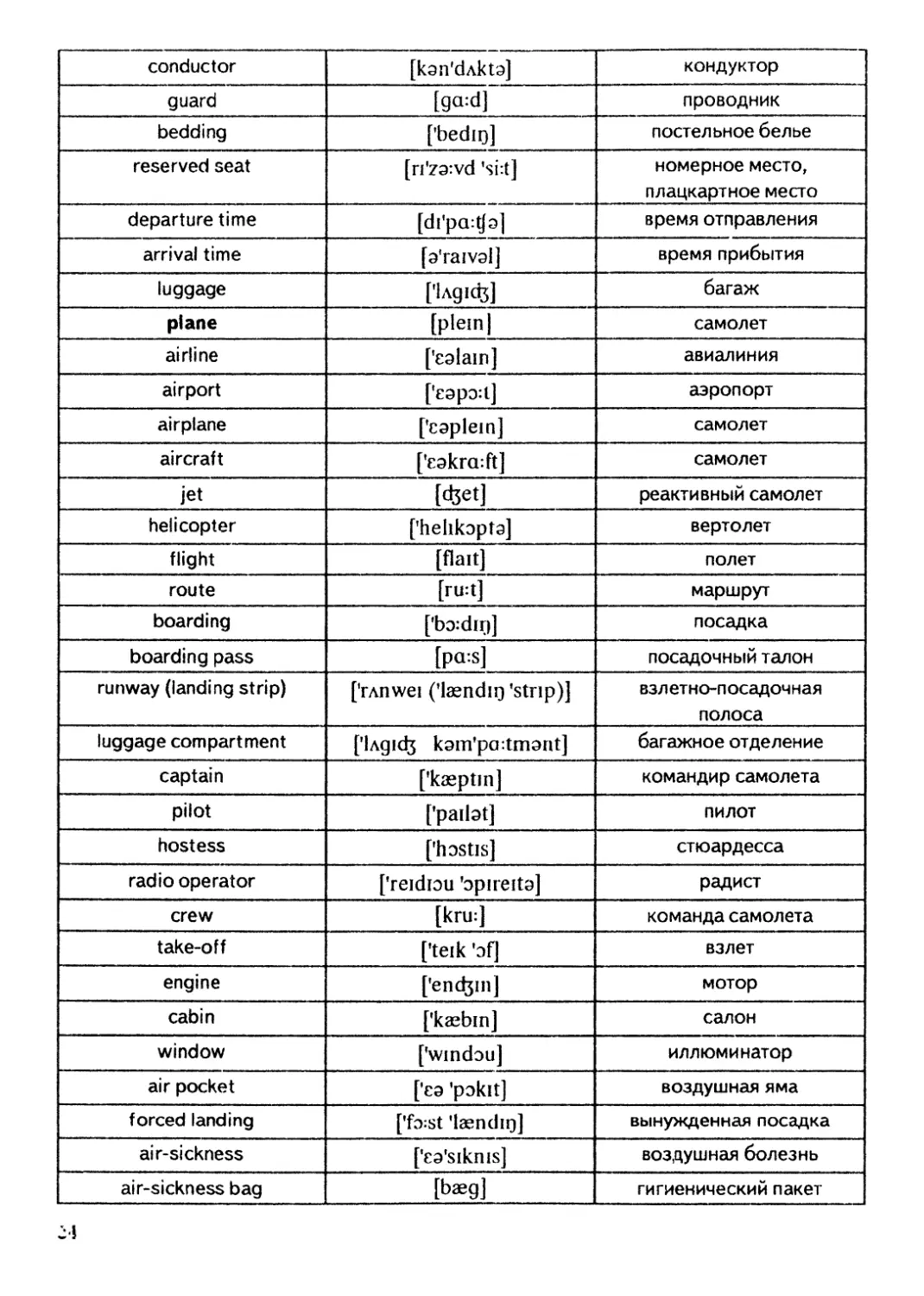
conductor [kaI1'dAktd] KOHAYKTOP
guard [ga:d] npOBOAHHK
--"
bedding ['bedII) ] nOCTel1 bHoe 6el1be
reserved seat [n'zd:vd ' i:t] HOMepHoe MeCTO,
nna4KapTHoe MeCTD
departure time [dl'pa: d 1 BpeM5J OTnpaBl1eH&.1
arrival time r dfralval] BpeMSW npH6bIT j:J
luggage ['IAgld3] 6ara>K
plane [pleIn I CaMOl1eT
ai rli ne ['cdlaIn] aB a.n H
airport ['EdPJ:t] a3pOnOpT
airplane ['cdpleln] CaMOl1eT
aircraft ['cdkra:ft ] CaMOl1eT
jet [dJet] peaKTH BHblH CaMOJleT
heli copter ['hehkJpta] aepTOl1eT
flight [flaIt] nOJ1er
rou te [ru:t] MapwpYT
boarding ['b:):dIO] nOCa.QKa
boarding pass [pa:s] noca;J.o4HblH TaJlOH
runway (landing strip) ['rAn wet ('lrendII) 'stn p)] B3I1eTHo-nOCaA04Ha
nOJ1oca
luggage compartment ('IAgldJ k }[n'pa:tmdnt] 6ara>KHOe OTAel1eH e
captai n ['kreptlI1 ] KOMaHAiltp CaMOl1eTa
pilot ['paIldt] nHJ10T
hostess ['hJstIS] cTloap.o.ecca
radio operator ['reldIJU ':>pn"eltd] PClA CT
crew [kru: ] KOMaHAa CaMOJ1eTa
take-off ['telk ':>f] B3J1eT
engine [' en d3I Il ] MOTOp
cabin ['krebIn] CaJtOH
window ['wInd u ] If1I1J1tOMJ..i HaTop
air pocket ['Ed 'pJkIt] B03AYWH Ma
forced landing ['f :st 'lrendll)] BbIHy>KAeHHcu:t nOC Ka
air-sickness ['cd'slknls] B03!o.YWHaJI 60l1e3Hb
air-sickness bag [breg J rHn eH '-4eCKHi:t naKeT
';.1
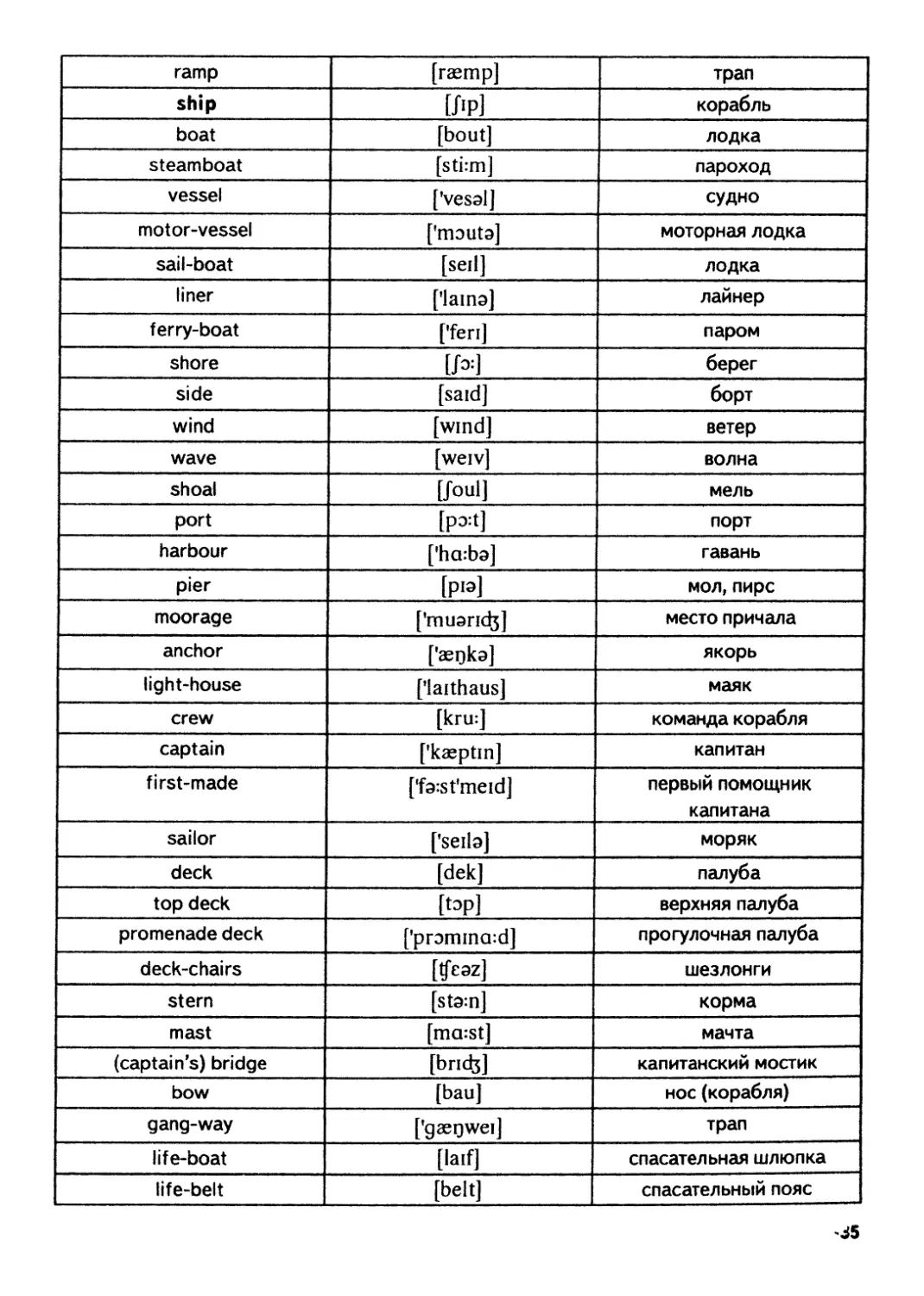
ramp [rremp] rpan
ship [flp] Kopa6nb
boat [bo u t] nOAKa
steamboat [sti:m] napoxOA
vessel ['ves l ] CYAHO
motor-vessel ['m:)uta] MOrOpHaSlI10AKa
sail-boat [sell ] J10AKa
liner ['laIna] J1aHHep
ferry-boat ['fe n] napoM
shore [f J: ] 6eper
side [ saId] 60pr
wind [WI n d] serep
wave [welv] BOJ1Ha
shoal [foul] MeJ1b
port [pJ:t] nopr
harbour ['ha:ba] raBaHb
pier [pIa] MOJ1,nHpC
moorage ['mudfI<tJ Mecro npH"fana
anchor ['rel)k ] SlKOpb
light-house ['lalthaus] MaJlK
crew [kru: ] KOMaHAa Kopa6J1$1
captain ['kreptIn] KanHTaH
first-made ['fa:st'meldj nepBblH nOMOll\HHK
KanHTaHa
sailor ['seIld] MOp K
deck [dek) naJIy6a
top deck [tJp J BepXHR$I nany6a
promenade deck ['prJffiIna:d] npory nOYHaJI nany6a
deck-chairs [ifraz] We3J10Hnlf
stern [ s ta: n] KopMa
mast [ma:st] Ma"fTa
(captain's) bridge [b n d3] KanHTaHcKHH MOCTHK
bow [bau] HOC (Kopa6J1$1)
gang-way ['grel)wel] Tpan
life-boat [I a If] cnaCareJ1bHaJ1 WI110nKa
life-belt [bel t] cnaCareJ1bHblH noSlc
..J5
-
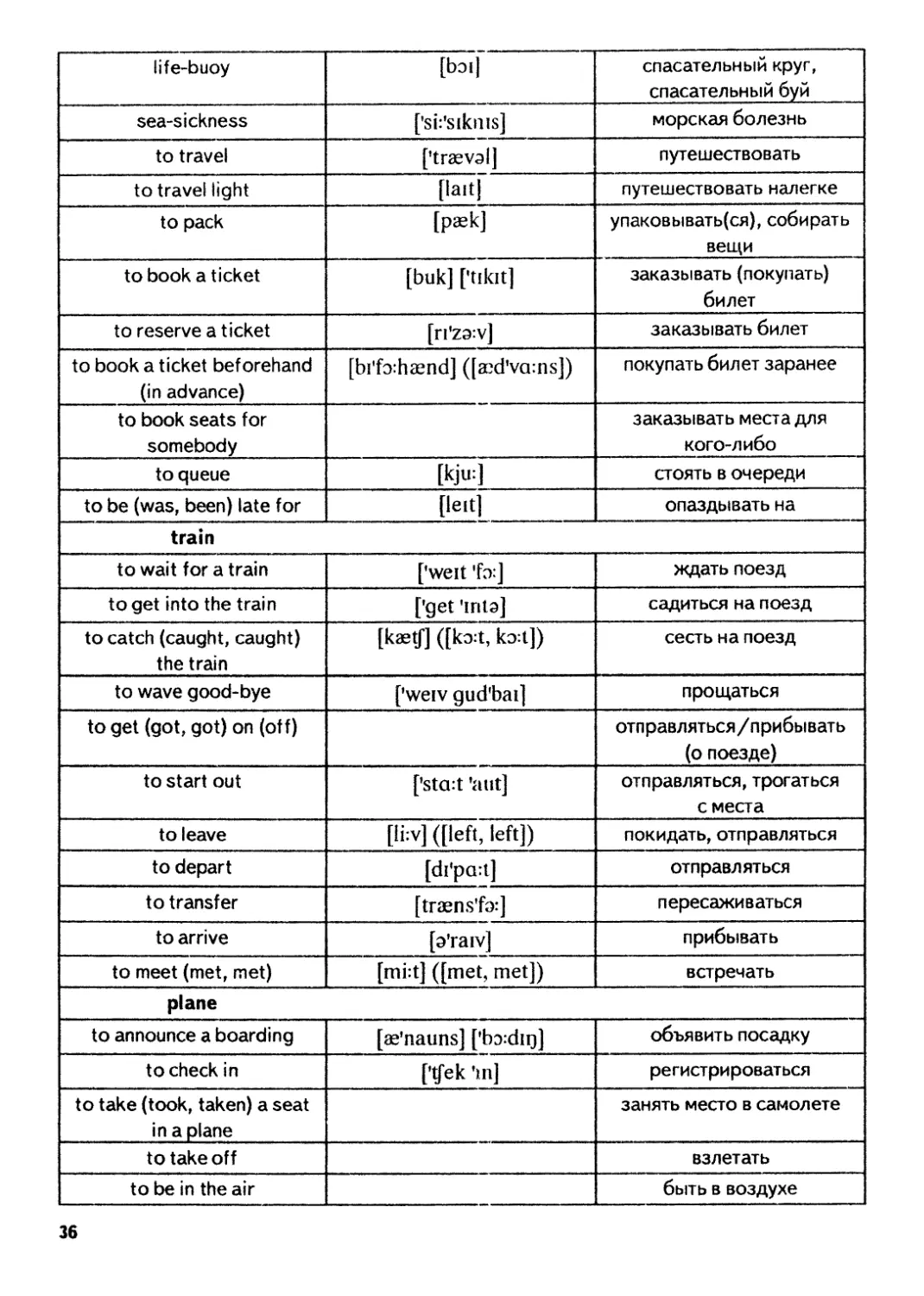
life-buoy [b:1 I ) cnaCaTeJ1bHbU Kpyr,
cnaCaTeJ1bHbl 6yi:1
sea-sickness ['si:'s (kn IS] MOpCKast 60Jle3Hb
to travel ['trrevd I] nyrewecTBoBaTb
to travel tight [I a I t J nYTewecTBoBaTb HaJlerKe
to pack [peek] ynaKoBbIBaTb(csw), co6HpaTb
- Beli.\H
to book a ticket [buk] etlkItl 3aKa3blBaTb (noKynaTb)
6HJleT
to reserve a ticket [ fI'Z :V] 3aKaJblBaTb 6HJ1eT
to book a ticket beforehand [bI'f :hrend] ([ a d'vQ:ns]) nOKynaTb 6J.1J1er 3apaHee
(in advance)
to book seats for 3aKaJblBaTb Mecr a Al1
somebody KOrO-J1H6o
.-
to queue [kju: ] CTO Tb B o4epeAH
to be (was, been) late for [leltl onaJAblBaTb Ha
train
to wait for a train ['welt 'f :] )KAaTb nOe3,D.
to get into the train ['get 'IntC)] Ca)J.HTbCSl Ha noe3A
to catch (caught, caught) [kre ] ([k :t, kJ:t]) ceCTb Ha noe3A
the train
to wave good-bye ['welv gud'ball npow.aTbCSW
to get (got, got) on (off) OTnpaBJ1stTbC$I / npH6blBaTb
(0 noe3Ae)
to start out ['sta:t 'ant] OTnpaBJ1 TbC$l,TporaTbcsw
C Mecra
to leave [li:v] ([left, left J) nOKHAaTb,OTnpaBn TbC
to depart [dI'pa:t] OTnpaBJUITbCJI
to transfer [trrens'fg: ] n epeCIDKHBaTbC$I
to arrive [ 'ralv] npH6blBaTb
to meet (met, met) [mi:t] ([met, met]) BCTpe4aTb
plane
to announce a boarding [re'nauns] ['bJ:dll)] 06b$lBHTb nOCaJ].KY
to check in ['tfek 'In] perHcTpHpoBaTbc
to take (took, taken) a seat 3aHf1Tb MeCTO B CaMOJ1eTe
in a plane
to take off B3JleT aTb
to be in the air 6blTb B B03Ayxe
36
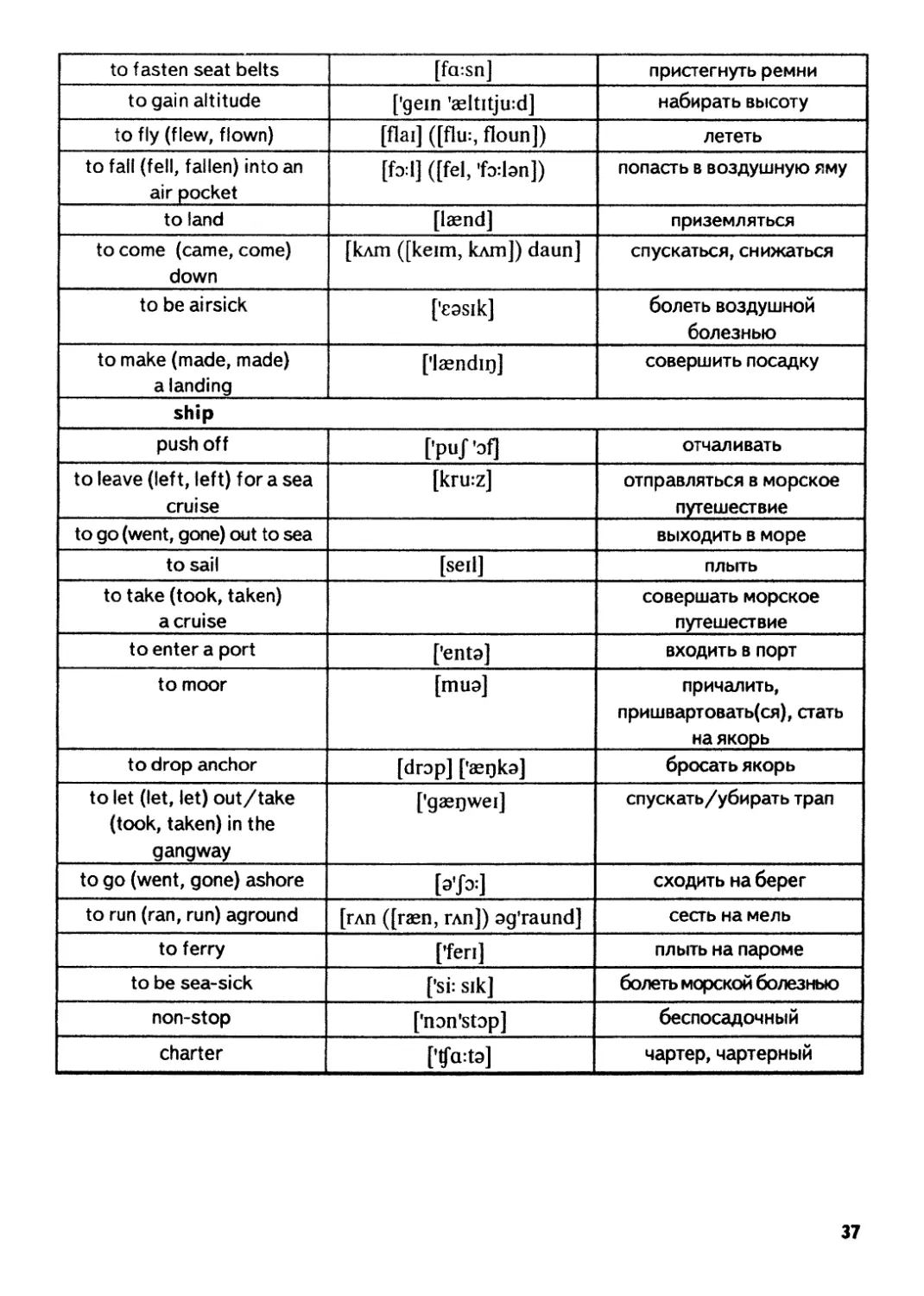
to fasten seat belts [fa:sn] npHCTerHyrb peMHH
to gain altitude ['geIn 'reltItju:d] Ha6HpaTb BblCOTY
to fly (flew, flown) [flal] ([flu:, tloun]) J1eTeTb
to fall (fell, fallen) into an [fJ:I] ([fel, 'fJ:ldn]) nonaCTb B B03AYWHYtO flMY
air pocket
to land [trend] npH3eMI1J1TbC
to come (came, come) [Iwn ([keIrn, Iwn]) daun] cnYCKaTbC ,CHH TbC
down
to be airsick ['CdSlk] 60J1eTb B03AYWHOH
60J1e3HblO
to make (made, made) ['lrendI])] COBepWHTb nOCaJ].KY
a landing
ship
push off ['pu f '3t] OT4aJ1HBaTb
to leave (left, left) for a sea [kru:z] OTnpaBn TbC 8 MOpCKoe
cruise nyreweCTBHe
to go (went, gone) out to sea BblXOAHTb B Mope
to sail [ se II] nnblTb
to take (took, taken) cOBepwaTb MopcKoe
a cruise nyreweCTBHe
to enter a port ['entd] BXOAHTb B nopT
to moor [mu ] npH4aJ1HTb,
npHwBapToBaTb(at), CTaTb
Ha KOPb
to drop anchor [dr:)p] ['reIJkd] 6pocaTb .RKOpb
to let (let, let) out/take ['grel)wel] cnycKaTb/y6HpaTbTpan
(took, taken) in the
gangway
to go (went, gone) ashore [ a'fJ:] CXOAHTb Ha 6eper
to run (ran, run) aground [rAn ([reen, fAn]) dgtraund] ceCTb Ha Mel1b
to ferry ['fen] nJ1blTb Ha napOMe
to be sea-sick ['si: slk] 6oJ1eTb MopcKoH 6oJ1e3HbtO
non-stop ['n n'st p ] 6ecnoCaAOLfHblH
charter ['t[ a:ta ]
4apTep, 4apTepHblH
37
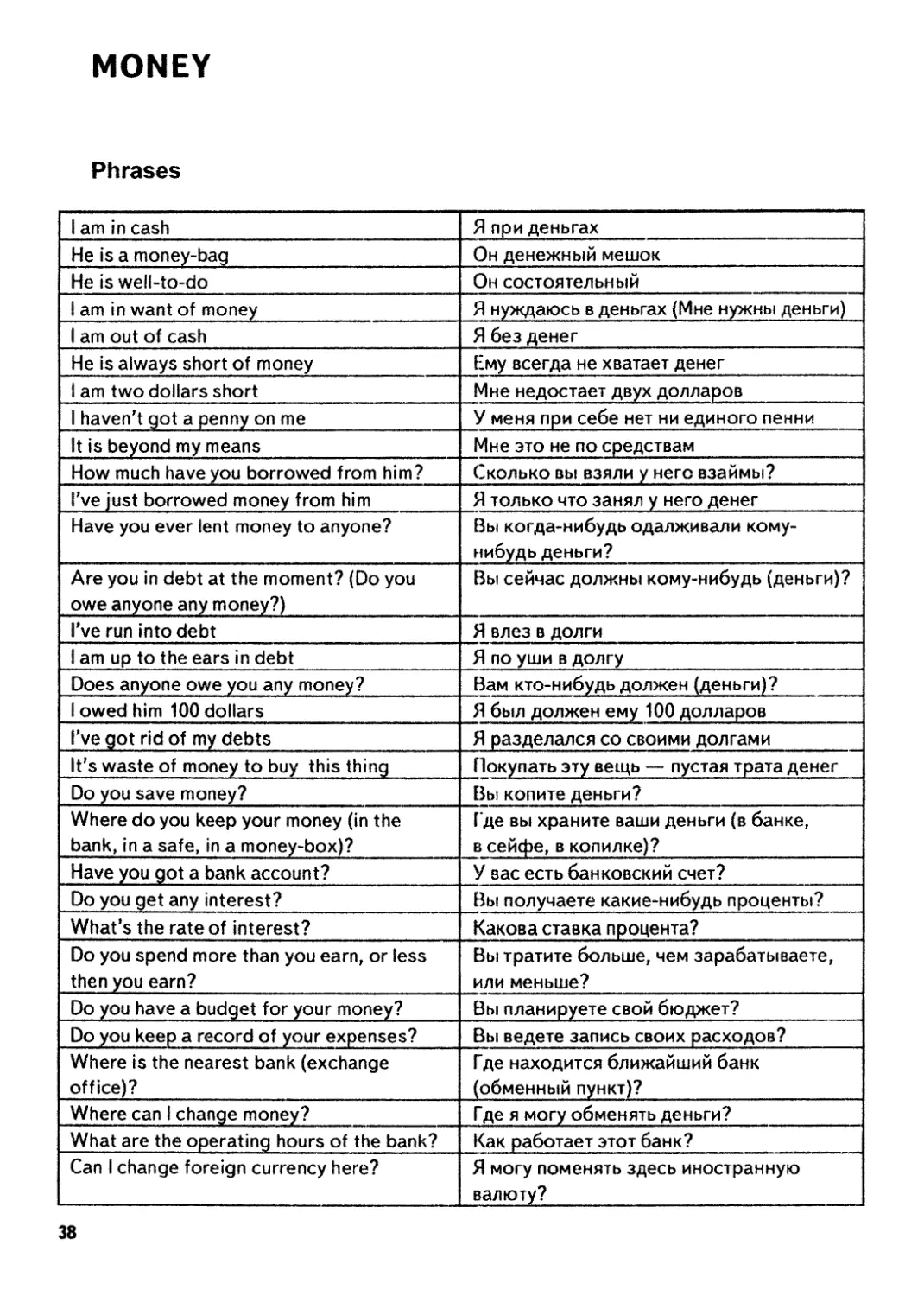
MONEY
Phrases
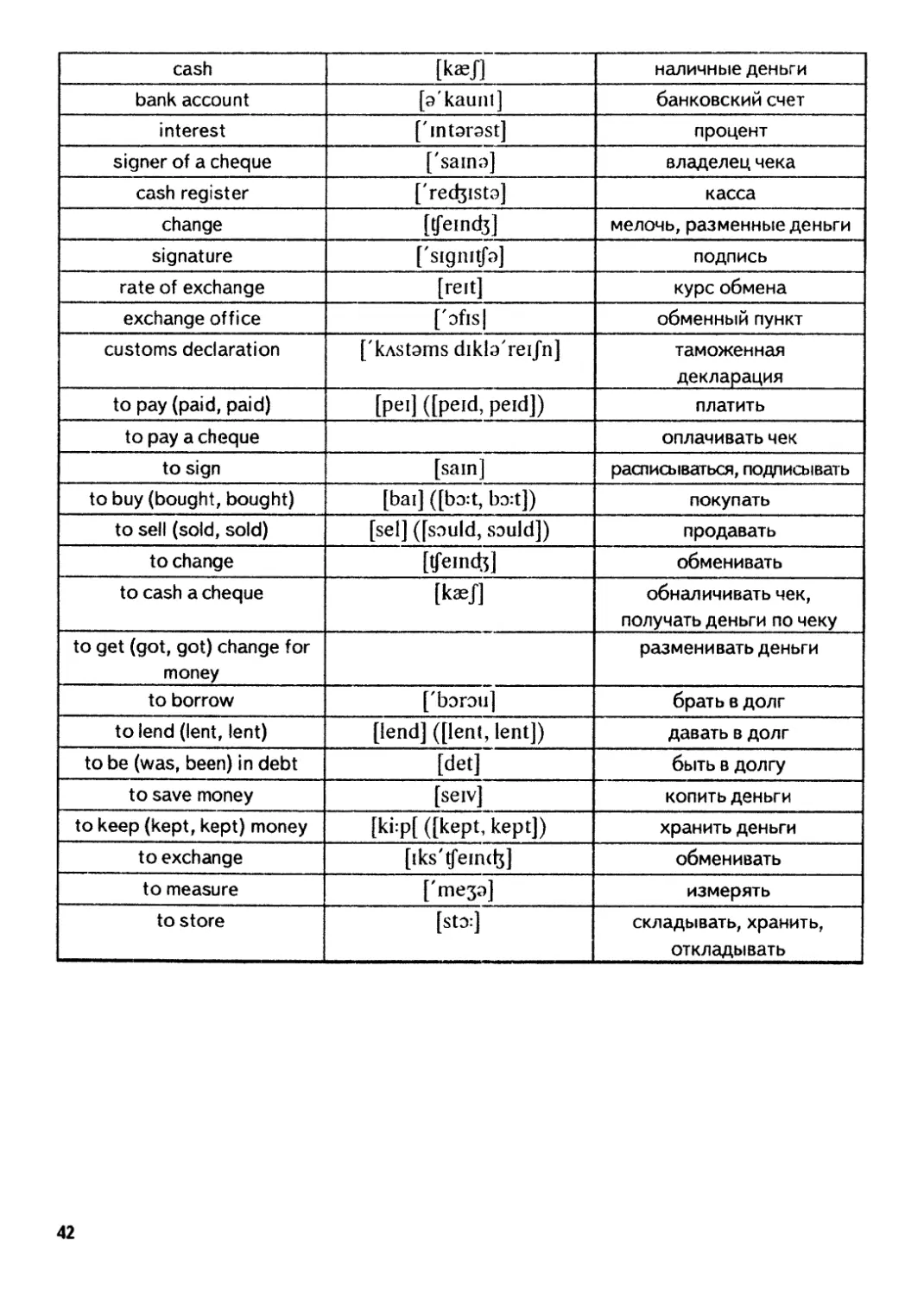
I am in cash s:I n p H AeHbfax
He is a money-bag OH AeHe>KHbIH MeWOK
He is well-ta-do OH COCTOSWTeJ1bHbl
I am in want of money H HY>KI.\atOCb B AeHbrax (MHe HY>KHbl AeHbrH)
I am out of cash }16e3 AeHef
He is always short of money EMY BcerAa He XBaTaeT AeHer
I am two dollars short MHe HeAOCTaCT AB Y X AOJ1J1a p OB
I haven't got a penny on me Y MeHSI n p H ce6e HeT HH eAHHoro neHH&-1
It is beyond my means MHe 3TO He no cpeACTBaM
How much have you borrowed from him? CKonbKo Bbt B3S111H Y Hero B3a Mbl?
I've just borrowed money from him TOJ1bKO 4TO aaHSlJ1 Y Hero AeHer
Have you ever lent money to anyone? Bbl KOfAa-HH6YAb OAaJl>KlitBaIlH KOMY-
HH6YAb AeHbrH?
Are you in debt at the moment? (Do you Bbl cett4ac AOJ1>KHbl KOMY-HH6y Ab (AeHbrH)?
owe anyone any money?)
I've run into debt H Bne3 B AOllfH
I am up to the ears in debt - no YWH B AOJ1ry
Does anyone owe you any money? SaM KTO-HH6 Y Ab AOJ1>t<eH (AeHbfH ) ?
lowed him 100 dollars S1 6bll1 AOJ1>KeH eM Y .100 AOl1na p OB
I've got rid of my debts pa3AeJ1aJ1CSI co CBOHMH AonraMH
It's waste of money to buy this thing f!oKynaTb 3TY Bell.J.b - nycTaSi TpaTa AeHer
Do you save money? Obi KonHTe AeHbfH?
Where do you keep your money {in the r,Ae Bbl xpaHHTe BaWH AeHbrH (B 6aHKe,
bank, in a safe, in a money-box)? B ce ct>e, B KOn J1Ke)?
Have you got a bank account? Y sac eCTb 6aHKoBcKHH c4eT?
Do you get any interest? Bbl nOJlY4aeTe KaKl-1e-HH6YAb npOlteHTbl?
--
What's the rate of interest? KaKoBa CTaBKa npo4eHTa?
Do you spend more than you earn, or less Bbl TpaTHTe 6oJlbwe, 4eM 3apa6aTblBaeTe,
the n you earn? 1-11111 MeHbwe?
-
Do you have a budget for your money? Bhl nJ1aH pyeTe CBO 61OA>KeT?
Do you kee p a record of y our expenses? Bbl BeAeTe 3an Cb CBOHX pacxoAoB?
Where is the nearest bank (exchange r Ae HaXOA....TCst 6J1H)t(a wHH 6aHK
office)? (o6MeHHbu nYHKT)?
Where can I change money? r Ae JI Mory o6MeHSlTb .£\eHbrH?
What are the operating hours of the bank? t(aK pa60TaeT 3TOT 6aHK?
Can I change foreign currency here? 51 Mory nOMeHstTb 3.o.eCb HHocTpaHHYIO
BanIOTY?
38
o to?
Would you give me five pounds in silver
and the rest in ten-pound notes?
Can you give me change for this fifty-dollar
bill in tive-dollar bills or smaller?
Give me ten pounds in small coin, please
Could you change me this coin?
MONEY
Bbl Onl1a4HBaeTe .0.0 O>KHble 4eKH?
KaKOS KYPC o6MeHa aMepHKaHcKHx
AOJ1J1apOB (<PYHTOB CTepI1HHrOB,
re MaHCKHX Ma OK)?
K KaKOM OKH CTOHKe MHe nOAoHTH?
KaKos a3Me KOMHCCHOHHbIX?
BOT MOSt TaMO>KeHHaSi AeKJ1a a4HSI
r,o.e MHe acnHCaTbCJI?
PacnHWHTecb Ha 4eKe nO>Kan HCTa
K C o6MeHa 6 AeT HH>Ke
K C cero,o.H SI 11 we
B KaKOM BHAe >Kel1aeTe Bbl n0J1Y4HTb BaWH
AeHbrH: 30110TOM, cepe6poM HJ1H
6 Ma>KHbIMH AeHbraMH?
He MOrJ1H 6bl Bbl BblAClTb MHe n$lTb CPYHTOB
cepe6poM H OCTaJlbHble AeC$lTHcpYHT08bIMH
6aHKHoTaMH?
Bbl He MOrJ1H 6bl pa3MeHStTb 50 AOJ1l1apoB
no 5 AOJ1J1a B H MeJ1b4e?
AaHTe MHe, nO>KaJlYHcTa, AeC$lTb CPYHTOB
Mel1KHMH MOHeTaMH
He MOrl1H 6bl 8bl pa3MeHSlTb MHe 3TY
MOHeT ?
AaHTe MHe, nO>KanYHcTa, KBHTaH4HIO 06
06MeHe BaJ1tOTbl
Ha Moe HMSI nocTynHI1 4eK {no4ToBbIH,
Tel1er a HblH eHe>KHblH ne e80 ?
OH CK naBaT
ff 6e3 a3J1H4eH K AeHbraM
Grammar
MOAaJlbHbie r l1arOJ1bl B pa3J1H4Hb1X 3Ha4eHH X (Ex. 260 - 265)
Money is made either of metal or paper. Metal money is called a coin, paper money - bank
notes (in Great Britain) or bills (in the USA).
British Money
Pounds and pence are used in Great Britain. One hundred pence make a pound sterling
(&). British coins are 1 p (penny), 5p, 10p, 20p, one pound, rarely 2 pounds - only to mark
special events and there their number is limited.
39
The British Government issues the following bank notes! the one pound note, five pound
note, ten pound note and so on.
American money
The American unit is the dollar ($). In the dollar there are 100 cents (c). American metal
money is made of bronze and nickel. A one cent coin is made of bronze and is called a "penny",
a five cent coin is made of nickel and is called a unickel", a ten cent coin was once made of
silver and is called a "dime" a twenty five cent coin is called a "quarter". One dollar is made
of paper.
The Government of the USA issues the following bills: one dollar, five dollars, ten dollars,
twenty dollars, fifty dollars and one hundred dollars.
14/3 - Money
18/2 - Cheques and Credit
53/3 - Budget Day
69/3 - Gold .
69/2 - If I Had Enough Money
Grammar
CocnaraTenbHoe HaKJlOHeHHe. YCJ10BHble npeAJ10>KeHH Tpex THnOB (Ex. 211-215)
72/2 - What Would You Do?
37/3 - What Would You Have Done
THE GATE WITHOUT A LATCH
Grammar
COCJlaraTellbHoe HaKIlOHeHHe nocl1e rJ1arOJla "wish" (Ex. 222-225)
A farmer had a gate which opened into a field. As the latch was broken it stood open.
Cattle ran out into the field and chickens passed to and fro. The farmer's wife repeated
always, "I wish we had bought a new latch", to which the farmer answered angrily, "You are
always wanting me to buy things. If I listened to you we should never have a penny".
Once the farmer was tying his horse in the yard when he saw his fattest pig go out into
the field. "I'd better catch it before it crosses the field and gets lost in the wood", he cried
running into the field and letting the horse go. His wife who was ironing his best shirt saw it
out of the window. "As if he could catch the pig without me", she said and ran after him.
Their young daughter who was minding the soup watched them for sante moments and ran
out, too. "These old people would never catch the pig unless someone young and strong like
me helped them", she thought. It happened that she fell out and hurt the leg, and her parents
had to take her home while the pig was disappearing in the wood. The horse had trampled
the kitchen garden, the iron had burnt the best shirt and the soup had boiled over.
40
Then they started quarrelling. "If you had not left the horse untied it wouldn't have trampled
the kitchen garden", shouted the wife. "If you had minded your own business my shirt wouldn't
have been burnt through", said the farmer. Then they both attacked the girl, 41lf you had
watched the soup we should have some dinner and the pig wouldn't have escaped". It was
the wife who had the last word. She said, 41lf you had bought a latch nothing would have
happened" .
42/3 -I Wish
THREE WISHES
Once upon a time there lived an old man and an old woman. Once the old woman said,
441 wish something good would happen". And the old man added, "It's high time we were
lucky". Hardly had they said it when a fairy appeared in front of them as if she had been
waiting for it and said that she would carry out their three wishes. "But you'd better think
deep before you wish something, otherwise you'll feel sorry later", she said and disappeared.
'4How wonderful", the old man exclaimed, "we'li be rich and happy now!". uOh, why do
I feel so hungry when I'm happy? Oh, if I only had a good sausage!". And hardly had he said it
when a big sausage appeared on the table in front of him. uOh, you fool", shouted the old
woman, "you are blabbing as if you were a kid. If only this sausage would stick to your nose!".
And the sausage stuck to the old man's nose as if it had always been there.
440h", the old woman said, "we've already missed two wishes. Be careful or we shall lose
the last one. I suggest that we should wish much gold. Then we could make a big gold box for
your sausage and we would be happy". But the old man said he'd rather die than live with the
sausage on his nose. And they lost the third wish.
Words
money [' mAnI] AeHbrH
currency rkAransI] BaJ1IOTa
exchange [lks'1felndJ] 06MeH
coin [k In ] MOHeTa
bank-note ['breoknout] 6aHKHoT, KpeAHTHblH 6HJ1eT
bill [bIl] C4er
val ue [' vrelju:] CTO MOCTb
pri ce [praIs] l,teHa
weal th [wele] 6oraTcTBo,6narococTo HHe
barter [' ba:ta] 6apTep, o6MeH
market ['ma:klt] pblHOK
cheque [ifek] 4eK
bankers' card ['brel)k z 'ka:d] 6aHKoBcKaR KapTa
credit card ['kredlt] KpeAHTHa KapTa
41
cash [kref] HaJ1HYHble AeHbrH
bank account [ 'kaun1] 6aHKoBcKHH CyeT
interest [' Intdfdst] npou,eHT
signer of a cheque ['salnd] Bna.v.eneu. 4eKa
cash register [' red3Ist ] Kacca
change Hf e1nd 3] Mel104b, pa3MeHHbie AeHbfH
signature [' S[gnqfd] nOAnHCb
rate of exchange [ re It] KYpC 06MeHa
exchange office [' ::>fIS I o6MeHHblH nYHKT
customs declaration ['kAstdms dlkla'reIfn] TaMO>KeHHM
AeKJlapa4H
to pay (paid, paid) [pel] ([peId, peId]) nnaTHTb
to pay a cheque OnJ1a4HBaTb 4eK
to sign [saIn] paalHCbIBaTbCR,OOAflHCbIBaTb
to buy (bought, bought) [baI] ([b:J:t, b:J:t]) nOKynaTb
to sell (sold, sold) [sel] <r s uld, SJuld]) npoAaBaTb
to change [tfelnq ] 06MeHHBaTb
to cash a cheque [kreJ] 06HcvH14HBaTb l.feK,
nonY4aTb AeHbfH no 4eKY
to get (got, got) change for pa3MeHH BaTb .o.eHbfH
money -
to borrow ['b rJu 1 6paTb B )J.ollr
to lend (lent, lent) [lend] ([lent, lent]) )J.aBaTb B AOl1r
to be (was, been) in debt [det] 6blTb B AOJlry
to save money [ se IV] KonHTb AeHbrH
to keep (kept, kept) money [ki:p[ ([kept, kept]) xpaHHTb AeHbrH
to exchange [Iks' eIn(t.>] 06MeHHBaTb
to measure ['me3 ] a.13MepSWTb
to store [st::>: ] CKJlaAblBaTb, xpaHHTb,
OTKJ1MbIBaTb
42
MEALS
Phrases
What time is breakfast served in the B KaKoe BpeMJf B peCTopaHe 3aBTpaK?
restaurant?
Could you recommend me a good Bbl He Mor I1H 6bl nopeKOMeHAOBaTb MHe
restaurant? XOPOWHH pecropaH?
When does the restaurant open (close)? Kor.o.a peCTopaH OTKpblBaeTCSI
(3aKpbIBaeTcSI)?
Where can I get a snack (an inexpensive meal, r Ae MO>KHO nepeKycHTb (HeAoporo noeCTb,
a drink of water, some juice, some beer)? BbfnHTb BOAbf, COKa, nHaa)
Do you feel like eating something? He XOTHTe I1H yero-HH6YAb noeCTb?
I am faint from hunger fI npocro YMHpatO OT rOJ10Aa
I am feeling hungry fI YYBCTSYtO ronOA
Where is the cloak-room? r Ae rapAep06?
Wouldn't you like to take that place over He XOTeJU16bl Bbl3aHSlTb MecTO BOH TaM?
there?
Are there any vacant seats at the window? HeT I1H cao6oAHblx Mecr y oKHa?
There are two (three, etc.) of us Hac ABoe (Tpoe H T. A.)
I'm atone 51 OAHH
I'd like to eat further from the band (at the fl6bl XOTel1 ceCTb nOAaJ1bWe OT opKecrpa
window, on the terrace) (y OKHa, Ha Teppace)
Please show me the menu nOKa>KHTe MHe, nO>KaJ1YHCTa, MeHtO
Please lay another plate at this table npHHecwTe, nO>Kal1YHCTa, eL4e OAHY
TapeJ1KY Ha 3TOT CTOI1
Please bring me an extra cover npHHecHTe, nO>KaJ1YHCTa, e e OAHH np
Please bring one more chair (ash-tray, npHHecHTe, nO>Kal1YHCTa, eLL\e OAHH (OAHY)
wine-glass, short glass, napkin) CTyIl (neneJIbHHl\Y, cpY>Kep, PfOMKY,
cancpeTKY)
Please bring some champagne (dry wine, npHHecHTe,nO>KanYHCTa,waMnaHcKoro
beer, mineral water, a glass of juice, some (cyxoro BHHa, nHBa, MHHepanbHoH BOAb',
pastry, a cup of coffee, some fruit salad) CTaKaH COKa, nHpO>KHoe, 4awKY KOcpe,
<PPYKTOBbIH canaT)
Please take away... nO>KaJ1YHCTa, y6epHTe...
I'd like to have something substantial MHe 6bl XOTel1OCb 6bl YTO-HH6YAb
nOnJ10THee
What would you recommend for a cold 4r06bl Bbl peKoMeHAOBallH 3 XOIIOAHblX
(hot) appetizer (for a meat (fish) dish, for (rOpJlYHx) 3aKycoK (H3 MJlCHblX (pbI6HbIX)
dessert)? 611tO.o., Ha AecepT)?
43
What specialties (vegetables, salads) do t<aKa.1e y sac cpHpMeHHble 6JllOAa (OBOlL\H,
you have? canaTbl)?
I'd like beefsteak (veal) MHe 6bl XOTeJ10Cb 6HcPwTeKc (TeJ1J1THHY)
I'd like my steak rare (medium rare, well >I n106J11O 6HcpwTeKc C KpOBblO (HeMHoro
done) HeAO>KapeHHbIH, xopowo npO>KapeHHbIH)
What do you prefer - meat or poultry? 4TO Bbl npe.o.n04HTaeTe - MSWCO HJlH nTH4Y?
Would you like some ...? He XOTHTe JlJ.1 HeMHoro ...?
Wi th pleasure! C Y AOBOJ1bCTBl-1eM!
Some fruit, etc., please HeMHoro <PPYKTOB T. n., nO>KaJlYHcTa
What would you advise me to take for the QTo6bl 6bl Bbl nOCOBeTOBaIlJ.1 Ha TpeTbe?
sweet?
What's listed in the sweets? l IO y sac HMeerCfI Ha TpeTbe?
I did not order this }l 3Toro He 3aKa3blBaJ1
Please, don't order fish for me He 3aKa3blBaHTe AI1J1 MeHJ1 pbl6y
I'll take the same - B03bMY TO >Ke caMoe
Nothing more, thank you 60l1bWe HJli4erO, cnacH60
I didn't order this 51 3Toro He 3aKa3blBaJ1
I asked for ... }1 npOCH/1 npHHeCT ...
Could you replace this? 3ro MO>KHO 3aMeHHTb?
This is overdone (too salty, undercooked) 3TO(6J1IOAo)nepe apeHo(nepeCOJleHO,
tie AO>KapeHo)
The meat is too tough MHCO CJ1HWKOM >KeCTKOe
It is badly cooked 3ro nnoxa npHrOTOBl1eHO
Please call the waiter flo30BHTe, nO>KaJ1YHcTa, o<pa.-tll,HaHTa
Please pass me the ... nepeAaHTe MHe, nO>KaJlYHcTa ...
May 1 ask you to take away (bring) the ...? ory SI nonpOC Tb aac y6paTb (npHHeCTJ.1)...?
May I have a little to taste? Pa3pewHTe MHe HeMHoro nonpo6oBaTb?
Do you mind me having some ...? Bbl He B03pa>Kaere, eCI1H R B03bMY ...?
May I help you to ...1 fl03B0l1bTe npeAJIO>KHTb saM ....
May I pass you ...? n03B0J1bTe nepeAaTb 8aM ...
Will you have a little of ...? He B03bMeTe 11"1 Bbl HeMHoro ... ?
Wouldn't you like to ...? He XOTeJ1H 6bl Bbl ...?
Have some more, please B03bM&.1Te, nO>KaJl y i1cTa, e e
Do you like strong or weak tea? BaM HpaBHTCSW KpenKHH J.1J1H clla6blH 4aH?
What will you take with you tea? C eM Bbl 6 Y Aere nHTb 4aa:1?
I don't take sugar in my tea Sl_ nblO 4aH 6e3 caxa p a
Two lu mps, please J\Ba KYC04Ka caxapa, nO>KaJlYHcTa
Tea is ready l4aH rOTOB
- Do you put sugar on your porridge? - Bb' K/1aAeTe (06bI4HO) B Kawy caxap?
- No, thank you, I should prefer ... -:. HeT, 6J1arOAapfO sac, H 6bl npeAno4en ...
Yes, I've enjoyed it very much J a, MHe 3TO 04eHb nOHpas....JlOCb
I'd rather have ... f 6bl npeAn04eJ1 ...
44
I cannot eat anything now; I have no He Mory HH4ero eCTb ceH4ac; y MeHS1 Her
appetite anneTHTa
I am no longer hungry, t hank you Y>f(e He r0J10AeH, 6J1arOAaptO Bac
I f allow a diet 51 C06J1tOAalO AHeTY
I am on a diet Ha Al-ieTe
What kind of ... do you like? KaKoH (KaKoe, KaKYtO) ... Bbll1t06HTe?
I'll bring a some in a moment 4epe3 MHHyry $I saM npHHecy
Wasn't the dinner fine? Pa3Be o6eA 6bll1 nnoxo ?
It's the most delicious dinner I've ever 310 caMblH BOcXHTHTel1bHbn 06eA,
eaten KOTopbn fI KorAa-J1H6o en
How do you like the ...? KaK saM HpaBHTCS1 ...?
Is it eatable? 31"0 CbeA06Ho?
It's just to my taste 310 KaK paJ MHe no BKYey
It tastes aU right 310 SKYCHO
It is delicious 31"0 3aMe4aTeJ1 bHO
It tastes nicer with (without) ... 310 SKYCHee C (6ea) ...
The soup is uneatable Cyn HecbeAo6HblH
The coffee is undrinkable KOcPe HeB03MO>KH0 nl-iTb
Take a glass of thi s AasaHTe Bb.nbeM 3Toro
I never touch wine He 6epy B pOT HH KanJ1H BHHa
He drinks hard OH MHoro nbeT
Here's to you! (Your health! To you!) 3a Bawe 3Aoposbe!
Here's to our host! 3a 3AopOBbe X03 HHa
I'm with you npHcoeAHHSllOCb
I'm drinking to you 51 nblO aa sac
Bring the bill, please C4eT,no YHCTa
How much is the bill? CKonbKo C MeHJI?
I pay nna4Y
No, it's at my expense Her, nna'-fY $I
No, I won't allow you to pay the bill HeT,11 BaM He n03Bo111O nnaTHTb
ON ENGLISH FOOD
Grammar
COCJ1araTeJ1bHOe HaKI10HeHHe (noBTopeHHe H o606w,eHHe) (Ex. 216 - 221, 226)
The usual meals in England are breakfast, lunch and dinner; or, as some say, breakfast,
dinner and supper.
Many people like to begin their breakfast with cereals. Then comes a rasher or two of
bacon, eggs, marmalade (made of oranges or lemons), with buttered toast, tea or coffee.
45
If you prefer you can have eggs boiled or scrambled; and occasionally fish is served, for
example herring, haddock or kipper.
Lunch is served between half-past twelve and half-past one. The businessman in London
finds it impossible to get home at this time and so eats in a cafe or restaurant, but those who
are at home generally eat cold meat, beef, mutton, veal or ham with boiled or fried potatoes,
vegetables or salad, and pickles. English mutton is a treat. You only get the clean green
leaves and the so-called "salad-dressing", a mixture of oil, vinegar, salt, pepper and
mayonnaise, that you may take according to your taste. Instead of this you may have a chop
or steak and chips, followed by biscuits and cheese and a cup of coffee. With lunch you will
probably drink water or light beer.
When on an outing, that is, on a picnic, English load their picnic baskets with all sorts of
sandwiches made of thin sliced bread (as thin as a sheet) and butter with meat, ham, raw
tomatoes or even cucumber in between. The latter are, of course, more refreshing than
nourishing. There in the basket you would probably find cakes and biscuits.
For dinner let us go to a hotel. In London there are hotels to suit every taste and every
purse. For the really inexpensive places it is very interesting to explore the little French or
Italian restaurants in Soho. The visitors who are feeling homesick can find French, Spanish
and other restaurants and imagine they have gone back to their countries.
If you want reat English food you must go to the Strand. Here a joint of roast beef -
roasted at an open fire - is wheeled to your table and carved before your eyes. Most visitors
liked to go to the uOld Cheshire Cheese", on Fleet Street, an old chop-house where famous
writers used to go. The speciality here is a huge rump-steak, kidney and oyster pudding.
A plate of this with a pint of bitter beer in a tall glass followed by a pancake or toasted
cheese and special "punch" in a China bowl, is a meal you don't easily forget.
In some homes the schedule is somewhat different. In the morning they have breakfast, at
midday - dinner, which is considered to be the chief meal, and supper in the evening. The
supper might consist of an omelette or sausage, sometimes bacon and eggs, or even
a sandwich of bread and butter with cheese with a cup of coffee or cocoa. Besides that, most
people (except on Sunday) have their main meal in the evening and a snack at lunch time.
COFFEE AND TEA
Grammar
np 4acT e. <!>OPMbl npH4aCT $1. YnoTpe6JleHHe npH4aCT . np 4acTHbte 060POTbi
(Ex. 170-174).
Coffee and tea were not known in Europe two hundred years ago. People were afraid to
drink them because they thought coffee or tea could kill a person. The king of Sweden made
up his mind to find out whether it was true or not.
There were two brothers in prison at that time. They were twins and much alike. They had
committed a crime and had been sentenced to death. The king said, "I'll let them live but they
shall be drinking coffee or tea to the end of their lives".
46
One brother was to drink coffee and the other was to drink tea every day. They both had
been living for many years. At last one of the brothers died when he was 83 years old. The
other died a few years later. This way it was proved that neither tea nor coffee is harmful to
man (both tea and coffee were good for man).
DINNER
Grammar
npJ-14aCTHe (npOAOJl>KeHHe) (Ex. 175, 176)
One night last week my friend Bentz who is over here for a visit, and I, were invited to
dinner at the Johnsons'. We got there about seven o'clock and were shown in by the maid.
When we went in to dinner, the host sat at the head of the table, the hostess at the other end,
while Bentz and I sat on either side.
The table was beautifully laid. There were a white table-cloth, knives, forks, spoons,
glasses, and table-napkins, with a piece of bread for each person. Then there were plates,
dishes, salt-cellars, pepper and mustard pots, and two cruets for oit and vinegar.
I found the Johnsons' dining-room very attractive indeed. I liked their pictures, their
curtains, their lights, and their delightful old-fashioned fireplace. It's a long time since 1 saw
a room that I liked so much. And the Johnsons are such charming people! It was a thoroughly
enjoyable evening - I don't know when I enjoyed an evening so much.
29/2 - Dinner with Friends
Grammar
npH acTHe(npoAon eHHe)(Ex. 177,178)
49/2 - A Restaurant Kitchen
58/3 - Eating Out
Grammar
1.repYHAH .cDopMblrepYHAHH. YnoTpe6neHHerepYHAHH.(Ex. 179--182)
2. KOHTpaCTHpoBaHHe ynoTpe6J1eHHe npeAJ10 eHHH C COt03aMH "because" H "(al)though"
70/2 - In a Restaurant
Grammar
r epYHAHa/lbHble 060pOTbl. r llarOJ1bl H Bblpa>KeHHfI, rpe6ytOl1.\He nacne ce6Jt repYHAHJt C
onpeAeneHHblMH npeAnoraMH (Ex. 183-186)
47
ENGLISH COOKING
Vegetable soup
Peel and cut into very small pieces three onions, three turnips, one carrot and four
potatoes; put them into a pan with a quarter of a pound of butter, a 1/4 of pound of ham and
a bunch of parsley; pass them ten minutes over a sharp fire; then add a spoonful of flour mix
well in; add 4 pints (2 litres) of broth and a pint of boiling milk; boil it, stirring all the time;
skim it; season with a little salt and sugar and run it through a sieve into another pan; boil
again and serve with fried bread to it.
Stewed beef and pork
Put into a saucepan about 2 pounds (800 gr.) of well-soaked beef cut into 8 pieces; 1/2
a pound of soaked pork cut into 2 pieces; six tablespoonfuls of rice; 4 middle-sized onions
peeled and sliced; a tablespoonful of sugar; a little pepper and salt; add 4 pints of water;
simmer gently for three hours; remove the fat from top and serve.
THE LUNCHEON
I caught sight of her at the play and in answer to her beckoning I went over during the
interval and sat down beside her. It was long since I had last seen her and if someone had not
mentioned her name I hardly think I would have recognized her. She addressed me brightly.
..Well, it's many years since we first met. How time dies flyl We're none of us getting any
younger. Do you remember the first time I saw you? You asked me to luncheon".
Did I remember?
It was twenty years ago and I was living in Paris. I had a tiny apartment in the Latin
Quarter overlooking a cemetery and I was earning barely enough money to keep body and
soul together. She had read a book of mine and had written to me about it. I answered,
thanking her, and presently I received from her another letter saying that she was padding
through Paris and would like to have a chat with me; but her time was limited and the only
free moment she has was on the following Thursday; she was spending the morning at the
Luxembourg and would I give her a little luncheon at Foyet's afterwards? Foet's is a restaurant
at which the French senators eat and it was so far beyond my means that I had never thought
of going there. But I was flattered and I was too young to have learned to say no to a woman.
(Few men, I may add, learn this until they are too old to make it of any consequence to
a woman what they say). I had eighty francs (gold francs) to last me the rest of the month and
a modest luncheon should not cost more that fifteen. If I cut out for the next two weeks
I could manage well enough.
I answered that "I would meet my friend - by correspondence - at Foet's on Thursday an
half-past twelve. She was not so young as I expected and in appearance imposing rather than
attractive. She was in fact a woman of forty (a charming age, but not one excites a sudden and
devastating passion at first sight), and she gave me the impression of having more teeth,
white and large, and even. Than were necessary for any practical purpose. She was talkative
but since she seemed inclined to talk about me I was prepared to be an attentive listener.
48
I was startled when the bill of fare was brought for the prices were a great deal higher
than I had anticipated. But she reassured me.
"I never eat anything for luncheon", she said.
"Oh, don't say that!". I answered generously.
"I never eat more than one thing. I think people eat far too much nowadays. A little fish,
perhaps. I wonder if they have any salmon".
Well, it was early in the year for salmon and it was not on the bill of fare, but I asked the
waiter if there was any. Yes, a beautiful salmon had just come in, it was the first they had
had. I ordered if for my guest. The waiter asked her if she would have something while it was
been cooked.
"No", she answered", I never eat more than one thing. Unless you had a little caviare.
I never mind caviare.
My heart sank a little. I knew I could not afford caviare, but I could not very well tell her
that. I told the waiter by all means to bring caviare. For myself I chose the cheapest dish on
the menu and that \"Ias a mutton chop.
"I think you're unwise to eat meat", she said. "I don't know how you can expect to work
after eating heavy things like chops. I don't believe in overloading my stomach".
Then came the question of drink.
"I never drink anything for luncheon", she said.
"Neither do I", I answered promptly.
"Except white wine", she proceeded as though I had not spoken. "These French white
wines are so tight. They're wonderful for the digestion".
"What would you like?" I asked, hospitable still, but not exactly effusive.
She gave me a bright and amicable flash of her white teeth.
"My doctor won't let me drink anything but champagne".
I fancy I turned a trifle pale. I ordered half a bottle. I mentioned casually that my doctor
had absolutely forbidden me to drink champagne.
"What are you going to drink then?"
"Water".
She ate the caviare and she ate the salmon. She talked gaily of art and literature and
music. But I wondered what the bill would come to. When my mutton chop arrived she took
me quite seriously to task.
"I see that you're in the habit of eating a heavy luncheon. I'm sure it's a mistake. Why don't
you follow my example and just eat one thing? I'm sure you'd feel ever so much better for it".
"I am only going to eat one thing", I said, as the waiter came again with the bill of fare.
She waved him aside with an airy gesture.
uNo, no I never eat anything for luncheon. Just a bite, I never want more than anything
else. I couldn't possibly eat anything more - unless they had some of those giant asparagus.
I should be sorry to leave Paris without having some of them".
My heart sank. I had seen them in the shops and I knew that they were horribly expensive.
My mouth had often watered at the sight of them.
"Madame wants to know if you have any of those giant asparagus", I asked the waiter.
I tried with all my might to will him to say no. A happy smile spread over his broad, pries-like
face, and he assured me that they had some so large. So splendid, so tender, that it was a marvel.
49
"I'm not in the least hungry", my guest sighed, "but if you insist I don't mind having some
"
asparagus .
I ordered them.
"Aren't you going to have any?"
"No, I never eat asparagus."
"I know there are people who don't like them. The fact is, you ruin your palate by all the
meat you eat".
We waited for the asparagus to be cooked. Panic seized me. It was not a question now
how much money I should have left over for the rest of the month, but whether I had enough
to pay the bill. It would be mortifying to find myself ten francs short and be obliged to borrow
from the guest. I could not bring myself to do that. I knew exactly how much I had and if the
bill came to more I made up my mind that I would put my hand in my pocket and with the
dramatic cry start up and say it had been picked. Of course, it would be awkward if she had
not money enough either to pay the bill. Then the only thing would be to leave watch and say
I would come back and pay later.
The asparagus appeared. They were enormous, succulent and appetizing. The smell of
the melted butter tickled my nostrils as the nostrils of Jehovan were tickled by the burned
offerings of the virtuous Semites. I watched the abandoned woman thrust them down her
throat in large voluptuous mouthfuls and in my polite way I discoursed on the condition of
the drama in the Balkans. At last she finished.
"Coffee?" I said.
"Yes, just an ice-cream and coffee", she answered.
I was past caring now, so I ordered coffee for myself and an ice-cream and coffee for her.
"You know there's one thing I thoroughly believe in", she said, as she ate the ice-cream.
"One should always get up from a meal feeling one could eat a little more".
"Are you still hungry?" I asked faintly.
"Oh, no, I'm not hungry; you see, I don't eat luncheon. I have a cup of coffee in the morning
and then dinner, but I never eat more than one thing for luncheon. I was speaking for you".
"Oh. I seel"
Then a terrible thing happened. While we were waiting for the coffee, the head waiter
with an ingratiating smile in his false face, came up to us bearing a large basket full of huge
peaches. They had the blush of an innocent girl, they had the rich tone of an Italian landscape.
But surely peaches were not in season then? Lord knew what they cost. I knew too - a little
later, for my guest, going on with her conversation, absent-mindedly took one.
"You see, you've filled your stomach with a lot of meat" - my one miserable little chop -
'4 an d you can't eat any more. But I've just had a snack and I shall enjoy a peach".
The bill came and when I paid it I found that I had only enough for a quite inadequate tip_
Her eyes rested for an instant on the three francs I left for the waiter and I knew that she
thought me mean. But when I walked out of the restaurant I had the whole month before me
and not a penny in my pocket.
"Follow my example", she said as we shook hands "and never eat more than one thing for
luncheon" .
"I'll do better than that". I retorted, '41'11 eat nothing for dinner tonight".
"Humorist!" she cried gaily, jumping into a cab. "You're quite a humorist!"
so
But I have had my revenge at last: I do not believe that I am a vindictive man, but when the
immortal gods take a hand in the matter It is pardonable to observe the result with
complacency. Today she weighs three hundred pounds.
W Somerset Maugham
Words
china ['tj'alnd] ct>apcpopoBa nocY,lJ,a
crockery ['kr kdrI] cpaJIHCOBasI nocy.n.a
dinner set [' dlnd 'set] 06e,l\eHHbIH cepBH3
-"
dish [ dlf] 6JlIOAO, TapenKa
pi ate [plelt] rapeJ1Ka
di nner plate MenKCUI TapeJ1Ka
soup-plate [su:p] rJly60KCUf rapeJ1Ka
plateful [' pleItful] nonHCUI rapeJ1Ka
saucer [' SJ:Sd] 6l1fOA e
cup [kap] 4aWKa
gl ass [9 Ia : 8 ] craKaH
shot glass U t] plOMKa
goblet [' g:)bht] 60KaJI
wine-glass cpy>t<ep
bread-plate [bred] XIIe6HH4a
butter-dish ['bAtd] MaCJ1eHKa
sugar-basin ['fuga'beIsn] caxap HH 4 a
tea-caddy ['ti: 'kredl] 4aHHf,U-,a
tea-pot [' ti:' p t] l.faHHHK AJ1 3aBapKH 4afl
water-jug [' w td ' ctsAg] KYBWHH A/lJ1 BOAbl
tea-kettle [ked] l.faHHHK
coffee-pot ['k3fip t] KocpeHHHK
tray [trel] nOAHOC
cutlery ['kAtldfl] HO>KH H BHJ1 KH
fork [f3:k] BHI1Ka
kni fe [ naIf] HO>K
spoon [spu:n] J10>KKa
tea-spoon 4aHHCUI J10>KKa
dessert spoon [d( Zd:t] AecepTHafi J10>KKa
soup spoon cynOBaA J10>KKa
51
sugar tongs [ tAI)Z ] LJ.J.Hn4HKH )J/U1 caxapa
mustard-pot [' mAst d] rOpl.fH4HH4 a
pepper-box [' pep ] nepe4HH a
salt-cellar [' s:):(t' seta] COJlOHKa
cruet-stand [' kru:lt' strend] CYAOK AJlSW Cnel.\H
batt Ie [b:Jtl] 6YTblJlKa
napkin [' nrepkIn] CaJlcpeTKa
ash-tray [' reftreI] neneJ1bHH a
cork-screw [' kJ:ksk' ru:] wTonop
pan [pren] KaCTptOJ1
fryi ng pan ['franlJ] CKoBopoAa
stewing pan [' stju:llJ] >KapOBH
table [telbl] CTOJ1
bill [bIl ] C4eT
waiter [' weItd] ocpH HaHT
wai tress [' weltrIs] ocpHl.\HaHTKa
bar [bo:] 6ap
restaurant [' festf :IJ] peCTopaH
canteen [kren' ti:n] CTOJ10BaSi
cafH [' krefel] Kacpe
snack-bar [' snrek'ba:] 3aKYC04H
menu [' menju:] MeHta
food [fu: d] nHw,a
meal [ mi:l] eAa
breakfast ['brekf st] 3aBTpaK
lunch [IAn if] J1eH4,06eA
dinner [' dIn ] 06eA,y>KHH
supper ['SAp ] y>K.... H
bread [bred] xJ1e6
roll [ foul] 6YJ104Ka,PYJ1eT
bun [b All ] cA06HaSI 6y n04Ka C H31OM0M
sandwich [' srenwHf3] C3HABH4
toast [toust] TOCT, rpeHOK
hotdog ['hJt'dJg] XOT Aor, 6YTep6po,D.
c ropSl4eH COCHCKO
frankfurter [' frrel)kfdta] COCHCKa
sausage [' s:J:S1cU] KOJ16aca,CocHcKa
;;2
omelet [' Jrnht] OMJleT
fried egg ['frald ' eg] SW....4HHl\a
baited (hard, soft) egg [bJIId] BapeHoe i:1l\0 (BKPYTYIO,
BCM TKY)
pate [pelt] naWTeT
porridge [' p:)flctJ oaCSWH Kawa, B coap.
aHrl1. - npoCTO «Kawa»
cereal [' SldflC)J] XJ10nbj1
kasha ['kAfa] Kawa
flakes [' fleIks] XllonbSl
corn flakes [kJ:n] KYKYPY3Hbie XJlOnbfl
sugar [' IUgd] caxap
salt [sJ:lt] COJ1b
vi negar ['vlnIga] YKCYC
sauce [s :s ] coyc
spices [' spaIsIz] cneu.HH
cavi ar ['krevIo:] HKpa
sat ad [' sreldd] canar
crab cocktail [krreb ' kJkteIl] CMar H3 Kpa60B
oysters [' Jlstaz] ycrP H 4 bl
mushrooms [' mAf ru:mz] rpH6bt
special ty [' spef ltI] Q>HpMeHHoe 6111OAO
first course [' fC):st ' k :s] nepBoe 611fOjJ.0
broth [brJ9] 6ynboH
soup [su:p] cyn
noodle soup [ nu:dl] BepMHWel1eSblH cyn
fish soup [ fl f] pbl6HbJH cyn
onion soup [' Anjdn] I1YKOBblH cyn
tomato soup [tC)' ma:tou] cyn c nOMHAopaMH
second course [' sek nd'k:>is] BTopoe 611toAO
mut ton [' mAtan] 6apaHHHa
pork [p :k ] CBHHHHa
beef [b i: t] rOBJlAHHa
veal [ vi:l] TeJ1HTHHa
liver [' hVd] ne4eHb
kidneys [' kIdnlz] n04KH
tongue [ tAl) ] 3b1K
53
beef stroganoff [' bi:f ' stfJgdndf] 6ecPcrporaHoB
beefsteak ['bi:f'steIk] 6HcPwTeKc
roast beef [' roust'bi:f] pocT6HcP
goulash [' gu:lref] ry JlSWW
assorted roast meats [d'sJ:tld] MJlCHOe accopTH
hot-pot ['h:>t' p:)t] TyweHoe Mj1CO C oBow.aMH
hamburger [' hremb :g ] raM6yprep
chop HfJp] oT6HBH
chicken [' lfIk n] KypHl.\a
chi ck [tfik) 4blnlleHOK
duck [dAk] yrKa
turkey [' t :kI] HAIOK, HHJJ,ei;tKa
goose [gu:s] rycb
pheasant ['feznt] tP a3aH
vegetables [' ved3dt blz] OBOll..\H
potato (fried, boiled, chips) [frald, bJIId, tfIpS] KapTocPeJ1b (>KapeHbIH,
BapeHblH, '.U-1nCbl)
mashed potato [mreft] nlOpe
tomato (fresh, marinated) [fref, mrerI' neItId] nOM Aopbl (cBe>KHe,
MapHHoBaHHble)
milk [mIlk] MonOKO
cream [kri:m] cnHBKH
sour cream [saud] CMeTaHa
cheese [ i:z ] Cblp
pudding [' PUdII)] nYAHHr
curds [kd:dz] rBapor
farmer cheese [' fo:md ifi:z] npeccoBaHHblH TBopor
yogurt [' jJg t ] HOrypT
Ice-cream [' als'kri:m] MOpO>KeHOe
whipped cream [ WI pt] B36HTbie CI1HBKH
pastry [' pelstfl] KOHAHTepcKHe H3AellHJI
- (nHpO>KHble, neyeHbH)
cake [kelk] TopT,KeKc,nHpo oe
sweets [swi:ts] J1eAeHl.\bl, KOHcPe TbI , CllaAOCTH
tea (strong, weak, with [ti: ] yaH (KpenK H, Clla6b1H,
lemon, milk) C J1HMOHOM, C MOJ10KOM)
coffee {with lemon, milk, [' kJfl] KOQJe (c J1HMOHOM,
cream) MOJ10KOM,CJ1HBKaMH)
5
black coffee
JUice
chocolate
[dJu:s]
['tfJkht]
['k:>ukJu]
[' rTIlndrdl]
[dfll)ks]
4epHblH Kocpe
COK
WOKOflaj1.
KaKao
cocoa
mineral water
soft drinks
dry wine
ton i c
[wain]
[' t3nrk]
[<tIn]
['kJnjrek]
[' WlskI]
[bid]
[Jrem' peln]
MHHepaJIbHaSW BOAa
6e3aJ1KOrOflbHble
HanHTKH
cyxoe BHHO
TOHHK
gin
cognac
whisky
beer (dark, light)
champagne
cold
hot
sweet
bitter
good
tasty
delicious
[swi:t]
['bna]
[gud]
[' teIstI]
[d 'hfdS]
A>KHH
KOHbSWK
BHCKH
nHBO (TeMHoe, CBeT l1oe)
waMnaHCKoe
X0J10AHbIH
ropSl4HH
CJ1ClAKHi:i
ropbKHH
XOPOWHH
BKYCHblH
BocXHTHTeJ1bHbIH, 04eHb
BKYCHbIH, np....swTHblH
6e3BKycHblH
cOlleHblH
HeCOJ1eHbIH
6e3BKycHb1H, npecHblH
npJlHblH, OCTpbIH, nHKaHTHbU
KHCI1b"
KHCno-CJ1a.QKHH
CBe>t<HH
CblpOH
>KapeHblH
>KapeHblH
BapeH blii
Kon4eHbu
KOHcepBHpOBaHHblH
>t<eCTKHH
tasteless
sat ted
unsalted
insipid
SPiCY
[' telsths]
r SJ:I tld]
[' An' S :ltId]
[In'SIpld]
[' spalSI]
[saua]
sour
sweet and sour
fresh
raw
fried
roasted
boiled
smoked
canned
tough
[fre J]
[ r:): ]
[frald]
[' f:)UStId]
[bJIld]
(smJukt]
[krend]
[ tAf]
55
underdone [' Andd' dAD] HeAOAep>t<aHHbIH
overdone [' :)UVd' dAn] nepeAep>t<aHHbIH,
HeAo>t<apeHHbltt
nourishing [' nAflfII)] nHTaTenbHbli1
to eat (ate, eaten) [i:t] ([et, i:tn) eCTb
to di ne [daln) 06eAaTb, yrOL.U.aTb o6eAoM
to have (had, had) breakfast 3aBTpaKaTb, 06eAaTb,
(lunch, dinner, supper) Y>KHHaTb
to have (had, had) a snack [snrek] nepeKycHTb
to set (set, set) a table [set] HaKpblTb Ha CTon,
HaKpblBaTb Ha CTOll
to lay (laid, laid) a table [lei] ([ield, leld) HaKpblTb Ha CTOll,
HaKpblBaTb Ha CTO/1
to try [tral] npo6oBaTb
to taste [teIst] npo6oaarb Ha BK)'C, HMeTb BK)'C
to recommend [nka'mend] peKOMeHAOBaTb
to be (was, been)on a diet [ daI t ] 6blTb Ha AHeTe
to follow adiet ['fJlou) np"'Aep>KHBaTbCSI AJiteTbl
to prefer [prI'fd:] npeAn04....TaTb
to pay (paid, paid) a bill [pel] (peld, peld]) onna4HBaTb cyer
to boil [b II] KHneTb,KHn THTb,BapHTb
to fry [fraI] >KapHTb, >KapHTbCJI
to roast [rJust] >KapHTb
to stew [stju:] TYWHTb
to simmer [' SImd ] KHneTb Ha MeAlleHHOM orHe
to grate [greIt] TepeTb Ha TepKe
to chop [tf:Jp] Hapy6....Tb, HaKpOWJ.1Tb,
Hape3aTb
to cut (cut, cut) [kAt] ([kAt, kAt]) pe3aTb
to 51 ice [slals] Hape3aTb nOMTHKaMH,
KYC04KaMH
to scrape new potatoes [skrelp] CK06J1HTb MOJ10AOH
KapTo<Penb
to mince [mlns] nponYCKaTb 4epeJ M COpy6KY
to grind (ground, ground) [gralnd] ([graund, graund]) M0J10Tb, nepeMaJlblBaTb
to peel (potatoes, onions) [pi:l] CHHMaTb KOPKY, KO>KH4Y,
wel1YXY (c KapTocPel1S1, J1YKa)
to stir [Std: ] MewaTb, pa3MeWHBaTb
to skim (clean) [skIm] CHHMaTb HaKHnb
56
to drain [dreln] AaTb CTe4 b, BblCYWHTb
to bake [belk] ne4b
to add salt [ red] Ao6aBHTb COI1
to strain [streln] npo eAHTb
to run (ran, run) through [Sru:] [si:v] nponycTHTb 4epe3 CHTO,
a 51 eve npOCe$1Tb
to trim a cabbage [trIm] 04HCTHTb Ka4aH KanYCTbl
OT BepxHHx J1HCTbeB
to cut (cut, cut) a cabbage U redz] HaW HKOBaTb KanyCTY
into shreds
to clear the meat from the [kh ] [boun] aT AeJ1HTb MSICO aT KocTeH
bone
to sprinkle something with [spnl)kl] ([flaUd]) nOCblnaTb 4TO-I1H60 COJ1bfO,
salt (pepper 1 flour) nepl.\eM,MYKo
to egg something CMa3aTb 4TO-J1H60 J1 l.\OM
to mix [mlks] nepeMewaTb
to dip something into the [dIp] (jauk] 06MaKHYTb YTo-I1H6o
yolk of an china egg B >KeJ1TOK
to put (put, put) in a little A06asHTb HeMHoro BOAb.
water
to salt [ S3: It] nOCOJ1HTb
to pepper [' pep ] nonep4HTb
to cover the pan close ['kAv ] [pren] 3aKpblTb nJ10THO KpblWKOH
to leave (left, left) the cover [Ii:v] ([left, left]) CHSWTb KPblWKY
off
to probe [prJub] nonp06oBaTb
57
SHOPPING
Phrases
When does the shop open (close)? KorAa OTKpblBaeTCJI (3aKpbtBaeTCJt) 3TOT
Mara3HH?
Where can I buy? r Ae Jt Mory KynHTb?
I need ... (I am in want of ...) MHe HY>KeH
I'd like to make some purchases MHe 6bl XOTeJ1OCb qJ.eJlaTb Koe-KaKHe nOKynKH
I have some shopping to do today MHe Hy>KHO cerOAHJt CAel1aTb Koe-KaKHe
nOKynKH
This is the first-rate shop 310 nepSOKJ1aCCHbIH Mara3HH
Do you have...? Y sac eCTb ...?
Please tell me how to get to the ready- CKa>KHTe, nO>KallYHCTa, KaK npoHTH B OTAel1
made department? rOToBoH oAe>KAbl?
Where do you sell ...? rAe Rbi npoAaere ...?
I'm looking for ... Hl1.\Y ...
Could you show me ... He Mor J1H 6bl Bbl MHe nOKa3aTb ...
How much does it cost? CKOl1bKO 3TO CTOHT?
What can I do for you? 4eM Jt MOry saM nOM04b?
What do you wish to buy? 4TO Bbl XOTHTe KynHTb?
Anything else you'd like? >KeJ1aeTe 4TQ-HH6y Ab et.U.e?
Would you like ...? He XOTHTe 11101 Bbl...?
This is in great demand now CeH4ac 310 noJ1b3YeT 6ol1bWHM cnpnmt'A
How do you like ...? KaK saM HpaBHTCJI ...?
Please show me... nO>KaJlYHCTa, nOKa>KHTe MHe ...
Please give me ... AaHTe MHe, nO>Kanyi:1cTa ...
This one? 3101
I think this one will suit me best AYMalO, 3TO nOAoHAeT MHe I1Y4we scero
I can't find anything to suit me He Mary HaHTH HH4ero nOAXoWlw,ero
No, I won't take that one HeT t JI 3TO He S03bMY
Please show me something a bit less nOKa>KHTe MHe, nO>KaJ1YHCTa, 4To-HH6YAb
expensive (a bit better, in a different style, nOAeWeBJ1e (n0J1Y4we, APyroro cpacoHa,
in a different colour, with another design) APyroH paC BeTKH, c APyrHM PHCYHKOM)
Could you tell me where the fitting room is? Bbl He nOACKa>KeTe, rAe Y sac
npHMep04HaJt?
Is this suit cotton (silk, wool, knit)? 3rOT KOCTIOM XJ10n4aT06YMa>f<Hbu7t
(wel1KoBbl , wepcrswHoH, TpHKOTa>KHbfH)?
Can you alter (lengthen, shorten, take in, Bbl MO>KeTe 3TO nepep.ellaTb (YAIlHHHTb,
exchange) this? YKOPOTHTb, YWHTb, aaMeHHTb)?
58
-
When will it be ready? Kor Aa 3TO 6y AeT rOToBo?
Couldn't you do it more quickly (while He Mar/Hi 6bl Bbl CAenaTb 3TO no6blcrpee
I wait, by evening, by... o'clock, (npH MHe, K Be4epy, K ... 4acaM,
by Tuesday)? KO BTOPH KY)?
I need ... for a g irl... y ears old MHe H)'>KeH ... A/U1 AeB04KH ... neT
This is not quite what I wanted 3TO He COBceM TO, "tTO MHe HY>f(HO
It's not to my taste OHO He Ha MOH BKye
That's about the thing I am looking for 3TO, B AHMO, TO, 4TO R H y
I leave it to your choice 5J nOJ1aralOCb Ha saw Bbl60p
Let me try it on n03B0J1bTe MHe npHMepHTb 3TO
Let me look in the mirror n03B0J1bTe MHe nOCMOTpel bCR B 3epKal10
What si ze of ... do you wear? KaKoro pa3Mepa ... Bbl HocHTe?
It's not m y size 3TO He MO pa3Mep
I want a hat to match this dress MHe Hy>t<Ha WJ1Hna, KOTopaR nOAXOAHJ1a 6bl
K 3TOMY nJ1aTblO
This dress is quite up-ta-date 3TO nJ1aTbe BnOJ1He coapeMeHHO
Such dresses are in fashion naw T aKHe KOCTIOMbl ceH4ac B MOAe
It's all the vogue 3TO nocneAHHH KpHK MOAb.
How does it fit me? KaK 3TO MHe?
It appears to fit well Ka>t<eTcR, CHAHT XopOWO
It fits you wonderfully OHO CH.l\HT Ha Bac 4YAecHo
I think it's a bad fit M He Ka>t<erCft, OHO nJ10XO CHAHT
It's too floppy OHO CJ1 WKOM BHCHT
It's a little too small OHO 4YTb-4YTb MaJ10BaTO
-
It's a little too tight to me OHO HeMHoro MHe TeCHOBaTO
There's a wrinkle across the shoulder OHO MOPlL\HT B nne4ax
Where can I receive my purchases? rAe St MOry n0J1Y4....Tb CBOI-t nOKynKH?
Please wrap that up for me 3aBepHHTe 3TO MHe, nO>KaJ1YHcra
Yau needn't wrap that up He HMO 3aBopa4HBaTb
Please put it in the bag nOnO>K....Te 3TO, no>t<anYHcTa, B naKeT
Wrap everything together, please 3aBepHHTe Bce BMeCTe, nO>KaJlYHcTa
Where is the cash register? rAe Kacca?
Can you give me a discount (guarantee)? AaeTe Jl Bbl CKHAKY (rapaHT fO)?
I've run out of ... Y MeHJI KOH4HJ1CSW ...
What did you buy at the shop? 4ro Bbl KynHJ1H B Mara3HHe?
I do my ordering by phone S1 3aKa3blBatO no TeJ1eQ:>oHY
I always draw up a shopping list }1 Bcer JJ.a COCTaBI1SttO cnHCOK Toro, "ITO
Heo6xo HMO KynHTb
They have a wide choice of ... at that shop B 3TOM Mara3HHe 6oJ1bwOH Bbl60p ...
I'd like a loaf of ... MHe, nO>KanYHcTa 6yxaHKY ...
Please weigh out ... B3BeCbTe,nO>KaJ1YHcTa,
Please give me a dozen of eggs )J.aHTe MHe, nO>KanYHcTa, AfO>K HY HHL\
59
Do you have ...? Y sac eCTb ...?
A bottle of ..., please 6yrbll1KY ..., nO>KanYHcTa
No, the other one, please Apyro ,no Y CTa
I'd like bottled (un bottled) milk MHe 6bl XOTenOCb 6yrbl1104HOrO
(pa3I1HBHoro) MOIlOKa
We have no ... on sale at present CeH4ac Y Hac HeT... B npOAa>Ke
You must pay to the cashier nl1aTHTe, nO>KallYHCTa, B Kaccy
May I make it up into one package? MO>KHO 3aBepHY Bce BMeCTe?
Would you mind if it were a little more? He B03pa>KaeTe, eCJn 6YAf!T HeMHOrO 6011bwe?
How much would you like? CKOJ1bKO 6bl Bbl XOTeJ1H?
The price is indicated on the price ticket Ll,eHa YKa3aHa Ha 3THKeTKe
Do you want your purchases delivered? BaM AOCTaBHTb BaWH nOKynKH Ha AOM?
Would you mind adding it up for me? 3anHwHTe 3TO, nO>KaJ1Y CTa, Ha MOH C4eT
SHOPPING
Grammar
np 4aCTa.1e repYHAHH (Ex. 187, 188)
When we want to buy something, we go to a shop. There are many kinds of shops in
every town or city, but most of them have a food supermarket, a department store, men's
and women's clothing stores, a grocery, a bakery and a butchery.
Big department stores and supermarkets sell various goods under one roof and it is very
convenient.
A department store, for example, true to its name, is composed of many departments:
ready-made clothes, fabrics, shoes, sports goods, toys, china and glass, electric appliances,
cosmetics, linen, curtains, cameras, records, etc. You can buy everything you like there. There
are also escalators in big stores which take customers to different floors.
The things tor sale are on the counters so that they can be easily seen. In the women's
clothing department you can find dresses, costumes, blouses, skirts, coats, beautiful
underwear and many other things.
In the men's clothing department you can choose suits, trousers, overcoats, ties, etc. In
the knitwear department one can buy sweaters, cardigans, short-sleeved and long-sleeved
pullovers, woollen jackets. In the perfumery they sell face cream and powder, lipstick, lotions
and shampoos.
In a food supermarket we can also buy different things at once: sausages, fish, sugar,
macaroni, flour, cereals, tea. At the butcher's there is a wide choice of meat and poultry. At the
bakery you buy brown and white bread, rolls, biscuits.
Another shop we frequently go to is the green-grocery which is stocked by cabbage,
potatoes, onions, cucumbers, carrots, beetroots, green peas and what not. If you call round
at a dairy you can buy milk, cream, cheese, butter and many other products.
60
The method of shopping may vary. It may be a self-service shop where the customer
goes from counter to counter selecting and putting into a basket what he wishes to buy.
Then he takes the basket to the check-out counter, where the prices of the purchases are
added up. If it is not a self-service shop, and most small shops are not, the shop-assistant
helps the customer in finding what he wants. You pay money to the cashier and he gives you
back the check. On receiving a check the shop-assistant wraps up the goods they've bought.
THE CHOICE IN A STORE
Grammar
np 4acTHe, repYHAHH H OTrl1arOl1bHOe cyw.eCTBHTeJlbHoe (Ex. 189, 190)
Throughout life a person has a problem of choice and more often we are faced with this
problem when we do shopping. Before going shopping we make a list of items we require.
We can go to the big departlllent store which sells a variety of goods and provides with
a large selection; a supermarket, or to the one of numerous small retail shops.
When we choose a thing at first we look at its price and then at its quality (or country and
firm where it was made), and quality is of big importance when we buy something that wHl be
used for a long time (for example, warm clothes, shoes, equipment) or cosmetics and medicine..
Then, when we have two things of the same price and quality, we look at its outward
appearance: it might be colour, fashion style or something like this. For example, we have
two nearly the same coats, one of them is grey and the other is white. In this case we start to
think about their advantages and disadvantages: the grey one is more practical in our city
with the climate like this. So, it is right for every day, but the white one is more beautiful and
more sui table for the shoes and so on.
Or if you have two suits: one of them with skirt and the other one with trousers - trousers
are more comfortable and skirt is more usable. Then you think about the necessity of the
thing. For example, you need a lipstick and eye shadows, but you haven't got enough money
and you begin to think which of them you need most at the moment.
At shops we see persons giving demonstrations, trying to talk customers into buying
some gadgets or persuading them to buy larger packets of this or that. So, usually, we make
wrong and unnecessary purchases.
People who cannot afford things they like or who have an eye on the house budget go
window shopping. They just look at the window displays made by a window-dresser.
63/2 - Buying a Present
Grammar
CJ10>KHOe AOnOI1HeHHe C HHcpHHHTHBOM (Ex. 191-195)
20/3 - The Junk-shop
26/3 - Know Your Rights
61
Grammar
CJlO>KHOe AOnO/1HeHHe c npHyaCTHeM (Ex. 196 -199)
21/3 - Making a Complaint
MY TAILOR
He always stands there and stood there thirty years - in the back part of his shop, his
tape moven about his neck, a smile of welcome on his face, waiting to greet me. 4'Something
in a serge?" he says, "or perhaps in a tweed?" There are only these two choices open to us.
We have no others for thirty years. It is too late to alter now.
"A serge, yes", continued my tailor, "something in a dark blue, perhaps".
He says it with all the gusto of a new ideas, as if the thought of dark blue had sprung up
as in inspiration - "a dark blue - Mr. Jennings" (this is his assistant), "kindly take down
some of those dark blues".
"Ah!" he explains, "now here is an excellent thing". His manner as he says this is such as
to suggest that by sheer good fortune and blind chance he has stumbled upon a thing among
a million. He lifts one knee and drapes the cloth over it, standing upon one leg. He knows that
in this attitude it is hard to resist him. Cloth to be appreciated as cloth must be viewed over
the bended knee of a tailor with one leg in the air. My tailor can stand in this way indefinitely,
on one leg, in a sort of ecstasy, a kind of local paralysis.
"Would that make up well?" I ask him. "Admirably", he answers. I have no real reason to
doubt it. I have never seen any reason why cloth should not make up well. But I always ask the
question as I know that he expects it and it pleases him. "You don't think it at all loud?" I say.
He always likes to be asked this.
"Oh, no. very quiet indeed. In fact we always recommend serge as extremely quiet".
I have never had a wild suit in my life. But it is well to ask. Then he measures me - round
the chest. Nowhere else. All other measures were taken years ago. Even the chest measure
is only done - and I know it - to please me. J do not really grow. ,. A little fuller in the chest",
my tailor muses. Then he turns to his assistant. "Mr. Jennings. A little fuller in the chest -
half an inch on to the chest, please". It is a kind of fiction. Growth around the chest is flattering
even to the humblest of us. "Yes", my tailor goes on - he uses "yes" without any special
meaning, "yes, and shall we say a week from Tuesday, Mr. Jennings, a week from Tuesday,
please". "And will you please" I say, "send the bill to ..." but my tailor waves their aside.
He does not care to talk about the bill. It would only give pain to both of us to speak of it.
The bill, as I say, is a thing that we never speak of. Instead of it my tailor passes to the
weather. Ordinary people always begin with this topic. Tailors, I notice, end with it. It is only
broached after the suit is ordered, never before. "Pleasant weather we are having," he said.
It is never other, so I notice, with him. Perhaps the order of a suit itself is a little beam of
sunshine.
Then we move together towards the front of the store on the way to the outer door.
41Nothing to-day, I suppose", says my tailor, "in shirtings?" "No, thank you". This is again
a mere form. In thirty years I have never bought any shirtings from him. "And nothing,
62
I suppose, in collaring or in hosiery?" This is again futile. Collars I buy elsewhere and hosiery
I have never worn. Somehow if he failed to speak of shirtings and of hosiery I should feel as
if familiar cord had broken. At the door we part. "Good afternoon", he says - II a week from
Tuesday - yes, good afternoon".
Such is - or was - our calm intercourse. I say it was, that is until just the other day.
And then, coming to the familiar door, for my customary summer suit, I found that he was
there no more. There were people in the store. And they told me that he was dead. It came to
me with a strange shock. He seemed - he should have been - immortal.
They said the worry of his business had helped to kill him. I could not have believed it. It
always seemed so still and tranquil weaving his tape against his leg. Can a man die of that?
Yet he had been going behind, they said, for years. His wife, they told me, would be left
badly off. I had never conceived him as having a wife. But it seemed that he had a daughter
too, - at a conservatory of music, ant that he himself played the flute.
As I went out I seemed to hear his voice still saying, U and nothing to-day in shirtings?"
I was sorry I had never bought any.
There is a deep moral in it. But I will not try to draw it. It might appear too obvious.
S.Leacock
Words
Shop U:>p] Mara3HH
department store [dI'pa:tmdnt stJ:] YHHsepMar
self-service grocery [self'sg:vls ' gr sdfl) Mara3HH
caMoo6CJ1 HBaHH
Booth [bu:e] II apeK
Market [' ma:kIt] pblHOK
Textiles department [' tekstaIlz dI' pa:tmant] v
OTAen TKaHeM
drapery department [' drelpdfI] OTAen AeKopaTMBHblx
TKaHeM
Fabric ['frebnk] TKaHb
Cotton [' kJtdO] XJ10nOK
Li nen [' laIolo] nOJ10THO
silk (artificial, natural) [sIlk] ([a:tt'fIfIal, WeJlK (HcKycCTBeHHbu ,
, orelfdTdl]) HaTypaJ1bHbl )
all-wool (pure-wool) cloth ['J:l'wu:1 klJe] ([pjUd]) YHCTO WepCTJlHM TKaHb
Satin [' sretIO] aT Jlac
Baize [beIZ] 6aHKa
Cambric [' keImbnk] 6aTHCT
(silk) velvet ['yelvat] 6apxaT
cotton velvet BeJ1 bBeT
Nylon [' naddn ] He lIoH
63
Print [prInt] CHTe4
Cheviot [' eVI t] weB HOT
Velour ['velu ] Bell fOp
Chamois, suede [' fremwa:], [' sweId] 3aMwa
Tweed [twi:d] TBH,[\
Fur [fa: ] Mex
ready-made clothes [' red.' meld klouOIZ] OTAen rOTOBoro nnaTbR
department
Blouse [blauz] 6J1Y3a, Kocpra
Trousers [' trauzlz] 6ptOKH
Jeans [d.3i:nz] JJ)KHHCbl
Jacket [' dJreklt] nHJ].>KaK
Dress [ dres ] nllaTbe
every day dress nOBceAHeBHoe nJ1aTbe
Evening gown (dress) [9a un ] Be4epHee nJ1aTbe
short (long, tight, wide, [[fJ:t] [1:)IJ, taft, wald, KOpoTKHH (AflHHHbIH, Y3KHH,
shortened, kimono, raglan, , f:>:tend, kI'mounou, WHPOKHH, YKopo4eHHb1H,
puffed) sleeve ' rregl n, pAft]) [sli:v] KHMOHO, per llaH, cP<>HapHK)
PYKaa
sleeveless [' sli:vhs] 003 pYKaBOB
pocket (breast, hip, inside, [' p kIt] ([bres t, hip, KapMaH (HarpYAHbIH, 3(lAHHH,
sli t) , In' said, slIt]) BHYTpeHHHH, BWHBHOH)
coat, overcoat [k:>ut], [' uvak ut] nanbTO
rain coat nJ1aw.
fur coat MexoBoe naJIb TO, wy6a
light overcoat AeMHce30HHoe naJIbTO
fur-lined overcoat ['fa:'lalnd] naJ1bTO Ha Mexy
ski rt (brief, full, long, [fa:t] ([bri:f, ful, IJI), ooKa (KopoTKaJl, wHpoKasw,
skimpy, straight, flared, , skImpI, streIt, flead, AJ1HHHa ,Y3KaSl,np Ma ,
gathered, pleated) , gredad, , pli:tld]) Knew, B C60PKY, B CKJ1a.o.KY)
suit [sju:t] KOCTIOM
waistcoat [' welstk:)ut] >KHlleT
gown [gaun] XaJ\aT
veil [yell] Byallb
shawl [f J:l] WaI1b
kerchief [ , ka: If] KOCblHKa
footwear (shoe) ['futwea] (Uu:]) 06YBHOM OTAen
department
boots and shoes [bu:ts and fu:z] 06YBb
64
shoes for walking ['W :kII)] TYCPI1H .QIlSW nOBceAHeBuoH
HOCKH
dancing shoes [' da:nSII)] 6aJ1 bHble TYCPI1H
children's shoes AeTCKHe 60THHKH
pattern shoes [' pretdo] MOAel1bHbie TYCPIlH
patent-leather shoes [' peIt n t' leo ] l1aKHpoBaHHble TYCPJ1H
suede (chamois) shoes [s\veld] ([' fremwa:]) 3aMweBbie TycpJ1
leather-soled shoes [' leo ' s uld] TYCPJ1H Ha KO>KaHO
nOAOWBe
thick-soled shoes ['8Ik's:)uld] TYCPJ1H Ha TOJ1CTOH nOAowae
bare-heeled shoes ['be 'hi:ld] 60COHO>KK
open-toe shoes [' up n tJud] TYCPI1s.1 C OTKpblTblM HOCOM
buttoned shoes ['bAt nd] TYCPJ1H Ha np}1>KKaX
(Ha nyroBHltax)
sl i ppers ['shp z] Tan04KH
Sandal s [' srend lz] CaHAaJ1HH,60coHO>KKH
fur lined boots ['f :laInd] 60THHKH Ha Mexy
high-top shoes [' haIt p] 60THHKH
Boots [bu:ts] canon
shoe horn [h :n ] po>KOK A/U1 06YBH
shore-lace (string) [leIs] ([strII)]) WHypOK MJf 60THHOK
shoe polish [' p hJ] KpeM AI1Jf 06YBH
hat department (hret] OTAen ronOBHblX y6opOB
millinery department ['mlhn n] OTAen AaMcKMx ronOBHblX
y60pOB
Scarf [ ska:f] wapcp
headgear ['hedgI ] r0J10BHOH y60p
women's hat AaMcKasw WJ1swna
cap [krep] KenKa
beret ['berel] 6eper
top hat [ t:Jphret] L4HJ1HHAP
hat (felt, soft, straw, with [hret] ([felt, s:)ft, str:):, WId WJ1Rna (cpeTpoBaSI, MJlrKafI,
wide, narrow brim, fur) waId, , nrer:)u bnm, f :]) C0J10MeHHaSI. C WHpoKHMH,
Y3KHMH OOI1JfMH, MexoBaS1)
haberdashery department [hrebd' drefdn] OTAen ranaHTepeMHblx
TOBapoB
necktie [' nektal] raJICTYK
cigarette lighter [slg 'ret 'laIt ] 3a>KHraJ1Ka
hairc grip [hed grIp] 3aK0J1Ka AItSl BOItOC
65
cuff-link [' kAfht)] 3anOHKa AJ1 MaH>KeTbl
umbrella [AI11b' rel ] 30HT
razor blade [' reIza bleId] J1eaBHe
cigar [st'ga:] CHrapa
pack of cigarettes [prek] naYKa CHraper
pipe (paIp] Tpy6Ka
tobacco [td'brek:Ju] Ta6aK
mouthpiece [' mau8pi:s] MYHAWTYK
box of matches ['b:)ks av ' mreifIz] Kopo6Ka CnHyeK
ash- tray ['reftreI] neneJ1bHH a
gloves [gIAYZ] nepyaTKH
mut tons [' mAtanz] Bape>KKH
comb [k:)um] paCyeCKa
brush [br Af] eTKa
hair brush [' h£dbrAf] w.eTKa AJlR BOIlOC
glasses [' gla:sIz] OYKH
purse [Pd:S] KOWeJ1eK
bag [breg] cYMKa
handbag [' hrendbreg] AaMCKaSi cYM04Ka
wallet ['w:Jht] 6YMa>KHHK
clippers ['khpdZ] HO>KHH bl AI1S1 HorreH
fan [ fre n ] Beep
pocket -mi rror ['p:JkIt'mud] 3epKaJ1b e
watch [ WJtf] yaCbl (HapYYHble)
clock [klJk] yaCbl (HaCTeHHble)
alarm-clock [a'la:mkk>k] 6YAHJ1bHHK
tooth brush [' tu:8brAf] 3y6HCUI t1..\eT Ka
handkerchief [' hre1)k tflf] HOCOBOj;t nl1aTOK
clothes brush ['klJUOIZ] nl1aT Ha w.eT Ka
thread [ered] HHTKH
button ['bAtdn] nyroBHL\a
knitting needles [' nltll) ni:dlz] CnHl\bl
watch band ['w:)t[ 'brend] peMeWOK AJ1R yaCOB
belt [bel t] nORc,peMeHb
stud [s tAd] aanOHKa AJ1f1 BopoTHHKa
ri boon [' nbdn] lleHTa
lace [leIs] Kpy>KeBa
66
buckle [bAkl] np >KKa
zip-fastener (zip zipper) ['zlp'fa:snd] ([ZIp 'ZIpdD MOJ1HHSI
hook and eye ['huk dnd 'ail Kpf040K H neT 11ft
trimmings [' tnmlI)z] OTAel1Ka
knitted goods [' nltld gu:dz] OTAen TpMKOTa>KHbIX
department H3AenMM
jumper [' d3ampa] A>KeMnep
kni tted cap [' nltId ' krep] TpHKOTa>KHafi wan04Ka
skirt [ ska:t ] t06Ka
pullover [pu' I:)uv ] nYI10Bep,CBJI1Tep
scarf [ ska:f] wapcp
hosiery department [' h:)uzldn] OTAen '4yno'iHo-HOCO'4HblX
M3AenMM,TpMKOTmKa
socks [ s:) ks ] HOCKH
stockings [' s tJkII)Z] 4Y"KH
tights [taIts] KOl1rOTKH
linen and underwear ['Ialnan nd ' Anddwea] OTAen nOCTenbHoro
department M HM)I(HerO 6enbJl
sheet [fi:t] npoCTblHSI
pillow-case [' pIlJu' keIs] HH>KHee 6el1be
underclothi ng [' AndaklJu8II)] HH>KHee 6el1be
brassiere, bra ['brresIa] [bra:] 6tOCTranb Tep
pyjamas [pl'd3a:maz] nH>KaMa
drawers [ dr:):z] TPYCbl, KanbCOHbl
pant ies, shorts [' prentIz] [f :ts] TpYCbI (>KeHO<He H/1H AeTCKHe)
vest [ yest ] HH>KH J1 py6awKa
nightgown [' naltgaun] H04HafI py6awKa
perfumery department [pa' fju:man] OTAen napcIJlOMepHblx
TOsapOB
deodorant ( di:' :)udaran t] Ae30AopaHT
perfume [Pd' fju:m] AYXH
rinse (nns] KpaCKa AJUI BOl10C
hair spray [' heaspreI] n aK MSI BOl10C
nail polish [' neIlpJhf] J1aK AJlJI HorreH
mascara [mres' ka:rd] TYWb AJ1S1 peCHHL4
eye shadow (' aI' fred::>u] TeHH ,qJ1J1 BeK
soap [soup] MbillO
eau-de-Cologne water [' =>udakd' I=:)un] OAeKOlloH
67
(facial) powder (['felfal]) ['pauda] nYApa
shampoo [frem' pu:] waMnYHb
toothpaste [ , t u: e ' pels t] 3y6HaS1 naCTa
jewelry department [' dJu:aln] lOoenMpHblM OTAen
gold [g uld ] 30110TO
silver [' sllya] cepe6po
bracelet [' brelsht] 6paCJ1eT
brooch [br uif] 6POWb
necklace [' nek' leIS] KOJ1be,O>Kepellbe
ring [rII) ] KOJ1bl\O
earn ngs [' I rII)Z] Cepe>KKH
chain [ eln] ltenOYKa
precious stone ['prefgs'stJun] Aparo4eHHblH KaMeHb
pearls [pa:lz] >KeM4yr
fur department [fa:] OTAen MeXOBbiX M3AenMM
souvenirs department ['su:vanlaz] OTAen cyseHHpoB
toy department [tJI] OTAen MrpyweK
doll [dJI] KYKlla
musical instruments [' mju:zlkg} , Instruments] OTAen MY3b1KanbHblx
department TOBapOB
piano [pI' ren:>u] nHaHHHO
guitar [9 1 'to:] rlo1Tapa
violin [' vaI hn] CKplo1nKa
grand piano [grrend] P°$lJ1b
sports goods department OTAen cnoprMBHblX TOsapoB
sta tionary departmen t [' steIJn fI] OTAen KaH en$lpCKMX
n PM HaAne>KHOCTeM
pen [pen] pY4Ka
ball-paint pen ['bJ:1' pJlnt] wapHKOaaSt PYYKa
pencil l' pensll] KapaHAaw
felt-pen [' felt' pen] cpJ10MaCTep
eraser [1' reIza] pe3101HKa
ruler ['ru:la] llHHeHKa
household goods ['haus'h uld] OTAen X03S1McTBeHHblx
department TOBapOB
washing-machine ('W:>Jlt) ma'fi:n] CTHpaJIbHa$l MaW Ha
sewing-machine [' S:>UII) ma' fi:n] WBeHHa$l MaWHHa
gas (electrical) cooker [gres] (l'lektnkal)) ['kuka] ra30BaS1(311eKTp 4ecKaS1)
nl1HTa
68
refrigerator [nfnd3' reI ta] XOJlOAHJ1bHHK
freezer [' fri:z ] MOpo3 l1bHa KaMepa
mixer [' nllksa] MHKcep
meat-grinder [' mi:tg' rafndC} J MJfcopy6Ka
mincing machine [' illlnSll)mC}' fi:n] MSiCO py6Ka
kitchen unit ['klif n 'ju:nIt] KYXOHHblH KOM6aHH
soap [soup] Mbl110
washing powder [' W:) fll) , paudd] cn"'panbHblH nopowoK
sponge [sp nd3 ] ry6Ka
crockery and glassware [' krJk n] [' gla:sw£d] OTAen nocYAbi (fI>aJIHCOBOM
department M CTeKJUIHHOM)
electrical appliances [I'lektnkal p'laIansIz] OTAen 3neKTpoToBapoB
department
battery ['bretdn] 6aTapeHKa
bulb [bAl b] JlaMn04Ka
loudspeaker [' laud' spi:kd] A HaMHK
movie camera [' mU:YI 'krem r ] KHHOKaMepa
projector [pra' d3ekt ] npoeKTop
speaker [' spi:ka] KOl10HKa
tape-recorder [' telpn' kJ:dd] MarHHToQ:>oH
stereo tape player [' stl naou ' telp , plefd] cTepeocpoHH4ecKHH
MarHHTO$OH
record-player ['rek:>:d 'piela] npoHrpblBareJ1b
transistor [tran' ZIStd] TpaH3HCTOp
transistor radio [' reldIJu] rpaH3101cTopHblH np eMH K
amplifier [' remphfald] YCa.1J1t.1TeJ1b
camera [' krenlara] cporoannapar
flash bulb ['firef bAlb] cporoBcnblwKa
magnetic tape [mreg' netIk] MarH rHaSi J1eHTa
stylus [' staIlas] HrJ1a AJ1R npoHrpbIBaTeJ1J1
recordings [n' kJ:dll)z] 3anHCH
cassette [kre' set] Kaccera
shop window ['f:>p 'wlnd u] BHTpHHa
department [dI' pa:tmamt] OTAel1
section [' sekfn] OTAen,ceK(.tt.1S1
salesman [' seIlzmren] npo)J. aBe 4
shop-assistant I' f:>pa' slst n t] npoAaBe(.t, npoAaBUJ.Hl,ta
sale [ sell] npoA a,pacnpoA a I
69
sort [SJ:t] COpT
type [talp] THn
goods [gu:dz] TOBapbl
purchase [' pa:tfds] nOKynKa
price [prals] l eHa
label [' lelbl] pl1bIK, 6 pKa
size [ saIZ] pa3Mep
trying on [' traUI) , In] npHMepKa
model [ mJdl] MOAeJ1b
fashion, fashion show [frefn] Uou] MOAa, nOKa3 MOA
shade [feld] orreHOK
quality [' kw htl] Ka4eCTBO
ready, ready made [' redl] [' fedI' meld] rOToBblH
expensive [lks' penslv] AoporoH
cheap [tfi:p] AewesblH
dressy [' dresl] HapS1AHbu:i
stylish, fashionable [' stalhf] ['frefIn bl] CTHJ1bHbIH, MOAHblH
elegant [' ehg nt] 3l1eraHTHbl
linen [' lalnan] I1bHSlHOH
synthetic [sIn' eetlk] cHHTeTH4ecKHH
knits [nIts] TpHKOTa>KHbIH
silk [sii k] wenKosblH
woolen [' wu:l;;)n] wepCTSIHoH
cotton ['kJt n] Xllon'"4aT06YMa>KHbIH
to buy [bal] nOKynaTb
to choose (chose, chosen) hfu:z] ([ tfouz, tfouzn]) Bbl6HpaTb
to make (made, made) [melk] ([meld, meld]) AenaTb nOKynKH
purchases [' pa:tfls]
to be (was, been) available [bi:] ([wJz, bi:n]) [a'vedabl] 6blTb B HaJ1H4HH
to match [mre f] nOAXOAHTb
to try on ['tral ':)0] npHMepJlTb
to take (took, taken) an order [telk] ([tuk, telkn]) [:):d ] npHHHMaTb 3aKa3
to sell (sold, sold) [sel] (s uld, s:)uld]) npoAasaTb
to measure [' me3a ] H3Mep Tb, CHHMaTb MepKY
to cost (cost, cost) [kJst] ([kJst kJst]) CTOHTb
to pack up ['peek 'Ap] ynaKoBblBaTb, 3aBopa4HBaTb
to pay (paid, paid) [pel] ([peId, peId]) nJlaTHTb
70
to exchange [Iks' U'erndJJ 06MeHI-'tBaTb
to change [iferncf.3] 3aMeHHTb
to make (made, made) [kamp'lernt] >KaJ10BaTbC
a complai nt
to complain [kamp'leIn] 6blTb HeAOBOJlbHbIM,
nOAa8aTb >KaJ106y
to (un)clasp [(' An)' kiASp] 3aCTerHsaTb(paCCTerHBaTb)
71
HEALTH
Phrases
72
n
BblCOKasf TeMne
I fell dizzy (giddy) MHe AYPHO
I've cut (hurt) my finger nOpe3aJ1 (nopaHHI1) naJ1e4
I banged my knee (shoulder, etc.) YWH6 KOJ1eHO (nne40 H T. A.)
I've dislocated my arm (leg, etc.) BblBHxHyn PYKY (Hory H T. A.)
I've broken my arm 5J CI10Ma/1 PYKY
I have a dislocation Y MeH BblBHX
I have a fracture Y MeH nepeJ10M
I have a strain Y MeHJI paCT >KeHHe
Something must have got into my eye MHe, AOn>KHO 6blTb, 4TO-TO nonMO a rJ1a3
You have a loss of sight to 0.7 Y Bac 3peHHe 0,7
Are you long-sighted? BbIAaJ1bH030pKHH?
I am short (near)-sighted ft 6J1H30PYKHH
My temperature is ... Mo TeMneparypa ...
I am running a temperature Y MeH TeMnepaTypa
I feel my temperature is rising 4YBCTBYfO, 410 Y MeHSI nOAHHMaerOl
TeMneparypa
The temperature rose of a sudden T eMnepal)'pa BHe3anHO nOAHJlJlaCb
I have a slight temperature Y MeHSI He6oJ1bWaJI reMneparypa
I get hot and cold MeH 6pocaeT TO B >Kap, TO B XOJ10A
The temperature has gone down T eMneparypa cnaJIa
Sit quiet, please CHAHTe,nO YHCTa,CnoKoHHo
Breath deeply ,lJ.blwHTe r Jly60Ko
let me check your lungs AaBaHTe nposepHM BaWH nerKHe
You have a murmur of the heart Y sac WYM B cepA4e
You have all the symptoms of ... Y sac ace CHMnTOMbl ...
Let me see your tongue AaHTe nOCMOTplO Raw 3b1K
Is it hard to swallow? SaM TSI>KeI10 r J10raTb ?
Your tongue is (thickly) furred Baw Jl3blK (CHJ1bHO) 06no>KeH
You are in a pretty bad state Bbl TJI>KenO 60nbHbi
Yau are run down Bbl nepeyroM/1eHbl
How do you sleep? KaK Rbi cnHTe?
Do you sleep well? Bbl xopowo cnHTe?
Does this often happen to you? 310 4acro C BaMH cnY4aeTC$I?
When did you have your tonsils and KorAa saM YAaJ1HJ1H rllaHAbl H a.qeHoHAbl?
adenoids removed?
Did you have any after-effects? DblllH J1H Y sac KaKHe-HH6YAb 0CJ10>KHeHHJt?
Have you had any major operations? 6blJ1H J1H Y Bac KaKHe-HH6YAb cepbe3Hbie
Onepal\HH?
Who treated you last time? KTO J1e HJ1 Bac paHbwe?
It's nothing but a cold Y Bac HeT HHyerO, KpoMe npoCTYAbl
He is in a bad state OH B nJlOXOM COCTOSlHHH
73
His illness took a turn for the worse B xO/J.e ero 601le3H HacTynHJ10 YXY AweH He
His health gave away Ero 3.o.0pOBbe CHI1 bHO YXy.o.WHJ10Cb
He is near his end OH YMHpaeT
He has a weak constitution Y Hero CJ1a6bu';1 opraHH3M
He is gone OH YMep
He is no more Ero y>t<e HeT B >KHBbIX
He died of ... OH YMep OT ...
He is better EMY J1Y"1we
He is skin and bone OH KO>Ka .o.a KOCTH
There's a chance for him to pull through OH ew,e MO>KeT Bbl3AopOBeTb
You look as fresh as a daisy Y sac 4BeTYw,HH aHA
You have improved in looks Bbl Bblr J1 AHTe Il we
I'll write you a prescription (sick-leave) f1 BblnHWY saM pettenT (60J1bHH"fHbIH IlHCT)
I'll prescribe you a iet nponHWY BaM AHeTY
You must undergo an operation 8aM npHAeTCSlI1e4b Ha onepa HtO
You will have to be operated on for ... Bac npHAeTcH onepHpOBaTb no nOBoAY ....
Be careful, otherwise there may be 6YAbTe OCTOpO>KHbl, HHa"fe MOryr 6blTb
complications OCnO>KHeHHH
What is wrong with me? 4TO co MHOH?
What is your diagnosis? KaKoH saw AHarH03?
Is it catching? 310 Japa3Ho?
Is it dangerous? 3ro onacHo?
Should I follow a diet? fI ,l\OI1>KeH c061110AaTb AHery?
Must I stay in bed? ,D.OJ1>KeH C06J1IOAaTb nOCTeJ1bHbIH Pe>KHM?
What would you recommend? 4T06bl Rbi MHe peKoMeHAORaJ1H?
How long willi be in hospital? KaK AOJ1fO JI npOJ1e>Ky B 60J1bHHtte?
I have a wretched toothache Y MeHlt CTpawHCUI ay6HCUI 60J1b
Please check my teeth nOCMOTpHTe, nO>KanYHCTa, MOH 3y6bl
I have a swollen gum Y MeHJI onYXJ1a AeCHa
I have bleeding gum Y MeHSt KpoaOT04aT AeCHbl
I have a broken tooth Y MeHJ1 CllOMaJlOI ay6
A filling has come out Y MeHSf Bblnana nJ1oM6a
A crown has broken Y MeHJI CJ10ManaCb KopoHKa
I need a crown (bridge) fitted on MHe HaAO nOCTaBHTb KOpoHKY (MOCT)
Must I really have my tooth pulled out? MHe AeHCTBHTet1bHO He06XOAHMO YfJPJ1HTb ay6?
Please pu tin a fill i ng nOCTasbTe,nO>KanVHCTa,nI10M6y
Please pull this toot h out Y AaJlHTe, nO>KaJ1YHCTa, 3TOT ay6
Please do something for the pain YcnoKoHTe,nO>KaJlYHCTa,60l1b
There's a cavity that needs filling B3y6eAynno,KoTopoeHe06xoAHMO
3anJ10M6HpOsaTb
How much should I pay you? CKonbKo JI AOI1>KeH saM aanJ1aTHTb?
74
I need ... MHe HY>KHO ...
Do you have ... medicine? Y sac eCTb ... l1eKapCTBo?
Where is the nearest r.o.e 6JlH>KaHWiUI anTeKa?
chemist's/drugstore?
How long willi have to take the medicine? KaK AOJ1rO MHe npH)J.eTCJ1 npHHHMaTb 3TO
l1eKapCTBo?
Take the medicine in accordance with the npHHHMaHTe J1eKapCTBo B COOTBeTCTBHH
prescription c pel.\enTOM
Can I buy that medicine without MO>KHO I1H KynHTb 3TO J1eKapCTBo 6e3
a prescription? pel.\enTa?
Here are the directions for use BOT aHHOTal.\HSt Ha J1eKapCTBO
Do you have an analogue? HeT J1H y Bac aHaJ10ra?
How should this medicine be taken? KaK npHHHMaTb 3TO J1eKapCTBo?
On an empty stomach? (After a meal?) HaTow.aK? (nocJ1e eAbl)?
One tea-spoonful (table-spoonful) (ten no oAHol:14al:1HoH (CT0I10B0.:1) 110>KKe (no
drops) three times a day after (before) )J.eCJlTb KaneJ1b) TPH pa3a B AeHb nOCJ1e (AO)
meals e)J.bl
Please give me something for ... AaHTe MHe, nO>KaJ1YHCTa 4To-HH6YAb OT ...
What do you take for a headache? 4TO Bbl npHHHMaeTe OT r0l10BHOH 60J1H?
The medicine won't do you any harm 3TO l1eKapCTBO He npH4HHHT BaM HHKaKoro
BpeAa
It's good for a ... 3r0 XopOWO OT...
The medicine didn't work lleKapCTBo He nOMor 110
No medicine seems to do hi m any good HHKaKHe J1eKapCTBa eMY He nOMOratOT
I need to have this prescription filled MHe Hy>KHO J1eKapCTBO no 3TOMY peu.enl)'
Do you have that medicine in tablets Y Bac eCTb 3TO J1eKapCTBo B ra6J1eTKax
(capsules, powder form)? (aMnYJ1ax, nopowKax)?
When will the medicine be ready? Kor Aa 6y AeT rOTOBO 3TO J1eKapCTBo?
THE LAWS OF HEALTH
Grammar
CI10>KHOe AOnOJ1HeHHe (npOAOJl>KeHHe) (Ex. 200-202)
One of the first duties we owe to ourselves is to keep our bodies in perfect health. If our
body suffers from any disorder, our mind suffers with it, and we are unable to make much
progress in knowledge, and we are unfit to perform those duties which are required of us in
social life.
There are certain laws of health which deserve particular attention, and they are so simple
that even a child can learn them. A constant supply of pure fresh air is indispensable to good
75
health. To secure this, nothing impure should remain either within or near our homes, and
every room in the house especially the bedrooms, should be properly ventilated every day.
Perfect cleanliness is also essential. The whole body should be washed as often as
possible. The skin is full of minute pores, cells, blood vessels and nerves. It "breathes" the
way the lungs do. Therefore it should always be clean.
Besides its importance to health, there is a great charm in cleanliness. We like to look at
one who is tidy and clean. If the skin is kept clean, the teeth thoroughly brushed, the hair
neatly combed, and the finger-nails in order, we feel pleased with the person, even though
his (her) clothes may be coarse and much mended.
A certain amount of exercise is necessary to keep the body in perfect condition. All the
powers (mental and bodily) we possess are strengthened by use and weakened by disuse.
Therefore labour and study should succeed each other. The best way of getting exercise is
to engage in some work that is useful and at the same time interesting to the mind. It is most
essential for the old and the young to do morning exercises with the windows wide open in
your room or, if possible, in the open air. Remember that exercises warm, invigorate and
purify the body.
Rest is also necessary to the health of both body and mind. The best time for sleep is
during the darkness and stillness of the night. Late hours are very harmful to the health as
they exhaust the nervous system. We should go to bed early and get up early. It is a good
rule to "rise with the lark and go to bed with the lark".
Most essential to our body is food. Our body is continually wasting, and requires to be
repaired by fresh substance. Therefore food, which is to repair the loss, should be taken
with due regard to the exercise and waste of the body. Be moderate in eating. If you eat
slowly, you will not overeat. Never swallow your food - you are provided with teeth for the
purpose of chewing your food - and you will never complain of indigestion.
Thus we must remember that moderation in eating and drinking, reasonable hours of
labour and study, regularity in exercise, recreation and rest, cleanliness and many other
essentials lay the foundations for good health and long life.
CONSULTING A DOCTOR
Grammar
CI10>KHOe AOnOJlHeHHe (to have something done) (Ex. 203-204)
Dialogue 1
Doctor: Well, what's the matter with you, Mr. Walker?
Patient: You'd better ask me what is not the matter with me, doctor. I seem to be suffering
from all the illnesses imaginable: insomnia, headaches, backaches, indigestion, constipation
and pains in the stomach. To make things still worse, I've caught a cold, I've got a sore throat
and I'm constantly sneezing and coughing. To crown it all, I had an accident the other day,
hurt my right shoulder, leg and knee, and nearly broke my neck. In fact, I feel more dead than
al i v e.
76
Doctor: I'm sorry to hear that. Anyhow, I hope things aren't as bad as you imagine. Let
me examine you. Your heart, chest, and lungs seem to be all right. Now open your mouth and
show your tongue. Now breathe in deeply through the nose... There doesn't seem to be
anything radically wrong with you, but it's quite clear that you're run down, and if you don't
take care of yourself, you may have a nervous breakdown and have to go to hospital. I advise
you, first of all, to stop worrying. Take a long rest, have regular meals, keep to a diet of
salads and fruit, and very little meat. Keep off alcohol. If possible, give up smoking, at least
for a time. Have this tonic made up and take two tablespoonfuls three times a day before
meals. If you do this, I can promise you full recovery within two or three month.
Patient: And if I don't, doctor?
Doctor: Then you'd better make you will, if you haven't yet done so!
Patient: I see. Well, thank you, doctor. I shall have to think it over and decide which is the
lesser evil - to follow your advice or to prepare for a better world!
Dialogue 2
Patient: Good morning, doctor.
Doctor: Good morning. Take a seat, please. What's the problem?
Patient: Lately I'm not feeling quite up to the mark.
Doctor: Do you feel any pain anywhere?
Patient: Yes, I've been suffering from a splitting headache for the last few days.
Doctor: And how is your appetite?
Patient: I can hardly eat anything, doctor.
Doctor: It looks like you have flu. Did you take your temperature this morning?
Patient: Yes, it was over a hundred early this morning, but about half an hour ago it was
down to ninety-nine point five (99,5 F).
Doctor: Let me check your temperature again... Hm... Your pulse is very irregular... Let's
see how your heart is? (Takes out his stethoscope and listens to the heart.) Well, it's all
right... (Looking at the thermometer.) 99,6 F. That isn't so bad. I think there's nothing serious
to worry about. However, you would better stay in bed for two or three days. I'll write you
out a prescription. Take it to a chemist's.
Patient: How many times a day shall I take a medicine?
Doctor: Three times a day before meals.
Patient: Thank you very much, doctor.
Dialogue 3
Doctor: Good evening. What are you complaining of?
Patient: You see, doctor, my nerves seem to be broken down. I suffer from insomnia.
Doctor: Well, I can write out sleeping pills for you. But if you suffer from the nervous
breakdown you'd better go on a holiday in the mountains or to the seaside. A change of
surrounding will do you a lot of good and you'll come back home completely recovered.
65/3 - Going to the Doctor's
39/3 - A Saturday Afternoon
77
Grammar
CI10>KHOe AOnOJ1HeH e (o606w,eHHe) (Ex. 205-207)
4/4 - The Rumour
SANDFORD AND MERTON
There was a boy at our school, we used to call him Sandford and Merton. His real name
was Stivvings. He was the most extraordinary lad I ever came across.
Well, that boy used to get ill twice a week, so that he couldn't go to school. There never was
such a boy for getting ill as that Sandford and Merton. If there was any known disease going
within ten miles of him, he had it, and had it badly. He would take bronchitis in the dogdays, and
have hay-fever at Christmas. After a six weeks' period of draught, he would be stricken down
with rheumatic fever; and he would go out in a November fog and come home with a sunstroke.
They put him under laughing-gas one year, poor lad, and drew all his teeth, and gave him
a false set, because he suffered so terribly with toothache and then it turned to neuralgia.
He was never without a cold, except once for nine weeks while he had scarlet fever; and
he always had chilblains. During the great cholera scare of 1871, our neighbourhood was
singularly free from it. There was only one reported case in the whole parish: that case was
young Stivvings.
He had to stop in bed when he was ill, and eat chicken and custards and hot-house grapes;
and he would lie there and sob, because they wouldn't let him do Latin exercises and took
German grammar away from him.
And we other boys, who would have sacrificed ten terms of our school-life for the sake
of being ilt for a day, and had no desire whatever to give our parents any excuse for being
stuck-up about us, couldn't catch as much as a stiff neck. We fooled about in draughts, and
they freshened us up; and we took things to make us sick, and they made us fat, and gave us
an appetite. Nothing we could think of seemed to make us ill until the holidays began. Then,
on the breaking-up day, we caught colds, and whooping cough, and all kinds of disorders,
which lasted till the term recommenced; when in spite of everything we could manoeuvre to
the contrary, we would get suddenly well, and be better than ever.
Jerom K. Jerom
ONE, TWO, BUCKLE MY SHOE
Hercule Poirot was morbidly conscious of the fact.
He was a man who was accustomed to have a good opinion of himself. He was Hercule
Poi rot, superior in most ways to other men. But at this moment he was unable to feel superior
in any way whatever. His morale was down to zero. He was just an ordinary, an craven figure,
a man afraid of the dentist's chair.
Mr. Morley had finished his professional ablutions. He was speaking now in his
encouraging professional manner.
78
"Hardly as warm as it should be, is it, for this time of the year?" Gently he led the way to
the appointed spot - to THE CHAIR! Deftly he played with its head-rest, running it up and
down and relaxed his head to Mr. Morley's professional fiddling.
"There", said Mr. Morley with hideous cheerfulness. "Is that quite comfortable? Sure?"
In sepulchral tones Poirot said that it was quite comfortable.
Mr. Morley swung his little table nearer, picked up his little mirror, seized an instrument
and prepared to get on with his job.
Hercule Poirot grasped the arms of the chair, shut his eyes and opened his mouth.
"Any special trouble?" Mr. Morley inquired.
Slightly indistinctly, owing to the difficulty of forming consonants while keeping his mouth
open, Hercule Poirot was understood to say that there was no special trouble. This was
indeed, the twice yearly overhaul that his sense of order and neatness demanded. It was
possible that there might be nothing to do... Mr. Morley might perhaps overlook that second
tooth from the back from which twinges had come... He might - but it was unlikely - for
Mr. Morley was a very good dentist.
Mr. Morley passed slowly from tooth to tooth, tapping and probing, murmuring little
comments as he did so.
"That filling is wearing down a little - nothing serious, though. Gums are in pretty good
condition, I'm glad to say. A pause at a suspect, a twist of the probe - no, on again, false
alarm. He passed to the lower side. One, two - on to three? - No... "The dog", Hercule
Poirot thought in confused idiom, "has seen the rabbit!".
II A little trouble here. Not been giving you any pain? Hm. I'm surprised". The probe went
on. Finally, Mr. Morley drew back, satisfied.
"Nothing very serious. Just a couple of fillings - and a trace of decay on that upper
molar. We can get it all done, I think this morning!"
He turned on the switch and there was a hum. Mr. Morley unhooked the drill, and fitted
a needle to it with loving care.
"Guide me", he said briefly, and started the dread work.
It was not necessary for Poi rot to avail himself of this permission to raise a hand, to
wince, or even to yell. At exactly that moment, Mr. Morley stopped the drill, gave the brief
command "Rinse", applied a little dressing, selected a new needle, and continued. The ordeal
of the drill was terror rather than pain.
Presently, while Mr. Morley was preparing the filling, conversation was resumed.
A. Christie
Words
body ['bjdI] TeJ10
....
head [hed] rOl1osa
-
- face [feIs] ln1 0
forehead [' f:>nd] 1106
-
brai n [breln] M03r
- mouth [mau8] pOT
79
nose [nJuz] HOC
lip [lIp] ry6a
cheek (lfi:k] w.eKa
hair [hea] BOJlOCbl
eyebrow [' albrau] 6POBb
eyer id [' aIhd] BeKO
eyelash [' a IlrefJ peCHH a
eye far] r J1a3
throat [8r:)ut] r J10TKa
tooth (pI. - teeth) [tu:8] ([ ti:8]) 3y6 (3y6bl)
gland [glrend] >KeJ1e3a, MH. 4. - r naHAbl
gums f gArnz] AeCHbl
ear [Ia] yxo
tongue [ tAl) ] H3blK
neck [nek] weSt
arm [a:m] pYKa
hand [hrend] KIitCTb
finger ['fll)g ] naJ1e
nail [ nell] HorOTb
palm [pa:m J J1ap.OHb
elbow [' elb u] 110KOTb
shoulder [' f ulda ] nJle40
shoulder blade [' fJulda 'bleIdj J10naTKa
breast [brest] rpy Ab, rpy AHaSt >KeJ1e3a
chest [if est] rpy Ab, rpy AHasI Kl1eTKa
hip [hip] 6eAPO
side [ saId] 60K
spi nal column [' spaIndl 'kJlam] n03BOH04HHK
rib [fib] pe6po
back [brek] cnHHa
trunk [trAl)k] TYJlOBHLl\e
small of the back nORCH ,-,a
buttocks ['bAtaks] RrOAHlta
stomach [' stAmak] >t<eJ1Y AOK
abdomen, belly [' rebdamen] ['bell] >KHBOT
intestine [In' testrn] KHWe4HJ.1K
liver [ , hva] ne4eHb
80
,.... kidneys [' kldnlz]
nO....KH
spleen [spli:n] CeJ1e3eHKa
lung [IAI)] l1erKoe
heart [ha:t] cepA4e
leg [leg] Hora
foot (pI. - feet) [fu:t] ([fi:t]) cTynH$t (cryn H )
knee [ n i:] KOl1eHO
ankle [ reIJklJ J10Abl>KKa
toe [t u ] CTona
nerves [ nd:vz] HepBbl
skin [skIn] KO>Ka
blood [b lAd] KpOBb
vein [vein] seHa
muscle [mASI] MYCKY/1
medical personnel [' medlk 1 p ' sJn l] MeAH HHcKHHnepcoHan
doctor [' dJkta] Bpa4
physician [fI'zIfn] AOKTOp, l.\enHTenb
general practitioner [' dJeneral prrek' tIflna] TepanesT
head doctor r nasHblH spa4
nurse [na:s] MeAcecrpa
orderly [' J:dah] CaHHTap
dentist [' dentist] 3y6HOH Bpa....
surgeon [' s :d3 n] xHpypr
urologist [ju ' r ldd3Ist] ypoJ1or
oculist [' Jkjuhst] OKY J1HCT
oncologist [In' kJldd3ISt] OHKOJ10r
cardiologist [ka:dI' Jlad3Ist] KapAHOl10r
gynaecologist [gaIn I' kJladJIst ] rHHeKOJ10r
neuropathologist [nju rapa' eJla<tlst] HeBpOnaTOJ10r
ear, nose, and throat [' spefI hst] OTOl1apHHrOl10r
specialist
pediatrician [pi:dlre' tnfn] neAHaTp
medical check-up [' medIkdl ' lfek' Ap] MeAH4HHcKHH OCMOTp
ambulance [' rembjulans] CKOpcut nOMOUJ.b
hospi tal ['hJSpltal] 6oJ1bHH a
clinic ['khnlk] KJ1HHHKa
doctor's office Ka6101HeT Bpa....a
81
treatment [' tri:tmdnt] l1e4eHHe
preventive medicine [pn'ventIv] npocpHJ1aKTHKa
complication [k mph'kelfn ] OCJ10>KHeHHe
operation [ p ' reIfn] Onepal\H
arterial pressure [Q:'tI n 1 'pref ] aprepHaJ1bHoe AaBJ1eHHe
normal blood pressu re ['n :m l blAd 'pref ] HOpManbHoeapTepHaJ1bHOe
AaBJ1eHHe
high (low) blood pressure BblCOKoe (HH3Koe)
KpoB Hoe AaBlleHHe
heart attack ['ha:t 'trek] cepAe4Hbl n pHCTyn
normal (rapid) pulse [' rrepId ' pAls] HOpMaJ1bHbIH (Y4al..L\eHHbIH)
nYJ1bC
sharp pai n [' fo:p , peln] OCTpCUI 60J1b
illness [' dDIS ] 60l1e3Hb
disease [dI'zi:z] 3a6olleBaHHe,6one3Hb
catching disease r kre tlfI I) ] 3apa3HCUf 601le3Hb
infectious disease [In'fekfes] HHcpeKLJ.HOHHasI 60J1e3H b
influenza (flu) [Influ' enza] ([flu:]) rpHnn
diphtheria [dlf' 9IdrI ] AHcpTepHSI
whooping cough ['hU:pII)' k fJ KOKJ1IOW
measles [' mi:zlz] KOpb
malaria [m ' learIa] MaJ1 pH
chicken-pox [' iflkdn' pJks] BeTp HKa
mumps [nwnps] CBHHKa
scarlet fever r ska:ldt ' fi:Vd] CKapJ1aTHHa
typhus [' talfas ] cblnHoH THcp
typhoid [' talfJld] 6plOWHOH THq,
tuberculosi s [tju: 'ba:kju:IJUSIS] Ty6epKYlle3
consumption (TBC) [kdn'SAIIlpfan] ry6epKY J1e3 J1erKHX
tetanus [' tetanas] CTOJ16HSlK
epidemic disease [epI'demIk] 3nHAeMH4eCKas1 6one3H b
inflammation [loft;}' meIfn] BOCnaJ1eHHe
tonsilitis [t ns ' laItIs ] TOH3101J1IlHT
asthma [' resm ] aCTMa
bronchitis [brJI)' kaItIs] 6POHXHT
pneumonia [nju'm unj ] nHeBMOHHSI
cancer [' krens<1] paK
8
,.... rheumatism [' ru:m tIzm]
peBMaTJ;f3M
,...... gastritis [grest' raItIs]
raCTpHT
-- constipation
[kJnstI' pelfn] 3anop
d iarrhoes [' daIdna] nOHOC
bleeding [' bli:dllJ] Kpo8oTe eHJ;fe
boil [b Il ] CPYPYH KY 11
absess [' rebsIs] HapblB
fever [' fi:ya] J1HXopap.Ka
cold [k:)uld] npocTYAa
allergy [' reladJI] alllleprHJI
pain [pe In] 60J1b
chest pain [ If es t] 60llb B rpYAH
pain in the side 60nb BOOKY
lower-back pain 6oJ1b 8 nOJlCHH4e
back pai n 60J1b B cnHHe
dizziness [' dIzlnIs] rOlloBoKpy>t<eHHe
itch [ I t if] 3YA
heartburn ['ha:t'ba:n] H3>KOra
colic ['kJhk] KOI1HKH
poisoning [' pJIzanII)] OTpaBJ1eHHe
vomiting ['vJrnltIIJ] pSOTa
nausea ['nJ:sja] TOWHOTa, MOpCKaH 6one3Hb
swell ing [' swehlJ] onYXOl1b
tainting [' feIn hI)] 06MOpOK
loss of consciousness [' l s av 'k nJdsnIs] nOTep C03HaHH
breathing [' bri:ch I)] AblxaHHe
vIsion [ vI 3 n ] 3peHHe
hearing ['hlafIlJ] CllYX
backache ['brekeIk] 60l1b B CnJ;fHe
earache [' IareIk] YWHM 60J1b
headache [' hedelk] r0J10BHaR 60l1b
stomachache [' stAI11akelk] >KeJ1Y AO HaR 6011 b
spli nter [' sphnta] 3aH03a
dislocation [dlsla'keIfn] BblBHX
-
- fracture [' frrektfa] nepel10M
burn [ba:n] O>Kor
-
- dressing [' dreSII)] nOBR3Ka
83
wound [ wu:nd] paHa
spasm [sprezmJ cna3M
injury [' Ind3;}fI] TpaSMa
contusion [kdn'tju:3;;)n] YWH6
sore [SJ: ] S\3Ba
injection [In' d3ekf n] YKOJ1,HHbeK4 HSI
inocula t ion [InJkju'lelf n ] npHBHBKa
analysis [ 'nrelisls] aHallH3
medicine [' medsln] neKapCTBO
tablet [' treblitl Ta6J1eTKa
pill [pIl] nHIlIOJ1S1
powder [' pauda] nopowoK
capsule ['krepsjul] KancYJ1a
disinfectant [dlsln'fektdnt] Ae3H Hcp H 4HpYIOUJ,ee
cpeACTao
tranquilizer [trrel)kwI' lalz ] ycnoKaHsatOUJ,ee cpeACTBO
laxative ['Ireksatlv] CJ1a6HTeJ1bHOe
bandage ['brendldJ] 6HHT
cotton wool ['k tdn 'wul] saTa
heating pad ['hi:tII) 'pred] rpel1Ka
iodine [' aIJudi:n] HOA
plaster [' pla:sta] nnacTblpb
thermometer (81' ffiJ:mlta] TepMOMeTp
drops [drJps] KanllH
to be unwell [' An ' we 1 ] 4YBCTBOBaTb Hep.OMoraHHe
to be ill 6blTb 60llbHbiM
to suffer from an illness [' sAf ] cTpa.o.aTb OT 60l1e3HH
to call a doctor Bbl3saTb spa4a
to write out a prescript ion [pns'knpfn] BblnHCaTb pel\enT
to be under a doctor's care [kc ] HaxOAHTbCSI nOA
Ha61ltOAeHHeM Bpa4a
to do an analysis [d'nreldsls] CAaBaTb aHaJ1H3bl
to pass a blood test AenaTb aHaJlH3 KpOBH
to stay in bed l1e>t<aTb B nOCTellH
to take (someone's) H3MepSlTbTeMnepaTYPY
temperature
to treat [tri:t] lle4HTb
to care (take care) [kc ] 3a6oTHTbCSl
84
to do a massage [mre'sa:31 Ael1aTb MaCCa>K
to do an X-ray [' eksrel] Ael1aTb peHTreH
to give an injection (shot) [In' cf3ekfn] (fJt]) Ael1aTb ....H'beK HtO (YKon)
to bandage [' brendId3J nepeBSl3blBaTb
to measure blood pressure [' me3d] H3MepflTb KpoBflHoe
AaBJ1eHHe
to stop bleeding ['bli:dII)] OCTaHaBJ1HBaTb KpoBOTe4eHHe
to take medicine n pHHHMaTb J1eKapCTBo
to warm [ WJ:m ] nporpeBaTb
to gargle [ga:gl] nOJ1OCKaTb
to irrigate the stomach [' IngeIt] [' stAITIak] npoMblBaTb >t<enYAoK
to prescribe a diet [pns'kralbj nponHcblBaTb AHeTY
to follow a diet [daldt] C06J1IOAaTb AHeTY
to operate [' Jpdrelt ] onepJ.tpOB aTb
to undergo an operation [' Andd' gJu] [Jpd'reIfn] nepeHeCTH onepa H to
to ease pain [i:z] 06J1er4aTb 60J1b
to have a cold npOCTYAHTb
to swallow [' SWJIJu] rJlOTaTb
8:»
APPENDIX
NATIONALITY WORDS
Coun try Adjective Person Nation
Russi a Russian a Russian the Russians
America (the USA) American an American the Americans
Germany German a German the Germans
Italy Ital ian an Italian the Italians
Belgium Belgian a Belgian the Belgians
Brazi I Brazilian a Brazilian the Brazifians
Mexico Mexican a Mexican the Mexicans
Norway Norwegian a Norwegian the Norwegians
China Chi nese a Chinese the Chinese
Portugal Portuguese a Portuguese the Portuguese
Japan Japanese a Japanese the Japanese
Vietnam Vietnamese a Vietnamese the Vietnamese
Swi tzerland Swiss a Swiss the Swiss
Denmark Dan ish a Dane the Danes
Finland Fi nnish a Finn the Finns
Poland Pol ish a Pole the Poles
Scotland Scottish, Scots a Scot, a Scotsman/ the Scots,
woman Scotsmen
Sweden Swedish a Swede the Swedes
T urkev Turkish a Turk the Turks
England English an Englishman/ the English
woman
France French a Frenchman/woman the French
the Netherlands Dutch a Dutchman/woman the Dutch
(Holland)
Ireland Iri sh an Irishman/woman the Irishmen,
the Irish
Spain Spanish a Spaniard the Spanish
86
IRREGULAR VERBS
let [let]
bet [bet
cost [kost
cut [kAt]
hurt [h :t]
Aep>KaTb napH
CTOHTb
pe3aTb
nOBpe)t(JJ.aTb,
n H4HHJlTb 60J1b
n03BOnJlTb,CAaBaTb
B HaeM
KJ1aCTb
nOMew.aTb
3aKpblBaTb
pacnpocr aHSlTb
let [let]
let [let]
HaKJ10HSlTbCSI
CTpOHTb
nOCblJlaTb
npOBOAHTb,T aTHTb
KOpMHTb
Aep>KaTb
BecTH
4HTaTb
deal r di:l] dealt [delt] dealt [delt] HMeTb AeJ10
dream [dri:m] dreamt [dremt) dreamt (dremtJ Me'1TaTb
feel rfi:l] felt [felt] felt [felt] 4YBCTBOBaTb
keep [ki:p] kept [kept] kept [kept] Aep>KaTb
lean [Ii:n] leant [lent] leant [lent] npJ.1CJ10HHTbCJI
leave [li:v] left [left] left [left] nOKHAaTb,
ocraBJ1S1Tb
mean [mi:n] meant (ment] meant [ment] 03Ha4aTb,
- nOAPa3YMeBaTb
meet [mi:t] met [met] met [met] BCTpe4aTbCJI,
- 3HaKOMHTbCJI
Ieep fsli:p] stept [slept 1 slept [slept] cnaTb
sweep [swi:p ] swept [swept] swept [swept] MeCTH, npoM4aTbCst
87
cling [kilt) 1 clung [klAI)] clung [kIAt)] enn TbCR, bHYTb
dig [dIg] dug [dAg] dug [dAg 1 KonaTb
hang [hre I) 1 hu ng [hAD 1 hung [hAt) 1 BHceTb,nOBeCHTb
strike [stralk] struck [strAk] struck [strAk] YAapHTb, 6HTb,
6acToBaTb
swing [SWII)] swung [SWAI)] swung [SWAIJ] Ka4aTbC$I
win [wIn] won [wAn] won [WAn] BblHrpaTb, no6eAHTb
bri ng [brl I] 1 brought [br:): t] brought [br:>:t] npHHecTH
buy [bal] bought [b :t] bought [bJ:t] KynHTb
fight [fait] fought [fJ:t] fought [fJ: t] 60POTbCR I
Cpa>KaTbCR
think [8II]k] thought [8J: t] thought [8 :t] AYMaTb
catch [kre ] caught [kJ: t] caught [kJ:t] 110BHTb, XBaTHTb
teach (ti:tf] taught [tJ:t] taught [tJ:t] Y4HTb
bind [balnd] bound [baund] bound [baund J CBR3aTb
find [falnd] found [faund] found [faund] HaXOAHTb
get [get] got [gJt] got [gJt] nOJ1Y4aTb,
AOCTaBaTb
lost [l st TepRTb
shone [J n CBeTHTb
shot [J t CTpen Tb
sell sel npOAaBaTb
tell [tel] CKa3aTb,
aCCKa3aTb
became [bl' kelm become [bI' kAm CTaHOBHTbCR
came [kelm come [kAm npH tTH
ran [rren run [rAn 6e>KaTb
beat [bi:t] beat [bi:t] beaten (bi:tn] 6HTb
hear [hi a ] heard [h :d] heard [ha:d] cnblwaTb
light [Ialt] lit [lIt] lit [ht1 OCBeTHTb
make [melk] made [meld] made [meld] AeJ1aTb
say [sel] said [sed] said [sed] rOBopHTb
sit {SIt] sat [sret] sat [sret] cHAeTb
stand [strend] stood [stu:d] stood [stu:dl CTO Tb
understand understood understood nOHHMaTb
[Andas'trend] [Andas'tu:d] lAndas'tu:d]
88
lay [lei laid (ield laid [Ield KllaCTb,nOllO>KHTb
pay [pel paid (peId paid (peId nl1aTHTb
CJlOMaTb, J10MaTb
Bbl6HpaTb
3aMOpa>KHBaTb
pa3roBapHsaTb
KpaCTb
npOCblnaTbCSW
bear [bcd bore [bJ: born [bJ: n pOAHTb
swear [swcd swore (sw:): sworn (swJ:n KJ1S1CTbCJI
tear [tcd tore (tJ: torn [tJ:n pBaTb
wear [wed wore [W3: worn (W3:n HOCHTb (OAe>f</J.Y)
blow [bIou] blew [blu:] blown [b loun] AYTb
grow [grou] grew [gru:] grown [groun] paCTH
know (nou] knew [nju:] known [noun] 3HaTb
throw [arou 1 threw [aru:] thrown [9roun] 6pocaTb
bite [baIt
hide[hal d
bit [bIt
hid [hId
bitten [bItn
hidden [hIdn
KycaTb
npSlTaTb
TpSWCTH
B3ftTb,6paTb
drive [draIv] drove [drouy] driven [drlvn] exaTb
ride [raid] rode [roud] ridden [rIdn] e3AHTb aepXOM
rise [ralz] rose [rouz] ri sen [rIzn 1 nOAHJlTbCJI
write [raIt] wrote [rout] written [rItn] nHcaTb
shook [ uk
took [tuk]
begin [bl' In begun [bI' An HaY HaTb
drink [drIl)k drunk (drAl)k nHTb
ring [rII) rung [rAI) 3BOH Tb
sing [SII) sung [sAI) neTb
sink [sll)k] sunk (sAI)k] onycKaTbal,
nor aTbCSl
swim [swIm swam [swrelll swum [swAm nnaBaTb
[e at l i:t ] I at e [et] I eaten (i:tn ] I eCTb
89
fell [fel] fallen [fJ:ln] nClAaTb
did did done dAn Ael1aTb
drew [dru:] drawn [dr:):n] pHcoBaTb
flew [flu:] flown [floun] J1eTaTb
forgot fd' :)t forgotten fd' 3a6blsaTb
gave [gelv] given [gIvn] AaBaTb
went [went] gone [g n ] HATH
lay lei lain [leln lle>KaTb
saw [sJ: seen (si:n BHAeTb, cMoTpeTb
was [WJz] been [bi:n] 6blTb
AnH 3AMETOK