/





Text
                    NEW EDITION
first certificate
coursebook
Richard Acklam
with Sally Burgess
Longman
www.longman.com

NEW EDITION
first certificate
ursebook
Richard Acklam
with Sally Burgess
1*1
ill
Longman

Contents
Unit
GrammarfUse of English
Vocabulary
"I A sense of adventure
-*- p.6
^ Work and play
^ D.16
O Nearest and dearest
^ p.26
/i Seeing is believing
^ p.36
-ing/-ed adjectives Feelings
Question formation Transport
Paper 3, Part 5 (word formation) p. 15 Prefixes/Suffixes
Present tenses
Paper 3, Part 1 (multiple choice cloze)
p.25
Making comparisons
Paper 3, Part 3 (key word
transformations) p.35
Uses of like
Narrative tenses
Paper 3, Part 5 (word formation) p.45
Jobs
Employment
Sports
Phrasal verbs (on)
Describing people
Phrasal verbs (family)
Science and
technology
Phrasal verbs (take)
Exam focus
Paper 1, Reading: Part 1
(multiple matching) pp. 10-11
Paper 3, Use of English:
Part 5 (word formation) p. 19
Paper 2, Writing: Part 1
(transactional letter) p.20
Paper 3, Use of English:
Part 4 (error correction) p 28
Paper 4, Listening: Part 3
(multiple matching) p 40
C1 All you need is love
** p.46
Progress check Units 1-5
/Z It's all in the mind
u p.58
*7 The price of fame
* p.68
(D Looking good
° p.78
Reported/Direct speech
Giving opinions; agreeing/disagreeing
Gerunds/Infinitives
Paper 3, Part 5 (word formation),
Part 3 (key word transformations) p.67
Giving advice
Present Perfect
Paper 3, Part 1 (multiple choice cloze)
p.77
used to/would
can/could/may/might
Paper 3, Part 2 (open cloze) p.87
Ways of talking
Love and marriage
Phrasal verbs (down)
Education
Word formation
Phrasal verbs (education)
Entertainment
Clothes
Body and health
Paper 5, Speaking: Part 2
(individual long turn) p.53
Paper 1, Reading: Part 2
(multiple choice) p.64
Paper 2, Writing: Part 2
(report) pp.72-73
Paper 3, Use of English: Part 3
(key word transformations) p.8;
Phrasal verbs
Q Too much of a
■* good thing
p.88
"I f\ How to make a fortune
±XJ p.98
Countables/Uncountables
Future forms
Making a complaint
Paper 3, Part 2 (open cloze) p.97
Relative clauses
and pronouns
Progress check Units 6-10
"I "I The planet Earth
±J^ p.110
Food and cooking
Shopping
Phrasal verbs (put)
Money
do/make
Numbers
The article
Modals of deduction/criticism (past)
Paper 3, Part 1 (multiple choice cloze),
Part 3 (key word transformations) p.119
Weather
Problems/disasters
Paper 4, Listening: Part 2
(note taking/blank filling) p.91
Paper 5, Speaking: Part 3
(collaborative task) p. 104
Paper 3, Use of English: Part'
(multiple choice cloze) p. 106
Paper 1, Reading: Part 3
(gapped text) p.114
-t sj The great persuaders
±£ d.1;
p.120
"I O It's a mad world
±Ky p.130
~1 A Guilty or not guilty
±^: p.140
have tofdon't have to/must/need
Modifiers/lntensifiers
Conditionals
Paper 3, Part 3 (key word
transformations) p. 139,
Part 4 (error correction) p. 137
make/let/allow; Passives
Paper 3, Part 1 (multiple choice
cloze) p. 143 Part 4 (error correction)
p. 147 Part 2 (open cloze) p. 149
Media
Phrasal verbs (get)
Animals
Places
Phrasal verbs (out)
Crime
Phrasal verbs (make)
Paper 5, Speaking, complete
interview pp. 124-125
Paper 2, Writing: Part 2
(discursive composition) p. 126
Paper 3, Use of English: Part 2
(open cloze) p. 135
Paper 4, Listening: Part 1
(multiple choice) p 146
J C The power of words
±%y p.150
Progress check Units 11-15
Expressing hypothetical
meaning (/ wish, suppose, etc J
to have something done
Spoken and written
language
Paper 3, Use of English: Part 3
(key word transformations) p. 15!
Grammar reference p. 162 Writing reference p. 178 Phrasal verbs reference p. 196

Reading
Why do we risk it?
(matching pictures
to paragraphs)
Would you set yourself
on fire for £75 a day?
(gapped text)
Listening
Disaster at sea
(note taking, True/False)
Unpopular jobs
(multiple matching)
Song: 9 to 5 (Dolly Parton)
Speaking
Comparing and contrasting photographs
Discussing: 1) value of different jobs
2) qualities/abilities different jobs require
Explaining how to play a sport
Writing
An informal
letter and checking
accuracy
A transactional
letter (1)
Using sequencers
Twins (True/False)
Open house
(multiple matching)
The real Mona Lisa?
(multiple matching)
War of the Worlds?
(gapped text)
Extract from Wuthenng
Heights (reading between
the lines)
Man's best friend
(ordering pictures)
(Yes/No questions)
Lies (multiple matching)
Extracts
(multiple choice)
Song: Your song (Elton John)
Do you take this man?
(multiple matching)
Discussing 1) being an only child, a twin
2) care of pets
Discussing: 1) fakes and forgeries
2) presenting a case 3) lies
4) UFOs
Discussing: 1) music 2) good books
3) marriage customs
Drafting and
redrafting
(article)
A short story
Background
reading texts
The mind machine?
(multiple matching)
Exam fever (note taking)
Discussing: 1) purpose of schools and the An article
qualities of good students/teachers 2) exams and punctuation
Eight years old and worth his
weight in gold
(gapped text: paragraphs)
The psychology of fame
(True/false)
Stagefright (multiple matching)
Roleplay: giving advice
Roleplay: landlord/unhappy tenant
Discussing fears
A report (1)
Supermodel sensation
(jigsaw reading)
Why laughter is the best
medicine (gapped text)
Irish Stew (multiple choice)
Are you hooked?
(multiple matching)
Leaders of the Pak
(gapped text: sentences)
Song: Blue suede shoes
(Elvis Presley)
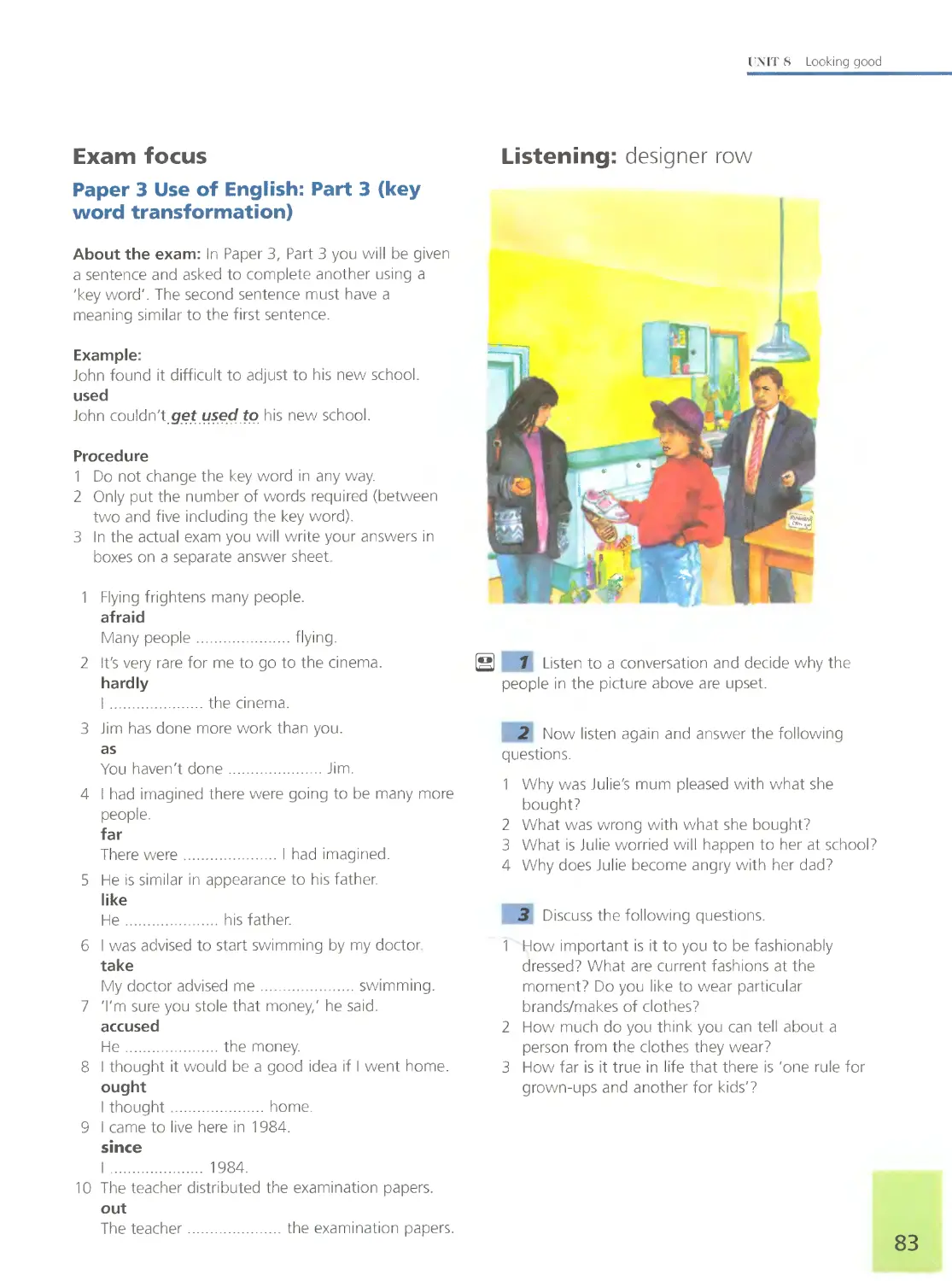
Designer row! (comprehension
questions)
Discussing fashion
Describing an accident, an illness, etc.
Roleplay: parent and son/daughter discuss
party rules
An addict's story (True/False) Discussing eating and cooking
Shop complaint (ordering pictures) Explaining how to cook something
Discussing shopping
Roleplay: making a complaint
Inventors (note taking)
Discussing money
Problem solving: 1) awarding a scholarship
2) ranking inventions
A descriptive
composition
(person)
A formal letter
(complaint)
An application
Weird weather facts
(question formation)
Biosphere 2
(significance of key words)
Discussing environmental issues
Problem solving: selecting personal items
A transactional
letter (2) and
informal/formal style
The Eiffel Tower conman
(gapped text: sentences)
TV ration box (question
formation)
Mad as a hatter or
geniuses at work?
(multiple matching)
Radio advertisements
(assessing effectiveness)
Vampire woman
(comprehension questions)
Roleplay: product presentation
Creating a new TV channel
Discussing eccentricity
Describing animals n
Discussing different types of accommodation
A discursive composition (1)
and linkers
A descriptive
composition (place)
Batman
(comprehension questions)
Chatting with chimps
(selecting correct sentences)
Graffiti (multiple choice)
Guardian Angels (True/False)
Song: / wish it would rain
down
Extracts (multiple choice)
Handwriting (True/False)
Roleplay: deciding what to do with a
young criminal
Ordering a picture story
Discussing the role of vigilantes
Discussing: 1) differences between people
and animals
2) graffiti
Making your writing
more interesting
A report (2)
A discursive composition^)
Communication activities p.199 Language index p.207

Exam information
Overview
The Cambridge First Certificate Examination in English
consists of five papers. Each paper tests a different
area of your ability in English and is worth twenty per
cent of your total result. After you take the exam you
will receive a grade: A, B and C are pass grades; D
and E are fail grades.
Paper 1 Reading
This paper contains four parts. Each part has at least
one text with a task. There is a total of 35 questions.
A variety of types of texts may be used, including
letters, advertisements, extracts from works of fiction,
newspaper articles and information from brochures.
You will have 1 hour and 15 minutes to answer all the
questions.
Part 1: Multiple matching
You match headings or summary sentences to each
paragraph of a text. There are 6/7 questions and an
example (0) at the beginning. (See similar tasks on
pp. 36-37; pp. 58-59; pp. 130-131.)
Part 2: Multiple choice
You choose between four alternatives to answer
questions or complete statements about a text. There
are 7/8 questions. (See Exam Focus pp. 64-65 and
similar tasks on p. 89 and p. 157.)
Part 3: Gapped text
Sentences or paragraphs have been removed from a
text. You decide where in the text these sentences or
paragraphs should be placed. There are 6/7 gaps in
the text but 7/8 sentences or paragraphs. The first gap
is an example (0). (See similar tasks on pp. 22-23, pp.
68-69, p. 85, pp. 98-99 and pp. 120-121 and Exam
Focus on pp. 114-115.)
Part 4: Multiple matching
You read a text divided into sections and then answer
specific questions about each section. There are 13-15
questions and an example (0) at the beginning. (See
Exam Focus on pp. 10-11 and a similar task on
p. 92.)
Paper 2 Writing
In this paper you have two tasks. You will have 1 hour
and 30 minutes to complete the two tasks and you
will be required to write between 120 and 180 words
for each task.
Part 1 is compulsory and requires you to write a
'transactional' letter based on information and
prompts. (See example on p.20 Exam focus, and
model text with notes in Writing Reference p. 179.)
In Part 2 you have a choice from four tasks. These will
be a selection of the following:
• a letter, which could include a 'letter of application'
(See example on p. 12 Writing, and model texts
with notes p. 181 and p. 184.)
• an article (See example on p. 126 Exam focus, and
model text with notes p. 183.)
• a report (See example on p. 73 Exam focus,
and model text with notes p. 182.)
• a discursive composition (See example on p. 158
Writing, and model text with notes p. 185.)
• a descriptive composition (See example on p.81
Writing, and model text with notes p. 186.)
• a short story (See example on p.44 Writing, and
model text with notes p. 180.)
• a composition, article, report or letter on one of
the background reading texts (See example on p 51
Writing, and model text with notes p. 186.)
Paper 3 Use of English
This paper contains five parts with a total of 65
questions. You will have 1 hour and 15 minutes to
answer all the questions. The five different parts are as
follows:
Part 1: this consists of a multiple choice cloze text*
This is a text with 15 gaps, followed by 15 four-option
multiple choice questions. The focus is on vocabulary.
(See example on p. 143 Use of English and p. 106
Exam Focus.)
Part 2: this consists of an open cloze text. This is a
text with 15 gaps which you must fill with an
appropriate word. The focus is on grammar and
vocabulary. (See example on p. 135 Exam focus.)

Exam information
Part 3: this consists of 10 'key' word transformations.
You are required to complete a sentence using a given
word, so that it means the same as a previous
sentence. The focus is on grammar and vocabulary.
(See example on p. 83 Exam focus.)
Part 4: this consists of an error correction text. This is
a text where some lines are correct and some contain
an extra and unnecessary word which must be
identified. The focus is on grammar. (See example on
p.28 Exam focus.)
Part 5: this consists of a word formation exercise. You
will read a text in which there are 10 gaps. You are
given the stem of the word which you must use to
complete each gap. The focus is on vocabulary. (See
example on p. 19 Exam focus.)
Paper 4 Listening
This paper contains four parts with a total of 30
questions. In each part you will hear the text(s) twice
The texts will be a variety of types, possibly including
phone messages, lectures, news, stories, interviews,
advertisements, conversations, quizzes and extracts
from plays. There will be a mixture of native and non-
native speaker accents. This paper will last
approximately 40 minutes.
Part 1: you will hear 8 short, unrelated extracts and
have to answer a multiple choice question about each
one. You may be asked to decide on, for example, the
general subject of the text, the relationship of the
speakers or the purpose of the conversation. (See
example on p. 146 Exam focus.)
Part 2: you will hear a monologue or conversation
lasting about 3 minutes. You will have to take notes
or fill in blanks to complete missing information. (See
example on p. 91 Exam focus.)
Part 3: you will hear a series of short, related extracts
of about 30 seconds from monologues or
conversations. While you listen you complete a
multiple matching task in which you match the
speakers to given prompts. (See example on p. 17
Listening.)
Part 4: you will hear a monologue or conversation
lasting about 3 minutes. You will have to answer
questions which involve selecting between 2 or 3
possible answers, for example True/False, Yes/No,
which speaker said what, multiple choice, etc. (See
example on p. 148 Listening.)
Paper 5 Speaking
This paper contains four parts. The standard format
involves an interview between two candidates and
two examiners. One of the examiners is an
interlocutor who speaks to the candidates; the other
examiner only assesses the candidates and does not
speak. In Parts 1 and 2 of this paper candidates speak
mainly to the interlocutor. In Parts 3 and 4 the
candidates speak mainly to each other. The different
parts are as follows:
Part 1: the interlocutor asks each candidate to say a
little about themselves, for example where they come
from, what they like doing in their free time, etc. This
will last approximately 3 minutes.
Part 2: candidates compare and contrast two
photographs they are given by the interlocutor and
talk about them in relation to themselves and their
own experience. This will last approximately 4
minutes. (See a similar task on p. 13 and an example
on p. 53 Exam focus.)
Part 3: candidates are given visual prompts (e.g.
photographs, line drawings, diagrams, maps) and are
asked to carry out a task together which may involve
planning, problem solving, decision making,
prioritising or speculating. This will last approximately
3 minutes. (See a similar task on p. 102 and an
example on p. 104 Exam focus.)
Part 4: the interlocutor develops the topic covered in
Part 3 and asks the candidates to discuss and give
opinions on more general questions related to the
same theme. This will last approximately 4 minutes.
In total this paper will last approximately 14 minutes.
(For an example of a complete Paper 5 interview see
pp. 124-125 Exam focus. There are practice test
materials for Paper 5 on pp. 187-195.)
5

I T
A sense of adventure
Speaking
1 Look at the picture below and discuss the
following questions.
1 Why do you think the man is doing this?
2 Would you be prepared to try this?
Why?/Why not?
3 What type of character would you need to
have to do this?
<T>
>k
-^
2 Complete the questionnaire opposite
Then compare your answers with other students
in the class and find someone whose answers
are similar to your own.
Are you a THRILL-SEEKER?
Choose the alternative that best describes
your likes or dislikes, or the way you feel.
la) I sometimes like to do things that are a
little frightening.
b) Sensible people avoid dangerous activities
c) I love being terrified!
2a) I enter cold water gradually, giving myself
time to get used to it.
b) It's fun to dive or jump right into the ocean
or a cold pool.
c) I won't go in the water unless it's very
warm.
3a) When I go on holiday, I want a decent room
and a bed at least.
b) I like going camping and doing without the
conveniences of everyday life.
c) I expect a bit of luxury on holiday
4a) My friends are pretty crazy.
b) I prefer calm, conventional people.
c) I like having a mix of friends of all
different types.
5a) I think it would be really exciting to do a
parachute jump.
b) Jumping out of a plane, with or without a
parachute, is crazy
c) I'd consider doing a parachute jump if I had
proper training.
6a) I think it would be fun to be hypnotised.
b) I wouldn't mind being hypnotised by a
professional.
c) I would hate to be in the power of a
hypnotist.
7a) People who ride motorbikes must have
some kind of unconscious desire to hurt
themselves.
b) Riding a motorbike at high speed is one of
the most exciting things you can do.
c) Motorbikes are just another means of
transport.
:nJ To see how you did on the test, turn to page 199.

UNIT 1 A sense of adventure
Vocabulary: feelings
7 Look at the groups of words below and answer
the following questions. Use your dictionary where
necessary.
1 Which word is the odd one out in each group?
Why?
2 On which syllable does the main stress fall in each
word?
example: ex 'cited - second syllable stress
a) frightened excited terrified scared
b) happy lucky thrilled glad
c) depressed miserable sad confused
d) astonished upset amazed surprised
e) angry cross furious nervous
Watch Out! nervous
1 Please stop whistling. It's making me nervousM's very
Irritating.
2 I get very nervous/irritated just before an exam.
Which is the most likely alternative in each sentence?
Decide which is the correct form of the adjective
in each of the following sentences.
1 I had never done a parachute jump before. It was
very frightening/frightened.
2 I had never done a parachute jump before. I was
very frightening/frightened.
Which of the other adjectives in Exercise 1 have an
-ed form and an -ing form?
Grammar reference p. 162 (1.1/1.2)
3 Complete the following sentences with a
suitable adjective from Exercise 1 in the correct form.
1 That film was very - all the main
characters died!
2 I was to hear that he had passed his
exams because he never seemed to do any work.
It's so annoying!
3 It makes me so when people drop
litter in the street!
4 Mike was when they asked him to be
godfather of their first child. Nothing could have
made him happier!
5 It was a very match. The score was
2-2 until just before the end.
4 Tell a partner how you would feel in the
following situations and what you would do next
1 You hear you have passed all your exams.
2 You are in a lift which suddenly stops and won't
move.
3 Your brother/sister/flatmate has borrowed some of
your clothes without asking permission.
4 You are walking home late at night and you think
someone is following you.
5 Choose three more adjectives from Exercise 1.
Tell your partner the last time you felt like that.
6 How are you going to record new vocabulary?
1 Are you going to have a special vocabulary
notebook? If so, are you going to organise it:
• by day (like a diary)?
example:
October Sth
cu7£?rt//cros& -
•/z/rtoz/s,
*5*
• by topic area?
example:
p sod/rmerohh
OAMty/ortKA
FEELINGS
-furious hayw/%^-
• thrilled
• alphabetically (like a dictionary)?
example:
( amazed/d'meud/ad].: to feel very surprised
■ e.Q. They were all amazed by her v\ew hairstyle.
2 What information are you going to put in your
vocabulary notebook? It is a good idea to include
the following things:
• the part of speech e.g. noun, verb, adjective, etc.
• a definition
• an example sentence
• the translation
• the phonemics and word stress
7

UNIT 1 A sense of adventure
Reading
Look at the pictures below
and describe what you can see
happening in each one.
arr
*Z
Atiazino^ -
f^YT^
00(11)0
2 Now read the text opposite
and decide which paragraph each
picture belongs to. Then tell a
partner how each picture relates
to the text.
Why do we risk it?
Ordinary people all over the world are willing to risk their lives for
the ultimate experience - an 'adrenaline buzz'. What basic human
need is driving them to do it?
RISK SPORTS are one of the fastest-
growing leisure activities. Daredevils
try anything from organised bungee
jumps to illegally jumping off
buildings. These people never feel so
alive as when they are risking their
lives. In their quest for the ultimate
sensation, thrill-seekers are thinking
up more and more elaborate sports.
'Zip wiring', for example, involves
sliding down a rope from the top of a
cliff suspended by a pulley attached to
your ankle.
So why do some people's lives
seem to be dominated by the 'thrill
factor1, while others are perfectly
happy to sit at home by the fire? Some
say that people who do risk sports are
reacting against a society which they
feel has become dull and constricting.
David Lewis, a psychologist, believes
that people today crave adventure. In
an attempt to guarantee safety, our
culture has eliminated risk. 'The
world has become a bland and safe
place,' says Lewis. 'People used to be
able to seek adventure by hunting
wild animals, or taking part in
expeditions. Now they turn to risk
sports as an escape.'
Risk sports have a positive side as
well. They help people to overcome
fears that affect them in their real
lives. This makes risk sports
particularly valuable for executives in
office jobs who need to stay alert so
from Focus magazine' * ' '
that they can cope when things go
wrong. They learn that being
frightened doesn't mean they can't be
in control.
Of all the risk or adrenaline sports,
bungee jumping is proving the most
popular. Worldwide, one-and-a-half
million people have tried it. You
hurtle towards the ground from 200
metres up and, at the last moment,
when you are about to hit the water or
land and death seems certain, a rubber
band yanks you back to life. You can
decide whether to jump from a crane,
a bridge or a balloon. Attached to a
length of elastic rope, jumpers
experience a free fall of nearly
100 mph, before they're slowed by a
quickly increasing pull on their ankles.
After five or six bounces jumpers
are lowered on to a mattress and set
free. Almost inarticulate, they walk
around with idiotic grins on their
faces. Their hands can't stop shaking,
they can only use superlatives and say
repeatedly how amazing it was. 'As
you're falling, all you see are things
flying around as you turn,' says one
breathless bungee jumper. 'You don't
think you're ever going to stop and
when you rebound, it's like
weightlessness. You feel as if you're
floating on air. My legs are like jelly,
but I feel so alive!'
3 In most texts you read there
will be some words that you do
not understand. It is important
that you are able to make
sensible guesses as to what these
words might mean from the
surrounding context.
1 The words opposite come from
the text. Look at each word in
context and choose the correct
meaning a) or b).
1 quest (noun)
2 crave (verb)
3 bland (adjective)
4 alert (adjective)
5 hurtle (verb)
6 yank (verb)
7 inarticulate
(adjective)
a) search
a) want very much
a) frightening
a) full of anxiety
a) move very fast
a) hit violently
a) unable to speak
clearly
b) fear
b) dislike strongly
b) without excitement
b) quick to notice
what is happening
b) be sick
b) pull suddenly
b) unable to move
2 Now choose two other words that you don't know in the text and try
to work out their meaning from the context.
8

UNIT 1 A sense of adventure
Grammar: questions
• tESTIONS
7 Here are some incorrectly
formed questions. Try to correct
them. Then read the information
about QUESTIONS opposite and
check your ideas.
1 Why people take such
dangerous risks?
2 Can you tell me how did you
feel afterwards?
3 Did he was waiting for you to
jump?
4 Let's go home, do we?
5 When you went bungee-
jumping?
6 Are you agree?
7 How many time have you
been doing this sport?
8 Of what are you afraid?
9 Who did asked the
instructor?
10 Do you know if is he coming?
11 He used to hate motorbikes,
wasn't he?
1 Question tags are used to
check information.
example: You've got two
brothers, haven't
you?
• If you are fairly sure that
your information is correct,
your voice should fall on the
question tag.
• If you are not very sure
whether your information is
correct or not, your voice
should rise on the question
tag.
Listen and decide if the person
saying the above sentence is
fairly sure or not very sure that
their information is correct.
subject +
this bag
he
they
main verb
cost?
go?
done?
a) Questions are often formed in this way:
Question word(s) + auxiliary verb +
How much does
When did
What have
b) Be, can and have (got) just change the order of the subject and
auxiliary verb.
e.g. He is watching TV. > Is he watching TV? They can swim. >
Can they swim? You have got time. > Have you got time?
c) If who/which/what is the subject of the sentence, do not use
do/does/did.
e.g. Who invented the telephone? (not Who did invent the
telephone?) What happened to Mike last night? (not What
did happen to Mike last night?)
d) With 'indirect' questions the word order of the subject (and
auxiliary) and main verb is the same order as in statements,
e.g. Do you think he is doing his homework? Are you going to
ask me what I bought?
e) Question tags are generally formed with the auxiliary of the verb in
the first part of the sentence. Positive statements generally have
negative question tags, negative statements generally have positive
question tags.
e.g. You don't like him, do you? They haven't taken it, have they?
shall we is the question tag used after Let's
e.g. Let's watch TV, shall we?
did/didn't is used in the question tag after used to
e.g. You used to like swimming, didn't you?
f) Prepositions generally come at the end of questions (except in very
formal situations).
e.g. Who did you go to the cinema with? (not With whom did you
go to the cinema?) What were you talking about? (not About
what wore you talking?).
g) To ask about a period of time we can use How long ... ?
e.g. How long have you known him? How long are they staying?
Grammar reference p.171 (13)
Listen to five other people
using question tags. Are they
fairly sure or not very sure that
their information is correct?
3 Work with other students and
check what you know about
them using question tags and
the appropriate intonation.
example: You're eighteen,
aren't you?
9

UNIT 1 A sense of adventure
3 In small groups consider the following two
problems. Try to solve the problems by asking your
teacher questions which she/he can answer 'Yes' or
'No' to. Your teacher will not answer your
questions unless they are grammatically correct
Cindy and Sebastian are lying dead on the floor.
They are surrounded by broken glass and water. The
window to the room is open and the curtains are
flapping in the breeze.
Who are they? How did they die and why?
example: Were they murdered?
A man is lying dead on the floor. Next to him is a
piece of wood, some sawdust and a gun. Another
man comes to the door, opens it, looks in, sees the
dead man and smiles. He walks away extremely
happy
How did the man die? Why is the second man so
happy?
example: Did the second man kill the first man?
A young Australian actress was recently interviewed
for a popular magazine. These were the answers
she gave. Work with a partner and try to imagine
the kinds of questions she might have been asked.
See how many different questions your class can
think of for each answer.
About two years now.
Chocolate cake with fresh cream.
Heights.
Madonna, I suppose.
Biting my nails.
Getting up before 8.00 in the morning.
About once every five years.
No, actually, I'm twenty.
Yes, but I gave up a few months ago
He's a good friend. Nothing more.
My hair. I wish it was blonde.
The fact that I am very loyal.
My mother. I tell her everything ... nearly.
2 Now choose some of your questions and interview
a partner.
1 Work with a partner. Together, choose two famous
people that you are both interested in. Write at
least six questions that you would like to ask them
2 Now take it in turns to be a journalist and the
famous person. One of you should ask the
questions, the other should answer as if you were
that famous person. Be as imaginative as you can
in your answers.
Exam focus
Paper 1 Reading: Part 4 (multiple
matching)
About the exam: In Paper 1, Part 4 you read a text
divided into sections and then answer between
thirteen and fifteen questions. In this part of Paper 1
you need to find specific information in the text.
Procedure
1 Make sure you look at the title and /or the
subheading or introduction of the text before you
start reading. This should give you a good idea of
what to expect. (Do this for all parts of Paper 1.)
2 Read the text through quickly to get a general idea.
3 Look at the first question carefully. Scan each
section to find the relevant information. Watch
out! Sometimes information in more than one
section will relate to a specific question. Make sure
you choose the information that matches the
question exactly.
4 Work through all the questions in this way. Leave
any you can't do and come back to them at the
end.
\
spa*
'««*f v
w«U/t
10

UNIT 1 A sense of adventure
You are going to read a magazine article about the publisher of some famous travel guides and the information they
receive from travellers. For questions 1-15, choose from the travellers (A-D). There is an example at the beginning (0)
In the actual exam you would mark your answers on a separate answer sheet.
Which of the travellers A-D:
A Sarah Ellison
B Scott Williamson
C Donna Cotter
D John Nevison
had some rather frightening experiences?
warns other travellers about something?
was travelling with someone else?
tells other travellers what to take with them?
recommends a particular season?
mentions three good things about public transport?
does not mention public transport?
talks about a place that not many people know?
describes the natural beauty of the place?
visited a place where it is often wet?
met some local people?
says you can prepare for other trips here?
says what kind of luggage they were carrying?
mentions accommodation?
wants to repeat the experience?
EL
8
10
111
L12
13
14
Ll£
y^~***v The Lonely Planet guidebooks have
/■ t fACO^1 been treasured for years by travellers
|Q|T^«jl ^y wno are looking for adventure. Today Lonely
^«*—r Planet also has its own website where
travellers are invited to send electronic postcards with news and
tips for others who might be planning a trip. Here are some
examples.
A Tenerife is home to Spain's highest mountain, Teide. Towering at
almost 4000 metres, it dominates the island and is snow-capped
for most of the year, sometimes as late as May. The one way to
get up to the top is to stay at the refuge halfway up overnight.
You get up at 3 a.m. to walk to the summit for the sunrise. The
mountain lies at the heart of the Teide National Park, Spain's
most visited park, and the surrounding scenery is breathtaking.
Other 'must dos' include the Masca valley in the west with its
picturesque villages and the Anaga peninsular in the north.
Transport on Tenerife is cheap. Bright green buses run all over
the island, they are regular and run on time.
Sarah Ellison, USA
B Greece is ideally suited to a cycle-touring holiday. The roads are
of good quality, with wide shoulders and little traffic. The
weather in spring is perfect for cycling, with lots of sunshine,
little rain and comfortable temperatures. The scenery in Greece
is spectacular, and there is no better way to enjoy it than by bike:
golden sandy beaches, rocky headlands and high sea cliffs making
up the coastline, olive groves, lush green hillsides and rugged
snow-capped mountains in the interior. The colourful wildflowers
in spring add to the already impressive landscape. You will come
across a lot of hills when travelling in Greece but keep in mind:
the higher you go the better the view. Aside from the natural
scenery, there are the ancient ruins and picturesque towns that
add to the Greek experience. The food is excellent, especially
the creamy yoghurt, warm loaves of bread fresh from the oven
and delicious desserts. On a more practical note all the
#5 %
larger towns have bike shops where repairs can be made and spare
parts bought. Bikes can be easily transported on boats, trains and
even buses.
Scott Williamson, New Zealand
C Hitchhiking in Africa is an interesting experience! While hitching
through Zambia, me and my six-and-a-half-foot, 20-stone fiance
were picked up by a small truck already carrying no less than nine
people and a chicken in the back and four in the front (including a
lady with a baby tied around her waist hanging over the edge!).
Feeling very tired we climbed aboard with our rucksacks. The truck
was soon travelling at speeds of up to 150km per hour and going
down some hair-raising hills. This made us a little concerned
especially when we saw that one of the wheels was slowly coming
off. We finally got them to pull over to inspect it only to find that
all the wheels were loose! The owner of course already knew this
and was saying 'no worry, no worry'. Somehow we made it to our
destination at Lake Kariba only to be woken up in the night by an
earthquake! But I would do it all again.
Donna Cotter, Australia
D If you're looking for an escape from the high-tech facades and
interiors of Singapore's Orchard Road, you should go to the
MacRitchie Reservoir north of the city centre, where a walk or run
around the MacRitchie Loop, located in the 2000 hectares of the
Central Catchment Nature Reserve, is excellent training for
rainforest treks elsewhere in South-East Asia. Surprisingly few
people go to the Loop, which is why it remains one of Singapore's
best kept secrets. The I I km circuit should not be taken lightly. A
reasonable level of physical fitness is required. Carry water, a small
umbrella and sun protection. After heavy rains, a near-daily
occurrence in Singapore, the trail is muddy and slippery. Storms can
leave entire trees uprooted and blocking the paths. When the sun
does appear, it burns fiercely. To get there, take the metro (the
MRT) to Bishan and then bus 136.
John Nevison, Singapore
from Lonely Planet Website
propaganda
postcards
the scoop
subWWWay
11

UNIT 1 A sense of adventure
Writing:
informal letters
7 Look at the example of an
informal letter opposite written in
answer to the following question:
You have recently got back from a
holiday. You decide to write back to
an English friend who wrote to you
some time ago. Apologise for the
delay in replying and tell her/him
about your holiday.
Unfortunately, the letter contains
a number of spelling, grammar
and vocabulary mistakes. Try to
find and then correct them. The
number of mistakes is indicated
at the end of each sentence.
2 Before you practise writing
an informal letter, answer the
following questions about how
you write informal letters in
English.
1 Where do you write your
address?
2 Do you write the address of
the person you are writing to
in the letter?
3 Where do you write your
name?
4 Where do you write the date?
5 How do you usually begin an
informal letter?
6 How can you finish an informal
letter?
7 Do you need to write your
address in the exam?
(Pew ~u^n<^)
T^^nAo ^ iwua j&wi ^eft&l /a**. JVzdfy Aowg ('t&dsU T<yiite -trndt
eaJi£>&i,'6id (-Aave <rn£o\ tftoot flat -§n&k fi<rm &&d*Ly_. / Mrtrtf uri&
tinec ftutrJ* Ao a Mtt& pLce CaMed Jntg«.ccui y&cA u$ nta/i of
A&rnjzAxa. / jfrut U ivOArit &ocacf&\ tAa.f use -e^pe^ed! (Z)!
VJe VmrkeJ?S)<rrr^. Jicnrmo aw. Acrf-ef on -t%e inlfcu^e/'&ut uA&n Zt/e
cuvuved? -tv -&e K<rfeft use iamajl tmsw dMa^cirittsui (S). It wzlo I^m
M., JiaiZ&i dwhA aw$wt Ccru£dn'4 Josux. •+%€ /)&\ (l). -<& Zc^
cUcxdjeA cAtwae. ft).
7%e ru^ci Aotel zvtza jzexfecf&i (l) ■ H mm vw<y cu&ti aw$ it na<$ -me
-frife^f /liuirwsna fioot I -Ziwi yiej^v (3). (But it itnzo <rne, jV2o&&m - //
ivzw /Do mMck €4cp#rv3u& (z) ! We /oZcua crrvi 7ug%t} Sut ~$e*i -meve
Z6£zo Jvm£ -to cnasuze, CLajusn, (2).
On $e &ndP w£ found t%e -beaM+ifiJ? aftcurtment wrM ^ SaJctrnq, comd
it luzio cAetvp (2). -itm/tyt-tZina/tU, l^t cm£u Acd' feruA dhyo of'cavz
IdUay. -£# (1)/
Arifvimui I' mcoof ^a oaiAl-luipadl /ma /ualcaOe,1. / lw& Hfute a^tusi
3 Now write an informal letter in answer to the question in Exercise 1
in 120-180 words. Your letter should follow this order:
• Apologise for not writing sooner and explain why.
• Say where you went on holiday and who with.
• Say why you enjoyed/didn't enjoy your holiday and describe any special
things you did.
• Say when you hope to see or contact your friend.
When you have finished, show your work to a partner who should check
your grammar and spelling.
4 When your teacher has corrected your letter, make a note of some
of your spelling, grammar and vocabulary mistakes.
example:
GRMmm
We couldn't find
our Uiggage-net
luggages
s?eium mcmmrh
Unfinrtunatetu I've sent -for a
not unfrfaniHy. brochure about
-~ o skiing holidays,
not-protpecfti*
• Build up a list of your common mistakes and try to avoid them in your
future writing.
12

I "NIT I A sense of adventure
Vocabulary: transport
T How many different ways can you think of to travel by sea, air or
land?
example: by sea > submarine, canoe, motor-boat, etc.
2 Put the words in the box into categories according to whether they
relate to ships, trains, planes, cars or buses. Which of the words can go in
more than one category?
a dual carriageway to check in the fast lane a guard Customs
roadworks a lifeboat a lay-by a platform a compartment
a fare a ticket a cabin a seatbelt a deck a liner a cruise
a passenger a port a single an inspector a stop to take off
a parking meter a ferry a departure lounge a life-belt a flight
first-class a track a driving test a steward a yacht
\
- v. . ?$;-,:
%. v
#>
n »
A
*>
X
'<»
3 Comp
get into/
out of
get on/
off
drive
ride
catch/
miss
lete the
car
•
following
bicycle
X
table,
train
motorbike
plane
bus
Watch Out! journey/trip/travel
1 I've got to go on a business journey to Rome next weekend.
2 The travel to New York was long and tiring.
3 Trip makes you more sensitive to other cultures
What is the mistake in each of these sentences?
£
.- ^*^) —V.
-r *
Speaking
Compare and contrast the photographs in each pair by discussing these
questions.
1 Photos 1 and 2
1 What are the similarities between these ways of travelling?
2 What are the differences?
3 Have you ever travelled by plane or ship? Which do you prefer?
2 Photos 3 and 4
1 What are the similarities between these ways of getting to work?
2 What are the differences?
3 Which scene is more common in your country? Which do you think is worse?
V ■
>/>./
l
13

UNIT 1 A sense of adventure
»•»»».
•*%
tK-^ 3
■•%: :. =b
^5< „ .-•
Listening: disaster at sea
7 Look at the picture above and discuss the following questions
1 What can you see happening? What do you know about this ship? Why
is it so famous?
2 How do you think these words will be important in the story of this
ship?
iceberg look-out bridge (of a ship) sink icy lifeboat
2 Listen to the first part of the story and see if your ideas were correct.
3 Listen again and make a note of the significance of these numbers.
a) 2,300
b) 11.40 p.m.
c) 1,513
d) 22 knots
e) 16
What do you think happened next on board the Titanic! Discuss
your ideas with a partner and then listen to the second part of the story to
see if you were right.
5 Listen to the second part again and decide if the following
statements are True or False
1 The passengers of the Titanic weren't particularly worried at first.
2 Emily Richards had just left the USA.
3 She had her two children with her.
4 She regrets not being able to save more people.
5 The ship was completely under the water at 2.20 a.m.
6 Music was heard as the ship went under the water.
7 Megan Roberts wrote a novel based on the story of the Titanic.
6 Discuss the following questions.
1 Who do you think was responsible for the sinking of the Titanic?
2 Have you seen the film Titanic? Is it a love story or a disaster movie?
Vocabulary: word
formation
• And so began two hours and
forty minutes of disbelief...
T What do the following
prefixes in bold mean?
example: re- means 'again'.
1 replay/redo
2 disbelief/impolite/illogical/
unusual/irresponsible/invisible
3 overcrowded/overcharge
4 underestimate/underweight
5 postgraduate/postmortem
6 ex-husband/ex-President
7 submarine/subway
What parts of speech
(nouns, adjectives, or adverbs) do
the suffixes in bold indicate?
1 quickly/backwards
2 employment/happiness/
inflation/socialism
3 employee/teacher/conductor
4 famous/sunny/hopeful/
brownish/useless
3 Make as many words as you
can by combining different parts
of the box.
dis
un
im
excite
appoint
honest
patient
success
direct
kind
profit
help
friend
luck
like
ful
less
able
iy
y
ship
ment
ness
ion
4 Choose six words you
formed and write a sentence for
each to illustrate the meaning.
14

UNIT
1 Review
1 Match the two halves of the following conversations. Imagine who is
speaking and where they might be.
1 A return to Manchester, please.
2 I can't believe it. We've been
stuck in this traffic jam for
hours!
3 Tickets, please.
4 The 19.30 Los Angeles flight
will be delayed by one hour due
to poor weather conditions.
5 We generally got up early and
went for a walk round the deck
before breakfast.
6 Can you stop at the next lay-by?
I think there's something wrong
with my seatbelt.
a) Look, I'm really sorry, but I had
it a minute ago.
b) Oh, well ... why don't we go
and have a look round the Duty
Free shop?
c) And did you ever have dinner
with the captain?
d) Will you be coming back today?
e) Can you wait for a second
because I think there's a petrol
station just a bit further on?
f) There are probably roadworks
ahead.
Use the word given in capitals at the end of each line to form a word
that fits in each space in the same line. There is an example at the beginning
(0).
THE DRIVING TEST
I knew I would have to (0) retake my driving test as soon as TAKE
I saw the (1) He didn't even say'hello'and seemed EXAMINE
very (2) I was a little bit late I suppose as I had slightly FRIEND
(3) how long it would take me to get there. As usual ESTIMATE
in this (4) city all the buses were packed and I had had to CROWD
wait more than twenty minutes before a (5) would let me CONDUCT
get on a bus. I knew apologising would be (6) so I just USE
got in the car. (7) I wasn't feeling particularly nervous LUCK
but this horrible man stared at me in (8) as I began to BELIEF
drive off. I put the car into gear, but it went (9) so fast BACK
I couldn't believe it-straight into a wall. I was so (10) APPOINT
when he told me I had failed that I thought I might cry.
3 Look at the pictures and think of a word to describe how the people are
feeling. What do you imagine has made them feel this way?
B
4i
$ 1
" - : "¥,
S ■■■ ,- ■:■ * t
i .* r % *
V* -■-■
E
i
—
*<
<t
4 This informal letter contains
various mistakes of organisation
and punctuation. Rewrite the
letter correcting the mistakes.
'^^^ Slo5 5"Ae
^^^J our
-L ^e We. ^ L ^ O^
f6Ce^ ^ S~n -d L -re
Put the words in these
questions in the correct order.
Then answer the questions in
complete sentences.
1 free do doing like you what
time your in ?
2 place the been what most to is
ever interesting have you ?
3 holidays best of what you kind
like do ?
4 studying for English long been
you how have ?
5 English learning thing the you
about find do what difficult
most?
6 pass exam you you the
Certificate do think will
First ?
15

A
UNIT
2 Work and play
»^., *
\
%
v Mv-r
**-•
fcfcbl
\ *t& v ,'
V'4
Speaking
Look at the pictures of people with different
jobs and discuss who you think should
be paid the most/the least and why.
s^i
VJ\
.*
G 1
\
Vocabulary: jobs
1 Describe what these different people do in their jobs.
example: A nurse takes care of people who are not well.
a nurse a debt collector an undertaker a referee a tax inspector
a bouncer a plumber a traffic warden a conductor a bookmaker
a social worker a surgeon a dustman an artist a chef a miner
a private investigator a librarian a caretaker a stockbroker
an editor a vet a wrestler a lifeguard
2 If you had the necessary skills/qualifications, which of these jobs:
1 might you be interested in? Why?
2 would you definitely not be interested in? Why?
kW-
3 Work with a partner.
1 Choose one of the jobs from Exercise 1, but don't tell your partner
which one you have chosen.
2 Your partner must ask you questions to find out what the job is.
example: a: Do you wear a uniform? b: Yes.
3 You can only answer 'Yes' or 'No' to the questions When your partner
has discovered the job, change over.
4 See who can discover the other person's job in the least number of
questions.
16

LMT 2 Work and play
Listening: unpopular jobs
1 You are going to hear four people talking
about their jobs. Each job appears in the box in
Vocabulary Exercise 1. Listen and decide what each
person's job is.
2 Now listen again and decide which speaker each
of the following sentences applies to. (One of the
sentences does not apply to any of them.)
A This person says she/he was physically threatened.
B This person says her/his salary is the most important
thing.
C This person has actually cried at work.
D This person most enjoys the contact with people.
E This person has had an embarrassing experience at
work.
J Look at the phrasal verbs with on in the
sentences below and decide if the common meaning
of them all is:
a) to move
b) to complete
c) to continue
d) to change
• One individual did say he would break my legs if I
kept on asking him for money.
• Let's hold on for a little bit longer. I'm sure he will
be here soon.
• I will carry on working here until I can find a better
job.
• The book was so interesting that she wanted to go
on reading it until she had finished.
4 Discuss the following questions.
1 Would you be interested in doing any of the four
jobs that you have heard about?
2 What qualities/abilities do you need to do each of
these jobs well?
Grammar: present tenses
7 Read the following rules for when the Present
Continuous is used. Then match one of the sentences
below to each rule.
The Present Continuous (or Progressive) is used for:
1 actions happening now or over a period of time
around now.
2 changing/developing situations.
3 temporary situations.
4 future arrangements.
5 annoying habits.
a) Why are you always telling me what to do?
b) The level of unemployment is getting worse
c) I'm sorry, but he is doing his homework right now
d) We are having dinner with Julie on Friday night.
e) She is staying with friends in York for a few days.
Grammar reference p.175 (17.2)
2 Now do the following exercises with a partner
to practise the Present Continuous.
1 Think of members of your family or close friends
and say what you think they are probably doing at
the moment.
example: / think my father is probably having a
meeting in his office.
2 Think of the same people again and tell your
partner about any annoying habits they may have.
example: My younger brother is always leaving
his shoes and socks around the house.
3 Tell your partner what things you have arranged to
do this weekend.
example: I'm meeting Maria on Saturday morning
and we're going shopping together.
4 Tell your partner if you think the people you know
and the place where you live are changing. Think
about things such as: fashion/unemployment/
cost of entertainment/pop music/inflation/
pollution/the weather.
example: The pollution where I live is getting
worse all the time!
17

UNIT 2 Work and play
3 Read the following rules for when the Present
Simple is used. Then match one of the sentences
below to each rule.
The Present Simple is used for:
1 routine or regular, repeated actions.
2 time clauses after when, as soon as, if, until, etc.
3 permanent situations.
4 the future as expressed in timetables.
5 scientific or natural laws.
6 with 'state' verbs (which we do not usually use in
the continuous form) e.g. jbe, believe, feel, hate,
hear, know, like, look, love, prefer, realise,
remember, see, seem, smell, suppose, taste, want.
a) Water freezes at 0°C.
b) I work five evenings a week.
c) I'll ask him when I see him.
d) I live in Athens.
e) It's the people I like most about the job.
f) The train arrives in Edinburgh at 5.00 p.m.
Grammar reference p. 175 (17.1)
Now do the following exercises to practise the
Present Simple.
1 Complete the following sentences with the Present
Simple or Future Simple (will) form of the verbs in
brackets.
a) I (paint) the kitchen when I
(have) some free time.
b) We (start) the meeting until
everybody (arrive).
c) If she (find) a better job, I think she
(leave).
d) They (move) house as soon as they
(find) a buyer.
e) When he (come) back, I
(tell) him what we have decided.
2 Write five sentences about yourself in the Present
Simple. Each time you should use one of the
words/expressions in the box below.
quite frequently/about two or three times a year/
very often/from time to time/hardly ever/
as often as I can/never/once or twice a week/
more often than I'd like to
example: / visit my grandmother as often as I can
3 Work in a group with two other students. Describe
your typical routine at the weekend. Are there any
major differences between your routine, and the
routines of the other students in your group?
example: / usually get up at about 7.00 a.m. and
have a shower. Then I...
5 Complete the following dialogue with the
Present Continuous or Present Simple form of the
verbs in brackets.
rupert: Hi, Nigel! How are you?
nigel: Fine, fine. It's been a long time.
rupert: Yes, nearly four years now.
nigel: So, tell me about yourself!
rupert: Well, I (1) (work) in this language
school in Cairo.
nigel: Oh, really? So what (2) (do) here
in London?
rupert: I (3) (have) a holiday.
nigel: Oh, I see. And what (4) (think) of
Cairo?
rupert: Oh, I (5) (like) it very much. It's a
very exciting place.
nigel: And what about your job?
rupert: Well, I generally (6) (get up)
about 8.30 and (7) (plan) some
lessons. Fortunately, with time, it
(8) (get) easier and easier to plan
lessons - in the beginning it took me ages!
I usually (9) (teach) from 11 a.m.
to 1 p.m. and later again from 6.30 to 9.30.
We all (10) (finish) at 9.30 p.m.
and we often (11) (go) into town
in one big group, to a disco or something.
nigel: When (12) (go back) to Cairo?
rupert: Next week, on Friday. The plane
(13) (leave) early, about 7.00a.m.
nigel: And how's your brother?
rupert: Chris ... oh, he's OK. I (14) (see)
him as often as I can. He is married with two
children and he never (15) (stop)
telling me that I should get a regular job and
settle down! He (16) (play) a lot
of football at the moment. I (17)
(think) he (18) (try) to get fit!
nigel: That's new!
rupert: And what about you? What (19)
(do)?
18

UNIT 2 Work and play
Vocabulary: employment
f Read the following questions and check
that you understand the meaning of the
words in italics. Use a dictionary where
necessary.
1 What do you think is a good salary or
wage in your country? How much would
you like to earn?
2 Would you like to work on commission?
Why/Why not? Do you think people
should get paid a bonus for especially
good work?
3 What different information should you
put in a CM?
4 What should you do to make a good
impression at a job interview?
5 Think of the job you do at the moment
or that you would like to do in the
future. What skills and/or qualifications
do you need to do it?
6 How many years' training do you need to
do before you can become a doctor in
your country?
7 Is it common or unusual for employees to
go on strike in your country? Do you
have trade unions?
8 For what reasons can people be sacked?
For what reasons can people be made
redundant? Why do people sometimes
resign from their jobs?
9 What help do people get from the
government if they are unemployed in
your country?
10 At what age do men and women usually
retire in your country? Do you think this
is early, late or about right? Do they
usually get a pension?
Now discuss the questions in small
groups.
Exam focus
Paper 3 Use of English: Part 5 (word
formation)
About the exam: In Paper 3, Part 5 you read a text with ten
gaps. At the end of each line is a key word. You change the
form of the word so that it is the correct part of speech to fill
each gap.
Procedure
1 Read the text all the way through.
2 Look at the example (0).
3 Look at each gap. Decide what part of speech is required
and whether it needs to be positive or negative.
4 Fill in the gap with a word in the appropriate form.
For questions 1-10, read the text below. Use the word
given in capitals at the end of each line to form a word
that fits in the space in the same line. There is an example
at the beginning (0). In the actual exam you would mark your
answers in a box (like the one below) on a separate answer
sheet.
example: 0
laziness
FATHER FIRES SON
A businessman sacked his own son because of (0) laziness,
incompetence and (1) Stuart Bidwell received
dozens of letters of (2) about his work during
the ten years he was his father's (3) 'He got
(4) warnings,' said Stephen Bidwell, Stuart's
father, and the (5) of the company. 'He was
absolutely (6) at his job and he didn't
even have the right (7) ' Eventually he was
asked to hand in his (8) after being caught making
phone calls to a girlfriend in Australia. His (9)
to resign forced his father to sack him, (10)
according to Stuart, who is now suing his father.
LAZY
HONEST
COMPLAIN
EMPLOY
NUMBER
MANAGE
USE
QUALIFY
RESIGN
REFUSE
FAIR
Watch Out! experience
1 He did a scientific experiment/experience in the
laboratory.
2 He has a lot of experience/experiences as a salesman.
3 He had some terrible experience/experiences while he
was travelling in the USA.
Which alternative is correct in each sentence?
-ip^>
19

UNIT 2 Work and play
Listening: song
f What does the expression
'the rat race' mean? Why would
some people want to get out of
it? What might they do instead?
2 You are going to listen to a
song called 9 to 5. What do you
imagine the song will be about?
Listen and see if you were right.
3 Here are the words to the
song, but in each verse the lines
are in the wrong order. Put them
in the correct order. Then listen to
the song again to check your
answers. You have been given the
first line of each verse.
And the blood starts pumping
And yawn and stretch
Out on the streets
Tumble out of bed (1)
Pour myself a cup of ambition
With folks like me
And try to come to life
Jump in the shower
On the job from 9 to 5
And I stumble to the kitchen
The traffic starts jumping
Chorus
And they never give you credit
What a way to make a living
It's all taking and no giving
It's enough to drive you crazy
Working 9 to 5 (1)
Barely getting by
If you let it
They just use your mind
You would think that I
But the boss won't seem to let me
9 to 5 for service and devotion (1)
I swear sometimes
Want to move ahead
Would deserve a better promotion
That man is out to get me
Exam focus
Paper 2 Writing: Part 1 (transactional letter)
About the exam: In Part 1 of Paper 2 you must write a letter based on
certain information. There is no choice and you must write between 120
and 180 words.
7 Read the following example of a typical task.
You see the following job advertisement in a local newspaper.
You are quite interested but would like some extra information.
Read carefully the advertisement and the notes which you have
made below. Then write your letter:
a) saying why you think you would be particularly suitable for
this job.
b) asking for extra information as suggested by the handwritten
notes below.
Write a letter of between 120 and 180 words in an appropriate
style. Do not write any addresses.
WORK WITH
ENGLISH-SPEAKING TOURISTS
Have you been looking for a chance to improve your
English and earn good money at the same time? Well, this
is an ideal opportunity!
Our company specialises in providing package tours for
British and American tourists all over the world, and we are
looking for local people who are interested in acting as tour
guides around major cities and places of national interest.
You would also be responsible for looking after the general
welfare of your group while they were in your care.
Letters of application should be sent to:
BritAm Tours,
Empire House,
176 Piccadilly,
London Wl 9FQ
Short-listed applicants will be called for interview locally.
when job start?
hours of work + pay?
'be responsible for looking after the general welfare' - what
does it mean?
available for interview - evenings onlyi
20

UNIT 2 Work and play
2 Here are two different attempts to answer the question in Exercise 1. Read Letter A and
Letter B and then complete the table according to the characteristics which you think each
letter has.
• answers the question directly and completely
• communicates the message effectively
• begins and ends the letter appropriately
• organises it well with clear paragraphs
• has a good range of grammatical structures and vocabulary
• uses the grammatical structures and vocabulary accurately
• has correct punctuation and spelling
• includes a range of linking expressions e.g. although, furthermore
• uses language of an appropriate style
Letter A
•
Letter B
X
Letter A
Dear Sir/Madam,
I am writing with reference to your advertisment in
todays paper concerning possible work with
English-speaking tourists. I am very intrested in
doing this kind of job and will be available from the
begining of next month. I need to know exactly when
the job would start, I should say that my level of
english is good, I can communication well and fairly
fluently. I have spent time on holiday in britain and
really enjoy meeting people from other countrys. i
have always been interested in the history and
cultur of my local area, before I can consider the
job I need to know what the hours of work and pay
would be. I would like to know more about what 'be
responsable for the general welfare of your group'
means and what they could inwolve. I am afraid
that I will only be available for interview in the
evening (due to present work commitements). I look
Letter B
^un2c
^
Tizouj/ztx/LesT £&nc£sr/icsirf
■hrurli/s .2 am Tsew Utef&Ueaf' Ju ^iod
fl#f and £a*i sfre Adzrf n&z& m<m/ti.
Fffltteuer, 7AJ22J-JUtfWTsia wAesi d^^dlasf.
1ve22. 1 Wenf Jo £na&uuf and? 7M,ru dX4<™
2 22o^Lsia <^OTurar<2 AgaS~ ^7/n Cf&X-
t&£s #y Awe,
Ingrid Heleon
3 Now write your own letter in answer to the
question above, trying to incorporate the best
features of Letter A and Letter B.

UNIT 2 Work and play
Would YOU
on fire for £75
yourself
a day?
... OR LAUNCH yourself off
the Great Wall of China without
a parachute? It's all in a day's
work when you're a nerves-of-steel
stuntwoman. And as it's a profession
where there is very little female
participation - there are only sixteen
stuntwomen in the whole of Britain -
it's a job consideration worth taking
seriously. Sue Dando finds out the
facts.
\r
•*.
}i-
%
^
.**^%
VLMi
A
stuntperson is a man or
woman who does all the
really dangerous bits of
acting work in films or on
TV. (1 ) Sarah Franzi, 24, is
one of Britain's 16 professional
stuntwomen (as against 160 men).
Like many of her female colleagues,
it was a career she'd never seriously
considered. 'From when I was young
I'd trained to be a dancer, and for
seven years after school I was rarely
out of work. A dancer's life is pretty
short, though, and it was my father
who suggested I should think about
doing stunt work after I'd given up
dancing. (2 ) For six months,
I worked really hard, every day, all
day. I had to learn six different skills
- sub-aqua, sky diving, horse riding,
stuff like that - to a high standard of
training.'
Sarah finished all the
requirements in just five months — it
can take as long as three years to
qualify. Two weeks after Sarah's
completed application was accepted
by the Stunt Committee, she was
launching herself off the Great Wall
of China in Superman IV. 'I was very
lucky to get work so quickly. I had a
small part, playing a tourist who fell
off the Wall after an earthquake, only
to be rescued from death by
Superman. In reality, I fell 15 metres
onto a pile of cardboard boxes!
(3 ) You just have to suffer the
discomfort and fall properly. I was
paid £210 a day for it, and because it
was considered dangerous, another
£200 "adjustment" fee was added for
every extra take.' This may sound
like a lot but, as Sarah explains, 'The
film company is paying for the risk. If
I'd broken a bone, that isn't very
much money at all when you're out of
work for the next few months, and
there is a risk involved. Safety
procedures are very strict, but it's
still a danger. (4 ).'
As yet, Sarah has received injuries
no more severe than bangs and
bruises, though she does admit to
having been scared on at least one
occasion.
T was set alight for London's
Burning (a TV programme about the
London Fire Brigade). It was a full
fire job, which meant that my whole
body — I was wearing protective
clothing - was set alight. (5 )
The difficulty with that kind of job is
that you're never fully in control of
the fire, so it's easier for something to
go wrong.
'It's jobs like that which make
people think we must be completely
mad to do this kind of work.
(6 ) There are so many safety
precautions, with so much mental
concentration involved, that what
we're really doing is creating an
illusion of danger. If people think,
"How could you do that? You must be
mad!" then we're just doing our jobs
properly'
How to qualify
To be accepted onto the Stunt
Register - the official list of qualified
stuntpeople, and the only means by
which you're able to get work - you
have to be between 18 and 30 years
old, and a full member of Equity, the
actors' union. Once you've got these
qualifications, you then have to
reach the required standard in at
least six of the categories listed
below. (7 ) The groups are:
Group A - Fighting
Fencing
Judo/Aikido/Wrestling
Other martial arts
Boxing
Group B - Falling
Trampolining
Diving
Parachuting
Group C - Riding and driving
Horse riding
Car driving
Motorcycle riding
Group D - Agility and strength
Gymnastics
Group E - Water
Swimming
Sub-aqua
Group F - Miscellaneous
Evidence of a high standard of
qualification in a skill not listed e.g.
ballet, athletics, dance.
Further help
For more details write to:
Stuntperson Enquiries, Equity,
8 Harley Street, London WIN 2AB.
(Don't forget to enclose a stamped
addressed envelope.)
22
from Just 17 magazine

UNIT 2 Work and play
Reading
1 Describe to a partner the most dangerous and/or
exciting thing you have ever done.
2 Read the text opposite and then answer the
following questions. (Certain sentences have been
taken out of the text which will be inserted later.)
1 What is Sarah Franzi's job?
2 What made her decide to do it?
3 Has she been seriously injured?
4 Do you think she is well paid?
3 The sentences below have been removed from
the text. Decide which sentence goes in each of the
numbered gaps in the text. Here is a procedure for
doing this type of task:
• Read the text once to make sure that you have a
good general idea of what it is about.
• Look at the sentences that have been removed and
try to get an idea of the subject of each one.
• Look at each gap in the text in turn, at the
sentence before it and the sentence after it. In your
mind, try putting in the most likely missing
sentences. Look for clues to help you e.g. words
like that, it or he which refer to something or
someone in the sentence before.
• Decide on one sentence for each gap. If later you
want to use a particular sentence again, go back
and check where you used it before. There may be
a different sentence that would fit in this gap.
A But that's not the case at all.
B You can't use anything softer than that, like
mattresses for instance, because you'd bounce
back up into view of the camera.
C I was on fire for 15 seconds and towards the end it
was incredibly hot.
D They should fall within at least three of the groups,
but not more than two categories should fall
within any one group.
E This can be anything from a relatively simple fall
into a swimming pool, to jumping off the top of a
skyscraper.
F Fortunately, the risks are one part of the job I really
enjoy.
G I did think about it for the next two years - then
decided to take the plunge and have a real go.
4 Compare your answers with a partner and say
what you think the underlined words in Exercise 3
refer to.
example: In A I think that refers to the idea that
stuntpeople must be completely mad.
5 Discuss the following questions.
1 What would you feel about doing Sarah's job?
2 Have you ever done any of the sports in Groups
A-F? Are/Were you good at them? Would you like
to do any of them? Why?AA/hy not?
Vocabulary: sports
Match the words in the box to one of the listed
sports below. Some of the items go with more than
one sport.
a glove
a goal
a pitch
a net a
a racket
hole
a roi
a linesman a
a set
nd an
club a
a ring
umpire
referee
a green
a court
to serve
1 tennis 4 volleyball
2 golf S boxing
3 football
2 Describe how the following pairs of sports are
similar to and different from each other
1 volleyball/basketball
2 tennis/table-tennis
3 boxing/wrestling
4 football/American football
5 surfing/windsurfing
3 Discuss the following questions.
1 What sport do you enjoy playing most? Are there
any other sports that you would like to try?
2 What sport do you enjoy watching most? Do you
prefer going to sports events or watching them on
TV?
23

UNIT 2 Work and play
Writing: sequencers
7 Read the text and put the following pictures in the order in which
they happen.
■^
Mountain Men
The history of Sumo wrestling goes back over 2000 years. Its origins are
connected to the Japanese belief in Shinto, the 'way of the gods',
where winning gains favour with the gods. This is why the ritual of a
sumo match is taken so seriously.
The clay fighting ring is itself a sacred shrine. On entering it, the
enormous wrestler first claps, to attract the gods' attention and indicate
his own purity of heart. Having done that, he shakes his apron to drive
away evil spirits, and raises his arms to show he carries no weapons.
Next comes his most dramatic gesture. With his left hand on his heart
and his right arm extended to the east, the huge fighter raises his right
leg as high as possible - to send it crashing down with all his force.
Then he performs the same earth-shaking stamp with the other leg.
After that, he purifies himself and the ring by throwing salt, wiping
himself, and rinsing his mouth with water. Finally, the opponents spend
three or four minutes trying to intimidate each other with grimaces and
threatening postures.
The fight itself is brief and brutal and consists of a thunderous
collision that rarely lasts more than ten seconds, which ends when one
giant is pushed to the ground or outside the circle.
1 What seven different words or grammatical structures can you see in
the second paragraph for describing a sequence?
example: On entering it, the enormous wrestler first daps, ...
2 Think about a typical morning in the week. Describe what happens
when you wake up. Use some of the 'sequencers' from the text.
example: The first thing is that my alarm goes off. Then I get up ...
3 Work in a group with other
students and describe a sport that
you know.
• Refer to the following if
appropriate:
- where you play
- what you play with
- what you wear
- who you play with
- the object of the game
- the basic rules
- what makes a good player
• Use some of the words and
structures from the text to
describe sequences.
• If the other students know
how to play the sport, they
should imagine they don't and
make you explain very clearly!
4 Write a short introduction
to your particular sport for people
who have never played it before.
Divide it into paragraphs referring
to the different areas listed in
Exercise 3 above.
24

¥ T 1VT f HT
Review
1 Look at the following characteristics and think
of two jobs for which each one is necessary. Use
different jobs each time.
example: strength: a wrestler, a bouncer
1 strength 2 kindness
4 reliability 5 creativity
3 patience
6 attention to detai
2 Explain the difference in meaning between the
following pairs of words/phrases.
1 an employer/an employee
2 to win/to earn
3 a salary/a wage
4 unemployed/on a pension
5 to be sacked/to be made redundant
6 a perk/a bonus
7 to retire/to resign
1 Write the verb form of the following nouns. Then
mark the position of the stress in both forms.
Noun
Verb
to 'qualify
qualifi 'cation
resignation
employment
advertisement
application
replacement
information
specialisation
protection
concentration
2 Now write a sentence using either the noun or the
verb form of each of the words in the table.
example: It takes many years to qualify as a doctor.
4 Choose the correct alternative in the following
sentences
1 The job situation slowly gets/is slowly getting
better
2 I only occasionally go/am only occasionally going to
the theatre.
3 You don't believe/aren't believing him, do you?
4 I stay/am staying with Paul for a few days.
5 Ask him to give me a call, when you see/are seeing
him.
6 I probably play/am probably playing football
tonight.
5 For questions 1-15 read the text and decide which
answer A, B, C or D best fits each space. Circle your answer.
There is an example at the beginning (0)
0 A plays B contests ©sports D encounters
A SPORTING DISASTER
I never really enjoyed (0) at school. I remember when
I played football. I was always put in (1) , but I used
to get bored and read a book. Then when the other side
(2) the rest of my (3) would shout at me.
Later on I tried tennis, which wasn't much better. I used to
have this habit of dropping the (4) each time I went
to hit the ball. The worst thing was when I actually won a
(5) - I was so pleased that I ran and tried to jump
over the (6) but caught my foot on it, fell and
broke my arm.
My latest attempt to get (7) was when I tried
boxing at a local gym. I'll never forget my first (8)
I climbed into the (9) and the bell went for the start
of the first (10) I just shut my eyes and swung my
fist. Unfortunately, I hit the (11) and not my
(12) Needless to say that was the end of my
boxing career. Next I decided to take up mountaineering.
I (13) a holiday in the Himalayas with two old
school friends. On our first climb I managed to slip and found
myself hanging on the end of a rope half way up a mountain.
All my friends could do was to call out to me to
(14) until the rescue party arrived. I guess I'll never
learn. I (15) wanting to try out other sports even
though I know I'll never be a champion!
1
2
3
4
5
6
7
8
9
10
11
12
13
14
15
A net
A scored
A group
A bat
A play
A fence
A strong
A fight
A court
A set
A arbitrator
A opponent
A booked
A keep on
A keep on
B
B
B
B
B
B
B
B
B
B
B
B
B
B
B
goal
pointed
selection
racket
game
line
well
game
ring
half
referee
enemy
ordered
hold on
hold on
C ring
C served
C team
C club
C race
C net
C slim
C match
C pitch
C round
C judge
C partner
C paid
C go on
C get on
D square
D drew
D club
D stick
D fight
D web
D fit
D play
D square
D game
D umpire
D contestant
D bought
D carry on
D hang on
25

UNIT
3 Nearest and dearest
Reading
Read the following article and decide
what you think is the most appropriate title
a) Twins reunited after a lifetime apart
b) Twin sisters trapped in a single mind.
c) Bringing up twins - the parents' story.
Speaking
Fill in the gaps in the following poem with the
words in the box. Then listen and check your answers.
twin (x 2) same trick out pain win sick
again blame shout sin
MV SISTER.
She's Sa ruuufity again a*ul(2)
fawu m<rmmfr U th* (3) —-—
And what 16 vnrrsje I yet WW
Iffesas^lWott&p)
'Cos 0$ter aUshewnylQ —
Mm W saysfl'U sort \w (i)
Bid all kt diet tefy** axuk(<£)
Its suck a aunt, vn: in™ » ^''—
pLe.tk pleas* DON'T HWS A (tt)
if
2 Discuss what the advantages/disadvantages are of:
a) being an only child.
b) having brothers and sisters.
c) being a twin.
26
AT FIRST IT'S HARD TO BELIEVE. They speak in
unison, walk in step, dress identically to the last
button and match each other mouthful for mouthful
at the dinner table. But this is no trick with mirrors.
This is everyday East London, where everyone
knows Greta and Freda Chaplin, the identical twins.
The twins do everything together. Whether they
are out shopping or doing the housework they
mirror each other's actions and mannerisms down
to the finest detail. To vacuum the floor both twins
grasp the handle of the hoover at the same time as
they guide it slowly around the carpet together. If
they make tea, both their hands are on the bottle as
they pour the milk. Listening to them talk is like
hearing one person with a slight echo a split second
later. If someone gives them a bar of soap in
different colours, they will cut theirs in two and
swap a half. They have two black coats, but one
came with green buttons and one black. They
swapped the buttons around so that each twin had
two green and two black buttons on each coat. The
sisters themselves say that they feel like one person,
not two. Sometimes it's almost as though they
inhabit the same mind.
The sisters, now 48, live in a flat in Hackney, East
London. They are a familiar sight in the area, where
they are often seen out shopping together in their
long clothes and waist-length hair. Some people are
frightened of their strange telepathic bond, others
laugh at them. The twins realise this and don't like
it, so they avoid crowds. They rely a great deal on
the protection and friendship of Jack Davenport
who has been like a father to them. 'Sometimes it's
as if you're seeing double,' he says. 'If we go out
shopping, they automatically buy the same thing in
the same colour at the same price, although it might
be from a different counter. They do everything at
the same time - clean their teeth, eat, drink. If
they're having fish and chips, they will pick a chip
up at the same time.'

UNIT 3 Nearest and dearest
2 Now read the article again and decide if the
following statements are True or False. Make a note of
the part of the text which helps you decide
1 Greta and Freda live in England
2 They speak nearly at the same time.
3 They feel the need to look exactly the same.
4 Local people are generally very kind and supportive
towards the twins.
5 Their father's name is Jack.
6 Their mother tried to help them grow up with their
own identities.
7 They have different characters.
8 Dr Bryan isn't surprised by the idea of telepathy
between Greta and Freda.
9 Dr Bryan is concerned with the psychological
aspects of multiple births.
3 Find words or phrases in the text with the
following meanings.
1 at the same time (para. 1)
2 to hold tightly (para. 2)
3 a very short time (para. 2)
4 to exchange (para. 2)
5 part of your body, above your hips (para 3)
6 a flat surface in a shop where you go to be served
(para. 3)
7 to keep together (para. 4)
8 to agree that something is true (para. 5)
9 to become angry suddenly (para. 5)
10 part of a woman's body where a baby develops
before it is born (para. 6)
11 certain, sure (para. 6)
12 anxiety, pressure (para. 7)
Little is known about the childhood of the sisters,
except that they grew up on a housing estate in
York. From babies their mother treated them as one
and encouraged their dependence on each other.
Everything in their life was identical down to the
twin dolls they played with. 'She told us always to
stick to each other,' say Freda and Greta in unison.
'She said when you go to the shops always ask for
two of something and if they've only got one, don't
take it.'
As Jack Davenport remarks, 'They do have
different personalities although they won't admit it.
Greta is the softer, more sensible one. Freda is the
one who tends to dominate her sister and lose her
temper more quickly. In the last few years they have
become quieter and much more intelligent
company. All they want is love, friendship and
understanding, which they have never had.'
Dr Elizabeth Bryan, Director of the Multiple
Births Foundation says, 'These two are an extreme
case, but I'm quite sure there is often telepathy
between twins. If you shared the womb and your
life together, there is bound to be.'
Having dealt with more than 3,000 sets of twins,
she says, 'My concern is to help parents with the
emotional stress of having two babies or more at the
same time. The mother of Freda and Greta Chaplin
tried to bring them up as a single child and didn't
give them the chance ever to be separated. So they
never had the opportunity to develop as
individuals.'
v - ••'■'- ';v.-\
. *
* ^ ,
■s v .
-3V
"*^S»*N
4 Discuss the following questions.
1 Do you think the writer of the article:
a) dislikes the twins?
b) feels sorry for the twins?
c) admires the twins?
Why?
2 What do you feel about the twins? Do you know
any twins? Are they like the twins in the article?
Vocabulary: phrasal verbs (family)
Listen to sentences that contain the following
phrasal verbs and make a note of what you think each
verb means.
1 to grow up
2 to bring (someone) up
3 to look after
4 to get on (with someone)
5 to look up to (someone)
6 to take after (someone)
7 to get up to (something)
8 to tell (someone) off
2 Use some of the phrasal verbs to describe
yourself and your own family situation
example: When I was about nine, I used to get up to
all sorts of things. Once I...
from Today newspaper
27

UNIT 3 Nearest and dearest
Exam focus
Paper 3 Use of English: Part 4 (error
correction)
About the exam: In Paper 3, Part 4 you read a text
containing errors and decide if each line is correct or
whether there is an extra word that should not be
there.
Procedure
1 Read the text all the way through.
2 Look at each line. If it is correct, put a tick (/) at
the end of the line. If there is an extra word, circle
it and write it at the end of the line.
3 Remember that the extra words are often
grammatical words e.g. prepositions (in, on, at,
etc.), articles (the, a, an), pronouns (it, that, what,
etc.), auxiliary verbs (do, will, am, etc.) and
determiners (some, much, etc.)
4 In the actual exam you then transfer your answers
to boxes on a separate answer sheet.
MY FAMILY
00 We are the same as (jh§) most families. the
0 There are four children altogether. /
1 My brother Pete is quite a bit younger than I am
2 We are look pretty similar, but he's a little
3 shorter and slimmer. He isn't as careful with the
4 money as I am and generally spends it on without
5 thinking. We play squash together from a time to
6 time, but I'm much worse than he is. He can to run
7 a lot more quickly than I can. I get on very well
8 with my sister Sarah, but I am a lot more
9 sociable than she is. She really prefers having
10 her head in a book than to being with people. She is
11 probably the most intelligent of all of us. I am
12 think Kate she is the nicest and most-easy going
13 person in the all family. I would say she is
14 generally a much more happier person than Sarah.
15 And me? Well, I'm a pretty happy most of the time
too.
Grammar: making comparisons
1 Look again at the Use of English text and
complete the following rules about making
comparisons.
COMPARISONS
One-syllable adjectives
a) The comparative and superlative of one-syllable
adjectives e.g. young (line 1) are generally made
by
b) An exception is adjectives which end with a
vowel plus a consonant e.g. slim (line 3) in
which case you
c) Another exception is adjectives which end
with -e e.g. nice (line 12), in which case you
d) There are a number of one-syllable adjectives
which have irregular comparatives and
superlatives, including
Two and three-syllable adjectives
e) The comparative and superlative of two and
three-syllable adjectives e.g. sociable (line 9) and
intelligent (line 11) are generally made by
f) However, the comparative and superlative of
two-syllable adjectives ending in -y e.g. happy
(line 14) are generally made by
Extra information
g) Use as ... as to compare things which are
and not as ... as to compare things which are ....
h) Put a bit/a little before the comparative to show
there is difference.
i) Put a lot/much/far/a great deal before the
comparative to show there is
difference.
j) To make the comparative and superlative of
adverbs e.g. quickly, you generally use
Grammar reference p. 164 (4)
28

UNIT 3 Nearest and dearest
2 Look at the pictures and decide which of the
following sentences are true.
Wayne
Chuck
Floyd
Floyd isn't quite as tall as Chuck.
Floyd isn't nearly as tall as Chuck.
Floyd is as tall as Chuck.
Chuck isn't as tall as Wayne.
Chuck is much taller than Wayne.
Chuck is a bit taller than Wayne.
ilZo
7 There aren't nearly as many french fries in the red
box as in the blue box.
8 There are slightly fewer french fries in the blue
box than in the red box.
9 There are a lot more french fries in the blue box
than in the red box.
10 The french fries in the red box are far more
expensive than those in the blue box.
11 The french fries in the red box are a little less
expensive than those in the blue box.
3 Each of the following pairs of sentences should
mean approximately the same. However, in every
second sentence there is a word missing. Decide what
the missing word is in each case.
1 My father is the hardest-working person I know.
No one I know works as hard my father.
2 I've never met such an intelligent person
She is most intelligent person I've ever met.
3 We don't have nearly as much money as they do
They have lot more money than we do.
4 Simon is much older than I am
I am nearly as old as Simon.
5 I can't play tennis as well as she can.
She plays tennis better I can.
6 Last time the ticket wasn't quite as expensive.
Last time the ticket was a little expensive.
4 Work in a group with two other students.
Student A and Student B should choose one of the
alternatives from the list below to 'sell' to Student C.
Student A
1 a holiday in England
2 a motorbike
3 an evening at a local
disco
4 a book
Student B
a holiday in the USA
a sportscar
an evening at a local
restaurant
a film (of the same story)
Student A and Student B should each try to convince
Student C that what they are 'selling' is better than
what the other person is 'selling'. Use appropriate
language for making comparisons. Student C will
finally decide which is the best.
Before you start, listen to an example and decide who
you think is the better 'salesperson'.
5 Below are some world records. Look at the
pictures and decide what each world record is for.
Then compare your ideas with other students.
1 55.8 cm
2 35m 55cm
3 92 hours
4 1,009,152,000
5 8.61 seconds
i-££fetjv
JHC...HIC...
29

UNIT 3 Nearest and dearest
Pronunciation: /a/
f Which of the words in the box have the sound
/a/ (as in son)7
mother uncle nephew cousin company
bank money love drunk trouble drank
enough young blood won Monday cup
home cough shut butter much London
* adj 1 showing that you are thinking
, deeply 2 paying attention to the
\-. feelings of other people
*■ «^-^ ■••'■"•-^*-:'i «"■;
..* adj willing to give money, help, and
*. kindness
/- adj having a strong desire to be
> successful, powerful, or rich
4 , adj willing to consider new ideas and
** opinions
adj determined and having a strong
2 Listen and make a note of the words above that
you hear. Then turn to page 199 and look at the
sentences you heard. Try saying them with good
pronunciation.
Vocabulary: describing people (1)
f Look at the following relations and decide which
ones:
1 can be either male or female.
2 cannot be related to you by blood.
stepmother twin niece sister-in-law nephew
great-grandfather half-sister uncle cousin
6 *- adj severe in demanding obedience to
» : rules of behaviour
i «H«8ir ~fflj£- ?9E Hfflf. "38&
7 f adj 1 that may be trusted; dependable
2 that you can trust to perform well at
all times
8. adj behaving badly, or not obeying a
parent, teacher, or set of rules (used ol
children)
adj having a belief in one's own value
and abilities
10 adj^ pretty or handsome (used of a
* person) 2 pleasant to look at
->r SP$> *& <88*
11, - adj faithful to people, places, or things
1 Look at the adjectives for describing people and
match each one to the definitions 1-14 opposite.
a) hard-working
b) generous
c) stubborn
d) self-confident
e) reliable
f) loyal
g) strict
h) open-minded
i) thoughtful
j) naughty
k) attractive
I) sensitive
m) modest
n) ambitious
2 Try to think of one person you know who is like
each adjective. Tell a partner who it is and give
examples of their behaviour.
example: My brother's very hard-working. He
sometimes doesn't get home from the
office until midnight.
3 Work in a group with other students and think of
an opposite for each adjective. Use a dictionary
where necessary.
13
12 2 adJ having or expressing a lower
™ opinion of your own abilities than you
i*1 deserve (a word used to express
„j approval)
H . :.. ■ ^
m --!=■■ s- :::- -* = :iMK ■ ... ' T '
~~~ -~ <*;:■ ™«- ~ *&.= a|ffl* ^ ^ : .- ~ **>
adj showing delicate feelings or
judgement
14 ( adj dedicating a lot of time and energy
to work
3 Describe the different members of your family to
a partner. Compare yourself with the members of your
family using appropriate language for describing
people and making comparisons.
Watch Out! sensible/sensitive ********* **m
1 He's a rather sensible/sensitive child. He gets very i
upset if people get angry. ■
2 Be sensible/sensitive and put on some warm clothes 1
It's freezing!
Which is the correct alternative in each sentence?
30

UNIT 3 Nearest and dearest
Listening: man's best friend
Writing: drafting and redrafting
7 These photographs and slogans aim to make
people think about pets and their rights Which would
be most effective in your country?
1 Listen to part of a radio programme about pets.
Decide which of the situations in the pictures above is
not mentioned.
2 Listen again and decide if the vet Jane Herriot
would agree with the following statements. Write
'Yes' or 'No' in the box next to each statement and
be ready to explain your answers.
1 Pet owners have to be prepared to look after their
pets for up to twenty years.
2 If your home is 'puppy-proof you can relax and let
the puppy play on its own.
3 You shouldn't let your puppy chew everything he
wants to chew.
4 Puppies need to be disciplined in the same way by
everyone in the family.
5 You should gently smack a puppy for doing
something wrong.
6 You can keep a puppy in a small space provided
you take it for walks.
7 Puppies are often naughty because they don't
have anything to do.
3 Do you agree with Jane Herriot's advice?
Read the following question which asks you to
write an article.
An international magazine for young people who
keep pets is concerned about the health and
safety of animals bought as presents. The editor
has asked you to write an article offering advice
to people about choosing suitable pets and
looking after them properly.
Work with a partner and decide on an interesting
title for your article, note down ideas and divide
them into paragraphs.
Write a first draft of the article together in 120-180
words. Use informal language.
Exchange articles with another pair of students. Read
their article and mark parts that you do not
understand and where you would like some more
information. Return the article.
Rewrite your article with your partner, responding to
the comments of other students.
Go through your final version and check carefully for
mistakes of grammar, spelling, punctuation, word
order and vocabulary.
31

UNIT 3 Nearest and dearest
Reading
7 Read the following opening paragraphs to an
article What are the two families in the photos below
going to do to make themselves very well-known?
^f) Open House
c C_ Families Reveal Their
Real-Life Secrets To Millions
1 Thanks to the telly, we all know how the rich and famous live.
But who knows what our friends and neighbours get up to
behind closed doors?
For the first time, the inside secrets of four ordinary families
are revealed in Sunday's Frame the family. In this 30-minute
special the families open their hearts and homes using a
camcorder to record the essential ingredients of their daily lives.
At times it's more like watching a video nasty! Huge rows,
dad's unpleasant habits and secretly filmed confessions make
10 the show a uniquely revealing documentary.
Here, two families who took part, the Chiappis and the
Gibsons, introduce themselves and give us a taste of things to
come in the programme.
s
i
-;\
the Chiappis
* J- *'v&'- .L V :# \Y
J*
:>sV* ■ /v
■-."""•73$
,-T *#-
*♦?,•
;J ■ ,»
■.v ^^"\
">
*.-,:i
■■•* r
'-**-*
//?<? Gibsons
2 Look at the photos of the two families and talk
about how you imagine them to be. Think about the
following questions:
• How do the various brothers and sisters get on?
• What jobs do the parents do?
• Are the parents strict with their children?
• Are they a very close family?
3 Now read about the two families and check if
your ideas were correct.
The Chiappi Family
Loud laughter and even louder arguments
can be heard from the Chiappis' house.
Italian-born Luciano, his wife Diane and
three daughters Enza, 18, Daniela, 15,
and Claudia, 13, changed nothing for the
camera to reveal themselves as a fiery but
20 fiercely loyal family.
'There was one point when I wished
the camera had been turned off,' admits
Daniela. 'Claudia and 1 had a massive
row. I was really angry and forgot Enza
was filming. I was worried about it
because I didn't want to be seen as hot-
tempered and horrible.'
At that, the rest of the family yell, 'But
you are hot-tempered and horrible!' and
30 the laughter and shouting begin again.
In the middle of it all is Luciano. iS, a
garage owner. The four women admit
they gang up on him. 'He can be a real
pain in the neck! He's often grumpy and
thinks he's never wrong,' says his 42-
year-old wife Diane, a teacher.
'Everything we've shot is very true to life,
except Luciano and I fall out much more
than you see on the film.'
Claudia, who does a wicked
impression of her dad, says, i lis jokes are
really bad and he tells them a hundred
times. Ever since we've been filming he
has said, "You must talk to my agent
first." and he still thinks it's funny!'
The girls kept the programme a secret
from their dad until the very last moment.
'The irritating part is they didn't ask me.
they have no respect. It's always the
same," he moans.
The whole family is in for some
surprises when the film is shown -
they've all said privately what they think
of the others.
'Sometimes it all became annoying
when you didn't want to be filmed,' says
Enza. 'But the best bit was finding out
what irritated dad - long hairs in the plug
40
50

UMT 3 Nearest and dearest
The Gibson Family
60 When 13-year-old Mark Gibson and 15-
year-old sister, Suzanna volunteered their
family for the programme, the television
team knew they were going to have
some fun.
'My family's mad, absolutely crazy,'
says Suzanna seriously. Tm the sensible
one,' she insists as dad Jack, 42, and
mum Pauline, 38, burst into laughter as
they listen to their daughter.
70 Jack, a Geography teacher, and
Pauline, a doctor's receptionist, agree
with their children's opinion of them.
Pauline says, The most ridiculous things
make us laugh - especially other
people's downfalls. Our friends are
amazed that we're letting complete
strangers see our home-life by doing this.
But I can't see why not. We've got
nothing to be ashamed of.'
80 Jack, who once lived in a tree-house
for a month in aid of charity, adds with a
grin: 'Anyway, the kids and teachers at
work already know I'm crazy, so it
makes no difference to me.'
The fun-loving family obviously had a
fantastic time with their camcorder. 'At
first we really tried to be on our best
behaviour and we even tidied up the
house a bit,' laughs Pauline. 'But that
90 only lasted a week, it was impossible to
keep up.'
Water fights in the garden, when
everything - including the camera - got
completely drenched, were a regular
feature of the hours of tape the Gibsons
made. Mark loved the recording they
made of an outing to the local zoo, while
Suzanna hated the film her mother
secretly took of her as she was doing her
00 aerobic exercises in front of the bedroom
mirror. Suzanna retaliated by lying in
wait at 7.30 a.m. for her mum to come
out of the shower. The family doesn't
know which bits of film will actually
make it to the screen until the
programme is shown on television. But
Mark's quite certain that the bit he took
of his mum and dad getting ready to go
10 to a party one night will be there.
They're worse than teenagers, they
take absolutely ages to get ready,' he
complains. 'Dad stands there trying to
decide what tie to wear and Mum spends
hours putting on her make-up!'
4 Now read about the two families again and answer the following
questions.
1 In which family did two of the children not always enjoy being watched
by the camera?
2 Which husband and wife argue a lot?
3 Which father likes to try and make people laugh?
4 Which family seemed to really enjoy the whole experience?
5 Which family sounds particularly noisy?
6 Which daughter used the camera to get revenge on her mother?
7 Which husband and wife take a long time getting ready to go out?
8 Which father isn't treated the way he would like by the rest of the
family?
5 Look at the words in the table which come from the text.
1 Decide what part of speech (noun, adjective or verb) each word is as
they appear in the article.
2 Look at the suggested meaning of each word and decide if it is
appropriate in the context. Two of the meanings are incorrect.
Word
telly (line 1)
row (line 24)
yell (line 28)
grumpy (line 34)
fall out (line 38)
moan (line 50)
downfall (line 75)
grin (line 82)
keep up (line 91)
drench (line 94)
Part of speech
noun
Meaning
television
noisy argument
shout, cry out loudly
in a bad mood
quarrel, argue
complain, grumble
bad luck, misfortune
wide smile
continue to do something
break
6 Discuss the following questions.
1 Which family do you like the sound of most? Why?
2 Are either of the two families similar to your family? How?
3 How would you feel about your family being filmed for a programme
like Frame the family?
4 What parts of your family life would you want/not want recorded?
from TV Times magazine
33

UNIT 3 Nearest and dearest
Vocabulary: describing people (2)
7 Enza Chiappi is showing some photos of her family to her new
boyfriend. The photo they are talking about was taken in the same room
as the one that goes with the article on page 32, but there are eight
differences between the two photos. Look at the photo of the Chiappi
family again, listen to the conversation and make a note of the differences.
2 Now listen again and decide which of the following words and
expressions are mentioned in the conversation.
Age
She/he ...
is about (nineteen)
has just turned (sixteen)
is in her/his early/mid/late (forties)
is (quite) young/middle-aged/old
Face
She/he has got...
a beard a moustache
(long) eyelashes
a round/long face
a (pointed) chin
Body marks
a scar
Hair
She/he ...
Length
is (going) (a bit) bald
has got short/shoulder-length/
long hair
Style
has got curly/straight hair
Accessories
She/he is wearing .../has got ...
an earring
glasses sunglasses
a (silk) scarf (leather) gloves
a belt
a (gold) chain
a ring
Build
She/he is ...
Size
thin slim wiry stocky
well-built overweight
Height
short of medium height tall
Attitude
She/he looks ...
annoyed
bored
depressed
excited
as if she/he is having fun
3 Now put these words and expressions in the correct columns in the
table.
1 (thin/thick) eyebrows
2 a fringe
3 a ponytail
4 a tattoo
5 contact lenses
6 high cheek-bones
7 wears it in a bun
8 teens
9 freckles
10 pleased with herself
11 plump
12 fed-up
13 frail
14 getting on
15 wavy
16 wrinkles
Look again at the photo of the Gibson family and write a description
of the people using words and expressions in the table.
5 Work with a partner. Student A should look at the picture on page
199 and Student B should look at the picture on page 204. There are ten
differences between the two pictures. Describe the people in your picture
and find the differences
34

UNIT
3 Review
For questions 1-8 complete the second
sentence so that it has a similar meaning to the first
sentence, using the word given. Do not change the
word given. You must use between two and five
words, including the given word.
1 Could you take care of our cat while we are on
holiday?
after
Would you mind our cat while we are on
holiday?
2 My father lived in the country throughout his
childhood.
brought
My father in the country.
3 Their daughter is an adult now.
has
Their daughter up now.
4 I have a good relationship with my two younger
sisters.
well
I my two younger sisters.
5 The teacher was angry with us for being late
off
The teacher for being late.
6 He is very like his father in character and
appearance.
takes
He his father in character and
appearance.
7 He had always admired his Aunt Sandra
looked
He had always his Aunt Sandra.
8 I'm sure the twins will be doing something
naughty while we're out.
getting
I'm sure the twins will be something
while we're out.
2 Compare three of the following things. Write a
short paragraph for each using as many words and
expressions for making comparisons as possible.
1 Two similar shops that you know well
2 Two people that you know well.
3 Two pop groups/singers that you know well
4 Two towns/countries that you know well.
5 Two computer games that you know well.
6 Your house/flat and somebody else's house/flat.
3 Choose one adjective to describe each of
the following people.
a) Once Hans has decided to do something, it's
impossible to make him change his mind.
b) Tom is very keen to do well in his job. He wants
to get to the top of the company by the time he
is thirty.
c) Anna is not fixed in her opinions. She is always
ready to consider new ideas.
d) Anita is the sort of person that if she says she
will do something, you know she will do it.
e) Once you are a friend of Paul's, you are a friend
for life.
f) Maria never does any work. She just sits around
doing nothing all day
4 A man and woman were seen running away
from a post office which had just been robbed This is
the report that an eye-witness wrote for the police Fill
in the gaps with an appropriate word from the box.
You do not need to use all the words.
at looking moustache well-built as much
like contact lenses wavy lot bald in
wearing putting looked ponytail sunglasses
DATE: 18/3/96
c „ Q qi-reet Post Office
CRIME: Robbery of Mare Street
WITNESS: M. Stewart
I was
<= ™ car when I saw these two
just getting out of ^ ^ the other
people, a man and a wom^ runni ^ ^ ^ by
side of the street **°^ of the post office.
one or two people who ran out ^^ ^ ^ woman.
the man was 0) • • - ■ ■ ^ b.e had a long
wearing black (2) —^.^ red leather bag.
He was
(3)
He was
beard and a
(4)
He
He had long black hair, a ^ ^ sleeves.
He had on a green anorak ^^^ The woman was
was quite (5) " " ~ he could run ]ust as
^te small and very slim, ^ ^ ^ (?)
^^lengthhair'and was prohahly (8) ..^-^
her late teens. She was P) • • - • • • • • ^ite
T_ shirt and Deans, iney
scared.
35

UNIT
4 Seeing is believing
$■■
it-.'
t ■ ■>..:
***
Reading
7 Read the following article through quickly to
answer these questions.
1 Has the 'Mona Lisa' ever been stolen?
2 Is the painting in the Louvre the original?
Speaking
Look at the paintings and discuss the following
questions.
1 Which of the paintings is the original?
2 Which one do you prefer ?
3 What do you know about the original
painting?
4 What do you know about the artist?
2 Now read the article again and underline the
most suitable heading below for each of the
numbered paragraphs.
0 Are all the da Vincis by da Vinci? A/Vho was
Leonardo da Vinci?
1 A mysterious theft/Who was the Mona Lisa!
2 A dishonest craftsman/The Mona Lisa comes home
3 An international conspiracyAA/hy Valfierno had to
wait
4 A successful conspiracy - a fake Mona Lisa?/The
mystery solved
5 Museum directors with an interest in scienceAA/ould
Mona Lisa pass a scientific test?
36

Will the real Mona Lisa please stand up?
(0 )
The paintings of renaissance scientist, inventor and
musician Leonardo da Vinci have always attracted
controversy. Only 14 works have ever been attributed to
him and experts have questioned the authenticity of
several. Not even such a famous painting as the Mona
Lisa is above suspicion. It is neither signed nor dated
and no record of subsequent payment to Leonardo has
ever been found.
(1 )
The painting, believed to be a portrait of the wife of
a Florentine merchant, is dated at about 1502. It has
been on public display in the Louvre since 1804. Now
housed in a bullet-proof glass case, it has always been
surrounded by tight security. Even so, on 24 August
1911, it was stolen. Initial leads came to nothing and no
clues to the thief's motives or the whereabouts of the
picture materialised for fifteen months. At one point
Picasso, then relatively unknown, came under suspicion
but there was no evidence to suggest that he did
anything more serious than 'borrow' some neglected
tribal pieces from the museum.
(2 )
In November 1913, Florentine art dealer Alfredo
Geri received a letter from someone claiming they had
the Mona Lisa. The writer of the letter was prepared to
sell it back to Italy for 500,000 lire. Geri contacted the
director of the Uffizi museum in Florence, who arranged a
meeting with the person who had written to Geri. This
person turned out to be an Italian carpenter, Vincenzo
Peruggia, who had been commissioned by the Louvre to
make the painting's protective wooden box. He had been
able to steal the famous work of art because he knew the
museum's routine so well. The Mona Lisa he produced
was proclaimed genuine by the Uffizi and sent back to
Paris. The big question was why did Peruggia wait so
long before trying to sell the painting?
(3 )
One explanation is that he was an accomplice of
the international criminal the Marques de Valfierno, who
had copies made of the Mona Lisa while it was still in the
Louvre. Once the theft was announced, Valfierno went to
America where he sold 'the original Mona Lisa' six times
over to wealthy collectors for two million dollars. Peruggia
was left with the original painting and realising that
Valfierno was never going to contact him again,
attempted to make some money by selling it. As for the
American collectors, they couldn't complain for fear of
revealing their involvement in the crime Intriguingly a
number of 'original Mona Lisas' have since turned up in
America.
(4 )
But there is another theory. Shortly after the
theft, Parisian art dealer Eduard Jonas claimed he
was in possession of the original Mona Lisa. He
subsequently changed his story under threat of
being charged with its theft and declared it a fake.
Later, however, a British conman, Jack Dean,
insisted that he had helped Peruggia steal the
painting, but substituted a copy for the original
before Peruggia took it to Italy. Dean claimed to
have sold the original to a Paris art dealer. If Dean's
story is true, and the Jonas incident gives it some
from Focus magazine
Speaking
7 Discuss the following questions:
1 Do you know of any other famous cases of forgery?
2 How important is it for works of art to be genuine?
Imagine that the Louvre has decided to hold an
enquiry into the authenticity of the Mona Lisa. You are
going to present evidence to the enquiry. You should
find information in the text to support your case.
Decide which of these two positions you are going to
defend:
• The Mona Lisa in the Louvre is the original work and
was painted by Leonardo da Vinci.
• The Mona Lisa in the Louvre was not painted by
Leonardo da Vinci.
Present your case to the enquiry.
support, then the painting now in the Louvre,
surrounded by impregnable security systems and
seen by thousands of visitors a day, is a forgery
(5 )
So, is there any way of knowing for certain? It
would seem that there is. A method known as
'neutron activation analysis' has been used on a
number of occasions to establish the authenticity of
works of art. It involves bombarding the painting
with neutrons so as to identify chemical elements in
the paint. It can be used to determine exactly when
a painting was produced since chemical elements
in even tiny traces of paint vary according to the
period of painting. If the directors of the Louvre
chose to, they could put the painting's neutrons to
the test and perhaps the real Mona Lisa would at
37

UNIT 4 Seeing is believing
Vocabulary: science and technology
1 Work with a partner and make a list of all the
useful information that a dictionary can give you.
Look at the dictionary entries below from the
Longman Active Study Dictionary of English to see if
they give you more or less information than you have
in your list.
Now fill in the gaps in the following sentences
with an appropriate word from the dictionary entries.
1 Please try and be We have no
chance of arriving by 8 p.m.
2 This is an incredible discovery. It is going to
the way we treat our patients.
3 I'm afraid there's been a small explosion in the
and it can't be used at the moment.
4 If you mix these two together, you
will a very nasty smell.
5 I suppose, speaking it's possible, but it
will never work in practice!
6 There have been some important in
the search for a cure for cancer.
7 I think the dishwasher is the best
ever!
8 We need to increase the rate of of
this new drug. Demand is very high.
4 Look again at the words you used to fill in the
gaps. Check how many syllables each word has in
natural speech and where the main stress falls. Then
say the words, with good pronunciation, to a partner.
example: realistic: 4 syllables - re , a .'lis . tic
chem-i-cal /'kemiksl/ n any substance
used in or produced by chemistry
chenvis-try /'kemistri/ n [U] 1 the study of
the substances which make up the
universe and the way in which they
change and combine with each other:
She's got a degree in chemistry.
develop /drvefep/ v [I] 1 to grow: The
fighting could easily develop into a full-
scale war. I This flower developed from a'" -
tiny seed. 2 [T] to improve Something or :
make it grow: a campaign to develop the,'
local economy I
de-vel-op-ment /di'vebpmsnt/ n 1 [C] a
new event: There has been an important
new development in the political
situation. 2 [C] a new invention, or an
improvement to an existing machine or
process: recent developments in the
treatment of cancer
theory /Bisri/ n theories 1 [C] an
explanation for something which is
reasonable or scientifically acceptable,
but which has not yet been proved to be
true: Darwin's theory of evolution I The
detective's theory is that the murderer
was well known to the victim. 2 [U] the
general principles for the study of an art
or science as opposed to practical skill
in it: musical theory I There will be two
chemistry exams: one on theory and one
will be practical, theoretical Aha'retiksl/
adj: theoretical science I a theoretical
possibility -theoretically /-kli/ adv.
Theoretically it's my job, but in fact I
don't do it.
38
discov-er /drfkAva*/ v to find or learn
about something for the first time:
Columbus discovered America in 1492. i
The stolen goods were discovered in their
garage. .
dis-COV-ery /dis'kAvgri/ n discoveries 1 :
NJl the action of finding something: The
discovery of oil on land made the family ;
rich 2 [C] something that is found out: -
He made an important archaeological ;
il discovery. ,
la-bOr-a-tory /to'bDretri I I 'laebretoiri/ n
laboratories (also lab infml) a building
or room which contains scientific
apparatus and in which a scientist
works
real /™i/ adj 1 actually existing and
not just imagined: The new system has
real advantages ... 2 not false or
artifical; genuine: real gold/real
leather .
realistic /no'listik/ adj 1 judging and
dealng with situations in a sensible
* practical way because you realize
which things are possible: It's not
realistic to expect my parents to lend -
* us any more money. I
: ._.... .,... = ■ ..- ,_.^* ,«.«,. ,
* in-vent /m'vent/ v [T] 1 to make up, think
? of, or produce something for the first
* time: Alexander Graham Bell invented
the telephone in 1876. 2 to make up
i something unreal or untrue: The whole
I story was invented. I / tried to invent an ;
excuse.
I irvven-tion An'venjW v 1 [U] the act of
inventing something: The invention of
I the telephone was the start of modern
telecommunications systems. 2 [C]
something that has been invented: The
telephone is a wonderful invention.
in-ven«tor /invents/ n a person who
invents something new
pro-duce /pra'dju:s 11 -dms/ v produced,
producing [T] 1 to have as a result or
effect: Gordon's jokes produced a great
deal of laughter. 2 to make something
especially in large quantities: Gas can
be produced from coal. I The factory
produces 500 cars a week. I 3 to grow or
supply: Canada produces good wheat.
prod-uct / 'prndAkt 11 'pro:-/ n 1 something
that is produced or made somewhere: a
new range of kitchen products -see
production (USAGE). 2 the result of
experiences or certain situations:
Criminals are sometimes the product of
bad homes.
pro-duc-tion /pro'dAkjW n 1 [U] the act
of producing something, especially for
sale: This factory specializes in the
production of larger cars. 2 the amount
of something which is produced: Oil
production is falling world-wide.
rev-o-lu-tion /Tevaiujan/ n 1 [C;U] great
social change, especially the changing of
a ruler or political system by force: the
Russian revolution. 2 [C] a complete
change in ways of thinking or acting:
The invention of the aeroplane caused a
revolution in travel and communication
reV-O-IU-tion-a-ry1 /revaluijaiori 11 Janen/
adj 1 connected with revolution (1): a
revolutionary leader I revolutionary
ideas
rev-o-lu-tion-ize /revariu:janaiz/ (also
revolutionise BrE) v revolutionized,
revolutionizing [T] to cause a
complete change: The discovery of the
new drug has revolutionized the
treatment of many diseases.

UNIT 4 Seeing is believing
Grammar: like
7 The two people below have just been to see the
Mona Lisa at the Louvre. Look at what they say and
answer the following questions.
1 Who was impressed? Who wasn't?
2 What is the meaning of like in each case?
She was so real.
I felt like her eyes
were following me
around the room.
Oh no, she was eo
stiff and posed. It was
like looking at a
waxwork dummy.
/
1 Make questions for the following answers using
like.
a) Playing football and seeing my friends.
b) About 7.30 a.m. so that I can use the bathroom
before my brother gets up!
c) She's very funny. She makes me laugh all the
time. That's why I like her.
d) The weather forecast on TV said that it's going
to be warm and sunny.
e) It's quite big with plenty of cinemas and places
to go in the evening. The only problem is that
there is quite a lot of pollution.
f) Just like me, except I have long hair and he has
very short hair.
2 Now ask a partner the same questions.
Imagine that your sister has just shown you a
photo of her new boyfriend (the man in white below)
1 What do you think he does?
2 What kind of family do you think he has?
3 What do you think he is like?
4 What do you think he likes doing in his free time?
2 Look at the following sentences with like and
decide which ones you think are correct. Correct those
sentences in which you think there is an error.
1 What's the weather like in Lisbon today?
2 My brother is the same age like me.
3 I am just like my father.
4 He is look like a banker.
5 What are you like doing at the weekends?
6 I like to get up very early on Sunday mornings.
7 That sounds like the postman.
8 Let's do something fun, like going ice-skating.
9 Would you like me making some tea?
10 I'll go and buy some bread if you like.
Grammar reference p.177 (19.1)
Watch Out! like to do/like doing
• Gavin likes getting up early because it's so quiet.
• Pete likes to get up early so he can get to work
before the rush hour starts.
Who enjoys getting up early? Who chooses to get up
early, but may not particularly enjoy it?
*■>
*■»«>
\4<z
' •**
39

UNIT 4 Seeing is believing
Exam focus
Paper 4 Listening: Part 3
(multiple matching)
About the exam: In Paper 4, Part 3 you
hear five short extracts which are related in
some way. The extracts can be monologues,
or pairs or groups of speakers interacting.
You match sentences or prompts to each of
the extracts. There is one extra prompt that
does not go with any of the extracts. You
hear the extracts twice
Procedure
1 Read the prompts before you listen and
underline key words.
2 When you hear the extracts the first time,
focus on listening for links between the
extracts and the prompts and match as
many of the prompts as you can.
3 When you hear the extracts the second
time, check your answers and match any
prompts you couldn't match the first
time.
You will hear five people talking about
lies they have told. For questions 1-5
choose which of the sentences A-F
applies to each of the speakers. Use
the letters only once. There is one extra
letter which you do not need to use.
A didn't want to hurt someone's feelings.
B feels lots of people tell similar lies.
C has decided never to lie again as a result.
D didn't report a crime.
E was put in a difficult position by a friend.
F pretended to know more than s/he did.
Speaker
Speaker ■
Speaker
Speaker
Speaker
Ml
|2|
|3|
|4|
|5|
Speaking
1 Discuss the following questions.
1 What do you think about the behaviour of the people who told
lies in the listening extracts? Would you have done the same thing
in each situation or not?
2 a) Do you ever tell lies? If so, in what situations?
b) Is it the same to lie by not saying anything as it is to lie by
saying something?
c) Are you a 'good' or a 'bad' liar (is it obvious or not to other
people)?
d) Do you generally know when other people are telling lies?
e) Can the truth ever be a bad thing?
f) What is a 'white lie'? In what situations might you tell a white
lie?
2 Work in a group with three or four other students. Think of a
strange or funny experience which happened to you, either real or
imaginary, and tell the other members of the group your story. The
other students should listen and decide whether you are lying or
telling the truth. Then listen to the other students tell their stories.
Vocabulary: phrasal verbs (take)
• They were completely taken in and told me to take it easy.
7 What do you think the phrasal verb in bold taken from the last
listening extract means?
2 Match a phrasal verb with take in Column A with its correct
meaning in Column B.
A
1 You need to take a
few days off work.
2 I'm thinking of taking up
golf to get some exercise.
3 He's very good at taking off
famous politicians.
4 I really should take on one or
two more waiters. The
restaurant is so busy.
5 This table takes up too much
room in the kitchen. Let's put
it somewhere else.
6 Sales of the new BMW have
taken off
7 He's so bossy. Whenever I try
and work with him, he just
takes over.
B
a) to imitate another person
to make people laugh
b) to occupy space or time
c) to employ
d) to suddenly increase.
to do well
e) to have a holiday or a
change
f) to take control
g) to start a new hobby
40

I "NIT 4 Seeing is believing
3 Now write a response for each of the following
sentences using the phrasal verb in brackets.
example: Has there been much interest in that new
computer game? (take off)
Oh yes, it's really taken off in the last month!
1 I feel terribly overweight at the moment, (take up)
2 How is your new secretary getting on? (take over)
3 I'm very tired and fed up at work just now. (take
off)
4 Why have you stopped playing football on
Saturdays? (take up)
5 Have there been any changes at work while I've
been away? (take on)
6 Did you realise that he wasn't really a policeman?
(take in)
7 Why is Mike being kept behind after class? (take
off)
War of the Worlds?
PART 1
A few minutes after eight o'clock on the night of Sunday,
October 30, 1938, a sombre voice interrupted a radio
broadcast to warn Americans, 'Ladies and gentlemen, I
have a grave announcement to make ...'
The words that followed, beamed out in a programme
networked across the USA, caused remarkable scenes of
panic. For the announcement was that the Martians had
landed in North America and were moving across the
country at great speed. Nothing seemed able to stop them
All resistance was useless. The USA was being taken over
by aliens from outer space.
Watch Out! actually
1 a: Hi, Suzanne! How are you?
b: Actually, my name is Susan!
2 Peter was in the living room, but I don't know where
he is actually.
In which sentence is actually used correctly? What
should the speaker have said instead of actually in the
incorrect sentence?
.0
f^r.
V
Grammar: narrative tenses
1 Read the first part of the story opposite and
answer the following questions.
1 What did the people of the USA think was
happening?
2 What do you think was actually happening?
Look at the first part of the story again. Find
examples of the Past Simple, Past Continuous and Past
Perfect tenses and underline them.
3 Which tense is used to refer to:
1 an action which happened before another past
action?
2 a finished (single or repeated) action or situation in
the past?
3 an action in progress at a definite time in the past?
4 Now read the rest of the story and answer these questions:
1 What was actually happening?
2 Why were so many people listening to CBS at that time?
3 What made the programme so convincing?
4 How did people react to 'the President's' warning?
5 What was the effect of the broadcast on Orson Welles'
career?
Grammar reference p.176 (17.5/17.6/17.7)
41

UNIT 4 Seeing is believing
War of the Worlds?
PART 2
This announcement was in fact part of a radio play, but one so realistic
that most people who heard it took it for the real thing.
The programme had started undramatically enough. At 8 p.m. an
announcer (1) {say), The Columbia Broadcasting System
presents Orson Welles and his Mercury Theatre of the Air in War of the
Worlds by H.G. Wells.' But by chance, at the same time on the main
rival network a music programme (2) (begin) featuring a
completely unknown singer. By ten past eight bored listeners were
turning their dials to see if there was anything better on CBS. This is
what they (3) (hear).
'Ladies and gentlemen, I have an important announcement to make.
The strange object which fell in New Jersey earlier this evening was not
a meteorite. Incredible as it may seem, it (4) (contain) strange
beings who are believed to be part of an army from the planet Mars.'
Soft music (5) (follow). A subtle touch to get people anxious.
What (6) (goon)?
5 Read the text again and fill in the
gaps with the correct form of the verb in
brackets.
6 Discuss the following questions.
1 Do you think something like this could
ever happen in your country? Why?/Wty
not?
2 Do you think that there is intelligent life
on other planets in our universe? If so,
what do you think it is like?
3 Do you believe that people have actually
seen UFOs?
4 What other evidence is there that life
exists on other planets?
One person in the group should summarise
and report back the main views of the
group to the class.
The announcer (7) (come) on again. There was a nervy, panicky
tone to his voice. He said the situation (8) (change) rapidly. The
Martians, hideous, leathery-skinned creatures, (9) (takeover)
most of New Jersey already and (10) (move) quickly into
neighbouring states. Army and police units (11) (race) to stop
them.
There was more music, more urgent announcements, chilling silences.
People were glued to their sets. One of Welles' actors
(12) (pretend) to be the President of the United States and
warned the American people against the dangers of panic. Despite this
there (13) (be) terrible scenes of panic in New Jersey that
evening. Everyone (14) (fry) to leave and the roads were filled
with cars racing for the hills. Families (15) (flee) from their
homes with wet towels over their heads believing this would save them
from the nauseous space gases the radio (16) (tell) them about.
The panic had started.
After it was all over, Welles, already a well-known actor at the age of
24, was fiercely criticised for throwing half the USA into terror. Dozens
of people took legal action against CBS, but in the end the complaints
were all withdrawn and, instead of taking Welles' show off the air, CBS
bosses congratulated themselves for having hired the most talked-about
actor in America.
,^ x
t
ST
V
V
\
r,
^
V»v —
Scene from the film 'War of the Worlds'
42

UNIT 4 Seeing is believing
1 Divide into two groups. Students from Group A should complete
Joke A by filling in the gaps with the correct form of the verbs in the
box. Students from Group B look at Joke B on page 200 and do the
same.
tell
finish
call
do
go
stare
feel never be ask
come hop
put
I was having a drink in my local pub the other day when to
everybody's amazement this pink and purple spotted kangaroo (1)
through the door, hopped straight up to the bar and onto
one of the bar stools.
The barman, who (2) his best not to show how astonished
he was, (3) over and asked him what he wanted to drink.
The kangaroo (4) a twenty pound note down on the bar
and said he'd have a pint of beer. The barman served him and the
kangaroo began to drink his pint. All the other customers (5)
in disbelief.
As soon as the kangaroo (6) his pint, he (7) the
barman how much he owed him. The barman was almost certain
that the kangaroo (8) in a pub before and couldn't possibly
have any idea of the price of a pint of beer so he (9) him he
owed twenty pounds. The kangaroo handed over the money and
jumped down from his stool.
As he (10) towards the door of the pub, the barman, who
(11) a bit guilty about overcharging him so much,
(12) out to him: 'See you again some time! We don't get
many pink and purple spotted kangaroos drinking in this pub, you
know.'
'I'm not surprised,' said the kangaroo, 'considering that you charge
twenty pounds for a pint!'
Listening: extracts
7 Listen to five short extracts and
decide which one:
A involves a joke.
B is part of a discussion about visitors
from outer space.
C takes place in a school.
D involves a policeman.
E takes place in a hotel
2 Now listen again and choose the
correct alternative for each extract in turn
1 You hear this conversation in a school.
Who is speaking?
A two pupils
B two teachers
C two parents
2 You hear someone complaining to a
hotel receptionist.
The receptionist is:
A rude.
B helpful.
C confused.
3 You hear a boy telling his friends a joke
The boy in the joke speaks to his
teacher because he:
A has been punished unfairly.
B is worried his teacher will be angry
C has lost his homework.
4 You hear a woman talking to a
policeman in the street.
She wants the policeman to:
A let her do something.
B give her some information.
C get her car.
5 You hear two people having a
conversation about UFOs.
The man:
A agrees with the woman completely
B disagrees with her completely.
C doesn't seem interested in what she
says.
2 Now tell a student from the other group your joke using
appropriate narrative tenses.
43

I'XIT 4 Seeing is believing
Writing: narrative
In Paper 2 of the exam you may be asked to write a
short story. You will probably need to write this in the
past. The key elements for this are:
• correct use of past tenses
• linking expressions
• interesting and varied vocabulary
• imagination!
1 Read the following story and put the different
parts in the correct order. Then compare your answers
with a partner and say which words helped you to
decide.
A They included maps with distant stars which
were not known to astronomers at that time, but
which have since been discovered.
B Few people believed the Lawsons until some
astronomers were shown the pictures the
Lawsons had drawn of the inside of the
spaceship.
C Suddenly1, an enormous2 spaceship with flashing
lights landed right in front of their car and a
strange3, glowing figure got out.
D They say that they were well-treated and that the
aliens just wanted to find out about human
beings.
E After that4, the Lawsons claim they were taken
aboard the spaceship and given a series of tests.
F Bill and Betty Lawson had been driving along a
lonely road in New Hampshire when an amazing
thing happened.
G In the end, the Lawsons were left on the same
road unharmed but thirty kilometres further on
Watch Out! after/afterwards/after that
1 I'm going swimming and after/afterwards/after that
I will probably go home.
2 After/Afterwards/After that I go swimming, I will
probably go home.
Which alternatives are possible in each sentence7
2 The following words and phrases can help to
make your narrative writing more interesting and
clearer to read. Decide if they are similar to words \
3, or 4 in the story in Exercise 1.
a) gigantic
b) following this
c) weird
d) all of a sudden
e) afterwards
f) without warning
g) odd
h) huge
i) out of the blue
j) vast
k) massive
I) some time later
m) from out of nowhere
n) after a while
o) peculiar
1 Read the following question which asks you to
write a short story.
You have decided to enter a short story
competition. The competition rules say that the
story must begin or end with the following words:
They left Planet Earth surprised and rather
disappointed by what they had found.
Write your story for the competition.
2 Now work with a partner and write the story
together in 120-180 words. Follow this procedure:
• First decide whether you want to begin or end
your story with the words provided.
• Then write a series of questions such as: Where
did they come from? Why did they come to
Earth?
• Next make notes to answer your questions.
Arrange your notes in paragraphs.
• Now write your story. Try to include appropriate
linking expressions e.g. then, next and
interesting vocabulary e.g. all of a sudden.
• Finally check your work very carefully,
particularly for errors with narrative tenses.
AB92 t.

UNIT
4 Review
7 Fill in the gaps in the following text with the correct form of the
words in capitals.
I always wanted to be a great (1)
I had these dreams of discovering a (2)
new drug that would save the lives of hundreds of
people. Unfortunately, I was never very good at
(3) at school and I kept producing
these horrible smells and the teacher used to get
very cross with me.
After a while, I decided I would become an
(4) and design an amazing new
(5) which would become a household
name. My parents were quite encouraging, but told
me to be a little more (6) and not
quite so (7) A few weeks later I had
a brilliant idea for a pen that, at least
(8) , would write upside down. To my
(9) a friend of mine pointed out that
it was not a new (10)
SCIENCE
REVOLUTION
CHEMIST
INVENT
PRODUCE
REAL
AMBITION
THEORY
DISAPPOINT
DISCOVER
4 You have been asked to write a
story for a magazine called 'Crimes of
the century' ending with the words:
'The necklace Julia wore around her
neck with such pride was, in fact, a
worthless fake.'
5 Talk about these photographs.
They show people doing research.
Compare and contrast the
photographs saying what kind of
research you think would be more
interesting to do.
2 Put the words in the following sentences in order. The first word in
each sentence has been underlined.
1 year off much you have time how taken this?
2 things really to soon going I off think are take.
3 on staff moment we any just can't more take the at.
4 time football on too much Saturdays takes playing up.
5 Bill tennis so why after many up has taken again years?
6 money taken gave I before been the I realised in had him I.
7 well off amazing how is history it he teacher take can his.
8 I'm take could you while over lunch me from at?
+
3 Read the following sentences and choose the correct tense.
1 I was doing/did my homework when I heard/had heard someone knock
loudly on the door.
2 We didn't see/weren't seeing Paul because nobody had told/was telling
us he was there.
3 Louise painted/was painting the bathroom at the same time as I was
cleaning/had cleaned the kitchen.
4 I suddenly was realising/realised that I left/had left my wallet at home.
5 I was having/had a shower, ate/had eaten my breakfast and was
going/went to work.
6 Everyone had stood/was standing around talking when she walked/had
walked into the room.
\
\
*>
«**
xv
45

UNIT
5 All you need is love
Speaking
Look at these photos of famous singers.
Do you recognise them? What do you know
about them? What famous songs have they
sung? C
^.. - \
, %-
\\
\
%-
&
: \*i*g:
&
I-
tJ','
■V,
\ ' "• «
■«'■*' f $j.
\.
\K
i|.
~$ * "
'"v
1
2 Discuss the following questions.
1 What kinds of music do you like?
2 Do you have any favourite singers/musicians/groups
at the moment? Why do you like them?
3 Do you ever go to see them in concert?
4 Do you ever watch pop videos? What makes a
'good' pop video?
5 Do you play/Have you ever played any musical
instruments? Which ones? Do you/Did you enjoy
playing them? Are there any instruments that you
would like to learn?
Listening: song
1 You are going to hear a song. As you listen
think about the following questions.
1 Which of the singers in the photos is it?
2 What is the singer singing about?
2 Look at the words of the song opposite and fill
in the gaps with an appropriate word from the box.
Then listen again and check your answers.
blue gift world funny show simple roof
kind sculptor live sweetest hide cross
3 Discuss the following questions about the song.
1 What feeling is he talking about? (line 2)
2 What can't he hide? (line 3)
3 What word is missing in line 4?
4 Why does he say 'No' in line 8?
5 What is another word for potions in line 9?
6 Why does he say / hope you don't mind in
line 15?
7 Why is he cross in line 19?
8 What do you think turned on in line 21 means?
9 ... these things I do (line 22): what things is he
talking about?
10 What does they refer to in line 23?
46

UNIT 5 All you need is love
10
15
20
^
Your Song by Elton John
It's a little bit (1) ,
This feeling inside,
I'm not one of those who can easily (2)
Don't have much money,
But boy if I did,
I'd buy a big house where we both could (3)
If I was a (4) ,
But then again 'No',
Or a man who makes potions in a travelling (5)
I know it's not much, but it's the best I can do,
My (6) is my song and this one's for you.
Chorus
And you can tell everybody this is your song,
It may be quite (7) , but now that it's done,
I hope you don't mind, I hope you don't mind,
That I put down in words,
How wonderful life is while you're in the (8)
25
I sat on the (9) and kicked off the moss,
Well, a few of the verses, well, they've got me quite (10)
But the sun's been quite (11) while I wrote this song,
It's for people like you that keep it turned on.
So excuse me forgetting, but these things I do,
You see I've forgotten if they're green or they're (12)
Anyway, the thing is, what I really mean,
Yours are the (13) eyes I've ever seen.
Chorus
Vocabulary:
phrasal verbs (down)
1 Read the following general
meanings of down when used in
phrasal verbs and then match
each meaning to one of the pairs
of sentences below.
1 destruction, bringing to the
ground
2 reduction, decreasing
3 stopping, completion
4 writing, recording
a) I put down in words how
wonderful life is ...
Could you take down this
letter as I dictate, please?
b) Will you slow down? You're
going too fast.
You must cut down on the
amount of chocolate you eat.
c) I know he's in there. We'll have
to break the door down.
Lots of trees came down in last
night's storm.
d) I'm afraid John is going to be
late. His car has broken down.
She waited for the laughter to
die down before continuing.
Imagine the context for
each of the sentences and decide
who is speaking and what they
are speaking about.
3 Now add the following
sentences to the appropriate pair
of sentences above.
1 If we cut that tree down, we'll
let a lot more light in here.
2 We will have to dose the mine
down. There just isn't the
demand for coal anymore
3 Have you finished getting all
the details down?
4 I think the price of bread will
go down soon.
47

I'NIT 5 All you need is love
Reading
Wuthering Heights is the story of two families: the
Earnshaws and the Lintons. Cathy Earnshaw spends
much of her childhood playing on the wild
Yorkshire moors with Heathcliff, a boy her father
adopts. When Mr Earnshaw dies, his son and heir,
Hindley, treats Heathcliff as a servant and Cathy
begins to spend most of her time with Edgar
Linton, a young man who lives on a neighbouring
farm
Read the extract from Wuthering Heights below
and decide who the people in the pictures are.
2 Discuss the following questions.
1 What is the secret Catherine tells Nelly?
2 What is Nelly's reaction to Catherine's secret?
3 What is the difference between Cathy's love for Edgar and
Heathcliff?
4 Who do you think she should marry and why?
3 Can you think of some adjectives that could be used to
describe the characters of a) Cathy and b) Nelly? Underline
parts of the extract that support your answers.
'i ':'•
H,'
\
Vv-.
-■TV.
^ \
^1 . \
* «V
^
1 Later that same evening, Catherine came to find me
in the kitchen. I thought I was alone, but I later
realised that Heathcliff was there, too. He was sitting
behind a high-backed seat out of my sight.
Catherine sat silent for a while, and I saw a tear
or two fall from her cheek.
'Oh, dear,' she cried at last. Tm very unhappy!'
'A pity,' said I. 'You're hard to please. So many
friends and so few cares, and you can't be satisfied.'
10 'Nelly, will you keep a secret for me'?' she asked.
"Is it worth keeping?'
'Yes, and it worries me. I want to know what I
should do. Today, Edgar Linton has asked me to
marry him, and I've accepted him. Nelly. Be quick
and say whether I did right.'
'There are many things to consider before that
question can be answered properly,' I answered.
'First, do you love Edgar?'
'Who can help it? Of course I do,' she said.
20 'Why do you love him?'
'Nonsense, I do - that's enough.'
'It is not: you must tell me why.'
'Well, because he is handsome, and pleasant to
be with.'
'Bad,' I said.
'And because he is young and cheerful.'
'Bad, still.'
'And because he loves me.'
'Better/
30 'And he will be rich, and I would like to be the
greatest woman in the neighbourhood.'
'Worst of all. Now say how you love him.'
'I love the ground under his feet, and the air over
his head and everything he touches, and every word
he says. I love all his looks and all his actions, and
him entirely and completely.'
'Then what are you unhappy about, Catherine?'
I asked. 'Your brother Hindley will be pleased.
Mr and Mrs Linton will not object, I think. You will
40 escape from a disorderly, comfortless home into a
wealthy, comfortable ordered one, And you love
Edgar, and he loves you. All seems smooth and
easy. Where is the difficulty?'
'Here! And here!' replied Catherine, striking one
hand on her forehead and the other on her breast.
'In my head and in my heart, I'm certain I'm wrong.
I can't explain clearly but I'll give you an idea of
how I feel. 1 oughtn't to marry Edgar Linton. If my
brother had not brought Heathcliff so low I
50 wouldn't have thought of it. It would shame me to
marry Heathcliff now, so he shall never know how I
love him; and that's not because he's handsome,
Nelly, but because he's more myself than I am.
Whatever our beings are made of, his and mine are
the same, and Linton's is as different as ice from
fire.'
Before she finished speaking, I became aware of
Heathcliff's presence. I turned my head, and saw
him rise from his seat and leave noiselessly. He had
60 heard Catherine say she would be ashamed to marry
him, and he stayed to hear no more. Catherine
noticed nothing.
'My love for Linton is like the trees in the
woods: time will change it, I'm well aware, as
winter changes the trees. My love for Heathcliff is
like the rocks beneath: it gives little delight but is
necessary. Nelly, I am Heathcliff! He's always,
always in my mind: not as a pleasure, but as my
own being. We can never be separated.'
70 Catherine paused. I was out of patience with her
foolishness.
'If I can make any sense out of your nonsense,
Miss,' I said, 'you know nothing of the duties of
marriage. But trouble me with no more secrets: I'll
not promise to keep them.'
'Will you keep this one?' she asked.
'I'll not promise.'
48

I'NIT 5 All you need is love
Grammar: reported speech
1 Look at the following examples of reported
speech and find their direct speech equivalent in the
text from Wuthering Heights.
1 She said she was very unhappy.
2 She said that that day Edgar Linton had asked her
to marry him.
3 I asked her why she loved him.
4 I told her she had to tell me why.
5 She said she loved him because he loved her.
6 She said they could never be separated.
7 She asked if I would promise to keep that secret,
but I said I wouldn't.
2 Compare the reported speech and direct speech
forms from Exercise 1 and answer the following
questions.
1 What changes are made each time?
2 What rules about changing direct speech to
reported speech can you make based on these
examples? Think about:
• tenses of verbs e.g. Past Simple, etc.
• modals e.g. will, might, etc.
• questions
• time and place words e.g. today, here, etc.
3 Now turn to page 173 and check your ideas
against Grammar reference 15.2/15.4.
1 Listen to a conversation between two friends. What
is Tom's problem?
2 Now listen to the conversation again and write a
summary of what you hear using reported speech.
example: Mike saw Tom and asked him how he
was. Tom said...
3 Compare what you have written in reported speech
with a partner.
Watch Out! to suggest
He suggested
going
that they go
that they went
them to go
that they should go
to an Italian
restaurant.
One of the above patterns is not possible Which is it?
Reporting verbs
Match the verbs in the box to a pattern below
according to how they are used in reported speech.
accuse admit advise agree apologise blame
congratulate decide deny encourage explain
insist invite offer promise recommend
refuse remind suggest threaten warn
a) verb + object + infinitive e.g. He asked me to go.
b) verb + (that) e.g. She said (that) he had to go.
c) verb + object + (that) e.g. He told us (that) he had
to go.
d) verb + gerund e.g. He admitted stealing her bag.
e) verb + object + preposition + gerund e.g. He
accused me of stealing the money.
f) verb + infinitive e.g. He decided to lend her the
money.
g) verb + preposition + gerund e.g. He insisted on
lending her the money.
Report the following statements using one of
the reporting verbs above.
1 'I'm so sorry that I was late.'
2 'Don't touch that chair. It's just been painted!'
3 'I will do my homework after the film, honestly!'
4 'Why don't we go to the beach for a swim?'
5 'I'm not going to the party.'
6 'You stole that money.'
7 'Don't forget to get Paula a birthday present.'
8 'I'll take you to the airport if you like.'
9 'Yes, it's true. I did lie about my age.'
10 'I'll tell a teacher if you don't put it back.'
6 Work in small groups and write a short story in
120-180 words. The story must:
• be on the theme of love.
• use a mixture of direct and reported speech,
including at least five of the verbs in Exercise 4.
• include reference to each of the following objects:
7
Ant —
TcavzUr
t>>&
£A
^
"^
\

I AIT 5 All you need is love
Speaking
1 Discuss the following questions.
1 What is the best book you have read recently?
Who was it by? What was it about? Why did you
particularly like it?
2 Have you read any books or graded readers in
English?
Now look at these back cover blurbs taken from
various readers and match them with the following
book titles.
1 Brave New World (Aldous Huxley)
2 A Passage to India (E.M. Forster)
3 Crime Never Pays
4 Rebecca (Daphne du Maurier)
5 Pygmalion (Bernard Shaw)
MURDER: the unlawful, intentional killing of a human being.
A terrible crime.
But murder stories are always fascinating. Who did it? And how?
Or why? Was it murder at all, or just an unfortunate accident?
Who will triumph, the murderer or the detective? This collection
contains a wide range of murder stories, from the astute
detections of the famous Sherlock Holmes, to the chilling
psychology of Ruth Rendell.
3 Discuss which of the books you think would be
suitable for:
1 someone who likes mysteries and solving problems
2 someone who likes reading about love and
relationships
3 someone who is interested in political issues
4 someone who is interested in language and accent
5 someone who is interested in cross-cultural
differences
4 Put the books in order according to which ones
you would be most/least interested in reading.
Compare your order with other students. Is it the
same or different? Explain the reasons for your order.
A FT!
FTER THE DEATH of his beautiful wife, Rebecca,
Maxim dc Winter goes to Monte Carlo to recover.
There he marries a quiet and ordinary young woman who is
very different from his first wife. Maxim takes her back to
England - to Manderley, his lovely country house.
The new Mrs de Winter finds that at Manderley Rebecca
is still in everyone's thoughts - including Maxim's - and she
begins to feel that she will never be able to equal Rebecca
as a wife or as mistress of Manderley.
Then one day a discovery is made - and the young Mrs
de Winter begins to understand why Rebecca is still so
important to all those at Manderley.
'You see this creature with her
kerbstone English: the English
that will keep her in the gutter
to the end of her days. Well,
sir, in three months I could
pass that girl off as a duchess
at an ambassador's garden
party.'
$? <& & C<*?
Can Professor Henry Higgins
really turn flower-girl
Eliza Doolittle into a lady?
East meets West m thi*
intriguing story. Or does it?
Why should Mi;»> Quested
accuse Dr Aziz of assaulting her
o
on an outing to the Marabar
Caves? How can Dr Aziz
defend himself against such an
unfair charge?
Will the, trial cause a bloody
battle between the Indians lined
up behind Dr Aziz and the
British community solidly
behind Miss Quested?
human values have chang,
What in the past were seen as virtues h«
been wiped out. Family life h<
disappeared, human beings are produc
in bottles instead of being born in
natural manner. People do not suffer; b
they have no ideas of their own, their li
are planned for them from start to finis
and they know nothing of the passions,
joys and sorrows, the triumphs or th
defeats of the great figures of the past. I
spite of the light and often amusing wa
this book is written, here is a warning to u
all to think carefully about the way
world is developing before it is too late.
50

I'XIT 5 All you need is love
Writing: background reading texts
Vocabulary: ways of talking
In Paper 2 of the exam, Question 5 will refer to
various set books. There will be one or two general
questions which you can answer by referring to one of
these books. You may be asked to write your answer
in the form of a composition, an article, a report or a
letter.
Here is a procedure to follow when reading a set text:
• Read the book once all the way through to get a
general idea of the story and the main characters.
• Explain the basic story to another student (in
English!).
• Read the book again, more carefully this time. As
you go through each chapter, underline key words
which you do not know the meaning of and look
them up in your dictionary.
• Read the book one last time and make notes in a
notebook under headings.
example: Characters Relationships Places
Events
You may want to add other headings depending
on the content of the particular book.
• Make a list of questions that you might be asked
about your book and discuss them with other
students.
2 When you have done all of the above, write an
answer to one of the following questions in 120-180
words.
1 Complete the following table on the use of say, tell
and speak.
1 What do you think is the most important event
that takes place in the book you have read?
Write an account of it and why it is important
for a student who has not yet read the book.
2 Who do you think is the most interesting
person in the book you have read? Write a
report for your school magazine, explaining
why this person is interesting and how she/he
contributes to the story as a whole.
a lie
'Yes'
English
a story
something
loudly
me his name
say
X
tell
•
speak
X
2 Translate the verbs into your language. Do they go
with the same words and phrases as in English?
1 Read the following short text and decide if it comes
from:
a) a newspaper article.
b) a diary.
c) a letter to a friend.
I went to a party the other night at Jo's. Do you remember I was
; telling you about her the other day. She's Paul's best friend. It was
; areat. I cot (1) to these really interesting people. We
■ startcd (2) various things and I really felt they were
' on mv wavelength. One guy (3) me he had done the
same course (Spanish) that I want to do at university but dropped
out after a year. I (4) him why. He (5)
that they never actually (6) much Spanish on the
course, and that most of the time they (7) in English
about Spanish literature.
2 Now choose the correct alternative to fill each gap.
1
2
3
4
5
6
7
A saying
A speaking
A told
A discussed
A said
A told
A said
B telling
B discussing
B asked
B told
B spoke
B discussed
B talked
C chatting
C talking
C said
C asked
C told
C spoke
C told
51

UNIT 5 All you need is love
Use of English
1 Look at the picture below and describe what you can see in as
much detail as possible. Think about:
• what year it might be
• where it might have been taken
• who the people are
. *|E ' & *TH«3E- ^j.- _ ^,
■■■ ■* "1
%
J
:*
&
%
!
TS
f. i *
:. turn
* ■
1e 1.
& jrf
41
If
1
-'
I
1
i
1
2 Fill in the gaps in the following text with the words in the box.
You will need to use three more words that are not in the box.
was being still that to (x 2) has when will be their
Sweethearts
claim share of
picture profits
by ALISON JAMES in Paris
TWO lovers steal a kiss on a busy Paris
street, oblivious to everything around
them, including a photographer. Forty-
two years on, the same pair stand in the
same spot, (1) very much in
love. At least, Denise and Jean-Louis
Lavergne claim they are the lovers in the
world's most romantic picture taken
(2) a spring morning in 1950.
Photographer Robert Doisneau, 80, says
otherwise. The dispute over 'The Kiss by
the Hotel de Ville' will now (3)
settled in court. The Lavergnes are
demanding £50,000 plus a share of the
millions the famous shot (4)
made for Doisneau and his picture
agency Rapho, since it (5)
made into a poster in the 1980s.
Denise, 64, (6) runs a small
Paris printing company with her 66-year-
old husband, said, 'It was a romantic
time, we were young, engaged, so in love
and oblivious to the people around us. We
? didn't even see that our picture was
| (7) taken. We got married on
- July 8 that year.'
It was only (8) they saw the
* picture on the cover of a magazine - on
(9) 38th wedding anniversary
- that they realised their kiss
* (10) been captured forever.
They tracked down Doisneau and met
him in 1990. 'He was very friendly and
told us other people, but no couples, had
4 come forward claiming (11) be
I* in his picture.'
Last night Doisneau's lawyer Julien
Hay said he had proof (12)
models posed for the picture. He said the
photographer humoured the Lavergnes
(13) let them believe they
', were the romantic subjects. 'They
' (14) not get a franc,' he added.
from Today newspaper
52

I'NIT 5 All you need is love
Exam focus
Paper 5 Speaking: Part 2
(individual long turn)
About the exam: In Paper 5, Part
2 each candidate is shown two
theme-related photographs. Both
candidates speak about the
photographs on their own. They
are asked to compare and contrast
them, to comment on them and to
give some kind of personal
reaction. Each candidate has about
a minute to do this while the other
candidate listens. The other
candidate then has a chance to
comment briefly on the
photographs as well.
Procedure
Your Long Turn:
Look at the photographs and
answer the examiner's question.
You do not have to describe the
photographs in detail. Begin by
saying what the photographs have
in common. Then say something
about one of the photographs and
go on to say in what way the other
photograph is different. Do this
two or three times, commenting
on a different aspect of the
photographs each time.
The Other Candidate's Turn:
Look at the photographs and listen
carefully Do not say anything.
When the other candidate has
finished, answer the question the
examiner asks you.
®r
.*
* < W ■
^V
■^.•v
K^
V 'A
. to-
I B
7 Look at the photographs above. Which of these sentences describe
the photographs and which compare or contrast them? Mark them D
(describe) or C & C (compare and contrast). Underline the words or
phrases which are used to compare or contrast the photographs.
1 I can see a little girl holding some flowers.
2 In the first photograph I can see a group of women, whereas the
second photograph shows a group of men.
3 The women in the first photograph are eating strawberries.
4 The women in the first photograph are inside a restaurant, but in the
second photograph the men are outside a pub.
5 They're both photographs of weddings.
6 In the church wedding, on the other hand, the bride is wearing white
and the groom is dressed in a very formal suit.
2 Now listen to two students doing Paper 5, Part 2 with these
photographs. Which of the sentences above do they use?
3 Your teacher will now tell you how to roleplay Paper 5, Part 2 using
the photographs on this page and p. 206.
53

I'XIT 5 All you need is love
Vocabulary: love and marriage
II
\3
^
A
V i
4
i
"^
U'\ '
** ! \ W ■
^ 1/
' v : »• „-
>-jM* = t ■
> -o - ; '
•W .: ■ ■ ■■
^'!!|.
-: *!
"Si--
->'■■; '
■»-V •■. ^
_
■ v
1
t I
1 *
* 1 -•
s ■ •?
¥ ;'*#
L i*
1 * «
J ' *■
u
* ;■
Explain the difference between the following
pairs of words.
1 to go out with someone/to live with someone
2 to be infatuated/to fall in love
3 to get engaged/to get married
4 to get pregnant/to have a baby
5 to have an anniversary/to have a birthday
6 to have rows/to have discussions
7 to chat/to flirt
8 to get a divorce/to split up
2 Look at the words in the box and discuss:
1 the meaning of each one.
2 the significance of each one when people get
married.
a wedding a registry office a church the aisle
a vicar the bride the bridegroom the best man
the bridesmaids the ring the reception
the organist the choir a bouquet a veil
a honeymoon
Listening: Do you take this man?
7 You are going to hear five people talking about
weddings. For each of the extracts 1-5 choose a title
from the list (A-F) below. There is one extra title you
don't need to use.
A A wedding on ... and in the water
B Almost too late to change your mind
C A very special place ... for us
D Two for the price of one
E Late for her own wedding
F Don't walk down the aisle with your pets
Extract
Extract
Extract
Extract
Extract
Ml
|2|
I 3 |
I 4|
I 5 |
2 Listen again. This time match a statement (A-F)
with each speaker (1-5). There is one statement you
don't need to use.
A The speaker didn't know what was going to
happen.
B The speaker had to persuade someone else to
cooperate.
C The speaker did not approve of the wedding
ceremony.
D The speaker didn't wear traditional clothes.
E The speaker regrets not making a decision earlier
F The speaker was happy to have some strangers at
the wedding.
Speaker
Speaker
Speaker
Speaker
Speaker
1
Speaking
Discuss the following questions.
1 What happens when people get married in your
country? Are there any special activities or
customs?
2 Describe the last wedding that you went to. Whose
wedding was it? Who was there? What happened?
54

UNITS
1—5 Progress check
Paper 3: Part 1 (multiple choice cloze)
7 For questions 1-15 read the text below and decide
which answer A, B, C or D best fits each space. Circle
your answer.
AN UNHAPPY HOLIDAY
Julia and James had a church wedding in the early
spring. For their honeymoon they went on a (1) .... in
the Greek islands. It was a very modern (2) .... and
there was even a swimming pool on one of the (3) ....
They had an enormous (4) .... with a bathroom and a
bedroom. Julia was a bit (5) .... about travelling by ship
because she'd seen the film Titanic a few weeks
before. She wanted to (6) .... that there were enough
lifejackets and lifeboats before they left the port just in
case anything (7) .... wrong.
For some reason James found this very (8) .... and they
started to (9) .... the most terrible rows on the very first
day. Julia could hardly believe that this was the same man
she had (10) .... in love with a year before. He had never
shown any sign of being so (11) .... when they were just
going (12).... together. She began to (13) .... ever having
married him.
To make matters even worse, James started to (14) ....
with some of the other young women on board. He
danced with one of these women all evening on the last
night and that made Julia decide that the only solution
was to split (15) .... with James and start her life all over
again.
1 A voyage
2 A ferry
3 A decks
4 A compartment
5 A sensitive
6 A prove
7 A did
8 A irritation
9 A fight
10 A felt
11 A impatient
12 A away
13 A repent
14 A flit
15 A away
B cruise
B tanker
B docks
Bflat
B nervous
B confirm
B made
B irritated
Bdo
B fallen
B unconscious
B over
B regret
B flight
B out
C travel
C liner
C storeys
C room
C fed up
C secure
Chad
C irritating
C make
C found
C surprising
C through
C relieve
C flirt
C up
D journey
D yacht
D floors
D cabin
D overcome
D check
D went
D irritate
D have
D fault
D thrilling
D out
D respect
D float
D apart
Write questions for the following answers.
1 Teresa? She'll be twenty-four next birthday.
2 Quite like me, actually. She's rather shy when you
first meet her, but once you get to know her she's
very friendly.
3 A boyfriend? Yes, his name's Nelson. He's from
Brazil.
4 She studies journalism and works part-time in a
boutique.
5 She goes swimming a lot and plays the violin with
a local orchestra.
Paper 3: Part 2 (open cloze)
3 For questions 1-15 read the text below and
think of the word which best fits each space. Use only
one word in each space. There is an example at the
beginning (0).
SPORTS
Though they are very different in (0) all sorts of ways
cricket and baseball are also quite similar.
(1) they are both played with very hard
balls, some of the players have to wear
(2) to protect their hands and to help
(3) catch the ball. Golfers wear them
too, but (4) need them to stop their
hands slipping on the (5)
In racket sports (6) tennis, squash and
badminton a good grip is essential as well
(7) strength, speed, stamina and, in the
case of modern tennis, height. Tall players have a
tremendous advantage when they serve because they
can hit the ball at (8) great speed that
their opponents are lucky to get the ball back over the
(9) It's (10) important to
keep your cool. Lots of players lose concentration if a
linesman says a ball they have returned is
(11) Occasionally the (12)
will overrule the decision and say that the ball was in
after all.
There's not often any doubt whether someone
(13) scored a (14) or not in
football, but players sometimes disagree
(15) the referee over penalties.

UNITS 1-5 Progress check
1 Match a prefix in Column A with a word in Column
B Use each prefix and word once only.
example: /'/ + legal > illegal
Col
1
2
3
4
5
6
7
8
9
10
11
umn A
il —^
re
dis
over
under
post
ex
sub
im
un
ir
12 in
Column B
a) significant
b) mature
c) write
d) responsible
e) natal
f) line
g) wife
■h) legal
i) titles
j) eat
k) organised
I) comfortable
Now fill in the gaps in the following sentences with
an appropriate word formed in 1 above.
a) You wouldn't be so if you had a
diary and wrote down all the things you have
to do.
b) This letter is very badly written. I'm afraid you'll
have to it.
c) I prefer to see American films in English with
in my own language.
d) If you like that, you'll get
indigestion.
e) This sofa is really It makes my
back ache.
f) In most countries it is to open a
bank account in a false name.
g) It was very of you to go out and
leave your younger brothers and sisters alone
in the house.
h) After you've read the book once straight
through, read it again and some
of the words you want to look up in your
dictionary,
i) He has been divorced for ten years now,
but he still has a good relationship with his
j) She really is very - she always
gets upset when she doesn't get her own way.
Paper 3: Part 3 (key word
transformation)
5 For questions 1-10, complete the second
sentence so that it has a similar meaning to the first
sentence, using the word given. Do not change the
word given. You must use between two and five
words, including the word given. Here is an example
(0)
Example:
(0) The photocopier broke down three days ago.
order
The photocopier has been out of order for three days
1 Nobody in our class is as good at basketball as I
am.
player
I am in our class.
2 My older brother is a social worker in one of the
big hospitals.
works
My older brother in one of the
big hospitals.
3 My friends left before I arrived at the meeting
point.
when
My friends at the meeting point
4 'Alright, I stole the money. I admit it,' she said.
that
She admitted the money.
5 Susan plays the piano better than Jacky.
as
Jacky doesn't play Susan.
6 Badminton and tennis are similar in some ways
like
Badminton in some ways.
7 'Would you like to stay for dinner?' she asked.
invited
She for dinner.
8 The Nigerian beat the Moroccan by 2.5 seconds.
faster
The Nigerian ran the Moroccan.
9 'What's the time?' he asked.
tell
He asked me the time.
10 Are you saying I'm lying?
accusing
Are you lying?
56

I'XITS 1-5 Progress check
Paper 3: Part 4 (error correction)
For questions 1-15 read the text below and look carefully at each
line. Some of the lines are correct and some have a word which should not
be there. If a line is correct, put a (•) at the end of it If there is a word
that should not be there, circle it and write the word at the end of the
line. There are two examples at the beginning (0 and 00).
A BIG WIN
0 I was absolutely delighted when I found out my sister and I •
oo had(to)won a big prize in the national lottery. But when I to
1 tried to find out the ticket, I started to worry. I had
2 thrown away a lot of the old bus tickets and receipts just a
3 few days before and I had nearly thrown it away the lottery
4 ticket as well. Luckily I have realised just in time and put
5 it away safely. Now that I knew our lucky number was the
6 winning number the problem was that I couldn't remember
7 exactly where did I put it. I was looking through the papers
8 on my desk when I remembered it had been a very windy
9 the night before it. Some of my papers had blown off the
10 desk and I was very relieved when I found the ticket amongst
11 them on the floor. I checked the numbers carefully in the paper
12 and immediately phoned to my sister to tell her the good
13 news. She could hardly believe it how lucky we had been
14 and just kept asking me if I was sure I did had the right number.
15 We met in that evening to decide how to spend the money.
Paper 3: Part 5 (word formation)
7 For questions 1-10 read the text below. Use the word in capitals at
the end of each line to form a word that fits in the space in the same line.
There is an example at the beginning (0).
ADVERTISING
Many people find their work rather (0) boring BORE
I get a lot of (1) .... from my job. Advertising SATISFY
can be very (2).... because you have to think of CREATE
new ways to attract people's (3) The best ATTEND
way to do this is by surprising them. (4).... is FAMILIAR
boring and people soon get fed up with an (5) .... ADVERTISE
they have seen many times before. (6) .... they CONSCIOUS
want to be shocked. Apart from (7) .... , the other ORIGINAL
really important (8) .... of a good campaign is CHARACTER
(9) After all if people don't remember what MEMORABLE
was being advertised, they won't buy the (10) PRODUCE
8 Fill in the gaps in the
following sentences with an
appropriate particle (in, at,
through, etc.) or verb in the
correct form.
1 I was feeling very unfit so I
decided to take
aerobics.
2 Sorry we're late. The car
down on the way.
3 He tells really funny jokes and
makes us all laugh by taking
our dad.
4 down! You're driving
much too fast.
5 Mobile phones have really
taken here. Everyone
seems to have one.
6 It took several days for the
fire to down after it
had been burning for so long.
7 We'll have to get rid of that
old sofa. It takes too
much space and it's very
uncomfortable.
8 I think it's terrible the way
they've cut all the
lovely trees in this street.
9 Whenever she joins in our
games, she just takes
and starts telling us all what
to do.
10 That new supermarket is
taking over one
hundred people to work as
cashiers.
11 My boss threatened to sack
me if I on making
mistakes.
12 Her parents died when she
was ten and she up by
her aunt.
For linked Paper 5 practice, see
pages 187-189.
57

UNIT
6 It's all in the mind
Reading
7 You are going to read an article about the brain and
intelligence. Before you read, discuss the following questions
1 What is 'intelligence'?
2 Is an 'intelligent' person someone who:
is good at passing exams?
is imaginative?
gets what she/he wants in life?
understands new ideas quickly?
has a good memory?
• deals with people well?
• is sensible'?
• reads a lot?
• is good at crosswords?
2 The following words all appear in the article. Match each one
with its correct definition on the right.
1 brain
2 myth
3 IQ
4 skull
5 addicted
6 glucose
7 screwdriver
8 mental
9 recipe
a) a natural form of sugar found in fruit
b) the bone of your head which encloses your
brain
c) a measure of how clever someone is
d) a tool with a narrow blade at one end, used to
put screws into something or remove them
e) the organ in the top part of your head which
controls thought, feeling and physical activity
f) instructions for cooking a particular dish
g) a false story which many people may believe
h) unable to stop taking or using something
i) concerned with the brain or thinking
3 Read the article quickly and decide which one of the following
subjects it does not refer to.
a) improving your brain power
b) men and women
c) psychological illness
d) brain weight
e) old age
f) the physical needs of the brain
4 Read the article again and
choose the most suitable heading
from the list below for each
numbered part of the article. The
first one has been done for you
A A horrifying history.
B Bloodthirsty.
C Is bigger better?
D Make your brain work.
E How much do we know?
F The battle of the sexes.
G The super computer.
5 Make a note of two things
you did not know before reading
the article which you found
interesting. Tell a partner.
6 If you would like to try
some IQ puzzles to develop your
mental agility, turn to page 200.
58

The Mind
%
(0—^—)
Although intelligence has been studied, and the brain has
been studied, there is little understanding of how the brain
works to produce intelligence. This has something to do with
the fact that the brain contains around 100 billion cells (about
the number of stars in the Milky Way).
(1 )
One of the continuing myths about the relationship between
intelligence and the brain is that the brains of very clever
people are somehow physically different from those of
ordinary people. At the beginning of the century an
American scientist called E.A. Spitzka produced a list of the
i weights of the brains of important, well-known men. The
heaviest brain on the list was that of Turgenev, the Russian
novelist, at 2000g. However, the brain of another great
genius, Walt Whitman, weighed only 1282g.
(2 )
There are no significant differences between the intelligence
levels of males and females. However, girls under seven
score a little higher than boys in IQ tests and the highest IQ
recorded is that of Marylin vos Savant at 230. However, men
and women do differ in the way they think. Generally,
women are more skilled verbally and men do better on
visual-spatial tasks.
Interestingly, the fibres which join the two halves of the
brain have been found to be larger in women than in men.
This supports the theory that women can change from
'practical' to 'emotional' thinking more quickly than men.
(3 )
People with mental problems have often been treated
extremely badly. Two hundred years ago, the mentally ill
were swung around in revolving chairs, or holes were drilled
in their skulls to release evil spirits. From the 1930s, the
mentally ill were subjected to electric shock therapy and
from Esquire magazine
L'MT 6 It's all in the mind
Machine?
'■mj%
lobotomy - the removal of part of their brain. In the 1960s
and 70s, thousands of people were given drugs to cope with
anxiety and then became addicted to them.
(4 )
The brain needs ten times as much blood as other organs of
the body, as it can't store glucose for later use. This is
different to muscles and other organs and although the adult
brain makes up only two per cent of the body weight, its
oxygen consumption is twenty per cent of the body's total.
(5 )
There are similarities between brains and computers.
Computers can do complicated calculations at incredible
speeds. But they work in a fixed way, because they can't
make memory associations. If we need a screwdriver and
there isn't one, we will think laterally and use a knife or coin
instead. Computers can't do this. In fact, it is claimed that
when it comes to seeing, moving and reacting to stimuli, no
computer can compete with even the brain power of a fly.
(6 )
Most of our mental processes are deeply formed habits.
Challenging your brain to do things differently helps it
develop. Try changing routines as often as you can: take a
bus instead of going by car, sit in a different chair. An
extreme but useful exercise is to read something upside
down - you can actually feel your brain at work.
Exercise more. Good health and fitness levels give you
overall improved energy which leads to better concentration.
Cooking is a good all-round mental exercise. It needs
mathematical, organisational and scientific skills as well as
challenging memory and creative ability. Use recipes at first
and then learn to guess amounts, combinations, reactions of
ingredients and timing.
Do puzzles and play games. Teach yourself to work out
codes and expand your vocabulary at the same time.
* ; is
59

UNIT 6 It's all in the mind
Vocabulary: word formation
1 Look back at the article on the brain and find
the following words.
the noun from intelligent (part 0)
a verb from different (part 2)
the noun from similar (part 5)
a noun from to calculate (part 5)
the positive adjective from useless (part 6)
the noun from healthy (part 6)
the noun from energetic (part 6)
2 Mark where the main stress falls in the pairs of
words in Exercise 1. In which pairs is it the same and
in which pairs is it different?
example: in 'telligent, in telligence (same)
Now complete the following sentences with the
correct form of the word in brackets. Use your
dictionary if necessary.
1 My mother was such an person,
always busy, always in a hurry. (ENERGY)
2 I made a stupid and so things didn't
turn out as planned. (CALCULATE)
3 I'd like to do it this time. I hope you
don't mind. (DIFFERENT)
4 There is one important between Sean
and Katie. They both really enjoy discussing politics.
(SIMILAR)
5 If you ate more , you wouldn't have all
these problems with your skin. (HEALTH)
6 I want to be an important when I
grow up. (SCIENCE)
7 It's almost impossible to actually measure
(INTELLIGENT)
8 He's at mending things. I'll just have
to do it myself. (USE)
2 What are the five most important characteristics
that make:
a) your ideal teacher?
b) an ideal student?
List the characteristics in order of importance
Vocabulary: education
1 Fill in the gaps in the following sentences with
the words in the box.
playground truant cheat heart correct
term give absent hard degree break
university headmaster report board
1 Our teachers our homework in the
evening and it out the next day.
2 My brother tried to in the exam, but
he was caught and sent to the
3 I like to play football in the with my
friends during the lunch
4 She got a very good school because
she worked so this
5 I'd like to go to when I finish school
and do a in Economics.
6 The teacher wrote the rules on the
and told us to learn them by
7 Were you for a good reason
yesterday or were you playing ?
"M
Speaking
1 Discuss the following questions.
1 What do you think is the purpose of going to
school? Is it to make you more intelligent? Is it to
learn information? Is it to pass exams? Is it to
develop social skills when dealing with others7
2 How successful are the schools you have been to in
achieving these aims?
60
-:■>

I'MT 6 It's all in the mind
2 Read the following text and choose the correct
alternative in each case.
I started school when I was five and I went to the
local (1) nursery/primary school. I liked it very much;
the (2) classes/lessons were small and the
(3) teachers/professors were very friendly. At eleven I
changed and went to (4) sixth form college/secondary
school. Things didn't go so well here. I hated studying
(5) subjects/courses like Biology and Physics and I got
terrible (6) points/marks in tests. My parents tried to
(7) teach/learn me the things I didn't understand, but
it was no good. I used to get very worried about my
end-of-year exams and one year, even though I spent
a lot of time (8) revising/reviewing, I knew I wouldn't
(9) pass/succeed. In the end I was right - I
(10) failed/missed all the exams and had to
(11) retake/remake them all a few months later. That
was the worst year of my school life, but it didn't stop
me having a good (12) course/career as an engineer.
Watch Out! take/pass/fail
1 He passed the exam.
2 He took the exam.
3 He failed the exam.
What did he do first? Which is a good result? Which is a
bad result?
3 Read the following sentences and match each
phrasal verb in italics to a meaning below.
1 Please speak up\ We can't hear you at the back.
2 If you don't know what it means, look it up in a
dictionary.
3 Why do you always pick on me? It's just not fair!
4 Paul is having problems keeping up with the other
children in his class.
5 You need to try and get across your ideas better.
6 He catches on very quickly. You never have to
explain anything twice.
7 I'll let you off this time, but I don't want to catch
you two fighting again.
8 I can't work out how to do this maths problem.
9 He picked up a lot of Italian by just chatting to
people in cafes
a) learn f) talk more loudly
b) not punish g) find information in a reference
c) understand book
d) treat badly h) communicate
e) calculate i) maintain the same level
4 Think about the different schools you have been
to in the past or which you go to now and discuss the
following questions.
1
How did/do you feel about each of them? Did/do
you enjoy them?
What would you (have) change(d) about your
school in order to improve it?
Were/Are they single-sex or mixed? Do you think it
is better to have single-sex or mixed schools?
Were/Are they strict?
Did/Do you have any special friends?
Did/Do you play any sports/musical instruments at
school?
Did/Do you have any teachers or subjects that you
especially like(d)/dislike(d)?
How often did/do you have to take exams? How
did/do you feel about exams? Did/Do you enjoy
them/hate them/get nervous about them?
I"1
\
i
:s >
Listening: exam fever
You are going to hear three students talking
about exams. Listen and answer the following
questions.
1 Which person doesn't mind exams?
2 Which person doesn't like exams?
3 Which person doesn't give his/her opinion?
2 Now listen again and decide which of the
students (1, 2 or 3) talk about the following things.
a) oral exams
b) coursework
c) competitive exams
d) writing speed
e) revising for exams
f) failing exams
3 Make a note of what each student says
about the above points.
61

I "NIT 6 It's all in the mind
Function: giving opinions, agreeing/disagreeing
Pb>
3 Work with a partner and
briefly give your opinion about
each of the following. Your
partner should say if she/he
agrees or disagrees and why.
1 the weather at the moment
2 smacking young children
3 banning smoking in
restaurants
4 the need to look after the
environment
5 the quality of the programmes
on TV
1
1 Look at the following ways of giving opinions and fill in the gaps.
I think (that)
my opinion . ,_,_,.
■ ... r . ) exams are a good thing.
my point of view '
As as I'm concerned
2 Mark where you think the main stress usually falls in the expressions on
the left.
3 Now listen to someone saying the sentences and check that you put the
stress in the right place.
1 Put the following ways of agreeing and disagreeing in order from
strong agreement to strong disagreement. Decide which two are similar
in strength.
a) I don't really agree.
b) I completely agree.
c) I agree up to a point, but...
d) I couldn't agree more.
e) I don't agree at all.
f) That's right.
2 Listen to the phrases being used in conversation and check your
answers. Then say the sentences/phrases imitating the pronunciation of
the people you heard.
Watch Out! agree
• I'm sorry, but I am not agree with you.
What's the mistake in this sentence?
Work in a group with other
students and discuss whether you
agree or disagree with the
following statements. Give
reasons.
1 Exams are not an accurate
measure of a person's ability.
2 A mixture of exams and
coursework is a good idea.
3 You should repeat a school
year if you fail your exams.
4 You should be told the
questions a little time before
you go into the exam.
5 Exams should involve an oral
and a written part.
6 Competitive exams are a good
idea
62

Writing: article
In Paper 2 you may be asked to
give your opinion on a particular
question. Here is an example of
the type of question you may
have:
An international young people's
magazine is investigating the
question:
Should students only be judged by
their results in end-of-year exams?
Write a short article for the
magazine on this topic, based on
your own experience.
You are going to read a
sample answer to this question,
but first look at the following
sentences and say what the
names are of the different
punctuation marks.
How do you spall 'competitive?
"Its -tima-to stop writing," she said-
Stop-throwing -those paper-clips'
2 Now look at the following
sample answer to the question
above.
1 In the first and second
paragraphs there are ten
mistakes of punctuation. Find
and correct them.
2 In the third paragraph there is
no punctuation. Rewrite it,
putting in the correct
punctuation as necessary.
* b*«2W£ en a m^W of cWtuaucu* ^^
J"**S *° Wr aWahU, (^ sdW^' tut I <Wt
!"■ ^(ffW, It Is muck fdrertb aUoto th* wwfe
AW*?" A. <WgtW^f ^r to cou*t W-<U
e*arru arxl ru>t sU y^ ^ ^ seJltlu
•^t ^ ^ 4-^ £, tk/e*am W tC
un^Aote^ ^-get 0: oli a, a^ «* thu. it U muck
#m caaaot do in. an. exam. *
^t ^ "^ ** ^ *«* « 4» "J m**
accurate judure of eacK sWenls ^ a^Jii.
3 Now read the sample answer again and decide:
1 what the purpose of each paragraph is.
2 if you agree in general with the views of the person who wrote it
4 You are going to write your own answer either to the question
preceding Exercise 1 or the one below in 120-180 words
You should follow this procedure:
Work with a partner and think of ideas to include.
Organise your ideas into sensible paragraphs.
Write a rough draft.
Read through the draft and make sure you have included appropriate
linking expressions.
Check your punctuation.
Show the draft to another student and ask them if everything is clear
and easy to understand. If not, discuss how you might reword it.
Write a final version.
An international young people's magazine is investigating the view
that:
There is no point in making students repeat a school year if they fail
their exams.
Write a short article for the magazine on this topic, based on your
own experience.

UNIT 6 It's all in the mind
Exam focus
Paper 1 Reading: Part 2 (multiple
choke)
About the exam: In Paper 1, Part 2 you read a text
and then answer six or seven four-option multiple
choice questions about it. For each question you
choose the correct answer A, B, C or D.
Procedure
Here is some advice on how to approach this task, but
it is in the wrong order. Work with a partner and put
the advice in the correct order.
1 If in doubt, check that the other possible answers
are either not referred to in the text or that they
are contradicted by the text.
2 Remember you only have about eighteen minutes
to complete each part of Paper 1 so you need to
work quickly.
3 Read the text quickly to get the general idea of
what it is about.
4 Go back to the text and find the part which
justifies your answer.
5 Choose the one of the four multiple choice
answers closest to your original idea.
6 Look at the multiple choice questions one by one
and decide what you think the answer to each one
is. If possible, do this without looking at the
suggested answers.
7 Read the text more carefully, so that you feel
confident you have a clear picture of what is being
said.
t Read the opposite text through quickly to get
the general idea of what it is about. Then read it
again more carefully and answer this question.
• In what ways, if any, does this person sound like
you?
64
101 WAYS TO AVOID
STUDYING
1 The Six-o'clock-In-The-Evening-Enthusiastic-
Determined-And-Well-Intentioned-Studier-Until-
Midnight is a person with whom you are probably
already familiar. At 6 o'clock he approaches his desk,
and carefully organises everything in preparation for
the study period to follow. Having everything in
place he next carefully adjusts each item again,
giving himself time to complete the first excuse: he
recalls that in the morning he did not have quite
10 enough time to read all items of interest in the
newspaper. He also realises that if he is going to
study it is best to have such small items completely
out of the way before settling down to the task at
hand.
He therefore leaves his desk, browses through the
newspaper and notices as he browses that there are
more articles of interest than he had originally
thought. He also notices, as he leafs through the
pages, the entertainment section. At this point it will
20 seem like a good idea to plan for die evening's first
break - perhaps an interesting half-hour programme
between 8 and 8.30 p.m.
I le finds the programme and it inevitably starts at
about 7.00 p.m.
At this point, he thinks, 'Well, I've had a difficult
day and it's not too long before the programme
starts, and I need a rest anyway and the relaxation
will really help me to get down to studying ...' He
returns to his desk at 7.45, because the beginning of
30 the next programme was also a bit more interesting
than he thought it would be.

At this stage, he still hovers over his desk tapping his
book reassuringly as he remembers that phone call
to a friend which, like the articles of interest in the
newspapers, is best cleared out of the way before the
serious studying begins.
The phone call, of course, is much more interesting
and longer than originally planned, but eventually
the intrepid student finds himself back at his desk at
o about 8.30 p.m.
At this point in the proceedings he actually sits
down at the desk, opens the book with a display of
physical determination and starts to read (usually
page one) as he experiences the first pangs of hunger
and thirst. This is disastrous because he realises that
the longer he waits to satisfy the pangs, the worse
they will get, and the more interrupted his study
concentration will be.
The obvious and only solution is a light snack. This,
0 in its preparation, grows as more and more tasty
items are piled onto the plate. The snack becomes a
feast.
Having removed this final obstacle the desk is
returned to with the certain knowledge that this
time there is nothing that could possibly interfere
with die following period of study. The first couple
of sentences on page one are looked at again ... as
the student realises that his stomach is feeling
decidedly heavy and a general drowsiness seems to
jO have set in. Far better at this juncture to watch that
other interesting half-hour programme at 10 o'clock
after which the digestion will be mostly completed
and the rest will enable him to really get down to the
task at hand.
At 12 o'clock we find him asleep in front of the TV
Even at this point, when he has been woken up by
whoever comes into the room, he will think that
things have not gone too badly, for after all he has
had a good rest, a good meal, watched some
interesting and relaxing programmes, fulfilled his
social commitments to his friends, digested the day's
information, and got everything completely out of
the way so that tomorrow, at 6 o'clock ...
from Use your Head by Tony Buzan
2 Now look at the questions below and follow the
suggested procedure. For each question you choose the
correct answer A, B, C or D.
1 The student in fact reads the newspaper in order to
A find out what is on TV.
B avoid beginning work.
C be able to work continuously without a break later.
D keep up-to-date with world events.
UNIT 6 It's all in the mind
2 The student starts planning his first break
A when he sits down at his desk at 6 o'clock.
B after working for a very short period.
C while he is reading the newspaper before
starting work.
D at 7 p.m.
3 After he watches television, the student's study
period is further delayed because
A he has to make an important phone call.
B he phones a friend to avoid starting work.
C he realises he won't be able to concentrate
unless he calls his friend first.
D he finds what his friend says on the phone very
interesting.
4 What does 'this final obstacle' (Line 53) refer to?
A the feast he has just eaten
B the pangs of hunger and thirst he was
experiencing earlier
C the phone call he made earlier
D feeling tired
5 The text suggests that the next day the person
A will be able to study more efficiently.
B will not attempt to study.
C will do exactly the same thing.
D will feel guilty about wasting a whole evening
6 Which best describes the writer's attitude to the
student he is describing?
A He is angry with him.
B He is gently poking fun at him.
C He feels sorry for him.
D He doesn't care about him.
7 The writer thinks that the reader
A will have had some similar experiences of
avoiding studying.
B will be amazed by the behaviour of this lazy
student.
C will immediately resolve to be a better student
D will feel guilty about all the times they have
allowed themselves to be distracted.
65

I'MT 6 It's all in the mind
Grammar: gerunds and infinitives
1 Look at the following sentences and decide
which are grammatically correct and which are not
Correct those which you think are wrong.
1 He decided planning his first break.
2 I like to study with friends.
3 I hate revising for exams.
4 She wants buying a good dictionary.
5 He promised to work all night.
6 He keeps failing his exams. It's terrible.
7 Have you considered to leave school at sixteen'?
8 Simon admitted cheating in the exam.
9 He began to answer the question without making
a plan.
2 Look at the verbs in Exercise 1 that are
underlined and how they are used. Then put each of
them into one of the following categories.
Verbs + infinitive
(with fo)
Verbs +
-ing form
Verbs + infinitive
or -ing form
Grammar reference p.167 (7)
3 Here are some more verbs. Make sure that you
understand the meaning of each one and then put
them in the correct category above.
agree arrange avoid can't stand choose
continue deny enjoy expect fail hope
intend manage mind offer plan prefer
pretend promise refuse remember seem
stop suggest try
Watch Out! fo mind
a: Would you mind closing the window?
b: No, not at all.
Is B happy to close the window?
, 4 Look at these pairs of sentences and decide if
there is a significant difference in meaning. If you
think there is a difference, say what it is
1 She stopped to have lunch.
She stopped having lunch.
'd like to have a coffee at 11a.m.
like to have a coffee at 11a.m.
began to read that book last night,
began reading that book last night.
remembered to lock the front door,
remembered locking the front door.
5 She prefers working in the evenings.
She prefers to work in the evenings.
6 He tried learning ten new words every day
He tried to learn ten new words every day.
5 Look at the words in Columns A, B and C and
write five complete sentences using one word from
each column.
example: She agreed to marry her boyfriend.
A
admit
arrange
begin
decide
offer
suggest
agree
avoid
continue
deny
refuse
try
B
buy
go
kill
marry
stay
wash
give
have
like
start
steal
school
elephant
boss
boyfriend
business
new Rolls Royce
6 Now look back at all the verbs that you put into
categories in Exercises 2 and 3 and invent a story as a
class. The story begins:
It had been a very exciting day for George ...
Each student should add one new sentence which
includes one of the verbs you have studied. Each verb
can only be used once.
66

UNIT
6 Review
7 What words are being defined in each of the following
sentences?
1 A child who misses school without a good reason.
2 The qualification you get if you succeed at university.
3 The school year is divided into three of these.
4 The type of school for children between three and five years
old.
5 A phrasal verb which means 'to learn'.
6 To try and see another student's answers during an exam.
7 A phrasal verb which means 'not to punish'.
2 Write a short description of your experience of school like
the one in Vocabulary Exercise 2, page 61.
3 For questions 1-10 read the text below. Use the word given
in capitals at the end of each line to form a word that fits in the
space in the same line. There is an example at the beginning (0).
NOT FIT, BUT SMART
In my family we don't worry about (0) fitness.
I suppose you could say I'm rather (1)
I only eat junk food and I never do any exercise.
I'm not very (2) and I'm completely
(3) at sports. My two sisters are not
(4) to me when it comes to leading
active lives. Neither of them has played any
kind of sport since (5) What they lack
in sporting ability, they make up for in (6)
They are two of the (7) people I know.
One of them works as a research (8)
and the other designs electronic equipment
like (9) and mobile phones. They have
both done extremely well in what are very
(10) professions.
FIT
HEALTH
ENERGY
USE
SIMILAR
CHILD
. INTELLIGENT
CLEVER
SCIENCE
CALCULATE
COMPETE
4 Punctuate the following sentences.
1 we need eggs tomatoes and some rice
2 how do you say teacher in italian
3 do you think hes good looking she asked
4 first of all in my opinion we should ban smoking in all public
places
5 sarah has lived in argentina since she was a child
6 don't give, him the gun she screamed
5 For questions 1-10, complete the second
sentence so that it has a similar meaning to the
first sentence, using the word given. Do not
change the word given. You must use between
two and five words, including the word given.
1 'I'll send you a postcard from Greece,' he said.
promised
He a postcard from Greece.
2 Could you possibly help me with this box?
mind
Would with this box?
3 'I won't speak to Tom,' she said.
refused
She to Tom.
4 'I have never seen the woman before,' he
said.
denied
He the woman before.
5 'Yes, I think we should invite Sue to the party
too,' she said.
agreed
She invite Sue to the party.
6 Have you thought about getting a holiday job
this summer?
considered
Have you a holiday job this summer?
7 'We'll look after your cat while you're away if
you like,' he said.
offered
He our cat while we were away.
8 You shouldn't give them the impression you
don't want the job.
avoid
You should them the impression you
don't want the job.
9 'OK. I've been going out with another girl' he
said.
admitted
He out with another girl
10 I am fairly sure I will pass all my exams this
year.
expect
I all my exams this year
67

UNIT
7 The price of fame
Nrf
L
^4
■V f -
Reading
7 Discuss the following questions.
1 Who is your favourite actor? Why do you like her/him?
2 Do you know the actors in these photos? What do they have in
common? What films have they been in?
2 Read the following text and make a note of one thing that
you did not know which surprises you.
Eight years old and
worth his weight
in gold
Although he is only 'eight and a bit' years
old, Alex D Linz is used to an audience
This is lucky as there are nine of us
watching him having his photograph taken.
When Alex waves adorably to the camera,
he makes us all smile, but his mother
worries that he might be overdoing it.
Wave in a normal way.' she says and her
son responds immediately.
(1 )
More than 2000 children were auditioned
for the role which Culkin originated in
1990's Home Alone, the most successful
comedy film ever made. Apparently, Alex
was chosen because he had the same kind
of 'naturalness' as his predecessor.
(2 )
'I like acting,' he tells me. 'It gives me
more of an open mind.' It also gives him a
lot of money. Clever little Alex is already a
self-made millionaire. His parents are
determined that he should save money for
his college education.
(3 )
Considering all the attention he has been
getting from the adults in the room, his self-
control has been remarkable. Most children
would start showing off because of the fuss
being made. Instead, Alex starts talking
about his film-star image and the restrictions
it places on his wardrobe.
(4 )
Once the photographs are finished, Alex
climbs up on to an armchair and waits
politely for my next question. His parents
and the other members of his entourage stay
in the background.
(5 )
Why does he think he is chosen for all these
films? 'I like to perform, so I kind of naturally
can act.' Does he ever think about winning
an Oscar? 'Yeah. I do. It would be cool to
win an Oscar' Does anything make him
anxious? 'Not really.'
(6 )
The Macaulay Culkin story must already
worry Alex's parents, though. Culkin's film
career earned him a $50 million fortune in
nine years, but left him a sad and troubled
teenager. Alex's parents seem to have a
sensible approach to bringing up a
filmstar. They advise Alex to pursue other
interests apart from acting and when he's
not on set, he goes to a normal school.
Discussing the potential problems is
another important part of their approach.
(7 )
For the moment, Alex D Linz's only concern
seems to be getting back on a film set.
'Sometimes, it gets a little tiring, but you
never want to leave it,' he says.
68
from The Daily Telegraph newspaper

UNIT 7 The price of fame
Now read the text again. Seven paragraphs
have been extracted from the article. Choose the most
suitable paragraph from the list A-H for each gap
(1-7) in the article. There is one extra paragraph that
you do not need to use. To help you with gaps (1-3),
parts of the article and the extracted paragraphs are
underlined. These give clues as to where each
extracted paragraph goes.
A It helped that he was already known to millions of
Americans as 'the McDonald's Kid' and that he had
already appeared on many television shows and in
two major films including One Fine Day with
Michelle Pfeiffer.
B This is the response you would expect from a boy
who is still far too young be to worried about the
future. Alex won't yet have thought about what
will happen to him when his voice breaks, when
tastes change or when a new child actor seems
more appealing.
C 'We tell him that it's important not to get too used
to the actor's privileges, because you never know
when they are not going to be around any more.
He knows that he can stop it all whenever he
wants, but as long as he wants to do this, I feel I
should be there with him.'
D His American publicist intervenes only once, when I
ask a question about Alex's next film project. At
this she shakes her head: a silent but emphatic
'no'. 'I'm here to promote Home Alone 3.'
E Is it natural for a child to be able to act normally on
demand? Of course, not, but Alex D Linz just
happens to be one of the biggest Hollywood actors
of the moment. His starring role in the new film
Home Alone 3 confirmed what movie talent
spotters had been whispering for: at last, here was
the new Macaulay Culkin.
F Apparently, he professed an interest in a Stardust
career at the age of five, when he was watching a
toy commercial. 'I'd like to do that,' he said. So his
father took him to an agent and, within a week, he
was starring in his first television commercial.
G Sadly, he says, he can't wear his favourite football
jerseys when he has to attend 'special occasions'
such as this one. His mother insists that he dresses
more formally.
H But what would Alex like to do with his fortune?
'It's going to feel great once I'm old enough to
drive,' he yells exuberantly. 'As soon as I get my
driver's permit I'm going to buy a Ferrari, a Jaguar
and a Firebird.'
4 Discuss the following questions.
1 What feelings do you have about Alex D Linz
- envy/admiration/pity/irritation?
2 What problems do you think that being a child star
can cause the individuals concerned?
3 Do you think it is right that individual film/pop/sports
stars can earn so much money?
Vocabulary: entertainment
1 Fill in the gaps in the following sentences with an
appropriate word. You have been given the first part of
each word and the number of letters.
1 I like sitting in the front r— in the cinema because
like to be really near the scr .
2 The best sc in the film is where she escapes.
3 He is a great dir and really inspires his
act .
4 In general the pi— was quite original, but the
en was terrible. Everyone got married and
they all lived happily ever after!
5 It's the first Shakespeare pi— I have seen in the
th .
6 My aud went very well. They gave me the
pa—. Reh start on Monday. It's all very
exciting!
7 The first per is in eight weeks' time.
8 Some of the cri from the top newspapers
were there. I hope the rev will be good They
should be. The aud app for ages.
9 We went to a wonderful con last night. It was
a new sym by that Russian
com . He actually con the
ore himself.
10 They are my favourite pop gr . I've got their last
album on cass . I really like the lead
sin and the bass guit in particular.
2 Describe the last film/concert/opera/play that you
went to. What was it like? Did you enjoy it? Why?AA/hy
not?
69

UNIT 7 The price of fame
Function: giving advice
• They advise Alex to pursue other interests.
1 Read the sentence above taken from the text on
Alex D Linz and decide which of the following are
possible 'direct speech' versions. Correct any
grammatical errors that you find
You should to
You ought to
If I were you, I would I pursue other
You really must f interests.
You would better
It would be a good idea if you
2 Look at the following situations and write one
or two sentences of advice for each of them, using
some of the different forms above.
1 A friend of yours wants to learn English as quickly
as possible, but needs advice about what to do to
be most effective.
2 A friend of yours wants to lose a lot of weight very
quickly.
3 A friend, who is a parent, has a 10-year-old
daughter who has just starred in a successful film
and looks like she will do more film work.
or
4 Choose your own situation in which you have to
give a friend advice.
3 Divide the following expressions into two groups
according to whether they are used to:
a) accept advice
b) reject advice
1 That's a really good idea.
2 Actually, I've already tried that.
3 Yes, you're quite right, I should.
4 I'm not sure that's such a good idea.
5 I couldn't possibly do that!
4 Now work with a partner and roleplay one or
two of the situations in Exercise 2. Use a variety of
expressions for giving and accepting/rejecting advice.
Grammar: Present Perfect
Discuss the following questions.
1 What famous person/people do you like/admire?
Why?
2 Who is the most famous person you have ever met
or seen 'in the flesh'?
3 What films have you seen recently? Describe the
plot of one of them and say what you liked/disliked
about it.
2 In general we use the Present Perfect to refer to
things that have happened between some time in the
past and now.
Match each of the following examples of the Present
Perfect Simple with a definition of its use below.
1 I have met one famous person in my life, and that
was Tom Cruise.
2 I have just spoken to Linda. She wasn't very happy.
3 I have known Pete for ages.
4 I have lived here since 1993.
5 I have watched every match they have played since
I was a boy.
6 Oh no! Someone has spilt Coca-Cola all over the
living room carpet
a) With 'state' verbs e.g. be, believe, etc.
b) When we can see a present result of past actions.
c) When we talk about experience, that is things that
have happened at some time in our lives.
d) When we are describing situations that have
continued from some time in the past until now.
e) When we are describing repeated actions that have
continued from some time in the past until now.
f) When we are describing recent events (but we
don't say exactly when they happened).
Grammar reference p.175 (17.3)
3 Opposite is a letter that a student studying in
London wrote back to an English friend living in his
country. This student is still having problems with
tenses, particularly the Present Perfect. Find the
mistakes so the student can correct the letter before
he sends it!
70

£3 £>e/yed*e ft)***™*,
J,^£ri 5W3.
Zo///f6
<ere si&v
4/icc January
'^^^pj^M^j^ji^
never Xw J^af'fi we«r>
fiestwishes
'tne
*
1 Practise using the Present Perfect Simple to find out about another
student. Look at the shapes below. Student A should follow the
instructions on page 201, and Student B the instructions on page 205.
2 Look at what your partner has written in each of the shapes and guess
what the significance of what they have written is. Your partner should
say if you are right.
3 Now ask questions beginning How long ...?, What...?, Why...?, Where
...?, etc. to find out more about what they have written.
UNIT 7 The price of fame
Discuss the following
questions.
1 What is in the News at the
moment?
2 What important things have
happened in your country and
abroad recently?
Look at the following pairs
of sentences. What is the
difference in meaning between
a) and b)? Why is the Present
Perfect Simple or Continuous
used in each case?
1 a) I've read that book.
b) I've been reading that book
2 a) He's cut down that tree,
b) He's been cutting down
trees.
3 a) They've lived in Athens all
their lives,
b) They've been living in
Athens for the last two
years.
4 a) I've written six letters this
morning,
b) I've been writing letters all
morning.
7 Look again at the example
sentences above and decide
which one of the following rules
about the Present Perfect
Continuous is not true.
We use the Present Perfect
Continuous when we want to:
a) indicate that a situation or
activity has been temporary.
b) emphasise the continuation of
an activity, that is not yet
finished.
c) describe a repeated activity.
d) describe a completed action
(something that has finished).
Grammar reference p.176 (17.4)

I'NIT 7 The price of fame
8 The following dialogue contains a number of
examples of the Present Perfect Simple. Which of
them should be changed to the Present Perfect
Continuous to make the conversation sound more
natural?
helen: Hi! How are you? I haven't seen you for ages
What have you done?
anne: Oh, not much, but I did get a job!
helen: Really! Where?
anne: At the big supermarket near the church. I've
worked there for about six weeks now ... But
what about you? You look great, really fit!
helen: Yes, well, I've played a lot of sport recently and
I had a week's holiday in the south of Spain.
anne: Have you heard from Alan at all?
helen: No, it's funny. I've tried to contact him, but I
keep getting an answerphone message. It's very
irritating. I've phoned him at least five times.
° Work with a partner and roleplay the following
situation. Use the Present Perfect Continuous where
appropriate.
Student A is a tenant in a block of flats. She/he is not
at all happy because of the behaviour of one of the
other tenants.
Student B is the landlady/landlord of the block of
flats.
Student A should go and see Student B and explain
what has been happening and why she/he is not
happy. Here are some examples of what she/he might
want to complain about:
- loud music late at night
- DIY noises (hammering, sawing, etc.) on Sundays
- constant rows and shouting
- rubbish left in the corridors
- children drawing graffiti on the walls
Student B should listen to Student As complaints and
then say what she/he can or can't do about each one.
72
Exam focus
Paper 2 Writing: Part 2 (a report)
About the exam: In Paper 2, Part 2 you choose
between five tasks. These may include a letter, a story,
a composition, a choice of two tasks relating to the
set books, an article or a report.
Procedure: (report)
1 Underline key words in the question and make sure
you do exactly what the question asks you to do.
Pay particular attention to the person you are
addressing the report to.
2 Begin by stating the purpose of your report; go on
to describe how you got your information; then
report your results (use lists of points to save
space); finally, state your conclusions or make a
recommendation.
3 Divide your report into sections and use headings
(e.g. Introduction, Results, Conclusions).
Before you write a report, join the following two
clauses in as many different ways as possible. You
should use the linking words and expressions
below, paying attention to word order and
punctuation.
he is rich and famous/he isn't happy
• but
• even though/although
• however
• in spite of/despite
• on the one hand ..., but on the other hand ...
Grammar reference p. 169 (9.4/9.5/9.6)
2 Complete the following sentences in an
appropriate way.
a) The seats in the theatre were comfortable,
but ...
b) He wanted to be a famous actor. However, ...
c) She refused to star in his new film despite the
fact that ...
d) On the one hand he enjoyed being recognised
in the street, but ...
e) Although the film received good reviews in the
press, ...
f) In spite of needing a holiday, she decided to ...
3 Now write each of your sentences again, using one
of the other linking expressions.

I'NIT 7 The price of fame
Read the following question, which asks you to write a report
You recently started to work in local tourism and you had to
visit a new tourist attraction (for example, theatre, museum
or disco) in your area. Now you must write a report for your
boss.
Write your report in 120-180 words describing the attraction,
what it has to offer to tourists and commenting on its good
and bad points.
2 Look at the following answer to the question and
appropriate linking words.
To: Micfiaeifefvfan-
in the gaps with
inpertmt relevant p<»«te «"* *""* re
be Increased.
2- (2) 7 ■ ^ Bu Me auBience, '** ccmcerned Mat
it uas very lifted <* range (only current *>* V
,.* resent.as ^^%%Z^^
wd occasional ™de-
Now you are going to write
a report on a local tourist
attraction in your area. Follow this
procedure:
• Underline the key words in the
instructions. (Remember you
were asked what it has to offer
to tourists and to comment on
its good and bad points.)
• Think of the various areas to
consider (for example, if it's a
theatre, how close to the
centre of town, general
condition of theatre, price of
tickets, frequency of
performances, types of plays
performed, comfort of seats,
interval facilities, etc.).
• Note the good and bad points
under each area.
• Write your report in 120-180
words following the layout in
the report opposite. Start each
numbered paragraph with a
general point and use the
various expressions you
practised above to link good
and bad points. Finish with
your conclusion and
recommendations.
• Check to see that you have
covered the main points in the
instructions and that you have
written about the right
number of words.
became increasingly poplar •» f>"e.
fbt m* sp** <° tie ***** aBmf\ -^„M-cra 'Ws night')

I'N'IT 7 The price of fame
Listening: the psychology of fame
You are going to hear a radio programme about
psychology and fame. Before you listen, discuss the
following questions:
1 Look at the photographs and describe what is
happening in each one. How would you feel if you
were in these situations'?
2 In what ways would being famous change your life?
3 What does it take to become famous?
2 Listen to the programme to see how many of your
ideas were mentioned.
3 Listen again and for questions 1-7 decide whether
the statements are True or False.
1 Olga and Simon agree that famous people were often
unhappy as children.
2 Simon thinks that talent is as important as motivation
in achieving fame.
3 Olga thinks that famous people are more likely to take
drugs.
4 Simon and Olga disagree about the role of the star's
manager.
5 Simon says that many stars enjoy behaving badly.
6 Simon thinks the media are very interested in rock
music.
7 Olga thinks that most stars like being the focus of
media attention all the time.
4 Have you ever met a famous person? What would
you do if you saw a famous person walking along your
street?
Writing
1 Look at the following writing task and underline any
key words.
Imagine that you have had a chance encounter with a
famous person you admire. Write an e-mail message to
a friend describing what happened.
2 Will you write in a formal or informal style? Why?
3 Look at the advice on writing a narrative on page 44
4 Write your e-mail message.
5 Check it carefully for spelling and grammar mistakes
74

I'NIT 7 The price of
Use of English
1 Work with a partner and
describe what you can see in the
photos opposite.
2 Read the text below to find
out where the photos were taken
•H
i>
\ V .1
r*»
Read the text again and fil
in the gaps with an appropriate
word. Seven of the words you
need are in the box below.
the enough to on with
had by
* V ;
.V
MadameTussaud's
is London's
(1) visited tourist attraction, with
over two and a half million visitors a year. There
are over 400 models (2) display.
Each one is worth £20,000, so security is tight.
However, (3) the monitors and
eagle-eyed staff, visitors can't resist picking up
souvenirs and someone even went off
(4) Marie Antoinette's head.
Making the wax models is a highly skilled and
lengthy process. From start to finish
(5) takes months of work for the
artists and craftsmen who combine to produce
the final figure. All the waxworks are life-size
replicas of the real person, down to the last
detail. Even Michael Jackson's inside trouser leg
(5) been measured and recorded.
This is considered highly classified information,
of course.
Stuart Williamson, a sculptor here for fifteen
years, says, '(7) they come to the
museum or we go to them. We went to
Buckingham Palace to do the Royal Family and
the Neverland Ranch for Jackson. They sit on a
turntable where they (8) measured
and photographed from every angle possible.
I then sculpt the clay, trying to get a feel for their
personality, which is (9) important
as what they look like.'
The most nerve-racking part of the job can
be when the real person meets their wax double.
Bob Geldof thought that he wasn't scruffy
(10) and proceeded to ruffle his
twin's hair. The Dalai Lama thought the whole
thing was hilariously funny.
Clothes for the models are often chosen
(ID the famous themselves.
Madame Tussaud's has the only exact replica of
Princess Diana's wedding dress. Sometimes
clothes (12) given to the museum.
John Haigh, the acid bath murderer, donated his
su-,t (13) day before he was
executed. And when comedian, Lenny Henry,
revisited Madame Tussaud's, he was horrified to
see his wax double wearing his favourite pink
suit - he (14) been lo°kir,gfor jt
for two years.
The public's fascination with fame and
fortune means Madame Tussaud's will continue
to be a popular venue for many years
(15) come. ■

I'NIT 7 The price of fame
Listening: stagefright
7 You are going to hear an extract from a radio
programme looking at the problem of stagefright.
Before you listen, discuss the following questions
1 What is stagefright?
2 What are some of the physical symptoms of
stagefright?
Look at the following statements and listen to
the programme. Which of the four people
interviewed, Helen, Steve, Gavin and Colin, does each
one refer to? There is one extra statement which does
not apply to any of them.
1 She/he has no memory of what exactly happened
in one performance.
2 She/he thought about saying 'Sorry' to the people
watching.
3 She/he generally feels ill before a performance.
4 She/he actually fainted at the beginning of a
performance.
5 She/he was so nervous that she/he tried to think of
a way to stop the performance.
3 Fill in the gaps in the following sentences with
the correct form of the word in brackets. All the
words are in the interview you have just listened to.
1 I have never felt such - I thought I
was going to faint. (TERRIFIED)
2 Just because it is a problem, it does
not make it any easier to live with. (PSYCHOLOGY)
3 She always has these terrible attacks,
just before an exam. (ANXIOUS)
4 You shouldn't be of the dog. He's
very friendly really. (FRIGHT)
5 In one I was in, the star of the show
fell off the stage. (PRODUCE)
6 She's a very experienced She's been
doing it for years. (PERFORM)
7 He's a football player and has been
one for many years. (PROFESSION)
8 It was so cold and we didn't have any blankets so
we at night. (FREEZE)
Speaking
Discuss the following questions.
1 What things make you afraid?
2 Do you have any memories of bad experiences with
any of these things? What happened?
• looking down from a great height
• spiders
• small, enclosed spaces e.g. lifts
• the dentist
• exams
• snakes
3 Choose one fear that you have talked about What
advice would you give to someone who wanted to
overcome this particular fear?
76

UNIT
Review
7 For questions 1-15 read the text below and decide
which answer A, B, C or D best fits each space. Circle
your answer.
AN INTEREST IN THE ARTS
When I was a child my parents were very keen to
take me to lots of classical (1) I must have
heard all the great (2) like Beethoven and
Bach. I used to hate them. My parents always got
tickets in the front (3) and to stay awake I
would mentally choose one member of the
(4) and stare at him until he went red with
embarrassment. The best time was when this crazy
(5) got so excited that his wig slipped off.
Nowadays I much prefer going to the cinema. I like
to sit towards the back because I don't like to be too
near the (6) One thing that really gets on my
nerves is that sometimes people in the (7) talk
during the film. Of course you can never trust the
(8) you read in the papers. I often wonder if the
(9) and I have actually seen the same film!
We can't even seem to agree about the (10)
of the film.
One of my friends is an actor and he has managed
to get a (11) in a new (12) they're
putting on at our local theatre. They had their first
night last Friday and everyone (13) for at
least ten minutes. When my friend went for his
(14) he really didn't think he had much of a
chance, so when they told him to come along to the
first (15) the following week, he could hardly
believe his luck.
1 A musicals
2 A composers
3 A line
4 A band
5 A conductor
6 A board
7 A public
8 A comments
9 A commentators
10 A plot
11 A spot
12 A theatre
13 A applauded
14 Atrial
15 A training
B concerts
B writers
B aisle
B company
B inspector
B screen
B community
B criticisms
B analysts
B argument
Bact
B play
B exploded
B test
B rehearsal
C shows
C artists
C row
C group
C director
C stage
C audience
C reviews
C critics
C history
C part
C scene
C shouted
C proof
C practice
2 Choose the correct alternative in each sentence.
1 I like him although/in spite of he is often mean with
money.
2 You can watch TV now, but/however you must do
some homework later.
3 He really liked the film. However/Even though, he
couldn't afford to buy the video.
4 Although/In spite of training really hard, he didn't get
choosen for the team.
3 Fill in the gaps in the following sentences with a
correct form of the verbs in brackets. Use the Present
Perfect Simple, Present Perfect Continuous, Past Simple
or Present Simple.
1 I (be) in this school for one and a half
years now.
2 He (play) football regularly for many
years when he was younger.
3 Where have you (play)? You're covered
in mud!
4 He (not/give) me back the money he
borrowed yet.
5 We (visit) her whenever we can.
6 I (lift) heavy boxes all morning and now I
need a rest.
Read the following reply to a letter sent to the
problem page of a magazine.
1 Decide what the original problem was.
2 Decide if each line of the letter is grammatically correct or
if there is an extra incorrect word that should not be there.
Dacts
D musicians
D queue
D orchestra
D leader
D scene
D spectators
D judgements
D experts
D matter
D character
D performance
D roared
D audition
D essay
1 Clearly at your age, this kind of rule seems quite
2 unreasonable. Despite of this, it is important to realise
3 that your father is just being a concerned parent. He is
4 obviously worried so that you might not be safe if you
5 stay out so late. On the other hand, he really must
6 be understand that he can't treat you like a child all your
7 life. It might be a good idea if you could to find some sort
8 of compromise. For example, you could go and come back
9 with a good friend who your father knows and trusts. If I
10 were being you, I would have a quiet word with your
11 mother about this as well she is clearly sympathetic to how
12 you feel if even though she seems to be supporting your
father.
77

UNIT
S Looking good
Speaking
Look at the photos and discuss the
following questions.
1 What do you think of the styles in the
photos?
2 What decades do you think they come from
(the 1920s, the 1930s, etc.)?
(
o
I
\
•Tf
^
-A-"
V
You are going to hear a famous song. Listen and
answer these questions.
1 Which photo would you associate with this type of
music?
2 What do you think the title of the song is?
3 Listen to the song again and put the lines of the
verses in the correct order. You have been given the
first line of each verse.
Verse 1
Well, you can do anything
But don't you step on my blue suede shoes
Two for the show
Now go, cat, go
Well, it's one for the money (1)
But stay off my blue suede shoes
Three to get ready
Verse 2
And don't you step on my blue suede shoes
Step on my face
But uh-huh honey lay off* them shoes
Slander** my name all over the place
But stay off my blue suede shoes
Well, do anything that you want to do
Let's go, cats
Well, you can knock me down (1)
Well, you can do anything
*lay off = don't touch
**to slander = to say bad things about
1
*■
* »
ilV»
*:
4
&
«<■■•
#■ .
fc\ h **3fc -^
^, , . ^^^«
..•■ - • «^*-
JnL -h*s
S * f . "
fsi-* ' '<
2
3
4 Discuss the following questions.
What kind of clothes do you generally wear to
school or work/to go out with friends in the
evening/around the house at weekends?
Do you prefer any particular kind of clothes?
Do you have a piece of clothing that you
particularly like wearing?
78

Vocabulary: clothes
1 Put the words in the box below into one of the following categories.
pes of clothes
Types of shoe
Accessories
Patterns
belt sandals jacket anorak pullover skirt cardigan trainers
plain slippers brooch T-shirt vest tights socks shorts
Wellington boots earrings bow-tie waistcoat striped suit
raincoat bracelet checked blouse dress high-heeled shoes
dungarees sweatshirt leggings pyjamas braces scarf
2 Describe some of the items above to a partner, who should tell you
their names.
example: a: You wear it around your neck to keep warm or to look nice
b: A scarf.
3 Look around the class. Can you name what the other students are
wearing?
Watch Out! suit/fit/go with
1 This coat doesn't fit/suit/go with you. It's the wrong colour.
2 The tie doesn't fit/suit/go with this shirt. It needs to be plain.
3 The sweater doesn't fit/suit/go with me. I need a larger size.
What is the correct alternative in each sentence?
4 Work with a partner.
Student A: look at the pictures opposite. They are in a jumbled order.
Listen to Student B describe each picture and then number them according
to the description you hear.
Student B: look at the pictures on page 201. Say the number of the
picture and then describe it for Student A.

UNIT S Looking good
S
Reading
f Look at the woman in the
picture. Who is she and why is
she famous?
"V
V?< . ^:
i, ,
2 Read the introduction to the
article opposite. What two things
has the woman in the picture done
in addition to being a model?
J Divide into two groups, A
and B. Group A should read Part A
of the article and Group B should
turn to page 201 and read Part B.
Answer as many of the following
questions as you can from the
information in your part of the
article.
1 How old was Naomi when
she became a model?
2 What surprises Terry O'Neill
about supermodels?
3 What does Naomi have in
common with Jackie Onassis
and Princess Diana?
4 How long has Naomi been
interested in dance, music,
etc.?
5 What are Naomi's main free-
time activities?
6 What are some of the
negative characteristics
people say Naomi has?
7 Why does James Collard think
that Naomi cannot be stupid?
Following her runaway success as supermodel, her infamous debut as novelist and her decision
to make an album, Naomi Campbell, it seems, can turn her hand to anything...
by JAMES COLLARD
i As I walk to my date with Naomi
Campbell at the Halcyon Hotel, 1
reflect on the oddity of this girl's life
- a model at 15, a success in New
York at 16 and now. at the tender
age of 23. touring the major
European capitals promoting her
novel Swan and her album
Baby woman. Naomi, like Jackie and
10 Diana, has joined that tiny elite club
of w omen so famous and so talked
about that they need only be
known by their first names.
Sure enough, everyone I consult
is happy to give an opinion about
her. and in the same tones of
absolute certainty people use when
they're telling you the time. 'Naomi
is always late.". 'She must be very
20 stupid.'. 'I bet she's really pushy.'
and so on. She must, however, be
able to charm even at long distance,
because I was already wanting to
defend her before we'd even met.
Naomi may have a fiery temper
at times (who doesn't?), but it is
unhersally accepted that she can be
delightful - when she wants to be.
some might add. But I'm greeted
30 with a dazzling smile and quiet,
almost old-fashioned courtesy. Eager
to put her at her ease. I tell her that
I enjoyed her novel (it is
unputdownable!) and that I found
the album impressive. 'I was
surprised.' I add. 'to find myself
thinking that maybe models aren't
all stupid, you know what I mean?'
8
What was a shock for Naomi
in the early days of her
career?
9 Why doesn't Naomi want
children yet?
10 What does Naomi say she
had to give up in order to
have a career?
Now work in A/B pairs and
tell your partner about the
answers to the questions in your
part of the article.
'Yeah, absolutely. The idea that
us models have no brains at all. no
40 intelligence, that we can't make
decisions, we can't even speak -
that's just ridiculous. I don't care
because I'm not like that, and what
they say mustn't stop me from doing
what I want to do.'
I. for one. don't see how anyone
who so clearly knows how to work
the system can be considered stupid.
And to have survived so well, she
so must indeed have had to have been
very strong. There may have been
heated debate about the authorship
of Swan: how much is Naomi, how
much is the ghost writer. Caroline
Upcher. But much of it is
recognisably Naomi's voice,
especially when it describes the
shock of a young, black model
plucked from obscurity in south
60 London and obliged to get smart
quick in the New York fashion
world at an age when most of us
are feeling shy at the school disco.
Naomi agrees it was a shock.
'But I loved it. I don't regret a
day. I was very lucky. I've got
nothing to complain about, and 1
wouldn't want to change it
particularly. The only thing was I
70 had to grow up tremendously fast,
to get the know-how. Yes. I maybe
missed out on some of the 16-20
thing, but I wanted a career and
vou can't have both. Understood.'
from Attitude magazine
5 Look through the complete
article again (both Parts A and B)
and identify what each pronoun
in bold is referring to.
6 Discuss whether you feel
the writer of this article is:
a) critical of Naomi Campbell.
b) sympathetic towards Naomi
Campbell.
c) has no particular feeling
towards Naomi Campbell.
80
Give reasons for your opinions.

Vocabulary: phrasal verbs (give)
• I'll never give up travelling altogether
1
1 Match the two halves of these sentences
containing phrasal verbs with give.
1 If you don't give up
eating sweets,
2 I asked him so many
times
3 That fire gives off
4 The teacher gave out
5 The big smile on his
face
6 Don't forget to give
back the keys
7 I'm going to give away
a) that eventually he
gave in and said
I could go.
b) when you have
finished with them.
c) all these old clothes
to charity.
d) the compositions
they had written
the night before.
e) you are going to
get terribly fat.
f) gave away how
happy he was.
g) an incredible
amount of heat.
■* Now match each phrasal verb with one of the
following meanings.
1 to produce
2 to agree/surrender
3 to show/reveal
4 to distribute
5 to donate
6 to stop
7 to return
Writing: describing people
1 In Paper 2 you may be asked to write a
description of a person. Read the question below and
then the answer opposite. In seven lines of the answer
there is an extra incorrect word which should not be
there. Find the extra word and correct the lines.
A local radio station is running a Best Friend of the
Year competition. To enter, you must write a short
composition describing someone you really like.
I
Stonziti io A&r 6&ng &6ndc Ao^t <zsi&t A-&t~ ctezs-/<.
Dsrv-Hsn. &y&s. Sh\e. h<Zs4 & Ce-is&Lcf Servile, ezsvet
dchs^rit cj&nj&rTzlltj u*v<&r much /vuaJte - ujo.
Sh&'s not isesry ryvucA fcatl, but she i* qUUe
storr\ cmd nJZS act Some \^&ru ste^y-ete^ octrrvs
What I p<zrticuU*ly like aJxnU her- ek the
Wuaj she Piintcs of' Car-efUUf ahont uri^at sAe
Scujs oawI aiwszujs tnaite* c*vte*^&4tvn,a t
Lrvtetuyent COvn*vie<riti . She's get a <%re<zi£
xLe*i<Le of hurrvcrur- and whe*i Tw uath h&r T
Coax n&v&rsltcrp to laA^hina. Once, ycru. &<*£ to
■Jvrurw hzr- a little, turw&/es') you reaAi^t That
she 64 rurt oa quite asi coriftd£nt a^> she f<>it
Aje&m^.
She love* w^earvng earthed from the 60s
u^nd h&si Astrti cf'Itmg ctr&uL&s u/ith ''hipjii/*
patterns asid iie^id n£ckl*sC€id tc go with
tk&tn. She's cdao got yS<rme sijsOver hrz>ieeJet>3
urfuch she i^ea^s <zlt the tune and ucru.
czUvnys know where she it hecoA^u? a^tu ca^n
tc hecor them cZorvklnq toa&the^ri
The rrurzt cii<iXlnctcA^e thing about key ii her-
laugh. Sne is actually a very eJieerfuA
p&non and she hat * very trptuniitic view
of the w?nrld. After I've been *vith her for *
UttU while / am <&UiSztgs fket q+ecut'
Find words in the text which have similar
meanings to the following words/phrases.
1 fairly (para. 1)
2 especially (para. 2)
3 remarks (para. 2)
4 marvellous (para. 2)
5 a bit (para. 2)
6 initially (para. 2)
1 appears (para. 2)
8 adores (para. 3)
9 numerous (para. 3)
10 in fact (para. 4)
J Now write a description of someone you admire
in 120-180 words. First, underline any words or
expressions from the above text that you think you
might find useful. Decide how you are going to
organise your article in paragraphs. You may wish to
include sections on:
physical appearance
special characteristics
personality
clothes

UNIT 8 Looking good
Grammar: used to/would
7 There is a mistake in each of the following
sentences. Correct each sentence with an appropriate
form of used to or would.
1 Dance use to be my main subject.
2 Did you used to play basketball?
3 I am not used to work such long hours.
4 He is getting used living in the city.
5 My father was played football with me every
weekend.
6 I would to walk to church with my parents every
Sunday.
7 I would really love playing tennis when I was
younger.
2 Look at the sentences you corrected in Exercise
1 and decide which of the following rules apply to the
structures below. More than one rule may apply to
each structure.
1 We use it to talk about repeated or regular actions
in the past which do not happen now
2 We use it to talk about past states
3 We use it to say how accustomed we are to a
(new) situation.
a) used to + infinitive (without to)
b) be/get used to + -ing form
c) would + infinitive (without to)
Grammar reference p.177 (18)
3 Fill in the gaps in the following sentences with
one word. (Contractions count as one word )
1 They used have a small house in the
country.
2 She really isn't used to to school on
her own.
3 I can't used to my new Maths
teacher. She's so different from my last teacher.
4 We spend hours just drinking coffee
and talking. But that was years ago.
5 I .... slowly getting used to these glasses,
but they are still a little uncomfortable.
6 I use to have such long hair.
7 He never let me do the things that I
wanted to do.
4 Choose five different years in your past, for
example when you were seven, nine, eleven, thirteen
and fifteen years old. Then write sentences to describe
routines or states that were true then but are no
longer true now.
example: When I was thirteen, I used to play a lot of
volleyball, but I don't anymore.
5 You are going to play Lifeswap. In Lifeswap you
live another person's life.
• First choose someone you would like to exchange
lives with e.g. Superman/a famous pop star/a TV
personality/a good friend/another student in the
class.
• Write down what you imagine their typical daily
routine to be.
• Now imagine a week has passed. Tell your partner:
a) who you have been.
b) their typical routine.
c) which parts of their routine you have found it
easy/difficult to get used to.
example: / have been Superman I am getting
used to flying around and catching
criminals, but I can't get used to
constantly changing my clothes in
telephone boxes!
82

I "NIT 8 Looking good
Exam focus
Paper 3 Use of English: Part 3 (key
word transformation)
About the exam: In Paper 3, Part 3 you will be given
a sentence and asked to complete another using a
'key word'. The second sentence must have a
meaning similar to the first sentence.
Example:
John found it difficult to adjust to his new school.
used
John couldn't get used to his new school.
Procedure
1 Do not change the key word in any way.
2 Only put the number of words required (between
two and five including the key word).
3 In the actual exam you will write your answers in
boxes on a separate answer sheet
1 Flying frightens many people.
afraid
Many people flying.
2 It's very rare for me to go to the cinema.
hardly
I the cinema.
3 Jim has done more work than you.
as
You haven't done Jim.
4 I had imagined there were going to be many more
people.
far
There were I had imagined.
5 He is similar in appearance to his father.
like
He his father.
6 I was advised to start swimming by my doctor
take
My doctor advised me swimming.
7 'I'm sure you stole that money,' he said.
accused
He the money.
8 I thought it would be a good idea if I went home.
ought
I thought home.
9 I came to live here in 1984.
since
I 1984.
10 The teacher distributed the examination papers.
out
The teacher the examination papers.
Listening: designer row
7 Listen to a conversation and decide why the
people in the picture above are upset.
2 Now listen again and answer the following
questions.
1 Why was Julie's mum pleased with what she
bought?
2 What was wrong with what she bought?
3 What is Julie worried will happen to her at school?
4 Why does Julie become angry with her dad?
3 Discuss the following questions.
1 How important is it to you to be fashionably
dressed? What are current fashions at the
moment? Do you like to wear particular
brands/makes of clothes?
2 How much do you think you can tell about a
person from the clothes they wear?
3 How far is it true in life that there is 'one rule for
grown-ups and another for kids'?
83

I'NIT 8 Looking good
Vocabulary: body and health
How quickly can you write down the names of
fifteen parts of the body? Compare your answers with
the rest of the class and see if anyone had a word that
no one else thought of.
Fill in the gaps in the following sentences with
an appropriate part of the body. Then decide what the
completed underlined idiom means.
1 He retired last year and now he has lots of time on
his.
2 Don't put words in my That isn't
what I was going to say.
3 What's his name? Oh, how frustrating, it's on the
tip of my
4 I've got a terribly sweet - I love
sweets and chocolates.
5 He's got a - coming round here after
everything he said!
6 Look, we seem to have got off on the wrong
Can we start again and be friends?
7 Why don't you tell me what the matter is? You'll
feel better if you get it off your
8 He may not be very clever, but at least Ms
is in the right place.
Choose the correct alternative in each sentence
1 There were lots of people waiting to see the
doctor in her theatre/ward/surgery.
2 I've got a terrible pain/sore/hurt in my left leg.
3 The doctor gave me this receipt/prescription/recipe
for some painkillers.
4 This cut should heal/cure/recover soon.
5 You are very hot. Let me take your heat/
fever/tempera ture.
6 I fell over and twisted/turned/slipped my ankle.
7 Before you go on holiday, you are going to need
some punctures/stabs/injections.
8 She's got a very sore/raw/rough throat and won't
be able to sing.
9 The ambulancemen carried him away on a
bed/stretcher/hammock.
It took him a long time to get over/by/off his
illness.
She was covered in spots/freckles/bruises after she
fell down the stairs.
Have we got any Sellotape/plasters/blu-tac? I've
cut my finger.
10
11
12
4 Work in small groups and discuss the last time
you were ill/in hospital/had an accident What
happened? How did you feel?
Reading
7 Look at the title of the article opposite and try
to predict what it will be about.
2 The following words all appear in the article.
Match each one with its correct definition on the right.
1 to giggle
2 to monitor
3 to relieve
4 research
5 humorous
6 to stimulate
7 immune system
8 therapy
a) to reduce or lessen pain
or some other
unpleasant feeling
b) funny, amusing
c) what the body uses to
defend itself against
things that enter it and
cause disease
d) the treatment of illnesses
of the mind or body
without drugs or
operations
e) to watch, listen to or
examine what is
happening
f) to make something more
active or develop more
quickly
g) to laugh in a silly, childish
way
h) detailed study of a
subject to find out
something new
3 Now read the article and answer the following
questions.
1 Do doctors now understand exactly how laughter
helps?
2 Do people generally laugh more or less than
before?
3 Is there any real evidence to suggest laughter
helps?
84

Why laughter is the best medicine
Our unserious side is being taken seriously by doctors.
Laughing helps you fight illness - and gets you fit. But how it works
is still being puzzled out.
h ' I
>A
<n
v£
■~\
4
r
\..."
X
^W ^V
//*
V
I'XIT 8 Looking good
■'w
A group of adults are lying in
a circle on the floor
listening to a recording of
'The Laughing Policeman'.
At first everyone feels ridiculous and
there's only the odd nervous giggle,
but suddenly the laughter becomes
real. It quickly spreads around the
room until everyone is infected by it.
(1 )
Doctors are starting to believe that
laughter not only improves your state
of mind, but actually affects your
entire physical well-being. The people
lying in a circle are attending a
workshop to learn the forgotten art of
laughter. (2 )
Britain's first laughter therapist,
Robert Holden says: 'Instinctively we
know that laughing helps us feel
healthy and alive. Each time we laugh
we feel better and more content.'
(3 ) a French newspaper
found that in 1930 the French laughed
on average for nineteen minutes per
day. By 1980 this had fallen to six
minutes. Eighty per cent of the people
questioned said that they would like
to laugh more. Other research
suggests that children laugh on
average about 400 times a day, but by
the time they reach adulthood this
has been reduced to about fifteen
times. (4 )
William Fry - a psychiatrist from
California - studied the effects of
laughter on the body. He got patients
to watch Laurel and Hardy films, and
monitored their blood pressure, heart
rate and muscle tone. He found that
laughter has a similar effect to
physical exercise. It speeds up the
heart rate, increases blood pressure
and quickens breathing. (5 )
Fry thinks laughter is a type of
jogging on the spot.
Laughter can even provide a kind
of pain relief. Fry has proved that
laughter produces endorphins -
chemicals in the body that relieve
pain.
Researchers from Texas tested
this. (6 ) The first group
listened to a funny cassette for twenty
minutes, the second listened to a
cassette intended to relax them, the
third heard an informative tape, while
the fourth group listened to no tape at
all.
Researchers found that if they
produced pain in the students, those
who had listened to the humorous
tape could tolerate the discomfort for
much longer.
Patch Adams is both a doctor and
a performing clown in Virginia,
America. (7 ) 'There's
evidence to suggest that laughter
stimulates the immune system,' says
Adams, 'yet hospitals and clinics are
well-known for their depressing
atmospheres.' Adams practises what
he preaches. He wears his waist-
length hair in a ponytail and also has
a handlebar moustache. He usually
puts on a red nose when seeing
patients.
V \
The following sentences
have been removed from the
article. Decide in which numbered
gap each one should go. (There is
one extra sentence which you do
not need to use.) See page 23 for
a suggested procedure for this
task type.
A Somewhere in the process of
growing up we lose an
astonishing 385 laughs a day.
B It also makes our facial and
stomach muscles work.
C He is convinced that humour
should be a part of every
medical consultation.
D Some have even been referred
by their family doctors.
E They divided forty university
students into four groups.
F This will also help improve your
personal relationships.
G But we could be losing our
ability to laugh.
H This is laughter therapy in
action.
from Focus magazine 85

l*XIT 8 Looking good
Grammar: can, could, may, might
7 Complete the second sentence in each of the
following pairs so that it has a similar meaning to
the first.
1 a) But we could be losing our ability to laugh,
b) But it is possible (that) we ...
2 a) Laughter can even provide a kind of pain relief,
b) Laughter is even able
3 a) Those who had listened to the humorous tape
could tolerate the discomfort for much longer,
b) Those who had listened to the humorous tape
were ...
4 a) Anyone may attend the workshop,
b) Anyone is allowed ...
Rephrase each of the following sentences
using possible, allowed or able to.
1 You could be right.
2 You may go now if you wish.
3 They might be in the kitchen.
4 You can't smoke in here.
5 He might be home late tonight.
6 It could rain this evening.
7 I can swim.
8 Paul may know the answer.
9 He can't still be at the office.
10 I could play the piano when I was much
younger.
3 Look at these pictures of everyday objects taken
from strange angles and say what you think they
could/might be.
Comment on your ability in relation to the
following things. Say if you can/can't do them, when
you began to learn how to do them, how you learnt
to do them and how well you can do them now.
1 cook 4 speak French
2 drive 5 swim
3 play a musical instrument 6 paint
Work with a partner and roleplay the following
situation. One of you is Student A and the other is
Student B. You should use can, could, may, might as
much as possible.
Student A: your teenage daughter/son has asked you
if she/he can have a party in your house/flat. You have
said 'Yes' but now must discuss the 'rules', that is
what is allowed and what is not allowed. Think about
the following questions:
- How many people will come?
- What food and drink will there be?
- How loud will the music be?
- Where will people stay overnight?
- Which rooms will be used?
- Who will tidy up afterwards?
In general you are a little nervous about the idea
because last time a number of things were broken
and your neighbours complained about the noise.
Student B: you have asked if you can have a party at
home and your parents have agreed. Your mother/
father wants to discuss now how it is going to be
organised. You have a horrible feeling that they are
going to make so many rules that it won't be any fun
at all. Try and get your parents to go out, so you can
organise it how you want.
%

UNIT
8 Review
1 Fill in the gaps in the following text with an appropriate word. You
have been given the number of missing letters in each case.
40 years in bed - with flu
A DOCTOR taking over a local practice
visited a 74-year-old woman (1)
had been bedridden for 40 years. He
wasn't (2) to find anything wrong
with her. He discovered that the doctor
before him (3) ordered the woman
to bed because she had influenza and
had told (4) not to get up again
until he returned. Unfortunately, he had
forgotten (5) — return.
Within a (6) days, the 34-year-
old single woman had recovered. But
she remained in her sickroom waiting for
(7) doctor's visit. Several weeks
went by and he still did not call. By then
the patient had discovered that she
enjoyed (8) looked after so
much that she refused to move.
At first she (9) nursed by her
mother. But when the old woman died, a
brother-in-law took over. Finally, a new
doctor to the area paid a routine call to
(10) patient's home in Taunton,
Devon, and examined the woman, now
(11) 74 and still determined to
keep to her bed. It took seven months
(12) — sympathetic encouragement
before the old lady was persuaded
(13) — leave her bed, but happily she
was on her feet again (14) three
fairly active years before her death
(15)--the age of 77.
2 Choose the correct alternative in the following
sentences.
1 He used to/would be very good at art when he
was at school.
2 She would/was used to come up to my room
before I went to sleep and tell me stories.
3 I can't be/get used to working on the night shift.
4 I am used/used to the weather now. I've been
here for nearly a year.
5 We didn't use to spend/spending all our time
working
6 She could/was able play the piano very well when
she was your age.
7 They can/might be away for the weekend, but I'm
not sure.
8 You may/might leave now if you wish.
9 They can't/couldn't come over to see us until next
Thursday.
10 Could/May you open the window a little?
3 Fill in the gaps in the following sentences with a
correct particle (up, in, out, etc.).
1 She never gave hope that he would
come back one day.
2 I couldn't decide whether to keep the money he
left me or give it
3 He gave an air of importance as if he
really knew he was special.
4 Under no circumstances will we give
to threats.
5 Could you give the exam papers,
please?
6 His hands were shaking and this gave
how nervous he was.
7 Did you give me that book I lent you
the other day?
4 Write a description of a famous person. Then
read it out to the rest of your class and see if they can
guess who you are describing.
5 Work with a partner and revise the phrasal verbs
you have learnt so far. Look back at pages 17, 27, 40,
47, 61 and 81
• Write five sentences, using phrasal verbs you have
learnt.
• Then write the sentences again without the phrasal
verbs but keeping the same meaning. (Underline
the words which could be replaced by a phrasal
verb.)
• Show the second set of sentences to another pair
of students and see if they can rewrite them, this
time using phrasal verbs.
example:
Pair A - / stopped eating chocolate a month ago.
Pair B - / gave up eating chocolate a month ago
87

UNIT
y Too much of a good thing
Grammar: countables/
uncountables
7 Divide the words in the box
into two groups, countable and
uncountable. If there are words
which you think can be both
countable and uncountable,
decide what the difference in
meaning is between the two.
apple wood bread travel
flu furniture iron
headache information
business chicken luggage
coffee advice country
news weather chocolate
hair trip work cold toast
fruit equipment rubbish
Look at the following
sentences and decide why each
one is wrong or unlikely.
He's got a short, black hair and
a beard.
I'd like a chicken to start with,
please.
The news are very bad, I'm
afraid.
My trousers hasn't been
cleaned yet.
Let me give you some advices.
The police was very helpful
Can I have another bread,
please?
Let's go for a walk in a country.
I'd like to make toast to the
bride and groom.
3 Fill in the gaps in the following sentences with an appropriate
word from the box. In some of the sentences more than one word is
possible.
some much many little bit lots lot few deal piece
sheet lump slice
1 He's got of friends.
2 There are just too cars on the roads these days.
3 Could you cut me another of bread, please?
4 We've been to Italy of times.
5 That's an interesting of news.
6 He only has a sugar in his tea.
7 Could you lend me a of paper?
8 Oh no! A of coal has fallen on the carpet!
9 We've been having awful weather recently.
10 We spent a days with my mother in Spain.
11 We wasted a great of time looking for you.
12 There were a of people at the party last night
13 Would you like another of cake?
14 Let me give you good advice.
15 I'm afraid I haven't got time.
Grammar reference p. 166 (6)
Reading
Irish Stew is taken from the novel Three Men in a Boat published in
1885. It is the story of three young men and their dog,
Montmorency. They all go on a boating holiday near Sonning a
village between London and Oxford.
1 Read the text opposite and answer this question
Did they enjoy the meal?
,". >■ - .. v ' - -
(<
1
M
K'J&'-}
•^ 8w -W*
" t>
> <
V
■\
4 r\
#
H
■^
88

Irish Stew
by Jerome K. Jerome
1 WE ROAMED ABOUT SONNING for an hour or so,
and then we decided to go back to one of the Shiplake
islands, and put up there for the night. It was still early
when we got settled, and George said that, as we had
plenty of time, it would be a splendid opportunity to try
a good, slap-up supper. He suggested that, with the
vegetables and general odds and ends, we should make
an Irish stew.
It seemed a fascinating idea. George gathered wood
10 and made a fire, and Harris and I started to peel the
potatoes. I should never have thought that peeling
potatoes was such an undertaking. The job turned out to
be the biggest thing of its kind that I have ever been in.
The more we peeled, the more peel there seemed to be
left on; by the time we had got all the peel off and all the
eyes out. there was no potato left — at least none worth
speaking of. George came and had a look at it — it was
about the size of a peanut. He said, 'Oh, that won't do!
You're wasting them. You must scrape them.'
20 So we scraped them, and that was harder work than
peeling. They are such an extraordinary shape, potatoes.
We worked steadily for five-and-twenty minutes, and
did four potatoes.
George said it was absurd to have only four potatoes
in an Irish stew, so we washed half-a-dozen or so more,
and put them in without peeling. We also put in a
cabbage and some peas. George stirred it all up, and
then he said that there seemed to be a lot of room to
spare, so we went through the hampers, and picked out
30 all the odds and ends and added them to the stew. There
was half a pork pie and a bit of boiled bacon left and we
put them in. Then George found half a tin of potted
salmon, and he emptied that into the pot.
He said that was the advantage of Irish stew: you got
rid of such a lot of things. 1 found a couple of eggs that
had got cracked, and we put those in. George said they
would thicken the gravy.
I forget the other ingredients, but 1 know nothing
was wasted; and I remember that towards the end,
40 Montmorency, who had shown great interest in what
was going on, went away and then reappeared a few
minutes afterwards with a dead water-rat in his mouth,
which he evidently wished to present as his contribution
to the dinner.
We had a discussion as to whether the rat should go
in or not. Harris said that he thought it would be all
right, mixed up with the other things, and that every
little helped; but George said he had never heard of
water-rats in Irish stew, and he would rather be on the
50 safe side, and not try experiments.
Harris said, 'If you never try a new thing, how can
you tell what it's like? It's men such as you who prevent
the world's progress.' And so the rat went in.
It was a great success, that Irish stew. I don't think I
have ever enjoyed a meal more. There was something so
fresh and tasty about it. Here was a dish with a new
flavour, with a taste like nothing on earth.
And it was nourishing, too. As George said, there
was good stuff in it. The peas and potatoes might have
60 been a bit softer, but we all had good teeth, so that did
not matter much: and as for the gravy, it was a poem — a
little too rich, perhaps, for a weak stomach, but
nutritious.
from Three Men in a Boat
2 Now read the story again
and choose the correct alternative
for each of the following
questions.
1 The group decided
A to eat in a restaurant.
B to cook for themselves in
the open air.
C to go and buy some food.
D to get Montmorency to
cook for them.
2 What does eyes in line 16
mean?
A dirt
B dark spots
C people watching
D knives
They found peeling potatoes
A difficult at first but they got
used to it.
B quite easy.
C difficult but fun.
D hard work.
How many different
ingredients does the narrator
mention went into the stew?
A seven
B eight
C nine
D ten
Who was definitely in favour
of including the water-rat in
the stew?
A Montmorency and the
narrator
B Harris and George
C the narrator and George
D Harris and Montmorency
6 What does that in line 60 refer
to?
A the fact that they all had
good teeth
B the fact that it was
nourishing
C the taste of the gravy
D the fact that the peas and
potatoes were hard
7 What is the narrator's attitude
to George?
A He respects him.
B He resents him.
C He is afraid of him.
D He envies him

UMT 9 Too much of a good thing
Vocabulary: phrasal verbs (put) Vocabulary: food and cooking
• We decided to go back to one of the Shiplake
islands, and put up there for the night.
1 Match each of the following sentences to a
correct response below.
1 So what couldn't you put up with?
2 I'm afraid he's going to have to be put down.
3 Didn't you put any money by?
4 I hated the way you put me down at the party this
evening.
5 Do you think you could put me through to the
Managing Director?
6 I think we should put prices up again.
7 Why don't we put it off for a couple of months?
8 Could you put me up for a couple of nights?
9 How quickly can you put that fire out?
a) Are you joking? We only just had enough to live!
b) I'm really sorry, but we just don't have room.
c) I'm terribly sorry, but he's in the middle of a
meeting.
d) I don't know. It depends how far it has already
spread.
e) The way he never came home. He was always in
the bar with his friends.
f) Our wedding! How could you suggest such a
thing?
g) I only said you were being a bit silly
h) Are you sure? But he's only broken a leg.
i) But if we do, we'll lose all our regular customers
2 Now decide what the meaning of the phrasal
verb is in each sentence.
3 Choose one of the pairs of sentences from
Exercise 1 and continue the conversation.
example:
a Could you put me up for a couple of nights?
b: I'm really sorry, but we just don't have room.
a: But I can't afford to stay in a hotel.
b: Well, I could give my brother a ring. He lives quite
close
a: Would you? That would be really kind!...
T Decide which is the odd one out in each of the
following groups of words.
1 parsley/peas/thyme/basil
2 a wooden spoon/a penknife/a ladle/a spatula
3 to roast/to grate/to bake/to fry
4 a cooker/an oven/a cook/a grill
5 to slice/to chop/to roll/to cut
6 a frying pan/a saucepan/a sieve/a pressure cooker
7 to mix/to sprinkle/to stir/to whisk
8 sweet/sour/sharp/hard
9 a bowl/a plate/a course/a dish
10 tough/rare/medium/well-done
11 a starter/a second helping/a main course/a dessert
12 to crack/to fold/to scramble/to boil
2 Think of other words to add to some of the
groups in Exercise 1
Fill in the gaps in the following sentences with
an appropriate word from one of the word groups in
Exercise 1. You may need to change the form of the
words you use.
1 I'd like a egg for breakfast with some bread
and butter.
2 Could I have my steak very , practically
uncooked, please?
3 some chopped herbs on top of the pasta
before serving.
4 Leave the meat in the for at least two hours
to make sure it is properly cooked.
5 Put the rice in the and shake it to get rid of
all the water.
6 They their own bread. It's absolutely
delicious.
90

UNIT 9 Too much of a good thing
4 Discuss the following questions.
1 Do you enjoy eating meat? If so, what kinds of
meat do you like? How do you like them cooked?
How do you like your steak done? If you don't like
meat, explain why and say what kinds of food you
do particularly like to eat.
2 What are your favourite desserts?
3 How well can you cook? Do you enjoy cooking?
Why?/Why not?
Watch Out! lay Hie
1 Could you lay the table for lunch please?
2 I think I'll go and lie on the bed for an hour
3 He lied in the sun and read a book.
4 I can't understand why he lied to me. He normally
tells the truth.
Which of these sentences is not correct?
5 You are going to mime some actions to a
partner, who should try to guess what you are doing
Student A should look on page 202 for a list of things
to mime, and Student B should look on page 205.
Exam focus
Paper 4 Listening: Part 2 (note
taking/blank filling)
About the exam: In Paper 4, Part 2 you hear either a
monologue or a conversation. You have to answer ten
questions. These take the form of gapped notes,
questions or statements. You have to listen
and write down the missing word(s) in each gap.
Procedure
1 Look at the questions and try to work out what
kind of information you will need to listen for to fill
each gap.
2 The first time you listen fill as many of the gaps as
you can. REMEMBER you don't need to write a
complete sentence, just two or three words, a date
or a name.
3 The second time you listen, concentrate on gaps
you missed the first time.
You will hear a radio documentary about the history
of the pizza. For questions 1-10, complete the
sentences.
The people who invented pizza were
The earliest pizzas were | | 2 |
with a crust.
The first pizzeria opened in Naples
in 1 I3|
Raffaele Esposita made a pizza in honour of Marguerita
Teresa Giovanii, the | [ 4 |
The first pizzeria in the United States was founded in
I [ 5 1
Pizza topped with pepperoni sausage is the most
popular variety in | [ 6 |
Australians like pizzas topped with | ( 7
The crust of the pizza, the tomato topping and the
cheese represent three major | | 3 |
Pizzas are quite nutritious because they contain
[ [ 9 I and calcium.
The Naples Pizza Association wants to regulate what
people can 1 \Jo~] °f a pizza.
91

UNIT 9 Too much of a good thing
Reading
1 Discuss what you think it
means to be an 'addict'.
2 Read the article opposite
about different types of addicts
and decide which person you
think has the most serious
problem.
3 Read the following
sentences and decide which
person (Becci, Janine, Tony Benn
or Anne) each one refers to. One
of the sentences does not refer to
any of them.
1 Her/his addiction led to crime.
2 She/he became out of touch
with the rest of her/his life.
3 She/he was addicted to getting
things she/he never used.
4 She/he feels her addiction is a
substitute for love.
5 She/he needs it to help her/him
work effectively under
pressure.
6 She/he is receiving professional
treatment.
7 Her/his addiction may have
had serious physical
consequences.
8 She/he isn't convinced she/he
should give it up.
4 Find words or phrases in the
text with the following meanings.
1 the exception, the unusual
person (para. 1)
2 a desire (para. 2)
3 to compensate (para. 2)
4 to change from solid to liquid
(para. 2)
5 to destroy (para. 3)
6 to realise what is happening
(para. 3)
7 to stop being under control
(para. 3)
92
Are you
hooked?
i No one likes to admit they're an addict.
w They are sad creatures ruled by deadly
substances such as tobacco or alcohol.
But there are others less damaging
to the health. Like it or not, large
numbers of us are addicts. Addictions
can be chemical (caffeine), emotional
(shopping), physical (exercise) or
downright strange - such as picking
your spots! You're the odd one out if you
don't have at least one everyday
addiction. What do you do when you feel
under pressure, bored or depressed?
Get lost in the world of TV? Go
shopping? Eat one bar of chocolate after
another?
Becci has been a chocaholic for ten
years. 'I just get an urge for it - a need,'
says Becci. 'I really don't know why, it's
just so delicious. People say that
chocolate can make up for lost passion -
I don't know about that, but I love the
way it melts in my mouth.' Every day,
Becci gets through several bars of her
favourite Cadbury's chocolate (the one
with the soft caramel centre is the best).
But it's not only the bars she goes for -
hot chocolate drinks and chocolate
cakes are also essentials. Towards exam
time, Becci feels she has to increase her
intake to cope with all the work. 'If I get
up late, I'll have chocolate for breakfast,
then more and more during the day. I
am addicted. It's like smoking, I
suppose, but I have no plans to give it
up. If I like it so much, why should I?'
8 to make people worried
(para. 4)
9 to fall down (para. 4)
10 too much (para. 4)
11 very difficult and painful
(para. 4)
12 fashionable (para. 5)
13 to come to an end (para 5)
Addiction to exercise can ruin your life,
Janine learnt to her cost. 'I was
swimming at leasl fifty lengths a day,
jogging to the gym and doing three
aerobic classes a week. At home, I used
an exercise bike and keep-fit videos. My
husband said that I didn't have time for
him, and he was right. But I couldn't
believe it when he left me. Finally, I
came to my senses, I wanted to get fit
but it all got out of hand and my
addiction ruined my marriage. Now, I'm
seeing a counsellor and gradually
reducing the amount of exercise I do.'
Well-known Member of Parliament,
Tony Benn, just can't live without his
favourite drink. He has on average
eighteen pints of tea a day and his
addiction has raised concern about his
health. When he collapsed recently,
some people blamed his excessive tea
drinking. Mr Benn has calculated that,
over the years, he has drunk enough tea
(around 300,000 gallons) to displace an
ocean-going liner. If he ever tried to
stop, he would find it agonising.
Anne shopped for thirteen hours a
day without leaving her living room -
she was addicted to TV shopping. When
she got home from her job as a
nightcare worker at 8.30 a.mM Anne
would immediately tune into a satellite
TV shopping channel and buy
everything in sight. Her home was soon
an Aladdin's cave of household goods
and trendy clothes she didn't need.
When her cash ran out, she stole money
from the elderly patients in her care and
was charged with theft. 'It seemed so
easy,' she says. 'I didn't realise I'd
become so addicted.' Anne's family have
now removed her satellite receiver.
from Best magazine
5 Discuss the following
questions.
1 What advice would you give to
the four addicts (and their
families) in the article?
2 Would you say you were
addicted to anything?

s
1 -TO i
I'll have smoked 30,000
cigarettes by the end of
this year.
I'm seeing my doctor
on Monday at 3pm.
I'MT 9 Too much of a good thing
V*
/^\ f.
ft"
/:
He will never give up
drinking tea.
Look at those
clouds. It's going
to rain.
Grammar: future forms
f Read the statements above and decide which of
them is:
a) a prediction (no present evidence).
b) a decision made at the moment of speaking
c) an intention or plan.
d) an arrangement (some of the details have been
worked out)
e) a prediction (based on present evidence).
f) a description of something in progress at a definite
time in the future.
g) a description of something which will be completed
before a definite time in the future.
2 Name the different future forms used to express
the concepts above.
Grammar reference p. 176 (17.8)
Look at the following sentences and choose the
most appropriate future form.
1 17/ apply/am going to apply for a job at the local
hospital. I've been thinking about it for ages.
2 I'm sure he will leave/will have left the company
soon.
3 If he isn't careful, that little boy is going to fall/is
falling and hurt himself.
4 This time next week we are going to lie/will be
lying in the Australian sun!
5 I was talking to Paul and apparently the whole
family is going/will go to his house for Christmas.
6 I hope you are finishing/will have finished the
painting by the time we get back!
7 I tell you what. If you are getting him some CDs for
his birthday, 17/ get/am going to get him a tie
\
\
>
*3J
How can I lose weight?
I know! I'll stop eating
chocolate biscuits.
I'm going to start
jogging next week.
I'm sorry, but I'll be playing
football at 7pm tomorrow.
That's what I always do
straight after work.
Now yqu are going to practise using the various
future forms. First, write down in any order the
following things.
• Something you are going to do in the very near
future.
• Something you hope you will have done within
five years.
• Something you will probably be doing at 3 p.m.
on Sunday.
• Something you are definitely doing tomorrow.
• Something you think will happen to a member
of your family in the near future.
Now look at what a partner has written and say
which of the above categories you think each
sentence goes into.
example: 'I'm playing tennis with Jose.' That's
something you're definitely doing
tomorrow.
Now make some resolutions. Write down two
things that:
a) you do, but which you would like to stop doing
b) you don't do, but which you would like to start
doing.
Tell a partner about your resolutions. Say what you
are going to do to help you achieve your goal.
example: I want to get more exercise, so I'm going
to start going swimming twice a week
from tomorrow.
93

UNIT 9 Too much of a good thing
Listening: an addict's
story
1 You are going to hear an
extract from a radio programme.
Listen and answer the following
questions.
1 What is Lawrence's problem?
2 Is he better now?
2 Now listen to the extract
again and decide if the following
statements are True or False.
1 The presenter at first doesn't
think Lawrence is so different
from anybody else.
2 Lawrence would only buy
food, tapes, clothes or dolls'
houses.
3 Lawrence found the
experience of buying in this
way very exciting.
4 Lawrence never received his
bank statements.
5 The presenter is shocked by
how serious Lawrence's
problem became.
6 Lawrence believes his
behaviour was a way of
compensating for what he
didn't get as a child.
7 Lawrence's wife left him.
8 Lawrence got professional
help.
9 Marlene got a new job to try
and pay some of the bills.
10 They sold a lot of the things
that Lawrence had bought to
help get money.
Vocabulary: shopping
1 Match each of the following statements to a shop below in which
you might hear it being said.
1 I only bought these last week and already the heel has come off
2 Could I have a dozen red roses, please?
3 Do you have anything to help with a sore throat and runny nose?
4 A large, brown loaf and a couple of jam doughnuts, please.
5 I'd like to send this first class - and do you have any of those special
airmail letters?
6 I'm afraid this check-out is only for customers with fewer than ten
items.
7 Could you give me a couple of those avocados and a pound of the
mushrooms, please?
a) a florist's
b) a greengrocer's
c) a baker's
d) a chemist's
e) a supermarket
f) a post office
g) a shoe shop
2 Complete the missing words in the following sentences You have
been given the correct number of letters in each case.
1 There are always good bar in the January sa .
2 I had to qu for ages, but the food is very good va in that
shop.
3 I'm afraid these trousers are too lo around the waist. Do you have
a slightly smaller si-- ?
4 Do you know, I think the shop assi gave me £1 too much
cha .
5 I'm afraid we can't give you a ref if you don't have your original
rec .
6 How much do you cha to have things deli ?
7 Oh, that colour really su you. It mat your eyes.
8 Did you see on the la that this shirt is made of si-- and has to be
handwashed?
9 I'm sorry, we don't have any in st at the moment, but there are a
number on or . They should be here next week.
10 Oh no! I've lost my wal and it's got all my ere cards in it
11 If anything goes wr , all parts and labour are fully covered by the
one-year guar .
3 Discuss the following questions.
1 What are your favourite shops?
2 When was the last time you really enjoyed going shopping? What did
you buy?
3 Have you ever had any bad experiences while shopping? (For example,
have you ever had to complain?) If so, what happened?
94

UNIT 9 Too much of a good thing
Listening: a complaint
7 You are going to hear a conversation between a
shop assistant and someone making a complaint.
Listen and put the following pictures in the order in
which they are referred to.
2 Now listen again and answer the following
questions.
1 What does a) the customer b) the shop assistant
say about each of the pictures above?
2 How does the shop assistant react to the
customer's complaint?
a) He sympathises with the customer.
b) He is rude and impatient with the customer.
c) He suggests that the customer may be
responsible for the problems.
(*»] 3 Look at these incomplete sentences from the
conversation between the customer and the shop
assistant and try to remember who said each one.
Then listen to the complete sentences and fill in the
missing words.
1 I see
matter?
2 But you should
bought it.
3 That's ridiculous. But anyway
thing.
4 Well, you know it's
for ten hours.
5 Look, it says here
undetectable by other people.
6 We've certainly never
before.
7 Well, I suppose
model.
8 Well, if I
receipt.
Speaking
T Work with a partner and roleplay the situation
you heard above, using your own words and/or some
of the expressions from Listening Exercise 3.
2 Now roleplay two of the following situations,
taking it in turns to be the person who is complaining.
a) You have just had a disgusting meal at an
expensive restaurant. When you tried to complain,
the waiter was rude to you. You have asked to
speak to the manager.
b) You bought a new coat from a local shop. Soon
after, you discovered that there is a tear under one
of the arms and that two of the buttons have fallen
off. You have taken it back to the shop.
c) You have just arrived at a hotel on holiday. Your
room is not how it was described in the brochure.
For example, there is no view of the sea and there
is no bath, only a shower. Also, the sheets on the
bed do not appear to have been changed since the
last guest. You have gone down to reception.
d) You bought a board game from a shop. You gave
it to a friend as a present but, very embarrassingly,
some of the pieces and cards are missing. You have
taken it back to the shop.
95

Dear Sir/Madam,
lTNIT 9 Too much of a good thing
Writing: a letter of
complaint
f In Paper 2 you may be
asked to write a more formal
letter, for example a letter of
complaint. Look at the following
phrases/sentences and decide
which ones you would normally
expect to find in an informal
letter and which you might find in
a more formal letter. Mark them I
(informal) or F (formal).
1 Dear Mr Jenkins,
2 Lots of love, Pierre.
3 See you on the 20th. I can't
wait!
4 I am writing with reference to
a purchase I recently made in
your store.
5 I look forward to receiving a
reply at your earliest
convenience.
6 Yours sincerely, Maria
Gonzales.
7 It was really great to hear from
you after such a long time.
8 Thank you for your letter of 15
September.
2 Miriam Harding, the
customer who complained in the
conversation you heard on page
95, was not happy about what
happened in the shop, so she
decided to write a letter to the
Manager. Complete the middle
part of the letter continuing with
the formal style you can see at
the beginning and end.
I am writing to complain about a personal stereo that
I bought from your shop last week and also about the
treatment I received from one of the staff there.
When I got home, and took it out of its box, I was
not very pleased to find
So, I am sure you will understand why I feel so
annoyed and frustrated by the whole incident, .look
forward to hearing from you in the very near future,
either to offer me a complete refund or to exchange
the original personal stereo for one which is
actually in a decent condition.
Yours faithfully,
M.Harding
1 You are going to write a letter of complaint as a follow-up to one of
the situations you roleplayed on page 95. Before you write the letter,
match up the two halves of the following sentences.
1 When I came to the main
course, I found
2 To my horror, the first time I
wore it
3 I was shocked at the difference
between the standard of the
rooms in the hotel
4 At the time the shop assistant
assured me
5 I have never been spoken to
so rudely
6 Even more embarrassing was
when
7 I had been promised a view of
the sea,
8 My friend's children were
extremely disappointed
a) that we couldn't actually play
the game.
b) that all the pieces were there.
c) I found a tear under one of the
arms.
d) by anyone in all my life.
e) that all the vegetables were
stone cold.
f) but in fact I was facing out
on to a motorway.
g) compared to how they were
described in the brochure.
h) two of the buttons came off as
I was in the middle of a
formal dinner.
2 Now write your letter of complaint in 120-180 words. You may use
some of the phrases from Miriam Harding's letter or from the sentences
above.
96

UNIT
9 Review
1 Look at this picture of a kitchen and name all the items you can see.
J5
^S^>.
•UK^KaCaC^i^.
**%&' ^
M -^
*u_'
! ' >-i
Look at the following pairs of words and decide
what the difference is between them
a) a ladle/a spatula
b) to fry/to boil
c) a bowl/a plate
d) a cooker/an oven
e) well-done/tough
f) tight/loose
g) a bargain/a sale
h) to suit/to fit
i) a receipt/a recipe
3 Fill in the gaps in each of the following
sentences with an appropriate particle (up, out, down,
etc.).
1 I can't believe it. The price of bread has gone
again.
2 I can't put up his rudeness any longer!
3 My cat got very old and in the end he had to be
put
4 Put that cigarette Can't you see this is
a No-Smoking area?
5 If the weather doesn't change, we'll have to put
the match until next Saturday.
6 I try and put about £25 every month in a
special savings account.
7 I can't stand the way he's always putting her
He thinks he's so clever.
8 She said she was going to put me to the
Customer Services Department, but then I got cut
off.
9 Come and stay with us. We can put you
for as long as you like.
4 For questions 1-15, read the text below and
think of the word which best fits each space. Use only
one word in each space.
I had some important business to do in (1)
United States last week and I flew out last Monday. It
was all a (2) of a disaster. On (3)
news before I went I heard that the weather was
going to be bad so I took (4) of warm clothes.
This meant that I had four (5) of luggage
apart from my briefcase but only three of them
appeared and I had to wait two days before the (6)
bag was delivered to my hotel.
The first evening I wanted to go out to dinner so I
asked the hotel receptionist for some (7)
about local restaurants. He recommended one in the
same street and I decided to take his (8)
I ordered their speciality: (9) whole roast
chicken with a garlic sauce. When the waiter brought
my meal he somehow managed to spill some of the
sauce on my favourite (10) of trousers leaving
a terrible stain. The food tasted awful so I decided to
go back to the hotel and go to (11)
About an hour later I woke up with (12)
terrible headache and hardly got any sleep for the rest
of the night. In the morning I got into the shower
intending to wash (13) hair only to discover
that there was no hot water. I rushed off to my
meeting but when I got there I was told it had been
cancelled because the president of the company was
ill in bed with (14) cold. It had all been a
(15) of time.
97

UNIT
10 How to make a fortune
Reading
1 Look at the photographs and the
headline of the article. Answer these
questions:
1 Who do you think these men are?
2 What is the relationship between them?
3 How do you think they have become so
rich?
Now read the article to check your
ideas Which other man is important in
their story? Why?
The following sentences have been
removed from the article. Read it again
and put each sentence in the correct
numbered gap. There is one extra
sentence that you do not need to use.
A But it was already clear that Hans
would play the leading role in the
company.
B I decided it should also be pressed
together at the other end.
C However, it seems that the reality could
be rather different.
D I was very angry and still feel very sad
about it.'
E Yet although clearly among the world's
most successful businessmen, they pride
themselves on their secrecy.
F Now aged 78, he recalls
the day Ruben «<«/
G
H
Rausing came
to him.
I think that
Ruben Rausing
realised its
potential
immediately.
So, he began
questioning
his wife about
the method
she used.
* *
S8«
*o0;
2o
*—
*S?
f
f
f
1
Leaders
of the
Pak
The incredible rise of the
Rausing billionaires
Gad and Hans Rausing are
among the richest men in
Britain, their wealth
surpassing even that of the
Queen. These Swedish
brothers, who came to Britain
in 1983 have made their
millions from one product -
TetraPak, the aluminium and
plastic laminated container for
milk and fruit juice found all
over the world.
One evening, near Christmas
1944, a young Swedish
economist called Ruben
Rausing was watching his wife
Elisabeth making sausages in
the small kitchen of their home
in the university town of Lund,
Sweden.
He was impressed by the
manner in which the sausages
were contained in a skin and
kept fresh by pressing shut
each end. (1 ) Their
conversation that evening was
to lead to the invention that
would revolutionise lives
throughout the world, and
make the couple - and their
family - billionaires.
For Ruben was to apply the
principle to milk, inventing the
low-cost, germ-free packaging
system which he called
6>
%
TetraPak - a roll of cardboard
twisted to make a pocket and
sealed into a rectangular carton.
Today if you buy milk or orange
juice at virtually any
supermarket from Dublin to
Peking it will have come from
Rausing's idea that day in his
kitchen.
This is the legend of TetraPak.
(2 ) It is certainly true
that Ruben realised the huge
potential if a form of germ-free
sealed packaging could be found
for household items such as
milk. But the alternative version
of the story suggests that at this
point he approached Erik
Wallenberg, a young research
scientist working for his
company. Wallenberg claims
that he is in fact the person who
designed the first TetraPak,
working from an idea originated
by Ruben.
(3 ) Rausing told him
that he had bought a herd of
cows which needed milking, and
wanted a container made to
package the milk.
'I was under a lot of pressure to
find a solution,' Wallenberg said.
'but strangely it was while I was
at home with flu that I came up
with the idea of the tetrahedron-
shaped milk package.'
98

I'.MT 10 How to make a fortune
Grammar: relative clauses and pronouns
Rolling up a piece of paper to
demonstrate the process, he
continued. 'I made up my mind that a
cylinder - a tube - should be made
and that it should be pressed together
at one end. (4 ) However, to
avoid getting a flat cushion-like
package which could contain only a
small amount of liquid, 1 decided to
make the second pressing together in
a plane at right angles to the first one
... that is simply how the TetraPak
was born. I went back to the
laboratory and we began testing.'
Wallenberg said Ruben had early
doubts about the possible success of
the idea, 'but we tested it by putting
water inside for several days and,
when there was no leakage, he was
convinced. (5 ) He bought the
patent and all rights from me for 3,000
kronor (a little less than £300), which
to some people was a half a year's
wages at that time. Obviously, at the
time those in the company knew of
my work but after a while another
story began to emerge of the invention
- that it had all been the work of Mr
Ruben Rausing. (6 )
Whatever is the reality, by 1952 the
first TetraPak containers were being
successfully produced, and in a few
years Ruben had built up a huge
business.
By the late Fifties, all three of Ruben's
sons had joined their father within
the company. (7 )
'He was,' says Wallenberg, 'extremely
able and, like his father, single-
minded. He only seemed to have one
interest and that was to make money.'
Despite their enormous wealth, today
both Hans and Gad live modestly, and
as far as Hans is personally
concerned, in a recent interview he
admitted, 'I have no idea how much
money I have. You can't measure
money in lists.'
?' 1 Here is some important information on defining relative clauses.
Read it and then do the exercise which follows.
DEFINING RELATIVE CI AUSES
a) He is the man who designed the first TetraPak. The underlined part
of this sentence is a defining relative clause and is essential to the
meaning of the sentence.
b) The person (who) I spoke to had red hair In this case who can be
left out because it refers to the object of the verb 'speak', that is I
spoke to the person.
c) Have you got the money which I lent you? Which is used to refer to
things and places.
d) Who and which can both be replaced by that.
e) Whom is possible (instead of who) when it is the object of the verb
in the relative clause. However, it is not very often used in informal
English. For example, it would be much more natural to say Who
are you going to the party with? than With whom are you going
to the party?
f) This is the house where I was born Where is used to refer to
places.
g) Are you the person whose car is blocking my drive? Whose
indicates possession.
h) Commas are not used to separate the clause.
Grammar reference p.173 (14)
Join a clause in Column A to a clause in Column B with an appropriate
relative pronoun to make a complete sentence. Use each clause once only
B
1 We went to the Italian restaurant
2 Where's the book
3 They are the people
4 Could you tell me the nearest place
5 That boy is the thief
6 The disco over there is
7 I bought the TV
- =»*
8 You are the only person
9 These are the flowers
a) dog was barking all night.
b) I first met Andrew.
c) had the biggest screen.
d) stole my bag.
e) has noticed my new haircut.
f) I picked from the garden.
g) they sell stamps?
h) you said you would lend me?
i) they have fantastic pizzas.
from the Daily Mail newspaper
99

I'N'IT 10 How to make a fortune
2 Here is some important information on non-defining relative clauses
Read it and then do the exercise which follows.
NON-DEFINING RELATIVE CL VUSES
a) These Swedish brothers, who came to Britain in 1983, made their
millions from one product. The underlined part of this sentence is a
non-defining relative clause and this gives us extra information. This
clause can be removed from the sentence without destroying the
central meaning.
b) In non-defining relative clauses we use who for people and which
for things. We cannot replace either of them with that and we
cannot omit them. e.g. His car, which broke down yesterday, is
nearly ten years old.
c) We use commas at the beginning and end of these clauses, unless
they end the sentence, e.g. Yesterday I spoke to Pete, who said he
was going to leave the company.
d) We can use whose, whom and where, e.g. Richard, whose father
is Greek, speaks both Greek and English fluently/The manager, to
whom I spoke about my complaint, is going to give me a refund./
I'm going to spend a few days in Paris, where I first met Jose.
Grammar reference p. 173 (14)
Join the following pairs of sentences to make one sentence with a non-
defining relative clause. Use commas appropriately.
example: I lent my car to my next door neighbour. My car has a large boot
/ lent my car, which has a large boot, to my next door
neighbour.
1 We went to Spain. There are fantastic beaches in Spain
2 I'm looking forward to my birthday. My birthday is next month.
3 My present car is a grey Saab. It is three years old.
4 I'm seeing Carol this evening. Her parents are on holiday
5 My boss wants to see me. I don't get on with him.
6 I read that new book by lain Banks and I enjoyed it. Pete lent it to me.
7 Matt is going to be best man at my wedding. I've been friends with him
since university.
8 Thank you for the birthday card. I got it on Friday.
1 Read the following sentences and decide which of the relative pronouns
are essential and which can be omitted.
a) My best friend, who I've known for ten years, now lives in Italy.
b) One thing that makes me really angry is people who drop litter in the
street.
c) I rarely go back to the town where I was born.
d) I've lost contact with all the people who I was close to at school.
e) The single object which I treasure the most is a ring my girlfriend
gave me.
Look again at the sentences
and tell a partner something
about yourself referring to the
underlined part of each
sentence.
Vocabulary: do/make
• They have made their millions
from one product -TetraPak.
f Divide the words in the box
into two groups according to
whether they are used with do or
make.
business an arrangement
homework a mistake
money a decision
the washing-up the bed
a noise a favour one's best
a complaint harm sure
fun of a test an excuse
a choice an effort
a phone call a profit peace
Work with a partner and
write a short story about two
friends, Derek Do and Martin
Make, who share a flat together,
but who are very different in
character. Derek is nice, friendly
and helpful (and uses expressions
with do), but Martin is mainly
concerned about getting more
money (and uses expressions with
make).
Begin like this and use as many
expressions with do and make as
possible:
One day Derek was doing the
washing-up in the kitchen.
When he saw Martin, he asked
him to help, but Martin made an
excuse and said he had made
an arrangement to meet
someone for lunch ...
100

UNIT 10 How to make a fortune
Vocabulary: money
1 Divide into three groups, A, B and C. Each
group should check that they know the meaning and
pronunciation of the words in the appropriate box.
Use a dictionary where necessary.
.rhr
earn/win/gain
1 They've earned/won/gained £500,000 in the lottery
2 He's earned/won/gained a lot of weight recently.
3 I need a job so I can earn/win/gain some money.
Which is the correct alternative in each sentence?
a cheque (book) a cashpoint machine
to withdraw a current account economical
a deposit account interest a bank statement
to be overdrawn an exchange rate the economy
B
cash a coin a £10 note change
a mortgage to earn a wage a salary
overtime commission a tip to gamble
a casino a charity to afford well-off hard up
c
to be in debt to owe
the
tax
a Sc
stock market
to i
to lend
nvest
inflation insurance a
le a bargain
to
inherit
to borrow
shares profit
fine
an
a pension
heir
loss
2 Now work in groups of three, one student from
Group A, one student from Group B and one from
Group C. Explain the meaning and pronunciation of
your words to the other students.
3 Discuss the following questions.
1 What do you enjoy spending money on?
2 How do you feel about borrowing money"? Would
you worry about being in debt?
3 Do you think pocket money is a good idea?
Why?/Why not?
4 What do you think about people who deliberately
avoid paying tax?
5 Do you have a bank account? Do you get
interest? Do you get a monthly statement?
6 When do you tip and how much?
7 Are you cautious with money or do you tend to
spend it when you have it?
8 Have you ever gambled? When? What happened?
9 Do you ever give money to charity?
10 Do you like looking for bargains in the sales?
1 Here are two well-known sayings. What do you
think they mean? Do you agree with them?
Why?/Why not?
• Money is the root of all evil
• Money makes the world go round
2 Do you have any sayings in your own language on
the subject of money? If so, what are they?
ID IE
(CIHANfclF
A- f
fr*i
101

l"\IT 10 How to make a fortune
Speaking
Imagine the following situation. A language school in London is offering
two scholarships. All applicants are invited to write in and explain their
situation. The scholarship includes three months of English courses, all
food and accommodation and some pocket money. You and a partner
have been given the task of selecting the two most deserving candidates.
Read the list of candidates below and decide on the two who you think
should be awarded the scholarship. You should be prepared to give
reasons why.
First look at page 62 to remind yourself of the language of giving opinions
and agreeing/disagreeing.
vH'-iu
W
loanna comes from
Greece. She is a teacher
of English and already
quite fluent. She wants to
make her English perfect
and is interested in being
involved in the training of
other English teachers.
Wang l-Hua comes from a
small town in the south of
China. She has never
been outside her town,
but has always dreamed
of travelling. This would
be the chance of a
lifetime.
Mehmet is a very clever
student who is brilliant at
science, but keeps failing
the English part of his
university entrance exam.
His teachers have written
a letter supporting his
case.
Carmen is a Spanish nurse
working for a small
charity. She is about to go
out to a part of Africa
currently suffering from
disease and famine where
English is widely spoken.
She will work in a village
hospital with local people.
Christiane is an excellent
primary school teacher
who has been told she
must start teaching
English to her pupils as
well as everything else. At
the moment she has no
ability in English.
Javier is a refugee living in Wojtek is a young man
London. He can't go back
to his country because of
the political problems
there. He is with his wife
and two young children.
He is having problems
finding a job because of
his English.
from Poland who would
like to set up an import-
export business, but needs
to improve his English to
do so.
102

UNIT 10 How to make a fortune
Writing: an application
Vocabulary: numbers
In Paper 2 you may be asked to write an application.
In this type of writing task you will often need to give
information about yourself and say why you would be
good for a certain thing, for example a scholarship or
a job. The style of writing.-will be similar to that of a
more formal letter.
f Here is part of the application form for the
scholarship on page 102 which one of the applicants
has completed. Which of the applicants is it from?
Describe your reasons for wanting the scholarship and
what you intend doing when you finish the course.
T*rru*j;n ^^ a^ ^ee ntmrts to/A „„ ^se
anJ-r^ M^ ^^_ S(nce Men f ^ ^ ^^
cUusxys Tfe Aa^/>r<r6/e^s ^A^ j A^e ^ ^^ ^
c^er^s. fm Sure #u* ;f/&*,* c^^ ^
/ /Wr<*W my /W *> I'Mfor*** ?*iy FigCSk.
Suite Thrive*. 7'/W shteUe* fievks afgra^^r
HxnJJ realty A^ **W««^ ^ p^a//j ^
tp *een *> start. / 4»*»Uar« return ^^
2 The applicant who wrote this has a problem
with word order in English. Read the text again and
correct all the word order mistakes that you can find.
Work with a partner. Take it in turns to say each
of the numbers in the pyramid, starting at the top.
Then make your own number pyramid for your
partner to say.
58
958
7,958
47,958
647,958
3,647,958
13,647,958
2 Match the following numbers to a description
on the right
a) % 1
b) 0.25 2
c) 3-0 3
d) 40-15 4
e) 0171 491 2598 5
f) 30/6/95 6
g) 1 m 65 cm 7
h) 85 kg 8
i) 78% 9
j) 32°C 10
k) 85 mph 11
I) £14.05 12
a speed
a weight
a telephone number
a decimal
a date
a percentage
a temperature
a height
a price
a fraction
a score (in football)
a score (in tennis)
3 How do you pronounce the numbers on the
left? Listen and check your answers.
Work with a partner. Student A should look at
the questions on page 202 and Student B at the
questions on page 205. Ask your partner the
questions and make a note of the answers Then
answer the questions your partner will ask you.
3 Now write an application for the above
scholarship. You can either take the part of one of the
other applicants or you can apply yourself.
Watch Out! V
How many different ways can '0' be said?
Think about: football, tennis, telephone numbers,
decimal numbers, etc.
103

IWIT 10 How to make a fortune
Exam focus
Paper 5 Speaking: Part 3 (collaborative
task)
About the exam: In Paper 5, Part 3 you and the other
candidate are given some photographs, drawings or
other images. Using these you and the other candidate
do a task together. The task could be solving some kind
of problem, reaching a decision together or discussing
something. This part of Paper 5 lasts about three minutes
Procedure
1 Listen carefully to the instructions the examiner gives
you.
2 Look at the visual prompt with the other candidate.
3 If you are not sure what you have to do, ask the
examiner to explain the task again.
4 Talk to the other candidate, not to the examiner.
5 Listen to what the other candidate says and respond to
her/him.
6 Ask for the other candidate's opinion and make
suggestions yourself.
7 Make sure you do all the things the examiner has
asked you to do.
8 Go on speaking until the examiner stops you.
Igl 1 Listen to two students doing Paper 5, Part 3. They
are given the poster on the right. As you listen note down
one example of each of the following:
1 Asking the examiner to explain the task again.
2 Asking for the other candidate's opinion.
3 Responding to something the other candidate has said.
4 Making a suggestion.
5 Agreeing with something the other candidate has said.
6 Disagreeing with something the other candidate has
said.
2 Work in groups of four. Two of you should play the
roles of Paper 5 candidates and the other students should
play the parts of the interlocutor and assessor. Use the
poster on the right.
3 Now change roles. The students who were
candidates should now take the roles of examiners and
the examiners should take the roles of candidates. Use
the picture on p.206.
104

I'MT 10 How to make a fortune
Listening: inventors
f Read the following information on two
inventions. Which of the numbers in the box do you
think goes in each gap?
120 billion 55 million 6 45 15/9/79
Trivial Pursuit
Worldwide sales: (1) sets
• Invented by Scott Abbott, John and Chris Haney
• Date invented: (2)
Trivial Pursuit's inventors took just (3)
minutes to come up with their bestselling game,
but over three years to achieve mass distribution.
Today, a box sells every (4) seconds in
one of the thirty countries where the game is now
available.
Post-it Notes
Worldwide sales: (5) since 1978
• Invented by Spencer Silver and Robert Oliveira
• Date invented: 1964
Post-its were invented by accident, when attempts
to make new glues produced one that didn't stick
very well. Silver thought it was a breakthrough; 3M,
his employers, did not. Silver never gave up and the
product became a sales sensation when it reached
the marketplace in 1978.
*
Igl 2 You are going to listen to an extract from a
radio programme called 'Money Matters'. What
inventions are referred to in the programme?
3 Listen again and this time complete the
sentences. You will need to write a number, a word or
a short phrase in each gap.
1 It's not easy to
out of an invention.
2 Richard Payne's company specialises in
to companies.
3 The first thing he says you should do is to find
4 The two things that make an invention which
makes money are that it is
5 In Parkhouse's office there was nowhere for
employees to
6 Pemberton created Coca-Cola in the year
7 The original Coca-Cola logo was drawn by
8 Pemberton sold his claim to the Coca-Cola fortune
for $ 29 cents.
9 Candler made Coca-Cola into a huge success
through
^ 4 Look at the different inventions below. Work in
small groups. Each group should choose one invention
and prepare to argue why this invention has been the
most significant and useful of all the inventions.
Consider also what life would be like without it.

I'NIT JO How to make a fortune
Exam focus
Paper 3 Use of English: Part 1
(multiple choice cloze)
About the exam: In Paper 3, Part 1 you read a
text with fifteen gaps, You choose one word or
phrase from a set off our (A, B, C, D) to fill a gap
in the text.
Procedure
1 Read the text all the way through.
2 Read the text again and look at the words on
either side of each gap. Then look at the
alternatives.
3 Decide which alternative best fits each gap.
4 Leave any gaps you are unsure of and come
back to them at the end.
5 In the actual exam you will have to mark your
answers on the separate answer sheet.
BURIED TREASURE
We know a good deal about the history of coins
The first coins were issued in the ancient kingdom of Lydia,
probably by King Croesus, in the (1) seventh
century BC. The first Greek drachmas were not far behind
and before (2) coins were being used throughout the
Mediterranean. Soon they had caught (3) all over
the developed world.
We know so much about the history of coins because
there are still a lot of them around. Before the (4) of
banks people often buried coins for (5) keeping,
sometimes so thoroughly that centuries passed before they
were found again.
Coins often have a tale to (6) They provide us
with what are sometimes the only (7) we have of
the rulers of the past, giving us what amounts (8) a
gallery in miniature of the great and powerful. By tracing
the distribution of buried coins we can (9) at a
record of the territories these people controlled or
influenced and of the trade (10) they made with
other nations. For example, Roman coins have (11)
up as far away as India and ancient Greek silver coins have
been found in Italy, North Africa and (12)
As the fortunes of these city states varied so did
the (13) of the metals they used in their coins.
Gold, silver, copper and brass have, in times of hardship,
been mixed with other less (14) metals or have
been replaced altogether by nickel, iron and even cardboard
and leather. Though these materials are not so durable, it
seems that coins themselves are here to (15)
r->
i ,
1 A late
2 A soon
3 A up
4 A days
5 A secure
6 A say
7 A views
8 A at
9 A reach
10 A connections
11 A come
12 Afar
13 A purity
14 A worthwhile
15 A remains
B end
B long
B out
B weeks
B safe
B narrate
B visions
B as
B arrive
B ties
B put
B away
B concentration
B valuable
B stop
C final
C after
C on
C years
C certain
Ctell
C portraits
Cto
C get
C bonds
Cgot
C beyond
C intensity
C worthy
Clast
D finish
D early
D through
D times
D guarded
D count
D profiles
D up
D come
D links
D turned
D distant
D strength
D valid
D stay
106

UNITS
6 — 10 Progress check
Paper 3: Part 1 (multiple choice cloze)
f For questions 1-15 read the text below and
decide which answer A, B, C or D best fits each space.
Circle your answer.
A SUCCESSFUL OPERATION
When the doctor told my mother that I (1).... have to
have a minor operation, she was surprised because I
didn't (2).... a fuss at all. I was actually quite excited
about going into hospital. I imagined how interested
all my classmates would be when they heard why I
was (3) .... from school.
I had a whole day just to get used to (4) .... in
hospital before the operation and I spent my time
talking to the other (5) .... and watching TV. I was a bit
scared when they came to take me from the children's
(6) .... to the operating (7) The doctor gave me
a(n) (8) .... and told me to count to ten. I didn't get as
far as three before I fell asleep.
When I woke up back in my bed, my stomach felt
very (9) A nurse told me it would take a couple of
weeks for the wound to (10) .... , but that I would be
able to get up and walk around in a couple of days.
She took my (11).... to make sure that I didn't have a
fever and I went off to sleep again. When I woke up a
few hours later, there was a boy I hadn't seen before
in the next bed. He was about the same age (12)....
me He'd fallen off his bicycle while trying to (13) ....
up with his older brother who was riding very fast. He
had (14) .... his left leg. It was going to take him a lot
longer to (15) .... than me.
1 A will
2 A make
3 A dismissed
4 A being
5 A customers
6 A compartment B
7 A theatre B
8 A puncture B
9A hurt B
10 A cure B
11 A heat B
12 A like B
13 A get B
14 A ruptured B
15 A recover B
do
do
allowed
be
clients
ward
room
injection
damaged
recover
climate
that
make
broken
heal
C would
get
permitted
was
students
section
place
syringe
injured
heal
D
D
D
D
D
D
D
D
D
D
temperature D
than D
put D
smashed D
cure D
am
have
absent
am
patients
division
hall
stab
sore
fix
thermometer
as
keep
crunched
better
2 There are mistakes with verb tenses in the
following sentences. Find the mistakes and write the
sentences out again correctly in your notebook.
1 When I leave school, I am looking for a job in a
hotel.
2 I think I go to bed now. I'm very tired.
3 I promise I phone you tonight.
4 I can't come this Tuesday because I'll play volleybal
5 If I will see her, I will give her your love.
6 Are you making my bed for me this morning? I'm
too tired.
Paper 3: Part 2 (open cloze)
3 For questions 1-15 read the text below and
think of the word which best fits each space There is
an example at the beginning (0).
THE JOY OF COOKING
Cooking is fun once you know (0) how to do it. The
easiest (1) to learn is to borrow (2)
basic cookery books from the local library or from a
friend and (3) experimenting. Spend a couple
of hours reading through the (4) until you
find one that you think sounds tasty.
(5) a list of the necessary ingredients and
check the fridge and cupboards to (6) sure
you have (7) you need. There is nothing
worse (8) starting to cook a meal and then
realising you don't have (9) essential like
lemons or breadcrumbs. It is really (10) to
check that you have all the basic equipment like
cheese graters and knives as well. The recipes in most
cookery books have been tested many (11) so
the instructions (12) be accurate and clear.
Read them through carefully and assemble all the
things you (13) need.
Another thing, (14) a lot of people forget
unfortunately, is that cleaning up as you go along
makes cooking easier. My mother, (15) was a
superb cook, always said, 'The best meals come from
a tidy kitchen.'
1

UNITS 6-LO Progress check
Paper 3: Part 3 (key word
transformation)
4 For questions 1-10, complete the second
sentence so that it has a similar meaning to the first
sentence, using the word given. Do not change the
word given. You must use between two and five
words, including the word given. Here is an
example (0).
Example:
(0) My brother is too young to drive a car.
not
My brother is.not.old enough.to drive a car.
1 I tried as hard as I could, but I still didn't pass
best
I , but I still didn't pass.
2 My parents met in 1970.
since
My parents 1970.
3 I don't share your opinion about military service.
agree
I you about military service.
4 He has too much free time since he retired.
hands
He has too much since he retired.
5 Driving on the left will always feel strange to me
get
I don't think I will ever on the left.
6 Can you calculate the answers to these sums?
work
Can you the answers to these
sums?
7 She said she wouldn't tell anyone about what
happened.
not
She promised anyone about what
happened.
8 The operator had trouble connecting me to the
sales department.
through
The operator had trouble to the
sales department.
9 I lived in London as a child, but I don't anymore.
used
I in London as a child.
10 Could you possibly share your book with me?
mind
Would you your book with me?
5 There are mistakes of grammar or vocabulary in
the following sentences. Find the mistakes and write
the sentences out correctly in your notebook.
1 a: Could I borrow your dictionary?
b: Yes, of course you might.
2 Her parents gave a party when they heard she
had successfully taken all her exams.
3 My family lived in the city since 1963.
4 You lie the table while I finish cooking the dinner
5 He gained a really big prize in the National
Lottery.
6 I have finished school two years ago.
7 I'm sorry. I am not agree with you.
8 You ought take up jogging.
9 In my point of view, spending a lot of money on
expensive clothes is stupid.
10 You really should to go and see that film. It's
fantastic.
Fill in the gaps in the following sentences with
an appropriate word. The first two letters of each
word have been given to help you..
1 I fell over in the pi at school today and
hu my leg
2 The he telephoned my parents when he
caught me ch in the final exam.
3 We were lucky enough to get seats in the front
ro so we could see all the members of the
gr. really well.
4 I didn't enjoy that book at all. I thought the
pi was too simple and the ch were
really artificial.
5 He must have just got up because he was still
wearing his py and si
6 If you've got such a high te , I don't
understand why the doctor didn't give you a
pr for some antibiotics.
7 Most of the cuts have he since the
accident, but she's still got some nasty br
on her face.
8 Would you like your eggs sc , bo or
fr ?
9 Po the sauce over the cauliflower and
sp some gr. cheese on top.
10 That dress really su you and it was such a
ba at only £20.
11 The shop as said they would or a pa
of those jeans in my si
12 Good morning. I'd like to wi some money
from my ac , but I seem to have left my
ch book at home.
108

UNITS 6-10 Progress check
Paper 3: Part 4 (error correction)
7 For questions 1-15 read the text below and look carefully at each
line. Some of the lines are correct, and some have a word that should not
be there. If a line is correct, put a (•) at the end of it. If there is a word
that should not be there, circle it and write the word at the end of the
line. There are two examples at the beginning (0 and 00).
THIS YEAR'S FASHIONS
0 This summer's fashions should brighten up your wardrobe. •
oo Most of the designers have introduced(^)brilliant colours the
1 to their collections. There are dresses in bright pinks,
2 yellows and oranges with matching short-sleeved jackets.
3 Many women will have be wearing wide striped trousers in all
4 the colours of the rainbow with matching blouses. You're going
5 probably asking what do you will wear on your feet this
6 season. Well, the answer is the very highest of high-heels.
7 And if you are someone who would likes to be comfortable
8 there are also some very attractive flat sandals for to wear
9 in the evening. The emphasis in this season's men's fashions it
10 is on style and comfort. Cool fabrics like cotton and linen
11 are popular with all the designers. There is a wide variety they
12 of suits for more formal than occasions, as well as
13 dungarees and T-shirts for casual wear. And hats are back.
14 Men and women will be wearing hats just like the ones our
15 grandparents got used to wear in the forties and fifties.
Paper 3: Part 5 (word formation)
8 For questions 1-10 read the text below. Use the word given in
capitals at the end of each line to form a word that fits in the space in the
same line. There is an example at the beginning (0).
AMATEUR ATHLETICS
Events like city marathons are (0) increasingly popular. INCREASE
You don't have to be a (1) .... person to take COMPETE
part in (2) .... , though you do need to be fairly ATHLETE
(3).... and reasonably fit. You can build up fitness ENERGY
by jogging. It's not the (4) .... that matters, but how DISTANT
long you jog for. You can improve your (5) .... PERFORM
gradually over a period of weeks. In (6) .... for a PREPARE
long race like a marathon it's (7) .... to run more NECESSARY
than a couple of kilometres most days. (8) .... SUCCESS
marathon runners work on the (9) .... aspects of PSYCHOLOGY
running long races. Mental (10) .... is just as STRONG
important as being physically fit.
^ Replace the underlined words
and phrases with an appropriate
phrasal verb in the correct form.
1 Philip couldn't maintain the same
level as the other students in his
class.
2 I just won't tolerate his bad
behaviour any more.
3 I think we should postpone the
party until everyone gets back
from their holidays.
4 I'm sure I returned your sweater.
5 Tina, could you help me distribute
the books?
6 He revealed his feelings when he
blushed at the sound of her
name.
7 Could you raise your voice a bit?
We can't hear you at the back of
the room.
8 You really must stop smoking -
it's so bad for your health.
9 They always provide me with
accommodation when I'm in
Sydney.
10 He said 'no' at first, but in the
end he relented and said we
could go to the party.
11 Profits are down - I'm afraid
we're going to have to increase
our prices.
12 She doesn't earn much, but she
still manages to save a little
money each month.
For linked Paper 5 practice, see pages
190-192
109

I x I T
1 The planet Earth
Reading
1 Describe what you can see in the pictures
2 Check that you know the meaning of the
following words. Use a dictionary where
necessary.
a meteor dust to dye a sand dune
a gust an earthquake to wrestle
a tornado a storm
■•/:>;•%:> ?.-■ \' ,-
« . , ■.«.<» « «. •* •
*;■*■*
-v J$Wr^.
<&!,
ja^^H**
110

IMT 11 The planet Earth
3 Divide into two groups, A and B. Group A should look at the text
below, Group B should look at the text on page 202. Each group should
read through their text and decide what kind of information is missing in
each of the numbered gaps. Is it a name, a date, a thing, a distance or
something else?
Group A
: Weird
Weather
Facts
■ The study and forecasting of
weather is called (1)
because it was once precisely that
• - the study of meteors. The idea
that meteors were formed in the
sky from various combinations of
earth, water, air and fire, and that
they contributed to weather
conditions, goes back to the great
philosopher and scientist. Aristotle,
in the 4lh century BC. It was
believed in liurope until late in the
1 7th century.
; ■ In AD 582, it rained (3)
on Paris. The terrified local people
saw this as a sign from Heaven
and responded by repenting for
: their sins. The true cause of the
1 strange event was the 'sirocco'.
from Reader's Digest Did you know?
4 Now decide what questions you need to ask to find out what the
missing information is.
5 Finally work with a partner from the other group. Ask your partner
the questions, listen to the answers and fill in the gaps in the text with the
missing information.
the wind that sometimes blows
from the Sahara across the
Mediterranean into Hurope. It
carries a fine, red dust from the
desert interior, and this had
(5) the rain that fell on
Paris.
■ On May 29, 1986. twelve
schoolchildren in west China were
sucked up by a tornado. It put
them down again on some sand
dunes (7) km away -
completely unharmed.
■ The highest wind speeds ever
officially recorded have occurred at
the top of Mount Washington in
New Hampshire. USA. where gusts
have reached 370 km/hour.
■ (9) believed that the
Earth lay on the back of a giant
tortoise, and when it shuffled its
feet the liarth would quake. One
ancient Japanese legend held that
the movement of a vast
underground (11) caused
earthquakes: a later account said it
was a monster catfish. The ancient
Greeks blamed huge giants
wrestling underground.
■ An average of (13)
tornadoes strike the United States
each year. In April 1974. 148
tornadoes hit thirteen stales in just
twenty-four hours, leaving
(15) people dead.
■ If you arc stuck out in a storm,
never shelter under a tall isolated
tree. Try to get indoors, or into a
car. Get away from metal objects
and get rid of any (17)
you are carrying. Tf you're with
other people, spread out.
Unfortunately, sometimes even
being indoors is no protection. In
July (19) a woman was
struck by a bolt that came through
the window and hit the metal tea-
strainer she was holding. The force
of the bolt threw her across tlic
kitchen.
111

T.MT 11 The planet Earth
Grammar: the article
1 Read the following rules for when we use the
definite article (the), the indefinite article (a/an) and
for when we do not use an article at all (the zero
article). Then match each of the examples opposite to
one of the rules.
THE ARTICLE
The definite article {the) is used:
a) with inventions and species of animals e.g.
When was the radio invented?/! think the
whale may soon be extinct.
b) with rivers/oceans/seas e.g. The Amazon flows
into the Atlantic Ocean.
c) when there is only one of something e.g. The
sky is full of stars tonight.
d) with national groups e.g. The British drink a lot
of tea.
e) with superlatives e.g. He is the kindest person
I know.
f) with particular nouns when it is clear what we
are referring to e.g. Could you pass the salt,
please?
g) with previously mentioned nouns e.g. There is
an apple and an orange. I want the orange.
The indefinite article {a/an) is used:
h) with jobs e.g. She is a doctor.
i) with singular countable nouns (mentioned for
the first time or when it doesn't matter which
one) e.g. / live in a small house./You will need
a ruler in the exam.
No article (the zero article) is used:
j) with most streets/villages/towns/cities/countries/
lakes/mountains e.g. I'm going to Oxford
Street today.II love living in Rome/He comes
from Greece./When did the first person climb
Mount Everest? (For countries/groups of
islands in the plural we use the e.g. He was
born in the United States )
k) with uncountable, plural and abstract nouns
used in their general sense e.g. / like orange
juice.II hate cities/Travel broadens the mind.
Grammar reference p. 163 (3)
examples:
1 It rained 'blood' on Paris.
2 The highest wind speeds ever officially recorded
have reached 370 km/hour.
3 The ancient Greeks blamed huge giants wrestling
underground.
4 It blows across the Mediterranean into Europe.
5 When it shuffled its feet the Earth would quake.
6 The idea that meteors were formed in the sky
goes back to Aristotle.
7 I'd like to be a meteorologist when I grow up.
8 A later account said it was a monster catfish.
9 The elephant is mainly hunted for its tusks.
10 In July 1982 a woman was struck by a bolt. The
force of the bolt threw her across the kitchen.
11 In July 1982 a woman was struck by a bolt. The
force of the bolt threw her across the kitchen.
2 Fill in the gaps in the following sentences with
a, an, the or (-) when no article is needed.
1 Could you turn on television,
please?
2 Watch out! There's policeman
coming!
3 It's best film I have seen in ages.
4 Could I borrow piece of paper to
make notes on?
5 Is that new carpet you were telling
me about?
6 I think that young people are much
more mature these days.
7 We're going to Kenya at Christmas.
8 Would you like to see photos I took
on holiday?
9 They tell me that honesty is the best
policy.
10 She said that carrots were her
favourite vegetable.
11 Sometimes I wish telephone had
never been invented.
12 Look at sea. Isn't it beautiful?
13 Why do you think Japanese are so
hard working?
14 We went sailing on Lake
Windermere at the weekend.
Look back at some of the compositions you
have written to check whether you have made any
mistakes with the article. If there are mistakes, make
sure you understand why.
112

UNIT 11 The planet Earth
4 In the following text the is missing ten times and
a/an is missing twice. Insert them in the correct places.
Dead Sea, which lies between Jordan and Israel, is
lowest lake in world. It is about 397 metres below
sea level and it contains saltiest water in world. This
is because several rivers carrying minerals (including
salt) flow into lake, but none flow out of it. Surface
water evaporates, but all minerals remain behind.
Salt makes it easy for swimmers to float - you can
even read book while floating on your back. In fact
lake contains six times more salt than ordinary sea
water so swimmer's body is six times more buoyant
than usual.
Vocabulary: weather
7 Put the words in the box into one of the
categories below. Some of the words can go in more
than one category. Then decide if the words can be
used as nouns, verbs or adjectives.
damp freezing humid breeze drizzle snow
pour boiling hail gale shower warm
chilly cool frost gust sunny mild
• rain • wind • heat • cold • wet
2 Describe what the weather is typically like in
your country:
1 at 6.00 a.m. ]
2 at 1.00 p.m. > this month
3 at 8.00 p.m. J
4 in January.
5 in April.
6 in August.
7 in November
3 Tell a partner what kinds of weather you love
and hate.
Look at the idioms in italics below and try to
work out what they mean. Do you have similar idioms
in your own language?
I'm feeling a bit under the weather today
Make hay while the sun shines.
It never rains but it pours.
Don't worry. He'll be as right as rain in no time
It's just a storm in a teacup.
He really put the wind up me when he said we
might lose our jobs.
1 Certain adjectives go with or 'collocate' with
certain nouns in English. Decide which of the
adjectives on the left collocate with the nouns on
the right.
heavy
strong
hard
thick
a) winter
b) fog
c) rain
d) wind
e) tea
f) traffic
g) smoker
h) opinion
i) skin
j) accent
k) bed
Now choose four combinations which are new to
you and make sentences which show that you
understand the meaning.
example: It was such a strong wind that my hat
blew off.
113

l"NIT 11 The planet Earth
Pronunciation:
homophones
7 Look at the following
pairs/groups of words and decide
if all the words are pronounced in
the same way or if any are
pronounced differently.
1 wind/(to) wind (a watch)
2 weather/whether
3 mist/missed
4 pour/paw/poor
5 won/one
6 there/their/they're
7 bear/bare/beer
8 bird/beard
9 so/sew
10 white/wait/weight
11 hat/hate/height
12 flower/floor/flour
13 wear/where/were/we're
14 hurt/heart
15 court/caught
16 whole/hole
17 won't/want
18 sight/site
19 saw/sore
20 (to) row (a boat)
(a) row (= an argument)
(a) row (= a line of chairs)
2 Listen and check your
answers.
3 Listen to the following
sentences and then try to say
them with good pronunciation.
1 I saw a bear over there.
2 I wonder whether you could
pour me a beer, please.
3 I don't want to wear a flower
in my hair.
4 I hurt my shoulder yesterday.
It's still sore today.
5 We had a bad row last night.
He won't speak to me today.
6 Can you tell me your weight
and height, please?
7 We caught a rare bird.
Exam focus
Paper 1 Reading: Part 3 (gapped text)
About the exam: In Paper 1, Part 3 you will be asked to read a text from
which six or seven sentences (or paragraphs) have been removed and
placed in jumbled order after the text. You have to decide from where in
the text the sentences (or paragraphs) have been removed. It is important
to remember that in the exam one of the extra sentences (or paragraphs)
will not be needed.
1 Discuss what you think the best way is to approach this task type. If
necessary, look again at the suggested procedure on page 23 and say if
this is what you do, or whether you have a different way of approaching
this task.
2 Look at the photos below and discuss the following questions.
1 Where do you think this place is?
2 What are the objects you can see?
r *
>"/■.
UK"
"A
r,
\ *
s
vV\-/.T <\ &5V-
kft
114

IMT 11 The planet Earth
Now read the following text and find out if you were right
Easter Island: A terrible warning
The people of Easter Island
crossed the ocean to create a
peaceful and prosperous 1000-
year civilisation. But then their
culture collapsed into war and
mass starvation. (0 H )
The most isolated piece of
inhabited land on the planet is in
the South Pacific, 3,765 kilometres
west of South America and 2,253
kilometres south-east of the nearest
island. Easter Island is famous for its
astonishing Stone Age culture -
hundreds of enormous stone statues,
many of them standing on massive
stone platforms. (1 )
The civilisation that produced
these amazing constructions has now
nearly died out. Today, Easter Island
is a 166-square-kilometre museum to
that civilisation. Most researchers
believe that the first colonists arrived
in the first centuries AD and that
Easter Island's stone structures were
well developed by the 7th century.
The archaeological record suggests a
single unbroken culture, so there was
probably just one major arrival of
people by canoe (2 )
Over its three million years of
existence before humans came along,
Easter Island had developed a
balanced ecosystem. (3 )
During this early period, the islanders
built simple types of ahu (platform),
with small statues either on or in
front of them.
The second period of the island's
history, from about AD 1000 to 1500,
was its golden age. As they became
more prosperous, the people devoted
great energy to building bigger and
better ceremonial platforms and
hundreds of large statues. As the
population grew, probably reaching
between 10,000 and 20,000 in about
1500, the need for land increased.
(4 )
The third and final period saw the
tragic collapse of the earlier way of
life. The causes of the island's change
and decline were complex, but
mainly due to one thing - the
destruction of large numbers of trees.
Starting at least 1,200 years ago, this
meant that there were almost no
large trees left by the time the
Europeans came in the 18th century.
Without these trees, statues could
no longer be moved and nor could
ocean-going canoes be built.
(5 ) Deforestation also
caused massive soil erosion, which
damaged the island's potential for
growing crops.
It is impossible to know exactly
what happened on Easter Island as
there are no records. What is certain
is that the civilisation collapsed
because of population growth,
together with the decline in food and
the great expense of effort on
wasteful activities (platform building,
statue carving and transportation).
Starvation led to raiding and violence
- perhaps, even to cannibalism.
(6 ) At that time the
population was reduced to about
2000, living in poverty in the ruins of
their former culture. The Easter
Island story provides a model for
disaster. The parallel between the
ecological disaster on Easter Island
(isolated in the Pacific) and what is
happening elsewhere on planet Earth
(isolated in space) is far too close for
comfort.
4 The following sentences
have been removed from the text.
Read it again and decide in which
numbered gap each sentence
should go. There is one extra
sentence which you do not need
to use.
A This natural balance was
disturbed by the arrival of
voyagers, probably a few
dozen Polynesians.
B So the population was cut off
from the important protein
supply of deep-sea fish.
C But once settled on the island,
the colonists were trapped - it
became their whole world.
D By 1722, when the first
Europeans arrived, it was all
over.
E The foreign visitors also
brought with them European
diseases which devastated the
local population
F However, the story of the
island is also a warning to us
all.
G There is also evidence of a
serious decline of the forest.
H It's a lesson we have to learn
from.
Discuss the following
questions.
What, if anything, do you think
a) governments
b) individuals should be doing to
protect the environment?
Consider the following:
- nuclear power stations
- tropical rainforests
- the ozone layer
- recycling of rubbish
- the quantity of traffic
- pollution
- acid rain
from Focus magazine
115

I'MT 11 The planet Earth
Grammar: modals of deduction/
criticism (past)
7 Decide which of the underlined words below
suggest:
1 certainty 3 criticism
2 impossibility 4 possibility
They must
They might/could
have moved the statues on
wooden rollers.
They can't
They shouldn't have destroyed the forest.
2 Complete this dialogue with the correct form of
the words in brackets. Then practise saying it with a
partner.
a: Do you know why Simon didn't come to my party?
b: He must (1) (be/ill).
a: Oh no, he can't (2) (be/ill). I saw him
at school this morning and he was fine.
b: Well, he might (3) (forget/about it).
a: No, he can't (4) (do). I reminded him
about it yesterday morning.
b: Well, he has got an exam tomorrow. He could
(5) (stay/at home to work).
a: Yes, but he should (6) (tell/me)!
3 Read this short story about Paul. After each part
of the story react to each suggested reason for what
happened using must have, might have, could have or
can't have.
1 Paul left school early at sixteen although he passed
his exams.
a) not like his teachers
b) not clever enough
example: He might have left school early because
he didn't like his teachers.
2 He really didn't want to work in his father's firm,
but in the end he did.
a) no other possibilities
b) his father promised him a good job
3 He met Sophie, a secretary on a very low salary, at
work They started going out together.
a) he was after her money
b) they liked each other
c) she knew he was the boss's son
4 He suddenly decided to leave his job and go
abroad without Sophie.
a) he loved her very much
b) she started seeing another man
c) he wasn't enjoying his job
4 Look at the people in these photos and make
deductions about who they are, what their
relationship is and what happened just before and in
the time leading up to the photo Use must have/
might have/can't have.
/#)[&,<• I
■■* .^f s»-
*ws ,-
*
1 iTdB^-X-avF
5 Write down the names of five people you know
Next to their names write down one thing that they
have done wrong in your opinion. Then make a
sentence using should (not) have and give a reason.
example: Diana - not set her alarm clock.
Diana should have set her alarm clock last
night because she overslept and was late for
school.
Grammar reference p.169 (10.3/10.4/10.7)
116

I"NIT 11 The planet Earth
Vocabulary: problems/disasters
Listening: Biosphere 2
7 Fill in the gaps in the following sentences with
an appropriate word from the box.
floods earthquake famine drought disease
emergency refugees aid charity injuries
1 The crops have failed again and is
widespread.
2 The latest San Francisco measured
4.5 on the Richter scale.
3 In case of break the glass and push
the button.
4 Half a million have now crossed the
border in an attempt to find food.
5 I never give to I think it should be
the government's responsibility.
6 The present government has given more in
to needy countries than any other
in living memory.
7 Many children have suffered terrible
as a result of the fighting.
8 A new has been discovered which
causes partial blindness and skin problems.
9 There has been a in certain parts of
the country due to the lack of rain.
10 There has been so much rain that some rivers
have burst their banks and there have been
1 Look at the photo and discuss where you think
it was taken.
Mi I
* <ti
2 You are going to hear a radio interview which
describes an experiment. Listen and decide if in
general it has been a success or a failure.
3 Now listen to the interview again and make a
note of the significance of the following
1 £100 million 5 hairdryers
2 the pigs 6 goats
3 an oxygen tank 7 20 kilos
4 sweet potatoes
2 Fill in the gaps in the following sentences with
the correct form of the words in brackets.
1 The of the ozone layer is one of the
worst things that has happened. (DESTROY)
2 If we don't send food, there will be
on a massive scale. (STARVE)
3 We need to find a to the problem
before things get seriously out of hand. (SOLVE)
4 There was a of 100,000 in the centre
of London today. (DEMONSTRATE)
5 It is shocking that ten per cent of the population
live below the line. (POOR)
6 Some of the most beautiful Indian tigers are facing
(EXTINCT)
7 If the gets any worse, I'm going to
move to the country. (POLLUTE)
8 I believe the of the planet is worth
fighting for. (SURVIVE)
Speaking
Imagine you were going to live in the Biosphere for
two years. Due to lack of space, you can only take
three of the following possessions with you (all the
essentials of life will be provided). Say which ones you
would take and why.
• two books
• a video film
• a picture/poster
• a game
• two CDs/cassettes/records
• a musical instrument
• three photos
• one other thing

I'MT J1 The planet Earth
L
Writing: transactional letter (2)
Read the following exam task and then the sample answer below Discuss
with a partner what the main problem with the answer is Then work
together and rewrite it in a more appropriate way.
You have seen the following
advertisement in a magazine. You have
always wanted to take part in an
expedition like this one, but would like to
have more information. Read the
advertisement carefully and the notes
which you have made^below. Then write
your letter.
OPERATION SEA WOLF
Chance Of A Lifetime!
If you want to see the world, visit
exotic places, make new friends
and work hard as part of a team, this
could be just the opportunity
you've been looking for.
Operation Sea Wolf sets sail on
November 15th and currently needs:
— marine biologists/anthropologists/
geologists
- enthusiastic crew members
(no previous sailing experience
necessary)
The voyage will last for
approximately 6 months and will
include research into the animal
an
d plant life of Indonesia.
- any qualifications needed?
- cost?
- what need to take"?
- exact date of return?
\
;,s^
•*%$£*■
"• lJ*^u.
m tor TKotfvime, AtfAtevdaq . (W aJU^^ mmted ~k>
<<wfa> Hike /V cmJZd & ?ny fca dkonca.
Twe one %uAi a &mt &tfle ^ Y>W cri^oe^ m^.
need Acme, AfrzuaP qouilificah^vo c2 /a^i<^W
C&Ah af -foe mam&tir, ipru JLrurur Acmri+ (a!
Ifti *** a^n^t uritti ipru <W ( Md aim*, fn^ mum
Wanted yn& -fo aJk. tuAa.4 I iwrufd need -fo ^ but I
AuWvl Aftvu &we Acm* &nJ ofJUt, don't iavu? Ok
4b*k ^e'&ie <Uck txc*w>e ( »e*My fay J^ *
WeM, ( aui'f lAmit *fo me^h evwiipme. Vo untfe iack
ficvn <&nd fet me &nm<r toAcd'A /wet!
A^e ifrvu /bourn,
VieA
wi
118

V
7 Read the text and decide which answer A, B, C or
D best fits each space. Circle your answer.
A MISERABLE HOLIDAY
Unfortunately, when we went on holiday last month
we had the worst weather you could possibly
imagine. The night we arrived there was a really
(1) fog and the pilot had to wait until it had
cleared before he could land the plane. On the
ground, it was absolutely (2) The
temperature couldn't possibly have been higher than
two or three degrees. For tr>e first three days there
was (3) rain and the first hail (4) for
twenty years! To make matters worse there were
these terrible (5) of wind and we heard that
there had actually been (6) in the mountains
that had caused quite a lot of damage. People said it
had been one of the (7) winters anyone could
remember. Suddenly on the fourth day of our holiday
the rain changed to (8) and then there were
(9) spells with the occasional (10) It
wasn't what you'd call beach weather but at least it
wasn't (11) with rain. The last two days were
quite (12) though there was still a cool
(13) on the coast and it was really rather
(14) in the evening. The morning we left,
believe it or not, the temperature went up to twenty
eight degrees and in the coach on the way to the
airport we were all absolutely (15) !
2 Rewrite the following sentences using the words
given so that the meaning stays the same. You will
need to use 2-5 words in each case.
1 It wasn't a very good idea for you to sit in the sun
for so long.
should
You in the sun for so
long.
2 I'm sure he hasn't gone far because the car is still
here.
can
He far because the car
is still here.
3 I think it was possibly the cat which scratched the
table.
might
The cat the table.
4 She was definitely here earlier because she's left her
umbrella.
must
She here earlier because
she's left her umbrella.
5 Buying that car was a real mistake.
should
We that car.
6 There's a chance that he phoned, but I haven't
been in.
could
He , but I haven't been
in.
7 There's absolutely no chance that she took the
money. I've been with her all the time.
can
She the money. I've
been with her all the time.
8 I'm sure she's gone to play tennis. She's taken her
racket.
must
She to play tennis. She's
taken her racket.
1
2
3
4
5
6
7
8
9
10
11
12
13
14
15
A strong
A boiling
A heavy
A storm
A gusts
A breezes
A heaviest
A fizzle
A sunny
A hail
A drizzling
A bland
A gale
A freezing
A warm
B hard
B freezing
B thick
C thick
C frozen
C huge
B torment C shower
B breezes
B winds
B hardest
B dribble
B boiling
B gail
B freezing
B mild
B gust
Bcold
B mild
C showers
C gales
C strongest
C drizzle
C humid
C frost
C boiling
Csoft
C current
C boiling
C hot
D firm
D cold
D strong
D burst
D currents
D drafts
D thickest
D trickle
D cool
D shower
D pouring
D suave
D breeze
D frosty
D boiling

I \ I T
2 The great persuaders
Reading
1 Look at the title of the text opposite. How do you imagine this
was possible?
The following words all appear in the text or the extracted
sentences. Match each one with its correct definition on the right. Then
think again about your answer to the question in Exercise 1.
1 a conman
2 a fool
3 a tender
4 a bid
a) a silly or stupid person
b) someone who buys and sells material
which has been used and finished with
but which may still have some value
c) dishonest behaviour which is intended to
deceive people, often in order to gain
money
d) easily tricked or persuaded to believe
something
5 a scrap merchant e) a gift or favour you give someone in a
position of power in order to influence or
persuade them to do something
6 a bribe
7 gullible
8 fraud
f) a statement of the price you would
charge for doing a job or providing goods
g) someone who cheats people by telling
them things that are not true
h) an offer to pay a certain price for
something that is being sold
fiALf
<*>
% 1
VM<i
l'
I Conman who sold the
! Eiffel Tower - twice!
* If there is indeed a fool born every
I minute, for every fool there seems
to be a conman ready to make him a
little wiser1.
Two of the most extraordinary
conmen of all time were Count
Victor Lustig, an Austrian who
*■ worked in the French Ministry of
i Works, and Daniel Collins, a small-
„' time American criminal. (1 )
1 The count set about arranging
the deal by booking a room in a
Paris hotel in the spring of 1925 and
inviting2 five businessmen to meet
him there. When they arrived, he
- swore them to secrecy3, then told
; them that the Eiffel Tower was in a
1 dangerous'1 condition and would
! have to be pulled down. (2 )
] The count explained0 the hotel
meeting and the need for secrecy by
saying that his ministry wanted to
avoid6 any public anger over the
demolition of such a well-loved
s national monument.
Within the week, all bids were in
< and the count accepted that of scrap
J merchant, Andre Poisson. The deal
- was made, and a banker's draft was
handed over at a final meeting at
which the count introduced7 his
'secretary', Collins. Then the con-
s men played their best card. They
! asked Poisson for a bribe to help the
I deal go smoothly8 through official
; channels. (3 ) If he had ever
! had any suspicions9, they were now
' put to rest. After all, a demand for a
bribe meant that the two men must
be from the ministry.
Lustig and Collins were out of
the country within 24 hours.
(4 ) Poisson was so ashamed
at being taken in that he never
reported them to the police.
The count and his partner
returned to Paris and repeated10 the
trick. They sold the Eiffel Tower all
over again to another gullible scrap
merchant. (5 ) They were
never brought to justice, and they
never revealed just how much
money they had got away with.
3 Now read the text and see if you
were right.
120
**> ■'.'*■■ ■ ----- rC ■ x
from The World's Greatest Mistakes, edited by Nigel Blundell

I'NIT 12 The great persuaders
4 Five sentences have been removed from the text
Look at the sentences below and decide which
sentence A-F goes in each of the numbered gaps in
the text. There is one sentence you do not need to
use.
A But they only stayed abroad long enough to realise
that the outcry they had expected to follow their
fraud had not happened.
B Together they managed to sell the Eiffel Tower -
not once, but twice.
C They claimed that the minister himself had asked
them to act on his behalf.
D He asked for tenders for the scrap metal contained
in the famous landmark.
E This time the man did go to the police and the
conmen quickly left the country.
F The dealer agreed willingly and gave the money in
cash.
5 Put the numbered words from the text in the
following sentences in the correct form.
example: 1 ...Wisdom... is not necessarily something
which comes with age.
2 Have you had an to Sarah's party?
3 Please don't tell anyone that I'm pregnant. It's still
a
4 There is no of anyone finding out.
5 I'm afraid that is just not good
enough!
6 I'm really sorry we were late, but it was absolutely
7 There is a very good to this book.
8 I love the way babies' skin is so
9 He is being very nice to me. It's making me rather
10 I promise there won't be any of this
behaviour.
Vocabulary: phrasal verbs (get)
• ... they never revealed just how much money they
had got away with.
1 Match the phrasal verbs in the following
sentences to one of the meanings a)-h).
4 It took him a very long time to get over the death
of his wife.
5 I'm sorry, but I really must get down to my English
homework.
6 Do you get on well with your father-in-law7
7 Don't worry. I know how to get round my Dad.
8 What are the children getting up to now7 It's far
too quiet.
a) recover
b) make contact
c) start doing seriously
d) have a good relationship with
e) persuade someone to let you do something
f) survive
g) do something naughty or bad
h) avoid being caught and punished
2 Now fill in the gaps in the following sentences
with the correct particle {away down, etc.).
1 You won't get with it, you know.
Someone will find out!
2 I'm surprised you and Simon don't get
better. You're so similar in character
3 Now, don't get to anything while I'm
out, will you?
4 I've got just enough French to get on
holiday, but that's about it!
5 If you don't get to writing some
postcards soon, the holiday will be over!
6 I know she's disappointed about her exam results,
but she'll get it.
7 If I want an extra day's holiday, I'll have to think of
a way of getting my boss.
8 It's so frustrating. I just can't get to
Brian. The line is constantly engaged.
3 Put the words in the following sentences in
order.
1 you sister on why get your don't with?
2 in I've Spanish everyday enough got by situations
get to.
3 him to will long illness how take it over this get?
4 always can flowers round her get I buying by her
5 to away what getting while have been you up have
I been?
6 business time get to it to down is.
7 it hurt away he me to going get and is with not.
8 hospital Dr Jones easily I to got phoned and
through the.
1 I've been trying to get through to you on the
telephone all afternoon.
2 If you're unemployed, it's very hard to get by on
the money the government gives you.
3 Apparently he stole thousands of pounds from the
company and got away with it for years.

I'MT 12 The great persuaders
Grammar: have to/don't have to/
must/need
• 'The Eiffel Tower has to be pulled down.'
1 Can you think of any other ways of saying the
sentence above without using have to but so that it
keeps the same meaning?
2 Answer the following questions.
1 Can you put the following sentence into the past?
• / must tell John about the party.
2 In which of these two sentences:
a) does the speaker probably decide for himself?
b) is the speaker probably told by someone else?
• / have to take a holiday before the end of May
• / must take a holiday before the end of May
3 Which of these sentences are good English and
which aren't? Why?
a) I've got to give up smoking.
b) I've to give up smoking.
c) / have to give up smoking.
d) / often have to work until 7 o'clock at night.
e) / often have got to work until 7 o'clock at night.
4 Is there any difference between these sentences?
a) You don't have to wait.
b) You needn 't wait.
c) You don't need to wait.
d) You mustn't wait.
5 Is there any difference between these sentences?
a) You are not allowed to smoke in here.
b) You can't smoke in here.
c) You don't have to smoke in here.
6 Did he do his homework?
a) You didn't need to do the homework
b) You needn't have done the homework.
Grammar reference p.170 (10.5/10.6)
Watch Out! supposed to
1 You are supposed to speak English in class.
2 You are not supposed to speak Greek in class.
How can we rephrase these sentences using should?
Rewrite the first sentence using the word in
bold so that the meaning stays the same.
1 It's very important for me to write to my brother.
must
I to my brother.
2 It wasn't necessary for them to cook so much food
need
They cooked so much
food.
3 They were forced to do their homework before
they went out.
had
They their homework
before they went out.
4 It is not permitted to take photographs in here.
can
You in here.
5 There was no need for you to come.
have
You come.
6 You shouldn't talk while the teacher is speaking
supposed
You talk while the
teacher is speaking.
7 It's necessary for me to work late tonight.
got
I work late tonight
8 No one expected you to wait for them.
need
You to wait for them
Complete the first sentence in each of the
following short dialogues using an appropriate form
of (don't) have to, must or need.
1 a: do photocopying or filing?
b: No, I don't. That's not part of my job.
2 a: take with me?
b: Just an umbrella, in case it rains.
3 a: come to Martin's party if you
don't want to.
b: Are you sure that's OK, I'd really prefer not to.
4 a: hit your brother, it's not kind.
b: But, Mum, why not? He hit me first!
5 a: Oh, no! It's nine o'clock. I've overslept.
b: get up. It's Saturday, stupid!
6 a: wear a seatbelt?
b: Yes, I'm afraid so. It's the law and anyway it will
protect you in an accident with another car.
7 a: buy any new shoes.
b: I think you do. Your old shoes are worn out!
122

IMT 12 The great persuaders
5 Work with a partner. Choose one of the
following and say what is necessary and not necessary
to do to become excellent at it. Use have to, don't
have to, must or need as appropriate.
• play tennis/piano/chess • drive
• speak a new language • paint
• cook
Listening: radio advertisements
You are going to hear five different" radio
advertisements. Listen and decide what each one is
advertising.
2 Which advertisement did you think was the
best? Why?
Speaking
7 Discuss what skills and qualities you need to be
an effective salesman.
'It's got more special-function keys than you'll find on many
of the larger models. It's solar-powered and it even tells you
the time in different countries. I'd say that more than makes
up for the fact that it doesn't have the number nine!'
2 Imagine that you work for a company that
makes ice cream, chocolate bars and frozen foods
such as pizzas and chips. The company is about to
launch a new product and you have been asked to
give a presentation to the sales team telling them all
about it, but first you should prepare yourself with
some necessary language by doing the following
exercises.
A Grammar: modifiers/intensifiers
1 Three of the following sentences are not possible.
Decide which ones and why.
a) The film was absolutely incredible.
b) He's a terrific guy. I really like him.
c) The food in that restaurant was very marvellous.
d) John's got a wonderful sense of humour.
e) He's an extremely amazing football player.
f) The number of people at the concert was quite
incredible.
g) We had a really great time at Jo's party last
night.
h) The special effects in the film were just superb,
i) Her English is really fantastic. She must have
lived in an English-speaking country,
j) We saw an absolutely good tennis match on TV
this afternoon.
2 Think about the last really good time you had with
either your friends or family. Note down some of
the key points about it, for example where you
went, what you did, why it was so good. Now tell
a partner about it. Be very enthusiastic and use
some of the modifiers/intensifiers from the
sentences in 1.
Grammar reference p.171 (11).
B Writing and speaking: linkers (addition)
1 Look at the following ways of linking two positive
or negative points about something. Which ones
would you use i) mainly in writing ii) mainly in
speaking iii) in both writing and speaking?
• Not only does this machine tell you the time, but
it also makes the tea.
• As well as telling you the time, this machine
makes the tea.
• In addition to telling you the time, this machine
makes the tea.
• This machine tells you the time and it makes the
tea.
• This machine tells you the time.
Moreover/Furthermore, it makes the tea.
• This machine tells you the time. What's more, it
makes the tea.
Grammar reference p. 168 (9.1).
123

I'MT 12 The great persuaders
3 Use the words and patterns above to link the
information in the following sentences.
a) He is very good-looking. He is also very
intelligent.
b) The room in the hotel was dirty. It was also cold.
c) They want us to start working half an hour
earlier. They also say they can't pay us any more.
d) The weather in Cairo is fantastic. The people are
also incredibly friendly.
e) He did all the washing. He ironed all my shirts.
f) The volume control on the personal stero was
faulty. The headphones were very
uncomfortable.
4 Now you are ready to prepare your product
presentation. You will have to speak for one
minute on your product explaining what it is, what
special features it has, why it is better than
anything else on the market and why it represents
good value for money. Remember to use addition
linkers to strengthen your arguments. Organise
your product presentation like this:
• Describe the new product and why the company
has developed it
• Explain what is new and different about it
• Convince the sales team that this product is exactly
what the customer wants and much better than
any similar products already on the market.
?-
*-. -j*-—*
Vocabulary: media
t Fill in the gaps in the following sentences with
an appropriate word. You have been given the exact
number of letters in each case.
1 Are there any interesting head in today's
paper?
2 Mike's a journ for a local newspaper.
3 The cros and the cart are the only
parts I look at in the paper!
4 Do you know that paper has a circu of
over 3 million a day?
5 Did you read the edit in the paper today? I
agreed with every word it said.
6 I hate the way the papers seem to be so full of
gos and sea these days.
7 What freq is the BBC World Service on?
Can I get it on my radio?
8 I listen to my local radio sta a lot. It has
great music and regular news broad .
9 Do you know how many television chan
they have in the United States?
10 The picture on our TV isn't very good Perhaps we
should move the aer .
11 Give me the rem con ! I hate the way
you keep changing what we are watching!
12 Let me phone you back. My favourite so-- is just
starting and I never miss it.
2 Discuss the following questions.
1 Do you regularly read a newspaper? If so, which
one? Why do you like it?
2 Do you often listen to the radio? What stations do
you listen to and what kind of programmes?
3 What are your favourite TV programmes? Are there
any TV programmes you can't stand? Why?
124

I'XIT 12 The great persuaders
Exam focus
Paper 5 Speaking (a complete interview)
1 You are going to do a complete Paper 5 interview First consider the
following categories:
• grammar
• vocabulary
• pronunciation
• discourse management
• interactive communication
Which of them do you think are your strong points and which are weak
areas in speaking?
2 Now listen to a sample interview and give each candidate a grade
for each of the categories listed in Exercise 1 ■ poor/satisfactory/good/
excellent. The photos they refer to for Part 2 appear below and the
pictures for Part 3 appear on page 204.
3 Now work in groups of four and roleplay an interview, similar to the
one you have heard, using the same photos and pictures.
\
Student A
You are the interlocutor. You
should tell the two candidates
what to do. Your teacher will give
you the instructions for Parts 2
and 3. You will find the questions
for Parts 1 and 4 of the interview
on page 205.
Student B
You are the assessor. You should
refer to the different categories in
Exercise 1 for each candidate and
give feedback at the end on the
strong and weak points of the
candidates.
Students C and D
You are both candidates.
After you have finished change
roles, so that Students A and B
become the candidates
125

l"\IT 12 The great persuaders
Reading
7 Read the following
definitions and discuss what you
think a 'television ration box' is.
How do you think it works? Who
might use it?
ration2 v [T] 1 to limit someone to a fixed amount ,
of something: On this diet, you are rationed to ,
two eggs a week. 2 to control supplies of ;
something- The government had to ration petrol
during the war. ration sthg < > out phr v (T) to :
give out supplies in limited amounts: He rationed j
out the water to the sailors.
2 Now read the article
opposite and see if you were
right.
Read the article again and
write appropriate questions for
the following answers.
1 It will automatically turn off
the TV after a certain period
of time.
2 Read or play outside.
3 Randal Levenson.
4 In order to reduce the
amount his children watched
TV.
5 The screen goes blank.
6 £49.
7 He thinks it has increased his
vocabulary.
8 His neighbours.
9 Three thousand five hundred.
10 About two weeks.
20
Television Ration Box
PARENTS are soon to be offered the
ultimate weapon to win the war over
how much TV their children watch.
Instead of constantly fighting to
ration viewing habits, they will have
the job done for them by a coded
electronic device.
It will switch off the set once an
allotted period runs out, leaving the
child to turn to other activities such
as reading or even playing in the
fresh air.
The gadget, 'TV Allowance', was
invented by Miami photographer
Randal Levenson, a former engineer,
who despaired of ever reducing his
three children's screen time.
'There was a lot of anger in the
house about the TV and Nintendo
usage,' said Mr Levenson, 47.
His response was to build the
calculator-sized box which plugs into
the TV.
The Levensons now use a code to
set the four hours that Moss, 13,
Cormac, 11, and Geddes, 6, can watch
each week. Each has his own code,
and when his time is up, the screen
goes blank. He can find out how
much time is left by touching a
button. The gadget, which will sell in
Britain for £49 this summer, also
controls video games and the video.
It can block out specific periods such
as homework time and cannot be
disconnected by frustrated
youngsters.
'They've got their lives back,' said
Mr Levenson's wife, Rusty. 'Not that
they were total couch potatoes*, but
they certainly spent too much time in
front of the TV.
'The problem before was that we
were giving up. We could only say
"No" so many times. But the
unemotional gadget can go on saying
"No" for as long as necessary.'
T thought, "Oh, this is really going
to be horrible,' said Moss, recalling
bo the first time it was attached to the
family set. 'Then you get to live with
it and get used to it. I think my
vocabulary's ten times bigger now
because I'm reading more.'
But, being children and therefore
devious, they have found ways of
getting round the system, if not
beating it.
The set is switched off for
60 advertisements and they barter with
each other for TV time. They also
decide which programmes more than
one child wants to watch. Any time
left over at the end of the week can be
carried over into the next.
'It teaches kids time management
and other business skills,' said Mr
Levenson, who decided to market the
gadget after neighbours asked him to
70 make units for them. So far, 3,500
have been sold without advertising
and he believes that is only the start.
'If I make money, that will be fine.
But it was worth it to cut back on the
amount of TV my kids were
watching. It takes about two weeks
but then children accept the
situation. They come to find that
there are other things in life besides
so sitting and watching TV.'
* a couch potato = someone who spends a lot
of time sitting on the sofa in front of the TV
from The Daily Mail newspaper
Exam focus
Paper 2 Writing: Part 2 (discursive composition)
1 You are going to hear some people giving their opinions about the
'television ration box'. Listen and decide what different arguments you
hear:
a) in favour of the idea, b) against the idea.
4 Discuss the following
questions.
1 What do you think about the
general quality of TV in your
country?
2 What do you think of the idea
of a 'television ration box'?
2 In Paper 2 you may be asked to write an article of 120-180 words
in which you give your opinion on a certain subject. Here is an example of
the type of question you may have.
An English-language magazine is investigating the views of people
in different countries on the question:
Should parents limit the amount of television their children watch?
Write a short article for the magazine on this topic, based on your
own views and experience.
126

UNIT 12 The great persuaders
1 Read the following answer to the sample question.
In what areas is it good? In what areas is it weak?
Think about:
• length
• grammar
• spelling
• handwriting
• vocabulary
organisation of ideas and
paragraphing
use of linking expressions
logical order of argument
appropriacy of language
for context
gjvnjld parents Limit the amount of television,
their children voaJrch 1
"first of all I think it is Lm portent to sai^-that
the qaliiy oC television has 'improved a grea\
deal in recent .years. There is now a ujide
nanae oP prcgramms suitabel &r all qaes and
intres+s. Tn ray opinion, -there are mcuuj things
tha* children axn learn {ham teleuisicm-llney
can, -fer example, learn about other ajunirys,
c4her toays oP UuCna and so an. flsmeUas
this, television can giue parents a chance "to be
free oP 4heir children -fer a short time, uAich
Can be uery important \ On the other hand ,
scmeJHmes children will just sit and ujatch
rubish -fer hours a)c a time and auiouslu, this is
not a gpod thJno, and needs -to be ccnntroled.
"There-fere 1 -ftunk parents should discuss anc\
agareejust how mjuch TV the children ujatrh.
T do "think, however, •&<** # is important -that
children are inwdved in-fhe desision and not
just told, otherwise they wiU want to watch TV
euen more because it is something -they are
not alowed to do. To sam up then, parents
need to-rhink about how there children use TV
and be prepaired to Limit +he U'me when it is
on iP they feel -*heir children ale becoming
ad&dred to »r in an unhehthx} kind of ojay.
2 Work with a partner. Go through the sample
answer above and:
a) correct all the spelling mistakes you can find
(there are sixteen).
b) divide it into appropriate paragraphs.
1 Which of the underlined linking expressions in the
above text are used to:
• give more information (e.g. and)?
• introduce a contrasting idea (e.g. but)?
• explain the consequence of something (e.g. so)?
2 Choose the correct alternative in the following
sentences. Then add each new linking expression
to the appropriate group above.
a) I like him although/in spite of he is rather selfish.
b) As well as this/In addition to having a lot of
money, he is very good-looking.
c) It was raining so/therefore we decided to stay at
home.
d) Building a road here will destroy an area of great
natural beauty. Furthermore/And, all the local
people are against it.
e) Not only/Moreover was the party awful, but we
also had a flat tyre on the way home.
f) They lost the match despite/however playing
very well.
3 Fill in the gaps in the following sentences with an
appropriate linking word/expression from the
completed groups in 1.
a) Television kills conversation in families.
, it has led to an increase in violent
crime.
b) We are going to be away for a few days,
I have asked my mother to come
in and water the plants.
c) Tom is a really nice guy of seeming
quite unfriendly when you first meet him
d) I really like the job I'm doing at the moment.
, the salary is awful.
e) The hotel was miles from the sea and
this, our room was small and badly
decorated.
f) being very interested in the
situation in the Middle East, I still don't
understand it very well.
g) I finished reading that book, I
didn't find it very interesting.
h) We decided not to go to the cinema
the fact that we all wanted to see
the film,
i) The cost of the proposed project is more than
we expected and we do not feel
we can go ahead.
127

UNIT 12 The great persuaders
4 Now write your answer to the question in
Exercise 2. You should follow this procedure:
Read the task instructions carefully. Think about
what type of text you are writing and what sort of
people you are writing for.
Make a list of points to include in your answer.
Turn the question into a statement: Parents should
limit the amount of TV their children watch. How
do you feel about this? Why might this be a
good/bad idea? List your ideas under a positive (+)
heading, like this:
-h
• lots of unsuitable programmes
• loo much TV reduces -time when
ckildren should be studying
• Now imagine someone arguing with your ideas and
add their views under a negative (-) heading like
this:
• children can learn a lot -from TV
• ckildren should (earn to be selective
by themselves
Write a draft. Organise your article into the
following paragraphs:
1 Introduction: state the general situation/problem
referred to in the question.
2 Give your opinion and specific examples to
support your case where possible.
3 Refer to counter arguments.
4 Conclusion: summarise your view and possibly
give advice or make recommendations to those
concerned.
Read your draft through. Does it answer the
question? Is it effective in the various areas listed in
Exercise 2 part 1 ?
Write a final version
Speaking
Describe in as much detail as possible what you
see happening in the pictures. Say which picture best
reflects how your family spends its free time.
* 'A
r J
"X
I
^
4
" *«u\« f/itimi
2 Work with a partner and imagine you have been
put in charge of a new TV channel. Decide the
following:
1 What kinds of programmes you want to have on
your channel e.g. sports, documentaries, quiz
shows, films, news, soap operas.
2 How you are going to make it different from
existing TV channels.
3 What you are going to call the channel.
4 What a typical evening's viewing will consist of.
128

I NIT
Review
1 Choose the correct alternative below to fill the gaps in the
following text.
1 A can
2 A very
3 A by
4 A despite
5 A supposed
6 A should
7 A wonderful
8 A well
9 A over
10 A needed
11 A from
B
B
B
B
B
B
B
B
B
B
B
need
really
through »
however
need
necessary
completely
addition
in
should
with
C must
C terrible
C up
C although
C had
C important
C very
C also
C across
C must
C to
D got
D absolutely
D down
D though
D got
D supposed
D absolutely
D moreover
D through
D could
D off
... and, anyway, I (1) juet tell you about a
(2) awful thing that happened to me on
Monday. I had juet got (3) to cleaning the
kitchen floor, when I heard thle knock on the front
door. I went and anewered It and there wae thle
man who eald he had come to Inveetlgate a gae
leak. I told him that I didn't have a gae leak, but
(4-) thle he Ineleted on coming In and eald he
(5) to have a look. 5o, I let him come In. I
knew I wae (€>) to check hie Identification
card and he wae (7) funny when I aeked for
It. He eaid he had left It In hie van and ae
(3) ae thle he waen't wearing the ueual
overalle. So, I popped upetaire and phoned the gae
board to eee If they had eent eomeone round. It
took me a long time to get (9) to them, but
eventually I did and they told me that they hadn't
eent anyone and that nothing (10) to be
done In my area. I went downetalre and the man
wae putting varloue thinge of mine into a large
bag. When he eaw me, hejuet dropped the bag
and ran out. It gave me quite a ehock ae you can
Imagine and to think he nearly got away (11)
it!
2 Answer the following
questions using a word you have
learnt in Unit 12.
1 If you gave money to a police
officer so he wouldn't give you
a fine for speeding, what
would you be doing?
2 What is the noun from the
verb to explain?
3 What is the noun from the
adjective wise?
4 What phrasal verb means 'to
recover from something'?
5 What is the word for the title
printed in big letters above a
story in a newspaper?
6 What verb means 'to talk or
write about other people's
private lives'?
7 What do you put on the top of
a building so you can receive
TV broadcasts?
8 What gadget can you use to
change TV channels without
actually having to leave your
seat?
._ 3 Complete the following
sentences in a logical way.
1 Something I really must do this
weekend is ...
2 In my secondary school we
aren't/weren't allowed to ...
3 If you want to speak English
well, you need to ...
4 When I was younger, one of
the things I used to get up to
was ...
5 The last time I had a really
great time out was when ...
6 As well as being really good
fun, my best friend is ...
7 I decided not to go to the
party in spite of ...
8 It was an incredibly hot day so
we ...
129

UNIT
3 It's a mad world
Reading
1 Look at the photos below and
opposite and discuss the following
questions.
1 Who do you think the people are?
2 What are they doing and why?
in
*
■ -^^3
■>>■:>■
1
2 Read the following text and
decide if the things described could
happen in your country.
Mad as a hatter
or geniuses
at work?
-)
a—
British eccentrics are famous the
world over. We breed eccentrics and
we're fascinated1 by them.
Eccentrics are found in all walks of
life, whether they are lords or
lavatory cleaners, teachers or train
drivers. Some wear odd clothes,
some collect to the point of
obsession, while others inhabit
strange environments or hold
unorthodox beliefs2. Provided they
are in no way a threat to society, we
usually just avoid them but let them
cam' on in their own sweet way.
(2 )
David Weeks, an American
psychologist has conducted the first
in-depth psychological study of
eccentrics and has concluded that
Britain's are still the best in the
world. Weeks did detailed
personality tests and taped
interviews with 130 eccentrics. 'A
true eccentric is never acting,'
writes Dr David Weeks. 'They are
strong' individuals with strange
inclinations of their own which they
are not afraid to express. They
refuse to compromise.' He believes
one in 10,000 people in the UK is a
genuine eccentric, and that for
every female candidate there are
nine male eccentrics.
(3 )
One of his most interesting findings
was the good health'"1 that eccentrics
enjoy. 'Almost all of them visit the
doctor only once every eight or nine
years; the rest of us go twice a year.'
Eccentrics tend to live longer than
the rest of us. The theory6 is that if
you have a particular obsession,
whether it is eating cardboard or
living in a cave, life becomes hill of
meaning and significance and the
resulting happiness strengthens the
body's immune system. 'Eccentrics
are living proof that one does not
necessarily have to go through life
with a fixed set of rules,' says Dr
Weeks. The\ are their own best
leaders and poor followers, and do
not feel a need to possess the
ordinary things of everyday life.
They are prepared to stand out fron
the crowd.'
(4 )
Some, like botanist Alan
Fairweather, a potato fanatic, have
turned their eccentricity into a
career - he worked for the Ministry
of Agriculture, Fisheries and Food
as a potato inspector. lie has lived
for thirty years on a diet of potatoes
boiled in their jackets,
supplemented by Mars bars, baked
beans and Vitamin C. He won't sleep
in a bed and his idea of a break is a
visit to the International Potato
Centre in Peru. There are others
who are spare time eccentrics, like
Barry Kirk, a computer technician,
who likes to paint himself orange
and pretend to be a baked bean.
(5 )
Some of Weeks's collection - such as
the man who climbs down tower
blocks dressed as a pink elephant -
would stick out anywhere, but most
are unremarkable on the surface.
Weeks believes that inside lie
resources of creativity8 and
imagination that are not sufficiently
used. 'They are neglected, or not
taken seriously, because of the wav
they express themselves. Often they
are convinced that they are ahead of
their time and that others have
stolen or exploited their good ideas.'
(6 )
What counts as eccentricity varies9
with time and a person's sex as well
as location. Adeline Brudenwcll,
countess of Cardigan, was regarded
as extremely eccentric in the 1870s
because she would bicycle around
London in tight red military
trousers and a leopard-skin cape.
She would also go for walks in Hyde
Park wearing a blond wig, followed
by a footman carrying a cushion on
which sat a pet dog. Nowadays
people would just assume she was
an actress or a singer with a new-
album to promote.
130
from Focus and Living magazines

I'NIT 1.1 It's a mad world
fl
^> -ToPBANMiA
£^
1 * ,1 *
,1 W
' 'I
"15,. *y
**
* W
X?*
3 Decide which of the following headings should
go before each of the paragraphs in the text There is
one extra heading which you do not need to use.
A How to stay in good shape.
B Appearances can be deceptive.
C Live and let live.
D Measuring madness.
E Hobby or full-time occupation?
F Some serious research
G How times change.
4 Put the numbered words from the text in the
following sentences in the correct form.
example: 1 That book about the Amazonian Indians is
absolutely .faspinatma
2 He said it was that she had failed all
her exams. She normally gets top marks.
3 If that wall isn't soon, the whole
thing will collapse.
4 His to listen to her idea was typical
5 I think it is very the way you eat so
much chocolate and drink so much Coca-Cola.
6 It's a possibility, but it's not likely to
happen in practice.
7 Can you you were at home between
6 p.m. and 9 p.m.?
8 His sculpture was a marvellous and
everyone admired it.
9 These T-shirts are available in a wide
of colours.
Vocabulary: phrasal verbs (out)
1 Match each pair of sentences below to one of
the following general meanings of out when used in
phrasal verbs.
1 to be/go away from home
2 to pay attention (often because of danger)
3 to remove, get rid of
4 to appear clearly (often suddenly)
5 an ending of something (often because there is
nothing left)
a) They are prepared to stand out from the crowd
Don't stick your tongue out at me!
b) Look out! There's a policeman coming.
If you don't watch out, you're going to get in
serious trouble.
c) Shall we eat out tonight?
Apparently, he stayed out all night. His mother was
very worried.
d) I'm going to throw out all my old notebooks.
You should rub out all the mistakes and start again.
e) I've got to stop playing. I'm worn out.
I'm sorry, we've completely sold out of milk today.
2 Look at the phrasal verbs in the following
sentences and add each one to the appropriate pair in
Exercise 1 according to the general meaning of out.
1 Mind out! That chair has only just been painted.
2 I can't find any jam. We haven't run out, have we?
3 Look at this! I've come out in spots all over my face
and neck.
4 You should get out and enjoy yourself more.
5 I think they should have cut out more of the bad
language in that film.
3 Imagine you have just had the most awful week.
Make some notes on what has happened to you.
Then tell a partner all about it in two minutes, trying
to include as many phrasal verbs as possible. Then
listen to your partner and see who used the most
phrasal verbs from above and from previous units in
the book. You can refer to the Phrasal verbs reference
on pages 196-198.
example: You'll never believe what an awful week I
have had. I'm absolutely worn out! It all started on
Monday when my Mum told me she had thrown
out all my old records ...
131

I'MT 13 It's a mad world
Speaking
T Do the questionnaire opposite to find out how eccentric you are. Tell
a partner about your answers, particularly when you answered 'Yes'.
Discuss the following questions
1 What eccentric people do you know/have you heard of? What things
do they do/have they done which make them seem eccentric to you?
2 What is the most eccentric thing you have ever done?
Listening: vampire woman
7 Discuss what you know about vampires. What do they typically look
like? What things do they like/hate?
2 You are going to hear an interview with a woman who would like to
be a vampire. Listen and decide which of the following pictures best
matches the woman
" - i v i
3 Now listen to the interview again and answer the following
questions.
1 How long has Carole been interested in vampires?
2 Does she believe she is a vampire?
3 Does she have any brothers/sisters?
4 What colour does she particularly like?
5 Does she believe in reincarnation?
6 Was she born with 'fangs'?
7 Did she enjoy school?
8 Does she often get ill?
9 Where is she planning to visit?
Could you be
an eccentric?
TRY OUR TEST!
Only one person in 10,000 is an
eccentric. Answer 'Yes' to all these
questions, and you could be a member
of that most select of social groups.
Creativity
Do you regularly come up with ideas or
thoughts that are very different from
other people's?
Solitariness
If you do any sports, are they ones you
can enjoy alone, such as running or
yoga?
Are you more than averagely interested
in religion and the paranormal?
Curiosity
Are you constantly asking peculiar
questions about everything?
Are you particularly curious about a few
special topics, and do you put in a lot of
time and effort finding out all there is to
know about them?
Non-competitiveness
Is it not important if you come first or
last?
Having an unusual
childhood
Are you an eldest or only child?
Are/Were your parents very critical?
Do you have eccentrics among your
relatives or ancestors?
Feeling different
Do you feel different from those around
you, or see yourself as someone who
doesn't fit in easily to ordinary society?
Social behaviour
Do you have strong opinions about most
subjects which you don't mind
expressing however undiplomatic that
might be?
Do you dislike small talk?
; Ways of thinking
Are you above average IQ, but often
make spelling mistakes?
Do you have particularly vivid dreams?
Odd habits
Do you have strong likes or dislikes
about food, or do you go to sleep at
unusual times or in unusual places?
Temperament
Deep down, are you optimistic, kind-
hearted and warm?
Do you pride yourself on your sense of
humour?
Finally
Do you believe you're a true eccentric?
132
from Focus magazine

I'NIT 13 It's a mad world
Grammar: conditionals
1 You are going to hear some extracts from the
interview with Carole Bohanon Listen and complete
the following sentences with the exact words you hear.
1 If in a coffin and drive a hearse.
2 If all day and get up at night.
3 If were interested, we
much sooner.
4 I can't bear sunlight; it too long.
5 She flesh.
6 If a trip to Transylvania next year.
2 Read this information on the different types of
conditionals. Then look at the sentences from the
interview and decide which type of conditional each
one is.
CONDITIONALS
Zero Conditional
If + Present Simple + Present Simple: to say what
always happens e.g. If you mix blue and yellow,
you get green.
First Conditional
If + Present Simple + a future form: to describe
what may possibly happen e.g. If I see John, I will
ask him to ring you.
Second Conditional
If + Past Simple + would: to describe
a) something that is impossible and is just
imagined e.g. If I were Prime Minister, I would
reduce taxes.
b) which is very unlikely to happen e.g. If I had
more time, I would help you with your
homework.
Third Conditional
If + Past Perfect + would have + past participle: to
describe something in the past which could have
happened, but didn't e.g. If I had gone to the
party, I would have seen Michiko.
Each of the conditionals can be formed using
modals e.g.
If you see him, you should ask him to come
If you lost some weight, you could wear my dress.
If they had played a bit better they could have
won the match.
Grammar reference p. 165 (5)
3 There is a mistake in each of the following
sentences. Find the mistake and correct the sentence
1 If I will come to the party, will you give me a lift
home? '
2 He definitely will pass the exam unless he does a
lot more work!
3 I had have a couple of days in bed if I were you.
You look awful!
4 You can borrow the car tonight provided that you
will take good care of it.
5 I wouldn't have cooked so much food if I had knew
they weren't coming.
6 If you pressed that button, you get extra sugar.
7 He might has stayed if you hadn't shouted at him.
8 As long as you have enough money, I'm sure you
are having a good time when you go to New York.
9 We won't be able to buy it unless our parents have
lent us some money.
4 Make a list of people you might see and things
you might do today. Say what will/might happen if
you do.
example: If I see Andre, I'll tell him what the
homework is.
5 Imagine you have the opportunity to visit five
different places anywhere in the world. Complete the
following sentence for each one.
• If I had the chance to visit ..., I would ...
example: If I had the chance to visit the United
States, I would go to New York because I
have always wanted to go up the Empire
State building.
6
1 You are going to hear five people regretting things
they did/didn't do in the past Make a note of what
each person is sorry about.
example: a) He is sorry he didn't go to university
2 Now write each person's regret using a Third
Conditional form.
3 Tell another student about something you regret
that you did/didn't do.
example: I'm sorry I didn't go to Anna's party
last night. I'm sure I would have had a
great time.
133

I'NIT 13 It's a mad world
7 Look at this cartoon. What do you notice about
the grammatical form of the last sentence?
/THE RAIN IS SETTING YI DIDN'T KH0W
MY HOMEWORK ALL 10ET / YOU HAD DONE
HOMEWORK,
IF I HAD DONE MY HOMEWORK, THE
RAIN LOOULP BE SETTING IT ALL WET ,
8 Decide which two of the clauses in Column B
are most likely to follow the clause in Column A.
A
1
2
3
4
5
6
If you don't know.
When I see him,
If they wanted
the house,
Do your homework
If he hadn't been
so stupid,
If I hadn't eaten
the fish,
B
a) you should ask.
b) you would have asked.
c) ask.
a) I might tell him what
you said.
b) I am going to tell him
what you said.
c) I will be telling him
what you said.
a) they will phone.
b) they would have
phoned by now.
c) they would phone.
a) unless you want to be
in trouble with your
teacher.
b) provided that you want
to be in trouble with
your teacher.
c) if you don't want to be
in trouble with your
teacher.
a) he might not have
gone to prison.
b) he would not be in
prison now.
c) he can't be in prison.
a) I won't be ill.
b) I wouldn't have been ill
c) I wouldn't be ill now.
Vocabulary: animals
7 The words in the box are all parts of different
animals. Decide which of the animals listed below
have which parts. Use a dictionary where necessary
wings fur claws a trunk hooves paws
a fin a tail a beak feathers a mane
a hump a horn
1
2
3
4
bat
rhinoceros
dog
elephant
5
6
7
8
cow
shark
lion
horse
9
10
11
12
cat
eagle
fly
camel
13 snake
2 Work with a partner. Student A should look at
the picture on page 203 and describe it for Student B
to draw. Student B should look at the picture on page
205 and describe it for Student A to draw. Then look
at each other's pictures to find out how like the
originals they are.
3 Match some of the animals from Exercise 1 to
the following sounds.
a) to purr c) to moo e) to hiss
b) to bark d) to roar f) to neigh
4 Read the following sentences and try to work
out the meaning of the expressions in italics Use a
dictionary where necessary.
1 They were trying to keep their wedding a secret,
but his father let the cat out of the bag.
2 As I was on the way to the shops I thought I would
kill two birds with one stone so I went in and saw
Mary.
3 I've decided to get out of the rat race and give up
working in advertising. I'm going to move away
and grow vegetables in Wales.
4 I am sorry that you and Steve have split up but
there are plenty more fish in the sea.
5 When I tell my parents that I have failed all my
exams, they are going to have kittens.
6 I'm afraid you are just going to have to take the
bull by the horns and tell him you want to leave
7 If she tells him what she knows, it will really put
the cat among the pigeons.
8 You know, I heard it straight from the horse's
mouth, so it must be true.
134

I'NIT 13 It's a mad world
Exam focus
Paper 3 Use of English: Part 2
(open cloze)
About the exam: In Paper 3, Part 2 you will
read a text with fifteen missing words. The
missing words will be mainly 'grammar' words
e.g. has/the/by/might.
Procedure
1 Read the text all the way through
2 Read the text again and look at the words in
the sentences before and after each gap.
Think about the grammar and meaning of
the missing word and the words before and
after it.
3 Fill in the missing words on the question
paper.
4 Read the text through to check that it makes
sense with the gaps filled.
5 Transfer your answers to the answer sheet.
T Why are people frightened of bats? Think
of three reasons and then read the following
text to check if you are right.
2 For questions 1-15 read the text below
and think of the word which best fits each
space. Use only one word in each space. There
is an example at the beginning (0). In the actual
exam you will write your answers on the
separate answer sheet.
*^v
X.
Fear of Bats
Bats are one of (0) lh?. most
numerous and successful groups of
mammals that have ever lived on earth.
Over 950 species (1) known to exist
- that's one quarter of all present-day mammals.
Bats (2) spread to almost every part
of the world, from the Arctic to the stormy
southern tip of South America.
However, bats all over the world are under
pressure (3) a fast-growing human
population. Loss of suitable places to live, a fall
(4) food supply and environmental
pollution are all (5) life increasingly
difficult for many bat species.
Strangely, there are some wild creatures
which are, in fact, little or (6)
threat to humans, but consistently disturb
people by their presence and cause irrational
fear. (7) them are such animals as
cockroaches, spiders, mice and, more often
(8) not, bats. Exactly
(9) bats should frighten so many of
us is hard to understand, (10) they
do have many of the characteristics that people
seem to find distressing in wild animals.
They are small, fast-moving, capable
(11) sudden changes in direction
and active at night. In (12) to this,
they have rapidly moving wings, an
unpredictable way of flying that can
(13) them extremely close and a
strange, often frightening appearance. Given
these characteristics, and the (14)
that bats often find suitable hiding places
around human dwellings, it is perhaps not
surprising (15) human fears have
been transformed into superstition and myth.
135

IMT 13 It's a mad world
II HI
Vocabulary: places
1 Look at the photos and discuss the following
questions
1 Which of the places would you like to live in?
Why?
2 What do you imagine they are like inside?
3 What kind of people do you imagine live there?
2 Look at the following pairs/groups of words and
decide what the difference in meaning is between
each word.
1 a terraced house/a semi-detached house/
a detached house
2 a bungalow/a flat/a bedsit
3 a cottage/a hut
4 a caravan/a tent
5 a town/a city/a village/a suburb/the capital
6 a county/a country/a continent
7 a skyscraper/a penthouse
I >fi
>4«^*-*
W ■
i^\
tf- r-
M. I'lll ^
1. II H
'i • i i
'\#
v
'3wi,lfe1 \;
*-."$£*
"^-^SS*-*..
f* •-:
'j&SJky
•v*
1 Match the words in the box to the letters in the
picture.
lawn porch flowerbed fence shed patio
pond hedge gate pavement cellar attic
roof chimney drainpipe TV aerial
2 Describe the place where you live to a partner.
What is it like on the outside and inside? Draw a
diagram if necessary.
■■«■■■■■ ii
-!■■■■■■■!
-||Hi;f
»!!.
X
\ ^
\
Watch Out! country
1 We went to a little hotel in the country.
2 It's a very nice country for a holiday.
What does country mean in each sentence?
»■■■■!■
■■■■■■■I
iiiiun
^n
v
o
o
ft
136
^

I'NIT 13 It's a mad world
1 Say why people go to each of
the following places.
a) a theatre e) a museum
b) a cathedral f) a gallery
c) a market g) a factory
d) a stadium
2 Tell a partner about when you
last went to these places. Why
did you go? Who did you go
with? What happened?
^
1
.' i
Use of English
Read the following description of Romania. There is one extra incorrect
word in each line. Try to find the word.
• ■• -
is
>
-t
r~
. * if *
11
l» ■ ■ ■ «•■
4
4^
4
— ■ ■
1
\
■j
■«.'• ■.'
: ^:^ - ■
1
2
3
4
5
6
7
8
9
10
11
12
13
14
15
16
17
18
19
20
21
22
■\
\
^~. X
~L ' V ">•■"
■•!•-'
Romania's name itself suggests that what makes it different from
its neighbours. The connection is with the Imperial Rome and
coming from that is a language which sounds as like Italian. The
country where is about the size of Great Britain and has a population of
23 million, of whom ninety percent there are Romanians.
The scenery is varied: mountainous areas with a summer and winter
resorts, a very marvellous stretch of the Danube as it descends
towards the Iron Gates, not to be mention castles, palaces and
monasteries with so impressive frescoes. There are also historic
towns from the 13th of century, Black Sea beach resorts and
with the astonishing bird-life of the vast Danube delta. And if
this is not enough, there are no more fewer than 160 spas
offering cures for nearly of every illness known to man.
Romania is perhaps the most famous abroad for being the home of
Dracula the famous creation of the Irish writer, the Bram
Stoker. However, while the story is being fiction, the character
is based on a Romanian prince is called Vlad Dracula (son of
Dracul) or Tepes (the Impaler) because of such his cruelty
towards his enemies. On one occasion he is supposed to have been
sat down to a meal to enjoy himself the spectacle of some
prisoners having their arms and legs cut them off. He asked for
their blood to be collected and brought to him so as a dip for his bread.
23 So, when you visit Romania you may be like to visit Bran Castle
24 which was having built in 1377 and is the castle most closely
25 identified with Dracula. But, if you do, don't forget to how
26 much else there is for to see in Romania
137

IW'IT 13 It's a mad world
Writing: describing places
7 In Paper 2 you may be asked to write a
description of a place such as the one on page 137
about Romania. Read the description again and
decide which of the plans below it follows.
A 1 Introduction: where the place is, how to get
there and why it became famous.
2 What you can do there.
3 Things to do and see nearby.
4 Conclusion: sum up opinion of place and make
a suggestion.
B 1 Introduction: when you visited the place and
why.
2 What happened while you were visiting the
place.
3 Another thing that happened during your visit.
4 Conclusion: how you felt about the trip when
you got home.
C 1 Introduction: factual information about the
place.
2 What there is to see and do there.
3 Why it is well-known.
4 Conclusion: some advice.
2 Read the following exam task and decide which
of the plans above would not be suitable. Why?
You work for the local tourist information
service. Your boss has asked you to write an
article about a place of interest in your area for
a tourist information magazine that is distributed
free to young travellers. Write a description of a
place you know well for the magazine.
3 You are going to write an answer to the
question above. You should follow this procedure:
• Look at the instructions carefully and underline the
key words.
• Choose a place to describe. Remember, it should
interest young travellers and you should know it
well.
• Choose one of the two possible plans in Exercise 1.
(You may change it if you wish.)
• Make a list of points to include. Answer questions
like these and think of others: Where is it? How do
you get there from the airport/centre of town?
What is the first thing you notice about the place?
When was it discovered/built? When did it become
popular/famous? What do people usually do there?
Decide in which paragraph you will include these
details.
• As soon as you have decided on the details and
where to put them, you can begin to write Include
some conditional sentences with these patterns:
If you take the road/train/bus from ..., you
reach/get to ...
If you have a little more time, you can also ...
If you visit... during/in/at/on ..., you'll be able to ...

N I
Review
7 Name each of the animals in the pictures and
the parts of their bodies that are indicated.
2 Fill in the gaps in the following sentences with
an appropriate verb in the correct form.
1 We're always out! Can't we have
dinner at home tonight?
2 I'm afraid that we've out of that
particular brand of soap, but we do have other
types.
3 That class me out. They're such hard
work!
4 out! You're going to drop those
plates if you're not careful.
5 Don't out those toys. I might give
them to my children one day.
6 You can tell she has had training. She
out as being by far the best.
7 You should the bull by the horns and
tell your boss that you've got too much work and
you're not being paid enough.
8 I want to know who the cat out of
the bag. Who said we are going to get married?
9 I thought I would two birds with one
stone and visit my old school at the same time as
we're in Edinburgh on holiday.
For questions 1-10, complete the sentence so that
it has a similar meaning to the first sentence using the
word given. Do not change the word given. Use
between two and five words including the word given.
1 I didn't know he was going to the party so I stayed in.
never
I in if I had known he was going to the party.
2 My father advised me not to marry you but I wouldn't
listen to him
taken
I wouldn't have married you my father'r
advice.
3 Mike stole the money and went to prison as a result
not
Mike to prison if he hadn't stolen the money.
4 With more effort you could have won the match
harder
If you could have won the match.
5 Rain or very cold weather are the only things that will
stop us having a barbecue.
unless
We'll have a barbecue or is very cold.
6 With fluent English you can apply for lots of jobs
fluently
If you can apply for lots of jobs.
7 The boiling point of water is 100° C
if
Water heat it to 100°C
8 Winning the lottery would be an extraordinary
experience.
if
I don't know what I would do the lottery.
9 She was very rude to me so I decided not to lend her
my car.
might
I my car if she hadn't been so rude to me
10 I didn't do my homework so it isn't getting wet in the
rain.
would
My homework wet in the rain if I had done it
139

I MT
4 Guilty or not guilty
Reading
f Look at the people in the photos and
discuss who they are and what they are doing.
.%
^
V
»».
V*
.v<fc;
*i ^t
^
2 Read the text and then describe what
Batman does.
3 Answer the following questions in your
own words.
1 Why had the Joker come to the museum?
2 What mood was the Joker in?
3 What did the water do to the Joker? Did it
hurt him?
4 How did Batman get into and out of the
museum?
5 What was the Joker impressed by?
140
Vicki could feel the trap close around her. The Joker
and a dozen of his men had burst into the museum
and set about methodically destroying the paintings.
Vicki wondered if there was some way she could ran
for it, but, within seconds of their arrival, henchmen
were covering both main doors and all of the
emergency exits as well.
Then the Joker saw her. Tie waved pleasantly as he
approached. 1 lis face was no longer ghostly white, but
his unnatural smile was still there. His oood cheer
made Vicki feel even more trapped than she had
before.
She had to keep him away from her. She needed a
weapon. She grabbed a water pitcher from the cart
and threw it at the Joker.
The pitcher missed, but it drenched the Joker with
water.
'No!' He cried as his hands covered his face. 'No!'
He bent over double. The tan was coming off on
his fingers, revealing the bone-white skin beneath.
'I'm melting!' He fell to his knees.
'I'm melting!' lie writhed on the floor. 'Oh, God,
I'm melting!'
'Help me!' the Joker croaked, staggering back.
Had she really hurt him? Despite herself, she took
a step forward.
He leapt forward abruptly.
'Boo!' he screamed.
He was on top of her. She couldn't get away. All
she could see was the purple flower, and that big, big
grin.

I'NIT 1 1 Guilty or not guilty
Writing: making your writing more
interesting
7 In the Batman text there are various words and
expressions that add a dramatic, exciting atmosphere
to the story. Find these words and expressions and
match them to the following meanings.
1 to enter suddenly and dramatically (para. 1)
2 in order and with care (para. 1)
3 to take suddenly and roughly (para 3)
4 to make completely wet (para. 4)
5 to show (para. 4)
6 to move in pain (para. 4)
7 to walk unsteadily (para. 4)
8 suddenly and unexpectedly (para. 4)
9 to cry out loudly in a high voice (para. 4)
10 a smile (para. 5)
11 to break in many pieces (para. 6)
12 to jump (para. 9)
13 very surprised (para. 10)
Match the following verbs with a general meaning
to a group of verbs in the box
1 tell 4 hold 7 throw
2 move 5 laugh 8 walk
3 think 6 say 9 eat
a) exclaim/mutter/insist
b) giggle/chuckle/snigger
c) writhe/wriggle/fidget
d) hurl/toss/lob
e) stagger/wander/tiptoe
f) munch/nibble/swallow
g) wonder/consider/reckon
h) order/inform/instruct
i) clutch/grasp/hug
2 Describe in what ways the verbs in each group
differ in meaning from each other. Use a dictionary
where necessary.
Something shattered overhead. Kveiything was
perfect until that noise, the Joker thought. He looked
up. Something had come through the skylight, that
same dark something that was dropping to the floor.
No, the Joker corrected himself. Ft wasn't just any
old something. Tt was the Batman. He landed only
half a dozen feet away. lie pointed his fist at the Joker.
There was something attached to the bat guy's wrist.
Was Batman going to shoot the Joker? He was too
young to die. The Joker considered running, but the
bat guy would nail him before he took a step.
The Batman fired. The projectile split in two, each
half embedding itself into the walls past the balcony
on either side of the Joker. The Joker realized there
were wires attached to each of the spikes, and another
wire leading from the Batman to his skylight
entranceway.
The Batman grabbed Vicki and swung out along
the escape wires he had created for himself, plunging
off the balcony and straight through an arched
doorway marked 'Exit'.
It took the Joker a second to recover.
'Those toys!' he exclaimed at last. 'Where does he
get those wonderful toys?' He looked around at his
boys. They seemed every bit as flabbergasted as he
was.
'Well, don't just stand there!' he yelled. 'Go and
ask him!'
They went. The Joker sighed. Did he have to think
of everything around here?
3 You can also make your writing more interesting
by using interesting language to modify nouns and
adjectives.
examples: His face was no longer ghostly white.
The tan was coming off on his fingers,
revealing the bone-white skin.
Look at the next part of the Batman story and discuss
more interesting/dramatic ways of expressing the
information it contains. Then rewrite it, incorporating
your ideas.
It took Vicki a little time to realize she had been
rescued from the Joker. Batman held her and before
long they were in Gotham Square. lie told her to go
down a small side street. He followed her and threw
a small object behind them. Soon there was smoke in
the entrance to the street.
'Get in the car,' he told her. At first she didn't
know which one, but then she saw it. It was black
and looked strange. 'Ignition,' said Batman and the
car started.
4 Now write the next part of the story in an
equally exciting style!
from Batman (the novel) by Craig Shaw Gardner
141

UNIT 14 Guilty or not guilty
Vocabulary: crime
1 Work in four groups A, B, C and D. Each group
should check that they know the meaning and
pronunciation of the words in the appropriate box
Use a dictionary where necessary.
Group A
a thief a kidnapper a mugger a shoplifter
a pickpocket a blackmailer a hijacker
a forger a smuggler an arsonist a rapist
Group B
a court a judge a jury a witness
a defence lawyer a prosecution lawyer
the accused a verdict a plea
Group C
a fine Community Service capital punishment
corporal punishment a suspended sentence
a jail sentence
Group D
to arrest to question to accuse to deny
to admit to put on probation to execute
to release on bail to acquit
Now work in groups of four, one student from
Group A, one from Group B, one from Group C
and one from Group D. Explain the meaning and
pronunciation of your words to the other students
in the group.
2 Work with a partner and correct the mistakes in
the following sentences, putting the stress on the
corrected information.
example: a: A forger sets fire to buildings.
b: No, an arsonist sets fire to buildings. A
forger makes copies of things in order
to deceive people.
1 A mugger threatens to make secrets known to
the public.
2 A shoplifter steals things from people's pockets,
especially in a crowd.
3 A hijacker takes goods or people from one
country to another illegally.
4 A jury questions the witnesses.
5 The judge pleads guilty or not guilty at the
beginning of a trial.
6 You normally get a jail sentence if you are caught
driving too fast on the motorway.
7 Some people think capital punishment is a more
useful and positive way of punishing people than
giving a jail sentence.
8 He denied stealing the car when he saw all the
evidence against him.
9 He was put on probation until the case could be
heard.
10 They executed him when they found the police
had been lying.
JVatch Out! to steal/to rob
1 You steal/rob things e.g. a watch.
2 You steal/rob people or places e.g. an old lady, a
bank.
What is the correct alternative in each of these
sentences?
V-
n

I'MT 14 Guilty or not guilty
Use of English:
multiple choice cloze
In Part 1 of Paper 3 you will read
a text with fifteen missing words.
After the text you will be given a
choice of four words for each of
the gaps. The missing words will
mainly be 'vocabulary' words and
not 'grammar' words.
In the following example, all of
the alternatives are words
connected with crime, but in the
exam the words will not be linked
to a topic
Read the text and choose the
correct alternative to fill each gap
As you choose, look at each of
the four words in the context of
the complete sentence and think
about:
• its exact meaning.
• its grammar, for example what
prepositions or verb patterns it
can be followed by.
THE CRIMINAL THEY
CAN'T LOCK UP
Burglar, 14, walks free for 33rd time
three times in one week. He
played with the laces of his £100
30 trainers as the court heard he had
also (8) his local
BY CHRISTIAN GYSIN
1 Britain's most persistent young
I burglar walked free for the 33rd
time yesterday.
( Two hours later the politicians
' promised to take action against
tearaways who the law says are
too young to be (1) up.
Youngsters aged between twelve
and fifteen who repeatedly
jio (2) crimes will be held
; in ten new 'secure training
centres' for up to two years.
> The 14-year-old, in
| (3) yesterday, was
► responsible for a mini crimewave
near his home totalling £58,000.
* As he was (4) his
• worried mother said, T really
thought he would have been
'20 locked away.
* 'I'm worried that he'll be out
(5) it again before the
week's out.'
Her son had (6)
" clothes worth £28,000 and
(7) into the same
branch of one particular shop
40
50
chemist's at least six times.
Before one (9) a
shop assistant was even handed
his 'calling card' marked with his
initials and advising: 'Ring the
police'.
The boy, who cannot be
identified for (10)
reasons, (11) seven
charges of burglary and asked for
another 24 to be taken into
(12)
The court heard he was too
young to be remanded in custody
and that there was no place for
him in secure accommodation.
The boy's mother added after
the (13) : '1 just find it
astonishing that nowhere can be
found for him. I've
(14) him he's living on
borrowed time.
'I've tried - but I can't
(15) him.'
1
2
3
4
5
6
7
8
9
10
11
12
13
14
15
A put
A commit
A trial
A releasing
A making
A robbed
A broken
A taken
A raid
A criminal
A denied
A consideration
A court
A criticised
A check
B
B
B
B
B
B
B
B
B
B
B
B
B
B
B
closed
do
court
freed
taking
hijacked
dropped
stolen
action
illegal
admitted
thought
custody
explained
control
C
C
c
c
c
c
c
c
c
c
c
c
c
c
c
locked
make
dock
innocent
burgling
stolen
popped
burgled
rave
law
confessed
mind
crime
warned
limit
from Today newspaper
D
D
D
D
D
D
D
D
D
D
D
D
D
D
D
jailed
practise
cell
unlocked
doing
pickpocketed
smashed
shoplifted
steal
legal
accused
understanding
trial
pleaded
prevent
143

UNIT 14 Guilty or not guilty
Grammar: make/let/allow
Speaking
1 Decide what difference in meaning, if any, there
is between the three sentences in Column A.
1 They allowed him
to go home.
2 They let him go
home.
3 They made him
go home.
B
a) He was allowed go home.
b) He was allowed to go
home.
a) He was let go home.
b) A/o passive form
a) He was made to go home.
b) He was made go home.
1 You are going to have a meeting to decide what
to do with the young man in the article The criminal
they can't lock up. His name is Brian North
Work in groups of five. Each student should take one
of the following roles and spend a little time preparing
what to say.
• Brian North
• Mrs North
• a representative of the police
• a social worker
• the manager of a local shop
2 Choose the correct passive form in Column B of
the sentence in Column A.
Grammar reference p.177 (19.2)
2 Now work with the other students in your group
and have the meeting. By the end of the meeting you
should have a definite suggestion of what to do with
Brian.
3 Fill in the gaps in the following sentences with
the correct form of make, let or allow.
1 They were not to open their presents
until Christmas morning.
2 Will you me go to the party if I
promise to be home by 12.00 p.m.?
3 I am never to do anything I want. It's
not fair.
4 They tried to him tell them where his
friend was, but he wouldn't.
5 Don't him escape! If he gets out onto
the road, he'll be run over.
6 He was to pay for the damage he had
caused to the car.
7 If he hadn't me borrow his racket, I
wouldn't have been able to play.
8 I am afraid you're never going to be
to have a party in this house again.
9 If you won't him sit down and do his
homework, I will!
4 What do you think the boy's parents in the
article The criminal they can't lock up on page 143
should:
1 make him do?
2 let him do/allow him to do?
3 Finally turn to page 203 and read what actually
happened to Brian. Was your decision similar or
different?
4 Discuss what, if any, punishment you think
would be appropriate for the following people.
1 Three children aged ten, eleven and twelve who
deliberately damaged a railway line. As a result, a
train came off the line and several people were
injured.
2 A single unemployed parent with four children who
stole £20 worth of food from a supermarket.
3 A successful businessman who was found to have
deliberately not paid £20,000 a year in taxes for
the last five years.
4 An animal rights activist who put a bomb in a
university laboratory which experiments on animals.
The laboratory was destroyed, but no animals or
people were hurt.
5 A doctor who had been working for thirty hours
without a break and gave the wrong drugs to a
patient. As a result the patient died
144

UNIT 14 Guilty or not guilty
Grammar: passives
f The passive is often used when the agent of the action is either not
known or is unimportant.
example: The boy cannot be identified for legal reasons.
Look again at the article on Brian North on page 143 and find eight more
examples of the passive.
2 Complete this table with the correct passive forms. Use the following
words as the base of each sentence:
police/question/suspect
Present Simple
Present Continuous
Past Simple
Past Continuous
Future Simple
Future Perfect
Present Perfect Simple
Past Perfect Simple
Modals (Present) e.g. must
Modals (Past) e.g. must have
3 Fill in the gaps in this letter
with an appropriate active or
passive form of the verbs in
brackets.
Grammar reference p.171 (12)
Active
The police question the suspect.
The police are...
Passive
The suspect is questioned by the police
The suspect is...
Dear Julie,
Well, I arrived safely... but my luggage didn't! After many enquiries
I found that it (1) (send) to Finland instead of England]
Apparently, it (2) (label) wrongly at check-in. Anyway, it
finally (3) (arrive) three days ago and, other than that, I
(4) (have) a great time ever since I arrived.
The people I am staying with are very nice and I (5)
(already/show) all the local tourist sites. I (6) (treat)
exactly like one of the family and I (7) (introduce) to all
their friends. I share a room with Fenny, the daughter in the family, who is
my age. It's amazing ... every morning we (8) (wake up) by
her mother with a cup of teal Yesterday {Sunday), we (9)
(even/give) breakfast in bed\
Today was my first day at my new language school. When I arrived, I
(10) (take) to a special room where we (11)
(welcome) by the Director, tie (12) (explain) what was
going to happen and who all the staff were. Then we (13)
to a large room where we (14) (give) a test to do. It was
quite difficult, but it was soon over and then we (15)
an interview with a teacher who (16) (check) our spoken
English. As we (17) (leave) we (18) (hand) a
form to fill in with all our personal details and we (19) '■*""'
(go)
(have)
en
6) a
(tell)
to arrive early tomorrow to give us
time to find our new classes. In the
afternoon we (20) (take) on a guided tour of the city by bus
which was very interesting.
I'm really looking forward to tomorrow when we (21) (put) in
our new classes.
I don't know yet what level I'll be in - apparently we (22)
when we arrive tomorrow. At the same time we (23)
the various books that we need for the course. It's all quite exciting! I just
hope I like my teacher!
Koeaho xxx
(tell)
(give)
145

I'NIT 14 Guilty or not guilty
Exam focus
Paper 4 Listening: Part 1 (multiple
choice )
About the exam: In Paper 4, Part 1 you hear eight
short extracts of people talking in different situations
(e.g. friends chatting, a stranger asking directions, part
of a radio programme). You have to answer one
question about each extract by choosing between
three alternative answers. The questions might be
about who is speaking, what they are talking about or
what attitudes, emotions or opinions are being
expressed. The questions are in the question booklet
and recorded on the tape. You hear each extract
twice.
Procedure
1 Read the multiple choice questions before you
listen and underline question words (who, what,
why, how) and any other important words.
2 Listen carefully as each question and extract is
played.
3 Answer the questions in the question booklet as
you listen.
4 Check your answers and answer any questions
you had difficulty with the second time you hear
each extract.
5 Transfer your answers to the answer sheet at the
end of the test.
You will hear people talking in eight different
situations. For questions 1-8, choose the best
answer, A, B or C.
1 You hear a man talking in a pub.
What is he expressing his opinion about"?
A shoplifting
B mugging
C bad driving
2 You hear a man talking to his wife.
How does she respond to what he says?
A She is understanding.
B She is disappointed.
C She is worried.
3 You hear a doctor talking to a patient What does
she want him to do?
A change his habits
B go for some tests
C tell her about some exercises
4 You overhear the following exchange on the bus.
How does the man react?
A He is surprised.
B He doesn't believe the woman
C He is angry.
5 You hear someone phoning a restaurant. How does
she react to what she is told?
A She accepts it politely.
B She tries to persuade the manager.
C She threatens the manager.
6 You hear part of a radio programme on women in
society.
What does the speaker think about the position of
women?
A They now have equal opportunities with men.
B They can't get any of the top jobs
C They have more opportunities than before.
7 You hear a couple talking in a doctor's waiting
room.
What are they trying to decide on?
A a birthday present
B a present to celebrate academic success
C a Christmas present
8 A woman speaks to you in the street
What does she want you to do?
A comment on something
B sign something
C give money for something
146

I'MT 14 Guilty or not guilty
Speaking
Work with a partner.
Student A should look at the
pictures below, and Student B
should look at the pictures on
page 203. The pictures are in
jumbled order. Describe to your
partner what is happening and
together try to work out the
complete story in the correct
order. Use passive forms where
appropriate.
2 Now read the story of what
actually happened. Some of the
lines are correct and some have
one extra word which should not
be there. Decide which lines have
an extra word and correct them.
1 Jim Crawford had just been left his car in a car
2 park near his office when he was approached by a
3 mugger with a knife who demanded of his wallet. Jim
4 gave to him his wallet and the man ran off. Jim
5 decided to go to the nearest police station and
6 report the crime, but just as he was walking towards
7 it he was being stopped by a second man. This man
8 also wanted Jim's wallet, but Jim tried to explain
9 him that it had already been stolen. The second
10 mugger told him to hand them over his shoes and
11 socks. Jim did it as he was told and then, when the
12 man had gone, walked into the police station. The
13 police were absolutely surprised to see him without
14 any shoes and socks and questioned him about what
15 had happened. After having giving descriptions of
16 the two men, Jim was driven back to his car. But,
17 to his horror, when they got to the place at where
18 he had left it, he discovered that it had been stolen.
<feg>
<?
147

I'NIT 14 Guilty or not guilty
Listening: Guardian Angels
Vocabulary: phrasal verbs (make)
1 You are going to hear a conversation between a
husband and wife. Listen and decide what connection
there is between what they say and the picture below.
>■,
\ I '*,
4 '
9 %
"N
^
*v.
x£
2 Listen again and decide if the following
statements are True or False.
1 Guardian Angels began in America and have since
come to Britain.
2 Only a few of them are paid or carry guns.
3 In Britain they will work patrolling the streets.
4 There is a 3-month period in which they are taught
different skills.
5 They sometimes ask the police for help.
6 The official police view about the Guardian Angels
is quite negative.
7 The view of the police on the streets is quite
positive.
8 The man and woman having the conversation
basically have the same view about the Guardian
Angels.
• As far as I can make out, the idea is that...
f Replace the words in italics in the following
sentences with a phrasal verb with make and an
appropriate particle from the box. Use a dictionary
where necessary.
up (x 3) for of out (x 2)
example: Look ... why don't you go and say you're
sorry and become friends again with Julie?
Look ... why don't you go and say you're
sorry and make it up with Julie?
1 When it started to rain, we went to the nearest
shelter.
2 It wasn't true, was it? You just invented it, didn't
you?
3 He pretended that he had been with his best
friend, but I knew it was a lie.
4 She tried to get back the lost time by getting a taxi.
5 He couldn't read what the sign said, because it was
so foggy
6 What do you think of that picture? I can't
understand it at all!
7 Why don't we prepare the spare room for John in
case he wants to stay overnight?
2 Work with a partner. You have fifteen minutes
to write a short story involving a crime using as many
phrasal verbs with make as you can. When you have
finished, read your story to another group. Who
managed to include the most phrasal verbs?
Discuss the following statements.
The Guardian Angels are a useful and necessary
idea. Citizens should take more responsibility for
preventing crime.
There shouldn't be a need for groups like the
Guardian Angels.
The Guardian Angels are a dangerous idea.
Keeping law and order must be left to the police
148

I NIT
Review
1
1 Write the meaning of the following words.
a) to drench h) to smuggle
b) to stagger i) a pickpocket
c) to grin j) a jury
d) flabbergasted k) a witness
e) to yell I) to deny
f) to fidget m) to release
g) to nibble n) illegal
2 Fill in the gaps in the following sentences with the
correct form of one of the words above. You do
not need to use all of the words.
a) He towards the telephone, but fell
before he could pick it up.
b) The was out for several hours
before they could all agree on a verdict
c) He being anywhere near the bank
on the day the money was stolen.
d) She never eats properly. She just
at her food.
e) Please stop ! Sit still.
f) It was pouring with rain and I got absolutely
g) I was absolutely when she told me
I had won first prize.
2 The following sentences are all incorrect. Find
the mistake and correct the sentences.
1 By the time I got there, John had been gone.
2 Why didn't you let him to borrow the car?
3 I haven't being allowed to stay out late for ages
4 On one occasion the teacher was made me stand
in the corner with my hands above my head.
5 I am be looked after very well by the doctors and
nurses.
6 What do you think you will been doing this time
next week?
7 He could have delayed by traffic on the way
home.
8 You shouldn't be worry. I'm sure everything will
be all right.
9 Mike really enjoys be asked to talk about his
childhood.
10 You know he made up it all He wasn't really on
holiday at all.
11 We made for to the nearest telephone as quickly
as we could.
12 It's very difficult to be make out what it says. The
writing is so small.
3 Fill in the gaps in the following text with an
appropriate word.
A Cock And Bull Story
There was never any doubt as to the guilt (1)
the aeeused. In the French county of Valois, in the year
1314, he (2) deliberately killed a man.
Several people had witnessed the attack. The accused
(3) sentenced to death and hanged soon
afterwards. The accused was a bull.
Modern law does not recognise the idea that animals
can (4) a crime, but in medieval Europe it
was quite common for animals to (5) taken
to court on all sorts (6) charges - everything
from witchcraft to murder. On one occasion the rats of
Atun in central France (7) called before the
court on a charge of infesting local houses and barns.
When they failed (8) appear, their lawyer
explained that their lives would have (9) put
in danger by the number of eats in the neighbourhood. He
said that (10) court would have to guarantee
the safety of each of his clients on their way to and from
the trial. The case (11) postponed
indefinitely.
In the 15th century, a cock in the Swiss town of Basel
was not so lucky. He was accused (12) laying
an egg, which the superstitious townsfolk saw as a
sure sign that he was a soreerer. As a result, the cock
(13) tied to a stake and burned, along with
the egg. And in Lavegny, France in 1457, a sow that had
killed and partly eaten a child was hanged
(14) murder. Her six piglet accomplices
(15) not punished, however, on the grounds
that they had been too young (16) know any
better.
s* ^ ''.fy^11
>«£r/
149

UNIT
5 The power of words
Reading
f Look at the pictures of
different people below and
discuss the following
questions.
1 What message do you
think each person is
trying to communicate?
2 Do people use these
signs in your country?
What other signs do
people use?
3 Do you think it is
possible for animals to
'talk'? If so, can you give
any examples?
Read the following
text which describes an
experiment with animals
and answer these questions.
1 What was the aim of the
experiment?
2 Did the Gardners believe
the experiment was
successful?
Chatting with Chimps
her linguistic abilities7 went much
further. She would not only produce
simple combinations like 'give apple' or
'please, hurry' to get what she wanted
from her keepers, but also talked to
herself in sign language when she
40 thought no one was watching: she was
often observed making the sign for
'quiet' for her own benefit alone as she
crept stealthily across the yard towards
an area that she had been forbidden tc
enter. Washoe even learned to swear.
applying8 the word for 'dirty' to
anything or anyone she disliked.
The Gardners went on to assemble a
small community of baby chimps that
50 were constantly in the presence of
adults who used sign language among
themselves as well as with the animals.
The researchers reported that the
chimps grew accustomed to talking tc
one another in sign language. They
even started inventing^ their own
words by combining signs they knew,
for instance, 'water bird' for a swan.
Apart from sign language, apes have
60 been taught by other scientists'" tc
communicate using plastic tokens on a
board, having learned that each token
represented11 an object, action, colour
or concept. Some researchers have
noticed thai the apes prefer to use
symbols in a particular order, and see
this as evidence of a primitive
grammar. For example, they will
request something to drink by signing
70 'more drink' rather than 'drink more'.
Yet other scientists still doubt whether
the apes are using language in a truly
human sense. They point out that the
apes rarely put together more than two
words in a sentence, and they spend
most of their time exactly copying the
series of signs made by their teachers.
But the Gardners at least are in nc
doubt12 that their chimps really can talk
80 with their hands.
i ATURALISTS have long known1
that the apes, our nearest
relatives in the animal kingdom,
communicate2 with one another
through gestures, sounds and facial
expressions. But it was long believed5
that only human beings could use
words and sentences. In the 1960s,
however, determined researchers set
10 themselves the task of teaching
chimpanzees and other apes to talk4 in
English.
At first the scientists tried to make the
animals speak. But no chimp ever
managed to acquire a vocabulary of
more than four words, and these were
spoken with great difficulty as their
vocal tracts are not well adapted for
producing the sounds of human speech.
20 The breakthrough came when Trixie
and Allen Gardner, a husband-and-wife
team of scientists at the University of
Nevada, decided1* to try American Sign
Language (ASL), a system of gestures
used by the deaf. After four years of
dedicated effort they had taught their
first chimpanzee, Washoe, to use 132
ASL signs correctly6 to communicate
her wants and needs.
30 Washoe clearly 'understood' words -
when she was asked in sign language
i to fetch an apple, she would bring that
fruit rather than, say. a banana. But
150
from Reader's Digest Did you km

UNIT 15 The power of words
3 Decide which of the following things the chimps
were able to do.
1 recognise the meaning of individual words
2 ask for things
3 spell correctly
4 use bad language
5 talk to one another in sign language
6 name new objects by combining words
7 decide on correct word order
8 make grammatically correct sentences
Grammar: expressing hypothetical
meanings
7 Complete the sentence in the speech bubble.
I wish I could talk to
animals. If I could,
4 Put the numbered words from the text in the
following sentences in the correct form.
example: 1 His ..^n.?^e.^e.... of Polish is extremely
good.
2 I think there has been a breakdown in
between the two departments.
3 Did you know that she has had these
for many years?
4 He's so He just goes on and on.
It's unbearable!
5 Why are you so ? Just make up
your mind and tell me what you want to do!
6 I'm afraid number four is You'll
have to do it again.
7 The facilities for people in this
building are terrible.
8 Have you filled in your form for that
job yet?
9 That's a really useful I wish I had
thought of it.
10 There have been some remarkable
discoveries this century.
11 I don't think his views are of the
other people in the class.
12 It is whether Xavier is going to be
fit to play in tomorrow's match.
5 Discuss whether you think there are
fundamental differences between people and animals
or whether people are just another type of animal. If
you think there are fundamental differences, what are
they?
2 Look at these sentences containing the verb
wish. Then decide which of the rules below are true If
you think there is a mistake in the rules, correct it.
• I wish I had a bit more money.
• I wish I was/were more self-confident.
• I wish I could swim.
• I wish you wouldn't smoke when we are eating.
• I wish you didn't have to go to work today.
• I wish I hadn't argued with my parents last night.
1 When referring to the present or future, wish is
followed by a present tense
2 When referring to the past, wish is followed by the
Past Perfect.
3 When we want to criticise someone else's irritating
habit or we want something to change, we can
follow wish with would + verb.
Grammar reference p.167 (8.1)
3 Choose the correct alternative in the following
sentences.
1 I wish it wasn't/wouldn't/isn't so hot. I hate this
kind of weather.
2 The holiday was a disaster. I wish we didn't
go/hadn't gone/weren't going.
3 I really wish I can/could/am able to play the violin
like her.
4 Don't you wish that we didn't/don't/doesn't have
any homework to do.
5 I wish you weren't/won't/wouldn't talk with your
mouth full. It's very rude.
6 He wishes his parents are living/have lived/lived
nearer.
7 The party was very boring after you left. We all
wish you had stayed/stayed/would stay
151

I'XIT 15 The power of words
<&
4 Imagine your fairy
godmother has given you four
wishes which must be formed in
this way:
1 / wish + Past Simple
2 / wish + Past Perfect
3 / wish + could
4 / wish + would
Write your wishes using the
correct form.
6 Complete the following sentences in a logical way.
1 I wish I ... . I'm just so lonely at the moment
2 If only I ..., I wouldn't have failed my exams.
3 I'd rather... tonight because I've got so much work to do
4 Suppose we ... . Do you think anyone would mind?
5 I wish he ... . It's so annoying.
6 It's time you .. You've done nothing all day.
7 I think I'd rather..., I haven't had much exercise recently.
8 Suppose you ... ? Surely that would put your dad in a good mood?
9 If only we ..., then we could come and visit you more often
10 I'm afraid it's time We both have to get up early tomorrow
morning.
Watch Out! 'd rather/'d better
1 I'd rather go to an Italian restaurant.
2 You'd better finish your homework.
a) Which of the phrases in italics means should and which means prefer?
b) Which 'd is a short form of had? Which 'd is a short form of would?
1 You are going to hear a song. Listen and decide what the singer wishes.
5 Choose the alternative
which correctly interprets the
sentence in italics.
1 It's time they left. - They have
already gone./They haven't
gone yet.
2 If only I hadn't gone to the
party = I'm sorry I went to the
party./I'm sorry I missed the
party.
3 I'd rather you came early. =
I am pleased you came early./
I would like you to come early.
4 Suppose somebody saw you
take it. You'd be in real
trouble. = He is thinking about
taking it./He has taken it.
2 Match up the two halves of the following lines of the song. Then listen
and check your answers.
1 You know I never meant
2 But I only passed by
3 All this time I stayed
4 I started
Chorus
5 You said you didn't need me
6 Oh, I guess you were
7 Ooh, I never meant,
8 But it looks like
Chorus
a) out of sight,
b) right, yeah.
c) wondering why.
d) in your life,
e) as a friend, yeah.
f) to cause you no pain,
g) I did it again, yeah.
h) to see you again.
3 Look at the appropriate line in the song and imagine possible answers
to these questions.
a) line 1: why do you think?
b) line 4: why what?
c) line 7: what pain do you think he caused?
152

I'NIT 15 The power of words
Use of English: word
formation
Look at each of the
following verbs and decide when
you might do this, in what
situation and with whom.
1 to translate 8 to discuss
2
3
4
5
6
7
to repeat
to whisper
to mutter
to chat
to gossip
to shout
9
10
11
12
13
14
to row
to beg
to mention
to inform
to contradict
to speak up
Listening: extracts
f Look at these written
extracts from different types of
text. Decide what kind of text
each extract is taken from
example: A a TV guide
2 Now you are going to hear
eight spoken extracts. Listen and
decide which of the texts they are
connected to and in what way.
2 For questions 1-10 read the text below Use the word given in capitals at the
end of each line to form a word that fits in the space in the same line. There is an
example at the beginning (0)
A LOCAL ASSOCIATION
Our local (0) neighbourhood association held their annual
(1) last week. Since I had recently been chosen as our
street's (2) I had to go along. The new president of
the association made a long, (3) and very boring
(4) about plans to build a shopping centre in the area.
All the time he was speaking there was this (5) going
on at the back of the room. An (6) started between
two groups of people (7) after he finished speaking
One group were in complete (8) with the president
while the others claimed his report was fall of (9)
By the end of the evening (10) seemed to have broken
down completely.
NEIGHBOUR
MEET
REPRESENT
REPEAT
SPEAK
MUTTER
ARGUE
IMMEDIATE
AGREE
ACCURATE
COMMUNICATE
I
Hi
6.20 Blind Date
Cilia Black hosts the
popular show which
creates new couples and
sends them away to
surprising locations. This
week we hear how Mike
and Sandra got on during
a cycling holiday in
Holland
Insert the documents FACE
DOWN. The unit can accept
up to 10 sheets of paper at
a time. Enter the phone
number of the party to which
you wish to send. Confirm in
the display whether the
phone number is correctly
dialled. If you misdial, press
the STOP/CLEAR button
then enter the correct
number. Press the START
button. The unit will dial and
transmit the documents.
Department meeting 13/7/96
* 1. Market share in Europe
* 2. Recent resignations
3. Projected sales figures for South Ameiica (cut off)
l.Sopm.^*
I hate being separated from you like
this, but just remember it's only
another 4 weeks until we can see
each other again. Please write soon.
Your letters mean so much to me.
Fondest love, Geoff.
ROWENA, CATCHING MORNING TRAIN TO PLYMOUTH.
SHOULD BE WITH YOU FOR LUNCH, LOVE GUY.
\\ O Romeo, Romeo, wherefore art thou Romeo?
1 Deny thy father and refuse thy name,
; Or if thou wilt not, be but sworn my love ...
Directed by Ridley Scott, this is
the story of Thelma (Geena Davis)
and Louise (Susan Sarandon) who
together decide to get away from
their humdrum everyday lives
(and men) and take a weekend
break. However, a violent incident
turns their trip into a nightmare
and they end up trying to escape
the law instead. The film is built
around the relationship between
the two women ...
153

I'XIT 15 The power of words
Writing: a report (2)
f In Paper 2, Part 2 you may be asked to write
report. Look at the following task.
Your school plans to advertise its exam courses. The
Director of Studies has asked you to prepare a report
on what kind of advertising would be most likely to
reach students like yourself and persuade them to
come to the school. She has asked you to report on
the potential benefits of television, radio or press
advertising.
Look at this extract from Jack's diary Imagine
that today is Thursday. Write complete sentences
about:
1 what he had done yesterday.
2 what he is having done today.
3 what he is going to have done tomorrow
Wednesday
'Pick up j«3ck*s^ />Wvi cAry- cX<s&.v\&rs.
Op+icia.^ '-2- iSpm (£y<e-+&$+).
(befweefv 3 <x*\c\ 4- p*n\
2 Before you start, look at the procedure for
writing a report on page 72 and the model report in
the Writing Reference on page 182.
When you have finished writing your report check to
see that you have followed the instructions and
written 120-180 words.
Grammar: to have something done
1 Look at the following two sentences and decide
what differences there are in meaning and in form
• I hope all the work you are having done on the
house is going OK.
• I hope all the work you are doing on the house is
going OK.
Grammar reference p.175 (16)
2 Match a noun in Column A with a verb in
Column B and write a sentence with have as in the
example. Some of the nouns can go with more than
one verb.
example: You can have your house painted.
Thursday
a house
a watch
hair
a sofa
eyes
a photo
trousers
B
to take
to paint
to test
to mend
to dry-clean
to cut
to deliver
6co -to ganaQe-: /y\edx3u-uc [aAU change*
otA 2md -tyres.
Friday
W.oOsm TV re-p&*.c/vi2tn.
hJ&etA "S>pecsi3,{ ph.o-fr> -fak&r^ of rne ~fc> Qc
w\+ir\ CV.
Dcn'+ -Fcrrgelr hair-cut be(vre.-fzm\akA\[
Imagine you have unlimited money to spend.
How would you change the place you live? What
would you have done?
EXAMPLE:
garden.
I would have a tennis court built in the
Watch Out!
I must have my hair cut soon.
Which of these verbs can replace have in this sentence:
make/get/put/fetch/do ?
154

l."XIT 15 The power of words
Exam focus
Paper 3 Use of English: Part 3 (key word
transformation)
About the exam: Each of the ten items in Paper 3, Part 3
is worth two marks. All the other items in Paper 3 are
worth only one mark.
Procedure
1 Try to work out what each item is testing (grammar,
phrasal verbs, fixed phrases, for example to look
forward to + ing).
2 Write the missing words in the spaces in the question
booklet. Remember not to change the key word.
3 Read each new sentence to check that the meaning is
similar to the given sentence and that all the words you
have written are spelt correctly.
4 In the actual exam you will then transfer your answers
to the answer boxes on a separate answer sheet. Here
is an example of an answer box.
~n
5 Remember to transfer only the missing words to the
answer box on the separate answer sheet.
For questions 1-10, complete the second sentence so that
it has a similar meaning to the first sentence, using the
word given. Do not change the word given. You must
use between two and five words, including the word
given. Here is an example (0)
Example:
0 I wasn't allowed to stay out after midnight when I was
younger.
let
My parents would.not. let.me.$tay. out after midnight
when I was younger.
1 I wish I could windsurf.
love
I would windsurf.
2 It was a real mistake telling Nigel how I felt about
him.
only
If Nigel how I felt about him.
3 You children are supposed to be in bed by nine
o'clock.
time
It's in bed.
4 I wouldn't like you to mention this to anyone else.
rather
I'd mention this to anyone else.
5 I wish I had learnt a foreign language when I was
younger.
regret
I a foreign language when I was younger.
6 What would happen if someone had seen you with
her?
suppose
Just with her.
7 It really annoys me the way you keep tapping your
fingers on the desk.
wish
I your fingers on the desk like that.
8 My grandmother gets the hairdresser to wash her hair
for her.
has
My grandmother by the hairdresser.
9 Someone stole their car while they were at the beach.
had
They while they were at the beach.
10 Our house needs painting
must
We painted.
155

UNIT 15 The power of words
Listening: handwriting
7 Discuss whether you think handwriting says
anything about a person's character. What do you
think your handwriting says about you?
2 You are going to hear an expert graphologist (a
handwriting expert) analysing some different examples
of handwriting.
Tick (•) the features of handwriting that the
graphologist takes into account.
1 the slant
2 the colour of the ink used
3 how much space there is between words
4 The form of CAPITAL LETTERS
5 how wide a margin the person leaves
6 how they dot their fs
7 how they $\<y, their name
3 Decide if the following statements are True or
False from the information given in the radio
programme.
1 The way we sign our names alone can tell experts a
lot about us.
2 The art of graphology can help people to find a
husband or wife.
3 If your handwriting doesn't really slant to the left or
right, you are probably quite emotional.
4 The expert thinks the first sample shows the writer
is quite a sociable person.
5 People who have small handwriting do not have
close friends.
6 The expert thinks the second sample shows the
writer is fairly outgoing.
7 The expert suggests that the third sample shows
the writer probably likes organising parties.
Work with a partner. Look at a piece of written
work your partner has recently done. Analyse the
handwriting and give an assessment of your partner's
personality Does your partner agree with you? Also,
decide if the handwriting is clear and easy to read. If it
isn't, what makes it difficult to read?
Reading
7 Discuss the following questions.
1 What is 'graffiti'?
2 Where do you often find it?
3 What kind of people do it and why?
156

l*\IT 15 The power of words
2 Read the following article and decide if the writer is for or against
people who draw graffiti, or whether his opinion is not clear.
Graffiti - a dangerous way of life
Scrawling graffiti is seen as a crime in the UK, yet in the US it has
become a recognised art form.
Just a few weeks ago eight graffiti gang
members were convicted of causing £-5.000
worth of damage on the I ondon
I nderground. They are among more than 70
hard-core graffiti artists thought to be
operating in London today. Most are aged
under 20.
Graffiti artists, or 'graffers', operate in
many British towns. They often work at
night, covering walls, trains and railway
stations with brightly painted murals or
scrawls in spray paint and marker pen.
Some people regard graffiti as a form of
vandalism and a menace. London
Underground says that railusers find it ugly
and offensive. It spends £2m a year dealing
with graffiti, and has even introduced trains
with graffiti-resistant paint. 'We don't think
it's artistic or creative - it's vandalism. It's a
huge nuisance to our customers, and it's ugly
and offensive.' says Serena Holley, a
spokeswoman for London Underground.
'It creates a sense of anarchy and chaos,'
says Richard Mandel, a barrister who
prosecuted the graffiti gang. 'Passengers feel
as if the whole rail system is out of control.'
British Transport Police has a graffiti unit
designed to catch graffers in the act. It spent
five months tracking down the recently
prosecuted gang.
Graffiti art can also be a dangerous
pastime. London Underground says that some
teenagers have died in accidents during
nocturnal graffiti raids'.
However, others say that graffiti at its best
is an art form. Art galleries in London and
New York have exhibited work by
increasingly famous graffiti artists. 'Of course
graffiti is art. There's no question about that.'
says David Grob. director of the Grob Gallery
in London. Even some of those who think
graffiti is wrong admit that graffers are
talented. 'It's just that their artistic talent is
channelled in the wrong direction,' says Barry
Kogan, a barrister who represented Declan
Rooney. one of the gang members.
There is a difference between 'good
graffiti' and vandalism, says Dean Golman, a
24-year-old graffiti artist. I'd never spray
private property, like someone's house. Some
graffiti are disgusting. There's a big difference
between that and graffiti which can brighten
up grey walls.'
Dean makes a living as a graffiti artist. His
days of illegal spraying are behind him, he
says. He has worked on a television
programme about graffiti, designed a series
of government posters, and decorated
nightclubs. He has exhibited his work at
Battcrsea Arts Centre in London, and he has
taught graffiti-spraying in youth clubs.
Dean sees himself as an artist, and thinks
that graffiti art does not get due recognition.
'There's no graffiti art in the Tate Gallery and
there should be; he says. 'Graffiti is as valid
as anv other art form."
3 Read the text again and choose the correct
alternative to complete the following sentences.
1 The graffiti artists arrested recently in London were
A put in prison.
B fined £5,000.
C wrongly accused.
D found guilty.
2 The attitude of London Underground is that graffiti
A is a kind of art, but a problem because some
passengers don't like it.
B is something to be stopped at all costs.
C is irritating but they have more serious problems
to worry about.
D is causing the price of tickets to go up and
therefore needs to be stopped.
3 The British Transport Police
A have killed some 'graffers' by accident.
B spent a lot of time trying to catch a group of
graffiti artists.
from The Guardian newspaper
C have recently criticised the behaviour of the
London Underground.
D don't know what to do about the problem.
Barry Kogan, who defended one of the convicted
graffiti artists, thinks they
A
B
C
D
should show their work in art galleries.
should not have been convicted.
should use their abilities in different ways.
should be more careful when working in the
Underground.
Dean Colman
A has never broken the law.
B is concerned about how little he earns from his
work with graffiti.
C would like to see graffiti taken more seriously
by the art world.
D is worried about young people taking up
graffiti-spraying.
157

I AIT 15 The power of words
Writing: discursive (2)
f Discuss what you think about graffiti. Is it an art
or is it a crime? What should happen to people who
draw graffiti on walls in public places?
2 Look at the following comments about graffiti
and decide which are in favour of graffiti and which
are against. Which comment is neither for nor
against?
1 Graffiti can be colourful, humorous and vibrant.
The right sort of graffiti can liven up the ugly part
of cities,' says Frank Coffield, Professor of
Education at Durham University.
2 Graffiti has been a showcase for creative talents. It
helped launch the careers of New York artists who
used the streets and subways as an unofficial art
gallery.
3 Costs of cleaning up graffiti are passed on to rail
passengers in higher fares.
4 Some councils have set aside areas which graffiti
artists can legally spray. This redirects their energies
away from vandalism and, it is said, lets them
develop their creative talents in the open.
5 Some people find graffiti offensive, even
intimidating. 'I have visited public parks where
obscenities and racist slogans have transformed a
peaceful and relaxing place into a place of
intolerance,' says Professor Frank Coffield.
6 It disrupts travel. London Underground and other
rail networks take trains out of service for cleaning
when they have been sprayed.
7 Graffiti can be dangerous. At least five graffiti
artists have been run over or electrocuted.
8 'Some graffiti art is better than some official public
art, because it actually fits into its surrounding - it
isn't imposed,' says Zoe Shearman, director of
visual arts at London's Riverside Studios.
9 'Graffiti-painting can lead to other crimes,' claims
Nicholas Emler, a social psychologist at Dundee
University. 'It's often just the starting point for
much more serious delinquent behaviour.'
3
1 Look at the following exam task
An international young people's magazine is
investigating the question:
Graffiti: Is it art or a crime?
Write a short article in 120-180 words on the
topic, expressing the different sides of the
argument.
Note that this time you are being asked to offer
arguments for and against, not just your own opinion.
2 Write a rough plan. It should look something like
this:
• Introduction: a general statement about the
issue.
• Paragraph 2: points against.
• Paragraph 3: points for.
• Conclusion: sum up and state your opinion
briefly.
3 Now write your answer. Use some of the
arguments for and against graffiti given in Exercise
2 if you wish, and include as many of the following
words/phrases as possible.
• To begin with ...
• On the other hand ...
• Another point is that ...
• It is worth remembering that...
• As far as I'm concerned ...
• However...
• In addition to this ...
• To sum up ...
158

s hec
Paper 3: Part 1 (multiple choice cloze)
f For questions 1-15 read the text below and decide
which answer, A, B, C or D best fits each space. There is
an example at the beginning (0).
0 A telling B saying © reporting D announcing
A NEWS BROADCAST
Good evening. This is Jana Hingis (0) ..reportingfr0m
Laguana. The (1) .... rains that have affected the north of
the country have produced serious (2) The Minister
for Agriculture said in a statement that the situation is
now (3) .... control. (4) .... food supplies have been
dropped by helicopter to families who were (5) .... to get
to distribution centres. Local charities have also provided
clothes and (6) .... shelter for victims of the disaster.
In the south, the (7) .... continues to force thousands
of refugees to head north. Many of these people are
suffering from (8) .... and are weak from months of
famine. International aid organisations are trying to (9)....
them with essential food supplies, but the civil war is
(10).... the job of these organisations extremely difficult.
In neighbouring Kwilulia the cholera epidemic is
spreading as a (11) .... of lack of medicines and clean
water. The Ministry of Health has issued a (12) .... to all
people planning to visit Kwilulia to make sure they are
inoculated (13) .... cholera. The extreme temperatures
and the high levels of (14) .... are not helping the
situation. A United Nations spokesman said this (15) ....
turn out to be one of the worst epidemics in the
country's history.
A thick B dense C heavy D strong
A inundations B flooding C waters D overflows
A under B below C out D away
A Urgency B Danger C Casualty D Emergency
A unable B impossible C unwilling D uncertain
A part-time B partial C half-time D temporary
A dry B draft C drought D draught
A injuries B damages C diseases D hurts
A get B reach C arrive D make
A having B putting C doing D making
A because B result C reason D cause
A advice B announcement C warning D advertisement
A for B against C after D by
A damp B humidity C wet D drizzle
A should B must C can D could
* There are mistakes with modals of
deduction in the following sentences. Find the
mistakes and write the sentences out again
correctly in your notebook.
1 That can be you when you were a baby. It
looks just like you.
2 Helen must forget that we had a meeting
this morning as she still hasn't arrived.
3 You mustn't have been so rude to her. No
wonder she won't speak to you any more.
4 I suppose I could lend you my calculator, but
I was sure you'd lose it.
5 You should be freezing. Quickly, come inside
by the fire and I'll get you a hot drink.
6 They shouldn't pull down that house. It was
one of the oldest buildings in the city.
7 But he can't do it. He was with me all day.
8 That mustn't be the postman. He doesn't
come on Saturdays.
Paper 3: Part 2 (open cloze)
3 For questions 1-15 read the text below and
think of the word that best fits each space. Use
only one word in each space.
There is an example at the beginning.(0)
I'm sorry for (0) .O.Q.t having written for eo long
but I've (1) busy with exams. They're over now,
thank goodness, and I (2) relax for a while
and write letters to all my friends. I was looking forward
to (3) to the beach, but unfortunately the
weather has turned quite cold all of a (4)
You (5) have finished your exams too. How
were they? I hope you passed (6) all. We are
(7) to be getting the results next week so I'm
keeping my fingers crossed. If I {&) studied a
bit harder in the first term, I wouldn't have anything to
worry about. I did try to (9) up for lost time,
but you know how it is.
We been (10) to phone Jacqui, but I can't
seem to get (11) to her. Has her number
changed? I wish I (12) come and visit you
again this summer, but Pad says it's too expensive.
1 Mum is trying to convince (13) that it's a
good investment because I could improve my English.
She can usually get (14) my dad, so we might
get to see each other after all.
' I (15) better finish now as it's very late.
■ Write back soon.
159

L
UNITS 11-15 Progress check
Paper 3: Part 3 (key word
transformation)
For questions 1-10, complete the second
sentence so that it has a similar meaning to the first
sentence, using the word given. Do not change the
word given. You must use between two and five
words, including the word given.
1 It took her a long time to recover from her illness.
over
It took her a long time her illness.
2 I regret saying that to him.
wish
I that to him.
3 I'm sure that wasn't Tony we saw. He's in London.
can't
It Tony we saw. He's in London.
4 It is important that I post this letter tonight.
need
I this letter tonight.
5 I'm sure the children have been doing something
terrible while we've been out.
up
I'm sure the children something
terrible while we've been out.
6 The mechanic checked the tyres on my car.
had
I on my car.
7 I think you should go to bed now.
time
It's to bed.
8 It was difficult for me to read the number plate in
the fog.
make
I couldn't the number plate in
the fog.
9 Please don't tell Andrew about our conversation
rather
I'd Andrew about our
conversation.
10 Unless you start studying now, it's possible that
you will fail the exam
could
You you start studying now.
5 Fill in the gaps in the following sentences with a
correct form of the verb in brackets.
1 If you (mix) yellow and blue, you
(get) green.
2 If I (not/tell) Mary about the party
last Saturday, I (be able) to go on my
own.
3 Unless you (start) being a little more
responsible, your father and I (have)
to stop you going out at the weekend.
4 They (lose) the championship unless
they (play) better next week.
5 You (print) what you've written if
you (press) this key.
6 As long as you (promise) not to say
anything, I (tell) you what Pat said
about Richard.
Write a word for the following definitions.
1 a very thick mist
2 a light gentle wind
3 a sudden shaking of the earth's surface
4 an organisation that helps people that are poor,
sick or in difficulties
5 a long period of dry weather when there is not
enough water
6 a person whose profession is writing for a
newspaper or magazine.
7 the heading printed in large letters above a story
in a newspaper
8 a hollow passage coming out of the roof of a
building that lets smoke from the fire out
9 an underground room, usually without windows,
often used for storing goods
10 a row of bushes planted close together that
divides one garden or field from another
11 to take goods illegally from one country to
another
12 a list of subjects to be discussed in a meeting
160

ITsITS 11-15 Progress check
Paper 3: Part 4 (error correction)
7 For questions 1-15 read the text below and look carefully at each
line. Some of the lines are correct and some have a word that should not
be there. If a line is correct, put a (•) at the end of it. If there is a word
that should not be there, circle it and write the word at the end of the
line. There are two examples at the beginning (0 and 00)
LEARNING OUTSIDE THE CLASSROOM
0 Apart from listening and speaking, reading for pleasure is a
oo very good way of improving @your vocabulary and knowledge
1 of the grammar in any language. It's fun, too. If you are
2 studying English, it makes up very good sense to try and
3 read an English books and newspapers as often as possible.
4 Magazines like as Newsweek are available in many parts of
5 the world and so they are some newspapers from the United
6 States, Britain and other English-speaking countries. An
7 example of an American newspaper that you can often to get
8 in other parts of the world is the New York Herald Tribune.
9 It has articles on travel, business, sport and all the
10 latest news from around the world. So if you are visiting in
11 a city such as Athens or Madrid, have a look at the
12 news stands to see if there are any English language
13 newspapers available. You might be get pleasantly surprised.
14 They may be a bit of expensive, but you'll find that they
15 are being well worth the money that you spend.
•
at
Paper 3: Part 5 (word formation)
8 For questions 1-10 read the text below. Use the word given in
capitals at the end of each line to form a word that fits in the same line
There is an example at the beginning (0).
A MEMO FROM THE MANAGING DIRECTOR
I have to bring a matter to your (0) ...attention...
Unfortunately we have received a lot of (1) ....
from customers about late (2) .... of parcels.
I have come to the (3) .... that the new system
we introduced last month is a complete (4) .... This
seems to be due to a (5) .... of factors, but one
of the most important ones is that some (6)....
are not very responsible. The union (7) .... say
it's not the workers but the (8) .... who are at fault.
What is clear is that we have to improve (9) ....
within the company. Nowadays there's a lot of (10) ....
in the messenger service industry and we can't afford
to be less than the best.
ATTEND
COMPLAIN
DELIVER
CONCLUDE
FAIL
COMBINE
EMPLOY
REPRESENT
MANAGE
COMMUNICATE
COMPETE
9 Fill in the gaps in the
following sentences with an
appropriate particle (in, at,
through, etc.) or a verb in the
correct form.
1 Not only did they sell the
Eiffel Tower twice, but they
got with it.
2 I made for lost time by
working all night.
3 Those old socks are
completely out. You
should throw them away
4 If you write in pencil, you can
always out your
mistakes.
5 Let me talk to him. I can
always get your Dad.
6 I think we should out
all those old books.
7 He made that he was
angry, but I knew he wasn't
really.
8 I didn't know what to
of that film. It didn't seem to
have a plot at all.
9 The doctor asked me to
my tongue out so that
she could look at my throat.
10 They find it very difficult with
four children to support to
by on the salary he
earns.
11 I'm fed up with cooking. Why
don't we eat for a
change?
12 I'm surprised you and Charlie
don't on better. You're
very alike.
For linked Paper 5 practice, see
pages 193-195.
161

Grammar reference
Index
1 Adjectives ending in -ed and -ing (Unit 1)
2 Adverbs of frequency: position (Unit 2)
3 The article (Unit 11)
4 Comparison (Unit 3)
5 Conditionals (Unit 13)
6 Countable and uncountable nouns (Unit 9)
7 Gerunds and infinitives (Unit 6)
8 Hypothetical meaning (Unit 15)
9 Linking words (Unit 2, Unit 12)
10 Modal verbs (Unit 8, Unit 11, Unit 12)
11 Modifiers and intensifiers (Unit 12)
12 Passives (Unit 14)
13 Questions (Unit 1)
14 Relative clauses and pronouns (Unit 10)
15 Reported/direct speech (Unit 5)
16 to have something done (Unit 15)
17 Verb tenses (Unit 2: present tenses; Unit 4: narrative
tenses; Unit 7: Present Perfect; Unit 9: future forms)
18 used to/would (Unit 8)
19 Words that cause confusion (Unit 4: like, so/such;
Unit 14: make, let, allow)
1 Adjectives ending in -ed and
-ing
1.1 Adjectives ending in -ed
These adjectives end in -ed or have the same form as the
past participle of a verb (e.g. thrilled, relieved, terrified). We
use them to describe people's feelings. The adjectives
normally follow be or other verbs like feel, seem, look, etc.
She was excited about going to the circus.
They both looked astonished when I told them I was
getting married.
What's the matter with Iannis? He seems a bit depressed.
1.2 Adjectives ending in -ing
We use these adjectives to describe experiences or events.
They can be used before the noun or after be and other
linking verbs.
That was an absolutely terrifying film. I had my eyes closed
for most of the time.
Jeff's party was really pretty boring.
What's that magazine? It looks really interesting.
2 Adverbs of frequency
2.1 Adverbs of definite frequency
The following are common adverbs of definite frequency:
once
a day/week/month/year
twice
five times
several times
every day/week/month/year/morning/afternoon/evening
every three/couple of/few years
on Monday/Wednesday/weekdays, etc.
These adverbs usually come at the end of the sentence
My telephone rings several times a day.
She goes swimming every morning.
They visit their relatives in Greece every few years.
2.2 Adverbs of indefinite frequency
These adverbs are used to talk about how often we do
things. We can put them in order from 'most often' to 'least
often' like this:
always
almost always
generally/normally/regularly/usually
frequently/often
sometimes
occasionally
almost never/hardly ever/rarely/seldom
not... ever/never
most often
^ least often
In statements and questions these adverbs come towards
(but not at) the beginning of the sentence depending on the
main verb as follows:
• after be when it is the only verb in the sentence
/ am always glad to see you.
• after the first auxiliary verb when there is more than one
verb
/ have often walked down this street before.
• before the main verb when there is only one verb
We sometimes go to a restaurant for lunch on Sundays.
• before used to, have to and ought to
She often used to come and see me.
We never had to wear uniforms when I was at school.
You sometimes ought to phone your mother, you know.
• in questions, after the subject
Don't you usually go home by bus?
In negative sentences they come in the middle of the
sentence as follows:
• not comes before always and usually before generally,
normally, often, regularly and usually
She's not always so friendly. I wonder what she wants.
I don't usually go out in the evenings during the week
162

Grammar reference
• not comes after sometimes and frequently
I sometimes don't enjoy parties.
She frequently doesn't remember my name.
Always, often and usually can come at the end of the
sentence.
/'// live here always.
Do you come here often?
I go out with friends on Saturdays usually.
Always and never come at the beginning with imperatives.
Always have a clean handkerchief with you.
Never say that to me again!
3 The article
3.1 The definite article: the
Use the definite article the to talk about the following:
• inventions
When was the telescope invented?
• species of animal
The domestic cat has lived alongside humans since the
time of the Pharaohs.
• oceans and seas
My sister says the Pacific is not as blue as the Aegean.
• mountain ranges
Are the Andes as high as the Dolomites?
• island groups
The Galapagos Islands are off the coast of Ecuador
• areas
There's flooding in the northwest and a terrible drought
in the south.
• rivers
You can take a cruise along the Rhine
• deserts
The sand on this beach was imported from the Sahara.
• hotels
They spent the first night of their honeymoon at the Ritz
• cinemas
That film Robert Redford directed is on at the Odeon.
• theatres
They're putting on a production of Miss Saigon at the
Palais.
• newspapers
You can get The Times, The Guardian, The
Independent and several other British newspapers here.
• national groups
The Welsh are famous for their singing.
Also use the definite article:
• with superlatives
He's the tallest, the most handsome and the nicest
boy in our class.
• when there is only one thing
The sun was shining brightly but it was still very cold.
I sometimes think the world is not a very nice place.
• to talk about particular nouns when it is clear what we
are referring to
Where's the dog? I want to take him for a walk.
Close the window, will you? It's freezing in here
• to talk about previously mentioned things
Take one egg, a small onion and a bunch of parsley
Break the egg into a bowl
3.2 The indefinite article: a/an
Use the indefinite article a/an
• with (singular) jobs, etc.
She's an engineer.
Is your father a football fan, too?
• with singular countable nouns (mentioned for the first
time or when it doesn't matter which one)
I'd like a small salad and a glass of mineral water
What you need is a decent holiday
• With these numbers: 100, 1,000, 1,000,000
There were over a hundred people at the party.
He wants a thousand pounds for that old car of his
He had made a million dollars by the time he was
sixteen.
• in exclamations about singular countable nouns
What a fantastic view!
3.3 The zero article
Use no article (the zero article) to talk about:
• continents
They're travelling through Asia
• countries
Have you been to Peru?
• mountains
They have reached the summit of Mount Everest.
• lakes
Are Lake Constance and Lake Como both in
Switzerland?
• villages
San Andres is a village just along the coast from here
• towns
Horsham is a pleasant town near the Sussex coast
• cities
And now it's over to Jack Russell for the latest news from
Washington.
• streets, roads, etc.
Oxford Street and Tottenham Court Road are very
busy shopping streets in London
• magazines
Do you read Time magazine?
• illnesses
The twins have got measles and I've got flu
(But: / think I'll go and lie down - I've got a headache.)
• uncountable, plural and abstract nouns used in their
general sense
We buy fruit and vegetables at the market, but we get
bread from a bakery near our house
I don't like people who try to impress you with how
much money they've got.
Love makes the world go round.
163

Grammar reference
Also use no article in the following expressions:
tola t/from school/university/college
in/to class
to/in/into/from church
to/in/into/out of prison/hospital/bed
to/at/from work
for/at/to breakfast/lunch/dinner
by car/bus/bicycle/plane/train/tube/boa t
on foot
4 Comparison
4.1 Types of comparison
There are three types of comparison:
1 to a higher degree (comparative form + than)
People are more concerned about environmental issues
than they used to be.
This dessert is sweeter than the one you made last
night.
2 to the same degree (as ... as)
Those trainers cost just as much as mine.
Nicholas isn't as/so friendly to me as he used to be.
3 to a lower degree (with less + than and the least)
My younger sister is less self-confident than I am.
That was the least difficult question in the exam.
4.2 Comparative and superlative form
of adjectives
One-syllable adjectives
Add -er and -est to form the comparative and superlative of
one-syllable adjectives.
Unemployment is at the lowest level for five years.
Two-syllable adjectives ending in -y, -ow and -le
1 for two-syllable adjectives ending in -y drop the -y and
add -ier and -iest
That was the easiest test I've ever done.
2 for two-syllable adjectives ending in -ow, add -er and -est
As they crawled through the cave it became narrower
and narrower.
3 for two-syllable adjectives ending in -le, add -r and -st
Use Marvel washing up liquid. It's gentler on your hands.
Note: for other two-syllable adjectives see 4.4 below.
4.3 Spelling
1 With one-syllable adjectives:
• that end in a vowel + a consonant, double the
consonant e.g. fat fatter fattest, big bigger biggest
• that end in -e, add -r and -st e.g. fine finer finest
2 With two-syllable adjectives that end in -y after a
consonant, replace -y with -/ e.g. tidy tidier tidiest
4.4 more and most + adjective
Use more and most with:
• two-syllable adjectives (except for those listed in 4 2)
Riding a mountain bike is more tiring than jogging.
It was the most boring film I had ever seen.
• adjectives with three or more syllables
/ think this exercise is more difficult than the last one
Bungee jumping is the most exciting sport I've done
4.5 Irregular comparative and
superlative adjectives
These are the most common irregular forms:
good better best
bad worse worst
little less least
much more most
far further/farther furthest/farthest
old elder eldest (people only; the regular forms, old older
oldest are used for buildings, towns, animals, trees, etc.)
Jim is a better player than I am, but John is the best.
That must have been the worst movie I've ever seen It was
even worse than the one we saw last week and that was
really bad.
You live even further from the centre than I do, but Pedro
lives the furthest away.
4.6 Adverbs
1 Most adverbs of manner have two or more syllables.
Therefore they form their comparatives and superlatives
with more and most.
If you correct your mistakes more clearly, you won't
have to write your composition out again.
She works the most carefully in the class.
2 Adverbs with the same form as adjectives form their
comparatives with -er and -est.
I know you like driving fast, but if you drive any faster
I'll get out at the next set of traffic lights.
The people who arrived the earliest got the best seats.
You'll just have to try a bit harder.
Suzanne took longer to finish than Michelle.
My sister eats the quickest in our family.
4.7 Irregular comparative adverbs
1 badly and well use the same comparative and superlative
forms as bad and good.
She did worse in the tests than she expected, but better
in the final examination.
2 Other irregular forms include: late later last, much more
most, little less least.
Michael arrived later than Paul, but Tim arrived last
I still don't see my family much, but I see them more
than I used to.
I like Justin less than Mike, but I like Terry least of all.
4.8 Modifying comparison
You cannot use very with comparatives, but you can use the
following:
much bigger a lot cheaper
far less expensive a bit faster
very much better I don't think it will be any quicker
a little happier to go by car.
164

Grammar reference
5 Conditionals
5.1 Conditional linking words and
punctuation
Some common conditional linking words are:
If, when, as/so long as, until, unless, even if, no matter
how/who/what/where/when, provided (that)
When the clause with the conditional linking word (if,
unless, etc.) is at the beginning of the sentence, there is a
comma. When the main clause begins the sentence, there is
no comma.
If you lend me your basketball, I'll help you with your
homework.
Can we go out and play basketball when we finish our
homework?
You can't go out and play basketball until you finish your
homework.
As long as you finish your homework, you can go out and
play basketball.
I won't lend you my basketball unless you help me with my
homework
I won't lend you my basketball even if you help me with
my homework
No matter how much you help me with my homework, I
won't lend you my basketball.
5.2 Zero conditional
FORM: If, etc. + Present Simple + Present Simple in the
main clause
USE: to say what always happens.
If you stroke our cat, she purrs.
Unless you are on top of a mountain, water boils at 100° C
5.3 First conditional
FORM: If, etc. + Present Simple/Present Continuous/Present
Perfect + Present Continuous, Future or imperative in the
main clause
USE: to describe what may possibly happen
Tell Mary to phone me no matter how late she gets back.
If you're passing through London, you are always welcome
to come and stay with us.
Unless you've finished before 5.00, I won't be able to
pick you up.
5.4 Second conditional
FORM: If, etc. + Past Simple/Continuous + conditional in the
main clause
USE: to talk about something:
• that is impossible and just imagined
If I had a younger brother, I'd teach him to play football.
If I were/was a millionaire, I'd invite all my friends to
spend their holidays on my private island
• which is very unlikely to happen in the future
No matter how safe it was, I wouldn't try bungee
jumping.
Unless I won a really big prize in the lottery, I wouldn't
give up my job.
Also, the second conditional is often used to give advice
I'd buy a decent dictionary if I were you.
5.5 Third conditional
FORM: If + Past Perfect + would have + past participle in
the main clause
USE: to describe something in the past that could have
happened, but didn't or shouldn't have happened, but did.
/ wouldn't have cooked a vegetarian meal unless I had
thought they were vegetarians.
She would have passed the exam if she had answered
all the questions.
5.6 'Mixed' conditionals
It is possible to have sentences that mix:
• an //clause referring to the past with a main clause
referring to the present or future
/ would be happily married now if I hadn't told Mary I
didn't love her.
She wouldn't let us go to the match unless we had
finished our homework.
• an //clause referring to the present or future with a main
clause referring to the past
He would have invited you if he wasn't already
coming to the dance with his girlfriend
She would have ordered something else if she didn't
like spaghetti.
5.7 Modal verbs in conditional
sentences
Modal verbs can, could, might, etc. can be used in first,
second and third conditionals.
/ might go to the match if there are any seats left.
If she had private classes, she could pass the exam.
If they had taught us how to use the machine safely, the
accident might never have happened.
5.8 Polite expressions
• would can be used after if in polite expressions.
If you wouldn't mind waiting for a moment, the porter
will take your cases up to your room.
• should is used in the //clause to make it even less likely.
This is common in formal letters.
If you should require any further information, please do
not hesitate to contact us.
• should can replace // in formal letters.
Should you wish to contact me, I can be reached at the
above address.
1

(ii-aiiinuir reference
6 Countable and uncountable
nouns
6.1 Uncountable nouns
These have no plural. The following are common nouns that
are usually uncountable:
accommodation, advice, behaviour, bread, copper, (and all
other metals), English, (and all other languages), furniture,
health, information, knowledge, luggage, news, progress,
research, rice, (and all other grains and cereals), salt, (and all
other condiments e.g. pepper), scenery, spaghetti, traffic,
travel, trouble, wafer (and all other liquids), weather, work.
6.2 Nouns which can be countable or
uncountable
The following nouns can be both countable and
uncountable:
1 Nouns we think of as single things or substances:
• egg
Would you like a boiled egg for breakfast?
You've spilt egg on your tie.
• chicken
/ bought a chicken to have for Sunday lunch.
There was a choice between chicken or fish on the
plane.
• iron
We'll have to buy a new iron. This one just doesn't
get the creases out.
People learned to make implements from iron.
• glass
Pass me a glass and I'll pour you a drink.
What did people use for windows before they invented
glass?
• hair
Waiter! There's a hair in my soup.
She's got long blonde hair.
2 Normally uncountable nouns which are used to refer to
particular varieties.
Would you like wine with your meal?
They produce a very good white wine on that island
3 Words for drinks e.g. coffee, tea, beer. The countable
noun means a glass of, a cup of, a bottle of, etc.
Coffee is very expensive at the moment.
Why don't we stop for a coffee?
People in Belgium drink beer more than wine.
There's a beer in the fridge if you want one.
4 time, space, room
I'm sorry I haven't got time to talk to you now Can you
call me later?
We had a really good time at Jose's party.
All this old wardrobe does is take up space.
Fill in the spaces with a suitable word.
There's room for one more in this compartment
Have you got a single room with a shower?
6.3 Determiners used with countable
and uncountable nouns
1 few
Use few with plural countable nouns. It means 'some but
not many'. Before few you can use:
• the indefinite article a
A few of my friends and I are going out to dinner
together this Saturday.
There were only a few people on the bus.
• the last, the first, the next, every
Over the next few days I want you to make sure you
get plenty of rest.
For the first few months, I felt a bit shy and insecure
We see them every few weeks.
2 fewer
Fewer is the comparative of few. It can be followed by
than.
There were fewer people at the party than we had
expected.
There will be fewer jobs in industry in the future.
3 a little; a bit of
• Use a little and a bit of before uncountable nouns. It
means 'at least some'.
/'// have a little time this afternoon if you would like
to come and see me.
Could I have a bit of cheese? It looks delicious.
• little without the indefinite article means 'almost none'.
Little money was spent on the building and it began
to fall down almost as soon as we moved in.
She made little effort and didn't do well in the exam.
Note: use a slice, a lump and a piece with uncountable
nouns for food.
How much sugar do you want? One lump or two?
I'll just have a small slice of cake, thanks.
Would you like another piece of toast?
4 many
• Use many with plural countable nouns.
How many twins do you know?
There are many countries in the world where you can
enjoy excellent skiing.
5 much
• Use much with uncountable nouns.
/ don't have much money
How much salt does it say to put in the sauce?
6 lots/a lot of
• Use lots/a lot of with plural countable and uncountable
nouns.
I've had lots/a lot of spaghetti. I don't think I could
eat another thing.
They've got lots/ a lot of friends and relatives in
Australia.
166

Grammar reference
7 Gerunds and infinitives
7.7 Verbs followed by the gerund form
-ing
I considered buying a flat in Monte Carlo, but they were
too expensive.
Here are some common verbs which are followed by the
gerund:
admit, deny, appreciate, can't help, can't stand, consider,
delay, deny, detest, dislike, enjoy, escape, excuse, face, feel
like, finish, forgive, give up, imagine, involve, mention,
mind, miss, postpone, practise, put off, resent, risk, suggest,
understand
7.2 Verbs and phrases followed by the
infinitive without 'to'
You must answer all the questions
Here are some common verbs/phrases which are followed by
the infinitive without to:
can, could, may, might, must, need, had better, would
rather
7.3 Verbs followed by an object + the
infinitive without 'to'
She made me do it.
Here are some common verbs which are followed by an
object and the infinitive without to:
let, make, know, hear, feel, help.
Mum won't let me go to the beach today
I've never known him be so rude
I heard her sing in New York.
Can you feel his heart beat?
Would you help me put my bag in the overhead locker?
In passive sentences these verbs are followed by an infinitive
with to.
He was made to return the money.
They are known to be very valuable.
7.4 Common verbs followed by an
infinitive with 'to'
I can't afford to buy a new overcoat.
Here are some common verbs which are followed by an
infinitive with to:
afford, agree, appear, arrange, ask, attempt, bear, begin,
care, choose, consent, decide, determine, expect, fail,
forget, happen, hate, help, hesitate, hope, intend, learn,
like, love, manage, mean, offer, prefer, prepare, pretend,
promise, propose, refuse, regret, remember, seem, start,
swear, trouble, try, want, wish
7.5 Common verbs followed by object +
infinitive with 'to'
He encouraged me to try again.
Here are some common verbs which are followed by an
object and the infinitive with to'
advise, allow, ask, cause, command, encourage, expect,
forbid, force, get, hate, help, instruct, intend, invite, leave,
like, mean, need, oblige, order, permit, persuade, prefer,
press, recommend, request, remind, teach, tell, tempt,
trouble, want, warn, wish
7.6 Verbs followed by a gerund or an
infinitive with a difference in meaning
1 remember, forget, stop, try
remember: the gerund is used when the action happens
before the remembering; the infinitive refers to an action
that happens after.
/ remember walking along the beach holding hands.
Did you remember to tell Maria about the party?
forget: when used with the gerund this means 'forget
what you have done'; when used with the infinitive with
to this means 'forget what you have to do'.
/ had completely forgotten seeing him in Paris that year.
I forgot to post the letter you gave me.
stop: when used with the gerund, this means 'stop
something you do'; when used with the infinitive with to,
this means 'stop in order to do something'.
/ stopped drinking coffee because I couldn't sleep.
We stopped to have a coffee on our way into town.
try: when used with the gerund this means 'make an
experiment' - doing the action may not be successful;
when used with the infinitive this means 'make an effort'
- the action may be difficult or impossible to do.
Try drinking a glass of water to stop your hiccoughs.
Try to study for two hours a day even if you are busy
2 can't bear/stand, hate, like, love, prefer
When these verbs are used with the infinitive they refer to
more specific situations. When they are used with the
gerund they refer to more general situations. The
difference in meaning is very slight.
/ prefer to go to school by bus.
I can't bear getting up so early, but I have to.
8 Hypothetical meaning
8.1 wish
• We use wish + Past Simple to express a wish that has not
come true in the present We also use wish + Past Simple
to talk about wishes that might come true in the future.
/ wish Jackie still lived here
Don't you wish you played tennis as well as she does?

Grammar reference
• If the verb is to be, we can use the Past Simple (l/she/it
was; you/we/they were) or were with all persons
(l/you/she/it/we/they were).
We all wish the exam wasn't/weren't tomorrow.
I wish she was/were studying here, too.
• We use wish + would and could to refer to general
wishes for the future.
/ wish I could come to your party but I'm afraid I'll be
away that weekend.
I wish it would rain.
• wish + would is often used to talk about other people's
irritating habits. This form is not often used with / or we.
To talk about our own irritating habits we use could.
I wish you would stop tapping your foot like that. It's
driving me crazy.
Don't you wish he wouldn't wear that terrible old
sweater?
I wish I could stop eating so much chocolate.
• We use wish + Past Perfect to refer to things we are sorry
about in the past.
/ wish I had studied harder
She wishes she hadn't sold her apartment.
8.2 If only
• if only is used with the same verb forms as wish, and is
used when your feelings are stronger. It is often used with
an exclamation mark (/). It is used very commonly with
would/wouldn't to criticise someone else's behaviour
If only I could see her now!
If only grandfather were here today
If only I didn't have to work so hard.
If only she hadn't stolen the money.
8.3 It's time
• it's time is used with the Past Simple to talk about the
present or future. We mean that the action should have
been done before. We can also say It's about time and
It's high time.
It's time you went to bed, young man. It's already ten
o'clock.
It's about time you started doing some more work on
phrasal verbs.
It's high time they were here. Their plane landed hours
ago.
8.4 I'd rather (would rather)
• We use I'd rather + Past Simple when we want to say
what we want someone or something else to do in the
present or future.
I'd rather you didn't stay out too late tomorrow night
Would you rather I came back later? You look very
busy
I'd rather the meeting started a little earlier.
• We use I'd rather + Past Perfect when we want to say
what we wanted to happen in the past.
I'd rather you hadn't said that
I'd rather she had gone out more warmly dressed.
• I'd rather + infinitive without to is used to talk about our
preferences or other people's preferences in the present
or future
I'd rather go to the beach than to the mountains.
They'd rather go by bus
8.5 Suppose
suppose means 'What if ...?'. It is used with:
• the Present Simple to describe something that may
possibly happen or may have happened.
Suppose someone knows she was with us
Suppose someone sees you going into the building
tomorrow morning.
• the Past Simple to talk about something that is just
imagination or which is unlikely to happen in the future.
Suppose she knew you loved her. What would you do?
Suppose you won the lottery How would you spend
the money?
• the Past Perfect to talk about something that could have
happened but didn't in the past.
Suppose we hadn't studied so hard. Do you still think
we would have passed?
Suppose you had married Ted. Would you have been
happy together?
9 Linking words and phrases
9.1 Addition
Use as well as, in addition (to), moreover, furthermore, not
only..., but also ..., what is more to add more information
or reinforce (make stronger) what you have already said
As well as offering an excellent way of improving your
English, the automatic translator is fun to use.
In addition to finding you a place to stay in London, our
friendly staff will meet you at the airport.
After not only use inversion (the word order you use in
questions).
Not only was she extremely rude to the customers, she
also stole money from the till.
9.2 Listing ideas, giving emphasis,
describing a process
Use firstly, first of all, in the first place, to begin with,
secondly, thirdly, finally to list ideas and emphasise them.
Firstly, I would like to say that we have raised over £200
pounds. Secondly, I want you to know that we have raised
that money by knocking on doors in the neighbourhood.
Finally, I should tell you that all of that money will be spent
on a day trip for disabled children in the area.
9.3 Showing the relationship between
causes and results
Use as a result, because, because of (this), so and therefore
to show the relationship between causes and results
168

Grammar reference
She went out without an umbrella or a raincoat even
though they had forecast rain. As a result she caught a
terrible cold and had to spend a week in bed.
There are not many good basketball players in our country.
Because of this teams try to recruit foreign players.
Because there are not many good basketball players in our
country, teams try to recruit foreign players.
I told him I thought he had behaved very badly, so he's not
speaking to me.
People whose diet is deficient in certain vitamins and
minerals often become tired and depressed. Therefore it is
important to make sure your patients eat a balanced diet
9.4 however, although, in spite of, etc.
Use however, although, even though, though, despite and
in spite of to show that what you are saying is surprising or
unexpected in relation to something else you know to be
true.
1 however
When you use however, you talk about the surprising
thing in a sentence.
/ was sure I was going to miss the plane. However, there
was no traffic, so we got to the airport in plenty of time.
2 although, even though and though
When you use although, even though and though you
can express the two ideas (the thing you know to be true
and the surprising thing) in one sentence
Although he trained every day, he couldn't improve his
speed.
Even though it's summer, you still need a pullover.
Though there are a number of advantages, there are also
serious disadvantages.
Though can be used at the end of a separate sentence
that expresses the surprising thing.
We didn't have enough money to go out very much. We
still had a nice time, though.
3 in spite of and despite
in spite of and despite are prepositions. They must,
therefore, be followed by a noun (often the fact) or a
gerund. Despite is slightly more formal.
In spite of the fact that it's known to be harmful, many
people continue to smoke.
Despite the terrible weather, they reached the top of
the mountain.
Despite arriving early we still could not get tickets
9.5 but
But is used to link two contrasting ideas in one sentence. It
is not normally used at the beginning of the sentence.
/ eat chicken and fish but I don't eat eggs.
She is staying at home but we are going out.
9.6 On the one hand... On the other
hand ...
We use On the one hand ...On the other hand... when we
want to introduce an opposite point in a discussion. We
don't always use On the one hand...
(On the one hand) if I do the exam in June, I'll be able to
spend the summer with my family. On the other hand if I
leave it until December, I'll have more time to prepare.
10 Modal verbs
FORM: modal verbs do not change in the third person. They
are followed by the infinitive without to.
10.1 Ability
1 can
We use can to talk about present and future ability.
/ can pick you up on Saturday morning.
Can't you ride a bicycle?
2 could
We use could to talk about general past ability.
/ could read before I started school.
Could Einstein speak English when he went to live in
the USA?
10.2 Asking for and giving permission
1 can
We use can to ask for and give permission.
Can I borrow your calculator for a few minutes?
You can stay up and watch the late night film but then
you have to go to bed.
2 could
We use could to ask for permission when you are not
sure what the answer will be.
(Note: could is not used for giving permission)
A: Could I ask you a few questions?
B: Yes, of course you can.
3 may
We use may to ask for or give permission in formal
situations.
May I leave early today7 I've got a dentist's
appointment.
You may leave the exam room after the examiner has
collected your paper.
10.3 Possibility
1 Theoretical possibility
a) can We use can to:
• say that things are possible without saying what
chance there is that they will happen.
Anyone can learn to use a word processor.
• talk about typical behaviour of people or things.
Dogs can be jealous of small babies.

Grammar reference
• speculate or guess about past events
(Note: this is only in questions and negative
sentences.)
FORM:
can't + have + past participle
can + subject + have + past participle
Wh- word + can + subject + have + past participle
She can't have understood what you meant
Can he have thought we'd left already?
Where can they have gone?
b) could
We use could to talk about theoretical possibility in the
past.
Uncle Tony could be very funny sometimes.
2 Factual possibility: could, may and might
We use could, may and might to:
• say there is a chance that something might happen in
the future
We may go to Australia next Christmas.
It could snow tonight.
She might stay for a few days.
• say that something is possibly true at the moment of
speaking
She might be angry about something you said
He may be away for the weekend.
We could be wrong.
• talk about the possibility that past events happened
FORM: could/may/might + have + past participle
They may have decided to stay the night there.
He might have met her at Joe's party
She could have seen him leaving the building.
10.4 Obligation: should and ought to
We use should and ought to to talk about obligations and
duties in the future, present and past.
You ought to/should treat your mother better.
Oughtn't we to/Shouldn't we tell someone about the
accident?
Shouldn't we have/Oughtn't we to have invited Susan
if we invited Charlie?
Should + have + past participle is often used to criticise your
own or other people's behaviour.
/ should have got some more soap when I was at the
supermarket.
You shouldn't have said that
10.5 Strong obligation and necessity
• ask about what the listener wants you to do
Must I eat all the vegetables?
• tell people not to do things
You mustn't speak Greek in class.
2 have to/have got to
We use have to/have got to to:
• talk about present and future strong obligations that
do not come from the speaker. Have got to is used
more in British English than it is in American English.
We have to wear uniforms at our school.
Do we have to write in pen or in pencil? (more
common in American English)
/ haven't got to go to school tomorrow, (more
common in British English).
• talk about past and reported obligations of all kinds
They told us we had to check in two hours before
departure.
We had to wear uniforms when I was at school.
I knew I had to do something. I meant to tell Ted
about the meeting.
10.6 Lack of obligation
1 needn't, don't need to and don't have to
We use needn't, don't need to, don't have to to talk
about a lack of obligation in the present or future.
You don't need to/needn't come to the airport. I'll get
a taxi.
We don't have to go to school tomorrow. It's a holiday.
2 needn't + have + past participle
We use needn't + have + past participle to say that
somebody did something, but that it was unnecessary.
You needn't have written it out again.
3 didn't need to + infinitive
We use didn't need to + infinitive to say that something
wasn't necessary without saying whether the person did
it or not.
You didn't need to bring an umbrella.
10.7 Deduction
1 must
We use must to say that we are sure about something in
the present or past.
That must be Elena when she was a baby
You must have enjoyed your trip to Mexico.
2 can't
We use can't in negative sentences not mustn t
That can't be Jack. He drives a Fiat.
Alex can't have been away The lights were on in his
flat.
1 must
We use must to:
• talk about present and future strong obligations and
necessities that come from the speaker.
You must check in at least two hours before your
flight departs.
I must remember to tell Ted about the meeting
170

Grammar reference
11 Modifiers and intensifiers
a) We use the adverb very before gradable adjectives (that is
adjectives that can be used in the comparative) and gradable
adjectives followed by nouns. Very makes the meaning of
the adjective more intense. Very can also be used before
adverbs.
The film was very interesting.
She's a very thoughtful girl.
That restaurant is very expensive.
He drives very slowly.
b) Other intensifiers that can be used instead of very are: so,
rather and pretty (weaker than very), extremely,
particularly, really, and terribly (for extra emphasis)
/ felt terribly embarrassed when he gave me the
flowers.
She's a rather shy girl.
I was pretty pleased when I heard I got a 'B' in the
exam.
c) The following groups of non-gradable adjectives cannot
normally be used with very.
• nationality adjectives e.g. Peruvian, German, Japanese
• colour adjectives e.g. scarlet, navy, blue, purple
• adjectives describing permanent attributes of activities
e.g. atomic physics, plastic surgery
• extreme or absolute adjectives e.g. terrible, disastrous,
marvellous, wonderful
Note: with the extreme or absolute adjectives, we can use
really and absolutely.
The party was absolutely disastrous. No one came!
You look really marvellous. Have you been on holiday
somewhere?
12 Passives
FORM: appropriate tense of be + past participle
Present Simple: Audio and video tapes are kept in
the resource centre.
Present Continuous: Our car is being repaired at the
moment.
Past Simple: The parcel was delivered right on
time.
Past Continuous: / dreamt I was being chased by a
tall blond man with a moustache.
Present Perfect: Have you been invited to Simon's
party?
Past Perfect: We had been told to get there no
later than ten o'clock.
Future will: She'll be looked after very well
there.
Future Perfect: The house will have been
completely repainted by the time
you get back.
going to: The procession is going to be led
by the Lord Mayor.
Modals: The door must have been left
open.
Sale items may not be returned.
Passive Gerund: Our cat doesn't like being patted
Note:
1 Verbs that do not take an object (e.g. ache, arrive, sit
down) do not have passive forms. It is not possible to say:
/ was ached.
2 Stative verbs like have, fit, suit are not used in the passive
with the same meanings.
Do you have a car? (have - own)
They've only given us £5.00 change. We've been had.
(have = deceived)
Those jeans don't fit you any more, (fit - be the right
size)
The laboratory is being fitted with all the latest
equipment, (fit - provided with)
That dress suits you. (suit = look nice)
Mary and Tom are not really suited to each other.
(suit = are not compatible).
USE: the passive is used for the following reasons:
• to talk about actions, events and processes when the
action, event or process is seen as more important than
the agent. This is often the case in scientific writing.
Santa Cruz was founded in 1495.
The pigeons were fed a diet of seeds and lettuce
• to put new information later in the sentence.
The film was directed by Quentin Tarantino.
• to put longer expressions at the end of the sentence.
/ was offended by the way she pushed past me.
12.7 by + agent
When we are interested in the agent, we use the
preposition by.
The games were designed by a new Japanese company.
They were rescued by some climbers who found them
wandering along the track.
13 Questions
There are three main types of questions:
1 Yes/No questions (the expected answer is 'yes' or 'no')
a: Are you from Greece?
b: Yes, I am.
2 Wh- questions (who? whose? where? why? what?
which? when? and also how?)
Whose books are these?
Where does he live?
Why did they do that?
3 Alternative questions (which expect the answer to be one
of two options)
Do you want to go out to eat or stay at home?
Which would you rather have, coffee or tea?
171

Grammar reference
13.1 Yes/No questions
a) FORM:
• with be, have (got) and modal verbs like may, can,
could, would and should the question is formed by
inverting the subject and the verb: She has got a car. =
Has she got a car?
Is she having lunch?
Should I buy a dictionary?
Was she pretty when she was younger?
Did anyone call while I was out?
• with other verbs use Do/Does/Did + subject + infinitive
Do you like fish and chips?
Does she know Antonio?
Did they enjoy the picnic?
b) Negative Yes/No questions
These are questions which expect a particular answer.
Don't you spend the summer on Andros? (expected
answer 'yes')
Aren't you Carmen's sister? (expected answer 'yes')
Hasn't he told you yet? (expected answer 'no')
Haven't you got any money? (expected answer 'no')
c) Question tags
These questions also expect a particular answer.
FORM: the tags are formed with the auxiliary of the main
verb. The most common question tags are formed like
this:
• positive statement + negative question tag
He likes swimming, doesn't he?
You're doing the exam in December, aren't you?
You'd met Max before, hadn't you?
• negative statement + positive question tag
You don't know which bus goes to the market do
you?
You haven't seen my keys anywhere, have you7
You wouldn't like it if I stayed out all night, would
you?
Notes:
1 It is also possible to have positive statement + positive
question tag.
You like Jacky do you?
2 Question tags can also be added to imperatives (form the
tag with will or can).
Open the door, will you?
Turn on the light, can you?
3 Where let's is used, the tag is formed with shall.
Let's go to the beach, shall we?
13.2 Wh- questions
a) FORM: Wh- word + auxiliary + subject + main verb
Where do they live?
Why are they laughing?
Why did she say that?
b) Wh- questions with prepositions
The preposition comes at the end of the sentence or the
clause except in very formal writing and speech where
whom is used after the preposition
Who did you buy those flowers for?
For whom did you buy those flowers? (very formal)
Who did you speak to when you phoned before?
To whom did you speak when you phoned before? (very
formal)
c) Questions with how
How means 'in what way'. It is used for asking about
temporary states.
How are you?
How was the exam?
Note: How do you do? is not a question but a very
formal greeting. The answer is How do you do?
d) Questions about the subject
You do not use the auxiliary or inversion. The word order
is the same as it is for statements.
CONTRAST
Who wants an ice cream? (question about the subject)
What is black and yellow and dangerous to eat?
(question about the subject)
Who knows the answer to number five? (question about
the subject)
WITH
Who did you see at the party? (question about the
object)
What did Lucy buy her mother for her birthday?
(question about the object)
Note: contractions of auxiliaries are often used in speech
and informal writing.
Who's already passed the exam? (has)
Who's going to drive you to the airport? (is)
What'll he do without you? (will)
13.3 Alternative questions
There are two types of alternative questions. One type is like
a Yes/No question the other is like a wh- question.
Shall we go to the cinema tonight or on Friday?
What do you want to do this weekend, stay at home or
go to the country?
13.4 Indirect questions
All indirect questions use statement word order. Indirect
Yes/No questions use /for whether.
I'd like to know how much all this is going to cost
Could you tell me if/whether there's a train to Luton?
I don't know if/whether I'll go to the party.
Would you mind telling me where I can get a ticket for
the show tonight
I wonder if/whether she still works here.
172

Grammar reference
14 Relative clauses and pronouns 15 Reported speech/direct speech
14.1 Relative pronouns 15.1 Direct speech
The most common relative pronouns are:
who, whom: to refer to people
which: to refer to things
that: to refer to either people or things
whose: the possessive of who and which
when: used after nouns referring to time
where: used after nouns referring to place
why: used to refer to reasons
1 Defining relative clauses
In defining relative clauses:
• the relative clause defines or identifies the person,
thing, time, place or reason
Jane is the woman whose daughter I met in Los
Angeles.
That's the house whose roof was blown off in the
storm.
August is the month when Tom is coming to visit.
I can't remember the name of the street where they
live.
The reason why I left you is that I don't love you any
more.
• that can be used instead of who or which
The girl that (who) shares an office with me talks
all day long.
The library that (which) is being opened next
month will offer much better facilities than this one.
• the relative pronoun can be left out if it is the object of
the verb in the relative clause
The man (who/that) I spoke to yesterday told me it
would be open.
Sue bought the blouse (which/that) we saw when
we were in town the other day.
• no commas are used before and after the relative
clause.
2 Non-defining relative clauses
The relative clause gives extra information which can be
left out. Commas are used before and after the relative
clause.
Mary Wilcox, who is about to start work on a new
book, will speak to us about her travels in India.
Susan, whose brother you met at the party, is going
to work in Brazil.
My new car, which I love very dearly, is being repaired.
Paris, where I lived for three years, has become very
expensive.
3 Prepositions in relative clauses
Prepositions can come before the relative pronoun or at
the end of the relative clause depending on whether the
sentence is formal or informal.
The person to whom I spoke told me the hotel was fully
booked. (Formal)
Jane, who I bought my car from has gone to the
States. (Informal)
This is when we report the exact words that someone says
or writes.
'Do you want to come to my place for tea?' she asked.
In your postcard you said, 'Come and stay whenever you
like.'
15.2 Reported speech
This is when we report something that has been said or
written. If the report is after the time the thing was said or
written, the verb form generally changes as follows:
Direct speech Reported speech
1 Present Simple/ Continuous Past Simple/Continuous
7 am working in my father's office,' she said.
She said she was working in her father's office.
2 Past Simple/Continuous Past Simple/Continuous
or Past Perfect
Simple/Continuous
'Classes started last week,' the director explained
The director explained that classes started/had
started the week before.
3 Present Perfect Simple/ Past Perfect Simple/
Continuous Continuous
7 have lived in the country all my life,' the old man told
me.
The old man told me (that) he had lived in the country
all his life.
4 will would
Til cook supper,' she said.
She said she would cook supper.
5 must (obligation) had to
'You must change the verb form,' the teacher explained.
The teacher explained that we had to change the verb
form.
6 can could
7 can count up to one hundred,' said Jenny.
Jenny said she could count up to one hundred.
The verb form does not need to change when:
• the thing being reported is still true
'Caterpillars turn into butterflies,' the teacher explained.
The teacher told us that caterpillars turn into
butterflies.
'Paper 3 starts at 3.30,' said the examiner.
The examiner told us that Paper 3 starts at 3.30.
• the thing reported contains the modals would, could,
might, ought to and should as well as must for logical
deduction
'You ought to tell him what you think of him,' she said
She said I ought to tell him what I think of him

Grammar reference
7 might not be able to stay for long,' she said
She said she might not be able to stay for long.
7 think he must be ill', she said.
She said she thought he must be ill.
• the thing being reported contains the Past Perfect
'He had been missing for several months,' she said.
She said he had been missing for several months.
Other changes that occur in reported speech are:
Direct speech
tomorrow
yesterday
last week
here
this/that
this morning
today
next Friday
ago
Reported speech
the next day, the day after, the
following day
the day before, the previous day
the week before
there
the
that morning
that day
the following Friday
before
15.3 Reported statements
FORM: verb (+ that) + clause
7 took the money,' she admitted
She admitted (that) she had taken the money.
'He studies during the week and plays volleyball at the
weekend,' she said.
She said (that) he studied during the week and played
volleyball at the weekends.
15.4 Reported questions
1 Reported Yes/No questions
FORM: when there is no question word in the direct
speech question, we use if/whether. Word order is the
same as in the statement. The verb tense and other
changes are the same as for other types of reported
speech.
'Are you going to Pete's party?' she asked.
She asked if/whether we were going to Pete's party.
Do you like Greek food?' he asked.
He asked us if/whether we liked Greek food.
2 Reported wh- questions
FORM: when wh- question words are used, the wh-
word is followed by statement word order, that is the
subject followed by the verb. All the tense and other
changes are the same as for other types of reported
speech.
'What's your favourite colour?' she asked him.
She asked him what his favourite colour was.
Where do Andy and Lucy live?' he asked her.
He asked her where Andy and Lucy lived.
15.5 Reported orders
FORM: verb + (that) + clause or verb + object + infinitive
with to
'Take up sport,' the doctor said.
The doctor recommended (that) I take up sport.
Go to the shops and get me some tea, will you?' she said.
She told me to go to the shops and get her some tea.
15.6 Reported suggestions
FORM: suggest + -ing
suggest + that + should + infinitive without to
suggest + Past Simple
'Let's have a surprise party for Eddie,' she said.
She suggested having a surprise party for Eddie.
She suggested that we should have a surprise party for
Eddie
She suggested we had a party for Eddie.
Note: we cannot say: She suggested to have a party for
Eddie.
15.7 Reporting verbs
1 Verb + object + infinitive
She asked me to come.
Other verbs with the same pattern are:
advise, beg, encourage, invite, order, persuade, remind,
warn
2 Verb (+ that) + clause
She says (that) she doesn't want to speak to you.
Other verbs with the same pattern are:
say, claim, admit, explain, promise
3 Verb + object (+ that) + clause
He told us (that) he worked for a big international
company
Other verbs with the same pattern are: remind, warn
4 Verb + gerund
He admitted lying to the teacher.
Other verbs with the same pattern are:
admit, deny, recommend, suggest
Note: verbs in groups 2, 3 and 4 can also be used with
that + clause.
He admitted that he had lied.
5 Verb + preposition + gerund
She apologised for being so rude.
She discouraged me from taking up smoking.
Other verbs with the same pattern are:
accuse (of), apologise (for), blame (for), congratulate (on),
discourage (from), insist (on)
6 Verb + infinitive
We agreed to meet again in September
Other verbs with the same pattern are:
agree, decide, offer, promise, refuse, threaten
174

Grammar reference
16 to have something done
FORM: have + object + past participle (the most common
form)
get + object + past participle (also possible when people are
speaking informally)
USE: we use to have something done to say that someone
else did something for you because you wanted them to or
to you even though you didn't want them to.
Go and get your hair cut. It looks terrible.
We're having the front of our building painted.
How will you have your suit cleaned? The dry cleaner's is
closed on Saturday afternoon.
Did those windows get broken in the storm?
Charles I had his head cut off.
17 Verb tenses
17.1 Present Simple
FORM: a) Positive statements
l/you/we/they eat chocolate
He/she/it eats chocolate.
b) Negative statements
l/you/we/they don't eat chocolate
He/she/it doesn't eat chocolate.
c) Questions
Do l/you/we/they eat chocolate?
Does he/she/it eat chocolate?
d) Short answers
Yes, l/you/we/they do.
No, l/you/we/they don't.
Yes, he/she/it does.
No, he/she/it doesn't.
USE: we use the Present Simple:
a) with routine or regular repeated actions (often with
adverbs of frequency like always, often, sometimes, never,
every Saturday morning, once a week)
We go to Greece for our holidays every summer.
She doesn't drink coffee after midday.
My father goes to the market every Saturday morning.
I never get up before nine o'clock on Sunday.
b) in time clauses with a future meaning after when, as
soon as, if, until
I'll phone her when/as soon as I get home.
Say 'hello' to Tim if you see him.
I'm not going to speak to him until he apologises.
c) when we are talking about permanent situations
/ come from Melbourne.
Does she still live in a flat?
d) when we are talking about the future as expressed in
timetables, regulations and programmes.
The train leaves at 5.33.
Do classes begin at the same time as last year?
e) with scientific facts
Bees make honey
The planets revolve around the sun.
f) with 'state' verbs which are not normally used in
continuous forms: be, have, depend, know, think,
understand, disagree, like, want, hear, love, see, smell,
taste
I don't have much money.
Does she understand?
I'm sorry, but I disagree completely
That perfume smells too strong.
g) in spoken instructions, sports commentaries, jokes and
formal letters
First you put the cassette in the machine.
Romero runs towards goal and he kicks the ball
A man goes into a restaurant and orders some soup.
I enclose a copy of my curriculum vitae.
17.2 Present Continuous
FORM: the present form of be + the -ing form of the verb
Contracted forms: I'm (I am), you're (you are), s/he's (s/he
is), it's (it is), we're (we are), they're (they are) + -ing form.
USE: we use the Present Continuous when we are talking
about:
1 actions happening now
/ think she's having lunch.
2 changing/developing situations
My toothache is getting worse.
3 temporary situations
/ am working in my father's restaurant this month
4 plans and arrangements in the future
Are you doing anything special this weekend?
5 annoying or surprising habits with always
She's always losing her belongings.
They're always holding hands even after fifty years of
marriage.
17.3 Present Perfect Simple
FORM: have/has + past participle
USE: we use the Present Perfect Simple:
1 when we are describing situations that have continued
from some time in the past until now
Mike has lived in Japan for three years.
I've been in love with Bill since 1984.
2 when we are describing recent events
I've eaten two packets of crisps, a bar of chocolate a
plate of spaghetti and four bananas so far today.
3 when we are describing repeated actions that have
continued from some time in the past until now
We've seen three movies this week.
I've been to every one of their concerts since they started
playing together.
4 with 'state' verbs e.g. be, believe, have, know, think, like
I've disliked bananas since I was a child.
1

Grammar reference
5 to talk about experience, that is things that have
happened at some time in our lives
We've been to Athens before.
She's read all of Graham Greene's novels.
Have you ever been rock climbing?
6 when we can see a present result of past actions
Oh no! Someone's let the dog into the living room and
there are paw prints all over the sofa!
7 when we talk about our first, second, etc. experience of
something
That's the first time I've tried rock climbing
8 when we use the superlative
Maria is the most beautiful girl I've ever seen.
17.4 Present Perfect Continuous
FORM: have/has + been + -ing
USE: we use the Present Perfect Continuous:
1 to talk about a recent activity when you can still see the
effects of that activity
a: What's that green stuff on your hands?
b: Paint. I've been painting the bathroom
2 to emphasise how long an action has been going on for
I've been painting the bathroom all morning.
3 to suggest that an activity is temporary
I've been learning to drive, but I'm going to give up.
4 to suggest that an action is not complete
I've been reading that new Stephen King novel, but I
haven't finished it yet.
17.5 Past Simple
FORM: verb + -ed (remember there are many irregular verb
forms)
USE: we use the Past Simple:
1 to talk about events in the past that are now finished
/ went to a really fantastic concert last night.
She took out her key, opened the door and got into the
car.
2 to talk about habits in the past
Did you go to the beach often when you were younger?
3 to talk about situations in the past
When I was a child, I didn't enjoy playing sports at all.
4 in reported speech
She said she didn't feel like coming.
17.6 Past Continuous
FORM: was/were + -ing
USE: We use the Past Continuous:
1 to talk about actions in progress in the past
/ was reading that grammar book you lent me
2 to talk about temporary situations in the past
This time last year she was preparing for her FCE exam.
3 to talk about anticipated events that did not happen
They were going to Wales on holiday that summer, but
there was a train strike and they had to cancel their trip.
4 to talk about an event that was in progress when another
event happened
/ was having a shower when the doorbell rang.
5 to talk about actions in progress at the same time in the
past
While I was doing the washing up Joanna was having
a shower.
17.7 Past Perfect
FORM: had + past participle
USE: we use the Past Perfect:
1 to refer to a time earlier than another past time
By the time I saw her again, she had already married
Tom.
2 in reported speech
She said she had told him
17.8 The future
FORMS:
• shall/will + infinitive
• going to + infinitive
• Present Continuous (see 17.2)
• Present Simple (see 17.1)
• Future Continuous (will + be + -ing form)
• Future Perfect {will + have + past participle)
USE:
1 We use going to or shall/will + infinitive for predicting
something when there is no present evidence.
/ think it will be cooler tomorrow.
You'll meet someone and fall in love eventually.
It's going to be a really good summer.
Note: we cannot use the Present Continuous in this case
2 We use shall/will + infinitive for promises, threats, offers
and requests.
If you play that CD one more time, I'll throw it out the
window.
I promise I won't tell anyone.
Will you turn that stereo down?
I'll pick you up at the airport if you like.
Note: we cannot use going to in this case.
3 We use going to and the Present Continuous to talk
about things that have already been decided.
We're having a few friends over for dinner this Friday
When are you going to take a holiday?
Note: we cannot use will/shall + infinitive in this case.
4 Use going to to talk about things that are certain to
happen. We know this because there is present evidence.
Look at those clouds. It's going to rain.
I'm going to be sick.
Note: we cannot use will/shall + infinitive or the Present
Continuous in this case.
5 We use will/shall + infinitive to talk about future actions
decided at the time of speaking.
/ think I'll lie down for a moment.
I'll do the dishes.
176

Grammar reference
6 We use the Future Continuous (will/shall + be + -ing) to
say that an action will be in progress at a definite time in
the future.
/'// be lying on a beach soaking up the sun by the time
you receive this.
7 We use the Future Perfect (will/shall + have + past
participle) to describe something that will be completed
before a definite time in the future.
/'// have flown over a thousand hours by this time next
year.
18 used to/would
18.1 used to
FORM: Positive statements
used to + infinitive
Negative statements
did/didn't + use to + infinitive
Questions
Did you/she/they, etc. use to + infinitive
USE: we use used to to talk about past habits and states
that do not occur now or no longer exist.
We used to walk to school, but now we get the bus.
What did they use to do at night before TV was invented?
He used to be really shy, but he's much more confident
since he started his new job.
Notes:
1 used to is not used to say how often things happened or
how long they took.
2 Be careful not to confuse used to with be/get used to +
noun/gerund which means 'be/become accustomed to
something' because you have been doing it for a while.
I'm used to working nights.
I can't get used to living alone.
Do you think we'll ever get used to the noise?
18.2 would
Would is also used to talk about past habits and repeated
actions but not about past states.
When I was little, I would dress up in our mother's old
clothes.
19 Words that cause confusion
19.1 like
1 like as a verb
FORM:
a) like + object
/ like Tony, but I don't love him
b) like + - ing (= enjoy doing)
Do you like studying English or do you just do it
because you have to?
c) like + to + infinitive (= choose to do)
She likes to finish her homework on Friday evening.
Note: short answers to Yes/No questions with like are
always formed with do, does or did.
a: Do you like living here?
b: Yes, I do.
d) would like + (object) + infinitive with to is used as a
polite way of saying 'want'. It refers to one occasion in
the future.
I'd like her to phone me later today
2 like as a preposition, which means 'similar to' or 'in the
same way as'
Do you look more like your dad or your mum?
That sounds like rain.
3 like which means 'such as/for example'
Let's buy him something nice, like a book or a CD
4 feel like + object/-/ng, used to talk about something that
we want or want to do
/ feel like (eating) a big plate of spaghetti.
19.2 make/let fallow
FORM:
1 make
• make + object + infinitive without to
He made her do the exercise again.
Note: in the passive, make is followed by an infinitive
with to.
She was made to do the exercise again
2 let
• let + object + infinitive without to
Why won't you let us go and see that movie?
Note: let has no passive form. Allow or permit are
used instead.
We were allowed to go and see the movie.
3 allow
• allow + object + infinitive with to
/ won't allow you to go out with that boy again
19.3 solsuch
1 so
so + adjective/adverb/determiner/verb (+ that clause)
/ was so embarrassed (that) I wanted to die!
She was behaving so strangely (that) we phoned a
doctor.
They earned so little money (that) they could never
save.
2 such
such + (adjective) + noun (+ that clause)
She's such a terrible liar (that) no one ever believes her
We had such fun at the picnic.

Paper 2 Writing reference
Contents
Checklist of key points for writing
Formal transactional letter
Short story
Informal letter
Report
Article
Application
Discursive composition
Descriptive composition
(Background reading text)
p 178
p 179
p 180
p 181
p 182
p 183
p 184
p 185
p 186
The section on each tasktype contains the following:
a question, a model answer with notes, and some
useful phrases and expressions.
Checklist
When writing any composition you will need to check that
you have paid attention to the following points:
• Have you answered all the parts of the question?
• Have you answered the question directly?
• Have you communicated your meaning clearly?
• Have you written the appropriate number of words?
• Is your writing clear and easy to read?
• Have you punctuated your work appropriately?
• Have you organised your work appropriately, in
paragraphs where necessary?
• Are there any mistakes of basic grammar, vocabulary,
spelling, etc. that you can correct?
• Have you used a variety of grammatical structures and
not only, for example, used the Past Simple in telling a
story?
• Have you used a range of vocabulary and not only, for
example, simple adjectives like bad, happy, fast, etc.?
• Have you used linking words/phrases like however, so, in
addition, as soon as, etc. where appropriate?
• Have you used language of an appropriate style? Is it too
formal/informal? (Remember who exactly the audience is
that you are writing for.)
• Have you made your composition interesting/amusing
where appropriate, so that reading it is an enjoyable
experience?
FORMAL TRANSACTIONAL
LETTER
(For work on formal letters see pp. 20-21,
p. 96 and p.118.)
7 Question
You recently entered a competition for
learners of English. You have just received this
letter from the organisers of the competition,
on which you have written some notes
Congratulations! Wc arc very pleased to inlorm
you that you have won first prize in our
competition: a trip to Sydney or Toronto.
Direct flight?
This includes:
Hi FREE return fliehts
■£< FREE two-week course at the Sydney or
Toronto branch of Rapid English
International
Hours a day?
> Two weeks' FREE accommodation
in one of our student hotels. —
Single room?
Bathroom?
We now need to know which city you
would like to go to, your preferred travel
dates, and if you would like us to make
any special arrangements for you. ~~ ~~-
Yes. 5tay
extra
two weeke?
We look forward to hearing from you and we
will then send the tickets.
Yours sincerely,
Caroline. Rilew
Competition Organiser
Write a letter of between 120 and i«u
words in an appropriate style. Do not write
any addresses
178

Paper 2 Writing reference
2 Model answer
DO begin by saying why
you are writing. DON'T
begin by saying who you
are.
If you expect a reply to
your letter, DO finish
with this sentence on
a separate line.
If you began your
letter Dear Ms (or Mr,
Mrs, Miss) Riley etc.
DO end it like this. If
you begin, Dear
Sir/Madam end with
Yours faithfully. The 'y'
should always be a
capital letter.
Dear Ms Riley,
Thank you very much for your letter informing me that I have
won first prize in your competition for learners of English. I
am writing to give you the information you requested and to
ask a few questions.
You asked which of the two cities I would like to visit and
when. 1 have chosen Sydney and I would like fly out at the
beginning of May and begin my English course immediately.
With regard to any special arrangements, would it be possible
for me to fly home at the end of May as I would like to spend
two weeks visiting relatives in Australia once I have finished
the language course?
Turning to my questions, firstly, I would like to know if the
flight to Sydney is a direct flight or if there are any stopovers. ^
Could you also tell me how many hours a day the language
course is? Finally, I wondered if it would be possible to have a
single room with a bathroom in the student hotel.
I look forward to hearing from you.
Yours sincerely,
S-ta.rU/t5.la.u) tCo^munLa.
Stanyslaw Kosmynka.
DO make a clear connection
between your letter and the task
input. DON'T repeat the exact
words in the task input.
DO use a variety of polite
indirect questions. DON'T
make mistakes with indirect
question word order.
Sign and print your full name
USEFUL PHRASES AND EXPRESSIONS
TO REQUEST INFORMATION:
• / am writing in response to your advertisement in Friday's edition of The Times.
• / would be grateful if you could send me a copy of your summer brochure
• I am writing to enquire whether you could let me have some information about your
pension scheme.
• / would like to know more about the type of accommodation that you can provide.
TO MAKE A COMPLAINT:
• / am writing to you about an unfortunate incident that took place on Tuesday.
• I have been waiting a month for a replacement.
• To make matters worse we were told that there was no record of our reservation.
• / would be grateful if you could refund the cost of the holiday as soon as possible
179

Paper 2 Writing reference
SHORT STORY
(For work on short stories see p. 44 and p. 141.)
7 Question
Your teacher has asked you to write a story for the
school's English language magazine. It must begin
with the following words:
I wa^-ted ^to do My be^-tj I did* -t wa.r,-t -to lo££.
Now, -fir^Hy, i"t wa£ -tiiwe "to plAy.
Write your story. (You should write between 120 and
180 words.)
USEFUL PHRASES AND EXPRESSIONS
/ was eating an ice-cream and Sarah was sunbathing
when we first saw the shark
I was just about to open the door, when I heard a shout
from the kitchen.
By the time I got to the house, Peter had left
As soon as John arrived, we got in the car.
We had been playing cards just before it happened.
It wasn't until I got home that I realised how much I
wanted to see him.
After waiting some time, I decided to leave.
A few seconds later there was panic.
Eventually everyone went home.
2 Model answer
DO use interesting
vocabulary like tossed and
swung. DON'T write about a
topic if you don't know some
specific vocabulary (e.g.
racket, serve, ace) related to it.
DO try to create some suspense.
I wanted to do my best; I didn't want to lose.
Now, finally, it was time to play. I took the ball out
of my pocket, tossed it into the air, swung my
racket back and served the first of six aces
Almost three months before, my dreams had come
true when I had been chosen for the team. By the
beginning of May we had played against all the
other tennis clubs in our region except the top ^
club from the capital. If we beat them, we would
be the champions.
When I got up the day we were supposed to play
our match, it was pouring. The courts were like
swimming pools. I had to wait another two weeks
to face my opponent across the net. All the other
members of our team had won their matches and
I knew the championship depended on me.
It was the best match I have ever played in my life.
My forehands were powerful and my backhands
accurate. At last it was match point. My serve
whistled past my opponent and the championship
was ours.
DO use phrases to show when things
happened in your story (e.g. Almost
three months before By the
beginning of May). DON'T make
mistakes with narrative tenses.
180

Paper 2 Writing reference
INFORMAL LETTER
( For work on informal letters see p. 12 and p. 118.)
Question
You have received a letter from a pen friend who plans to
visit you in September with her parents. Write a letter to
your pen friend telling her what plans you have made for
their visit and giving them advice about what kind of clothes
they should pack for that time of year. Do not write any
addresses.
Write your letter. (You should write between 120 and 180 words
2 Model answer
USEFUL PHRASES AND EXPRESSIONS
TO BEGIN THE LETTER:
• Thank you for your letter It was great to hear from
you.
• I thought I'd better write and let you know that...
TO END THE LETTER:
• Once again, thanks very much for all your help ...
• Give my love to ...
DO begin by apologising
for not writing sooner and
saying why this wasn't
possible
DO think of two or three
points to include in
each paragraph.
DON'T finish your letter
with Yours sincerely/faithfully.
DO use an appropriate
informal phrase, e.g.
Love, All the best, Best wishes.
Dear Susan,
Sorrw I haven-t uorrtten -for ^o long bat I've
been reallw busw recently stodwing -for mw exams. I-t
u»5 grea-t -to get woof letter and hear all wour neu>s,
especially -tine pact about woo and wour parents coming
-to visrt in September.
The uoeather is still -fairly u>arm -then ^o voe.
should be able -to spend qurte a bit o-f -time a-t the
beach. I think, wour paren-ts u)ill reallw enjou the ci-tw,
par-ticularlw the old -tou>n. The music -festival u)ill be on
then so u>e shall -talce -foil advan-tage o-f tha-t as u)ell
You aslced u>ha-t clothes wou should bring. You u)ill
be -fine u)ith light summer dresses, slcirts and -trousers
and a su)ea-ter or ^aclce-t -for the evenings, u)hich can
be rather cool. Don'-t -forge-t -to pack, wour su)imming
costumes! I-t uMll still be u>arm enough -to su)im.
I'd better go and get on u)ith mw exam
preparation. I hope wour exams go uoell -too and tha-t
wou have a lovelw summer. I'm reallw looking forward -to
seeing wou in September!
All the bes-t,
Anna
DO invent a name. Don't write
Dear Pen Friend.
DO mention a letter you have
received from the person you
are writing to.
DO include topic
vocabulary.
DO mention the next
time you will see the
person you are writing
to.

Paper 2 Writing reference
REPORT
(For work on reports see pp. 72-73 and p. 154.)
7 Question
The school where you study English has received
a donation from an ex-student who has said the
money should be spent on either computers or
video equipment. You have been asked to write
a report for the school council, describing the
benefits to the school of both projects and
saying which one you think should be chosen
and why.
Write your report. (You should write between
120 and 180 words.)
USEFUL PHRASES AND EXPRESSIONS
STATING THE PURPOSE
This report is intended to describe/evaluate/present..
DESCRIBING HOW YOU GOT YOUR INFORMATION
Local shopkeepers answered a questionnaire ...
REPORTING YOUR RESULTS
Most people said/expressed the opinion/told me that
PRESENTING A LIST
The following reasons were given for preferring the old
library/buying a computer:
MAKING RECOMMENDATIONS
/ would recommend, therefore, that we buy a
widescreen TV for the student common room
2 Model answer
DO use headings
DO use formal language.
DO use numbering to
highlight main points
DO express opinions
impersonally. DON'T express
opinions until the conclusion
Introduction:
The aim of this report is to describe the benefits of
buying computers and video equipment and to
suggest which resource our school should choose I
interviewed students from each class to get their
opinions.
Computers:
Many students (67%) thought that computers were
very useful for language learning. They gave the
following reasons for having this opinion:
1 English word processors are good for practising
writing
2 Access to the internet and e-mail provides
reading and writing practice
3 Computer games can be a fun way of learning.
Nevertheless, a small group (16%) said they did not
know how to use a computer.
Video equipment:
Although the school already has a video in classroom
B2, many students (55%) said it would be a good
idea to have a video in every classroom. All students
enjoy it when their teachers use video in class.
Conclusion:
Both kinds of equipment obviously have benefits.
Although video equipment was a popular choice it is
important to remember that we already have one
video but no computers. Therefore, the computer
option seems best.
DO say how you collected
the information.
DO present information
objectively. DON'T include
irrelevant details.
DO include two or three
points under each heading.
182

Paper 2 Writing reference
ARTICLE
(For work on writing articles see p. 63.)
1 Question
You see this advertisement in a local English language
newspaper:
Under 25 magazine is looking for articles in answer to
the question Ms life better for today's young people
than it was for their parents?' There will be a prize of a
trip for two to Disneyland, Paris for the best article we
receive.
USEFUL PHRASES AND EXPRESSIONS
'TALKING' TO THE READER
/ bet you don't want to spend the rest of your life living with
your parents.
I'm sure you'll agree diet is even more important than
exercise.
INFORMAL LANGUAGE
Let's look at the problem from two different perspectives.
So, the government should clear up this mess as soon as
possible.
Another problem with banning cars from the city centre is
deliveries to shops.
Write your article. (You should write between 120
and 180 words.)
2 Model answer
DO think of an interesting title.
DON'T start and finish your
article in the same way as a
letter.
DO use informal language.
DON'T forget to
express your opinion.
The Good Old Days?
Our parents are always saying 'Things were so much
better in the old days', but is this really true?
Let's start with entertainment. Our parents had pop
music, TV and cinema. However, if you look at
entertainment today, I'm sure you'll agree that we are
much better off than our parents were. We have
satellite TV, we can rent videos and all the best music
is recorded onto CDs. Of course, there are computer
games and the internet too.
Entertainment has improved, but has our quality of
life? I don't think so. Thirty years ago pollution hadn't
reached alarming levels and there wasn't nearly as
much traffic on our roads. Although there was some
unemployment, it wasn't as bad as it is now. What's
more, life was less stressful.
So, despite having more fun than our parents did, we
also live in a more polluted, more stressful world
where many people are unemployed. Perhaps it
wouldn't be so bad to go back to the good old days
after all.
DO try and 'talk' to
your readers.
DO finish your article in
an interesting way.
1

Paper 2 Writing reference
APPLICATION
(For work on writing applications see p. 103.)
Question
You see this advertisement in a local English language
newspaper:
PRACTISE YOUR ENGLISH
We are looking for students of English 10
spend one afternoon a week or one morning
at the weekend working with elderly English
speakers living locally.
Good pay and conditions for the right people
and a chance to win a trip to England for two
all expenses paid. Write, with information
about your level of English, experience with the
elderly and availability, to:
Dr Ronald Murdoch,
Happy Days Estate,
PO Box 219.
Write your application. (You should write between
120 and 180 words.)
USEFUL PHRASES AND EXPRESSIONS
/ have always been interested in working with tourists
and this is one of the main reasons why I am
applying for this job.
I have a lot of experience of selling, particularly in the
field of computers.
I am available to start work from the 15th May.
I would be very grateful if you would consider my
application for this scholarship.
Please don't hesitate to contact me at the above
address if you need any further information.
DO say which job you are applying
for and where and when you saw it
advertised. Invent a newspaper and
date if you need to
2 Model answer
DO organise your application so
that you mention each of the areas
in the advertisement.
DO say when and how you can be contacted
Dear Dr Murdoch,
I am writing to apply for one of the positions working
with elderly English people you advertised in last
Tuesday's Daily News.
I have been learning English for five years and can-—^___^
speak quite well, though I would definitely improve if
I had a chance to practise. I hope to pass the
Cambridge First Certificate in English this June.
I also have some experience working with elderly people
My grandfather, who is 87, has lived with us since
1994. I help my parents take care of him and this has
taught me a lot about old people.
I am in my last year of secondary school and I attend
English classes three afternoons a week. This means
that I am not available before 3 p.m. on Tuesday and
Thursday and not at all on Monday, Wednesday and
Friday. It would be possible for me to work on Saturday
mornings, though I would prefer not to.
y I can be contacted on 347 505505 in the evenings.
I look forward to hearing from you.
Yours sincerely,
Daniella Minuto
DON'T make mistakes
with time expressions
and tenses.
DON'T forget to
mention why you
think you
are suitable.
DO begin and end you
letter as you would
other formal letters.
184

Paper 2 Writing reference
DISCURSIVE COMPOSITION
( For work on giving opinions, etc. see pp. 126-127
and p. 158.)
7 Question
You have been doing a class project on young people
and work around the world. Your teacher has asked
you to write a composition giving your opinion on
the following statement:
It is a good thing for students to have part-time jobs.
Write your composition. (You should write between
120 and 180 words.)
USEFUL PHRASES AND EXPRESSIONS
It is often said that children watch too much television.
However, in my opinion, television can have an important
educational role.
Firstly, it has been clearly shown that passive smoking can
seriously affect your health
Although a number of people think that capital punishment
is an effective deterrent, it is also the case that a number of
people have been sentenced for crimes they did not commit.
From my point of view, we all need to take responsibility for
the environment.
While it is true that learning a foreign language can be hard
work, on the other hand it might mean you can get a better job in
the future.
Finally, it is important to remember that you can often be delayed
for several hours at the airport
On balance then I feel that boxing should be banned.
2 Model answer
DO restate the title in your
first sentence. DON'T start by
saying 'I agree with this'.
DON'T have paragraphs
with only one point.
DO use phrases like this
to introduce points.
-Many people think that it is good for students to have part-
time jobs. Others believe that it is better for them not to work
at all. In this composition I will discuss both points of view
and express my opinion on the matter.
Having a part-time job has a number of benefits. Firstly, it can
provide extra income. This can be used to help pay for college
fees or for renting accommodation. A second benefit is that
students can gain work experience before they finish their
studies. As a result they can get better permanent jobs later.
However, there are also disadvantages. The most important of
these is that most students do not have much time to spend
working. Furthermore, many part-time jobs involve working at
TtghTor at weekends when they should be resting. Finally, it
is worth stating that part-time jobs are sometimes badly paid.
In my opinion, the advantages outweigh the disadvantages
The benefits of part-time work can be long term but the
disadvantages are only temporary. Students should find jobs ^
if they can.
DO say what your are going to
do in your composition
DO use linking words
DON'T forget to express your
opinion in the conclusion

Paper 2 Writing reference
DESCRIPTIVE COMPOSITION
(BACKGROUND READING TEXT)
(For work on descriptions of places see p. 138, and for
descriptions of people see p. 81.)
Question
Which character in the book you read do you find
least attractive? Write a composition briefly describing
the character and explaining why you dislike him/her
so much.
USEFUL PHRASES AND EXPRESSIONS
The main character, Beryl, is a woman in her twenties ..
The story takes place in Scotland just after the second
world war.
Outback Australia provides the setting for this novel.
The book tells the story of ...
Events revolve around Jim and his cousin Peter ...
The first thing that happens is ...
The best thing about the book is that...
Write your composition. (You should write between
120 and 180 words.)
Model answer (on Wuthering Heights by Emily Bronte)
DO make links between
paragraphs clear.
The character I find least attractive in Wuthering Heights
is Hindley Earnshaw. Hindley is Catherine's older
brother and from the very beginning of the story he
shows himself to be an absolutely despicable person. In
fact, Hindley Earnshaw is directly to blame for most of
the other terrible things that happen in the novel.
One of Hindley's particularly unattractive characteristics-
is envy. When Mr Earnshaw brings Heathcliff back to
Wuthering Heights Hindley is immediately jealous of
Heathcliff and treats him very cruelly. Hindley also
bitterly resents Cathy and Heathcliff's great friendship,
and when Mr Earnshaw dies and Hindley inherits the
house he treats Heathcliff as little better than a slave.
A second characteristic that makes me dislike Hindley so
much is that he is a bully and a coward. He takes his
anger out on those weaker than himself. He is seven
years older than Heathcliff but regularly beats him and
locks him up. Hindley is so weak that he ends up
drinking and gambling away all the money he has
inherited leaving his son, Hareton, to live the same
terrible existence as Heathcliff.
DO focus on what you have been
asked to do. DON'T just tell the
story of the book.
DO describe a characteristic and
then say why you like/dislike
it so much
186

Paper 5 Speaking material
Paper 5: Speaking material (Units 1-5)
Work in pairs.
Part 1
Take it in turns to ask and answer the following set of
questions about yourself:
Where are you from?
Were you born there?
Have you ever lived anywhere else?
What are the people there like?
What about your family? Could you tell us something about them?
Do you live in a house or an apartment? What's it like?
Do you have a regular pattern to your day? What usually happens?
What do you normally do at the weekend?
Where do you spend your holidays?
Where would you most like to spend a holiday?
Part 2
Each student must talk about two photographs for about a minute.
Student 1: Compare and contrast these photographs, saying what you think it would be like to do work like this
Student 2: When Student 1 has finished, say which of the jobs you think would be more difficult.
ntiiiif
iiiitni
, -A
V
•&v
\ '.

Paper 5 Speaking material
Student 2: Compare and contrast these photographs, saying why you think people enjoy doing activities like these.
Student 1: When Student 2 has finished, say which group of people you thought looked more experienced.
;i * ■ c
\
■:» -it
\
%
**£& J
I.
*/>■' I. v,...
H
\
V*
U -»'* —
v
*iK
\
^•n^
188

Paper 5 Speaking material
Part 3
Part 4
Imagine that you have been asked to organise a programme of
activities for a group of young people who will be visiting your
country to learn your language. Below are some suggestions Talk
to each other about the various suggestions saying how they
might appeal to different people and then choose one from each
group that you think might help the students learn your language.
You have about 3 minutes for this.
International
students' visit
'areas of natural beauty!
International Party Night
■v*
v.
a
,4
match
n
f"C
places of historical
interest
&Y-
I
» r>
• ► ' * '"' "»'.-■ •■
industries —
v ** i
local specialities
'tradition '
■\V
,v \
x
Now discuss the questions below:
• How would you feel about going
on a trip like this?
• If you are learning a foreign
language do you think it is
important to visit a country where
that language is spoken?
• What do you think is the best way
to learn a language?
• What other languages, apart from
English, would you like to learn?
Why?
• What are the most difficult things
about learning a foreign
language?
• Why do so many people want to
learn English?

Paper 5 Speaking material
Paper 5: Interview 2 (Units 6 -10)
Work in pairs.
Part 1
Take it in turns to ask and answer the following set of
questions about yourself:
Are you from this area?
What's it like to live here/ there?
Would you like to live anywhere else?
What are the people in this area like?
How many years have you been/were you at school?
What is/was your school like?
What do/did you like most about your school?
Which subjects did you least enjoy?
What are you going to do when you leave school?
What sort of music do you like to listen to?
Do you play a musical instrument?
What is your favourite instrument? Why?
Part 2
Each student must talk about two photographs for
about a minute.
Student 1: Compare and contrast these photographs,
saying what you think it would be like to work in
restaurants like these.
Student 2: When Student 1 has finished, say which of
the two restaurants you would prefer to eat in
190

1
Paper 5 Speaking material
ft ■...-'
Student 2: Compare and contrast these
photographs, saying how you think the children
are feeling.
Student 1: When Student 2 has finished say
whether you would or would not like to work
as a teacher.
i * .

Paper 5 Speaking material
Part 3
Part 4
Below is a poster showing some ways that people like to spend their
spare time. Talk to each other about these things saying which of
them is most important to you and which you spend least time
doing. You have about 3 minutes for this.
pauytaALo;*.
..>■■ ,'*^Mfc.'.' * ..fnZ-- ■>. •" /■
e4
t»
IWMI'
-.ss,
.* PI
i
■n. i
■**•!
IS
^\ ^^ ^y
\\
r
Short „ "*■ ^
•wrv
,^%
/,,V\
v\
Now discuss the questions below.
• What other kinds of spare time
activities do young people in your
country have?
• How do you think spare time
activities will change in the future?
• How has the way people spend
their spare time changed over the
last fifty years?
• How much spare time do most
students in your country have a
week?
• What do you think would be the
best way to encourage people to
spend their spare time
productively?
• What kinds of outdoor activities do
you enjoy? Why?
192

Paper 5: Interview 3 (Units 11-15)
Work in pairs.
Parti
Take it in turns to ask and answer the following set of
questions about yourself:
Where are you from?
What's it like to live here/there?
What do you normally do at the weekend?
How do you normally travel to school/work?
What kind of food do you like most?
What kind of food do you dislike?
Are there any good restaurants in your area?
How often do you go to museums or art galleries? What do
you like to see?
How good are the museums in your area?
Part 2
Each student must talk about two photographs
for about a minute.
Student 1: Compare and contrast these photographs, saying
why you think people enjoy these different media.
Student 2: When Student 1 has finished, say whether you
prefer to watch the news on TV or read a newspaper.

Paper 5 Speaking material
Student 2: Compare and contrast these photographs,
saying how you think people feel about art in settings
like these.
Student 1: When Student 2 has finished, say which of
the two paintings you prefer.
Ar""r>;
Is*
i...
rut
- ■-,?{&■>**
s*^'
m
?.
a
• it • ' '■
"^"'*'
-
,-«,_
•A > '
:"Ai'
V\~ ',
■%S££
t
194

Paper 5 Speaking material
Part 3
Imagine that various proposals have been made to limit
environmental damage to the earth. Below are some things that
cause damage. Talk to each other about which of these things cause
the most damage and decide how you would change the law in
relation to one of these things. You have about 3 minutes for this
25*-,
Part 4
Now discuss the questions below.
• What other things cause
damage to the environment?
• How would you make people
more aware of environmental
issues?
• What kinds of environmental
damage affect you most?
• Do you think governments
should make laws to prevent
environmental damage?
• What laws are there in your
country to prevent
environmental damage?
• Do you think the situation will
improve in the future?

Phrasal verbs reference
The grammar of phrasal verbs
There are four main types of phrasal verbs:
(1) Verb + adverb (no object) e.g. get on = have a
good relationship with someone
Mike and Sally aren't getting on very well at the
moment.
The verb and adverb cannot be separated by other
words.
(2) Verb + adverb + object/Verb + object + adverb
e.g. give away = distribute for free
He gave away all his money OR He gave all his
money away.
The verb and adverb can be separated, but if the object
is a pronoun (e.g. it, me, them), the adverb must come
after the object e.g. He gave it away. NOT He gave
away it.
(3) Verb + preposition + object e.g. look after = take
care of
He looked after his parents for many years.
The verb and preposition cannot be separated.
(4) Verb + adverb + preposition + object e.g. put up
with = tolerate
/ don't know how she puts up with his terrible
behaviour
The verb, adverb and preposition cannot be separated,
the grammatical type of each phrasal verb below is
indicated by the number in brackets.
break down (1) p.47: stop working, usually a machine or
vehicle e.g. If my car breaks down again, I am going to
sell it.
break (something) down (2) p.47: destroy something such
as a door or wall e.g. The firemen broke the door down
and ran inside to look for the children.
bring (someone) up (2) p.27: look after and educate a
child e.g. Do you think it is difficult to bring children up
as a single parent?
carry on (3) p. 17: continue doing something e.g. He
carried on watching TV even though his mother had
told him to go to bed.
catch on (to something) (1) p.61: understand e.g. The
teacher explained it at least three times, but Helen still
didn't catch on.
close (something) down (2) p.47: end an activity e.g. /
read in the paper last night that they are closing my old
school down.
come down (1) p.47: fall to the ground e.g. Did you see
that the apple tree next door came down in the night?
come out in (something) (4) p. 131: often when your body
develops spots or rashes e.g. He came out in red marks
all over his face and neck.
cut (something) down (2) p.47: bring to the ground e.g. If
we don't cut that three down soon, it will fall down.
cut down on (something) (4) p.47: reduce the amount
e.g. You must cut down on all the chocolates and cakes
you eat. It's not good for you.
cut (something) out (2) p. 131: remove e.g. If you cut
some of these late nights out, you won't feel so tired in
the mornings.
die down (1) p.47: come to an end e.g. She waited until
the laughter died down before she continued her
speech.
eat out (1) p.131: eat in a restaurant instead of at home
e.g. I'd like to eat out tonight. How about going to that
little Italian restaurant on the high street?
get (something) across (2) p.61: communicate an idea e.g.
He had an interesting plan for reducing the level of
pollution in the city, but it took him a long time to get his
ideas across.
get away with (something) (4) p. 121: avoid being caught
and punished e.g. He is always late for work. How does
he get away with it?
get by (1) p. 121: survive e.g. It was hard to get by on one
salary when Tom lost his job, but things are Ok now.
get (something) down (2) p.47: make a written record
e.g. Simon, could you make sure you get his telephone
number down?
get down to (something) (4) p.121: start doing seriously
e.g. / really must get down to writing my Christmas
cards otherwise it will soon be too late.
196

Phrasal verbs reference
get on (with someone) (1) p.27 = have a good
relationship e.g. My brother and I are different kinds of
people. I've never really got on with him
get out (1) p. 131: have time outside the home e.g. You
should get out more. It's not good always being inside
with the children like this.
get over (something) (3) p. 121: recover from e.g. Her
grandmother died a couple of months ago and it's taking
her a long time to get over it.
get round (someone) (3) p. 121: persuade someone to let
you do something e.g. My father doesn't want to lend
me his car, but I know how to get round him.
get through (to someone) (1) p. 121: make contact, often
by telephone e.g. I've been trying to get through to you
all day, but your phone has been constantly engaged.
get up to (something) (4) p.27: do something, often
naughty or bad e.g. OK, kids, what did you get up to
while we were away?
give (something) away (2) p.81: 1 donate for free e.g.
/ think we should give away all these old toys to the
local children's hospital.
2 show, reveal e.g. His bored expression gave away how
he really felt.
give (something) back (2) p.81: return e.g. Lend me £10,
will you? I promise I'll give it back tomorrow.
give in (to someone) (1) p.81: surrender, agree to what
someone else wants e.g. You shouldn't give in to him if
you think he is wrong.
give off (something) (3) p.81: produce e.g. Plastic gives
off a horrible smell when it is burnt.
(Note that in this case the verb and the adverb cannot be
separated.)
give (something) our (2) p.81: distribute e.g. The teacher
gave files and books out to all the students.
give (something) up (2) p.81: stop e.g. All my friends have
given smoking up this year. It's incredible.
go down (1) p.47: fall e.g. The price of houses has gone
down by five per cent in the last year.
go on )1) p. 17: continue doing something e.g. She went
on talking while he made lunch.
grow up (1) p.27: become an adult e.g. I grew up in the
north of england, but I moved down to London for my
first job.
hold on (1) p. 17: wait e.g. Could you hold on for a
moment while I get a pen and paper?
keep on (1) p. 17: continue doing something e.g. It kept on
raining for the rest of the day.
keep up (with someone) (1) p.61: maintain the same level
e.g. It's very difficult to keep up with her because she
walks so fast.
let (someone) off (2) p.61: give someone a light
punishment or no punishment at all for something they
have done wrong e.g. As it was his first offence the
judge let him off with a small fine.
look after (someone/something) (1) p.27: take care of
e.g. Would you mind looking after our cats while we
are away on holiday?
look out (1) p.131: pay attention, be careful e.g. Look out!
there's a car coming.
look (something) up (2) p.61: find information, often in a
reference book e.g. He looked up all of the new words
in his bilingual dictionary.
look up to (someone) (4) p.27: admire, respect e.g. / have
always looked up to my mother. She's do patient and
kind.
make for (someone/something) (3) p. 148: go towards
e.g. They made for the nearest cafe when it started to
rain.
make of (something) (3) p. 148: think of e.g. What do you
make of that new book by Jason Bryant? I couldn't
understand a word of it!
make out (1) p. 148: pretend e.g. She made out that she
had been at home all evening when in fact she had gone
out to see Martin.
make (something) out (2) p. 148: see clearly e.g. / can see
someone coming towards us, but I can't make out who
it is.
make (something) up (2) p.148: invent e.g. / don't believe
what she told us about meeting Elton John. I think she is
making it up.
make (a room, bed, etc.) up (2) p. 148: prepare e.g. We
need to make the spare room up if Jim is going to stay
here tonight.
make (time) up (2) p. 148: get back e.g. We left late, but if
I drive fast, I think we can make up the lost time.
make up (with someone) (1) p. 148: become friends again
e.g. You shouldn't get angry with your sister. Please go
and find her and make up.
mind out (1) p.61: pay attention e.g. Mind out! You nearly
walked in that puddle.
pick on (someone) (3) p.61: treat someone badly or
unfairly e.g. The other boys are really horrible to Michael.
They're always picking on him.
pick (something) up (2) p.61: learn e.g. He's very quick.
You just tell him how to do something once and he's
picked it up.
put (money) by (2) p.90: save e.g. / try and put a little by
each month. We'd like to go on a holiday to the Greek
islands next year.
put (an animal) down (2) p.90: destroy e.g. It was very
sad. Our horse broke its leg and was in terrible pain. We
had to have it put down.
put (someone) down (2) p.90: criticise someone or try and
make them look stupid or insignificant e.g. / think he
puts me down in meetings because he never has any
ideas of his own.
put (something) off (2) p.90: postpone, make later e.g.
Can we put the football match off for a week because
some of our team are ill with flu?
put (something) out (2) p.90: extinguish e.g. Could you
put your cigarette out, please/ This is a no-smoking area
put (someone) through (2) p.90: connect (especially by
telephone) e.g. Could you put me through to Mr
Jenkins' secretary, please? I need to change the time of
my appointment.

Phrasal verbs reference
put (someone) up (2) p.90: give accommodation e.g. Of
course we can put you up for a few days while you're
looking for a flat. There's no problem - we've got a
spare room.
put (the price) up (2) p.90: increase e.g. If we put up our
prices again, we're going to lose some of our best
customers.
put up with (someone/something) (4) p.90: tolerate e.g.
/ can't put up with the noise from next door's party
anymore. I am going to ask them to turn the music
down.
rub (something) out (2) p. 131: remove something (usually
with a rubber or a cloth) e.g. / think you should rub the
first part of your essay out and try again.
run out (of something) (1) p.131: finish, have no more left
e.g. Could you buy some more milk when you go to the
shops. We have nearly run out.
sell out (of something) (1) p.131: finish because
everything has been bought e.g. I'm sorry we've sold
out of bread. Why don't you try the supermarket?
slow down (1) p.47: reduce speed e.g. Please slow down.
You're driving so fast, it's making me frightened.
speak up (1) p.61: say things more loudly e.g. You need to
speak up a little, I'm afraid I can't hear very well.
stand out (1) p.131: appear clearly e.g. He usually stands
out in a crowd. He's well over two metres tall!
stay our (1) p.131: remain away from home e.g. Your
mother doesn't like you staying out all night. Please be
home by midnight.
stick out (1) p.131: appear clearly e.g. I'm going to really
stick out at school. I'm the only person who hasn't got a
pair of the right kind of trainers.
take after (someone) (3) p.27: be similar to in character
e.g. He takes after his father, he's very friendly and
outgoing.
take (something) down (2) p.47: write, make a note of
e.g. Sharon, could you take down the following letter
for Brian Stevens at CBC?
take (someone) in (2) p.40: make someone believe
something which isn't true e.g. When he told her he had
come to check the gas meter, she was completely taken
in.
take off (1) p.40: suddenly increase, do well e.g. \nterest in
the environment has taken off in the last couple of
years and I don't really understand why.
take (someone) off (2) p.40: imitate someone to make
other people laugh e.g. You should hear Simon taking
off the Prime Minister - he's very funny.
take (time) off (2) p.40: have a holiday/change e.g. You
should take a few days off work, you're not looking at
all well.
take (someone) on (2) p.40: employ e.g. I'm thinking of
taking another secretary on. Do you know anybody
suitable?
take (something) over (2) p.40: take control e.g. He's very
dominating. When he joins a discussion, he usually takes
over and no one else has a chance to say anything.
take (something) up (2) p.40: start a new hobby e.g. I've
taken up yoga recently. It's changed my life.
take up (space/time) (2) p.40: occupy e.g. This sofa takes
up far too much room in here. We should move it
downstairs.
tell (someone) off (2) p.27: speak to someone angrily
because they have done something wrong e.g. My
Maths teacher told me off for not paying attention in
class.
throw (something) out (2) p.131: get rid of e.g. Don't
throw those boxes out. they might come in useful one
day
watch out (1) p.131: pay attention e.g. Watch out! There's
a car coming.
wear (someone) out (2) p.131: to make very tired, no
energy left e.g. I've spent the day shopping, cleaning and
cooking and now I'm worn out.
work (something) out (2) p.61: calculate e.g. You've been
trying to do that puzzle forages. Haven't you worked it
out yet?
198

Communication activities
Unit 1, Speaking Exercise 2, p.6
Scoring
Add up your total and see if the person
described below sounds like you:
1
2
3
4
5
6
7
a)1
a)1
a)1
a) 2
a) 2
a) 2
a)0
b)0
b)2
b)2
b)0
b)0
b)1
b)2
c)2
c)0
c)0
c)1
c)1
c)0
c)1
1-3 Very low on thrill-seeking. You like your
comfort above all else. You'll do everything
possible to avoid dangerous or unpredictable
situations. Why not try taking an occasional
risk now and then? You might surprise
yourself!
4-6 You are cautious and sensible at all
times. You occasionally think about breaking
out of your normal routine, but you don't
generally go through with it. Why not do
something different and more exciting with a
friend?
7-10 You seem to have found a very good
balance between healthy excitement and
unnecessary risk. You give yourself challenges
which keep you alert and make you an
interesting person to know.
11-14 The ultimate thrill-seeker. You're a bit
of a wild one! Watch out though that you don't
start taking stupid or dangerous risks just for
the buzz. Remember it can be addictive!
Unit 3, Pronunciation Exercise 2, p.30
1 Shut the door, will you love?
2 Your uncle's got a bad cough.
3 Apparently they're having some trouble at the
bank.
4 Give this cap to your mother.
5 There's blood on my ankle.
6 Your cousin came home. He won the match.
7 I drank too much on Monday.
Unit 3, Vocabulary Exercise 5, p.34
Student A

Communication activities
Unit 4, Grammar Exercise 6, p.43
JokeB
have seem be go sit reserve
enjoy remark like read reply
S^ccO V'J.y/f*
A wealthy man (1) in the theatre with
his pet elephant. He (2) the best seats so
they could (3) a good view. Everyone
(4) very surprised at how interested the
elephant (5) to be in the play and at
the end of the play the manager of the theatre
(6) up to the wealthy man and
(7) on this.
'Your elephant certainly seemed (8)
himself. I must say I was surprised he (9)
the play so much.'
'So was I,' (10) the wealthy man.
'When he (11) the book the play was
based on, he didn't like it at all.'
Unit 6, Reading Exercise 6, p.58
IQ puzzles
1 Four girls, Helen, Sharon, Claire and Donna, have
an average age of twenty. Sharon is eight years
older than Helen and fifteen years older than
Claire. The sum total of Helen's and Sharon's ages
is forty-six, whilst the sum total of Sharon's and
Claire's ages is thirty-nine. How old is Donna?
2 Ten of these shapes can be fitted together to form
a circle. Which are the three pieces that are not
needed?
1
10
11
*
Ten of these shapes can be fitted together to form a circle.
3 If you were given a 7-litre container and an 11-litre
container and were asked to measure out exactly 8
litres of water using just these two containers, how
would you do it?
4 Divide this square up into five segments so that
each contains two dots, two squares and one
circle. Four of the five segments must be of
identical size and shape.
•
□
•
□
o
•
□
□
□
•
•
□
o
o
•
o
•
•
o
□
□
□
•
•
□
Turn to page 204 for the answers. How well did you
do?
200

Communication activities
Unit 7, Grammar
Exercise 4, p.71
Student A
In the small circle in the top left-
hand corner, write the name of a
hobby/free-time activity you have
done for a long time and really
enjoy.
In the rectangle in the top right-
hand corner, write the name of
the place where you live now.
In the square in the bottom left-
hand corner, write down the
number of times you have been
abroad.
In the circle in the middle at the
bottom, write down the most
exciting thing you have ever
done.
On the horizontal line in the
middle, write the name of the
most disgusting thing you have
ever eaten.
Unit 8, Vocabulary Exercise 4, p.79 (student B)
U=z
(.
t
Unit 8, Reading Exercise 3, p.80
Group B
Part B
1 According to photographer Terry
O'Neill: 'The public just don't realise
how hard these supermodels work.
They'll jump on a plane, go to
Milan, go to bed, get up really early,
do four fittings, do six shows a day
for a week, no spare time
whatsoever, jump on a plane, go
back to New York, get up really
io early, do a modelling assignment.
It's non-stop. I'm amazed the top
girls have any private life at all.
They work harder than Olympic
athletes. Naomi is the best at it -
she's there on the phone with her
diary on her lap while she's having
her make-up done, making
appointments, running her life and
her business affairs at the same time
20 as getting ready to be photographed.
She's always doing twenty things at
once. You've got to admire her.'
Whatever doubts there may be
about her book, the album is
definitely her own work. Has a
music career been a long-held
ambition?
'It was something like that. I
studied singing at school. Dance
used to be my main subject and
performing arts is what I've studied
since I was five. So it was
something I wanted to get back to. I
love music ... listening to it, dancing
to it. 1 know there are people out
there saying, "She's just a model,
can she sing, what's she doing?" But
I wouldn't have got my contract
and got other people to work with
me if I hadn't got some voice. I've
given it one hundred per cent and
you can't feel bad about yourself for
that.'
And how does a supermodel
enjoy herself in time off from her
busy schedule?
'Cooking, having friends over,
going to clubs sometimes, if I know
the DJs and if there's going to be
good music'
And how about men?
'Oh,' Naomi puts her head to one
side and smiles sweetly. 'My ideal
man is creative, intense, intelligent,
humorous, very loving and
affectionate.' She has had a number
of celebrity boyfriends (including
Mike Tyson, Sylvester Stallone,
Robert De Niro, Sean Penn and U2's
Adam Clayton), but now she talks
about wanting a steady boyfriend
and wanting babies,' ... but not for
a while yet. I'll never give up
travelling altogether - I like it too
much - but at the moment I've got
too much I want to achieve to be
starting a family. Don't feel sorry for
me, though. I live out of a suitcase,
but I love my life - 1 really love it!'
0

Communication activities
Unit 9, Vocabulary Exercise 5, p.91
Student A mime the following actions for Student B:
1 Fry an egg.
2 Squeeze some lemon on an oyster, then eat it.
3 Ladle some soup into a bowl.
4 Boil some water and then make some tea.
5 Eat some peas with chop sticks.
Unit 10, Vocabulary Exercise 5, p.103
Student A ask Student B the following questions:
1 What's your home telephone number?
2 How much do you weigh?
3 How tall are you?
4 When were you born?
5 What percentage of the people in this room have black hair?
6 What is % minus %?
7 What is the speed limit on motorways in your country?
8 What temperature does water boil at?
Unit 11, Reading Exercise 3, p.111
Group B
Weird
Weather
Facts
■ The study and forecasting of
weather is called meteorology
because it was once precisely that
- the study of meteors. The idea
that meteors were formed in the
sky from various combinations of
earth, water, air and fire, and that
they contributed to weather
conditions, goes back to the great
philosopher and scientist,
(2) in the 4th century
BC. It was believed in Europe until
late in the 17th century.
■ In AD 582, it rained 'blood* on
Paris. The terrified local people saw
this as a sign from Heaven and
responded by repenting for their
sins. The true cause of the strange
event was the (4) , the
wind that sometimes blows from
the Sahara across the
Mediterranean into Europe. It
carries a fine, red dust from the
desert interior, and this had
dyed the rain that fell on Paris.
■ On May 29, 1986,
(6) in west China were
sucked up by a tornado. It put
them down again on some sand
dunes 20 km away - completely
unharmed.
■ The highest wind speeds ever
officially recorded have occurred at
(8) where gusts have
reached 370 km/hour.
■ The Algonquin Indians of North
America believed that the earth lay
on the back of a (10)
and when it shuffled its feet the
Earth would quake. One ancient
Japanese legend held that the
movement of a vast underground
spider caused earthquakes; a later
account said it was a monster
catfish. The ancient Greeks blamed
huge (12) wrestling
underground.
■ An average of 708 tornadoes
strike the United States each year.
In April (14) 148
tornadoes hit thirteen states in just
twenty-four hours, leaving 315
people dead.
■ If you are stuck out in a storm,
never shelter under a
(16) Try to get
indoors, or into a car. Get away
from metal objects and get rid of
any metal you are carrying. If
you're with other people,
(18) Unfortunately,
sometimes even being indoors is no
protection. In July 1982 a woman
was struck by a bolt that came
through the window and hit the
(20) she was holding.
The force of the bolt threw her
across the kitchen.

Communication activities
Unit 13, Vocabulary Exercise 2, p. 134
Student A
Unit 14, Speaking Exercise 3, p. 144
The boy was 'reluctantly' bailed
to appear before the juvenile court
again next month.
Magistrates ordered him to
observe a 5 p.m. to 7 a.m. curfew
because most of the offences have
been committed at night.
They also ruled that he should
live with his grandparents and
report daily to his local police
station.
Unit 14, Speaking, p.147
E M W §B
«?N£fc
203

Communication activities
Unit 12, Exercise 2, p. 124
Pictures for Part 3
Unit 3, Vocabulary Exercise 5, p.34
Student B
204
Unit 6, Reading Exercise 6, p.58
Answers to the IQ puzzles on page 200.
1 Donna is twenty-two years old.
2 Shapes 3, 6 and 9 are not needed.
3 Fill the 11-litre container and from this fill the
7-litre container, which leaves 4 litres in the 11-litre
container. Empty out the 7 litres and pour in the 4
remaining litres from the 11-litre container. Then fill
the 11-litre container again and from this fill the
7-litre container. This will leave you with 8 litres in
the 11-litre container.
•
□
•
□
o
•
□
□
□
•
•
□
o
o
•
o
•
•
o
□
□
□
•
•
□

Communication activities
Unit 7, Grammar Exercise 4, p.71
Student B
In the small circle in the top left-hand corner, write the
name of the friend you have had for the longest time.
In the rectangle in the top right-hand corner, write the
name of the most awful place you have ever been to.
In the square in the bottom left-hand corner, write
down the number of pets you/your family has had.
In the circle in the middle at the bottom, write down
the name of the most interesting person you have
ever met.
On the horizontal line in the middle, write down the
most embarrassing thing you have ever done.
Unit 9, Vocabulary Exercise 5, p.91
Student B mime the following actions for Student A:
1 Eat a bowl of spaghetti.
2 Chop an onion.
3 Eat some prawns, taking all the shells off first.
4 Grate some cheese.
5 Whisk some egg whites together until they become
light and fluffy.
Unit 10, Vocabulary Exercise 5, p.103
Student B ask Student A the following questions:
1 How old are you? (in years and a fraction)
2 What do you think is the average height of men in
your country?
3 What's the home telephone number of a good
friend of yours?
4 What is % times 'A?
5 When is your mother's birthday?
6 What is the normal temperature of people?
7 How much did the last piece of clothing you
bought cost?
8 What is % in decimals?
Unit 12, Speaking Exercise 3, p. 124
Student A
Questions for Part 1
• Where are you from?
• How long have you lived here/there?
• What's it like living here/there?
• Why are you studying English? What might you do
with your English in the future?
• What do you like doing in your free time?
Questions for Part 4
• How important is it that schools prepare pupils for
life as well as teach academic subjects? Should
school education be more practical?
• Should pupils go straight from school to university
or should they have time off in between?
• What do you think is a good size for a class at
school?
• Why do some teachers have problems keeping
control of their classes at school?
• At what age do you think pupils should be free to
leave school?
Unit 13, Vocabulary Exercise 2, p. 134
Student B

Communication activities
Unit 5, Exam focus Paper 5, Part 2 (individual long turn) Exercise 3, p.53
-v
/ \
v
Tit
: 1
W
:\' 1
{
r3»
.<•*«.'■
Unit 10, Exam focus Paper 5, Part 3 Exercise 3, p. 104
£500
£300
£150
206

Language index
{GR refers to the Grammar reference)
a/an/the p. 112; GR p. 163 (3)
absolutely/really/very p. 123; GR p. 171 (11)
Adjectives ending in -ing/-ed p.7; GR p. 162 (1)
Adverbs of frequency p. 18; GR p. 162 (2)
Advice p.70
Agreeing/disagreeing p.62
although/even though p.72; GR p. 169 (9.4)
as ... as p.28; GR p. 164 (4)
can/could/may/might p.86; GR p. 169 (10.1/10.2/10.3)
can't have/might have/must have p.116; GR p.169
(10.3/10.7)
Comparatives/superlatives p.28; GR p. 164 (4)
Complaining p.95
Conditionals p. 133; GR p. 165 (5)
Countable/uncountable nouns p.88; GR p. 166 (6)
Defining relative clauses p.99; GR p.173 (14)
Direct speech p.49; GR p.173 (15.1)
do/make p. 100
Future forms (shall/will; going to; Present Continuous;
Present Simple; Future-Continuous; Future Perfect) p.93;
GRp.176(17.8)
Gerunds/infinitives p.66; GR p. 167 (7)
have something done p. 154; GR p. 175 (16)
have to/don't have to/must/need p.122; GR p.170
(10.5/10.6)
however p.72; GR p. 169 (9.4)
I'd rather p. 152; GR p. 168 (8.4)
Ifonly... p.152; GR p.168 (8.2)
in spite of/despite p.72; GR p. 169 (9.4)
It's time p.152; GR p. 168 (8.3)
like p.39; GR p. 177 (19.1)
Linking words:
addition {moreover, in addition, etc.) p. 122, p. 127;
GR p.168 (9.1)
concession {but, although, in spite of etc.) p.72, p. 127;
GR p. 169 (9.4/9.5)
consequence {so, therefore) p. 127; GR p.168 (9.3)
sequence {first, then, next etc.) p.24
make/let/allow p. 144; GR p. 177 (2)
Modal verbs
can/could/may/might p.86; GR p. 169 (10.1/10.2/10.3)
have to/don't have to/must/need p. 122; GR p. 170
(10.5/10.6)
must/might/could/can't/should have done p.116; GR
p. 169 (10.3/10.4)
should/ought to p.70; GR p. 170 (10.4)
Modifiers/intensifiers (very, really, absolutely, etc.)
p.123; GR p.171 (11)
Narrative tenses p.41; GR p.176 (17.5/17.6/17.7)
Non-defining relative clauses p.100; GR p.173 (14)
not only... p. 123; GR p.168 (9.1)
Opinions p.62
Passives p.145; GR p.171 (12)
Past Continuous p.41; GR p.176 (17.6)
Past Perfect p.41; GR p.176 (17.7)
Past Simple p.41; GR p.176 (17.5)
Present Continuous (or Progressive) p. 17, p.93;
GR p.175 (17.2)
Present Perfect Continuous p.71; GR p.176 (17.4)
Present Perfect Simple p.70; GR p. 175 (17.3)
Present Simple p.18; GR p.175 (17.1)
Questions p.9; GR p.171 (13)
Relative clauses pp.99-100; GR p.173 (14)
Reported speech p.49; GR p.173 (15.2)
Reporting verbs eg. admit, accuse, etc. p.49; GR p.174
(15.5/15.6/15.7)
say/tell/speak p.51
so/such GR p. 177 (19.3)
so/therefore p. 127; GR p.168 (9.3)
suggest p.49; GR p.174 (15.6)
suppose p.152; GR p.168 (8.5)
used to/would/get used to p.82; GR p. 177 (18)
who/which/that/whom pp.99-100; GR p.173 (14)
wish p.151; GR p.167 (8.1)
Watch Out!
Watch Out! boxes
The following are items that appear in Watch Out!
boxes:
actually p.41
after/afterwards/after that p.44
agree p.62
country p. 136
'd rather/'d better p.152
earn/win/gain p. 101
experience p. 19
have/get something done p 154
journey/trip/travel p. 13
lay/lie p.91
like to do/I ike doing p.39
nervous p.7
mind p.66
'0'p.103
sensible/sensitive p.30
steal/rob p. 142
suggest p.49
suit/fit/go with p. 79
supposed to p. 124
take/pass/fail p.61

Longman
essential
Put Your Idea*- Into- Word*
NEW EDITION
first certificate
We recommend the Longman
Essential Activator to accompany
the course.Visit our website
for more information or
contact your local bookshop.
Students prefer Gold
The Gold series provides the most effective and popular preparation for
the Cambridge First Certificate and Proficiency exams.
With the unique Exam Maximiser, Gold is the preferred choice for students
and teachers.
• Gold teaches students all the language, skills and techniques they need
for exam success
• Gold builds students' confidence by explaining what they have to do,
showing them how to do it, and providing plenty of practice
• Gold makes exam preparation fun - with thought-provoking texts and
motivating practice activities
• The Exam Maximiser is packed with extra practice, exam tips and
strategies to maximise students' potential, plus a complete Practice Test
NEW in this edition:
/ new Reading and Listening texts to bring the course right up to date
/ extended Writing reference section with model answers for all tasks
S new Visuals section providing extra practice for Paper 5
FREE!
/ FREE test booklet to check progress unit by unit
/ FREE CD set with the Exam Maximiser
Pearson
Education
www.longman.com
The complete course consists of:
Coursebook
Teacher's Book
Maximiser with key
Maximiser without key
Set of 2 Class Cassettes
Set of 2 Maximiser Cassettes
Set of 2 Maximiser CDs
Practice Exams
Practice Exams with key
0 582 429692
0 582 429684
0 582 429714
0 582 429706
0 582 429722
0 582 429730
0 582 344573
0 582 278589
0 582 279208
www.longman-elt.com/exams
ISBN 0-562-42*^-2
Tl7fiDSfiENMEclbc17