/

































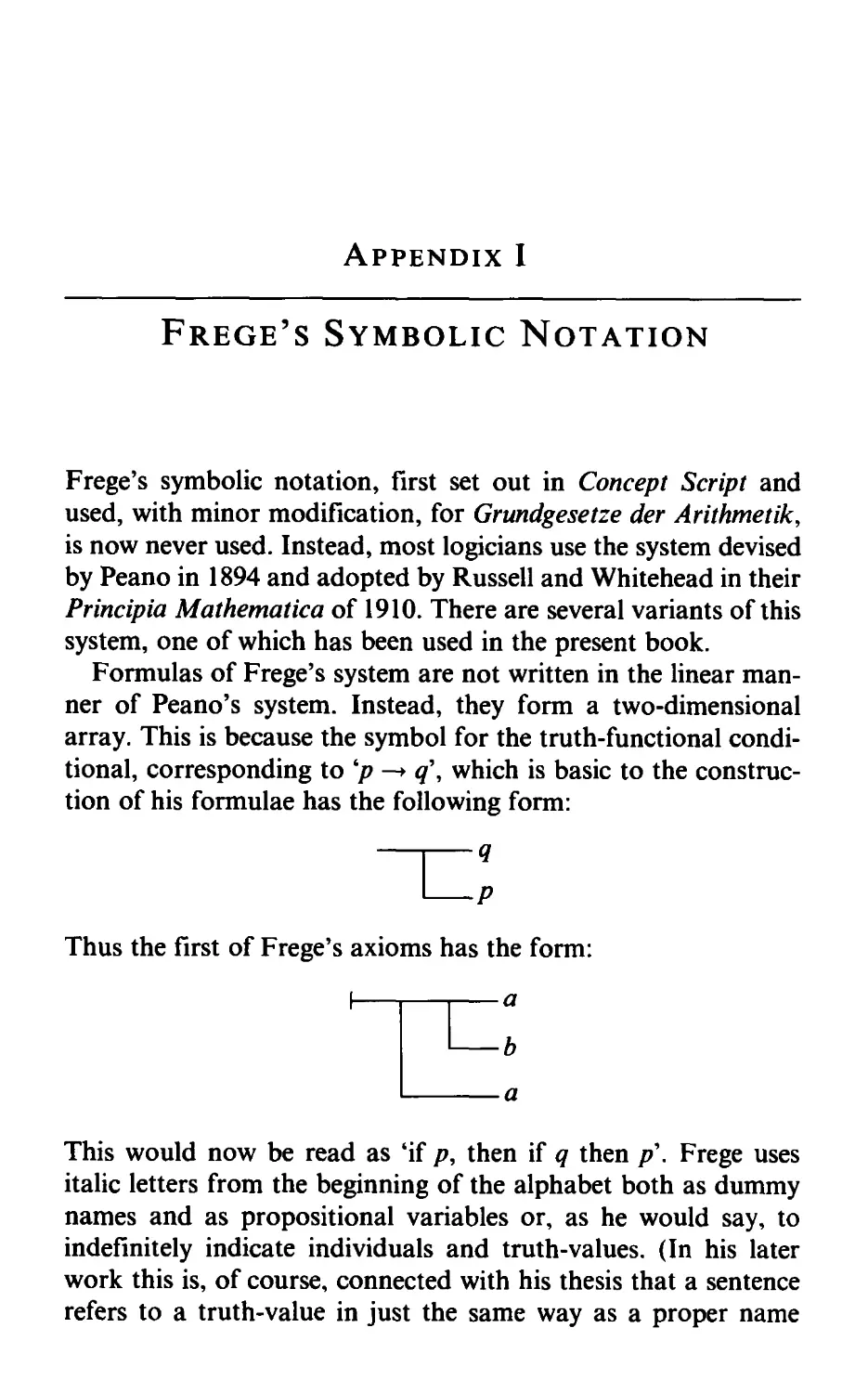





Author: Kenny A. Patrick J.
Tags: philosophy psychology history of philosophy blackwell publisher analytic philosophy
ISBN: 0-631-22230
Year: 2000


Text
                    Frege:fln Introduction to the Founder of
Modern Analytic Philosophy
1

FRE6E
fin Introduction to the Founder of
Modern Analytic Philosophy
Anthony Kenny
i
BLACKWELL
Publish

Copyright © Anthony Kenny 1995
The right of Anthony Kenny to be identified as the author Jf this work hds been
asserted in accordance with the Copyright, Designs and fatents Act P988
First published by Penguin Books 1995
Reissued by Blackwell Publishers 2000
2468109753 1
Blackwell Publishers Ltd
108 Cowley Road
Oxford OX4 1JF
UK
Blackwell Publishers Inc
350 Main Street
Maiden, Massachusetts 02148
USA
All rights reserved. Except for the quotation of short passa^^fateiUiitttffifi«££
criticism and review, no part of this publication may be reproduced, stored in a
retrieval system, or transmitted, in any form or by any means, electronic,
mechanical, photocopying, recording, or otherwise, without the prior permission
of the publisher
Except in the United States of America, this book is sold subject to the condition that it shall
not, by way of trade or otherwise, be lent, resold, hired out, or otherwise circulated without
the publisher's prior consent in any form of binding or cover other than that in which it is
published and without a similar condition including this condition being imposed on the
subsequent purchaser
British Library Cataloguing in Publication Data
A CIP catalogue record for this book is available from the British Library
Library oj Congress Cataloging-in-Publication Data
Kenny, Anthony John Patrick
Frege an introduction to the founder of modern analytic philosophy / Anthony Kenny
p cm
Originally published London • Penguin Books, 1995
Includes bibliographical references and index
ISBN 0-631-22230 8 (alk paper)—ISBN 0-631-22231 6 (pbk . alk paper)
1 Frege, Gottlob, 1848-1925 I Title
B3245F24K46 2000 193—dc21 00-024883
Typeset in 10 on 12pt Times
by Kolam Information Services Pvt Ltd, Pondicherry, India
Printed in Great Britain by TJ International, Padstow, Cornwall
This book is printed on acid-free paper

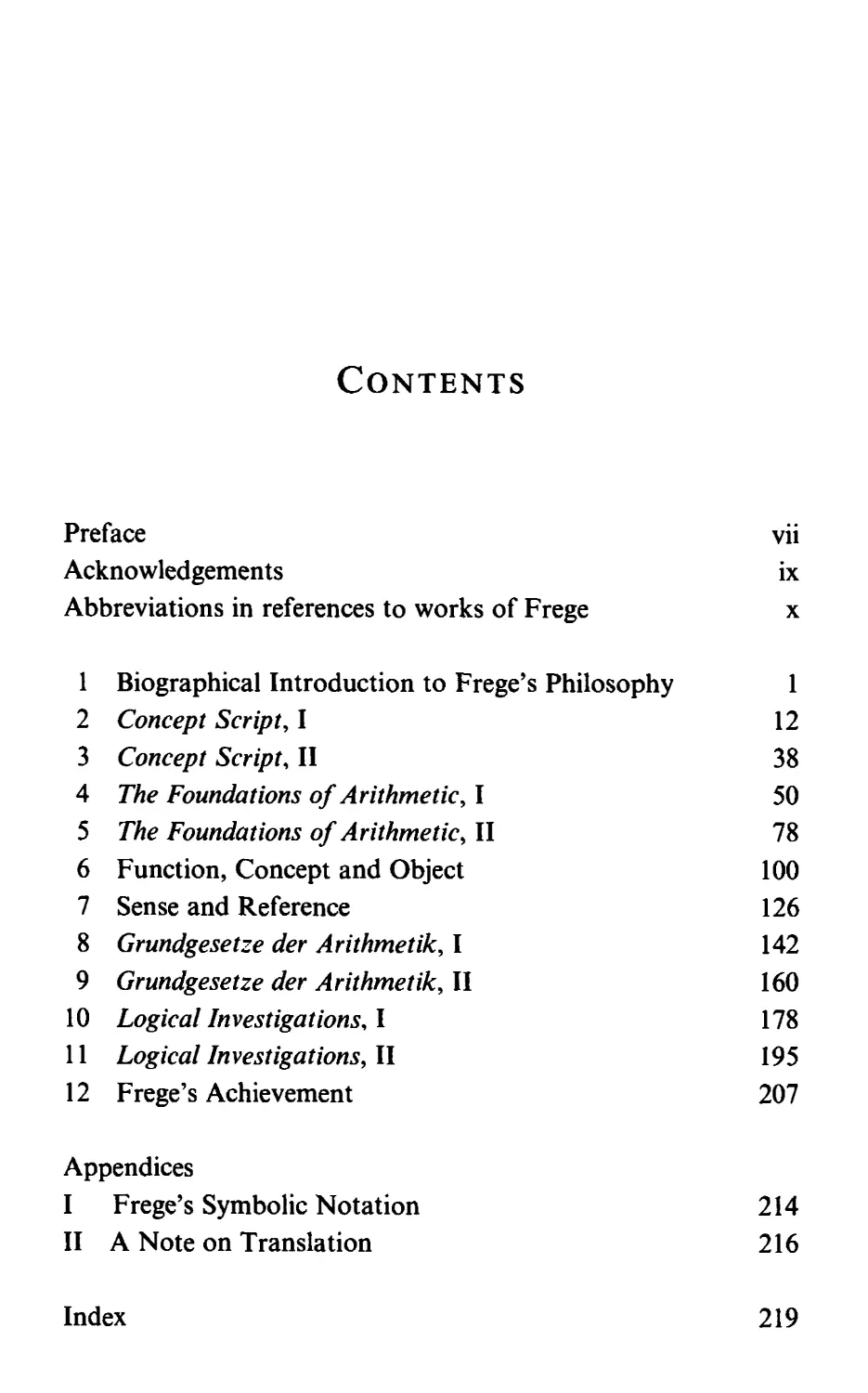
Contents
Preface
Acknowledgements
Abbreviations in references to works of Frege
1 Biographical Introduction to Frege's Philosophy
2 Concept Script, I
3 Concept Script, II
4 The Foundations of Arithmetic, I
5 The Foundations of Arithmetic, II
6 Function, Concept and Object
7 Sense and Reference
8 Grundgesetze der Arithmetik, I
9 Grundgesetze der Arithmetik, II
10 Logical Investigations* I
11 Logical Investigations, II
12 Frege's Achievement
Appendices
I Frege's Symbolic Notation
II A Note on Translation
vii
ix
X
1
12
38
50
78
100
126
142
160
178
195
207
214
216
Index
219

Preface
Twenty years ago I published an introductory Penguin book on
Wittgenstein. It sold widely, and Penguin Books commissioned
me to write a similar introduction to Frege for the general reader.
However, in the same year, 1973, there appeared the first massive
volume of Michael Dummett's magisterial study of Frege. Frege,
Philosophy of Language (London, Duckworth, 1973). It would
have been premature to publish a popular work on Frege while
Dummett's authoritative interpretation was still incomplete.
Accordingly, it was agreed that I should postpone writing the
book until Dummett's second volume appeared. This, in the
event, was not until 1991.
In the meantime. Dummett has placed the learned world in his
debt by a whole number of intermediary works. The
Interpretation of Frege s Philosophy appeared in 1981 (London,
Duckworth) and Frege and Other Philosophers appeared in 1991
(Oxford University Press). Also in 1991 appeared the book that
had originally been planned as the second volume of a two-
volume work, Frege, Philosophy of Mathematics (London,
Duckworth).
When Dummett's final volume appeared I began to write the
present work. His influence on me, as on any other writer on
Frege, has been enormous, and has probably affected every
page. I have not, however, signalled my debts to him in detail,
nor have I drawn attention to the rare places where, after some
hesitation, I have ventured to disagree with his interpretation.
In general, I have tried to write in such a way that the reader
does not need to get involved in evaluating contemporary

PREFACE
interpretations of Frege, whether those of Dummett or of any
other writer. I have tried to avoid controversial issues where
possible, and when I have had to take sides I have done so
silently.
Dummett addresses himself to a readership familiar with
contemporary logic and philosophy. This book is directed primarily
at the general reader who may be ignorant of both, and I have
tried not to assume technical knowledge of any kind. I believe, in
fact, that a reading of Frege is one of the best ways of finding
one's way into modern analytic philosophy. Frege gave
philosophy its current linguistic turn, yet his work addresses
philosophical issues which are so clearly fundamental that no scope is given
to the prejudices of those who believe that if philosophy is
linguistic it must be trivial.
The chapters of the book are not organized by subject matter,
but follow Frege's thought in chronological sequence. This
involves some repetition, as philosophical topics recur several
times. However, the purpose of the book is to assist a reader to
work through Frege's own writings, and for this purpose a
chronological ordering is probably the most helpful.
Anthony Kenny, Michaelmas 1993

Acknowledgements
I am grateful to Basil Blackwell, Publisher, for permission to
quote passages from J. L. Austin's translation The Foundations
of Arithmetic and from the translations by various hands in
Frege's Collected Papers on Mathematics, Logic and Philosophy,
ed. B. McGuinness.
I am deeply indebted to Peter Geach, who read the whole book
in typescript and drew my attention to serious errors, which I
have done my best to expunge from the final version.
Anthony Kenny

Abbreviations in References
to Works of Frege
References have been given not to the German editions of
Frege, but to the most widely available English versions. These
are listed below in the order of the publication of the German
originals.
CN Conceptual Notation and Related Articles. Translated and
edited with a biography and introduction by Terrell Ward
Bynum. Oxford University Press, 1972.
FA The Foundations of Arithmetic: A logico-mathematical inquiry
into the concept of number. English translation by J. L. Austin.
Oxford, Blackwell, 1950, 1953, 1980.
CP Collected Papers on Mathematics, Logic and Philosophy.
Edited by Brian McGuinness, translated by Max Black, V. H. Dud-
man. Peter Geach. Hans Kaal, E-H. W. Kluge, Brian
McGuinness and R. H. Stoothoff. Oxford, Blackwell, 1984.
This superseded the 1952 collection of translations from Frege
edited by Peter Geach and Max Black cited below. Some features
of the earlier translations are preferable, and the earlier volume is
much freer from misprints.
BLA The Basic Laws of Arithmetic: Exposition of the system.
Translated and edited, with an introduction, by Montgomery
Furth. University of California Press, Berkeley, 1964. This
contains a translation of the first volume of Frege's Grundgesetze der
Arithmetik, and of the appendix to the second volume.

ABBREVIATIONS IN REFERENCES TO WORKS OF FREGE
GB Translations from the Philosophical Writings ofGottlob Frege.
Edited and translated by Peter Geach and Max Black. Oxford,
Blackwell, 1952, 1960. This contains translations of sections 56-
67, 86-137 and 139-147 of Grundgesetze der Arithmetik.
PW Posthumous Writings. Edited by Hans Hermes, Friedrich
Kambartel and Friedrich Kaulbach, translated by Peter Long
and Roger White, Oxford, Blackwell, 1979.
PMC Philosophical and Mathematical Correspondence. Abridged
for the English edition by Brian McGuinness and translated by
Hans Kaal. Oxford, Blackwell, 1979.
XI

Chapter 1
Biographical Introduction
to Frege's Philosophy
Gottlob Frege was a nineteenth-century German university
professor, little known in his own lifetime, who devoted himself to
thinking, teaching and writing. He played no part in public
affairs, and much of his life was spent in the classroom and in
the library. His books and articles were read by very few of his
colleagues, and for a long time, even after his death, his influence
in philosophy was exercised mainly through the writings of
others. Today he is revered as the founder of modern
mathematical logic, and as a philosopher of logic in the same rank as
Aristotle. As a philosopher of mathematics he stands out, in
the history of the subject, beyond all others.
Frege was born of a Lutheran family in Wismar, on the
Baltic coast of Germany, in 1848. His father was the founder of
a girls' school. Before Frege graduated from high school, in
1866, his father died. During his education and early academic
career, he depended for financial support on his mother, who
had succeeded her husband as principal of the girls' school.1
Frege entered Jena University in 1869 and spent four semesters
there before moving to Gottingen in 1871 for five further
semesters, studying philosophy, physics and mathematics. He
submitted a dissertation on a geometrical topic and was awarded his
Ph.D. by Gottingen in December 1873 (CP, 92).
1. For the details of this biography I have drawn on T. W. Bynum's
introduction to CN.

FREGE
Once the degree was granted, Frege applied for an unsalaried
teaching post at Jena University. In support of his application he
submitted a paper, 'Methods of Calculation based on an
Extension of the Concept of Quantity' (CP, 56-92), which
made a novel contribution to mathematical analysis. It was well
received by the examiners, and Frege was appointed to the post
in spite of the fact that his performance at the oral examination
was reported to be 'neither quick-witted nor fluent'.
Frege began lecturing as a privatdozent in 1874 and he taught
in the mathematics faculty at Jena for forty-four years. He was a
clear, conscientious and demanding teacher, and for some years
he had to carry the teaching load of a senior colleague who was
an invalid. None the less, in the first five years after his
appointment, he carried out research which was to lay the foundations of
his life's work and which provided the starting point for an
entirely new discipline.
Frege began his career as a mathematician at an exciting
period in the history of mathematics. Euclidean geometry,
which had been regarded as a system of necessary truths for
over two millennia, lost its unique status early in the nineteenth
century. Euclid had derived the theorems of his system from five
axioms: it was now shown that one of these axioms, far from
being a necessary truth, could be denied without inconsistency,
and non-Euclidean geometries were developed on the basis of
alternative axioms. There were also exciting developments in
number theory. Imaginary numbers, such as \/-l, which had
been regarded as an eccentric curiosity in the eighteenth century,
were shown to serve a purpose in the representation of motion in
a plane, and were incorporated along with more familiar kinds of
number in a general theory of complex numbers. The Dublin
mathematician Sir William Hamilton devised a calculus of hyper-
complex numbers (quaternions) to help in representing motion in
a plane. At Halle in Germany Georg Cantor was working out,
while Frege was a young professor, the theory of infinite
numbers which he was to publish in 1883.
Frege early came to believe that the luxuriant expansion of
2

BIOGRAPHICAL INTRODUCTION TO FREGE'S PHILOSOPHY
mathematics in his time was inadequately supported. This
entire impressive construction, he claimed, rested on shaky
foundations. Mathematicians did not really understand what
they were about, even at the most basic level. The problem was
not a lack of understanding of the true nature of imaginary
numbers such as \/-l, or of irrational numbers such as
yjl or 7t, or of fractional numbers like \ or of negative
integers such as -1; the lack of understanding began with the
natural numbers such as 1, 2 and 3. Mathematicians, in Frege's
view, could not explain the nature of the primary objects of
their science or the fundamental basis of the discipline they
taught. He resolved to devote his life to remedying this defect:
setting out, in a perspicuous manner, the logical and
philosophical foundations of arithmetic. A series of publications
between his thirtieth and his sixteenth year was devoted to this
end.
The first of these was a pamphlet issued in 1879 with the title
Begriffschrift, which we can render into English as Concept
Script. The concept script which gave the book its title was a
new symbolism designed to bring out with clarity logical
relationships which ordinary language concealed. The calculus contained
in the book was a significant development in the history of
logic.
For generations now the curriculum in formal logic has begun
with the study of the propositional calculus. This is the branch of
logic that deals with those inferences which depend on the force
of negation, conjunction, disjunction, etc. when applied to
sentences as wholes. Its fundamental principle is to treat the truth-
value (that is, the truth or falsehood) of sentences which contain
connectives such as 'and', 'if, 'or' as being determined solely by
the truth-values of the component sentences which are linked by
the connectives. Frege's Concept Script contains the first
systematic formulation of the propositional calculus; it is presented in
an axiomatic manner in which all laws of logic are derived, by a
specified method of inference, from a number of primitive
principles. Frege's symbolism, though elegant, is difficult to print,
3

FREGE
and is no longer used; but the operations which it expresses
continue to be fundamental in mathematical logic.
Frege's greatest contribution to logic was his invention of
quantification theory: a method of symbolizing and rigorously
displaying those inferences that depend for their validity on
expressions such as 'all' or 'some', 'any' or 'every', 'no' or
'none'. In Concept Script, using a novel notation for
quantification, he presented an original calculus to formalize such
inferences (a 'functional calculus' or 'predicate calculus' as it was later
to be called). This laid the basis for all subsequent developments
in logic and formalized the theory of inference in a more rigorous
and more general way than the traditional Aristotelian syllogistic
which up to the time of Kant was looked on as the be-all and
end-all of logic.
In the Concept Script Frege was not interested in logic for its
own sake. His aim was not simply to show how to conduct logic
in a mathematical manner; he wanted to show that logic and
mathematics were much more closely linked with each other
than had previously been realized.
Before Frege addressed the subject, the nature of mathematics
was the subject of debate between two schools of philosophical
thought. According to Immanuel Kant (1724-1804) our
knowledge of both arithmetic and geometry depends on intuition. His
Critique of Pure Reason set out the position that mathematical
truths were, in his terminology, both synthetic and a priori,
which means that, while they were genuinely informative, they
were known in advance of all experience. John Stuart Mill
(1806-1873), on the other hand, thought mathematical truths
were known a posteriori, that is to say, on the basis of experience.
His A System of Logic argued the case that they were empirical
generalizations widely applicable and widely confirmed.
The nature of mathematical truth had a central significance in
philosophy. It was crucial to the question at issue between
empiricist philosophers, who maintained that all our knowledge
derived from sense experience, and rationalist philosophers, who
maintained that the most universal and important elements of
4

BIOGRAPHICAL INTRODUCTION TO FREGE'S PHILOSOPHY
our knowledge derived from some supra-sensible source. Thus
Mill says that his System 'met the intuition philosophers on
ground on which they had previously been deemed unassailable;
and it gave its own explanation, from experience and association,
of that peculiar character of what are called necessary truths,
which is adduced as proof that their evidence must come from
a deeper source than experience'.2
Frege agreed with Kant against Mill that mathematics was
known a priori. But he maintained that the truths of arithmetic
were not synthetic at all: he denied that they contained any
information not implicit in the nature of thought itself. Unlike
geometry - which, he agreed with Kant, rested on a priori
intuition - arithmetic was analytic; it was, indeed, nothing more
than a branch of logic.
Frege's long-term purpose was to show that arithmetic could
be formalized without the use of any non-logical notions or
axioms, and that it was based solely upon general laws which
were operative in every sphere of knowledge and needed no
support from empirical facts. Concept Script, in addition to its
formalization of propositional and functional calculus, contained
some important preparatory work towards this reduction of
arithmetic to logic; but the full presentation of Frege's thesis
had to wait for the publication of his book The Foundations of
Arithmetic in 1884.
On the basis, partly, of Concept Script Frege was promoted to
a salaried professorship in 1879. The book, however, was not
well received by the logical or mathematical world in general.
Frege's notation was two-dimensional and tabular; this appeared
to reviewers to be cumbersome and futile. Several writers
compared the book unfavourably with George Boole's An
Investigation of the Laws of Thought, which had appeared in 1854 and had
regimented logic into formulas which resembled familiar
arithmetical equations. Frege's publications between 1879 and 1884
2. J. S. Mill, Autobiography, Oxford University Press, 1971, p. 135.

FREGE
consisted mainly of responses to hostile reviews and explanations
of how his purposes and methods differed from those of Boole.
Perhaps because of the unfavourable reception of Concept
Script, Frege wrote The Foundations of Arithmetic in a very
different style. Symbols appear comparatively rarely, and there
is a constant attempt to relate the discussion to the work of
other writers. The thesis that arithmetic is derivable from logic -
the thesis later to be known by the name of 'logicism' - is set out
in this book fully and clearly, but for the most part quite
informally.
Almost half the book is devoted to an attack on the ideas of
Frege's predecessors and contemporaries, including Kant and
Mill. In the course of these attacks the ground is prepared for
the logicist position. In the main body of the work Frege showed
how to replace the general arithmetical notion of number
with logical notions such as the notion of a concept, the notion
of an object's falling under a concept, the notion of equivalence
between concepts and the notion of the extension of a concept.
He offered definitions, in purely logical terms, of the numbers
zero and one, and of the relation which each number has to its
predecessor in the number series. From these elements, along
with the general laws of logic, he offered to derive the whole of
number theory.
The Foundations of Arithmetic is a very remarkable book; but
when it appeared it received an even poorer reception than
Concept Script. Only three reviews appeared, all of them hostile,
and for almost twenty years the book went virtually unremarked.
Frege was disappointed, but not deterred from further work on
his great project.
In the Foundations there are two theses to which Frege
attached great importance. The first is that each individual
number is a self-subsistent object. The second is that the content
of a statement assigning a number is an assertion about a
concept, so that, for instance, the statement The Earth has
one moon' assigns the number 1 to the concept moon of the
Earth.
6

BIOGRAPHICAL INTRODUCTION TO FREGE'S PHILOSOPHY
At first sight these theses may seem to conflict, but if we
understand what Frege meant by 'concept' and 'object' we see
that they are complementary. In saying that a number is an
object, Frege is not suggesting that a number is something
tangible like a tree or a table. Rather, he is doing two other
things. First, he is denying that number is a property belonging
to anything, whether to an individual or to a collection.
Secondly, he is also denying that it is anything subjective, any
mental item or any property of a mental item. Concepts are, for
Frege, mind-independent, and so there is no contradiction
between the thesis that numbers are objective, and the thesis that
number-statements are statements about concepts. These two
principles were to remain at the heart of Frege's thinking for
many years to come, while he strove to perfect a symbolic and
rigorous presentation of the logicist thesis.
It will be seen that Frege's philosophy of mathematics is
closely linked to his understanding of several key terms of logic
and of philosophy; and indeed in Concept Script and Foundations
Frege not only founded modern logic, but also gave a fresh start
to the philosophy of logic. He did so by making a sharp
distinction between the philosophical treatment of logic and
two other disciplines with which it had often been intermingled.
He separated it, on the one hand, from psychology (with which it
had often been confused by philosophers in the empiricist
tradition) and, on the other hand, from epistemology (with which it is
sometimes conflated by philosophers in the tradition stemming
from Descartes).
For the nine years after the publication of Foundations Frege
worked principally on his logicist project of deriving arithmetic
from logic. His publications during this period, however, are
especially concerned with problems in the philosophy of
language. Three papers appeared in 1891-2: 'Function and
Concept', 'Sense and Reference', 'Concept and Object'. Each of these
authoritative essays presented philosophical ideas of
fundamental importance with astonishing brevity and clarity. They
were seen, no doubt, by Frege as ancillary to the logicist project,
7

FREGE
but at the present time they are regarded as founding classics of
modern semantic theory.
One of the most significant developments in Frege's thoughts
at this time was a new distinction which he now introduced
between sense and reference. Where other philosophers talked
ambiguously of the meaning of an expression, Frege invited us to
mark a difference between the reference of an expression (the
object to which it refers, as the planet Venus is the reference of
The Morning Star') and the sense of an expression. (The
Evening Star' differs in sense from The Morning Star' though
it too, as astronomers discovered, refers to Venus.) The most
puzzling and controversial application of Frege's distinction
between sense and reference was his theory that it was not only
individual words that had reference, but also whole sentences.
The reference of a sentence was its truth-value (that is, the True,
or the False).
The climax of Frege's career as a philosopher should have been
the publication of the volumes of Grundgesetze der Arithme-
tik {The Basic Laws of Arithmetic)? in which he set out to
present in formal manner the logicist construction of arithmetic
on the basis of pure logic. This work was intended to execute the
task which had been sketched in the earlier books on the
philosophy of mathematics: it was to enunciate a set of axioms which
would be recognizably truths of logic, to propound a set of
undoubtedly sound rules of inference, and then to present, one
by one, derivations by these rules from these axioms of the
standard truths of arithmetic, in an expanded version of the
symbolism of Concept Script. However, no publisher would
print the manuscript as a whole; Pohle of Jena, who had
published 'Function and Concept' as a pamphlet, was willing to
publish it in two volumes, the publication of the second
instalment being conditional on the success of the first. Late in 1893
3. I shall refer to this work by its German title, since it has never been fully
translated into English.
8

BIOGRAPHICAL INTRODUCTION TO FREGE'S PHILOSOPHY
the first volume appeared; the publication of the second was
delayed until 1903.
Grundgesetze follows in the main the lines of The
Foundations of Arithmetic. However, much more emphasis is placed on
the notion of class, which is now regarded as essential to the
definition of the notion of number. The cardinal numbers are, in
effect, defined as classes of equivalent classes, that is, classes
with the same number of members; thus the number two is the
class of pairs, and the number three is the class of trios. Despite
appearances, this definition is not circular, because we can say
what is meant by two classes having the same number of
members without making use of the notion of number. Two
classes are equivalent to each other if they can be mapped one-
to-one onto each other. We can define the number zero in
purely logical terms as the class of all classes equivalent to the
class of objects which are not identical with themselves. We can
define the number one as the class of all classes equivalent to the
class whose only member is zero. In order to pass from
definitions of zero and one to the definition of the other natural
numbers, Frege makes use of the definitions of 'successor' and
of other mathematical relations within the number series which
he had developed in Concept Script. A treatment of negative,
fractional, irrational and complex numbers was postponed until
the second volume.
Frege's magnificent project aborted before it was completed.
The first volume was received in general with the chill silence
which had greeted his earlier works. As a result of this,
publication of the second volume was held up for a decade and it had
eventually to be published at the author's own expense.
Publication of the first volume did, however, lead to Frege's promotion
to a senior professorship at Jena and to a substantial research
grant from the foundation set up by the Zeiss camera company.
It also led to a fruitful controversy with the Italian logician
Giuseppe Peano, who modified his own newly published axioma-
tization of arithmetic to take account of Frege's criticisms.
Through Peano, Frege's work was brought to the notice of the
9

FREGE
first of his English readers, Bertrand Russell, who was at that
time a young Fellow of Trinity College, Cambridge.
Frege occupied much of the time between the appearance of
the two volumes of Grundgesetze in publishing increasingly
bitter and sarcastic attacks on the scholars who had
misunderstood his own publications. The most fruitful of these was his
hostile review of the Philosophic der Arithmetik by the German
philosopher Edmund Husserl; this was taken in good part by
Husserl, who was converted by it from the psychologism which
he had earlier defended, and he joined Frege as one of its
severest critics.
While the second volume was in press, in 1902, Frege received
a letter from Russell pointing out that the fifth of the initial
axioms of Grundgesetze made the whole system inconsistent.
This axiom states in effect that if every F is a G, and every G is
an F, then the class of Fs is identical with the class of Gs, and vice
versa: it was the axiom which, in Frege's words, allowed 'the
transition from a concept to its extension', the transition which
was essential if it was to be established that numbers were
logical objects. Frege's system, with this axiom, permitted the
formation of the class of all classes that are not members of
themselves. But the formation of such a class, Russell pointed
out, leads to paradox: if it is a member of itself then it is not a
member of itself; if it is not a member of itself, then it is a member
of itself. A system which leads to such a paradox cannot be
logically sound.
With good reason, Frege was utterly downcast by this
discovery, though he strove to patch his system by weakening the guilty
axiom. The paradox and its attempted solution were described in
an appendix to the second volume of Grundgesetze when it
appeared in 1903. Frege's revised system, in its turn, proved
inconsistent, though Frege continued to believe in it for some
years yet. After his retirement from Jena in 1918 he seems at last
to have given up his belief that arithmetic was derivable from
logic, and to have returned to the view of Kant that arithmetic,
like geometry, is synthetic a priori.
10

BIOGRAPHICAL INTRODUCTION TO FREGE'S PHILOSOPHY
In the last years of his life, between 1918 and his death, Frege
attempted to write a full treatise of philosophical logic. All that
was completed was a series of articles (Logical Investigations,
1919-23) in which he returned to the relationship between logic
and philosophical psychology, or the philosophy of mind, and
discussed the nature of thought and inference.
Much of what Frege wrote on philosophical logic in his last
years remained unpublished at his death. Frege and his wife
Margaret had several children, all of whom died young; some
time before her death in 1905 they adopted a son, Alfred, who
became an engineer. When Frege made his will in January 1925
he left his unpublished papers to Alfred, with the following note:
Dear Alfred,
Do not despise the pieces I have written. Even if all is not gold, there is
gold in them. I believe there are things here which will one day be
prized much more highly than they are now. Take care that nothing
gets lost.
Your loving father
It is a large part of myself which I bequeath to you herewith.4
Six months later Frege died, unaware that he would come to be
regarded as the founder of the most influential philosophical
movement of the twentieth century. His death was barely noticed
by the learned world.
4 Most of Frege's posthumous papers were published in German in 1969 and
in English in 1979.

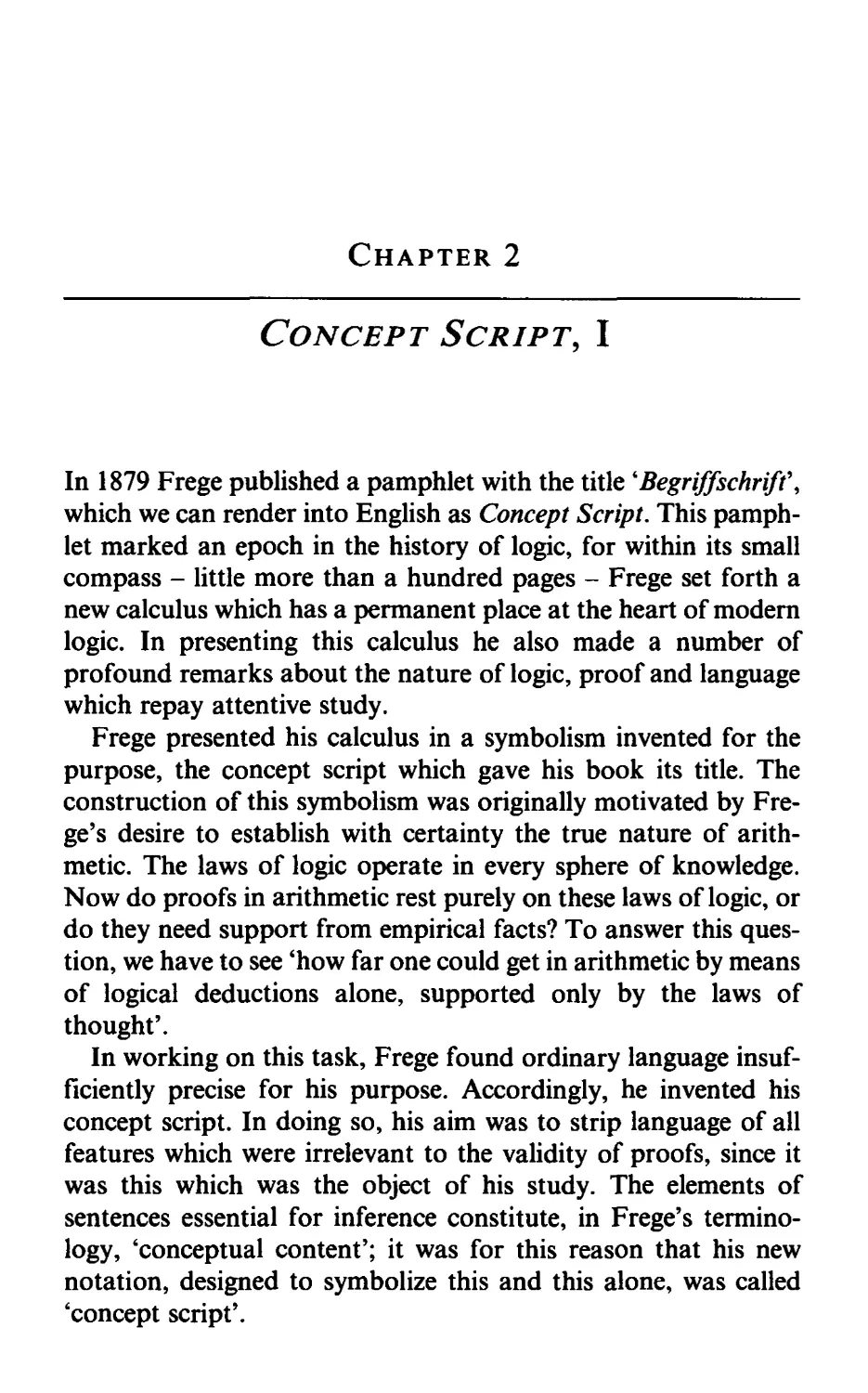
Chapter 2
Concept Script, I
In 1879 Frege published a pamphlet with the title 'Begriffschrift\
which we can render into English as Concept Script. This
pamphlet marked an epoch in the history of logic, for within its small
compass - little more than a hundred pages - Frege set forth a
new calculus which has a permanent place at the heart of modern
logic. In presenting this calculus he also made a number of
profound remarks about the nature of logic, proof and language
which repay attentive study.
Frege presented his calculus in a symbolism invented for the
purpose, the concept script which gave his book its title. The
construction of this symbolism was originally motivated by Fre-
ge's desire to establish with certainty the true nature of
arithmetic. The laws of logic operate in every sphere of knowledge.
Now do proofs in arithmetic rest purely on these laws of logic, or
do they need support from empirical facts? To answer this
question, we have to see 'how far one could get in arithmetic by means
of logical deductions alone, supported only by the laws of
thought'.
In working on this task, Frege found ordinary language
insufficiently precise for his purpose. Accordingly, he invented his
concept script. In doing so, his aim was to strip language of all
features which were irrelevant to the validity of proofs, since it
was this which was the object of his study. The elements of
sentences essential for inference constitute, in Frege's
terminology, 'conceptual content'; it was for this reason that his new
notation, designed to symbolize this and this alone, was called
'concept script'.

CONCEPT SCRIPT, I
Arithmetic, geometry and chemistry already had, when Frege
wrote, their own special symbolic notations. What was special
about the concept script was that it was intended to be a single
notation applicable in every field which makes use of rigorous
proofs. In some fields - arithmetic perhaps - this new notation
might be enough in itself to capture all that was necessary to test
the validity of proof. In other fields - geometry or kinematics,
say - a supplementary symbolism would be necessary to express
the specific properties and relations involved. As physics
progresses, new symbolic systems will no doubt be necessary to
capture new discoveries; but the laws of logic operate in physics
as elsewhere, and to codify these laws we do not have to wait
until some mythical date when all the laws of nature will have
been discovered.
Frege was not under the illusion that his concept script was a
new and perfect language which would show up natural
languages as imperfect. On the contrary, he thought that the
relationship between his concept script and ordinary language
was like the relationship between the microscope and the eye.
The eye is greatly superior to the microscope: it can operate in
many ways, and on many objects, where the microscope is
useless. It is only where sharp resolution is needed for particular
purposes that the microscope has the advantage over the unaided
eye. Similarly, the concept script is devised for the special task of
bringing into sharp focus those elements which are essential for
the validity of proof. For this particular purpose, ordinary
language is unwieldy, and the forms of expression of natural
languages can be misleading. Frege hoped his concept script
would help to unmask illusions generated by misleading idiom.
In this sense it would help philosophy to 'break the power of the
word over the human mind' (CN, p. 106).
When Frege says that ordinary language is deceptive, he does
not mean that ordinary speakers are led into error in their
everyday use of language, but that grammarians analyse
language in ways which are misleading for logical purposes. One
example is the distinction between the subject and the predicate
13

FREGE
of a sentence. Consider the two following sentences about the
Battle of Hastings:
William defeated Harold.
Harold was defeated by William.
In school grammar we learn, or used to learn, that these two
sentences are quite different from each other, having different
subjects and different predicates. The subject of the first sentence
is 'William' and the predicate (which might be further analysed
into active verb and object) is 'defeated Harold'; the subject of
the second sentence is 'Harold' and the predicate (which might be
further analysed into passive verb and agent) is 'was defeated by
William'.
There are indeed differences of linguistic importance between
active and passive constructions. The choice between the two will
depend, Frege says, on the context of'interaction of speaker and
listener': a speaker may choose one or other term as the subject
for the sake of emphasis, or in order to link the sentence with
what has gone before. But the differences between the two
sentences have nothing to do with what follows from them
logically. Anything which follows from the first follows from
the second and vice versa. Hence, Frege says, two such sentences
do not differ in conceptual content.
'A distinction between subject and predicate', Frege wrote in
Concept Script, 'finds no place in my way of expressing a
judgement' (CN, p. 112). In his later work, Frege went back to using
the term 'predicate', employing it in a different sense from that
which has been just illustrated. We may use the expressions
'grammatical subject' and 'grammatical predicate' to indicate
the distinction which Frege dispensed with in his concept script,
and use 'predicate' tout court in the sense in which he himself
employed it in his later writings.
In the Concept Script Frege replaced the notions of
grammatical subject and grammatical predicate with the logical concepts of
argument and function (CN, p. 107). Suppose that we take our
sentence
14

CONCEPT SCRIPT, I
William defeated Harold
and put into it, in place of the word 'Harold', the word 'Canute'.
Clearly this alters the content of the sentence, and indeed it turns
it from a true sentence into a false sentence. We can think of the
sentence as in this way consisting of a constant component
'William defeated...', and a replaceable symbol 'Harold'. The
name 'Harold' is replaceable by other similar symbols, by names
which name other people in the same way as 'Harold' names
Harold. If we think of a sentence in this way, Frege will call the
first, fixed, component a function, and the second component
the argument of the function.
The sentence 'William defeated Harold' is the result of
completing the expression 'William defeated...' with the name 'Harold',
and the sentence 'William defeated Canute' is the result of
completing the same expression with the name 'Canute'. That is
to say, in the terminology suggested by Concept Script, the
sentence 'William defeated Harold' is the value of the function
'William defeated...' for the argument 'Harold', and 'William
defeated Canute' is the value of the same function for the
argument 'Canute'.
Like the distinction between subject and predicate, the
distinction between function and argument does not affect the
conceptual content. Just as two sentences with different subjects and
predicates may have the same conceptual content, so may two
sentences which are the values of different functions and different
arguments. Indeed, a single sentence, while retaining the same
conceptual content, may be analysed in more than one way into
function and argument. Thus the sentence
William defeated Harold
is not only the value of the function 'William defeated...' for the
argument 'Harold'; it is also the value of the function
'.. .defeated Harold' for the argument 'William'.
The expressions 'William defeated...' and '...defeated
Harold' each need just a single name to turn them into a
15

FREGE
sentence; they are, in Frege's terminology, functions taking a
single argument. But the expression '...defeated...' needs to
be supplemented at each end to turn it into a sentence: it is a
function taking two arguments. 'William defeated Harold' is the
value of this function for the arguments 'William' and 'Harold'.
Clearly, it makes a great difference in which order the arguments
occur, and any concept script will have to make provision for
representing the order of their occurrence (CN, p. 128).
Consider now a rather special sentence which Frege draws to
our attention:
Cato killed Cato.
We can consider this as a function of the argument 'Cato' in
more than one way. It makes a difference whether we think of
'Cato' as replaceable by another argument at the first or the
second or at both places. In the first case, \ .. killed Cato' is the
function; in the second place 'Cato killed...' is the function. In
the third case '...killed...' is the function, but we must find
some way to indicate that the two gaps are to be filled with the
same name, say by putting the same letter into each gap as a
place-holder thus: lX killed X\ This last expression will be
tantamount to the expression '... killed himself (or, in the case
of an argument such as 'Cleopatra', tantamount to '... killed
herself).
Frege offers the following general definition of 'function' and
'argument':
Suppose that a simple or complex symbol occurs in one or more places
in an expression... If we imagine this symbol as replaceable by
another (the same one each time) at one or more of its occurrences,
then the part of the expression that shows itself invariant under such
replacement is called the function; and the replaceable part, the
argument of the function. (CN, p. 127.)
This definition can be applied in the analysis not only of
sentences, as in our previous examples, but also of expressions
of other kinds, for instance complex names or descriptions.
16

CONCEPT SCRIPT, I
'Father of Isaac', for instance, a description of Abraham, can be
regarded as the value of the function 'Father of...' for the
argument 'Isaac'.
In Concept Script it is tolerably clear that functions and
arguments and their values are all bits of language: names, simple or
complex, and sentences, with or without gaps. The definition
offered by Frege explicitly refers to expressions, not to the things
outside language which give content or meaning to expressions.
His examples of arguments and functions are in general
introduced in quotation marks, which would naturally indicate that it
is linguistic items which are being talked about.
However, in using the terms 'function' and 'argument' Frege
was borrowing a mathematical usage; and an analysis of the
usage of mathematicians shows that for them functions and
arguments are not linguistic items, but something different. In
the equation
y = x(x - 4)
a mathematician may say that y indicates the value of a certain
function, and x indicates the argument of the function. The value
of the function in question, for the argument 8, is 32. But here
argument and value are not symbols: they are numbers, not
numerals. In his later work Frege became much more interested
in applying the notions of function and argument not so much to
items of language, but to the items which language is used to
express and talk about. Later, we will follow that more extensive
interest of Frege's. Here in Concept Script the interest is only
latent: the principal concern is in applying the notions to the
construction of sentences in natural language and in symbolic
notation.1
1. In Concept Script Frege was not as careful as he later became to distinguish
systematically between signs and what they signified - between, for instance, the
name 'William' and the person William the Conqueror whom the name names. In
talking of functions he occasionally lapses from his stated view that they are bits
of language and implies that they are something lying behind language, for
example, concepts. Thus, in giving the third possible analysis of 'Cato killed
Cato\ he says, 'if we imagine "Cato" as replaceable at both occurrences, then
17

FREGE
To avoid confusion with the functions and arguments which
later occupied Frege's main interest we may call the functions of
Concept Script 'linguistic functions' and 'linguistic arguments'.2
In the present chapter, whenever I use the word 'function', I
should be taken to mean 'linguistic function'. In later chapters,
if I wish to talk about linguistic functions I will identify them
explicitly as such.
In simple sentences the distinction between a function and its
argument is irrelevant to the conceptual content just as the
distinction between subject and predicate was. In what way,
then, is the function/argument dichotomy logically more
appropriate than the subject/predicate distinction? The answer is that
it provides a more flexible method of bringing out logically
relevant similarities between sentences. Subject-predicate
analysis is sufficient to mark the similarity between 'Caesar conquered
Gaul' and 'Caesar defeated Pompey', but it is blind to the
similarity between 'Caesar conquered Gaul' and 'Pompey
avoided Gaul'. This becomes a matter of logical importance
when we deal with sentences in which there occur, instead of
proper names like 'Caesar' and 'Gaul', expressions containing
words like 'all' or 'some': expressions such as 'all Romans' or
'some province'. Once we introduce such expressions, the
distinction between function and argument does, in fact, become
relevant to conceptual content. This is something which we will
explore later (see p. 25).
In the centuries preceding Frege the most important part of
logic was the study of the validity of inferences containing
sentences beginning with 'all', 'no' and 'some'. Consider the
following two inferences:
"killing oneself" is the function'. This seems confused. The use of quotation
marks in 'killing oneself makes it look as if Frege is, consistently, talking of a
linguistic expression; but 'killing oneself is not the same linguistic expression as
'X killed X*y even if one might want to say that both are expressions of the same
concept.
2. Here I follow Geach in G. E. M. Anscombe and P. T. Geach, Three
Philosophers, p. 143.
18

CONCEPT SCRIPT, I
(1) All Greeks are Europeans.
Some Greeks are male.
Therefore, some Europeans are male.
and
(2) All cows are mammals.
Some mammals are quadrupeds.
Therefore, all cows are quadrupeds.
These two inferences have a lot in common with each other.
They are both inferences which draw a conclusion from a pair
of premisses. In each inference a keyword which appears in the
grammatical-subject place of the conclusion appears in one of
the premisses, and a keyword which appears in the grammatical
predicate of the conclusion appears in the other premiss.
Inferences displaying this feature are called, by logicians, 'syllogisms';
and the branch of logic which studies the validity of inferences
of this kind, which was initiated by Aristotle, is called
'syllogistic'.
A valid inference is an inference of a form which will never
lead from true premisses to a false conclusion. Of the two
inferences set out above, the first is valid and the second is
invalid. It is true that in each of the cases given the premisses
are true and the conclusion is true. One cannot fault the second
inference on the ground that the sentences occurring in it are
false. What one can fault is the Therefore': the conclusion may
be true, but it does not follow from the premisses.
We can bring this out by constructing a parallel inference
which leads from true premisses to a false conclusion. For
instance,
(3) All whales are mammals.
Some mammals are land-animals.
Therefore, all whales are land-animals.
This inference is of the same form as inference (2), as can be

FREGE
brought out by exhibiting the structure of the inference by
schematic letters:
(4) All ^s are Bs.
Some Bs are Cs.
Therefore all ,4 s are Cs.
Because inference (3) leads from true premisses to a false
conclusion, we can see that the argument-form of (4) cannot be relied
upon. Hence, inference (2), though its conclusion is in fact true, is
not a valid inference.
One way to define logic is to say that it is the discipline which
sorts out good inferences from bad. Logic before Frege offered
a fairly complicated set of rules which would sort out good
syllogisms from bad syllogisms. There is no point here in giving
examples of those rules; it is enough to say that they were
sufficient to settle that inference (1) is a valid inference, and
that inference (2) is an invalid one.
The weakness of syllogistic was that it could not cope with
inferences in which words like 'all' or 'some' (or 'every' and
'any') occurred not in the subject place but somewhere in the
grammatical predicate. The rules would not permit one to
determine, for instance, the validity of inferences containing premisses
such as 'every schoolchild knows some dates' or 'some people
hate all policemen' in cases where the inference turned on the
word 'some' in the first sentence, or the word 'all' in the second.
Frege's Concept Script showed how to overcome this difficulty.
The first step was to introduce a new notation to express the
kind of generality expressed by a word such as 'all', no matter
where it occurred in the sentence. Suppose we take the sentence
'Socrates is mortal'. We can analyse this into an argument and a
function, 'Socrates' being the argument, and '... is mortal' being
the function. If 'Socrates is mortal' is a true sentence, we might
say that the function holds true3 for the argument 'Socrates'.
3 It is thus that I translate the German expression corresponding to 'is a fact' in
the Geach and Bynum translations.
20

CONCEPT SCRIPT, I
Frege introduced a symbol to signify that a certain function held
true no matter what we took its argument to be. The actual
symbolism he introduced is no longer used by logicians; using a
modern equivalent instead we can write
(x) (x is mortal).
The fc(x)' is the sign for generality, and the whole expression can
be read 'For all jc, x is mortal', where this is to be taken to mean
that no matter what name is attached as an argument to the
function '... is mortal', the function holds true. Let us, for the
time being, and for the sake of exposition, restrict our attention
to names which are names of human beings. With that
restriction, the sentence 'For all x, x is mortal' will be equivalent, in
conceptual content, to the sentence which in ordinary language is
the generalization of 'Socrates is mortal', namely 'Everyone is
mortal'.
Similarly, if we take a sentence such as 'John is related
to Jane' we can generalize it in accordance with the various
possible ways in which we have seen it can be analysed into
function and argument. Thus, '(x) (x is related to Jane)' is
equivalent to 'Everyone is related to Jane' and '(y) (John is
related to v)' is equivalent to 'John is related to everyone'. If we
analyse the sentence by means of the two-place function '... is
related to...' we will need two marks of generality if we
wish to generalize in the case of both arguments. Thus we
should write '(x) (y) (x is related to y)\ which is to be read 'For
all x and for all y, x is related to y\ and it is equivalent to
'everyone is related to everyone'. It was principally because his
notation thus enabled him to give uniform expression to
generality wherever and however often it occurred in a sentence that
Frege was able to make great advances on the traditional
syllogistic.
Frege did not introduce a special sign to correspond to the
word 'some' in a sentence such as 'some Romans were cowards'.
It had long been accepted by logicians that this sentence was
equivalent to 'not all Romans were not cowards'; and Frege
21

FREGE
made use of this relationship between 'some' and 'not all... not'
in order to codify sentences containing 'some'. To do this it is
necessary to have a symbol corresponding to 'not'.
Frege introduced a negation sign, a sign which if attached to a
sentence 'expresses the circumstance of the [sentence's] content
not being the case' (CN, p. 120), Once again, the particular
symbol he introduced has passed out of use, but we may use
one of its modern equivalents, the sign '—.'. Using this symbol,
we write the negation of 'Socrates is mortal' as '—. (Socrates is
mortal)', which can be read as 'It is not the case that Socrates is
mortal'. (This is equivalent to 'Socrates is not mortal'; but it
goes along with Frege's rejection of the grammatical subject-
predicate distinction that he attaches the negation-sign, not to
the grammatical predicate of a sentence, but to the sentence as a
whole. We shall see the advantages of this method of symbolism
later.)
Like the original sentence 'Socrates is mortal' the sentence
which is the negation of it can be analysed into argument and
function, for example,'—. (Socrates is mortal)' is the value of the
function '—. (... is mortal)' for the argument 'Socrates'. As
before, we can attach the sign of generality to this function and
obtain the sentence '(jc) —. (jc is mortal)', which can be read 'For
all jc, it is not the case that jc is mortal', and this is equivalent in
conceptual content to the ordinary language sentence 'Everyone
is not mortal' interpreted in the sense of 'No one is mortal'.
However, the ordinary-language sentence can be taken in more
than one way. 'Everyone is not mortal' might be read as being
constructed in the same way as 'Everything that glisters is not
gold', in which case it would mean the same as 'Not everyone is
mortal'. This would have a different translation into Frege's
concept script, as '—.(jc) (jc is mortal)', which means that it is
not the case that for all x, x is mortal. Here we have an example of
the way in which Frege believed that his script was more precise
than ordinary language, and he enabled us to disambiguate
sentences which in ordinary language might be read in more
than one way (CN, pp. 133-4).
22

CONCEPT SCRIPT, I
The difference, which is obscure in ordinary language and is
clarified by the concept script, is called by Frege a difference of
scope. In '—. (jc) (x is mortal)' the sign of negation is outside the
scope of the sign of generalization: the negation is not
generalized. In \x) (x is mortal)' the negation-sign comes within the
scope of the sign of generalization, and the negation is
generalized (CN, p. 131). We have here a distinction between the
negation of a generalization, and the generalization of a
negation.
The expression 'some' can now be defined in terms of negation
and generalization. 'Someone is mortal' can be taken as
equivalent to 'It is not the case that everyone is not mortal', or, in
our modernization of Frege's concept script, '—. (x) —■ (x is
mortal)'.
Hitherto, for purposes of exposition, I have limited the
replacement of 'x's in Frege's concept script to the names of
human beings. Frege himself made no such restriction; he
thought that objects of all kinds were nameable - numerals, for
instance, were the names of numbers - and the argument places
in his concept script can be filled with the name of anything
whatever. Consequently '(jc) (jc is mortal)' is really to be read
not as 'Everything is mortal' but as 'Everything is mortal' - a
proposition which is untrue because, for instance, the number ten
is not mortal.
Frege's concept script allows us to make statements about the
existence of things of particular kinds. We use the same notation
as that used above for making statements containing the
expression 'some'. Frege observes that '—. (x)—. (x is a house)' is
equivalent to 'there are houses', provided that this sentence is
understood as covering the case where there is only one house
and no more (CN, p. 134). It is possible, though Frege does not
do so, to introduce a single symbol to abbreviate'—. (x) —■ ', and
this symbol would thus be equivalent to 'some'. The symbols thus
equivalent to 'all' and 'some' are now called 'quantifiers' by
logicians, and the branch of logic which concerns their use in
inferences is known as quantification theory.
23

FREGE
It was Frege who first fully systematized quantification theory.
We have seen that logicians before Frege used schematic letters
to bring out the structure of propositions entering into
syllogisms. Frege adopted and extended this use. To indicate a
function of the argument X without specifying it, Frege in Concept
Script writes a Greek letter followed by an 'X9 in parentheses. We
can say in general that to assert that <b{X) is, roughly, to assert
that X has the property 4>. To indicate, without specifying, a
function of two arguments X and Y, we write *F (X, Y), where
the places of X and Y within the parentheses represent the places
occupied by Xand yin the function. Thus to assert that *F (X, Y)
is, roughly, to assert that X has the relation *F to Y.4
At this point Frege makes a brief remark: it is of great
importance but its importance is not apparent on first reading.
He says that since the symbol 'O' occurs at a particular place in
the expression ^(X)9, and since we can imagine it being replaced
by other symbols, such as <XF, in order to express different
functions of the argument X, we may regard 0>(X) as a function
of the argument <b. Note that he is not saying that we may, if we
wish, regard 'X' as the function and '<&' as the argument in
'<b{Xy (that would make nonsense of the distinction he has
made so carefully). What he is doing is moving to a different
level of analysis. He is saying that just as, at the basic level, fcO'
is a function of the argument 'X\ so, if we move up from
considering the relation between one part and another part of a
sentence to considering the relation between the parts and
the whole sentence, we can say that the whole sentence is a
4. In Frege's exposition at this point (CN, p. 129) there is some confusion since
'<!>' is meant to be a variable replaceable by a linguistic function, such as \. is
mortal'. To speak, therefore, of 'having the property <D' involves a confusion
between a sign and what it signifies. If we assert that Socrates is mortal we do not
assert that he has the property \.. is mortal' but that he has the property of
mortality. In his later work Frege was to address the problems inherent in this
analysis. A separate point is that Frege says that LX¥(A,By is translatable as 'B
stands in the *F-relation to A\ reversing the order of the argument places. He
subsequently abandoned this confusing practice.
24

CONCEPT SCRIPT, I
function of the function contained in it. A function of this kind, a
function of a function, we might appropriately call a second-level
function.
At first sight, this is puzzling. When Frege introduced the
notion, he defined a function as a part of an expression. But
'<!>{Xy corresponds not to a partial but to a complete expression,
a whole sentence. The answer to the puzzle must be that Frege
thinks that there is a way in which '<b(Xy can be supplemented to
make a greater whole, in the way in which '<!>' is supplemented by
'A" to make the whole sentence ^{Xy. To see what this means,
we have to look at what Frege says to link together his
terminology of argument and function with his method of symbolizing
generality.
Frege wrote:
Let me warn here against an illusion to which the use of ordinary
language easily gives rise. If we compare two propositions:
The number 20 can be represented as the sum of four squares.'
and
'Every positive integer can be represented as the sum of four squares.'
it appears possible to consider 'being representable as the sum of four
squares' as a function whose argument is 'the number 20' one time, and
'every positive integer' the other time. We may see that this view is
mistaken if we observe that 'the number 20' and 'every positive integer'
are not concepts of the same rank. (CN. p. 128.)
As one way of explaining what he meant by saying that the two
expressions differed in rank, Frege said that whereas 'the number
20' yielded an independent idea, the expression 'every positive
integer' acquires a sense only in the context of a sentence. If
function and argument are completely determinate, the way in
which the sentence is analysed into argument and function is
irrelevant to the conceptual content. But this is not so if the
argument is indeterminate. 'Every positive integer can be
represented as the sum of four squares', translated in terms of
function and argument, is equivalent to 'whatever name of a
25

FREGE
positive integer you take as argument for the function "... is
representable as the sum of four squares", the resulting sentence
is always true'.5 In such a case, Frege says, the distinction
between argument and function begins to be relevant to content.
The justification for this remark becomes clear if we look at the
representation of such a sentence in Frege's own concept script.
For simplicity's sake, let us assume that we are talking simply
about the universe of positive integers. With respect to that
universe, the Fregean formula '(.x)<I>(*)\ if we treat '$' as an
abbreviation for 'can be represented as the sum of four squares',
corresponds to the sentence 'Every positive integer can be
represented as the sum of four squares.' But this formula can be
broken up into argument and function in only one way. The
first '(x)' is not an argument but a sign of generality. The 'jc' in
the second pair of parentheses is not an argument but a variable,
that is to say, a symbol showing the point at which an argument
can be introduced. The only symbol which can be regarded as
an argument is the function symbol '<&'. The whole sentence,
then, can be regarded as the value of the function '(x) (.. .x)'
for the argument '<!>'. The function (x) (... x), being a function of
a function, that is to say a function taking a function as its
argument, will be a second-level function.
In Frege's concept script, as in our modernization of it, the
difference in rank between an expression such as 'the number
20' and 'every positive integer' is brought out by a difference in
the style of symbol used to correspond to the expressions in
natural language. What Frege calls a determinate argument will,
in our version of his script, be represented by an upper-case
italic letter (e.g. 'JF'); what he calls an indeterminate argument
5. Here I paraphrase Frege to make what he says consistent with the theory of
linguistic functions presented in Concept Script His own formulation "Whatever
arbitrary positive integer you may take as argument for "being representable as
the sum of four squares", the proposition always remains true' (CN, p. 128)
involves, in the context of the stated theory of Concept Script, a confusion
between signs and things signified.
26

CONCEPT SCRIPT, I
will be represented by a lower-case italic letter variable (for
example, the 'jc' that occurs in the quantifier and in the sign
showing the argument place of the function which occurs within
the scope of the quantifier).6
We can now see how to answer the question: Why did Frege
think that ^(Xy could be regarded as a function of 'O' even
though "0>{Xy is complete and a function is something
incomplete? A first-level function, such as \ .. is mortal', is incomplete.
But there are two different ways in which it can be completed. It
can be completed by having an argument inserted in its argument
place, as in 'Socrates is mortal'. Or it can be completed by itself
becoming the argument of a second-level function. This is what
happens when the ellipsis in '... is mortal' is filled with a
quantifier such as 'Everything'.
To complete our sketch of Frege's theory of quantification, we
have to move from considering the quantifiers themselves to
considering other expressions of natural language, and their
equivalents in concept script, whose job is to link one proposition
to another rather than to construct individual propositions. The
most important of these is the sign of conditionality, which
corresponds to 'if in ordinary language.
Suppose that there are two propositions '/>' and '#'. If we are
called upon to make a judgement about them, there are four
possible lines we might wish to take. We might wish:
(1) To affirm p and to affirm q,
(2) To affirm p and to deny q,
(3) To deny p and to affirm q,
(4) To deny p and to deny q.
Frege introduces a sign, which we may render as '—>', whose
6 In Frege's own script there are two kinds of lower-case letter variables:
Gothic letters, whose scope is determined by a quantifier containing the same
letter, and italic letters, whose scope extends over the entire proposition in which
they occur
27

FREGE
purpose he explains roughly as follows. Someone who asserts
"q —> /?' wishes to renounce option (3) and retain the other three
options.
Modern logicians operate with a sign whose function in the
calculus is very much the same as Frege's sign. But they explain
its operation in terms of truth and falsity rather than in terms of
affirmation and denial. This makes it much clearer to explain.7
The four possibilities for '/?' and V are now:
(1) p is true and q is true,
(2) p is true and q is false,
(3) p is false and q is true,
(4) p is false and q is false,
and 'q —> p9 is true, on this account, just in case the third
possibility does not hold (in which case one of the other three cases
hold).
Some logicians have offered kq —► p9 as equivalent to 'if q then
p\ If we accept this equivalence, then the following propositions
come out true:
If the sun is shining, 3x7 = 21.
If perpetual motion is possible, the world is infinite.
If the Moon is in quadrature with the Sun then the Moon
appears semicircular.
These propositions are suggested by examples given by Frege to
illustrate the import of this symbol for conditionality; but Frege
himself here denies that in the first two cases the word 'if of
natural language is appropriate.8 The first case is one where
7. Frege's procedure here seems to involve a confusion of logic and psychology
of a kind which he would later reject with contempt. Later in the Concept Script,
there are some better inspired passages where he asks not whether p is affirmed
and q is denied, but whether p is to be affirmed and q is to be denied. In my
exposition in the text, taking my cue from these passages, I have tried to
paraphrase his teaching in a way which avoids the confusion while being as faithful as
possible to his intention.
8 He was later to modify his position on this issue; see p. 205.

CONCEPT SCRIPT, I
we would affirm kq —> p9 simply because we would
unconditionally affirm '/>'; the second is a case where we would affirm 'q —> p'
simply because we would unconditionally deny 'q\ The third
case, he says, represents a judgement which one might
make without knowing whether '/?' or '<?' were to be affirmed or
denied. It is in this case alone, he suggests, that it is appropriate
to render "q —> />' as 'if q then p\ The causal connection implicit
in the word 'if is, he says, 'not expressed by our symbolism'.
There are connections other than causal ones that may be
expressed by 'if (I may use the word, for instance, to express a
logical connection, a geometrical connection, or a conditional
resolve I have made). Frege's sign does not express these
connections either: it does not represent any connection between the
content of the sentences which it links, but only between their
truth and falsehood.
Frege's sign is related to the word 'if in the way in which, in
general, expressions in Frege's concept script are related to
expressions in natural language. That is to say, it can be looked
on as a stripped-down version of the word 'if, designed to
capture just that aspect of its meaning which is necessary for
the formulation of rigorous proofs containing it. If we know that
'if q then/?' is true then we know at least that it is not the case that
q is true and p is false. This minimum of content, Frege claimed,
is all that we need in order to express rigorously the chains of
reasoning necessary in logic and arithmetic.
We may analyse a proposition which is formed by linking two
propositions with the '-»' sign into function and argument, just
as we earlier analysed simple propositions. Frege does not
explicitly do this in Concept Script, though he was to do so in later
writing. The function'... -»...' takes sentences as its arguments,
just as \.. is mortal' was a function which took names as its
arguments. 'It is night -* it is dark' is the value of the function
'...—► ...' (which we might equally well write 'p —♦ q9) for the
arguments 'it is night' and 'it is dark'. The function '/> —► q9 is a
function whose values and arguments are both sentences. It is a
function which has a particular property: whether the sentence
29

FREGE
which is its value is true or false will depend on nothing other
than whether the sentences which are its arguments are true or
false. Functions of this kind were later named, by Bertrand
Russell, 'truth-functions'.
The conditional is not the only truth-function. Negation,
represented by the sign '—■', is a truth-function, since a negated
sentence is true just in case the sentence negated is false, and
vice versa. Whereas the conditional is a truth-function of two
arguments, negation is a truth-function of a single argument.
But there are other truth-functions of two arguments. A
conjunction ('/> and q') is the value of a function whose arguments are the
two conjoined sentences; it is true if both its arguments are true,
and otherwise it is false. A disjunction ('/? or q') may be regarded
as true if at least one of its arguments are true, and false if they
are both false.9
Frege (unlike some later logicians) did not introduce special
symbols for conjunction and disjunction, related to 'and' and
'or' in the way in which '—>' is related to 'if, though he
recognized the possibility of doing this (CN, p. 123). Instead,
he expressed conjunction and disjunction by using his signs for
negation and conditionality. Thus, '—^q —► />' is used when we
wish to rule out the case in which p is to be denied and the
negation of q is to be affirmed; it is, Frege says, equivalent to "p
and q cannot both be denied'; and this is the meaning which he
attaches to '/? or q\ Likewise, 'q —► —./>' is to be used if we wish
to rule out the case in which the negation of p is to be denied
and q is to be affirmed. If we negate this in turn, we get
'—t(q —> —./?)' which can be translated as '/> and q\
Frege would use the same expression '—\q —► —./?)' to
translate '/? but q' as well as '/> and q\ He observes, however, that in
ordinary language '/> but q9 differs from '/? and q" in that it does
not just express the joint truth of the two propositions; it also
9. Towards the end of his life, in his essay 'Compound Thoughts', Frege spelt
these matters out in a much clearer and simpler manner, see p. 205

CONCEPT SCRIPT, I
hints that there is something unexpected about the fact that q.
The difference between 'but' and 'and', however, is a feature of
ordinary language which he does not attempt to reproduce in his
symbolism.10 A sentence compounded with 'but' will, he
maintains, have the same conceptual content as one compounded
with 'and'; and this conceptual content can be rendered, as
explained above, by means of his signs for conditionality and
negation (CN, p. 123).
It would be possible, as Frege says, to work the other way
round. We could introduce a symbol for the truth-function of
conjunction, say fc&': '/> & q9 is to be true when p is true and when
q is true, and otherwise false. Instead of introducing a sign for
conditionality as a primitive symbol, we could define one in
terms of fc&': thus 'q —► />' could be defined as '—. (q & —. p)\
This might, indeed, seem a more natural procedure. Frege says
that he prefers to take the conditionality sign as basic because in
the operation of logic deduction is more important than
conjunction, and 'if... then' and its symbolic surrogate seem to have a
special relationship to deduction. This will become clearer in the
next chapter, when we sketch Frege's own systematic
development of logic.
Before we turn to that, however, there is one further important
basic concept introduced by Frege in Concept Script. This is the
notion of identity of content. He introduces a symbol '=' which is
defined thus: if we assert 'X = Y' we assert that the symbol 'X9
and the symbol' Y* have the same conceptual content, so that we
can always replace 'A" by 'F' and vice versa.
Several things must be noted about this definition. First, '='
may stand between symbols of various kinds: in place of 'A" and
of' Y' we may write either complete sentences, or names, whether
simple or complex. In discussing identity of content Frege uses
'name' to cover all these different kinds of symbol. Secondly,
Frege draws attention to a special feature of the sign '='. The
10. He was later to call this feature 'colour'; see p. 183.

FREGE
definition given above implies that the assertion of 'X = Y9 is an
assertion about names, not about their content. He writes:
Elsewhere, names are mere proxies for their content, and thus any
phrase they occur in just expresses a relation between their various
contents; but names at once appear in propria persona so soon as they
are joined together by their symbol for identity of content; for this
signifies the circumstance that the two names have the same content.
(CN, p. 124.)
It might be thought that in a perfect language there would only
be a single symbol answering to each distinguishable content. In
that case, there would be no need for a symbol for identity of
content, and such a symbol would be futile since the only true
sentences containing it would be truisms of the form 'X = X\
But this is not so: a symbol for identity of content is needed
because the same content may be determined in different ways;
and it may be a significant judgement that two different modes of
determination do give the same content.
Frege illustrates this with a geometrical example.11 Suppose
that a, b, c are the lines connecting the vertices of a triangle with
the midpoints of the opposite sides. The point of intersection of
a and V and 'the point of intersection of b and c* are two
different complex names. Yet both these names are names of
the same point. In the terminology of Concept Script, they are
names with the same content. The existence of different names
with the same content is not an imperfection of language:
mathematics would be enormously impoverished if one could
not determine the same content in more than one way. In the
simple example given, of course, the truth of the assertion The
point of intersection of a and b = The point of intersection of b
and c' is easily seen. More complicated equivalences may take
long periods of work to establish.
11. The actual example used by Frege in CN is unnecessarily complex; I have
used a simpler one drawn from CP, p 158

CONCEPT SCRIPT, I
Frege's sign '=' can be looked on as an extension of the
arithmetical sign '='. The '=' of arithmetic can be placed between
numerical expressions and can be used to indicate that the
flanking expressions denote the same number. Frege's '=' can be
placed between expressions of the most varied kinds, and can
be used to indicate that the flanking expressions name the same
content, of whatever kind.
Frege says that if lX = Y9 can be truly asserted, then 'A" can
always be replaced by ' Y\ and conversely. What is the force of
the 'can' here? Does Frege mean that if you take a sentence
containing 'A" and replace 'X9 with lY9 you will have another
sentence with the same content? Surely not. If Frege had asserted
in Concept Script
The Queen of England = The Empress of India
he would have made a true assertion (Queen Victoria had been
given the title very shortly before he wrote). But the sentence
surely does not have the same content as the following sentence,
constructed from it by replacing 'The Empress of India' with the
words The 'Queen of England'
The Queen of England = The Queen of England.
This last sentence is an empty truism, whereas to make a
judgement on the former one must know something of English
constitutional history.
When Frege says that if 'X9 and ' Y9 have an identical content,
then 'X9 can be replaced with T'in a sentence, what he must
mean is not that the replacement will not affect the content of a
sentence at all, but that it will not affect whether the sentence is
true or false. He must mean that if we take a true sentence
containing the words The Queen of England' and replace these
words with The Empress of India', the sentence would remain
true, and that similarly, a false statement will remain false after
a similar replacement. As he would later express the matter, the
sentence will retain its truth-value (that is, its truth or falsity, as
the case may be) after the substitution. Frege was later to
33

FREGE
develop a special terminology - the pair of terms 'sense' and
'reference' - to make clear what is left ambiguous when he is
operating only with the single term 'content' to express what a
sentence signifies.
In the next chapter we will explain the system of logic which
Frege constructed when he put to work the symbols he had
invented for his concept script. My purpose in this chapter has
been to present the apparatus of Frege's logic in such a way as
to emphasize those elements of it which were to survive into his
later writings and which remain operative in logic at the present
time. This has meant playing down certain features of Concept
Script which we can now clearly see to be muddled. That we can
do so is partly due to Frege's own later work in which - as we
shall see - a number of the confusions of Concept Script are
identified and clarified.
One unsatisfactory feature of the system of Concept Script,
however, is too important to be passed over and glossed by
benevolent paraphrase. The very first new symbol which Frege
introduces (CN, p. 111) is what he calls 'the judgment stroke'. He
writes:
A judgement is always to be expressed by means of the sign
I—
This stands to the left of the symbol or complex of symbols giving the
content of the judgement. If we omit the small vertical stroke at the left
end of the horizontal stroke, then the judgement is to be transformed
into a mere complex of ideas; the author is not expressing his acceptance
or non-acceptance of its truth. For example, let
\—A
mean the judgement: 'unlike magnetic poles attract one another'.
Then
-A

CONCEPT SCRIPT, I
will not express this judgement; it is simply to evoke in the reader the
idea of the mutual attraction of opposite magnetic poles - perhaps so
that he may make inferences from the thought and use them to test its
correctness. We paraphrase in this case by means of the words 'the
circumstance that' or 'the proposition that'. (CN, p. 112.)
In his later work, Frege constantly emphasized the need to
distinguish between logic and psychology. In this early passage,
the distinction seems blurred. Frege is introducing a logical
symbol, and yet he does so in psychological terms: for he defines
the symbol in terms of a contrast between judgement and
combinations of ideas. Now judgement is surely a mental act,
and ideas are surely something in the mind.
Judging that p, we might say, is an act which is the mental
equivalent of the speech-act of asserting that p\ it is, to use the
Biblical expression, 'saying in one's heart' that p. Frege says
indifferently that the vertical stroke expresses a judgement and
that it expresses an assertion. His symbol is now commonly
referred to as his 'assertion sign'.12
It is true, and important, that there is a great difference
between judging that /?, and merely entertaining the thought
that p. There is a similar difference between asserting that /?,
and merely propounding the proposition that p. A proposition
may be propounded, as Frege says, as a hypothesis; or it may
occur, unasserted, as part of another proposition. A
contemporary philosopher has offered to bring out the utility of Frege's
assertion sign in the following way.
Does '// mean the same both times in 'm, if m then /?, ergo p\ or again
in 'not w, m or /?, ergo /?'? If it does, there is no inference, for the
assertion hp' is already part of the premisses; if it does not, the inference
12. In fact, as the paragraph quoted above shows, it was only the vertical part
of that symbol which was to express judgement, or assertion; the horizontal line is
what he calls 'the content stroke'. Its function, in his symbolism, is to bind
together, in the appropriate way, the symbols which follow it. In the modernized
version of Frege's symbolism used in this book, and in most modern expositions
of Frege, it is superfluous. See Appendix I.
35

FREGE
is vitiated by the ambiguity of */?'. Frege would write such inferences as
follows: 'I—m, I— (if m then/?), ergo I—/>'; 'I—(not m), I— (m or/?), ergo
I—/?'. The content asserted in 'I—/?' occurs also in the premiss 'I— (if m
then/?)' or 'I— (m or/?)' but is not asserted in this latter context.13
This captures well, I believe, what Frege had in mind when he
introduced the assertion sign. None the less, its introduction - as
one can see with the benefit of Frege's later work - does involve
a confusion between logic and what may broadly be called
psychology. Whether I assert something, or judge something, is
a matter of my mental history. It is the content of what is asserted
that concerns logic - the conceptual content in Frege's own sense
of that which is relevant to the drawing of inferences. If '<?'
follows logically from '/?' then it does so whether or not I, or
anyone else, actually assert that q, or actually judge that /?.
As Frege says, the thought that unlike magnetic poles attract
each other can be entertained without being judged. One might
call this - though Frege would later see reason for not doing so -
the complex idea of the mutual attraction of unlike poles. But if
one does speak of this idea (which, being an idea, is something
mental) one must distinguish it from the circumstance that unlike
magnetic poles attract each other (which, if it obtains, obtains in
the real world, not in the mind) and from the proposition that
unlike poles attract each other (which, if we are to be guided by
the German word 'Satz' in Frege's original, is something which is
an item of language). The paragraph by Frege quoted above
seems to lump together linguistic, mental and real-world items
in a way which Frege would later come to regard with profound
suspicion.
One merit which Frege would continue to see in his assertion
sign was that it brought out the distinction between assertion and
predication; it made manifest that attaching a predicate to a
13 Geach, in G. E. M. Anscombe and P. T. Geach, Three Philosophers,
Blackwell, 1961, p. 133

CONCEPT SCRIPT, I
subject did not, as some earlier logicians had erroneously
maintained, necessarily involve making an assertion about what the
subject named. In 'If the Labour Party wins the election, the
pound will be devalued', 'wins the election' is attached as
grammatical predicate to 'the Labour Party' as grammatical subject,
but no assertion is made that the Labour party will win the
election.14
The most important point made by Frege in the context of the
introduction of the assertion sign is that negation, and the
distinction between universal and particular, belonged not with
the judgement or assertion, but rather to the possible content of
judgement. It was only in his later work that he expounded his
reasons for saying this; but his own development of logic in
Concept Script would be impossible if negation and
quantification could not be applied to unasserted propositions.
14. In Concept Script Frege announced his intention to abandon the distinction
between subject and predicate; but he made an unfortunate modification of this in
connection with the assertion sign. He wrote as if the introduction of the assertion
sign amounted to the reduction of all predicates to the single predicate 'is a fact'
(CN, p. 113). Thus 'Archimedes perished at the capture of Syracuse*, he said,
could be expressed as 'the violent death of Archimedes at the capture of Syracuse
is a fact'. But this surely involves the incoherent notion that predication includes
assertion, the very confusion which Frege later saw it as the function of the
assertion sign to dispel.
37

Chapter 3
Concept Script, II
In the previous chapter, we saw that Frege would symbolize a
universal statement, such as 'Everything is mortar, by using his
universal quantifier symbol:
(x) (x is mortal)
It is rare, in fact, for us to want to make statements of such
unrestricted generality. It is much more common for us to want
to say that everything of a certain kind has a certain property, or
that everything which has a certain given property also has a
certain other property. 'All men are mortal' or 'What goes up
must come down' are examples of typical universal sentences of
ordinary language.
Frege symbolizes such sentences by making use both of the
sign of generality and the sign of conditionality. The expression
(x)(Fx -+ Gx)
can be read
For all jc, if Fx then Gx
Frege explains this in Concept Script as meaning that whatever
may be put in place of V, there is never a case in which 'F.v' is to
be affirmed and lGx' to be denied. Following the style of
exposition he favoured later, we can gloss this expression more simply
as: No matter what x may be, if 'Fx' is true then 'Gx' is true.
If we substitute 'is a man' for 'F', and 'is mortal' for 'G' then
we obtain 'For all x, if x is a man, x is mortal', which is what
Frege offers as the translation of 'All men are mortal' (CN,

CONCEPT SCRIPT, II
p. 134). Similarly, if we substitute 'goes up' for 'F' and 'must
come down' for G, then we can obtain a translation into concept
script of 'What goes up must come down'.
It is to be noted that the 'if here is the truth-functional 'if; 'if
Fx then Cx' means no more than 'not both Fx and not Gx\
Hence, if there were no men, then 'For all x, if * is a man, x is
mortal' would none the less be true; because 'Fx' would be false
no matter what we substituted for 'x\ and therefore there would
be no possibility of producing a case where 'Fx9 was true and
'Gx' was false. This point marks a difference between Frege's
formulation and the natural language sentence 'All men are
mortal'. Philosophers before Frege disagreed how to respond to
the question whether 'All men are mortal' is true if there are no
men; some argued for a positive and some for a negative
answer. Frege's formulation adopts unambiguously one of the
two possible interpretations of the ambiguous sentence of
ordinary language.
The contradictory of 'All men are mortal' is 'Some men are not
mortal'. This is symbolized by attaching the negation-sign to the
formula for 'AH men are mortal', thus
—i(jc)(.v is a man —► x is mortal).
According to traditional logic books, 'AH men are mortal' has
not only a contradictory, but also a contrary, namely, 'No men
are mortal'. This goes over into Frege's symbolism as
(x)(x is a man —> —^(x is mortal)).
that is, whatever x may be, if a: is a man x is not mortal.
The contradictory of this, in turn, is 'some men are mortal'
and this is symbolized by once again attaching the negation-
sign:
—>(x)(x is a man —> —»(x is mortal)).
'All Fs are G\ 'Some Fs are G\ 'Some Fs are not G' and 'No Fs
are G' were the patterns of proposition which occurred in the
'square of opposition' of the traditional logic, and which were
39

FREGE
important for the evaluation of syllogistic arguments. Frege's
translations of these patterns enabled him to formalize the logic
of syllogisms and of the square of opposition. But he did so
within the context of a single and fuller systematization of logic.
Variables which, like the Vs above, occur within the scope of a
quantifier are called by modern logicians 'bound variables'.
Variables which occur outside the scope of quantifiers, as in
x+y=y+x
are called free variables. Frege makes frequent use, both
formally and informally, of free variables. In his formal system
italic letters are used for free variables, whereas gothic letters
are used for bound variables and quantifiers. Frege's
explanation of the use of italic letters (CN, pp. 132-3) is tantamount to
saying that free variables are to be treated as if they were
variables bound by a universal quantifier whose scope is the
whole expression. With this convention that the scope of a free
variable is the whole expression, the possible ambiguity between
two kinds of negation (illustrated in the previous chapter and
disambiguated there by the positioning of the universal
quantifier) is removed. For a free variable allows us only to express the
generality of a negation, and not the negation of a generality
(see BLA, p. 66). For the negation of a generality we need the
quantifier notation; where such negation is not in question, the
use of free variables permits the abbreviation of formulae (CN,
p. 132).
In Concept Script Frege presents a system of logic which is
axiomatic. Many people who have done school geometry have
met the concept of an axiomatic system: a system in which a large
number of propositions, called 'theorems', are proved by being
derived in a formal manner from a small number of unproved
propositions called 'axioms'. Geometry had been axiomatized
since the time of Euclid; but logic was not axiomatized before
Frege. He sets out the essential elements for its axiomatization in
the chapter called 'Representation and derivation of some
judgements of pure thought'.

CONCEPT SCRIPT, II
Some principles of logic correspond to the rules which Frege
laid out for the use of his symbolism. Such principles, Frege
observed, cannot be expressed in his symbolism, since they are
presupposed by it. But there are innumerable logical laws which
can be stated in it, and the object of the axiomatization is to
show that a small kernel of laws can be isolated which potentially
entail all the others. More than one way can be found of reducing
logic to a small set of principles. Frege proposes a system in
which there are nine basic axioms. The first three axioms contain,
in addition to the variable letters, only the sign for conditionality,
while the next three also contain the negation-sign. Then two
axioms introduce the sign for identity of content; and there is
an axiom which concerns the sign of generality, the universal
quantifier.
In order to set out his propositions Frege needs propositional
variables in addition to the primitive truth-functions, that is,
letters for which sentences can be substituted. I shall use the
letters p, q, r for these variables. Strictly, we need a rule to tell
us how to make substitutions for variables. Frege does not
enunciate an explicit substitution rule for propositional variables,
though there would be no difficulty in formulating one which
would accord with his practice.1
The three axioms which are the easiest to understand on first
acquaintance are those which involve both negation and
conditionality. Accordingly, in what follows, I have renumbered
Frege's first six axioms.
(i) {q^P)^^p^^q)t
(2) —/»-/»,
(3) p - ^p,
1. Frege himself uses as propositional variables italic letters from the beginning
of the alphabet, a, b, c. He uses the same letters in later axioms as individual
variables, replaceable by names. In his later writings, but not in the Concept
Script, this practice was justified by his mature theory that sentences were
themselves names.

FREGE
Any proposition obtained by uniform substitution for the
variable letters in these axioms will be something that can be quite
naturally described as a self-evident truth. Note that (2) and (3)
capture the cancelling-out effect of double negation (CN, p. 156),
and an instance of (1) would be 'If it is the case that if he is alive
then he is breathing, then if he is not breathing he is not alive'
(CN, p. 155).
The axioms which contain only the conditional sign are less
easy to grasp intuitively, though if one attends to the definition of
the sign, it is possible to see that they too encapsulate logical
truisms:
(4) P^iQ^p),
(5) [r^{q^p)\^[{r^q)-*{r^p)),
(6) [,_>(,_,)] _>[,_> (,_>;,)].
Frege tells us that (4) amounts to saying that if a proposition p
holds then it also holds in case an arbitrary proposition q holds.
He compares (5) to saying 'if a proposition is the necessary
consequence of two propositions, and if the first of those two is a
necessary consequence of the other, then the original proposition
is the necessary consequence of the last proposition alone' (CN,
p. 139). This is helpful in enabling us to grasp the structure of the
axiom given in (5), but of course it is not equivalent to it, because
'-»' corresponds to the truth-functional 'if, and not to any notion
of necessary consequence. As Frege has earlier emphasized, the
assertion of '/7 -* q* simply asserts that it is not the case that y is
true and V is false; it does not mean that V follows from kp\ The
same qualification must be made about Frege's gloss on the
axiom given by (6): 'if a proposition is the consequence of two
conditions, their order is immaterial' (CN, p. 147).
If an axiomatic system is to enable theorems to be deduced
from a kernel of axioms, as Frege wished, then the system must
contain not only the axioms, or initial formulae, but also rules of
inference which enable us to derive one formula from another.
Traditional logic contained many rules or laws of inference: for

CONCEPT SCRIPT, II
instance, the law of contraposition: 'From "If/?, then q" infer "If
not #, then not /?"' - a law which clearly bears a relationship to
the logical truth encapsulated in the first of the axioms to be
listed above.
One of the traditional modes of inference was known as modus
ponens: 'from "/?" and from "if p then q" infer ' V'.' Frege
offered, in his symbolic system, to prove all the laws of logic
using this as the single rule of inference (CN, p. 119). He
acknowledges that other logicians, following Aristotle, employ
a whole series of modes of inference; but since it is possible to
manage with a single mode, he claims, perspicuity demands that
we do so; otherwise there would be no reason to stop with the
Aristotelian modes and we could go on adding new ones
indefinitely. The other modes of inference will be justified either by
particular axioms or by theorems proved from Frege's axioms.
Thus, the inference (traditionally called contraposition) from
If Michael is alive, Michael is breathing
to
If Michael is not breathing, Michael is not alive
is justified by the axiom given by (1) (CN, p. 154).
To illustrate Frege's procedure, I will show his method of
proving the very first theorem which he deduces from his axioms
of conditionality. This theorem, let us call it theorem 1, runs as
follows:
(«-/>)-{['-fa-*)]-> [('-*)-('-/ON-
It is derived as follows. Frege starts with his axiom 1, that is,
with (4),
p-+ (? — />)•
Then he substitutes his axiom 2, that is, (5), for '/>' in this, so that
we get
axiom 2 —► (q —» axiom 2).
43

FREGE
Next, he substitutes \q —► /?)' for q in this axiom, which gives us
axiom 2 —> [(g —»/?) —* axiom 2];
when written out in full in his symbolism this is:
{['-(?-/>)]-[('-<?)-('-/>)]})■
By virtue of the rule 'From "p" and from "p —> #" infer "#",' we
can now derive the theorem from Frege's axioms 1 and 2. For the
formula just printed is an instance of axiom 1, and it is itself of
the following form
axiom 2 —> theorem 1.
This is something which readers, with some degree of attention,
can verify for themselves. But the elaborate nature of even this
first proof cast a light on the special meaning which Frege gave to
'perspicuity' when he said that the use of only a single mode of
inference was demanded by perspicuity.
Later logicians, following in the footsteps of Frege, have
produced formulations of logic which are far easier for the
average reader to take in and employ, and Frege's own
formulation is now of only historical interest. His claim to be using only
one rule of inference is not in fact correct: as already pointed
out, and as the proof illustrated above shows, he is not only
using modus ponens but is tacitly employing another rule which
allows us to derive from a given formula a new formula by
uniformly substituting any other correctly constructed formula
for the variable letters in the original formula. This is no great
defect in his system, however, for reduction of the rules of
inference to a single rule does not have the unique merits he claims.
What is important is that his first six axioms are in fact
sufficient for the derivation of all laws of logic which do not
involve breaking up propositions into function and argument,
but which treat them as whole units. (Indeed, they are more
than sufficient for this purpose, because it turns out that some
44

CONCEPT SCRIPT, II
of the axioms can be proved from others. ) This branch of logic is
now called the propositional calculus, in contrast to the predicate
calculus or functional calculus which takes into account the
manner in which propositions are constructed out of their parts.
In order to follow Frege's method of dealing with the
functional calculus, we have to go beyond his first six axioms. The
seventh and eighth axioms contain his symbol for identity of
content:
(7) (c = d)^\f{c)^f(d)l
(8) c = c.
Axiom 7, Frege explains, says that we may replace V
everywhere by W if c = d. While axiom 8, he says, states that the
content of c is identical with the content of c.
From axioms 7 and 8 Frege proves, by simple steps, a number
of other theorems about identity of content, for instance
(<: = </)->(</ = *).
Axiom 9 is the one that is crucial for the development of the
functional calculus. In our modernized version of Frege's
symbolism it runs as follows
(9) (x)(fx) -/c.
This is tantamount to saying that if fx holds generally, then it
holds of any given object. The example that Frege gives to
illustrate it is:
If whatever is a bird can fly, then if this ostrich is a bird it can
fly,
and from this we can, in due course, derive
If this ostrich is a bird and cannot fly then some birds cannot
fly-
2. See W. and M Kneale, The Development of Logic. Oxford University Press,
1962, pp 490-91

FREGE
In addition to this axiom, axiom 9, in developing the
functional calculus Frege makes use of two rules which he had stated
when introducing the quantifier notation.
The first rule is that from <&(c) we may infer (x)O(x) provided
that c occurs only in the argument places of <D(), and provided
that (jc) does not already occur within <D(c) (CN, p. 132). (The
second provision is necessary to prevent a variable in the original
expression falling within the scope of the newly introduced
quantifier.)
This rule seems puzzling: is it a licence to make an inference
from 'this is an ostrich' to 'everything is an ostrich'? To dissolve
the puzzlement we must first realize that this is not an axiom or
theorem formalizing a logical truth like that expressed in axiom
9. It is a formal rule for the transition from one thesis to another
within Frege's particular system: and the rest of that system is so
designed so that we will never reach a point within it where we
are licensed to assert '<D(c)' without this having itself been
derived in such a way as to make the generalization sound. (It
may perhaps be compared with a rule such as 'always take the
second turn to the right', which could be sound within a
particular maze, but unsound as a general rule for finding one's way
out of any maze.)
The second rule is that from *p —► O(c)1 we can derive
'/7 —> (x)<t>(x)\ provided that p is an expression in which c does
not occur, and c stands only in argument places of <!>(<?). Frege
justified this by saying that if '(x)<D(jc)' is false, it must be
possible to supply a meaning for '<&(<:)' which brings it out false;
but since it is the case that p —> <S>(c) this will not be possible, for
this formula means that, whatever c may be, the case in which
<D(c) would be denied and p affirmed does not occur. The
justification clearly depends on Frege's convention that an italic
letter has for its scope the entire judgement in which it occurs.3
3. See p 40. This convention is explicitly stated at the point in Concept Script
where the two rules are introduced (CN, p. 132-3) The residual puzzling feature
of the introduction of the rules is that at the point where the axiom of
quantification theory is introduced (CN, p 163) Frege says: 'Let b mean an
46

CONCEPT SCRIPT, II
Frege's ninth axiom, plus these two rules, in conjunction with
the rules and axioms for propositional calculus, suffices for the
derivation of all truths of the functional calculus.
The third part of Concept Script is entitled 'Some topics from a
general theory of series'. It is intended to give samples of the
way in which his concept script can be used for the exact
formulation of arithmetic. One further piece of notation is
introduced at the beginning of the third part: a notation to
permit the introduction of abbreviations by definition.
'II—A = E serves to lay down a definition, with the new symbol,
or definiendum, occupying the place of 6B9 and the symbolic
expression it abbreviates occupying the place of 'A\ The
expression begins with two vertical strokes, not the single vertical
judgement stroke, because, as Frege says, the sentence does not
say 'The right side of the equation has the same content as the
left side', but 'They are to have the same content'. Nothing
follows from the definition which could not be established
without it; its function is solely to simplify proofs (CN, p. 168).
Though a definition is not a judgement, Frege says, it is easily
converted into one; once the definition has been accepted it
becomes an analytic proposition, true in virtue of the definition
itself. It is this dual role, Frege says, which is indicated by the
doubling of the judgement stroke. The purpose to which Frege
first puts his definition sign is to define a notion of the hereditari-
ness of a property. He introduces a new sign which, he tells us, is
meant to be equivalent to
The property Fis hereditary in the/-series.
This sign is declared by his formal definition to be equivalent to
(y)(F(y)^(x)(f(y,x)^F(x)).
What is a hereditary property, and why is Frege interested in
ostrich; that is, an individual animal belonging to this species.' Here, an italic
letter is being used not as a free variable but as a dummy name of an individual.

FREGE
defining the notion? To assist us in understanding the answer to
the first question, Frege proposes the following instance of the
defining formula:
(y) (if y is human, then (x) (if x is a child of y,x is human).)
This tells us that the property of being human is a hereditary
property - hereditary in the series generated by the relation child
of The answer to the second question is that Frege wishes to use
the notion of a hereditary property in order to define the general
notion of following in a series. This in turn can be used to give a
purely logical account of the relation of succession which links
the numbers in the number series.
The relation of following in a series which Frege defined is
often now called 'the ancestral relation', since one instance of it
is the relation of an ancestor to his descendants. A is an ancestor
of B if B is a child of A, or a child of a child of A, or a child of a
child of a child of A9 and so on. What Frege wanted to do was
to give an exact logical formula to capture the intuitive
understanding of ordering in a series which is expressed by 'and so
on'. To do so he proposed the following definition:
B follows A in the/-series
is to mean the same as
For all F, if whatever has the relation / to A has the property
F, and if Fis hereditary in the/-series, then B has the property F.
Thus, if the/-series is the series generated by the relation child
of then B will follow A in the series (will be a descendant of A)
if B has all the hereditary properties which belong to all the
children of A.
Frege proves several theorems which follow from his
definitions. One of the most interesting is this:
If A has a property F which is hereditary in the /-series and if B
follows A in the/-series, then y has the property F.
Applied to the number series, this theorem can be used as a

CONCEPT SCRIPT, II
basis for mathematical induction, the procedure by which we
conclude that if a property belongs to the number 0, and belongs
to any number which is the successor of any number to which it
belongs, than it belongs to all natural numbers. The application
of the definitions of Concept Script to the development of the
natural number series had to wait, however, for the publication
some years later of The Foundations of Arithmetic.
49

Chapter 4
The Found a tions of
Arithmetic, I
Frege was led to write The Foundations of Arithmetic by a
conviction that the most fundamental concepts and operations of
arithmetic were ill understood by the best mathematicians and
philosophers of his day. Our insight into the basic structure of
arithmetic, he claims, is scandalously defective. No one can even
give a coherent answer to the question of what the number one is,
or what the numeral 'one' signifies. To bring this out he imagines
the following dialogue.
A. What is the number one?
B. It is a thing.
A. But what thing?
B. Anything you like.
A. So in an equation I can replace ' 1' with whatever I like?
B. Just as in 'x + x - x = „*' you can replace x with any number.
A. In '1 + 1 = 2' can we replace T with 'the Moon'?
At this point there seems no answer for B to make. If we put
'the Moon' in place of T both times, we seem to produce a
falsehood: there is only one Moon circling the Earth, not two.
On the other hand, if we put something else in the second place,
say 'the Sun', we are doing exactly what we would not be allowed
to do in B's parallel case. The algebraic formula expresses a truth
only if we always substitute the same numeral for the same letter.
In fact, Frege argues, it is wrong to think that statements
about numbers are generalizations about non-numerical objects
in the way that algebraic formulae can be regarded as general

THE FOUNDA TIONS OF ARITHMETIC, I
statements about numbers. So, '1 x 1 = 1', he insists, 'says
nothing about the Moon, nothing about the Sun, nothing about the
Sahara, nothing about the Peak of Tenerife.' Rather, the number
one, prima facie at least, is itself a particular object, which has
properties all its own, such as that of remaining unchanged when
multiplied by itself. But the nature of this object, and of the other
positive integers, remains totally obscure, while most people are
not even aware that there is a problem here.
If the nature of numbers is poorly understood, the nature of
calculation also is generally misconceived. It is sometimes
regarded as a special kind of thought: 'aggregative mechanical
thought' was a definition offered by one of Frege's
contemporaries. But, according to Frege, thought is essentially the same
everywhere: there are not different laws of thought to suit the
different kinds of objects that we think about. The major
purpose of his book is to argue that all inferences which appear to be
peculiar to mathematics (such as, for instance, mathematical
induction) are based on general laws of logic.
Frege's task involved both mathematical and philosophical
considerations: and he was aware that many of the
mathematicians of his day were suspicious of philosophy. The reason for
this, Frege maintains, is a damaging confusion within philosophy
itself- a failure to distinguish the realm of logic from the realm of
psychology. Psychology was - he agreed - no concern of the pure
mathematician: but logic, rightly understood, was something
quite different from psychology.
Psychology is the experimental study of the mind, the pursuit
of regularities governing mental phenomena. In Frege's day it
enjoyed a particular prestige among those philosophers who
belonged to the empiricist school, that is to say, among those
philosophers who sought to account for all human knowledge on
the basis of sensory experience. For thoroughgoing empiricists,
the contents of the human mind are reducible to two main
classes. On the one hand there are sense-impressions, including
both deliverances of the outer senses and inner sensations and
feelings, and on the other hand there are mental images, formed
51

FREGE
from traces of earlier sense-impressions. The best known
empiricist philosopher of the nineteenth century was John Stuart Mill,
and Frege devotes substantial sections of his book to the
refutation of Mill's account of number. Already in his introduction he
insists that sensations and mental images have nothing to do
with arithmetic. The fluctuation and indeterminacy typical of
these items of consciousness stands in sharp contrast to the
determinacy and stability of the concepts and objects of
mathematics.' (FA pp. v-vi.)
Frege does not, of course, deny that a mathematician has
sensations and mental images, or that mental images may play
a part in the thought processes of someone who is carrying out an
arithmetical calculation. But he offers two arguments to show
that images and thoughts in our mind are not what arithmetic is
about. First of all, different mathematicians associate different
images with the same number: one person may think of the
word 'hundred', another may think of the symbol MOO', another
of the letter 'C: this shows that images are something merely
accessory to arithmetic. Secondly, even if psychology were to
progress beyond the study of images to the study of the thoughts
in our mind, it would still have nothing to contribute to
arithmetic. Suppose psychology could give causal explanations of the
occurrence of the thought that ten squared is one hundred, for
instance. Even so, psychology would be totally different from
arithmetic. For arithmetic is concerned with the truth of such
propositions; psychology is concerned only with their occurrence
in thought. 'A proposition may be thought, and again may be
true; let us never confuse these two things.' (FA, p. vi.)
A proposition may be thought of, without being true: as when
someone makes a mistake in multiplication, and comes up with an
erroneous product. He has the thought that 125 x 387 = 48 357,
but there is no such arithmetical truth. Again, a proposition
may be true, without being thought of: Pythagoras' theorem
held long before Pythagoras proved it. 'A proposition no more
ceases to be true when I stop thinking of it than the sun ceases to
exist when I shut my eyes.' (FA, p. vi.)
52

THE FOUNDATIONS OF ARITHMETIC, I
Psychology is interested in the causal conditions of our mental
processes; mathematics is interested in the proof, or justification,
of the thoughts we think. But cause and proof are quite different
things. Without an appropriate ration of phosphorus in his
brain, no doubt, Pythagoras would have been unable to carry
through the proof of his theorem; but that does not mean that a
statement of the phosphorus content of his brain should occur
as a line in the proof.
If human bodies and human brains have evolved, no doubt
there has also been evolution in human consciousness. So if
mathematics is about sensations and ideas, mathematicians
should be cautious about making very general claims. When an
astronomer draws conclusions about epochs very distant in the
past we would be entitled to reproach him thus:
'You reckon that 2x2 = 4: but the idea of number has a history, an
evolution. It may be doubted whether it had yet progressed so far. How
do you know that in that distant past that proposition already existed?
Might not the creatures then alive have held the proposition 2x2 = 5?
Perhaps it was only later that natural selection, in the struggle for
existence, evolved the proposition 2x2 = 4, and perhaps that in its
turn is destined to develop into 2x2 = 3.' (FA, pp. vi-vii.)
Frege's reductio ad absurdum succeeds in its object of showing
that arithmetic cannot be regarded as a science whose object is
human sensation and imagination. But it is important to be
clear exactly what he is refuting. Here, as he does more
systematically elsewhere, Frege draws a distinction between ideas and
concepts. Ideas are the mental images and other mental
phenomena which are the subject matter of psychology: these are,
perhaps, subject to the operation of evolution but they are
irrelevant to arithmetic. Concepts, on the other hand, are an object
of study for the mathematician; but concepts are not things
that evolve. It is wrong to think of them as sprouting and
growing in the individual mind. If concepts have a history it is
not a history of their own development, but only of our discovery
and expression of them. What Frege meant by 'concept' is
53

FREGE
already partly known to readers who have followed the account
of his Concept Script; a fuller account will be given when we
come to consider his later writings. What is clear at all periods of
his life is that a concept is something very different from a
mental image, and that it is meant to be something objective,
not subjective.
Mathematics, therefore, must be strictly separated from
psychology. The reluctance of mathematicians to cooperate with
philosophers was understandable at a time when philosophy
itself was not sharply distinguished from experimental
psychology. But while mathematics must be freed from any connection
with psychology it must, in Frege's view, forge closer links with
logic. It is not just that any inquiry into the cogency of a proof
must be a matter of logic: that everyone will admit. We must go
further and ensure that every definition which is used in
mathematics is itself justified with the same rigour as is used in
formal proofs. It is not sufficient to assume that a definition is
justified if it is fruitful in use and if no contradictions have been
discovered as a result of its employment. To justify definitions
in the appropriate way it is necessary to go into the general
logical foundations of mathematics to an unprecedented depth.
Frege concludes the introduction to the Foundations by stating
three fundamental principles governing the work. These are as
follows.
(1) A sharp distinction must be made between what is logical
and what is psychological, what is subjective and what is
objective.
(2) We must not ask for the meaning of a word in isolation,
but only in the context of a proposition.
(3) Attention must always be paid to the distinction between
concept and object.
The first principle is a summary of what has gone before, but
the second two come as something of a surprise, and indeed
their meaning is not at this stage clear. Frege links the second
principle to the first, by saying that if we do not attend to it, we
54

THE FOUNDATIONS OF ARITHMETIC, I
will be almost forced to take mental pictures as meanings of
words. What he seems to mean is that if we come across a word
in a proposition which does not seem to correspond to an object
in the external world, we may be tempted to say that it means
some inner object, a subjective mental item. The relevance of this
to arithmetic will become clear only later, as will the importance
of the distinction between concept and object. It will be best to
postpone the discussion of Frege's 'fundamental principles' until
we have considered the main lines of the book, after which we
will be in a better position to see in what ways he has made use of
them.
Almost half of Frege's book is taken up with discussing, and
refuting, the views of other philosophers and mathematicians.
While he is discussing the opinions of others, some of his own
insights are artfully insinuated, and this makes easier the eventual
presentation of his own theory. But the main purpose of the
lengthy polemic is to convince readers of the seriousness of the
problems to which he will later offer solutions. Without this
preamble, as he says, we would lack the first prerequisite for
learning anything: namely, the knowledge of our own ignorance
(FA, p. iii).
The survey of opposing views is divided into three parts
devoted to different, but related topics: the nature of arithmetical
propositions, the concept of number and the notion of one or
unity.
The question about the nature of arithmetical propositions is
put by Frege in the following way: Are they a priori or a
posteriori? Synthetic or analytic? Here Frege is using terms
which were given widespread currency in the previous century
by Immanuel Kant.
According to Kant the distinction between a priori and a
posteriori is primarily a distinction between modes of knowledge:
we know a truth a priori if we know it independently of all
experience; we know it a posteriori if we know it through
experience. The distinction between analytic and synthetic, on
55

FREGE
the other hand, is a distinction made by Kant in terms of
judgements, and in particular in terms of subject-predicate
judgements. The judgement that A is B is analytic if the predicate
B belongs to the subject A as something which is contained in
the concept A, otherwise it is synthetic. Because the two
distinctions are drawn in different terms - one in terms of epistemology,
the other in terms of logic - we cannot assume that they
coincide, so that, for instance, we cannot assume all a priori
propositions are analytic and and all synthetic propositions are
a posteriori. Kant himself believed that the two distinctions did
not coincide: he maintained that there were such things as
synthetic a priori judgements, and that these had an extremely
important place in any account of human knowledge.
Frege adapts Kant's distinctions to his own purpose. To
ensure that talk of 'a priori knowledge' involves no confusion
between psychology and logic, he reminds us that it is possible to
discover the content of a proposition before we hit on a
proof of it, so we must distinguish between how we first come
to believe it and how we would eventually justify it. The Kantian
distinctions, as he presents them, concern not the content of the
judgement, nor the method of arriving at it, but its justification
(FA, p. 3).
First let us note that there must be a justification, if we are to
talk of knowledge at all (whether a priori or a posteriori). For,
traditionally, the difference between knowledge and mere belief
is that knowledge is belief which is both true and justified. To
talk of an a priori mistake, Frege says, is as nonsensical as to
talk of a blue concept. For knowing a priori is a mode of
knowing, and one can only know what is true.1
When a proposition is called a posteriori or analytic in my sense, this is
not a judgement about the conditions, psychological, physiological and
1. Is Frege denying that one can know a priori that a certain proposition - say
7 + 5 = 13 - is false? Surely not, but he treats a priori knowledge that p is false as
knowledge that the negation of/? is true.
56

THE FOUNDATIONS OF ARITHMETIC, I
physical, which have made it possible to represent the content of the
proposition in consciousness. Nor is a judgement about the possibly
defective method by which some other person has come to believe it
true. Rather, it is a judgement about the fundamental ground which
provides the justification for believing it to be true. (FA, p. 3.)
If the proposition is a mathematical one, the justification for it
must be mathematical, not psychological. So if we are to settle
whether it is analytic or synthetic, we must find its proof and
trace it back to primitive truths. If in this process we come only
on general logical laws, and definitions whose permissibility is
established by such laws, then the truth is analytic; but if the
proof involves truths which belong to the sphere of some special
science, then the proposition is synthetic. Frege goes on:
For a truth to be a posteriori, its proof must be impossible without
appeal to facts, that is to truths which are unprovable and lack
generality and contain assertions about particular objects. If, on the
other hand, it is possible to construct the proof entirely from general
laws, which themselves neither admit nor require proof, then the truth
is a priori. (FA, p. 4.)
We have to read this passage carefully if we are to see what,
for Frege, is the difference between the a priori/a posteriori
distinction and the analytic/synthetic distinction. It is no longer
a matter of epistemology versus logic: it is a matter of degree of
generality. A truth is a priori if it is provable from general laws,
without appeal to particular facts; a truth is not only a priori, but
also analytic, if the general laws from which it is provable are
general laws of logic. A law is a law of logic if it is universally
applicable and not restricted to particular disciplines.
Later in the Foundations (p. 101), Frege allied himself with
Kant in stating that the truths of geometry are synthetic and a
priori. This thesis enables us to see more clearly how he
understands the distinctions between the a priori and the
analytic. Geometry is a priori, because geometrical theorems are
provable from general laws (for example, from the axioms of
Euclid) and make no appeal to any particular lines, figures or
57

FREGE
solid bodies. But geometry is not analytic, because its axioms
involve spatial concepts; and these concepts are not applicable in
all disciplines, since not everything we can think about is spatial.
As non-Euclidean geometries show, some of the geometrical
axioms can be denied without self-contradiction. This, Frege
says, 'shows that the axioms of geometry are independent of
one another and of the primitive laws of logic and consequently
are synthetic' (FA, p. 21).
The great question to which Frege addresses himself is whether
arithmetic, like geometry, depends upon specific non-logical
laws, or whether it can be proved purely from general laws of
logic. This question can be satisfactorily answered only if
arithmetic, like geometry, can be successfully axiomatized, that is to
say, if all its truths can be shown to depend on a handful of
primitive truths. When this has been done, it will be possible to
see whether these truths are all of a general, logical, kind, or
whether some of them contain concepts which are irreducible and
peculiar to arithmetic.
Perhaps the concept of number will turn out to have a role in
arithmetic similar to that which spatial concepts have in
geometry. Or perhaps - and this is the hope which Frege holds out -
the numbers themselves (the cardinal numbers such as one, two,
three, and so on) will turn out to be definable in purely logical
terms. In the former case, truths of arithmetic will be synthetic; in
the latter case, they will be analytic.
Well, can arithmetic be axiomatized? Can, for instance, the
formulae
7 + 5=12
135664 + 37863 = 173 527
and infinitely many other similar sums be reduced to a handful
of self-evident truths? Frege takes it for granted that if axiomati-
zation is to be possible, the set of primitive truths must be small
enough to be easily surveyable. Can the infinity of truths of
arithmetic be reduced to a manageable group?
Reduction is only possible if the individual numbers occurring
58

THE FOUNDATIONS OF ARITHMETIC. I
in the formulae can be defined away. Leibniz, long ago, had
given a hint how this might be done, in a passage which Frege
quotes from Nouveaux Essais.
It is not an immediate truth that 2 and 2 are 4; provided it be
granted that 4 signifies 3 and 1. It can be proved, as follows:
Definitions: (1) 2 is 1 and I
(2) 3 is 2 and 1
(3) 4 is 3 and 1
Axiom: If equals be substituted for equals, the equality remains.
Proofs: 2 + 2 = 2 + 1 + 1 (by Def. 1) = 3 + 1 (by Def. 2) = 4 (by
Def 3.)
Therefore, 2 -I- 2 = 4 (by the Axiom).
Frege points out that the proof makes a tacit appeal to the
axiom a + (b + c) = (a + b)+ c, which is concealed by the lack
of parentheses. But if we add this axiom, Frege maintains, we can
see easily that a proof similar to Leibniz's can be given for every
formula of addition. 'Every number, that means, is to be defined
in terms of its predecessor... Through such definitions we
reduce the whole infinite set of numbers to the number one and
increase by one, and every one of the infinitely many numerical
formulae can be proved from a few general propositions.' (FA,
p. 8.)
Later in Foundations Frege sets out in detail how this
programme is to be carried out. But first, he makes a contrast
between this Leibnizian view which he adopts and the views of
other equally distinguished philosophers which would involve an
outright rejection of the programme of axiomatization.
The opposition comes from two contrasting quarters,
rationalist and empiricist. Kant regarded each arithmetical formula as an
irreducible synthetic truth, known a priori by intuition. John
Stuart Mill agreed with Kant that arithmetic was synthetic, but
he thought it was a posteriori: definitions of individual numbers
in the style of Leibniz presupposed particular matters of fact,
discovered by experience. Frege shows that neither of these
positions is tenable.
Kant claims that each arithmetical proposition is known by
59

FREGE
intuition. In adding together 7 and 5, he says, we 'call to our aid
the intuition corresponding to one of them, say our five fingers'.
'Intuition' seems to mean the use of the imagination - for if
intuition involved any appeal to experience, then arithmetic
would be empirical rather than a priori. But do we really have
an intuition of 37 863 fingers? Or of 135664 fingers? And if we
did, would not the value of 135 664 + 37 863 be immediately
obvious, without needing to be worked out?
Perhaps Kant meant his thesis to apply only to small numbers.
But even in the case often fingers, many different images come to
mind, depending on the positioning of the fingers. And how can
we make a fundamental distinction between small and large
numbers? If formulae involving numbers above ten are provable,
why not formulae involving smaller numbers?
Frege turns his attention from Kant to Mill. Mill had claimed
in his A System of Logic (SL) that the definition of each number
involved the assertion of a physical fact.
Each of the numbers two, three, four & c, denotes physical phenomena,
and connotes a physical property of those phenomena. Two, for
instance, denotes all pairs of things, and twelve all dozens of things,
connoting what makes them pairs or dozens: and that which makes
them so is something physical; since it cannot be denied that two apples
are physically distinguishable from three apples, two horses from one
horse, and so forth: that they are a different visible and tangible
phenomenon. (SL, III, 24, 5.)
Mill has some difficulty in making clear exactly what the physical
property is which is connoted by the name of a number, and he
has to agree that the senses cannot so easily distinguish between a
hundred and two horses and a hundred and three as they can
between two horses and three. But he concludes that the property
which is connoted by the names of the numbers like three and
four is:
some property belonging to the agglomeration of things which we call by
the name; and that property is the characteristic manner in which the

THE FOUNDA TIONS OF ARITHMETIC, I
agglomeration is made up of, and may be separated into, parts. (SL, III,
24, 5.)
He illustrates this property in the case of the number three by
saying:
Collections of objects exist, which while they impress the senses thus, v
may be separated into two parts thus • ■ •. This proposition being
granted, we term all such parcels Threes. (SL, II, 6, 2.)
What a mercy, Frege comments, that not everything in the world
is nailed down; for if it were we should not be able to separate the
parts, and two and one would not be three!
Objections can be made to Mill's proposal which are closely
parallel to those against Kant's proposals. We cannot point to
any physical fact asserted in the definition of the number 777 864,
any more than we can point to an intuition of such a number. On
Mill's view, someone who can calculate with nine-figure numbers
would have to be credited with an astonishing knowledge of
physics; just as on Kant's view such a person would have to be
endowed with an extraordinarily vivid imagination. Mill is no
more entitled than Kant to claim that large numbers have to be
treated differently from small: if we can form 11 from 10 and 1
simply by definition, without having seen the corresponding
collection of objects, there is no reason why we should not
similarly construct two out of 1 and 1.
Both Kant and Mill explain number by appeal to features of
aggregates; the only difference being that Mill is thinking of
actual vision, and Kant of the visual imagination. But such an
approach fails to take account of the universal applicability of
number. If it was taken literally, it would mean that it was
incorrect to speak of three peals of a bell, or three methods of
solving an equation.
Neither Kant nor Mill provides a serious alternative to the
Leibnizian programme of establishing arithmetical truths by
deriving them, via definitions, from a few initial propositions.
But even if we adopt this programme, the questions will remain
61

FREGE
whether the initial propositions (and, along with them, the
theorems provable from them) are a posteriori or a priori, and
whether they are analytic or synthetic. Mill might be wrong in
rejecting the construction of numbers by definition, and yet
correct in maintaining that arithmetic is essentially an empirical
science.
Mill claims, for instance, that a principle such as 'the sums of
equals are equals' is an inductive truth or law of nature of the
highest order. Inductive truths are generalizations based on
individual instances. Assertions of such truths, according to
Mill, must always be to some extent tentative or hypothetical.
But surely 'the sums of equals are equals' is something which is
categorically certain: how then can it be an inductive truth?
Mill maintains that the principle contains a hypothetical
element: that is to say, it makes the assumption that all numbers
involved are numbers of the same or of equal units.
[T]his is never accurately true, for one actual pound weight is not exactly
equal to another, nor one measured mile's length to another; a nicer
balance, or more accurate measuring instruments, would always detect
some difference. (SL, II, 6, 3.)
Frege objects that Mill is here confusing arithmetic with its
applications. If we pour 2 unit volumes of liquid into 5 unit
volumes of liquid we shall have 7 unit volumes of liquid. But
that is not the meaning of the proposition 5 + 2 = 7, but an
application of it. Moreover, it is a law which only holds good
in certain physical circumstances - in the absence, for instance, of
a chemical reaction which alters the volume. The pure
arithmetical proposition is quite different from the applications which can
be made of it, which often are physical propositions and do
presuppose observed facts. Arithmetic can be applied to physics,
but it cannot be based on physics, because it is applicable to
many items other than physical objects.
If arithmetical laws are to be inductive, the instances from
which they are to be derived would have to be themselves
arithmetical. But we would be moving in a circle if we tried to
62

THE FOUNDATIONS OF ARITHMETIC, 1
establish axioms of arithmetic by appeal to individual numerical
formulae and to establish individual formulae by appeal to the
axioms.
Moreover, the inductive method involves generalization over
similar instances. But individual numbers vary greatly from each
other: some are odd, some even, some squares, some cubes and
so on. How could we make reliable generalizations from such a
mixed bag of instances? In making inductions we assume that
any position in space or time is the same as any other: two
instances will not differ simply because they occur at different
times or in different places. But position in the number series is
not a matter of indifference like position in space: it is of the
nature of numbers to be arranged in a fixed order. Each number
is formed in its own way and has its own peculiarities, which,
Frege says, are 'specially prominent in the cases of 0, 1 and 2'.
To try to establish arithmetic by induction is to put the cart
before the horse. Scientific induction depends upon probability
theory. But probability theory could never be developed without
presupposing arithmetical laws.
Arithmetic, then, is not an empirical science; it is not a
posteriori. But if it is a priori is it synthetic or analytic? Kant
maintained that arithmetic, like geometry, is synthetic a priori.
But Frege thinks that the similarity between arithmetic and
geometry is commonly overestimated. As already remarked,
one geometrical point, or line or plane, considered by itself, is
indistinguishable from any other; whereas each number has its
own peculiarities. Only when several points, or lines or planes
are included together in a single intuition can we distinguish them
from each other. In geometry, therefore, it is quite
intelligible that general propositions should be derived from intuition.
And indeed the domain of geometry is precisely the realm of
what is spatially intuitable, whether actual or imaginary.
The wildest visions of delirium, the boldest inventions of legend and
poetry, where animals speak and stars stand still, where men are
turned to stone and trees turn into men, where the drowning haul
63

FREGE
themselves up out of the swamps by their own topknots - all these
remain, so long as they remain intuitable, still subject to the axioms of
geometry. Conceptual thought alone can after a fashion shake off this
yoke when it assumes, say, a space of four dimensions or positive
curvature. To study such conceptions is not useless by any means; but
it is to leave the ground of intuition entirely behind. If we do make use
of intuition even here, as an aid, it is intuition of Euclidean space, the
only space of which we have any picture. Only now the intuition is not
taken at its face value, but as symbolic of something else; for example,
we call straight or plane what we actually intuit as curved. (FA, p. 20.)
Arithmetic has an even wider domain than geometry,
psychology or physics. Physics and psychology deal with the active
world of cause and effect (Wirklichkeit)\ geometry deals with
the world of the imaginable; arithmetic deals with the world of
thought. Everything that is thinkable is also countable; and the
laws of number cannot be denied without calling into question
the laws of thought. Hence, Frege concludes, the basis of
arithmetic lies deeper than any of the sciences, including
geometry. He proposes that arithmetical truths are not only a priori,
but analytic. The truths of arithmetic are related to the truths of
logic in the same way as Euclid's theorems are to his axioms.
This proposal may seem shocking. How can the vast tree of
the science of number have its roots in bare identities? Can so
rich a content be extracted from the empty husks of logic? As
Mill said, 'the doctrine that we can discover facts, detect the
hidden processes of nature, by an artful manipulation of
language, is so contrary to common sense, that a person must have
made some advances in philosophy to believe it' (SL, II, 6, 2).
But someone who maintains, as Frege does, that arithmetic is
derivable from logic does not mean that arithmetical truths are
truths about mere symbols. The symbols have a content, which is
made perceptible through the symbols; but the content of the
symbols, he is claiming, is not anything intuitable or perceivable
by the senses. This holds for both the truths of arithmetic and
the truths of logic; and if the former can indeed be derived
from the latter, then 'the prodigious development of arithmetical
64

THE FOUNDA T10NS OF ARITHMETIC, I
studies, with their multitudinous applications, will suffice to put
an end to the widespread contempt for analytic judgements and
to the legend of the sterility of pure logic'.
Frege now turns to a general consideration of the concept of
cardinal number. Each individual number, it may well be, can be
defined in terms of the number one and the notion of increase by
one. But these items must themselves be defined; and in the
derivation general propositions will be needed, which must
themselves be derived from the general concept of number. What,
then, is number?
Is it a property of external things? Number words often appear
as adjectives: we speak of three horses or four horses as we speak
of black horses and white horses, and this may suggest that
number is a property of things in the way that colour is. Again,
when we speak of 'four thoroughbred horses' it looks as if Tour'
modifies 'thoroughbred horse' in the same way as 'thoroughbred'
modifies 'horse' (FA, p. 64).
Can we really class number with properties such as colour and
solidity? Colour and solidity are perceptible by the senses; and
Mill had argued that number, too, was a property perceptible by
the senses. Two apples, he said, are physically different from
three apples, and two horses are a different physical and tangible
phenomenon from one horse. But we cannot infer from this that
twoness or threeness is physical: one pair of boots may be the
same visible and tangible phenomenon as two boots. Moreover, a
man may have two horses, one in Germany and one in America;
and if these two horses are never brought together they do not
form a 'physical and tangible phenomenon' at all.
Mill had claimed that number was a property of an
agglomeration of things, a property consisting of 'the characteristic manner
in which the agglomeration is made up of, and may be separated
into parts'. But there is no one characteristic way of separating
an agglomeration: a bundle of straw can be separated into parts
by cutting all the straws in half, by splitting it up into single
straws, or by dividing it into two bundles. Moreover, things do
not have to be agglomerated at all in order to be counted. We
65

FREGE
do not have to hold a rally of all the blind in Germany to attach a
sense to the expression. The number of blind people in
Germany'. A thousand grains of wheat, scattered by the sower, are
still a thousand grains.
The difficulty in regarding number as a physical property
comes out particularly clearly in the case of the number one.
The most plausible suggestion made here is that being one
amounts to being undivided and being isolated. If that were so,
Frege says, then we would expect animals to have an idea of
unity: a dog staring at the Moon can see that it is isolated, and
can distinguish individual objects such as its master or another
dog. But does a dog really have a concept of the number one?
It will notice a difference, no doubt, between being set on by several
dogs and being set on by one dog, but this is what Mill calls the
physical difference. The question at issue is: is the dog conscious,
however dimly, of that common element expressed by the word 'one' in
different cases such as when it is bitten by one larger dog and when it
chases one cat? This seems to me unlikely. (FA, p. 42.)
Properties such as being undivided, or being isolated, which
animals perceive no less than we do, cannot be what is essential
to the mathematical concept of unity.
Frege's arguments against Mill are successful in showing that
number is not a physical or tangible property, whether of things
or agglomerations of things. But they seem to leave open the
possibility that number might be some other kind of property of
things, even if it is not a property which is perceptible by the
senses.
It is true, as Frege says, that number differs from a property
like colour or solidity by being applicable over a far wider
range. As he said later, summarizing the argument here
presented, 'we can count just about everything that can be an object
of thought: the ideal as well as the real, concepts as well as
objects, temporal as well as spatial entities, events as well as
bodies, methods as well as theorems' (CP, p. 112). But this does
not seem a very convincing argument to show that number is not
66

THE FOUNDA TIONS OF ARITHMETIC, I
a property of things. Why should there not be some properties
which apply to many different kinds of things? Frege uses it as an
argument against regarding 'one' as a word for a property that it
would be remarkable that every single thing should possess this
property.
It would be incomprehensible why we should still ascribe it expressly to a
thing at all. It is only in virtue of the possibility of something not
being wise that it makes sense to say 'Solon is wise'. The content of a
concept diminishes as its extension increases; if its extension becomes
all-embracing, its content must vanish altogether. (FA, p. 40.)
This passage is difficult to reconcile with some of the things Frege
says elsewhere about the nature of concepts. He is himself
prepared to consider being identical with oneself a property (cf.
FA, p. 87). If this is a property, surely it is one which applies
quite universally: everything is identical with itself. Neither in
the case of 'one', then, nor in the case of the other numbers does
the range of applicability seem to establish that number is not a
property.
But Frege has other and better arguments to bring out the
difference between numbers and properties such as colour. We
speak of a tree as having 1000 leaves and as having green
leaves; but there is this difference, that each leaf is green,
whereas each leaf is not 1000. The leaves, collectively, form the
foliage of the tree; the foliage, like the leaves, is green, but
again the foliage is not 1000. So 1000, considered as a property,
seems to belong neither to any single leaf nor to the totality of
them all.
If I give someone a stone and tell him to find its weight, he
knows precisely what he is to investigate. But if I give him a pile
of playing-cards and ask him to find their number, he needs to
know whether I want to know the number of cards, or of packs
of cards, or suits. Colour belongs to a surface independently of
any choice of ours; but the number 2 or 104 does not belong to
the pile of cards in its own right, but in view of the way we have
chosen to regard it.
67

FREGE
What we choose to call a complete pack is obviously an arbitrary
decision, in which the pile of playing cards has no say. But it is when
we examine the pile in the light of this decision, that we discover perhaps
that we can call it two complete packs. Anyone who did not know what
we call a complete pack would probably discover in the pile any number
you like before hitting on two. (FA, p. 29.)
While I cannot alter the colour of a thing by thinking of it
differently, I can think of the Iliad as one poem, or as 24
books, or as 115477 words. Frege quotes from Berkeley's Essay
Towards a New Theory of Vision: 'According as the mind
variously combines its ideas, the unit varies; and as the unit, so
the number, which is only a collection of units, doth also vary.
We call a window one, a chimney one, and yet a house in which
there are many windows, and many chimneys, hath an equal
right to be called one, and many houses go to the making of
one city.'
If number is not a property of things, does that mean that it is
something subjective, a product of mental processes? If so, it
would belong to the subject matter of psychology; and this is
something which Frege vigorously rejected. From the fact that
the number to be attached to something in the world will
depend on a prior decision of ours, it is quite wrong to conclude
that number is not an objective matter. Number is no more a
product of mental processes than the North Sea is. It is a matter
of our arbitrary choice which tract of water to call The North
Sea'; but that does not make the North Sea belong to psychology
rather than to geography.
If we say The North Sea is 10000 square miles in extent' then neither by
'North Sea' nor by '10000' do we refer to any state of or process in our
minds: on the contrary we assert something quite objective, which is
independent of our ideas and everything of the sort. (FA, p. 34.)
Something can be objective, in Frege's sense, without being
tangible, or spatial, or causally operative. The axis of the Earth
and the equator are objective, but they are not tangible objects.
68

THE FOUNDATIONS OF ARITHMETIC, I
Numbers and colours are both alike objective, but only colours
are perceptible by the senses.
The idea that numbers are something subjective, like a mental
image, leads to absurd results. Mental images are private in the
sense that my mental images are not your mental images, and
your mental images are not mine. If the number two were
something like a mental image, then it would have to be private to
individuals.
We should then have it might be many millions of twos on our hands.
We should have to speak of my two and your two, of one two and all
twos... As new generations of children grew up, new generations of
twos would continually be being born, and in the course of millennia
these might evolve, for all we could tell, to such a pitch that two of
them would make five. (FA, p. 37.)
And many numerals might turn out to be empty symbols. How
can we be sure, for instance, that there exists in some mind
somewhere an image corresponding to the symbol for ten to the
tenth? 'It would be strange', Frege concludes, 'if the most exact of
all the sciences had to seek support from psychology, which is
still feeling its way none too surely.'
Frege now turns to consider the suggestion that a number is a
set. He observes that if 'set' is taken as equivalent to
'multitude' or 'plurality', then such a definition would not cover the
numbers 0 and 1. 'The word "set"', he observes, 'easily evokes
the thought of a heap of things in space, as is evident from
the expression "set of dishes"; and thus, like J.S. Mill, one
very easily retains the childlike conception of a number itself
as a heap or aggregate.' (CP, p. 114.) However, it will turn
out later that in Frege's own view a number is rather like a
set, so the proposal is not one which can be dismissed out of
hand.
The first question is: What is it that a number is a set of! The
traditional answer to this question, first given by Euclid, is that
a number is a set of units. We need, then, to enquire what is a
69

FREGE
unit. Is 'unit' a synonym for 'thing', if any and every thing is a
unit or can be regarded as one?
Frege says that an answer popular among philosophers is that
when we describe two items to be counted as 'units' we are
ascribing to them a certain identity with each other. If we are
to count things together, the theory goes, we must disregard
everything that differentiates them and treat them as being
exactly similar. But, Frege objects, if we abstract from the
characteristics which differentiate things, we are left not with the
number of the things distinguished, but with a common concept
under which they all fall.
If, for example, in considering a white cat and a black cat, I disregard
the properties which serve to distinguish them, then I get presumably
the concept 'cat'. Even if I proceed to bring them both under this
concept and call them, I suppose, units, the white one still remains
white just the same, and the black black. I may not think about their
colours, or I may propose to make no inference from their difference in
this respect, but for all that the cats do not become colourless and they
remain different precisely as before. (FA, p. 45.)
If, in order to be countable units, two things have to be alike in
every respect, then there will be no units at all, because no two
things are completely alike.
In fact, it is not true that, in order to be countable, units must
have all their properties in common. What is true is that in order
to be counted together, two things have to fall under some single
concept (as the two cats fall under the single concept cat); and
this is something which Frege will exploit when he comes to give
his own account of number.2 But that is quite different from
saying that units have to be totally alike.
Frege's train of thought here is not altogether easy to follow,
because the German word "Gleichheit\ which he uses for the
2. Frege quotes Spinoza as pointing out that a man who has in his hand a cent
and a dollar will not think of the number two unless he can bring both cent and
dollar under a single name, 'coin' (FA, p. 62).
70

THE FOUNDATIONS OF ARITHMETIC, I
property to be ascribed to units, may mean 'identity', 'equality'
or 'similarity'. Sometimes his text reads more convincingly if we
translate the adjective 'gleich? as 'identical', sometimes if we
translate it as 'alike'. This may make one suspect an equivocation
in his argument. But in reality, the ambiguity is not damaging.
For Frege accepted Leibniz's principle of the identity of indis-
cernibles: the principle, that is to say, that no two things have all
their properties in common.3 If this is accepted, it follows that if
whatever is true of A is true of B, then A is identical with B. On
this principle, total similarity between units would amount to
identity. Hence he can sum up his objection thus: 'If we call the
things to be numbered units, then the assertion that units are
absolutely alike is false. That they are alike in one or other
respect is true enough but of no interest.' (FA, p. 58.)
Some philosophers have taken the essential feature of units to
be not similarity but diversity. Thus W.S. Jevons is quoted as
saying, 'It has often been said that units are units in respect of
being perfectly similar to each other; but though they may be
perfectly similar in some respects, they must be different in at
least one point, otherwise they would be incapable of plurality. If
three coins were so similar that they occupied the same place
at the same time, they would not be three coins, but one.'
(FA, p. 46.)
But the insistence that units must be different encounters as
many difficulties as the demand that units must be alike. If 5 is
regarded as a set of five units, one might denote it by the symbol
'1 + 1 + 1 + 1 + r. But the units of which 5 is composed must
be regarded as distinct from each other; and so the symbol
3. Frege continued to accept this interpretation of equality and identity
throughout his life. Thus, in the second volume of Grundgesetze der Arithmetik
he wrote: 'In regard to the equals sign we shall do well to keep to our convention
that equality is complete coincidence, identity. Of course bodies equal in volume
are not identical, but they have the same volume. The signs on either side of the
equals sign must thus in this case be taken as signs not for bodies but for their
volumes, or for the numerical values obtained by measuring in terms of the same
unit volume *
71

FREGE
might be better written, in accordance with a further suggestion
of Jevons, as '1' + 1" + 1'" + 1"" + 1""". Here the repeated
use of '1' is meant to bring out the similarity between the
units, and the primes are meant to bring out the difference.
Unfortunately, Frege says, the latter undo the work of the
former. There is no reason why we should not instead have
written '0 + b + c + d + e\ 'So', says Frege, 'our one slips
through our fingers; we are left with the objects in all their
particularity.' Nothing has been gained by calling the objects
'units'.
The use of the symbol T in Jevons's notation was meant to
indicate the number one; but the number one is quite different
from a unit or countable thing. There is only one number one; '1'
is a proper name which does not admit of a plural any more than
does 'Frederick the Great' or 'the element gold'. T cannot be
regarded as a symbol for different distinct objects, for Iceland,
Aldebaran, Solon and so on. To use the same symbol to indicate
a unit and to represent the number one, as Jevons does, is to
court absurdity.
To explain the way in which, in numerical units, distinguish-
ability is to be combined with similarity, Jevons introduces a
notion of numerical abstraction.
It consists in abstracting the character of the difference from which
plurality arises, retaining merely the fact. When I speak of three men I
need not at once specify the marks by which each may be known from
each. Those marks must exist if they are really three men and not one
and the same, and in speaking of them as many I imply the existence of
the requisite differences. Abstract number, then, is the empty form of
difference. (FA, p. 55; quoting The Principles of Science. London, 1874,
p. 156.)
Frege observes that if this means that we have first to form a
whole and then abstract from the distinguishing properties of its
constituents it is difficult to see how we could arrive at a number
like 10000, for it would be beyond our powers to grasp so many
differences at once and retain the fact of their existence. What is
72

THE FOUNDATIONS OF ARITHMETIC, I
meant by 'the empty form of difference'? Does a proposition like
'a is different from W give us a number 2? The Earth has two
poles' must mean something quite different from 'The North
Pole is different from the South', as we see if we reflect that
either proposition could be true without the other.
How is numerical abstraction to give us the numbers 0 and 1?
If we consider the Moon, then we can perhaps arrive by a
process of abstraction at various concepts, for example, satellite
of the Earth, heavenly body, body and so on. But by this route
we never reach the number 1: it is not a concept the Moon
falls under, as it falls under the concepts satellite and body.
Matters are even worse in the case of 0, where there is no object
from which to start our process of abstracting. It is no good
saying that 0 and 1 are not numbers in the same sense as 2 and
3. Anything which answers the question 'How many?' counts as
a number, and 0 is a perfectly good answer to the question 'How
many moons has such and such a planet?'
Three theories have now been examined and found wanting:
that number is a property of things, that number is a subjective
creation, and that number is a set of units. None of these
theories provides an answer to the question: When we make a
statement of a number, what is it of which we are stating
something?
It is at section 46 of the Foundations that Frege begins to set
out his own answer. He starts from the observations used earlier
to refute the idea that number was a property of physical things
or phenomena.
While looking at one and the same external phenomenon, I can say
with equal truth both 'It is a copse' and 'It is five trees', or both 'Here are
four companies' and 'Here are 500 men'. Now what changes here
from one judgement to the other is neither any individual item, nor the
whole, the agglomeration of them, but only my nomenclature. But that
is itself only a sign that one concept has been substituted for another.
(FA, p. 59.)
This suggests as an answer to the as yet unresolved question: the

FREGE
content of a statement of number is an assertion about a concept.
This comes out most clearly in the case where the number in
question is zero.
If I say 'Venus has zero moons', there simply does not exist any moon
or agglomeration of moons for anything to be asserted of; but what
happens is that a property is assigned to the concept 'moon of Venus',
namely that of including nothing under it. (FA, p. 59.)
Frege's thesis that an assignment of number is a statement
about a concept should not be misunderstood as a version of
the thesis that number is something subjective. A Fregean
concept is something objective, not a psychological entity like a
mental image. Other statements about concepts are possible
beside number statements. For instance, a generalization such
as 'All whales are mammals' is not a statement about animals,
but an assertion of the subordination of the concept of whale to
that of mammal.
However true it may be that our proposition can only be verified by
observing particular animals, that proves nothing as to its content; to
decide what it is about we do not need to know whether it is true or not,
nor for what reasons we believe it to be true. If, then, a concept is
something objective, an assertion about a concept can have a factual
content. (FA, p. 61.)
Frege goes on to show that a number of the puzzling features
revealed in the earlier discussion are easily explained if we accept
that a statement of number is an assertion about a concept.
Earlier examples made it look as if one thing could have more
than one number; but once we realize number belongs to
concepts, not things, we find that numbers are mutually exclusive.
One concept cannot have two different numbers assigned to it
any more than one object can be red and green all over.
It is a misunderstanding to think that numbers are reached by
abstraction; the most we can say is that numbers belong to
concepts, and concepts can be acquired by abstraction. Hence
abstraction does often precede a judgement of number. But
abstraction is certainly not the only way of forming concepts:
74

THE FOUNDATIONS OF ARITHMETIC, I
we can form concepts by combining defining characteristics, and
in such a case it may be that nothing falls under the concept. If
that were not so, we would never be able to make true denials of
existence, such as There are no unicorns'.
It seemed odd that number appeared to be predicable of
physical objects and mental objects, of the temporal and timeless
alike. But that is not really what happens in number-statements.
Numbers are assigned not to these varied objects, but to the
concepts under which they fall.
When an object falls under a concept, that does not mean that
the word for the concept is a name of the thing. Tibbies is a cat,
and falls under the concept cat; but 'cat' is not his name. Frege
will allow that we call him 'the cat'; but he says, a concept word
conjoined with a definite article counts as a proper name and
ceases to be a concept word.
A concept does not cease to be a concept simply because only one thing
falls under it, which thing, accordingly, is completely determined by it.
It is to concepts of just this kind (for example, satellite of the Earth)
that the number one belongs, which is a number in the same sense as 2
and 3. With a concept the question is always whether anything, and if
so what, falls under it. With a proper name such questions make no
sense. (FA, pp. 63-4.)
When Frege says that number is a property of a concept, or more
correctly that a statement of number assigns a property to a
concept, it is important to bear in mind that he makes a
systematic distinction between a property of a concept and a component
(Merkmal) of a concept. Right-angled is a component of the
concept right-angled triangle, but it is not a property of that
concept; it is a property of the triangles that fall under it. But
the proposition that there are no equilateral right-angled
triangles does state a property of the concept equilateral right-
angled triangle: it assigns to it the number zero (nought).
In a passage of great philosophical importance (FA, p. 65)
Frege propounds an analogy between existence and number.
'Affirmation of existence', he says, 'is in fact nothing but denial
75

FREGE
of the number nought.' What he means is that an affirmation of
existence (for example, 'Angels exist' or There are [such things
as] angels') is an assertion that a concept (for example Angel)
has something falling under it. And to say that a concept has
something falling under it is to say that the number which
belongs to that concept is something other than zero.
It is because existence is a property of concepts, Frege says,
that the ontological argument for the existence of God breaks
down. That is to say, that-there-is-a-God cannot be a component
of the concept God, nor can it be a component of that concept
that-there-is-only-one-God. But if in fact there is one and only
one God, that is a property, in Frege's terminology, of the
concept God.
Though the ontological argument fails, the reason for its
failure is not that it is never possible to make an inference from
the components of a concept to its properties. Frege himself has
just inferred from the components of the concept equilateral
right-angled triangle that it has the property of possessing the
number zero. Perhaps there may also be cases where one can
infer from the component characteristics of a concept to
existence or to uniqueness. What is true is that this can never be as
direct a matter as assigning a component characteristic of a
concept as a property to an object falling under it (for example,
deciding that a figure which falls under the concept right-angled
triangle is triangular).
Moreover, there can be concepts of which existence and
singularity are themselves components. But these would be
concepts of a special kind: Frege introduces the name 'second-
order concept' for them. Suppose we collected under a single
concept all concepts under which there falls only one object; in
that case, oneness, in the sense of uniqueness, would be a
component of this new concept. Under it would fall the concept
moon of the earth, though not the Moon itself. 'In this way',
Frege says, 'we can make one concept fall under another higher
or, so to say, second-order concept.' This relation is quite
different from the subordination of species to genus (for ex-
76

THE FOUNDATIONS OF ARITHMETIC, I
ample the relationship of the concept moon to the concept
satellite).
We can offer a sense to 'unit' which will account for the
apparently irreconcilable properties which were needed if
numbers were to be defined in terms of units. Why not say that a
concept is the unit relative to the number which belongs to it?4
We can now give a definitive answer to the question whether
units are indiscernible or distinguishable. In the proposition
'Jupiter has four moons' the units are identical, in the sense
that the unit is the single concept moon of Jupiter. Under this
concept fall the four moons, I, II, III, IV. The unit to which I
relates is identical to the unit to which II relates, and so on. But
when we say that the units are distinguishable, what we mean is
that each of the moons, each of the things numbered, is
distinguishable from each other. So we can do justice to each of the
apparently irreconcilable demands, that units should be identical,
and that they should be distinguishable.
4. Not every concept will present a unit: the concept dog does, because 'count
the dogs' makes sense; but the concept red does not, because "count the reds' sets
no determinate task. 'Only a concept which isolates what falls under it in a definite
manner, and which does not permit any arbitrary division of it into parts, can be a
unit relative to a finite number ' (FA, p 66.)
77

Chapter 5
The Found a tions of
Arithmetic, II
With the fourth chapter of The Foundations of Arithmetic there is
an abrupt change of pace. Hitherto, though no words have been
wasted, Frege has dealt in a leisurely fashion with mistaken
views of the status of arithmetic and has allowed his own thesis
about the nature of number to emerge implicitly as a result of
his detailed criticism of others. His arguments, though often
impatient and sometimes sarcastic, almost always strike the
reader as fair and convincing.
Now all this changes. The speed of discussion accelerates
violently; Frege begins to develop his own theories with
astonishing rapidity. Bizarre questions are raised with the minimum of
preparation; counter-intuitive theses are defended by the barest
skeleton of argument.
Section 55, in particular, gives the impression of a breakneck
rush towards a conclusion. The general concept of number has
now been defined, or, rather, we have learned that the content of a
statement of number is an assertion about a concept. The task that
remains is to define the individual numbers 0 and 1, and the notion
of increase by one. For it has been agreed that from these elements
all the numbers can be derived. Frege instantly presents us with
three definitions which appear to meet these requirements.
(a) The number 0. The number 0 belongs to a concept F if no
matter what a may be, a does not fall under F.
(b) The number 1. The number 1 belongs to a concept F if it
is not the case that whatever a may be, a does not fall under F\

THE FOUNDATIONS OF ARITHMETIC, II
but it is the case that if a falls under F and b falls under F9 then a
is the same as b.
(c) The definition of n + 1 in terms of n. The number h + 1
belongs to a concept F if there is an object a which falls under F,
such that the number n belongs to the concept 'falling under F,
but not being the same as a\
Having read, and digested, these definitions, we almost expect
Frege to bring the book to an end, his task completed at this
point. But two things bring the reader up short.
First, there is the subheading given to this first section of the
chapter: 'Every individual number is a self-subsistent object/
We wonder how this is to be reconciled with the conclusion of
the book hitherto, that is, the content of a statement of number
is an assertion about a concept. Frege has made a consistent and
systematic distinction between concept and object. How can a
number be an object if a statement of number is an assertion
about a concept? Clearly, some detailed explanation must be
forthcoming if these two statements are to be reconciled.
Secondly, Frege himself at once goes on to make clear that the
definitions offered do not solve the problem of number. But
our puzzlement is increased, rather than diminished, by his
reasoning.
Strictly speaking we do not know the sense of the expression 'the number
n belongs to the concept G' any more than we do that of the expression
'the number (n + 1) belongs to the concept F\ We can, of course, by
using the last two definitions together, say what is meant by
'the number 1 + 1 belongs to the concept F'
and then, using this, give the sense of the expression
'the number 1 + 1 + 1 belongs to the concept F'
and so on; but we can never - to take a crude example - decide by means
of our definitions whether any concept has the number Julius Caesar
belonging to it, or whether that same familiar conqueror of Gaul is a
number or is not. (FA, p. 68.)
A common reaction on first reading this is to wonder whether
it matters that the proffered definition does not settle the
79

FREGE
question about Julius Caesar. Surely, it is no small thing to have
found a definition which will catch all the natural numbers; if it
catches a few other things as well, no great harm is done. And
since we know for certain that Julius Caesar is not a number, we
can surely risk a bet that a definition which so well fits genuine
numbers will not turn out to apply to him as well.
Such insouciance would be misplaced. To see this, consider a
different kind of definition which would have allowed us to settle
the question whether Julius Caesar is a number. We are all
familiar with definitions of the form 'A human is a rational
animal'; definitions which, in Frege's terms, set out the
components of a concept. Someone might offer a definition of number
in the same style. It might perhaps begin 'a number is an
immaterial object which... \ Whatever might be said for or
against such a definition, it is clear that it would rule out Julius
Caesar as a number. For Julius Caesar, as a human being, is an
animal; and no animal is an immaterial object.
Now it would be regarded as a serious objection to a definition
of this kind if it turned out to apply to things which did not fall
under the concept to be defined. It was long ago observed that
'featherless biped' was an inadequate definition of 'human',
since on that definition a plucked chicken would turn out to be
a human being. It is, therefore, a genuine defect in a definition
of number if it leaves open the possibility of Julius Caesar being
a number, even though we may know intuitively that that is not
a possibility but an absurdity.
The position is this. The suggested definition gives us a
procedure for arriving at each member of the series of natural
numbers. We know, from what we have learned from Leibniz,
that every natural number is accessible by this procedure. What
we do not know is that only natural numbers are accessible by
this procedure. It is this gap in our knowledge that the invocation
of Julius Caesar is intended to dramatize.
Moreover, though we know that for any number n we will be
able to find a concept F such that n belongs to it, we cannot yet
show that n is the only number that belongs to F. 'We cannot'.
80

THE FOUND A TIONS OF ARITHMETIC, II
Frege says, 'by the aid of our suggested definitions prove that, if
the number a belongs to the concept Fand the number b belongs
to the same concept, then necessarily a = b.9 Once more, the
notion that two different numbers might belong to the same
concept is so obviously absurd that we might be tempted not to
worry that our definition has not ruled it out. But once again, the
insouciance would be misplaced. What we are trying to capture
in our definitions is our intuitive notion of number, which
includes precisely this knowledge that a concept can have only
one number at a time.
A great deal of arithmetic remains uncaptured by our
definitions. Until we have proved that only one number can belong to
each concept, we cannot justify the expression 'The number
belonging to the concept F' and therefore we would find it
impossible to prove any numerical identities. Frege concludes:
It is only an illusion that we have defined 0 and 1; in reality we have only
fixed the sense of the phrases
'the number 0 belongs to'
'the number 1 belongs to'
but we have no authority to pick out the 0 and 1 here as self-subsistent
objects that can be recognized as the same again. (FA, p. 68.)
Frege now goes on to explain what he means by calling a
number a 'self-subsistent object', and how this can be reconciled
with the statement that the content of a statement of number is
an assertion about a concept.
In the proposition kthe number 0 belongs to the concept F\ 0 is only an
element in the predicate (taking the concept F to be the real subject). For
this reason I have avoided calling a number such as 0 or 1 or 2 a property
of a concept. (FA, p. 68.)
For Frege, then, a number is not a property of a thing, and it is
not a property of a concept. A number n belongs to a concept,
on this theory, but the property of the concept is not the
number n itself, but rather the property of having the number n
belonging to it. Existence and uniqueness, we have already been
81

FREGE
told (FA, p. 65), are properties of concepts. These two properties
are, for instance, properties of the concept moon of the Earth.
The terminology is a little uncomfortable: what Frege really
should say is that to assert the existence of an object, or the
uniqueness of an object, is to make an assertion not about an
object but about a concept. What he means, however, is in this
context quite clear: a concept has the property of existence if it
has at least one object falling under it (that is, if the number 0
does not belong to it); a concept has the property of uniqueness
if, in addition to having the property of existence, it has at most
one object falling under it (that is, if the number 1 belongs to it).
But the properties of the concept are not the number 1 and 0,
but the having of the number 1, and the not having of the
number 0.
A number, then, is not a property; but what is meant by
saying that it is a self-subsistent object? Frege is first of all at
pains to make clear what he does not mean. First, it does not
mean that numbers are spatial objects, like the Earth and the
Moon. But, as Frege has often insisted, a thing does not have to
be spatial in order to be objective. 'It is a fact that the number 4 is
exactly the same for everyone who deals with it; but that has
nothing to do with being spatial. Not every objective object has a
place.' (FA, p. 72.) Secondly, it does not mean that we can have a
mental image of a number. If we think of a green field, and then
replace 'a' with 'one', nothing is added to our image. If we
imagine the printed word 'gold' no number may come to mind;
if we are asked how many letters it contains, the number 4
presents itself as the answer, but nothing changes in the image.
The point is clearest with the number zero. We cannot form an
image of no stars; the image of an overcast sky is not such an
image.
It is of course true that images of all kinds do crowd into our
minds when we are doing arithmetic or calculating numbers. We
may have images of dots on a dice, or of measuring rods
reaching between the Earth and the Sun. But these images will
not help us in the least to grasp the nature of small numbers, or
82

THE FOUNDATIONS OF ARITHMETIC, II
the distance between the Earth and the Sun. Even so concrete a
thing as the Earth cannot have an image formed of it which is
more than a mere symbol.
Time and again we are led by our thought beyond the scope of our
imagination, without thereby forfeiting the support we need for our
inferences. Even if, as seems to be the case, it is impossible for men
such as we are to think without images, it is still possible for their
connexion with what we are thinking of to be entirely superficial,
arbitrary and conventional. (FA, p. 71.)
In the introduction to the Foundations Frege had announced
three fundamental principles to guide his enquiry: to separate
logic and psychology; never to ask for the meaning of a word in
isolation, but only in the context of a proposition; and never to
confuse concept and object. All three principles are brought to
bear in the argument that numbers are self-subsistent objects.
The question at issue manifestly gets its whole point from the
distinction between concept and object. Our reluctance to accept
that numbers are objects and not concepts arises, Frege believes,
from our inclination to ask for the meaning of words in isolation.
This inclination leads us to look for an image to be the meaning
of a word, and that in its turn is one of the ways in which we
confuse logic with psychology. If we can find no image evoked by
an isolated word, or only irrelevant ones, then we are apt to deny
that any object corresponds to the word in reality.
But we ought always to keep before our eyes a complete proposition.
Only in a proposition have the words really a meaning. It may be that
mental pictures float before us for a while, but these need not correspond
to the logical elements in the judgement. It is enough if the proposition
taken as a whole has a sense; it is this that confers on its parts also their
content. (FA, p. 71.)
In order to show, then, that a number is a self-subsistent
object, Frege must show that numerals, in propositions, behave
like proper names. In ordinary speech, numerals often appear as
adjectives, as in 'Jupiter has four moons'. But any such sentence
can always be rephrased, as in The number of Jupiter's moons
83

FREGE
is four'. Frege has shown, in his analysis of a proposition like
The number 1 belongs to the concept moon of the Earth\ that a
numeral does not behave like a concept-word. But is that
sufficient to show that it is an object-word, a name?
We speak of 'the number one', and Frege claims that the
definite article indicates that we are talking of an object. He
goes on to say that an individual number shows itself to be a
self-subsistent object because 'it forms only a part of what is
asserted' (FA, p. 68). But this is not convincing: one might as
well say that belonging is an object because 'belongs' is only a
part of what is asserted of the concept in assignments of number.
What Frege really means is that a number is capable of forming
the subject of a singular judgement-content (FA, note p. 77). This
is, on the face of it, true: we have statements such as '7 is a prime
number'. But given that Frege often maintains that ordinary
grammar is misleading (as in 'Jupiter has 4 moons') the thesis
that numbers are objects needs more support than these facts of
everyday idiom.
The crucial feature of an object, for Frege, is that it is
something which possesses an identity which is capable of being
recognized over and over again. Hence, the most important
argument for numbers being objects is that they can be the
subject of equations, as 1 + 1 = 2. Frege takes an equation as a
statement of identity: the expressions that flank the equals sign
are to be taken as two names of the same object. An equation
sign in arithmetic is to be taken as equivalent to the 'is' of identity
in ordinary language, as in 'Paris is the capital of France'. In 'the
number of Jupiter's moons is four', too, the 'is' should be taken
as the 'is' of identity, equivalent to the '=' sign. Equations, or
identities, are, of all forms of proposition, the ones most typical
of arithmetic. It is above all the fact that numbers figure in
equations which, for Frege, shows that they are self-subsistent
objects (FA, p. 69).
If numbers are self-subsistent objects, and can figure in
equations, then there must be propositions which express our
recognition of a number as being the same number again. For, quite
84

THE FOUNDATIONS OF ARITHMETIC, II
generally, if we are to use the symbol a to signify an object, we
must have a criterion for deciding in all cases whether b is the
same as a, even if it is not always in our power to apply this
criterion. We must, that is to say, have a criterion of identity for
an object of any given kind. In order to establish a criterion
of identity for numbers, we have to define the sense of the
proposition.
The number which belongs to the concept F is the same as the
number which belongs to the concept G.
We must reproduce the content of this proposition without using
the expression The number which belongs to the concept F', for
that expression, with its definite article, assumes we have already
performed the task of re-identifying a number. Only the
successful performance of such a task would entitle us to use the definite
article and assign a proper name.
How will we do this? Frege adopts a suggestion made by
Hume. 'When two numbers are so combined as that the one
has always an unit answering to every unit of the other, we
pronounce them equal' {A Treatise of Human Nature, I, iii, i).
We should define numerical equality (which Frege treats as being
the same as numerical identity) in terms of one-one correlation.
The number belonging to the concept Fis the same as the number
belonging to G if all the items falling under F can be correlated
one-to-one with all the items falling under G. For instance, the
number of knives on the table is the same as the number of plates
on the table if there is a knife to the right of each plate.
Frege proposes, on the basis of this simple idea, to give a
definition of the individual numbers which will avoid the
objections made to the earlier proposals made by other philosophers.
He proposes to define the concept of number in terms of the
concept of numerical identity. This may seem a perverse
proceeding. It seems natural to think that we understand what 'the same
F' means by understanding what 'F' means, and by
understanding what 'the same' means; thus, we understand what 'the same
book' means by having a concept of book and by possessing the
85

FREGE
general concept of identity. There is surely a general concept of
identity, since the concept applies to many other things besides
numbers. Should we not expect to understand 'the same number'
by applying our general concept of identity to the concept of
number?
Frege replies that we do not yet have a concept of number.
What he is proposing to do is to define 'number' in terms of a
definition of'... is the same number as...'. To show that this is
not an inappropriate method of proceeding, he invites us to
consider a different concept, that of the direction of a line.
Two lines are parallel to each other if they have the same
direction. Now, should we define parallelism in terms of
direction, or should direction be defined in terms of parallelism? The
argument presented above would suggest that the appropriate
starting point would be the concept of direction: once we know
what direction is, it will be easy to settle whether two lines have
the same direction.
However, do we have a concept of direction? Since it is a
geometrical concept, it is presumably to be given in intuition.
But, Frege asks, do we have an intuition of the direction of a
straight line? 'Of a straight line, certainly; but do we distinguish
in our intuition between this straight line and something else; its
direction?' On the other hand, there is no difficulty in
summoning up an image of two parallel straight lines.
Instead, therefore, of defining parallelism in terms of identity
of direction, we should perhaps move in the opposite direction,
and say that 'the direction of line a is identical with the direction
of line V is to mean the same as 'line a is parallel to line b\ But if
we do this, how can we be sure that our definition of identity of
direction will not fall foul of the concept of identity itself? This
concept is expressed in well-known laws which, Frege says, are
well summed up in the famous dictum of Leibniz:
Things are the same as each other, of which one can be
substituted for the other without loss of truth.1
1. It is remarkable that Frege does not point out the confusion of sign

THE FOUNDATIONS OF ARITHMETIC, II
We can defend, therefore, our definition of 'direction' if we can
show that it is possible, if line a is parallel to line b, to substitute
everywhere 'the direction of b9 for 'the direction of a9 without
loss of truth.
There remains, however, a serious difficulty. Our definition
enables us to recognize the direction of a as an object, and to
recognize this as the same object again if it turns up in another
guise as the direction of b. But our definition does not enable us
to decide, for instance, whether England is the same as the
direction of the Earth's axis. The difficulty is analogous to the
problem of deciding whether or not Julius Caesar was a number.
'Naturally', Frege says, 'no one is going to confuse England with
the direction of the Earth's axis; but this is no thanks to our
definition of direction.'
We still lack a concept of direction here, as in the earlier case
we lacked a concept of number. If we had such a concept, we
could lay down that the proposition
The direction of a is identical with q
should be denied if q was not a direction, while if it is a direction
it is to be affirmed or denied in accordance with our previous
definition. But we are not yet in a position to give, without
circularity, a definition of what it is to be a direction.
To resolve these difficulties, Frege now makes a proposal of
considerable philosophical significance. He observes that if line a
is parallel to line b, then the extension of the concept 'line parallel
to line a' is identical with the extension of the concept 'line
parallel to line b\ and conversely, if the extensions of these two
concepts are identical, then a is parallel to b. He therefore
proposes to define the direction of line a as: the extension of the
concept parallel to line a.
To evaluate this, we must first clarify what is meant by the
and thing signified here. Instead, he makes a number of remarks which are
necessary only because the German word 'gleich' means both Mike' and
'identical'.
87

FREGE
extension of a concept. Frege says, 'I assume that it is known
what the extension of a concept is.' For logicians prior to Frege, a
concept's extension is the totality of objects which fall under
it: thus, the extension of the concept cat is the set of all cats,
and the extension of the concept moon of Jupiter is the set of
Jupiter's moons.2
Thus, when Frege says that the direction of line a is the
extension of the concept parallel to line a he is defining the
direction of the line as the class of all lines parallel to it. We
need not concern ourselves with the merits of this definition: in
Frege's text it is merely to prepare the way for a definition of
number which is likewise to be in terms of the extension of
concepts.
The notion of the extension of a concept seems clear enough
where the concept in question is one corresponding to a simple,
one-place predicate, such as '... is a cat'. But since the Concept
Script Frege had introduced the notion of two-place predicates,
such as '...' is to the right of '...' or '...' is heavier than \ ..'.
To these two-place predicates there correspond relational
concepts, and it is these concepts which are about to play a crucial
role in Frege's definition of number. But the notion of the
extension of a relational concept demands further explanation.
Frege points out that the propositions
The Earth is more massive than the Moon,
The Sun is more massive than the Earth,
both express judgements which contain the relation-concept more
massive than. In each judgement a pair of objects is correlated
with each other by means of this relation.
2. If nothing falls under a concept, does that mean that the concept has no
extension? Not necessarily. Shortly before Frege, Jevons had introduced the
notion of the null (or empty) class, a class with no members Frege develops
this idea in his own work, as we shall see

THE FOUNDATIONS OF ARITHMETIC, II
Each individual pair of correlated objects stands to the relation-concept
much as an individual object stands to the concept under which it falls -
we might call them the subject of the relation-concept. Only here the
subject is a composite one. (FA, p. 82.)
That is, we are to think of the pairs (Earth, Moon), (Sun, Earth)
and so on as falling under the relation-concept more massive
than in the way in which the individuals Tibbies, Smudge etc.
fall under the concept cat. The extension, therefore, of this
relation-concept will be the set of ordered pairs of objects
between which the relation holds.
We are now prepared for Frege's introduction of a definition
of number analogous to his definition of direction.
The number which belongs to the concept F is the extension of the
concept 'equivalent to the concept F\ (FA, p. 79.)
Frege explains that what he means by saying that two concepts
F and G are equivalent is that the objects which fall under F can
be correlated one-to-one with the objects which fall under G -
in the way that, when a table has been well laid with a knife
beside every plate, objects falling under the concept knife can be
correlated one-to-one with objects falling under the concept
plate.
Before evaluating Frege's definition, let us illustrate its import
in a simple case. The number which belongs to the concept
evangelist is 4: there were four evangelists, Matthew, Mark,
Luke and John. There are many concepts which are, in Frege's
sense, equivalent to the concept evangelist: for instance, point
of the compass, suit at bridge, fundamental force. By Frege's
definition then, the number which belongs to the concept
evangelist is the extension of the concept equivalent to the concept
evangelist. Since only a concept can be equivalent to a concept,
this extension will be a class of concepts: the class of concepts
which, like those listed above, apply to four and only four
objects. Frege's definition will have the upshot that the number
four is the class of all concepts which have - in this sense - the
89

FREGE
property of fourness. It will be both a class of concepts (the ones
with the property of fourness) and the extension of a higher-
order concept (the concept of fourness itself).
At first sight this definition seems both incongruous and
circular. But the circularity is only apparent, and the
appropriateness of the definition is best shown by deriving from it
the well-known properties of numbers. Above, we used, to
illustrate the import of Frege's definition, the number four; but in the
definition itself, and in the crucial notion of the equality between
concepts, no number is smuggled in. As Frege says, if a waiter
wishes to be certain of laying exactly as many knives as plates,
he has no need to count either; all he needs to do is to take care
that there is just one knife beside each plate. Awareness of the
one-one correlation can be prior to, and need not presuppose,
awareness of the number of the correlated objects. Hence
number can be defined, without circularity, in terms of one-one
correlation.
One-one correlation is now formally defined in two stages.
First there is the definition of correlation:
If every object which falls under the concept F stands in the relation O to
an object falling under the concept G and if to every object which falls
under G there stands in the relation d> an object falling under /\ then the
objects falling under Fand under G are correlated with each other by the
relation O. (FA, p. 83.)
For instance, if every husband is married to some wife, and every
wife is married to some husband, then husbands and wives are
correlated by marriage.
This definition gives us correlation, not one-one correlation.
The proposition just enunciated is just as true in a polygamous or
polyandrous society as it is in a monogamous one; and of course
it is only in a monogamous society that husbands and wives are
correlated one-to-one, so that the number of husbands is the
same as the number of wives.
To go from correlation to one-one correlation, we have to add
two further propositions.
90

THE FOUNDATIONS OF ARITHMETIC, II
If d stands in the relation O to a, and if d stands in the
relation Q> to e, then whatever d, a and e may be a = e.
If d stands in the relation fl> to a, and if b stands in the
relation O to a, then whatever d, b and a may be d = b.
We have thus defined one-one correlation in purely logical
terms, without using any concepts drawn from arithmetic. With
the definition that a concept F is equivalent to a concept G if
there is a relation which correlates, one-to-one, the objects falling
under F with the objects falling under G, we have all that is
necessary for the following definition:
The number which belongs to the concept Fis the extension
of the concept equivalent to the concept F.
There is therefore nothing circular in the definition of number
which Frege now triumphantly offers:
n is a number
is to mean the same as the expression
there exists a concept such that n is the number which
belongs to it.
Before going on to define the individual numbers it only
remains for Frege to show that the number which belongs to the
concept F is identical with the number which belongs to the
concept G if the concept Fis equivalent to the concept G. This sounds
like a tautology, but in fact needs a proof; but the proof, though a
little complicated, is quite unproblematic (FA, section 73).
Having given a general definition of a number as a set of
equivalent concepts, Frege can go on to define the individual
numbers by finding a suitable concept to specify each set. As we
have seen above, the number four could, on Frege's model, be
defined as the set of concepts equivalent to the concept
evangelist. Indeed, any of the other concepts under which four objects
fall will do equally well: since if any two concepts are equivalent
to a third they are equivalent to each other. (Given Frege's

FREGE
special definition of 'equivalent', this is not a tautology, but
needs proving; however, its proof presents no difficulty (FA,
pp. 85-6). But a concept such as evangelist would be useless for
Frege's purpose of reducing arithmetic to logic; because it is no
part of logic that there were four and only four gospel-makers.
Moreover, there is no guarantee that we will be able to find an
empirical concept to match each of the endless series of natural
numbers.
What Frege does is to carry out the Leibnizian programme of
defining all the natural numbers in terms of 0, 1 and increase by
one. He begins by defining zero. He could have defined it as, say,
the set of concepts equal to the concept unicorn. For since there
are no unicorns, the class of unicorns has zero members. But
once again he is looking for a definition which will involve only
terms taken from logic. He defines zero as follows:
0 is the number which belongs to the concept 'not identical with itself.
(FA, p. 87.)
Since each thing is identical with itself, nothing falls under the
concept not identical with itself. Since this is an analytic truth
which we know a priori, Frege can make use of it to give a purely
logical definition of zero.
Two objections present themselves to his definition. First, if
we say 'no objects are non-self-identical', is not kno' simply a
synonym for zero, and so is not the definition circular?
(cf. FA, pp. 67). Secondly, is not the notion of non-self-identity
self-contradictory and therefore absurd?
Both objections are easily answered. First, we can rewrite our
proposition thus
Whatever x may be, it is not the case that .y is not identical with
x.
In this reformulation, there is nothing which looks like a
synonym for '0'. Secondly, there is nothing wrong in using
self-contradictory concepts, as long as we do not deceive ourselves into
thinking that something falls under them.
92

THE FOUNDATIONS OF ARITHMETIC, II
All that logic can demand for rigour of proof is that the limits of
application of a concept should be sharp, so that it is determined with
respect to each object whether it falls under it or not. But this demand is
satisfied by concepts which, like 'not identical with itself, contain a
contradiction, for of every object we know that it does not fall under any
such concept. (FA, p. 87.)
By Frege's definition of number in general, if 0 is the number
which belongs to the concept non-self-identical, it is the set
of concepts equivalent to that concept. We need to show that
every concept under which no object falls is equivalent to every
other concept under which no object falls. But how can this be
done, since equivalence was defined in terms of the one-one
correlation of objects falling under concepts?
Let us look more closely at the definition of correlation. It can
be set out as follows.
There is a relation <b such that:
(1) Whatever x may be, if jc falls under F then it stands in
the relation G> to some G.
(2) Whatever y may be, if y falls under G then it stands in the
relation <t> to some F.
Here, Frege explains, the 'if' is to be understood in the truth-
functional way which was introduced in the Begriffschrift; that is,
'lip then q' is to be taken as true provided only that it is not the
case that p is true and q is false. Since, in the case in point,
whatever jc may be it does not fall under F, and whatever y
may be it does not fall under G, both (1) and (2) in the definition
of correlation will come out true, and they will do so no matter
what relation we put in the place of the variable O. The
propositions which need to be added to make correlation into a one-one
correlation will likewise turn out true in the same vacuous
manner. Hence, if no object falls under F and no object falls under G,
then the concepts F and G will be equivalent. It is also not
difficult to show that any concept under which some object
falls is not equivalent to any concept under which no object
falls. Accordingly the definition of zero can be allowed to stand.
93

FREGE
To get from zero to one, Frege must next define the relation
holding between adjacent members of the number series. He
defines '« is an immediate successor of w' thus:
there exists a concept F, and an object falling under it x, such that the
number which belongs to the concept F is n and the number which
belongs to the concept 'falling under F but not identical with x' is m.
(FA, p. 89.)
The import of this can be brought out by using, once again, a
non-logical example. Take the concept Tudor monarch. The
number belonging to this concept, we know from English history, is 5.
There are, that is to say, five objects which fall under it. Let us
take one such object: King Henry VIII. The number which
belongs to the concept Tudor monarch not identical with Henry
VIII is 4. And 5 is indeed the immediate successor of 4 in the
number series. Once again, our example of the concept F is
useless for Frege's purposes, since it is drawn from history and
not logic.
Instead, Frege takes the concept identical with zero. There is
one and only one object which falls under this concept, namely
zero. Now what is the number of things which fall under the
concept, but are not identical with zero? What, that is to say, is
the number which belongs to the concept identical with zero but
not identical with zero? Obviously, the number is zero.
If we now define 1 as the number which belongs to the concept
identical with zero we have the following.
There is a concept, identical with zero, and an object falling
under it, zero, such that the number which belongs to the
concept identical with zero is 1, and the number which belongs
to the concept identical with zero but not identical with zero is 0.
By the definition of 'successor' this means that 1 immediately
succeeds 0 in the number series. (A few extra steps are necessary
to show that only 1 immediately succeeds 0, so that we can speak
of 1 as the successor of 0.)
In effect, Frege defines the numbers in the following way:
94

THE FOUNDATIONS OF ARITHMETIC, II
0 is the number belonging to the concept non-self-identical,
1 is the number belonging to the concept identical with zero,
2 is the number belonging to the concept identical with 0 or 7,
3 is the number belonging to the concept identical with 0, 1 or 2.
To show that this pattern can be repeated to generate the
endless number series, he has to prove that after every number
in the series of natural numbers there follows another number,
and thus that the number series is infinite. For this purpose he
draws upon the definition of the ancestral relation he had given
in the Concept Script.
Given a relation O we can define another relation expressible
as
y follows in the O-series after x
or
x comes in the O-series before y.
We can, for example, define the notions of descendant and
ancestor in terms of the relation of parent.
Frege's procedure for providing such a definition goes as
follows. First, he defines the notion of hereditary property: a
property is hereditary in the O-series when, for any d, if the
property belongs to d, then it belongs to whatever d stands in
the relation O to. Humanity, for instance, is hereditary in the
series parent-child: any child of a human is itself a human.
Secondly, Frege says that y follows in the O-series after x,
provided that y has every <f>-hereditary property that jc has. If again
we take the relation O as the relation of parent to child, we can
say that Adam's descendants are all those who have all the
hereditary properties that every child of Adam has.
In order to make use of the ancestral relation in generating
the number series, we have to take the relation G> to be the
relation, already defined, which one number stands in to another
when it immediately succeeds it. In this case, the O-series will be
the series of natural numbers. We can then say that 'y follows in
95

FREGE
the series of natural numbers after jc' is to mean the same as 'y
has all those properties which belong to any immediate successor
of x and which are hereditary in the series of natural numbers'.
The immediate successor of a number will be, as it were, the
child of that number; the other numbers succeeding it in the
series of natural numbers will be, as it were, its descendants.
Frege now introduces the concept of being a member of the
series of natural numbers ending with n; a falls under this concept
if n is either identical with a or follows it in the series of natural
numbers. It can be proved - and Frege gives a sketch of the proof
- that the number which belongs to that concept immediately
follows n in the series of natural numbers. For any n, then, there
will be a number immediately following it in the series, and
therefore there is no end to the series.
The procedure which Frege follows is now customarily known
by the name 'mathematical induction'. Mathematical induction
involves an induction base and an induction step. In Frege's
system, the induction base is provided by the number zero. It
has already been shown that the number of the series of natural
numbers ending with zero follows in the series of natural
numbers immediately after zero; for one is the number belonging to
the series of natural numbers ending in zero.
The induction step is as follows.
If a is the immediate successor of d, and if it is true that the
number belonging to the concept member of the series of natural
numbers ending with d is the immediate successor of d, then it is
also true of a that the number belonging to the concept member
of the series of natural numbers ending with a is the immediate
successor of a.
It is this step which enables us to move, without interruption,
in the series of natural numbers beginning with zero, from each n
to /i+ 1. But we still need to prove that no object which is a
member of the series of natural numbers beginning with zero can
follow in the series of natural numbers after itself. It can be
shown from the definitions, though Frege does not do so, that
this is the case.
96

THE FOUNDATIONS OF ARITHMETIC, II
Frege now defines 'n is a finite number' as equivalent to "n is a
member of the series of natural numbers beginning with 0*. With
this definition, he can conclude that no finite number follows in
the series of natural numbers after itself.
This, in turn, allows him to define infinite numbers. The
number which belongs to the concept finite number is, as Georg
Cantor had shown, an infinite number: it is commonly
symbolized by aleph-zero, K0. According to Frege's definition, to say
that the number which belongs to the concept F is aleph-zero
means that there exists a relation which correlates one-to-one
the objects falling under the concept F with the finite numbers.
This has a clear sense, and that is enough to justify the use of the
symbol aleph-zero and to assure it of a meaning. Aleph-zero is
therefore a number which follows in the series of natural
numbers after itself.
In the conclusion to the Foundations, Frege claims that he has
now made it probable that the laws of arithmetic are not only a
priori but also analytic. Arithmetic becomes an extension of
logic, and every theorem of arithmetic becomes a law of logic.
Arithmetic is not one of the physical sciences; laws of number are
not laws of nature. In the physical world of nature there are no
concepts, no properties of concepts, no numbers. The laws of
arithmetic can be called laws of laws of nature; for they assert
connections between judgements, and some judgements are laws
of nature.
Kant underestimated the fertility of analytic judgements,
Frege tells us, because he restricted his consideration to universal
affirmative judgements, and he thought of the kind of analysis
involved as being the simple resolution of a concept into its
characteristic components. But definition in terms of
components, Frege says, is the least fruitful form of definition; it defines
the boundary of a concept (such as 'human') in terms of other
existing concepts (such as 'rational' and 'animal'). The different
kinds of definition which have been offered by Frege in the
Foundations draw boundary lines where none were previously
97

FREGE
given at all. Hence our knowledge can be genuinely extended by
analytic propositions. The truths we prove are contained in the
definitions, not like exposed beams in a house, but like plants in
their seeds.
We may be surprised that Frege claims nothing more than
probability for the thesis that arithmetic is derived from logic.
Surely a proof such as he offers, if successful, must provide
certainty; and if it does not, it must fail altogether of its purpose.
But Frege is not simply being inappropriately modest: he is
drawing attention to the informal nature of the proofs in the
Foundations, which may turn out on closer examination to appeal
tacitly to some non-logical premiss at some point in the
argument. Frege's proofs are no more logically watertight than the
proofs offered by the mathematicians of his day.
[T]he mathematician rests content if every transition to a fresh
judgement is self-evidently correct, without enquiring into the nature of this
self-evidence, whether it is logical or intuitive. A single such step is
often really a whole compendium, equivalent to several simple
inferences, and into it there can still creep along with these some elements
from intuition. In proofs as we know them, progress is by jumps. (FA,
p. 102.)
In order to avoid such jumps, Frege's proofs would have to be
given in the symbolism of his Concept Script, which is a calculus
designed to be operated by a small number of standard moves, so
as to prevent any premise creeping into a proof without being
noticed. But rigorous proofs of this kind are likely to be found
tedious by the general reader to whom the Foundations are
directed.
At the end of the book, Frege turns very briefly to consider
numbers other than natural numbers: negative, fractional,
irrational and complex numbers. Most of his attention is devoted to
criticizing what he calls the 'formalist' account of these numbers.
The target of his criticism is the assumption that a concept is
treated as free of contradiction provided that no contradiction
has revealed itself. Freedom from contradiction in a concept, in
98

THE FOUND A TWNS OF ARITHMETIC, II
any case, is no guarantee that an object falls under it. The truth is
the converse: the only way to prove that a concept is free of
contradiction is to produce something that falls under it. It is
quite wrong, Frege maintains, to think that the mathematician
can simply lay down postulates and assume that they are
satisfied. A mathematician is not a god who can create things at will;
rather he is like a geographer who can only discover what is there
and give it a name.
The formalist's mistake is to confuse concepts and objects.
Nothing prevents us from using the concept 'square root of — 1'; but we
are not entitled to put the definite article in front of it without more
ado and take the expression 'the square root of —V as having sense.
(FA, p. 108.)
What we have to do with complex and irrational numbers is what
we did with the natural numbers.
[Everything will in the end come down to the search for a judgement-
content which can be transformed into an equation between the two
numbers. In other words, what we must do is to fix the sense of a
recognition-judgement for the case of these numbers. (FA, p. 114.)
If we do this then the new numbers, like the natural numbers, will
be given to us as the extensions of concepts, and they will be no
more mysterious than the positive integers.
Frege concludes his work by saying that his account of
numbers accounts for the particular charm of mathematics. It
illustrates the sense in which the proper study of reason is reason
itself. Nothing is more objective that the laws of arithmetic, and
yet:
In arithmetic we are not concerned with objects which we come to know
as something alien from without through the medium of the senses, but
with objects given directly to our reason and, as its nearest kin, utterly
transparent to it. (FA, p. 115.)
99

Chapter 6
Function, Concept and
Object
The Foundations of Arithmetic was published in 1884. After 1884
Frege published almost nothing for the rest of the decade, except a
lecture, 'On Formal Theories of Arithmetic' (CP, p. 112-21). This
lecture is mainly devoted to developing the criticisms of
formalism which occur in the concluding sections of the Foundations.
Two different types of theory, Frege says, may be called
'formal': one is good and the other is bad. The good kind of formal
theory of arithmetic is Frege's own theory that arithmetic is
derivable from logic. The bad kind of formal theory is one
which maintains that signs for numbers like '|' or V are merely
empty signs.
No one, Frege says, could really put the formalist theory into
practice. Merely calling the numerals 'signs' already suggests
that they do signify something. A resolute formalist should call
them 'shapes'. If we took seriously the contention that 'f does
not designate anything, then it is merely a splash of printer's ink
or a splurge of chalk, with various physical and chemical
properties. How can it possibly have the property that if added to itself
it yields 1? Shall we say that it is given this property by
definition? A definition serves to connect a sense with a word:
but this sign was supposed to be empty, and therefore to lack
content. It is true that it is up to us to give a signification to a
sign, and therefore it in part depends on human will what
properties the content of a sign has. But these properties are properties
of the content, not of the sign itself, and hence, according to the
formalist, they will not be properties of the number. What we
cannot do is to give things properties by definition.

FUNCTION, CONCEPT AND OBJECT
Someone could just as easily hit upon the idea of branding his fellow-
citizen a liar by the simple expedient of a definition. It would then be
very easy to prove the truth of his charge. He would merely have to say,
That follows immediately from my definition.' Indeed: it would
follow from the definition just as rigorously as it follows from the
definition "this chalk-figure has the property of yielding 1 when added
to itself that when added to itself, the figure yields 1. (CP, p. 116.)
No definition, Frege was later to say (CP, p. 139), can endow a
thing with properties that it has not already got - apart from the
one property of signifying something.
According to the formalist theory, one could not say that
1/2 = 3/6. For if both expressions are merely shapes, they are
not the same shape, but quite different ones. Of course, if one
takes them to be signs for contents, the equation states that both
signs have the same content. But if no content is present, the
equation makes no sense.
The lecture on formal theories really adds little to what is
contained in the Foundations. But at the beginning of the 1890s
Frege published three papers which set out the central theses of
his metaphysics and philosophy of language, bringing out what
was latent, and clarifying what was confused, in his earlier
works.
The first of these is 'Function and Concept' (1891). The
notion of function was used in Concept Script, but the
explanation given there was, as we have seen in Chapter 2, unclear and
inconsistent. In the Foundations the word is hardly used: it is
concepts, not functions, that play a crucial role in the definition
of number. In 'Function and Concept' Frege brings the two
notions together: it turns out that a concept is a special kind of
function.
The notion of function is taken from mathematics,
particularly from analysis. But, Frege says, if you ask a
mathematician what a function means, you are likely to be given an
unsatisfactory answer. 'A function of x is an expression
containing jc, a formula containing the letter *.' Thus, for instance,
k2 x 22 + 2' would be a function of 2. This answer will not
101

FREGE
do, Frege says, because it confuses form and content, sign and
thing signified: it has the defects which, as we have just
seen, Frege denounced in the formalists (CP, p. 38). But we
have also seen that when Frege first introduced the notion of
function in Concept Script, he too did so in such a way that a
function turned out to be an expression of a particular kind,
rather than what an expression of that kind signified. Possibly
Frege is being coyly self-critical when he says that the
confusion between signifier and signified is a mistake 'that is very
often met with in mathematical works, even those of celebrated
authors'.
The essential thing is not the expression, but its signification
or content; not, for instance, the expression '2 x 22 + 2\ but
what it signifies. Well, what does it signify? The same as what is
signified by '10'. An equation such as 42 x 22 + 2 = 10'
means that the right-hand complex of signs has the same
signification as the left-hand complex. (Here, as in Foundations,
Frege holds that an equation states an identity, not a mere
likeness or equality: difference of signifier can never be
sufficient ground for difference of signified.) Different expressions,
appearing on different sides of a true equation, correspond
to different notions and aspects but not to different
objects.
If a function, as Frege now understands it, is not an expression
or any part of an expression, shall we say instead that it is what
the expression signifies? That will not do as it stands either: for
an expression like '2(32 + 3)' simply stands for a number. So if a
function were merely what a mathematical expression signifies,
it would just be a number; and so, as Frege says, by the
introduction of functions 'nothing new would have been gained
for arithmetic'. The expression '2.x2+ jc' is more the kind of
thing people have in mind when they think of a function; but
that expression does not designate a function, but rather
indefinitely indicates a number, in the way that 4jc' itself does (CP,
p. 140).
However, people sometimes call the '*' in such an expression
102

FUNCTION, CONCEPT AND OBJECT
the argument of the function, and this shows us the way to
understand the notion of function. In the expressions
2x 12 + 1
2 x 42 + 4
2 x 52 + 5
we can recognize the same function occurring over and over
again, but with different arguments, namely 1, 4 and 5. The
content which is common to these expressions is what the
function is. It can be represented by '2( )2 + ( )', that is, by
what is left of 42x2 + *' if we leave the \x's out.1
The argument is not a part of the function, rather it combines
with the function to make a complete whole. A mathematical
expression splits into two parts, a sign for an argument and an
expression for a function. A function itself is something
incomplete, 'unsaturated' as Frege says, and thus it differs
fundamentally from a number, which, as he has insisted since the
Foundations, is a self-subsistent object. The incompleteness of
the underlying function is indicated by the occurrence of gaps
in the expression for the functions. We may go further than Frege
here and call a gappy expression of this kind a 'linguistic
function'; for the Concept Script has shown that sentences, no less
than what sentences signify, can be split into argument and
function. Throughout his life Frege used the word 'unsaturated'
to describe both functions and function-signs.2
1. I am here adapting Frege's text to make it consistent with his current thesis
that a function is a matter not of signs but of things signified. What Frege in
fact says is: 'the particular essence of function is contained in the common element
of these expressions' - such a common element would itself be something
linguistic. Just as, in the Concept Script, he sometimes lapsed into speaking of
non-linguistic functions when officially he was speaking of linguistic functions, so
here he lapses into speaking of linguistic functions when officially he is speaking
of non-linguistic functions (see p 26 above, footnote 5).
2. Thus, for instance, in his 1904 paper 'What is a Function?' he writes: 'the sign
for a function is "unsaturated"; it needs to be completed with a numeral... The
103

FREGE
Having introduced the notions of function and argument,
Frege now introduces the notion of value. Mathematicians,
Frege says, sometimes say that when two variables x and y are
correlated by a law then y is a function of x. But this is an
unfortunate way of speaking. A better way to put the matter is
that y is the value of a certain function for x as argument. Frege
gives the name 'the value of a function for an argument' to the
result of completing that function with the argument in question.
Thus, for example, 3 is the value of the function 2.x2 + x for the
argument 1, since we have 2 x l2 + 1 = 3.
The value of a mathematical function, like its arguments, is
always a number; the value of the function is the number which is
signified by the whole expression. In a parallel way, according to
the theory of linguistic functions in Concept Script, the value of a
functional expression for a given numeral as argument will be a
name or designation of a number. The parallel between signifier
and signified is exact.
We can represent the values of a function for different
arguments by drawing a graph. The equation "y = x2 - 4x9
corresponds to a parabola in which, it would ordinarily be said, V
indicates the value of the abscissa, or independent variable, and
'/ indicates the value of the ordinate, or dependent variable.
Frege modifies this terminology, and says that 'x' indicates the
argument, and '/ indicates the value of the function.
Frege now introduces an important new notion: that of the
value-range of a function. If we compare the function a:2 - Ax
with the function x(x — 4) we find that they always have the same
value for the same argument; the same line on a graph
corresponds to both functions. In general, whatever x may be,
x2 - Ax = x(x - 4).
Where this holds, Frege says, the value-ranges of the two
functions are identical. In this equation, Frege says,
peculiarity of functional signs, which we here called "unsaturatedness", naturally
has something answering to it in the functions themselves' (CP, pp. 290-92).

FUNCTION, CONCEPT AND OBJECT
we have not put one function equal to the other, but only the values of
one equal to those of the other. And if we so understand this equation
that it is to hold whatever argument may be substituted for x, then we
have thus expressed that an equation holds generally. But we can also
say: 'the value-range of the function x(x — 4) is identical with that of the
function *2 - 4*' and here we have an identity between ranges of
values. (CP, p. 142.)
In this difficult passage, Frege is comparing and contrasting
three different but related statements.
The first statement is this:
The function x(x — 4) is the same function as x2 — 4x.
Frege says this statement is untrue. We cannot say that the two
functions are identical, even though, for the same argument, each
function always delivers the same value as the other.
The second is this:
Whatever jc may be, x2 - 4x = x(x - 4).
This, as Frege says, states that a certain equation holds generally:
it states that x has a certain property (falls under a certain
concept), no matter what number x may be. Within the realm
of mathematics, this generalized equation presupposes no kinds
of entities other than objects (numbers) and their properties.
The third is this:
The two functions, x(x — 4) and x2 — 4x, have an identical
value-range.
This goes beyond the content of the second statement: it
introduces a new metaphysical item, the value-range, which is
regarded by Frege as a self-subsistent object like a number. In
support of this further step Frege says only:
The possibility of regarding an equation holding generally between
values of functions as an identity between ranges of values is, I think,
indemonstrable: it must be taken to be a fundamental law of logic.
(CP, p. 142.)
105

FREGE
Frege introduces a new notation, involving Greek letters, to
distinguish the identity of two value-ranges from the
generalization of the equation between the values of a function. The latter
would normally be expressed, in the modern equivalent of
Frege's notation, by
{x)(x2-4x = x{x-4)).
The former in Frege's notation is expressed by
e(e2-4e)=a(a(a-4)).
It cannot be said that Frege makes it altogether clear here
what kind of thing a value-range is. Suppose we take the
function y = 2x. If, as Frege says, the value-range of this
function is to be compared with the curve on a graph, then we should
expect it to be a set of ordered pairs, thus
1,2.
2,4.
3,6.
and so on.
It is this set of pairs that will be geometrically represented by
a graph in which each of the first members of the pairs appears
as an abscissa and each of the second members of the pairs
appears as an ordinate. Two functions which are representable
by the same curves on a graph will have the same value-ranges.
There is nothing problematic, or controversial, about this in
itself. As an interpretation of Frege, however, it is problematic
because, as we shall see, his later writing suggests a rather
different account of value-ranges.3 What is most controversial
about the introduction of value-ranges is Frege's insistence that
a value-range, like a number, is a self-subsistent object. As we
shall see, in this insistence he was storing up trouble for himself.
*
3. The comparison between value-ranges and a graph recurs in section 36 of
Grundgesetze der Arithmetik, but it is used for a rather different purpose there.

FUNCTION, CONCEPT AND OBJECT
Just as a yariable x, according to Frege, indicates a number
indefinitely, so too we can indicate a function indefinitely, for
example by the letters '/' or 'F\ Commonly people write 'f(x)\
or 'F(x)9, where 'x* replaces the argument. But what really
indicates the function, and expresses its unsaturated nature, is
the fact that a letter like *F' carries with it a pair of parentheses,
containing a gap.4
Frege observes that mathematicians are constantly extending
the meaning of the word 'function', both by introducing new
operations to construct functions, and by introducing new
possible arguments and values for functions, for instance, complex
numbers.
Frege's own use of 'function' involves a further, and much
more fundamental, extension of the notion. He had already
made the extension in the Concept Script (CN, p. 129), allowing,
in addition to signs like '+' and '-', which serve to construct
functional expressions in mathematics, verbs such as 'killed' or 'is
lighter than'. In this new context, he makes a rather smoother
transition from the mathematical use to the universal use by
beginning with verbs that are mathematical symbols, such as
'=', '>' or '<\ Let us consider, then, the function x2 = 1.
The first question that arises here is what the values of this function are
for different arguments. Now if we replace x successively by - 1, 0, 1, 2
we get:
(-1)2 = 1,
02 = 1,
12 = 1,
22 = 1.
Of these equations the first and third are true, the others false. I say:
fcthe value of our function is a truth-value' and distinguish between the
4. Later, Frege began to use Greek lower-case consonant letters, such as the
letter £, in informal discussion to indicate the gap in an unsaturated linguistic
function, in contradistinction to the italic x, which indefinitely indicates the
argument of a saturated function.

FREGE
truth-values of what is true and what is false. I call the first, for short, the
True; and the second the False. (CP, p. 144.)
In the mathematical case, the functional expression, completed
by a symbol for an argument, becomes an expression which
signifies the value of the function for that argument. If we are
to treat x2 = 1 as a function, then 'l2 = 1' will be an expression
which signifies the value of that function for the argument 1. This
is, on Frege's proposal, the truth-value True. So 'l2 = V will
signify the True just as '22' signifies 4.
Moreover, in mathematics an equation holds true if the
symbols which flank the '=' sign both signify the same object (that is,
the same number). Since, in Frege's extended system, the two
expressions '3 > 2' and '5 < T both signify the True, we have a
valid equation of the form:
(3 > 2) = (5 < 7).
The page of 'Function and Concept' which we have just
paraphrased contains an extraordinary wealth of original and
fruitful philosophical ideas, which were to be developed in far-
reaching ways not only by Frege himself but also by many other
philosophers. But it must be said that this passage is also a
masterpiece of philosophical insouciance. The reader waits
anxiously for an explanation of what kind of thing a truth-
value is. It is hard to repress an instinctive feeling that the equals
sign should stand only between numerals, or at the very most
between names, and that it cannot be given this extraordinary
new sense by simple fiat. The reader is told only that the
broadening of the notion of function is necessary if arithmetic is to be
shown to be a development of logic (CP, p. 145). For the present,
however, no explanation is given of the nature of truth-value,
and nothing is done to palliate the incongruity of equation-signs
being used to link whole sentences.
Instead, Frege puts into the reader's mouth a quite different
objection. The reader is supposed to object, not to the very idea
of sentences being attached to equals signs, but to the possibility
108

FUNCTION, CONCEPT AND OBJECT
of two different sentences being attached to the same equals sign;
'3 > 2' and '5 < T express different thoughts, so how can they be
joined to make a true equation?
In response, Frege introduces his celebrated distinction
between an expression's sense and an expression's reference.
Suppose we are asked: Does '2 x 2' mean the same as '12 -r 3'?
We may be uncertain how to reply. On the one hand, we may
want to say that the meaning is different, since the two
expressions are constructed in different ways from different elements,
and since they represent different operations on different
numbers. On the other hand, we may want to say that the meaning of
both expressions is the same, namely, the number 4. In order to
do justice to both considerations, Frege proposes that we say that
the expressions have different senses, but the same reference.
Henceforth, when we are asked a question about a meaning of
an expression, we must ascertain whether the enquiry concerns
the sense or the reference; and the answer may be different in the
two cases.5
Two different sentences may express the same thought, for
instance, two sentences in different languages which are an
accurate translation of each other. Again, the same sentence, in
different circumstances, may express two different thoughts. A
sentence such as 'I am hungry' may be true in one person's mouth
and false in another's; and this shows that two different thoughts
are being expressed by the same sentence {Grundgesetze der
Ahthmetik, p. 14). This, Frege says, is because T has a different
reference in each case. But in general, whether two expressions
express the same thought depends not on reference but on sense.
Now '22' and k2 + T both have the same reference, but they
have different senses, and accordingly the sentences '22 = 4' and
5 To indicate what (following many other authors) I have called 'reference',
Frege uses the same German word as he used quite generally prior to 1891 for
'meaning' or 'signification'. His thought can be presented more clearly if a
different word is used, and if sense and reference are treated as two different
kinds of meaning
109

FREGE
'2 + 2 = 4' express different thoughts. The sense of a sentence is
the thought which is its content, and that in turn is determined by
the senses of the constitutent parts of the sentence. The reference
of a sentence is its truth-value: the reference of all true sentences
is the True, and the reference of all false sentences is the False.
Here again, we encounter a spectacular philosophical innovation,
and for the present we wait, open-mouthed but in vain, for an
adequate justification.
In the present context Frege is more anxious to develop than to
justify his philosophical theses. From sameness of reference,
he continues, there does not in general follow sameness of
thought.
If we say The Evening Star is a planet with a shorter period of
revolution than the Earth', the thought we express is other than in the
sentence The Morning Star is a planet with a shorter period of
revolution than the Earth', for somebody who did not know that the
Morning Star is the Evening Star might regard one as true and the other
as false. (CP, p. 145.)
Two sentences with parts which have the same reference as each
other do not necessarily express the same thought; equally, two
sentences which are each true (and therefore on Frege's proposal
have the same reference) do not necessarily express the same
thought.
However, whether an equation holds true depends not on
the sense of the expressions which flank the equals sign, but
on their reference. Thus fc22 = 2 4- 2' is a correct equation,
since the reference of each of the flanking expressions is the
same, namely the number 4. Similarly, if we are to allow that
sentences have truth-values which are their references, The
Evening Star is a planet = The Morning Star is a planet' will
be a correct equation. Both sentences, Frege says, must have
the same reference, 'for it is just a matter of interchanging
the words "Evening Star" and "Morning Star", which have the
same reference, i.e. are proper names of the same heavenly
body'.
110

FUNCTION, CONCEPT AND OBJECT
In The Foundations of Arithmetic Frege had spoken not of
functions but of concepts. He now links the two notions together.
The value of the function x2 = 1 is always one of the truth-
values. For the argument -1, its value is the True; we can
express this by saying that -1 falls under the concept square
root of 1. Thus a concept can be exhibited as a certain kind of
function: a function whose value is always a truth-value. Thus
any predicate, formed by deleting a proper name from a
sentence, will express a concept; but a functional expression such as
fcthe capital of...' will not, since the value of the corresponding
function for an appropriate argument - for example, France -
will be not a truth-value but a city, for example, Paris (CP,
p. 147).
If two functions always have the same values for the same
arguments, they have the same value-ranges. This will hold of
functions which are concepts in the same way as it holds of other
functions. We are now in a position to define the extension of a
concept as its value-range. As Frege puts it, we can designate as
an extension the value-range of a function whose value for every
argument is a truth-value.
The notion of extension presented here appears, on the face of
it, to be quite different from that in the Foundations. There the
notion of extension was presented without explanation, and it
was to be assumed that it was the notion used by logicians prior
to Frege, according to which the extension of a concept is given
by the objects falling under it: thus the extension of the concept
horse would be all the horses there are.6 On the new notion, as
we have interpreted it earlier in this chapter, the extension of the
concept would be a series of pairs, with one member of each
pair being a truth-value, and the other member being an object.
6. Or, perhaps the set of all horses But the difference is slight since most
logicians before Frege thought of a set as given by the enumeration of its
members. In any case, even in the Foundations Frege attributes extension to
empty concepts, so he was not misled by the confusions of his predecessors (see
p. 88 above).

FREGE
Objects which are, in fact, horses would be paired with the True,
and objects which are not horses would be paired with the False,
so that the extension of the concept would go like this:
Bucephalus: the True,
Alexander: the False,
Eclipse: the True,
Julius Caesar: the False,
and so on. Given that the number of the number of objects in the
universe is constant, the extension of every concept will be of the
same size; the extensions of different concepts, if they differ, will
differ only in the different pairings.
A clear advantage of this notion of extension, by comparison
with the traditional notion, is that it gives every concept an
extension. Given the traditional explanation, it was difficult to
see how a concept such as unicorn or not identical with itself had
an extension at all, since no objects fall under such a concept. But
on the explanation suggested by the comparison between a value-
range and a curve on a graph, the extension of such concepts is
exactly the same kind of thing as the extension of any ordinary
concept; the only difference is that every pair in the extension will
have as its second member the False.
Frege, having concentrated so far in 'Function and Concept'
on mathematical examples, now moves to consider statements of
all kinds, as he did in Concept Script.
We split up the sentence 'Caesar conquered Gaul' into 'Caesar' and
'conquered Gaul'. The second part is 'unsaturated' - it contains an
empty place; only when this place is filled up with a proper name, or
with an expression that replaces a proper name, does a complete sense
appear. (CP, pp. 146-7.)
But instead of using the word 'function' to denote the
unsaturated part of the sentence, as he did in Concept Script, he now
says 'I give the name "Function" to what this unsaturated part

FUNCTION, CONCEPT AND OBJECT
stands for.' And he gives as the argument not 'Caesar' but
Caesar.
Arguments of functions, therefore, are not now names but
objects. Numbers are not the only objects that can appear as
arguments of functions; so too can persons, cities, truth-values,
value-ranges of functions, extensions of concepts and objects of
any kind whatever. What then is an object? Frege regards the
notions as too simple to be analysed. 'I can only say briefly: an
object is anything that is not a function, so that an expression for
it does not contain any empty place.' (CP, p. 147.)
Once we extend the possible range of arguments, we need to
define our existing function-signs in new possible contexts.
Scientific rigour demands, Frege says, that we guard against
any sign coming to lack meaning; thus we need to define the
plus sign not only between integers, but also between objects of
any kind whatever.
It is thus necessary to lay down rules from what it follows e.g. what
0+1
is to mean, if '0' means the Sun. What rules we lay down is a matter
of comparative indifference; but is essential that we should do so - that
*fl + V should always have a reference, whatever signs for definite
objects may be inserted in place of V and 'b\ (CP, p. 148.)
This is to satisfy Frege's requirement that any concept must be
sharply delimited: it must be determinable, for any object,
whether or not it falls under the concept.
Frege now introduces the assertion sign, the sign for negation,
the universal quantifier and the way in which these can be used
to express generalizations and existential statements. He does so
in much the same way as he did in Concept Script, with this
difference, that the rules are now stated in terms of the theory
that the reference of a proposition is a truth-value. Thus, instead
of saying that the universal quantifier in (x)Q>(x) signifies that
the function is a fact whatever we take its argument to be, he
now says that the sign '(x)Q>(xy stands for the True when the
function <b(x) has the True as its value whatever the argument.
113

FREGE
The assertion sign is now explained as asserting that what follows
it designates the True.
Second-level functions (which correspond to what were called
'second-order concepts' in Foundations) are introduced in
'Function and Concept' in the following manner. The expression
'—i(x)—•/(.*)' can be looked on as expressing a function whose
argument is the function indicated by '/'. A statement to the
effect that there are black swans ascribes the property of
existence (more strictly, of being instantiated) to the concept black
swan; since a concept is a function, here we have a function (...is
a black swan) appearing as an argument of a second-level
function (has an object falling under it).
Just as functions are fundamentally different from objects, so also
functions whose arguments are and must be functions are fundamentally
different from functions whose arguments are objects and cannot be
anything else. (CP, p. 153.)
Frege goes on to introduce, as he has done since Concept
Script, first-level functions of two arguments, such as x2 + v2
and x2 + y2 = 9. The second of these two examples, unlike the
first, is a function whose value is always a truth-value. First-level
two-argument functions of this kind Frege calls relations.
Among second-level functions we must now, accordingly,
distinguish between those which take one-argument functions as
their arguments, and those that take two-argument functions as
their arguments. Properties of relations are second-level
functions which take two-argument functions as their argument.
For instance, a relation is symmetrical if whenever one thing
has the relation to another, that other thing also has the relation
to the first thing. (The relations spouse of and sibling of are
symmetrical; the relations husband o/and sister o/are not.) In
symbols:
(x){y)(F{x,y)->F(y,x))
In this formula the letter 'F' indicates the argument, and the two
places, separated by a comma, with the parentheses that follow
114

FUNCTION, CONCEPT AND OBJECT
"F" are to show that 'F' represents a function with two
arguments. Symmetry, then, is a second-level function of first-level
functions with two arguments.
The recognition of second-level functions, Frege says, marks a
culminating step in a progress of increasing arithmetical
sophistication. First people did calculations with individual numbers;
then they moved to algebraic letters; then they recognized first-
level functions and introduced functional variables; finally, we
have reached second-level functions.
One might think that this would go on, but probably the last step is
already not so rich in consequences as the earlier ones; for instead of
second-level functions one can deal, in further advances, with first-level
functions - as shall be shown elsewhere. (CP, p. 156.)
This was an announcement of the programme, to be carried out
in Grundgesetze der Arithmetik, of using value-ranges, instead of
concepts, as the fundamental items in the construction of
arithmetic.
The paper 'Concept and Object' of 1892 takes as its starting point
a controversy between Frege and another mathematician who
had reviewed The Foundations of Arithmetic. The main point at
issue was whether one and the same item could be both concept
and object. Frege had emphatically denied this; his reviewer had
said that such a thing was no odder than a person's being both a
father and a son. Frege replied:
Let us fasten on this simile! If there were, or had been, beings that were
fathers but could not be sons, such beings would obviously be quite
different in kind from all men who are sons. Now it is something like this
that happens here. (CP, p. 183.)
The application of the simile is not immediately obvious. As the
argument proceeds it seems that Frege is, for the moment,
conceding that perhaps concepts can also be objects, while
rejecting entirely the idea that objects can also be concepts.
Concepts, on that interpretation, would be the analogues of
115

FREGE
ordinary human beings; objects would be like fathers who could
not be sons. In the analogy, to be a son is to be predicative.
The concept', Frege says, 'is predicative.' This is in accord
with his teaching in the Foundations and in 'Function and
Concept'. In all the writings we have considered there is clearly a
special relationship between a concept and a predicate; but what
exactly the relationship is remains unclear. Is a concept identical
with a predicate? Is it the sense of a predicate? Is it its reference?
The fuller explanation given in 'Concept and Object' is supposed
to cast light on the earlier writings and help us to answer
questions such as these. In fact, it raises more questions than it
answers.
Let us look back to The Foundations of Arithmetic. A footnote
on p. 77 of that work reads as follows:
A concept is for me that which can be the predicate of a singular
judgement-content, an object that which can be the subject of the
same. If in the proposition
The direction of the axis of the telescope is identical
with the direction of the Earth's axis
we take the direction of the axis of the telescope as subject, then the
predicate is 'identical with the direction of the Earth's axis'. This is a
concept. (FA, p. 77.)
This footnote is not easy to interpret. A predicate is most
naturally taken to be a piece of language, and this interpretation
may seem to be confirmed by Frege's use of quotation marks to
introduce his instance of a predicate. However, in his early
works Frege uses quotation marks to indicate what predicates
signify, as well as the predicates themselves, even in passages
where he is quite clearly distinguishing between signs and what
they signify.7 In the present passage, a predicate is an element of
a judgeable content, and that belongs to the realm not of the
7. In my exposition of him hitherto I have made use of the convention which he
himself introduced in 'Concept and Object* of using italics for the concept, and
reserving quotation marks for linguistic items.

FUNCTION, CONCEPT AND OBJECT
signifier, but of the signified. Frege surely does not mean here
that a concept is a piece of language; rather, it is something that
in some way lies behind language.
In 'Concept and Object' Frege admits that there was confusion
in the wording of the footnote in the Foundations. However, his
recantation compounds the obscurity. He says
When I wrote my Foundations of Arithmetic I had not yet made the
distinction between sense and reference; and so, under the expression 'a
possible content of judgement', I was combining what I now designate
by the distinctive words 'thought' and 'truth-value'. (CP, p. 187.)
Two things are puzzling here. First, the confusion in the
Foundations seemed to be between a sign and its signification; but here
the confusion is identified as that between sense and reference,
both of which are forms of signification. Secondly, the distinction
between thought and truth-value concerns the signification of a
complete sentence: whereas the issue needing clarification
concerns the signification of a (grammatical) predicate.
Frege now restates his view, which, he says, remains still
essentially the same. He does so in the following terms.
We may say in brief, taking 'subject' and 'predicate' in the linguistic
sense: A concept is the reference of a predicate; an object is something
that can never be the whole reference of a predicate, but can be the
reference of a subject. (CP, p. 187.)
This is an important passage. 'Function and Concept' had left it
uncertain whether a concept was the sense, or the reference, of a
predicate. On the one hand, Frege says that a function is what
the unsaturated part of a sentence stands for, using the verb
appropriate for reference (CP, p. 146). On the other hand, he
also says that a function-symbol expresses a function, and this
is the verb he commonly uses, in both his earlier and later
writings, to signify the relation between a sign and its sense.8
8 See, most explicitly, Grundgesetze der Arithmetik, 35: 'I say further that
what a name expresses is its sense, and what it stands for is its reference.'

FREGE
If we are to talk of the reference of a predicate, the value-range
of a concept might have seemed to be more appropriate to be
such a reference than the concept itself. However, here in
'Concept and Object', and in a number of later passages, Frege is
quite explicit that the concept is the reference, not the sense, of
the predicate.
If a concept is the reference of a predicate, what, we may ask, is
the sense of the predicate? Some passages in Frege give the
impression that there is no answer to this question and that a
predicate has no sense. But if so, what is the point, in the case of
the predicate, of making a distinction between sense and
reference? Only in unpublished writings is there a clear answer to the
question: just as a predicate is an unsaturated part of a sentence,
the sense of a predicate is an unsaturated part of the thought
which is the sense of the sentence.9
However, here Frege is principally interested not in
determining the sense and reference of predicates, but in contrasting
predicates with proper names. A proper name, he says, is quite
incapable of being used as a grammatical predicate.
To illustrate this point of Frege's we may consider the two
propositions:
(1) Charlotte Bronte was a writer of books,
(2) Charlotte Bronte was Currer Bell.
At first sight it looks as if 'was Currer Bell' is a predicate on all
fours with 'was a writer of books', and thus provides a
counterexample to the thesis that a proper name cannot be used as a
predicate. But this, Frege says, involves a misunderstanding of
the verb 'to be'.
9. This is most clearly stated in the posthumously published introduction to
Logic* written in 1906 Having said that sentences express thoughts, and that
sentences also have, in addition to complete parts (proper names), unsaturated
parts, he goes on to say, The unsaturated part of the thought we take to be a
sense too: it is the sense of the part of the sentence over and above the proper
name* (PW, p. 192).
118

FUNCTION, CONCEPT AND OBJECT
In the first example, 'was' is a simple copula, a mark of
predication: this is clear from the fact that (1) is synonymous
with
(3) Charlotte Bronte wrote books.
This is a sentence which states that Charlotte Bronte falls under
the concept wrote books, and the copula has quite disappeared. In
(2), by contrast, the verb 'to be' functions as the mark of an
equation or identity, just like the '=' sign. So (2) is synonymous
with
(4) Charlotte Bronte = Currer Bell.
This is a sentence ascribing two different proper names to one
and the same individual. Note that (3) and (4) are sentences of
quite different types: an equation is reversible, while an object's
falling under a concept is a relation that is irreversible.
The name, or pseudonym, 'Currer Bell' does not figure as a
predicate in (2) or (4); it is only a part of the predicate. This could
be brought out by rewriting (2) as
(5) Charlotte Bronte was none other than Currer Bell.
where fcnone other than Currer Bell' will be said by Frege to stand
for a concept, a concept under which only one object falls.
A general criterion which Frege gives for distinguishing
between concepts and objects is that the singular definite article
always indicates an object, while the indefinite article
accompanies a concept-word. German and English usage are sufficiently
close together for this criterion to be no less and no more
plausible in one language than in the other.
Frege says that there are hardly any exceptions to the thesis
about the indefinite article. Sentences such as 'A man is sitting
in the waiting-room' or 'Schopenhauer bought a dog' are, for
Frege, only apparent counter-examples. Each sentence tells us
that there is some object that falls under a concept, in the first
case the concept man sitting in the waiting room and in the
119

FREGE
second case the concept dog bought by Schopenhauer. In each case
the word accompanied by the indefinite article turns out to
correspond to one of the components of the concept.
With regard to the singular definite article, the only exception
that Frege recognizes is the case where a singular term can be
regarded as standing for a plural. He considers two such cases. In
The Turk besieged Vienna', he says, The Turk' is obviously the
proper name of a people; while The horse is a four-legged
animal' expresses a universal judgement to the effect that all
horses are four-legged animals.
The words 'all', 'any', 'no', 'some', like the word 'a', belong
grammatically with concept-words, not with proper names. But
in sentences such as
(6) All mammals are land-dwellers
what we are really doing is expressing relations between concepts.
Accordingly, the words belong not with the particular concept-
words which immediately follow them, but with the sentence
considered as a whole. This, of course, is what happens if we
replace these words of ordinary language with the quantifier
notation of Concept Script.
Ordinary language gives the impression that 'all mammals' is
the logical subject of a sentence like (6). This impression is quite
illusory, as we can show easily if we consider negation. If 'All
mammals' were the subject of (6), then its negation would be
(7) All mammals are not land-dwellers
instead of being, as it obviously is,
(8) Not all mammals are land-dwellers.
Like the quantifier-words listed above, the expression There is
a...' or There exists a...', belongs with concepts, not with
objects. These are all expressions which cannot be sensibly
attached to the names of objects. There is Julius Caesar', for
Frege, is neither true nor false, but senseless; and no well-formed
120

FUNCTION, CONCEPT AND OBJECT
sentence could contain the expressions 'all Julius Caesars' or
'some Julius Caesars'. If in a genuine sentence one of these
quantifying expressions is attached to what looks like a proper
name, then we can be sure that what we are dealing with is in
fact a disguised concept-word. It is thus that Frege deals with
the sentences 'Trieste is no Vienna' and 'There is only one
Vienna': in each of these instances 'Vienna' is being used as a
concept-word, equivalent perhaps to 'city like Vienna'.
Frege's criteria for distinguishing between concepts and
objects are essentially grammatical criteria for distinguishing
concept-expressions from object-words. To the objection that
logical rules cannot be based on linguistic distinctions, Frege
replies that logical rules cannot be stated without appeal to the
understanding of natural language, and that what he is offering
are not formal definitions, but only hints designed to elicit
understanding. No formal language could take the place of ordinary
language in communicating this understanding; because only a
person who could already distinguish in ordinary language
between names and predicates would ever be able to translate
correctly into a formal language.
The principal contention of 'Concept and Object' is that there
is an unbridgeable gulf between concepts and objects, such that
what can sensibly be said of the one cannot sensibly be said of the
other. Objects can fall under concepts; concepts cannot do so.
Frege, having made this claim, lists objections to it, and answers
the objections in turn.
(i) Concepts can surely have properties: and to have a property
is to fall under a concept.
Frege did indeed assert in The Foundations of Arithmetic, and
repeats here, that concepts have properties, and concepts have
relationships to each other. Such cases fall into two different
groups.
(a) One first-level concept can be subordinate to another first-
level concept. Thus, the concept mammal is subordinate to the
concept animal; animal is a component of the concept mammal,
but it is not a property of it. However, both animal and mammal
121

FREGE
are properties of, say, Lord Emsworth's pig, the Empress of
Blandings; that is to say, the Empress of Blandings falls under
both concepts (CP, p. 190).
(b) A first-level concept may fall under a second-level concept.
Thus a concept may have properties such as being instantiated,
or having four objects fall under it. For instance, the sentence
The concept square root of 4 is instantiated
attributes to the concept in question the property of
instantiation, which is the same as saying it falls under a second-level
concept instantiated. Frege says here:
The relation of an object to a first-level concept that it falls under is
different from the (admittedly similar) relation of a first-level to a
second-level concept. (To do justice at once to the distinction and to
the similarity we might perhaps say: An object falls under a first-level
concept; a concept falls within a second-level concept.) (CP, p. 190.)
(ii) Frege had laid down as a grammatical criterion to distinguish
object from concept that a definite article preceding an
expression was a sure indication that the expression which followed
designated an object, not a concept. If we accept this criterion, we
will be puzzled how to construe the following sentence:
(9) The concept horse is a concept easily attained.
Because the expression 'the concept horse9 begins with a definite
article, it must, by Frege's criterion, refer to an object. On the
other hand, because of its content, it must surely refer to a
concept. So the criterion for distinguishing concept and object
breaks down.
Frege's response to this problem is robust. He embraces the
first horn of the dilemma. He agrees that the three words 'the
concept horse9 do designate an object, but on that very account,
he says, they do not designate a concept (CP, p. 184). He
admits that this is slightly embarrassing: the city of Berlin is a
city, and the volcano Vesuvius is a volcano; why therefore is not
122

FUNCTION, CONCEPT AND OBJECT
the concept horse a concept? It is nothing more, however, Frege
claims, than an unavoidable awkwardness of natural language.
In logical discussions one quite often needs to assert something about a
concept, and to express this in the form usual for such assertions - viz. to
make what is asserted of the concept into the content of the grammatical
predicate. Consequently, one would expect that the reference of the
grammatical subject would be the concept; but the concept as such
cannot play this part, in view of its predicative nature; it must first be
converted into an object, or, speaking more precisely, an object must go
proxy for it. (CP, p. 186. cf. BLA, p. 37.)
Frege makes a distinction between 'the concept F' when it
occurs as a grammatical subject and when it occurs within a
grammatical predicate. If such an expression occurs within a
grammatical predicate, then we have simply a circumlocution;
for instance,
(10) Jesus falls under the concept man
says no more and no less than
(11) Jesus is a man.
But no such simple reduction is possible where 'the concept F
occurs in the subject place.
Even commentators who are very sympathetic to Frege are
reluctant to defend him on this point. They have found it
difficult to swallow his contention that the concept horse is not
a concept. At best, they say, he should have defended himself
against his critics by saying that any sentence whose grammatical
subject is The concept...' is ill formed. He should not have
admitted that The concept horse is a concept' can be false; it is
just a nonsense.
It is my belief that Frege's critics are making unnecessary
difficulties here, and that Frege himself, in a footnote in 'Concept
and Object', provided ample justification for his contention that
the concept horse is not a concept. He wrote:
123

FREGE
A similar thing happens when we say as regards the sentence 'this rose is
red': The grammatical predicate 'is red' belongs to the subject 'this rose'.
Here the words 'the grammatical predicate "is red'" are not a
grammatical predicate but a subject. By the very act of explicitly calling it a
predicate, we deprive it of this property. (CP, p. 186.)
Suppose that we wish to assign the word 'swims' to a
grammatical category. We might try to do so first by writing
(12) swims is a verb,
but this produces not a sentence, but an ungrammatical
concatenation of words. The correct way to do so is to write
(13) 'swims' is a verb.
Few people, I think, would regard this sentence as anything but
true. But of course, the expression which appears as the subject of
that sentence is not a verb, but a name, formed by placing
quotation marks round the verb. None the less, the sentence
(14) 'swims' is a name
is quite false. But there is nothing mysterious about this, any
more than there is anything mysterious about the fact that while
'Julius Caesar' is a name, the sentence
(15) Julius Caesar is a name
is false.
The relation between £ is a horse and the concept horse is to be
understood on the basis of this parallel. If we write
(16) £ is a horse is not a concept
we do not produce a sentence, but a piece of nonsense.
If we write, however,
(17) the concept horse is not a concept,
we have something which is not necessarily nonsense, but which
can be understood in more than one way.

FUNCTION, CONCEPT AND OBJECT
Consider the following sentences:
(18) the verb 'swims' is not a verb,
(19) 'the verb "swims"' is not a verb,
(20) the verb ' "swims"' is not a verb,
Of these three sentences, (18) is clearly false and (19) is clearly
true; while (20) gives us pause for thought. It is certainly true that
'"swims'" is not a verb, but this is not quite what the third
sentence says. We are reluctant to say that the third sentence is
true, because the single quotation marks are preceded by the
misleading expression 'the verb'. I believe that it is the third
sentence which is the key to the understanding of Frege's
contention that the concept horse is not a concept. The expression
'the concept...' is really meant to serve the same purpose with
regard to concepts which quotation marks serve in relation to
predicates. That is the main function of the expression; and if the
expression is so understood, then the sentence 'the concept horse
is not a concept' is undoubtedly true, just as
(21) ' "swims"' is not a verb
is true. But the expression 'the concept horse' is constructed on
the model of the misleading expression 'the verb ' "swims"'' in
(20) above; and that is why Frege's critics have pounced upon it.
But Frege himself regards this as simply an awkwardness of
language, no more to be taken seriously when we are dealing
with logic than the difference between 'and' and 'but', or between
'dog' and fccur\ Accordingly, it seems to me, Frege is justified in
saying that the sentence 'the concept horse is not a concept'
provides no counter-example to his contention that a gulf is
fixed between objects and concepts.
125

Chapter 7
Sense and Reference
The distinction between sense and reference first presented in
'Function and Concept' in 1891 was developed in another
paper which was written in conjunction with it, although it was
not published until 1892. This second paper, 'Sense and
Reference', presents arguments for, and answers objections to, some of
the more puzzling theses which were baldly stated in the earlier
paper.
The paper starts by asking a question about identity. Is
identity a relation? If it is a relation, is it a relation between
objects, or between signs for objects? The second answer suggests
itself, because - to take the example used in 'Function and
Concept' - 'the morning star = the morning star' is a statement
very different in cognitive value from 'the morning star = the
evening star.' The former is analytically true, while the second
records an astronomical discovery. If we were to regard identity
as a relation between what the signs stand for it would seem that
if 'a = b' is true, then 6a = d could not differ from ka = b\ 'A
relation would thereby be expressed of a thing to itself, and
indeed one in which each thing stands to itself but to no other
thing.' (CP, p. 157.)
It seems natural to conclude, then, that equations express
relations between signs, and that 'a = b9 says that the signs V
and '6' designate the same thing. This was the view Frege had
adopted in Section 8 of Concept Script, where he introduced a
sign for identity of content, and said that this signified the
circumstance of two names having the same content.
But there is an objection to this view. Names are arbitrary,

SENSE AND REFERENCE
and if every sentence of the form 'a = V really signified a
relationship between symbols, it would not express any
knowledge about the extra-linguistic world. The evening star = the
morning star' would record a lexical fact rather than an
astronomical fact. This was a point which Frege had already realized
at the time of writing Concept Script, where he says that the need
for having a symbol for equality of content rests on the fact that
the same content can be fully determined in different ways (as he
illustrates with a geometrical example); and that a synthetic
judgement of identity states that the same content is given by
two ways of determining it (see p. 33).
In 'Sense and Reference', Frege says that a statement of
identity can be informative only if the difference between the signs
corresponds to a difference in the mode of presentation of what is
designated.
Let a, b, c be the lines connecting the vertices of a triangle with the
midpoints of the opposite sides. The point of intersection of a and b is
then the same as the point of intersection of b and c. So we have
different designations for the same point, and these names ('point of
intersection of a and b\ 'point of intersection of b and c') likewise
indicate the mode of presentation; and hence the statement contains
actual knowledge. (CP, p. 158.)
It is this mode of presentation which constitutes the sense of the
sign. The reference of the two expressions quoted in the passage
above is the same, but the sense of each is different.
We can say, then, that an identity statement will be true and
informative if the equals sign is flanked by two names with the
same reference but different senses. The word 'name' is, as the
examples show, being used in a broad sense to include complex
designations of objects. Frege is prepared to call all such
designations 'proper names5.
In Frege's mature account of meaning there are items at three
levels: signs, their senses and their references. Signs, we may say,
express their senses and stand for, or denote, their references. By
using signs we express a sense and denote a reference (CP, p. 161).
127

FREGE
In a well-regulated language, every sign would have a sense,
and only one sense. In natural languages, a sign may have more
than one sense: a word like 'staff' is ambiguous; the expression
'the dog', if it is to have a precise sense, needs different
supplementation in different households; different scholars would give
different explanations of the name 'Aristotle'. Frege says that
we have to be content if the same word has the same sense in the
same context. While in an ideal language there would be only one
sense for every sign, there is no requirement, even in an ideal
language, that every sense should have only one sign. In the real
world the same sense may be expressed by different signs in
different languages or even in the same language.
In a good translation, the sense of the original text will be
preserved. What is lost in translation is not a matter of sense, but,
Frege says, 'the colouring and shading which poetic eloquence
seeks to give to the sense'. This is something which is not
objective in the way that sense is objective.
Not every sense has a reference corresponding to it. The
expressions The celestial body most distant from the Earth'
and The least rapidly convergent series' both have senses, but
the former probably, and the latter certainly, lacks a reference
and stands for no object. Conversely, one and the same object
may be referred to by expressions of quite different senses: this
was the starting point for the drawing of the distinction in the
first place. If one knew all that there was to know about an
object one would know which senses would serve to pick it out
and which would not. But of course we humans never attain such
knowledge.
The sense of a word is what we grasp when we understand a
word. It is quite different from a mental image, even though, if a
sign refers to a tangible object, I may well have a mental image
associated with it. Images are subjective and vary from person to
person, and within the same person from time to time; but the
sense of a sign, Frege says, 'may be the common property of
many and therefore is not a part of a mode of the individual
mind'.
128

SENSE AND REFERENCE
Frege offers an analogy for the relationship between reference,
sense and mental image:
Somebody observes the Moon through a telescope. I compare the
Moon itself to the reference; it is the object of the observation, mediated
by the real image projected by the object glass in the interior of the
telescope, and by the retinal image of the observer. The former I
compare to the sense, the latter is like the image or experience. The
optical image in the telescope is indeed one-sided and dependent upon
the standpoint of observation; but it is still objective, in as much as it
can be used by several observers. It could be arranged for several
people to use it simultaneously. But each one would have his own
retinal image. (CP, p. 160.)
An image is my image or your image; but a sense does not, in the
same way, have an owner. It is because senses are public and
common that thoughts can be passed on from one generation to
another.
We know, from 'Function and Concept', that it is not only
proper names - simple or complex - that have senses and
references. What of entire sentences, which express thoughts? Is the
thought, the content of the sentence, the sense or the reference of
a sentence?
Let us assume for the time being that the sentence has reference. If
we now replace one word of the sentence by another having the same
reference, but a different sense, this can have no bearing upon the
reference of the sentence. Yet we can see that in such a case the thought
changes; since, e.g., the thought in the sentence 'The morning star is a
body illuminated by the Sun' differs from that in the sentence 'The
evening star is a body illuminated by the Sun'. Anybody who did not
know that the evening star is the morning star might hold the one
thought to be true, the other false. The thought, accordingly, cannot
be the reference of the sentence, but must rather be considered as the
sense. (CP, p. 162.)
Frege is clearly operating with a tacit criterion for the identity
of thoughts: two thoughts are identical if and only if it is not
possible to hold either thought to be true without holding the
other one to be true. This suggests a general criterion for the
129

FREGE
identity of senses: that two senses are the same if and only if it
would be impossible to grasp them both without realizing that
they determined the same reference. For the truth-value of a
proposition is its reference, as we know from 'Function and
Concept'.
Here, in 'Sense and Reference', an argument is provided for
that earlier assertion.
Is it possible that a sentence as a whole has only a sense, but no
reference? At any rate, one might expect that such sentences occur, just
as there are parts of sentences having sense but no reference. And
sentences which contain proper names without reference will be of this
kind. The sentence 'Odysseus was set ashore at Ithaca while sound
asleep' obviously has a sense. But since it is doubtful whether the name
'Odysseus', occurring therein, has reference, it is also doubtful whether
the whole sentence has one. (CP, p. 162.)
The argument seems to go like this. We must expect that the
reference of a sentence is determined by the reference of the parts
of a sentence. Let us inquire, therefore, what is missing from a
sentence if one of its parts lacks a reference. If we were interested
only in the thought, it would not matter to us whether 'Odysseus'
has a reference or not, for the thought remains the same in either
case, being determined by the senses, not the references, of the
constituent parts of the proposition.
It is only if you want seriously to take the sentence as true or
as false that you need to ascribe a reference to 'Odysseus'; for if
you do not, there will be nothing for the predicate to be true or
false of.
Why do we want every proper name to have not only a sense, but also a
reference? Why is the thought not enough for us? Because, and to the
extent that, we are concerned with its truth value. (CP, p. 163.)
The sense, and the associated images, are sufficient to make us
enjoy an epic poem: what pushes us to advance from sense to
reference is the attitude of scientific investigation, the striving
for truth. We are, therefore, Frege says, driven into accepting as
130

SENSE AND REFERENCE
the reference of a sentence its truth-value, the True or, as the case
may be, the False. Every seriously propounded indicative
sentence is a name of one or other of these objects. All true
sentences have the same reference as each other, and so do all
false sentences.
Frege's thesis that the relation between a sentence and its
truth-value is the same as that between a name and its reference
is connected with his general distinction between predication and
assertion. It is no doubt more natural to think of the relation
between a thought and its truth as being that of subject to
predicate: we say, after all, The thought that 5 is a prime number
is true.' But, Frege says, the thought expressed by that whole
sentence is only the same thought as is contained by the simpler
sentence '5 is a prime number.' (This is in accord with the tacit
criterion for the identity of thoughts mentioned earlier.) These
two sentences have the same sense, and both of them are names
of the True; but only if they are asserted do they say that they are
names of the True.
Subject and predicate (understood in the logical sense) are indeed
elements of thought; they stand on the same level as items for
comprehension. By combining subject and predicate one reaches only a
thought, never passes from sense to reference, never from a thought to
its truth-value. (CP, p. 164.)
It is by making a judgement, which is not the mere
comprehension of a thought, but an acceptance of its truth, that we take the
step from the level of thought to the level of reference.
The difference between assertion and predication, in ordinary
discourse, is made out by grammatical mood, by context and by
convention. In Frege's formal system, as we saw when we were
considering Concept Script, this difference is supposed to be
marked by a special assertion sign.
In the course of Frege's writing, at least two different functions
are attributed to the assertion sign. Sometimes the assertion sign
is considered as a sign that what follows is seriously meant; that
is to say, that it is meant to be taken seriously and not as part of
131

FREGE
a charade or fiction. At other times, it is taken as being the mark
of the assertoric mood, as when it is said that its function is to
distinguish an assertion from a supposition or a question.
Frege treats the assertion sign as a sign that what follows is
seriously meant when he says that in fiction we are only
interested in the sense of sentences and not in their truth-values.
Actors on the stage, he says, utter words which are signs having
only a sense; the assertion sign, which is used to assert that the
reference of what follows it is the True, cannot be used in
conjunction with signs that have no reference, and therefore
cannot be used by an actor on the stage. The assertion sign, in
Frege's thought, seems to be like the sign of the treble clef. The
clef shows how each note which follows it is to be read, and so
the assertion sign shows that each word following it is to be
taken seriously.
But it seems obvious that there is something futile in
introducing a sign to denote that a sentence is to be taken seriously. If it
was in question whether an ordinary sentence was to be taken
seriously, it could equally be questioned whether a sentence
preceded by an assertion sign was to be taken seriously.
According to Frege, the actor on the stage who says 'the thought that 5
is a prime number is true' no more makes a serious assertion
than if he said '5 is a prime number' (CP, p. 164). But, equally,
an actor who in the course of a play wrote the sentence preceded
by an assertion sign on a blackboard would not have made a
serious assertion either.
Whether an utterance is meant seriously is a different question
from whether the utterance is in the assertoric mood. The
question 'Did you mean that seriously?' can be asked of commands
no less than it can be asked of statements. Even in the case of
suppositions, which are Frege's favourite examples of sentences
which are not assertions, there is a difference between an idle
fantasy and a hypothesis put forward for exploration.1
1. I have treated this issue at greater length in my book Will, Freedom and
Power, pp. 36-8.

SENSE AND REFERENCE
There is indeed scope for a sign to mark the difference between
the assertoric mood and other moods, and natural languages
have such signs in verb inflexions and auxiliary verbs. However,
it is not necessary to make use of such a sign in order to expound
Frege's system, since in his treatment he explicitly ignores
sentences in other than assertoric moods since his overriding
aim is to describe, and in part construct, a language which is
appropriate for the purposes of theoretical science.
Acceptance of the distinction between assertion and
predication, and of the distinction between the assertoric and other
moods, does not force us, as Frege seems to think it does, to
regard truth-values as the references of sentences. It is true that if
a truth-value is an object then it cannot be represented by a
predicate (which has to correspond to something unsaturated,
like a concept). But the converse is not true.
Frege may be right that *... is true' is not a genuine
predicate, and does not express any function. But his argument
seems to involve two further steps. (1) The only entities in the
world that correspond to language are objects and functions,
so if truth is not a function it must be an object. (2) The only
relation an object can have to language is being the reference of a
name; hence truth is something which is named by true,
sentences. But why cannot there be linguistic items which are
neither names nor linguistic functions? Is not Frege's assertion
sign itself such an item? And if so, why is '... is true' not also
such an item?
Some philosophers have thought that for a sentence, or a
thought, to be true was for it to correspond to something extra-
linguistic and extra-mental: a fact, perhaps, or a state of affairs,
or what Frege in Concept Script called a circumstance. There are
grave difficulties in identifying the facts, or states of affairs, or
circumstances, to which true propositions are alleged to
correspond: but it is surprising that Frege does not here consider this
possibility, even if only to reject it.
Frege talks, not of facts, but of parts of truth-values. But he
says:
133

FREGE
I have here used 'part' in a special sense. That is, I have transferred to
the reference of a sentence the relation between the whole and the parts
of a sentence itself, by calling the reference of the word a part of the
reference of the sentence, if the word itself is part of the sentence. (CP,
p. 165.)
Frege admits that there is something objectionable about this,
because 'the whole reference and one part of it do not suffice to
determine the reference of the remainder'. Frege continued to
worry about this problem, but he did not ever satisfactorily
resolve, even in his own mind, the unease here expressed. For
the present he contents himself with saying that perhaps a word
other than 'part' should be invented.
At the three levels of Frege's system, corresponding to a
sentence containing a name, there are three different, but
parallel, part-whole relationships, which are of increasing obscurity.
First, at the level of signs, there is the distinction between
function and argument within sentences, according to the
linguistic function/argument analysis with which the Concept Script
replaced the traditional distinction between grammatical subject
and grammatical predicate. Thus, in the sentence 'Nero fiddled',
the parts are the name 'Nero' and the predicate \.. fiddled'.
Secondly, at the level of sense, there are two elements: the sense
of the name involved, and the sense expressed by the predicates:
in the case in point, the fifth Roman Emperor (or the like), and
whatever it is that one grasps when one understands the predicate
'... fiddled'. These parts constitute the whole, which is a thought,
the thought that Nero fiddled.
Thirdly, at the level of reference, there is the whole, which is a
truth-value, and there is at least one part which Frege identifies,
the reference of the name, which in this case is the Emperor Nero
himself. In 'Sense and Reference' Frege is very unforthcoming
about the other part, 'the remainder'; but we know from
'Concept and Object' that it must be the concept ^fiddled?
2. Frege gives a cross-reference (CP, p. 158) to the passage of 'Concept and
Object' discussed above at p. 123.

SENSE AND REFERENCE
One might have expected that at the level of reference the two
parts would be the reference of the name, Nero, and the
extension of the concept £ fiddled. But, no doubt for good reason,
Frege hesitates to say this. None the less, he proceeds resolutely
to make use of the 'part/whole' terminology at the level of
reference, and he uses it to support the thesis that the reference
of a sentence is its truth-value. If a part of a sentence is replaced
by another with the same reference, then the reference of the
whole must remain constant. And in fact the truth-value (and
probably nothing but the truth-value) of a sentence does remain
constant in such a case (CP, p. 164). If, say, in the example above,
'Nero' is replaced by The son of the younger Agrippina' the
sentence remains true.
The same is true if the expression to be substituted is not a
name but a sentence or clause within a proposition. If the
reference of a sentence is, as the thesis claims, a truth-value, then the
truth-value of a sentence containing another as a part must
remain unchanged when the part is replaced by another sentence
having the same truth-value.
This is the case, of course, when sentences are joined to each
other to make larger sentences by means of conjunctions such as
'and', 'or' and 'if... then', if these conjunctions are understood in
the manner explained in the Concept Script (see p. 27 above).
These connectives, so understood, are truth-functional; that is to
say, the truth-values of propositions compounded by these
connectives depend only on the truth-values, and not on the content,
of the propositions so compounded. It will follow that if we
take any such compound proposition and replace one of its
components with another proposition of different sense but the
same truth-value the truth-value of the whole will not alter.
Frege takes here as an example the sentence
If the Sun has already risen, the sky is very cloudy,
and he says of this sentence:
Here it can be said that a relation between the truth-values of

FREGE
conditional and dependent clauses has been asserted, viz. Such that
the case does not occur in which the antecedent stands for the True
and the consequent for the False. Accordingly, our sentence is true if
the Sun has not yet risen, whether the sky is very cloudy or not, and
also if the Sun has risen and the sky is very cloudy. Since only truth-
values are here in question, each component clause can be replaced by
another of the same truth-value without changing the truth-value of
the whole. (CP, p. 173.)
The sense of the sentence is equivalent to 'Either the Sun has not
risen yet or the sky is very cloudy'. In accordance with all this, 'If
the Sun has already risen, 5 is a prime number' will come out true
if uttered before sunrise on a cloudy day. Frege is happy to
accept this; the sentence, he agrees, will appear in a strange
light, 'as if a sad melody were to be sung in a lively fashion' -
but this is nothing to do with the truth-value. He suggests also
that 'although' and 'but' can be treated as truth-functional, no
less than 'and' and 'or' can.
Partly as a result of the work of Frege, philosophers now tend
to think of propositions joined by truth-functional connectives as
coordinated to each other on an equal level. Frege, however, was
writing at a time when it was more natural to think of one of the
component propositions as in some sense subordinate to the
other. He says that whenever the reference of a subordinate
clause is a truth-value, then it may be replaced, without harm
to the truth-value of the whole, by a sentence having the same
truth-value.
However, Frege recognizes that in the case of many kinds of
subordinate clause this is simply not the case, and most of the
concluding part of 'Sense and Reference' is devoted to showing
that in such cases, contrary to the general rules, the reference
of the clause is not a truth-value. He recognizes three main
categories: direct quotation, indirect quotation and definite
descriptions.
(1) If a sentence occurs within quotation marks, then the
reference of the sentence is not a truth-value, but the words
quoted, as in 'Smith said "The world will end in the year
136

SENSE AND REFERENCE
2000"'. In such a case, Frege says, 'One's own words first
designate words of the other speaker, and only the latter have their
usual reference' (CP, p. 159).
(2) If a sentence occurs in reported speech, as in 'Smith said
that the world will end in the year 2000', then the reference of
the sentence, according to Frege, is what would normally be its
sense. This, he says, is indirect reference as opposed to customary
reference; and we can say that the indirect reference of a word is
its customary sense (CP, pp. 159, 165). Does this mean that in
this case the distinction between sense and reference collapses?
No: Frege says that the clause has as sense (indirect sense,
presumably) 'not a thought, but the sense of the words "the
thought, that..." which is only a part of the thought in the
entire complex sentence' (CP, p. 166). Reports of thoughts,
beliefs and indifferences, and also hopes, regrets and similar
feelings, are in this respect similar to indirect quotations: in all
such cases the 'that' clauses refer to their sense and not to a truth-
value (CP, p. 167).
It is easy to show that in such cases the clause does not occur
truth-functionally. 'Copernicus believed that the planetary orbits
are circular' and 'Copernicus believed that the Earth goes round
the Sun' are both true, though the content of the first 'that' clause
is false, and that of the second is true; and on the other hand,
though the proposition 'Uranus goes round the Sun' is true no
less than the proposition 'Venus goes round the Sun', the
proposition 'Copernicus believed that Venus goes round the Sun' is
true, while the proposition 'Copernicus believed that Uranus
goes round the Sun' is false, since Uranus had not been
discovered in Copernicus's day. Frege sums up
The main clause and the subordinate clause together have as their
sense only a single thought, and the truth of the whole includes neither
the truth nor the untruth of the subordinate clause. In such cases it
is not permissible to replace one expression in the subordinate clause
by another having the same customary reference, but only by one
having the same indirect reference, i.e. the same customary sense. (CP,
p. 166.)
137

FREGE
This exception applies not only to the complete clauses, but also
to names within them. In the sentence 'Duncan believed that
Macbeth was trustworthy' we cannot substitute 'his murderer'
for 'Macbeth'. The reference of the two expressions is the same,
since Macbeth was Duncan's murderer, but Duncan never had
the thought 'my murderer is trustworthy'.
Frege assimilates to the case of reported speech and belief a
number of other constructions: indirect reports of commands
and questions, and final clauses expressing a purpose. Consider
the two sentences 'Napoleon believed that his right flank was
to advance' and 'Napoleon gave orders that his right flank was to
advance'. It is clear that a similar structure of argument and
function can be discerned in the clause of the second sentence
'that his right flank was to advance' as in the clause of the first
sentence 'that his right flank was to advance'. There is clearly
something in common between the senses of the two clauses. The
difference between the two is that if the two sentences were
rewritten in direct speech, the first would contain a quotation in the
assertoric mood, and the second would contain a quotation in
the imperative mood. Frege sums this up by saying 'A command,
a request, are indeed not thoughts, yet they stand on the same level
as thoughts.' In subordinate clauses reporting commands, he says,
words have their indirect reference.3 In these clauses, as in those
reporting statements and beliefs, the reference is not a truth-value;
it is, he says, a command or request. From which we conclude that
for Frege a command is the sense of an imperative sentence.
Frege deals very briefly with final clauses. 'Obviously', he says,
'a purpose is a thought; therefore: indirect reference for the
words, subjunctive mood.' This seems questionable: Napoleon's
purposes were surely what he wanted to bring about in the
world, and it was not thoughts that he wanted to bring about.
'Napoleon took the necessary steps in order that his right flank
should advance' seems to be closer to 'Napoleon gave orders
3 It is not clear to me what Frege would count as the direct reference of a
sentence in the imperative.

SENSE AND REFERENCE
that his right flank was to advance' than to 'Napoleon believed
that his right flank was to advance', and so, even if one accepts
Frege's case for the reference being indirect, it would seem that
he should say that it is not to a thought, but to something
analogous to a command or request.
Given Frege's account of reference, it is clear that in the cases
where the reference of a clause is not a truth-value but a thought,
a command or a purpose, the clause can be regarded as a proper
name of the respective thought, command or purpose.
(3) Frege turns to a quite different group of cases, which would
now be called (after Bertrand Russell) sentences containing
definite descriptions. Consider the following sentence, adapted
from Frege's own.
The man who discovered oxygen was guillotined.
Russell called expressions such as 'the man who discovered
oxygen' definite descriptions, and he gave an elaborate analysis of
the sentence in formal symbolism which was roughly equivalent
in everyday language to the sentence 'one and only one man
discovered oxygen, and that man was guillotined'.
Frege takes a different approach. He asks how we are to
construe the relative clause
'who discovered oxygen'.
He says that such a clause does not have a thought occurring as
its sense and a truth-value as its reference. It is not a complete
thought; the grammatical subject 'who' has no independent sense
and serves only to mediate a relationship with the main clause.
The reference of the definite description is not a truth-value but
an object, namely, the chemist Lavoisier.
One might think that the sense of the original sentence does
include a thought as its part, namely, the thought that there was
somebody who was the first to discover oxygen. At all events,
nobody could take the sentence to be true who denied the
existence of such a person. If 'the man who discovered oxygen'
had no reference, the sentence could not be true.
139

FREGE
Frege accepts this: but he says that the sentence does not
state, but only presupposes, that there was somebody who was
the first to discover oxygen. The sentence certainly presupposes
that there was such a person, but that is quite different from
containing, as part of the thought that it expresses, the thought
that there was such a person. 'Lavoiser discovered oxygen'
likewise presupposes that the name 'Lavoisier' has a reference;
but that is not part of the thought that it expresses. If it were,
the negation of 'Lavoisier was guillotined' would not be
'Lavoisier was not guillotined' but
Either Lavoisier was not guillotined, or 'Lavoisier' has
no reference.
That 'Lavoisier' has a reference is presupposed equally both by
'Lavoiser was guillotined' and by 'Lavoisier was not guillotined'.
This shows the difference between the case where one sentence
presupposes the truth of another and the case where one sentence
has another as part of its sense.
So 'the man who discovered oxygen was guillotined' does not
state, but only presupposes, that there was one and only one man
who discovered oxygen. The interpretation of sentences of this
kind which is here scorned by Frege was later explored, in a
fertile manner, by Russell and his followers. But to this day
there are philosophers who think that Frege's approach was the
more appropriate one.
Frege believed that the possibility of a definite description
lacking reference was to be averted not by particular provisions
in individual sentences, but rather by general rules about the
construction of scientific languages.
A logically perfect concept-script should satisfy the conditions, that
every expression grammatically well constructed as a proper name out
of signs already introduced shall in fact designate an object, and that no
new sign shall be introduced as a proper name without being secured a
reference. (CP, p. 169.)
What Frege has in mind here is illustrated by the example he

SENSE AND REFERENCE
gave in 'Function and Concept', where he says that we must see
to it that we never perform calculations with empty signs in the
belief that we are dealing with objects.
It is thus necessary to lay down rules from which it follows, e.g. what
4G + 1' is to stand for, if '0' is to stand for the Sun. What rule we lay
down is a matter of comparative indifference; but it is essential that we
should do so. (CP, p. 148.)
141

Chapter 8
Grundgesetze Der
Arithmetik, I
Grundgesetze der Arithmetik (The Basic Laws of Arithmetic) was
intended by Frege to be the major work of his life, setting forth
rigorously and completely his systematic derivation of arithmetic
from logic. The first volume was published, with high hopes, in
1893, but by the time the second volume appeared in 1903 it had
become clear that the programme could not be carried out in the
way he had hoped. In this chapter I will describe the way in which
the first volume develops (in a notation based on the Concept
Script) the ideas presented, in a less formal manner, in The
Foundations of Arithmetic.
The book begins with a long introduction. Frege explains that
the proofs to be presented in the book are carried out entirely in
symbols, in sequences of formulae each of which is a complete
proposition. This completeness, not permitting the tacit
attachment of presuppositions in thought, seems to me indispensable for
the rigour of the conduct of proof.' Advance from one proposition
to the next is permitted only in accordance with explicitly specified
rules; all methods of inference must be specified in advance.
Moreover, any definitions offered must make no pretence at being
creative; they must be no more than abbreviations for complex
terms, introduced to simplify the setting out of proofs.
Frege explains his method as a development of the Euclidean
method. We cannot demand that everything be proved, because
that is impossible; but we can require that all propositions used
without proof be expressly declared as such, and we can reduce
to the minimum the number of these primitive propositions.

GRUNDGESETZE DER ARITHMETIK, I
Frege calls his unproved propositions or axioms 'basic laws',
which gives its title to the book.
Some mathematicians claim that arithmetic is a more highly
developed logic. If this claim is to be more than vague hand-
waving, it can only be established if proofs of arithmetical
propositions are laid out in logically simple steps which leave
no room for any tacit appeal to intuition. If this is done - and this
was Frege's intention - any error in the system can be clearly
located, either in the axioms, or the definitions, or in the rules
or their application. With remarkable prescience Frege
announces that the only possible place where a question might be
raised is in connection with the fifth of the axioms of his system,
an axiom which introduces the value-ranges which, in 'Function
and Concept', he added to the system of Concept Script. We
shall discuss this axiom later, and we shall see that his unease
over this point proved to be justified.
In the introduction, Frege goes out of his way to prepare his
readers for the extraordinary length of the proofs which he is
about to offer for obvious truths of arithmetic. The length of a
proof, he says, is not to be measured by the yard: proofs can be
made to look short by skipping steps. The ordinary mathematical
reader will, quite reasonably, be content if each step is evidently
correct; but if we wish to gain an insight into what exactly it is
for a mathematical truth to be evident, then all the intermediate
steps have to be laid out for examination.
Frege emphasizes that the view of number he now presents
in 1893 is the same as the one in the Foundations in 1884.
The fundamental principle remains that a statement of number
expresses an assertion about a concept. Statements of
numbers are concerned with sets of aggregates only in so far as
these are classes determined by a concept, that is, by the
properties an object must have in order to belong to the class.
The project to be presented was already in view at the time of
the Concept Script in 1879, and the notation to be used is
basically the same. Frege draws attention, however, to a number
of developments in the system. (1) The symbol '=' used in
143

FREGE
Concept Script for identity of content has now been replaced by
the ordinary identity sign. (2) A notation is introduced for value-
ranges, following the introduction of this notion in 'Function
and Concept' (CP, p. 143). (3) A quite new sign is introduced,
which is to do the work done by the definite article in ordinary
language.
In connection with value-ranges Frege says:
Value-ranges are extremely important in principle; in fact I define
number itself as the extension of a concept, and extensions of concepts
are by my definitions value-ranges. Thus we just cannot get on without
them. (BLA, p. 6.)
In addition to these symbolic innovations, Frege draws
attention to two changes in the philosophical interpretation of the
symbolism. First, the horizontal stroke is now taken in a different
way, since 'content' has now been distinguished into sense and
reference. Secondly, and consequently, the two truth-values, the
True and the False, have been identified as the reference of
sentences.
Frege addresses himself in this book to both mathematicians
and philosophers, but without great hope of being fully
understood by either. Many mathematicians, he complains, when they
meet expressions like 'concept' and 'relation' are turned off by
what they see as metaphysical, and many philosophers, when
they see symbols on the page, skip to the next non-mathematical
passage. Also few mathematicians take a serious interest in the
foundations of mathematics; and those that do are all too likely
to adopt a formalist standpoint, and claim that mathematics is
simply a game like chess.
Here Frege repeats his familiar attack on the formalist notion
of creative definition.
One cannot by pure definition magically conjure into a thing a property
that in fact it does not possess - save that of now being called by the
name with which one has named it. That an oval figure produced on
paper with ink should by a definition acquire the property of yielding
one when added to one, I can only regard as a scientific superstition.
144

GRUNDGESETZE DER ARITHMETIC I
One could just as well by a pure definition make a lazy pupil diligent.
(BLA, p. 11.)
Frege says that if contemporary mathematicians are all
formalists, contemporary logicians are all psychologistic. They produce
thick textbooks, bloated with unhealthy psychological fat that
conceals all more delicate forms (BLA, p. 24). Logicians
consider, instead of things themselves, only images, subjective
simulacra. They confuse the normative laws of logic with the
descriptive laws of psychology. If the laws of thought are
psychological they will, no doubt, tell one how the average person
thinks. If one wishes to be an average person, then one might use
these principles to tell one how to conform to the average. They
would be like principles telling one how to speak grammatically
or to dress fashionably.
But just as what is fashionable in dress at the moment will shortly be
fashionable no longer and among the Chinese is not fashionable now, so
these psychological laws of thought can be laid down only with
restrictions on their authority. (BLA, p. 13.)
Psychologistic logicians confuse something's being true with its
being taken to be true. But the two are quite different; there is no
contradiction in a thing's being true while everybody takes it to
be false.
If it is true that I am writing this in my chamber on the 13th of July 1893,
while the wind howls out of doors, then it remains true even if all men
should subsequently take it to be false. (BLA, p. 13.)
The laws of logic are not psychological laws: they are eternal
boundary stones which our thought can overflow but never
displace. The law of identity, for instance, is to be stated
Every object is identical with itself
and not
It is impossible for people in the year 1893 to acknowledge an
object as being different from itself.

FREGE
Psychologism, according to Frege, leads to idealism and
eventually to solipsism.
If every man designated something different by the name *moon\
namely one of his own images, much as he expresses his own pain by
the cry 'ouch', then of course the psychological point of view would be
justified; but an argument about the properties of the moon would
be pointless: one person could perfectly well assert of his moon the
opposite of what the other person, with equal right, said of his...
There would be no logic to be appointed arbiter in the conflict of
opinions. (BLA, p. 23.)
If we want to emerge from this subjectivity, we have to accept
that our knowledge does not create what is known but grasps
what is already there. When I grasp a pencil, many physiological
changes take place in my body, but they neither are the pencil nor
create the pencil; similarly, when I grasp something with my
mind, many psychological phenomena may accompany or be
involved in this grasping, but what is grasped is neither identical
with nor created by these events in my mental life.
The opening section of the Grundgesetze, section 0 of the book,
contains only two items which add to what we already know.
First, Frege makes clear the nature of his objection to the notion
of 'set'. What is wrong is to regard a set as being defined by
enumeration of its elements. He is willing to accept the notion of
set provided that it is equivalent to what Boole called a 'class' and
what Dedekind called a 'system'. According to Dedekind.
A system S... is completely determined if for every thing it is
determined whether it is an element of S or not. Hence a system S
is the same as a system T (in symbols, S = T) if every element of S is
also an element of T and every element of T is also an element of S.
(BLA, p. 30.)
Frege is willing to allow this as an acceptable notion of set or
class. We determine a class by specifying a concept (perhaps by
listing its component characteristics) and then defining the class
as the class of objects falling under that concept. With this
146

GRUNDGESETZE DER ARITHMETIK, I
definition there is no difficulty about the notion of an empty
class: it is the set defined by any concept under which no objects
fall. On the other hand, the empty class is an absurdity if sets are
to be given by listing their elements.
Secondly, Frege makes an explicit commitment to a strict, even
pedantic, use of quotation marks, 4By their use', he says, 'I
distinguish between the cases where I am speaking of the sign
itself, and those where I am speaking about what it stands for.'
In his own earlier writings, Frege had not always been
punctilious about this. Even now, he does not make explicit a further
convention which he adopts (and has employed since 'Function
and Concept') whereby italics are employed to speak about a
(non-linguistic) function. Italics are also used in Grundgesetze,
as elsewhere, for emphasis, or to introduce newly defined terms.
It is only in rare cases that this leads to confusion, but it shows
that there was still a long way to go if Frege was to achieve
his own ideal of the rigorous exclusion of signifier-signified
ambiguity.
The notion of function is introduced in section 1 of the
Grundgesetze. In general, it is presented in the same way as in
'Function and Concept'. Here, as there, Frege rejects the idea
that a function is a certain kind of expression, and goes on to
reject, as a second false start, the idea that a function is what a
certain kind of expression stands for. The essence of a function
(such as (2 - x) + x2) appears only when we substitute numerals
for \y\ The essence of the function shows itself in the connection
established between the numbers whose signs we put in place of
V and the numbers that appear as the references of the
expressions which we form by our substitutions.1 Frege says:
The expression for a function is in need of completion, unsaturated. The
letter \v* serves only to hold places open for a numeral that is to
1. Such a connection, Frege says, is 'intuitively represented in the course of the
curve whose equation in rectangular coordinates is "y = (2 + 3„v2).x"'. Earlier, in
'Function and Concept', it was not the function itself, but its value-range which
was compared to the curve.
147

FREGE
complete the expression, and in this way renders recognizable the
particular type of need for completion that constitutes the specific nature of
the function symbolized above. (BLA, p. 34.)
Frege introduces the notions of argument and value as in his
earlier works, and then continues
We obtain a name of the value of a function for an argument, if we fill
the argument places in the name of the function with the name of the
argument.
Thus, for instance, '(2 - 1) + l2' is a name of the number 2,
composed of the numeral T and the name of the function
mentioned above.
In the first passage it is clear that a function-expression, no less
than a function itself, is something incomplete and unsaturated.
This fits well with the description of linguistic functions given in
the Concept Script, through Frege now partially disowns the
account of functions given in that work, since it failed to make
a clear distinction between linguistic functions and the functions
they express. It comes as a surprise that Frege, having recognized
that a symbol for a function must itself share the function's
incompleteness, should go on in the second passage quoted
above to speak of 'function-names', since a name, according to
the theory he has propounded hitherto, is a complete and
saturated sign. Henceforth Frege extends the use of 'name' to include
linguistic functions, and uses 'proper name' where hitherto he has
used 'name'. For instance, a few pages later he says
The names of objects - or proper names - carry no argument-places;
they are saturated, like the objects themselves. (BLA, p. 36.)
Whereas hitherto he spoke of 'names' and 'predicates' he is now
preferring to speak of 'proper names' and 'function-names'. The
earlier terminology was surely preferable.2
2. What Frege calls a 'function-name' is not an actual expression occurring in
his symbolism but a pattern discernible when the name of a value is formed from
the name of an argument.
148

GRUNDGESETZE DER ARITHMET1K, I
Frege's expansion of the mathematical notion of function,
and the extension of possible arguments to all objects including
truth-values, is set out in sections two and four of Grundgesetze.
These passages merely abbreviate, and add nothing to, the
corresponding passages in 'Function and Concept' (see pp. 107-8
above). In section three of Grundgesetze, however, there is a
striking difference between the way in which value-ranges are
introduced and the way in which they made their appearance in
'Function and Concept'.
Frege begins, now as then, by saying that two functions have
the same value-ranges if and only if they always have the same
value for the same argument. But whereas in 'Function and
Concept' he goes on immediately to introduce a special
symbolism for value-ranges, in Grundgesetze he says that, given
appropriate definitions, the function
always has the True as its value.
Since, here as in 'Function and Concept', a function whose
value is always a truth-value is a concept, we can call the value-
range of such a function the extension of the concept. Hence,
Frege can say that the formula above is equivalent to 'the
concept square root of 4 has the same extension as the concept
something whose square trebled is 12' (BLA, p. 36).
Frege introduces functions of two arguments at this point.
These, he says, are doubly in need of completion. When one of
its argument places is filled, we are left with a function of one
argument. For instance, £(£ + 2Q is a function of the two
arguments £ and £; by substituting '1' for '£' we partially saturate that
function. In its place we have the function £(!; + 2), which is a
function of one argument. If we saturate this in turn by
substituting '3' for '£', we obtain the value 15. 'Only by means of a second
completion', Frege says, 'do we arrive at an object, and this is
then called the value of the function for the two arguments.'
(BLA, p. 36.)
Some two-argument functions will have, for any pair of
149

FREGE
arguments, a truth-value for their value. Such will be, given
appropriate definitions, the functions £ = £, and £ is greater than £. Just
as Frege defined a concept as being a one-argument function
whose value is always a truth-value, so now he defines a relation
as being a two-argument function whose value is always a truth-
value. If Q>(A, B) holds, then A stands in the relation 0(£, Q to 2?.
In section 5 Frege introduces his judgement stroke,
distinguishing between truth and assertion in his usual manner: '2 + 3 = 5'
merely denotes the True; only if the special sign for assertion is
added does it say that it is true. The horizontal line which in the
Concept Script was called the 'content-stroke' is now called
simply 'the horizontal', since the notion of content is now
regarded, since the distinction between sense and reference was
introduced, as involving a confusion of thought and truth-value.
The horizontal stroke is itself a functional sign. So, — A is the
True if A is the True; otherwise it is the False. This definition
means that —A is the False not only if A is the False, but also if A
is not a truth-value at all. Thus the value of —5 is the False. This
stipulation is an instance of Frege's carrying out, in his
definitions, the requirement that no names without reference may be
allowed in a scientific language such as his concept-script.
Moreover since — £ is a function whose value is always a truth-value,
—£ is, by Frege's definition, a concept. It is a concept under
which only the True falls.
Frege next introduces a negation-sign '-i-\ laying down that
the value of -i-£ is to be the False for every argument for which
the value of — £ is the True, and to be the True for all other
arguments.3 Thus '-»-(5 = 4)' is equivalent to the sentence of
ordinary language '5 is not 4'. It follows from Frege's definition,
as we should expect, that negation of a proposition is a truth-
function of that proposition, that is to say, that the truth-value
3. In explaining the notation of Concept Script 1 used a modern notation for
negation. Here I use Frege's own sign, to bring out the relationship between
negation and the content-stroke and the way in which in the new system negation
can be applied to items other than propositions In the modern notation, *—.5'
would simply be ill-formed.
150

GRUNDGESETZE DER ARITHMETIC, I
of the negation depends on the truth-value of what is negated.
But that is not all that follows from Frege's definition. If
what is negated is not a proposition at all, then the negation,
on his stipulation, comes out true. So '-r-5' on his definition
names the True no less than '-»-(5 = 4)'. Frege says that
negation is a concept under which falls every object except the
True.
The symbolism for generality, and the notion of scope, are
introduced in the Grundgesetze in essentially the same way as in
the Concept Script. The differences in exposition arise only from
two causes: first, Frege's new policy of treating sentences as
names of truth-values, and, secondly, his increased
scrupulousness in adding stipulations to ensure that no sign or well-formed
combination of signs shall lack a reference.
It is in sections 9 and 10 that the Grundgesetze marks a
significant development beyond that of Concept Script, namely in
the exposition of the symbolism for value-ranges, first introduced
in 'Function and Concept'. If two functions, O and *F, have the
same value for every argument (so that (x)Q>x = *¥x), then, as
has already been stipulated, the two functions have the same
value-range. We can transform a generalized identity into the
identity of a value-range.
The possibility must be regarded as a law of logic, a law that is invariably
employed, even if tacitly, whenever discussion is carried on about the
extensions of concepts. (BLA, p. 44.)
Frege recalls that in The Foundations of Arithmetic he had
defined a number as the extension of a concept. He now gives a
reason why it is essential to make the step from generalized
identities to identity of value-range. Because a value-range is an
object, we can set down a simple sign for a value-range and thus
introduce a proper name for a number. However, in
■WW*) = ¥(*))•
we cannot put a single symbol for '<J>(x)', because the letter 'x'
must always occur in whatever is substituted for '^>(x)'.
151

FREGE
To construct symbols for value-ranges, Frege introduces, as
he did in 'Function and Concept', the symbol consisting of a
Greek letter capped with the sign (the smooth breathing). So
e(e2 = 4) is the value range of the function £2 = 4, or the
extension of the concept square root of 4, and in general 'e<D(e)'
denotes the value-range of the function <&(£). 'The introduction
of a notation for value-ranges', Frege says, 'seems to me to be
one of the most important additions I have made to my
concept script since my first publication on the subject.' (BLA,
p. 45).
When this notation was first introduced by Frege in 'Function
and Concept', value-ranges were, as we saw, explained as being
comparable to curves on a graph. That made it natural to
understand them as a set of ordered pairs of arguments and values. But
now in Grundgesetze Frege seems, in the application which he
makes of the symbolism, to be much closer to regarding the
value-range of a concept as being the class of objects that fall
under it.
Frege's current understanding of value-ranges is made clearest
in a footnote to p. 48 of BLA. There Frege considers the
suggestion that every object might be regarded as a value-range, namely
as the extension of a concept under which it and it alone falls. A
concept under which an object A and A alone falls is the concept
\ = A. So we might be tempted, Frege says, to make the
stipulation that e(e = A) is to be the same as A. He at once
goes on to reject the suggestion; but not on the grounds that an
object such as, say, Julius Caesar is very different from a set of
ordered pairs of the kind {Julius Caesar, The True; Augustus,
The False etc.}.4
The notion of value-range is to put to use in Frege's second
innovation, made for the first time in Grundgesetze. This is the
introduction of a function which is to have a role in the concept
4. The clearest explanation given by Frege of his understanding at this time of
the relationship between predicates and their senses and references, and concepts

GRUNDGESETZE DER ARITHMETIC I
script similar to that of the definite article when it occurs in
expressions such as The negative square root of four'.
Suppose that we consider an example used in an earlier chapter
(see p. 139 above),
The man who discovered oxygen was guillotined.
We saw that Frege agreed that this sentence could not be true
unless one and only one man discovered oxygen, but he denied
that this was something asserted by anyone who asserted the
sentence; it was, rather, presupposed. Now if one and only one
man discovered oxygen, then only one object falls under the
concept £ discovered oxygen. We know, in fact, that this object
is Lavoisier. Hence, the value of £ discovered oxygen for any
argument is the same as the value of £ = Lavoisier for any
argument. By Frege's definition, therefore, the value-ranges of
the two functions are the same:
e(e discovered oxygen) = a (a = Lavoisier).
And in general, if one and only one object A falls under a
concept <&, the value-range e<&(e) is the same as the value range
and their extensions, comes not in the Grundgesetze itself but in a letter to Husserl
of 1891. He sets out the following schema:
Sentence Proper name Concept word
Sense of sentence Sense of proper Sense of word
name
Reference of Reference of Reference of Object which falls
sentence proper name concept word —> under concept
(Truth-value) (Object) (Concept)
He goes on to say, 'in the case of the concept-word there is one step more to get
to the object than there is in the case of a proper name; and the object may be
missing - that is, the concept can be empty - without thereby the concept's ceasing
to be scientifically useful. I have written the last step from the concept to the
object sideways to indicate that it is on the same level, that objects and concepts
have the same objectivity ' (See FA, p 47; PMC, p. 96.)
153

FREGE
Frege makes use of this to introduce a function/^, which is
intended to correspond to the definite article in definite
descriptions. The definition of this function involves two stipulations, of
which the first is as follows. Wherever the argument ^ is a value-
range identical with a value-range a (a = A) corresponding to an
object A, then the value of the function is A itself. It follows from
this that the value of /a (a = Lavoisier) is Lavoisier, and so is the
value of /e(e discovered oxygen), since these value-ranges are
identical. Hence we can use the expression 7e(e discovered
oxygen)' as equivalent to 'the discoverer of oxygen', and in
general 7eO(e) can be substituted for 'the O-er'.
But the stipulation just made about the value of /£, is
insufficient to define it, if it is to meet Frege's requirement that the
value of every function be defined for every possible argument.
For suppose that there is not just one object which falls under
the concept O; suppose, for instance, that 'the O-er' is 'the
discoverer of the differential calculus'. Since both Newton and
Leibniz made this discovery independently the value-range e(e
discovered the calculus) is not identical either with a (a =
Newton) or with a (a = Leibniz). There is, indeed, no value
range of the form 6l(ol = A) identical with the value-range of
the concept £ discovered the calculus. For such cases, Frege
adds a second limb to his definition of the function /£. Whenever
the argument of the function does not satisfy the condition laid
down in the first limb, then the value of the function is to be the
argument itself. Thus, for instance, the value of /e(e2 = 1) is just
e(e2 = 1), because there is more than one square root of 1 (BLA,
p. 50).
Frege says that his stipulation ensures that 780(e)' always has
a reference, whether the function O(x) is or is not a concept, and
whether it is a concept under which there falls no object, or more
than one, or exactly one object. Presumably, if the argument of /£
is not a value-range at all, but some other kind of object, it is
equally assured of a sense under the second limb of the definition:
thus the value of /Julius Caesar will be none other than Julius
Caesar himself.

GRUNDGESETZE DER ARITHMETIK, I
In section 12 of the Grundgesetze Frege introduces the
definitions of the truth-functional connectives. First, he defines the
symbol corresponding to the truth-functional conditional 'If/?
then <?' (understood as meaning that either/? is false or q is true),
next that corresponding to 'and' ('/? and <?' being defined, in
effect, as 'It is not the case that Up then not <?') and finally
'neither-nor' and the inclusive 'or'.5 These symbols are
introduced in essentially the same manner was was explained
confusedly in the Concept Script and clearly in 'Function and Concept'.
But it is to be noted that according to Frege's new passion for
treating almost all symbols as names, the '—►' symbol itself has
the role of a name, a name of the two-argument function £ —* £.
Frege observes that in his symbolism the sentential-connective
'and' appears to be less simple than the truth-functional
conditional sign, for which a simple expression in words is lacking,
'if...then' being appropriate only in certain contexts. He says
that the relation in ordinary language seems more natural
because we are used to it. From a logical standpoint, it is hard
to say which is simpler; the truth-functional conditional can be
defined in terms of conjunction and negation, but, equally,
conjunction can be defined in terms of the truth-functional
conditional and negation. The reason Frege gives for taking the truth-
functional conditional as primitive is the ease by which it can be
used to present deductive inference.
Frege accordingly proceeds to set out his methods of inference.
The first is his version of modus ponens: From A and A —> B infer
B. This, Frege says, is the only method of inference used in the
original Concept Script and one can manage with it alone; but to
shorten lengthy chains of inference, it is necessary to introduce
additional rules. The particular rules introduced by Frege now
have only historical interest, and it is unnecessary to specify them
here.
5 Frege uses not the propositional variables %p\ *q\ V but the Greek capital
letters which he uses as variables for names of objects. This is in accordance with
the thesis that sentences are names of truth-values
155

FREGE
The next section of the Grundgesetze to raise questions of
abiding philosophical interest is section 21, where Frege introduces his
distinction between first- and second-level functions. We saw in
Concept Script that'—. (*)—. (x2 = 4)' and '—■ (x)—-i (x is greater
than 0)' can both be regarded as instances of a more general
expression '—.(*)—*<P{x)\ obtained by replacing the function
expression '<!>(...)' by the function-expressions \..2 = 4' and
'...is greater than 0\ Now suppose we have a function
where the argument sign in 4Ar(^)' is replaced by fcO(£)\ Frege
says:
We commonly speak here of a 'function of a function', but inaccurately;
for if we recall that functions are fundamentally different from objects,
and further that the value of a function for an argument is to be
distinguished from the function itself, then we see that a function-name
can never occupy the place of a proper name, because it carries with it
empty places that answer to the unsaturatedness of the function If we
say 'the function <!>(£)\ then we must never forget that fc£* belongs to the
function-name only in the sense that it renders this unsaturatedness
recognizable. Thus another function can never occur as argument of
the function Xfe), though indeed the value of a function for an
argument can do so: e.g. <D(2), in which case the value is X(Q>2).
(BLA, p. 73.)
The function-name does not really appear, in such a case, as an
argument of X(£), because the function-name fills up only a part
of the argument place.
However, in '—. (x)—.<I>(jt)' we have an expression in which we
can replace the functional expression 'O(cj)' by expressions for
functions of one argument, but not by names of objects, and not
by names of functions of more than one argument. So
'—•(*)—>(*2 = 4)\ '—,(*)—. (jc is greater than 0)' can both be
regarded as values of the same function for different arguments,
but where the arguments are themselves functions, they can be
regarded as functions of a single argument. A function of this
kind is clearly different from a function whose arguments are
objects.
156

GRUNDGESETZE DER ARITHMETIK, I
We now call those functions whose arguments are objects first-
level functions: on the other hand, those functions whose arguments
are first-level functions may be called second-level functions. (BLA,
p. 74.)
A second-level function whose value is always a truth-value may
be called a second-level concept.
Frege gives, in section 22, examples of second-level functions.
One such is <D(2). Some of the values of this function are
numbers; for instance, for the argument £ + 1 the value of this
function is 3. Other are truth-values; for instance, for the argument
£ +1 = 4 the value is the False. This second-level function',
Frege says, 'is distinct from the number 2 itself, since, like all
functions, it is unsaturated.' (BLA, p. 75.)
Frege uses his horizontal stroke to construct a function —
<D(2) which marks out those functions of 2 whose value is always
a truth-value. This function is therefore a second-level concept
which, he says, we may call 'property of the number 2'. All and
only those first-level concepts under which 2 falls, fall under this
second-level concept.
In addition to first-level and second-level functions there are
also unequal-levelled concepts. One example is the first derivative
of a function in analysis, which is a function of two arguments,
the first of which must be a first-level function, and the second an
object.
We also have an unequal-levelled function of two arguments in — <D(£),
where '£' occupies and renders recognizable the place of the object-
argument, and '<&( y that of the function-argument. Since the value of
this function is always a truth-value, we can call it an unequal-levelled
relation. It is the relation of an object to a concept under which it falls.
(BLA, p. 76.)
An example of a second-level concept whose argument must
be a function of two arguments is the many-oneness of a
relation. This is defined, following the lines of The Foundations
of Arithmetic, as follows: If X{^Q is a relation such that from
157

FREGE
X(a, b) and X(a, c) it follows universally that c = b, then X{1>, Q
is a many-one relation.
How are we to express generality with respect to second-level
functions? Here again we have an innovation in the Grund-
gesetze. Let us start by considering second-level functions of
one argument (such as being a property of the number two or
having an object falling under it). Frege introduces the notation
Mp(OO))
as a variable which is to range over such second-level functions
of one argument in the same way as/(^) was to range over first-
level functions of one argument. The capital italic letter M is a
variable to indicate that we are talking of functions of a second
level; the P which is a subscript to it is to show that it is to range
over functions which can apply to functions with only one
argument; and the '<D(P)' marks the argument place to be filled with
the function replacing 'O' - the 'P' here indicates that the
function in question must also be a function which takes a single
argument. The variable which Frege introduces here is used only
at one place in the development of his system, in a single axiom,
which can be rendered in English thus:
Every second-level function which holds for all first-level
single-argument functions holds for any first-level single-argument function. (BLA,
p. 80.)
The formulation of this axiom involves making use of a third-
level function holding for second-level functions, namely
(/)MP(/(P)).
It would have been possible to introduce a variable
Mprf(<D(P,</)) to range over second-level functions which can
hold for functions of more than one argument (such as a
relation's being many-one, or being symmetrical). Frege,
however, does not do so (BLA, p. 87). Instead, he adopts what he
calls a more economical way of expressing generality with respect
to these functions, by taking the value-range of a function as a
158

GRVNDGESETZE DER AR1THMETJK, I
proxy for the function itself. Since a value-range is an object,
we are always able to make use of functions whose arguments are
objects, rather than higher-level functions whose arguments
are lower-level functions.
159

Chapter 9
Grundgesetze Der
Arithmetik, II
Having in the first chapter of the Grundgesetze presented his
primitive signs, Frege devotes the second chapter to the topic of
definitions. Definition, he insists, is a process merely of
abbreviation; and to express definition he introduces, as in Concept Script,
the sign II—. A definition is a stipulation that a newly introduced
sign is to have the same sense and reference as a complex sign
composed of familiar signs. Thus, in Frege's text, a definition will
be of the following form:
II— definiens (old complex sign) = definiendum
(new simpler sign).
Once the sign has been introduced, the definition becomes a truth
and can itself be used as a proposition or theorem of the system.
After introducing the definition sign, Frege sets out rules of
well-formedness for names in his formal system: they must be
signs introduced either as primitive, or by definition, and they
must obey the conventions laid down for the kind of name to
which they belong. Every well-formed name must have a
reference; and this is to be secured by a recursive procedure. We start
from a set of primitive names and their references, and then set out
rules for the extension, step by step, of the sphere of such names.
We must remember that by this point in Frege's development
the sense of the word 'name' has become extremely wide. Proper
names, which are names of objects, include entire sentences,
which are names of truth-values; and, as well as proper names,
there are names of functions.

GRUNDGESETZE DER ARITHMETIK, II
In asking, for the purposes of his system, in what
circumstances names have reference, Frege cannot make use of the
examples from ordinary life and language which he employed
in the informal exposition of his philosophy in The Foundations
of Arithmetic and in papers like 'Function and Concept', because
the existence of objects like Julius Caesar and the Moon is a
matter of empirical fact. At the beginning of the formalization of
logic, the only objects whose existence can be taken for granted
are the two truth-values, the True and the False.
The primitive vocabulary of the Grundgesetze consists of eight
symbols introduced in the previous chapter. None of them are
names of objects: all of them are names of functions.
Three of these names are names of first-level functions of one
argument:
Two are names of first-level functions of two arguments:
'£ - C\ '* = z\
Two are names of second-level functions of one argument:
'(*)*(*)' *e*(e)\
One is the name of a third-level function
(/)MP(/(p)).
Frege starts from the fact that the names of truth-values
stand for something, and then widens the sphere of names by
showing how new names can be formed from old names by
the insertion of an existing name into an appropriate argument
place in another existing name. He lays down detailed
stipulations for the recursive construction of names in this way, and
shows how they are to be applied to the primitive names. We may
give a single, comparatively simple, example to illustrate his
procedure.
The name of a single-argument first-level function has a
reference, he says, if the proper name which results from filling
161

FREGE
its argument place with a name with a reference is itself a proper
name with a reference. This is verified, for instance, in the case
of the name of the negation function; if we put the name of a
truth-value in the argument place of -■-£ the result is itself
the name of a truth-value. This follows from the definition of
negation.
The notion of a proper name seems intuitively simpler than
that of a function name; and indeed it is used in spelling out the
condition for a function name to have reference. The reason
why Frege introduces this latter condition before he introduces
the condition for a proper name to have reference is that at the
beginning of the system of the Grundgesetze we have only
function names, and the only objects to be named are the truth-
values. The first proper names will be the axioms of the system,
which are names of the True.
Frege shows, in rather painful detail, that each of the eight
primitive names has a reference. He goes on to prove that the
same holds good of all names compounded out of these in
accordance with his rules. He tells us that all well-formed
names possess not only a reference, but a sense.
Every such name of a truth-value expresses a sense, a thought. Namely,
by our stipulations it is determined under what conditions the name
denotes the True. The sense of this name - the thought - is the thought
that these conditions are fulfilled. (BLA, p. 90.)
Not all names, of course, are names of truth-values, even at this
primitive stage of the development of the Grundgesetze. The
primitive signs, for instance, are names of functions. These
signs too have senses, and Frege explains what their senses are
in the following passage:
The names, whether simple or themselves composite, of which the name
of a truth-value consists, contribute to the expression of the thought, and
this contribution of the individual components is its sense. If a name is
part of the name of a truth-value, then the sense of the former name is
part of the thought expressed by the latter name. (BLA, p. 90.)
162

GRUNDGESETZE DER ARITHMETIK, II
These two passages are of great philosophical importance.
Here, in a single page of the Grundgesetze, we find enunciated
two theses that were to prove extremely influential in later
philosophy: that the sense of words is given by their contribution to
the sense of the sentences in which they occur, and that the sense
of these sentences themselves is given by the conditions under
which they hold true.
Frege now proceeds to lay out seven principles for the
introduction of definitions. The most important are the first
four discussed below (the remaining three deal with details of
notation).
1. Every name reached by definitions must have a reference,
which will be guaranteed if it is translatable back into the eight
primitive names.
2. The same sign may never be defined more than once, for
fear of inconsistency between different definitions.
3. A new name to be introduced must be simple, and must not
contain any terms introduced at a different time; again this is to
rule out the possibility of inconsistency.
4. The left-hand side of the definitional identity (the definiens)
must contain a name formed from primitive or already defined
names, and the right-hand sign (the definiendum) must contain a
simple sign not previously employed. The definition introduces
the definiendum as a sign of equivalent meaning which may
replace, or be replaced by, the definiens.
It is in the course of the second volume of Grundgesetze that
Frege sets out in detail his philosophical views on the nature of
definition (GB, pp. 159-72). Every sound definition, he lays
down, must satisfy two principles: the principle of completeness
and the principle of simplicity. The principle of simplicity
requires that the symbol to be defined be simple; the principle
of completeness requires that the definition itself be complete.
Frege says that to be complete the definition of a predicate
must provide for its occurrence in every possible context. The
concept expressed by a predicate must have a sharp boundary;
163

FREGE
that is to say, it must be determined for every object whether or
not it falls under the concept. If there were objects for which this
was not so, then the concept would not have a sharp boundary,
but would in places have fuzzy edges shading into the
background. Similarly, a predicate which expresses a concept must
be defined in such a way that it is determined, for every object,
whether or not it is truly assertible of it.
What is meant by 'determined' here? Surely only an omniscient
being could know of each and every predicate, in the case of each
single object, whether or not it was true? What Frege means is
that the definition of a predicate must lay down unambiguously
the conditions under which it is true of an object. This will suffice
for the predicate, and the underlying concept, to be determinate,
even though there may be many cases where we ignorant humans
may not be able to decide whether the conditions are or are not
fulfilled.
A concept which is not completely defined, in this sense, is only
a quasi-concept, just as a proper name with no reference is only a
quasi-name. Quasi-concepts, Frege says, are unamenable to
logic. Even the most basic laws of logic do not hold of them.
Take the law of excluded middle: either <b(X) or not <b(X). If
'O' expresses nothing more than a quasi-concept, then there will
be at least one object X for which neither cO(Ar)' nor 6-^d>(Xy
will hold. 'Has the question "Are we still Christians?" really got
a sense, if it is indeterminate whom the predicate "Christian"
can truly be asserted of, and who must be refused it?' (GB,
p. 159).
If we require completeness in definitions of concepts we must
make the same requirement for functions of all kinds. If the
expression 'the half of...' were not defined for all arguments,
then a concept such as that represented by the predicate '... is
such that the half of it is less than one' would also be incomplete.
So we must define 'the half of...' in such a way that the
expression 'the half of the Moon' has a definite reference,
which in ordinary language it lacks since it is quite indeterminate
which part of the Moon is meant.

GRVNDGESETZE DER ARITHMETIK, II
If the condition of completeness is accepted, very severe
restraints are placed on the practice of mathematicians. It was
common for mathematicians to first define a function for a
limited domain of objects - for example, positive integers - and
much later, after having long made use of the function, to define
it afresh for a domain including different objects - for example,
negative integers and zero.
Frege insists that piecemeal definition of this kind must be
rejected. If the first definition of the function leaves it as an
open question what values it takes for arguments from the
wider domain, then it already violates the principle of
completeness. If on the other hand the first definition is complete from the
outset and has drawn sharp boundaries to the function, we may
ask whether the second definition draws the same boundaries as
the first, or if it draws different ones. In the first case, the
coincidence of the boundaries is something which needs proof
and cannot be laid down, and we should avoid definitions which
presuppose the carrying out of a proof. In the second case the
difference between the boundaries means that the two definitions
contradict each other.
Piecemeal definition also undermines the theorems which have
already been proved. For instance, if the words 'square root of 9'
have been defined with a restriction to the domain of positive
integers, then we can prove that there is only one square root of
nine. But this theorem is overthrown once the definition is
extended to negative numbers and we have -3 and 3 as the
square roots of 9. And how do we know that there are only
two such square roots? May not some later definition oblige us
to recognize four or eight? 'If we have no final definitions we
likewise have no final theorems. We never emerge from
incompleteness and vagueness.' (GB, p. 165.)
What applies to concepts (one-place functions whose values
are always truth-values) must also apply to relations (two-place
functions whose values are always truth-values). If a relation like
greater than were not completely defined, then a concept
like greater than zero would likewise lack complete definition.
165

FREGE
Yet mathematicians, Frege complains, are happy to offer
piecemeal definitions not only of predicates like '... is greater than'
but even of the *=' sign itself.
The requirement to define mathematical functions and
concepts for objects of all kinds is an irksome one, and it might be
thought that we could render it unnecessary by stipulating that
the expressions for such functions are to have a reference only
when the arguments are numbers. Consider the concept
something that gives the result one when added to itself, which is
expressed by the predicate '£ + £ = 1\
Under the suggested stipulation we will know that 'the Moon
+ the Moon = 1' is not true, since the Moon is not a number.
But this will not suffice to make the plus sign well defined. For
by our stipulation 'the Moon + the Moon' will not have a
reference, and hence the sentence 'It is not the case that the
Moon + the Moon = 1' will not be true either, and there
will once again be a violation of the principle of the excluded
middle.
There is another way by which we might try to avoid the
requirement of complete definition. We might take care, when
stating laws containing expressions defined only for numbers, to
make the restriction to numbers a condition of the law itself.
Thus:
If a is a number and b is a number then a-\-b = b + a.
But the following proposition can, after some manipulation, be
proved from this proposition:
If -i-(a + b = b + a) and a is a number then b is not a number.
This second proposition cannot be put forward if the domain is
restricted to numbers. But if the domain is not so restricted, then
the antecedent clause only has a sense if the plus sign has been
completely defined.
Accordingly, Frege concludes, conditional definition, like
piecemeal definition, must be rejected. 'Every symbol must be
completely defined at a stroke.' (GB, p. 170).
166

GRUNDGESETZE DER ARITHMETIK, II
The principle of simplicity is presented by Frege much more
briefly than the principle of completeness; it is, however, less easy
to understand, and it is formulated in two different ways which
are not easy to reconcile.
In one formulation the principle is simply a provision that any
symbol to be introduced by definition must be a simple symbol,
in the sense of not having any parts which are themselves
symbols. Of course any symbol or word will have physical
parts, but this does not count against simplicity unless these
parts have a role in the symbol system as independent signs
with a meaning of their own. Thus, though the sign 'Socrates'
contains the syllable 'rat' this does not count against its being a
simple symbol, because that syllable is not playing the symbolic
role of the word 'rat'. Frege gives a convincing reason for the
principle, so understood: if the principle is violated, then it might
happen that the parts were also defined separately and that these
definitions contradicted the definition of the whole.
However, Frege also states his principle in a different way,
which is more puzzling: 'we may not define a symbol or word by
defining an expression in which it occurs, whose remaining parts
are known' (GB, p. 170). It seems that what is prohibited here is a
procedure which might well be applied to symbols which had no
parts that were symbols, a procedure which therefore need not
violate the principle of simplicity in its obvious form.
Frege gives two considerations in support of the principle, so
stated. The first is that giving the reference of an expression and
the reference of a part of it is insufficient to determine the
reference of the remaining part. This is obviously true: I do not
learn what the cube-function is by being told only that the value
of the function is 27 for the argument 3; nor do I learn the
meaning of the predicate '... is wise' by being told only that it
expresses a concept which takes the value True for the argument
Socrates. But this truth does not seem sufficient to establish the
principle of simplicity, since it is concerned only with the
reference of expressions, and not with their sense. What definition
primarily establishes is a link between the sense, not the
167

FREGE
reference, of expressions; and we have been given no reason for
ruling out the possibility of establishing the sense of part of an
expression by explaining the sense of the whole and the sense of
the remaining parts.
Frege's second consideration draws upon a metaphor. If we
were to define a symbol in violation of this principle, he says,
it would first be necessary to investigate whether - to use a readily
understandable metaphor from algebra - the equation can be solved
for the unknown, and whether the unknown is unambiguously
determined. But as I have already said above, it is not feasible to make
the correctness of a definition depend on the outcome of such an
investigation. (GB, p. 170.)
This seems to add little to what has gone before. In terms of the
previous example, working out the equation corresponds to
establishing that there is a function which takes the value 27 for
the argument 3 (as there is) and that there is only one function
which takes the value 27 for the argument 3 (as there is not). But
once again we seem to be talking about reference when we should
be talking about sense.
The algebraic metaphor is more compelling when it is used to
caution against trying to define two things in a single definition,
for instance to define the equals sign along with what stands to
the right and left of it. 'One equation alone cannot be used to
determine two unknowns.' (GB, p. 171).
We may wonder how the principle of simplicity, in its second
form, squares with the principle of The Foundations of Arithmetic
'never to ask for the meaning of a word in isolation, but only in
the context of a proposition'. Would Frege's own definition of
number fall foul of his new principle?
There is, indeed, a general problem about applying Frege's
principle of simplicity to the definition of functions.
Of course names of functions, because of their characteristic unsaturated-
ness, cannot stand alone on one side of a defining equation; their
argument-places must always be filled up somehow or other. In my
concept script, as we have seen, this is done by means of italic letters,
168

GRUNDGESETZE DER ARITHMETIK, II
which must then occur on the other side as well. In language, instead of
these, there occur pronouns and particles ('something', 'what', 'it') which
indicate indefinitely. This is no violation of our principle; for these letters,
pronouns, particles do not stand for anything, but only indicate. (GB,
p. 171.)
So in place of definitions of functions, Frege, in Grundgesetze,
will offer equivalences between value-ranges. Indeed, the very
first function which is defined by Frege, in the first volume, is
one whose importance is derived from its role in his project of
reducing statements about higher-level functions to statements
about their value-ranges. The sign to be defined is 'fY: the
expression 'x fi z' is intended to be a regimentation of the informal 'x is
a member of z'. The definition reads as follows:
ll-/a(_(g)(w = ig(z)) - ^fe(a) = a) - i n ii.
According to this definition, if we are given any object A and any
function <&(£), the expression UneOfe)' shall have the same
reference as '<D(y4)'; and secondly (to take care of waste cases)
for any object D and any object G which is not a range the
expression 'D n G shall be a name for the null class.1
Another function which might be substituted for <!>(£) is
e(!; + e). The values of this function are always value-ranges.
The value-range of this function will then be a double value-
range, say ae(a > e). A double value-range of a two-place
function which is a relation will count as the extension of that
relation. Hence Frege can make use of his new notation when he
comes to use properties of relations to construct numbers.
Frege now proceeds to define, with the help of his n notation, a
number of the functions which he used in The Foundations of
Arithmetic in order to define number and individual numbers.
First, in section 37 he introduces a sign for a relation's being a
many-one relation, and in section 38 he recalls the definition in
1. W. and M. Kneale, The Development of Logic, Oxford University Press,
1962, p. 506.

FREGE
Foundations of equivalence between concepts. He introduces the
word 'map' to correspond with what a relation does when it
correlates many-one the objects falling under the concept F
with the objects falling under the concept G. If we call a concept
whose extension is r, a T-concept, and a relation whose concept
is A, a A-concept, and a relation whose extension is T, a T-
relation, then we can say that the T-relation maps the T-concept
into the A-concept. If two concepts are to be equivalent the
mapping must be two-way; that is, not only must the T-relation
map the first concept into the second, but the relation which is
the converse of T must map the second concept into the first.
As in Foundations, Frege uses the concept of equivalence to
define the number of the T-concept as the extension of the
concept equivalent to the T-concept. He then goes on to define the
number 0 as the number belonging to the concept whose
extension is e (—.8 = 6), and the number 1 as the number belonging to
the concept whose extension is e(e = 0). The successor relation
and the ancestral relation are also defined, with minor
alterations, in the same way as in Foundations.
Having set out the functions, inference rules and definitions of
his system, Frege is now in a position to derive its theorem from
its axioms. This he does in the third chapter.
The axioms, or basic laws, which give Grundgesetze its name,
are given below in a modern symbolism, in which there is
generally no need for Frege's judgement-strokes and horizontal
strokes. The verbal equivalences given for each axiom are not
exact, but are simply meant as hints to help the reader grasp
Frege's intention.
I. a —> b —► a (if a, then if b then a).
Ha. {x)f(x) —>/(tf) (what holds for every object holds for any
particular object).
lib. (/)MP(/(P)) — Mp(/p) (what holds of every first-level one-
argument function holds for any such function).
HI. g(a = b) —> (g[(f)fb —>fa)\. (There is a principle, sometimes
170

GRUNDGESETZE DER ARITHMETIK, II
called the indiscernibility of identicals, which says: if (i) a is
identical with b, then (ii) whatever holds of b holds of a. This
axiom says that if a function holds of (i) then it holds of (ii).
Negation is a function, hence if (i) is false, then (ii) is false; this
also gives us the identity of indiscernibles.)
IV. —.(-# = —*b) —> (-a = -b) (if it is not the case that the
truth-value of a is the same as the truth-value of not b, then a
and b have the same truth-value; or, more approximately, if not/?
then p).
V. (e/"(e) = ag(a)) = ((x)f(x) = g(x)) (if the value-ranges of
two functions are identical, then the value of one function for a
given argument is always the same as the value of the other
function, and vice versa).
VI. a = /e (a = e) (an object A is the one and only thing which is
identical with A).
These axioms are designed to introduce, in turn, the primitive
signs: first the conditional, then the quantifiers for objects and
functions, then the sign for identity, then that for negation, then
that for value-ranges, and finally the description operator. From
these axioms, by a limited and specified number of inference
patterns, Frege undertakes to derive the whole of logic and
arithmetic. The definitions which he has given, he maintains,
supply no further basic material, but simply proofs to be
abbreviated.
We noticed earlier that the apparatus of Grundgesetze does not
really permit the definition of functions. In place of definitions of
functions Frege offered equivalences between value-ranges. The
use of this procedure is made possible by his axiom V, which
allows the transformation of an equality holding generally
between two functions into an identity between their value-
ranges. So it must be asked how Frege's introduction of
value-ranges stands up to his own rigorous canons of definition,
as set out in the second volume of the work and as summarized
above.
171

FREGE
Frege constantly denied that objects could be created by
definition. No mathematician should enumerate a list of properties
and then say: I construct a thing that is to have these properties.
But Frege denies that this is what his procedure amounts to: he is
merely drawing attention to something which is in common
between two functions which always have the same value for
the same argument, and is giving the name 'value-range' to that
common element. The transformation permitted by axiom V
must not be regarded as a definition.
[NJeither the word 'same', nor the word 'value-range': or a complex
symbol like eO(e), nor both together, are defined by means of it. For
the sentence
the value-range of the first function is the same as the value-range
of the second function
is complex, and contains as a part the word 'same', which must be
regarded as completely known. Similarly, the symbol eO(e) = e*F(e)
which is already known. (GB, p. 180.)
Frege immediately admits that if his introduction of the notion of
value-range was intended as a definition, then it would violate his
principle of simplicity. But it is wrong, he says, to regard the
introduction of his primitive signs as definitions; for 'only what is
logically complex can be defined; what is simple can only be
pointed to'. He goes on to say that in introducing value-ranges
he is not really doing anything different from what other
mathematicians have done when they have spoken of two functions
coinciding, or have spoken of the extensions of sets.
Frege is surely right to say that the explanation of value-ranges
violates his canons of definition; but it is hard to see what right he
has to deny that what he is offering is a definition. The notion of
value-range is not a simple but a complex one, and the symbolism
for it depends, in a way that the other basic symbols do not, on
features of symbols already introduced.2
2 Though it must be said that, in the light of the interdefinability of the truth-
functions, the notion of logical simplicity with which Frege is here operating is in
any case a dubious one.
172

GRUNDGESETZE DER ARITHMETIK, II
Frege, in denouncing other mathematicians' violations of his
canons - their smuggling in two signs in a single definition, for
instance - has this to say:
This twilight is needed by many mathematicians for the performance of
their logical conjuring tricks. The ends that are meant to be achieved in
this way are unexceptionably attained through our transformation of an
equality that holds generally into an equality between ranges of values,
by axiom 5. (GB, p. 172.)
But Frege's use of axiom 5, so far from turning twilight
into daylight, was to cast his own whole system into
darkness.
Towards the end of the first volume of Grundgesetze, Frege
sets out in great detail his rules for inference: they make up a
system which is much more complicated than that of Concept
Script, but which permits swifter movement from axioms to
theorems. There is no purpose to be served by listing them in
detail, since they are formulated with an eye to the particular
peculiarities of Frege's system. In so far as Frege's Grund-
gesetze is a systematization of formal logic, there are many
more elegant ways of achieving his goal. Frege's own aim, of
course, was not so much the formalization of logic, as the proof
that arithmetic is derivable from these axioms, none of which
appears to involve any element which is not purely logical.
Again, it would serve no purpose to follow the course of the
proofs he offered. For shortly before the publication of the
second volume of the Grundgesetze it was discovered that there
was a fatal flaw in the system.
In June 1902 Bertrand Russell, who was writing a book on the
principles of mathematics in which he made considerable use of
Frege's ideas, wrote to Frege pointing out an apparent
contradiction in his system. He asked: suppose that w is the
predicate \ .. is a predicate which cannot be predicated of itself?'
Can w be predicated of itself? Whichever answer we give, we seem
to reach an impasse. He went on to formulate a corresponding
paradox about classes. It was this which, when it reached
173

FREGE
him, cast Frege into consternation. This is how Frege himself set
out Russell's paradox.
Nobody will wish to assert of the class of men that it is a man. We have
here a class that does not belong to itself. I say that something belongs
to a class when it falls under the concept whose extension the class is.
Let us now fix our eye on the concept: class that does not belong to itself.
The extension of this concept (if we may speak of its extension) is
thus the class of classes that do not belong to themselves. For short we
will call it the class C. Let us now ask whether this class C belongs to
itself. First, let us suppose that it does. If anything belongs to a class, it
falls under the concept whose extension the class is. Thus if our class
belongs to itself, it is a class that does not belong to itself. Our first
supposition thus leads to self-contradiction. Secondly, let us suppose
that our class C does not belong to itself; then it falls under the concept
whose extension it itself is, and thus does belong to itself. Here once
more we likewise get a contradiction. (GB, p. 235.)
Frege was justifiably downcast on receiving Russell's letter.
His correspondence with Russell during the summer and autumn
of 1902 shows the two philosophers casting around for a solution
to the problem. Frege strove to maintain the fundamental lines of
his system, and eventually thought he had found a way to repair
it. In October he wrote a postscript to the second volume of
Grundgesetze, then in press. The volume appeared in 1903 with
the postscript, which began.
Hardly anything more unfortunate can befall a scientific writer than to
have one of the foundations of his edifice shaken after the work is
finished.
This was the position I was placed in by a letter of Mr Bertrand
Russell, just when the printing of this volume was nearing its
completion. It is a matter of my Axiom (V). I have never disguised from
myself its lack of the self-evidence that belongs to the other axioms
and that must properly be demanded of a logical law. And so in fact I
indicated this weak point in the Preface to Vol. I (p. vii). I should
gladly have dispensed with this foundation if I had known of any
substitute for it. And even now I do not see how arithmetic can be
scientifically established; how numbers can be apprehended as logical
174

GRUNDGESETZE DER ARITHMETIK. II
objects and brought under review; unless we are permitted - at least
conditionally - to pass from a concept to its extension.3 May I always
speak of the extension of a concept - speak of a class? And if not, how
are the exceptional cases recognized? Can we always infer from one
concept's coinciding in extension with another concept that any object
that falls under the one falls under the other likewise? These are the
questions raised by Mr Russell's communication. (BLA, p. 127).
Frege's axiom V, it will be recalled, was this:
(e/(e) = fc(a)) = ((*)/(*)=*(*)).
This tells us that if the value-ranges of two functions are
identical, then the value of one function for a given argument is
always the same as the value of the other function: we can
make the passage from a class to the corresponding function. It
also tells us, conversely, that if the value of one function for a
given argument is always the same as the value of the other
function for the same argument, then the value-ranges are
identical: we can make the passage from a function to the
corresponding class. Frege took Russell's paradox as showing that
we cannot transform an identity of value-ranges into a general
identity. It did not, however, he thought, undermine the
possibility of transforming a general identity into an identity of value-
ranges. Accordingly, he modified axiom V, so that it allowed the
transition from a general identity at the level of function to an
identity between classes, but it no longer allowed the
corresponding transition between classes and functions. This weakening, he
believed, would block the formulation of Russell's paradox, and
yet allow arithmetic to be derived from logic as he proposed.
There is no need to set out Frege's modification to his system,
3 This was a point on which Frege had changed his mind In The Foundations
of Arithmetic, having defined the number which belongs to the concept Fas the
extension of the concept 'equivalent to the concept F\ he adds, in a surprising
footnote, *I believe that for "extension of the concept" we could write simply
"concept"' (FA, p. 80). He repeats this, without any recantation, in 'Concept and
Object' (CP, p. 188). It is difficult to reconcile this insouciance with Frege's
insistence that numbers are objects.
175

FREGE
for it failed to achieve its purpose in two ways. In the first place,
the weakening of the axiom invalidated the proofs of a number of
important theorems, for instance the theorem that every natural
number has a successor. In the second place, though Russell's
paradox cannot be proved in the system, it is possible within the
system (as the Polish logician Lesniewski showed in 1930) to
prove that there are no two distinct objects, which is inconsistent
with the thesis that the True and the False are two distinct
objects.
Neither of these facts was known to Frege when the second
volume of Grundgesetze was published, but it seems likely that he
came to realize at least the first fact by 1906.4 After that time he
gave up writing on the foundations of mathematics until just
before his death; he spoke in a letter about the complete failure
which had attended his attempts to clarify the nature of number.
He came even to abandon his fundamental idea that numbers
were classes or sets. In an unpublished paper written in about
1924 he spoke of the temptation which language engenders in us
to form proper names to which no objects correspond. He
continued:
A particularly noteworthy example of this is the formation of a proper
name after the pattern of 'the extension of the concept a\ e.g. 'the
extension of the concept star\ Because of the definite article, this
expression appears to designate an object; but there is no object for which this
phrase could be a linguistically appropriate designation. From this has
arisen the paradoxes of set theory which have dealt the death blow to set
theory itself. I myself was under this illusion when, in attempting to
provide a logical foundation for numbers, I tried to construe numbers as
sets. (PW, p. 269.)
In the last year of his life Frege returned to the Kantian position
which he had set out to refute at the beginning of The
Foundations of Arithmetic, since arithmetic was a priori, but had
4. I here follow the account given by Dummett in Frege, Philosophy of
Mathematics, Duckworth, London, 1991, p. 6.

GRUNDGESETZE DER ARITHMETIC II
turned out not to be analytic, it must rest, like geometry, on
intuition.
In his last paper, 'Numbers and Arithmetic', he talks with
contempt of 'kindergarten-numbers' - the numbers that give
the answer to the question 'How many', and to whose elucidation
he had devoted the best years of his life. He once believed, he now
tells us, that it was possjble to conquer the entire number
domain, continuing along a purely logical path from the
kindergarten numbers; but he has now seen the mistake in this.
The more I have thought the matter over, the more convinced I have
become that arithmetic and geometry have developed on the same basis
- a geometrical one in fact - so that mathematics in its entirety is really
geometry. Only on this view does mathematics present itself as
completely homogeneous in nature. Counting, which arose psychologically out
of the demands of business life, has led the learned astray. (PW, p. 277.)
177

Chapter 10
Logical Investigations, I
Between 1918 and 1923 Frege published three articles in a
German periodical, Beitrdge zur Philosophie des deutschen Idealis-
mus. Their titles can be translated as Thoughts', 'Negation' and
'Compound Thoughts'. They were intended as chapters of a
book to be entitled Logical Investigations and in 1975 they were
posthumously published together under this title.1 They
represent the most polished of several successive attempts which Frege
made to present his mature philosophy of logic as a systematic
whole. Several other drafts have survived and were also
published posthumously. In what follows, I will follow the course
of exposition of the published essays, but will supplement their
argument from time to time with material from the uncompleted
drafts.
These late essays are among the easiest to read of all Frege's
writings. Symbolism rarely appears, and Frege's own concept
script is totally absent. To anyone acquainted with twentieth-
century analytical philosophy, the philosophical concerns appear
more immediately familiar than those of the earlier and middle
periods. Yet many of the main themes of the essays have formed
part of Frege's teaching since the time of Concept Script.
This is true right from the beginning of the essay Thoughts',
which is a renewed attack on psychologism in logic. The task of
1. Logical Investigations, edited with a preface by P T. Geach; translated by
P. T. Geach and R. H. Stoothoff, Oxford; Blackwell, 1977. The papers were
republished as pp. 351-406 of CP, to which the references in this chapter and
the next are given

LOGICAL INVESTIGATIONS, I
logic, Frege says, is to discern the laws of truth. But there are two
kinds of laws: prescriptive and descriptive. Moral and civil laws
prescribe what ought to be done; but people's actual behaviour
often fails to accord with them. Laws of nature set out general
features of natural events, and what happens cannot but be in
accord with them. The laws of logic resemble laws of nature
rather than civil laws, even though they lead to prescriptions
about how one should think and infer.
Does logic deal with laws of thought? Here again we must
distinguish. If we speak of logical laws as laws of thought, then
we must mean the laws which, like the principles of morals or the
laws of the state, prescribe how we are to act, and do not, like the
laws of nature, define the actual course of events. Human beings'
actual thinking does not always obey the laws of logic any more
than their behaviour always obeys the moral law (PW, p. 145).
By 'laws of thought' we may, however, mean psychological
laws describing mental processes and relating them to their
causes. Any such law would not be a law of logic, because it
would make no distinction between true thoughts and false
thoughts: error and superstition have causes no less than sound
belief.
The farmer whose fortunes are, for good or ill, bound up with the
weather, seeks for means of determining what it will be like in advance.
Little wonder that he attempts to link phases of the moon with
variations in the weather and asks himself whether a full moon does not
herald a change in the weather. If this appears to be confirmed... from
that moment on he believes the weather is connected with the moon, and
this belief takes root because the cases that speak in its favour make a
greater impression than those that do not and imprint themselves more
firmly on his memory; and he thinks he now knows this from experience.
(PW, pp. 2-3.)
The success of the theory of evolution may lead us to question
whether the laws of human thinking have evolved. Will an
inference that is valid now still be valid after thousands of years, and
was it valid thousands of years ago? (PW, p. 4).
179

FREGE
Clearly, this question involves a confusion between the laws of
how people in fact think and the laws of valid inference. The task
of logic is to discover the laws of truth, not the laws of thinking.
Of course, once these have been discovered, they will provide
both the basis for prescriptive laws of thought, and also perhaps
an element in the causal explanation of actual mental processes
(CP, p. 352).
Logic, then, deals with the laws of truth. So what is truth? Is it
a property? Or is it a relation? Some thinkers have proposed that
truth is a correspondence between a representation (a physical or
mental picture, for example) and what it represents. But what a
physical picture represents depends on the intention of its
creator, which is something mental. Complete correspondence
between a mental representation and a physical reality is
impossible: so nothing could ever be completely true if truth were
correspondence.
Moreover, if we define truth as any kind of relation or
characteristic, the question can always be raised whether it is true that
the representation in question possesses the specified
characteristic or stands in the appropriate relation. 'And so we should be
in the position of a man on a treadmill who makes a step
forwards and upwards, but the step he treads on keeps giving
way and he falls back to where he was before.' (PW, p. 134.) We
must conclude that the content of the word 'true' is sui generis
and indefinable (CP, p. 353).
The indefinability of truth is a theme common to Frege's
writing, early and late. But in Frege's middle theory, truth was
not a property of anything; rather, the True was an object which
all true sentences named. Now he is willing to entertain once
more the idea that truth is a property, albeit an indefinable one.
If truth is an indefinable property, what is it a property <?/?
The truth or falsity of pictures and images - if we set aside the
sense of 'truth' in which it is equivalent to 'authenticity' - boils
down to the truth or falsehood of propositions expressing their
content. So shall we say that it is the proposition that is the real
bearer of truth? Well, a proposition is a series of sounds with a

LOGICAL INVESTIGATIONS. I
sense; and when we call a proposition true we really mean that its
sense is true. The truth of a sentence is preserved when it is
translated into the different sounds of a foreign language, and
it is conceivable that the same set of sounds should be true in one
language and false in another (PW, p. 129). There are some
sentences that cannot be classified as true or false - commands,
for instance. These have sense, but Frege denies that they express
thoughts (CP, p. 355). A thought is the sense of an assertoric
sentence or proposition. So it is the thought which is the primary
bearer of truth and falsity; indeed that is what we mean by a
thought, 'something for which the question of truth can arise
at ail'.
What more can we say about a thought, other than that it is a
bearer of truth or falsity? First, it is imperceptible by the senses.
It gets clothed, Frege says, in the perceptible garb of a sentence,
and so we can get hold of it: the sentence expresses the thought. A
philosopher who wishes to talk about thoughts cannot present
them to his audience to handle, as a mineralogist can exhibit a
rock-crystal: he has to present them wrapped up in a linguistic
form (CP, p. 360).
If truth is a property of thoughts, and thoughts are
imperceptible, then truth cannot be a sensible property, like a smell or
taste or colour. But do we not see, for instance, that the Sun has
risen, and therefore see that it is true that the Sun has risen? No:
we see the risen Sun; but that the Sun has risen is not something
we see, even though we accept it as true on the basis of what we
see. If we do want to say that I see that a flower has five petals,
then we are not using 'see' to record a visual experience; what
we mean by it is bound up with thinking and judging (PW, p.
138). And there are many truths which are accepted not on the
basis of sense-impressions; for example, that I do not smell
anything at present. But this imperceptible property of imperceptible
thoughts seems to be a strange one!
[T]he proposition i smell violets' has just the same content as it is true
that I smell violets'. So it seems that nothing is added to the thought

FREGE
when I ascribe to it the property of truth. And yet is it not a great
triumph when, after long uncertainty and laborious research, a scientist
can finally say 'My hypothesis is true'? (CP, p. 354.)
Truth is so sui generis that perhaps it cannot really be called a
property at all.
From time to time, Frege compares the predicate 'true' with
the predicate 'beautiful'. Beauty, unlike truth, admits of degrees:
one thing can be more beautiful than another. What is true is true
independently of our recognizing it as true; what is beautiful is
beautiful for the person who experiences it as such. When we
claim objectivity for judgements about beauty, we are claiming
that something would be felt to be beautiful by any normal
human being, 'and each one of us cannot help but think that he
himself is so close to the normal human being that he believes he
can speak in his name' (PW, p. 132). But normality itself,
Frege maintains, is relative to times and places. It is not so with
truth.
At this point Frege restates a distinction familiar to readers of
his earlier work: the distinction between thought and assertion.
The sentences The door is open' and 'is the door open?', Frege
would say, have the same content and express the same thought,
the thought of the door's being open; but the first sentence, in
addition, asserts its content to be true, while the second, in
addition, asks whether its content is true.2 It is possible, clearly,
to express a thought without declaring it to be true. It is equally
possible to have a thought in one's mind without accepting it as
true. We must therefore distinguish between three different
operations: (1) thinking, the grasping of a thought; (2) judging,
the mental acceptance of a thought as true; and (3) asserting, the
public declaration that a thought is true.
2 Frege might have gone on to say that the sentence 4Open the door' also had
the same content, but, in addition, commanded the content to be made true.
Instead, but for no good reason, he denied that imperative sentences expressed
thoughts
182

LOGICAL INVESTIGATIONS, I
To express an assertion the word 'true' is neither necessary nor
sufficient. In real life the assertion 'p' will achieve anything that
the assertion 'p is true' will achieve; and in make-believe
situations, as on the stage, "p is true' will not be a real assertion any
more than "p" will. Hence, again, nothing seems to be added to a
thought by attributing to it the property of truth.
As often before, Frege distinguishes between a thought and
what he calls the colouring of its expression. Scientific language
as it were presents thoughts in black and white; but in humane
disciplines sentences may clothe thoughts in colourful garb, with
expressions of feeling, interjecting words and phrases like 'Alas!'
or Thank God!' and using charged words like 'cur' instead of
plain words like 'dog'. Such features of sentences do not affect
their truth: a statement containing the word fccur' in place of'dog'
does not become false merely because the person uttering it does
not feel the hostility that the word expresses (PW, p. 140).
The more colourlessly scientific a text is, the easier it will be
to translate from one language to another; the more poetic
colour it has, the more difficult it will be to render faithfully.
The grammar of natural languages is a mixture of the logical
and the psychological; if this were not so, all languages would
have the same grammar. This is what makes translation difficult,
but it also means that the learning of different languages helps us
to isolate the black-and-white logical sense from the different
kinds of colouring with which it may be tinted. Colouring may
be of extreme importance to the beauty of a sentence; but beauty
is not truth, nor is truth beauty (CP, p. 356; PW, p. 142).
Some features of a sentence (for example, the use of a passive
rather than an active verb) may serve for emphasis without
affecting truth-value. Other features may relate the thought
expressed by the sentence to other thoughts not expressed by it.
Some using the sentence 'Alfred has not yet come' actually says 'Alfred
has not come' and hints that his coming is expected. But this is only a
hint; no one can say the sense of the sentence is false because Alfred's
coming is not expected. (CP, p. 357.)
183

FREGE
The point made by these illustrations is a familiar one: the
content of a sentence often goes beyond the thought expressed by
it.3 But Frege now goes on to a point which has hitherto not been
developed at any great length:
The mere wording, which can be made permanent by writing or the
gramophone, does not suffice for the expression of the thought. (CP,
p. 358.)
He has in mind the complications introduced by the tenses of
verbs and by expressions such as 'today', 'here' and T.
If a sentence contains a present tense used to indicate time (as
in 'It is snowing') then you need to know when the sentence was
uttered in order to grasp the thought expressed. Therefore\
Frege says, not very happily, 'the time of utterance is part
of the expression of the thought.' He goes on to say that
something similar happens with the use of the first person
pronoun. 'I am hungry' said by Peter expresses a different
thought than is expressed by 'I am hungry' said by Paul. One
may be true and the other false. It seems very odd to say, as
Frege later does, that the person uttering a thought is a
circumstance which forms part of the expression of the thought.
However that may be, we have in both these sentences a case where
one and the same sentence may, in different contexts, express a
different thought.
The opposite can also happen, according to Frege. If on 9
December I say 'It was snowing yesterday' I express the same
thought as if on 8 December I say 'It is snowing today'. He would
presumably say the same about 'You are hungry' uttered by me,
and 'I am hungry' uttered by you. Here we have the case where
two different sentences may, at different times or in different
mouths, express the same thought.
To illustrate the problem with the first-person pronoun, Frege
3 In the earlier terminology of Concept Script one might say that the content of
a sentence includes more than its judgeable content.

LOGICAL INVESTIGATIONS, I
presents a particularly complicated example, which we may
present in a slightly simpler form. Let us suppose that a certain
Dr Brian Smith says to one of his patients, Matthew, 'I have been
wounded'. Three days later, Matthew says to his friends Mark,
Luke and John, 'Brian Smith has been wounded.' Does this
express the same thought as was expressed by Brian Smith
himself three days earlier?
Frege does not give an immediate answer: instead he invites us
to consider the thoughts in the minds of the hearers of the
statement. What Matthew's friends understand by the sentence
may depend on what each of them already knows. Mark, another
patient of Dr Smith's, will understand the sentence in the same
way as Matthew. But Luke, who knows nothing at all about
Brian Smith, will not do so. Nor will John, who knows about
Brian Smith only that he was the one person born in Balmoral
Castle on 25 December 1898 - a fact which, as it happens, is
unknown to Matthew. So, while Mark has the same thought
about Brian Smith as Matthew has, John has a different thought,
and Luke has no thought about him at all.
Frege says that two people situated as are Matthew and John
do not speak the same language with respect to a proper name
such as 'Brian Smith'. Although they do in fact refer to the same
man by that name, they do not know they are doing so. Hence
they both associate different senses with the sentence 'Brian
Smith was wounded'. John might accept as true Matthew's
statement 'Brian Smith was wounded' while not believing that his
Brian Smith was wounded at all.
The conclusion which Frege draws from his complicated
example is this:
Accordingly, with regard to proper names, it is a matter of importance
how the object named is presented. This can happen in more than one
way, and to each such way there corresponds a particular sense of a
sentence containing the proper name. The different thoughts yielded by
the same sentence must of course agree in truth-value: if one of them is
true they are all true, and if one of them is false they all are. But the
difference between them must be recognized. (CP, p. 359.)
185

FREGE
If we want to avoid difficulties of this kind we will have to
stipulate that for every proper name there should be just one
associated mode of presentation of the named object.
Frege's conclusion may be regarded as a partial restatement of
the distinction between sense and reference with which we have
been familiar since 'Function and Concept'. But Frege now goes
on to make a particular application of that distinction which
takes him on to new, and dangerous, ground. He treats the
first-person pronoun T as a proper name, and inquires about
the mode of presentation associated with it.
Everyone, Frege says, 4s presented to himself in a special and
primary way, in which he is presented to no one else'.
Consequently, when Dr Smith has the thought that he has been
wounded, that thought will rest on this primary mode of self-
presentation. Only he can grasp the sense of that thought, since
it is only to himself that he can be presented in this special
manner.
He cannot communicate a thought he alone can grasp. Therefore, if he
now says 'I have been wounded' he must use T in a sense which can be
grasped by others, perhaps in the sense of 'the person who is now
speaking to you'. In doing so he makes the circumstances of his
utterance serve the expression of the thought. (CP, p. 360.)
The thought, therefore, which Dr Smith communicates to others
is quite different from the one which he himself has.
Frege here reaches a conclusion which contradicts one of his
own central theses. Throughout his life, when fighting for the
distinction between psychology and logic, he had insisted that
whereas mental images might be private, thoughts were the
common property of us all. On his own principles, an
incommunicable thought about a private ego would not be a thought at all.
But instead of rejecting the whole notion of the Cartesian ego, he
goes on to present in highly Cartesian terms a full-blown doctrine
of two worlds, one exterior and public, and one interior and
private.
Perceptible things of the physical world are accessible to us
186

LOGICAL INVESTIGATIONS, I
all: each of us can see the same houses and touch the same trees.
But besides the outer world, Frege says, there is an inner world of
sense-impressions, images and feelings, of desires and wishes. Let
us, for present purposes, call all these items 'ideas'. Frege states
four theses about ideas.
(1) Ideas are imperceptible. You cannot see my visual
impressions: nor can I, they are not things I see, but things I
have.
(2) Ideas belong to somebody. The frogs in the field exist
whether I look at them or not; but there could not be a pain or
a mood or a wish going round the world which was nobody's
pain or mood or wish.
(3) Ideas need an owner. Much of what Frege says under this
head seems simply to be a reinforcement of the point already
made under the second head. If there is a new point to be made,
it seems to be this: that belonging to a particular consciousness is
not just a property which attaches to an independently
identifiable idea, but is something which is essential to the identity of
the idea itself. An idea is not simply like an atom which could
not exist isolated and had to occur within some molecule, but
yet could be identified as reappearing in several different
molecules. (This possibility, perhaps, is left open by the second
thesis.)
It is impossible to compare my sense-impression with someone else's.
For that, it would be necessary to bring together in one consciousness a
sense-impression belonging to one consciousness and a sense-impression
belonging to another consciousness. Now even if it were possible to
make an idea disappear from one consciousness and at the same time
make an idea appear in another consciousness, the question whether it is
the same idea would still remain unanswerable. It is so much of the
essence of any one of my ideas to be a content of my consciousness, that
any idea someone else has is, just as such, different from mine. (CP,
p. 361.)
It is impossible for human beings to compare each other's ideas. I
go into a strawberry patch. I pick a strawberry and hold it
187

FREGE
between my fingers. My companion and I see the same
strawberry; but, according to Frege, each of us has a different idea.
This leads to his fourth thesis.
(4) Every idea has only one owner; no two human beings have
the same idea.
Having delineated, by these theses, the characteristics of the world
of ideas, Frege reaffirms his constantly asserted conviction that
thoughts are not ideas. Other people, no less than I, can assent to
Pythagoras' theorem. One cannot say of thoughts, as one can of
ideas, that each thought requires an owner, and belongs to that
owner's consciousness and to no other. If that were so there would
be no such thing as science; only my science, and your science, and
the separate science of Tom, Dick and Harry. So we must conclude
that thoughts belong neither to the inner nor to the outer realm.
'A third realm', Frege concludes, 'must be recognized/ The
denizens of this realm share with ideas the property of being
imperceptible by the senses, and share with physical objects the
property of being independent of an owner. Pythagoras' theorem
is timelessly true and needs no owner; it does not begin to be true
when it is first thought of or proved (CP, p. 362). As I do not
create a tree by looking at it, I do not generate a thought by
thinking; still less does the brain secrete thoughts, as the liver
does gall (PW, p. 137).
Other people can grasp thoughts no less than I: we are not
owners of our thoughts as we are owners of our ideas. We do not
have thoughts as we have ideas; nor do we perceive thoughts as
we see stars. Thoughts are what we grasp. What is grasped is
already there and all we do is take possession of it. Of course, if a
thought is grasped, there must be someone who is grasping it; but
the person who does the grasping is the owner only of the
thinking, not of the thought. No doubt, when a thinker grasps a
thought, there is something in the thinker's consciousness
which is aimed at the thought - perhaps, a mental image of a
sentence expressing the thought. But this must not be confused
with the thought itself.
188

LOGICAL INVESTIGATIONS, I
Grasping a thought is quite different from creating a thought.
Again, a thought's being true is quite different from my accepting
it as true.
The work of science does not consist in creation, but in the discovery of
true thoughts. The astronomer can apply a mathematical truth in the
investigation of a long past event which took place when - on Earth at
least - no one had yet recognized that truth. He can do this because the
truth of a thought is timeless. Therefore that truth cannot have come to
be only upon its discovery. (CP, p. 368.)
We can take possession of thoughts, and that might seem to
count against their being timeless, but the thought is not changed
in itself by being thus acted on, just as the Moon is unaffected
whether we take any notice of it or not (PW, p. 138).
Thoughts, though objective and not subjective like ideas, are
not causally active in the way in which objects are in the physical
world. In that world, one things acts on another and changes it, is
itself acted upon and itself changes. This is not so in the timeless
world which Pythagoras' theorem inhabits.
But is not the thought that the tree is covered with green leaves
a thought that will be false in six months' time - and does that
not prove that there is change in the world of thoughts? Not so,
says Frege. The sentence This tree is covered with green leaves'
may become a false sentence; but this shows, at most, that the
thought which it expresses may change. In reality the sentence
lacks a time-specification, and therefore fails to specify a
thought.
Only a sentence with the time-specification filled out, a sentence
complete in every respect, expresses a thought. But this thought, if it is true,
is true not only today or tomorrow, but timelessly. (CP, p. 370.)
What is eternal and unchangeable can neither act upon us nor be
acted upon by us. But of course our grasp of a thought is
something within time. This grasping is something inessential to the
thought itself, but it has importance for us and for the world
we live in. My grasping of Pythagoras' theorem and judging that
189

FREGE
it is true may lead me to make a decision which will bring about
the acceleration of certain masses. Frege ends his essay on
thoughts with one of his purple passages:
Could the great events of world history have come about without the
communication of thoughts? And yet we are inclined to regard thoughts
as inoperative, because they appear to be without influence on events,
whereas thinking, judging, stating, understanding and the like are facts
of human life. How much more effective a hammer appears compared
with a thought! A hammer passes from one man's power to another, it is
gripped, it undergoes pressure, and thus its density, the disposition of its
parts, is locally changed. Nothing like this happens with a thought.
When one person communicates it to another, it does not leave the
control of the communicator; because in the last analysis human beings
have no power over it. When a thought is grasped, at first it changes only
the inner world of the person grasping it; it remains untouched in its
essence, since the changes it undergoes involve only inessential
properties. There is lacking here something we observe everywhere in physical
processes: reciprocal action. Thoughts are not altogether inoperative,
but their operation is quite different from that of things. Their effect is
brought about by an activity of the thinkers; without this they would be
inoperative, at least as far as we can see. And yet the thinker does not
create them, but must take them as they are. They can be true without
being grasped by a thinker; and they are not wholly inoperative even
then, at least if they could be grasped and brought into operation. (CP,
p. 371.)
Thoughts' contains one of Frege's few sustained ventures
into epistemology or theory of knowledge. Anyone who
maintains, as Frege did in this essay, that our mental life takes place
within an inner private world must at some time face the
question: What reason is there for believing that there is any
such thing as an outer world? Descartes, in his Meditations,
uses sceptical arguments to purify the reader, temporarily, from
belief in anything beyond the world of ideas; he then endeavours
to restore the reader's faith in the external world by appeal to the
truthfulness of God. Frege, in this essay, accepts the Cartesian
distinction between matter (the world of things) and mind
190

LOGICAL INVESTIGATIONS. I
(the world of ideas). Like Descartes, he accepts the need to
provide an answer to sceptical idealism, the thesis that nothing
exists except ideas.
What if everything were only a dream, only a play performed
on the stage of my consciousness? (CP, p. 363). I seem to be
walking in a green field with a companion; but perhaps the realm
of things is empty, and I only have ideas of which I myself am the
owner. If only what is my idea can be the object of my awareness,
then for all I know there is no green field (for a field is not an
idea, and there are no green ideas) and no companion (for human
beings are not ideas). For all I know there are not even any ideas
other than my own (for I can know of no one else to own them).
Can I even entertain the hypothesis that there are ideas other
than my own? Even in judging there to be an idea not my own do
I not make it into the object of my thinking, and therefore, into
my idea?
Frege concludes:
Either the thesis that only what is my idea can be the object of my
awareness is false, or all my knowledge and perception is restricted to
the range of my ideas, to the stage of my consciousness. In this case I
should have only an inner world and I should know nothing of other
people. (CP, p. 364.)
Science offers no way out of this dilemma; on the contrary, it
may lead to reinforced scepticism. A physiologist will explain
how consciousness depends on nerve-fibres and ganglion-cells,
how the visual impression of a tree is produced by light-rays
refracted in the eye striking the visual nerve-endings and bringing
about processes in the nervous system. Now provided the visual
nerves are appropriately stimulated - whether by refracted light,
or by electrical means - the idea of the tree will be produced
whether or not the tree itself exists. Moreover, the stimulation of
the visual nerve is not something given; it is an hypothesis. The
visual impression may, for all we know, be capable of being
caused by other means.
191

FREGE
If we call what happens in our consciousness an idea, then we really
experience only ideas, not their causes. And if the scientist wants to
avoid all mere hypothesis, then he is left just with ideas: everything
dissolves into ideas, even the light-rays, nerve-fibres and ganglion-cells
from which he started. (CP, p. 365.)
If I follow this train of sceptical reasoning, I seem to be left
with nothing but myself and my consciousness. But do I really
encounter myself as something distinct from my ideas? Am I not
myself an idea?
It seems to me as if I were lying in a deck-chair, as if I could see the
toes of a pair of waxed boots, the front part of a pair of trousers, a
waistcoat, buttons, parts of a jacket, in particular the sleeves, two
hands, some hairs of a beard, the blurred outline of a nose. Am I
myself this entire complex of visual impressions, this aggregate idea?
(CP, p. 365.)
If so, if what I call T is an idea, how is it different from
other ideas, such as my idea of the chair over there? By what
right do I pick out one of my ideas and set it up as owner of
the others? Why have an owner for ideas at all? An owner
would be something essentially different from ideas that are
owned; but if everything is an idea, then there is no owner of
ideas.
But here we come to a full stop. If there is no owner of ideas,
there are no ideas either; dependence on an owner was one of the
features by which the notion of 'idea' was introduced. There
cannot be an experience without someone to experience, or a
pain without someone who has it. Pain is necessarily felt, and
what is felt must have someone feeling it. If so, there is something
which is not my idea, and yet can be an object of my thought,
namely, myself.
Frege, like Descartes, brings his sceptical train of thought to a
halt with a cogito, ergo sum: I have ideas, therefore I am. In each
case, the first non-ideal object whose existence is established is
the self, the owner of the ideas, the substance in whom the
cogitationes inhere. But there is a difference as well as a similar-
192

LOGICAL INVESTIGATIONS, I
ity. Frege distinguishes between my having an idea and my
grasping a thought, whereas in Descartes' terminology I could
register either of these activities with the verb 'cogito\ For Frege
the significance of the indubitability of the self is not so much
that it provides a non-ideal subject to do my thinking, as that it
provides a non-ideal object for me to think about. It refutes the
thesis that only what belongs to the content of my consciousness
can be the object of my thought.
When I state something about myself, my judgement concerns
something which is not an idea. Moreover, my judgement need
not be based upon an idea: when, for instance, I assert that I am
not feeling pain at present. (Frege uses statements about the
absence of pain to refute idealism about consciousness, just as
he had used statements about the number zero to refute
empiricism in mathematics.)
If I can think about myself, I can think about other people too.
I can make statements about my brother which are not
statements about my idea of my brother. If I can think about other
people, I can think about other people's ideas. Two doctors may
discuss the pain of one of their patients. Neither of them has the
pain; only the patient has that. But for both of them the pain that
they do not have is a common object of thought. They may,
indeed, have an idea of the patient's pain, that is to say, some
image they associate with the thought of the pain. Such an idea is
indeed part of the doctors' consciousness; but it is not the object
of their reflection or what they are trying to remove. The image,
Frege says, is simply an aid to reflection, as a drawing may be
(CP, p. 367).
Thought about things of which one is not the owner is
essential if one is to have an environment. But, says the idealist
sceptic, may not this be a mistake? May I not have gone wrong
in thinking that my brother is an object of thought independent
of my idea? Sure, says Frege, we do make mistakes. 4By the step
with which I win an environment for myself I expose myself to
the risk of error.' We can achieve certainty about the inner
world, but only very great probability about the external world.
193

FREGE
That the probability is indeed very high is shown by the existence
of history, moral theory, religion and the sciences.
This final response to the idealist sceptic must strike any reader
as extremely feeble. In agreeing that no statement about the
external world is more than probable, Frege is conceding too
much to the sceptic; in appealing to the validity of religion and
science, Frege is asking the sceptic for concessions which he has
no right to demand. Frege's response to Cartesian scepticism is
no more convincing than Descartes' own response, which it
resembles more than is immediately obvious. Both philosophers,
having accepted a division between a public world of physical
things and a private world of human consciousness, seek to join
together what they have put asunder by making an appeal to a
third world: the divine mind in the case of Descartes, and the
world of objective thoughts in the case of Frege.
In each case the fatal mistake was the acceptance of the initial
dichotomy. There are not two worlds, but a single one to which
there belong not just inert physical objects, but also conscious,
thinking, human beings. Frege was wrong, and sinned against his
own cardinal principle of separating thoughts from ideas, in
accepting that consciousness provides us with incommunicable
contents and unshareable certainties. As Wittgenstein was later
to demonstrate, the identification of even the most private
elements of consciousness is essentially dependent on concepts
which are developed for use in the one and only public world,
in which we communicate by means of a shared language.
194

Chapter 11
Logical Investigations, II
The essay 'Negation' of 1919 takes its start from the remark in
Thoughts' that the very same thought occurs in a yes-no
question as in an assertoric sentence which answers that
question. Thus, for Frege, 'Did Caesar invade Britain?' has the
same sense as 'Caesar invaded Britain' and contains the same
thought.
In this example, the correct answer to the question is 'Yes'. But
suppose we considered a question to which the correct answer
was 'No', such as 'Did Caesar invade Ireland?' Then the thought
which occurs in both sentences is a false one. But how can this
be? If thoughts were subjective entities like ideas, there would be
no problem about the existence of false thoughts. But, for Frege,
a thought is something objective which individuals grasp but do
not create. How then can there be false thoughts? If thoughts are
objective, it is natural to think that a thought has being by being
true. If so, then the expression 'false thought' is equivalent to
"non-existent thought'; and we could not say 'That three is
greater than five is false', for the grammatical subject of this
sentence would be empty. Similarly, 'Is three greater than five?'
would have no sense.
In the case of the last question, we see immediately that the
answer is no. But what of the question
Is(21/20)100 greater than ^(lO21)?
Here, whether the question has a sense or not seems to depend on
its answer, which is yet to be worked out. But it must surely be
possible to grasp the sense of a question before answering it;

FREGE
otherwise no answer would be possible at all. Or, if we approach
the matter from the other direction, if truth was part of the
content of an interrogative sentence, then in grasping the sense
of the sentence I would see that it was true. Asking a question
would be answering it. So we must abandon the suggestion that
the being of a thought consists in its being true. There are such
things as false thoughts.
Thoughts that perhaps turn out later on to be false have a justifiable use
in science, and must not be treated as having no being. Consider indirect
proof; here knowledge of the truth is attained precisely through our
grasping a false thought. The teacher says 'Suppose a were not equal
to b\ A beginner at once thinks, 'What nonsense! I can see that a is equal
to b'; he is confusing the senselessness of a sentence with the falsity of the
thought expressed in it. (CP, p. 375.)
The teacher in Frege's example is likely to go on to draw out the
consequences of the false supposition, and show that they lead to
a contradiction. Then, by reductio ad absurdum, the teacher will
conclude that the initial supposition is false, and that a is indeed
equal to b.
Throughout his life, for no obvious reason, Frege insisted that
nothing could be inferred from a false thought. He repeats this
doctrine at this point, but goes on to say that a false thought
can be part of a true thought, from which inference is possible.
He requires that false propositions should occur in proofs only
as unasserted elements of asserted compound propositions. The
teacher should therefore not say, 'Suppose a is not equal to b,
then it follows that p and not /?, therefore, a is equal to b," but
rather, Tf a is not equal to b9 then p and not p, but not (p and
not p), therefore, a is equal to b' In fact, given an appropriate
system of rules, indirect proof can be carried out in either way,
with equal legitimacy. In complicated cases, Frege's method
leads to proofs that are extremely cumbrous. He clearly regarded
the matter not merely as a choice between different formalisms,
but as a substantial issue in the philosophy of logic. In this he
seems to have been mistaken. There is nothing wrong with
196

LOGICAL INVESTIGATIONS, II
saying that a thinker's inferences were impeccable, but his
premisses were false.
The method preferred by Frege involves regular use of the
procedure of contraposition, that is to say, of inferring from a
proposition of the form 'if p then q9 to a proposition of the form
'if not q then not p\ This procedure has in any case been
familiar to logicians for centuries. Frege observes that anyone
who admits the legitimacy of this transition must accept that
false thoughts have being. Otherwise, if p and q are both true,
then the conclusion of the inference is entirely void; and if only
one of/? and q is true, then each of the propositions involved in
the inference will lack either an antecedent or a consequent.1
Rather than saying that the being of a thought consists in the
thought's being true, we should say that it lies in the possibility of
different thinkers grasping the thought as one and the same
thought. In this sense, too, we must admit that false thoughts
do have being. Otherwise, it would be impossible, among other
things, for a team of researchers ever to establish a negative
result. Once research had established, for instance, that bovine
tuberculosis was not communicable to humans, the very
hypothesis under investigation, 'Bovine tuberculosis is communicable
to humans', would be shown to have lacked any meaning
common to each of the researchers.
Trial by jury presupposes that each juror can understand the
question at issue in the same sense. In the course of a trial, it may
be that the jurors are told, truly, 'If the accused was in Rome at
the material time, he did not commit the murder.' Suppose it is
false that the accused was in Rome. Then, according to the thesis
that false thoughts have no publicly graspable sense, we would
have to say that each juror could grasp the same thought in the
whole sentence, and yet associate with the (/'-clause a private
sense of his own.
1. Frege's exposition of this simple point (CP. p. 377) appears confused and
incomplete: it seems possible that something is missing from the printed text.

FREGE
False thoughts, Frege concludes, are indispensable. They are
indispensable above all in connection with negation.
It must be possible to negate a false thought, and for this I need the
thought; I cannot negate what is not there. And by negation I cannot
transform something that needs me as its owner into something of which
I am not the owner, something which can be grasped by several people as
one and the same thing. (CP, p. 377.)
According to a long-standing logical tradition, negation
involves some form of division. In the terminology of the
medieval schoolmen, for instance, 'composition' and 'division' were
almost synonyms for 'affirmation' and 'negation'. Frege asks, 'Is
the negation of a thought to be regarded as a dissolution of the
thought into its component parts?'
This suggestion has only to be clearly contemplated in order to
be rejected. Our act of judgement cannot alter the make-up of a
thought. An act of judging does not make a thought or put its
parts in order, nor can another act of judgement break up the
interconnection of the parts (CP, p. 382). A jury's negative
verdict does not dissolve the thought expressed by the charge
into mere fragments of thought. Inserting a 'not' into a true
sentence does not turn it into the expression of a non-thought.
The resulting sentence can be quite justifiably used as the clause
of a conditional. Likewise, inserting a 'not' into a false sentence
does not have the effect of turning a non-thought into a
thought.
When we negate a sentence, we insert a 'not' at some suitable
point, or preface the sentence with 'It is not the case that...'; we
leave the sentence otherwise intact, with its original order
unaltered. This is quite different from dismantling the sentence,
say by cutting it into word-length scraps to be shuffled about or
carried away by the wind. The negation of a thought, similarly, is.
something quite different from the separation or dissolution of its
elements.
This comes out particularly clearly in the case of double
negation. From the sentence
198

LOGICAL INVESTIGATIONS, II
The Schneekoppe is higher than the Brocken.
I get by simple negation
The Schneekoppe is not higher than the Brocken.
A double negation gives
It is not the case that the Schneekoppe is not
higher than the Brocken.
If negation was dissolution, then after the first negation we
should have only fragments of a thought.
We should then have to suppose that the second negation could put
these fragments together again. Negation would thus be like a sword
that could heal on again the limbs it had cut off. But here the greatest
care would be wanted. The parts of the thought have lost all connexion
and inter-relation on account of its being negated the first time. So by
carelessly employing the healing power of negation, we might easily get
the sentence The Brocken is higher than the Schneekoppe'. (CP, p. 379.)
What indeed are the objects which negation is supposed to
separate? They are not parts of sentences, nor are they parts of
thoughts. Are they things in the world? Things in the world do
not bother about our negating. Are they, then, mental images? If
so, negation would be a private act, different for each of us; there
would be no possibility of common verdicts of not guilty. 'It thus
appears impossible to state what really is dissolved, split up, or
separated by trre act of negation.'
Aquinas, who was well aware of Frege's point, but who also
made use of the terminology of'composition' and 'division', gave
the following answer to the question: What gets divided in a
negative judgement?
If we consider the state of affairs in the mind on its own, there is always
putting together where there is truth and falsehood; these are never to
be found in the mind unless the mind puts one non-complex thought
next to another. But if thoughts are considered in their relation to
reality, they are sometimes called compositio and sometimes divisio.
199

FREGE
They are called compositio when the mind puts one idea next to another
as a way of grasping the putting together or identity of the things they
are ideas of; they are called divisio when the mind puts one idea next to
another as a way of grasping that the things are diverse.2
Translated into the terms of Frege's system, this may be
regarded as tantamount to saying that the things that are put
together in an affirmative judgement, and set asunder in a
negative judgement, are the thought and the True.
But in these late essays Frege does not introduce the objects
the True and the False,3 though he repeats, as often before, that
the term 'true' is indefinable. Moreover, unlike Aquinas, he feels
no need to make room for negative judgements or acts of
negation. For Frege, there is no need to introduce denial as a polar
opposite of assertion. Negations belong with the thought
asserted, and to deny the proposition that p is simply to assert
that not p. The idea of an act of negation as a polar opposite of
judging is an attempt to fuse together the act of judging with the
negation that is a component of a thought. It is the latter to
which there corresponds, in ordinary language, the word 'not' as
part of the predicate (CP, p. 382).
If we were to admit denial as a polar opposite of, or a special
kind of, assertion we would get into difficulty in accounting for
some quite simple forms of inference. To accommodate them we
would have to complicate our rules of inference intolerably.
Consider the argument:
If the accused was not in Berlin at the time of the murder,
he did not commit the murder.
2. In Libros Peri Hermeneias (ed. Spiazzi, Turin, 1955), I, 3, 26.
3. Indeed, he seems in this essay to regard sentences not as names of truth-
values, but as names of thoughts He writes (CP, p. 387), 'The definite article
"the" in the expression the negation of the thought that 3 is greater than 5 shows
that this expression is meant to designate a definite single thing. This single thing
is in our case a thought. The definite article makes the whole expression into a
singular name, a proxy for a proper name.'
200

LOGICAL INVESTIGATIONS, II
The accused was not in Berlin at the time of the murder.
So, the accused did not commit the murder.
If we treat the premisses and the conclusion as each being
assertions, then the inference is a case of the familiar modus
ponens. But if we are to treat negation as belonging to the act
of judgement rather than as a component of the content of a
judgement, then we have to regard the argument as constructed
in the following manner:
Asserted: If not p then not q.
Denied: p.
So: Denied: q.
Now we do not have the assertion of a conditional conjoined
with the assertion of its antecedent leading to the assertion of its
consequent here; instead we have the assertion of a conditional
followed by the denial of a proposition which differs from the
antecedent of the conditional, and this assertion and denial lead
to the denial of a proposition which differs from the consequent
of the conditional. In order to provide for inferences of this and
similar kinds, we would have to construct an intolerably
complicated set of rules. It is far preferable to accept that negation
belongs with the thought asserted, and to treat denial as simply
the assertion of the negation of a thought. Every thought has a
contradictory thought, and we accept the falsity of a thought by
assenting to the truth of a contradictory.
But to say that negation belongs with the thought asserted is
not to say that there are positive and negative thoughts.
Consider the sentences 'Christ is immortal', 'Christ lives for ever',
'Christ is not immortal', 'Christ is mortal', 'Christ does not live for
ever'. Now which of the thoughts we have here is affirmative, which
negative? (CP, p. 380.)
Because the sign of negation in ordinary language is closely
united to the predicate, it may seem that what is negated is not
an entire thought, but just part of the thought. This temptation is
already there in a sentence like 'Socrates is not wise'; it is even
201

FREGE
stronger in the case of sentences like 'Socrates is unwise'. But
Frege insists that in such cases by combining a negative symbol
with part of a sentence we negate the content of the whole
sentence.
For him what is negated must be something capable of being a
whole sentence. But of course, when it is negated, it becomes part
of a larger whole. 'It is not the case that p' is made up of '/>' and
the sign of negation.
The thought does not, by its make-up, stand in any need of completion;
it is self-sufficient. Negation on the other hand needs to be completed by
a thought. The two components, if we choose to employ this expression,
are quite different in kind and contribute quite differently towards
the formation of the whole. One completes, the other is completed.
(CP, p. 386.)
Readers of Frege's earlier works quickly see that he is here
stating, without his formal terminology, that negation is a
function, and as such, unsaturated. (In a subsequent essay,
'Compound Thoughts', he does indeed call negation an unsaturated
part of a thought.) Negation is, of course, a truth-function, the
most elementary such function.
Frege says 'To bring out in language the need for
completion, we may write "The negation of...", where the blank after
"of" indicates where the completing expression is to be inserted.
For the relation of completing, in the realm of thoughts and
their parts, has something similar corresponding to it in the
realm of sentences and their parts.' Here we recognize an echo
of the theory of linguistic functions enunciated in the Concept
Script.
Negation is unusual in being a function which can be applied
to something that is a value of itself. Double negation (as in 'It
is not the case that it is not the case that /?') can be regarded
either as the result of taking '/?' as the argument of the function
'It is not the case that it is not the case that.. .\ or as taking 'it is
not the case that p* as the argument of the function 'It is not
the case that...' Corresponding to these two different ways of
202

LOGICAL INVESTIGATIONS, II
structuring the sentence, there are two ways of regarding the
structure of the thought expressed by it.
Frege offers a comparison between a function and a piece of
clothing. A coat cannot stand up by itself; it can stand up only if
worn by someone. A man wearing a coat may put a cloak on top.
We can say either that a man wearing a coat is now wearing a
second wrapping; or that a man is wearing a wrapping consisting
of a coat plus a cloak. Either way of looking at the matter, Frege
says, is equally justified. And he concludes with the observation
that clothing a thought in double negation does not alter its
truth-value.
In the last of these three essays, 'Compound Thoughts', Frege
passes from negation to the other elementary truth-functions. In
this essay he lists six different kinds of what he calls 'compound
thoughts'.
Conjunction, like negation, is seen by Frege as something
which is to operate upon unasserted sentences; if we assert '/?
and q" this is to be seen as a single assertion of a compound
sentence, not a pair of assertions joined by 'and'.
In giving his truth-functional explanation of 'and' Frege has a
passage which illuminates his view, in this final period of his life,
of the relationship between linguistic functions (unsaturated
signs) and what corresponds to these functions in the realm of
sense.
The 'and' whose mode of employment is more precisely delimited in this
way seems doubly unsaturated: to saturate it we require both a sentence
preceding and another following. And what corresponds to 'and' in the
realm of sense must also be doubly unsaturated: inasmuch as it is
saturated by thoughts, it combines them together. As a mere thing, of
course, the group of letters 'and' is no more unsaturated than any other
thing. It may be called unsaturated in respect of its employment as a
symbol meant to express a sense, for here it can have the intended sense
only when situated between two sentences: its purpose as a symbol
requires completion by a preceding and a succeeding sentence. It is really
in the realm of sense that unsaturatedness is found, and it is transferred
from there to the symbol. (CP, p. 393.)
203

FREGE
This passage is important in relating the unsaturatedness of a
symbol to the purpose or use of a symbol. The notion of
unsaturatedness is lifted from the realm of metaphysics to the area of
linguistic usage.
Frege says that 'B and A' has the same sense as 'A and B\ In
ordinary language there may seem to be a big difference
between
He drove his car home and drank half a litre of vodka
and
He drank half a litre of vodka and drove his car home,
but Frege is treating 'and' as a truth-functional connective, so
that '/? and q' is true if and only if '/?' is true and V is true. No
doubt he would say that the indication of temporal sequence in
the quoted sentences is a matter of something that is hinted,
rather than stated, or perhaps something belonging to the
'colour' of thoughts, like the difference between 'and' and 'but'.
The five kinds of compound thought listed by Frege in
addition to 'A and ZT are as follows:
II. not (A and B); III. (not A) and (not B);
IV. not ((not A) and (not B))\ V. (not A) and B;
VI. not ((not A) and B).
There is no need to follow in detail his exposition of each of
these kinds of thought, with their obvious truth-conditions. The
third is equivalent to 'Neither A nor B\ and the fourth is
equivalent to 'A or B\ understood non-exclusively, that is, as not ruling
out the possibility that both A and B are true. A compound of the
sixth kind, which is false if and only if the first component is true
and the second is false, is equivalent to 'if i? then A\ understood
truth-functionally.
Frege repeats for other kinds of thought the remarks he made
about the unsaturatedness of conjunction. In 'neither A nor &
the connective is the sense of everything in the expressions apart
from the letters "A and B\ The two gaps in
204

LOGICAL INVESTIGATIONS, II
'neither... nor...'
indicate the twofold unsaturatedness of these expressions which
corresponds to the twofold unsaturatedness of the connective.
He emphasizes that the truth-functional interpretation of the
connectives, though essential for scientific purposes, leads to
odd-sounding results in ordinary language. For instance, the
following sentences come out true:
Frederick the Great won the battle of Rossbach, or two is
greater than three.
If I own a cock which has laid eggs today, then Cologne
Cathedral will collapse tomorrow morning.
In everyday conversation we expect the sense of two sentences
conjoined by 'or' or 'if to have a connection with each other; but
on the account which Frege gives of the connectives no such
connection is required. Frege says, about the second sentence,
Questions of all kinds arise at this point, e.g. the relation of cause and
effect, the intention of a speaker who utters a sentence of the form 'If B,
then A\ the grounds on which he holds its content to be true. The
speaker may perhaps give hints in regard to such questions arising
among his hearers. These hints are among the adjuncts which surround
the thought in ordinary language. My task here is to remove the
adjuncts and thereby to pick out, as the logical kernel, a compound of
two thoughts which I have called a hypothetical compound thought.
(CP, p. 401.)
In 'Compound Thoughts' the various possible truth-functions
of two arguments are built up from negation and conjunction as
primitives. This differs from the system of Concept Script, where
the truth-functional conditional rather than conjunction was
taken as primitive. Frege alludes to this possibility at the end of
the essay. Some of the compounds may seem psychologically
more natural than the others, but logically they are all on a par
with each other. Thus we could start with a sentence containing
only 'if and 'not', 'If B then not A'; and if we negate this we get
'Not (if B then not A)\ This is equivalent to 'A and B\ All six
205

FREGE
compound thoughts could be derived in a similar way from
hypothetical compounds and negation.
Frege leaves open the question whether there are compound
thoughts formed in any other way than truth-functionally.
Physics, chemistry and astronomy, he conjectures, will be likely to
resemble mathematics; but 'in order that' clauses call for caution
and seem to require more investigation.
Frege ends the essay with the assertion that the only kind of
compound thoughts needed for mathematics will be thoughts
compounded from conjunction and negation in the matter
explained. All mathematical thoughts are therefore built up
truth-functionally. If one component of a mathematical
compound thought is replaced by another thought having the same
truth-value, then the resultant compound thought has the same
truth-value as the original.
This thesis would be entailed by Frege's earlier logicist thesis,
but it can be true independently of it, since it leaves open the
question whether the primitive propositions out of which
mathematical propositions are compounded are known by special
mathematical intuition, or are basic truths of logic.
'Compound Thoughts' was the last thing Frege published; he
had only two years more to live. His project of presenting in an
informal and philosophical manner the logical system which he
had developed in Concept Script and its successors was never
completed. Had he continued, the next chapter would no doubt
have explained, for the non-mathematical public, the operation
of the quantifiers and the scope of the predicate calculus. It is sad
that he did not live to write it, and so we do not have his final
thoughts abut the greatest of his contributions to logic.
206

Chapter 12
Frege's Achievement
Frege often compared the mathematician to a geographer who
explores new continents. His own career as a thinker resembled
the career of exploration of Christopher Columbus. Just as
Columbus failed in his project of discovering a westward passage
to India, but unknowingly made Europe acquainted with a whole
new continent, so Frege failed in his task of deriving arithmetic
from logic, but made discoveries in logic and advances in
philosophy which permanently changed the whole map of both
subjects. Like Columbus, Frege failed to appreciate the full value of
his own genuine discoveries, and he suffered discouragement and
depression in consequence.
Frege devoted the best years of his life to proving the
continuity between arithmetic and logic. All the other innovations
of his fertile mind were intended to serve that overarching
purpose, and when the project aborted it was natural that
he should be tempted to think that his life's work had been a
failure.
We now know that the logicist programme cannot ever be
successfully carried out. The path from the axioms of logic to
the theorems of arithmetic is barred at two points. First, as
Frege himself learnt from the failure of his attempts to cope
with Russell's paradox, the naive set theory which was part of
the system's logical basis was irremediably inconsistent in itself.
Thus, the axioms of arithmetic could not be derived from purely
logical axioms in the way he hoped. Secondly, the notion of
'axioms of arithmetic' was itself called in question after Frege's
death when the Austrian logician Kurt Godel showed that it

FREGE
was impossible to give arithmetic a complete and consistent
axiomatization.
None the less, the calculi, concepts and insights developed by
Frege in the course of expounding his logicist thesis have a
permanent interest which is unimpaired by the defeat of that
programme. He showed a remarkable insight into the enduring
elements of his logical work in a diary entry in August 1906 - at
what must have been the height of his depression over the
disaster which overtook the Grundgesetze - entitled 'What may I
regard as the result of my work?' The note is worth reproducing
in full.
It is almost all tied up with the concept-script, a concept construed as a
function. [A] relation as a function of two arguments. [T]he extension of
a concept or class is not the primary thing for me. [U]nsaturatedness
both in the case of concepts and functions. [T]he true nature of concept
and function recognized.
[S]trictly I should have begun by mentioning the judgement-stroke,
the dissociation of assertoric force from the predicate...
Hypothetical mode of sentence composition...
Generality...
Sense and reference. (PW, p. 184.)
All the items mentioned here have either long passed into the
common patrimony of logicians, or are topics of contemporary
philosophical debate to which Frege's writings are still of the
utmost relevance.
We may consider in turn Frege's contribution as a logician, as
a philosopher of logic and as a philosopher of mathematics.
Frege was right to list the concept script as the first of his
unassailable achievements. His pamphlet of 1879 marked an
epoch without parallel in the history of logic. Within some
hundred pages it presented the first ever comprehensive system
of the main areas of logic. The propositional calculus (which
Frege is alluding to in his note by 'hypothetical mode of sentence
composition') and the functional calculus (the treatment of
'generality') contained in the Concept Script have a permanent
place at the heart of modern logic. As two distinguished histori-
208

FREGES ACHIEVEMENT
ans of logic have put it, 'it is no exaggeration to say that the use
of quantifiers to bind variables was one of the greatest
intellectual inventions of the nineteenth century'.1
If Aristotle was the founder of logic, Frege refounded it, and
logic has developed faster and further in the period between his
time and the present day than it did in all the centuries which
separated him from Aristotle. It is true that the philosophers,
mathematicians and information scientists who share a common
elementary logic course will, in their logical researches, have little
more in common than a psychologist and a quantum physicist
who have shared an elementary statistics course; but the
primitive foundation on which all their work is built will be the
calculi devised by Frege. The invention of mathematical logic
was, of course, one of the major contributions to the
developments in many disciplines which resulted in the invention of
computers. Thus, Frege's work as a logician has an effect today
on the lives of ordinary people throughout the world.
In the course of his work, as we have seen, in addition to
propositional and functional calculus, Frege developed other
branches of logic, including second-order predicate calculus and
a version of naive set theory. His influence in logic has reached
far beyond the areas which he had himself developed
systematically. In those areas his influence was transmitted principally
by the volumes of Russell and Whitehead's massive Principia
Mathematica (though this work in some ways falls short of the
philosophical clarity of his own works). Since that time there has
been enormous progress in the areas of logic which Frege had
studied: among early and significant developments were the
perfection of non-axiomatic methods of handling propositional and
functional calculus, and the establishment of formal semantics to
match the standards of rigour which Frege had introduced into
formal syntax.
1. W. and M. Kneale, The Development of Logic, Oxford University Press,
1962, p 511

FREGE
Frege did not explore the areas of logic known as modal logic
(that part of logic that deals with necessity, possibility and
kindred notions) or tense logic (the logic of temporal or significantly
tensed statements). These branches of logic had been studied in
the Middle Ages, and have been studied again in the present
century in the light of his innovations. His own predominantly
mathematical agenda made him comparatively uninterested in
the branches of logic which concern inferences about the
transient and the changing.
Frege's diary note quoted above lists four of his results in the
philosophy of logic. Three of them - the dissociation of assertoric
force from predication, the treatment of concepts as functions
and of relations as functions of two arguments - are solid and
enduring achievements; though contemporary philosophers are
no more certain than Frege was himself how best to present in
non-metaphorical terms the insight that lies behind calling a
function 'unsaturated'. The fourth, the distinction between
sense and reference, is the ancestor of currently popular theories
of meaning according to which the sense of a word is the
contribution it makes to determining the truth-value of sentences in
which it occurs. All these items listed by Frege are, indeed,
enduring advances in the philosophy of logic.
However, the most important of Frege's irreversible
achievements does not figure in his list: this was his separation of logic
from psychology and epistemology. The Cartesian tradition had
placed epistemology in the forefront of philosophy; the empiricist
tradition had confused the study of logic with an inquiry into
human mental processes. Frege disentangled logic from
psychology, and gave it the place in the forefront of philosophy which
had hitherto been occupied by epistemology. It is this fact which,
more than any other, allows Frege to be regarded as the founding
father of modern analytic philosophy.
Michael Dummett has put the matter thus:
What distinguishes analytical philosophy, in its diverse manifestations,
from other schools is the belief, first, that a philosophical account of
210

FREGE'S ACHIEVEMENT
thought can be attained through a philosophical account of language,
and, secondly, that a comprehensive account can only be so attained.2
If, therefore, analytical philosophy was born when the 'linguistic
turn' was taken, its birthday must be dated to the publication of
The Foundations of Arithmetic in 1884 when Frege decided that
the way to investigate the nature of number was to analyse
sentences in which numerals occurred.
In listing his achievements, Frege does not mention his work
as a philosopher of mathematics. This is unsurprising, since at
the time when he was writing his diary it appeared to be in ruins.
It is, indeed, true that Frege's philosophy of
mathematics has dated in a way in which his philosophy of logic has
not. And yet, historians of philosophy commonly regard him
as the greatest philosopher of mathematics there has ever
been.
This is not as paradoxical as it sounds. The measure of Frege's
greatness as a philosopher of mathematics is that his work
completely antiquated everything previously written. No one can
now take seriously the work of even the greatest previous writers
on the subject. Frege's own positive account of the nature of
number was, as he was aware, tragically flawed; but no one
henceforth could write on the topic without taking his work as
a starting point.
Frege's work in philosophical logic was not completely
without precedent in this way. Many of his insights - such as the
distinction between assertion and predication - were well
appreciated by scholastic philosophers, though they had been
obscured in the intervening period. His theory that functions
are the reference of predicates resembles in several ways Aqui-
nas's explanation of predication in terms of individualized forms.
In distinguishing logic from psychology he was in line with a
tradition originating with Aristotle's De Interpretatione\ and of
course when he made logic, rather than epistemology, the
2. M Dummett, Origins of Analytical Philosophy, p 4.

FREGE
foundational discipline of philosophy he was restoring it to the
place which it had had in the Middle Ages.
For most of his life, Frege gave priority to logic simply by
ignoring epistemology. It was only in his final period, after the
diary entry which we have taken as our text, that he turned his
attention directly to epistemological questions. As we have seen,
his efforts here cannot be regarded as successful in dissolving the
problems with which epistemologists had wrestled. His attempt
to set up a triple world of experience, thought and physics was a
blind alley. While rejecting the subjectivity of thought, he
accepted uncritically the Cartesian view of the subjectivity of
experience, regarding sensations and images as essentially private
and incommunicable experiences.
In the decades after Frege's essay, Thoughts', Wittgenstein
developed a series of arguments to show that the identification of
even the most private elements of consciousness is essentially
dependent on concepts which are developed for use in the public
world in which we communicate by means of a shared language.
His work can be thought of, in one way, as an extension of
Frege's campaign against psychologism. Agreeing with Frege
that thoughts are common property, Wittgenstein went on to
show, against Frege, that not even ideas are private in the sense
of being incommunicable.
Anyone who has come to appreciate the force of
Wittgenstein's celebrated arguments against private languages will see
Frege's epistemology as fundamentally flawed. Indeed, it seems
probable that the theses of Frege's later work provided much of
the target of Wittgenstein's attack. But Wittgenstein's
achievement is in part due to the work of Frege. The Cartesianism which
was widespread when Frege wrote involved an erroneous
conception of both thought and ideas. Frege exposed Cartesian
errors about thought, while retaining, and expressing in a
particularly candid manner, Cartesian errors about ideas. It is as if the
residual Cartesian poison running through the philosophical
systems of the day was gathered by Frege in this essay into a
single virulent boil ready to be lanced by Wittgenstein.
212

FREGE'S ACHIEVEMENT
Wittgenstein, throughout his life, owned an enormous debt to
Frege. In his early work, the Tractatus Logico-Philosophicus, he
rightly acknowledges his indebtedness to 'the great works of
Frege'. Even in his posthumously published later works, which
undercut some of Frege's cherished doctrines, Wittgenstein
remained much influenced by Frege's agenda and by Frege's
structures of thought.
One debt which Wittgenstein explicitly acknowledged was a
debt to Frege's style. 'The style of my sentences', he wrote, 'is
extraordinarily strongly influenced by Frege. And if I wanted to,
I could establish this influence where at first sight no one would
see it.'3 Frege's mastery of style was indeed not the least of his
remarkable gifts as a philosopher. The Foundations of Arithmetic,
in particular, is one of the great philosophical masterpieces of all
time: original, lucid, vigorous, economical, witty, subtle and
profound. These qualities are rarely combined in the works of
even the greatest philosophers, and as a philosophical stylist
Frege has been surpassed only by Plato and Descartes. Like
them, and beyond all other philosophers, he possessed the gift
of writing prose which is accessible and attractive on first
acquaintance and yet which repays rereading over a lifetime.
3 L. Wittgenstein, ZetteU Oxford, Blackwell, 1967, 712.
213

Appendix I
Frege's Symbolic Notation
Frege's symbolic notation, first set out in Concept Script and
used, with minor modification, for Grundgesetze der Arithmetik,
is now never used. Instead, most logicians use the system devised
by Peano in 1894 and adopted by Russell and Whitehead in their
Principia Mathematica of 1910. There are several variants of this
system, one of which has been used in the present book.
Formulas of Frege's system are not written in the linear
manner of Peano's system. Instead, they form a two-dimensional
array. This is because the symbol for the truth-functional
conditional, corresponding to 6p —> q\ which is basic to the
construction of his formulae has the following form:
1 q
I P
Thus the first of Frege's axioms has the form:
I 1 1 a
b
I a
This would now be read as 4if /?, then if q then p\ Frege uses
italic letters from the beginning of the alphabet both as dummy
names and as propositional variables or, as he would say, to
indefinitely indicate individuals and truth-values. (In his later
work this is, of course, connected with his thesis that a sentence
refers to a truth-value in just the same way as a proper name

FREGE'S SYMBOLIC NOTATION
refers to an individual.) It is now customary to use letters from
the beginning of the alphabet to take the place of names, and to
use letters such as *p\ V and V, as propositional variables.
To symbolize the universal quantifier Frege uses a Gothic
letter over a concavity in the horizontal line which he uses as a
content-stroke. Thus what we now write as {x)f(x) was written
by Frege as:
He uses Gothic letters for bound variables, and italic letters for
free variables, with the convention that the scope of a free
variable is the whole of the proposition in which it occurs.
The appearance of formulae on the page may be glimpsed in
the single formula below, of which an instance in ordinary
language would be: If all women are foolish if they are rich, then
Cleopatra is foolish if she is a rich woman.
—fib)
— gib)
— h(b)
1Z
Greek letters do not appear as part of Frege's basic system, but
he uses lower-case Greek letters for two purposes: (i) as part of
abbreviative definitions; and (ii) to indicate the argument place in a
function, as in £, is greater than 0. Upper-case Greek letters are used
to talk about the system, as for instance in stating its rules, thus:
Trom the two statements 'h-r and I— A' we may derive the
statement 1—T\ A
215

Appendix II
A Note On Translation
I list below the English renderings which I have generally used for
technical terms in Frege's German. Where no comment is made,
the rendering is the one generally used by translators and
commentators. Where more than one English equivalent is in use, I
have added a note to justify my preference.
anerkennen 'accept'. This is the mental equivalent of the speech-
act of asserting. Most translators render it as 'acknowledge', but
that will not do because 'acknowledge' is a success verb - one
can only acknowledge what is true - while it is clear in Frege
that, regrettably, one can anerkennen, as one can assert, a
falsehood.
Anzahl 'number'. This, which would more literally be translated
'cardinal number', is Frege's most usual word for the numbers he
is talking about in most of Foundations and Grundgesetze -
namely, non-negative integers, which give the answer to the
question 'how many?' (FA, p. 5). Sometimes he uses the word
'Zahl' as a synonym; at one point in Grundgesetze he uses the
contrast 'Zahl'/'Anzahl' to distinguish between positive integers
and real numbers. I have not followed Austin and Furth in using
'Number' for 'Anzahl', and 'number' for 'Zahl'.
ausdriicken 'express'.
Aussage 'statement'. 'Assertion' is also possible, but I have
avoided it to prevent confusion with the act of asserting.
bedeuten 'signify', 'stand for', 'refer to'.

A NOTE ON TRANSLATION
Bedeutung 'reference'. Prior to Function and Concept the word is
used in the general sense of 'meaning' or 'signification' and I
have thus translated it. Once it has been introduced as a
technical term to contrast with Sinn I have used 'reference',
preferring it to 'meaning', which invites confusion, and to
'denotation', which is far less common in the general literature of the
topic.
BegriJF 'concept'.
begriffliche Inhalt 'conceptual content'.
Begriffschrift 'concept script'. I have used this (in preference to
'ideography' or 'conceptual notation') both as a generic term and
as a title for Frege's pamphlet.
Behauptung 'assertion'.
Gedanke 'thought'.
Gegenstand 'object'.
gleich 'alike'. The German word can mean either 'identical',
'equal' or 'alike'. Sometimes Frege's text reads more
convincingly if we translate it as 'identical' or sometimes if we translate it
as 'alike'. In fact, since Frege believed that no two non- identical
things were totally alike, the ambiguity is not important. See p.
71.
Gleicheit 'identity', 'equation'.
gleichzahlig 'equivalent'. The word is a coinage of Frege's, and its
meaning is given by his explanation (see p. 89). Other
translators use 'like-numbered', which is too literal, 'equal', which does
not sound technical enbugh, or 'equinumerous', which is too
ugly.
Inhalt 'content'.
Merkmal 'component' (of a concept). The literal translation is
'characteristic', but this clashes with the explanation which Frege
217

A NOTE ON TRANSLATION
gives, which is that a merkmal is an item which helps to put
together a concept. A Merkmal is a characteristic not of the
concept, but of the objects falling under the concept.
Satz 'proposition'. The German word, in Frege, commonly
means a sentence with a sense. The English word 'proposition'
can mean this, or it can mean an abstract object expressed by
such a sentence, which is what Frege calls a 'thought'. In some of
Frege's later writings, the word is used in such a way that
'sentence' is the more natural translation, and I have rendered
the word accordingly.
Sinn 'sense'.
Umfang 'extension'.
Urteil 'judgement'.
Vorstellung 'image'. The word is often used by Kant, and in his
works is commonly translated as 'representation' or 'idea'. Frege
most commonly uses it to mean a mental image. In his later
writings he sometimes uses it in a broader sense to include, for
example, sense impressions. In that context I translate it by
'idea'.
Wertverlauf 'value-range'. The translation 'course of values' is
clumsy, and the danger of confusion with other senses of 'range'
is slight. Obviously it does not mean class of possible values of a
function.
wirklich '(causally) active'. 'Actual' is the translation preferred by
most writers, but that word contains irrelevant suggestions of the
contrast between actual and potential, or actual and defunct.
Wirklichkeit is the world of causal interaction, the workaday
world. Numbers, for Frege, are objective, and real, but they are
not active.
218

Index
a posteriori, 55-7, 63-4
a priori, 5, 55-6, 63-4
abstraction, 70, 72, 74
active vs passive, 14
adjectives, 65, 83
affirmation, 27-9
agglomeration, 60, 65
aleph-zero, 97
ambiguity, 128
analytic philosophy, 210
analyticity, 55-7, 59, 63, 97
ancestral relation, 48, 95
'and', 30, 203^1
Aquinas, Thomas, 199-200, 211
argument, 14-18, 22, 24, 26, 103^1,
134, 148
Aristotle, 4, 19,209,211
arithmetic, 5, 47, 50-99, 142-77
artful manipulation, 64
assertion (vs predication) 36-7, 182-3,
200-201
assertion vs predication, 131-3
assertion-sign, 35, 114, 131-3
axiomatic method, 3, 40, 58
axioms, 41-3, 143, 170-71
basic laws, 142-3
beauty, 182
Begriffschrifh see Concept Script
Berkeley, G , 68
Boole, G , 5, 146
bound variables, 40
bovine tuberculosis, 197
brains, 53
Bronte, Charlotte, 119
'but', 30
Cantor, G., 2
cats, 70, 75
causal activity, 64, 218
class, 9, 90, 146, 173-6
clef, 132
cloak, 203
cogito, ergo sum, 191
colouring, 30, 128, 183
Columbus, 207
completeness of definition, 164-6
component, 75-6, 121, 217
composition and division, 198-200
concept (vs object), 6-7, 53-4, 70-79,
81-3,99, 111, 115-25
'Concept and Object', 7, 115-25
Concept Script, 2-5, 12-49, 103^4, 120,
142-3, 148, 178, 208
conceptual content, 12-15, 18, 31, 37
conditional definition, 166
conditionality, 27, 38, 205-6, 215
conjunction, 30, 203-4
consciousness, 191
content-stroke, 35
context principle, 54
contraposition, 43, 197
contrary vs contradictory, 39
Copernicus, 137

INDEX
copse, 73
copula, 119
correlation, 90, 93
Dedekind, R., 146
definite article, 119-22, 144
definite descriptions, 140, 154
definition, 47, 54, 59-62, 80, 97-8,
100-101, 144, 160, 163-9, 172
denial, 27-9, 200-201
Descartes, R., 190-91,212
direction, 86
disjunction, 30, 204
dogs, 66
dreams, 191
Dummett, M., 210
empiricism, 4, 5-21
epistemology, 7, 57
equality, 71
equations, 84, 102, 105, 115, 168
equivalence, 9, 91-2, 217
Euclid, 2, 69, 142
evangelists, 89, 92
evolution, 53, 179-80
existence, 75-7, 81, 114
expressing vs standing for, 117, 216
extensions, 87-9, 111-12, 151, 175
facts, 133
false thoughts, 195-8
fashion, 145
featherless biped, 80
fiction, 132
finite numbers, 97
first-person, 184-6, 192
formalists, 98-9, 10O-101, 144
Foundations of Arithmetic, 5-7, 50-99,
111,116-17, 143, 175,211
free variables, 40
Frege, Auguste, 1
Frege, Alfred, 11
Frege, Karl, 1
Frege, Margaret, 11
'Function and Concept', 7, 101-15,
117
function, 14-18, 22-6, 101-14, 134,
147-52, 156-9, 164-6
function-names, 148, 160-61, 168
functional calculus, 4, 45
functions of two arguments, 16, 114,
149
generality, 20-23, 25, 38
geometry, 1-2, 5, 13, 40, 57-8, 63, 86
gleichheit, 71, 87
God, 76
Godel, K., 207
Gothic letters, 215
Gottingen, 1
grammar, 13-14
grammatical predicate, 14, 22
graphs, 104, 112, 147, 152
Greek letters, 215
Grundgesetze der Arithmetik, 8-10, 71,
142-77
hammers, 190
hereditariness, 47, 95
horizontal stroke, 150-51
horse, the concept, 123-5
Hume, D., 85
Husserl, E., 10, 153
hypothesis, 35, 132
idealism, 193
ideas, 36, 53, 187-93,212,218
identity of content, 31-3, 45, 126, 144
identity of indiscernibles, 71
identity, 71, 84-8, 102, 126-7, 144-6,
217
if, 27-9, 39, 41-2, 205-6
imaginary numbers, 2-3
imagination, 60-61, 63-4, 83
indicate vs designate, 102
indirect proof, 196
220

INDEX
indirect reference, 137
induction, mathematical, 96
inductive truths, 62-3
inference, 18-20,43, 155, 173
infinite numbers, 2, 97
intuition, 60, 63, 86, 98
irrational numbers, 3
italics, 147
Jena, 1-2, 9
Jesus, 123
Jevons, W. S , 71-2
judgement-stroke, 34-5
judgement, 182, 198
Julius Caesar, 79-80, 87, 120-21, 154,
161
jury trial, 197
Kant, Immanuel, 4, 55-7, 59-61, 177
kindergarten numbers, 177
Kneale, W. and M., 169,209
knives and forks, 85, 90
Lavoisier, C, 140, 153
laws of logic, 41-2, 179
laws of thought, 51, 64, 145, 179
Leibniz, G.W., 59, 71,86, 154
Lesniewski, C, 176
linguistic function, 18, 103, 104, 148,
202
Logical Investigations. 11, 178-206
logicism, 6, 8, 207
many-one relations, 157-8
mapping. 170
marriage, 90
meaning, 8; see sense and reference
membership, 169
mental images, 52-3, 69, 82-3, 128-9,
218
MerkmaU 75
microscope, 13
Mill, John Stuart, 4, 59-61, 65, 69
modal logic, 210
modus ponens, 43, 155
monogamy, 90
moods, 132-3
Moon, the, 50, 73, 76, 77, 82, 84, 129,
146, 161, 164, 166, 189
name, 15-17,23,75, 118-19, 148,
160-62
natural numbers, 80
negation, 22-3, 30, 39^*0, 120, 150,
195-203
nerves, 191
Newton, I., 154
non-Euclidean geometry, 2, 58
non-self-identity, 92, 112
North Sea, 68
number, 65
number one, 66, 72, 78, 84
number series, 48-9
number theory, 6, 48
numbers, 50-53, 58-99, 176
object (vs concept), 6-7, 51, 54, 79, 81,
83,99, 113, 115-25
objectivity, 129
Odysseus, 130
one-one correlation, 85, 90-91
ontological argument, 76
'or', 30
ordinary language, 13, 22, 29, 121
pain, 192-3
pairs, 89, 106
paradox, 173-6
parallelism, 86
parts and wholes, 134-5, 167
Peano, G., 9, 214
perspicuity, 44
phenomena, 65, 73
physics, 13, 61-2
piecemeal definition, 165
poetry, 130
221

INDEX
predicate calculus, 4
predicate, 116-18, 123^4, 164
prescriptive laws, 179
presupposition, 140
proof, 142-3
proper names, 127, 162
properties, 65-7, 82
propositional calculus, 2, 45
propositions, 36, 180, 218
psychologism, 10, 51-3, 145, 178-9
psychology, 7, 28, 35, 36, 51, 54, 57,
68-9, 83, 210
Pythagoras, 52-3, 189
quantification, 4, 20-23, 38-9
quantification of the predicate, 20
quantifiers, 23, 26-7, 46, 113, 120, 206,
215
quasi-concept, 164
quaternions, 2
questions, 195
quotation marks, 136-7, 147
rank of concepts, 25-6
rationalism, 4
reference (vs sense), 8, 34, 109-10,
126-41, 153, 186,217
relations, 88-9, 114, 150
reported speech, 137
retinal image, 129
Russell, Bertrand, 10, 30, 173-6, 209,
214
Russell's paradox, 10, 173-6
schematic letters, 24
Schneekoppe, 199
Schopenhauer, A., 119
scope, 23, 40, 46
second-level concepts, 122
second-level functions, 25, 114-15,
156-7
second-order concepts, 76
self-contradictoriness, 92-3
self-identity, 67
self-subsistence, 81, 84, 103
sense (vs reference), 8, 34, 109-10,
117-18, 126-41, 153, 181, 186
4Sense and Reference', 7, 126-41
sense-impressions, 187
sentences, 13-14, 109-10, 131-2, 189
series, 47-9
sets, 69-73, 88, 146
sign vs signified, 17, 24, 26,64, 86, 102,
127-8, 147
simplicity of definition, 166-7
solipsism, 146
Spinoza, B., 70
square of opposition, 39
statements, 216
subject vs predicate, 13-14, 18, 37, 117,
123, 131
subordinate clauses, 136
subordination, 121
successor, 94-5
syllogistic, 4, 18-20,40
symbolism, 5, 12-13, 64
symmetry, 115
synthetic a priori, 4, 10, 55-7, 176
synthetic, 55-7, 59
tense, 184
tense logic, 210
theorems, 43
third realm, 188-90, 194
third-level functions, 158-9
thoughts, 52, 110, 117, 129, 131, 162,
180-94
translation, 181-3
True, the, 108, 110, 131, 150, 161. 200
truth, 133, 145, 180-83, 195-6
truth-conditions, 162-3
truth-functions, 29-30, 39, 41-2, 135,
150, 155,202,203-6
truth-values, 3, 8, 33, 108, 117, 130-31.
135, 161
Tudor monarchs, 94
222

INDEX
two-place predicates, 88
unicorns, 112
uniqueness, 76, 81
units, 68-73, 77
unsaturatedness, 103-4, 107, 112, 118,
133, 148-9, 156, 168,202-3,210
value of function, 15, 104, 148
value-ranges, 104-6, 111-12, 144, 149,
151-2, 158-9, 169, 172-5,218
variables, 26-7, 40
Venus, 8, 74, 110, 126, 129
verbs, 124-5
Vienna, 120-21 *
well-formedness, 160
wirklichkeit, 64
Wittgenstein, L., 212-13
Zeiss company, 9
zero, 73-6, 78, 82, 92^
223